/









































































































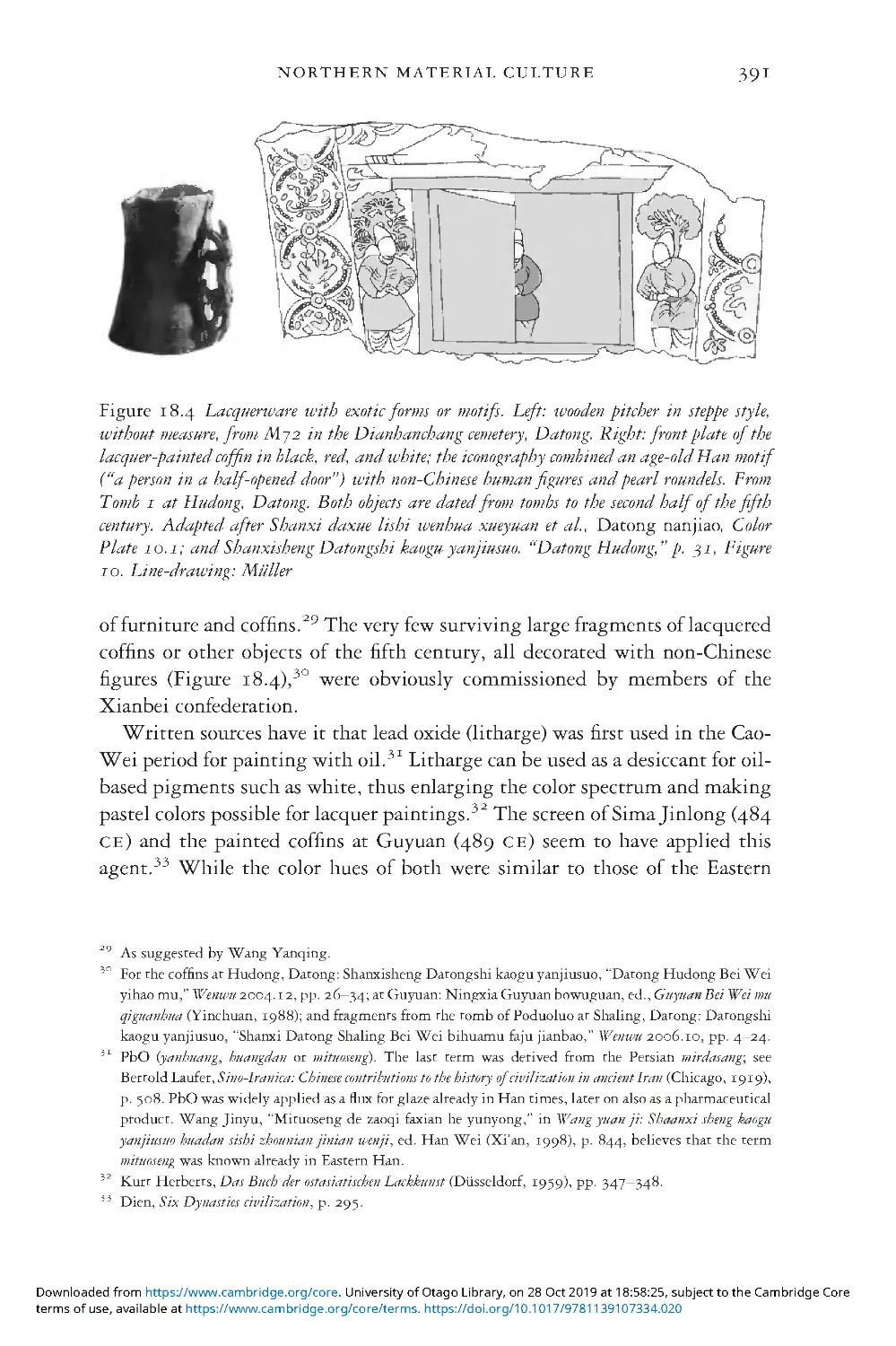




































































































































Author: Dien A.E. Knapp K.N.
Tags: history cambridge history of china
ISBN: 978-1-107-02077-1
Year: 2019
Similar


Text
                    THE CAMBRIDGE
HISTORY OF
CHINA
VOLUME 2
THE SIX DYNASTIES
220-589
EDITED BY ALBERT E. DIEN AND KEITH N. KNAPP

THE CAMBRIDGE
HISTORY OF
CHINA
Volume 2
The Six Dynasties, 220—589
Edited by
ALBERT E. DIEN
Professor Emeritus, Stanford University
KEITH N. KNAPP
The Citadel, The Military College of South Carolina
Cambridge
UNIVERSITY PRESS
Downloaded from https://www.cambridge.org/core. University of Western Ontario, on 17 Nov 2019 at 10:26:43, subject to the Cambridge Core
terms of use, available at https://www.cambridge.org/core/terms.
https://www.cambridge.org/core/product/CF007B7F5788F1C89C1C541095FCF555

Cambridge
UNIVERSITY PRESS
University Printing House, Cambridge CB2 8bs, United Kingdom
One Liberty Plaza, 20th Floor, New York, ny 10006, USA
477 Williamstown Road, Port Melbourne, vic 3207, Australia
314—321, 3rd Floor, Plot 3, Splendor Forum, Jasola District Centre, New Delhi — 110025, India
79 Anson Road, #06—04/06, Singapore 079906
Cambridge University Press is part of the University of Cambridge.
It furthers the University’s mission by disseminating knowledge in the pursuit of
education, learning, and research at the highest international levels of excellence.
www.cambridge.org
Information on this title: www.cambridge.org/9781107020771
Doi: 10.1017/9781139107334
© Cambridge University Press 2019
This publication is in copyright. Subject to statutory exception
and to the provisions of relevant collective licensing agreements
no reproduction of any part may take place without the written
permission of Cambridge University Press.
First published 2019
Printed in the United Kingdom by TJ International Ltd, Padstow Cornwall
A catalogue record for this publication is available from the British Library.
ISBN 978-1-107-02077-1 Hardback
Cambridge University Press has no responsibility for the persistence or accuracy of
URLs for external or third-party internet websites referred to in this publication
and does not guarantee that any content on such websites is, or will remain,
accurate or appropriate.
Downloaded from https://www.cambridge.org/core. University of Western Ontario, on 17 Nov 2019 at 10:26:43, subject to the Cambridge Core
terms of use, available at https://www.cambridge.org/core/terms.
https://www.cambridge.org/core/product/CF007B7F5788F1C89C1C541095FCF555

CONTENTS
List of Figures and Tables	page x
List of Maps	xiii
Preface	xv
Six Dynasties Chronology	xviii
Introduction	1
PART 1 HISTORY	25
1	Wei	27
by Rafe de Crespigny
Prologue: The Fall of Han (189)	27
Civil War and the Rise of Cao Cao (190—200)	28
Development of a State (200—208)	32
The Limits of Expansion (208—217)	35
From Kingdom to Empire (216—220)	39
Cao Pi and Cao Rui (220—239)	42
Cao Shuang, Sima Yi, and the Fall of Wei (239—265)	46
2	Wu	50
by Rafe de Crespigny
Sun Jian (c. 155-191) and Sun Ce (175-200)	50
Sun Quan and the Kingdom of Wu (200—222)	52
The Empire of Sun Quan (222—252)	57
The Succession to Sun Quan and the Fall of Wu (252—280)	61
3	Shu-Han	66
byJ. Michael Farmer
Downloaded from https://www.cambridge.org/core. University of Otago Library, on 17 Nov 2019 at 10:29:22, subject to the Cambridge Core
terms of use, available at https://www.cambridge.org/core/terms.
https://www.cambridge.org/core/product/11E8D75D833F1B03124A5FF745CD1DEB

iv	CONTENTS
The Shu Region in the Late Han	66
The Reign of Liu Yan and Liu Zhang	67
Liu Bei’s Conquest of Yi Province	68
The Reign of Liu Bei (214—223)	70
The Reign of Liu Shan (223—263)	73
4	Western Jin	79
by Damien Chaussende
The Prehistory of the Jin: The Rise of the Sima Clan under
the Wei	79
The Reign of Emperor Wu (266—290)	84
The Disturbances of the Eight Princes and the Fall of the
Western Jin	92
5	Eastern Jin	96
by Charles Holcombe
The Founding of the Eastern Jin Dynasty (317—420)	96
Emigres and Natives	98
Wang Dun’s Rebellion	103
Great-Family Politics	106
Huan Wen	109
The Battle of the Fei River	112
The End of the Eastern Jin	114
An Evaluation	117
6	The Sixteen Kingdoms	119
by Charles Holcombe
The Emerging Threat	119
The Roads to the Fei River	125
After the Fei River Encounter	137
7	Cheng-Han State	145
byTERRYF. Kleeman
8	Northern Wei	155
by Scott Pearce
The Making of a Dynasty	155
The Making of a Nation	159
Downloaded from https://www.cambridge.org/core. University of Otago Library, on 17 Nov 2019 at 10:29:22, subject to the Cambridge Core
terms of use, available at https://www.cambridge.org/core/terms.
https://www.cambridge.org/core/product/11E8D75D833F1B03124A5FF745CD1DEB

CONTENTS
V
Completion of the Conquests	164
Justifying the Realm	168
The Growth of Absolutism	171
The Dynasty’s Fall	178
The Shadow of the Tabgac	182
9	Eastern Wei—Northern Qi	184
byALBERT E. Dien
Introduction	184
Geography	184
Final Years of the Northern Wei Dynasty	186
The Eastern Wei Dynasty	193
The Northern Qi Dynasty	197
Conclusions	208
10	Western Wei—Northern Zhou	210
byALBERT E. Dien
11	The Southern Dynasties	237
by Andrew Chittick
The Founding Years, 420—453	241
Factional Strife and the End of the	Song	Dynasty, 453—478	248
CiVilian Realignment and Renewed Factionalism under
the Qi Dynasty, 478-501	254
The Reign of Liang Emperor Wu,	502—549	259
Collapse, Reconsolidation, and Conquest, 548—589	265
Conclusion	271
PART 2 SOCIETY AND REALIA	273
12	The Art of War	275
by David A. Graff
Patterns of Conflict	275
Tools and Techniques of War	283
Military institutions	289
13	Foreign Relations	296
by Charles Holcombe
The inVestiture System	297
Downloaded from https://www.cambridge.org/core. University of Otago Library, on 17 Nov 2019 at 10:29:22, subject to the Cambridge Core
terms of use, available at https://www.cambridge.org/core/terms.
https://www.cambridge.org/core/product/11E8D75D833F1B03124A5FF745CD1DEB

vi
CONTENTS
The Northeastern Interaction Zone	299
Southern Sea Lanes	303
Northwest Passages	305
14	The Northern Economy	309
by Victor Cunrui Xiong
Land Tenure, Taxation, and Corvee Labor	309
Money	317
Manufacturing and Trade	319
Population	323
Urbanism	326
15	The Southern Economy	330
by Liu Shufen
Foreword	330
The New Emigres Coming from the North	331
The Southern Aborigines and the Six Dynasties Regimes	337
Commerce	346
Coinage	350
Conclusion	353
16	Agriculture	355
by Francesca Bray
The Qimin Yaoshu: The Author and His Art	357
Best Farming Practice in North China	361
A Book of Its Time	365
Estate and Peasant in Northern China	368
Agriculture in the South	371
17	The History of Sogdians in China	374
by Rong Xinjiang
18	Northern Material Culture	384
by Shing Muller
From Gray Pottery to Porcelaneous Stoneware	384
Lacquer: An Inherited Fascination	390
Jade, Glass, and Everything Colorful and Glittering	392
Bronze, Iron, and Other Metals	396
Paper and Stone: New Media for Writing and Artwork	404
Downloaded from https://www.cambridge.org/core. University of Otago Library, on 17 Nov 2019 at 10:29:22, subject to the Cambridge Core
terms of use, available at https://www.cambridge.org/core/terms.
https://www.cambridge.org/core/product/11E8D75D833F1B03124A5FF745CD1DEB

CONTENTS	vii
New Weaves, Gold Weaves, and the “Xianbei” Garb	406
Tents, Roofed Dwellings, and Interiors	410
Particularities in Sepulchral Customs	413
Conclusion	416
19	Southern Material Culture	418
by Annette Kieser
Introduction	418
Southern Tombs before the Northern Influx: Wu and
Western Jin	419
Southern Tombs after the Northern Influx: Eastern Jin
and Southern Dynasties	432
Conclusion	441
20	Women, Families, and Gendered Society	443
by Jen-der Lee
Introduction through the Life of a Nun	443
Women in Confucian Family Ethics	446
Aristocratic Wives Defying Marital Hierarchy	447
Maternal Bonds Challenging Patriarchy while Reinforcing
Reproduction	449
The Widowed and the Unmarried: Religion as an Alternative 453
Women Rulers as Family Roles	456
Concluding Remarks	458
21	Local Society	460
by Hou Xudong
Introduction	460
Lower-Level Settlements	461
Base-Level Administration of Local Government	463
Composition of Resident Households	466
Activities and Organizations of Commoners	473
PART 3 CULTURE, RELIGION, AND ART	481
22	Confucian Learning and Influence	483
by Keith N. Knapp
The Influence of Confucianism	484
Classical Learning	485
Downloaded from https://www.cambridge.org/core. University of Otago Library, on 17 Nov 2019 at 10:29:22, subject to the Cambridge Core
terms of use, available at https://www.cambridge.org/core/terms.
https://www.cambridge.org/core/product/11E8D75D833F1B03124A5FF745CD1DEB

viii
CONTENTS
Confucian Education	486
Broad Learning	488
Imperial Schools	490
Examinations	493
Ritual	495
The Major Thinkers of Six Dynasties Confucianism	499
Conclusion	509
23	Qingtan and Xuanxue	511
by Yuet Keung Lo
The Intellectual Scene	512
Qingtan	514
Xuan and Xuanxue	522
24	Buddhism	531
byJoHN Kieschnick
Buddhism at Court	533
Monasticism	539
Devotion	547
Conclusion	551
25	Daoism	553
by Stephen R. Bokenkamp
26	Popular Religion	579
by Robert Ford Campany
Local Gods, Their Temples, and Associated Practices: Domestic
Deities	582
Demons, Sprites, and Animals	587
Spirits of the Human Dead	589
Specialists	592
Conclusion	595
27	The World of Prose Literature	597
byANTJE Richter
The Literary Heritage of the Six Dynasties	597
Literature in a Web of Interconnections: A Fourth-Century
Example	599
Literary Circles at Courts and Beyond	603
Downloaded from https://www.cambridge.org/core. University of Otago Library, on 17 Nov 2019 at 10:29:22, subject to the Cambridge Core
terms of use, available at https://www.cambridge.org/core/terms.
https://www.cambridge.org/core/product/11E8D75D833F1B03124A5FF745CD1DEB

CONTENTS
IX
The Rise of Literary Criticism	609
Genres of Life Writing	614
City, Countryside, and Wilderness	617
Literary Imagination and Narrative Art	619
28	The World of Poetry	623
by Cynthia L. Chennault
Introduction	623
Yuefu and Shi of the Wei State and Dynasty	626
Thematic Diversification during the Western and	Eastern Jin 633
Nature Poetry, Yuefu, and Other Lyrics of the Liu-Song	639
Poetry of the Southern Qi and Liang Salons	645
Poetry of North China and the Chen Dynasty	654
Conclusion	660
29	Art and Visual Culture	662
by Wu H UNG
Funerary Art	663
Religious Art	676
Painting and Calligraphy	687
30	Music	698
by Bo Lawergren
Introduction: The Background to SiX Dynasties Music	698
Importation of Kuchean Music to Northern China	699
Buddhism and Music	701
Chinese Instruments	702
Instruments of the SiX Dynasties Period	703
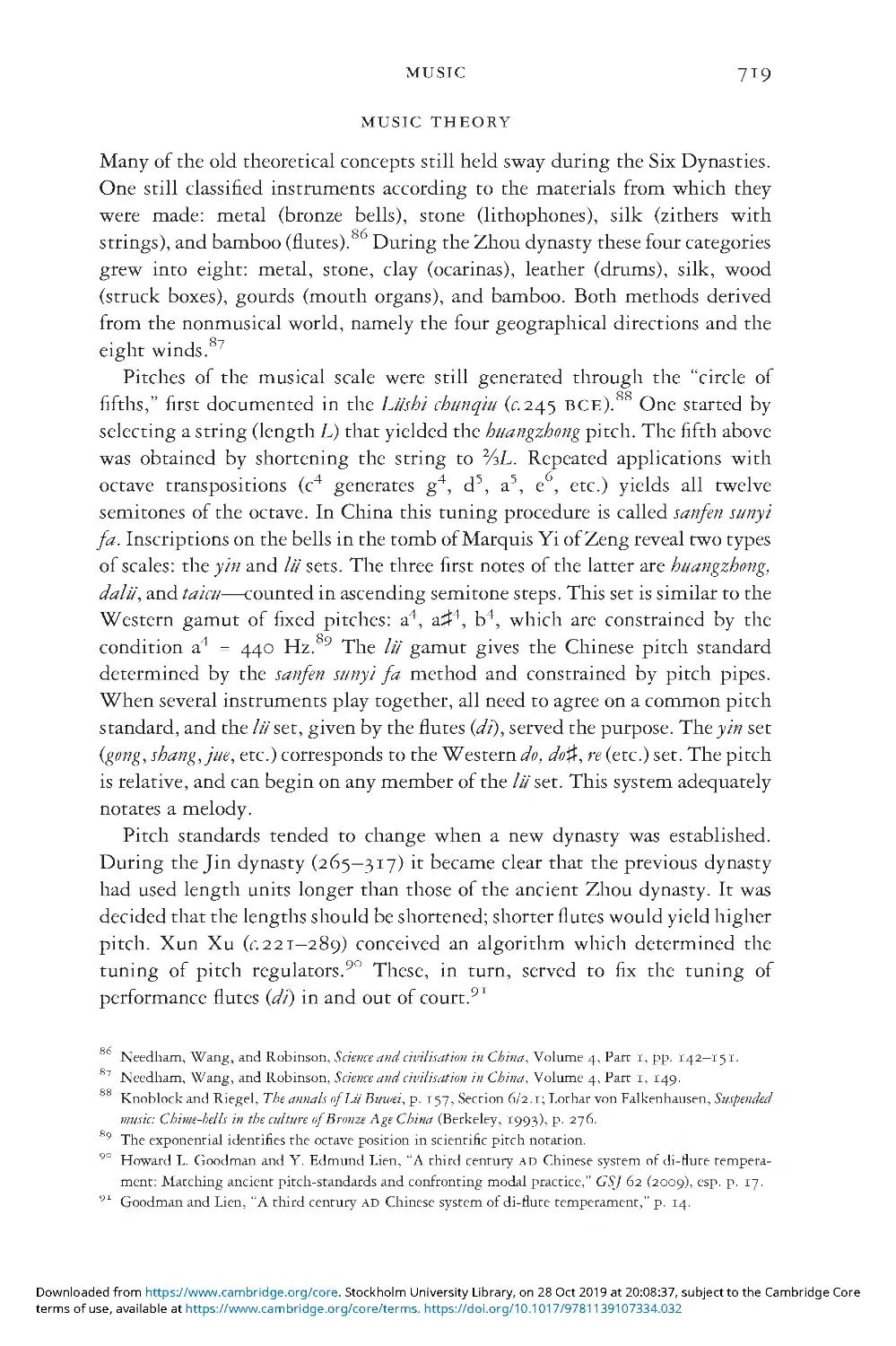
Music Theory	719
Conclusion	720
Bibliography
Abbreviations of Frequently Cited Primary Sources	721
Journal Titles: Acronyms (single-word titles do not
use acronyms)	722
List of Asian Journal Titles	725
Primary TeXts	729
General Bibliography	733
Glossary—Index	839
Downloaded from https://www.cambridge.org/core. University of Otago Library, on 17 Nov 2019 at 10:29:22, subject to the Cambridge Core
terms of use, available at https://www.cambridge.org/core/terms.
https://www.cambridge.org/core/product/11E8D75D833F1B03124A5FF745CD1DEB

FIGURES AND TABLES
14.1
FIGURES
Populations (in millions), 157-589 page 325
18.1
Typical grayware jars found in fifth-century Datong
385
18.2
Grave goods with gray pottery, lacquerware, and gold
jewelry in a non-Han tomb
386
18.3
Lead-glazed wares
389
18.4
Lacquerware with exotic forms or motifs
391
18.5
Schematic depiction of the coiled-core technique applied
to the lacquered vessel found in Tian Hong’s tomb
392
18.6
Belt sets of the Northern Dynasties
398
18.7
Gold cap ornaments
401
18.8
Chin straps and jewel elements
403
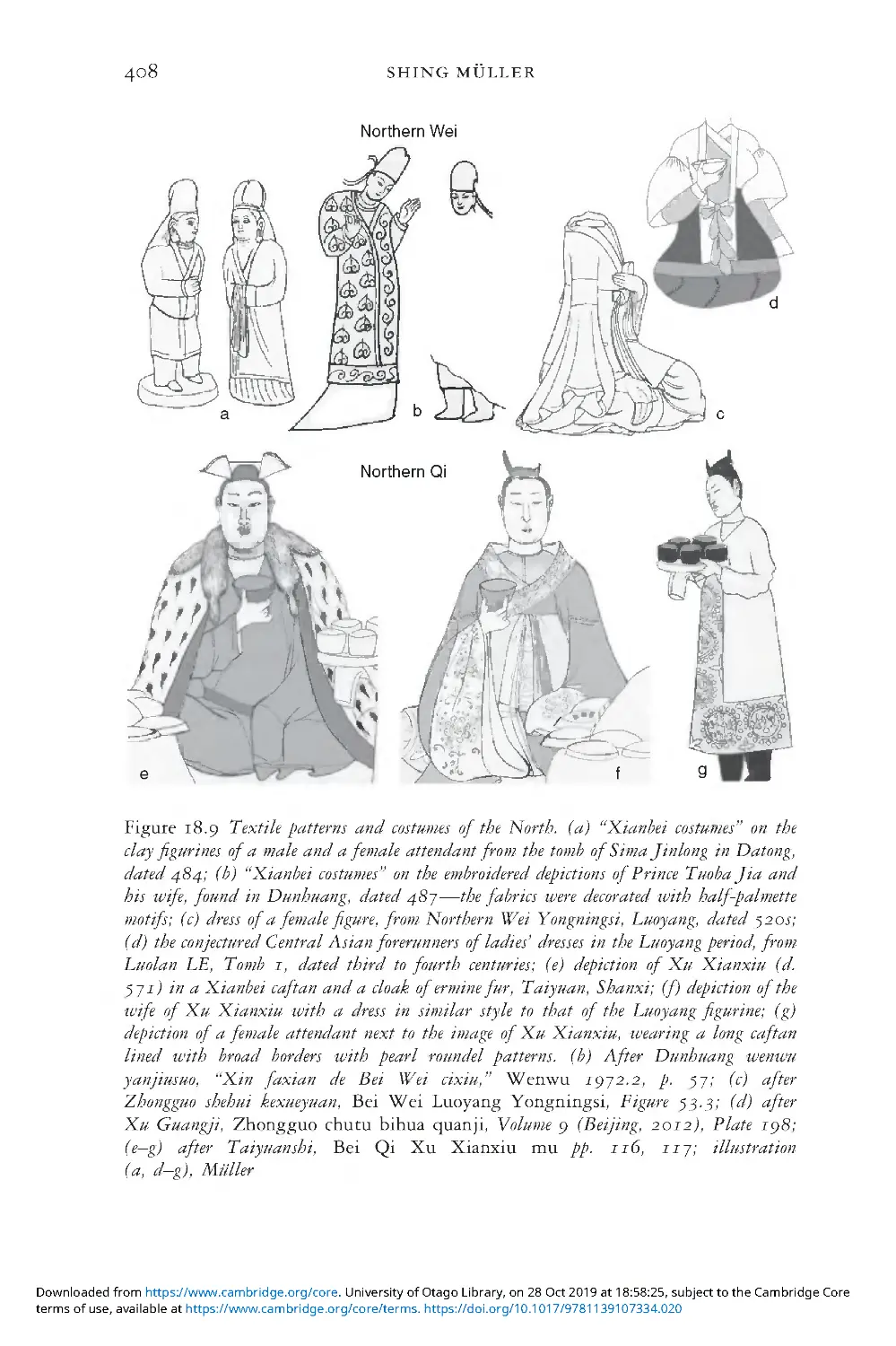
18.9
Textile patterns and costumes of the North
408
18.10
Animal masks as coffin ornaments with the center motif of
“master of animals” and its variations in palmette leaves
414
19.1
Tomb types of the Wu and Western Jin
420
19.2
Bronze vessel types of the Wu and Western Jin
421
19.3
Vessel types and typical decoration of the Wu and
Western Jin
421
19.4
Guan jars with brownish under-glaze painting
425
19.5
Bear-shaped zun vessel
426
19.6
Figured hunping or duisuguan jar
426
19.7
Models of estates
428
19.8
Earthenware models of (a) toilet, (b) grinding stone,
(c) winnowing basket, (d) mortar, (e) chicken coop,
(f) treadmill, (g) stove, (h) lamp, (i) greenware candle holder,
(j) ink stone, (k) water vessel
429
19.9
Group of figures from Shangfang, Jiangsu
430
19.10
Items for personal hygiene
431
19.11
Small-scale single chamber (Nanjing, Jiangsu), and new
Downloaded from https://www.cambridge.org/core. University of Western Ontario, on 17 Nov 2019 at 10:30:10, subject to the Cambridge Core
terms of use, available at https://www.cambridge.org/core/terms.
https://www.cambridge.org/core/product/0C75A1CE23F25C309ACD29458E66912E

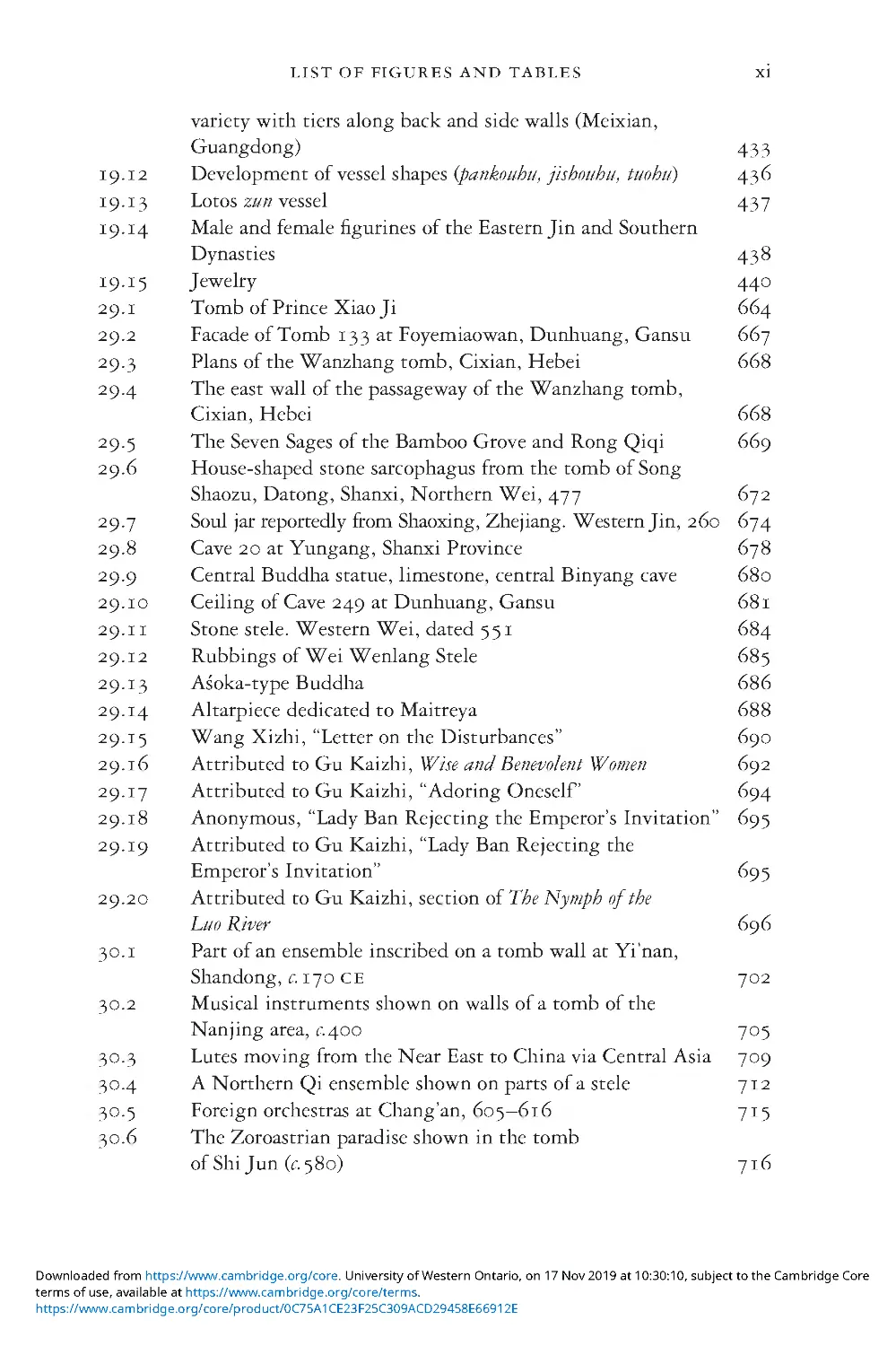
LIST OF FIGURES	AND	TABLES	xi
variety with tiers along back and side walls (Meixian,
Guangdong)	433
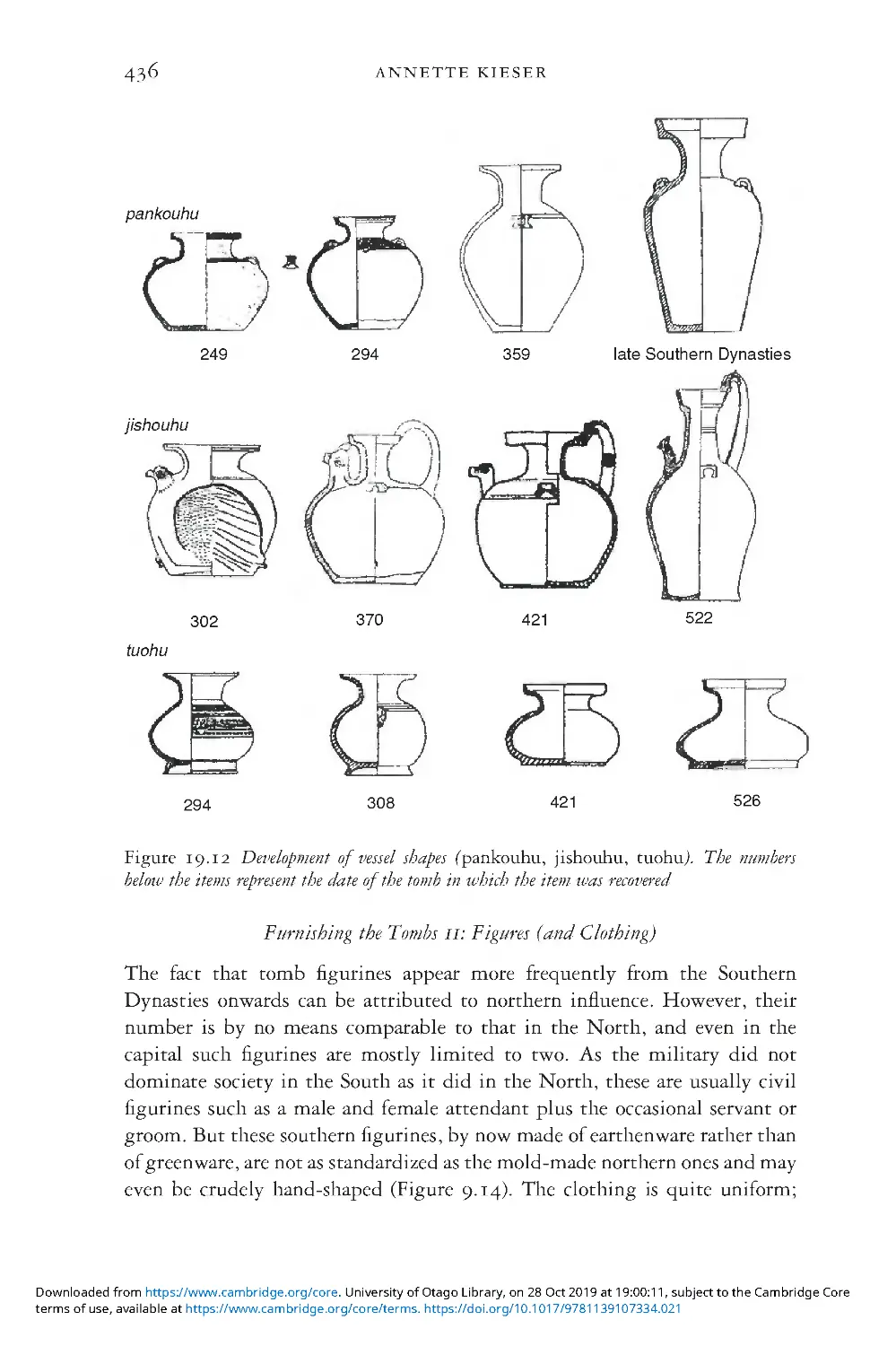
19.12	Development of vessel shapes (pankouhu, jishouhu, tuohu)	436
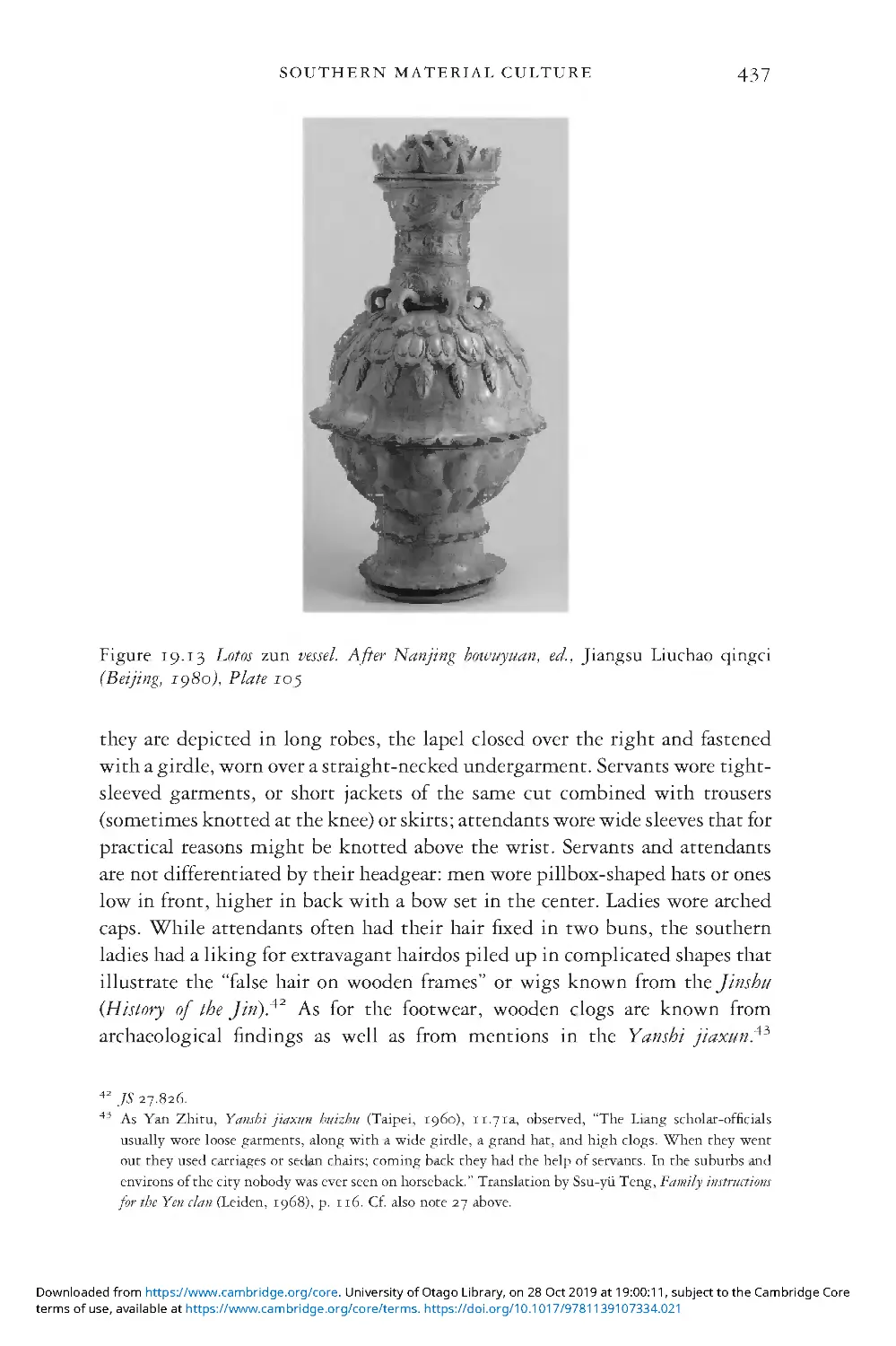
19.13	Lotos zun vessel	437
19.14	Male and female figurines of the Eastern Jin and Southern
Dynasties	438
19.15	Jewelry	440
29.1	Tomb of Prince Xiao Ji	664
29.2	Facade of Tomb 133 at Foyemiaowan, Dunhuang, Gansu	667
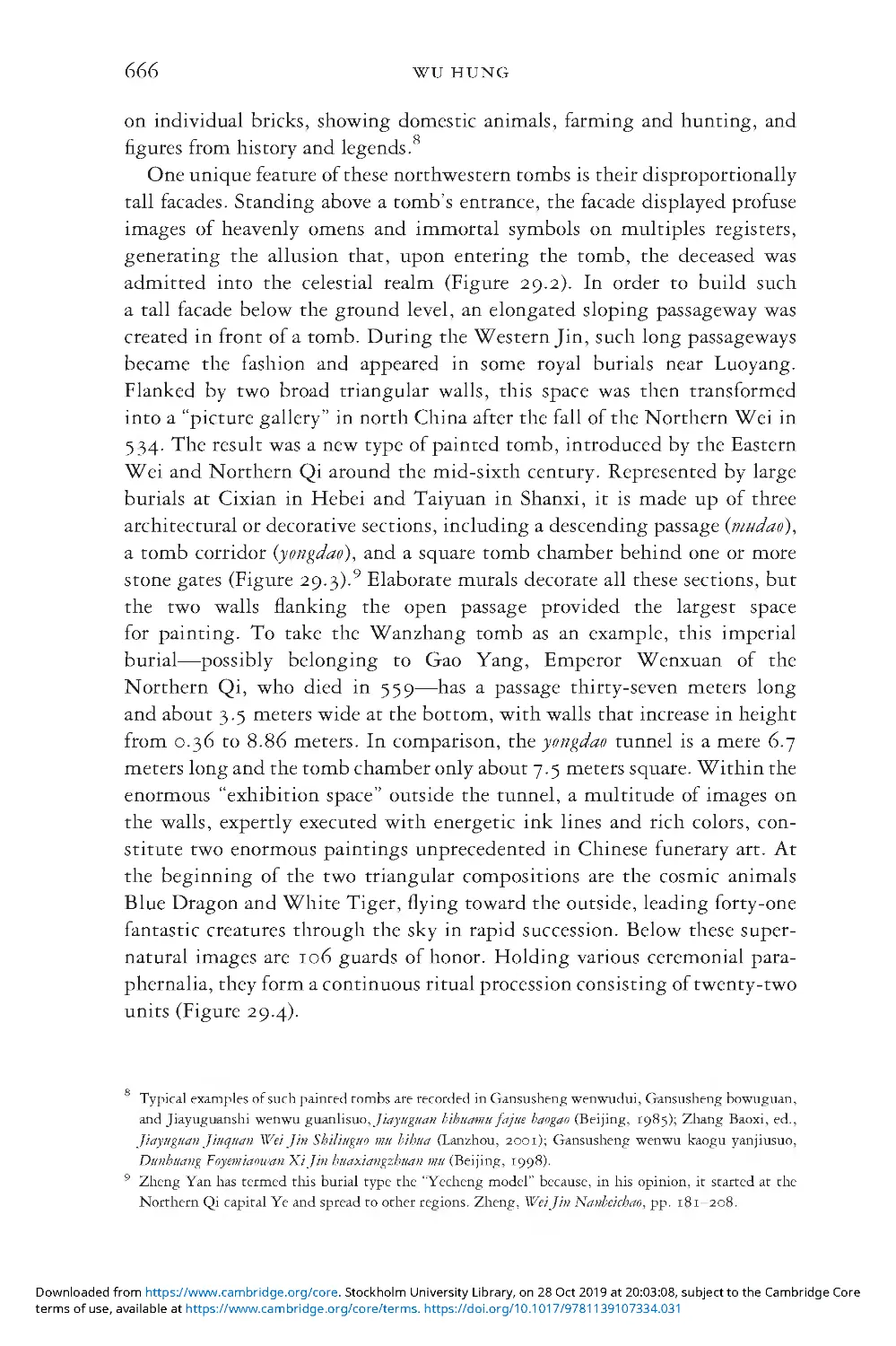
29.3	Plans of the Wanzhang tomb, Cixian, Hebei	668
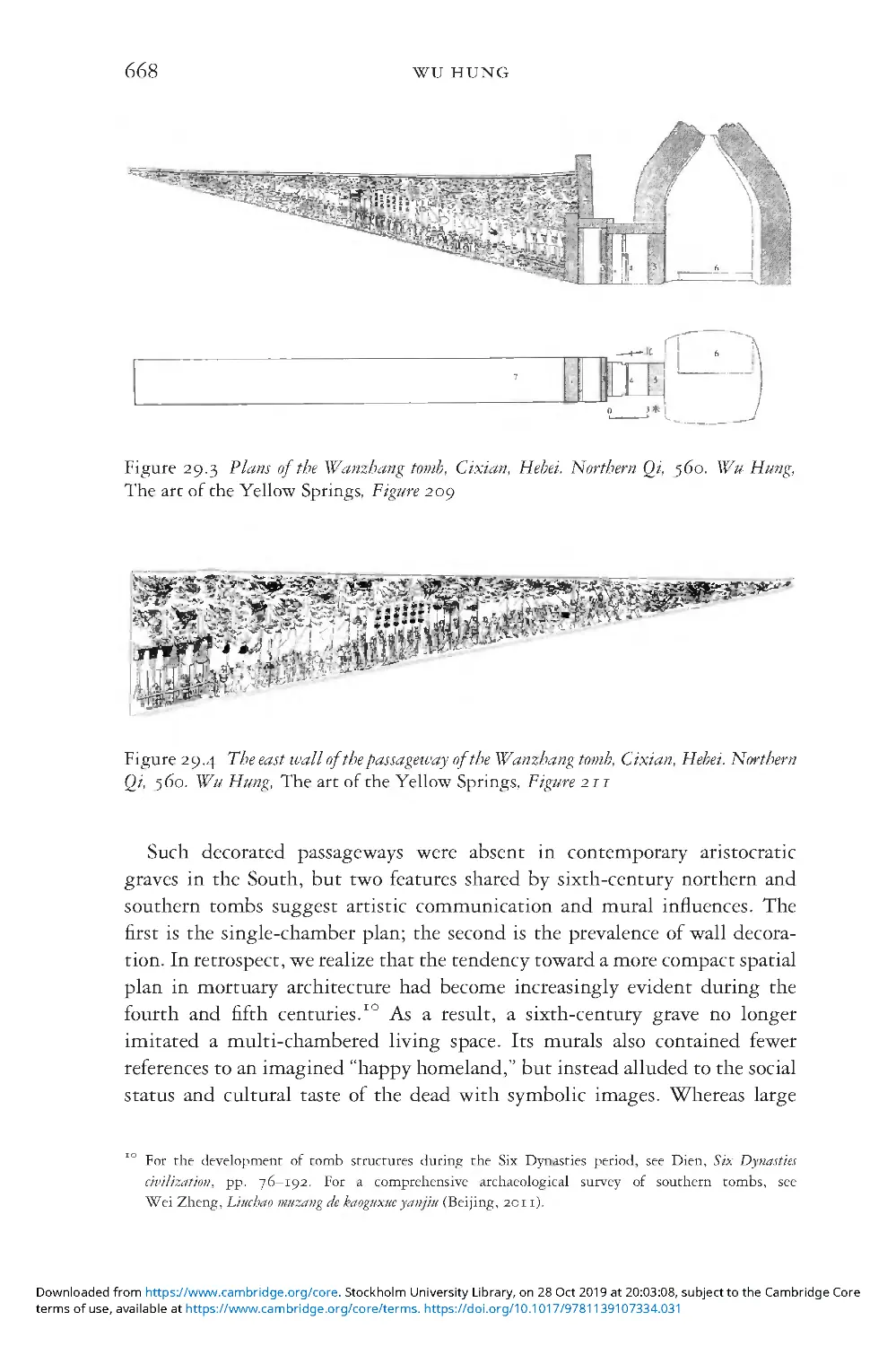
29.4	The east wall of the passageway of the Wanzhang tomb,
Cixian, Hebei	668
29.5	The Seven Sages of the Bamboo Grove and Rong Qiqi	669
29.6	House-shaped stone sarcophagus from the tomb of Song
Shaozu, Datong, Shanxi, Northern	Wei,	477	672
29.7	Soul jar reportedly from Shaoxing, Zhejiang. Western Jin, 260 674
29.8	Cave 20 at Yungang, Shanxi Province	678
29.9	Central Buddha statue, limestone, central Binyang cave	680
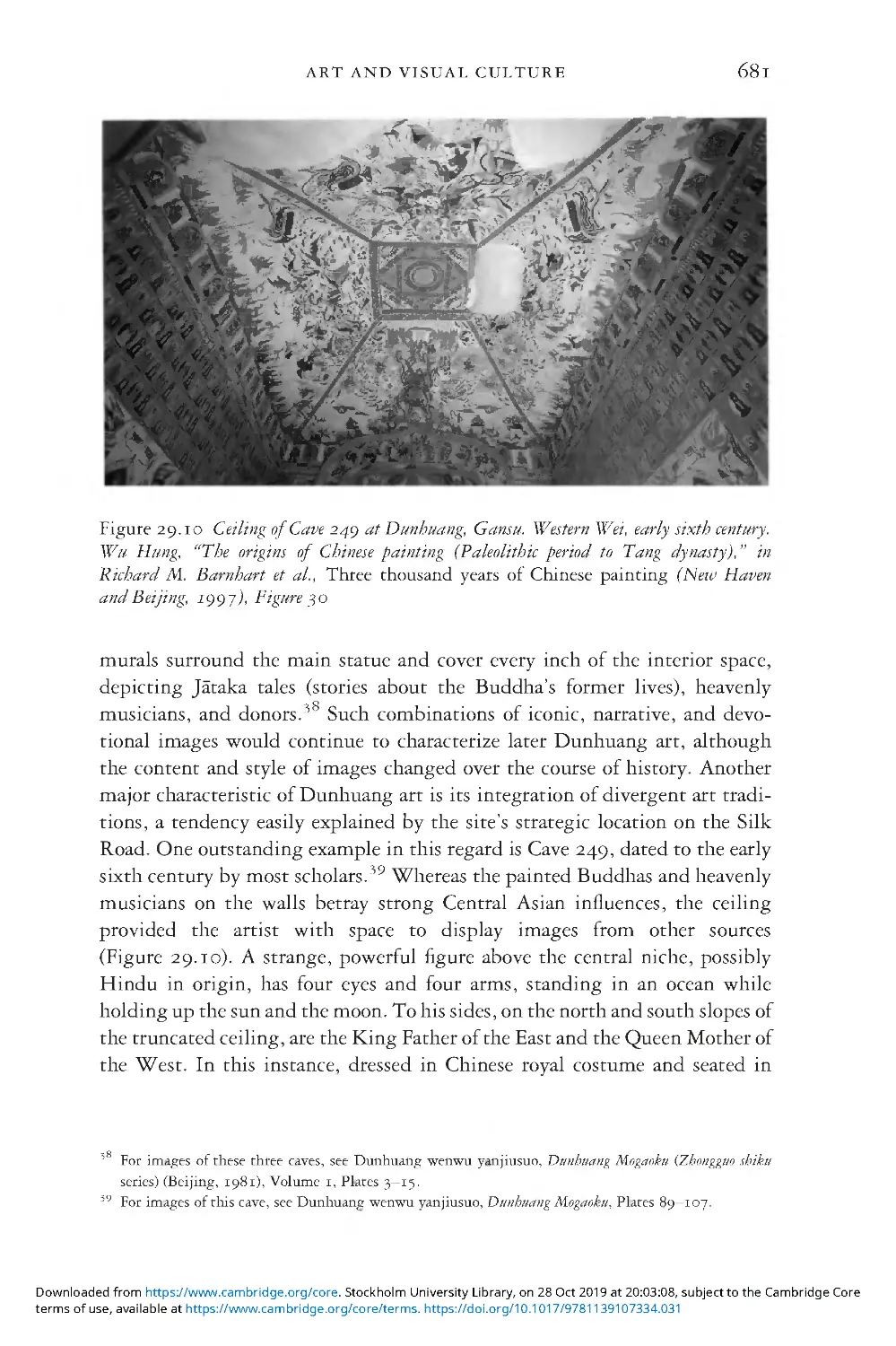
29.10	Ceiling of Cave 249 at Dunhuang, Gansu	681
29.11	Stone stele. Western Wei, dated 551	684
29.12	Rubbings of Wei Wenlang Stele	685
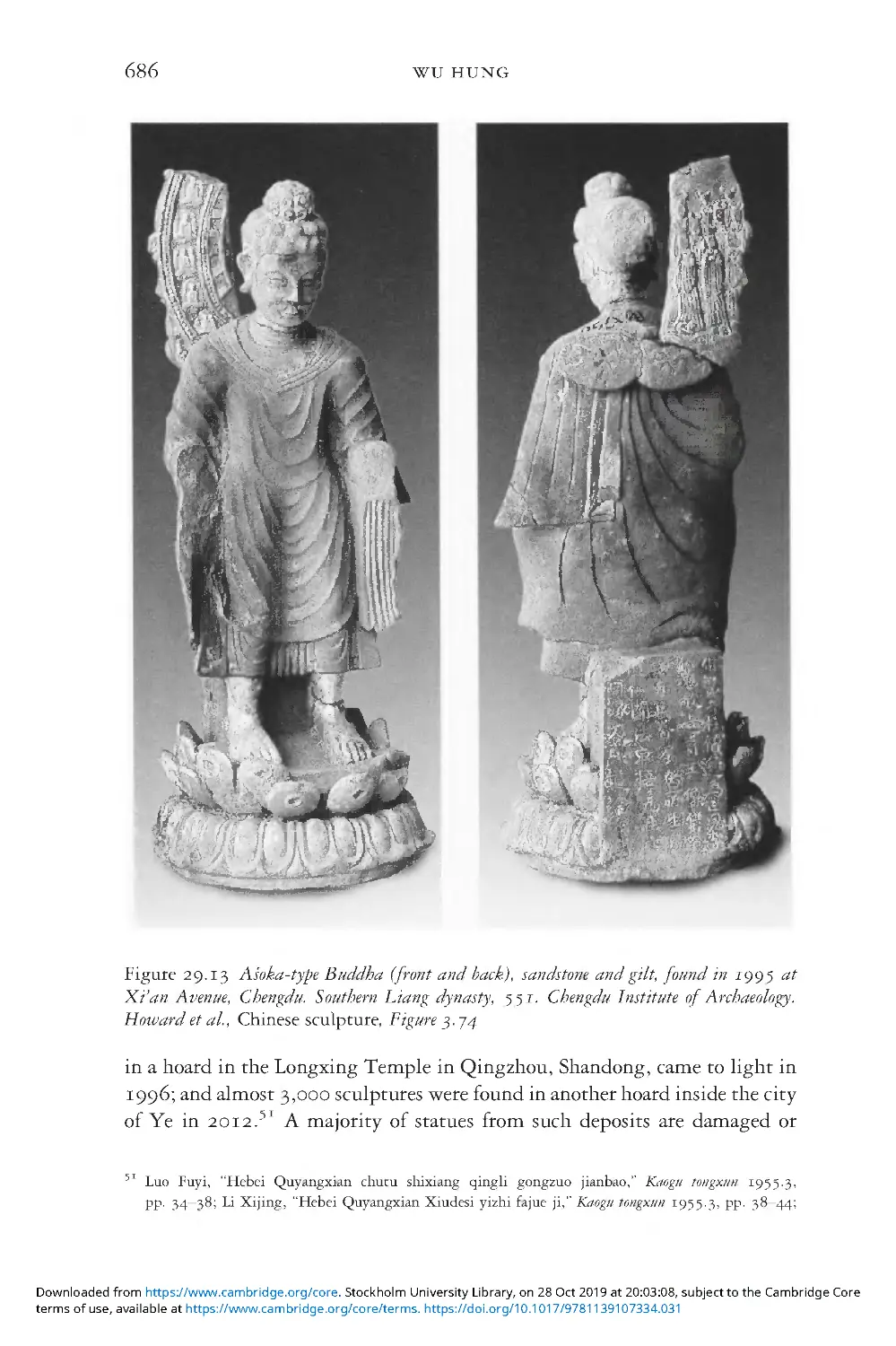
29.13	Asoka-type Buddha	686
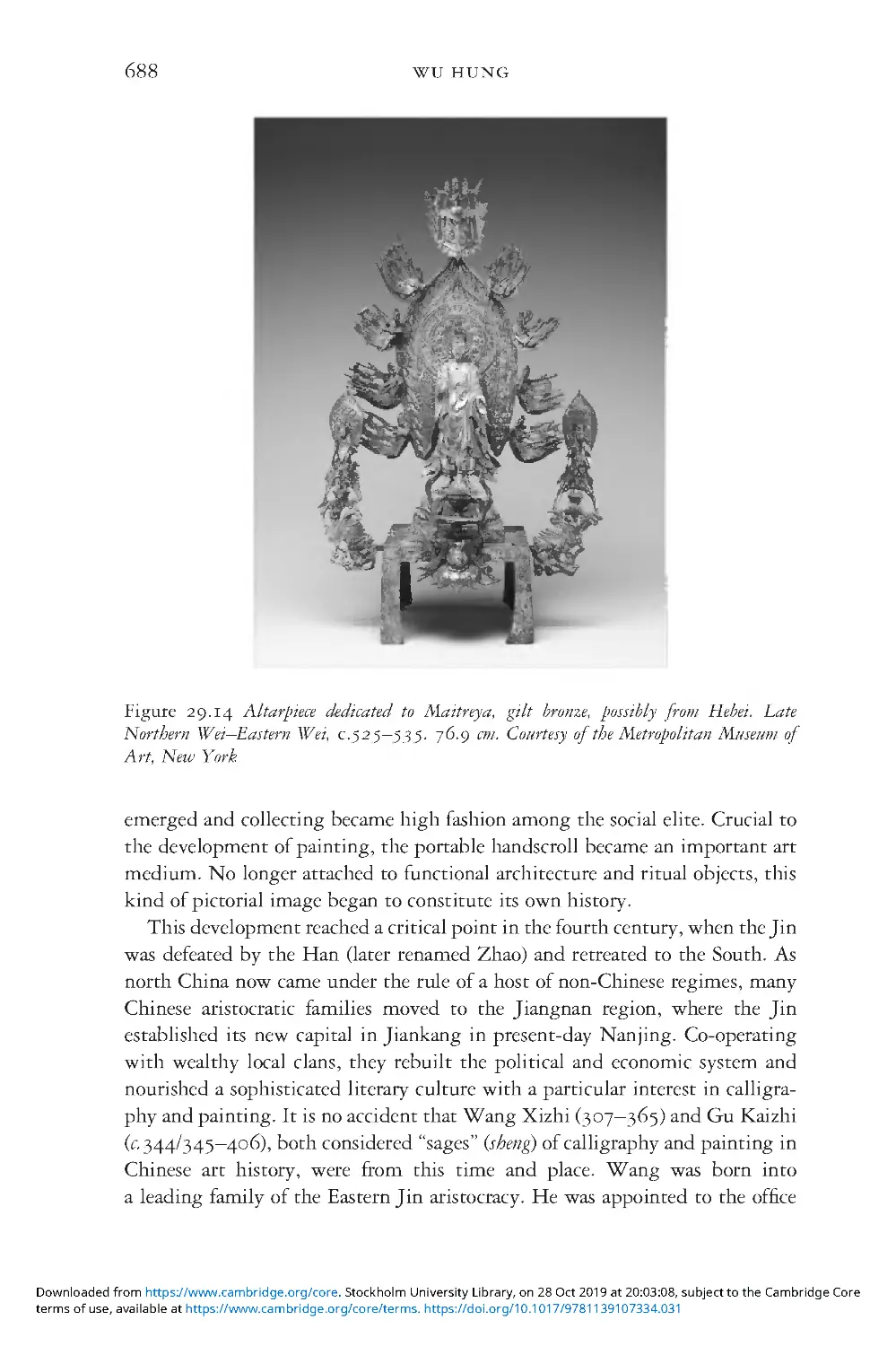
29.14	Altarpiece dedicated to Maitreya	688
29.15	Wang Xizhi, “Letter on the Disturbances”	690
29.16	Attributed to Gu Kaizhi, Wise and Benevolent Women	692
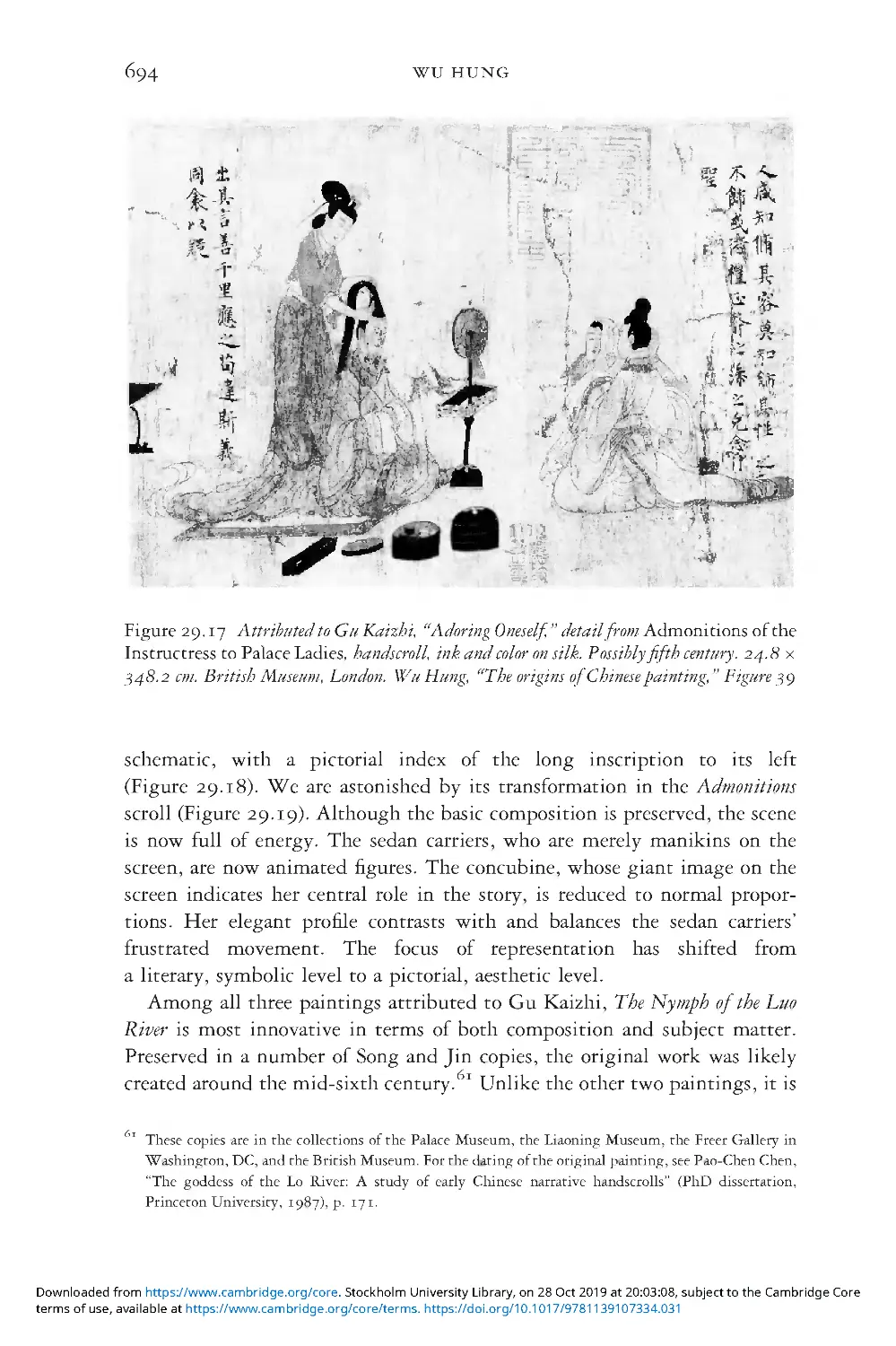
29.17	Attributed to Gu Kaizhi, “Adoring Oneself’	694
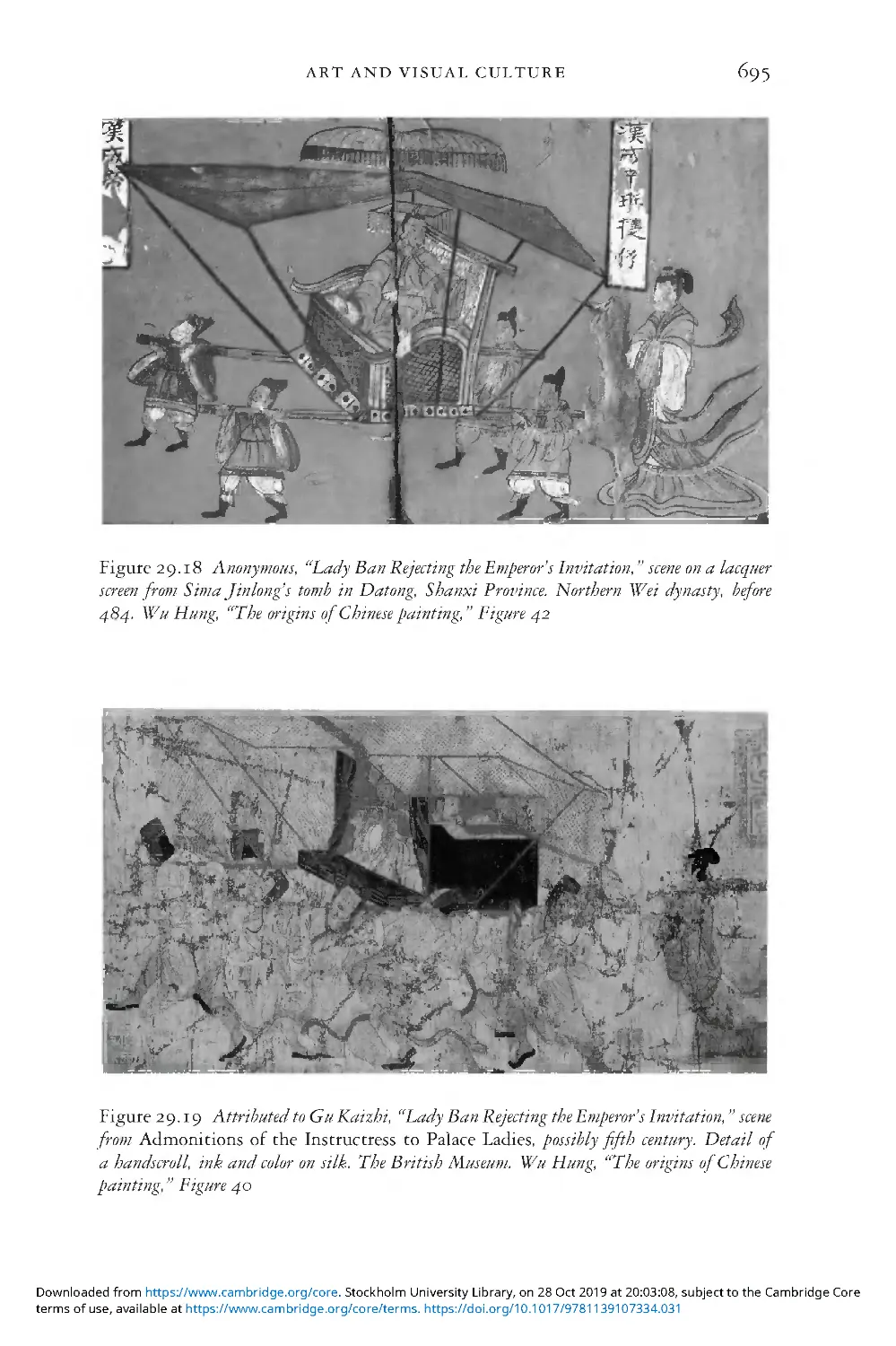
29.18	Anonymous, “Lady Ban Rejecting the Emperor’s Invitation” 695
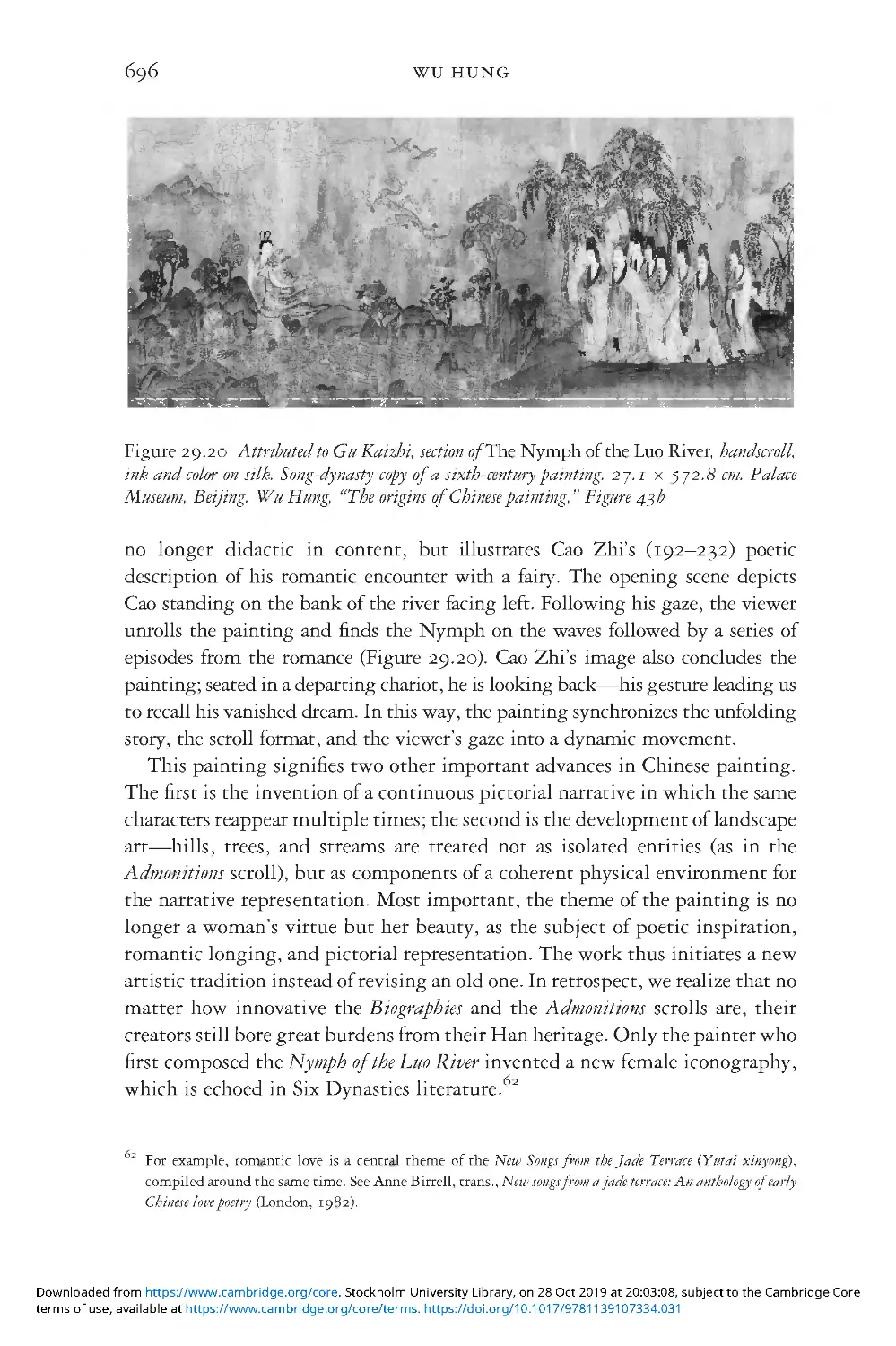
29.19	Attributed to Gu Kaizhi, “Lady Ban Rejecting the
Emperor’s Invitation”	695
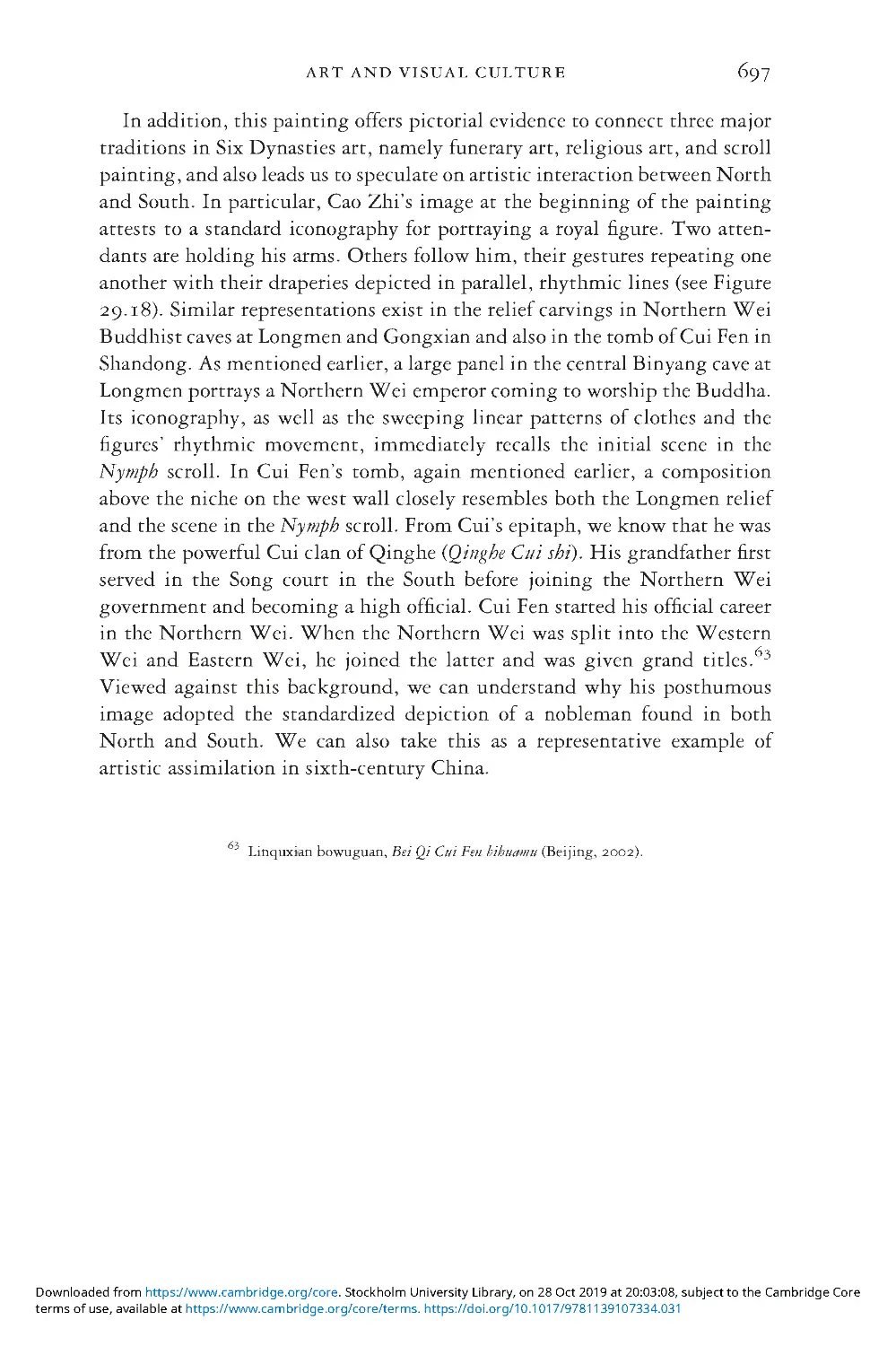
29.20	Attributed to Gu Kaizhi, section of The Nymph of the
Luo River	696
30.1	Part of an ensemble inscribed on a tomb wall at Yi’nan,
Shandong, c. 170 ce	702
30.2	Musical instruments shown on walls of a tomb of the
Nanjing area, c.400	705
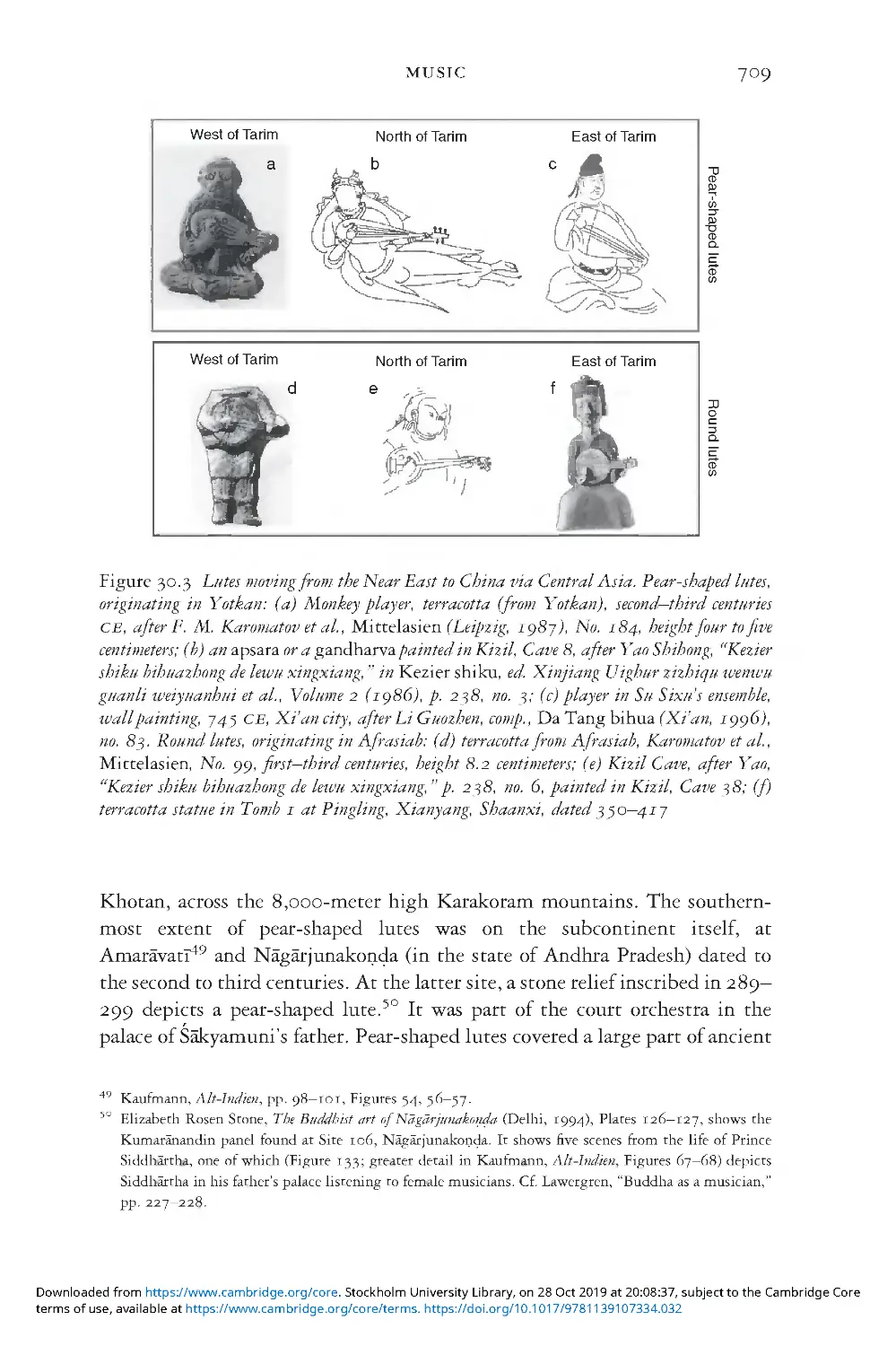
30.3	Lutes moving from the Near East to China via Central Asia 709
30.4	A Northern Qi ensemble shown on parts of a stele	712
30.5	Foreign orchestras at Chang’an, 605—616	715
30.6	The Zoroastrian paradise shown in the tomb
of Shi Jun (c. 580)	716
Downloaded from https://www.cambridge.org/core. University of Western Ontario, on 17 Nov 2019 at 10:30:10, subject to the Cambridge Core
terms of use, available at https://www.cambridge.org/core/terms.
https://www.cambridge.org/core/product/0C75A1CE23F25C309ACD29458E66912E

xll
LIST OF FIGURES AND TABLES
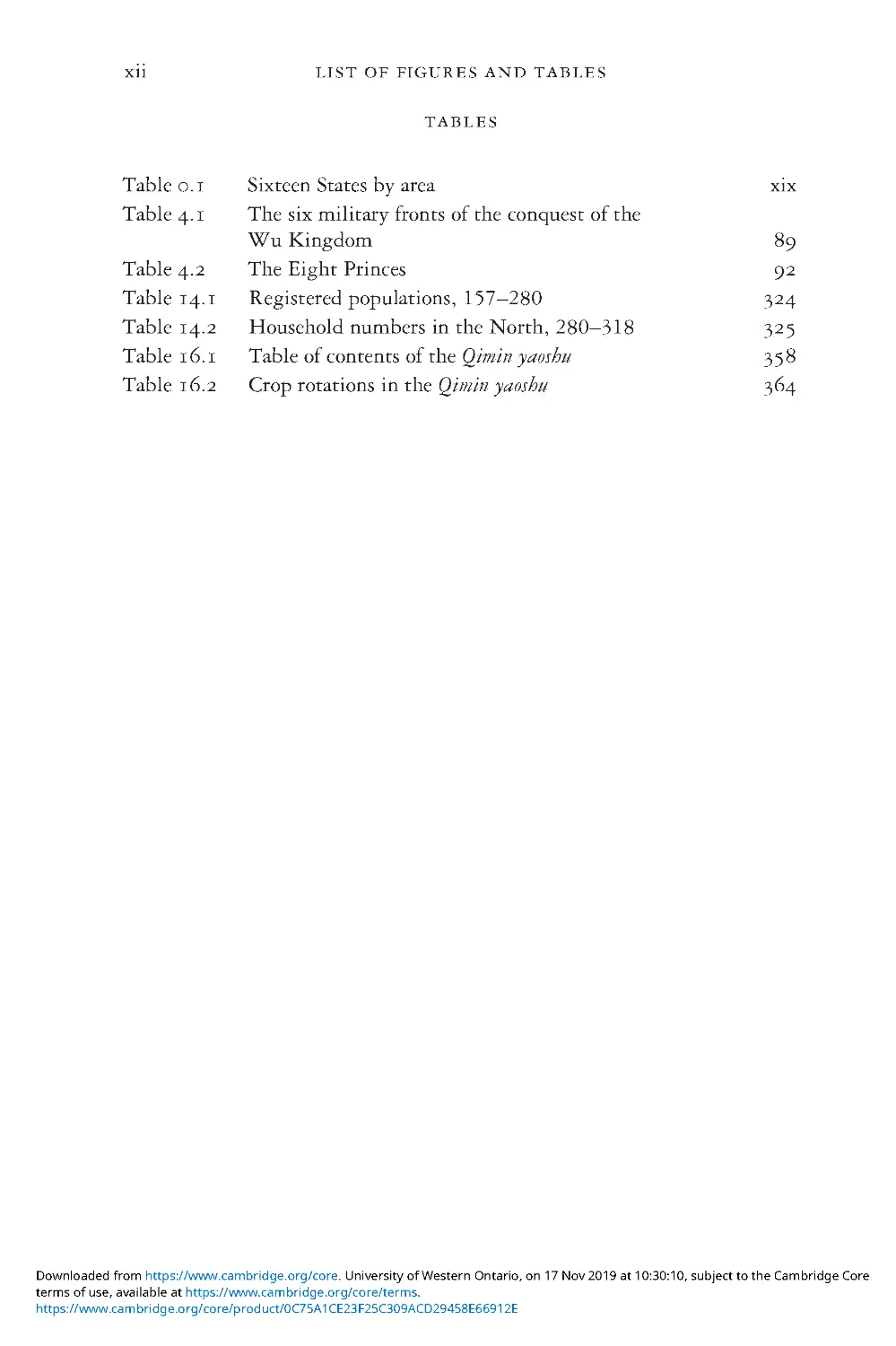
TABLES
Table 0.1
Sixteen States by area
xix
Table 4.1
The six military fronts of the conquest of the
Wu Kingdom
89
Table 4.2
The Eight Princes
92
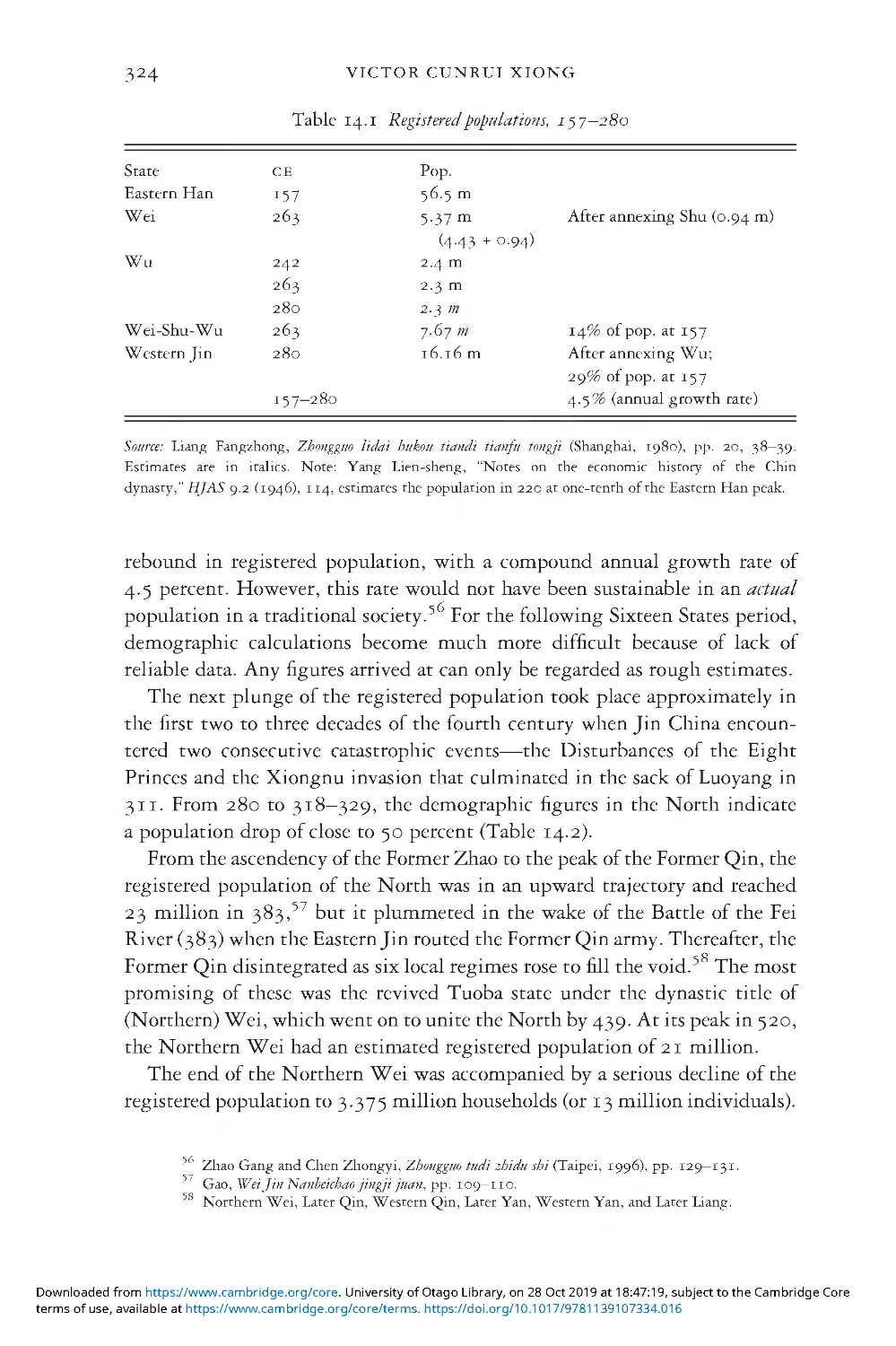
Table 14.1
Registered populations, 157—280
324
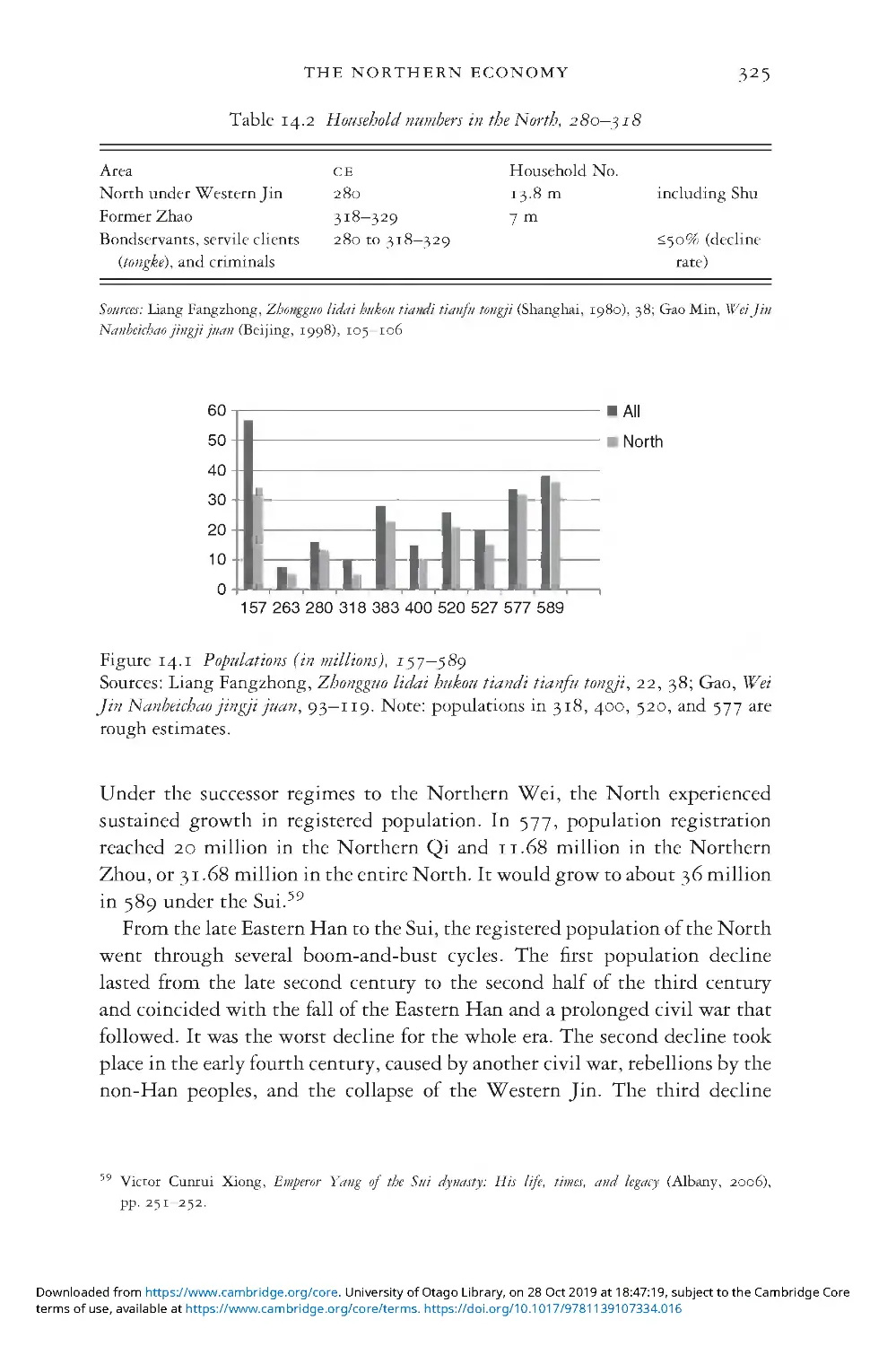
Table 14.2
Household numbers in the North, 280—318
325
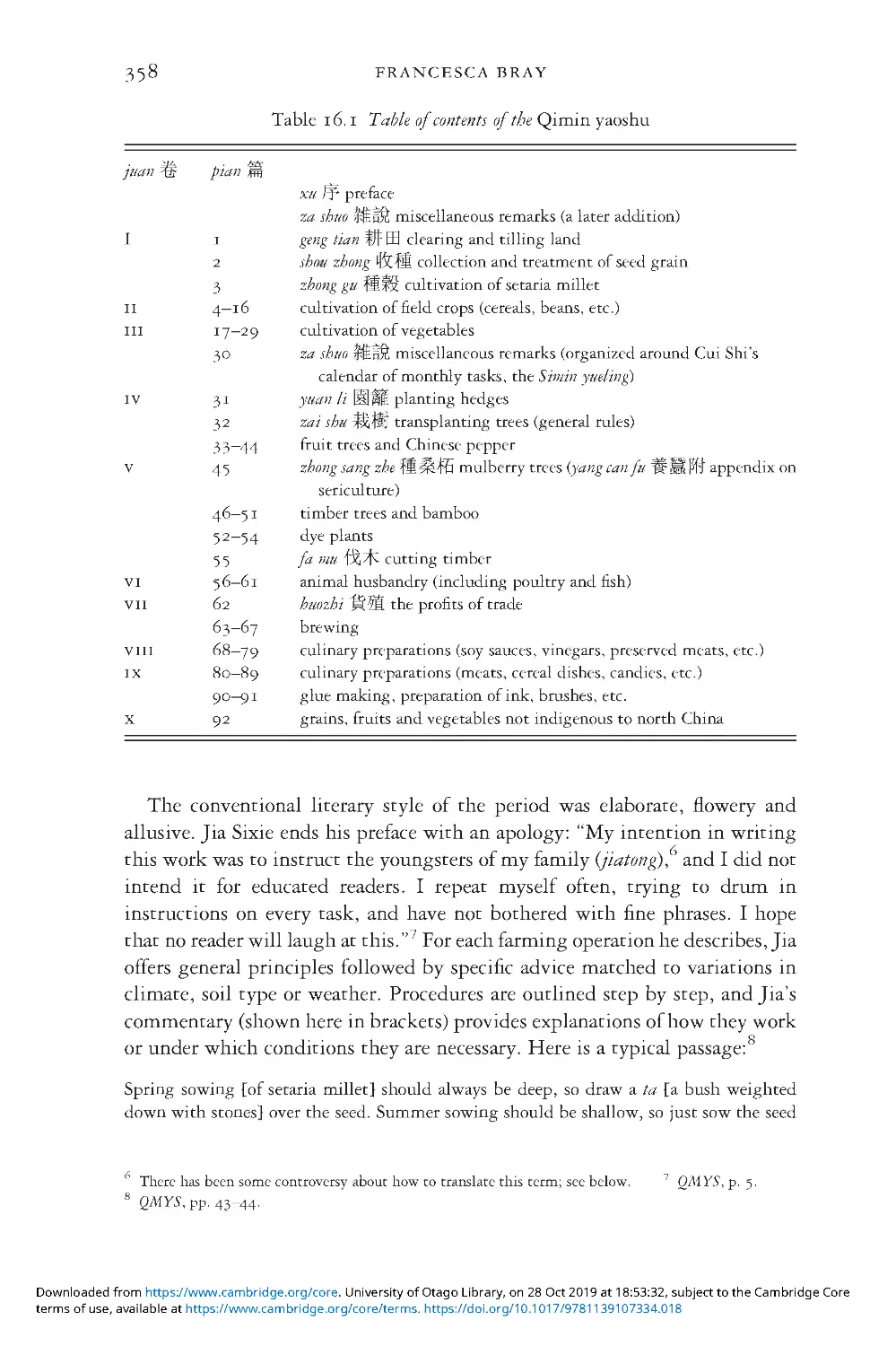
Table 16.1
Table of contents of the Qimin yaoshu
358
Table 16.2
Crop rotations in the Qimin yaoshu
364
Downloaded from https://www.cambridge.org/core. University of Western Ontario, on 17 Nov 2019 at 10:30:10, subject to the Cambridge Core
terms of use, available at https://www.cambridge.org/core/terms.
https://www.cambridge.org/core/product/0C75A1CE23F25C309ACD29458E66912E

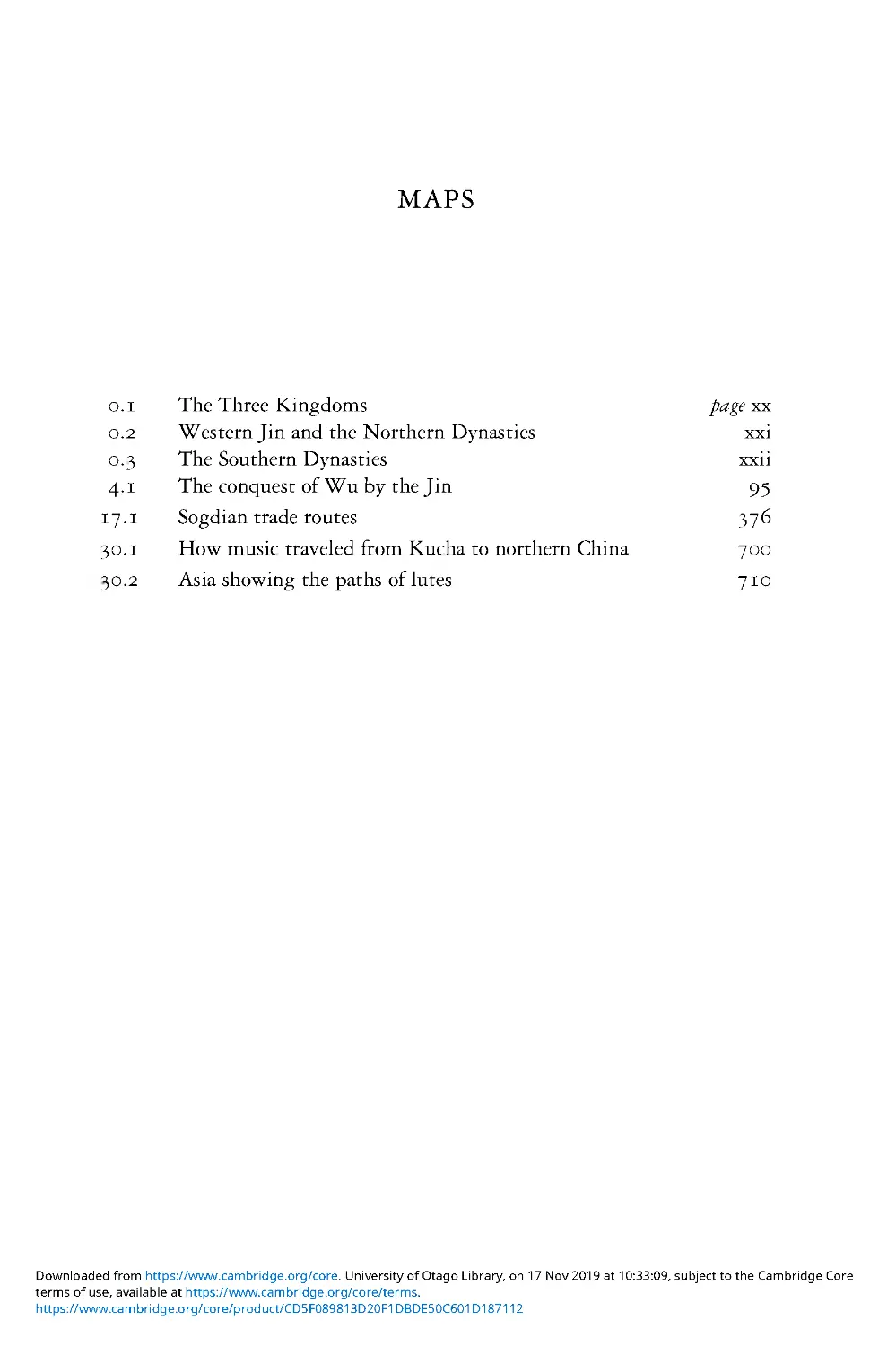
MAPS
0.1
The Three Kingdoms
page xx
0.2
Western Jin and the Northern Dynasties
xxi
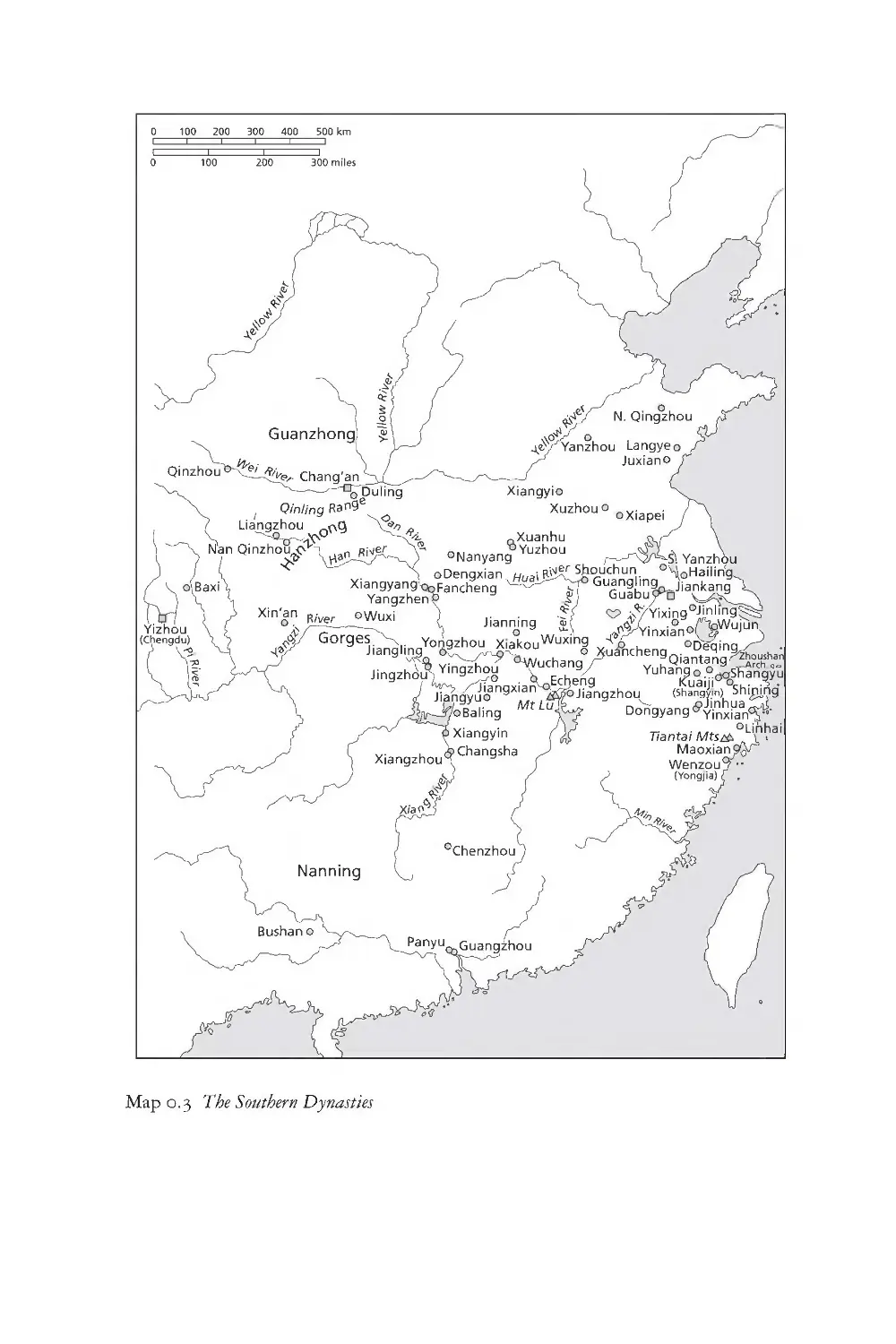
°.3
The Southern Dynasties
xxii
4.1
The conquest of Wu by the Jin
95
17.i
Sogdian trade routes
376
30.1
How music traveled from Kucha to northern China
700
30.2
Asia showing the paths of lutes
7i0
Downloaded from https://www.cambridge.org/core. University of Otago Library, on 17 Nov 2019 at 10:33:09, subject to the Cambridge Core
terms of use, available at https://www.cambridge.org/core/terms.
https://www.cambridge.org/core/product/CD5F089813D20F1DBDE50C601D187112

Downloaded from https://www.cambridge.org/core. University of Otago Library, on 17 Nov 2019 at 10:33:09, subject to the Cambridge Core
terms of use, available at https://www.cambridge.org/core/terms.
https://www.cambridge.org/core/product/CD5F089813D20F1DBDE50C601D187112

PREFACE
We both knew that assembling the second volume of the Cambridge history of
China would be a formidable task. Denis Twitchett had already endeavored to
do so in the mid-1980s, but was unable to for a variety of reasons. The lack of a
Cambridge history of China volume for the Six Dynasties period meant that there
was no way that a reader could acquire by reading just one book a sound feeling
for the period and all of its political and social complexities, as well as an
appreciation for its wide range of cultural achievements. Over the years, we
have both heard many fellow scholars lamenting the fact of the non-existence
of a Six Dynasties volume. Since there are now many excellent specialists
writing about the history and culture of early medieval China, we decided to
take on the challenge, but the project was far more complicated and time¬
consuming than either of us anticipated.
Completing this volume would not have been possible without the help of
numerous institutions and individuals. To start off the process of writing the
chapters, we had hoped to invite all of the contributors to a conference.
Unfortunately, the costs of doing so were prohibitive. Due to the generosity
of two universities, we were instead able to hold two smaller meetings. The
first was the “Six Dynasties Material Culture, Arts, Literature, and Ritual
Workshop,” which took place at the University of Chicago on May 26—27,
2012. The workshop was generously sponsored by the China Committee of the
Center for East Asian Studies and the Adelyn Russell Bogert Fund of the
Franke Institute for the Humanities, University of Chicago, and was organized
by the University of Chicago’s Center for the Art of East Asia, Department of
Art History. The workshop included all of the contributors who were working
on topics related to material culture and the arts. We owe much to Professors
Wu Hung and Katherine Tsiang, who played a large role in organizing and
making this meeting possible. The second workshop took place at the exqui¬
site Stanford Center at Peking University. This meeting with some of our East
Asian contributors was made possible through the arrangements provided by
the executive director of the center, Dr. Andrew J. Andreasen. We also wish to
Downloaded from https://www.cambridge.org/core. Stockholm University Library, on 28 Oct 2019 at 20:13:59, subject to the Cambridge Core
terms of use, available at https://www.cambridge.org/core/terms. https://doi.org/10.1017/9781139107334.001

xvi
PREFACE
thank Professor Tu Wei-ming for his active and informative participation at
the workshop. Many thanks too to Peking University for assisting with the
logistics of this meeting.
The Citadel, the Military College of South Carolina, generously provided
the support for much of this work. For the duration of this project, the college
supplied us with a graduate assistantship. Through this funding, Victoria
Musheff served as a superb internal editor who polished the chapters’ prose and
made sure that the information within was intelligible to nonspecialists.
Isabelle Bailey Knight, another graduate assistant, helped us put our biblio¬
graphy in good order. The History Department’s Henry and Jenny Johnson
Endowment Fund and the Citadel’s School of Humanities and Social Sciences
funded honorariums for the translators of the “Western Jin” and “Local
Society” chapters.
Many thanks to Professors Joelle Neulander for translating the “Western
Jin” chapter from French and Jon Felt for translating the “Local Society”
chapter from Chinese. Albert Dien translated from Chinese both the chapters
on the Sogdians and on the southern economy.
Many thanks to our contributors as well. They not only contributed their
expertise through the writing of their chapters; they also patiently endured the
editors’ requests to adjust their chapter’s contents for readability and clarity.
Charles Holcombe and Albert Dien are especially to be commended for taking
on the burden of writing more than one chapter.
Working with the dedicated and talented staff of Cambridge University
Press has been a joy. Marigold Acland, our first editor, recruited us to do the
volume. After Marigold’s retirement, our new editor, Lucy Rhymer, turned
out to be every bit as helpful and encouraging. Heather Lings took on the
difficult role of preparing the Glossary—Index, and John Gaunt performed the
Herculean task of making the text readable. Natasha Whelan and Lisa Carter
greatly helped us get the final manuscript in order.
Finally, we need to acknowledge each of our family’s patience and assis¬
tance. With no say in the matter, Dora and Joseph Dien and Jade and Melissa
Knapp were swept into the project in ways big and small. Their help ranged
from technical assistance to listening to endless worries and complaints. Their
support, although usually indirect, was essential to the project’s completion.
GUIDELINES FOR READERS
Following the precedent set by The Cambridge history of ancient China: From the
origins of civilization to 221 B.c., for the romanization of Chinese words, we
have decided to use the Pinyin system rather than the Wade—Giles system,
which has been employed in previous volumes of the Cambridge history of
Downloaded from https://www.cambridge.org/core. Stockholm University Library, on 28 Oct 2019 at 20:13:59, subject to the Cambridge Core
terms of use, available at https://www.cambridge.org/core/terms. https://doi.org/10.1017/9781139107334.001

PREFACE	xvii
China. We do this in recognition that the Pinyin system is now the most
popular romanization system of Chinese—it is used by nearly all English-
language newspapers and academic journals and books. By now, only specia¬
lists are still acquainted with the Wade—Giles system.
Unlike prior volumes of the Cambridge history of China, this work will
employ the bce (before common era) and CE (common era) dating system,
rather than BC (before Christ) and AD (anno domini) one. This has been done
to be more in line with current academic conventions and to regard time in a
more secular manner.
Chinese characters have been used sparingly in the text of the chapters. For
the most part, characters are inserted after the few sentence-length passages
that occur in some chapters. This has been done to facilitate specialists’
understanding of the quoted romanized sentence. These Chinese sentences
are not indexed. The Chinese characters for any term, person, or place will be
found in the index.
Downloaded from https://www.cambridge.org/core. Stockholm University Library, on 28 Oct 2019 at 20:13:59, subject to the Cambridge Core
terms of use, available at https://www.cambridge.org/core/terms. https://doi.org/10.1017/9781139107334.001

SIX DYNASTIES CHRONOLOGY
Three Kingdoms
Wei (220-265)	Shu (221-263)	Wu (220-280)
Western Jin (265-317)
Sixteen States 304-439	Eastern Jin (318-420)
Northern Wei (386-534)	Liu-Song (420-479)
Western Wei (535-557) Eastern Wei (534-550) Southern Qi (479-502)
Northern Zhou (557-581) Northern Qi (550-577) Liang (502-557)
Chen (557-589)
Sui(581-618)
Downloaded from https://www.cambridge.org/core. University of Western Ontario, on 17 Nov 2019 at 10:23:36, subject to the Cambridge Core
terms of use, available at https://www.cambridge.org/core/terms.
https://www.cambridge.org/core/product/21A66CFB04D8028488BD543E56FA4EF0

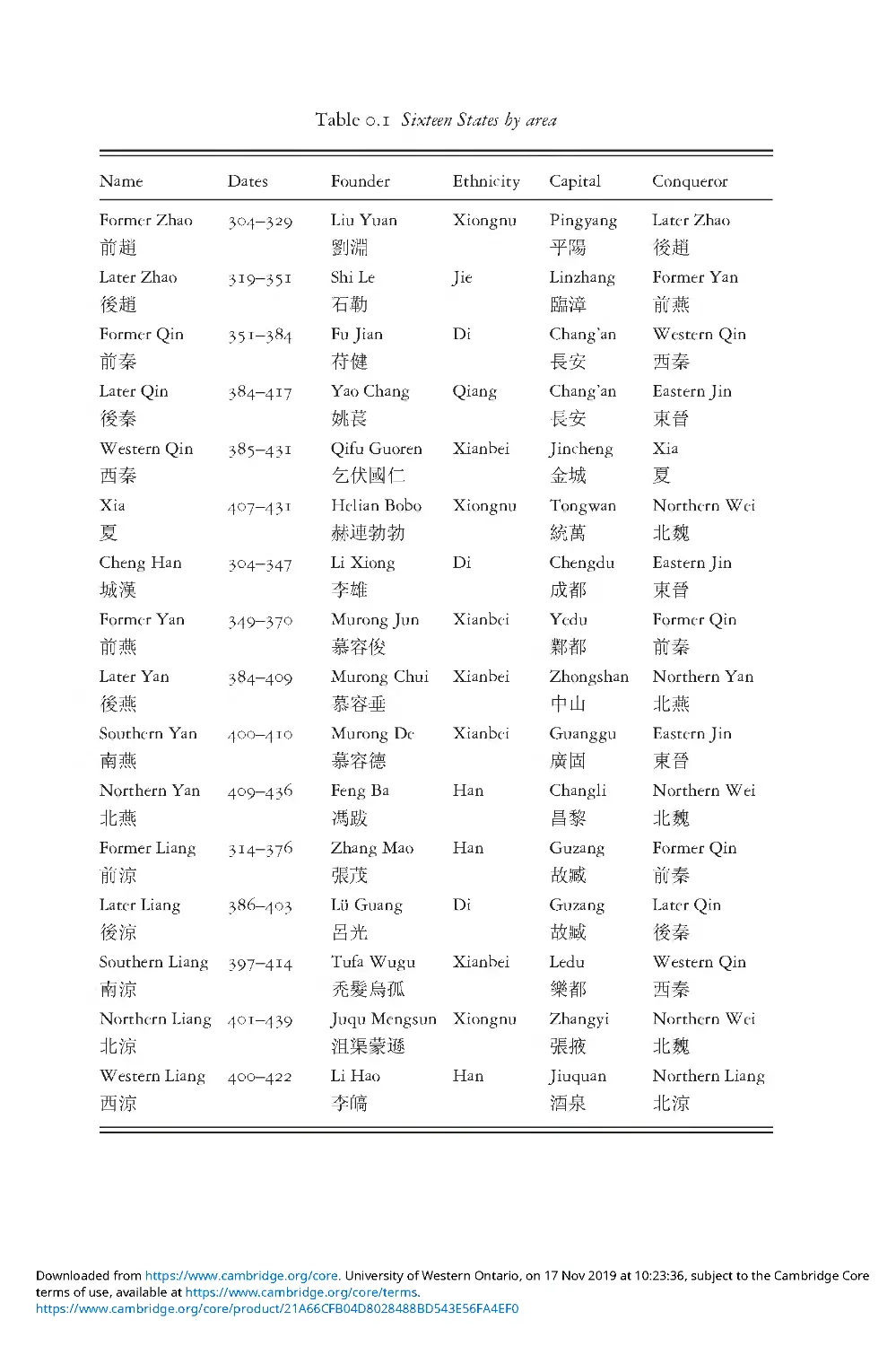
Table 0.1 Sixteen States by area
Name
Dates
Founder
Ethnicity
Capital
Conqueror
Former Zhao
304-329
Liu Yuan
Xiongnu
Pingyang
Later Zhao
if
i№
mm
Ш
Later Zhao
3i9-35i
Shi Le
Jie
Linzhang
Former Yan
Ш
rnm
i^
Former Qin
351-384
Fu Jian
Di
Chang’an
Western Qin
im
ят
шт
Later Qin
384-4i7
Yao Chang
Qiang
Chang’an
Eastern Jin
ШШ
ШШ
ят
ж#
Western Qin
385-431
Qifu Guoren
Xianbei
Jincheng
Xia
шт
mm
Я
Xia
407-431
Helian Bobo
Xiongnu
Tongwan
Northern Wei
Я
ШШШ
ШШ
аш
Cheng Han
304-347
Li Xiong
Di
Chengdu
Eastern Jin
mm
ж#
Former Yan
349-370
Murong Jun
Xianbei
Yedu
Former Qin
i^
ШШШ
»
im
Later Yan
384-409
Murong Chui
Xianbei
Zhongshan
Northern Yan
ШШШ
Southern Yan
400-410
Murong De
Xianbei
Guanggu
Eastern Jin
ШШШ
ж#
Northern Yan
409-436
Feng Ba
Han
Changli
Northern Wei
rnrn
Ш
Former Liang
314-376
Zhang Mao
Han
Guzang
Former Qin
is
ШШ
ЙЙ
im
Later Liang
386-403
Lu Guang
Di
Guzang
Later Qin
ШШ
ЙЙ
ШШ
Southern Liang
397-4i4
Tufa Wugu
Xianbei
Ledu
Western Qin
шш
ШМШ
ШШ
шт
Northern Liang
401-439
Juqu Mengsun
Xiongnu
Zhangyi
Northern Wei
аш
mrnrnm
ШШ
аш
Western Liang
400-422
Li Hao
Han
Jiuquan
Northern Liang
шш
аш
Downloaded from https://www.cambridge.org/core. University of Western Ontario, on 17 Nov 2019 at 10:23:36, subject to the Cambridge Core
terms of use, available at https://www.cambridge.org/core/terms.
https://www.cambridge.org/core/product/21A66CFB04D8028488BD543E56FA4EF0

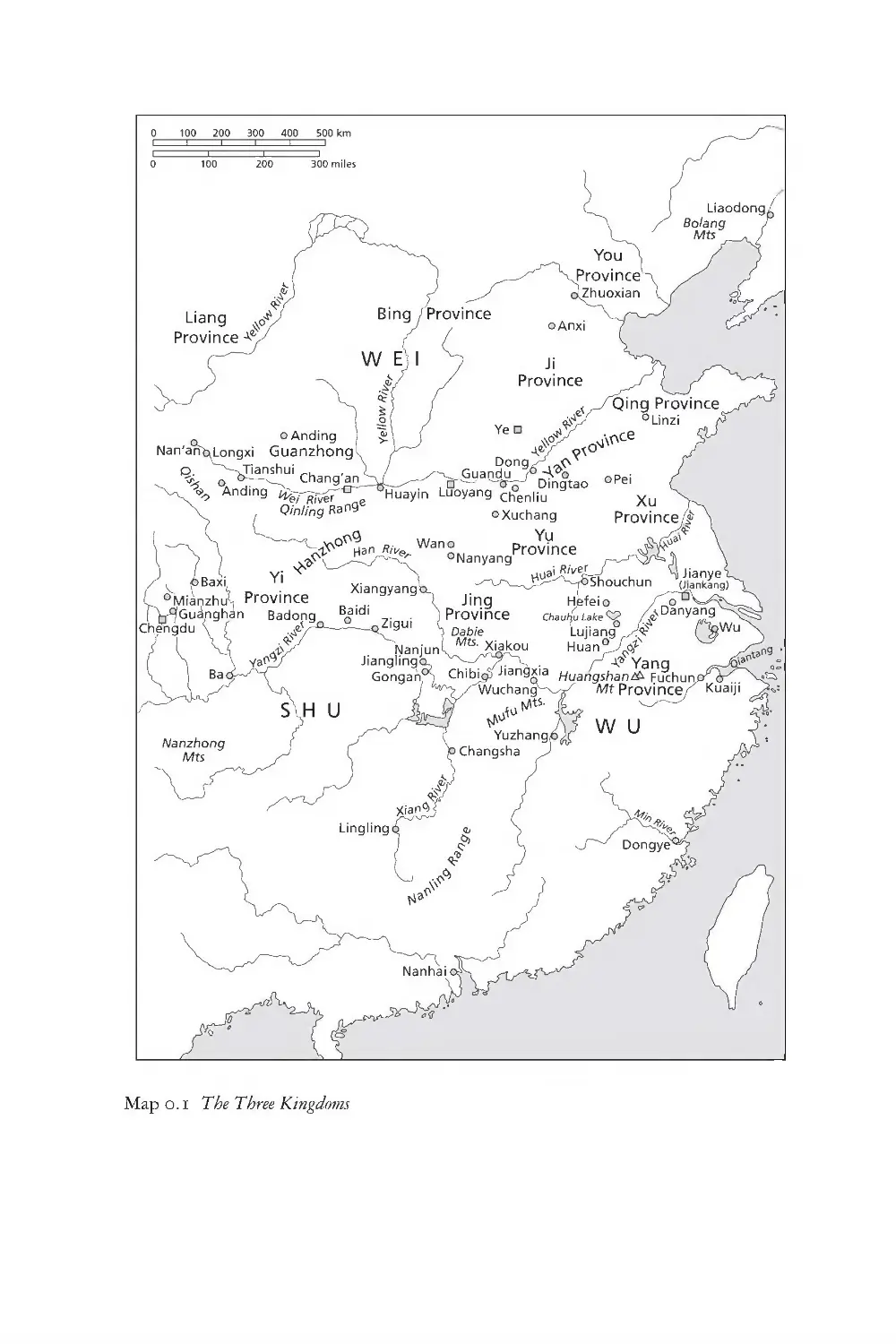
Мар о л The Three Kingdoms

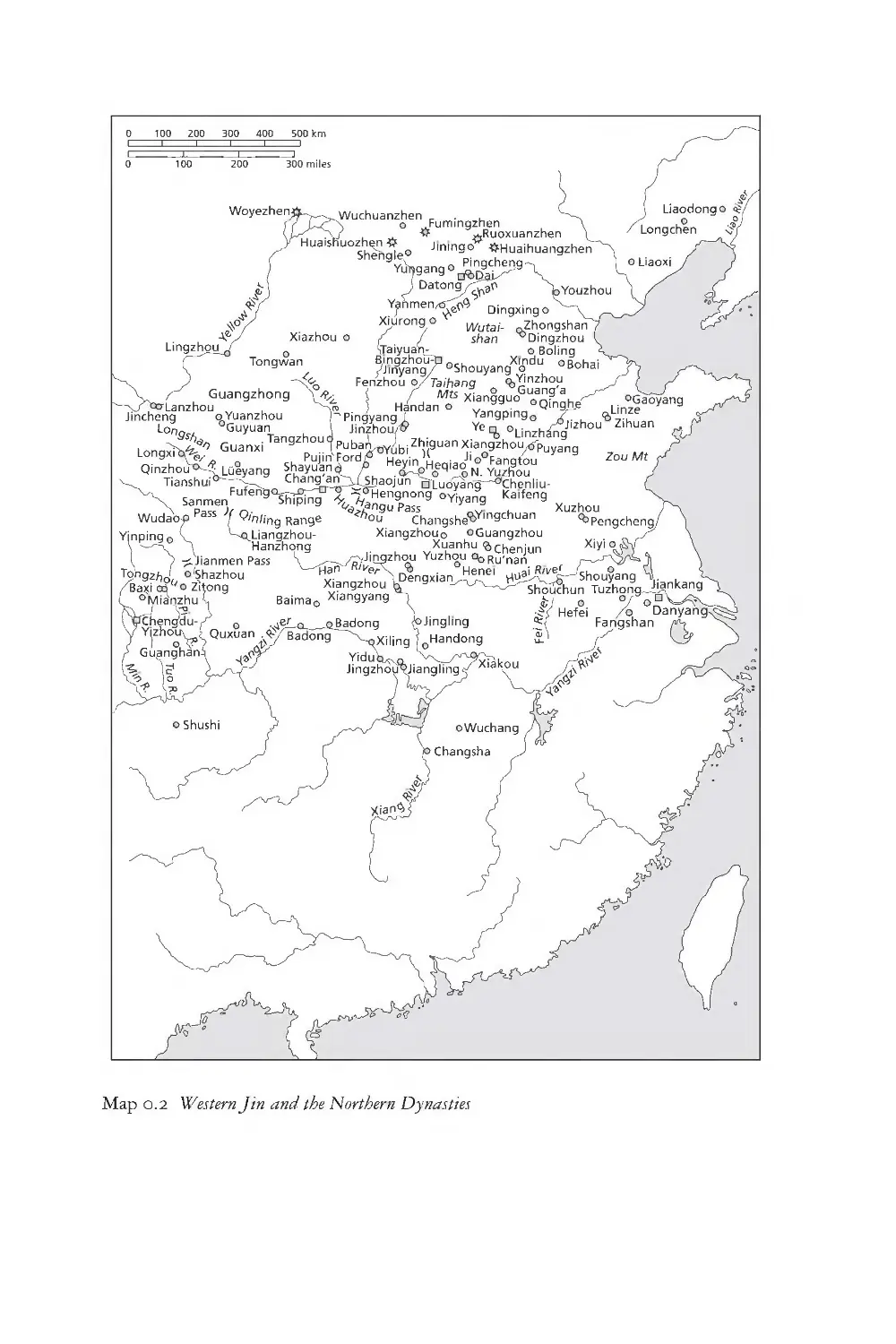
Map 0.2 Western Jin and the Northern Dynasties

Map 0.3 The Southern Dynasties

INTRODUCTION
Periods of disunity in Chinese history do not usually receive the attention they
deserve, yet it is just in those years of apparent disorder and even chaos that
important developments, social, cultural, artistic, and even institutional, often
find their earliest expression. The Six Dynasties period (220—589 CE) was just
such a time of momentous changes in many aspects of the society. But it is
precisely the confusing tumult and disorder of the political events of those four
centuries that create the strongest impression. We find this perception mir¬
rored in the reaction of the put-upon Gao Laoshi, the middle-school school¬
master described by Lu Xun in one of his stories, who was so dejected when he
had been assigned to teach a course on the Six Dynasties. All he remembered
about the subject was how very confusing it was, a time of much warfare and
turmoil; no doubt what would have come to his mind was the common saying
wu Hu luan Hua	“the Five Barbarians brought disorder to China.”
He felt that he could do a creditable job with the great Han and Three
Kingdoms that came before or the glorious Tang after it, but what could he
say about those miserable years in between?1 The very nomenclature reflects
its apparent disjointed nature. Yet it was that very disorder, a collapse of
central authority, that provided the conditions enabling such important
advances which make the Six Dynasties period such a significant one in
Chinese history.
The period covered in this volume suffers from what might be called an
identity problem; that is, one ofdefinition. In historical terms, identity defines
the qualities and characteristics associated with it, and what role, so to speak,
that period played in the course of events that made up the history under
consideration. The name applied to the period encapsulated that identity and
thus deserves some attention. In Chinese terminology this poses no problem,
1	Lu Xun, “Gao Laofuzi,” in Lu Xun zhuyi biannian quanji, ed. Wang Shijia and Zhi Yan (Bejing, 2009),
6.198—205; William A. Lyell, trans., “The venerable schoolmaster Gao,” in Lu Xun, Diary of a madman
and other stories (Honolulu, 1990), p. 298.
Downloaded from https://www.cambridge.org/core. Nottingham Trent University, on 01 Nov 2019 at 00:12:53, subject to the Cambridge Core
terms of use, available at https://www.cambridge.org/core/terms. https://doi.org/10.1017/9781139107334.002

2
INTRODUCTION
since the usual list is a factual one. It is generally called most expansively
“Sanguo liang Jin Nanbeichao”	that is, the Three
Kingdoms, two Jin, and Southern and Northern courts, or, a bit shorter,
“Wei Jin Nanbeichao” ШШШЖШ, with the Wei state standing for the
Three Kingdoms; similarly Japanese scholars call it “Gi-Shin Nambokucho.”
Another term is “Liuchao” ЖШ (Japanese “Rikucho”), the Six Kingdoms,
since Jiankang (modern Nanjing) in this period served as the capital of six
dynasties (Wu Ж, Eastern Jin ЖШ, Song Ж, Qi Щ, Liang Ж and Chen 1Ж);
thus while the reference is to the southern states, the sense of the term
generally covers the whole of China, north and south.2 However, “Liuchao”
may be ambiguous, as some modern writers (usually southerners) use it to refer
only to the area of the Southern Dynasties that made Jiankang their capital.
A more descriptive label sometimes used is the “Period of Disunity,” but while
it has the virtue of underlining a salient political characteristic of the period, it
has the drawback of being applicable also to that of the Five Dynasties
(907-960).
The Han and Sui-Tang dynasties are usually recognized as among the high
points of early Chinese power and cultural achievement; as a consequence, the
period between them, the years 220 to 589, is often held in low esteem—the
Dark Age of Chinese history—and at most viewed simply as a transitional
span of time. Calling it China’s Middle Age, and its derivation “medieval” on
the model of European history, for many scholars carries with it a pejorative
import.3 Arnold Toynbee, in his Study of history, found a striking parallel
between the European and Chinese cases, seeing that in both there was a period
of state decline followed by a time of trouble; that is, external/barbarians and
internal/proletariat, resolving itself into a new stage of the “universal state,”
which is to say, in China, the Sui-Tang.4 No doubt Toynbee’s paradigm of
historical analysis ofchallenge and response deservedly no longer is felt to have
any explanatory usefulness.5 However, the term “medieval” can still be viewed
2	The term “Six Dynasties” was applied to this period as early as the Song by Zhang Shou (1084—1145) and
Zhang Dunyi (active twelfth century), the latter the author of the Liuchao ship bianlei, ed. Zhang Chenshi
(Beijing, 2012), a work primarily focused on the history and landmarks of Jiankang when it served as
capital during the Six Dynasties period. The Yuan dynasty Songshi	(compiled in 1345) provides an
example (56.3933) where the term “Six Dynasties” is used to designate both the northern and southern
dynasties.
3 T.H. Barrett, “China and the redundancy of the medieval,” Medieval historyjournal 1.1 (1998), pp. 73—89;
and Timothy Brook, “Medievality and the Chinese sense of history,” Medieval history journal 1.1 (1998),
pp. i45-i64.
4	Arnold Toynbee, A study of history (London, revised edn, 1972).
5 Charles Holcombe rightly observes that the term “medieval,” if only defined in terms of European-style
feudalism, is not applicable to China from the third to the eighth centuries. See his “Was medieval China
medieval? (Post-Han to mid-Tang),” in A companion to Chinese history, ed. Michael Szonyi (Chichester,
2017), p. 114.
Downloaded from https://www.cambridge.org/core. Nottingham Trent University, on 01 Nov 2019 at 00:12:53, subject to the Cambridge Core
terms of use, available at https://www.cambridge.org/core/terms. https://doi.org/10.1017/9781139107334.002

INTRODUCTION
3
as a useful descriptor if broadly defined, which is why many Western scholars
refer to this period as early medieval China. Scholars of global history have
become more cognizant that to understand the historical commonalities of
civilizations across the world there is a need for general descriptive labels, such
as “medieval,” that can be applied cross-culturally. The similarities between
Europe from the sixth through tenth centuries, the early Arab empires
(Umayyad, 661—749, and Abbasid, 750—1258), and China from the third
through the sixth centuries are striking: we see a decentralized polity, a hybrid
ruling elite, the appearance of a manorial type of economy, the emergence of
organized religion, and a heavy reliance on close patron—client ties between
upper-class men. Hence, applying the word “medieval” to China from the
third to sixth centuries still has hermeneutic value.6
All of the other volumes in the Cambridge history of China series are named
after political dynasties, but the term “Wei—Jin—Northern and Southern
Dynasties” is much too cumbersome, true perhaps even for the more simplified
“Northern and Southern Dynasties.” Alternatives such the “Han—Tang
Interim,” or, perhaps more meaningfully, the “Transition between the Han
and Tang,” may be useful as chapter headings, but not as tags within written
narratives, and in most contexts do not give the period its due importance. The
fallback solution used in this volume, and more generally elsewhere, is to
simply use as its title the term “Six Dynasties,” referring broadly to this
interim between the Han and Sui—Tang. The number is not fully accurate
since it encompasses the short-lived regimes in the North succeeding the fall
of the Western Jin and leading up to the Northern Wei, what is called the
“Shiliuguo” +^H, or in English, the “Sixteen States.” Nevertheless, keep¬
ing all these restraints in mind, Six Dynasties serves quite well.
The terminology related to this period clearly points to the enduring
fragmentation of the previously united Han realm. As Helena Motoh has
described it, in the post-Han period there emerged “a series of different
constellations of power (parallel rule of three states, or two states, etc.),”
roughly divided in a north—south formation, one north of the Yellow River
and the other south of the Yangzi, with the area between the scene of
continuing competition.7 As Motoh further notes,
6	Keith N. Knapp, “Did the Middle Kingdom have a middle period? The problem of ‘medieval’ in China’s
history,” Education about Asia 12.2 (2007), pp. 8—13.
7 Helena Motoh, “The noble eclecticism: Example of Tao Yuanming’s Xing Ying Shen," in The yields of
transition: Literature, art and philosophy in early medieval China, ed. Jana S. Rosker and Natasa
Vampelj Suhadolnik (Newcastle upon Tyne, 2011), pp. 227—239; see esp. p. 228, n. 1, that directs the
reader to Billy K. L. So and Gungwu Wang, Power and identity in the Chinese world order (Hong Kong,
2003); and Nicola Di Cosmo and Don J. Wyatt, Political frontiers, ethnic boundaries, and human geographies
in Chinese history (New York, 2003). Yang Anqing, “Liang Wei Zhongli zhi zhan yi qi yingxiang,”
Huaibei shifan daxue xuebao (zhexue shehui kexuebn) 36.1 (2015), pp. 17—21, insightfully goes beyond the
Downloaded from https://www.cambridge.org/core. Nottingham Trent University, on 01 Nov 2019 at 00:12:53, subject to the Cambridge Core
terms of use, available at https://www.cambridge.org/core/terms. https://doi.org/10.1017/9781139107334.002

4
INTRODUCTION
The division is also ethnic, since the North was mostly ruled by the dynastic families of
non-Han origin, while the South was ruled by Han Chinese dynasties, first by the Eastern
Jin and then by the so-called Southern Dynasties. Political disunity is thus also seen in
cultural terms, as a loss of parts of the territory to the rule of the non-Han peoples.
A salient feature of the Six Dynasties period is the dominant role taken by the
non-Han peoples who entered northern China, some by slowly permeating
into the borderlands or by storming the frontier. The historical records list
a number of tribal names: Xiongnu, Xianbei, Tuoba, Jie, Murong, and so
forth, but there was little discussion at the time of the actual composition of
these entities, nor has modern research made much analytical headway. In his
chapter on the Northern Wei, Scott Pearce draws on the opening of the Weishu
(History of the Northern Wei) to trace the origins of the Tuoba, the founders of
that dynasty. Their traditional account of the various encounters as these
people made their way from their distant northern habitat to the Chinese
frontier, telling of a hybrid, horse-like animal that served as guide for a time,
and the “heavenly maiden” who presented one of the leaders with an heir, may
well have been the stuff of myths. But as Pearce suggests, these legends of the
difficult journey, no doubt recounted with some license, may still reflect some
reality. What this account calls to mind is the similar origin accounts
associated with the various “barbarian” peoples who appeared on the Roman
frontier in medieval Europe.
There is a rich literature on the nature of the “barbarian migrations” in
Europe at roughly the same period as that in China, which to a certain extent
may suggest parallel developments, but the Western historians still struggle
with how to frame the material. The current favored term, “ethnogenesis,”
emphasizes that the various barbarian groups under discussion were not
biological or ethnic communities as such but, as Michael Kulikowski has it,
were unstable and fissiparous groups, and that the earlier racial conceptions of
barbarian ethnicity must give way to constructed ethnicities, however that is
perceived by the modern scholarly factions now debating the issue—a highly
contentious subject.8 In ethnogenesis’s early model, Reinhard Wenskus pro¬
posed that there was a nucleus tradition, a complex, that was able to confer an
identity on a population. This involved a process of Stammesbildung or
account of a particular struggle to suggest that there were significant internal social and political ends
served by such contending campaigns.
8	Michael Kulikowski, “Nation versus army: A necessary contrast?”, in On barbarian identity: Critical
approaches to ethnicity in the Early Middle Ages, ed. Andrew Gillett (Turnhout, 2002), pp. 71—72.
Kulikowski, p. 70, n. 2: “One of the great virtues of recent studies of ethnogenesis has been to show
the malleability of early medieval ethnicity and, consequently, to force us to regard with skepticism all
claims to natural ethnic community while looking for the strategies by which such communities are
socially constructed.”
Downloaded from https://www.cambridge.org/core. Nottingham Trent University, on 01 Nov 2019 at 00:12:53, subject to the Cambridge Core
terms of use, available at https://www.cambridge.org/core/terms. https://doi.org/10.1017/9781139107334.002

INTRODUCTION
5
ethnogenesis, that drew together disparate people into a community that on
the basis of ancient and orally transmitted traditions came to believe they
shared a common origin. While the belief in such ancient origins can be said to
be ideological, such elements cannot be entirely discounted, and amid such
memories, myths, and traditions there is still the strong possibility that they
were not entirely invented.9
Walter Pohl, in defense of the term “ethnogenesis,” suggested that ethnic
formation processes were complex, long-term developments, and that the
term suggests an origin of the ethnos in a limited initial stage. The ethnic
formation of a group could fail, and the group disappear. Success or failure are
just descriptive terms; the methodology is to attempt a reconstruction of the
ethnic processes, political contexts, and perception in the sources. The analysis
of origin legends and ethnic discourse is just a tool in what is a bricolage,
trying to bring together a variety of elements.10
For example, Charles R. Bowlus, in his article on “ethnogenesis” also in
Gillett’s volume, reviews recent studies and speaks of “misleading
concepts.”11 Such terms as “Goths” or “Franks” referred to peoples, or tribes,
of diverse origins, languages, and cultures, who had coalesced into larger
confederations. According to Bowlus, the ethnogenetic theory is best seen as
probes into the makeup of these confederations, and he holds that such a core
was basically a confederation of groups of warriors each with its own leaders,
and that they are best seen as an army, not a people on the move. At the center
was an elite military band whose language, culture, and traditions came to be
adopted by the confederation as a whole, leading to acceptance ofan identity of
common descent. He also points out that ethnogenesis models share
a common sequence of events, including a primordial deed, such as crossing
a sea or mighty river or victory over odds, and throughout the process there
must be an ancestral enemy whose existence holds the Grossstamm or confed¬
eration together. Bowlus concludes that the ethnogenesis construct is
a paradigm that may be suited only to handling data in modern research but
of little utility in dealing with the scant sources of the past. As Walter Pohl
says, “Whether invented or only partly invented, such traditions could play an
analogous role: the world in which the barbarians had settled on Roman soil
9	Reinhard Wenskus, Stammesbildung und Verfassung: Das Werden der frUhmittelalterlichen gentes (Cologne,
1961; reprint, 2016), pp. 75 ff.; see also Walter Goffart, “Does the distant past impinge on the invasion
age Germans?” in On barbarian identity, ed. Gillett, p. 31.
10 Walter Pohl, “Ethnicity, theory, and the tradition: A response,” in On barbarian identity, ed. Gillett,
p. 239. See also his “Conceptions of ethnicity in early medieval studies,” in DebatingtheMiddleAges: Issues
and readings, ed. Lester K. Little and Barbara H. Rosenwein (Oxford, 1998), pp. 13—24.
11 Charles R. Bowlus, “Ethnogenesis: The tyranny of a concept,” in On barbarian identity, ed. Gillett, pp.
241-256.
Downloaded from https://www.cambridge.org/core. Nottingham Trent University, on 01 Nov 2019 at 00:12:53, subject to the Cambridge Core
terms of use, available at https://www.cambridge.org/core/terms. https://doi.org/10.1017/9781139107334.002

6
INTRODUCTION
presented high risks, challenges, and problems of adaptation; narratives could
give a meaning to this difficult situation.”12 The same might be said of those
who, mutatis mutandis, pressed on to Chinese soil.
Despite some uncertainty, and even misgivings concerning how the ethno-
genesis construct may be utilized for historical research in the European case,
it does seem to offer insight into that of the East Asian area. The similarity
with the Tuoba legend is striking. In the case of the Tuoba, as Pearce points
out in his chapter on the Northern Wei, the Weishu records the reaction of
Emperor Taiwu, not that long after the fact, when he was presented with the
opportunity to lay claim to evidence of that arduous trek, as tenuous as that
evidence might have been, and to send envoys to authenticate it, thus using
the opportunity to strengthen the ties that held his compatriots together.
Wang Junjie has written an important article which bears on this very
question: how the Xianbei, originally the name of a small tribe, came to be
that of a powerful confederation and, indeed, joined to the identity of those
who dwelled in the Northern Wei state.13 He traces the earliest mention of the
Xianbei to some tribesmen located on the far northeastern Liaodong borders in
the pre-Han and Han periods. They moved into the area abandoned by the
flight of the Xiongnu after these latter were defeated by Han forces in 89 ce .
Various other groups who had been subordinate to the Xiongnu but who had
remained in the area then took on the Xianbei name, which from that time
came to be a potent umbrella designation for those joining the confederation
while retaining their original identity. Among the various other components
were the Murong in Liaodong, the Duan in Liaoxi, the Yuwen to the north, the
Tuoba even further north, the Qifu at Longxi, and the Toufa at Hexi, each
dominant in their separate areas. The Tuoba emerged as the victorious
aggregate among others and established their state. They then began, perhaps
driven by a sense of necessity, to create an ancestry that legitimated their
primary claim to the Xianbei name, one which continued to be the traditional
mantle incorporating all the conquered groups, diverse as they were in
customs, language, and so forth. Thus, as the Weishu recounted, the Tuoba
claimed to be descended from the Yellow Emperor and had been allotted the
northern regions, where they took their name from the Xianbei mountain
there. As Wang Junjie points out, that legend is recorded in the Weishu, which
itself was compiled after the fall of the dynasty, but there is contemporary
evidence of the acceptance earlier by the Northern Wei subjects of their being
Xianbei and the self-referential use of the term “Xianbei.” In 450, during
12	Walter Pohl, “Ethnicity, theory, and tradition: A response,” in On barbarian identity, ed. Gillett, p. 233.
13	Wang Junjie, “Wei Jin Nanbeichao de Xianbei shibushi yige minzu,” Xibei shifan xuebao (shehui kexue
bao) 1985.3, pp. 63-72.
Downloaded from https://www.cambridge.org/core. Nottingham Trent University, on 01 Nov 2019 at 00:12:53, subject to the Cambridge Core
terms of use, available at https://www.cambridge.org/core/terms. https://doi.org/10.1017/9781139107334.002

INTRODUCTION
7
a campaign by the Northern Wei against the southern Liu-Song state, repre¬
sentatives of the two forces faced each other to negotiate a settlement. When
the southern envoy asked his adversary, the distinguished Han Chinese
literatus Li Xiaobo, for his name, the answer was, “I am a Xianbei and have
no surname.” Asked about his rank, he replied, “The Xianbei official ranks are
different [from yours] and cannot be briefly explained; still it is adequate to
match yours, Sir.”14 We may well doubt that Li really saw himself as a Xianbei
tribesman, but he could identify himself as such in his role as an agent of that
state.
Turning now to the field of Six Dynasties studies, the traditional approach
by those writing on China’s past, and that includes the Six Dynasties period,
was textually oriented, based on a wide knowledge of the literary tradition and
a rigorous methodology, an adherence to what in Japan was called jisoshugi, or
“historical positivism.” In that long tradition, it was rare to find someone like
Zhang Xuecheng (1738—1801) who combined that strict adherence to the
principles of historical accuracy with a theoretical discussion of the signifi¬
cance of research.15 These views are also reflected in the important historical
research of his contemporary Zhao Yi (1727—1814), who held that while the
classics contained the principles of government, the histories recorded the
government’s activities, and thus, according to Robert J. Smith, were seen as
a guide for “proper conduct for the present and future.”16 The rigor with
which the research was conducted by these men and others was of the highest
degree, but the purposes to be served by their efforts came to undergo
a conceptual transformation.
It may be argued that the modern study of the Six Dynasties period began
with Japanese sinologists, and in particular with Naito Torajiro, more com¬
monly known as Naito Konan (1866—1934), a journalist and later professor at
Kyoto University, whose work had an important and lasting influence not just
on Japanese scholarship, but internationally as well. He is primarily known for
his delineation of a broad-stroked periodization in Chinese history. In general,
these stages consisted of rule by great clans in the Zhou and Han, then
succeeded by a medieval period, defined as the Six Dynasties and the Tang,
marked by the dominance of an aristocracy, before giving way in the Song to
what he termed China’s modern age, characterized by a strong autocracy
served by a bureaucracy staffed by those chosen on the basis of civil service
14	SoS 59.1600. See also Albert Dien, “The disputation at Pengcheng: Accounts from the Wei shu and the
Song shu," in Early medieval China: A sourcebook, ed. Wendy Swartz et al. (New York, 2014), p. 42.
15	Chapter 7, “The historian’s	craft,”	in David Nivison,	The	life	and	thought	of	Chang	Hsueh-ch’eng,
1738—1801 (Stanford, 1966), pp. 191—212.
16 Robert J. Smith, China’s cultural heritage: The Qing dynasty, 1644—1912 (Boulder, CO, 1983), p. 136.
Downloaded from https://www.cambridge.org/core. Nottingham Trent University, on 01 Nov 2019 at 00:12:53, subject to the Cambridge Core
terms of use, available at https://www.cambridge.org/core/terms. https://doi.org/10.1017/9781139107334.002

8
INTRODUCTION
examinations.17 It is a measure of Naito’s influence that such standard
Western works as John K. Fairbank et al., East Asia'. Tradition and transforma¬
tion (Boston, 1973), and Jacques Gernet, La Chine ancienne, des origines a I’empire
(Paris, 1964), adopted Naito’s periodization.18
In Naito’s analysis, the Six Dynasties era was characterized by powerful
clans that emerged from scholarly lineages of the end of the Later Han. These
locally powerful clans, or lineages as they are sometimes called, became the
basis of an aristocracy defined by a system of categories called the liupin ^ pm,
or “Six Grades.” Members of the top echelons (shidaifu	were
appointed as officials who virtually controlled the state, beyond any threat
from the imperial court. The status ofthese aristocratic entities (termed kizoku
in Japanese) was strengthened by intermarriage and matches made with
the imperial family. Naito’s schema met with much criticism but was taken
up and developed by many followers, such as Kawakatsu Yoshio (1922—1984)
and Tanigawa Michio (1925—2013), and is generally known as the Kyoto
school.19 Kawakatsu, in an article published in French, persuasively traces the
history and decline of the southern “aristocracy” in the latter part of the
Southern Dynasties.20 Tanigawa, on the other hand, focused on the interrela¬
tionship of the elite with their community, what he termed kyodoitai
(from the German Gemeinde). This relationship, an idealistic one, was based on
Confucian morality, supplying an ethical—moral basis to the help extended to
the community in troubled times by its cultured and intellectual elite.
Needless to say, Tanigawa’s met with much criticism, especially from the
Marxists because he made no mention of any class struggle.21
17	Hisayuki Miyakawa, “An outline of the Naito hypothesis and its effects on Japanese studies of China,”
FEQ 14.4 (1955), pp. 533—552. More recently Joshua Fogel has written extensively on Naito. Among
the works consulted here are his Politics and sinology: The case of Naito Konan (1866—1934) (Cambridge,
MA, 1984); “Naito Konan and his historiography: A reconsideration in the early twenty-first century,”
in Riben Hanxue yanjiu xutan, sixiangwenhua pian, ed. Zhang Baosan and Yang Rubin (Taipei, 2005), pp.
343—370; and “Naito Konan (1866—1934) and Chinese historiography,” HEW 1 (January 2003), pp.
117—131. See also the important discussion by Harriet T. Zurndorfer, China bibliography: A researchguide
to reference works about China past and present (Leiden, 1995), pp. 4—44.
18	Fogel, Politics and sinology, pp. xv—xvi.
19	For a discussion of these developments and their debates with the Marxist-oriented Tokyo school, see
Fogel’s review in HJAS 44.1 (1984), pp. 228—247, ofTanigawa Michio, Chugoku shitaifu kaikyu to chiiki
to no kankei ni tsuite no sogoteki kenkyu (Kyoto, 1983). Miyakawa, “An outline of the Naito hypothesis,” is
also an important study of the process of Naito’s development of his ideas and a review of the range of
support, or not, which his proposal elicited.
20	Kawakatsu Yoshio, “La decadence de l’aristocratie chinoise sous les Dynasties du Sud,” AcA 21 (1971),
pp. 13—38. See also his “L’aristocratie et la societe feodale au debut des Six Dynasties,” Zinbun 17 (1981),
pp. 107—160.
21	For the exposition of this concept, see Tanigawa Michio, translated with an introduction by Joshua
A. Fogel, Medieval Chinese society and the local “community” (Berkeley, 1985). See also the review of this
book by John Lee, JAS 46.1 (1987), pp. 132-134.
Downloaded from https://www.cambridge.org/core. Nottingham Trent University, on 01 Nov 2019 at 00:12:53, subject to the Cambridge Core
terms of use, available at https://www.cambridge.org/core/terms. https://doi.org/10.1017/9781139107334.002

INTRODUCTION
9
Naito’s analysis has served to stimulate an enormous richness of scholarly
research.22 After the great debates over periodization subsided in the 1980s,
Japanese scholarship on early medieval China shifted its focus to smaller but
more tangible issues. In a 1999 essay, Tanigawa Michio noted that one of the
largest challenges facing Japanese scholars of early medieval China was deter¬
mining the nature of the ruling class: to what degree were the “aristocratic”
families autonomous?23 The study of the nature of government and its
relationship with elite families has continued to draw the attention of many
scholars.24 Kawamoto Yoshiaki notes that a major question for many histor¬
ians studying the period is to what extent regimes were established in north¬
ern China by non-Han people non-Han in nature. More specifically, were
Northern Dynasties’ institutional innovations, such as the equal-field system
(juntian zhi), the division of subjects into free and subordinated people
(liangjian zhi	and the garrison militia system (fubing zhi), inspired
by Chinese or non-Han traditions?25 A number of Japanese scholars have
explored the nature of northern polities often with insights gained from the
use of newly discovered entombed tomb inscriptions (muzhiming).26 A new
area of research has been the study of cities and regions; these studies are
deeply informed by archaeological discoveries.27 Another emerging avenue of
22	Kubozoe Yoshufumi, “Japanese research in recent years on the history of Wei, Chin and the Northern
and Southern Dynasties,” AcA 60 (1991), pp. 104—134, for the years 1970 to 1989, has an extensive list
of publications under the rubric of the periodization debate, social stratification, the aristocratic system
in the north and in the south, landholding, agriculture, international relations, and historical materials.
This issue of Acta Asiatica is dedicated to Six Dynasties history and includes articles by four major
Japanese scholars of the period: Yoshikawa Tadao, Yasuda Jiro, Ochi Shigeaki, and Tanigawa Michio.
23 Tanigawa Michio, “Sosetsu,” in Gi Shin Nanbokucho Zui-To jidai shi no kihon mondai, ed. Gi Shin
Nanbokucho Zui To jidai shi no kihon mondai henshu i-inkai (Tokyo, 1999).
24 Such as Kubozoe Yoshufumi, Gi Shin Nanbokucho kanrydsei kenkyu (Tokyo, 2003); Yasuda Jiro, Rikucho
seijishi no kenkyu (Kyoto, 2003); Kawai Yasushi, Nancho kizokusei no kenkyu (Tokyo, 2015);
Nakamura Keiji, Rikucho kizokusei kenkyu (Tokyo, 1987), and Rikucho seiji shakai shi kenku (Tokyo,
2013); Watanabe Yoshihiro, Sangoku seiken no kozo to “meishi” (Kyoto, 2004), and Seishin “jukyd kokka” to
kizokusei (Tokyo, 2010); Fukuhara Akiro, Gi Shin seiji shakaishi kenkyu (Kyoto, 2012); and
Okabe Takeshi, Gi Shin nanbokucho kanjin mibunsei kenkyu (Tokyo, 2017).
25	Kawamoto Yoshiaki,	“Gozoku kokka,”	in Gi Shin	Nanbokucho	Zui-Тд jidai	shi	no	kihon	mondai,	ed.
Tanigawa Michio et al. (Tokyo, 1999), 98—115.
26	See Kawamoto Yoshiaki, Gi Shin Nanbokucho jidai minzoku mondai (Tokyo, 1998); Kegasawa Yasunori,
Fuheisei no kenkyu: fuhei heishi to sono shakai (Kyoto, 1999), and Chugoku sekkoku shiryo to sono shakai:
hokucho zuitoki o chushin ni (Tokyo, 2007); Matsushita Ken’ichi, Hokugi kozoku taiseiron (Sapporo, 2007);
Maejima Yoshitaka, Seigi, Hokushu seikenshi no kenkyu (Tokyo, 2013); and Kubozoe Yoshufumi, Boshi
o mochita hokugishi kenkyu (Tokyo, 2017).
27 See Sato Yuji, Gi Shin Nanbokucho shakai no kenkyu (Tokyo, 1998); Nakamura Keiji, Rikucho Konan
chiikishi kenkyu (Tokyo, 2006); Shiozawa Hirohito, Gokan Gi Shin Nanbokucho tojo kydiki kenkyu (Tokyo,
2013); Fujii Yasutaka, Chugoku konan rikucho no kokogaku kenkyu (Tokyo, 2014); Kobayashi Hitoshi,
Chugoku nanbokucho zui to toyo no kenkyu (Kyoto, 2015); Muramoto Ken’ichi, Kan Gi Shin Nanbokucho jidai
no tojo to ryobo no kenkyu (Tokyo, 2016); and Tanaka Kazuki, Seishin jidai no tojo to seiji (Kyoto, 2017).
Downloaded from https://www.cambridge.org/core. Nottingham Trent University, on 01 Nov 2019 at 00:12:53, subject to the Cambridge Core
terms of use, available at https://www.cambridge.org/core/terms. https://doi.org/10.1017/9781139107334.002

10
INTRODUCTION
inquiry has been how early medieval Chinese used ritual to give order to the
court and social relations.28 Studies of Buddhism and Daoism continue to be
numerous as well.29
In China, scholarly interest in the Six Dynasties period can be traced back
through the ages but Zhao Yi, cited above, ranks among the foremost of those
who took an interest in that history. In his Gaiyu congkao, 1790, and Nian’ershi
zhaji, 1795, Zhao Yi’s careful notes and learned observations set a high
standard in textual studies.30 His attention was for the most part focused on
the texts themselves, and how well they reflected the objectivity and accuracy
expected of the historiographical ideal.31 Zhao Yi, of course, was a man of his
time. It may be noted, for example, that one of the items in his Gaiyu congkao is
a discussion of the emphasis placed on lineage and the compilation of genea¬
logies during the Six Dynasties, but there was no evidence offered, unlike in
the case of Naito Konan, that this played a central role in the structure of the
state’s political organization.32
Turning to the emergence of a modern historiography in China, Axel
Schneider, in an illuminating article, has described how the traditional role
of the historian was to trace the historical facts that exemplified the dao
that is, the presence of the uniform and normative order that was the
basis of the legitimacy of the current regime.33 As Schneider says, there is
a dispute whether it was the development of the kaozheng	methods of
textual criticism in the eighteenth and early nineteenth centuries that led
to the secularization of historiography, but certainly by the early twentieth
28 Watanabe Shin’ichiro, TenkU no gyokuza: ChUgoku kodai teikoku no chosei to girei (Tokyo, 1996), and
ChUgoku kodai no oken to tenka chitsujo: NitchU hikakushi no shiten kara (Tokyo, 2003); Kaneko Shuichi,
Kodai ChUgoku to kotei saishi (Tokyo, 2001); and Togawa Takayuki, Toshin Nancho ni okeru dento no sozo
(Tokyo, 2015).
29	See Kobayashi Masayoshi, Rikucho Dokyo shi kenkyu (Tokyo, 1990); Yoshikawa Tadao, Rikucho Dokyo no
kenkyu (Tokyo, 1998); Kamitsuka Yoshiko, Rikucho Dokyo shiso no kenkyu (Tokyo, 1999);
Yamada Toshiaki, Rikucho Dokyo girei no kenkyu (Tokyo, 1999); Kikuchi Noritaka, ShinjUkyo kenkyu:
Rikucho Dokyo ni okeru kyUsai shiso no keisei (Tokyo, 2009); Kanno Hiroshi, Nanbokucho zuidai no ChUgoku
Bukkyo shiso kenkyu (Tokyo, 2012); Kegasawa Yasunori, ChUgoku chUsei Bukkyo sekkoku no kenkyu (Tokyo,
2013); Ouchi Fumio, Nanbokucho zui toki bukkyoshi kenkyU (Kyoto, 2013); Endo Yusuke, Rikuchoki ni
okeru bukkyo juyo no kenkyU (Tokyo, 2014); Kuramoto Shotoku, Hokucho Bukkyo zozomei kenkyU (Kyoto,
2016); and Mugatani Kunio, Rikucho zui to dokyo shiso kenkyU (Tokyo, 2018).
30 Gaiyu congkao (Shanghai, 1957), chapters 6—9, pp. 111—174; Nian’ershi zhaji, 1795, Qingdai xueshu biji
congkan, Volume 23 (Beijing, 2005). See also the discussion in Dong Wenwu, Nian'ershi zhaji (Beijing,
2008).
31 See the observation of his work by Liu Dong, “On the narration of the past in China: An outline,” HOH
1.1 (2016), pp. 51-69.
32	Zhao Yi, Gaiyu congkao, pp. 315—322.
33	Axel Schneider, “Between dao and history: Two Chinese historians in search of a modern identity for
China,” HAT 35.4 (1996), p. 55. He cites here Benjamin Schwartz, “History in Chinese culture: Some
comparative reflections,” History and Theory 35.4 (1996), pp. 23—33.
Downloaded from https://www.cambridge.org/core. Nottingham Trent University, on 01 Nov 2019 at 00:12:53, subject to the Cambridge Core
terms of use, available at https://www.cambridge.org/core/terms. https://doi.org/10.1017/9781139107334.002

INTRODUCTION
11
century there were important changes in the writing of history in China,
due in no small part to Western influences. This new historiography can
be seen in the work and example of Chen Yinke (1890—1969), who is
considered to have been one of the most original and creative historians in
twentieth-century China. His research focused for the most part on the
Sui—Tang transition, but his description of the hereditary aristocracy of
that time and its involvement with those events has set a high standard for
scholars who came after him.34
Chen’s career exemplifies the new historiography in its breadth. As
a youth he went first to Japan; in later years he also studied in Berlin,
Zurich, and Paris, and at Harvard. During the fourteen years in all that he
spent abroad, he studied Sanskrit, Pali, Tibetan, Mongolian, Manchu,
Japanese, English, French, German, Persian, Turkic, Tangut, Latin, and
Greek! On his return to China in 1925 he began his academic career. He
did not hesitate to offer broad generalizations based on his careful and
detailed research. His major works were the Sui Tang zhidu yuanyuan
lUelungao (A Draft Introduction to the Origins of Institutions of the Sui and Tang
Dynasties) and the Tangdai zhengzhishi lunshugao (A Draft Discussion of the
Political History of the Tang Dynasty), first published in Chongqing in 1944
and 1943 respectively.35 These studies involved significant research on
a variety of institutions of the Six Dynasties that had lasting importance in
the following period as well. He was especially interested in the impact the
northern invaders had on the culture of China, and in the mutual political
and cultural relationships among the Six Dynasties states. Perhaps most
impressive was his ability to analyze institutional history on a large scale. For
example, he held that the most significant influence on the Sui—Tang
institutions was derived from those of the Northern Wei and Northern Qi,
which in turn also had elements from the early Southern Dynasties. In his
opinion, a second group, that of the Liang and Chen dynasties of the later
period of the Southern Dynasties, and a third, that of the Western Wei and
Northern Zhou, had not had a significant role in the formation of the later
institutions. In another case, the military system of the fubing, important in
the early Tang, was generally seen as having been derived from the Western
Wei—Northern Zhou who had first introduced it, but Chen demonstrated
how the Tang form was very different from the earlier one and so discredited
34	Ying-shih Yu, “Chen Yinke,” in Encyclopedia of historians and historical writing, ed. Kelly Boyd (Chicago,
1999), 1. pp. 198-199.
35 Chen Yinke, Sui Tang zhidu yuanyuan lUelun gao (Shanghai, 1954), and Tangdai zhengzhishi shulun gao
(Beijing, 1957).
Downloaded from https://www.cambridge.org/core. Nottingham Trent University, on 01 Nov 2019 at 00:12:53, subject to the Cambridge Core
terms of use, available at https://www.cambridge.org/core/terms. https://doi.org/10.1017/9781139107334.002

12
INTRODUCTION
that claim.36 In all of this it is clear that we have moved away from highly
focused textual studies to broad social and political themes.37
Among Chen’s better-known students were Yang Lien-sheng (1914—
I990), the distinguished Harvard professor who specialized in economic
history,38 and Zhou Yiliang (1913—2001), who earned his doctoral degree at
Harvard and returned to China, where he published important studies on the
Six Dynasties, as well as on a broad range of other subjects.39
A study by Chen Changqi and Fan Yaolin reviewed a critical selection of
320 books and articles (110 books and 210 articles) concerning the Six
Dynasties that had been published during the thirty years between 1978
and 2008.40 These were selected out of over 650 publications for that same
period which Chen and Fan lauded as evidence of the flourishing state of Six
Dynasties studies. In fact, their number greatly underestimated the extent of
interest in the Six Dynasties period. For those same years, according to a search
only of items under the heading “Wei Jin Nanbeichao” in the China Academic
Journals database prepared by the Tsinghua University China Academic
Journals Electronic Publishing House, Beijing, 1,724 items are listed; Chen
and Fan thus included in their analysis only some 8 percent of that total. Even
this percentage is a soft number since only items that contained the term “Wei
Jin Nanbeichao” in the title were counted in the database, while there was no
such limit in the Chen—Fan survey.
Chen and Fan divided their survey into a number of categories, such as
politics, both events and institutions, economy, society, ethnicity, culture,
religion, and intellectual history. Under each heading there is a general
discussion of the scope and sorts of topics at issue, with citations of the relevant
articles and books. For example, their treatment of the military in this period
includes military households, sources of soldiers, training, equipment,
36	Wang Rongzu, Chen Yinkepingzhuan (Nanchang, 1991), p. 143.
37	Qu Jingdong, “Fanhui lishi shiye, chongshou shehui de xiangxiangli: Zhongguo jinshi bianqan ji
zhingshi yanjiu de chuantong,” Shehui 2015.1, p. 18.
38 Among L. S. Yang’s many writings, “Notes on the economic history of the Chin dynasty,” HJAS 9.2
(1946), pp. 107—185 (reprinted in his Studies in Chinese institutional history (Cambridge, MA, 1963), pp.
119—197), and “Buddhist monasteries and four money-raising institutions in Chinese history,” HJAS 13
(1950), pp. 174—191 (reprinted in his Studies in Chinese institutional history (Cambridge, MA, 1963), pp.
198-215).
39 Much of Zhou’s memoir, Bijing shi shusheng (Beijing, 1998), has been translated by Joshua Fogel, Just
a scholar: The memoirs of Zhou Yiliang (1913—2001) (Toronto, 2013). See also the review by
Christian Soffel, MS 65.1 (2017), pp. 256—258.
40	Chen Changqi and Fan Yaolin, “Wei Jin Nanbeichao shi yanjiu sanshinian,” Shixueyuekan 2009.10, pp.
107—125. The authors say that in the three decades covered by their report, the general publications
numbers were over 150, over 200, and over 300. These figures indicate a relative degree of selectivity,
because the numbers of publications in the China Academic Journals index, counting only those with
“Nanbeichao” in the title, are 164, 458, and 1,102.
Downloaded from https://www.cambridge.org/core. Nottingham Trent University, on 01 Nov 2019 at 00:12:53, subject to the Cambridge Core
terms of use, available at https://www.cambridge.org/core/terms. https://doi.org/10.1017/9781139107334.002

INTRODUCTION
13
logistics, and support. Studies dealing with local troops and professional
troops, north and south, are cited. Then the various levels of the military
administrative system, local and central, expeditionary, and guardian, are
treated. All of this provides what is in effect an annotated syllabus on a very
wide range of topics. Based on their survey, besides deploring the poor quality
of a large number of publications, needless to say not cited by them, and their
emphasis on the need to pay attention to what foreign scholars were doing,
their conclusion was that the field suffered from not maintaining the founda¬
tion and level of quality set by such past scholars as Chen Yinke and Zhou
Yiliang, mentioned above, as well as others such as Tang Changru (1911—
1:994), He Ziquan (1911—2011), and Wang Zhonglao (1913—1986). The
authors Chen and Fan close with a negative assessment of the current field of
Wei Jin Nanbeichao studies, deploring what they see as an overall lack of
innovation that breaks new ground, and that there is little, ifany, broad vision
ofsocietal organization; rather, the topics generally treated in publications are
overly focused and circumscribed.41 To a significant degree the authors blame
this on the advances in research tools which enable rapidly written and
superficial publications. At the same time, their survey demonstrates that by
being selective, one may find that there is much valuable work being
accomplished.
Since the beginning of the twenty-first century, Chinese scholarship on the
Six Dynasties has continued to grow rapidly. The triannual meetings of the
Chinese Wei Jin Nanbei chao Historical Association
now usually attract well over 120 scholars for each meeting. Participating
historians come not just from China, but also from Japan, South Korea, and
Taiwan, as well as a few from North America and Europe. Based on the
Worldcat database, a quick count of scholarly books published in Chinese
from just the years 2009 to 2017 reveal 250 titles, twice the number for the
thirty-year period from 1978 to 2008. Some of these are Chinese translations
of Japanese and Western works, indicating that Chinese scholars are increas¬
ingly open to different approaches and viewpoints. A survey of the current
state of Six Dynasties studies in China reveals the growing interest in
a number of new directions that give promise of a wider and deeper under¬
standing of the period.
One such area is an increased study of state ritual and legal codes, both of
which document the resilience of Confucianism. A number of scholars have
shown that the rituals by which governments established order and attempted
to legitimate themselves were Confucian in nature. That is to say, that state
41	For a similar critique, see Li Tianshi, “The retrospect and prospect of sixty years’ research about the Six
Dynasties in the mainland of China,” FHC 5.4 (2010), pp. 499—524.
Downloaded from https://www.cambridge.org/core. Nottingham Trent University, on 01 Nov 2019 at 00:12:53, subject to the Cambridge Core
terms of use, available at https://www.cambridge.org/core/terms. https://doi.org/10.1017/9781139107334.002

i4
INTRODUCTION
rituals were based on descriptions of ritual found in the classics; furthermore,
ritual practice was judged both at court and by upper-class society on the basis
of the degree to which it adhered to standards articulated and set in the
classics. In other words, Confucian rules and etiquette guided upper-class
behavior.42 The Confucian classic that emperors and their counselors most
often consulted to shape their government and create their ritual programs was
the Zhouli (The Rites of the Zhou). Recent Chinese language scholarship has
looked closely at the oversized impact that this classic had on early medieval
ritual programs.43
Due to the 2002 discovery in Yumen, Gansu, of part of a commentary on
the Jin dynasty legal codes, the law of the Wei—Jin period has attracted fresh
scrutiny.44 Based on this material, Han Shufeng notes that the Jin code was
influenced not only by Confucianism, but also by xuanxue (the Dark
Learning).45 In his recent two-volume work, the scholar Lou Jin has demon¬
strated the massive effort that Six Dynasties, especially Northern Dynasties,
courts devoted to creating law codes and the sizable influence Confucianism
had on this corpus.46
Much of recent Chinese-language scholarship has focused on how Six
Dynasties governments legitimated themselves and functioned. A number
of works have examined how many founding dynasts used the rite of abdica¬
tion (shanrang) by the preceding dynasty to indicate that they had rightfully
come into the possession of the throne (even if the last ruler of the preceding
dynasty was given no choice in the matter).47 Of course, whom the govern¬
ment selected to be officials and how they were chosen had a significant effect
on both the shape of society and the structure of the state; hence, the Nine
Rank recruiting system and its political ramifications has commanded much
scholarly attention.48 Along similar lines, a few authors have started to look at
42	For works that document this, see Cheng Ya-ju, Qinggan yu zhidu: Wei Jin shidai de muzi guanxi (Taipei,
2001); Kan Huai-chen, Huangquan, liyi yu jingdian quanshi: Zhongguo gudai zhengzhishi yanjiu (Taipei,
2004); Guo Shanbing, Zhongguo gudai diwang zongmiao lizhi yanjiu (Beijing, 2007); and Xu Yinghua,
Han Wei zhi Nanbeichao shiqi jiaosi zhidu yanjiu (Harbin, 2009).
43	For example, see Liang Mancang, WeiJin Nanbeichao wuli zhidu kaolun (Beijing, 2009); andYan Buke, Fu
Zhou zhi mian: Zhouli liumian lizhi de xingshuai bianyi (Beijing, 2009).
44	Li Junfang, Jinchao fazhi yanjiu (Beijing, 2012).
45	Han Shufeng, Han Wei falU yu shehui: yi jiandu, wenshu wei zhongxin de kaocha (Beijing, 2011).
46	Lou Jin, Wei Jin Nanbeichao Sui Tang lifayu falu tixi (Beijing, 2014). See also Li Shuji, Beichao lizhi faxi
yanjiu (Beijing, 2002).
47	See Wei Guanglai, Han Wei Jin huangquan shandai (Taiyuan, 2002); Zhu Ziyan, Han Wei shandai yu
Sanguo zhengzhi (Shanghai, 2013); and Yang Xueyue, Shiliuguo Beichao quanli shandai xintan (Beijing,
2016).
48 See Hu Shuyun, Jiupin guanren fa kaolun (Beijing, 2003); Zhang Xuhua, Jiupin zhongzheng zhi lUelun gao
(Zhengzhou, 2004), Jiupin zhongzheng zhi yanjiu (Beijing, 2015), and Zhonggu shiqi qingzhuo guanzhi
zhidu (Beijing, 2017); Yan Buke, Pinwei yu zhiwei: Qin Han Wei Jin Nanbeichao guanjie zhidu yanjiu
Downloaded from https://www.cambridge.org/core. Nottingham Trent University, on 01 Nov 2019 at 00:12:53, subject to the Cambridge Core
terms of use, available at https://www.cambridge.org/core/terms. https://doi.org/10.1017/9781139107334.002

INTRODUCTION
15
how early medieval governments evaluated the performance of their officials.49
Recognizing that many Six Dynasties regimes were established by military
strongmen, a number of scholars have begun to investigate the effects of
military rule on governance.50
In the field of social history, Chinese-language scholarship has been parti¬
cularly active. Renewed attention has been paid to the structure of families and
relations between family members.51 The structures of clans, hamlets, and
village life have also become a topic of new interest.52 A popular subject of
inquiry has been the phenomenon ofprominent families specializing in certain
types of learning and using this expertise to establish their elite standing and
political influence.53 The chaos of this period frequently caused large-scale
migrations. A number of recent books look at these migrations and their
effects on families, culture, and local governance.54 A new trend has also been
works that look at political and social phenomena within specific regions.55
Without a doubt, the most important event now affecting Chinese
scholarship has been the 1996 discovery of third-century bamboo and
wooden slips in an old well near a street named Zoumalou	in
Changsha, Hunan Province. The recovered documents are local adminis¬
trative records, for the most part including household registers, tax
(Beijing, 2002), Chaju zhidu bianqian shi gao (Beijing, 2009), and Zhongguo gudai guanjie zhidu yinlun
(Beijing, 2010); and Zhang Xiaowen, Wei Jin Nanbeichao difangguan dengji guanli zhidu yanjiu (Beijing,
2010).
49 See Wang Dongyang, Wei Jin Nanbeichao kaoke zhidu yanjiu (Beijing, 2009); and Dai Weihong, Bei Wei
kaoke zhidu yanjiu (Beijing, 2010).
50	For example, see Zhang Jun, Han WeiJinjunfu zhiduyanjiu (Beijing, 2006); Tao Xiandu, WeiJin Nanbeichao
bafu yu bafu zhengzhi yanjiu (Changsha, 2007); Zhang Jinlong, Zhiluan xingwang: Junquan yu Nanchao
zhengquan yanjin (Beijing, 2016); and Zeng Lei, Beichao houqi junfa zhengzhi yanjiu (Beijing, 2015).
51	See Li Qing, Qin Han Wei Jin Nanbeichao shiqi jiazu, zongzu guanxi yanjiu (Shanghai, 2005); Yan Aimin,
Han Jinjiazuyanjiu (Shanghai, 2005); Shao Zhengkun, Beichaojiating xingtaiyanjiu (Beijing, 2008); and
Wang Renlei, Wei Jin Nanbeichao jiating guanxi yanjiu (Zhengzhou, 2013).
52	Hou Xudong, Beichao cunmin de shenghuo shijie: chaoting, zhouxian yu cunli (Beijing, 2005); Yi Jiandong,
Liang-Han Wei Jin Nanbeichao shiqi Guandong haozu yanjiu (Chengdu, 2007); and Gao Xiandong,
Nanbeichao xiangcun shehui zuzhi yanjiu (Beijing, 2008).
53	See Zhou Shufang, Nanchao jiazu wenhua tanwei (Changchun, 2008); Wang Yongping, Liuchao jiazu
(Nanjing, 2008), and Dong Jin Nanchao jiazu wenhuashi luncong (Nanjing, 2010); Yao Xiaofei, Liang Jin
Nanchao Langye Wangshi jiazu wenhua yanjiu (Jinan, 2010); Liu Shuowei, Liang Jin Taishan Yangshi jiazu
wenhua yan jiu (Beijing, 2013); Yan Chunxin, Lanling Xiaoshi yu zhonggu wenhua yanjiu (Jinan, 2013);
Chang Zhao, Yanshi jiazu wenhua yanjiu: yi Wei Jin Nanbeichao wei zhongxin (Beijing, 2014); Zhao Jing,
Wei Jin Nanbeichao Langye Wangshi jiazu wenhua yanjiu (Beijing, 2014); and Gong Bin, Nan Lanling
Xiaoshi jiazu wenhua shigao (Shanghai, 2015).
54	See Li Jihe, Xian Qin zhi Sui Tang shiqi xibei shaoshu minzu qianxiyanjiu (Beijing, 2003); Bo Guixi, Si—liu
shiji neiqian huren jiazu zhidu yanjiu (Beijing, 2003); Wang Yongping, Zhonggu shiren qianyi yu wenhua
jiaoliu (Beijing, 2005);	and Hu Axiang,	Dong Jin	Nanchao	qiaozhou	junxian	yu	qiaoliu	renkou	yanjiu
(Nanjing, 2008).
55	Zhang Xianhui, Liang Han Wei Jin Liangzhou zhengzhishi yanjiu (Changsha, 2008); Zhang Lijun and
Qiao Fengqi, Yingchuan shizu yu Wei Jin Sui Tang lishi wenhua yanjiu (Zhengzhou, 2015).
Downloaded from https://www.cambridge.org/core. Nottingham Trent University, on 01 Nov 2019 at 00:12:53, subject to the Cambridge Core
terms of use, available at https://www.cambridge.org/core/terms. https://doi.org/10.1017/9781139107334.002

i6
INTRODUCTION
records, inventory reports, judicial proceedings, and contracts, dating to
the Jiahe	reign period (232—238) of the Wu Kingdom (220—280).
These documents give us a precious, firsthand glimpse of local society.
Beginning in 1999, Cultural Relics Press began to publish a multivolume
series entitled Changsha Zoumalou Sanguo Wu jian (Changsha’s Zoumalou
Wooden Slips from the Wu State of the Three Kingdoms Period). These
volumes provide both photographs of the wood and bamboo slats, as well as
transcriptions of their contents in modern script; their publication has
resulted in an outpouring of new scholarship, including a periodical,
Wujian yanjiu ^ЩЩ^ (Studies on the Wu Wooden Slips), solely devoted
to the study of these materials.56
Another important trend in Chinese-language writings has been fueled by
the many recent discoveries and excavations of Six Dynasties’ tombs and city
sites. Through their grave goods, tomb structure, furnishings, and murals,
excavated graves have provided Chinese archaeologists, historians, and art
historians with a cornucopia of information about everyday goods, visions of
the afterlife, religious beliefs and rituals, conceptions of the good life, extent of
contact with non-Chinese cultures, and material wealth of early medieval
China’s upper class.57 A number of the newly excavated tombs have also
provided the bonanza of muzhiming (entombed tomb inscriptions), which are
biographies of varying length about the deceased written by either family
members or subordinates.58 Because these biographies were meant to honor
the departed, they not only provide practical information about the tomb
occupant’s genealogy and career, they also shed much light on the period’s
social and religious values. In a number of cases, the subject of the entombed
tomb inscription is a woman. Turning to urban history, a number of Six
56	For an overall guide to the materials, see Ling Wenchao, Zoumalou Wujian caiji bushu zhengli yu yanjiu
(Guilin, 2015); and Changsha jiandu bowuguan, Jiahe yijing chuan Tianxia: Zoumalou Wujian de faxian
baohu zhengli yu liyong (Changsha, 2016). More specialized studies include Yu Zhenbo, Zoumalou Wujian
chutan (Taipei, 2004), and Zoumalou Wujian xutan (Taipei, 2007); Gao Min, Changsha Zoumalou jiandu
yanjiu (Guilin, 2008); Zhang Rongqiang, Han Tang jizhang zhidu yanjiu (Beijing, 20i0); Jiang Fuya,
Zoumalou Wujian jingji wenshu yanjiu (Beijing, 20i2); and Shen Gang, Changsha Zoumalou Sanguo zhujian
yanjiu (Beijing, 20i3).
57	For studies on the effects that archaeological finds in general have had on our understanding of the
period, see Luo Zongzhen, Wei Jin Nanbeichao kaogu (Beijing, 200i); Zhang Qingjie, Minzu huiju yu
wenming hudong: Beichao shehui de kaoguxue guancha (Beijing, 20i0); and Wei Zheng, Wei Jin Nanbeichao
kaogu (Beijing, 20i3). For studies on findings based on tombs and their contents, see Zheng Yan, Wei Jin
Nanbeichao bihuamu yanjiu (Beijing, 2002); Li Meitian, Wei Jin Beichao muzang de kaoguxue yanjiu
(Beijing, 2009); Zhang Qingyi, Wei Jin Nanbeichao shengtiantu yanjiu (Beijing, 20i0); Wei Zheng,
Liuchao muzang de kaoguxue yanjiu (Beijing, 20ii); Zhou Kelin, Dong Han Liuchao qianshu yanjiu
(Chengdu, 2012); and Ni Run’an, Guangzhai zhongyuan: Tuoba zhi Bei Wei de muzang wenhua yu shehui
yanjin (Shanghai, 20i7).
58 See Luo Xin and Ye Wei, Xinchu Wei Jin Nanbeichao muzhi shuzheng (Beijing, 2005, reprint, Beijing,
2016); and Li Hongbin, Zhonggu muzhi huhan wenti yanjiu (Yinchuan, 2013).
Downloaded from https://www.cambridge.org/core. Nottingham Trent University, on 01 Nov 2019 at 00:12:53, subject to the Cambridge Core
terms of use, available at https://www.cambridge.org/core/terms. https://doi.org/10.1017/9781139107334.002

INTRODUCTION
17
Dynasties capitals have also been excavated.59 The site of the Eastern Han and
Wei state capital Luoyang has received the most attention.60 The southern
capital of Jiankang (Nanjing) and the Northern Wei capital of Pingcheng
(Datong) have also garnered scholarly interest.61 Other works have looked at
more specific aspects of early medieval cities, such as their management, ritual
architecture, and political influence.62 A noteworthy event was the 2009
discovery and excavation of Cao Cao’s tomb in Anyang, which has generated
much scholarly debate.63
Turning to Western sinology, David B. Honey, in his Incense at the altar.
Pioneering sinologists and the development of classical Chinese philology (New Haven,
2001), has very ably traced in detail this field from its beginnings to recent
times. Here we only briefly mention some of the outstanding figures, espe¬
cially as they relate to the Six Dynasties period, and expand the coverage to
recent developments in fields beyond that of philology narrowly defined.
The interest on the part of Westerners in China can be traced back for
millennia; what might be called an academic or sinological approach reduces
that span to perhaps as few as two centuries but it can perhaps be argued that
a focus on the Six Dynasties period becomes apparent only in the middle of the
last century. French orientalists were dominant from the early years of the
twentieth century.64 With justice, Honey names Edouard Chavannes
(1865—1918) as “the Father of Modern Sinology,” both for the example he set
by his consummate adherence to strict philological standards and by his directly
training as well as influencing a younger generation ofspecialists. Ofthese, Paul
Pelliot (1878—1945) was by all accounts the most significant orientalist of his
time. Among his many interests, those that deal with Dunhuang and Central
Asia involved the Six Dynasties period. Other famed scholars would include the
very influential Henri Maspero (1883—1945), who wrote on Daoism and
59	See Cui Yanhua, Wei Jin Beichao peidu yanjiu (Taiyuan, 2012).
60	Luoyangshi wenwuju, Han Wei Luoyangguchengyanjiu (Beijing, 2000); Du Jinpeng and Qian Guoxiang,
Han Wei Luoyangcheng yizhi yanjiu (Beijing, 2007); Zhongguo shehui kexueyuan kaogu yanjiusuo, ed.,
Han Wei Luoyang gucheng nanjiao Dong Han xingtu mudi (Beijing, 2007); Duan Pengqi, Han Wei Luoyang
gucheng (Beijing, 2009); and Zhao Zhenhua and Sun Hongfei, Han Wei Luoyangcheng. Han Wei shi dai
sichou zhi lu qidian (Xi’an, 2015).
61	Wu Tinghai, Liuchao Jiankang guihua (Beijing, 2011); Chen Gang, Liuchao Jiankang lishi dili ji xinxihua
yanjiu (Nanjing, 2012); Wang Zhigao, Liuchao Jiankangcheng fajue yu yanjiu (Nanjing, 2015); and
Wang Yintian, Bei Wei Pingcheng kaoguyanjiu: Gongyuan wu shiji Zhongguo duchengdcyanbian (Beijing, 2017).
62 See Ren Chong and Chen Yi, Wei—Jin Nanbeichao chengshi guanli yanjiu (Beijing, 2003); Jiang Bo, Han
Tang ducheng lizhi jianzhu yanjiu (2003); Pang Jun, Dong Jin Jiankang chengshi quanli kongjian: Jian dui
rujia sanchao wumen guannianshi de kaocha (Nanjing, 2012).
63	See Henansheng wenwu kaogu yanjiuuo, ed., Cao Cao Gaoling kaogu faxian yu yanjiu (Beijing, 2010); and
Li Ping, ed., Cao Cao Gaoling (Hangzhou, 2010).
64 For a review of French sinology at this time, see Zurndorfer, China bibliography, pp. 32—33; Honey,
Incense at the altar, pp. 41—117.
Downloaded from https://www.cambridge.org/core. Nottingham Trent University, on 01 Nov 2019 at 00:12:53, subject to the Cambridge Core
terms of use, available at https://www.cambridge.org/core/terms. https://doi.org/10.1017/9781139107334.002

i8
INTRODUCTION
Chinese religion;65 Marcel Granet (1884—1940), a sociologist in the tradition of
Emile Durkheim (1858—1917);66 and the Hungarian-born Etienne Balazs
(1906—1963), who wrote a series of insightful articles, some of which are
particularly focused on the Six Dynasties period, as well as translating the
treatises in the Suishu that deal with law and economics.67
As Honey recounts, the exploration of Xinjiang in the early years of the
twentieth century, and the discovery of manuscripts brought back by Albert
Grunwedel and Albert von le Coq, led to the establishment of a chair in
sinology at the University of Berlin in 1912. The first appointment was of the
Dutchman J. J. M. de Groot, not an optimal choice, but his six-volume The
religious system of China (Leiden, 1893—1910; reprinted Taipei, 1964) has much
useful Six Dynasties material. The major German sinological contribution of
an earlier generation was the monumental Geschichte des chinesischen Reiches: Eine
Darstellung seiner Entstehung, seines Wesens und seiner Entwicklung bis zur neuesten
Zeit (Berlin, 1930—52), in five volumes, by Otto Franke (1863—1946). Franke,
a specialist in political history who based himself on the standard histories,
especially in the earlier portion, produced a work solid enough to be reprinted
in 2001. A major part of volume two (1936, 1—307) is devoted to the Six
Dynasties.68 This is probably the first work in any Western language to make
such a commitment to that period. The research interests of Alfred Forke,
another German scholar, focused on Chinese philosophy of the Six Dynasties
in his Geschichte der mittelalterlische Philosophie (Hamburg, 1934; reprinted
1964), 176—282. This reviewed a wide range of topics, from developments
in Buddhism and Daoism of the period to debates as to whether the soul was
immortal or not.
Events in Germany forced a number of German scholars to seek refuge
elsewhere. Ferdinand Lessing (1882—1961), after study with F. W. K. Muller
and years of researching Buddhism in China, joined the faculty at
the University of California, Berkeley. He published a volume on the
Yonghegong Temple in Beijing, and directed the compilation of the
65	Henri Maspero, Taoism and Chinese religion, trans. Frank A. Kierman, Jr. (Amherst, 1981). This is
a translation of Maspero’s Taoisme et les religions chinoises (1950).
66 Marcel Granet, Maurice Freedman, trans., The religion of the Chinese people (New York, 1975). This
a translation of Granet’s La religion des chinois (1922).
67	A wide array of his articles have been collected and translated in Etienne Balazs, Chinese civilization and
bureaucracy: Variations on a theme, ed. Arthur F. Wright, trans. H. M. Wright (New Haven, 1964); these
include “Evolution of landownership in fourth- and fifth-century China” and “Nihilistic revolt or
mystical escapism: Currents of thought in China during the third century a.d. ” The Suishu translations
are Le traite juridique du “Souei-chou’ (Leiden, 1954), and Le traite economique du “Souei-chou” (Leiden,
1954), reprint of TP 42.3-4 (1954), pp. 113-329.
The notes on that period, in Volume 3, published in 1937, are pp. 223—447. On Franke, see Honey,
Incense at the altar, pp. 137—144.
Downloaded from https://www.cambridge.org/core. Nottingham Trent University, on 01 Nov 2019 at 00:12:53, subject to the Cambridge Core
terms of use, available at https://www.cambridge.org/core/terms. https://doi.org/10.1017/9781139107334.002

INTRODUCTION
19
Mongolian—English Dictionary (Berkeley, i960).69 He was also the teacher of
Alex Wayman (1921—2004), who became a professor of Sanskrit at Columbia
University, New York. Wolfram Eberhard (1909—1989), another expatriate,
also taught at the University of California, Berkeley, in the Department of
Sociology. He had wide interests in folklore and popular cultures, among other
things, but his main contribution to Six Dynasties studies was Das Toba-reich
Nord Chinas: Eine soziologische Untersuchung (Leiden, 1949), a wide-ranging
description of Northern Wei society based on a detailed analysis of the
contents of the Weishu. A following work, Conquerors and rulers: Social forces
in medieval China (Leiden, 1952), carries further his perceptive analyses of
China’s gentry society as well as the nature of rule of the North by various
nomad tribes. Other expatriates, Walter Simon (1893—1981) and Gustav
Haloun (1898—1951), who continued their professional careers in England,
were less significant for contributions to Six Dynasties studies, but played an
important role in the development of the British academic scene.70
The early English scholarly community was composed primarily of either
missionaries or government officials. Among the results of their work that still
merit mention are James Legge’s (1815—1897) magisterial translations of the
classics71 and Herbert A. Giles’s (1845—1935) A Chinese biographical dictionary
(London, 1898; reprinted Taipei, 1961). The work of the latter has not
weathered as well as that of the former, but may still be of use. The towering
figure in England of that generation is Arthur Waley (1899—1966), an
autodidact who, despite never having visited China nor being able to speak
a word of the language, made his mark in a wide range of translations,
including poetry of the Six Dynasties period.72 He has had a very strong
influence on subsequent generations of translators.
Berthold Laufer (1874—1934), a native German, trained at universities in
Germany, and perhaps best classified as an ethnographer and anthropologist,
made his career at the Field Museum of Natural History in Chicago. Given the
importance of the Silk Road during the Six Dynasties, his Sino-Iranica: Chinese
contributions to the history of civilization in ancient Iran, with special reference to the
history of cultivated plants and products (Chicago, 1919), deserves mention here.
It is an exhaustive survey of the variety of material, plant and other, which was
69	Honey, Incense at the altar, pp. 149—150. My participation in the dictionary project included typing the
Mongolian script on the only Mongolian typewriter then in the United States. A.E.D.
70	On Simon and Haloun, see Honey, Incense at the altar, pp. 150—163.
71	These include The Shoo King (Hong Kong, preface dated 1865); The She King (Hong Kong, n.d.); The
Analects of Confucius (Oxford, 1893); The Works of Mencius (Hong Kong, preface dated 1861); and many
others.
72 Honey, Incense at the altar, pp. 224—243. See also Francis A. Johns, A bibliography of Arthur Waley (New
Brunswick, NJ, 1968). Waley’s original name was Arthur Schloss.
Downloaded from https://www.cambridge.org/core. Nottingham Trent University, on 01 Nov 2019 at 00:12:53, subject to the Cambridge Core
terms of use, available at https://www.cambridge.org/core/terms. https://doi.org/10.1017/9781139107334.002

20
INTRODUCTION
introduced from China to the West. The work also includes a chapter, “Irano-
Sinica” (at 535—571), dealing with imports going in the opposite direction.
Not all Western expatriates of that generation in the United States came
from Germany. Peter A. Boodberg (1903—1972) was a White Russian who
came to the United States in 1920, penniless and without a command of
English. He obtained his degrees at the University of California, Berkeley,
where he remained for his entire career. Honey’s description of him as “a
brilliant sinologist and altaicist” is a typical example of the high regard in
which he was held by his students.73 His major contribution to the study of
the Six Dynasties was his philological investigations of the nomads of the
northern border in such articles as “The language of the T’o-pa Wei,” HJAS 1
(1936), pp. 167—185, and “Marginalia to the histories of the northern dynas¬
ties,” HJAS 3 (1938), pp. 223—253 and HJAS 4 (1939), pp. 230—283.74 In his
writings Boodberg also dealt with the history of the Chinese language and
script.75 This brings us to the topic of Chinese linguistics.
The traditional approach in China to the history of the language consisted
of using the information contained in such dictionaries as the Han dynasty
Shuowen jiezi, and the rhymes used in ancient poetry to form groupings of
characters on the basis of initials and finals, but there was no awareness of
phonetic change over time. Klas Bernhard Johannes Karlgren (1889—1978),
a Swedish sinologist and linguist, was the first to apply the European concept
ofhistorical linguistic change to those groupings ofcharacters and the range of
pronunciations in Chinese dialects to establish first what he proposed to have
been the pronunciation of Chinese in c.600 CE, and later, with less certainty,
what it had been in 500 BCE. These stages are known as “middle” (or
“ancient”) Chinese and “old” (or “archaic”) Chinese.76 The former stage, of
course, has been important in many ways for the study of the Six Dynasties.
A number of eminent Chinese scholars, such as Li Fang-kuei (1902—1987) and
Chao Yuen Ren—that is, Y. R. Chao (1892—1982)—pointed to anomalies
and offered corrections, but Karlgren stubbornly ignored any such 73 74 75 7673	Honey, p. 287.
74	These are reprinted in Selected works of Peter A. Boodberg, Alvin P. Cohen, compiler (Berkeley, 1979).
75	See, for example, “Some proleptical remarks on the evolution of archaic Chinese,” HJAS 2 (1937), pp.
329—372, and “‘Ideography’ or Iconolatry,” TP 35.4 (1940), pp. 266—288. The latter opens with the
memorable clarion call, “With martial stalk, the ghost of ‘Ideography’ haunts again the platform of
sinological Elsinore.” It is interesting to note that Chinese writing had very early been described as being
“lexigraphic” and not “ideographic” by Peter Stephen Du Ponceau (1760—1844), an American emigre,
in an article published in the Chinese Repository 7.7 (1838), a publication founded by American
missionaries in Canton. See Laurence G. Thompson, “American sinology, 1830—1920: A bibliographic
survey,” Qinghua xuebao (Tsing Hua Journal of Chinese Studies'), new series 2.2 (June 1961), p. 247.
76 Karlgren’s publications began in 1923, and the final form of his reconstructions was published in his
Grammata serica recensa (Stockholm, 1957).
Downloaded from https://www.cambridge.org/core. Nottingham Trent University, on 01 Nov 2019 at 00:12:53, subject to the Cambridge Core
terms of use, available at https://www.cambridge.org/core/terms. https://doi.org/10.1017/9781139107334.002

INTRODUCTION
21
suggestions. One of his students, the Dane S0ren Egerod (1923—1995), also
did important work in linguistic studies. The major critic of Karlgren’s work
was the Canadian Edwin “Ted” Pulleyblank (1922—2013), who published
Middle Chinese: A study in historical phonology (Vancouver, 1984), followed by
A lexicon of reconstructed pronunciation in early middle Chinese, late middle Chinese
and early Mandarin (Vancouver, 1991). Pulleyblank was a brilliant scholar
with wide interests, some of which, such as his work on the names of non¬
Chinese peoples bordering on China, are included in a collection of his articles,
Central Asia and non-Chinese peoples of ancient China (Aldershot, 2002).
The fine arts were also included in the research on Six Dynasties culture.
Ludwig Bachhofer (1894—1976), a German expatriate, taught at the
University of Chicago, and published A short history of Chinese art
(New York, 1946).77 Otto J. Maenchen-Helfen (1894—1969), an Austrian
expatriate, taught in the Art Department at the University of California,
Berkeley; it is his writings on Central Asia that give him entry here. His
breadth of learning is well-displayed in his The world of the Huns: Studies in their
history and culture (Berkeley, 1973), posthumously edited by Max Knight.78
Alexander Soper (1904—1993), who was editor of Artibus Asiae from 1958 to
1992, also did important work on the technological achievements of the Six
Dynasties.79 William R. B. Acker (1910—1974), in his Some T’ang andpre-
T’ang texts on Chinese painting (Leiden, 1954), translated the Lidai minghuaji by
Zhang Yanyuan (fl. late ninth century), a very useful volume.80 Given the
importance of developments in Six Dynasties art, the period was emphasized
in general surveys as well, such as in the work of Michael Sullivan
(1916—2013)81 and William Watson (1917—2007).82
As the field of Six Dynasties studies matured, translation of surviving texts
into Western languages kept pace. Among the earliest, the Austrian Erwin
von Zach (1872—1942) had a quite varied career as a diplomat, during which
time he translated much of the Wenxuan, the literary anthology credited to the
77	For a study of his life and work, see Lillian Lan-ying Tseng, “Traditional Chinese painting through the
modern European eye: The case ofLudwig Bachhofer,” in Tradition andmodernity: Comparative perspectives,
ed. Sun Kangyi and Meng Hua (Beijing, 2006), pp. 508—533.
78 See also Charles King, “The Huns and Central Asia: A bibliography ofOtto J. Maenchen-Helfen,” CAJ
40.2 (1996), pp. 178-187.
79 Alexander Soper, Textual evidence for the secular arts of China in the period from Liu Sung through Sui (a.d.
420—618). Excluding treatises on painting (Ascona, 1967).
80	Acker, an American who taught at the University of Ghent, also published a volume entitled T ao the
hermit: Sixty poems by T’ao Ch ’ ien (365—427) (London, 1952).
81	Sullivan, The birth of landscape painting in China (Berkeley, 1962), and his general survey, The arts of China
(Berkeley, 1967, revised edn, 1979).
82	Watson, The arts ofChina to a.d. 900 (New Haven, 2000), Volume 1 of the Pelican History of Arts series
The art ofChina (New York, 1979).
Downloaded from https://www.cambridge.org/core. Nottingham Trent University, on 01 Nov 2019 at 00:12:53, subject to the Cambridge Core
terms of use, available at https://www.cambridge.org/core/terms. https://doi.org/10.1017/9781139107334.002

22
INTRODUCTION
Liang prince Xiao Tong (501—531) during the 520s, and published his
translations in a number of rather obscure German journals.83 Another is
John K. Shryock’s (b. 1890) translation of a third-century work, The study of
human abilities: The Jen wu chih of Liu Shao.84 Although none of the standard
histories of the Six Dynasties period had been (nor up to this date has been)
translated as a whole, a reasonably large body of translations of varying sizes
had appeared in print by 1956 when the Chinese Dynastic Histories
Translations project was initiated under the aegis of the Institute of
International Studies at the University of California, Berkeley. The first
publication of its series was the Catalogue of translations from the Chinese dynastic
histories for the period 220—960, Supplement No. 1 (Berkeley, 1957) compiled by
Hans H. Frankel (1916—2003), the primary editor of the series.85 His pains¬
taking search located 989 translated passages of more than twenty-five char¬
acters from the writings in Western languages of ninety-six authors. Among
the translations from the standard histories of the Six Dynasties period pre¬
pared as a part of the project, edited either by Frankel or by his successor,
Chauncey Goodrich, and published by the University of California Press were:
3	Chauncey S. Goodrich, Biography ofSu Ch’o (1961);
4	Thomas D. Carroll, SJ, Account of the T’u-yii-hun in the History of the Chin
Dynasty (1953);
7 Richard B. Mather, Biography ofLu Kuang (1959);
9 Albert E. Dien, Biography ofYu-wen Hu (1962);
10 Michael C. Rogers, The chronicle of Fu Chien: A case of exemplar history
(1968).
These translations were carried out with utmost adherence to sinological
standards, but in a sense the project was the last attempt to maintain its
high standards and foci against an increasingly diversified field in premodern
Chinese studies.
In the 1940s but more clearly in the 1950s an increasing awareness of the
importance of modern Chinese studies led to funding by foundations and
governmental sources to develop programs to supply the expertise required by
America’s role in world affairs. While care was taken to ensure that funding for
83 Von Zach’s translations of the Wenxuan as well as the poetry of Yu Xin (513—581) have been collected in
Ilse Martin Fang, ed., Die chinesische Anthologie (Cambridge, MA, 1958), 2 vols. Special note has often
been made of von Zach’s unsocial behavior; see Honey, Incense at the altar, pp. 146—148. David Knechtges
is at present engaged in translating the whole of the Wenxuan, with extensive notes. As of 1996, three
volumes have been published: Wenxuan, or Selections of refined literature, Volume 1, juan 1—6 (Princeton,
1982), Volume 2, juan 7—12 (Princeton, 1987), Volume 3, juan 13—19 (Princeton, 1996).
84	New Haven, CT, 1937, reprint, 1965.
85	Frankel later taught Chinese literature at Yale. Among his publications is “Fifteen poems by Ts’ao Chih:
An attempt at a new approach,” JAOS 84 (1964), 1—14.
Downloaded from https://www.cambridge.org/core. Nottingham Trent University, on 01 Nov 2019 at 00:12:53, subject to the Cambridge Core
terms of use, available at https://www.cambridge.org/core/terms. https://doi.org/10.1017/9781139107334.002

INTRODUCTION
23
the whole range of studies was included, greater employment opportunities in
government and academia in the modern fields inevitably led to greater
emphasis on those disciplines. The Far Eastern Association, begun in 1941
basically to publish The Far Eastern Quarterly, became a membership society in
1948, and its annual meetings were held in conjunction with that of the older
American Oriental Society. In 1956 the name of the society was changed to the
Association for Asian Studies, and the annual publication became the Journal
of Asian Studies. The expansion of activities and publications in the following
years reflects the greater emphasis on modern studies.86 The modern and
premodern fields of study are both represented within the association’s pur¬
view, though not without some uneasiness. We may see this early on, for
example, in the association’s presidential address in 1955 by Kenneth Scott
Latourette (1884—1968), who characterized the study of early societies as
nonutilitarian and governed primarily by “insatiable curiosity.” He cited the
American Oriental Society as historically having had “a profound suspicion of
any utilitarian do-good-ism,” which it distrusts as being non-scholarly. On
the contrary, Latourette saw Far Eastern studies as serving to wisely inform
American relations with the Asian countries, educating not just scholars and
those in government, but the American people as a whole.87 One might make
the observation that without the depth of background provided by that
“insatiable curiosity,” one’s conclusions may well be a reflection of one’s own
preconceptions and biases. This volume contains a series ofchapters by a group
of scholars merely “curious” about the Six Dynasties who present the current
state of their respective fields of specialization.
There are many reasons why the Six Dynasties period has earned the label of
the “Dark Ages” in Chinese history: the centuries of political fragmentation,
the North coming under the control of various non-Han peoples and the
resultant Han—non-Han conflicts, the high level of warfare, the large popula¬
tion movements from north to south, confrontations mainly in the South
between the local aboriginal peoples and the Han settlers, to name but a few.
The division into a series of independent states led to much hardship, even in
periods of relative peace, bringing with it burdensome taxes to support the
increased military and administrative expenditures, not to speak of the risks of
heavy loss of personal resources and even of life from the invading armies that
lived off the land as they marched. Yet that very rupture of the erstwhile Han
unity created opportunities for new initiatives. The heavy hand of a centralized
86	Charles O. Hucker, TheAssociation forAsian Studies: An interpretive history (Seattle, 1973); Mark T. Berger,
The battle for Asia: From decolonization to globalization (London, 2004), pp. 90—92.
87	Kenneth Scott Latourette, “Far Eastern studies in the United States: Retrospect and prospect,” FEQ 15.1
(i955),pp. 9-1°.
Downloaded from https://www.cambridge.org/core. Nottingham Trent University, on 01 Nov 2019 at 00:12:53, subject to the Cambridge Core
terms of use, available at https://www.cambridge.org/core/terms. https://doi.org/10.1017/9781139107334.002

24
INTRODUCTION
authority gave way to competing rivals; as Gao Huan, the shogun of the Eastern
Wei, at one time mused, his military officers were attracted by his rival
Western Wei across the Yellow River, while talented literati were welcomed
by the southern state beyond the Yangzi, all of which would have led to new
possibilities for change. Further, the frequent exchange of delegations were
occasions for interstate competition ranging from literary talent to presenta¬
tions of local products. Less centralization allowed new patterns of thought
and creativity to emerge. Thus, paradoxically, despite it being a troublesome
and even fearful period for many during those more than three centuries, it was
also one of the most creative and intellectually productive times in Chinese
history.
The violent chaos of the period made people exceedingly aware of the
fragility and absurdity of life, which caused them to seek out new means of
dealing with the uncertainties of this world and new strategies for having
a successful afterlife. This need for new answers allowed for the introduction
and development of the organized religions of Daoism and Buddhism and the
flourishing of popular religion. From the late Eastern Han to the end of the Six
Dynasties, Daoism grew from being a utopian community in the Sichuan
basin to a universal, organized religion with textual communities and temples
throughout all of China. Buddhism went from being an alien faith practiced
only by foreigners in urban settings to a universal religion that was accepted
by every social class and practiced throughout China in both cities and the
countryside. These religions affected every facet of social life; they created new
elites (Buddhist clerics and Daoist priests), libraries of texts (the Buddhist and
Daoist canons), rituals (recitation of sutras, fasting, ordination rites, visualiza¬
tion of interior deities, relic worship), art forms (Buddhist grottoes), archi¬
tectural structures (the pagoda), and social organizations (monasteries and
religious associations). Buddhism also opened the door to Chinese acceptance
and recognition of Indic civilization, allowing the importation of Indian
mythology, philosophy, medicine, architecture, and literary forms. In other
words, the very precariousness of life during this period made Chinese open to
new answers and outlooks. In this as well as other things, this was a period that
spawned advances providing an important foundation for the Tang and later.
Downloaded from https://www.cambridge.org/core. Nottingham Trent University, on 01 Nov 2019 at 00:12:53, subject to the Cambridge Core
terms of use, available at https://www.cambridge.org/core/terms. https://doi.org/10.1017/9781139107334.002

PART 1
History
Downloaded from https://www.cambridge.org/core. Cambridge University Main, on 06 Nov 2019 at 21:28:04, subject to the Cambridge Core
terms of use, available at https://www.cambridge.org/core/terms.
https://www.cambridge.org/core/product/FF1258FD7A01F6556CB6E80F6F71882C

Downloaded from https://www.cambridge.org/core. Cambridge University Main, on 06 Nov 2019 at 21:28:04, subject to the Cambridge Core
terms of use, available at https://www.cambridge.org/core/terms.
https://www.cambridge.org/core/product/FF1258FD7A01F6556CB6E80F6F71882C

CHAPTER i
WEI
Rafe de Crespigny
prologue: the fall of han (189)
Liu Hong (156—189), sovereign of Later Han, known to history by his
posthumous title as Emperor Ling, died on May 13, 189. He was thirty-four
sui by Chinese reckoning (thirty-two or thirty-three in Western terms), he had
reigned just over twenty years, and his death brought on a crisis which marked
the end of the dynasty and a division of the empire.1
Emperor Ling had been Placed upon the throne as a child in i68 by the
Dowager Dou and her father Dou Wu, who planned to rule in his name and
reform the government on ideal Confucianist lines. Later that year, however,
the eunuchs of the harem destroyed the Dou family, and in i69 they elimi¬
nated their other opponents at court and in the capital. A proscription was
maintained against the so-called men of faction for the next fifteen years.
Besides this political tension, there were problems on the northern frontier,
where an imperial army was defeated by the Xianbei chieftain Tanshihuai in
177, and inside China, where frequent outbreaks of plague during the 170s
and 180s had inspired people to turn to preachers who claimed powers of faith
healing. In 184 the rebellion of the Yellow Turbans, led by Zhang Jue,
devastated the prosperous regions of the east. Though the rising was put
down within a few months, the deaths and destruction left a legacy of
1 The chief sources in Chinese for the history of the end of Han are the standard histories HHS and SGZ,
with its commentary by Pei Songzhi (pp. 372—451) (hereafter PC) citing many parallel works. This
material is summarized in ZZTJ 59—68, translated by Rafe de Crespigny, To establish peace: Being the
chronicle of Later Han for the years 189—220 Ad as recorded in chapters 59—69 of the Zizhi tongjian of Sima
Guang (Canberra, 1996). B. J. Mansvelt Beck, “The Fall of Han,” in The Cambridge history of China,
Volume 1, The Ch’in and Han empires, 221 bc—Ad 220, ed. Denis Twitchett and Michael Loewe
(Cambridge, 1986), pp. 317—376, presents another view of the period. Rafe de Crespigny, A biographical
dictionary of Later Han to the Three Kingdoms (23—220 Ad) (Leiden, 2007), has accounts of men and women
of Later Han and the early Three Kingdoms; and de Crespigny, “The Three Kingdoms and Western Jin:
A history of China in the third century AD,” EAH 1 (1991) 1,pp. 1—36 and 2,pp. 143—65, offers a survey
of the history of the third century.
Downloaded from https://www.cambridge.org/core. University of Exeter, on 28 Oct 2019 at 18:10:34, subject to the Cambridge Core terms of
use, available at https://www.cambridge.org/core/terms. https://doi.org/10.1017/9781139107334.003

28
RAFE DE CRESPIGNY
insecurity. A major rebellion in the northwest during that same year removed
the greater part of Liang Province from the control of the central government.
Greedy and irresponsible, however, Emperor Ling paid small attention to
the troubles of his empire, while his eunuch favorites and their dependents
extended power and pretensions at court and in the countryside and stirred
fierce resentment among local communities. On the other hand, despite the
troubles, the forms of respect and obedience to the sovereign remained intact,
and though many might criticize the emperor in private, none dared question
his ultimate authority.
When Emperor Ling died on May 13, his dowager Empress He took power
for her son Liu Bian (173/176?—190), with her brother He Jin (d. 189) as head
of the army and the court. The regency was well justified by tradition, but the
He family was weak, and He Jin was persuaded by Yuan Shao (d. 202) and
other men of family to turn upon the eunuchs. When the eunuchs struck first
and killed He Jin, his followers slaughtered them in revenge, and on
September 24, as the emperor and his young half-brother Liu Xie (181—
234) fled the massacre, the general Dong Zhuo (d. 192) entered the capital
and seized power.
A man from Longxi in present-day southeast Gansu, Dong Zhuo had served
with varying success as a military commander on the frontier. Formally
governor (mu) of Bing Province, the northern half of modern Shanxi, he had
come to camp outside Luoyang at the behest of He Jin. And as he saw flames in
the sky he brought his army forward. His men had followed him for many
years, and no troops in the city could hope to stand against them.
Though Dong Zhuo announced that he would reform the government, he
was quite unsuited to the task. On September 28, moreover, he deposed Liu
Bian and placed Liu Xie on the throne in his stead. Such manipulation of
puppet rulers fatally damaged the dynasty, and though Liu Xie, posthumously
known as Emperor Xian, would reign for thirty years he never held power in
his own right. For his part, Dong Zhuo had taken his position by force, and he
could be removed only by violence.
CIVIL WAR AND THE RISE OF CAO CAO (190-200)
While a few senior ministers remained at the capital and hoped to guide
the new head of government, many men of family fled east to raise
armies against the usurper. Among them was Yuan Shao, who was
elected chief of an alliance which gathered in Chenliu, about present-
day Kaifeng, and his cousin and rival Yuan Shu (d. 199), who commanded
an army in Yu Province and Nanyang commandery, south and southeast of
Luoyang.
Downloaded from https://www.cambridge.org/core. University of Exeter, on 28 Oct 2019 at 18:10:34, subject to the Cambridge Core terms of
use, available at https://www.cambridge.org/core/terms. https://doi.org/10.1017/9781139107334.003

WEI
29
The allies proclaimed their loyalty to Han, but opposition to Dong Zhuo
may also be seen as a matter of personal ambition among men of family who
saw his usurpation both as an attack upon their power and as an opportunity to
expand it. Han Fu (d. 191), the governor of Ji Province (covering much of
modern Hebei) had asked, “Should we support the Dong family or the Yuan?”
and though he was criticized for his insensitivity there was truth in the
question. Great families with gangs of retainers had long bullied their neigh¬
bors, held vendettas among themselves, and dominated the imperial govern¬
ment with a network of patronage and personal connections. As troops
gathered to the cause, some gentlemen brought their own contingents, but
the greatest numbers were led by the heads of commanderies and provinces
who could carry out forcible conscription.
Regardless of how they were acquired, however, such recruits were of
limited quality. The frontiers of Later Han had compulsory military training,
but inner commanderies had no such program. While part-time militia could
be called to deal with local problems, the government preferred to avoid the
risk of facing trained men, whether bandits or rebels, in the body of the
empire, and the small but professional Northern Army, based at the capital,
provided stiffening when it was needed. So men from inside China lacked
discipline and skill, and though the struggle against the Yellow Turbans
meant that many had experienced battle, and bandit gangs and continuing
operations to counter them. However, this was not the same as combat with
the regular armies on the frontier.2
In the first engagements, therefore, the seasoned troops of Dong Zhuo made
short work of the “loyal rebels”: a direct attack was easily turned back, and a
flanking column in the north was destroyed. Cut off from the resources of the
east, however, and threatened from the south, Dong Zhuo withdrew to the
former capital Chang’an, and the young emperor and his court, thus isolated in
the west, became irrelevant to the lands of the eastern plain and the Yangzi
basin. Early in 191 Yuan Shu’s general Sun Jian (155?—191) defeated Dong
Zhuo’s men and fought his way into Luoyang, but the city had been looted and
burned and had no military value; Sun Jian made ritual sacrifices and
withdrew.3
2	On conscription under Later Han, see Rafe de Crespigny, Northern frontier: The policies and strategy of the
Later Han empire (Canberra, 1984), pp. 87—88 and 94—95; following Sun Yutang, “Dong Han bingzhi de
yanbian,” Zhongguo shehui jingji shi jikan 6.1 (1939), pp. 1—34; He Changqun, “Dong Han gengyi shuyi
zhidu de feizhi,” Lishi yanjiu 1962.5, pp. 96—115; and Mark Edward Lewis, “The Han abolition of
universal military service,” in Warfare in Chinese history, ed. Hans van de Ven (Leiden, 2000), pp. 33—76.
3	The biography of Sun Jian, father of the founders of the state of Wu, is in SGZ 46/Wu 1, translated by
Rafe de Crespigny, The biography of Sun Chien: Beingan annotatedtranslation of pages 1 to 8a of chuan 46 of the
San-kuo chih ofCh’en Shou in the Po-na edition (Canberra, 1966); and discussed by de Crespigny, Generals of
the South: The foundation and early history of the Three Kingdoms state ofWu (Canberra, 1990), pp. 70—145.
Downloaded from https://www.cambridge.org/core. University of Exeter, on 28 Oct 2019 at 18:10:34, subject to the Cambridge Core terms of
use, available at https://www.cambridge.org/core/terms. https://doi.org/10.1017/9781139107334.003

30
RAFE DE CRESPIGNY
The chieftains of the east now quarreled amongst themselves. Using his
prestige as leader of the alliance, Yuan Shao took over Ji Province on the plain
north of the Yellow River, and in 193 the general Gongsun Zan (d. 199) destroyed
Liu Yu, the governor of You Province, in the region of present-day Beijing.
Further east the local warlord Gongsun Du (d. 204)—not related to Gongsun Zan
—established his own state in present-day Manchuria; and in the west and south
Liu Yan (d. 194), governor of Yi Province in present-day Sichuan, made himself
largely independent, and Liu Biao (142—208) took control of Jing province on the
middle Yangzi. In 191 Yuan Shao sent an army against Yuan Shu, but it was
driven back and Yuan Shu in turn attacked Liu Biao. When his general, Sun Jian,
died in a skirmish, however, Yuan Shu was weakened.
Indeed, a division was opening between gentleman commanders and real
fighting men. Just as the troops who followed Dong Zhuo had defeated the
inexperienced recruits of the inner commanderies, so too a man such as
Gongsun Zan, with experience in frontier warfare, could overcome the official
Liu Yu, a member of the imperial clan, while the low-born Sun Jian, who had
fought against rebels in the south and in the northwest, was important to
Yuan Shu’s early success. Such leaders gathered their own followers, and their
cohorts were more than a match for the groups of retainers which had aided
gentry leaders to bully their neighbors during more peaceful times now past.
In the conflicts that developed, armies were made up of individual groups,
each with their own leaders, linked in a hierarchy of personal loyalties. Some
men were conscripted or press-ganged, but many had been driven from their
homes and lands by the turmoil of rebellion and war and sought a form of
stability under a chosen chieftain. With their women, children and other camp
followers they formed a mass of misery and uncertainty and though they
might be numbered in the tens of thousands, the limited capacity for com¬
munication meant that they were difficult to control in battle and could be
brought to panic by an untoward event. Forms of government remained from
the Han, but within a few years disruption had become so widespread that
titles of the old regime were largely meaningless, and the core questions were
those of survival.
It was in this confusing and dangerous situation that Cao Cao rose to
power.4 His family, from Pei in the south of the North China Plain, was of
marginal background, but it was plucked from obscurity when his father Song
(d. 193) was adopted by Cao Teng, a eunuch of the imperial court. Cao Song
accumulated vast wealth and reached the highest offices ofstate, while Cao Cao
4
The biography of Cao Cao (155—220), posthumously entitled Emperor Wu of Wei, is in SGZ 1. Rafe de
Crespigny, Imperial warlord: A biography of Cao Cao 155—220 ad (Leiden, 2010) is a detailed study of his
life.
Downloaded from https://www.cambridge.org/core. University of Exeter, on 28 Oct 2019 at 18:10:34, subject to the Cambridge Core terms of
use, available at https://www.cambridge.org/core/terms. https://doi.org/10.1017/9781139107334.003

WEI
31
held middle-ranking posts in the civil administration and in operations
against the Yellow Turbans. When the alliance gathered against Dong
Zhuo, Cao Cao was in his mid-thirties, and he used family money to raise a
private regiment. He played a small and unsuccessful part in the first offensive,
but in 191 he was named administrator (taishou) of Dong commandery on the
Yellow River. He dealt successfully with bandits in that territory, and when
the governor of Yan Province (roughly modern Henan) was killed in battle
soon afterwards the local leaders invited him to take the vacant place.
Cao Cao’s immediate opponent was a horde from neighboring Qing
Province on the Shandong peninsula, described as Yellow Turbans and appar¬
ently remnants of the earlier rebellion. His forces were outnumbered, but Cao
Cao held the enemy at bay and then negotiated their surrender. Though details
are obscure, it is likely that the bandits were faced with a scorched-earth policy
and agreed to accept Cao Cao’s suzerainty in exchange for settlement. These
“Qingzhou troops” became a hereditary unit in Cao Cao’s service, and though
their military record was not impressive they gave an immediate and impor¬
tant addition to his forces at that time.
Seeking to expand his territory, Cao Cao drove Yuan Shu south to the Huai
river and, after his father Cao Song was killed in Xu Province (modern
southern Shandong and Jiangsu), he attacked Governor Tao Qian (132—
194). In 194, however, as he was engaged on this latter campaign to the
east, there was rebellion to his rear and the dissidents invited Lu Bu (d. 198)
into Yan Province. Cao Cao regained his territory after a hard-fought struggle,
but there followed several years of complex contest across the southern plain
between Cao Cao, Yuan Shu, Lu Bu, and Liu Bei (161—223).
Both Lu Bu and Liu Bei were experienced fighting men. A man from the
northwest, Lu Bu had been a trusted attendant of Dong Zhuo, but in 192 he
was persuaded to kill his master. When Dong Zhuo’s vengeful followers took
possession of Chang’an, Lu Bu fled east to seek his fortune. Liu Bei was a man
of poor family in the north who nonetheless claimed membership of the
imperial clan.5 He assisted Tao Qian, and Tao Qian named him as his
successor when he died. The other contender, Yuan Shu, a man of family
with excessive pretensions, made the mistake of taking title as emperor.
Though Han might be in eclipse, Yuan Shu was not the man to replace it,
and he died isolated and defeated in 199.
By 200 Cao Cao had emerged as the dominant warlord between the Yellow
River and the Yangzi. He captured and killed Lu Bu in 198, and he drove Liu
Bei north to refuge with Yuan Shao. The tensions and dangers of the struggle
5	The biography of Liu Bei, founder of the state of Shu-Han, is at SGZ 31/Shu 1. See Chapter 3 on Shu-Han
in this volume.
Downloaded from https://www.cambridge.org/core. University of Exeter, on 28 Oct 2019 at 18:10:34, subject to the Cambridge Core terms of
use, available at https://www.cambridge.org/core/terms. https://doi.org/10.1017/9781139107334.003

32
RAFE DE CRESPIGNY
had made him a formidable opponent: not only was he skilled in the theory of
war—he composed a commentary to the military classic Sunzi—but he had
fought hand-to-hand and commanded his followers in the thickest of fighting;
in this regard he combined the civil skills and education of gentlemen such as
Yuan Shao and Liu Biao with the practical knowledge of fighting men like Lu
Bu and Liu Bei.
In a remarkable coup, moreover, in 196 Cao Cao took Emperor Xian of Han
under his protection. As Chang’an fell into disorder following the death of
Dong Zhuo, the young ruler contrived to make his escape and return to
Luoyang. Seizing the opportunity, Cao Cao transferred the imperial court to
his own headquarters at Xu city, near modern Xuchang, Henan. Henceforth
he could borrow imperial authority to justify his actions, and though he still
had to win his battles he gained considerably in prestige and propaganda.
To the north, Yuan Shao had faced invasion and threat from Gongsun Zan.
Even though he destroyed his enemy early in 199, the conflict distracted him
from affairs further south. In 200, however, he turned his attention to Cao Cao
and gathered forces for a direct advance. The armies met at Guandu, south of
the Yellow River and just north of present-day Zhongmou in Henan. Cao Cao
was slightly outnumbered, but he was closer to his base, he had well-prepared
defenses, and Yuan Shao had a long supply line. After withstanding fierce
attacks for several weeks, at the beginning of winter Cao Cao launched two
raids which destroyed the enemy’s forward supply bases; Yuan Shao’s army
retired in confusion.
DEVELOPMENT OF A STATE (200-208)
The victory at Guandu did not settle the conflict, but when Yuan Shao died in
202 his sons quarreled over the succession, and Cao Cao took advantage of
their divisions. By 205 he had driven them away to the northern borderlands
and held control of the plain, and in 206 he gained nominal control of Bing
Province in present-day northern Shanxi. In the following year a brilliant
flanking maneuver destroyed a confederacy of non-Chinese Wuhuan at the
battle of White Wolf Mountain (Bolangshan) in present-day Liaoning. As
many of the defeated enemies became elite cavalry in his service, Cao Cao
returned to Xu city and took title as Chancellor (chengxiang) of Han.
Cao Cao’s military success had been aided by reforms within his embryo
state, notably the use of tuntian, military agricultural colonies which provided
grain for his armies. In the confusion of war, families had been driven from
their farms and good land had been left vacant. Cao Cao settled the refugees on
abandoned fields, supplied tools and oxen, and made them direct tenants of his
government without intervention from private landowners. The colonists
Downloaded from https://www.cambridge.org/core. University of Exeter, on 28 Oct 2019 at 18:10:34, subject to the Cambridge Core terms of
use, available at https://www.cambridge.org/core/terms. https://doi.org/10.1017/9781139107334.003

WEI
33
were expected to defend themselves, but their chief responsibility was to grow
food for the army, and they were entitled to a share of the produce. There had
been similar arrangements in the past, notably on the frontier, but Cao Cao
established his colonies in the heart of his territory about Xu city, and they
were later used widely, particularly in the basin of the Huai. As a result, while
the troops of his rivals were often short of food and reduced to scavenging, Cao
Cao was able to keep strong forces in the field, and he held the ground he
captured with a trained and motivated militia.6
Though tuntian were a reliable source of supplies, however, they covered
only a small part of the territory which Cao Cao had acquired, and there had
been a general failure of official finance and taxation. The Han government had
a poll tax and property taxes, and made special levies on independent workers
such as merchants, craftsmen, hunters, and foresters, but most revenue came
from land tax based upon production, and since Later Han never managed a
proper survey many holdings were under-assessed. Over time, moreover,
whether by manipulation of the market and foreclosure for debt, or by the
voluntary commendation of smallholders seeking protection, leading local
families gained tenants and dependents whom they guarded from the full
effects of taxation. Such landlords acquired enormous wealth, but the govern¬
ment was starved of its share and by the end of the second century the dynasty
was all but bankrupt.
The situation was further confused by the breakdown of currency. The basic
money of Han was the wuzhu coin, issued by the imperial mint at the capital
with a weight of some 3.25 grams. In the early 190s, however, as Dong Zhuo
in Chang’an was cut off from the resources of the east, he debased the coinage,
melting statues and other bronze works to issue new pieces that were of poor
quality and light weight. There was dramatic inflation, and though wushu
coins continued to circulate, the people and their warlord rulers began to look
for payment in kind. As Chancellor, Cao Cao attempted to restore the
currency, but he did not establish his own mint and so forgery was widespread.
Further attempts in the 220s make it clear that he was unsuccessful.
The failure of the Han taxation system meant that Cao Cao needed other
sources of revenue. Land tax continued, but it was kept at a low rate, partly to
encourage farmers to take up abandoned fields but also because of the difficulty
of enforcing any real assessment. For the bulk of his revenue, Cao Cao looked to
6	The establishment of tuntian under Cao Cao is described in the biography ofhis officer RenJun (d. 204) at
SGZ 16.490, with additional references at SGZ 9.269 PC andJS 47.1321. There is further discussion in
Cho-yun Hsu, Han agriculture: Theformation ofearly Chinese agrarian economy (200 b.c.—a.d. 220) (Seattle,
1980), pp. 319—320; Lien-sheng Yang, “Notes on the economic history of the Chin Dynasty,” HJAS 9.2
(1946), pp. 140, 163—170, translating JS 26.784-86; and de Crespigny, Imperial warlord, pp. 89-92.
Downloaded from https://www.cambridge.org/core. University of Exeter, on 28 Oct 2019 at 18:10:34, subject to the Cambridge Core terms of
use, available at https://www.cambridge.org/core/terms. https://doi.org/10.1017/9781139107334.003

34
RAFE DE CRESPIGNY
families, and his household tax (hutiao) became a model for later governments
until the Tang.
The only clear statement of Cao Cao’s tax rate appears in a proclamation
issued in 204: apart from a land tax at less than one-thirtieth of the estimated
production, he required a contribution of twenty yards of light silk cloth and a
pound of silk floss from each household. There were no other demands for
payment, though we may assume that a requirement for corvee labor
remained. Local officials were ordered to ensure that everyone, including the
most powerful, paid their dues. The order was issued just after the conquest of
Ji Province from the Yuan brothers, with unkind comments on the extortion
and corruption of the previous regime, but it is probable that the same levy
was applied throughout the territories which Cao Cao came to control.7
The arrangements for currency and taxation date to the early and mid-200s,
as Cao Cao confirmed his civilian regime. There remained the matter of
finding suitable men to serve the new administration—always a problem for
any government.
Under the Han, each commandery unit and province had been required to
present candidates for commissioned office each year. Nominees were proposed
by the senior officials, albeit guided by local officers, and spent a period of
probation at court before receiving substantive appointment. The program,
however, had been corrupted by the influence of great families, and it became
meaningless in the time of civil war. Cao Cao and his successors created a new
system, by which men were classified into nine ranks (jiupin) and recom¬
mended according to their capacity. Officials appointed by the central govern¬
ment and known as “rectifiers” (zhongzheng) had charge of the process, and
there was no longer any period of probation.
Like the household tax, the concept of nine ranks was maintained through
the Tang dynasty, but the fact that men served as rectifiers for their home
communities gave direct influence to the leading families. In a sense, this was a
political agreement: local proprietors supported the government in exchange
for tacit approval to promote their own men to senior office. Over the longer
term, however, the state was vulnerable to the ambitions of its mighty
subjects.8
7 SGZ 1.26 PC; de Crespigny, Imperial warlord, pp. 250—257.
8	On Later Han, see Rafe de Crespigny, “Recruitment revisited: The imperial commissioned service ofLater
Han,” EMC 13—14.2 (2008), pp. 1—47. Among many works on the jiupin zhongzheng are Miyakawa
Hisayuki, Rikucho shi kenkyu: seiji shakai hen (Tokyo, 1956), pp. 226—338; and Miyazaki Ichisada, Kyuhin
kanjin ho no kenkyu: Kakyo zenshi (Kyoto, 1956); Donald Holzman, “Les debuts du systeme medieval de
choix et de classement des fonctionnaires: Les neuf categories et l’Impartial et Juste,” MIHEC 1 (1957),
pp. 387—414, presents an excellent analysis; and de Crespigny, Imperial warlord, discusses the reform at
pp. 247—250. JS 45.1273—77 preserves a memorial by the official Liu Yi(d. 285), complaining at p. 1274
that “there are no men of humble family in the highest categories, nor do any representatives of powerful
Downloaded from https://www.cambridge.org/core. University of Exeter, on 28 Oct 2019 at 18:10:34, subject to the Cambridge Core terms of
use, available at https://www.cambridge.org/core/terms. https://doi.org/10.1017/9781139107334.003

WEI
35
For his part, Cao Cao paid small attention to the old criteria for appoint¬
ment, the notions of filial piety and other Confucian values which permeated
the official rhetoric of Han. His concern was competence, not ideal morality.
He emphasized the point in a number of proclamations—“If a man has ability,
I can use him”9—and he controlled his subordinates by strong regulations and
firm supervision.
During the last century of Later Han, a number of thinkers such as Wang
Fu (c. 190—c. 165) and Cui Shi (d. c.170) had argued for stricter government as a
means to end corruption and restore the fortunes of the dynasty.10 The laws of
Han were fierce, but the problem was their enforcement. Cao Cao’s major
change was to abandon the proclamation of general amnesties, which Later
Han rulers had offered with increasing frequency, eventually almost once a
year. Otherwise, though he did review aspects of the law his emphasis was on
administration, and he made a point of impartiality even for his close family.
It was difficult, however, for any warlord to restore the broad consensus
which had united the empire of Han, and the heart of Cao Cao’s regime was his
own reputation and his relationships with his immediate followers. In this
regard he was remarkably successful, for those who served him, such as the
advisers Jia Xu (147—223), Xun Yu (163—212) and his cousin Xun You (157—
214), and the generals Zhang Liao (163—222), Yue Jin (d.218), and Pang De
(d.219), were loyal and competent, while he made good use of his cousin Cao
Ren (168—223) and his kinsmen Xiahou Dun (d. 220) and Xiahou Yuan (d.
219). In a regime dependent upon personal connections, it was no small
achievement that Cao Cao was able to keep his followers in order and restore
a measure of stability to a state and society that had been disrupted and
demolished by twenty years of civil war.
THE LIMITS OF EXPANSION (208-217)
Even before his confrontation with Yuan Shao at Guandu, Cao Cao had
attempted to enlarge his territory at the expense of Liu Biao in Jing
clans appear among the lower ranks” (Holzman, “Les debuts du systeme medieval,” 413). And in
Medieval Chinese society Tanigawa Michio observes that “the aristocratic stratum in the Six Dynasties .. .
established itself as a ruling class. The most concrete, structural manifestation of their institutionaliza¬
tion was the Nine Ranks recruitment system for the bureaucracy.” Tanigawa Michio, Medieval Chinese
society and the local “community” (Berkeley, 1985), p. 112; partial translation by Joshua A. Fogel of
Tanigawa Michio, ChUgoku chUsei shakai to kyodotai (Tokyo, 1976).
9	For example, SGZ 1.32; de Crespigny, Imperial warlord, pp. 367—369.
10	The seminal article by Etienne Balazs, “Political philosophy and social crisis at the end of Han,” in
Chinese civilization and bureaucracy: Variations on a theme by Etienne Balazs, ed. Arthur F. Wright, trans.
H. M. Wright (New Haven, 1964), pp. 187—225, discusses these two men and their opinions, which
were supported by the younger Zhongchang Tong (180—220).
Downloaded from https://www.cambridge.org/core. University of Exeter, on 28 Oct 2019 at 18:10:34, subject to the Cambridge Core terms of
use, available at https://www.cambridge.org/core/terms. https://doi.org/10.1017/9781139107334.003

36
RAFE DE CRESPIGNY
Province, and in 208 he began to train his men for operations in the riverlands
of the south. When Liu Biao died in the autumn of that year, Cao Cao brought
his army forward and Liu Biao’s son Liu Zong surrendered.
Liu Zong’s brother Liu Qi (d. 209), however, was prepared to resist, and he
was supported by the soldier of fortune Liu Bei, who had taken refuge with Liu
Biao and had no wish to fall into Cao Cao’s hands. As the two men and their
following fled south they were chased and badly defeated, but Sun Quan (182—
252), ruler of the lower Yangzi, sent his general Zhou Yu (175—210) to aid
them. The allied armies faced Cao Cao across the Yangzi at the Red Cliffs
(Chibi), on the middle Yangzi upstream of present-day Wuhan, and after some
indecisive skirmishes they launched an attack with fireships on Cao Cao’s fleet
and camp. The number of casualties is uncertain, but the northerners were also
suffering sickness from the marshlands and Cao Cao was forced to retreat up the
valley of the Han.11 His new frontier followed the southern border of Nanyang
commandery, with an extension southeast into Jiangxia commandery.
Further east, Sun Quan tried to take advantage of the success by an attack
toward the Huai, but Cao Cao’s officer Liu Fu (d. 208) had formed a complex of
tuntian colonies, and the defenses held firm. Though the southerners con¬
trolled the course of the lower Yangzi, they could make no headway to the
north, and the city of Hefei on Chao lake was a salient strongpoint. Over the
next seventy years there were campaigns by either side, but neither could
break the stalemate, and the region became a desolate no-man’s-land.
At the same time there was tension between the former allies on the middle
Yangzi. While Zhou Yu advanced up the mainstream, Liu Bei had occupied
the basin of the Xiang, and when Zhou Yu died in 210 Sun Quan was so
weakened in the region that he conceded much of Jing Province to Liu Bei.
There was little trust between the two, but both recognized the need for
mutual support in the face of constant threat from the north.
In the long term, regardless of the details of the campaign and of Cao Cao’s
defeat—and both have been confused and exaggerated by near-contemporary
historians and by later writers of fiction and drama—the engagement at the Red
Cliffs was decisive for the history of China. Never again would Cao Cao have
such a strong fleet and such a good opportunity to destroy his southern enemies
and the respite granted to Liu Bei and Sun Quan allowed them to build political
and military structures that would defy Cao Cao and his successors for
11	The Red Cliffs campaign is discussed by de Crespigny, Generals of the South, pp. 252—275; and de
Crespigny, Imperial warlord, pp. 266—275. It is referred to by SGZ in several places, with the main
account of the attack by fireships in the biography of Zhou Yu at SGZ 54/Wu 9.1262—3, whose
subordinate Huang Gai led the assault.
Downloaded from https://www.cambridge.org/core. University of Exeter, on 28 Oct 2019 at 18:10:34, subject to the Cambridge Core terms of
use, available at https://www.cambridge.org/core/terms. https://doi.org/10.1017/9781139107334.003

WEI
37
generations to come. In this regard, the battle at Red Cliffs laid the groundwork
for centuries of division between the north and the south of China.
Such a perspective, however, was not appreciated at the time. Cao Cao still
controlled the greatest expanse of settled territory, the largest population, and
by far the strongest military force. After the setback on the Yangzi, he
returned to his base to confirm his authority, but then turned his attention
to the west. The region about Luoyang had been settled by his officer Zhong
Yao (151—230), and the city was to some extent restored, but Chang’an and
the valley of the Wei were controlled by a medley of local chieftains. In the
autumn of 211 Cao Cao brought his army to Huayin, by the junction of
the Wei with the Yellow River. He was blocked there by the enemy alliance,
but in a model of the oblique approach he led his main force in a loop to the
north, outflanked the enemy and scattered them.
South of the Qinling range the religious leader Zhang Lu (d. 216), remem¬
bered as a founder of the modern Daoist church, ruled an independent state in
Hanzhong, southern Shaanxi. By 214, after trouble with the local warlord Ma
Chao (176—222), the bulk of Liang Province had been settled by Cao Cao’s
kinsman Xiahou Yuan, and in 215 Cao Cao moved against Zhang Lu. In the
autumn, after a contested advance along trestle roads and mountain passes, he
broke into the valley of the Han. Zhang Lu surrendered, was enfeoffed and
retired to central China, while Cao Cao left Xiahou Yuan to hold the new
acquisition; further advance would be difficult and dangerous.
It might have been easier a few years earlier, for Liu Zhang (d. c.220), the
governor of Yi Province who had succeeded his father Yan in 194, was not a
strong leader. When Cao Cao defeated the alliance at Huayin, however, Liu
Zhang asked his notional kinsman Liu Bei for assistance in dealing with the
threat from the north. Liu Bei accepted the invitation, but turned against his
host one year later, and by the summer of 214 he had taken over the territory.
As a competent fighting man, with command of Yi Province and a substantial
part of the middle Yangzi, Liu Bei was a more formidable opponent than Liu
Zhang, and Cao Cao could not commit himself so far from his base. The
setback at the Red Cliffs had had little effect on his core position, but defeat
and isolation in the west would have brought disaster.
So Cao Cao’s territory was largely determined. From his new headquarters
at Ye, north of the Yellow River by present-day Yexian in southern Hebei, he
controlled the eastern plain from the northern hills to the valley of the Huai,
together with present-day Henan and Shanxi Provinces and the southern part
of Shaanxi, including the upper valley of the Han south of the Qinling
mountains. Northwest he held the eastern part of present-day Gansu, though
the further route to Central Asia was no longer under Chinese control. And in
Downloaded from https://www.cambridge.org/core. University of Exeter, on 28 Oct 2019 at 18:10:34, subject to the Cambridge Core terms of
use, available at https://www.cambridge.org/core/terms. https://doi.org/10.1017/9781139107334.003

38
RAFE DE CRESPIGNY
the northern part of present-day Shaanxi, Bing Province of Later Han, there
was a desultory settlement of non-Chinese people: the Southern Xiongnu
state, which had formerly controlled the Ordos as a tributary of Han, was
now weak and confused, and when the Shanyu, the titular leader of his people,
came to court in 216 Cao Cao held him there and divided his territory into five
parts under a regent; in fact the tribes were left to their own devices.
The most serious military threat came in 219, when Liu Bei defeated and
killed Xiahou Yuan and captured Hanzhong. Cao Cao could not retrieve
the situation, and the frontier now followed the line of the Qinling range.
In the autumn Liu Bei proclaimed himself King of Han, emulating the
founding Emperor Gao of the Han dynasty four hundred years earlier, and a
few weeks later his general Guan Yu (d. 219) attacked Cao Cao’s frontier in
Jing Province. Caught by seasonal floodwaters of the Han river, the bulk of
the defending forces were defeated and isolated. The invaders now posed a
direct threat to Cao Cao’s base territory, but Cao Ren held out against odds,
and as reinforcements arrived Guan Yu was forced onto the defensive.
At this point, moreover, Sun Quan’s general Lu Meng (178—219) came east
against Guan Yu’s rear. Guan Yu’s army collapsed, he himself was killed, and
Sun Quan seized the middle Yangzi and the southern part of Jing Province. So
Liu Bei was restricted to Yi Province west of the gorges, and Sun Quan now
dominated south China.
A few months later, on March 15, 220, Cao Cao died at Luoyang. Born in
155, he was aged in his mid-sixties.
Strategist, administrator, and poet, Cao Cao was a remarkable man, and he
restored a measure of stability to a state and society that had fallen into ruin.
In his own time and for centuries later, he was admired, feared, and
respected, but over time his reputation changed to that of an evil minister,
against whom the loyal Liu Bei and his supporters displayed their courage,
wisdom, and skill. The reasons for this are varied: although he was the most
powerful warlord in China, he failed to unify the empire and so he must have
had moral flaws; as a man of gentry background with eunuch associations he
lacked the appeal of the humbly born Liu Bei, the magical Zhuge Liang
(181—234), and the heroic Guan Yu—later honored as a god of war; finally,
as symbols of legitimacy defying a powerful usurper, Liu Bei and his state of
Shu-Han were attractive to rulers in similar circumstances, from Southern
Song to twentieth-century Taiwan, and Cao Cao and his state of Wei suffered
from the comparison.
So a series of popular stories and plays, culminating in the celebrated novel
Sanguo yanyi of Ming, have presented Cao Cao as the antihero of his time, the
man to beat, and modern films and television echo the theme. The treatment
Downloaded from https://www.cambridge.org/core. University of Exeter, on 28 Oct 2019 at 18:10:34, subject to the Cambridge Core terms of
use, available at https://www.cambridge.org/core/terms. https://doi.org/10.1017/9781139107334.003

WEI
39
may be unhistorical, and it is a matter of political debate, but it pays perverse
tribute to one of China’s great men.12
FROM KINGDOM TO EMPIRE (2l6-220)
During intervals in his campaigns Cao Cao steadily raised his status in the
formal structure of Han. In 213 he became Duke of Wei with a fief of ten
commanderies, the bulk of the eastern plain north of the Yellow River, while
three of his daughters entered the Han imperial harem. In the winter of 214
the Empress Fu was accused of treason and killed, and in 215 the second of Cao
Cao’s daughters became empress—we may doubt Emperor Xian had much
affection for her.
In similar fashion, though royal honors had formerly been reserved for
members of the imperial Liu clan, in the summer of 216 Cao Cao was
named King of Wei, a title which he held to his death. While still keeping
office as Chancellor of Han, moreover, he set up official altars, ministries,
and a secretariat for himself, and this new regime, parallel to that of the
emperor, was the effective government. In 217 Cao Cao was granted
banners, flags, and other insignia to match those of his nominal sovereign.
Since his defeat ofthe Yuan family, Cao Cao had left the puppet imperial court
at Xu city, and had established his own capital at Ye. He began construction
there soon after he arrived in 204, creating canals, drainage, and irrigation
works to aid farming and communication, and he raised new buildings to
demonstrate the strength and prosperity of his state. Among these was the
Bronze Bird Terrace, a mound of tamped earth seventy feet high, surmounted
by a five-story tower, surrounded by a park and flanked by two matching
platforms. The new construction was celebrated in rhapsodies composed by his
sons and by Cao Cao himself.13
It was significant for the prestige and hence the authority of the new state
that Cao Cao was a notable writer and that he attracted scholars and literary
men to his capital. His poems, based on the popular yuefu of Han, had a sense
of personal feeling that marked a substantial development of the genre, and
he issued a number of public proclamations which are open about his beliefs
and intentions. Most remarkable is what may be called his Apologia, pub¬
lished in the winter of 210, seeking to justify his tenure of power and his
plans for the state. Though naturally somewhat self-serving, it is a genuine
There is a survey of Cao Cao’s posthumous reputation in Chapter 11 of de Crespigny, Imperial warlord.
E.g SGZ 19.558; and de Crespigny, Imperial warlord, pp. 333—339.
Downloaded from https://www.cambridge.org/core. University of Exeter, on 28 Oct 2019 at 18:10:34, subject to the Cambridge Core terms of
use, available at https://www.cambridge.org/core/terms. https://doi.org/10.1017/9781139107334.003

40
RAFE DE CRESPIGNY
attempt to explain himself, and it is one of the earliest autobiographical
writings in Chinese history.14
Cao Cao’s son Cao Pi (187—226) was likewise a competent poet, author of a
work of literary criticism and an energetic collector of books, while Pi’s
younger brother Cao Zhi (192—232) is considered one of the finest poets of
China. In addition, an impressive gathering of scholars and writers came to
Cao Cao’s court, some as advisers but many for the patronage which he
provided, and the Seven Masters of the Jian’an period (Jian’an qi zi)—so
identified by Cao Pi—with other men of comparable talent, formed a coterie
which added luster to what might otherwise have seemed no more than a
military headquarters.
In 217 Cao Cao named Cao Pi as heir of Wei. There had been some debate
whether he might prefer the brilliant Cao Zhi, but Zhi was erratic in his
conduct and it was safer to grant the succession, in traditional style, to the
eldest son by his chief consort, the Lady Bian (160—230). Cao Pi was certainly
competent, and he had a teenage son, Cao Rui (c.206—239), so the dynasty
appeared secure.
When Cao Pi succeeded his father in 220, he was aged in his mid-thirties. He
had general support from the chief men of Wei, but there had been competi¬
tion from Cao Zhi, and their brother Cao Zhang (c. 190—233) was a successful
military commander who had shown interest in the succession. To confirm his
authority, therefore, Cao Pi took a further step: on December 11, 220, he
received the abdication of Emperor Xian of Han, and became sovereign of the
new dynasty and imperial state of Wei.
The transfer of title was accompanied by memorials and petitions urging
the new ruler to accept the Mandate of Heaven, and justifying the imperial
claim with omens and prophecies.15 The change was nonetheless dramatic, the
more so as Cao Cao had not taken such action: he presented himself as a loyal
regent, and may have thought of a tutelary arrangement comparable to that of
the later shoguns of Japan. There had been theories that the Han dynasty was
reaching the end of its second cycle of fortune, and there was an idea that the
14 SGZ 1.32—34; PC quoting Wei Wugushi. The text is discussed by Wolfgang Bauer, DasAntlitz Chinas:
Autobiographische Selbstdarstellungen in der chinesischen Literatur von ihren Anfangen bis heute (Munich, 1990),
pp. 131—133; and translated by de Crespigny, Imperial warlord, pp. 357—362.
15	Detailed accounts of the process of abdication and accession are given by Howard L. Goodman. Ts’ao P’i
transcendent: The political culture of dynasty-founding in China at the end of the Han (Seattle, 1998); and Carl
Leban, “Managing heaven’s mandate: Coded communication in the accession of Ts’ao P’ei, a.d. 220,” in
Ancient China: Studies in early civilization, ed. David Roy and T. H. Hsien (Hong Kong, 1978), pp. 315—
342. Among the omens presented was a proverb that “Han would be ended by xuchang.' It had been very
likely inspired and spread by a rebel of that name in the early 170s, but the residence of the puppet
emperor was at Xu f^, and the name of the city was duly changed to Xuchang.
Downloaded from https://www.cambridge.org/core. University of Exeter, on 28 Oct 2019 at 18:10:34, subject to the Cambridge Core terms of
use, available at https://www.cambridge.org/core/terms. https://doi.org/10.1017/9781139107334.003

WEI
41
power of Fire by which it ruled would give way to the Yellow of Earth—the
Yellow Turbans and other religious movements had expected to benefit—but
it was also possible that the dynasty might eventually be restored to prosper¬
ity. Cao Pi’s action, however, proved decisive: though Liu Bei also took the
imperial title, and his state of Shu-Han claimed the legitimate succession, its
final defeat in 263 meant the definitive end of Han.
On the other hand, while many had accepted that the dynasty might
change, few had contemplated the division of the empire, unified by Qin
more than four hundred years earlier. Sun Quan in the southeast continued his
formal allegiance, and was named King of Wu as reward, but his submission
sought only to ensure Cao Pi’s neutrality when Liu Bei came east to avenge
Guan Yu and reconquer Jing Province. That enterprise was defeated in 222,
and Sun Quan swiftly resiled from his promises: he proclaimed his own reign
title, mark of an independent ruler, and in 229 he took the imperial title for
himself. So China was divided between three claimant emperors, and Wei was
only the greatest among the rival states, engaged in constant war.
Though Cao Pi had consolidated his position, and was endorsed by the
military and civil officers who had supported his father, his new regime lacked
the prestige of the past. Cao Cao had been victorious in civil war and had a
special relationship with the ancient dynasty—holding office as chief servant
of Han, but with an administrative and military structure under his own
command. Cao Pi had lost that legal fiction: he ruled only a partial empire, and
behind the brilliance of his father’s achievements there lay a comparatively
obscure lineage which had risen to fortune through adoption by a eunuch.
For a time this did not matter: Cao Cao had restored a measure of order by
military means and firm government, and so long as his successors maintained
that policy they were reasonably secure.
There was, however, an alternative source of power within the new state.
Many great families had been damaged and destroyed by the civil war, but
others survived to restore their fortunes under the protection of the new
regimes. Moreover, the very nature of warlord politics and society, with its
emphasis on personal loyalty and the following of a successful leader, encour¬
aged the development of hereditary rights. Just as tenants, clients, and
retainers had gathered about the great landed families of Later Han, so there
developed a principle that the command of troops could be passed from one
generation to another in the same family—and their subordinates were also
committed to service. Whereas the term buqu had previously referred to
military formations, “battalions and companies” within an imperial army,
by the third century it could be used to designate the dependents of a land¬
owner working in the fields; while a system of “military families” (shijia),
Downloaded from https://www.cambridge.org/core. University of Exeter, on 28 Oct 2019 at 18:10:34, subject to the Cambridge Core terms of
use, available at https://www.cambridge.org/core/terms. https://doi.org/10.1017/9781139107334.003

42
RAFE DE CRESPIGNY
developed by Cao Cao in parallel with his tuntian agricultural colonies as a
means to prevent desertions, likewise bound men and their dependents to
designated units.16
Cao Cao’s model of a centralizing government, moreover, which looked
toward a “legalist” or “modernist” solution to the political crisis, with laws
and administration to end the disorder that had bedeviled the last century of
Han, did not match the expectations of the chief families under its sway.
They were concerned with their own interests, expected a degree of auton¬
omy, and justified their ambitions by a “reformist” attitude that emphasized
Confucian moral principles.17 18 It would not be easy to resolve such
contradiction.
CAO PI AND CAO RUI (220-239)
Auspiciously for Cao Pi’s imperial claim, in 221 his general, Jiang Ji (d. 249),
defeated the non-Chinese of the northwest, and at the beginning of 222 the
court of Wei received tribute missions from Central Asia.1 In the south,
however, after Sun Quan’s forces had demolished Liu Bei’s army at the Yangzi
gorges, the King of Wu faced no further threat from the west and renounced
his short-lived allegiance. At the end of the year Cao Pi took formal command
of an advance toward the middle Yangzi, but his troops failed to gain a
bridgehead, they were affected by sickness, so he withdrew to the north
early in 223. He returned to the offensive in 224, this time against the
lower Yangzi, but again without success. Over the years there were further
attacks by either side, but the frontier line between Wei and Wu remained
largely unchanged.
16	On buqu in Later Han see HHS 114/24.3564. On the changing significance of the term, see Yang Chong-
I, “Buquyan’ge luekao," Shihuo 1.3 (1935), pp. 97—107; summary translation as “Evolution of the status of
dependents,” in Chinese social history: Translations of selected studies, ed. E-tu Sun and John DeFrancis
(Washington, DC, 1956), pp. 142—156; Wang Zhongluo, Wei Jin Nanbeichao shi (Shanghai, 1980),
p. 152; and Charles Holcombe, In the shadow of the Han: Literati thought and society at the beginning of the
Southern Dynasties (Honolulu, 1994), p. 57. On the development of military families, later described as
“hereditary troops,” shibing Й^, see He Ziquan, “Wei Jin Nanchao de bingzhi,” Dushi ji (Shanghai,
1982), pp. 285—287; and Gao Min, “Cao Wei shijia zhidu de xingcheng yu yanbian,” Lishi yanjiu
I989.5,pp. 6i—75.
17 On the concepts of “modernism” and “reformism,” see Michael Loewe, "The Former Han Dynasty,” The
Cambridge history of China, Volume 1, pp. 104—106; and Ch’i-yun Ch’en, “Confucian, Legalist, and
Taoist thought in Later Han,” The Cambridge history of China, Volume 1, pp. 783—794, 802—804.
18	The Annals of the reign of Cao Pi, posthumously entitled Emperor Wen of Wei, are in SGZ 2; the
Annals of Cao Rui, Emperor Ming, are in SGZ 3. The period is covered by ZZTJ 69—74; Achilles Fang,
trans., Glen W. Baxter, ed., The chronicle of the Three Kingdoms (220—265), Chapters 69—78 from the Tzu
chih t’ung chien of Sima Kuang (1019—1086), translated and annotated, 2 vols. (Cambridge, MA, 1952—
I965).
Downloaded from https://www.cambridge.org/core. University of Exeter, on 28 Oct 2019 at 18:10:34, subject to the Cambridge Core terms of
use, available at https://www.cambridge.org/core/terms. https://doi.org/10.1017/9781139107334.003

WEI
43
Liu Bei had died in 223. He was succeeded by his son Liu Shan (207—271),
but left Zhuge Liang as regent in Shu-Han. Zhuge Liang renewed the
alliance with Wu, and though the two states were not close, for the next
forty years they formed a united front against Wei. In 228, having settled the
southern part of his base in Yi Province, Zhuge Liang embarked on a series of
campaigns across the Qinling divide to the north. He was faced by the
general Sima Yi (179—251), and though he occupied Wudu, southwest of
modern Tianshui, in 229, and established an outpost in the Wei valley in
233, his death in the following year ended the immediate threat and left a
stalemate on that front too.
As Wei and its southern neighbors were thus balanced, all three states
developed a system of area commanders (dudu) with command over all troops
in their territory. In some respects they were comparable to the civil heads of
provinces in former times, but these were military appointments, and they
reflected the changing nature of government. The development was gradual,
but by the middle of the century the area commanders were a major part of
regional control.
On the northern front during this period, the Xianbei chieftain Kebineng
(d. 235) established a loose hegemony on the inner steppe, and was variously
subservient and hostile to China. In 220 he acknowledged Cao Pi and was
awarded title as king, but a few years later he launched a number of raids along
the northern frontier. Despite the trouble they caused, however, his troops
were no match for regular Chinese armies and after Kebineng was killed by a
Chinese agent his unruly confederacy disintegrated.
Freed of this problem, the Wei court turned its attention further to the
northeast, where Gongsun Yuan had inherited the independent state in
Liaodong, southern Manchuria, established by his father in the early 190s. A
first assault in 237 was defeated and then driven back by rain and floods, but in
238 Sima Yi was sent with forty thousand men, and the enemy were destroyed:
Gongsun Yuan was killed and a thousand men who had held office under him
were slaughtered. By 245, after the general Guanqiu Jian (d. 255) had forced
the non-Chinese Koguryb into submission, Chinese influence in the region
rivaled the great days of Former Han. A series of embassies from the Japanese
female ruler Himiko, also known as Pimiko, came to attend the court of
Wei.19
19	On the state of Koguryo (Ch. Gaogouli, also Kaogouli), see K. H. J. Gardiner, The early history of Korea:
The historical development of the peninsula up to	the	introduction	of	Buddhism	in	the	fourth	century	a.d.
(Canberra, 1969), particularly at p. 26. The account of the people of Wo in SGZ 30.854—858 has
been translated by Ryusaku Tsunoda, Japan in the Chinese dynastic histories: Later Han through Ming
dynasties, ed. L. Carrington Goodrich (South Pasadena, 1968), pp. 8—20. The embassies are detailed at
Downloaded from https://www.cambridge.org/core. University of Exeter, on 28 Oct 2019 at 18:10:34, subject to the Cambridge Core terms of
use, available at https://www.cambridge.org/core/terms. https://doi.org/10.1017/9781139107334.003

44
RAFE DE CRESPIGNY
Whilst the empire of Wei was thus militarily successful, the ruling family
was much less secure. Cao Pi died in 226 (posthumously named Emperor
Wen), forty years old by Chinese count, and his son Cao Rui succeeded him
at the age of twenty. Cao Rui in turn died in 239 (posthumously named
Emperor Ming), still in his early thirties, and the government came into the
hands of a regency.
Such comparatively early deaths were unfortunate—the Later Han had
been weakened by the fact that from the late first century on no emperor
lived beyond his mid-thirties—and the problem was particularly serious for
such a newly established dynasty as the Wei. After the achievements of Cao
Cao, a substantial period under a mature and competent ruler would have
consolidated the regime. As it was, there was room for uncertainty and
insecurity.
The matter was complicated further by the policy of Cao Pi, followed by
Cao Rui, which kept members of the immediate imperial family from any
official responsibility. Instead, Cao Pi arranged that his full brothers Zhang
and Zhi, and all his half-brothers, children of Cao Cao by other women, were
granted fiefs as dukes or kings, but were then exiled to their fiefs with no
control over even local government. The same restrictions applied to families
related by marriage, so that no one close to the throne could rival his authority
as emperor.
There were reasons for this: Cao Cao had contemplated granting the
succession to Cao Zhi; Cao Zhang’s military experience had made him a
potential rival to Cao Pi; and any other son of Cao Cao could become a
disruptive threat. The Han too had excluded close kinsmen of the emperor,
but imperial relatives by marriage, notably those connected to an empress
dowager, gained excessive power. Cao Pi removed this danger, but the ruler
was now largely isolated and there were no men in strong positions who were
directly concerned for the fortunes of the dynasty.
In addition, the ruling house was vulnerable to criticism from those men of
family who served as leaders of the state. Not only were the Cao connected to
the imperial eunuchs of the past—anathema to conservative Confucianists—
but Cao Cao’s principal wife, the Lady Bian, mother ofCao Pi, Cao Zhang, and
Cao Zhi, had been a singing girl. Cao Pi’s Empress Guo (184—235) came of
minor gentry stock, while his former wife, the Lady Zhen (183—221), had been
the wife of Yuan Shao’s son Xi (d. 207), and his son and successor Cao Rui was
born in bigamy while Yuan Xi was still alive; Cao Pi later had Lady Zhen
SGZ 30.857—858; Tsunoda, pp. 14—16. Embassies from Himiko, also known as Pimiko (Ch. Pimihu)
had been received at the court of Han during the second century ce , and it is likely that Himiko was a
title rather than the name of a person.
Downloaded from https://www.cambridge.org/core. University of Exeter, on 28 Oct 2019 at 18:10:34, subject to the Cambridge Core terms of
use, available at https://www.cambridge.org/core/terms. https://doi.org/10.1017/9781139107334.003

WEI
45
killed when she proved jealous of his other companions. Cao Cao had a relaxed
attitude toward traditional forms of morality and propriety, and his family
followed his example, so that a discontented concubine of Cao Rui would
remark, “The Caos have always preferred people of inferior quality. They have
never managed to make appointments on the basis of good character.”20
When Cao Pi died in 226, his son Cao Rui was formally of full age, but an
advisory council was chosen to guide his government. Four men were chosen:
the senior official Chen Qun (d. 236), an old servant of Cao Cao; Cao Pi’s
cousins Cao Zhen and Cao Xiu, both military commanders; and the minister
Sima Yi—the last three had been Cao Pi’s companions before he came to the
throne.21 Cao Xiu died in 228, Cao Zhen in 231, and Chen Qun in 236, but
Cao Rui was in any case competent to manage affairs for himself.
He was not, however, an impressive ruler. Whereas Cao Pi had taken formal
command of the army in the field, Cao Rui had no military career. Like his
grandfather, his father and his uncle Zhi, he was a notable poet, and he sought
to enhance the prestige of his government by a program of civil construction.
Whereas Cao Cao had been admired for his restoration of the city of Ye,
however, Cao Rui was criticized for his extravagance, and claims that he was
oppressing the people by such unnecessary work damaged his reputation.
Apart from the problem that Cao Rui’s natural mother had been killed by
his father, his own first Empress Mao (d. 237), daughter of a carriage-maker,
also fell from favor and was forced to commit suicide. Though he kept a large
harem and appointed another empress, he left no natural sons, and in the same
fashion as Cao Pi, he kept his brothers isolated on their fiefs. On his deathbed
in 239, Cao Rui named his adopted son Cao Fang (231—274), whose true
parentage is unknown, to be his successor. Since Cao Fang was just seven years
old, a two-man regency council was appointed: Cao Shuang (d. 249), who was
a son of Cao Zhen, and the long-serving Sima Yi. Other senior officials and
members of the imperial clan, including the prince Cao Yu (c.205—c.260), a
son of Cao Cao, were passed over.
20	On the women of the Cao family, see Robert Joe Cutter and William Gordon Crowell, Empresses and
consorts: Selections from Chen Shou’s Records of the Three States with Pei Songzhi’s commentary; translated with
annotations and introduction (Honolulu, 1999), pp. 89—114, translating SGZ 5; and de Crespigny, Imperial
warlord, pp. 34—35, 400—405, 459—460. The comments of the Lady Yu are at SGZ 5.167; Cutter and
Crowell, pp. hi—112.
21 Biographies of Cao Zhen and Cao Xiu are in SGZ 9, together with that of Cao Zhen’s son Cao Shuang,
discussed below. The biography of Sima Yi, posthumously honored as the founding Emperor Xuan of
Jin, with temple name Gaozu, is in JS i. The biography of Cao Yu is at SGZ 20.582; the intrigues
surrounding the appointment of the regency are described in SGZ 14.459; Fang, Chronicle, Volume i,
pp. 582—584.
Downloaded from https://www.cambridge.org/core. University of Exeter, on 28 Oct 2019 at 18:10:34, subject to the Cambridge Core terms of
use, available at https://www.cambridge.org/core/terms. https://doi.org/10.1017/9781139107334.003

46
RAFE DE CRESPIGNY
Though Sima Yi had held civil office under Cao Pi until his late forties,
during the reign of Cao Rui he engaged in military service against Wu, then
commanded the defense against Zhuge Liang in the west, and in 238 he led
the army which destroyed Gongsun Yuan in the northeast. Energetic and
competent, he had wide support among military men, but though he was
named Grand Mentor (taifu) to Cao Fang he played no major role in the
regency government; chief power at court was in the hands of Cao Shuang.
CAO SHUANG, SIMA YI, AND THE FALL OF WEI (239-265)
In the cultural history of China, the Zhengshi reign period from 240 to 249
was a time of intellectual brilliance when Confucian philosophy, which had
almost been exhausted by the sterile debates of Han, revived under the
influence of Daoism and in particular through xuanxue, “the Study of the
Mysteries.”22 Among leaders of the renaissance were He Yan (d. 249), a
brilliant exponent of the repartee and dialectic of “pure conversation” (qing-
tan), and his friend Wang Bi, a major interpreter of the Book of Changes 2
He Yan was a grandson of the Later Han regent He Jin; his widowed mother
became a concubine of Cao Cao, and He Yan was brought up in the palace and
married a daughter of Cao Cao. He was notorious as a libertine—one account
claims that his wife was his own half-sister—and he and his fellows were
devotees of the ecstatic drug known as the Five Minerals Powder.24 At the
same time He Yan was a member of the Imperial Secretariat (shangshu tai),
close to Cao Shuang, and brought many friends to court. Of privileged back¬
ground and great talent, these men sought to avoid meaningless formality, and
22	Accounts of the last emperors of Wei are in SGZ 4. The biographies of Sima Yi’s sons and successors Shi
and Zhao are in JS 2. The period is covered by ZZTJ 74—79; Fang, Chronicle, Volume 1, pp. 635—698,
and Volume 2.
23 Paul Demieville, “Philosophy and religion from Han to Sui,” in The Cambridge history of China, Volume
1, pp. 828—832; and Etienne Balazs, “Nihilistic revolt or mystical escapism: Currents of thought in
China during the third century a.d.,” in idem, Chinese civilization and bureaucracy, pp. 226—254 (first
published as “Entre revolte nihiliste et evasion mystique: Les courants intellectuels en Chine au Ille
siecle de notre ere,” EA 2 (1948), pp. 27—55). Among the many studies of this topic by Chinese scholars,
see Wang Xiaoyi, “Lun Cao Wei Taihe ‘fuhua an’, ” Shixueyuekan 1996.2, pp. 17—25; and Liu Chunxin,
Han mo Jin chu zhi ji zhengzhi yanjiu (Changsha, 2006), pp. 135—150.
24	An account of He Yan is attached to that of Cao Shuang at SGZ 9.292—293 and PC. The Five Minerals
Powder (wushi san) included calcium and aconite. It was also known as “Cold-Eating Powder” (hanshi
san), for addicts became feverish, ate cold foods, and wore light clothing or none at all. See Rudolph
G. Wagner, “Lebenstil und Drogen im chinesischen Mittelalter,” TP 59 (1973), pp. 110—112; and on
He Yan’s addiction, SSXY, Chapter 2.14; Richard B. Mather, trans., Shih-shuo hsin-yU: A new account of
tales of the world, by Liu l-ch’ing, with commentary by Liu ChUn (Minneapolis, 1976), 36. The excesses of
“liberation and attainment” which may also have included ostentatious homosexuality, are described in
the Baopuzi by Ge Hong of the fourth century and discussed by Jay Sailey, The Master who embraces
simplicity: A study of the philosopher Ko Hung, a.d. 283—343 (Taipei, 1979), pp. 419—432.
Downloaded from https://www.cambridge.org/core. University of Exeter, on 28 Oct 2019 at 18:10:34, subject to the Cambridge Core terms of
use, available at https://www.cambridge.org/core/terms. https://doi.org/10.1017/9781139107334.003

WEI
47
their attitude can be understood in the context of their time, but they offended
regular Confucianists. Regardless of literary and philosophical brilliance, the
excesses attributed to He Yan and his fellows were an embarrassment to the
regime, and Sima Yi was seen as representative of those who looked for
morality and reform.
In political terms, moreover, Cao Shuang’s centralized government, con¬
tinuing the policy of the dynasty, was opposed to the interests of landed
families, and Sima Yi presented himself as their agent. In 249, as the emperor
and the regent left Luoyang for a visit to the imperial tombs, Sima Yi gathered
troops for a coup d’etat and slaughtered Cao Shuang, his kinsmen, and his close
followers, including He Yan. Thereafter, the state of Wei was in the hands of
the Sima family.
Sima Yi died two years later, but his eldest son Shi (208—255) succeeded to
his position. In 254 there was a short-lived threat from dynastic loyalists, but
Sima Shi responded by deposing Cao Fang and placing another puppet, Cao
Mao (239—260), a grandson of Cao Pi, upon the throne. The general Guanqiu
Jian seized the city of Shouchun on the Huai and called for help from Wu, but
the southerners could not reach him and Guanqiu Jian was destroyed. Though
Sima Shi died soon afterwards, he was succeeded by his brother Zhao (211—
265), and the family control was maintained. In 257 another general of Wei,
Zhuge Dan (d. 258), also rebelled in Shouchun, but Wu was again ineffective
and Zhuge Dan was killed. In 260 there was a last attempt to preserve the
dynasty, but it was put down swiftly and Cao Mao (posthumously Duke of
Gaoguixiang) was killed in the fighting. He was replaced by his senior cousin,
Cao Huan (245—302, r. 261—265), a grandson of Cao Cao, who would remain
upon the throne for just five years.
The destruction of Cao Shuang and the murder of He Yan and his associates
meant the end of a brilliant school of eccentrics and the return of a traditional
Confucianism. Some younger men, however, preserved the free-thinking
tradition, and though their opinions were more cautiously expressed they
followed the examples of spontaneity. A loose comradeship of poets and
intellectuals known as the Seven Sages of the Bamboo Grove (Zhulin qixian),
notable among them Ruan Ji (210—263) and his friend Xi Kang (223—262),
continued to explore concepts of mysticism and immortality, and their literary
works were admired and celebrated even in the conservative milieu of their
25
time. 2525	The biographies of Ruan Ji (210—263) and of Xi Kang (223—262), whose surname is also transcribed as
Ji, are in JS 49. On the Seven Sages, see Balazs, “Nihilistic revolt or mystical escapism”; and the three
works by Donald Holzman: “Les sept sages de la foret des bambous et la societe de leur temps,” TP 44
(1956), pp. 317—346; La vie et lapensee de Hi Kang (223—262 ap. J.C.), Leiden, 1957; and Poetry and
politics: The life and works of Juan Chi, A.D. 210—263 (Cambridge, 1976).
Downloaded from https://www.cambridge.org/core. University of Exeter, on 28 Oct 2019 at 18:10:34, subject to the Cambridge Core terms of
use, available at https://www.cambridge.org/core/terms. https://doi.org/10.1017/9781139107334.003

48
RAFE DE CRESPIGNY
The turmoil of the mid-250s to 260, with emperors of the Cao family over¬
thrown and the deaths of Sima Yi and of Sima Shi, meant that active military
operations were largely placed in abeyance. The failures of Wu on the Huai
frontier, however, even when the renegades Guanqiu Jian and Zhuge Dan
offered opportunity, showed that region could be considered secure. By the
early 260s the Sima regime was able to contemplate a serious attack on Shu-
Han in the west, where personal favorites and eunuchs of the harem dominated
the government of Liu Shan, and the general Jiang Wei (202—264), despite
many attempts, had failed to gain ground beyond the Qinling mountains.
In the autumn of 263 the army of Wei captured the passes which led to
Hanzhong, and as Jiang Wei was held on the defensive the general Deng Ai
advanced to Chengdu. After one pitched battle, Liu Shan surrendered. There
followed a period of confusion, as Deng Ai was dismissed for insubordination
and then murdered while Jiang Wei joined a rebel commander of Wei in an
attempt to restore an independent state. The plotters were soon killed, how¬
ever, and in 264 Liu Shan came to honored exile in Luoyang.
Of course the formal triumph of Wei was the actual triumph of the Sima
family. Shortly before his overthrow and death the young emperor Cao Mao
had been obliged to name Sima Zhao as Imperial Chancellor and Duke of
Jin—it was this demand which inspired his unsuccessful conspiracy—and
his successor Cao Huan now enfeoffed Sima Zhao as King of Jin.
Sima Zhao died in the autumn of the following year, but his eldest son Sima
Yan (236—290) had already been named as his heir, and he succeeded to his
father’s position without question. In the winter a few months later, on
February 4, 266, in a form reminiscent of Cao Pi’s accession forty-five years
before, Sima Yan received the abdication of Cao Huan and took the imperial
title for himself. Cao Huan was granted title as Prince of Chenliu, and
posthumously named Emperor Yuan upon his death in 302.26
In military and even administrative terms, the state of Wei founded by Cao
Cao from the wreckage ofthe Han had been remarkably successful, uniting the
north of China, securing the frontier, and gathering strength to overthrow its
rivals in the west and, eventually, in the south.
The facade of government, however, was compromised by the nature of its
rulers and by the society it sought to control. Unlike Han, the Cao family
lacked the traditional respect which had preserved the Liu clan in times of
26	The biography and annals of Sima Yan, Emperor Wu of Jin, are in JS 3; the ceremony of abdication and
accession is described at pp. 50—51. Damien Chaussende, Des Trois Royaumes aux Jin: Legitimation du
pouvoir imperial en Chine au IHe siecle (Paris, 2010), presents a detailed account of the rise of the Sima
family under Wei and of the transfer of sovereignty; see further in the chapter on the Western Jin
dynasty in this volume. For Cao Mao’s titles, SGZ 4.154.
Downloaded from https://www.cambridge.org/core. University of Exeter, on 28 Oct 2019 at 18:10:34, subject to the Cambridge Core terms of
use, available at https://www.cambridge.org/core/terms. https://doi.org/10.1017/9781139107334.003

WEI
49
difficulty, and the dynasty was damaged by the early deaths of Cao Pi and Cao
Rui. The new imperial regime, moreover, was faced by powerful families
which sought to maintain hereditary privilege against any centralized control,
and which extended their rights over the institutions of the state: by the time
of Jin, even the tuntian colonies were falling into private hands.
At its base, Wei was a warlord regime seeking trappings of legitimacy in a
parody of the past, while the social structure of great families which had
developed under Han, came to dominate the state. Rather than restoration of
the fallen empire, the period of the Three Kingdoms saw the beginning of new
political disorder, with weak dynasties holding nominal sway over families
who could rival the government in their own territory and cared little who
claimed to rule them.
Downloaded from https://www.cambridge.org/core. University of Exeter, on 28 Oct 2019 at 18:10:34, subject to the Cambridge Core terms of
use, available at https://www.cambridge.org/core/terms. https://doi.org/10.1017/9781139107334.003

CHAPTER 2
WU
Rafe de Crespigny
Beginning in 195, Sun Ce created a warlord state south of the Yangzi, his
brother Sun Quan developed it with energy, and for half a century Wu held
sway over the middle and lower Yangzi and the far south of China. As the
court became isolated from the great families of the region, its rulers lacked
the resources to match their opponents in the north.
Despite this ultimate failure, the enterprise of Wu consolidated the expan¬
sion of Chinese people and culture in the South. In later centuries, as the north
lay under the control and influence of alien occupation, the south of the Yangzi
provided refuge for the Southern Dynasties and their Chinese tradition.
SUN JIAN (C. 155 -191) AND SUN CE ( I75 -200)
Founder of the fortunes of his family, Sun Jian was born in the mid-150s at
Fuchun in Wu commandery, a frontier outpost of Han on the Qiantang river
southwest of present-day Hangzhou. Though he was a man of humble back¬
ground, and his father’s personal name is unknown, Sun Jian had a notable
career as a military commander.1
While serving as a temporary commandant (jiawei) in his home county,
around 172, Sun Jian received a short-term commission against the religious
rebel Xu Chang (d. 174). His success in the field was recognized by an imperial
letter, and he then held office as assistant magistrate (cheng) in a series of counties
in the southeast. In 184, as the Yellow Turban rebellion swept the east of the
empire, Sun Jian was again called to military service. With some 1,000 pressed
conscripts and a core group of personal companions, he distinguished himself at
the siege of Wan city, capital of Nanyang. Promoted major (sima), he took part
1	The biographies of SunJian and Sun Ce are in SGZ 46/Wu 1, discussed by Rafe de Crespigny, Generals of
the South: The foundation and early history of the Three Kingdoms state ofWu (Canberra, 1990), pp. 70—145,
146—212. See also de Crespigny, The biography of Sun Chien: Being an annotated translation of pages 1 to 8a of
chuan 46 of the San-kuo chih of Ch’en Shou in the Po-na edition (Canberra, 1966).
Downloaded from https://www.cambridge.org/core. University of Exeter, on 28 Oct 2019 at 18:14:36, subject to the Cambridge Core terms of
use, available at https://www.cambridge.org/core/terms. https://doi.org/10.1017/9781139107334.004

wu
51
in the campaign against the rebels of Liang Province in the northwest, both as a
staff officer and with command in the field. After a few months’ probation at the
capital in 187, he was named administrator (taishou) of Changsha.
This was a remarkable advancement, raising Sun Jian to one of the highest
civil ranks in the service of the Han, but there was widespread rebellion south
of the middle Yangzi and he was known as a fighting man. He swiftly settled
the trouble, and was rewarded with enfeoffment.
When Dong Zhuo (d. 192) seized power at the capital in 189, Sun Jian went
north to join the armies raised against him, and he became chief general to Yuan
Shu (d. 199), based in Nanyang. In 191 he drove Dong Zhuo from Luoyang, but
later that year the alliance broke up. Sun Jian was killed in a skirmish against
Huang Zu (d. 208), a general of Liu Biao (142—208), the governor of Jing
Province. Most of his troops reverted to Yuan Shu’s command, though a small
contingent was preserved as a unit under his cousin Sun Ben (c.170—220).
Sun Jian had married the Lady Wu (d. 207?), of somewhat better lineage
than his own, and the couple had four sons. While Sun Jian was on campaign
against Dong Zhuo, his family went to Lujiang commandery, in the southwest
of present-day Anhui, where they were supported by the powerful Zhou clan,
and Sun Jian’s eldest son Sun Ce became a close friend of Zhou Yu (175—210),
a young man of his own age.
Early in 193 Yuan Shu was attacked by Cao Cao (155—220) and driven to the
south, re-establishing himself at Shouchun city in the basin of the Huai.
Though he was only eighteen, Sun Ce had already acquired a personal
following, and he was joined by his father’s men under Sun Ben. Sun Ce
sought an appointment from Yuan Shu, but, although unsuccessful, remained
at Shouchun. His uncle Wu Jing (d. 203) was Yuan Shu’s administrator in
Danyang, south of the Yangzi.
In 194 Wu Jing was attacked by Liu Yao (157—198), a member of the
imperial clan who had been sent to Yang Province by the military regime at
Chang’ an which had succeeded Dong Zhuo. Forced back to the north of the
Yangzi, Wu Jing asked for help, but though Yuan Shu sent reinforcements
they could make no headway, and the two sides faced one another across the
river for more than a year.
At this point Sun Ce asked to join the battle, promising to raise troops
through his family connections in the region. Yuan Shu gave him title as a
colonel (xiaowei), with small expectation of success. Yet Sun Ce, as young as he
was, proved to be one of the most talented military commanders of his day.
With the contingent from Yuan Shu and his personal following, he con¬
scripted more men as he marched. Forcing a crossing of the Yangzi by present-
day Nanjing, he drove Liu Yao away, seized a major storage depot, and
Downloaded from https://www.cambridge.org/core. University of Exeter, on 28 Oct 2019 at 18:14:36, subject to the Cambridge Core terms of
use, available at https://www.cambridge.org/core/terms. https://doi.org/10.1017/9781139107334.004

52
RAFE DE CRESPIGNY
expanded his territory in a series of successful attacks. By winter of 195 he
controlled the east of Danyang and the west of Wu commandery.
Despite his youth, Sun Ce seems to have had no difficulty in gaining the
allegiance of his followers, and even his uncle Wu Jing—not, it appears, an
energetic man—accepted his orders. Many of those whom he had defeated, to
whom Sun Ce promised amnesty and rewards, were willing to change sides.
Having collected some 20,000 foot soldiers and a thousand horsemen, he
certainly commanded the largest army in the region, and he was able to enforce
sufficient discipline to make it effective.
During 196 Sun Ce extended his position eastwards, taking all of Wu
commandery and then Kuaiji, including settlements on the coast of present-day
Fujian. He had to deal not only with regular officials of varying loyalty, but also
with a variety of clan forces and individual settlements, with the non-Chinese
people of the hills, and with those who had fled the disorder to take refuge among
them. His control was not complete, but no local chieftain could oppose him.
Though Sun Ce was in practice independent south of the Yangzi, he had
continued to acknowledge Yuan Shu as his patron. In 197, however, when
Yuan Shu took title as emperor, Sun Ce declared his loyalty to Han and
guarded the line of the river against the north. His kinsmen and others joined
him, and after some hesitation the imperial government controlled by Cao Cao
confirmed his commission in the southeast.
In 198 Sun Ce moved west, taking first the remainder of Danyang and then the
great commandery of Yuzhang, present-day Jiangxi, with a population over one
and a half million and access to the trade of the far south. Following the death of
Yuan Shu in 199, moreover, Sun Ce captured Lujiang north of the river and
obtained many of his former master’s people. Now dominant on the lower Yangzi,
with five commanderies of Han, he moved upstream toward Jing Province and
defeated an old enemy of his family, Liu Biao’s general Huang Zu. Before that
campaign could develop further, however, Sun Ce was shot while hunting by a
former retainer of a local clan that he had destroyed. Naming his brother Sun
Quan as his successor, Sun Ce died in the summer of 200 at the age of twenty-five.
SUN QUAN AND THE KINGDOM OF WU (200-222)
Sun Quan (182—252) was only eighteen years old when he succeeded Sun Ce,2
but he was readily accepted as leader of the warlord enterprise; Sun Jian and his
sons had a remarkable ability to hold the loyalty of their followers.
2	The annals/biography of Sun Quan, posthumously entitled Great Emperor (dadi) of Wu, are in SGZ 47/
Wu 2. His early career, and events to 221, are discussed in de Crespigny, Generals of the South, pp. 213—
407. His later government is summarized by Hans Bielenstein, “The Six Dynasties, Volume i,” BMFEA
68 (1996), pp. 17-29.
Downloaded from https://www.cambridge.org/core. University of Exeter, on 28 Oct 2019 at 18:14:36, subject to the Cambridge Core terms of
use, available at https://www.cambridge.org/core/terms. https://doi.org/10.1017/9781139107334.004

wu
53
The new regime was initially concerned with securing control of the
extensive territory that had been acquired so swiftly. It was not until 203
that Sun Quan and his troops, notably led by his brother’s old friend Zhou Yu,
were able to confirm their position in Yuzhang. It was only in 206 that they
felt strong enough to advance once more against Huang Zu. Early in 208 the
army and fleet overwhelmed Huang Zu’s defenses at Xiakou, located by
present-day Wuhan on the junction of the Han river with the middle
Yangzi. Huang Zu was killed as he fled.
This success gave Sun Quan a foothold in Jing Province, but it would bring
him face to face with a far more powerful enemy. The warlord governor (mu)
Liu Biao died a few months later, and in the winter of 208 his son Liu Zong
surrendered to Cao Cao. Liu Zong’s brother and rival Liu Qi (d. 209) preferred
to withdraw to the south, accompanied by the condottiere Liu Bei. Pursued and
hard pressed by Cao Cao, as they came to the region of Xiakou they called on
Sun Quan for aid.
It was not an easy decision. Liu Bei and Liu Qi were in exile and retreat.
Though Liu Bei’s lieutenant Guan Yu had collected much of the Jing Province
fleet from the Han river, Cao Cao had taken the naval base for the middle
Yangzi, at Jiangling in Nan commandery. Turning then to the east, Cao Cao
led his army and his new fleet in pursuit of Liu Bei, and sent messengers
calling on Sun Quan to surrender.
Sun Quan was uncertain of his best course of action, and there was con¬
siderable debate at his headquarters. He might have made terms with Cao Cao,
or kept aloof from the quarrels of his rivals, but in one of the great decisions of
Chinese history, with repercussions for hundreds of years, he resolved to
oppose the invader. He sent Zhou Yu to support Liu Bei and Liu Qi, and to
test Cao Cao’s strength. If the defense was unsuccessful, he could nonetheless
expect to withdraw most of his men, and he would still have a reserve army
with which to negotiate terms.
The newly joined allies met Cao Cao’s forces at the Red Cliffs (Chibi), on
the Yangzi between present-day Wuhan and Yueyang, and for a few days
the two groups faced one another across the river. The men from the north
had already taken part in a long campaign with several forced marches, and
they were not used to the southern waterways and marshlands. Further, we
are told there was sickness in the camp. Some of the army and all of the fleet
had formerly served Liu Biao, and many must have been undecided about
their new master. On the other hand, Sun Quan and his forces had lately
been fierce enemies of the men of Jing Province, and the relationship
between the new allies was naturally uneasy. For his part, Cao Cao probably
regarded the operation as a reconnaissance in force: if he could establish a
beachhead across the Yangzi he might well be able to drive his opponents
Downloaded from https://www.cambridge.org/core. University of Exeter, on 28 Oct 2019 at 18:14:36, subject to the Cambridge Core terms of
use, available at https://www.cambridge.org/core/terms. https://doi.org/10.1017/9781139107334.004

54
RAFE DE CRESPIGNY
to make separate surrenders; if he could not, there would surely be another
opportunity.
Cao Cao’s first attack was driven back, and when the wind changed against
him, Zhou Yu’s officer Huang Gai led an attack with fireships. In the warfare
of that time, fire was a common weapon, and when used in the right circum¬
stances it could cause large-scale destruction. Whatever preparations Cao Cao
may have made against the threat, he was compelled to abandon his position
and retreat, and the allies enhanced their victory with tales of slaughter. The
battle at the Red Cliffs has become one of the most celebrated in the Chinese
tradition; it is the theme of several plays and poems, and it forms the center¬
piece of the great historical novel Romance of the Three Kingdoms.3
It is very likely that the account of Cao Cao’s defeat has been exaggerated,
and literary tradition has embellished the story out of proportion, but later
events justify the engagement as one of the decisive battles of Chinese history.
As Cao Cao retreated, he left garrisons behind him, but in the following year
Zhou Yu’s army captured Jiangling, in modern Hubei, an important post on
the Yangzi. Cao Cao’s control thus became restricted to the valley of the Han
by present-day Xiangfan in Hubei, with a slight extension southeast into
Jiangxia commandery. The southerners thereafter faced no serious threat to
their naval control of the Yangzi, and though Cao Cao and his successors made
several attempts to break the river defenses, they could not match the strategic
position or the tactical skills of their enemies. Neither side may have realized it
at the time, but the Red Cliffs campaign was the last chance for many years to
reunite the empire, for it was control of the middle Yangzi which meant the
difference between survival and surrender in the south.
East along the lower Yangzi, Sun Quan sought to take advantage of the
victory at the Red Cliffs and led an army toward the Huai. He had no success,
however, for Cao Cao’s officer Liu Fu (d. 208) had established a defense system
with tuntian military colonies and a complex of fortification centered on the
city of Hefei, strong enough to hold any attack. In the same fashion as
3	The story of the Red Cliffs, Chapters 43—50 of the Sanguozhi yanyi, by Luo Guanzhong (c. 1330—1400), has
been translated by C. H. Brewitt-Taylor, The Romance of the Three Kingdoms (Tokyo, 1959); and by Moss
Roberts, The Three Kingdoms (Berkeley, 1991). There are a number of plays on the theme in the traditional
repertoire of Chinese drama, and a modern composite work “Battle of the Red Cliffs” was prepared in
1958, at a time of increasing interest in the career and historical significance of Cao Cao. Two films on the
theme were released, in 2008 and 2009. The major historical account of the campaign is in the biography
of Zhou Yu, SGZ 54/Wu 9:1262—1263, with commentary by Pei Songzhi (372—451) quoting the late
third-century work. There is a chronicle history of the operations in ZZTJ 65:2082—2093, translated by
de Crespigny, To establish peace: Being the chronicle ofLater Han forthe years 189—220 ad as recorded in chapters
59—69 of the Zizhi tongjian of Sima Guang (Canberra, 1996), pp. 245—275; and de Crespigny, Imperial
warlord: A biography of Cao Cao 155—220 ad (Leiden, 2010), pp. 258—275.
Downloaded from https://www.cambridge.org/core. University of Exeter, on 28 Oct 2019 at 18:14:36, subject to the Cambridge Core terms of
use, available at https://www.cambridge.org/core/terms. https://doi.org/10.1017/9781139107334.004

wu
55
prevailed in Jing Province, the southern fleet was well able to control the
Yangzi, while Sun Quan also maintained outposts on the northern bank,
including Huan city in Lujiang. Despite many attempts neither side was
able to break the other’s line. For the next seventy years, from the Dabie
mountains, the main watershed between the Huai and Yangzi rivers, east to
the sea there extended a desolate no-man’s-land, abandoned to war.
In Jing Province, moreover, Sun Quan likewise gained very little. As Cao Cao
withdrew to the north, the allies advanced in different directions. Zhou Yu
moved west to capture the naval base at Jiangling, while Liu Bei went south to
occupy Changsha and the valley of the Xiang. Sun Quan arranged for his sister
to marry Liu Bei, but Liu Bei was never a reliable colleague. Further, when
Zhou Yu died in 210 Sun Quan had no one of comparable stature to take his
place. His extended position along the main course of the Yangzi was exposed
to Liu Bei on the south and Cao Cao on the north. In a reluctant settlement,
Sun Quan ceded the bulk of Jing Province to Liu Bei and kept only a small
section in the east.
The situation was hardly satisfactory—Sun Quan had been doing better
against Liu Biao and Huang Zu before the Red Cliffs—and it became more
serious in 214, when Liu Bei seized Yi Province, present-day Sichuan, from his
self-claimed kinsman Liu Zhang (d. c.220). Still more galling was the fact that
Sun Quan and Zhou Yu had previously suggested an advance against Liu
Zhang, but Liu Bei had opposed the plan with a claim of family loyalty. The
formal alliance against Cao Cao was maintained, but Liu Bei was now the more
powerful of the two, and he rejected Sun Quan’s demand for territorial
compensation. In 215 Sun Quan sent his generals Lu Su (172—217) and Lu
Meng (178—219) to back his claim. There was a short war, but both sides were
concerned about the threat from Cao Cao, and a new agreement was reached,
adding to Sun Quan’s holdings in Jing province and setting a new frontier at
the Xiang river. Such a settlement could not be conclusive, but the balance of
strength in the region continued to lie with Liu Bei and his local commander
and close comrade Guan Yu.
Liu Bei and Guan Yu had good reason for their growing confidence. Sun
Quan’s attacks in the east toward the Huai had not been impressive, and in
215 his army was badly defeated in an assault on Hefei. The troops may have
been affected by sickness, but the result was so embarrassing that Sun Quan
never took personal command again. He was physically brave, but he lacked
his brother’s genius and was fortunate to have good military men willing to
serve him. Two years later, when Cao Cao came in force to the Yangzi and left a
threatening army on the northern bank, Sun Quan acknowledged him as
suzerain. It was only a matter of form; no hostages were sent and it ensured
Downloaded from https://www.cambridge.org/core. University of Exeter, on 28 Oct 2019 at 18:14:36, subject to the Cambridge Core terms of
use, available at https://www.cambridge.org/core/terms. https://doi.org/10.1017/9781139107334.004

56
RAFE DE CRESPIGNY
Cao Cao’s withdrawal. But it left Guan Yu and Liu Bei with a low opinion of
their colleague.
Early in 219 Liu Bei gained a decisive victory over Cao Cao’s army in
Hanzhong, in present day southwest Shaanxi, occupied that strategic com-
mandery and proclaimed himself a king. Guan Yu then opened a second front
against Cao Cao with an attack north in Jing Province. Aided by autumn
flooding on the Han river, he gained initial success, but was eventually held
and forced onto the defensive. Sun Quan and his general Lu Meng took
advantage of Guan Yu’s overcommitment and his disregard of their potential.
Attacking up the Yangzi, the Wu forces captured Guan Yu’s base and cut his
communication with Yi Province; as Guan Yu’s position collapsed he was
defeated and killed. Later commentators have criticized this as a great betrayal,
but it enabled Sun Quan to capture all the southern part of the middle Yangzi
basin, a vast augmentation to his state. He now controlled the greater part of
two provinces of the Han.
Cao Cao died in the following year, and a few months later his son Cao Pi
proclaimed himself emperor of the new dynasty of Wei. Confirming his
allegiance from 217, Sun Quan recognized Cao Pi’s new position and in
September 221 he was rewarded with enfeoffment as King of Wu. His chief
concern, however, was to keep Cao Pi neutral as he prepared to meet an attack
from the vengeful Liu Bei. Since Liu Bei had also taken the imperial title,
while Sun Quan was a nominal feudatory of the Wei, it was hardly possible for
Cao Pi to join such an attack.
In the spring of 222 Liu Bei brought his army and fleet through the Yangzi
gorges. Lu Meng, Sun Quan’s commander against Guan Yu, had been ill at the
time of that campaign and died soon afterwards. Sun Quan now appointed his
close confidant Lu Xun (183—245), a man of good gentry and official family
who had married a daughter of Sun Ce, to take responsibility for the defense of
the west. Against the advice of his subordinates, Lu Xun waited until Liu Bei
was fully committed along the Yangzi below the gorges, and in the sixth
Chinese month, at the end of summer, he made a series of attacks with fire
against the flank of Liu Bei’s extended positions. The army of Shu-Han was
broken and Liu Bei was driven away in humiliating defeat.
Having thus confirmed his control of the middle Yangzi, Sun Quan
promptly abandoned his allegiance to Wei. In the tenth month he proclaimed
his own reign title, symbol of an independent sovereign, and when Cao Pi
brought his armies against him Sun Quan held the line on both the middle and
lower Yangzi. At the end of the year, completing a brilliant series of diplo¬
matic and military maneuvers—albeit of questionable integrity—he restored
the alliance of peace and friendship with Liu Bei and his state of Shu-Han.
Downloaded from https://www.cambridge.org/core. University of Exeter, on 28 Oct 2019 at 18:14:36, subject to the Cambridge Core terms of
use, available at https://www.cambridge.org/core/terms. https://doi.org/10.1017/9781139107334.004

wu
57
THE EMPIRE OF SUN QUAN (222-252)
The boundary of Sun Quan’s state was thus determined against its neighbors,
and it remained on largely the same line for the next sixty years.4 In the east,
Wu controlled the lower Yangzi, but Wei held the basin of the Huai with an
outpost at Hefei. In Jing Province on the middle Yangzi, Wu controlled the
river, lakes and marshland, and the lower reaches of the Han, but Wei’s
position was secure in Nanyang and extended a salient into the northern
part of Jiangxia; the Wuling Shan and other ranges on the west, broken
only by the gorges of the Yangzi, provided clear demarcation with the state
of Shu-Han based on present-day Sichuan.
Though strategy against Wei in the north was primarily defensive, with
garrisons and naval bases and area commanders to supervise operations, there
was room for expansion further south. During the 190s, in the early period of
civil war, the far south of the Han empire, present-day Guangdong and
Guangxi Provinces and the northern part of Vietnam, had been of no more
than marginal significance. Though the central government and Cao Cao
sought to establish some authority, the local warlord Shi Xie (137—226),
member of a powerful family from Jiaozhi on the Red River delta, gained a
local hegemony. He named his brothers as heads of neighboring command-
eries, and his capital of Longbian by present-day Hanoi was a valuable entrepot
for trade from the south.5
In 200 Shi Xie accepted title as a general from Cao Cao, but after the Red
Cliffs Sun Quan’s officer Bu Zhi (d. 247) moved into Nanhai, about present-
day Guangzhou, and the now elderly Shi Xie acknowledged Sun Quan and
sent a son as hostage. In 220 Bu Zhi was succeeded by Lu Dai (161—256), and
when Shi Xie died in 226 at the age of ninety Lu Dai captured his sons and
killed them. Controlling the region on behalf of Sun Quan, he received tribute
from non-Chinese states of Southeast Asia, and the commerce in local rarities
and imported treasure—pearls, coral, tortoiseshell, ivory, and incense—
brought by river and canal north across the Nanling mountains provided
profit to the government of Wu.
The true prosperity of the state, however, depended upon the people under its
control, and it was the changing demography of China during the Han period
which made possible the foundation and later survival ofa separate state in the
4	The imperial claim and the later government of Sun Quan are discussed by de Crespigny, Generals of the
South, pp. 408-532.
5	The biography of Shi Xie, remembered in the region as King Si, is in SGZ 49/Wu 4. Several scholars
identify Longbian as Kattigara, the great city of the Far East described by the Greek geographer Ptolemy
in the second century c E .
Downloaded from https://www.cambridge.org/core. University of Exeter, on 28 Oct 2019 at 18:14:36, subject to the Cambridge Core terms of
use, available at https://www.cambridge.org/core/terms. https://doi.org/10.1017/9781139107334.004

58
RAFE DE CRESPIGNY
south. During the civil war which followed the fall of Wang Mang (c.45 BCE—
23 ce ) at the beginning of the first century, once Emperor Guangwu of Later
Han had gained victory over his rivals in the north he had little difficulty in
taking over the warlords south of the Yangzi. Since that time, however, there
had been a steady flow of migrants and colonists to the south, and the figures
for some areas are dramatic. In the basin of the Xiang river on the middle
Yangzi, between the census of 2 ce and that of the early 140s the registered
populations of Changsha and Lingling multiplied five and seven times respec¬
tively, so that each commandery now contained more than a million people.
South of the lower Yangzi, Yuzhang’s population had also increased five times.
Though Wu commandery and Danyang had gained only 15 percent, the
resources of the region were sufficient to support a local independence.
From the earliest days of Sun Quan’s state, moreover, his officers had been
involved in further conquest of the hill country to the south as far as Fujian.
The leading figure of the initial enterprise was He Qi (d. 227), who had first
been appointed by Sun Ce as a colonel (xiaowei) in Kuaiji, based upon the
isolated coastal settlement of Dongye, now Fuzhou. During the following
years, by intrigue, persuasion, and military force, He Qi extended his territory
northwest along the Min river, and by 208 his area of influence had reached
Yuzhang commandery, with a series of newly established counties to confirm
control.
During the same period but closer to home, other military commanders
were dealing with various groups among the Huangshan ranges of southern
Anhui and in the marshlands of Yuzhang. Some of their opponents were non¬
Chinese tribesmen, commonly referred to as Yue, but many were Chinese
settlers who had remained beyond the reach of government, refugees from the
troubles of the time who had formed camps for self-defense. Despite the great
increase in registered population, Later Han had set up few new counties and
maintained only nominal suzerainty in this marginal region, but it was a
major concern of Sun Quan and his agents to gain control of the people. As
each advance was made, the newly acquired subjects were pressed into the
service of the state for taxation or military service, whether against their
immediate neighbors or on the northern frontier against Wei across the
Yangzi.
Besides He Qi, those involved in the program included Huang Gai (the
hero of the Red Cliffs), Lu Meng, and Lu Xun—the latter two both rising to
become chief generals of Wu—while the final settlement of the hill country in
the south of Danyang was achieved by Zhuge Ke (203—253) in 234. The
operations continued elsewhere, and their success may be measured in the fact
that the number of counties listed in the former territory of Wu by the
Treatise of Geography of Jinshu is double those recorded in the parallel treatise
Downloaded from https://www.cambridge.org/core. University of Exeter, on 28 Oct 2019 at 18:14:36, subject to the Cambridge Core terms of
use, available at https://www.cambridge.org/core/terms. https://doi.org/10.1017/9781139107334.004

wu
59
of Hou Hanshu. Not only was administrative control more intense, it was
extended more broadly over regions which had never before been subject to
Chinese government.6
Holding now three provinces of the Later Han and gaining greatly from the
southern trade, in 229 Sun Quan took the final step and declared himself
emperor. There was no continuity with Han, but there were favorable portents
and a formal claim to the Mandate of Heaven. Though Liu Bei’s son Liu Shan,
ruler in the west, also held the imperial title as putative successor of Han, both
states recognized that their alliance against Wei was essential. Some sophistry
was involved, with occasional diplomatic debates when embassies came to
court, but it was tacitly agreed that questions of legitimacy and protocol
should be left until later.
Further afield, Sun Quan received emissaries from Funan and other coun¬
tries of the South, while he also sought other opportunities to expand his
imperial sway. He re-established some Chinese control on Hainan island, he
sent an expedition to Taiwan and perhaps also to the Ryukyus, and he made
alliance with the Gongsun warlords of Liaodong in present-day Manchuria.
These ventures, however, had limited success: the gains from Taiwan did not
match the cost, and the northeast passage by sea around the Shandong
peninsula was difficult and dangerous. Some horses were obtained as breeding
stock for the cavalry, but one fleet suffered heavy losses in a storm, and in 233
Gongsun Yuan turned on Sun Quan’s ambassadors; a few years later he was
destroyed by the armies of Wei.
Despite these distant contacts, and the continuing expansion and con¬
solidation of power within his territory, Sun Quan’s state of Wu was
handicapped by geography. Unlike Wei, with the resources of the North
China Plain, and Shu-Han, with the coherent region of present-day
Sichuan, the provinces of Wu were separated by mountains. Jiao
Province in the far south could be reached from Yuzhang and from the
valley of the Xiang, but the passes across the Nanling range were difficult.
More significantly, while the barrier between Yang and Jing Provinces was
not so severe, the major link between the two followed the comparatively
6	The counties ofJing, Yang, and Jiao Provinces ofLater Han are listed by HHS 112/22:3476—3491 and
113/2313530—3532; those of the comparable territory in Western Jin are listed by JS 15:455—468. The
development of the region is discussed by de Crespigny, “Prefectures and population in South China in
the first three centuries ad ,” Zhongyang yanjiuyuan. Lishi yuyan yanjiusuo jikan 40 (1968), pp. 139—154,
building on Hans Bielenstein, “The Chinese colonisation of Fukien until the end of Tang,” in Studia Serica
Bernhard Karlgren Dedicata: Sinological studies dedicated to Bernhard Karlgren on his seventieth birthday October
fifth, 1959, ed. S0ren Egerod and Else Glahn (Copenhagen, 1959), pp. 98—122. There is further detail in
de Crespigny, Generals of the South, pp. 328—340, 474—478.
Downloaded from https://www.cambridge.org/core. University of Exeter, on 28 Oct 2019 at 18:14:36, subject to the Cambridge Core terms of
use, available at https://www.cambridge.org/core/terms. https://doi.org/10.1017/9781139107334.004

6о
RAFE DE CRESPIGNY
narrow valley of the Yangzi between the Dabie mountains to the north and
the Mufu to the south.
The problem may be observed even in the choice of capital. In 211 Sun
Quan set his headquarters at Jianye, “Establishing the Great Matter,” on the
site of a former county in Danyang. This new city, now the heart of Nanjing,
was well placed for defense against attack from the Huai, but when Jing
Province was conquered in 219 Sun Quan took up residence in Guan Yu’s
former base at Gong’an near Jiangling. Two years later he moved to Wuchang,
downstream from present-day Wuhan and closer to the border with Yang
Province.7 The compromise was not satisfactory, and soon after he had taken
the imperial title in 229 Sun Quan returned to Jianye. He left his eldest son
Sun Deng, twenty years old, in nominal command, but Lu Xun held the real
authority, and the separate headquarters was maintained for many years. It was
never easy to co-ordinate the civil and military activity of the two provinces.
Over the course of time Jianye gained population, prosperity, and power as
a base for the government and a center of trade, and when Zuo Si composed his
“Three Capitals Rhapsody” toward the end of the third century he could
celebrate the beauties of the region, the multitude of buildings, and the traffic
by land and water. Wu never matched the brilliance of Wei, but the ministers
Zhang Zhao and Zhang Hong, among others, were recognized for traditional
scholarship and calligraphy, while Wang Fan and Lu Ji—the latter a junior
kinsman of the general Lu Xun—were distinguished in mathematics, astron¬
omy, and the calendar.8 On a more practical level the porcelain of Wu,
developed from traditional Yue ware, was admired throughout China.9
Wu was nonetheless a state founded and maintained by military means; its
leading men had military background and many exhibited erratic conduct.
Some, such as He Qi and Gan Ning, were known for their splendid display of
weapons and equipment; others were noted for their brutal or extravagant
behavior—and some were probably mad. To control such followers cannot
have been easy, and Sun Quan himself was not exempt from their influence. In
one incident at a banquet he demanded furiously that the minister Yu Fan be
7	This city of Wuchang was not at the modern site of that name, but downstream on the Yangzi by present-
day Echeng in Hubei.
8	See, for example, Joseph Needham, Science and civilisation in China, Volume 3, Mathematics and the sciences of
the heavens and the earth (Cambridge, 1959), pp. 200, 359, 386; also Wolfram Eberhard and Rolf Muller,
“Contributions to the astronomy of the San-Kuo period,” MS 2 (1936—1937), pp. 149—164. Besides
changing his reign title, in 223 Sun Quan adopted a calendrical system which varied by a few days from
those used by Wei and by Shu-Han. Eberhard and Muller observe at p. 149 that many mathematicians
and astronomers were employed at the court of Wu, and their mathematical work was more advanced
than that of Han.
9 Rose Kerr and Nigel Wood, Science and civilisation in China, Volume 5, Chemistry and chemical technology,
Part 12, Ceramic technology (Cambridge, 2004), p. 140.
Downloaded from https://www.cambridge.org/core. University of Exeter, on 28 Oct 2019 at 18:14:36, subject to the Cambridge Core terms of
use, available at https://www.cambridge.org/core/terms. https://doi.org/10.1017/9781139107334.004

wu
61
executed for failing to respond properly to a toast; he was dissuaded at the
time, and thereafter left instructions that should he give such orders in future
the execution should be delayed until he had sobered up and reconsidered.10
The paraphernalia of empire could never quite disguise the reality of a warlord
state.
THE SUCCESSION TO SUN QUAN AND THE FALL OF WU (252-280)
When Sun Quan died in 252 at the age of seventy, his long reign had given
stability to the newly formed state.11 There were, however, disadvantages. Sun
Quan’s eldest son and designated heir Sun Deng (209—241) had died before
him, and though the next son, Sun He (224—253), was named heir soon
afterwards, the situation was confused by the intrigues of the ladies Sun
Luban and Sun Luyu, daughters of Sun Quan by his favored consort the
Lady Bu. Sun Luban married the general Quan Zong (d. 247), and is often
referred to as the Princess Quan. Sun Luyu was the wife of the courtier Zhu Ju
(174—250); she is also known as the Princess Zhu.12
After Sun Luban quarreled with the Lady Wang, mother of Sun He, she
made every effort to have Sun He replaced by his brother Sun Ba; for her part,
Sun Luyu formed a faction to support the heir. Matters came to a head in 250,
when the aging ruler, angry at the constant quarreling and slander, deposed
Sun He, and when Zhu Ju and other supporters ofthe former heir continued to
argue his case, they were variously banished and sentenced to death. Sun He
was only sent from the capital, but Sun Ba was ordered to commit suicide.
No doubt persuaded by his latest empress, the Lady Pan, Sun Quan named
their son Liang (243—260), just seven years old, as his new heir. The Lady Pan,
however, was ambitious and tyrannical, and as Sun Quan lay on his deathbed
10	SGZ 57/Wu 12:1321; de Crespigny, Generals of the South, pp. 514-515.
11	The biographies/annals of the three last sovereigns of Wu are in SGZ 48/Wu 3. Events are summarized
by Bielenstein, “Six Dynasties I,” pp. 30—46.
12	On the Lady Bu and her daughters, see SGZ 50/Wu 5:1198—1201; Robert Joe Cutter and William
Gordon Crowell, Empresses and consorts: Selections from Chen Shou’s Records of the Three States with Pei
Songzhi’s commentary; translated with annotations and introduction (Honolulu, 1999), pp. 126—131. The
biography of Quan Zong is at SGZ 57/Wu 12:1340—1341; that of Zhu Ju is at SGZ 60/Wu 15:1381—
1383. The course of the intrigues is outlined by Cutter and Crowell, Empresses and consorts; de Crespigny,
Generals of the South, p. 511; Bielenstein, “Six Dynasties I,” pp. 26—32; and Achilles Fang, The chronicle of
the Three Kingdoms (220—265 )'■ Chapters 69—78 from the Tzu chih t’ung chien of Sima Kuang (1019—1086),
translated and annotated, 2 vols. (Cambridge MA, 1952—1965), sub voce. Cutter and Crowell observe in
their Prolegomenon at pp. 56—57 that more embarrassing detail is provided about the women of Wu
than for those of the other two states. They suggest that, since Wu was never quite regarded as a true
claimant to the Mandate, Chen Shou “may have included the sort of material that he felt constrained to
suppress in his accounts of Wei and Shu.”
Downloaded from https://www.cambridge.org/core. University of Exeter, on 28 Oct 2019 at 18:14:36, subject to the Cambridge Core terms of
use, available at https://www.cambridge.org/core/terms. https://doi.org/10.1017/9781139107334.004

62
RAFE DE CRESPIGNY
two years later she was strangled by her own attendants. Sun Liang succeeded
to the throne under a council of regency dominated by Zhuge Ke.
Son of the trusted counselor Zhuge Jin (174—241), Zhuge Ke was an
energetic general who had succeeded Lu Xun in charge of Jing Province.13
Soon after he came to power he gained a major victory over an offensive from
Wei across the Huai, but he suffered a heavy defeat at Hefei in the following
year, and his authority was seriously damaged. In 253, after just eighteen
months in power, he and his family were murdered by order of Sun Liang
under the influence of Sun Jun (219—256), a distant cadet of the imperial
family, who had become the lover of the Lady Sun Luban.
The government suffered endemic intrigue, and there were almost
annual attempts at a coup; when one of the plots against Sun Jun was
discovered in 255, the Lady Luban implicated her sister Luyu and had her
killed. In 256 Sun Jun died, to be succeeded in power by his cousin Sun Lin
(231-258).14
Militarily there were two notable lost opportunities. In 254, the Wei
general in command of Shouchun, Guanqiu Jian, opposed to the Sima dom¬
ination of the Wei court, rebelled in Shouchun. Sun Lin led troops to take
advantage of the confusion, but though he received the surrender of an enemy
army and many civilians came as refugees to Wu, he could not capture the city.
Again in 257, the Wei general Zhuge Dan (d. 258), commanding the garrison
at Shouchun, defected and called for help. As the new Wei regent Sima Zhao
laid siege to the city, however, Sun Lin could bring no useful assistance: the
city was recaptured and Zhuge Dan was killed.
In 258 Sun Liang, now in his mid-teens, sought to rid himself of his
overpowerful minister. He was supported by Quan Zong and his family, but
Sun Lin struck first, deposed Sun Liang and replaced him with his elder half¬
brother Sun Xiu (235—264), sixth son of Sun Quan and now in his early
twenties; Quan Zong and his kinsmen were killed, and the troublemaking
Princess Luban was banished to Yuzhang. A few months later, however, Sun
Xiu himself carried out a successful coup, killed Sun Lin, and began to rule in
his own right.
Sun Xiu was ruthless in maintaining his position—he had Sun Liang
killed on suspicion of seeking a return to power—but he was personally self¬
indulgent and the government had major problems. In 263 a local rebellion
removed present-day Vietnam from the control of Wu, and at the end of that
13	The biography of Zhuge Keisin SGZ 64/Wu 19. ZhugeJin, whose biography is in SGZ 52/Wu 7, was
the elder brother of Zhuge Liang, the great minister of Shu-Han. The brothers had no close contact from
childhood, but the family did remarkably well in their separate states.
14 For the biographies of Sun Jun (219—256) and of Sun Lin (231—258) see SGZ 64/Wu 19.
Downloaded from https://www.cambridge.org/core. University of Exeter, on 28 Oct 2019 at 18:14:36, subject to the Cambridge Core terms of
use, available at https://www.cambridge.org/core/terms. https://doi.org/10.1017/9781139107334.004

wu
63
year the forces of Wei commenced a final invasion of Shu-Han. Armies from
Wu attempted offensives toward Nanyang and across the Huai, and they
sought to gain a foothold across the mountains into Sichuan, but the diver¬
sions were unsuccessful and Sun Xiu died just at the time that Shu-Han
surrendered.
Sun Hao (241—283), son of the former heir Sun He and now in his early
twenties was chosen as an adult ruler who might restore the fortunes of the
state. He is described by the history as arrogant, brutal, and thoughtless, with
an excessively large harem, but though the charges may be justified, it is
doubtful that anyone could have maintained the state for long against the
power of the north now reinforced by the west. It took time, however, for the
Wei conquest of Shu-Han to be completed. In 265 Sima Yan deposed the last
ruler of Wei and proclaimed his own dynasty of Jin; this likewise required a
period of political settlement.
Wu did regain control of Vietnam in 271, but from the middle 270s there
was increasing dissatisfaction with Sun Hao’s regime, and several military
commanders in the north defected with their followers to Jin. In 279 another
rebellion in the far south removed the whole of that region from government
control, and in the winter at the end of that year Sima Yan launched an
overwhelming attack: armies of Jin advanced across the Huai toward the
lower Yangzi, down the Han river toward the middle Yangzi, and down the
Yangzi itself through the gorges. The defences of Wu collapsed before
the onslaught, and on 31 May 280 Sun Hao surrendered at Jianye.
Brought to Luoyang with title as a marquis, he died there in 284.
The history of the state of Wu may be divided into two periods. At first, under
Sun Ce and the younger Sun Quan, it was an energetic and aggressive state,
with armies led by men of military skill and achievement. Many of these
officers had come to join the enterprise from territories north of the Yangzi,
but their status depended closely upon the central government and few were
able to establish an independent position in the society of the south. As
opportunities for expansion ended in the 220s, the chances of politics and
personality took their toll of the fortunes of the families of these early leaders.
Despite the prowess of Zhou Yu and Lu Meng, for example, and the favor they
received from Sun Quan, their sons and grandsons were only at the margins of
power, while the Zhuge clan was destroyed after the fall of Zhuge Ke in 253;
all had come originally from the north.
With the passage of time, therefore, local interests came to dominance.
Already under Han, powerful magnates had acquired clients, tenants, and
retainers whom they protected from rival forces, including the imperial
government. The process continued under Wu, aided by the principle that
Downloaded from https://www.cambridge.org/core. University of Exeter, on 28 Oct 2019 at 18:14:36, subject to the Cambridge Core terms of
use, available at https://www.cambridge.org/core/terms. https://doi.org/10.1017/9781139107334.004

64
RAFE DE CRESPIGNY
military command was a hereditary right, and by official grants of households
for civilian service—effectively serfdom.15
In his “Three Capitals Rhapsody,” Zuo Si lists the four great families of
Wu: the Yu and the Wei from Kuaiji, and the Gu and the Lu from Wu
commandery.16 From these, Lu Xun and Gu Yong (168—243) were
Chancellors to Sun Quan and their descendants held high rank,17 18 while Yu
Fan came from an important local family and his chequered record did not
prevent his relatives from gaining senior appointment. The Wei family was
likewise well established, and managed very well without any close connec¬
tion to the central government; their example was surely followed by lesser
lineages.
In 253, soon after the death of Sun Quan, the general Deng Ai in Wei
observed that it was the leading families of Wu who held essential power.
They were prepared to accept the suzerainty of the Sun clan, and they had
access to high office, but their chief concerns were in their own communities.1
Such families could be kept under control by the threat of force and by internal
hostages, but they were not easily overthrown by the chances of politics. So
long as the regime remained reasonably competent and recognized local
interests, there was no cause to oppose it, but the same pattern obtained as
in the last years of Later Han: essential dues were paid to the central authority,
but the details of its activities and the intrigues at court were largely irrelevant
to local power, influence, and survival.
In its latter years, therefore, the state of Wu was no longer an ambitious
warlord enterprise, but a group of magnates concerned to maintain their
wealth and authority. Faced with such a collection of family interests, the
government never established strong control. The regime held power through
15	On the development of hereditary military office and the right to private clients, see the discussion of
buqu in note 16 of Chapter i on Wei in this volume, and Mark Edward Lewis, China between empires: The
Northern and Southern Dynasties (Cambridge, MA, 2009), pp. 55—58.
16	See David Knechtges, trans., Wen xuan, orSelections of refined literature, Volume 1, Rhapsodies on metropolises
and capitals (Princeton, 1982), pp. 398-399, and notes.
17	The Lu was one of the great lineages of Chinese history. Recognized in the southeast from the time of
Former Han, members of the family held senior office during Later Han, under Wu, and under Jin, and
descendants are recorded with high rank still in the fifth and sixth centuries: de Crespigny, Generals ofthe
South, p. 503 notes.
18	The comments of Deng Ai are recorded at SGZ 28.777. They are discussed by Tang Changru, Wei Jin
Nanbeichao shilun cong (Beijing, 1955), pp. 22—23; and by Miyakawa Hisayuki, Rikucho shi kenkyu: seiji
shakai hen (Tokyo, 1956), p. 33. Denis Grafflin, “The great family in medieval South China,” HJAS 41
(1981), pp. 65—74, fairly criticizes the concept of a “super-elite” aristocracy at the highest levels of the
state; the families which held power in local communities, however, were not particularly interested in
the state. On hostages see SGZ 48/Wu 3.1177 PC, quoting the Soushen ji by Gan Bao of the early fourth
century; also Yang Lien-sheng, “Hostages in Chinese history,” HJAS 15.3/4 (1952), pp. 507—521; and
Pong Sing-wai, “Lun Sanguo shidai zhi dazu,” Xin Ya xuebao 6.1 (1964), pp. 141—204.
Downloaded from https://www.cambridge.org/core. University of Exeter, on 28 Oct 2019 at 18:14:36, subject to the Cambridge Core terms of
use, available at https://www.cambridge.org/core/terms. https://doi.org/10.1017/9781139107334.004

wu	65
its past military success, but it was unable to mobilize its potential resources to
the full.19
One achievement, however, was of great importance for the future. We have
noted how the growth of population in the south during Later Han provided
opportunity for the first establishment of the separate state. The rulers of Wu
then vastly increased the numbers of people and the territory under their
control, extracting manpower and taxation from the non-Chinese native tribes
and from those Chinese settlers who had been hitherto outside the reach of the
government. The combination of a strong local structure with a network of
grassroots independence, firmly developed under Wu, laid the foundation for
the separation and survival of Eastern Jin in the early fourth century.
19	This question is discussed in more detail by de Crespigny, Generals of the South, pp. 493—512. Lewis,
China between empires, p. 37, makes the same point but goes further, observing, “The political history of
the Northern and Southern Dynasties was dominated by this tug of war between military dynasts and
locally powerful families” (italics added).
Downloaded from https://www.cambridge.org/core. University of Exeter, on 28 Oct 2019 at 18:14:36, subject to the Cambridge Core terms of
use, available at https://www.cambridge.org/core/terms. https://doi.org/10.1017/9781139107334.004

CHAPTER з
SHU-HAN
J. Michael Farmer
THE SHU REGION IN THE LATE HAN
Situated in the southwest, bounded by mountains and watered by the Yangzi
and several tributaries, the region occupied by the former Warring States-
period state of Shu was secure and rich in both agricultural and mineral
resources. An abundant supply of copper and tin had led to the rise of a
bronze-producing society at Sanxingdui, contemporary with the Shang at
Anyang (c. 1200 BCE), and later, salt, iron, and natural-gas deposits were
developed into thriving industries during the late Zhou period.1 Moreover,
quality soil, easy access to water, and a warm and lengthy growing season
made the region highly productive in terms of agriculture. After Shu was
conquered by Qin in the third century BCE, a large number of families from
the Central Plains were relocated to the area to provide material support for
the Qin war effort. It was due in no small measure to the resources extracted
from Shu that Qin was able to conquer and unify China by 221 BCE. Later,
following the fall of Qin, the Han founder Liu Bang likewise relied upon
resources from his secure base in the region to defeat his rivals and establish his
rule over the empire. The area was then administered as Yi Province, with its
seat located in Shu commandery in the city ofChengdu. Based on the census of
the year 2 CE, the region had some 972,783 registered households, with
4,548,654 individuals.2 During the reign of Wang Mang, one of Wang’s
officers, Gongsun Shu, occupied the area as a warlord, and after Wang Mang’s
defeat, he proclaimed himself emperor in 25 ce . Gongsun Shu was defeated by
Liu Xiu, the future Guangwu Emperor of the Later Han, and the Shu region
1	On early Sichuan, see Robert Bagley, ed., Ancient Sichuan: Treasures from a lost civilization (Seattle, 2001);
Steven F. Sage, Ancient Sichuan and the unification of China (Albany, 1992); Gu Jiegang, Lun Ba-Shu yu
zhongyuan deguanxi (Chengdu, 1981); and Tong Enzheng, Gudai deBa-Shu (Chengdu, 1979). On the iron
industry, see Donald Wagner, Iron and steel in ancient China (Leiden, 1993), pp. 250—255; idem, The state
and iron industry in Han China (Copenhagen, 2001), pp. 45, 50, 95.
2	HS 28A. 1596—1604.
Downloaded from https://www.cambridge.org/core. University of Exeter, on 28 Oct 2019 at 18:17:42, subject to the Cambridge Core terms of
use, available at https://www.cambridge.org/core/terms. https://doi.org/10.1017/9781139107334.005

SHU-HAN
67
was brought back into the fold of the Han empire in 36 CE.3 As a result of
these geographical and historical factors, the region enjoyed a reputation of
being both resource-rich and strategically important; a heaven’s storehouse
and a haven for rebels and would-be dynasts.4
THE REIGN OF LIU YAN AND LIU ZHANG
As matters deteriorated at the Han court in the 180s,5 Liu Yan,6 a distant
imperial kinsman serving as Chamberlain for Ceremonials (taichang), heard a
colleague predict that a Son of Heaven would arise from Yi Province. Liu Yan
then requested a transfer to the southwest. Around 184, he was dispatched
there to deal with reports of corrupt local administrators, but due to unrest
throughout the empire, he was unable to reach his new post. In the interim,
Yellow Turban rebels in Yi Province killed the prefect (cishi), Xi Jian, and
took control of three commanderies. This uprising was quelled by a local
elite’s private troops supplemented with mercenaries from the Qiang ethnic
minority group.7 The situation stabilized and Liu Yan entered the province.
He took office and moved the administrative seat from Chengdu to nearby
Mianzhu, appeasing the rebels, executing a number of local elites, and
3	For Gungsun Shu, see HHS 13.533—545; and Hans Bielenstein, “Wang Mang, the restoration of the Han
dynasty, and Later Han,” in The Cambridge history ofChina, Volume 1, The Ch’in and Han empires, 221 bc—
ad 220, ed. Denis Twitchett and Michael Loewe (Cambridge, 1986), pp. 254—256.
4	The major sources for the history of Shu-Han in addition to SGZ and the contemporary historical
documents cited in Pei Songzhi’s commentary included in the Zhonghua shuju edition are Chang Qu
(c.291—c. 361 ce); Ren Naiqiang, ed., Huayangguo zhijiaobu tuzhu (Shanghai, 1987, rpt. Shanghai, 2007),
hereafter HYGZ, and the narrative account of the period in ZZTJ, Chapters 69—78. For a translation of
those chapters, see Achilles Fang, trans., Glen W. Baxter, ed., The chronicle of the Three Kingdoms (220—
265): Chapters 69—78 from theTzu chih t’ung chien ofSima Kuang (1019—1086), 2 vols. (Cambridge, MA,
1965). Also see Liuchen zhu Wenxuan (Taibei, 1959), pp. 4.4a—34a; translation in David Knechtges,
trans., Wen xuan or Selections of refined literature, Volume 1, Rhapsodies on metropolises and capitals (Princeton,
1982), pp. 1.341—372. For a study of Chen Shou’s SGZ and Pei’s commentary (PC), see Rafe de
Crespigny, The Records of the Three Kingdoms (Canberra, 1970). Two important modern studies are He
Ziquan, Sanguo shi (Beijing, 1994); and Ma Zhijie, Sanguo shi (Beijing, 1993). For a concise overview of
the period in English, see Rafe de Crespigny, “The Three Kingdoms and Western Jin: A history of China
in the third century ad ,” EAH 1 (June 1991), pp. 1—36, 2 (December 1991), pp. 143—165. Much has
been written on the historiographical perspective ofChen Shou’s history ofthe period, especially in regard
to the matter of political legitimacy. For an overview of this debate, see Rao Zongyi, Zhongguo shixueshang
zhi zhengtong lun (Shanghai, 1996).
5	For an account of the turmoil at the end of the Han, see B. J. Mansvelt Beck, “The fall of Han,” in The
Cambridge history ofChina, Volume 1, ed. Twitchett and Loewe, pp. 317—376.
6	The main biographies of Liu Yan and his son, Liu Zhang, are in SGZ 31.865—870. A secondary account is
in HYGZ 5.340—353.
7	For a study of the effect of the Yellow Turban rebellion on the area, see J. Michael Farmer, “The Three
Chaste Ones of Ba: Local perspectives on the Yellow Turban rebellion on the Chengdu Plain,” JAOS
125.2 (2005), pp. 191—202.
Downloaded from https://www.cambridge.org/core. University of Exeter, on 28 Oct 2019 at 18:17:42, subject to the Cambridge Core terms of
use, available at https://www.cambridge.org/core/terms. https://doi.org/10.1017/9781139107334.005

68
j. MICHAEL FARMER
reorganizing the provincial military structure. Liu Yan then began to openly
pursue his own imperial aspirations, constructing over a thousand imperial-
style carriages and equipages. When word of Liu Yan’s actions reached the
capital, the emperor dispatched Liu’s son, Liu Zhang, to discover his intent.
Liu Yan detained his son and began to plot an attack on Chang’an, but before
the plan could be enacted, two of his sons were executed by the court, a fire
destroyed his carriages, and he developed an abscess on his back and died.8 Liu
Zhang was appointed as army supervisor (jianjun zhizhe) and governor (mu) of
Yi Province, inheriting his father’s posts.
The reign of Liu Zhang in Yi Province has been described as indecisive.9
After taking over the provincial administration, Liu Zhang continued his
father’s feuds with local power holders, including Zhang Lu,10 the leader of
the Celestial Masters (Tianshi) Daoist community in Hanzhong, in present-
day southwest Shaanxi, just north of the Shu area. Rebellions by both ethnic
minority and Han populations in the province increased, and much of Liu
Zhang’s administrative focus was on putting down these uprisings. Moreover,
there was potential for rebellion within the ranks of Liu Zhang’s provincial
officers as many doubted both his ability and loyalty to the Han court. When
an envoy sent by Liu Zhang to pay respects to Cao Cao felt slighted by Cao,11
he returned and urged Liu Zhang to establish relations with Liu Bei, a nominal
kinsman who had recently taken control of Jing Province. Other advisers
opposed the proposed alliance with Liu Bei, fearing Liu Bei would displace Liu
Zhang in Yi, but growing concerns over threats from Cao Cao and Zhang Lu
led Liu Zhang to dispatch Fa Zheng as an envoy to Liu Bei in 208 and again in
211.12 Fa then expressed his own doubts about Liu Zhang to Liu Bei and urged
him to avail himself of the resources of the region and seize the province.
Pleased with the idea, Liu Bei in 211 marched westward from Jing with
10,000 troops.
LIU BEl’S CONQUEST OF YI PROVINCE
Liu Bei was a native of Zhuoxian, modern Zhuozhou, Hebei.13 Though
claiming descent from the Han imperial family, Liu Bei was orphaned and
raised in an impoverished family. At fifteen, he was sent to study with a local
scholar, and while not taking his studies seriously, he gained the respect of
8	Clear signs of Heaven’s disapproval according to the prevailing worldview of correlative cosmology.
9 HYGZ 5.346.	10 For Zhang Lu, see SGZ 8.263—266.
11	For Cao Cao, see SGZ 1.1—55. Also see Chapter 1 on the Wei in this volume.
12	For Fa Zheng, see SGZ 37.957-962.
13	The main biographical treatment of Liu Bei is found in SGZ 32.871—892. Additional details are found
in a secondary biography in HYGZ 6.355-383.
Downloaded from https://www.cambridge.org/core. University of Exeter, on 28 Oct 2019 at 18:17:42, subject to the Cambridge Core terms of
use, available at https://www.cambridge.org/core/terms. https://doi.org/10.1017/9781139107334.005

SHU-HAN
69
members of his extended clan and local elites. As a result, Liu Bei was often the
beneficiary of their material support, which he used to gather a following.
Among his earliest supporters were Zhang Fei and Guan Yu.14 He was said to
have been generous and equitable toward his followers, and consequently
“people attached themselves to him in droves.”15 During the Yellow Turban
uprising of the mid-i8os, Liu Bei and his followers earned merit for their
efforts in fighting the rebels. Accordingly, Liu Bei was appointed to his first
public office as commandant (wei) of Anxi.16 After a violent confrontation with
a local inspector (duyou) in his prefecture, Liu Bei left his post. For the next two
decades, he drifted as a soldier of fortune, first fighting the Yellow Turban
rebels, and later uniting himself serially with one after another of the late Han
regional warlords. In 196, Liu Bei allied with Cao Cao. During this period,
Cao Cao treated Liu Bei with great respect, sharing a mat with him during
meals, regarding himself and Liu as the only two heroes of the empire. Their
relationship eroded as numerous local leaders and soldiers abandoned Cao Cao
for Liu Bei, and in 200 CE, Cao Cao attacked Liu, capturing his wife and son,
as well as his general Guan Yu. Fleeing southward, Liu Bei eventually allied
with Liu Biao in Jing Province.17 Cao Cao attacked Jing in 208, and Liu Bei
led a group of refugees through the province, attracting more followers in the
process. Seeking aid from Sun Quan in Wu,18 Liu Bei and his troops joined
forces with Sun’s general Zhou Yu,19 and together they repelled Cao Cao at the
battle of Red Cliffs (Chibi) in 208.20 The military defeat, combined with an
epidemic that spread through Cao’s camp, sent Cao retreating northward and
effectively established a boundary between Cao Cao in the north and Liu Bei
and Sun Quan in the south. Liu Bei was then made prefect of Jing Province.
Sun Quan feared him, and so offered his sister to Liu Bei to establish a marriage
alliance between the two families. Sun Quan then proposed a military alliance
to seize Yi Province, but Liu Bei rejected the plan. By 210, the dividing lines
between the major players in the late Han civil war had been drawn: Cao Cao
controlled a vast territory north of the Yangzi, Sun Quan held the lower
Yangzi and points south, Liu Bei occupied Jing Province in the central Yangzi
14 For Zhang Fei, see SGZ 36.943—944. For Guan Yu, see SGZ 36.939—942. The stories of Guan Yu,
Zhang Fei, and later Zhuge Liang joining with Liu Bei have been embellished and popularized in later
drama and especially the fifteenth-century literary account, Luo Guanzhong’s Sanguo zhi yanyi.
15	SGZ 32.873, n. 4.
16	Anxi was located approximately 200 kilometers southwest of present-day Beijing in Hebei province.
17 For Liu Biao, see SGZ 6.210—217; Andrew B. Chittick, “The life and legacy of Liu Biao,” JAH 37.2
(2003), pp. 155-186.
18	For Sun Quan, see SGZ 47.1115—1150; also see Chapter 2 on Wu in this volume.
19	For Zhou Yu, see SGZ 54.i259-i267; also see Chapter 2 on Wu in this volume.
20	For the Battle ofRed Cliffs, see XuZhaoren, Sanguo taolUe (Beijing, 1995), pp. 678—683; also see Chapter
i on the Wei in this volume.
Downloaded from https://www.cambridge.org/core. University of Exeter, on 28 Oct 2019 at 18:17:42, subject to the Cambridge Core terms of
use, available at https://www.cambridge.org/core/terms. https://doi.org/10.1017/9781139107334.005

70
j. MICHAEL FARMER
region, and Liu Zhang administered the upper Yangzi region in Yi Province,
while Zhang Lu was pressed between Cao Cao and Liu Zhang in Hanzhong.
When Liu Bei entered Yi Province in 211, he was warmly welcomed by
local elites and Liu Zhang. Liu Zhang immediately dispatched Liu Bei to
attack Zhang Lu in Hanzhong, but when Cao Cao attacked Sun Quan in 212,
Liu Bei turned his troops eastward to aid Sun. This angered Liu Zhang, who
then killed one of Liu Bei’s supporters and sent troops to prevent him from
entering the area around Chengdu. Liu Bei marched on Chengdu and defeated
Liu Zhang’s troops, surrounding the city for several weeks. Despite possessing
some 30,000 troops and a two-year supply of rations, Liu Zhang surrendered
to Liu Bei, offering a pro forma acknowledgment that the two decades of rule
in the area, by his father and himself, had brought no favor or kindness upon
the people, only conflict and bloodshed.21 Liu Bei accepted the surrender;
restored Liu Zhang’s insignia, ranks, and property; and then transferred him to
Gongan in Jing Province.22
THE REIGN OF LIU BEI (214-223)
Upon deposing Liu Zhang, Liu Bei assumed the office of regional governor of
Yi Province and set about organizing his administration. Early followers
Zhang Fei and Guan Yu occupied high military offices, supplemented by
newfound supporters in Shu like Ma Chao and Fa Zheng,23 who had held posts
under Liu Zhang, and a host of others who joined Liu Bei’s entourage during
his sojourn in Jing Province, including Liu’s top adviser Zhuge Liang.24
While some doubted Liu Bei’s own prowess, citing his numerous military
defeats and proclivity for retreat, others praised him for his treatment of
subordinates and his ability to make the fullest use of their talents. As a result,
many men of arms and men of letters sought to enter Liu Bei’s service.
Among other tasks, this influx of talent was charged with reviving the
scholarly institutions of the province which had declined under the regimes of
Liu Yan and Liu Zhang. A number of intellectuals who accompanied Liu Bei
from Jing had trained in the academy at Xiangyang, studying the so-called
xuanxue, which drew heavily on the Shu native Yang Xiong’s (53 bce—18 ce)
taixuan.25 Local Shu scholars drew on other native academic traditions, such as
21	HYGZ 5.348.
22	It is unclear what position, if any, Liu Zhang held in Gongan. Later, after the death ofLiu Bei in 223, Sun
Quan “reappointed” Liu Zhang as inspector of Yi Province, but he did not take up the position and later
died in Wu.
23 For Ma Chao, see SGZ 36.944-948.	24 For Zhuge Liang, see SGZ 35.911-937.
25 Tadao Yoshikawa, “Scholarship in Ching-chou at the end of the Later Han Dynasty,” AcA 60 (1991), pp.
1—24. The term taixuan derives from the Han divinatory text Taixuanjing by Yang Xiong that resembled
Downloaded from https://www.cambridge.org/core. University of Exeter, on 28 Oct 2019 at 18:17:42, subject to the Cambridge Core terms of
use, available at https://www.cambridge.org/core/terms. https://doi.org/10.1017/9781139107334.005

SHU-HAN
71
the syncretic approach to the classics based on celestial observation and
prophetic wordplay, as taught by the Yang family of Guanghan commandery
and its followers. Members of this tradition continued to produce important
canonical commentaries and works of national and local history.26
Surprisingly, of such active literary activity, only one poem from the Shu-
Han period survives.27 Despite Liu Bei’s efforts to restaff the Chengdu
academy (originally established in the early Han) and revitalize it as an
institution of classical study, the early results were not good. Reports of
petty feuds and whining laments over lack of recognition in the form of
high rank were common.28 In seeking to restore the Han imperial enterprise,
Liu Bei modeled his academy and court on the early Han institutions, and
likewise, scholars came to Liu Bei’s service with classical expectations. They
saw themselves as cultured gentlemen who should be recognized for their
morality and intelligence, and thus rewarded with positions as high-ranking
ministers of the state. But however noble his intentions may have appeared,
Liu Bei was first and foremost a warlord, and his primary objective was to
conquer his political rivals by force. Not surprisingly, then, Liu Bei’s highest-
ranking civil officials tended to be men with military inclinations, not
scholars. To the scholars, Liu Bei bestowed lower-ranking positions at the
academy and as tutors to his sons.
In the years following Liu Bei’s takeover of Yi Province, diplomatic and
military activity between the various regional warlords increased. In 215, Liu
Bei and his ally Sun Quan quarreled over territory in Jing Province,29 and
Zhang Lu surrendered Hanzhong to Cao Cao. Liu Bei led an unsuccessful
attack on Hanzhong in 218, but managed to seize the area from Cao Cao the
following year. In the autumn of 219, Liu’s supporters, following traditional
ritual protocol, petitioned him to take the title King of Hanzhong. Upon
accepting the title, he submitted a memorial to the Han emperor, who was
then in the custody of Cao Cao, enumerating Cao’s offenses and declaring his
closely the oracular purposes of the Yijing; see Michael Nylan, The Canon of supreme mystery: A translation
with commentary of the T’ai hsUan ching (Albany, 1993).
26	Cheng Yuanmin, “Dong Han Shu Yang Hou jingwei xue zongchuan,” Guoli bianyiguan guankan 17.1
(1988), pp. 31-48, 17.2 (1988), pp. 19-39; id?m, Sanguo Shu jingxue (Taipei, 1997); and Yoshikawa
Tadao, “Shuku ni okeru shin’i no gaku no dento,” in Shin’i shiso no s~ogoteki kenkyii, ed. Yasui Kozan
(Tokyo, 1984), pp. 103-136.
27 This was purportedly written by Qin Mi. See Ding Fubao, Quan Sanguo shi, 1.326, in idem, Quan Han
Sanguo Jin Nanbeichao shi (Taipei, n.d.).
28	For Chen Shou’s account of scholarship in Shu, see SGZ 42.1019—1042. Also see J. Michael Farmer, The
talent of Shu: Qiao Zhou and the intellectual world of early medieval Sichuan (Albany, 2007).
29	On the history of the diplomatic relationship between Shu-Han and Wu, see Chen Qiankang, “Lun
Sanguo shidai de Wu Shu tongmeng,” Sichuan shifan daxue xuebao 24.4 (1997), pp. 122—126; Zhao
Guohua, “Sanguo shiqi de Wu Shu guanxi,” in idem, Wei Jin Nanbeichao Sui Tang shi 1997.3, pp. 5—10;
reprinted from Huazhong shifan daxue xuebao (zheshe ban) 1997.1, pp. 113—119.
Downloaded from https://www.cambridge.org/core. University of Exeter, on 28 Oct 2019 at 18:17:42, subject to the Cambridge Core terms of
use, available at https://www.cambridge.org/core/terms. https://doi.org/10.1017/9781139107334.005

72
J. MICHAEL FARMER
loyalty to the house of Han. Shortly thereafter, Sun Quan attacked and killed
Guan Yu at Jiangling, claiming the western commanderies of Jing Province.
The events of 220 dramatically changed the political landscape of the late
Han period. In the first month of 220, Cao Cao died and his son Cao Pi
inherited his father’s title of King of Wei.30 Then, on December 11, 220, Cao
Pi forced the abdication of the Han emperor and established himself as the
emperor of Wei. In Chengdu, supporters of Liu Bei submitted reports of
auspicious omens and portents, interlaced with prophetic wordplay drawn
from the apocrypha encouraging Liu to claim the Han throne.31 As would be
expected, Liu Bei initially declined but then claimed the throne as the first
emperor of the third iteration of the Han dynasty on April 6, 221.32 An
amnesty was proclaimed, a new year-title was established, and the offices of the
imperial court were organized, with Zhuge Liang installed as Chancellor
(chengxiang). Liu Bei established Lady Wu as empress,33 and his son Liu
Shan as heir apparent.
In 221, despite warnings from several advisers, Liu Bei launched a cam¬
paign against Sun Quan to avenge the death of Guan Yu. The campaign
proved costly. Zhang Fei was defeated in battle and killed by his subordinates.
After an initial victory by Liu Bei at Zigui, at the Yangzi river gorges in
western Hubei, the tide of battle turned to Sun Quan in 222. Throughout the
course of the year, several of Liu’s top civil and military officials died,34 and
though Sun Quan sent an envoy seeking peace, Liu persisted.35 Late in the
year, Liu Bei fell ill. In early 223, he summoned Zhuge Liang from Chengdu
to his encampment at Baidi, to which he had pulled back, and instructed him
to aid his heir apparent, but should the heir prove inadequate, to take the
throne for himself. Zhuge Liang pledged his loyalty to Liu Bei’s imperial
enterprise. In the fourth month, Liu Bei died there at the age of sixty-three sui.
He was given the posthumous title of Radiantly Eminent (Zhaolie
Emperor and buried in Chengdu.
30	For Cao Pi, see SGZ 2.57—90; also see Chapter 1 on the Wei in this volume.
31	See Wolfram Eberhard and RolfMuller, “Contributions to the astronomy of the San-Kuo Period,” MS 2
(1936—1937), pp. 149—164; and Tiziana Lippiello, Auspicious omens and miracles in ancient China: Han,
Three Kingdoms, and Six Dynasties (Sankt Augustin, 2001).
32 Liu Bei’s state took the name “Han.” The name “Shu-Han” is a later appellation, used here to clearly
differentiate between the Former and Later Han dynasties and the state established by Liu Bei. For a
study of this nomenclature and its use in early medieval historiography, see Farmer, “What’s in a name?
On the appellative ‘Shu’ in early medieval Chinese historiography,” JAOS 121.2 (2001), pp. 44—59.
33	For Lady Wu, posthumously Empress Mu, see SGZ 34.906; Robert Joe Cutter and William G. Crowell,
Empresses and consorts: Selections from Chen Shou’s Records of the Three States with Pei Songzhi’s commentary
(Honolulu, 1999), pp. 116—118.
34	Fa Zheng, Xu Jing (SGZ 38.963—969), and Ma Chao.
35	On these campaigns, see Xu Zhaoren, Sanguo taolUe, pp. 737—749.
Downloaded from https://www.cambridge.org/core. University of Exeter, on 28 Oct 2019 at 18:17:42, subject to the Cambridge Core terms of
use, available at https://www.cambridge.org/core/terms. https://doi.org/10.1017/9781139107334.005

SHU-HAN
73
THE REIGN OF LIU SHAN (223-263)
Liu Shan,36 son of Liu Bei and Lady Gan,37 took the throne at the age of
seventeen sui under the regency of Zhuge Liang and presided over the state
for the next forty years. His reign can be divided into two periods: the
regency of Zhuge Liang (223—234), and the post-Zhuge Liang era (234—
263). At no time during these years did Liu Shan take an active role in
government, essentially leaving the state in the hands of civil and military
officers or court eunuchs.
After observing the one-year mourning period for the death of his ruler,
Zhuge Liang set about organizing his administration. Among his early policy
initiatives, he was said to have provided reliefto the commoners, changed laws
and lightened punishments, and reduced the size of the bureaucracy.
Moreover, reversing the practice of Liu Bei, he appointed a greater number
of local scholars and elites to civil and military positions, strengthening the
bond between the state and its nonlocal rulers on the one hand, and the local
populace on the other.38 Zhuge Liang was reputed to have been fair in the
performance of his duties, and his primary focus in government was the
fulfillment of his late sovereign’s goal of unifying the empire through military
force.
In 225, Zhuge Liang led troops southward to quell uprisings among the
large ethnic minority population in the seven commanderies known collec¬
tively as Nanzhong.39 These minorities were branches of two main ethnic
groups: the Di Qiang from the west and the Yue from the east. The area had
been nominally brought under Han administration during the reign of Han
Emperor Wu (r. 141—87 bce), and Liu Bei had reasserted control over
Nanzhong after taking control of Yi Province in 214 by appointing local
strongmen to administrative posts. After Liu Bei’s death, several local chief¬
tains of the Sou (a branch of the Qiang) rebelled. In the summer of 225, Zhuge
Liang’s forces captured a rebel leader named Meng Huo. Recognizing the
difficulty of administering the region directly, Zhuge Liang pardoned Meng
and freed him. Meng attacked again, but was captured, pardoned, and
released; this happened for a total of seven times until he finally submitted.
Zhuge Liang reorganized the administrative units in Nanzhong and left his
36	The primary biography of Liu Shan is in SGZ 33.893—903. An important secondary account is in HYGZ
7.387-43i.
37 For Lady Gan, see SGZ 34.905—906; Cutter and Crowell, Empresses and consorts, pp. 115—116.
38 These included Qin Mi (SGZ 38.971—976), Wu Liang (HYGZ 10B.584), Du Wei (SGZ 42.1019—
1020), and Qiao Zhou (SGZ 42.1027—1034).
39	On these campaigns, see Xu Zhaoren, Sanguo taolUe, pp. 756—758.
Downloaded from https://www.cambridge.org/core. University of Exeter, on 28 Oct 2019 at 18:17:42, subject to the Cambridge Core terms of
use, available at https://www.cambridge.org/core/terms. https://doi.org/10.1017/9781139107334.005

74
J. MICHAEL FARMER
assistant generals Ma Zhong and Li Hui in charge. Some 10,000 households of
crack Qiang troops were relocated to Chengdu and organized into military
units. Moreover, material resources such as gold, silver, cinnabar, lacquer,
plow-oxen, and warhorses were extracted from Nanzhong for use by the Shu-
Han military and court. Relative order was maintained, but tensions between
the Shu-Han administrators, often locals, and the local minority populations
remained, with occasional uprisings taking place throughout the reign of Liu
Shan.40
After returning from the South in late 225, Zhuge Liang set his sights on
the North. In 226, the Wei emperor Cao Pi died, and the following year
Zhuge Liang submitted a memorial to Liu Shan requesting permission to
campaign against Wei.41 In the second month, Zhuge Liang set out, estab¬
lishing his headquarters at Hanzhong.42 Here, he established additional
agricultural garrisons, as well as constructing new weirs and irrigation
canals, all designed to increase agricultural production for the troops. In
the spring of 228, he attacked Wei at Qishan in modern Gansu,43 securing
the submission of Tianshui, Nan’an, and Anding commanderies in the
process. An advance toward Chang’an failed due to insubordination by
several of Zhuge Liang’s assistant generals, and the Shu-Han troops were
forced to retreat back to Hanzhong. For the next several years, Zhuge Liang
continued his campaigns in the North, with limited success. In the spring of
231, a siege of Qishan failed, again the result of insubordination and the
failure of a subordinate to maintain the supply line for the vanguard troops.
Zhuge Liang then rested his troops for a season, retraining them, establish¬
ing additional agricultural garrisons, and improving supply routes. In 234,
he again led troops, but fell ill and died in the field in the eighth month at
the age of fifty-four sui.
In many respects, the regency of Zhuge Liang was a continuation of Liu
Bei’s policies; that is, the pursuit of military unification of the empire. His
southern campaigns both quelled local disorder and provided a valuable source
of supplies for the military. Moreover, Zhuge Liang’s appointment of a greater
number of Yi Province locals to posts at court and in the commanderies and
40	See HYGZ 4.240—247 for an account of the relations between Shu-Han and the minority population of
Nanzhong. Also see HYGZ 7.387—391 ;MaZhijie, Sanguoshi, pp. 346—352; and Xu Heping, “Shixi Shu
Han dui shaoshu minzu de zhengce,” Zhongnan minzu xueyuan xuehao (zhexue shehui kexue ban) 1988.4, pp.
34-38.
41	For the text of this memorial, see SGZ 35.919—920; HYGZ 7.392.
42 On these campaigns, see Xu Zhaoren, Sanguo taolUe, pp. 763—797; and John Killigrew, “Zhuge Liang
and the northern campaigns of 228—234,” EMC 5 (1999), pp. 55—91; also Ralph Sawyer, Zhuge Liang:
Strategy, achievements, and writings (North Charleston, 2014).
43	Qishan is located approximately fifty kilometers southwest of present-day Tianshui, Gansu.
Downloaded from https://www.cambridge.org/core. University of Exeter, on 28 Oct 2019 at 18:17:42, subject to the Cambridge Core terms of
use, available at https://www.cambridge.org/core/terms. https://doi.org/10.1017/9781139107334.005

SHU-HAN
75
prefectures eased the perception of the Lius as an “outsider regime” and led to
greater stability in the state. Zhuge Liang’s failure to extend territorial control
into the Central Plains or win a major victory against Wei, however, clearly
diminished the overall assessment of his administration.44
Following the death of Zhuge Liang, a new corps of civil and military
leadership assumed control. Jiang Wan,45 who had been previously recom¬
mended by Zhuge Liang to be his replacement, was appointed as the director
of the Imperial Secretariat and placed in charge of affairs of state, while Yang
Yi,46 Fei Yi,47 Jiang Wei,48 Deng Zhi,49 and Zhang Yi5° were given com¬
mand over the various armies. The following year (235), Jiang Wan was made
senior general (da jiangjun) and prefect of Yi Province, with Fei Yi as the
director of the Imperial Secretariat (shangshu ling) and Dong Yun in command
of the palace guards.51 These three men remained in charge of state affairs in
Shu-Han for the next eighteen years.
The early years of Jiang Wan’s administration were relatively stable. While
both Shu-Han and Wu increased troops on their common border in 235, no
major conflict ensued. In late 238, Jiang Wan encamped at Hanzhong, but
launched no campaigns. Though he consulted with Fei Yi on new strategies
for attacking Wei, Jiang Wan’s plans were abandoned when he fell chronically
ill in 242. He appointed Fei Yi as general in chief in 243, and placed him in
charge of the civil government. In autumn of 244, Jiang Wan formally yielded
power to Fei Yi and Dong Yun, with Fei handling affairs of the province and
military, and Dong in charge of matters at court. In the eleventh month of
246, Jiang Wan died, followed shortly thereafter by Dong Yun. Lu Yi
succeeded Dong as director of the Imperial Secretariat,52 and Jiang Wei was
promoted to be general of the guards (wei jiangjun), sharing civil adminis¬
trative duties with Fei Yi.
The promotion of Jiang Wei marked a change from the peaceful years of
Jiang Wan’s administration. In 247, Jiang Wei defeated Wei troops near
Longxi commandery, northwest ofTianshui, and in 249 he began the first
of many offensive campaigns against Wei.53 Jiang was defeated that
autumn, with two of his subordinate generals surrendering to Wei. The
following year, Jiang Wei again launched an attack on Wei and was
44	For historical evaluations of Zhuge Liang, see Eric Henry, “Chu-ko Liang in the eyes of his contempor¬
aries,” HJAS 52.2 (1992), pp. 589—612; and Hoyt Tillman, “Historic analogies and evaluative judg¬
ments: Zhuge Liang as portrayed in Chen Shou’s Chronicle of the Three Kingdoms and Pei Songzhi’s
commentary,” OE 43 (2002 {2°°4}), pp. 60—7°.
45 For Jiang Wan, see SGZ 44.1057—1°6°.	46 For Yang Yi, see SGZ 4°.1004—1005.
47 For Fei Yi, see SGZ 44.1060—1062.	48 For Jiang Wei, see SGZ 44.1062—1069.
49 For Deng Zhi, see SGZ 45.1071—1073.	50 For Zhang Yi, see SGZ 45.1073—1075.
51 For Dong Yun, see SGZ 39.985-987.	52 For Lu Yi, see SGZ 39.988.
53 On these campaigns, see Xu Zhaoren, Sanguo taolUe, pp. 837—878.
Downloaded from https://www.cambridge.org/core. University of Exeter, on 28 Oct 2019 at 18:17:42, subject to the Cambridge Core terms of
use, available at https://www.cambridge.org/core/terms. https://doi.org/10.1017/9781139107334.005

76
J. MICHAEL FARMER
defeated. In the winter of 251, Lu Yi died and Chen Zhi54 55 was made
director of the Imperial Secretariat and General of Defense Command
(zhenjun jiangjun)?b In early 253, Fei Yi was murdered by a defector from
Wei, and eunuchs led by Huang Hao seized power at court, collaborating
with Chen Zhi.
With the death of Fei Yi, Huang Hao and Chen Zhi had free rein at court.
Jiang Wei launched attack after attack on Wei in the field, while the
emperor amused himself among his harem and in pleasurable excursions.
Between 253 and 258, Jiang Wei set out on five major campaigns. He was
defeated each time, and the loss in the autumn of 256 was so humiliating
that Jiang was forced to write a letter of apology to the court.56 By 258, the
Huang Hao—Chen Zhi faction at court had become so powerful that many
suspected they were plotting to depose the emperor. The Superior Grand
Master of the Palace (taizhong daifu) and longtime Shu-Han official Qiao
Zhou debated Chen Zhi at court and then composed a literary transcript of
the debate entitled “Discourse on Enemy States.” His text critiqued the
aggressive military policy pursued by the court and Jiang Wei.57 Later that
year, Jiang Wei proposed a dramatic change in the Shu-Han military
strategy, seeking to dismantle frontline defensive positions in order to lure
Wei troops onto the Chengdu plain. By 261, Huang Hao was in control of
the court and civil government. Jiang Wei requested that Liu Shan execute
Huang Hao, but the emperor refused, so Jiang transferred his military
headquarters to an agricultural garrison and farmed millet, thus avoiding
conflict at court.
In 262, Wei troops led by Deng Ai attacked, defeating Jiang Wei, and the
following year, additional Wei armies under the command of Deng Ai, Zhong
Hui, and Zhuge Xu marched on Shu.58 Jiang Wei’s request for additional
defensive troops was denied by Huang Hao, who claimed knowledge through
magical means that Wei armies would not attack. Instead, the Wei assault
began in the summer and made slow but steady progress, taking territory once
protected by the defensive outposts that had previously been dismantled by
Jiang Wei. By winter, the Wei forces were deep into Shu-Han territory.
54	For Chen Zhi, see SGZ 39.987.
55 Zhenjun jiangjun, a title not in Charles O. Hucker, A dictionary of official titles in imperial China (Stanford,
i985).
56 See SGZ 44.1064—1065; and Xu Zhaoren, Sanguo taolUe, pp. 862—863.
57 For “Chouguo lun,” see SGZ 42.1029—1030. For a translation, see J. Michael Farmer, “Classical
scholarship in the Shu region: The case of Qiao Zhou,” in Early medieval China: A sourcebook, ed.
Wendy Swartz et al. (New York, 2014), pp. 108—124.
58	On the Wei conquest of Shu, see Xu Zhaoren, Sanguo taolUe, pp. 880—885.
Downloaded from https://www.cambridge.org/core. University of Exeter, on 28 Oct 2019 at 18:17:42, subject to the Cambridge Core terms of
use, available at https://www.cambridge.org/core/terms. https://doi.org/10.1017/9781139107334.005

SHU-HAN
77
Seeking advice, Liu Shan summoned his court officials. Some proposed fleeing
to the wilds of the South, while others suggested flight to the east to seek
refuge with Wu. Qiao Zhou rejected both of these plans, and instead recom¬
mended surrender, hoping to avoid the death of their ruler and loss of officers,
troops, and commoners that would inevitably follow a Wei attack on
Chengdu. Qiao was criticized by both officials and members of the imperial
family, but Liu Shan accepted his proposal and had Xi Zheng draft the
documents of surrender.59 Liu Shan then went out in proper ritual fashion,
bound, to meet Deng Ai, and presented him with the imperial seal and
documents.
Following the surrender, chaos ensued. The Prince Liu Chen killed his
wife and children, offering their heads in the ancestral temple of Liu Bei
before committing suicide in protest. Huang Hao avoided execution by
bribing Deng Ai. Jiang Wei, who was in the field at the time of Liu Shan’s
surrender, received the news late, then surrendered to Zhong Hui. In the first
month of 264, Zhong Hui and Deng Ai plotted against the Sima clan, then
in control of Wei. Deng was arrested, so Zhong Hui brought Jiang Wei into
the conspiracy. Jiang Wei joined the plot, hoping to later kill Zhong Hui
and restore Liu Shan to the throne. However, the conspirators were all killed
by the governor of Nan’an, Hu Lie.60 In the third month, Liu Shan and his
household were relocated to Luoyang, where he was enfeoffed as the Duke of
Anle prefecture. Numerous Shu-Han officials were offered posts by Wei, and
later by Jin. Some, like Chen Shou, the future author of the Sanguozhi, the
history of this period, accepted these offices, while others, such as Qiao Zhou,
declined.
In total, Liu Bei and his son Liu Shan ruled over the Shu region for some fifty
years, with most of that time spent in conflict with rival powers in the North
and East. Liu Bei was a charismatic warlord, while his son was a disinterested
ruler who permitted his top officials to obsessively continue his father’s cam¬
paigns. The region possessed both abundant material and human resources, and
the government maintained offices that oversaw production and taxed these
industries.61 Moreover, the Huayang guo zhi estimated the population of Shu-
Han to be approximately 1,045,000 households.62 Nevertheless, the Shu-Han
59	For Xi Zheng, see SGZ 42.1034—1041.
60 SGZ is lacking in significant details about the plot. For Deng Ai, see SGZ 28.779—780, for Zhong Hui,
see SGZ 28.791—793. See also Xu Zhaoren, Sanguo taolUe, pp. 885—889.
1 For a survey of the Shu-Han economy, see Ma Zhijie, Sanguo shi, pp. 275—288. Also, see HYGZ Chapters
1—4 for accounts of the resources and produce of the various locales.
62 The figure cited here is a composite of population estimates of the various administrative units that
comprised Shu-Han, scattered throughout the HYGZ.
Downloaded from https://www.cambridge.org/core. University of Exeter, on 28 Oct 2019 at 18:17:42, subject to the Cambridge Core terms of
use, available at https://www.cambridge.org/core/terms. https://doi.org/10.1017/9781139107334.005

78
J. MICHAEL FARMER
rulers and administrators were neither capable of marshaling those resources
into a successful military conquest of their rivals, nor content to enjoy the safety
of secure borders and plentiful supplies as an independent state. As a result, the
state was lost and its resources were absorbed by Wei, and later Jin, who for a
time succeeded in reunifying the empire.
Downloaded from https://www.cambridge.org/core. University of Exeter, on 28 Oct 2019 at 18:17:42, subject to the Cambridge Core terms of
use, available at https://www.cambridge.org/core/terms. https://doi.org/10.1017/9781139107334.005

CHAPTER 4
WESTERN JIN
Damien Chaussende*
Historical works traditionally argue that the Western Jin dynasty was founded
in 265 (or, making calendrical allowances, in 266) by Emperor Wu (Sima
Yan), and ended in 316 when Liu Yao seized the capital at Chang’an and
Emperor Min was dethroned. Reality is a great deal more complicated.1 The
foundation of the Jin dynasty was much more the result of a long process that
had begun by 249, when Emperor Wu’s grandfather, Sima Yi (179—251),
brutally seized power in the Wei court. The prehistory of the Jin, or the period
between 249 and 265, is particularly notable politically, because it explains
certain decisions taken by Emperor Wu, such as the distribution of princi¬
palities to members of his own clan. Once the Jin line was established, the
period divides into two, each part extending about twenty-five years. The first
period (265—290) is defined by the reign of Emperor Wu, and marked by
dynamism and prosperity. The second (290—316), which begins with the
coronation of his son and successor Sima Zhong (259—306, r. 290—306),
posthumously Emperor Hui, is characterized by a slow and inexorable decline
due to internal problems in the imperial family. Moreover, the kingdom
suffered the threats of northern “barbarians,” notably from the rulers of the
Former Zhao state (called Han until 319), one of the most important non¬
Chinese states in the period.
THE PREHISTORY OF THE JIN: THE RISE OF THE SIMA
CLAN undEr THE wEi
From the middle of the Later Han, three generations of the Sima clan of Henei
(modern Qinyang, Henan) held relatively important local positions associated
with military prerogatives. This is apparent from the titles by which they were
* Translated by Joelle Neulander.
1 A more complete synthesis on the Western Jin, contrary to what its title might indicate, is the work by
Fukuhara Akiro, Seishin no Butei Shiba En (Tokyo, 1995).
Downloaded from https://www.cambridge.org/core. University of Exeter, on 28 Oct 2019 at 18:19:52, subject to the Cambridge Core terms of
use, available at https://www.cambridge.org/core/terms. https://doi.org/10.1017/9781139107334.006

8о
DAMIEN CHAUSSENDE
designated in the imperial ancestors’ temple (zongmiao) of the Jin, established
in 266.2 The three ancestors were Sima Jun of the Han (d. 115), General of the
Western Expeditions (zhengxi jiangjun) and Lord of the Commandery of
Yuzhang (Yuzhang fujun), and his son and grandson, Sima Liang of the Han,
Lord of the Commandery ofYingchuan (Yingchuan fujun), and Sima Jun of the
Han, Lord of the Commandery of Jingzhao (Jingzhao fujun), respectively.
In that period, the Sima had not yet been integrated into the elite of the
Han imperial court. It was with the son of the second Sima Jun, Sima Fang
(149—219), that the Sima rose to central prominence, especially through their
association with Cao Cao during the restive context of the period after the
Yellow Turbans rebellion. We know that Sima Fang began his career as a local
functionary—the historian Sima Biao tells us that he “served in the provinces
and the commanderies”—but no more than that.3 He was the father of eight
sons, of which the eldest, Sima Lang (171—217), predeceased him. From 219,
the year Sima Fang died, the next eldest of the clan, and thus the most
important due to the right of age, was Sima Yi (179—251), Fang’s second
son, who established what would become the Jin imperial line.4
Before he carried out the coup d’etat in the Wei court in 249, Sima Yi’s career
was essentially a military one and began under Cao Cao. He entered Cao Cao’s
service in 208, and held a local post. He then participated in many victorious
battles against Cao Cao’s various enemies: against Zhang Lu (d. 216) in 215;
Sun Quan (182—252, r. 222—252) in 217 and 226; the Xiongnu in 232; and
Zhuge Liang (181—234) in 234, to cite only a few well-known examples. One
of his most important military successes was the reconquest of Liaodong (in
today’s province of Liaoning) in 238. This area had been under the Gongsun
family’s control since the secession of Gongsun Du (d. 204) from the Han in
189.5 Gongsun Yuan (d. 238) had succeeded to be head of this de facto
independent area in 228.6 The Wei, powerless, could do nothing but confirm
him as governor (taishou) of Liaodong. Gongsun Yuan established relations
with the Wu kingdom, and in return its sovereign, Sun Quan, gave him the
title of prince. In 237, Gongsun Yuan attacked the Wei armies, commanded
by Guanqiu Jian (d. 255), the governor ofYouzhou, thus making the rupture
with the Wei an open one. The next year Sima Yi was dispatched with an army
2 JS 19.603.	3 SGZ 15.466, n. 1.
4	The Sima Fang cited in HHS 87.2882 in reference to events taking place in 87 CE, of course, would not be
the Sima Fang mentioned here. Sima Guang (ZZTJ 47.1509) gives the place of origin of the earlier Sima
Fang mentioned in HHS as Henei, making him a part of the more famous Sima lineage, but that may well
be an error.
5 On this region, see Hong Tingyan, “San zhi liu shiji de Liaodong he Liaoxi,” Beichao yanjiu 1990.2, pp.
121—132; see also SGZ 8.252—261.
6	See SGZ 8.252-261.
Downloaded from https://www.cambridge.org/core. University of Exeter, on 28 Oct 2019 at 18:19:52, subject to the Cambridge Core terms of
use, available at https://www.cambridge.org/core/terms. https://doi.org/10.1017/9781139107334.006

WESTERN JIN
81
to Liaodong, where he soon demonstrated his talents as an unparalleled
tactician and quickly annexed the region.7 Sima Yi returned to the capital
credited with an important military success. This served him well in the
political sphere,8 and was further cited by his successors, as witnessed in Jin
liturgical chants that were entirely consecrated to that victory.9
The successes, even if exaggerated by the family or emphasized by later
historians to paper over Sima failures, show that Sima Yi was in the first rank
of military leaders. Though he came to hold high positions at the court, he was
better known for his abilities as a general. It is high military ranks that
dominate his record, titles often given ad hoc during campaigns: he was
named Senior General of the Pacification Army (fujun dajiangjun) in 226,
Senior General (da jiangjun) in 230, commander charged with the military
affairs (dudu zhujunshi) of Yongzhou and of Liangzhou in 231, and Defender in
Chief (taiwei) in 235.
At the same time, during his career, Sima Yi ultimately made himself
indispensable to the Wei court. He became an intimate of Cao Pi (187—226)
even before Cao came to be emperor. When he did ascend to the throne in 220
(to be known posthumously as Emperor Wen, r. 220—226), Sima Yi was given
such high positions at the court as Vice Director on the Right of the
Department of the State Affairs (shangshu youpuye). But more important than
the title itself, when Cao Pi was dying in 226, he chose Sima Yi to serve as one
of four regents for his son, Cao Rui (205—239, r. 226—239), posthumously
Emperor Ming, who would reign for less than fifteen years.10 Appointment as
imperial regent is evidence of the high level of influence that Sima Yi held at
the Wei court. 11
In addition, during the first half of the third century, the Sima family under
the guidance of Sima Yi gradually enhanced its position through numerous
marriage alliances with the elite of the era, in this way achieving greater
distinction.12 By drawing near to such important families as the Xun of
Yingchuan or the Wang of Donghai that had undergone the imperial pro¬
scriptions at the end of the Later Han, Sima Yi and his successors built
themselves a reservoir of important and powerful relationships, and were
able thus to rise to the ranks of these elite families. Being considered by
them as both social and cultural equals would facilitate the eventual Sima
access to dominance.
7 Wang Jinlu, “Sima Yi gongke Liaodong," Shehui kexue jikan 1992.6, pp. 83—84.
Wang Xiaoyi, Ru, Shi, Dao yu Wei Jin Xuanxue xingcheng (Beijing, 2003), p. 138.
9 See the song “Zheng Liaodong" (Campaign against Liaodong), inJS 23.704.	10 SGZ 2.86.
11	SGZ 3.114.
12	For the matrimonial unions of the Sima with other great clans in the period, see Damien Chaussende, Des
Trois Royaumes auxJin: Legitimation dupouvoir imperial en Chine au IHe siecle (Paris, 2010), 128—147.
Downloaded from https://www.cambridge.org/core. University of Exeter, on 28 Oct 2019 at 18:19:52, subject to the Cambridge Core terms of
use, available at https://www.cambridge.org/core/terms. https://doi.org/10.1017/9781139107334.006

82
DAMIEN CHAUSSENDE
In 230, Emperor Ming had issued a decree with the goal of ridding the
court of what were considered to be “undesirable” elements. The key term
applied to these “undesirables” was fuhua, which literally means “floating
flower” and had the meaning of ornamentation, or frivolity, in opposition to
something substantial.13 The dismissals had only a relatively brief conse¬
quence because radical change came after the death of Emperor Ming in 239.
On his deathbed,14 as regents for his adopted son and successor, Cao Fang,15
Prince of Qi (232—274, r. 239—254), an eight-year-old (sui) boy, Emperor
Ming turned to men who had served years before as his own regents, Sima Yi
and Cao Shuang. These two men were so different that it is difficult to
understand the emperor’s intentions. The first, Cao Shuang,16 who favored
the so-called “superficial ones,” was the son of Cao Zhen (d. 231),17 an
orphaned clansman brought up by Cao Cao, and whose martial exploits were
highly regarded. The second, Sima Yi,1 was viewed as a great and wise
general, sixty years of age, a person of much prestige as he had just returned
from his victorious and bloody campaign in Liaodong after having put to an
end the secession of the Gongsun.
Cao Shuang quickly exercised his own power and acted as a veritable main
dupalais. He quickly made the attempt to take over the armies by naming his
two brothers, Cao Xi (d. 249) and Cao Xun (d. 249), Capital Commandant
(zhonglingjun) and General of the Militant Guard (wuwei jiangjun), two key
positions. At the same time, he put his partisans into government, many of
whom had been dismissed from office in the 230s. For example, the philo¬
sopher He Yan (190—249), as well as Ding Mi and others, were reintegrated
into the court and presented in the historical sources as the ideologues and
close confidants of Cao Shuang. It was they who, with Cao Shuang as their
protector, forced Sima Yi into retirement, arguing that he presented
a danger.19 Sima Yi was thus named Grand Mentor (taifu), a prestigious,
but solely honorific, title that had no actual decision-making power in
courtly affairs.20
Cao Shuang and his faction remained in power for about a decade in the
Zhengshi era (240—248), a period known for its literature and philosophy that
stemmed from relative intellectual liberty.21 The immediate cause of Sima
Yi’s coup d’etat was Cao Shuang forcing the Dowager Empress Guo, wife of
Emperor Ming, into forced retirement, but the reality was much more
13 SGZ 3.97.	14 SGZ 3.114.	15 Cao Fang’s precise parental line is unknown.
1 His biography is in SGZ 9.282.	17 His biography is in SGZ 9.280.
18	On Sima Yi in the Cao court from an ideological stance, see Wang Xiaoyi, Ru, Shi, Dao, pp. 127—148.
19 SGZ 9.284.	20 SGZ 9.282.
21	See Xu Bin, Wei Jin xuanxue xinlun (Shanghai, 2000), pp. 92—168; Kong Fan, Wei Jin xuantan
(Shenyang, 1991, reprt. 1995), pp. 29—60.
Downloaded from https://www.cambridge.org/core. University of Exeter, on 28 Oct 2019 at 18:19:52, subject to the Cambridge Core terms of
use, available at https://www.cambridge.org/core/terms. https://doi.org/10.1017/9781139107334.006

WESTERN JIN
83
complicated.22 In the face of the increasing gains made by his adversary, Sima
Yi faked a grave illness—he was almost seventy years old by this time—and
allayed the fears of his adversaries. He unleashed his coup d’etat while the Prince
of Qi, only sixteen or seventeen years old, and accompanied by Cao Shuang and
Cao’s brothers, attended a ceremony at Emperor Ming’s tomb outside the
capital.23
The events developed rather quickly: there were only four days between the
visit to the tomb on February 5, 249,24 and the execution of Cao Shuang, He
Yan, and others.25 According to the sources, while the emperor and his party
were at the tomb, Sima Yi, in the name of the dowager empress (who held
legitimate claim, given the youth of the emperor), had the city gates closed
and held by his armed men. He then sent a message to the emperor that
detailed the crimes of Cao Shuang and his partisans. The message was inter¬
cepted by Cao Shuang, who sequestered the emperor behind a barricade. Sima
Yi sent emissaries to convince Cao Shuang to surrender, with assurances that
he would live. In the end, Cao Shuang escorted the emperor to his palace, was
stripped of his office, and returned to his apartments. On February 9, an
underling serving as a messenger between the emperor and Cao Shuang was
interrogated and revealed that Shuang and his partisans were plotting to
restore themselves to control. Cao Shuang and his two brothers, as well as
He Yan, Ding Mi, and others, were condemned to death for high treason (da ni
bu dao АЖТЖ), and then executed.26 As recounted in the Jinshu, the coup
d’etat was carried out amidst much bloodshed; “When [Sima Yi] executed Cao
Shuang, the latter’s accomplices were exterminated to the third generation.
There was no distinction made for sex or age, killing all the aunts, sisters and
children, even those married to others.”27
Sima Yi’s understanding of politics, together with this being a case of a coup
d’etat, made it necessary for him to legitimize these acts of violence. This
consisted basically of proclaiming himself to be the defender of an endangered
emperor and presenting his adversaries as traitors; in fact, of course, he had
only seized the power that had been assumed by his rival. In this whole affair,
the emperor of the Wei, the young Prince of Qi, was nothing more than
a simple symbol of legitimacy, as had been the case of the last ruler of the Han
in the turmoil of the last years of that dynasty.
22 The event is recorded in ZZTJ 75.2370, but a note by Hu Sanxing (1230—1302) says this was a clumsy
change in the original texts by Jin supporters seeking to cast Cao Shuang in an abusive light.
23 The tomb is the Gaopingling located by the Luo river slightly south of Luoyang.	24 SGZ 4.123.
25 For a precise recital of the events, see ZZTJ 75.2375; and the translation by Achilles Fang, The chronicle of
the Three Kingdoms (220—265): Chapters 69—78 from the Tzu chih t’ung chien of Sima Kuang (Cambridge,
MA, 1952-1965), pp. 31-43.
26	SGZ 9.288.	27 JS 1.20.
Downloaded from https://www.cambridge.org/core. University of Exeter, on 28 Oct 2019 at 18:19:52, subject to the Cambridge Core terms of
use, available at https://www.cambridge.org/core/terms. https://doi.org/10.1017/9781139107334.006

84
DAMIEN CHAUSSENDE
From 249, the year of the coup, until the official foundation of the Jin
dynasty at the beginning of 266, three Sima succeeded to lead the Wei: Sima
Yi, until 251, his eldest son Sima Shi (208—255) from 251 to 255, and then
another son, Sima Zhao (211-265). During this sixteen-year period, the Sima
successfully faced a series of internal challenges to their control of the state;
each in turn was not only overcome, but also used to augment the prestige of
the regime, for the Sima claimed they were acting to defend a throne in mortal
danger. Titles were liberally awarded to gain support in this show of their
pretended loyalty to the Wei. The accelerated presentation of titles ended in
263, a sign of an impending development. Sima Zhao began to take the first
steps toward seizing the throne for himself. The ritual procedure for a dynastic
change then began.2
Certain of victory over the Shu state, Sima Zhao in 260 had taken the
title of State Chancellor (xiangguo) and was named Duke of Jin. In 263
he agreed to be the recipient of the Nine Distinctions,28 29 and in 264 his
title was raised to that of Prince, thus following in the orchestrated
footsteps used by Cao Cao to initiate his new dynasty, based on
practices dating back to Wang Mang. As Chancellor, Sima Zhao
initiated an important reform of noble titles that then might be given
as favors to his followers, some of whom had already claimed official
positions in the princely court of the Jin. Death brought to a halt his
progress toward taking the title of emperor. It was his son Sima Yan
(236-290) who received the abdication of the last Wei emperor, thus
transmitting imperial power to the Sima.
THE REIGN OF EMPEROR WU (266-290)
The investiture in 266 of Sima Yan, to be known posthumously as Emperor
Wu, continued the same pattern as that which his father Sima Zhao was
following but which had been cut short by his death.30 The three stages of
this coronation corresponded to three official reports:31
28 See Chapter 3 on the Shu by J. Michael Farmer in this volume. See also the detailed account in
Carl Leban, “The accession of Sima Yan, ad 265: Legitimation by ritual replication,” EMC 16
(2010), pp. 1—50.
29	Chauncey S. Goodrich, “The nine bestowals during the Han—Wei period: A study of a ritual donation as
aprelude to dynastic change” (PhD dissertation, University of California, 1957). On theseJin events, see
JS 2.37—44. These were special honors such as being allowed to ride a horse in the palace precincts and
bearing weapons at court.
30	See HowardL. Goodman, Ts’ao P’i transcendent: The political culture ofdynasty-founding in China at the end of
the Han (Seattle, 1998).
31	The analysis and translation of these texts come from Chaussende, Des Trois royaumes aux Jin.
Downloaded from https://www.cambridge.org/core. University of Exeter, on 28 Oct 2019 at 18:19:52, subject to the Cambridge Core terms of
use, available at https://www.cambridge.org/core/terms. https://doi.org/10.1017/9781139107334.006

WESTERN JIN
85
1	The first stage was the abdication of the last Wei ruler, Emperor Yuan
(Cao Huan, 258—302, r. 260—266), who turned over all powers to his
successor through an imperial conferral (ce), which was equivalent to the
act of abdication.32
2	The second stage contained a sacrifice to Heaven made by Sima Yan,
who, through a proclamation (gao) to Shangdi, the supreme deity,
accepted the mandate that he had been given.33
3	The third stage was a decree issued at the imperial ancestral temple,
announcing the new enfeoffment of the former Wei emperor, the
upgraded posthumous titles of Jin ancestors, and the new titles of living
relatives and close associates. Finally, a new reign title was announced,
officially inaugurating the new dynasty.34
That imperial conferral from the last Wei emperor, in the manner of the
ancient Yao ceding his throne to Shun, affirmed that he was following the will
of Heaven. A few weeks later, on February 8, 266, the new emperor’s
consecration took place with a sacrifice to Heaven. Sima Yan thus became
emperor while protesting aloud that he was accepting the title in spite of
himself and only from a desire to obey Heaven’s Mandate. He clearly projected
himself as a new Shun, the illustrious successor to Yao.
Adherence to these hallowed rites did not mean that the Jin was defini¬
tively established and legitimated. Such status was to be gained by numer¬
ous events during Emperor Wu’s reign (266—290) that established the Jin
in a more substantive manner. The territorial expansion from the conquest
of Shu in the year 263—264 was a significant one, but there were also other
measures taken before and after that were meant to stabilize the new
state.35
1	The distribution of numerous principalities to members of the Sima clan,
accompanied by a reform of the system of noble titles;
2	the Jin Code of Law (Jin lii) which, promulgated in 267, continued in
effect in the later Southern Dynasties and inspired the Tang code;36
3	the demobilization of regional armies, which followed the annexation of
Wu, the last of the Three Kingdoms;
32 JS 3-5°-	33 JS 3'5°-5i-
34 JS 3.51—52. On his abdication, Cao Mao was named Prince of Chenliu, and at his death in 302, he
received the posthumous title of Emperor Yuan; see SGZ 4.154, n.
35	See, among other general works, that by Zheng Xin, “Xi Jin de lishi diwei,” in idem, Wei Jin Nanbeichao
shi tansuo (Jinan, 1989), pp. 55-62.
36 See Benjamin Wallacker, “Chang Fei’s preface to the Chin code of law,” TP 72.4—5 (1986), pp.
229—268; and Etienne Balazs, Le traite juridique du “Souei-chou” (Leiden, 1954), pp. 18—21.
Downloaded from https://www.cambridge.org/core. University of Exeter, on 28 Oct 2019 at 18:19:52, subject to the Cambridge Core terms of
use, available at https://www.cambridge.org/core/terms. https://doi.org/10.1017/9781139107334.006

86
DAMIEN CHAUSSENDE
4	the laws of land registration (zhantian) and of allocation (ketian),
intended to limit and encircle the agricultural land owned by notables.37
These four large accomplishments of Emperor Wu share a common char¬
acter; that is, breaking with the prior period. Not only did this ruler found the
Jin, with all that concerned state rituals and the official cult, but he also
imposed a new regime by giving it a specific identity.38
The reforms began with the birth of the dynasty, sometimes in a direct line
with measures taken earlier by Sima Zhao. Aside from the continuation of the
reform of noble titles,39 and the grant of fiefs to members of the imperial clan,
Emperor Wu very rapidly had work begun on a new penal code; on a new
ritual code, which had been ordered drawn up by his father; and on a series of
detailed measures, such as those proscribing the imperial Liu clan of the Han
and the Cao princes as well, and calling into question the military colonies,
one of the economic bases of the Wei. Other measures, of varying importance,
were also laid down by Emperor Wu in a spirit of change.
The Jin Code, also called the Taishi Code (Taishi lu) has not come down to
us in its complete form. What we know comes mostly from the juridical
chapter of the Jinshu.4° Sima Zhao, father of Emperor Wu, by late summer
264,41 had a number of his supporters, supervised by Jia Chong (217—282),
revise the whole of the Wei code, which had already been modified during the
Sima Shi regency. The reason given was that the code, dating back to the Han,
was too cumbersome.42 Certain laws had fallen into disuse, others, notably the
collective punishments, were too harsh. The justification for the revision
tended strongly to devalue some of the code in order to prioritize the work
achieved under the auspices of Sima Zhao. A line in the legal chapter of the
Jinshu is revelatory of this attitude: “We will get rid of the severe and bad
[laws] and preserve those that are simple and measured.”43 The code was not
37 See Lien-sheng Yang, “Notes on the economic history of the Chin dynasty,” HJAS 9.2 (1946), pp.
107—185; and Rafe de Crespigny, “The Three Kingdoms and Western Jin: A history of China in the
third century ad,” EAH 2 (1991), pp. 146—148.
38	A general look at the reforms engaged in by the Sima is given in Zheng Xin, “Simashi jituan de gaige
zhengce,” Shandong daxue xuebao (zhexue shehui kexue ban) 1996.3, pp. 8—12. See also Tao Xisheng,
“Sanguo fenli yu Jin zhi tongyi,” Shihuo yuekan 1974.4—5, pp. 159—191.
39	In 264, Sima Zhao re-established the five ancient noble ranks (gong ^, hou ^, bo {Й, zi 3P, nan in
order to supplement the reserve of available titles to use to thank his faction. On this occasion, more than
600 titles were conferred. See Chaussende, Des Trois royaumes aux Jin, pp. 283—288.
40	JS 30.915—942. See also the partial reconstitution of this code in Cheng Shude, Jiuchao lu kao (Taipei,
1965), 3.221—300. A recently excavated tomb dated to the beginning of the fifth century contained
a coffin, the cover ofwhich bears a section of theJin Code, with commentary by Zhang Pei; see Li Xueqin
and Xie Guihua, eds., Jianbo yanjiu (Guilin, 2005), pp. 324—325; Zhongguo kaoguxue huibian,
Zhongguo kaoguxue nianjian 2003 (Beijing, 2004), pp. 357—358.
41 JS 2.44.	42 JS 30.917.	43 JS 30.927.
Downloaded from https://www.cambridge.org/core. University of Exeter, on 28 Oct 2019 at 18:19:52, subject to the Cambridge Core terms of
use, available at https://www.cambridge.org/core/terms. https://doi.org/10.1017/9781139107334.006

WESTERN JIN
87
promulgated by Sima Zhao, but three years later in 267 by Emperor Wu, who
simultaneously published a similar decree to devalue the old in favor of the
new work.44 At the same time that the renovated penal code was being drawn
up, Sima Zhao charged others of his supporters, under the direction of Xun Yi
(d. 274), to create a new ritual code,45 completed in 269. The three chapters on
rites in the Jinshu cite numerous changes contained in the “new rites” (xinli),
too many to enumerate here.46
If the reforms to the penal and ritual codes, or at least to a certain number of
rituals and methods of worship, seem to be relatively general measures mostly
in the area of organization, Emperor Wu was equally concerned with more
detailed changes, such as the lifting of old proscriptions. He is quoted in the
Jinshu as saying, “The old enmities are to be forgotten and the ban on access to
official positions will be terminated. Those who have had their noble titles or
official posts rescinded will have them restored.”47
The greatest success enjoyed by Emperor Wu was, without a doubt, the
conquest in 280 of Wu, the last of the Three Kingdoms, an achievement that
marked the reunification ofterritory fragmented for over fifty years. When Shu
had been conquered in the winter of 263—264, only Wu remained the north¬
ern state’s major enemy. It happened that after Shu fell, Wu had had a serious
succession crisis, and a heavy attack by the Jin might have been a fatal blow,
given the weakness of the central command of the Wu forces. Their ministers
quickly chose a successor to Sun Xiu (235—264, r. 258—264) who had just
died. Their choice fell to a young Sun Hao (242—283, r. 264—280), presented
in the sources as a cruel and stubborn autocrat.48 His excesses weakened his
kingdom, especially during the years 273—274 and in 276, as he celebrated the
two feng and shan sacrifices, both in an exceptionally extravagant manner that
seems to suggest that he was suffering from extreme hubris.49 The reason why
Jin’s conquest did not follow immediately on its victory over Shu was probably
due less to Wu’s strength—it was clearly not as stable as its northern adversary
—than to reasons of Jin’s choosing. When Emperor Wu took the throne in
265, his dynasty controlled a territory larger than that ruled by Sun Hao. The
population is estimated at double that of the Wu state.50 The size of Jin’s
armies similarly was larger than that of Wu: the state could theoretically
44 JS 40.1167.	45 SGZ 21.604, n. 1; JS 19.581.	46 JS, juan 19-21.	47 JS 3.51.
48 Sun Hao’s biography can be found in SGZ 48.1162—1178. For a timeline of his reign, see
Hans Bielenstein, “The Six Dynasties, Volume I,” BMFEA 68 (1996), pp. 40—46.
49	Hans Bielenstein, “The Six Dynasties, Volume I,” p. 43.
50	On the Jin conquest of Wu, see Zhongguo gudai zhanzheng zhanli xuanbian bianxiezu, Zhongguo gudai
zhanzheng zhanli xuanbian, 3 vols. (Beijing, 1981—1984), Volume 2, pp. 101—421; John Killigrew, “The
reunification of China in ad 280: Jin’s conquest of Eastern Wu,” EMC 9 (2003), pp. 1—34; Zhang
Jinlong, “Jin mie Wu zhanzheng de juece tanyin,"Beijing shifan daxue xuebao (shehui kexue ban) 1998.3,
pp. 52—57.
Downloaded from https://www.cambridge.org/core. University of Exeter, on 28 Oct 2019 at 18:19:52, subject to the Cambridge Core terms of
use, available at https://www.cambridge.org/core/terms. https://doi.org/10.1017/9781139107334.006

88
DAMIEN CHAUSSENDE
mobilize 500,000 soldiers to the Wu’s 230,000. Within a few years, Sun
Hao’s ruthlessness cost him his best generals. Sun Xiu, charged with guarding
the city of Xiakou (now the city of Wuhan in Hubei), a strategic location
on the Yangzi river, defected to the Jin in 270.51 Bu Chan (d. 272), also based
on the Yangzi river at Xiling (near today’s Yichang), in surrendering the city
to the Jin in 272 precipitated a battle in which the Wu armies were victorious,
but greatly weakened.52 To their strategic advantage, the Jin controlled the
upper Yangzi river, as Sima Zhao had remarked in 263: “Now we ought first to
seize Shu; then in three years, using the advantage of following the flow
[downstream] from Ba-Shu, we will advance by both water and land.”53
Sima Zhao would thus have seemed to believe that Wu would be conquered
within three years of the conquest of Shu. Emperor Wu, instead, waited fifteen
years to begin his military campaign, the following four reasons no doubt
being important considerations.54
1	The Jin dynasty had to consolidate its power. It would have been
politically dangerous to launch a campaign against Wu too early.
2	Economically, the Jin were still relatively weak, as Emperor Wu himself
admitted in a proclamation in 266, in which he stated, “The government
stores have not become large.”55
3	The Jin strategic position on the upper Yangzi was only gained over time
because the integration of the former Shu state was a gradual one.56
4	The Jin had to deal with incursions from the Xianbei and Xiongnu in the
North and Northwest, led by their respective chiefs Shujineng (d. 280)
and Liu Meng (d. 272).
These constraints slowed the decision to take on a major war, but the idea was
still at the forefront of people’s minds, particularly that of Emperor Wu.
A number of ministers proposed to launch it many times, but those opposed
offered convincing arguments against such a move. The conquest of Wu is
basically attached to the name of Yang Hu (221—278), the foremost promoter
of a decisive campaign, whose biography offers much information on the
hesitations of the ruler and the pressure brought to bear by those who wished
to avoid the campaign.57 Their resistance so delayed the onset of hostilities
that Yang Hu died before the campaign was concluded.
By 269, in line with his desire to end the Wu state, Emperor Wu had
named Yang Hu area commander charged with the military affairs of
51	JS 1.60.	52 JS 1.62.	53 JS 2.38.	54 Zhang Jinlong, “Jin mie Wu,” pp. 52—53.
55 JS 26.786, translated in Yang, “Notes on the economic history of the Chin dynasty,” 158.
56	The Jin seem to have otherwise distanced themselves from the former Shu elites; see Wang Yongping,
“Ru Jin zhi Shu Han renshi mingyun de fuchen,” Shixue yuekan, 2003.2, pp. 24—29.
57	JS 34.1013—1025.
Downloaded from https://www.cambridge.org/core. University of Exeter, on 28 Oct 2019 at 18:19:52, subject to the Cambridge Core terms of
use, available at https://www.cambridge.org/core/terms. https://doi.org/10.1017/9781139107334.006

WESTERN JIN
89
Table 4.1 The six military fronts of the conquest of the Wu Kingdom. From John
W. Killigrew, “The reunification of China in ad 280," EMC 9 (2003), p. 25
Fronts
Name(s) of the commander(s)
Notes on the adopted strategy
1
Du Yu (222-284)
Attacks Jiangling from Xiangyang
2
Hu Fen (d. 288)
Attacks Xiakou
3
Wang Rong (2 34-з°5)
Attacks Wuchang
4
Wang Hun (223-297)
Attacks the lower Yangzi from Hefei
5
Sima Zhou (227-283)
Attacks Tuzhong
6
Wang Jun (2°6—286), aided by Tang
Bin (234-294)
Descends to the Yangzi from Jianping
Jingzhou.58 Because Jingzhou was located in the middle of the Yangzi river
basin, this gave Yang de facto control of the armies in any attack to the south.
The general idea, as Sima Zhao had said, was to invade Wu by moving down
the Yangzi, but also by frontal attacks along the banks of that river. It was not
long before war came. In 276, Yang Hu sent a letter to Emperor Wu asking
him for an immediate decision to launch an attack, for as he said, “When the
Shu state fell, everyone said that Wu ought also to be vanquished; since then,
thirteen years have passed, or, in other words, a complete cycle. Now is the
time to bring the pacification to a close.”59 The court officials argued instead
for war against the Xianbei Shujineng in the northwest to counter Yang Hu’s
insistence and to delay any attack on Wu. But in 279, a month before the final
defeat of Shujineng, armies were finally sent south against Wu.6°
The attack came on six different fronts, five by land and one by river. The
objective was to break the resistance that Sun Hao had posted along the Yangzi
and to overwhelm his armies under a wave of 2°°,°°° soldiers. Table 4.1
synthesizes the strategy and its development along these six fronts.61
In 28°, after a year of fighting, Jianye (modern Nanjing), the capital of the
Wu state, came under siege; it quickly fell and Sun Hao, its ruler, capitu¬
lated. The surrender on May 1, 28°, marked the reunification of the
62
empire.
The annexation of the Wu state was followed by two far-reaching reforms,
one concerning the distribution of land, and the other concerning the armies.
Emperor Wu proclaimed a law for land registration and land allocation termed
the zhantian (landowning) system. The terms of the allocation are described in
58	ZZTJ 79.25°9.	59 JS 34.i°i8.	60 Following the dates in ZZTJ 8°.2558—2559.
61 ZZTJ 8°.2558; Zhongguo gudai zhanzheng zhanli xuanbian bianxiezu, 2, pp. ii°—121; Killigrew,
“The reunification of China in ad 28°.”
62	JS 3.71.
Downloaded from https://www.cambridge.org/core. University of Exeter, on 28 Oct 2019 at 18:19:52, subject to the Cambridge Core terms of
use, available at https://www.cambridge.org/core/terms. https://doi.org/10.1017/9781139107334.006

90
DAMIEN CHAUSSENDE
the monograph on economics in the Jinshu. Amounts of land to be tilled were
distributed according to categories of age and gender, with stipulations con¬
cerning the taxes involved. Orchards and land devoted to housing were
retained but the fields were returned to the state when tillers reached retire¬
ment. Aside from a general sense of the system, the actual implementation of
the law remains somewhat unclear.63
Land was distributed also to titled functionaries according to both deed
and rank, ranging from ten qing (or 100 mu) to fifty qing (or 500 mu) of
land.64 These amounts are in contrast to the fifty mu to which the ordinary
male farmer was entitled. Functionaries could have the land worked
through tenants, and this empowered them to become entrenched land¬
lords. As such it was possible that these functionaries could thus become
a danger to the dynasty through their possession of both financial and
administrative power.
The second emphasis of Emperor Wu’s reform program was to reshape the
military. The changes that were applied after the conquest of the Wu
Kingdom are relatively undocumented so it is difficult to understand either
the precise weight of the decisions taken by the emperor or their actual
application.65 The Jinshu has only a few allusions to these measures, in the
imperial annals66 and in two biographies,67 without giving any details.
According to the text of an imperial memorial said to have been issued at
this time, Emperor Wu recalled that during the period of disunion since the
Han, the prefects (cishi)—that is, governors—took on the local administration
but also commanded troops for action beyond their jurisdictions. Now that
unity had been restored, it was time, in his opinion, to disband these local
military forces.68
It seems that this measure consisted of both a demobilization of certain
army corps and a new redistribution of military power, in that the provincial
governors were stripped of their military prerogatives. One trace of opposi¬
tion to this reform can be found in the biography ofTao Huang, governor of
Jiaozhou Province, far from the capital, corresponding to modern southern
63	JS 26.790; Yang, “Notes on the economic history of the Chin dynasty," p. 167. For a more detailed
description of the land policies at this time, see Chapter 14, “The Northern Economy," in this volume.
64	Yang, “Notes on the economic history of the Chin dynasty," p. 168. A mu at this period was
approximately 0.12 acre.
65	A detailed study of the question can be found in Gao Min, Wei Jin Nanbeichao bingzhi yanjiu (Zhengzhou,
1998), pp. 155—169; see also Tang Changru, “Wei Jin zhoujunbing de shezhi he feiba," in idem, Wei Jin
Nanbeichao shi lun shiyi (Beijing, 1983), pp. 141—150.
66 JS 3.73.	67 JS 43.i2^ 57.156°.
68	The memorial, given at length, is in the commentary to the HHS by Liu Zhao (fl. 510), see HHS
28.3620; it is summarized in ZZTJ 81.2575.
Downloaded from https://www.cambridge.org/core. University of Exeter, on 28 Oct 2019 at 18:19:52, subject to the Cambridge Core terms of
use, available at https://www.cambridge.org/core/terms. https://doi.org/10.1017/9781139107334.006

WESTERN JIN
91
Guangxi and northern Vietnam. He sent a memorandum to the throne
expressing his unhappiness with the military reforms:
I initially had under my command 7,000 soldiers, but with the humid climate of the
southern lands, and due to its poisonous air and the military campaigns over a number of
years, many are dead. I only have 2,400 men left. At present, the country is unified, and
none think but to submit. Now [it is said that] we should fold away our armor and
eliminate our arms, and rituals and music will be the order of the day. But among the
subjects of my province, those who have a sense of what is right are few. They have an
aversion to peace and relish provoking disorder ... Only some five thousand families have
ceded to my administration. The two provinces [Jiaozhou and Guangzhou] are interde¬
pendent, and only the force of an army can defend them ... This is not the time to reduce
regional armies; this will only allow our weakness to show. The misfortunes of war come to
those who do not expect it.69
Tao Huang believed that his region, bordered by bellicose populations, needed
to be able to defend itself. His text attests to the proposal to reduce locally
commanded military forces. The military reorganization that Emperor Wu
apparently promoted had two results already stated: first, the provincial
governors lost their own military forces; and secondly, the territories under
their control saw their defenses drastically reduced.
While this reform emptied the countryside of its regional armies, it seems
that the Sima princes were untouched by the law. Since the establishment of
the Jin, Emperor Wu, in effect, had distributed numerous fiefs amongst the
oldest members of his clan, fiefs that had princely armies at their disposal.70
His intention was to draw on what he considered to be the better of the two
traditional military structures: the feudal system in place of a centralized
imperial system (commanderies and districts). He hoped to avoid what had
caused the fall of the Wei: in his opinion, the Caos found themselves too
isolated because they had forgotten their own clan.71 They preferred to place
their confidence in outsiders (in some cases, the Sima) rather than in their own
family members. In creating principalities with armies, territories that would
be inherited, Emperor Wu had the ambition to develop particularly stable
zones throughout the empire, removed from the problems rife in imperial
systems: corrupt and autocratic functionaries. And so during his reign he
placed enormous military responsibilities on the Sima princes by naming some
69	JS 57.1560—1561.
70 The administrative distribution of fiefs is analyzed in Chaussende, Des Trois Royaumes aux Jin, pp.
ЗИ-ЗЗ4.
71	According to Sima Guang, “Emperor Wu, taking note of the mistake by the Wei of isolating themselves,
enfeoffed numerous members of the family as well as appointing them to official positions. There was
also a memorial that the various princes were to select on their own the senior officials within their
states.” ZZTJ 79.2493.
Downloaded from https://www.cambridge.org/core. University of Exeter, on 28 Oct 2019 at 18:19:52, subject to the Cambridge Core terms of
use, available at https://www.cambridge.org/core/terms. https://doi.org/10.1017/9781139107334.006

92
DAMIEN CHAUSSENDE
of them generals and others area commanders (dudu), an even more elevated
position that controlled one or more provinces.
Economically, the ten-year period that followed territorial unification was
a relatively prosperous one. Politically, nothing disturbed the running of the
state. But Emperor Wu left an explosive situation to his son and successor
Sima Zhong, known posthumously as Emperor Hui. The general situation was
declining, principally due to the serious crisis known as the Disturbances of
the Eight Princes (bawang zhi luan).
THE DISTURBANCES OF THE EIGHT PRINCES AND THE FALL
OF THE WESTERN JIN
The Disturbances of the Eight Princes were an almost direct consequence of
the distribution of fiefs that Emperor Wu gave to members of the imperial
family, and of rivalries between the Sima and its allied families.72 These wars
led directly to the Jin loss of the North to non-Han forces.
The table shows the eight princes in question as well as their fiefs and family
relationships.
As a part of the imperial family, each of the princes pretended to power.
Their fiefs were located across the empire and literally encircled the capital at
Luoyang: Sima Liang was in today’s Henan, Sima Wei in Jiangsu, Sima Lun
Table 4.2 The Eight Princes
Name
Fief
Family Tie
Sima Liang (d. 291)
Prince of Runan
Son of Sima Yi
Sima Wei (271-291)
Prince of Chu
Son of Emperor Wu
Sima Lun (d. 301)
Prince of Zhao
Son of Sima Yi
SimaJiong (d. 302)
Prince of Qi
Nephew of Emperor Wu
Sima Yi (277-304)
Prince of Changsha
Son of Emperor Wu
Sima Ying (279-306)
Prince of Chengdu
Son of Emperor Wu
Sima Yong (d. 307)
Prince of Hejian
Grandson of a brother of Sima Yi
Sima Yue (d. 311)
Prince of Donghai
Grandson of a brother of Sima Yi
72	For a detailed account of this complicated crisis, see Edward D. Dreyer, “Military aspects of the War of
the Eight Princes,” in Military culture in imperial China, ed. Nicola Di Cosmo (Cambridge, MA, 2009),
pp. 112—142. The causes of this crisis have led to an abundant Chinese literature; see the synthetic article
by Jing Youquan and Li Chunxiang, “Xi Jin ‘ba wang zhi luan’ baofa yuanyin yanjiu shuyao,” Zhongguo
shi yanjiu dongtai 1997.5, pp. 6—9.
Downloaded from https://www.cambridge.org/core. University of Exeter, on 28 Oct 2019 at 18:19:52, subject to the Cambridge Core terms of
use, available at https://www.cambridge.org/core/terms. https://doi.org/10.1017/9781139107334.006

WESTERN JIN
93
and Sima Yong in Hebei, Sima Jiong and Sima Yue in Shandong, Sima Yi in
Hunan, and Sima Ying in Sichuan.
The crisis began in 290, the year Emperor Wu died; it was triggered by
Jia Nanfeng (d. 300), Emperor Hui’s consort. In effect, as soon as the heir,
described as mentally unstable in the sources, became emperor, Yang Jun
(d. 291), father of the dowager empress, became regent and attracted the
jealousy of the Jia clan. Jia Nanfeng first assassinated Yang Jun and then
called Sima Liang to the court. Next, she turned on him and had him
assassinated by Sima Wei, whom she had executed soon after. After this
there was a lull, and for a decade (291—300) Empress Jia reigned in her
husband’s name. The empire remained in relative peace; only an insurrec¬
tion by Qi Wannian, a Qiang tribesman, disturbed the calm. He pro¬
claimed himself emperor and provoked uprisings in Qinzhou and
Yongzhou Provinces (296—299), but the imperial troops were able to put
down these rebellions.
The Disturbances of the Eight Princes resumed later at a higher level of
intensity; from 301 to 307 there was a cascade of assassinations, power grabs,
and counterattacks. The scenario was always the same: as soon as one prince
succeeded in taking power, the others formed a coalition against him and did
all they could to bring him down. As soon as that goal was attained, the
coalition broke apart. Sima Jiong dominated from 301 to 303, Sima Yi lasted
the winter of 303—304, and Sima Ying in 304—305. Lastly, in 306, Sima Yue
took control and moved to the capital at Luoyang to be better able to keep
Emperor Hui in thrall. During the whole period the emperor was held as
a prisoner numerous times because legitimacy still rested in him. But at the
beginning of 307, Sima Yue had Emperor Hui poisoned and placed one of the
sons of Emperor Wu, Sima Chi (284—313, r. 306—311), on the throne; he
would be known posthumously as Emperor Huai. The peace was short-lived:
in 311, Luoyang fell to Liu Yao, a Xiongnu, to Shi Le (274—333), a Jie, and to
other non-Han generals, who sacked the city and captured the emperor, who
died in captivity two years later. In Chang’an, now a nearly abandoned city,
the last ruler, Sima Ye (Emperor Min, 300—318, r. 313—316), Emperor Huai’s
nephew, came to the fragile Jin throne. He was, in his turn, captured by Liu
Yao when Chang’an fell in 316. The emperor was killed two years later by Liu
Cong (d. 318), on February 7, 318.73 In the South, Sima Rui (276—323,
r. 317—323), a great-grandson of Sima Yi, was in command ofJiankang (until
313 named Jianye, the modern Nanjing). He had taken the title Prince of Jin
after Emperor Min had been dethroned in April 317,74 and learning of the
death of that emperor on April 23, 318,75 he claimed the title of emperor of
73 JS 5-I32-	74 JS 6.145.	75 JS 6.149.
Downloaded from https://www.cambridge.org/core. University of Exeter, on 28 Oct 2019 at 18:19:52, subject to the Cambridge Core terms of
use, available at https://www.cambridge.org/core/terms. https://doi.org/10.1017/9781139107334.006

94
DAMIEN CHAUSSENDE
the Jin on the 26th, to be known posthumously as Emperor Yuan.76 This
began the period of the Eastern Jin.
The overview of the Western Jin is one of contrasts. On the one hand,
during the entire period from the fall of the Han to the Sui, the Jin was the
only dynasty that was able to unify the whole of China. That unification
undertaken by Emperor Wu had much symbolic value over the centuries and
was given special attention by later historians. It is a rare historian who would
deny Jin the legitimacy it had thus created.77 Even so, this unification was very
short, and did not long outlast its fashioner. Emperor Wu did not anticipate
the problems posed by the non-Han at the frontiers of the empire despite
being surrounded on almost all sides by them. Finally, the Sima princes had in
their hands large competing military forces that they would employ less for
the defense of the country than for their own selfish ambitions. At Emperor
Wu’s death in 290, the dynasty was already destined to a certain end,
accelerated as it was by the disastrous Disturbances of the Eight Princes.
The irony is that in attempting to avoid the pitfall of the preceding Wei state,
Emperor Wu sealed the fate of his own.
76	JS 6.149.
77	An exception is discussed by Andrew Chittick, “Dynastic legitimacy during the Eastern Chin: Hsi Tso-
ch’ih and the problem of Huan Wen,” AM, 3rd series 11.1 (1998), pp. 21—52.
Downloaded from https://www.cambridge.org/core. University of Exeter, on 28 Oct 2019 at 18:19:52, subject to the Cambridge Core terms of
use, available at https://www.cambridge.org/core/terms. https://doi.org/10.1017/9781139107334.006

Downloaded from https://www.cambridge.org/core. University of Exeter, on 28 Oct 2019 at 18:19:52, subject to the Cambridge Core terms of
use, available at https://www.cambridge.org/core/terms. https://doi.org/10.1017/9781139107334.006
Map 4.1 The conquest of Wu by the Jin. From Killigrew, “The reunification of China in ad 280," 24

CHAPTER 5
EASTERN JIN
Charles Holcombe
THE FOUNDING OF THE EASTERN JIN DYNASTY (317-420)
In 311, the Western Jin dynasty capital Luoyang fell to “rebel” forces. In 316,
the alternate capital, Chang’an, also fell, and the Western Jin was finished.
One sixth-century history claimed, undoubtedly with some exaggeration, that
“weeds luxuriated in the deserted fields of China” and half the population had
perished.1 A contemporary lamented that marauding nomads now watered
their horses in the Yangzi river, deep in central China.2 Amid gathering
indications of dynastic doom, in 306, Sima Yue (d. 311), the final victor in
the vicious “Disturbances of the Eight Princes” (bawang zhi luan), that had
been the immediate cause of much of this dynastic collapse, appointed his
nephew Sima Rui (276—323) to a garrison command at Xiapei, near the
modern city of Xuzhou, toward the south.
Sima Rui was the Prince ofLangye (in southeastern Shandong), and a great-
grandson of Sima Yi (179—251)—the founding patriarch who had first estab¬
lished the fortunes of the Jin dynasty ruling house of Sima. While one of Sima
Yi’s grandsons became the first Western Jin emperor, Sima Rui, however, was
not descended from the principal wife of Sima Yi, who gave birth to the line of
reigning Western Jin sovereigns, so Sima Rui was at the time a member of
a lesser line of the Western Jin imperial family.
In 307, Sima Rui was transferred even further south to what is now
Nanjing, and entrusted with command of all military affairs in southeast
China.3 The city was then known as Jianye, a name that was changed to
Jiankang in 313 to avoid the taboo on the use of the last Western Jin emperor’s
personal name (Sima Ye, 300—318, posthumously known as Emperor Min,
r. 313—316). This city had been the capital of Three Kingdoms’ Wu in the
third century. Although its location on the lower Yangzi river may have
previously been less developed than the middle reaches of that river, it lay at
1 WS 108a.2733, 110.2849.	2 JS 69.1848.	3 JS 5.117, 6.144.
Downloaded from https://www.cambridge.org/core. University of Exeter, on 28 Oct 2019 at 18:21:07, subject to the Cambridge Core terms of
use, available at https://www.cambridge.org/core/terms. https://doi.org/10.1017/9781139107334.007

EASTERN JIN
97
the heart of what was rapidly becoming an especially prosperous region.4 It
was well situated to provide a refuge after the collapse of imperial government
in the North.
When news arrived in Jiankang in 317 of Chang’an’s fall and the captivity
of the last Western Jin emperor, Sima Rui was hailed as Prince of Jin, and
urged to organize a final bastion there in defense of the Jin dynasty. When it
was learned in the third month of 318 that the last emperor had died, Sima
Rui was enthroned as a new Jin emperor (to be posthumously known as
Emperor Yuan, r. 318—323). The resulting dynastic discontinuity even¬
tually came to be indicated by referring to the new regime as the Eastern
Jin, to distinguish it from the earlier Western Jin period (though both the
Western and the Eastern Jin are covered by a single standard dynastic
history, the Jinshu). The modifying label “Eastern” derives from the fact
that its capital was located southeast of the previous Western Jin capitals, in
a region that was at the time commonly referred to as “left” (meaning “east,”
from a conventional Chinese imperial geographic orientation facing south)
of the Yangzi river.5
At least theoretically, this Eastern Jin dynasty could be regarded as
a legitimate continuation, or restoration, of the Western Jin, but not everyone
necessarily recognized its unquestionable legitimacy at the time. For example,
the Former Liang (313—376) regime established in modern Gansu by an ethnic
Chinese family at least sporadically continued to use the last Western Jin reign
periods, rather than those of the Eastern Jin, for dating purposes until as late as
361. Sima Bao (d. 320), a cousin of Sima Rui based in Gansu, also aspired to
supreme imperial titles in rivalry to Sima Rui, although he soon perished.
Most of the ancient heartland of Chinese civilization in the North, moreover,
fell under non-Chinese rule (until 581), and the unfortunate people perched
precariously in the no-man’s-land between opposing northern and southern
regimes sometimes repeatedly shifted their professed allegiances back and
forth. 6
Nevertheless, a number of desperate but determined local northern Chinese
leaders did assemble personal followings to resist the armed bands rampaging
across north China in the early 300s, and eventually made their way south to
join the Eastern Jin. Altogether, perhaps one-eighth of the entire population
of north China may have fled south during the fourth century, with the largest
4	Liu Shufen, “Jiankang yu Liuchao lishi de fazhan,” in idem, Liuchao de chengshi yu shehui (Taipei, 1992), pp.
8, 10—12; Yao Dazhong, Nanfang de fenqi (Taipei, 1981), pp. 188, 194.
5	JS 6.144—145, 149. Albert E. Dien, “‘Chiang-yu/Chiang-tso’: Right and left of the Yangtze. A problem
in historical geography,” JAOS 82.3 (1962), pp. 376-383.
JS 6.153, 37.1098—1099, 86.2229—2230, 86.2248—2249; Hans Bielenstein, “The Six Dynasties,
Volume I,” BMFEA 68 (1996), pp. 54—55, 74.
Downloaded from https://www.cambridge.org/core. University of Exeter, on 28 Oct 2019 at 18:21:07, subject to the Cambridge Core terms of
use, available at https://www.cambridge.org/core/terms. https://doi.org/10.1017/9781139107334.007

98
CHARLES HOLCOMBE
number settling in modern Jiangsu.7 8 Presumably, though, this massive
exodus was motivated more by a desire to escape the devastation of the
North than out of any deep sense of loyalist yearnings to rejoin the house of
Jin in exile in the South.
EmigrEs and natives
Although Sima family rule over a dynasty called Jin had been preserved, the
situation remained desperate, and the new Eastern Jin dynasty initially had to
be content with some rather hasty makeshift arrangements. The imperial
library had been completely lost and only gradually began to be reassembled;
a proper imperial palace was not constructed in Jiankang until the 330s; and
the capital city was long surrounded only by a bamboo stockade—not receiv¬
ing a regular brick city wall until 480. The Eastern Jin also remained very
much a regime in exile, whose refugee leaders had to reach some kind of
accommodation with the older southern natives.
Despite the exceptionally large number of emigres from the North, these
new arrivals constituted only about one-sixth of the total southern
population.9 Significant numbers of non-Chinese aboriginal peoples remained
in the region, even though the exotic frontier aspects of the Yangzi basin, by
this time, should not be exaggerated. The Yangzi river area had long been at
least loosely within the pale of Chinese civilization, and it had been fairly
extensively settled by Chinese people during the Han dynasty. By the third
century, the so-called “mountain Viets” (Shan Yue) in the Yangzi delta region
already included an admixture of ethnic Chinese people, together with rem¬
nants of the ancient non-Chinese inhabitants of the area. These Mountain
Viets were then fairly aggressively incorporated into the Three Kingdoms’
Wu state and were seldom mentioned afterwards.10 However, other non¬
Chinese peoples—generically referred to in Chinese sources as the Man, Lao
(or Liao), and Li—remained very numerous in the South and West (and they
were sometimes joined by ethnic Chinese who fled amongst them to escape
7 Tan Qixiang, “Jin Yongjia sangluan hou zhi minzu qianxi,” in idem, Changshui ji, Volume i (Beijing,
1987), pp. 219—220.
8 SS 32.906; Zhang Xuefeng and Fu Jiang, Dong Jin wenhua (Nanjing, 2005), p. 115; Mark Edward Lewis,
China between empires: The Northern and Southern Dynasties (Cambridge, MA, 2009), p. 100; Liu Shufen,
Liuchao shidai de Jiankang (Taipei, 1982), p. 45.
9	Zhou Yiliang, “Nanchao jingnei zhi gezhong ren ji zhengfu duidai zhi zhengce,” in idem, Wei Jin
Nanbeichao shi lunji (Beijing, 1963), p. 39.
10	Li Bozhong, “Dong JinNanchao Jiangdong de wenhuaronghe,” Lishiyanjiu 2005.6, pp. 91—92; Herold
J. Wiens, China’s march into the tropics: A study of the cultural and historical geography of south China
(Washington, DC, 1952), p. 61; Zhang Chengzong, Tian Zebin, and He Rongchang, eds., Liuchao shi
(Zhenjiang, 1991), pp. 7-8.
Downloaded from https://www.cambridge.org/core. University of Exeter, on 28 Oct 2019 at 18:21:07, subject to the Cambridge Core terms of
use, available at https://www.cambridge.org/core/terms. https://doi.org/10.1017/9781139107334.007

EASTERN JIN
99
taxation and service obligations). In the early fourth century, some of these
non-Chinese peoples were even spreading northward into the mountains south
of Luoyang.11 Sima Rui, as emperor, “held them only under loose rein, and was
never able to subdue their peoples.”12
In addition, after Three Kingdoms’ Wu had been defeated by the Western
Jin in 280, it was held by the Western Jin essentially as conquered foreign
territory. Former (ethnic Chinese) members of the Wu elite found themselves
excluded from positions in the Western Jin central government, and treated
condescendingly—even subjected to ridicule for their differences in language
and customs.13 Many may have harbored considerable resentment. A southern
children’s verse current after 280 anticipated a day when “the Middle
Kingdom [Zhongguo, meaning the Western Jin dynasty] will be defeated,
and Wu shall rise again.” Even the pre-existing ethnic Chinese inhabitants
of the South, therefore, retained a consciousness of difference.14
When Sima Rui first crossed south of the Yangzi in 307, his military power
was “close to zero,” and southern natives initially showed little inclination to
gravitate toward the future emperor. Reportedly, it was only after the saga¬
cious adviser Wang Dao (276—339) took advantage of a spring outing to have
Sima Rui observed surrounded by a dazzling array of illustrious northerners,
and after Wang Dao made personal visits of encouragement, that southern
notables began to be impressed and swing their support behind Sima Rui. To
help bridge the chasm between northern emigres and native southerners,
Wang Dao also learned a little of the local southern dialect and even proposed
a marriage alliance between his own and a prominent southern family (which
was, however, declined).15 Wang Dao deserves much of the credit for the
stabilization of the early Eastern Jin regime. It was said that “there were few
11	Cheng Youwei, “Nanbeichao shiqi de Huai Han Manzu,” Zhengzhou daxue xuebao (zhexue shehui kexue ban)
2003.1, p. 16; Taniguchi Fusao, “Nanbokucho jidai no Banshu,” in Gi Shin Nanbokucho Zui To jidai shi
no kihon mondai, ed. Gi Shin Nanbokucho Zui To jidai shi no kihon mondai henshu i-inkai (Tokyo,
1999), p. 120; Zhu Dawei, “Nanchao shaoshu minzu gaikuang ji qi yu Hanzu de ronghe,” in idem,
Liuchao shilun (Beijing, 1998), p. 406.
12	WS 96.2093.
13 Wang Jian, “Dong Jin de jianguo,” in idem, Han Tang shi lungao (Beijing, 1992), pp. 223—225;
Tang Changru, “Du Baopuzi tuilun nanbei xuefeng de yitong,” in idem, Wei Jin Nanbeichao shi luncong
(Beijing, 1955), p. 358.
14	JS 28.844. For southern consciousness, see David R. Knechtges, “Sweet-peel orange or southern gold?
Regional identity in Western Jin literature,” in Studies in Early Medieval Chinese literature and cultural
history, ed. Paul W. Kroll and David R. Knechtges (Provo, UT, 2003), pp. 44—66.
15 Kawakatsu Yoshio, “To Shin kizokusei no kakuritsu katei: Gunjiteki kiso no mondai to kanrenshite,” in
idem, Rikucho kizokusei shakai no kenkyu (Tokyo, 1982), pp. 212—213; JS 65.1745—1746; Shishuo xinyu,
compiled by Liu Yiqing (403—444), annotated by Yu Jiaxi (Shanghai, 1983) (hereafter SSXY), Chapter
5.24, pp. 305—306; Richard B. Mather, trans., Shih-shuo hsin-yU: A new account of tales of the world
(Minneapolis, 1976), p. 163. FortheWu dialect, see JS 77.2024; SSXY, Chapter 25.13, p. 792; Mather,
Shih-shuo hsin-yU, pp. 407—408.
Downloaded from https://www.cambridge.org/core. University of Exeter, on 28 Oct 2019 at 18:21:07, subject to the Cambridge Core terms of
use, available at https://www.cambridge.org/core/terms. https://doi.org/10.1017/9781139107334.007

100
CHARLES HOLCOMBE
who could resist Wang Dao’s welcome” and that he greeted everyone “like an
old friend.”16
Nonetheless, tensions remained. Zhou Ji, the head of the powerful Zhou
family of Yixing (west of Lake Tai in modern Jiangsu), for example, did not
get along well with the emigre coterie surrounding Sima Rui. After Zhou died
in 313, indignantly blaming “all the emigres” (literally “outcasts,” cangzi) for
his frustration, his son Zhou Xie plotted rebellion. An uncle, Zhou Zha, whose
name, without his knowledge, was invoked as leader of this rebellion,
informed the authorities instead and the rebellion was suppressed. Even so,
Zhou family military power remained formidable, and Sima Rui continued to
treat them cautiously. Zhou family influence was only finally eliminated after
322, when the emigre warlord Wang Dun (266—324) successfully turned the
forces of a rival southern magnate family against them.17
This episode illustrates the possibility that native southern strongmen
might align with members of the northern emigre elite against their fellow
southerners. Southern natives might well resent domination by recent arrivals
from the North, but both idealism and pragmatism could also favor some
accommodation. The Confucian virtue of “loyalty” was supposed to be direc¬
ted toward the legitimate dynasty, which was now the Eastern Jin. Upon
arriving south in 307, Sima Rui had reportedly expressed chagrin at having to
“sojourn in the lands of [other] people’s countries,” but he was reassured by
one southerner, “I have heard that the king takes all Under Heaven as his
home.”18 These were the smooth words of a courtier (and dialogue recorded in
old texts should always be regarded with skepticism), but this actually was the
contemporary Chinese ideal.
Native southerners might reasonably have hoped for greater representation
at court than they received under the Southern Dynasties. Despite an Eastern
Jin edict of 325 ordering those responsible for official selection to seek out
worthy descendants of old southern families, until as late as the early sixth
century, during the Liang dynasty, native southerners still only constituted
13 percent of leading Southern Dynasties officials.19 However discontented
native southerners may have been with this situation, though, rebellion was
risky, and other alternatives were limited. There was a recognized social and
political hierarchy in the empire, and regardless of how geographically com¬
pressed (small) that “empire” might become, locally prominent families could
only expect to be overshadowed at court by the imperial-level elite. There were
16	SSXY, Chapter 3.I2,p. 175, n.;Mather, Shih-shuo hsin-yU, p. 86, quoting the fourth-centuryJinyangqiu.
17 JS 58.1573—1575.	18 SSXY, Chapter 2.29, pp. 91—92; Mather, Shih-shuo hsin-yU, p. 44.
19	JS 6.164; Zhu Dawei, “Liang-mo Chen-chu haoqiang qiushuai de xingqi,” in idem, Liuchao shilun
(Beijing, 1998), p. 209.
Downloaded from https://www.cambridge.org/core. University of Exeter, on 28 Oct 2019 at 18:21:07, subject to the Cambridge Core terms of
use, available at https://www.cambridge.org/core/terms. https://doi.org/10.1017/9781139107334.007

EASTERN JIN
101
also very real military threats from non-Chinese northern regimes, from
southern aboriginal uprisings, and potentially also from the many southern
commoners who were even more socially and economically disadvantaged than
native southern elites. In the end, both emigre and local elites were to some
extent “in the same boat.”
If achieving harmony between emigres and natives presented one difficulty,
the large numbers of northern refugees, by themselves, also posed a complex
administrative problem. After the collapse of civil order in the North, people
had left their homes and fled south. There, many became sojourners who were
not officially enrolled in the household registries—the essential apparatus for
government administration and taxation.20 In order to accommodate large
groups of refugees, northern administrative units were artificially re-created in
the South as “sojourning” (or “lodged,” qiao) provinces (zhou), commanderies
(jun), and districts (xian), in many cases without any actual territory to
administer. The first such community was a Southern Langye commandery
established just north of Jiankang by over a thousand households that had
followed Sima Rui south from his old principality in Shandong.21 Many such
“sojourning” administrative units were eventually created. In addition, pos¬
sibly beginning in 341, refugees were enrolled in separate “white registries”
(bai ji) that were distinct from the normal “yellow registries” (huangji) of the
native southerners. Enrollment in these emigre white registries may have
conferred certain special tax or service exemptions, although the details are
murky. 22
All such measures naturally increased the administrative complexity of the
Eastern Jin government, and were inimical to efficiency. As early as 389, it was
observed that although the refugees originally had often fully expected to
return home to the North someday, making separate registration initially
understandable, over time they had gradually become accustomed to life in the
South—evidenced by the fact that the graves of their family members buried
in the South were beginning to form rows.23 To help clarify the administrative
confusion, a series of “residence determination” (tuduan) procedures were
implemented, possibly beginning around 329, then again in 341, 364, and
413. The residence determination of 341 may have actually been responsible
20 SSXY, Chapter 3.23, p. 185, n.; Mather, Shih-shuo hsin-yU, p. 90, quoting the fifth-century Xu Jin
yangqiu.
21	William G. Crowell, “Northern emigres and the problems of census registration under the Eastern Jin
and Southern Dynasties,” in State and society in early medieval China, ed. Albert E. Dien (Stanford, 1990),
p. 178; Qin Dongmei, “Lun Dong Jin beifang shizu yu nanfang shehui de ronghe,” Beijing shifan daxue
xuebao (shehui kexue ban) 2003.5, p. *38; SoS 35.1039.
22	Yano Chikara, “Dotan to hakuseki: Nancho no seiritsu,” Shigaku zasshi 79.8 (1970), p. 47; Zhang
Xuefeng and Fu Jiang, Dong Jin wenhua, pp. 198—200.
23	js 75.1986.
Downloaded from https://www.cambridge.org/core. University of Exeter, on 28 Oct 2019 at 18:21:07, subject to the Cambridge Core terms of
use, available at https://www.cambridge.org/core/terms. https://doi.org/10.1017/9781139107334.007

102
CHARLES HOLCOMBE
for initiating the separate refugee white registries (since white registries at
least recorded the refugees somewhere). After 389 there began to be proposals
to abolish the white registries altogether, and separate white registries may
have finally been eliminated by the residence determination of 413.24
Members of elite emigre families, meanwhile, represented a somewhat
different constituency than commoner refugees. Many of these elite refugees
congregated in the capital area. Evidence from their tombs in and around
Jiankang indicates that elite attitudes toward the question of making
a permanent home in the South, or returning north eventually, varied con¬
siderably based on individual circumstances. The tomb of one emigre (Wang
Yi, 276—322), for example, who died very soon after the founding of the
Eastern Jin dynasty, is already on a scale and thoroughness ofpreparation that
indicates there was never any intention of a later northern reburial. Other
tombs, however, specifically indicated that they were only intended to be
temporary. As late as 407, a term indicating temporary interment (cuo) was
still used in one tomb inscription at Jiankang.25
Regardless of whether or not, and when, the emigre elite eventually
reconciled themselves to permanent life in the South, they continued to
hold themselves haughtily aloof, and did not intermarry with the native
southern elite. The Eastern Jin dynasty remained, to the end, very much an
exilic regime. Indeed, although northerners who went south in later periods
found themselves also excluded from power, descendants of the original
generation of northern emigres continued to dominate Southern Dynasties
courts until the time of the final, brief, Chen dynasty (557—589), and every
Southern Dynasties imperial house, with the possible exception of the last,
sprang from emigre families.26
The emigre elite cloaked themselves “with an aura of cultural superiority in
their new southern environment,” one particularly conspicuous emblem of
which was their self-conscious preservation of the old pre-exilic northern
dialect that had been spoken at the Western Jin capital of Luoyang.27 As
early as the beginning of the Eastern Jin dynasty, Ge Hong (c. 284—363) was
already ridiculing the tendency of some southerners trying ineffectually to
24 Crowell, “Northern emigres,” pp. 187—199. Zhang Xuefeng and Fu Jiang, Dong Jin wenhua, pp.
200—202, 205.
25	An Ran (Annette Kieser), “Hun fan gutu haishi jituo yixiang: Cong muzang he muzhi kan Dong Jin de
liuxi shizu,” Dongnan wenhua 2002.9, pp. 45—49.
26	Chen Yinke, “Weishu Sima Rui zhuan Jiangdong minzu tiao shizheng ji tuilun,” in idem, Jinming guan
conggao chubian (Beijing, 2001), pp. 106—107; Yao Dazhong, Nanfang d fenqi, p. 115; Zhou Yiliang,
“Nanchao jingnei,” pp. 55-56, 58.
27 Michael C. Rogers, “The myth of the Battle of the Fei River,” TP 54.1—3 (1968), p. 56; Richard
B. Mather, “A note on the dialects ofLo-yang and Nanking during the Six Dynasties,” in Wen-lin: Studies
in the Chinese humanities, ed. Chow Tse-tsung (Madison, WI, 1968), p. 248.
Downloaded from https://www.cambridge.org/core. University of Exeter, on 28 Oct 2019 at 18:21:07, subject to the Cambridge Core terms of
use, available at https://www.cambridge.org/core/terms. https://doi.org/10.1017/9781139107334.007

EASTERN JIN
103
imitate the prestigious sounds of northern speech.28 Over time, the old
northern dialect itself may have gradually changed somewhat, and use of the
northern speech became more an affectation of class than an indication of
actual place of ancestry. It long remained, however, a hallmark of the Southern
Dynasties elite. In the sixth century, Yan Zhitui (531—591) famously
remarked that, even if you change their clothing, gentlemen and commoners
in the South could still easily be distinguished from each other after speaking
only a few words.29 30 31 32WANG dun’s REBELLION
The first great military challenge to the Eastern Jin dynasty came from neither
non-Chinese regimes in the North, native southern Chinese, nor aborigines,
but from within the ranks of the emigre elite itself. As the Western Jin
dynasty had tottered on the brink of destruction, Wang Yan (256—311), the
last Western Jin Chief Minister, had sent his cousin Wang Dun south to the
area of modern Jiangsu to consolidate a place of refuge in 309.30 There, despite
an early reputation for being somewhat rustic and speaking with the inelegant
“Chu” pronunciations of the Huai river region,31 Wang Dun nonetheless cut
a prominent figure as a son-in-law of the founding Western Jin emperor and
a cousin of Wang Dao, the leading adviser at the early Eastern Jin court. After
the enthronement of Sima Rui as emperor, Wang Dun was entrusted with
a strategic military command based up the Yangzi river at Wuchang. Control
over the middle reaches of the Yangzi was crucial to the defense of the capital
downriver, and conflict between upriver garrisons and the capital would prove
to be a recurrent theme throughout the Southern Dynasties.
As emperor, Sima Rui (Emperor Yuan) understandably aspired to restrain
excessively powerful individuals and to reassert a degree of central govern¬
mental control. In the process, the emperor turned to new favorites, and there
was a growing estrangement between the emperor and the entire Wang
family, including not only Wang Dun but also Wang Dao.32 In 321, the
emperor overruled a recommendation by Wang Dun, and appointed, instead,
an imperial family member, Sima Cheng, as prefect (cishi) of Xiangzhou (based
at modern Changsha), in a position from which to challenge Wang Dun’s
28	Baopuzi waipian jiaojian (Beijing, 1991), 26, 2.12.
29 Yanshi jiaxun (Taipei, 1960) 18.120a; Ssu-yu Teng, trans., Family instructions for the Yen clan: Yen-shih
chia-hsUn (Leiden, 1968), p. 189.
30	JS 43.!237-I238.
31 Andrew Chittick, “Vernacular languages in the medieval Jiankang empire,” SPP 250 (2014), p. 15.
SSXY, Chapter 13.1, p. 595; Mather, Shih-shuo hsin-yU, p. 301.
32 JS 49.1364, 69.1837—1838, 98.2556; Kawakatsu Yoshio, “To Shin kizokusei,” p. 230.
Downloaded from https://www.cambridge.org/core. University of Exeter, on 28 Oct 2019 at 18:21:07, subject to the Cambridge Core terms of
use, available at https://www.cambridge.org/core/terms. https://doi.org/10.1017/9781139107334.007

104
CHARLES HOLCOMBE
domination over the central Yangzi area.33 These developments contributed
to provoking Wang Dun into raising his army at Wuchang in 322 and
marching on the capital, in the name of chastising allegedly villainous
imperial favorites.34 Wang Dun’s assault on the capital was successful.
Although Dun refrained from usurping the throne at this time, he returned
upriver with his position greatly strengthened. The forty-six-year-old (by
Chinese reckoning) Emperor Yuan died that winter, supposedly offrustration.
After Emperor Yuan’s son, Sima Shao (299—325, r. 323—325), posthu¬
mously Emperor Ming, ascended the throne, Wang Dun shifted his garrison
downriver to Gushu, which was not far from the capital, and began to act as if
he were the effective ruler.35 Over the next few months, as Wang Dun’s
personal ambitions became increasingly apparent, a nephew ofDun’s informed
his father, Wang Shu (c.266—330), that Dun was plotting to usurp the throne.
The father, together with Wang Dao, reported this information to the
emperor, and they began making preparations for resistance.36 At one point
the intrepid young emperor—who was said to have inherited light-colored
(huang) hair from his non-Chinese Xianbei mother—secretly observed Wang
Dun’s camp in disguise, and only narrowly escaped capture.37
In the summer of 324, a large army under the command of Wang Dun’s
brother, Wang Han (d. 324), marched in rebellion to the banks of the
Qinhuai river, just south of Jiankang. The pontoon bridge across the river
was burnt by the defenders in an effort to hinder the rebel advance, and the
emperor, assuming personal military command, sent a small force across the
river at night in a surprise attack. Despite an imperial victory in that battle,
the rebels pressed on across the river and advanced to the south central gate
in the bamboo hedge surrounding the city. There, they were counterattacked
from the side by recently arrived imperial reinforcements, and decisively
defeated. Wang Dun, meanwhile, was already seriously ill and died while
these events were unfolding. Dun’s brother Han was killed by his cousin
Wang Shu while fleeing back to Jingzhou, at modern Jiangling, Hubei, and
the rebellion was crushed. Afterwards, Wang Dun’s corpse was exhumed and
his head hung in display on the bridge (although he was later permitted
a private burial).38
Wang Dun’s rebellion had put his cousin Wang Dao in an awkward
position. The emperor was advised to eliminate the entire Wang family;
Wang Dao reportedly daily led his kinsmen to the palace to “await
33	JS 98.2557.	34 JS 6.155, 98.2558.	35 JS 98.2560.	36 ZZTJ 92.2918.
37	JS 6.161 .In descriptions ofhair color, the word huang has been known to refer to anything from blond to
dark brown.
38	JS 6.161-162, 98.2565-2566.
Downloaded from https://www.cambridge.org/core. University of Exeter, on 28 Oct 2019 at 18:21:07, subject to the Cambridge Core terms of
use, available at https://www.cambridge.org/core/terms. https://doi.org/10.1017/9781139107334.007

EASTERN JIN
105
punishment.”39 Wang Dao initially seems to have even felt some sympathy for
a rebellion that was ostensibly intended only to check the policies of unpop¬
ular imperial favorites.40 However, when the rebel army marched again on
Jiankang in 324, Dao wrote to its commander, Dun’s brother, “previously,
when sycophantic ministers were disrupting the court, people harbored dis¬
quiet,” and Dao confessed that, like others, he had “contemplated external
relief’ in the form of military intervention: “But now it is otherwise.”41 Even
as the emperor was personally directing the campaign against the rebels,
Wang Dao was commissioned as Commander of the Various Armies (dudu
zhujun) and prefect of Yangzhou—the core region around the capital. After the
rebel defeat, Wang Dao’s titles and honors were further elevated.42 Loyalist
members of the Wang family, therefore, survived the misadventure of Wang
Dun’s rebellion with their family’s stature largely undiminished.
Emperor Ming died soon afterwards and his heir, the five-year-old child
Sima Yan (321—342, r. 326—342), posthumously known as Emperor Cheng,
was enthroned. The empress dowager served as nominal regent, while her
older brother Yu Liang (289—340), together with Wang Dao, shared actual
authority. Becoming suspicious of a commander named Su Jun (d. 328) who
had achieved distinction in the fighting against Wang Dun’s rebellion, Yu
Liang tried to separate him from his military power base with a summons to
a high civilian office at court. This plan backfired, however, provoking Su Jun
into open rebellion in 327. Su’s army occupied the capital in early 328,
capturing the emperor and whisking him away to a fortified position on the
river just west of Jiankang. Wang Dao had stood by the emperor while the
palace fell, and, out of respect for Wang Dao, Su Jun refrained from harming
him. Later that same year, Wang Dao managed to escape with some disaf¬
fected rebel officers and join a loyalist base southeast of the capital. When Su
Jun sortied out against the imperial camp with a light cavalry force, his horse
was brought down, and Su Jun was killed. By early 329, the emperor had been
freed from captivity, and the rebellion suppressed. However, the devastation
to Jiankang was so extensive that there was serious consideration of relocating
the capital.43
Despite this, and a seemingly endless string of other rebellions that con¬
tinued to punctuate its history, the Eastern Jin dynasty enjoyed a surprisingly
prolonged period of relative stability and prosperity, enduring not only far
39	JS 65.1749; ZZTJ 92.2899; SSXY, Chapter 2.37, p. 98, n. (Mather, Shih-shuo hsin-yU, p. 49), citing the
fifth-century (Jin) Zhongxing shu.
40	Tang Changru, “Wang Dun zhi luan yu suowei kesui zhi zheng,” in idem, Wei Jin Nanbeichao shi lunshiyi
(Beijing, 1983), p. 164; Tian Yuqing, Dong Jin menfa zhengzhi (Beijing, 1989), p. 27.
41 ZZTJ 93.2926.	42 JS 65.1750.
43	JS 7.171-174, 65.1750—1751, 73.1918, 100.2628-2631; ZZTJ 94.2968.
Downloaded from https://www.cambridge.org/core. University of Exeter, on 28 Oct 2019 at 18:21:07, subject to the Cambridge Core terms of
use, available at https://www.cambridge.org/core/terms. https://doi.org/10.1017/9781139107334.007

CHARLES HOLCOMBE
106
longer than any of its fourth-century contemporaries in the war-torn North,
but also nearly twice as long as any subsequent southern dynasty. Oddly
enough, it may have been the very weakness of the Eastern Jin emperors, to
a certain extent, that enabled a precarious balance to be maintained by an array
of powerful families for so long. The Eastern Jin equilibrium proved to be
surprisingly resilient, because whenever any one individual made a grab for
supreme power, others tended to jealously join forces against him, effectively
restoring the balance.44
GREAT-FAMILY POLITICS
At the beginning of the Eastern Jin dynasty, Emperor Yuan (Sima Rui) had
reportedly urged Wang Dao to ascend the throne together with him, although
Wang Dao judiciously declined to actually do so.45 Despite the allegation that
it was attempts by Emperor Yuan to strengthen imperial power that provoked
Wang Dun’s rebellion, Emperor Yuan is usually portrayed as rather passively
following the guidance of his advisers. Over the 104 years of the Eastern Jin
dynasty there were four periods of regency by dowager empresses, the first,
325—328, under Empress Dowager Yu (297—328), and the last three occa¬
sions, 344—357, 364—365, and 373—376, all under the same Empress
Dowager Chu (324—384). These regencies totaled more than eighteen years,
or nearly a sixth of the duration of the entire dynasty. Unlike other examples of
such regencies by empress dowagers in both earlier and later periods of
Chinese history, moreover, in none of the Eastern Jin cases did the empress
dowager wield actual power.46 Throughout the remainder of the dynasty, even
ostensibly “reigning” emperors were usually little more than figureheads.
Only the short-lived Emperor Ming (Sima Shao) showed much evidence of
energetic leadership.
One defector to an alien regime in the North described the Eastern Jin as
a dynasty where “governance issues from many gates.”47 The Eastern Jin
dynasty was a period when real imperial power had been very severely eroded.
Illustrious members ofgreat families enjoyed much independence, and emper¬
ors were frequently little more than firsts among equals. Even the imperial
court sometimes seemed less central to Eastern Jin life than the estates (and
military bases) of great individuals.
44	Tian Yuqing, Dong Jin menfa, pp. 23, 276, 294—295.
45 SSXY, Chapter 22.1, p. 715; Mather, Shih-shuo hsin-yU, p. 369; JS 65.1749.
46	Yasuda Jiro, “To Shin no boko rincho to Sha An seiken,” in idem, Rikucho seijishi no kenkyU (Kyoto, 2003),
pp. 203—204.
47	JS 117.2980.
Downloaded from https://www.cambridge.org/core. University of Exeter, on 28 Oct 2019 at 18:21:07, subject to the Cambridge Core terms of
use, available at https://www.cambridge.org/core/terms. https://doi.org/10.1017/9781139107334.007

EASTERN JIN
107
In north China, after a degree of stability had finally been restored,
a remarkable system of government farmland allocation known as the “equal
fields” (juntian) was instituted beginning in 485. In south China, by contrast,
it was the private villa or estate, at first known as shu, and later often called
zhuang, or zhuangyuan, that was most characteristic. Under the Southern
Dynasties, private landownership was the norm, with land becoming increas¬
ingly concentrated in the hands of wealthy families. Even the relatively weak
regulations of the land during the Western Jin dynasty were increasingly
evaded.
The Western Jin dynasty had attempted to impose some restrictions on
landholding in 280, under the so-called “occupation of fields” and “levy¬
ing of fields” (zhantian and ketian) systems. These were apparently
intended to limit each adult male and female couple to one hundred mu
(roughly twelve English acres) of farmland—with variations for age, and
generous additional provisions for official rank. Even before then, how¬
ever, in 273, the claim had already been asserted that, except for sump¬
tuary distinctions, imperial law could not be used to restrict private
property.48 After the loss of the North, and the development of vast
new tracts of farmland in the South, the regulations became more difficult
to enforce.
Small independent farm families may have still formed a majority of the
population under the Western Jin dynasty, but after the flight to the South,
many poor people concealed themselves as “guests” (ke) of great families,
paying a share of their harvest to those great families to avoid becoming
government-registered tax-paying households. In 321, the Eastern Jin
attempted to investigate and register some of these “guests,” but with little
success. Such dependents (later often called buqu) are interpreted by some
modern scholars as evidence of “feudal” tendencies in Chinese history.49 50 The
emergence of private estates in south China was, however, tied into a growing
process of commercialization, which had both rural and urban dimensions. An
examination of the markets in one Eastern Jin city done by Wang Biaozhi
(305—377), for example, brought a complaint that people were obtaining trade
profits under the names of powerful patrons, taking advantage of ordinary folk.
This type of commercial development helped fuel the rise to social and
political significance of a new class of wealthy commoners by the late fifth
50
century.
48	JS 46.1310—1311.
49 NQS 14.255; Tang Changru, “Clients and bound retainers in the Six Dynasties period,” pp.
119—120, 135.
50	Zhang Chengzong, Tian Zebin, and He Rongchang, Liuchao shi, pp. 171—178.
Downloaded from https://www.cambridge.org/core. University of Exeter, on 28 Oct 2019 at 18:21:07, subject to the Cambridge Core terms of
use, available at https://www.cambridge.org/core/terms. https://doi.org/10.1017/9781139107334.007

CHARLES HOLCOMBE
108
As the phenomenon of an emerging class of wealthy commoners suggests,
the development of private economic resources did not exclusively benefit the
established hereditary great families, who still closely identified with imperial
government office holding. This persistent official orientation, indeed, is one
of the more conspicuous differences between the Six Dynasties Chinese great
families and the medieval European aristocracy.51 Although the Six Dynasties
are commonly thought of as having been a particularly “aristocratic” period in
Chinese history, the Chinese great families remained a hereditary elite without
feudal-style enfeoffment.52 Even after the reintroduction in 264 of actual titles
of nobility drawn from the ancient Bronze Age Zhou dynasty,53 54 the real
authority of these titled aristocrats still largely depended upon governmental
office holding. Indeed, even the princes of the imperial family itself, who
notoriously destroyed the Western Jin dynasty during the “Disturbances of
the Eight Princes,” owed much of their power to official appointment as
commanders (dudu) in important regions, rather than to their hereditary status
54
as princes.
Furthermore, official government titles typically were not directly heredi¬
tary. Elite status and access to government office had, however, become
thoroughly hereditary, and largely independent of any merit earned in con¬
scientious state service. After the fall of the Han dynasty, when novel methods
had to be found to identify prospective candidates for office, the original goal
had supposedly been that “only talent be promoted.”55 Examinations, more¬
over, also continued to be administered to candidates who were recommended
for “Flourishing Talent” (xiu cai)—who, by Jin dynasty statute, were required
to pass all five examination questions.56 Yet, under the new Nine Ranks
(jiupin) system that was inaugurated in 220, evaluations were performed and
ranks assigned by already established members of the great-family elite, and
by the time of the Western Jin dynasty this Nine Ranks system had ossified
into a self-perpetuating mechanism for great-family self-promotion. The great
families of the Six Dynasties had not necessarily already been prominent
51 See Nakamura Keiji, “Rikucho kizokusei to kanryosei,” in Gi Shin Nanbokucho Zui To jidai shi no kihon
mondai, ed. Gi Shin Nanbokucho Zui To jidai shi no kihon mondai henshu i-inkai (Tokyo, 1999), pp.
203,223—224.
52	Miyakawa Hisayuki, “An outline of the Naito hypothesis and its effects on Japanese studies of China,”
FEQ 14.4 (1955), p. 538; Mou Fasong, Han Tang lishi bianqian zhongdeshehuiyuguojia (Shanghai, 2011),
p. 42.
53	SGZ 4.150; JS 48.1349.
54	Rafe de Crespigny, “The Three Kingdoms and WesternJin: A history of China in the third century ad ,”
EAH 2 (1991), p. 163, n. 89; Tang Changru, “Xi Jin fenfeng yu zong wang chu zhen,” in idem, Wei Jin
Nanbeichao shilun shiyi (Beijing, 1983), pp. 123, 138—139.
55 SGZ 1.32.	56 Beitang shuchao, compiled by Yu Shi’nan (Beijing, 1998), 79.5a, sub wu ce.
Downloaded from https://www.cambridge.org/core. University of Exeter, on 28 Oct 2019 at 18:21:07, subject to the Cambridge Core terms of
use, available at https://www.cambridge.org/core/terms. https://doi.org/10.1017/9781139107334.007

EASTERN JIN
109
during the Han dynasty, but they now constituted an effectively closed and
hereditary elite, enjoying privileged access to government office.57
By the mid-fifth century, “the distinction between gentlemen and com¬
moners” could even be cited as a fundamental “regulation of the state.”58 Yet
this emphatic fifth-century assertion may have come precisely because the
distinction was already in some danger of blurring. One late fifth-century
authority (Shen Yue, 441—513), for example, complained that there had been
much falsification of family status after about 450, so that “gentlemen and
commoners were not distinguished.”59 The Eastern Jin dynasty, in the fourth
century, seems to have coincided with the peak period of real great-family
power. Afterwards, although the social and cultural prestige of the great
families long remained towering, it was increasingly merely prestige only,
divorced from actual power.60
The peculiar characteristic of the Eastern Jin dynasty was that a number of
hereditary great families were independently so powerful that they did not
necessarily feel very subordinate to any particular emperor, yet their elite
status remained bound to imperial office holding. Some of these men—
especially those holding strategic upriver military commands—periodically
felt strong enough to openly challenge the throne. Yet, because of jealousies
and rivalries with the other great families (and also, perhaps, certain idealistic
motivations), such threats to the throne usually failed.
HUAN WEN
The mid-fourth century was dominated by the figure of Huan Wen
(312—373). In 345, Yu Yi, one of Yu Liang’s younger brothers, had made
a deathbed request that his command of an important position on the middle
reaches of the Yangzi river be inherited by his son. An opponent at court
countered that the post was too critical to trust to a mere youth, and
recommended Huan Wen instead, as someone who could both overcome
potential resistance from the Yu family and capably defend the dynasty’s
vital “western gate.”61 Huan Wen was appointed General Pacifying the
West (anxi jiangjun), and he soon became another example of the recurring
pattern ofupriver military strongmen posing a threat downriver to the capital.
57 Tang Changru, “Shizu de xingcheng he shengjiang,” in idem, Wei Jin Nanbeichao shilun shiyi (Beijing,
i983), pp. 54, 58-59.
58	NS 23.630.	59 NS 59.1461—1462.
60 Dennis Grafflin, “The great family in medieval south China,” HJAS 41.1 (1981),p. 73; Mao Hanguang,
“Zhonggu tongzhi jieceng zhi shehui chengfen,” in idem, Zhongguo zhonggu shehui shilun (Taipei, i988),
p. 41.
61	JS 77.2°3°.
Downloaded from https://www.cambridge.org/core. University of Exeter, on 28 Oct 2019 at 18:21:07, subject to the Cambridge Core terms of
use, available at https://www.cambridge.org/core/terms. https://doi.org/10.1017/9781139107334.007

110
CHARLES HOLCOMBE
Huan Wen had married a sister of Emperor Cheng, and, as commander of
upriver military forces, was now a very powerful figure. In late 346, Huan
began to enhance his reputation still further by striking west against the
Cheng-Han state in modern Sichuan. Cheng-Han was reportedly weak and
vulnerable at the time, and represented a natural westward extension of
Huan’s existing power base on the central Yangzi. It was, however, protected
by spectacular river gorges, and not easily accessible to Eastern Jin armies. The
campaign against Cheng-Han was therefore potentially risky. Leaving behind
his heavy equipment, Huan personally led his infantry against the Cheng-Han
capital at Chengdu. A counterattack against his supply base was repulsed, but
when Huan Wen was nearly forced to retreat during the climactic battle at
a bridge near Chengdu, a signals officer mistakenly sounded “advance” rather
than “retreat,” and this renewed attack carried the day. Cheng-Han fell to
Huan Wen in early 347.62
Huan’s triumph in Sichuan was followed by a period of flux among the
northern “Sixteen Kingdoms,” which Huan viewed as a golden opportunity
for northern reconquest. However, the court was slow to respond to his
recommendations, and tensions simmered with the capital. In an effort to
counter Huan Wen’s growing influence, the court launched a northern expe¬
dition in 353 under a different commander. When this ended in disaster,
Huan Wen was finally allowed to begin his own northern campaign in 354.
Huan’s army advanced from the southeast up the line of the Dan river toward
the old Western Han dynasty capital at Chang’an, while a subordinate’s force
took a cliff road from the southwest. Huan’s expeditionary force approached
very near to Chang’an, and was reportedly welcomed there by most of the local
population, but a handful of defenders inside the city walls adopted
a scorched-earth policy, depriving Huan’s army of necessary supplies, and
compelling him to withdraw after about a half-year of campaigning.63
Huan began a second northern expedition in 356. This time he successfully
recaptured the former Western Jin capital at Luoyang, where he repaired the
old imperial tombs, and proposed the relocation of the Eastern Jin capital.64
That proposal was not adopted because such a move would have destabilized
the status quo and made Huan Wen an irresistibly dominant figure. Luoyang
was, in any case, lost again to a northern regime’s counterthrust in 365.
In 369, Huan launched a third northern campaign that penetrated to the
north of the Yellow River. Because his men had been unable to open a new
water supply route, and his stores were exhausted (again), Huan eventually
burnt his boats and withdrew southward on foot. Pursued by northern cavalry,
62	JS 8.192—193, 98.2569. For Cheng-Han, see Chapter 7 in this volume.
63 JS 8.199-200, 98.2569-2571.	64 ZZTJ 100.3155.
Downloaded from https://www.cambridge.org/core. University of Exeter, on 28 Oct 2019 at 18:21:07, subject to the Cambridge Core terms of
use, available at https://www.cambridge.org/core/terms. https://doi.org/10.1017/9781139107334.007

EASTERN JIN
111
Huan’s army suffered a disastrous defeat at a place called Xiangyi in modern
Henan.65 Thereafter, Huan Wen shifted his attention south toward court
politics rather than toward northern reconquest.
In 371, Huan Wen acted against the (soon to be) “Dethroned Emperor”
Feidi (Sima Yi, 342—386, r. 366—371). Based on the rumor that Sima Yi was
impotent and that his three sons were therefore illegitimate, Huan Wen
deposed the allegedly disgraced emperor (through the authority of the empress
dowager).66 A surviving son of the first Eastern Jin emperor, Sima Yu
(320—372), posthumously known as Emperor Jianwen, was placed on the
throne, but lived only one more year. He was succeeded by his son, Sima
Yao (362—396, r. 373—396), who was posthumously styled Emperor Xiaowu.
Allegedly, Huan Wen next tried to intimidate the court into awarding him
the Nine Bestowals (jiuxi), which would have preceded his open usurpation of
the throne. Huan was, however, seriously ill by this time, and the suave
gentleman Xie An (320—385) was able to defuse Huan Wen’s menace with
his own unflappable composure. The awarding of the Nine Bestowals was
effectively delayed until after Huan had died, thus saving the dynasty.67
Chinese primary sources unambiguously portray Huan Wen as a would-be
usurper. He is even described as passing the rebel Wang Dun’s tomb and
exclaiming, “A capable man, a capable man.”68 It is possible, however, that
this negative depiction is the result ofslanderous propaganda from the pro-Xie
An faction that emerged triumphant after Huan Wen’s death.69 Since the
mid-third century, there existed a pronounced ideological polarization in
China between partisans of broadly conventional Confucian behavior and
Daoist-influenced proponents of “nonaction.”70 At the beginning of the
Eastern Jin, Wang Dao had set a distinctively Daoistic tone by stabilizing
the dynasty through “tranquility,” and Xie An continued in that Daoist vein
by “using the soft to conquer the hard.”71 By contrast, Huan Wen was a more
conventionally activist figure. During one of his northern campaigns, Huan
65 JS 98.2576.	66 JS 8.214-215, 98.2577.
67	SSXY, Chapter 2.101, pp. 151—152, n.; Mather, Shih-shuo hsin-yii, p. 76. JS 79.2074, 98.2579. On the
Nine Bestowals, see Rafe de Crespigny, Imperial warlord.: A biography of Cao Cao, 155—220 ad (Leiden,
2010), pp. 384—390; Carl Leban (posthumously ed. by Albert E. Dien), “The accession of Sima Yan, ad
265: Legitimation by ritual replication,” EMC 16 (2010), pp. 10, 38.
68	JS 98.2576.
69	See Bielenstein, “The Six Dynasties, Volume I,” p. 83; Michael C. Rogers, The chronicle of Fu Chien: A case
of exemplar history (Berkeley, 1968), pp. 60—62.
70	See Richard B. Mather, “The controversy over conformity and naturalness during the Six Dynasties,” HR
9.2—3 (1969), pp. 160, 173—174, 176.
71	For Wang Dao, see Taiping yulan, 248.10b, p. 1302b, citing the fifth-century [Jin] Zhongxing shu; JS
65.1746. Wan Shengnan, Wei Jin Nanbeichao shi lungao (Hefei, 1983), pp. 156—170. For Xie An, see
Liang Mancang, “Xie An chushi de rou yu gang,” in idem, Han Tang jian zhengzhi yu wenhua tansuo
(Guiyang, 2000), pp. 166—167.
Downloaded from https://www.cambridge.org/core. University of Exeter, on 28 Oct 2019 at 18:21:07, subject to the Cambridge Core terms of
use, available at https://www.cambridge.org/core/terms. https://doi.org/10.1017/9781139107334.007

112
CHARLES HOLCOMBE
was said to have gazed upon the Central Plain and castigated those practi¬
tioners of philosophical nonaction who had presided over the court at the end
of the Western Jin “for causing China to be engulfed, and become a wasteland
for a hundred years.”72 To modern tastes, Huan Wen’s activism may even
seem to be the more admirable persona.73
If Huan Wen had struck decisively to usurp the throne while at the peak of
his power, there would have been little to stop him. Since he did not, it may be
that he was innocent of disloyal ambitions. According to one anecdote, Huan
Wen once invited Xie An to a feast at which he had positioned armed men for
the purpose of killing Xie. Without losing his composure, Xie calmly
remarked, “I’ve heard that the feudal lords [of antiquity] who were virtuous
were protected by their neighbors on all sides. Why is it necessary for Your
Excellency to place all these fellows inside the walls of this room?” Huan
supposedly laughed and dismissed his guards, ending the threat. Xie had
predicted beforehand that the fate of the dynasty would hang on this moment,
but his conversational agility surely was a thin defense on which to depend.74
However, Huan may have been astute enough to realize that a successful
usurpation would require engineering some appearance of legitimacy.
Whatever his aspiration, he may have felt himself unable to overcome Xie
An’s daunting savoirfaire7
THE BATTLE OF THE FEI RIVER
After Huan Wen’s death in 373, Xie An emerged as the leading figure at
court—perhaps in part because of the influence of his cousin, the Empress
Dowager Chu, who was the nominal regent for the youthful Emperor
Xiaowu.76 In an effort to better protect the capital from upriver strong¬
men, and also to confront the power of the increasingly formidable Former
Qin dynasty (35 1—384) in the North, in 377 Xie An stationed his nephew
Xie Xuan (343—388) at Jingkou (modern Zhenjiang), not far downriver
from the capital, in command of all military affairs north of the Yangzi.
There, they began organizing a new army from the large refugee population
of the area, which became known as the Northern Headquarters Troops
72 JS 98.2572; SSXY, Chapter 26, number 11, p. 834; Mather, Shih-shuo hsin-yU, p. 433.
73	See Wu Zhuzhu, “Haomen zhengzhi zai nanfang de yizhi: Wang Dao de ‘kui-kui zhi zheng,’ ” Fujian
shifan daxue xuebao {zhexue shehui kexue ban) 1992.2, p. 111.
74 SSXY, Chapter 6.29. p. 369; Mather, Shih-shuo hsin-yU, pp. 190—191.
75	For another analysis of Huan Wen’s reputation, and his “endgame at court,” see Andrew Chittick,
“Dynastic legitimacy during the Eastern Chin: Hsi Tso-ch’ih and the problem of Huan Wen,” AM, 3rd
series 11.1 (1998), pp. 36-38.
76 Yasuda Jiro, “To Shin no boko rincho,” pp. 208—209, 223—224.
Downloaded from https://www.cambridge.org/core. University of Exeter, on 28 Oct 2019 at 18:21:07, subject to the Cambridge Core terms of
use, available at https://www.cambridge.org/core/terms. https://doi.org/10.1017/9781139107334.007

EASTERN JIN
113
(beifu bing)?1 Under the growing threat from Former Qin, even Huan
Wen’s younger brother, who had succeeded to Wen’s position upriver,
was by this time co-operating with Xie An in defense of the dynasty.18
In 383, Former Qin launched a massive invasion south against the Eastern
Jin. According to the conventional account, after some initial skirmishing,
and before the full weight of the Former Qin armies could assemble, the
Former Qin vanguard confronted the Eastern Jin defenders across the line of
the Fei river, in what is now Anhui. The Former Qin commander attempted to
lure the Eastern Jin forces into crossing the river—where he hoped to anni¬
hilate them in mid-stream—by pulling back slightly, but the Former Qin
soldiers panicked, and their tactical withdrawal turned instead into
a disorganized rout.19 The story continues that Xie An was playing encircle¬
ment chess or go (weiqi) when news of the victory arrived, and, after silently
reading the battlefield dispatch, Xie continued playing without expression.
When asked about the letter’s contents, Xie replied with equanimity, “My
little boys have greatly defeated the bandits.”
This clash at the Fei river has long been regarded as one of the most decisive
battles in all of Chinese history, but the modern scholar Michael C. Rogers has
cast doubt on the veracity of the traditional story. Rogers skillfully marshals
convincing reasons for suspecting that generations of Chinese historians may
have had motives for exaggerating their accounts of the battle, and he points
out discrepancies in the records. However, Rogers does not actually offer proof
that there was no battle, and the large number of different textual sources
available at the time the standard dynastic history was compiled, and large
number of people involved in the project, make whole-cloth fabrication seem
unlikely.77 78 79 * 81 Even eyewitness accounts of modern battles are often mutually
inconsistent—and every historical account should always be read with some
skepticism—but there seems little reason to doubt that the Eastern Jin really
did win an important victory in 383.
In the aftermath of the Fei river victory, Xie An’s prestige soared. His
elevated stature, however, only invited jealousy and suspicion from within the
77	The existence of Northern Headquarters Troops at Jingkou can be traced to c.329. They were assisted in
the defense of the capital by a less well-known Western Headquarters Army, based further upriver. See
Tian Yuqing, “Beifu bing shimo,” in Jinian Chen Yinke xiansheng danchen bainian xueshu lunwenji, ed.
Beijing daxue Zhongguo zhonggushi yanjiu zhongxin (Beijing, 1989), pp. 199, 201, 207—210.
78 Zhou Nianchang, “DongJin Beifu bing de jianli ji qi tedian,” in Wei Jin Sui Tangshilunji, ed. Huang Lie
(Beijing, 1983), 2.153-155.
79 JS 114.2918.	80 SSXY, Chapter 6, number 35, p. 374; Mather, Shih-shuo hsin-yU, p. 192.
81 Rogers, “The myth of the battle,” pp. 50-72; Rogers, The chronicle ofFu Chien, pp. 64—69. Fora rebuttal,
see Sun Weiguo, “Feishui zhi zhan: Chu Tang shijiamen de xugou? Dui Maike’er Luojiesi yong
houxiandai fangfa jiegou Zhongguo guanxiu zhengshi ge’an de jiegou,” Hebei xuekan 2004.1, pp.
77—78, 81—83.
Downloaded from https://www.cambridge.org/core. University of Exeter, on 28 Oct 2019 at 18:21:07, subject to the Cambridge Core terms of
use, available at https://www.cambridge.org/core/terms. https://doi.org/10.1017/9781139107334.007

CHARLES HOLCOMBE
114
imperial family itself, particularly from Emperor Xiaowu’s younger brother,
the Prince of Kuaiji, Sima Daozi (364—403). Acutely sensitive and apparently
sincerely loyal to the throne, Xie An soon yielded supreme executive authority
on his own volition and withdrew from court to the nearby garrison at
Guangling.82 Within two years of the Fei river battle, by 385 he was dead.
This left Sima Daozi, and Daozi’s son, Sima Yuanxian (382—402), in charge of
court affairs, especially after Emperor Xiaowu died young in 396 under
somewhat mysterious circumstances (suspicion fell upon a concubine who
may have feared that she was losing favor, but there was no subsequent
investigation). He was succeeded by his eldest son, Sima Dezong (382—418,
r. 397—418), posthumously known as Emperor An, who was reportedly
incapable even of speaking.83
THE END OF THE EASTERN JIN
In 397, the then commander of the Northern Headquarters Troops, Wang
Gong (d. 398), rebelled, targeting Sima Daozi’s favorites and successfully
engineering their deaths. In 398, he rebelled again, this time joined by some
major upriver commanders, including Huan Wen’s youngest son, Huan Xuan
(369—404). Liu Laozhi (d. 402), the leader of Wang Gong’s vanguard, defected
to Sima Daozi’s side, however, and Wang Gong perished. The remaining rebel
forces then withdrew to the West, agreeing upon Huan Xuan as head of their
coalition. Before long, Huan Xuan turned on, and eliminated, the other
leading commanders, consolidating his own enormous upriver military
84
power.
Meanwhile, in 399, a devastating Daoist religious rebellion had erupted
in the east, led by Sun En (d. 402).85 Sun En’s family had been adherents of
Five Bushels of Rice Daoism (wudoumi dao) for generations. One of his
uncles had supposedly acquired certain “secret arts,” and although this
uncle was banished to remote southern Guangzhou by Sima Daozi, he was
honored there with an office by the local prefect. Before long Emperor
Xiaowu summoned Sun En’s uncle back to the capital because it was
believed he had mastered arcane methods for nourishing prolonged life.
Around 398, in response to the climate of political uncertainty, Sun En’s
uncle began raising an armed personal following, and Sima Daozi then had
him killed.
82 Wang Xinyang, Dong Jin shizu de shuangchong zhengzhi xingge yanjiu (Shanghai, 2010), pp. 176—179.
83 JS 9.241—242, 10.267.	84 JS 10.250—252, 84.2184—2186, 84.2189, 99.2587—2589.
85 For religious background, see Miyakawa Hisayuki, “Local cults around Mount Lu at the time of Sun En’s
rebellion,” in Facets of Taoism: Essays in Chinese religion, ed. Holmes Welch and Anna Seidel (New Haven,
1979), pp. 83-101.
Downloaded from https://www.cambridge.org/core. University of Exeter, on 28 Oct 2019 at 18:21:07, subject to the Cambridge Core terms of
use, available at https://www.cambridge.org/core/terms. https://doi.org/10.1017/9781139107334.007

EASTERN JIN
115
After this, Sun En fled to an island in the Zhoushan archipelago off the coast
of northeastern Zhejiang, from where he persuaded supporters that his uncle
had not really died but had merely shed his mortal body to become
a “transcendent” (xian). Sun En soon led an attack on the coast opposite his
stronghold, which incited a bloody popular uprising against the Eastern Jin.
This was fueled, in part, by widespread outrage at a recent government plan to
conscript manumitted former slaves, who were now the personal dependents
of wealthy families, into military service at the capital.86 The plan was
apparently deeply unpopular among both the wealthy families and their
dependents. Rebellion swept across much of the east coast. Despite the strong
religious coloration of Sun En’s rebellion, it lacked any clear Daoist ideological
motivation, and it was probably really driven more by various grievances and
resentments than by specifically religious beliefs.87 Wang Ningzhi (d. 399)—
the second son of the calligraphic genius Wang Xizhi (303—379)—was the
administrator stationed at what is now Shaoxing, Zhejiang. He, too, was
a fervent believer in Five Bushels of Rice Daoism. Rather than joining the
rebellion, or dispatching a regular army to oppose Sun En’s assault, he prayed
instead for the supernatural assistance of spectral troops—and paid for this
faith with his life.88
Coming under swift imperial counterattack, the untrained and ill-equipped
rebel forces were driven back. According to the dynastic history, “their
women, who were burdened with infants and unable to go, put the babies
into bags and trunks and threw them into the water, telling them: ‘congra¬
tulations on ascending to the halls of the transcendents first; I will seek to
follow you later’.”89 Sun En retreated to his ships and continued to raid the
coast, at one point even seriously threatening the capital. After his final defeat
and drowning in 402, some of the faithful claimed that he had become
a “water transcendent” {shut xian 7р{Ш), and over a hundred people threw
themselves into the sea to follow him. The surviving rebels then turned to Sun
En’s younger sister’s husband Lu Xun (d. 411) for leadership. He prolonged
the insurgency for nine more years (with intervals of temporary
reconciliation).
By 403, the rebels had been chased away from the more developed regions
near the capital, and driven south toward Guangzhou. After they made one
last, nearly successful, thrust against the Eastern Jin capital, by 411 Lu Xun’s
rebels had lost control of Guangzhou and withdrawn even further south,
86 JS 64.1737¬
87 Chi-tim Lai, “Daoism and political rebellion during the Eastern Jin Dynasty,” in Politics and religion in
Ancient and Medieval Europe and China, ed. Frederick Hok-ming Cheung and Ming-chiu Lai
(Hong Kong, 1999), pp. 79, 91.
88 JS 80.2102—2103; WS 96.2106—2107.	89 JS 100.2633.
Downloaded from https://www.cambridge.org/core. University of Exeter, on 28 Oct 2019 at 18:21:07, subject to the Cambridge Core terms of
use, available at https://www.cambridge.org/core/terms. https://doi.org/10.1017/9781139107334.007

116
CHARLES HOLCOMBE
toward Jiaozhou, near modern Hanoi. The surviving rebel army of about
3,000 men was reinforced by 5,000 or 6,000 aboriginal warriors recruited
along the way, but Lu Xun’s ships were intercepted by imperial forces on
a river not far from modern Hanoi. The rebel fleet scattered as Lu Xun was
struck by an arrow and died after either falling or jumping into the river.90
Earlier, when Sun En’s rebels were actively threatening the capital, Huan
Xuan had mobilized his army in the west under the pretext of saving the
throne, to exploit the opportunity for his own benefit. After the threat from
Sun En receded, Huan Xuan’s forces were ordered to stand down. Instead,
Huan blocked the shipment of supplies down the Yangzi to the severely
stricken capital region. In early 402, therefore, Sima Yuanxian, who had
assumed much of his father’s authority at court, launched an imperial cam¬
paign against Huan Xuan, but Huan promptly defeated the imperial army
near the capital. Soon afterwards, Liu Laozhi, the commander of the imperial
vanguard—and the same man who had defected from Wang Gong to Sima
Daozi in 398—now defected to Huan Xuan’s side, taking with him the
Northern Headquarters Troops. This enabled Huan to easily occupy the
capital. Sima Yuanxian was killed, and Sima Daozi banished (and killed
a few months later). 91
Whatever his father’s true ambition had been, in late 403 Huan Xuan did
openly usurp the throne, founding a new dynasty called Chu. Following Huan
Xuan’s triumph, Liu Laozhi, the same turncoat former imperial vanguard
commander, now began to suspect Huan of plotting to separate him from his
military command. He then contemplated switching sides yet a third time.
Abandoned by many of his own aides, and mistakenly believing that his eldest
son had been killed, he soon committed suicide in despair instead.92
With most of the senior Northern Headquarters Troops commanders now
in one way or another eliminated, a relatively junior officer named Liu Yu
(363—422, r. 420—422 as Emperor Wu of Song) was elevated to a position of
leadership. Liu—a fourth-generation emigre from the area of modern
Zhenjiang—was originally so impoverished that he reportedly “made selling
shoes his occupation,” and was once arrested by a wealthy family to whom he
had been unable to repay a loan on time.93 Liu had proven his military ability
in action against Sun En’s rebellion, and now, less than three months after
Huan Xuan’s usurpation, he led the Northern Headquarters Troops units
against the new dynasty.
90 JS 100.2631—2636; SoS 92.2264. For Sun En’s rebellion, see Werner Eichhorn, “Description of the
rebellion of Sun En and earlierTaoist rebellions,” MIO 2 (i954),pp. 325—352;MiyakawaHisayuki, “Son
On, Ro Jun no ran ni tsuite,” Toyoshi kenkyU 30.2—3 (1971), pp. 1—30.
91 JS 10.254-255, 64.1739-1740, 84.2190-2191, 99.2589-2591.	92 JS 84.2191.
93 ZZTJ 111.3499; NS 1.1-2.
Downloaded from https://www.cambridge.org/core. University of Exeter, on 28 Oct 2019 at 18:21:07, subject to the Cambridge Core terms of
use, available at https://www.cambridge.org/core/terms. https://doi.org/10.1017/9781139107334.007

EASTERN JIN
117
Huan Xuan was driven from the capital, and withdrew upriver with the
person of the Eastern Jin emperor An in his custody. During a river battle east
of Wuchang in the fifth month of 404 Huan’s men lost their fighting spirit—
allegedly because Huan too obviously revealed his fear of defeat by keeping
a small escape boat moored alongside his flagship—and were beaten. Huan
was soon thereafter killed, and the Eastern Jin emperor recovered—but then
recaptured by remnant rebel forces. The emperor was not permanently rescued
until early the next year.94
The Eastern Jin dynasty had been restored, but with Liu Yu as an unchal¬
lengeable strongman. Following the pattern previously set by Huan Wen, in
an effort to make himself even more indispensable Liu Yu launched another
series of northern expeditions. His military successes in the North included
retaking the area of Shandong in 410, and the old northern capitals ofLuoyang
in 416 and Chang’an in 417. Although Chang’an was almost immediately lost
again, these campaigns brought much of the area south of the Yellow River
under southern dynasty control.95
In 418, Liu was ennobled as Duke of Song and awarded the Nine
Bestowals.96 He had the Emperor An strangled and replaced by his younger
brother, Sima Dewen (386—421, r. 419—420), posthumously known as
Emperor Gong—reportedly in order to fulfill a prophecy that there would
be two Jin dynasty emperors after Xiaowu.97 In 420, he engineered the
abdication of the hapless final Eastern Jin emperor, founding his own new
dynasty, which is known as the (Liu-)Song. The last Jin emperor is said to have
meekly accepted his dethronement with the observation that the Jin Mandate
had already really ended with Huan Xuan’s usurpation in 403, and that the
last two decades had merely been a temporary reprieve that was owed to Liu
Yu.98 Despite his willing abdication, Liu Yu set a new and horrifying
precedent by having the ex-emperor murdered in late 421.99
AN EVALUATION
The Eastern Jin dynasty—quite strikingly, in retrospect—was relatively little
marred by the kind of vicious internal imperial family power struggles that
had led to the demise of the Western Jin dynasty during the Disturbances of
the Eight Princes, and which would become shockingly characteristic of the
94	JS 10.256—257, 99.2600—2601.
95 Chen Shuliang, Liuchao ru meng niao kong ti (Changsha, 2000), pp. 21—22; Yi Yicheng, “Bei Wei de
nanjin zhengce yu guoshi de xiaozhang,” in Zhongguo zhonggu shi lunji, ed. Zhang Guogang (Tianjin,
2003), p. 443.
96 JS 10.266; SoS 2.44.	97 JS 10.267.	98 SoS 2.46.
99 JS 10.269; Cao Wenzhu, Hu Han fenzhi: Nanbeichao juan (Hong Kong, 1992), p. 12.
Downloaded from https://www.cambridge.org/core. University of Exeter, on 28 Oct 2019 at 18:21:07, subject to the Cambridge Core terms of
use, available at https://www.cambridge.org/core/terms. https://doi.org/10.1017/9781139107334.007

CHARLES HOLCOMBE
118
later Southern Dynasties. In part, this may be explained by the extreme
weakness, to the point of irrelevance, of Eastern Jin emperors, but it may
also have been partly due to an awareness of the desperateness of their
situation, as beleaguered sojourners in the still somewhat exotic south. Such
a consciousness of vulnerability may have also contributed to a perceptible
reawakening of the Confucian virtue of political loyalty during the Eastern
Jin.100 Even Wang Dao, that paragon of great family power who was once
invited to sit on the throne by an emperor, honorably refused to do so, and won
explicit praise for his “loyal” service.101 The dynasty was also, of course, simply
fortunate to have been blessed with such outstanding statesmen as Wang Dao
and Xie An.
Perhaps because contemporary standards for elite behavior emphasized
cultural accomplishments, the Eastern Jin dynasty was conspicuous for its
achievements in literature and the arts. By any standard, but especially for
a relatively brief dynasty that ruled only a portion of China, the Eastern Jin
produced some truly iconic cultural figures. These included the calligraphic
genius Wang Xizhi (303—379), the famous painter Gu Kaizhi (341—402), and
the poets Tao Yuanming (365—427) and Xie Lingyun (385—433). In addition,
the incipient commercial vitality that was stirring in south China at this time
may have marked both the tentative beginnings of that economic ascent that
would soon make China the most prosperous society in the premodern world,
and initiated the long-term demographic and economic shift in China’s center
of gravity away from the northern Central Plain to the lower Yangzi basin.
Moreover, the Eastern Jin dynasty could plausibly claim to be the sole
legitimate holder of China’s imperial Mandate. After Liu Yu’s usurpation,
Southern Dynasties governments regained a considerable measure of direct
central imperial control. Yet no subsequent southern dynasty survived nearly
as long as the Eastern Jin, and each was founded by a military usurper. In many
people’s minds, despite their undeniable economic prosperity and cultural
splendor, the Southern Dynasties thereafter lost the Eastern Jin’s ability to
claim superior legitimacy, and the mantle of legitimate Chinese imperial
succession may have even passed instead to the (originally “non-Chinese,”
Xianbei-ruled) dynasties of the North.102
100 Wang Xinyang, Dong Jin shizu, pp. 167—69, 200—202; Wang Xinyang, “Jia yu guo de jueze: Dong Jin
shiren dui zhong jun guannian de tichang,” Taida lishi xuehao 39 (2007), pp. 117—125.
101 Taiping yulan 248.10b, p. 1302b, citing the fifth-century (Jin) Zhongxing shu.
102 Wenzhongzi zhongshuo by Wang Tong (c.584—617) (Taipei, 1965) 7.2a—b; Kawamoto Yoshiaki, Chuka
no hokai to kakudai: Gi Shin Nanhokucho (Tokyo, 2005), pp. 77—79.
Downloaded from https://www.cambridge.org/core. University of Exeter, on 28 Oct 2019 at 18:21:07, subject to the Cambridge Core terms of
use, available at https://www.cambridge.org/core/terms. https://doi.org/10.1017/9781139107334.007

CHAPTER 6
THE SIXTEEN KINGDOMS
Charles Holcombe
THE EMERGING THREAT
Following the disintegration of the briefly unified Western Jin dynasty in the
early fourth century, the subsequent Sixteen Kingdoms era in north China
became one of the most complicated periods in all of Chinese history. One
hundred and thirty-six years elapsed between the establishment of the first
“Sixteen Kingdoms” regime in 304 and the next reunification of the North in
439 by the Northern Wei dynasty (386—534). During that period, there were
actually as many as twenty-two significant states in northern China (rather
than literally sixteen), ranging from true empires (that is, relatively large
multiethnic military-conquest polities ruled by monarchs bearing the Chinese
title huangdi or “emperor”) to territories administered independently by so-
called “governors” who maintained a pretense of loyalty to the still theoreti¬
cally legitimate Jin dynasty.1 Beyond these, innumerable fortified villages and
other local areas existed, often effectively independently. In one frequently
cited late fourth-century case, for example, over 3,000 fortified places “Within
the Passes” (Guanzhong)—the strategic region surrounding Chang’an—
formed an alliance to assist a certain emperor.2 Despite its extreme complex¬
ity, the overall pattern of this era can be boiled down to either a geographic
rivalry between a sequence of particularly powerful regimes in the Northwest
and an opposing sequence in the Northeast, or to two chronological sub¬
1	The name “Sixteen Kingdoms” derives from the title of an early history called the Spring andAutumn of the
Sixteen States (Shiliuguo chunqiu), compiled by Cui Hong (d. 525) between 508 and 522, but later lost. It
survives today only as reconstructed from quotations. The English term “kingdoms” used here is
conventional but inaccurate, because it translates a Chinese word that only more generically means
“states” or “countries”—and these regimes were as frequently really empires or mere warlord bands as
they were literal kingdoms. For the fragmentary state of contemporary sources, see Wang Zhigang, Jia
guo, Yi Xiayu tian ren: Shiliuguo Beichao shixue tanyan (Beijing, 2013),p. 86. For a table listing twenty-two
regimes in this period, see Zhang Hequan, Wei Jin Nanbeichao shi: yige fenlie yu ronghe de shidai (Taipei,
2010), pp. 203—204.
2 JS 114.2926. Michael C. Rogers, The chronicle of Fu Chien: A case of exemplar history (Berkeley, 1968), p.
184, following the ZZTJ, reads the number of fortified places as only thirty.
Downloaded from https://www.cambridge.org/core. University of Exeter, on 28 Oct 2019 at 18:22:33, subject to the Cambridge Core terms of
use, available at https://www.cambridge.org/core/terms. https://doi.org/10.1017/9781139107334.008

120
CHARLES HOLCOMBE
periods before and after a nearly successful effort to reunify all of China,
including the South, by the Former Qin empire (351—384) in 383.
During the Sixteen Kingdoms era, education was frequently neglected,
production and trade were severely disrupted, and even victorious conquerors
were sometimes reduced to such desperate expedients as digging up wild taro
roots to avoid starvation.3 The Sixteen Kingdoms period was also, conspicu¬
ously, a time when a majority of the regimes had identifiably non-Chinese
rulers.4 These non-Chinese peoples are known as the “Five Hu” (wu hu), Hu
being a generic Chinese term for northern and northwestern foreigners. The
five were: the Xiongnu, Xianbei, Qiang, Di, and Jie.
The Xiongnu had forged the first great steppe nomadic empire in what is
present-day Mongolia (c.209 BCE—155 CE). They are also a cautionary example
of the difficulty posed by some of these ostensibly straightforward ethnic labels,
because Xiongnu (related to the name Hun) was probably more “a socio¬
political designation” than the name of a homogeneous people having any
uniform cultural, ethnic, linguistic, or genetic identity.5 The Xianbei (which
is the Chinese transcription of a native name that may have been pronounced
something more like *Sarbi) were divided into multiple separately named
subgroups, and probably originated in the general vicinity of modern
Manchuria and northeastern Inner Mongolia. The Xianbei spoke languages
that may have been related to later Mongolic (but with tantalizing hints of
Turkic), and may have begun more as forest hunters and agriculturalists than as
steppe pastoral nomads.6 The Qiang and Di peoples, meanwhile, are commonly
identified as proto-Tibetan. They inhabited wide swathes of the west, including
modern Tibet, Qinghai, and portions of Gansu and Shaanxi. Scholars have
3 For taro roots, see JS 121.3035— 3036. For education, see JS 113.2888. On the economy, see Cao Xiaoli,
“Shiliuguo Beichao de qianbi wenti,” Zhongguo jingji shi yanjiu 2004.1, pp. 118—120.
4	David B. Honey, “Sinification as statecraft in conquest dynasties of China: Two early medieval case
studies,” JAH 30.2 (1996), p. ii5,n. 1. Ethnic Chinese people are today called “Han,” and this label was
already in use by the sixth century—but probably without precisely the same modern ethno-national
connotations. See Huang Yongnian, Liu zhi jiu shiji Zhongguo zhengzhi shi (Shanghai, 2004), pp. 34—39.
For the Sixteen Kingdoms period, when Chinese people were more likely to be called “Jin (dynasty)
people,” the term “Han” was still anachronistic. Aside from the lingering memory of the original Han
dynasty itself, and the third-century Three Kingdoms state of Shu-Han, two of the fourth-century Sixteen
Kingdoms also specifically called themselves Han, though neither had ethnic “Han Chinese” rulers. For
all these reasons, I prefer the vagueness of the English word “Chinese” to the pseudo-ethno-national
precision of “Han.”
5	Ursula Brosseder and Bryan K. Miller, “State of research and future directions of Xiongnu studies,” in
Xiongnu archaeology: Multidisciplinary perspectives of the first steppe empire in Inner Asia, ed. Ursula Brosseder
and Bryan K. Miller (Bonn, 2011), p. 30.
6 Charles Holcombe, “The Xianbei in Chinese history,” EMC 19 (2013), pp. 1—38. *Sarbi (or *Sirvi) is
a reconstruction of the Chinese transcription that in modern Mandarin is pronounced “Xianbei”; see
E. G. Pulleyblank, “The Chinese and their neighbors in prehistoric and early historic times,” in The origins
of Chinese civilization, ed. David N. Keightley (Berkeley, 1983), p. 452.
Downloaded from https://www.cambridge.org/core. University of Exeter, on 28 Oct 2019 at 18:22:33, subject to the Cambridge Core terms of
use, available at https://www.cambridge.org/core/terms. https://doi.org/10.1017/9781139107334.008

THE SIXTEEN KINGDOMS
121
identified as many as thirty-six different names used by early Chinese sources for
assorted groups of Qiang.7 The Jie (but caution is again necessary, because this
label was sometimes applied indiscriminately) may have originated very much
farther to the west in Central Asia—possibly even as Indo-European speakers—
sometimes reportedly having distinctive facial appearances featuring high noses,
deep-set eyes, and thick beards. These Jie may have been relocated to the north
of China much earlier as part of the Xiongnu empire.8 By the Sixteen Kingdoms
period, the center of Jie activity lay in modern Shanxi, not far from the
traditional heartland of Chinese civilization.
How it came to pass that there were significant numbers of non-Chinese
people living on, or within, the borders of the Chinese empire by the begin¬
ning of the fourth century is, obviously, a key question.9 There is a wide belt of
transitional borderland—suitable for both farming and pasturage—that
stretches across much of the north of China, approaching surprisingly close
in places to the political and population centers of the early Chinese empire.10
In the late third century, for example, there was much pasturing of animals,
including sheep and horses, in what is now northern Henan.11 Although
a “Chinese” identity (designated by terms such as Huaxia ЩШ) had certainly
begun to emerge in classical antiquity, it was a somewhat fluid and potentially
inclusive identity. Even after the first imperial unification in 221 BCE, the
empire remained multicultural and multilingual (in speech, if not in
writing).12 Over four and a half centuries of the unified Qin and Han dynasties
(221 BCE—220 CE), there may have been some internal Chinese cultural
consolidation, but non-Chinese people also drifted south into China, and
Chinese people moved outward to the borderlands in substantial numbers,
creating a mixed population on the frontiers.13
7 Xing Yitian, “Dong Han de Hu bing,” Guoli zhengzhi daxue xuebao 28 (1973), p. 153. For the Qiang and
Di, see also Pulleyblank, “The Chinese and their neighbors in prehistoric and early historic times,” pp.
418-423.
8	Bai Cuiqin, Wei Jin Nanbeichao minzu shi (Chengdu, 1996), pp. 181—187; Lin Meicun, “Ji Hu shiji kao:
Taiyuan xin chu Suidai Yu Hong muzhi de jige wenti,” Zhongguo shiyanjiu 2002.1, p. 72; Liu Xueyao,
Wu Hu shi lun (Taipei, 2001), pp. 34—37; Tang Changru, “Wei Jin za hu kao,” in idem, Wei Jin
Nanbeichao shi luncong (Beijing, 1955), pp. 414—427.
9 See Jin Fagen, “Dong Han zhi Xi Jin chuqi (xiyuan 25—280) Zhongguo jingnei youmu minzu de
huodong,” Shihuo yuekan 13.9—10 (1984), pp. 364—375.
10	Jonathan Karam Skaff, Sui—Tang China and its Turko-Mongol neighbors: Culture, power, and connections,
580—800 (Oxford, 2012), p. 30.
11JS 51.1431.
12 Chun-shu Chang, The rise of the Chinese Empire, Volume 1, Nation, state, and imperialism in early China, ca.
1600 b.c.—ad. 8 (Ann Arbor, 2007), p. 265; Hori Toshikazu, Chugoku to kodaihigashi Ajiasekai: Chuka
teki sekai to shominzoku (Tokyo, 1993), p. 37; Wang Mingke, Huaxia bianyuan: lishi jiyi yu zuqun rentong
(Taipei, 1997), p. 188.
13	Ma Changshou, Wuhuan yu Xianbei (Shanghai, 1962), p. 36.
Downloaded from https://www.cambridge.org/core. University of Exeter, on 28 Oct 2019 at 18:22:33, subject to the Cambridge Core terms of
use, available at https://www.cambridge.org/core/terms. https://doi.org/10.1017/9781139107334.008

122
CHARLES HOLCOMBE
The Di people had long inhabited parts of northwestern Sichuan, south¬
eastern Gansu and southwestern Shaanxi, and one mid-third-century account
noted that although the Di had learned to speak Chinese and were under
Chinese administration, they still spoke their own language among them¬
selves and retained their own indigenous hierarchy.14 The Lushui Hu people,
whose Juqu clan would establish one of the Sixteen Kingdoms (Northern
Liang, 397—439), may have already been living in the Lushui (Black River)
area of modern Gansu for some 500 or 600 years.15
The Xiongnu in Mongolia had been the great alien “other” confronting Han
dynasty China, but it is possible that the Xiongnu identity may have origi¬
nated on the edge of China in the Ordos bend area of the Yellow River, and the
Xiongnu long remained active near the top of the Yellow River loop.16 In 48
C E , the Southern Xiongnu submitted to the Han dynasty, and were permitted
to move their grazing areas inside Han imperial borders into northern Shanxi
and the Ordos.17 In the early third century, Cao Cao (155—220) reorganized
some 29,000 Southern Xiongnu camps into five divisions concentrated now in
southern Shanxi, under native chieftains but with Chinese supervision.1
Population totals can only be guessed at, but were surely in the hundreds of
thousands.19 Over the course of the third century, still more Xiongnu moved
south into China, and those in Shanxi began to shift from pastoral nomadism
to a more settled form of animal husbandry that mixed livestock raising with
agriculture.20
A complex process of cultural mixing and exchange had begun. Many of the
frontier peoples had long been exposed to aspects ofChinese culture, including
Chinese-language literacy for members of their elite. By the end of the Han
dynasty, it was sometimes becoming difficult to even distinguish Southern
Xiongnu culturally from Chinese people.21 In the sense of being subjects of
the Han empire, at least, some Xiongnu had literally become “Han Chinese.”
Going in the other direction, meanwhile, by the late third century, ethnic
non-Chinese paraphernalia and cuisine had reportedly become fashionable
among Chinese elites.22 During the Sixteen Kingdoms period, non-Chinese
14	Bai Cuiqin, Wei Jin Nanbeichao minzu shi, p. 234; SGZ 30.858—859, quoting the WeilUe.
15	Wang Zhongluo, Wei Jin Nanbeichao shi (Shanghai, 2003), p. 268.
16 Wang Gaoxin, “Handai de minzu jiaowang yu minzu ronghe,” Xuexi yu tansuo 2013.1, p. 139;
Wang Mingke, Youmuzhe dejueze: miandui Han diguo de Bei Yayoumu buzu (Taipei, 2009), pp. 123, 165.
17 Tamura Jitsuzo, Kita Ajia ni okeru rekishi sekai no keisei (Kyoto, 1956), pp. 12—13.
18	Wan Shengnan, Wei Jin Nanbeichao shi lungao (Hefei, 1983), p. 132.
19 Liu Xueyao, Wu Hu shi lun, Taipei, 2001, p. 32. Tamura Jitsuzo, Chugoku shijo no minzoku idoki: Goko,
Hoku-Gi jidai no seiji to shakai (Tokyo, 1985), p. 88.
20	JS 97.2549. Tamura Jitsuzo, Chugoku shijo no minzoku idoki, p. 15.
21 Ma Liqing, “Nan Xiongnu Hanhua wenti yanjiu,” Guoxue xuekan 2012.4, pp. 54—62.
22 JS 27.823. Cai Xuehai, “Xi Jin zhongzu bianluan xilun,” Guoli bianyiguan guankan 15.2 (1986), p. 49.
Downloaded from https://www.cambridge.org/core. University of Exeter, on 28 Oct 2019 at 18:22:33, subject to the Cambridge Core terms of
use, available at https://www.cambridge.org/core/terms. https://doi.org/10.1017/9781139107334.008

THE SIXTEEN KINGDOMS
123
influences on Chinese culture could sometimes be as substantial as the
reverse.23 In the long run, this mutual blending process eliminated most of
the old ethnic distinctions and generated a new “Chinese” synthesis, one in
which the Chinese language ultimately emerged triumphant, but some ori¬
ginally non-Chinese elements (such as tunics, trousers, and boots for male
clothing) also prevailed.24
From the early first century, the Han dynasty had increasingly relied upon
non-Chinese military auxiliaries for defense along its northern frontier.25 Even
earlier, a possibly Mongolic-speaking people known as the Wuhuan (alterna¬
tively known as the Wuwan) had been encouraged to concentrate just outside
the Han borders, from southern Manchuria west to the vicinity of modern
Beijing, to perform reconnaissance against the Xiongnu for the Han.26 In 49
CE, more than eighty Wuhuan chieftains were given Han titles and settled
inside the borders, forming a northern buffer zone stretching from southern
Manchuria west to the top of the Yellow River loop. The Wuhuan provided
not only frontier defense but also a substantial contingent for the Han imperial
bodyguard.27 After Cao Cao decisively defeated the Wuhuan in battle in 207,
however, they were absorbed into other population groups, and a distinct
Wuhuan identity gradually disappeared.28
The southward movement of the Wuhuan had encouraged the closely
related Xianbei to follow along behind. These Xianbei now occupied former
Wuhuan territory and fanned out along the entire line of the Han northern
frontier. After the final defeat of the Northern Xiongnu leadership and their
departure from Mongolia north of the Gobi in 91 ce , some of the Xianbei
entered Mongolia, where they absorbed large numbers of former Xiongnu
people (who became “Xianbei”) and adapted to the pastoral nomadic lifestyle
of the steppes.29
In the mid-second century, a Xianbei chieftain named Tanshihuai
(c. 136—181 ce) succeeded in welding together scattered populations through¬
out the extensive former Xiongnu lands into a mighty new Xianbei empire.
23	Liu Xueyao, Lidai Huzu wangchao zhi minzu zhengce (Taipei, 2005), p. 19.
24	For clothing, see Kate A. Lingley, “Naturalizing the exotic: On the changing meaning of ethnic dress in
medieval China,” AO 38 (2010), pp. 50—80.
25 Xing Yitian, “Dong Han de Hu bing,” p. 143—166.
26	HHS 90.2981. For the Wuhuan, and their possible identification with the Avars, see Pulleyblank, “The
Chinese and their neighbors,” p. 452—454.
27 SGZ 30.833, quoting the Weishu. Lin Gan, Dong Hu shi (Hohhot, 2007), pp. 39—40; Uchida Ginpu,
“Ugan Senbi no genryu to shoki shakai kosei: kodai kitaAjiayuboku minzoku no seikatsu,” in idem, Kita
Ajia shi kenkyu: SenbiJuzen Tokketsu hen (1943; Kyoto, 1975), pp. 46—47.
2 SGZ 30.835; Li Dalong, “Jianlun Cao Cao dui Wuhuan de zhengtao ji yiyi,” Shixue jikan 2005.3, pp.
35-4°.
29 HHS 90.2986.
Downloaded from https://www.cambridge.org/core. University of Exeter, on 28 Oct 2019 at 18:22:33, subject to the Cambridge Core terms of
use, available at https://www.cambridge.org/core/terms. https://doi.org/10.1017/9781139107334.008

124
CHARLES HOLCOMBE
Not long after his death, however, his empire dissolved, because the practice of
hereditary leadership succession was not yet firmly established among the
Xianbei.3° By the early third century, there were apparently several tens of
Xianbei tribes, organized under three major chieftains, dominating the bor¬
derlands from the Yellow River loop eastward to the Yalu river facing what is
now Korea.30 31
Meanwhile, many of the people in Shanxi who retained non-Chinese
identities, such as the Xiongnu, had been reduced to tenant farmers or other
positions of servitude to wealthy Chinese, brewing potential dissatisfaction.32
At the same time, the introduction of horse armor in late Han dynasty times,
and of the stirrup by the fourth century, made available—especially to people
already accustomed to life on horseback—a formidable new type of heavy
cavalry.33 Although such heavy cavalry was only employed at first on a small
scale, by the end of the fourth century some 6°,°°° armored horses (kaima)
could allegedly be captured in a single campaign.34
These developments helped establish the preconditions for the imposition
of “non-Chinese” military rule by the Five Hu peoples in fourth-century north
China. The actual events, however, were less a case of “foreign invasion” than
of internal Chinese governmental collapse and domestic rebellion. The most
significant non-Chinese conquerors all began their rise in the early fourth
century as allies of opposing Chinese forces in the Chinese civil wars.35 Even
before then, moreover, the accelerating collapse of the Western Jin dynasty
had driven large numbers of people of all ethnicities to become either refugees
or rebels. For example, in 296, a Di and Qiang rebellion in modern Gansu and
Shaanxi created famine conditions, which forced many people onto the roads
in search of food. One such group of refugees that fled into what is now
Sichuan included a man named Li Te (d. 3°3). Li Te’s family had originally
been part of the indigenous population of eastern Sichuan (the Cong subgroup
of the Ba people). In the early third century, they had been resettled in the
vicinity of modern Tianshui, Gansu. There, among the local Di population,
they came to be known by the hyphenated ethnic designation “Ba-Di.” Li Te
now led a refugee band back to Sichuan, where, by about 3°2, they had
established what could be considered the first of the Sixteen Kingdoms:
Cheng-Han (3°4—347). It would not be until 3°4, however, that Li Te’s son
claimed the (Chinese) title of king, and not until 3°6 that he became
36
emperor.
30 HHS 9°.2989-299°, 2994.	31 SGZ 26.727.	32 HHS 87.2899; JS 93.2412.
33 Albert E. Dien, “A study of early Chinese armor,” AA 43.1—2 (1981), pp. 36—4°; idem, “The stirrup and
its effect on Chinese military history,” AO 16 (1986), p. 38.
34 JS 117.2981.	35 Tian Yuqing, Dong Jin menfa zhengzhi (Beijing, 2°°5), pp. 24—29.
36	JS 4.94—95, 12°.3°21—3°22. On Cheng-Han, see Chapter 7 by Terry Kleeman in this volume.
Downloaded from https://www.cambridge.org/core. University of Exeter, on 28 Oct 2019 at 18:22:33, subject to the Cambridge Core terms of
use, available at https://www.cambridge.org/core/terms. https://doi.org/10.1017/9781139107334.008

THE SIXTEEN KINGDOMS
125
THE ROADS TO THE FEI RIVER
Han/Former Zhao (304—329)
The Cheng-Han state in Sichuan may have begun slightly earlier, but it was the
rebellion of Liu Yuan (251—310) in Shanxi in 304 that is conventionally said to
mark the beginning of the Sixteen Kingdoms.37 Liu Yuan claimed descent from
the founders of both the Xiongnu and the Han empires, and his family had
taken the Han dynasty Chinese imperial surname Liu.38 Despite his Xiongnu
ancestry, Liu Yuan had studied under a renowned Confucian scholar and spent
years living in the Chinese capital. When the Western Jin prince Sima Ying
(279—306) became ascendant during the “Disturbances of the Eight Princes,” he
made Liu Yuan commandant of the garrison cavalry (tunqi xiaowei). Meanwhile,
Liu Yuan’s Xiongnu relatives in Shanxi were contemplating a restoration of the
vanished Xiongnu imperium and secretly informed Liu Yuan that they had
named him great shanyu (the supreme Xiongnu title). In 304, when rival
Western Jin forces attacked Sima Ying at his base in Ye (in modern south
Hebei near the Henan border), Liu Yuan persuaded Sima Ying to give him leave
to go mobilize support from among the five Xiongnu divisions in southern
Shanxi. Instead of aiding Sima Ying, however, Liu Yuan rebelled, establishing
his capital just north of modern Lishi in central Shanxi.39
Claiming that the Mandate of Heaven was based on merit alone, and that
the legendary founders of the ancient (“Chinese”) Xia and Zhou dynasties had
also sprung from non-Chinese peoples—and appealing to his own Han
dynasty imperial family surname—Liu Yuan proclaimed himself founding
king of a new state, which, furthermore, he pointedly named “Han.”40 In 308,
he moved his capital to Pingyang,41 in southern Shanxi, and promoted himself
to emperor. Two years later, in 310, he appointed his fourth son Liu Cong
(d. 318) as great shanyu to administer the non-Chinese population of his realm,
while simultaneously also establishing a separate parallel organization to
administer his Chinese subjects as a Chinese-style emperor.42
37 JS 101.2644. For Liu Yuan, see Li Ping, “Liu Yuan yu Shi Le,” in idem, Beichao yanjiu cun gao (1994;
Beijing, 2006), pp. 181—195; David B. Honey, The rise of the medieval Hsiung-nu: The biography of Liu
YUan (Bloomington, IN, 1990).
38	JS 101.2644—2645. The most favorable of three possible ancestries was publicized, as David B. Honey
demonstrates in “Lineage as legitimation in the rise of Liu Yuan and Shih Le,” JAOS 110.4 (1990), pp.
616—621.
39	JS 101.2647-2648.
40	JS 101.2649. For differing contemporary views on the conceivability of non-Chinese sovereigns, see
Kawamoto Yoshiaki, Gi Shin Nanbokucho jidai no minzoku mondai (Tokyo, 1998), pp. 29—33.
41	On Pingyang, and other Sixteen Kingdoms capitals, see Nancy Shatzman Steinhardt, Chinese architecture
in an age of turmoil, 200—600 (Honolulu, 2014), pp. 18—28.
42 Lu Yifei, “Xiongnu Hanguo de zhengzhi yu Di, Qiang,” Lishi yanjiu 2001.2, p. 171.
Downloaded from https://www.cambridge.org/core. University of Exeter, on 28 Oct 2019 at 18:22:33, subject to the Cambridge Core terms of
use, available at https://www.cambridge.org/core/terms. https://doi.org/10.1017/9781139107334.008

126
CHARLES HOLCOMBE
When Liu Yuan died in 310, Liu Cong quickly moved to kill Yuan’s
designated successor and install himself instead (r. 310—318). Liu Cong
continued the pattern of dual administration, appointing left and right
directors of dependents (sili) to rule the Chinese, and a shanyu with left and
right assistants to command the non-Chinese camps.43 In 311, the main
Western Jin army was annihilated in Henan by a rebel Xiongnu “Han” regime
force under the command of an ethnic Jie named Shi Le (274—333), and, in the
sixth month of 311, the Western Jin capital at Luoyang fell. The Western Jin
emperor Huai (r. 307—313) was captured, and, on New Year’s Day in 313, Liu
Cong forced the captive Emperor Huai to pour wine at his feast. Not long
after, in early 313, Liu Cong had Emperor Huai poisoned.44 In 316, the
alternate Western Jin capital at Chang’an was also captured, and the last
Western Jin emperor was put to death in 318.
Although Liu Cong’s so-called “Han” state had captured both of the
Western Jin capitals, the territory he actually controlled remained fairly
limited. Earlier, in 312, Liu Cong had dispatched his kinsman Liu Yao (d.
329) north to attack what is now Taiyuan, in central Shanxi, where the
Western Jin loyalist official Liu Kun (270—317) was holding out. Although
the city fell, Liu Kun turned for assistance to his nomadic fictive “brother”
Tuoba Yilu (d. 316). The Tuoba (pronounced Tabgac in Old Turkic) were
a subgroup of the Xianbei who had established themselves in the Dai region
outside the northeastern corner of the Yellow River loop. Tuoba Yilu
responded to Liu Kun’s request, striking south against present-day Taiyuan.
In the resulting battle, Liu Yao’s horse fell, and he was wounded multiple
times. An officer gave Liu Yao his horse, however, and Yao escaped, retreating
south with Tuoba Yilu in pursuit.45
Despite an education in the Chinese classics and history,46 Liu Cong was
allegedly besotted with the hunt and his harem, and entrusted affairs of state
to favorites. When Liu Cong died in 318, he was succeeded by his son Can
(d. 318), who is similarly said to have indulged himself, allowing a Xiongnu
named Jin Zhun (d. 318) to exercise active command. Jin Zhun soon staged
a coup and murdered Liu Can, massacring members of the Liu family and
desecrating Liu Yuan’s and Liu Cong’s tombs. Jin Zhun then proclaimed
himself heavenly king (tian wang) of “Han,” and made overtures of allegiance
toward the Eastern Jin dynasty in the South—even offering to return the
captured imperial seal to Eastern Jin, with the explanation that “since
43	JS 102.2665; Liu Xueyao, WuHushi lun, pp. 275—276.	44 JS 5.123, 125; 102.2663.
45	JS 5.123—124, 102.2662—2663.
46	Tang Changru, “Wei Jin za hu kao,” p. 402, suspects that such recurrent claims to Confucian erudition
for Hu leaders are fabrications.
Downloaded from https://www.cambridge.org/core. University of Exeter, on 28 Oct 2019 at 18:22:33, subject to the Cambridge Core terms of
use, available at https://www.cambridge.org/core/terms. https://doi.org/10.1017/9781139107334.008

THE SIXTEEN KINGDOMS
127
antiquity no Hu [non-Chinese] person had ever been a Son of Heaven.”47
Within four months of this coup, however, the deceased Liu Cong’s cousin,
Liu Yao, had marched on the “Han” capital at Pingyang from his own power
base at Chang’an and put Jin Zhun and his family to death. Liu Yao then
proclaimed himself emperor (r. 319—328), relocated the capital to Chang’an,
and changed the name of the state from “Han” to Zhao (invoking the name of
one of the ancient Warring States). This regime is known to history as the
Former Zhao (319—329).
Liu Yao was a relative of Liu Yuan who had been orphaned in youth and
raised by Yuan. While still young, he had reportedly once been implicated in
a crime in Luoyang for which he would have been executed, but escaped—
traveling part of the way concealed in a book chest—to what is now northern
Korea, remaining there in hiding until there was an amnesty.48 After becom¬
ing emperor, Liu Yao promoted schools and examinations, and enjoyed some
military successes in the west. However, in a climactic battle with Shi Le’s
rival army outside Luoyang in 328, Liu Yao was allegedly too drunk to
command effectively, and was defeated, captured, and killed.49 By 329, the
last remnants of Former Zhao had been eliminated, and replaced by Later
Zhao.
Later Zhao (319—351)
Later Zhao was founded by Shi Le, who was said to be a Jie. His regime may
therefore represent a relatively rare example of Central Asian—possibly even
Indo-European—rule on China’s Central Plain.50 Whatever his remote ances¬
try, however, Shi Le’s family home had been located in southeastern Shanxi for
generations now, where his immediate forebears had been minor leaders. As
a teenager, he had once traveled to Luoyang to trade. During a famine around
303, he narrowly escaped being sold by a Jin dynasty official into slavery
through concealment by a man for whom he had previously farmed north of
modern Taiyuan. Despite this escape, Shi Le nevertheless soon found himself
among a group of ethnic non-Chinese people who were shackled and sold as
slaves in the east, in what is now Shandong, by a prominent Western Jin
leader. There, Shi Le’s new master was supposedly so impressed by Shi Le that
he manumitted him. Striking up a relationship with a leader of a nearby horse
pasture (who is credited with first bestowing on him the surname Shi), they
assembled a small band of mounted bandits. In 306, they led several hundred
47	ZZTJ 90.2862; JS 6.151, 63.1708, 102.2678—2679; Rogers, The chronicle ofFu Chien, p. 102, n. 281.
48 JS 103.2683, 2688.	49 JS 103.2688, 2692, 2695, 2700-2701.
50	Wang Qing, “Shi Zhao zhengquan yu xiyu wenhua,” Xiyu yanjiu 2002.3, p. 91 and n. 1.
Downloaded from https://www.cambridge.org/core. University of Exeter, on 28 Oct 2019 at 18:22:33, subject to the Cambridge Core terms of
use, available at https://www.cambridge.org/core/terms. https://doi.org/10.1017/9781139107334.008

128
CHARLES HOLCOMBE
horsemen to aid the cause of one of the warring Western Jin princely factions.
By 307, Shi Le had attached himself to Liu Yuan’s “Han” dynasty, becoming
one of its most successful military commanders.51
After the enthronement of Liu Yao in 319, he had sent an emissary to Shi Le,
offering Shi such exalted titles as Grand Steward (taizai) and King of Zhao, but
Liu Yao soon became suspicious and withdrew the offer—putting Shi Le’s
representative to death, and provoking implacable enmity between the two
leaders. Shi Le in that same year independently proclaimed himself King of
Zhao (known to history as Later Zhao), ruling much of northeast China from
his capital at Xiangguo, near modern Xingtai in Hebei. Shi had initially often
indiscriminately slaughtered the inhabitants of captured cities, but, after he
became king, he issued orders against the mistreatment of Chinese elites,
appointing many to office, and he restored the Chinese Nine Ranks official
selection system. Shi also established Chinese-style reign periods and altars to
the soil and grain, and, despite being personally illiterate, promoted Chinese
educational institutions. He designated Luoyang his southern capital because
of its profound Chinese historical associations, and he banned the nomadic
practices of levirate—that is, marrying one’s deceased elder brother’s widow—
as well as marrying while in mourning, which were offensive to Chinese
sensibilities. Parallel to these concessions to Chinese culture, however, he
also maintained the old Xiongnu title of shanyu, designated the non-Chinese
Hu people as his fellow “countrymen” (guoren), and strictly tabooed any use of
the word “Hu.”52
This hybrid approach would become characteristic of the Sixteen
Kingdoms, which typically maintained a dual appearance with Hu-style rulers
over the Hu population and Chinese-style rulers over the Chinese, while
relying upon their own ethnic group and other allied Hu for a military core,
and Chinese farmers for an agricultural base. Concessions to Chinese culture
may have been motivated less by admiration for Chinese civilization than by
its being the most efficient way to control conquered Chinese subjects.53
Nevertheless, the identity of these Hu rulers could also be intriguingly
ambiguous. Shi Le is simultaneously the very epitome of a Sixteen Kingdoms-
era “barbarian” chieftain, but also a quintessential example of a sinicized
51	JS 104.2707-2709; WS 95.2047-2048.
52 JS 104.2728—2729, 105.2735—2736, 105.2748, 105.2751; SSXY, 7.7, pp. 391—392, Richad Mather,
trans., Shih-shuo hsin-yU: A new account of tales of the world (Minneapolis, 1976), p. 200; Yiwen leiju,
Ouyang Xun (557—641), comp. 624 (Shanghai, 1982), p. 85.1453, quoting the Ye zhong ji. See also
Tang Changru, “Jindai beijing gezu ‘bianluan’ de xingzhi ji wu Hu zhengquan zai Zhongguo de
tongzhi,” in idem, Wei Jin Nanbeichao shi luncong (Beijing, 1955), pp. 169—170.
53	Gao Min, Wei Jin Nanbeichao bingzhi yanjiu (Zhengzhou, 1998), p. 176; Liu Xueyao, Lidai Huzu,
pp. 137—143; Tamura Jitsuzo, Chugoku shijo no minzoku idoki, p. 80; Utsunomiya Kiyoyoshi, “Nancho
to Hokucho,” in idem, Chugoku kodai chuseishi kenkyii (1968; Tokyo, 1977), pp. 437—439.
Downloaded from https://www.cambridge.org/core. University of Exeter, on 28 Oct 2019 at 18:22:33, subject to the Cambridge Core terms of
use, available at https://www.cambridge.org/core/terms. https://doi.org/10.1017/9781139107334.008

THE SIXTEEN KINGDOMS
129
“barbarian” who “stripped off felt and fur, and dressed in [Chinese-style] cap
and sash,” becoming a member of Chinese civilization.54 Shi (though illiter¬
ate) apparently spoke Chinese, while it is unclear how well, or even if at all, he
could speak his own “native” tongue. There is a tantalizing story of the western
Buddhist monk Fotucheng (d. 348) reportedly once speaking several words of
the Jie language to Shi Le, which were then immediately translated into
Chinese in the written record. This can be interpreted either as evidence
that Shi could understand the Jie language (the translation merely being for
the benefit of later Chinese readers), or that he could not and needed a Chinese
translation.55
After his conquest of Former Zhao in 329, Shi Le’s Later Zhao state
controlled nearly all of north China except for the extreme northeast and
extreme northwest. In 330, Shi proclaimed himself heavenly king, and then
emperor. When Shi Le died in 333, he was succeeded by a son, but real power
lay in the hands of a nephew named Shi Hu (295—349), who deposed the son
and killed him in 334, moving his capital from Xiangguo to Ye (the
strategic city in modern Hebei that had earlier been Cao Cao’s military
base) in 335.
Interestingly, Shi Hu did not take the Chinese imperial title until the
last year of his life in 349, for most of his reign contenting himself instead with
merely being heavenly king. Heavenly king is a title that appears in the
ancient Zhou dynasty classics, and conforms well to venerable Chinese ideals
of sovereignty, but it also resonates with widespread Inner Asian concepts of
endowment by the sky-god Tangri. The exceptionally frequent use of this title
“heavenly king” during the Sixteen Kingdoms and Northern Dynasties period
may, therefore, in part reflect non-Chinese steppe cultural influences—or at
least a consciousness of rupture from recent Chinese imperial traditions.56 Shi
Hu is also said to have explicitly claimed that Buddhism should be tolerated in
his kingdom precisely because Buddha, like himself, was not Chinese.57 Yet,
54	David B. Honey, Stripping offfelt andfur: An essay on nomadicsinification (Bloomington, IN, 1992), p. 3;JS
107.2798. As Christopher I. Beckwith argues, the Chinese did not actually have a concept that was
precisely identical to our “barbarian.” See his Empires of the Silk Road: A history of Central Eurasia from the
Bronze Age to the present (Princeton, 2009), pp. 358—359.
55 JS 95.2486; Gao seng zhuan, Huijiao (c.530), comp., T.50.9.384b; Arthur F. Wright, “Fo-t’u-teng:
A biography,” HJAS 11.3—4 (1948), pp. 322—323, n. 6, 344. For discussion, see Honey, “Lineage as
legitimation,” p. 618; Liu Xueyao, Wu Hushilun, p. 128; Zhang Chengzong, Zhongguo fengsu tongshi: Wei
Jin Nanbeichao juan (Shanghai, 2001), p. 559.
56 Edward H. Schafer, “The Yeh chung chi,” TP 76.4—5 (1990), pp. 156, 169; Sanping Chen, Multicultural
China in the early Middle Ages (Philadelphia, 2012), pp. 140—142. There is a story (WS 95.2051) that soon
after seizing power, Shi Hu dressed in robe and crown for state sacrifices, but saw his reflection in
a mirror headless and was too frightened to take imperial titles, limiting himself to king. JS 106.2765
states that the title of heavenly king followed Shang and Zhou dynasty precedent.
57 JS 95.2487-2488; Gao seng zhuan, 9.385c; Wright, “Fo-t’u-teng,” p. 356.
Downloaded from https://www.cambridge.org/core. University of Exeter, on 28 Oct 2019 at 18:22:33, subject to the Cambridge Core terms of
use, available at https://www.cambridge.org/core/terms. https://doi.org/10.1017/9781139107334.008

130
CHARLES HOLCOMBE
although Shi Hu was among the most notoriously cruel and “barbarous” rulers
of the Sixteen Kingdoms, he also respected Confucian scholarship, and even
sent an Erudite to copy the Confucian classics that were engraved on stone in
Luoyang.58
Shi Hu had two of his own sons killed, and after he died in 349 a brutal
struggle for succession erupted. Power was fairly quickly seized by an adopted
grandson of Shi Hu named Ran (or Shi) Min (d. 352), who was of Chinese
descent but had taken the Shi family surname. Perhaps simply because he
feared that he could not trust them, Ran (Shi) Min turned savagely on the non¬
Chinese population—offering a reward for the heads of Hu people—and
orchestrated a horrific ethnic slaughter. In 350, he ascended the throne as
emperor of what would prove to be an ephemeral state called Wei (350—352),
and reverted to his original surname Ran.59 The Central Plain now collapsed
into chaos as several million people of various ethnicities who had been
forcibly relocated to the Later Zhao heartland attempted to return home,
clashed with each other on the roads, and suffered from famine and
disease.60 In 352, Ran Min was captured, and soon put to death, by the
Former Yan.
Former Yan (349—3 70)
The Former Yan dynasty was founded by the Murong branch of the Xianbei.
The Murong identity had originally coalesced around a strongman in the
central portion of Tanshihuai’s great second-century Xianbei empire.61 In
the early third century, the Murong chieftain led his people into south¬
western Manchuria, where, in 238, they assisted the Three Kingdoms Wei
dynasty in their defeat of an independent Chinese family of warlords (the
Gongsun) who had dominated that area for some five decades. As a reward,
the Murong chieftain was given a Chinese princely title, and he established
a Murong state in the area. A grandson of this chieftain was elevated to the
title of “shanyu of the Xianbei” by the Western Jin dynasty in 281. Perhaps
under pressure from other peoples, he relocated his base further east in
Manchuria (Liaodong; that is, east of the Liao River). In 285, a son named
Murong Hui (269—333) inherited the chieftaincy, and, in 294, returned to
the Murong base in southwestern Manchuria (modern Liaoning), where they
began to introduce agriculture and Chinese-style institutions. One estimate
58	JS 106.2774.
59 JS 107.2791—2793. See Kawamoto Yoshiaki, Chuka no hokai to kakudai: Gi Shin Nanbokucho (Tokyo,
2005), pp. 85-86.
60	JS 107.2795.	61 Lin Gan, Dong Hu shi, p. 77.
Downloaded from https://www.cambridge.org/core. University of Exeter, on 28 Oct 2019 at 18:22:33, subject to the Cambridge Core terms of
use, available at https://www.cambridge.org/core/terms. https://doi.org/10.1017/9781139107334.008

THE SIXTEEN KINGDOMS
131
of the Murong population around this time is ten to twenty thousand
people.62
Like a number of other frontier states in this period, the Murong adopted
a pose of loyalty to the theoretically legitimate Chinese Jin dynasty as a way to
strengthen their own position. In 289, Murong Hui submitted to Western
Jin, and was rewarded with the title Area Commander (dudu) of the Xianbei.
Sometime after 313, the last Western Jin emperor further appointed him
garrison commander and duke (gong £) of two northeastern states. In 319,
Murong Hui conquered Liaodong, to his east, and drove the local Chinese
regional inspector into exile in the proto-Korean state of Koguryd. In 321, the
Eastern Jin dynasty (which had succeeded the Western Jin in 318), from its
new base of refuge in the South, commissioned Murong Hui with a string of
titles including governor (mu) of Liaodong.63 An appearance of Murong
subordination to Eastern Jin was sustained until as late as 352. These
Chinese titles perpetuated an illusion of continued Chinese rule in the
Northeast, but the reality was of an independent Murong Xianbei state.64
With the collapse of Western Jin government throughout north China,
Murong Hui offered a relatively stable Chinese-style administration in the far
northeast, and large numbers of refugees sought shelter with the Murong.65
As ruler, Murong Hui attempted to appeal to Chinese elites by invoking the
claim that the founders of the ancient Xia and Zhou dynasties had also
originally been non-Chinese, and he asked why, under the circumstances,
anyone should have reservations about serving the Murong based on ethnic
differences?66 By invoking shared political beliefs and interests, this Murong
regime seems to have won an unusually high degree of identification with, and
support from, the Chinese population.67 Despite much Chinese participation,
however, from first to last the Murong regime that is known to history as
Former Yan also maintained a distinctive Murong identity.68
Murong Hui died in 333, and was succeeded by his third son, Huang
(297—348), who took the title King of Yan (an ancient Chinese name for states
62	JS 108.2803—2804; WS 95.2060. For the Murong population, see Li Haiye, “Han shizu yu Murong shi
zhengquan,” Nei Menggu shida xuebao (zhexue shehui kexue ban) 2001.4, p. 104.
63 Li Chunhao, “Shiliuguo shiqi de ‘qin wang’ ji qi zhengzhi gongneng,” Jinyang xuekan 2001.1, pp.
84-85, 89; BS 94.3112;JS 6.152-153, 6.155, 14.427, 108.2804-2806; WS 95.2060.
64	Peng Fengwen, Liang Jin shiqi guojia rentong yanjiu (Beijing, 2009), pp. 233—234.
65	JS 108.2806; Ma Changshou, Wuhuan yu Xianbei, pp. 37—38.
66 JS 108.2813; Gerhard Schreiber, “The history of the FormerYen dynasty,” MS 14 (1949—1955), p. 416,
and MS 15.1 (1956), p. 124.
67	Peng Fengwen, Liang Jin shiqi guojia rentong yanjiu, pp. 219—271.
68 Li Haiye, “Han shizu yu Murong,” pp. 107—110; Tian Likun, “San Yan wenhua muzang de leixing yu
fenqi,” in Han Tang zhi jian wenhua yishu de hudong yu jiaorong, ed. Wu Hong (Beijing, 2001), pp.
205—230.
Downloaded from https://www.cambridge.org/core. University of Exeter, on 28 Oct 2019 at 18:22:33, subject to the Cambridge Core terms of
use, available at https://www.cambridge.org/core/terms. https://doi.org/10.1017/9781139107334.008

132
CHARLES HOLCOMBE
in the Northeast) in 337. Murong Huang promoted Chinese-style education,
and reduced the proto-Korean kingdom of Koguryci to a vassal state, sacking
its capital around 342 and capturing over 50,000 of its people, including the
king’s mother and wife and the king’s father’s corpse.69 From the early fourth
through the late fifth centuries there was much interaction between the
Murong and Koguryo. Cultural exchange included a distinctive shared style
of cap ornamentation known as “pace shaking” (buyao) leaves or filaments,
which also showed some tantalizingly far-flung affiliations.70 Under Murong
Huang’s rule, the Former Yan state also consolidated control over a number of
other neighboring peoples.
After Huang died in 348 and was succeeded by his second son, Jun (d. 360),
Former Yan took advantage of chaos on the Central Plain to strike south and
conquer Ran (Shi) Min’s troubled Wei regime in 352. Murong Jun promoted
himself to emperor, and relocated his capital to Ye in 357 in order to more
centrally dominate northeastern China. At its peak, Former Yan controlled
much of modern Hebei, Henan, Shanxi, and Shandong, as well as southern
Manchuria, and divided north China between itself and the Former Qin state
(351—384) in the west. At the time of its fall, Former Yan is reported to have
claimed a registered population of 9,987,935 persons.71
Former Yan’s success proved tenuous, however. In 369, Huan Wen
(312—373), acting in the name of the Eastern Jin dynasty in the South,
launched an invasion that penetrated to north of the Yellow River. The
youthful Former Yan emperor Murong Wei (c. 350—384, r. 360—370)
panicked, but his uncle Murong Chui (325—396) capably led a force to cut
Huan Wen’s water supply route. When the supplies were exhausted, Huan
Wen retreated south with Murong Chui in pursuit. In the end, the Eastern Jin
army was badly defeated. Instead of being rewarded for this notable victory,
however, Murong Chui encountered jealousy at court, and, fearing for his life,
he fled to the rival Former Qin regime in the west, where he subsequently even
served as a guide against his own kinsmen.72 In a climactic battle in 370,
allegedly because the Former Yan regent, Murong Ping (dates unknown; Ping
was a son of Murong Hui and dominated the Former Yan court after 367),
monopolized mountain springs and sold firewood and water to his own people
69 JS 109.2817, 2826; LS 54.803; WS 95.2060, 100.2214; Jin Yufu, “Murong shi yu Gaogouli,” Yu gong
banyuekan 7.1-3 (1937), p. 183.
70	Xu Bingkun, Xianbei, sanguo, gufen: Zhongguo, Chaoxian, Riben gudai de wenhua jiaoliu (Shenyang, 1996),
pp. 94, 157—163. For a careful study of the wider affiliations, see Sarah Laursen, “Leaves that sway: Gold
Xianbei cap ornaments from northeast China” (PhD dissertation, University of Pennsylvania, 2011).
71 JS 113.2893. Rogers, The chronicle ofFu Chien, pp. 227—228, n. 256, believes this figure is “excessively
high.”
72	JS 113.2891; WS 95.2061.
Downloaded from https://www.cambridge.org/core. University of Exeter, on 28 Oct 2019 at 18:22:33, subject to the Cambridge Core terms of
use, available at https://www.cambridge.org/core/terms. https://doi.org/10.1017/9781139107334.008

THE SIXTEEN KINGDOMS
133
for a profit, the Former Yan army lacked fighting spirit and was defeated.73 In
370, Former Yan was conquered by Former Qin.
Former Liang (301—376), and the Tuyuhun
Shifting geographic focus to the extreme northwest, in 301 a Chinese official
named Zhang Gui (255—314) had been appointed regional inspector of
Liangzhou, in the Gansu corridor, by the Western Jin court.74 As the
Western Jin government disintegrated, when Zhang Gui died in 314 his
eldest son inherited his position. The Zhang family went on to establish an
independent regime that is known to history as Former Liang, with its
capital located at Guzang (modern Wuwei), in Gansu. Despite the reality
of Former Liang independence, the nine successive rulers of Former Liang
usually contented themselves with such subordinate titles as governor, or at
most prince (wang), and they maintained a pose of loyalty to the Jin dynasty.
Except for a short period between about 320 and 329 when Former Liang was
militarily forced to submit to Liu Yao’s Former Zhao regime based in
Chang’an, the Zhang family remained nominally officials of the Jin, and
continued to use the last Western Jin reign period for dating purposes until
as late as 361, when it was finally replaced by the current Eastern Jin reign
period.75
Nevertheless, Former Liang endured for seventy-six years, longer than any
of the other Sixteen Kingdoms. Under its rule the remote and arid Gansu
corridor became a haven for refugees from the war-torn Central Plain, and
Former Liang played a major role in preserving Chinese elite culture in an age
of widespread devastation.76 In 335, the Former Liang ruler Zhang Jun
(305—346, r. 324—346) sent an expedition across the sands to conquer
Kucha and the Western Regions. For a time in the mid-fourth century,
Former Liang may have controlled most of modern Gansu and Xinjiang, as
well as parts of Qinghai and Ningxia.77 After 353, however, Former Liang was
weakened by internal family power struggles, and the last Former Liang ruler,
Zhang Tianxi (ruled 363—376, d. 398), was obliged to acknowledge himself
a vassal of the Former Qin empire (based at Chang’an), and in 376 was
conquered by it.78
73 Taiping yulan (TPYL), compiled by Li Fang, 983 (Taipei, 1968) 334.2a, p. 1663b, quoting the lost
Shiliuguo chunqiu.
74	JS 86.2221.
75 JS 86.2248—2249, 103.2695, 103.2699—2700; Hans Bielenstein, “The Six Dynasties, Volume i,”
BMFEA 68 (1996), pp. 54-55, 74.
76	Chen Yinke, Sui Tang zhidu yuanyuan lUelungao (Shijiazhuang, 2002), pp. 22—30.
77 JS 86.2237; Yu Taishan, ed., Xiyu tongshi (Zhengzhou, 1996), pp. 81.	78 JS 113.2894, 2898.
Downloaded from https://www.cambridge.org/core. University of Exeter, on 28 Oct 2019 at 18:22:33, subject to the Cambridge Core terms of
use, available at https://www.cambridge.org/core/terms. https://doi.org/10.1017/9781139107334.008

134
CHARLES HOLCOMBE
Meanwhile, to the south of the Former Liang in what is now Qinghai, the
Tuyuhun also formed a long-lived state, but one that is not included among
the conventional list of Sixteen Kingdoms, and which is also not usually
considered part of mainstream Chinese history. Tuyuhun was originally
merely the name of an individual (ruled c. 285—318), who was the illegitimate
older brother of a Murong Xianbei chieftain in southern Manchuria. To avoid
conflict with his brother, he led his personal following west around 285,
arriving in the area of Qinghai in the early fourth century. There, his following
became known as “the Tuyuhun” people. These Tuyuhun forged a significant
nomadic empire, which continued to be mentioned in Chinese histories until
as late as the eleventh century.79 The Tuyuhun provide an interesting example
of the proliferation of ethnic identities in this period—in this case from
a branch of the Xianbei that took the name of a particular leader.
Former Qin (351—384)
As the Western Jin government disintegrated in the early fourth century, a Di
tribal leader named Fu Hong (285—350), in the area of modern Tianshui,
Gansu, attracted a following of both local non-Chinese and Chinese people by
distributing his personal wealth.80 His surname reportedly had originally
been Pu, but he changed it in response to a prophecy involving the written
form of the Chinese character—suggesting a significant degree of Chinese
cultural influence already upon this ethnic Di leader.81 After the Xiongnu
Former Zhao regime had consolidated its base in Chang’an, not far to his east,
Fu Hong submitted to it. When Former Zhao was replaced by Shi Le’s Later
Zhao in 329, Fu Hong submitted again. In 333, Later Zhao moved Fu Hong
eastward to a new base at Fangtou, north of the Yellow River in modern
Henan, where he was placed in charge of dislocated persons (liuren). Fu Hong
eventually fell under suspicion from the Later Zhao court, and in 350 he
switched his allegiance to Eastern Jin. He also began to show signs of
independence, styling himself great shanyu and king.82
Fu Hong was soon thereafter succeeded by his third son Fu Jiana (307—355),
after being poisoned at a feast by one of his own officers. Hong’s dying advice
79 Thomas D. Carroll, trans., Account of the T’u-yU-hun in the history of the Chin dynasty. Chinese dynastic
histories project no. 4. (Berkeley, 1953); Gabriella Mole, The T’u-yU-hun from the Northern Wei to the time
of the Five Dynasties (Rome, 1970). See also Liu Xueyao, Xianbei shi lun (Taipei, 1994), pp. 102—105.
80 TPYL 121.714b, quoting the lost Shiliuguo chunqiu; JS 112.2867.
81	JS 112.2868; Liu Xueyao, Wu Hushi lun, pp. 173—174. Lu Simian is skeptical of the name-change story,
and observes that there were already Di people with the surname Fu. See Liang Jin Nanbeichao shi (1948;
Shanghai, 1983), p. 172.
82	JS 112.2867-2868.
Downloaded from https://www.cambridge.org/core. University of Exeter, on 28 Oct 2019 at 18:22:33, subject to the Cambridge Core terms of
use, available at https://www.cambridge.org/core/terms. https://doi.org/10.1017/9781139107334.008

THE SIXTEEN KINGDOMS
135
to his heir was to return west to the region “Within the Passes” around
Chang’an, which would provide a more secure base. Initially, however, Fu
Jiana renounced the title of king, claiming instead to be a loyal Eastern Jin
subject. To put his enemies off guard, he also accepted titles from Later Zhao,
repaired his residence in Fangtou, and ordered his men to plant crops—all to
suggest that he had no intention of going anywhere. Then, in late 350, he
proclaimed himself Senior General Conquering the West (zhengxi da jiangjun)
on behalf of the Eastern Jin dynasty and abruptly led his following southwest
across the Yellow River on a pontoon bridge he had constructed near Luoyang,
burning the bridge behind him. Fu Jiana captured Chang’an, and reported his
victory to the Eastern Jin. By 351, however, he was already claiming the
independent titles of heavenly king and great shanyu, and in 352 he assumed
the imperial throne (r. 352—355) of what is known to history as the Former
Qin state.83
In 354, Fu Jiana’s bastion in the region “Within the Passes” was threatened
by an Eastern Jin attack under the command of Huan Wen. Much of the
population of the area allegedly welcomed the Eastern Jin army. Nonetheless,
Fu Jiana held out with a small number of men behind the deep moats of the
inner city of Chang’an, while a mobile Former Qin field army harassed Huan
Wen’s forces, and a scorched-earth policy deprived Huan’s army of supplies. For
lack of food, Huan Wen was soon obliged to give up the assault and withdraw
south.84 Not long after this victory, Fu Jiana died and was succeeded by his third
son Sheng (335—357, r. 355—357). Fu Sheng, who is portrayed in the standard
histories as having been remarkably depraved, was overthrown and killed in 357
in a coup led by his cousin Fu Jian (338—385), a grandson of the founding
patriarch Fu Hong, and nephew of the earlier Fu Jian. Fu Jian made a gesture of
offering the throne to an elder brother by a concubine, who declined it (but
nonetheless continued to be viewed as a threat, and was soon compelled to
commit suicide). In 357 Fu Jian became Heavenly King of Former Qin.85
Early in his reign, Fu Jian was greatly assisted by a Chinese adviser named
Wang Meng (325—375). Wang came from a poor family—he had once sold
bamboo baskets for a living—but he became well educated. Wang Meng’s
approach to government was to create order through a strict application of the
law, and within a few weeks’ time had executed more than twenty of the ruler’s
kinsmen and other strongmen, reducing the survivors to obedience.86 Earlier,
under the first Fu Jiana, the dynasty had already begun to win popular support
through diligent administration and respect for Confucian values.87 Fu Jian
83 JS 112.2868-2870.	84 JS 98.2571, 112.2871.
85	JS 112.2879, 113.2884. See Rogers, The chronicle ofFu Chien, pp. 201—202, n. 61.
86 JS 113.2885—2887, 114.2929—2930.	87 ZZTJ 99.3143.
Downloaded from https://www.cambridge.org/core. University of Exeter, on 28 Oct 2019 at 18:22:33, subject to the Cambridge Core terms of
use, available at https://www.cambridge.org/core/terms. https://doi.org/10.1017/9781139107334.008

136
CHARLES HOLCOMBE
now made an effort to smooth over ethnic differences and promote Chinese-
style ceremonies and learning.88 According to the standard history, the areas
of modern Shaanxi and Gansu under his control “were orderly and peaceful and
the common people prosperous and happy,” and tree-lined streets radiated out
from Chang’an, with rest stops placed at regular intervals, along which
merchants traded.89
For a number of years after 351 north China was divided between two
powerful states: Former Qin in the west, and the Murong-ruled Former Yan in
the east. After consolidating his base “Within the Passes,” however, Fu Jian
embarked on a program of conquest that would soon reunify all of north
China. In 370, he defeated and absorbed Former Yan. In 373, he took what is
now Sichuan. In 376, he subdued Former Liang in the far northwest, and then
turned on the Tuoba Xianbei in the North, conquering them too. In 383, he
even dispatched an army to conquer much of what is now Xinjiang. At the
peak ofFu Jian’s power it is said that sixty-two foreign rulers sent him tribute,
including blood-sweating horses from Central Asia, arrows from the far north¬
east, and fire-retardant cloth (presumably asbestos) from India.90
Fu Jian presented himself as a representative of the cultivated Middle
Kingdom in contrast to the “wild customs” (huangsu) of his captive northern
Tuoba Xianbei leader.91 Like a number of other fourth-century states, he
established Chinese-style offices for the administration of non-Chinese subject
peoples, including a Commandant for the Protection of the Southern
Indigenes (Hu nan Man xiaowei) that was targeted at the ethnically Chinese
Eastern Jin dynasty.92 As Fu Jian contemplated the conquest of the Eastern
Jin, in the South, it was not impossible to imagine his dynasty as the
legitimate rulers of China.93 In 380, when Fu Jian dispatched 150,000 house¬
holds of his own Di people from the region “Within the Passes” to garrison
important locations in the conquered east, his officials hailed this as the same
colonization strategy that had enabled the glorious ancient Zhou dynasty to
flourish for eight centuries after conquering the Shang—though one prophetic
voice did caution Fu Jian that sending his Di kinsmen far away, while
88 JS 113.2888, 2895; Kawamoto Yoshiaki, Chuka no hokai to kakudai, p. 90; Liu Xueyao, Wu Hu shi lun,
p. 178; Wang Zhigang, Jia guo, Yi Xia yu tian ren, p. 99.
89	JS 113.2895.
90 JS 113.2904. Berthold Laufer identifies this material as asbestos in “Asbestos and salamander: An essay
in Chinese and Hellenistic folk-lore,” TP 2nd ser. 16.3 (1915), pp. 309, 349.
91	JS 113.2899.
92	Misaki Yoshiaki, “Iminzoku togyokan ni arawareta Goko shokoku no minzokukan,” Toyoshi kenkyu 54.1
(l995X pp. 34-35, 39, 52-54.
93 See Luo Zhitian, “‘You jiao wu lei’: zhonggu wenhua yu zhengzhi de hudong—du Chen Yinke Sui,
Tang, liang lun zhaji,” Shehui kexue yanjiu (2004.2), p. 128.
Downloaded from https://www.cambridge.org/core. University of Exeter, on 28 Oct 2019 at 18:22:33, subject to the Cambridge Core terms of
use, available at https://www.cambridge.org/core/terms. https://doi.org/10.1017/9781139107334.008

THE SIXTEEN KINGDOMS
137
gathering large numbers of Xianbei, Qiang, and Jie people around his capital,
was a recipe for potential disaster.94
In 379, the southern city of Xiangyang, in modern Hubei, fell to Former
Qin after a year-long siege, and became a staging ground for further attacks on
Eastern Jin. In the seventh month of 383, Fu Jian launched a full-scale
invasion, with the vanguard under the command of his youngest brother Fu
Rong (d. 383), Murong Chui, and others. The danger that Eastern Jin might
evade conquest by adopting a defensive scorched-earth policy behind the
formidable natural barrier of the Yangzi river had previously been
considered.95 Perhaps out of concern for that possibility, after taking the
gateway city of Shouchun in modern Anhui, Fu Jian rushed to engage the
Eastern Jin army before his own full force had assembled—and suffered
a disastrous defeat that is known to history as the Battle of the Fei River.96
Although the modern scholar Michael Rogers has argued that the scale of this
battle is vastly exaggerated in the traditional Chinese sources, even Rogers
acknowledges that Fu Jian’s failure to conquer the South, and the subsequent
rapid disintegration of his empire, really was a major turning point in Chinese
history.97
Fu Jian was wounded in the battle, and only narrowly escaped. He rejoined
the contingent commanded by Murong Chui, which was the only intact
remnant of his once mighty army. During their retreat north, Fu Jian’s
army gradually began to reassemble, but Murong Chui detached himself
before re-entering the region “Within the Passes” on the pretext of visiting
his ancestral temples in the Northeast. A welter of rebellions soon erupted,
and in 385 Fu Jian was surrounded on a mountain with only a handful of
remaining followers, captured by a Qiang commander named Yao Chang
(330—393), and strangled to death.98
AFTER THE FEI RIVER ENCOUNTER
Later Qin (384—417)
After killing Fu Jian, Yao Chang occupied Chang’an in 386, proclaiming
himself emperor of what is known as the Later Qin.99 Yao Chang was a Qiang
94 JS 113.2903, 114.2913; Rogers, The chronicle ofFu Chien, pp. 148, 159—160. For the Di garrisons, see
also Jin Fagen, Yongjia luanhou beifang de haozu (Taipei, 1964), p. 72.
95	JS 114.2915.
96	JS 114.2917—2918. For the battle, see Chapter 5 on the Eastern Jin in this volume.
97 Rogers, The chronicle ofFu Chien, pp. 3, 64—69, 72—73.	98 JS 114.2918—2919, 2928—2929.
99 JS 116.2965-2967.
Downloaded from https://www.cambridge.org/core. University of Exeter, on 28 Oct 2019 at 18:22:33, subject to the Cambridge Core terms of
use, available at https://www.cambridge.org/core/terms. https://doi.org/10.1017/9781139107334.008

138
CHARLES HOLCOMBE
person from the area of modern Gansu. His grandfather had assisted Three
Kingdoms Wei in some of its campaigns, and his father had commanded a Di
and Qiang contingent in Hebei in the service of Later Zhao. After the fall of
Later Zhao, at the time of his own death in 352, this father supposedly
instructed his forty-two sons that because there had never before been a non¬
Chinese emperor, they should revert to Eastern Jin and loyally serve that
Chinese dynasty. Under the leadership of one of Yao Chang’s older brothers,
they actually did form the vanguard of an Eastern Jin Northern Expedition in
353, but Chang’s older brother split with the Eastern Jin, proclaimed himself
great shanyu, and marched north—where he was killed in battle against
Former Qin in 357. After that, Yao Chang joined Fu Jian’s service.100 In
385, however, he obtained belated revenge as we have seen by killing Fu Jian
and establishing his own empire, the Later Qin, based in the region “Within
the Passes.”
Once again, Chang’an became the capital of a major state in north¬
western China. Especially after Yao Chang died in 393 and was succeeded
by his son Yao Xing (366—416, r. 393—416), the last pretenders to the
defeated Former Qin throne were eliminated, Luoyang was retaken, and
independent regimes in the far northwest offered their submission. Later
Qin became not only a powerful empire, but also one that was notable for
both Buddhist and Confucian scholarship. The renowned Kuchean
Buddhist monk Kumarajlva (344—413) was respectfully installed in
a monastery in Chang’an in 401, where he embarked on his unprecedented
Chinese-language translation project of the Buddhist scriptures.101 Yao
Xing also encouraged Confucian learning, and upheld the law—so that, at
the time, it was said there was “no injustice.”102 Reflecting the cultural
level at Yao Xing’s court, an emissary who was sent from the Tuoba
Xianbei and detained for some years in Chang’an, where he was exposed
to Chinese-language literary culture, was executed after returning to the
Tuoba around 407 because the Tuoba ruler was outraged over his emula¬
tion of (sophisticated Chinese-style) “Qiang manners.”103 Despite these
achievements, after Yao Xing died, internal power struggles soon weak¬
ened the Later Qin, which fell when Chang’an was taken during an Eastern
Jin northern expedition in 417. At the time, the Eastern Jin conquerors
found only a meagre 4,000 scrolls of books in the Later Qin archives—
testimony to the dismal state ofliterature under even the most cultivated of
the Sixteen Kingdoms.104
JS 116.2961—2962; WS 95.2081.	101 JS 95.2501—2502, 117.2984—2985.
JS 117.2979-2980.	103 WS 28.685-686.	104 SS 32.907, 49.1299.
Downloaded from https://www.cambridge.org/core. University of Exeter, on 28 Oct 2019 at 18:22:33, subject to the Cambridge Core terms of
use, available at https://www.cambridge.org/core/terms. https://doi.org/10.1017/9781139107334.008

THE SIXTEEN KINGDOMS
139
Yan Revivals
Of the various states established in north China in the aftermath of the Fei
river battle, the most significant were Later Qin (384—417) in the west and
Later Yan (384—409) in the east. Later Yan was established by Murong Chui
(325—396, r. 384—396) as a revival of the earlier Murong-ruled Former Yan
state, with its capital at Zhongshan, modern Dingxian in modern Hebei.
There were also several other, lesser, Yan revivals. When Fu Jian had con¬
quered Former Yan in 370, he had brought its ruler, Murong Wei, and large
numbers of other northeasterners west to his capital in Chang’an.105 After the
Fei river debacle, in 384, a younger brother of Murong Wei escaped from
Chang’an and assembled an army a short distance to its east, founding what is
known as the Western Yan (384—394)—a regime that is not included in the
conventional list of Sixteen Kingdoms. He was soon killed by his own
followers and replaced by his younger brother Chong (r. 384—386), who
then besieged Chang’an. Fu Jian attempted to force the captive Murong
Wei to order his kinsmen to lay down their arms, but Wei only encouraged
them instead. Murong Wei was therefore put to death, together with most of
the other Xianbei remaining in Chang’an.106
Fu Jian abandoned Chang’an in 385, and Murong Chong briefly took the
city, letting his troops plunder it.107 After some further internal bloodshed,
including the death of Chong, the Western Yan regime Murong forces
marched east from Chang’an into Shanxi in 386, where they were defeated
and absorbed by Murong Chui’s Later Yan in 394. Murong Chui, who was an
uncle of Murong Wei, had proclaimed himself king of a restored (Later) Yan
dynasty in 384, and in 386 he took the imperial throne. Under Murong Chui,
Later Yan temporarily reconsolidated control over much of northeast China.
We will return to its story later.
The Far Northwest
Whatever the true magnitude of Fu Jian’s defeat at the Fei river in 383, its
repercussions quickly rippled across all of north China. In late 383, there was
a rebellion in Henan by the proto-Turkic Dingling people, which Murong
Chui was instructed to suppress but instead joined. It was apparently also in
383 that Qifu Guoren (d. 388) rebelled in Gansu, in the far northwest.108 The
Qifu were a branch of the Xianbei who had moved west, eventually establish¬
ing themselves in Gansu, between the late second and early fourth centuries. 0505 JS 113.2893.	106 JS 114.2921, 2924-2925.	107 WS 95.2063-2064.
08 Rogers, The chronicle of Fu Chien, p. 280, n. 688.
Downloaded from https://www.cambridge.org/core. University of Exeter, on 28 Oct 2019 at 18:22:33, subject to the Cambridge Core terms of
use, available at https://www.cambridge.org/core/terms. https://doi.org/10.1017/9781139107334.008

140
CHARLES HOLCOMBE
Following Qifu Guoren’s revolt, the Qifu established a Sixteen Kingdoms
regime called the Western Qin (385—431) that was intermittently indepen¬
dent, and sometimes powerful, until it was finally extinguished by the Xia
state (see below) in 431.109
Not long after the Qifu-ruled Western Qin state was established, another
regime called Later Liang (386—403) was founded by one of Fu Jian’s generals
named Lu Guang (338—400). Lu Guang was a Di person from the vicinity of
modern Tianshui, Gansu. Supposedly acting in response to the request of
certain western rulers for a Han dynasty-style protectorate over the Western
Regions, Fujian had dispatched Lu Guang with a large force in 383 to subdue
what is now Xinjiang. Winning the submission of much of the region—and,
notably, capturing Kumarajlva in Kucha, beginning that monk’s celebrated
Buddhist mission to China—Lu Guang intended to remain there, but his
troops persuaded him to return east instead. Transporting the enormous loot
they had extracted from the Western Regions eastward on the backs of 20,000
camels, in 385 Lu Guang encountered a hostile Former Qin force near the Jade
Gate (Yumen). He defeated those Former Qin troops, and established himself
in the city of Guzang, Gansu, as regional inspector of Liangzhou. After
learning of Fujian’s death in 385, Lu Guang became openly independent.
In 389 he took the title of king, and in 396 he proclaimed himself heavenly
king. Although a capable military man, Lu was apparently a very poor ruler.
After Lu Guang’s death in 400, his Later Liang regime quickly succumbed to
internal power struggles, and fell to Later Qin in 403.110
Yet another contemporary northwestern state is called the Southern Liang
(397—414). Southern Liang was established by the Tufa Xianbei, a branch of
the Tuoba Xianbei that had moved into the Qinghai area around the mid¬
third century. The name Tufa may even be a variant transcription of Tuoba.
These Tufa eventually established a Chinese-style state in what is now
Qinghai, with Chinese-style institutions, reign periods, and schools, but
also consciously placed their Chinese subjects in fixed residences to engage
in agriculture and textile production, while the Tufa held themselves apart to
concentrate on military activities.111 Southern Liang was conquered by the
Qifu-ruled Western Qin in 414.
Also in the far northwest, Juqu Mengxun (368—433) was a Lushui Hu from
Gansu, whose surname may have derived from an old Xiongnu title. His
109	Lin Gan, Dong Hu shi, p. 121; Zhang Hequan, Wei Jin Nanbeichao shi, pp. 194—195.
110	Richard B. Mather, trans., Biography of Lu Kuang. Chinese dynastic histories project no. 7 (Berkeley,
1959);JS 114.2911, 122.3053—3064. WS 95.2085 puts the numberof camels at only 2,000, whichYu
Taishan thinks is more credible (Xiyu tongshi, p. 86, n. 1). WS also reports the number of Lu Guang’s
troops as only 7,000.
111	Lin Gan, Dong Hu shi, pp. 106—109, 119—120; JS 126.3145.
Downloaded from https://www.cambridge.org/core. University of Exeter, on 28 Oct 2019 at 18:22:33, subject to the Cambridge Core terms of
use, available at https://www.cambridge.org/core/terms. https://doi.org/10.1017/9781139107334.008

THE SIXTEEN KINGDOMS
141
uncles had campaigned with Lu Guang, but fell out with him and were killed.
In the aftermath, Juqu Mengxun led his kinsmen against Lu Guang in 397,
marking the beginning of a state known as Northern Liang (397—439).
Initially, they installed another man as governor (of Liangzhou, in central
Gansu), but in 401 Juqu Mengxun killed that man and assumed the title
himself. The new Northern Liang regime was at first very weakly positioned.
Merely in what is now Gansu alone, Northern Liang had to confront a Western
Liang regime to its west (400—421, established by a Chinese family named Li),
and also Lu Guang’s Later Liang and the Qifu-ruled Western Qin states to its
east, as well as the Tufa-ruled Southern Liang regime just southeast of Gansu
in Qinghai. By 412, however, Juqu Mengxun had securely established his
capital at Guzang, styling himself King of West of the (Yellow) River (Hexi
wang). By the time Northern Liang absorbed Western Liang in 421, it had
expanded to control nearly all of the Gansu corridor.112 Northern Liang would
turn out to be the last survivor of the Sixteen Kingdoms.
Somewhat further to the east, the Ordos desert region inside the great loop
of the Yellow River formed another potential independent warlord base,
where Helian Bobo (d. 425) established a state called Xia (407—431). Helian
Bobo was related to Liu Yuan, the Xiongnu founder of the first Sixteen
Kingdoms regime (Han/Former Zhao). Bobo’s great-grandfather had been
driven beyond the northern frontiers of China in the early fourth century by
the Tuoba Xianbei, and it was not until Bobo’s father’s time that the family
returned to north China. When Fujian conquered the Tuoba in 376, Bobo’s
father was given control over the former Tuoba people living west of the
northward bend of the Yellow River. After Fujian’s death and the restoration
ofTuoba power, the Tuoba defeated and killed Bobo’s father in 391, but Bobo
escaped to join Yao Xing’s Later Qin regime. When Yao Xing made peace
with the Tuoba in 406, Helian Bobo rebelled, establishing himself at the top
of the Yellow River loop, in 407 proclaiming himself heavenly king and great
shanyu. Claiming to be a descendant of the founder of the legendary ancient
Xia dynasty, he named his new state Xia (407—431), and replaced his Chinese
surname Liu (inherited through the maternal line) with the auspicious new
surname Helian, signifying (in Chinese) the “glorious connection” of the
sovereign with Heaven.
Cautious about attacking the Later Qin capital at Chang’an while it was
still flourishing under Yao Xing’s rule, Helian Bobo adopted a strategy of
mobile guerrilla warfare. He dispensed altogether with the local administra¬
tive network of commanderies and counties, ruling instead from military
garrisons without a fixed capital. In 413, however, he built a new capital
112 JS 129.3189-3199; Liu Xueyao, Wu Hu shilun, 205.
Downloaded from https://www.cambridge.org/core. University of Exeter, on 28 Oct 2019 at 18:22:33, subject to the Cambridge Core terms of
use, available at https://www.cambridge.org/core/terms. https://doi.org/10.1017/9781139107334.008

142
CHARLES HOLCOMBE
city at Tongwan, on the edge of the Ordos in the center of the Yellow River
loop. The strength of its pounded-earth walls was supposedly ensured by
putting to death those who worked on any place where an awl could penetrate
an inch. Bobo also reportedly ensured the quality of his weaponry by executing
the makers of bows that failed to penetrate armor, and executing the makers of
the armor if it was penetrated.113 114Chang’an fell to an Eastern Jin army in 417, terminating the Later Qin
state, but the Eastern Jin commander soon withdrew the main part of his army
south to pursue his own imperial ambitions, and the remaining Eastern Jin
garrison was easily overrun by Helian Bobo, who occupied Chang’an and
proclaimed himself emperor in 418. Despite Chang’an’s venerable historical
significance, however, Helian continued to use Tongwan as his capital, as
a counter to the rising threat posed by the Tuoba nearby to his east. After
Helian Bobo’s death in 425, two sons were defeated in rapid succession by the
Tuoba (with assistance from the Tuyuhun), and the Xia dynasty ceased to exist
114
in 431.
The Tuoba Future
For providing military assistance to the crumbling Western Jin dynasty, in
the early fourth century a Tuoba Xianbei chieftain had been rewarded with the
Chinese title of duke, and, by 315, King ofDai. The fledgling Tuobastate was
then conquered and disbanded by Fu Jian’s Former Qin in 376, but, after Fu
Jian’s death, a successful Tuoba claimant revived the title King ofDai in 386.
A few months later he changed the name of his country from Dai to Wei
(because Wei had been the name of historically famous Chinese states, while
Dai was merely an administrative region).115 In 398, he elevated his title to
emperor, of what becomes a major dynasty that is known to history as the
Northern Wei.116
The Tuoba Xianbei may have been distinguishable from the Murong
Xianbei, in part, because the Tuoba wore their hair in a queue—earning the
derisive nickname “rope heads” (suo tou)—while the Murong drew their hair
together under a cap.117 Nonetheless, the new Tuoba ruler was a nephew of
Murong Chui of Later Yan, and he initially benefited from Murong Chui’s
113	JS 130.3205—3206.
114 JS 130.3201—3213; Liu Xueyao, Wu Hu shilun, pp. 119—125; Tang Changru, “Jindai beijing gezu
‘bianluan’ de xingzhi,” 167.
115 WS 2.20, 24.620—621.	116 See Chapter 8 on the Northern Wei in this volume.
117 Huang Xueyin, Zhui meng Zhongyuan: cong Gaxiandong dao Longmen shiku de Xianbei ren (Hohhot, 2008),
p. 96.
Downloaded from https://www.cambridge.org/core. University of Exeter, on 28 Oct 2019 at 18:22:33, subject to the Cambridge Core terms of
use, available at https://www.cambridge.org/core/terms. https://doi.org/10.1017/9781139107334.008

THE SIXTEEN KINGDOMS
143
support.118 Relations soon deteriorated, however, and Murong Chui sent his
son with an army against the Tuoba in 395. After months of campaigning
without being able to bring the Tuoba decisively to battle, the Murong army
withdrew—only to be intercepted and annihilated in battle by the Tuoba in
what is now Inner Mongolia. Murong Chui responded with a second Later Yan
invasion against the Tuoba in 396, but the aging Murong Chui was no longer
fit for the rigors of campaigning, and he died of illness. The Tuoba quickly
assumed the offensive, in 397 capturing the Later Yan capital at Zhongshan,
and rapidly overrunning much of north China.
The remnants of Later Yan withdrew to southwestern Manchuria (Liaoxi),
where, in 407, the last Murong ruler was killed in a coup. A scion of the royal
family of proto-Korean Koguryd, who had been adopted by the Murong, was
installed as the next Heavenly King of Yan. Meanwhile, a younger brother of
Murong Chui had escaped from the Tuoba invasion south to the area of
modern Shandong, where he established a short-lived Southern Yan regime
(398—410) that was conquered by the Eastern Jin in 410.119
A leading instigator of the Later Yan coup in 407 had been a man named
Feng Ba. After the newly installed (proto-Korean) heavenly king was mur¬
dered by his own favorites in 409, Feng Ba placed himself on the throne as
heavenly king (r. 409—429) of a regime in southwestern Manchuria that
becomes known to history as the Northern Yan (409—436). Although Feng
Ba supposedly was Chinese rather than Xianbei, he had acquired “foreign
customs” (sui tong Yi su ЖИЖ^). For example, he gave his heir the
distinctly non-Chinese title great shanyu. Like the various other Sixteen
Kingdoms regimes called Yan that had been ruled by the Murong Xianbei,
this “Chinese” Northern Yan was also actually culturally mixed.120
In 436, Northern Yan was conquered by the Tuoba-ruled Northern Wei. In
439, on the pretext that the Juqu-ruled Northern Liang state, in the far
northwest, was interfering with foreign trade through the Gansu corridor,
Northern Wei conquered Northern Liang as well, completing the reunifica¬
tion of north China.121 Among the refugees from defeated Northern Liang,
notably, were the future founders of what would become the sixth-century
Turk (Tujue) Qaghanate in Mongolia.122 This Northern Wei dynasty
118 Wan Shengnan, Wei Jin Nanbeichao shi lungao, pp. 253—254; David A. Graff, Medieval Chinese warfare,
300—900 (London, 2002), pp. 69—70.
119	See Jennifer Holmgren, “The last of the Mu-Jung: Southern Yen and the history of Shantung
peninsula, ad 399—410,” PFEH, 42 (1990), pp. 1—46.
120 WS 97.2126; Misaki Yoshiaki, Goko jurokkoku no kisoteki kenkyu (Tokyo, 2006), pp. 121—135. See also
Albert E. Dien, Six Dynasties civilization (New Haven, 2007), pp. 104—115.
121	WS 4a.90, 99.2207; MaedaMasana, “Hoku Gi Heijo jidai no Orudosu-sabaku nan’enro,” Toyoshikenkyu
31.2 (I972-I973), pp. 74-78.
122	Tongdian 197.1067.
Downloaded from https://www.cambridge.org/core. University of Exeter, on 28 Oct 2019 at 18:22:33, subject to the Cambridge Core terms of
use, available at https://www.cambridge.org/core/terms. https://doi.org/10.1017/9781139107334.008

144
CHARLES HOLCOMBE
reunification of North China in 439 marks the final end of the Sixteen
Kingdoms period.
The Sixteen Kingdoms had been an age of endemic warfare, widespread
misery, and political and economic collapse. It was an episode of profound
crisis in the long history of Chinese civilization. The Sixteen Kingdoms era
was also, however, a time of fertile interactions and experimentation with new
hybrid forms. It initiated the gradual formation of a new Chinese synthesis
that would come to glorious fruition much later under the Tang dynasty
(618—907). The first phase of that important new consolidation began under
the Northern Wei.
Downloaded from https://www.cambridge.org/core. University of Exeter, on 28 Oct 2019 at 18:22:33, subject to the Cambridge Core terms of
use, available at https://www.cambridge.org/core/terms. https://doi.org/10.1017/9781139107334.008

CHAPTER 7
CHENG-HAN STATE
Terry F. Kleeman
The state of Cheng, later renamed Han and known to history as Cheng-Han
(302—347), was the first of the non-Chinese states of the Northern and
Southern Dynasties period, and in Chinese terms the first of the “Sixteen
States founded by the Five Barbarians” (wuhu shiliuguo).1 Its founders were
Cong,2 descendants of the ancient Ba people of eastern Sichuan, though they
had relocated in the early third century to the northwest.3 The Ba people were
also members of the Celestial Master (Tianshi) Daoist church, China’s earliest
indigenous organized religion, and their faith played a major role in the
founding and development of their state.
The historiography of the non-Chinese dynasties is generally regarded as
poor, with few contemporary accounts and many works compiled only in the
early Tang from a hodgepodge of surviving partial accounts. In the case of
Cheng-Han, however, we are fortunate to have a rather complete record from
Chang Qu (c. 291—361), a state official who witnessed most of its history. His
fullest account, the Book of the Lis of Shu (Shu Lishu) is lost,4 but significant
1	The primary sources for the history of Cheng-Han are Chapters 8 and 9 of HYGZ, Chapter 121 of JS, and
the relevant portions of ZZTJ. A more detailed account of this state’s history can be found in Terry
F. Kleeman, Great perfection: Religion and ethnicity in a Chinese millennial kingdom (Honolulu, 1998).
Yang Weili, Cheng Hanshi lUe (Chongqing, 1982), is useful but limited by its strongly Marxist approach.
2 Early commentators are split on the pronunciation of this character. Li Xian (654—684), HHS 86.2831,
gives the fanqie spelling tsang + tuong ^^^, which would yield tsuong, modern zong, whereas his
contemporary Li Shan (630—689), in Wenxuan, gives dz’ai + tsuong Йж^, which yields dzong, modern
cong; Li Shan, Liuchen zhu Wenxuan (Taipei, I959),p. 6.23a. The Song dynasty Guangyun follows Li Shan,
as do most modern dictionaries. I used “Zong” in my Great perfection, but here I choose to follow the
modern consensus.
3	References to them as Ba Di, if not a mistake for Bashi (“the Ba clan”), mean only that they were Ba people
living where the Di were the predominant non-Chinese minority. Many Chinese accounts wrongly claim
on this basis that the Cong were a type of Di. On the early history of Sichuan see Tong Enzheng, Gudai de
Ba Shu (Chengdu, 1979); Steven Sage, Ancient Sichuan and the unification of China (Albany, 1992); and
Weng Jialie, “Cheng Han zhengquan ji qi zushu,” Guizhou minzu yanjiu 2006.5, pp. 140—145.
Ren Naiqiang has many interesting ideas about the early Ba in his Sichuan shanggushi xintan (Chengdu,
1986), passim.
4	A modern reconstruction has been attempted in Kleeman, Great perfection, pp. 117—210.
Downloaded from https://www.cambridge.org/core. University of Exeter, on 28 Oct 2019 at 18:23:58, subject to the Cambridge Core terms of
use, available at https://www.cambridge.org/core/terms. https://doi.org/10.1017/9781139107334.009

146
TERRY F. KLEEMAN
portions of this material were preserved in Chang’s regional history, the
Huayangguo zhi (Record of States South of Mount Hua) and the work survived
into the Tang, providing a primary source for Tang historians. Chang’s work
was, however, shaped by traditional Chinese historiographic conventions, so
matters of ethnicity and religion are often elided.
By the beginning of the third century CE, the Ba people had occupied
the area of eastern Sichuan and southwestern Hubei provinces (much of it
now incorporated into Chongqing city) for over a thousand years.
A hunter-gatherer people, the Ba were famous for their ability to kill
tigers and adept at river travel, and were supported to some degree by the
salt wells and salt springs of the region. They were also reputed as martial
in spirit, and though they never established a political entity beyond their
native region, the Ba were renowned mercenaries, providing armies of
fierce warriors to the Han empire and the Zhou-era states of Qin and Chu;
some sources even record their participation in the original Zhou con¬
quest (c. 1045 BCE).
Conquest and active colonization of Sichuan by the state of Qin had begun
at the end of the fourth century bce but the descendants of the Ba, known by
a variety of local names, were still ruled by local, perhaps tribal, leaders with
only nominal allegiance to the Chinese state in the third century. Historical
sources identify the ruling Li family as Cong, hailing from the area around
modern Quxian, Sichuan, but tie this identity to older names like the Plank-
Shield Man-barbarians (Banshun Man), the Lord of the Granaries Man-
barbarians (Linjun Man), and the Ba. In any case, by the fourth century,
however, the Lis and other elite Cong were highly sinicized, spoke and read
Chinese, and were able to function within the document-centered world of
medieval China.
The Li family and many, if not most, of their neighbors, who became their
fellow migrants, were hereditary members of the Celestial Master church. This
religion had been founded in the Chengdu plain during the mid-second
century by Zhang Ling, his son Zhang Heng, and grandson Zhang Lu, as an
organized salvific faith offering an alternative to the Chinese common religion.
Rejecting the practice of sacrifice that defined that religion, members of this
church promoted a new covenant with pure deities who transcended both
traditional local cults and the majestic rites of the state cult. Organized
originally into twenty-four dioceses (zhi) that blanketed the Chengdu plain,
the church provided a hierarchy that sought to supplant the traditional social
order; the nascent religion was evangelical, seeking to convert all it encoun¬
tered, integrating noble and mean, Chinese and non-Chinese into this new
religious community. It was immensely popular with the long-marginalized
and often oppressed non-Chinese ethnic groups of the region. Members of the
Downloaded from https://www.cambridge.org/core. University of Exeter, on 28 Oct 2019 at 18:23:58, subject to the Cambridge Core terms of
use, available at https://www.cambridge.org/core/terms. https://doi.org/10.1017/9781139107334.009

CHENG-HAN STATE
147
Cong ethnicity constituted a significant portion of its followers and provided
important military support in times of conflict.
The earliest extension of the church beyond the Chengdu plain had been
east, into the Ba region, and northeast, into the Hanzhong region. When Liu
Yan (d. 194), a member of the Han royal house, established himself in
Chengdu in the position of governor (mu) of Yi prefecture with an eye to
declaring independence, he sought to enlist the Celestial Master community
in his service. He dispatched Zhang Lu and an army of Daoist militia together
with a force of foreign troops from Central China called “soldiers from the
eastern prefectures” (dongzhou bing) led by a local rebel named Zhang Xiu, who
may himself have once espoused some sort of religious vision. Zhang Xiu and
his henchmen slaughtered all representatives of the central government in
Hanzhong in a plot to cut communication with the center while placing the
blame on the Celestial Masters. Zhang Lu executed Zhang Xiu, then made
Hanzhong into his new base, never explicitly rejecting fealty to the Han court,
but using the de facto freedom from central control to build a true theocracy
where all citizens were also church members. Diocesan officials called liba-
tioners (jijiu) replaced district magistrates (xianling) and commandery gover¬
nors (jun taishou), and social position was determined not by birth or
government office but by rank within the church.
Believers, many of them oppressed minorities like the Cong, flocked to the
new kingdom, hoping that this would be the site where the millennial vision
of a perfect world of Great Peace (taiping) would finally be realized. Among
them was a man named Li Hu, who came at the head of a community of 500
families (around 2,000 to 3,000 individuals). Zhang Lu’s state maintained
a precarious existence for twenty-odd years, never explicitly breaking ties to
the last Han emperor while largely avoiding participation in the tumultuous
quest for power among warlords seeking to replace the Han with their own
regime. Finally, in 215, Cao Cao, who controlled the emperor and the
strongest military force in north China, marched on Hanzhong and forced
its surrender.
Cao Cao valued the Celestial Masters, awarding high rank to Zhang Lu and
his sons, and arranging marriages between the two families. Celestial Master
soldiers must have been integrated into what would become the army of the
state of Wei. Cao Cao was, however, cautious about the danger of a revived
religious state in Hanzhong. He transferred large numbers (though not all) of
the faithful to other portions of the kingdom, moving some to the western
edge of the Guanzhong region (today’s southern Shaanxi and Gansu) while
others went to the region around the Wei capital of Ye (near today’s Handan,
Hebei) and points east. Li Hu and his followers were among those sent to the
northwest, settling around Tianshui, where Hu and his descendants enjoyed
Downloaded from https://www.cambridge.org/core. University of Exeter, on 28 Oct 2019 at 18:23:58, subject to the Cambridge Core terms of
use, available at https://www.cambridge.org/core/terms. https://doi.org/10.1017/9781139107334.009

148
TERRY F. KLEEMAN
high military appointments. Although the Celestial Master church expanded
greatly over the next century, gaining converts across the breadth of north
China, there is little evidence of effective central control.
The descendants of Li Hu and his entourage seem to have lived peacefully in
the region for most of the third century. They emerge into history again at the
close of the century amidst great political turmoil, which was compounded by
natural disasters and epidemic disease. Briefly, when the Sima family finally
usurped the Wei and assumed the throne as the Jin, they set about refeudaliz¬
ing the state, appointing royal family members as regional kings (wang) who
were permitted to maintain private forces. Modern scholar Mao Han-kuang
has argued that this was a response to the power of regional great families
(haozu), and this is at least partially borne out by the events of the 290s, when
the Jia family used the position of empress to a mentally compromised
Emperor Hui to almost usurp the throne. Empress Jia Nanfeng (256—300)
was finally deposed and forced to commit suicide in 300, but the resulting
struggle for power, known as the Disturbances of the Eight Princes, tore the
state apart, leading directly to the fall of the Western Jin.
The six commanderies of northwest China had experienced repeated years of
famine, locust infestation, epidemic disease, and civil unrest during the 290s.5
Unusual weather events may have played a role in this. The Jin court, realizing
its strategic importance, regularly appointed members of the royal family to
supervise this region, but princes like Sima Lun, King of Zhao, and later Sima
Ying, King of Chengdu, possessed their own personal armies and were not
easily restrained by the central administration. The Xiongnu leader He San
rose in rebellion in 294, but surrendered and was executed by a local official.
Two years later, facing another famine, his younger brother He Duyuan again
rebelled. The rebellion spread to the Di and Qiang tribes, who united behind
the Di leader Qi Wannian. This rebellion continued for two years, disrupting
the entire region and exacerbating pressures on the populace.
By 299, conditions were untenable, giving rise to a huge wave of migration
in search of food. It began as a group of “several tens of thousands of house¬
holds,” perhaps as many as 200,000 to 300,000 individuals, including
Chinese, transplanted Cong, and local Di moving as entire communities.
The group grew as it moved, both attracting and pushing before it new
refugees, until their numbers at least doubled. Members of the Li family
aided their fellow travelers as well as those they encountered along the way,
and thus assumed a leadership role within the group. Several of the grandsons
of Li Hu had military training, but it was Li Te, a commanding figure adept at
cavalry warfare, who became their spokesman.
5	I.e., Tianshui, Lueyang, Fufeng, Shiping, Wudu, and Yinping, all in today’s Gansu Province.
Downloaded from https://www.cambridge.org/core. University of Exeter, on 28 Oct 2019 at 18:23:58, subject to the Cambridge Core terms of
use, available at https://www.cambridge.org/core/terms. https://doi.org/10.1017/9781139107334.009

CHENG-HAN STATE
149
The migrants first entered the Hanzhong region, which the Li family
remembered as their old home and perhaps also treasured as the site of the
Daoist millennial kingdom of Zhang Lu, but their numbers were more than
this area could support, and they soon moved on toward the Chengdu plain
where there were still stores of grain. Entering the Jianmen Pass
(Jianmenguan), the migrants encountered a contentious situation. Zhao
Xin, prefect of Yi prefecture, had been summoned to the capital to take
a position in the inner court, and Geng Teng, the seneschal of the kingdom
of Chengdu, had been promoted to replace him, but Zhao was unwilling to
take up his new post. Zhao’s family were Daoists from Baxi commandery, and
had participated in the Hanzhong community, like the Lis. Zhao opened the
granaries to the migrants, thereby gaining their allegiance. Zhao entrusted the
elimination of Geng Teng to Li Xiang, Li Te’s younger brother, who had held
high military position in the suppression of earlier rebellions and was adept at
directing cavalry in battle. But when Li Xiang subsequently urged Zhao to
declare independence, Zhao grew afraid and turned on him, killing a dozen or
more of his immediate family members. Li Te retreated to Mianzhu, where he
gathered forces and launched an assault on Zhao Xin’s army, which had
camped nearby, and then moved on to attack Chengdu. Zhao Xin fled, but
was captured and killed, and the Lis dispatched an emissary to court to explain
their actions.
The Jin court transferred Luo Shang, the prefect of Liang prefecture, to
replace Zhao Xin, and he brought with him Xin Ran, a former ally of Sima
Lun and an old enemy of the Lis from the Northwest, now appointed governor
of Guanghan (south of today’s Shehong, Sichuan). The Li family greeted Luo
with gifts and a banquet, but the relationship would soon sour. In 301, no
doubt at Luo’s urging, the court dispatched two censors (yushi) bearing tallies
to order the migrants to return to the Northwest. The migrants were scattered
throughout the prefecture, many working as seasonal laborers counting on the
coming harvest to survive. The Lis spoke for the migrants in requesting an
extension, at least until the harvest was in. Moreover, Li Te and his younger
brother Li Liu had been rewarded for defeating Zhao Xin with appointments
as generals, but Xin Ran intercepted the messenger and hid the announce¬
ment. He then began setting up barriers on roads and rivers to limit the
refugees’ movement and confiscate their possessions. He also circulated
“wanted posters” for the Lis, but they turned this to their advantage by
altering the posters to include other prominent refugee families, thus solidify¬
ing their support. When Xin Ran and Luo Shang attacked, they found
themselves facing 20,000 determined soldiers.
After successfully defending against this offensive, Li Te had de facto
control of the areas north and east of Chengdu. In 302, Li Te assumed the
Downloaded from https://www.cambridge.org/core. University of Exeter, on 28 Oct 2019 at 18:23:58, subject to the Cambridge Core terms of
use, available at https://www.cambridge.org/core/terms. https://doi.org/10.1017/9781139107334.009

150
TERRY F. KLEEMAN
titles of senior commander (da dudu), senior general {da jiangjun), and prefect
of Yi prefecture, and instituted a new, simplified legal code with only three
articles. This is often taken as the founding of the Cheng state, even though no
such claim was made at the time.6 Luo Shang built fortifications along the
length ofthe Pi river, just north ofChengdu, and sought aid from neighboring
provinces. In the fifth month, the central government sent forces to co¬
ordinate with Luo in a pincer attack on the rebels, but this was unsuccessful.
By early 303, Li Te controlled all the towns surrounding Chengdu, and Luo
Shang, under siege, had sued for peace. However, in the second month a co¬
ordinated attack by Luo, joined by the governor of Jing prefecture and local
village militias, succeeded. Li Te was captured and beheaded, and Li Liu
assumed his titles. As Luo and the Jing forces pressed the attack, Li Liu was
on the point of surrender when Li Te’s eldest living son, Li Xiong, rallied the
refugees to make a surprise attack on the Jin forces.7 This marked his de facto
assumption of leadership, though he would not formally take the reins of
power until his uncle Li Liu’s death in the ninth month of 303. The court’s
attempt to suppress the rebellion by mobilizing forces from the central Yangzi
region backfired when the demands on the local populace there gave rise to
another major rebellion, centering on a non-Chinese leader named Zhang
Chang. Luo Shang was given control of the three commanderies of eastern
Sichuan.
It is at this point that the refugees first encountered Long-Lived Fan {Fan
Changsheng), who commanded a Daoist community on Mount Green Castle
(Qingcheng shan), northwest of Chengdu.8 Prolonged warfare had disrupted
agriculture, leading to a famine. Fan reprovisioned the Lis’ forces, which was
key to their survival and continued resistance. Later that year, Li Xiong offered
Fan the throne, an action that was in keeping with the ancient precedents of
Yao and Shun but also sought to re-create a Daoist theocracy modeled on the
Hanzhong millennial kingdom. Fan demurred, stating that a member of the
Li clan should ascend the throne in 304, the first year in a traditional sixty-year
cycle used in dating. Li Xiong resisted out of humility for a while, but
eventually in 304 accepted the title of King of Chengdu with the reign
name Established Rise (jianxing ЙЙ). Like his father, Li Xiong promulgated
a simplified legal code, this time in seven articles. Long-Lived Fan rode into
6	The reign name Established Beginning (jianchu	is assigned to this period, but this was likely
applied retroactively after Li Te’s rank was raised first to king and then emperor when Li Xiong assumed
similar titles in 304 and 306.
7	Xiong’s elder brother Dang had been killed in battle earlier that year.
8 On Fan, see Tang Changru, “Fan Changshen yu Bashi ju Shu de guanxi,” Lishi yanjiu 1954.4, pp.
115—122. A lost work on the Yijing is attributed to Fan under the name Shucai (“genius of Shu”). Green
Castle Mountain is close to the site of the initial revelation to Zhang Ling in 142 CE.
Downloaded from https://www.cambridge.org/core. University of Exeter, on 28 Oct 2019 at 18:23:58, subject to the Cambridge Core terms of
use, available at https://www.cambridge.org/core/terms. https://doi.org/10.1017/9781139107334.009

CHENG-HAN STATE
151
the capital in a white cart; Li Xiong welcomed him at the city gate, personally
led his cart, and installed him as Chancellor (chengxiang), with the honorific
title Fan the Worthy (xian). Fan urged Li Xiong to claim the imperial title,
which he finally did in 306, proclaiming the founding of the state of Great
Cheng (Dacheng), i.e., Perfection. This name referred to a line in the Classic of
Poetry that was associated with the concept of Great Peace (taiping), the latter
being central to the early Daoist church.9 Fan was honored with the title
Grand Master of Heaven and Earth (tiandi taishi), which again recalls the titles
of the early leaders of the Celestial Masters.
The period from 304 to 306 seems to have been one of recuperation and
rebuilding for the new Cheng state, and for Luo Shang in eastern Sichuan as
well, whereas that of 307 to 310 was one of unrest. The court was occupied
with strife among the Jin kings and the growing threat from Liu Yuan and his
Xiongnu forces. At the end of 306, Li Xiong sought to expand his reach into
the Hanzhong region again. In early 307 a group of refugees originally from
the Northwest rebelled in Hanzhong against Jin control and sought support
from Li Xiong. A Cheng army rescued them and moved large numbers into
the Sichuan basin. Hanzhong was sparsely populated and presented no threat
for several years thereafter. However, unrest among ethnic groups in the
Southwest also occupied the central Jin government and prevented the rein¬
forcement of Luo Shang in Ba commandery. Luo fortified the Yangzi, Min, and
Tuo river approaches to the south and rebuilt his army from the three Ba
commanderies as well as guest commanderies he set up there for refugees from
the Chengdu plain. In 309 there was a rebellion in Zitong that threw off
Cheng rule and in 310 Baxi commandery (today’s Langzhong) also declared for
Luo Shang. These attacks on the southern, eastern, and northeastern borders
represented the most serious threat to Li Xiong’s reign, but Luo Shang died in
the seventh month of 310 and Zitong fell to Xiong’s allies within the walled
city. A new self-appointed governor regrouped at Badong (today’s Fengjie)
against Cheng but was too distant and too weak to present a serious threat.
Over the next seven years, rebellions in Jing prefecture (at modern
Jiangling, Hubei) and the northwest, as well as conflict with the Xiongnu
led now by Liu Cong, occupied the attention of the Jin court. This preoccupa¬
tion allowed Cheng to grow and extend its control to the south, eventually
controlling all of the upper Yangzi to the gorges. The power vacuum led local
leaders as far away as areas in the modern provinces of Guizhou and Guangxi to
9	The passage had been cited by Han emperor Huan in 150 ce to express his resolve to reach Great Peace,
and Zheng Xuan’s commentary also makes this connection. See Maoshi zhengyi (Shisanjing zhusu) 10.3.7b,
p. 369; HHS 7.296, n. 6; Anna Seidel, “The image of the perfect ruler in early Taoist messianism: Lao-tzu
and Li Hung,” HR 9.2 (1969—1970), p. 219.
Downloaded from https://www.cambridge.org/core. University of Exeter, on 28 Oct 2019 at 18:23:58, subject to the Cambridge Core terms of
use, available at https://www.cambridge.org/core/terms. https://doi.org/10.1017/9781139107334.009

152
TERRY F. KLEEMAN
turn to Li Xiong for support, and the Di leaders who had once betrayed him
returned to allegiance with sizable armies. Long-Lived Fan died in 318 but
was immediately replaced as Chancellor by his son Fan Ben, assuring con¬
tinued religious support for the state. In 319 Cheng mounted a campaign to
increase its control in the Southwest (today’s Yunnan and southwestern
Sichuan).10
Thus the state of Cheng enjoyed over a decade of relative peace and gradual
expansion. Li Xiong was an active, engaged ruler, often leading troops into
battle himself. Inheriting a famine-ravaged region from which sizable portions
of the population had fled, he promoted agriculture and transferred popula¬
tions from surrounding regions to repopulate the Chengdu plain. The histor¬
ical record praises his magnanimity in accepting the surrender of former
enemies, which won him many adherents, but the modern scholar Ren
Naiqiang points out that high positions of state went almost exclusively to
his kinsmen or affines.11 He is also portrayed as anguishing over the death of
his mother and abandoning a full three-year mourning period only after
repeated remonstrance from his advisers, but the same passage remarks that
he “observed many taboos,” whereas Daoists were known for the rejection of
popular taboos. This passage occurs only in the Jinshu, raising the question
whether this involves merely a misunderstanding of Daoist practice by the
historians or a Tang didactic addition.12 In fact, through much of Li Xiong’s
reign, no source records anything other than external battles, shifting alli¬
ances, and occasionally the death of a major figure. We learn little of how the
state was run internally and the Chancellor’s activities are never mentioned,
despite the elaborate ritual and profound deference shown Long-Lived Fan and
his son upon their installation. All evidence indicates that the state functioned
effectively, maintaining Daoist institutions like a lenient legal system and
charity for the poor and indigent.
The historical record highlights internal conflicts as a danger to Cheng rule.
A campaign to chastise the Di ruler of Wudu at modern Chengxian, Gansu,
Yang Nandi, in 323 resulted in the death of two sons of his deceased elder
brother Li Dang. This persuaded Li Xiong to name Dang’s surviving son, Li
Ban, as the heir apparent.13 Ban had been adopted by Li Xiong’s primary wife,
10	Ren Naiqiang, in a note to the Huayangguo zhi jiaobu tuzhu by Chang Qu (hereafter HYGZ), argues that
the JS record of a campaign against the southwest in 323 was in fact this one campaign, the report of
which from Jin officers in the southwest was delayed by problems in communication. See HYGZ
9493-494,n 4.
11	HYGZ 9.493, author’s comment.
12 Michael Rogers, The chronicle of Fu Chien: A case of exemplar history (Berkeley, 1968).
13	On the Yang family, who may also have been Daoists, see Taniguchi Fusao, “Shindai no Teizoku Yoshi
ni tsuite,” Toyo daigaku bungakubu kiyo 30 (1976), pp. 31—57.
Downloaded from https://www.cambridge.org/core. University of Exeter, on 28 Oct 2019 at 18:23:58, subject to the Cambridge Core terms of
use, available at https://www.cambridge.org/core/terms. https://doi.org/10.1017/9781139107334.009

CHENG-HAN STATE
153
Lady Ren, but Xiong also had more than ten sons of his own. His uncle Li
Xiang, after remonstrating with him unsuccessfully, commented, “This is the
beginning of disorder.”
The chronology is not clear, but sometime around 327, there was an
exchange of letters between Li Xiong and Zhang Jun (307—346), the de
facto independent ruler of the Former Liang (primarily controlling the
Gansu region).14 Zhang Jun wished to send emissaries through Cheng to
the recently re-established Eastern Jin court and urged Li Xiong to also
acknowledge their authority. The Jinshu records multiple statements by
Xiong in which he expresses a wish for the Jin state to be re-established and
his desire to again be a loyal subject of the Jin, but if these accounts are
accurate, Li Xiong never acted on this intention.15
In 328, Li Xiong’s uncle, Li Xiang, who had been the primary military
leader in the state, died. His eldest son, Li Shou, returned to the capital for the
funeral and was eventually entrusted with a similar position. In 330 he led an
expedition to the east, capturing Badong and driving Jin forces back to Yidu.
In 332 he led a major campaign to the South, capturing Shushi (today’s
Zhaotong, Yunnan) and completing Cheng control of today’s Guizhou and
Yunnan. Shou was made a king and given control of this region.
In 334, Li Xiong fell ill, with ulcers on his back eventually leading to his
death. Li Shou returned and acted as regent for Li Ban, the new ruler. Li Ban is
portrayed as a gentle, scholarly man who attended to Li Xiong through his
illness. Remaining in mourning after his ascension to the throne, Li Ban
entrusted all practical matters to Li Shou. During the last years of Li
Xiong’s reign, Li Ban had repeatedly criticized the greed and violence of
other members of the imperial family, advocating a classical program of land
redistribution to counter their growing power.
Later that same year, two sons of Li Xiong, Li Qi and Li Yue, assassinated Li
Ban, putting Li Qi on the throne with Li Yue as Chancellor. Li Shou was given
a command on the northern border and succeeded in regaining control of
Hanzhong, where he was named King of Han. In 338 he led a large force south
to Chengdu, where he took the capital and killed Li Qi and Li Yue, and
changed the name of the state to Han. All the remaining sons of Li Xiong were
executed after a failed revolt. In 340 Li Shou assembled a large riverine force,
planning an attack on the Jin in co-ordination with Shi Hu, ruler of Later
Zhao, but was dissuaded at the last moment from launching the assault.
Instead he devoted himself to rebuilding Chengdu, gathering craftsmen
from across the region to construct lavish palaces. He entrusted key positions
to his son, Li Shi.
14 On Zhang Jun, see JS 86.2233—2240.	15 JS 121.303.
Downloaded from https://www.cambridge.org/core. University of Exeter, on 28 Oct 2019 at 18:23:58, subject to the Cambridge Core terms of
use, available at https://www.cambridge.org/core/terms. https://doi.org/10.1017/9781139107334.009

i54
TERRY F. KLEEMAN
Li Shou died in 343 and Li Shi came to the throne. As the last ruler of
a dynasty, he is classically portrayed as dissolute, violent, and cruel. It is clear,
though, that he both feared and rejected other members of the Li family, and
often grew suspicious and killed his closest advisers. The state also suffered
from famine and from the in-migration of Lao tribesmen from the south.
When Huan Wen, the Eastern Jin commander of the central Yangzi area, led
a large force against Cheng in 347, its defenses crumbled and Li Shi was forced
to surrender. He was given a marquisate (houguo) and died in the Eastern Jin
capital in 361. Two years after the conquest, in 349, an abortive rebellion with
the intention of putting the former Chancellor Fan Ben on the throne was soon
crushed.
Cheng-Han was the first of the non-Chinese kingdoms of this era, and the
only one established in south China by a southern ethnic group, though
arguably the time spent in the Northwest had taught the Lis the advantages
of armored cavalry warfare. The Lis were highly sinicized, valiant warriors of
imposing stature, who were also skilled at administration. Their ethnic
identity was one powerful rallying point for their adherents, but equally
important was their Daoist faith. They were accustomed to living in
a multiethnic society united by faith, and this facilitated constructing
a state out of the ethnically diverse population of the Sichuan region. The
charitable actions demanded by their religion toward those in need, many of
whom were coreligionists, repeatedly proved effective in gathering popular
support for their leadership. Cheng was an attempt to re-create the millennial
kingdom that Zhang Lu had established in Hanzhong, and it had a Daoist
religious leader as the head of government throughout its forty-five-year
history. Perhaps because of this, it became an oasis of peace and good govern¬
ment, with simple, lenient laws and a concern for the welfare of its populace
that was unparalleled in the tumultuous, strife-torn world of the first half of
the fourth century. They did not in the end realize their goal of a utopian
world of Great Peace, and personal rivalries among the battle-hardened
warriors of the royal family led ultimately to their demise, but in many
ways Cheng-Han must be judged one of the most successful of the competing
states in this era of division.
Downloaded from https://www.cambridge.org/core. University of Exeter, on 28 Oct 2019 at 18:23:58, subject to the Cambridge Core terms of
use, available at https://www.cambridge.org/core/terms. https://doi.org/10.1017/9781139107334.009

CHAPTER 8
NORTHERN WEI
Scott Pearce
The founders of the Northern Wei dynasty (386—534) were the Tuoba, a branch
of the Inner Asian Xianbei (*Sarbi) people, who spoke an Altaic language,
probably an early form of Mongolian. Unfortunately there are no surviving texts
in their native tongue, only scattered transcriptions of a few of their words and
names into Chinese, in texts including the traditional history of Northern Wei,
the sixth-century Weishu. One of these names was “Tuoba” itself, the modern
Mandarin pronunciation of a contemporary Chinese transcription of an Altaic
name rendered alphabetically as “Tabgac” on the eighth-century Turkic Orkhon
inscriptions. It will be well for the reader to remember that, particularly in early
Wei, quotations in Weishu are frequently Chinese translations of remembered
statements made originally in the Tabgac: tongue.1
THE MAKING OF A DYNASTY
The legends translated and recounted—with some license—in the first
chapter of the Weishu annals, juxtaposed against the work of modern
1	Christopher I. Beckwith, “The Chinese names of the Tibetans, Tabghatch, and Turks,” AEMA 14 (2005),
p. 9; and idem, Empires of the Silk Road: A history of Central Eurasia from the Bronze Age to the present
(Princeton, 2009), p. 103; drawing on Louis Ligeti, “Le Tabghatch, un dialecte de la langue Sien-pi,” in
idem, Mongolian studies (Amsterdam, 1970), pp. 265—308; and the early groundbreaking work of
Peter Boodberg, in “The language of the T’o-pa Wei,” HJAS 1 (1936), pp. 167—185; rpt. in Selected
works of Peter A. Boodberg, ed. Alvin B. Cohen (Berkeley, 1979), pp. 221—239. Perhaps even closer to the
original is Taghbatch, the Turkic Tabgac: (Ta^yac) being a metathesis: Boodberg, “The language of the
T’o-pa Wei,” pp. 237—239. For a general overview of the Xianbei, see Charles Holcombe, “The Xianbei
in Chinese history,” EMC 19 (2013), pp. 1—38; and of the Tuoba, Peter B. Golden, An introduction to the
history ofthe Turkic peoples: Ethnogenesis and state-formation in medieval and early modern Eurasia and the Middle
East (Wiesbaden, 1992), pp. 73—76. Despite this issue of translation, from the point of view of the author
of this essay, though of uneven quality Weishu is nonetheless a rich cornucopia of (at times biased or
imperfectly relayed) tales depicting various aspects of the political and social history of the dynasty. For
further discussion of the book, composed by Wei Shou during the early years of Northern Qi (550—577),
see Albert E. Dien, “Wei Tan and the historiography of the Wei shu,” in Studies in early medieval Chinese
literature andcultural history, ed. Paul W. Kroll and David R. Knechtges (Provo, UT, 2003), pp. 399—466;
and Zhang Li, Weishu yanjiu (Beijing, 2009), esp. pp. 168—184.
Downloaded from https://www.cambridge.org/core. University of Exeter, on 28 Oct 2019 at 18:25:35, subject to the Cambridge Core terms of
use, available at https://www.cambridge.org/core/terms. https://doi.org/10.1017/9781139107334.010

156
SCOTT PEARCE
archaeologists, suggest the Tuoba core came originally from the thickly
forested lands of the eastern foothills of the northern Khingan mountains,
in what is now the far northeastern corner of China’s Inner Mongolia. In the
first century ce, with the collapse of the Xiongnu empire, the Tuoba
migrated south to a “great swamp.” This may have been the Hulun Nur,
a large lake on the grassy Inner Mongolian plateau, where archeological
findings show populations of nomadic pastoralists, who lived by the art of
horseback archery.2 The populations there were mixed, and modern DNA
studies show interbreeding of different groups; one modern scholar suggests
the meaning of “Tuoba” was “Xianbei father, Xiongnu mother,” which even
if not the real etymology reflects the reality of a joining of disparate groups.3
This ethnic complexity would be a feature of the Tuoba throughout their
history.
Unmentioned in the Weishu account is participation of the Tuoba ancestors
in the great but short-lived Xianbei confederation of Tanshihuai (d. c. 180),
though hints are found in Weishu and other texts.4 At any rate, it seems to have
been shortly after the confederation’s collapse that the Tuoba again migrated
south to enter the “old lands of the Xiongnu,” in the Yinshan region north of
the great bend of the Yellow River. There the Tuoba leader had a mysterious
one-night tryst with a “heavenly maiden” (tiannu), who a year later brought
him a son. The child was Liwei, the first Tuoba lord clearly to be mentioned
2	WS 1.2. For a review of archaeological sources, see Su Bai, “Dongbei, Nei Menggu diqu de Xianbei yiji:
Xianbei yiji jilu zhi yi,” Wenwu 1977.5, pp. 42—54 (trans. by David Fridley, “Xianbei remains in
Manchuria and Inner Mongolia: Record of Xianbei remains, part one,” CSA 2 (1980), pp. 3—43); idem,
“Shengle, Pingcheng yidai de Tuoba Xianbei—Bei Wei yiji: Xianbei yiji jilu zhi er,” Wenwu 1977.11, pp.
38—45; Chen Zhengxiang, Caoyuan diguo: Tuoba Wei wangchao zhi xingshuai (Hong Kong, 1991), p. 18;
Huang Lie, Zhongguo gudai minzu shi yanjiu (Beijing, 1987), pp. 64—65. Albert Dien discusses different
interpretations of the southward move in “A new look at the Xianbei and their impact on Chinese
culture,” in Ancient mortuary traditions of China, ed. George Kuwayama (Los Angeles, 1991), pp. 40—59.
3	Ma Changshou, Wuhuanyu Xianbei (Shanghai, 1962), pp. 30—33. A recent study shows DNA linkages
between the Tuoba and Xiongnu: Yu Changchun et al., “Tuoba Xianbei he Xiongnu zhi jian qinyuan
guanxi de yichuanxue fenxi,” Yi chuan/Hereditas 2007.10, pp. 1223—1229. For the diversity of constitu¬
ent elements, see Ma, Wuhuan yu Xianbei, pp. 248—254, and a key contribution to this field,
Yao Weiyuan, Beichao huxing kao (Beijing, 2007),passim. For an example of the heterogeneity of another
such group, see Scott Pearce, Audrey Spiro, and Patricia Ebrey, “Introduction,” in Culture and power in the
reconstitution of the Chinese realm, 200—600, ed. Scott Pearce et al. (Cambridge, MA, 2001), pp. 6—7.
Regarding the annals of the Tuoba before establishment of Northern Wei, see Jennifer Holmgren, Annals
of Tai: Early T’o-pa history according to the first chapter of the Wei-shu (Canberra, 1982).
4 See Thomas J. Barfield, The perilous frontier: Nomadic empires and China (Cambridge, MA, 1989), pp.
89—90; K. H. J. Gardiner and Rafe de Crespigny, “T’an-shih-huai and the Hsien-pi tribes of the second
century a.d. ,” PFEH 15 (1977), p. 42. Reviews of various theories of how the Tuoba may have been
involved with Tanshihuai are in Zhang Jinlong, Bei Wei zhengzhi shi (Lanzhou, 2008), 1.24—27. Zhang’s
multivolume collection of primary and secondary materials on Tuoba history is extremely useful.
Downloaded from https://www.cambridge.org/core. University of Exeter, on 28 Oct 2019 at 18:25:35, subject to the Cambridge Core terms of
use, available at https://www.cambridge.org/core/terms. https://doi.org/10.1017/9781139107334.010

NORTHERN WEI
157
outside Weishu.5 One wonders if this was a Xiongnu woman joining with
a Xianbei man.6 Contemporaries, we are told, said the father had no wife’s
family, the son no uncle’s family. While bolstering the authority of Liwei (or
his descendants) with claims of divine birth, the story may also have provided
precedent for the efforts of later Northern Wei emperors to avoid the entan¬
glements of affines, which we shall see in detail below.
A generation or two before, Tanshihuai had attempted to re-create in Inner
Asia the unity of the centuries-long Xiongnu empire. Things were different in
the time of Liwei, in the third century. His was a world fragmented among
hundreds of petty chieftains.7 * Liwei was but one of them, who married the
daughter of a powerful local leader, and then usurped the father-in-law’s
g
position when he died in 248. At this point, we are told, Liwei led
200,000 mounted archers. If we believe this figure, that would be all the
adult men of a population of about half a million. Ten years later, having
solidified his power, he summoned the nearby chieftains to his base camp at
Shengle (near modern Horinger, on the Turned Plain in Inner Mongolia) for
a great sacrifice to Tangri (Heaven), an assertion of lordly power recognized by
many peoples in Inner Asia and beyond. Any who refused were put to death,
terrifying the others.9 Buttressing the authority of symbols with the power of
physical coercion, Liwei had established himself as leader of a regional con¬
federation on the border of the declining Chinese empire.
Three years after the sacrifice to Tangri, Liwei sent his son down as hostage
to that empire’s capital at Luoyang, an early instance of the regular interaction
the Tuoba would have with the Chinese. The son remained for sixteen years.
When he returned from a second trip in 277, the chieftains complained that
the young man had picked up new ways from the Chinese; what was unspoken
may have been resistance to efforts to centralize power and establish a heredi¬
tary dynasty.10 Yielding to their demands, Liwei killed his son. When he
himself died soon after, many groups abandoned the confederation.
But loyalty for the Tuoba lineage survived, at least among their core
following. Over the next century their power repeatedly waxed and waned.
In 310 the embattled Western Jin regime (265—316)—beset by civil war and
the first appearance of the Sixteen Kingdoms—awarded the Tuoba leader Yilu
5 WS 1.2—3. Liwei is also mentioned in the independently produced Jinshu: JS 3.65, 67, and 36.1057. It
must, however, be noted that though a history of the Jin dynasty (265—420), the book itself was compiled
much later, during the Tang, and that there is some confusion of dating in mentions there of Liwei.
6	For background on the Tuoba relationship with the Xiongnu, see Barfield, Perilous frontier, p. 87; Kenneth
Klein, “The contributions of the fourth century Xianbei states to the reunification of the Chinese empire”
(PhD dissertation, University of California, Los Angeles, 1980), 99—102.
7 For discussion of the rise of petty chieftains on the steppe after the Xiongnu collapse, see Barfield, Perilous
frontier, pp. 85—87.
g WS 1.3.	9 WS 1.3.	10 WS 1.4-5.
Downloaded from https://www.cambridge.org/core. University of Exeter, on 28 Oct 2019 at 18:25:35, subject to the Cambridge Core terms of
use, available at https://www.cambridge.org/core/terms. https://doi.org/10.1017/9781139107334.010

i58
SCOTT PEARCE
the title Duke of Dai, as reward for military support. Yilu took the opportu¬
nity to push south from the Turned Plain to take from its Chinese governor the
upper Sanggan Valley. Five years later, having already lost its capital at
Luoyang, the Jin court promoted Yilu to King of Dai.11 It was said that this
“King of Dai” could field a force of 400,000 horsemen. In 316, however, he
was killed by a son, and the regime again descended into a series of power
struggles. Underlying these were two issues: resistance among groups within
the confederation to the growing power of the Tuoba leaders, and the nature of
the ruling line itself, a constantly expanding kinship group in which lateral
succession was the norm and there were many potential claimants to the
throne.12 Though father—son succession would be established under
Northern Wei, not all accepted it and this second problem persisted.
The regime stabilized with the accession of Shiyijian (r. 338—376), who
began the effective development from confederation to state that would be
completed by his grandson, the first Wei monarch.13 In this they borrowed
much from the Murong, another Xianbei group that had risen in southern
Manchuria, with whom the Tuoba were junior marriage partners. In the mid¬
fourth century, the Murong under their Yan dynasty seized much of the
territory of northern China, using a sophisticated form of rulership that
applied different methods to govern the Chinese farming populations and
their original Xianbei following, an early example of the dual system of
government seen later among the Khitans and others.14
Shiyijian’s more modest efforts included establishing a capital at Shengle
and assigning Chinese advisers to institute a rudimentary bureaucracy and law
code.i5 In his reign we also, however, see important early efforts to build
increased cohesion and discipline in the army. In 342 a great gathering of the
clans was held for military training, including archery contests. This would
become regular practice under the Wei.16 But these efforts to build a strong
army and stable state came to an end in 376, with the assassination of Shiyijian
by a son.17 At this juncture, the Tuoba, and the Murong as well, were
11	WS 1.6-9;JS 5.129.
12 Luo Xin, “Bei Wei zhiqin kao,” in idem, Zhonggu beizu minghao yanjiu (Beijing, 2009), pp. 104—105
(reprinted from Lishi yanjiu 2004.5).
13	WS i.ii—16.
14	For an overview of the Murong, see JS 5.123—124 and chs. 108—111; Gerhard Schreiber, “The history of
the Former Yen dynasty,” MS 14 (1949—1955), pp. 374—480, and MS 15 (1956), pp. 1—141; Klein,
“The contributions of the fourth century Xianbei states,” pp. 15—73. On “dual organization,” see
Barfield, Perilous frontier, pp. 104—114, 172—177.
15 WS 113.2971, 111.2873. For an overview of the Tuoba state, see Wolfram Eberhard, Das Toba-Reich
Nordchinas: Eine soziologische Untersuchung (Leiden, 1949).
16 WS 1.12.	17 ZZTJ 104.3278—3281.
Downloaded from https://www.cambridge.org/core. University of Exeter, on 28 Oct 2019 at 18:25:35, subject to the Cambridge Core terms of
use, available at https://www.cambridge.org/core/terms. https://doi.org/10.1017/9781139107334.010

NORTHERN WEI
159
conquered by the Former Qin (351—394) in the process of unifying northern
China under their own rule.
THE MAKING OF A NATION
The Former Qin, however, collapsed within a decade. In 385 Murong Chui
retook the Central Plain, placing the capital of a re-established Yan regime
(conventionally called Later Yan) at Zhongshan (modern Dingzhou, Hebei), at
the foot of the Taihang mountains.18 In the mountainous lands that rose
abruptly to the northwest of Zhongshan, the Dai regime also re-emerged
under Tuoba Gui, a grandson of Shiyijian.19 His personal name is given in the
southern histories as “Shegui,” perhaps a more accurate Chinese transcription
of the lost original.20
During the period of Former Qin dominance, Tuoba Gui stayed with his
mother’s people, the Helan, who lived to the north in the region of Niuchuan
(“Ox Creek”), east of modern Jining, Inner Mongolia. In 386, with the fall of
Former Qin, the Helan affines brought the fifteen-year-old before a great gather¬
ing at Niuchuan, where he made sacrifices to Tangri and took the title King of
Dai.21 Returning south to Shiyijian’s capital at Shengle, the Tuoba lord then
changed the name of his regime from Dai to Wei. He thus at one and the same
time advertised his interest in greater involvement in the Chinese territories—
the original Wei had been one of the seven major powers of China’s Warring
States period (475—221 bce)—while distancing himself from his in-laws.22
Tuoba Gui’s accession was not accepted by all of his kinsmen and the rising
ofa rival claimant, an uncle, was put down only with help from the Murong at
Zhongshan.23 But he then commenced a successful, decade-long series of
campaigns into the northern steppe, defeating many groups, including
Gaoche (“High Wheel”) Turks, and at least temporarily subduing the new
power of Inner Asia, the Avars (Ch. Ruanruan).24 In the process, he captured
18	JS 123.3079-3086.
19	This is according to the official account given in WS 1.16, 2.19. It was suggested in Southern Dynasties
histories that Gui was actually a son of Shiyijian; SoS 95.2321; NQS 57.983. See Zhang, Bei Wei zhengzhi
shi, 1.169-77.
20	WS 2.19. Fortheversion ofhis name seen in the southern histories, seeSoS 95.2321—2322; NQS 57.983.
The name Shegui (in a different transcription) was held by other Inner Asian figures as well, including
a third-century Murong lord: JS 97.2537.
21	WS 2.20.	22 WS 2.20; Zhang, Bei Wei zhengzhi shi, 2.14—16.
23	ZZTJ 106.3368; WS 2.21; BS 15.579—81; WS 15.385—86.
24	These culminated in the great campaign of 399: WS 2.34—35. For discussion of the Avars (Ruanruan),
see Golden, Introduction to the history of the Turkic peoples, pp. 76—79. For the Gaoche, see Edwin
G. Pulleyblank, “The ‘High Carts’: A Turkish-speaking people before the Turks,” AM, 3rd series 3
(1990), pp. 21—26; reprinted in his Central Asia and non-Chinese peoples of ancient China (Aldershot, 2002).
Downloaded from https://www.cambridge.org/core. University of Exeter, on 28 Oct 2019 at 18:25:35, subject to the Cambridge Core terms of
use, available at https://www.cambridge.org/core/terms. https://doi.org/10.1017/9781139107334.010

SCOTT PEARCE
160
large numbers of livestock and humans—particularly Gaoche—for forcible
transplantation to areas firmly under his control. Restive, these conquered
populations would in later decades repeatedly rebel. Their horsemen, however,
would also be used as important auxiliary units for the Wei military.
Having thus expanded his army of cavalrymen, and for a time at least
secured the always dangerous northern frontier, Tuoba Gui was now able to
turn south.25 A breakdown of relations with the Later Yan led in 395 to the
outbreak of fighting. The Murong had the advantage early on, but two failed
invasions in 395 and early 396 led to major casualties and the death of Murong
Chui himself.26 The Later Yan would never recover. In late 396 Tuoba Gui
responded by leading a cavalry force said to number more than 400,000 from
the highlands down onto the Central Plain. The Tuoba still lacked developed
siegecraft, and resistance in some centers was fierce. But by early 398
Zhongshan and the Central Plain had been taken.27 At the end of the
same year, the Tuoba lord assumed the Chinese imperial title huangdi
(“emperor”);2 from this point on we shall refer to him by his posthumous
Chinese imperial title, Daowudi, or Emperor Daowu (r. 386—409).
Just before taking the imperial title, the emperor had relocated his capital
from Shengle in the Turned Plain to Pingcheng (today’s Datong, Shanxi), in
the upper Sanggan region seized by Yilu eighty-eight years before.29 Though
less than 100 miles east-southeast from the previous capital, Pingcheng was
a very different world. It was located in a highlands river basin, and though the
most northerly extension of, and a thousand meters or so above, the vast and
vastly productive Central Plain, it was firmly situated in the farmlands of the
old empire. For the next century, Pingcheng would be the center of an inner
royal domain—the “land of Dai”—that supported the huge military base from
which the Tuoba conquered and controlled their larger empire.30 Groups such
as the Gaoche were settled in Pingcheng’s outlying grasslands with their
original forms of social and political organization intact, though now provid¬
ing tribute and service to the Tuoba lords. From the newly conquered lands of
the Central Plain were transported hundreds of thousands of farmers, to feed
25 Klein, “The contributions of the fourth century Xianbei states,” pp. 77—78; David A. Graff, Medieval
Chinese warfare, 300—900 (London, 2002), pp. 70—72.
26	WS 2.26-27; ZZTJ 108.3421-3427.
27 WS 2.27—31; JS 124.3094—3096; ZZTJ 108.3429, 109.3460.
28	WS 2.31, 33—34; ZZTJ 110.3483.
29 WS 2.33. For the city, see W. J. F. Jenner, Memories of Loyang: Yang HsUan-chih and the lost capital
(493—534) (Oxford, 1981), pp. 16—37; Li Ping, Bei Wei Pingcheng shidai (Shanghai, 2011).
30 Scott Pearce, “The land of Tai: The origins, evolution and historical significance of a community of the
Inner Asian frontier,” in Opuscula Altaica: Essays presented in honor ofHenry Schwarz, ed. Edward H. Kaplan
and Donald W. Whisenhunt (Bellingham, WA, 1994), pp. 465—498; and for broader discussion,
Owen Lattimore, Inner Asian frontiers of China (Boston, 1967).
Downloaded from https://www.cambridge.org/core. University of Exeter, on 28 Oct 2019 at 18:25:35, subject to the Cambridge Core terms of
use, available at https://www.cambridge.org/core/terms. https://doi.org/10.1017/9781139107334.010

NORTHERN WEI
l6l
the new city by tilling the soil along the Sanggan, while members of the
Chinese elite were brought to conduct administration.31 Widely used by its
predecessors, these forcible resettlements were an important basis of Wei
power and would continue for another seventy years.
But most important of those resettled in Emperor Daowu’s newly created
royal domain were groups such as the Helan (frequently called “tribes,”
Chinese b»/»o32), traditionally associated with the Tuoba but heretofore led
by their own hereditary chieftains. As mentioned above, the Helan had
sheltered Emperor Daowu during the interregnum and played a role in his
first enthronement up at Niuchuan. The in-laws, however, were among those
defeated in the course of the steppe campaigns. Not allowed the autonomy
given the Gaoche, they, along with many others, were subjected to “detriba-
lization.” While treated with respect, the Helan leader—the emperor’s
mother’s brother—“no longer had (his own) men to command.”33 Instead
he became part of a newly created service elite—really an officer corps in an
emerging army—with wealth and status derived through hereditary peerages
awarded by the monarch. His former followers were settled around Pingcheng
to engage in a mixed economy of cultivation and stock rearing. No longer
formally the followers of a rival lordly line, they were now “men of Dai” (the
name continued to be applied to the capital region long after the dynasty’s
name change). Subjects (Ch. min) of the Tuoba crown, the men of Dai were,
however, quite different from the Gaoche and the Chinese farmers, being
liable not only for taxation, but most importantly for regular duty in the heavy
cavalry units that were the core of the Wei armies.34 For generations, this was
not only a duty but a privilege, bringing honor and booty and the possibility
for merit-based advancement through the ranks, under a system of
31	For an overview of the numbers on this occasion transported, see Jenner, Memories ofLoyang, p. 20 n. 10.
For a list of Emperor Daowu’s transportations, see Li Ping, Bei Wei Pingcheng shidai, pp. 270—271; and
Su Bai, “Pingcheng shili de jiju he ‘Yungang moshi’ de xingcheng yu fazhan,” in idem, Zhongguo shikusi
yanjiu (Beijing, 1996), pp. 115—118 (originally in Yungang shiku wenwu baoguan suo, Yungang shiku
(Beijing, 1991)).
32	For discussion of the meaning and limits of the term “tribe” in Inner Asian history, and the role within
these units of hereditary leadership, see David Sneath, The head/ess state: Aristocratic orders, kinship society,
and misrepresentations of nomadic Inner Asia (New York, 2007); and Peter Golden’s review of the book, in
which he disputes Sneath’s attempt to wean the Inner Asian polity from the kin-based tribal entity: JAS
68.1 (2009), pp. 293—296. Sneath and Golden carry on the discussion inJAS 69.2 (2010), pp. 658—663.
33	WS 83A.1812. For fuller discussion, see Zhang Jinlong, Bei Wei zhengzhi shi, 2.186—222; and the
interesting suggestion by Klein that this may have been the continuation of policy imposed on the
Tuoba by the Former Qin: Klein, “The contributions of the fourth century Xianbei states,” p. 66.
34	E.g., the call-up in 413 of “all the men within the domain twelve [sui] and above,” WS 3.52; and Zou Da,
“Bei Wei de bingzhi,” Dalu zazhi shixue congshu, 1.4 (1970), p. 164. For the nature of the classic Tuoba
cavalry—with both horse and man armored—see Graff, Medieval Chinese warfare, pp. 40—41. For
a discussion of the important term “men of Dai” during Northern Wei and later into Sui, see
Matsushita Ken’ichi, Hokugi kozoku taiseiron (Sapporo, 2007), pp. 159—207.
Downloaded from https://www.cambridge.org/core. University of Exeter, on 28 Oct 2019 at 18:25:35, subject to the Cambridge Core terms of
use, available at https://www.cambridge.org/core/terms. https://doi.org/10.1017/9781139107334.010

l62
SCOTT PEARCE
administration distinct from that imposed upon the Chinese farmers. These
men and their army were the basis of the state.35 Though groups such as the
Gaoche were early on called up to serve in irregular auxiliary units, it would be
a century before Chinese farmers were regularly drafted as infantry in the
armies.
Another term applied to the men of Dai was, in Chinese, guoren, “men of the
nation” or “compatriots,” implying that they formed not only an army but in
some sense a “nation,” built around the Tuoba throne, with shared identity
and interests. Here, particularly, it is unfortunate that we do not know the
original Tuoba term.36 Guoren, of course, for many generations may have
remembered their original identity before the detribalization. Still, Weishu
gives many anecdotes showing the fierce loyalty these men held for the Wei
monarch, or for such symbols as their regimental flag. And they shared
a passion for events such as the great hunts the emperors led them on or the
archery contests begun by Shiyijian.37 Furthermore, guoren leaders—generals
and princes—would for a century play key roles as companions and advisers to
the monarch in an “inner court,” generally wielding much greater influence
than the growing bureaucracy, staffed increasingly by Chinese.38 These loyal¬
ties and enthusiasms, this sense of nation and a voice in it, were an important
basis of morale among these troops, the proof lying in their armies’ successes.
The decay of these armies, and the nation from which they were drawn, would
lead directly to the dynasty’s fall.
35 Klein, “The contributions of the fourth century Xianbei states,” pp. 95—96. For allocation of land to
these resettled populations, Hori Toshikazu, Kindensei no kenkyu: Chugoku kodai kokka no tochi seisaku to
tochi shoyusei (Tokyo, 1975), pp. 94—95. For discussion of this dual administration, pioneered by the
Murong, see note 14 above.
36 Klein, “The contributions of the fourth century Xianbei states,” pp. 96—98. As is always the case with
translation, the Chinese term guo almost certainly fails to convey all the meaning of the original term (as
would the English term “nation”). But as Hanyu da cidian tells us, guo itself does contain an interesting
overlap of “nation,” “state” and “dynasty,” as well as “land” and even “old homestead”; each a facet of the
meaning of “land of Dai” as conveyed in our texts. We also see this with Jack Armstrong, in his Nations
before nationalism (Chapel Hill, NC, 1982), who defines “nation” as “intense group identification” in
“large agglomerations” (p. 3; see also his Chapter 2, “Sedentary versus nomad”).
37 For anecdotes, see WS 34.799; WS 30.725; WS 51, p. 1127. For the prestige of officers of the hunt, see
the comments of Hu Sanxing in ZZTJ 115.3624; ZhangJinlong, WeiJin Nanbeichao jinwei wuguan zhidu
yanjiu (Beijing, 2004), 2.682—683, and ZhangJinlong, Bei Wei zhengzhi shi, 2.401—406. More broadly,
see Thomas Allsen, The royal hunt in Eurasian history (Philadelphia, 2006). For an example of the
significance of the archery contest, see WS 5.119; Shanxisheng kaogu yanjiusuo and Lingqiuxian
wenwuju, “Shanxi Lingqiu Bei Wei Wenchengdi ‘Nanxun bei,’” Wenwu 1997.12, pp. 70—80. See also
Scott Pearce, “The way of the warrior in early medieval China, examined through the ‘Northern Yuefu,”'
EMC 13—14.2 (2008), pp. 87—113.
38	This is the underlying theme of an important contribution to the field by Yan Yaozhong, Bei Wei qianqi
zhengzhi zhidu (Changchun, 1990); and see the figures provided by Klein, “The contributions of the
fourth century Xianbei states,” pp. 107—108.
Downloaded from https://www.cambridge.org/core. University of Exeter, on 28 Oct 2019 at 18:25:35, subject to the Cambridge Core terms of
use, available at https://www.cambridge.org/core/terms. https://doi.org/10.1017/9781139107334.010

NORTHERN WEI
163
Pingcheng was the great strategic center from which these armies could
descend to the flatlands below. But its strength also held a weakness; agricul¬
tural production in this high, dry region was unreliable, with recurring crop
failure. And transportation of food from the plains up to the capital was
difficult. These problems surfaced just seventeen years after establishment of
the new capital, in 415, when famine broke out there during the reign of
Emperor Daowu’s successor, Tuoba Si, posthumously Emperor Mingyuan (r.
409—423). Many urged Emperor Mingyuan to move the capital down onto the
plains. But a Chinese official, Cui Hao, put forth a counterargument.
A member of a locally powerful gentry family from down on the Central
Plain, Cui suggested that remaining remote augmented the power of the
Tuoba, whose cavalry were viewed with terror when they came down from
the mountains to the plains below (he may, of course, have also wished to keep
that cavalry as far as possible from his old homestead there).39 Emperor
Mingyuan concurred and the capital was kept at Pingcheng, its most desperate
inhabitants sent down as temporary refugees to the plain, where granaries were
opened to feed them. It has been estimated that in the time of Emperor
Daowu, the greater Pingcheng area already had a population of about
one million.40 These issues would grow more and more pressing with con¬
tinuing population growth.
At any rate, Emperor Daowu had created an empire, echoing the substance
of conquest with the symbolism of title. His last decade, however, was one of
troubling decline in which he became increasingly brutal and capricious,
purging and killing enemies real or imagined. Weishu suggests madness,
though underlying this behavior was probably real concern for the succession,
based on memory of struggle with his uncle. In 409 Emperor Daowu ordered
the suicide of a cousin who had been a key commander in the conquest of the
Central Plain.41
While the emperor did not want power to fall to a cousin, even less did he
want it to fall to a wife, or a wife’s father or brother, perhaps remembering the
39 WS 35.808; 110.2850; 3.55. For the possibility of Cui’s ulterior motive, see Yan Yaozhong, Zhongguo
lishi, Volume 4, Liang Jin Nanbeichao shi (Beijing, 2009), pp. 263—264. Cui was a member of the Cui
family of Qinghe, located near the modern Linqing, in western Shandong. The nature of these powerful
Chinese lineages is much discussed; those interested could begin with Jennifer Holmgren, “The making
of an elite: Local politics and social relations in northeastern China during the 5th century AD,” PFEH,
30 (1984), pp. 1—79; and Patricia Buckley Ebrey, The aristocratic families of early imperial China: A case
study of the Po-ling Ts’ui family (Cambridge, 1978).
40	Li Ping, Bei Wei Pingcheng shidai, p. 275.
41 WS 2.44; BS 15.563; WS 15.372; ZZTJ 115.3619; and see the discussion of this in Zhang, Bei Wei
zhengzhi shi, 2.323—327. In 404 Emperor Daowu began issuing princely titles to men of other lineages,
to provide counterweight to his own kinsmen: WS 2.41—42; WS 113.2973; Luo Xin, “Bei Wei zhiqin
kao,” p. 103.
Downloaded from https://www.cambridge.org/core. University of Exeter, on 28 Oct 2019 at 18:25:35, subject to the Cambridge Core terms of
use, available at https://www.cambridge.org/core/terms. https://doi.org/10.1017/9781139107334.010

164
SCOTT PEARCE
control earlier exercised over him by his mother and her Helan clan, or the
story of his ancestor Liwei having “no uncle’s family.” Thus at the end of his
reign Emperor Daowu established a deplorable policy called “elevating the son
and so killing the mother,” a supposed “ancient practice” of ordering the
suicide of the mother of the designated heir.42 This was first imposed in 409,
when the Xiongnu mother of Tuoba Si, the future Emperor Mingyuan, was
forced to commit suicide, leading the distraught seventeen-year-old to flee the
palace. His father, the emperor, had then selected a fifteen-year-old son of
a Helan wife as the new heir, but before he could compel the mother to die, the
new appointee killed him. At this point, the original heir, Tuoba Si, returned,
eliminated both his brother and the Helan woman, and took the throne as
originally intended.43
COMPLETION OF THE CONQUESTS
The fourteen years of Emperor Mingyuan’s reign saw a lull in military activity.
Under his heir, Tuoba Dao, however, came a second great wave of Tuoba
conquest that led to unification of the northern lands of the old empire. This is
portrayed in the son’s posthumous Chinese imperial title, “Taiwudi,” which
means “Great Martial Emperor” (r. 424—452). It is also seen in another, Inner
Asian, appellation in his own tongue, Bori Beg, or “Wolf Lord.”44
The Wolf Lord’s first campaign was against the Xia regime of the Xiongnu,
which held the Yellow River loop as well as the Wei river valley to its south.
By 427 he had taken the Xia capital at Tongwan (northwest of today’s
Hengshan, Shaanxi). The Ordos region was converted into a huge government
horse pasture, though the Xiongnu still held Chang’an.45 Emperor Taiwu
then turned north in 429 to rout the Avars. A million head of livestock were
taken, and half a million encampment groups (luo)—mainly Gaoche, vassals of
42	See discussion of marriage alliance and Emperor Daowu’s resistance to it inJennifer Holmgren, “Women
and political power in the traditional T’o-pa elite: A preliminary study of the biographies of empresses in
the Wei-shu,” MS 35 (1981—1983), p. 50; see a hypothesis of the origin of this practice in
Valentin Golovachev, “Matricide among the Tuoba-Xianbei and its transformation during the
Northern Wei,” EMC 8 (2002), pp. 1—41; and the response by Scott Pearce in EMC 9 (2003),
pp. 139—144. For later use of this practice by palace women: Tian Yuqing, Tuoba shi tan (Beijing,
2003), pp. 15—68; Pearce, “Nurses, nurslings and new shapes of power in the mid-Wei court,” AM, 3rd
series 22.1 (2009), pp. 287—309.
43 WS 3.49; BS 13.493; WS 13.325; WS 16.389-390.
44	For appearance of this name in Chinese transcription in southern histories, see SoS 95.2330; NQS 57.983.
For analysis, see Peter A. Boodberg, Selected works of Peter A. Boodberg (Berkeley, 1979), pp. 74—78,
99—102; Luo Xin, “Bei Wei Taiwudi de Xianbei benming,” in his Zhonggu beizu minghao yanjiu (Beijing,
2009), pp. 166—174 (originally in Minzu yanjiu 2006.4); “Beg,” Encyclopaedia Iranica, retrieved 29 July
2012.
45 ZZTJ 120.3789—3791, 121.3799—3801; WS 4A.72—74, 95.2057—2059, 110.2857.
Downloaded from https://www.cambridge.org/core. University of Exeter, on 28 Oct 2019 at 18:25:35, subject to the Cambridge Core terms of
use, available at https://www.cambridge.org/core/terms. https://doi.org/10.1017/9781139107334.010

NORTHERN WEI
165
the Avars—forcibly resettled in a 600-mile-wide swathe of grasslands stretch¬
ing from northeast of Beijing to the northern loop of the Yellow River. This
sudden massive importation of men and animals caused a shock to the
Pingcheng economy, with a precipitous drop in prices for livestock, felt,
and hides.46 From the military encampments established to control these
groups—and serve as staging grounds for steppe campaigns—grew the Six
Garrisons that would play a very important role at the dynasty’s end.47
Having given a crippling blow to the Avars, Emperor Taiwu turned south
again. By 431 he had completed the destruction of the Xia regime and
controlled Chang’an, the original capital of China’s first empire, a key link
to the Silk Roads, and the quite recent site of the great Buddhist translation
project of the Central Asian monk Kumarajlva (344—413).48 Afterward came
a large-scale transportation of northwesterners up to Pingcheng, which among
other things stimulated the spread there of Buddhism.
In 436 Emperor Taiwu destroyed the last holdout Yan regime in Manchuria
(conventionally called Northern Yan), now ruled not by the Murong but by
the Feng. Like many in this age, the Feng were a family of mixed descent, who
described themselves as Chinese while showing heavy influences of Xianbei
culture.49 (As we shall see below, a daughter of this family would eventually
enter the Wei harem and rise to enormous importance in the regime.) The last
of the Sixteen Kingdoms was destroyed three years later, when Emperor Taiwu
took Northern Liang (397—439), located in the Gansu corridor with its capital
at modern Wuwei.50 This was followed by more transportations. But Tuoba
control of the northwest was shaky and in 445 a major rebellion broke out
among “mixed barbarian” groups in the area north of the Wei river, led by
a man named Gai Wu. 51 As he generally did, the emperor himself led the
46	WS 4A.75; ZZTJ 121.3811-3812.
47 Yan Gengwang, Zhongguo difang xingzheng zhidu shi, Volume 2, Wei Jin Nanbeichao difang xingzheng
zhidu, Part 2 (Shanghai, 2007), pp. 692—704; Pearce, “The land of Tai,” pp. 473—474.
48 ZZTJ 121.3826. For Kumarajlva, see Valerie Hansen, The Silk Road: A new history (Oxford, 2012),
Chapter 2.
49	ZZTJ 123.3861—3862.Regarding theFengfamily,see WS4A.81,97.2126—2129;JS 125.3127—3134;
Jennifer Holmgren, “Social mobility in the Northern Dynasties: A case study of the Feng of Northern
Yen,” MS 35 (1981—1983), pp. 19—32; Stanley K. Abe, Ordinary images (Chicago, 2002), pp. 181—182;
and description of the tomb of a member of this family in Albert E. Dien, Six Dynasties civilization (New
Haven, 2007), pp. 104—105.
50 ZZTJ 123.3873—3874;WS 99.2207—2208, 114.3032; Leon Hurvitz, trans., Wei Shou: Treatise on
Buddhism and Taoism: An English translation of the original Chinese text ofWei-shu cxiv (Kyoto, 1956),
p. 61; Liu Shufen, Zhonggu de Fojiaoyu shehui (Shanghai, 2008), pp. 30—32.
51	WS 40.902—3; ZZTJ124.3921—3929. For an excellent study ofthis uprising, see Liu Shufen, Zhonggu de
Fojiao yu shehui, pp. 1—45; and an abridged English version in idem, “Ethnicity and the suppression of
Buddhism in fifth-century north China: The background and significance of the Gaiwu rebellion,” AM,
3rd series 15.1 (2002), pp. 1—21.
Downloaded from https://www.cambridge.org/core. University of Exeter, on 28 Oct 2019 at 18:25:35, subject to the Cambridge Core terms of
use, available at https://www.cambridge.org/core/terms. https://doi.org/10.1017/9781139107334.010

i66
SCOTT PEARCE
army in 446 to suppress the uprising, in the course of which he visited the
ancient capital at Chang’an.
Emperor Taiwu’s conquests were now complete, and for the next 150 years
East Asia’s international politics were largely defined by a balance of power
between the Northern and Southern Dynasties. Recognizing this, the Wolf
Lord launched one last great campaign, in the course of which he would look
across the Yangzi at the southern capital.
This commenced in late 450, when, in response to Jiankang’s seizure of
a few key Wei border holdings on the south bank of the Yellow River,
Emperor Taiwu led forth “an army of one million, the beating of the war
drums shaking heaven and earth.”52 Though the number given is hyperbole,
the army was huge, consisting of hundreds of thousands of men from the core
guoren units. Unusually for this period, Chinese were also called up to serve as
support troops.53 Numerous auxiliary units added to the numbers, drawn
from groups of neither Chinese nor guoren origin, groups that had frequently
been a source ofrebellion within the Wei empire (and would continue to be so
in the future). Emperor Taiwu listed these, and showed his feeling toward
them, in a note sent to the defender of Xuyi, a walled town on the south bank
of the Huai river that he would besiege in the course of his eventual retreat:
“None of the fighting men I’ve sent against you now are of my own nation (fei
wo guoren	НЖ). To the northeast of the walls are Dingling [Gaoche] and
Hu [Xiongnu]; to the south of the walls are Di and Qiang.” The defenders
could kill them if they wanted, he continued, for that would rid him of
discontent and rebellion back home.54
Whatever the auxiliary troops felt in turn, the initial advance of this huge
army went well. Virtually unopposed, Emperor Taiwu led his army south to
Mount Zou (east of today’s Jining, Shandong), where, almost 700 years before,
the Qin First Emperor, shortly after his unification of all the Chinese lands,
had ascended the mountain and installed a commemorative stele. Emperor
Taiwu now climbed the mountain himself, where he had his men push over his
rival’s monument. More courteously, representatives were sent to make sacri¬
fice to Confucius in the sage’s old hometown, just fifteen or so miles away.55
From Mount Zou they continued south, arriving in mid-January of 451 at
Pengcheng (today’s Xuzhou, in Jiangsu Province). Though undefeated on the
field of battle—as they would be throughout the entire campaign—
the million-man army was unable to take this strongly fortified city. In an
52	SoS 76.1974; ZZTJ 125.3949.
53 WS 4B.104; He Ziquan, “Fubing zhiqian de Beichao bingzhi,” in idem, Du shiji (Shanghai, 1982), 334.
54	SoS 74.1912; ZZTJ 126.3963—3964. For an overview of the central army itself, see Zhang Jinlong, Wei
Jin Nanbeichao jinwei wuguan, Volume 2, Chapter 16.
55	SoS 95.2350; WS 4B.i04.
Downloaded from https://www.cambridge.org/core. University of Exeter, on 28 Oct 2019 at 18:25:35, subject to the Cambridge Core terms of
use, available at https://www.cambridge.org/core/terms. https://doi.org/10.1017/9781139107334.010

NORTHERN WEI
167
exchange with Pengcheng’s commander shouted over the city walls, an envoy
of the invading emperor summed up the situation: “Defense of this city is what
your side is well versed in; open-field battle is what we excel at.”56
Unable to take the town, the Northern Wei proceeded south across the
Huai river. In mid-February of 451, they finally reached the north bank of the
Yangzi, just across the river from Jiankang. Despite the precarious nature of
the dynasties that based themselves there, this city was at that time probably
the greatest center of culture and commerce in the world.57 Emperor Taiwu’s
tent sat on top of a hill overlooking his army, whose encampments stretched
for miles.58 On the south side, martial law had been declared.59 Three days
later—by the Chinese calendar, New Year’s Day—the Wei emperor held
a great feast for his officers, with bestowals according to rank and peerage
for more than 200 men, and a declaration of the end of hostilities. And on
the day after that, he led the army back north. The river had not been crossed,
the invasion not carried to completion. But the regions through which the
Wei armies had marched were devastated, and as they withdrew, tens of
thousands of households of captives were gathered up to take back to the
Sanggan valley.60 Though it had survived, the Song regime was much
weakened.
The question is: why did Emperor Taiwu not push further south? First of
all, the Yangzi was a huge moat, and Jiankang naval capabilities were much
more highly developed than those of the Tuoba.61 Another issue was logistics.
On the road north, the “men and horses were hungry,” and increasingly driven
to attacks on grain stores in the cities they passed. And while many of these
walled towns had been abandoned, others—like Pengcheng and Xuyi—were
still held by defenders. The Wei armies could turn from triumphal procession
to trapped prey, with attacks by southern troops precipitating mutiny among
Wei’s auxiliary units. And finally, these men of Inner Asian origin were not
accustomed to the southern climate, or its native germs, and disease had begun
to spread through the ranks; we are told, probably with exaggeration, that
56 WS 53.1169; trans. by Albert Dien in his “The disputation at Pengcheng: Accounts from the Wei shu
and the Song shu," in Early medieval China: A sourcebook, ed. Wendy Swartz et al. (NewYork, 2014), p. 44.
See also the parallel passage in SoS 59.1601. For an overview of the campaign, see Dien’s “Disputation at
Pengcheng,” and also Graff, Medieval Chinese warfare, pp. 128—129.
57 Shufen Liu, “Jiankang and the commercial empire of the Southern Dynasties: Change and continuity in
medieval Chinese economic history,” in Culture andpower in the reconstitution ofthe Chinese realm, 200—600,
ed. Scott Pearce, Audrey Spiro, and Patricia Ebrey (Cambridge, MA, 2001), pp. 35—52.
58	WS 4B.104—5; ZZTJ 125.3960.
59 SoS 5.99; described at length in Zhang, Bei Wei zhengzhi shi, 3.268—295.
60 WS 4B.105, 95.2140, 105C.2406; SoS 95.2329; ZZTJ 126.3966.
61	See Graff, Medieval Chinese warfare, p. 129.
Downloaded from https://www.cambridge.org/core. University of Exeter, on 28 Oct 2019 at 18:25:35, subject to the Cambridge Core terms of
use, available at https://www.cambridge.org/core/terms. https://doi.org/10.1017/9781139107334.010

i68
SCOTT PEARCE
casualties amounted to more than half the army.62 For all these reasons, and
perhaps more, this practical commander in chief led his troops back north,
with tens of thousands of new subjects in thrall.
Perhaps this had been the point of the campaign from the beginning,
together with a desire to intimidate Song and squelch its efforts to retake
northern Henan. And there would be no further efforts by the southern court
to recover those territories, as the Song emperor’s murder by his own son in
453 embroiled the South in power struggles. Such convulsions were not,
however, reserved for Jiankang. Emperor Taiwu had taken the throne in 424
with little turmoil. He did not leave it in that way. In 452 a power struggle
between him and his heir led first to the death of the son, and then to the
murder of the father by a eunuch, who seized power at court. This lasted for
about eight months, until the palace guard executed the eunuch dictator and
enthroned Emperor Taiwu’s twelve-year-old grandson, Tuoba Jun, whose
posthumous name would be Emperor Wencheng (r. 452—465).
JUSTIFYING THE REALM
Emperor Taiwu’s grand southern campaign had not been a military success.
Viewed on another level, however, it was a powerful symbol, grandly choreo¬
graphed with all the pomp and circumstance of an imperial progress. Rulers
base their power on symbol and ritual as much as on coercive force. Just as the
early Tuoba lords used different groups of human beings for different tasks—
to grow their food, manage their accounts, fight their wars—so they used
different symbols to try to persuade those populations to accept their rule and
to do their bidding. The Tuoba arrived on the stage of East Asia unburdened
by a great deal of tradition, and so with relative freedom to manipulate it. At
the same time, however, the glue that had bound Emperor Daowu’s imagined
community together was not especially strong, and efforts to shape tradition
can fail.
Key among the symbols of the Inner Asian and Chinese (and many other)
traditions is Heaven: Tangri or the Chinese Tian. We first encountered this
high sky god among the Tuoba in 258, with the grand ceremony in which the
interloper Liwei claimed power in the old land of the Xiongnu. More than
a century later, Emperor Daowu repeatedly used these rituals in his restoration
of the Tuoba state and radical reorganization of its peoples and armies. There
was, however, an interesting uncertainty in his employment of them, an
eclectic use of different traditions in a manner frequently seen among the
Tuoba. He had first sacrificed to Tangri at his enthronement with the Helan
62 SoS 74.1912-1913, 95.2352-2353; ZZTJ 126.3963-3966.
Downloaded from https://www.cambridge.org/core. University of Exeter, on 28 Oct 2019 at 18:25:35, subject to the Cambridge Core terms of
use, available at https://www.cambridge.org/core/terms. https://doi.org/10.1017/9781139107334.010

NORTHERN WEI
169
up at Niuchuan, presumably in a manner familiar to nomads. Use of an Inner
Asian style became more explicit in the fourth month of 398, with sacrifice to
Tangri at a western altar. At the end of that same year, in a just-finished throne
hall in the new capital city, he took the title huangdi—that is, emperor—
bestowed a great pardon, and changed his reign name to Tianxing
(Heaven Prevails), which could, if one wished, be read as “Tangri
Prevails.”63 In the next month, the first month of 399 (and then of 400), no
doubt following the advice of Chinese secretaries, he gave sacrifice to the
Chinese Shangdi—Tian—in traditional Chinese manner, at a shrine to the
south of the capital. In 405, however, we see him once again sacrificing to
Tangri in the west. This would become the rule: in particular he made
frequent sacrifices to Tangri in the western suburb, as prelude to military
campaigns. Later, only under his descendant Emperor Xiaowen (r. 471—499),
however, was the rule decisively reversed in favor of the Chinese model.
Shamanesses played a role in emperors’ sacrifices to Tangri, ascending the
altar while beating drums.64 But it was the emperor himself who played the
central role; he was the regime’s high priest. Under Northern Wei we see no
shamanic rival to the throne such as Chinggis’s Kokochu, much less prophets
coming forth to maintain the covenant by reproaching the king. While traces
of shamanic practice survived to the end of Wei, with occasional efforts to
suppress them, it was increasingly peripheralized.65 In Emperor Taiwu’s
mind, at least, the threat came from Buddhism.
In northern China, the earliest centers of Buddhist activity had been in the
far east and the far west; the spread of the new religion in the Pingcheng region
thus accelerated in the late 430s, with conquest of Yan and Northern Liang,
and transportation to the Wei capital of the faithful, including large numbers
of monks and nuns.66 Already dismayed by the sudden spread of this poten¬
tially rival source of authority, Emperor Taiwu took action in 446 when,
during suppression of the Gai Wu rebellion, weapons were found in
63 WS 2.20, 32, 34, 42, 108A.2734—2736; ZZTJ 110.3483. On this ambiguity, see the reference in
Zhang, Bei Wei zhengzhi shi, 3.9, n. 3. This tension between Chinese and Inner Asian forms of the ritual,
up into the time of the emperor Xiaowen, is the key theme of Kang Le’s study Cong xijiao dao nanjiao:
Guojiajidianyu Bei Wei zhengzhi (Taipei, 1995). For a broader discussion ofWei ritual, see Shuguo Chen,
Keith N. Knapp, trans., “State religious ceremonies,” in Early Chinese religion, Part Two: The Period of
Division (220—589 ad), Volume 1, ed. John Lagerwey and Lu Pengzhi (Leiden, 2010), pp. 53—142;
Chen Shuguo, Zhongguo lizhi shi: Wei Jin Nanbeichao juan (Changsha, 1995 ); and Kaneko Shuichi,
Chugoku kodai kotei kisai no kenkyu (Tokyo, 2006), esp. pp. 267—308.
64	See the description of Emperor Daowu’s 405 ceremony in WS 108A.2736. Songshu says the emperor also
received advice from a “holy shaman,” ashenwu: SoS 95.2322.
65	WS 4B.97, 7A.155.
66 WS 114.3032—3033; Hurvitz, Treatise on Buddhism and Taoism, pp. 61—64; Tang Yongtong, Han Wei
liangJin Nanbeichao Fojiao shi (Beijing, 2011), p. 272; Liu, Zhonggu de Fojiao yu shehui, pp. 30—32.
Downloaded from https://www.cambridge.org/core. University of Exeter, on 28 Oct 2019 at 18:25:35, subject to the Cambridge Core terms of
use, available at https://www.cambridge.org/core/terms. https://doi.org/10.1017/9781139107334.010

170
SCOTT PEARCE
a monastery in Chang’an. Convinced the monks had been aiding the enemy, he
had them all killed and the Buddhist images destroyed.67 These commands
were then extended to the empire as a whole, though with mixed results, as
such an effort faced the resistance of many powerful converts at the capital.68
Rejecting Buddhism, Emperor Taiwu sought other ways to explain and
justify the realm, to supplement the Tangri sacrifices. In 443 there appeared in
Pingcheng a representative of the Wuluohou, a Mongolic group from the
Khingan region once occupied by the Tuoba. Hearing from the visitor of the
presence there of an ancient Tuoba “shrine,” he now sent an envoy north to
the cave to sacrifice to Heaven, Earth and the imperial forebears and make an
inscription on the cave wall honoring the ancestors.69 Rediscovered in 1980,
this Gaxian cave clearly had been inhabited by primitive populations around
the beginning of the Common Era.70 And the inscription by Taiwu’s repre¬
sentative adds to our knowledge of the mid-fifth century, among other things
revealing that the Wei huangdi continued explicitly to refer to their ancestors
by the Inner Asian monarchical title qaghan (Ch. kehan) and its feminine form,
qatun (Ch. kedun). We must, however, be cautious in assuming that this
particular cavern was necessarily the site actually inhabited by the dynasty’s
genetic forebears: the emperor clearly did not know where his ancestors had
lived; and the Wuluohou may have had mixed motives for making this report
to the Tuoba lord. Still, his desire to rediscover his original home is interest¬
ing, as is his wish to publicize the discovery in both Pingcheng and the
northlands.
A more systematic state cult was found by Emperor Taiwu in the Chinese
Daoist religion. In 424 Cui Hao introduced the emperor to Kou Qianzhi,
a Daoist prophet charged by the gods to go to Pingcheng and aid the emperor.
Rituals were established together with a network of shrines, and in 440 the
emperor adopted a title suggested by Kou—Perfect Ruler of Great Peace
(Taiping zhen jun)—which he also made his new reign name (440—451).71 But
despite his effort to foster a unifying faith for his recently created empire, there
seems to have been little popular interest in Kou’s sect. Over time, in fact, the
emperor himself seems to have lost interest. When Kou died in 448, no
successor was named as leader of the Daoist church. The reign name was
changed in 451, a few months after the emperor’s return from the South.
67	WS 114-3033—3035; Hurvitz, Treatise on Buddhism and Taoism, pp. 64—68.
68 The converts included the heir apparent: WS 114.3034—3035.	69 WS 4B.95, 108A.2738.
70	Mi Wenping, “Xianbei shishi de faxian yu chubu yanjiu,” Wenwu 1981.2, pp. 1—7.
71 WS 114.3049—3054; ZZTJ 119.3761—3762, 123.3885; Richard B. Mather, “K’ou Ch’ien-chih and the
Taoist theocracy at the Northern Wei court, 425—451,” in Facets of Taoism: Essays in Chinese religion, ed.
Holmes Welch and Anna Seidel (New Haven, 1979), pp. 103—122.
Downloaded from https://www.cambridge.org/core. University of Exeter, on 28 Oct 2019 at 18:25:35, subject to the Cambridge Core terms of
use, available at https://www.cambridge.org/core/terms. https://doi.org/10.1017/9781139107334.010

NORTHERN WEI
171
With Cui Hao we see development at Pingcheng of another source of
authority, another way to justify (and manipulate) rulership. This was the
power of the Book, seen in different forms in different societies: in this case, of
course, the Chinese classics. Cui Hao’s father, Cui Hong, was one of the
educated gentlemen of eminent lineage who were literally hunted down in
the past by Emperor Daowu to serve the Wei.72 With the passing of years,
such men were increasingly honored and relied upon in the court, providing
the emperors a counterweight to Tuoba generals and princes. Cui Hao rose to
be an influential adviser to Emperor Taiwu, putting forth to the emperor an
ideal vision of state and society extracted from the classics, the same Chinese
texts that the sons of princes and ministers were now expected to study at the
imperial university.73 In 450, however, the emperor turned on Cui Hao,
executing him, his family, and the members of several other closely related
prestigious Chinese families. This may have been in part because of corruption
and cronyism: Cui was increasingly filling the bureaucracy with kith and kin,
forming a powerful faction in the government. And over time Cui had grown
increasingly smug and arrogant toward his lord. But the stated reason for the
execution given in Weishu probably was the proximate cause: that in compil¬
ing a history of the dynasty Cui Hao had revealed “unseemly affairs of state”
(guo e).74 Though we do not know what these unseemly affairs were, text—
Chinese text—could clearly contain threat as well as benefit for the royal
house.
THE GROWTH OF ABSOLUTISM
Despite Cui Hao’s execution, the classics remained the basis of the curriculum
of the Tuoba princes. The authority of these texts would continue to grow,
reaching its zenith under Emperor Xiaowen (r. 471—499). More immediately,
under Emperor Taiwu’s grandson and successor, Emperor Wencheng, the
proscription of Buddhism abruptly ended. The royal house now began to
use Buddhism to its own ends, beginning by building the great Yungang cave
temples, just west of Pingcheng, where the Tuoba lords were presented as
Buddhas, huge statues standing above all other beings in the world.75
Transitional in nature, the reigns of Emperor Wencheng and his son,
Emperor Xianwen (r. 465—471), show signs of the beginning of major change
72	WS 24.620—623.
73	For an edict mandating their attendance, see WS 4B.97. The university had been first established during
Emperor Daowu’s reign: WS 2.35.
74 WS 35.815, 825—826, 48.1069—1070; ZZTJ 125.3941—3944. See discussion of the reasons for the
execution in Zhang, Bei Wei zhengzhi shi, 4.299—367.
75 WS 5.112, 114.3035—3037; Hurvitz, Treatise on Buddhism and Taoism, pp. 69—72.
Downloaded from https://www.cambridge.org/core. University of Exeter, on 28 Oct 2019 at 18:25:35, subject to the Cambridge Core terms of
use, available at https://www.cambridge.org/core/terms. https://doi.org/10.1017/9781139107334.010

172
SCOTT PEARCE
in the regime. The pace of military activity was greatly reduced, confined
largely to quelling occasional rebellions and to border wars with Jiankang to
the south and the Avars in the north. The one exception during this period—
and for the rest of the Wei—came from 466 to 469 with seizure of the lands
between the Yellow River and the Huai (modern Shandong and northern
Anhui) in a prolonged struggle initiated by defections sparked by a southern
76
succession crisis.
The campaigns of the 460s were not, however, led by an emperor, as they
now spent less time in the field. Distance began to grow between them and
their armies. Early on in this process, Emperor Wencheng is quoted at one
point as muttering to the guoren in his ever-present guard, “You all hold your
bows and your swords, on the right and left attending Us—you just establish
some ‘merit’ and you all become dukes and princes.”76 77 At the same time, the
emperors now spent more time—often reluctantly—in a palace city that had
grown far beyond being simply the abode of the monarch. It had become an
entity in and of itself, a dense network of individuals and etiquettes and levers
of power over both the army and a burgeoning apparatus of government. These
tendencies can be seen already in the ability of a eunuch to kill Emperor Taiwu
and take power for the better part of a year back in 452.
After Emperor Taiwu, it was often not the emperor who pulled the levers
of power. In fact, more and more it was palace women.78 This began in
earnest during Emperor Wencheng’s reign, 452—465. Deprived of contact
with her son in life, his mother had been put to death at the time of his
enthronement. He filled the emotional gap by elevating his wet nurse,
Madame Chang, to the status of empress dowager, an act unprecedented in
Chinese history.79 Madame Chang then used the Tuoba’s “ancient practice”
for her own purposes, ordering the death of the emperor’s favorite, who had
birthed the presumptive heir, then replacing her as empress with a daughter
of the Feng, the former rulers of Northern Yan, whom the wet nurse knew as
a fellow transportee from Manchuria. With the death of the emperor in 465,
the throne was inhabited by the heir, Madame Feng’s eleven-year-old step¬
son Tuoba Hong (whose posthumous name would be Emperor Xianwen,
r. 466—471), though power was actually held by Yi Hun, a high-ranking
former confidant of the deceased father. After several months, however, the
dictator was eliminated by Madame Feng acting in concert with several of
the boy emperor’s kinsmen.80 For a year as empress dowager, Madame Feng
76	ZZTJ 131.4123, 132.4147; Holmgren, “The making of an elite,” pp. 46—58.	77 WS 48.1076.
78 Song Qirui, Bei Wei niizhu lun (Beijing, 2006); Holmgren, “Women and political power,” pp. 33—74;
idem, “The harem in Northern Wei politics: 398—498,” JESHO 26.1 (1983), pp. 71—96.
79 Pearce, “Nurses and nurslings,” pp. 296—305; Song Qirui, Bei Wei niizhu lun, Chapter 2.
80	ZZTJ 130.4074, 131.4104.
Downloaded from https://www.cambridge.org/core. University of Exeter, on 28 Oct 2019 at 18:25:35, subject to the Cambridge Core terms of
use, available at https://www.cambridge.org/core/terms. https://doi.org/10.1017/9781139107334.010

NORTHERN WEI
173
(often referred to by her posthumous title, Dowager Empress Wenming)
served as regent to her stepson, keeping peace at the fractious court by
carefully co-operating with the princes and ministers.81 But with the birth
in October 467 of the thirteen-year-old emperor’s first son, she chose to
withdraw to the rear apartments of the palace, taking the future heir with
her. The birth mother died two years later; the histories do not mention the
cause.82 Madame Feng used this time to build ties throughout the court and
government, as well as with the child under her care.
For four years Emperor Xianwen now ruled as well as reigned. In 471,
however, presumably under pressure from his uncles and Madame Feng, the
seventeen-year-old passed the throne on to his heir and withdrew (perhaps
escaped) from the court to a lodge in the imperial deer park north ofthe city.83
As Retired Emperor (taishang huangdi) he continued to play an active role in
the regime, leading a campaign against the Avars and regularly hearing
reports on affairs of state. At the same time, however, tension grew between
him and Madame Feng, which reached breaking point in 476 when Emperor
Xianwen had his stepmother’s lover executed.84 She responded by poison¬
ing him.
Madame Feng was now the leading figure at court, confidently wielding
power that derived from three sources: her designated position as matriarch of
the imperial house; the network of informal allies she had developed at court,
including kinsmen promoted to high posts; and, probably most important,
the emotional control she wielded over her step-grandson Tuoba Hong,
posthumously Emperor Xiaowen (r. 471—499) whom she had raised from
birth and played a key role in educating.85 At least part of the young emperor’s
obedience to Madame Feng rested on acceptance of the fundamental Chinese
moral concept of xiao (filial piety), obedience and respect to the parent, mother
as well as father, and here extended to foster mother as well. The boys of the
imperial family had for generations now been raised with the Chinese classics;
Emperor Xiaowen was a bookish young man, who apparently took the teach¬
ings of the classics—including xiao—especially to heart.86 Though he and he
alone sat on the throne, in fact he acted as junior partner in a diarchy, regularly
81	For her biography, see A. G. Wenley, The GrandEmpressDowager Wen MingandtheNorthern Wei necropolis
at Fang Shan (Washington, DC, 1947).
82	BS 13.498; WS 13.331.
83	WS 6.131—132,19B.461,41.921; ZZTJ 133.4164—4166. See the overviewofthis inZhangJinlong, Bei
Wei zhengzhi shi, 5.11—i3;Andrew Eisenberg, Kingship in early medieval China (Leiden, 2008), pp. 72—76.
84	BS 13.495; WS 13.328; ZZTJ 134.4187.
85 BS 13.496; WS 13.329, 7B.186. Also see Holmgren, “The harem in Northern Wei politics,” p. 88.
86	WS 7B.i87; ZZTJ i40.4389.
Downloaded from https://www.cambridge.org/core. University of Exeter, on 28 Oct 2019 at 18:25:35, subject to the Cambridge Core terms of
use, available at https://www.cambridge.org/core/terms. https://doi.org/10.1017/9781139107334.010

i74
SCOTT PEARCE
deferring to Madame Feng on matters of state.87 The pair were referred to as
the “two sages” (er sheng), and at Yungang are said to be depicted as two
Buddhas sitting one beside the other.88
The famous reforms of the Xiaowen reign came in two major clusters: the
first, generally of a practical sort, in the mid-48os, while the court still lay
under “two sages”; those of the second, coming after Madame Feng’s death in
490, were of a more visionary bent.
In taking the Central Plain, Northern Wei had inherited two of the
scourges of Later Han: corruption and manorialism. For the first several
decades of Tuoba rule—in the midst of the military expansion, when the
treasury was regularly filled by booty—taxation of farm output was rudimen¬
tary and inefficient, conducted through local “big men” less concerned with
the state’s needs than with protecting their own safety and interests from
within the little family strongholds that dotted the Central Plain.89 When
booty dried up with the slackening of conquest, piecemeal efforts to improve
agricultural production and tax it more efficiently began.90 These efforts
intensified under the two sages, with the establishment in 485 of a series of
interlocking systems: the equal fields (juntian), according to which all land was
owned by the state, and at least supposedly then equally distributed to
taxpaying farmers; a new form of rural administration, the “three-elders”
(sanzhang) system; and in 484 a salary system for officials, to more fully ally
them to the state and dissuade them from corruption.91 As is true of any
human institution, these were never perfectly implemented. They would,
however, play a critical role in the history of medieval China, providing
a stable fiscal basis for empire into the early Tang (for more detail, see
Chapter 14, which deals with the economic history of the north).
87 BS 13.496; WS 13.329. Her power was never, however, total: Eisenberg, Kingship in early medieval China,
pp. 70—71, 84; Zhang Jinlong, “’Fengshi gaigeshuo shangque,” in his Bei Wei zhengzhi yu zhidu lungao
(Lanzhou, 2003), pp. 28—51.
88 WS 78.1737, 1738. See Yin Xian, “Yungang shiku suo fanying de yixie Bei Wei zhengzhi shehui
qingzhuang,” in Yungang bai nian lunwen xuanji, ed. Yungang shiku wenwu yanjiusuo (Beijing, 2005),
pp. 416—418 (originally in Yin Xian, ed., Beichao shi yanjiu: Zhongguo Wei Jin Nanbeichao shi guoji xueshu
yantaohui lunwenji (Beijing, 2005)); see also the very interesting article by Guan Furong examining the
use of Buddhism by Madame Feng at Yungang, “Fo mu ta dong yu Feng taihou,” in 2005 nian Yungang
guoji xueshu yantaohui lunwenji, Yanjiu juan, ed. Yungang shiku wenwu yanjiusuo (Beijing, 2006),
pp. 733—736 (rpt. in Guan Furong, Beichao sanlun (Taiyuan, 2007), pp. 352—359).
89 See discussion in Mark Edward Lewis, China between empires: The Northern and Southern Dynasties
(Cambridge, MA, 2009), pp. 131—133. For a detailed discussion of the fortified villages and the security
they provided their inhabitants, see Jin Fagen, Yongjia luanhou beifang de haozu (Taipei, 1964); and
Ku Saek-hu i, Liang Han Wei Jin Nanbeichao de wubi (Beijing, 2004).
90	WS 4B.108-9; 7A.137, 138.
91	WS 7A. 153—154, 156, 7B.161; ZZTJ 136.4261—4263, 4268—4269, 4271—4272.Much workhas been
done on these important topics, including that by Hori, Kindensei no kenkyu.
Downloaded from https://www.cambridge.org/core. University of Exeter, on 28 Oct 2019 at 18:25:35, subject to the Cambridge Core terms of
use, available at https://www.cambridge.org/core/terms. https://doi.org/10.1017/9781139107334.010

NORTHERN WEI
175
Things changed with the death of Madame Feng in 490. Despite objections
by his officials, the twenty-three-year-old emperor mourned his foster mother
for the full period (more than two years) stipulated by the ritual texts.92 When
finished, in 493, he began a process of radical reorganization. Key to this was
the physical relocation of a capital that he saw as peripheral and remote.
As discussed above, there were very real reasons to leave Pingcheng. Its
resources were limited; modern climatologists suggest that from 479 it was
growing colder.93 As one Confucian moralist said, while even the slaves of the
rich wore silks in Pingcheng, the farmers down in the Sanggan valley were
hungry and half-naked.94 Already in the late 460s, it had been mandated that
the three highest tax categories in the newly taken Shandong territories would
deliver grain to the capital. In 482, 50,000 men were called up to improve the
road that led from the plains below up to Pingcheng.95 It would, of course,
never be as efficient for transportation of foodstuffs as a water-based system
such as came into being to supply Luoyang under the Sui dynasty.
Compounding the difficulties, in 487 the capital region was again beset by
famine. An edict was issued permitting subjects to depart for richer lands. We
are told, perhaps with exaggeration, that 50 or 60 percent of the population
now fled south.96
The physical limits of Pingcheng dovetailed, however, with Emperor
Xiaowen’s deep commitment to “China,” in terms of both geography and
textual tradition. Like many in this age he wished to “resurrect” the antiquity
described in the Chinese classics to create a perfect world, which would
definitionally be in the “central states.” It must be noted, however, that for
him that perfect world in the central states would be centered around and ruled
by him and his heirs. Much of what attracted him to the Chinese tradition was
the absolute power he at least imagined it offered the ruler.97 This quest for
absolutism did not, of course, begin with him—his ancestor Emperor Daowu
had broken up the traditional ties of the Helan and many other Inner Asian
groups to reassemble them as a unified army under his control. But Emperor
Xiaowen took this much further a century later, laying claim to the Chinese
classics and using them to try to end the privileged status of the guoren and set
himself apart from and above the generals and noblemen of the land of Dai.
92	BS 13.497; WS 13.330; ZZTJ 137.4296-4302, 4323.
93	NQS 57.990; and Shengi Hsu, “From Pingcheng to Luoyang: Substantiation of the climatic cause for
capital relocation of the Beiwei dynasty,” PNS 14.8 (2004), pp. 725—729.
94 WS 60.1332—1333.	95 WS 110.2852, 7A.151.	96 WS 110.2856.
97 See close study of similar later efforts to use Chinese tradition to build state power in Scott Pearce, “Form
and matter: Archaizing reform in sixth-century China,” in Culture and power in the reconstitution of the
Chinese realm, 200—600, ed. Scott Pearce, Audrey Spiro, and Patricia Ebrey (Cambridge, MA, 2001),
pp. i49—178.
Downloaded from https://www.cambridge.org/core. University of Exeter, on 28 Oct 2019 at 18:25:35, subject to the Cambridge Core terms of
use, available at https://www.cambridge.org/core/terms. https://doi.org/10.1017/9781139107334.010

176
SCOTT PEARCE
In terms of geography, his choice was the ancient city of Luoyang, which,
though now in ruins, had been a capital of Han and before that the ancient
Zhou dynasty, and was believed by many to lie near the very center of the
world.98 Knowing there would be opposition to the move, he resorted to
dissemblance. At Pingcheng the gathered army was told they were repeating
Emperor Taiwu’s great march on Jiankang of forty years before. At Luoyang
they stopped, and here a pre-scripted debate was staged before the troops, with
chosen commanders insisting it was folly to continue south. Feigning dis¬
appointment, the emperor now said, “If the imperial carriage is not to
continue south, then we should move the capital to this place.”99 And here
the troops would remain, though living quarters had not yet been constructed
for them. A flurry of building followed, and over the next year or two the
troops’ families as well as the bureaucracy and the imperial harem were
brought down.100 Left behind were key conservative figures at the
Pingcheng court. At the same time, the army was rebuilt with a call-up in
495 of 150,000 new guardsmen “from throughout the empire,” which it has
been assumed meant mostly Chinese. A dramatic shift from cavalry to infantry
now appeared in the Wei’s fighting force.101
With departure from Dai came measures to divorce the court from Dai’s
military culture. Emperor Xiaowen had already begun this process more than
a decade before, when as a fourteen-year-old he had decided he would never go
hunting again.102 In 494, “barbarian garb” was prohibited, and in the
next year “northern speech” was barred at court, at least for those under the
age of thirty.103 The traditional Dai’s key ritual underwent equally wrenching
change. Envoys from Jiankang described the emperor as still conducting the
sacrifice to Tangri at Pingcheng in the fourth month of 492, circling the altar
on horseback in military dress. Just two years later, in Luoyang, the Inner
Asian ceremony had been abolished, replaced by the classic Chinese ceremony
at an altar south of the new capital.104
The nature of the imperial lineage itself also changed. It had heretofore been
an ever-expanding kinship group, made up of all men descended from the
third-century Liwei. Important military and political leaders came from
among these distant kinsmen of the royal family; but so did rebels, and men
98	WS 31.736; Jenner, Memories ofLoyang, 45.
99 WS 53.1183—1184; ZZTJ 138.4330—4341; Pearce, “Form and matter,” 164.
100	ZZTJ 140.4389—4390.
101 WS 7B.178; He, “Fubing zhiqian de Beichao bingzhi,” pp. 322—327.	102 WS 7B.187.
103	For clothing: WS 7B.176; ZZTJ 139.4370; Dien, SixDynasties civilization, pp. 317—319. For language:
WS 7B.177, 21A.536.
104 NQS 57.985, 991; WS 108A.2751; WS 7B.174; ZZTJ 137.4320; Kang Le, Cong xijiao dao nanjiao,
pp. 167-169.
Downloaded from https://www.cambridge.org/core. University of Exeter, on 28 Oct 2019 at 18:25:35, subject to the Cambridge Core terms of
use, available at https://www.cambridge.org/core/terms. https://doi.org/10.1017/9781139107334.010

NORTHERN WEI
177
of the sort about whom the emperor’s grandfather Emperor Wencheng had
complained that just by holding bows and swords at court they gained the
titles of dukes and princes, with the power and privilege that these entailed.105
In 492 Emperor Xiaowen redefined the imperial house as containing only
those descended directly from the founder, Emperor Daowu, reducing distant
relatives as well as those of other surname groups who held those noble titles.
This was yet another source of deep resentment among the old guard.106
Emperor Xiaowen went on to construct, by fiat, a new elite, centered on
himself and the now more narrowly defined royal line. An edict issued in 495
assigned certain lineages—Chinese as well as non-Chinese—privileged access
to high office on the basis of previous service to the throne. This explicitly
included Chinese in the new mixed elite, and reorganized non-Chinese
lineages on the basis of the Chinese grades of mourning. At the same time,
it guaranteed continued access to high office to some (and only some) Xianbei
lines, at a time when Chinese more and more dominated the bureaucracy.107
These lines were encouraged to intermarry. In 496 the process was completed
by replacing the original names of non-Chinese kinship groups with single¬
syllable Chinese names. This began with the imperial line of the Tuoba
(“Tabgac”), which was renamed Yuan, “Primary” (interestingly the dynastic
name later used by the Mongols).10
Many of those brought south into this new world were unhappy, living in
difficult conditions of unaccustomed heat and disease. Those left in the North
were unhappy as well. In 494 the emperor was forced to go to Pingcheng and
then tour the Six Garrisons to attempt to persuade the guoren of the rightness of
his plan. They remained unconvinced, perceiving loss of privilege and aban¬
donment in what was now a frontier military reservation.109
Emperor Xiaowen’s own son and heir, Yuan Xun, was one of the unhappy
and unconvinced. The relationship was already a troubled one: in 493, when
the ten-year-old was named heir, the great innovator reluctantly fell back on
“ancient practice” to put the boy’s mother to death. The bookish emperor was
troubled by the boy’s dislike for the classics, while the son hated the southern
heat of Luoyang and, when away from his father, wore the banned apparel of
the northern cavalryman. In 496, after attempting to flee north to Pingcheng,
05	See discussion of the growth of such problems earlier under the Murong: Barfield, Perilous frontier,
pp. 112—113. Needless to say, not all of Emperor Wencheng’s guards were of the imperial line.
06	WS 7B.i69;Luo, “Bei Weizhiqinkao,” p. i04.Fordissatisfactionwiththechange,see BS 15.555; WS
14.360.
07 WS 113.3014—3015; ZZTJ 140.4393—4394; Albert E. Dien, “Elite lineages and the T’o-pa accom¬
modation: A study of the edict of 495,” JESHO 19.1 (1976), p. 84.
08	WS 7B.179; ZZTJ 140.4393.
09 ZZTJ 139.4351-4352, 4357; BS 15.554-555; WS 14.359-360; BS 19.697; WS 21A.546.
Downloaded from https://www.cambridge.org/core. University of Exeter, on 28 Oct 2019 at 18:25:35, subject to the Cambridge Core terms of
use, available at https://www.cambridge.org/core/terms. https://doi.org/10.1017/9781139107334.010

178
SCOTT PEARCE
he was deposed as heir and later forced to commit suicide.110 Shortly after the
heir’s attempted flight, key noblemen in the North led an insurrection. This
was quickly suppressed, and the ringleaders were put to death.111 But resent¬
ment continued to simmer.
The dynasty’s fall
Emperor Xiaowen’s experiments were bold efforts to redraw the main lines of
his regime’s sociopolitical map, replacing ethnic divides with distinctions
based on class, class as defined by the state; or, to put it another way, to
dismantle the system of one monarch governing two societies with two
different systems of leadership and control. With the benefit of hindsight,
we know that within a generation this would lead to disaster for the dynasty.
Divorcing his court from the Dai military, he had divorced it from the
regime’s real power base. The modern scholar Kang Le sums this up well in
the title of his doctoral thesis: “An Empire for a City.”112
Seeking to rule all the lands of the Han empire, the emperor now spent
most of his time away from the new capital leading a series of campaigns
into the borderlands south of Luoyang. These brought no notable success,
but it is worth noting that he was the last of the Wei emperors to
personally lead troops into the field. Dying in 499, he was succeeded by
his new heir, Yuan Ke (posthumously Emperor Xuanwu, r. 499—515).
Power struggles raged throughout the reign, between uncles on both sides
of the emperor’s family tree. Finally emerging was Gao Zhao, of Korean
extraction, the brother of the emperor’s mother who had earlier been
murdered by a rival in the harem.113 Seeking to cement power, Gao
arranged for a niece to marry the young emperor. But his ambitions
were thwarted by her inability to bear a son. Instead the heir came from
a Chinese woman of the Hu family.
When Emperor Xuanwu died of natural causes in 515, Gao Zhao was away
from the court on a campaign against the South. Madame Hu now allied with
the commander of the imperial guard and a powerful eunuch, Liu Teng, to
enthrone the five-year-old heir, her son Yuan Xu (posthumously Emperor
Xiaoming, r. 515—528).114 She was the first mother of a Northern Wei
emperor to survive into her son’s reign; the “ancient practice” had finally
110 BS 19.713—714; WS 22.587—589; ZZTJ 140.4400.	111 ZZTJ 140.4402—4403.
112	Kang Le, “An empire for a city: Cultural reforms of the Hsiao-wen emperor (a.d. 471—499)”
(PhD dissertation, Yale University, 1983); this earlier English-language work overlaps much of the
content of his Cong xijiao dao nanjiao.
113 BS 80.2684-2686; WS 83B.1829-1831.	114 ZZTJ 148.4611-4613.
Downloaded from https://www.cambridge.org/core. University of Exeter, on 28 Oct 2019 at 18:25:35, subject to the Cambridge Core terms of
use, available at https://www.cambridge.org/core/terms. https://doi.org/10.1017/9781139107334.010

NORTHERN WEI
179
been abandoned.115 Gao Zhao was now put to death, while Madame Hu took
power as empress dowager and regent for her son (she is often referred to by her
posthumous name Empress Dowager Ling). She went even beyond Madame
Feng in her assertion of independent authority: digging justification out of the
classics, she presented herself as the dynasty’s high priest and issued edicts
(zhao) in her own name rather than that of her son.116
Her Luoyang had its delights. Of a family of faithful Buddhists, Madame
Hu was a lavish patron; among her many contributions was the pagoda of the
Yongning Temple, construction of which began in 516. Standing hundreds of
feet high, it was said that the tower could be seen some thirty miles away.117
Taking the boy emperor up to the top with her, they “gazed down upon the
national capital [as if] in their own courtyard,”11 which in a sense it was: since
it overlooked the palace, commoners were forbidden to ascend it. And when
the Buddha’s Birthday was celebrated each spring, the emperor scattered
flowers before the images of the Buddha as they were brought forth in
a great carnival-like parade:
There were forests of banners and a fog of incense, and the Buddhist music of India shook
heaven and earth. All kinds of entertainers and trick riders performed shoulder to shoulder.
Virtuous hosts of famous monks came, carrying their staves; there were crowds of the
Buddhist faithful, holding flowers; horsemen and carriages were packed beside each other
in an endless mass.119
For the newly created super-elite, this was a glorious age. In the Six
Garrisons, however, resentment grew as increasingly more of the descendants
of the guoren felt ignored and abandoned. Or even worse, they felt actively
exploited: the eunuch Liu Teng, for instance, is said to have used his power and
connections to engage in extortionate trade there, “skinning the northern
garrisons.”120 Furthermore, their ranks had grown tainted by a new source of
115	BS 13.503; WS 13.337; Jennifer Holmgren, “Empress Dowager Ling of the Northern Wei and the
T’o-pa sinicization question,” PFEH 18 (1978), p. 161.
116	bs 13.503; ws 13.337-338.
117	Luoyang qielan ji jiaozhu, by Yang Xuanzhi, commentary by Fan Xiangyong (Shanghai, 1978), 1.1;
Jenner, Memories of Loyang, p. 148; Yi-t’ung Wang, trans., A record of Buddhist monasteries in Lo-yang
(Princeton, 1984), p. 16; Dien, Six Dynasties civilization, pp. 72—73; Fu Xinian, “The Three Kingdoms,
Western and Eastern Jin, and Northern and Southern Dynasties,” in Chinese architecture, ed. Nancy
S. Steinhardt (New Haven, 2002), p. 83.
118 Luoyang qielan ji jiaozhu, 1.5; Wang, A record of Buddhist monasteries, p. 20; see also Jenner, Memories of
Loyang, p. 151.
119	Luoyang qielan ji jiaozhu, 3.132—33 ;Jenner, Memories ofLoyang, p. 208 ;see also Wang, Record ofBuddhist
monasteries, pp. 126—127. See the detailed discussion of these events in Po Yee Wong, “Acculturation as
seen through the Buddha’s birthday parade in Northern Wei Luoyang” (PhD diss., University of the
West, 2012).
120 WS 94.2028; Jenner, Memories of Loyang, p. 69. For a memorial describing the general state of
corruption in the garrisons: WS 41.926—927.
Downloaded from https://www.cambridge.org/core. University of Exeter, on 28 Oct 2019 at 18:25:35, subject to the Cambridge Core terms of
use, available at https://www.cambridge.org/core/terms. https://doi.org/10.1017/9781139107334.010

SCOTT PEARCE
180
recruitment borrowed from Jiankang: use of convicts in penal military
service.121 Resentment also grew among the transplanted military men of
Luoyang. In 519, enraged at the suggestion of a Chinese official that they be
categorically excluded from the bureaucracy’s “pure” ranks, they rioted, kill¬
ing the man’s father and brother. Fearing further rioting, the court did
nothing more than arrest a few ringleaders, while offering the guardsmen
new advantages in competition for office.122
More troubling, if less noticed, was a gradual decay among such men of the
old Tuoba martial culture. One who did notice, an imperial prince, voiced
concern about the weakening of the central armies that protected Luoyang.123
Such concerns were also voiced by a young man from the Huaishuo garrison
(near today’s Guyang, Inner Mongolia) who was on an official errand in the
capital when the 519 riot broke out. This was Gao Huan, who would be
instrumental in bringing an end to the Northern Wei, and then become the
power behind the throne of one its two successors, Eastern Wei (534—550). In
Luoyang he saw not only the riot but also the staggering wealth of the Wei
princes, and their competitive efforts to display it.124 Upon returning north,
Gao began spending in a different way, to build up a personal following in the
garrisons. With Luoyang in such a state, he said, “How will one be able to
hang on to wealth?”125
In 520 Yuan Cha, a member of the royal house and Madame Hu’s
brother-in-law, seized power.126 He did this having become the supreme
commander of the imperial guard, while building ties with Liu Teng and
most of the imperial princes. Though he had Madame Hu’s lover, an uncle of
the emperor, put to death, the empress dowager was simply placed under
house arrest. Though unsettled by these events, most at least of those at court
were able to hang on to their wealth.
In just four years, however, the situation would get much worse. Despite
links he had with the northern garrisons, Yuan Cha—like Madame Hu before
him—made little effort to deal with their growing problems. In 523, drought
caused a massive die-off of livestock among the Avars, who now raided into
Wei territory. In the process they seized 100,000 head of stock while also
evading an army of 150,000 sent against them.127 Echoing the comments
made by Gao Huan four years before, another imperial prince noted that
having seen the poor showing of the imperial army, the men of the border
region came to look down upon the weakness of the Luoyang regime that
121 Pearce, “The land ofTai,” pp. 482—486.	122 WS 64.1432, 9.228—229, 66.1479.
123	WS 19B.475. This was part of a longer list of perceived problems within the realm.
124	See the examples given in Jenner, Memories ofLoyang, pp. 68—69.	125 BQS 1.2.
126 ZZTJ 149.4656-4658.	127 ZZTJ 149.4672-4675.
Downloaded from https://www.cambridge.org/core. University of Exeter, on 28 Oct 2019 at 18:25:35, subject to the Cambridge Core terms of
use, available at https://www.cambridge.org/core/terms. https://doi.org/10.1017/9781139107334.010

NORTHERN WEI
181
based its power on the “central states.”128 Despite his stated wish to unify the
subject populations, Emperor Xiaowen had never released the guoren from
their special duties to the state. Belated calls to do so now were too late.129
This would be the beginning of the end for Wei, as the afflictions of drought
and raids from the steppe led to widespread mutiny and rebellion up in the Six
Garrisons, and, more fundamentally, a mass migration of the garrisons’
populations into the Chinese interior. It was these men who created
Northern Wei’s successor regimes, the histories of which are given in the
following chapters in this volume.
In the midst of these convulsions, Yuan Cha’s support at court vanished and
in 525 he was stripped of rank and ordered to commit suicide.130 Madame Hu
now returned to court. But the power of the court itself was slipping away.
Almost day by day, territory was lost to the rebels, while the imperial armies
lost men to desertion or as casualties of war. Even when a few thousand here
and there could be raised in special recruitment drives, with promises of fine
rewards, there were few, if any, effective commanders for the new units.131
Those who were effective were mistrusted by rivals at court, and their efforts
undercut.132 Not surprisingly, the consequence was a largely unbroken string
of defeats for Luoyang’s armies.133
By 528 the eighteen-year-old Emperor Xiaoming had come to deeply resent
his mother, her lovers, and her thwarting of his plans to lead troops himself
against the rebels.134 Open struggle now broke out and Madame Hu had her
son poisoned.135 This ushered into the court a new, outside power, the self-
proclaimed loyalist Erzhu Rong.
As the lands north of the Yellow River became battlegrounds or wastelands,
the Erzhu—direct vassals of the throne from the time of Emperor Daowu—
had held out in their autonomous domain in northern Shanxi, just south across
the mountains from the Sanggan. Many fleeing rebellion in the garrisons
sought refuge there (including Gao Huan). Drawing upon these experienced
fighting men, Erzhu Rong had by 528 expanded his power over most of
Shanxi, with his base at the critical military center of Taiyuan.136
A bizarre chain of events followed Emperor Xiaoming’s death, as his mother
first attempted to enthrone an infant granddaughter, whom she then replaced
128 BS 16.617; WS 18.430.	129 WS 9.237; BQS 23.330; ZZTJ 150.4679.
130	ZZTJ 150.4695-4696.
131 WS 9.242, 114.3048; Hurvitz, Treatise on Buddhism and Taoism, p. 103; WS 72.1619; ZZTJ 151.4271;
He, “Fubing zhiqian de Beichao bingzhi,” pp. 351—352.
132	BS 16.618—621; WS 18.431—434; ZZTJ 151.4713, 4716.
133 Zhang, Bei Wei zhengzhi shi, 9.331—332.	134 WS 9.243, 246; ZZTJ 151.4712, 4721, 4723.
135	BS 13.505; WS 13.339—340; Holmgren, “Empress Dowager Ling,” pp. 168—169.
136	WS 74.1643—1657.
Downloaded from https://www.cambridge.org/core. University of Exeter, on 28 Oct 2019 at 18:25:35, subject to the Cambridge Core terms of
use, available at https://www.cambridge.org/core/terms. https://doi.org/10.1017/9781139107334.010

182
SCOTT PEARCE
with a two-year-old great-grandson of Emperor Xiaowen. Voicing outrage,
Erzhu now led his troops south to “save the court.” After enthroning another
Yuan on the north bank of the Yellow River, he led his troops across to camp at
Heyin (“South of the River”). Those who had not fled opened the gates of
Luoyang. Two days later, horsemen were sent into the city to bring Madame
Hu up to Heyin. There she pleaded her case to Erzhu Rong, who, uncon¬
vinced, drowned her and her two-year-old claimant in the river. Erzhu went on
to assemble Luoyang’s officers and officials at Heyin on the pretext of includ¬
ing them in a sacrifice to Tangri. Instead, he berated them for their greed and
corruption, and for allowing the murder of Emperor Xiaoming; he then set his
horsemen on them. “The House of Yuan has fallen,” the attackers cried, “The
House of Erzhu rises.” Thousands died, in their fine robes, their hands held
together in supplication.137 Gao Huan had been correct.
Here we close our narrative of the history of the Northern Wei dynasty.
Erzhu in the end curbed his ambition, choosing to be the power behind the
throne. Two years later he was killed by his Yuan puppet, who was then killed
by Erzhu clansmen in turn. In the end the Erzhu were all swept away, and the
emerging warlords, Gao Huan in the east and Yuwen Tai in the west, each
enthroned rival Yuan heirs. These puppet regimes—Eastern Wei and Western
Wei—would survive into the 550s. But though drawing on lingering loyal¬
ties, these were other men’s states, whose centers of power lay neither in
Pingcheng nor in Luoyang; superfluous ornamentation, the Yuan puppets
would eventually be discarded. Though surviving a bit longer as symbols, the
substance of Emperor Daowu’s Tuoba dynasty, reinvented by Emperor
Xiaowen as the House of Yuan, was no more.
THE SHADOW OF THE TABGaC
Emperor Daowu had, with stick and carrot, broken up various groups, each
with their own parochial loyalties, to build a united and effective nation,
loyal to his dynasty, whose armies fulfilled his ambitions. Specialized and
privileged, this group stood apart from the larger population. Emperor
Xiaowen sought to raise himself above this group and its demands, to
unify conqueror and conquered under his rule. This project was never fully
realized: the guoren who remained in the North never actually merged into
the larger population, though it is not clear that things would have gone
better if they had. At any rate, though abandoned by the court, Emperor
Daowu’s creation up in the land of Dai did not simply disappear. Evolving in
37 WS 74.1647-1648; BS 48.1753-1754; ZZTJ 152.4742-4743. Jenner, Memories ofLoyang, p. 90 and
n. 35, gives a range of numbers between 1,300 and 3,000 as reported in different sources.
Downloaded from https://www.cambridge.org/core. University of Exeter, on 28 Oct 2019 at 18:25:35, subject to the Cambridge Core terms of
use, available at https://www.cambridge.org/core/terms. https://doi.org/10.1017/9781139107334.010

NORTHERN WEI
183
its own way, quite differently from those who removed themselves to
Luoyang, it survived.
In his book In the shadow of the Han, Charles Holcombe speaks of how “Han
imperial tradition was sustained throughout the period of division.”138
I would suggest that in addition the Tabgac and their traditions came to
cast their own shadow over the political and cultural history of East Asia for
centuries after the drowning of Madame Hu in the Yellow River. The Wei
army survived in substantive form, the founders of the successor regimes, Gao
Huan and Yuwen Tai, having come directly from its officer corps. They
brought with them forms ofmilitary recruitment, discipline, and organization
that, though undergoing change and adaptation, would survive into the Tang
(618—907). And other Wei institutions—notably the equal fields—continued
to play a significant role into the eighth century. But of equal importance,
what persisted over these centuries was a shared martial culture dedicated to
the horse and the hunt, and to career aspirations based on the possibility of
promotion to high rank through military service.139 140 Much changed in the
process: Tang and Northern Wei were certainly not one and the same. But
their linkage is confirmed in the perceptions of outsiders, the Turks, who in
their eighth-century Orkhon inscriptions refer to their rivals, the Tang
dynasty of the Li family, as “the Tabgac:.”14°
138	Charles Holcombe, In the shadow of the Han: Literati thought and society at the beginning of the Southern
Dynasties (Honolulu, 1994), p. 135.
139	An early but still interesting study of the source of Tang institutions in Wei is Chen Yinke, Sui Tang
zhidu yuanyuan lUelungao (Shijiazhuang, 2002). See also Yihong Pan, Son of Heaven and Heavenly Qaghan:
Sui—Tang China and its neighbors (Bellingham, WA, 1997), pp. 32—38.
140	Jonathan Skaff, Sui—Tang China and its Turko-Mongol neighbors: Culture, power and connections, 580—800
(Oxford, 2012), pp. 124—125, 240—242.
Downloaded from https://www.cambridge.org/core. University of Exeter, on 28 Oct 2019 at 18:25:35, subject to the Cambridge Core terms of
use, available at https://www.cambridge.org/core/terms. https://doi.org/10.1017/9781139107334.010

CHAPTER 9
EASTERN WEI-NORTHERN QI
Albert E. Dien
INTRODUCTION
The Eastern Wei-Northern Qi was the dominant state in its time, rich in
resources, its capital larger than any of its rivals, its cities the centers of
thriving commercial activity, and its powerful army composed largely of
veteran Xianbei tribesmen who had united the North and who still posed
a serious threat to its neighbors.1 Its conquest by the Northern Zhou armies in
577 has attracted much scholarly attention in an attempt to explain the
reasons for its sudden collapse. Such studies have provided detailed analyses
of the political and social elements that made up the state, and the internal
tensions and conflicts that help explain its ignominious fall. The story of the
Northern Qi state makes it one of the more interesting of the Six Dynasties
period.
GEOGRAPHY
The area occupied by the state of Northern Qi falls naturally into two parts,
the plains to the east and the mountainous section on the west. Passage
through the rough highlands terrain is facilitated by a number of rivers that
carved out valleys broad enough for the movement of armies. One of much
significance is the Fen river, which runs in a southwesterly direction until it
joins the Yellow River, effectively dividing the mountainous region into two.
Near the head of the Fen river valley was Jinyang, the second capital of the
Northern Qi, strategically important because it served to block incursions
from the north but also those from the west up the Fen river valley into the
heart of the Northern Qi. In the end, when an adequate military defense could
not be fielded, the Northern Qi succumbed to a conquering army following
that route.
Lu Chunsheng, Bei Qi zhengzhishi yanjiu: Bei Qi shuaiwangyuanyin zhi kaocha (Taipei, 1987), pp. 101—104.
Downloaded from https://www.cambridge.org/core. Nottingham Trent University, on 01 Nov 2019 at 00:20:18, subject to the Cambridge Core
terms of use, available at https://www.cambridge.org/core/terms. https://doi.org/10.1017/9781139107334.011

EASTERN WEI-NORTHERN QI
185
The North China Plain made up much of the eastern portion of the
Northern Qi state. The line of demarcation between it and the Wutaishan
and Taihang mountains that form its western boundary, and the Hengshan
and other mountains forming its northern boundary, is sharp, the mountains
rising dramatically from the flat and level plain. In the mountainous western
half of the state, the clustered settlements and walled cities were limited to the
valleys but on the flat plain they were widely distributed. Much of the state’s
estimated population of over 20 million would have been concentrated in that
eastern half. The history of this period involves the interplay between the two
areas, the mountains and the lowlands; the mountainous area, though it had
fewer resources, for the most part was able to impose its control over the more
exposed lowlands. Some scholars emphasize that the bifurcation of political
control, deriving from the topography, created a basic instability that led to
the fall of the state.
The Yellow River, as it emerges from the loess lands at the Tongguan Pass
and turns eastward, forms a corridor between the southern edge of the Taihang
on one side and the Mang mountains on the other. The height of the latter is
quite modest, not rising much beyond 2,000 feet above sea level. The ancient
capital of Luoyang was located where the valley opens up into the North
Central Plain; the valley is narrow enough to make the passage of an army
risky, providing Luoyang some protection from any threat that came from the
west.
The North Central Plain merges south into the Huai river basin and beyond
to the Yangzi river, without any observable natural features to interrupt the
flatness of the terrain. The basin, much better watered than the Central Plain,
has numerous tributaries and lakes, making it very fertile. The Huai river
often served as a boundary between the Northern Qi and its southern neigh¬
bors, primarily the Liang in this period, but the actual boundary line con¬
stantly shifted between the two as political fortunes favored one side or the
other.
There are no natural formations providing protection to the north, the
direction from which the Xianbei had originally come. That area was occupied
by the Ruanruan, also perhaps to be known as the Avars, a confederation of the
nomads who controlled the steppes from the fourth to the sixth centuries.2
2	Ruanruan is a transcription of an unknown native name, which appears in the Chinese sources also as
Rouran and Ruru. On their history, see Denis Sinor, ed., The Cambridge history of early Inner Asia
(Cambridge, 1990), pp. 291—297. For a discussion whether the Runruan are to be identified with the
Avars who appeared in Eastern Europe in the sixth century, see Carter Findley, The Turks in world history
(Oxford, 2005), p. 35; and Mihaly Dobrovits, “‘They called themselves Avar’: Considering the pseudo¬
Avar question in the work of Theophylaktos,” in Tran ud Anera n: Studies presented to Boris I. Marsak on the
occasion of his 70th birthday (Venice, 2006), pp. 175—184. Here I tentatively use the name Avars.
Downloaded from https://www.cambridge.org/core. Nottingham Trent University, on 01 Nov 2019 at 00:20:18, subject to the Cambridge Core
terms of use, available at https://www.cambridge.org/core/terms. https://doi.org/10.1017/9781139107334.011

i86
ALBERT E. DIEN
A line of defense along the northern frontier was especially important because
of the location of Pingcheng (modern Datong), the capital of the Northern
Wei in its early years (398—494). At first it seemed that the locations of these
outposts were not set, but later there developed what came to be known as the
Six Garrisons (Liuzhen), which were Woye, Huaishuo, Wuchuan, Fuming,
Rouxuan and Huaihuang (see Map 0.2). These and other garrisons were
strategically located to control important north—south routes and lines of
approach to Pingcheng. The garrisons were staffed by elite Xianbei officers
and mainly Xianbei troops; their importance was fully recognized and morale
was high in the early years of the Northern Wei dynasty. Even the offspring of
important Han lineages sought assignments there as a route for advancement.
Surrendered nomads of various tribes who were settled along the frontier also
contributed to the forces that manned these garrisons. Over time, and espe¬
cially when the capital was moved to Luoyang in 494, the line of garrisons
became less critical and the status of the men serving there suffered in
comparison to those enjoying the advantages of residence in the new capital.
The situation was exacerbated by the practice of sending convicts to serve in
the garrisons, the freezing of the status of soldiers into “garrison households”
who were not allowed any social mobility, and a growing neglect of the welfare
of those manning the defenses.3
FINAL YEARS OF THE NORTHERN WEI DYNASTY
The start of the fall of the Northern Wei can be dated to the rebellion of the
Xiongnu Poliuhan Baling,4 at Woye, north of the Yellow River Ordos loop, in
524, which attracted the support of both Chinese and non-Chinese. Poliuhan’s
forces then moved eastward to besiege Wuchuan and Huaishuo, and his
victories over government forces encouraged other uprisings along the frontier
area. Only then, when the situation had become so grave, did the emperor
decide to issue a proclamation that, except for criminals, the male members of
the military households who served for life in the army were to be classified as
min—that is, free people—and the garrisons where the households were
located were to be reclassified administratively as prefectures, thus allowing
3 Wang Yichen, Dong Wei Bei Qi di tongzhi jituan (Taipei, 2006), pp. 10—21. See also Lu, Bei Qi zhengzhishi,
33, for a summary of the various explanations offered to explain the garrison rebellion, on which there is
an extensive literature. See, for example, Etienne Balazs, Appendix iv, Le Traite economique du “Souei-chou”
(Leiden, 1953), pp. 241—262; and Chen Xuelin, “Bei Wei liuzhen zhi panbian ji qi yingxiang,” Chongji
xuebao 2.1 (1962), pp. 26-50.
4	Poliuhan Baling’s Xiongnu ancestors had been active on the Chinese frontier since the third century. On
Baling, see Peter Boodberg, “Marginalia to the histories of the Northern Dynasties,” HJAS 3 (i938),
p. 245; and ZZTJ 149.4674-4675.
Downloaded from https://www.cambridge.org/core. Nottingham Trent University, on 01 Nov 2019 at 00:20:18, subject to the Cambridge Core
terms of use, available at https://www.cambridge.org/core/terms. https://doi.org/10.1017/9781139107334.011

EASTERN WEI-NORTHERN QI
187
these heretofore professional soldiers to merge with the general population,
and allow them to serve the customary short terms when called up. But the
emperor’s reforms came too late since by then all the border garrisons were up
in arms.
At this point the Erzhu, soon to become major players in these events,
made their appearance by quashing an attempted rebellion at Xiurong, thus
seeming to assist the government. The Erzhu were a group known as the
Qihu or Jiehu who had been awarded territory in 398 for their assistance in
subduing earlier rebels in the Xiurong region.5 They had maintained close
military and marriage connections with the Xianbei leadership, and were
delegated to defend this important strategic area for the new state.6 Seeing
that these uprisings boded ill for the future of the Wei, their leader Erzhu
Rong began to assemble an independent following loyal to himself; among
those who responded were such men as Hou Jing, Sima Ziru, Jia Xianzhi,
Duan Rong, and Dou Tai, all of whom became important in the following
years.7
By 525 the Northern Wei was under heavy pressure on all sides. There was
considerable unrest and open rebellion in the west and in the territory
bordering the Liang in the south, and of course the threat posed by Poliuhan
Baling in the north. Poliuhan Baling, apparently still the most powerful leader
of the forces aligned against the Northern Wei, seems to have overextended
himself in making a sweeping flank attack south but then falling before a joint
attack of the Northern Wei forces, led by Yuan Shen, and the Avars, who were
persuaded to aid the imperial army. Poliuhan’s following of a purported
200,000 men surrendered en bloc. However, what should have resolved
a serious threat to the state led instead to a worsening of the conflict. Yuan
Shen and others requested that commanderies and districts be established in
the frontier region to settle this large number of former garrison soldiers, and
that aid be given to them to win back their loyalty. On the contrary, the
decision was made to resettle them in the heartland, as it were, in the three
prefectures of Ji, Ding, and Ying. This resolution enabled these resettled
warriors to be drawn into the continuing unrest and uprisings that led to
the final end of the dynasty.
5	WS 74.1643. The Qihu orJiehu appear to have been of Central Asian origin and came into China as a part
of the Xiongnu confederation; Edwin G. Pulleyblank, “Ji Hu: Indigenous inhabitants of Shaanbei and
Western Shanxi,” in Opuscula Altaica: Essays presented in honor of Henry Schwartz, ed. E. H. Kaplan and
D. W. Whisenhunt (Bellingham, WA, 1994), p. 512.
6	Li Wencai and Wang Tinglin, “Erzhushi xingshuai de zhengzhi yu wenhua kaocha,” Nanjing Xiaozhuang
xueyuan xuebao 2007.4 (China academic journals, online resource), 25—34.
7	Wang Yichen, Dong Wei, pp. 31—34.
Downloaded from https://www.cambridge.org/core. Nottingham Trent University, on 01 Nov 2019 at 00:20:18, subject to the Cambridge Core
terms of use, available at https://www.cambridge.org/core/terms. https://doi.org/10.1017/9781139107334.011

i88
ALBERT E. DIEN
The vacuum left by the collapse of the Poliuhan uprising was filled by
a number of other contenders in the struggle for power. To the north was
Du Luozhou, who had taken Poliuhan Boling’s place and was pushing south.
Xianyu Xiuli at Dingzhou, perhaps the most serious threat up to this point,
was killed and replaced by Ge Rong, who, moving quickly to establish his
credentials, declared himselfto be the emperor ofa Qi dynasty and marched on
Yinzhou. The Northern Wei army sent to relieve the siege arrived a month
after the city had fallen, and was attacked by 100,000 of Ge Rong’s army with
great loss of life. The increasingly dysfunctional Wei court’s slow response to
meet crises is clearly evident here.8 Early in 528, Ge Rong, apparently under
pressure from Du’ s advance southward, managed to kill Du and to combine
Du’s forces with his own. But despite Ge’s expanding power there was an issue
of shifting loyalties, and Ge had difficulty in retaining his subordinates. Men
like Duan Rong, Wei Jing, and Cai Jun, who had been with Du Luozhou and
had gone over to Ge Rong, became unhappy with him and fled to Erzhu Rong.
Among this group was Gao Huan, who was to emerge as the dominating
figure in all of these events.
Gao Huan’s grandfather had been transported to the Huaishuo Garrison
near Baotou in Inner Mongolia, where Gao grew up. There is some question
whether the family roots were Chinese, for the claim was made later that they
were related to an eminent Gao family of Bohai, but other evidence indicates
that Gao Huan’s offspring considered themselves to be Xianbei. It may be
that Gao Huan was representative of that hybrid society that had evolved on
the frontier where ethnic identities were not self-evident.9 Having the
occasion to observe how ineffectual the Northern Wei state had become,
he concluded that it had no future, and he invested what resources he had,
much from the dowry of his wife, nee Lou, to gather about him followers who
would be loyal to him, a typical beginning of a gang leader in periods of
disorder and warfare. He fell in first with Du Luozhou and then Ge Rong,
8	For an analysis of Ge Rong’s group, see Wang Yichen, Dong Wei, pp. 22—30.
9	There has been much discussion concerning the ethnic identity of Gao Huan. In Wan Shengnan, ed., Chen
Yinke: Wei Jin Nanbeichaoshi jiangyan lu (Hefei, 1987), pp. 292—300, Chen Yinke made the important
point that culture rather than ethnicity is paramount, and that although Gao’s ancestry was Han, he was
completely assimilated to Xianbei culture. However, after reviewing the various theories, Lu Chunsheng,
pp. 14—25, concluded that he was a Xianbei. Yet his cognomen, He-liu-hun, may be a transcription of the
Turco-Mongolian term *aryun, “half-breed.” See Peter Boodberg, “The language of the T’o-Pa Wei,”
HJAS 1 (1936), p. 177. If so, this would indicate that his mother was a Xianbei and his father a Han.
Jennifer Holmgren, “Family, marriage and political power in sixth century China: A study of the Kao
family ofNorthern Ch’i, c. 520—550,” JAH 16.1 (1982), pp. 1—50, examines not only Gao Huan but also
the families of those related to him. Yan Hai, “Gao Huan zuyuan tanwei,” Bowuguan yanjiu 2006.1,
pp. 23—27, argues that Gao’s ancestry was actually Korean, possibly adding another dimension to what
Holmgren describes as the mestizo culture emerging in the northern border regions.
Downloaded from https://www.cambridge.org/core. Nottingham Trent University, on 01 Nov 2019 at 00:20:18, subject to the Cambridge Core
terms of use, available at https://www.cambridge.org/core/terms. https://doi.org/10.1017/9781139107334.011

EASTERN WEI-NORTHERN QI
189
and finally made the trek to the Erzhu stronghold at Xiurong, in the Fen
river valley.10
During this time Erzhu Rong had maintained the fiction of being a loyal
regional administrator of the Northern Wei, with the appropriate titles, in
command of the whole Fen river valley. When he was refused entry into a city
there by its governor, Erzhu Rong simply took the place by force and installed
his own governor; the Wei court had no recourse but to accept his action, an
indication of a crumbling structure. Gao Huan, having gained the ear of Erzhu
Rong, joined with others who urged that Erzhu Rong move to occupy the
capital “to clear out the rascals.”11 Erzhu Rong suggested to the dowager
empress, Madame Hu, in Luoyang that he mobilize his troops to partake in
a multi-front attack on Ge Rong, whose advance parties by now had pressed
south to the bank of the Yellow River. The dowager feared what Erzhu Rong’s
plan would lead to and turned him down. She was correct to suspect that
Erzhu Rong had ambitions beyond bringing order to the realm.12
Erzhu Rong subsequently marched on the capital in the third month of
528, put to death the dowager empress and her party, massacred thousands of
court officials at Henei, and installed a new puppet emperor, Yuan Ziyou
(r. 528—530, posthumously Emperor Xiaozhuang); these actions are discussed
in more detail in the previous chapter on the Northern Wei. Erzhu Rong
returned to his redoubt in the Fen river valley, confident that the court and
emperor were under his control.13 During this time Ge Rong was steadily
expanding his control to the south and had set up a siege of Xiangzhou, or Ye.
In the ninth month, Erzhu Rong turned his attention to his rival in the eastern
plains. He proceeded to mobilize his forces, sent out troops to seal the passes
into his territory, and led a relatively small army to win an important battle
against the overly confident Ge Rong, who was then captured and killed. Ge
Rong’s army of purportedly several hundred thousand, too large to be
absorbed into the Erzhu forces, was allowed to disperse, in effect becoming
available for the next warlord.14
For the next few years occasional insurrections were quelled, and there was
an unsuccessful attempt by the Liang state in the South to seat another Yuan
prince in Luoyang. Thus, Erzhu Rong maintained control of the court through
agents and his daughter’s marriage to the emperor, while he himself remained
at Jinyang. This arrangement collapsed with his assassination in 530 during
10 BQS 1.1—3; Chen Haibo, “Lun Bei Wei monian Erzhu Rong junshi jituanzhong de liuzhen haoqiang
qiushuai,” paper delivered at the meeting of the Wei Jin Nanbeichao shi xuehui, Taiyuan, 2011,
pp. 38l—391.
11 BQS 1.3.	12 WS 74.1645-1646.	13 WS 74.1649.
14	WS 74.1649-1650; Wang Yichen, Dong Wei, 36.
Downloaded from https://www.cambridge.org/core. Nottingham Trent University, on 01 Nov 2019 at 00:20:18, subject to the Cambridge Core
terms of use, available at https://www.cambridge.org/core/terms. https://doi.org/10.1017/9781139107334.011

190
ALBERT E. DIEN
a visit to Luoyang by the emperor, whom he had himself installed.15 The
remaining Erzhu forces immediately took revenge on the emperor and a series
of Yuan princes followed in the space of a year or so, culminating in 532 with
Yuan Xiu (posthumously Xiaowudi).16 The country was then divided among
the various Erzhu heirs. Erzhu Zhao became the ostensible leader at Jinyang,
Erzhu Shilong at Luoyang; Erzhu Zhongyuan ruled in the Southeast, and
Erzhu Tianguang in the West at Chang’an.
During these perilous years, Gao Huan’s position and influence had steadily
improved. He had performed well in various campaigns and, becoming a close
adviser to Erzhu Rong, he had been made governor of Jinzhou, downriver from
Jinyang, the most important garrison guarding the Fen river route. During
the tumultuous events at Luoyang, he had remained at his post, using
a number of excuses for failing to lead his troops to assist. Later, when Erzhu
Zhao was faced with an attack on Jinyang from the northern steppes, Gao
Huan did move, though slowly, to provide crucial assistance in defeating the
invader, thus earning Erzhu Zhao’s gratitude. This enabled him to gain
permission to enlist the former followers of Ge Rong who had remained
a discontented, badly treated host. Gao Huan’s reputation as an evenhanded
though demanding leader attracted many of these Xianbei veterans to join
him. He then pleaded with Erzhu Zhao that the resources of the Jinyang area
were inadequate to support such a large force, and he requested permission to
move out of the mountains onto the plains. Erzhu Zhao agreed, though with
some misgivings.
Gao Huan now found himself free from the control of the Erzhu and at the
head of an army in an area seething with discontent. Gao Qian, a loyalist of the
murdered emperor Yuan Ziyou, had rebelled against the Erzhu and gained
control of Jizhou. He offered to support Gao Huan against the Erzhu,
significant because it indicated that Gao could attract the support of the
prominent local Han leaders. As Gao made his way south toward Xindu, the
site of Jizhou, other local notables, such as the Lis at a mountain redoubt near
Yinzhou, flocked to him. At this point Gao Huan openly declared his opposi¬
tion to Erzhu rule. His speech to the troops demanding strict discipline in
return for his leadership calls to mind that of Henry v on St. Crispin’s Day at
Agincourt.17
The Erzhu family immediately reacted to this new threat to their authority,
and armies totaling 100,000 men converged on Gao Huan at Xindu. Gao
Huan used fake messages to sow distrust among the Erzhu family and some led
15 WS 10.265 and 267; 74.1654—1655. Lu, p. 36, makes thepoint that the murderofErzhu Rong was the
turning point for the rise of Gao Huan.
16	WS 11.281.	17 BQS 1.6-7; Wang Yichen, Dong Wei, pp. 47-55.
Downloaded from https://www.cambridge.org/core. Nottingham Trent University, on 01 Nov 2019 at 00:20:18, subject to the Cambridge Core
terms of use, available at https://www.cambridge.org/core/terms. https://doi.org/10.1017/9781139107334.011

EASTERN WEI-NORTHERN QI
191
their forces away. On November 9, 531, Gao Huan, despite being outnum¬
bered, defeated Erzhu Zhao at Guang’a, Yinzhou. He then moved on to
besiege Ye, which fell on February 8, 532. The Erzhu leaders mended their
differences and again mounted a joint attack on Gao Huan. On May 18, 532,
a fierce battle took place south of Ye; again, Gao Huan emerged the victor, and
the Erzhu leaders scattered. In a sense, Gao Huan had replaced Ge Rong but
was having greater success in moving south. Each side had its emperor, and
claimed on the surface to be defending the royal house when of course they
were really competing for supremacy. As a result of this battle, any support for
the Erzhu faded; most of their soldiers were either killed or became fugitives.
A few managed to reach their home bases, but theirs was a lost cause. Hou
Jing, who had been an Erzhu general, surrendered, and was appointed the
governor of Jizhou; in this way and others, Gao Huan was establishing his
base.1 However, portending later difficulties, the Erzhu garrison troops at
Chang’an fell to the leadership of Yuwen Tai, one of their generals.
The question now facing Gao Huan was who should be the emperor of the
Northern Wei. There were two Northern Wei emperors, Yuan Gong (post¬
humously Emperor Jiemin), selected from among the many Yuan princes by
the Erzhu, and the other, Yuan Lang, installed by Gao Huan himself, but he
was not happy with either, so he located a third, Yuan Xiu (posthumously
Emperor Xiaowu), and had him brought to Luoyang. The initiation ceremony
took place outside Luoyang and was a Xianbei observance. The new emperor
sat on a black felt rug being lifted by seven men, one of whom was Gao Huan.
Facing west, the emperor made obeisance to Heaven,18 19 and was then installed
in a Luoyang palace with the usual Chinese rituals. The final phase in Gao
Huan’s assumption of complete control was to root out Erzhu Zhao. This was
accomplished by a surprise attack led by Dou Tai early in the lunar year of 533,
and Gao Huan’s authority in the field was now unquestioned.20 Following
Erzhu Rong’s example, Gao established himself at Jinyang, which continued
to be the second, or alternative, capital of the state.21
18	BQS 1.7-8.
19	BS 5.170; ZZTJ 155.4824 says the obeisance was made to the Hyades Cluster of stars. On the ceremony,
which was also reported observed under the Mongols, see Boodberg, “Marginalia to the histories of the
Northern Dynasties,” HJAS 4 (1939), pp. 273—277.
20	ZZTJ 156.4829.
21	Cui Yanhua, “Ye—Jinyang liangdu tizhi yu Dong Wei Bei Qi zhengzhi,” Shehui kexue zhenxian 2010.7
(China academic journals, online resource), makes the point that these two were of equal status and each
had a full complement of official posts. Of course, the civil administration was concentrated in Ye and
military concerns were primarily dealt with at Jinyang. Cui cites Mao Hanguang, Zhongguo zhonggu
zhengzhi shilun (Taipei, 1990), p. 92, that the time spent in Jinyang by the emperors between 534 and
577 was twice that spent in Ye. The ambiance ofJinyang being more similar to the nomadic and frontier
experience may have been an important factor in the preponderance of time spent there. On this and
Downloaded from https://www.cambridge.org/core. Nottingham Trent University, on 01 Nov 2019 at 00:20:18, subject to the Cambridge Core
terms of use, available at https://www.cambridge.org/core/terms. https://doi.org/10.1017/9781139107334.011

192
ALBERT E. DIEN
The termination of Erzhu control over the state would seem to have
reinforced the sense on the part of the emperor and his immediate advisers
that Gao Huan’s sway was likewise a temporary phase. It must have seemed
intolerable to the emperor to have to toady to someone, especially a rough
warrior like Gao Huan. In small steps the imperial guard at Luoyang was
increased. The relationship between Gao Huan and the emperor was not
always one of master and puppet, for on the surface Gao Huan acted as the
subject. The Gao brothers from Xindu, who had been so important in rallying
support for Gao Huan at a critical time, might have been considered by Gao
Huan a liability now. Historians have cited his hypocrisy in revealing to the
emperor the extent to which Gao Qian was serving as an informant of the
emperor’s plans to undercut Gao Huan’s power, resulting in the emperor
having Gao Qian executed. His brothers, Gao Aocao and Gao Zhongmi, fled to
Jinyang, thinking to place themselves under the protection of Gao Huan, and
received that warrior’s commiseration. At one stroke, Gao Huan had removed
a possible rallying point of the influential Han gentry in the plains and had it
blamed on the emperor. 22
While Gao Huan was militarily in control of the Northeast, he had little
success in extending his power beyond the Hangu Pass, where Yuwen Tai was
establishing his control of the Northwest. As the tension between Gao Huan
and the emperor became increasingly tense, the agents whom Gao Huan had
placed amid the courtiers in Luoyang were fleeing the capital, which allowed
the emperor the opportunity to cultivate close relations with Yuwen Tai by
awarding him prestigious titles. The emperor and his close adviser Husi Chun
took another step by replacing some governors who were of Gao Huan’s party
with those loyal to the crown, despite Gao Huan’s objections. Gao Huan was
also insisting that the capital be moved to Ye, allowing him easier control of
the court. Finally the conflict came to a head. The emperor mustered what
troops he could but they proved no match. On August 20, Gao Huan crossed
the Yellow River, the imperial defenses crumbled, and the emperor and
a small group of followers fled to the west and the protection of Yuwen Tai.
Another Yuan prince, Yuan Shanjian (524—551, r. 534—549, posthumously
Emperor Xiaojing), only ten years old, was made emperor. The division of the
realm into an eastern and western part was completed. The two dominions
would remain apart for the next forty-three years.
other comments, see Zhang Wenjun and Jin Xiaopeng, “Bei Qi biedu Jinyangcheng chutan,” Shanxi
shidaxue xuebao (shehui kexueban) 37.4 (2010), pp. 80—83.
22	ZZTJ 156.4831-4833.
Downloaded from https://www.cambridge.org/core. Nottingham Trent University, on 01 Nov 2019 at 00:20:18, subject to the Cambridge Core
terms of use, available at https://www.cambridge.org/core/terms. https://doi.org/10.1017/9781139107334.011

EASTERN WEI-NORTHERN QI
193
THE EASTERN WEI DYNASTY
Gao Huan now turned his attention to consolidating his hold on power. Those
with whom he had to deal fell largely into four groups: (1) the veterans who
had emerged from Huaishuo during the Six Garrison uprising and their
followers who now formed the core of his military command; (2) those like
the Gao brothers who made up the gentry in the Hebei plains and who had
allied themselves with him at Xindu; (3) the capital crowd, as it were—those
who served at the court and in the bureaucracy that administered the state—
this consisted of a mixture of the Han and Xianbei lettered elites; and (4) Jie,
Xiongnu, and other ethnicities who had served under Ge Rong and then the
Erzhu, and among whom periodically there were outbreaks of resistance to
central control.23 There continued to be two administrative centers, the
military at Jinyang and the civil at Luoyang. Gao Huan had long realized
that Luoyang was too vulnerable and difficult to control from a distance, so he
carried through his plan to move the capital to Ye. Early in 535, where
possible, the buildings at Luoyang were dismantled and the population
given thirty days’ notice to move. The new city rose at Ye; a building program
of new palaces soon followed. This time, oversight of the court was made
certain by marrying one of his daughters to the emperor, and in 536, his eldest
son, Gao Cheng, aged fifteen, moved to Ye to be personally involved in the
administration.24
It would appear that Gao Huan was not reconciled to the idea that he had
lost the West to Yuwen Tai. In 536, in part in response to governors of
prefectures who wanted to come over to the Eastern Wei, expeditions were
sent to such places as Xiazhou, Liangzhou, and Lingzhou, along the far
northern border, and their populations were transported back to Eastern
Wei territory. These actions may have been more in the nature of feints or
attempts to put the enemy in the west off-balance, because the major thrust
was further south. In 537, Gao Huan marched 200,000 troops south out of the
mountain fastness through the Hukou Pass and turned west to cross the
Yellow River at the Pujin ford. Yuwen Tai, with an extremely small force,
according to Northern Zhou sources, managed to win this very important
victory at Shayuan that ensured the survival of his regime. Gao hurriedly
withdrew his forces, and the Western Wei followed up this victory by
occupying the now ruined city of Luoyang. There were also sympathetic
outbreaks at Chenliu and other places, so the aftermath of the Shayuan battle
was serious. Gao Huan’s hold on power may well have been teetering, as the
23 Wang Yichen, Dong Wei, pp. 134—137.	24 BQS 2.16, 3.31.
Downloaded from https://www.cambridge.org/core. Nottingham Trent University, on 01 Nov 2019 at 00:20:18, subject to the Cambridge Core
terms of use, available at https://www.cambridge.org/core/terms. https://doi.org/10.1017/9781139107334.011

194
ALBERT E. DIEN
cities south of Luoyang fell to Western Wei attacks or were surrendered by
those going over to the Western Wei.25
At the same time, however, there is evidence that the governance structure
that Gao Huan was forming was holding fast. The governor of Jizhou, Gao
Jishi (no doubt of the Bohai Gaos), who had at his command a personal force of
1,000 men and 800 cavalry, sent 300 of the cavalry to quell a rebellion of
almost 10,000 so-called bandits at Puyang, at some distance from Jizhou, as
well as another at Yangping. He claimed, when challenged, that he had done
so purely out of loyalty to the regime and because he had the resources to do so.
The anecdote also reveals the level of resources available to some of the
governors who could act with such autonomy.26
By the start of the next year, 538, the Eastern Wei began to recover. South
Fenzhou, near where the Fen river ran into the Yellow River, came over to the
Eastern Wei. Gao Huan put together an army that moved against the Western
Wei threat around Luoyang, and an important battle ensued that initially
went against the West, but by the end of the year, after Gao Huan returned to
Jinyang, the Western Wei returned to Luoyang and the territory west of
Xiangzhou and Guangzhou, south of Luoyang, remained under their control.
The situation was to remain volatile for years to come.
The southern border that the Eastern Wei shared with the Liang state was
also a fluid one. The area contested over the centuries was generally that
between the Huai and the Yangzi rivers, but at this time the struggle was
much further north of the Huai. While the Liang sent an army even as far
north as the Kaifeng area, the Eastern Wei responded by taking Pengcheng
and even some territory along the Huai river before withdrawing. The probing
and testing lasted until the seventh month of 537 when an accord was reached
and envoys were exchanged. In 542 Hou Jing was put in charge of the
southern area bordering on Liang, with the authority to mount attacks as
opportunities presented themselves, becoming in time a sort of Eastern Wei-
Northern Qi legate in the South.27
These years of conflict had played havoc with the economy: urbanites,
farmers, and merchants were all distressed and starvation was widespread.
To ameliorate the situation, Gao Huan ordered that granaries be established at
the prefectures bordering on rivers and fords for ease of transportation, to
supply the needs of the military and to prepare for famines. The sale of salt
produced at areas near the sea offset the military costs. Excellent harvests also
helped to strengthen the economy.28
25 BQS 2.20; ZZTJ 157.4883—4887.	26 BQS 21.296.	27 BS 5.190.
28 WS 110.2863; ZZTJ 158.4909—4910.
Downloaded from https://www.cambridge.org/core. Nottingham Trent University, on 01 Nov 2019 at 00:20:18, subject to the Cambridge Core
terms of use, available at https://www.cambridge.org/core/terms. https://doi.org/10.1017/9781139107334.011

EASTERN WEI-NORTHERN QI
195
Gao Huan continued to carry the struggle to his western adversary. In 542
he again led a large army down the Fen river valley, but the fortress at Yubi,
under the command of Wang Sizheng, blocked his route. An attempt to bribe
Wang by offering him the governorship of Bing prefecture failed, as did
a siege of nine days, and Gao Huan then withdrew.29 A counterattack by
the Western Wei took the form of a thrust through Luoyang in support of
a turncoat governor at North Yuzhou who offered to surrender it to the
Western Wei. Gao Huan arrived with 100,000 men and managed to cross
the Yellow River despite the attempt to burn the bridge by floating burning
boats downstream. A serious battle ensued which the Western Wei lost,
though Gao Huan himself narrowly escaped capture. The Western Wei fell
back behind the pass but fortified Hengnong as a foothold to facilitate any
future invasions.30
One of the problems that Gao Huan faced as his hegemony became more
stable was that those who had been comrades in arms now arrogated powers
and expected to enrich themselves at the state’s expense. Four of his coterie—
Sun Teng, Sima Ziru, Gao Yue, and Gao Longzhi—held offices at the court in
Ye and were responsible for the administration. The situation was exacerbated
by the presence of Gao Huan’s son Gao Cheng, who felt he was not treated
with proper respect by these Four Dignitaries (si gui), as they were called. To
remedy the situation and reduce their influence, Gao Huan shifted the power
to make key decisions to his son, and either dismissed from office or executed
a number of the more egregious miscreants, including Sima Ziru.
Gao Huan covered himself by making it known that even though it was his
old comrades being punished for crimes of graft and misconduct, he personally
was unable to intervene. Indeed, he publicly thanked Cui Xian, who had
lodged some of the complaints, for standing up to those powerful figures and
for his role in instituting the reform. Sun Teng and Gao Longzhi, nevertheless,
were commissioned to tour the country to locate non-registered households,
and over 600,000 were identified and forced to return to their original
locations. Thus, one step at a time, Gao Huan was asserting his sole control
while also strengthening the economy and administration of the state.31 To
forestall any joint action by the Avars and the Western Wei against his state,
he also took as a wife the daughter of the Avar leader. It is reported that she was
a rather formidable woman who refused to speak Chinese, and Gao was forced
to attend on her even while he was ill.32
29	ZZTJ 158.4912; ZS 18.295; Benjamin E. Wallacker, “Studies in medieval Chinese siegecraft: The siege
ofYu-pi, A.D. 546,”JAS 28.4 (1968), pp. 789—802„provides an excellent background and discussion of
this conflict.
30	ZZTJ 158.4914—4918; ZS 18.295.
31 Wang Yichen, Dong Wei, pp. 184-194; ZZTJ 158.4921-4924; WS 12.319.	32 BS 14.517-518.
Downloaded from https://www.cambridge.org/core. Nottingham Trent University, on 01 Nov 2019 at 00:20:18, subject to the Cambridge Core
terms of use, available at https://www.cambridge.org/core/terms. https://doi.org/10.1017/9781139107334.011

196
ALBERT E. DIEN
Gao Huan was nothing if not persistent, and in the ninth month of 546
once more led his army to besiege Yubi. Despite herculean efforts that
included changing the course of the Fen river, building a high mound to
overlook the city’s walls and digging numerous tunnels to undermine them,
and offering significant rewards to anyone who would assassinate the com¬
manding general, the siege was a failure, and after fifty-five days of effort and
heavy losses, Gao withdrew.33 While a heavy investment in military forces was
retained on the western border, this was the last effort by the Eastern Wei/
Northern Qi to invade its western neighbor.
Gao Huan died on February 8, 547. The succession of rule in later years
would not prove to be easy, but in this case it seems to have gone well. Gao
Cheng, Gao Huan’s eldest of ten sons, now twenty-six, had been groomed
since the age of fifteen for this role. His father advised him to rely for support
on such men as Kudi Gan, an old Xianbei veteran; Hulu Jin, of the Chile
ethnicity, also an old veteran, and Kezhuhan Daoyuan and Liu Fengsheng,
who could be trusted, but he was also warned that Hou Jing, by then in charge
of the southern area for fourteen years, was a potential threat and needed to be
carefully watched. Indeed, Hou Jing was reported to have said that he did not
dare cross Gao Huan, but that once the father died he could not serve “that
Xianbei child,” meaning Gao Cheng.34
Hou Jing, holding the area south and southeast of Luoyang, immediately
turned to the Western Wei and to the Liang to support his bid to break away
from the Eastern Wei. After some consideration of the consequences of
recognizing Hou Jing, and thus breaking the peace pact that had been
established with the Eastern Wei, the southern court sent 30,000 men to
establish a supply line to Hou Jing. The Western Wei was more cautious
about allying itself with the wily Hou Jing and withheld any substantive
support.35 In the bitter hostilities that followed, the Eastern Wei was able to
recover its lost territory and to push beyond the Huai river almost to the bank
of the Yangzi. Hou Jing was forced to flee to the Liang with catastrophic
consequences for that state.36
On September 15, 549, Gao Cheng was conferring with close aides Chen
Yuankang, Yang Yin, and Cui Jishu about official appointments when he was
assassinated by the son of a Liang governor who had been taken prisoner
during the hostilities. Gao Cheng had refused to have this man ransomed, but
33 Wallacker, “Studies .. . Yu-pi,” pp. 794—781.	34 BQS 2.23—24.
35	On the Eastern Wei victory at the siege of Yingquan which blunted Western Wei’s move into Henan,
see Wallacker, “Studies in medieval Chinese siegecraft: The siege of Ying-ch’uan, a.d. 548—549,” JAS
31 (1971), pp. 612—622.
36	ZZTJ 160.4948 ff.; for Hou Jing’s rebellion, see Scott Pearce, “Who, and what, was HouJing?” EMC 6
(2000), pp. 49-73.
Downloaded from https://www.cambridge.org/core. Nottingham Trent University, on 01 Nov 2019 at 00:20:18, subject to the Cambridge Core
terms of use, available at https://www.cambridge.org/core/terms. https://doi.org/10.1017/9781139107334.011

EASTERN WEI-NORTHERN QI
197
kept him on to work in the kitchen and to serve food. The second of Gao
Huan’s sons, Gao Yang, learning of this, immediately arrived and took control
of the situation.37 He surprised everyone with the calm and decisive way in
which he took charge, so unlike his usual withdrawn and retiring manner that
it led some to infer that perhaps he had had a hand in planning the
assassination.38 Keeping the death of Gao Cheng a secret, he left the capital
in charge of trusted aides and hurried to Jinyang to report to the notables there
what had happened. Close associates of his brother were removed. Men such as
Cui Xian and Cui Jishu who had aroused the enmity of some veterans but
enjoyed Gao Cheng’s protection, were now accused of crimes, flogged, and
sent to the frontiers.39
THE NORTHERN QI DYNASTY
On February 19, 550, Gao Yang was formally appointed to succeed to his
brother’s titles as chancellor, commander of all the armies, and other titles,
giving him complete control of the state. Arrangements to install the new
dynasty were continued despite his mother, the soon-to-be Empress Dowager,
nee Lou, stating that he was no match for his father who had been content to be
shogun; others pointed out that such an action would incite the Western Wei to
take on the mantle of defending the legitimate dynasty.40 Still, on June 9, Gao
Yang was installed as the emperor of the Qi dynasty.41 One problem emerged:
the new emperor’s primary wife and the mother of his son, Gao Yin, was
a Han, while his secondary wife, the sister of Duan Shao, a Xianbei, also had
borne a son. Gao Longzhi and Gao Dezheng both feared how the Xianbei
notables at Jinyang would react to the selection of the Han wife as queen, and
made a statement often cited in the discussion of Han—Xianbei relations, in
which they are reported to have said, “A Han wife cannot be the mother of the
empire; rather one should select the [Xianbei] concubine.” Gao Yang refused
and on July 8, his Han wife, nee Li, was named empress and their son became
the crown prince.42
A number of initiatives were undertaken. The reform of the legal code was
to be discussed. Elite military units were organized by selecting exceptional
37	BQS 3.37—38; BQS 4.44; ZZTJ 162.5026 says the group was planning the abdication of the Wei
emperor and the establishment of a Gao family dynasty.
38 See Xie Weijie, “Gao Huan ‘gongchen jituan’ de xingcheng yu Dong Wei de zhengzhi chongtu,”
Zhongguo wenhuayanjiusuo xuebao 2002.11,p. 113, and the literature cited there. Wei Qihui, “Gao Cheng
yuce shijian zaitan,” Qianyan 2010.16, 133—135 (China academic journals, online resource), suggests
a conspiracy involving Hou Jing, which would seem unlikely.
39	ZZTJ 162.5027.	40 BQS 30.408, 414, 33.445; ZZTJ 163.5042.	41 BQS 4.49.
42 BQS 9.125.
Downloaded from https://www.cambridge.org/core. Nottingham Trent University, on 01 Nov 2019 at 00:20:18, subject to the Cambridge Core
terms of use, available at https://www.cambridge.org/core/terms. https://doi.org/10.1017/9781139107334.011

198
ALBERT E. DIEN
Xianbei warriors who were given the title of baibao Xianbei, which is explained
as those Xianbei who could match 100 ordinary soldiers. Han soldiers likewise
were selected and simply called yongshi or “braves.” The households of the state
were divided into nine grades, the wealthier were to pay their taxes in coin
while the others supplied corvee labor. A new calendar was ordered, compiled,
and circulated, as befitted a new dynasty.43 Measures were taken to enhance
classical studies, such as moving fifty-two Han dynasty stone steles on which
the classics were incised to an appropriate academy.44 Gao Yang’s selection of
officials for his administration was also admirable: these included such
talented men as Yang Yin, Gao Dezheng, Gao Longzhi, and Du Bi.
Through the agency of his officials, he also attempted to curb some of the
excesses of the Xianbei elite, actions for which these responsible officials
suffered once Gao Yang passed from the scene.45
While the struggle in the South was winding down, interrupted now and
then by a minor outbreak of conflict, the area of concern shifted to the North.
The Avars, until then the dominant force on the steppes, came under attack
from the Tujue (Turks) in 552, leading a number of Avars to surrender to the
Northern Qi. The fugitives returned to the steppes the next year, this time
being attacked by the Khitans who then mounted a serious incursion into
Northern Qi territory in the Northeast. In the record of the campaign against
them, Gao Yang is depicted in heroic terms as the leader of his men, bare¬
headed and devoid of armor, going day and night without rest or special
provisions. This image starkly differs from the withdrawn, reticent person
described before his accession to the throne.46 The unsettled situation con¬
tinued in the North, if not from raids by Avars, then by the Tujue, who were in
the process of replacing them as the dominant power in the steppes.
At this point, the end of 554, the Northern Qi was in a good position. The
Avars in the North had been beaten off and had begun to raid the Western
Wei instead. There had not been any military action on the western border by
either side. It was only to the south that the Northern Qi had expansionist
designs.47 The Northern Qi territory south of the Huai extended almost to the
banks of the Yangzi, and the Liang was only just beginning to recover from the
Hou Jing wars. But then the Western Wei invaded Liang and incorporated
much of that state’s territory. Earlier in 554, the literatus Fan Xun had warned
of such a development in one of his xiucai examinations, and he had urged
43 ZZTJ 163.5051, 5059.	44 BQS 4.53.
45 Li Wencai, “Lun Bei Qi Wenxuandi Gao Yang zhi yongren,” Xuchang xueyuan xuebao 2008.1 (China
academic journals, online resource).
46	BQS 4.57.
47	This point was made by He Tao, “Bei Qi Gao Yang tongzhi shiqi de junshi jinglue yanjiu,” Sanxia daxue
xuebao (renwen shehui kexueban) 2008 (China academic journals, online resource).
Downloaded from https://www.cambridge.org/core. Nottingham Trent University, on 01 Nov 2019 at 00:20:18, subject to the Cambridge Core
terms of use, available at https://www.cambridge.org/core/terms. https://doi.org/10.1017/9781139107334.011

EASTERN WEI-NORTHERN QI
199
a more proactive effort by the Northern Qi, but nothing had been done.48 This
was the beginning of the transfer of the initiative to the Western Wei, soon to
be the Northern Zhou, and the gradual and final eclipse of the Northern Qi.
A year later, in 555, Northern Qi attempted to take advantage of the
weakened Liang state by sending an envoy to that state’s capital at Jiankang
to suggest to Wang Sengbian, the Liang general who was trying to hold
together what he could of the remnant of the Liang, that it could be to Liang’s
advantage if Xiao Yuanming, the nephew of the deceased Liang emperor
Wudi, who had been in the North since his capture in 547, were to ascend
to the Liang throne. A synchronized aggressive offensive convinced Wang
Sengbian to accept the Northern Qi offer, and in the fifth month, Xiao
Yuanming was received in Jiankang and enthroned as emperor of the Liang;
the Liang had thus become in effect a Northern Qi feudatory.49
This arrangement with Liang fell apart when the Liang general Chen Baxian
killed Wang Sengbian and ousted Xiao Yuanming. A large army was sent to
salvage Xiao Yuanming’s reign but failed and the Northern Qi withdrew,
taking Xiao Yuanming with them; he died shortly after. The retreat of the
Northern Qi army was but a ruse, the idea apparently being that if their man
was not on the Liang throne, they would take the whole state. On June 15,
556, the Northern Qi army began moving down the Yangzi, soon reaching
Danyang, and closing in on Jiankang. Five days later they threw a bridge over
the Qinhuai river, reached the outpost of Fangshan, and moved beyond it to
the outskirts of the capital. At that point heavy rains mired the Northern Qi
army, and the Liang army’s capture of their supplies and a stiff resistance led to
a disastrous defeat; the Northern Qi survivors sought to flee any way they
could, and the attempt to strong-arm the Liang ended disastrously.50
During this time it was Yang Yin who kept the state going. It was decreed
that too many prefectures and commanderies had been established in order to
satisfy the demands of eminent local families whose support the state had been
courting. However, now there was a need to rationalize the system, so three
prefectures and 153 commanderies were eliminated.51 The wall building in
the North continued, and the final section, reaching to the sea, was completed;
the wall then stretched some 3,000 li. Every ten li there was a guard post and
prefectures and garrisons were placed at significant places, some twenty-five
in all.52
48	BQS 45.609—610.	49 ZZTJ 166.5126—5129.
50	ZZTJ 166.5144—5146; BQS 4.61—62; CS 8.139—40. BQS 31.300 cites unhappiness in the army with
those appointed to lead the attack, which must have played a role in the loss.
51 BQS 4.63.	52 BQS 4.61; ZZTJ 166.5156.
Downloaded from https://www.cambridge.org/core. Nottingham Trent University, on 01 Nov 2019 at 00:20:18, subject to the Cambridge Core
terms of use, available at https://www.cambridge.org/core/terms. https://doi.org/10.1017/9781139107334.011

200
ALBERT E. DIEN
Unfortunately, Gao Yang’s behavior became increasingly erratic. The his¬
torical records are replete with instances of his violent and deadly actions,
often completely irrational. Once, while drunk, he had the courtiers all
assembled and surrounded by soldiers, saying that when he raised his whip
as a signal they were all to be killed. He kept them there for an entire day while
he continued to drink, and then finally dismissed them. There are stories about
his cruel execution of two of his brothers, and his slaughter of all the remain¬
ing members of the Yuan family, again with much brutality. Such activities
must have had a deleterious effect on those serving the state. What made the
situation increasingly perilous was a policy of gradually diminishing the
authority of the military at Jinyang, and thus making it more subservient to
that of Ye. Given the capriciousness that characterized the court, in time this
would have serious consequences for the Northern Qi state.53
In his last illness, said to be the result of excessive drinking, Gao Yang
expressed his concern that his son and heir was too young, and he appointed
Yang Yin, Yan Zixian, and Zheng Yi, all Han, and Gao Guiyan, a cousin of
Gao Huan, to manage the succession and to take on the administration. He
died on November 19, 559, aged thirty-one.54 There was no mourning at his
passing; rather there must have been a collective sigh of relief.
There was always a problem of imperial succession in the Northern Qi,
perhaps due to a differing tradition on the steppes where fraternal succession
was more readily accepted. We see it now when Gao Yang’s son Gao Yin
ascended the throne. Almost immediately two uncles, Gao Yan and Gao Zhan,
Gao Huan’s sixth and ninth sons, and their fellows in this camp, such as Duan
Shao and Gao Guiyan, as well as Gao You and Gao Yan, two other sons of Gao
Huan, all took on the command of the military at the capital and at Jinyang.
To forestall any attempt to check their growing dominance at the court, Yang
Yin and other high civil officials were seized and killed.55
Six months later, Gao Yan felt confident enough to usurp the throne. On
October 8, 560, Grand Dowager Lou announced that the fifteen-year-old Gao
Yin was to step down and her son, Gao Yan (r. 560—561, posthumously
Emperor Xiaozhao), was to be emperor. Not long after, Gao Yin was put to
death.56 According to the assessment of the traditional historians, Gao Yan as
emperor was quite different from his elder brother Gao Yang. While the latter
had come to pay little attention to the affairs of state, Gao Yan was the
opposite, to a fault. He is described as extremely intelligent and, having
from a young age been raised in the halls of government, he was well versed
53	For a detailed examination of Gao Yang’s mental illness, see Holmgren, “Seeds of madness: A portrait of
Kao Yang, First Emperor of Northern Ch’i, 530—560 a.d.,” PFEH 24 (1981), pp. 83—134.
54 BQS 4.67.	55 BQS 5.75.	56 BQS 5.75-76.
Downloaded from https://www.cambridge.org/core. Nottingham Trent University, on 01 Nov 2019 at 00:20:18, subject to the Cambridge Core
terms of use, available at https://www.cambridge.org/core/terms. https://doi.org/10.1017/9781139107334.011

EASTERN WEI-NORTHERN QI
201
in administrative matters. As emperor he immersed himself in the smallest
details, even to the point of being criticized for not having a broader vision. He
was said to accept criticism gladly, and his filiality toward his mother was
widely admired.57
During Gao Yang’s reign, shortages had raised the price of grain, but
reforms initiated under Gao Yin and continued by Gao Yan served to remedy
the situation. New tuntian fields supplied the garrisons south of the Huai river,
at the center on the Yellow River, and at the northern frontier, all of which
reduced the cost of shipping the grain as well.58
What seems to have been the start of a successful period of rule was cut short
when Gao Yan fell from a horse and died from his injuries. Originally, his
brother and fellow conspirator Gao Zhan had been named as heir, but then
Gao Yan named his own son, Bainian, as heir, which displeased Gao Zhan.
Aware of this, the emperor made some appointments to limit Gao Zhan’s
influence in the capital. Because his heir was so young and vulnerable, the
emperor on his deathbed wrote to Zhan asking that he not kill the boy, so as
not to repeat what had happened in the previous case.59 When he died, Wang
Songnian was sent to Ye to make known Gao Yan’s last wishes. Zhan
suspected this all was a charade, and was only convinced that his brother
had died when the body was viewed in the coffin. He then hastened to Jinyang,
changed the guard, and then, ignoring the ostensible heir, named himself
emperor (r. 561—565, d. 568, posthumously Emperor Wucheng), and
installed a new slate of officials from among his own adherents.60 The young
prince, Gao Bainian, was put to death in 564.61
At this point new figures appear at the court who were to have a profound
impact on the fortune of the dynasty. One of these was He Shikai, who seems
to have been of Sogdian origin. A man whose abilities with the lance and skill
in playing the pipa, or lute, had earlier made him a favorite of Gao Zhan now
led to his being given an important role at the new court. Needless to say,
there were many who at first sought to have him dislodged, but He Shikai was
more than a match for them all and thus rose to a dominant position.62
On May 20, 562, the Dowager Empress Lou died.63 She had been an
indomitable figure who had played a major role in the fortunes of the state,
both while her husband was alive and after. Free from her presence, the
emperor shockingly paid no heed to the rites of mourning, but instead
drank and enjoyed music. Even He Shikai urged that the music stop, and
57	Teng Ssu-yu,	Family	instructions for the Yen	clan	by	Yen	Chih-t’ui	(Leiden, 1968),	pp.	70—71, gives
a moving instance of Gao Yan’s filial concern for his mother, the Dowager Empress Lou.
58 BQS 22.319.	59 BQS 6.85.	60 BQS 7.89-90.	61 BQS 12.158.
62 He’s biography is in BQS 50.686—689 and BS 92.3042—3047.	63 BQS 9.123—124.
Downloaded from https://www.cambridge.org/core. Nottingham Trent University, on 01 Nov 2019 at 00:20:18, subject to the Cambridge Core
terms of use, available at https://www.cambridge.org/core/terms. https://doi.org/10.1017/9781139107334.011

202
ALBERT E. DIEN
for his trouble was struck by the emperor—some evidence of the turbulence
that was to come.
Under Gao Zhan’s rule court intrigue and manipulation seem to have
reached new levels. The sort of perverse accounts of behavior that had char¬
acterized the reign of Gao Yang reappear in the historical records. He is said to
have raped Gao Yang’s widow under threat of killing her son, and when the
resulting child was killed at birth, he savagely beat her almost to death; on
recovery she became a nun. Whether such stories are credible is difficult to say,
but they certainly create an image of reckless behavior. He Shikai is blamed in
those records for encouraging the irresponsible behavior of the emperor by
persuading him to pay little attention to state affairs, and to give oversight of
appointments to offices and ranks to Zhao Yanshen and of fiscal affairs to Yuan
Wenyao, while Tang Yong handled the military troops. The emperor would
attend court only once every three or four days, write a few characters, say
nothing, and leave.64
By now there was a shift in the relationship between the two northern
states. This is well illustrated by the comment in the historical records that up
until about 560, it was the Northern Zhou which feared an attack by Qi, and
each year they broke up the winter ice on the Yellow River that separated
them.	Since Gao Zhan had come to the throne, the imperial favorites were in
charge of affairs, the court was increasingly in disorder, and now it was the Qi
that broke up the ice. Hulu Guang, the son of the stalwart general Hulu Jin,
was grieved by this and observed that his state, which had once had the
ambition to swallow up its enemy, now was led by those who only amused
themselves with music and women.65 Indicative of this developing sense of
vulnerability, in 563 Hulu Guang was sent with 20,000 cavalry to build
a fortification at the pass in the mountains across the Yellow River from
Luoyang, in order to block one possible route of access to Jinyang.66
The two states competed to ally themselves with the Tujue in the North,
and the Northern Zhou emperor was successful, sealing the compact by
making a daughter of the Tujue khan his empress. The Northern Zhou
then,	in the ninth month of 563, together with the Tujue mounted a serious
attack on the Northern Qi from the North and South. A heavy snowstorm
slowed the advance of the attacking forces, giving time for the Northern Qi
army to reach Jinyang, and to place 30,000 troops at Pingyang to guard
against the attack from there. The Zhou and Tujue pressed on Jinyang in the
North. The good order of the defending troops alarmed the Tujue, who had
been assured by their Zhou allies that Qi was in a state ofdisorder, and so at the
first clash they withdrew and refused to fight. As a result the Zhou army was
64 BS 92.3044.	65 BS 54.1968.	66 BQS 17.223.
Downloaded from https://www.cambridge.org/core. Nottingham Trent University, on 01 Nov 2019 at 00:20:18, subject to the Cambridge Core
terms of use, available at https://www.cambridge.org/core/terms. https://doi.org/10.1017/9781139107334.011

EASTERN WEI-NORTHERN QI
203
defeated and withdrew. Concurrently, the southern attack column, on reach¬
ing Pingyang and learning that the northern campaign had been a failure, also
withdrew, pursued by Hulu Guang, who returned with many prisoners.67
Despite this success in repelling the invasion, it may be indicative of the
Northern Qi’s attempt to establish better relations with the Northern Zhou
that at this time they allowed the mother of the powerful Northern Zhou
regent, Yuwen Hu, to join her son.68 If that was the intention behind releasing
the elderly woman, it failed.
The next round of hostilities opened in the eighth month of 564. This time
the Tujue seemed more eager to engage in battle. They first raided the
Youzhou area, modern Beijing, and then camped outside the border while
they gathered more men to mount again a joint attack with the Northern
Zhou. The Tujue again raided Youzhou while the Northern Zhou armies in
the South divided, one column sent to attack Luoyang, another the pass at
Zhiguan, which would allow access eventually to Jinyang from the south, and
a third to besiege Xuanhu, in the area between the Yellow River and the Huai.
The latter was successful, for Xuanhu surrendered in the twelfth month, but
the army sent to Zhiguan, led by an overconfident general, was defeated by
a surprise attack and that army surrendered. The battle at Luoyang was a fierce
one, but the arrival of Qi forces from Jinyang, now that the Zhiguan route was
open, decided the day and the Zhou army was forced to retreat. At that, the
southern campaign was also abandoned.69
Zu Ting, one of the most interesting people of the time, appears now. He
was a very clever person, learned and with many gifts, but at the same time
devious and apparently completely lacking any moral scruples. He had been
repeatedly found guilty a number of times for pilfering, had been flogged and
jailed, and reduced to commoner status, but each time managed to find favor
and return. He became one of Gao Zhan’ s followers, sharing with He Shikai
the confidence of the emperor. In the previous two reigns, emperors had not
been able to hand on the throne to their designated heirs. At this point, Zu
Ting came up with the idea that to guarantee the succession the emperor
should abdicate in favor of his son and thus ensure the desired succession. He
explained his idea to He Shikai and, in total self-interest, they laid forth the
idea to Gao Zhan. The sighting of a meteor at this time, interpreted to mean
a change of rulership, would have been seen to validate the scheme. Gao Zhan
fell in with the idea, and on June 8, 565, his son Gao Wei (r. 565—577), then
aged nine, ascended the throne while the father, still retaining power, became
67	ZZTJ 169.5236.
68	ZZTJ 169.5242. This is discussed in more detail in Chapter 10 on the Northern Zhou in this volume.
69	ZZTJ 169.5243-5248.
Downloaded from https://www.cambridge.org/core. Nottingham Trent University, on 01 Nov 2019 at 00:20:18, subject to the Cambridge Core
terms of use, available at https://www.cambridge.org/core/terms. https://doi.org/10.1017/9781139107334.011

204
ALBERT E. DIEN
the Retired Emperor.70 The successful implementation of this maneuver of
course also served to heighten Zu Ting’s standing at the court for a time. But
shortly afterwards he overextended himself, and was stripped of office and sent
south to be imprisoned. While under confinement there the smoke from the
twigs he burned in order to have light by which to read blinded him.
The death of the able veteran general Hulu Jin on August 2, 567, at the age
of eighty (sui) may well have reduced the authority enjoyed by the veteran
military notables centered at Jinyang.71 His son Hulu Guang received the title
of Great General, but this would not stave off defeat in the approaching
terminal struggle with the Northern Zhou.
Gao Zhan, the Retired Emperor, aged only thirty, died in 568.72 His death
set in motion a fresh period of heightened intrigue and infighting at the court.
He Shikai had been a close associate of the Retired Emperor and his wife, now
designated Dowager Empress Hu. His influence and authority only increased
under the reign of Gao Wei. Attempts by family members and their party to
have He dismissed proved fruitless, and even resulted in the execution ofone of
the remonstrants. The youth of Gao Wei, the current emperor, may have
exacerbated the expansion of the cohort of favorites and apparent knaves that
burgeoned during the short years of his independent reign. One infamous
example is that of Lu Lixuan, who had been sentenced to servitude after her
husband was executed for rebellion. She had become the emperor’ s wet nurse,
and through that relationship became a close confidant of her charge as well as
that of the emperor’s mother. In the sources she is depicted as being crafty and
excellent at flattery, and thus gained a position of authority and wealth. Her
son, Mu Tipo, became a close companion of the young emperor, and she
adopted He Shikai and Gao Anahuai as her sons, forming a very close-knit
coterie. She also managed to install her adopted daughter as the consort of the
emperor. Zu Ting was brought back from exile, and, though now blind, fit in
very well with that group.73
When hostilities resumed with the Northern Zhou in 570, it was centered not
at Luoyang, but in the Fen river valley which led to the heartland of the Northern
Qi, and both sides began to seek a superior position there. Hulu Guang was
appointed governor of Bingzhou—that is, at the pivotal Jinyang—and sporadic
70 For a full discussion of this maneuver, see Andrew Eisenberg, Kingship in early medieval China (Leiden,
2008), pp. 106—114.
71 BQS 8.100, 17.222.	72 BQS 8.101.
73	Holmgren, “Politics of the Inner Court under the Hou-chu (Last Lord) of the Northern Ch’i
(ca. 565—73),” in State and society in early medieval China, ed. Albert E. Dien (Stanford, 1990),
pp. 269—328. According to Gao Anahuai’s biography, BQS 50.692, the end of his name was written
with the character usually pronounced hong.
Downloaded from https://www.cambridge.org/core. Nottingham Trent University, on 01 Nov 2019 at 00:20:18, subject to the Cambridge Core
terms of use, available at https://www.cambridge.org/core/terms. https://doi.org/10.1017/9781139107334.011

EASTERN WEI-NORTHERN QI
205
skirmishes began in early 571, with the Northern Qi pushing the Northern Zhou
back for a time almost to the banks of the Yellow River.74
At the same time, Gao Yan, the emperor’s brother, was growing furious
about the power and extravagance of He Shikai, Mu Tipo, and their cronies.
Seeing his hostility, they arranged for him to have very limited access to his
mother, the dowager empress; Gao Yan was able to see her only once every five
days. Their plan was to relieve him of his office as Grand Guardian (taibao)
because it gave him access to an armory. Faced with the prospect of losing all
influence in the palace, Gao Yan moved to seize He and killed him. He led
a force of 3,000 men to the palace gates to eliminate the remaining circle of
those whom he considered to be polluting the court. Since he did not intend to
seize power, this led to a standoff with his brother, the emperor. It was Hulu
Guang who resolved the issue by advising the emperor to face the younger
brother, while Hulu, taking Gao Yan by the hand to lead him to the emperor,
pleaded that mercy be shown for the rash act of a young man. Many of Gao
Yan’s followers were executed, but, as Hulu Guang advised, those who were
the offspring of the veteran generals at Jinyang were spared lest it turn them
against the regime. Gao Yan was carefully watched and put under the protec¬
tion of his mother, the Dowager Empress Hu, who even tasted his food to
make certain he was not poisoned. Despite the urging of his counselors, the
emperor would not go against his mother’s wishes and overtly have him
executed, but instead, using the pretext of a hunt, lured him out of the palace
and had him killed. He was all of thirteen years old!75 If all of this was not
enough scandal, the emperor discovered that his mother was having affairs
with Buddhist monks who visited her quarters dressed as nuns. She was then
sequestered; when he ate with her, he did not dare to taste the food.76
By 572 the effort by Zu Ting to gain more authority caused the disapproval
of the military, represented by Hulu Guang, to reach a critical point. With the
murder of He Shikai, Zu had become very powerful in both civil and military
matters. It became obvious that Hulu had developed a deep animus, com¬
plaining that the veteran generals were passed over in decisions about military
affairs, and that a “blind Han” would be the ruin of the state. He also expressed
his displeasure when land at Jinyang was given to Mu Tipo, saying that
withdrawing the land from pasturage for military horses would reduce the
ability to defend against enemy attacks. The Northern Zhou also planted
ditties to be circulated in the Northern Qi that cast suspicion on the loyalty of
74	BQS 17.224. Hulu Guang led his army back almost to the capital in order to obtain the rewards for his
men that had been withheld. The implicit threat of this action contributed to the decision later to have
him eliminated.
75 BQS 12.161—163. Teng, Family instructions, pp. 5—7.	76 BQS 9.126—127.
Downloaded from https://www.cambridge.org/core. Nottingham Trent University, on 01 Nov 2019 at 00:20:18, subject to the Cambridge Core
terms of use, available at https://www.cambridge.org/core/terms. https://doi.org/10.1017/9781139107334.011

2°6
ALBERT Е. DIEN
Hulu. After some prodding, the emperor agreed that Hulu Guang had to be
eliminated, and his murder, as well as that of his sons, was arranged. Needless to
say, there was much happiness in Northern Zhou at the news that their most
stalwart enemy leader had been executed, and later commentators said the death
of Hulu Guang made the eventual defeat of the Northern Qi a certainty.77
Gao Anahuai, Mu Tipo, and Han Changluan shared direction of the
military forces and were termed the Three Notables (san gui). Han
Changluan was especially belligerent, always fulminating that the “Han
dogs” must all be killed. As might be expected, Zu Ting, rationalizing the
administration and relying on the dowager empress for support, very soon
came into conflict with the Three Notables. In the end, Zu Ting was ousted
and appointed governor of a northeastern prefecture, and on July 13, 573, the
triumvirate took over control of the government.
Earlier in the year, perhaps perceiving an increasingly dysfunctional
Northern Qi regime, Chen to the south opened an attack and their forces
advanced step by step. On September 13, Shouyang fell. The sources comment
that when the news reached the capital, Mu Tipo and Han Changluan,
ostensibly in charge of the state, were playing a game similar to backgammon.
They did not leave off their game, merely saying that Shouyang had once been
the territory of the southern states, and Chen had now merely recovered it.
Relieved of any anxiety, the emperor became very happy and drank and
danced. The obliviousness to the impending disaster, conveyed in the text,
reminds one of Nero fiddling while Rome burned.
In warfare ofthe time, there was no battle line as such. Rather, walled cities,
spread through an area, would be picked off one at a time, each one falling
whether by siege or by early surrender. The attackers had only to worry about
their lines of communication and to keep an eye out for reinforcements
arriving to lift the siege.78 By mid-October, the steady advance of the Chen
forces caused increasing concern in the capital. Thus, when it became known
that the emperor was leaving for Jinyang, as he did regularly, some of his
highly placed court officials, all Han, petitioned for him not to leave at this
juncture lest the populace panic. Han Changluan warned the emperor that this
was a pretext by officials whose intent was to put the emperor in jeopardy and
to undermine the state. The result was that on October 19, 573, the peti¬
tioners were called to the court and executed, and their families enslaved. Two
days later, the emperor set out for Jinyang.79
77	ZZTJ i7i'53°7-53°9'
78	On the role of walled cities, see Herbert Franke, “Siege and defense of towns in medieval China,” in
Chinese ways in warfare, ed. Frank A. Kierman Jr (Cambridge, MA, 1974), pp. 151—194.
79 ZZTJ 171.5328; Albert E. Dien, “Yen Chih-t’ui (531—591+ ): A Buddho-Confucian,” in Confucian
personalities, ed. Arthur F. Wright and Denis Twitchett (Stanford, 1962), pp. 60—62.
Downloaded from https://www.cambridge.org/core. Nottingham Trent University, on 01 Nov 2019 at 00:20:18, subject to the Cambridge Core
terms of use, available at https://www.cambridge.org/core/terms. https://doi.org/10.1017/9781139107334.011

EASTERN WEI-NORTHERN QI
207
At this point the historical sources paint a dismal picture of the palace and
of society in general, following the historical topos of bad last rulers. Gao Wei,
the emperor, by then eighteen years of age, was said to stutter, to be extremely
reticent, and to have paid little attention to the affairs of state. At the same
time, he was extremely extravagant, so much so that the treasury was soon
depleted. He was fond of music, and found pleasure in composing sad songs
and playing on the pipa, having a group of Sogdian youths and eunuchs
harmonizing with his music. Titles were handed out freely, and advancement
in office came through bribes and purchase. There were no bounds for
debauchery and avarice. There may have been some truth to these claims, for
by the middle of 575 the Northern Zhou was encouraged by such reports to
open a campaign against their eastern enemy.
The attack primarily aimed at Luoyang proved largely unsuccessful, but the
Chen opened an offensive on Pengcheng, quite far north of the Huai river.
The modern scholar Su Xiaohua, in a convincing analysis, maintains that the
success of the Chen campaign was indicative of the lower priority that the
Northern Qi placed on its southern territories. The elite troops were retained
in the north to guard against the Northern Zhou; the officers and governors
assigned to the South were not the Xianbei veterans, who would be expected to
offer better leadership. He also points to the numbers of envoys sent by the
Northern Zhou to the Chen court at this time, and he surmises that the
purpose was to encourage the Chen to attack what was perceived as a weak
Northern Qi southern defense structure. Su Xiaohua concludes that the
Northern Qi treating the South as a low priority was a serious error on their
part and directly led to the fall of the state.81
The next and final Northern Zhou campaign against the Northern Qi began
with an attack on Pingyang, the administrative center of Jinzhou, and the
most critical in the defense of the Fen river valley. After fierce fighting, the city
fell on December 3, 576. It may be a coincidence that the Northern Zhou
chose as the time for its attack when the emperor Gao Wei was at Jinyang, for
it meant that the command of the Northern Qi response was in relatively
inexperienced hands. The Northern Zhou left a garrison in the city and fell
back while the Northern Qi advanced and attempted to retake Pingyang.
While the siege was still underway, the Northern Zhou army returned to do
battle. Rather than adopting a defensive posture, Gao Wei led the army to
meet the Northern Zhou forces in the open. Rattled by the give-and-take of
the ensuing battle, the emperor took bad advice from Mu Tipo and deserted
0	i72'5346-5347-
81 Su Xiaohua, “Dong Wei Bei Qi zhong bei qing nan de yuanyin ji qi yingxiang,” Yunnan minzu daxue
xuebao (zhexue shuhui kexueban) 2008.2 (China academic journals, online resource).
Downloaded from https://www.cambridge.org/core. Nottingham Trent University, on 01 Nov 2019 at 00:20:18, subject to the Cambridge Core
terms of use, available at https://www.cambridge.org/core/terms. https://doi.org/10.1017/9781139107334.011

208
ALBERT Е. DIEN
the field, whereupon his army gave way and suffered a telling defeat.82
Attempts to stop the Zhou advance were futile, and their army arrived at
Jinyang by January 17, 577. Gao Wei left his cousin Gao Yanzong (son of Gao
Cheng) in charge of the defense of Jinyang while he fled, thinking possibly to
seek refuge among the Tujue, but eventually he returned to Ye. To provide
some semblance of leadership, the next day Gao Yanzong declared himself
emperor and distributed the treasures of the imperial residences to secure the
loyalty of the forces left behind. The siege of Jinyang began on January 19 and
at first the besieged were successful in withstanding the Zhou attack. Two
days later, however, the enemy breached the city walls at dawn and the Qi
forces, including Gao Yanzong, were all taken prisoner.83
Gao Wei had reached Ye on January 20. Suggestions of how to resolve this
crisis, including counterattacks at the passes leading to the Zhou homeland,
were offered but the emperor could not make any decisions. For some reason it
was thought that a change of rulership would have some significance, and Gao
Wei’s son, Gao Heng, aged seven, ascended the throne on February 4, 577.84
On February 22 Ye fell to the enemy. Again, as the Zhou forces had neared the
city, the now Retired Emperor and his son left the city. The plan was to muster
troops in the South to make a last stand and, if that failed, to seek refuge in the
state of Chen to the south. Betrayed by his confidant Gao Anahuai, the
emperor and his family were captured on February 28, 577.85 Taken as
prisoners back to Chang’an, Gao Wei was given an honorary title of duke,
but in 578, accused of plotting a rebellion, he and his whole extended family
were executed.86 All that then remained was clean-up operations as the last
remnants of resistance were overcome.
CONCLUSIONS
The speed with which the Zhou army was able to overrun the Qi state is quite
remarkable. It is true that at the time, with the loss of the South and the
threats from the Tujue in the North, the Northern Qi was in an unfavorable
situation.87 But still it really speaks to the leadership’s overall lack of organi¬
zation and incapability of mustering what means were still available to resist
the assault. However, it is also possible that the state had simply overextended
its resources on the three fronts that it faced at the same time. Traditional
histories always paint a dismal picture of any failed state; but here the stories of
82 BQS 50.691.	82 83 BQS 11.150; ZZTJ 172.5364.	84 * BQS 8.110—111.
85	Albert E. Dien, Pei Chi' Shu 45: Biography of Yen Chih-t'ui. Wurzburger Sino-Japonica 6 (Bern, 1976),
p. 14.
86	BQS 8.111.	87 Lu, Bei Qi zheng zhi, pp. 135—137.
Downloaded from https://www.cambridge.org/core. Nottingham Trent University, on 01 Nov 2019 at 00:20:18, subject to the Cambridge Core
terms of use, available at https://www.cambridge.org/core/terms. https://doi.org/10.1017/9781139107334.011

EASTERN WEI-NORTHERN QI
209
debauchery and negligence may to some degree be credible. The tension
between the Xianbei and the Han is often cited as a factor that undermined
the viability of the regime. After reviewing the textual material, the scholar
Miao Yue concluded that during this period the Xianbei were dominant and
held the greater majority of the highest posts, and efforts by Han officials like
Yang Yin and Zu Ting to reduce the Xianbei role in the administration ended
in failure; in his opinion, this led to the demise of the dynasty.88 Another
analysis concluded that the Northern Qi was basically an unstable structure
from its beginnings, and the internal fissures between Ye and Jinyang and the
factional struggle for power, which was often framed in terms of friction
between the Han and the Xianbei, meant that sooner or later it would
collapse.89 No doubt such interethnic conflicts contributed to the tensions
that were rife at the court during the tenure of this short dynasty, but the
factors that led to its collapse may well be more systemic. Gao Huan was
a powerful leader who commanded the respect and loyalty of veteran generals,
enabling him to maintain his position without an overt demonstration of
naked authority. His successors for the most part felt less secure, no doubt
with good reason, and as the powerful and experienced military cadre died off,
it was not replaced at Jinyang; rather the court made itself the sole authority in
the state, militarily as well as administratively. While the absolute and what
appears to have been erratic exercise of that power ensured compliance within
the state, it worked to reduce its military effectiveness. If the historical records
are to be believed, while the succeeding emperors were able to restrain any
domestic challenge to their authority by draconian methods, they rarely
possessed the ability to deploy the considerable resources of the Northern Qi
state effectively under their personal leadership, especially when faced with
enemies along all its borders closing in for the kill.
According to the historical records, the territory of the Northern Qi,
consisting of fifty-five prefectures, 162 commanderies, 385 districts,
3,332,528 households, and a population of 20,006,886, were added to the
Northern Zhou state.90 Not long afterward, the city of Ye itself was razed.91
88 Miao Yue, “Dong Wei Bei Qi zhengzhishang Hanren yu Xianbei zhi chongtu,” in idem, Dushi cungao
(Beijing, 1963), pp. 92-93.
89	Wang Yichen, Dong Wei, 406.
90 ZS 6.101; see also the note in ZZTJ 173.5375. On the basis of WS figures, Liu Pengling, “Dong Wei
hukou tongjibiao,” Yugong 3.1 (1935), p. 38, arrived at a population of only 7,591,654, which indicates
the uncertain quality of the information available.
91	Glen Dudbridge, “Yu-ch’ih Chiung at An-yang: An eighth-century cult and its myths,” AM, 3rd series
3.1 (1990), pp. 28-29.
Downloaded from https://www.cambridge.org/core. Nottingham Trent University, on 01 Nov 2019 at 00:20:18, subject to the Cambridge Core
terms of use, available at https://www.cambridge.org/core/terms. https://doi.org/10.1017/9781139107334.011

CHAPTER 10
WESTERN WEI-NORTHERN ZHOU
Albert E. Dien
The Western Wei-Northern Zhou was one of the two short-lived states that
emerged in the North after the breakup of the Northern Wei, the other being
the Eastern Wei-Northern Qi. A small group of Xianbei took command of the
western portion of the Northern Wei realm, and under the forceful and
innovative leadership of Yuwen Tai and his son Yuwen Yong, important
policies were initiated that had significant historical importance.1 Yuwen
Tai’s immediate forebears were Xianbei tribesmen of some standing in the
area of Wuchuan, a military colony northeast of the Ordos loop of the Yellow
River, where they had settled in the opening years of the fifth century.2
During the tumultuous years of the late Northern Wei period, Tai survived
service with one defeated chieftain after another, before managing to gain
a commission from Erzhu Rong, whose family became for a time the power
behind the Northern Wei throne. It was Tai’s good fortune that he had close
ties with Heba Yue, an Erzhu general in whose army he then became an officer.
It was in that capacity that Tai first entered the Tongguan Pass and began his
career in the West.
The western portion of the Northern Wei realm, modern Shaanxi and
Gansu, formed a natural self-enclosed unit, separated by mountains and the
Yellow River from the eastern portion of that state where the capital was
located. The name Guanzhong, or “Within the Passes,” as the area is often
termed, underlines that self-contained aspect. Control from a capital some
distance removed, such as Luoyang, always presented a problem, especially in
periods of unrest. The Guanzhong heartland was the Wei river valley, a fertile
area some 170 miles long and forty miles wide stretching from the Longshan
mountains (the modern Liupan mountains) eastward to where the Wei river
1	On the early career ofYuwen Tai, see Chapter 8 on the Northern Wei in this volume. For a brief overview
of those events, see Lei Yiqun, Bei Zhou shigao (Xi’an, 1999), pp. 1—17.
2	On the Six Garrisons, of which Wuchuan was one, see Etienne Balazs, Le traite economique du “Souei-chou”
(Leiden, 1953), pp. 241-250.
Downloaded from https://www.cambridge.org/core. University of Exeter, on 28 Oct 2019 at 18:28:30, subject to the Cambridge Core terms of
use, available at https://www.cambridge.org/core/terms. https://doi.org/10.1017/9781139107334.012

WESTERN WEI-NQRTHERN ZHOU
211
joins the Yellow River at its bend as that river shifts to flow east. The southern
face of the valley was the steep Qinling mountains, which act as a barrier to the
monsoon rains, limiting the annual rainfall to some fifteen inches. To the
north, the land rises gradually from the valley floor of the Wei river to form
the north Shaanxi plateau. This is loess land more ideally suited for grazing
herds, but fertile enough to produce crops where there is enough water to do
dry farming. Northward the plateau extends into the drier Ordos region
within the great bend of the Yellow River and eventually reaches the deserts
that provided a barrier to invasions from the north. On the west beyond the
Longshan mountains, the Lanzhou basin provided haven for various garrisons
tasked with protecting that front. Trade and military routes left the Wei river
valley as it narrowed at the Longshan mountains for passes farther north and
then descended into the basin; from there the road led westward into the
Gansu corridor, into the Taklamakan, then on to destinations farther west.3
Adding to the problem of control posed by the terrain was the mixed nature
of the ethnic groups that it contained. The Han Chinese population was
primarily located in the Wei river valley, but the area was also home to
what may have been an equal number of non-Han peoples.4 In 450 the
Northern Wei emperor Tuoba Dao, himself a Xianbei, during a siege of a Liu-
Song stronghold, bragged that his army was composed of various ethnic
groups, including the Di and Qiang from Guanzhong.5 Under Fu Jian and
Yao Chang these peoples had attempted to assert their independence, and they
remained a potent force (see Chapter 6 on the Sixteen Kingdoms in this
volume). During the Northern Wei, steppe peoples, Turkish-speakers and
others came into the mix.6 Included would also have been Sogdian commu¬
nities scattered throughout the area (see Chapter 17 on the Sogdians).
The unrest and warfare in the East that marked the final years of the
Northern Wei encouraged some in Guanzhong to again assert their indepen¬
dence. In 526 a Qiang rebellion threatened to wrest control of that area, and an
3	Albert E. Dien, “The role of the military in the Western Wei/Northern Chou state,” in State and society in
early medieval China, ed. idem (Stanford, 1990), pp. 333—334.
4	Jiang Tong (d. 310) made that claim when warning how dire the situation had become—JS 56.1533; and
Michael Rogers, The chronicle ofFu Chien: A case of exemplar history (Berkeley, 1968), pp. 4—6, especially on
the Di. For the Qiang, see Yang Tao, “Dong Han yilai neiqian Qiangzu zai Guanzhong de fenbu yanjiu,”
Yan’an zhiye jishu xueyuan xuebao 24.3 (2010), pp. 38—40.
5	ZZTJ 126.3963—3964. Emperor Tuoba Dao said that he had no regret about losses among those troops
since that would reduce the number of future rebellions in Guanzhong. For further evidence of the ethnic
mix in the area, see Dien, “Role of the military,” p. 336 and n. 9.
6	The Turkish Feiyetou were said to be a strong presence west of the Long mountains, especially in the area
of Xiazhou; BS 14.225; Yao Weiyuan, Beichao huxingkao (Beijing, 2007), pp. 269—270, n. 2; Dien, “The
role of the military,” p. 341, n. 22. The name disappears in the sources after this brief period; they were
probably incorporated into other confederations.
Downloaded from https://www.cambridge.org/core. University of Exeter, on 28 Oct 2019 at 18:28:30, subject to the Cambridge Core terms of
use, available at https://www.cambridge.org/core/terms. https://doi.org/10.1017/9781139107334.012

212
ALBERT E. DIEN
army was dispatched to restore order. When the Qiang in 529 again posed
a threat, Erzhu Rong, who had just ousted his competitors in the East and was
now in control of the imperial court, sent his nephew Erzhu Tianguang with
a small force to combat the rebels.7 Two of his generals, Heba Yue and
Houmochen Yue, led the troops in the field. After regaining control of
Guanzhong, Heba and Houmochen were stationed at strategic points while
Erzhu Tianguang remained at the provincial capital, Chang’an. When Gao
Huan threatened the supremacy of the Erzhu in 532 (see Chapter 9 on the
Eastern Wei—Northern Qi), Tianlong hurried back east to aid his cousins,
leaving a younger brother in charge. At the crushing defeat of the Erzhu forces
by Gao Huan in 533, Heba Yue and Houmochen Yue ousted the young Erzhu
commander in Chang’an, casting their lot, at least nominally, with Gao Huan.
Heba Yue became the legate of the area West of the Pass (Guanxi)—that is,
the whole of the northwest—but the situation remained unsettled and his
actual loyalty was unclear.
The year 534 was a crucial one in the contest for control of this area. Gao Huan
had taken overt military actions in the northern part of the state to curtail Heba
Yue’s potential allies, while Heba Yue led his troops in a countermove to the
north. When Heba Yue met with Houmochen Yue to plan the campaign, he was
assassinated by Houmochen, who then made the error of not immediately
neutralizing Heba’s army. In a dramatic assembly of the now leaderless officers,
Yuwen Tai was called on to take command. He acted quickly and decisively,
defeating his opponents, forcing Houmochen Yue to commit suicide, and incor¬
porating the enemy troops into his own. Yuwen Tai moved to quell some of the
perennial rebellions by Qiang and Di tribesmen, warded off an army sent by Gao
Huan to aid the Houmochen cause, and stabilized his control of the Wei river
valley and Chang’an. At the same time the contest between Gao Huan and the
Northern Wei court at Luoyang had reached a point that impelled the emperor,
Yuan Xiu (r. 532—535, posthumously Emperor Xiaowu), to flee to the West and
the protection of Yuwen Tai. Despite a pursuit by Gao Huan’s forces, the escape
through the Tongguan Pass was a successful one, initiating a formal separation
into the eastern and western states.
The flight of the emperor was a genuine coup in the contest between the
contending warlords since it advanced Yuwen Tai’s status from that of
a regional rival to defender of the legitimate crown. The account in the
histories that Yuwen Tai wept when he welcomed the emperor while the
soldiers all shouted wansui ЖЙ (“Live forever!”) may well be overdramatized,
but Yuwen Tai must have felt great relief that the escape had been a successful
7
Albert E. Dien, Biography ofYU-wen Hu (Berkeley, 1962) (hereafter Dien, YU-wen Hu), p. 5.
Downloaded from https://www.cambridge.org/core. University of Exeter, on 28 Oct 2019 at 18:28:30, subject to the Cambridge Core terms of
use, available at https://www.cambridge.org/core/terms. https://doi.org/10.1017/9781139107334.012

WESTERN WEI-NQRTHERN ZHOU
213
one.8 Suitable arrangements were made. The emperor was ensconced in
a palace in Chang’an, an amnesty was declared, and a princess became the
wife of Yuwen Tai. Administrative adjustments were also made, but Yuwen
Tai was to issue important decisions from his shogun-like headquarters at
Tongzhou—known as Huazhou during the Northern Wei and strategically
located near the Tongguan Pass.9 The emperor’s character may be observed in
his determined opposition to the attempts by Gao Huan to control him, and
even in his present situation his elevated sense of entitlement created problems
between himself and Yuwen Tai. A scant five months later, the emperor died,
apparently after drinking some poisoned wine.10 The new emperor was Yuan
Baoju (r. 535—51, posthumously Emperor Wen), a grandson of the Northern
Wei Emperor Xiaowen (r. 471—499) and thus a cousin of his unfortunate
predecessor. A reign title, Datong, “The Great Unification,” was established to
mark his accession on the first day of the lunar year, February 18, 535.11 This
was the beginning ofwhat is termed the Western Wei state. For a short period
afterward, various groups sought to align themselves with one side or the
other; the first real test of the state’s viability came at the battle at Shayuan
in 537.
The resources available to Yuwen Tai at this time fell far short of those at
Gao Huan’s command. However, the Western Wei forces were sharply
motivated to offer strong resistance against any attack launched by Gao
Huan. The main body of the army had originally been under Heba Yue’s
command and it was believed that Gao Huan had instigated the murder of
their popular leader. The imperial guard that had come west with the emperor
of course blamed Gao for being forced to flee from Luoyang. Finally, that
portion of the military who were natives of Guanzhong would have been
concerned with protecting their homeland and property, and so may naturally
have been inclined to support Yuan Baoju as the legitimate Wei emperor.
8	ZS 1.13.
9	As was the case with Gao Huan in the Eastern Wei—Northern Qi state, Yuwen Tai also established
a military center separate from his administrative and ritual one. The location of Tongzhou served to
block any enemy advance across the Yellow River ford at Pujin and was also close enough to deter such
a threat at the Tongguan Pass; Gu Zuyu, Dushi fangyu jiyao (Taipei, 1956) 54.2600—2601. See also
Lu Chunsheng, “Xi Wei Bei Zhou de bafu: Tongzhou yu Xi Wei Bei Zhou de zhengju,” in Zhongguo
shidiguanxi xueshuyantaohui: Huiyi shouce, ed. Zhongguo Wenhua daxue shixue yanjiusuo (Taipei, 2000),
pp. 5—6; Tanigawa Michio, “Ryo Gi Sei Shu jidai no hafu to oto,” in Chugoku toshi no rekishiteki kenkyu,
ed. Todaishi kenkyukai (Tokyo, 1988), pp. 85—91; idem, trans. Zhang Jinlong, “Liang Wei Qi Zhou
shidai de bafu yu wangdu,” Beichao yanjiu 1996.4, pp. 63—67.
10	ZZTJ 156.4857.
11	Shangshu, “Wu cheng” chapter, 11.21a, Shisanjing zhusu (Taipei, 1955 edn, reprint of the Ruan Yuan,
1816 edn); James Legge, The Shoo King (Hong Kong, preface dated 1865), pp. 311—312: “{T]he whole
empire (da tong) is not collected.” It is noteworthy that the identification of this state with that of the
ancient Zhou was put into motion from the first year.
Downloaded from https://www.cambridge.org/core. University of Exeter, on 28 Oct 2019 at 18:28:30, subject to the Cambridge Core terms of
use, available at https://www.cambridge.org/core/terms. https://doi.org/10.1017/9781139107334.012

214
ALBERT E. DIEN
Thus whether from a desire for revenge or for regional ties, the elements that
made up the army that would face Gao Huan were bound together by their
strong opposition to a common enemy.12
The main arena of the ensuing warfare was the bend of the Yellow River, the
Tongguan Pass and Pujin ford, located midway in a virtual corridor along the
Wei and Yellow rivers, with Luoyang to the east and Chang’an to the west.
The first major attack was mounted from the east early in 537. The plan was
for the main army under Gao Huan to capture Puban, on the bank of the
Yellow River, and build three floating bridges at the Pujin ford to cross the
Yellow River there while general Dou Tai was to come through Tongguan
Pass with an elite troop to draw off some defenders. Against the advice of his
officers, Yuwen Tai took the risk of secretly leading his whole force to over¬
whelm Dou Tai’s army, calculating that Dou Tai’s self-confidence would cause
him to meet the challenge. As Yuwen Tai figured, Gao Huan could not cross
the thin ice on the Yellow River to aid his general: the victory was complete,
Dou Tai committed suicide, and Gao Huan, as well as making a third thrust
over a pass at Lantian to the south, withdrew. But, of course, the battle of the
main armies to determine the fate of these two was yet to come.
Later in the year, Yuwen Tai’s forces led a counterattack to seize Hengnong,
as a check on any further attack; Shao commandery, even farther east and on
the north bank of the Yellow River, went over to him. This time, however,
Gao Huan’s attack was a more serious one. The area Within the Passes was
suffering from a disastrous drought, further adding to the Eastern Wei
advantage. Gao Huan returned to the Pujin ford with a reputed 200,000
combatants, forcing the Western Wei to pull back within the pass; another
Eastern Wei force of 30,000 was sent on a flanking sweep south, aimed at
Hengnong, to prevent its store of grain from being moved westward. Gao
Huan was then advised to stand pat and allow the famine to bring the enemy
to their knees, but he went ahead and advanced. He made a slight detour to the
north because Huazhou (later named Tongzhou) refused to surrender and so he
crossed the Luo river, a tributary of the Wei river. The Western Wei was
seriously outnumbered with a mere 10,000 against 200,000 (if the sources are
to be believed), but Yuwen Tai drew up his forces at Shayuan with only three
days’ rations, their backs to the Wei river. The generals Li Bi led the right
flank and Zhao Gui the left, with Yu Jin at the center. The Eastern Wei forces
had such a numerical superiority that they advanced without any strict
discipline. On November 19, 537, as they engaged the Western Wei troops
led by Yu Jin, the Western Wei armored cavalry under Li Bi struck the flank
Lu Chunsheng, Guanlong jituan de quanli jiegou yanbian: Xi Wei Bei Zhou zhengzhishi yanjiu (Taipei,
2002), pp. 55—60.
Downloaded from https://www.cambridge.org/core. University of Exeter, on 28 Oct 2019 at 18:28:30, subject to the Cambridge Core terms of
use, available at https://www.cambridge.org/core/terms. https://doi.org/10.1017/9781139107334.012

WESTERN WEI-NQRTHERN ZHOU
215
from the right, and the Eastern Wei forces broke and ran. It was said that the
Eastern Wei that day lost 80,000 men and 180,000 suits of armor. While the
numbers cited in the sources are no doubt inflated, this victory at the Battle of
Shayuan was one of the most significant in this period for it confirmed the
survival of the Western Wei. Despite a serious defeat for the Western Wei at
Heqiao, near Luoyang, when they attempted to follow up the initiative gained
at Shayuan, and were forced to retreat back behind the pass, success at Shayuan
gave Yuwen Tai some time to gather his resources and organize a more robust
regime.13
In the aftermath of the Shayuan victory, Yuwen Tai began to implement an
organization of his military forces into a format known as the Twenty-Four
Armies, one that eventually morphed into the so-called fubing system of the
early Tang. In this initial stage, Yuwen Tai appointed twelve full generals;
eight were Xianbei (of whom six were from Yuwen Tai’s native Wuchuan),
two were Xiongnu, and two were Xianbei-ized Chinese from the Northeast.
Of the twelve all but one had entered the pass with Erzhu Tianguang and
Heba Yue. During the period of the Western Wei and the succeeding
Northern Zhou, the senior military leaders characteristically continued to be
drawn from the veteran Xianbei or closely related groups. The final basic
structure of the military forces, a pyramidal one, took shape sometime before
550, though the precise date is disputed. Six men held both the title Pillar of
State (zhuguo) in conjunction with the rank of senior general (da jiangjun) as
well as the highest civilian portfolios. Below each of these six were two da
jiangjun, below each of whom in turn were two colonels (kaifu). Each com¬
mander led an army (jun), resulting in a twenty-four-army structure.14 The
term fubing came only later to be applied to this organization;15 for conve¬
nience’s sake we will retain it. Since the evidence seems to suggest that only
some 3,000 Xianbei had entered the pass, needless to say, recruitment from
the local population was essential for survival of the regime. The sources
dealing with the composition of the fubing are sparse and often contradictory,
but because it was such a significant organization, lasting into the early Tang,
it has been studied with much interest and debate. For example, there were
local troops (xiangbing) under the authority of officers called brigadier com¬
manders (shuai dudu), but it is not clear whether or how they might have been
integrated into the hierarchical command structure of the fubing. In 543, after
serious losses in a battle with the Eastern Wei, there was a call for enrollment
13	On the significance of the battle and on military matters overall, see the admirable discussion by David
A. Graff, Medieval Chinese warfare, 300—900 (London, 2002), pp. 104—105, and passim. See also Song Jie,
Liang Wei Zhou Qi zhanzhengzhong de Hedong (Beijing, 2006), pp. 56—66.
14	ZS 16.272—273.
15	Hirata Yoichiro, “Sei Gi Hoku Shu no nijushigun to fuhei sei,” Toyoshi kenkyu 7.2 (2012), pp. 31—65.
Downloaded from https://www.cambridge.org/core. University of Exeter, on 28 Oct 2019 at 18:28:30, subject to the Cambridge Core terms of
use, available at https://www.cambridge.org/core/terms. https://doi.org/10.1017/9781139107334.012

2l6
ALBERT E. DIEN
from among the haoyou, the local elites, to increase the size of the army.16 Were
these men to be enrolled individually or as the head of a local unit that each
had mustered? There are questions about the stationing of the troops, the
relationship of the fubing with local militias, whether there was distinction
made between the professional soldiers and those who may have formed a sort
of reserve called up for specific campaigns, and how much credence is to be
placed on the claim that because those who were in the army were to be
exempted from taxes and corvee, half of the Han population took part. Could
the state have tolerated such a loss of income? As David Graff, the military
historian, points out in Chapter 12, it is clear that the system was an effective
one: the army greatly increased in size; soldiers were not considered socially
inferior, as seems to have been the case elsewhere during this period; and
however it was organized, it appears that rather than challenging local social
patterns, the army fit into society, which may help explain the relatively low
number of local uprisings during the Western Wei and Northern Zhou.17 One
interesting aspect of this military organization deserving special mention is
the use of bestowed surnames, especially in the case of non-Xianbei, which
gave the army the appearance of being completely a Xianbei one; these
surnames—or, better, clan names—hark back to the origins of the Northern
Wei dynasty.
The Northern Wei was formed by a typical nomad confederation, in this
case of the Tuoba and a large number of affiliated clans (termed xing, “sur¬
names” in the Chinese sources) each with its distinctive, usually Xianbei,
name.18 In 496, as part of emperor Xiaowen’s program of eliminating dis¬
tinctive Xianbei features, such as language and dress, the policy was extended
to include a revision of the names to more acceptable Chinese ones. Yuwen
Tai’s policy, on the contrary, was to encourage to the extent possible adherence
to Xianbei practices, and so in 549 an edict was issued that the non-Han
surnames were to be restored.
Formerly the Wei ruled thirty-six tribes (guo) and ninety-nine clans (xing). Later many were
cut off and have ended. Now we will consider the generals of the highest merit to be the
descendants of the thirty-six tribes and those next in merit to be the descendants of the
16	ZS 2.28.
17	Graff, Medieval Chinese warfare, pp. 110—111. The standard work on the fubing is Gu Jiguang, Fubing
zhidu kaoshi (Shanghai, 1962). See also Lu Chunsheng, Guanlong jituan, pp. 63—122; for the question of
the date when the system was instituted, see ibid., 65—66, and the literature cited there. Ning Zhixin,
“Bei Zhou xingjun tongshuai kao,” Xueshujie 1996.3, pp. 37—43, provides a detailed analysis of the
command structure of the military forces.
18 WS 113.3005—3014 lists ten imperial clans, and 110 affiliated clans, the latter up from an original
ninety-nine. The names are in Chinese transcriptions, usually two or three characters or even more in
length.
Downloaded from https://www.cambridge.org/core. University of Exeter, on 28 Oct 2019 at 18:28:30, subject to the Cambridge Core terms of
use, available at https://www.cambridge.org/core/terms. https://doi.org/10.1017/9781139107334.012

WESTERN WEI-NQRTHERN ZHOU
217
ninety-nine clans. The soldiers under their command are also to change and take the
surnames [of their generals].19
At the same time there was a widespread practice of bestowing these Xianbei
surnames on distinguished ethnic Chinese in addition to the soldiers just
mentioned. Earlier in China, bestowal by an emperor of his own surname as
a mark of special favor was not unknown, but the bestowals during the
Western Wei—Northern Zhou were on a greatly expanded scale.20 In general
there were four categories of bestowals: (a) high-ranking generals who had
been closely associated with Yuwen Tai early on; (b) men of literary or
administrative ability who received the Yuwen name; (c) those similar to
category (b) but who received names other than that of Yuwen; and (d)
members of prominent families, many of whom held such titles as shuai
dudu as leaders of local militias, invariably receiving the Yuwen name. The
extent to which kinsmen shared these bestowals is not clear, though those of
the nuclear family certainly all carried the new name. In at least one case, 200
or more households of kinsmen took on a bestowed name.21 While some forty
different bestowal surnames occur in the scanty records, the majority by far
received the Yuwen name; however, the extent of that disparity may reflect
biases in our sources. Still, it is clear that the effect of the combination of the
fubing system wedded to the bestowal of these names created a polity very
different from the usual Chinese state—one in which the Xianbei tribal
configuration was deeply embedded in its structure.
The purpose of this program of bestowals has given rise to much
discussion.22 Chen Yinke, the eminent historian of this period, has suggested
that these policies were intended to give greater coherence to what he called
the “Guan Long base policy” (Guanlong benwei zhengce) which was so important
in his analysis of this period and of the following Sui-Tang.23 Gu Jiguang, who
19	ZS 2.36. For a discussion of the irreconcilable numbers and the terminology, see Albert E. Dien, “The
bestowal of surnames under the Western Wei—Northern Chou: A case of counter-acculturation,” TP 63
(i977),p. I4i,n. 7. HeZiquan, “Fubing zhiqian de Beichao bingzhi,” in idem, Dushiji (Shanghai, 1982),
p. 353, held that the purpose behind soldiers taking the name of their officers was to bind the personnel
with their officers, to raise their social status, and to increase their will to fight.
20 In addition to Dien, “The bestowal ofsurnames,” see Li Wencai, “Shilun Xi Wei Bei Zhou shiqi de ci, fu
huxing,” in idem, Wei Jin Nanbeichao Sui Tang zhengzhi yu wenhua lungao (Beijing, 2006), pp. 208—223.
21	ZS 36.643. In a perceptive study, Piao Hanji, “Xi Wei Bei Zhou shidai huxing zaixing yu Hu Han
tizhi,” Wen shi zhe 1993.3, pp. 17—19, suggests that the names given to the Han Chinese were in the
form of rewards, rather than an imposition which would have been met with adverse opposition. Pu also
makes the point that the bestowal of Xianbei names would not have signaled a melding or even a move
toward a homogeneous population.
22	For a review of different perspectives, see Li Wencai, “Shilun Xi Wei,” 208, n. 1.
23 Wan Shengnan, ed., Chen Yinke: Wei Jin Nanbeichaoshi jiangyan lu (Hefei, 1987), pp. 308—320. Long
refers to the Longshan mountains. This also occurs as the “Guanzhong base policy” (Guanzhong benwei
zhengce).
Downloaded from https://www.cambridge.org/core. University of Exeter, on 28 Oct 2019 at 18:28:30, subject to the Cambridge Core terms of
use, available at https://www.cambridge.org/core/terms. https://doi.org/10.1017/9781139107334.012

218
ALBERT E. DIEN
wrote an early study of these bestowals, believed that Yuwen Tai used this
policy of emphasizing Xianbei names to create a sense of Xianbei unity in
a diverse population, at the same time assuring his control of a much more
greatly centralized military force.24 However these policies are interpreted, in
effect one sees on Chinese soil the armed forces of the state arrayed, mutatis
mutandis, as a confederation of allied clans similar to what would have existed
on the steppes of that period.
As Yuwen Tai set about ensuring that his new state would survive, his
efforts to establish the fubing system surely concerned retaining the loyalty of
his military following, but he would also have given thought to the necessity
of engaging the support of the resident civilian population. In this regard, his
meeting with Su Chuo was most fortuitous. Early on he became aware of the
very talented Su Chuo (498—546), the scion of a distinguished Guanzhong
family. At their first audience, according to Su’s biography, the two men
talked until dawn, and Yuwen Tai is described as being so engrossed with Su’s
discourse that he did not notice that his knees were edging off the mat. Su
shortly after was awarded high office and became Yuwen Tai’s trusted assistant
and adviser.25 Although Su Chuo’s career was a short one, as one grounded in
the oldest moral and philosophical stages of the Confucian tradition, he had
a significant impact on the nature of the state. It is not too far-fetched to
suppose that Yuwen Tai at that point had a vision of a new state, one that
would gain a new sense of legitimacy by joining together the two constitu¬
encies of his state, the Chinese population, especially the elite from whom he
would need to draw his administrators, on the one hand, and on the other the
Xianbei, primarily, and their tribal affiliates, who would provide the officer
corps and nucleus of the army. For that first constituency, what Yuwen Tai
might have seen Su Chuo as providing was the moral sense of worthiness that
provided the officials with their role in the society as well as a sense of
superiority through a thorough reform of the civilian administration. They
24 Gu, Fubing zhidu, pp. 34—37. Li Wencai, “Shilun Xi Wei,” p. 215, n. 1, also cites Zhou Weizhou as
expressing these views; see Zhou’s “Shaanxi Bei Zhou muzang yu minzu wenti,” in Wei Jin Nanbeichao shi
yanjiu, ed. Wei Jin Nanbeichao shi xuehui (Wuhan, 1996), p. 306. There are others who felt that the
measures were futile attempts to counter the inevitable sinicization of the society, for which see Li
Wencai, “Shilun Xi Wei,” p. 208, n. 1. These views are not relevant to a consideration of the purpose and
effect that they had during this time. More recent studies of the fubing system include Xiong Wei, “Xi
Wei Bei Zhou fubingzhi zuzhi xitong gongneng yu zuoyong fenxi,” Guangxi shehui kexue 2012.1,
pp. 114—118; idem, “Fubing junhao jieguanhua de zhengzhi yiyi,” Xin kecheng xuexi (xia) 11.28.2011,
pp. 70—71. More recently Xiong Wei has combined his research into a single volume, Fubingzhi yu
Beichao Sui Tang guojia zhengzhi shengtai yanjiu (Beijing, 2014).
25	Chauncey S. Goodrich, Biography ofSu Ch’o, Chinese Dynastic Histories Project, No. 3 (Berkeley, 1961);
Li Shimo, “Su Chuo zai lishishang de zuoyong,” Zunyi shifan xueyuan xuebao 7.6 (2005.12), pp. 1—3, 7,
reviews Su’s role at this time but perhaps gives him too much credit.
Downloaded from https://www.cambridge.org/core. University of Exeter, on 28 Oct 2019 at 18:28:30, subject to the Cambridge Core terms of
use, available at https://www.cambridge.org/core/terms. https://doi.org/10.1017/9781139107334.012

WESTERN WEI-NQRTHERN ZHOU
219
could thus distance themselves, as they would see it, from the corruption and
moral confusion of the Han-Wei tradition on which the administration of the
rival Eastern Wei was based.
Whatever the general reaction to these high-minded sentiments, Yuwen
Tai was determined to follow through on his plan to revamp the structure of
the civil administration, on the same scale as he was already accomplishing for
the military. The intention was to abandon the administrative terminology
followed since the Han and to install instead that of the ancient Zhou, as
detailed in the venerable Zhouli (Rites of the Zhou). Su Chuo had first been
assigned the task of drawing up the organizational chart, but he died before it
was completed; thereupon, Lu Bian, a classical scholar of much repute, was
assigned the task. The new system, called the Six Offices (liu guan) was
installed in 556.26 Lu Bian also included a full program of rites and regalia
drawn from the ancient traditions. The new titles were arranged in nine ranks,
each rank divided into two, giving eighteen grades in all. Revisions continued
to be made until the end of the dynasty when the whole nomenclature reverted
to the more customary Han-Wei practices. For that reason, the historical
records of the period are replete with titles which were distinctive for the
ancient Zhou and now for the new Zhou dynasty about to be installed. By
drawing on that ancient Zhou tradition, the changes that Yuwen Tai
demanded avoided any uncertainty that innovation might have introduced.
As Jeremy Waldron has expressed it in a different context, there is a need for
“an anchor of some sort in a respectable and enduring past,” since one “wants
precedents for what we have invented to assure us it can last.”27 Thus by the
26 On the Zhouli, see Michael Loewe, ed., Early Chinese texts: A bibliographical guide (Berkeley, 1993), pp.
24—32, sub Chou li. Shi Dongmei, who has written a number of articles on this new administrative
structure, argues forcefully that Yuwen Tai was not so much seeking an aura of legitimacy as he was
a system that offered enough prestigious offices to satisfy the expectations of the senior generals
appointed to head these new offices, generals whose support Yuwen Tai required if he were to make
the regime a successful one; see his “Yuwen Tai shixing liuguanzhi de mudi xinlun,” Guangxi shehui
kexue 2006.4, pp. 104—106. Shi also points out that the men close to Yuwen Tai held the second-in¬
command of each office.
27 Jeremy Waldron, “How politics are haunted by the past,” New York Review of Books 60.3 (February 21,
2013), p. 41, in a review of Alan Ryan, On politics: A history of political thought (New York, 2012). The
seriousness with which the ancient Zhou ceremonials were carried out to enhance the state legitimacy is
illustrated by the enactment in 563 of the emperor’s visiting the academy (shixue), with the veteran
general Yu Jin in the role of the sanlao or elder (ZS 15.249—250), in accordance with the rite as described
in the Liji chapter “Wenwang shizi,” 20.26b—27b (Shisanjing zhusu; Taipei 1955 edn, reprint of the
Ruan Yuan, 1816 edn); Legge, The Li Ki, i—ix, F. Max Muller, ed., The Sacred Books of the East, Volume
27, The Texts of Confucianism, Part 3 (Oxford, 1885), pp. 359—362. The ceremonial as described there
differs a great deal from the Northern Zhou enactment but the rite of the emperor feeding the sanlao is
central to both. The account of the 563 event also appears in BS 23.849—850, TPYL 535.5 b, p. 2557a,
TD 67.375a—b, and ZZTJ 169.5232, with minor variations. This was one of five optional rites in the
Tang imperial calendar; XTS 14.349.
Downloaded from https://www.cambridge.org/core. University of Exeter, on 28 Oct 2019 at 18:28:30, subject to the Cambridge Core terms of
use, available at https://www.cambridge.org/core/terms. https://doi.org/10.1017/9781139107334.012

220
ALBERT E. DIEN
time Yuwen Tai died in 556, the hybrid Xianbei—Chinese state as he had
envisioned it years before had finally been brought to completion.
During the two decades under the control of Yuwen Tai the struggle with
the state’s external enemies, that with the Eastern Wei—Northern Qi to the
east and the Liang in the South had been ongoing. Following the battle at
Shayuan, whether on the basis of residual loyalty for the emperor who had fled,
or an unwillingness to be a part of Eastern Wei, there were cities in the area
south of the Yellow River that wished to fall in with the Western Wei. Thus,
a process of sorting out took place. The Western Wei forces were not able to
beat off the Eastern Wei attacks and so in 538 they had to pull back, but a force
under the general Dugu Xin remained ensconced for a time in Luoyang’s
Jinyong citadel. When an Eastern Wei army approached, Yuwen Tai sent
a supporting force, but after a fierce battle, the Western Wei withdrew
entirely back into the pass. Luoyang itself, and its citadel, were completely
destroyed.2 After a lull, in 540 a column led by the Eastern Wei general Hou
Jing made a sortie rather far south and west of Luoyang, intending to recover
Jingzhou, which had been taken after Shayuan. However, a response by the
Western Wei, under Dogu Xin and Li Bi, caused Hou to beat a retreat.28 29 This
set of events indicates that there was still some Western Wei sentiment far
south, almost to the Han river.
In 542, the hostilities resumed in earnest. This time the Eastern Wei attack
followed down the Fen river, which avoided the bottleneck that an advance at
the Tongguan Pass would face. The fortress at Yubi, under able defender
Wang Sizheng, held out so long that Gao Huan gave up the attempt and
withdrew.30 The victory encouraged the Western Wei in 543 again to send
a column along the Yellow River to retake Luoyang. This led to the battle at
the Mang mountains, and, as described in the chapter on the Northern Qi, the
Western Wei retreated with serious losses to the limited number of available
Xianbei warriors.31 The urgent need to rebuild the army, as mentioned above,
led to a widespread effort to seek increased enlistments among the local
population. In a reprise of 542, the Eastern Wei in 546 sent another army
down the Fen river and again was thwarted by a stubborn defense at Yubi, this
time under the command of Wei Xiaokuan. Gao Huan called off the attempt
after a two-month siege.32 It was not possible to bypass Yubi, because an army
28 BQS 2.20; ZZTJ 158.4898.	29 ZZTJ 158.4904.
30	BQS 2.23 cites the illness of Gao Huan; ZZTJ 158.4912 claims intense cold forced the siege to be lifted;
and ZS 2.27 credits the retreat to the approach of a relief army.
31	ZZTJ 158.4915-4918.
32	Benjamin E. Wallacker, “Studies in medieval Chinese siegecraft: The siege of Yu-pi, a.d. 546,” JAS
28.4 (1968), pp. 789—794. For details, see Chapter 9 in this volume on Eastern Wei-Northern Qi, and
ZZTJ 159.4941-4942 for a stirring account of the desperate battle at the city walls.
Downloaded from https://www.cambridge.org/core. University of Exeter, on 28 Oct 2019 at 18:28:30, subject to the Cambridge Core terms of
use, available at https://www.cambridge.org/core/terms. https://doi.org/10.1017/9781139107334.012

WESTERN WEI-NQRTHERN ZHOU
221
in the field could not permit a strong enemy garrison to remain at its rear lest
the supply route and flexibility of movement be compromised.
The overall situation changed dramatically in 547 when Gao Huan died,
and Hou Jing, the eminent Eastern Wei general and all but actual viceroy of
their southern territory, defected and sought the support ofLiang to the south
and Western Wei to the west (see Chapter 9, Eastern Wei—Northern Qi).
Hard pressed by an Eastern Wei force, Hou Jing offered in return for assistance
to turn over the northwest part of his quasi-realm, including the city in which
he was besieged. Despite much trepidation concerning Hou Jing’s reliability,
Yuwen Tai sent troops that relieved the siege, but when Hou Jing refused to
come to Chang’an, in view of Hou Jing’s devious reputation all Western Wei
support was withdrawn. This threw Hou Jing into the orbit of the Liang, with
the ensuing disastrous consequences for that state.33
The next confrontation came in 548 with the Eastern Wei attempt to retake
Changshe—that is, Yingchuan—which Hou Jing had turned over to the
Western Wei. This had been made the headquarters of the expeditionary
army on the border with the Eastern Wei despite not having any natural
defenses. The suggestion that a better site for the headquarters would have
been farther west, at Guangzhou, with a frontline defense retained at
Changshe, had been rejected by Yuwen Tai, to his later regret. The siege
lasted into 549 and Changshe finally fell after a desperate defense in which
a reported 80—90 percent of the inhabitants died.34 Fearing that Western Wei
forces had become too extended and exposed, Yuwen Tai then decided against
an expansion into the territory that Hou Jing’s adventurism had seemed to put
up for grabs. Instead he turned his attention to the opportunities offered by the
state of Liang, where the situation had become quite fluid after the death of
the emperor Wudi in 549, the usurpation of the throne by Hou Jing, and the
various Liang princes vying to regain the throne (see Chapter 11, The Southern
Dynasties).
The first evidence of this shift in direction was a long-distance foray by the
general Yang Zhong that brought him early in 550 to Anlu, south of the Huai
river and less than a hundred kilometers upriver from where the Han river
joins the Yangzi. The surrender of Anlu and nearby Jingling meant that the
Handong, that territory between the Han river and east to that held by the
Eastern Wei, now the Northern Qi, thus fell to the Western Wei. This thrust
southward also caused such anxiety on the part of Xiao Yi, the Liang prince
33 ZS 2.30—31; ZZTJ 160.4952—4955. See also Li Wansheng, Hou Jing zhi luanyu Beichao zhengju (Beijing,
2003), pp. 72—87, especially his remarks on the importance of the “Henan” territory in the overall multi¬
state competition, pp. 85-87.
34 Benjamin E. Wallacker, “Studies in medieval Chinese siegecraft: The siege of Ying-ch’uan, a.d.
548-549,” JAS 31 (1971), pp. 612-622.
Downloaded from https://www.cambridge.org/core. University of Exeter, on 28 Oct 2019 at 18:28:30, subject to the Cambridge Core terms of
use, available at https://www.cambridge.org/core/terms. https://doi.org/10.1017/9781139107334.012

222
ALBERT E. DIEN
stationed at Jiangling, that he sent a son to serve as hostage and negotiated
with Yang Zhong to establish borders between the two states.35 The expan¬
sion south had in effect made the Liang prince Xiao Cha, located at
Xiangzhou, or Xiangyang, vulnerable to Western Wei pressure; he had also
sent a son as hostage and declared himself a dependent of the Western Wei.36
But when the Western Wei attempted use the prince as a cat’s-paw by
persuading him at the death of his father, Liang’s Emperor Wu, to declare
himself the successor to the throne, he balked and was unwilling to do so.37
The general Yang Zhong continued his campaign by capturing and then
killing another of the Liang princes, Xiao Lun.38 Farther west Daxi Wu also
won a battle at Baima and persuaded another prince, Xiao Xun, to surrender,
thereby giving Western Wei all the territory north of the Jianmen Pass, which
proved advantageous later in further campaigns south. At the same time large
numbers of Liang’s prefectures and commanderies north of the Yangzi began
shifting allegiances to the Western Wei.39 Yuwen Tai apparently at that point
decided to wait on the sidelines to see how the very fluid situation in Liang
developed before making his next move in the South.40 Gao Huan had died in
547; his heir Gao Cheng was assassinated in 549; and another son, Gao Yang,
took the throne in 550, establishing the Northern Qi dynasty. Yuwen Tai led
an army to the east to test the new state, but the fierce defense which he
encountered was said to have made him sigh, and he pulled back. Clearly, for
the time, the disturbed state of Liang offered better opportunities for
expansion.
By 553, the situation in Liang was reaching a climax as the Liang prince
Xiao Ji led an army from his domain in Sichuan down the Yangzi, leaving his
home base vulnerable. A Western Wei army of 120,000 men and 10,000
cavalry, led by Yuchi Jiong, descended through the Sanguan Pass and Jianmen
Pass. Their advance was facilitated by two governors who threw their support
behind the invaders, one at Tongzhou, modern Mianyang, and the other at
Shazhou, modern Zhaohua, both strategic places on the line of march through
the passes and onto the Sichuan plain. Meeting with little resistance, the army
set siege to Chengdu, which had less than 10,000 defenders and empty
35	ZS 2.32; ZZTJ 163.5036.	36 ZS 2.32.
37	ZZTJ 163.5047. Yuwen Tai sent an envoy to invest Xiao Cha as King of Liang with a full staff of
officials. The intention at that time was to have Xiao Cha available as a puppet ruler of the Liang state.
38	ZS 2.33 says Xiao Lun was killed after attacking Anlu, while ZZTJ 164.5061 says that he was killed at
Ru’nan. The Kaoyi says he was taken by subterfuge.
39	ZZTJ 164.5094.
40	There seemed to be a popular consensus that the Western Wei should take active measures against the
Liang, if one is to judge from the response to a question on a civil service examination at this time; see
Albert E. Dien, “The xiucai question of the Northern Qi: The case of Fan Xun,” in Wei Jin wenhuayanjiu,
ed. Ma Baoji (Zhengzhou, 2012), pp. 146—166.
Downloaded from https://www.cambridge.org/core. University of Exeter, on 28 Oct 2019 at 18:28:30, subject to the Cambridge Core terms of
use, available at https://www.cambridge.org/core/terms. https://doi.org/10.1017/9781139107334.012

WESTERN WEI-NQRTHERN ZHOU
223
granaries, but still managed to hold out for five weeks before surrendering.41
This, of course, gave the Western Wei control of the upper Yangzi river, an
enormous strategic advantage for its next move against the Liang state. It may
be no coincidence that it was just at this time, after the successful conquest of
Sichuan, and as the Western Wei forces were poised to move further against
the Liang, that Yuwen Tai completed his policy of making his state a Xianbei
one by the widespread bestowal of Xianbei surnames. There was also an
extensive program to give new names to provinces, commanderies, and
districts.42
Yuan Baoju, posthumously Emperor Wenming, who had reigned as the
nominal emperor in the Western Wei, died in 551, and was succeeded by his
son, Yuan Qin. Like his uncle before him, he chafed at being a mere figure¬
head, and soon began to plan the assassination of Yuwen Tai. The plot was
discovered, and he was deposed in 554, and soon after met death by poisoning.
His brother Yuan Kuo ascended the throne in his place.
This accession of the new emperor did not interfere with the final assault on
Liang that commenced on November 19, 554. Yu Jin, Yang Zhong, and
Yuwen Hu, Yuwen Tai’s nephew, were dispatched with 50,000 foot and
horse; the target was Jiangling, where Xiao Yi, now the Liang emperor, had
established his capital.43 Xiao Yi, posthumously Emperor Yuan, chose the
strategy with the least merit, to await the onslaught within his walls. Despite
heroic efforts on the part of the defenders, by January 27, 555, the city had
been taken, the emperor killed, and the Liang prince Xiao Cha seated as the
ruler of a reduced-size puppet Liang state, while the remainder of that realm
downriver soon became the state of Chen (see Chapter 11, The Southern
Dynasties). Vast treasures and thousands of prisoners were brought back to
Chang’an.44 The largesse, including large numbers of slaves, was distributed
to the victors, serving to cement the loyalty of the regime’s followers. Yu Xin,
the renowned literatus, who had earlier been sent as an envoy from Liang to
Chang’an and detained there while the invasion was taking place, now began
purchasing those of his old friends who had been made slaves. When Yuwen
Tai learned of this, he acted to make amends by ordering that several thousand
of the enslaved be freed.45
On New Year’s Day, 556, Yuwen Tai put his final stamp on the organiza¬
tion of the state as he envisaged it by installing the system of officialdom called
41 ZS 21.350; ZZTJ 165.5098—5100; ZS 2.33; Li Wencai, “Shilun Bei Zhou waijiao de jige wenti,” in
idem, Wei Jin Nanbeichao Sui Tang zhengzhi yu wenhua lungao (Beijing, 2006), pp. 236—237.
42 ZS 2.34.	43 ZS 2.35; ZZTJ 165.5117.	44 ZS 2.35—36.
45 BS 89.2947—2948. Yan Zhitui, another famous literatus of the period, describes the harshness of the
prisoners’ trek north in his rhapsody “Guan wo sheng fu”; see Albert E. Dien, Pei Ch’i shu 45: Biography of
Yen Chih-t’ui (Bern, 1976), p. 59.
Downloaded from https://www.cambridge.org/core. University of Exeter, on 28 Oct 2019 at 18:28:30, subject to the Cambridge Core terms of
use, available at https://www.cambridge.org/core/terms. https://doi.org/10.1017/9781139107334.012

224
ALBERT E. DIEN
the Six Offices drawn up on his orders by Su Chuo and Lu Bian based on the
ancient Zhouli, as described earlier.46 Later in the year, while on a tour of the
northern frontier, Yuwen Tai fell ill and made his dying charge to his nephew
Yuwen Hu, to whom he gave over the affairs of state and care of his family. In
the evaluation by historians, Yuwen Tai, as a shogun-like figure of the Western
Wei, was a natural leader who was able to obtain the co-operation of the most
eminent in his realm, had a keen political sense, and withal kept to a simple
lifestyle. As his heir, Yuwen Tai passed over his eldest son, who had married
a daughter of Dugu Xin, in favor of his second son, Yuwen Jue, whose mother
was a Northern Wei princess, which perhaps gave him greater legitimacy in
the succession.47
The transition was not without its problems, especially given that Yuwen
Jue was only fourteen at this time. Although Yuwen Hu had been designated
as caretaker, still he is described as being a quiet and unassuming person and,
more significantly, was very junior to the eminent veteran generals who held
the high posts in the administration. He had expressed his concerns to Yu Jin,
a longtime and close associate of Yuwen Tai, that his control of affairs might
not be accepted, but Yu advised him to stand firm. The next day, when the
court convened, Yu made the point that Yuwen Tai, to whom they all owed so
much, had expressly made it his dying wish that Yuwen Hu carry on his grand
enterprise. When Yu then expressed his consent to this by making an
obeisance to Yuwen Hu, the other notables felt compelled to do the same,
and so Yuwen Hu took the reins of control, both military and civil.48
Following the burial of Yuwen Tai, his son Jue was enfeoffed as Duke of
Zhou. Two weeks later, on the first day of the new lunar year (February 15,
557), Yuwen Jue ascended the throne of the new Zhou dynasty, replacing the
last emperor of the Wei, who took the title of Duke of Song, as had been the
case with the ancient Zhou.49 In the new round of appointments, it is
significant that Yuwen Hu held the office of da sima, Great Constable, the
head of the military.
Dugu Xin and Zhao Gui, both of whom had considered themselves on a par
with Yuwen Tai, were unwilling to accept with good grace the dominance of
Yuwen Hu in the state’s affairs and began to discuss the removal of the young
parvenu. Word leaked out and Yuwen Hu acted with unexpected resolution.
46 ZS 2.36.	47 ZS 2.37: ZZTJ 166.5153-5154.	48 ZS 15.248.
49 ZS 3.45—46. This transition followed the cases of Cao Cao and Sima Zhao, whose sons in each instance
had initiated new dynasties only after the death of the fathers. See in this connection Carl Leban, “The
accession of Sima Yan, AD 265: Legitimation by ritual replication,” EMC 16 (2010), pp. 41—44. Peter
Boodberg, in class, once suggested that a factor may have been the importance assigned to cycles; that is,
that a new dynasty was thought best to begin its cycle so as to coincide with the ascending life cycle of
a young emperor.
Downloaded from https://www.cambridge.org/core. University of Exeter, on 28 Oct 2019 at 18:28:30, subject to the Cambridge Core terms of
use, available at https://www.cambridge.org/core/terms. https://doi.org/10.1017/9781139107334.012

WESTERN WEI-NQRTHERN ZHOU
225
Zhao Gui was seized and executed but Dugu Xin, because of his eminence,
escaped execution by being forced to commit suicide. The Duke of Song was
put to death during this crisis, perhaps to avoid any thought of a restoration of
the former dynasty.50 The young emperor, chafing at the authority that
Yuwen Hu had assumed in the administration, and encouraged by a number
of lesser officials who feared for their careers in the transition, began to think of
effecting a change. Others also pointed out that Yuwen Hu saw himself as
a modern-day Duke ofZhou, who had been in power for seven years, a prospect
that the emperor found unbearable. Yuwen Hu learned of the plot and sought
to head it off by assigning the two chief conspirators to distant posts away from
the capital. When this failed to bring an end to the intrigues, Yuwen Hu had
some men executed and forced the emperor to abdicate in favor of his half¬
brother, Yuwen Yu (r. 557—561, posthumously Emperor Xiaoming), then
twenty-three years of age. One month later, the former emperor, posthu¬
mously Emperor Xiaomin, was executed. It is interesting to note that the
general Li Mu, a brother and uncle of some of those executed, suffered only
a temporary discharge from office before resuming his important military
career. In addition, the new emperor was married to a daughter of Dugu Xin,
who had been forced to commit suicide a brief time before. One may wonder if
Yuwen Hu was in such a position of strength that he had no reason to fear
revenge or if he did not wish to create any unnecessary disquiet among the
highly placed veterans who had been close companions of Yuwen Tai and
among whom he had to tread carefully.
In 559 the civil administration was nominally turned over to the emperor,
but the military was still completely in Yuwen Hu’s control. Up to this point
the term used for the emperor was wang (king), as in the ancient Zhou, but by
now the term had come to signify a prince. The suggestion was made and
accepted that the use of that terminology put the present-day Zhou at
a disadvantage in international affairs, and so the term huangdi was revived
together with reign titles and the more standard posthumous titles.
The emperor, like his half-brother before him, increasingly chafed at being
under the control of Yuwen Hu. The conflict was resolved in 561 when Yuwen
Hu had his cousin poisoned. This brought another cousin, Yuwen Yong (r.
561—578) to the throne. Posthumously known as Emperor Wu, he was to
prove a match for Yuwen Hu.
In 561, to tighten Yuwen Hu’s control of the administration, five of the Six
Offices into which the government was divided were placed under the control
of the sixth, that of the Tianguan (Office of Heaven), of which Yuwen Hu was
50
ZS 16.263.
Downloaded from https://www.cambridge.org/core. University of Exeter, on 28 Oct 2019 at 18:28:30, subject to the Cambridge Core terms of
use, available at https://www.cambridge.org/core/terms. https://doi.org/10.1017/9781139107334.012

226
ALBERT Е. DIEN
the head, and it was ordered that all affairs, large and small, were to be routed
to that Tianguan.51
In 563 and into 564 Northern Zhou shifted to a more aggressive policy of
hostilities against the Northern Qi. It was successful in enlisting the co¬
operation of the Tujue, now the dominant power on the steppes, in joint
operations against the Northern Qi, and sealed the pact with a marriage of
a daughter of the Tujue khan to the emperor. Yang Zhong and his force of
10,000, together with a reputed 100,000 of the Tujue, attacked from the
north, while Daxi Wu, in the south, led 30,000 men up the Fen river valley
from Pingyang. The plan was to meet at Jinyang—that is Bingzhou, the
Northern Qi’s most important military center, located on the upper Fen river.
The northern prong of the attack was met by resistance at what is probably the
modern Yanmen Pass on the present-day Great Wall, but drove back the
defenders and moved on to threaten Jinyang. However, the Tujue, who had
been assured that the Northern Qi forces would be in disorder, were taken
aback by the fierce resistance and withdrew, leading to the defeat and hasty
retreat of the Northern Zhou contingent. The attacking force in the south then
also beat a hasty retreat, closely pursued by the Northern Qi forces under their
able general Hulu Guang, who took 2,000 prisoners.52
Despite this successful defense by the Northern Qi, the Northern Zhou, in
combination with the Tujue cavalry, had proven to be a serious threat. The fear
of new hostilities motivated the Northern Qi court to curry better relations
with their western neighbor by releasing Yuwen Hu’s mother, and thus the
emperor’s aunt, along with other relatives to come west. The exchange of
letters leading to the mother’s arrival are quite moving, and give in some
detail the events leading to their original separation.53
If the Northern Qi expected the release of the mother to lead to better
relations, they were disappointed. It is said that Yuwen Hu feared that not
following through with a new attack would cause the Tujue to direct their
raids to his own state. This time all of the state’s resources were called up and
an army of 200,000 men was raised. Rather than adopting a new strategy, the
army again followed the past failed one of following the route of the Yellow
River toward Luoyang. Yuwen Hu personally led the main force through the
Tongmen Pass to camp at Hengnong. He sent 100,000 men ahead to attack
Luoyang, a second force made up of troops from recent southern conquests at
Jingzhou and Xiangzhou to move on Xuanhu, while a third was to take
Zhiguan Pass, meant to block a move south by the Northern Qi armies coming
from Jinyang. The Tujue were to conduct raids from the north to act as
51 ZS 5.64, ii.i68;Dien, Yuwen Hu, p. 39.	52 ZZTJ 169.5237-5238.
53 Dien, YU-wen Hu, pp. 41—52.
Downloaded from https://www.cambridge.org/core. University of Exeter, on 28 Oct 2019 at 18:28:30, subject to the Cambridge Core terms of
use, available at https://www.cambridge.org/core/terms. https://doi.org/10.1017/9781139107334.012

WESTERN WEI-NQRTHERN ZHOU
227
a diversion, but these were rather considered much of a nuisance by the
Northern Qi, who focused on the enemy to the south. The southernmost
prong was successful, taking Xuanhu, the seat of Yuzhou, and Yongzhou to its
southwest, thus securing the right flank of the campaign. The main central
force pressed on to Luoyang but the defeat of the Northern Zhou contingent at
Zhiguan Pass allowed Northern Qi troops from the North to enter the fray, the
Northern Zhou suffered a major defeat, and the remnants withdrew in some
disorder.54
Relations with the Tujue also deteriorated no doubt because of the military
reversal. A large party that included a brother and a nephew of the emperor
was sent late in 564 to accompany back the daughter of the Tujue khan who
had been pledged as the wife of the emperor. At the same time, however, the
Tujue, perhaps in the light of the military defeat, established relations with
the Northern Qi, and the Northern Zhou party was detained. It was only in
568 that the khan, interpreting a serious storm as a sign of Heaven’s wrath,
followed through on allowing the daughter to be sent to Chang’an.55
It must have become clear to the Northern Zhou by this time that the
strategy of reaching Ye, the capital of the Northern Qi, through the Luoyang
corridor would not succeed. That corridor was exposed from attacks on the left
flank and it was too constricted to allow enough maneuverability. Any army
that reached Luoyang might well be cut off if a retreat became necessary. The
alternative and more feasible plan was an attack up the Fen river valley directly
challenging Jinyang, the military center of Northern Qi, closer also to pressure
from the Tujue to the north, and then march through passes over the Taihang
mountains onto the plain, and thus approach Ye from that direction. Of
course, the opposite was also possible—that is, that the Fen river valley
could serve as a route for Northern Qi attacks on the Northern Zhou—and
there is evidence that the Northern Qi was strengthening its fortifications in
that area. Yuwen Hu, however, remained committed to the Yellow River
strategy, despite its dismal past record. In the face of these downturns in the
contest with its eastern rival, control of the state and court by Yuwen Hu was
to come to an end in a dramatic fashion.
The emperor, now approaching thirty years of age, deeply resented his being
emperor in name only, a situation that must have been clear to those at the court.
For example, when Yang Jian, the future founder of the Sui dynasty, was invited
by Yuwen Hu to join his coterie, he was advised by his father, the eminent
general Yang Zhong, to turn down the invitation, saying it would be as difficult
as being a wife caught between two aunts-in-law.56 The young emperor
managed to maintain a respectful attitude toward Hu, as befitted a family
54 ZZTJ 169.5248.	55 ZS 5.75.	56 ZZTJ 170.5274.
Downloaded from https://www.cambridge.org/core. University of Exeter, on 28 Oct 2019 at 18:28:30, subject to the Cambridge Core terms of
use, available at https://www.cambridge.org/core/terms. https://doi.org/10.1017/9781139107334.012

228
ALBERT E. DIEN
elder, but by 572 the situation had finally become intolerable to him.
Encouraged by his brother Yuwen Zhi, who had his own grievance, having
been dismissed from office for a defeat during a campaign, the emperor gathered
a few junior members of the royal family to lay a plot.57 On April 12, when
Yuwen Hu arrived at the court from his headquarters at Tongzhou, the emperor
asked Hu to reprimand the aged dowager empress because of her excessive
drinking.58 It is then said that while Hu was reading to her the “Admonishment
on wine” Jiu gao), a chapter in the Shujing, believed to have been written by the
Duke of Zhou,59 the emperor struck him from behind with a jade scepter, and
Yuwen Zhi beheaded the unconscious man. Hu’s family and close associates
were also rounded up and executed.60
The historian’s assessment of Yuwen Hu’s career is a mixed one. He is praised
for his role in guiding the regime through the transition after Yuwen Tai’s
death, but his regicides and arrogation of authority, together with the promo¬
tion of associates of inferior quality and his tolerance toward the excesses of his
sons and followers, were deemed to justify his violent end.61 Of course the
proclamation issued by Emperor Wu after the assassination also painted a very
negative portrait.62 The Japanese scholar Aida Daisuke, in his careful evaluation
of Yuwen Hu, assembles the views of a number of modern scholars, some of
whom give Yuwen Hu credit for the accomplishments of the new dynasty, but
others who echo the judgment in the Zhoushu and add other shortcomings, such
as his suppression of the corps of veterans who were the bastion of the regime,
the emergence of corruption and bribery during his reign, and the antagonism
between his own group and that of the emperor’s party.63
Yet Aida’s own research uncovers evidence that refutes that generally
negative characterization. As he points out, contemporary records reveal
57 These included Yuwen Shenju (531-578), ZS 40.714-716; Yuwen Xiaobo (543-578), a friend of the
emperor from childhood, ZS 40.716—719; and Wang Gui (d. 580), who had the bestowed surname
Wuwan, and was a close associate of the emperor, ZS 40.711—713.
58	The dowager empress, nee Chinu, cognate with Mongolian Cinoa—cino, “wolf,” had been a secondary wife
of Yuwen Tai. See Dien, YU-wen Hu, p. 106, n. 198.
59 Shangshu 14.14a—24a; Legge, The Shoo King, pp. 399—412. The dowager was very unlikely to have
understood much Chinese, and certainly the classical style of the Shu would have been unintelligible. It
is also fair to ask what Yuwen Hu could make of it. There is no record of the Shu having been translated
into the Xianbei language; those works in the Xianbei language listed in the Suishu bibliographic
monograph, 32.945, are only of a practical nature.
60	For an account of this very dramatic event, see ZS 11.175—176, and the translation in Dien, YU-wen Hu,
pp. 57—62
61 ZS 11.174—75, 182; Dien, YU-wen Hu, pp. 56—57, 63; Gao Yunhua, “Yuwen Hu shulun,” Beichaoyanjiu
8 (1992), pp. 21—30.
62	ZS 11.176—77; Dien, YU-wen Hu, pp. 59—61.
63	Aida Daisuke, trans. Lin Ching-wei, “Bei Zhou Yuwen Hu zhizhengqi zaikao: yi Yuwen Hu muliao
renshi zucheng wei zhongxin,” Zaoqi Zhongguoshi yanjiu 4.1 (2012), pp. 1—10.
Downloaded from https://www.cambridge.org/core. University of Exeter, on 28 Oct 2019 at 18:28:30, subject to the Cambridge Core terms of
use, available at https://www.cambridge.org/core/terms. https://doi.org/10.1017/9781139107334.012

WESTERN WEI-NQRTHERN ZHOU
229
a different picture, both in Buddhist sources and in epitaphs of associates that
date after Yuwen Hu’s fall. If he in fact was universally condemned, we would
expect that these sources would have downplayed their connection to him; on
the contrary, these sources make a point of emphasizing the connection and
praise Yuwen Hu. Finally, Aida finds that most officials appointed by Yuwen
Hu and the sons of those officials continued in office after his death, suffering
at most only a brief removal from office, which would indicate that they were
not as inferior as claimed.64 This is a complicated problem, and we may
question the objectivity of some of Aida’s sources, but while one may express
some reserve of judgment, Aida makes a very strong case for a reversal of the
traditional judgment about Yuwen Hu.
The removal of Yuwen Hu’s restraining hand permitted a potentially
serious problem to emerge within the royal family. The energetic and still
young emperor took immediate control of the government and proved to be
a forceful ruler, a worthy heir of his father Yuwen Tai. However, Yuwen Zhi,
the younger brother of the emperor, and one who had urged the assassination
of Yuwen Hu, was ambitious. He was not named Chancellor as he had
expected. Personal disappointment only deepened when his fallback request
to be awarded the post of Grand Constable, in charge of the military forces,
was also denied. His behavior became increasingly out of order; at one point
while on a hunt the emperor felt compelled to whip him publicly. On
August 29, 574, taking advantage of the emperor’s absence from the capital,
Zhi gathered a group of followers to force an entry into the palace. Thwarted in
the attempt he fled, but was captured and executed.65
The Dowager Empress Chinu died in 574 and was buried after the emper¬
or’s performance of appropriate mourning rites. It is probably not
a coincidence that sixteen days later Emperor Wu felt free to proscribe
Buddhism and Daoism, with all relevant texts and images to be destroyed,
and all rituals in what were not deemed the orthodox (i.e., Confucian) texts
were forbidden.66 Such an action would have diverted to the imperial purse
what funds had been dedicated to religious purposes, as was the case with
Henry VIII, as well as making available a considerable number of defrocked
monks for military service—all useful resources in the coming intensification
64	Aida, “Bei Zhou Yuwen Hu zhizhengqi zaikao," pp. 35—40.	65 ZS 13.203.
66 ZS 5.85. Li Gang, “State religious policy," in Early Chinese religion, Part Two, The Period of Division
(220—589 ad), Volume i, ed. John Lagerway and Lu Pengzhi (Leiden, 2010), pp. 265—269, states that
a series of debates, beginning as early as 566, held before Wudi between advocates for Confucianism,
Buddhism, and Daoism, anticipated the proscription. If so, it can only strengthen our sense of Wudi’s
foresightedness, commitment, and willingness to do what was necessary to attain his victory.
Nevertheless, it may well be that the dowager, like Yuwen Hu, was a Buddhist devotee, and Emperor
Wu only now felt free to take this action.
Downloaded from https://www.cambridge.org/core. University of Exeter, on 28 Oct 2019 at 18:28:30, subject to the Cambridge Core terms of
use, available at https://www.cambridge.org/core/terms. https://doi.org/10.1017/9781139107334.012

230
ALBERT E. DIEN
of military efforts against the Northern Qi. Over the years of his reign
Emperor Wu had been active in building the economic strength that would
enable him to deliver a final blow to his eastern enemy.67 More immediate
preparations for the war included a stepped-up schedule of training exercises
for the troops, and assuring that there were no threats on the other borders.
Improved relations with Chen were sought with the freeing of those enslaved
earlier at Jiangling. Similarly, the Tujue annually received 100,000 rolls of
various sorts of silks, and there were some thousand Tujue in the capital
“wearing brocades and eating meat”!68 Needless to say, Emperor Wu was also
heartened by the news that his able opponent Hulu Guang had been executed,
and a general amnesty was declared to celebrate it.69
It is usual in Chinese historiography that any general assessment of
a situation is put into the mouth of a participant, as would be the case in
a modern stage play. Thus the thinking current in Northern Zhou is presented
as if offered to Emperor Wu by Wei Xiaokuan, the defender of Yubi in 542
(see above) concerning overall strategies to be employed in the war against Qi;
these were basically to step back, reduce the overt preparations for war,
establish friendly relations, and at a favorable opportunity attack when least
expected.70
The declaration of war against Northern Qi was proclaimed on August 16,
575. It was planned to make another frontal attack along the Yellow River,
toward Heyin and then on to Luoyang. Units were dispatched to guard against
attacks from the flanks and a vanguard set out from the bend of the river.
Again the main battle was at Luoyang, but as the emperor had been warned,
even if the city were taken it could not be held as there were enemy forces on all
sides. The Northern Zhou forces, claiming the emperor had fallen ill, with¬
drew, apparently with nothing to show for their effort.71 It is, of course,
possible that the campaign was meant as a feint to draw the resources of the
Northern Qi to be concentrated along a defense of Luoyang. One of the trips
that Emperor Wu made early the next year (February 26, 576) may well have
been to scout out the next line of attack, which was mounted later in the year.
The rationale for the new attack is reported as stated by Emperor Wu to his
72
courtiers:
Last year We became ill, and so were unable to suppress and rout the bandits. When We
entered the bandits’ borders the enemy’s situation became visible, and We observed their
67 Yang Fan, “Bei Zhou Wudi kafai xibei jingji chutan,” Wulumuqi chengren jiaoyu xueyuan xuebao 15.4
(2007), pp. 5—8, credits Emperor Wu with encouraging the economic development of the state even in
the years leading up to his assumption of power in 572. Wu Jianguo, “Beichao tuntian shulun,” Sixiang
zhanxian 1986.5, pp. 92—93, 88, brings together the material on tuntian development.
68 ZS 50.911.	69 BQS 17.226.	70 ZS 31.540—541.	71 ZZTJ 172.5346.	72 ZS 6.95.
Downloaded from https://www.cambridge.org/core. University of Exeter, on 28 Oct 2019 at 18:28:30, subject to the Cambridge Core terms of
use, available at https://www.cambridge.org/core/terms. https://doi.org/10.1017/9781139107334.012

WESTERN WEI-NQRTHERN ZHOU
231
movement of troops to resemble that of child's play. Even more We learn that their court is
in disorder, their administration proceeds from a host of petty men, the common people cry
out in hunger, in the morning they cannot plan for the evening. If We do not take this
opportunity that Heaven gives Us, there will be later regrets. If as last time Our armies
cross the river, We only tap their back and do not go for their throat. Jinzhou is where Gao
Huan began his rise, the garrisons there hold the strategic places; now when We go to
attack, they will certainly come to aid [their front lines], but Our vigorous army will await
them and will certainly prevail. Then with the strength to cut the enemy down like cutting
bamboo, beating our drums and advancing eastward, We will rout them from their
burrows, and unite the script and axle widths (i.e., bring unity).
He further threatened to apply military laws against any who obstructed this
action. The invasion began on November 10, 576. Detachments were sent to
occupy a number of positions at the Yellow River fords to prevent enemy
movements from the right flank and another was stationed at the ford over the
Yellow River at Pujin, in the eventuality there was a need to retreat. Various
detachments were sent to occupy strategic places along the Fen river valley,
with one force of 10,000 attacking the Qi fortifications at Fenzhou, rather far
up the valley. Pingyang, the seat of Jinzhou, which had been bypassed, then
came under siege, with the Emperor Wu personally in command. In response,
a force at Jinyang, the Northern Qi’s second capital and main center for the
army, was assembled to relieve the siege at Jinzhou. It left under the command
of the Northern Qi emperor on December 1, but the city had surrendered
before they could arrive.73 Some of the Northern Zhou forces advanced further
up the Fen river valley, but then met and were outnumbered by the approach¬
ing Qi army and withdrew. Over his generals’ objections, Emperor Wu had
the armies fall back to Yubi, virtually giving up the Fen river valley except for
Jinzhou, which was left with a garrison of 10,000 elite troops under the very
able command of the Prince Yuwen Xian, allowing them to fight off the attack
by Qi.74
It is not clear why Emperor Wu decided to abandon the assault, against the
urging of some of his officers. Perhaps he had thought that his unexpected
attack up the Fen river valley would not meet with such resistance, that he had
been led to believe that the Northern Qi would not be able to respond as
aggressively as it did, or that too much was at stake to risk the possibility of
a major defeat. Whatever his thinking, once reaching Chang’an and hearing
that Jinzhou was still holding out, on December 28, 576, he set out again to
return to the struggle.
73	ZS 6.96; ZZTJ 172.5354. OnJinzhou and Pingyang commandery, see Shi Hejin, Bei Qi dilizhi, Volume
1 (Beijing, 2008), pp. 229—248.
74	ZZTJ i2.5356—5357.
Downloaded from https://www.cambridge.org/core. University of Exeter, on 28 Oct 2019 at 18:28:30, subject to the Cambridge Core terms of
use, available at https://www.cambridge.org/core/terms. https://doi.org/10.1017/9781139107334.012

232
ALBERT E. DIEN
The battle lines were set south of the besieged city. The Northern Qi,
numerically superior, some 100,000 against 80,000, were not in good
condition, and erred in attacking rather than defending a favorable position.
They suffered a serious defeat and the collapse of the Northern Qi state
began75 (see Chapter 9, Eastern Wei—Northern Qi).
After the conquest, there is the striking vignette of Xiao Cha, the ruler of
Liang, Northern Zhou’s satellite state, being received by Emperor Wu at Ye,
the erstwhile capital of the fallen Northern Qi. At the congratulatory banquet,
Emperor Wu strummed a pipa, whereupon the Liang ruler rose to dance, and,
referring to a passage in the Shujing, said, “When Your Majesty personally
plays the five-stringed instrument, how would your subject dare not imitate
the hundred best.” Emperor Wu was very pleased and bestowed on him many
gifts.76
Emperor Wu lived only less than two years after this victory. In that short
time he is recorded as thoroughly eliminating any who might prove to be an
obstacle to the integration of the new territories into his state while awarding
honors to those who surrendered and whom he considered to have acted
honorably. Bingzhou, the military stronghold of the Northern Qi, was
dismantled;77 those who had been held as slaves in the former Northern Qi,
as well as those remaining southerners who had been enslaved after the capture
of Jiangling in 554, were freed;78 and a new law code was promulgated.79
Encomiums in the standard histories are, of course, to be viewed as biased,
but that in the Zhoushu may well pay Emperor Wu the praise that is his due. It
speaks of his dedication to fulfilling his responsibilities and of his tempera¬
ment as severe in what he expected of subordinates, but no less demanding of
himself. The military men were said to fear and yet respect him, and “were
happy to die in his service.”80 Active until the end, Emperor Wu died in 578,
at the age of thirty-five.
His son, Yuwen Yun (r. 578—579, posthumously Emperor Xuan), was
nineteen years of age when he came to the throne. The contrast in the record
between his reign and that of his father could not be more extreme, even
allowing for the Chinese historiographical convention ofpainting last rulers of
a dynasty as bad. Early on there had been concerns about his fitness to rule.
Emperor Wu made many efforts to curb his excesses by caning, threatening to
appoint another son as heir, removing favorites who were a bad influence, and
75 ZS 6.96-97; Z.Z.TJ 172.5357-5359¬
76 Shujing 5.15a; Legge, 89, “K’wei said, ‘Oh! when I strike the stone or tap the stone, all kinds of animals
lead on one another to gambol, and all the chiefs of the officers become truly harmonious.’” As Legge, The
Shoo King, pp. 48—49, notes, the same passage at Shu 2.26a is misplaced, but referring to Shun rather than
Yu, it may be the one which the Liang ruler had in mind.
77 ZS 6.105.	78 ZS 6.104.	79 ZS 6.104.	80 ZS 6.107.
Downloaded from https://www.cambridge.org/core. University of Exeter, on 28 Oct 2019 at 18:28:30, subject to the Cambridge Core terms of
use, available at https://www.cambridge.org/core/terms. https://doi.org/10.1017/9781139107334.012

WESTERN WEI-NQRTHERN ZHOU
233
having the prince’s attendants report on his every move. All of this had little
effect other than to feed Yuwen Yun’s hatred of his father, which he expressed
finally by showing no sign of grief at his funeral. He executed those whom he
resented, such as his uncle, the eminent Yuwen Xian, some on mere whims.
Aside from the record of his extravagances and absence from the responsibil¬
ities as ruler, his actions became increasingly bizarre. The following year, 579,
he declared himself to be the retired emperor and placed his infant son Yan (r.
579—581, posthumously Emperor Jing) on the throne, thus removing himself
even more from any pretense of taking on the responsibilities of governing.
One would expect that in such circumstances the dynasty would soon come to
an end, but the speed at which this happened is quite astonishing.
In 580 the retired emperor, then only twenty-one years of age, suddenly fell
ill and his aides Liu Fang and Yan Zhiyi, who were called to his bedside,
realized he would not recover. 1 Liu Fang then called together a cohort of like-
minded courtiers to take control of the transition. They turned to Yang Jian to
join in their efforts. Yang Jian, the emperor’s father-in-law, held an eminent
position and proven ability as a military commander, but had barely managed
to survive in the increasingly chaotic court environment. The target ofenmity
from the emperor, it probably did not take much to persuade him to take part
in the conspiracy that unfolded. When the retired emperor died on June 22,
580, the historical accounts differ somewhat at this point, but it is clear that
the decision was made to delay the announcement of the death. Liu Fang and
another courtier, Zheng Yi, drew up a fake last will and testament, naming
Yang Jian as regent of the infant emperor. The five brothers of the deceased
retired emperor were called to the capital under a false pretense. This was all
a very risky business, but the conspirators’ advantage was the unhappiness of
many courtiers who suffered depths of uncertainty and felt the danger that life
had become; all yearned for a more secure situation.81 82
Once the death of the retired emperor was announced, Yang Jian moved to
take command of the military forces. Those who fell in with him knew that
there was the danger of death for themselves and their families if the coup did
not succeed, but Yang Jian used great skill to remove those who resisted.
Attempted plots of the five princes were foiled followed by either execution or
exile. The most serious resistance was led by Yuchi Jiong, the commander at
Xiangzhou, the former Northern Qi capital ofYe. As the son-in-law ofYuwen
Tai, he may have had a sense of his own claim to be regent and, possibly, to
81	ZS 7.124.
82	ZS 7.124; ZZTJ 174.5408—5411. The events of this transition were described in much greater detail by
ArthurF. Wright, “The Sui dynasty (581—617), ” in The Cambridge history ofChina, Volume 3, Part 1, Sui
and T’ang China, ed. Denis Twitchett and John K. Fairbank (Cambridge, 1979), pp. 58—60.
Downloaded from https://www.cambridge.org/core. University of Exeter, on 28 Oct 2019 at 18:28:30, subject to the Cambridge Core terms of
use, available at https://www.cambridge.org/core/terms. https://doi.org/10.1017/9781139107334.012

234
ALBERT E. DIEN
maintain Xianbei control of the state. He and his son controlled an area
basically northeast and east of Ye. The major confrontation took place at Ye,
and Yuchi was defeated by an army led by Wei Xiaokuan that forced Yuchi to
retreat into Ye, where he committed suicide.83
The triumvirate of Liu Fang, Zheng Yi, and Yang Jian had up to this point
shared in the administration of the state, yet Liu and Zheng were not equal to
the task and were eased out by Yang Jian. The last major resistance to the coup
was posed by an inept Wang Qian at Chengdu, but an army sent through the
same passes used in 553 quickly put an end to it.84
During these last days of the Northern Zhou a number of reforms were
made. In 579 traditional Han robes replaced the Xianbei garb at court,85 and
in 580, the proscription on Buddhism was lifted.86 At the end of 580 the
system of awarding Xianbei surnames, which had underlain the tribal orga¬
nization of the military, was abandoned, and people were to take back their
original names.87 In effect, that hybrid state of Xianbei tribal organization and
classical Chinese rituals was being dismantled. It may appear that Yang Jian
was scrubbing away the Xianbei elements, but more realistically, he was
recognizing Han predominance in all aspects of the regime. Meanwhile he
was also going through the motions of being given special privileges, and
finally on the jiazi day of the second lunar month (March 4, 581), the
child emperor abdicated and Yang Jian ascended the throne as founder of the
Sui dynasty.
Posthumously known as Emperor Jing, the last Zhou ruler died a few
months later at the age of seven.89 The Zhoushu historians were careful to
note that the dynasty’s end was not the fault of the young emperor but rather
to be blamed on his father’s exaggerated sense of grandeur and complete
irresponsibility, perhaps bordering on the psychotic.90 One sees in this period,
as in others, that so much of the success or failure of a dynasty derives from the
ability of the autocratic ruler. These were very competitive times without
a built-in framework that emphasized continuity; an inadequate emperor, as
in this case, could very well lead to the collapse of the state.
There is general agreement among scholars that the Northern Zhou uni¬
fication of the North and partial conquest of the South led to the eventual
unification of China by the Sui and laid the foundation for the achievements of
83	On this event and the subsequent appearance of Yuchi Jiong as a ghost and a cult figure, see
Glen Dudbridge, “Yu-ch’ih Chiung at An-yang: An eighth-century cult and its myths,” AM, 3rd series
3.1 (199°), pp. 27-49¬
84 ZS 21.352-353.	85 ZS 7.117.	86 ZS 7.124.	87 ZS 8.135.
88	On this practice, see Chauncey S. Goodrich, “The nine bestowals during the Han-Wei period: A study of
a ritual donation as a prelude to dynastic change” (PhD dissertation, University of California, 1957).
89 ZS 8.138.	90 ZS 7.126, 8.136.
Downloaded from https://www.cambridge.org/core. University of Exeter, on 28 Oct 2019 at 18:28:30, subject to the Cambridge Core terms of
use, available at https://www.cambridge.org/core/terms. https://doi.org/10.1017/9781139107334.012

WESTERN WEI-NQRTHERN ZHOU
235
the Tang. However, there is disagreement over the extent to which that result
was due directly to the institutions and policies inaugurated by Yuwen Tai
during the Western Wei and Northern Zhou. On that score, the influential,
even dominant, scholar Chen Yinke had no doubts. In the grand vision spelled
out in his two authoritative works, the Sui Tang zhidu yuanyuan lUelun gao and
the Tangdai zhengzhishi shulun gao, which have had an enormous influence on
the research of this period, Chen explained that the measures initiated by
Yuwen Tai, which Chen termed the “Guangzhong base policy” to create
a unified polity, and of which the fubing was a part, produced an entity
which he called the Guan Long bloc (Guan Long jituan).91 This closed group
of the northwestern military and civilian (or ministerial) leaders and their
descendants was the dominant faction at the courts of the Sui and the Tang for
some 150 years. Tang empress Wu ended that pre-eminence, in order to form
a court following more favorable to her ascension to the throne when she began
to appoint graduates of the civil service examinations from other parts of the
state who had previously been shut out of appointments to high positions.
Even after her death and the return of emperors of the Li house, the Guan Long
bloc never recovered.
Many scholars have objected to Chen’s thesis. Lei Yiqun, for example,
admits that Yuwen Tai had formed a close-knit and loyal group but that
after his death, a series of fissures became apparent. The Dugu Xin and Zhao
Gui incident was only the first. In the end, at Yang Jian’s takeover, there were
immediate changes in the politics, and the remnants of any Guan Long bloc
ceased to have any significance.92 Lei Yanhong, in an even more wide-ranging
analysis, emphasizes that some who retain the use of the term “Guan Long
bloc” have diluted those whom they include in the bloc to the point that the
term has lost any heuristic utility. He also emphasizes that the political and
cultural changes that took place in the latter part of the Northern Zhou only
accelerated its dissolution.93 The most detailed analysis of the situation in the
transition from the Northern Zhou to the Sui is that by Lu Chunsheng. He also
points to the many changes in personnel from the time of Yuwen Tai to the 91 92 9391 Chen Yinke, Tangdai zhengzhishi shulun gao, original printing (Chongqing, 1944); idem, Sui Tang zhidu
yuanyuan lUelun gao, original printing (Shanghai, 1944). These have been reprinted many times. An
excellent edition of both works in one volume was published by the Sanlian shudian, Beijing, in 2001.
On Chen’s analysis cited above, see in the Beijing reprint, Tangdai zhengzhishi shulun gao, pp. 198—200;
and Sui Tang zhidu yuanyuan lUelun gao, pp. 100—103.
92 Lei Yiqun, “Lun Guan Long jituan,” Shixue yuekan 1999.6, pp. 32—36.
93 Lei Yanhong, “Chen Yinke ‘Guan Long jituan’ shuo pingxi,” Xiamen daxue xuebao (zhexue shehui kexue
bao) 2002.1, pp. 72—79. Xiong Wei, “Tangdai zhidu jiegou biange zhong de Guan Long jituan: guanyu
ChenYanke xiansheng zhi ‘Guan Long jituan’ gainian de jiexian fenxi,” Xuchang xueyuan xuebao 31.6
(2012.6), pp. 90—93, by re-glossing Chen Yinke’s terminology, argues that the term “Guan Long jituan”
still has heuristic usefulness, but that argument is not convincing.
Downloaded from https://www.cambridge.org/core. University of Exeter, on 28 Oct 2019 at 18:28:30, subject to the Cambridge Core terms of
use, available at https://www.cambridge.org/core/terms. https://doi.org/10.1017/9781139107334.012

236
ALBERT E. DIEN
end of the Northern Zhou, thus confirming what the above two scholars have
maintained. The strong representation from the northwest during the Sui
should not conceal the fact that there were enormous changes in the upper
echelon of officials and that the earlier power structure had been replaced,
although a regional bias may still be apparent.94 By the early Tang, it would
seem that the personal and political alignments transcended regional
factions.95 Chinese society retained traces of the Xianbei experience long
after the collapse of the Northern Zhou, but in political terms China had
moved on.
94	Lu Chunsheng, Guanlong jituan, pp. 310—350.
95	Denis Twitchett and HowardJ. Wechsler, “Kao-tsung (r. 649—683) and the empress Wu: The inheritor
and the usurper,” in The Cambridge history of China, Volume 3, Part 1, Sui and T’ang China, ed. Twitchett
and Fairbank (Cambridge, 1979), pp. 249—251.
Downloaded from https://www.cambridge.org/core. University of Exeter, on 28 Oct 2019 at 18:28:30, subject to the Cambridge Core terms of
use, available at https://www.cambridge.org/core/terms. https://doi.org/10.1017/9781139107334.012

CHAPTER ii
THE SOUTHERN DYNASTIES
Andrew Chittick
When Liu Yu (r. 420—422, posthumously Song Emperor Wu) ascended the
throne in the summer of 420, he had already been de facto ruler of the
Jiankang regime for sixteen years. Some of his original close-knit base of
supporters among the Northern Headquarters Troops (beifu bing) had died
from combat or other causes over that span. However, Liu had greatly
expanded his direct and indirect network of clients and supporters to include
a wider range of fighting men and a broad cross-section of Jiankang society,
including scions of its wealthiest and most influential families.1 He had
engaged in numerous aggressive military campaigns, notably against the
Southern Yan regime (based in modern-day Shandong) in 409—410 and into
the Guanzhong region in 417—418, and had recruited new emigrants from the
north to settle in his domain and help secure his authority.2 By 420 the reach
ofthe Jiankang empire was as large as it would ever be, ranging from the banks
of the Yellow River to what is now central Vietnam, and from the edges of the
Tibetan massif to the sea. It was the largest and most populous state in eastern
Asia at the time, and in the rest of Asia rivaled only by the Gupta empire in
northern India and the Sassanian empire in Mesopotamia and Central Asia.3
Liu Yu’s rise exemplifies several important features which were a hallmark
of the Southern Dynasties, though they were generally exhibited by the
1 Wang Yongping, Dong Jin Nanchao jiazu wenhua shi luncong (Yangzhou, 2010), pp. 257—317.
2 Wang Zhongluo, Wei Jin Nanbeichao shi (Shanghai, 2003), pp. 320—326. Guanzhong, literally “Within
the Pass,” is the area of modern Shaanxi and Gansu.
3	Census figures for the Northern and Southern period are notoriously flawed. In the Later Han census of
142 CE, the population of all the provinces, including and to the south ofXu, Yan, Yu,Jing, and Yi (the
region later controlled in the early fifth century by the Song rulers), was about thirty-two million, more
than 60 percent of the total in the empire, or half again as much as the northern provinces (HHS, treatises
19—23). The next somewhat reliable census, that of the Sui in 609 ce, counts only by household, but also
indicates that the southern region held about 60 percent of the total (SS, juan 29—31). All accounts of the
period from the late Han to the early fifth century indicate a tremendous population crisis in the North,
and significant southward migration, so it is likely that the Song regime would have had at least as high
a proportion, if not more.
Downloaded from https://www.cambridge.org/core. University of Exeter, on 28 Oct 2019 at 18:29:57, subject to the Cambridge Core terms of
use, available at https://www.cambridge.org/core/terms. https://doi.org/10.1017/9781139107334.013

238
ANDREW CHITTICK
northern regimes as well. First, the most powerful political actors were
military men, or those who could most effectively gain their personal alle¬
giance. The culture of the south is often described as “aristocratic,” but the
emigre elite that had dominated politics in the Eastern Jin period was in
political, military and eventually economic decline throughout the fifth and
sixth centuries.4 Their support alone could not ensure the success of a palace
coup, keep a child emperor on the throne for long, or otherwise control the
imperial succession; only those with strong military backing could hope to
seize and hold the throne.
As a result, the preponderance of power was vested in men who had
relatively little engagement with literate Sinitic traditions. According to the
Songshu (History of the Liu-Song Dynasty), Liu Yu initially was largely illiterate;
had rough and uncouth manners; had no interest or ability in court music,
poetry, or calligraphy; and preferred hunting and dice games to any of the
polite arts. He, his clansmen, and probably the majority of their allies spoke
the vernacular Sinitic language called Chu, which at that time was widely
spoken in what are now the provinces of southern Shandong, northern Anhui
and Jiangsu, as well as in the community of migrants from that region who
had settled south of the Yangzi, in modern southern Jiangsu.5 Chu vernacular
was less respectable than the old Wu vernacular of the lower Yangzi region,
which had a substantial literate and elite heritage dating from the late Han
and Three Kingdoms Wu period. Both languages were less prestigious than
the erudite vernacular of the Jiankang elite, derived from that of early fourth-
century Luoyang.6 Subsequent southern emperors had more substantial
grounding in literate traditions, but their primary military backers usually
did not; relatively uneducated fighting men from the eastern Chu region
4	The literature on this question is vast; an excellent summary of the “aristocratic” argument, and the early
development of a counterargument, is provided by Albert E. Dien, “Introduction,” in State and society in
early medieval China, ed. idem (Stanford, 1990), pp. 1—29. Since then, arguments for a more fluid structure
of power, in which those with heritable office-holding privileges were relatively marginalized, have been
advanced by Scott Pearce, Audrey Spiro, and Patricia Ebrey, “Introduction,” in Culture and power in the
reconstruction of the Chinese realm, 200—600, ed. Pearce, Spiro, and Ebrey (Cambridge, MA, 2001),
pp. 1—34; Gan Huaizhen, Huangquan, liyi yu jingdian quanshi: Zhongguo gudai zhengzhi shi yanjiu
(Taipei, 2003); Andrew Chittick, Patronage and community in medieval China: The Xiangyang garrison,
400—600 ce (Albany, 2009).
5 SoS 52.1506; also SoS 51.1462, on Liu Yu’s half-brother, who also spoke only Chu vernacular.
6	For a breakdown of language groups in this period, see W. South Coblin, “Migration history and dialect
development in the lower Yangtze watershed,” BSOAS 65.3 (2002), pp. 529—531. The Chu vernacular
would correspond to what Coblin terms the “eastern” or “Dongqi” dialect. In the Shishuo xinyu, 13.1,
p. 595 (Richard B. Mather, trans., Shih-shuo hsin-yU: A new account oftales of the world (Minneapolis, 1976),
p. 301), speaking Chu vernacular is associated with being a country bumpkin. On Wu versus Luoyang
vernacular, see David R. Knechtges, “Sweet-peel orange or southern gold? Regional identity in Western
Jin literature,” in Studies in early medieval Chinese literature and cultural history: In honor of Richard B. Mather
and Donald Holzman, ed. Paul Kroll and David R. Knechtges (Provo, UT, 2003), pp. 27—79.
Downloaded from https://www.cambridge.org/core. University of Exeter, on 28 Oct 2019 at 18:29:57, subject to the Cambridge Core terms of
use, available at https://www.cambridge.org/core/terms. https://doi.org/10.1017/9781139107334.013

THE SOUTHERN DYNASTIES
239
would continue to dominate the Southern Dynasties military until the middle
of the sixth century.7 8 In this respect, the southern military are comparable to
the *Sarbi (Xianbei) and other conquering tribes of the north, who began with
little familiarity of Sinitic literary traditions, and only acquired it after
generations in power.
Partially due to domination by relatively uneducated military men, the
political system of the Southern Dynasties tended to be a highly personal one
based on patron—client ties, rather than more abstract bureaucratic or cultural
loyalties. Liu Yu’s core supporters were his own agnatic kin group (male
family members such as brothers, cousins, sons, and nephews), some affinal
kin (related by marriage), and several allied kin groups whose key members
were personally known to Liu Yu through years fighting together in the
Northern Headquarters Troops. The factions that supported each successive
emperor were based on similarly constructed groups of fighting men from one
or more of the South’s various garrisons, each one rapidly swollen into an ad
hoc pyramid of personal ties between fighting clients, their commander
patrons, and the higher-level patrons who competed directly for the throne.
This reliance on personal networks meant that the regimes at Jiankang were
unable to effectively draw on the empire’s entire population of possible fight¬
ing men. Instead, coalitions tended to be drawn from limited regional bases,
inevitably including men from the capital area in the lower Yangzi and Huai
region, but only sporadically including very many from the central Yangzi,
and very few from Sichuan or the far south prior to the mid-sixth century.9
Personal ties were also quite fungible, especially in succession disputes, when
men had considerable opportunity to refocus their loyalty in a manner that
aligned most closely with their own personal benefit. The result was a shifting,
unstable system dominated by voluntary choices and considerable political
and military opportunism.10
Exacerbating the volatility of this system was the relative weakness of the
tradition of primogeniture. Emperors themselves were naturally interested in
promoting the authority of their own offspring, and routinely designated their
7	Chen Yinke, “Chuzi jituan yu jiangzuo zhengquan de zhuanyi,” in Wei Jin Nanbeichao shi jiangyan lu, ed.
Wan Shengnan (Hefei, 1987), pp. 171—191.
8 David Graff, Medieval Chinese warfare, 300—900 (London, 2002), pp. 84—87.
9	The household registration data during the southern dynasties represented only a small fraction of the
available pool of conscriptees, and scholars such as Graff, Medieval Chinese warfare, pp. 126—127, have
suggested that this explains southern military weakness. However, conscription was not limited by the
registers, since the informal patronage system drew on many unregistered households, especially those
who were “sheltered” by powerful local strongmen who joined military units and brought their clients
with them. The patronage system was limited to those who had links via personal ties up through the
pyramid, so it failed to pull in men and resources from more distant geographical regions.
10	Chittick, Patronage and community, pp. 7—11.
Downloaded from https://www.cambridge.org/core. University of Exeter, on 28 Oct 2019 at 18:29:57, subject to the Cambridge Core terms of
use, available at https://www.cambridge.org/core/terms. https://doi.org/10.1017/9781139107334.013

240
ANDREW CHITTICK
eldest sons as heirs, a practice supported and valorized by historians well
schooled in Han dynastic traditions. In reality, however, a wide range of the
emperor’s male relatives were regarded as acceptable successors, including his
other sons, brothers, and uncles, so virtually no imperial succession went
unchallenged. This led to escalating paranoia among the victors, some of
whom went so far as to attempt the pre-emptive execution of many clansmen
in order to forestall possible challenges, and to turn instead to relying on
powerful and hopefully loyal military clients from other households.11
Compounding the problem of weak primogeniture was the precedent of
succession by ritual abdication, firmly established by the Wei and Jin dynas¬
ties, which allowed non-relatives to succeed to the throne and found a new
dynasty if they could make a persuasive case that the ruling dynasty had “lost
the Mandate.”12 To achieve this feat, non-relations had to control the throne
(often facilitated by having a minor child as emperor), dominate or outright
eliminate other imperial relatives, and command sufficient military backing.
An imperial household weakened by factional infighting and repeated purges
was ripe for this sort of challenge. Contenders, potentially cast as “legitimate,”
could arise from both lateral succession within the imperial clan and ritual
abdication to a powerful minister outside the clan. Remarkably then, almost
any man could engineer a legitimate seizure of the throne, so long as he could
marshal a strong network of fighting clients and sufficient inside support at
court. Most often the succession did in fact fall to an imperial relative, but the
process was far from orderly, and belies the notion of a systematic and well-
regulated succession implied by the official validation of primogeniture and
the idea of a “dynasty.”
Despite the repeated chaos generated by succession crises, the Southern
Dynasties were a time of tremendous economic development and cultural
flourishing. Jiankang grew to become one of the great cities of the world
populated by well over a million people, and its trade networks spread far up
the Yangzi into the interior, throughout the Lingnan region (modern
Guangdong, Guangxi, and northern Vietnam), and overseas to Japan, Korea,
and South and Southeast Asia. Culturally, the Southern Dynasties nurtured
some of the most foundational writings in poetry, historiography, and reli¬
gious thought of the Chinese tradition. These topics are primarily reserved for
other chapters; here we will focus on political and military developments.
11 Andrew Eisenberg, Kingship in early medieval China (Leiden, 2008), pp. 50—58.
12	Carl Leban, “Managing heaven’s mandate: Coded communication in the accession of Ts’ao P’ei, A.D.
220,” in Ancient China: Studies in early civilization, ed. David T. Roy and Tsuen-hsuin Tsien (Hong Kong,
1978), pp. 315—341; Howard L. Goodman, Ts’ao P’i transcendent: The political culture ofdynasty-founding in
China at the end of the Han (Seattle, 1998); Andrew Chittick, “Dynastic legitimacy during the Eastern
Chin: Hsi Tso-ch’ih and the problem of Huan Wen,” AM, 3rd series 11.1 (1998), pp. 21—52.
Downloaded from https://www.cambridge.org/core. University of Exeter, on 28 Oct 2019 at 18:29:57, subject to the Cambridge Core terms of
use, available at https://www.cambridge.org/core/terms. https://doi.org/10.1017/9781139107334.013

THE SOUTHERN DYNASTIES
241
THE FOUNDING YEARS, 420-453
After a decade and a half serving as a virtual shadow emperor at court, Liu Yu
had developed a widespread alliance of personal followers and clients. This
loyal group fanned out from his original base, in the Northern Headquarters
Troops, to include other military men and numerous representatives of the
well-educated emigre families who dominated political and social life in
Jiankang. Though originally unlearned, Liu Yu must have been canny,
charismatic, and a quick study; by 420 he had significantly improved his
speaking and debating ability, expanded his literacy, and developed a supple,
tolerant approach to the demands and pretensions of the Jiankang elite.13 He
was greatly aided in this by several longtime associates from elite family
backgrounds who were advantaged by better education and social connections,
such as Wang Hong, Fu Liang, and Xie Hui. With his groundwork so
carefully laid, Liu Yu’s demotion and execution of the last of the Jin imperial
line and his ascension to the throne in the years 419—420 went virtually
unopposed.
Liu Yu died two short years later, during the summer of 422, at age fifty-
nine. He was succeeded by the eldest of his seven sons, Liu Yifu (known
posthumously as the “Little” or “Short-Term” Emperor (Shaodi)), then seven¬
teen years of age, in what at first appeared to be an orderly, primogeniture-
based transition. The apparent smoothness was belied, however, by the
designation of a triumvirate of co-regents to aid the new emperor in govern¬
ment: Fu Liang, Xie Hui, and Xu Xianzhi. Since Liu Yifu was old enough to
be considered an adult, the appointment of regents was formally unnecessary,
and suggests that Liu Yu lacked confidence in the rulership abilities of his own
offspring. More fundamentally, it foreshadowed the factional splintering of
the far-flung personal network of clients and alliances that Liu Yu had built up
over the preceding two decades.
The first year and a half of this emperor’s reign were uneventful, but in the
early spring of 424 the three regents punished and exiled Liu Yu’s second son,
Liu Yizhen. This move proved a harbinger for the much more drastic step of
arresting, demoting, and exiling Liu Yifu himself in midsummer. Both were
subsequently executed. These steps cleared the way for the regents to install as
emperor Liu Yu’s third son, Liu Yilong (r. 424—453, posthumously Emperor
Wen), then eighteen years of age. The immediate motives behind the coup are
obscure; the accusations leveled against Liu Yifu and Liu Yizhen in the official
history, while not necessarily false, are relatively perfunctory and unconvin¬
cing. Furthermore, there is no evidence that Liu Yilong had shown himself to
13 Wang Yongping, Dong jin Nanchao jiazu wenhua, pp. 257—277.
Downloaded from https://www.cambridge.org/core. University of Exeter, on 28 Oct 2019 at 18:29:57, subject to the Cambridge Core terms of
use, available at https://www.cambridge.org/core/terms. https://doi.org/10.1017/9781139107334.013

242
ANDREW CHITTICK
be especially impressive, or supported by a powerful faction, or even personally
involved in the coup. The regents appear to have acted in their own interests
and, more generally, to have promoted the dominance of the educated capital
elite over the young, uneducated scions of the upstart Liu clan, for whom they
surely had little regard (however much they may have respected Liu Yu
himself while he was alive).14
The regents presumably anticipated that the new emperor, Liu Yilong,
would be a pliant tool for their plans, but in this they were quite mistaken. He
worked to gain the allegiance of several of his father’s most important old
generals, notably Tan Daoji and Dao Yanzhi, and in the spring of 426 relied on
their influence to order the execution of Xu Xianzhi and Fu Liang, the two
regents still in the capital. Tan Daoji then took a naval force upriver to attack
the third regent, Xie Hui, who controlled the Jing Province command;
though Xie marshaled considerable resistance, he was captured and executed
within two months. Tan and Dao were both of a lower-class military back¬
ground with little formal education, and were much more closely tied to the
rank-and-file military than to the Jiankang elite. Neither is on record as
supporting the regents’ initial coup. By backing Yilong in his countercoup,
Tan and Dao effectively used the prestige of the Liu dynastic house to reassert
the primacy of the military.
The resulting factional alignment, with newly empowered military leaders
and men of the Liu clan firmly in charge, was one of the most stable and long-
lasting of the Southern Dynasties. The emperor did not challenge this core
group’s inheritable titles and guaranteed income streams, which had been
awarded for loyal military service to his father and himself in the founding
generation. For example, Tan Daoji’s two older brothers each had noble titles
and rights to the tax income from a thousand or more households, and the
titles and 3,000-household income stream that had been allotted to a cousin,
Tan Pingzhi, in the founding generation was inherited by his heir. Tan Daoji
himself served at the forefront of subsequent military campaigns and was
ultimately made a duke, with the rights to the income from 5,000 households,
the equal to that of an imperial prince.15
Another binding element in these factional relationships was marital ties.
The Tan family was related by marriage to Liu Yu’s half-brother, Liu Daolian.
One more group noted for marital ties to the imperial household was the
family of Liu Yu’s stepmother, Xiao Wenshou (posthumously known as the
Xiaoyi Empress). The empress was the mother of both Liu Daolian and
14	Wang Zhongluo, Wei Jin Nanbeichao shi, pp. 336—337.
15	For biographies of major Tan family members, see JS 85.2217; SoS 45.1372—1373; SoS 47.1416—1417;
SoS 43.1341-1345; NS 15.444-449.
Downloaded from https://www.cambridge.org/core. University of Exeter, on 28 Oct 2019 at 18:29:57, subject to the Cambridge Core terms of
use, available at https://www.cambridge.org/core/terms. https://doi.org/10.1017/9781139107334.013

THE SOUTHERN DYNASTIES
243
Liu Daogui, on whom Liu Yu relied a good deal in his early years. At least
three of the Empress’s patrilineal relatives—two brothers, Xiao Mozhi and
Xiao Yuanzhi, and Xiao Chengzhi—were also part of the Northern
Headquarters Troops group that put Liu Yu in power. Their offspring
remained tightly allied with each other in service to the imperial clan. Xiao
Yuanzhi’s son Xiao Sihua rose to prominence under this emperor, who also
made Xiao Chengzhi one of his subordinate generals; Chengzhi’s son Xiao
Daocheng, who would later found the Southern Qi dynasty, did the same for
Mozhi’s son. Their marital alliances with the imperial clan also continued into
subsequent generations; Xiao Sihua’s daughter married the emperor’s eight¬
eenth son, Liu Xiufan, and his granddaughter married one of the emperor’s
grandsons.16 An anecdote from two generations later emphasizes how con¬
scious men of these descent lines were of their imperial connections, but also
how fragile that status had become:
[Tan] Chao ... served the Western office in the provincial administration. When Xiao
Huikai was Lieutenant Governor, Chao acted informally and unceremoniously. Huikai
reckoned that his status was superior, and was a bit deprecating. Chao shifted and hissed
defiantly, unwilling to yield, opened his eyes wide and said, “You and I are both just affinal
relatives from the state’s humble days; how can you think yourself a first-rank noble?”
Huikai’s grandfather’s sister was Empress Xiao; Chao’s grandfather’s sister was the wife of
the Changsha Prince [Liu Daolian].17
For the three decades of Liu Yilong’s reign, this interlinked network of newly
risen households, all rooted in an uneducated group of largely Chu-speaking
military men from “the state’s humble days,” provided a stable foundation for
the emperor. Consequently, Liu Yilong was able to complete the process of
administrative and military reorganization begun by his father, setting
a template which all of the subsequent southern regimes would follow.
One development was the practice of appointing imperial relatives—sons,
brothers, and sometimes cousins—to be in charge of key provincial military
commands. This contrasted with the Eastern Jin practice of giving provincial
posts to the scions of other powerful families, and more resembled Western Jin
practice.18 Rather than end power struggles, it tended to internalize them
within the imperial clan in ways which resembled the destructive
“Disturbances of Eight Princes” which had undermined the Western Jin
imperial house in the early fourth century. Nonetheless, the precedent was
16	For biographies of major Xiao family members, see SoS 41.1280—1282; SoS 78.2011—2018; NQS 1.1—3;
NQS 52.891; NS 11.318; NS 18.494-506; NS 72.1765-1766.
17	NS 72.1765; see also NQS 52.891.
1 Chen Changqi, Liang Jin Nanchao zhengzhi shigao (Kaifeng, 1992), pp. 61—98; Wang Qing, Liang Han
Wei Jin Nanchao zhou cishi zhidu yanjiu (Hefei, 2006), pp. 191—197; Graff, Medieval Chinese warfare,
pp. 87—88.
Downloaded from https://www.cambridge.org/core. University of Exeter, on 28 Oct 2019 at 18:29:57, subject to the Cambridge Core terms of
use, available at https://www.cambridge.org/core/terms. https://doi.org/10.1017/9781139107334.013

244
ANDREW CHITTICK
to some extent followed by all of the subsequent southern regimes.
Interrelationships between members of the imperial clan, their cliques of
supporters, and their particular geographical and institutional bases of
power are therefore of critical importance in understanding the factional
politics of the era.
A second development was to make civilian administration in the provinces
more fully subordinate to the military command structure. Commandery
governors and district magistrates (including “lodged” or immigrant jurisdic¬
tions that lacked actual territory) usually held concurrent positions as gen¬
erals, and thus came under the military authority of the provincial inspector.
Inspectors of the most important provinces usually had command over mili¬
tary affairs in several adjacent provinces as well, and were able to make
personal recommendations to staff both the military and the civilian appoint¬
ments within their entire area of command. As a result, the civilian admin¬
istrations of the provinces and commanderies became subordinate to the key
regional military commands. This policy had developed in the Eastern Jin and
was strengthened under the Song.19
A third development was to restructure the geography of provincial admin¬
istration. On the one hand, this meant consolidating the key garrisons in and
around the capital area: Yang Province, based in the immediate suburbs of
Jiankang; South Yan Province, based at Guangling (about forty miles down¬
river, north of the Yangzi); South Xu Province, based at Jingkou (also down¬
river but south of the Yangzi); and South Yu Province, based at Gushu (forty
miles upriver). These four core provinces were protected from northern threats
by the Huai river frontier garrisons at the provincial seats of North Xu, North
Yu, and North Yan provinces, connected by canals to the Yangzi, allowing the
navy to transfer men and material. Together these garrisons formed the
primary defensive system of the lower Yangzi and Huai region, and served
as the principal recruiting ground for talented military clients.
At the same time, the garrisons farther upriver were systematically broken
up into smaller units to minimize the opportunity for successful rebellions.
Opposition between Jing and Yang provinces (the middle and lower Yangzi
respectively) had characterized most of the major conflicts of the Eastern Jin
period. Under Liu Yu and Liu Yilong, the territory and resources of the once-
sweeping Jing command (based at Jiangling, in the western part of modern
Hubei) were systematically divided up among new regional garrisons: South
Yong Province (at Xiangyang, on the middle Han river in northern Hubei),
Xiang Province (at Changsha, in modern Hunan), Ying Province (Xiakou, at
modern Wuhan), and Jiang Province (Xunyang, at modern Jiujiang in
19 Chittick, Patronage and community, pp. 23—29.
Downloaded from https://www.cambridge.org/core. University of Exeter, on 28 Oct 2019 at 18:29:57, subject to the Cambridge Core terms of
use, available at https://www.cambridge.org/core/terms. https://doi.org/10.1017/9781139107334.013

THE SOUTHERN DYNASTIES
245
northern Jiangxi). These provinces served as counterweights to the Jing
command, fragmenting the prospects for upriver rebellions and giving the
Jiankang regime more opportunity to play one provincial inspector off against
another.20 Though this did not eliminate civil wars, it significantly increased
the odds that the Jiankang regime would prevail over its rivals so long as there
was no internal crisis.
Liu Yilong’s relatively long, stable reign saw important cultural develop¬
ments, especially in historical writing. The imperial court oversaw the draft¬
ing of official records covering the preceding 400 years of imperial history,
including a new Hou Hanshu (History of the Later Han) by Fan Ye; extensive
annotations by Pei Songzhi to the Sanguozhi (Records of the Three Kingdoms),
originally by Chen Shou; and the collection of materials for the history of the
Jin and the early Song period. The emperor Liu Yilong’s cousin Liu Yiqing
oversaw the collection of the Shishuo xinyu (New Account of Tales of the World),
a book of character anecdotes about late Han, Three Kingdoms, and Jin-era
figures that had enormous influence on subsequent historical and fictional
narrative writing. Liu Yiqing and other princes of the imperial clan also
actively sponsored poetry writing. Because the princes and their allies had
been raised on vernacular speech and oral traditions as much as or more than on
classical written ones, their patronage encouraged the development of new
poetic forms based on popular songs and dances of the lower and middle
Yangzi.21 These developments are discussed in greater detail in Chapter 28.
Under Liu Yilong the Jiankang regime remained largely free of internal
wars, and fairly aggressive in external ones, which would have helped to satisfy
the ambitions of the fighting men who dominated his faction. In 430—431
they launched a major campaign against the Tabgac: Northern Wei regime to
retake territory south of the Yellow River, which was ultimately unsuccessful.
Between 433 and 442 they waged a series of major campaigns against Yang
Nandang, King of Wudu, an independent tributary regime of the Di people in
the hills beyond the upper Han river valley.22 And in 446—447 they launched
a major assault on the Cham, in what is now central Vietnam, resulting in
a substantial haul of precious metals and other valuables.23 Liu Yilong’s
regime also engaged in fairly continuous campaigns against the people who
lived in the foothill and mountainous regions encircling the middle Yangzi
plain on the north and west. In the sources these are designated by the term
“Man” (with various descriptors based on region), but they were a rather
20 He Dezhang, Zhongguo Wei Jin Nanbeichao zhengzhi shi (Beijing, 1994), p. 141.
21 Su Jui-lung, “Patrons’ influence on Bao Zhao’s poetry,” in Studies in early medieval Chinese literature and
cultural history, ed. Paul W. Kroll and David R. Knechtges (Provo, UT, 2003), pp. 303—330.
22 SoS 98.2406-2409.	23 SoS 97.2377-2379.
Downloaded from https://www.cambridge.org/core. University of Exeter, on 28 Oct 2019 at 18:29:57, subject to the Cambridge Core terms of
use, available at https://www.cambridge.org/core/terms. https://doi.org/10.1017/9781139107334.013

246
ANDREW CHITTICK
heterogeneous mix of people from diverse cultural backgrounds, some of them
longtime highland people, others fugitive lowlanders. These Man were
engaged in shifting cultivation practices or small-scale farming in highland
valleys, thereby escaping Jiankang’s tax, corvee, and administrative systems.
The primary purpose of campaigns was to acquire captives to be used as
military slaves and bound retainers, and occasionally to seize control of their
cultivated land and to secure routes of passage. In the north-central Yangzi
region (mostly in the Dabie mountains and surrounding foothills), the cam¬
paigns reached a peak in the 440s, during which time a large number of Man
captives (sources suggest over 100,000) are reported to have been sent to
Jiankang to serve in the army.24
These campaigns were followed in 450—451 by another major north—south
war, one that extended into Guanzhong, the largest such effort since Liu Yu’s
early campaigns north of the Huai river more than thirty years before. This war
began in the spring of 450 with a Tabgac attack and siege of the Song fort at
Xuanhu (north of the upper Huai river), which was only broken after forty
days. The southerners launched a major countercampaign on both an eastern
and a western front in early autumn. The eastern campaign, led by Wang
Xuanmo, stalled fairly soon, and was then subjected to a massive counterattack
by Tabgac: forces led by their emperor in person. By late winter, having left
several cities under siege, the Tabgac armies reached the north bank of the
Yangzi and began preparations to cross the river. Liu Yilong and his court
elected to negotiate a settlement, which resulted in the withdrawal of the
overextended Tabgac forces and the ceding of significant territories south of
the Yellow River. The dramatic failure of this campaign shows that the armies
protecting the capital, which had evolved out of the Northern Headquarters
Troops, were much less effective than they had been a generation earlier. They
had not fought a major war for twenty years, and their leading figures had been
as much engaged in court politics as in military training. Their numbers had
also recently been swollen by captives from the anti-Man campaigns, who were
probably ineffective soldiers and of only mixed benefit as support personnel.
The armies of the western front proved to be in surprisingly better condi¬
tion. They were mostly volunteer recruits rather than captives, drawn from
Xiangyang polyglot immigrant and native communities. The natives would
have spoken a central Yangzi vernacular, but the northern immigrants pri¬
marily brought with them the languages and customs of the Guanzhong
region, which evidence suggests they had retained.25 Continuously engaged
in campaigns against the Man hill people for a decade, the ruling stratum of
24	Graff, Medieval Chinese warfare, p. 83.
25	Coblin, “Migration history,” p. 531; Chittick, Patronage and community, pp. 64—71.
Downloaded from https://www.cambridge.org/core. University of Exeter, on 28 Oct 2019 at 18:29:57, subject to the Cambridge Core terms of
use, available at https://www.cambridge.org/core/terms. https://doi.org/10.1017/9781139107334.013

THE SOUTHERN DYNASTIES
247
fighting men from this region were probably fewer in overall numbers but far
more cohesive and battle-ready than their compatriots in the east. Led by Liu
Yuanjing, who had grown up in Xiangyang in a large family group descended
from northern immigrants, the western troops successfully fought their way
north from Xiangyang to the Yellow River, then moved west to seize the
passes leading into Guanzhong. Before they could capitalize on their progress,
however, the court negotiated peace and ordered them to retreat. Many of
them were soon reassigned to further anti-Man campaigns in the region of
modern northern Anhui.26
By this time the emperor was in his mid-forties, and the factional politics of
the imperial clan had grown much more complex. He had initially relied on
his four younger brothers and several cousins for provincial military postings
but eventually brought in his two oldest brothers, Liu Yikang and Liu
Yigong, to serve in central court positions. For much of the period from 436
to 442, the emperor was ill and left his brother Liu Yikang largely in control of
court affairs; he was considered by some as a possible alternative heir to the
throne, instead of the emperor’s eldest teenage son Liu Shao. Liu Yikang
engineered the demotion and execution of the venerable general Tan Daoji
and his heirs in 436, perhaps as a way of smoothing his own hoped-for
succession. After the emperor recovered, however, the rumors of a coup
attempt led him to demote his brother; after further rounds of rumored
coup efforts and lesser purges, he finally had the brother executed in 451.
By the 440s the emperor’s own offspring began to come of age. He adopted
the practice maintained throughout the Southern Dynasties of keeping his
eldest son and heir safe at court, while appointing his other sons to major
provincial commands around the age of nine or ten. So long as the imperial
princes were no more than teenagers they were figureheads; real power resided
in their personal military staffs, who accompanied them to their posts. For
example, the third son, Liu Jun, was first appointed to the South Yu command
at the age of ten, but after five years he was deemed ready for a more distant
command and sent out to South Yong Province (at Xiangyang) in 445 to
oversee the anti-Man campaigns. His personal military staff, nominally under
his command, was dominated by well-seasoned generals such as Shen Qingzhi,
Liu Yuanjing, and Zong Que, all of whom were in their thirties or forties and
fully able to run operations. Typically these provincial fighting men had been
recruited—by one of the emperor’s brothers or other elder imperial clan
members—from one of the provincial garrisons; Liu Yuanjing and Zong
Que, for example, had been recruited from the central Yangzi region and
first served as personal clients to the emperor’s brother Liu Yigong, who by
26
Chittick, Patronage and community, pp. 29—34.
Downloaded from https://www.cambridge.org/core. University of Exeter, on 28 Oct 2019 at 18:29:57, subject to the Cambridge Core terms of
use, available at https://www.cambridge.org/core/terms. https://doi.org/10.1017/9781139107334.013

248
ANDREW CHITTICK
this time was stationed at court as Defender in Chief (taiwei) of all military
forces. Notably, none of these more recently recruited fighting men had yet
received the same sort of generous and long-lasting benefits, such as noble
titles or income-producing fiefs, as had the core group of Chu men who served
under Liu Yu in the founding generation. Having personally served several
different imperial princes, their loyalties were up for grabs if the princes ever
came into a conflict with one another; some patrons were likely to be more
successful or generous than others, and more than one option might plausibly
be portrayed as “loyal.”
The tensions underlying this situation were played out in the first great
succession struggle of the Southern Dynasties. In the spring of 453, the eldest
son and designated heir Liu Shao, in league with a younger brother, staged
a coup and had their father the emperor killed. According to the official history
the two sons had engaged in indiscretions with “black magic” and with
a female sorcerer, leading their father to consider demoting them while raising
one of his other sons as heir apparent. Whatever the validity of this tale (we
must always be suspicious of how the defeated are portrayed in imperial
history), there can be little doubt that the brothers staged a rapid and quite
desperate coup. They then sought to leverage Shao’s nominal possession of the
throne into support from the court and the military garrisons surrounding the
capital. Support appears to have been quite tepid, however, and the conspira¬
tors were immediately challenged by a powerful alliance of an uncle Liu
Yixuan, the Inspector of Jing Province, and their younger brother Liu Jun.
The latter, at twenty-three years old, was Inspector of Jiang Province and was
overseeing anti-Man campaigns that had reunited the successful core of fight¬
ing men from the western front of the 450 campaign. Within two months,
this battle-tested coalition struck downriver and quickly surrounded the
capital, gained its surrender, and had the two conspirators and their supporters
executed. Their uncle Liu Yigong, who had managed to avoid execution
during this perilous time, threw the weight of his well-developed faction at
court behind the countercoup; he had almost certainly been sympathetic to it
from the start, since it included many powerful generals with whom he had
long-standing ties. The resulting alliance led to Liu Jun’s elevation to the
throne (r. 453—464, posthumously Emperor Xiaowu) in early summer of 453.
FACTIONAL STRIFE AND THE END OF THE SONG
DYNASTY, 453-478
The half-century following the enthronement of Liu Jun was characterized by
extreme factional strife, civil wars, and bloody purges of family members. The
violence has been characterized as symptomatic of the Southern Dynasties as
Downloaded from https://www.cambridge.org/core. University of Exeter, on 28 Oct 2019 at 18:29:57, subject to the Cambridge Core terms of
use, available at https://www.cambridge.org/core/terms. https://doi.org/10.1017/9781139107334.013

THE SOUTHERN DYNASTIES
249
a whole, and attributed to the personal failings, even psychoses, of particular
rulers or of the entire Liu ruling clan.27 However, this period of escalating
factional violence had systemic roots in the often unstable system of military
patron—client ties and the weakness of imperial succession traditions. Neither
Liu Yu nor his sons had shown any particular excess of paranoia, purges, or
violence compared with other rulers in other periods of Chinese history. Liu
Yilong’s thirty-year reign was comparatively free of internal strife; the only
substantial example is his long struggle with his brother Liu Yikang and his
supporters, who were accused of plotting a coup several times over the course
of fifteen years before Yilong finally had his brother executed in 451. This
suggests that Yilong was secure in his authority and relatively reluctant to
execute members of his own family.
Liu Jun’s reign, by comparison, was marked by a significant increase in
factional strife within the imperial clan. One reason was simply the increase in
the size of the ruling household, and thus the number of potential rivals.
When his father, Liu Yilong, took the throne in 424 he had only four living
brothers, three being minor children. By comparison, in 454 Liu Jun had
thirteen brothers alive, seven of whom were at least fifteen years of age, any of
whom might just as well have succeeded to the throne. Liu Jun had also seized
the throne following the brutal assassination of his father by his elder brothers,
an unsuccessful but nonetheless unnerving precedent for challenges from
within the court. The coup that Liu Jun staged from the provinces established
a further, successful precedent that any powerful provincial commander might
have been tempted to emulate. Thus, Liu Jun took and held the throne under
much more challenging and insecure circumstances than had his father.
He immediately faced a very serious threat to his rule, as the pact between
his two uncles, Liu Yigong and Liu Yixuan, broke down within a few months.
This new fracture led Liu Yixuan, still based in Jing Province, to organize
a rebellion against the court-based alliance of the emperor and Yigong. Liu
Yixuan’s forces moved rapidly downriver in the spring of 454 and reached the
outskirts of the capital. They anticipated that some of the western generals in
the emperor’s faction would change sides due to regional or old personal
loyalties, but they did not, presumably because they felt well-treated by Liu
Jun and did not see the need to make a risky further switch in patrons.28
Instead, the mutinous group suffered a rapid defeat, followed by the eventual
capture and execution ofLiu Yixuan and all the leading members ofhis faction
by the end of the summer. One of the emperor’s brothers, Liu Hun (Liu
27 Li Zefen, Liang Jin Nanbeichao lishi lunwen ji (Taipei, 1987), pp. 469—474; Hans Bielenstein, “The Six
Dynasties, Volume I,” BMFEA 68 (1996), pp. 158—159, 163.
28	Chittick, Patronage and community, pp. 34—35.
Downloaded from https://www.cambridge.org/core. University of Exeter, on 28 Oct 2019 at 18:29:57, subject to the Cambridge Core terms of
use, available at https://www.cambridge.org/core/terms. https://doi.org/10.1017/9781139107334.013

250
ANDREW CHITTICK
Yilong’s tenth son), also staged a minor rebellion at this time in the critical
Xiangyang garrison and “enthroned” himself as “King of Chu.” This episode
was much more readily put down.
The events of 453—454 made the emperor more wary than his father had been
of appointing close male relatives to provincial garrisons. He continued to rely
on the eldest ofhis younger brothers as advisers and provincial commanders, but
also more heavily on men from powerful families whose claims to authority and
wealth derived from military service. Appointees included both Chu men who
had been long-standing supporters of the imperial clan, and the central Yangzi
men who had been critical in his recent coup. He began by rewarding his loyal
backers richly: Liu Yuanjing and Shen Qingzhi, for example, received marqui-
sates worth the income from 3,000 households apiece, awards they could never
have anticipated receiving during their “normal” decades of service to the
imperial household. Liu Yuanjing was kept at court to defend the capital,
while Shen Qingzhi, an illiterate man from an obscure lower-class Wu family,
continued to be given important frontier military positions throughout this
reign. Another example is Zhu Xiuzhi, an old client of Dao Yanzhi’s from the
founding era who had served the emperor at Xiangyang in the 440s, then gained
merit fighting Liu Yixuan’s rebellion from the rear. As a result, he was made
a marquis and appointed Liu Yixuan’s replacement as the commander of the
Jing provincial garrison, the first time someone from outside the imperial
household had held so powerful a position in over thirty years. Because these
provincial command positions were the primary avenue for the recruitment of
armed followers, the emperor was in effect diluting the opportunity for mem¬
bers of the imperial clan to build up their military power, and instead giving
greater opportunity to other potentially rival men and their families.
The emperor Liu Jun’s willingness to rely on his brothers dissipated further
following the natural death in 458 of Liu Hong, Liu Yilong’s seventh son,
with whom the emperor had been particularly close, and also the rebellion of
Liu Dan, the sixth son, in midsummer of the following year. Liu Dan was
accused of plotting a rebellion at Guangling, one of the three critical garrisons
ringing the capital. Rather than accept a summons to court, Dan marshaled
his men and prepared to defend the city against his elder brother’s punitive
campaign. The emperor had all of Liu Dan’s sons and other intimates at court
executed, and appointed Shen Qingzhi to lead forces to besiege the city. The
effort dragged on for over two months and ended in an especially brutal
fashion, with several thousand of the adult males in the city massacred.29
The original motivations behind this rebellion are hard to pin down, but
almost a moot point; the climate of insecurity amongst imperial household
29 SoS 79.2027-2037.
Downloaded from https://www.cambridge.org/core. University of Exeter, on 28 Oct 2019 at 18:29:57, subject to the Cambridge Core terms of
use, available at https://www.cambridge.org/core/terms. https://doi.org/10.1017/9781139107334.013

THE SOUTHERN DYNASTIES
251
members meant that even small breakdowns in trust rapidly spiraled into
violent standoffs that could only be resolved by the death of one side of the
dispute. It was a grim harbinger for the fate of the House of Liu.
In the short run, the brutal action against Guangling may have had the
salutary effect of cowing other rebellious garrisons. The attempted insubordi¬
nation of yet another brother, Liu Xiumao, at Xiangyang in 461, for example,
was largely settled by a rival local garrison faction, which was probably
concerned about demonstrating loyalty to avoid the fate of Guangling.30
Yet both rebellions exemplified a more troubling development: garrison
troops everywhere in the empire were increasingly emboldened to manipulate
young imperial princes (Liu Xiumao was only sixteen) as figureheads for their
own agendas, no doubt hoping that strife in the imperial household might
provide opportunity to emulate the tremendous good fortune of men such as
Liu Yuanjing and Shen Qingzhi. This, combined with the heightened power
of leading military families, made the provincial garrisons a potential tinder-
box that only awaited the spark of the next imperial succession crisis.
It was not long in coming. Liu Jun died, aged thirty-five, in midsummer of
464, leaving the throne to his eldest son Liu Ziye, aged sixteen (known as the
“Prior Deposed Emperor,” Qianfeidi). Though legally an adult, he was none¬
theless saddled with three regents: his great-uncle Liu Yigong (now fifty-two)
and two generals, Liu Yuanjing and Yan Shibo, both longtime associates of the
uncle. This may again have been a case where the father did not have
confidence in his offspring, as in 422, but it is equally likely to have been
part of a plot by Liu Yigong to eventually take the throne himself.31 Liu Ziye
and his backers certainly suspected as much, and in the autumn of the
following year, used their own military clients to strike and kill all three
regents, and their sons and supporters. This initiated a chain reaction of purges
and coups over the next several months: first against two of the emperor’s
young brothers; then against his uncle Liu Chang, Liu Yilong’s ninth son, who
tried to stage a coup and wound up fleeing to the North; and finally in
a successful coup by another of the uncles, Liu Yu, Liu Yilong’s eleventh
son, aged twenty-seven, whose backers managed to kill Liu Ziye, the emperor,
in midwinter of 465—466. Because Liu Yu wound up successfully defending
his place on the throne (he is posthumously known as Emperor Ming), the
official histories portray the murdered emperor as depraved, sadistic, and
deserving of assassination, but we are unlikely to ever know the real truth of
the matter.
Liu Yu’s action was a straightforward palace coup, an assassination of the
emperor and his close followers, with no significant military backing from any
30 Chittick, Patronage and community, p. 48.	31 SoS 77.1990.
Downloaded from https://www.cambridge.org/core. University of Exeter, on 28 Oct 2019 at 18:29:57, subject to the Cambridge Core terms of
use, available at https://www.cambridge.org/core/terms. https://doi.org/10.1017/9781139107334.013

252
ANDREW CHITTICK
of the provincial garrisons outside the immediate vicinity of the capital, and it
left him in a much more precarious position than that of Liu Jun in 453. The
new emperor also had a weaker claim to the throne, because he was not the
oldest surviving son of Liu Yilong (that was his elder brother, Liu Yilong’s
eighth son Liu Hui; the ninth son Liu Chang was also alive in the north). In
any case his nephews, the fifteen surviving sons of his predecessor Liu Jun, had
an equal or better claim to inherit the throne. They were all too young to assert
this claim for themselves (the eldest was only ten), but four of them were
already scattered across the empire as the heads of provincial garrisons, each
one run by ambitious military men who were quite ready to assert an imperial
claim in the name of their young patron. As a result, Liu Yua’s coup set off
a very broad-based civil war, known as the “War of Uncles and Nephews,”
which lasted much of 466 and greatly weakened both the military establish¬
ment and the imperial house.
Within a few weeks the nominal head of the “nephews” alliance, Liu Jun’s
eldest surviving son Liu Zixun, was formally enthroned as a rival emperor at
Xunyang, the seat of Jiang Province, a very strategic location astride the lower
middle Yangzi. In practice, Liu Zixun was a figurehead for ambitious military
staff beneath him, led by Deng Wan. The forces allied under this banner
included the military staffs of his younger brothers and virtually every other
major provincial garrison in the empire, even those in the upriver Yangzi
watershed (stretching west all the way to Sichuan), southern Jiangsu and
Zhejiang, Lingnan (modern Guangdong and farther south), and much of the
Huai river plain. This alliance appeared to have superior strategic position and
far greater numbers than the Jiankang forces, but they were hampered by
a lack of strong leadership and mistrust among their top ranks. At Jiankang,
Liu Yua’s immediate allies on the “uncles” side were a much more cohesive
group, beginning with his four younger brothers, Liu Xiuren, Xiushi, Xiufan,
and Xiuruo, who ranged in age from eighteen to twenty-three and were all
stationed in or near the core capital district. They quickly sent troops against
the smaller cluster of oppositional garrisons southeast of the capital (in modern
south Jiangsu and Zhejiang) in early spring. Then they pivoted to address the
main opposition forces heading down the Yangzi. These had halted halfway
between Xunyang and Jiankang to build fortifications, though the military
situation clearly demanded a swift strike against the capital; the hesitation
suggests the weakness of their command structure. The imperial forces, under
the aegis of the younger brother Liu Xiuren and operationally led by the
general Shen Youzhi, took advantage of the breathing space to regroup and
counterattack. This led to a prolonged stalemate along the river which lasted
throughout the summer. The fragmented leadership of the opposition could
not hold up under the strain of this delay; after a skillful operation from Shen
Downloaded from https://www.cambridge.org/core. University of Exeter, on 28 Oct 2019 at 18:29:57, subject to the Cambridge Core terms of
use, available at https://www.cambridge.org/core/terms. https://doi.org/10.1017/9781139107334.013

THE SOUTHERN DYNASTIES
253
Youzhi’s forces to penetrate behind enemy lines, the upriver rebellion rapidly
unraveled in early autumn, leading to widespread executions and defections to
the North.32 Meanwhile, forces under Xiao Daocheng, the victor in the
southeastern campaign, moved against the opposition in the Huai valley,
eventually killing them or driving them into the arms of the neighboring
Northern Wei state.
The aftermath of the civil war was disastrous for both the military and the
imperial house. The military suffered the execution of many experienced and
ambitious leaders and a substantial loss of manpower. The Northern Wei
regime took advantage of this weakness and turmoil and moved their armies
south over the next two years, seizing all of the territory north of the Huai
river, a region containing more than 10 percent of the Jiankang empire’s
officially registered population.33 As for the imperial house, the emperor Liu
Yu ordered the execution (or suicide) of not only the four imperial princes who
had been figureheads in the war, but all of the other sons of his predecessor, Liu
Jun, the youngest not more than four years old. His extermination of Liu Jun’s
entire bloodline was the first instance of wholesale “pre-emptive execution” of
family members in the Southern Dynasties, but it would not be the last. In
469 the emperor’s elder brother Liu Hui was accused of plotting rebellion,
demoted to commoner, and eventually executed. And in 471, the emperor, in
declining health and increasingly paranoid about guaranteeing the succession
of his own sons against possible claims from their uncles, executed three of his
remaining younger brothers, though they had been his most important allies
in winning the civil war.
Had Liu Yu lived long enough to guide his sons into adulthood, his bloody
strategy for ensuring their succession might have worked. But when he died
the next year, aged thirty-five, his eldest son and heir, Liu Yu, was only nine
years old. This offered a prime opportunity for a leading military man to set
himself up to claim the Mandate and engineer a ritual abdication. The most
likely candidates were those who had emerged triumphant from the 466 civil
war, Shen Youzhi and Xiao Daocheng, both of whom were appointed regents
for the new child emperor (known posthumously as the “Latter Deposed
Emperor,” Houfeidi). The threat to the imperial house was clear, and several
of its few remaining adult members each in turn rebelled from their provincial
garrisons: first Liu Xiufan, the last surviving son of Liu Yilong, in summer of
32	The primary account of the civil war is contained within the biography of Deng Wan, in SoS
84.2129—2147.
33	In the Song census of 464, of the empire’s total registered households (about 900,000), the five provinces
ofXu, Yan, Yu, Qing, andJi held about 15 percent; see SoS 35—38. Most, but not all, of this territory was
lost in 466—468. Because the census registers greatly undercounted the actual population, these figures
can be taken as only a very rough estimate of the proportion lost.
Downloaded from https://www.cambridge.org/core. University of Exeter, on 28 Oct 2019 at 18:29:57, subject to the Cambridge Core terms of
use, available at https://www.cambridge.org/core/terms. https://doi.org/10.1017/9781139107334.013

254
ANDREW CHITTICK
474 at Xunyang; then Liu Jingsu, the eldest son of Liu Hong, two years later at
Jingkou. Both men were readily defeated due to inadequate support from
other garrisons and not enough leverage inside the court; substantial purges of
their relatives and backers followed.
With essentially all of the adult members of the ruling house elimi¬
nated, it was only a matter of time before the Liu clan was swept away
entirely to make way for a new dynastic house. Xiao Daocheng, with deep
roots in the military system and a strong position at court, began the
actual process of usurpation in dramatic fashion in late summer of 477, by
having the fourteen-year-old emperor murdered on trumped-up charges,
followed by the installation of a younger half-brother (posthumously
known as Emperor Shun, the “Yielding Emperor”). This provoked the
armed opposition of Shen Youzhi, then in control of Jing Province,
accompanied by scattered rebellions in other garrisons. Shen’s forces got
bogged down in a two-month siege of Xiakou, at the juncture of the Han
river with the Yangzi, which led to failure, withdrawal, rapid disintegra¬
tion of the rebellion, and the execution of its leading figures. This was the
last effort by any major military player to challenge Xiao Daocheng’s rise;
subsequently, all of the remaining powerful interests stayed nominally
allied with Xiao to see what they could gain from his enthronement. The
well-worn procedure of succession by ritual abdication took a little over
a year and ended with the emperor’s demotion from the throne and Xiao
Daocheng’s elevation as the founder of the Qi dynasty (r. 479—482,
posthumously Emperor Gao of Qi). It also involved the execution of
virtually all of the remaining members of the Liu royal house, mostly
cousins and nephews of the prior emperors, as well as the deposed emperor
himself, aged ten.
CIVILIAN REALIGNMENT AND RENEWED FACTIONALISM UNDER
THE qi dyNAsTy, 478-501
The founding of the Qi dynasty was in many ways not a watershed in the
Jiankang regime. The imperial institutions remained largely the same, and the
Xiao dynastic house would have as much difficulty overcoming the inherent
stresses of the imperial mantle as had its predecessors. The Xiao were ideolo¬
gically and socially quite similar to the imperial Liu clan. Descended from Chu
immigrants, they had served in the Northern Headquarters Troops during
Liu Yu’s founding years and had maintained their wealth, privileges, tradition
of military service, and marital ties to the Liu imperial household for
two generations afterwards. Like the Liu imperial princes, Xiao Daocheng
had received a basic education in classical texts, such as the Rituals,
Downloaded from https://www.cambridge.org/core. University of Exeter, on 28 Oct 2019 at 18:29:57, subject to the Cambridge Core terms of
use, available at https://www.cambridge.org/core/terms. https://doi.org/10.1017/9781139107334.013

THE SOUTHERN DYNASTIES
255
the Zuo Commentary, and the Classic of Filial Piety, as well as basic poetry skills;
however, his roots were firmly set in military and administrative concerns.34
The most salutary effect of Xiao Daocheng’s enthronement was the repla¬
cing of the increasingly dysfunctional Liu imperial household with a more
cohesive and strongly led new imperial clan. He had grown up with the
murderous policies of the late Song emperors and is recorded as having been
quite conscious of the problems of internecine warfare. In response to Liu Yua’s
purge of his brothers in 471, he is supposed to have said, “All the court officials
are blind to the situation. The sovereign himself is executing all his younger
brothers, making the heir apparent vulnerable and weak. How can one rely on
other clans to make a plan for [your own to survive for] many generations?”35
As emperor, he moved to address the problem by reaffirming the early Song
precedent of using his own kin to staff provincial military commands, rever¬
sing the trend of the late Song emperors to rely more on lower-class military
men. At the same time, he sought to restrict his relatives from building up
significant private armies of their own by using supervisory officials, humbly
entitled “document clerks” (dianqian). In the early Song period these had been
lowly staff positions, but now they increasingly became the emperor’s personal
agents, placed on princely military staffs in order to supervise and restrain
their activities and report them to the emperor.36 This obviously could lead to
tension; after being restrained by his document clerk, one young Qi prince
complained to his mother, “I want to take five steps and am not permitted;
how is this different from prison!”37
With regard to ensuring a smooth primogeniture-based succession, Xiao
Daocheng benefited tremendously from taking the throne so late in life. His
eldest son Xiao Ze was already forty years old at the time, had substantial
leadership experience, and had built up a personal network of military and
civilian clients in the decades prior to his father’s enthronement. As a result,
when Xiao Daocheng died only three years later, in the summer of 482, there
was no succession crisis; Xiao Ze (r. 482—493, posthumously Qi Emperor Wu)
ascended the throne without serious incident, the only really smooth transfer
of power in all the Southern Dynasties. He largely carried forward his father’s
administrative reforms, including the completion of a substantial “residence
determination” (tuduan), in the area between the Yangzi and Huai rivers,
which sought to regularize the registration and taxation of immigrant
groups—the first large-scale success in this regard since the founding years
of the Song dynasty under Liu Yu.
34 NQS 1.1-24; Wang Yongping, Dong Jin Nanchao jiazu wenhua, pp. 395-399.	35 NQS 1.6-7.
36 Wang Qing, Nanchao zhou cishi zhidu yanjiu, pp. 197—201.	37 NS 44.1115.
Downloaded from https://www.cambridge.org/core. University of Exeter, on 28 Oct 2019 at 18:29:57, subject to the Cambridge Core terms of
use, available at https://www.cambridge.org/core/terms. https://doi.org/10.1017/9781139107334.013

256
ANDREW CHITTICK
As emperor, Xiao Ze’s most important initiative was to orient the imperial
clan more toward courtly pursuits than military ones. He ensured that
imperial clan members intermarried with members of the Jiankang elite,
rather than with representatives of the lower-class provincial military. His
three eldest sons—Xiao Changmao, Xiao Ziliang, and Xiao Ziqing—all
developed significant literary salons and patronized men of learning and poetic
talent, not just those from elite Jiankang families, but also occasional talented
up-and-comers from more humble backgrounds who successfully gained
princely notice. This patronage made the Yongming era (483—493) the high
point for scholarly and literary arts, with poets such as Xie Tiao, Wang Rong,
and Shen Yue all reaching the peak of their output and their poetic innova¬
tions. It was also a period of substantial religious creativity as imperial patrons
indulged their eclectic interests in a diverse range of both Daoist and Buddhist
traditions.
In foreign relations, Xiao Ze facilitated his demilitarizing efforts by agree¬
ing to a truce with the Northern Wei regime, which lasted throughout the
Yongming era. For many, the end of major military campaigns must have
been a welcome respite from the incessant civil wars of the late Song period.
For military men, however, it meant a sharp reduction in their opportunities
for career advancement. Because the leading princes were not very aggressive
about developing military client networks, ambitious military men were
compelled to seek out the patronage of more peripheral imperial clan mem¬
bers. For example, Xiao Daocheng’s fourth son, Xiao Huang, was fond of
military affairs and popular with his father; he once found his document clerk
too restrictive and had him killed, which led to a flogging at his father’s
command. Later, after his father died, Xiao Huang was caught hoarding both
weapons and armed men near the capital; though urged to forgive the
transgression, Xiao Ze elected to demote his brother as the law required.38
Xiao Ze’s fourth son, Xiao Zixiang, was similar to his uncle Huang in that he
was disdainful of literary pursuits and instead developed a considerable fol¬
lowing of military men. He too fell afoul of the emperor due to his impulsive
execution of a local official who tried to restrain him, and was purged and
ultimately executed in 490.39 Other military clients flocked to Xiao Luan,
Xiao Daocheng’s nephew, who had been raised along with his cousins and
served in several important provincial military posts as well as at court.
While military men had been marginalized, they had not been
defanged. In the spring of 493 the emperor’s eldest son and heir
Changmao died, followed by the emperor himself who died in the autumn.
In the interim, Changmao’s eldest son Xiao Zhaoye (posthumously the
38 NQS 35.623—624.	39 NQS 40.704—707.
Downloaded from https://www.cambridge.org/core. University of Exeter, on 28 Oct 2019 at 18:29:57, subject to the Cambridge Core terms of
use, available at https://www.cambridge.org/core/terms. https://doi.org/10.1017/9781139107334.013

THE SOUTHERN DYNASTIES
257
Prince of Yulin), then twenty-one, was designated heir. By passing over his
own much more experienced sons, Xiao Ze perhaps sought to reinforce the
principle of primogeniture over that of fraternal succession. Despite a weak
attempt at a palace coup in the name of Xiao Ziliang, the succession once
again initially appeared viable. However, over the next year Xiao Luan’s
faction gained the adherence of the majority of the regime’s military forces,
led by provincial generals, such as Wang Jingze and Chen Xianda. These
were men who had been frustrated under Xiao Ze’s civilian-oriented
policies and were ambitious to raise their power, status, and wealth
through imperial clan machinations. In late 494, in a move akin to Xiao
Daocheng’s staging of his own succession, Xiao Luan deposed and executed
his grand-nephew and placed a younger brother, Xiao Zhaowen (posthu¬
mously the Prince of Hailing), on the throne. Xiao Luan had prepared his
allies well. When he followed the coup two months later by deposing that
youth as well and succeeding to the throne (r. 494—498, posthumously Qi
Emperor Ming), there was neither civil war nor even much armed opposi¬
tion. Though Luan’s claim to succession was exceedingly weak and open to
challenges from many directions, especially from Xiao Ze’s numerous adult
sons, no major opponent arose. Far more important than any formal
legitimacy was the fact that none of these potential rivals had built up
a personally loyal military client base that could challenge Xiao Luan’s.
Over the next several years, he worked to secure his claim and that of his
own sons by systematically executing every conceivable rival among the
members of the imperial clan, including all the remaining sons of Xiao
Daocheng, all sixteen remaining sons of Xiao Ze, and all the younger
brothers of Xiao Zhaoye and Xiao Zhaowen, the preceding two emperors
whom he had displaced. This was “pre-emptive execution” in its most
relentless and pitiless form.
In retrospect, Xiao Luan’s coup and subsequent purges signaled the end of
the Qi dynasty, but it did not necessarily appear that way at the time. Most of
Jiankang’s literary and official class signed on to work for the new regime
within a year or two. The celebrated poet Xie Tiao, for example, had been on
close terms with several of the executed Qi imperial princes, yet nevertheless
not only accepted an intimate position under the new emperor, but married
the daughter of one of his most important supporters, the illiterate general
Wang Jingze. Xiao Luan’s military faction, rooted in the traditional Chu men
of the lower Yangzi and Huai region, also appears to have been quite robust.
Springing to the defense of the empire effectively in the spring of 495, they
forced the retreat of Northern Wei forces, who sought to take advantage of the
new and potentially vulnerable regime by leading an attack across the Huai
river, with a parallel force pushing into the upper Han river valley. The initial
Downloaded from https://www.cambridge.org/core. University of Exeter, on 28 Oct 2019 at 18:29:57, subject to the Cambridge Core terms of
use, available at https://www.cambridge.org/core/terms. https://doi.org/10.1017/9781139107334.013

258
ANDREW CHITTICK
success of Xiao Luan’s regime helped to reassert the precedent of military rule
that had fairly well served the empire under the early Song emperors. Many at
Jiankang appear to have acknowledged this, if begrudgingly.
Two years later, in the autumn of 497, the Northern Wei emperor Yuan
Hong (posthumously Emperor Xiaowen), launched a far more ambitious inva¬
sion, this time largely focused on the upper Han river valley, only a few hundred
miles from his newly established capital at Luoyang. The emperor personally led
an army recorded as having one million men: northern forces swept through the
Nanyang region north of the Han river, besieging and securing its garrisons and
driving the southern forces back to Xiangyang, on the south bank of the river,
by the spring of 498. A countercampaign under one of Xiao Luan’s top military
allies, Cui Huijing, was a dismal failure. A parallel defense of the Huai garrisons
against a smaller northern thrust also saw significant setbacks. Further southern
losses were forestalled only due to the illness and eventual death ofthe Northern
Wei emperor in the spring of 499.
Military failures, coupled with the repeated purges of potential rivals,
contributed to the increasing breakdown of Xiao Luan’s military clique. The
first major sign of trouble was an abortive coup attempt in summer of 498 by
Wang Jingze, who had been a staunch supporter of the imperial house since
Xiao Daocheng’s time. The death of Xiao Luan that autumn naturally has¬
tened the collapse of his faction. Few of his allies had trusted patron—client ties
with his sixteen-year-old heir Xiao Baojuan (posthumously “Marquis of
Eastern Chaos,” Donghun Hou). The situation rapidly devolved into
a struggle among Xiao Luan’s former military clients to control the throne
in order to inherit the Mandate. Coup attempts came almost continuously:
first in the summer of 499 by Xiao Luan’s nephew and close confidant Xiao
Yaoguang; then in the winter of 499—500 by Chen Xianda, who was defeated
by forces under Cui Huijing posing as the “protector” of the young Baojuan (as
Xiao Daocheng had done with the late Song emperors). By the following
summer, Cui himself was cast as the “rebel” in a further round of armed
factional conflict. The capital region came to resemble a sort of slow-motion
multisided civil war because of the leadership vacuum in the gravely weakened
imperial clan, and also the inability of any military man to muster a decisive
base of support.
The chaotic deadlock was finally broken by a co-ordinated military cam¬
paign based in the central Yangzi and led by several distant relatives of the
imperial house. In Xiangyang, Xiao Yan and his younger brothers com¬
manded troops well seasoned by the recent battles with the North, while at
Jiangling, their cousin Xiao Yingzhou led a group surrounding the nominal
leadership of Xiao Baorong, Baojuan’s thirteen-year-old younger brother.
Their joint campaign developed remarkably slowly. After declaring
Downloaded from https://www.cambridge.org/core. University of Exeter, on 28 Oct 2019 at 18:29:57, subject to the Cambridge Core terms of
use, available at https://www.cambridge.org/core/terms. https://doi.org/10.1017/9781139107334.013

THE SOUTHERN DYNASTIES
259
opposition during the winter of 500—501, in the spring they elevated Baorong
as a rival emperor (known as Emperor He of Qi); however, their progress
downriver was stalled all summer by a siege of Xiakou. This situation
threatened a replay of other stalled downriver campaigns, such as the
“nephews” rebellion in 466 or Shen Youzhi’s in 478. That the Jiankang
regime proved unable to rally a significant counterattack and instead merely
awaited the outcome of upriver struggles signifies their leaderless and demor¬
alized condition. The western rebellion emerged victorious, and in the fall the
insurgents proceeded downriver and entered the capital. They encountered
little opposition as they deposed and executed Xiao Baojuan in favor of his
brother Baorong, who had remained behind at Jiangling. Xiao Yan, who had
led the downriver campaign and whose troops had done the bulk of the
fighting, quickly maneuvered to eliminate or co-opt his Jiangling partners.
He then arranged for Baorong’s ritual abdication (and subsequent execution)
and took the throne himself in the spring of 502 CE (r. 502—549, posthu¬
mously Emperor Wu), declaring the new dynasty of Liang.
THE REIGN OF LIANG EMPEROR WU, 502-549
Xiao Yan would turn out to be the longest-reigning of the southern
monarchs, and his era is generally regarded as the pinnacle of the
Southern Dynasties. The fundamental problems of the patron—client sys¬
tem and imperial succession were not resolved during his reign, but they
were effectively put on hold by his skillful leadership and unusually long
lifespan. The reigns of each individual Jiankang emperor were in many
ways quite robust, able to defeat internal rivals, and not especially suscep¬
tible to coups. The critical problem was succession and the consolidation
of control in the first place, and here Xiao Yan, like prior dynastic
founders, benefited from having several younger brothers who were mature
enough (all in their thirties) to provide substantial military and adminis¬
trative backing and expertise. Had Yan died within the first decade of his
enthronement with just minor-age sons (his eldest was born only in 501),
a fierce succession crisis might have arisen amongst his brothers and his
top generals. But he had the extreme good fortune to outlive them all.
Xiao Yan strengthened his hand by being a skillful manager of the balance
of power between court and military. As a former member of Xiao Ziliang’s
literary clique, he was well educated and enjoyed good personal ties with the
Jiankang elite; after securing military control over the capital, he readily
gained their support, and handsomely rewarded the most influential with
inheritable fiefs and prominent court positions. Xiao Yan was also attentive in
rewarding his military backers, though considerably less generous than earlier
Downloaded from https://www.cambridge.org/core. University of Exeter, on 28 Oct 2019 at 18:29:57, subject to the Cambridge Core terms of
use, available at https://www.cambridge.org/core/terms. https://doi.org/10.1017/9781139107334.013

2б0
ANDREW CHITTICK
precedents; only a few of his military supporters, notably Cao Jingzong,
received a marquisate with an income drawn from a thousand households or
more. Most settled for lesser titles with the equivalent of only a few hundred
household incomes. Xiao Yan also showed little inclination to intermarry his
relatives with men from these households; instead, he continued the Qi-era
practice of marrying them into the Jiankang elite.
Xiao Yan was, however, attentive to his military backers in other ways. He
partook in their military games and sports, and flattered them with poetry and
portraiture, while suffering the occasional derision of the capital elite for
tolerating drunken disorderly behavior.40 Most importantly, and unlike the
early Qi regime, he employed them in military campaigns. In response to
probing attacks from the Northern Wei regime in 503—504, he launched
a major northern campaign in the years 506—509, drawing on both his original
core of generals from the central Yangzi and some fresh blood from the lower
Yangzi and Huai regions. The campaign gave outlet to the ambitions of Xiao
Yan’s generals and, though failing to provide significant territorial gains, it
did help to weld a group of quite heterogeneous origins into a more unified
force. Xiao Yan continued to pursue occasional military engagements over the
first two decades of his rule, working to further reinforce the Huai frontier in
514—515, and launching a second series of northern campaigns in 524—527,
which ended in yet another exhausted stalemate. Soon afterwards the northern
regime broke into two rival regimes, each dominated by a power behind
a nominal Tabgai: ruler on the throne. Numerous exiles from the ruling
Yuan clan fled south to the Liang regime during this time, and Xiao Yan
repeatedly sought to take advantage of the situation over the next several years
by sending one or the other back, as pretenders to the throne, with support
from his own armed forces. These attempts were all unsuccessful; in fact, both
of the northern regimes were militarily quite vigorous, so the split did not
offer the Jiankang regime much opportunity to press its advantage. Perhaps it
did provide a reprieve from attack, however, as the two northern rivals focused
on fighting each other. In 537 Xiao Yan finally signed a truce with the Eastern
Wei regime that would last more than a decade.
During more than four decades of Xiao Yan’s reign, the lack of substantive
external or internal challenges created an authoritative, confident political
atmosphere, allowing for the full flourishing of a lively social and cultural life
at the capital and in major provincial centers.41 Xiao Yan and his associates
40	Chittick, Patronage and community, pp. 89—94.
41	Liu Shufen, Liuchao de chengshiyu shehui (Taipei, 1992) and idem, “Jiankang and the commercial empire of
the Southern Dynasties: Change and continuity in medieval Chinese economic history,” in Culture and
power in the reconstitution of the Chinese realm, 200—600, ed. Scott Pearce, Audrey Spiro, and Patricia Ebrey
Downloaded from https://www.cambridge.org/core. University of Exeter, on 28 Oct 2019 at 18:29:57, subject to the Cambridge Core terms of
use, available at https://www.cambridge.org/core/terms. https://doi.org/10.1017/9781139107334.013

THE SOUTHERN DYNASTIES
261
took the opportunity to enact numerous bureaucratic reforms. They immedi¬
ately undertook a new residence determination of the households in South Yan
Province—a militarily strategic area just east of the capital—exempted from
Xiao Ze’s prior efforts in the previous generation, and promulgated a new legal
code in 503 ce . Over the longer term the regime reconfigured provincial
administration, systematically subdividing jurisdictions to create new ones;
by the end of Xiao Yan’s reign there were over four times as many. This effort
was reminiscent of the approach the early Song rulers had used to break up the
districts in the central Yangzi, but on a much larger scale, and required
a substantial expansion of imperial administration. The most important
reform was the revamping of the old Nine Ranks system, using a new model
with eighteen grades that opened up assignments and promotions to merit
judged by examinations and performance rather than just heritable
privilege.42 In this way Xiao Yan sought to make the civilian bureaucracy,
which had long been top-heavy with so-called “pure-stream” sinecures for sons
of the Jiankang elite, into a more responsive governing instrument. The
reforms placed many more men into the bureaucracy, and some from pre¬
viously unheard-of provincial families rose to positions of considerable power
and influence, releasing fresh energy in the capital.
Xiao Yan’s efforts to make Jiankang a center of authority nonetheless rested
more on cultural and ritual reforms than on institutional ones. Like his
predecessors, he promoted the traditional Ru/Confucian classics, but by
greater and more consistent efforts. In 505 he issued a proclamation re¬
establishing an imperial academy modeled on Han empire schools, with
a separate section for each of the five classics, individually headed by an erudite
with several hundred disciples. Eventually these scholars were sent out to
establish schools in provincial areas, as well as to staff many of the newly
created positions in both central and provincial administration. Xiao Yan
avidly promoted other types of scholarship as well, including abstruse studies
(or Dark Learning) (xuanxue) and pure conversation (for which see Chapter 23,
“Qingtan and Xuanxue”), historiography, and technical works on medicine and
military affairs. He sponsored the Shangqing Daoist school of Tao Hongjing,
though he prohibited all other schools of Daoism in 504 and reinforced an
extensive prohibition in 517.43 Xiao Yan is the author of record (though often
(Cambridge, MA, 2001), pp. 35—52; Xiaofei Tian, Beacon fire and shooting star: The literary culture of the
Liang (502—557) (Cambridge, MA, 2007); Qian Ruping, Xiao Yanyanjiu (Beijing, 2011).
42	Zhang Xuhua, “Xiao Liang guanpin guanban zhidu kaolue,” in idem, Jiupin zhongzheng zhi lUelun gao
(Zhengzhou, 2004), pp. 234—246. Reprinted from Zhongguo shi yanjiu 1995.2.
43	Michel Strickmann, “ATaoist confirmation ofLiang Wu Ti’s suppression ofTaoism,” JAOS 98.4 (1978),
pp. 467—475.
Downloaded from https://www.cambridge.org/core. University of Exeter, on 28 Oct 2019 at 18:29:57, subject to the Cambridge Core terms of
use, available at https://www.cambridge.org/core/terms. https://doi.org/10.1017/9781139107334.013

262
ANDREW CHITTICK
in fact merely the sponsor) for much traditional scholarship, including over
200 fascicles on the Han classics and commentaries, and many works of poetry.
Xiao Yan followed the precedent of Xiao Ze, Emperor Wu of the Qi, by
encouraging his young sons in cultural pursuits over military careers. Several
of them established lively coteries that carried on the flourishing poetic and
literary experimentation begun in the previous generation. The coterie of the
eldest, Xiao Tong (heir apparent until his untimely death in 530), assembled
a widely celebrated anthology of great works of literature, the Wenxuan
(Selections of Refined Literature). The third son, Xiao Gang, who succeeded
Tong as heir apparent after 530, already had an active group of literary clients
before he moved into the Eastern Palace, the heir’s residence; they wrote
palace-style poetry and also worked on a massive compilation of Buddhist
scholarly materials, in both endeavors with regular if sometimes competitive
exchanges with the followers of the seventh son, Xiao Yi.44
By the second decade of his reign Xiao Yan increasingly turned to the
patronage and promotion of Buddhism, seeking to adapt Buddhist ritual and
integrate it with traditional Han imperial ritual derived from Confucian
classical texts. Such efforts had a long, erratic pedigree in the Southern
Dynasties. Nonetheless, no prior monarch had made such a thoroughgoing
and systematic effort to adapt Buddhism to imperial purposes, thereby stamp¬
ing the official seal on a particular religious tradition to the exclusion of others.
In 519 Xiao Yan went through the process of being ordained as a bodhisattva,
which gave him significant ritual authority over both the sangha (the order of
monks) and the lively, devout community of lay Buddhist worshippers among
the urban population of Jiankang and its far-reaching, dependent mercantile
world. Over subsequent decades he and his sons, several of whom shared his
Buddhist interests, hired a small army of monks and scholars to tackle the
complex scholastic problems of harmonizing the rituals and ideologies of
classical and Han imperial traditions with the extensive and equally conten¬
tious world of Buddhist principles. They approached this project from the
widely held perspective that Buddhism and the Confucian classical tradition
were complementary, not contradictory; Buddhism was assigned the more
fundamental “inner” role, while Confucian ethics were considered to serve
a more “outer,” applied function.45
44 Tian, Beacon fire, pp. 111—161, where she argues that the rivalry between the supposed “schools” of the
different princely coteries is greatly exaggerated by traditional scholars.
45 For example, as exemplified in the writings of Yan Zhitui; Yanshi jiaxun huizhu, by Yan Zhitui, ed.
Zhou Fagao, Zhongyang yanjiuyuan Lishi yuyan yanjiusuo zhuankan no. 41, Volume 2 (Taipei, i960),
Chapter 16, 83a—91b; see also the translation by Ssu-yu Teng, Family instructions for the Yen clan (Leiden,
1968), pp. 137-152.
Downloaded from https://www.cambridge.org/core. University of Exeter, on 28 Oct 2019 at 18:29:57, subject to the Cambridge Core terms of
use, available at https://www.cambridge.org/core/terms. https://doi.org/10.1017/9781139107334.013

THE SOUTHERN DYNASTIES
263
These ritual and scholastic efforts had numerous important political objec¬
tives. One was to make a more universal claim to rulership than Han tradition
alone could offer. Xiao Yan modeled his Buddhist universalism on that of the
Emperor Asoka (304—232 bce), the cakravartin or universal ruler of early
Buddhism in India. He engaged in a variety of very public ceremonies in
which the entire population of Jiankang was invited to participate regardless
of rank. These occasions opened up traditionally court-centered ritual prac¬
tices to a wider audience, encouraging the populace to develop a more personal
connection with their sovereign. The ceremonies included charitable acts such
as the feeding ofall participants, and participatory spectacles such as chanting,
veneration ofrelics, and even self-immolation. The more personal and populist
style of rulership was intended to supplement, and to some extent undercut,
the power of traditional bureaucratic officials. At the same time, Xiao Yan also
sought to lay claim to greater authority over the Buddhist sangha and their
privileged monopoly on Buddhist ritual and teaching. Some Buddhist scho¬
lastics opposed these developments, but most were either intimidated by
imperial authority, or attracted by the fabulous largesse of imperial patronage
and the concomitant expansion in the number of monastic establishments.46
The wholesale adoption of Buddhist ritual and style of political authority
went along with a vigorous expansion ofdiplomatic ties and commercial trade,
extending the reach of Jiankang’s international influence. Like his predeces¬
sors, Xiao Yan received seaborne emissaries from great distances, including
regular visits from Japan, Koguryci and Paekche (on the Korean peninsula),
Linyi (in modern central Vietnam) and Funan (in modern Cambodia), as well
as less frequent visits from other states in Southeast Asia and India. Xiao Yan
also received an increasing number of emissaries from inland states, including
those in the southwestern mountain regions and the Tibetan plateau, northern
steppe peoples such as the Ruanruan (Avars), and even Silk Road kingdoms
such as Kucha and Khotan. Emissaries and merchants from these interior
regions likely would have traveled back and forth via the basin of the upper
Han river and the Yangzi to avoid transiting the often contentious border with
the northern regimes. Jiankang thereby served as a major hub for a far-
reaching and predominantly Buddhist world of political, intellectual and
commercial exchange that stretched from India and Southeast Asia to Japan,
and across the Asian interior.47 With the fall of Luoyang and the splintering of
the Northern Wei regime, and the concurrent decline of the Guptas in
46	Andreas Janousch, “The emperor as bodhisattva: The bodhisattva ordination and ritual assemblies of
Emperor Wu of the Liang dynasty,” in State and court ritual in China, ed. Joseph P. McDermott
(Cambridge, 1999), pp. 112—149; Jinhua Chen, “Pancavarsika assemblies in Liang Wudi’s Buddhist
palace chapel,” HJAS 66.1 (2006), pp. 43—103.
47 Xinru Liu, Ancient India and ancient China: Trade and religious exchanges, ad 1—600 (Delhi, 1988).
Downloaded from https://www.cambridge.org/core. University of Exeter, on 28 Oct 2019 at 18:29:57, subject to the Cambridge Core terms of
use, available at https://www.cambridge.org/core/terms. https://doi.org/10.1017/9781139107334.013

264
ANDREW CHITTICK
northern India, Jiankang was undoubtedly the largest and most prosperous
city within this sphere, as well as the capital of its most extensive empire.
The age of Liang Emperor Wu was retrospectively seen as an idyllic period.
In his masterwork “Rhapsody Lamenting the South” (Ai Jiangnan fu), the
southern-born poet Yu Xin (513—581) celebrated the diverse, cosmopolitan
prosperity of the era:
In those days
Life was happy for court and people
Bells and drums amid lakes and towers
Caps and carriages in every quarter . ..
Stretching from the Restraining Dike to the banks of the Yangzi
From the eastern portal, where stones were whipped to make a bridge
To the southern extremity, where bronze was cast into pillars
Of tangerines, myriads planted in gardens
From bamboo, the income of a thousand households
The West sent floating jade; the South gave sinking feathers
Songs of Wu, chants of Yue, tunes of Jing, dances of Chu
Spring warmth for plants and trees, wind and rain for fish and dragons.48
In hindsight, however, as Yu Xin also lamented, the political confidence of the
reign of Xiao Yan, Emperor Wu of the Liang, masked several critical weak¬
nesses. Most important was the lack of military preparedness. The regime had
neither seriously challenged, nor been challenged by, a substantial foreign
regime since the collapse of the Northern Wei in the 530s, nor had it
experienced much internal discord. Peace and prosperity, by the 540s,
meant that the military had not fought a large-scale campaign for an entire
generation, leaving the regime only weakly protected. Furthermore, because
the personal ties between leading commanders and their imperial patrons had
not been tested in battle or any comparable crisis, the command structure was
especially fluid and lacking in personal trust.
A second critical weakness was the perennially unresolved issue of imperial
succession. By 548 the crown prince, Xiao Gang, was in his late forties and had
been sequestered at the capital for almost two decades without strong military
backing. Precedent suggests that he would have faced significant challenges
from his male relatives, and there were many of them; because Xiao Yan had
lived so long, the crown prince had dozens of adult-aged brothers, cousins, and
nephews, all of them with significant provincial leadership experience and
extensive client networks. The fight to succeed Xiao Yan and control the
empire was likely to be a complex and severe struggle, even had there been
48
Adapted from William GrahamJr, “The Lament forthe South”: Yu Hsin’s “Ai Chiang-nan fu” (Cambridge,
1980), p. 63; see notes there for interpretation of specific literary allusions.
Downloaded from https://www.cambridge.org/core. University of Exeter, on 28 Oct 2019 at 18:29:57, subject to the Cambridge Core terms of
use, available at https://www.cambridge.org/core/terms. https://doi.org/10.1017/9781139107334.013

THE SOUTHERN DYNASTIES	265
a calm and orderly formal succession.49 And, as it turned out, the formal
succession was far from orderly.
COLLAPSE, RECONSOLIDATION, AND CONQUEST, 548-589
The final four decades of the Southern Dynasties were a very complex period,
which saw greater fragmentation of the South than at any time since the
collapse of the Western Jin empire two centuries prior. It is helpful to divide
this period into three distinct phases. First was the “chaos of Hou Jing,”
a brutal civil war and succession crisis which began in 548 and led to the
destruction of much of Jiankang and its ruling elite, the enervation of the
Liang ruling house, and the functional independence of all of the provincial
garrisons; those in Huainan (that is, the area south of the Huai river) and much
of the middle and upper Yangzi were taken over by the two northern regimes.
The second phase, beginning around 555, saw the reconsolidation of Jiankang
as a center of power under Chen Baxian and his heirs, who systematically
conquered and eliminated each provincial rival and reasserted a weaker and
more circumscribed, but still quite significant, central authority as the Chen
dynasty. The third and final phase arrived with the ominous development in
577 of a unified northern regime bent on conquering the South, and the
weakened Jiankang regime’s inability to marshal an adequate military
response, leading to its conquest in 589.
Phase 1: The Hou Jing Crisis and Its Aftermath, 548—554
Hou Jing was a northern general who rose to power under the aegis of Gao
Huan, the authority behind the Eastern Wei puppet emperor.50 At Gao
Huan’s death in 547, Hou Jing was in control of a vast swath of territory
between the Yellow and Huai rivers, adjacent to the frontier with the Liang.
Due to his insecure relationship with Gao Huan’s heir, he offered to place his
territory under the Liang, and was accepted by Xiao Yan, now eighty-five
years old. After being attacked and defeated by Eastern Wei forces, Hou Jing
fled across the Huai with a small number of followers and encamped at
Shouchun, one of the most important Liang frontier garrisons. He soon gained
more followers and also a key ally at court, Xiao Zhengde, a young nephew of
Xiao Yan’s who had ambitions to usurp the throne from his uncle. In the early
winter of 548 Xiao Zhengde helped Hou Jing and his forces cross the Yangzi
and launch an attack on the capital, forcing their way into the suburbs. They
49	NS 52.1296 notes the substantial rivalry between the imperial princes in Xiao Yan’s later years.
50 Scott Pearce, “Who, and what, was Hou Jing?” EMC 6 (2000), pp. 49—73.
Downloaded from https://www.cambridge.org/core. University of Exeter, on 28 Oct 2019 at 18:29:57, subject to the Cambridge Core terms of
use, available at https://www.cambridge.org/core/terms. https://doi.org/10.1017/9781139107334.013

266
ANDREW CHITTICK
proceeded to besiege the well-fortified inner precincts, a process which would
take five arduous and brutal months.
Hou Jing was able to gain a surprising amount of support, not only from the
lower classes of the urban populace, but from some scions of wealthy and
powerful capital families, who must have seen in him a potentially valuable
ally in what everyone knew would be a bitter struggle to succeed the enfeebled
Xiao Yan. The ambitions of men at the capital were only equaled by the
ambitions of the princes in the provinces, all of whom sent contingents of
fighting men toward Jiankang to help lift the siege, although none wished to
weaken their own fighting strength by taking casualties. No prince took
charge in person, nor did any rise up as the clear “leader,” and their sub¬
commanders had as much loyalty to their own interests as to those of their
patrons. As a result, the relief contingents were quite incapable of uniting to
mount a serious assault on Hou Jing, and they spent their time maneuvering
for advantage from their encampments outside the city. The inner precincts
finally fell to Hou Jing in late spring of 549, leaving Xiao Yan and the crown
prince Xiao Gang in Hou Jing’s power. Xiao Yan died two months later,
perhaps as a direct result of Hou Jing’s actions, and Xiao Gang was placed on
the captive throne as a puppet (r. 549—552, posthumously Emperor Jianwen).
The resulting situation was unprecedented in the Southern Dynasties. The
succession to Xiao Yan was always likely to be contentious, but the particular
circumstances of the Hou Jing debacle made it considerably worse. As
a usurper, Hou Jing was a formidable opponent yet an implausible ruler;
few expected his renegade regime to survive once the provincial forces had
gathered around a standard-bearer. The imperial princes thus saw their
primary rivals as being one another, not Hou Jing, and they proceeded to
engage in the most bitter and multisided civil war the Southern Dynasties had
yet witnessed. This left Hou Jing largely unchallenged and in control of
Jiankang for the better part of three years. During that time, he ransacked
the city to raise funds to pay his supporters, took Xiao Gang’s daughter as his
wife, married his top generals to women of the imperial elite, and to take the
throne he eventually engineered Gang’s abdication (and execution).
Meanwhile, the civil war devolved into numerous battles, with recruiting
efforts undertaken in every corner of the empire, thereby deeply engaging
troops from a much wider geographic range of the South than ever before. The
most pivotal conflicts were over the control of the central Yangzi river, the
backbone of commercial trade and military transport. In Jiang Province
(northern Jiangxi), Xiao Yan’s sixth son Xiao Lun came under attack from
Hou Jing’s forces, who campaigned upriver in 550—551. Lun was eventually
defeated and fled north. Farther upriver, Xiao Yan’s seventh son, Xiao Yi,
fought off challenges from his nephews (the sons of his deceased elder brother
Downloaded from https://www.cambridge.org/core. University of Exeter, on 28 Oct 2019 at 18:29:57, subject to the Cambridge Core terms of
use, available at https://www.cambridge.org/core/terms. https://doi.org/10.1017/9781139107334.013

THE SOUTHERN DYNASTIES
267
Xiao Tong), who controlled the garrisons to the north and south, ending in
a stalemate with Xiao Cha, based at Xiangyang. In the summer of 551 Xiao
Yi’s forces turned the tide of Hou Jing’s upriver campaign and began to push
back downriver toward Jiankang. Xiao Yi’s top commander, Wang Sengbian,
joined up with another major army led by Chen Baxian, which had come north
via Jiangxi from another series of civil wars in Lingnan. By late spring 552 the
two were storming the capital, leading to Hou Jing’s flight and eventual
assassination.
The demise of Hou Jing opened the way for Xiao Yi to claim the throne for
himself by the end of the year. Officially considered the legitimate heir to Xiao
Gang, Xiao Yi (r. 552—554, posthumously Liang Emperor Yuan) was in fact
far from securing widespread support at the time. He still had to fight off
a challenge from his younger brother Xiao Ji, based upriver in Sichuan, who
also claimed to be the legitimate Liang emperor, as well as from an indepen¬
dent commander, Wang Lin, who had taken control of central Hunan; these
two campaigns took most of the year 553. Given the precarious military
situation and the ruined state ofJiankang, Xiao Yi and his entourage decided
to keep their capital at Jiangling, which had been their base for most of the
preceding several decades. 51
The imperial princes’ battles with one another were damaging enough, but
several of them had employed a more ominous tactic: seeking backing from
one of the two northern regimes. The weakened Xiao Lun claimed backing
from Northern Qi (the former Eastern Wei regime), while Xiao Cha, based at
Xiangyang, was supported by the power behind the Western Wei regime,
Yuwen Tai. Xiao Yi also ceded to Yuwen Tai considerable territory in what is
now southern Henan and northern Hubei, as well as allowing the northerner’s
conquest of Sichuan to go unchallenged. These decisions appear to the modern
eye as disloyal (or lacking “patriotism”) toward their own state. However, the
primary precedent was for loyalty to be given to individual power holders and
perhaps their offspring, not to the abstract idea of a “state.” The princes would
have understood themselves to be fighting one another essentially to the death,
since succession battles ordinarily led to the execution of the losers, or at best
their flight to a neighboring regime. Moreover, Xiao Yi and the other imperial
princes had been raised in an era of grandiose political rhetoric about the
power and prestige of the Jiankang regime, and had little substantive military
training to check their confidence or help them to appreciate the potential
threat of the northern regimes.
In this regard Xiao Yi’s leadership turned out to be deeply and fatally
flawed. In winter of 554, after two combative and precarious years as claimant
51	Wang Zhongluo, Wei Jin Nanbeichao shi, pp. 395—398.
Downloaded from https://www.cambridge.org/core. University of Exeter, on 28 Oct 2019 at 18:29:57, subject to the Cambridge Core terms of
use, available at https://www.cambridge.org/core/terms. https://doi.org/10.1017/9781139107334.013

268
ANDREW CHITTICK
to the throne, Xiao Yi and his court were attacked directly by Yuwen Tai’s
forces. The city of Jiangling fell quickly, Xiao Yi was executed, and the
remains of his entourage were enslaved and taken back to Chang’an potentially
to serve out the rest of their years in captivity. Yuwen Tai set up Xiao Cha as
a puppet ruler (posthumously Emperor Xuan of the “Later” or “Western”
Liang dynasty), though Cha’s nominal authority extended for less than
a hundred miles from Jiangling. Xiao Yi’s former military henchmen in
Jiankang struggled to establish a rival Liang heir from several lesser members
of the imperial clan, including one of Xiao Yan’s nephews, Xiao Yuanming,
who was backed by the Northern Qi regime, and Xiao Yi’s ninth son Xiao
Fangzhi (posthumously Emperor Jing). It had taken only six short and bloody
years for every single member of the Liang imperial house to be killed, forced
to flee, or turned into the puppet of a more powerful military ruler.
Phase 2: Reconsolidation under the Chen Clan, 555—575
In 555 Chen Baxian clarified the fluid and confusing situation at Jiankang. He
staged a brutal coup against Wang Sengbian, followed by a hard-fought
campaign against Wang’s closest supporters. This put an end to the charade
of Liang puppet rulers of a severely reduced state on the lower Yangzi, and
clearly established Chen himself as the heir presumptive to the Jiankang
throne, to which he formally ascended two years later (r. 557—559, posthu¬
mously Emperor Wu of the Chen dynasty). Chen Baxian had recruited the
majority of his fighting men while in Lingnan and southern Jiangxi, regions
largely untapped by prior imperial contestants; many of his initial clients were
from southern Man, Xi, or Yue groups and probably speakers of non-Sinitic
vernaculars.52 Chen Baxian nonetheless sought to re-create the imperial center
at Jiankang in ways that were ritually and administratively similar to his
Liang predecessors, including the support of Buddhism.53 However, the writ
of his regime barely stretched a hundred miles from the half-ruined capital,
a far cry from the vast and confident reach of the Liang dynasty at its peak. The
critical territory between the Huai and Yangzi rivers, which protected the
northern frontier, had been occupied by the Northern Qi regime, while the
upper Yangzi basin and all of the middle Yangzi north of the river were firmly
in the grip of the Northern Zhou (the successor to the Western Wei) or their
Liang puppet state. The territory south of the Yangzi (in modern Hunan,
52 Chen Yinke, “Liang-Chen shiqi shizu de moluo yu nanfang Manzu de xingqi,” in Wei Jin Nanbeichao shi
jiangyan lu, ed. Wang Shengnan (Hefei, 1987), pp. 203-214.
53	For example, he twice held “unlimited grand assemblies” (CS 2.34, 38; NS 9.272, 274) and twice visited
temples to give himself over and be ransomed back (CS 2.37—38; NS 9.273—274), both following Xiao
Yan’s precedents.
Downloaded from https://www.cambridge.org/core. University of Exeter, on 28 Oct 2019 at 18:29:57, subject to the Cambridge Core terms of
use, available at https://www.cambridge.org/core/terms. https://doi.org/10.1017/9781139107334.013

THE SOUTHERN DYNASTIES
269
eastern Hubei, central and southern Jiangxi, most of Zhejiang, Fujian,
Guangdong, Guangxi, and northern Vietnam) was under the sway of local
warlords, none of whom offered more than nominal allegiance to Chen’s
regime; all would eventually require active military campaigns to bring
their regions back under Jiankang’s command.
Chen Baxian died less than two years after taking the throne, leaving all
these objectives unfinished. His only son was held captive by the Northern
Zhou, so the widow and other court figures selected his nephew Chen Qian,
aged thirty-seven, to succeed him. Qian (r. 559—566, posthumously
Emperor Wen) had commanded troops under his uncle and acquitted
himself well; the succession, though not based on primogeniture, was as
smooth as any in the Southern Dynasties. Over the next six years the new
emperor sent his generals on a series of military campaigns to bring all the
territory of the empire back under Jiankang’s control. His first success was
against Wang Lin, the popular former Liang commander based in Xiang
and Ying provinces (modern Hunan and eastern Hubei), who maintained
his own rival Liang emperor and was allied with the Northern Qi. Chen
Baxian had attacked Wang Lin unsuccessfully in 558; now Wang Lin took
the initiative by attacking downriver in winter 559 only to be rapidly
defeated and forced to flee to Northern Qi, leaving Ying Province (the
Han—Yangzi river junction) in the Chen regime’s hands. This opened
a direct land route by which Chen Baxian’s only son, the “legitimate”
heir who was released by the Northern Zhou, could return to Chen
territory. One of Chen Qian’s associates met him upriver and made sure
that he drowned en route, ensuring no rival for Chen Qian’s reign. With
this “threat” eliminated, the upriver campaign recommenced in the fall of
560 with an extended and ultimately successful campaign to retake Xiang
Province. Attention then turned to the regions of central and southern
Jiangxi, secured by 563, and southern Zhejiang and Fujian, seized by
565. With Lingnan ruled by a former close associate of Chen Baxian’s,
Ouyang Wei, who displayed no signs of rebellion, the southern expanse of
the empire appeared to be back in Jiankang’s control. This was no small
achievement.
Chen Qian died the next year, leaving his twelve-year-old son Chen Bozong
(r. 566—568, posthumously Feidi, the “Deposed Emperor”) to succeed him,
but with a group of five senior officials as regents. One of the five was Chen
Qian’s younger brother Chen Xu, then thirty-six, who had returned from
captivity in Northern Zhou in 562, directed several military campaigns, and
secured key allies among top generals such as Wu Mingche. After his brother’s
death, he rapidly moved to monopolize authority and eliminate his rivals,
which led to yet another rebellion in Xiang Province, requiring a campaign to
Downloaded from https://www.cambridge.org/core. University of Exeter, on 28 Oct 2019 at 18:29:57, subject to the Cambridge Core terms of
use, available at https://www.cambridge.org/core/terms. https://doi.org/10.1017/9781139107334.013

270
ANDREW CHITTICK
retake the region. This action turned into a general campaign against the
combined forces of Northern Zhou and Later Liang in which Xiang Province
was retaken, but the effort to depose the rival Liang state and seize Jiangling
was unsuccessful. Following this campaign, Xu proceeded to depose his
nephew and take the throne himself in 569 (r. 569—582, posthumously
Emperor Xuan).
Chen Xu initially continued the aggressive military policies of his brother
and his uncle. He challenged the nominal allegiance of Ouyang Wei’s son He,
now the governor of Guangzhou, and sent troops to seize the province by force
when Ouyang rebelled. Chen Xu launched yet another major campaign to
wrest the central Yangzi from Northern Zhou control, once again coming
close to success but ultimately to no avail. The resulting truce with Northern
Zhou led him to shift his attention to Northern Qi, which still controlled the
pivotal territory between the Huai and Yangzi rivers. The subsequent cam¬
paign, launched in 573, was remarkably successful, allowing Chen Xu to
expand his regime to the Huai river, the traditional forward line of military
defense for the empire. At this point, notwithstanding the substantial loss of
much of the central and upper Yangzi, the regime built by Chen Baxian and
his heirs appeared to have largely re-established the geographical reach of the
preceding Southern Dynasties.
Phase 3: Impending Conquest by the North, 57 6—589
The success turned out to be short-lived and largely illusory, however, mask¬
ing considerable military and institutional overreach. The tide began to turn
with the Northern Zhou’s rapid conquest of the Northern Qi in 576—577.
Chen Xu’s armies made some effort to profit from this development by seizing
the territory from the Huai north to the Yellow River, a dangerous gambit
because they had yet to consolidate their hard-won control over the Huai river
defensive line. The campaign was immediately countered by a Northern Zhou
offensive that knocked the Chen forces back to the Huai river and also
captured their best general, Wu Mingche; a prompt Northern Zhou follow¬
up offensive seized all the lands south of the Huai down to the north bank of
the Yangzi. By 579 Chen Xu’s regime had shrunk back to where it had been
six years earlier, but with a much-tarnished reputation, a greatly weakened
military, and a far more threatening and aggressive northern neighbor.
The Chen regime got a respite from this threat as the Northern Zhou
regime went through its own succession crisis, leading in 581 to the founding
of the Sui dynasty by the general Yang Jian (posthumously Emperor Wen).
Several major provincial governors in the central Yangzi region rebelled
against the new northern regime. Chen Xu hoped to capitalize on this crisis
Downloaded from https://www.cambridge.org/core. University of Exeter, on 28 Oct 2019 at 18:29:57, subject to the Cambridge Core terms of
use, available at https://www.cambridge.org/core/terms. https://doi.org/10.1017/9781139107334.013

THE SOUTHERN DYNASTIES
271
by sending troops to aid and facilitate a shift of allegiance over to his side.
However, Yang Jian’s forces moved quickly to defeat the rebels and Chen’s
forces were once again thwarted in their efforts to gain advantage.
Chen Xu died the following year, and his designated heir Chen Shubao,
aged thirty, took the throne; he is known only as the “Last Sovereign”
(Houzhu) of Chen.54 He had grown up largely at court, with no significant
military authority, and had only weak allegiance from either the military or
the court bureaucracy. His succession was immediately challenged by an
unsuccessful assassination and coup attempt from his brother, who had no
more substantive experience than did Chen Shubao. Over the next several
years the court drifted through various ceremonies and intrigues, while the
invigorated Sui regime, under Yang Jian, prepared its forces for yet another
southern campaign. They eliminated the puppet Liang regime at Jiangling in
587. Then early in the winter of 588—589 they launched a three-pronged naval
campaign from Sichuan, Jiangling, and Xiangyang down the Yangzi, co¬
ordinated with a combined land and river assault through the Huai valley.
The Chen regime was in no way prepared for this onslaught and proved wholly
unable to stop the land forces from crossing the Yangzi downstream from the
capital and forming a massive pincer movement from both directions. By early
spring 589 Jiankang was in the hands of Sui forces, and the empire was no
more. Indeed, following a last-ditch rebellion by Jiankang nobles the
following year, the city itself was leveled and turned into farm fields, its
military and administrative functions moved to a nearby military garrison
and its population largely dispersed or enslaved.55
CONCLUSION
The Southern Dynasties represent the mature years of the imperial regimes
based at Jiankang that had begun with the Three Kingdoms state of Wu.
Frequently dismissed by historians as little more than a weak, divided, and
partial fragment of the “unified” empires (i.e. the preceding Han and subse¬
quent Sui and Tang dynasties), the Jiankang empire under the Southern
Dynasties was in fact a large, powerful, and confident empire in its own
right. It was frequently racked by civil wars, but these were primarily contests
for control over the imperial center of Jiankang itself, not separatist regimes.
Prior to the Hou Jing crisis, the territorial integrity of the empire was not
seriously contested, even in outlying areas such as Sichuan, Guangdong, and
54 Charles Holcombe, “The Last Lord of the South: Chen Houzhu (r. 583—589) and the reunification of
China,” EMC 12 (2006), pp. 91—121.
55	SS 31.876; ZZTJ 177.5516.
Downloaded from https://www.cambridge.org/core. University of Exeter, on 28 Oct 2019 at 18:29:57, subject to the Cambridge Core terms of
use, available at https://www.cambridge.org/core/terms. https://doi.org/10.1017/9781139107334.013

272
ANDREW CHITTICK
Jiaozhi (northern Vietnam). The empire reached its pinnacle of military power
under the early Song emperors, who were closest culturally and personally to
their military supporters, and whose writ stretched north to the banks of the
Yellow River and south to the land of the Cham. In cultural, ideological, and
economic influence, the subsequent Liang dynasty was unmatched, due to its
lively and relatively unfettered commercial economy and its innovative adap¬
tation and amalgamation of Buddhist and Han classical traditions, resulting
in a powerful claim to universal authority. The relentless crises of imperial
succession and the utter failure to resolve the undermining weakness of a loose,
personalized military system eventually led to the empire’s downfall and
subordination to the North, but not before it had laid a template that had
tremendous political and cultural influence on the Sui and Tang empires that
would succeed it, as well as on the development of nascent peripheral regimes
ranging from Japan to Southeast Asia.
Downloaded from https://www.cambridge.org/core. University of Exeter, on 28 Oct 2019 at 18:29:57, subject to the Cambridge Core terms of
use, available at https://www.cambridge.org/core/terms. https://doi.org/10.1017/9781139107334.013

PART 2
Society and Realia
Downloaded from https://www.cambridge.org/core. University of Exeter, on 28 Oct 2019 at 18:34:03, subject to the Cambridge Core terms of
use, available at https://www.cambridge.org/core/terms. https://www.cambridge.org/core/product/982986F0204B218055EF950237DDF87F

Downloaded from https://www.cambridge.org/core. University of Exeter, on 28 Oct 2019 at 18:34:03, subject to the Cambridge Core terms of
use, available at https://www.cambridge.org/core/terms. https://www.cambridge.org/core/product/982986F0204B218055EF950237DDF87F

CHAPTER 12
THE ART OF WAR
David A. Graff
The four centuries from the breakdown of Han authority after 184 CE to the
conquest of southern China by the Sui dynasty in 589 are by far the longest
period of disunity and division that China has experienced since it was first
brought under unified imperial rule by the Qin dynasty in 221 BCE. Like
other ages of division in Chinese history, the Six Dynasties period was marked
by frequent, if not incessant, warfare, as a plethora of rival political authorities
sought aggrandizement at the expense of their neighbors, and the most
powerful and ambitious among them aimed to re-create, under their own
authority, the lost imperial unity of Han times. As in other such periods, from
the Warring States of the fourth century bce to the warlord era of the early
twentieth century, division and conflict were conducive to the emergence of
new military techniques and new methods of organizing both the state and its
armies for success in war. Yet the Six Dynasties stands out from other such
periods not only because of its greater chronological extent, but also due to the
multiplicity and complexity of its patterns of conflict.
PATTERNS OF CONFLICT
By 220 CE, the chaotic warlordism into which the Han empire had descended,
after the suppression of the Yellow Turban uprising in 184, had resolved into
a more stable configuration of three strong regional states: Wei in northern
China, Shu-Han in Sichuan and Hanzhong, and Wu controlling the lower and
middle Yangzi as well as areas farther south. All of them eventually asserted
symbolic and ritual claims to rule over the whole of the ancient Chinese world.
In the north, Cao Cao’s heir Cao Pi took the throne from the last, captive Han
emperor at the end of 220, while the Shu-Han regime founded by Liu Bei
claimed to be the legitimate continuation of the Han dynasty. Around the
same time, in 229, Sun Quan, the ruler of Wu, put forward his own claim to
imperial sovereignty. Although relations between Wu and Shu-Han were not
free of tension and conflict, the main struggle of the era pitted Wei, the
Downloaded from https://www.cambridge.org/core. University of Exeter, on 28 Oct 2019 at 18:35:08, subject to the Cambridge Core terms of
use, available at https://www.cambridge.org/core/terms. https://doi.org/10.1017/9781139107334.014

276
DAVID A. GRAFF
strongest of the “three kingdoms” and the one that controlled the old imperial
heartland, against the weaker regimes in the south. In 264 the Wei state, now
dominated by Sima Zhao, succeeded in overthrowing Shu-Han, and in 280 it
was Wu’s turn to fall to attack from the north. Taking full advantage of the
recently won position in Sichuan, Sima Zhao’s son Sima Yan—who had
supplanted the Wei with his own Jin dynasty in 266—launched a fleet
downriver along the Yangzi in co-ordination with other columns marching
overland from the north. The Three Kingdoms period, though short-lived,
anticipated some of the most salient characteristics of the subsequent age of
division from 311 to 589, including the fundamental political and military
conflict between north and south as well as the uneasy coexistence of multiple
regimes asserting irreconcilable claims to sovereign authority over the whole
of the Chinese world.
The imperial reunification under Jin proved even more short-lived than the
Three Kingdoms. After the death of Sima Yan in 290, a combination of
instability at the center with the distribution of military forces and important
regional governorships to princes of the Jin imperial family formed an explo¬
sive mix that gave rise to the so-called “Disturbances of the Eight Princes”
between 300 and 306. This prolonged and bloody internecine conflict in turn
created an opening for non-Han peoples, long settled in parts of northern
China, to rebel against Jin authority. The most serious of these challengers
were the Xiongnu based in what is now Shanxi province, who sacked the Jin
capital of Luoyang in 311. A Jin prince based in the lower Yangzi region made
himself the ruler of a rump (Eastern) Jin state in the south with its capital at
Jiankang (today’s Nanjing), while a shifting melange of leaders whom the Han
Chinese regarded as barbarians irrevocably overtook and controlled the north
of China as far as the Huai river and the Qinling mountains. In addition to
reconfirming the salience of the north—south divide, the collapse of Western
Jin highlights two other important military patterns of the Six Dynasties
period: the extent to which the various states and dynastic regimes were prey
to their own internal conflicts, and the continuing pressure of North Asian
peoples, often of nomadic origin, on the Chinese world.
As a result of the collapse of Jin authority in the north and its survival in the
south, the most fundamental and lasting political and military confrontation
of the Six Dynasties period occurred between the series of legitimist ethnically
Han regimes based at Jiankang on the Yangzi and the non-Han states and
rulers that dominated northern China. The boundary between these two vast
zones shifted frequently in accordance with the fortunes of war. In the west,
the Sichuan basin was ruled from Jiankang for most of the period from 347 on,
but fell under northern control after 553. At the eastern end of the frontier, the
southern governments were sometimes able to push their authority as far north
Downloaded from https://www.cambridge.org/core. University of Exeter, on 28 Oct 2019 at 18:35:08, subject to the Cambridge Core terms of
use, available at https://www.cambridge.org/core/terms. https://doi.org/10.1017/9781139107334.014

THE ART OF WAR
277
as the Yellow River. At other times, northern control extended all the way to
the left bank of the Yangzi. More often than not, the south—with its
legitimist claims, irredentist and revanchist ambitions, a court dominated
by northern emigres or their descendants, and a (usually) higher degree of
internal organization—was on the offensive.
With only lukewarm support from the Jin court, the emigre leader Zu Ti
was able to recover much of Henan in the years between 313 and 321. The Jin
commander Huan Wen struck north from the Han river valley into
Guanzhong in 354, and in 369 he launched a second great campaign, this
time across the Huai river, and advanced north through Henan to the Yellow
River. In 410 another Jin general, Liu Yu, recovered the territory that is now
Shandong Province, and in 416 he marched westward into Guanzhong.
Emperor Wen of the Liu-Song (whose father, the above-cited Liu Yu, had
supplanted the Jin in 420) campaigned in Henan as far north as the Yellow
River in 430 and 450. The Song was itself supplanted at Jiankang by the Qi
dynasty in 479, and ultimately Qi by Liang in 502, yet these regime changes
did not end southern efforts in the north. In fact, Emperor Wu of Liang
launched northern campaigns in 505 and 528, and the last of the Southern
Dynasties, the Chen, carried out a final offensive in 573 to recover the lands
between the Yangzi and the Huai.
The various political disorders and configurations of multistate competition
in north China fueled many of these “northern expeditions”—especially the
more successful of them. The Xiongnu chieftains who had put an end to Jin
rule in the north proved unable to unite the region under a stable government.
By 327 they controlled only the Wei river valley and some adjacent territories,
while most of the rest of northern China was dominated by another warlord of
non-Han origin, Shi Le. The far northwest, today’s Gansu, was in the hands of
a breakaway regime known to historians as Former Liang, and various tribal
peoples of Xianbei or Xiongnu derivation—among them the Tuoba, Yuwen,
and Murong—held sway over segments of the steppe frontier zone. By the
360s, the Murong had pushed south from Manchuria to control the North
China Plain as far south as the Huai river, while the Xiongnu had been
supplanted in Guanzhong by a “Former Qin” state formed around leaders of
the Tibetan-related Di people. The Qin ruler Fu Jian went on to defeat the
Murong and to impose a fragile and short-lived unity on the North, creating
the conditions for the first major northern campaign against the South.
However, this episode ended in disaster for Fu Jian at the Battle of the Fei
River in 383, one of the most famous and yet least understood struggles in all
of Chinese history. The Jin dynastic history reports that the Qin ruler led an
enormous army of 870,000 men on this campaign, but goes on to portray
the northern juggernaut as collapsing almost spontaneously, without any
Downloaded from https://www.cambridge.org/core. University of Exeter, on 28 Oct 2019 at 18:35:08, subject to the Cambridge Core terms of
use, available at https://www.cambridge.org/core/terms. https://doi.org/10.1017/9781139107334.014

278
DAVID A. GRAFF
large-scale combat, when confronted by a much smaller Jin force. The
implausibility of this account led one scholar, Michael C. Rogers, to doubt
that any battle had occurred at all, and instead attribute the collapse of the
Former Qin to internal weaknesses.1
Whether or not the unraveling of Fu Jian’s empire was precipitated by
a military setback at the Fei river, the ultimate beneficiaries were the Tuoba
Xianbei, based in the Dai region (around today’s Datong, Shanxi). By the
middle of the fifth century, the Tuoba ruler of Dai had succeeded in uniting
northern China under the control of his own Northern Wei dynasty. This
leader, Emperor Taiwu, went on to smash the Song northern campaign of 450.
He launched a counteroffensive that reached the north bank of the Yangzi
opposite Jiankang in 451, once again demonstrating that northern unity was
the prerequisite for any serious threat to the South.
During the 520s, and continuing for half a century thereafter, the North
was again riven by internal conflict, this time triggered by tensions between
the Wei frontier garrisons and the more sinicized Tuoba elites in the new
capital at Luoyang. By 534 the Wei had split into two rival regimes, the
Western Wei based at Chang’an in Guanzhong and the Eastern Wei with its
capital at Ye on the plains of southern Hebei. Each of these states began with
a member of the Tuoba Wei imperial family as its nominal ruler, but in each
case real power was in the hands ofa parvenu warlord who had risen during the
civil strife of the 520s: Yuwen Tai in the west and Gao Huan in the east.
During the decades of east—west warfare that followed, the descendants of both
strongmen acted to legitimize their de facto control by replacing the Wei
house with their own dynasties—the Qi in the east from 550 and the Zhou in
the west from 557. The struggle was not resolved until 576 when the Zhou,
initially by far the weaker of the two Wei successor states, captured the Qi
military heartland in central Shanxi and went on to conquer the remainder of
its territory. This provided the basis for a new campaign from north to south
that was carried out in 589, several years after a coup at the Zhou court by the
imperial in-law Yang Jian had led to the replacement of the Zhou by the Sui
dynasty, with Yang as its first emperor. Following much the same strategy as
the Jin three centuries earlier, a great Sui flotilla descended the Yangzi from
Sichuan while other columns crossed the river farther east to capture the Chen
capital of Jiankang. Not only was Yang Jian able to bring to bear the human
and material resources of a united North, but he also had inherited from his
Wei and Zhou predecessors a set of new military institutions that facilitated
1 JS 114.2917 ff. David Graff, Medieval Chinese warfare, 300—900 (London, 2002), pp. 66—68; Michael
C. Rogers, “The myth of the Battle of the Fei River,” TP 54 (1968), pp. 50—72; Mark Edward Lewis,
China between empires: The Northern and Southern Dynasties (Cambridge, MA, 2009), p. 276, n. 45.
Downloaded from https://www.cambridge.org/core. University of Exeter, on 28 Oct 2019 at 18:35:08, subject to the Cambridge Core terms of
use, available at https://www.cambridge.org/core/terms. https://doi.org/10.1017/9781139107334.014

THE ART OF WAR
279
access to those resources by bridging the state—society divide that had opened
in the North in the early fourth century. The result was that the Sui forces
attacking Chen totaled more than half a million men, outnumbering the
defenders by a ratio of approximately five to one.2
For almost three centuries before 589, however, the overall prevalent
pattern in the armed conflict between North and South was long-term
stalemate. Each side launched occasional offensives and might gain some
land at the expense of the other. Yet these gains were rarely lasting and
never extended to the core territories of the dominant power in each region.
As suggested by the preceding narrative, the North’s protracted failure to
overcome the south was largely a function of its own prolonged internal
disunity. Even when a regime such as Fu Jian’s Former Qin was able to impose
a superficial unity on the North, the underlying contradictions remained
serious and could be fatal—as when Fu Jian’s Qiang and Xianbei subjects
seized the opportunity provided by his setback at the Fei river in 383 to rebel
and restore their own independent states. At the operational level, northern
armies composed largely of cavalry from the steppe margin were at
a considerable disadvantage amidst the rivers, canals, waterlogged fields, and
dense vegetation of the Yangzi valley, and could also be stymied by walled
cities and other fortified positions.
Southern armies moving northward faced their own set of problems.
Relatively weak in horsemen, they were at a great disadvantage confronting
cavalry-rich northern armies on the open plains of Henan. The problem was
not simply the dominance of lancers and horse archers over infantry in battle,
which might be overcome by training or ingenuity. One example is when the
Jin general Liu Yu overcame the Southern Yan in today’s Shandong Province
in 409 by deploying large numbers of carts as a mobile barrier to shield his
army against cavalry attack. Nevertheless, the strategic mobility of cavalry
permitted devastating strikes against vulnerable supply lines. Logistics was
usually the Achilles heel of southern offensives against the North. Southern
armies expecting to live off the land, like the one that Huan Wen led into
Guanzhong in 354, could be forced into retreat by a scorched-earth strategy.
Supply from the south was also problematic. In addition to being vulnerable to
cavalry raids, supply lines usually had to be routed along rivers and canals due
to cost savings and the greater efficiency of moving grain by water in pre¬
modern times. This meant that possible lines of advance were limited and
often predictable, and offensives could be held up indefinitely by fortresses
blocking these riverine arteries.3
2 ZZTJ 176.5497-5499.	3 Graff, Medieval Chinese warfare, pp. 125-126.
Downloaded from https://www.cambridge.org/core. University of Exeter, on 28 Oct 2019 at 18:35:08, subject to the Cambridge Core terms of
use, available at https://www.cambridge.org/core/terms. https://doi.org/10.1017/9781139107334.014

280
DAVID A. GRAFF
Not only did the southern regimes encounter great difficulty supplying
their forces, but also they were usually at a disadvantage in terms of the
resources they could draw upon to support their war effort. In early medieval
China, with its overwhelmingly agrarian economy, the military power of any
state depended heavily on the number of registered farm households from
which it could draw corvee labor and taxes in the form of grain and homespun
fabric, as well as recruits for its armies. The few surviving figures from this
period show that southern rulers commanded a smaller resource base than the
more substantial one of their northern rivals. As of 464, for example, the Song
dynasty was credited with 940,000 households.4 In the North, in contrast,
a single regional regime, the Former Yan state in Hebei, Henan, and
Shandong that confronted Huan Wen’s northern expedition of 369, could
claim 2,460,000 households and 9,990,000 individuals.5 Later, in the second
half of the sixth century, the Northern Zhou acquired 3,030,000 households
from its conquest of Northern Qi whereas the Sui conquest of the Chen state in
the South netted only some 600,000 registered households.6 When the North
was united as a single realm, as it was under Northern Wei, the regional
imbalance was even greater. The actual population of the South, with its
burgeoning economy and waves of migration from the North, was surely far
larger than the above figures suggest. The important point, however, is that
southern rulers never had full access to extract resources from this population
because so many people were sheltered as the tenants or dependents of power¬
ful families.7
This, in turn, points to the further limitations that politics and institutions
imposed on southern military power. From its inception, the Eastern Jin
dynasty based at Jiankang depended upon an uneasy coalition of southern
elite families—especially those of Jiangnan, along the lower Yangzi—and
emigre elites from the North. The southerners were already in possession of
large landholdings (with tenants and other dependents), while prominent
northerners came south leading not only their own kinsmen and armed
followers, but even whole communities. They soon carved out great estates
of their own from the relatively open and sparsely populated landscape of the
South. Since the old southern elites had little interest in military adventures to
recover the North, it is no surprise that the most serious Jin campaigns were
launched by emigre leaders such as Zu Ti and Huan Wen. And these efforts
were always shaped—usually in a detrimental way—by the politics of the
4	ZZTJ 129.4070. For a more precise accounting that includes figures for individuals as well as households,
see SoS, juan 35—38.
5 ZZTJ 102.3238.	6 SS 29.807.
7	Graff, Medieval Chinese warfare, p. 127; Tang Changru, Wei Jin Nanbeichao Sui Tangshi san lun (Wuhan,
1992), pp. 88-90.
Downloaded from https://www.cambridge.org/core. University of Exeter, on 28 Oct 2019 at 18:35:08, subject to the Cambridge Core terms of
use, available at https://www.cambridge.org/core/terms. https://doi.org/10.1017/9781139107334.014

THE ART OF WAR
281
southern court. The Eastern Jin founder was so preoccupied with consolidat¬
ing his power in the south that Zu Ti was left to recover Henan with his own,
mostly private, resources. A generation later, Huan Wen was regarded suspi¬
ciously as potentially a greater danger to the Jin court than to the barbarians in
the north. As time passed, even the emigre elites, now long resident in the
South, lost interest in the recovery of their ancestral homeland; thus, cam¬
paigns in the North were motivated more by southern politics or border
security than for the cause of imperial reunification. Liu Yu’s Guanzhong
campaign of 416—417, for example, was intended to pave the way for his
establishment of the Song dynasty, and it is significant that he did not bother
to renew military operations in the North after taking the southern throne
in 420.
Although the South was not divided between multiple, competing dynastic
regimes as was so often the case in the North during the period of disunion, it
was nevertheless prey to its own patterns of internal conflict. The most
pronounced of these was the recurrent political and military tension between
Jiangnan (including the capital) and upriver centers such as Jiangzhou (around
today’s Jiujiang), Jingzhou (around today’s Wuhan), and Yongzhou (north of
Jingzhou, with headquarters at Xiangyang in the Han river valley). These
rather widely dispersed regions, including more than 600 kilometers of river
between Jingzhou and Jiankang, were all important resource centers capable
of supporting substantial military forces. The Han river valley was of parti¬
cular importance both as the home of a substantial concentration of northern
emigres and as one of the few areas in the South that was suitable for raising
horses. The dominant local culture of Yongzhou, in particular, was distinctly
warlike, with martial prowess prized more than literary accomplishments.
Men of the garrison families were tempered not only in campaigns against the
northern regimes, but also in constant raiding and skirmishing against the
tribal Man peoples inhabiting the nearby mountains, and they gloried in
competitive martial spectacles such as tug-of-war and boat races ancestral to
today’s dragon boat contests.8
The potential threat posed to the capital by this upriver base was exacer¬
bated by the practice of appointing provincial governors who held important
military commands concurrently and often were given control of several
adjacent provinces. Problems first appeared quite early in the Eastern Jin
when Wang Dun, an emigre leader based at Jingzhou, led his forces down
the Yangzi to defeat the court’s army, dominating the capital from 322 to 324.
After Wang Dun had passed from the scene, his upriver base eventually fell
8	Andrew Chittick, Patronage and community in medieval China: The Xiangyang garrison, 400—600 CE
(Albany, 2009), especially pp. 109—113.
Downloaded from https://www.cambridge.org/core. University of Exeter, on 28 Oct 2019 at 18:35:08, subject to the Cambridge Core terms of
use, available at https://www.cambridge.org/core/terms. https://doi.org/10.1017/9781139107334.014

282
DAVID A. GRAFF
into the hands of another emigre warlord, Huan Wen, whose son and successor
Huan Xuan rebelled against the Jin court in 402. The younger Huan’s venture
ended in 404 when his fleet was defeated in a river battle by forces loyal to Liu
Yu near today’s Echeng, Hubei. The last years of the Liu-Song dynasty saw the
outbreak of a new round of armed conflict between the court and upriver
governors, which created the opportunity for a general named Xiao Daocheng
to usurp the throne at Jiankang and establish the Qi dynasty. After only
twenty-two years, the Qi was itself overthrown by the revolt of an imperial
cousin named Xiao Yan, the governor of Yongzhou in the Han river valley,
who descended the Yangzi to take Jiankang and establish the Liang dynasty in
502. His campaign was the most successful instance of a recurring pattern:
Yongzhou governors (often imperial princes) routinely forged patron—client
ties with local military families who could then be mobilized to challenge the
imperial court.9 After the fall of Liang and its replacement at Jiankang by the
last southern dynasty, the Chen, in the middle of the sixth century, a rump
Liang state survived on the middle Yangzi for several more decades as a vassal
of Northern Zhou and Sui.
The north had its own complex patterns of conflict. At the most obvious
level, there were the repeated struggles among an ever-changing array of
regional regimes and aspirant imperial dynasties, beginning in the early
fourth century with the wars between the Later Zhao of Shi Le and the
Former Zhao, ruled by the Xiongnu chief Liu Yuan’s heirs, and concluding
with the epic struggle between Northern Zhou and Northern Qi in the second
half of the sixth century. Regimes based in Guanzhong pitted themselves
against opponents based in the Hebei plains, with strategic points in between—
such as the city of Luoyang and the Hedong region of southwestern Shanxi—
being fought over repeatedly. Within the competing states, however, there
were additional lines of conflict, not simply between political rivals at the
various imperial courts, but also between the ruling elites of North Asian
warriors and their Han Chinese subjects. This division was at its most acute
during the fourth century, when warlords of “barbarian” origin rampaged
across North China, and local populations, led by their elites, abandoned
existing settlements and moved to more defensible areas, building fortified
communities and defying their new overlords.10 Rulers such as Shi Le had to
devote great effort to subjugating and extracting resources from these
strongholds. Under such circumstances, establishing control of people was
typically more important than ruling territory, and successful campaigns
were frequently followed by the forcible transfer ofthousands from the newly
9	Chittick, Patronage and community in medieval China.
10 Graff, Medieval Chinese warfare, pp. 55—56.
Downloaded from https://www.cambridge.org/core. University of Exeter, on 28 Oct 2019 at 18:35:08, subject to the Cambridge Core terms of
use, available at https://www.cambridge.org/core/terms. https://doi.org/10.1017/9781139107334.014

THE ART OF WAR
283
conquered areas to the core territories of the victor.11 Tensions between Han
subjects and North Asian rulers moderated with the passage of time, but did
not disappear; even in the second half of the sixth century, as will be seen; they
help to explain the differing fortunes of Northern Zhou and Northern Qi.
China’s frontier with the northern steppe zone, usually the most prominent
locus of military activity during periods of imperial unity, continued to be
fought over during the Period of Division. Although Liu Yuan, Shi Le, and
their followers arose from within the Western Jin empire rather than invading
it from without, other tribal state builders such as the Tuoba and Murong
Xianbei soon moved into northern China from the neighboring steppe. A key
accomplishment of Tuoba Gui, who proclaimed the establishment of the
Northern Wei state at Dai (today’s Datong, Shanxi) on the steppe margin in
386, was the subjugation of the then-fragmented tribes of the northern
grasslands. The resulting control over the steppe and its resources, especially
horses, was a tremendous asset for Tuoba Gui’s expansionist drive—and for his
successors—which brought almost all of northern China under Wei rule by
439. Even as the Tuoba Wei rulers were consolidating their control of the
North, however, a new tribal confederation, the Ruanruan, was rising on the
steppe. To counter this threat, the Wei established a string of garrisons along
their northern frontier from Dunhuang to the vicinity of today’s Beijing.
Ruanruan raiding, coupled with simmering discontents within garrison com¬
munities, helped to trigger the revolt of frontier warriors in 523, which led to
the division of the Northern Wei empire into two competing states. After the
middle of the sixth century, the Turks (Tujue), who had supplanted their
erstwhile masters the Ruanruan as rulers of the northern steppe, fully
exploited this division. The Turks extracted concessions from each of the
Wei successor states by threatening to ally with its rival, and the Northern
Qi in particular responded to this situation by building hundreds of miles of
defensive walls during the 550s.12
TOOLS AND TECHNIQUES OF WAR
The Six Dynasties period was, in many respects, a time of continuity rather
than of change in Chinese warfare. The revolutionary transformations of the
Warring States period (c.450—221 bce), including disciplined masses of foot
soldiers supplanting aristocratic chariot forces, the adoption of the crossbow as
an important infantry weapon, and the incorporation of steppe-style light
cavalry as a component of Chinese armies, formed a baseline that continued to
define military practice in both North and South. Surviving bibliographies
11 Graff, Medieval Chinese warfare, pp. 60—61.	12 Graff, Medieval Chinese warfare, pp. 142.
Downloaded from https://www.cambridge.org/core. University of Exeter, on 28 Oct 2019 at 18:35:08, subject to the Cambridge Core terms of
use, available at https://www.cambridge.org/core/terms. https://doi.org/10.1017/9781139107334.014

284
DAVID A. GRAFF
record the titles of dozens of military texts and treatises written during the Six
Dynasties; their titles (along with the contents of the very few extant exam¬
ples) testify to the overwhelming influence of the classical military writings
surviving from Warring States, Qin, and Han times. It is significant that
perhaps the most prominent and influential military text written between
the second and seventh centuries is a commentary on the ancient Sunzi bingfa
(Sunzi’s Method of Warfare)—penned by no less a figure than Cao Cao, the pre¬
eminent warlord of the Three Kingdoms. In the seventh century ce , the end of
the time frame covered in this volume, the early Tang military writer Li Jing
was still revolving within the conceptual universe provided by the ancient
military classics. To a very considerable extent, both the materials of warfare
and the intellectual framework within which war was waged continued to
reflect the legacy of antiquity.
This element of continuity was especially pronounced in fortification and
siege craft. Although the walls of the Northern Wei capital of Luoyang were
reinforced with brick toward the end of the Six Dynasties period, most city
walls and other fortifications were still built of pounded earth (hangtu) using
autochthonous construction methods, evolving little since Neolithic times. If
adequately garrisoned and kept in good repair to counter the effects of rainfall
and erosion, these often massive walls were difficult to conquer by either
assault or battery. The poliorcetic techniques employed by early medieval
generals to overcome such defenses also had a pedigree dating back at least to
the Warring States period.13 They included lever-operated, muscle-powered
traction trebuchets that could hurl fifty-pound stones against city walls from
distances of a hundred yards or more, massive crossbows for use against the
defenders on top of the walls, and battering rams and covered approach
vehicles enabling attackers to break down gates or chip away at the base of
the wall. Attackers dug tunnels to undermine city walls and built earthen
mounds, wooden towers, and overlook vehicles to permit archers to shoot
down on the defenders. Ramps of earth could be piled up to give assault troops
access to the battlements, or the attackers might employ “cloud ladders”
(yunti)—wheeled vehicles carrying long, two-sectioned ladders that could be
extended by means of counterweights—for an escalade of the walls.
Defenders did not have to wait passively until these measures had produced
their intended effect. Long before the Six Dynasties, a range of ingenious
countermeasures had been devised to thwart every one of the approaches
mentioned above. The siege of the Western Wei stronghold of Yubi by
Eastern Wei forces under Gao Huan in 546 is a highly instructive example
13 Joseph Needham and Robin D. S. Yates, Scienceandcivilisation in China, Volume 5, Chemistry andchemical
technology, Part 6, Military technology: Missiles and sieges (Cambridge, 1994), pp. 413—485.
Downloaded from https://www.cambridge.org/core. University of Exeter, on 28 Oct 2019 at 18:35:08, subject to the Cambridge Core terms of
use, available at https://www.cambridge.org/core/terms. https://doi.org/10.1017/9781139107334.014

THE ART OF WAR
285
of the difficulties attackers faced when they encountered a determined
defense.14 When Gao Huan’s men built an earthen mound to overlook the
town wall, the defenders countered it by raising the height of their towers.
When the attackers turned to tunneling, the defenders intercepted their
tunnels by digging a deep trench parallel to the wall. A battering ram failed
to open a breach because the defenders lowered mats from the top of the wall to
blunt its impact. When sapping by the attackers finally caused a section of
wall to collapse, the defenders quickly filled the gap with a makeshift palisade.
After fifty days the besiegers withdrew, with nothing to show for their efforts
except heavy losses.
Throughout the Six Dynasties period, spearheads, arrowheads, and blades of
all sorts were mostly made of iron or steel, while the bronze weapons that
dominated the battlefields ofantiquity had long since been relegated to rituals
and ceremonies. The transition from bronze to iron was already well advanced
by the Western Han period, but a new and more efficient method of convert¬
ing iron into steel developed during the age of division, which Joseph
Needham called “co-fusion,” involved the mixing of wrought iron and pig
iron in a furnace to produce steel, making it possible for the first time to equip
very large numbers of troops with high-quality steel weapons. In use in
northern China before the middle of the sixth century, it required less time
and skill than the old method of producing steel blades by repeated forging.
During this same period, the adoption of more sophisticated techniques of
quenching (calling for the immersion of newly forged blades in urine or fat
rather than water) provided the average weapon with a sharper cutting edge
than ever before. 15
The medieval Chinese armory included a tremendous variety of edged
weapons and missile weapons. Those most frequently encountered on the
battlefield were bows, sabers (dao), and polearms of various sorts. Although
there were some changes, such as the gradual replacement of the ancient leaf¬
shaped lance head (mao) by a sturdier but less graceful spearhead (qiang),
continuity was again the major theme. The saber, widely used by both cavalry
and infantry, was a single-edged chopping blade that had superseded the
straight, two-edged sword (jian) of ancient China during Han times.
A related but less frequently encountered weapon was the saber-staff or long-
handled saber (changdao), essentially a saber-blade hafted to a pole or staff. The
composite bow, made from overlapping layers of wood, horn, and sinew,
14	A full account of the siege is provided in Benjamin E. Wallacker, “Studies in medieval Chinese
siegecraft: The siege of Yu-pi, a.d. 546,” JAS 28.4 (1968), pp. 789-802.
15	Needham, The development of iron and steel technology in China (London, 1958), p. 26; also see Yang Kuan,
Zhongguo gudai yetie jishu fazhan shi (Shanghai, 1982), pp. 247—249, 282, 284.
Downloaded from https://www.cambridge.org/core. University of Exeter, on 28 Oct 2019 at 18:35:08, subject to the Cambridge Core terms of
use, available at https://www.cambridge.org/core/terms. https://doi.org/10.1017/9781139107334.014

286
DAVID A. GRAFF
conformed to the basic pattern that had been used by the peoples of the Inner
Asian steppe from ancient times. It could send war arrows as far as 280 yards,
but had to be employed at much closer ranges in order to be tactically
effective. A powerful missile weapon deserving special mention is the cross¬
bow (nu). Though no longer a basic arm of the infantry as in Han times,
probably due largely to the dominance of steppe-style mounted archery in the
North, it was still employed on a smaller scale, especially in the South.16
To protect themselves from arrows and crossbow bolts, spear thrusts and
saber cuts, fighting men were equipped with armor and shields. Foot soldiers
had little for protection other than perhaps a large, basically rectangular shield
made of either wood or leather, and a helmet. Most armor was of the lamellar
type, made of many small, overlapping rectangular iron, steel, or lacquered
leather plates (lamellae) laced together horizontally and vertically. Lamellar
construction was also used for helmets, a number of which have been found by
archaeologists. Alternatively, some pieces of armor were made from solid
sheets of leather or hide, and sleeveless or short-sleeved coats of scale armor
were also in use (though often associated with warriors of foreign origin).
A perennially popular pattern during the Six Dynasties was “double-faced”
(liangdang) armor, which consisted of a front and back piece joined by straps at
the shoulders. More elaborate variations on these themes were also worn,
especially by cavalrymen. In addition to a liangdang cuirass or lamellar corse¬
let, these could include epaulieres covering the shoulders and upper arms, and
long flaps, aprons, or even lamellar chaps to shield the legs. During the sixth
century, liangdang armor with paired circular plaques, apparently of metal, as
additional protection for chest and back became increasingly popular. Near
the end of the period, and on into Sui and Tang, this type of armor attained its
most elaborate form with the addition of cords to support and anchor the
plaques.17
Heavy cavalry and armored horses are attested in China before the end of the
Eastern Han, but widespread adoption of the foot stirrup during the fourth
century must have contributed to a dramatic rise in both their numbers and
their tactical importance. In a battle fought around CE 200, Cao Cao claimed
that with only ten sets of horse armor (makai) he had faced an opponent with
300. For battles fought in the early fourth century, however, the sources report
the capture of thousands of armored horses. It is surely not a coincidence that
this is the period from which we have what is thought to be the earliest
16	Yang Hong, Zhongguo gu bingqi luncong (Beijing, 1985), p. 229.
17	For more detailed examinations of Six Dynasties armor, see three works by Albert E. Dien: “A study of
early Chinese armor,” AA 43 (i982),pp. 5—66; “Armor in China before the Tang dynasty,” JEAA 2.3—4
(2000), pp. 23—59; and Six Dynasties civilization (New Haven, 2007), pp. 331—336.
Downloaded from https://www.cambridge.org/core. University of Exeter, on 28 Oct 2019 at 18:35:08, subject to the Cambridge Core terms of
use, available at https://www.cambridge.org/core/terms. https://doi.org/10.1017/9781139107334.014

THE ART OF WAR
287
confidently datable Chinese representation of a pair of riding stirrups (on
a horse figurine from a tomb dated to CE 322) and what are probably the
earliest specimens of actual stirrups.18 Early Northeast Asian stirrups were
typically oval in shape; made of wood, metal, or metal over a wooden core; and
had a rectangular handle at the top for attaching the strap. Although not an
absolute prerequisite for effective “shock” combat by heavily armored cavalry,
which was already enabled by existing saddle forms, these stirrups certainly
gave their users much greater stability and freedom of motion. From the
fourth century onward, Chinese battlefields were dominated by a heavy cavalry
composed of armored warriors riding armored horses. A complete barding
included a metal head protector (chanfron) for the horse and lamellar armor
covering almost the whole of its body above the lower legs. Heavy cavalry of
this type went on to play an important role in the Sui conquest of the south in
588—589, and squadrons of armored horsemen formed the core of the army
that Sui Yangdi led against Koguryb in 612.19 In the view of one authority on
early Chinese warfare, the relationship between infantry and cavalry is
summed up in a painted brick of Sui date unearthed near Liu’an, Anhui,
which shows an unarmored foot soldier who has thrown away his saber and
shield and is kneeling in supplication beneath an armored horseman.20
Heavy cavalry were the mainstay of both northern and southern armies for
most of the Six Dynasties period; however, very few regional differences can be
discerned in representations of their armor.21 The same would also seem to be
true with regard to weaponry; the heavy horseman of Sui times and earlier is
usually depicted as a lance-armed warrior whose weapons and equipment
indicate reliance upon “shock” tactics in battle. He was not, however, the
only sort of mounted warrior encountered on the battlefield. In the North, and
especially on the steppe frontier, lightly armored archers riding unarmored
horses continued to play an important role. With the establishment of the
Tang dynasty, conflicts with mobile tribesmen rather than sedentary oppo¬
nents became the chief security concern of China’s rulers, and the light cavalry
accordingly eclipsed the heavy.
Another key distinction between warfare in northern and southern China
was the much greater importance of naval or riverine forces in the watery
landscape of the South, where rivers—most obviously the mighty Yangzi and
its major tributaries—served as the main arteries of communication. 18 19 20 2118	For more thorough consideration of the evidence, see Albert E. Dien, “The stirrup and its effect on
Chinese military history,” AO 16 (1986), pp. 33—56, especially pp. 33—38.
19	ZZTJ 176.5499, 181.5660; SS 8.160.
20	Yang Hong, Gudai bingqi shihua (Shanghai, 1988), p. 140.
21 Dien, “A study of early Chinese armor,” p. 40. But see also Tian Likun and Zhang Keju, “Qian Yan de
jiaji juzhuang,” WW 1997.ii,p. 74.
Downloaded from https://www.cambridge.org/core. University of Exeter, on 28 Oct 2019 at 18:35:08, subject to the Cambridge Core terms of
use, available at https://www.cambridge.org/core/terms. https://doi.org/10.1017/9781139107334.014

288
DAVID A. GRAFF
Throughout the Six Dynasties period, the usual setting for naval operations
was China’s rivers and lakes rather than its coastal waters, which were not
threatened by foreign invaders and offered few targets for overseas expansion.
During the many civil wars of the Southern Dynasties and the great conflicts
between North and South, war fleets were used to transport armies across or
along the waterways, and to prevent hostile forces from getting across the
major rivers. Their vessels were of many types and sizes, ranging from tower¬
ing, multi-decked warships (louchuan) that could carry as many as 2,000 men
down to very small patrol craft. An especially important role was played by the
light, fast boats known as ge. Some sixty to eighty feet long and propelled by
a team of thirty rowers, these maneuverable craft were most useful for scout¬
ing, patrolling, raiding, and cutting enemy supply lines, though they also
performed well in more conventional naval engagements. They became
increasingly prominent in southern warfare during the Six Dynasties, and
were seen as functionally analogous to the light cavalry of the land armies.22
In general, Chinese ship construction was quite different from that in the
West. Instead of laying a keel and then attaching ribs and strakes, the usual
Chinese approach was to attach the hull planking to solid transverse bulk¬
heads. The result was a flat-bottomed, carvel-built hull with transoms at stem
and stern. Most war vessels were powered both by sails, usually of rattan and
matting construction, and by oars. A variety of martial tactics were used in
aquatic battle. There is some evidence that ramming was part of the tactical
repertoire, especially for the smaller craft, and that vessels might be seized by
grappling and boarding. In constricted inland waterways, fire ships were also
dangerous and effective weapons. The most common tactics, however,
involved the use of missiles to damage enemy vessels and kill or injure crew.
Most vessels carried archers or crossbowmen, and the larger warships deployed
lever-operated trebuchets on their topmost decks. Differences between the
ranges of the crossbows used by the two sides could prove decisive in battle. To
protect against missiles, some vessels had their upper decks roofed over or their
sides armored with ox hides, and crewmen took refuge behind wooden battle¬
ments or shot their weapons through loopholes in the sides of the ships. A new
weapon employed by the Sui forces during their descent of the Yangzi to
overthrow the Chen in 588—589 was the paigan, a fifty-foot-long, spike¬
bearing boom that could be dropped from the vertical position to damage
enemy vessels or pin them to be raked by close-range missile fire. For several
centuries after the Sui reunification, with only a few exceptions, such as the
22	Andrew Chittick, “The transformation of naval warfare in early medieval China: The role of light fast
boats,” JAH 44.2 (2010), pp. 128—150.
Downloaded from https://www.cambridge.org/core. University of Exeter, on 28 Oct 2019 at 18:35:08, subject to the Cambridge Core terms of
use, available at https://www.cambridge.org/core/terms. https://doi.org/10.1017/9781139107334.014

THE ART OF WAR
289
Tang conquest of the South in 621, the Yangzi watershed would not see as
much military activity as it had during the Six Dynasties.
MILITARY INSTITUTIONS
By the end of the Eastern Han the system of universal military service,
developed during the Warring States period and maintained into Western
Han, had been abandoned, as China’s rulers found smaller, more professional
forces to be of greater utility in guarding the steppe frontier and also less of
a threat to the central authority (they were, for example, less susceptible to
being suborned by local elites).23 These forces included highly effective
cavalry contingents recruited from among steppe peoples, such as the
Wuhuan of the Northeast. The trend toward the creation of a long-serving,
professional soldiery culminated during the multi-cornered civil wars at the
end of the second century and crystallized in the form of new military
institutions during the Three Kingdoms period. The breakdown of the central
authority of the Han court gave much greater power to field commanders and
regional governors such as Cao Cao, who emerged as autonomous warlords,
while unsettled civil-war conditions meant that they found no shortage of
willing recruits from among the ranks of fugitives, refugees, and destitute
peasants. To these were added captives taken from opposing armies (such as
the Yellow Turban prisoners enrolled en masse in Cao Cao’s forces) and groups
of non-Han fighting men acquired by various means from both northern
steppes and southern mountains. The prolonged warfare of the time favored
the emergence of a soldiery expert in the use of arms, dependent on their
commanders, disconnected from civilian society and their own local origins,
and thus easily redeployed over great distances.
Against the backdrop of a divided and greatly weakened imperial state,
local magnates converted their agricultural dependents into soldiers and
military leaders recruited their own private retainer corps. Fighting men of
both sorts came to be called buqu, an old Han term for regular units of military
organization that may be translated simply as “troops.” The relationship of the
buqu to their commander was typically both servile and hereditary. When the
commander died, a son, brother, or nephew would inherit command of his
troops, and when a soldier died one of his close male relatives would inherit his
place in the ranks. During the third century, the government armies of the
Wei and Jin dynasties adopted a pattern of military service that was largely
copied from the private buqu forces. Soldiers and their families were assigned
23	Mark Edward Lewis, “The Han abolition of universal military service,” in Warfare in Chinese history, ed.
Hans van de Ven (Leiden, 2000), pp. 33—76.
Downloaded from https://www.cambridge.org/core. University of Exeter, on 28 Oct 2019 at 18:35:08, subject to the Cambridge Core terms of
use, available at https://www.cambridge.org/core/terms. https://doi.org/10.1017/9781139107334.014

290
DAVID A. GRAFF
a status as “military households” that was separate and distinct from that of
peasants and other commoners, with the associated terminology varying over
time and from state to state. In the Cao-Wei realm in the north such house¬
holds were designated “yeoman families” (shijia); in the southeastern state of
Wu they were “military families” (bingjia) or “military households” (binghu).
Their names were recorded in special military registers, and they were con¬
trolled by military headquarters (junfu) rather than the local civilian admin¬
istration. A man served in the army for life, and when he perished or became
too old or infirm to continue, it was expected that a son or another close male
relative, from the same military household, would come forward to replace
him.24
As this suggests, not all members of military households were expected to
perform military service at the same time. When Emperor Wu of the Jin
dynasty was preparing his great campaign to subdue the South, he issued an
edict calling for the mobilization of one man from each military household
with two or three adult males, two from each military household with four
adult males, and three from those with six or more adult males. The men were
to be between the ages of seventeen and fifty, and those who were married and
had children were to be taken first.25 It seems that only the strongest males of
the household served as soldiers, while the others farmed the land or performed
different support duties. In addition, family members left at home could be
used as hostages to ensure the loyalty and good behavior of their kinsmen on
active duty (a common practice of the Cao-Wei regime). Military families,
called “encampment households” (yinghu), could be redeployed together with
military units, which were themselves often designated as “encampments.”
The size of these units seems to have been variable, though in 289 the Jin
established encampments of “amassed crossbowmen” (jinu) and “amassed
archers” (jishe) that were each 2,500 strong.26
In addition to the military households, there were other households
assigned to military agricultural colonies (tuntian) whose primary responsi¬
bility was to grow foodstuffs and provide logistical support for the armies.
These households were registered separately from both the military house¬
holds and the general population. The institution of tuntian, employed by
24	For more extended discussion of the system of hereditary military status, see Graff, Medieval Chinese
warfare, pp. 38—39, and Gao Min, “Cao Wei shijia zhidu de xingcheng yu yanbian,” Lishiyanjiu 1989.5,
pp. 6i—75.
25 Wenguan cilin 662.5a—b, quoted in Zhang Zexian, “Jinchao junzhi de jige wenti,” Zhongguoshi yanjiu
1989.2,	p. 123.
26 Taiping yulan 239.8b, p. i262b, quoted in Zhang, “Jinchao junzhi de jige wenti,” Zhongguoshi yanjiu
1989.2,	p. 128.
Downloaded from https://www.cambridge.org/core. University of Exeter, on 28 Oct 2019 at 18:35:08, subject to the Cambridge Core terms of
use, available at https://www.cambridge.org/core/terms. https://doi.org/10.1017/9781139107334.014

THE ART OF WAR
291
several states including Wei and Wu, had well-established precedents reach¬
ing back at least to the Former Han.
The majority of men, who did not belong to designated categories of
military households, had no regular military service obligation. The Han
(and pre-Han) institution of calling up men from commoner households for
corvee labor, however, survived intact throughout the Six Dynasties period,
and labor drafts of this sort were often used to construct fortifications or haul
supplies for armies in the field. In cases of urgent need, men who were not
registered as members of military households might still be conscripted for
combat duty. In the Yongjia Period (307—312), Pei Dun in Xuzhou required
free commoners (liangren Й.Ж) to serve as soldiers, as did Yu Yi, the Eastern
Jin governor of Jingzhou, in 343—344. Between 397 and 418, Sima Yuanxian
pressed the people of the capital, Jiankang, into military service, and the Liu-
Song regime turned to conscription to raise troops to resist the Northern Wei
attack of 450. Such measures were at first considered irregular or even illegal
and were deeply resented by the target populations. Nevertheless, as time
passed the later Southern Dynasties of Qi, Liang, and Chen made more use of
both conscription and voluntary recruitment to fill the ranks of their armies.27
The system of military households during the Period of Division, however,
remained the basic manpower resource for the armies of the first three of the
Southern Dynasties based at Jiankang, the Eastern Jin, Liu-Song, and
Southern Qi. Despite the reality that powerful families of both northern and
indigenous origin controlled most of the South’s resources—including large
numbers of agricultural laborers and buqu—these Southern Dynasties were
still capable of fielding powerful forces. Although dependents of the rich were
usually off-limits, new military households were formed from among southern
aboriginal groups (such as the Man peoples) as well as vagabonds and migrants
who lacked influential protectors. On one occasion in the late fourth century,
a Jin general had his troops surround a large marsh in Hailing county, just
north of the Yangzi mouth, and set fire to the reeds, driving out 10,000
families of vagrants who were then registered as military households.28
Perhaps the most effective forces ever raised by the South were the
“Northern Headquarters Troops” (beifu bing). The name, which may have
been a term of popular approbation rather than an official designation, derived
from the prefectural headquarters that were set up by Eastern Jin north of the
lower Yangzi as early as 317. These prefectures controlled large numbers of
northern emigres who were regarded as especially good military material.
A major recruitment drive was launched by Xie Xuan after he became prefect
27 He Ziquan, “Wei Jin Nanchao de bingzhi,” in idem, Dushiji (Shanghai, 1982), pp. 297—302.
28	JS 81.2126.
Downloaded from https://www.cambridge.org/core. University of Exeter, on 28 Oct 2019 at 18:35:08, subject to the Cambridge Core terms of
use, available at https://www.cambridge.org/core/terms. https://doi.org/10.1017/9781139107334.014

292
DAVID A. GRAFF
of Yanzhou (based at Guangling) in 376, and under Xie’s leadership this force
grew to 80,000 men and played a key role in defeating Fu Jian’s invasion of the
south in 383. These men then went on to assume a no less significant role in
the internal politics of Eastern Jin as contenders for power, such as Liu Laozhi
and Liu Yu, who emerged from their leadership cadre. Although the Northern
Headquarters forces were severely damaged in the civil wars precipitated by
the rebellion of Huan Xuan (402), some of their remnants were involved in Liu
Yu’s seizure of power in 412, opening the way for his establishment of the
Song dynasty eight years later.29
There is considerable disagreement among modern scholars as to whether
the Northern Headquarters Troops were recruited from already existing
military households, or whether their impressive fighting strength derived
from voluntary recruitment without hereditary obligations.30 In any case, the
long-term trend during the Southern Dynasties was toward less reliance on
military households. Harsh terms of service and the enlistment of declasse
elements (such as convicts and slaves) led to a decline of morale among the
military households and high rates of desertion. At this time, mercenaries
recruited on a voluntary basis—and without any special hereditary status—
were no doubt found to be more effective. The shift was underway during the
Song and Qi dynasties in the fifth century, and the last two regimes based at
Jiankang, the Liang and Chen, relied mainly on voluntary recruits (mubing).31
The evolution of military institutions in the North followed a different
trajectory. Beginning in the early fourth century, the Xiongnu, Xianbei, and
other non-Han groups that established ephemeral regimes in the region
deployed armies built around tribal cavalry forces. In general, northern armies
were structured in concentric fashion. At the core was a central army (zhongjun)
composed primarily of cavalrymen who shared their state ruler’s ethnic origin.
Identified as “compatriots” (guoren), these soldiers were initially organized
along tribal lines: they were led by their chiefs, had lifelong obligations of
military service that were passed on to their offspring, and brought their
families along with them when they were redeployed. They had the dual
function of guarding the ruler’s capital and providing a powerful field army
that could be mobilized quickly for far-flung campaigns. This system could
also accommodate subordinated groups of other ethnicities, under the 29 30 3129 JS 84.2188; Yang Debing, “Beifu yu Beifu bing,” in Wei Jin Nanbeichao Sui Tang shi ziliao, ed. Wuhan
daxue lishixi and Wei Jin Nanbeichao Sui Tang shi yanjiushi, Volume 4 (Hong Kong, 1992),
pp. 28—35; Zhou Nianchang, “Dong Jin Beifu bing de jianli ji qi tedian,” in Wei Jin Sui Tang shi
lunji, ed. Huang Lie, Volume 2 (Beijing, 1983), pp. 149-167.
30 Zhou, “Dong Jin Beifu bing de jianli ji qi tedian,” pp. 158, 160; Kawakatsu Yoshio, “To Shin kizokusei
no kakuritsu katei,” Toho gakuho 52 (1980), pp. 330—331.
31	Tang, Wei Jin Nanbeichao Sui Tang shi san lun, 186.
Downloaded from https://www.cambridge.org/core. University of Exeter, on 28 Oct 2019 at 18:35:08, subject to the Cambridge Core terms of
use, available at https://www.cambridge.org/core/terms. https://doi.org/10.1017/9781139107334.014

THE ART OF WAR
293
command of their own tribal leaders, as elements of the central army. The
outer army (waijun), in contrast, usually included outlying garrisons and forces
controlled by area commanders (dudu) or other local authorities. The line
between central and outer armies was not always clear-cut, however; in some
of the northern regimes such as Fu Jian’s Former Qin, for example, garrisons
outside the capital could be identified as an “outer army” but still function as
components of the central army. 32
Since the central/outer division was paralleled by governmental structures
that established separate administrative hierarchies for the Han and non-Han
elements of the population, Han fighting men were more likely to be found in
the outer armies. They were brought into the service of the conquest regimes
in various ways. In the early fourth century, leaders such as Liu Yuan and Shi
Le co-opted defeated local magnates, fortress chiefs, and their followers
(including buqu) into military service. As the northern states become more
firmly established and gained better control over the farming population, they
were able to use direct conscription. For his great campaign of 383, Fu Jian
supposedly called up one man out of every ten.33 Han conscripts could be
employed as infantry, but their fighting quality was typically inferior and they
were more likely to be occupying inglorious support roles, such as hauling
supplies or constructing siege works. While North Asian cavalry formed the
permanent core of the army, Han were conscripted as needed and then sent
home at the end of the campaign.
The military institutions of the Tuoba Wei state did not at first depart
significantly from the earlier northern pattern. Like their precursors, the early
Tuoba rulers distinguished between central and outer armies and relied
primarily on Xianbei cavalry in their campaigns and conquests. Over time,
however, as the Northern Wei expanded and became more firmly established,
new trends appeared in its military organization. From the middle of the fifth
century onward, as Wei armies campaigned frequently against southern
forces, infantry raised from the Han population became an increasingly large
and important component of the military establishment. Many of these
soldiers were prefectural troops (zhoubing) commanded by local administrators,
and they seem to have performed short tours of rotational service modeled after
the corvee labor system. This system (ding bing) was continued by Wei’s
successor states of Northern Qi, Northern Zhou, and Sui, with the length of
rotations frequently changing and varying considerably over time, ranging
from two weeks up to two months per year. Another notable development was
32 He Ziquan, “Shiliuguo shiqi de bingzhi,” in Yanyuanlun xueji: Tang Yongtong xiansheng jiushi dan chen
ji nian (Beijing, 1984), pp. 292—293.
33	He, “ Shiliuguo shiqi de bingzhi, ” 298 .
Downloaded from https://www.cambridge.org/core. University of Exeter, on 28 Oct 2019 at 18:35:08, subject to the Cambridge Core terms of
use, available at https://www.cambridge.org/core/terms. https://doi.org/10.1017/9781139107334.014

294
DAVID A. GRAFF
the gap in status that opened between the Xianbei who served in the guard in
the capital and those who were sent to the frontier garrisons, becoming
especially marked after the capital was moved from Pingcheng to Luoyang
in 493. As the garrisons were augmented from various sources including
convicts, vagrants, and prisoners of war, the status of the Xianbei warriors
there declined dramatically. Together with the various declasse elements, they
were reclassified as “garrison households” (fuhu)—now, in effect, a hereditary
servile status group—and excluded from the formal ranking system that
established the eligibility of the Luoyang Xianbei for government offices.34
These conditions contributed greatly to the disturbances in the northern
frontier garrisons that set in motion the chain of events that would eventually
shatter the Northern Wei state.
The breakup of Northern Wei created irresistible pressures for the release of
garrison households, both to attract fighting men to serve the various contenders
for power and as a means of raising their morale. Under the Eastern Wei and
Northern Qi, Xianbei warriors enjoyed high status. Some were based at the
capital, Ye, and others at Jinyang (today’s Taiyuan, Shanxi), and they provided
the powerful cavalry core of the state’s armies. Although the predominant flavor
of the Eastern Wei—Northern Qi military was North Asian, with Xianbei as the
language of command, Han soldiers also continued to play a role, either through
rotational service or as the dependents (buqu) of local magnates. Nevertheless,
Wei’s eastern successor state commanded the loyalty of enough Xianbei horse¬
men that there was very little incentive for innovation.
The most significant and far-reaching developments occurred in the
Western Wei (later Northern Zhou) state founded by Yuwen Tai.
Beginning with a rather small army of only a few thousand North Asian
horsemen, the Western Wei leaders desperately needed to tap new manpower
sources simply to survive, let alone compete effectively with their stronger
rival to the east. Yuwen Tai and his associates thus had little choice but to
recruit Han Chinese and other elements of the ethnically mixed population of
Guanzhong to fill out the ranks of their army. An obvious source of fresh
manpower was the private militias that had been raised by local strongmen
during the breakdown of Northern Wei. By the late 540s, the Western Wei
government was organizing these “local troops” (xiangbing) into a hierarchical
command structure headed by its own appointees, who received the title of
brigadier commanders (shuai dudu).
Although the local troops were a welcome addition to the Western Wei
military, they did not provide the backbone of the regime’s military power
34
See, for example, the complaint of Wei Lan’gen in BQS 23.329—330.
Downloaded from https://www.cambridge.org/core. University of Exeter, on 28 Oct 2019 at 18:35:08, subject to the Cambridge Core terms of
use, available at https://www.cambridge.org/core/terms. https://doi.org/10.1017/9781139107334.014

THE ART OF WAR
295
after 550. That role instead belonged to the so-called “Twenty-Four Armies,”
a force that initially reported directly to Yuwen Tai’s headquarters rather than
to his puppet Wei emperor. The upper-level command structure of the
Twenty-Four Armies is fairly well documented, with six close associates of
Yuwen Tai each commanding two senior generals (da jiangjun) who each in
turn commanded two armies (jun) made up of an indeterminate number of
battalions (tuan). What is much less certain is how these forces were recruited
and organized at the lower levels. It would appear that the trend over time was
from the use of already organized local militias to the recruitment of fighting
men as individuals—albeit with locally influential figures continuing to
play an important role at the lower command levels. Due to both the use of
xiangbing and the expansion of the Twenty-Four Armies, the forces of Western
Wei—Northern Zhou grew dramatically, such that Emperor Wu of the Zhou
was reportedly able to mobilize 170,000 men against Northern Qi in 575.35
To a considerable extent this was accomplished by enlisting ordinary Chinese
farmers, the great majority of whom must have fought as infantry rather than
cavalry. They (and possibly also their families) were removed from the civilian
household registers and reregistered by the military authorities. Theirs was
not, however, a base or servile status (as with the military households under
the Southern Dynasties), but an honorable position that carried exemption
from taxes and corvee labor. The last important military innovation of
Northern Zhou came in 574, when Emperor Wu gave the soldiers of the
Twenty-Four Armies the title of “officer in attendance” (shiguan), previously
reserved for men of high rank and status who served in direct attendance upon
the emperor. This surely added to both the prestige of the soldiers in their
home communities and their feelings of loyalty toward the sovereign, and it
may have been at this time that they began to perform guard duty by rotation
in the environs of the imperial palace.
Out of these developments emerged the army that enabled Emperor Wu to
conquer Northern Qi in 576—577, and also the core military institution of the
Sui dynasty and the early Tang: the system offubing (variously translated as
“soldiers of the headquarters,” “territorial soldiery,” or “garrison militias”),
farmer-soldiers enrolled in locally based units of 600—1,200 men, who have
been given much of the credit for the Sui conquest of the South and the
expansion of the Tang empire in the seventh century under the emperors
Taizong and Gaozong.
35 ZS 6.93; ZZTJ 172.5346.
Downloaded from https://www.cambridge.org/core. University of Exeter, on 28 Oct 2019 at 18:35:08, subject to the Cambridge Core terms of
use, available at https://www.cambridge.org/core/terms. https://doi.org/10.1017/9781139107334.014

CHAPTER 13
FOREIGN RELATIONS
Charles Holcombe
The greatest challenge in discussing China’s foreign relations during the Six
Dynasties period may be in determining what the concept of “foreign” even
meant during this exceptionally complicated, cosmopolitan era. Not only was
China divided—with each Chinese dynasty interacting with the others as if
they were foreign countries—but, between 304 and 581, most of north China
usually lay under non-Chinese rule. South China, meanwhile, had until
recently been something of a frontier zone, and it continued to have a large
non-Chinese aboriginal population. At the same time, characteristic elements
of Chinese culture, notably including the use of the Chinese written language,
were spreading to neighboring Korea and Japan, while what is today northern
Vietnam could actually have been considered to be part of China. A city
located near what is now Hanoi had been a major center of Chinese presence in
the far south during the previous Han dynasty, and was not fully eclipsed by
the rise of Guangzhou until as late as the seventh or eighth century.1
Ironically, however, at a time when what is now northern Vietnam was fairly
securely “Chinese,” it was reported in 231 that much of modern Guangdong
and Guangxi remained a haven for untamed aboriginal “bandits.”2
The Six Dynasties were also thoroughly permeated by outside influences. The
most spectacular ofthese was obviously Buddhism, which progressed from what
had still been largely a foreign religion in late Han times to become China’s
dominant faith. By the sixth century, there were reportedly more copies of the
Buddhist scriptures circulating in China than there were of the Confucian
classics. Accompanying Buddhism came various other foreign cultural embel¬
lishments. For example, an early Chinese image of the Buddha, dated 420, is
depicted wearing Indian clothing and “a Hellenistic-style outer garment,” and
1	Lu Shipeng, Bei shu shiqi de Yuenan: Zhong Yue guanxi shi zhi yi (Hong Kong, 1964), pp. 103, 119;
Gungwu Wang, The Nanhai trade: A study of the early history of Chinese trade in the South China Sea
(Singapore, 1998), pp. 16-17, 25.
2 Dai Viet su ky toan thu, ngoai ky, comp. by Ngo Si Lien, 1479 (Tokyo, 1986) 4.138; SGZ 53.1253.
Downloaded from https://www.cambridge.org/core. University of Otago Library, on 28 Oct 2019 at 18:40:56, subject to the Cambridge Core
terms of use, available at https://www.cambridge.org/core/terms. https://doi.org/10.1017/9781139107334.015

FOREIGN RELATIONS
297
it was not uncommon at this time for Chinese people to take Sanskrit personal
names.3 Unrelated to Buddhism, the personal name of the classic Six Dynasties
Chinese literary heroine “Mulan” may have also originated as a non-Chinese,
Altaic language, word.4 Several food items that were introduced into China
during this period still retain the Chinese word for northwestern foreigner, Hu,
in their names, such as sesame (huma), walnut (hutao), and cucumber (hugua).5
Most of the non-Chinese people who were active in the north during these
centuries sprang from the general vicinity of north China (including Inner
Mongolia and Manchuria), but at least a scattering of individuals—noticeable
for their deep-set eyes, protuberant noses, and thick beards—may have origi¬
nated significantly further west, perhaps in what is now Xinjiang.6 Some
Turkic-speaking people, who may have originated in southern Siberia, also
played a role in China’s Northern Dynasties. From his deathbed, for example,
the great northeastern warlord Gao Huan (496—547), who was himself of
intriguingly ambiguous descent, entrusted his son and heir to such a Turkic
figure (a Chile) as one of two senior advisers.7 At a time in Eurasian history
conspicuous for the migrations of peoples (Volkerwanderung), the lines some¬
times blurred between what was Chinese and what was not.
THE INVESTITURE SYSTEM
Premodern China’s approach to diplomatic relations is conventionally called
the “tribute system.” The central conceit of this system was that foreign rulers
were expected to acknowledge the Chinese emperor as supreme overlord, and
provide offerings of local products as tribute in exchange for generous Chinese
honors and gifts.8 This concept focuses attention on the interests of the
imperial court at the expense of what were sometimes more substantive, if
unofficial, frontier interactions. It is even possible that the frequency oftribute
embassies mentioned in the historical record may have, under some
3 Fozu tongji, 39; T.49.359K SS 35.1099. Bingying Chen, “Gandhara in Gansu,” in Monks and merchants:
Silk Road treasures from northwest China—Gansu and Ningxia, 4th—7th century, ed. Annette L. Juliano and
Judith A. Lerner (New York, 2001), pp. 214—215; Zhou Yiliang, “Zhongguo de Fanwen yanjiu,” in idem,
Wei Jin Nanbeichao shi lunji (Beijing, 1963), pp. 334—335.
4	Sanping Chen, Multicultural China in the early Middle Ages (Philadelphia, 2012), pp. 43—59.
5	John Ferguson, “China and Rome,” in Aufstieg undNiedergang der romischen Welt: Geschichte undKultur Roms
im Spiegel der neueren Forschung, ed. Hildegard Temporini and Wolfgang Haase (Berlin, 1978), p. 590.
6 Liu Xueyao, Wu Hu shi lun (Taipei, 2001), pp. 34—37; Tang Changru, “Wei Jin za hu kao,” in idem, Wei
Jin Nanbeichao shi luncong (Beijing, 1955), pp. 414—427.
7 BQS 2.23—24. Edwin G. Pulleyblank, “The ‘High Carts’: A Turkish-speaking people before the Turks,”
in idem, Central Asia and non-Chinese peoples of ancient China (Aldershot, 2002), pp. 21—22. For Gao Huan,
see Charles Holcombe, “The Xianbei in Chinese history,” EMC 19 (2013), pp. 29, 31—32.
8 See the essays in John King Fairbank, ed., The Chinese world order: Traditional China’s foreign relations
(Cambridge, MA, 1968).
Downloaded from https://www.cambridge.org/core. University of Otago Library, on 28 Oct 2019 at 18:40:56, subject to the Cambridge Core
terms of use, available at https://www.cambridge.org/core/terms. https://doi.org/10.1017/9781139107334.015

298
CHARLES HOLCOMBE
circumstances, been inversely related to the actual stability and regularity of
commercial relations.9 Nonetheless, especially during the formative early
period of the East Asian cultural community, what might better be under¬
stood as an “investiture system” (cefeng tizhi), involving the conferment of
Chinese titles on local leaders, really was crucial.10 The acquisition of Chinese
official titles by local strongmen often proved helpful in legitimizing those
figures and elevating them above their competition. This could be true
whether or not they were Chinese, whether or not they were actually inde¬
pendent of central government control, or even whether the titles were
genuine or fabricated.
For example, in 372 the King of Paekche, in southwestern Korea, dis¬
patched an embassy to the Eastern Jin dynasty in southern China, and was
awarded the titles “General Garrisoning the East” (zhendong jiangjun), and
“Concurrent Governor of Lelang” (a Han-era administrative unit located in
northern Korea) (ling Lelang taishou). In 415, another Paekche monarch was
formally recognized with the Chinese title “King of Paekche.”11 Similarly, in
238, a priestess-queen from Japan called Himiko sent an emissary to the Three
Kingdoms’ Wei dynasty, and was rewarded with the title “Queen of Wa [the
oldest written name for Japan], Friendly to the Wei” (Qin Wei Wo wang
j^i). This may have helped buttress her authority over the multiple com¬
munities in the still un-unified Japanese islands.12
After 306 there was a lengthy interruption in diplomatic exchanges
between the Japanese islands and China. Then, between 413 and 502, there
are records of thirteen Japanese embassies to the Chinese Southern Dynasties.
These exchanges resulted in the conferral oftitles that not only augmented the
Japanese rulers’ domestic prestige, but also were now sought in support of
Japanese claims to partial dominion over the Korean peninsula.13 In reality,
however, rather than ruling a portion of the Korean peninsula, the Japanese
were probably mostly active there only as military auxiliaries.
9 See O. W. Wolters, Early Indonesian commerce: A study of the origins of Srivijaya (Ithaca, 1967), pp. 167,
230—231.
10 Wang Zhenping, Ambassadors from the islands of immortals: China—Japan relations in the Han—Tang period
(Honolulu, 2005), pp. 1—2, 31—32; Wang Zhenping, Han Tang Zhong Ri guanxi lun (Taipei, 1997),
p. 16.
11	JS 9.223; Samguk sagi, Volume 2, pp. 34, 42.
12 SGZ 30.857. The Chinese text reproduced this queen’s name phonetically as beimihu (in modern
Mandarin), which is thought to represent Himiko in Japanese. Rather than a proper name, this was
probably really a title, perhaps meaning something like “princess.” See J. Edward Kidder, Himiko and
Japan’selusivechiefdom ofYamatai:Archaeology, history, andmythology (Honolulu, 2007),pp. 8—9, i3i;Roy
Andrew Miller, The Japanese language (Chicago, 1967), p. 22.
13 Ueda Masaaki, Kikajin: Kodai kokka no seiritsu o megutte (Tokyo, 1965), p. 150; Wang Zhenping,
Ambassadors, pp. 16, 229—230.
Downloaded from https://www.cambridge.org/core. University of Otago Library, on 28 Oct 2019 at 18:40:56, subject to the Cambridge Core
terms of use, available at https://www.cambridge.org/core/terms. https://doi.org/10.1017/9781139107334.015

FOREIGN RELATIONS
299
Japan’s apparent tributary subordination to China, similarly, should not be
taken entirely at face value. A document that was purportedly received by the
Chinese southern dynasty Song court in 478 from the ruler of Japan styled that
monarch as “your subject” (chen), and Japan as a “vassal country” (feng guo).
Given the limited evidence for literacy in Japan at that early date, however, it
seems unlikely that this document was really written by any Japanese
person.14 Such subservience better reflects what the Chinese court wished to
hear, rather than the probable actual attitudes of Japanese sovereigns.
During the initial phase of state formation in Japan, ambitious leaders
repeatedly did seek the external validation provided by Chinese titles. By as
early as the fifth century, however, Japanese monarchs were already beginning
to depict themselves at home as supreme kings (the title “emperor” was
probably not adopted until the late seventh century) ruling all “Under
Heaven.” By the time the oldest surviving native Japanese history (the
Kojiki) was completed in 712, it could employ the classic Chinese expression
all “Under Heaven” some ninety times—but in reference to Japan, without
even mentioning China.15
Chinese titles could help buttress the position of local strongmen, and the
investiture system did establish a shared diplomatic world order. However,
the awarding of titles was also of special interest as an exercise in self¬
validation for the courts that bestowed them, as a demonstration of their
alleged supremacy. In 204, for example, no fewer than three different Chinese
warlords competed to bestow titles on a Wuhuan (non-Chinese) chieftain in
southern Manchuria, leaving him wondering which of the three was
“correct.”16 The founder of southern dynasty Song, in his haste to create an
image of his own legitimacy, within a month of usurping the throne in 420
conferred titles on the rulers of Paekche, Koguryb (in northern Korea and
southern Manchuria), and Japan without even waiting for them to send
embassies.17
THE NORTHEASTERN INTERACTION ZONE
Southern Manchuria provides a particularly vivid illustration of how elusive
any clear line of demarcation between Chinese and foreign was in this era.
Toward the end of the Han dynasty, in 190, a Chinese family native to
southeastern Manchuria named Gongsun established an independent regime
14 SoS 97.2395; David B. Lurie, Realms of literacy: Early Japan and the history of writing (Cambridge, MA,
2011), pp. 80—83; Wang Zhenping, Ambassadors, p. 146; Wang Zhenping, Han Tang Zhong Ri, 131.
15 Nishijima Sadao, Nihon rekishi no kokusai kankyo (Tokyo, 1997), pp. 76—80; Herman Ooms, Imperial
politics and symbolics in ancient Japan: The Tenmu dynasty, 650—800 (Honolulu, 2009), p. 36.
16 ZZTJ 64.2057-2058.	17 Wang Zhenping, Ambassadors, pp. 23-24.
Downloaded from https://www.cambridge.org/core. University of Otago Library, on 28 Oct 2019 at 18:40:56, subject to the Cambridge Core
terms of use, available at https://www.cambridge.org/core/terms. https://doi.org/10.1017/9781139107334.015

300
CHARLES HOLCOMBE
in the area.18 To counter the threat from the non-Chinese Xianbei to their
west and proto-Korean Koguryo to their east, the first Gongsun warlord
married a daughter to the chieftain of Puyb, another non-Chinese community
located in the Sungari river basin of central Manchuria, in between the
Xianbei and Koguryo. Eventually, “nine kinds” of different northeastern non¬
Chinese peoples all reportedly aligned themselves with these Gongsun
warlords.19
In 238, the Gongsun regime was destroyed by Three Kingdoms’ Wei. This
conquest may have resulted in a brief reassertion of Chinese imperial control in
both southern Manchuria and northern Korea. However, the Wei dynasty was
assisted in defeating the Gongsun warlords by the Murong branch of the non¬
Chinese Xianbei people, and these Murong Xianbei now established their own
base in southern Manchuria. By the late third century, the Murong had
probably already terminated any direct Chinese rule not only in Korea but
also over much of Manchuria. Because Chinese titles were bestowed upon the
Murong leaders, however, some illusion of continued Chinese rule may have
been preserved.20
In 352, the Murong ruler himself assumed supreme Chinese-style imperial
titles.21 The Murong Xianbei ultimately forged a succession of short-lived
northeastern dynasties called Yan, which were hybrid regimes that could
simultaneously be viewed as both Chinese and not Chinese. Their internal
diversity is reflected in the surprising variety of burial styles revealed by
archaeology.22 At their peak, the Murong controlled much of northeast
China. Around 342, the Murong also sacked the capital of proto-Korean
Koguryo on the Yalu river, taking some 50,000 captives.23 In 398, however,
the Murong Xianbei capital (of what was then called the Later Yan dynasty,
384—409) was itself captured by yet another Xianbei subgroup, the Tuoba
Xianbei, and thousands of Murong, together with KoguryOans and others
resident among them, were relocated west to the Tuoba capital near what is
now Datong.24
The Tuoba Xianbei went on to forge a mighty empire called Northern Wei
(386—534), which succeeded in reunifying north China, and which is con¬
ventionally regarded as a legitimate Chinese dynasty. Yet, despite much
18 SGZ 8.252-253.	19 SGZ 30.842;JS 14.426-427.
20	Gina L. Barnes, State formation in Korea: Historical and archaeological perspectives (Richmond, 2001), p. 24;
Holcombe, “The Xianbei,” p. 14; BS 94.3112.
21	JS 110.2834.
22	Tian Likun, “San Yan wenhua muzang de leixing yu fenqi,” in Han Tang zhi jian wenhua yishu d hudong
yu jiaorong, ed. Wu Hong (Beijing, 2001), pp. 205—230.
23	LS 54.803; Samguk sagi, Volume 1, p. 342; WS 95.2060, 100.2214.
24	Li Ping, “Bei Wei Tianxing yuan nian de Gaogouli yimin ji qi zhuangkuang,” in idem, Beichao yanjiu cun
gao (Beijing, 2006), pp. 65—68.
Downloaded from https://www.cambridge.org/core. University of Otago Library, on 28 Oct 2019 at 18:40:56, subject to the Cambridge Core
terms of use, available at https://www.cambridge.org/core/terms. https://doi.org/10.1017/9781139107334.015

FOREIGN RELATIONS
301
sinicization, its rulers remained unmistakably Xianbei. It was also notably
cosmopolitan. For example, the mother of the Northern Wei emperor who is
posthumously known as Xuanwu (r. 500—515) was from proto-Korean
Koguryb, and her Kogurycian brother became an influential figure at the
Northern Wei court.25
Koguryo, meanwhile, straddled the modern border between Manchuria and
Korea. Its attentions were deflected southward onto the Korean peninsula,
however, toward becoming a more exclusively Korean kingdom, by the rising
power of the (Tuoba Xianbei-ruled) Northern Wei dynasty in north China.
Archaeological evidence suggests that certain styles of horse gear had spread
from the Murong Xianbei to Koguryb, and there is also some evidence of
reciprocal Koguryo influence on Murong material culture.26 Although early
ironworking techniques in the Korean peninsula appear to have derived
independently from those in China, and the cuirass-style body armor of
southern Korea and Japan in the fourth and fifth centuries is also distinctive,
by the fifth century Northern Dynasty Xianbei-style cavalry armor seems to
have infiltrated through Koguryo into southern Korea, and even across the
water to Japan.27
Koguryo’s ruler had reportedly claimed the Chinese-style title “king” by as
early as 32 ce,28 but the other two of Korea’s formative “Three Kingdoms”
(Paekche in the southwest and Silla in the southeast) probably did not actually
become organized states until the fourth century. These early Korean king¬
doms emerged under stimulus from the Chinese model, but at a time when the
Chinese empire itself was in disintegration, and they were simultaneously
deeply rooted in their own—each somewhat different—indigenous cultures.
Silla was the most remote and the slowest to develop. Silla reportedly did not
adopt the Chinese title “king” or standardize the written form of its own
country’s name until 503.29 Silla would, nonetheless, be the kingdom that
would ultimately unify the Korean peninsula, after 668.
Paekche was initially more precocious, however, and Paekche established
particularly close relations with Southern Dynasties China. A Buddhist mon¬
astery that was completed at the Paekche capital in 527, for example, was
named after the contemporary reign period of a Liang dynasty Chinese 25 26 27 2825 Li Ping, “Bei Wei liang wei Gaoshi Huanghou zushu kao,” in idem, Beichao yanjiu cun gao (Beijing,
2006), pp. 163, 176-177.
26 Sun Wei, Xianbei kaoguxue wenhua yanjiu (Beijing, 2007), pp. 118—119, 143—144.
27	Barnes, Stateformation, pp. 127—128,141; WilliamWayne Farris, Sacred texts andburied treasures: Issues in
the historical archaeology of ancient Japan (Honolulu, 1998), pp. 74—77; Wang Jinlin, Han Tang wenhuayu
gudai Riben wenhua (Tianjin, 1996), pp. 176—177.
28	LS 54.802.	29 Samguk sagi, Volume 1, p. 72.
Downloaded from https://www.cambridge.org/core. University of Otago Library, on 28 Oct 2019 at 18:40:56, subject to the Cambridge Core
terms of use, available at https://www.cambridge.org/core/terms. https://doi.org/10.1017/9781139107334.015

302
CHARLES HOLCOMBE
emperor.30 In 541, Paekche requested and received from Liang a specialist in
the Book of Odes, Buddhist sutras, craftsmen, and artists.31 In addition, Paekche
also had some wider connections. Buddhism was first introduced to Paekche
by a western, non-Chinese, monk coming via the Eastern Jin dynasty in 384,
and there apparently was even some direct Buddhist exchange between
Paekche and India.32 And Paekche also served as an especially influential
conduit for the transmission of Buddhism to Japan.
There had been some limited direct communication between the Japanese
islands and Chinese dynasties in the third and fifth centuries, but early Japan’s
most important contacts with the continent came through Korea. Exchange
may have even been surprisingly frequent. A third-century text describes
residents of small islands lying between the peninsula and Japan as “riding
boats north and south to market grain.”33 By the late sixth century, there
reportedly was a “constant exchange of embassies back and forth” between
Japan and the southern Korean kingdoms of Paekche and Silla.34 The Japanese
seem to have been the more active seafarers, and before the consolidation of
powerful kingdoms in southern Korea there may have been numerous
Japanese forays onto the peninsula.35 Nonetheless, the direction of cultural
influence was overwhelmingly from the continent to the islands, introducing
a stream of new technologies and ideas to Japan.36
The Japanese relationship with Paekche was particularly strong. In a quest
for support against their rival northern kingdom of Koguryo, in 397 a Paekche
royal hostage was dispatched to the Japanese court. In 405, following the
death of the Paekche king and a subsequent usurpation, this hostage prince
was returned to Paekche with a Japanese military escort and successfully
placed on the throne.37 Through Paekche, the incipient Japanese state
absorbed Southern Dynasties Chinese material and cultural influences.
It was probably not until the seventh century, however, that imperial titles
and the current Japanese-language name for “Japan,” Nihon, were adopted,
and there was a sudden burst of written documentation.38 Japan’s imperial
titles are ultimately of Chinese derivation, but they were claimed in a spirit of
rival supremacy rather than tributary submission. Moreover, if Japan can be
30	Jonathan W. Best, A history of the early Korean kingdom of Paekche: Together with an annotated translation of
the Paekche annals of the Samguk sagi (Cambridge, MA, 2006), p. 135.
31	NS 7.216; Samguk sagi, Volume 2, pp. 64—65.
32	Samguk sagi, Volume 2, p. 37; Naobayashi Futai, “Torai kei shizoku Bukkyo no hitotsu kosatsu,”
Indogaku Bukkyogaku kenkyu 43.1 (1994), p. 48.
33 SGZ 30.854.	34 BS 94.3137.	35 Kidder, Himiko, pp. 41—48.
36 William Wayne Farris, “Ancient Japan’s Korean connection,” KS 20 (1996), pp. 3—4, 15—17.
37	Samguk sagi, Volume 2, pp. 40, 42.
38 Amino Yoshihiko, Nihon shakai no rekishi, Volume 1 (Tokyo, 1997), pp. 108—109; Lurie, Realms of
literacy, 3.
Downloaded from https://www.cambridge.org/core. University of Otago Library, on 28 Oct 2019 at 18:40:56, subject to the Cambridge Core
terms of use, available at https://www.cambridge.org/core/terms. https://doi.org/10.1017/9781139107334.015

FOREIGN RELATIONS
303
regarded as a case of secondary state formation that was influenced by the older
Chinese model, Japan was also a part of Eurasia’s relatively sheltered periph¬
ery, in contrast to a China that was part of the exposed Eurasian core. In
intriguing ways, Japan’s long-term historical trajectory can even be said to
have more closely paralleled that of similarly peripheral Europe and Southeast
Asia than it did China.39 40 41 * * 44 45SOUTHERN SEA LANES
Amid the ruins of the disintegrating Han dynasty, around 196, a local Chinese
governor named Shi Xie (137—226) assumed control of the area of modern
northern Vietnam, Guangxi, and Guangdong.40 He formed an independent
regime, somewhat like that of the Gongsun warlords in Manchuria, which
became a haven of relative peace for Chinese refugees. After Shi Xie’s death in
226, northern Vietnam (then known as Jiaozhou or Jiaozhi) was for the first
time administratively decoupled from Guangxi and Guangdong.41 Jiaozhou,
thereafter, operated progressively ever more independently with only nominal
subordination to Chinese dynasties, until, by the late fifth century, it could be
called “a completely isolated island.”42 Between 541 and 548, a native chief¬
tain (claiming Chinese descent) rebelled and assumed supreme imperial titles.
In 602, however, Jiaozhou was consolidated into the reunified Chinese Sui
dynasty, and what would become Vietnam did not achieve permanent inde¬
pendence until 939.43
Meanwhile, much of modern Guangxi and Guangdong remained undevel¬
oped and aboriginal. The exceptions were the two regional administrative
capitals of Jiaozhou (in modern Vietnam) and Guangzhou, which had long
been flourishing Chinese commercial centers where those who ventured as
merchants were said to often become wealthy.44 These cities were the twin
termini of an increasingly important maritime trade. By the early fourth
century, for example, people in both Jiaozhou and Guangzhou were making
glass of a reportedly foreign composition that may have derived from Egypt.45
The Southeast Asian kingdom of Funan, in the lower Mekong delta, was
said to be “only separated by a small sea” from the eastern coasts of India, and
39 See Victor Lieberman, Strange parallels: Southeast Asia in global context, c. 800—1830, Volume 2, Mainland-
mirrors: Europe, Japan, China, South Asia, and the islands (Cambridge, 2009), pp. 49—114, 371—493.
40	Keith Weller Taylor, The birth of Vietnam (Berkeley, 1983), pp. 70—74, 79, 87.
41	Annam childoc, compiled by Le Tac, 1340 (Beijing, 1995), 7.171—173.	42 NQS 58.1017.
43 Dai Viet sU ky toan thu, ngoai ky, 4.147—148; Jennifer Holmgren, Chinese colonization of northern Vietnam:
Administrative geography and political development in the Tongking delta, first to sixth centuries ad (Canberra,
1980), pp. 134-136; Lu Shipeng, Bei shu shiqi, pp. 69, 117.
44	SS 31.887-888.
45 Baopuzi neipian jiaoshi, Volume 2, p. 22; Shen Fuwei, Zhong Xi wenhua jiaoliu shi (Taipei, 1989), p. 99.
Downloaded from https://www.cambridge.org/core. University of Otago Library, on 28 Oct 2019 at 18:40:56, subject to the Cambridge Core
terms of use, available at https://www.cambridge.org/core/terms. https://doi.org/10.1017/9781139107334.015

304
CHARLES HOLCOMBE
by the third century Funan had become an important link in trade between
India and China.46 Indian merchants were frequent visitors to both Funan
and Jiaozhou, and there was reportedly even some contact with “Rome”
(Da-Qin).47 In the fifth century, however, Funan, which was located on the
mainland, began to be eclipsed by increasingly flourishing ports in eastern
Sumatra (predecessors of the famous Srlvijaya), which were strategically
situated near the entrance to the straits of Malacca and in a favorable position
from which to catch monsoon breezes for direct navigation to China.48 North
of Funan in what is now central Vietnam, meanwhile, the rise of a native
kingdom known to the Chinese as Linyi (later called Champa) led to frequent
armed conflict with Jiaozhou, weakening that southernmost Chinese outpost,
and possibly contributing to Jiaozhou’s eventual decline relative to
Guangzhou.49
Even as archaeological evidence suggests that the urban economy in
northern India and Central Asia may have been decaying by the fourth
century, maritime trade with India’s eastern ports flourished. Contacts
between India and China were only increasing—including trade in spe¬
cialized Buddhist holy goods such as the so-called “seven treasures” (sapta-
ratna).5° A significant number of Buddhist monks are known to have
traveled to China by sea from the south in this period.51 The renowned
Chinese Buddhist pilgrim Faxian (c. 339—420), for example, travelled to
India overland, departing from Chang’an in 399, but returned by sea to
the Eastern Jin dynasty in 412.
Besides Buddhism, and Buddhist art, Indian contributions to Chinese
culture during the Six Dynasties period included a range of Sanskrit-
vocabulary items, such as both of what became the two standard
Chinese words for “glass,” and a number of books on Indian medicine.52
In addition, the solid chair (as opposed to the folding stool with a soft
seat, which may have come to China slightly earlier from northern Africa)
appears to have been introduced to China from India as a spin-off from
Buddhist monastic practice during the Six Dynasties.53 Indian influences
also helped shape the development of “recent-style” poetry during the late
46	Tang huiyao, 100.1786; George Coedes, Walter F. Vella, ed., Susan Brown Cowing, trans., The Indianized
states of Southeast Asia (Honolulu, 1968), pp. 40—41.
47	LS 54.798.
48 Wolters, Early Indonesian commerce, pp. 36, 71, 152—153, 157—158, 197, 212, 221, 226—228.
49	See, for example, LS 54.785.
50	Xinru Liu, Ancient India and ancient China: Trade and religious exchanges, ad 1—600 (Delhi, 1988), pp. 37,
39, 100—102, 146.
51	Feng Chengjun, Zhongguo Nanyang jiaotongshi (Taipei, 1993), pp. 31—35.
52	Xinru Liu, Ancient India, pp. 58—59; Shen Fuwei, Zhong Xi wenhua, 188.
53 John Kieschnick, The impact of Buddhism on Chinese material culture (Princeton, 2003), pp. 229—247.
Downloaded from https://www.cambridge.org/core. University of Otago Library, on 28 Oct 2019 at 18:40:56, subject to the Cambridge Core
terms of use, available at https://www.cambridge.org/core/terms. https://doi.org/10.1017/9781139107334.015

FOREIGN RELATIONS
305
Six Dynasties, as well as the genre of narrative fiction that came to fruition
not long afterwards.54
Maritime trade probably did not surpass the importance of the old overland
Central Asian trade routes until the mid-Tang dynasty. Most of the shipping
during the Six Dynasties period was, furthermore, in Southeast Asian rather
than Chinese hands.55 However, Three Kingdoms’ Wu did dispatch a series of
Chinese imperial maritime expeditions, beginning around 227, to various
now unidentifiable islands—possibly including the Ryukyhs and Hainan—
and to Funan and other destinations in the South Seas.56 To the north, Wu also
tried to outflank Three Kingdoms’ Wei by establishing maritime relations
with the Gongsun warlord regime in southern Manchuria in 229—233, and
with Koguryh in 236, in both cases without lasting success.57
NORTHWEST PASSAGES
In addition to the increasingly important maritime exchanges between India
and China, there was also an old overland trade route between Sichuan and
Bengal.5 The classic east—west trade routes, however, remained the legendary
northwestern “Silk Roads” that skirted around the Tarim Basin of what is
today Xinjiang. Xinjiang had been brought under Chinese control by as early
as the Western Han dynasty, but the region was only sporadically tractable to
Chinese authority. Even when Chinese imperial power was at its height,
Chinese dynasties still tended to preserve the names of local kingdoms and
administer the region indirectly through native vassals.59 During the Six
Dynasties period, moreover, much of the Silk Road traffic (which was always
mostly short-distance and small in scale) was in the hands of Indo-European¬
speaking Sogdians from Central Asia. Throughout this period, Xinjiang—
then commonly known simply as the “Western Regions” (Xiyu)—remained
a thoroughly exotic foreign world in Chinese eyes.
54 Victor H. Mair and Tsu-lin Mei, “The Sanskrit origins of recent style prosody,” HJAS 51.2 (1991), pp.
375—470; Victor H. Mair, “The narrative revolution in Chinese literature: Ontological presuppositions,”
CLEAR 5.1-2 (1983), pp. 1-27.
55 Kenneth R. Hall, Maritime trade and state development in early Southeast Asia (Honolulu, 1985), p. 42.
56	Feng Chengjun, Zhongguo Nanyang, pp. 11—18; Xiang Da, “Han Tang jian xiyu ji hainan zhuguo gu
dilishu xulu,” in idem, Tang dai Chang’an yu xiyu wenming (Taipei, 1988), p. 567.
57 Rafe de Crespigny, Generals of the south: The foundation and early history of the Three Kingdoms state ofWu
(Canberra, 1990),pp. 479—481 ;Li Donghua, Zhongguo haiyangfazhan guanjianshi, di, ge’anyanjiu (gudai
pian) (Taipei, 1990), p. 95; SGZ 3.107, 8.253, 47.1136—1138.
58	SGZ 30.860.
59	Zhou Hong, “Cong kaogu ziliao kan Han Tang liangchao dui gudai Xinjiang de guanxia jingying,”
Xinjiang shifan daxue xuebao (zheshe ban) 2000.4, p. 40.
Downloaded from https://www.cambridge.org/core. University of Otago Library, on 28 Oct 2019 at 18:40:56, subject to the Cambridge Core
terms of use, available at https://www.cambridge.org/core/terms. https://doi.org/10.1017/9781139107334.015

306
CHARLES HOLCOMBE
The first known Chinese Buddhist pilgrim to “study abroad,” in 260, for
example, went no further than to Khotan (Yutian), in the southwestern Tarim
Basin, to obtain a Sanskrit text of a sutra.60 At the time, the Khotanese were
speakers of an Iranian language that had been heavily infused with Sanskrit
vocabulary.61 The residents of Kashgar (Shule), in the far western Tarim, were
reported somewhat later, in Tang times, to have green eyes, and to practice
tattooing and cranial deformation.62 At Niya, in the south-central Tarim,
around the third century, the natives were speakers of an unidentifiable
language (possibly Indo-European), but documents were written in an Indic
dialect and script (Kharosthi), as well as in Chinese, and modern explorers
have found there seal impression images of Athena, Hermes, Heracles, and
Zeus.63
At the same time, ironically, the northwestern Gansu corridor that
leads into Xinjiang proved to be something of a haven for Chinese elite
culture during the chaos of the fourth century. Between 301 and 376, the
Chinese-ruled Former Liang dynasty maintained exceptional stability in
this region. At its peak, Former Liang may have controlled most of
modern Gansu and Xinjiang, as well as parts of Qinghai and Ningxia,
and facilitated increased exchanges between China and the Western
Regions.64 Despite the fragmentation of ancient unified empires every¬
where throughout Eurasia by the fourth century, Chinese knowledge of
the routes west was actually improving.65
In the fifth century, control over the Tarim Basin was contested between the
Tuoba Xianbei-ruled Northern Wei dynasty, based in China, and the
Ruanruan nomads of Mongolia. In the late fifth and sixth centuries, both
were joined in the competition for dominion by the Tuyuhun coming from the
south, the Gaoche (who had been subordinate to the Ruanruan until 487) in
the vicinity of Turfan, and the Hephtalites (or White Huns, known to the
Chinese as Yada) coming from the west. The Ruanruan may have sprung from
similar origins as the Xianbei, and they are frequently identified with the
Avars of the west. Little is known about them for certain, however, including
even what language they spoke or what they may have called themselves in
60 Haneda Akira, “To-zai kotsuin Kizoku shakai, ed. Kyodai toyoshi kankokai (Osaka, 1981), p. 97; Gao
seng zhuan, 4.92—93.
61 Valerie Hansen, The Silk Road: A new history (Oxford, 2012), pp. 209—210.
62	Da Tang xiyu ji, 12.995; XTS 221^.6233.
63 Hansen, Silk Road, pp. 25—55; M. Aurel Stein, Ruins of desert Cathay: Personal narrative of explorations in
Central Asia and westernmost China. 1912 (New York, 1968), pp. x, 273—275, 284.
64 Chen Yinke, Sui Tang zhidu yuanyuan lUelungao (Shijiazhuang, 2002), pp. 22—30; Yu Taishan, ed., Xiyu
tongshi (Zhengzhou, 1996), pp. 80—81, 109; JS 86.2237.
65	Xinru Liu, Ancient India, 31.
Downloaded from https://www.cambridge.org/core. University of Otago Library, on 28 Oct 2019 at 18:40:56, subject to the Cambridge Core
terms of use, available at https://www.cambridge.org/core/terms. https://doi.org/10.1017/9781139107334.015

FOREIGN RELATIONS
307
their own tongue.66 The Tuyuhun, meanwhile, originated as a branch of the
Murong Xianbei who had migrated west from southern Manchuria to the
Qinghai region in the late third century, where they came to be known by
the personal name of their first leader.67 The Gaoche, or “High Carts,”
were a Turkic-speaking people, while the Hephtalites were Zoroastrians and
probable speakers of an Indo-European language (although, like other large
nomadic empires, they may have really been something of a mixture).68
According to the report of a Buddhist pilgrimage in 518, the Hephtalites
did not live in cities but “governed as a mobile army,” receiving tribute from
over forty countries stretching from Persia to Khotan.69 During periods of
intense struggle, trade and communications in the Tarim Basin could be
seriously disrupted, but when any one of these competing groups was ascen¬
dant, or during intervals of balanced power, interactions were often deliber¬
ately encouraged. For example, when the Hephtalites were strong in the
western Tarim Basin, communications were established between China,
India, Persia, and even the Byzantine Empire.70
Sassanid Persian coins from the Six Dynasties era have been found not only
in Xinjiang, but also in China proper as far south as modern Guangdong.71
A Buddhist temple in the early sixth-century Northern Wei capital of
Luoyang supposedly accommodated over 3,000 foreign monks from as far
west as “Rome.”72 There were twelve recorded Sassanid Persian embassies to
China’s Northern Dynasties, as well as two to Southern Dynasty Liang, and the
Byzantine (Eastern Roman) Empire sent three known embassies to Northern
Wei. In 363, an embassy from Constantinople even arrived at the Eastern Jin
dynasty capital in south China, purportedly renewing earlier relations.73
66	Lin Gan, Dong Hu shi (Hohhot, 2007), p. 134; Samuel Szadeczky-Kardoss, “The Avars,” and Denis Sinor,
“The establishment and dissolution of the Turk empire,” both in The Cambridge history of early Inner Asia,
ed. Denis Sinor (Cambridge, 1990), pp. 207, 291—293.
67 JS 97.2537—2539; Gabriella Mole, The T’u-yU-hun from the Northern Wei to the time of the Five Dynasties
(Rome, 1970), pp. xii—xiii.
68	Edwin G. Pulleyblank, “The Chinese and their neighbors in prehistoric and early historic times,” in The
origins of Chinese civilization, ed. David N. Keightley (Berkeley, 1983), pp. 455, 457—458; Pulleyblank,
“The high carts,” pp. 22—23; Liu Xueyao, Wu hu shi lun, pp. 453—455. Chinese sources identify the
Hephtalites as descendants of the Yuezhi people who had inhabited the Gansu corridor at the beginning
of the Han dynasty.
69	Luoyang qielan ji jiaozhu by Yang Xuanzhi, comm. Fan Xiangyong (Shanghai, 1978), 5.288—289;
W. J. F. Jenner, trans., Memories of Loyang: Yang HsUan-chih and the lost capital (493—534) (Oxford,
1981), pp. 259-260.
70	Li Yanling, “Youmu shili zai Talimu pendi de juezhu ji qi dui jiaotong de yingxiang: yi Rouran,
Tuyuhun, Gaoche, Yada wei zhongxin,” Xiyu yanjiu 2009.4, pp. 27—36.
71 Albert E. Dien, Six Dynasties civilization (New Haven, 2007), pp. 280—281.
72	Luoyang qielan ji jiaozhu, 4.235—236; Jenner, Memories of Loyang, p. 249.
73 Jin qiju zhu, quoted in Taiping yulan, 787.5a, p. 3617a.
Downloaded from https://www.cambridge.org/core. University of Otago Library, on 28 Oct 2019 at 18:40:56, subject to the Cambridge Core
terms of use, available at https://www.cambridge.org/core/terms. https://doi.org/10.1017/9781139107334.015

308
CHARLES HOLCOMBE
North of the Tarim Basin in Xinjiang lies the steppe, a belt of grassland
reaching from Mongolia westward to the Hungarian plain that was home to
nomadic peoples who were premodern China’s most frequent foreign adver¬
saries. Between 402 and 555, the nomads dominant in the region of modern
Mongolia were the Ruanruan. (Prior to their conquest of north China, the
Tuoba Xianbei rulers of the Northern Wei dynasty had themselves been active
in the region of Inner Mongolia.) After the Northern Wei dynasty split into
two halves in 534, the Ruanruan became enough of a force that both eastern
and western leaders in north China took Ruanruan brides. The eastern of these
Ruanruan princesses colorfully refused to speak the Chinese language her
entire life, bringing a whiff of nomadic customs onto the Chinese Central
Plain.74
By 555, the Ruanruan had been defeated and absorbed by the Turks
(Tujue), their own former subjects, who allied with Sassanid Persia after 563
to smash the Hephtalites and construct a great nomadic empire stretching
from Mongolia to the Black Sea. These Turks appear to have originated as
ironworkers in the service of the Ruanruan in the southern foothills of the
Altai Mountains—a region where the use of coal to smelt iron had been
reported as early as the fourth century.75 After 545 , the establishment of
relatively close relations between these Turks and the northwestern dynasties
in China (first Western Wei, 534—557, and then its successor Northern Zhou,
557—581) provided those dynasties with leverage against their rivals, as well as
supplies of horses and military equipment. This relationship may have
contributed to the transformation of these northwestern dynasties from what
were initially the weakest states in a divided China into the strongest—
foreshadowing the reunification of China in 589 under the next northwestern-
based dynasty, the Sui (581—618), and the end of the Six Dynasties.76
74	BS 14.518; Xue Zongzheng, Tujue shi (Beijing, 1992), p. 87.
75 Xue Zongzheng, Tujueshi, pp. 71—73;Yu Taishan, Xiyu tongshi, pp. 104, 107—108. For coal, see “Shi shi
Xiyu ji,” fourth century, quoted in Shui jing zhu, 2.24.
76 Li Wencai, “Shilun Bei Zhou waijiao de jige wenti,” in idem, Wei Jin Nanbeichao Sui Tang zhengzhi yu
wenhua lungao (Beijing, 2006), pp. 237—241; Lu Chunsheng, Bei Qi zhengzhi shi yanjiu: Bei Qi shuaiwang
yuanyin zhi kaocha (Taipei, 1987), pp. 80—81; Xue Zongzheng, Tujue shi, pp. 87—88.
Downloaded from https://www.cambridge.org/core. University of Otago Library, on 28 Oct 2019 at 18:40:56, subject to the Cambridge Core
terms of use, available at https://www.cambridge.org/core/terms. https://doi.org/10.1017/9781139107334.015

CHAPTER 14
THE NORTHERN ECONOMY
Victor Cunrui Xiong
In the wake of the Yellow Turban rebellion (184), a long civil war ensued that
raged on well into the third century. For the North, the economic impact of
this war was devastating. Great urban centers such as Luoyang and Chang’an
were ravaged, vast tracts of land were laid waste, and the population was
decimated. As the century progressed, the economy recovered from this
destruction only to be plunged into crisis again, beginning in the fourth
century. During the early medieval period, spanning 400 years (from the
late second century to 589), the economy was volatile and marked by such
extreme ups and downs. It was, however, also a period when north China went
through significant economic development—old patterns were transformed
and new ones emerged. Such practices as “settlement farming” (tuntian, lit.
“settlement fields”) of the Cao-Wei and the “equal-field” (juntian) system of
the Northern Wei were of far-reaching significance. Technical breakthroughs
were achieved to increase productivity, and evidence seems to point to
a marked improvement in the yield of staple crops over the previous period.
However, space here prevents full coverage of the breadth of this subject and
allows only a focus on some of the more important areas—land tenure,
taxation, corvee labor, money, manufacturing and trade, population, and
urbanism.
LAND TENURE, TAXATION, AND CORVEE LABOR
As a primarily agrarian society, it was a basic principle in traditional China
that all land belonged ultimately to the state. Governmental policies were
promulgated to ensure that the distribution of arable fields and the labor to
work them enabled the land to be fully productive so as to provide the financial
resources for the state to govern and defend itself. While the central court and
its bureaucratic establishment in theory sought vigorously to administer
a program of land regulation, within the local administration there was always
a strong and not always unreasonable tendency to aggrandize its own interests.
Downloaded from https://www.cambridge.org/core. University of Otago Library, on 28 Oct 2019 at 18:47:19, subject to the Cambridge Core
terms of use, available at https://www.cambridge.org/core/terms. https://doi.org/10.1017/9781139107334.016

3io
VICTOR CUNRUI XIONG
When the state administration faced serious crises, both internal and external,
and its central control faltered, the imposition of higher taxes or the inability
to provide order led on the one hand to increased levels of violence, the
abandonment of the land, and an expanding fugitive population, and, on the
other, to local leading families, out of concern for self-defense, expanding their
holdings and establishing their own means of protection. The resumption of
central control led to a return of those fields to official land registers so as to
channel to the coffers of the government the funds acquired by taxation. The
accompanying initiation of new land policies and distribution of land was
intended to reduce any threat from local magnates.1
In the late Eastern Han and early Three Kingdoms periods, the land-tenure
practice of “settlement farming” gained prominence and enjoyed widespread
adoption. Settlement farming had existed as early as the Western Han, when
refugees were organized, often by coercion, to cultivate state-owned land in
the northwestern frontier area. Gradually, two types of this practice evolved:
one with civilian laborers working on civilian settlement farms, and the other
with members of the military working on military settlement farms. Farmers
of both types had extremely low social status. During the disturbances that
marked the late Eastern Han, multitudes of farmers across the socioeconomic
spectrum fled, leaving behind vast areas of arable land that lapsed into wild¬
erness. As a result, supporting agricultural production to feed the army and
the populace became increasingly urgent, and settlement farming offered
a convenient way to address this need. Cao Cao, who was in the process of
establishing the dynasty that eventually succeeded the Han, was an enthu¬
siastic advocate for these settlements, no doubt because he recognized their
added benefits. First, these agricultural settlement farms allowed him to
compete against the powerful local families for control of labor and other
resources; second, they served as an effective way to absorb refugees and
surrendered soldiers. Those who were settled on these settlement farms were
taxed a half of their yield. Those who were supplied with oxen to pull the
plows were charged an extra 10 percent. In addition, these settlers were also
required to fulfill ad hoc corvee and military obligations.2
Contemporaneous with settlement farmers were numerous private farmers
or freeholders, a legacy of the Han land-tenure system, who owned their own
means of production, including land. For all the attention given to settlement
farmers, freeholders seem to have outnumbered them. This might be because
1	Gao Min, Wei Jin Nanbeichaojingji juan, in the series Zhongguo gudai jingji tongshi, Part 3.2 (Beijing, 1998),
pp. 869—872 (crop yield); He Dezhang, Zhongguo jingji tongshi, Volume 3, Wei Jin Nanbeichao juan
(Changsha, 2002), pp. 447—450.
2 Kuang Shiyuan, “Cao-Wei tuntian kao,” in idem, Wei Jin Nanbeichao yanjiu lunji (Taipei, 1984),
pp. 82—120.
Downloaded from https://www.cambridge.org/core. University of Otago Library, on 28 Oct 2019 at 18:47:19, subject to the Cambridge Core
terms of use, available at https://www.cambridge.org/core/terms. https://doi.org/10.1017/9781139107334.016

THE NORTHERN ECONOMY
311
most freeholders were former refugees, including bankrupt farmers who had
been settled on land received from the government. Whether a refugee became
a settlement farmer or freeholder depended on geography as well as on local
and court policy. A freehold household paid two types of tax levy: a household
land tax that required payment in grain per mu of land owned, and a household
cloth tax payable in silk and silk floss. These replaced the poll taxes payable in
coin money under the Han.3 By 264, the Cao-Wei had begun to abolish
civilian settlement farms.4 This was an important step toward downsizing the
state-run sector of the agrarian economy, as settlement farmers were allowed to
move up the social ladder to become freeholders.
In approximately 280, a population classification was introduced for the
first time for purposes of registering land and taxation. Males and females
between sixteen and sixty sui were “full adults” (zhengding); those between
thirteen and fifteen, and between sixty-one and sixty-five, were considered
“secondary adults” (ciding). Everyone below twelve and above sixty-six were
“elderly or children” (laoxiao).5 These categories would remain the basis for
future classification systems in the subsequent dynasties for centuries to come.
At the same time, the Western Jin issued an ordinance (shi) concerning the
upper limits on the amounts of land that could be held by an individual
(zhantian). An adult male could own up to seventy mu, and an adult female up
to thirty mu. The ordinance allowed an official to own up to 1,000 to 5,000 mu
of land, depending on his rank.6 Elsewhere the sources refer to taxable lands
(ketian): fifty mu per adult male, twenty mu per adult female, and half that
latter amount for teenagers. It was likely that these lands were the taxable
portions of the land one had registered.7 On the other hand, there is no clear
indication whether the lands were transferrable. Some evidence points to
a government ban on the sale of land, which failed. The ban itself suggests
that the initial intention was not to give freeholders full control of lands in
their possession.8 A striking feature of this system was the enormous
3 Gao, Wei Jin Nanbeichao jingji juan, pp. 324—331, 508—520. Since the cloth and floss were produced
within the households, the burden of buying coins to pay the tax was removed.
4	Zheng Xin,	“Cao-Wei tuntian zhidu yanjiu,”	in	idem,	Wei	Jin	Nanbeichao	shi	tansuo	(Jinan, 1989),
pp. 97-i°3.
5	JS 26.790. Sui is the traditional means of counting age wherein the child is one year old at birth and adds
a year on each New Year, not on birthdays.
6 He, Zhongguo jingji tongshi, 3.318—327. Zhantian is an ambiguous term that defies precise definition. It
seems to mean the ownership and registration of an amount of land to which one was entitled. See
Wu Jianguo,Juntianzhiyanjiu (Kunming, 1992), pp. 16—17, 32—43. As Yang Lien-sheng, “Notes on the
economic history of the Chin dynasty,” HJAS 9.2 (1946), p. 124, says, “Actually this limitation may not
always have been necessary because most of the people must have owned less.”
7	He, Zhongguo jingji tongshi, 3.325.
8 Li Jiannong, Zhongguo jingjishi gao, Volume 2, Wei Jin Nanbeichao bufen (Beijing, 1963); Gao, Wei Jin
Nanbeichao jingji juan, pp. 363—378.
Downloaded from https://www.cambridge.org/core. University of Otago Library, on 28 Oct 2019 at 18:47:19, subject to the Cambridge Core
terms of use, available at https://www.cambridge.org/core/terms. https://doi.org/10.1017/9781139107334.016

312
VICTOR CUNRUI XIONG
discrepancy between officials and freeholders as recipients of land. Even the
lowest official of rank nine was entitled to an acreage ten times that of a typical
freehold household. Modern scholars often speculate as to how the zhantian
and ketian were related: was the ketian included in the zhantian, or were they in
addition? On the basis of what the sources say, it is unlikely that this question
can be resolved.9 For cloth taxes, each household headed by an adult male had
to pay three bolts (pi) of silk and three catties (jin) of silk floss. However, the
figures documented in the ordinance represented the average amounts of tax
payable. In practice, the taxpaying households were classified into nine cate¬
gories based on household wealth, and were taxed accordingly.10
In the Sixteen States period, settlement farming, which, in its “military”
variety, had been practiced throughout the Western Jin, was adopted by such
non-Han Northern regimes as the Later Zhao, Former Yan, and Former Qin.
Under the Northern Wei, both civilian and military settlement farming
experienced a renaissance. Additionally, after the Wei Tuoba tribesmen had
been converted to sedentary settlers en masse,11 a different land-tenure sys¬
tem, known as jikou shoutian (allocation of land based on individuals), debuted
in the environs of Pingcheng, the capital. This system granted varying
amounts of land according to household size and the ages of recipients. In
some ways, this system adumbrated the rise of the equal-field system.12
The equal-field system, aimed at boosting agricultural production and tax
receipts on a long-term basis, was officially unveiled in 485 with the promul¬
gation of the first equal-field statute. It expanded on previous rules regarding
land allocation and took into consideration not only household size and age,
but also gender. There were provisions of additional land for oxen and
bondservants.13 Unlike its predecessor, jikou shoutian, this new system was
adopted widely in the North.14
9	See Li, Zhongguo jingjishigao, 2.123—125; Yang Lien-sheng, “Notes,” pp. 122—129; He, Zhongguo jingji
tongshi, 3.325.
10 Yang Jiping, Chapter 4, “Wei Jin Nanbeichao de zudiao liyi zhidu,” in Zhongguo fuyi zhidu shi, ed.
Zheng Xuemeng (Fuzhou, 1994), pp. 84—85. Recently discovered fifth-century documents from Turfan
also attest to the practice of this “progressive” taxation scheme. See Pei Chengguo, “Tulufan xin chutu
Bei Liang jizi, jikou chusizhang yanjiu,”Zhonghua wenshi luncong 88 (2007.4), pp. 65—103.
11	WuJianguo, Juntianzhi yanjiu, p. 49.	12 Gao, Wei Jin Nanbeichao jingji juan, pp. 281—285.
13	Later, the Northern Qi, Northern Zhou, Sui, and Tang all issued their own equal-field statutes, which
were variations of the original Northern Wei document. See Wu Jianguo, Juntianzhi yanjiu, pp. 64 ff.
14	On bondservants, see Scott Pearce, “Status, labor and law: Special service households under the Northern
Dynasties,” HJAS 51.1 (i99i),pp. 89—138. See also Yi-t’ung Wang, “Slaves and other comparable social
groups during the Northern Dynasties (386—618),” HJAS 16 (i953),pp. 293—364; Yang Chung-i, “Buqu
yan’ge luekao,” Shihuo 1.3 (1935), pp. 97—107; translated as “Evolution of the status of ‘dependents’,” in
Chinese social history: Translations of selected studies, ed. E-tu Zen Sun and John de Francis (New York, 1966),
pp. 142—156.
Downloaded from https://www.cambridge.org/core. University of Otago Library, on 28 Oct 2019 at 18:47:19, subject to the Cambridge Core
terms of use, available at https://www.cambridge.org/core/terms. https://doi.org/10.1017/9781139107334.016

THE NORTHERN ECONOMY
313
Reasons for the proposition and implementation of the equal-field system
included the availability of a vast quantity of abandoned land as a result of war
and famine, increasing attention being given to farming by the Tuoba leader¬
ship (as is attested by Emperor Xiaowen’s numerous imperial edicts on
agriculture prior to the introduction of the system),15 and the desire by the
court to break the economic power of local magnates who sheltered residents
under their control living in fortified villages (wubao, wubi, or wulei) that
dotted the rural landscape of the North from taxation.
An innovative feature of this system was the distinction between open fields
(lutian) and mulberry fields (sangtian)/hemp fields (matian). Open fields, used
for grain crops, were returnable after the recipient reached a specific advanced
age or died. Mulberry/hemp fields, however, were inheritable. Specifically, an
adult male was entitled to a grant of forty mu of open field and twenty mu of
mulberry field (or alternatively ten mu of hemp field); an adult woman was
entitled to half of each category. The open-field grant could be doubled, or,
less frequently, tripled, depending on the need for crop rotation. There was
also one mu of land for gardens and dwellings per household. Each household
also received an extra grant of thirty mu for each ox, up to four head. Male and
female bondservants were also entitled to grants.
This reform in land tenure was accompanied by a new tax code that brought
some clarity to a hitherto chaotic tax system, and by measures that not only
weakened the dominance of local magnates but also created a network of
grassroots organizations that kept local residents under surveillance. The basic
annual taxes for a couple consisted of a bolt (pi)l6 of silk (cloth tax) and two shi
(bushels) of grain (land tax).17 In addition, there were taxes for unmarried
adult males, bondservants, and owners of oxen, respectively at one-quarter,
one-eighth, and one-twentieth of the basic rate. This seems to represent
a major reduction of the tax burden for the average household. But in reality
it forced more households to pay taxes individually rather than as part of large
households, albeit at greatly reduced rates.18
The only contemporary textual evidence for the implementation of the
juntian system during the Six Dynasties period is a Dunhuang document of
the Western Wei dated 547, but which probably reflects policy dating back to
15 WS 7a. 137, 141, 143—144, 148, 150. It must be pointed out that Empress Dowager Feng (d. 490),
Xiaowen’s grandmother, played a decisive role in the enunciation and implementation of the equal-field
system.
16 Under the Northern Wei, one pi was four zhang or roughly 11.04 meters in length; one zhang (ten chi)
was about 2.79 meters. See Wu Chengluo, Zhongguo duliangheng shi (Shanghai, 1937), pp. 90, 192.
17 One shi was about 39.63 liters under the Northern Wei. See Wu Chengluo, Zhongguo duliangheng
shi, p. 71.
18	Gao, Wei Jin Nanbeichao jingji juan, p. 563.
Downloaded from https://www.cambridge.org/core. University of Otago Library, on 28 Oct 2019 at 18:47:19, subject to the Cambridge Core
terms of use, available at https://www.cambridge.org/core/terms. https://doi.org/10.1017/9781139107334.016

3i4
VICTOR CUNRUI XIONG
the Northern Wei. It shows marked differences from the original statute. The
amount of an open-field grant was reduced by half, with an adult male and an
adult female receiving twenty mu and ten mu respectively. This probably
indicates that adjustments were made in allocations where there was
a shortage of arable land. Moreover, the official length of adulthood was
shortened, reducing the duration of the legal possession of an open-field
19
grant.
After the 534—535 division of the Northern Wei, its successor states—the
Eastern Wei—Northern Qi and Western Wei—Northern Zhou—continued to
implement the equal-field system with modifications. In general the tax
burden was heavier for the average household. Both states doubled the basic
cloth tax from one bolt (pi) to one double-bolt (pi),2° and levied an additional
cloth tax of eight Hang (ounces) of silk floss. The Northern Qi increased the
land tax from two to two and a half shi; and the Northern Zhou increased the
same to five bushels (hu = one shi), while refraining from taxing bondservants
and oxen. The Sui that followed reduced the land tax to three shi and the cloth
tax to two zhang (half a bolt).19 * 21
The equal-field system continued to be implemented into the Tang
dynasty. This fact has been confirmed by contemporary documents that
survive in the northwest (mainly Dunhuang and Turfan). But juntian became
increasingly unenforceable because of the growth of private landownership,
irreconcilable contradictions embedded in the system, and especially the
growing numbers of runaways forced off the land by heavy taxes and natural
disasters. By 78° the system had become officially defunct.22
Of the three forms of land tenure—settlement farming, landowning, and
equal field—all required their participants to pay taxes: land taxes based on
per-unit crop yield under the Cao-Wei, and per-household land and household
taxes in later times. The financial impact of these taxes varied greatly over time
and from household to household. Settlement farmers were oppressively
burdened by having to part with 6° percent of their income. The husband,
wife, and their two or three children who composed a freehold household, or
the equal-field household that received its full share of land grants, however,
paid more reasonable annual taxes. For many households that received less
than their legal share, the tax burden was heavier, but probably manageable.
Still, on top of the regular tax obligations, there was a much more onerous
financial burden called the corvee.
19	Wu Jianguo, Juntianzhi yanjiu, pp. 93—109.	2° Wu Chengluo, Zhongguo duliangheng shi, p. 9°.
21 SS 24.677—681; Etienne Balazs, Le traite economique du “Souei-chou” (Leiden, 1953), pp. 141—151. Under
the Northern Qi, cash could be used to pay cloth taxes. See SS 24.678.
22	Li Jiannong, Zhongguo jingjishi gao, 2.239—25°; Victor Cunrui Xiong, “The land-tenure system of Tang
China: A study of the equal-field system and the Turfan documents,” TP 85 (1999), pp. 328—39°.
Downloaded from https://www.cambridge.org/core. University of Otago Library, on 28 Oct 2019 at 18:47:19, subject to the Cambridge Core
terms of use, available at https://www.cambridge.org/core/terms. https://doi.org/10.1017/9781139107334.016

THE NORTHERN ECONOMY
315
Corvee, or mandatory free labor service for the government, was
required of commoner subjects under all Northern regimes. Corvee labor
was often used for, but not limited to, public works. First, there was
regular corvee (zhengyi), which was mostly used in large-scale government
projects. The standard length of corvee is not clearly documented for the
Three Kingdoms and Jin periods. During the Southern Dynasties, how¬
ever, an official record states that (regular) corvee service should not last
more than twenty days per year.23 In reality, however, governments
routinely required their subjects to perform corvee duty for longer than
twenty and even thirty days. The situation was particularly egregious
during the Cao-Wei and the Sixteen States periods. Under Emperor
Xiaowen of the Northern Wei (r. 471—499), there were signs that the
length of corvee had become standardized to thirty days, which was
extended later to forty days. Under the Western Wei, a statute required
that the length of corvee be either ten, twenty, or thirty days, depending
on the quality of the harvest. Under the Northern Qi and Northern Zhou,
generally speaking, the corvee burden seems to have worsened.24 In
addition to regular corvee, there were ad hoc corvee levies associated
with transportation, the military, and a miscellany of other items that
involved clerical or menial work, craftwork, and certain military projects.
These duties were not performed by ordinary taxpaying subjects but by
hereditary “professionals” belonging to “clerical,” “craftsman,” and “mili¬
tary” households.25
There were exemptions granted from taxes and corvee duties. Under the
Cao-Wei, the court often transferred settlement farmers to officials as gifts. As
land clients (tianke), these farmers were exempted from land taxes (50 or
60 percent of yield) and corvee. Numerous freeholders attached themselves
to official households in order to avoid corvee. The officials themselves were
probably at least partially exempted from taxes and completely exempted from
corvee, based on historical precedents.26 Under the Jin, the court exempted
members of the royal house and the officialdom and the registered shi i
(upper gentry) class from land taxes and corvee. The court also institutiona¬
lized the hereditary protective privilege (yin), which allowed its recipients to
extend the exemptions to up to fifteen households and three “tenant clients”
23	SS 24.674; Balazs, Le traite economique, p. 137.
24 SS 24.679; Balazs, Le traite economique, p. 149; Gao, Wei Jin Nanbeichao jingji juan, pp. 648—649.
25 Yang Jiping, “Wei Jin Nanbeichao de zudiao liyi zhidu,” pp. 132—136; Gao, Wei Jin Nanbeichao jingji
juan, pp. 609—633, 645—669.
26	The settlement farmers were exempt from corvee, and as land clients they continued to enjoy that
exemption. See Yang Jiping, “Wei Jin Nanbeichao de zudiao liyi zhidu,” pp. 149—150; Gao, Wei Jin
Nanbeichao jingji juan, pp. 669—673.
Downloaded from https://www.cambridge.org/core. University of Otago Library, on 28 Oct 2019 at 18:47:19, subject to the Cambridge Core
terms of use, available at https://www.cambridge.org/core/terms. https://doi.org/10.1017/9781139107334.016

316
VICTOR CUNRUI XIONG
(dianke, similar to “land clients”).27 Under the Northern Wei, members of the
royal house, consort families, and Tuoba nobility were exempt from taxes and
corvee. The exemption privileges were granted to some grassroots leaders as
well. For example, in a community of 125 households, there were thirty-one
leaders (three chiefs) chosen from thirty-one households, and all were granted
exemption from corvee for one to three household members. Later, tax
exemption was granted as well, but only to one male per household. The
practice survived in the Eastern Wei—Northern Qi; but not in the Western
Wei, where it had disappeared by 547.28 As for the convention of exempting
ranked officials from taxes and corvee, there is little or no evidence of its
adoption under the Northern Dynasties.29
Another significant financial burden of this period was military service.
Under the Cao-Wei, the military consisted mainly of professional soldiers
of hereditary military households, and military service had minimal
impact on freehold subjects. Under the Western Jin, the practice con¬
tinued, but for a variety of reasons the sources of troops dried up.
Consequently, the government had to conscript and enlist freeholders
and to convert bondservants, servile clients (tongke), and criminals to
become professional soldiers. Because of the extremely low social status
of military households and professional soldiers, the social and financial
costs to the individuals involved were extremely high.30 In the late
Northern Wei, self-supporting Han freeholders were conscripted for reg¬
ular rotational garrison duty. Later this practice was institutionalized and
every taxpaying adult male freeholder became liable for military service
lasting from twenty days to two months. Very likely, the military service
was treated as a substitute for corvee, with harsh consequences for the one
serving. Because of the long-lasting nature of military assignments, the
conscripted freeholder was required to stay on duty for a considerably
longer time than two months. In that case, he probably served not only for
himself, but also on behalf of other freeholders in the same hamlet who
provided him with a set amount of silk as compensation.31
27 The Jinshu gives “fifty households,” probably in error; Chen Yande, “Wei Jin Nanbeichao de zu diao liyi
zhidu,” pp. 150—152. On “clients,” see Tang Changru, “Clients and bound retainers in the Six Dynasties
period,” in State and society in early medieval China, ed. Albert E. Dien (Stanford, 1990), pp. 111—138.
28 Chen Yande, “Wei Jin Nanbeichao de zu diao liyi zhidu,” pp. 157—158.
29	Gao, Wei Jin Nanbeichao jingji juan, pp. 683—688.
30 Gao Min, Wei Jin Nanbeichao bingzhi yanjiu (Zhengzhou, 1998), pp. 121—138; He Ziquan, “Wei Jin
Nanchao de bingzhi,” in idem, Dushi ji (Shanghai, 1982), pp. 269—316. For more detail about the
military during this period see David Graff, “The Art of War,” Chapter 12 in this volume.
31 Tang Changru, Wei Jin Nanbeichao Sui Tang shi san lun (Wuhan, 1992), pp. 194—209.
Downloaded from https://www.cambridge.org/core. University of Otago Library, on 28 Oct 2019 at 18:47:19, subject to the Cambridge Core
terms of use, available at https://www.cambridge.org/core/terms. https://doi.org/10.1017/9781139107334.016

THE NORTHERN ECONOMY
317
MONEY
During the Western Han, the monetary system was based on bronze coinage
supplemented by gold bullion.32 It was thrown into total chaos by severe
monetary inflation in the late second century which led to the collapse of the
coinage. The adoption of a new coin by Dong Zhuo at greatly reduced weight
amid the economic devastation brought on by prolonged warfare is usually
blamed as the direct reason for the onset of the crisis. In response, Cao Cao
reverted to the use of the wuzhu coin, the standard Han currency. A portion of
the tax burden required payment in these bronze coins, and grain prices
plummeted due to the coin shortage. With the establishment of the Wei
dynasty under Cao Pi (r. 220—226), Cao Cao’s son, historic steps were taken to
end payment of taxes with coins and to ban the circulation of the wuzhu coin
altogether. Business transactions were to be conducted in grain and silk, which
suggests a significant decline in economic activity. Soon profiteers found ways
to circumvent the new system, soaking grain in water to increase bulk and
reducing the thickness of silk cloth to save on cost. During the next reign, that
of Cao Rui (r. 226—239, posthumously Emperor Ming), the use of the wuzhu
coin was restored. The rival states of Wu and Shu both had their own coinages,
but they fared even worse and became grossly inflationary because of denomi¬
nation increases.33 Under the Western and Eastern Jin, the monetary system
was plagued by the persistent shortage of coins, but neither regime bothered
to mint new ones. The Western Jin continued to use the wuzhu coins of Han
and Cao-Wei vintage, whereas the Eastern Jin used the old coins of the
South.34
The Northern Wei continued the early Cao-Wei practice of levying taxes in
grain and silk. New wuzhu coins were minted, but the dynasty refrained for
more than a century from issuing a new series. It was under Emperor Xiaowen
(r. 471—499), that the first Northern Wei coin, the taihe wuzhu, was released in
495 and the two coinages both circulated. Not coincidentally, by that time,
the court had already moved into the newly built capital at Luoyang in the
32	Under Emperor Taiwu (r. 424—451), silver coins had been introduced, but they were in circulation for
only four years. Gold disappeared from circulation under the Eastern Han, which, according to some
scholars, was a result of the growing demand for gold for making Buddhist statues. See Lin Ganquan
et al., Zhongguo jingji tongshi: Qin—Han jingji juan (Beijing, 1999), pp. 613—614, 628—645.
33 Gao, Wei Jin Nanbeichao jingji juan, pp. 1146—1149. The wuzhu, or five-zhu coin, was a standard
monetary unit established in the Han. The zhu was said to be equivalent to the weight of a hundred
millet seeds.
34	JS 26.794—796; Yang Lien-sheng, “Notes,” p. 181.A late Western Jin satire on money seems to suggest
that money, in spite of its corrupting influence, was omnipresent, and that money worship was prevalent
in society. See Lu Bao, trans. Victor Cunrui Xiong, “On the Money God,” in Hawaii reader in traditional
Chinese culture, ed. Victor H. Mair, Nancy S. Steinhart, and Paul R. Goldin (Honolulu, 2005),
pp. 256—259.
Downloaded from https://www.cambridge.org/core. University of Otago Library, on 28 Oct 2019 at 18:47:19, subject to the Cambridge Core
terms of use, available at https://www.cambridge.org/core/terms. https://doi.org/10.1017/9781139107334.016

318
VICTOR CUNRUI XIONG
Central Plain, which had previously been known as the national commercial
center. Still, the new coin was not accepted nationwide as the standard
currency, and in many areas people preferred to use older coins.
After the court adopted a proposal in 517 encouraging the minting of new
coins, the market was flooded with privately minted coins of inferior quality,
resulting in the drastic devaluation of bronze coins and in inflation. Later,
a serious effort was made to remedy the situation by minting a coin of complex
design. But the effort eventually failed when large quantities of counterfeits
appeared in circulation. The coinage system thus remained chaotic through to
the end of the dynasty.
Of the two successor dynasties of the Northern Wei, the Eastern Wei
initially showed a determination to address the coinage problems. On the
suggestion of Gao Cheng, the eldest son of Gao Huan, who was in control of
the state, a new coin was issued, aimed at replacing underweight coins in
circulation. But the attempt failed due to widespread resistance. Gao Cheng
then proposed a new solution by having coins checked at all marketplaces in
the state in order to remove from circulation those that were underweight. He
also suggested decriminalizing private minting, apparently as a concession to
coin makers. But the proposal met strong opposition from officialdom and fell
through.35 Thus Gao Cheng’s effort at legalization failed; and private mint¬
ing, which had been widespread, continued unabated.
After the transition of the Eastern Wei to the Northern Qi in 550, another
fully weighted coin was issued, but it did not have wide circulation. By the
end of the dynasty, the coinage system remained in complete disarray. In Ye
alone, there were no less than four types of coin in use. Often, coins varied from
prefecture to prefecture, and inferior metals such as tin and iron were used for
minting them.
Under the Western Wei, the other successor dynasty of the Northern
Wei, the situation was more stable. Wuzhu coins were issued on two
separate occasions. After the Northern Zhou replaced the Western Wei,
it renamed its coins with archaic names, such as buquan and bu, and
implemented a monetary policy resulting in the frequent issuance of
coins, a dramatic increase in coin denominations, and zero tolerance for
private minting. The last Northern Zhou coin, the yongtong wanguo, was
issued in 579, with a face value of 500 wuzhu coins. But its commercial
value was significantly less. Private minting, on the other hand, was
rampant, even on pain of death.36
Generally, in the monetary systems of the North the supply of coins was
limited and occasionally there were even periods when the use of coins was
35	WS 110.2863—2866.	36 Gao, Wei Jin Nanbeichao jingji juan, pp. 1156—1161.
Downloaded from https://www.cambridge.org/core. University of Otago Library, on 28 Oct 2019 at 18:47:19, subject to the Cambridge Core
terms of use, available at https://www.cambridge.org/core/terms. https://doi.org/10.1017/9781139107334.016

THE NORTHERN ECONOMY
319
abandoned. The preferred mediums of exchange were grain and silk. This
phenomenon prompts some scholars to characterize the Six Dynasties as
a period of “natural economy.”37 38 However, during this period, grain and
silk were used as commodity money. In other words, although possessed of
intrinsic use value they served as a standard measure of value. Transactions
conducted using grain and silk were fundamentally different from those done
in a natural economy, where goods changed hands essentially without the use
of either coin or commodity money. Nevertheless, the long-term preference
for grain and silk over coins as money did indicate a severe decline of
38
commerce.
MANUFACTURING AND TRADE
Heavy government involvement in manufacturing was a long-standing tradi¬
tion dating back to Han and earlier times and continued throughout the Six
Dynasties period. Under Cao Cao and his Cao-Wei successors, there were
government offices in charge of textile manufacturing and the mining and
production of iron, copper, gold, and silver. One central government agency,
the office of the Chamberlain for the Palace Buildings (jiangzuo dajiang), was
responsible for overseeing the construction projects for the court as well as the
artisans involved. Under the Western Jin, Northern Wei, and Eastern Wei-
Northern Qi, the chamberlain’s office continued its usual function whereas the
Palace Bursary (shaofu or taifu), another central agency, took charge of other
manufacturing activities. Oversight of these agencies was provided by the
Board of Works (gongbu), one of the six top executive offices under the
Department of State Affairs. During the Northern Zhou, the chamberlain’s
office was abolished and the name of the Board of Works was changed to the
Ministry of Works (dongguan).39
The government sector typically dominated certain capital-intensive areas
in manufacturing, including ore mining, iron foundries, bronze making,
shipbuilding, vehicle manufacturing, and the production of weaponry and
architectural tools. Iron operations generally took place in present-day Hebei,
Henan, Shaanxi, Shanxi, and Shandong, where iron ore deposits were found in
37	In fact, the phenomenon persisted well into high Tang times. See Quan Hansheng, “Zhonggu ziran
jingji,” in idem, Zhongguo jingji shi yanjiu (Hong Kong, 1976), pp. 1—142.
38	During the Six Dynasties period, Byzantine gold coins and Sassanian silver coins were in use in the
northwest, especially in Gaochang under the Qu family and in the Hexi area. See Sun Li, “Sashan yinbi
zai Zhongguo de fenbu jiqi gongneng,” Kaogu xuebao 2004.1, pp. 35—54; Zhang Xushan, “Woguo
jingnei faxian de Baizhanting jinbi jiqi xiangguan wenti,” Xixue yanjiu 2003.1, pp. 54—82.
39 Wei Mingkong, Zhongguo shougongye jingji tongshi: Wei Jin Nanbeichao Sui Tang Wudai juan (Fuzhou,
2004), pp. 3—8, 19—22.
Downloaded from https://www.cambridge.org/core. University of Otago Library, on 28 Oct 2019 at 18:47:19, subject to the Cambridge Core
terms of use, available at https://www.cambridge.org/core/terms. https://doi.org/10.1017/9781139107334.016

320
VICTOR CUNRUI XIONG
abundance. Copper ore deposits were mainly located in Shandong and Shanxi.
Extant evidence points to Luoyang as the main manufacturing center of bronze
objects.40 The government sector also produced ordinary and luxury consumer
products such wine, textiles, pottery, paper, and gold- and silverware, among
others.
Commodities such as iron and salt were considered of vital economic
interest to the state and were given special treatment. As early as the
Western Han, the Iron Monopoly Offices (tieguan) and the Salt Monopoly
Offices (yanguan) were set up to take monopolistic control of their production
and sale. Toward the end of the Eastern Han, Cao Cao set up a government
agency in Hebei to supervise iron making and ordered an official to take charge
of the Iron Monopoly Offices. These monopolies continued to be enforced by
later regimes, but not uniformly or consistently.41
The private sector took part in manufacturing activities of most types, and
made particular contributions to textiles, paper making, and the production of
ceramics, lacquerware, and tea. The North was host to all these businesses
except for tea production, which was essentially limited to Sichuan and the
South. A significant portion of manufactured goods in the private sector
consisted of textiles: silk, hemp/ramie, and felt. Of these, hemp/ramie was
mainly produced in the South; silk in both the North and the South; and felt in
the North and Northwest; cotton was also grown but only in small
quantities.42 The typical textile producer was an adult woman working on
a spinning wheel in a farming household. With the decline of coin circulation,
there was a consistent demand for textile products (especially silk cloth) as
substitute currency and as a means of paying annual taxes to the government.
Often, producers of manufactured goods and consumer products were self¬
employed craftsmen who possessed the necessary techniques and means of
production. Poorer craftsmen without those means had to process raw materi¬
als for others. Some of them worked as indentured craftsmen for the govern¬
ment and were of very low status.
Toward the end of the Northern Wei, the government relaxed its control of
salt production and iron making, two traditional government monopolies.
40	Gao, Wei Jin Nanbeichao jingji juan, pp. 919—924, 934—939; Donald B. Wagner, Science and civilisation in
China, Volume 5, Chemistry and chemical technology, Part II, Ferrous metallurgy (Cambridge, 2008); for iron
during this period, see pp. 249—277. On these various activities, see also Albert E. Dien, Six Dynasties
civilization (New Haven, 2007),passim.
41 Gao, Wei Jin Nanbeichao jingji juan, pp. 976—978, 911—912, 943—944. On salt production in Sichuan,
see Rowan K. Flad, Salt production and social hierarchy in ancient China (Cambridge, 2011).
42	Gao, WeiJin Nanbeichao jingjijuan, pp. 986—988. Cotton was more a curiosity at this period than not: see
Michel Cartier, “A propos de l’histoire du coton en Chine: Approche technologique, economique et
sociale,” EC 13.1—2:421; Chao Kang, The development ofcottonproduction in China (Cambridge, MA, 1977),
pp. 4-i2.
Downloaded from https://www.cambridge.org/core. University of Otago Library, on 28 Oct 2019 at 18:47:19, subject to the Cambridge Core
terms of use, available at https://www.cambridge.org/core/terms. https://doi.org/10.1017/9781139107334.016

THE NORTHERN ECONOMY
321
This allowed the private sector to become involved in these industries. Salt
production and iron-making operations were expensive, requiring a large pool
of manpower laboring in “workshops” for extended periods of time. Not
surprisingly, it was the powerful members of the nobility and local mag¬
nates—those who possessed the means—who owned and controlled the
“workshops.”43
Intricately linked to manufacturing was its twin, trade. The long period of
economic depression that followed in the wake of the fall of the Eastern Han was
disastrous for trade in the Yellow River valley. Prosperous trading centers, such
as Chang’an, Luoyang, Nanyang, Linzi, Dingtao, and Handan, were either
reduced to rubble or went into precipitous decline. It was during the Cao-
Wei and Western Jin that trade made a significant recovery. Both Luoyang and
Ye became hubs of intense commercial activity. However, the tumultuous
events that brought down the Western Jin resulted in a persistent economic
downturn that seriously impacted commercial trade. Later, it was revived under
the Later Zhao, and went through vigorous growth during the Former Qin.
According to one record, at that time “the roads from Chang’an to various
prefectures were lined with locust trees and willows; for every twenty li there
was an inn, and for every forty li, a posthouse. Travelers made their purchases
along the way; craftsmen and traders sold their wares by the roadside.”44
Trade in the North suffered a setback when the Former Qin fell, but
increased again under the Northern Wei, especially in the reign of Emperor
Xiaowen, when Luoyang served as the dominant commercial center. With the
collapse of the Northern Wei and the rise of its successor regimes, a cycle of
decline and recovery followed.45
Those who made a living by trade, known as shang, or merchants, were at
the bottom of the Confucian social hierarchy of four groups (literati, farmers,
craftsmen, and merchants). Most of the shang group were small tradesmen who
barely made ends meet or operated on a small scale. But there was a handful of
rich merchants who had amassed fabulous wealth by luck and by business
acumen despite the social stigma against them. There were also high-ranking
officials and local magnates doing business on the side. Power and official
status gave them a tremendous trade advantage. Some of them ammassed a
fortune by extorting wealth from merchants passing through their turf. The
best known of them is Shi Chong (249—300), a high-ranking local official
notorious for his extravagant lifestyle.46 To be sure, involvement by officials in
43	Gao, Wei Jin Nanbeichao jingji juan, pp. 909—1021; Dien, Six Dynasties, pp. 256—260.
44	JS 113.2895.	45 Gao, Wei Jin Nanbeichao jingji juan, pp. 1023—1037.
46 David R. Knechtges and Taiping Chang, eds., Ancient and early medieval Chinese literature: A reference guide,
Volume 2 (Leiden, 2010), pp. 881—886.
Downloaded from https://www.cambridge.org/core. University of Otago Library, on 28 Oct 2019 at 18:47:19, subject to the Cambridge Core
terms of use, available at https://www.cambridge.org/core/terms. https://doi.org/10.1017/9781139107334.016

322
VICTOR CUNRUI XIONG
trade had been common in earlier times. In the era of the Six Dynasties,
however, it seemed particularly widespread, which, in turn, severely limited
freedom of operation for ordinary tradesmen.47
In cities, trade was often conducted in enclosed marketplaces, and cities
normally had one marketplace. Capitals often had more. For example, from
Western Jin to Northern Wei, Luoyang had three markets. Under the
Northern Qi, Ye had two. In smaller cities such as county seats and other low-
level settlements, traders operated periodic markets, which were open every
three, five, ten, or ten-plus days.48
Trade took place across borders as well: among the Three Kingdoms, and
between the southern and northern states during the Period of Division
(317—589). The historical sources give a glimpse of the types of goods that
changed hands between the Northern Wei and the Liu-Song: mules, horses,
camels, grape wine, sugarcane, salt, citrus fruits, rice dumplings, conch shell
cups, felts, silk brocades, marten fur coats, leather caftans, sable robes, pipas,
konghou harps, zheng zithers, bamboo flutes, and go pieces, among others.49
Between North and South, there were no less than five main trade routes,
mostly by water. They linked the Huai river valley with the lower Yellow
River valley, the middle Yangzi valley with Hanzhong (south Shaanxi and
northwest Hubei), and Guanzhong (“Within the Passes”—Shaanxi and
Gansu) with Shu (Sichuan).50
Land routes, collectively known as the Silk Road, facilitated trade with
distant lands and extended from the Central Plain to Guanzhong, the Hexi
corridor, and the Western Regions that lay beyond. There were two routes
along the northern and southern edges ofthe Taklamakan desert. Later, a third
route was opened that skirted the northern slopes of the Tianshan mountains.
All three routes were operational in Cao-Wei times.51 More routes were added
in the following centuries. One of them went from Lanzhou, Gansu, to
Zhangye to the west via Xining in Qinghai. Another connected Pingcheng
to the eastern section of the Hexi corridor. A third linked Zhangye through
Qinghai to Yi prefecture (Sichuan) and eventually the South. This last one,
also known as the “Henan route,” was especially important in the post-Jin era
47	Li, Zhongguo jingjishi gao, 2.104—113.
48 Gao, Wei Jin Nanbeichao jingji juan, pp. 1049—1055, 1088—1091.
49 WS 53.1168—1170; SoS 46.1397—1398, 59.1600—1605; Albert Dien, trans., “The disputation at
Pengcheng: Accounts from the Wei shu and the Song shu,” in Early medieval China: A sourcebook, ed.
Wendy Swartz et al. (New York, 2014), pp. 43-55.
50 Gao, Wei Jin Nanbeichao jingji juan, pp. 1101—1105; He, Zhongguo jingji tongshi, 3.172—188.
51 Zhou Weizhou, Zhongguo zhongshi xibei minzu guanxiyanjiu (Nanning, 2007), pp. 180—181; Gao, Wei Jin
Nanbeichao jingji juan, pp. 1092—1119.
Downloaded from https://www.cambridge.org/core. University of Otago Library, on 28 Oct 2019 at 18:47:19, subject to the Cambridge Core
terms of use, available at https://www.cambridge.org/core/terms. https://doi.org/10.1017/9781139107334.016

THE NORTHERN ECONOMY
323
as it allowed states in the Western Regions to maintain commercial contact
with the South.52
Trade by sea seems primarily to have been engaged in by the southern
states. The ship carrying Faxian, the Buddhist monk who returned from India
in 413, intended to make landfall at Guangzhou, but, by misadventure,
landed in Shandong. That Faxian had to act as translator would seem to
indicate that the ship was not a Chinese one.53
POPULATION
In studying the populations of the North, based on the extant demographic
information of which the Chinese sources have preserved a large amount,
a word of caution is in order. In most cases, population figures in the sources
deal with households rather than individuals, and they do not distinguish
between urban and rural populations. Further, the figures are based on the
official registries, and include neither those who resided beyond the reach of
a state in decline nor the liumin; that is, transients whose numbers could
escalate in times of disorder. Thus some rough estimates have to be made.54
Enough demographic records have been preserved to allow a preliminary
examination of the population trends in the North during the period in
question.55 These records, however, are not based on surveys of entire popula¬
tions but of “registered subjects”; that is, taxpayers and their dependents.
Consequently, such records seriously undercount actual populations, probably
by as much as a quarter to a third, if not more.
As Table 14.1 indicates, the registered populations in the Three Kingdoms
era (7.67 million in 263) and the early Western Jin period (16.16 million in
280) are respectively 14 percent and 29 percent of the registered population in
157, showing prima facie evidence of drastic decline from the previous height
during the Eastern Han. From 263 to 280, the records indicate a rapid
52 Tang Changru, “Nanbeichao qijian Xiyu yu Nanchao de ludao jiaotong,” in idem, Wei Jin Nanbeichao
shilun shiyi (Beijing, 1983), pp. 186—195.
53	Dien, Six Dynasties, pp. 380—381.
54	The average household size is estimated to be five, and the urban household number of the seat of
a prefecture/commandery is estimated to be 50 percent of the whole. For examples, see Liang Fangzhong,
Zhongguo lidai hukou tiandi tianfu tongji (Shanghai, 1980), pp. 41—44, 56—68. There were also area
commanders (dudu) in charge of both military and civil affairs, similar in power to prefects. Under the
Northern Zhou, the term dudu was replaced with zongguan, and a higher-level rank was created called da
zongguan (senior commander). See Yan Gengwang, Zhongguo difang xingzheng zhidu shi (yibu): Wei Jin
Nanbeichao difang xingzheng zhidu (Shanghai, 2007), pp. 505—535.
55	On traditional Chinese demography, see Hans Bielenstein, “Chinese historical demography, ad 2—
1982,” BMFEA 59 (1987), pp. 1—288, esp. 15—19; idem, “The census of China during the period 2—742
a.d.,” BMFEA 19 (1947), pp. 125—163.
Downloaded from https://www.cambridge.org/core. University of Otago Library, on 28 Oct 2019 at 18:47:19, subject to the Cambridge Core
terms of use, available at https://www.cambridge.org/core/terms. https://doi.org/10.1017/9781139107334.016

324
VICTOR CUNRUI XIONG
Table 14.1 Registered populations, 157—280
State
CE
Pop.
Eastern Han
157
56.5 m
Wei
263
5.37 m
After annexing Shu (0.94 m)
(4.43 + 0.94)
Wu
242
2.4 m
263
2.3 m
280
2.3 m
Wei-Shu-Wu
263
7.67 m
14% of pop. at 157
Western Jin
280
16.16 m
After annexing Wu;
29% ofpop. at 157
157-280
4.5 % (annual growth rate)
Source: Liang Fangzhong, Zhongguo lidai hukou tiandi tianfu tongji (Shanghai, 1980), pp. 20, 38—39.
Estimates are in italics. Note: Yang Lien-sheng, “Notes on the economic history of the Chin
dynasty,” HJAS 9.2 (1946), 114, estimates the population in 220 at one-tenth of the Eastern Han peak.
rebound in registered population, with a compound annual growth rate of
4.5 percent. However, this rate would not have been sustainable in an actual
population in a traditional society.56 For the following Sixteen States period,
demographic calculations become much more difficult because of lack of
reliable data. Any figures arrived at can only be regarded as rough estimates.
The next plunge of the registered population took place approximately in
the first two to three decades of the fourth century when Jin China encoun¬
tered two consecutive catastrophic events—the Disturbances of the Eight
Princes and the Xiongnu invasion that culminated in the sack of Luoyang in
311. From 280 to 318—329, the demographic figures in the North indicate
a population drop of close to 50 percent (Table 14.2).
From the ascendency of the Former Zhao to the peak of the Former Qin, the
registered population of the North was in an upward trajectory and reached
23 million in 383,57 but it plummeted in the wake of the Battle of the Fei
River (383) when the Eastern Jin routed the Former Qin army. Thereafter, the
Former Qin disintegrated as six local regimes rose to fill the void.58 The most
promising of these was the revived Tuoba state under the dynastic title of
(Northern) Wei, which went on to unite the North by 439. At its peak in 520,
the Northern Wei had an estimated registered population of 21 million.
The end of the Northern Wei was accompanied by a serious decline of the
registered population to 3.375 million households (or 13 million individuals).
56	Zhao Gang and Chen Zhongyi, Zhongguo tudi zhidu shi (Taipei, 1996), pp. 129—131.
57	Gao, Wei Jin Nanbeichao jingji juan, pp. 109—110.
58	Northern Wei, Later Qin, Western Qin, Later Yan, Western Yan, and Later Liang.
Downloaded from https://www.cambridge.org/core. University of Otago Library, on 28 Oct 2019 at 18:47:19, subject to the Cambridge Core
terms of use, available at https://www.cambridge.org/core/terms. https://doi.org/10.1017/9781139107334.016

THE NORTHERN ECONOMY
325
Table 14.2 Household numbers in the North, 280—318
Area
CE
Household No.
North under Western Jin
280
13.8 m
including Shu
Former Zhao
318-329
7 m
Bondservants, servile clients
(tongke), and criminals
280 to 318-329
<50% (decline
rate)
Sources: Liang Fangzhong, Zhongguo lidai hukou tiandi tianfu tongji (Shanghai, 1980), 38; Gao Min, Wei Jin
Nanbeichao jingji juan (Beijing, 1998), 105—106
60
50
40
30
20
10
0
157 263 280 318 383 400 520 527 577 589
■ All
North
Figure 14.1 Populations (in millions), 157—589
Sources: Liang Fangzhong, Zhongguo lidai hukou tiandi tianfu tongji, 22, 38; Gao, Wei
Jin Nanbeichao jingji juan, 93—119. Note: populations in 318, 400, 520, and 577 are
rough estimates.
Under the successor regimes to the Northern Wei, the North experienced
sustained growth in registered population. In 577, population registration
reached 20 million in the Northern Qi and 11.68 million in the Northern
Zhou, or 31.68 million in the entire North. It would grow to about 36 million
in 589 under the Sui.59
From the late Eastern Han to the Sui, the registered population of the North
went through several boom-and-bust cycles. The first population decline
lasted from the late second century to the second half of the third century
and coincided with the fall of the Eastern Han and a prolonged civil war that
followed. It was the worst decline for the whole era. The second decline took
place in the early fourth century, caused by another civil war, rebellions by the
non-Han peoples, and the collapse of the Western Jin. The third decline
59 Victor Cunrui Xiong, Emperor Yang of the Sui dynasty: His life, times, and legacy (Albany, 2006),
pp. 251—252.
Downloaded from https://www.cambridge.org/core. University of Otago Library, on 28 Oct 2019 at 18:47:19, subject to the Cambridge Core
terms of use, available at https://www.cambridge.org/core/terms. https://doi.org/10.1017/9781139107334.016

326
VICTOR CUNRUI XIONG
occurred with the fall of the Former Qin in the late fourth century. The fourth
decline unfolded following the breakup of the Northern Wei in the 530s.
Undoubtedly, the drastic crashes of the registered population were in large
measure a result of or coterminous with the decline and breakup of dominant
dynastic powers. Much of the decline may be attributable to social unrest,
military conflict, and economic collapse. Moreover, in times of chaos, many
households stayed out of the purview of state governments, which resulted in
an even greater loss of population in government data.
URBANISM
Despite the predominantly agrarian nature of the economy and periods of de¬
urbanization in much of the North, throughout the Six Dynasties there was
also a hierarchical urban network, which survived from the previous Han
dynasty. At the bottom of the hierarchy were county (xian) seats, the lowest-
level local governments headed by ranked officials appointed by the court.
Next were prefectural (zhou) and commandery (jun) seats. These were major
regional cities often with large populations. At the top were the dynastic
capitals, which were the dominant political, economic, and demographic
centers in the North.
A number ofthe cities that served as capitals at this time were located on the
periphery of what is modern China proper, a characteristic that had not existed
before. The earliest such capital was Shengle, set up by the Tuoba near present-
day Horinger, central Inner Mongolia, in the late third century. In 313, the
Tuoba founded Pingcheng near present-day Datong, Shanxi, to the southeast
of Shengle, as their southern capital. Pingcheng was designated the primary
capital of the Northern Wei in 398, and during the next century it experi¬
enced spectacular growth in population and palace structures,60 followed by
decline once the court was relocated to Luoyang in 494.61
In the northwest, the most important frontier city was Guzang in present-
day Wuwei, Gansu. It served as the capital of the Former, Later, Southern, and
Northern Liang. With a population of at least 200,000 in 439,62 it was then 60 * 6260 On Shengle, see Victor Cunrui Xiong, “Ritual architecture under the Northern Wei,” in Between Han
and Tang: Visual and material culture in a transformative period, ed.Wu Hung (Beijing, 2003), pp. 34—37.
On Pingcheng, see W. J. F. Jenner, Memories of Loyang: Yang HsUan-chih and the lost capital (493—534)
(Oxford, 1981), pp. 18-39.
1 Dien, Six Dynasties, pp. 24-25; WS 7c. 175.
62	He, Zhongguo jingji tongshi, 3.107—109. The population figure for Guzang in 439 is 200,000 hukou (WS
4a.90). It would seem that the term hukou, commonly meaning “households,” is used in the sense of
“individuals” instead.
Downloaded from https://www.cambridge.org/core. University of Otago Library, on 28 Oct 2019 at 18:47:19, subject to the Cambridge Core
terms of use, available at https://www.cambridge.org/core/terms. https://doi.org/10.1017/9781139107334.016

THE NORTHERN ECONOMY
327
one of the largest urban centers in demographic terms in the North. After 439,
however, the city suffered a serious population decline.63
The last two of the frontier capitals were Longcheng, also known as
Helongcheng, and Tongwan. Both had their halcyon days in the Sixteen
States period.64 Longcheng (Chaoyang, Liaoning) in the Northeast was set
up by the Former Yan in 341, and continued to serve, after the fall of the
Former Yan, as the capital of the Later Yan and Northern Yan.65 Tongwan,
near Uxin Qi, Inner Mongolia, was built in 417 as the capital of the Xia
dynasty (407—432). An official panegyric clearly exaggerates when it charac¬
terizes this capital as superior to Chang’an and Luoyang. The main reason for
its choice as capital over Chang’an was its more secure location.66
Jinyang, some distance away from the northern frontier and southwest of
present-day Taiyuan, Shanxi, was an especially interesting city. With access to
Guanzhong, Hebei, and the Central Plain, and surrounded by mountains, it
was traditionally considered second only to Guanzhong in strategic
significance.67 Although it never became a primary capital, Jinyang was
accorded a special status as auxiliary capital in the Eastern Wei—Northern
Qi.68 Thanks to its political and geographical importance, Jinyang grew to
become a thriving trade center, especially noted for its horses, wine, gold and
silver, and jewelry.69 We do not know Jinyang’s population, but Taiyuan
commandery, of which Jinyang was the dominant city, had a registered
population in excess of 200,000 in 543—550,70 half of which likely resided
in Jinyang, making it one of the largest urban centers under the Eastern Wei—
Northern Qi.
Deep in the heartland were the three great metropolises of the North—
Chang’an, Luoyang, and Ye. The Chang’an area in Guanzhong, corresponding
with present-day Xi’an and its environs, had been the first choice for the
national capital for centuries. Following the fall of the Xin in 25 CE it fell into
neglect and did not regain its past glory until 582—583 when Daxingcheng
was built as the Sui capital. Nevertheless, the area experienced some revival
under the Former Zhao, Former Qin, Later Qin, and Northern Zhou.71
The truly great city of the North was not Chang’an, however, but Luoyang
(east of present-day Luoyang, Henan). During the Six Dynasties period, it was 63 64 65 * * * * * *63 Liang, Zhongguo lidai hukou tiandi tianfu tongji, p. 56; Dien, Six Dynasties, p. 106.
64	On Longcheng and Tongwan, see He, Zhongguo jingji tongshi, 3.109—112, 3.116—117.
65 He, Zhongguo jingji tongshi, 3.109—112.	66 JS 131.3210—3211; Dien, Six Dynasties, pp. 17—18.
67	Gu Zuyu (1631-1692), Dushi fangyu jiyao (Beijing, 2005), 39.1774-1777; Dien, Six Dynasties, p. 23.
68	Shi Hejin, Bei Qi dili zhi (Beijing, 2008), pp. 153—154.
69 Wang Bo, “Dong Wei Bei Qi shiqi de Jinyang jiaotong maoyi," Jinyang xuekan 1998.4, pp. 81—87.
70	Liang, Zhongguo lidai hukou tiandi tianfu tongji, p. 59.
71	Victor Cunrui Xiong, Sui—Tang Changan: A study in the urban history of medieval China (Ann Arbor,
2000), pp. 14—28; Miyakawa Hisayuki, Rikucho shi kenkyu: seiji shakai hen (Tokyo, 1956), pp. 487—499.
Downloaded from https://www.cambridge.org/core. University of Otago Library, on 28 Oct 2019 at 18:47:19, subject to the Cambridge Core
terms of use, available at https://www.cambridge.org/core/terms. https://doi.org/10.1017/9781139107334.016

328
VICTOR CUNRUI XIONG
home to two different cities, one atop the other: Wei-Jin Luoyang and
Northern Wei Luoyang. The former was built on the site of its predecessor,
Eastern Han Luoyang, which had been destroyed by Dong Zhuo in the late
Eastern Han. After being designated the capital of the Cao-Wei in 220,
Luoyang saw significant growth. But it was destroyed again when the
Xiongnu and their allies sacked the city in 311, and it lay essentially dormant
for almost 200 years. It was from the ashes of this Wei-Jin city that Northern
Wei’s Luoyang (494—538) rose. The planner enclosed an extensive Outer City
surrounding the old city enceinte—which had been revived as the new Inner
City. With a walled area of seventy-five square kilometers (a size record
unbroken until the Sui built Daxingcheng in the Chang’an area) and
a registered population exceeding half a million in the early 500s,72
Northern Wei Luoyang was by then the largest urban center in population
and in area.73
Planned on a majestic orthogonal grid, Northern Wei Luoyang was first and
foremost the political center of the North with a sizable foreign population
and a vibrant business community. Restricted business transactions were
conducted in the three marketplaces in the Outer City. Businessmen and
craftsmen lived nearby in what seemed like segregated communities. The
powerful were concentrated in the Inner City and the westernmost part of the
Outer City. Foreigners, including numerous defectors from the South, were
confined to their enclave in the south Outer City. A striking feature that
reflected the spirit of the age was the preponderant presence of Buddhist
monasteries, 1,367 of which were counted in 534.74
To the northeast of Luoyang in the shadow of the Taihang mountains was
the site of Ye (southwest of Linzhang, Hebei). Its rise to fame began under the
late Eastern Han, when Cao Cao made it his de facto capital. A victim of the
vicissitudes of war and conquest similar to the 311 sack of Luoyang, it rose to
prominence under the Later Zhao because Shi Hu chose to build his luxurious
palace there.75 But it did not begin to outshine the other metropolises until
the Eastern Wei—Northern Qi period when the Gaos added a Southern City
72	Fan Xiangyong, ed. and annot., Luoyang qielan ji jiaozhu (Shanghai, 1978), p. 349.
73 A Tang source called Jinling ji, cited in Taiping huanyu ji, compiled by Yue Shi (Taipei, 1963), 90.3,
claims that Jiankang was forty li square or up to 467 square kilometers in area, and had 280,000
households (hu), or 1.4—1.5 million in population. Both claims are impossible.
74 Jenner, Memories ofLoyang, pp. 103—138; Dien, Six Dynasties, pp. 25—32; Miyakawa, Rikucho shi kenkyu:
seiji shakai hen, pp. 502—524. For a recent collection of archaeological reports and research papers on
Luoyang, see Du Jinpeng and Qian Guoxiang, Han Wei Luoyangcheng yizhi yanjiu (Beijing, 2007).
75	The report on the destruction of Ye is contained in Sogdian Ancient Letter II; Nicholas Sims-Williams,
“The Sogdian Ancient Letter II,” in Philologica et linguistica: Historia, pluritas, universitas: Festschrift fur
HelmutHumbach zum 80. Geburtstagam 4. Dezember 2001, ed. Maria G. Schmidt and Walter Bisang, with
Marion Grein and Bernhard Hiegl (Trier, 2001), pp. 268—269.
Downloaded from https://www.cambridge.org/core. University of Otago Library, on 28 Oct 2019 at 18:47:19, subject to the Cambridge Core
terms of use, available at https://www.cambridge.org/core/terms. https://doi.org/10.1017/9781139107334.016

THE NORTHERN ECONOMY
329
adjacent to the old site, which then became the Northern City. Under the
Gaos, Ye became the equal of any city in the world at that time. According to
one source, there were more than 400 wards and 4,000 Buddhist monasteries
inside the city.76 We may challenge the accuracy of this record, but there is no
denying that Ye was possessed of a large number of residential neighborhoods
and Buddhist establishments. Its urban population was likely close to
300,000,77 which was the largest in China by the mid-sixth century, when
the populations of both Luoyang and Jiankang (Nanjing, Jiangsu) had been
decimated, the former by the ongoing conflict between the two northern
states, and the latter by the Hou Jing Rebellion.78
By the early 580s, all three leading cities of the North had been reduced to
rubble. Luoyang had been lying in ruins since the early sixth century.
Although the penultimate Northern Zhou sovereign (Emperor Xuan)
initiated a new Luoyang project, it was called off after Yang Jian, Emperor
Wen of the Sui, came to power in 589; he also ordered the destruction of both
Ye and Han Chang’an. Immediately after his troops sacked Jiankang in that
same year, he had that city razed to the ground.79 The destructive acts of
Emperor Wen coincided with the closing of the Six Dynasties era as a new age
of empire dawned.
76 Zhangde fu zhi, cited in Lidai zhaijing ji by Gu Yanwu (1613-1682) (Beijing, 1984), 12.184.
77	The estimate is worked out as follows: the capital commandery, Weiyin, had a registered population of
around 440,000 in 543-550. If half of these were residents of the city, we arrive at 220,000 as the
estimated registered population of Ye (Liang, Zhongguo lidai hukou tiandi tianfu tongji, p. 59).To that can
be added an estimated 73,000 as people not counted in the census (including the royal household
members and their domestics and attendants, officials and their dependents, members of the military,
monks, traders, craftsmen, foreigners, students, transients, and others).
78 Dien, Six Dynasties, pp. 19—22; Miyakawa, Rikucho shi kenkyii: seiji shakai hen, pp. 537—546. On the
Buddhist monasteries, see Xu gaoseng zhuan by Daoxuan (Tang), 10.501b. For a collection of articles on
Ye’s archaeological research, see Liu Xinchang, Yechengji Beichao shiyanjiu (Shijiazhuang, 1991). On Shi
Hu’s luxurious palace, see Edward H. Schafer, “The ‘Yeh chung chi’,” TP 76.4/5 (1990), pp. 147—207,
and Shing Muller, Yezhongji: Eine Quelle zur materiellen Kultur in derStadt Ye im 4. Jahrhundert, Munchner
ostasiatische Studien 65 (Stuttgart, 1993).
79	On the cessation of the Luoyang project and the destruction ofYe,see Gu Yanwu, Lidai zhaijingji 9.148,
12.174. On the destruction of Han Chang’an, see Xiong, Sui—Tang Chang’an, p. 30; on Jiankang, see
zztj 177.5516.
Downloaded from https://www.cambridge.org/core. University of Otago Library, on 28 Oct 2019 at 18:47:19, subject to the Cambridge Core
terms of use, available at https://www.cambridge.org/core/terms. https://doi.org/10.1017/9781139107334.016

CHAPTER 15
THE SOUTHERN ECONOMY
Liu Shufen*
FOREWORD
Large-scale population movement is an important phenomenon of the Six
Dynasties period, one that also resulted in significant historical developments.
No matter whether northern or southern regimes, all were established by those
from the outside; it was the Han northern emigres who played a critical role in
the south. Four of the Southern Dynasties, Eastern Jin, Song, Qi, and Liang,
were all regimes established by northern emigres. Tan Qixiang has pointed
out that of the 728 men who have biographical notices in the Nanshi (History of
the Southern Dynasties), 506 had northern roots, and only 222 were
southerners.1 So it is clear that this large number of people who had moved
to the south played a very influential role in the political, social, economic, and
cultural spheres.2 At the same time, within the southern realm, there were
broad areas occupied by indigenous non-Han people, chiefly the Man, Liao,
and Li.
The northerners who moved to the south after the Yongjia disturbances
were called “emigres” (qiaoren), and sometimes termed “northerners” (beiren);
in contemporary records those Chinese who were native to that area were
termed “southerners” (nanren), “Wu people” (Wuren), or the “indigenous
people” (jiumin). The interaction between the emigres and the Wu people
was an important element in the unfolding of southern history.3 From the
start of the Eastern Jin, the emigres occupied the upper sociopolitical echelons
while the “Wu people” were secondary. To settle the enormous number of
northerners who had come south, many so-called emigre prefectures
* Translated by Albert E. Dien.
1 Tan Qixiang, “Jin Yongjia luanhou zhi minzu qianxi,” in idem, Changshui ji (Beijing, 1987), 1.220;
reprint from Yanjing xuebao 15 (1934).
2 Hu Axiang, Dong Jin Nanchao qiaozhou jun xian yu qiaoliu renkou yanjiu (Nanjing, 2008), pp. 358—377.
3	Piao Hanji, “‘Qiao jiu tizhi’ de zhankai yu Dong Jin nanchaoshi: wei zhengti lijie nanbeichao shi de yige
tiyi,” Beichao yanjiu 1995.4, pp. 15—17. Qiao here refers to the emigres and jiu to the indigenous
population.
Downloaded from https://www.cambridge.org/core. University of Otago Library, on 28 Oct 2019 at 18:49:23, subject to the Cambridge Core
terms of use, available at https://www.cambridge.org/core/terms. https://doi.org/10.1017/9781139107334.017

THE SOUTHERN ECONOMY
331
(qiaozhou), emigre commanderies (qiaojun), and emigre districts (qiaoxian)
were set up. In efforts to pacify and control the indigenous non-Han peoples,
military garrisons were established in their areas while at the same time
“assisted” (zuo) commanderies and districts were being set up, and indigenous
people were even appointed to administer such units in the attempt to
maintain peaceful relations with this population. The government had diffi¬
culty in collecting taxes from the non-Han peoples, while expending much
effort and administrative costs in the military garrisons set up to control them.
Further, special treatment of the emigres included exemption from taxes,
which affected the tax revenues of the Eastern Jin and Southern Dynasties.
Both of these issues combined to continually strain southern finances, causing
leaders to make changes in the former Qin-Han policy of “promoting agri¬
culture and restraining commerce.” The new policy spurred the development
of commerce in this period.
THE NEW EmIGrEs COMING FROM THE NORTH
The struggle for the throne in the Luoyang area among the eight princes of the
Western Jin, called the Disturbances of the Eight Princes (bawang zhi luan),
lasted for sixteen years (291—306). During this time the rebellion of the
Xiongnu in modern Shanxi led to the downfall of the Western Jin, which
had had its capital in Luoyang. In 317 Sima Rui, the Prince of Langye,
ascended the throne in Jiankang, modern Nanjing, and this extension of the
Sima regime in the south is termed the Eastern Jin. During the tumultuous
last years of the Western Jin in the north there had been a major shift of the
population to the south. Caused by those unsettled conditions, the scale and
duration of this movement over some 160 years to the third quarter of the fifth
century is most striking. In the years following that migratory period, there
were only small-scale population movements.4 The huge movement of Han to
the south also changed the inhabited areas in the south. According to con¬
servative estimates, the number of northern emigres and their progeny was
about two million.5 On the basis of historical materials, the modern scholar
Tan Qixiang estimates that, in 307—313, during the Western Jin, those who
moved south amounted to some 900,000; that is to say, that the north lost
about one-eighth of its population. By 464, the northerners comprised
4	There are differences of opinion among scholars concerning this shift in population. See Tan, “Jin Yongjia
luanhou,” 1.199—223; Wang Zhongluo, Wei Jin Nanbeichao shi (Shanghai, 2003), pp. 320—332;
Ge Jianxiong, Zhongguo yimin shi, Volume 2 (Fujian, 1997), pp. 307—310; Hu Axiang, “Dong Jin
Nanchao renkou nanqian ji qi yingxiang,” in Wei Jin Nanbeichao shi shiwu jiang, ed. Hu Axiang et al.
(Nanjing, 2010), pp. 112—127.
5	Ge, Zhongguo yimin shi, 2.410—412.
Downloaded from https://www.cambridge.org/core. University of Otago Library, on 28 Oct 2019 at 18:49:23, subject to the Cambridge Core
terms of use, available at https://www.cambridge.org/core/terms. https://doi.org/10.1017/9781139107334.017

332
LIU SHUFEN
approximately one-sixth of the population in the south.6 There were seven
major peaks during this southward movement: the Yongjia disturbances, the
Su Jun and Zu Yue disturbances in 327—329, the fall of the Later Zhao in 351,
the Battle of the Fei River in 383, the northern campaign by Liu Yu in
416—418, the Northern Wei campaign reaching Guabu in 451, and the Song
loss of four northern prefectures and Yuzhou west of the Huai in 467. During
these more than a hundred years, northern emigres were moving into those
areas of modern Shandong and Henan which are south of the Yellow River, as
well as to Jiangsu, Anhui, Hubei, Shaanxi, and Sichuan; there were also some
who moved into Jiangxi and Hunan. Among these, the largest numbers
settled in Jiangsu and southern Shandong; in Jiangsu they clustered around
South Xuzhou (the area from modern Yangzhou to Huaiyin and Zhenjiang in
Jiangsu), where their numbers surpassed those of the native population.7 In
addition, there was also a large number of high-status officials and those of the
elite who followed the imperial household to the capital at Jiankang and its
surrounding area.
The routes followed by the northern emigres, as well as their social status,
also influenced their choice of residences in the south, and these patterns were
key to social and economic developments during the 300 years of the Eastern
Jin and Southern Dynasties. The northerner upper stratum, including the Jin
imperial family and important ministers, for the most part moved to the
capital at Jiankang and nearby areas, as well as the area between Kuaiji and
Linhai commandery (modern southern Zhejiang). The middle stratum, the
most numerous, and for the most part consisting of the lower ranks of battle-
tested veterans, settled in the area of Jingkou (modern Zhenjiang, Jiangsu) and
Jinling (modern Changzhou, Jiangsu). Those who came later settled at
Xiangyang (modern Xiangfan, Hubei). These two areas were broad, sparsely
populated, and not too far from the capital, and they became highly militar¬
ized places.8 The lowest stratum was that of the lower genteel ranks and the
general run of the population who lived among the Wu people. The northern
lower genteel ranks and ordinary emigres in South Xuzhou (in modern central
Jiangsu) outnumbered the native population by 20,000.9 The members of this
lower genteel ranking were all experienced fighting men; Xi Jian (269—339),
a leader of the northern emigres, made use of these men to form a military force
6	Tan, “Jin Yongjia luanhou," 1.219—220.
7 Tan, “Jin Yongjia luanhou," 1.220; Wang Zhongluo, Wei Jin Nanbeichao shi, p. 345; Jiang Fuya, Wei Jin
Nanbeichao shehui jingjishi (Tianjin, 2005), p. 58.
8 Chen Yinke, “Shu Dong Jin Wang Dao zhi gongye," Zhongshan daxue xuebao (shehui kexueban) 1956.1,
pp. 163—175; reprint in idem,Jinmingguan conggao chubian (Shanghai, 1989), pp. 57—67.
9	Tan, “Jin Yongjia luanhou," 1.220.
Downloaded from https://www.cambridge.org/core. University of Otago Library, on 28 Oct 2019 at 18:49:23, subject to the Cambridge Core
terms of use, available at https://www.cambridge.org/core/terms. https://doi.org/10.1017/9781139107334.017

THE SOUTHERN ECONOMY
333
at Jingkou, modern Zhenjiang, Jiangsu, and he developed this area into an
Eastern Jin stronghold.
As the Former Qin became a threat from the north, Xie Xuan (343—388) in
377 took command of the military affairs of the lower Yangzi area and made
use of the foundation laid by Xi Jian to mobilize these veterans into a new
army based at Jingkou. Since that was north of the capital at Jiankang, this
force was called the Northern Headquarters Troops (beifu bing); its command¬
ing officers were also for the most part drawn from the northern emigres at
Jingkou.10 In 383, it was this army—numbering around 80,000—that
defeated the Former Qin army of close to 100,000 led by Fu Jian. Later, Liu
Yu, commander of the Northern Headquarters Troops and a descendant of the
Jingkou emigres, replaced the Jin imperial line and established the Song
dynasty (420—479). The founders of the succeeding dynasties of Qi
(479—502) and Liang (502—557) emerged from the descendants of emigres
at Jinling (modern Changzhou, Jiangsu). Another military force established
by northern emigres that impacted the history of the Qi and Liang dynasties
was composed of the wave that arrived following the Yongjia disturbances,
especially after the 383 Battle of the Fei River. These were from the Qin-Long
and Luoyang areas and the local influential families of the Han river basin who
settled around Xiangyang, outnumbering the original population. In 386 the
Eastern Jin set up an emigre administrative (qiao) area named Yongzhou for
them.11 This population formed an important military force in the Southern
Dynasties and played an influential role in the southern dynastic political
scene.12 The Jingkou Northern Headquarters Troops declined from the mid¬
dle of the Song, and the soldiers drawn from the powerful families of the
Xiangyang area came to be the important military force of the Southern
Dynasties’ Song, Qi, and Liang.13 The army on which Xiao Yan relied to
establish the Liang was that of Xiangyang and Yongzhou.
The large number of incoming northerners changed the population struc¬
ture of the south, and also had a profound impact on urban development. In
general, emigres from the lower Yellow River, Shandong, Hebei, and eastern
Henan for the most part moved into the lower Yangzi area and Huai river
basin, while those from what is modern Gansu, Shaanxi, Shanxi, and western
10 Chen, “Shu Dong Jin,” pp. 58—60; Tian Yuqing, “Beifu bing shimo,” in Jinian Chen Yinke xiansheng
danzhen bainian xueshu lunwenji, ed. Beijing daxue Zhonggushi yanjiu zhongxin (Beijing, 1989),
pp. 208—210; reprint in idem, Qin Han Wei Jin tanwei (Beijing, 2004), pp. 346—352.
11	For more on emigre administrative units (qiao) that were created for northern refugees, see below.
12 Yasuda Jiro, “Shin So kakumei to Yoshu (Shoyo) no kyomin: gunsei shihai kara minsei shihai e,” Toyoshi
kenkyu 42.1 (1983), pp. 110—134. Rprt. as “Shin So kakumei to Yoshu no kyomin,” in idem, Rikucho
seijishi no kenkyu (Kyoto, 2003), pp. 385—415.
13	Wang Yongping and Xu Cheng, “Luelun Dong Jin Nanchao shiqi Xiangyang haozu jituan de shehui
tezheng,” Yangzhou daxue xuebao (renwen shehui kexue ban) 2010.1, pp. 96—103.
Downloaded from https://www.cambridge.org/core. University of Otago Library, on 28 Oct 2019 at 18:49:23, subject to the Cambridge Core
terms of use, available at https://www.cambridge.org/core/terms. https://doi.org/10.1017/9781139107334.017

334
LIU SHUFEN
Henan moved into the upper Yangzi and the Han river basin. Jiankang, the
capital of the south, was a large metropolis, having a population of some
1,400,000, perhaps being the largest city in the world at that time. The
Jiankang population was divided into two categories: one was that of the
nobility and officials, and the other commoners. The former all came from
the great northern lineages and had a large number ofdependents not included
in the household registers. These were in personal attendance on their masters
or were used in Jiankang for privileged operations, including commercial
enterprises, but also outside the city in all sorts of profitable undertakings.
Most of these dependents were northern emigres. Before and after the Yongjia
disturbances, a number of northern eminent lineage members had been active
in administrative affairs at Jiankang; however, since the adjacent area of
southern Jiangsu and northern Zhejiang, often termed the Three Wu area—
Wu commandery (modern Wuxian), Wuxing, and Kuaiji (modern Shaoxing)
—was already highly developed and occupied by the southern leading
lineages, the northerners could only establish their estates in southern
Zhejiang, and engage there in economic enterprises, including agriculture,
manufacturing, commerce, and transportation.
Already from the Eastern Han on, manufacturing industries had become
highly developed on the southern bank of Hangzhou Bay (Ningshao Flatland,
between modern Ningbo and Shaoxing). In the early fourth century, with its
large influx of northerners, especially composed of the eminent lineages
bringing their followers and the “shielded” dependents, settling south of
Hangzhou Bay, there was a huge increase in population in that area.
Consequently, Shanyin (modern Shaoxing, Zhejiang), the area’s key city,
became eastern Zhejiang’s largest urban center. During the Liu-Song, its
recorded population reached 30,000 households—at that time the number
of recorded households in the ten districts of Kuaiji commandery (of which
Shanyin was apart) was 52,228, meaning that the number of Shanyin recorded
households was 57.4 percent of the whole commandery. Further, since a large
number of elite northern emigres (eminent lineages, imperial relatives, and
high officials), along with their numerous dependents, were settled in this
area, none of whom were included in the registered household numbers, the
actual population increase was certainly much more substantial. There is no
doubt that this was one of the largest urban centers in the south.14 In the Three
Kingdom’s Wei and Jin periods, the stretch from Jingkou (modern
Zhenjiang, Jiangsu) to Jinling was still a rather unsettled area, but in the
14	Liu Shufen, “Liuchao shidai de Jiankang: shichan, minju yu zhi’an,” and “San zhi liu shiji Zhedong diqu
de jingji fazhan,” in idem, Liuchao de chengshi yu shehui (Taipei, 1992), pp. 135—136 and 205, and
211—218 respectively.
Downloaded from https://www.cambridge.org/core. University of Otago Library, on 28 Oct 2019 at 18:49:23, subject to the Cambridge Core
terms of use, available at https://www.cambridge.org/core/terms. https://doi.org/10.1017/9781139107334.017

THE SOUTHERN ECONOMY
335
early years of the Eastern Jin, the large numbers of northern emigres intro¬
duced agricultural innovations leading to development of the region.15 As
a result of this influx of population and increased development, Jingkou,
Piling (modern Changzhou, Jiangsu), Wujun (Suzhou, Jiangsu), Xuancheng
(modern Xuanzhou, Anhui), Shanyin (modern Shaoxing, Zhejiang), Yuhang
(modern Hangzhou, Zhejiang), and Dongyang (modern Jinhua, Zhejiang), all
became important commercial centers.
In order to settle the northern emigres at the start of the Eastern Jin, emigre
(qiao) prefectures, commanderies, and districts were established.16 The earliest
district was Huaidexian, established in 320 to settle the people from Langye
commandery who had followed Sima Rui when he moved south to take up
office in Jiankang. As the number of people coming south increased, such
emigre entities continued to be set up, a policy continued by the Song regime.
The names assigned to these units were those of the original native places of
the migrants. There were two ways in which these differed from ordinary
administrative units: (1) these entities consisted of the northern emigres but
there was no territory involved, and (2) their household registers were distinct
from ordinary ones. Ordinary household registers, based upon which the
government collected taxes and corvee labor, were on yellow paper, so they
were called the “yellow registers” (huangji). The emigre units were registered
on white paper and thus called “white registers” (baiji), which reflected the
original native place ofthose emigres. There was a very close connection in the
medieval period between the eminent-lineage system and native place.
Making special note of the original registration not only had the significance
of being a marker but also emphasized the person’s standing in local society.17
The special treatment of the emigres included in the household registrations of
the “white registers,” such as exemption from payment of taxes and from
corvee labor, served to attract wave after wave of northerners to Jiangnan; that
is, the land south of the Yangzi river.18
The establishment of these qiao prefectures, commanderies, and districts
created two administrative systems within the territory of the Eastern Jin and
Southern Dynasties. Following their Eastern Jin establishment in the south,
15 Tian Yuqing, Dong Jin menfa zhengzhi (Beijing, 2005), pp. 32—85.
16	The most complete study of these qiao entities is the volume cited above by Hu Axiang; below we rely
a great deal on his exposition. For an English study on this topic, see William G. Crowell, “Northern
emigres and the problems of census registration under the Eastern Jin and Southern Dynasties,” in State
and society in early medieval China, ed. Albert E. Dien (Stanford, 1990), pp. 171—210.
17	Nakamura Keiji, “Nancho kizoku no chiensei ni kansuru ichikosatsu: iwareru kyo gunken no kento
o chushin ni,” Toyo gakuho 64.1—2 (1983), pp. 33—68. Hu Axiang, DongJin nanchao, pp. 55—58, believes
that the direct reason for establishing these qiao units was to clearly mark off the local elite (junwang). For
the local nature of the Southern Dynasties’ aristocrats, see Wang, Wei Jin Nanbeichao shi 1.346—347.
18	Wang, Wei Jin Nanbeichao shi 1.346—347.
Downloaded from https://www.cambridge.org/core. University of Otago Library, on 28 Oct 2019 at 18:49:23, subject to the Cambridge Core
terms of use, available at https://www.cambridge.org/core/terms. https://doi.org/10.1017/9781139107334.017

336
Liu SHUFEN
the exemption of the enormous populations of these qiao units from taxes and
corvee not only impacted the government’s finances and viability, but also led
to conflicts between the northerners and the native population over adminis¬
trative benefits, residential areas, and economic advantages. Once the north¬
erners had been settled, there was no reason to continue the special treatment
accorded to the emigres who were fleeing from the north, especially exemption
from taxation and corvee that gave rise to the southerners’ dissatisfaction.19 In
addition, the emigre and southern eminent lineages, as well as local powerful
families, all had some unregistered dependents and slaves. These slaves could
be bought and sold. They were either prisoners taken in battle or northern
refugees. For example, the family members of Xie An (320—385) of the
Eastern Jin extending down to Xie Hongwei (391—433) had several hundred
slaves. Shen Qingzhi (386—465) had more than a thousand, and the family of
Xiao Zhengde (d. 549), a member of the royal Liang house, had several
hundred.20 In these circumstances it became an urgent necessity to institute
a reform of the emigres’ household registers and to include the aforesaid
dependents of eminent lineages and local powerful families, resulting in
a residence determination (tuduan) or census to be used in collecting taxes
and assigning corvee. In the period that followed, there were ten censuses in
the years 327, 341, 364, 413, 433, 457, 473, 481, 502, and 560.21 But the
scale and geographical scope of these censuses differed. For example, those of
364 and 413 were primarily in the Yangzhou area, and in 457 it was mainly in
that of Yongzhou.22 The government repeatedly initiated censuses but
because they went against the interests of the northern emigres and the
southern eminent lineages, population counts were never completely success¬
ful. There continued to be many unregistered households, making it impos¬
sible for the government to capture the whole of its fiscal resources. In 384, for
example, the prefect (cishi) of Jiangzhou, Huan Yi, submitted a document
claiming that Jiangzhou only had 56,000 households. Similarly, in 410, it was
declared in a comparable document to be a national shame that there were only
several hundred thousand in the whole realm.23 Modern scholars who have
investigated the numbers of registered households from the Six Dynasties state
of Wu down to the Chen have found that during some 160 years from the fall
of the Western Jin to the end of the Song—in spite of the large population
movement from the Yellow River basin to the south—after the census-taking
policy was instituted in the Eastern Jin and Song, the number of southern
households had zero growth. The area ruled by the Chen dynasty was about the
same as that of the Wu state, but the households at the end of the Chen
19 Hu, Dong Jin Nanchao, pp. 126—136.	20 Jiang, Wei Jin Nanbeichao shehui jingjishi, pp. 60—61.
21 Hu, Dong Jin Nanchao, pp. 90—93.	22 SoS 6.120.	23 JS 81.2119 and 85.2208.
Downloaded from https://www.cambridge.org/core. University of Otago Library, on 28 Oct 2019 at 18:49:23, subject to the Cambridge Core
terms of use, available at https://www.cambridge.org/core/terms. https://doi.org/10.1017/9781139107334.017

THE SOUTHERN ECONOMY
337
numbered a mere 500,000, even fewer than at the end of the Wu. It may be,
therefore, that the registered households in the South could have been merely
one-fourth to one-fifth of the actual number.24
THE SOUTHERN ABORIGINES AND THE SIX DYNASTIES REGIMES
The southern aborigines have not handed down their own historical account,
so one only sees their activities as reported by the Han authorities. The record
is clearly an incomplete one in that they appear in only three types of
interactions: (1) when they are considered troublesome by the Han regimes
or when the two are at war; (2) when the Han regime’s authority or Han
development reaches into aboriginal areas; and (3) when the Han regimes need
to extract human resources or materials from those areas to supplement their
own, and this leads to warfare. The northern non-Han regimes and their
relationship with the Han population have been extensively studied—see,
for example, the relevant chapters in this volume—but less attention has been
paid to a much more contentious and troublesome relationship in the south
with the huge numbers of aboriginal peoples who lived in central and southern
China as well as in the Southwest. The Mountain Yue, Man, Li, and Liao
created much difficulty for the southern regimes over a long period, such that
they affected the policies and even the history of those states.25
Even while contending against the Three Kingdom’s Wei state in the
north, that of Wu (221—280) in Jiangnan and Shu-Han (221—263) in
Sichuan both faced internal problems with the aborigines living within
their borders. In Wu it was primarily with the Man in the Jingzhou area,
the Mountain Yue at Yangzhou, as well as the Li in Guangdong and Guangxi;
among them the Mountain Yue were such a long-term internal threat that the
Wu was unable to devote its full attention to the conflict with the Wei.26 The
Mountain Yue generally refers to the non-Han people who lived in modern
Jiangsu, Zhejiang, Jiangxi and Anhui, which included most of the Wu
territory. There are records of many Wu campaigns against the Mountain
24 He Dezhang, “Liuchao nanfang kaifa de jige wenti,” Xuehai 2005.2, pp. 19—20.
25 Lu Chunsheng, Chenchao de zhengzhi jiegou yu zuqun wenti (Banqiao, 2001), pp. 27—72 and 185—238,
discusses the close connection between the collapse of the Chen and movements of the southern
aborigines. The most recent English language discussion of the southern aborigines during the Six
Dynasties period is Catherine Churchman, The people between the rivers: The rise and fall of a bronze drum
culture, 200—750 ce (Lanham, MD, 2016). Earlier treatments can be found in Herold J. Wiens, China’s
march into the tropics: A study of the cultural and historical geography of south China (Washington, DC, 1952),
and Keith Weller Taylor, The birth ofVietnam (Berkeley, 1983).
26 Lu Chunsheng, “Sanguo shidai de Shan Yue yu Liuchao de zuqun xianxiang,” Taiwan shida lishi xuebao
33 (2005), p. 2; Sekio Shiro, “Cao Wei zhengquan yu Shan Yue,” Wen shi zhe 1993.3, pp. 30—33.
Downloaded from https://www.cambridge.org/core. University of Otago Library, on 28 Oct 2019 at 18:49:23, subject to the Cambridge Core
terms of use, available at https://www.cambridge.org/core/terms. https://doi.org/10.1017/9781139107334.017

338
Liu SHUFEN
Yue, either to extract manpower or to restore internal stability.27 There is
almost no mention of the Mountain Yue after the end of the Wu; many
scholars believe, therefore, that the Mountain Yue gradually became assimi¬
lated with the Han due to that Wu effort. But the Mountain Yue did not
completely cease to exist, for some still took refuge deep in the mountains and
even appear in the historical records of the Tang and into the Southern Song.28
During the whole of the Southern Dynasties period, there was this difficult
problem of having such large numbers of non-Han peoples within their
borders.
The Eastern Jin aboriginal peoples chiefly refer to the Man, Li, and Liao,29
whose numbers were quite large. According to scholarly estimates, the Man
people in the mid-Yangzi area numbered a million, the Liao of the Southwest
were around 600,000, the Li of the Lingnan region were more than 500,000,
while the Mountain Yue of the Southeast were also more than 500,000, giving
an estimated total aboriginal population of over three million.30 Another
projection would have it that the Man, Li, and Liao population reached over
seven to eight million, surpassing that of the officially registered
households.31 In the mid-Yangzi and its surrounding area, the Man popula¬
tion did far outnumber that of the registered Han population of the time.32
They were quite widespread over the modern provinces of Henan, Hunan,
Hubei, Anhui, Fujian, and Jiangxi, and there is evidence of Man activity
dating into Song times.33 Tan Qixiang has discovered from their surnames
that quite a few lineages in Hunan are of Man extraction, which give us much
to consider when thinking of population numbers of the aborigines and the
breadth of their distribution in the South during the Six Dynasties period.34
27	Lu, “Sanguo shidai,” 17.
28 Chen Kewei, “Dong Yue, Shan Yue de laiyuan he fazhan,” Lishi luncong 1964.1, pp. 174—176;
Chen Guoqiang, Jiang Bingjian, Wu Mianji, and Xin Tucheng, Bai Yue minzu shi (Beijing, 1988),
p. 3°4.
29	In addition to these three there were also the Xi and others. The people of that time probably did not
fully understand the multiplicity of ethnicities and tribal structures of these non-Han and generally used
vague terms that would include many entities; see Zhu Dawei, “Nanchao shaoshu minzu gaikuang ji qi
yu Hanzu de ronghe,” Zhongguoshi yanjiu 1980.1, pp. 57—76. See also idem, Liuchao shilun (Beijing,
1998), pp. 402-436.
30	Fang Gaofeng, “Liuchao shaoshu minzu renkou lice,” Zhongguo jingjishi yanjiu 2007.3, pp. 121—123.
31	Zhang Zehong, “Wei Jin Nanchao Man, Liao, Lizu dui nanfang jingji fazhan de gongxian,” Zhongguo
shehui jingji yanjiu 1989.12, p. 88.
32 Lu Xiqi, “Shi ‘Man’,” Wen shi 2008.3, p. 67; reprint in idem, Renqun-juluo-diyu shehui: Zhonggu nanfang
shidi chutan (Xiamen, 2012), pp. 39—41.
33 Kawamoto Yoshiaki, Gi Shin Nanbokucho jidai no minzoku mondai (Tokyo, 1998), pp. 496, 505—511,
5 4-5^ 524—5^ 529—534.
34 Tan Qixiang, “Jindai Hunanren zhong zhi Manzu xuetong,” in idem, Changshui ji, 1.390—392, reprint in
Shixue nianbao 2.5 (1939).
Downloaded from https://www.cambridge.org/core. University of Otago Library, on 28 Oct 2019 at 18:49:23, subject to the Cambridge Core
terms of use, available at https://www.cambridge.org/core/terms. https://doi.org/10.1017/9781139107334.017

THE SOUTHERN ECONOMY
339
These non-Han for the most part lived in mountainous regions, and were
called the Mountain People (Shanmin), but also Mountain Man (Shanman) and
Mountain Liao (Shanliao), which would have carried disparaging connotations
because of the characters chosen to match the sound of the tribal names. In the
historical sources the terms “raw” (sheng) and “cooked” (shu) are also applied to
them. “Raw” and “cooked” here had three senses: (1) they refer to the degree to
which they had contact with the Han;35 (2) they make reference to the
distances between where the Han and non-Han lived;36 and (3) the distinction
made is whether the non-Han have accepted Han political governance, those
not having done so being “raw.”37 Each of these aboriginal peoples had their
own languages and customs quite different from those of the Han. In the eyes
of the Han, the non-Han were backward in culture and economy, not yet
civilized, and the Han frequently used derogatory animal terms to refer to
them or to describe them, such as liao Ш “beast” or hao Щ “racoon,”38
describing their language as “bird talk” or “like birds chirping or animals
howling.”39 Xie Zong (d. 243), a high official of the Wu, actually used the
term “wild animals” (qinshou ^^) to describe the Li of Jiaozhou.4° This sort
of discrimination and contempt of the non-Han goes through all of Chinese
history and it was not until the 1950s that the Chinese government finally
ordered that the characters for the names ofminorities that had animal radicals
were to be changed.
The Man, Li, and Liao for the most part practiced agriculture in mountai¬
nous areas, combined with fishing and hunting; for crafts in particular they
used a kind of hemp to make fabric called cong cloth, which was clean and
pliant, waterproof, very practical for summerwear, and traded throughout the
south.41 The items on which they were taxed from the Han to the Jin were rice
and this cloth; every year each household was to pay one measure of the
35	SS 31.897 describes how some of the Man in Jingzhou and Yizhou lived among the Han with no
differences between them, but others lived in the mountainous areas and were completely distinct.
36	ZZTJ 187.5867, Hu Sanxing’s commentary.
37	Luo Xin, “Wanghua yu Shanxian: Zhonggu zaoqi nanfang zhu Man lishi mingyun zhi gaiguan,” Lishi
yanjiu 2009.2, pp. 12—14, where he discusses the different views concerning the Mountain Yue held
among scholars.
38	Rui Yifu, “Xinan shaoshu minzu chongshou bianpang mingming kaolue,” Zhongyang yanjiuyuan: Lishi
yuyan yanjiusuo renleixue jikan 2.1 (1941), pp. 73—117.
39	SoS 92.2266; WS 96.2093.
4° SGZ 53.1251: “[They are spread among] the mountains and rivers far and wide, the customs and
practices are not the same; their languages differ, one can communicate only after many translations. The
people are like wild animals, and they do not distinguish between young and old. They wear their hair in
a bun and go barefoot; they wear ponchos and fasten them to the left.”
41	Huayangguo zhi jiaobu tuzhu, comp. Chang Qu, ed. Ren Naiqiang (Shanghai, 1987; reprint, 2007),
p. 326.
Downloaded from https://www.cambridge.org/core. University of Otago Library, on 28 Oct 2019 at 18:49:23, subject to the Cambridge Core
terms of use, available at https://www.cambridge.org/core/terms. https://doi.org/10.1017/9781139107334.017

340
LIU SHUFEN
cloth.42 When the Han attacked the Man, they also collected special products
of these sorts. During the Later Han, when Feng Gun (d. 168) led a campaign
against the Man at Wuxi, he obtained 300,000 pieces of the cong cloth. In 442
the famous Song general Shen Qingzhi attacked the Man at Yongzhou;
included in the war booty were over 700 head of horses and a huge amount
of rice and millet.43 Further, the Lingnan Li and Liao carried on overseas trade,
and the court levied taxes on the slaves, as well as such precious objects as
jadeite, pearls, rhinoceros horns, and ivory tusks in which they traded.44
State Policies toward the Aboriginal Peoples during the Eastern Jin
and Southern Dynasties
In the area occupied by the aboriginal peoples which extended almost over all
of the territory of the Eastern Jin and the Southern Dynasties, these govern¬
ments carried out two measures: (1) military garrisons were established to
control those peoples, and (2) special commanderies and districts were set up
to govern those who submitted.
The aboriginal peoples were a long-standing threat to the Han regimes,
something displayed in two ways.45 First, some of the powerful Man tribes¬
men did not accept the jurisdiction of the Southern Dynasties governments
and periodically united to raid cities, creating much local damage. The most
powerful of the Man were those who lived in the gorge areas along the Yangzi
from modern Sichuan to Hubei. In 428 the Man from districts in Yongzhou
made several raids, cutting off land and water lines of communication. During
457 to 479 the Man repeatedly raided the four commanderies within modern
Hubei causing a mass exodus and a serious drop in population; the local
administration could not collect taxes and this created a straitened situation
in Jingzhou. Even though troops were sent time and again, the devastation
could not be controlled. For example, in the 505—512 period, the governor
(taishou) of Baxi, Zhang Qi of the Liang, annually mounted campaigns against
the Man and Liao.46 Second, the Man on the frontier between the northern and
southern regimes vacillated between both and were affected by the border
warfare. The Northern Wei had a policy of appeasing and drawing in the Man
42	HHS 86.2831; JS 26.790.
43 Quan Hou Han wen 100.1014b; in Yan Kejun, comp., Quan shanggu sandai Qin Han Sanguo Liuchao wen
(Beijing, 1991); SoS 77.1998. The amount of grain was said to be over 90,000 hu.
44	JS 26.783; SS 24.673.
45 Wu Yongzhang, “Nanchao dui ‘Man’ zu de tongzhi yu ‘funa’ zhengce,” Jiang Han luntan 1983.6,
pp. 67—70; Zhang Zehong, “Liang Jin nanchao de Manfu he zuo junxian,” Sichuan shifan xueyuan xuebao
i99°.i,pp. 3°-37.
46	SoS 46.1395 and 97.2397-2399; LS 77.282.
Downloaded from https://www.cambridge.org/core. University of Otago Library, on 28 Oct 2019 at 18:49:23, subject to the Cambridge Core
terms of use, available at https://www.cambridge.org/core/terms. https://doi.org/10.1017/9781139107334.017

THE SOUTHERN ECONOMY
341
of Yongzhou, resulting in the Man actively siding with the Northern Wei in
its struggle against the Southern Qi.47 For this reason, the southern states were
forced to establish garrisons in a large number of the prefectures in the Man
areas. On the one hand, because the aboriginal population was a very scattered
one chiefly occupying mountainous and marshy areas, it was difficult for them
to join together in order to pool their strength and establish an administrative
structure. By the same token, living in dispersed groups meant that it was
difficult to destroy them in one broad sweep;48 thus, all through the Eastern
Jin and the Southern Dynasties, the relationship between the state and the
aboriginal peoples continued to be fraught. However, by the end of the Liang,
there was an important shift in this adversarial situation. The military
strength of the northern emigres at Yongzhou on whom the Qi and Liang
imperial houses had relied had begun to ebb, and Chen Baxian, who estab¬
lished the Chen dynasty, now began primarily to draw upon forces from the
southern aborigine Xi, Li, and Yue tribes.49
Assisted (Zuo) Districts and Commanderies and Symbolic Tax Levies
After the Eastern Jin, new commanderies and districts—outside the regular
administrative units—were established for the aborigines who submitted.
Man commanderies and districts were set up for the Man, Liao commanderies
for the Liao, and Li commanderies for the Li. In each, their leaders served as
commandery and district senior officials, while the original organization and
lifestyles were preserved.50 This was a sort of policy of “using the barbarians to
control the barbarians” (jimi), or of “drawing in” (lalong).51 These so-called zuo
(“assisted”) commanderies and districts were for the most part set up in
Yuzhou, in areas where the Man lived. The extent was quite large and included
parts of modern Anhui, Henan, and Hubei. Implied in the term zuo was that it
was the Man who were being assisted in the administration, but to avoid
offending the tribesmen, the word Man was omitted from the names of their
governing jurisdictions. But in contemporary documents one still sees the use
of the terms “Man households” and “Man people” in discussions of these zuo
47 Wu Yongzhang, “Beichao yu Manzu,” Minzu luntan 1987.1, pp. 57—58; Cheng Youwei, “Nanbeichao
shiqi de Huai-Han Manzu,” Zhengzhou daxue xuebao (zhexue shehui kexue ban) 2003.1, pp. 18—19.
48	Lu Chunsheng, “Wei Jin Nanbeichao sheqi de ‘Man’ ji qi gainian zhi yanbian,” in Zheng Qinren jiaoshou
qizhi shouqing lunwenji, ed. Zheng Qinren jiaoshou qizhishouqing lunwenji bianji weiyuanhui (Taipei, 2006),
p. 53.
49 Wan Shengnan, ed., Chen Yinke Wei Jin Nanbeichaoshi jiangyan lu (Hefei, 1987), pp. 202—214.
50	Hu Axiang, Liuchao jiangyu yu zhengqu yanjiu (Beijing, 2005), pp. 370—375.
51	Taniguchi Fusao, “Nancho no sagun saken ni tsuite: Rikucho jidai ni okeru minzoku ninshiki no arikata
o motomete,” Toyo daigaku bungakubu kiyo (shigakka hen) 29 (2003), pp. 6—10.
Downloaded from https://www.cambridge.org/core. University of Otago Library, on 28 Oct 2019 at 18:49:23, subject to the Cambridge Core
terms of use, available at https://www.cambridge.org/core/terms. https://doi.org/10.1017/9781139107334.017

342
LIU SHUFEN
commanderies and zuo districts.52 The area administered by these units shrank
in the Liang and Chen because of occupation by the northern armies, so no
further zuo commanderies or zuo districts were established.53
The Eastern Jin and southern governments were almost without any means
to tax the aboriginal peoples. There was no way to exert control over the Man
who lived deep in the mountains, so of course levies could not be collected.54
There is a question whether the aboriginal peoples in the zuo commanderies,
zuo districts, Liao commanderies or Li commanderies differed, in terms of
being taxed, from those who lived in the regular commanderies and
districts.55 The modern scholar Kawamoto Yoshiaki believes that during
the medieval period the aboriginal peoples were taxed by the central govern¬
ment, and that such levies were part of central and local financing.56 From the
Liang on, some zuo commanderies and zuo districts were made into ordinary
commanderies and districts, such as when Jianning zuo commandery became
Jianning commandery; from this one can infer that originally there had been
some differences between the two types. From the Eastern Han on, tax
assessment levels for the aborigines were based on their degree ofassimilation.
That is to say, the households of so-called “distant barbarians” who were
beyond the direct reach of state power were expected to pay less in taxes
than the assimilated households. The Suishu specifically records that in the Six
Dynasties the amount of taxes paid by the Man, Li, and Liao depended upon
the degree to which they were dominated by the Han regimes.57 In the Liu-
Song period, those Man of Jing and Yong prefectures who fell in with the Han
regime paid a symbolic few measures of grain per household and had no corvee
duties; this was much lighter than that for the Han population, and as a result
quite a few Han fled to settle among the Man.58 The Man areas thus became
a haven for fugitives.
Aside from the merely symbolic levies mentioned above, the Eastern Jin
and Southern Dynasties occasionally collected levies, called “impost” (tan),
from the aborigines, either in goods or in coin; these levies did not have a fixed
rate.59 One such example occurred in the early Sui when the famous general
52	Historians have many explanations for the meaning of zuo in such terms as zuo commandery and zuo
district; KawaharaMasahiro, “Sosho ‘Shugunshi’ ni miru sagun saken no ‘sa’ no imi,” in idem, Kan minzoku
Kanan hattenshi kenkyu (Tokyo, 1984), pp. 65—81. Yang Wuquan, “‘Manzuo’ shishi,” Jiang Han luntan
1986.3, pp. 68—72; Taniguchi, “Nancho,” pp. 6—11.
53 Wang Yanwu, “Liang Jin Nanbeichao de zhi Man jigou yu Manzu huodong,” Zhongnan minzu xueyuan
xuebao 1983.3, pp. 31-35.
54	SoS 97.2396: “The strong ones did not supply any official levies. They banded together to mobilize in the
thousands, and since the prefectures and commanderies had little power, they could evade any taxes.”
55	Wu, “Nanchao dui ‘Man’zu de tongzhi,” pp. 71—72.
56	Kawamoto, Gi Shin nanbokucho jidai, pp. 416—419.
57 Luo, “Wanghuayu Shanxian,” pp. 416—419.	58 SoS 97.2396.	59 JS 26.783; SS 24.673.
Downloaded from https://www.cambridge.org/core. University of Otago Library, on 28 Oct 2019 at 18:49:23, subject to the Cambridge Core
terms of use, available at https://www.cambridge.org/core/terms. https://doi.org/10.1017/9781139107334.017

THE SOUTHERN ECONOMY
343
Liang Rui (531—595) submitted a plea that a campaign be mounted against
a Yi tribal leader of Nanning (modern Guizhou). To justify this incursion, he
pointed out that, in the past, when there were inadequate military resources,
levies were made on the Man (perhaps here a general term for aborigines), and
that levies of these sorts were ordinarily imposed by military force. This also
clarifies the purpose of the military garrisons placed among the Man: first,
these could serve to suppress the Man tribesmen, and second, they could also
extract resources to fund necessary expenses.60 Still, excessive demands placed
on the Man could lead to rebellion, such as in 472 when Shen Youzhi led
a punitive expedition against the Man of Jingzhou, demanding ten million
coins from the Man leader Tian Tou. He was willing only to give half that
amount, and died of rage, leading the Man to attack the commandery city.61
In addition, local prefects, governors, or garrison commanders on their own
would sometimes levy taxes on the Man; for example, there is the case of a Song
general collecting taxes on the Man in his jurisdiction, claiming it was at the
command of the court, only to keep the proceeds for himself.62 Sometimes
these types of unscheduled taxes on the aborigines were shared by the govern¬
ment and the officials involved.63 Raids by the aborigines on city dwellers
might have been a reaction to Han campaigns against the indigenous people to
seize human labor and material. These conflicts are an appropriate portrayal of
the relations between the Han and the aborigines during the Eastern Jin and
Southern Dynasties.
The Enormous Expense of Maintaining Garrisons
Starting from the Jin, garrisons were established in areas where the aborigines
were active, with commandants (xiaowei) and vice commandants (hujun) in
command.64 The main purpose of these garrisons was to guard against the
Man, so they were also called “Man bureaus” (Manfu). Among them, the South
Man Commandant Bureau was the largest, with over 10,000 troops. These
garrisons were independent military and administrative structures, and their
duty was to oversee and control the not yet submissive Man as well as the Man
who were enrolled in the special administrative “assisted” commanderies and
districts, and the standard commanderies and districts within the Man areas.
For example, the Ning Man bureau in the Qi period administered twelve
commanderies, including West Xin’an commandery.65 In addition, during
60 SS 37.1126—1127.	61 NQS 22.405; ZZTJ 133.4172.	62 SoS 83.2117.	63 WS 101.2247.
64	For a list of these positions and their locations, see Wu, “Nanchao dui ‘Man’zu de tongzhi,” pp. 67—70;
and Zhang, “Liang Jin Nanchao de Manfu,” pp. 30—37.
65	Zhang, “Liang Jin Nanchao de Manfu,” pp. 32—33.
Downloaded from https://www.cambridge.org/core. University of Otago Library, on 28 Oct 2019 at 18:49:23, subject to the Cambridge Core
terms of use, available at https://www.cambridge.org/core/terms. https://doi.org/10.1017/9781139107334.017

344
LIU SHUFEN
the Eastern Jin and the Song, the Man had moved east of the Huai river,
covering a very broad area. In response, the regimes adopted a strategy of
“dividing into districts and establishing garrisons” (fenqu shefang); that is,
garrisons under the command of vice commandants were set up at strategic
points. These were smaller garrisons with some thousand troops where the
leadership was usually assumed by the governor of the commandery
involved.66
The Man bureaus were separate from the military structure of the prefec¬
tures and commanderies; they operated with a set budget and had attached to
them military personnel as well as a large number of staff, ranking on a par
with those of the prefectures and commanderies. Where the Man were located,
there were garrisons in addition to the usual local administrative system. Thus
at Jingzhou, the senior official was the prefect, but there was also a Southern
Man Commandant Bureau, providing a twofold administrative structure and
fiscal outlay. The number of the Man and other aborigines in the territory and
their degree of submission determined the authorized strength of these Man
bureaus and the operating budgets, which were set to defray the expense of the
administrative staff and military contingent (this included rations, weapons,
river vessels, and horses). The only information available today providing
insight about the annual cost is an item in Nan Qishu (History of the Southern
Qi) that, when the Prince Xiao Yi (444—492) was governor of Jingzhou and of
Xiangzhou, and commandant ofthe South Man (Bureau), the annual budget of
the South Man Commandant Bureau was three million cash, 10,000 rolls
of cloth, a thousand jin of silk floss, 300 rolls of woven silk, and a thousand
hu of rice—surpassing the expense of running the Xiangzhou bureau and
about the same as that for Jingzhou itself.67 The South Man Commandant
Bureau also administered a broad range of state farms (tuntian). Such fields
controlled by the Xiangzhou bureau were estimated in the Liu-Song annually
to have produced 300,000 to 600,000 hu of rice.68 The South Man bureau’s
yield of rice would not have been any less than that of the Jingzhou garrison.
The Man bureaus’ military would have been a very heavy fiscal burden, such
that in 481, in view of the enormous expense of the South Man Commandant
Bureau, it was successfully proposed that the bureau, established in the
Eastern Jin, be scrapped.69
The main expenditures of the Eastern Jin and the southern states were
military costs, the salaries of ranked officials, the cost of the administrative
66	Wang, “Liang Jin nanbeichao de zhi Man jigou,” pp. 33—34.	67 NQS 22.407.
68 Tao Xinhua, “Wei Jin Nanchao de junfu guanli yu difang bianluan,” Shixue yuekan 2006.7, p. 24.
69	NQS 49.848.
Downloaded from https://www.cambridge.org/core. University of Otago Library, on 28 Oct 2019 at 18:49:23, subject to the Cambridge Core
terms of use, available at https://www.cambridge.org/core/terms. https://doi.org/10.1017/9781139107334.017

THE SOUTHERN ECONOMY
345
organs, and unexpected draws on the budget.70 The source of the central
government’s funds was primarily local taxes. These tax receipts would first
be sent to the central government’s transmission granaries (taichuan cangku)
in each prefecture, which were overseen by the transmission scribes (taichuan
yushi), who were sent from the capital to oversee these funds and grain.71 The
amount of funds that the central government allocated to local officials, and
the administrative expenses, were set by the central government and drawn
from the granaries in the prefectures and commanderies.72 The expenses for
each local prefecture and garrison were to come from the taxes collected
locally, but if this proved inadequate, then it could come from other
prefectures. For example, Wang Shu (303—368) of the Eastern Jin pointed
out the difficulty involved in having the Jiangzhou supplies shipped upriver
on the Yangzi to provide for the Jingzhou garrison.73 During the Eastern Jin
and the Southern Dynasties, Yongzhou and Liangzhou both had to rely on
Jingzhou and Xiangzhou for provisions and equipment.74 In 449 Yongzhou
was established at Xiangyang: the Jiangzhou garrison was moved there, and
at the same time the tax receipts that would be sent to Jiankang were all sent
there also.75 There were many Man tribesmen at Jiangzhou and Jing pre¬
fectures, and each had both civil administrative and military offices; since the
Man within their borders did not provide much in the way of taxes, what was
collected came primarily from the Han. Further, the emigres on the white
registers did not pay taxes, and there were some local Han who resisted
paying taxes (fugitives who had fled to the Man, merchants who had
abandoned farming, or the dependents of the local powerful interests),
therefore what little could be collected then had to cover the salaries of
military and civil officials of the garrison and prefecture, as well as the
salaries and keep of the troops. In the end, little remained in the transmission
granaries. In 476 an official in the central administration gave the emperor
a detailed account of the situation described above, explaining that court
fiscal resources had been empty for the last thirty years, and since the tax
returns from Jiangzhou and Jingzhou were extremely meager, what grain
and cloth had been collected were all expended on the civil and military
officials there. As for the prefectures of Yu, Yan, Si, and Xu, the amounts
collected were inadequate to meet their required expenses, and at Qinzhou in
70	Guan Shigang, “Dong Jin Nanchao zhongyang yu difang caizheng wenti tanxi,” Jiangxi shifan daxue
xuebao 2005.2, pp. 74—75.
71 The tai of the title refers to the Imperial Secretariat (Shangshu tat). Peng Shenbao, “Nanchao de
taichuan,” Fudan xuebao (shehui kexueban) 1980.3, pp. 103—104.
72	SS 24.674.	73 JS 75.1962.	74 Tian, Dong Jin menfa zhengzhi, pp. 106—112.
75	SoS 79.2025.
Downloaded from https://www.cambridge.org/core. University of Otago Library, on 28 Oct 2019 at 18:49:23, subject to the Cambridge Core
terms of use, available at https://www.cambridge.org/core/terms. https://doi.org/10.1017/9781139107334.017

346
LIU SHUFEN
the northwest the military forces did not even have adequate clothing and
needed subsidies from the central government.76 Again, in 484, the Prince
Xiao Zilang (460—494) informed the emperor of a similar state of affairs—
the taxes collected upriver from Jiankang were barely able to meet the
administrative and military expenditures in each locality, so the capital
was entirely reliant on what came from the area around the capital, which
included taxes from the two important rice-producing areas of the San Wu
(the Taihu basin) and eastern Zhejiang. Another source of income was the
contribution made by returning officials to the imperial treasury from the
wealth they had accrued while serving in their posts outside the capital.77
Despite such a fiscal situation, the maintenance of military expenses in the
Man areas was essential, as can be seen in the case of the centers nominally
under the protection of Jingzhou, which suffered from repeated raids by the
Man in 454 because such protection was not forthcoming, leading to the
flight of their population.78 Such circumstances confirmed that the state’s
financial requirements would need to rely on taxes collected in the commer¬
cial sector.
COMMERCE
Commercial taxes were the staple of the Eastern Jin’s and Southern Dynasties’
income, as was noted by a Northern Wei official, Zhen Chen (d. 524), who
contrasted the North’s reliance on agricultural taxes with that of the South on
fees collected from commerce. Such fees in the South included tolls at passes
and fords, taxes on transactions at markets, as well as tariffs levied on specific
goods. Taxes on transactions included sales of land, buildings, animals, and
slaves, set at 4 percent, with the seller paying three-fourths and the buyer one-
fourth.79 The range of taxable commodities was even broader, levied at
10 percent, including such everyday articles as firewood, fish, and so forth
that came through the gates and fords, which was a hardship for the people.80
There were taxes on alcoholic beverages, salt, and fruit trees as well.81 Earlier
in Chinese history there had not been such clearly stated regulations on
commercial taxes, indicating that the Eastern Jin’s and Southern Dynasties’
76	SoS 9.185. Liu Shufen, “Liuchao Jiankang de jingji jichu," in idem, Liuchao de chengshi yu shehui (Taipei,
1992), pp. 81—102.
77 NQS 26.483.	78 SoS 74.1932.	79 Liu, “Liuchao Jiankang de jingji jichu," pp. 92—95.
80	Shu-fen Liu, “Jiankang and the commercial empire of the Southern Dynasties: Change and continuity in
medieval Chinese economic history," in Culture and power in the reconstitution of the Chinese realm, 200—600,
ed. Scott Pearce, Audrey Spiro, and Patricia Ebrey (Cambridge, MA, 2001), pp. 35—52.
81 Gao Min, “Wei Jin Nanbeichao de zashui zhi zhi," Zhonguo shehui jingjishi yanjiu 1990.3, p. 3.
Downloaded from https://www.cambridge.org/core. University of Otago Library, on 28 Oct 2019 at 18:49:23, subject to the Cambridge Core
terms of use, available at https://www.cambridge.org/core/terms. https://doi.org/10.1017/9781139107334.017

THE SOUTHERN ECONOMY
347
reliance on these commercial taxes for their primary revenue dates from the
late Southern Dynasties period.82
In contrast to the importance placed on agriculture and disparagement of
commerce from the Qin-Han down to the Western Jin, there was a clear shift
in the policy of the Eastern Jin and the Southern Dynasties. Han law dispar¬
aged the position of merchants, stipulating that merchants were not to wear
silk or to ride in vehicles, and that their children could not serve in an official
position; further, they were to be heavily taxed in order to discourage com¬
mercial development.83 One does not see such laws directed at suppressing
merchants and commerce in the Eastern Jin and the Southern Dynasties. On
the contrary, in the Southern Dynasties, special privileges had been granted to
“pure” officials and military officers of the second grade and above that they be
relieved of paying taxes collected at passes and fords,84 thus virtually encoura¬
ging them to engage in commerce. Such involvement by officials was very
common; for example, during the Liang, the entourage and followers of Xu
Mian (466—535) encouraged him to become active in commerce and in the
transport business.85 Some lower-ranking members of the elite and some
merchants attached themselves to civil and military officials as disciples
(mensheng), thus relying on their status to avoid the tax on merchants and so
enjoy greater profits.86 Officials set up personal shops everywhere to engage in
commerce and dealt in moneylending at high rates of interest. The Liang
Prince Xiao Hong had several tens of such shops in Jiankang, engaging in
moneylending, with land and dwellings used as security pledges; if the
borrower was unable to repay within the set time limit, the pledged land or
dwelling would be forfeited. Xiao Hong’s activities extended beyond Jiankang
to the Three Wu area southeast of the capital, around Lake Taihu and further
south, with the result that “more than one person in the area east of the capital
lost their holdings.” There were also a number of other members of the royal
household and high officials who directly engaged in moneylending in Kuaiji.
Some officials took advantage of holding office outside the capital to engage in
commerce where they were posted. Others, like Kong Hui and Kong Daocun,
natives of Kuaiji who held office in Jiankang, carried on long-range trade.
They asked for home leave, and left with over ten boatloads of silks, floss,
82 Yang Jiping, Chapter 4: “Wei Jin Nanbeichao de zudiao liuyi zhidu,” in Zhongguo fuyi zhidu shi, ed.
Zheng Xuemeng (Fuzhou, 1994), p. 118; Guan Shigang, “Dong Jin Nanchao gushui chutan,” Liucheng
daxue xuebao (shekeban) 2006.2, pp. 45, 47.
83 HS 24B.1153.	84 NS 77.1940.	85 LS 25.383.
86 Tang Changru, “Nanchao hanren de xingqi,” in idem, Wei Jin Nanbeichaoshi luncong xubian (Bejing,
1959), pp. 102—105. Kawakatsu Yoshio, “Kahei keizai no shinten to Ko Kei no ran,” in idem, Rikucho
kizokuseishakai no kenkyu (Tokyo, 1982), pp. 375—379; revision and new title of article “Ko Kei no ran to
Nancho no kahei keizai,” Toho gakuho 32 (1962).
Downloaded from https://www.cambridge.org/core. University of Otago Library, on 28 Oct 2019 at 18:49:23, subject to the Cambridge Core
terms of use, available at https://www.cambridge.org/core/terms. https://doi.org/10.1017/9781139107334.017

348
LIU SHUFEN
paper, and mats, intending to sell them in Kuaiji.87 There were peasants who
abandoned their land and turned to commercial dealings because of the
depreciation of coins under the Southern Dynasties’ unstable monetary poli¬
cies and the heavy taxation burden. There were examples of overseas trade.
Sima Qi, a member of the royal family of the Eastern Jin, sent officials to
Guangzhou to trade with foreign merchants there. Xiao Ze, before becoming
Emperor Wu of the Qi, ordered his staff members to sell silk goods to
foreigners. There were even some vagabond peasants who engaged in foreign
trade.88 Because garrisons needed an adequate supply of provisions and
military equipment, markets sprang up in their vicinities. As the merchants
engaged in trade with the garrison, close relationships were formed. In some
cases, the two areas overlapped. Some officers, such as Lu Sengzhen, a Central
Troop adjutant (zhongbing canjun) of the Liang, themselves had a mercantile
background.89
Such reliance by the government on commercial taxes, and so many high
civil and military officials personally participating in trade, led to the eleva¬
tion of the status of merchants so that by the second half of the fifth century
there were cases of an emperor’s closest associates having come from
a mercantile background. Dai Faxing, a favorite of Emperor Xiaowu of the
Song, for example, originally was a merchant who dealt in ramie.90 Merchants
appeared as themes in popular songs, even in the titles, such as Gukeyue Я^
Щ (“Merchant Music”) and Guke ci Я^Я (“Merchant Lyrics”), something
which had never been the case in the past.91 It is worth noting that among the
Southern Dynasties songs there were three that had the title “Guke yue,” two
of which were by emperors, one by Xiao Ze, Emperor Wu of Qi, and the other
by Chen Shubao, the last emperor of the Chen. The former drew on his stay in
the mid-Yangzi cities of Fancheng (modern Xiangfang, Hubei) and Dengxian
(modern Dengxian, Henan), while the latter is placed in Jiankang.92 The
popular songs of the time reflected the activities of merchants in the mid- and
lower Yangzi region during the Eastern Jin and the Southern Dynasties. There
were two main categories, the Wu songs (Wu ge) that took Jiankang as their
center, and the other, the “Western tunes” (Xi qu) that centered on Jiangling.
Some used the names of such cities as Jiangling and Xiangyang in their titles,
all of these cities being major commercial centers in the mid- and lower
87 NS 51.1278, 29.771-772, and 77.1940.	88 Liu, Liuchao de chengshi, pp. 92-93, 332-338.
89	Tang, “Nanchao hanren de xingqi,” pp. 102—105; Kawakatsu, Rikucho kizokusei, pp. 380—387.
90 Kawakatsu, Rikucho kizokusei, pp. 375—379; idem, Gi Shin Nanbokucho (Tokyo, 2003), pp. 254—257.
91	Li Han and Yu Ping, “Nanchao chengshi fazhan yu wenxue xinbian,” Nantong daxue xuebao (shehui kexue
ban) 2012.4, p. 23.
92	Lu Qinli, comp., Xian Qin Han Wei Jin Nanbeichao shi (Beijing, 1983), 2.1377 and 3.2509.
Downloaded from https://www.cambridge.org/core. University of Otago Library, on 28 Oct 2019 at 18:49:23, subject to the Cambridge Core
terms of use, available at https://www.cambridge.org/core/terms. https://doi.org/10.1017/9781139107334.017

THE SOUTHERN ECONOMY
349
Yangzi. In these songs women see off merchants going on a long trip,
reflecting the busy traffic and commercial activity of these cities.93
The most important of the internal trade routes during the Six Dynasties
were, first, from Jiankang via the Yangzi upriver to link with Jiangzhou,
Xiangzhou, Jingzhou, and Yizhou. There was heavy ship traffic at the com¬
mercial cities that lined the shores of the Yangzi. A popular song described
Baling as having a thousand junks, and the Songshu (History of the Liu-Song)
recorded that at Jiankang the boats could be counted in the myriads. Second,
another important trade route was that by inland waterways leading from the
Qinhuai river south of Jiankang and the web of water transport of the Three
Wu area to connect to places in Jiangsu and Zhejiang. At this time the most
important mercantile center was the capital, Jiankang, and north of the
Qinhuai river there were over a hundred large markets and many smaller
ones. In the eastern Zhejiang area the largest trade center was Shanyin (modern
Shaoxing, Zhejiang), where thriving commerce made it difficult to maintain
order in accordance with traditional market regulations.94 In addition to
agricultural products the markets also carried manufactured goods such as
ceramics, paper, and cloth. The most significant ceramic kiln sites were
Shangyu and Shining along the banks of the Cao-e river, while the most
important markets for their products were at Jiankang and in the Three Wu
area. As the ceramic objects unearthed from Six Dynasties tombs in the south
demonstrate, aside from the local market for the products of the Deqing kilns
at Deqing, Zhejiang, the Junshan kilns at Yixing, the Wuzhou kilns at
Jinhua, and the Ou kilns at Wenzhou, the most important consumers were
in the Jiankang and Zhenjiang area.95 In addition, there were a few merchants
who engaged in trade with the North and even went into the areas inhabited
by the Man to carry on their dealings.96
Foreign trade was of importance in Six Dynasties commerce. When the
country divided into three parts during the Three Kingdoms period, the
southern regime was motivated to seek foreign resources and this led to
the development of overseas trade. In 226 the Wu took complete control of
Jiaozhou (modern Hanoi, Vietnam) and so was in charge of the trade with
the southeast Pacific. This commerce remained of much importance in the
93	Wang Xiaoli, “Nanchao wenhua he yuefu minge de chengshihua qingxiang ji qi dui Tang Song ci de
yingxiang,” Jiangxi shehui kexue 2002.5, pp. 33—34; Liu Chun, “Lun Nanchao yuefu minge de shang-
yehua tezheng,” Sheke zongheng (xinlilun ban) 2007.6, pp. 160—162.
94	Liu, Liuchao de chengshi, 205.
95	Nakamura Keiji, “Konan Rikucho bo shutsudo toshi no ichikosatsu,” in Chugoku chusei no bunbutsu, ed.
Tonami Mamoru (Kyoto, 1993), pp. 119—130; idem, Rikucho Konnan chi-ikishi kenkyu (Tokyo, 2006), pp.
231—237,253—261.
96	There is a record mentioning that during the Southern Qi a merchant named Tang Tianhuo did so; NQS
25.474.
Downloaded from https://www.cambridge.org/core. University of Otago Library, on 28 Oct 2019 at 18:49:23, subject to the Cambridge Core
terms of use, available at https://www.cambridge.org/core/terms. https://doi.org/10.1017/9781139107334.017

350
LIU SHUFEN
following Eastern Jin and Southern Dynasties period. In a report by Xue Zong
(d. 243), born and raised in Jiaozhou, there is a detailed list of the products of
that area that would be of benefit to Wu; these included such products as
aromatics, materia medica, ivory, exotic wildlife, and all sorts of treasures.97
Since there was also a demand for such goods in Wei and Shu-Han, these
became important items in the diplomatic exchanges and commercial transac¬
tions between Wu and the other two states. For example, in 220 Cao Pi,
emperor of the Cao-Wei, offered horses to Wu in exchange for such foreign
imports as “sparrow-head aromatics” (quetou xiang), large cowry shells, pearls,
ivory, rhinoceros horn, hawksbill turtles (daimao), peacocks, and halcyon birds
(feicui).98 These foreign materials maintained their importance during the
Eastern Jin and the Southern Dynasties. At that time China and India were
in direct contact, and India served as a conduit transmitting goods from the
countries to the west. The Gaoseng zhuan and the Xu Gaoseng zhuan record
Indian and Chinese monks traveling between China and India on merchant
vessels, so clearly at the time there were frequent merchant groups traveling
from Guangzhou to the ancient state ofFunan in the Mekong Delta, Sri Lanka,
and India. Coming north, the ships would first call on central and then
northern Vietnam, then following the sea coast of Guangxi would reach
Guangzhou, and again following the coast would travel north past Fujian,
Zhejiang, and Jiangsu to reach the mouth of the Yangzi, and from there go
upstream to Jiankang, or even further up the Yangzi to trade inland. During
the Liu-Song, a monk from northern India, Buddhabhadra, saw five Indian
ships at Jiangling.99 Aside from Guangzhou, the most important seaports
during the Six Dynasties period were those of Yongjia, Linhai, Yinxian and
Maoxian (east of modern Ningpo). These ports were all located in Zhejiang
and each had foreign ships anchored there. Overseas merchants from India, Sri
Lanka, Funan, and Linyi (ancient states in modern Cambodia and Vietnam),
and from various other western and southern states were active in southern
China. The most important commercial center was at Jiankang, while places
in eastern Zhejiang came next. There was also some trade with Paekche and
100
Japan.
COINAGE
The situation of economic development in the South during the Six Dynasties
differed locally and regionally; there were variations in the use of currency
(including coins and kind). There were areas of sparse population and low
97 SGZ 53.1252.	98 Liu, Liuchao de chengshi, p. 323.
00 Liu, Liuchao de chengshi, p. 205.
99 Gaoseng zhuan, T. 2059.335b.
Downloaded from https://www.cambridge.org/core. University of Otago Library, on 28 Oct 2019 at 18:49:23, subject to the Cambridge Core
terms of use, available at https://www.cambridge.org/core/terms. https://doi.org/10.1017/9781139107334.017

THE SOUTHERN ECONOMY
351
levels of economic development such as the upper and middle basin of the
Yangzi where many Man aborigines lived. In what is now modern Fujian,
Guangdong, and Guangxi, where many Li tribesmen lived, the economic
situation was also quite backward. In both Jingzhou and Yongzhou, there
was a strong military presence but these areas were unable economically to
contribute to the central government. Due to its population density and
improved agricultural productivity, it was only Yangzhou, which included
Jiankang, as well as the Three Wu region, and eastern Zhejiang, that could
realistically be called a viable economic area.101 In fact, accounts of commer¬
cial activity found in the Six Dynasties histories relate for the most part to
these areas. The monograph on economics in the Suishu (History of the Sui)
records that in the early years of the Liang, coins were used only in Jiankang
and the neighboring Three Wu area, as well as in the prefectures of Jing, Ying,
Jiang, Xiang, Liang, and Yi; while in Jiaozhou and Guangzhou, gold and
silver currency was used because of the foreign trade. In the areas occupied by
the aborigines, a mix of coins along with grain and cloth was used. In
the second quarter of the fifth century, during the Liu-Song, in the Han
river cities of Liangzhou and South Qinzhou, silk was used as the medium of
102
exchange.
With the expansion of commerce in the Eastern Jin and the Southern
Dynasties, there was an increased necessity for currency, yet throughout the
period there was no adequate monetary policy, resulting in an insufficient
supply. Moreover, there was the continuing phenomenon of debased and
underweight coins.103 During the Three Kingdoms period, each state had
its own currency. The Cao-Wei continued to use the Han period wuzhu
coinage, officially minting its own wuzhu coins, while Wu and Shu-Han also
each produced their own coins. During the Jin unification of the country, coins
of these types all circulated. The Eastern Jin used those of the Wu state, and
there was also private minting of coins. Throughout this period there were
twelve different mintings, but because there was an inadequate number of
coins available, the coins were reduced in size, and while they weighed less
than the old coins, their value, set by the government, was the same.104 From
the last half of the fifth century to the early sixth century, the private minting
of coins was permitted but the quality suffered and led to the appearance of
even more debased coinages.105 For example, in 465 a two-zhu (rather than the
five of the wuzhu) coin was minted, and at the same time private minting of the
101 He, “Liuchao nanfang,” p. 24.	102 SoS 81.2074.
103	Miyazawa, “Gi Shin nanbokucho jidai,” p. 59.
104	He Ziquan, “DongJin Nanchao de qianbi shiyong yu qianbi wenti,” in idem, Du shiji (Shanghai, 1982),
p. 179.
105	Miyazawa, “Gi Shin nanbokucho jidai,” p. 59.
Downloaded from https://www.cambridge.org/core. University of Otago Library, on 28 Oct 2019 at 18:49:23, subject to the Cambridge Core
terms of use, available at https://www.cambridge.org/core/terms. https://doi.org/10.1017/9781139107334.017

352
LIU SHUFEN
coins was permitted. This latter policy led to coins of ever smaller weight, such
as the lighter “goose eye” (eyan) coin, and even more debased “pendant”
(yanhuan) coins—so light they could float in water and break with one
pinch. In 466 a decree was handed down to prohibit such private mintings;
however, such debased coins continued to circulate. In 523 iron was used to
mint coins but iron coins proved unacceptable and the “goose eye” coins
continued privately to be used.106 In the 530s the use of the official iron
coins completely collapsed. Coins were commonly circulated in units of
a hundred, which were literally strung together, but from 535 the value of
these monies in the countryside was so devalued that in Jiankang ninety were
counted as a hundred; while to the east, in the Three Wu area and eastern
Zhejiang, eighty counted as a hundred; and to the west, along the Yangzi,
seventy counted as a hundred. These values were linked to the level of
authority of the state, as well as to the relative value of commodities; the
more coins in the unit of currency (ostensibly a hundred coins) the greater
the value of the commodity, and when there were fewer coins, the lower the
price.107 Further, the peasants, with poorer-quality coins, were at
a disadvantage against the good-quality coins of the elite classes, which had
relatively stronger purchasing power. Consequently, increasing numbers of
the poor abandoned their fields, a high rate of unemployment developed, and
the large gap between the wealthy and the poor only grew, leading to social
unrest. This was one of the important reasons for the Liang collapsing so
abruptly when attacked by northern freebooter Hou Jing in 548.108
Many scholars have maintained that the shortage of coins, leading to the
minting of iron coins, was the result of an inadequate supply of copper, so that
substandard coins were minted throughout the period of the Southern
Dynasties.109 This writer believes that the situation was not the result of
a shortage of the metal, but rather that large amounts of copper in the form of
bronze were used for Buddhist images and the construction of Buddhist
temples, as well as for such utensils as mirrors, flatirons, and seals. In the Liu-
Song period there was a plan to collect from the populace all these utensils to
ease the problem, but an official, Fan Tai (355—428), objected and it was not
carried out. Further, in present-day Yunnan, Guangxi, and Guangdong the
culture of the aboriginal peoples included the manufacture of bronze drums,
important in their rituals, which also required large amounts of the metal. In
378 an edict forbade the importation of bronze coins to Guangzhou for this
0	SS 24.690.
07	He, “Dong Jin Nanchao de qianbi shiyong yu qianbi wenti,” p. 179; Miyazawa, “Gi Shin nanbokucho
jidai,” pp. 43—46.
08 Kawakatsu, Rikucho kizokusei, pp. 387—395; idem, Gi Shin nanbokucho, pp. 257—260, 269—274.
09	He, “Dong Jin nanchao de qianbi shiyong yu qianbi wenti,” p. 51.
Downloaded from https://www.cambridge.org/core. University of Otago Library, on 28 Oct 2019 at 18:49:23, subject to the Cambridge Core
terms of use, available at https://www.cambridge.org/core/terms. https://doi.org/10.1017/9781139107334.017

THE SOUTHERN ECONOMY
353
purpose.110 But at the same time even greater amounts of bronze were used to
make Buddha images and in the construction of temples. In 435, Xiao Mozhi,
the governor of Danyang, proposed that permission be sought from the central
authorities before casting a Buddha image, and that to build a temple, consent
from the governor of that locale be required.111 The emperor agreed and the
relevant decree was issued, but it was not implemented, and Buddhist temples
continued to be built and images cast during the four Southern Dynasties. The
scale of the amounts of bronze used for such purposes can be seen, for example,
when in 509 the monk Fayue of the Zhengjue Temple in Jiankang requested
Emperor Wu of the Liang agree to the use of over 43,000 jin (one jin was about
one pound) of copper to build a statue of the Amida Buddha some four and
a half meters high.112 Emperor Wu himself had once given 13,000 jin of
bronze to his son Xiao Gang (503—551), later Emperor Jianwen, to have made
a lupan (a disc-shaped object placed at the top of a pagoda) for the Shanjue
Temple, and 10,000 jin for the Tianzhongtian Temple.113 From these bestow¬
als we can understand why in 523 iron coins, not bronze, were minted. The
inadequacy of the supply of coins must have also added to the popular
discontent that marked the end of the Liang dynasty.
CONCLUSION
During the Six Dynasties period the southern development of commerce far
exceeded that of earlier periods, causing the South to reach a remarkable level
of development; earlier scholars have credited this to the advanced skills in
production brought by the movement of northerners to the South. The lower
degree of destruction associated with warfare, combined with that rapid
economic development, led to a dynamic commodity economy.114
Additionally, the Six Dynasties commercial development was closely related
to adjustments in their commercial policies, which were important for the
finances of the southern regimes. These adjustments were necessitated by
revenue shortfalls, for although huge numbers of northerners came south
fleeing the non-Han takeover of their homeland, still the increase in popula¬
tion did not at all provide for an increase in tax revenues. The northerners were
at first entered in “white registers” and not required to pay taxes. After things
settled, the government attempted to have the northern emigres and others
who evaded taxes entered into regular household registers and pay taxes. But
110 JS 26.795.	111 SoS 97.2386.	112 Gaoseng zhuan, T. 50, #2059, 13.412b—:.
113	Yan Kejun, comp., Quan Liang wen, 10.111, in idem, Quan shanggu sandai Qin Han Sanguo Liuchao wen,
Volume 7 (Shijiazhuang, 1997).
114	Gao Min, Wei Jin Nanbeichao jingjishi (Shanghai, 1996), p. 919.
Downloaded from https://www.cambridge.org/core. University of Otago Library, on 28 Oct 2019 at 18:49:23, subject to the Cambridge Core
terms of use, available at https://www.cambridge.org/core/terms. https://doi.org/10.1017/9781139107334.017

354
LIU SHUFEN
this residence determination policy was never completely successful, the
number of southern registered households was very much smaller than that
of the Wu period, and so the collection of taxes by the government was
limited. In addition, within the southern territory there lived a large number
of aboriginal peoples. Even those who had submitted and were entered into
special administrative units called assisted commanderies and assisted dis¬
tricts merely paid symbolic and limited taxes. At the same time, in order to
keep watch on the tribesmen who had not yet submitted, garrisons of varying
sizes had to be maintained. Such garrisons helped to prevent raids on the cities
and towns and also would keep aborigines from acting in the Northern Wei’s
interest along the borders. Where such military force was maintained, the tax
revenues there almost all went toward sustaining those garrisons, as well as to
fund the staff, military and civil, of the prefecture to which they were
administratively attached, leaving very little to be sent on to the capital.
In the final analysis, the basic problem for the Eastern Jin and the Southern
Dynasties was the weakening of imperial power and the erosion of adminis¬
trative authority. This relates to the emigres and native Wu elites being able
to withstand the power of the state so that the administrators were unable to
carry out a thorough residence determination and censuses to increase tax
revenues. This was exacerbated by the inability of the state to impose its
control over the wide areas occupied by aboriginal peoples and thus to collect
revenues from them. For these reasons, the state came increasingly to rely on
taxes on commerce, resulting in a change in the policy current in the Han and
later of disparaging commerce, so that trade, domestic and foreign, reached an
appreciable level of development. Growing mercantile activity required the
circulation of a large amount of coinage: there were twelve mintings in the
Southern Dynasties. But because of the regimes’ lack of credibility, and
the governments’ inability to promulgate an adequate monetary policy, the
resulting shortage of official coinage and the private minting of substandard
coins, along with other economic problems, led to a deteriorating economic
state of affairs that had a direct bearing on the failure of the South to maintain
its independence. In the end, the last of these southern regimes fell to the
armies of the Sui, and the capital at Jiankang was razed.
Downloaded from https://www.cambridge.org/core. University of Otago Library, on 28 Oct 2019 at 18:49:23, subject to the Cambridge Core
terms of use, available at https://www.cambridge.org/core/terms. https://doi.org/10.1017/9781139107334.017

CHAPTER 16
AGRICULTURE
Francesca Bray
Almost everything we know about agriculture during the Six Dynasties comes
from one landmark work, the Qimin yaoshu {Essential Techniques [or Arts] for the
Common People), completed sometime between 533 and 544. The author, Jia
Sixie, was an estate owner and practicing farmer who had served the Northern
Wei government as a middle-level official.
It may seem an exaggeration to claim that an agricultural treatise should be
classed among the written masterpieces of the Six Dynasties. The author of the
Qimin yaoshu does not dazzle his readers with poetic ingenuity, nor does he
expound subtle aesthetic or philosophical theories, nor offer esoteric instruc¬
tion in the arts of transcendence. Instead, in clear, terse, and sober language,
Jia Sixie offers his readers comprehensive technical instructions for an utterly
mundane activity: farming.
Despite its lack of glamour, however, like the Wenxuan (Selections of
Refined Literature) or Wenxin diaolun (The Literary Mind and the Carving of
Dragons) the Qimin yaoshu was a pathbreaking work that set standards for the
discipline of farming for centuries to come. Circulating widely in manuscript
and then in printed editions, freely copied and extensively quoted from the
Tang through to the Qing, the Qimin yaoshu was an obligatory point of
reference for anyone writing on agriculture or attempting to raise local farm¬
ing standards, whether in a private or an official capacity. As such, the Qimin
yaoshu has come down to us almost intact—unlike all the earlier agricultural
treatises to which it refers.1 The Qimin yaoshu s systematic organization, and
1	Miao Qiyu, the foremost contemporary scholar of the Qimin yaoshu, provides a detailed analysis of the
transmission of the text and a critical evaluation of its principal editions through imperial times in his
Qimin yaoshu jiaoshi (Beijing, 1982), pp. 733—858, with a convenient summary in table form at pp. 4—6.
The Qimin yaoshu has been intensively studied and debated by postwar scholars in China and Japan, who
have established critical, annotated editions of the work. In addition to that by Miao, there are
Shi Shenghan, Qimin yaoshu jinshi, 4 vols. (Beijing, 1957); Nishiyama Buichi and Kumashiro Yukio,
Saimin yojutsu, 2 vols. (Tokyo, 1957, 1959); and Li Changnian, Qimin yaoshu yanjiu (Beijing, 1959).
Published readers’ guides or excerpts include Shi Shenghan, Qimin yaoshu xuanduhen (Beijing, 1961); and
Miao, Qimin yaoshu daodu (Chengdu, 1988); all these studies are usually accompanied by translations into
Downloaded from https://www.cambridge.org/core. University of Otago Library, on 28 Oct 2019 at 18:53:32, subject to the Cambridge Core
terms of use, available at https://www.cambridge.org/core/terms. https://doi.org/10.1017/9781139107334.018

356
FRANCESCA BRAY
the clarity and precision of its technical language, set the pattern for later
agronomic treatises and shaped the conceptualization of many farming issues.
As for its technical advice, many later agronomists writing on farming in
north China believed that the sophistication and efficacy of the techniques
recommended in the Qimin yaoshu had never been surpassed.
The Qimin yaoshu offers a vivid, detailed picture of how a well-managed
estate in northeastern China might be run in the last decades of the Northern
Wei. As the author puts it in his preface, “I have gleaned material from
traditional texts and from folk songs. I have enquired for information from
old men and learned myself from practical experience. From plowing to
pickles there is no domestic or farming activity that I have not described
exhaustively.”2 The ninety-two chapters (pian), divided into ten books (juan)
each headed by a table of contents, describe every technical aspect of cultiva¬
tion techniques, crop plants, animal husbandry, and food processing typical of
north China at the time of its composition. It seems that every imaginable
topic is covered in this immense and erudite treatise, including bringing waste
land under the plow, rotating crops, grafting fruit trees, using safflower to tint
rouge, treating scabies in sheep and making different kinds of yogurt or cheese
from their milk, brewing wine, or scrambling eggs with onions. Half of the
content consists of original text, and the other half of quotations drawn from
around 160 works that span the seven centuries preceding the Qimin yaoshu s
3
composition.
With such a rich resource as the Qimin yaoshu in hand, it is tempting to
imagine that we could write a rather full account of agriculture in the Six
Dynasties. Yet even where the farming systems of its native region are
concerned the Qimin yaoshu leaves crucial questions unanswered. We can
modern Chinese or Japanese. There are also numerous historical evaluations of the work, most influen¬
tially Amano Motonosuke, Chugoku nogyoshi kenkyu (Tokyo, 1962, reprint 1979), and idem, “Kogi no Ka
Shikyo Seimin yojutsu no kenkyu,” in Chugoku no kagaku to kagakushi, ed. Yamada Keiji (Kyoto, 1978),
pp. 369—570. The Qiminyaoshu also figures prominently in Francesca Bray, Science andcivilisation in China,
Volume 6, Biology and biological technology, Part 2, Agriculture (Cambridge, 1984); H. T. Huang, Science and
civilisation in China, Volume 6, Biology and biological technology, Part 4, Food processing technologies
(Cambridge, 2000); and Fran^oise Sabban, “Un savoir-faire oublie: Le travail du lait en Chine ancienne,”
Zinbun (Memoirs of the Research Institute for Humanistic Studies, Kyoto University) 21 (1986),
pp. 31—65; idem, “De la main a lapate: Reflexion sur l’origine des pates alimentaires et les transformations
du ble en Chine ancienne (ille siecle av.J.-C.—vie siecle ap.J.-C.),” L’homme: Revue frangaise d' anthropologie
30.113 (1990), pp. 102—137; and idem, “‘Suivre le temps du ciel’: Economie menagere et gestion du
temps dans la Chine du vie siecle,” in Le temps de manger: Alimentation, emploi du temps et rythmes sociaux, ed.
Maurice Aymard, Claude Grignon, and Fran^oise Sabban (Paris, 1993), pp. 81—108. There is even a short
English-language survey by Shi Shenghan, A preliminary survey ofthe book Ch’i Min Yao Shu, an agricultural
encyclopaedia of the 6th century (Beijing, 1958, reprint 1982). The edition referred to in the following
footnotes as QMYS is Miao Qiyu, Qimin yaoshu jiaoshi, 1982.
2	QMYS, p. 5. All translations, unless otherwise stated, are by the author.
3	The different categories into which these works fall are discussed by Shi, A preliminary survey, pp. 7—29.
Downloaded from https://www.cambridge.org/core. University of Otago Library, on 28 Oct 2019 at 18:53:32, subject to the Cambridge Core
terms of use, available at https://www.cambridge.org/core/terms. https://doi.org/10.1017/9781139107334.018

AGRICULTURE
357
only speculate, for example, as to how land and labor were managed on the
kinds of estates that Jia Sixie took as his model, or how likely it was that all or
any of the techniques he advocates were practiced by peasant farmers in the
same region. Furthermore, apart from this one beacon work, sources that deal
in any detail with agricultural matters are scanty and often obscure. It thus
proves very difficult to trace any clear overall picture of how the different
regions or classes of China were clothed and fed through the four centuries of
the Six Dynasties. How representative was the Qimin yaoshu even of farming in
north China? And what, if anything, can we infer about the farming land¬
scapes of southern China from the surprisingly sparse materials available to us?
THE QIMIN YAOSHU: THE AUTHOR AND HIS ART
Our only direct information about the author of the Qimin yaoshu, Jia Sixie,
comes from ten characters at the beginning ofthe preface which refer to him as
“Governor (taishou) of Gaoyang during the Later [Northern] Wei.”4 There
were in fact two Northern Wei prefectures called Gaoyang, one in modern
Hebei and one in Yidu district in the commandery of Qijun, in modern
Shandong. Scholars since the Qing have used internal evidence to argue for
each location, but it is difficult to draw conclusions on internal evidence alone.
Jia Sixie makes it clear that he had served in different regions of the Northern
Wei state. Wherever he found himself, he made it his business to observe,
experiment with and compare local farming practices and to consult collea¬
gues on their personal experience, all the better to distil general principles of
good husbandry.
More recently, historians have noted that the court officials listed in the
Weishu (History of the Northern Wei) include a Jia Sibo (d. 525) and a Jia Sitong
(d. 540), both from Yidu. Internal evidence puts the completion of the Qimin
yaoshu at some time between 533 and 544 and it is now generally agreed that
Jia Sixie was probably a member the Yidu Jia family, of the same generation as
Sibo and Sitong. If Jia Sixie’s family estate was indeed in Yidu, this raises the
possibility (supported by repeated allusions in the text to ‘Qi customs’ and to
‘Qi people’) that the term qimin in the title of the work is used punningly to
refer not simply to the ‘common people’ in general, but also to the farmers of
Qi in particular.5
4	QMYS, p. 1.
5 Miao, Qimin yaoshu daodu, pp. 2—4. Qimin was an alternative to pingmin, glossed by Han scholars as
meaning neither rich nor poor, and often used during the later Han and the Six Dynasties to refer not to
the poor peasantry but to landowning families who did not belong to the privileged bureaucracy. Since Qi
Щ could also be read as the name of the area derived from the state located there in the Warring States
period, the ambiguities of the title Qimin yaoshu have provided ample food for debate over the centuries.
Downloaded from https://www.cambridge.org/core. University of Otago Library, on 28 Oct 2019 at 18:53:32, subject to the Cambridge Core
terms of use, available at https://www.cambridge.org/core/terms. https://doi.org/10.1017/9781139107334.018

358
FRANCESCA BRAY
Table 16.1 Table of contents of the Qimin yaoshu
juan ^
pian Ш
xu ^ preface
za shuo miscellaneous remarks (a later addition)
I
1
geng tian ^ Щ clearing and tilling land
2
shou zhong collection and treatment of seed grain
3
zhong gu cultivation of setaria millet
II
4-16
cultivation of field crops (cereals, beans, etc.)
III
i7-29
cultivation of vegetables
30
za shuo Й^ miscellaneous remarks (organized around Cui Shi’s
calendar of monthly tasks, the Simin yueling)
IV
3i
yuan li H Ш planting hedges
32
zai shu transplanting trees (general rules)
33-44
fruit trees and Chinese pepper
V
45
zhong sang zhe mulberry trees (yang can fu ^ВЩ appendix on
sericulture)
46-51
timber trees and bamboo
52-54
dye plants
55
fa mu cutting timber
VI
56-61
animal husbandry (including poultry and fish)
VII
62
huozhi the profits of trade
63-67
brewing
VIII
68-79
culinary preparations (soy sauces, vinegars, preserved meats, etc.)
IX
80-89
culinary preparations (meats, cereal dishes, candies, etc.)
90-91
glue making, preparation of ink, brushes, etc.
X
92
grains, fruits and vegetables not indigenous to north China
The conventional literary style of the period was elaborate, flowery and
allusive. Jia Sixie ends his preface with an apology: “My intention in writing
this work was to instruct the youngsters of my family (jiatong),6 and I did not
intend it for educated readers. I repeat myself often, trying to drum in
instructions on every task, and have not bothered with fine phrases. I hope
that no reader will laugh at this.”7 For each farming operation he describes, Jia
offers general principles followed by specific advice matched to variations in
climate, soil type or weather. Procedures are outlined step by step, and Jia’s
commentary (shown here in brackets) provides explanations of how they work
or under which conditions they are necessary. Here is a typical passage:8
Spring sowing [of setaria millet] should always be deep, so draw a ta [a bush weighted
down with stones] over the seed. Summer sowing should be shallow, so just sow the seed
6	There has been some controversy about how to translate this term; see below. 6 7 QMYS, p. 5.
8 QMYS, pp. 43-44.
Downloaded from https://www.cambridge.org/core. University of Otago Library, on 28 Oct 2019 at 18:53:32, subject to the Cambridge Core
terms of use, available at https://www.cambridge.org/core/terms. https://doi.org/10.1017/9781139107334.018

AGRICULTURE
359
directly and leave it to sprout on its own. (In spring the soil is cold and germination slow. If
you do not use the ta the roots will spread into empty cracks [in the soil] and even though
the plant germinates it will soon die. In summer the air is hot and germination rapid. If
you use the ta and then it rains the soil will become compacted.)
Here Jia expresses himself in a style that is indeed rigorously plain and
technical, yet he was writing not for the instruction of illiterate peasants but
for members of the educated elite. Despite his apologies, the range of texts that
he quotes demonstrates that he was a man of considerable learning.
Though no specialist agronomic works earlier than the Qimin yaoshu are
extant today, it is clear that Jia Sixie drew on a long and rich agronomic
tradition. The bibliographical chapter of the Hanshu contains a list of nine
specialist agricultural works (nongjia) totaling 114 chapters (plan); some are
attributed to Warring States authors, others to writers of the Western Han.
All are now lost except for scattered quotations but most of them appear to
have been familiar to Jia Sixie; in fact, quotations in the Qimin yaoshu are our
main or only source for several of these works, most notably the Western Han
Fan Shengzhi shu (Book of Fan Shengzhi), originally eighteen plan in length,9 and
the Simin yueling (Monthly Ordinances for the Four Classes of People), composed
c. 160 CE by Cui Shi.10
Jia Sixie does not restrict his references to agronomic works, but also cites
etymological works and encyclopedias, while quoting liberally from histories
and treatises on natural philosophy, cosmology and divination. Jia also uses
quotes from collections of natural knowledge, like the Nanfang caowu zhuang
(A Prospectus of the Plants and Products of the Southern Regions) attributed to the
Jin scholar Xu Zhong, and now known only through quotations,11 and works
on the divine and curious like the Shenxian zhuan (Biographies of Divine
Transcendents) attributed to the fourth-century Daoist alchemist Ge Hong
(284-363).
Jia cannot have had direct access to all the works included in his text.
Quotes from quotes notwithstanding, we may marvel that a rather obscure
early sixth-century official had access to, took notes on (whether his own or
somebody else’s handmade copy), or even perhaps owned quite so many texts,
which in those days circulated only in manuscript. Yet in this Jia was a typical
rather than an unusual author for his time, and this prompts some interesting
9 Wan Guoding, Fan Shengzhi shujishi (Beijing, 1957; reprint 1980); Shi Shenghan, On the Fan Sheng-chih
Shu, an agricultural book written by Fan Sheng-chih in ist-century China (Beijing, 1959).
10	Shi Shenghan, Simin yueling jiaozhu (Beijing, 1965); Patricia Ebrey, “Estate and family management in
the Later Han as seen in the Monthly instructions for the four classes of people," JESHO 17.2 (May 1974),
pp. i73-2°5.
11	Shi Shenghan, Ji Xu Zhong Nanfang caowu zhuang (Xi’an, 1973).
Downloaded from https://www.cambridge.org/core. University of Otago Library, on 28 Oct 2019 at 18:53:32, subject to the Cambridge Core
terms of use, available at https://www.cambridge.org/core/terms. https://doi.org/10.1017/9781139107334.018

360
FRANCESCA BRAY
reflections on intellectual networks, libraries and the circulation of knowledge
in China before the development of printing.12
To give a flavor of how Jia Sixie interweaves and enriches his own practical
instructions and judgments with quotations, here is a passage from Chapter
36, on Japanese apricots (mei, Prunus mume) and apricots (xing, Prunus
armeniaca):12 13
To plant and transplant seedlings, proceed exactly as for peaches and plums.14 15 When the
[fruit] are ripe, make a deep wide pit in a warm spot on the sunny side of a southern wall.
Pick out several dozen of the most delicious [fruit], pull out the pits and put them in cow
dung, top upwards. Then take well-rotted manure, mix with soil and cover [the pits]
thickly, to a depth of over a foot. In the spring, when they have started to sprout, slowly
remove the manure and soil and they will all respond by leafing; you will not lose one in ten
thousand of the selected pits. If you then continue to apply treated manure, the flavor of the
[fruit] will be improved ...
The Shijing (Culinary Canon) says,
The Shu [Sichuan] method of preserving Japanese apricots: pick the apricots when they are as
large as possible, skin and dry them in the shade, making sure they are not exposed to drafts.
[Soak in brine and] after two nights take them out of the brine and put them in honey. After
a month or so, change the honey. After a whole year they will still be just as fresh.
Method for apricot or plum parched grain (zhao):15
when the fruits are ripe, pick large numbers of the overripe ones and pound them in a dish.
Squeeze out the thick liquid through a cloth and spread [the paste] into a bowl. Put it out
in the sun to dry, then rub it off and crumble it between your fingers. [The crumbs] can be
mixed with water or salty sauces (jiang) or added to parched grain according to taste .. .
The Shenxian zhuan says,
Dong Feng dwelt on Mount Lushan [in southeastern China]. He would not engage in
commerce. If he cured someone of an illness he would take no money, but if it had been
a grave illness he would tell the patient to grow five apricot trees from pits, and if he healed
a mild disease he would tell them to plant one cutting. Within the space of a few years
there were several hundreds of thousands of apricot trees that had flourished and grown
into a forest. When the apricots were ripe [Feng] made stores of them throughout the
wood. He explained to those who came to buy apricots, “There is no need to come and tell
me—just help yourselves. If you bring a jar of grain you can have a jar of apricots.” One
12	Jean-Pierre Drege, Les bibliotheques en Chine au temps des manuscrits: Jusqu’ au xe siecle (Paris, 1991).
13	QMYS, pp. 200—201.
14	This is one of several methods given in the previous chapter on peaches, QMYS, p. 190.
15	The equivalent of Tibetan tsampa, zhao was wheat or barley that had been first roasted, then pounded or
milled to flour. Unlike untreated wheat or barley, zhao was insect-resistant and long-lasting—very
convenient for travelers or soldiers. It could be mixed just with water or with a variety of sauces, dried
fruits, or dairy products. Jia Sixie gives instructions for making parched grain in Chapter 10 on wheat
and barley, QMYS, p. 93.
Downloaded from https://www.cambridge.org/core. University of Otago Library, on 28 Oct 2019 at 18:53:32, subject to the Cambridge Core
terms of use, available at https://www.cambridge.org/core/terms. https://doi.org/10.1017/9781139107334.018

AGRICULTURE
361
man brought less grain than he took apricots, and five tigers chased after him. The man
took to his heels in terror and the apricots he was carrying started to fall to the ground. As
soon as he had the same amount ofapricots left in his jar as there had been grain before, the
tigers turned round and went away. After this occurrence all those who came to buy
apricots weighed them themselves in the wood lest they should leave with too many. Feng
used all the grain he had acquired to help the poor and succor the needy . ..
The Songgaoshan ji (Records of Lofty Mountains) (probably Northern
Dynasties) says,
In the Northeast is Mount Niushan; on this mountain grow many apricots. In the fifth
month they glisten in golden profusion. Since the central states have fallen into disorder
and the common people have been starving they have considered these trees a heaven-sent
gift and all have eaten their fill [of apricots].
In Shi You’s Jijiupian (^^^ Handy Primer) (c.48—33 bce) it says,
Vegetables and fruits from the garden supplement cereal foods. In my [Jia Sixie’s] opinion,
if one single species, the apricot, can help the poor and save the starving, then all the five
fruits and the different vegetables together must be even more efficacious in preventing
starvation: they do not merely supplement cereal foods! The proverb says, “With
a thousand wooden slaves there is never a bad year,” and this means that fruits of all
kinds can be traded for grain ...
Apricot kernels can be made into gruel. (Ifyou harvest and sell them in large quantities,
you will be able to keep yourself in paper and ink.)
Typically, this chapter is both technically detailed and highly readable. It
embeds Jia’s terse, precise technical instructions in a much richer social and
cultural context, conveyed by aptly chosen quotations and by Jia’s own reflections.
It supplements instructions for cultivation with methods for processing and
consuming the fruit. It highlights the value of foodstuffs not only for home
consumption but also for the relief of hunger when times are bad, or—in times of
stability like the Northern Wei—as marketable commodities, a source of dis¬
posable income for purchasing essential goods that could not always be produced
on the estate, including such staples of a gentry household as paper and ink.
BEST FARMING PRACTICE IN NORTH CHINA
While the scholarship and literary charms of Jia’s work were doubtless an
integral part of its appeal to his contemporaries, what later agronomists most
valued in the Qimin yaoshu was its technical core, in particular the sophisti¬
cated system of cereal cultivation that it laid out.
Northern China is not an easy place to farm productively. It has cold winters
and hot summers; the low rainfall is concentrated in a couple of months in
spring or summer and often falls as violent thunderstorms. The loess soils of
the inland regions are fertile but fragile; the soils of the Yellow River plains are
Downloaded from https://www.cambridge.org/core. University of Otago Library, on 28 Oct 2019 at 18:53:32, subject to the Cambridge Core
terms of use, available at https://www.cambridge.org/core/terms. https://doi.org/10.1017/9781139107334.018

362
FRANCESCA BRAY
often heavy, stiff and prone to waterlogging. Hardy and drought-resistant
millets, sown immediately after the spring rains, were the main cereal crops, as
they still are in many northern villages today. The chief staple was setaria or
foxtail millet (Setaria italica), a drought-resistant summer crop sown imme¬
diately after the first spring rains; this is the crop around which the instruc¬
tions in the Qimin yaoshu are organized.
Jia Sixie emphasizes that a good farmer must know his land and pay careful
heed both to seasons and to weather: “If you follow Heaven’s seasons and
accurately gauge the land’s potential (shun tianshi liang dili Ш^ЙЙЙА),
then you will reap large rewards for little labor, but if you are willful and oppose
Heaven’s way then however hard you work you will get no harvest.”16 “As
a general principle, sowing should be early, for early-sown crops yield much
better than late. (Early crops are clean and easy to tend but late crops are weedy
and difficult to look after.)”17 The final choice, however, always depends on the
weather:
Grain is always best sown just after rain. If the rainfall is slight you should sow immedi¬
ately while the soil is still damp; if it is heavy wait for the weeds to sprout first. (... If the
rainfall is slight and you do not sow immediately there will be no moisture to make
the seed sprout, but if you do not wait for the soil to turn pale after heavy rain then the
dampness will be trapped in the soil and will make the roots sickly.)1
The cultivation techniques that Jia Sixie advocates for field crops build upon
principles first expressed in the Houji shu (Book of Prince Millet), a late Zhou work
quoted in the farming chapters of the Lushi chunqiu (Master Lii’s Spring and Autumn
Annals) (c.239 bce):19
Are you able to make low, wet land fruitful? Are you able to conserve dry soils and temper
them with damp? ... Can you ensure that your millet heads will be rounded and the husks
thin, that the grains will be numerous and plump so that food is plentiful? How may you
do all this? By these fundamental principles of tillage: The strong [soils] must be
weakened, the weak strengthened. The rested must be set to work, the hard-worked
rested. The lean must be fattened, the fatter made leaner. The compact must be loosened,
the loose compacted. The damp must be dried out, and the dry dampened ... Till five
times and use the weeding hoe five times. Observe all these rules closely.
The Qimin yaoshu elaborates an intensive system of tillage designed to ensure
that, from the moment of sowing until the harvest, whatever the type of soil, it
was kept moist but not wet, its surface finely crumbled into what modern
agronomists call a dust-mulch in order to reduce the evaporation of moisture
and the erosion of soil. In autumn, after the harvest, deep plowing followed by
the use of a tined harrow broke up the clods before the winter frosts, which 1616	QMYS, p. 43.	17 QMYS, p. 44.	18 QMYS, p. 44.
19 Xia Weiying, Lushi chunqiu Shangnong deng sipian jiaoshi (Beijing, 1956), p. 27.
Downloaded from https://www.cambridge.org/core. University of Otago Library, on 28 Oct 2019 at 18:53:32, subject to the Cambridge Core
terms of use, available at https://www.cambridge.org/core/terms. https://doi.org/10.1017/9781139107334.018

AGRICULTURE
363
crumbled the soil and killed insects. At the end of winter cartloads of manure
from the stables were emptied onto the fields and turned in. Any snowfall was
rolled into the fields. From the first lunar month onward (late January or
February in modern reckoning) a series of shallow plowings with narrow
furrows took place, each followed by several cross-harrowings where a bush-
harrow was dragged across the field first along the rows and then at right
angles to them. Then the field was plowed into ridges and the seed was not
broadcast but sown in rows using a drill. The drill saved seed and economized
on soil moisture and fertilizer; it also facilitated hoeing:20
You should not mind how many times you hoe [setaria]; once you have been right round
the field start again, and do not stop even for a short time simply because there are no
weeds. (Hoeing does not just get rid of weeds, it keeps the soil at a good tilth (shu) and will
give full ears, with thin husks, that do not shatter. If you hoe your field ten times you will
get “eight-tenths grain” [the weight of the milled grain will be eight tenths that of the
grain in the ear].)
The farming methods Jia describes required the following equipment, all of
which had been current since the Han dynasty:21 turnplows (li) with an iron
share and adjustable iron moldboard (bi) for turning the furrow, drawn by
a team oftwo or three oxen or mules; scratch-plows for light soils, which made
only a shallow furrow; harrows, also ox-drawn, including an iron-tined harrow
for breaking up clods and a bush-harrow (lao), which is a flat hurdle woven
from flexible twigs of willow or elm, for producing a fine tilth or for covering
seed; ox-drawn rollers used to roll snow or frost into the ground, and also to
roll down sprouts of wheat to encourage the growth of numerous stems from
each plant; ox-drawn seed-drills (lou) for sowing in rows; and a range of hoes,
mattocks, and grubbers for weeding, thinning, and keeping a fine tilth. As
well as plenty of farm hands, a good stock of animals was needed for draft and
to supply manure.
In addition to careful tillage and manuring, Jia Sixie also lays out a system
of crop rotations that helped to keep the land in good heart. The alternation of
cereals with leguminous crops like “lesser beans” (xiao dou, adzuki beans) or
“greater beans” (da dou, soybeans) largely eliminated the need for fallow. Since
the Fan Shengzhi shu describes fallowing as a last resort, we may infer that
continuous cropping was frequent in densely populated regions of north China
by early Han times; Jia, however, is the first author to treat rotations
systematically.22 He proposes a full and complex set of rotations for field
crops, expressed in terms ofthe best “base,” di, namely a preceding crop which
provided the right kind of enrichment of the soil.
20 QMYS, p. 44.	21 Bray, Science and civilisation in China, Section (d), pp. 130—422.
22 Bray, Science and civilisation in China, pp. 429, 523.
Downloaded from https://www.cambridge.org/core. University of Otago Library, on 28 Oct 2019 at 18:53:32, subject to the Cambridge Core
terms of use, available at https://www.cambridge.org/core/terms. https://doi.org/10.1017/9781139107334.018

364
FRANCESCA BRAY
Table 16.2 Crop rotations in the Qimin yaoshu
Crop to be sown
Foxtail millet Setaria italica (gu)
Broomcorn millet Panicum miliaceum (shu)
Adzuki beans Phaseolus angularis (xiao dou)
Hemp Cannabis sativa (ma)
Cucurbits (gua)
Wheat or barley (mai) [winter crop]
Rape turnip Brassica rapa (wujing)
Coriander Coriandrum sativum (husui)
Lithospermum officinale (zicao) [dye plant]
Recommended preceding crop, di (in order of
excellence)
Green gram Phaseolus aureus (lu dou)
Adzuki beans Phaseolus angularis (xiao dou)
Cucurbits (gua or luo)
Hemp Cannabis sativa (ma)
Broomcorn millet Panicum miliaceum (shu)
Sesame Sesamum indicum (huma)
Rape turnip Brassica rapa (wujing)
Soybean Glycine max (da dou)
Soybean
Foxtail millet
Newly opened land
Wheat or barley (mai)
Foxtail millet
Adzuki beans
Adzuki beans
Late foxtail millet
Broomcorn millet
Broomcorn millet
Wheat or barley
Wheat or barley
Wheat or barley
Non-glutinous broomcorn millet (ji)
Newly opened land
As Table 16.2 suggests, while setaria millet was the main crop in the
farming system described in the Qimin yaoshu, many other crops were grown
too. Broomcorn millet (Panicum miliaceum) was needed to brew wines. Well-off
families like Jia’s enjoyed noodles and breads made from wheat.23 Other
common field crops included beans, peas and soybeans; melons, squash and
other cucurbits; oil plants like rape and sesame; hemp for oil or fibre; and dye
plants. Common vegetables included mallow, onions, chives, shallots and
garlic, turnips and other brassicas, aubergines, coriander, basil, and peppery
plants like perilla. The northern fruits included jujubes, plums, peaches and
apricots, grapes, pears, crab apples, persimmons, pomegranates, quinces, and
various nuts. Jia Sixie also discusses several species of timber trees, mulberries
for feeding silkworms, lacquer trees, and tung-oil trees. The choice of crops
depends, Jia says, not only on household needs but also on the kinds of land
available and on proximity to markets.
23 Sabban, “De la main," pp. 115—117.
Downloaded from https://www.cambridge.org/core. University of Otago Library, on 28 Oct 2019 at 18:53:32, subject to the Cambridge Core
terms of use, available at https://www.cambridge.org/core/terms. https://doi.org/10.1017/9781139107334.018

AGRICULTURE
365
A BOOK OF ITS TIME
In its layout, technical style and focus on cereal cultivation, the Qimin yaoshu
set the pattern for later agronomic works;24 however, comparison shows
that farming treatises evolved significantly over time. As was typical of
works written before printing, the Qimin yaoshu contained no graphics
beyond the tables of contents, whereas print-era treatises like Wang
Zhen’s Nongshu (Agricultural Treatise) of 1313 were able to complement
written explanations with woodblock illustrations. This encouraged other
authors as well to add long illustrated sections on topics that Jia Sixie left
aside, like irrigation; the construction of various field types; and the making
and use of tools and machinery for farming, processing crops, and making
textiles.25
How textile production was conceptualized changed markedly too. The
Qimin yaoshu includes a brief section on rotting down hemp for yarn at the
end of its chapter on hemp, and a rather longer section on raising silkworms
as a supplement to the chapter on mulberries; otherwise it contains inciden¬
tal advice on caring for fabrics, but nothing specific on spinning and weav¬
ing. During the Northern Wei, as through most of Chinese history,
taxpaying households were assessed in equivalent quantities of grain and
home-woven cloth. In the Qimin yaoshu, however, textiles are treated as just
one of a spectrum of income-generating domestic manufactures, along with
brewing or preserving. Probably the main workforce consisted of household
slaves, male and female, and probably women were preferentially assigned to
textiles. A common saying of the time went, “For plowing consult a [male]
field slave, for silk consult a [female] weaving slave” (geng zewen tiannu, xun ze
wen zhibi	И^ШШ^Ш^).26 By Song times the expression “men
plow, women weave” (nan geng nu zhi ЩЩ^Ш) denoted a division of labor
not between slaves but between free men and women, the “people” (min) of
whom the emperor and his officials were the guardians. To the late imperial
ruling elite, that free women were expected to weave signified not just an
economic complementarity of the sexes, but a cosmic harmony that under¬
pinned the imperial order. Reflecting both the real economic importance
of weaving for farming families and the sacred importance attributed to
the proper performance of gender roles, unlike the Qimin yaoshu Song and 24 25 *24	See e.g. Miao, Qimin yaoshu daodu, pp. 37—38.
25 Francesca Bray, “Agricultural illustrations: Blueprint or icon?”, in Graphics and text in the production of
technical knowledge in China, ed. Francesca Bray, Vera Dorofeeva-Lichtmann, and Georges Metailie
(Leiden, 2007), pp. 526-574.
2 Miao, Qimin yaoshu daodu, p. 91.
Downloaded from https://www.cambridge.org/core. University of Otago Library, on 28 Oct 2019 at 18:53:32, subject to the Cambridge Core
terms of use, available at https://www.cambridge.org/core/terms. https://doi.org/10.1017/9781139107334.018

366
FRANCESCA BRAY
post-Song works on agriculture pay just as much attention to textiles as to
27
crops.
Another striking difference with later works is that a very substantial
portion of the Qimin yaoshu—all of Books 7 to 9 (Chapters 62 to 79), most
entries in the elaborate monthly calendar of Chapter 30, and various short
entries in the chapters on crops and livestock—is devoted to household
manufactures. These include the preparation of foodstuffs such as brewing,
soy products, wheat breads, pastries and noodles, sauces, dried and preserved
meats and fish, pickles, and candies, and of other household necessaries, among
them ink, glue, and cosmetics, with miscellaneous instructions on such tasks
as dry-cleaning silk robes, airing and repairing books and papers, or killing
bookworms.
In later times recipes and the details of food processing and household
manufactures no longer figured prominently in agricultural treatises but
found their place, along with discussions of dietetics, in the domestic sections
of popular encyclopedias. The Qimin yaoshu is unique among agricultural
treatises in this respect, because it provides unparalleled documentation of
the many contemporary, complex forms of food processing and cooking. It
abounds in recipes, some elaborate, some very simple:
To stir-fry (chao) hens' eggs: break into a copper bowl and stir till white and yolk are mixed
together. Finely shred the white bulb of an onion, add a pinch of salt and stir-fry in
a mixture of soy sauce and hemp [sesame?] oil. It smells and tastes delicious.2
As well as his own favorites, Jia quotes 160 recipes from the Shijing (Culinary
Canon) and Shici (Culinary Procedures), post-Han works that were probably
compiled in the South and that may contain some recipes of great antiquity.27 28 29
Unusually, Jia Sixie pays no attention to the therapeutic qualities of food.
Instead, he guides us through the sophisticated gastronomic culture of the
contemporary elite. Some recipes, like one from the Shijing for carp stew, were
part of a ritual tradition, carefully prepared “according to the standard
model,”30 and only consumed after they had been offered to the ancestors.
Others were appreciated purely for their savor. Donald Harper suggests that
reading a recipe may often have given as much pleasure as consuming the dish.
Ritual enthusiasts enjoyed mulling over exact specifications for the size of
27	Francesca Bray, Technology and gender: Fabrics of power in late Imperial China (Berkeley, 1997), Chapter 6;
idem, Technology, gender and history in Imperial China: Great transformations reconsidered (London, 2013),
Chapter 3.
28	QMYS, p. 333.
29	Donald Harper, “The cookbook in ancient and medieval China,” paper prepared for the conference on
Discourses and Practices of Everyday Life in Imperial China (Columbia University, 2002), at www
.ihp.sinica.edu.tw/~wensi/active/download/active03/Harper.doc.
30	QMYS, pp. 466, 475-476, n. 36.
Downloaded from https://www.cambridge.org/core. University of Otago Library, on 28 Oct 2019 at 18:53:32, subject to the Cambridge Core
terms of use, available at https://www.cambridge.org/core/terms. https://doi.org/10.1017/9781139107334.018

AGRICULTURE
367
a fish, poets’ imaginations were titillated by the names of exotic ingredients,31
and emigres pining for their homeland were comforted by recipes for familiar
dishes even when the ingredients were not attainable. In a time of movement
and uncertainty, it is perhaps not surprising that cookbooks were apparently as
popular among the elite as works on divination or medicine.32
A further particularity of the Qimin yaoshu is the prominence of animal
husbandry (chapters on equines, sheep and cattle, pigs, hens, ducks, geese, and
fish make up Book 6) and of milk products (covered in the chapter on sheep
and cattle). From very early times, perhaps because of high population
densities, typical Chinese peasant farms devoted almost all their land to
crops. Pigs and poultry were raised inside the farmyard; sometimes there
was a fish pond; the few indispensable draft animals were tethered on marginal
land to graze. The relative unimportance of livestock compared to crops is
reflected in the majority of Chinese nongshu (agricultural treatises). Although
the early Han Fan Shengzhi shu also describes northern farming, unlike the
Qimin yaoshu it contains no sections on animals.33 Chen Fu’s terse Nongshu
(Agricultural Treatise) of 1149 includes an affectionate discussion of how to care
for water buffalo, the indispensable partners of southern rice farmers; other¬
wise it omits all animals but silkworms. Wang Zhen’s compendious Nongshu
of 1313 likewise includes a lengthy discussion of water buffalo but otherwise
restricts its treatment of husbandry mainly to short quotations from Qimin
yaoshu. Wang’s entry on horses, for instance, is a mere three columns long:
even though horses were still essential for military use, they were rarely seen on
farms.34
The manorial enterprises of the later Han to Tang, however, often raised
large numbers of livestock, for both profit and pleasure. Through the Six
Dynasties successive waves of pastoral peoples surged into the farming regions
of northern China, some as invading armies, some as refugees. Many even¬
tually settled and intermarriage was quite common—we know this was true of
the elites, and likely it also applied lower down the social scale. Jia Sixie was
writing at a time when the Tuoba Wei had ruled northern China for over
a century, and foodstuffs derived from the milk of sheep, mares, and cows were
very popular. Jia describes the preparation of many dairy products that totally
disappeared from the Chinese diet in later dynasties, including some forms of
smoked yogurt, cheese, and clarified butter which were eaten fresh, and others
31	Hundreds of southern or Central Asian grains, fruits, vegetables, and spices are listed in Book 10.
32 Donald Harper, “The cookbook in ancient and medieval China”; Fran^oise Sabban, “Recipes, medicine
and gastronomy in ancient China,” GSFFT i (2007), pp. 76—83.
33	Wan, Fan Shengzhi shu; on the scattered references to animals in the Simin yueling, and the challenge of
interpreting them, see Ebrey, “Estate and family management,” pp. 195—197.
34 Miao, Chen Fu, pp. 22—29; Wang Yuhu, Wang Zhen Nongshu (Beijing, 1981), pp. 58—63.
Downloaded from https://www.cambridge.org/core. University of Otago Library, on 28 Oct 2019 at 18:53:32, subject to the Cambridge Core
terms of use, available at https://www.cambridge.org/core/terms. https://doi.org/10.1017/9781139107334.018

368
FRANCESCA BRAY
that kept for months and could be enjoyed through the winter or on long
journeys. Milk products retained their popularity among northern Chinese
through the Tang dynasty but by Song times were apparently no longer
appreciated at all.35
The sections on herding sheep in the Qimin yaoshu suggest that shepherds
drove their flocks through large swathes of woodland or heath, continually on
the move to avoid overgrazing or contaminating streams. In winter the flocks
were penned on the estate, and a wise manager laid in plenty of fodder. Jia
Sixie confesses that he once had a flock of 200 sheep that all gradually starved
or fell sick before he understood how to take care of them; he later realized this
was for want of sufficient beans to feed them over the winter. Indicative of the
scale that he envisages as manageable, Jia advocates sowing one qing (roughly
six hectares) of soybeans for every thousand head of sheep.36
As well as raising animals for milk, wool, and meat, an estate like Jia’s also
relied heavily on draft animals—mules and donkeys as well as oxen. Horses
figure prominently in the Qimin yaoshu too: it was a time when the elite liked
to ride horses for pleasure or everyday travel, as well as needing them for
military purposes. Most of the long chapter on horses, donkeys, and mules
consists of advice for judging a horse by its teeth, its proportions, its markings,
or the color of the inside of its mouth, and of prescriptions for curing the many
ills to which horses are prey. Delicate and unreliable, horses were likely as
much an indulgence for the northern elite in times of peace as they were for
devotees of fox hunting in Victorian England. For farmwork, Jia notes, being
larger and stronger, mules are much better than horses.37
ESTATE AND PEASANT IN NORTHERN CHINA
It used to be debated whether the Qimin yaoshu was written with small peasant
farmers in mind, as the use of the term qimin, “common people,” in the title
seems to imply, or intended as a handbook for the owners of large estates—in
other words, whether Jia Sixie was writing primarily as an official with
a public responsibility for promoting agriculture, or as a private
landowner.38 Certainly the Qimin yaoshu s organization into thematic chapters
set the pattern for most later agricultural treatises written for official
purposes. At the same time, the Qimin yaoshu condenses into a single chapter
(Chapter 30) the layout by monthly tasks, yueling, which is typical of many
35	Sabban, “Un savoir-faire oublie,” pp. 49, 54.	36 QMYS, pp. 314, 313.	37 QMYS, p. 285.
38	E.g. Yukio Kumashiro, “Recent developments in scholarship on the Ch’i-min yao-shu in China and
Japan,” DE 9.4 (1971), pp. 422—448.
Downloaded from https://www.cambridge.org/core. University of Otago Library, on 28 Oct 2019 at 18:53:32, subject to the Cambridge Core
terms of use, available at https://www.cambridge.org/core/terms. https://doi.org/10.1017/9781139107334.018

AGRICULTURE
369
later works written for private use.39 Moreover, Jia refers often to his agricul¬
tural experiences as an official: these included efforts to improve local farming
practice or to prevent hunger, along with experiments that he carried out in
different regions on the lands allocated to him as part of his official emolu¬
ments. Jia never plays down the place of farming as the basis of the state
economy and the social order. He quotes often from the sections on farming
methods in works of political economy like the Guanzi; one of his key sources
for technical advice, the Fan Shengzhi shu, is attributed to a Western Han
administrator in charge of farming in the capital region. It is not surprising
that the Qimin yaoshu was often adopted as an official handbook in later
dynasties, and copiously quoted in later official treatises. However, although
much in the Qimin yaoshu could usefully be applied by officials, there can be no
doubt that it was intended primarily for private use on the family estate in
Shandong, and that is the scholarly consensus today.40
Jia Sixie envisages a farm disposing of large amounts of human labor and
animal equipment, with enough land for rotating food crops and extra for
growing fodder or commercial crops like vegetables, oilseed or timber, many
of which were far more profitable than grain. Jia’s recipe for the brewing of
“spring wine,” chunjiu, uses 180 bushels of grain; one for the popular condi¬
ment called chi requires a thousand bushels of grain and was certainly intended
for sale as well as domestic use.41 How did an enterprise like Jia’s estate fit into
the social landscape?
After long years of turmoil in northern China when most peasant families
abandoned their land to seek shelter as dependents or serfs on fortified farming
estates, starting in 477 the Northern Wei regime successfully introduced the
“equal-fields” (juntian) system. Land was allocated to peasant farmers at the
notional rate of eighty mu of land for grain and twenty mu for hemp per person
(one mu was approximately 0.06 hectare), enough to provide for basic sub¬
sistence and the payment of taxes in grain and cloth.42 As well as securing
a free peasantry as the tax and labor base for the state, the reforms were also
designed to reduce the power of big landowners. Estates did not disappear, but
their numbers shrank and they operated rather differently.
39	Francesca Bray, “Science, technique, technology: Passages between matter and knowledge in imperial
Chinese agriculture,” BJHS 41.3 (September 2008), pp. 319—344, compares private and public styles of
agricultural writing.
40	See e.g. Miao Qiyu, Qiminyaoshu daodu, pp. 7—8; Sabban, “Suivre le temps du ciel,” p. 42; Bray, “Chinese
literati and the transmission of technological knowledge: The case of agriculture,” in Cultures of knowl¬
edge: Technology in Chinese history, ed. Dagmar Schafer (Leiden, 2011), p. 303.
41 QMYS, pp. 387-388, 441-444; Sabban, “Suivre le temps du ciel,” pp. 98, 92.
42	Tang Changru, “Clients and bound retainers in the Six Dynasties period,” in State and society in early
medieval China, ed. Albert E. Dien (Stanford, 1990), p. 125.
Downloaded from https://www.cambridge.org/core. University of Otago Library, on 28 Oct 2019 at 18:53:32, subject to the Cambridge Core
terms of use, available at https://www.cambridge.org/core/terms. https://doi.org/10.1017/9781139107334.018

370
FRANCESCA BRAY
On the fortress estates of the early Six Dynasties some workers were refugees
from villages near or far, others were war captives or slaves; all had some degree
of servile status. The estates maintained fighters as well as farmworkers;
sometimes only old men, women, and children were left to work the fields.
But the 150 years of Northern Wei rule were a time of stability: private armies
were disbanded and young men returned to farmwork. In what capacity did
they find work? As a taishou (governor), a fourth-rank official, Jia Sixie was
entitled to hold at least eighty slaves,43 and he often reckons the value of crops
in terms of slaves: “A qing of turnips yields thirty cartloads of leaves. If sold in
the first or second month to make pickles, three cartloads will get you a male
slave (nu) . . . Twenty cartloads of roots will get you a female slave (bi).”44
While slaves were certainly employed inside the house for tasks like brewing,
we have no way of telling whether the main workforce in the fields consisted of
slaves, serfs, or tenant farmers, although we do know that the lands were
centrally managed. Hired labor was also an option, it seems: “At the beginning
of the harvest in the eighth month often there are no workers with free time [for
other tasks], so one should sell some sheep to hire some men.”45
Miao Qiyu argues that Jia Sixie “intended the book for the use of my slaves,
jiatong.”46 I prefer to translate the term jiatong as “youngsters of the family,”
because I see strong parallels between the ethos of estate management in Qimin
yaoshu and in the late Han Simin yueling. In his calendar of ritual, social, and
practical activities, Cui Shi shows family members, male and female, working
side by side with low-status servants and laborers; the master personally runs
the estate, planning and supervising activities; sons go to school only in the
farming off-season.47 Cui Shi assumes that farming expertise is not just
acceptable but desirable in an educated landowner—and while Jia Sixie does
not specifically discuss how work is organized or supervised, his instructions
suggest a similar degree of personal engagement to that described by Cui Shi.
Likewise, both authors describe estates that are fully engaged in commercial
production. The fortress estate was aimed at self-sufficiency. For Jia Sixie as for
Cui Shi, “although he produced a considerable amount of food and clothing,
self-sufficiency was not his highest priority. There clearly was ample access to
local markets . . . The same item was often bought and sold at different times
of the year.”48 Unlike in late imperial times, when Jia Sixie was writing it
appears that most produce and foodstuffs sold in markets, and livestock sold at
fairs, were produced on manorial estates.
43	Miao, Qimin yaoshu daodu, p. 91.	44 QMYS, p. 133.	45 QMYS, p. 314.
46	QMYS, p. 14, arguing that tong M should be written S with the “man” radical.
47 Ebrey, “Estate and family management,” pp. 197, 199.
48	Ebrey, “Estate and family management,” pp. 197—198.
Downloaded from https://www.cambridge.org/core. University of Otago Library, on 28 Oct 2019 at 18:53:32, subject to the Cambridge Core
terms of use, available at https://www.cambridge.org/core/terms. https://doi.org/10.1017/9781139107334.018

AGRICULTURE
371
To sum up what we know about northern farming through the Six
Dynasties: we can surmise that the perfected methods described in the
Qimin yaoshu were restricted to times of peace and to estates with sufficient
land, labor, draft animals, and equipment. On fortress estates it may often
have been difficult to spare the labor for such meticulous methods, production
for markets would have been minimal, and staple cereals would doubtless have
occupied most land. When peasant farms were restored to viability under the
juntian system, they lacked the scale and resources to apply the intensive but
productive methods advised by Jia Sixie. Perhaps some peasants close to cities
or on poor land specialized in commercial crops like vegetables or timber
while others earned a living as herders or brewers—tales abounded of men who
started out as sheep herders or melon farmers and then made good. But even in
times of peace most peasant families lived on a knife edge between sufficiency
and hunger, happy when they had some salt or greens to add to their millet
gruel. Jia’s tempting recipes for barley-sugar sweetmeats or even for scrambled
eggs were not for the likes of them.
AGRICULTURE IN THE SOUTH
The farming landscapes of southern China through the Six Dynasties are even
more shadowy. The territories had long been known to envious northerners as
“lands of fish and rice” (yumi zhi xiang 'Ш^^-АЩС), regions of natural bounty
where it seemed that food could be grown and gathered without effort. Wet
rice grown in paddy fields by Dai and other indigenous peoples had been the
staple crop in the Yangzi region and in southern China for millennia.49 The
powerful southern states that vied with northern rivals for supremacy until the
unification of the empire in 221 BCE —Chu and Wu along the middle and
lower Yangzi, Yue on the eastern coast, the kingdoms of the Guangdong
region (Lingnan) and Shu in what is now Sichuan—all depended on rice for
their wealth and power. So too did the succession of Southern Dynasties that
governed from the capital of Jiankang (modern Nanjing) following the fall of
the Han.
Very early on within these regions, polders, irrigation tanks, bunded fields,
and probably transplanting had all been developed.50 Although the most
sophisticated rice-farming techniques such as transplanting were probably
49 Zhang Chi and Hsiao-chun Hung, “The emergence of agriculture in southern China,” Antiquity 84
(2010), pp. 11—25.
50 Francesca Bray, The rice economies: Technology and development in Asian societies (Oxford, 1986; reprint
Berkeley, 1994), pp. 77—90; Chen Gang, “Shilun liuchao shiqi Ningzhen Qiuling beitang guangai
nongyequ de xingcheng,” in “Liuchao lishi wenhua yu Zhenjiang diyu fazhan xueshu yantaohui” lunwen
huibian, 2010, pp. 199—207.
Downloaded from https://www.cambridge.org/core. University of Otago Library, on 28 Oct 2019 at 18:53:32, subject to the Cambridge Core
terms of use, available at https://www.cambridge.org/core/terms. https://doi.org/10.1017/9781139107334.018

372
FRANCESCA BRAY
still confined to just a few areas, by the fall of the Han the southern wet-rice
landscapes were sufficiently productive to accommodate not only the needs of
local populations and governments, but also huge influxes of northern refu¬
gees. But to northern eyes the local farming techniques, pithily described as
“plowing with fire and weeding with water” (huo geng er shui nou Ж WMЖ?^),
appeared strange, crude, and unproductive, and the lands were described as
thinly populated and lacking irrigation works. In fact, these techniques of
burning the stubble before tilling fertilize the soil and kill insects, while
filling the fields with water is an essential step in growing wet rice. Both
techniques save labor, an important consideration where population is
sparse.51 A complex assortment of rice-growing systems would have mirrored
the ethnic mosaic of the South, and doubtless many were more sophisticated
than the rather basic methods for wet and dry rice outlined in the Qimin yaoshu.
Jia Sixie clearly felt unsure in advising on rice, which he saw as unsuitable for
most types of land in the North and as requiring laborious (and to modern eyes
clumsy) methods in return for low yields; his instructions were later scornfully
dismissed by Chen Fu as “empty words.”52 Indeed, the essentials of northern
dryland and southern wet-rice farming were so completely different that it was
difficult for the northern newcomers to understand or appreciate what
they saw.
The governments of the Southern Dynasties adopted two strategies for
increasing agricultural output. First, they built additional irrigation works,
many quite large-scale. This undoubtedly increased rice production, but if any
further technical improvements to cultivation methods were promoted, we
know nothing about them. Second, they encouraged the cultivation of wheat
and barley, mai. As winter crops, mai were intended to compensate for poor rice
harvests; furthermore, they could be made into the noodles and breads for which
elite northerners hankered in their exile. An edict of 318 by the Jin Emperor
Yuan launched mai cultivation in Jiangnan, but we know little about how far or
fast its cultivation spread. Although some historians believe that the Jin
initiative marked the beginning of the distinctive and highly productive south¬
ern system of double-cropping, where rice fields were drained after harvest and
sown with mai, a more general view is that mai cultivation prior to the Song
dynasty was confined to higher, drier land where wet rice would not grow.53
One reason why we know so little is that southern literati did not care to
write about farming. Just a few decades after Jia Sixie completed his
51	Chen, “Shilun liuchao,” pp. 199—200.
52 QMYS, Chapters 11 and 12, pp. 99—107; Chen Fu, in his work completed in 1149, Chen Fu Nongshu
(Beijing, 1956), p. 1.
53	Chen, “Shilun liuchao.”
Downloaded from https://www.cambridge.org/core. University of Otago Library, on 28 Oct 2019 at 18:53:32, subject to the Cambridge Core
terms of use, available at https://www.cambridge.org/core/terms. https://doi.org/10.1017/9781139107334.018

AGRICULTURE
373
masterwork, Yan Zhitui famously accused the southern literati of caring
nothing for practical matters, of being “ashamed to associate with farmers or
merchants” and indifferent to “knowing that panicled millet ripens early and
glutinous millet late.”54 It was a period when “rural life, the countryside, and
the mountainscape became elements of elite literary culture,” but the masters
of manorial estates in the South were more interested in garden design than in
running a farm.55 Perhaps, given their stubborn refusal to acknowledge the
southern lands where they lived as home,56 they could not bring themselves to
feel the same material attachment to the soil as northern intellectuals like Cui
Shi or Jia Sixie. While the Qimin yaoshu and Simin yueling were re-edited,
quoted, and elaborated in a stream of new works on northern farming that
appeared through the Tang, Song, and Yuan and into the Ming and Qing, it
was not until the fall of the Northern Song that the first proper technical
accounts of southern agriculture appeared. Lou Shu’s beautiful set of paintings
and poems depicting rice farming and sericulture from about 1145, entitled
Gengzhi tu (Pictures of Tilling and Weaving), and Chen Fu’s Nongshu
(Agricultural Treatise) of 1149, a detailed technical study of both occupations,
at last gave intellectual and cultural recognition to a concrete reality, namely
that the farming systems ofJiangnan had long ago surpassed the agriculture of
the North in technical sophistication and productivity.57
54 Mark Edward Lewis, “Writing the world in the Family instructions ofthe Yan clan," EMC 13—14.1 (2007),
pp. 44, 50; not that Yan himself had anything concrete to say about the skills of farmers or craftsmen, or
even the practical running of an estate.
55	Lewis, “Writing the world,” p. 73.
56	William G. Crowell, “Northern emigres and the problems of census registration under the Eastern Jin
and Southern Dynasties,” in State and society in early medieval China, ed. Dien, pp. 171—210; Hu Axiang,
‘The population migration and its influence in the period of the Eastern Jin, the Sixteen States, and the
Northern and Southern Dynasties,” FHC 5.4 (2010), pp. 576—615.
57 Roslyn L. Hammers, Pictures of tilling and weaving: Art, labor and technology in Song and Yuan China
(Hong Kong, 2011); Bray, Technology, gender and history, Chapter 2; Miao Qiyu, Chen Fu Nongshu xuandu
(Beijing, 1981).
Downloaded from https://www.cambridge.org/core. University of Otago Library, on 28 Oct 2019 at 18:53:32, subject to the Cambridge Core
terms of use, available at https://www.cambridge.org/core/terms. https://doi.org/10.1017/9781139107334.018

CHAPTER 17
THE HISTORY OF SOGDIANS IN CHINA
Rong Xinjiang*
Sogdians (Suteren) were an ancient Central Asian Iranian people; their language
was an Eastern Iranian dialect within the Indo-European language family.1
Their basic homeland was along the Zarafshan river, between the Central
Asian Amu Darya (Oxus) and Syr Darya (Jaxartes) rivers, an area known
anciently as Sogdiana, located primarily in modern Uzbekistan, with parts
also falling within modern Tajikistan and Kyrgyzstan. There were a number of
city-states of varying sizes in the large and small oases of this region. The
largest was Samarkand (Kangguo), which often served in a leadership role for
the various Sogdian city-states. In addition, there was Bukhara (Anguo),
which was also relatively large; Sutrnshana or Ustrushana (East Caoguo);
Kabudhan or Kaputana (Caoguo); IshitTkhan (West Caoguo); Maymurgh
(Miguo); Kushanika (Heguo); Kish or Shahr-i-Sabz (Shi3guo); and Cac
(Shi2guo). At times these oasis-states entered into alliances, and were referred
to in the Chinese sources as the Nine Zhaowu Lineages (Zhaowujiuxing), but in
fact there were often more than nine.2
From the fourth to the eighth centuries, largely contemporary with China’s
Six Dynasties period, the Sogdians, following a traditional pursuit as traders
but also because of unsettled conditions and warfare in their own homeland,
traveled in caravans of varying size east over the Silk Road to carry on trade in
Central Asia and China. Many of these Sogdian merchants subsequently
settled in China, in the oases of the Tarim Basin, or out on the steppes,
often following other pursuits rather than returning to their own land.
* Translated by Albert E. Dien.
1	On the history of Sogdiana, see also B. I. Marshak, “Sogdiana,” Part One: “Sughd and adjacent regions,” in
History of civilizations of Central Asia, ed. B. A. Litvinsky, Zhang Guangda, and R. Shabani Samghabadi,
Volume 3 (Paris, 1996), pp. 233—258. The Sogdian script was derived from the Aramaic.
2	On Sogdian place names and their Chinese equivalents, see Zhang Guangda, Da Tang xiyuji jiaozhu
(Beijing, 1985),passim. For the adoption of the Chinese names of these states as the surnames of Sogdians
in China, see Jonathan Karam Skaff, “The Sogdian trade diaspora in East Turkestan during the seventh
and eighth centuries,” JESHO 46 (2003), p. 480.
Downloaded from https://www.cambridge.org/core. University of Otago Library, on 28 Oct 2019 at 18:56:20, subject to the Cambridge Core
terms of use, available at https://www.cambridge.org/core/terms. https://doi.org/10.1017/9781139107334.019

THE HISTORY OF SOGDIANS IN CHINA
375
Their contributions to China’s society during this period ranged widely
from participation in commerce to service in the military, but they also
made important cultural contributions as well. They introduced to China
new products from the West; their music became extremely popular, and
while predominantly Zoroastrian in belief, they served as important
transmitters of Buddhism. It is possible to trace the history of this people
in China through a variety of sources, written and archaeological, and it is
no exaggeration to say that the Sogdians made a deep impression on
China’s history and culture.3
On the basis of a number of materials, such as the so-called Sogdian Ancient
Letters (discussed below), documents found at Dunhuang and Turfan, and
tomb epitaphs recovered in China itself, researchers have been able to sketch
out the routes taken by the Sogdian merchants over this period of time.
Starting from their homeland they would pass through Talas (Daluosi) and
Suyab (Suiye), finally reaching Beshbaliq (Beiting), or following the Northern
Silk Road route to Jushide, east of today’s Bachu (or Maralbexi), then on to
Kucha (Qiuci, modern Kuche), Yangqi (or Qarasahr), Gaochang (modern
Turfan [Tulufan]), and Yizhou (modern Hami); or from (ancient) Bruzha
(Bolu) and Khabandha (Kebantuo), following the Southern Silk Road to
Khotan (Yudian, modern Hetian) and Qiemo (Shichengzhen/Shanshan (mod¬
ern Ruoqiang)), thus entering the Northwest Corridor, passing through
Dunhuang, Jingquan, Zhangye, and Wuwei. At that point they could then
turn southeastward, passing Tianshui and Yuanzhou (modern Guyuan), and
on to Chang’an (Xi’an), Tongzhou, and Luoyang, or turn to the northeast
toward Lingzhou (southwest of modern Lingwu), Xiazhou (modern
Tongwancheng), Bingzhou (modern Taiyuan), and Yunzhou (east of modern
Datong), thus coming to Youzhou (Beijing) and finally Yingzhou (modern
Chaoyang); or from Luoyang pass through Weizhou (modern Jixian, south of
Anyang on Map 17.1), Xiangzhou (modern Anyang), Weizhou (north of
modern Daming, north of Anyang on Map 17.1), Xingzhou (Xingtai), and
Dingzhou (modern Dingxian). Alternatively there was a route through Xiping
(Shanzhou, present day Xining) and southward to Tibet (Tufan). There was
also a north—south route from Bingzhou to Jiezhou. At almost every important
city along these routes there were footprints left by the Sogdians, some even
emerging as a settlement. Such colonies were widely distributed in the Tarim
3	For an overall history of the Sogdians in China and elsewhere, see Etienne de la Vaissiere, Histoire des
marchands sogdiens (Paris, 2002); idem, Sogdian traders: A history, trans. James Ward (Leiden, 2005).
Citations will be made to the English version. By this period the term Hu generally referred to peoples
to the west of China.
Downloaded from https://www.cambridge.org/core. University of Otago Library, on 28 Oct 2019 at 18:56:20, subject to the Cambridge Core
terms of use, available at https://www.cambridge.org/core/terms. https://doi.org/10.1017/9781139107334.019

Downloaded from https://www.cambridge.org/core. University of Otago Library, on 28 Oct 2019 at 18:56:20, subject to the Cambridge Core
terms of use, available at https://www.cambridge.org/core/terms. https://doi.org/10.1017/9781139107334.019
Map 17.1 Sogdian trade routes

THE HISTORY OF SOGDIANS IN CHINA
377
Basin, along the Hexi Corridor, in northern China, and on the Mongolian
highlands (Mapt 17.1).4
In the places along the Silk Road where the Sogdians put down roots, there
gradually emerged autonomous communities with their own leadership,
primarily engaged in trade, but there were some who either gradually took
up agriculture or joined the local military forces. These settlements, which
also included other non-Han elements, were located where goods were
exchanged, forming the transfer stations of that east—west commerce, and
the interconnections between these settlements then formed a commercial
network connecting the East and West.
The sources that enable one to trace the history of Sogdian commercial
activities and their diaspora in China are few and quite scattered, requiring
much effort on the part of specialists to assemble them into a meaningful
whole. Among the earliest such materials were the so-called Ancient Sogdian
Letters, found in 1907 by Sir Aurel Stein, the British explorer, at a beacon
tower of the Great Wall northwest of Dunhuang. These were letters aban¬
doned en route for some unknown reason, written by Sogdian merchants and
others as business reports to Samarkand or on family matters more close at
hand. The letters date to the early fourth century, and the contents give voice
to difficulties faced by the Sogdians during the wars that raged during the fall
of the Western Jin to the invading non-Han forces.5
A series of tax receipts in the Chinese language found at Turfan from the
Gaochang period (pre-640) is further evidence of Sogdian commercial activity.
According to these documents, both buyers and sellers in the merchandising
4	Rong Xinjiang, “Sogdians around the ancient Tarim Basin,” Era n ud Amra n: Studies presented to Boris Il’ic
Marsak on the occasion of his 70th birthday, ed. M. Compared, P. Raffetta, and G. Scarcia (Venice, 2006),
pp. 513—524; idem, “Beichao Sui Tang Suteren zhi qiantu ji qi juluo,” Guoxueyanjiu 6 (1999),pp. 27—86;
Bruce Doar, trans., “The migrations and settlements of the Sogdians in the Northern Dynasties, Sui and
Tang,” CAAD, 4.1, Zoroastrianism in China (2000), pp. 117—163; Rong Xinjiang, “Further remarks on
Sogdians in the Western Regions,” in Exegisti monumenta: Festschrift in honour of Nicholas Sims-Williams
(Iranica 17), ed. Werner Sundermann, Almut Hintze, and Francois de Blois (Wiesbaden, 2009), pp.
399—416; idem, “Further remarks on the migrations and settlements of the Sogdians in the Northern
Dynasties, Sui and Tang,” Eurasia Studies, ed. Yu Taishan and Li Jinxiu, Volume 1, no. 2 (Beijing, 2011),
pp. 120—141. In the Chinese historical sources the Sogdians are also designated as the Nine Lineages Hu
(Jiuxing hu), the “mixed-ethnicity Hu” (Zachong hu), the Sogdian Hu (Sute hu), and many others. For the
zhaowu jiuxing, see Yutaka Yoshida, “On the origin of the Sogdian surname Zhaowu and related
problems,” JA 291 (2003), pp. 35—67. According to Yoshida, Zhaowu is the Chinese transcription of
the Sogdian *c amuk, which was either a Sogdian title or the name of a legendary hero. In his opinion, the
traditional Chinese account that the Sogdians originated from a Han city named Zhaowu in the Gansu
Corridor has no basis.
5	N. Sims-Williams, “The Sogdian Ancient Letter II,” in Philologica et linguistica: historia, pluralitas, universitas:
Festschrift fur Helmut Humbach zum 80. Geburtstag am 4. Dezember 2001, ed. Maria G. Schmidt and
Walter Bisang, with Marion Grein and Bernhard Hiegl (Trier, 2001), pp. 267—280; F. Grenet, N. Sims-
Williams, and E. de la Vaissiere, “The Sogdian Ancient Letter V,” BAI, new series 12 (1998), pp. 91—104.
Downloaded from https://www.cambridge.org/core. University of Otago Library, on 28 Oct 2019 at 18:56:20, subject to the Cambridge Core
terms of use, available at https://www.cambridge.org/core/terms. https://doi.org/10.1017/9781139107334.019

378
RQNG XINJIANG
of a variety of goods such as precious metals and spices in the Gaochang area
basically were Sogdians.6 That is to say that Sogdian merchants brought such
goods in bulk to Gaochang, where they would sell the goods to local Sogdians
who in turn would either divide the material into smaller lots or transport the
original shipment further east toward China. N. Sims-Williams has found
Sogdian inscriptions on the walls of a pass along an ancient trading route
through the upper Indus river area, now in Pakistan, which shows that not
only were the Sogdians engaged in trade between Sogdia and China, but that
they also undertook trade between China and India.7 8 A contract written in
Sogdian for the sale of a woman from among the Turks, discovered in a tomb at
Astana, Turfan, indicates that the Sogdians also took on trade between China
and the northern nomadic peoples. In general, during the Six Dynasties
period, and even extending into the Sui and Tang—that is, from the fourth
to the eighth centuries—trade on the overland Silk Road would appear to be
almost completely in the hands of the Sogdians.9
The term for the leaders of the Sogdian caravans was s’rtp’w, “leader”; the
Chinese transcriptions were sabao and safu. The Japanese scholar Yoshida
Yutaka discovered the Sogdian root word in one of the Sogdian Ancient
Letters.10 More recently, it has also been found in the bilingual Sogdian—
Chinese epitaph at the 579 tomb of the Sogdian Master Shi (Shi Jun), aka
Wirkak, who held it as his title.11 From the many occurrences of the Han term
in Chinese documents, we know that the sabao was not just the leader of
6 Tang Changru, ed., Tulufan chutu wenshu, Volume i (Beijing, 1992), pp. 450—453; Guojia wenwuju
guwenxian yanjiushi et al., Tulufan chutu wenshu, Volume 3 (Beijing, 1981), pp. 317—325. See also
Zhu Lei, “Qushi Gaochang wangguo de ‘Cheng jiaqian’: Quchao shuizhi lingshi,” Wei Jin Nanbeichao Sui
Tang shi ziliao 4 (1982), pp. 17—24; Jonathan Karam Skaff, “Sasanian and Arab-Sasanian silver coins
from Turfan: Their relationship to international trade and the local economy,” AM, 3rd series 11.2
(1998), p. 91, Table 5; Valerie Hansen, “The impact of the Silk Road trade on a local community: The
Turfan oasis, 500—800,” in Les sogdiens en Chine, ed. Etienne de la Vaissiere and Eric Trombert (Paris,
2005), p. 29i.
7	N. Sims-Williams, “The Sogdian merchants in China and India,” in Cina e Iran: da Alessandro Magno alia
dinastia Tang, ed. A. Cadonna and L. Lanciotti (Florence, 1996), pp. 45—67; idem, “The Sogdian
inscriptions of the Upper Indus: A preliminary report,” in Antiquities of Northern Pakistan: Reports and
Studies, Volume i, Rock inscriptions in the Indus valley, ed. K. Jettmar (Mainz, 1989), pp. 131—137; idem,
The Sogdian and other Iranian inscriptions ofthe Upper Indus, Volume i (London, 1989); Volume 2 (London,
i992).
8	Yoshida Yutaka, Moriyasu Takao, and Shinkyo hakubutsukan, “Kikushi Koshokoku jidai Sogudobun
onna dorei baibai monjo,” Nariku Ajia gengo no kenkyu 4 (1988), pp. 1—50; Y. Yoshida, “Translation of
the contract for the purchase of a slave girl found at Turfan and dated 639,” TP 89.1—3 (2003), pp.
159-161.
9	Jiang Boqin, Dunhuang Tulufan wenshu yu Sichou zhi lu (Beijing, 1994), pp. 150—226.
10	Yoshida Yutaka, “Sogudo-go zatsuroku (ni),” Oriento 31.2 (1988), pp. 165—176, especially 169—170.
11	Xi’anshi wenwu baohu kaogusuo, “Xi’an Bei Zhou Liangzhou sabao Shijun mu fajue jianbao,” Wenwu
2005.3, pp. 31—32; Yoshida, “The Sogdian version of the new Xi’an inscription,” in Les sogdiens en Chine,
ed. Etienne de la Vaissiere and Eric Trombert, p. 59.
Downloaded from https://www.cambridge.org/core. University of Otago Library, on 28 Oct 2019 at 18:56:20, subject to the Cambridge Core
terms of use, available at https://www.cambridge.org/core/terms. https://doi.org/10.1017/9781139107334.019

THE HISTORY OF SOGDIANS IN CHINA
379
a caravan but also of the head of a Sogdian community, and since most of the
Sogdians who originally came to China were Zoroastrians (Chinese xianjiao),
the sabao thus was the religious leader as well.12
The Sogdian settlements were originally established by Sogdian traders or
emigres and had no connection with local officialdom. In the Northern
Dynasties and Sui period the central and local regimes (such as the
Gaochang kingdom), in order to regulate these foreign settlements, brought
the sabao into their traditional governing system, granting the sabao a grade in
the central and local official system that was a nominal one (shi liuwai guan).
On the basis of historical records and epitaphs, the use of sabao as an official
title appears to have been initiated in the Northern Wei when a sabao was
appointed at Luoyang and one in each prefecture where there was a Sogdian
community. There are references, for example, to sabao in Yongzhou,
Liangzhou, and Ganzhou. Later, the Western Wei and Northern Zhou, on
the one hand, and the Eastern Wei and Northern Qi, on the other, continued
this system. Thus, in the Northern Qi there is mention of the office of safu in
the capital as well as at Bingzhou and Dingzhou; a junior post of “recorder”
(silu) attached to the office is also mentioned. The Northern Zhou likewise had
a capital sabao, and epitaphs record sabao at Liangzhou, Jiuquan, Tongzhou,
Daizhou, and Jiezhou. In the newly discovered tomb of Wirkak we find that he
had been sabao of Liangzhou, and in that of An Jia that he was sabao at
Tongzhou. On the basis of the terminology we may see that the Sui followed
the Northern Zhou system, for they had a Yongzhou (capital) sabao and sabao
in the various prefectures; one example is that of a sabao at Dingzhou. These
sabao each headed a staff, which included such positions as aide (zhangshi),
adjutant (sima), garrison commander (guoyi), bureau commandant (fushuai),
and bureau scribe (fushi). Since most of the Sogdians were Zoroastrians (see
below), there was also an office of Zoroastrian steward (xianzheng); the sabao
bureau thus had the task of managing the administrative and religious affairs
of the various Sogdian communities.13 Perhaps related to the xianzheng is the
title da tianzhu (senior Zoroastrian leader) of the Northern Zhou, or xianzhu
12 A. E. Dien, “The Sa-pao problem re-examined,” JAOS 82.3 (1962), pp. 336—346; Jiang Boqin, “Lun
Gaochang Hutian yu Dunhuang Xiansi: jianlun qi yu wangchao jili de guanxi,” Shijie zongjiao yanjiu 1
(1993), pp. 2—5 (see also Jiang, Dunhuang Tulufan wenshu, pp. 227—235); Arakawa Masaharu, “Hokucho
Zui Todai ni okeru ‘satsuho’ no sekaku o megute,” Toyo shien 50—51 (1998), pp. 164—186; Rong Xinjiang,
“Sabao and sabo: On the problem of the leader of Sogdian colonies during the Northern Dynasties, Sui and
Tang period,” in Collection of papers on Iranian studies in China, ed. Ye Yiliang (Beijing, 2009), pp. 148—162;
idem, “Sabao or Sabo: Sogdian caravan leaders in the wall-paintings in Buddhist caves,” in Les sogdiens en
Chine, ed. Etienne de la Vaissiere and Eric Trombert, pp. 207—230.
13 Jiang Boqin, “Sabaofu zhidu yuanliu lunlue,” Huaxue 3 (1998), pp. 290—308; English summary:
“A concise discussion of the origins of the system associated with the office of sabao: A study of
Chinese tomb epitaphs of Sogdians (1),” CAAD 4.1, Zoroastrianism in China (2000), pp. 207—208.
Downloaded from https://www.cambridge.org/core. University of Otago Library, on 28 Oct 2019 at 18:56:20, subject to the Cambridge Core
terms of use, available at https://www.cambridge.org/core/terms. https://doi.org/10.1017/9781139107334.019

380
RQNG XINJIANG
(senior Zoroastrian leader) of the Tang.14 That some sabao bureaus were
located in Zoroastrian shrines or temples would indicate that these foreign
settlements maintained their native Central Asian system of combining
politics and religion.15 The central government also sent acting sabao officials
to control some foreign settlements; this is known from the recently discov¬
ered tomb of Yu Hong, who was “concurrently” (jianjiao) sabao of the three
prefectures of Bing, Dai, and Jie.i6
The Sogdians had a reputation for being excellent warriors, no doubt well
deserved, and during these years of turmoil and warfare, the central govern¬
ment made use of the military potential of these Sogdian settlements.
Consequently, from the end of the Northern Dynasties to the early years of
the Tang the sabao heads concurrently held such titles as commander (dudu),
brigader commander (shuai dudu), senior commander (da dudu), captain
(yitong), and colonel (kaifu) in the garrison militias (fubing). Combining the
roles of settlement heads with those of military appointments, they either led
the militia into battle or were stationed at garrisons. The local militia
(xiangbing) or local military companies (xiangtuan) originally had been local
private armed forces organized by local strongmen, but the Northern Zhou
gradually brought these local militias into the structure ofthe central military
forces.17 The Sui and Tang also used this pattern, and so the Sogdian local
armed forces became a part of the state’s military resources.18
The following are a number of examples.
i	An Jia, during the Northern Zhou, was the sabao of Tongzhou,
a strategic place on the border with the Northern Qi, and was also area
commander in chief (da dudu), “supervising that martial command,
solemn was his military bearing.”19 The soldiers whom he led with
14 Cheng Linquan, Zhang Xiangyu, and Yamashita Shoji, “Bei Zhou Kang Ye muzhi kaolue,” Wenwu
2008.6, p. 83. It is suggested there that the office had to do with the financial administration of the
temples. On tian as Zoroastrianism, see Albert E. Dien, “A note on hsien ‘Zoroastrianism,’” Oriens 10
(1957), pp. 284-288.
15 Rong Xinjiang, “Beichao Sui Tang Huren juluo de zongjiao xinyang yu Xianside shehui gongneng,” in
idem, Tangdai zongjiao xinyang yu shehui (Shanghai, 2003), pp. 385—412.
16 Zhang Qingjie, “Yu Hong muzhi kaoshi,” Tangyanjiu 7 (2001), pp. 162—165.
17 Gu Jiguang, Fubing zhidu kaoshi (Shanghai, 1962); reprinted in Gu Jiguang shixue wenji, ed.
Zhou Luanshu, Volume i (Nanchang, 1996), pp. 1—287.
18	Yamashita Sho ji, “Shin shutsudo shiryo yori mita Hokocho matsu To shokan Sogudojin no sonzai keitai:
Kohara shutsudo Shishi boshi o chushin ni,” Todaishi kenkyu 77.8 (2004), pp. 60—77; idem, “Sui To sho no
Kasai Sogudojin gundan: Tenri toshokan zo 'Bunkanshirin [An Shu jin boshimei],’ zanken o megutte,”
Tohogaku 110 (2005), pp. 65—78, English summary at 6; Su Hang, “Beichao moqi zhi Suimo Tangchu
Sute juluo xiangtuan wuzhuang shulun,” Wenshi 2005.4, pp. 173—185. See also the discussion of the
fubing in the Chapters i2, “The Art of War,” and i0, “The Western Wei—Northern Zhou,” in this
volume.
19 Shaanxisheng kaogu yanjiusuo, Xian Bei Zhou An Jia mu (Beijing, 2003), pp. 61—62.
Downloaded from https://www.cambridge.org/core. University of Otago Library, on 28 Oct 2019 at 18:56:20, subject to the Cambridge Core
terms of use, available at https://www.cambridge.org/core/terms. https://doi.org/10.1017/9781139107334.019

THE HISTORY OF SOGDIANS IN CHINA
381
that military title quite possibly would have been the local militia drawn
from that Sogdian settlement.
2	Di Caoming, who had been the head of a settlement of Sogdians during
the collapse of the Northern Wei, served during the Northern Zhou as
Xiazhou tianzhu (see above) and also held the military rank of captain
(yitong); he led troops on campaigns as leader of a local militia.20
3	After the conquest of the Northern Qi by the Northern Zhou, Yu Hong,
who oversaw the sabao bureaus of the three prefectures of Bing, Dai, and
Jie, also led their militias.21 The militias and the Sogdian settlements
were closely linked, all were under the same non-Han leadership, so the
militias of those three prefectures could well have been made up of the
Sogdians there.22
4	An Xiuren, during the Sui, became an area commander in chief leading
the troops of his native-place militia (benxiang bing).23 The so-called
“native-place militia” would have been the military force of the
Sogdian settlement controlled by the Liangzhou sabao An family.
The armed forces of the Sogdian settlements gradually became the local
militias or they became a part of the state military forces; this was without
doubt an important phase in the shift of the Sogdian settlements to becoming
standard villages. With this, the leaders of the Sogdian settlements became
government officials in the Northern Dynasties and the Sui, and the ordinary
Sogdians became soldier-farmers within the fubing system which combined
the military and civilians. By the end of the Northern Dynasties and the Sui,
there were some Sogdians who, through military merit and special skills,
became high-ranking officers of the capital guard units or imperial guardsmen
at the court.24 There are a fair number of epitaphs of Sogdians who moved up
the social ladder as they pursued military careers during the Tang. While some
scholars see in these epitaphs evidence of the loss of Sogdian identity, one
needs to remember that Sogdians long remained a significant factor in Chinese
20	Epitaph ofDi Caoming (d. 579), unearthed inJingbian, Shaanxi; see Rong Xinjiang, “Zhonggu shiqi lai
Hua Huren muzhi yanjiu de xinjinzhan,” Beijing daxue Zhongguo gu wenxian yanjiu zhongxin jikan 11
(2011), pp. 205—207. On the military organization of that period, citing the yitong, see BS 50.2155.
21 Zhang Qingjie, “‘Yu Hong muzhi’ zhong de jige wenti,” Wenwu 2001.1, pp. 102—108.
22 Zhang Qingjie, “Yu Hong muzhi kaoshi,” p. 162; Yang Xiaochun, “Sui ‘Yu Hong muzhi’ suojian shishi
xinian kaozheng,” Wenwu 2004.9, pp. 78—79.
23 Luo Guowei, ed., Ri zang Hongren ben Wenguan cilin jiaozheng (Beijing, 2001), pp. 173—174. The
Wenguan cilin was compiled by Xu Jingzong	(592—672). For the epitaph which lacks a heading
being that of An Xiuren, see Rong, “Beichao Sui Tang Huren juluo,” p. 397; Yamashita Shoji, “Shin
shutsudo,” pp. 65—77.
24 For a detailed discussion of this, see Bi Bo, Zhonggu Zhongguo d Sute Huren: yi Chang’an wei zhongxin
(Beijing, 2011), pp. 81—123.
Downloaded from https://www.cambridge.org/core. University of Otago Library, on 28 Oct 2019 at 18:56:20, subject to the Cambridge Core
terms of use, available at https://www.cambridge.org/core/terms. https://doi.org/10.1017/9781139107334.019

382
RQNG XINJIANG
history, well beyond the rebellion led by the half-Sogdian An Lushan, and
lasting perhaps as late as the Yuan dynasty (1279—1368).25
The coming of Sogdians to China provided a stimulus to the east—west
exchange of culture both material and nonmaterial. The geographical concen¬
trations of the Sogdian immigrants closely mirror the sites of archaeological
discoveries of Persian- and Sogdian-style silver-gilt vessels, Sassanian Persian
coins, and evidence of Zoroastrianism, as well as the later Manichaeism and
Nestorianism. All of this fits together because it was the Sogdians who not
only were the ones who brought these objects ofmaterial culture to China, but
also were the primary bearers of these religions to other parts of Asia. In recent
years the tomb of Yu Hong at Taiyuan,26 and those of An Jia,27 Master Shi,28
and Kang Ye at Xi’an,29 as well as the burials of many other Sogdians and their
descendants in other places, reveal the daily lives and beliefs of the Sogdian
people, giving us a plethora of research material and information.
As merchants on the Silk Road, the Sogdians transported high-quality
goods to places where there was demand. Many of the imports of medieval
China, extending from the cheetahs used in the royal hunts30 and Hu bar¬
maids in Chang’an31 down to Persian dogs cosseted in the palace harem32 and
so-called Hu powder (lead-based material) used in painting murals,33 all in
25 Edwin G. Pulleyblank, “A Sogdian colony in Inner Mongolia,” TP 41 (1952), pp. 344—347. For
a general but useful overview see Iwami Kiyohiro, “Turks and Sogdians in China during the T’ang
period,” in the special issue Japanese studies in the history ofpre-lslamic Central Asia, ed. Takao Moriyasu,
Acta Asiatica: Bulletin of the Institute of Eastern Culture 94 (2008), pp. 41—65.
26	Shanxisheng kaogu yanjiusuo, Taiyuanshi wenwu kaogu yanjiusuo, and Taiyuanshi Jinyuan
wenwu luyouju, Taiyuan Sui Yu Hong mu (Beijing, 2005).
27 Shaanxisheng kaogu yanjiusuo, Xi’an Bei Zhou An Jia mu. See also Rong Xinjiang, “The illustrative
sequence on An Jia’s screen: A depiction of the daily life of a sabao,” Orientations, February 2003,
pp. 32-35 and Figures 1-7.
2	Xi’anshi wenwu baohu kaogusuo, “Xi’anshi Bei Zhou Shijun shiguo mu,” Kaogu 2004.7, pp- 38—49;
Xi’anshi wenwu baohu kaogusuo, “Xi’an Bei Zhou Liangzhou sabao Shijun mu fajue jianbao: fulu,”
Wenwu 2005.3, pp. 4—33. Cf. A. E. Dien, “Observations concerning the tomb of Master Shi,” BAI, new
series 17 (2003), pp. 105—115; F. Grenet and Penelope Riboud, “A reflection of the Hephtalite empire:
The biographical narrative in the reliefs of the tomb of the Sabao Wirkak (494—579),” BAI, new series 17
(2003), pp. 133—143.
29 Xi’anshi wenwu baohu kaogusuo, “Xi’an Bei Zhou Kang Ye mu fajue jianbao,” Wenwu 2008.6,
pp. i4—35.
30	Zhang Guangda, “Tangdai de baolie: wenhua chuanbo de yige shili,” Tang yanjiu 7 (2001),
pp. i77—2°4.
31 Rui Chuanming, “Tangdai ‘jiujiahu’ shukao,” Shanghai shehui kexueyuan xueshu jikan 1993.2,
pp. 159—166; Lin Meicun, “Sutewen mai bei qie yu Sichou zhi lushang de nunu maoyi,” Wenwu
i992.9, pp. 49—54, reprinted in Lin, Xiyu wenming: kao gu, minzu, yuyan he zongjiao xinlun (Beijing,
i995), pp. 68—79.
32	Cai Hongsheng, Tangdai jiuxinghu yu Tujue wenhua (Beijing, 1998), pp. 211—220.
33	Zheng Binglin, “‘Kangxiuhua xiejing shiru shu’ yu ‘Xuan heshang huomai Hufen li’ yanjiu,” Dunhuang
Tulufan yanjiu 3 (i998), pp. i9i—208.
Downloaded from https://www.cambridge.org/core. University of Otago Library, on 28 Oct 2019 at 18:56:20, subject to the Cambridge Core
terms of use, available at https://www.cambridge.org/core/terms. https://doi.org/10.1017/9781139107334.019

THE HISTORY OF SOGDIANS IN CHINA
383
fact were brought by Sogdians from various western states to China. Edward
Schafer used as the title of his book Golden peaches of Samarkand, a reference to
the term applied to the fruit sent as a gift to the court, to represent all the
foreign objects brought to China during the Tang, which is an extremely
insightful generalization.34 Further, the Sogdians utilized their linguistic
skills in promulgating a wide variety of religious traditions along the Silk
Road routes. These included their original folk belief in Zoroastrianism and
later the Buddhism to which they converted. These are demonstrated, on the
one hand, by the depictions of Zoroastrian rites in the tombs of An Jia, Master
Shi (Wirkak), and Yu Hong, and by the Sogdian translations of Buddhist
sutras found at Dunhuang and Turfan. Further, there were some Sogdians who
later came from Persia to China to propagate Manichaeism. Manichaean texts,
as well as some Nestorian ones written in Sogdian, have been found at Turfan,
no doubt the work of Sogdians.35 Song- and dance-loving Sogdians, in their
tight sleeved tunics with turned-back collars, very deeply influenced the
society of the Northern Dynasties and Tang period, contributed much to
the vogues of the time, and became one of the standard images of the
flourishing and prosperous Tang.
34	Edward H. Schafer, The golden peaches of Samarkand: A study ofTang exotics (Berkeley, 1963); for the title,
see p. 1 of his book.
35	In reference to evidence of the Sogdian adherence to Zoroastrianism, see Penelope Riboud, “Reflexions
sur les pratiques religieuses designees sous le nom de xian," in Les sogdiens en Chine, ed. Etienne de la
Vaissiere and Eric Trombert, pp. 73—91; Frantz Grenet, Penelope Riboud, and Yang Junkai,
“Zoroastrian scenes on a newly discovered Sogdian tomb in Xi’an, northern China," Studia Iranica
33.2 (2004), pp. 273—284; J. A. Lerner, Aspects of assimilation: The funerary practices and furnishings of
CentralAsians in China (Philadelphia, 2005), pp. 1—51. For Sogdian adherents of Buddhism in China, see
D. N. MacKenzie, The Buddhist Sogdian texts of the British Library, Acta Iranica 10 (Leiden, 1976);
Rong Xinjiang, “Huren dui Wu Zhou zhengquan zhi taidu: Tulufan chutu ‘Wu Zhou Kang jushi
xiejing gongdeji bei’ jiaokao" in idem, Zhonggu Zhongguo yu wailai wenming (Beijing, 2001 ),pp. 204—221.
Downloaded from https://www.cambridge.org/core. University of Otago Library, on 28 Oct 2019 at 18:56:20, subject to the Cambridge Core
terms of use, available at https://www.cambridge.org/core/terms. https://doi.org/10.1017/9781139107334.019

CHAPTERi8
NORTHERN MATERIAL CULTURE
Shing Muller
Although gradually setting up their own cultural identity, the Cao-Wei and
the Western Jin were still strongholds of the Han dynasty legacy.1 In contrast,
the cultural changes after the fall of the Western Jin capital, Luoyang, in 312
and Chang’an in 316 were abrupt and obvious. The major reason was the
massive influx of heterogeneous non-Han peoples into the greatly depopulated
Yellow River region, who brought with them their own preferences for
materials and styles. These non-Han peoples remained the rulers of north
China for more than the next two centuries, creating a new civilization by
blending their own with the Jin spiritual and technical elements.
This chapter deals with developments and changes in northern material
culture. The data were retrieved mainly from mortuary practices and supple¬
mented with information from architectural remains and art. The political
center was moved by the Tuoba from Luoyang, which had served as the capital
of the Wei and Jin, to Pingcheng (modern Datong) in 398. After the capital
was returned to Luoyang in 494, other local traditional Chinese centers re¬
emerged. Ye (modern Anyang) and Chang’an served as capitals in subsequent
periods until the Sui. Jinyang (modern Taiyuan) and Yuanzhou (modern
Guyuan) grew to be centers of great wealth due to their strategic positions
militarily and in trade.
FROM GRAY POTTERY TO PORCELANEOUS STONEWARE
The Wei and Western Jin imperial kinsmen and great families highly valued
the green-glazed stoneware (qingci) which was solely supplied by southern
1 For the “Cao-Wei style” and the “Jin style” in the mortuary practices, see Ni Run’an, “Beijing
Shijingshan Bajiaocun Wei Jin mu de niandai ji muzhu wenti,” Gugong bowuyuan yuankan 2012.3,
pp. 37—61; for the Luoyang region, see Liu Bin, “Luoyang diqu Xi Jin muzang yanjiu: Jiantan Jinzhi ji qi
yingxiang,” Kaogu 2012.4, pp. 70—83.
Downloaded from https://www.cambridge.org/core. University of Otago Library, on 28 Oct 2019 at 18:58:25, subject to the Cambridge Core
terms of use, available at https://www.cambridge.org/core/terms. https://doi.org/10.1017/9781139107334.020

NORTHERN MATERIAL CULTURE
385
Figure 18.1 Typical gray-ware jars found in fifth-century Datong. The one on the far left is
a sand-mixed jar with fingernail impressions on the shoulder. It occurs throughout the whole fifth
century. The far-right jar with roll-on palmette scrolls is dated to the later second half of the fifth
century. Note that much gray pottery is embellished with scraped vertical stripes. Adapted after
Shanxi daxue lishi wenhua xueyuan et al., Datong nanjiao Bei Wei muqun (Beijing,
2006), pp. 37, 137, 120, 196
kilns.2 After 316, greenware was replaced by simple jars of gray pottery
(Figures 18.1, 18.2) of the northern steppe inhabitants. The fourth-century
grayware was crudely hand-coiled, sometimes refinished on slow wheels, and
decorated with scraped or polished vertical stripes and fingernail pressings,
already attested in Xiongnu settlements in Transbaikalia in the first century
bce .3 The cooking jugs were sand-tempered for greater tolerance of tempera¬
ture fluctuations; the high-fired long-necked jars were containers for liquids.
Gray crocks reaching a height of one meter occasionally occur in settlements,
indicating certain advanced firing techniques.4
The long-necked jars in particular persisted until the end of the Northern
Dynasties. Findings at the Buddhist sites at Fangshan and Yungang, as well as
at nearly all fifth-century burials in and near the capital, Pingcheng, affirm
that gray jars were used in both funerary rites and Buddhist rituals. The large
quantity of shards indicates high demand. However, only a few kiln sites have
been located, and none adjacent to Pingcheng. One was found at Xicetian on
the Sanggan river, roughly fifty-eight kilometers southeast of the capital,
2	Much southern greenware has been found in Western Jin tombs in Shandong; see Shandongsheng wenwu
kaogu yanjiusuo and Linyishi wenhua ju, “Shandong Linyi Xiyanchi Jin mu,” Wenwu 2005.7, pp- 4—37;
Wei Zheng, Liuchao muzang de kaoguxue yanjiu (Beijing, 2011), pp. 310—311.
3	Such as at Boroo Gol, Selenge Aimag, Mongolia; see Denis Ramseyer, Nicole Pousay, and
Tsagaan Torbat, “The Xiongnu settlement of Boroo Gol, Selenge Aimag, Mongolia,” in Current archae¬
ological research in Mongolia: Papers from the First International Conference on “Archaeological research in
Mongolia” held in Ulaanbaatar, August 19th—23rd, 2007, ed. Jan Bemmann et al. (Bonn, 2009), p. 237.
4	Personal communication with Professor Zhang Qingjie, former director, Shanxi Archaeological Institute.
Downloaded from https://www.cambridge.org/core. University of Otago Library, on 28 Oct 2019 at 18:58:25, subject to the Cambridge Core
terms of use, available at https://www.cambridge.org/core/terms. https://doi.org/10.1017/9781139107334.020

386
SHING MULLER
Figure 18.2 Grave goods with gray pottery, lacquerware, and gold jewelry in a non-Han tomb
{nos. 13, 14, 16). Floor plan and grave goods assemblage of the tomb of a Tuoba confederation
member in the Dianhanchang cemetery {tomb 180), Datong; c. first half of the fifth century.
Note that animal bones {no. 22) were placed on the oblong lacquer tray on the head side of the
coffin. After Shanxi daxue lishi wenhua xueyuan et al., Datong nanjiao, pp. 276—279
where predominately tiles for palace halls and royal sponsored Buddhist
constructions of the later fifth century were fired.5 The products of the kilns
could be easily transported through waterways to the required sites.
5	Wang Yintian, Song Jianzhong, and Yin Xian, “Shanxi Datong Bei Wei Xicetian zhitao yizhi diaocha
jianbao,” Wenwu 2010.5, p. 35. According to this report, the stratum is large but thin, indicating a short
span of manufacture.
Downloaded from https://www.cambridge.org/core. University of Otago Library, on 28 Oct 2019 at 18:58:25, subject to the Cambridge Core
terms of use, available at https://www.cambridge.org/core/terms. https://doi.org/10.1017/9781139107334.020

NORTHERN MATERIAL CULTURE
387
Only a few pieces of greenware, mostly in shards, have been found in the
nearly 1,000 fifth-century tombs at Datong.6 They can be regarded as harking
back to the previous period. The dominance of grayware in the fourth and the
fifth centuries illustrates an obvious difference in taste and in funerary rites
between the non-Han and the Han Chinese. In the 510s stoneware of round
bowls, cups and “chicken-headed ewers” (jishou hu) suddenly appeared in the
tombs of members of the imperial Tuoba clan and of the descendants of great
Chinese families. This was in response to the cultural policies of the emperor
Tuoba Hong (r. 471—499, posthumously Emperor Xiaowen) and a sign of the
increasing importance of Chinese influence in the administration of the state.7
Their forms were taken from the South; based on the clay used, however, the
ewers are believed to have been fired in the North. The Zhaili kiln in Zichuan,
Shandong, probably started to fire greenware from the Eastern Wei, supplying
great families in the region, including the Cui located but thirty kilometers
away. The olive-green ritual vases as tall as seventy centimeters with appliqued
lotus petals and Buddhist jewels, the “lotus-flower jar” (lianhua zun), from the
tombs of the Zu and Feng families in Shandong and Hebei, are also considered
northern products by some scholars.9 The same type did not generally occur in
the realm of the Western Wei—Northern Zhou,10 but the members of the upper
social strata in their capital, Chang’an, also valued such high-fired greenware.
These were most likely supplied by the kilns in Anyang,11 where the lotus jars
were probably also produced. The selective imports signal not only a fairly long¬
distance trade between two hostile states, but also their differences in mortuary
rituals. From the second half of the sixth century on, chicken-headed ewers and
spittoons, as in the South, were regarded as standard for funerary rites. However
no greenware has been found beyond Xi’an, for example at Guyuan.12
6
7
8
9
These include the spittoon in the tomb of Sima Jinlong (d. 484) and several fragments in tombs near
Datong; see Li Shuyun, “Datong Bei Wei mu chutu de ciqi,” in Bei Wei Pingcheng yanjiu wenji, ed.
Dong Ruishan (Taiyuan, 2008), pp. 328—334.
Shing Muller, “Die Graber der Nordlichen Wei-Zeit (386—534)” (PhD dissertation, Ludwig-
Maximilians-Universitat Munchen, 2000), pp. 225—227.
The shards contain high Al2O3 and high TiO2; Mori Tatsuya, “Nanbokucho jidai no kahoku ni okeru toshi
no kakushin,” in ChUgoku: bi nojujiroten, ed. Sofukawa Hiroshi and DegawaTetsuro (Tokyo, 2005), p. 261;
S. J. Vainker, Chinese pottery and porcelain: From prehistory to the present (London, 1991, reprint, 1997), p. 55.
Albert E. Dien, Six Dynasties civilization (New Haven, 2007), p. 246 and n. 46; Xie Zhixiu, Huihuang
sanshi nian: Shandong kaogu chengjiu xunli (Beijing, 2008), p. 219.
Vainker, Chinese pottery, p. 55, thinks that stoneware with high reliefs ofBuddhist motifs was confined to
the Northern Qi.
Yun Anzhi, Zhongguo Bei Zhou zhengui wenwu: Bei Zhou muzang fajue baogao (Xi’an, 1992), p. 168.
Only gray pottery was found in the tombs of Li Xian (d. 569) and Tian Hong (d. 575); see Ningxia
Huizu zizhiqu bowuguan and Ningxia Guyuan bowuguan, “Ningxia Guyuan Bei Zhou Li Xian fufu mu
fajue jianbao,” Wenwu 1985.11, pp. 1—20; and Yuanzhou lianhe kaogudui, ed., Bei Zhou Tian Hong mu
(Beijing, 2009) (Chinese edition of Hoku Shu Den Ko bo (Tokyo, 2000)).
Downloaded from https://www.cambridge.org/core. University of Otago Library, on 28 Oct 2019 at 18:58:25, subject to the Cambridge Core
terms of use, available at https://www.cambridge.org/core/terms. https://doi.org/10.1017/9781139107334.020

388
SHING MULLER
The northern greenware was utilitarian, robust, and massive.13 The surface
was often appliqued with high-relief lotus petals or other Buddhist or Persian-
style ornamentation. Not confined to greenware, the northern potters, prob¬
ably at Gongxian, Henan, but possibly also in Shandong, simultaneously
developed in the early sixth century the first whiteware with low-iron
kaolin.14 The ability to produce such ware spread rapidly to Anyang, where
the famous white porcelaneous vessels in the tomb of Fan Cui (d. 575) were
produced. Hebei became the major center for whiteware production.15 The
new ware was welcomed immediately, as suggested by the imitations through
white-slipped earthenware in Shanxi.16
Lead-glazed earthenware was produced in great numbers in the North
during the Cao-Wei and Jin, but could not compete with the high-fired
stoneware from the South once Wu was annexed by Jin. After the fall of
Western Jin in 316 the production became limited to Chang’an and southern
Manchuria.17 There, lead glazes in straw yellow or green hues are found in
tombs mainly on figurines of warriors and horses and small perfume jars. The
use of such lead glazes was integrated into ceramic production under the
Tuoba after they unified the North. Lead-glazed earthenware was also used in
ritual services for the dead and by Buddhists (Figure 18.3).1 Unique for the
13	Dien, Six Dynasties civilization, p. 247; see also his analysis of the differences in techniques and chemical
components.
14 Zhao Xiangqing and Liao Yongmin, “Gongxianyao zaoqi baici zongshu,” Zhongyuan wenwu 2011.4,
pp. 73—79. For the Shandong finds, see Xie Zhixiu, Huihuang sanshi nian, p. 223. Rose Kerr and
NigelWood,Scienceandcivilisation inChina, Volume 5, Chemistryandchemicaltechnology, Part 12, Ceramic
technology (Cambridge, 2004), p. 146, believe that the northern potters, while trying to achieve whiter
materials and increasing the firing temperature for better results, discovered the large natural deposits of
the secondary kaolin.
15	The excavation of the kiln site at Xiguan village in Neiqiu, Hebei Province, in 2012 demonstrates for
the first time unambiguously that the kilns were active as early as Northern Qi times. Mainly greenware
or green-glazed earthernware were fired at this initial stage; however, shards were not white-slipped; see
Hebeisheng wenwu yanjiusuo and Xingyao kaogudui, “2012 nian Xingyao yizhi fajue you zhongyao
shouhuo,” Zhongguo wenwubao, March 1, 2013, p. 8.
16 Shanxisheng kaogu yanjiusuo, “Taiyuan xi’nanjiao Bei Qi dongshimu,” Wenwu 2004.6, pp. 35—46;
William Watson, Pre-Tang ceramics of China: Chinese pottery from 4000 вс to 600 ad (London, 1991),
p. 36.
17	For Chang’an, see Xianyangshi wenwu kaogu yanjiusuo, Xianyang Shiliuguo mu (Beijing, 2006), p. 129.
For southern Manchuria, see Peng Shanguo, “3—6 shiji Zhongguo Dongbei diqu chutu de youtao,”
Bianjiang kaogu yanjiu 7 (2008), pp. 235—248; for the use of lead-glazed vessels, see Yi Li, “Wei Jin
Shiliuguo muzang zhong ‘jiangyou xiaoguan’ chutan,” Zhongyuan wenwu 2008.1, pp. 63—67.
18 See, for example, M36 at Qilicun, Datong; Datongshi kaogu yanjiusuo, “Shanxi Datong Qilicun Bei
Wei muqun fajue jianbao,” Wenwu 2006.10,p. 38, Figure 36. The same kinds of shards with decorations
ofappliqued lotus petals similar to those excavated in the Qilicun tomb were also found scattered around
the foundation of the Siyuan pagoda built by Empress Dowager Wenming at the southern foothill of
Fangshan. The shards indicate that such glazed vessels were used for certain Buddhist activities around
this pagoda.
Downloaded from https://www.cambridge.org/core. University of Otago Library, on 28 Oct 2019 at 18:58:25, subject to the Cambridge Core
terms of use, available at https://www.cambridge.org/core/terms. https://doi.org/10.1017/9781139107334.020

NORTHERN MATERIAL CULTURE
389
Figure 18.3	Lead-glazed,	wares.	Left:	jar,	earthenware	with	brownish	lead	glaze and
appliqued lotus petals on the shoulder; H. c.20 cm; from Tomb 36 of the Qilicun cemetery,
Datong, second half of the fifth century. Photo: Muller. Right: bowl, white ware with
alternating greenish and yellowish glaze stripes; H. 6.2 cm; from the Northern Qi tomb of
Lou Rui (d. 570). Courtesy of Professor Zhang Qingjie
North were the pilgrim flasks. Usually decorated with exotic motifs in relief,
such as Central Asian dancers and lions,19 they were always coated with lead
glaze and never made of greenware, indicating a specialization of workshops
and certain conventions for products in the North. Daily utilitarian vessels
such as bowls and round cups showed great diversity in decoration. Some were
painted with disc patterns and then coated with transparent dark glaze to
imitate Sassanian glass;20 others were applied with two-color glazes (Figure
18.3), probably the forerunner of the later sancai, or three-color glazes.21 Green,
black, brown, and yellow lead-glazed earthenware or stoneware were all traded
19	Dien, Six Dynasties civilization, p. 248.
20 Jiayao An, “The art of glass along the Silk Road,” in China: Dawn of a golden age, 200—750 ad, ed. James
C. Y. Watt (New York, 2004), p. 61.
21 Mori, “Nanbokucho jidai,” pp. 260—261; Henansheng wenwu guanliju nanshui beidiao wenwu baohu
guanli bangongshi andAnyangshi wenwu kaogu yanjiusuo, “Henan Anyangxian Bei QiJia Jin mu,” Kaogu
2011.4,p. 44, Color Plate 13.5 .For the toxicity of lead glazes, see Kerr and Wood, Ceramic technology, p. 484.
Downloaded from https://www.cambridge.org/core. University of Otago Library, on 28 Oct 2019 at 18:58:25, subject to the Cambridge Core
terms of use, available at https://www.cambridge.org/core/terms. https://doi.org/10.1017/9781139107334.020

390
SHING MULLER
at the Grand Market (da shi) of Northern Wei Luoyang, as the shards at that site
indicate.22 The northern ware gained great vitality and was partially used to
imitate vessels of glass and precious metals.23
lacquer: an inherited fascination
Few lacquerware objects have been found dating to the post-Han period.24
Nevertheless, new types, such as rectangular fruit boxes with compartments
(guoge) and oblong trays with handles (shuang’er tuopan), appeared in Cao-Wei
times. These forms were mainly preserved in the Guanlong area, modern
Shaanxi and Gansu, after the fall of Western Jin, and were taken up by the
Tuoba, who shared the same fascination for lacquerware with their steppe
forerunners, the Xiongnu. Saddles of the elite among the horse riders in
fourth- and fifth-century southern Manchuria were also painted with
lacquer.25 As in the Cao-Wei and Western Jin periods, according to excava¬
tion finds and tomb murals, lacquer was applied preferably on personal toilet
articles (combs, hairpins) and their containers, table services (drinking cups,
serving plates, trays), and pieces of furniture (low tables, canopies, screens,
couches) in the Tuoba and subsequent societies. Archaic-style lacquered eared
cups (erbei), compartmentalized fruit boxes, or large trays on which the steppe
people typically placed the parts of oxen or sheep used in the tombs as
sacrificial offerings (Figure 18.2) were particularly favored in fifth-century
burials. In addition, coffins with lacquer paintings were highly valued.26
Since lacquer trees do not grow in northern Shanxi,27 products were either
imported,28 or it is plausible that the lacquer sap itself was transported to
Datong for local manufacture of exotic vessels (Figure 18.4) or for large pieces
22	Zhongguo shehui kexueyuan kaogu yanjiusuo Luoyang Han Wei dui, “Bei Wei Luoyang chengnei
chutu de ciqi yu youtaoqi,” Kaogu 1991.12, pp. 1091—1095.
23 William Watson, “Precious metal: Its influence on T’ang earthenware,” in Pots & pans: A colloquium on
precious metals and ceramics in the Muslim, Chinese and Graeco-Roman worlds, ed. Michael Vickers (Oxford,
1985), p. 164.
24	For the single significant find for the Western Jin North see Shandongsheng wenwu kaogu yanjiusuo
and Linyishi wenhua ju, “Shandong Linyi: Xiyanchi Jin mu,” Wenwu 2005.7, pp. 4—37. The vessels were
produced in state-controlled and private workshops of unknown provenance.
25 Tian Likun, “Lun Lamadong mudi chutu de maju,” Wenwu 2010.2, p. 71.
26	For the findings from the cemeteries in Datong, see, for example, Shanxi daxue lishi wenhua xueyuan,
Shanxisheng kaogu yanjiusuo, and Datongshi bowuguan, Datong nanjiao Bei Wei muqun (Beijing, 2006);
andLiuJunxi and Gao Feng, “Datong Zhijiabao Bei Wei mu guanbanhua,” Wenwu 2004.12,pp. 35—47.
27	Personal communication with Wang Yanqing, research staff of the Yungang Grottoes Academy. For the
distribution of lacquer trees, see Shao Chunxian, “Zhongguo shengqi chandi yu pinzhi de yanjiu
baogao,” Zhongguo shengqi 1997.11, pp. 42—47.
28	Sichuan was traditionally the center of lacquer production in Han times. But Hongnong was also
mentioned in WS 24.625 as a producer of lacquer; see Albert E. Dien, “Lighting in the Six Dynasties
period: ‘To make a light to seek clarity,’” EMC 13—14.1 (2007), p. 21.
Downloaded from https://www.cambridge.org/core. University of Otago Library, on 28 Oct 2019 at 18:58:25, subject to the Cambridge Core
terms of use, available at https://www.cambridge.org/core/terms. https://doi.org/10.1017/9781139107334.020

NORTHERN MATERIAL CULTURE
391
Figure 18.4 Lacquerware with exotic forms or motifs. Left: wooden pitcher in steppe style,
without measure, from M72 in the Dianhanchang cemetery, Datong. Right: front plate of the
lacquer-painted coffin in black, red, and white; the iconography combined an age-old Han motif
(“a person in a half-opened door”) with non-Chinese human figures and pearl roundels. From
Tomb 1 at Hudong, Datong. Both objects are dated from tombs to the second half of the fifth
century. Adapted after Shanxi daxue lishi wenhua xueyuan et al., Datong nanjiao, Color
Plate 10.1; and Shanxisheng Datongshi kaogu yanjiusuo. “Datong Hudong,” p. 31, Figure
10. Line-drawing: Muller
of furniture and coffins.29 The very few surviving large fragments of lacquered
coffins or other objects of the fifth century, all decorated with non-Chinese
figures (Figure 18.4),30 were obviously commissioned by members of the
Xianbei confederation.
Written sources have it that lead oxide (litharge) was first used in the Cao-
Wei period for painting with oil.31 Litharge can be used as a desiccant for oil-
based pigments such as white, thus enlarging the color spectrum and making
pastel colors possible for lacquer paintings.32 The screen of Sima Jinlong (484
CE) and the painted coffins at Guyuan (489 CE) seem to have applied this
agent.33 While the color hues of both were similar to those of the Eastern 29 30 31 32 3329	As suggested by Wang Yanqing.
30	For the coffins at Hudong, Datong: Shanxisheng Datongshi kaogu yanjiusuo, “Datong Hudong Bei Wei
yihao mu,” Wenwu 2004.12, pp. 26—34; at Guyuan: Ningxia Guyuan bowuguan, ed., Guyuan Bei Wei mu
qiguanhua (Yinchuan, 1988); and fragments from the tomb of Poduoluo at Shaling, Datong: Datongshi
kaogu yanjiusuo, “Shanxi Datong Shaling Bei Wei bihuamu faju jianbao,” Wenwu 2006.10, pp. 4—24.
31 PbO (yanhuang, huangdan or mituoseng). The last term was derived from the Persian mirdasang; see
Bertold Laufer, Sino-Iranica: Chinese contributions to the history of civilization in ancient Iran (Chicago, 1919),
p. 508. PbO was widely applied as a flux for glaze already in Han times, later on also as a pharmaceutical
product. Wang Jinyu, “Mituoseng de zaoqi faxian he yunyong,” in Wang yuan ji: Shaanxi sheng kaogu
yanjiusuo huadan sishi zhounian jinian wenji, ed. Han Wei (Xi’an, 1998), p. 844, believes that the term
mituoseng was known already in Eastern Han.
32 Kurt Herberts, Das Buch der ostasiatischen Lackkunst (Dusseldorf, 1959), pp. 347—348.
33	Dien, Six Dynasties civilization, p. 295.
Downloaded from https://www.cambridge.org/core. University of Otago Library, on 28 Oct 2019 at 18:58:25, subject to the Cambridge Core
terms of use, available at https://www.cambridge.org/core/terms. https://doi.org/10.1017/9781139107334.020

392
SHING MULLER
Figure 18.5 Schematic	depiction	of the	coiled-core	technique	applied	to	the	lacquered	vessel
found in Tian Hong’s tomb. Adapted after Yuanzhou lianhe kaogudui, ed., Bei Zhou Tian
Hong mu, p. 152
Jin,34 the Guyuan painting was furnished additionally with gold. Lacquer
paintings with such narrative details disappeared from tombs in the sixth
century.
Even less lacquerware was found in the second half of the sixth century.
Nevertheless, tomb murals, particularly in the Northern Qi, suggest that
lacquered footed trays, cups, serving plates, and large platters were indispen¬
sable for feasts, even though the imported gold and silver vessels and native
greenware were also valued.35 Technical innovations in this period can be
elucidated by the fragment of a lacquer vessel from the Northern Zhou tomb
of Tian Hong (511— 575) in Guyuan (Figure 18.5). The rim with the thin
coiled wooden strips bears the earliest evidence of a juan tai (“coiled-core”)
technique, which pre-dates the famous and much more sophisticated
lacquer ewer (shikkohei) in the Shoso-in repository by some 200 years.36
JADE, GLASS, AND EVERYTHING COLORFUL AND GLITTERING
Jade, highly valued by the Cao-Wei and Jin imperial kinsmen and great
families, disappeared abruptly from the North after the fall of the Western
34	Red, yellow, black, grayish-green, and grayish-blue; see ChenJing, ed., Zhongguo qiqi quanji, Volume 4,
Sanguo—Yuan (Fuzhou, 1998), pp. 6—7.
35	See the murals of Xu Xianxiu’s tomb and of the tomb in Shuozhou; Taiyuanshi wenwu kaogu yanjiusuo,
ed., Bei Qi Xu Xianxiu mu (Beijing, 2005), Plate 18; Shanxisheng kaogu yanjiusuo et al., “Shanxi
Shuozhou Shuiquanliang Bei Qi bihuamu fajue jianbao,” Wenwu 2010.12, p. 32, Figure 13.
36 Naruse Masakazu, “Shikki,” in Bei Zhou Tian Hong mu, ed. Yuanzhou lianhe kaogudui, pp. 151—152;
Nakagawa Masato, “Kentai shikki no zaishitsu to giho: Hokushu Den Ko bo shutsudo shikki no chosa,”
Kiyo 2007.3, pp. 73—79. Feng Yi, “Linyi Xiyanchi Jin mu chutu qiqi,” claims that the coiled core
lacquerware occurred in the Jin tomb at Xiyanchi, Shandong (see n. 24 above). However, no technical
analysis of the objects was available.
Downloaded from https://www.cambridge.org/core. University of Otago Library, on 28 Oct 2019 at 18:58:25, subject to the Cambridge Core
terms of use, available at https://www.cambridge.org/core/terms. https://doi.org/10.1017/9781139107334.020

NORTHERN MATERIAL CULTURE
393
Jin.37 While Khotan, the traditional supplier of jade, remained in contact
during the Northern Dynasties,38 the new rulers, who had not shown much
interest in jade while still on the northern steppes, were behind its disappear¬
ance. The small amount of Northern Zhou jade objects, as the result of the
revitalization of the Zhouli ideals (see Chapter 10, “Western Wei—Northern
Zhou”) signaled the first significant recurrence after a long interruption of
almost 250 years. Of the greatest symbolic importance were the bi-discs.39 In
addition there were jade hairpins for high officials or their spouses and “jade”
pendants for ceremonial costumes in both Northern Zhou and Qi.4° But some
of the jade pendants also carried Buddhist motifs.41 The belt-plaque set of the
best Khotan nephrite from the tomb of Ruogan Yun (d. 578) at Xianyang
holds the place of honor for jade finds of this period.42
37 Dien, Six Dynasties civilization, p. 273, points out that jade comprised only 3.05 percent of the found
objects in the North. The percentage is even lower, when the new findings since 2007 are taken into
account: almost none contained jade objects. James C. Y. Watt, “Jade studies: Reappraisal and review,”
Transactions of the Ceramic Society 71 (2006—2007), p. 26, believes that “the nomadic way of life is not
conducive to the practice of this [i.e. jade carving] art form.”
38	Khotan was controlled by the Hephtalites in 498. However, the routes to and from Khotan were not
blocked, as indicated by at least twelve Khotanese missions to the northern courts between 457 and 587
recorded in the dynastic chronicles, and the travel of the Northern Wei monks Song Yun and Huisheng
in 516. The West Turks took over the control in the latter second half of the sixth century. International
traders thereafter sought sea routes as an alternative; Christoph Baumer, Southern Silk Road: In thefootsteps
of Sir Aurel Stein and Sven Hedin (Bangkok, 2000), pp. 18, 38; and Carol Michaelson, “Jade and the Silk
Road: Trade and tribute in the first millennium,” in The Silk Road: Trade, travel, war and faith, ed.
Susan Whitfield and Ursula Sims-Williams (London, 2004), p. 46.
39	See the discussion of the bi-discs found only in Xiaoling of the Emperor Wu (d. 578) in Jui-Man Wu,
“Mortuary art in the Northern Zhou China (557—581 ce): Visualization of class, role, and cultural
identity” (PhD dissertation, University of Pittsburgh, 2010), pp. 35, 53.
40	See the excellent research on jade pendants by ZuoJun, “WeiJin Nanbeichao yupei yanjiu,” Gugong bowu
yuan yuankan 2007.6, pp. 52—67. Not all “jade” pendants were of nephrite: from the Xiaoling tomb of
the Northern Zhou Emperor Wu and his consort, Lady Ashina, bi-discs, pendants and half discs (huang)
were made of marble (Shaanxisheng kaogu yanjiusuo and Xianyangshi kaogu yanjiusuo,“Bei Zhou
Wudi Xiaoling fajue jianbao,” Kaogu yu wenwu 1997.2, p. 22); the “jade” in the tombs of Shedi Huiluo
(d. 562) and Lou Rui (d. 570) are undefined stones (Wang Kelin, “Bei Qi Shedi Huiluo mu,” Kaogu
xuebao 1979.3, p. 393; Shanxisheng kaogu yanjiusuo and Taiyuanshi wenwu kaogu yanjiusuo, Bei Qi
Dong’an wang Lou Rui mu (Beijing, 2006), pp. 146—150). Few jade objects were sighted in the Northern
Qi tombs, most likely due to extensive tomb robberies, as indicated by Christine U. Karg, “Die
Grabkultur der Nordlichen Qi-Zeit (550—577): Blute einer neuen Epoche in der chinesischen
Grabkunst, dargestellt am archaologischen Material neuerer Ausgrabungen” (PhD dissertation,
Ludwig-Maximilians-Universitat Munchen, 2001), p. 430.
41 Zuo Jun, “Wei Jin Nanbeichao yupei,” pp. 60—62. Zuo Jun points out (p. 60) that the crouching
monster figure of amber serving as the centerpiece of the jade pendant set of Shedi Huiluo, in place of
a traditional bi-disc, could have been derived from Buddhist art or eventually have been borrowed from
that of Zoroastrianism.
42	Carol Michaelson, Gilded dragons: Buried treasures from China’s golden ages (London, 1999),pp. 74—75 .Yun
Anzhi, Bei Zhou zhengui wenwu, pp. 157—160. For the identification of the nephrite, see Liu Yunhui,
Zhongguo chutu yuqi quanji, Volume 14, Shaanxi (Beijing, 2005), p. 176. Since the handicraft had not
been practiced in the North for generations, the craftsmen for this belt set probably came from the South.
Downloaded from https://www.cambridge.org/core. University of Otago Library, on 28 Oct 2019 at 18:58:25, subject to the Cambridge Core
terms of use, available at https://www.cambridge.org/core/terms. https://doi.org/10.1017/9781139107334.020

394
SHING MULLER
Plentiful tomb finds of colorful beads of carnelian, crystal, amber,43 tur¬
quoise, pearl, and coral would seem to indicate that from Jin times on shiny
and glittering objects were increasingly favored as personal adornments and
interior decorations.44 Mica was desired for its translucency and soft luster.
There are increasing reports of mica used for the windowpanes of sedans and
buildings, as well as panels set in screens, and for fans.45 Lapis lazuli from
Bactria was desired as jewelry and the coloring agent in pigment, especially in
Buddhist art.46
Among the most treasured imports during the Northern Dynasties were
glass beads and vessels from the Roman world, Persia, and India. Almost as
many imported glass vessels have been unearthed in the North as in the
South.47 The northerners, however, used a newly arrived glassblowing tech¬
nique in their own glass production. Beishi (History of the Northern Dynasties)
says that early in the fifth century glass was made by the Yuezhi in Pingcheng
with locally mined minerals.48 Several excavated blue glass jars in blown
According to BS 90.2985, He Tong, a native of Jiangling,was skillful in jade carving. After Jiangling
was taken over by the Western Wei, he went with his famous son, He Chou, to Chang’an. For the
importance of family traditions in this handicraft see Watt, “Jade studies,” p. 26.
43	Most examples of amber in this period have been found in the North. Xu Xiaodong, “Qidan hupo yishu
yanjiu” (PhD dissertation, Chinese University, Hong Kong, 2005), pp. 53—55, suggests that amber was
imported via the Silk Routes from the West, ultimately coming from the Baltic (p. 161), pre-dating the
imported amber from the same area during the Qidan period. See also Emma C. Bunker, “Liao amber,” in
Adornment for the body and soul: Ancient Chinese ornaments from the Mengdiexuan Collection, ed. Emma
C. Bunker and Julia M. White (Hong Kong, 1999), p. 154.
44	Sugaya Fuminori, “Yunmu [Unmo],” in Bei Zhou Tian Hong mu, ed. Yuanzhou lianhe kaogudui, p. 207.
45	For a general survey in literary sources, see Edward H. Schafer, “Notes on mica in medieval China,” TP
43 (1955), pp. 265—286. The finds of sumptuously gold-painted mica flakes backed with gauze from the
tomb of Tian Hong (571) lead researchers to presume that mica was sewn onto textiles or clothing,
probably because of the paillettes-like effects; see Yuanzhou lianhe kaogudui, Bei Zhou Tian Hong mu,
pp. 97—101, 205—209. A recent report on a newly restored jacket (dated fifth—sixth centuries; inv. no.
5582) in the collection of the renowned Abegg-Stiftung in Switzerland substantiates the technique of
using mica flakes to adorn garments. Julia Escher and Caroline Vogt, “The embroidered Chinese
garment at the Abegg-Stiftung: A new insight into the material and visual culture of Early China,”
paper presented at the 2nd Conference of East Asian Art and Archaeology, Zurich, August 24—27,2017.
46	The inlaid stone ofthe imported golden ring found in the tomb ofLi Xian is lapis lazuli. Albert E. Dien,
“Western exotica in China during the Six Dynasties period,” in New perspectives on China’s past: Chinese
archaeology in the twentieth century, Volume 1, Cultures and civilizations reconsidered, ed. Xiaoneng Yang (New
Haven, 2004), p. 374. The earliest evidence for lapis lazuli as a pigment is on the mural paintings of the
cloister B (N62) in Karadong, third century ce ; see Dai Koulin and Yidilisi Abuduresule, “Zai
Takelamagan de shamo li,” in Faguo Hanxue Sinologie Franfaise (Beijing) 11 (2006), p. 53. Cave 6 at
Yungang was painted with ultramarine. Francesca Pique, “Scientific examination of the sculptural
polychromy of Cave 6 at Yungang,” in Conservation of ancient sites on the Silk Road, ed. N. Agnew (Los
Angeles, 1997), pp. 348-361.
47	The findings in Xinjiang are not counted here; see An Jiayao, “Wei Jin Nanbeichao shiqi de boli jishu,”
in Zhonggguo gudai boli jishu de fazhan, ed. Gan Fuxi (Shanghai, 2005), pp. 113—127; Dien, Six Dynasties
civilization, pp. 287-293.
48	BS 97.3226—3227.
Downloaded from https://www.cambridge.org/core. University of Otago Library, on 28 Oct 2019 at 18:58:25, subject to the Cambridge Core
terms of use, available at https://www.cambridge.org/core/terms. https://doi.org/10.1017/9781139107334.020

NORTHERN MATERIAL CULTURE
395
techniques without the use of a mold and in the shape of Xianbei grayware
seem to support this claim.49 Another example is a violet glass ring, unique of
its kind.50 The craftsmen must have been Central Asians working under the
Tuoba regime. They alone mastered this technique with the requisite knowl¬
edge of lime-soda silicate, unknown earlier in China. The scarcity of locally
made blown glass indicates small-scale production. No glass workshops have
been located thus far.51 After the Northern Wei no blown glass of local
manufacture has been identified until the Sui.52 It would seem that the
technique was carried later from Sui Chang’an to Korea,53 where blown-
glass bottles were preferably used for sarira (Buddhist relics) containers.
A great amount of glass beads has also been unearthed from this period in
the North but only a few have been analyzed in terms of techniques or
provenance. The imitations of imported Sassanian facet glass by color-glazed
earthenware in Northern Wei Luoyang suggest that these fancy glass bowls
were desired, but not affordable for all. Imported glasswares were generally
more treasured than homemade cast ones of high-lead silicate. However, lead
silicate glass, and not Western glasswares, also occurred in the tomb of Tian
Hong, a high military officer of the Northern Zhou who, together with his
49	See AnJiayao and LiuJunxi, “Datong diqu de Bei Wei boli,” in 4—6 shiji de bei Zhongguoyu Ouya dalu, ed.
Zhang Qingjie, Li Shuji, and Li Gang (Beijing, 2006), pp. 37—41; Jiayao An, “The art of glass,”
pp. 62—65, 157—158, cat. nos. 67, 68. Cobalt and copper were the most common colorants for early
Korean glass vessels and beads. No chemical analysis has been made to identify the blue colorant of the
Datong vessels. It is possible that cobalt was used. Cobalt was mined and applied as dye for glass and
ceramics in China already from the Warring States period. Peter J. Golas, Science and civilisation in China,
Volume 5, Chemistry and chemical technology, Part 13, Mining (Cambridge, 1999), p. 173.
50	The ring was found in the tomb of Empress Dowager Wenming (d. 490); see An Jiayao, “Wei Jin
Nanbeichao shiqi de boli,” p. 125.
51	Indications would be glass-production residues, glass-melting crucibles, and glass fragments. No
international network for raw glass trade such as those for Europe in the first millennium ce can be
attested; see Sophie Wolf and Cordula Kessler, “Early mediaeval window glass from Switzerland and
abrief history of glass production in Europe in the first millennium ad,” in Glass alongthe Silk Road from
200 bC to ad 1000, ed. Bettina Zorn and Alexandra Hilgner (Mainz, 2010), pp. 35—36.
52	This seems to be in accord with the passage in BS 90.2985 that in Sui times “glass manufacture in China
had long ceased.” The free-blown glass ball from the tomb of Shedi Huiluo (Wang Kelin, “Bei Qi Shedi
Huiluo,” Plate 11.3) is of unknown provenance; the blown faceted glass from the tomb of Li Xian
(Ningxia Huizu zizhiqu bowuguan and Ningxia Guyuan bowuguan, “Ningia Guyuan Bei Zhou Li
Xian,” Plate 3.1) was imported from Sassanian Iran (Jiayao An, “Bowl,” in China: Dawn, ed. Watt, 258,
cat. no. 158; Judith A. Lerner, “Bowl,” in Nomads, traders and holy men along China’s Silk Road, ed.
Annette L. Juliano and Judith Lerner (New York, 2001), pp. 97, cat. no. 30). In Sui times the blown-
glass vessels first reappeared in tombs of imperial kinsmen and in repositories of cloisters. Even in Tang
times, blown glass was still regarded as foreign; see Edward H. Schafer, The golden peaches of Samarkand:
A study ofT’ang exotics (Berkeley, 1963), pp. 235—237.
53	Songran Lee, “The glass sarira bottle of the Mireuksa Temple and glass manufacturing of East Asian
countries,” Misuljaryo (Seoul, National Museum Journal of Arts) 80 (2011), pp. 17—43.
Downloaded from https://www.cambridge.org/core. University of Otago Library, on 28 Oct 2019 at 18:58:25, subject to the Cambridge Core
terms of use, available at https://www.cambridge.org/core/terms. https://doi.org/10.1017/9781139107334.020

396
SHING MULLER
wife, was buried with five Byzantine solidi, thus actually having had access to
foreign imports.54
BRONZE, IRON, AND OTHER METALS
In the North after the Cao-Wei, bronze objects were limited to small personal
items, small vessels and utensils such as wine warmers (jiaodou). Few new coins
or new types of mirrors were cast.55 As part of the funerary rites of non-Han
peoples in fifth-century Datong, small iron discs (diameter below five centi¬
meters) with minimal decoration were laid close to the heads of the dead. This
custom was adopted by some high-ranking Chinese in the Northern Zhou
period, although Chinese bronze mirrors also reappeared in burials.56
A shortage of copper in the North after the Han could be responsible for the
decrease in traditional bronze objects; people had probably also developed new
habits.57 Furthermore, the casting of bronze Buddha statues that emerged in
the fourth-century North may have competed for available copper.58 This
drain can be overemphasized because the copper consumed in these statues by
private contractors was on a small scale. Further, the statues could be remelted
and the raw material reused, particularly at a time of copper shortage. Starting
in the sixth century, the manufacture of Buddhist paraphernalia, preferably of
bronze or other copper alloys such as toushi, a copper—zinc alloy,59 gained
54 Yuanzhou lianhe kaogudui, Bei Zhou Tian Hong mu, pp. 153—162. While most of the PbO—SiO2 glass
shards found in this tomb are green or yellowish-green, some are thick and opaque and were probably
meant to imitate jade; Song Yan and Ma Qinglin, “Ningxia Guyuan Bei Zhou Tian Hong mu chutu boli
canpian yanjiu,” Boliyu tangci 36.2 (2008), p. 36. In addition to fragments of unidentified glass objects,
around 900 small glass beads were excavated from this tomb. At least parts of these glass shards and
beads were components of the set of jade pendants ofTian Hong; some others could have belonged to the
headdress of Tian Hong’s wife, indicating certain specializations of the glass-makers in North China.
55	Forthecoinage,seeHelen Wang, Money on the SilkRoad: The evidence from eastern Central Asia toe. ad 800.
Including a catalogue ofthe coins collected by SirAurel Stein (London, 2004), pp. 28—29. See Wang Zhongshu,
“Zai lun Riben chutu de Jingchu si nian ming sanjiao yuan panlong jing,” Kaogu 2012.6, pp. 75—81, on
the allegedly “exported mirrors” to Yamato for Queen Himiko. According to him the “triangular-
rimmed” (sanjiao yuan) bronze mirrors were local Japanese products, eventually cast by emigrant
craftsmen from the Sun Wu. For detailed research on bronze mirrors after Han, see Morishita Shoji,
“Kanmatsu sangoku seishin kagami no tenkai,” Toho gakuho 86 (2011), pp. 91—138.
56	See Yun Anzhi, Bei Zhou zhengui wenwu, pp. 39, 62, and 111.
57	Dien, Six Dynasties civilization, pp. 252, 265—266.
58 I.e. in the Sixteen States and the early Northern Wei periods; see China: Dawn, ed. Watt, pp. 134—135.
59	According to SS 83.1857, brass was introduced from Sassanian Persia and was beloved because of its
gold-like color. It is, however, poorly documented in archaeological finds due to the general lack of
archaeometrical analyses. For toushi or brass, see Laufer, Sino-Iranica, pp. 511—515; Joseph Needham and
Lu Gwei-Djen, Science and civilisation in China, Volume 5, Chemistry and chemical technology, Part 2,
Spagyrical discovery and invention: Magisteries of gold and immortality (Cambridge, 1974), pp. 195—203;
Rao Zongyi, “Shuo toushi: Tulufan wenshu zhaji,” in Dunhuang Tulufan xue yanjiu lunwenji, Volume 2,
ed. Beijing daxue Zhongguo zhonggushi yanjiu zhongxin (Beijing, 1983), pp. 627—630. Needham
Downloaded from https://www.cambridge.org/core. University of Otago Library, on 28 Oct 2019 at 18:58:25, subject to the Cambridge Core
terms of use, available at https://www.cambridge.org/core/terms. https://doi.org/10.1017/9781139107334.020

NORTHERN MATERIAL CULTURE
397
importance. Such objects included incense burners (shoulu), candleholders, and
bottles, which sometimes were used in burials.60 Copper alloys were also used
for architectural fittings such as door handles and padlocks.61 Iron was pre¬
ferred for weaponry and agricultural implements, but iron was also cast into
lamps, sometimes as tall as seventy centimeters.62 One great loss of the steppe
heritage was the gradual disappearance of footed bronze or iron cauldrons. In
the sixth century, only miniatures were deposited symbolically in the tombs of
some high-ranking Xianbei; even these vestiges vanished eventually in Tang
63
times.
Rings,64 earrings, bracelets, and necklaces of bronze, silver, and gold were
common. Imported gold rings with intaglios, found almost exclusively in this
period, were much en vogue among the ruling elite.65 The traditional “keyhole¬
shaped” belt plaques with auspicious creatures (Figure 18.6a), called by the
(p. 200) postulates that tou came from the Indian word ta mra, thus suggesting an origin of the alloy other
than Persia.
60	The form of the bottles emerged eventually from the Xianbei gray jars. Han Zhao, “Nanbeichao Sui
Tang shidai tongping ‘tongchi’ yongtu bianxi,” in Wang yuan ji, ed. Han Wei (Xi’an, 1989),
pp. 768—781, suggests that these bottles were used for the preparation of tea in Buddhist ceremonies.
61	Beginning with the Northern Qi and Zhou, padlocks were used to lock tomb doors, a practice unseen in
previous times. In Tang times padlocks were also used to lock caskets.
62	Altogether there were more iron items found in the North than in the South during this period. Liaoning
has the highest rate of iron objects; see Albert E. Dien, “Liaoning in the Six Dynasties period: Aspects of
its cultural heritage,” unpublished paper. For a tall excavated iron lamp, see Datongshi kaogu yanjiusuo,
“Shanxi Datong Yingbin dadao Bei Wei muqun.” Wenwu 2006.10, p. 59. Although such lamps recall
similar ones found in Herculaneum at the end of the first century bce, now in the Museo Archeologico
Nazionale di Napoli, the immediate forerunners came probably from the steppe. For similarly con¬
structed ones see those found in Gansu (Albert E. Dien, “Lamp with three camels,” in Monks and
merchants, ed. Annette L. Juliano andJudith A. Lerner (New York, 2001 ),p. 72) and in Lamadong M266
(Liaoningsheng wenwu kaogu yanjiusuo, Chaoyangshi bowuguan, and Beipiaoshi wenwu guanlisuo,
“Liaoning Beipiao Lamadong mudi 1998 nian fajue baogao,” Kaogu xuebao 2004.2, pp. 227—228), both
of the fourth century. For a broad survey of the lamps during this period see Dien, “Lighting in the Six
Dynasties,” pp. 1—32.
63 Jui-Man Wu, “Mortuary art in Northern Zhou,” p. 108, believes that the small cauldron in the tomb of
the Chinese Wang Deheng is to be interpreted as an acknowledgment of his high warrior status in the
Northern Zhou military culture. For a comprehensive study of cauldrons in North China after the Han
dynasty, see Pan Ling, Zhongguo beifangwanqi fu yanjiu (Beijing, 2015), esp. pp. 92—109.
64	In some tombs in Datong, the deceased wore one ring on each finger. A similarity can be observed in the
tomb of the “heavenly horse” in Silla (Roger Goepper and Jeong-hee Lee-Kalisch, eds., Korea: Die alten
Konigreiche (Munich, 1999), p. 180). From this period on, golden rings were associated with marital
partnerships as a result of contact with Central and West Asia; see, for example, a fragment of the Waiguo
zasu (dating from between Han and Tang times) cited in Taiping yulan 718.7b, p. 3315a.
65	Judith A. Lerner, “Ring set with a carved stone seal,” in Monks and merchants, ed. Juliano and Lerner,
p. 101; Dien, “Western exotica,” p. 374; see also Zhang Qingjie, Minzu huiju yu wenming hudong: Beichao
shehui de kaoguxue guancha (Beijing, 2010), pp. 419—426, for other finds of the period.
Downloaded from https://www.cambridge.org/core. University of Otago Library, on 28 Oct 2019 at 18:58:25, subject to the Cambridge Core
terms of use, available at https://www.cambridge.org/core/terms. https://doi.org/10.1017/9781139107334.020

398
SHING MULLER
c
0
Jin style
Northern Wei
Figure 18.6 Belt sets of the Northern Dynasties. (a) Traditional Xianbei belt plaque and
a reconstruction of its usage; (b) the “Jin-style” belt set from the tomb of Zhou Chu (d. 299) in
Yixing, Jiangsu; (c) the “Jin-style” belt set but with a buckle with movable tongue, from
Lamadong Tomb 196, Liaoning (the end of the third to the middle of the fourth centuries); (d)
Tuoba belt sets as depicted on the Guyuan painted coffin (489); (e) a belt set found in Tomb 49
of the Dianhanchang cemetery, Datong (second half of the fifth century); (f) belt set depicted on
a clay guardian figurine shows a new development of using metal-reinforced holes, from
Yongningsi, Luoyang, 520s; (g) jade belt set of Ruogan Yun (d. 578), Xi’an; (h) bronze
belt set of Emperor Wu of the Northern Zhou (d. 578)—its conjectured reconstruction might give
a clue to belts such as the one in (i) which is a depiction of a belt set on the screen of the funerary
couch of An Jia (d. 579), Xi’an. (a) and (b) after Sun Ji, Zhongguo shenghuo, p. 82; (c)
after Liaoningsheng wenwu kaogu yanjiusuo et al., “Liaoning Beipiao Lamadong mudi,”
Downloaded from https://www.cambridge.org/core. University of Otago Library, on 28 Oct 2019 at 18:58:25, subject to the Cambridge Core
terms of use, available at https://www.cambridge.org/core/terms. https://doi.org/10.1017/9781139107334.020

NORTHERN MATERIAL CULTURE
399
Han Chinese xipi or xianbei after their wearers,* 66 were refined by the Cao-Wei
and Jin Chinese into versions decorated with granulated gold and jade and
used to adorn the members of the imperial families or to be bestowed on
foreign leaders.67 New types of prestigious belt sets with buckles and gilded
bronze openwork fittings were cast in Western Jin times (the “Jin style”) and
were sent to and henceforth imitated by the Murong and the Puyci (300—400
CE) in the Northeast (Figure 18.6b, c).68 These evolved in Koguryo
(400—500 CE) and Silla (500—600 CE) into golden parade belts with
hanging metal straps. Together with the horse-riding gear (bits, saddles,
and stirrups) the gilded or gold belt sets signaled a newly emerged
military aristocracy in southern Manchuria.69 The early Turks and the
Eurasian Avars shared this token of prestige and transmitted the parade
belt sets, stirrups, and lamellae armor to the Sassanians, and further west
Caption for Figure 18.6 (cont.)
p. 232; (d) after Ningxia Guyuan bowuguan, Guyuan Bei Wei mu, color plate “right
sideboard of the coffin’’ (without pagination), illustration Muller; (e) after Shanxi daxue lishi
wenhua xueyuan et al., Datong nanjiao, p. 46; (f) after Zhongguo shehui kexueyuan kaogu
yanjiusuo, Bei Wei Luoyang Yongningsi 1979—1994 nian kaogu fajue (Beijing, 1996),
p. 86; (g) adapted from Yun Anzhi, Bei Zhou zhengui wenwu, p. 69; (h) adapted from
Shaanxisheng kaogu yanjiusuo, “Bei Zhou Wudi Xiaoling,” Figure 17, reconstructed by the
author after the proposal of Elke Dedden, “Ein tangzeitlicher Mannergurtel, pp. 3—18; (i)
adapted from Shaanxisheng kaogu yanjiusuo, Xi’an Bei Zhou An Jia mu (Beijing, 2003),
Plate 64
66	Similar belt plaque sets were widely distributed between the first century BCE, or earlier, and the first
century ce from the Black Sea (Porogi) to Central (Orlat) and North Asia (Dyrestui), and were thus
clearly of steppe origin; see Shing Muller, “The Nomads of the fifth century: The Tuoba Xianbei,” in
Nomads, traders and holy men, ed. Juliano and Lerner, p. 36, n. 6.
67 Sun Ji, Zhongguo shenghuo: Zhongguo gu wenwu yu dong xi wenhua jiaoliu zhong de ruogan wenti (Shenyang,
1996), pp. 72—83; Emma C. Bunker, Nomadic art of the eastern Eurasian steppes: The Eugene V. Thaw
collection (New Haven, 2002), p. 114; Dien, Six Dynasties civilization, pp. 327—328.
68 Sun Ji, Zhongguo gu yufu luncong (Beijing, 1993), pp. 214—215. Machida Akira, “Xianbei de jinshu
daiju,” in Dongbeiya kaoguxue luncong, ed. Liaoningsheng wenwu kaogu yanjiusuo and Riben Nailiang
wenhuacai yanjiusuo (Beijing, 2009), pp. 155—168. Machidapoints out that theJin-styled belt sets were
fastened on textile, instead of on leather.
69	See also Goepper and Lee-Kalisch, Korea: Die alten Konigreiche, pp. 180—184.
Downloaded from https://www.cambridge.org/core. University of Otago Library, on 28 Oct 2019 at 18:58:25, subject to the Cambridge Core
terms of use, available at https://www.cambridge.org/core/terms. https://doi.org/10.1017/9781139107334.020

400
SHING MULLER
to the Mediterranean regions in the late sixth century, finally reaching the
Germanic tribes in Central Europe.70
The Tuoba of both genders wore simple traditional steppe belts with
buckles and mounts for fastening utensils in the fifth century (Figure
i8.6d).71 In sixth-century Luoyang new decorative forms for warriors or
guardians emerged.72 Several bronze or gilded bronze belt sets of these diverse
traditions have been found in Northern Zhou sites (Figures i8.6g—i).73 None
appear in the Northern Qi tombs, although belt sets were frequently depicted
in tomb murals there as part of non-Chinese costumes, i.e., of the Xianbei,
Sogdians, and other foreigners.74 The Tang inherited all belt set forms and
prescribed them for both military and civil official costumes.
Tuoba burial rituals did not observe the intimate bond between the
deceased and horse gear, as seen in tombs of the Murong and the Puyci elite
warriors,75 in which the harness, saddle, and stirrups are found in the coffin as
part of personal belongings. The Murong and Puyo are also distinctive in
having had gold ornaments with dangling leaves Figure 18.7b, e, for both
males and females, from the middle of the third century on. These golden-
leafed and tree-like ornaments for textile headgear differ from the Chinese
buyao (“[dangling pearls that] sway as one walks”),76 worn only by women
70 Albert E. Dien, “A study of early Chinese armor,” AA 43 (1981—1982),pp. 5—56; idem, “The stirrup and
its effect on Chinese military history,” AO 16 (1986), pp. 33—56; Michael Schmauder, “Vielteilige
Gurtelgarnituren des 6.-7. Jh.s: Herkunft, Aufkommen und Tragerkreis,” in Die Awaren am Rand der
byzantinischen Welt: Studien zu Diplomatie, Handel und Technologietransfer im FrUhmittelalter, ed. Falko Daim
(Innsbruck, 2000), pp. 15—44; Joachim Werner, “Nomadische Gurtel bei Persern, Byzantinern und
Langobarden,” in Atti del Convegno Internazionale sul Tema: La civilta dei Longobardi in Europa (Rome,
1974),pp. 109—139.
71	I.e., without decorative hanging metal straps. See the finds at Dianhanchang (Shanxi daxue lishi wenhua
xueyuan et al., Datong nanjiao, p. 46) and a votive gift in the repository underneath the pagoda in
Dingxian (Liu Laicheng, “Hebei Dingxian chutu Bei Wei shihan,” Kaogu 1966.5, pp. 252—259).
72	The belt set of the Northern Zhou Emperor Wu is similar to those Luoyang decorative types and has only
round buckles which cannot fasten objects. For a description see China: Dawn, ed. Watt, p. 260. For
a reconstruction of a Tang belt set similar to that of the Emperor Wu see Elke Dedden, “Ein
Tangzeitlicher Mannergurtel mit vergoldeten Bronzebeschlagen als dem Graberfeld Gaoyangyuan bei
Xi’an (Provinz Shaanxi, China): Restaurierung und Rekonstruktion,” Restaurierung und Archdologie 1
(2008), p. 16.
73	Jui-Man Wu, “Mortuary art in Northern Zhou,” pp. 46—47. She also suggests that belt sets were a sign of
the Xianbei warrior status in the Northern Zhou (ibid., p. 122).
74	There is no comprehensive work on the belt sets of this period concerning typology, technical
construction, and usage. Thus it is impossible to derive what symbolic meanings they might represent
at this stage.
75	However, stirrups remained tokens of esteem for a military career also among the Tuoba members. They
have been found in the tombs of officials with the highest military ranks until the end of the Northern
Dynasties.
76 For headgear ornaments with dangling leaves and the Chinese buyao see Dien, Six Dynasties civilization,
p. 267; Jiang Nan, “Zhongguo dongbei diqu jin buyao shipin de faxian yu yanjiu” (master’s thesis,
University ofJilin, 2007); Sarah Laursen, “Leaves that sway: Gold Xianbei cap ornaments from northeast
Downloaded from https://www.cambridge.org/core. University of Otago Library, on 28 Oct 2019 at 18:58:25, subject to the Cambridge Core
terms of use, available at https://www.cambridge.org/core/terms. https://doi.org/10.1017/9781139107334.020

NORTHERN MATERIAL CULTURE
401
Figure 18.7 Gold cap ornaments. (a) The buyao of a Chinese lady (after the depiction of the
wife of Yu on the lacquer screen of Sima Jinlong, d. 484); (b) a gold cap ornament with
dangling leaves found in Beipiao, Liaoning; (c—d) the “crowns" ofSilla and Kaya (middle and
right after Sun Ji, Zhongguo shenghuo,pp. 89, 91; (e) cap ornament of Feng Sufu(d. 415),
Beipiao, Liaoning; (f) a golden dang of Feng Sufu; (g) depiction of a dang on a “basket cap" of
a Northern Wei clay figurine of an official, Yongningsi (520s), Luoyang, modified after
Zhongguo shehui kexueyuan, Bei Wei Luoyang Yongningsi, Figure 43.2; (h) painted
guardian figure with a dang plaque and two sable tail hair pins, on the right wall of the
corridor to the Northern Qi tomb of Lou Rui (d. 570), after Shanxisheng kaogu yanjiusuo and
Taiyuanshi wenwu kaogu yanjiusuo, Bei Qi Dong’an wang, Plate 58
(Figure 18.7a). Nor were they equivalent to the golden headgear found in the
royal tombs of Koguryci, Silla, Kaya, and Paekche (Figure 18.7c—d).77 These
dangling emblems of the ruling elite largely disappeared after the Tuoba
China” (PhD dissertation, University of Pennsylvania, 2011); Wan Xin, “Xianbei muzang, Sanyan shiji
yu jin buyaoshi de faxian yu yanjiu,” in Liaoning kaogu wenji, ed. Liaoningsheng wenwu kaogu yanjiusuo
(Shenyang, 2003), pp. 268—281. Both Laursen (pp. 100—105) and Wan Xin point out that the Xianbei
golden-leaved cap ornaments and the Chinese buyao were not of the same origin.
77	Sun Ji, Zhongguo shenghuo, pp. 88—98. The wing-like components of the Korean crowns had forerunners
in Wan’gong (c. second century bce; Muller, “Graber der Nordlichen Wei,” pp. 71—78) and Jumbulak
Kum on the upper reaches of the Keriya river (middle of the first millennium bce; see Corinne Debaine-
Francfort and Abduressul Idriss, eds., Keriya, mrnoires d’un fleuve: Archeologie et civilisation dcs oasis du
Taklamakan (Paris, 2001), p. 205, no. 92). The direct impulse for dangling leaves and crowns of the
Murong and Koguryo came eventually from Central Asia, e.g. Tillya-tepe (Pierre Cambon, “Tillya-tepe,
the link with the East,” in Hidden Afghanistan, ed. Pierre Cambon and Jean-Fran^ois Jarrige
(Amsterdam, 2007), pp. 280—281). The leaf-like ornaments of the Murong, like the dang (see below)
plates of the Jin Chinese, were to be sewn onto a cap, hence only decorations, and possibly much similar
to those later ones depicted in Penjikent (Room 24) of the seventh century, while the Korean crowns,
even though lined with textiles, formed an independent headdress.
Downloaded from https://www.cambridge.org/core. University of Otago Library, on 28 Oct 2019 at 18:58:25, subject to the Cambridge Core
terms of use, available at https://www.cambridge.org/core/terms. https://doi.org/10.1017/9781139107334.020

402
SHING MULLER
conquered the North.78 The golden dang “front plaque” that had been placed
on the caps of Jin dignitaries continued to ornament the headgear of high
officials (Figure i8.7f—h), and survived into the Tang dynasty.79
Gold became the ultimate precious metal such that every prestigious
treasure was made of gold.80 Silver also became widely exploited after the
Han.81 Although certain goldsmithing techniques were mastered by Chinese
craftsmen, imported gold and silver vessels from Central and West Asia were
still desired for their more sophisticated shapes and workmanship as well as
their exotic appeal.82 As suggested by the tomb reliefs on the tympanum in
the tomb of An Jia, some of these precious vessels were possibly used in
rituals.83 It was the potter, not the goldsmith, who imitated these vessels
locally.84 However, some metalwork not found outside North China includes
chin straps of gold, silver, copper alloys, and lead for sepulchral use (Figure
18.8a—b).85 Some thin-walled silver bowls and chin straps decorated with
78	Thus far only two diadems ofbronze and gold from Datong M109 (Shanxi daxue lishi wenhua xueyuan etal.,
Datong nanjiao Bei Wei muqun, p. 242) and from Guyuan, Ningxia (exhibited in the Guyuan Museum; no
publication available) were found in fifth-century northern tombs. They have no dangling leaves.
79	Morimitsu Toshihiko, “Zhongguo gudai beifang minzu de guan,” trans. Li Xianshu, in Dongbeiya
kaoguxue luncong, ed. Liaoningsheng and Riben Nailiang, pp. 135—154; Wu Hong, “Gansu Gaotai
Digengpo Wei Jin mu,” in 2007 Zhongguo zhongyao kaogu faxian, ed. Guojia wenwuju (Beijing, 2008),
p. 91; Karg, “Die Grabkultur der Nordlichen Qi-Zeit,” pp. 281—283; and Laursen, “Leaves that sway,”
pp. 77-87, 111-120.
80	Wang, Money on the Silk Road, p. 14, suggests that large amounts of gold were consumed for illuminating
manuscripts and for gilding Buddhist statues.
81	For the distribution of silver mines, the exploitation of gold and silver ores, and traditions of gold- and
silversmiths in the Chinese medieval period, see Francois Louis, Die Goldschmiede der Tang- undSong-Zeit:
Archaologische, sozial- undwirtschaftsgeschichtliche Materialien zur Goldschmiedekunst Chinas vor 1279 (Bern,
1999), pp. 23—37, 70—95; and Golas, Mining, pp. 123—136.
82	For the vessels found in the Northern Wei, see Boris I. Marshak, “Central Asian metalwork in China,” in
China: Dawn, ed. Watt, pp. 47—55 and diverse entries at 148—155,184—188. The account in the Luoyang
qielan ji (4.33; William John Francis Jenner, Memories of Loyang: Yang HsUan-chih and the lost capital
(493—534) (Oxford, 1981), p. 243) about the curiosity collection of Prince Yuan Chen is one of the rare
literary sources that tell of the western provenances of the gold and silver vessels in medieval China.
83	See Shaanxisheng kaogu yanjiusuo, Xi’an Bei Zhou An Jia mu (Beijing, 2003), Plates 20, 21 .In particular
the golden ewer with handle has a form similar to the one from the tomb of Li Xian. For this ewer, see
Boris I. Marshak, “Ewer showing Greek mythological scenes,” in Monks and merchants, ed. Juliano and
Lerner, pp. 99—100; and Prudence O. Harper, “Iranian luxury vessels in China: From the late first
millennium B.c.E. to the second half of the first millennium c.E.,” in Nomads, traders and holy men, ed.
Juliano and Lerner, pp. i02—i05.
84	Louis, Goldschmiede, pp. 89—90, believes the Chinese craftsmen lacked the hammering skills, but that in
addition the members of imperial families and high officials prevented the manufacture of local copies to
keep the imported goods prestigious. Dien, “Western exotica,” argues that demand for the Chinese
products of gold and silver works of the Six Dynasties period did not exist; thus there was no incentive for
indigenous production of gold and silver ware. For an imitation, see a stoneware saucer of Dugong Zang
(d. 578) in Xianyang. Yun Anzhi, Bei Zhou zhengui wenwu, p. 87.
85	Shing Muller, “Chin-straps of the early Northern Wei: New perspectives on the trans-Asiatic diffusion
of funerary practices,” JEAA 5.1—4 (2003) [2006], pp. 27—71. For a recent find of a golden chin-strap see
Downloaded from https://www.cambridge.org/core. University of Otago Library, on 28 Oct 2019 at 18:58:25, subject to the Cambridge Core
terms of use, available at https://www.cambridge.org/core/terms. https://doi.org/10.1017/9781139107334.020

NORTHERN MATERIAL CULTURE
403
b
d
Figure 18.8 Chin straps and jewel elements. (a) Bronze chin strap from Tomb 107 in
Dianhanchang cemetery, Datong; (b) a golden chin strap with inlaid stones and glass
paste, lateral view; (c) jewel fragments from the Eastern Wei tomb of Princess Ruru
(d. 550), H. 10 cm, W. 5.8 cm; (d) jewel fragments from the Northern Qi tomb of Lou
Rui (570), H. 15 cm. (a) After Shanxi daxue lishi wenhua xueyuan et al., Datong
nanjiao, Figure 105G; (b) Shing Muller, “Chin-straps of the early Northern Wei,”
Figure 5; (c) adapted after Sofukawa Hiroshi and Degawa Tetsuro, eds., ChUgoku: bi
no jUjiroten, Figure 97; (d) adapted after Shanxisheng kaogu yanjiusuo and Taiyuanshi
wenwu kaogu yanjiusuo, Beiqi Dong’an wang, Color Plate 15 7. Line drawings
(b, c, d): Muller
Zhongguo renmin daxue lishi xueyuan kaogu wenboxi, Xilin Guole meng wenwu baohu guanlizhan,
Zhengxiangbaiqi wenwu guanlisuo, “Neimenggu zhengxiangbaiqi Yihenuoer Mi fajue jianbao,”
Wenwu 2017.1, pp. 23, 27. Some of the silver bowls were mended, suggesting they were used during
the lifetime; see for example the one from M109 at Datong (Shanxi daxue lishi wenhua xueyuan et al.,
Datong nanjiao, p. 235).
Downloaded from https://www.cambridge.org/core. University of Otago Library, on 28 Oct 2019 at 18:58:25, subject to the Cambridge Core
terms of use, available at https://www.cambridge.org/core/terms. https://doi.org/10.1017/9781139107334.020

404
SHING MULLER
repousse ornaments, seen otherwise only in Yungang, suggest that certain
goldsmiths,86 presumably those relocated from western regions, actively
worked as private entrepreneurs in Pingcheng.87 The mention in the
Luoyang qielan ji of a ward for gold shops (jinsi) in the district of the rich
and noble hints at the existence of such craftsmen.88 The silver bowl of Li
Xizong (d. 540) is believed to be of imperial craftsmanship.89 The outstanding
jewel fragments from the tomb of Lou Rui and of the Ruru princess (d. 550)
are, because of their iconography, very likely also of northern China manu¬
facture (Figure 18.8c—d).90
PAPER AND STONE: NEW MEDIA FOR WRITING AND ARTWORK
Paper as the medium for secular and religious writing and painting replaced
wooden tablets and bamboo strips in the early years of the Six Dynasties
period. Brushes were continuously used by the Han for writing Chinese. Other
writing instruments for western texts must have existed among foreign
inhabitants. Sogdian traders also took advantage of paper and wrote letters
from Jincheng to their headquarters as far as Samarkand.91
Since the end of the Han, the use of stone steles incised with the texts of
governmental regulations, memorials of special events, and standardized
86	Francois Louis, “Gold and silver from ancient China: The Pierre Uldry collection on show at the Museum
Rietberg Zurich,” ArA, September/October 1994, pp. 91—93.
87 Although Louis (Goldschmiede, p. 89) states that the workshops for precious metals in the North were
state-run, it is hardly imaginable that the chin-straps were ordered from the imperial gold and silver
workshops. For newly excavated extraordinary body adornments and vessels in foreign-style in the
Pingcheng peroid, see Datongshi kaogu yanjiusuo, “Shanxi Datong Heng’anjie Bei Wei mu
(11 DHAM13) fajue jianbao,” Wenwu 2015.1, pp. 13—21; Zhongguo renmin daxue lishixueyuan
kaogu wenboxi et al., “Neimenggu Zhengxiangbaiqi,” pp. 20—22; and a brief discussion of the western
origin of the craftsmanship in Thomas O. Hollmann, Shing Muller and Sonja Filip, “Steppenkrieger am
Gelben Fluss: Nordchina unter fremder Herrschaft (4. bis 6. Jh.),” Antike Welt 3 (2016), pp. 73—74.
88	Luoyang qielan jijiaozhu 4.208; Jenner, Memories ofLoyang, p. 240 .Jenner also suggests that the jinsi were
money lenders (ibid., p. 112). Since gold did not serve as capital at that time, it is very likely that
goldsmiths were indeed at work there.
89	Marshak, ”Central Asian metalwork,” nos. 152, 253.
90	For the one of Princess Ruru (d. 550), see Sofukawa and Degawa, Chugoku: bi no jujiroten, p. 109; and
China: Dawn, ed. Watt, p. 240. For the one of (the wife of?) Lou Rui see Shanxisheng kaogu yanjiusuo
andTaiyuanshi wenwu kaogu yanjiusuo, Bei Qi Dong’an wang, p. 152; and Annette L.Juliano, Unearthed:
Recent archaeological discoveries from northern China (New Haven, 2012), p. 63. Both were ofgold with inlay
of pearl, amber, and stone (Princess Ruru), or with inlay of pearl, glass, turquoise, agate, sapphire, and
freshwater shells (Lou Rui), and were presumably of imperial manufacture, but the craftsmen were
probably non-Chinese because of the unusual techniques in mounting the gems and pearls.
91 Nicholas Sims-Williams, “Sogdian Ancient Letter II,” in Monks and merchants, ed. Juliano and Lerner,
p. 47. For a general survey of paper between Han and Tang times, see Pan Xingji, Zhongguo kexue jishu
shi: Zaozhi yu yinshua juan (Beijing, 1998), pp. 102—112.
Downloaded from https://www.cambridge.org/core. University of Otago Library, on 28 Oct 2019 at 18:58:25, subject to the Cambridge Core
terms of use, available at https://www.cambridge.org/core/terms. https://doi.org/10.1017/9781139107334.020

NORTHERN MATERIAL CULTURE
405
classical texts became significant.92 Inspired by sepulchral steles, Buddhist
(and later Daoist) steles with images (zaoxiang bei) emerged in the fourth century
and remained a major craft in the North until the seventh century.93 From the
sixth century on, stone was lavishly used for funerary articles such as lamps,
epitaphs, sarcophagi, and figurines of animal and human guardians. Oversized
guardian figures of stone in human and realistic animal shapes are found also
flanking the spirit ways of imperial tombs and the tombs of high officials. Such
stone statues in human form do not occur in the South.94 Stone coffins in the
traditional Xianbei trapezoidal form,95 and stone tomb doors, were reserved for
members of the imperial Tuoba family, and, intriguingly, later were also used
by Central Asians.96 In the fifth century, quarries at the Wuzhou mountains
delivered sandstone blocks for construction of palaces and imperial ritual
buildings such as the Mingtang ritual hall in Pingcheng and for Buddhist
steles. From the sixth century on, dark blue limestone (qingshi) became the
dominant material. Marble, especially the flawless white stone known today as
the “white jade of Han” (Han baiyu) was preferably used for Buddhist sculptures.
The marble sarcophagus of the Central Asian Yu Hong (d. 592) is an exception,
as not even the tomb furniture of emperors was made of marble.97 The use of
marble for Buddhist sculptures began in the Northern Wei period and was widely
92	An example of a memorial of special events is the stele “Eulogia of the Southern Inspection [of the
Emperor Wencheng]” (Huangdi nanxun zhi songbei), dated 461. It commemorated a trip of the Emperor
Wencheng (r. 452—465) to the territory east of the Taihang range, as well as a concurrent archery contest
held at the place where the stele was afterwards erected; see Zhang Qingjie, “Bei Wei Wenchengdi
‘Huangdi nanxun bei’ de neihan yu jiazhi,” in idem, Minzu huiju yu wenming hudong, pp. 3—48. Zhang
(ibid., p. 26) points out that there were quite a few similar memorial steles commemorating the imperial
inspection trips, as well as such feasts with archery contests, during the Northern Wei period. The
earliest two sets of stone tablets with classical texts were the one erected in the Xiping period (172—178;
Xiping shijing), and the set in the Zhengshi period (240—249; Zhengshi shijing) in the Cao-Wei period.
Both were in Luoyang. Zhao Chao, Zhongguo gudai shike gailun (Beijing, 1997), pp. 22—23.
93	Dorothy C. Wong, Chinese steles: Pre-Buddhist and Buddhist use of a symbolic form (Honolulu, 2004); Zhao
Chao, Zhongguo gudai shike, p. 25. Zhao (ibid., p. 13) goes even further to make a daring proposal that the
Eastern Han sepulchral steles emerged through stimulus from the West.
94	Unlike the contemporary South, over-dimensional stone guardians in human and realistic animal figures
were found lining the spirit roads of imperial tombs and tombs of high officials from the Northern Wei.
95	The traditional Xianbei coffins were higher and broader in the front than in the back.
96	The stone coffins have been found thus far only in the tombs of the royal Yuan family of the Tuoba
Dynasty; see Shing Muller, “Sogdier in China um 600 n. Chr.,” Nachrichten der Gesellschaftfur Natur- und
Volkerkunde Ostasiens (Hamburg) 183—184 (2008), p. 137; and later in a tomb of a Brahmin from Jibin
(Kashmir) in Xi’an; for the stone doors see Ni Run’an, “Bei Zhou muzang de dixia kongjian yu sheshi,”
Gugong bowuyuan yuankan 2008.1, pp. 63—64.
97	Shanxisheng kaogu yanjiusuo, Taiyuanshi wenwu kaogu yanjiusuo, and Taiyuanshi Jinyuanqu wenwu
luyouju, eds., Taiyuan Sui Yu Hong mu (Beijing, 2005). For a synopsis of the research articles of the
Central Asian sarcophagi and funerary beds found in China, see Judith A. Lerner, Aspects of assimilation:
The funerary practices and furnishings of Central Asians in China (Philadelphia, 2005), 168.
Downloaded from https://www.cambridge.org/core. University of Otago Library, on 28 Oct 2019 at 18:58:25, subject to the Cambridge Core
terms of use, available at https://www.cambridge.org/core/terms. https://doi.org/10.1017/9781139107334.020

406
SHING MULLER
practiced during the Northern Qi period. Finds of large numbers of “buried”
marble Buddhist figures, dated predominately between the Northern Wei and
Qi, have been found in caches in Dingzhou, Linzhang, and the Xiude Temple in
Quyang, all in Hebei.98
NEW WEAVES, GOLD WEAVES, AND THE “xiANBEl” GARB
The Han dynasty jin silk was technically the most complicated weave in the
world in its time.99 The extreme prestige epitomized by the jin silk greatly
impressed the non-Han peoples, but it could only be obtained by steppe
leaders through bestowals from the Chinese court and not through com¬
merce. Excavations reveal that bolts of such weaves were tailored in the local-
styled costumes for the deceased kings and elites in Niya.100 After the non-
Han entered North China, they enabled production to continue; in the case
of the Jie of the Later Zhao, the work was done in the imperial workshops of
the capital at Ye.101 Meanwhile, new styles, patterns, and technologies are
seen in the Tarim oases.102 A late fourth-century Koguryb tomb mural at
Huanren, Liaoning, obviously imitating wall hangings, shows the new styles
of the abstract and schematically depicted patterns of clouds and dragons
similar to those found in Turfan.103 It seems the new trends prevailed
“internationally. ”
98	Ann Paludan, Chinese sculptures: A great tradition (Chicago, 2006), p. 229; Lauren Hilgers, “The 3,000
Buddhas: The surprises of China’s largest sculpture cache,” Archaeology, September—October 2012,
pp. 35 —38.
99	I.e. the “warp-faced compound weaves.” For a comprehensive definition see Donald King, “Some notes
on warp-faced compound weaves,” Bulletin de centre international d’etud des textiles anciens 28 (1968),
pp. 9-19.
100	Song Xin, “Han Tang sichou de waixiao: cong Zhongguo dao Ouzhou,” in Sichou zhi lu shang de kaogu,
zongjiao yu lishi, ed. Ningxia wenwu kaogu yanjiusuo (Beijing, 2011), pp. 22—23. Nowhere else in the
Tarim Basin was the Chinese jin silk so generously used as here in Niya.
101 See the record in the Yezhong ji, no. 55; Edward H. Schafer, “The Yeh Chung Chi,” TP 76 (1990),
pp. 192—193; and Shing Muller, Yezhongji: Eine Quelle zur materiellen Kultur in der Stadt Ye im 4.
Jahrhundert (Stuttgart, 1993), p. 126. This is the only written source concerning high-end silk
production in the Sixteen States period. The jie were of Central Asian origin, according to Edwin
G. Pulleyblank, “The nomads in China and Central Asia in the post-Han period,” in History ofthe Turkic
peoples in thepre-Islamicperiod, ed. Hans Robert Roemer (Berlin, 2000), p. 78.
102 See Feng Zhao, “The evolution of textiles along the Silk Road,” in China: Dawn, ed. Watt, pp. 69—72;
and Krishna Riboud, “Further indication of changing techniques in figured silks of the post-Han period
(a.d.	4th	to 6th century),” Bulletin d	Centre	international	detude	ds	textiles anciens	41—42	(1975),
pp.13-40.
103	For the Liaoning find, see Wu Jiachang, Liang Zhilong, and Wang Junhui, “Huanren Micanggou
Gaogouli bihuamu,” in Liaoning kaogu wenji, ed. Liaoning sheng, pp. 58—74. For the corresponding
Turfan find, see Feng Zhao, “Evolution of textiles,” p. 69, Figure 62.
Downloaded from https://www.cambridge.org/core. University of Otago Library, on 28 Oct 2019 at 18:58:25, subject to the Cambridge Core
terms of use, available at https://www.cambridge.org/core/terms. https://doi.org/10.1017/9781139107334.020

NORTHERN MATERIAL CULTURE
407
From the fifth century on the northerners found large patterned Central Asiatic
designs with palmettes and pearl roundels to their liking (Figure 18.9b, f, g).104
The new polychrome weft-faced compound jin silk, as a technical takeover from
western woolen weaves, made possible large pattern repeats (twelve centimeters
or larger in the sixth century).105 Unlike in previous ages, the Northern Wei jin
silk was traded in the Tarim oases and probably also in India.106 Meanwhile, as
a response to the great demand in North China for western patterned silks,
Gaochang (modern Turfan) launched its own production of jin silk varieties with
commercial names like Qiuci (i.e. Kucha), Shule (Kashgar), or Bosi (Persia). Little
information is available about the organization of workshops, their specialties,
markets, or prices for different sorts of fabric in China’s interior during this
period.107 Production centers of the luxurious silk were presumably the capitals,
where the non-Han rulers kept all their captive craftsmen. The earliest gold
embroidery on silk was found in a third- to fourth-century tomb in Kucha built
after the Wei and Jin style but with un-Chinese burial customs. Silk with woven
golden threads was possibly used by the wife ofthe Northern Zhou Emperor Wu,
the earliest archaeological indication thus far.1
In the fifth century a new costume became the dominant feature for images
of all social strata and both genders. This outfit comprised a felt hood with
a long nape guard and a caftan (Figure 18.9a—b).109 The Xianbei in the
Northeast and Northwest in the third and fourth centuries had already worn
04	Pearl roundel motifs are seen in the Yungang caves and in the Hudong tomb in Datong (Shanxisheng
Datongshi kaogu yanjiusuo, “Datong Hudong,” p. 34) as architectural and coffin decoration. In
the second half of the sixth century, they appeared as textile patterns. For pearl roundels in Central and
West Asia, see Matteo Compared, “Sasanian textiles,” in Encyclopaedia Iranica, retrieved September 12,
2012, for those in China see Zhao Feng, Zhongguo sichou tongshi (Suzhou, 2005), pp. 183—184.
05	The polychrome “warp-faced” compound weaves of Han times permitted a pattern repeat no more than
six to seven centimeters high. For larger pattern repeats, see, for example, Feng Zhao “Evolution of
textiles,” pp. 272—273, cat. no. 174.
06	According to written sources, the Northern Wei produced a large quantity of high-quality jin silk in
the sixth century; see Zhao Feng, Zhongguo sichou, pp. 157, 160.
07	Sichuan was famous for the productions of silk with pearl roundels. But Ye, probably because of
production since the Later Zhao period, was also famous for jin silk.
08	Cf. Yang Junchang, Yu Zhiyong, and Dang Xiaojuan, “Xinjiang Kuche Wei Jin Shiliuguo mu (M15)
chutu jinxian de kexue fenxi,” Wenwu 2016.9, pp. 88—94. Jui-Man Wu, “Mortuary art in Northern
Zhou,” p. 67; and Hou Yangmin and Mu Weisheng, “Bei Zhou Wudi Xiaoling san ti,” Wenbo 2000.6,
p. 40. Lady Ashina died during the Sui. However, the excavator ZhangJianlin was uncertain whether the
golden threads were woven into the fabrics or braided into ribbons since the materials were badly
preserved; personal communication.
09	Albert E. Dien, “A new look at the Xianbei and their impact on Chinese culture,” in Ancient mortuary
traditions ofChina, ed. George Kuwayama (Los Angeles, 1991), p. 42. It is significant that the cut of these
costumes was the same for all members of the Tuoba. The social hierarchy was indicated probably through
the choice of fabrics and patterns. Almost all male figures from the latter half of the fifth century were
depicted in this style or in Central Asian costumes. The famous lacquer screen from the tomb of Sima
Jinlong, with its elegant Chinese figures, is thus far the only exception and is, according to Song Xin,
probably an heirloom of the Sima family from the South. Song Xin, “Bei Wei Sima Jinlong muzang de
chongxin pinggu,” Zhongguo wenhua yanjiusuo xuebao, new series 11 (2002), pp. 273—298.
Downloaded from https://www.cambridge.org/core. University of Otago Library, on 28 Oct 2019 at 18:58:25, subject to the Cambridge Core
terms of use, available at https://www.cambridge.org/core/terms. https://doi.org/10.1017/9781139107334.020

408
SHING MULLER
g
d
c
Northern Wei
Northern Qi
Figure 18.9 Textile patterns and costumes of the North. (a) “Xianbei costumes” on the
clay figurines of a male and a female attendant from the tomb of Sima Jinlong in Datong,
dated 484; (b) “Xianbei costumes” on the embroidered depictions of Prince Tuoba Jia and
his wife, found in Dunhuang, dated 487—the fabrics were decorated with half-palmette
motifs; (c) dress of a female figure, from Northern Wei Yongningsi, Luoyang, dated 520s;
(d) the conjectured Central Asian forerunners of ladies’ dresses in the Luoyang period, from
Luolan LE, Tomb 1, dated third to fourth centuries; (e) depiction of Xu Xianxiu (d.
571) in a Xianbei caftan and a cloak of ermine fur, Taiyuan, Shanxi; (f) depiction of the
wife of Xu Xianxiu with a dress in similar style to that of the Luoyang figurine; (g)
depiction of a female attendant next to the image of Xu Xianxiu, wearing a long caftan
lined with broad borders with pearl roundel patterns. (b) After Dunhuang wenwu
yanjiusuo, “Xin faxian de Bei Wei cixiu,” Wenwu 1972.2, p. 57; (c) after
Zhongguo shehui kexueyuan, Bei Wei Luoyang Yongningsi, Figure 53.3; (d) after
Xu Guangji, Zhongguo chutu bihua quanji, Volume 9 (Beijing, 2012), Plate 198;
(e—g) after Taiyuanshi, Bei Qi Xu Xianxiu mu pp. 116,	117; illustration
(a, d—g), Muller
Downloaded from https://www.cambridge.org/core. University of Otago Library, on 28 Oct 2019 at 18:58:25, subject to the Cambridge Core
terms of use, available at https://www.cambridge.org/core/terms. https://doi.org/10.1017/9781139107334.020

NORTHERN MATERIAL CULTURE
409
similar costumes.110 While the Buddha images became “sinicized” in
Yungang,111 the donor images beneath them were constantly depicted in
Xianbei-style clothing. This can only be interpreted as having inculcated
group identity among the Tuoba leaders and subjects; on a lesser scale,
especially among Central Asians, other styles coexisted.112 The Northern
Wei Emperor Xiaowen and his successors attempted to break away from the
Xianbei-izing trend when they moved the capital from Pingcheng to
Luoyang, but it would seem that that policy was largely restricted to
Luoyang.113 Under the successors to the Northern Wei, the Xianbei style re¬
emerged with minor changes.114 Meanwhile, clothing became differentiated
among gender, social, and ethnic groups.115 Ladies in the sixth century were
clad in blouses with long, pleated sleeves and skirts based on earlier designs
from the Tarim Basin (Figure 18.9c—d). The Northern Qi general of Chinese
descent Xu Xianxiu (d. 571) was depicted along with his wife surrounded by his
retinue; the women are shown clad in dresses with Sogdian-style roundel
patterns, while the men wear Xianbei-style outfits. Xu himself wears a Persian-
style cloak of ermine fur, and underneath a Xianbei outfit (Figure 18.9e).116
110 Song Xin, “Bei Wei Pingcheng qi de Xianbei fu,” in 4—6 shiji de bei Zhongguo, ed. Zhang Qingjie, Li
Shuji, and Li Gang, pp. 84—107.
111	The monk’s robe of the Buddha became softer-looking. Many scholars, especially those in China, have
suggested that this is a sign of Sinicization. However, the pieces composing the robe remained the
prescribed “three garments” according to the vinaya. The difference in the appearance was probably due
to the use of softer materials such as silk; see A. B. Griswold, “Prolegomena to the study of the Buddha’s
dress in Chinese sculpture: With particular reference to the Rietberg Museum’s collection,” AA 26.2
(1963), pp. 85-131.
112 Dien, “A new look at the Xianbei,” pp. 44—47; Annette L. Juliano and Albert E. Dien, “Fragments of
Buddhist banner with Xianbei donors,” in Monks and merchants, ed. Juliano and Lerner, pp. 144—147;
Song Xin, “Pingcheng qi de Xianbei fu,” pp. 87—95, ю6. For a recent find of mural depictions of Central
Asians, see Datongshi kaogu yanjiusuo, “Shanxi Datong Yunboli lu Bei Wei bihuamu,” Wenwu 2011.12,
p. 20, Figure 14. For contemporaneous Sogdian costumes, see Sergey A. Yatsenko, “The late Sogdian
costume (the 5th—8th cc. ad),” in Eratn ud Amrotn, Webfestschrift Marshak, 2003.
113	Muller, “Graber der Nordlichen Wei,” p. 179, n. 22. The newly redated Guyuan tomb with lacquer
painted coffin (buried 489 CE) supports the Xianbei-izing trend in Pingcheng; for the new dating, see
Luo Feng, “Guyuan Bei Wei qiguanhua niandai de zai queding” (forthcoming). The policy was not even
successful in Luoyang; Dien, Six Dynasties civilization, 428.
114	For example, the hood became smaller and the sleeves longer; see Dien, “A new look at the Xianbei,”
p. 55 , for more details.
115	See the comprehensive treatment in Dien, Six Dynasties civilization, pp. 318—325.
116 Taiyuanshi wenwu kaogu yanjiusuo, ed., Bei Qi Xu Xianxiu mu, p. 30. The cloak with narrow false
hanging sleeves (“candys”) is considered ofMedean origin. Traces ofa hanging sleeve can be observed on
the left-hand side of Xu Xianxiu’s cloak. This was a cloak for Persian royalty and riders. The Tuoba
adopted this garment form in the fifth century or earlier. In the sixth century, it became fashionable for
high members of society and their spouses in north China to wear the cloak (see the screen of An Jia),
even of fur (see Xu Xianxiu’s portrait). Both Zheng Yan (“Bei Qi Xu Xianxiu mu muzhu huaxiang
youguan wenti, ” Wenwu 2003.10, p. 60) and Kazuko Yokohari (“The Horyu-ji lion-hunting silk and
related silks,” in Central Asian textiles and their contexts in the early Middle Ages, ed. Regula Schorta
Downloaded from https://www.cambridge.org/core. University of Otago Library, on 28 Oct 2019 at 18:58:25, subject to the Cambridge Core
terms of use, available at https://www.cambridge.org/core/terms. https://doi.org/10.1017/9781139107334.020

4io
SHING MULLER
TENTS, ROOFED DWELLINGS, AND INTERIORS
Tents were part of the living culture in the North and were still used for
ceremonies in Tang times.117 Two types of such shelter can be discerned
through mural paintings and clay models. Based on features added in paint,
the round ones were possibly the earliest depictions of trellis tents.118
Wood was the primary building material in China, but few examples have
survived the passage of time. Buddhist art and tomb paintings, as well as the
few house-shaped sarcophagi, give us an idea of the appearances of these
wooden buildings. A porch is frequently observed, seemingly a tradition
from the Guanlong area.119 Such a porch ran along a row of monks’ cells in
a Northern Wei monastery, one of the earliest thus far archaeologically
surveyed, on top of the Wuzhou mountains above the Yungang caves.120
Palace foundations excavated in Datong belong mainly to subsidiary buildings
such as the Mingtang ritual hall and a granary.121 However, at Luoyang
archaeologists found in the Northern Wei stratum simple semi-subterranean
(Riggisberg, 2006), p. 170) suggest that mantles of bai diao presented in 520 by the Hephtalites to the
court of Southern Liang as mentioned in LS 54.812 and NS 79.1984 were meant to be of ermine.
117	Wang Yanqing, “Bei Wei Sima Jinlong mu chutu de youtao zhanzhang moxing,” Zhongguo guojia
howuguan guankan 2012.4, pp. 56—62.
118 For the definition of trellis tents, see Peter Alford Andrews, Nomad tent types in the Middle Bast, Part 1,
Framed tents, Volume 1 (Wiesbaden, 1997), p. 5; the depicted tents seem unlikely to be a dwelling form
of the Tuoba. See Shing Muller, “Zelte der Tuoba-Xianbei im 5. Jh.: Eine vorlaufige Untersuchung,” in
Uher den Alltag hinaus: Festschrift fur Thomas O. Hollmann zum 65. Gehurtstag, ed. Shing Muller and
Armin Selbitschka (Wiesbaden, 2017), pp. 177—200.
119	See the depiction of a facade carved out of loess on the wall of the entry to the tomb chamber of Yang
Luan, the Protector-General (duhu) of Qinzhou, c. the first half of the fourth century, in Qujiang, Xi’an,
excavated in 2011. The same mode of construction appears in all of the following: Yungang cave pairs
7—8 and 9—10 (Annette L. Juliano, “New discoveries at the Yungang Caves,” in Chinese traditional
architecture, ed. Nancy Shatzman Steinhardt (New York, 1984), pp. 80—90); the Maijishan Northern
Dynasties caves (Fu Xinian, “Maijishan shiku zhong suo fanying chu de Beichao jianzhu,” Wenwu ziliao
congkan 4 (1981), pp. 156—183); the fifth-century house-shaped sarcophagi ofYuchi Dingzhou found at
Yanggao near Datong (Datongshi kaogu yanjiusuo, “Bei Wei Yuchi Dingzhou mu fajue jianbao,”
pp. 4—13, 51); and Song Shaozu (Liu Junxi, ed., Datong Yanbei shiyuan Bei Wei muqun (Beijing, 2008),
78). Juliano (“New discoveries at Yungang,” p. 82) points out that similar pillared porches were seen in
chaitya halls in India such as at Karli. Buddhism could have been the ultimate source for such
constructions.
120	Zhang Qingjie, Li Baijun, and Jiang Weiwei, “Shanxi Yungang shiku kuding Bei Wei simiao yizhi,” in
2010 Zhongguo zhongyao kaogu faxian, ed. Guojia wenwuju, pp. 127—130. An even earlier Buddhist site
was excavated in Chaoyang, Liaoning, dated back to the San Yan period (fourth century). However, the
type of construction of the surrounding buildings around the central pagoda is by no means clear. See
Liaoningsheng wenwu kaogu yanjiusuo, ed., Chaoyang Beita: Kaogu fajue yu weixiu gongcheng baogao
(Beijing, 2007), pp. 21—23, 26—28.
121	The cellars of the granary (Zhang Qingjie, “Datong Caochangcheng Bei Wei Taiguan liangchu yizhi
chutan,” Wenwu 2010.4, pp. 53-58, 95) were also reported in NQS 57.984.
Downloaded from https://www.cambridge.org/core. University of Otago Library, on 28 Oct 2019 at 18:58:25, subject to the Cambridge Core
terms of use, available at https://www.cambridge.org/core/terms. https://doi.org/10.1017/9781139107334.020

NORTHERN MATERIAL CULTURE
411
dwellings for commoners with nearby cellars for food or utensils. These
dwellings were also served by large numbers of water wells.122
Although the Northern Wei buildings were Chinese in style, there were
differences in construction and technique. While roof tiles were usually black
in color, from the firing process, tiles on certain Tuoba palace buildings and
Buddhist temples of the highest rank for the first time bore a green glaze, often
rather crudely applied.123 This innovation fell into disuse after the fifth
century and was not picked up again until the Liao period. Huge amounts
of tile have been found in several Northern Wei sites in Datong.124 Some
extremely heavy tiles suggest that roofs were ofan immense weight and thus of
large dimensions.125 One of the measures used to spread the burden of the roof
more evenly onto the beams and columns would have been the inverted
V-struts, used for the first time in fifth-century buildings in Datong.
Concerning the buildings per se, free-standing timber-frame buildings were
a major accomplishment of this period.126 The same is true for a two-rafter
system, which came to be adopted later for typical Tang buildings.127
Even though formalized and possibly bearing certain religious connota¬
tions, the depictions on screens of funerary couches of the sixth century of
buildings, their interiors, and the private gardens of rich households must
122	Zhongguo shehui kexueyuan kaogu yanjiusuo Luoyang Han Wei dui, “Bei Wei Luoyang,” p. 1090.
123	Zhang Qingjie, Li Baijun, and Jiang Weiwei, “Shanxi Yungang shiku kuding Bei Wei simiao yizhi,”
p. 129. Roof tiles of the Northern Wei were usually polished and then fired in a reducing atmosphere,
so undergoing a process of carbonizing, thus becoming black in color and glossy. It can be deduced that
most of the important buildings at Pingcheng had black roofs. The green-glazed tiles are evidenced for
the pagoda atop the Yungang caves, for certain buildings on the palace site in Datong, and for the
cloister complex on Fangshan Mountain. Kerr and Wood, Ceramic technology, p. 499, on the basis of
older finds from Fangshan, assert that a lead glaze was applied.
124 Some 180,000 slightly rounded, so-called flat tiles (banwa) and 30,000 cylindrical tiles (tongwa) were
found just at one Northern Wei monastery site on the top of the Yungang caves. For other sites such as
the Yonggu mausoleum on Fangshan and the ruins of a palace at Caochangcheng, see Liu Junxi, “Bei
Wei Pingcheng yizhi taowa de chubu yanjiu,” Shanxi Datong daxue xuebao {shehui kexue ban) 23.6 (2009),
pp. 37-41.
125 The sizes and weights of the flat tiles range from c. 30 x 50 cm2 to 43 x 65 cm2 and 3.7 to 11.6 kg.I am
indebted to Professor Zhang Qingjie for providing these data. No estimation of the roof burden of the
NorthernWei wooden constructions has been made. Considering that the excavatedNorthernWei roof
tiles are larger and heavier than those of the Liao period (up to a ton per square meter, as suggested by
Bai Zhiyu, director of the office for architectural preservation at Datong), it is very likely that the roof
load of representative Northern Wei buildings was at least similar. The roofload of the Taihedian of the
Qing Dynasty is below a ton per square meter (2,000 tons were estimated for the roofweight on an area
of roughly 2,300 square meters).
126	Dien, Six Dynasties civilization, p. 63. See also his section “Architecture” for an extensive treatment.
127	Nancy Shatzman Steinhardt, “Crossroads: Architecture in Sogdian funerary art,” OA 49 (2003),
pp. 55 56-
Downloaded from https://www.cambridge.org/core. University of Otago Library, on 28 Oct 2019 at 18:58:25, subject to the Cambridge Core
terms of use, available at https://www.cambridge.org/core/terms. https://doi.org/10.1017/9781139107334.020

412
SHING MULLER
have been made “with careful observation of actual sources.”128 Few pieces of
furniture are observed in the interior scenes. The most conspicuous pieces are
large couches (chuang) and canopies (zhang).129 Already in existence in the
Western Han, canopies and couches were integral parts of interior furnishings
from the Wei—Jin period. Buddhists as well as several non-Han peoples who
had close contacts with China adopted this secular furniture.130 After their
defeat in 436, the Murong introduced the Tuoba to the symbolic meanings of
canopies and couches in mortuary art.131 Some members of the Tuoba con¬
federation even replaced coffins with stone couches and canopies.132 In the
Northern Qi and Northern Zhou the single couches were enlarged and
reinforced to hold many persons. These “high-end” couches were also used
in Sogdian households in North China for their garden parties. On the couch,
one either kneeled in the Chinese way or sat cross-legged, sometimes with one
leg pendant, as the Hephtalites or Persians did. The Xianbei preferred the
latter, as both literary and pictorial sources indicate.133 Tubular cushion
bolsters on which to lean backward were known from the fifth century and
were associated initially with Central Asians; later some Chinese presumably
also adopted bolsters.134 However, traditional armrests (pingji) remained
widely used.
128 Steinhardt, “Crossroads,” p. 54. If this is true, there must have been some “foreign” buildings in the
capitals at that time. The carvings on the Anyang stone couch with the imagery of Central Asians show
unambiguously non-Chinese secular architecture with domed roofs, central crests, and corner acroteria.
Although the same kinds of buildings cannot be identified in the contemporaneous Ajanta, Scaglia
believes that the depictions of the buildings on the Anyang stone were closely related to Buddhist
constructions. Gustina Scaglia, “Central Asians on a Northern Ch’i gate shrine,” Artibus Asiae 21.1
(1958), pp. 9—28. Even though these “Buddhist” or “Sogdian” constructions on the Anyang couch
could have been projecting scenes of a paradise, they were very likely depicted according to certain
existing housing estates of the Sogdians in the city of Ye.
129	See Dien, Six Dynasties civilization, pp. 300—307; for a comprehensive review, see Sarah Handler, Austere
luminosity of Chinese classical furniture (Berkeley, 2001), pp. 139—142, where she gives references to the
finds of couches and canopies from the Warring States period to the Han as well as to those from the
Han to the Six Dynasties period.
130	Fu Xinian, “Maijishan shiku,” pp. 171—172.
131 Ni Run’an, “Beijing Shijingshan Bajiaocun,” pp. 55—56.
132	See the Northern Wei tomb at Tiancun, Datong (Datongshi kaogu yanjiusuo, “Shanxi Datong
nanjiaoqu Tiancun Bei Wei mu fajue jianbao,” Wenwu 2010.5, pp. 4—18), and the Eastern Wei
tomb at Gu’an, Anyang (Henansheng wenwu kaogu yanjiusuo, “Henan Anyang Gu’an mudi kaogu
fajue shouhuo,“ Huaxia kaogu 2009.3, p. 22). The origin of couches or platforms (without coffins) for
laying out the deceased is an unsolved problem. Burial habits in Hexi or farther west could also have
been a source. Some finds in Kucha attest the use ofcouch or platforms that pre-dates the Northern Wei
Pingcheng; Xinjiang wenwu kaogu yanjiusuo, “Xinjiang Kuche Youyilu Wei Jin Shiliuguo shiqi
muzang 2007 nian fajue jianbao,” Wenwu 2013.12, p. 50, Figure 40.
133	See the description in NQS 57.986 and Sun Ji, Zhongguo shenghuo, pp. 127—129.
134	EmmaC. Bunker, “Early Chinese representations ofVimalaklrti,” AA 30.1 (1968),p. 34 andn. 45,sees
the origin of these bolsters in the Parthian Near East, where they were reserved for high-ranking
Downloaded from https://www.cambridge.org/core. University of Otago Library, on 28 Oct 2019 at 18:58:25, subject to the Cambridge Core
terms of use, available at https://www.cambridge.org/core/terms. https://doi.org/10.1017/9781139107334.020

NORTHERN MATERIAL CULTURE
413
Rugs on which to sit were used on couches or in tents. The paintings on the
floors of the dromoi leading to the tomb of Princess Ruru and an imperial tomb
at Wanzhang, both in Hebei, as well as the carved rock of the floor of Buddhist
halls, were probably meant to simulate carpets.135 Written sources also
mention that sumptuous curtains and wall hangings were used as
decoration,136 and probably also for warmth in the winter.
PARTICULARITIES IN SEPULCHRAL CUSTOMS
Cao Cao’s ban on excessive expenditure for funerals was not seriously followed
in his own time.137 However, the Western Jin did see the beginning of the
more modest single-chamber tombs, and avoiding above-surface funerary
monuments led to the shift of steles into tombs, thus creating the tradition
of epitaphs.138 The ruling elite of the Tuoba combined the sepulchral tradi¬
tions of the Guanlong and the northeast Liaoxi area with that of the Jin
Chinese into a “standardized” format for most burials of imperial kinsmen
and elite members of society in the later fifth century. These “standard tombs”
included a single square chamber, sometimes with murals, a long dromos, the
inclusion of a large number of clay figurines, and, later on, square sets of
personages only. Vimalak!rti and the later Sogdians such as An Jia, as well as the chief persons on the
Anyang screen, all leaned backwards on a bolster, which was quite “un-Chinese.” The Chinese
appellation yinnang (“sack for [forwards] leaning”), first mentioned by Yan Zhitui (Yanshi jiaxun,
shang 8.148), implied that Chinese leaned forward against (ping) these bolsters in the same way as they
used the armrests. The main persons on the screen of the Sogdian Kang Ye were depicted leaning in
a Chinese manner against the bolster. Xi’anshi wenwu baohu kaogusuo, “Xi’an Bei Zhou Kang Ye mu
fajue jianbao,” Wenwu 2008.6, pp. 26, Figure 24.1, 27, Figure 25.1. For a general overview, see Cui
Shiping, “Yinnang kao,” Kaogu 2011.12, pp. 83—89.
35	For rugs as underlayers, see their depictions on the couches of An Jia and Xu Xianxiu as well as in the
tomb mural found at Shuozhou. The “lotus carpets” are seen on the floors of the Yungang cave pair
9—10, and the Binyang, the Lianhua, and Huangfu caves at Longmen; Beijing daxue kaoguxi, ed.,
Longmen shiku, Volume 1 (Beijing, 1991), p. 243; see also Juliano, “New discoveries at Yungang,”
pp. 87, 89, n. 47, 48.
36 See the descriptions in Yezhong ji, nos. 6 and 29 (Schafer, “Yeh Chung Chi,' pp. 173, 186—187).
37	Large Cao-Wei tombs such as that of Cao Xiu (d. 228; Luoyangshi di er wenwu gongzuodui, “Luoyang
Mengjin Dahanzhong Cao-Wei guizu mu,” Wenwu 2011.9, pp. 32—47) and allegedly of Cao Cao
(Henansheng wenwu kaogu yanjiusuo and Anyangshi wenhuaju, “Henan Anyangshi xigaoxue Cao Cao
Gaoling,” Kaogu 2010.8, pp. 35—45) have been discovered in recent times.
38 Liu Fengjun, “Nanbeichao shike muzhi xingzhi tanyuan,” Zhongyuan wenwu 1988.2, pp. 74—82. The
post-Han development of the epitaphs is far more complicated than can be treated here. Japanese
scholars have made profound contributions in this field. See, for example, Sekio Shiro, “Goko jidai no
boshi to sono shuhen,” Kan Nihon: kai kenkyu nenpo 16 (2009), pp. 1—11, for the Sixteen States period;
and Kubozoe Yoshihumi, “Boshi no kigen to sono teikei-ka,” Rissho shigaku 105 (2009), pp. 1—22.
Qiu Jianzhi, “Jin bainian lai de muzhi qiyuan yu fazhan yanjiu zhi huigu,” Zaoqi zhongguo shi yanjiu 3.2
(2011), pp. 157—188, gives a comprehensive review of the past hundred years’ scholarship on the origin
and the development of the epitaphs.
Downloaded from https://www.cambridge.org/core. University of Otago Library, on 28 Oct 2019 at 18:58:25, subject to the Cambridge Core
terms of use, available at https://www.cambridge.org/core/terms. https://doi.org/10.1017/9781139107334.020

4i4
SHING MULLER
Figure 18.10 Animal masks as coffin ornaments with the center motif of “master of animals”
and its variations in palmette leaves; from cemeteries of the fifth century. (a, e) From Tomb 1 in
Hudong (Shanxisheng Datongshi kaogu yanjiusuo, “Datong Hudong,” front cover andp. 29
Figure 5); (b) from a Northern Wei building in the southern suburb of Datong, photo Muller;
(c, d) from Tombs 32 and 35 in Qilicun (Datongshi kaogu yanjiusuo, “Datong Qilicun,”
Wenwu 2006. io, p. 40)
epitaphs.139 After the North split into eastern and western states, Northern
Zhou high officials and military leaders adopted the lengthened dromoi
together with air shafts and niches on the side walls of the dromoi to address
their rank and prestige,i40 while in the Northern Qi large-scale murals and
unusually thick tomb walls expressed that same high status.141
Certain high tribal members of the Xianbei of fifth-century Datong deco¬
rated their tombs or coffins lavishly with large-scale depictions of a prosperous
and joyful afterlife, with hunting and outdoor feasting.142 Others treated the
tomb as a Buddhist paradise and decorated this eternal abode with lotus
139	Muller, “Graber der Nordlichen Wei,” p. 146. The Guanlong immigrants probably contributed to the
tradition of military presence in the form of figurines, the Liaoxi and Hexi immigrants the painted
depictions of afterlife, and the Jin Chinese the single chamber tombs.
140 Yun Anzhi, Bei Zhou zhengui wenwu, pp. 173—175. The wall niches in the dromoi seem to be newly
introduced in Northern Zhou times and became a standard feature for the great tombs of the Sui and
Tang periods. Although the lengths of the dromoi and the numbers of air shafts tended to increase with
the rank of the deceased, no strict correlation can be observed. See Albert E. Dien, “Observations
concerning the tomb of Master Shi,” BAI 17 (2003) [2007], pp. 108—109, for Northern Zhou times;
and Luo Feng, Guyuan nanjiao Sui Tang mudi (Beijing, 1996), pp. 142—144, for Sui and Tang times.
141	The very thick tomb walls were already present in the mausoleum of Northern Wei Emperor Xuanwu
(two meters thick); see Muller, “Die Graber der Nordlichen Wei,” p. 142, nn. 185, 195. For the
instance in Northern Qi see the tomb in Wanzhang (presumably the tomb of Gao Yang; 2.25 meters
thick), see Zhongguo shehui kexueyuan kaogu yanjiusuo and Hebeisheng wenwu yanjiusuo, eds.,
Cixian Wanzhang Beichao bihuamu (Beijing 2003), p. 11.
142 See the murals in tombs on Yunboli Road, at Shaling (M7), and at Maxinzhuang (M9), Datong, in
Datongshi kaogu yanjiusuo, “Shanxi Datong Yunboli lu Bei Wei bihuamu,” Wenwu 2011.12,
pp. 13—25; Datongshi kaogu yanjiusuo, “Shanxi Datong Shaling,” pp. 4—24; and Shanxisheng kaogu
yanjiusuo and Datongshi kaogu yanjiusuo, “Shanxi Datong nanjiao Tongjiawan Bei Wei mu (M7, M9)
fajue jianbao,” Wenwu 25.2, pp. 4—22.
Downloaded from https://www.cambridge.org/core. University of Otago Library, on 28 Oct 2019 at 18:58:25, subject to the Cambridge Core
terms of use, available at https://www.cambridge.org/core/terms. https://doi.org/10.1017/9781139107334.020

NORTHERN MATERIAL CULTURE
415
flowers, apsaras, gandharvas, and even worshipping figures.143 The entrances
were guarded by yaksha-like deities;144 the coffins were fitted with gilded
bronze ornaments depicting a reborn soul in a lotus,145 often coupled with
some ring handles ofa Xianbei type ofanimal mask that integrated steppe and
Buddhist traditions (Figure 18.10).146 Similar Buddhist elements were
strongly represented on some of the more than ten stone couches found in
Datong of the same period. Stone couches have also been found in Northern
Wei Luoyang, mostly equipped with a stone screen decorated with stories of
filial sons.147
In addition to couches, at least nine stone house-shaped sarcophagi have
been found in fifth-century Datong. These are unique to Northern Wei
burials,148 and form a very “northern” phenomenon. At this stage, while the
early couches expressed more or less the wish for a paradise, too little archae¬
ological information is available to explain the ultimate meaning of the
sarcophagi and their intrinsic relationships with the deceased, who were of
diverse origins.149 In any case, northern society at the time was liberal enough
143	See the tomb of the Prince of Danyang; Huairenxian wenwu guanlisuo, “Shanxi Huairen Bei Wei
Danyangwang mu ji huawenzhuan,” Wenwu 2010.5, p. 23. The same wish can also be seen in the tomb
in Wanzhang; the coffin was placed on a Sumeru-like platform. For the Buddhist elements in Northern
Qi tombs see Karg, “Die Grabkultur der Nordlichen Qi-Zeit,” pp. 413—416.
144	See the tomb on Wenying Road, Datong (Datongshi kaogu yanjiusuo, “Shanxi Datong Yunboli lu,”
pp. 21—22); the tomb of the Prince of Danyang (Zhang Qingjie, “New archaeological and art
discoveries from the Han to the Tang periods in Shanxi Province,” Orientations, May 2002, p. 54);
and a newly discovered tomb in Tongwan, Shaanxi (not yet published).
145	See the tomb in Hudong; Shanxisheng Datongshi kaogu yanjiusuo, “Datong Hudong,” p. 29, Figure 4.
For a recent survey of the motif of the “reborn soul in a lotus” during the Northern Wei period, see
Okamura Hidenori and Mukai Yusuke, “Hokugi Ho zan Eikoryo no kenkyu: To a ko ko gakkai 1939nen
shushuhin wo chushin to shite,” Toho gakuho 80 (2007), pp. 106—119.
146	This constitutes the most peculiar feature of the Northern Wei burials. The basic element, the lord of
animals from West Asia, was combined with Buddhist features (Buddhist figures or palmette leaves).
Similar elements occurred in Tillya-tepe, but not equipped with Buddhist elements; Muller, “Graber
der Nordlichen Wei,” pp. 151—154; idem, “Nomads of the fifth century,” pp. 41—44; and Laursen,
“Leaves that sway,” p. 168.
147	For a brief survey of the lesser known and badly preserved stone couches in the Northern Wei Datong,
see Wang Yanqing, “Shanxi Datong chutu de Bei Wei shiguanchuang,” Wenwu shijie 2008.2,
pp. 12—18, 23. Northerners were far more occupied with stories of filial sons, judging from archae¬
ological remains, than were southerners. Muller, “Sogdier in China,” p. 135. As a takeover of the
Chinese tradition, the stories were strongly associated by the northerners with sepulchral beliefs. Dien,
“A new look at the Xianbei,” p. 47.
148	Wu Hung, “A case of cultural interaction: House-shaped sarcophagi of the Northern Dynasties,”
Orientations, May 2002, pp. 34—41, considers that the Sichuan Han sarcophagi were the forerunners.
However, this still needs further discussion; see Dien, Six Dynasties civilization, 428; and Muller,
“Sogdier in China,” pp. 134—135.
149	Two were decorated with Xianbei motifs (Zhijiabao and the newly discovered sarcophagus of Zhang
Zhilang in Datong; personal communication with Prof. Zhang Qingjie). That of Song Shaozu (from
Dunhuang—Liu Junxi, ed., Datong Yanbei shiyuan, pp. 79—82) was fitted with apotropaic animal masks
and painted with musical scenes which were probably related to the Longxi area, while that of Yuchi
Downloaded from https://www.cambridge.org/core. University of Otago Library, on 28 Oct 2019 at 18:58:25, subject to the Cambridge Core
terms of use, available at https://www.cambridge.org/core/terms. https://doi.org/10.1017/9781139107334.020

416
SHING MULLER
that in the sixth century,150 heads of the Sogdian or Central Asian commu¬
nities such as sabao or tianzhu adopted sarcophagi and couches to express the
same wish to be reborn and to abide in their own paradise.151 The trapezoidal
shape of Xianbei coffins came, by the Northern Wei, to be adopted by Han
Chinese.
One artifact with no less significance was the square stone epitaph set.
Starting in the Jin period, the epitaphs were used more frequently in the
North, intriguingly even by the non-Han.152 The Northwest exerted a strong
influence in their use, but it was in sixth-century Luoyang that the norm for
the square epitaph sets of stone was established and followed until the end of
Tang.153 A set consists of a biographical tablet and a cover in the form of
a truncated pyramid. When placed in the tomb, the set symbolized a burial in
miniature and the eternal existence of the deceased.154
CONCLUSION
In the Pingcheng period of the Northern Wei dynasty (386—494), the material
culture as revealed in burials and sites indicates the emergence of a self-aware
Xianbei culture. Even during the interlude from the 500s to 530s, when
Xianbei customs were under duress, the northern culture was still distinctive.
Visually, the North took pleasure in the use of color, as is shown in the
ceramics, textiles, and wall paintings; in its love of gold, silver, and objects
that shone and glittered; in pompous processions; and in its love of everything
large. One can imagine the loud sounds in the streets and taverns as different
languages were spoken, and people sang and danced to music that would have
been inharmonious to our ears because of the odd assemblage of musical
Dingzhou (Datongshi kaogu yanjiusuo, “Bei Wei Yuchi Dingzhou,” pp. 4—13, 51), was blank. Yuchi
referred to the ruling family of Khotan.
150	In Han Chinese South, though foreigners also lived there, their presence was not as recognizable as in
the North. Muller, “Sogdier in China,” pp. 140—141.
151	The major pictorial programs of the known Sogdian/Central Asian sarcophagi or funerary beds thus far
discovered are probably of an autobiographical nature. See Dien, “Tomb of Master Shi,” p. 107. The
journey to paradise can be best seen on the back wall of the sarcophagus of Shi jun (Master Shi, d. 579),
excavated in Xi’an. Judith A. Lerner, “Zoroastrian funerary beliefs and practices known from the
Sino-Sogdian tombs in China,” TSR 9 (2011), p. 22.
152	The reason is probably more complicated than the word “Sinicization” can cover. The Chinese language
might be considered as a ritual language for the sake of communication with deities.
153 See Kubozoe Yoshihumi, “Boshi no kigen,” pp. 17—18, for his account of the standardization of the
square Northern Wei epitaph sets in the Luoyang period.
154	The cover stood for the cosmos surrounding the dead while the inscribed stone represented the deceased
per se in words; see Liu Fengjun “Nanbeichao shike muzhi,” p. 80; Muller, “Graber der Nordlichen
Wei,” pp. 230—231; Wu Hung, The art of the Yellow Springs: Understanding Chinese tombs (Honolulu,
2010), p. 176.
Downloaded from https://www.cambridge.org/core. University of Otago Library, on 28 Oct 2019 at 18:58:25, subject to the Cambridge Core
terms of use, available at https://www.cambridge.org/core/terms. https://doi.org/10.1017/9781139107334.020

NORTHERN MATERIAL CULTURE
417
instruments from all regions to accompany the fashionable Sogdian swirl
dancers. Rulers were depicted for the first time, although disguised in the
form of monumental stone statues of the Buddha.155 The non-Xianbei peo¬
ples, including the Chinese, seemed to enjoy greater liberty to maintain their
cultural legacies. Never before were the identities of foreigners living on
Chinese soil as obvious as in this period in the North. It seems that the
Persian, and later the Tujue, cultures were much favored by high society,
but it was proficiency in the Xianbei language and customs that enabled one to
hope for a post at court.156
The majority of the Northern Wei tombs in present-day Datong notably do
not contain weapons, much unlike the burials in southern Manchuria in the
fourth century. This could point to a relatively peaceful period. In the latter
half of the sixth century, there is evidence of unusual longevity; some people
lived to be as much as ninety despite the troubled years. Reasons other than
high-protein diets must have enabled such longevity,157 and the question
should be pursued in the future.
It has long been recognized that the northern culture had a particularly
important impact on that of the Tang. Scholars have often described the
material culture of the Northern Dynasties as being that of the Han
Chinese, but such a view places too much stress on Chinese sources. Rather,
the northern material culture is a complex and multilayered one. It is best seen
as a result of the reciprocal interactions of the cultures of the Xianbei, the Han
Chinese, and the many other peoples who were active at that time. It has aptly
been termed a “hybridized” society,158 one full of creativity, innovation, and
vitality.
55	The five monumental Buddhas in the Yungang caves 16 to 20.
56 See the famous complaints of Yan Zhitui (Yanshi jiaxun, shang 2.20 and 12.327; Ssu-yu Teng, Family
instructions for the Yen clan: Yen-Shih Chia-HsUn by Yen Chih-t’ui. An annotatedtranslation with introduction
(Leiden, 1968), pp. 7, 119). The Southern Qi envoys had already taken note that the Xianbei tongue
was spoken at court. Sporadic commentaries in literary sources indicate that the language never went
out of use in the Northern Dynasties period. Miao Yue, “Beichao zhi Xianbei yu,” in idem, Dushi cungao
(Beijing, 1963), pp. 53—77. See also Dien, “A new look at the Xianbei,” pp. 54—55.
57	PanJiancai etal., “Henan Anyang Gu’an mudi renya deC,N wending tongweisu fenxi,” Jianghan kaogu
2009.4, pp. 114—120. For the excavation see Henansheng wenwu kaogu yanjiusuo, “Henan Anyang
Gu’an mudi,” pp. 19—23.
58	Dien, Six Dynasties civilization, pp. 424—429.
Downloaded from https://www.cambridge.org/core. University of Otago Library, on 28 Oct 2019 at 18:58:25, subject to the Cambridge Core
terms of use, available at https://www.cambridge.org/core/terms. https://doi.org/10.1017/9781139107334.020

CHAPTER 19
SOUTHERN MATERIAL CULTURE
Annette Kieser
INTRODUCTION
During the Six Dynasties, much as in the North, the South was also subject to
enormous changes in the composition of its population. Even before the fall of
the Western Jin, large parts of the northern elite lineages fled south in several
waves of migration that would last until the mid-fifth century. In the South,
the refugees found themselves a minority in an unfamiliar environment, but
they still maintained control of what remained of their state; in 317, Jiankang
(modern-day Nanjing) was established as the capital of what we term the
Eastern Jin. But Jiankang was not the only destination of the northern
refugees. Some chose the middle reaches of the Yangzi, or settled in the
southeastern coastal regions, while some headed even further south toward
modern Guangzhou. These population movements clearly manifest them¬
selves in the archaeological evidence. The tombs excavated in south China
from the years before the establishment of the Eastern Jin in 317, and those
from after that date, especially in Jiankang, show distinctive differences in
their design and contents.
The tombs and burial goods serve as the main source of information for the
material culture of the South. Since, unlike in the North, the southern tradition
does not encompass pictorial representations on wall paintings in either tombs or
Buddhist cave temples, objects themselves have to tell their own tale. Further,
the southerners did not share the northern passion for decorating stone with relief
carvings; scattered brick relief scenes, however, are a notable exception. In
addition, excavated city sites are less prominent than in the North.1
1	The long-term occupation of settlements in the south makes excavation of sites difficult, and further,
what has survived is not very well preserved; see Albert E. Dien, Six Dynasties civilization (New Haven,
2007), p. 32. However, increased building activity during recent years has given archaeologists access to
some long-hidden remains of old Jiankang; see He Yun’ao, Liuchao wadang yu Liuchao ducheng (Beijing,
2006); and Wang Zhigao, “Guanyu Liuchao Jiankang ducheng he gongcheng de chubu yanjiu,” in
Nanjing chengqiang zhi, ed. Yang Guoqing and Wang Zhigao (Nanjing, 2008), pp. 11—74.
Downloaded from https://www.cambridge.org/core. University of Otago Library, on 28 Oct 2019 at 19:00:11, subject to the Cambridge Core
terms of use, available at https://www.cambridge.org/core/terms. https://doi.org/10.1017/9781139107334.021

SOUTHERN MATERIAL CULTURE
419
Keeping their mortuary nature in mind, the objects still can mirror changes in
the material culture of the local population, as well as that of the emigres. Divided
into two parts, this chapter will give an overview of the material evidence as
reflected in tombs before and after 317, the turning point in the South.
SOUTHERN TOMBS BEFORE THE NORTHERN INFLUX:
wu and western jiN
Building for the Dead: The Tombs
The majority of tombs are brick-built single chambers, many with a short
entrance passage. Earthen pits for simple burials exist but in contrast to the
North, the high water table south of the Yangzi often made cave-like tombs
dug into the ground impossible. To avoid using tunnels that would be prone to
collapse, recourse was to a brick chamber at the bottom of a shaft; in the
southwestern regions stone rather than brick occurs. Rock-cut tombs are found
only in Sichuan, where this type of tomb continued from the Han dynasty.
Elsewhere in the South, larger tombs usually consist of two chambers: in many
cases a square front chamber with a high domed or cloister-vault ceiling
(qionglong) is where the mourners at the funeral congregated around an offering
platform. A rectangular back chamber holding one or two coffins was built
with a lower barrel-vault ceiling. Narrow side chambers for the accommoda¬
tion of more coffins may open from the front chamber (Figure 19.1). In Hubei
and Jiangxi, as well as later in Guangdong, a type appears in which the side
chambers are reduced to niches attached to both sides of the front chamber.
Jiangxi was the home of a very economical kind of double chamber: an archway
or other such partition made of brick separates a long, rather narrow, chamber,
thus creating two separate spaces for offering and burial (Figure 19.2). In
Hubei one finds two burial chambers side by side, often connected by a small
passageway (Figure 19.3). Various means were employed in the southern
tombs to mitigate against dampness inside the chamber, such as the installa¬
tion of drainage systems, multilevel floors, or coffin platforms. The coffins were
exclusively made of wood, sometimes lacquered black or red. Early, during the
Wu period, they were carved out of single logs with the head- and footboards
attached. Later, coffins came to be constructed out of boards. Their shape is
nearly rectangular, the flat lids being longer than the coffin itself and rounded
at the ends. A well-preserved example from Xiafang, Jiangsu, has
a compartment for grave goods at the head end.2
2	Wang Zhigao, “Jiangsu Jiangningxian Xiafangcun Dong Jin mu de qingli,” Kaogu 1998.8, p. 49.
Downloaded from https://www.cambridge.org/core. University of Otago Library, on 28 Oct 2019 at 19:00:11, subject to the Cambridge Core
terms of use, available at https://www.cambridge.org/core/terms. https://doi.org/10.1017/9781139107334.021

420
ANNETTE KIESER
Figure 19.1 Tomb types of the Wu and Western Jin. (a) Double chambers from Ma’anshan,
Anhui; (b) Nanchang, Jiangxi; and (c) Echeng, Hubei. After Ding Bangjun, “Anhui
Ma’anshan Dong Wu Zhu Ran mu fajue jianbao,” Wenwu 1986.3, p. 1, Figure 1; Yu
Jiadong, “Jiangxi Nanchang Jin mu,” Kaogu 1974.6, p. 373, Figure 1; Jiang Zanchu, ed.,
Echeng Liuchao mu (Beijing, 2007), p. 45, Figure 32
Since the dampness ruled out murals painted on plaster walls (often seen in
the North), the South preferred relief decor on bricks. Geometrical patterns
and coin motifs reign, while designs continuing such Han-tradition figures as
the three-legged sun raven or the four spirits of the cardinal directions (sishen),
the white tiger, green dragon, vermilion bird, and the black warrior, are
confined to the middle and lower reaches of the Yangzi.
Downloaded from https://www.cambridge.org/core. University of Otago Library, on 28 Oct 2019 at 19:00:11, subject to the Cambridge Core
terms of use, available at https://www.cambridge.org/core/terms. https://doi.org/10.1017/9781139107334.021

SOUTHERN MATERIAL CULTURE
421
Figure 19.2 Bronze vessel types of the Wu and Western Jin: (a) flatiron, (b) wine warmer,
(c) lamp, (d) basin. After Zhang Zhixin, “Jiangsu Wuxian Shizishan Xi Jin mu qingli
jianbao,” Wenwu ziliao congkan 3 (1980), p. 135, Figure 10
Figure 19.3 Vessel types and typical decoration of the Wu and Western Jin. Green ware:
(a) pankouhu-jar, (b) guan-jar, (c) chicken-head ewer, (d) spittoon, (e) xi-basin; earth¬
enware: (f) fruit box. After Jia Weihong, Zhou Weilin, and Zhang Jiuwen, “Nanjing
JiangningShanghu Sun Wu, XiJin mu,” Wenwu 2007.1, p. 38, Figure 7, p. 42, Figure 14
Writing for the Dead: Tomb Inscriptions
Writing, as preserved in tombs, was carved or molded into the bricks:
these provide the name of the deceased, the year of the tomb construc¬
tion, the craftsman, or auspicious sayings. Inscriptions sometimes appear
in mirror image, which may be a calligraphic style as it is later known
from inscriptions that occur on the Liang dynasty spirit path, the avenue
lined with sculptures that lead to a tomb, but such inscriptions may here
instead have been due to error in copying the characters into the brick
Downloaded from https://www.cambridge.org/core. University of Otago Library, on 28 Oct 2019 at 19:00:11, subject to the Cambridge Core
terms of use, available at https://www.cambridge.org/core/terms. https://doi.org/10.1017/9781139107334.021

422
ANNETTE KIESER
molds.3 Visiting or name tablets written in ink on wood bear the name
and titles of the deceased.4 Other written material, on wood as well as on
lead, steatite or brick, includes tomb inventory lists,5 and grave-quelling
documents that merge in character and content with land contracts, both
addressing the authorities of the netherworld.6
Producing for the Dead: Materials
Bronze and lacquer had been the choice materials for burial goods during the
Han. Even though pottery would eventually take their place, all materials
were still in use during the Wu and Western Jin. While some vessels (like the
eared cup erbei) appear in all materials, bronze was used where its metallic
qualities were best suited, i.e. for flatirons (yundou), lamps, braziers, incense
burners, and cooking vessels, as well as for long-handled tripod wine warmers
(jiaodou) (Figure 19.2) .7 8Lacquerware such as trays, plates, and cosmetic or fruit boxes painted in the
traditional figurative Han style were prized grave goods, probably made in the
main lacquer production centers in Shu, i.e. Sichuan, as inscriptions on vessels
show. Although Han dynasty workshops are known to have been in Panyu
(Guangzhou), Bushan (Guangxi), and Juxian (Shandong), thus far no other
lacquer production marks have been identified for the Six Dynasties.9 Written
sources also name private workshops in Sichuan.10 There were many decor
techniques, such as engraving and gilding, gold inlay, carved surfaces
3 Annette Kieser, Grabanlagen der Herrscherhauser der SUdlichen Dynastien in China (420—589): Geisterwege
und Graber im Spiegel der Geschichte (Mainz, 2004), pp. 93, 119—180. Reversed writing, daoshu, is recorded
in the Taipingyulan: a certain Yu Yuanwei (sixth century) states in his essay to have inscribed a screen in
over a hundred different scripts, among them the reversed writing; see Taiping yulan 748.2b, p. 3449b.
4	Such tablets are quite common in Wu tombs, e.g. that of Xue Qiu in Nanjing; see Wang Hong and
Zhou Baohua, “Nanjing Daguanglu Sun Wu Xue Qiu mu fajue jianbao,” Wenwu 2008.3, p. 7, or of Zhu
Ran, Maanshan, Anhui, dated 261; see Ding Bangjun, “Anhui Ma’anshan Zhu Ran mu fajue jianbao,”
Wenwu 1986.3, p. 7.
5 Liu Lin, “Jiangxi Nanchangshi Dong Wu Gao Rong mu de fajue,” Kaogu 1980.3, pp. 226—227.
6	While grave-quelling documents were believed to announce the entry of the deceased into the under¬
world and to release him from any culpability, land contracts were meant to negotiate ownership of the
site of the tomb from the authorities of the nether world. Albert Dien, “Instructions for the grave: The
case of Yan Zhitui,” CEA 8 (1995), p. 56.
7	For a comprehensive overview on the bronze vessels of the Six Dynasties, see Wu Xiaoping, “Liuchao
qingtong rongqi de kaoguxue yanjiu,” Kaogu xuebao 2009.2, pp. 185—216.
8 Two of the nearly seventy pieces of lacquer ware from the tomb of Zhu Ran, Anhui, bear such
inscriptions. Ding Bangjun, “Anhui Ma’anshan,” Table 2.1. Two other tombs with rich finds of
lacquerware as well as other perishable materials such as wooden tablets or shoes were found in
Nanchang, Jiangxi; see Liu Lin, “Jiangxi Nanchangshi,” pp. 219—228; and Zhao Delin and Li Guoli,
“Nanchang huochezhan Dong Jin muzangjun fajue jianbao,” Wenwu 2001.2, pp. 12—41.
9	Wang Zhongshu, Han civilization (New Haven, 1982), p. 85.
10	Chen Jing, ed., Zhongguo qiqi quanji, Volume 4, Sanguo—Yuan (Fuzhou, 1998), p. 7.
Downloaded from https://www.cambridge.org/core. University of Otago Library, on 28 Oct 2019 at 19:00:11, subject to the Cambridge Core
terms of use, available at https://www.cambridge.org/core/terms. https://doi.org/10.1017/9781139107334.021

SOUTHERN MATERIAL CULTURE
423
revealing layers of different colors (a method previously believed to have only
appeared in the Tang),11 and of course painted and monochrome surfaces.
However, pottery largely replaced bronze and lacquer ware as the most
common material for burial goods. During the Wu a locally produced soft,
low-fired earthenware of red, and later mostly grey core, played a very
prominent role among the burial goods. Of increasing importance, espe¬
cially from the Western Jin onwards, is a type of stoneware known as
greenware (qingci). Northern Zhejiang had been a producer of high-fired
glazed stoneware since the Bronze Age, and of greenware since the Eastern
Han. But it is only during the Six Dynasties that all four aspects of ceramic
making—handling of clays, composition of glazes, construction of kilns, and
control of firing—had been mastered. According to Nigel Wood, the local
raw materials (rich in quartz and mica in the South), and the types of fuel
available led to the very different ways kiln designs and firing temperatures
evolved in the South and North.12
The southern greenware (also known as celadon ware or Yue ware) is
characterized by its greenish lime glazes. Variations in color (in core as well
as glazes) depend on the amount of iron that the core and glazes contain, as
well as the handling of the reducing process in the kilns. Different shades of
color range from yellowish light green to bluish olive green. The most
prominent wares were those of the Yue kilns in Shangyu, Kuaiji commandery,
present-day Zhejiang. Ultimately, these kilns would be the first whose pro¬
ducts became identified with their name.13 Most of the greenware in the
capital-area tombs are products of the Yue kilns. Although the Junshan kiln
near Yixing was closer to Jiankang, the quality of its products was regarded as
inferior to that of the Yue kilns. The same is true for the yellowish products of
two kilns from Jiangxi and Hunan (Hongzhou and Xiangyin), where the
bonding of glaze and core was often insufficient and the glazes therefore
flaked.14 Whereas vessel types and styles were copied, local varieties such as
wares with decorative glaze tears along the lower, otherwise unglazed, part of
vessels are known. Greenware was produced as far south as Guangdong, but at
least during this early period the products of the Yue kilns were preferred as
burial goods in tombs there as well.
The reasons for the increasing popularity of pottery in the grave goods
were partly economical—pottery being much easier and cheaper to produce
than lacquerware and bronzes—but may also have resulted from a change in
11	Dien, Six Dynasties civilization, p. 294.
12 Nigel Wood, Chinese glazes: Their origins, chemistry, and recreation (London, 1999), p. 27.
13	Regina Krahl, Yuegutang: A collection of Chinese ceramics in Berlin (Berlin, 2000), p. 59.
14 On kiln sites, see Michele Pirazzoli-t’Serstevens, “De l’efficacite plastique a la productivite: Les gres
porcelaineux du Jiangnan aux Ille—IVe siecles de notre ere,” TP 84 (1998), pp. 21—61.
Downloaded from https://www.cambridge.org/core. University of Otago Library, on 28 Oct 2019 at 19:00:11, subject to the Cambridge Core
terms of use, available at https://www.cambridge.org/core/terms. https://doi.org/10.1017/9781139107334.021

424
ANNETTE KIESER
fashion, i.e. a transition in the predominant colors of tableware from the
warm reds and blacks of lacquer and the shiny golden color of newly cast
bronze to the predominately colder, lighter tones of the grey-greenish
1 5
greenware.
Offering to the Dead: Vessels
The vessels containing offerings placed inside the tombs may give a glimpse of
the great variety of types, shapes, and decor used in tableware during the early
days of the Six Dynasties. The most common are bellied jars (guan) and dish¬
mouthed jars (pankouhu), larger basins (xi or pen), fruit boxes with compart¬
ments (guohe), plates (pan), and bowls and cups of different forms and sizes (bei,
zhan or wan). In general, vessels tend to be small and round-bellied. Typically,
they were decorated with bands of geometrical design around the shoulders,
rim, or body, with an embossed ornament (animal masks, immortals riding
beasts, depictions of the Buddha) obscuring the seam where the two ends of
the band joined (Figure 19.3). Findings of large-bellied guan jars that bear
distinctly auspicious motifs, such as feathered figures, dragons, phoenixes, or
the Buddha, rendered in brownish paint underneath the glaze are limited
to the capital and push the starting point of under-glaze painting back as early
as the Wu dynasty (Figure 19.4).15 16
Being of a hard and durable quality, greenware as found in tombs could
have provided fine tableware. Some types, however, were exclusively produced
for use in burials. These include the typical southern chicken-headed ewer
(jishouhu) (Figure 19.3), which has no opening in its non-functional spout.
Animal-shaped zun vessels (Figure 19.5) show the southeastern potters’ mas¬
terful handling of the materials. The zun are limited to Jiangsu, Zhejiang, and
Jiangxi, as is the most famous southern “vessel,” the so-called figured jar
(hunping or duisuguan) (Figure 19.6). It appears in greenware as well as earth¬
enware and basically has the shape of a guan jar. The lids take the form of
architectural structures such as granaries, four-tower manors, or temples, and
feature figures in a wide range of activities, even mourning over a coffin. What
makes these vessels so intriguing is the fact that they do not seem to have
a common program—mythical creatures appear as well as Buddhas, women
holding a body, naked figures, etc. Although the lid is removable in some
cases, the vessels had no practical use. Thus far the meaning of this peculiar
15	Michele Pirazzoli-t’Serstevens, “From ear-cup to the round cup: Changes in Chinese drinking vessels
(2nd to 6th century ad),” OA 48.2 (2002), p. 26.
16	Wang Zhigao and Jia Weiyong, “Nanjing faxian de Sun Wu youxia caihui ciqi ji qi xiangguan wenti,”
Wenwu 2005.5, pp. 39-53.
Downloaded from https://www.cambridge.org/core. University of Otago Library, on 28 Oct 2019 at 19:00:11, subject to the Cambridge Core
terms of use, available at https://www.cambridge.org/core/terms. https://doi.org/10.1017/9781139107334.021

SOUTHERN MATERIAL CULTURE
425
Figure 19.4 Guan jars with brownish under-glaze painting. After Wang Zhigao and Jia
Weiyong, “Nanjing faxian de Sun Wu youxia caihui ciqi ji qi xiangguan wenti," Wenwu
2005.5, p. 4°, Figure 2, p. 50, Figure 42
burial item is not fully explained, though many theories have been
suggested.17
Furnishing the Tomb i: Models
In general, a tomb was meant as a copy of the deceased’s aboveground abode
and therefore had to be equipped accordingly. A large group of early Six
Dynasties’ tomb furnishings therefore are architectural models (made from
17	Various theories on the nature and significance of the hunping are summarized by Albert E. Dien, “The
duisuguan or ‘figured jar’ as a case in point,” in Between Han and Tang: Cultural and artistic interaction in
a transformative period, ed. Wu Hung (Beijing, 2001), pp. 509—546.
Downloaded from https://www.cambridge.org/core. University of Otago Library, on 28 Oct 2019 at 19:00:11, subject to the Cambridge Core
terms of use, available at https://www.cambridge.org/core/terms. https://doi.org/10.1017/9781139107334.021

426
ANNETTE KIESER
Figure 19.5 Bear-shapedzun vessel. After Nanjing bowuyuan, ed., Jiangsu Liuchao qingci
(.Beijing, 1980), Plate 40
Figure 19.6 Figured hunping or duisuguan jar. After Qi Haining, “Nanjingshi
Dongshanqiao ‘Fenghuang san nian’ Dong Wu mu,” Wenwu 1999.2, p. 35, Figure 6
Downloaded from https://www.cambridge.org/core. University of Otago Library, on 28 Oct 2019 at 19:00:11, subject to the Cambridge Core
terms of use, available at https://www.cambridge.org/core/terms. https://doi.org/10.1017/9781139107334.021

SOUTHERN MATERIAL CULTURE
427
both earthenware and greenware). Architectural models of whole estates—
larger versions of the structures on top of the figured jar—are rarely seen and
limited to some early tombs from Hubei (Figure 19.7a).18 Other, more
fanciful renderings of house models are known from the Sichuan cliff tombs
in Tujing (Figure 19.7b).19 These models show the three basic roof types of the
period: the hipped roof, the gable roof, and the combination hip and gable.
Some of these models also feature tile ends (wadang) mirroring the real ones
such as have been excavated in large numbers from various Six Dynasties’ sites.
While models illustrating aspects of daily life at an estate, such as granaries,
wells, stables, chicken coops, and pigsties with different kinds of toilets
attached (Figure 19.8), prevail in most regions, depictions of rural activities
are limited to Sichuan and Guangdong, where scenes of plowing were found in
Shaoguan, or the model of a spirit distiller in Lianxian.20 The furnishing of
a tomb may even go into greater detail: one finds a whole array of models of
household equipment such as brooms, mortars, grinding stones, treadmills,
sieves, and also stoves complete with pots, steamers, and ladles, and sometimes
even servants.21
Furniture does not play a dominant role in tombs, reflecting the domestic
situation of the period. While rectangular pottery boxes imitate wooden
wardrobes,22 a group of figures from a Wu tomb in Shangfang, Nanjing, offers
a glimpse of what a southern aristocrat’s inner quarters might have looked like
(Figure 19.9).23 Surrounded by musicians and his attendants the deceased sits on
a couch (ta), a low table in front of him, the southern equivalent of the depictions
on murals in the North. In some tombs stone or earthenware sockets indicate that
screens, no longer surviving, were placed at the back and sides of some couches
that could seat several persons (chuang); such screens might sometimes have had
canopies (zhang). Items placed on the table or couch included armrests, braziers,
incense burners, and lamps or candle holders, wax being more common in the
South than in the North.24 Heated wine would be offered in the long-handled
tripods (Figure 19.2), and spittoons were placed for convenience. Tombs also
show the importance of presenting oneself as a cultured person: writing utensils
such as inkstones, water vessels, often in the shape of toads, and even models of
brushes made from greenware were provided.
18	Echengxian bowuguan, “Echeng Dong Wu Sun jiangjun mu,” Kaogu 1978.3, p. 165.
19	Sichuansheng wenwuguanli weiyuanhui, “Sichuan Zhongxian Tujing Shu Han yamu,” Wenwu 1985.7,
pp.49-95.
20	Guangdongsheng bowuguan and Xianggang Zhongwen Daxue wenwuguan, eds., Guangdong chutu Jin
zhi Tang wenwu (Hong Kong, 1985), p. 98, pl. 2, 85.
21	For a tomb furnished with the mentioned items, see Nanjingshi bowuguan, Nanjing Shangfang Sun Wu
mu (Nanjing, 2006).
22 Nanjing bowuyuan, “Nanjing Fuguishan Dong Jin mu fajue baogao,” Kaogu 1966.4, p. 202.
23 Nanjingshi bowuguan, Nanjing Shangfang, p. 22.	24 Dien, Six Dynasties civilization, p. 364.
Downloaded from https://www.cambridge.org/core. University of Otago Library, on 28 Oct 2019 at 19:00:11, subject to the Cambridge Core
terms of use, available at https://www.cambridge.org/core/terms. https://doi.org/10.1017/9781139107334.021

428
ANNETTE KIESER
Figure	19.7	Models	of estates,	(a)	from	Echeng,	Hubei	and (b)	Tujing, Sichuan. After
Echengxian bowuguan, “Echeng Dong Wu Sun jiangjun mu,” Kaogu 1978.3, p. 165, Figure
4; and Zhang Caijun, “Sichuan Zhongxian Tujing Shu Han ya mu,” Wenwu 1985.7,
p. 7 4, Figure 59
Furnishing the Tomb ii: Figures (and Clothing)
Tomb figurines, made mostly of greenware, did not play a dominant role in
the early tombs. In the Nanjing tombs they are confined to a few figures, one of
which might represent the deceased, dressed in a traditional long, wide¬
sleeved robe closed to the right. While there is a case of a female with
a naked upper body, attendants usually are dressed in a shirt with a vertical
textile button border and a skirt with an apron, which might point to local
styles. In both Hunan and Hubei tombs, in which a larger number were found,
figurines apart from attendants and servants include soldiers, mounted war¬
riors, civil officials, and even scribes at work. These are seldom seen in other
regions. Sichuan is home of yet another tradition: the cliff tombs from Tujing
yielded over 100 finely made figurines of red or gray earthenware, some
featuring dots resembling the Buddhist urna on the forehead. Among them
are servants, attendants, dancers, musicians, singers, and one sole warrior.25
25	Sichuansheng wenwuguanli weiyuanhui, “Sichuan Zhongxian Tujing,“ pp. 49—95. One tomb contained
sixty-five figurines, the rest were distributed among the remaining tombs.
Downloaded from https://www.cambridge.org/core. University of Otago Library, on 28 Oct 2019 at 19:00:11, subject to the Cambridge Core
terms of use, available at https://www.cambridge.org/core/terms. https://doi.org/10.1017/9781139107334.021

SOUTHERN MATERIAL CULTURE
429
MM
g
i
k
Figure 19.8 Earthenware models of (a) toilet, (b) grinding stone, (c) winnowing basket, (d)
mortar, (e) chicken coop, (f) treadmill, (g) stove, (h) lamp, (i) greenware candle holder, (j) ink
stone, (k) water vessel. After WangZhigao,Jia Weiyong, “Nanjing Xianheshan Sun Wu, Xi
Jin mu,” Wenwu 2007.1, p. 31, Figure i6;Jia Weihong, Zhou Weilin, andZhangJiuwen,
“Nanjing Jiangning Shanghu Sun Wu, Xi Jin mu,” Wenwu 2007.1, p. 43, Figure 15;
Zhang Heng, “Zhejiang Shengxian Datangling Dong Wu mu,” Kaogu 1991.3, p. 212,
Figure 7
Downloaded from https://www.cambridge.org/core. University of Otago Library, on 28 Oct 2019 at 19:00:11, subject to the Cambridge Core
terms of use, available at https://www.cambridge.org/core/terms. https://doi.org/10.1017/9781139107334.021

430
ANNETTE KIESER
Figure 19.9 Group of figures from Shangfang, Jiangsu. After Nanjingshi bowuguan, ed.,
Nanjing Shangfang Sun Wu mu (Nanjing, 2006), p. 22
Tomb figures also provide an idea of the forms clothing took in the Six
Dynasties, for nothing is left of the original clothing of the deceased.26 An
exception is lacquered wooden clogs found in a few tombs with holes for straps
that have not survived.27 28Equipping the Dead: Adornment and Personal Effects
Personal ornaments given to the dead were often made from durable materials.
Besides plain gold and silver rings, bracelets and hairpins, there are golden
leaf-shaped ornaments (some in openwork technique), and rings that might
have been sewn onto fabrics. Silver or gilded bronze paired belt plaques and
matching belt ornaments, derived from the northern nomadic cultures, appear
from the Wu onwards.2 The traditional Han belt hook (daigou) is still to be
found but was being replaced by the plaques or buckles (daikou). Since jade was
26	For literary sources on the clothing of the South, see Fu Jiang, “Zongrong churu wangruo shenxian:
shilun Liuchao shizu de fushi wenhua,” Dongnan wenhua 1996.1, pp. 121—125.
27	Cf. note 8 above. A recent find of twelve shoes from the Eastern Jin and Southern Dynasties yielded
further sub-types of round and rectangular shapes of sandals; see Wang Zhigao and Jia Weiyong,
“Nanjing Yankefang chutu Dong Jin, Nanchao muji kao: jianlun Zhongguo gudai zaoqi muji de
jieduanxing tedian,” Wenwu 2012.3, pp. 41— 58.
28	Wang Hong and Zhou Baohua, “Nanjing Daguanglu,” p. 8, Figure 7.
Downloaded from https://www.cambridge.org/core. University of Otago Library, on 28 Oct 2019 at 19:00:11, subject to the Cambridge Core
terms of use, available at https://www.cambridge.org/core/terms. https://doi.org/10.1017/9781139107334.021

SOUTHERN MATERIAL CULTURE
431
Figure 19.10 Items for personal hygiene. Urinal, small knives and scissors, ear- or toothpick.
After Jia Weihong, Zhou Weilin, and Zhang Jiuwen, “NanjingJiangning Shanghu Sun Wu,
Xi Jinmu," Wenwu 2007.1, p. 38, Figure 7; andNanjingshi wenwu baoguan weiyuanhui,
“Nanjing Xiangshan Dong Jin Wang Danhu mu he er, si hao mu fajue jianbao," Wenwu
1965.10, p. 43, Figure 22
difficult to obtain in the South,29 ornaments such as pendant sets were either
imitated in cheaper soapstone or restricted to rich tombs.30
Hygienic and makeup accessory items were also placed inside or near the
coffin. Urinals (huzi) were put next to men (Figure 19.10),31 and stone palettes
used for applying makeup were common in both male and female burials.
Bronze or iron mirrors as well as other articles such as wooden combs, little
iron scissors, tweezers, and knives were often grouped in lacquer toilet boxes.
The combination of a bronze crossbow mechanism (sometimes in the form
of a replica made from soapstone) and mirror stored in a lacquer or bronze box
occurs only in the middle and lower reaches of the Yangzi. Weapons laid
beside the body are mostly swords, either iron double-edged (jian) or single-
edged blades (dao). They occur in tombs in Sichuan, Guangdong, and the
lower Yangzi regions.32 Whereas the organic parts of scabbards have mostly
29	Dien, Six Dynasties civilization, p. 273, points out the inaccessibility of the source of jade (actually
nephrite) from its natural deposits in Xinjiang.
30	Liu Hong’s tomb of the Western Jin, published in Lei Ming and Lei Fen, “Hunan Anxiang Xi Jin Liu
Hong mu,” Wenwu 1993.11, pp. 1—12, is important for its unique richness of seventeen pieces of jade,
among them two Han-style vessels.
31	Discussion about this vessel’s usage is ongoing; however, its specific placement in tombs is very explicit;
Nanjingshi bowuguan, “Nanjing Xiangshan 5 hao, 6 hao, 7 hao mu qingli jianbao,” Wenwu
1972.11, p. 29.
32 Explaining the distribution of weapons, Dien, Six Dynasties civilization, 338, speaks of a “garrison
mentality in the frontier areas.”
Downloaded from https://www.cambridge.org/core. University of Otago Library, on 28 Oct 2019 at 19:00:11, subject to the Cambridge Core
terms of use, available at https://www.cambridge.org/core/terms. https://doi.org/10.1017/9781139107334.021

432
ANNETTE KIESER
decomposed, jade scabbard slides do survive. Swords were not exclusively
restricted to a male tomb occupant.
SOUTHERN TOMBS AFTER THE NORTHERN INFLUX:
EASTERN JIN AND SOUTHERN DYNASTIES
Building for the Dead: The Tombs
The influx of the northerners before and especially after the founding of the
Eastern Jin in Jiankang led to enormous changes in the burial system of the
South. Interestingly enough this change does not so much manifest itself in
a predominance of northern burial customs, brought down south with the
emigres, but rather in a reduced version of earlier southern tombs. This can
partly be explained by the fact that the Eastern Jin tombs of the northern
emigrants were meant to be temporary resting places, since the refugees had
no intention of staying in the South. Therefore these tombs—many of which
have been excavated on the outskirts of Nanjing—are small-scale single
chambers where only some offering vessels were placed. There was no need
to furnish these with models or figurines since it was expected that the dead
would soon be taken north to return home. However, as that hope faded in
time, the attitude toward tomb building gradually changed. By the Southern
Dynasties period, the emigrants’ tombs came to be furnished more lavishly.33
However, it should be noted that many of these changes can be seen also in
tombs other than those of the Jiankang emigrants. In the Eastern Jin, the
predominant type of tomb in the lower and middle regions of the Yangzi is
a small-scale, mostly single chamber with a barrel vault (Figure 19.11a). Some
regional variations, such as the Jiangxi double chamber, spread along the
rivers and were built as far south as Guangdong by the Eastern Jin. These
might indicate that migration from the middle Yangzi reached to areas further
south.34 By the Southern Dynasties period the connected-chambers type from
the Echeng region was being built not only in Jiangxi and Hunan, but also in
Guangdong, together with a new tomb variety from Hubei and Jiangxi which
featured tiers along the back and side walls (Figure 19.11b).
33 Annette Kieser, Landadel—Emigranten—Emporkommlinge: Eamilienfriedhofe in SUdchina im 3.-6. Jh. n.Chr,
Asiatische Forschungen 144 (Wiesbaden, 2002), and idem, “New insight on emigre tombs of the Eastern
Jin in Jiankang,” in The yields of transition: Literature, art and philosophy in early medieval China, ed. Jana
S. Rosker and Natasa Vampelj Suhadolnik (Cambridge, 2011), pp. 53—74.
34 Annette Kieser, “‘Nur Guangzhou ist ruhig und friedlich’: Grabkult und Migration wahrend der Sechs
Dynastien im heutigen Guangdong,” in Guangdong: Archaeology and early textslArchaologie und frUhe Texte
(Zhou—Tang), South China and Maritime Asia, Volume 13, ed. Shing Muller, Thomas O. Hollmann, and
Putao Gui (Wiesbaden, 2004), pp. 101—124.
Downloaded from https://www.cambridge.org/core. University of Otago Library, on 28 Oct 2019 at 19:00:11, subject to the Cambridge Core
terms of use, available at https://www.cambridge.org/core/terms. https://doi.org/10.1017/9781139107334.021

SOUTHERN MATERIAL CULTURE
433
a
b
Figure 19.11 Small-scale single chamber (Nanjing, Jiangsu), and new variety with tiers
along back and side walls (Meixian, Guangdong). (a) After Nanjingshi wenwu baoguan
weiyuanhui, “Nanjing Xiangshan Dong Jin Wang Danhu mu he er, si hao mu fajue jianbao,"
Wenwu 1965.10, p. 30, Figure 1; and (b) Gu Yunquan, “Guangdong Meixian gu muzang
he gu yaozhi diaocha, fajue jianbao, ’’ Kaogu 1987.3, p. 20 7, Figure 1
The interiors of the tomb chambers also displayed many changes. In the
Nanjing region false lattice windows and niches containing lamp bowls are
often seen. As for the relief decoration, by the Southern Dynasties, a lotus flower
design, mostly showing two flowers per tile, and other floral patterns had
replaced the earlier geometric and coin patterns as the dominant motif. An
increasing number of Buddhist elements, especially from Liang onwards, illus¬
trate the growing influence ofthat religion in art; examples are the precious vase
(baoping) and apsarases (feitian). Worshipping figures carrying flowers or incense
burners are also common. In contrast, motifs continuing Han traditions, such as
scenes of filial piety, still to be found in the North, are lacking in the South.
Earlier reliefs consisted of isolated motifs restricted to one tile, but increasingly
there was a tendency toward a relief program combining a number of bricks.
This reaches its climax with the representation of the “Seven Sages of the
Bamboo Grove” that decorates five tombs of Liu-Song and Southern Qi
Downloaded from https://www.cambridge.org/core. University of Otago Library, on 28 Oct 2019 at 19:00:11, subject to the Cambridge Core
terms of use, available at https://www.cambridge.org/core/terms. https://doi.org/10.1017/9781139107334.021

434
ANNETTE KIESER
emperors in Nanjing and Danyang (for further details, see Chapter 29 below).35
Such scenes may cover the entire side of a tomb chamber wall; additional motifs
include immortals with dragons and tigers, apsarases, lions, guards of honor, and
so forth. The appearance of such relief decor shows the progress in artistic tomb
decoration made since the Wu and Jin. Traces of pigments prove that at least
some relief scenes had even been painted.
Buddhist influences are manifested not only inside the tombs but also above
ground, with the so-called spirit paths that led to the tombs of the Southern
Dynasties’ imperial families. Emperor Wu of Liang (r. 502—549), first
emperor in the South to elevate Buddhism to the state religion, had lion¬
like winged creatures, steles, and fluted columns placed before his father’s,
brothers’, and nephews’ tombs. The steles are decorated with elements of
Buddhist iconography, and the columns with little lions on top are imitations
of those erected by the Indian Maurya king Asoka (304—232 BCE), known as
a significant patron of Buddhism.36
Writing for the Dead: Tomb Inscriptions
It was only in the post-Jin Southern Dynasties period that the northern tradition
of epitaph tablets with long inscriptions gained a foothold in the South, and that
mainly in the Jiankang region, where most ofthe eminent northern families had
settled.37 Tablets in the earlier Eastern Jin temporary tombs had merely been
markers, executed sometimes with crude writing on building bricks, with the
sole intention to identify the deceased and his northern lineage when the tomb
was reopened.38 Seals bearing names and titles are also mainly found in the
Jiankang emigre tombs. Other sorts of writing in tombs (grave-quelling docu¬
ments, tomb inventories, and tile inscriptions) still occur outside the capital
area, but in increasingly small numbers.
Offering to the Dead: Vessels
Greenware was the dominant material among the burial vessels after 317.
Their silhouettes over time underwent much change. This is especially
35 A discussion on the dating of the tombs can be found in Kieser, Grabanlagen der Herrscherhauser,
pp. 54-92¬
36 Ibid., pp. 139-144.
37	During the Southern Dynasties these epitaph inscription tablets were still restricted to northern families
and not yet accepted by southerners. They came to be used more widely during the Tang dynasty.
38 Hua Rende, “Eastern Jin epitaphic stones: With some notes on the ‘Lanting Xu Debate’,” EMC 3
(1997), pp. 40—41; Annette Kieser, “Northern influence in tombs in Southern China after 317 ce?
A reevaluation,” in Between Han and Tang, ed. Wu Hong, p. 260.
Downloaded from https://www.cambridge.org/core. University of Otago Library, on 28 Oct 2019 at 19:00:11, subject to the Cambridge Core
terms of use, available at https://www.cambridge.org/core/terms. https://doi.org/10.1017/9781139107334.021

SOUTHERN MATERIAL CULTURE
435
apparent in the late Southern Dynasties period when elegant elongated
vessels, most distinctly seen in the chicken-headed ewers or the dish¬
mouthed jars, were favored. Some types were totally altered, such as the
square guohe fruit boxes becoming round. Other changes include the eared
cup, erbei, on a pan plate that came to be replaced by a zhan bowl (or cup) on
a saucer (zhantuo). The reason for this might have been a change in drinking
habits due to increasing consumption of tea.39 At the same time one may
note a reduction of both different types and numbers of the larger wan bowls,
xi or pen basins, and guan jars. This might point to an increasing standardiza¬
tion and economizing in the ceramic workshops. Along with the usual
greenish-grey glazes, the Eastern Jin especially had a liking for dark
brown, nearly black glazes (due to a high content of iron) that is mainly
seen on chicken-headed ewers. It is striking that the sort of decoration with
geometrical bands used in the past completely ceased to be applied after 317
(Figure 9.12). Starting from the Liu-Song, there appear vessels adorned with
the typical southern incised or appliqued lotus petal motif. The climax of
this development was surely reached with the production of the lotus zun
vessels (lianhua zun). The most spectacular of these was one found in a royal
Liang tomb in Nanjing (Figure 19.13).40 Similar vessels are known from the
contemporary North.41
Furnishing the Tombs i: Models
One of the most striking developments in the South is the near total
disappearance of models—architectural structures, household articles, and
such—after 317. Along with the disappearance of the figured jar, the animal
shaped zun, and also most of the simulated writing equipment, this must
have led to an enormous change in the production processes of the ceramic
workshops. The only exceptions are inkstones, models of granaries, and
stoves with changed shapes that still appear in some tombs. In part, this
development may be explained by the building of what were intended to be
temporary tombs around Jiankang; however, this does not clarify the reasons
for the termination of this group of burial goods over southern China in
general.
39	Pirazzoli-t’Serstevens, “From ear-cup,” p. 25.
40	An excavation report of the tomb was never published. Since it shares the characteristics of the royal
tombs (e.g. furnished with a stone door) it is believed to be the tomb of a Liang prince.
41	A discussion with a background of regional bias concerning the place of production—North or South?—
is ongoing. Considering the long tradition of greenware and the liking for lotus motifs in the South, the
argument for northern production is less persuasive. Conclusive proof will be reached through chemical
testing only.
Downloaded from https://www.cambridge.org/core. University of Otago Library, on 28 Oct 2019 at 19:00:11, subject to the Cambridge Core
terms of use, available at https://www.cambridge.org/core/terms. https://doi.org/10.1017/9781139107334.021

436
ANNETTE KIESER
pankouhu
249
jishouhu
302
294
late Southern Dynasties
522
tuohu
294
308
421
Figure 19.12 Development of vessel shapes (pankouhu, jishouhu, tuohu). The numbers
below the items represent the date of the tomb in which the item was recovered
Furnishing the Tombs ii: Figures (and Clothing)
The fact that tomb figurines appear more frequently from the Southern
Dynasties onwards can be attributed to northern influence. However, their
number is by no means comparable to that in the North, and even in the
capital such figurines are mostly limited to two. As the military did not
dominate society in the South as it did in the North, these are usually civil
figurines such as a male and female attendant plus the occasional servant or
groom. But these southern figurines, by now made of earthenware rather than
of greenware, are not as standardized as the mold-made northern ones and may
even be crudely hand-shaped (Figure 9.14). The clothing is quite uniform;
Downloaded from https://www.cambridge.org/core. University of Otago Library, on 28 Oct 2019 at 19:00:11, subject to the Cambridge Core
terms of use, available at https://www.cambridge.org/core/terms. https://doi.org/10.1017/9781139107334.021

SOUTHERN MATERIAL CULTURE
437
Figure 19.13 Lotos zun vessel. After Nanjing bowuyuan, ed., Jiangsu Liuchao qingci
(.Beijing, 1980), Plate 105
they are depicted in long robes, the lapel closed over the right and fastened
with a girdle, worn over a straight-necked undergarment. Servants wore tight¬
sleeved garments, or short jackets of the same cut combined with trousers
(sometimes knotted at the knee) or skirts; attendants wore wide sleeves that for
practical reasons might be knotted above the wrist. Servants and attendants
are not differentiated by their headgear: men wore pillbox-shaped hats or ones
low in front, higher in back with a bow set in the center. Ladies wore arched
caps. While attendants often had their hair fixed in two buns, the southern
ladies had a liking for extravagant hairdos piled up in complicated shapes that
illustrate the “false hair on wooden frames” or wigs known from the Jinshu
(History of the Jin).42 As for the footwear, wooden clogs are known from
archaeological findings as well as from mentions in the Yanshi jiaxun.43
42	JS 27.826.
43 As Yan Zhitu, Yanshi jiaxun huizhu (Taipei, i960), 11.71a, observed, “The Liang scholar-officials
usually wore loose garments, along with a wide girdle, a grand hat, and high clogs. When they went
out they used carriages or sedan chairs; coming back they had the help of servants. In the suburbs and
environs of the city nobody was ever seen on horseback.” Translation by Ssu-yu Teng, Family instructions
for the Yen clan (Leiden, 1968), p. 116. Cf. also note 27 above.
Downloaded from https://www.cambridge.org/core. University of Otago Library, on 28 Oct 2019 at 19:00:11, subject to the Cambridge Core
terms of use, available at https://www.cambridge.org/core/terms. https://doi.org/10.1017/9781139107334.021

438
ANNETTE KIESER
Figure 19.14 Male and female figurines of the Eastern Jin and Southern Dynasties.
After Gu Suning, “Nanjing Yuhuataiqu san zuo Liuchao muzang," Dongnan wenhua
1991.6, p. 196, Figure 6; and Yue Yong, ZhangJiuwen, “Nanjingshi Guojiashan DongJin
Wen shi jiazu mu," Kaogu 2008.6, p. 10, Figure 11, 20, Figure 29
Some figures show poulaine-like shoes with the tips curled upward that are
best seen on Liang dynasty relief tiles. This style became even more fashionable
in the Tang dynasty. The tiles also give us a sense of the preference for pleats,
scarves, and stoles in the ladies’ fashion of the Southern Dynasties.
Near the Southern Dynasties’ northern border, there are some tombs in
southern Henan and northern Hubei that show more distinct northern
Downloaded from https://www.cambridge.org/core. University of Otago Library, on 28 Oct 2019 at 19:00:11, subject to the Cambridge Core
terms of use, available at https://www.cambridge.org/core/terms. https://doi.org/10.1017/9781139107334.021

SOUTHERN MATERIAL CULTURE
439
influence: they not only yielded up to fifty-five figurines per tomb, some
military men, but the figurines were also very similar in style to the northern
44
ones.
Tomb figurines fashioned from stone are only known from imperial tombs;
similarly, doors, armrests, and other items were made of stone for the ruling
families exclusively. Steatite figurines are a local characteristic in Guangxi’s
Southern Dynasties’ tombs, where military processions, not known elsewhere
in the South, were also placed. One figurine is carried in a sedan chair, which is
also depicted on a tomb tile in Dengxian, Henan.44 45 Oxcarts were a popular
mode of transportation even among the elite, as is known from written
sources, figurines, and tomb tiles.46 Even though the sources would indicate
that horseback riding was out of fashion, at least during the Southern
Dynasties,47 the combination of ox-drawn cart and saddled horse is found in
tombs. Considering the importance of waterways in the South, it is amazing
that models of ships did not play a more dominant role in tombs. But since
known examples from Guangdong were made from wood, others might
simply not have survived.48
Equipping the Dead: Adornment
Plain gold and silver ornaments still prevailed in this period. Hairpins in the
shape of small battle-axes worn by the Jiankang nobility, criticized in the
Soushen ji as bad omens, are noteworthy.49 The headdress jewelry (dang)
showing immortals riding dragons or cicadae with a granulated design and
golden ornaments, made in openwork technique depicting birds, from
Jiankang have their near identical counterparts in Echeng and seem to be
crafted from the same workshops (Figure 19.15). The location of such work¬
shops is not known, but it has been proposed that these ornaments were made
for the market by private shops since they do not reach the quality of the
44	The Dengxian tomb is also well known for its brick relief scenes; see Annette Juliano, Teng-Hsien: An
important Six Dynasties tomb (Ascona, 1980). The Xiangyang tomb in Hubei is located not far from
Dengxian, just at the Henan border, and its figurines as well as its reliefcarvings are very close to those of
Dengxian; see Cui Xinshe and Fan Jiefu, “Xiangyang Jiajiachong huaxiang zhuan mu,” Jiang-Han kaogu
1986.1, pp. 16—32. A third tomb was discovered further south, in Wuchang; see Wuchangshi geweihui
wenhuaju wenwu gongzuozu, “Wuchang Wujiawan fajue yizuo gu mu,” Wenwu 1975.6, pp. 93—94.
45	Juliano, Teng-hsien, p. 98.
46 Shishuo xinyu jianzhu, comp. YuJiaxi (Beijing, 1983), Chapter 30, number 5, p. 880; Richard B. Mather,
trans., Shih-shuo hsin-yU: A new account of tales of the world (Minneapolis, 1976), p. 460; Yanshi jiaxun,
11.71a; Teng, Family instructions, p. 116.
47 Yanshi jiaxun, 11.371a; Teng, Family instructions, 116.
48	Guangdongsheng bowuguan, Guangdong chutu Jin, p. 116.
49	Soushen ji by Gan Bao, ed. Zhongguo gudian wenxue jiben congshu, Volume 7 (Beijing, 1985), p. 193.
Downloaded from https://www.cambridge.org/core. University of Otago Library, on 28 Oct 2019 at 19:00:11, subject to the Cambridge Core
terms of use, available at https://www.cambridge.org/core/terms. https://doi.org/10.1017/9781139107334.021

440
ANNETTE KIESER
c
Figure 19.15 Jewelry. (a) Golden ornaments, (b) headdress dang, (c) hairpins. After Jiang
Zanchu, ed., Echeng Liuchao mu (Beijing, 2007), p. 257, Figure 186; and Nanjingshi
wenwu baoguan weiyuanhui, “Nanjing Xiangshan Dong Jin Wang Danhu mu he er, si hao
mu fajue jianbao," Wenwu 1965.10, p. 43, Figure 22
contemporary northern ones produced in state-run facilities.50 Jade is most
often found in the tombs of the ruling elite in Jiankang. It was used for
ornaments as well as for objects in the shape ofcicadae or pigs that were placed
in the mouth and in the hands of the deceased;51 these came more commonly
to be made of soapstone. Wristlets made from imported beads (often carved in
50	Francois Louis, Die Goldschmiede der Tang- undSong-Zeit: Archaologische, sozial- und wirtschaftsgeschichtliche
Materialien zur Goldschmiedekunst Chinas vor 1279 (Bern, 1999), p. 89.
51	On a possible meaning of placing these pig-like figurines in tombs, see Dien, “Instructions for the
grave,,> pp. 53-54.
Downloaded from https://www.cambridge.org/core. University of Otago Library, on 28 Oct 2019 at 19:00:11, subject to the Cambridge Core
terms of use, available at https://www.cambridge.org/core/terms. https://doi.org/10.1017/9781139107334.021

SOUTHERN MATERIAL CULTURE
441
lion or bixie “repel-evil beast” shapes) of turquoise, rock crystal, chalcedony,
amber, or agate were also prized among the emigres. It is mainly their tombs
that also yield other imported goods, such as glass vessels,52 a nautilus shell
turned into a vessel,53 or even a diamond ring.54 However, love of the exotic
manifests itself in isolated finds only. The southerners did not commonly share
the northern non-Chinese passion for imported exotica; gold and silver vessels,
for example, do not seem to have appealed to the southern taste. Imported
silver vessels are extremely rare in the South, but some were found in a hoard
near the Guangdong coast.55 Even though the South is known for its deposits
of gold and silver,56 and the crafting of golden vessels is known at least for
Sichuan,57 such material does not show up in the archaeological evidence.
As has been suggested by Albert Dien, the near disappearance of swords and
blades from the tombs during the Eastern Jin might hint at a tapering off of
violence and warfare.58 On the other hand, that weapons were not seen as a
part of male accoutrement may indicate a lessening of confidence in the
apotropaic role that weapons had been believed to have in the afterlife.
CONCLUSION
The material culture of the Six Dynasties in the South that is reflected in
tombs is mainly that of the Han Chinese elite. This is especially true for the
centers of Chinese migration such as modern Jiangsu or Hubei. The emer¬
gence of certain tomb types may reflect an increased migration toward
Zhejiang and Fujian as well as Hunan, and later even Guangdong. The burial
tradition of the southwestern regions (Sichuan, Yunnan, Guangxi, and
Guizhou) mirrors, to a certain degree, the material culture of an indigenous
population no doubt influenced by different natural resources and climate.
This is expressed in the employment of different materials and methods for
tomb construction, as well as for burial goods. Varieties in tomb furnishing,
especially in the models, are consonant with the living conditions of the
52	The origin of these vessels is believed to be the Roman Orient; see An Jiayao, “Early Chinese glassware,”
trans. Matthew Henderson, Oriental Ceramic Society Translations 12 (1987), pp. 1—46; An Jiayao “The
early glass of China,” in Scientificresearch in early Chineseglass: Proceedings ofthe archaeometry ofglasssessions of
the 1984 international symposium on glass, ed. R. H. Brill and J. H. Martin (Corning, NY, 1991), p. 9.
53	Nanjingshi wenwu baoguan weiyuanhui, “Nanjing Rentaishan Dong Jin Xingzhi fufu mu fajue
baogao,” Wenwu 1965.6, Plate 1.
54	Nanjingshi bowuguan, “Nanjing Xiangshan 5 hao,” pp. 23—36 and Plate 5.
55	Suiqixian bowuguan, “Guangdong Suiqixian faxian Nanchao jiaocang jinyinqi,” Kaogu 1986.3,
pp. 243-246.
56	Wenxuan, comp. Xiao Tong (Taipei, 1959), 5.14b; translation in David Knechtges, Wen xuan or selections
of refined literature (Princeton, 1982), 1.393.
57 NQS 37.653; WS 98.2164.	58 Dien, Six Dynasties civilization, p. 338.
Downloaded from https://www.cambridge.org/core. University of Otago Library, on 28 Oct 2019 at 19:00:11, subject to the Cambridge Core
terms of use, available at https://www.cambridge.org/core/terms. https://doi.org/10.1017/9781139107334.021

442
ANNETTE KIESER
Southwest. Yet in other southern regions (Zhejiang, Fujian, or Guangdong)
where undoubtedly a large part of the population was still of non-Chinese
origin, this fact does not manifest itself as clearly.
In the regions that bordered the northern regimes, such as northern Hubei,
southern Henan, and northern Sichuan, as well as the part of Shaanxi south of
the Qinling mountains, tombs as well as burial goods reflect the ever-
changing borders during the nearly 400 years of separation. Distinct evidence
of northern influences on southern tombs is mainly limited to these regions.
Elsewhere, it is the difference from the northern culture that is striking,
a difference that prevailed even with the increased influx of northerners after
317. While some of this can be ascribed to natural conditions or political and
social circumstances, others are harder to explain.
Foreign influence in the Six Dynasties South is barely to be marked,
although the increasing overseas trade surely must have left its mark on
southern China; foreign traders and craftsmen undoubtedly lived in the
South as they did in the North. Further research on the maritime and southern
routes of the Silk Road has yet to be done.59
The legacy of the South during those centuries exemplifies a certain sophis¬
tication. This expresses itself in the polite arts from literature to painting and
calligraphy. In the material culture, as seen in tombs, it is embodied in the
shape and decor of ceramics, the style of relief carvings, and stone sculpture.
While part of this legacy left its imprint on the culture in the subsequent Sui
and Tang, some elements of its material culture, however, did not survive.
59 Written sources on the southern routes have been collected in Wang Zhongshu, “Shilun Echeng
Wulidun Xi Jin mu chutu de Bosi Sashan chao boliwan wei Wu shi you hailu chuanru,” Kaogu
1995.i,pp. 8i-87.
Downloaded from https://www.cambridge.org/core. University of Otago Library, on 28 Oct 2019 at 19:00:11, subject to the Cambridge Core
terms of use, available at https://www.cambridge.org/core/terms. https://doi.org/10.1017/9781139107334.021

CHAPTER 20
WOMEN, FAMILIES, AND GENDERED SOCIETY
Jen-der Lee
INTRODUCTION THROUGH THE LIFE OF A NUN
Among the numerous inscriptions that have been digitally archived and
uploaded online there is an arresting epitaph of a sixth-century Buddhist
nun.1 The story of this twice-widowed aristocrat, and her eventful life,
unearthed nearly a century ago, may serve as a useful example for us to
understand the history of women and gender in the Six Dynasties period.2
Yuan Chuntuo, born in 475 to a royal family of the Tuoba Northern Wei,
was the great-granddaughter of Emperor Wu (428—452) and the fifth daugh¬
ter of Tuoba Yun, Prince Rencheng (447—481).3 According to her epitaph, she
was brilliant, elegant, and most beloved since a little girl. It is said that her
father, the prince, often held her in his arms and let her sit on his lap. The
depth of her grief on his death was seen as unusual in someone that young. She
was married when around fifteen to a scion of the powerful Mu family,
a longtime political ally of the Tuoba ruling clan. When her husband died
shortly after the birth of a daughter she intended to remain a widow, but her
elder brother Yuan Cheng (467—519)4 intervened and she became the second
1 “Dajuesi Yuanni muzhiming,” in Yen Chuan-ying, Beichao Fojiao shike tapian hatpin (Taipei, 2008),
pp. 69—70. For a clear digital image, see http://catalog.digitalarchives.tw/item/00/1b/fd/6a.html.
2	For the place of archaeological discoveries in new research, see Albert E. Dien, Six Dynasties civilization
(New Haven, 2007),passim. For a methodological discussion on the use of epitaphs in historical analysis,
see Lu Yang, “Cong muzhi de shiliao fenxi zouxiang muzhi de shixue fenxi: yi xinchu Wei Jin
Nanbeichao muzhi shuzheng wei zhongxin,” Zhonghua wenshi luncong 84.4 (2006), pp. 95—127; as well
as Timothy M. Davis, Entomhed epigraphy and commemorative culture in early medieval China: A brief history of
early Muzhiming (Leiden, 2015).
3	Tuoba Yun’s biography is in WS 19B.461—462.
4	Yuan Cheng, who succeeded to his father’s title as Prince ofRencheng and held high ranks in the military
and at court, has biographies in WS 19B.462—480 and BS 18.654—661. An indication of his importance
in the Tuoba regime is that, aside from his biography, the Weishu mentions his name eighty-five times.
His efforts to relieve the population of the intolerable burden placed on them by the profligate court
earned him much respect.
Downloaded from https://www.cambridge.org/core. University of Otago Library, on 28 Oct 2019 at 19:05:02, subject to the Cambridge Core
terms of use, available at https://www.cambridge.org/core/terms. https://doi.org/10.1017/9781139107334.022

444
JEN-DER LEE
wife of a widower, Xing Luan (464—514), a high official of Han Chinese origin.
Besides his success in the military, Xing Luan was respected for his erudition.5
Their marriage is portrayed in the epitaph as “harmoniously complementing
each other like two-stringed instruments.” Xing Luan had a son from his
previous wife, and Chuntuo brought up the child with much love.6 In
addition, her epitaph states that she served Xing Luan’s mother with propriety
and got along well with all of his concubines.
Although she was described as one who aspired to uphold Confucian wifely
precepts early on, Yuan Chuntuo was probably not steeped in classical learn¬
ing until her second marriage. Her epitaph indicates that it was during the
course of her stepson’s education that she began reading widely in all the
Confucian classics. After that, she was praised as discreet and trustworthy in
her conversations. When Xing Luan died unexpectedly, she was described as
having mourned in the manner of a virtuous widow.
At this point, Yuan Chuntuo decided to join a religious order. The epitaph
cites her as having said, “I have lived a difficult life and endured the hardship
of being widowed twice. I feel embarrassed to have remarried and served
another man without upholding my virtue. Happiness may derive from
adversity and effect may spring from causes.” She then discarded her worldly
goods and dedicated herself wholly to Buddhism, “widely collecting sutras
and extensively studying the (religious) ordinances.” She was then ordained in
the Dajuesi temple at Luoyang. Her grandson Yuan Cong, through the
daughter from her first marriage, Lady Mu, was the governor (mu) at the
capital, Luoyang.7 In any event, she became seriously ill while living at his
villa. Her epitaph says that briefly before her death, “she became conscious and
requested that she be buried alone in order to proceed along the path [of
Buddhist observances]. Her children dared not go against her wishes and
followed her will.” She died in the tenth month of 529, and a month later was
laid to rest on Mount Mang, northeast of Luoyang, where her epitaph was
found.8
5	WS 65.1447.
6	The only son listed for Xing Luan in WS is Xing Xun (491—546), described as ill-favored in appearance
and short of stature, but with a rather pleasant personality. However, during his career in office, he was
criticized for being too keen on financial matters; WS 65.1448.
7	Yuan Cong, style Weiqing, the name by which he is referred to in his grandmother’s epitaph, has a short
biography in WS 19A.444 and BS 17.632. He was the great-grandson of Emperor Wu, Tuoba Dao
(r. 424—552); he inherited the title of Prince of Xihe when his father relinquished the title and became
a Buddhist monk.
8	This epitaph was excavated early in the twentieth century and first published among the reproduction of
rubbings in Zhao Wanli, Han-Wei Nanbeichao muzhijishi (Beijing, 1954). A printed version first appeared
in Zhao Chao, Han Wei Nanbeichao muzhi huibian (Tianjin, 2008), pp. 261—262. I base my English
Downloaded from https://www.cambridge.org/core. University of Otago Library, on 28 Oct 2019 at 19:05:02, subject to the Cambridge Core
terms of use, available at https://www.cambridge.org/core/terms. https://doi.org/10.1017/9781139107334.022

WOMEN, FAMILIES, AND GENDERED SOCIETY
445
Reading the account of the fifty-five years of Yuan Chuntuo’s life, one finds
multilayered conflict and compromises in cultural exchanges typical of the Six
Dynasties. Born to a ruling house, loved by her father, and married to her peers
in the upper social stratum, Chuntuo, however, considered herself ill-fated and
resorted to religion to find peace of mind. She is said to have enjoyed marital
affection in her second marriage to a widower, and devoted herself whole¬
heartedly to raising her stepson; she also lived and died on the estate of her
grandson born of her daughter from her first marriage. To all intents and
purposes, her familial relationships were cordial and even loving, and yet she
refused burial with either of her husbands.9 Her brother Yuan Cheng, who
allegedly forced her to violate the principle of Confucian widow chastity, was
in fact one of the formulators of the Xianbei sinification policy of the late fifth
century. Yuan Cheng’s arrangement for his sister exemplifies the sinification
strategy of strengthening marriage alliances between the Tuoba and their Han
subjects, while Chuntuo’s epitaph presents the ideal of feminine gender
behavior the Han elite would have preferred their nomadic overlords adopt.10
Since the late nineteenth century, traditional Chinese society has been
characterized by some as “Confucian” in a negative sense, and the social
position of women seen to be oppressive. In his pioneer work of the 1920s,
Chen Dongyuan sought to demonstrate that historically women’s lives were
pitiable by providing some rather depressing depictions over the span of
imperial China.11 But even Chen, motivated as he was by the May Fourth
Movement to use such a negative picture to spur the emancipation and
modernization of China, nonetheless had to admit to a certain element of
spontaneity during the Six Dynasties.12 Framed in the context of a Confucian
code of ethics in decline, he related stories of unorthodox marriages, jealous
wives, and self-indulgent men and women who paid more attention to their
appearance than to personal virtue.
renderings on the notes appended to Yen Chuan-ying’s transcripton of the text, p. 70; I also consulted
the Weishu (History of the Wei) in reconstructing Yuan Chuntuo’s life.
9	Along with the strengthening of imperial power in medieval China, religious organizations came under
stricter official supervision. By the Tang, authorities required Buddhist monks and nuns to register and
to live in a designated temple; they were not allowed to travel freely and remain in non-religious
lodgings as Chuntuo did. See Liu Shufen, “Zhonggu Fojiao zhengce yu sheyi de zhuanxing,” Tangyanjiu
13 (2007), pp. 241—299.
10	There is no signature at the end of the epitaph, but the fact that Chuntuo was addressed as “the successor
lady of his lordship” in the title indicates the composer’s affiliation with the Xing family, whose
perspectives were most likely followed in the text.
11	Chen Dongyuan, Zhongguo funu shenghuoshi (Shanghai, 1928). See especially Chapter 4 on the Six
Dynasties period, pp. 62—87.
12	For a critique of Chen’s	work, see Dorothy Ko,	Teachers	of the	Inner	Chambers:	Women	and	culture	in
seventeenth-century China (Stanford, 1994), pp. 1—26.
Downloaded from https://www.cambridge.org/core. University of Otago Library, on 28 Oct 2019 at 19:05:02, subject to the Cambridge Core
terms of use, available at https://www.cambridge.org/core/terms. https://doi.org/10.1017/9781139107334.022

446
JEN-DER LEE
Indeed, women of the Six Dynasties seem to have lived more freely than
their sisters in later times. Scholars contesting the image of an authoritarian
tradition turn to Six Dynasties records in which women went on excursions
and attended social events; those in the North even practiced archery and
horse-riding, a cultural environment that eventually led to the emergence of
a woman emperor in Tang times. Yuan Chuntuo’s epitaph, however, reminds
us that certain underlying axioms about women, gender and society were also
emerging. What, then, were the defining codes of ethics and behavior in this
period? Against what background should Six Dynasties’ spontaneity be dis¬
cussed? We need to explore the ever-present possibility of treating “woman” as
a category before we can identify the various ways women existed in different
stages of their lives, supporting or negating such gender ideology.
WOMEN IN CONFUCIAN FAMILY ETHICS
As early as the third century, it was decreed that the system of wufu (five
degrees of mourning) should be employed as a principle for legal decisions.
That is to say, graded penalties would be meted out to ensure the hierarchy
within a family should its members become involved in legal cases. The
mourning system is recorded in the Yili, the ancient Classic on Etiquette and
the Rites, which, when troubled with family disputes, medieval intellectuals
often quoted and invoked. According to the system, when a person died, the
durations of the mourning period, ranging from three months to three years,
and flax clothing made of five different materials and shapes, were assigned to
each family member based on his or her relation with the deceased, in terms of
both closeness and status. The mourning obligations were fashioned around
the male members; the system thus showed the scope and composition of
a patriarchal family. A man, unless adopted into another household, would
stay in his family with his relations to other members uninterrupted, but
a woman’s mourning obligations changed with her marital status. When she
married into her husband’s family, her mourning for her natal family members
would be reduced, and her most serious obligation, the three years’ mourning
for her father, was transferred to her mourning for her husband.13
As a wife, her family identity shifted from her natal family to her husband’s,
and her most important responsibilities in his family were to prepare food and
produce male offspring. Dietary duties involved the preparation of everyday
13	The first and best overview of the wufu system and its application in imperial China remains to date
Ch’u T’ung-tsu, Law and society in traditional China (Paris, 1961), pp. 15—20. For analysis of the wufu
ethics in Six Dynasties Chinese legal development, see Jen-der Lee, “The death of a princess: Codifying
classical family ethics in early medieval China,” in Presence and presentation: Women in the Chinese literati
tradition, ed. Sherry J. Mou (New York, 1999), pp. 1—37.
Downloaded from https://www.cambridge.org/core. University of Otago Library, on 28 Oct 2019 at 19:05:02, subject to the Cambridge Core
terms of use, available at https://www.cambridge.org/core/terms. https://doi.org/10.1017/9781139107334.022

WOMEN, FAMILIES, AND GENDERED SOCIETY
447
meals as well as of the offerings for ancestral worship; relatedly, a line of sons
and grandsons ensured future victuals for both mundane and ritual purposes.
She was expected to be diligent in needlework and discreet in words and
certainly not concerned about fine clothes and cosmetics.14 Whether giving
birth or not, she was to occupy a status inferior to her husband’s but superior to
that of his other women. Children of his concubines were to respect her as their
legal mother and pay a heavier mourning obligation to her than to their birth
mothers; their prescribed relations with her, or with any other woman in the
family, were based on neither personal affection nor gratitude for care given as
an infant, but on her relationship with their father.15
The rhetoric in Yuan Chuntuo’s epitaph presents the image of an ideal
daughter, wife and mother abiding by the precepts summarized above. But
the actions she took, voluntarily or not, indicate more complicated interactions
with the world in which she lived. Fortunately, recent research on women’s
encounters with law, medicine and religion has in many ways broadened our
knowledge of this period. Based on these studies, this chapter will first inves¬
tigate legal and ceremonial debates on Confucian ethics as they related to
women; second, examine the development of reproductive health care to under¬
stand better women’s roles as wives and mothers; and third, explore women who
deviated from the patriarchal norms to enter a spiritual realm that may or may
not have welcomed them as equals. The chapter will then conclude with some
discussion of the physical bonds between family members to illustrate an
important feature of this period: women’s participation in politics.
ARISTOCRATIC WIVES DEFYING MARITAL HIERARCHY
Half of Yuan Chuntuo’s epitaph was taken up with a description of her life as
a wife. Although scant details were recorded about her first marriage, the
narrative of her years in the Xing family are quite detailed. Companionship
between the couple rather than hierarchy was emphasized, which may have
revealed sentiments of the time. Moralists, such as Ge Hong (284—363),
criticizing “erroneous behaviors,” detested the idea that men, in the name of
intimacy, stayed in the inner chamber with their wives.16 Couples exchanged
14	The four “wifely qualities,” which included virtues, words, appearance, and needlework, were first
proposed by Ban Zhao of the Han dynasty in her Nu Jie {Admonitions for Women). Following Ban Zhao’s
precedent, at least thirty different essays on women’s education and propriety were written by the end of
the Six Dynasties, and most of them favored virtues and skills over appearance. See discussion in Jen-der
Lee, “The life of women in the Six Dynasties,” Funu yu liangxing xuekan 4 (1993), pp. 47—80.
15	See the chapters on mourning in the Yili, Shihsanjing zhushu, juan 28—33.
16	Ge Hong, in his promotion of sexual segregation, claimed that even with the degree of closeness between
husbands and wives, a man should not stay in the inner chamber during daytime unless he was ill. See
Baopuzi waipian jiaojian, Volume 1 (Beijing, 1991), p. 616.
Downloaded from https://www.cambridge.org/core. University of Otago Library, on 28 Oct 2019 at 19:05:02, subject to the Cambridge Core
terms of use, available at https://www.cambridge.org/core/terms. https://doi.org/10.1017/9781139107334.022

448
JEN-DER LEE
correspondence of both a practical and an affectionate nature. Yan Zhitui
(531— 591+), compiling his family precepts in the sixth century, mentioned
that women in the North would express their affection for their husbands by
addressing them in an informal manner, quite contrary to prescribed conjugal
propriety.17
Challenges to husband-dominant status can also be examined through the
issue of female jealousy. In aristocratic marriages, a wife was a representative of
the alliance supported by her natal family. If the two parties were equal in social
and official status, she would not be docile and submissive.18 We can see how
this played out when Lady Liu, wife of the Eastern Jin Grand Mentor (taifu) Xie
An, defied her husband’s intention to take in concubines. When challenged by
Xie An’s nephews, who quoted the Book of Odes to praise the womanly virtue of
tolerance, she retorted, “The Duke of Zhou was a man and wrote these poems for
his kind. Now if it were the Duchess of Zhou, [the tradition] would not have been
such!”19 Scholars of the early twentieth century rejected this anecdote’s cred¬
ibility and suspected that it was fabricated to make a laughingstock of Lady Liu,
who was known for her jealous nature.20 But the story vividly conveys an
unorthodox perspective recognized by people of that time. History says that
the court discussed his proposal but decided not to carry it out.
Reactions from the authorities, however, appear to have varied regionally. In
the Southern Dynasties, one emperor commissioned the composition and cir¬
culation of anti-jealousy literature, including tales like the one above, to warn
and to reprimand insubordinate women. Another ordered punishments ranging
from execution and flogging to forced divorce for envious wives of his subjects.
Interestingly, in the Xianbei North, an imperial clansman and high official sent
a memorial to the throne requesting support to establish concubinage as an
official institution by flogging and even expulsion of dominant wives.
Since antiquity, legal interference was anticipated if violence did occur
between couples, and this is where gender ideology came into action.
Excavated bamboo slips from early Han show that the law would punish
a belligerent wife more harshly than her hostile husband.21 Extant cases of the
17 Yan Zhitui, Yanshi jiaxun huizhu, ed. Zhou Fagao (Taipei, i960), 5.12b. Ssu-yu Teng, trans., Family
instructions for the Yen Clan: An annotated translation with introduction (Leiden, 1968), p. 19.
18	Chen Dongyuan reckons the support of natal family as a minor reason for wives’ outspokenness, but Liu
Tseng-kui considers it a major factor in aristocratic alliances. See Liu Tseng-kui, “Wei Jin Nanbeichao
shidai de qie,” Xin shih xue 2.4 (1991), pp. 1—36.
19 Yu Tongzhi, Du fu ji, cited in Ouyang Xun (557-641), Yiwen leiju (Beijing, 1965), 35.614-615.
20 Shih-shuo hsin-yu jianshu, by Liu Yiqing (403—444), annotated by Yu Jiaxi (Shanghai, 1993),
35.695—696; Richard Mather, Shih-shuo hsin-yU: A new account of tales of the world, by Liu l-ch’ing with
commentary by Liu ChUn, translated with an introduction (Minneapolis, 1976), pp. 353—354.
21	Hsing I-tien,	“Zhangjiashan Hanjian ‘Ernian luling’	duji,” in	idem,	Di	bu	ai	bao:	Handai	de jiandu
(Beijing, 2011), pp. 144—199.
Downloaded from https://www.cambridge.org/core. University of Otago Library, on 28 Oct 2019 at 19:05:02, subject to the Cambridge Core
terms of use, available at https://www.cambridge.org/core/terms. https://doi.org/10.1017/9781139107334.022

WOMEN, FAMILIES, AND GENDERED SOCIETY
449
Six Dynasties again imply regional differences. While in the South, in cases of
violence, a wife paid a heavier price than unrelated offenders, in the North, at
times the husband received the heavier penalty. One can also detect
a hesitation by the judiciary in the North to recognize the dominant status
of the husband when children were involved. For example, there is the case of
a son in the South who was decapitated for not reporting his mother’s
dissection of the father’s remains for medical reasons, whereas in the North,
a son would be protected by law not to disclose his mother’s killing the
father.22
The legal principle involved in failure to report such parental homicides led
to debates among officials. In the middle of the sixth century, it was deter¬
mined at the Eastern Wei court that a son who reported the murder of his
father by his mother should rather himself be executed. But referring to the
venerable mourning system as the legal basis for recognition of the husband’s
superior status vis-a-vis both his wife and son, an official sent a memorial to the
throne challenging the validity of such a law. If the son concealed the crime,
said the official, quoting from the Yili, “It proves that he knows only his
mother but not his father. This is the attitude of wild men; such behavior is
close to that of a beast.” A legal expert at the court countered his argument by
asserting that “a person receives flesh and care from both parents and has the
same affections for both. This presumptuous distinction between superiority
and inferiority is hard to endure and bears no historical precedent.” Although
the opponent filed another plea, citing other passages from the classics, no
further response was heard from the imperial court and the regulations based
on the maternal bond remained intact.23
MATERNAL bonds ChALLENGING PATRIARChY whRE
REINFORCING REpRODuCTION
The physical bond between a mother and her son posed constant challenges to
patriarchal family ethics; the mourning system was often the focus of debate.
We have a rare case in the Northern Wei in which a bereaved mother, despite
her own concubinage status, excluded mention of her husband’s senior wife in
the dedicatory inscription commemorating her deceased son.24 Other records
show that filial sons insisted on paying heavier mourning obligations to their
birth mothers regardless of the latter’s status in the household; time and again
22	For differences of legal development between North and South, see Lee, “The death of a princess.”
23	WS 88.1910.
24	Kate A. Lingley, “Lady Yuchi in the first person: Patronage, kinship and the voice in the Guyang Cave,”
EMC 18 (2012), pp. 25—47.
Downloaded from https://www.cambridge.org/core. University of Otago Library, on 28 Oct 2019 at 19:05:02, subject to the Cambridge Core
terms of use, available at https://www.cambridge.org/core/terms. https://doi.org/10.1017/9781139107334.022

450
JEN-DER LEE
imperial authorities would concede and approve the revision of standard
rituals. For instance, the wufu system prescribed that a concubine’s son
could only accord three months’ mourning to her if he became his father’s
legal successor.25 Several imperial heirs-apparent in the fourth century
insisted on fulfilling three years’ mourning for their concubine mothers to
express their unwavering affection, inviting both blame and praise. Popular
practice among the literati to stay in prolonged mourning for their concubine
mothers may have attracted emulation from royalty and affected the latter’s
interpretations of the classical texts.26 After extensive discussions, the Eastern
Jin court finally compromised and decreed that a concubine’s son could pay
nine months’ mourning to his birth mother even if he were designated the
heir.27 The situation was similar concerning the mourning for a remarried
widow. Patriarchal ethics considered such a woman unrelated to her former
husband’s family; moreover, legal regulations since the Han dynasty exempted
her from collective responsibility with that family in the event of some
criminal transgression. Accordingly, a son born of the previous marriage
owed no obligation to her, nor was he to observe any of the mourning rites
for her. However, as is obvious in Yuan Chuntuo’s story, since widow remar¬
riage was a common practice in this period, it would seem possible that the
woman would maintain contact with any children from her previous marriage.
It was quite impossible to forbid them to mourn her in the name of filial piety.
Scholars therefore proposed and eventually included mourning obligations for
a married widow mother in official sanctions.28
Other maternal relations also triggered debates among early medieval
intellectuals; consequently, the imperial court decided at last to strengthen
the mourning obligations a man paid to his siblings of different fathers and
his maternal uncles. Both groups, perceived as outsiders according to the
classical patriarchal definition, gained their ritual status through maternal
25 According to classical sources, a legal wife’s son could pay either one or three years’ mourning to his
mother depending on whether or not his father had already died when his mother passed away.
26 For prolonged mourning and its social ramifications, see Keith N. Knapp, Selfless offspring: Filial children
and social order in early medieval China (Honolulu, 2005), pp. 137—163.
27 See officials’ discussions recorded in Tongdian, comp. Du You (734—812) (Beijng, 1988), 92.501.
Japanese scholars have investigated this issue early on; see Fujikawa Masakazu, Gishin jidai ni okeru
sofukurei no kenkyu (Tokyo, i960),passim; and Kamiya Noriko, Haha no tame mofuku: Chugoku kodai shakai
ni miru fuken-fuken, tsuma=haha no chii ko no gimu (Tokyo, 1994), passim. For latest detailed analysis, see
Cheng Ya-ju, “Zhonggu shiqi de muzi guanxi: xingbie yu Han-Tang zhijian de jiatingshi yanjiu,” in
Lee Jen-der, ed., Zhongguoshi xinlun-xingbieshi fence (Taipei, 2009), pp. 140—152.
28	The rationale was that, unlike a divorced mother, a widow was not forced out of the house by her
husband; therefore the son was not violating the precept of father superiority. As for mourning for
a divorced mother, the ritual was not amended until mid-Tang after a series of women rulers were in
charge of the government. See Cheng, “Zhonggu shiqi,” p. i48.
Downloaded from https://www.cambridge.org/core. University of Otago Library, on 28 Oct 2019 at 19:05:02, subject to the Cambridge Core
terms of use, available at https://www.cambridge.org/core/terms. https://doi.org/10.1017/9781139107334.022

WOMEN, FAMILIES, AND GENDERED SOCIETY	451
bonds.29 In these cases of ceremonial revision, as in the debates on concealing
the crimes of one’s mother, the line of reasoning was that a child received his
body and care from both parents. That a baby derived its body from the
father but also its qi from the mother ran through most of the arguments that
upheld maternal status. While physical bonds made a substantial impact in
modifying the father-centered principles, they may have also reinforced
a woman’s procreative duty. Reproduction was essential not only to ensure
the paternal line but also to improve maternal standing. Correspondingly,
medical historians have observed increased concerns about childbirth in this
period.30
Extant medical texts from early China suggest that doctors’ intervention
into women’s reproductive function started with the maladies that afflicted
gestation. But their investigations and instructions advanced steadily. By the
end of the seventh century, when an independent “Recipes for Women”
appeared, medical men already came up with a whole set of techniques to
treat childbirth, from begetting a son to postpartum care. Thus a gendered
view of the body was built around women’s reproductive function and their
weak nature.31
Research has shown the efforts that were made to accumulate and to
standardize reproductive knowledge during the Six Dynasties. Male authors
of medical texts gradually agreed upon the proper time for ingesting herbal
medicine to ensure a quick and safe delivery. They integrated previously
separate “delivery charts”—used to identify squatting positions and geoman-
tic directions in delivery as well as locations for the burial of placenta—into
one chart.32 The systematization of medical practices, though aimed at
protecting childbearing women, may have also affected the role of women in
health care. Midwives were sometimes blamed for incompetence although
childbirths were almost always handled by female servants. Studies suggest
that women had practiced medicine since antiquity; some even made a living
29	Cheng, “Zhonggu shiqi,” pp. 135—190. For the larger role of maternal relatives in the Han, see
Hou Xudong, Beichao cunmin de shenghuo shijie: chaoting, zhouxian yu cunli (Beijing, 2005), pp. 60—107.
30	Qi, perceived as the vital force to sustain human life in Chinese medicine, was thought to function
differently between men and women. While in men it was manifested as jing (essence), in women it
would be better understood through xue (blood). Conception occurred when the two met and mingled—
this discourse elaborated around blood laid the foundation for Chinese gynecology. See Charlotte Furth,
A flourishing yin: Gender in China’s medical history, 960—1665 (Berkeley, 1999).
31	Sun Simiao (581—682) was the first to propose independent “recipes for women” and included one such
section in his highly regarded work Beiji qianjin yaofang (Beijing, 2004). His arguments that women
differed from men both physically and emotionally were elaborated by later medical writers and
influenced the distinct development of Chinese gynecology. See Jen-der Lee, '‘Ishinpo and its excerpts
from Chanjing: A Japanese medical text as a source for Chinese women’s history,” in Clara W. C. Ho, ed.,
Overt and covert treasures: Essays on the sources for Chinese women’s history (Hong Kong, 2012), pp. 185—216.
32	Jen-der Lee, “Gender and medicine in Tang China,” AM 16.2 (2003), pp. 1—32.
Downloaded from https://www.cambridge.org/core. University of Otago Library, on 28 Oct 2019 at 19:05:02, subject to the Cambridge Core
terms of use, available at https://www.cambridge.org/core/terms. https://doi.org/10.1017/9781139107334.022

452
JEN-DER LEE
by doing so. But their role as healers was hardly acknowledged; instead, they
were often praised not for their skills but for their sacrifices in tending to sick
family members.33
Such devotion to domestic care instigated additional disputes over women’s
status in the patriarchal household. In one case from early Eastern Jin, an
aristocratic wife who had not borne a son filed a petition to confirm her
relationship with her adopted son, emphasizing not any flesh-and-blood con¬
nection but rather her unconditional love. She faced a dilemma when her
husband’s concubine bore him a male heir, and she was asked to send back
the adopted one. She cited numerous legal precedents and historical accounts,
trying to argue that a mother—son relationship is independent of the patriarchal
line. She mentioned the medication she took so that her barren body could
produce milk for the child and stressed her dedicated care lasting nearly twenty
years. Unfortunately, her eloquence failed to win her the case. Though more
than one participant in the court debates took pity on her solitary motherhood,
the final ruling was to reinforce the father’s defining role in family relations. The
verdict criticized her erroneous interpretations of Confucian classics and ordered
her adopted son to return to his original family.34
Debates over the nature of motherly care also occurred when people
mourned their wet nurses and emperors bestowed honorific titles on their
former nannies. It was common practice since antiquity for aristocratic
families to recruit wet nurses to care for their newborns, and materials from
the Six Dynasties suggest that these women were often selected from house¬
hold servants. According to the wufu system, one should pay three months’
mourning to one’s wet nurse. Proponents of such a practice claimed that
whatever her origins, a rumu (literally a “milk mother”) did carry the name
of “mother” and substantiated her motherly merits with her milk. Opponents,
however, rejected the idea that milk and maternal care could allow a maid to
transcend class boundaries. Objections were even stronger when emperors
granted noble titles to imperial wet nurses. Inspired by his predecessors in
the Han dynasty, an Eastern Jin bureaucrat warned that political danger could
arise if powerful men confided in and were influenced by these women to
whom they felt they owed their life.35
33	For the development of women’s medicine and their roles in health care in medieval China, see Lee Jen-
der, Nuren de Zhongguo yiliaoshi: Han Tang zhijian de jiankang zhaogu yu xingbie (Taipei, 2008).
34	For a detailed discussion of this case, pled by Lady Yu in 330, see Cheng Ya-ju, Qingganyu zhidu: Wei Jin
shiqi de muzi guanxi (Taipei, 2001). For an English translation of this case, see Jessey Choo, “Adoption
and motherhood: The petition submitted by Lady (nee) Yu,” in Early medieval China: A sourcebook, ed.
Wendy Swartz et al. (New York, 2013), pp. 511—529.
35	Jen-der Lee, “Wet nurses in early imperial China,” NN 2.1 (2000), p. 31. For a specific example, see Jen-
der Lee, “The epitaph of a third-century wet nurse, Xu Yi,” in Early medieval China, ed. Wendy Swartz
et al., pp. 458-467.
Downloaded from https://www.cambridge.org/core. University of Otago Library, on 28 Oct 2019 at 19:05:02, subject to the Cambridge Core
terms of use, available at https://www.cambridge.org/core/terms. https://doi.org/10.1017/9781139107334.022

WOMEN, FAMILIES, AND GENDERED SOCIETY
453
Interestingly, this was not considered a debatable matter in the Xianbei
North; indeed, imperial wet nurses were twice lifted up to the position of
empress dowager in the early fifth century. The reason for this was that
mothers of the heirs apparent were put to death for fear of maternal inter¬
ference in dynastic politics.36 Whether to accuse a woman of foisting her own
adopted son over a boy produced by a concubine or to execute the woman who
gave birth to an imperial heir, it appears that motherhood caused quite some
anxiety for the patriarchal authorities.37 The peculiar feature of women rulers
of this period showed that widowed mothers may have exerted even more
influence on their sons. Before turning to the political realm, we shall first
examine the kind of difficulty the final request of Yuan Chuntuo created for
her children.
ThE WIDOWED AND ThE uNMARRIED:
RELIGION AS AN ALTERNATIvE
It was not uncommon for a devout widow to ask for burial separate from
her husband and not in his family burial ground. This act to sever her
secular role as a wife usually depended upon her status as a mother. Her
son, who composed the epitaph, aware of its deviance from Confucian
ethics and contemporary practice, emphasized her virtues of endurance and
his own filial piety to fulfill her wish.38 Some women went even farther by
demanding that their corpses be exposed for animal consumption, follow¬
ing the Buddha’s example.39 Just as in legal and in medical history, recent
studies on medieval religion find that the female body was the point of
reference and focus of debates. In addition to secular rulers and the sangha,
women were perceived in eschatological scriptures as one of the factors
that affected the decline of the dharma, and profuse stone inscriptions
demonstrate negative attitudes toward their bodies. While the epitaphs of
some aristocratic ladies may have displayed positive views toward a female
body in its advancement to nirvana, most women believers regarded their
36	Scott Pearce, “Nurses, nurslings, and new shapes of power in the mid-Wei court," AM, 3rd series 22.1
(2009), pp. 287—309. The fate of these mothers reminds us that the imperial household was the most
patriarchal institution in Chinese society and our impression of advances in the status of women in the
North needs qualification.
37	For one of the pioneering works concerned with mothers’ influence on their sons and the impact on the
patriarchal society of early imperial China, see Shimomi Takao, Jukyo shakai to bosei: bosei no iryoku no
kanten de miru Kan Gi Shin ChUgoku joseishi (Tokyo, 1994; revised edn, 2008).
38	Liao Yifang, Tangdai de muzi guanxi (Taipei, 2009).
39	Liu Shufen, “Death and degeneration of life: Exposure of the corpse in medieval Chinese Buddhism,"
JCR 28 (2000), pp. 1—30.
Downloaded from https://www.cambridge.org/core. University of Otago Library, on 28 Oct 2019 at 19:05:02, subject to the Cambridge Core
terms of use, available at https://www.cambridge.org/core/terms. https://doi.org/10.1017/9781139107334.022

454
JEN-DER LEE
physical existence as defiled and anticipated leaving its confinement for
rebirth in Paradise.40
The ways women prepared for their death testified to the significant
role of religion in their life. Women in the Six Dynasties were recorded to
have visited Buddhist temples, made pilgrimages to miracle sites, and
participated in Buddhist preaching assemblies, much to the dismay of
advocates of sex segregation.41 Recovered documents in north China,
however, also demonstrate that, for over 400 years since the sixth century,
village women organized all-female auxiliary communities, sometimes
under the leadership of a nun, either to patronize Buddhist image-
buildings or to support ailing members.42 Scholars suspect that these
were widowed mothers in charge of family finance since they had sufficient
resources at their disposal.43
It was not surprising that the first Buddhist nun in China was a fourth-
century widow. Jingjian (c. 291—361), who made a living by teaching music
and calligraphy to aristocratic boys and girls, decided to receive ordination
after vigorously reading sutras.44 Yuan Chuntuo was said to have studied
Buddhist texts extensively as well. Aristocratic families provided their
daughters with basic education; talented ones mastered the classics so well
that they either personally tutored their sons or offered their expertise to the
government.45 Biographies of both Buddhist nuns and immortals high¬
lighted literate young ladies favoring religious scriptures over Confucian
classics. Wei Huacun (252—334), the first matriarch of the Shangqing school
of Daoism, was portrayed as fond of reading Laozi and Zhuangzi since
childhood.46 Along with the emergence of Daoist monasticism in the sixth
century, precociousness became a common feature attributed to female
renunciants. Unlike their predecessors, who were often married and prac¬
ticed religion together with their husbands, later Daoist women, like their
40	Lin Hsin-yi, Shehui guizhen: Zhonggu Handi Fojiao famieguan yu funU xinyang (Taipei, 2008).
41	Lee, “The life of women in the Six Dynasties,” p. 51.
42	Hao Chunwen, “Zailun Beichao zhi Sui Tang Wudai Songchu de nuren jieshe,” Dunhuang yanjiu 6
(2006), pp. 103—108.
43	For women’s property rights in the Six Dynasties, see Jen-der Lee, “Han Tang zhijian nuxing caichan-
quan shitan,” in idem, Zhongguo shi xinlun: Xingbieshi fence (Taipei, 2009), pp. 191—237.
44 Kathryn Ann Tsai, trans., Lives of the nuns: Biographies of Chinese Buddhist nuns from the fourth to sixth
centuries. A translation of the Pi-ch’iu-ni chuan, compiled by Shih Pao-ch’ang (Honolulu, 1994), pp. 17—19.
For the establishment of nuns’ ordination and lineage in China, see Li Yu-chen, Tangdai de biqiuni
(Taipei, 1988), pp. 111-144.
45	See the examples ofLady Zhang in SGZ 28.784—785, Lady Song inJS 96.2521—2522, Feng Zhuo in WS
92.i978,Lady Cui in BS 91.3007, and HanLanyin in NS 11.330. See alsoLee, “The life ofwomen in the
Six Dynasties,” pp. 52—54.
46	Catherine Despeux and Livia Kohn, Women in Daoism (Cambridge, MA, 2003), pp. 14—15.
Downloaded from https://www.cambridge.org/core. University of Otago Library, on 28 Oct 2019 at 19:05:02, subject to the Cambridge Core
terms of use, available at https://www.cambridge.org/core/terms. https://doi.org/10.1017/9781139107334.022

WOMEN, FAMILIES, AND GENDERED SOCIETY
455
Buddhist counterparts, sometimes left their families without parental
consent.47 When accused by her father of being irresponsible as
a daughter, An Lingshou (c.280—?), replied that she studied Buddhism to
free all living beings from suffering, how much more so her parents. Why,
she asked, should she be considered an upright woman only if she followed
the Confucian precept of dedicating her life to submitting to her father, her
husband, and finally her son during her lifetime?48
This nun’s refutation demonstrates that while a young woman would be
pressured to marry and produce heirs, devout widows were not necessarily
expected to remarry. Hagiographical stories, however, indicate that deter¬
mined young women might receive support from both secular and even divine
intervention to lead a celibate life. In one case, by means of a prominent monk
collecting funds to return the bride-price to her future in-laws, a maiden
escapes from an involuntary marriage. Another was saved from the approach¬
ing wedding when her fiance was suddenly gored by an ox and died.49 In both
cases the two women had already dedicated themselves to becoming nuns. The
displeased father of An Lingshou, cited above, was eventually promoted to
high office when her piety drew the attention of the king, who was himself
a Buddhist devotee.
In an environment of rising devotion, religious women, like pious men,
may have carried unexpected influence—such could have been in the minds of
both propagating hagiographers and skeptical sovereigns. In the South, an
erudite nun, when consulted by the Eastern Jin emperor, persuaded him to
change the imperial appointment of a militarily strategic position; thus one
may note criticism in court circles at the undue influence exercised not just by
a ruler’s former wet nurse but also by nuns.50 Twice in the Northern
Dynasties, threatened Xianbei emperors banned Buddhism to curtail its
political strength. Nonetheless, steles and temples kept proliferating between
periods of prosecution; moreover, imperial consorts joined nunneries after
being widowed.51 A newly published epitaph suggests that an interested
empress dowager would invite a learned nun to lecture and expound on the
scriptures in the inner palace.52 Historians have long noted that Buddhist
teachings and rituals complemented the significance of a woman’s love for her
47	Despeux and Kohn, Women in Daoism, pp. 104—128, which draws upon the surviving fragments of the
Daoxue zhuan, for which see Stephen Peter Bumbacher, The fragments of the Daoxue zhuan (New York and
Frankfurt am Main, 2000).
48 Tsai, Lives of the nuns, pp. 20—21.	49 Tsai, Lives of the nuns, pp. 49—50, 92—95.
50 Tsai, Lives of the nuns, p. 34. For criticism of pairing nuns with nannies, see Lee, “Wet nurses in early
imperial China,” p. 28 and n. 97.
51	Shufen Liu, “Ethnicity and the suppression of Buddhism in fifth-century north China: The background
and significance of the Gaiwu Rebellion,” AM, 3rd series 15.1 (2002), pp. 1—22.
52 Wang Shan, “Bei Wei Sengzhi muzhi kaoshi,” Beida shixue 13 (2008), pp. 87—107.
Downloaded from https://www.cambridge.org/core. University of Otago Library, on 28 Oct 2019 at 19:05:02, subject to the Cambridge Core
terms of use, available at https://www.cambridge.org/core/terms. https://doi.org/10.1017/9781139107334.022

456
JEN-DER LEE
son, which in turn intensified the latter’s duties to realize her salvation.53
None of the regent empress dowagers of this period explicitly referred to
Buddhism as the basis of their hold on their sons, but their reliance on the
maternal bonds was likely sustained by the religious atmosphere of the time.
WOMEN RULERS AS FAMILY ROLES
In his pioneering analysis of female rulers, Yang Lien-sheng demonstrates
that, since early China, having the empress dowager serve as regent was an
established institution essential to the imperial family in times of succession
crises; furthermore, the nature of her power, though legitimate and real, was
temporary and transitional.54 Granted a measure of expediency, in some cases
the regency was extended if she took a forceful interest in politics at the
expense of a docile young emperor. Empress Dowager Wenming (441—490) of
the Northern Wei, the one who initiated having a nun preach in the harem,
twice rose to power through the clever deployment of confidants and succes¬
sive coups d’etat to remove first a political rival and later her legal son—the
emperor. When she served as regent for her grandson, the renowned filial
Emperor Xiaowen (467—499), she initiated reform policies that were later
reckoned as the precursors of the sinification movement. Her insights and
implementations in transforming a nomadic tribe into a bureaucratic govern¬
ment ruling over agrarian China proved her to be a politically capable
woman.55
Empress Dowager Wenming, however, did not rise to power out of
nowhere. The Tuoba rulers applied the Han institution of regent empress
dowager within a long tradition of socially energetic wives and mothers. Yan
Zhitui, in his family instructions, portrayed the northern women as actively
promoting family welfare, filing complaints on behalf of their husbands, and
applying for official positions for their sons. Yan attributed all these practices
to the legacy of nomadic heritage.56 Such cultural background and
Wenming’s precedent no doubt created ambitious emulators. Empress
Dowager Ling (?—528), the first in the Northern Wei to have escaped execu¬
tion as the mother of an imperial successor, ascended from consort to dowager
through cunning use of her role as mother. She performed prayers when
pregnant, expressing a willingness to sacrifice her life if it would provide her
reigning husband an heir. Except for a very short period when she was ousted
53 Stephen F. Teiser, The Ghost Festival of medieval China (Princeton, 1988), pp. 130—134. See also
Alan Cole, Mothers and sons in Chinese Buddhism (Stanford, 1998).
54	Yang Lien-sheng, “Female rulers in Imperial China,” HJAS 23 (1960—1961), pp. 47—61.
55	Kang Le, Cong xijiao dao nanjiao: guojia jidian yu Bei Wei zhengzhi (Taipei, 1995), pp. 113—164.
56 Yan Zhitui, Yanshi jiaxun, 5, 12b; Teng, Family instructions, p. 19.
Downloaded from https://www.cambridge.org/core. University of Otago Library, on 28 Oct 2019 at 19:05:02, subject to the Cambridge Core
terms of use, available at https://www.cambridge.org/core/terms. https://doi.org/10.1017/9781139107334.022

WOMEN, FAMILIES, AND GENDERED SOCIETY
457
by a coup, she presided over the government as dowager empress for more than
ten years on behalf of her juvenile son. She sent confidants to spy on the young
emperor and resorted to the rhetoric of maternal affections when faced with
imminent conflict.57
Empress Dowager Ling’s figure loomed large in sixth-century political,
religious, and cultural history. One incident that occurred during the zenith of
her regency merits analysis. A nobleman had extramarital affairs with two
married women of commoner status and beat his pregnant wife, a jealous
imperial princess, such that she had a miscarriage. Brought to the attention of
the emperor, there then ensued serious debate on what would be an appro¬
priate punishment for the nobleman, the two women, and their brothers, who
were somehow connected to the case. An imperial decree favored severe
punishments for all three parties because causing the abortion of an imperial
family member should be considered treasonous. By citing the wufu system
and legal precedents drawing on shifting allegiances and the identity of
married women, some court officials challenged the decree by arguing that
what this man killed was his unborn baby, not an imperial offspring, and that
the brothers should take no blame for crimes committed by their married
sisters. However, the original judgments were sustained by a response decree;
the protesting officials were all deprived of salary for three months.58
This case occurred about fifty years after the Xianbei came to be influenced
by the Han, and nearly two and a half centuries since the first edict had been
issued to call on the wufu system in deciding verdicts, and still one may see
that there was uncertainty in the legal codification relating to a married
woman’s family identity. This was also the time of Yuan Chuntuo’s ordina¬
tion, and her subsequent choices testified to the gradual changes in conformity
to Confucian gender ideology in social practice as well. A late fourth-century
household registration, recently discovered in northwest China, recorded that,
after being widowed, women resumed using their maiden names and returned
to live with their natal families.59 A recently excavated Northern Wei epitaph
portrays an aristocratic woman living in the same neighborhood as her natal
family and participating in decisions of its ceremonial events.60 Chuntuo’s
epitaph described her brother as wei yi duo qing	that is, “transgres¬
sing the bounds ofhuman relationships and depriving her ofthe emotions [she
57	For the Empress Dowager’s life and politics, see WS 13.337—340.
58	For a detailed discussion, see Lee, “The death of a princess.” For an English translation of the case, see Lee,
“Crime and punishment: The case of Liu Hui in the Weishu," in Early medieval China, ed. Swartz et al.,
pp. 156-165.
59 Rong Xinjiang, “Tulufan chutu Qian Qin Jianyuan ershinianji yanjiu," Zhonghua wenshi luncong 88.4
(2007), pp. 1—30.
60 Luo Xin, “Ba Bei Wei Zheng Picheng qi Li Huiyi muzhi," Zhongguo lishi wenwu 2005.6, pp. 44—49.
Downloaded from https://www.cambridge.org/core. University of Otago Library, on 28 Oct 2019 at 19:05:02, subject to the Cambridge Core
terms of use, available at https://www.cambridge.org/core/terms. https://doi.org/10.1017/9781139107334.022

458
JEN-DER LEE
would naturally feel in mourning her departed husband],” but her remarriage
suggests a woman’s close association and sometimes sociopolitical symbiosis
with her natal family.61
Publications on powerful Tang princesses have been prolific. Recent
research indicates that imperial daughters of the Six Dynasties also took active
roles in politics. Descriptions of Yuan Chuntuo sitting on her loving father’s
lap and constantly being held in his arms mirror paintings of family life in
archaeological sites and exhibit the doting affections daughters may have
received.62 63 To advance their purposes, imperial princesses emphasized their
family roles in sharing the political burdens of their fathers and brothers. In
the South, princesses’ personal mansions, located outside but close to the
imperial palace, were used as the perfect space, in the name of family gather¬
ings, to settle political discord. In the North, we find imperial princesses
serving as nushangshu (Female Imperial Secretary), a position Empress
Dowager Ling exploited to recruit her aides and advisers. 3 Though excep¬
tional in status, imperial princesses remind historians to further explore the
roles of daughters and the connections between family, gender, and power.
CONCLUDING REMARKS
Living between the two unified empires, people of the Six Dynasties have long
fascinated historians by their vibrant energy in managing social, cultural, and
political conflicts. Earlier studies of the aristocratic society and the rule by
nomads, two distinct features of this period, have shown us the impact of class
and ethnicity in history and the ways we understand it. Lately, research on
women has confirmed that gender is also a useful category for our analysis of
this period. On the one hand, moralists often invoked women’s assigned places
in family and in society as criteria to evaluate contemporary civilization, while
on the other, women’s lived experiences constantly challenged those assigned
roles and open different perspectives for insight into an era sometimes referred
to as “early medieval.”
This chapter has used the story of a twice-widowed aristocratic nun to help
access a world in which women engaged with men as wives, mothers, devotees,
61	The term wei yi duo qing more commonly refers to an official who is denied leave in order to mourn the
death of a parent.
62	Judy Chungwa Ho, “Portraying the family in the metropolitan and frontier regions during the transition
between Han and Tang,” in Between Han and Tang: Cultural and artistic interaction in a transformative
period, ed. Wu Hung (Beijing, 2001), pp. 463-506.
63 Huang Zhiyan, Gongzhu zhengzhi: Wei Jin Nanbeichao zhengzhishi de xingbie kaocha (Taipei, 2013). For
a detailed introduction and review of the book, see Mark Lewis, “Review: Huang Zhiyan, Gongzhu
zhengzhi: Wei Jin Nanbeichao zhengzhishi de xingbie kaocha,” NN 16.2 (2014), pp. 367—371.
Downloaded from https://www.cambridge.org/core. University of Otago Library, on 28 Oct 2019 at 19:05:02, subject to the Cambridge Core
terms of use, available at https://www.cambridge.org/core/terms. https://doi.org/10.1017/9781139107334.022

WOMEN, FAMILIES, AND GENDERED SOCIETY
459
and rulers. The goal was not to cover every aspect of the life story of women in
the Six Dynasties but to show the making of gender ideology in a period of
cultural diversity. New discoveries of stone and bamboo documents enable
historians to probe unknown details of the past, and the flourishing of legal,
medical, and religious history in recent decades deepens our understanding of
women’s roles and status within that world. Previous research in these fields
focused on the development and exchanges of ideas. Women were easily
overlooked since they were rarely authors of prescriptive works. Curiosity
about women’s experiences inspired us to examine history from their perspec¬
tive. Women were thus found included and placed in relation to men to form
ethical norms, and their actions either in support of or against such precepts
contribute to our understanding of a resilient Chinese tradition.
In examining Yuan Chuntuo’s life as a wife, it is clear that Confucian family
ethics were applied eclectically in different regimes to serve various purposes.
While marital hierarchy was gradually codified in the South, a married
woman’s changed family identity could be challenged in the North either
by a determined elder brother or by a forceful woman ruler. Chuntuo’s
experience of an indissoluble link to her birthed daughter carried through
her remarriage and resonated with medical emphasis on women’s reproductive
role at the time. Maternal bonds were utilized not only to strengthen the
ceremonial performance of filial sons but also to fortify the regency of empress
dowagers. Chuntuo’s final request, however, exemplifies a woman’s alternative
of totally breaking away. Religious vocations provided women high and low
with alternative options for life and for death. The Six Dynasties was an era of
transformation, and Yuan Chuntuo’s story leads us to a world of vigorous
cultural diversity.
Downloaded from https://www.cambridge.org/core. University of Otago Library, on 28 Oct 2019 at 19:05:02, subject to the Cambridge Core
terms of use, available at https://www.cambridge.org/core/terms. https://doi.org/10.1017/9781139107334.022

CHAPTER 2i
LOCAL SOCIETY
Hou Xudong*
INTRODUCTION
The registered population of China during the Six Dynasties would seem to
have fluctuated between approximately 23 million and 50 million.1 Based on
the number of government seats from the district (xian) level up, this number
may well have been growing over time. At the end of the Han dynasty, the
total of these entities numbered more than 1,100, but by the end of the
Northern and Southern Dynasties, there were approximately 1,700 govern¬
ment seats in the North and South combined. No data remain on the total
population in these towns during this period. Ifresearch on the Northern Song
dynasty and later is any indication, the population ofthose living in towns did
not exceed i0 percent of the total population. Therefore, one may conclude
that over 90 percent of the population lived in the world of villages below the
administrative level of the district, and perhaps even more so during the Six
Dynasties.2 While some would have been relatives of officials, most village
residents were commoners (min) whose presence is rarely recorded in the
literature. But in recent years, much new information has been obtained
through increased textual findings ofexcavated bamboo strips and documents,
and the widespread use of information from statue dedications, stele inscrip¬
tions, and tomb memorial tablets (muzhiming). Through all of these develop¬
ments, we can now gain some sense of the life of these villagers. This chapter
* Translated by David Jonathan Felt. The author would like to thank Keith N. Knapp, Ohara Nobumasa
(^M^IE), Wang Bin (i^), and Huaiyu Chen for the information they provided. He would also like
to thank Albert Dien, Victor Xiong, Jen-der Lee, and Keith N. Knapp for their advice as well. Any
mistakes are his responsibility alone.
1 Ge Jianxiong, Zhongguo renkou shi (Shanghai, 2002), Volume 1, pp. 448, 475.
2 Jiang Tao, “Chuantong renkou de chengxiang jiegou: lizu yu Qingdai de kaocha,” Zhongguo shehui jingji
shi yanjiu 1998.3, pp. 25—42; Wu Songdi, Zhongguo renkou shi (Shanghai, 2000), pp. 614—619. Chao
Kang’s estimates of urban population between the Han and Tang being between 17.5 percent and
20.8 percent are too high. See Zhao Gang, “Qin Han yilai chengshi renkou zhi bianqian,” in idem,
Zhongguo chengshi fazhanshi lunji (Beijing, 2006), pp. 60—63.
Downloaded from https://www.cambridge.org/core. University of Otago Library, on 28 Oct 2019 at 19:07:58, subject to the Cambridge Core
terms of use, available at https://www.cambridge.org/core/terms. https://doi.org/10.1017/9781139107334.023

LOCAL SOCIETY	461
on “local society” will examine the range of activities of villagers in the Six
Dynasties period.3
LOWER-LEVEL SETTLEMENTS
In the Six Dynasties, most capital cities and the seats of prefectures (zhou),
commanderies (jun), and districts (xian), as well as frontier military garrisons
(zhen), were walled, some even with double walls because of military concerns.
But many lower-level communities from the Han on had no walls, especially
those south of the Yangzi river; it was certainly not the case that everyone
resided within walled settlements. Comparatively speaking, the scale of the
average northern lower-level community was larger, with the population
reaching several hundred and even surpassing a thousand. Within these
settlements, the houses were scattered and separated by the fields about
them, leaving enough open space for the construction of a Buddhist
temple.4 In the South, due to the limitations imposed by the topography,
rivers, and mountains, communities were usually more isolated and smaller in
terms of area and population. Even those settled by northerners who had
emigrated to the South to escape the ravages of war at the beginning of the
fourth century followed this pattern.
There was a wide variation of terminology used by these communities for
their nomenclature, the roots of which go far back in history. During the
Spring and Autumn and Warring States periods, the different terms for
a settlement varied among the different states.5 After the Qin unification,
all subdistrict settlements were to be designated as townships (xiang) and
villages (li), and the Han followed this system. However, in practice many
other terms continued to be used. Both received and excavated texts and also
stone inscriptions from various locations in both the North and South reveal
such terms as “settlement” (ju), and in the North there were also “hamlets”
(ge). Juyan at the northwest frontier had settlements known as “homesteads”
3 For the meaning of “local,” see Joseph W. Esherick and Mary Backus Rankin, eds., Chinese local elites and
patterns of dominance (Berkeley, 1990), pp. 10—11.
4 Hou Xudong, “On hamlets (cun) in the Northern Dynasties,” trans. Stuart H. Sargent, EMC 13—14
(2007), p. 128; idem, Beichao cunmin de shenghuo shiji: Chaoting, zhouxian yu cunli (Bejing, 2005), p. 328.
The ruins of a Han community at Sanyangzhuang, Neihuang county, Henan, are an earlier example; see
Henansheng wenwu kaogu yanjiusuo and Neihuangxian wenwu baohu guanlisuo, “Henan Neihuangxian
Sanyangzhuang Handai tingyuan yizhi,” Kaogu 2004.7, pp. 34—37; idem, “Henan Neihuang
Sanyangzhuang Handai juluo yizhi dier chu tingyuan fajue jianbao,” Huaxia kaogu 2010.3, pp. 22—25;
Liu Haiwang, “Xin faxian de Henan Neihuang Sanyangzhuang Handai yizhi xingzhi chutan,” in Jianbo
yanjiu 2006, ed. Bu Xianqun and Yang Zhenhong (Guilin, 2008), pp. 293—301; and Tristam R. Kidder,
Haiwang Liu, and Minglin Li, “Sanyangzhuang: Early farming and a Han settlement preserved beneath
Yellow River flood deposits,” Antiquity 86 (2012), pp. 30—47.
5 Ikeda Yuichi, Chugoku kodai no juraku to chiho gyosei (Tokyo, 2002), pp. 66—83.
Downloaded from https://www.cambridge.org/core. University of Otago Library, on 28 Oct 2019 at 19:07:58, subject to the Cambridge Core
terms of use, available at https://www.cambridge.org/core/terms. https://doi.org/10.1017/9781139107334.023

462
HOU XUDQNG
(tianshe).6 In Changsha in the South, settlements using the term “hillock”
(qiu) in the nomenclature began to appear no later than the middle of the
Eastern Han (90—112 CE ),7 and by the early Three Kingdoms period it had
become quite common. Moreover, named hillocks were still situated even
further south in Chenzhou, Hunan, about 300 CE, according to wooden strips
that have been discovered in that area. The earliest appearance of the term cun is
also recorded on those wooden strips, carrying the same meaning as qiu.8 Cun,
now generally translated as “village,” was used for many settlements in the
North during the Six Dynasties, and not a few in the South as well. But at the
same time, in the South, there were also many that took hydrological features for
their settlement name, such as “ford” (pu), “isle” (zhou), “gully” (gou), and “islet”
(zhu). There were even settlements termed “rampart” (wu) that took shape amid
such unsettled times and emphasized their strong defensive qualities.
While the term cun in the names of small settlements was never standar¬
dized across the whole of China, ultimately it did come to be a general term
that distinguished rural settlements from cities and towns, especially in the
North. In the latter half of the fifth century, the Southern Dynasties’ regimes
began to standardize the use of cun as a general word in the terminology
relating to small settlements—for example, cunxian (a small and remote
district seat), and cunzhang (village elder) or cunsi (village manager). The
most direct impetus for this change came in the seventh century with the
early Tang court’s institutional regulation of the term, and the subsequent
practice of Tang rule for more than 200 years that followed.9 Even so, the
emergence of cun did not bring about a thoroughgoing change and the older
terms still persisted.10
6	Hou Xudong, “Beijing Dabaotai Han mu zhujian shiyi: Handai juluo ziming de xinzhengju,” Zhongguo
lishi wenwu 2009.5, pp. 62—66; idem, “Han Wei Liuchao de ziran juluo: jianlun ‘cun’ ‘cun’ guanxi yu
‘cun’ de tongchenghua,” in Zhongguo shi xinlunijicengshehui fence, ed. Huang Kuan-chung (Taipei, 2009),
pp. 134—146; Liu Hsin-ning, “Juyan Han jian suojian zhuju yu lizhi: yi ‘tianshe’ wei zhongxin,” in
Guwenzi yu gudaishi, ed. Li Zong-kun, Volume 3 (Taipei, 2012), pp. 435—452.
7	On the Eastern Han bamboo documents excavated from Changsha in 2010, see Changshashi wenwu
kaogu yanjiusuo, “Hunan Changsha Wuyi guangchang Dong Han jiandu fajue jianbao,” Wenwu 2013.6,
pp. 16—18. Scholars still debate the characteristics of “qiu,” but increasing evidence suggests that “qiu”
were settlements with a local population.
8	For examples, see Chenzhou Western Jin strips 1-45, 1-47, 1-48, 1-62, etc.: Hunansheng wenwu kaogu
yanjiusuo and Chenzhoushi wenwuchu, “Hunan Chenzhou Suxianqiao yizhi fajue jianbao,” Hunan kaogu
jikan 8 (2009), pp. 99—100. In China today, the general terms for rural settlements that are the
counterpart of urban cities are nongcun, xiangcun, or cunluo.
9	Miyakawa Hisayuki, “Rikucho jidai no son ni tsuite,” in idem, Rikucho shi kenkyu: seiji shakai hen (Tokyo,
1956), pp. 443—452; Hou, “On hamlets,” pp. 101—109; idem, “Han Wei Liuchao,” pp. 152—182.
10 This point of view is very popular among scholars of Japan’s Kyoto school. See Miyazaki Ichisada,
“Chugoku ni okeru juraku keitai no hensen ni tsuite,” Otani shigaku 6 (1957), pp. 5—26;
Tanigawa Michio, Medieval Chinese society and the local “community”, trans. Joshua A. Fogel (Berkeley,
1985), pp. 103-104.
Downloaded from https://www.cambridge.org/core. University of Otago Library, on 28 Oct 2019 at 19:07:58, subject to the Cambridge Core
terms of use, available at https://www.cambridge.org/core/terms. https://doi.org/10.1017/9781139107334.023

LOCAL SOCIETY
463
BASE-LEVEL ADMINISTRATION OF LOCAL GOVERNMENT
Within the received literature from the Six Dynasties, there are few texts
dealing only with the basic system of subdistrict administration, and quite
a few scholars even hold that there was little or no township—village system
during this period. But with the continuing accumulation of excavated
material from various places over these last several decades, including “tomb-
quelling” texts and land deeds, the features of this basic system across the
North and South are gradually becoming clearer. Villages all played an
important function in the court’s control of territory. This is true in the
Northern and Southern Dynasties as well as in the war-torn and short-lived
Sixteen Kingdoms. In the countryside, the village (li) was usually the unit of
population registration and was often composed of a set number of households.
The regulations in the textual sources usually set a village at 100 households.
A district (xian) was composed of several townships. From the Northern and
Southern Dynasties on, villages also acquired corresponding territorial bound¬
aries. Therefore, tomb descriptions regularly have inscriptions with the for¬
mula “such-and-such township, such-and-such village” as a way of indicating
the specific location of a grave. At the same time, both tomb epitaphs
(muzhiming) and “tomb-quelling” texts, popular during the Sixteen
Kingdoms, record the deceased’s commandery and district and, often, his or
her township and village as well.
Townships and villages each had their own name. A township that was also
the district seat was called the “township seat” (duxiang). During the Northern
and Southern Dynasties, the government utilized village names to promulgate
Confucian ethics. Village names such as “Elevating Humaneness Township,”
“Elevating Virtue Township,” “Filiality and Righteousness Village,” “Filiality
and Respect Village,” and “Cultivating Righteousness Village” became com¬
monplace throughout the land. Within the official histories’ “Biographies of the
Filial and Righteous” (Xiao yi zhuan) chapters, one often sees that because of
a “filial son” who came from a certain place, the court ordered the local residents
to change the name of their village, for example, to “Filiality and Righteousness
(xiaoyi) Village,” “Filial Conduct (xiaoxing) Village,” or “Unmatched Filiality
(duxiao) Village.”
Beneath the li village there was an even smaller system of registration: the
“household unit of ten and five” (shiwu). Every five households were organized
into a wu (five-household unit), and two wu formed one shi (ten-household
unit). The purpose of this structure was mutual surveillance.11 The so-called
11 See Li Mingzhao (Lai Ming-chiu), Fucou yu zhixu: Han diguo difang shehui yanjiu (Hong Kong, 2013), pp.
203—235.
Downloaded from https://www.cambridge.org/core. University of Otago Library, on 28 Oct 2019 at 19:07:58, subject to the Cambridge Core
terms of use, available at https://www.cambridge.org/core/terms. https://doi.org/10.1017/9781139107334.023

464
HOU XUDQNG
Wu strips (described below) confirm the existence of a five-household system,
and the Eastern Jin may also have established these five-household units. In
420, a heated debate was held at the Southern Dynasties’ Song court about
crime and punishment: when a crime was discovered, courtiers were divided
over whether punishment should be extended to all within the criminal’s five-
household unit regardless of whether there were shiren (well-born) families
within it.12
Townships and villages were not only units of population registration; they
were also the deep-reaching tentacles of the government. Theoretically,
installed in every township and village was at least one sub-official functionary
(li), and sometimes several of them, whose responsibility it was to manage the
inhabitants and to requisition taxes and labor. One such village functionary
that was recorded in the Wu strips sought to work together with the township
functionary to put in order the population registers for next year’s labor
conscriptions, and then to submit them to the marquisate level.13 Although
there is no comparable material for other times, one may infer that the work
undertaken by township and village functionaries was similar to this.
While local great families vied for dominance and to strengthen their
control over the commoners, the Northern Wei court in 486, in accordance
with statements in the venerable Zhouli, began the establishment of the three-
elders (sanzhang) system below the district administration. Five households
were to make up one neighborhood (lin), headed by one neighborhood elder
(linzhang). Over five neighborhoods, there was one village elder (lizhang). Over
five villages, there was one ward elder (dangzhang). The neighborhood elder,
the village elder, and the ward elder were collectively termed the three elders.
With the introduction of the new system, the traditional division between
townships and villages still continued to be employed. According to regula¬
tions, the three elders were appointed from among the local great families, and
were compensated with graduated exemptions from military service for one to
three people from within their household. The three elders were responsible
for the household registers, for requisitioning corvee labor and taxes, and to
care for the poor and orphaned under their jurisdiction. Sometimes this even
meant the duty to provide food for destitute refugees who came from
elsewhere.14 Indeed, the introduction of this system initially produced the
12	JS 80.2098; SoS 41.1317—1321. Masumura Hiroshi, “Shin, Nancho no fugosei,” Kadaishigaku 4 (1956),
pp. ii—15; Kawai Yasushi, “Nancho-So hatsu no ‘do go hanho’ no rongi,” Shukan toyogaku 67 (1992), pp.
99—110.
13	Hou Xudong, “Changsha Zoumalou Wu jian ‘Jiahe liu nian (Guangchengxiang) Xianli limin renming
nianji koushi bu’ jicheng yanjiu: san shiji chuJiangnan xiangli guanli yipie,” in Disijieguoji Hanxuehuiyi
lunwenji: gudai shumin shehui, ed. Hsing I-tien and Liu Tseng-kuei (Taipei, 2013), pp. 127—133.
14	WS 110.2855, 2856; BS 42.1559.
Downloaded from https://www.cambridge.org/core. University of Otago Library, on 28 Oct 2019 at 19:07:58, subject to the Cambridge Core
terms of use, available at https://www.cambridge.org/core/terms. https://doi.org/10.1017/9781139107334.023

LOCAL SOCIETY
465
desired results of state registration. The Northern Wei court established two
new prefectures, eight new commanderies, and thirty-five new districts,
estimating that 600,000 people were brought back onto state registers.15
Later, the imperial court continued to increase the responsibilities of the three
elders. They were to assume joint responsibility to gather taxes, register land,
and control population under their jurisdiction, but at the same time there was
a decline in commensurate compensation for these increased responsibilities.
Although the three-elders system was somewhat modified afterwards, it
continued to be used throughout the Northern Dynasties until it was finally
abolished in 589 when the Sui unified the North and South.
According to traditions stemming from the pre-Qin period, township and
village functionaries (such as the three elders) were to be chosen from among
the commoners. However, because of the court’s high regard for family status
and the distinction that developed in the later Northern and Southern
Dynasties between officials (guan) and sub-official functionaries, commoners
were limited in the positions to which they could rise. Furthermore, by acting
as the court’s “talons and teeth” for controlling and exploiting the population,
sub-official functionaries encountered inevitable conflicts with the interests of
their fellow commoners with whom they were so closely associated. There
were perhaps not many who were willing to take on this responsibility, so its
standing gradually declined. Interestingly, in associations of Buddhist and
Daoist commoners formed to engage in meritorious activities (see below), one
only sees prayers expressing heartfelt well-wishes to those above them (speci¬
fically the emperor, his ministers, and officials, and the principals of the
prefecture, commandery, and district), but none made on behalf of the three
elders or township—village functionaries. Moreover, the locals did not rely
upon the township—village or three-elders systems to organize charitable
associations. On the contrary, what the record reflects is the reliance of the
commoners upon such bodies as the family, hamlet, and same-surname
groups, despite the fact that it was the three elders with whom they had
closest everyday contact.16 This contradiction is indicative of the complex
relationship that existed between the local authorities and the commoners.
In addition, “posts” (ting) were established during the Han dynasty in urban
and rural areas to be responsible for suppressing criminal activity and trans¬
mitting official correspondences, among other things. These posts still existed
in the Wei-Jin period, but rarely appear in sources after that time.17
15	Hou, Beichao cunmin, pp. 112—120.
16 JS 24.746—747; SoS 40B.1258. Yan Gengwang, Zhongguo difang xingzheng zhidu shi, yibu: Wei Jin
Nanbeichao difang xingzheng zhidu (Shanghai, 2007), pp. 344—349, 681—689, 879—885; Hou, Beichao
cunmin, pp. 108—171, 265—296.
17	Yen Gengwang, Zhongguo difang xingzheng zhidu shi, yibu, pp. 346—347.
Downloaded from https://www.cambridge.org/core. University of Otago Library, on 28 Oct 2019 at 19:07:58, subject to the Cambridge Core
terms of use, available at https://www.cambridge.org/core/terms. https://doi.org/10.1017/9781139107334.023

466
HOU XUDQNG
During the Northern and Southern Dynasties period, the North was far more
effective than the South in using the township—village or three-elders systems to
control the commoners. This is indirectly reflected in the population numbers
recorded in the histories of these dynasties. This difference also gave the north¬
ern states greater strength compared with that of the south.18 In the end, the
northern conquest of the south, thereby unifying the Chinese cultural realm,
was directly related to these local policies. Finally, the conventional belief that
the rule of the imperial court only reached to the urban areas is far from accurate,
even during the Six Dynasties when court control was relatively weak.19 One
must not overestimate the autonomy of local society.
COMPOSITION OF RESIDENT HOUSEHOLDS
Hundreds of thousands of bamboo strips were excavated (October 1996) at
a site in downtown Changsha, Hunan, that date back to the early years
(220—237) of the Sun Wu state, of the Three Kingdoms period. These serve
as an invaluable source of information about Changsha’s residents of that
period.20 By the end of 2018, nearly 62,000 Wu strips had already been
published. As an example of what information can be gleaned from this
material, there is much detail about twelve township and village households
in Linxiang marquisate, which was under the authority of the Changsha
commandery. For example, at the beginning of the third century the mar-
quisate had villages of fifty households. The townships consisted of five to
seven villages, or about 300 households, and had their own corresponding
territorial boundaries.21 22 Aside from those concerning the “township seat”
(duxiang)—that is, the local administrative center—the remaining registers
all deal with the rural residents. These particular strips were probably
township and village population registers that were submitted to the mar-
quisate to requisition corvee labor and taxes according to the township—
village administrative system, and not what is usually meant by “household
22
registers.
18	For the Eastern Jin and Southern Dynasties, see William G. Crowell, “Northern emigres and the
problems of census registration under the Eastern Jin and Southern Dynasties,” in State and society in
early medieval China, ed. Albert E. Dien (Stanford, 1990), pp. 171—210.
19 Max Weber, The religion of China: Confucianism and Taoism, trans. Hans H. Gerth (Glencoe, IL, 1951),
p. 91.
20	For an introduction to these documents, see Yang Lu, “Managing locality in early medieval China:
Evidence from Changsha,” in Early medieval China: A sourcebook, ed. Wendy Swartz et al. (New York,
2014), pp. 95-107.
21	Yang Zhenhong, “Changsha Wu jian suojian Linxiang Houguo shuxiang de shuliang yu mingcheng,” in
Jianbo yanjiu 2010, ed. Bu Xianqun and Yang Zhenhong (Guilin, 2012), pp. 139—144.
22	Hou, “Changsha Zoumalou,” pp. 137—142.
Downloaded from https://www.cambridge.org/core. University of Otago Library, on 28 Oct 2019 at 19:07:58, subject to the Cambridge Core
terms of use, available at https://www.cambridge.org/core/terms. https://doi.org/10.1017/9781139107334.023

LOCAL SOCIETY
467
According to analysis of these broken and incomplete registers, relying
especially on those that aggregated numbers from the townships, villages, and
households, the average household at that time did not exceed five people.
This is consistent with conclusions drawn from received texts and excavated
information from the Han, Sixteen Kingdoms, and Northern Dynasties per¬
iods. Specifically, the smallest household had only one person, and the largest
had twenty-three people. But households of three to five people make up more
than 50 percent of the records. Primarily these households were composed of
a husband and wife and their unmarried children. In many of the two-person
households, the husband had passed away and the wife was listed as the head of
the household. There were three situations in which households had compara¬
tively large numbers of people. The first circumstance was polygyny.
Contemporary records differentiate between “major wife” (daqi), “middle
wife” (zhongqi), and “lesser wife” (xiaoqi), according to relative ages. These
women would all consent to the taking on ofanother wife, and their status was
higher than that of a “concubine” (qie), who was usually procured by purchase.
(We have not yet seen among the registers in the Wu strips the situation of
a man’s spouse being called a concubine, but there are many women with the
name “concubine.”)23 As one might expect, there were many children in such
households. (This situation was also seen in the elite households of the Six
Dynasties.)24 The second situation was when extended kin were counted as
being within the same household. These kin could include, on the paternal
side of the head of the household, the grandfather, grandmother or father’s
siblings; on his mother’s side, her father or brothers; and on that of his wife,
her parents or siblings. Finally, the third situation was the inclusion of male
and female slaves, who account for less than 5 percent of the population
registered in these households. Their status was recorded as either “members
of the household” or “property.”25 In the recently published bamboo strips
(Volumes 4 and 7), there are some documents concerning the buying and
selling of “living mouths” (shengkou). Further research is needed to determine
23	This situation existed in elite families, as seen in received literature, and is probably a remnant of the
practice of polygyny. See Wang Zijin, “Shuo Zoumalou jian suojian ‘xiaoqi’ jian lun Liang Han Sanguo
shehui de duoqi xianxiang,” in idem, Gushi xingbie yanjiu cong gao (Beijing, 2004), pp. 254—265;
Zhao Chongliang, “Shilun Zoumalou Wu jian suojian ‘zhongqi’,” Wu jian yanjiu 3 (2011), pp.
132—140. While some have assumed that qie derived from zhongqi, there is no evidence for this.
24 Wang Lihua, Zhongguo jiating shi. Diyi: Xian Qin zhi Nanbeichao shiqi (Guangzhou, 2007), pp. 381,
4°5-4°7.
25 Sun Wenbo, “Zoumalou jian ‘limin bu’ suojian Sun Wu jiating jiegou yanjiu,” inJianbo yanjiu 2007, ed.
Bu Xianqun and Yang Zhenhong (Guilin, 2010), pp. 246—261; Yang Jiping, “Qin Han huji guanli
zhidu yanjiu,” Zhonghua wenshi luncong 2007.1 (85), pp. 33—35; Shen Gang, “Si nubi sheng yi,” in idem,
Changsha Zoumalou Sanguo zhujianyanjiu (Beijing, 2013), pp. 212—215.
Downloaded from https://www.cambridge.org/core. University of Otago Library, on 28 Oct 2019 at 19:07:58, subject to the Cambridge Core
terms of use, available at https://www.cambridge.org/core/terms. https://doi.org/10.1017/9781139107334.023

468
HOU XUDQNG
whether there is a connection between “living mouths” and those identified
with the ordinary terms for slaves (nubi).
Only a few registrations of agricultural lands have been discovered among
the Wu strips. They reveal that in some families, wives still had property
under their own name. It would seem to indicate that up to the beginning of
the third century, in the Changsha district, official registration of the immo¬
vable property of husbands and wives in the same household was kept separate.
Women may still have independently owned some amount of property. After
a husband died, a widow who had an adult son could still become the head of
household and own farmland under her name. For example, Pan Yin, a female
head of household in Xian village, Guangcheng township, had under her name
fourteen mu of land and a twenty-year-old son.26 This situation persisted into
the Six Dynasties.27 But by the Tang dynasty, a woman by law could assume
the position of head of household only when her household lacked an adult
male member.2 Compared to the earlier Han and Three Kingdoms periods,
the possibility of a woman assuming the position of head of household had
greatly diminished.
Residents were identified on these registers in categories primarily divided
between officials and commoners, with the former further separated as officials
of districts, commanderies, and prefectures, and of the military. Officials and
commoners lived together within a settlement called “such-and-such qiu,” and
all were included in the township—village system of the government. But
“official” households were given special treatment in the type and amount of
corvee labor and taxes they had to bear. Sons of officials were called “official
scions” (li zidi). After becoming adults, they were also given priority to serve as
an official. When not serving as an official, they would remain at home
cultivating land that was specifically designated for this purpose, and paying
the government from its harvests. In this official identification, there already
begins to appear the emergence of hereditary distinctions, probably related to
the local low levels of education and the shallow pool of eligible candidates for
office with the requisite skills in literacy, arithmetic, and law.29 At the same
26	Changshashi wenwukaogu yanjiusuo, Zhongguo wenwu yanjiusuo, and Beijingdaxue lishixuexi
Zoumalou jiandu zhenglizu, Changsha Zoumalou Sanguo Wu jian Jiahe limin tianjia bie (Beijing, 1999),
1.218 and 2.210, 5.467; Changsha jiandu bowuguan, Zhongguo wenwu yanjiusuo, and Beijing daxue
lishixuexi Zoumalou jiandu zhenglizu, Changsha Zoumalou Sanguo Wujian: zhujian, Volume 2 (Beijing,
2007) 1.222 and 230, 2.764 and 765, slips 2.2299 and 2.2363.
27	See Lee Jen-der, “Han Tang zhijian nuxing caichanquan shitan,” in Zhongguo shi xinlun: xingbie shi fence,
ed. idem (Taipei, 2009), pp. 218—228.
28	Hou Xudong, “Changsha Zoumalou,” pp. 116, 123; Deng Xiaonan, “Liu zhi ba shiji de Tulufan funu:
tebie shi tamen zai jiating yiwai de huodong,” in idem, Langrun xueshi cong gao (Beijing, 2010), pp.
259—260.
29	Hou Xudong, “Changsha Zoumalou,” pp. 34—43.
Downloaded from https://www.cambridge.org/core. University of Otago Library, on 28 Oct 2019 at 19:07:58, subject to the Cambridge Core
terms of use, available at https://www.cambridge.org/core/terms. https://doi.org/10.1017/9781139107334.023

LOCAL SOCIETY
469
time, the status of officials in the hereditary “official households” that gradu¬
ally took shape during the Six Dynasties decreased. Among the ranks of these
“officials” were increasing numbers of “official staff’ (such as bailiffs, lictors,
and messengers) engaged in the mundane work of the offices.30 The decreased
status was probably a result of this developing trend.
The state of Qin had begun establishing a system of keeping household
registers no later than 375 BCE, and this practice has persisted throughout
Chinese history until the present day. The earliest actual household registers
that have as yet been discovered come from the Qin dynasty.31 Han dynasty
household registers were copied onto multiple strips; the original copy was
preserved in the township while the district office maintained a duplicate
copy. The commandery office and the imperial court only kept aggregate
numbers. At the end of every year, these statistics would be reported up the
administrative hierarchy. After the fourth century, paper came to be used to
transcribe household registers, and duplicate copies were deposited at the
court. From top to bottom, states relied upon rigorous maintenance of
household registers in order to control the population and to arrange mili¬
tary service and corvee labor. Some dynasties even relied upon them for land
allocation.32
Paper fragments of household registers from 384, 416, and 547 have also
been discovered in the Northwest at Dunhuang and Turfan. These registers
augment information gleaned from textual sources and tomb documents and
reveal circumstances of households in specific times and places. The family
scale corresponds to that derived from the statewide population data pro¬
vided in certain chapters of the official histories. Over time, there are
indications of growing numbers of large households with multiple genera¬
tions living together and sharing property. This was a new phenomenon and
was promoted by the government. It was mainly current among the elite,
especially among the wealthy stratum in the North, and was not typical of
the general population. Ordinary households were still primarily composed
30 Tang Changru, “Wei Jin Nanbeichao shiqi de li yi,” in idem, Shan ju cun gao xubian (Beijing, 2011), pp.
133-152. Reprint from Jiang Han luntan 1988.8.
31	For the relevant provisions, see the administrative documents written on bamboo slips that have been
excavated from the Qin dynasty (221—208 BCE) Liye site and the early Han dynasty site at Zhangjiashan
(Ernian lUling, hulu). For the Qin, Hunansheng wenwu kaogu yanjiusuo, Liye fajue baogao (Changsha,
2007), pp. 203—208, and Plates 37—39. For the Han, see Zhangjiashan ersiqihao Hanmu zhujian zhengli
xiaozu, Zhangjiashan Hanmu zhujian (Ersiqihao mu): shiwen xiuding ben (Beijing, 2006), pp. 51—56,
bamboo strips 305—346.
32	On household registers and administrative systems from pre-Qin to the Tang, see Ikeda On, Chugoku
kodai sekicho kenkyu (Tokyo, 1977); Zhang Rongqiang, Han Tang jizhang zhidu yanjiu (Beijing, 2010).
Downloaded from https://www.cambridge.org/core. University of Otago Library, on 28 Oct 2019 at 19:07:58, subject to the Cambridge Core
terms of use, available at https://www.cambridge.org/core/terms. https://doi.org/10.1017/9781139107334.023

470
HOU XUDQNG
of the parents and unmarried children.33 At that time, the usual age of
marriage for commoners was fifteen to sixteen for men and thirteen to fifteen
for women.34
Settlements in this period were generally of mixed surnames. For example,
in one set of Wu strips of the third century, in almost all of the 141 qiu-hillock
settlements that it included, there were people of multiple surnames living
together, with no single-surname settlements. There are a few surnames that
occur spread out among a large number of settlements; these would have
belonged to large lineages of the area.35 In the North, during the fifth and
sixth centuries, statue dedications provide several examples of villages of
predominantly one surname, but far more common still were settlements
composed of people of many different surnames.36 As in the Wu case above,
written sources also record a great number of people of a certain surname all
living spread out in a particular area.37 Yet overall, when looking at the
situation both north and south, settlements of mixed surnames were by far
the rule. These patterns are extremely important for understanding the forms
of self-organization among commoners in medieval Chinese society.
Ultimately, whether the forming of groups and collective activities depended
upon paternal lines of consanguinity or upon other methods of organization is
directly related to how the residents within a settlement were constituted.
In the Six Dynasties, were there “patrilineal descent groups” (or lineages,
loosely speaking) like those of late imperial China? Although the depiction
from ancient sources is quite vague, many scholars came to believe that they
did exist. But now, quite a few have rejected the idea, even if applied only to
social elites.38 Carefully combing through the various records from the Qin
and Han onward, one finds that commoners began taking surnames (xing)
33 Hori Toshikazu, “Chugoku kodai no kazoku keitai,” in idem, ChUgoku kodai no ie to shUraku (Tokyo,
1996), pp. 95—153; Keith N. Knapp, Selfless offspring: Filial children andsocial order in early medieval China
(Honolulu, 2005), pp. 14—20; idem, “Creeping absolutism: Parental authority in early medieval tales of
filial offspring,” in Confucian cultures of authority, ed. Peter D. Hershock and Roger T. Ames (Albany,
2006), pp. 75-79.
34	Wang Lihua, Zhongguo jiating shi, pp. 367—374, 416—418; Xie Baofu, “Beichao hunling kao,” Zhongguo
shiyanjiu 1998.1, pp. 71—73.
35	Li Mingzhao (Lai Ming-chiu), Fucou yu zhixu, pp. 304—307, 313—315.
36	For examples, see Li Qing, Qin Han Wei Jin Nanbeichao shiqi jiazu zongzu guanxi yanjiu (Shanghai, 2005),
pp. 100—112.
37	Tongdian, comp. Du You (734—812) (Beijing, 1988), 3.62.
38 For examples, see Zhou Yiliang, “‘Boling Cui shi gean yanjiu’ pingjie,” Zhongguo shi yanjiu dongtai
1982.1, pp. 160—166; reprinted in idem, Wei Jin Nanbeichao shi lunji (Beijing, 1997), pp. 517—523;
Patricia Buckley Ebrey, “The early stages in the development of descent group organization,” in Kinship
organization in Late Imperial China 1000—1940, ed. Patricia Buckley Ebrey and James L. Watson
(Berkeley, 1986), pp. 17—18; Albert E. Dien, “Introduction,” in State and society, ed. idem, pp. 7,
21—24; Andrew Chittick, Patronage and community in medieval China: The Xiangyang garrison, 400—600
CE (Albany. 2009), pp. 3, 71—74, 130—131, 139—140.
Downloaded from https://www.cambridge.org/core. University of Otago Library, on 28 Oct 2019 at 19:07:58, subject to the Cambridge Core
terms of use, available at https://www.cambridge.org/core/terms. https://doi.org/10.1017/9781139107334.023

LOCAL SOCIETY
471
approximately during the latter part of the Warring States period. In this early
stage, people could still change them as they pleased and there was no
guarantee that a son would take that of his father. Changing one’s surname
came under criticism beginning in the latter half of the second century. This
habit of maintaining the memory of paternal ancestral lines developed only
gradually, first appearing among Confucian scholars just after the middle of
the second century. Doing so only became popular among commoners in
about the sixth century. Meanwhile, the adoption of different surnames
similarly underwent a change from an allowable practice to an illegal action
in the latter part of the third century. From this one can see that “same-
surname communities” are by no means an ancient tradition.
The development of a patrilineal identity upon which the patrilineage
depended gradually came about beginning in the second century. From the
Qin and Han through to the Six Dynasties period, maternal relatives still held
a significant position in everyday lives. The three-year mourning rituals (rules
about observing varied lengths of time for mourning depending upon the
nature of the relationship between oneself and the deceased) were closely
associated with the patrilineage. In principle, the observance of mourning
for patrilineal relations was longer than for those of the corresponding matri-
lineal relationship. But for a long time, these rituals were only practiced
among a few Confucian scholars. It was not until the third quarter of the
third century that it became a legal regulation common throughout the entire
state.39 Instead, there were contemporary practices like “selection for office
esteemed ancestral achievements,” religious concepts like the Buddhist “seven
generations of fathers and mothers,” and activities like those of collective
merit performed by charitable associations (yiyi). All of these encouraged
same-surname groups living in a particular place to strengthen their patri¬
lineal identity. These ways of increasing the social contacts and cohesive forces
between kinsmen were a prerequisite for the still nascent creation of the
patrilineal descent group.
Same-surname groups came to live together in a particular place because
commoners were “content in their native land and reluctant to move” (as the
Chinese saying goes) and thus remained for long periods in the same area, just
as the tradition of sons inheriting their father’s surname emerged. Before the
eleventh century, these same-surname groups did not have any formal orga¬
nization or common ancestral property. The fundamental unit of livelihood
39	Lai Guolong, “The diagram of the mourning system from Mawangdui,” EC 28 (2003), pp. 52—57;
Knapp, Selfless offspring, pp. 139—144, 155—158; Miranda Brown, The politics of mourning in early China
(Albany, 2007), pp. 24—40; Hsing I-tien, “Qin huo Xi Han chu hejian an zhong suojian de qinshu lunli
guanxi: Jiangling Zhangjiashan er si qi hao mu ‘Zou yan shu’ jian 180—196 kaolun, in idem, Tianxia yi
jia: huangdi, guanliao yu shehui (Beijing, 2011), pp. 489—539, especially 534—539.
Downloaded from https://www.cambridge.org/core. University of Otago Library, on 28 Oct 2019 at 19:07:58, subject to the Cambridge Core
terms of use, available at https://www.cambridge.org/core/terms. https://doi.org/10.1017/9781139107334.023

472
HOU XUDQNG
and activity was still the household. But from the Eastern Han on, certain
surnames became notable because men bearing those surnames were particu¬
larly successful in gaining official positions at the imperial court. Sets of these
distinguished surnames were associated with local regions, such as the Gu, Lu,
Zhu, and Zhang of Wu commandery (the area of present-day Suzhou and
Hangzhou). In exceptional cases, they provided multiple generations of offi¬
cials, such as the late Eastern Han Yuan of Runan, the Yang of Hongnong, and
the Cui of Boling. From the Wei—Jin period on, serving as a high official at
the current imperial court became a criterion for the elite shi status (gaomen
shizu—“high-status families of genteel lineage”). Soon after entering the
imperial court, many set up residence in the capital, and soon their influence
in their native places weakened. Many other great-surname groups (daxing)
remained active at the provincial levels, and the court would often refer to
them pejoratively as “the presumptuous and forceful” (haoqiang), “the pre¬
sumptuous and overbearing” (haoyou), or “the presumptuous lineages” (haozu).
These local elites usually held a great deal of agricultural land cultivated by
a considerable number of dependents. Many took up posts as subordinate
functionaries with considerable local influence in the prefecture, commandery,
and district offices near their homes. Because powerful, central families
monopolized access to court positions, members of these provincial families
of influence had difficulty obtaining important high offices that provided
entrance into the elite class. In the latter part of the Southern Dynasties,
upward mobility came through serving as officers on military campaigns,
seeking after the emperor’s good graces, joining the entourage of a powerful
official or of someone close to the emperor, or, finally, by marrying into the shi
class. The everyday activities of commoners were still primarily centered on
the individual and the household (though the scale of some households was
expanding). When faced with periods of upheaval and famine, however, under
the local leadership of influential persons there arose provisional activities
participated in by groups of people with the same surname. But once the
situation stabilized, things would again return to their original
circumstances.40 From both the North and the South at this time, genealogies
40	Patricia Buckley Ebrey, The aristocratic families ofearly imperial China: A case study of the Po-ling Ts’uifamily
(Cambridge, 1978), pp. 15—33, n6; Tang Changru, “Dong Han moqi de daxing mingshi,” and “Shizu
dexingcheng he shengjiang,” in idem, WeiJinNanbeichao shilunshiyi (Beijing, 1983), pp. 25—52, 53—63;
Tang Changru, “Nanchao hanren de xingqi,” in idem, Wei Jin Nanbeichao shi luncong xubian (Beijing,
1959), pp. 93—123; Han Sheng, “Nanbeichao Sui Tang shizu xiang chengshi de qiantu yu shehui
bianqian,” Lishi yanjiu 2003.4, pp. 49—67; Knapp, Selfless offspring, pp. 17—20; Mark Edward Lewis,
China between empires: The Northern and Southern Dynasties (Cambridge, MA, 2009), pp. 126—135;
Zhu Zongbin, “Shilun Wei Jin Nanbeichao de menfa zhidu,” in idem, Cai bu cai zhai shixue cong gao
(Beijing, 2009), pp. 155—230; James L. Watson, “Chinese kinship reconsidered: Anthropological
perspectives on historical research,” CQ 92 (1982), pp. 594, 597.
Downloaded from https://www.cambridge.org/core. University of Otago Library, on 28 Oct 2019 at 19:07:58, subject to the Cambridge Core
terms of use, available at https://www.cambridge.org/core/terms. https://doi.org/10.1017/9781139107334.023

LOCAL SOCIETY
473
(pudie) were produced that recorded the family background, marriages, and
official service of members of the shi class. These have developed into
a specialized field of study, and today people have reconstructed the family
trees of many shi gentlemen on the basis of biographies and tomb
inscriptions.41 These family trees only show lines of descent based upon
genealogies, which are primarily concerned with relationships and identity,
and unfortunately cannot reveal real-life circumstances of the day.
ACTIVITIES AND ORGANIZATIONS OF COMMONERS
Commoners made a living primarily through agriculture and the weaving of
hemp or silk, with some gathering, hunting, and fishing where the environs
permitted. While such production was accomplished entirely within the
proximity of the settlement in which they lived, the range of their activities
was not limited to just this space. The district seat was probably a place that
a majority of sub-township families regularly frequented. People went to
purchase farming implements and seed, to sell their various agricultural
products, perhaps to consult a doctor, to have their fortune told, or to seek
the help of masters of the occult and so on at the government-regulated
markets located in the towns. Besides all of these activities, it was here that
people submitted taxes to their local authorities. The exchanges in the South
were livelier and activities of these kinds more prominent, but they were
normal in the North as well. A great number of the Wu strips are documents
that record commoners going to the government storehouses to submit
payments in rice, cloth, and cash. These texts give many vivid details about
the interactions between officials and commoners within a particular district.
For commoners, these markets were an important setting where they experi¬
enced imperial authority and observed shifts in the political climate.42
This period was a rich and colorful time of religious activity for the common
people due to the proliferation of regional temples, the spread of institutional
religions such as Buddhism and Daoism, and the intermingling of traditional
beliefs surviving from pre-Qin times. These religious practices also brought
41	For recent scholarship, see Chen Shuang, “Chutu muzhi suojian zhonggu pudie tan ji,” Zhongguo shi
yanjiu 2013.4, pp. 69—100.
42	For a general survey, see William G. Skinner, “Chinese peasants and the closed community: An open and
shut case,” CSSH 13.3 (i97i),pp. 270—281; Hou Xudong, “DongJinNanchao xiaonong jingji buchong
xingshi chutan,” Zhongguo shi yanjiu 1996.1, pp. 18—27; Hou, Beichao cunmin, pp. 188—201, 209—218;
Shufen Liu, “Jiankang and the commercial empire of the Southern Dynasties: Change and continuity in
medieval Chinese economic history,” in Culture andpower in the reconstruction of the Chinese realm, 200—600,
ed. Scott Pearce, Audrey Spiro, and Patricia Ebrey (Cambridge, MA, 2001), pp. 39, 42—49;
Keith N. Knapp, “Exemplary everyman: Guo Shidao and Guo Yuanping as Confucian commoners,”
AM, 3rd series 23.1 (2010), pp. 89—95, 109—112.
Downloaded from https://www.cambridge.org/core. University of Otago Library, on 28 Oct 2019 at 19:07:58, subject to the Cambridge Core
terms of use, available at https://www.cambridge.org/core/terms. https://doi.org/10.1017/9781139107334.023

474
HOU XUDQNG
forth communal activities and organizations of different kinds, revealing an
aspect of commoner activities beyond their household lives.
The she shrine offering to the soil god, for example, had appeared in the pre-
Qin period, received official support in the Han, and continued into the Six
Dynasties, and its relevant organizations remained active. The origins and
earliest meaning of the she rites are still disputed. During the Han dynasty,
communities from the imperial court all the way down to the village level, and
even among armies encamped on the northwest frontier and along the Great
Wall, all carried out the she rites—usually in the second and eighth lunar
months. The offerings were directed toward some natural feature such as
a boulder or large tree next to which an altar was erected. From early on, the
local earth spirit was associated with the god of the grain (millet), and the
purpose was to pray for an abundant harvest. The costs associated with village-
level she offerings were assumed by the participants, and after the rites were
performed, partakers would share the sacrificial offerings, and make merry
with drink.43 Passages scattered in such works as the Sanguo zhi, Shuijing zhu,
Jing Chu suishiji, Xu gaoseng zhuan, and Six Dynasties xiaoshuo (“petty talk” i.e.
fictional works) record she sacrificial activities throughout the North and
South. In a calendar issued from the Northern Wei court for the years 450
and 451, discovered at Dunhuang, divisions in the second and eighth months
indicate clearly the date and cyclical characters (ganzhi) of the day for she
sacrifices.44 Piecing together these fragmentary records leads us to believe that
in the Six Dynasties the she sacrifice was still an important activity whose
observances were common at all levels from the court to the countryside.
At the same time, little is known about the organizations associated with
the she sacrifices. Based on the inscription of a damaged stele discovered
outside the Western Jin (265—316) capital, Luoyang, a Dangli village she
association was active and had specific leadership positions called “shrine
elder” (shelao), “shrine subordinate” (sheyuan), “shrine principal” (shezheng),
and “shrine scribe” (sheshi). The names of eight individuals who held these
positions within this association survive. Ordinary participants of this she
association were called “shrine members” (shemin) and names of twenty-four
members can be made out. Most shrine members were lower- and middle-
ranked civil and military officials, but there were also commoners as well.
43 John H. Chamberlayne, “The Chinese earth-shrine,” Numen 13.3 (1966), pp. 164—182; MoriyaMitsuo,
“Sha no kenkyu,” in idem, Chugoku kodai no kazoku to kokuka (Kyi)to, 1968), pp. 250—294; Ning Ke,
“Handai de she,” Wen shi 9 (1980), pp. 7—14, reprinted in idem, Ning Ke shixue lunji (Beijing, 1999),
pp. 458—469; Xie Guihua, “Xibei Han jian suojian ci sheji kao bu,” Jianboyanjiu 2004, ed. Bu Xianqun
and Yang Zhenhong	(Guilin, 2006), pp. 258-271.
44	Gansu zang Dunhuang wenxian bianweihui, Gansu renmin chubanshe, and Gansusheng wenwuju,
Gansu zang Dunhuang wenxian (Lanzhou, 1999), Dun yan, 368, text, p. 314, photo, p. 165.
Downloaded from https://www.cambridge.org/core. University of Otago Library, on 28 Oct 2019 at 19:07:58, subject to the Cambridge Core
terms of use, available at https://www.cambridge.org/core/terms. https://doi.org/10.1017/9781139107334.023

LOCAL SOCIETY
475
These eight officers and twenty-four ordinary members came from seventeen
different commanderies and princedoms within Western Jin territory: seven
commanderies or princedoms had two people each; three people were from
Bohai commandery; only two people from Chen commandery had the same
surname, and it may be that they were related by blood. Despite their
disparate geographic affiliations, this “she shrine association” ought to have
been formed on the basis of local ties in the same village. Nevertheless, not all
the residents of that village participated. The expenses of the she sacrifice were
borne by those participants listed on the stele. Such a structure ought to share
origins with the private she sacrifices (sishe) referred to in records from the final
years of the Western Han.45 By now, these shrines had already evolved into
a group of a certain number of residents who had taken the initiative to
organize themselves into a kind of voluntary association. It is unknown
what activities these organizations were involved in beyond the she sacrifice.
Further, it is not clear how widespread such organizations were. We do know
that the spread of the Buddhist and Daoist religions generated constant
attacks on traditional she sacrifices; nevertheless, many aspects of these new
religions were appropriated from the native place she rites.46 Besides the earth
god, there were many local deities that were still popular throughout the
North and South and each had corresponding shrines and religious profes¬
sionals, such as male and female spirit mediums and temple acolytes.
Commoners made offerings to these deities mostly for themselves or their
family. Banquets occasionally held at shrines were primarily organized by the
social elites. Such shrines were local in nature, and there were no formal groups
or overall organizations. Unlike these local shrines, the spread of Buddhism
and the rise of the Daoist religion led to the increase of communal activities of
various kinds. Adherents began to form their own groups for the implementa¬
tion of religious activities, which became a major highlight of this era.
As Buddhism spread across the North and South, Buddhist temples became
commonplace. The various kinds of communal gathering associated with these
temples also became a vital part of the lives of the sangha (monastic commu¬
nity of ordained Buddhist monks or nuns) and laity. In the courtyard of the
temple, monks and nuns recited the sutras and expounded the dharma, and
45 Ning Ke, “Ji Jin ‘Dangli lishe bei’,” Wenwu 1979.12, pp. 57—60; reprinted in idem, Ning Ke shixue lunji
(Beijing, 1999), pp. 484—492. The author states that “the circumstances of the excavation are unknown”
(p. 484), but actually the stele was excavated in 1908 from a village five li northeast of the ancient walls
of Luoyang, Henan. See Sun Guanwen, “Beijing daxue tushuguan cang lidai shike taben caomu (er),”
Kaoguxue jikan 8 (1994), p. 197.
46 Jacques Gernet, Buddhism in Chinese society: An economic history from the fifth to the tenth centuries, trans.
Franciscus Verellen (NewYork, 1995), pp. 262; Hao Chunwen, Zhonggushiqisheyiyanjiu (Taipei, 2006),
pp. 4—12; Liu Shufen, “Xianghuo yinyuan: Beichao de Fojiao jieshe,” in Zhongguo shi xinlun: jiceng shehui
fence, ed. Huang Kuan-chung (Taipei, 2009), pp. 234—237.
Downloaded from https://www.cambridge.org/core. University of Otago Library, on 28 Oct 2019 at 19:07:58, subject to the Cambridge Core
terms of use, available at https://www.cambridge.org/core/terms. https://doi.org/10.1017/9781139107334.023

476
HOU XUDQNG
convened regular and irregular religious assemblies. Lay believers would also
gather to chant the Buddhist sutras and to venerate the Buddha. Certain
activities became popular throughout the land: inviting monks and nuns to
recite the sutras at important times (at Buddhist festivals, at the funerals of
relatives, after completing Buddhist merit-making activities, or at certain
important stages in life); taking part in the widespread vegetarian religious
feasts; or participating in the Feast of the Eight Prohibitions, wherein lay
people would set aside a day and a night for scrupulous adherence to the
eight prohibitions of Buddhism. These gatherings were for the most part
open to the public, without regard to class, gender, or ethnic background.47
Undoubtedly, over and over again these emerging collective religious activ¬
ities intensified the contact and connections between believers of different
backgrounds and genders, and between the sangha and the laity.48
Some Buddhists even formed lay groups of their own accord in order to
develop good karma and to seek the Buddha’s protection and beneficial
reward. These “charitable associations” (yiyi), as they were called during this
period, were popular throughout the North and South. In the area around
present-day Shandong, there were several active groups that called themselves
“dharma charities” (fayi). The earliest example of these, found in written
records, comes from the beginning of the fifth century. By the late sixth
century, they were extremely commonplace, especially within activities invol¬
ving Buddhist images in the North. Participants ranged from a few people to
over a thousand. Mostly, they referred to themselves as “association children”
(yizi). Their leaders were called “association directors” (yizhu), supervising
monks or nuns were called “association instructors” (yishi), and those respon¬
sible for exhortation were called “directors of conversion” (huazhu). These
titles varied somewhat in different places. The origins of group membership
were different as well: organizations could be composed of residents of a single
hamlet, of a few family members from within a hamlet, of residents of several
hamlets near each other, of people of a certain region with the same surname,
or of believers attached to a certain temple; others were exclusive to women.
Sometimes they were even organized by local officials. Participants generally
included commoners, monks, nuns, and officials alike, but the particulars of
each charitable association were not the same. In the regions of present-day
Shandong and Shaanxi, there also were mutual associations made up of both
Han and non-Han Chinese alike.
47	For a general survey, see Kenneth K. S. Ch’en, The Chinese transformation of Buddhism (Princeton, 1973),
pp. 240—244, 276—281; Sylvie Hureau, “Buddhist rituals,” in Early Chinese religion, Part 2, The Period of
Division (220—589 ad), Volume 2, ed. John Lagerway andLu Pengzhi (Leiden, 2010), pp. 1213—1227.
48 Ch’en, The Chinese transformation, p. 303; Gernet, Buddhism in Chinese society, p. 258.
Downloaded from https://www.cambridge.org/core. University of Otago Library, on 28 Oct 2019 at 19:07:58, subject to the Cambridge Core
terms of use, available at https://www.cambridge.org/core/terms. https://doi.org/10.1017/9781139107334.023

LOCAL SOCIETY
477
During the Northern Dynasties, in present-day Shaanxi and Shanxi, quite
a few images were made by associations that blended together Buddhist and
Daoist traditions. The titles for members in this area were also somewhat
distinct, but the organizational form was basically identical to the Buddhist
charitable association.49 When communal activities of a religious nature had
initially emerged in the Six Dynasties, the formative groups were for the most
part comparatively loose. There already are a few references to a “collective
covenant” (gongxiang yaoyue) that was perhaps the regulations for forming an
association, but it is not known how strong the bond was between these
members. This sort of “covenant” (yue) had existed since the Western Han.
The major activities of a charitable association included making images of
the Buddha, erecting and repairing sacred edifices, copying the Buddhist
sutras, preparing for Buddhist activities, maintaining bridges and roads,
digging wells, planting trees, providing relief for disaster victims, and so
forth. These activities were likely accomplished through the contributions of
all participating members. The organizing principle of the charitable associa¬
tion was often not according to hierarchies of age or official rank, but rather by
the amount of effort and money contributed.50 Most of these charitable
associations organized around a specific activity and dissolved once the duty
was completed. But there were a few that were able to persist for a very long
time.51 One prominent example is an association that carried out a wide
variety of tasks. In the 520s, the area of what is now Dingxing county,
Hebei (seventy kilometers south of Beijing), was ravaged by war. More than
ten Buddhist commoners felt compassion for the unburied remains that had no
one to bury them. So the commoners formed an association, and called it
“charitable” (yi). At first, they gathered and buried unclaimed bodies in what
they called “township burials” (xiangzang). Later, at the township cemeteries
they provided “charitable meals” (yishi) for refugees who were passing through
as they returned home. They also established “charitable halls” (yitang) where
they made “charitable meals” available. Later, a famous monk joined the
association, and the influence of the relief activities increased. They then
added medical treatment to their relief activities. Before long, they also
49	Jiajia Wang, “Lay socio-religious associations in early medieval China” (PhD dissertation, University of
Pennsylvania, 2009), pp. 117—127; Xunliao Zhang, “Daoist stelae of the Northern Dynasties,” in Early
Chinese religion, Part 2, The Period of Division (220—589 ad), Volume 1, ed. John Lagerwey and
Lu Pengzhi (Leiden, 2010), pp. 445, 488—508.
50	Hou, Beichao cunmin, p. 292; Kate Lingley, “Patron and community in Eastern Wei Shanxi: The
Gaomiaoshan cave templeyi-society,” AM, 3rd series 23.1 (2010), pp. 159—163.
51 Gernet, Buddhism in Chinese society, pp. 259—277; Ch’en, The Chinese transformation, pp. 281—284;
Liu Shufen, “Art, ritual, and society: Buddhist practice in rural China during the Northern
Dynasties,” AM, 3rd series 8.1 (1995), pp. 34—37; Hao, Zhonggu shiqi, pp. 67—153; Liu Shufen,
“Xianghuo yinyuan,” pp. 237—272; Wang, Lay socio-religious associations, pp. 72—142.
Downloaded from https://www.cambridge.org/core. University of Otago Library, on 28 Oct 2019 at 19:07:58, subject to the Cambridge Core
terms of use, available at https://www.cambridge.org/core/terms. https://doi.org/10.1017/9781139107334.023

478
HOU XUDQNG
obtained agricultural lands as donations from local families, thereby strength¬
ening their available economic resources. In 557, they aided corvee laborers
working on the Great Wall, and in 564 they provided for the starving victims
of a flood. In all, these “charitable” relief activities continued unabated for at
least forty years. Later, the association received a commendation from the
Northern Qi court, erecting a stone pillar on which they engraved a panegyric,
inscribed names, and recorded the course of events.52 Today this stone pillar
still stands erect in the countryside of Dingxing county, narrating these past
events for later generations.
At the beginning of the third century, believers in the Way of the Five
Pecks of Rice (Wudoumi dao) in Hanzhong (the southern area of present-day
Shaanxi) established “charity lodges” (yishe) along roadsides, and provided rice
and meat for travelers passing through. Activities of these kinds did not occur
within Daoism of the Six Dynasties.
At this time, aside from the opening of granaries to provide relief when
disasters struck, local authorities rarely organized any public works intended
specifically for the well-being of the commoners. Charitable associations met
those needs by filling that gap. While it was because of their belief in
Buddhism that people sponsored and organized good karmic works, these
associations also created some opportunities for commoners to develop
a reputation and to pursue higher status. To determine whether or not an
individual’s status actually rose requires an examination of a longer time
interval. During the Eastern Wei, the Shang, Shangguan, Lu, and Lian
families, all of Ji district, Ji commandery (northwest of present-day
Xinxiang city, Henan), separately mobilized their fellow villagers of the
same and different surnames to undertake activities for the accumulation of
good karma. In each case, the number of people who took part, how many held
political office, and the ranks of those positions were all different, which
indicates that there was a sense of competition among these families. From
Tang dynasty sources, one sees that the families that were still the most pre¬
eminent locally were the Shang and Shangguan families, which during the
Eastern Wei had the highest-ranking and the greatest number of members
serving as officials; the Lu and Lian families were not able to ascend to their
ranks.53 Further, during this period, while relatives of influential shi gentle¬
men at court still resided in the countryside, one rarely sees them organizing
commoners to engage in activities of these kinds. Literary sources do provide
examples of shi gentlemen providing relief to the village community at their
52	Liu Shufen, “Bei Qi Biaoyixiang yi ci hui shizhu: Zhonggu Fojiao shehui jiuji de ge’an yanjiu,” Xin
shixue 5.4 (1994), pp. 1-47.
53	Hou, Beichao cunmin, pp. 361—362.
Downloaded from https://www.cambridge.org/core. University of Otago Library, on 28 Oct 2019 at 19:07:58, subject to the Cambridge Core
terms of use, available at https://www.cambridge.org/core/terms. https://doi.org/10.1017/9781139107334.023

LOCAL SOCIETY
479
own expense, which surely comes under this category. Examples of local elites
mobilizing commoners to engage in merit-gaining activities can also be found
in various other places. Despite this, these elites were still far from having
exclusive control of the villages. The broad generalization, based on very few
examples, that society at its basic level was a “community of great families”
(haozu gongtongti), such as advocated by Tanigawa Michio and others, is
difficult to sustain.54
To summarize, these communal activities and associations certainly did
promote contact to an extent between the different social classes and different
ethnic groups of particular locales. They undoubtedly played an active role in
breaking down the strict status boundaries of this period.55 At the same time,
they reveal new trends in the communal lives of medieval commoners outside
the household. Yet the cohesiveness and solidarity of these groups were not on
par with the sheyi associations of the Tang and Five Dynasties that would
emerge several centuries later, and even less comparable to the parishes of
medieval Western Europe.
54	For this interpretation, see Tanigawa, Medieval Chinese society, pp. 29—30.
55 Hao, Zhonggu shiqi, pp. 126—130, 162—172; Liu, “Art, ritual, and society,” pp. 45—47.
Downloaded from https://www.cambridge.org/core. University of Otago Library, on 28 Oct 2019 at 19:07:58, subject to the Cambridge Core
terms of use, available at https://www.cambridge.org/core/terms. https://doi.org/10.1017/9781139107334.023

Downloaded from https://www.cambridge.org/core. University of Otago Library, on 28 Oct 2019 at 19:07:58, subject to the Cambridge Core
terms of use, available at https://www.cambridge.org/core/terms. https://doi.org/10.1017/9781139107334.023

PART 3
Culture, Religion, and Art
Downloaded from https://www.cambridge.org/core. UB der LMU MCinchen, on 25 Nov 2019 at 12:42:08, subject to the Cambridge Core terms
of use, available at https://www.cambridge.org/core/terms. https://doi.org/10.1017/9781139107334

Downloaded from https://www.cambridge.org/core. UB der LMU MCinchen, on 25 Nov 2019 at 12:42:08, subject to the Cambridge Core terms
of use, available at https://www.cambridge.org/core/terms. https://doi.org/10.1017/9781139107334

CHAPTER 22
CONFUCIAN LEARNING AND INFLUENCE
Keith N. Knapp
During the Eastern Han (25—220), Confucianism had become the guiding
philosophy of both governance and social life. But as political infighting,
peasant rebellions, and warlordism tore apart the Han Empire, many intellec¬
tuals lost confidence in Confucianism and looked to other systems of meaning
for guidance and solace. To make sense of their chaotic, dangerous, and
evanescent world, some turned to xuanxue (Dark Learning), or to Buddhism,
or to organized Daoism. Based on these changes, Western scholars have
concluded that, at the end of the Eastern Han, Confucianism was passe and
its influence was in steep decline.1 If the fall of the Han state truly discredited
Confucianism and educated men looked for meaning elsewhere, how, then,
did Confucianism survive? Why did early medieval literati continue to view
Confucianism as valuable? Admittedly, Confucianism was not important in
the philosophical salons; it offered little in terms of the current understanding
of ontology or metaphysics, nor did it help secure one’s postmortem welfare.
Nevertheless, recent Chinese and Japanese scholarship has established that, in
the crucial areas of practical existence, such as government, ritual, family life,
and law, Confucianism provided a wealth of guidance and support. It is in
these more concrete areas of life that we see Confucianism’s further intellectual
enrichment and development. Far from its going into a steep decline, the Six
Dynasties period witnessed the deepening entrenchment of this tradition in
both state and society.
This chapter will be divided into two parts. The first will lay out the ways in
which Confucianism left a lasting impression on three areas of the Six
Dynasties’ social world: education, examinations, and ritual. Then, to gain
a sense of the major themes and diversity of Six Dynasties Confucian thought,
1	Paul Demieville, “Philosophy and religion from Han to Sui,” in The Cambridge history ofChina, Volume 1,
The Ch’in and Han empires, 221 bc—ad 220, ed. Denis Twitchett and John K. Fairbanks (Cambridge,
1987), pp. 808—815; and Etienne Balazs, Chinese civilization and bureaucracy, trans. H. M. Wright (New
Haven, 1964), pp. 226—254.
Downloaded from https://www.cambridge.org/core. University of Otago Library, on 28 Oct 2019 at 19:17:12, subject to the Cambridge Core
terms of use, available at https://www.cambridge.org/core/terms. https://doi.org/10.1017/9781139107334.024

484
KEITH N. KNAPP
the second part will discuss some of the period’s major Confucian thinkers:
Wang Su, Fu Xuan, Huangfu Mi, Fan Zhen, and Yan Zhitui. I have selected
these figures because they addressed so many of the abiding concerns of Six
Dynasties Confucians, such as ritual reform, elimination of material desires,
avoidance of extravagance, protecting integrity through reclusion, and recon¬
ciling Confucianism with Buddhism and Daoism.
THE INFLUENCE OF CONFUCIANISM
Since at least the late Warring States period, Confucian scholars called
themselves and were known by others as ru.2 What ru originally meant has
been a subject of much debate: it has been defined variously as weaklings,
dance masters, and even shaman incantators.3 Western scholars have conven¬
tionally called ru Confucians based on their interpretation of the records where
ru seemed to be followers of Kongzi (Confucius). In the past two decades,
however, a number of researchers have questioned the validity of this transla¬
tion: they do not believe that, before and during the Han dynasty, the word
always stood for committed followers of the way of Kongzi; instead, they see
that the ru were specialists who were merely learned in the wujing (Five
Classics). Hence, they prefer to translate ru as “classicists” or “scholars,” or
leave the word untranslated.4 Nevertheless, by the early medieval era, the
word ru clearly designated Confucians; i.e., men who viewed themselves as
fulfilling Kongzi’s moral, ritual, and political program.5 Six Dynasties texts
convey the word “Confucianism” through a number of terms, such as rujiao
(the Confucian teachings), rudao (the way of the Confucians), daojiao (the
teachings of the Way), mingjiao (the teachings of the names),6 Kongjiao (the
teachings of Confucius), and shengjiao (the sagely teachings).7 In Buddhist
2 Chen Lai, “‘Ru: Xunzi’s thoughts on ru and its significance,” FPC 4.2 (2009), pp. 157—158.
3 Robert Eno, The Confucian creation of heaven: Philosophy and the defense of ritual mastery (Albany, 1990),
pp. 190—197; Chen Lai, Gudai zongjiao yu lunli: Rujia sixiang de genyuan (Beijing, 1996), pp. 328—354.
4 Michael Nylan, The five “Confucian” classics (New Haven, 2001), pp. 1—3; Nicholas Zufferey, To the origins
of Confucianism: The ru in pre-Qin times and during the early Han dynasty (Bern, 2003), pp. 15—17;
Mark Csikszentmihalyi, Material virtue: Ethics and the body in early China (Leiden, 2004), pp. 14—20.
5	Keith N. Knapp, “The existence of the c-word in early medieval China,” unpublished paper presented at
the American Academy of Religion in San Antonio, Texas, November 2016.
6	Although mingjiao literally means “the teachings of the names,” ming here designates appropriate names;
1.	e., moral codes. In other words, through this doctrine people would learn how to behave properly. See
Chen Suzhen, “The position and evolution of Ruist learning,” in The history of Chinese civilization, Volume
2,	Qin, Han, Wei, Jin, and the Northern and Southern Dynasties (221 b.c.E.—y81 c.e.), ed. Yuan Xingpei
et al. (Cambridge, 2012), p. 229.
7	Li Shen, Rujiao, Kongjiao, Shengjiao, Sanjiao chengming shuo (Beijing, 2009). All of these terms end in the
word jiao, which is usually translated as “teachings” or “doctrine.” Despite its secular-sounding label, jiao
has religious connotations. Anthony C. Yu aptly describes jiao as authoritative instructions that are meant
Downloaded from https://www.cambridge.org/core. University of Otago Library, on 28 Oct 2019 at 19:17:12, subject to the Cambridge Core
terms of use, available at https://www.cambridge.org/core/terms. https://doi.org/10.1017/9781139107334.024

CQNFUCIAN LEARNING AND INFLUENCE
485
apologist literature, Confucianism was often characterized as “the teachings of
the Duke of Zhou and Confucius” (Zhou Kong zhi jiao)!8
CLASSICAL LEARNING
Confucian scholars were primarily known and valued for their mastery of the
oldest and most venerated writings, the Wujing: Shijing (Classic of Songs),
Shujing (Classic of History), Li ji (Book of Rites), Yijing (Book of Changes), and
Chunqiu (Spring and Autumn Annals). For early medieval Chinese, these texts
embodied the words and actions of the virtuous sage-kings of antiquity, and
thus manifested the dao, the moral/natural order that governed the cosmos and
society. The famed literary scholar Liu Xie (465—522) stated,
The works dealing with the universal principles of the Great Trinity [Heaven, Earth, and
man] are known as jing. By jing we mean an expression of the absolute or constant dao or
principle, that great teaching which is unalterable. Therefore, the jing faithfully reflect
Heaven and Earth, spirits and gods. They help to articulate the order ofthings and to set up
the rules governing human affairs.9
These sacred works thus conveyed the most important truths of the universe.
The belief that Kongzi himself edited and shaped the Five Classics added to
their stature. Other texts that were nearly on a par with the wujing were the
Lunyu (Analects) and Xiaojing (Classic of Filial Piety), both of which contained
Kongzi’s words; the two ancient texts on ritual, the Yili (Classic on Etiquette
and the Rites) and the Zhouli (The Rites of the Zhou), as well as the three works
that were viewed as supplements to the Chunqiu: the Zuozhuan (Zuo’s
Commentary), Gongyang zhuan (Gongyang Commentary), and the Guliang zhuan
(Guliang Commentary). Unlike their Han dynasty counterparts, Six Dynasties
ru were expected to be familiar with all of the classics and their commentaries.
As a result, a number of scholars wrote extensive treatments of multiple
scriptures. Indicative of the importance of jingxue (classical learning), even
the foremost proponents of xuanxue recognized Kongzi as the greatest sage and
wrote commentaries on the Analects, such as He Yan’s (d. 249) Lunyu jijie
(Collected Explanations of the Analects), Wang Bi’s (226—249) Lunyu shiyi
to transform behavior and thought. He translates jiao as “teachings”/“religion.” See his State and religion in
China: Historical and textual perspectives (Chicago, 2005), pp. 15—25.
8	Seng You, Hongming ji jiaojian, annotated by Li Xiaorong (Shanghai, 2013), pp. 150, 152, 246, and 307,
as well as LS 41.584 and 51.749. The Duke of Zhou was the younger brother of King Wu, who
established the Western Zhou dynasty. At the death of King Wu, the Duke of Zhou ruled the kingdom
as a regent on his young nephew’s behalf. Upon his nephew reaching maturity, the Duke of Zhou ceded
the throne to him. It is this act of yielding that made him a hero to later Confucians; hence, in early
medieval times Confucianism was often referred to as the Way of the Duke of Zhou and Confucius.
9 Liu Hsieh, The literary mindandthe carving of dragons, trans. Vincent Yu-chung Shih (Taipei, 1970), p. 21.
Downloaded from https://www.cambridge.org/core. University of Otago Library, on 28 Oct 2019 at 19:17:12, subject to the Cambridge Core
terms of use, available at https://www.cambridge.org/core/terms. https://doi.org/10.1017/9781139107334.024

486
KEITH N. KNAPP
(Explanations of Doubts about the Analects), and Guo Xiang’s (d. 312) Lunyu tilUe
(A Summary of the Analects’ Contents).10 Needless to say, these men were
reinterpreting the Analects to explicate xuanxue ideas; nevertheless, this indi¬
cates that they viewed Confucianism as the foundation of their own philoso¬
phy. As Charles Holcombe points out,
The Neo-Taoist metaphysical interests of third- and fourth-century Chinese gentlemen
caused few if any of them to reject Confucianism. They simply superimposed their new
interests as an additional and higher layer over the traditional Confucian substrate. The
Confucian classics remained the foundation of all education, and Confucian virtues stood
unchallenged.10 11 12CONFUCIAN EDUCATION
Of course, given the classics’ status as the most consequential and revered
books, they dominated the curriculum of learning. Youngsters probably
started off their education with primers to learn character recognition. The
most popular of these were Jijiu pian (Handy Primer) until the sixth century,
and then, after that, the Qianziwen (The Script of a Thousand Words).12 The first
non-primers read were the Xiaojing and Lunyu, which were important because
both were relatively easy to read and contained the words of Kongzi.13 After
memorizing and mastering these two texts, a person gained basic literacy and
a grounding in Confucian ideology. Yan Zhitui (531—591+) tells us that no
matter how low a man’s birth, as long as he could read these two texts, he could
escape menial work and become a teacher.14 Since the number of public
schools had drastically plummeted since the Han dynasty’s end, most people
10 Ba Xiaojin, “Xuanxue daibiao renwu de rujia suyang yu Wei—Jin ruxue zhi chuancheng,” Tianjin shifan
daxue xuebao 2 (2012), pp. 32—36.
11 Charles Holcombe, In the shadow of the Han: Literati thought and society at the beginning of the Southern
Dynasties (Honolulu, 1994), p. 93. Please note that John Makeham argues forcefully that He Yan’s Lunyu
jijie, which he edited along with four others, reveals no significant evidence of being influenced by
xuanxue thought. See his Transmitters and creators: Chinese commentators and commentaries on the Analects
(Cambridge, MA, 2003), pp. 23—47.
12 BQS 44.584 and WS 84.1851. For information on these primers, see H. C. Lee, Education in traditional
China: A history (Leiden, 2000), pp. 432—442; Yun Qiaolei, Zhongguo ertong wenxueyanjiu (Taipei, 1988),
pp. 327-355.
13	Tsai Yen-zen, “Scriptures and their popularization: The case of the Lun-yU and Hsiao-ching in the Han
Dynasty,” JHEW (Renwen xuebao) 18 (1998), pp. 143—156; Yoshikawa Tadao, Rikucho seishinshi no kenkyu
(Kyoto, 1984), pp. 548—550; and Guo Yongji, Liuchaojiatingjingxuejiaoyuyu boxue fengqiyanjiu (Xinbei,
2013), pp. 75—105.
14 Wang Liqi, Yanshi jiaxun jijie (Taipei, 1982), 8.145; Teng Ssu-yu, trans., Family instructions for the Yen
clan: Yen-shih chia-hsUn (Leiden, 1968), p. 54.
Downloaded from https://www.cambridge.org/core. University of Otago Library, on 28 Oct 2019 at 19:17:12, subject to the Cambridge Core
terms of use, available at https://www.cambridge.org/core/terms. https://doi.org/10.1017/9781139107334.024

CQNFUCIAN LEARNING AND INFLUENCE
487
learned these texts at home;15 mothers were often their teachers; as a result,
book knowledge became a desired characteristic of a potential wife.16 After
mastering the basic texts, students with aptitude would then study the various
classics and their commentaries.
Given the scarcity and short-lived nature ofpublic educational institutions,
one of the hallmarks of the Six Dynasties was that classical learning was often
acquired and transmitted in private homes. Already in late Western Han,
a master of a specific classic or commentary who lived in the capital would then
pass his specialized knowledge, which was called jiaxue, “the family learning,”
or jiaye, “the family vocation,” to the members of his household, who would in
turn teach it to their descendants.17 The renowned Japanese expert on Six
Dynasties thought Yoshikawa Tadao notes that this trend continued in the
early medieval era but underwent a significant transformation: “From
the second half of the Later Han through to the Six Dynasties there was
a general trend for the centers of scholarship to move from the capital to the
provinces, and prominent families with roots in local communities became
centers of scholarship.”1 In other words, classical study was now decentra¬
lized: the interests and needs of provincial families now determined the
priorities of learning. This lack of centralized control probably accounts for
the many different types of learning that flourished during this era. Although
most scholarly families continued to ground themselves in classical scholar¬
ship, they also added expertise in other fields of knowledge, such as medicine,
historical studies, xuanxue, Buddhism, and so on.19
Since the foundation of education was the classics and their commentaries,
Confucian scholars were in constant demand as teachers. After learning the
foundational Confucian texts, such as the Xiaojing and Lunyu at home, young
men would advance their education by going to other places to study with
scholars who were masters of particular texts or types of learning. This
phenomenon was known as youxue (traveling to study). Whether they were
officials or not, Confucian scholars attracted scores of upper-class men who
wanted access to their knowledge of the classics. When not serving in office, ru
would frequently turn their residence into a school; “Princes, the sons of high
dignitaries, future emperors, future erudites, and future functionaries of more
15 Lee, Education in traditional China, pp. 53—56; Chi Xiaofang, Zhongguo gudai xiaoxue jiaoyu yanjiu
(Shanghai, 1998), pp. 19—24. There is anecdotal evidence that private village schools continued to
exist, but government-sponsored elementary schools were not revived until the Northern Dynasties.
16 Beatrice Spade, “The education of women in China during the Southern Dynasties,” JAH 13.1 (1979),
pp. 18-21.
17	Guo, Liuchao jiating jingxue, pp. 14—35.
1 Yoshikawa Tadao, “‘Family scholarship’ during the Six Dynasties and its milieu,” AcA 109 (2015),
p. 5°.
19 Yoshikawa, “Family scholarship,” pp. 67—70.
Downloaded from https://www.cambridge.org/core. University of Otago Library, on 28 Oct 2019 at 19:17:12, subject to the Cambridge Core
terms of use, available at https://www.cambridge.org/core/terms. https://doi.org/10.1017/9781139107334.024

488
KEITH N. KNAPP
or less importance, future recluses, and more rarely clerics” were included
among their students.20 Since most upper-class people during this period were
educated privately, one cannot overestimate the influence of Confucian scho¬
lars who easily and often served as teachers.21 Private education was so
common and influential that, to bolster the reputation of newly established
public schools, a Northern Qi emperor banned it.22
Of course, the basic purpose of classical learning was to prepare men for
government service. Knowledge of the past and best governing practices were
all found in the classics, as was historical precedent and justification for
contemporary policies. A man who was not deeply versed in the classics but
could read and write was merely a low-level functionary. Nevertheless, since,
during the Six Dynasties, political regimes were short-lived and holding
public office could be dangerous, why was there still such a demand for
a classical education? Most importantly, classical training separated the
upper class from the lower class. Since the classics recorded the words and
deeds of the sages, they provided a comprehensive knowledge of the world.23
Also, the classics were not just records of the past, but also repositories of sages’
fine behavior that a reader could imitate. Yan Zhitui tells us, “The books
written by sages are used for teaching people. If one thoroughly studies the
classical text and roughly learns the commentaries and constantly makes
progress in one’s speech and conduct, one can become a perfect man.”24 In
other words, the classics imparted moral refinement that, in the minds of
upper-class people, differentiated them from vulgar commoners.
BROAD LEARNING
A salient characteristic of Six Dynasties ru was their emphasis on having
a broad understanding of all the classics. Confucian scholars of the Western
and Eastern Han often specialized in the study of one classic and its volumi¬
nous zhangju, “chapter-and-verse” commentaries. Eastern Han scholars who
favored guwen (“ancient-script”) versions of the classics, however, stressed that
ru should have “broad learning” (boxue). This meant that they should be
20 Valerie Lavoix, “A l’ecole des collines: L’enseignement des lettres reclus sous les dynasties du Sud,” in
Education et instruction en Chine, Volume 3, Aux marges de I’orthodoxie, ed. Cristine Nguyen Tri and
Catherine Despeux (Paris, 2004), pp. 43—66.
21	Howard S. Galt, A history of Chinese educational institutions, Volume 1 (London, 1951), pp. 310—311.
22	Lee, Education in traditional China, p. 69.
23 SGZ 13.422; Keith N. Knapp, “Scriptural knowledge and impeccable behavior: The continued
relevance of Confucian scholars in Wei—Jin times,” in Wei-Jin wenhua yanjiu, ed. Ma Baoji
(Zhengzhou, 2012), pp. 422—428.
24	Yan Zhitui and Wang Liqi, eds., Yanshi jiaxun jijie (Beijing, 1991), p. 170; Teng, Family instructions for
the Yen clan, p. 64.
Downloaded from https://www.cambridge.org/core. University of Otago Library, on 28 Oct 2019 at 19:17:12, subject to the Cambridge Core
terms of use, available at https://www.cambridge.org/core/terms. https://doi.org/10.1017/9781139107334.024

CQNFUCIAN LEARNING AND INFLUENCE
489
knowledgeable about all of the classics and their commentaries—the ru should
be tongru	“Confucian scholars who have comprehensive knowledge.”25
Thus, a number of Six Dynasties ru wrote extensive treatments of multiple
scriptures. Moreover, no longer did scholars merely champion one commen¬
tary of a particular classic; instead, they endeavored to evaluate the worthiness
of different commentators on specific passages within a classic. This led to the
creation of new forms of exegesis, such as jijie, “collected explanations”; jizhu,
“collected commentaries”; and yishu, “sub-commentaries on meaning.” The
Lunyu jijie, for example, focuses on the comments of eight different commen¬
tators on distinct passages of the Analects; on top of those comments are
anonymous editorial observations written by the text’s five editors, the most
famous of whom was He Yan.26 In other words, the editors assumed that no
one commentator was authoritative—each comment had to be judged on its
merits. As for the “sub-commentaries on meaning,” these were texts that
ostensibly explained the meaning of the commentaries,27 but many scholars
believe that the yishu began as records of lectures or lecture notes.2 A number
of these collected commentaries have had lasting influence on later classical
scholarship, such as He Yan’s Lunyu iijie, Du Yu’s (222—284) Chunqiu Zuoshi
jingzhuan iijie, Fan Ning’s (?339—401), Chunqiu Gu Liangzhuan iijie, and
Huang Kan’s (488—545) Lunyu yishu.29
The “broad learning” that Six Dynasties Confucians sought did not stop
with the classics. A tongru was well read in a wide range of subjects, including
the histories, the many varieties of literature, the works of pre-Qin philoso¬
phers, and even many types of arcane knowledge.30 Du Yi (d. 323), for
example, “was widely read in the Classics and the books of the one hundred
philosophers. As for calendrics, numerology, and Apocrypha,31 there was not
one that he had not completely exhausted.”32 Of course, Du Yi was excep¬
tional in his knowledge of so many different types of learning. However, that
contemporary historians lavished praise on him indicates the high regard
25 Guo, Liuchao jiating jingxue, pp. 122—134.	25 26 * * 29 30 31 32 Makeham, Transmitters and creators, p. 24.
27	Makeham, Transmitters and creators, p. 89.
28 Makeham, Transmitters and creators, pp. 86—89; Wang Wenliu, “Shilun Liuchao ruxue de tedian,” Lishi
jiaoxue wenti 2 (1992), p. 16.
29 Liu Zhendong, Zhongguo ruxue shi: Wei—Jin Nanbeichao juan (Guangzhou, 1998), pp. 452—459.
30	Guo, Liuchao jiating jingxue, pp. 134—147.
31	The Apocrypha refer to what are known as the chenwei texts. Chen literally means “prophetic” or
“prognostic,” whereas wei means the transverse threads of a fabric; in other words, supplements.
Hence, chenwei designates prognostic texts that were meant to supplement the classics. The founders
of Six Dynasties regimes often utilized these texts in justifying their usurpation of the throne and then
promptly banned them once firmly in control. See Lu Zongli, Power of the words: Chen prophecy in Chinese
politics AD 265—618 (Bern, 2003).
32	JS 91.2353.
Downloaded from https://www.cambridge.org/core. University of Otago Library, on 28 Oct 2019 at 19:17:12, subject to the Cambridge Core
terms of use, available at https://www.cambridge.org/core/terms. https://doi.org/10.1017/9781139107334.024

490
KEITH N. KNAPP
attached to having such a breadth of learning. Many outstanding Confucian
scholars were equally conversant with the Daoist classics: Fu Manrong
(421—502) wrote explanatory works for the Lunyu, Laozi, and Zhuangzi.33
He Yang (452—510) penned sub-commentaries on the Book of Rites, Laozi,
Zhuangzi, and Book of Changes.34 Yan Zhizhi (fl. 480—510) had a deep under¬
standing of the Laozi and Zhuangzi and could engage in mysterious conversa¬
tion (xuanyan), but he was also an expert in the Xiaojing, Lunyu, and Sangfu
pian (Chapter on the Mourning Robes).35 Numerous Confucian scholars also
mastered the Apocrypha and the mantic arts, which were meant to enable
them to predict the future.
IMPERIAL SCHOOLS
Given the ru’s extensive knowledge of the venerated classics and close associa¬
tion with the long-lasting Han dynasty, Six Dynasties rulers found them to be
immensely valuable. Since the ru posited themselves as the guardians of the
sacred way of Heaven, embracing Confucianism was a way by which dynastic
founders demonstrated not only that they deeply valued China's long¬
standing and venerated imperial traditions, but also that their regimes were
in accordance with Heaven’s will. As a way to gain favor with the ru, one of the
initial moves of any regime was to quickly establish an imperial university in
the capital and to staff it with Confucian scholars. Each of the Three
Kingdoms’ founders rushed to erect a taixue, “imperial university”: in 221
Liu Bei (r. 221—223) established one in Chengdu; in 224 Emperor Wen of the
Wei (Cao Pi, r. 220—226) rebuilt the taixue; and in 230 Sun Quan (r. 222—252)
set up his own. At the start of his reign, Emperor Wu of the Western Jin (Sima
Yan, r. 265—290), established a taixue and staffed it with nineteen erudites
(boshi).36 By 272, the number of the university’s students grew from 3,000 to
7,000. Around 278, Emperor Wu also established the guozixue, “School for
State’s Youth,” which was exclusively for the sons of high officials.37
Although Southern Dynasties rulers sometimes were able to establish
a taixue immediately, at other times circumstances prevented them from
doing so. When this happened, they would encourage the establishment of
private academies. In the first year of his reign, Emperor Yuan (Sima Rui,
r. 317—323), was able to establish a taixue in Jiankang (Nanjing). His succes¬
sors took measures to reinvigorate the university in 337, 357, and 384.38 33 * * * *33 LS 48.663.	34 LS 48.672.	35 LS 48.671.
36	Boshi was an official position at the imperial university to which renowned scholars were appointed. Due
to their profound knowledge, they often participated in court debates about ritual matters.
37	Lee, Education in traditional China, pp. 57—59.
38	Lin Dengshun, Wei-Jin Nanbeichao ruxue liubian zhi xingcha (Taipei, 1996), pp. 36—37.
Downloaded from https://www.cambridge.org/core. University of Otago Library, on 28 Oct 2019 at 19:17:12, subject to the Cambridge Core
terms of use, available at https://www.cambridge.org/core/terms. https://doi.org/10.1017/9781139107334.024

CONFUCIAN LEARNING AND INFLUENCE	491
Nevertheless, the succeeding Liu-Song government failed to establish one. To
compensate for this lack of an imperial university, Liu-Song emperors would
invite famous scholars, many of whom were recluses, to set up their own
private schools in the capital. In 438, Emperor Wen of the Liu-Song (Liu
Yilong, r. 424—453), combined four of these schools into one: the sixueguan
(“Four Academies”). Indicative of the emphasis on broad learning, each of the
academies was devoted to a different type of learning: Confucian studies
(ruxue), Dark Learning (xuanxue), historical studies (shixue), and literary studies
(wenxue). In 442, Emperor Wen finally established an imperial university, the
guozixue; however, it only operated for seven years. In 470, Emperor Ming of
the Liu-Song (Liu Yu, r. 465—472), established another private academy called
the zongming guan, “Pavilion of Intellect,” which also offered the same four
types of learning, as well as yinyang studies (yinyang xue).39 In 485, the
Southern Qi government closed the zongming guan and was finally able to
establish an imperial university, but with the death of Emperor Wu in 493 it
closed.40 It reopened in 497, but again it was disbanded a year later. In 505,
Emperor Wu of the Liang (Xiao Yan, r. 502—549) created a hybrid public
academy that was organized into five separate institutes called the wuguan
(“Five Pavilions,”) each of which was organized around one of the Five
Classics, rather than five different subjects.41 In 508, Emperor Wu created
a guozixue.42 The primary difference between the two colleges was that the
guozixue was meant for the scions of the upper elite, while the wuguan was
meant to attract the talented children of the hanmen (“cold gates” or lesser
elite).43
Non-Han northern emperors likewise demonstrated their esteem of
Confucian learning through establishing colleges. Even during the chaotic
Sixteen Kingdoms period, a number of non-Han rulers established imperial
universities.44 After unifying much of northern China, in 398 Emperor
Daowu (Tuoba Gui, r. 386—409), founder of the Northern Wei, established
the Guozi taixue, “Imperial University for State Youth” in the capital,
Pingcheng. It was staffed by Erudites of the Five Classics and soon had 39 40 41 42 43 4439 Zhu Mingpan, Nanchao Song huiyao (Shanghai, 1984), pp. 227—230.
40 Zhu Mingpan, Nanchao Qi huiyao (Shanghai, 1984), pp. 170—173; Lee, Education in traditional China,
pp. 60-61.
41 Zhu Mingpan, Nanchao Liang huiyao (Shanghai, 1984), pp. 185—187, 188—189; Lee, Education in
traditional China, p. 61.
42	LS 2.46, 48.662.
43 SS 26.724; Keith N. Knapp (Nan Kaishi), “Liuchao Jiankang: Chuangxin gaodeng jiaoyu fuhuadi,”
trans. Zhou Yin, Nanjing xiaozhuang xueyuan xuebao 1 (2016), p. 18; Miyazaki Ichisada, Kyuhin ho no
kenkyu: Kakyo zenshi (Kyoto, 1956), pp. 252—358.
44 Liu Huiqin, Beichao ruxue jiqi lishi zuoyong (Xi’an, 2003), pp. 28—30.
Downloaded from https://www.cambridge.org/core. University of Otago Library, on 28 Oct 2019 at 19:17:12, subject to the Cambridge Core
terms of use, available at https://www.cambridge.org/core/terms. https://doi.org/10.1017/9781139107334.024

492
KEITH N. KNAPP
3,000 students.45 In 426, Emperor Taiwu (Tuoba Dao, r. 424—452) built
a separate campus for the taixue. In 445, he prohibited private education, so
that the sons of nobles and ministers had no choice but to attend the imperial
university. In 477, Emperor Xiaowen (Tuoba Hong, r. 471—499) created
a huangzi zhi xue (“School for the Emperor’s Sons”); after moving the capital
to Luoyang in 495, he ordered the construction of the taixue, guozixue, and
simen xiaoxue, “Elementary School of the Four Gates.” The Northern Qi had
a taixue, guozixue (which was now renamed guozisi), and a simen xiaoxue. The
Northern Zhou had a taixue, but it also established a new college: in 567,
Emperor Wu (Yuwen Yong, r. 560—78) established the lumenxue (“School of
the Grand Gate”).46
Perhaps even more impressive were non-Han rulers’ efforts to create
public schools at the local level. In the north, a number of emperors
mandated schools at the prefectural or even at the village level. In 466,
Emperor Xiaowen ordered that schools should be built in each prefecture
and township.47 Some evidence suggests that this system was implemented:
upon becoming the regional inspector of Western Yanzhou, Gao You
(d. 499) discovered that even though the prefectures had schools, the
counties did not, so he set up schools at both the county and township
level.48 Gao Mingshi believes that the northern regimes were much more
active in creating local, public schools because non-Han families did not
have the tradition of family learning that prominent Chinese families relied
on to educate their children.49
Teaching at institutions of higher education in the capital was crucial for
Confucian scholars because it was there that they drew the ruler’s attention.
Oftentimes, talented ru either received their advanced training at a university
in the capital, or were appointed there as assistant teachers. After they had
developed a reputation, rulers would then appoint these Confucian scholars
from the imperial university as tutors for their sons, especially the Crown
prince. Through the Confucian scholars’ lectures or tutoring, rulers and
princes became aware of the vast ritual and cultural expertise that these ru
possessed. This led to well-known ru becoming trusted advisers to the throne,
particularly with regard to ritual matters. Thus, institutions of higher educa¬
tion played a critical role in providing early medieval sovereigns with a body of
advisers who were Confucian scholars; in turn, it provided ru with a means of
45 Lin, Wei—Jin Nanbeichao ruxue liubian zhi shengcha, pp. 124—125.
46	Lee, Education in traditional China, pp. 65—66. For more information on the Linzhi Academy, see Albert
E. Dien, “A note on imperial academies of the Northern Dynasties,” in Proceedings of the second biennial
conference International Association of Historians of Asia (Taipei, 1962), pp. 57—69.
47 WS 6.127, 84.1842.	48 WS 57.1261. See Lin, Wei Jin Nanbeichao ruxue, pp. 132-136.
49 Gao Mingshi, Tangdai Dongya jiaoyuquan de xingcheng (Taipei, 1984), pp. 170—171.
Downloaded from https://www.cambridge.org/core. University of Otago Library, on 28 Oct 2019 at 19:17:12, subject to the Cambridge Core
terms of use, available at https://www.cambridge.org/core/terms. https://doi.org/10.1017/9781139107334.024

CQNFUCIAN LEARNING AND INFLUENCE
493
securing royal patronage.50 In an era when so much of social and political life
was ritualized and court debates often concerned questions related to the
correct performance of rites, Confucian scholars’ command of the Three
Ritual Classics (sanli) made them essential guides for correct ceremonial
performance and decorous behavior.
EXAMINATIONS
Historians tend to believe that the imperial civil service examinations, one of
China’s greatest contributions to the world, were a creation of the Sui and
Tang dynasties. However, following Han dynasty precedents, civil service
examinations were regularly administered and matured during the Six
Dynasties period. Hence, the Sui—Tang examination system merely built
upon the foundation laid in the early medieval period.
Following the Han precedent, Six Dynasties governments continued to
select men for office based on the Han dynasty recommendation categories
of xiaolian, “filial and incorrupt,” and xiucai, “flourishing talent.” Men who
were recommended for office this way would have the privilege of going to the
capital to sit for an examination; those who passed would become officials. The
modern Chinese scholar Luo Xinben has shown that, during the Western Jin,
being recommended in this way was still the most common way to enter office.
However, beginning with the Eastern Jin and throughout the rest of the
Southern Dynasties, the recommendation categories became a secondary
route: only about 20 percent of bureaucrats came to office this way.51
Instead, most men were recruited into bureaucratic service through the bizhao>
(“summoning to office”) system. Through this practice, officials serving in
both national and provincial offices could directly appoint men of talent as
their staff.52 Luo believes that the recommendation system lost popularity
because, once a candidate reached the capital, he would have to endure
a vigorous testing process that was oftentimes supervised by the emperor or
the Crown prince. The men who chose this more arduous route were mostly
southerners.53 Northern emigres avoided this way of entering the bureaucracy
because the government post they would gain through the recommendation
system would be lower and less prestigious than that they would obtain
50 Lee, Education in traditional China, p. 62; Knapp, “Scriptural knowledge and impeccable behavior,”
pp.434-442.
51 Luo Xinben, “Liang Jin Nanchao de xiucai, xiaolian chaju,” Lishi yanjiu 3 (1987), pp. 116—117.
52 Gan Huaizhen, Huangquan, liyi yu jingdian quanshi: Zhongguo gudai zhengzhishi yanjiu (Taipei, 2004),
pp. 236-245.
53	Luo, “Liang Jin Nanchao de xiucai, xiaolian chaju,” p. 119.
Downloaded from https://www.cambridge.org/core. University of Otago Library, on 28 Oct 2019 at 19:17:12, subject to the Cambridge Core
terms of use, available at https://www.cambridge.org/core/terms. https://doi.org/10.1017/9781139107334.024

494
KEITH N. KNAPP
through the jiupin zhongzheng or Nine Ranks system.54 During the Southern
Dynasties, the xiucai recommendation category became a much more presti¬
gious route into government than the xiaolian. At this point, the men who
were recommended as “flourishing talents” tended to be from high-ranking
families, while those who were put forward as “filial and incorrupt” were from
hanmen (“cold gate” or lesser elite) families.55
The examinations required test candidates to have extensive cultural
knowledge and literary ability; nevertheless, they were not always adminis¬
tered in the strictest manner. The test given to candidates consisted of five
questions: xiucai candidates had to answer all five, while xiaolian candidates
only had to answer one. A candidate who answered none of the questions
correctly failed. During the Northern Qi, a candidate who made too many
written errors on his exam paper had to drink a pint of ink.56 A biography of
a Northern Qi candidate provides us with an example of all five test questions:
the first concerned the ritual used when making announcements at the sacred
mountain of Taishan, a second concerned seeking talent and examining the
achievements of officials, a third concerned the two religions of Buddhism and
Daoism, a fourth concerned the application of punishments, and a fifth con¬
cerned karmic good fortune and misfortune.57 As these questions make clear,
candidates were asked questions about policy, ritual, and culture. Sometimes
the questions concerned how to correctly interpret a passage from the classics.
Based on three sets of examination answers found on a 408 CE document
unearthed in Turfan, Albert Dien concludes that the examinees provided
perfunctory answers, but interestingly they were willing to question the
classics and plumb below the surface for their passages’ meaning.58
However, cheating on these examinations seems to have been widespread
and chronic. The southern alchemist and author Ge Hong (284—363)
famously noted, “Those who were put forward as xiucai did not understand
books and those who were recommended as xiaolian lived apart from their
fathers.” He also complained that examinations were badly administered:
candidates could obtain rough drafts of the questions beforehand, the
54	Albert E. Dien, “Civil service examinations: Evidence from the Northwest,” in Culture and power in the
reconstitution of the Chinese realm, 200—600, ed. Scott Pearce, Audrey Spiro, and Patricia Ebrey
(Cambridge, MA, 2001), p. 101.
55 Luo, “Liang Jin Nanchao de xiucai, xiaolian chaju,” pp. 118—122. For a specific example of a father and
son who were hanmen being recommended as “filial and incorrupt” candidates, see Keith N. Knapp,
“Exemplary everymen: Guo Shidao and Guo Yuanping as Confucian commoners,” AM, 3rd series 23.1
(2010), pp. 99—102.
56	Dien, “Civil service examinations,” p. 104.
57	Albert E. Dien, “The xiucai of the Northern Qi: The case of Fan Xun,” in Wei Jin wenhua yanjiu, ed.
Ma Baoji (Zhengzhou, 2012), p. 151.
58	Dien, “Civil service examinations,” pp. 109—113.
Downloaded from https://www.cambridge.org/core. University of Otago Library, on 28 Oct 2019 at 19:17:12, subject to the Cambridge Core
terms of use, available at https://www.cambridge.org/core/terms. https://doi.org/10.1017/9781139107334.024

CQNFUCIAN LEARNING AND INFLUENCE
495
examinations did not have to be taken all at one time, and there was no set
examination hall.59 Yan Zhitui likewise criticized upper-class men of the
Liang dynasty for hiring men to write the answers for their tests.60
Beginning in the late fifth century, examinations seem to have become
much more important. In the records of the Southern Qi dynasty (479—502),
we begin to see a few records of either students or xiucai candidates who scored
well on an examination and thereby gained office,61 and that imperial uni¬
versity students resumed taking the mingjing (Illuminating the Classics)
examination that dated to the Han, but had long been in abeyance.62
During the Liang dynasty, the number of reported cases in which men gained
office through their examination success increased greatly.63 Indeed, one of the
purposes of the Liang dynasty’s wuguan academy was to award government
posts to students who passed the mingjing examination.64 However, after
passing the examination, how high an office one obtained also depended on
social ranking.65 In the North, reports of men obtaining office through
passing examinations only begin to appear in the Northern Zhou.66 Hence,
the late Six Dynasties witnessed an increased use of tests to select qualified
officials, thus providing a foundation for the Sui—Tang civil service
examinations.
RITUAL
Another area of the Six Dynasties in which Confucianism had an immense
impact was ritual. The importance of ritual in the lives of premodern Chinese
cannot be overstated: it guided one’s behavior toward family members,
neighbors, and superiors; and was used to structure social activities, regulate
emotions, reinforce hierarchical social order, mitigate natural disasters, and
legitimate rulers and regimes. As a result, Six Dynasties rulers strived to
faithfully carry out state religious ceremonies that were set out in Confucian
texts.
It was not enough for rulers to establish educational institutions. They also
endeavored to show their veneration of Confucianism through the perfor¬
mance of the shidian, “Sacrifice for the First Teacher,” which was initially
59	Albert E. Dien (Ding Aibo), “Zaoqi zhonggu Jiankang diqu xiucai kaoshi de fazhan jiqi gongxian,”
trans. Bi Yun, Nanjing xiaozhuang xueyuan xuebao i (2016), p. 11.
60 Dien, “Civil service examinations,” p. 101.	61 Zhu, Nanchao Qi huiyao, p. 391.
62	Zhu, Nanchao Qi huiyao, p. 392; on the Han origins of this examination, see Lee, Education in traditional
China, pp. 115—117.
63	Zhu, Nanchao Liang huiyao, pp. 424—425,445—446.
64 Zhu, Nanchao Liang huiyao, pp. 188—189.	65 Miyazaki, Kyuhin ho no kenkyii, pp. 358—359.
66 BS 64.2289, 93.3095.
Downloaded from https://www.cambridge.org/core. University of Otago Library, on 28 Oct 2019 at 19:17:12, subject to the Cambridge Core
terms of use, available at https://www.cambridge.org/core/terms. https://doi.org/10.1017/9781139107334.024

496
KEITH N. KNAPP
performed during the Han dynasty when emperors occasionally visited Qufu,
Confucius’ hometown.67 When Emperor Ming visited Qufu in 172, he
performed a sacrifice to Kongzi and his seventy-two disciples, and entered
a lecture hall, where he ordered the Crown prince to expound on the classics.68
In 59 CE, Emperor Ming decreed that government schools should all perform
the xiang yinjiu, “Village Libation Ceremony”; at the same time, they should
offer a dog in sacrifice to the Duke of Zhou and Confucius.69 Six Dynasties
sovereigns innovatively combined these two elements: either a young emperor
himselfor the Crown prince would expound upon a classic, then he would visit
the imperial university to perform a sacrifice to Kongzi. The earliest such act
was in 244 when the thirteen-year-old Emperor Shaodi (Cao Fang,
r. 239—254) lectured on the Shujing and ordered his Chamberlain for
Ceremonials (taichang) to perform a large beast sacrifice (tailaosi) to Kongzi
in the Hall of Learning.70 In 267, Emperor Yuan decreed that a sacrifice of the
three large livestock should be offered to Kongzi four times a year, both in the
region of Lu and at the taixue.71
By the Northern and Southern Dynasties period (317—589), performing the
shidian ritual became a common occurrence. During the Eastern Jin dynasty,
six different Crown princes and young emperors performed the shidian cere¬
mony at the taixue.72 According to the Japanese scholar Kogachi Ryuichi, at
this time the ritual had already reached its mature form.73 From this point on,
the shidian ritual became regular court practice throughout the imperial
period.74 One should note that early medieval rulers made a number of
changes to the ritual: (1) by placing the cult at the taixue, they centralized
the rite and made it more regular; (2) the focus of the cult shifted—Kongzi,
not the Duke of Zhou, was the primary recipient of the sacrifice; and (3) that
the ritual took place at the taixue underscored the close relationship between
learning, Confucianism, and the court.
Emperors who founded or sought to reinvigorate a dynasty invested much
time and effort in establishing and correcting court ritual. An indication of the
respect for court ritual is apparent in that no Six Dynasties emperor felt worthy
enough to perform the vaunted fengshan sacrifices.75 Instead, emperors 67 68 * * * * * * 7567 John K. Shryock, The origin and development of the state cult of Confucius (New York, 1966), pp. 100—101.
68	HHS 2.118.	69 HHS, “Liyi shang,” p. 3108.	70 SGZ 4.120.	71 JS 19.599.
72	Thomas A. Wilson, “Ritualizing Confucius/Kongzi: The family and state cults of the sage of culture in
imperial China,” in idem, On sacred grounds: Culture, society, politics, and the formation of the cult of Confucius
(Cambridge, MA, 2002), p. 74.
73	Kogachi Ryuichi, Chugoku chiisei no gakujutsii (Tokyo, 2006), pp. 116—126.
74	Li Shen, Shidian Kongzi wenxian yu tushuo (Beijing, 2012); and Kogachi, Chugoku chUsei no gakujutsu,
pp. 138-168.
75 Chen Shuguo, “State religious ceremonies,” in Early Chinese religion, Part 2, The Period of Division
(220—589 ad), Volume 1, ed. John Lagerwey and Lu Pengzhi (Leiden, 2010), p. 70. The Fengshan
Downloaded from https://www.cambridge.org/core. University of Otago Library, on 28 Oct 2019 at 19:17:12, subject to the Cambridge Core
terms of use, available at https://www.cambridge.org/core/terms. https://doi.org/10.1017/9781139107334.024

CQNFUCIAN LEARNING AND INFLUENCE
497
invested their energy in performing the grand suburban sacrifices (jiaosi),
which Confucian reformers established during the Eastern Han.76 The most
important suburban sacrifice was dedicated to Haotian shangdi (August
Heaven the Emperor on High); it took place in the first month on a round
altar in the capital’s southern suburb. Its corresponding ritual was the sub¬
urban sacrifice for earthly deities, which took place on a square altar in the
northern suburb. It was believed that performance of these rites indicated the
dynasty’s receipt of the Heavenly Mandate. After the Three Kingdoms period,
nearly all of the dynastic founders, as well as successors whose reigns were
lengthy, personally carried out the suburban sacrifice to Heaven.77 Non-Han
rulers adopted the Confucian suburban sacrifices; however, they also per¬
formed their own unique sacrifice to Heaven, which took place during the
fourth lunar month in the western suburb. This rite was practiced continu¬
ously until Emperor Xiaowen moved the Northern Wei capital to Luoyang.
The Japanese scholar Kaneko Shuichi notes that up until that time, Northern
Wei emperors performed the western suburb sacrifice in the fourth month,
while the northern and southern suburb sacrifices were merely carried out by
high officials.78
At that time, rulers generally adopted the ancestral sacrifices specified in
Confucian texts, which entailed worshipping seven generations at the imperial
ancestral temple, and annually performing the Four Seasonal Sacrifices (sishi
ji). This ritual program was only established and practiced in earnest starting
in the first century ce . Nevertheless, contrary to ru prescriptions, the seasonal
sacrifices were often performed at tomb shrines rather than at the imperial
ancestral temple.79 Although the rulers of the Three Kingdoms performed
haphazardly, or outright neglected, the Confucian ancestral rites, the emperors
of the Western and Eastern Jin as well as those of the Southern Dynasties by
and large practiced them assiduously. Court officials assumed that emperors
would personally take part in the ceremonies and judged their performance
based on prescriptions in ru texts. Their rituals, however, were not always
entirely in line with Confucian precepts; while Jin and Southern Dynasties
rites were the most significant sacrifices to Heaven and Earth that could only take place at one of the five
holy mountains and only by the most accomplished emperors. In the history of imperial China, only
seven emperors performed these rites.
76 Marianne Bujard, “State and local cults in Han religion,” in Early Chinese religion, Part 1, Shang
through Han (1250 BC—220 ad), ed. John Lagerwey and Marc Kalinowski, Volume 2 (Leiden, 2009),
pp. 777—78L 790—796.
77 Chen, “State religious ceremonies,” pp. 70—94. Also see Kaneko Shuichi, ChUgoku kodai kotei saishi no
kenkyU (Tokyo, 2006), pp. 41-57, 215-308.
78	Kaneko Shuichi, Kodai ChUgoku to kotei saishi (Tokyo, 2001), pp. 160—162.
79	Keith N. Knapp, “Borrowing legitimacy from the dead: The Confucianization of ancestor worship,” in
Early Chinese religion, Part 2, ed. Lagerwey and Lu, Volume 1, pp. 149—156.
Downloaded from https://www.cambridge.org/core. University of Otago Library, on 28 Oct 2019 at 19:17:12, subject to the Cambridge Core
terms of use, available at https://www.cambridge.org/core/terms. https://doi.org/10.1017/9781139107334.024

498
KEITH N. KNAPP
rulers often acknowledged the ideal of worshipping seven generations of
ancestors, they frequently could not bear removing earlier ancestral tablets
from the temple, and, moreover, they sometimes included a female ancestor
within the seven generations.80 Northern rulers, on the other hand, were much
more reluctant to relinquish their tribal methods of ancestral worship. Unlike
the ru ancestral sacrifices, the Northern Wei rites had no set time, were
performed by officials rather than the emperor himself, took place in shrines
established in important areas along the northern frontier, and included horses
among their sacrificial animals. It was only through Emperor Xiaowen’s
efforts that the Confucian ancestral rites became the standard practice of the
Northern Wei.81 82 Among the educated elite, adherence to the Four Seasonal
Sacrifices was widespread. Ge Hong, so he tells us, despite having never made
offerings to popular deities, by means of only performing the Four Seasonal
Sacrifices, had never suffered catastrophes.
The Confucian mourning rites had an even greater impact on the ritual life
of China’s upper class than did the ancestral rites. The three-year mourning
rites became the ritual practice of China’s elite in the late first century CE;
moreover, it was only during the Western Jin (265—317) that officials were
required to perform them.83 During the Jin, officials were impeached not
because they failed to perform the three-year rites, but because they performed
them in what appeared to be a slightly defective manner. The charges of such
“mistakes” were so questionable that they often occasioned a court debate over
the matter.84 Performing mourning rites correctly became so highly valued
that a sizable number of works on the subject were generated, especially in the
South. The Japanese scholar Kishima Fumio estimates that from the Jin
through the Chen dynasty, depending on the era, one-third to one-fifth of
all works devoted to classical scholarship concerned the mourning rites.
Indeed, later scholarship never matched in quantity or quality the Six
Dynasties works on these rites.85 Kishima underscores that the majority of
the treatises were less explications of what the classics said and more manuals
80 Knapp, “Borrowing legitimacy from the dead,” pp. 156—169; Guo Shanbing, Zhongguo gudai diwang
zongmiao lizhi yanjiu (Beijing, 2007), pp. 279—307; Kaneko, ChUgoku kodai kotei saishi no kenkyU,
pp. 31—35, 221—266.
81 Knapp, “Borrowing legitimacy from the dead,” pp. 169—173; Guo, Zhongguo gudai diwang zongmiao,
pp. 308—354; Kaneko, Chugoku kodai kotei saishi no kenkyu, pp. 36—40, 267—368.
82	Baopuzi neipian jiaoshi, ed. Wang Ming (Beijing, 1985),p. 173; Knapp, “Borrowing legitimacy from the
dead,” pp. 178-179.
83 Knapp, Selfless offspring: Filial children and social order in medieval China (Honolulu, 2005), pp. 155—157.
84 Kamiya Noriko, “Shin jidai ni okeru irei shingi,” Toyo gakuho 67.3—4 (1986), pp. 49—80;
Fujikawa Masakazu, Gishin jidai ni okeru mofuku rei no kenkyu (Tokyo, 1961), p. 5.
85 Kishima Fumio, “Rikucho zenki no ko to mofuku: reigaku no mokuteki—kino-shoho,” in Chugoku
kodai reisei kenkyu, ed. Kominami Ichiro (Kyoto, 1995), pp. 366—377.
Downloaded from https://www.cambridge.org/core. University of Otago Library, on 28 Oct 2019 at 19:17:12, subject to the Cambridge Core
terms of use, available at https://www.cambridge.org/core/terms. https://doi.org/10.1017/9781139107334.024

CQNFUCIAN LEARNING AND INFLUENCE
499
that were meant to be used in performing the rites.86 The reason why the
Confucian mourning rites became so important in the Six Dynasties was no
doubt because they strengthened kinship ties by calling attention to one’s
place within the family and reaffirming his/her ties to other family members.87 88
The noteworthy intentional violation of ru mourning precepts by nonconfor¬
mists, such as Ruan Ji (210—263) and Wang Rong (234—305), underscores the
standardization of the Confucian three-year mourning rites.
Without a doubt, Confucianism played a commanding role in ritual life.
The state cults dedicated to heavenly and earthly deities, which provided
a large measure of legitimacy to the government, were entirely based on the
classics and on interpretive works by Han Confucian scholars such as Dong
Zhongshu (179—104 bce) and Zheng Xuan (127—200). The same could be
said of ancestral sacrifices that were performed not only by the imperial family,
but by the educated elite as well. Finally, the upper class fully embraced and
universally practiced the Confucian three-year mourning rites. As John
Lagerwey notes, “In short, the collapse of the Han synthesis was not total. It
had given to China its basic and enduring religious ideology and practice,
amply justifying the traditional notion that the Chinese state was Confucian
(though not the post-Jesuit idea that Confucianism is not a religion).”
THE MAJOR THINKERS OF SIX DYNASTIES CONFUCIANISM
The previous section provided a sense of the significance of Confucianism during
the Six Dynasties period, but exactly what ideas and programs did Confucian
advocates of this period champion? Who were the major Confucian thinkers and
what issues did they promote? I have chosen to discuss the writings of Wang Su,
Fu Xuan, Huangfu Mi, Fan Zhen, and Yan Zhitui because of their great influence
upon their contemporaries, and because so many issues they raised, such as ritual
reform, the nature of reclusion, the place of extravagance, and the survival of the
soul after death, were of major import to Six Dynasties intellectuals.
Wang Su
One of the Six Dynasties’ most important Confucian authors was Wang Su
(195—256) who made seminal contributions to ritual theory and practice. His
86 Kishima, “Rikucho zenki no ko to mofuku,” pp. 367—400, 451—453.
87 Knapp, Selfless offspring, p. 158; Kishima, “Rikucho zenki no ko to mofuku,” pp. 400—415.
88 John Lagerwey, “Introduction,” in Early Chinese religion, Part 2, The Period of Division (220—589 ad),
Volume 1, ed. Lagerwey and Lu, pp. 1, 2.
Downloaded from https://www.cambridge.org/core. University of Otago Library, on 28 Oct 2019 at 19:17:12, subject to the Cambridge Core
terms of use, available at https://www.cambridge.org/core/terms. https://doi.org/10.1017/9781139107334.024

500
KEITH N. KNAPP
father, Wang Lang (d. 228), was a famed scholar who eventually served
Emperor Wen of the Wei (Cao Pi, r. 220—226) as the Minister of Works.89
By the late 220s, Wang Su was appointed to a number of offices that allowed
him to advise the emperor. Wang later secured his political future by allying
himself with Sima Yi (179—251), a relationship formalized by marrying his
daughter to Sima Yi’s son Sima Zhao (211-265). His grandson, Sima Yan
(236—290), became the founding emperor of the Western Jin.90 Most of
Wang’s extant memorials to the throne concern ritual reforms.
Wang’s long-lasting fame and significance came from his interpretation of
the rites, which markedly differed from that of Zheng Xuan (127—200), the
Eastern Han’s foremost interpreter of the classics. Even though both men’s
scholarship was grounded in the commentaries written by Jia Kui (30—101)
and Ma Rong (79—166), Wang disagreed with much of Zheng’s writings. One
major divergence was their view of tian (Heaven or sky). Based on information
from the Apocrypha, Zheng Xuan maintained that there were Six Heavens
(liutian); a supreme deity, Haotian shangdi (August Heaven the Emperor on
High), who was sacrificed to at the Round Hill (yuanqiu) during the Winter
Solstice; and the Five Celestial Emperors (wutiandi), who were sacrificed to at
the Suburban Sacrifice (jiaosi) in the first month.91 In stark contrast, Wang Su
emphasized that there was just one Heaven and only one sacrifice to it, the
Suburban Sacrifice, which was dedicated to that single Heaven.92 A Chinese
scholar, Qiao Xiuyan, cogently notes that the differences between Zheng and
Wang’s interpretations are because Zheng, who never served in office, was
attempting to explain all of the contradictions within the ritual classics, while
Wang was merely trying to fulfill his duty to fashion a ritual program that
could actually be implemented.93
Indeed, in a number of ways, Wang’s efforts were an attempt to rationalize
and simplify ritual practice. One means by which he did so was by combining
sacrifices, such as equating the Round Hill with the Suburban Sacrifice. In
89 Howard L. Goodman, Ts’ao P’i transcendent: The political culture of dynasty-founding in China at the end of the
Han (Seattle, 1998), pp. 156—159.
90	For discussions on Wang Su’s life, see Hao Hong, Wei Jin ruxue xinlun: yi Wang Su he Wangxue wei taolun
de zhongxin (Beijing, 2011), pp. 37—48; Robert Kramers, K’ung tzu jia yu: The school sayings of Confucius
(Leiden, 1950), pp. 54—90; Howard L. Goodman, “Chinese polymaths: The Tung-kuan, Taoist dissent,
and technical skills," AM, 3rd series 18.1 (2005), pp. 138—141.
91 Watanabe Yoshihiro, “Sacrifices to Heaven in the Han and the theory of the Six Heavens," AcA 98
(2010), pp. 43—75; Ikeda Shu zo, “Cheng Hsuan’s theory of the Six Heavens and ritual scholarship in the
Han," ibid., pp. 77—98.
92	For discussions of Wang Su’s differences with Zheng Xuan, see Shi Yingyong, Zheng Xuan tongxue ji
Zheng Wang zhi zheng yanjiu (Chengdu, 2007), pp. 374—379; Li Dunqing, “Zheng Xuan, Wang Su
xueshuo yingxiang xia de Wei Jin jiaosi lizhi," Hunan renwen keji xueyuan xuebao 1 (2013), pp. 115—119;
and Qiao Xiuyan, “Lun Zheng Wang lishuo yitong," Beida shixue 15 (2010), pp. 9—11.
93	Qiao Xiuyan, “Lun Zheng Wang," pp. 12—17.
Downloaded from https://www.cambridge.org/core. University of Otago Library, on 28 Oct 2019 at 19:17:12, subject to the Cambridge Core
terms of use, available at https://www.cambridge.org/core/terms. https://doi.org/10.1017/9781139107334.024

CQNFUCIAN LEARNING AND INFLUENCE
501
a similar manner, Wang argued that the three-year mourning period (sannian
zhi sang) was actually only twenty-five months long, rather than twenty-seven
as advocated by Zheng Xuan. He reasoned that, since the tan sacrifice, which
marked the end of the three-year mourning rites, took place in the same month
as the daxiang (Great Auspicious Sacrifice), which marked the end of
the second year of mourning, the two ceremonies could be combined. The
Japanese scholar Fujikawa Masakazu contends that Wang advocated only
mourning for twenty-five months because it was the common practice of
those who performed this ritual.94 At the same time, Wang was also attempt¬
ing to rationalize Confucian ritual. As noted earlier, Zheng Xuan often
employed the Apocrypha to interpret the classics; in contrast, Wang stu¬
diously avoided them. For him, Confucius was a human sage rather than
a deity; moreover, his vision of tian (Heaven or sky), which was deeply
influenced by Daoist texts, was one devoid of human attributes.95 The
Japanese scholar Watanabe Yoshihiro contends that Wang wanted to under¬
stand the classics through the conception of li (principle, pattern, reason), and
that his pragmatic conception of the state rites frequently prevailed through¬
out the Southern Dynasties, and was later adopted by the Tang and Northern
Song governments.96
Fu Xuan
Perhaps the most significant Confucian thinker of the entire period was Fu
Xuan (217—278). More than any other man, Fu most fully articulated the
Confucian outlook that would come to characterize the era. He came from
a family dedicated to public service and held a number of important offices
under both the Wei and the Western Jin regimes. Due to Fu’s propensity to
criticize others and remonstrate, combined with his uncompromising atti¬
tude, Fu was appropriately given the posthumous name of gang ВД,
“Unyielding.” He was also a prolific author and poet, and is best known for
his major prose work, the monumental Fuzi (Master Fu), which was several
hundred fascicles long.97
The heart of Fu’s program for improving the world in which he lived was
moral in nature. He believed that people instinctively wanted to do good, but
they also hankered after glory and profit. Hence, a ruler can only make certain
that the people follow their better inclinations by inculcating Confucian
94	Fujikawa, Gishin jidai ni okeru mofuku rei, pp. 99—128.
95	Li Zhonghua, Zhongguo ruxueshi: Wei Jin Nanbeichao juan (Beijing, 2011), pp. 374, 389—392.
96	Watanabe Yoshihiro, “O Shuku no saiten shiso,” in idem, Seishin “jukyo kokka” to kizokusei (Tokyo, 2010),
pp. 4i6, 419.
97	Jordan D. Paper, The Fu-tzu: A post-Han Confucian text (Leiden, 1987).
Downloaded from https://www.cambridge.org/core. University of Otago Library, on 28 Oct 2019 at 19:17:12, subject to the Cambridge Core
terms of use, available at https://www.cambridge.org/core/terms. https://doi.org/10.1017/9781139107334.024

502
KEITH N. KNAPP
values through education. Other schools of thought, Fu believed, produced
faulty doctrines because they merely played upon people’s greed and fear,
which could only result in strife and chaos.98 Part of this moral education,
according to Fu, must come from the ruler himself. Like Confucians before
him, Fu contended that societal transformation would be a top-down affair in
which the ruler first rectifies his heart (zhengxin), i.e. practices self-cultivation,
thereby setting an example for everyone below him.99 But how exactly was
a ruler supposed to rectify his heart? Here Fu’s ideas vary from classical
Confucian prescriptions. One does so by following the Daoist ideals of mini¬
mizing desires and being content with what one has (zhizu).100 If a ruler fails
to curtail his desires, his demands will be limitless. To fulfill their ruler’s
demands, the people will abandon agriculture to either engage in commerce or
produce useless, luxury items. After abandoning agriculture, increasing extra¬
vagance leads to chaos in which the four social classes (scholars, farmers,
artisans, and merchants) lose their distinction.101 102 Social chaos such as this
easily leads to violence and ultimately the fall of dynasties. To prevent this
downward spiral, the ruler should restrict the merchant class and encourage
102
agriculture.
Borrowing from Legalist doctrine, Fu Xuan places great stress on the
priority of gong (“public or communal”) interests over si (“private or selfish”)
ones and the importance of rewards and punishments in ruling the people. For
Fu, the essence of government consists of the ruler discarding selfish desires
(siyu) in an effort to establish public mindfulness (gongxin). In other words, all
that he undertakes should be done for the good of the community rather than
for himself. To truly realize the public good the sovereign must be free of
biases: he must have no favorites while also maintaining fairness in adminis¬
trating the law.103 Fu believed that showing favorites opened the door to
corruption because people would perceive that the ruler was only approachable
through bribery. Similarly, if officials assumed that flatterers monopolized the
ruler’s attention, they would no longer be willing to remonstrate. Fu opined
that the Qin only lasted two generations because its rulers had favorites,
indulged their private desires, and refused to listen to criticism.104 Fu also
thought that governance must rely on rewarding the meritorious while
98	Liu Zhili, Fuzipingzhu (Tianjin, 2010), pp. 55—57; and Lin Jiaosheng, “Du Shu Fu Xuan yu Wei Jin de
ruxue renshenglun,” Huaqiao daxue xuebao (zhexue shehuike xueban) 4 (1998), pp. 91—92.
99 Liu, Fuzi pingzhu, pp. 26—27; Paper, The Fu-tzu, pp. 42—43.
100	Liu, Fuzi pingzhu, p. 74; Li, Zhongguo ruxue shi, pp. 85—88.
101 Liu, Fuzi pingzhu, pp. 17—25; Paper, The Fu-tzu, pp. 61—64.
102	Liu, Fuzi pingzhu, p. 45; Paper, The Fu-tzu, pp. 56—57.
103	Liu, Fuzi pingzhu, p. 67. This is my own translation. For a slightly different one see Paper, The Fu-tzu,
p. 47.
104	Liu, Fuzi pingzhu, p. 68; Paper, The Fu-tzu, p. 50.
Downloaded from https://www.cambridge.org/core. University of Otago Library, on 28 Oct 2019 at 19:17:12, subject to the Cambridge Core
terms of use, available at https://www.cambridge.org/core/terms. https://doi.org/10.1017/9781139107334.024

CQNFUCIAN LEARNING AND INFLUENCE
503
punishing evildoers. In order for rewards to be effective, they must be given to
the deserving no matter their social class; for punishments to be efficacious,
they must be meted out no matter the criminal’s pedigree or relationship to
the ruler.105 Here, Fu tightly intertwines Confucian and Legalist ideas: if
rewards and punishments are to bring about positive change, Confucian rites
and teachings have to prevail throughout society. However, Confucian rites
and teachings can only come into being if the sovereign rids himself of private
interests and devotes himself solely to public betterment.
Huangfu Mi
A Confucian who offered a divergent vision of how to live and improve society
was the famed recluse Huangfu Mi (215—282). His ancestors were renowned
for both their military exploits and their classical learning.106 An accom¬
plished writer, Huangfu penned works of many different genres: histories,
geographies, medical treatises, essays, and two autobiographies.107 But what
brought him fame was his consistent refusal to serve in office. After denying
the repeated summons of the de facto ruler, Sima Zhao (211-265), Huangfu
explained in detail his refusal in an essay entitled “Essay on Rejecting Advice”
(Shiquanlun).10 He argues that a truly enlightened sovereign recognizes that
by nature there are both worthy men who serve in office, and others who hide
themselves away to protect their integrity. These two types of worthies
function just like yin and yang: each is necessary for a state to work well.109
Through his writings, Huangfu demonstrated that recluses were moral
exemplars whose behavior enhanced the conduct of all they encountered. For
him, the best way to cultivate moral excellence is to refuse public office, where
it was all too easy to sully one’s moral character. Indeed, one can do the work of
Confucianism without being an official. According to the Japanese scholar
Niwa Taiko, Huangfu asserts that reclusion is neither a protest against the
nature of the times nor a criticism of the reigning government; rather it is
a means by which one perfects himself, while positively transforming
local society. Thus, in parallel with the official at court, the recluse in the
05 Liu, Fuzipingzhu, p. 82; Paper, The Fu-tzu, p. 66.
06 Dominik Declercq, Writing against the state: Political rhetorics in third and fourth century China (Leiden,
1998), pp. 161—164; Niwa Taiko, “Kohu Hitsu to koshi den,” Nagoya daigaku bungakubu kenkyu ronshu
(Shigaku) 50 (1970), pp. 49—51.
07	For a list of his works, see Keith N. Knapp, “Heaven and death according to Huangfu Mi, a
third-century Confucian,” EMC 6 (2000), p. 3, n. 10.
08	Declercq, Writing against the state, pp. 191—203.
09	JS 51.1409—1410; I have modified Declercq’s translation. See his Writingagainst thestate, pp. 173—174.
Downloaded from https://www.cambridge.org/core. University of Otago Library, on 28 Oct 2019 at 19:17:12, subject to the Cambridge Core
terms of use, available at https://www.cambridge.org/core/terms. https://doi.org/10.1017/9781139107334.024

504
KEITH N. KNAPP
countryside creates social harmony.110 Huangfu’s Gaoshi zhuan (Biographies of
High-Minded Gentlemen) makes explicit how recluses create moral order.111 All
of the men included within the work embody the ethos of qing (purity), which
combines the Mohist emphasis on frugality and the Daoist stress on lessening
desires with a Confucian commitment to social action. Pure men are unconta¬
minated by the temptations of the vulgar world; they shun office-holding,
avoid profit-making ventures, live in relative poverty, refuse charity, and
donate any personal wealth to the less fortunate.112 113For Huangfu reclusion was also a means to avoid a sudden death. This
interpretation of reclusion differed substantially from traditional Confucian
understanding, in which one merely avoided court service if a ruler was
immoral or the Way was not in effect. In Huangfu’s mind, nothing was
more important than living: one should not die in pursuit of wealth and
fame. Indeed, many of the Gaoshi zhuan s accounts are about men who were
able to avert disaster exactly because they refused to serve in office. Huangfu
plainly borrows this line of reasoning from Daoist writings; it is no surprise,
then, that many famous Daoists, such as Laozi and Zhuang Zhou, appear in the
pages of the Gaoshi zhuan.113 Huangfu’s commitment to Daoist ideas is also
evident in his Duzhong lun (Essay on the Ultimate End), which explains how he is
to be buried. Like Zhuangzi, he regards death as a natural process; therefore,
Huangfu requests that his body not be coffined because this would slow down
the decaying of his flesh. In a Confucian twist, though, he asks to be buried
with the Xiaojing (Classic of Filial Piety), so that he can show the spirits that he
has been filial in life.114
110	Niwa, “Kohu Hitsu to koshi den,” p. 63; Alan J. Berkowitz, “Social and cultural dimensions of reclusion
in early medieval China,” in Philosophy and religion in early medieval China, ed. Alan K. L. Chan and Yuet-
Keung Lo (Albany, 2010), pp. 297—298, 306—337; and Keith N. Knapp, “Think globally act locally:
Confucian engagement during chaotic times,” JRP 67.3 (2014), pp. 131—134.
111	For a translation of the Gaoshi zhuan's preface and some of its accounts, see Alan Berkowitz, “Huangfu
Mi, preface to and biographies from Accounts of high-minded men,' in Hawaii reader in traditional Chinese
culture, ed. Victor H. Mair, Nancy S. Steinhardt, and Paul R. Goldin (Honolulu, 2005), pp. 242—250;
and idem, “Biographies of recluses: Huangfu Mi’s Accounts of high-minded men,' in Parly medieval China:
A sourcebook, ed. Wendy Swartz et al. (New York, 2014), pp. 333—349. See also idem, Patterns of
disengagement: The practice and portrayal of reclusion in early medieval China (Stanford, 2000), pp. 153—160;
Wei Ming’an, “Huangfu Mi ‘Gaoshi zhuan’ chutan,” Lanzhou daxue xuebao 4 (1982), pp. 1—13; and
Pu Qiuzheng, “Huangfu Mi ‘Gaoshizhuan’ shulue,” Xibei shida xuebao 1 (1992), pp. 35—41.
112	For a discussion of this ethos, see Knapp, “Exemplary everymen,” pp. 97—99; idem, “Think globally act
locally,” pp. 143—150; Kan Huai-chen, “Purifying the world: A political discourse in the Later Han,” in
Interpretation and intellectual change: Chinese hermeneutics in historical perspective, ed. Ching-I Tu (New
Brunswick, 2005), pp. 81—92.
113 Wei, “Huangfu Mi ‘Gaoshi zhuan’,” pp. 2—3; Pu, “Huangfu Mi ‘Gaoshi zhuan’ shulue,” p. 37.
114	Knapp, “Heaven and death,” pp. 15—18. For a complete translation of his “Duzhong lun,” see Keith
N. Knapp, “Confucian views of the supernatural,” in Parly medieval China: A sourcebook, ed. Swartz et al.,
pp. 647—649.
Downloaded from https://www.cambridge.org/core. University of Otago Library, on 28 Oct 2019 at 19:17:12, subject to the Cambridge Core
terms of use, available at https://www.cambridge.org/core/terms. https://doi.org/10.1017/9781139107334.024

CQNFUCIAN LEARNING AND INFLUENCE
505
Fan Zhen
One of the most formidable challenges that Confucianism faced during the
Six Dynasties period was the competition posed by Buddhism, which
quickly made inroads into both the lettered elite and the unlettered
masses. In counterreaction, a number of Confucian critics of this imported
Indian religion emerged; none was more sophisticated and threatening
than Fan Zhen (450?—515). Fan hailed from a genteel family that had
fallen on hard times. In spite of that he was able to study with and gain
the favor of the famous Confucian recluse Liu Huan (d. 489). During the
Yongming period (483—493), Fan became a client of Prince Xiao Ziliang
(460—494) and a friend of Xiao Yan (464—549), who later founded the
Liang dynasty. Although Fan held a number of high offices, his career
often suffered due to his forthright and determined opposition to
Buddhism.115
Fan Zhen’s essay Shenmie lun (“Essay on the Destruction of the Spirit”) not
only made him famous, but also caused an uproar in both the Southern Qi and
Liang courts.116 The work came about after his devout Buddhist patron Xiao
Ziliang questioned how Fan could explain social stratification without a belief
in karma. Fan replied that one’s social condition was merely based on luck; it
had nothing to do with karma. He then wrote the Shenmie lun to explain his
reasoning. Of course, in doing so he was taking part in a long running debate
about the nature of one’s spirit or soul.117 His treatise caused an uproar
because it attacked the premise underlying the popular Buddhist notions of
transmigration, karma, and pure lands. That is because if there were no
conscious entity that survived death, then these notions made no sense.118
Since the Chinese found Buddhism compelling precisely because of these
ideas, Fan’s criticism was particularly troubling. In response, Xiao summoned
a number of monks together to convince Fan of his error. Perhaps stemming
from this debate, Sengyou’s (445—518) Hongmingji contains two essays that
115	Forhis biography, see LS 48.664—671; NS 57.1420—1422; as well as Etienne Balazs, “The first Chinese
materialist,” in idem, Chinese civilization and bureaucracy, pp. 255—260; Chen Yuanhui, Fan Zhen de
wushenlun de sixiang (Wuhan, 1957); and Aloysius Chang, “Fan Chen and his ‘Treatise on the destruc¬
tion of the soul,’” CC 14.4 (1973), pp. 2-3.
11 The text of this essay is included in Fan’s biography (see LS 48.665—670).
117	The best discussion in English of this debate is Yuet Keung Lo, “The destiny of the ‘shen’ (soul) and the
genesis of early medieval Confucian metaphysics (221—587 a.d.)” (PhD dissertation, University of
Michigan, 1991). Also see W. Pachow, “The controversy over the immortality of the soul in Chinese
Buddhism,” JOS 16.1—2 (1978), pp. 21—38; and Walter Liebenthal, “The immortality of the soul in
Chinese thought,” MN 8 (1952), pp. 327—397.
118 Li Weidong, “Fan Zhen ‘Shenmie lun’ zhi yanjiu,” Huagang wenke xuebao 18 (1991), p. 61.
Downloaded from https://www.cambridge.org/core. University of Otago Library, on 28 Oct 2019 at 19:17:12, subject to the Cambridge Core
terms of use, available at https://www.cambridge.org/core/terms. https://doi.org/10.1017/9781139107334.024

506
KEITH N. KNAPP
attempt to debunk Fan’s position.119 Again in 507, Xiao Yan issued an edict
asking that the assembled officials refute Fan’s argument. The Hongmingji s
tenth chapter consists entirely of the text of this edict and of the sixty-two
replies from princes and officials.120
The Shenmie lun consists of a hypothetical series of questions and answers. The
questioners are probably Fan’s critics, whereas the answers reflect his own
position. Within this framework, Fan asserts that one’s spirit or soul (shen) is
the same as one’s bodily frame (xing); thus, if the frame perishes, so does the spirit
or soul. To support this assertion, Fan employs the xuanxue concepts of ti (body)
and yong (function), although he substitutes the word zhi (substance) for ti. He
argues that one’s physical body is the substance, while the spirit or soul is merely
its function. Without the physical body, the spirit or soul cannot exist.121 Much
of the essay’s remainder comprises counterarguments to various objections to his
theory. For example, when asked about the existence of ancestors, he notes,
echoing Xunzi, that ancestral rites are merely educational.122
The overt anti-Buddhist nature of the Shenmie lun becomes apparent in its
final section. There Fan argues that Buddhism threatens the country’s welfare.
Because of a fear of Hell and a desire for Heaven, some people become Buddhist
monks rather than literati or soldiers. The country's wealth is dissipated on
erecting monasteries, crafting images, and supporting lazy monks. He further
states that Buddhism makes people so selfish about their spiritual welfare that
they neglect their kin and forget the needy.123 Here we again see the idea of qing
or purity at play—one should avoid serving his own self-interests. Although
some Confucians embraced Buddhism, Fan is representative of ru who viewed
the foreign religion as a threat to state and society.124 The two debates provoked
by his famous essay certainly prove its significance.
Yan Zhitui
The life of Yan Zhitui (531—591 + ) represents the dangers that Six Dynasties
literati faced. He was born into a distinguished family known for its expertise
119 Balazs, “The first Chinese materialist,” pp. 264—265; Sengyou and Daoxuan, Hongmingji, Guang
Hongmingji (Shanghai, 1991), juan 9; and Zheng Jiliang, Wei Jin Nanbeichao xingjin shenmie huo xingjin
shen bu mie de sixiang lunzheng (Taipei, 2002), pp. 412—438.
120 Hongmingji 10.61—70; Balazs, “The first Chinese materialist,” p. 265.
121 Lo, “The destiny of the ‘shen’,” pp. 202—205.
122	Ming-Wood Liu, “Fan Chen’s treatise on the destructibility of the spirit and its Buddhist critics,” PEW
37.4 (1987), pp. 41—42; Zheng, Wei Jin Nanbeichao xingjin shenmie, pp. 413, 429—430.
123 Balazs, “The first Chinese materialist,” p. 275. Zheng, Wei Jin Nanbeichao xingjin shenmie, pp. 388—390.
124	For a summary of Confucian critiques of Buddhism during the Six Dynasties, see Kenneth Ch'en,
“Anti-Buddhist propaganda during the Nan-ch’ao,” HJAS 15.1—2 (1952), pp. 173—192.
Downloaded from https://www.cambridge.org/core. University of Otago Library, on 28 Oct 2019 at 19:17:12, subject to the Cambridge Core
terms of use, available at https://www.cambridge.org/core/terms. https://doi.org/10.1017/9781139107334.024

CQNFUCIAN LEARNING AND INFLUENCE
507
in classical learning. Left fatherless at a tender age, Yan was raised by an
indulgent elder brother. Yan began his career as a Liang official under the
patronage of Prince Xiao Yi (508—555), the seventh son of Emperor Wu. In
550 Yan was captured by Hou Jing (503—552), the northern general and
defector, who had successfully taken the capital and imprisoned Emperor Wu.
Upon Hou Jing’s defeat, Yan returned to Jiangling, where Xiao Yi proclaimed
himself emperor (Liang Yuandi, r. 552—555). It was here that Yan was given
high posts. In 554, however, the Western Wei captured Jiangling; thereupon,
Yan was once again a captive and was forcibly moved to Chang’an. After
making a harrowing escape in the hope of making his way south to serve the
surviving Liang yet again, he reached the Northern Qi capital, Ye.
Unfortunately by that time, the Chen dynasty had replaced the Liang. Yan
had no choice but to remain in the Northern Qi capital of Ye, where he filled
a series of important posts. In 577, the Northern Zhou defeated the Northern
Qi; once again, Yan was returned to Chang’an as a captive. When the Sui
replaced the Northern Zhou, the court appointed him to a number of literary
posts. In sum, he was taken captive three times, served four regimes, and lived
in southern, northwestern, and northeastern China. Within each circum¬
stance, Yan was well respected for his wide learning: he was an accomplished
poet, writer, historian, and lexicographer.125
The work Yan Zhitui is best known for is his Yanshi jiaxun {The Family
Instructions of Mr. Yan). The Yanshi jiaxun is the earliest surviving book-
length and most famous jiaxun (family instructions). It is a wide-ranging
work in which Yan instructs his descendants how they should best live their
lives and maintain the family’s status.126 For the study of Confucianism, the
Yanshi jiaxun is essential because it illuminates the degree to which ru values
were deeply embedded in upper-class conceptions of family. It also indicates
how Yan Zhitui accommodated his Buddhist beliefs with his Confucian
values.
Without a doubt, one of the essential messages of the Yanshi jiaxun is the
paramount importance of education. For a well-born man, nothing could be of
greater concern. Book learning accomplishes wonders: it improves conduct,
helps with understanding the everyday world, and safeguards elite
standing.127 Moreover, well-to-do men must read all types of books, so that
they can acquire practical knowledge, such as that concerning agriculture,
125	Foran account ofYan Zhitui’s life and works, see Albert E. Dien, Pei Ch’i shu 45: Biography of Yen Chih-
t’ ui (Frankfurt am Main and Munich, 1976). Also see You Yazi, Yan Zhitui jiqi Jiaxun zhi yanjiu
(Taipei, 2005), pp. 49—78. For his biography in the dynastic histories, see BQS 45.617—626; BS
83.2794—2796.
126	Zhu Mingxun, Zhongguo jiaxun shi lungao (Chengdu, 2008), pp. 85—86.
127 Wang, Yanshi jiaxun jijie, pp. 160—161; Teng, Family instructions for the Yen clan, pp. 59—60.
Downloaded from https://www.cambridge.org/core. University of Otago Library, on 28 Oct 2019 at 19:17:12, subject to the Cambridge Core
terms of use, available at https://www.cambridge.org/core/terms. https://doi.org/10.1017/9781139107334.024

508
KEITH N. KNAPP
commerce, warfare, and law.128 For Yan, literacy is also helpful in another
sense: in times of social turmoil, it is a skill with which one can always earn
a living and achieve social recognition. When the Liang regime fell, Yan
poignantly notes, many grandees who had never applied themselves to learn¬
ing ended up as farmers or grooms. Yan Zhitui clearly understands that for
a family to retain its privileged status, descendants need to maintain a high
level of literacy and an ability to write in a number of styles.129
Like Fu Xuan, Yan Zhitui advocates the Daoist notion of zhizu (being content
with what one has); indeed, Yan dedicates an entire chapter of his family
instructions to spelling out with much greater specificity what this state of
being entails. He urges his descendants to be moderate in their wants, while
warning them that an overabundance of either power or wealth will lead the
family to certain ruin. He tells his descendants that they should have no more
than middling wealth, which will sustain their material needs, while preventing
them from engaging in what we would call conspicuous consumption.130 By
rejecting extravagance and embracing charity, they will avoid the enmity of
others. As for office-holding, Yan says his descendants should only strive to be
mid-level officials. That way, even though their salary will be sufficient to cover
their expenses, it will not be so high as to attract the envy ofothers. Even though
Yan was well aware of the many risks of being an official, unlike Huangfu Mi he
still wanted his descendants to assume public office because it was only by this
means that the family could maintain its status and avoid ruin.131
Whereas Fan Zhen vigorously criticized Buddhism, Yan Zhitui warmly
embraced it. The sixteenth chapter of the Yanshi jiaxun, “Returning the
Heart” (Guixin pian), is devoted to the subject of Buddhism.132 The Buddhist
author Daoxuan (596—667) found this chapter so compelling that he included it
in his Guang Hongmingji, whereas later Confucians found it so jarring that they
refused to classify the Yanshi jiaxun as a Confucian work.133 In this chapter, Yan
elevates Buddhism above Confucianism, by saying that the latter is merely the
128 Wang, Yanshi jiaxun jijie, pp. 290—299; Albert E. Dien, “Custom and society: The family instructions
of Mr. Yan,” in Early medieval China: A sourcebook, ed. Wendy Swartz et al. (New York, 2014),
pp. 5°2-5°4.
129	Dien, “Yen Chih-t’ui (531—591 + ): A Buddho-Confucian,” in Confucian personalities, ed. Arthur Wright
and Denis Twitchett (Stanford, 1962), pp. 45—49; and his “A sixth-century father’s advice on literature:
Comments on chapter nine of the Yanshi jiaxun,' AM, 3rd series 13.1 (2000), pp. 65—66, 79—82.
130	Wang, Yanshi jiaxun jijie, p. 317; I have somewhat modified Albert E. Dien’s translation. See his “The
family instructions of Mr. Yan,” CEA 8 (1995), p. 505.
131	Dien, “Yen Chih-t’ui,” pp. 44—64.
132	Utsunomiya Kiyoyoshi believes that this chapter was written within the last years of his life when he
was serving the Sui dynasty. See his “Gan-shi kakun kishinhen oboegaki,” in idem, Chugoku kodai chiisei
shi kenkyu (Tokyo, 1977), pp. 483—486.
133	Hongmingji, Guang Hongmingji 3.110—11. In regard to later Confucian criticism of this chapter, see
Teng, Family instructions for the Yen clan, p. 138, n.3.
Downloaded from https://www.cambridge.org/core. University of Otago Library, on 28 Oct 2019 at 19:17:12, subject to the Cambridge Core
terms of use, available at https://www.cambridge.org/core/terms. https://doi.org/10.1017/9781139107334.024

CQNFUCIAN LEARNING AND INFLUENCE
509
outer teaching, while Buddhism is the inner (i.e., superior) teaching.134
Without the aid of the Buddhist doctrine of karma, Yan asks, how can one
explain the premature death of Confucius’ beloved disciple Yan Hui? For Yan,
Confucianism merely provides the guidelines one should follow in this world,
while Buddhism holds the keys to one’s postmortem welfare.
Yan Zhitui even asserts that Confucianism and Buddhism are largely the
same, only concluding that the latter is more profound. According to Yan, the
two teachings were originally nearly the same but gradually became different, yet
the two still share a number of similarities. He notes that Confucianism’s five
central virtues correspond to the Buddhist Five Precepts; thus, by realizing the
Confucian virtues, one also accumulates good karma. Yan notes that, if one can
develop a heart that is filled with sincerity and filialty, or embody benevolence
and wisdom in his person, then there is no need to become a monk. Yan made
these points through the compilation of two works: “Instructions Concerning
Warnings against Killing” (Jieshaxun) and the “Monograph about Ghosts with
Grievances” (YYuanhun zhi). The Jieshaxun maintains that Confucianism too
abhorred killing, hence the precept “The gentleman does not enter the kitchen.”
Yan then provides a number of anecdotes about historical people who suffered
retribution for killing animals or mutilating humans.135 The Yuanhun zhi
features stories from classical works and the dynastic histories in which the
ghost of someone who was wrongfully killed takes revenge on his murderer.136
According to another Japanese scholar, this work confirmed that Confucians also
believed that all evildoers would be supernaturally punished; further, Yan also
told his descendants that they need not lead a secular life, but could acquire good
rebirths through upholding the Buddhist precepts and chanting sutras.137 The
American scholar Albert Dien, on the other hand, believes that, rather than being
Buddhist propaganda, the Yuanhun zhi is better seen as a didactic work that,
similar to the Yanshi jiaxun, emphasizes the importance of social morality.138
CONCLUSION
In the Six Dynasties period, even though Confucianism no longer dominated
intellectual discourse, it had much to offer both state and society. The singular
fact that the education everyone received was Confucian guaranteed the
34 Wang, Yanshi jiaxun jijie, p. 339; Teng, Family instructions for the Yen clan, p. 138.
35 Guang Hongmingji 26.305. Also see Teng, Family instructions for the Yen clan, pp. 148—151.
36 Alvin P. Cohen, Tales of vengeful souls: A sixth century collection of Chinese avenging ghost stories (Taipei,
1982).
37	Katsumura Tetsuya, “Gan-shi kakun ‘kishinhen’ to ‘Enkon shi’ o megutte,” Toydshi kenkyu 26.3 (1967),
pp. 108—113.
38	Albert E. Dien, “The Yuan-hun chih (Accounts of ghosts with grievances): A sixth-century collection of
stories,” in Wen-lin: Studies in the Chinesehumanities, ed. Tse-tsung Chow (Madison, 1968), pp. 211—228.
Downloaded from https://www.cambridge.org/core. University of Otago Library, on 28 Oct 2019 at 19:17:12, subject to the Cambridge Core
terms of use, available at https://www.cambridge.org/core/terms. https://doi.org/10.1017/9781139107334.024

5io
KEITH N. KNAPP
tradition’s continued significance. Through their vast knowledge of the ancient
scriptures and other books, ru had a profound knowledge of precedents, institu¬
tions, and rituals; as a result, every court needed their services. Confucian rituals
were equally indispensable, especially for the state, because they conveyed
dynastic legitimacy. Performing the Confucian rites indicated a regime’s con¬
tinuance of the venerated imperial tradition of the long-lived Han dynasty.
Consequently, many emperors, particularly founding dynasts, devoted much
attention to performing these rites. Confucian rituals also legitimated the social
position and strengthened the extended families of the upper class.
Despite the uniformity of their education, ru thinkers often differed with
each other, meaning that a Confucian orthodoxy was nonexistent. Wang Su
avoided, if not despised, the Apocrypha that enjoyed so much favor during the
Eastern Han. Nonetheless, Six Dynasties rulers and Confucian scholars often
preferred the ritual theories of Zheng Xuan, which drew heavily upon the
Apocrypha. Fan Zhen advocated a thorough materialism in which the soul was
entrapped within the body. Yan Zhitui, on the other hand, boldly stated that
one’s spirit (shen) survives death. Fan Zhen opposed Buddhism and intellec¬
tually challenged its advocates; in contrast, Yan Zhitui perceived no conflict
between Confucianism and Buddhism.
Despite such divergent views, Confucian thinkers of this era shared many
commonalities. They were all deeply concerned with moral issues; nothing was
more critical than improving oneself and one’s community. Even though
Huangfu Mi advocated reclusion, he did not want ru eremites to isolate
themselves. Whether through charitable giving or by merely setting an exam¬
ple, he believed that recluses should endeavor to improve their local community.
One more common feature is a stress on purity. Ironically, men who are selected
for office should be those, such as recluses, who do not want to serve in office.
That is because these men are pure, i.e., they are uncorrupted by desire for fame
or fortune. Another key theme is being content with what one has, meaning that
the desire for fame, wealth, and fortune only leads to an early death.
Extravagance breeds envy and hatred, which endangers one’s family’s welfare.
One last striking feature of this era’s Confucians is their willingness to
incorporate the doctrines of other traditions, and even embrace other religions.
As long as a doctrine served the Confucian goals of morally bettering oneself
and one’s community, its origins did not matter. In some cases, as seen with
Yan Zhitui, a ru could even view another religion as superior to Confucianism.
This ideological flexibility came about because many Six Dynasties Confucians
viewed other traditions as complementary to their own. They realized that
Confucianism is meant to regulate the here and now; i.e., the family, com¬
munity, and state; however, it does have its limitations. As a result, they
looked to other traditions for answers about the afterlife and metaphysics.
Downloaded from https://www.cambridge.org/core. University of Otago Library, on 28 Oct 2019 at 19:17:12, subject to the Cambridge Core
terms of use, available at https://www.cambridge.org/core/terms. https://doi.org/10.1017/9781139107334.024

CHAPTER 23
QINGTAN AND XUANXUE
Yuet Keung Lo
Qingtan and xuanxue are two terms unique to the intellectual history of the Six
Dynasties period. The former is usually translated as “pure talk,” “pure
conversation,” or “pure discourse” while the latter, previously translated as
neo-Taoism, is now rendered as “Dark Learning.” Many intellectual historians
consider them synonymous terms that characterize the dominant trend of
philosophical thinking of the era.1 This, however, is problematic because, as
far as extant sources show, the first appearances of the two terms were separated
by nearly 250 years, and their fluid meanings evolved over time. Essentializing
qingtan and xuanxue is not useful in helping us understand the intellectual
landscape of early medieval China. As a mode of intellectual discourse, qingtan
in its development became intimately related to xuanxue, which sometimes
constituted the substance of pure conversation, but it would be misleading to
identify the contents of pure conversation exclusively as Dark Learning.2 An
occasion for pure conversation, for instance, could include a variety of topics
such as the relation between language and truth, historiography, and judg¬
ment of historical figures.3 Furthermore, despite their importance to our
understanding of early medieval Chinese thought, the exact meanings of
qingtan and xuanxue are seldom clarified.4 This chapter traces the evolution
of qingtan and xuanxue, differentiates their changing denotations and
1 See, for example, Hou Wailu et al., Zhongguo sixiang tongshi, Volume 3 (Beijing, 1958), 26.
2	Yet, according to the Shishuo xinyu (SSXY) 2.70, already as early as the fourth century, Wang Xizhi
(303—361) complained to Xie An (320—385) that vacuous talk (xutan) was harmful to political govern¬
ance. Disagreeing, Xie identified “vacuous talk” as “pure words” {qingyan). See Shihshuo xinyu jianshu,
comp. Liu Yiqing (403—444), ed. YuJiaxi (Beijing, 1983), p. 129; Richard Mather, trans., Shih-shuo hsin-
yU: A new account of tales of the world, by Liu I-ch’ing with commentary by Liu ChUn, translated with an
introduction (Minneapolis, 1976), pp. 63—64.
3	See SSXY 2.23, 85; Mather, Shih-shuo hsin-yU, 42.
4	It should be noted that the term qingtan actually does not appear in the SSXY, the most comprehensive
anthology on cultural practices and various customs in early medieval China, or its definitive commentary
by Liu Xiaobiao (462—521). The term actually used is qingyan, “clear words or speech” or xutan, “vacuous
talk.” See SSXY 2.70, cited above.
Downloaded from https://www.cambridge.org/core. University of Otago Library, on 28 Oct 2019 at 19:22:04, subject to the Cambridge Core
terms of use, available at https://www.cambridge.org/core/terms. https://doi.org/10.1017/9781139107334.025

512
YUET KEUNG LO
connotations, and demonstrates how they became intertwined in their histor¬
ical circumstances. It also discusses some of the basic concerns of xuanxue
philosophy.
THE INTELLECTUAL SCENE
The troubled final years of the Later Han and the tumultuous events that
followed had a significant impact on the social and institutional fabric of that
period. Understandably, it was also a time marked by a weakening of the
intellectual and philosophical structure that had served the state well during
the preceding several centuries. Speculative thought, fed by the political
turmoil but spurred also by new perceptions, some based on traditional
Daoist texts and others from Buddhism newly arrived in China, led to the
creation of a wholly new conception of the world and man’s place in it.
Thinkers like He Yan (d. 249) and Wang Bi (226—249), and even the out¬
rageous lifestyles of the Seven Sages of the Bamboo Grove (Zhulin qixian),
marked an era that is one of the very significant and formative periods in
Chinese philosophical enquiry.5
As an increasing number of the intellectuals in the later years of the Han
were becoming disenchanted with the court, the Imperial Academy became
a convenient forum for those enrolled there to engage regularly in criticisms
against the ever more corrupt court politics, perhaps at the expense of their
formal studies. Conversations were so much in vogue that one student com¬
plained that the Imperial Academy was not intended to be a place for people to
wander around and engage in extracurricular conversation.6 The criticisms of
the students were then called qingyi (pure criticism) because current politics
were deemed corrupt.7 Against the turbid waters of the situation at the court,
the critically minded and morally motivated educated elite, the students and
others as well, formed what was termed a clear and pure current (qingliu).8
Such “pure criticisms” eventually led to the court eunuchs’ repeated
5
6
7
8
HHS 76.2547. Paul Demieville, “Philosophy and religion from Han to Sui,” in The Cambridge history of
China, Volume 1, The Ch’in andHan empires, 221 b.c.—A.d. 220, ed. Denis Twitchett and Michael Loewe
(London, 1986), pp. 808—872, deals with this same period under discussion, and provides important
background information. See also Michael Nylan, “Classics without canonization: Learning and authority
in Qin and Han,” in Early Chinese religion, Part 1, Shang through Han (1250 bc—220 ad), ed.
John Lagerwey and Marc Kalinowski, Volume 2 (Leiden, 2009), pp. 721—776.
HHS 76.2481.
In Han political rhetoric the imperial court was compared to the source of a river and its transformative
influence beyond its physical confines was considered its tributaries. Hence, when court politics was
enlightened, its positive influence would be considered “clear and pure tributaries” (qingliu). See HHS
^.K^ 54.I765.
SGZ 65.1456.
Downloaded from https://www.cambridge.org/core. University of Otago Library, on 28 Oct 2019 at 19:22:04, subject to the Cambridge Core
terms of use, available at https://www.cambridge.org/core/terms. https://doi.org/10.1017/9781139107334.025

QINGTAN AND XUANXUE
513
persecutions of those engaging in such censure, and two notorious wide-scale
purges that were known as the Great Proscription (danggu) took place in 166
and 169.
In Han times, character assessment had formed the basis of the recruitment
of officials from local jurisdictions for final endorsement by the central
government. Discussions about court politics in the late Han would have
involved judgments about the people under criticism leading to a more
incisive awareness of criteria by which to make such judgments. Guo Tai
(128—169), the moral and spiritual leader of the Imperial Academy, is
described as having acumen in recognizing a person’s character and abilities,
and his biography records twelve cases of his prediction about the future
prospects of people he met based on the strengths and weaknesses he recog¬
nized in them.9 Indeed, character reading was unusually popular in the second
century, and Xu Shao (c. 153—198), who enjoyed the same esteem as Guo Tai in
character reading, was particularly respected for ranking people. He and his
younger cousin Xu Jing (d. 222) turned character evaluation into a regular
practice, ranking people routinely and even changing their rankings every
month.10 But the regularization of character reading as a formal discipline was
given the most elegant expression in Liu Shao’s (fl. early third century)
monumental work Renwu zhi (Treatises on Personalities), one that established
categories based on human capabilities and character assessments.11
Besides political criticisms and character assessments, intellectual and
scholastic debates consumed the creative energies of the students at the
Imperial Academy. As Ying-shih Yu has noted, “it had already become an
established practice for intellectuals to discuss Taoist philosophic topics in
their daily conversations.”12 But the witty repartee characteristic of pure
9	HHS 68.2227—2231. According to Ge Hong (283—343), Guo Tai engaged in “pure conversations” in
the alleyways since neither the Han ruler nor the society was amenable to reform. Although the term
qingtan was used, it may be anachronistic as it is likely that Ge Hong only described Guo’s activities
retrospectively in the diction of his own time; Baopuzi waipian jiaojian, ed. Yang Mingzhao, Volume 2
(Beijing, 1991), p. 472. See also He Shuzhen, ed., Xinbian Baopuzi (Taipei, 2002), Chapter 46, “Zheng
Guo,” p. 879; Jay Sailey, The master who embraces simplicity: A study of the philosopher Ko Hung, a.d.
283-343 (San Francisco, 1978), p. 233.
10	HHS 68.2234. Character assessment might have inspired the classification of historical figures into nine
grades in the Hanshu, which in turn reinforced the practice of character assessment in the Later Han and
later times.
11	SGZ 21.619. There were other works on character reading from the late second and early third centuries.
For instance, Lu Yu’s (187—257) Jiuzhou renshi lun (Personages in the Nine Continents') in one scroll was lost
in the late sixth century. See SS 34.1004. But the Renwuzhi appears to be the only work that offers
a systematic and philosophical analysis of human capabilities and personalities. For this work, see John
K. Shryock, trans., The study of human abilities: The jen wu chih of Liu Shao (New Haven, 1937).
12	Yu Ying-shih, “Individualism and the neo-Taoist movement in Wei—Chin China,” in Individualism and
holism: Studies in Confucian and Taoist values, ed. Donald Munro (Ann Arbor, 1985), pp. 130—131.
Downloaded from https://www.cambridge.org/core. University of Otago Library, on 28 Oct 2019 at 19:22:04, subject to the Cambridge Core
terms of use, available at https://www.cambridge.org/core/terms. https://doi.org/10.1017/9781139107334.025

YUET KEUNG LO
514
conversation at that academy also won the hearts of the elite, if it was not
already a fashion.13 Yet spontaneous verbal exchanges inspired by existential
concerns were still judged unfavorably against written commentaries on
Confucian classics. Popularity in new intellectual ventures had yet to threaten
the established scholasticism. A controversial Hongdu Gate School of learning
advocated by some court officials such as Cai Yong (132—192) and a few
eunuchs called for new conceptions of literature and “technical” arts, like
calligraphy, painting, and music, which began to gain some currency in the
late second century.14 While these ideas met with much resistance and were
condemned, yet in spirit the Hongdu Gate School was in tune with the critical
attitude of nonconformist Confucian scholars toward classicist learning. The
Imperial Academy students’ ad hoc criticisms of political figures developing
into such a formal study may also be expressed as a transition from what is
termed “pure conversation” (qingtan) into qingyi in the early third century.15
Even as character reading became a regular topic in social gatherings of
the day, qingtan as a form of intellectual debate took on a definite shape.
QINGTAN
Qingtan is usually translated as “pure talk,” “pure conversation,” or “pure
discourse,” though “elevated discourse”—that is, qing in contrast to zhuo, the
mundane—may also be considered.16 The term “conversation” may give
modern readers the impression that it was casual, carefree, and witty chitchat,
13	See, for instance, the clever remark of the ten-year-old Kong Rong (153—208) at the home of Li Ying
(110—169) who was considered by the students of the Imperial Academy as the “exemplar for all under
Heaven.” The quick-witted boy won the admiration of the entire audience. HHS 70.2261.
14	See David R. Knechtges, “Court culture in the late Eastern Han: The case of the Hongdu Gate school,” in
Interpretation and literature in early medieval China, ed. Alan K. Chan and Yuet-Keung Lo (Albany, 2011),
pp. 9-4°.
15 On the supposed filiation between qingyi and qingtan, see Demieville, “Philosophy and religion from
Han to Sui,” p. 828, n. 60.
16 Patricia Ebrey’s Cambridge illustrated history of China has a chapter on the Six Dynasties period called
“Buddhism, aristocracy, and alien rulers: The age of division,” but it does not mention qingtan or
xuanxue. The best study of the concept of qingtan and its practices is Tang Yiming’s Wei Jin qingtan
(Taipei, 1992). Liu Guijie, inhis “Qingtanyu Fojiao,” Hua—KangFoxuebao xuebao 7 (1984), pp. 287—299,
defines qingtan as “pure theoretical debates or profound discussions of the Wei-Jin period.”
Etienne Balazs, in his Chinese civilization and bureaucracy: Variations on a theme, trans. H. M. Wright,
ed. Arthur F. Wright (New Haven, 1964), p. 230, translates the term as “pure talk,” while Erik Zurcher
in his The Buddhist conquest of China: The spread and adaptation of Buddhism in early medieval China (Leiden,
1972), p. 93, and Yu Ying-shih in his “Individualism and the Neo-Taoist movement,” p. 130, both
render it as “pure conversation.” The discussion of the meaning of qing in these contexts by
Keith N. Knapp, “Exemplary everymen: Guo Shidao and Guo Yuanping as Confucian commoners,”
Asia Major, 3rd series 23.1 (2010), pp. 97—99, is quite convincing.
Downloaded from https://www.cambridge.org/core. University of Otago Library, on 28 Oct 2019 at 19:22:04, subject to the Cambridge Core
terms of use, available at https://www.cambridge.org/core/terms. https://doi.org/10.1017/9781139107334.025

QINGTAN AND XUANXUE
515
but this is far from the truth.17 In reality, pure conversation was a rigorous
intellectual exercise that demanded considerable mental concentration and
physical energy. Debate usually became tremendously intense and could
extend over long hours on end; merely engaging in it required rigorous
intellectual training. Yin Hao (d. 356) complained that if he did not study
the Laozi for only three days, his tongue would become stiff.18 Tellingly, Zhi
Dun (314—366) once compared playing chess to “talking with hands”
(shoutan),19 the tan he referenced, of course, being pure conversation, then as
much a fashion as chess. As such, pure conversation was mentally and physi¬
cally grueling20 such that in one case Wei Jie (286—312) is said to have died of
exhaustion as a result of a pure conversation that lasted through the night.21
Chronologically, the development of pure conversation may be classified
into three major periods: Wei—Western Jin; Eastern Jin—Song; and the entire
Southern Dynasties. In the first period, pure conversation was closely con¬
nected to politics and reflected the participants’ attitude toward court politics
as well as their way to defend their political stance. In the second, pure
conversation began to part ways with politics and tended toward disputations
in speech or in writing, and in the final period pure conversation had com¬
pletely evolved into an intellectual exercise and social pastime that displayed
and sustained the participants’ class prestige and cultural status.22
As pure conversation assumed a standard form and became a social pastime,
it usually took place at a private residence. While the host was typically an
aristocratic scholar, his guests were not limited to people of similar back¬
ground; they could range from a begging monk from the Western Regions23
to even a young boy.24 Women, however, did not seem to play any part in pure
conversation, even though the Shishuo xinyu contained the witty sayings and 17 18 19 20 21 22 23 2417	Demieville, “Philosophy and religion from Han to Sui,” p. 828, characterizes these sessions, in part, as
being in the style of Mallarme’s afternoon gatherings, a “pastime of the intellectual unemployed.”
18 SSXY 4.63, p. 242; Mather, Shih-shuo hsin-yU, pp. 124—125.
19	SSXY 21.10, p. 720; Mather, Shih-shuo hsin-yU, p. 367. For an example of such chess-like mind games,
see SSXY 4.51, p. 234; Mather, Shih-shuo hsin-yU, p. 118.
20 See SSXY 4.11, pp. 174—175; Mather, Shih-shuo hsin-yU, p. 97, where we are told that Wang Yan
admitted that he was too tired to even receive a guest after he had been engaged in pure conversation the
previous day.
21 SSXY 4.20. p. 210; Mather, Shih-shuo hsin-yU, p. 102.
22	This periodization is proposed byYuYing-shih. See his “Wang Sengqian ‘Jiezi shu’ yu Nanchao qingtan
kaobian,” in idem, Lishi renwu kaobian (Guilin, 2006), pp. 38—39. Yu’s periodization is modified from
Chen Yinke, who divided the development of pure conversation into two periods only, namely the first
two in Yu’s scheme. See Chen Yinke, “Tao Yuanming zhi sixiang yu qingtan zhi guanxi,” in idem,
Jinmingguan conggao chubian (Shanghai, 1982), p. 194. Further nuanced differentiation within this broad
periodization can be made; see Tang Yiming, Wei Jin qingtan, pp. 169—330.
23	SSXY 4.47, pp. 231—232; Mather, Shih-shuo hsin-yU, p. 116.
24 SSXY 4.39, p. 227; Mather, Shih-shuo hsin-yU, p. 94.
Downloaded from https://www.cambridge.org/core. University of Otago Library, on 28 Oct 2019 at 19:22:04, subject to the Cambridge Core
terms of use, available at https://www.cambridge.org/core/terms. https://doi.org/10.1017/9781139107334.025

5l6
YUET KEUNG LO
insightful observations of women.25 Invitations to these events were not
required. Thus an uninvited guest could promote himself by demonstrating
his learning and verbal talent to a host of high social standing and political
influence.26 An impressive performance in pure conversation entailed not only
familiarity with popular topics in this intellectual game,27 but also excellent
debating skills and erudition, particularly when discussing the Laozi,
Zhuangzi, the Book of Changes (Yijing), and their selected commentaries—
collectively called sanxuan, the “three works on the mysteries [of the Dao].” As
noted above, pure conversation was evaluated on style and substance.
Typically, judgments were made on the basis of ci (rhetoric) and li (coherence
or truth), lizhi (“ramifications of truth”) or liyuan (“source of truth”). A pure
conversationalist may excel in displaying his rhetoric but not in grasping the
truth, or vice versa.2 That is to say, substantively, his argument should be
cogent and coherent (lizhong, literally “hitting the truth”) with regard to the
subject matter, while stylistically his rhetoric should be lucid (ciyu)29 30 and
well-ordered (citiao)f° However, lucidity and orderliness may be achieved
with an eloquent and succinct manner,31 or in an elaborate and elegant
fashion.32 The speaker’s comportment was also important; his mannerisms
had to be graceful and his voice preferably melodious.33
There is a rare glimpse of the requirements for participation in such debate
that was included in a sharp critique by the fifth-century father Wang
Sengqian (426—485) in a letter to his indolent and rash son. After holding
25	Indeed, Chapter 19, “Xianyuan” (“Worthy Beauties”) of the SSXY is entirely devoted to worthy women
of notable qualities.
26 SSXY4.53, pp. 235—236; Mather, Shih-shuo hsin-yU, p. 119. See also SSXY4.6; Mather, Shih-shuo hsin-
yU, p. 95.
27 SSXY 4.60, p. 240; Mather, Shih-shuo hsin-yU, p. 123.
28	The original meaning of li as the striations of jade generates the notions of order and coherence. The
unique structure of each piece of jade lies in its li, which indeed binds it together. Microcosmically, li is
the inherent structure of jade, and macrocosmically it signifies its overall pattern. Metaphorically, li may
refer to the imperceptible yet unified mysteries of the universe and its inherent ways of functioning, as
well as its manifestations in the human world. The concept of li first appeared, but was not widely used,
in the Warring States period, but beginning with Wang Bi it was accorded special significance in
understanding the mysteries of the universe and the workings of human affairs. As such, li was
understood to be embedded in each one of the myriad things and made its existence possible in the
first place. To understand the li of something is to comprehend what it is, namely the truth about it.
Even though He Yan was highly regarded as a pioneer in pure conversation, some considered him only
good at rhetoric and not astute enough to comprehend the truth. See Pei Songzhi’s commentary in SGZ
29.821.
29 SSXY 4.22, p. 212; Mather, Shih-shuo hsin-yU, p. 103.
30 SSXY 4.28, pp. 217—218; Mather, Shih-shuo hsin-yU, pp. 106—107.
31 SSXY 4.16, p. 205; Mather, Shih-shuo hsin-yU, p. 99, and Liu Xiaobiao’s annotation to SSXY 8.133,
p. 488; Mather, p. 242.
32 SSXY 4.28, pp. 217—218; Mather, Shih-shuo hsin-yU, pp. 106—117.
33 SSXY 9.48, p. 527; Mather, Shih-shuo hsin-yU, p. 262.
Downloaded from https://www.cambridge.org/core. University of Otago Library, on 28 Oct 2019 at 19:22:04, subject to the Cambridge Core
terms of use, available at https://www.cambridge.org/core/terms. https://doi.org/10.1017/9781139107334.025

QINGTAN AND XUANXUE
517
up the example of Dong Zhongshu (179—104 все ), the renowned Confucian
literatus who devoted his life to scholarship, he continues,
You have read only about five feet each of the scrolls of the Laozi and the Yijing. You
neither know what Wang Bi nor He Yan have to say, nor the differences between the
commentaries of Ma (Rong, 79—166) and Zheng (Xuan), nor (Wang Bi's Laozi) zhi(liie) and
(Zhouyi) li(liie). And yet you have already picked up the fly-whisk and styled yourself as
a Conversationalist (tanshi). Nothing is more dangerous than this. Suppose Prefect Yuan
(Can, 420—477) asks you to talk about the Yijing, Palace Secretary Xie (Zhuang, 421—466)
challenges you to a discussion on the Zhuangzi, or Mr. Zhang (Xu, 433?—490?) questions
you about the Laozi, can you answer by admitting that you have not read them? Pure
Conversation is like a game of archery; the player must always be aware of the marks
already hit by others. A player who knows nothing about them simply loses the game.
According to Yu Ying-shih, this clearly shows that by the middle of the fifth
century, “pure conversation” had arrived at a formal institutionalized
format.34
The format of such debates can only be inferred indirectly since we have no
transcript of an actual competition, but we may see highly stylized depictions
of such “pure conversations” in murals in the Dunhuang caves, illustrating in
quite idealized form the debate between Vimalakirti, the very wise and
eloquent layman, and the bodhisattva Manjusri, who had dared to participate.
As the chief proponent, Vimalakirti holds the chowri whisk, the symbol of the
presenter, and makes his argument. His opponent then offers objections (nan)
and the debate continues until one or the other party concedes defeat.
Such discussions were seen as highly significant, not just philosophically
but socially as well. Cao Xi’s (?—249) admonition was meant to be taken to
heart: “When good and bad are not distinguished, disordering what is real
then results. When friends just repeat each other, defeat is sure to follow. In
discoursing one takes standing with reality to be elevated (qing), one should
not take being excessively obstructive (nan) to be of value.”35 This advice
given by Cao Xi was well chosen and specific, but how well it was observed in
practice is unknown.
The historian Fan Ye (398—446) observed that the influence of Confucian
teaching waned at the end of the Han and in the opening years of the post-Han
period as the predominant pedantic Confucian scholasticism lost favor. Yet
this turn of the intellectual climate was premised on Confucian values of
political governance and communitarian welfare. Such practical concerns took
on new urgency and were voiced in new commentaries on Confucian and
34 NQS 33.598. The translation is largely by Yu Ying-shih in his “Individualism and the neo-Taoist
movement,” p. 142. For a detailed study of the dating of Wang Sengqian’s letter to his eldest son and
some issues related to pure conversation, see Yu Ying-shih, “Wang Sengqian ‘Jiezi shu’,” pp. 21—40.
35 YWLJ 22.402. Nan refers to the objections and difficulties raised by the listeners to the presentation.
Downloaded from https://www.cambridge.org/core. University of Otago Library, on 28 Oct 2019 at 19:22:04, subject to the Cambridge Core
terms of use, available at https://www.cambridge.org/core/terms. https://doi.org/10.1017/9781139107334.025

518
YUET KEUNG LO
Daoist classics such as the Analects (Lunyu), the Book of Changes, the Laozi, and
the Zhuangzi. On the surface, the rising interest in these texts outside the
Confucian canon (with the exception of the Changes) belied the attempt of
scholars to find new textual platforms to articulate new ideas about metaphys¬
ical profundities and political governance even though they did not necessarily
mean to jettison existing values in the official commentaries on the Confucian
classics. Yet this new vogue was perceived by others as a pernicious and
perhaps even as a subversive influence.36 Cao Rui, Emperor Ming of the
Wei (r. 226—239), issued an edict in 230 that condemned the “insubstantial
and flashy” style of scholarship in the recruitment of civil officials.37 He Yan,
a leading exponent of this new intellectual discourse, and other like-minded
courtiers, were dismissed or demoted because they were considered guilty of
that “insubstantial and flashy” learning and behavior.38 The earlier arrogation
of the Han regime by Cao Cao (155—220) and his descendants had demoralized
many public-spirited scholars, and again with the usurpation of the short¬
lived Cao-Wei regime (220—265) itself by Sima Yi (179—251) and his family,
the new cycle of political persecution terrorized intellectuals who sought to
extricate themselves from politics. With public service being questioned as
a worthy pursuit for a conscientious scholar, the meaning of an individual’s life
began to change. Many literati chose to hide in reclusion, while some
attempted to seek physical immortality.39
In fact, one may observe such tendencies already operative even in the final
years of the Han dynasty. Ma Rong, a leading Confucian classicist mentioned
above, openly confessed, “The individual life of man is indeed more to be
cherished than the entire world. It is not in accord with the teaching of Laozi
and Zhuangzi to risk my priceless life on account of a negligible moral
point.”40 This underscores not only Ma’s moral dilemma but also that personal
welfare now took precedence over public service. The third century’s rapid
dynastic changes, deceitful moral pretensions, and ruthless political persecu¬
tions no doubt intensified this paradigm shift. Zhongchang Tong (179—220)
was even more categorical when he said,
Calming my spirit in my private chamber, I contemplate the mysterious void spoken of by
Laozi. Breathing in the refined and harmonious energy, I seek to emulate the Perfect Man
(described in the Zhuangzi) ... Carefree above the world, I look askance at all that between
36	HHS 76.2547.	37 SGZ 97.769.	38 SGZ 9.283.
39	See Alan Berkowitz, Patterns of disengagement: The practice and portrayal of reclusion in early medieval China
(Stanford, 2000); also his “Social and cultural dimensions of reclusion in early medieval China,” in
Philosophy and religion in early medieval China, ed. Alan K. Chan and Yuet-Keung Lo (Albany, 2010),
pp. 291-318.
40	HHS 60A, p. 1953. The translation is from Yu, “Individualism and the neo-Taoist movement,” p. 125.
Downloaded from https://www.cambridge.org/core. University of Otago Library, on 28 Oct 2019 at 19:22:04, subject to the Cambridge Core
terms of use, available at https://www.cambridge.org/core/terms. https://doi.org/10.1017/9781139107334.025

QINGTAN AND XUANXUE
519
Heaven and Earth. Declining the burden of lifting up the world, I preserve my life for
good.41
Clearly, he wanted to embody the “mysterious void” (xuanxu) advocated in the
Laozi and Zhuangzi as he understood it. Lao—Zhuang philosophy offered
a timely avenue to estrange oneself from the precarious world when even
“people who did not have an average intelligence realized that the Han Empire
was going to collapse.”42 Ma Rong and Zhongchang Tong were not so much
concerned with noetic complexities or epistemology in Lao—Zhuang philoso¬
phy as with practical advice guiding them to a peaceful life of self-fulfillment.
Gradually, the fundamental importance of the individual came to the forefront
of intellectuals’ consciousness and eventually led to what Yu Ying-shih called
“the discovery of the individual.”43 In fact, an intense reflection on the mean¬
ing of life as well as the critical scrutiny of the validity of destiny and
retribution spread across social strata, as evidenced in popular ballads, songs,
and poetry from the late second and early third centuries. Even eminent
political figures such as Cao Cao were also keen on the search for the meaning
of life.
One reaction to the increasingly sharply divided intellectual disputes, as
well as the penchant toward individuality, was the phenomenon known as the
Seven Sages of the Bamboo Grove. These were a small group of men from the
Wei and Western Jin periods who are believed to have pursued a lifestyle
modeled on the Daoist philosophy of spontaneity current in third-century
China.44 Some of them publicly defied Confucian social norms and propriety,
and openly scorned the government whose legitimacy was grounded on
alleged Confucian moral authority. In approximate chronological order, the
Seven Sages are: Shan Tao (205—283), Ruan Ji (210—263), Xiang Xiu
(227—272), Liu Ling (c.221—300), Ji Kang (223—262), Ruan Xian (nephew
of Ruan Ji, d. after 274), and Wang Rong (233—305). As a group, the Seven
Sages were not so famous for their philosophical achievements as for their
iconoclastic behavior. As an example, perhaps their most notable controversy
did not begin as a philosophical debate; rather, it was sparked off by the
contemptuous Ruan Ji’s and Ji Kang’s defiance of the Confucian moral norms
and ritual teachings (lijiao). On the basis of their genuine spontaneous feel¬
ings, they triggered a fierce debate on the teaching of names (mingjiao) and
41	HHS 49.1644.
42	HHS 79b.2589. There was a general sense of pessimism at the end of the Han that the world faced
a serious collapse. For a discussion, see Yuet Keung Lo, “Destiny and retribution in early medieval
China,” in Philosophy and religion in early medieval China, ed. Chan and Lo, pp. 319—356.
43	Yu, “Individualism and the neo-Taoist movement,” pp. 125—129.
44	See RichardB. Mather, “The controversy overconformity and naturalness during the Six Dynasties,” HR
9.2-3 (1969-1970), pp. 160-180.
Downloaded from https://www.cambridge.org/core. University of Otago Library, on 28 Oct 2019 at 19:22:04, subject to the Cambridge Core
terms of use, available at https://www.cambridge.org/core/terms. https://doi.org/10.1017/9781139107334.025

520
YUET KEUNG LO
naturalness (ziran) that persisted till the end of the fourth century. Strictly
speaking, only Ruan Ji, Xiang Xiu, and Ji Kang wrote on philosophical issues
and Xiang Xiu was the only one who composed a commentary on the
Zhuangzi. Of the numerous treatises by Ji Kang, only two—“Sound Has
Neither Sorrow nor Joy” (Sheng wu ai le lun) and “Discourse about Nourishing
Life” (Yang sheng lun)—made a lasting impression. Wang Rong took a leading
role in the debates during the Eastern Jin but is not remembered for any
philosophical contribution. In terms of their life choices, Shan Tao, Xiang
Xiu, and Wang Rong co-operated with the Jin regime. Ruan Ji and Ji Kang
were political nonconformists; the former lived a lonely life full of agony,
anxiety, and fear while the latter eventually was executed on a trumped-up
charge of insolence and contempt for the powers that be. Ruan Xian, on Shan
Tao’s recommendation, served at the Jin court but consistently flouted
Confucian social norms and eventually was demoted and dismissed. Liu Ling
was notorious for excessive drinking, which apparently was a mere ruse to avoid
political difficulties. Thus seen, the Seven Sages constituted a heterogeneous
group with diverse interests and even conflicting aspirations. While they made
few contributions to the ongoing philosophical controversies, they were seen as
representative ofone possible orientation in those troubled times and, strangely,
would become the theme of brick murals even in royal tombs.45
For some intellectuals, matters of apolitical interests emerged with
a vengeance in private conversations. In a famous exchange between He Yan
and his junior, Wang Bi, the senior expressed his admiration of the young
prodigy for his ability to fathom the mysteries of the boundary between
Heaven and man.46 About the same time, Fu Gu (209—255) and Xun Can
(209?—238?) often engaged in heated intellectual debates and ended up in
such a deadlock that Pei Hui (fl. 230—249) was compelled to iron out their
differences. Of note here is that Fu was skilled in arguing about theoretical
issues dealing with the veritable world while Xun aspired to discuss abstruse
profundities.47 Clearly, philosophical debates took center stage on these
occasions and the role of a mediator was a new and notable phenomenon in
pure conversation. As pure conversation gradually developed into a social
practice in the Western Jin, conversation topics also began to shift from
realpolitik and character assessment toward non-pragmatic concerns and
45 Audrey Spiro, Contemplating the ancients: Aesthetics and social issues in early Chinese portraiture (Berkeley,
1990), pp. 153—i77;Albert E. Dien, SixDynasties civilization (New Haven, 2007), p. 176 and passim. For
a discussion of Xiang Xiu’s philosophy based on all the fragments of his Hidden meanings of the Zhuangzi
and the philosophy of Ruan Ji and Ji Kang, see my chapter on “The Seven Worthies of the Bamboo
Grove,” in Dao companion to Daoistphilosophy, ed. Xiaogan Liu (Berlin, 2014), pp. 425—447.
46 SSXY 4.7, p. 198; Mather, Shih-shuo hsin-yU, pp. 95—96.
47 SSXY 4.9, p. 200; Mather, Shih-shuo hsin-yU, pp. 96—97. Gu is also pronounced Jia.
Downloaded from https://www.cambridge.org/core. University of Otago Library, on 28 Oct 2019 at 19:22:04, subject to the Cambridge Core
terms of use, available at https://www.cambridge.org/core/terms. https://doi.org/10.1017/9781139107334.025

QINGTAN AND XUANXUE
521
philosophical issues. Topics such as the nature of the sage (whether he has
emotions), the nature of language and its relation to meaning (whether
language is adequate in expressing ideas), the essence of sound (whether or
not sound intrinsically has emotions), the theory of human nature, the
possibility of physical immortality, and many others dominated philosophical
discourse. Although qingtan continued to be practiced until the end of the
sixth century in South China, few new topics other than Buddhist matters
were introduced after the Western Jin regime was forced to flee to the south in
317.48 The interpretation of the idea of xiaoyao (spiritual freedom) in the
Zhuangzi, as advanced by the monk Zhi Dun in the Eastern Jin, was one rare
example;49 other relatively novel topics were actually derived from earlier
issues debated in the Wei-Jin period. For instance, Wang Xiu’s (c. 335—358)
Xianren lun (On Worthy People) was derived from the discussion of the nature of
the sage, and Yin Rong’s Xiang bujin yi lun (Discourse on the Inadequacy of an
Image in Fully Articulating Meaning) from that about the inadequacy of lan¬
guage to express ideas.50 As cited above, in the late 470s Wang Sengqian
admonished his son that the basic training for pure conversation included not
only a good knowledge of the Book of Changes, the Laozi, and the Zhuangzi, but
also their various commentaries, such as those of He Yan and Wang Bi, the
theories of the relation between capacity and inborn nature, and the thesis that
sound inherently has neither joy nor sorrow.51 Evidently, the range of topics
for pure conversation had standardized over time as new issues were not
deemed important or interesting enough to be included in the conversation¬
alist’s stock-in-trade; in this sense it may be argued that pure conversation had
become more formal, and consequently that its creative vitality was dimin¬
ished. Indeed, figures notable for original insights in pure conversation were
lacking toward the end of the Eastern Jin.
While a conversationalist might prepare his conversation in advance, it was
not intended to be a written discourse. Although some of these issues in pure
conversations eventually found their way into formal writing, many more
48	See, for instance, SSXY4.30, p. 219; Mather, Shih-shuo hsin-yU, p. 108, where Zhi Dun debated issues in
the Lesser Version of the Prajnaparamita with a monk coming from the north. The issues, however, were
not specified. Yin Hao (303—356), a recognized master of pure conversation in the Eastern Jin, expended
considerable energy in studying Buddhist scriptures. See SSXY 4.23, p. 214; Mather, Shih-shuo hsin-yU,
pp. 104—105; SSXY 4.43, p. 229; Mather, Shih-shuo hsin-yU, pp. 114—115; SSXY4.50,p. 234; Mather,
Shih-shuo hsin-yU, pp. 50—51; and SSXY 4.59, p. 240; Mather, Shih-shuo hsin-yU, p. 123.
49	The Baima lun (Treatise on the White Horse) by the famous logician Gongsun Long from the pre-Qin period
was featured in pure conversation in the Eastern Jin but it is not clear ifthat was not also the case in the
Western Jin. See SSXY 4.24, p. 216; Mather, Shih-shuo hsin-yU, p. 105.
50	Yin Rong also composed the Daxian xu yi lun (A Great Worthy Needs [the Learning of] the Book of Changes).
51	For a detailed study of the dating of Wang Sengqian’s letter to his eldest son and some issues related to
pure conversation, see Yu, “Wang Sengqian ‘Jiezi shu’,” pp. 21—40.
Downloaded from https://www.cambridge.org/core. University of Otago Library, on 28 Oct 2019 at 19:22:04, subject to the Cambridge Core
terms of use, available at https://www.cambridge.org/core/terms. https://doi.org/10.1017/9781139107334.025

522
YUET KEUNG LO
apparently were only debated in the privacy of the host’s residence.52 For
instance, Wang Yan (256—311), one of the leaders in pure conversation in the
Western Jin, was not known for any written treatises, nor did he leave any. For
this reason, participants in pure conversation were called tarnhi (scholars with
conversational skills) or tanke (guests engaging in pure conversation), as
opposed to wenren (literary personages).53 Occasionally, interpretations of
various issues in the Book of Changes, the Laozi, and the Zhuangzi were fiercely
challenged.54 The competing views of the idea of xiaoyao is a good case in
point. However, the Confucian classics, with the exception of the Book of
Changes, were hardly on the agenda.
XUAN AND XUANXUE
Xuanxue is a term now used for a wide range of philosophical and intellectual
enquiries that were popular in early medieval China. Its development is
usually divided into four periods: (1) the Zhengshi period (240—249) when
it was initially advocated by He Yan and Wang Bi, (2) the period represented
by the Seven Sages of the Bamboo Grove, (3) the Western Jin period
(265—316), and (4) the Eastern Jin period (317—420). While the periodization
may vary and the characterization of xuanxue as a well-ordered and continuous
philosophical development is questionable, a remaining fundamental question
is its scope; like qingtan, it is usually not well defined. Tang Yongtong,
a pioneer in xuanxue studies, defined it decades ago as the study of ontology
with its focus on the analysis of nonbeing and being.55 This is a valid
description as far as it goes, but it would exclude the investigation of many
other philosophical issues, such as the nature of the sage, which Tang himself
analyzed in a separate study of xuanxue.56 Xuanxue included a wide range of
issues beyond purely philosophical ones, and even within philosophical
bounds, its concerns were not confined to ontology alone.57
52 Zhi Dun’s view on xiaoyao is a case in point. He challenged Guo Xiang’s influential interpretation of
xiaoyao and defended his own in pure conversation, but also committed it to an essay called Xiaoyao lun,
the abstract of which is still extant. See Liu Xiaobiao’s annotation to SSXY 4.32, 220; Mather, Shih-shuo
hsin-yU, pp. 109—110.
53	Yue Guang (d. 304), for instance, excelled in pure conversation but was not well versed in composition.
See his biography inJS 43.1244.
54	SSXY 4.10, p. 201; Mather, Shih-shuo hsin-yU, p. 97. In this case, He Yan was completely awed by Wang
Bi’s interpretation of the Laozi and could not manage to defend his own.
55 See his “Wei Jin xuanxue liubie luelun,” in idem, Tang Yongtong xueshu lunwen ji (Beijing, 1983),
pp. 241, 242.
56 Tang Yongtong, “Wang Bi shengren you qingyi shi,” in idem, Tang Yongtong xueshu lunwen ji,
pp. 254-263.
57	The relation between capacity and nature, for instance, was an important topic for the discussion on xuan
and it was not pertinent to ontology. See SSXY 4.60, p. 240; Mather, Shih-shuo hsin-yU, p. 123; and Alan
Downloaded from https://www.cambridge.org/core. University of Otago Library, on 28 Oct 2019 at 19:22:04, subject to the Cambridge Core
terms of use, available at https://www.cambridge.org/core/terms. https://doi.org/10.1017/9781139107334.025

QINGTAN AND XUANXUE
523
The locus classicus of xuan is found in the first chapter in the Laozi, where it
denotes the manifestations of Dao in its two ontological modes of being and
nonbeing. Inasmuch as xuan is the myriad mysteries of the Dao, it is plur¬
alistic, diverse, and manifests itself in the fluid world of multiplicity.
Those who engaged in discussing xuan in early medieval China often
engaged in a wide range of topics, but their aim always was to gain an
understanding of the intrinsic truth in question, what they called li (truth
or coherence), or xuanli (the profound or mysterious truth). Although xuan was
predominantly philosophical in nature, it was not restricted to the explora¬
tions found in the Laozi, Zhuangzi, and Book of Changes, the “three works of the
mysteries of the Dao.”58 Xuanli was believed to be immanent in all things, and
so, for instance, the question was raised why the famed pre-Qin logician Hui
Shi, in his five cartloads of books, “had not a word that entered into the
mystery [of the Dao]”; that is, despite his erudition and supposed comprehen¬
sion of the Dao.59 Similarly, Huan Wen (312—373), at a lecture on the
canonical Book of the Rites, said, “at times there are things he says which
enter the recesses of the mind, and it’s then that I feel within a few inches of
the ‘Gate of Mysteries (xuanmen).’”6° These remarks clearly show that there
was an expectation that the world around one held answers to one's deepest
questions.
Those words and writings that did pass muster were called xuanyan (words
concerning profundity)61 and xuanlun (discourses on profundity),62 and they
represented the fashionable pursuit of scholars and literati to converse on
mysterious profundities (tanxuan).63 It is in this way that pure conversation
and those subjects thought of as xuan in the broad sense became intertwined.
As mentioned, one of the goals of pure conversation was to fathom the “source
K. L. Chan, “Zhong Hui’s Laozi Commentary and the debate on capacity and nature in third-century
China,” EC 28 (2003), pp. 101—159. By ontology, we refer to the branch of knowledge that investigates
the nature, essential properties, and relations of being.
58	SSXY 4.16, p. 205; Mather, Shih-shuo hsin-yU, p. 99. In fact, xuan is not even necessarily related to the
mundane. See SSXY 2.23, p. 85; Mather, Shih-shuo hsin-yU, p. 42, where Wang Yan and Wang Rong
(one of the Seven Sages of the Bamboo Grove) discussed the statesmanJi Zha of the Chunqiu period, and
they considered their discussions to be xuanzhu (“profound”).
59 SSXY 4.58, pp. 239—240; Mather, Shih-shuo hsin-yU, pp. 122—123. The answer was that his subtler
points were not transmitted.
60 SSXY 2.64, p. 123; Mather, Shih-shuo hsin-yU, p. 61. The response was that the text of the Book of Rites
was simply a functional one used as a textbook in the academy.
61 SSXY 3.18, p. 182; Mather, Shih-shuo hsin-yU, p. 89.
62	SSXY 4.60, p. 240; Mather, Shih-shuo hsin-yU, p. 123.
63 SSXY 14.8, p. 611. Alan Chan correctly observes that “xuanxue in a general sense encompasses a broad
range of philosophical positions and does not represent a monolithic movement or ‘school’.” See his
introduction to Chan and Lo, Philosophy and religion in early medieval China, p. 2. But the term xuanxue
itself in this general sense perhaps had not yet come into use.
Downloaded from https://www.cambridge.org/core. University of Otago Library, on 28 Oct 2019 at 19:22:04, subject to the Cambridge Core
terms of use, available at https://www.cambridge.org/core/terms. https://doi.org/10.1017/9781139107334.025

524
YUET KEUNG LO
of truth” or the “ramifications of truth.” Thus, while the exploration of xuan
was often featured in pure conversation, it is not identical to pure conversation
as the latter covers a much wider range of issues beyond philosophical
discussions.
Even within the narrower xuan range of issues there was a complex cluster of
philosophical, moral, and political issues that exerted its influence on the
world of literature and art in early medieval China and beyond. Perhaps most
intellectually challenging, the discussion centered on xuan blazed a path in
trying to grapple with the nature of existence itself. As Tang Yongtong
demonstrated decades ago, a paradigm shift from cosmology or cosmogony
to ontology took place in the early third century, when the Han was being
replaced by the Cao-Wei regime.64 65 According to Tang, in the Han, inspired
by the metaphysics in the Laozi, the Book of Changes, and yinyang cosmology in
particular, musings about the origin of the universe and the genesis of
the “myriad things” were not uncommon, beginning with Yang Xiong
(53 BCE—18 CE), the compiler of the Taixuan (The Grand Mystery), written
in the style of the Book of Changes. But the theorizing in the Han basically
pertained to cosmology or cosmogony; that is, the creation of the world. In
contrast, the study of the xuan in its deepest sense was fundamentally more
focused on ontology or theories of being. For instance, Zhang Heng (78—139),
an astronomer, mathematician, and inventor, spoke of xuan thus: “Xuan
belongs to the category of the formless and it is the root of self-so (ziran). It
was created in the Grand Beginning and there was nothing that preceded it”
(xuanzhe, wuxing zhi lei, ziran zhi gen. Zuo yu taishi, mo zhi yu xian £#, MM
МШ,	^Z^^).6s Clearly, Zhang was inter¬
ested in tracing the origin of all things; his view in effect represented the
Han dynasty reading of the Laozi. The key concepts in his formulation all came
from the Daoist classic, and its first chapter in particular.
About a century later, when Wang Bi interpreted the same passage in the
Laozi, he said, “Xuan is the dark void; it is whence ‘beginning’ and ‘mother’
originate. It is ineffable and unnamable. Thus it cannot be expressed in words;
its analogous name is xuan” (xuanzhe, mingmo wuyou ye. Shi mu zhi suo chu ye.
Buke de er ming, gu bukeyan, tongming yue xuan ^M, ^KMWM
ММ'ММо	и, Н-^0^).66 Wang emphasized
64	Tang, “Wei Jin xuanxue liubie luelun,” p. 233.
65	Zhang Heng, “Xuan tu,” in Taiping yulan 1.5a, p. 132a. The term ziran occurs a number of times in
Laozi’s Daodejing (17,23, 25,51). Wing-Cheuk Chan translates ziran as “Itissoby virtue of its own”; see
his “On Heidegger’s interpretation ofAristotle: A Chineseperspective,” JCP 32.4 (2005), pp. 539—557.
See Wang Bi’s commentary to the first chapter of the Laozi in Lou Yulie’s annotated edition, Wang Bi ji
jiaoshi, Volume 1 (Beijing, 1980), p. 2. On Wang Bi’s commentary, the following might be consulted:
Ariane Rump and Wing-tsit Chan, trans., Commentary on the Lao Tzu by Wang Pi (Honolulu, 1979);
Downloaded from https://www.cambridge.org/core. University of Otago Library, on 28 Oct 2019 at 19:22:04, subject to the Cambridge Core
terms of use, available at https://www.cambridge.org/core/terms. https://doi.org/10.1017/9781139107334.025

QINGTAN AND XUANXUE
525
the ineffable, mysterious nothingness of xuan, which yet is the intrinsic nature
of all things. Hence, he added, “Dao gives rise to and completes all things with
formlessness and namelessness; [the world and all in it] come into being and
become complete without knowing how it is so. This is the mystery com¬
pounded (xuan zhi you xuan A^AA). ”67 “Not knowing how it is so” is what
xuan is about, that which concerns the ontology of all things, rather than “the
root of self-so” as Zhang Heng understood it in cosmogonic terms. He Yan, in
his Dao lun (Discourse on the Dao) and Wuming lun (Discourse on the Nameless), also
argued that the nothingness of the Dao actually reflects its ontological
completeness that does not admit of distinctions.68 Its later fully fledged
development notwithstanding, those who sought to understand these pro¬
cesses never lost their fundamental interest in existence itself and the nature of
things.
In Wang Bi’s ontological thinking, nonbeing or nothingness and the
multitudinous objects of this world constitute a one—many relationship,
with the former being the substance (ti) and the latter its functions or
manifestations (yong). The pair, one and many, form an ontological holism,
as do substance and functions. “Many” and “functions” have specific label¬
ling names, but “one” and “substance” are nameless. “Many” and “functions”
operate in the human world in a “dark” way; they are profound mysteries to
be unraveled. Still, nothing in the world of myriad functions exists by
accident because each thing has an inherent coherence or principle (li) that
makes it what it is; each thing coheres for what it is and sustains itself by
virtue of its unique coherence. The totality of individual coherences consti¬
tutes the Dao, which is not confined to any of them, thus Dao is “one” and
nameless; it is, in Laozi’s parlance, “the mystery compounded” that is the
Rudolf G. Wagner, A Chinese reading of the Daodejing: Wang Bi’s commentary on the Laozi with critical text
andtranslation (Albany, 2003); and RichardJohn Lynn, The Classic ofthe Way andVirtue: A new translation
of Laozi as interpreted by Wang Bi (New York, 2004).
67	Lou, Wang Bi jijiaoshi, Volume 1, p. 1 .In his Laozi zhilUe, Wang Bi explicitly said that Dao and xuan are
simply different ways to describe that which is Being. In terms of its wondrous manifestations, he said it
is called xuan; in terms of its being the origin of the myriad things, it is called Dao. See Lou, Wang Bi ji
jiaoshi, Volume 1, p. 197.
68	For an insightful analysis of He Yan’s two discourses, see Alan K. L. Chan, “Sage, nature and the logic of
namelessness,” in Philosophy and religion in early medieval China, ed. Chan and Lo, pp. 23—52. Similarly,
Xiahou Xuan (209—254), who was the de facto leader of “pure conversation” in his time and who was
well regarded even during the Jin dynasty, contended that “Heaven and Earth regulate themselves by
being what they are and the sage functions by being what he is. The Dao is being what it is. The Dao
itself is nameless, so Laozi said ‘to give it a makeshift name’ . . . Only when it is nameless can it give
a name to everything under Heaven. Yet, is it really about names?” This passage is cited in He Yan’s
Wuming lun, which in turn is quoted in Zhang Zhan's commentary on the Liezi; see Yang Bojun, Liezi
jishi (Beijing, 1985), p. 121.
Downloaded from https://www.cambridge.org/core. University of Otago Library, on 28 Oct 2019 at 19:22:04, subject to the Cambridge Core
terms of use, available at https://www.cambridge.org/core/terms. https://doi.org/10.1017/9781139107334.025

526
YUET KEUNG LO
“substance” as it can be identified in specific functions yet cannot be pinned
down in specificities.69
While Xiahou Xuan (209—254), He Yan, Wang Bi, and other like-minded
xuanxue thinkers collectively precipitated a philosophical transition from
cosmogony to ontology in the Zhengshi period, they nevertheless remained
very much interested in embodying Dao on a personal level. Specifically, the
issue of sagehood loomed large in their philosophic consciousness. For Wang
Bi, while the sage embodies nonbeing, he, like everyone else, has emotions
such as pleasure and anger, sorrow and joy. He only differs from the ordinary
individual in that he possesses spirit-like perspicacity (shenming) which enables
him to embody harmony and thus to attain the state of nonbeing, allowing
him to be free of any bias, partiality, or artificiality. He is capable of respond¬
ing to things without the burdens such defects impose on ordinary people.70
The sage, then, in Wang Bi’s understanding, “lets emotions be in accord with
principles or coherence” (yi qing cong li	On the other hand, while
He Yan and many others, including Zhong Hui (225—264), agreed with
Wang Bi that the sage is not prone or predisposed to such defects, still, they
insisted, it is so precisely because he is free of emotions. No doubt the debate
about the nature of sagehood had ethical implications, but for us, since it was
unprecedented in Chinese history, it is worth considering why it captured so
much interest in xuan debates during the Wei—Jin transition.
The focus on the sage rather than on the ordinary person in the debate is
critical as it suggests that the fundamental concern at issue was not moral self¬
cultivation in general but the art of rulership instead.71 After all, the sage is in
fact the wise ruler in both Confucian and Daoist traditions. As the Daodejing
put it, “The sage has no constant mind; he takes the minds of the common
people to be his mind. The good I will take as good; the not-good I will also
take as good.” In his commentary Wang Bi said, “[The sage] always acts on the
principle of going along. In each (the good and not good), he will go along
69 Brook Ziporyn offers a rigorous analysis of Wang Bi’s novel idea of li as “mini-Dao” (“the distinctive
individual principles of things”) which is consistent with but not identical to my view. See his '‘Li in
Wang Bi and Guo Xiang: Coherence in the dark,” in Philosophy and religion in early medieval China, ed.
Chan and Lo, pp. 97—134.
70	Pei Songzhi’s (372—451) commentary to SGZ 28.795. Wang Bi is also recorded as saying, “Although
[the sage has spirit-like] perspicacity that is sufficient to ferret out extreme subtleties and obscurities, he
cannot get rid of his inborn nature.” See Pei’s commentary to SGZ 28.796.
71	Emotions as such became highly regarded in the Eastern Jin as a personal attribute and were deemed one
of the essences of cultivated humanity. See, for example, SSXY 17.4, p. 638; Mather, Shih-shuo hsin-yU,
p. 324, where Wang Rong, one of the Seven Sages of the Bamboo Grove, said in his grief over his son’s
death, “A sage forgets his feelings; the lowest beings aren’t even capable ofhaving feelings. But the place
where feelings are most concentrated is precisely among people like ourselves.” The translation is that of
Mather.
Downloaded from https://www.cambridge.org/core. University of Otago Library, on 28 Oct 2019 at 19:22:04, subject to the Cambridge Core
terms of use, available at https://www.cambridge.org/core/terms. https://doi.org/10.1017/9781139107334.025

QINGTAN AND XUANXUE
527
with their respective function such that no good will be lost.”72 Clearly, the
sage does have emotions but he would not let them be such a hindrance that
his rulership would become a burden to him. In rulership, each situation that
calls for the sage’s attention is a challenge to his ability to embody nonbeing.
Successful embodiment means that he, by virtue of his spirit-like perspicacity,
will not be trapped or blindfolded by any specific factional or personal interest.
The reason why the sage would not be thus weighed down is that, as he
embodies the substance that is nonbeing, he is thus able to avoid partiality to
any specific function or course of action that is the manifestation of the
substance. Any particular situation has its own principle or coherence and
the sage must “let his emotions follow it.” So understood, the debate over
whether or not the sage has emotions in fact had profound political implica¬
tions in the early third century. Little wonder that Wang Bi artfully inscribed
his political vision in his Commentary on the Book of Changes .73 The sage acts; he
does not merely meditate or contemplate. For Wang Bi and Guo Xiang later,
therefore, Confucius ranks supreme as the sage, even over Laozi or Zhuangzi,
because he pursued an active career.74
The truly outstanding xuanxue thinker in the Western Jin was Guo Xiang
(d. 312), the redactor of our present edition of the Zhuangzi. A contemporary
of the Seven Sages, he was known for his eloquence and philosophic talents,
which were considered second only to those of Wang Bi. His philosophy in the
commentary on the Zhuangzi attributed to him was so widely influential
through early medieval times that “Confucianism and Mohism were spurned
and Daoist teaching became popular.”75
The commentary on the Zhuangzi by Xiang Xiu and Guo Xiang and their
concept of duhua (lone transformation) addressed ontology more directly.
Thus, in contrast to Wang Bi’s thesis, the one—many and substance—function
relationships are not applicable to Guo Xiang’s ontology since he focuses on
the plurality and diversity of beings (you W) as self-creating, self-generating,
and self-sufficient holisms. Guo was interested only in the “many” and the
“functions”; the unifying and foundational “one” or “substance” have no place
in his ontology. For the ruling principle in his ontology of beings Guo posited
the traditional term “self-so” (ziran); that is, what exists in itself, which 72 73 74 7572	Lou Yulie, Wang Bi ji jiaoshi, Volume 1, p. 129.
73 For a discussion of Wang Bi’s political philosophy embedded in his Commentary on the Book ofChanges, see
Tze-ki Hon, “Hexagrams and politics: Wang Bi’s political philosophy in the Zhouyi zhu,” in Philosophy
and religion in early medieval China, ed. Chan and Lo, pp. 71—95; also Richard John Lynn, The Classic of
Changes: A new translation of the I Ching as interpreted by Wang Bi (New York, 1994).
74 SSXY 4.8, 199; Mather, Shih-shuo hsin-yU, p. 96. See also Tang Yongtong, “Xiang Guo yi zhi Zhuang
Zhou yu Kongzi,” in idem, Tang Yongtong xueshu lunwen ji, pp. 280—287.
75	JS 49.1374.
Downloaded from https://www.cambridge.org/core. University of Otago Library, on 28 Oct 2019 at 19:22:04, subject to the Cambridge Core
terms of use, available at https://www.cambridge.org/core/terms. https://doi.org/10.1017/9781139107334.025

528
YUET KEUNG LO
determines the autogeny and self-becoming of each individual thing.
Ontologically, each thing is a “mystery” in itself given its “nature” (xing
tt), but this mystery is not static as it evolves in the process of becoming,
during which other things will inevitably be implicated. All these other
things, of course, also follow their own individual or principle of self¬
becoming. In reality, then, we have an incredibly intricate, complex labyr¬
inthine network of intertwined relationships among human beings, as well as
the emerging circumstances in which they happen to find themselves.76 Thus,
how a thing will turn out and what it turns out to be is a “compounded
mystery,” as it will eventually merge mysteriously (xuanming ^Щ) with
whatever may become intertwined with its destiny (ming) of becoming.77
However mysterious this process may be, there is always a coherence
embedded in it which is unique to each individual thing.78 In terms of praxis,
this guiding principle is self-becoming but the specific consequences it helps
to mold and create and thus define a thing are unpredictable.79 The outcome
or final product, therefore, is called “mysterious union” (xuanming).
Guo Xiang’s ontology has profound implications for ethics. He was keen on
finding a practical philosophy to guide his life and those of many others at
a time when a ruthless and murderous regime had come to power and dissident
intellectuals were often mercilessly victimized. Change (bianhua) and cyclic
conversion (fanfu) constitute a recurrent theme and provide a frightful and
alarming backdrop to Guo Xiang’s ontological thinking.80 Metaphysics aside,
Guo Xiang wanted a feasible blueprint for response and action. While Wang
Bi’s ontology may appear to be formalistic and structuralistic, it emphasized
the critical importance of timing (shi Ef^) in the human realm, thus making his
philosophy dynamic and practical as well—his interpretation of the sixty
hexagrams in the Book of Changes offers a classic example of action in concrete
circumstances. It is precisely the multifarious scenarios of real life that demand
our response and action. The plenitude of principles inherent in each parti¬
cular circumstance offer us much-needed guidelines, so that our appropriate
action will be conducive to effecting satisfying and secure “coherence” to each
challenging situation we encounter. Ultimately, then, Wang Bi and Guo
Xiang shared a common concern in negotiating treacherous situations in
a dangerous era.
Guo Xiang contributed two important philosophical issues to both xuanxue
and pure conversation: first the mutual compatibility of the Confucian
76	Guo Qingfan, Zhuangzi jishi, Volume 1 (Beijing, 2004), pp. 111—112.
77	Guo Qingfan, Zhuangzi jishi, Volume 1, pp. 257, 268.
78	Guo Qingfan, Zhuangzi jishi, Volume 1, p. 270.
79	Guo Qingfan, Zhuangzi jishi, Volume 1, p. 270.
80	See, for instance, Guo Qingfan, Zhuangzi jishi, Volume 1, p. 270.
Downloaded from https://www.cambridge.org/core. University of Otago Library, on 28 Oct 2019 at 19:22:04, subject to the Cambridge Core
terms of use, available at https://www.cambridge.org/core/terms. https://doi.org/10.1017/9781139107334.025

QINGTAN AND XUANXUE
529
teachings of names with the Daoist value of naturalness, and second the notion
of xiaoyao; that is, self-fulfillment as it was presented in the Zhuangzi. On the
first, he averred, “Humaneness and righteousness are man’s emotive nature;
they should be simply accepted as such, and one would be unnecessarily
concerned if one thought otherwise.”81 As for the second, even though the
social status of individuals may differ, so long as they can be at ease by
honoring their inborn nature, doing what is within their capabilities, and
fulfilling their natural allotment, they can be equally carefree. How can one
decide which is the superior ofthe two?82 Hence, he concluded that Confucian
morality and Daoist naturalness were fully compatible. After all, morality
itself cannot be differentiated into grades of excellence.83
Guo’s views dominated the intellectual world until Zhi Dun offered his
Buddhist-inspired interpretation of xiaoyao. For Zhi Dun, xiaoyao concerns the
“mind of the Perfect Man” (zhiren zhi xin MXXJt'). If it simply means
having one’s wishes and desires gratified (shixing ШЙ), even if they are part of
our inborn nature, then self-fulfillment actually would reduce us to a life of
mindless self-gratification.84 This new interpretation of the meaning of
xiaoyao, however, was a strained one. It is representative of the increasing
rarity of fresh topics in the Eastern Jin, and symbolic of the poverty of xuanxue
and pure conversation in that period.85 That Zhi Dun was a Buddhist monk
was also telling as indigenous Chinese philosophical thinking appeared to lack
fresh insights, and any new visions and novel inspiration had to come from
outside the native traditions. And in fact, important breakthroughs in Chinese
Buddhist thought were in the making; Kumarajlva’s disciple Daosheng
(355—434) was already paving the way for adapting Buddhism to the
Chinese.86
Even if xuanxue began to lose its vigor as a creative philosophy after the
Eastern Jin, the ripple effects it had produced continued to gain momentum.
Wang Bi’s investigation of ontology led to a bifurcated recognition of being as
substance and function, and eventually a metaphysical schema of transcen¬
dence and phenomena was firmly established within the Chinese philosophical
lexicon. Early medieval commentaries on the Analects gradually adopted such
a metaphysical vision in rereading what Confucius had actually handed down
81
83
84
85
86
Guo Qingfan, Zhuangzi jishi, Volume 1, p. 318.	82 Guo Qingfan, Zhuangzi jishi, Volume 1, p. 1.
For a more in-depth analysis of Guo Xiang’s philosophy, see Brook Ziporyn, The penumbra unbound: The
neo-Taoist philosophy of Guo Xiang (Albany, 2003); also his '“Li in Wang Bi and Guo Xiang,” cited above.
See Zhi Dun’s Xiaoyao lun, cited in Liu Xiao’s annotation to SSXY 4.32; Mather, Shih-shuo hsin-yU,
pp. 109—110.
For a study of Zhi Dun, see Charles Holcombe, In the shadow of the Han: Literati thought and society at the
beginning of the Southern Dynasties (Honolulu, 1994).
Young-ho Kim, Tao-sheng’s	commentary	on	the	Lotus	Sutra:	A	study and	translation	(Albany, 1990),
pp. 112—126.
Downloaded from https://www.cambridge.org/core. University of Otago Library, on 28 Oct 2019 at 19:22:04, subject to the Cambridge Core
terms of use, available at https://www.cambridge.org/core/terms. https://doi.org/10.1017/9781139107334.025

530
YUET KEUNG LO
to posterity. Huang Kan’s (488—545) Subcommentaries on the Analects, for
example, orchestrated such a grandiose symphony of Confucian and xuanxue
resonances with a distinctly Buddhist overtone.87 Most importantly, a new
Confucian metaphysics was created which would exert a fundamental impact
on neo-Confucianist thought centuries later. Meanwhile, Guo Xiang’s idea of
lone transformation through self-creation in a thoroughly self-fulfilled holism
heightened the Chinese awareness of immanence. Future studies will show
that just such xuanxue ideas of immanence facilitated the Chinese under¬
standing of Buddhist enlightenment, and that in a direction to which
Daosheng had already pointed. The far-reaching impact of xuanxue was not
confined to philosophy alone; its profound influence on poetry and aesthetics,
for instance, cannot be overemphasized. Its numerous other traces await
further studies in the future.
87	Yuet Keung Lo, “Negotiating boundaries: Huang Kan’s (488—545) early medieval Confucian meta¬
physics,” in Imagining boundaries: Changing Confucian doctrines, texts, and hermeneutics, ed. Kai-wing Chow,
On-cho Ng, and John B. Henderson (Albany, 1999), pp. 57—83.
88	For an excellent study, see Xiao Chi, Xuanzhi yu shixing (Taipei, 2011).
Downloaded from https://www.cambridge.org/core. University of Otago Library, on 28 Oct 2019 at 19:22:04, subject to the Cambridge Core
terms of use, available at https://www.cambridge.org/core/terms. https://doi.org/10.1017/9781139107334.025

CHAPTER 24
BUDDHISM
John Kieschnick
During the Han, preceding the Six Dynasties period, the picture of Buddhism
that scholars have pieced together in recent decades remains peculiar and
puzzling, in many respects decidedly different from Chinese Buddhism of
later periods. As near as we can tell from what fragmentary evidence we have,
the monastic community in the Han was composed primarily of foreign
monks, surrounded by small groups of otherwise unknown Chinese.
“Monasteries” were mostly ordinary homes that had been donated by devotees,
no different in structure and appearance than any other grand house.
Translations were carried out independently by monks, seemingly working
on their own, far removed from more sophisticated Chinese literary circles.
The scriptures they chose to translate, while fascinating both for the style of
translation and for what they reflect about the Buddhist community in China
and the state of Buddhism outside China, had little impact on subsequent
Chinese Buddhist history and were, for the most part, seldom read. At court,
Buddhism was of little consequence but was mentioned in passing for its
“gentle offerings” of fruit, incense and flowers in place of animal sacrifice; by
the end of the Han even the emperor made offerings to Buddhist images, but
associated them with the Yellow Emperor and Laozi (Huang—Lao). Buddhism
at the Han court was conspicuously uncontroversial, provoking no angry
memorials from indignant officials either on the ground of doctrine or of
state policy. Finally, in the countryside, the scant evidence we have is punc¬
tuated by oddities: wine served at a Buddhist ritual, images of Buddhas in
tombs in positions reserved for apotropaic charms, emaciated Buddha figures
nestled beneath a scene of plenty on funerary vessels.1
1 Erik Zurcher, “Han Buddhism and the Western Region,” in Thought and law in Qin and Han China, ed.
Wilt L. Idema and Erik Zurcher (Leiden, 1990), pp. 158—182; Jan Nattier, A guide to the earliest Chinese
Buddhist translations (Tokyo, 2008); and the twelve essays edited by Max Deeg in the special edition
devoted to early Chinese Buddhist translations in JIABS 31.1—2 (2008). For examples of research on the
evidence from tombs and art, see Wu Hung, “Buddhist elements in early Chinese art (2nd and 3rd
Downloaded from https://www.cambridge.org/core. University of Otago Library, on 28 Oct 2019 at 19:24:59, subject to the Cambridge Core
terms of use, available at https://www.cambridge.org/core/terms. https://doi.org/10.1017/9781139107334.026

532
JOHN KIESCHNICK
By the end of the sixth century, at the close of our period, none of this was
true. Foreign monks continued to play a significant role, particularly in
translation, but most monks (and, from the fourth century, nuns as well)
were now Chinese, including even members of prominent families.
Monasteries, centered in this period on the stupa, and supported by
a thriving and diverse monastic economy, were expected to enforce rigid
standards for what had become a widely recognized, distinctive vocation.
Translation of Buddhist scriptures was almost always carried out by teams of
translators, each member fulfilling a distinct function and always sponsored
by the state. Texts were polished by accomplished Chinese literati, well
versed in Chinese belles lettres and supported by careful, sophisticated
reflection on the inherent pitfalls of translation. The works they translated
in this period included the bulk of what would remain the most popular
scriptures—the Lotus Sutra (Sanskrit: Saddharma Pundanka Siitra), the
Diamond Sutra (Sanskrit: Prajnaparamita Sutra), the Vimalakirtinirdesa
SUtra—to this day. With grave consequences for Buddhism’s fortunes in
China, monks and ministers at court hotly debated the value of Buddhist
doctrine and the merits of the monastic community. And in the countryside,
Buddhist devotion fell into standard, enduring patterns, with Buddhas
disappearing from tombs and instead staking out a place above ground
both in cave sites and as individual statues, bearing inscriptions revealing
that devotees from all walks of life understood and acted on Buddhist
doctrines of merit and rebirth.
This is not to say that Buddhism was static in the centuries that followed
the Six Dynasties period—the formation of Buddhist lineages and schools of
thought (zong), the rise of Chan, the emergence of a network of sacred
Buddhist mountains and other pilgrimage sites, the standardization of
Chinese Buddhist liturgy, and the translation and composition of hundreds
of texts all occurred long after the founding of the Sui. But for all of the
political and social chaos of the era, and despite the common perception from
the tenth century on that the Tang dynasty was the golden age of Chinese
Buddhism, it was during the early medieval period that Buddhism was fully
incorporated into Chinese culture; it is here that we can best grasp the
foundations of the Chinese tradition of Buddhist thought, practice, and
institutions.
Just why Buddhism was so successful during this era is probably too
complex to ever answer convincingly. Perhaps the fall of the Han and the
subsequent political and social chaos led to a loss of faith in early ideologies
centuries ad), AA 47.3—4 (1986), pp. 263—303, 305—352; and Stanley K. Abe, Ordinary images (Chicago,
2002).
Downloaded from https://www.cambridge.org/core. University of Otago Library, on 28 Oct 2019 at 19:24:59, subject to the Cambridge Core
terms of use, available at https://www.cambridge.org/core/terms. https://doi.org/10.1017/9781139107334.026

BUDDHISM
533
and a new receptiveness to foreign ideas.2 Perhaps Buddhism’s popularity
owed to the fact that it was strongest in areas in which Chinese religion had
been weakest—it provided a detailed explanation of life after death and of how
to negotiate one’s way through it; guidelines for a professional clergy devoted
to the religious life; and elaborate, expansive forms of devotion. But one could
just as easily argue the opposite: Buddhism succeeded in China despite the
political and social chaos that should have inhibited the spread of monasti-
cism, which depends on a steady source of support for its survival. It succeeded
despite the fact that in style and content it was in many ways radically different
from anything the Chinese had seen before. Perhaps again the success of
Buddhism was simply the result of sustained contact between Chinese and
foreigners who were devoted to a fundamentally evangelistic religion—the
legacy of the military conquests of the Han that brought the two predominant
civilizations of ancient Asia together for the first time. In this short chapter,
I cannot promise to resolve the knotty question of why Buddhism succeeded in
establishing a foothold in Chinese culture; while pinpointing the reasons for
the success of Buddhism in the Period of Division remains elusive, it is clear
that the story of its rise is a key episode not just for the history of the period,
but for Chinese history more generally. Here I can only hope to suggest the
contours of this story, outlining the main dynamics at work in state policy, in
the monasteries, and in Buddhist devotion.3
BUDDHISM AT COURT
According to a legend popular from the beginning of our period up to the
twentieth century, the Emperor Ming of the Han brought the first Buddhist
scriptures and monks to China by imperial order after dreaming about
a golden, flying deity, later identified as the Buddha. This is how Chinese
writers thought Buddhism should have come to China, sanctioned by an
imperial act proceeding from the highest reaches of the court down and out
to the rest of Chinese society, while always closely monitored and in line with
official state policy. In fact, Buddhism seems to have slipped into court life
gradually, haphazardly, with little fanfare. Owing to the open, polytheistic
nature of Chinese religion, members of the imperial family and court officials
2	Tang Yongtong, Han Wei liangJin Nanbeichao Fojiao shi (Beijing, 2011), p. 43.
3 For a more detailed, if dated, survey, see the first half of Kenneth Ch’en’s Buddhism in China: A historical
survey (Princeton, 1964). Erik Zurcher’s The Buddhist conquest of China: The spread and adaptation of
Buddhism in early medieval China (Leiden, 2007), focusing on the formation of what he terms “gentry
Buddhism” up to 420, remains the best survey of the period covered. Tsukamoto Zenryu, A history ofearly
Chinese Buddhism: From its introduction to the death of Hui-yuan, trans. Leon Hurvitz (Tokyo, 1985), covers
the same period but with greater detail, especially for the key monks Dao’an and Huiyuan.
Downloaded from https://www.cambridge.org/core. University of Otago Library, on 28 Oct 2019 at 19:24:59, subject to the Cambridge Core
terms of use, available at https://www.cambridge.org/core/terms. https://doi.org/10.1017/9781139107334.026

534
JOHN KIESCHNICK
could easily incorporate Buddhist figures and doctrines into their religious
repertoire without fear of censure or contradiction. But when the interests of
the professional Buddhist sangha, or the demands of Buddhist doctrines, such
as the prohibition on killing, came into conflict with imperial interests, the
court quickly erupted with controversy, conflict, and violence.
The dynamics of state policy towards Buddhism—in particular the fluctua¬
tion between support, suspicion, and persecution—remained remarkably
consistent through close to 2,000 years of Buddhist history. The basic patterns
of imperial policy, including the typical exceptions, all appear in dramatic
episodes between the fourth and sixth centuries (we only begin to see a picture
of Buddhism at court with any detail from the early fourth century). The
standard treatment of Buddhism at court was one of cautious engagement
bordering often on indifference. In their personal devotions, the emperor, his
family, and the officials who served him were for the most part free to follow
whatever religious doctrines and practices they chose. Indeed, one of the
earliest references to Buddhism in China reveals that the emperor himself
made offerings to the Buddha.4 Monks were called upon to perform rituals on
the emperor’s birthday and, on occasion, to bring rain or exorcize baleful stars.
But in the realm of state ritual, Buddhism was seldom more than a curious
sideshow. The emperor was required to carry out regular animal sacrifice to
various deities and to his ancestors in a tradition with strong roots reaching
back to the Shang. During the Six Dynasties period, great debates raged at
court over how these rituals were to be performed and to whom. But Buddhist
offerings—which never included animal sacrifice and which court officials
defined precisely by their rejection of blood sacrifice—were largely irrelevant
to these discussions.5 Debate over how the state should address the presence of
Buddhism focused instead on a problem new to the Chinese polity: the
existence of a large, coherent group of dedicated religious professionals. The
problem was not only that monks were exempted from corvee labor, military
service and taxes, but that (from the perspective of exasperated court minis¬
ters) monks produced nothing of value: no crops, no goods, no children. More
than this, in state policy, with its relentless emphasis on obedience, hierarchy,
and order, Buddhist monks were difficult to place; many kept no fixed
residence, wandering from one region to the next—indeed promising young
4	HHS 30b. 1082; Zurcher, Buddhist conquest of China, pp. 36—37.
5	Terry F. Kleeman, “Licentious cults and bloody victuals: Sacrifice, reciprocity, and violence in traditional
China,” AM, 3rd series 7.1 (1994), pp. 185—211; Chen Shuguo, “State religious ceremonies,” in Early
Chinese religion, Part 2, The Period of Division (220—589 ad), Volume 1, ed. John Lagerwey and Lu Pengzhi
(Leiden, 2010), pp. 53—142; and Keith N. Knapp, “Borrowing legitimacy from the dead: The
Confucianization of ancestral worship,” in Early Chinese religion, Part 2, ed. Lagerwey and Lu, Volume
i,pp. i43-i92.
Downloaded from https://www.cambridge.org/core. University of Otago Library, on 28 Oct 2019 at 19:24:59, subject to the Cambridge Core
terms of use, available at https://www.cambridge.org/core/terms. https://doi.org/10.1017/9781139107334.026

BUDDHISM
535
monks were expected to travel widely as part of their training. Their loyalty
was suspect—one of the most visible controversies at court was over the
question whether or not monks should be allowed to persist in their special
exemption from the requirement to bow to the emperor. And from the
beginning of Buddhism in China to modern times, in the eyes of high officials,
Buddhist monks were always associated with the foreign, the strange, and the
potentially disruptive.
In general, then, whether in the early medieval period, or in later imperial
history, the state at once regulated Buddhism through restrictions on the
sangha, and at the same time promoted it, through patronage of Buddhist
projects, including the construction of monasteries and monumental Buddhist
art—most notably for this period at the caves of Yungang and Longmen—and
the translation of Buddhist scriptures. While politics no doubt played at least
some role in every act at court, support for Buddhism, whether from the
emperor, his family, or other figures at court, was almost always an effort to
accrue “merit,” most commonly to assist in securing a favorable future rebirth
of members of the donor’s family—usually his or her parents. Only rarely in
Chinese history did any emperor openly reject the practice of providing
support for such Buddhist endeavors and actively persecute the sangha as
a whole. And only rarely did emperors go beyond merit-making activities to
support Buddhism at the expense of rival teachings.6
One remarkable case of just such an exception was the reign of Xiao Yan,
Emperor Wu of the Liang (r. 502—549), hailed in later Buddhist historiogra¬
phy as a righteous ruler in the model of the great Buddhist king Asoka, and
perhaps the only ruler in Chinese history deserving the title of “Buddhist
emperor.” The depth of Emperor Wu’s personal commitment to Buddhism
was unprecedented among previous rulers, and unmatched by those who
followed. He composed commentaries on Buddhist scriptures and lectured
on Buddhist doctrines. If the Liangshu (History of the Liang) and statements
attributed to Emperor Wu himself are to be believed, after receiving the
“bodhisattva precepts,” he lived a life of celibacy, vegetarianism and restraint,
shunning even music as an expression of his renunciation of worldly pleasures.
He actively promoted Buddhist endeavors, supporting an elite group of
monks in and around the court to translate and compile a variety of
Buddhist texts, and funding the construction and maintenance of major
monasteries, famously “ransoming” himself to a monastery to be redeemed
6	On Emperor Wu’s Buddhist policies, see Andreas Janousch, “The emperor as bodhisattva: The bodhi¬
sattva ordination and ritual assemblies of Emperor Wu of the Liang dynasty,” in State and court ritual in
China, ed. J. P. McDermott (Cambridge, 1999), pp. 112—149; and Yan Shangwen, Liang Wudi (Taipei,
1999)'
Downloaded from https://www.cambridge.org/core. University of Otago Library, on 28 Oct 2019 at 19:24:59, subject to the Cambridge Core
terms of use, available at https://www.cambridge.org/core/terms. https://doi.org/10.1017/9781139107334.026

536
JOHN KIESCHNICK
by funds from the state treasury. Emperor Wu championed reform to the
sangha to bring it in line with an ideal of pious austerity—insisting, for
instance, that monks maintain a vegetarian diet. At the same time, he reaped
the political benefits of his special connection to Buddhism, basking in the
epithet “bodhisattva emperor” with the added authority this association
brought his rule.
In the broad sweep of Chinese Buddhist history, this easy mix of personal
belief, political expedience, and routine state policy was more the rule than
the exception. Before Emperor Wu, Tuoba Jun, Emperor Wencheng of the
Northern Wei, not only employed Buddhist ritual and doctrine to support
his reign, as had Emperor Wu of the Liang, but also encouraged the direct
identification of the emperor with a Buddha.7 Later, Yang Jian, Emperor
Wen of the Sui in the sixth century, and Empress Wu Zetian of the Tang in
the seventh made even more aggressive efforts to employ Buddhism to
solidify their reign. Similarly, other emperors before and after the Liang
were at least as lavish in their support of Buddhist translation and construc¬
tion projects.
The most striking of all of Emperor Wu’s acts was not that he supported
Buddhism, associated closely with monks, or embraced Buddhist doctrines; it
was instead that he allowed his Buddhist proclivities to impede aspects of non-
Buddhist religion, both launching a persecution of Daoism, and, uniquely in
Chinese history, banning animal sacrifice from imperial ritual.8
Conversely, the Northern Dynasties saw two of the most devastating state-
sponsored attacks on Buddhism, setting precedent for the subsequent perse¬
cutions in the Tang and the Five Dynasties periods. These two assaults on
Buddhist objects and institutions were launched by Tuoba Dao, Emperor
Taiwu of the Northern Wei (r. 424—452), and Yuwen Yong, yet another
Emperor Wu, of the Zhou (r. 560—578). Influenced in part by the Daoist Kou
Qianzhi and the official Cui Hao, Emperor Taiwu ordered the first large-scale
suppression of Buddhism in China. In 444 and 446, imperial edicts ordered
Buddhist images destroyed, scriptures burnt, and monks defrocked or exe¬
cuted. The rhetoric of the edicts explains the persecution as a necessary
measure to address a corrupt and seditious sangha, while histories of
Buddhism—beginning with the sixth-century Shi Lao zhi—attribute the
7	Scott Pearce, “A king’s two bodies: The Northern Wei emperor Wencheng and representations of the
power of his monarchy,” FHC 7.1 (2012), pp. 90—105.
8	Evidence for emperor Wu’s persecution of Daoism is slight, but enough to suggest that the persecution
did in fact take place. See Michel Strickman, “A Taoist confirmation of Liang Wu Ti’s suppression of
Taoism,” JAOS 98.4 (1978), pp. 467-475. For his banning of blood sacrifice, see LS 2.57; NS 6.196; SS
7.134; and Knapp, “Borrowing legitimacy from the dead,” pp. 168—169.
Downloaded from https://www.cambridge.org/core. University of Otago Library, on 28 Oct 2019 at 19:24:59, subject to the Cambridge Core
terms of use, available at https://www.cambridge.org/core/terms. https://doi.org/10.1017/9781139107334.026

BUDDHISM
537
persecution to Daoist influence at court and monastic malfeasance.9 But these
explanations miss the mark: it took more than religious persuasion or moral
outrage to convince the emperor to depart so radically from a tradition of
cautious tolerance of Buddhism. Modern scholarship has emphasized that the
persecution was motivated by a conglomeration of interests, including eco¬
nomic concerns—Buddhist images made of precious metals were confiscated
for the state coffers and officials had long bemoaned the presence of monks as
useless leeches on society. Perhaps most important of all were political con¬
siderations, including Emperor Taiwu’s desperate need to fill out his army
with more conscripts and the fear of links between Buddhism and his
enemies.10
Subsequent persecutions of Buddhism—most famously under emperors
Wu of the Zhou (r. 561—578), Wuzong of the Tang (r. 840—846) and
Shizong of the Later Zhou (r. 954—959)—were driven by a similar mixture
of motivations and employed similar, heated rhetoric condemning the
moral character of the sangha in their memorials. But in all of these
cases, the persecutions were relatively short-lived and followed, with the
death of the emperor who instigated them, by astonishingly rapid restora¬
tions of monks, monasteries, images, and scriptures—testimony to the
extent to which Buddhism had become woven into the fabric of Chinese
society.
Aside from the remarkable exceptions of one reign each in the Liang,
Northern Wei, and Northern Zhou, in general, Buddhism did not impinge
on matters of state regardless of the personal beliefs of the imperial family and
high officials: emperors continued to sanction animal sacrifice, launch wars,
and order executions. This is not to say that the official attitude towards
Buddhism at court was entirely indifferent. Beyond state policy, from early on
literati (often connected through court activities) expressed intense curiosity
about Buddhist beliefs, practices, and doctrines. In works like the Mouzi lihuo
lun, the Feng fa yao, and the Weishu (History of the Northern Wei) monograph on
Buddhism and Daoism, they attempted to grasp the fundamentals of
Buddhist doctrine and to narrate the history of the arrival and growth of
9	The Shi Lao zhi is a monograph dealing with Buddhism and Daoism included in the Weishu (The History
ofthe Northern Wei). It is the only monograph on the two religions in a dynastic history. See Leon Hurvitz,
“Treatise on Buddhism and Taoism,” in Seichi Mizuno and Toshio Nagahiro, Yun-kang: The Buddhist
cave-temples of the fifth century a.d. in North China, Volume 16 (Kyoto, 1956), pp. 64—69.
10 Xiang Yannan, “Bei Wei Taiwu miefo yuanyin kaobian,” Beijing shifan daxue xuebao (sheke ban) 2 (1984),
pp. 50—59, 30. Kenneth Chen, “On some factors responsible for the anti-Buddhist persecution under the
Pei-ch’ao,” HJAS 17.1—2 (i954),pp. 261—273. Liu Shufen, “Ethnicity and the suppression ofBuddhism
in fifth-century North China: The background and significance of the Gaiwu rebellion,” AM, 3rd series
15.i (2002), pp. i—22.
Downloaded from https://www.cambridge.org/core. University of Otago Library, on 28 Oct 2019 at 19:24:59, subject to the Cambridge Core
terms of use, available at https://www.cambridge.org/core/terms. https://doi.org/10.1017/9781139107334.026

538
JOHN KIESCHNICK
Buddhism in China.11 The Shishuo xinyu is filled with accounts of figures like
the fourth-century official Yin Hao who, after his political career ended in
exile, spent his final years reading sutras and querying local monks on passages
he could not understand.12 Nor were lay Buddhists simply bystanders, con¬
tent to understand the basics ofBuddhist doctrine and describe its history. We
should not be misled by the compelling picture presented in monastic history
of a Buddhism led entirely by talented, energetic monks; the great works of
Buddhist history before the twentieth century were almost all composed by
monks who, not surprisingly, placed eminent monks at the center of their
stories. While it is true that, compared to monks, laymen composed relatively
few commentaries or doctrinal works, they regularly participated in transla¬
tion projects and often engaged monks in doctrinal debate, perhaps more in
this period than at any other time. It should not surprise us that literati played
a vital role in Buddhist intellectual life given that most leading monastic
exegetes themselves came from a literati background. They continued to crave
the company and respect of their secular counterparts, steeped as they were in
the same classics—the Book of Poetry, the Zhuangzi etc.—and shared similar
literary ideals.13
The court provided one of the most public and productive forums for
discussion between literati, monks, and the imperial family about Buddhist
ideas and practices, even when they did not impinge directly on matters of
state. In memorials, edicts, letters, and essays, monks, officials, and the
emperor debated whether monks should be required to bow before the
emperor like everyone else, or whether their unique position placed them
beyond secular authority. Erupting first in 340 and remaining a topic that
monks and their critics returned to repeatedly in the following centuries, this
controversy was a “matter of state,” if only symbolically, but other debates,
further removed from politics, were just as heated.14 At the end of the fifth and
in the early sixth centuries, in arguments again preserved largely in letters and
essays, defenders of Buddhism argued for the continued existence of an
11	All of these works have been translated. John P. Keenan, How Master Mou removes our doubts: A reader-
response study and translation of the Mou-tzu Li-huo lun (Albany, 1994); Fengfa yao (“Essentials of
Religion”) in Zurcher, Buddhist conquest of China, pp. 164—176; and Hurvitz, “Treatise on Buddhism
and Taoism.”
12	Richard Mather, trans., Shih-shuo Hsin-yU: A new account of tales of the world (Minneapolis, 1976), p. 123.
13 John Kieschnick, The eminent monk: Buddhist ideals in medieval Chinese hagiography (Honolulu, 1997).
14	The two most prominent iterations of the debate over monastic bowing took place in 340 and 402,
treated, respectively, in Zurcher, Buddhistconquest ofChina, pp. 106—108, 160—163,231—239, 254—259;
and Leon Hurvitz, “‘Render unto Caesar’ in early Chinese Buddhism: Hui-yuan’s treatise on the
exemption of the Buddhist clergy from the requirements of civil etiquette,” in Liebenthal Festchrift (Sino-
Indian Studies 5, [3—4]), ed. K. Roy (Santineketan, 1957), pp. 80—114.
Downloaded from https://www.cambridge.org/core. University of Otago Library, on 28 Oct 2019 at 19:24:59, subject to the Cambridge Core
terms of use, available at https://www.cambridge.org/core/terms. https://doi.org/10.1017/9781139107334.026

BUDDHISM
539
individual spirit after death, while their detractors—most famously the
official Fan Zhen—denied the existence of an immortal spirit.15 These dis¬
cussions often took place along networks formed by court ties. Fan Zhen’s
famous essay originated in discussions he had with Prince Xiao Ziliang and
provoked responses by court luminaries like Shen Yue and Emperor Wu of the
Liang.16
Similarly, sixth-century debates over whether monks should maintain
a strict vegetarian diet, or simply avoid eating the flesh of animals slaughtered
expressly for them, originated in conversation, letters, and essays. These
exchanges took place between monks and laymen with court connections
and culminated in a series of debates and lectures attended by large crowds
in the palace, presided over by the emperor.17
Finally, while away from court Buddhists and Daoists borrowed freely from
each other, when at court, under the harsh light of public scrutiny and with
claims over limited resources at stake, they debated with each other in vitriolic
exchanges with at times far-reaching implications.1 Both the persecution of
Daoism under Emperor Wu of the Liang and the persecution of Buddhism
under Emperor Taiwu of the Northern Wei were inspired at least in part by
Buddhist—Daoist competition at court. That being said, even during times of
greatest tension, the general tendency towards accommodation of diverse
religious traditions is not absent: Emperor Wu of the Liang supported the
prominent Daoist Tao Hongjing, and in the Northern Wei the Daoist Kou
Qianzhi argued against the most extreme proposals for violent persecution of
Buddhism.19
MONASTICISM
Before the entrance of Buddhism, there was nothing in China resembling the
monastic institution: celibate communities of like-minded men and women
devoted to the performance of ritual, the study and dissemination of religious
15	Fan Zhen’s essay is translated in Etienne Balazs, Chinese civilization and bureaucracy, trans. H. M. Wright
(New Haven, 1964), pp. 266—276; and discussed in Ming-Wood Liu, “Fan Chen’s ‘Treatise on the
destructability of the spirit’ and its Buddhist critics,” PEW 37.4 (1987), pp. 402—428.
16 Richard B. Mather, The poet Shen Yueh (441—513): The reticent marquis (Princeton, 1988), pp. 140—151.
17	John Kieschnick, “Buddhist vegetarianism in China,” in Of tripod and palate: Food, politics, and religion in
traditional China, ed. Roel Sterckx (New York, 2005), pp. 186—212.
18 Christine Mollier, Buddhism and Taoism face to face: Scripture, ritual, and iconographic exchange in medieval
China (Honolulu, 2008); Livia Kohn, Laughing at the Tao: Debates among Buddhists and Taoists in medieval
China (Princeton, 1995).
19 Tang, Han Wei Liang Jin Nanbeichao Fojiao shi, pp. 356—357; Strickmann, “A Taoist confirmation of
Liang Wu Ti’s suppression of Taoism,” pp. 468—469.
Downloaded from https://www.cambridge.org/core. University of Otago Library, on 28 Oct 2019 at 19:24:59, subject to the Cambridge Core
terms of use, available at https://www.cambridge.org/core/terms. https://doi.org/10.1017/9781139107334.026

540
JOHN KIESCHNICK
doctrines, and self-cultivation.20 Patronage from the laity and revenue from
monastic services and enterprises were essential for the success of this ideal of
dedicated religious professionals living in communities with at least symbolic
isolation from secular pursuits. Chief among all monastic resources was land.
Over time, prestigious monasteries acquired large tracts of land in donations
from the state and from prominent families. But unlike families, monasteries
were free from the vagaries of sexual reproduction, profligate sons, and division
of land between fractious offspring. Large monasteries, steadily increasing
their carefully managed holdings, often endured for centuries. Overseen by
long lineages of abbots, monasteries were committed to a twofold ideal that
accepted corporate wealth as necessary for the propagation of Buddhism but
encouraged personal austerity among its individual members, a combination
that assured economic stability even in times of unrest. In fact, in the North
even the state turned to monasteries as stable centers for the collection of grain
in a policy described in the Weishu monograph on Buddhism and Daoism as
follows:
[The monk] Tanyao petitioned that the households of Pingqi and those of the people who
could yearly convey sixty “hu” of grain and present them to the clerical officials constitute
sangha-households, and their grain be designated sangha-grain, to be used in lean years to
relieve the famine-stricken people. He also requested that those of the people who committed
grave crimes, as well as the public slaves, be constituted Buddha-households, to serve the
temples as sweepers and sprinklers, and also manage the fields and transport the grain.
Gaozong granted all these requests. Thereafter sangha-households and sangha-grain and
temple-households were to be found everywhere in the prefectures and garrisons.21
As explained here, assigning peasants to monastic land was not so much an act
of piety as it was a practical policy decision. The effect, however, was to
reinforce a tradition of monasteries deriving revenue from the renting of
farmland, a practice that remained the primary source of economic support
for monasticism in China right up until the land reforms of the early twentieth
century. In addition, monasteries also constructed and maintained mills and,
from at least the fifth century, provided pawnbroking services.22 Although we
do not have evidence of payment for ritual services at this time, judging from
later periods, we can safely assume that this too was a source of income for
20	For a survey of monasticism from the second to seventh centuries, see John Kieschnick, “Buddhist
monasticism in early medieval China,”	in	Early	Chinese	religion,	Part	2,	The	Period	of	Division
(220—589 ad), Volume 1, ed. Lagerwey and Lu, pp. 545—574; and Yifa, The origins of Buddhist monastic
codes in China (Honolulu, 2002).
21 WS 114.3039. Translation from Hurvitz, “Treatise on Buddhism and Taoism,” p. 73, with minor
changes. Discussed in Jacques Gernet, Buddhism in Chinese society: An economic history from the fifth to the
tenth centuries, trans. Franciscus Verellen (New York, 1995), pp. 99—106.
22	Gernet, Buddhism in Chinese society, pp. 142—144; Yang Lien-sheng, “Buddhist monasteries and four
money-raising institutions in Chinese history,” HJAS 13 (1950), pp. 174—191.
Downloaded from https://www.cambridge.org/core. University of Otago Library, on 28 Oct 2019 at 19:24:59, subject to the Cambridge Core
terms of use, available at https://www.cambridge.org/core/terms. https://doi.org/10.1017/9781139107334.026

BUDDHISM
541
monasteries. All of this indicates that by the mid-fifth century, monasteries
played a major role in both the economic and the spiritual life of all segments
of society from peasants to the emperor himself, helping to explain both the
flourishing of Buddhist monasticism in times of imperial favor, and the
rapidity with which monasteries recovered after even the most severe
persecutions.
The monastic ideal that these economic arrangements were intended to
support was a safe, regulated environment of a harmonious, dignified com¬
munal life conducive to self-cultivation and ritual. But to implement this
ideal required an unusual commitment to order in every aspect of daily life.
For this reason, in the fourth and fifth centuries, a major concern of monastic
leaders in China was to secure comprehensive sets of monastic regulations from
India to ensure the proper performance of ritual and the strict regulation of
everyday monastic life. From early on, Chinese Buddhists knew that different
sets of monastic regulations transmitted in separate traditions existed in India,
and that each contained rules for ordination and other ceremonies, extensive
lists of proper and improper behavior and how to punish infractions of the
rules, and accounts of how and why the Buddha established these rules and
procedures. But early Chinese monks did not immediately have access to these
texts.
Dao’an (312—385), the greatest monk ofhis generation, formulated rules for
his own monasteries, at the same time lamenting the lack of more complete
regulations. Faxian (337—422), the first of a series of Chinese monks who
traveled to India and left behind a record of his journey, left China with the
express intent of bringing back a full set of monastic regulations, which he did
in 414.23 By the early fifth century, the two sets of monastic regulations that
were to have the greatest influence in China—the Sarvastivada vinaya and the
Dharmaguptaka vinaya—had been translated and widely distributed.
Just as the monastic regulations established a separate rule for monks and
nuns, the emergence of distinctive monastic architecture established a separate
space. As in later periods, monasteries largely followed non-Buddhist Chinese
architecture in design—a natural development considering that the first
monasteries and many later monasteries were estates donated by wealthy
patrons. Unlike later periods, however, monasteries in early medieval times
centered on stupas, often located in the middle of a walled courtyard.24 As for
23 There are several translations of Faxian’s work, including by Rongxi Li, “The journey of the Eminent
Monk Faxian,” in idem, Lives of great monks and nuns (Berkeley, 2002), pp. 155—214; and by Max Deeg,
who provides extensive commentary and discussion in his Das Gaoseng—Faxian—Zhuan als religions-
geschichtliche Quelle (Wiesbaden, 2005).
24	Li Yuqun, “Classification, layout, and iconography of Buddhist cave temples and monasteries,” in Early
Chinese religion, Part 2, Volume 1, ed. Lagerwey and Lu, pp. 575—738.
Downloaded from https://www.cambridge.org/core. University of Otago Library, on 28 Oct 2019 at 19:24:59, subject to the Cambridge Core
terms of use, available at https://www.cambridge.org/core/terms. https://doi.org/10.1017/9781139107334.026

542
JOHN KIESCHNICK
the activity inside monasteries, we glean some information about daily life
from biographies of monks and regulations imposed by leaders of particular
monasteries: elite monks at least regularly engaged in the recitation of
scripture, veneration of images and stupas, and meditation. Monasteries also
encouraged literacy and study, and we have many accounts of monks known
for their ability to preach, explain, and write about Buddhist doctrine.
Indeed the rapid development of Buddhist doctrine makes this one of the
most intellectually exciting periods in Chinese Buddhist history. Monastic
libraries were among the best in China, and the opportunity for study,
discussion, and writing attracted some of the best minds of the era to take
the tonsure. More than in any other period, intellectual interests among
Buddhists during the Period of Division were driven by the introduction
and translation of Buddhist scriptures from abroad. These writings, ranging
from short texts to books that were longer than anything the Chinese had
produced, arrived in a seemingly inexhaustible river of words. From the
perspective of modern scholarship, the order in which Buddhist scriptures
appeared in China—at least in the early period—bears little relation to the
order in which they were composed in India. Some Mahayana texts, which we
know to have appeared relatively late in India, appeared before texts like the
Agamas (collections of early Buddhist scriptures) or the monastic regulations
that were composed before them. Modern scholars bring order to this great
body of writing in part by arranging them chronologically and attempting to
determine which grew out of which. But Chinese Buddhists did not have this
luxury, assuming as they did that all works translated from Indian originals
that claimed to represent the word of the Buddha were in fact spoken by the
Buddha himself.
From early on, Chinese monks puzzled over the seeming inconsistencies in
the scriptures. Zhi Dun (314—366), who lived at a time in which the center of
attention both for doctrinally inclined monks and for lay Buddhists was the
Perfection of Wisdom (Prajnaparamita) literature, composed a text attempting to
adjudicate between two translations of the Perfection of Wisdom sutra, one short
and one long.25 Dao’an compiled the first annotated catalog of Buddhist
scriptures, in which he carefully noted translators, dates, and length of
scriptures in an attempt to bring order to the confusing array of translations
available in monastic libraries in his day. It was only later in the great
systematizing works of monks like Zhiyi (538—597), Jizang (549—623), and
Fazang (643—712) that the most important sutras were identified and placed
Only the preface of this work survives: “Da xiao pin duibi yaochao xu,” in Chusanzang ji ji, T. 2145,
55'55a-5&.
Downloaded from https://www.cambridge.org/core. University of Otago Library, on 28 Oct 2019 at 19:24:59, subject to the Cambridge Core
terms of use, available at https://www.cambridge.org/core/terms. https://doi.org/10.1017/9781139107334.026

BUDDHISM
543
on a timeline of the life of the Buddha, based on the capacities of his audience,
in a technique that came to be known as “doctrinal classification” (panjiao).
Even more than scriptures already available, it was the potential for new
translations to transform the Buddhist doctrinal landscape that made this such
a vital period in the development of Buddhist thought. Monks of the day seem
to have been well aware that, even with their well-stocked libraries and
meticulous catalogues, they possessed only a fraction of the Buddha’s teach¬
ings available in India. Recall that Dao’an lamented the lack of full sets of the
monastic regulations. And new scriptures introducing new deities, new stor¬
ies, and new ideas only served to reinforce the recognition that more were still
waiting to be discovered. The dynamics at work resemble the history of
Daoist thought during the period, except that instead of new revelations of
scriptures—the Taiping Scripture, the revelations of Zhang Daoling, the
Shangqing and Lingbao scriptures—it was new translations—the Perfection
of Wisdom, the “Three Treatises” of Nagarjuna, the Nirvanasutra—that
inspired reflection, debate, and interpretation.
For all of his erudition, Dao’an did not, as far as we can tell, ever learn any
Sanskrit. As he pieced together works available to him and searched for new
translations from other parts of China, one senses Dao’an’s frustration in
having access to only a small portion of the larger corpus of Buddhist writings
he knew existed. It was not just works on the monastic regulations that he
craved, but scriptures of other sorts as well. “The first fascicle is missing from
the Scripture of Progressive Preparation.2 I hope that through causes and condi¬
tions and with the assistance of the other world, we might quickly recover it.”
Similarly, he laments that Dharmaraksa’s translation of the Scripture of Radiant
Praise27 was “for some reason kept in Liangzhou [in the far northwest], and did
not circulate in the world.”28 Once settled in Chang’an in 378, after a lifetime
of repeated moves provoked by political instability, Dao’an devoted the final
eight years of his life to organizing translation teams guided by foreign monks.
His teams focused primarily on the monastic regulations, but also abhidharma
texts and sutras from the Agamas, all pursuits that drew Dao’an’s attention
away from his previous preoccupation with the Perfection of Wisdom literature.
Kumarajlva (334—413), generally regarded as the greatest translator in
Buddhist history, solidified the position of the foreign translator as the driving
force behind the development of Buddhist thought in China. It was not just
the volume of his work—some seventy-four translations in all—but their
quality. Many of his most influential translations—the Lotus Sutra, and the 26 27 2826	Jianbei jing (Skt. Dasabhumikasutra), T. 285, 10.458a—497b.
27	Guang zan jing (Skt. Pancavimsati-sahasrika-prajnaparamita), T.222.8.147a—216b.
28	Zurcher, Buddhist conquest of China, pp. 196—197.
Downloaded from https://www.cambridge.org/core. University of Otago Library, on 28 Oct 2019 at 19:24:59, subject to the Cambridge Core
terms of use, available at https://www.cambridge.org/core/terms. https://doi.org/10.1017/9781139107334.026

544
JOHN KIESCHNICK
Vimalaktrtinirdesa Sutra—had been translated previously, but after
Kumarajlva, it was his translations that people read. Moreover, new works
that Kumarajlva translated—in particular the Chengshi lun and the “Three
Treatises” (San lun)—occupied monastic thinkers for a generation.29 For the
history of Buddhist thought, Kumarajlva is as important for the monks he
taught as for his translation. Interestingly, while he trained disciples, includ¬
ing the four prominent monks Daosheng, Sengrui, Sengzhao, and Daorong
known to the tradition as the “four sages” and all authors of influential
doctrinal works, Kumarajlva also contributed to the education of Dao’an’s
most prominent disciple, Huiyuan, in a series of letters: “the only exchange of
philosophical arguments in a correspondence between a Chinese and
a foreigner, at least down to the end of the Ming.”3° The letters, composed
in the early years of the fifth century and involving a string of knotty doctrinal
issues—in particular the Buddha nature and the dharmakaya (the Buddha as
eternal principle)—were themselves inspired by one of Kumarajlva’s transla¬
tions at Chang’an, the Da zhi du lun (T. 1509)—which Huiyuan received in
the South.
Soon after Kumarajlva’s death, it was the appearance of yet another, mas¬
sive, scripture, the Nirvanasdtra, that ignited new debates and controversies in
the monasteries, signaling a shift away from the Perfection of Wisdom literature,
which had dominated Buddhist doctrinal discussion for over a century. First
translated by Faxian in 418, it was the second translation of the Nirvanasdtra,
by Dharmaksema in 421, that had the biggest impact, in both the North and
the South. This text prompted discussion on the Buddha nature and the
possibility of sudden enlightenment—two concepts that were to play an
important role in the Tang in the development of Chan Buddhism.31
As important as the reception of the new translations was the process of
translation itself. Our knowledge of the translation of Buddhist scriptures into
Chinese begins with An Shigao, the first translator for whom we have a name,
and continued up to the eleventh century when the wellspring of Buddhist
texts in India finally ran dry. Almost all of these texts were translated under
official auspices, meaning that they were both funded and overseen by the
state. For this reason, texts were translated in monasteries near major political
29 Chengshi lun, T. 1646, 32.239a—373b; and the Zhong lun, T. 1564, 30.1a—39c; Shi er men lun, T. 1568,
30.159a—167c; and the Bai lun, T. 1569, 3°. 167c—182a.
3° The first reference to the “four sages” is at Beishan lu 9, T. 2113, 52.627c. The letters are preserved as
Dasheng dayi zhang, T. 1856,45.122b—143b. See Richard H. Robinson, Early Metdhyamika in India and
China (Delhi, 1976), pp. i°8—109, 191—195; and Rudolph G. Wagner, “The original structure of the
correspondence between Shih Hui-yuan and Kumarajlva,” HJAS 31 (1971), pp. 28—48.
31 Chen, Buddhism in China, pp. 113—116. Tang, Han Wei Hang Jin Nanbeichao Fojiao shi, pp. 431—514,
598-604.
Downloaded from https://www.cambridge.org/core. University of Otago Library, on 28 Oct 2019 at 19:24:59, subject to the Cambridge Core
terms of use, available at https://www.cambridge.org/core/terms. https://doi.org/10.1017/9781139107334.026

BUDDHISM
545
centers such as Chang’an, Luoyang, and Jiankang. They were translated by
teams of translators, in which different men assumed distinct responsibility:
one in charge of reciting the text, either from a manuscript or from memory;
another in charge of the initial translation; one to write down the translation;
another to verify the accuracy of the translation; yet another to polish the
Chinese; and so on. The division of labor varied from one translation center to
another, but almost always involved at least one person in the initial draft
translation and one or more to polish the Chinese. Translations were usually
carried out before an audience, and involved not just the translation of the text,
but explanation of its significance as well. This combination of state support
and group translation proved remarkably effective over the course of close to
a millennium of Buddhist translation in China in what amounts to what is
perhaps the greatest translation project in the history of the world, certainly
before the modern era.32
While one way of interpreting Buddhist thought in China at this time is as
a series of responses to new scriptures, determining why certain scriptures
were translated is a more complicated question than it might at first seem. We
cannot assume that translators were simply following Indian trends. In fact, it
is possible that foreign monks appeared in China with, for instance Mahayana
scriptures, precisely because these texts were not popular at home; that is, they
came to China in search of an audience.33 Or they may have been responding to
demand in China—this is certainly the case with the translations of the
monastic regulations. Just as important as translators’ agendas or audience
demand were the vagaries of textual transmission. At times translators no
doubt simply translated whatever texts happened to be at hand. In other
words, while it is relatively easy to trace the life of a scripture once it was
translated into Chinese, understanding why it was chosen for translation or
what its position was outside China prior to translation is much more difficult
to ascertain.
A standard way of summarizing Chinese Buddhist thought for the period is
to consider the first 200 years or so of Chinese Buddhism a misguided obses¬
sion with parallels between the Buddhist doctrine of emptiness in the Perfection
of Wisdom scriptures and the ideas at the heart of the indigenous Chinese
32	Sylvie Hureau, “Translations, apocrypha, and the emergence of the Buddhist canon,” in Early Chinese
Religion, Part 2, Volume 2, ed. Lagerwey and Lu, pp. 741—774; Daniel Boucher, “Buddhist translation
procedures in third-century China: A study of Dharmaraksa and his translation idiom” (PhD disserta¬
tion, University of Pennsylvania, 1996); and Cao Shibang (Tso Sze-bong), ZhongguoFojiao yijing shi lunji
(Taipei, 1992).
33 Daniel Boucher, “Dharmaraksa and the transmission of Buddhism to China,” AM, 3rd series 19 (2006),
pp. 13~31.
Downloaded from https://www.cambridge.org/core. University of Otago Library, on 28 Oct 2019 at 19:24:59, subject to the Cambridge Core
terms of use, available at https://www.cambridge.org/core/terms. https://doi.org/10.1017/9781139107334.026

546
JOHN KIESCHNICK
branch of thought known as xuanxue, or “Dark Learning.”34 According to this
scheme, the period of the search for parallels was superseded by a period of
attempts to understand Buddhist thought on its own terms, beginning with
Dao’an’s call for a rejection of a distinctively Chinese understanding of
Buddhist doctrine, and culminating with Huiyuan—especially in his corre¬
spondence with Kumarajlva. This periodization is useful at a high level of
generalization, as long as we recognize that simply by talking and writing
about Buddhism in Chinese, Chinese Buddhists were at some level always
understanding Buddhism on Chinese terms.35 That is, far from passively
absorbing ideas introduced in new scriptures by foreign monks, Chinese
Buddhists were actively engaged in grappling with the new material in
creative ways.
I have so far avoided regional variation and skirted over the deep divisions
between North and South. Already in the Tang, monastic historians looking
back on the Period of Division characterized the Buddhism of North and
South as possessing distinctive traits. Buddhism in the South is known for
lively, cultured debate and doctrinal sophistication, while northern monks
were renowned for their seriousness of practice and achievements in
meditation.36 Modern scholarship has followed suit, noting that in the
South disputes between Daoists and Buddhists at court were fought over
doctrine in eloquent debates and refined writing, while in the North differ¬
ences found expression in brutal acts of state-sponsored violence.37 But while
these characterizations hold true on a general level, there are notable excep¬
tions and, more importantly, in the wider context of Chinese society during
the period, Buddhist monasticism is more remarkable for its uniformity than
for its divisions. Monks, regardless of locale, identified with the same foreign
ideal; North and South, all monks shaved their heads and wore monastic robes.
With the introduction of the monastic regulations, all received the tonsure in
roughly the same ceremony and followed the same rules. Dao’an introduced
the practice of all monks taking the same surname (Shi, Sakya, short for
Sakyamuni), symbolically placing all monks in one grand lineage. Because
of this sense of cohesion and common interest with a foreign community,
monks in China nurtured customs that were unusual for China—for instance,
they were the first in China to sit on chairs and the first to use communal
bathhouses. Because of the power and stability of the monastic institution,
they could maintain these practices over centuries. If monks had lived in
34	For a discussion of xuanxue, see Chapter 23 in this volume.
35	For critiques of the standard model, see, for instance, Victor H. Mair, “What is geyi after all?” CR 48.1—2
(2012), pp. 29—59; Robert Sharf, Coming to terms with Chinese Buddhism: A reading of the Treasure Store
Treatise (Honolulu, 2002).
36 Beishan lu 4, T. 2113, 52.596c.	37 Tang, Han Wei Liang Jin Nanbeichao Fojiao shi, 357.
Downloaded from https://www.cambridge.org/core. University of Otago Library, on 28 Oct 2019 at 19:24:59, subject to the Cambridge Core
terms of use, available at https://www.cambridge.org/core/terms. https://doi.org/10.1017/9781139107334.026

BUDDHISM
547
isolation from the rest of society, they would constitute a curious, but
marginal, aspect of Chinese civilization. But in fact they maintained close
contact with all levels of Chinese society, linking North and South, East and
West. Monks were, moreover, among the most mobile members of society,
regularly traveling between North and South. And the latest scriptures, like
monastic practices, spread rapidly from one area to the next along roads dotted
with monasteries.
DEVOTION
Forms of Chinese devotion now taken for granted—pilgrimage, the veneration
of icons and relics, the recitation of lengthy scriptures—were all introduced
with Buddhism, in many cases becoming so deeply ingrained in Chinese
culture that one hesitates to call them Buddhist at all, since, with the
exception of relic worship, all can now be found in Daoism and popular
religion as well. Nonetheless, the origin of these standard forms of devotion
in Buddhism is clear. In China, Buddhist devotion is rooted on the one hand in
the doctrine of merit, and on the other in a fascination with the miraculous.
The Buddhist doctrine of merit holds that one can acquire good karma
through actions prescribed by scripture, most commonly the recitation or
veneration of Buddhist texts and the creation and veneration of Buddhist
images, stupas, or monasteries. Good karma can improve one’s lot in this life,
or bear fruit in the next. Equally important, though, is the belief that once
merit is made it can be transferred to someone else, most commonly—whether
in India, China, or anywhere else in the Buddhist world—to one’s deceased
parents to assist them in securing a favorable rebirth. Biographies of eminent
monks and Buddhist scriptures of the period are replete with references to
merit, but the most direct evidence for the rise of belief in the doctrines of
karma, rebirth, and the transfer of merit among the populace are in the wealth
of inscriptions from the period. While both debates over Buddhism at court
and scriptural exegesis in the monasteries were limited to a very small group of
elites, inscriptions allow us access to a much wider swath of the population, at
least for the North. Over 1,600 inscriptions are extant from the period. Of
these, many can be identified as by officials, monks, and nuns, but the majority
were made by otherwise unknown commoners.38
Consider, for example, one of the earliest Chinese Buddhist inscriptions, on
a small stone stupa in the Jiuquan Museum in Gansu:
Hou Xudong, Wu, liu shiji beifang minzhong Fojiao xinyang: Yi zaoxiangji wei zhongxin de kaocha (Beijing,
38
I998)> p- 95-
Downloaded from https://www.cambridge.org/core. University of Otago Library, on 28 Oct 2019 at 19:24:59, subject to the Cambridge Core
terms of use, available at https://www.cambridge.org/core/terms. https://doi.org/10.1017/9781139107334.026

548
JOHN KIESCHNICK
Mid-part of the sixth month of the second year of the Taiyuan era, in the year of bingzi
[377]. Cheng Duan'er, recognizing that his own blessings are few, that he was born in the
final age [of the dharma], and that he has not read the Buddhist books, has expended his
wealth for the sake of his parents and his entire family in order to erect this stone stupa
decorated with images. May the merit from this allow him to achieve the ultimate path and
avoid the office of punishments. His young wife and valiant sons join him in this vow.39
This inscription and hundreds like it testify to the extent to which a belief in
karma had become a standard means of interpreting death and the appropriate
response to the death of a loved one. Cheng Duan’er’s dedication of merit to his
parents, a continuation of an Indian tradition, is common in the inscriptions,
but they also include examples of parents donating merit for deceased chil¬
dren, siblings for dead brothers and sisters, or wives and husbands for deceased
spouses. Donors express similar sentiments in colophons to Buddhist scrip¬
tures from the period preserved at Dunhuang—again, most often by sons for
their deceased parents.40
The same logic was at work on a grander scale in the construction of the
three main cave temple complexes at Yungang, Longmen, and Dunhuang, all
containing a diverse range of images, from small generic Buddhas to monu¬
mental sculpture and, in the case of Dunhuang, elaborate murals. For instance,
the only dated inscription in Cave 285 at Dunhuang, containing some of the
most impressive murals from the period, records that in the year 538, a monk
donated the merit for images of a Buddha and two bodhisattvas to his
parents.41 Cave 285, like a number of the caves at Dunhuang, was a “family
cave”; that is, a temple made in honor of, and in order to pass merit on to,
family members.42 Inscriptions in the two Northern Wei cave complexes, first
at Yungang and then at Longmen, tell a similar story of sons and daughters
honoring deceased parents, and spouses passing merit on to deceased husbands
and wives.43 Besides reflecting a continuation of Indian Buddhist practice, the
inscriptions also draw heavily on the tradition of ancestral worship in China.
For instance, donors often transfer the merit for making images to “seven
generations ofancestors,” just as Chinese emperors had made offerings to seven
generations of ancestors in the imperial temple from at least Han times.44
39 John Kieschnick, The impact of Buddhism on Chinese material culture (Princeton, 2003), p. 162.
40	One well-preserved example is Or.82io/S.8i, a copy of the Nirvana sUtra from 506, which is the earliest
dated manuscript from the South in the Stein collection.
41 Dunhuang yanjiuyuan, ed., Dunhuang Mogaoku gongyangren tiji (Beijing, 1986), p. 114.
42 Ma De, Dunhuang Mogaoku shi yanjiu (Lanzhou, 1996), pp. 245—249.
43	Only a few dozen, brief inscriptions are extant at Yungang: Mizuno and Nagahiro, Yun-kang: The
Buddhist cave-temples of the fifth century a.d. in north China, Volume 2, text, appendix (Kyoto, 1956), p. i.
For Longmen, see Amy McNair, Donors of Longmen: Faith, politics, and patronage in medieval Chinese
Buddhist sculpture (Honolulu, 2007).
44	Knapp, “Borrowing legitimacy from the dead,” pp. 146—147.
Downloaded from https://www.cambridge.org/core. University of Otago Library, on 28 Oct 2019 at 19:24:59, subject to the Cambridge Core
terms of use, available at https://www.cambridge.org/core/terms. https://doi.org/10.1017/9781139107334.026

BUDDHISM
549
In addition to expressing devotion to family members, the inscriptions and
the images that accompany them reflect devotion towards Buddhist deities
and a belief in their salvific power, whether it be deliverance from what many
believed to be the corrupt age of the decline of the dharma (mofa) through the
appearance of the next Buddha, Maitreya, or rebirth in the Pure Land of
Amitabha Buddha.45 But piety, whether directed towards parents or towards
Buddhist deities, was only one factor motivating patrons of Buddhist projects.
Some of the images at Yungang and Longmen, supported by the emperor,
were intended in part to provide legitimacy for rule and heighten the majesty
of the ruler. When Yuan Ke, Emperor Xuanwu (r. 500—515), at the age of
eighteen, ordered the construction of the Binyang Caves at Longmen in honor
of his parents—his mother had been murdered when he was twelve—the
imagery of the Buddhas of the past, present, and future was specifically linked
with the new emperor’s position as inheritor of the throne.46
In short, just as imperial ancestor worship was a more elaborate, politicized
version of family ritual, Buddhist devotion too was in many ways the same for
commoner and emperor alike. One difference is that at the local level, projects
under Buddhist patronage meant to serve the community welfare, such as the
construction of bridges, cemeteries, and wells, in addition to the making of
steles with images, were often sponsored not by one person or even a single
family, but by a lay association (yiyi or fayi) composed of often dozens of
parishioners (yizi) overseen by a monk (yishi).47 These associations included
the most prestigious local families, but also artisans and the local monastery.
Hence, just as images from a son or daughter to a parent helped to reinforce
family cohesion, these complex acts of Buddhist devotion by large, well-
organized lay associations reinforced communal identity and lent prestige to
the primary donors whose names, and sometimes likenesses, were prominently
displayed.
Aside from merit, Buddhist devotion was driven by a fascination with the
miraculous. Buddhist images were not simply a means of making merit for the
next life; they were animated with the presence of the figure they represented.
Buddhist images wept, perspired, and bled. They spoke in visions and dreams.
In a time when the only likely place to see an image was in a religious context,
icons carried great power. Because images were not just representations, but
also domiciles of the divine, one could gain further merit by making offerings
45	Hou Xudong surveys the evidence and traces changes in the popularity of different Buddhas and
bodhisattvas over time in “The Buddhist pantheon,” in Early Chinese religion, Part 2, Volume 2, ed.
Lagerwey and Lu, pp. 1095—1168.
46	McNair, Donors of Longmen, 38.
47	Liu Shufen, “Art, ritual, and society: Buddhist practice in rural China during the Northern Dynasties,”
AM, 3rd series 8.1 (1995), pp. 19-49.
Downloaded from https://www.cambridge.org/core. University of Otago Library, on 28 Oct 2019 at 19:24:59, subject to the Cambridge Core
terms of use, available at https://www.cambridge.org/core/terms. https://doi.org/10.1017/9781139107334.026

550
JOHN KIESCHNICK
to the icons and, more directly still, pray to them for immediate relief from
disease, the birth of a child, or generic good fortune. The same was true for
relics (often housed in stupas) and scriptures, both as numinously powerful as
they were portable.48
The cult of relics entered China with Buddhism and quickly inspired the
Chinese imagination. Whether believed to be the sacred remains of the
Buddha himself or of a local holy monk, relics were sources of merit, miracle,
and wonder, venerated in stupas that grew up in every major city and at the
very center of every major monastery.
From the fourth century on, in addition to recording merit-making activity
in inscriptions, literate laymen began to collect and circulate tales of Buddhist
miracles. These are stories set not in the distant past or in remote India, but
often in the times and places in which the authors wrote. The small corpus of
extant works, mostly only in fragments of the original, represent what must
have been a large body of literature, particularly if we take into account the
number of long-lost oral stories that no doubt circulated throughout the
period. They recount stories of Buddhist scriptures that survive fire and
flood intact and of holy monks with supernormal powers, men saved from
fire, flood, and prison through their devotion to the bodhisattva Guanshiyin
(Skt. Avalokitesvara). They describe men who die but return from the under¬
world to explain how rebirth is determined by karma.49 Many, if not most, of
the stories draw on the indigenous Chinese principle of “resonance” (ganying),
according to which a deity or natural forces respond to the sincerity of the
devotee like one string on an instrument naturally vibrating when
a corresponding string is plucked.50
As in the case of inscriptions which reveal details of how village life was
punctuated by Buddhist rituals of “bathing the Buddha,” circumambula-
tion, and image consecration, miracle tales refer to the zhai, or “abstinence
ceremony” held twice a month and (in a longer form) three times a year in lay
households.51 Similarly, local Buddhist societies (fashe) emphasized rejection
of animal sacrifice in the rites of spring and autumn.52 In traditional
Buddhist historiography, the most famous devotional society of the period
was that formed by Huiyuan in 402 at his mountain monastery, dedicated to
devotion to the Buddha Amitabha in hopes of rebirth in his Western
48	Kieschnick, The impact of Buddhism on Chinese material culture.
49	Robert Ford Campany, Signs from the	unseen	realm:	Buddhist	miracle	tales	from	early	medieval	China
(Honolulu, 2012).
50 Campany, Signs from the unseen realm, p. 49; Sharf, Coming to terms with Chinese Buddhism, pp. 77—136.
51 Shufen Liu, “Art, ritual and society”; Campany, Signs from the unseen realm, pp. 51—55.
52	Hao Chunwen, Zhonggu shiqi sheyi yanjiu (Taipei, 2006), pp. 1—16.
Downloaded from https://www.cambridge.org/core. University of Otago Library, on 28 Oct 2019 at 19:24:59, subject to the Cambridge Core
terms of use, available at https://www.cambridge.org/core/terms. https://doi.org/10.1017/9781139107334.026

BUDDHISM
551
Paradise.53 And Huiyuan was not the only one to form such a group.54 Down
from the mountains and away from the village, sophisticated urbanites
turned to local Buddhist temples to celebrate regular festivals, with
Buddhist images paraded through the streets.55 In sum, during our period,
whether in prominent urban monasteries or even at the village level, for
many Buddhists devotion had become incorporated into the ritual calendar,
death rites, and everyday life.
Above I focused primarily on the Buddhist devotion of laymen, but we can
just as easily find examples of monks, nuns, and laywomen donating images,
copying scriptures, and as protagonists of miracle stories. Indeed, there are
even cases of lay Buddhist societies composed entirely of women.56 And while
it is true that acts of Buddhist devotion were often an opportunity for
acquiring or asserting social status (some names on a stele come above others,
and only someone with exceptional resources could commission monumental
sculpture), at the same time the basic principles of Buddhist merit, charity,
and piety were broadly shared across divides of class, gender, and ethnicity.
CONCLUSION
I have divided Chinese Buddhism into court life, monasticism, and devotion,
but this division quickly breaks down on closer inspection. In establishing and
maintaining monastic institutions, decisions at court played a key role.
Monks, literati, and commoners practiced what were essentially the same
forms of Buddhist devotion. And while interest in abstruse Yogacara treatises
like the Shi di lun or technical compendiums like the Cheng shi lun was limited
to a small circle of elites, leading monks like Huiyuan also composed doctrinal
works of widespread appeal on basic topics such as the nature of karma.
Scriptures like the Lotus Sutra were translated by monastic elites in co¬
operation with literati and had a major impact on the religious life of even
those of the humblest background. Recall also that devotional societies down
to the village level included a monk or two, most of whom would have had at
least a rudimentary training in the scriptures.
In this brief survey, I have attempted above all to show that on the eve of
unification under the Sui, Buddhism had become thoroughly integrated into
Chinese society at all levels. Monasticism was now an established vocation;
despite a nascent tradition of virulent anticlericalism that was to continue up
53 Zurcher, Buddhist conquest of China, p. 219.	54 Hao, Zhonggu shiqi sheyi yanjiu, pp. 131—132.
55 Luoyang qielan ji jianzhu, by Yang Xuanzhi, comm. Fan Xiangyong (Shanghai 1978); Yi-t’ung Wang,
trans., A record of Buddhist monasteries in Lo-yang (Princeton, 1984).
56 Hao, Zhonggu shiqi sheyi yanjiu, pp. 315—348; Kate Lingley, “The patron and the community in Eastern
Wei Shanxi: The Gaomiaoshan Cave Temple yi society,” AM, 3rd series 23.1 (2010), pp. 158—159.
Downloaded from https://www.cambridge.org/core. University of Otago Library, on 28 Oct 2019 at 19:24:59, subject to the Cambridge Core
terms of use, available at https://www.cambridge.org/core/terms. https://doi.org/10.1017/9781139107334.026

552
JOHN KIESCHNICK
to modern times, and incessant policy measures intended to limit their
number, monks and nuns played prominent roles among commoners and
elites alike. Buddhist temples were an integral part of local economies and
provided public space for all manner of rites and festivities in major cities.
Beyond monks, Buddhist doctrines ofkarma and rebirth were widely accepted
by people from all walks of life, providing the theoretical foundation for rites
for the dead. In the realm of Chinese thought, even those hostile to Buddhism
were now expected to be conversant in Buddhist texts and doctrines.
As the Period of Division came to a close and Emperor Wen of the Sui
followed his military conquests with a series of measures intended to unify his
fractured new empire, he drew on Buddhism to bring different regions of
China together. Ironically, it was in part the foreign import of Buddhism that,
through its ideas, practices, and institutions, provided common ground. But
even before this, for all of its diversity, it was Buddhism that had helped hold
the disparate peoples, families, and regions together in the first place.
Downloaded from https://www.cambridge.org/core. University of Otago Library, on 28 Oct 2019 at 19:24:59, subject to the Cambridge Core
terms of use, available at https://www.cambridge.org/core/terms. https://doi.org/10.1017/9781139107334.026

CHAPTER 25
DAOISM
Stephen R. Bokenkamp
Among the many social, political, and ideological changes that took place
during the period covered by this volume, none matches in impact or endur¬
ance those brought about in the realm of religion. We need recall here only
a few of the changes: with increasing acceptance of Buddhism from roughly
the third through the seventh centuries, Chinese gained new notions of the
self, of time and cosmos, and of postmortem existence, and new possibilities
for voluntary social organization. With the birth and growth of the Daoist
religion, which began as an attempt to establish a kingdom, but ended as
something we would recognize as a religious organization, China gained its
first native translocal religion. This religion, too, introduced novel concep¬
tions of the human body, of time, of cosmos, and of celestial hierarchies, both
independently and in response to Buddhist innovations. Through these devel¬
opments, Chinese culture was changed profoundly. To name but one indicator
of this, in the second century CE, religious organizations were local and
community-based. By the beginning of the seventh century, kingdom-wide
networks of temples, both Buddhist and Daoist, dotted the landscape and
emperors found it necessary both to control the influence of religion through
regulation and to seek support from these organizations for legitimation.
This chapter will treat one portion of this complex story of social and
cultural transformation. We will explore the origin and development of
those religious organizations that by the sixth century contributed to the
development of the nationally recognized religion eventually known by the
name daojiao (“teachings of the Dao”), a word we regularly translate as
“Daoism.” In the past, scholars often used the word “Daoism” to refer to
nearly all nongovernmental or non-Confucian aspects of traditional Chinese
life, but the term here will denote solely these religious organizations. Since
the fundamental criterion in use here is an attestable historical and organiza¬
tional presence, we will leave out of consideration several master—disciple
lineages that fed ideas and practices into the main Daoist groups. While such
schools of practice perhaps deserve the name “Daoist” as well, there are too
Downloaded from https://www.cambridge.org/core. University of Otago Library, on 28 Oct 2019 at 19:29:01, subject to the Cambridge Core
terms of use, available at https://www.cambridge.org/core/terms. https://doi.org/10.1017/9781139107334.027

554
STEPHEN R. BQKENKAMP
many of them and the lines of development are too complex to account for
them fully here.1
In order to chart the birth and early development of Daoism, we must take
note of three distinctive features of the religion that complicate our attempts
to trace its history. First is the very status of religion in Chinese society. The
Chinese tended to view religion not as an organization to which one
“belonged,” but as a path one might follow.2 One of the entailments of this
view is that practice is foregrounded over belief. Creeds are consequently less
important than manuals of practice. Another entailment that developed from
this, particularly toward the end of the Six Dynasties period, is that an
individual might, either at various times in life or concurrently, have recourse
to religious practices that we see as emanating from distinct religions. Second,
as already mentioned, it was over the course of the Six Dynasties period that
Daoism became a strong institutional presence. The growth and development
of Daoism were a story that fell beyond the purview of the traditional
historians except when Daoist groups were regarded as a threat to the king¬
dom. The only extended treatment of Daoism in the standard histories is Wei
Shou’s (506—572) “Treatise on Buddhism and Daoism” of the Weishu (History
of the Northern Wei).3 But the Weishu did not set a precedent for later standard
histories, none of which contain sections on religion. Nor are the standard
histories useful when it comes to recording the lives of individual Daoists.
Where we know from other sources that a person is a Daoist practitioner, court
historians were likely to ahistorically assign the individual in question to the
category of “Huang—Lao” practice.4 The biography of such individuals will
usually also contain a few cliched miracles attributed to the person, making
the historian’s account in fact more miraculous than that of religious hagio-
graphers. Such standard historical biographies tend, in Michel Strickmann’s
memorable words, to be little more than “a patchwork of fable and social
passwords.”5 As a result, this chapter is based less on the notes of historians
than on accounts written by Daoist practitioners. Where these accounts have
1 For a discussion of the ways various scholars have defined the term “Daoism,” as well as accounts of a few
of these movements, see Gil Raz, The emergence of Daoism: Creation of a tradition (London, 2012).
2	Robert F. Campany, “On the very idea of religion (in the modern West and in early medieval China),” HR
42.4 (2003), pp. 287-319.
3	Leon Hurvitz, “Wei Shou: Treatise on Buddhism and Taoism. An English translation of the original
Chinese text of Wei-shu cxiv and the Japanese annotation of Tsukamoto Zenryu,” in YUn-kang: The
Buddhist cave-temples of the fifth century A.d. in North China, Volume 16 (supplement) (Kyoto, 1956),
pp.25-i°3.
4	Huang—Lao was the political philosophy of the Warring States and early Han derived from the Daodejing
of Laozi and books attributed to Huangdi, the Yellow Emperor.
5 Michel Strickmann, “The Mao shan revelations: Taoism and the aristocracy,” TP 63 (1977), p. 34.
Downloaded from https://www.cambridge.org/core. University of Otago Library, on 28 Oct 2019 at 19:29:01, subject to the Cambridge Core
terms of use, available at https://www.cambridge.org/core/terms. https://doi.org/10.1017/9781139107334.027

DAQISM
555
a scriptural origin, we shall attempt to separate historical fact from pious
embellishment, biography from hagiography.
Third, while Daoist writings expend much more ink on the unseen than on
recounting the growth of their religion, Buddhists did pay considerable
attention to historiography. Buddhist monks chronicled such things as trans¬
lation history, their interactions with various emperors, their converts among
the elite, biographies of eminent monks and nuns, and even accounts of their
disputes with Daoists. In addition to the sparse accounts of Daoism by official
historians, then, we must also deal judiciously with the apologetics and
oppositional history written by elite Buddhists.
The historical origins of Daoism can be traced to the final decades of
the second century ce , when two separatist movements, both justified by
the contents of holy books, attempted to set up kingdoms. These were the
Yellow Turbans with their Scripture of Great Peace (Taiping jing) and the
Celestial Masters (tianshi), who indoctrinated converts by means of
a distinctive understanding of the Daode jing of Laozi.6 While the two move¬
ments were often conflated by contemporary historians, later Daoists traced
their practices to the Celestial Masters and not to the more infamous Yellow
Turbans. It was the Celestial Masters who developed a communal and evan¬
gelical religion that swept across north China and then conquered south China
so that by the fifth century a number of the most important people in
government in both north and south China, if not themselves practitioners,
had been raised in Daoist families.7
Both movements began in the midst of the religio-political ferment that
attended the end of the Han dynasty. Any attempt to establish rule as emperor
6	The earliest record of the Celestial Masters, a stele dated 173 ce , mentions “twelve scrolls of scriptures,”
so there were likely other books as well. See Terry Kleeman, “Community and daily life in the early Daoist
church,” in Early Chinese religion, Part 2, The Period of Division (220—589 ad), Volume 1, ed.
John Lagerwey and Lu Pengzhi (Leiden, 2010), pp. 396—397.
7	Given the nature of Chinese religion, precise numbers are impossible to determine, but the Wang family
of Langya, the Xie family of Chen Prefecture, the Chi family of Gaoping, and the Du family of Duling all
had prominent members who were Celestial Master Daoists and some members of the clans went from
North to South early in the fourth century. Some emperors were also Daoists, including Sima Yao
(362—396), the Emperor Xiaowu of the Jin, and even, in his youth, the famously Buddhist monarch Xiao
Yan (464—549), who ruled as Emperor Wu of the Liang. See Chen Yinke, “Tianshidao yu binhai diqu zhi
guanxi,” Zhongyang yanjiuyuan Lishi yuyan yanjiusuo jikan 3.4 (1932), pp. 439—466. Chen incorrectly
conflates the Yellow Turbans and the Celestial Masters and his contention that the graph zhi ^ at the end
of a three-character name signals a Celestial Master adherent has been debunked, but his evidence for the
growth of Celestial Master Daoism among the aristocracy is solid. On the graph zhi, see the following
entries for 1956—7th of the third month, 10th of the third month, and 13th of the third month—in the
correspondence between Hu Shi (1891—1962) andYang Liansheng (1914—1990): Hu Shi jinianguan, ed.,
Lunxue tanshi ershi nian: Hu Shi Yang Liansheng wanglai shuzha (Taipei, 1998), pp. 257—264. On the
growth of Daoism, see also Terry Kleeman, Celestial masters: History and ritual in early Daoist communities
(Cambridge, MA, 2016), pp. 190, 210—213, inter alia.
Downloaded from https://www.cambridge.org/core. University of Otago Library, on 28 Oct 2019 at 19:29:01, subject to the Cambridge Core
terms of use, available at https://www.cambridge.org/core/terms. https://doi.org/10.1017/9781139107334.027

556
STEPHEN R. BQKENKAMP
required proofs of divine approbation. Celestially revealed books provided
this, but there was another trend that contributed to the development of
Daoism. Laozi, the supposed author of the Daode jing, came to be venerated as
a god who long outlived his first earthly appearance. For example, Emperor
Huan of the Han, Liu Zhi (r. 147—167), ordered offerings for both Laozi and
the Buddha and had a stele erected at the sage’s supposed birthplace, praising
Laozi’s perdurance, his movements through the cosmos, and his ability to
transform his shape endlessly. One development of ideas concerning the
cosmic Laozi was the myth that Laozi, when he went west, became the
Buddha.8 This connected Buddhism to China, but, according to Daoist
polemics, made it at the same time a foreign version of true Daoism and fit
only for foreigners.9 Another indication of Laozi’s deification comes from a sect
that operated in Sichuan in the second century and left behind a text entitled
Scripture of the Transformations of Laozi (Laozi bianhua jing) that described not
only Laozi’s cosmic dimensions, but also his ability to transform himself and
appear on earth as the teacher of emperors.10
The Yellow Turban rebellion, led by a man named Zhang Jue, was
a widespread and bloody insurrection organized around a millennial reli¬
gious ideology. Zhang called his movement the “Way of Great Peace”
(taipingdao) and, under the slogan “Yellow Heaven is about to rise,” claimed
to represent the vanguard of a new and perfect society. This ideology was
drawn from a revealed book, the Scripture of Great Peace (Taiping jing). The
work seems to have been a version of the Book of Great Peace with Blue Borders
(Taiping qingling shu) that had been presented to the Han Emperor Shun (r.
126—144). Filling 170 scrolls, the Scripture was said to have originated in the
region of modern Shandong Province from the Prescription Master (fangshi)
Gan Ji (or Yu Ji). In 166 CE, the literatus Xiang Kai, also from the same
region, presented the book again. The Scripture of Great Peace, as it survives
today, promotes an ideal social structure based on cosmic principles, parti¬
cularly the idea that the moral action of each person determines not only
individual well-being, but also the health of the body politic and the smooth
functioning of the cosmos. This idea of correspondence between the
8 HHS 30.1082; Anna Seidel, La divinisation de Lao tseu dans le Taoisme des Han (Paris, 1969), pp. 36—50;
and Terry Kleeman, Great perfection: Religion and ethnicity in a Chinese millennial kingdom (Honolulu,
I998). pp. 96—97.
9 See Erik Zurcher, The Buddhist conquest of China: The spread and adaptation of Buddhism in early medieval
China, Volume 1 (Leiden, 1959), 288—320; and for the translation of an early Celestial Master
articulation of this “conversion of the barbarians” (huahu) polemic, Stephen R. Bokenkamp, Early
Daoist scriptures (Berkeley, 1997), pp. 169-170.
10	This is the Dunhuang text S. 2295. See Seidel, La divinisation, pp. 58 ff.
Downloaded from https://www.cambridge.org/core. University of Otago Library, on 28 Oct 2019 at 19:29:01, subject to the Cambridge Core
terms of use, available at https://www.cambridge.org/core/terms. https://doi.org/10.1017/9781139107334.027

DAQISM
557
microcosm of the individual body and the macrocosm of the larger world
became an important Daoist doctrine.11
Zhang Jue attracted people to his movement through healing with
talismanic water and confession, and organized his followers into thirty-six
administrative regions. The new age of the Yellow Heaven was to dawn in
the year 184, the beginning of a new sexagesimal cycle by the Chinese
calendar. Despite well-laid plans, news of Zhang Jue’s uprising reached
the court and the Yellow Turbans were defeated throughout the realm by
imperial generals, many of whom subsequently established themselves as
regional warlords.
The Celestial Masters revered as founder Zhang Ling (Zhang Daoling in
Daoist texts), a man of Pei (in modern Jiangsu Province) who traveled to the
kingdom of Shu (the western part of modern Sichuan) to study the Dao on
Hemingshan (Mount Crane-Call). Daoist texts record that there, in the year
142 ce, he was visited by the “Newly Appeared Lord Lao,” the deified Laozi.
Laozi granted him the title “Heavenly [Appointed] Teacher” or Celestial
Master.12 On Ling’s death, the title of Celestial Master was passed on to his
son Heng, and eventually to his grandson Lu. The claim that this line of
transmission continued through the Six Dynasties period is a late legend,
dating no earlier than the Tang dynasty. Further, some scholars have sug¬
gested that the legends of the first two Celestial Masters were fabrications,
since only Zhang Lu is mentioned in non-Daoist historical records.13 14
Whatever the case with Zhang Ling himself, a stele inscription found in
the modern province of Sichuan, recording the initiation of a group of
libationers, or priests, in 173 ce, attests to the fact that Celestial Master
practice existed at that time and already had produced a corpus of
14
scriptures.
Historians’ descriptions of the Celestial Masters all center on the role of
Zhang Lu during the tumultuous years surrounding the fall of the Han
11 See B. J. Mansvelt-Beck, “The date of the Taiping jing,” TP 67 (1980), pp. 149—182; and
Barbara Hendrischke, The	Scripture	on Great	Peace:	The	Taiping jing and	the	beginnings	of	Daoism
(Berkeley, 2006), pp. 31—54.
12 These texts include the Commands and Admonitions for Families of the Great Dao (Da Dao jia lingjie),
a circular dated 255, and the early fifth-century Scripture of the Inner Explanations of the Three Heavens
(Santian neijie jing), both translated in Bokenkamp, Early Daoistscriptures, pp. 149—229. Other early texts
include the NUqing guilU (Spirit Statutes of Lady Blue), Dao Zang (Taipei, 1962) (hereafter DZ), Case 63,
Fasc. 563, early material collected in various other collections, and “Abridged codes ofMaster Lu for the
Daoist community,” translated by Peter Nickerson, in Religions of China in practice, ed. Donald S. Lopez,
Jr. (Princeton, 1996), pp. 347—359. For an account of these early sources, see Kleeman, “Community,”
pp.400—402.
13 See Liu Ts’un-yan, “Was Celestial Master Zhang a historical figure?”, trans. Benjamin Penny, in Daoism
in history: Essays in honour of Liu Ts’un-yan, ed. Benjamin Penny (London, 2006), pp. 189—253.
14	Kleeman, “Community,” pp. 95—397.
Downloaded from https://www.cambridge.org/core. University of Otago Library, on 28 Oct 2019 at 19:29:01, subject to the Cambridge Core
terms of use, available at https://www.cambridge.org/core/terms. https://doi.org/10.1017/9781139107334.027

558
STEPHEN R. BQKENKAMP
dynasty.15 They refer to the movement as the “Way of Five Pecks of Rice”
(wudoumi dao) or “Rice Bandits” (mizei), derogatory terms employed by out¬
siders. The new governor of the Yi district (western Sichuan), Liu Yan (d.
194), seems to have patronized Zhang Lu’s mother for her knowledge of
spirits. Perhaps through her and because one of the bases of the Celestial
Masters was in Hanzhong (southern Shaanxi Province), Zhang Lu served Liu as
commander of militia (duyi sima) and, in 190, was dispatched to invade
Hanzhong. Accompanying him was another commander, Zhang Xiu, who,
according to Yu Huan’s DianlUe, was a Celestial Master leader of Hanzhong
who had risen in rebellion.16 According to the historian Chen Shou
(233—297), once they had succeeded and executed the governor, Zhang Lu
murdered Zhang Xiu and, incorporating Xiu’s followers among his own,
continued to occupy Hanzhong. Modern scholars forward various explanations
for this event, but the historical record is not clear enough to achieve certainty
on the identity of Zhang Xiu or his dealings with Zhang Lu.17 At his death,
Liu Yan was succeeded by his son, Liu Zhang (d. 220), as governor (mu) of
Yizhou. Liu Zhang ordered the murder of Zhang Lu’s mother and family
members on the ground that Lu had disobeyed him. At this, some of Zhang
Lu’s followers suggested that he declare himself king, but others in his
entourage argued against this step.
The Hanzhong valley had a strategically advantageous geography and the
Celestial Master community enjoyed a relatively peaceful existence during the
turmoil that inaugurated the Three Kingdoms period. In 215 CE, Cao Cao
(155—220), the Han warlord whose son was to inaugurate the Three
Kingdoms’ Wei dynasty (220—265), attacked Hanzhong. While some of his
followers resisted, Zhang Lu led the majority in surrender. As a result of this
act of fealty, a large portion of the Celestial Master community was relocated
from Hanzhong to areas farther north, while many of its leaders were enfeoffed
or otherwise ennobled. Some followers doubtless remained in Sichuan, giving
Celestial Master Daoism a wide geographical presence. The spread of Daoism
throughout China as a whole begins with this diaspora of the original Celestial
Master community.
15	Early accounts of the Celestial Masters appear in the following sources: Yu Huan’s (fl. 220—232) DianlUe,
cited by Pei Songzhi’s (372—451) commentary to Chen Shou’s (233—297) Sanguozhi; the Hou Hanshu
compiled byFanYe (398—445), and Chang Qu’s (c. 291—c. 361) Huayangguo zhi. Fora judicious weighing
of these sources, see Kleeman, “Celestial Masters,” pp. 21—110.
16	SGZ 8.264.
17 The best explanation is that provided by Kleeman, Celestial Masters, pp. 28—38. He provides evidence
that Zhang Xiu was a religious leader, unassociated with the Celestial Masters, who was responsible for
killing the governor and his retinue on the orders of Liu Yan. Historians reported the involvement of the
Celestial Masters, he hypothesizes, on the basis of a report of the incident sent by Liu Yan.
Downloaded from https://www.cambridge.org/core. University of Otago Library, on 28 Oct 2019 at 19:29:01, subject to the Cambridge Core
terms of use, available at https://www.cambridge.org/core/terms. https://doi.org/10.1017/9781139107334.027

DAQISM
559
Before seeking shelter in the Hanzhong valley, the Celestial Masters had
divided their followers into twenty-four parishes or dioceses, each headed by
a libationer. Women and non-Han peoples were welcomed as full members of
the Celestial Masters community. Both could serve as libationers, and men
were encouraged to emulate virtues specifically associated with women.18 This
doctrine was derived from the ancient text supposedly written by Laozi, the
Daode jing, which was to be recited chorally so that even the illiterate could be
instructed. The Xiang’er commentary to the Daode jing, attributed to Zhang
Lu and partially surviving in a Tang dynasty manuscript recovered from
Dunhuang, attests to the novel ways in which they interpreted the text.19
The Celestial Masters called their religion the “Correct and Orthodox
Covenant with the Powers” (zhengyi mengwei dao). They distinguished their
practice from that of local cults and imperial sacrificial practice with the credo
“the gods do not eat or drink, the master does not accept money.” This
stricture, as clarified in the Xiang’er commentary, mandates the rejection of
blood sacrifice, which they held to be “commerce with deviant forces.”20 In
place of deified heroes who might be influenced by offerings, the Celestial
Masters revered gods who were pure emanations of the Dao and subsisted only
on qi, “breaths, pneumas.” Agents of this unseen bureaucracy resided even in
the human body and so could not be deceived. The gods of the celestial
bureaucracy would be moved only by good deeds or ritually presented peti¬
tions of contrition. These deities kept detailed records of each person’s merits
and demerits that they reported to Heaven, which, according to the Xiang’er
commentary, investigated wrongdoing in a fashion “more thoroughgoing
than that of any human being.”21
The Celestial Masters cured illness with confession and the ingestion of
talismanic water. The ill were to confess their transgressions in structures
called “chambers of quietude” (jingshe) and to forward the necessary written
petitions to the offices of Heaven, Earth, and Water. Three times a year—the
seventh of the first month, the seventh of the seventh month, and the fifth of
the tenth month by the lunar calendar—people were to assemble at their
18	For instance, the early Celestial Master Xiang’ er commentary to the Laozi seems to speak of more than
sexual practice when it states “The ‘feminine’ is earth. The nature of its body is stable. Women are
patterned on it; therefore [their sexual organs] do not become rigid. If a man wishes to congeal his
essences he should mentally pattern himself on earth and be like a woman. He should not work to give
himself priority.” Bokenkamp, Early Daoist scriptures, p. 83.
19	Translated in Bokenkamp, Early Daoist scriptures, pp. 29—148.
20	Bokenkamp, Early Daoist scriptures, pp. 119—120. On the way in which meat sacrifice, which was shared
by the community who performed the sacrifice, was held to be imbued with the power of the sacrificial
recipient, see Terry Kleeman, “Licentious cults and bloodyvictuals: Sacrifice, reciprocity, andviolence in
traditional China,” AM, 3rd series 7.1 (1994), p. 189, n. 15.
21	Bokenkamp, Early Daoist scriptures, p. 108.
Downloaded from https://www.cambridge.org/core. University of Otago Library, on 28 Oct 2019 at 19:29:01, subject to the Cambridge Core
terms of use, available at https://www.cambridge.org/core/terms. https://doi.org/10.1017/9781139107334.027

560
STEPHEN R. BQKENKAMP
assigned parish. There, libationers would verify records of death and birth, and
communal meals would be held. On this occasion, members of the community
were to present a good-faith offering of five pecks of rice. This was the reason
for outsiders’ name for the community, the “Way of the Five Pecks of Rice” or,
in less favorable sources “the Rice Bandits,” mentioned above. Beyond these
offerings, the community was enjoined to perform acts of merit, such as
building roads and providing free food for refugees.
Libationers were also responsible for bestowing on the faithful registers
recording the number of transcendent “generals,” residents of their own
bodies, that they were empowered to summon and control. Children of six
years of age received a register with one general. By marriageable age, initiates
could receive registers listing seventy-five generals, a number that they could
double by performing the Celestial Master sexual ritual.22 This initiation
ritual, known as “merging qi (pneumas)” (heqi), included instruction in
a precise method of intercourse that could replenish the bodily forces of
male and female participants, normally deficient in yin and yang qi respec¬
tively, without the exchange of bodily fluids that led to reproduction. As the
Xiang’er commentary explains, the Dao wishes people to reproduce, but not to
squander their vital energies. Later reformers were to criticize and rectify this
practice, which was considered “lascivious” by outsiders.23
A circular found in a later collection of early Celestial Master documents,
the Commands and Admonitions for the Family of the Great Dao (Da Dao jia
lingjie), dates to the first of the three yearly assemblies in 255 and gives us some
idea of the disorganization into which the religion fell under the Wei
Kingdom. Delivered in the voice of Zhang Lu, who had doubtless died by
that time, the circular warns the community of the impending fall of the
dynasty and excoriates them for lapses in practice. While the Wei had honored
the original leaders of the Celestial Masters community of Hanzhong with
high rank and emoluments, the Wei itself was now on the verge of falling. All
of this was seen as the result of human misdeed and failure to follow the
precepts of the Dao, a common theme throughout the early days of the
movement. By this time, the original system of twenty-four parishes had
fallen into disarray. Parish officials were not appointed according to the
spiritual sanction that had been in place before; some positions remained
unfilled; and in others, incompetent officials did not even know how to
properly submit petitions to the celestial bureaucracy. Further, a number of
texts bearing distinctive new features, including the important Scripture of the
22	Kristofer M. Schipper, “The Taoist body,” HR 17 (1978), pp. 355—381.
23	Gil Raz, “The Way of the Yellow and the Red: Re-examining the sexual initiation rite of Celestial
Master Daoism,” NN 10 (2008), pp. 86—120.
Downloaded from https://www.cambridge.org/core. University of Otago Library, on 28 Oct 2019 at 19:29:01, subject to the Cambridge Core
terms of use, available at https://www.cambridge.org/core/terms. https://doi.org/10.1017/9781139107334.027

DAQISM
561
Yellow Court (Huangting jing), had come into circulation. The Scripture of the
Yellow Court provided in verse form meditations for pacifying and unifying the
gods of the body, something only alluded to in earlier Celestial Master
24
writings.
After the formal end of the Wei dynasty in 265 there was a short period of
peace before the outbreak of what is known to history as the “Disturbances of
the Eight Princes,” a period of fratricidal warfare, famine, and drought that
lasted from 291 to 306. It was during the turmoil of this period that a large
number of Han and non-Han Celestial Masters adherents returned to Shu
{present day western Sichuan) under the leadership of Li Te. Li Xiong, Li Te’s
eldest son, founded the kingdom of Grand Cheng (Da Cheng) after first
formally offering the throne to the Daoist “Long-lived” Fan. Fan, in turn,
confirmed the Mandate of the Li family and was duly honored with the title
Grand Master of Heaven and Earth (tiandi taishi), a title reminiscent of that
held by early leaders of the Celestial Masters. This and other details of Li rule
indicate that Da Cheng aspired to become a Daoist theocratic kingdom of the
type envisioned by the first Celestial Masters.24 25
The first enduring reformation of Celestial Master Daoist practice origi¬
nated with the Daoist Yang Xi (330—386?), who had visions of and received
texts from celestial beings between the years 364 and 370.26 The revealing
deities presented themselves as higher in status than Transcendents, calling
themselves “Perfected Persons” (zhenren), and residing in the Heaven of Upper
Clarity (shangqing, also translated as Higher Purity). Their texts were thus
called the Shangqing scriptures.
Yang’s purpose was not to form a new school of Daoism. His revelations
were initially circulated among a small group of upper-class Daoists. During
this period, Yang worked as a spiritual adviser for the family of Xu Mi
(303—373), a minor official of the Jin court. Xu’s residence was in the county
of Jurong, just southeast of the Eastern Jin capital Jiankang (modern
Nanjing). In addition, certain of the Shangqing revelations were passed to
24	There are now two versions of this scripture, the inner (Huangting jing neijing jing) and the outer
(Huangting jing waijing jing). The latter was the original while the “inner” was a revision probably
received in vision by Yang Xi—see below. Kristofer M. Schipper, Concordance du Houang-t’ing king: Nei-
king et Wai-king (Paris, 1975), pp. 1—11.
25	On this, see Chapter 7 on the Cheng-Han state in this volume; and Kleeman, Great perfection.
26 On the Shangqing revelations of Yang Xi, see primarily Strickmann, “The Mao Shan”; idem, “On the
alchemy of T’ao Hung-ching,” in Facets of Taoism: Essays in Chinese religion, ed. Holmes Welch and
Anna Seidel (New Haven, 1979), pp. 123—192; and idem, Le taoisme du Mao chan: Chronique d’une
revelation (Paris, 1981). Also see Isabelle Robinet, La revelation du Shangqing dans l histoire du taoisme
(Paris, 1984); and Isabelle Robinet, Julian F. Pas, and Norman J. Girardot, trans., Taoist meditation: The
Mao-Shan tradition of Great Purity (Albany, 1993).
Downloaded from https://www.cambridge.org/core. University of Otago Library, on 28 Oct 2019 at 19:29:01, subject to the Cambridge Core
terms of use, available at https://www.cambridge.org/core/terms. https://doi.org/10.1017/9781139107334.027

562
STEPHEN R. BQKENKAMP
Xu Mi’s son Hui (341—c. 370), as well as high-ranking officials of the Jin court
such as Chi Yin (313—384) and Lu Na (d. 395).
The Shangqing scriptures reconfigured Celestial Master practice for these
elite practitioners through more restrictive master—disciple relationships and
a tighter focus on psycho-physiological practices for the individual. Some
earlier rituals, such as heqi practice, were entirely internalized. Yang’s disciples
were urged to give up heqi practice, even with their own wives, to enter into
nonphysical union with a goddess, one of the Perfected women who appeared
to Yang. This merger could not, of course, be accomplished by gross beings of
flesh, so disciples were taught meditations that would refine the spirits of their
bodies, in particular the twenty-four “effulgences” or “phosphors” (jing) that
resided eight in each of the three regions of the body.27 The physical contact
thus made possible was called “matching phosphors” (yujing).2 As the
Perfected could exteriorize their phosphors at will—to form carriages of
light that they rode through the cosmos, for instance—it is unknown whether
all of the phosphors of each participant were involved in such transactions. The
result of such unions was always described in terms of joint excursions into the
stars and the like.29
The Perfected who appeared directly to Yang Xi in his midnight visions
were fully described in the Shangqing scriptures so that adepts might recog¬
nize them in their own visions and dreams. Whether male or female, the
Perfected appeared clothed in resplendent garb, described in terms of mists
and auroras. They wear tinkling gems at their belt, symbols of their high office
in the heavens. We are told that their bodies are formed of the purest pneumas
and glow with a celestial radiance as they move about the heavens in chariots of
light.
The Shangqing scriptures that were bestowed on Yang described the
practices the Perfected themselves employed to remake their bodies through
various visualization and breathing practices. The human body, he learned,
could be gradually rendered incorruptible, ofone substance with the breaths of
the cosmos, through visualization of the deities of the body and inducting into
the body the qi of the Sun, Moon, Dipper, and planets in meditations timed to
the movements of those celestial bodies. One form the Shangqing scriptures
take is that of a biography of one or another of the Perfected, replete with
descriptions of the practices associated with that deity. For example, the
Central Scripture of the Nine Perfected (Jiuzhen zhongjing) is preceded by the 27 28 2927	This grouping of spirits is often called the “eight phosphors in the three registers [of the body]” (sanyuan
bajing).
28 Strickmann, Le Taoisme du Mao Chan, pp. 188—191.
29	For many lively examples, see Robinet, Taoist meditation.
Downloaded from https://www.cambridge.org/core. University of Otago Library, on 28 Oct 2019 at 19:29:01, subject to the Cambridge Core
terms of use, available at https://www.cambridge.org/core/terms. https://doi.org/10.1017/9781139107334.027

DAQISM
563
biography of the Central Yellow Ancient Lord (zhongyang huanglaojun). The
original form of the practice involved visualizing the “great spirit,” the former
life that through rebirth entered into the mother’s womb to be “reborn” as the
practitioner. This spirit is visualized as inhabiting the spots in the body it took
in each of the nine months of gestation, but in reverse order, beginning with the
heart/mind, through the bones, blood systems, viscera, and ending in the
unformed brain.30 The purpose of this meditation, as explained by Tao
Hongjing (456—536), was to bring all of the spirits and constituents of the
self into alignment so that they remained together after death, whether in
a future life or in the heavens.31 This reference to rebirth is one of the few
borrowings from Buddhism found in the Shangqing texts. Yang Xi also
rewrote the classic Buddhist Scripture in Forty-Two Sections (Sishier zhang jing)
as revealed to him by the Buddhists of the east, described as living on the
floating isles, Fangzhu, in the eastern seas.32
One feature of Yang’s revelations that continued the concerns of the
Celestial Masters was the belief that the world age was coming to an end,
evil persons would be destroyed, and only a saving remnant of humanity
would pass over into the new age. This belief is detailed in a section of the
Purple Script Inscribed by the Spirits (Lingshu ziwen), which describes the arrival of
Li Hong, Sage of the Latter Heavens. First a weak ruler will be supported by
strongmen and “pestilence and flood will wash over them; weapons and fire
will circle below them. All the evil will be eradicated at once . . . those who
delight in the Dao will hide away.” Then “the Sage Lord will descend and
appear to mortals in all his glory,” to conduct an inspection tour of the
world.33 The event is predicted to occur on the forty-sixth dinghai year
(the twenty-fourth in the sixty-cycle system); that is, 2,700 years after the
reign of the Sage-King Yao. In that Yao was a mythical figure, there were
various ways of calculating when he ruled. Thus the idea that the world was
30	The early Chinese, like many peoples, held that the heart was the center of cognition and emotion. For
Daoists, the head, round like the dome of heaven, was the site of nine palaces inhabited by important
deities. See Mark Csikszentmihalyi, “Jiu gong,” in Encyclopedia of Taoism, ed. Fabrizio Pregadio, Volume
i (London, 2008), pp. 590—591.
31	For early work on this text, see Isabelle Robinet, “Introduction au Kieou-tchen tchong-king," BSSCR 7
(1979), pp. 24—45; and Stephen R. Bokenkamp, “Simple twists of fate? The Daoist body and its Ming,"
in The magnitude of Ming: Command, allotment, and fate in Chinese culture, ed. Christopher Lupke
(Honolulu, 2005), pp. 151—168. On Tao Hongjing’s explanation of the ritual and its purposes, see
Stephen R. Bokenkamp, “Research note: Buddhism in the writings ofTao Hongjing,” DRHS 6 (20i4),
pp. 253-268.
32	On the Buddhist text, see Robert Sharf, “The Scripture in Forty-Two Sections,” in Religions of China in
practice, ed. Donald S. Lopez, Jr. (Princeton, 1996), pp. 360—371; and, on the Daoist rewrite, Stephan
P. Bumbacher, “A Buddhist sutra’s transformation into a Daoist text,” AS 60.4 (2006), pp. 799—831.
On the Fangzhu Buddhists, see Bokenkamp, “Research note,” pp. 248—253.
33	Bokenkamp, Early Daoist scriptures, pp. 345—346.
Downloaded from https://www.cambridge.org/core. University of Otago Library, on 28 Oct 2019 at 19:29:01, subject to the Cambridge Core
terms of use, available at https://www.cambridge.org/core/terms. https://doi.org/10.1017/9781139107334.027

564
STEPHEN R. BQKENKAMP
soon to be destroyed and built anew survived throughout the Six Dynasties
period and is found in Daoist and Buddhist texts alike.
The imminence of the end times seems to have stimulated the interest of
early Shangqing adepts in the practices of operative alchemy. Alchemy was the
attempt to mimic and accelerate cosmic processes of flourishing through firing
and refining lead, mercury, cinnabar and other substances to create an elixir
that, when properly ingested, would perfect the human body and vastly
lengthen the years of its existence, either on Earth or, more usually, in the
heavens themselves. Such practices were introduced into Celestial Master
Daoism in the south of China, but were practiced from at least the Qin
dynasty by shadowy practitioners who, according to scattered records, pre¬
ferred to complete their experiments deep in the mountains.34 The elixir
recipes associated with Yang Xi and the Xus are unlike those of earlier
traditions in the literary excellence of the descriptions provided by the
Perfected and in the number of ingredients required, some quite fantastic.
For example, the Fourfold Floriate Elixir (siyaodan) required fourteen ingre¬
dients, including amber, pearls, and incense.35
Yang Xi’s scriptures seem to have become popular as much for their style as
for their content. His deities communicate with humans partly in verse that
seems to allude to a vast celestial literature only dimly decipherable. His
descriptions of shimmering goddesses are lent force through synesthetic
effects—sounds are described as colors, colors as sounds, etc.
These scriptures, together with fragmentary transcripts of Yang’s revela¬
tions, letters and communications between Yang and the Xus were collected
by Tao Hongjing. Tao organized the miscellaneous fragments of revelation
into a work he titled Zhen’gao (Declarations of the Perfected) while more technical
revelations on ritual and meditation practice he placed into another work
meant for practitioners that he entitled Dengzhen yinjue (Secret Instructions on the
Ascent to Perfection). Both works were heavily annotated by Tao and found
inclusion in the Daoist canon, although only three of the original twenty-four
chapters of the Secret Instructions now survive. Tao’s annotations reveal the
importance to Daoism of the art of calligraphy, some of which imitated the
stylized script Yang Xi used in transcribing the words of the Perfected.
34	The best source on these developments and on the creation of the Grand Purity or taiqing tradition, as it
came to be known, is Fabrizio Pregadio, Great Clarity: Daoism and alchemy in early medieval China
(Stanford, 2006). For early alchemy and its underlying principles, see Nathan Sivin, Chinese alchemy:
Preliminary studies (Cambridge, MA, 1968); and Joseph Needham, with Nathan Sivin, “The theoretical
background of elixir alchemy,” in his Science and civilisation in China, Volume 5, Chemistry and chemical
technology, Part 4, Spagyrical discovery and invention: Apparatus, theories and gifts (Cambridge, 1980),
pp. 210—323.
35	See Strickmann, “On the alchemy of T’ao Hung-ching,” pp. 171—173.
Downloaded from https://www.cambridge.org/core. University of Otago Library, on 28 Oct 2019 at 19:29:01, subject to the Cambridge Core
terms of use, available at https://www.cambridge.org/core/terms. https://doi.org/10.1017/9781139107334.027

DAOISM	565
Among famous Daoist calligraphers of this period were Wang Xizhi (303—61)
and Wang Ningzhi (d. 399).
The second reformation of Celestial Master Daoism occurred not long after
the close of Yang Xi’s revelations and most likely began with a family related
to the Xus by marriage and residing in the same Jurong county. Like the Xus,
the Ge family had several ancestors who were renowned as seekers of
Transcendence. It was to one of these, Ge Xuan, who was said to have lived
around 100 CE, that the release to the world of these scriptures, known as
Lingbao or Numinous Treasure, was traced.
Stimulated by the pioneering researches of Japanese scholars, who came to
the study of Daoism from Buddhology and tended to share the dismissive
attitudes of medieval Buddhists toward Daoist scripture, modern scholars
have often wanted to discount the sparse references to Ge Chaofu (c. 400), an
otherwise unknown grand-nephew of the famous Ge Hong (c.283—c. 343), as
author of the Lingbao texts.36 Ge is said to have passed the scriptures on to two
further Daoists whose careers are equally shadowy: Ren Yanqing and Xu
Lingqi (?—473 or 474). Nonetheless, in that Ge Xuan is portrayed in the
scriptures as receiving the texts from deities, it is likely that the Ge family was
closely involved in their creation. Thus, while Ge Chaofu is unlikely to have
had a hand in all the scriptures, the references to his authorship cannot be
lightly dismissed.
The Lingbao scriptures are split into two divisions that correspond to the
story of their origins. The first, known collectively as the Wonderous Scriptures in
Ten Sections (Shibu miaojing), was revealed by the highest deity of the scriptures,
the Celestial Worthy of Primal Origins (Yuanshi tianzun), many world-ages
ago in paradisiacal lands given names that sound like transcriptions of
Sanskrit. The second division comprises texts revealed to and featuring Ge
Xuan in our own world-age. The distinction is not always maintained and
there is perhaps a certain disorder in the placement ofscriptures, but generally
the tale is adhered to and is repeated in the preface to the scriptures written by
Lu Xiujing (406—477), who collected and perhaps augmented the
scriptures.37 In the Daoist canon and the Dunhuang manuscripts, we find
nineteen scriptures from the first division and eight from the second.38
36 Zhen'gao, DZ, Case 72, Fasc. 640, 19.11b; Kristofer Schipper and Franciscus Verellen, eds., The Taoist
canon: A historical companion to the Daozang, Volume 1 (Chicago, 2004), pp. 198—200, #1016; and Daojiao
yishu, DZ, Case 87, Fasc. 762—763, 2.6b; Schipper and Verellen, The Taoist canon, Volume 1, p. 442,
#1129.
37	Yunji qiqian, DZ,	Case	77,	Fasc. 677,	4.4a—6a;	Schipper, and Verellen, The	Taoist	canon,	Volume	1,
pp. 943-945,#i°32.
38 Stephen R. Bokenkamp, “Sources of the Ling-pao scriptures,” in Tantric and Taoist studies in honour of
R. A. Stein, Volume 2, ed. Michel Strickmann (Brussels, 1983), pp. 479—486.
Downloaded from https://www.cambridge.org/core. University of Otago Library, on 28 Oct 2019 at 19:29:01, subject to the Cambridge Core
terms of use, available at https://www.cambridge.org/core/terms. https://doi.org/10.1017/9781139107334.027

566
STEPHEN R. BQKENKAMP
Taken as a whole, the Lingbao scriptures return to the Celestial Master
emphasis on ritual, but with additions drawn from popular religious practice,
especially the mediumism of southern China, and from Buddhism.39 They
also brought Buddhist doctrines, such as notions of sin, purgatories, and
rebirth, fully into Daoism for the first time.
Great emphasis is placed in the Lingbao scriptures on communal rituals
known as zhai (Fast, Retreat) for healing, the salvation of the dead, and the
alleviation of disaster. Lu Xiujing lists the following Lingbao retreats: (1) the
Golden Register Retreat (jinlu) for the protection of the emperor and the
harmony of cosmic forces; (2) the Yellow Register Retreat (huanglu) for erasing
the sins of dead ancestors; (3) the Retreat of the Luminous Perfected (mingzhen)
for releasing the dead from the purgatories known as “earth-prisons” (diyu); (4)
the Retreat of the Three Primes (sanyuan) for the thrice-yearly remission of
sins; (5) the Retreat of the Eight Nodes (ba jie) for confession on the solstices,
equinoxes, and opening days of each season; (6) the Retreat of the
Self-Actualized (ziran) for the perfection of self and alignment with the Dao;
(7) the Retreat of the Eight Resplendent Ones (ba huang), a ritual of purifica¬
tion emphasizing the burning of incense and candles; (8) the Retreat of Grand
Unity (Taiyi) for praise and reverence; (9) the Retreat of Instruction (zhijiao)
emphasizing moral purity; and (10) the Retreat of Mud and Ash (tutan) for the
Three Primes, a scapegoat ritual for passing merit to ancestors in the earth-
prisons.40 The overlapping range and frequency of these retreats gives some
idea of the importance of salvific ritual to Lingbao practitioners.
The earliest historical records concerning Lingbao Daoist practice all feature
these rituals. Lu Xiujing’s introduction to his catalogue of the Lingbao scriptures
was addressed to his fellow religious practitioners and dated 437, about a decade
after he began collecting the scriptures.41 His emphasis in this document is on the
scriptures as an invaluable source for proper practice. Some seven years later,
building on scattered transmission records from the scriptures themselves, Lu
composed his own ritual script for Lingbao ordinations.42 According to Ma Shu
(522—588), Lu engaged in debates with Buddhists, arguing for the identity of the
two religions, perhaps in accord with the huahu story.43
39 Lu Pengzhi, Tang qian daojiao yishi shigang (Beijing, 2008).
40 John Lagerwey, “Canonical fasts according to Lu Xiujing,” in Affiliation and transmission in Daoism:
A Berlin symposium, ed. Florian C. Reiter (Wiesbaden, 2012), pp. 41—80.
41	Оfuchi Ninji, Shoki no dokyo: dokyoshi no kenkyu, sono ichi (Tokyo, 1991), p. 71. The introduction is
collected in the Yunji qiqian; see note 37 above.
42	Taishang dongxuan lingbao shoudu yi, DZ, Case 35, Fasc. 294; Schipper and Verellen, The Taoist canon,
Volume 1, pp. 255-257, #528.
43 Stephen R. Bokenkamp, “Lu Xiujing, Buddhism, and the first Daoist canon,” in Culture and power in the
reconstitution of the Chinese realm, 200—600, ed. Scott Pearce, Audrey Spiro, and Patricia Ebrey
(Cambridge, MA, 2001), pp. 181—199. For the bibliographic problems surrounding the work attributed
Downloaded from https://www.cambridge.org/core. University of Otago Library, on 28 Oct 2019 at 19:29:01, subject to the Cambridge Core
terms of use, available at https://www.cambridge.org/core/terms. https://doi.org/10.1017/9781139107334.027

DAQISM
567
Sometime during the 450s and 460s, Lu came to the attention of the
emperor, who provided him with a sanctuary named Venerating the Void
Hall (Chongxu guan) in the northern precincts of the capital. It was here that
Lu in 471 performed the Retreat of the Three Primes for Liu Yu, the ailing
Emperor Ming of the Song (r. 465—472), and received the celestial confirma¬
tion of yellow qi that rose up in front of the ritual hall and transformed itself
into a cloud of five colors. This augury and the recovery of the emperor earned
Lu the first positive mention of Daoism in the official histories.44 The only
other official mention of Lu records that he gave a white egret-feather fan to
Zhang Rong (444—497) with the words “this is a remarkable object for
a remarkable man.”45
In 471 Lu also submitted to the throne a catalogue of Daoist scriptures, thus
inaugurating the practice of imperial canon collection. His organization of the
canon into three “comprehensive” collections (dong) survived until the last
collection of the canon during the Ming. The three sections are: (1) dongzhen,
Comprehending Perfection, which comprises Shangqing scriptures; (2) dong-
xuan, Comprehending the Mysteries, for the Lingbao scriptures; and (3)
dongshen, Comprehending the Spirits, a small section reserved for the scrip¬
tures associated with the Writs of the Three Luminaries (Sanhuang wen). The
contents of this last section of the canon are unclear since we lack a list of the
texts that Lu Xiujing included. The Writs of the Three Luminaries seems to have
been an early text emanating from southern Transcendent cults that empha¬
sized the visualization of gods and the ingestion of herbal drugs associated
with the Three Luminaries, gods of Heaven, Earth, and Humanity. A “newer”
version was said to have been discovered in a cave by Ge Hong’s father-in-law
Bao Jing (260—c. 330). Most of these texts spoke of the Grand Purity (taiqing)
heavens as the ultimate goal, as did alchemical texts. Alchemical texts were
thus also likely included in this section. The convoluted textual history of this
section of the canon, the scriptures of which were proscribed and burned by
imperial order in 646, when they were replaced by commentaries on the Daode
jing, has only been tentatively worked out.46
to Ma Shu, see Stephen Peter Bumbacher, The fragments of the Daoxue zhuan: A critical edition, translation,
and analysis of a medieval collection of Daoist biographies (Frankfurt am Main, 2000), pp. 9—40.
44 SoS 3.836-837.	45 NQS 41.721.
46	Schipper and Verellen, The Taoist canon, Volume 1, pp. 260—269. Fragments probably dating to the
earliest recensions of the text are discussed in Poul Andersen, “Talking to the gods: Visionary divination
in early Taoism (the Sanhuang tradition),” TR 5.1 (1994), pp. 1—24; and Gil Raz, “Ritual and
cosmology: Transformations of the ritual for the Eight Archivists” (MA thesis, Indiana University,
1996). See also Dominic Steavu-Balint, “The Three Sovereigns tradition: Talismans, elixirs, and
meditation in early medieval China” (PhD dissertation, Stanford University, 2010).
Downloaded from https://www.cambridge.org/core. University of Otago Library, on 28 Oct 2019 at 19:29:01, subject to the Cambridge Core
terms of use, available at https://www.cambridge.org/core/terms. https://doi.org/10.1017/9781139107334.027

568
STEPHEN R. BQKENKAMP
We should also note that in Western works, the “three caverns,” as I shall
continue to call them, are commonly rendered “Cavern of Perfection,” “Cavern
of Mystery,” and “Cavern of Spirit.”47 All surviving explanations, however,
beginning with that of the early commentator on the Scripture of Salvation,
one of the most important of the Lingbao scriptures, read the compound
differently.48 In that work, Yan Dong (fl. 485) and the rest read dong ^
verbally in these names and glossed it as tong Ж, “to penetrate,
comprehend.”49 We should thus read “Comprehending Perfection” and so
on. Aspects of this canon organization have incited scholarly controversy.
First, why did Lu Xiujing, while identifying himself as a Celestial Master
Daoist, not include a section of the canon for Celestial Master writings? The
answer is that Lu, who identified himself as “Disciple of the Three
Comprehensives,” most likely believed that the Shangqing, Lingbao, and
Sanhuang texts in some fashion superseded earlier writings, which, at any
rate, comprised mainly talismans, registers, ritual scripts, and rules of
conduct.50 Second, given what we know of Lu Xiujing’s involvement with
the Lingbao scriptures, why were the Shangqing scriptures given first place?
In fact, both of these questions presuppose a modern, Western view of
religious organization emphasizing doctrinal differences and sects that has
little to do with how religion functioned in Six Dynasties China. Schipper
argues that the tripartite division represents “1) the individual mystical search
for transcendence, 2) the liturgical celebration of the mystery, and 3) the
worship of deities, saints, and ancestors.” This is no doubt true, but, as
Schipper also notes, the organization of the canon is based on the cosmogony
of the three breaths that produced the true (or “perfect,” zhen) scripts under¬
lying all creation.51 The three breaths are organized in hierarchical fashion,
from highest to lowest, and associated with the three mutually influencing
realms, Heaven—Human—Earth. The central division, associated in the three-
caverns formulation with humans and thus most appropriate for the present
needs of humanity, takes precedence over the celestial and the earthly. There is
some indication that proponents of the Lingbao scriptures in fact saw the
47 See Judith M. Boltz, “Sandong,” in Encyclopedia of Taoism, ed. Pregadio, Volume 1, pp. 33—35; and
KristoferM. Schipper, “General Introduction,” in The Taoist canon, ed. Schipper and Verellen, Volume 1,
pp. 14-17.
48	For a translation and study of the Scripture of Salvation, see Bokenkamp, Early Daoist scriptures,
pp. 373-438.
49 Yuanshi wuliang duren shangpin miaojing si zhu, DZ, Case 5, Fasc. 38, 2.2a; Schipper and Verellen, eds.,
The Taoist canon, Volume 2,p. 712, #87. Yan Dong also glosses dong as ming Щ, “to make clear.” See also
1.1b, and Yunji qiqian, DZ, Case 77, Fasc. 677, 6.1a.
50	Schipper argues that the Celestial Masters already had a canon, the Zhengyifawen. See Schipper, “General
Introduction,” pp. 16—17, but Lu does not mention this collection.
51	Schipper, “General Introduction,” pp. 11—17.
Downloaded from https://www.cambridge.org/core. University of Otago Library, on 28 Oct 2019 at 19:29:01, subject to the Cambridge Core
terms of use, available at https://www.cambridge.org/core/terms. https://doi.org/10.1017/9781139107334.027

DAOISM	569
Shangqing texts as of highest holiness, meant primarily for celestial use, and
thus inappropriate for wide dissemination among humans.52
A third, unanswerable question is how these scriptures were put into
practice. We have prescriptive descriptions, but, as mentioned at the outset,
little in the way of reportage, even on the activities of priests. By the Tang
dynasty, at the latest, a hierarchy oftransmission had been worked out, so that
Daoist priests received the texts and registers of Celestial Master Daoism
before being ordained in the scriptures of the Three Caverns in ascending
order—dongshen, dongxuan, dongzhen. We have no records, beyond those that
make clear that recipients ofthe Shangqing and Lingbao scriptures were not to
practice the merging of pneumas or practice ritual with those who did, to
indicate that these scriptural dispensations were ever seen as exclusive. Given
the nature ofChinese religion, it is most likely that practitioners would adhere
to a variety of practices including, sometimes, those emanating from what we
today might see as incompatible scriptural traditions, including even
Buddhism. Recent work on religious groups that erected steles as acts of
merit for their ancestors indicates that lived religious practice, sometimes
including elements of both Buddhism and Daoism, was very different from
the doctrinal orthodoxies we find prescribed in scriptural evidence.53
Lu was not the only Daoist who sought the support ofthe Liu-Song dynasty.
The Scripture of the Scripture of the Inner Explanations of the Three Heavens (Santian
neijie jing) was presented to the throne by a man known only by his surname
and title, “Xu, Disciple of the Three Heavens.” The scripture, composed
between 417 and 420, puts forward the appearance of the Lingbao scriptures
as a powerful portent in support of Liu Yu (356/363—422), the Jin general who
turned his success in retaking Chang’an in 417 into the Mandate to found his
own dynasty, the Liu-Song. But the scripture does more. It recounts the
cosmic origins of Buddhism, Celestial Master Daoism, and the mediumistic
religions of the South.54 It narrates that, in 157, Zhang Daoling went to the
Han court and made a covenant with the emperor “sealed with the blood of
52	Bokenkamp, “Lu Xiujing,” pp. 188—189.
53	Gil Raz, “Lineages, schools, or communities of practice: Buddho-Daoist stelae of the Northern Dynasties
and the lived religion of local communities,” paper presented at the Fourth Daoist Studies Japan—
American Conference, Pacific Lutheran University, Tacoma, Washington, March 30, 2016.
54	Ursula-Angelika Cedzich, “Santian neijie jing," in The Taoist canon, ed. Schipper and Verellen, Volume 1,
pp. 125—126, holds that the “Great Way of the Pure Covenant” (Qingyue dadao) must refer to the
Celestial Masters, since they hold to the mengwei “covenant with the Powers.” But the text is critical,
reading “in Chu and Yue, the qi of yin and yang are thin, so he caused them to serve the way of the Pure
Covenant” (Bokenkamp, Early Daoistscriptures, p. 209). It seems unlikely that a text tracing the origin of
the Celestial Masters to Zhang Daoling’s activities in Sichuan would give the cosmic cause of the religion
as lying farther to the east.
Downloaded from https://www.cambridge.org/core. University of Otago Library, on 28 Oct 2019 at 19:29:01, subject to the Cambridge Core
terms of use, available at https://www.cambridge.org/core/terms. https://doi.org/10.1017/9781139107334.027

570
STEPHEN R. BQKENKAMP
a white horse and with an iron tally inscribed with cinnabar as verification.”55
This legend of a contract between the Han ruling house and the Celestial
Masters is a clear sign that Daoists desired the same relationship with Liu Yu,
who counted himself the thirty-second-generation heir of the Han founder.
Celestial Master Daoism could also serve as an ideology for rebel
movements.56 In 398, Sun En (?—402), a descendant of the Three Kingdoms
Wu ruling family, joined his uncle Sun Tai in planning rebellion. When Sun
Tai was executed, Sun En escaped. After several notable victories, Sun En
committed suicide in 402, though the uprising, led by one Lu Xun, continued
for at least another eight years. It was defeated by the general Liu Yu who
founded the Liu-Song dynasty. While the details of their religious innovations
are unclear, the rebels are said to have been Celestial Master adherents. Sun
called his followers “the Long-Lived” and taught “merging of qi” sexual
rites.57
At roughly the same time that Lu was working to spread liturgical Daoist
practices among the court and aristocracy of the southern Liu-Song dynasty,
another reformer was working, with the help of an influential minister, to
make Daoism the official religion of the Northern Wei dynasty (386—534). He
succeeded to such an extent that Richard B. Mather, with justification, calls
the period of Kou Qianzhi’s (365—448) ascendancy, between 425 and his death
in 448, a “Daoist theocracy.”58 Members of an official family, Kou Qianzhi
and his brother Zanzhi (363—452) in 417 helped restore order after the sack of
Chang’an by Liu Yu. But Kou devoted himself to Celestial Master Daoist
practice, studying with the Master Chenggong Xing, who had been a disciple
of a monk who had collaborated with the renowned translator of Buddhist
texts, Kumarajlva. The precise nature of Chenggong’s teachings is not known,
but Kou apparently learned from him mathematics, medicine, and a striking
style of calligraphy.59
55	Bokenkamp, Early Daoist scriptures, p. 216.
56	Some scholars see Sun Tai, Sun En, and their followers as practitioners of a heterodox form of Celestial
Master Daoism, since those who opposed them were also Celestial Master adherents. See Miyakawa
Hisayuki, “Local cults around Mount Lu at the time of Sun En’s rebellion,” in Facets ofTaoism, ed. Welch
and Seidel, pp. 83—101.
57 Miyakawa Hisayuki, “Son On, Ro Jun no ran ni tsuite,” Toydshi kenkyU 30.2—3 (1971), pp. 1—30;
Werner Eichhorn, “Description of the rebellion of Sun En and earlier Taoist rebellions,” MIO 2 (1954),
pp. 325—352; Chi-tim Lai, “Daoism and political rebellion during the Eastern Jin dynasty,” in Politics
and religion in ancient and medieval Europe and China, ed. Frederick Hok-ming Cheung and Ming-qiu Lai
(Hong Kong, 1999), pp. 77—100; and Gregoire Espesset, “Sun En,” in Encyclopedia of Taoism, ed.
Pregadio, Volume 2, pp. 924—925.
58 Richard B. Mather, “K’ou Ch’ien-chih and the Taoist theocracy at the Northern Wei court, 425—451,”
in Facets ofTaoism, ed. Welch and Seidel, pp. 103—122.
59	Mather, “K’ou Ch’ien-chih,” p. 112.
Downloaded from https://www.cambridge.org/core. University of Otago Library, on 28 Oct 2019 at 19:29:01, subject to the Cambridge Core
terms of use, available at https://www.cambridge.org/core/terms. https://doi.org/10.1017/9781139107334.027

DAQISM
571
While practicing Daoism on Mount Song, in 415 Kou Qianzhi received
a text in twenty chapters entitled Precepts of a New Code to be Chanted to the
Melody “Within the Clouds” (Yunzhong yinsong xinke zhi jie) from the deified
Laozi. Then, in 423, the great grandson of Lord Lao, Li Puwen, appeared to
him to announce that Kou had been awarded the position of Celestial Master,
succeeding the Zhang family. In addition, he was given the outlines of an
ecclesiastical organization, a text in sixty chapters entitled True Scripture of
Registers and Charts (Lutu zhenjing), and instructed to present these books as
heavenly confirmation of the Mandate of the Northern Wei ruler who was
granted the title “Perfect Lord of Great Peace” (taishang zhenjun).6°
Kou Qianzhi wasted no time in taking his revelations to the capital at
Pingcheng, where he met Minister Cui Hao (381—45°), who would become
his principal disciple and promoter. Through Cui, Kou was introduced to the
emperor, who declared him officially the successor to Zhang Lu as Celestial
Master and caused his New Code to be promulgated and Daoist ritual stages to
be set up throughout the realm. Through the strategic insights of Cui Hao, the
Northern Wei simultaneously accomplished some military success against
surrounding kingdoms. Two incidents demonstrate the extent to which
Daoism became a state religion. In 442, the emperor personally received
talismanic registers of Daoist investiture, a practice that was continued by
the next two emperors of the Northern Wei. Then, in 444 and again in 446,
proscriptions were issued against mediums, sorcerers, and, more seriously,
Buddhist monks. This order was rescinded by the next emperor, Wencheng
(r. 452—465), bringing the Daoist theocracy to an end.
From the massive textual revelation accorded Kou Qianzhi, all that survives
today is one chapter of the New Code, entitled “Lord Lao’s Scripture of Chanted
Precepts.”61 Despite its brevity, we are able to judge from it some of Kou’s
reformations. First, there is a clear desire to end the power of hereditary
libationers. He abolished the twenty-four parishes and mandated that liba-
tioners should instead affiliate their parish with the twenty-eight lunar
lodgings, seven spots transited by the Moon each month in each of the four
cardinal directions. Second, he abolished the rites of sexual union known as
“merging pneumas” (heqi). Third, various rituals, such as the communal
banquets, mortuary rites, and healing rituals, were simplified and regulated.
Finally, in line with his support of the Northern Wei, Kou criticized sharply
the apocalyptic and messianic tendencies of some Daoist groups, naming in
particular the Sanmei shenzhou jing (Scripture of the Divine Spells of Samadhi).
6° WS 114.3°5°-3°51.
61 Laojun yinsong jie jing, DZ, Case 63, Fasc. 562; The Taoist canon, ed. Schipper and Verellen, Volume 1,
pp. 125—126, #785.
Downloaded from https://www.cambridge.org/core. University of Otago Library, on 28 Oct 2019 at 19:29:01, subject to the Cambridge Core
terms of use, available at https://www.cambridge.org/core/terms. https://doi.org/10.1017/9781139107334.027

572
STEPHEN R. BQKENKAMP
Kou Qianzhi’s concern that the scriptures of Daoism and the image of Li
Hong might be used to overthrow unwanted kingdoms as well as to support
rising dynasties was not fantasy. While we do not have evidence that the Sun
En rebellion had invoked Li Hong, several surviving Daoist scriptures do refer
to him. These seem to have been used not only to provide confirmation of
divine sanction for a regime, but also to justify rebellion against the previous
regime and to attract followers. Two apocalyptic scriptures composed during
the fifth century fit this category. The Taishang Lingbao tiandi yundu ziran
miaojing (Most High Lingbao Self-Actualizing Scripture on the Revolutions of Heaven
and Earth) takes the name of one of the unrevealed Lingbao scriptures. It
begins like a normal text on Daoist cosmology, but buries its message in ten
obscure verses that prophesize the end of the “golden horse” era, likely to be
equated with the Sima rulers of the Jin (265—420) and the fall of the northern
homeland to the “old moon,” which may be an elliptical reference to hu ВД,
a character made up of those for “old” and “moon.” Hu is a general term for the
tribes beyond the borders with whom the Chinese often were at war. What
follows seems to be instructions concerning places where one might find safety
or assemble to join forces with others. For example, one pair of couplets might
be translated “On the renwu TT [day?] go to the southern Marchmount,
where yin will be made yang. In Yangzhou [= Jiangsu] you can transcend the
generation. At that time you should chant the Stanzas for Giving Birth to the
Spirits [Shengshen yuzhangjing].” The latter is one of the Lingbao texts and the
chanting of it might be meant as a sign of recognition, but the exact meaning
of such directions was clear only to the properly instructed. Deniability would,
of course, be the point of hiding messages in a religious scripture.
Another scripture mentioned with approval in the above-cited Self-
Actualizing Scripture on the Revolutions of Heaven and Earth, entitled the Most
High Spirit Spells Penetrating the Abyss (Taishang dongyuan shenzhou jing), also
known as the Scripture of the Divine Spells of Samadhi, cited above, seems to
represent a larger eschatological movement.62 Apparently the product of
mediumistic revelations, the work refers to the founding of the Liu-Song
dynasty and appears to have been composed in southern China early in the
fifth century.63 It also bears elements deriving from the original Lingbao
scriptures. But the Spirit Spells presents itself as the ultimate divine knowledge
that will save humans from the impending end of the world. The text describes
in horrifying and sometimes mind-numbing detail the floods, drought,
62	Taishang dongyuan shenzhou jing, Case 35, Fasc. 563; The Taoist canon, ed. Schipper and Verellen, #335.
The scripture is now twenty chapters in length, but only the first ten date to the Six Dynasties period.
There are also many Dunhuang copies of these texts.
63 Christine Mollier, Une apocalypse tao'iste du ve siecle: le livre des incantations divines des grottes abyssales (Paris,
1990), is the most complete study of this scripture.
Downloaded from https://www.cambridge.org/core. University of Otago Library, on 28 Oct 2019 at 19:29:01, subject to the Cambridge Core
terms of use, available at https://www.cambridge.org/core/terms. https://doi.org/10.1017/9781139107334.027

DAQISM
573
illness, warfare, and sorcery brought upon the people by hordes of demons and
ghost generals, mostly the souls of the dead. Those who wish to survive the
catastrophes of the end-times and become the first citizens of a new Heaven
and Earth as seed peoples should copy and recite the text as well as invite the
ritual services of the “Ritual Masters of the Three Caverns” (sandong fashi).
Early in his reign, Xiao Yan, the Martial Emperor of the Liang,
(r. 502—549), despite the fact that his family had practiced Daoism for
generations, banned the religion in favor of Buddhism. We have had occasion
to mention Tao Hongjing’s role in the collection and preservation of the
Shangqing scriptures produced by Yang Xi, but that did not exhaust his
contributions. During a time when Daoism was proscribed, Tao was able to
maintain good relations with the emperor, who desired from Tao drugs of
longevity, and to oversee a flourishing Daoist establishment on Mount Mao.
While a devoted partisan of Shangqing Daoist practices, Tao was well versed
in Buddhism, pointing out areas where the goals and practices of the two
religions were similar. He also built a pagoda on Mount Mao and had
Buddhist ritual conducted there.64 At the same time, Tao’s account of the
distribution of Shangqing scriptures and manuscripts during the fifth century
attests to the existence of flourishing Daoist communities. Many of the figures
mentioned by Tao came from prominent families and had taken refuge in the
eastern and coastal areas (present-day Zhejiang province). While practitioners
such as Chu Boyu (394—479), Lou Huiming, and Du Jingchan (436—499) are
treated in standard histories as traditional recluses, they were Daoist practi¬
tioners from elite families, possessing their own scripture storehouses, ora¬
tories, and in some cases disciples.65 In addition to his work on the Shangqing
fragments from the hand of Yang and the Xus, Tao collected and annotated
the transcripts of the visitations, some by the same deities who appeared to
Yang, secretly accorded his own young disciple, Zhou Ziliang (498—516). The
resulting work, Master Zhou’s Communications with the Unseen (Zhoushi mingtong
ji), like the Declarations of the Perfected, provides intimate glimpses into Daoism
in the daily life of a family.
We know little about the fate of Daoism in the Northern Dynasties in the
aftermath of Kou Qianzhi’s Daoist theocracy in 452 and until the reign of the
Northern Zhou’s Emperor Wu (r. 560—578). While subsequent northern
emperors, beginning with the Wencheng emperor of the Northern Wei
(r. 452—465), tended to favor Buddhism, Daoist priests undoubtedly remained
64 Michel Strickmann, “Mao Shan,” p. 471. See also Wang Jiakui, Tao Hongjing congkao (Ji’nan, 2003),
pp. 30-33.
65 These figures are treated in the NQS 54.926—946; and by Tao Hongjing in Daoshu, DZ, Case 73, Fasc.
641—645, 19.14b—20.4b; The Taoist canon, ed. Schipper and Verellen, Volume 2, pp. 780—781, 1017.
Downloaded from https://www.cambridge.org/core. University of Otago Library, on 28 Oct 2019 at 19:29:01, subject to the Cambridge Core
terms of use, available at https://www.cambridge.org/core/terms. https://doi.org/10.1017/9781139107334.027

574
STEPHEN R. BQKENKAMP
active at the local level. Given the imperfect projection of imperial power to
localities distant from the capital, it is even likely that Celestial Master Daoist
activities continued undisturbed. This supposition finds support in the over
fifty Daoist devotional steles that have been discovered in the North, dating
from the late fifth century down to the beginning of the Sui dynasty.66 One of
the steles, composed in 496 by Yao Boduo, who claimed descent from the
founder of the Later Qin dynasty (384—417), although dedicated to the deified
Laozi, bears traces of Lingbao religiosity. This shows the speed with which
religious doctrine flowed across seemingly impermeable boundaries, while at
the same time demonstrating the equal permeability of what modern scholars
have sometimes seen as clear sectarian boundaries within Daoism.67
Some scholars have attempted to use legends surrounding the Daoist abbey
Louguan to reconstruct the “Northern Celestial Masters” Daoism of this
period. This edifice, in the Zhongnan mountains south of Chang’an (present-
day Xi’an) came to be seen as the location of the pass through which Laozi left
the central kingdom on his journey to the West. Here the gatekeeper Yin Xi
was said to have delayed the sage just long enough for him to compose the
Daode jing. The earliest solid evidence concerning Louguan dates, however, to
the latter half of the sixth century.68 Since the Tang ruling family claimed
descent from Laozi, it was convenient for them to have an ancient site
associated with him near their capital.69 It is thus unlikely that the “chroni¬
cles” that survive only in citation, and that report an illustrious history for the
site, can provide reliable information on what happened here during the course
of the Six Dynasties.
But we do possess early information on a nearby Daoist institution, the
Abbey of the Pervasive Dao (Tongdao guan), that was founded by Yuwen
Yong, the Martial Emperor of the Northern Zhou (r. 561—578), at the foot of
the Zhongnan mountains. The most renowned of those who resided there
were the “Ten Elders ofTiangu” (tiangu shilao) including Yan Da (514—609),
Wang Yan (520—604), and Yu Changwen. Yu Changwen and Yan Da are
recorded in Daoist sources as having served a master from Louguan. This
group ofDaoists would come to play an important role in the development of
Daoism.
66 Zhang Xunliao, “Daoist stelae of the Northern Dynasties,” in Early Chinese religion, Part 2, The Period of
Division (220—589 ad), Volume 1, ed. John Lagerwey and Lu Pengzhi (Leiden, 2010), pp. 437—543.
67	For a clear statement on this problem, see Angelika Cedzich, “Review article: Early Daoist scriptures,”
JCR 28 (2000), pp. 165—171. For the seamless intermingling of Daoist and Buddhist elements in these
monuments, see Raz, “Lineages, schools, or communities of practice.”
68	On Louguan, see Livia Kohn, “The Northern Celestial Masters,” in idem, ed., Daoism handbook, Volume 1
(Leiden, 2000), pp. 283—287.
69 Vincent Goosaert, “Louguan,” in Encyclopedia of Taoism, ed. Pregadio, Volume 1, pp. 708—709.
Downloaded from https://www.cambridge.org/core. University of Otago Library, on 28 Oct 2019 at 19:29:01, subject to the Cambridge Core
terms of use, available at https://www.cambridge.org/core/terms. https://doi.org/10.1017/9781139107334.027

DAQISM
575
The Emperor Yuwen Yong, originally partial to Buddhism, was convinced
by the Daoist Zhang Bin and an apostate monk, Wei Yuansong, that the
brevity of the Qi and Liang dynasties was retraceable to the Buddhist faith of
their leaders. As a result, beginning in 568 Yuwen Yong scheduled a series of
debates between Buddhists and Daoists and, according to Buddhist sources,
arranged for the compilation of the Index of Scriptures [of the Abbey] of the
Mysterious Metropolis (Xuandu [guan] jingmu). The abbey was a Daoist institu¬
tion in the capital that was to become the center for the emperor’s unification
of all three teachings under a new religious orthodoxy built under the ranking
determined by the debates—Confucianism, Daoism, and Buddhism. While
the emperor ordered the laicization of both Daoist and Buddhist monks in
a decree of 574, he allowed the Abbey of the Pervasive Dao, as well as Daoist
monasteries on the five holy mountains, to remain in operation. There are
several indications that he favored Daoism and allowed it to continue in
operation. Closely after the proscription, the emperor ordered that all Daoist
texts and practices be collected and an annotated Catalogue of the Scriptures from
the Pearl Satchel of the Three Caverns (Sandong zhunang [jingmu]) was prepared.
A further indication that the emperor continued to favor Daoism is the fact
that he traced his victory over the Northern Qi in 577 to the fact that he had
succeeded in wiping out Buddhism.70
These proscriptions led to the compilation of two treatises that, despite
their polemical nature, have influenced our modern view of Daoism more than
they influenced the views of the court. The first, commissioned by the emperor
in 570, is the Essays Deriding the Dao (Xiaodao lun) of the Zhou official Zhen
Luan.71 When this treatise failed to meet imperial approval and was burnt,
a second document, the Essays on the Two Teachings (Erjiao lun) was submitted
by the Buddhist monk Dao’an. Both documents survive intact. The same
cannot be said for the major Daoist project of the period. The Essentials of the
Highest Secrets (Wushang biyao) is the earliest surviving collectanea of Daoism;
unfortunately, only two-thirds of it remain. It was compiled by the Buddhist
and Daoist scholars of the Abbey of the Pervasive Dao between 577 and 588.
The collection includes a number of chapters devoted to rituals derived
primarily from the Lingbao corpus. The Essentials also contains a good propor¬
tion of citations from the Shangqing corpus. There are no citations of early
Celestial Master scriptures. The prevalence of liturgical texts in this collection
indicates clearly enough the role of ritual in the new orthodoxy that Yuwen
70 Tsukamoto Zenryu, “Hokugi no haibutsu ni tsuite,” Toho gakuho 16 (1948), pp. 29—101, 18 (1950),
pp. 78—111; John Lagerwey, Wu-shangpi-yao: Somme taoi'ste du vie siecle (Paris, 1981), pp. 1—48.
71 Livia Kohn, Laughing at the Tao: Debates among Buddhists and Daoists in medieval China (Princeton, 1995;
paper edn Honolulu, 2009).
Downloaded from https://www.cambridge.org/core. University of Otago Library, on 28 Oct 2019 at 19:29:01, subject to the Cambridge Core
terms of use, available at https://www.cambridge.org/core/terms. https://doi.org/10.1017/9781139107334.027

576
STEPHEN R. BQKENKAMP
Yong hoped to institute in a unified realm. The emphasis on the most recent
revelations should, however, be taken only as evidence of their popularity
among the literate.
While only two-thirds of the work survive, a Dunhuang manuscript,
P. 2861, provides us with a complete table of contents. Of the 120 texts
cited in the extant Essentials, around seventy still exist, a survival rate much
better than that of works not recorded in the work. At the same time, the
missing portions, including sections on precepts, deities, and retribution, lead
one to suspect that overtly Buddhist elements were purposely expunged as
a result of Buddhist critiques. Buddho-Daoist debates continued into the
Tang period and bibliographic records compiled during the period from
713 to 741 indicate that already by that time twenty-eight of its 100 chapters
were “lost.” The canonical version of the Essentials extant today is missing
thirty-three chapters. In that more Buddhist material is often found in
Dunhuang Daoist scriptural manuscripts, this purgation of Buddhist ele¬
ments seems to have been thoroughgoing.
These later canonical revisions obscure what seems to have been a major
aspect of the development of the Daoist religion during the Six Dynasties
period. While Buddhist sources emphasize the ways Daoist scriptures pil¬
fered doctrines and practices from them, and the elite of the two religions
certainly competed bitterly for imperial recognition, Daoists generally
treated the foreign religion with condescending tolerance and, whether
through competition for believers or through honest attempts to improve
spiritual services, continued to reconfigure Buddhism for Daoist use. For
example, Gu Huan (fl. 480) is best known as the author of the Traces of the
Perfected (Zhenji) and the Treatise on the Barbarians and the Chinese (Yixia lun),
which is characterized as an “anti-Buddhist polemic.”72 Tao Hongjing, as we
have seen, was influential in the collection and dissemination of the
Shangqing scriptures. Yet both of these Daoist leaders were well educated
in and even practiced Buddhism. Gu studied the “Three Treatises” (Sanlun)
school of Madhyamaka Buddhist thought while Tao took the Boddhisattva
vow, maintained a separate Buddhist stupa on Mount Mao, and held services
there.73
One area where the two religions came to share both symbolism and
doctrine was in the area of cosmology, specifically the apocalyptic view that
72 Qing Xitai, Zhongguo daojiao shi, Volume 1 (Chengdu, 1996), p. 489.
73 See Timothy Barrett, “Gu Huan,” in Encyclopedia of Taoism, ed. Pregadio, Volume 1, pp. 451—452; and
Michel Strickmann, “A Taoist confirmation ofLiang Wu Ti’s suppression ofTaoism,”JAOS 98.4 (1978),
pp. 47i-472.
Downloaded from https://www.cambridge.org/core. University of Otago Library, on 28 Oct 2019 at 19:29:01, subject to the Cambridge Core
terms of use, available at https://www.cambridge.org/core/terms. https://doi.org/10.1017/9781139107334.027

DAQISM
577
the cycles of time were coming to a crucial point where Heaven and Earth, as
well as the rulers thereof, would be destroyed and renewed. This had long been
a theme of Daoism, developing from the Celestial Masters idea of the chosen
“seed people” who would populate a new Earth, and extending through the
conviction that a savior named Li Hong would descend to separate the right¬
eous from the evil to accomplish the task. During the Six Dynasties period,
a number of rulers—Li Xiong of the Great Cheng, Liu Yu of the Liu-Song, and
Tuoba Dao of the Northern Wei—portrayed themselves as fulfilling this
prophecy.74 And, since Daoists early adopted the idea of kalpa cycles to
portray the impossibly long cycles of time that had led to this important
moment, Buddhists found it easy to write apocalyptic scriptures of their own,
introducing new images—the white-robed Maitreya, Buddha of the future,
and salvific spells in celestial language—that were eagerly adopted by Daoists.
Millennialism was the vehicle for the ideological, social, and ethical gifts
that the Daoist religion was to bequeath to the Tang dynasty whose rulers
patronized the religion to a greater extent than had any before. The founders of
the Sui dynasty, while favoring Buddhism, also employed Daoist millennial
symbolism to the extent that one of their reign names, Kaihuang Ц^Ж
(581—600), was named after a Daoist kalpa period. Yet it was the Tang rulers
who discovered in Daoism more thoroughgoing support. Drawing on the
image of Li Hong found in the Shangqing scriptures, the founder, Li Yuan
(566—635), portrayed himself not only as a descendant of Laozi, but as an
avatar ofLi Hong. Telling signs ofcelestial approbation were found in divinely
inspired verses from a Daoist spirit and from the brush of the apostate monk
Wei Yuansong, who had contributed to the anti-Buddhist polemic of the
Northern Zhou in the 570s. These verses foretold the arrival of Li Hong,
pointing out that his given name rhymed with the word hong Ж, “flood,”
clearly a kenning for the given name of Li Yuan.
To conclude that we have come full circle, from Daoism as anodyne to
dynastic dissolution to Daoism as tool for dynastic formation, would be to
misconstrue the social diffusion and roles of the Daoist religion, whose
history is so poorly served by Chinese historiography. By the time of the
unifying convulsions of the Sui and Tang dynasties, Daoism had become
integral to the self-construction of Chinese civilization. From the new
knowledge concerning the names and appearances of the gods inhabiting
the interstices and organs of the human body to elaborate descriptions of
meditative journeys to the Moon, Sun, and stars, the Chinese imaginary was
74	Anna Seidel, “The image of the perfect ruler in early Taoist messianism: Lao-tzu and Li Hung,” HR 9
(1969-1970), pp. 216-247.
Downloaded from https://www.cambridge.org/core. University of Otago Library, on 28 Oct 2019 at 19:29:01, subject to the Cambridge Core
terms of use, available at https://www.cambridge.org/core/terms. https://doi.org/10.1017/9781139107334.027

578
STEPHEN R. BQKENKAMP
enriched beyond measure. Further, as the first native translocal religion,
Daoism provided a space to explore new patterns of social organization. Even
the landscape of China underwent profound transformation. As any survey of
the poetry of the late Six Dynasties and Tang would indicate, temples had
come to stand as representative of spaces now marked with divine imma¬
nence. In all these ways and others that we are only now beginning to
comprehend, Daoism was an integral constituent in the development of
Chinese culture, thought, and civilization.
Downloaded from https://www.cambridge.org/core. University of Otago Library, on 28 Oct 2019 at 19:29:01, subject to the Cambridge Core
terms of use, available at https://www.cambridge.org/core/terms. https://doi.org/10.1017/9781139107334.027

CHAPTER 26
POPULAR RELIGION
Robert Ford Campany
Any attempt to describe “popular religion” in early medieval China must first
come to grips with what the term means. The category has long been
contested. Broadly speaking, over the past fifty years popular religion (in
China and elsewhere) has been seen in one of five ways. For some, it has
comprised the religious practices and understandings of the lower social
classes as opposed to those of the elite. For others, it has designated types of
phenomena that are widely shared across most levels of society rather than
those of narrower scope. (These scholars often prefer the term “common
religion.”) For yet others, to study popular religion has meant focusing on
religion as carried out in particular places, as opposed to studying translocal
ideas or institutions in abstraction from local contexts. For still other writers,
to study popular religion is to study religion as it was actually practiced, as
opposed to religion as prescribed or religion as official doctrine. And for
another group, popular religion is better seen as an arena of conflict and not
a bounded entity—but since that seems true of any other sort of religion, it
does not help to pinpoint what is distinctive about religion designated as
“popular.” In addition to the loose and sometimes overlapping positions just
sketched, modern writers have sometimes used the modifier “popular” to
signal any practice or notion they deem, in effect, “religion manquee,” roughly
synonymous with such other (no less problematic) categories as “magic” and
“superstition.”1
1	See, among many other treatments, Catherine Bell, “Religion and Chinese culture: Toward an assessment
of ‘popular religion’,” HR 29 (1989), pp. 35—57; Daniel Overmyer, “From ‘feudal superstition’ to
‘popular beliefs’: New directions in mainland Chinese studies of Chinese popular religion,” CEA 12
(2001), p. 104, n. 2; Rolf A. Stein, “Religious Taoism and popular religion from the second to seventh
centuries,” in Facets of Taoism, ed. Holmes Welch and Anna Seidel (New Haven, 1979), p. 54; Patrick
J. Geary, “Peasant religion in medieval Europe,” CEA 12 (2001), p. 197; William A. Christian Jr., Local
religion in sixteenth-century Spain (Princeton, 1981), pp. 178—179; Glen Dudbridge, “Tang sources for the
study of religious culture: Problems and procedures,” CEA 12 (2001), pp. 141—154; Stephen F. Teiser,
“Popular religion,” JAS 54 (1995), pp. 378—379; Donald Harper, “Contracts with the spirit world in Han
Downloaded from https://www.cambridge.org/core. University of Birmingham, on 19 Nov 2019 at 08:03:35, subject to the Cambridge Core
terms of use, available at https://www.cambridge.org/core/terms. https://doi.org/10.1017/9781139107334.028

580
ROBERT FORD CAMPANY
The one constant among these usages is that “popular religion” is defined
contrastively, even privatively: it is religion that, whatever else it may be, is
not elite, not specialized, not translocal, or not centered on institutionally
authorized doctrine. The volume you now hold similarly presupposes that,
whatever it might be, “popular religion” was neither state religion, nor
Daoism, nor Buddhism, nor Confucianism, but some fifth type of practice.
Although there may have been a “popular” (in one or more of the above senses)
Buddhism or Daoism in the early medieval period, this volume’s organization
implies that there remained residual phenomena not adequately subsumed
under those other categories and therefore warranting separate treatment. This
is not merely a modern conceit: early medieval texts, too, often constructed
traditions or canons of practice they regarded favorably by contrasting them
with practices they deemed “vulgar” or “uncouth” (su {^), a term that, in such
contexts, connotes merely local, extra-canonical practices outside official
control.
Whether these “other” phenomena amounted to a simple congeries of
disconnected practices conveniently swept up into a “miscellaneous” category,
or perhaps constituted something more coherent—a worldview or habitus
spanning multiple practices and locales—is an open question. Many scholars,
from the Dutch sinologist Jan Jakob Maria de Groot in his monumental The
religious system of China (published in six volumes from 1892 to 1910) to Poo
Mu-chou in his In search of personal welfare (1998), have followed the common
practice of characterizing the object of their study as a perduring “system”
without, however, considering what this term might imply and thus whether
it is here justified.2
Although the three major traditions plus the state ritual system produced
most of the texts encountered nowadays in university curricula and have
received the lion’s share of scholarly attention, we should not forget that, in
terms of the proportion of the population involved and the kinds and levels of
their involvement, the sorts of practices and understandings discussed below
were vastly more important. If reckoned thus, it is the other traditions, not
popular religion, that deserve to be characterized privatively.
common religion: The Xuning prayer and sacrifice documents of A.D. 79,” CEA 14 (2004), pp. 229—231;
J. J. M. de Groot, The religious system of China: Its ancient forms, evolution, history and present aspect: Manners,
customs and social institutions connected therewith, 6 vols. continuously paginated (Leiden, 1892—1910),
p. viii; Philip Clart, “The concept of ‘popular religion’ in the study of Chinese religions: Retrospect and
prospects,” in The Fourth Fu Jen University International Sinological Symposium: Research on religions in China:
Status quo and perspectives; symposium papers, ed. Zbigniew Wesotowski (Taipei, 2007), pp. 166—203
(English version), 208—237 (Chinese version). For examples of slippage among these usages in a single
work, see Poo Mu-chou, In search of personal welfare: A view of ancient Chinese religion (Albany, 1998).
2	See Robert Ford Campany, “On the very idea of religion (in the modern West and in early medieval
China),” HR 42 (2003), pp. 287—319.
Downloaded from https://www.cambridge.org/core. University of Birmingham, on 19 Nov 2019 at 08:03:35, subject to the Cambridge Core
terms of use, available at https://www.cambridge.org/core/terms. https://doi.org/10.1017/9781139107334.028

POPULAR RELIGION
581
This chapter more or less takes the second, third, and fourth senses of
“popular religion” as heuristic guides to the topics treated. It is difficult to
say much with confidence about popular religion in the first sense—the
religion of the lower social orders as opposed to those of the elite—for the
simple reason that the directly relevant surviving material is extremely scant.3
A survey this brief can only attempt to sketch this complex terrain; I have
chosen to do so aspectually.
The extant evidence may be divided into two broad types: transmitted texts
and archaeologically recovered materials. The latter comprise mostly exca¬
vated tombs and their contents.4 Relevant transmitted texts include passages
in the standard histories, essays, and treatises; extant bits of regional histories
and gazeteers,5 as well as wider-ranging, geographically oriented texts such as
the Shuijingzhu {Annotated Classic on Waterways); some hagiographies of Daoist
and Buddhist persuasion that depict (usually to oppose) local religious prac¬
tice; and various scriptures and imperial decrees that, seeing local religion as
a problem, propose to do something about it. Special mention must be made of
one other genre of transmitted texts: “accounts of anomalies” (zhiguai) and
miracle tales from the period, comprising many hundreds of anecdotes that
both depict aspects of local religion in action and, often, suggest some
particular stance toward them—not always a negative stance.6 Although
practicing popular religion tended not to generate documents representing
“insider” views in the numbers that Daoist or Buddhist communities did, we
still have an almost overwhelming mass of material attesting to its key
features; and even hostile, outsider representations have some evidential
value. What is more, the various extant representations of local religious
3 Anthony Barbieri-Low, Artisans in early imperial China (Seattle, 2007), has shown, for the Qin and Han
periods, how much may be gleaned about the lives (but not very much about the religious practice) of
commoners from skillful reading of the dynastic histories paired with careful sifting of archeological data.
Stephen F. Teiser, in The Scripture on the Ten Kings and the making of purgatory in medieval Chinese Buddhism
(Honolulu, 1994), has shown, for the late Tang and early Song periods, how much we can learn about the
religious practice of ordinary persons from codicological readings of Dunhuang manuscripts paired with
printed sources. We await a study of early medieval religion that might illuminate the religion of
commoners in similarly skilled fashion.
4 Convenient overviews may be found in Albert E. Dien, Six Dynasties civilization (New Haven, 2007),
pp. 76—232; Li Yuqun, “Review of discoveries in Wei Jin Nanbeichao archeology since 2000,” AM, 3rd
series 23.1 (2010), pp. 253—284; Bai Bin, “Religious beliefs as reflected in the funerary record,” in Early
Chinese religion, Part 2, The Period of Division (220—589 AD),Volume 2, ed.JohnLagerwey and LuPengzhi
(Leiden, 2010), pp. 989—1073. A collection of tomb inscriptions from the period may be found in
Zhao Chao, Han Wei Nanbeichao muzhi huibian (Tianjin, 2008).
5 Such writings flourished for the first time in this period. See Andrew Chittick, “The development of local
writing in early medieval China,” EMC 9 (2003), pp. 35—70.
6	These texts have typically been studied as literary works; as sources for the study of religion, with the
exception of de Groot’s monumental early work, they have only begun to be tapped.
Downloaded from https://www.cambridge.org/core. University of Birmingham, on 19 Nov 2019 at 08:03:35, subject to the Cambridge Core
terms of use, available at https://www.cambridge.org/core/terms. https://doi.org/10.1017/9781139107334.028

582
ROBERT FORD CAMPANY
practice in early medieval times, whatever their stance toward it, all agree on
what its basic features were.
If popular religion in early medieval China may be thought of as, in part at
least, a field of relations, we may approach this unwieldly subject by asking
some simple questions: with what sorts of beings did people interact? How did
people relate to them (and vice versa)? What sorts of specialists mediated or
assisted? Where and why did such interactions typically occur? The following
may be seen as preliminary answers to these questions.
LOCAL GODS, THEIR TEMPLES, AND ASSOCIATED PRACTICES:
DOMESTIC Deities
People often had dealings with local gods and goddesses—deities of particular
places—in their temple or shrine (miao or ci) by making offerings accompanied
by a request for safe travel, healing, protection, or some other boon. In
numerous zhiguai narratives, local gods are depicted as rewarding offerings
or appropriate shows of piety or, on the other hand, jealously defending their
prerogatives when their territory is encroached upon (as, for example, when
animals or fruits are poached from their temple grounds). The divine—human
relationship at the local level was generally structured by the notion of
reciprocity. But, taken as a whole, these stories explore subtleties of that
relationship in ways that defy summary.7 In theory, at least, many local
gods were deceased humans; they are often depicted in narratives as respond¬
ing to situations in recognizably human ways—for example, by keeping
agreements with living human protagonists, granting requests in return for
offerings (a kind of gift exchange), and reacting angrily when slighted.
Divine contact might occur with or without mediation. Gods were some¬
times portrayed as appearing directly to ordinary people in dreams or waking
visions to convey their messages. More commonly, communication occurred
through the offices of a spirit medium (wu) attached to the temple or operating
independently.
Worship at local shrines and temples typically involved the following
elements: animal sacrifice and other offerings; prayer requests, especially for
healing, protection, and good fortune; the involvement of spirit mediums who
(whether in trance or not) spoke for the god; communal feasts, including the
consumption of alcohol; and dancing and singing accompanied by musical
instruments (drumming is most often, but not exclusively, mentioned).
Temples typically were wooden, covered structures, sometimes with lacquered
7
For a preliminary treatment, see Robert Ford Campany, Strange writing: Anomaly accounts in early medieval
China (Albany, 1996), pp. 369-377.
Downloaded from https://www.cambridge.org/core. University of Birmingham, on 19 Nov 2019 at 08:03:35, subject to the Cambridge Core
terms of use, available at https://www.cambridge.org/core/terms. https://doi.org/10.1017/9781139107334.028

POPULAR RELIGION
583
columns, painted mural scenes, and an altar bearing a three-dimensional
image of the deity.8 Miyakawa Hisayuki, in a study of four translocal topo¬
graphic texts of the period, counted 282 separate mentions of shrines and 148
mentions of temples, excluding ancestral shrines erected by clans (whether
imperial or other clans).9 Wolfram Eberhard, based on only a limited set of
local and regional treatises, found notices of 115 distinct temples built,
rebuilt, or repaired in the period before the year 600.10 Given the likelihood
that there existed many shrines and cults that go entirely unmentioned in
extant texts and given that these texts give only partial listings, these numbers
should be taken as absolute minima.
How did these cults originate? Several dozen narratives of the origins of
particular cults or temples survive. One scenario—attested in both hostile and
sympathetic writings, the latter including stele inscriptions erected at temple
sites (preserved in Shuijingzhu and elsewhere)—recurs often enough that it
must have already been typical, as it was in later times. An individual or group
would die unjustly, unexpectedly, or violently. He, she, or they would appear
in dreams and visions to people in the area, demanding offerings and
a temple.11 Prayers made at the temple would be deemed efficacious; word
ofthis would spread, attracting more worshipers; and thus the temple and cult
would flourish. It was by such processes of social estimation and the exchange
of narratives that gods’ reputations were governed. In some cases a further
degree of development took place and the cult was officially recognized by the
imperium (which meanwhile maintained on its own a distinct array of shrines
to clan ancestors and other temples),12 which meant increased resources for the
8	For passages clearly indicating the presence of images in temples and shrines, see Lin Fu-shih, “Chinese
shamans and shamanism in the Chiang-nan area during the Six Dynasties period (3rd—6th century A.D.)”
(PhD dissertation, Princeton University, 1994), pp. 89—95.
9	Miyakawa Hisayuki, Rikucho shUkyo shi (Tokyo, 1974), pp. 196—198.
10	Wolfram Eberhard, “Temple-building activities in medieval and modern China: An experimental
study,” MS 23 (1964), p. 279.
11 For examples see Poo Mu-chou, “Images and ritual treatment of dangerous spirits,” in Early Chinese
religion, Part 2, Volume 2, ed. Lagerwey and Lu, pp. 1083—1084; Campany, Strange writing,
pp. 374—376.
12	On imperially sponsored shrines and sacrifices during the Qin and Han periods, see Michael Loewe, “The
imperial tombs of the Former Han dynasty and their shrines,” TP 78 (1992), pp. 302—340; idem,
“K’uang Heng and the reform of religious practices—31 b.c.,” in idem, Crisis and conflict in Han China
(London, 1982), pp. 154—192; and Marianne Bujard, “State and local cults in Han religion,” in Early
Chinese religion, Part 1, Shang through Han (1250 Bc—220 ad), ed. John Lagerwey and Marc Kalinowski,
Volume 2 (Leiden, 2009), pp. 802—811. On the early medieval period see Chen Shuguo, “State religious
ceremonies,” in Early Chinese religion, Part 2, Volume 1, ed. Lagerwey and Lu, pp. 53—142; idem, Wei Jin
Nanbeichao lizhi yanjiu (Changsha, 1995); Kaneko Shuichi, Chugoku kodai kotei kisai no kenkyiu (Tokyo,
2006); Guo Shanbing, Zhongguo gudai diwang zongmiao lizhi yanjiu (Beijing, 2007); Liang Mancang, Wei
Jin Nanbeichao wuli zhidu kaolun (Beijing, 2009); and Xu Yinghua, Han Wei zhi Nanbeichao shiqi jiaosi
zhidu yanjiu (Harbin, 2009).
Downloaded from https://www.cambridge.org/core. University of Birmingham, on 19 Nov 2019 at 08:03:35, subject to the Cambridge Core
terms of use, available at https://www.cambridge.org/core/terms. https://doi.org/10.1017/9781139107334.028

584
ROBERT FORD CAMPANY
local temple but also more outside control.13 This process often started with
a petition by a local official for imperial recognition; in some cases it proceeded
in the other direction. Stele inscriptions sponsored by the more well-to-do
among the local populace and erected on temple grounds sometimes excerpted
the texts of such official documents to establish the cult’s bona fides. Such
inscriptions were also sources for narratives about local gods preserved in
zhiguai and other genres.
Certain gods appear prominently in extant evidence, a measure of their
cults’ popularity. Perhaps the most noteworthy deity in the Southeast was
Jiang Ziwen, also known as Marquis Jiang (Jianghou), the most important of
whose temples was on Mount Zhong east of Jiankang.14 Gan Bao’s Records of an
Inquest into the Spirit World (Soushenji) preserves a detailed account of his cult’s
origin; several other zhiguai stories recount how he aided travelers, rewarded
supplicants, and punished violators of his temple. Jiang Ziwen also figures in
several passages in the dynastic histories, where we see officials, even members
of imperial families, involved in his worship. To choose only the most richly
documented example, the Songshu (History of the Song) contains an account of
a palace intrigue at the Song court involving so-called black magic or wugu,
a female spirit medium, and an icon of Jiang Ziwen. Liu Shao, after seizing the
throne in a coup in 453, met with military resistance led by other members of
the imperial clan; he conferred imperial titles on Jiang Ziwen as well as on
another god important in the Southeast, Su Jun, in an effort to enlist their
divine assistance in the crisis, but was defeated nonetheless.15
Another important cult in the Southeast was dedicated to the god of Mount
Lu, centered on his temple on Lake Gongting. He (along with other gods of
lakes and rivers, such as the god of the Yellow River) was particularly
important to travelers, fishermen, and boatmen, as he was thought to control
winds and water currents.16 Many other local and regional deities are men¬
tioned by name in extant texts. Some such established cults were extremely
13	For a description of the typical course of this process, see Bujard, “State and local cults in Han religion,”
pp. 805—807. For another, later, case, see James L. Watson, “Standardizing the gods: The promotion of
T’ien Hou (‘Empress of Heaven’) along the south China coast, 960—1960,” in Popular culture in late
imperial China, ed. David Johnson, Andrew J. Nathan, and Evelyn S. Rawski (Berkeley, 1985),
pp. 292—324.
14 See Miyakawa Hisayuki, Rikucho shukyo shi, pp. 213—228; Lin Fu-shih, “The cult of Jiang Ziwen in
medieval China,” CEA 10 (1998), pp. 357—375.
15 SoS 99.2424—2439; for summary and partial translation, see Lin, “The cult of Jiang Ziwen,”
pp. 364—367. For similar, if less richly recounted, cases, see SoS 79.2027; SoS 79.2040; NS 5.136;
NQS 7.105. On wugu, see Feng Han-yi and J. K. Shryock, “The black magic in China known as ku,”
JAOS 55 (1935), pp. 1—30; de Groot, The religious system of China, pp. 826—869.
1 On this cult see Miyakawa Hisayuki, “Local cults around Mount Lu at the time of Sun En’s rebellion,” in
Facets of Taoism, ed. Holmes Welch and Anna Seidel (New Haven, 1979), pp. 83—101.
Downloaded from https://www.cambridge.org/core. University of Birmingham, on 19 Nov 2019 at 08:03:35, subject to the Cambridge Core
terms of use, available at https://www.cambridge.org/core/terms. https://doi.org/10.1017/9781139107334.028

POPULAR RELIGION
585
long-lasting, even though they changed over time.17 And there were instances
of national or translocal gods worshiped in distinctive ways at local cult sites.
One example that has been studied is Wenchang, who was imagined and
supplicated very differently at national and at local levels.18
Not all local gods were conceived of as deceased humans. Mountain gods, in
particular, but also other deities, were liable to be imagined zoomorphically,
often as serpents or dragons.19 Narratives also developed the trope of the
impostor deity—gods who attracted worship in temples but who, when
exorcized by a specialist or glimpsed in their true form, turned out to be
animal spirits and were then usually executed, their temples destroyed. This
trope is found in quite a few Daoist and Buddhist texts advocating the
eradication of most local temples, but it is also found in tale collections
whose stance toward local cults is sympathetic or neutral.
In addition to these sorts of temples to named local gods, there were also
shrines to each community’s spirits of the earth—the she, which are docu¬
mented many centuries before (and after) the early medieval period. She
normally consisted of uncovered, simple stone altars, often under an old
tree, although sometimes more elaborate temples were constructed.20 21
Unlike spirits worshiped in temples, the spirits propitiated at these shrines
were not usually anthropomorphized—although in later periods they some-
2 1
times were.
On an even lower hierarchical rung was a small but important set of
household deities, prominently including gods of the door, stove, and latrine.
Door gods were propitiated as protectors of the household.22 The god of the
stove mediated between the family and the celestial pantheon, observing and
periodically reporting on the family’s doings and transgressions; its most
important annual worship took place during the New Year festivities. Many
17 For one striking example, see Marianne Bujard, “Le joyau de Chen: Culte historique—culte vivant,”
CEA 10 (1998), pp. 131—181.
18	See Terry Kleeman, “Sources for religious practice in Zitong: The local side of a national cult,” CEA 10
(1998), pp. 342—344; and idem, A god’s own tale: TheBook of Transformations of Wenchang, the Divine Lord of
Zitong (Albany, 1994), pp. 1—6.
19	See Terry Kleeman, “Mountain deities in China: The domestication of the mountain god and the
subjugation of the margins,” JAOS 114 (1994), pp. 226—238.
20	For an example see Robert Ford Campany, Signs from the unseen realm: Buddhist miracle tales from early
medieval China (Honolulu, 2012), p. 162.
21 On the she, see Kominami Ichiro, “Rituals for the earth,” in Early Chinese religion, Part 1, Volume 1,
ed. Lagerwey and Kalinowski, pp. 201—234. On Song-period anthropomorphicization see
Kenneth Dean, “Transformations of the she (altars of the soil) in Fujian,” CEA 10 (1998), p. 25.
22	Derk Bodde, Festivals in classical China: New Year and other annual observances during the Han dynasty
(Princeton, 1975), pp. 127—138; Henri Maspero, Taoism and Chinese religion, trans. Frank A. Kierman
Jr. (Amherst, 1981), pp. 115—117; Zhou Zonglian, Zhou Zongxin, and Li Hualing, Zhongguo minjian de
shen (Changsha, 1992), pp. 69—77.
Downloaded from https://www.cambridge.org/core. University of Birmingham, on 19 Nov 2019 at 08:03:35, subject to the Cambridge Core
terms of use, available at https://www.cambridge.org/core/terms. https://doi.org/10.1017/9781139107334.028

586
ROBERT FORD CAMPANY
rules of purity surrounded the stove.23 Already in early medieval times the
latrine goddess seems to have assumed an important function in family
divination and spirit writing.24 Meanwhile, in the heavens above there were
gods of meteorological phenomena (notably of rain, thunder, and wind), and
the stars themselves were thought of as divine; a body of myth attached to the
Weaving Maiden was particularly important and was tied to seasonal
customs.25 26 All these divine beings were propitiated across many levels of
• 26
society.
Throughout early medieval times there were sporadic attempts, motivated
by various ideological currents, to curtail local temple cults, none of them
lastingly successful.27 28 The Daoist and Buddhist canons preserve spells to be
used when destroying temples to local gods. Even ordinary earth god shrines
were not always exempt from attack.2 Such assaults on local religion are
usually viewed from the vantage point of outsider texts of one or another
persuasion, but we have a few precious records of instances in which the local
god successfully resisted efforts at eradication; there would surely be more
such narratives if local religion had generated texts in greater numbers. The
frequency of such campaigns attests to the durability and popularity of local
cults. Ideological winds might shift, but the gods and their temples proved
resilient.
23 See Maspero, Taoism and Chinese religion, pp. 112—115; Robert L. Chard, “Rituals and scriptures of the
stove cult,” in Ritual and scripture in Chinese popular religion: Five studies, ed. David Johnson (Berkeley,
1995), pp. 3—54; Campany, Signs from the unseen realm, pp. 177, 179.
24	See Maspero, Taoism and Chinese religion, pp. 119—120; Judith Magee Boltz, “On the legacy of Zigu and
a manual on spirit-writing in her name,” in The people and the Dao: New studies in Chinese religions in honour
of Daniel L. Overmyer, ed. Philip Clart and Paul Crowe (Sankt Augustin, 2009), pp. 349—388; Ian
Chapman, “Carnival canons: Calendars, genealogy, and the search for ritual cohesion in early medieval
China” (PhD dissertation, Princeton University, 2007), pp. 230—232, 243—244; Zhou et al., Zhongguo
minjian de shen, pp. 83—85.
25	See Marcel Granet, The religion of the Chinese people, trans. and ed. Maurice Freedman (New York, 1975),
pp. 54—55; Han Yimin and Guo Xingwen, eds., Zhongguo gudai jieri fengsu (Xi’an, 1987), p. 205.
26 See Hou Ching-lang, “The Chinese belief in baleful stars,” in Facets of Taoism, ed. Welch and Seidel,
pp. 193—228; Maspero, Taoism and Chinese religion, pp. 96—101; Campany, Strange writing, p. 387;
Edward H. Schafer, Pacing the void: T’ang approaches to the stars (Berkeley, 1977).
27	See Rolf A. Stein, “Religious Taoism and popular religion,” in Facets of Taoism, ed. Welch and Seidel,
pp. 53—82; Jean Levi, “Les fonctionnaires et le divin: Luttes de pouvoirs entre divinites et adminis-
trateurs dans les contes des Six Dynasties et des Tang,” CEA 2 (1986), pp. 81—110; Kleeman, “Mountain
deities in China”; Lai Chi-tim, “The opposition of Celestial-Master Taoism to popular cults during the
Six Dynasties,” AM, 3rd series 51 (1998),pp. 1—20; ChristineMollier, “Visions ofevil: Demonology and
orthodoxy in early Daoism,” in Daoism in history: Essays in honour of Liu Ts’un-yan, ed. Benjamin Penny
(New York, 2006), pp. 74—100; Peter Nickerson, “Shamans, demons, diviners and Taoists: Conflict and
assimilation in medieval Chinese ritual practice (c. a.d. 100—1000),” TR 5.1 (1994), pp. 41—66.
28	For an example, see Campany, Signs from the unseen realm, p. 146.
Downloaded from https://www.cambridge.org/core. University of Birmingham, on 19 Nov 2019 at 08:03:35, subject to the Cambridge Core
terms of use, available at https://www.cambridge.org/core/terms. https://doi.org/10.1017/9781139107334.028

POPULAR RELIGION
587
DEMONS, SPRITES, AND ANIMALS
Most of the divine beings mentioned so far had one thing in common: they
received offerings at some sort of cultic site, whether a regional temple or
a household. But there were other denizens of the spirit world as well, and they
impacted people’s lives in many ways.
For one thing, there were aspects of the surrounding natural world that were
thought to be ensouled, and while it is true that, as Maspero observed, “the
gods of Nature play only a rather weak role in Chinese religion” relative to
other divine beings,29 they should not be overlooked. In zhiguai narratives we
find a recurring motif of ensouled trees. Such trees are usually particularly old
and large. Someone begins to cut them down only to see blood spurt from the
wounds. At this point the motif branches: in some cases the hewing proceeds,
and creatures emerge from the trunk, with either good or disastrous conse¬
quences for the protagonist; in others, the protagonist stops cutting and
renders apology.30 Small springs,31 unusual stones, and mountains32 are
among other natural features portrayed in narrative as responsive to human
activity or presence. Certain unusual rock formations were imagined as having
been formed when a local person transformed into stone and must have been
frequent subjects of local narrative.33
“Demon” is an inadequate portmanteau term for a large range of beings
designated by such words as gui (which can also refer to the human dead),
mei, mo, jing, and wangliang; none of these terms designate an unambiguous
taxon—perhaps appropriately, since all these beings were notorious for
changing shape, assuming disguise, and concealing their true names and
forms.34
Their impact on people was concrete. Demonic “infusions” (zhu) were seen
as a leading cause of illness both physical and mental. Treatments ranged from
exorcism by means of spells to the application of apotropaic substances.35
29 Maspero, Taoism and Chinese religion, p. 96.	30 Campany, Strange writing, pp. 262—263.
31 Michel Soymie, “Sources et sourciers en Chine,” BMFJ, new series 7 (1961), pp. 1—56.
32	Delphine Ziegler, “The cult of the Wuyi mountains and its cultivation of the past: A topo-cultural
perspective,” CEA 10 (1998), pp. 255—286; Bujard, “State and local cults in Han religion,”
pp.804-807.
33	For a list of passages, see Campany, Strange writing, p. 252.
34	It is indicative of how little this topic has been studied that one of the most comprehensive treatments is
still de Groot, The religioussystem ofChina, pp. 465—1185. See also Mollier, “Visions of evil”; Lin Fu-shih,
“Renjian zhi mei: Han Tang zhijian jingmei gushi xilun,” Zhongyang yanjiuyuan Lishi yuyan yanjiusuo
jikan 78 (2007), pp. 107—179; Michel Strickmann and Bernard Faure, Chinese magical medicine (Stanford,
2002).
35	See Li Jianmin, “They shall expel demons: Etiology, the medical canon and the transformation of
medical techniques before the Tang,” in Early Chinese religion, Part 1, Volume 2, ed. Lagerwey and
Kalinowski, pp. 1103—1150; Strickmann, Chinese magical medicine.
Downloaded from https://www.cambridge.org/core. University of Birmingham, on 19 Nov 2019 at 08:03:35, subject to the Cambridge Core
terms of use, available at https://www.cambridge.org/core/terms. https://doi.org/10.1017/9781139107334.028

588
ROBERT FORD CAMPANY
Many techniques and objects were designed to protect the household and one’s
person from demonic attack in the first place.36
Poltergeist activity in the household was thought to cause family unrest.
Both women and men were vulnerable to the depredations of demon lovers
who appeared in seductive disguise to steal their victims’ vital energies.37 This
was a common theme in narrative and also in demonographic texts that
described the various kinds of demons and telltale signs of their activity and
prescribed ameliorative action.
One key service performed by religious specialists of all sorts was to
diagnose the presence of, correctly taxonomize, and then drive off, maleficent
spirits. But we have both narrative and prescriptive texts showing how
ordinary householders sometimes dealt with demons themselves without
summoning professionals. Whether one was a professional or an amateur,
what was most critical was to know the name and type of spirit one was
38
dealing with: this was the key to expelling it.3
Demons were famous for shape-shifting. When they sought to seduce
human victims, they appeared as an attractive member of the opposite sex.
But their true forms were usually imagined to be monstrous, grotesque, and
misshapen, or else they resembled animals. And some demons were ensouled
animals—particularly animals who had lived so long that they had had time to
absorb enough energy to gain special powers, including that of bodily trans¬
formation. We have many narratives of travelers (travel being an inherently
dangerous, liminal undertaking) who stay at an isolated, rural inn, or who
meet a fellow traveler along their route, have sexual relations with the
stranger, and then realize they have slept with an ensouled otter, turtle, or
other animal.39 But it was ensouled foxes to whom this sort of seduction was
most often attributed. A body of lore grew up around spirit foxes and their
depredations; in some cases sacrificial cults developed to appease them.40 As is
often the case, however, narratives preserve a more complex picture—for
36	One of the most complete treatments of apotropaic measures remains de Groot, The religious system of
China, pp. 929—1185.
37	See Donald Harper, “Warring States, Qin, and Han manuscripts related to natural philosophy and the
occult,” in New sources ofearly Chinese history: An introduction to the reading of inscriptions and manuscripts, ed.
Edward L. Shaughnessy (Berkeley, 1997), pp. 245—246; idem, “Wang Yen-shou’s nightmare poem,”
HJAS 47 (1987), pp. 239—283; idem, “A note on nightmare magic in ancient and medieval China,” TS 6
(1988), pp. 69—76; de Groot, The religious system of China, pp. 723—761.
38 Donald Harper, “A Chinese demonography of the third century b.c.,” HJAS 45 (1985), pp. 459—498;
Poo Mu-chou, ed., Guimei shenmo: Zhongguo tongsu wenhua zexie (Taipei, 2005 ).
39	Campany, Strange writing, pp. 263—264, 360—361.
40 Xiaofei Kang, The cult of the fox: Power, gender, and popular religion in late imperial and modern China
(New York, 2006), pp. 14—43; Kang, “The fox [hu] and the barbarian [hu]: Unraveling representations
of the other in late Tang tales,” JCR 27 (1999), pp. 35—67; Daniel Hsieh, Love and women in early Chinese
fiction (Hong Kong, 2008); Campany, Strange writing, pp. 254, 285, 361.
Downloaded from https://www.cambridge.org/core. University of Birmingham, on 19 Nov 2019 at 08:03:35, subject to the Cambridge Core
terms of use, available at https://www.cambridge.org/core/terms. https://doi.org/10.1017/9781139107334.028

POPULAR RELIGION
589
example, instances in which fox spirits signed on as benign protectors in
exchange for a steady supply of food.41
Many demons, as we have seen, appeared in animal form. But animals
themselves also figured in religious thought, practice, and narrative, and not
only as passive sacrificial victims offered up to gods and spirits.42 Many stories
of strange creatures and cross-species transformation were circulated.43
A frequent motif involved the transformation of humans into tigers, often as
divine punishment.44 Another was built on the notion of moral reciprocity
between humans and other creatures: animals are shown remembering and
rewarding human kindness toward them and punishing gratuitous harm.45
Such stories were entertaining, of course, but they were also platforms for
reflection on humans’ relation to animals as fellow moral agents in a responsive
cosmos.
SPIRITS OF THE HUMAN DEAD
Traditional China is often represented as a culture whose primary attitude
toward the dead was unqualified reverence. Filial service of the elderly,
continued after death in the form of the ancestor cult, is often portrayed as
a defining feature of Chinese civilization. There can be no doubt of the
centrality of filial piety as a constantly inculcated virtue, or of ritual care for
the family dead as a fundamental preoccupation of the living. But, as often
happens, scholars have tended to take repeated prescriptions of how people
should act and feel as descriptions of how they did act and feel. The truth is
that representations of and attitudes toward the dead were more complex than
the standard picture suggests. At best, the dead were capricious, inscrutable;
their ongoing spiritual support was a matter of constant negotiation. At worst,
the dead could be outright malevolent, either from resentment or because
maleficence toward the living was reckoned the only means of drawing
attention to their troubles.
To begin with the tomb, its basic function was to fix the deceased occupant
into place. As Michel Strickmann observed,
41	See Campany, Strange writing, p. 389.
42 A study focusing on earlier periods is Roel Sterckx, The animal and the daemon in early China (Albany,
2002).
43	See Campany, Strange writing, pp. 245—255.
44 See Charles Hammond, “An excursion into tiger lore,” AM, 3rd series 4.1 (1991), pp. 87—100; idem,
“The demonization of the other: Women and minorities as were-tigers,” JCR 23 (1995), pp. 59—80; and
Campany, Strange writing, p. 251.
45	See Campany, Strange writing, pp. 384—393.
Downloaded from https://www.cambridge.org/core. University of Birmingham, on 19 Nov 2019 at 08:03:35, subject to the Cambridge Core
terms of use, available at https://www.cambridge.org/core/terms. https://doi.org/10.1017/9781139107334.028

590
ROBERT FORD CAMPANY
There is little doubt that, by ensuring the tranquility of their deceased family member, the
living were also taking pains to protect themselves against trouble emanating from the
grave or beyond it. The tomb was their own familial nexus between the visible and
invisible worlds, and it is obvious (especially from the elaborate construction of Chinese
tombs, with their enclosure within enclosure and their inner and outer coffins) that the
tomb's primary function was containment.46
This containment was meant not to completely isolate the dead but to restrict
their movement—to limit their capacity to appear as ghosts to haunt and
harass the living. The ubiquity of narratives of ghost encounters suggests how
unsuccessful these attempts were ultimately deemed to be, while reinforcing
the perception that they were needed.
The wealthy, at least, were buried in vault-like structures designed
for durability and equipped with furnishings, food, visual decoration,
and other objects suggesting an ongoing life in the tomb47—a concept
matched by many narratives implying that the tomb is indeed the site
of ongoing residence by the deceased occupant.48 Tombs were also
populated with human figurines designed to serve the tomb’s occupant
in the afterlife and serve in his stead in unwanted duties.49 But perhaps
the most important objects buried with the corpse were documents
designed to protect the tomb and its occupant—and, not least, to
protect living relatives from the deceased. There were several genres
of such documents, all couched in legalistic prose style and presuming
a bureaucratic afterlife. They functioned to establish rightful ownership
of the space of the tomb, to ward off otherworld suits against the
tomb’s occupant, to shield the tomb from demonic or ghostly incursion,
and—not least—to disallow plaints by the tomb’s occupant against
living parties. They also served as identity papers for the deceased, to
be presented to the afterlife authorities for proper registration.50 For the
46	Strickmann, Chinese magical medicine, p. 79.
47	See Cary Y. Liu, Michael Nylan, and Anthony Barbieri-Low, eds., Recarving China’s past: Art, archaeology,
and architecture (New Haven, 2005), pp. 203—390; de Groot, The religious system of China, pp. 361—827;
Dien, Six Dynasties civilization, pp. 193—232; Poo Mu-chou, Muzang yu shengsi: Zhongguo gudai zongjiao
zhi xingsi (Taipei, 1993); Albert E. Dien, “Instructions for the grave: The case of Yan Zhitui,” CEA 8
(1995), pp. 41—58; and Wu Hung, The art of the Yellow Springs: Understanding Chinese tombs (Honolulu,
2010).
48	For examples and listings, see Campany, Strange writing, pp. 379—381.
49 For an overview, see Dien, Six Dynasties civilization, pp. 218—232. On figurines as replacements see
Robert Ford Campany, “Religious repertoires and contestation: A case study based on Buddhist miracle
tales,” HR 52 (2012), pp. 130—133.
50 See Anna Seidel, “Traces of Han religion in funeral texts found in tombs,” in Dokyo to shukyo bunka, ed.
Akizuki Kan’ei (Tokyo, 1987), pp. 21—57; Terry Kleeman, “Land contracts and related documents,” in
Makio Ryokai Hakase shoju kinen ronshu, Chugoku no shukyo: shiso to kagaku (Tokyo, 1984), pp. 1—34; Peter
Nickerson, “‘Let living and dead take separate paths’: Bureaucratisation and textualisation in early
Chinese mortuary ritual,” in Daoism in history, ed. Penny, pp. 10—40; Timothy M. Davis, “Potent stone:
Downloaded from https://www.cambridge.org/core. University of Birmingham, on 19 Nov 2019 at 08:03:35, subject to the Cambridge Core
terms of use, available at https://www.cambridge.org/core/terms. https://doi.org/10.1017/9781139107334.028

POPULAR RELIGION
591
living, tombs and associated steles functioned as sites of memory and
ancestral offerings.51
Notwithstanding all these attempts to fix the dead in their tombs, their
spirits were apt to escape those confines.52 Many hundreds of ghost narratives
have survived from what was surely once a much greater number.
Unsurprisingly, the dead are repeatedly depicted as appearing to living family
members or friends, often seeking assistance with afterlife plaints or
a compromised tomb, sometimes simply to converse with or comfort the
living. But there are even more stories of encounters between ghosts and
living parties not their kin. In one such motif, a traveler (usually male) spends
the night at what appears to be a lonely rural inn, accompanied by the
attractive innkeeper (usually female), only to discover the next morning that
the inn is actually a tomb.53 In another, a ghost appears to a living stranger to
request an offering of food; or else the ghost announces that its tomb has been
broken open and its coffin been breached, and requests reburial—sometimes
donating grave goods to defray the cost.54 (This worry about the integrity of
the tomb is understandable when we recall the frequency with which graves
were looted.55) Another anxiety addressed in narratives is the absence of the
corpse of a family member known or suspected to be deceased.56
Entombed epigraphy and memorial culture in early medieval China” (PhD dissertation, Columbia
University, 2008); Valerie Hansen, “Why bury contracts in tombs?” CEA 8 (1995), pp. 59—66; and
Guo Jue, “Concepts of death and the afterlife reflected in newly discovered tomb objects and texts from
Han China,” in Mortality in traditional Chinesethought, ed. Amy Olberding and Philip J. Ivanhoe (Albany,
2011), pp. 85-116.
51	See Kenneth E. Brashier, Ancestral memory in early China (Cambridge, MA, 2011); Howard L. Goodman,
“Sites of recognition: Burial, mourning, and commemoration in the Xun family of Yingchuan, AD
140—305,” EMC 15 (2009), pp. 49—90.
52	On conceptions of the multiple souls of the dead, see Kenneth E. Brashier, “Han thanatology and the
division of ‘souls’,” EC 21 (1996), pp. 125—158; and Yu Ying-shih, “O soul, come back! A study in the
changing conceptions of the soul and afterlife in pre-Buddhist China,” HJAS 47 (1987), pp. 363—395.
See also Michele Pirazzoli-t’Serstevens, “Death and the dead: Practices and images in the Qin and Han,”
in Early Chinese religion, Part 1, Volume 2, ed. Lagerwey and Kalinowski, pp. 949—1026; and Poo Mu-
chou, “The concept of ghost in ancient Chinese religion,” in Religion andChinesesociety, Volume 1, Ancient
and medieval China, ed. John Lagerwey (Hong Kong, 2004), pp. 173—192.
53	For examples, see Campany, Strange writing, pp. 382—383.
54	For numerous examples and a typology of motifs, see Robert Ford Campany, “Ghosts matter: The
culture ofghosts in Six Dynasties zhiguai,” CLEAR 13 (1991), pp. 15—34. See also Poo Mu-chou, “The
culture of ghosts in the Six Dynasties period (c. 220—589 c.E.),” in idem, ed., Rethinking ghosts in world
religions (Leiden, 2009), pp. 237—268; Alvin P. Cohen, Tales of vengeful ghosts: A sixth century collection of
Chinese avenging ghost stories (Taipei, 1982).
55	See Dien, Six Dynasties civilization, pp. 193, 459, n. 1.
56	See Timothy Wai Keung Chan, “Searching for the bodies ofthe drowned: A folk tradition ofearly China
recovered,” JAOS 129 (2009), pp. 385—401, for Warring States and Han cases; numerous early medieval
narratives display the same concern. Yet another anxiety was enforced geographic separation from the
tomb, a common occurrence during the period and one that was perhaps responsible for the prevalence of
“soul urns” in early medieval tombs. See Dien, Six Dynasties civilization, pp. 214—216.
Downloaded from https://www.cambridge.org/core. University of Birmingham, on 19 Nov 2019 at 08:03:35, subject to the Cambridge Core
terms of use, available at https://www.cambridge.org/core/terms. https://doi.org/10.1017/9781139107334.028

592
ROBERT FORD CAMPANY
The afterlife in early medieval times, as it had been already for several
centuries and would continue to be, was conceived of in bureaucratic terms. To
die was to be summoned to undergo a bureaucratic registration process; it was
also to make a long journey.57 The administrative center managing and
housing the dead was sometimes thought to exist beneath Mount Tai in
Shandong. This bureaucratic idiom reinforced a sense of the inexorability of
death, but it also engendered a sense of looseness that brought its own
anxieties. Stories of early death summons, such as individuals being hauled
off to the other world before their allotted lifespan (ming) expired due to name
confusion, or because of a plaint lodged against them, or simply because
a vacant administrative post needed filling, were ubiquitous.58
SPECIALISTS
Families and individuals often handled their own dealings with gods, ghosts,
and spirits. But sometimes they employed a specialist. Diviners not only
advised clients on their future prospects but also diagnosed the source of
persistent problems. Our understanding of the many sorts of divination tech¬
niques and the textual sources for them has greatly improved.59 However,
a history of early medieval occasions and consequences of divination and of
diviners’ relations with their clients—a history based upon the substantial
body of relevant extant narratives (including biographies of diviners)60—has
yet to be attempted. Diviners specialized in various procedures based on the
observation of celestial or terrestrial anomalies, the interpretation of dreams,
clients’ physiognomy, and many other techniques. They also prepared books
intended as guides to auspicious and inauspicious times for undertaking travel,
weddings, funerals, coming-of-age ceremonies, and other activities, and they
dispensed advice on the auspicious placement of homes and tombs.
57	See Lai Guolong, “Death and the otherworldly journey in early China as seen through tomb texts, travel
paraphernalia, and road rituals,” AM, 3rd series 18 (2005), pp. 1—44.
58 See Donald Harper, “Resurrection in Warring States popular religion,” TR 5.2 (1994), pp. 13—28;
Robert Ford Campany, “Return-from-death narratives in early medieval China,” JCR 18 (1990),
pp. 91—125; Campany, “Living off the books: Fifty ways to dodge ming (preallotted lifespan) in early
medieval China,” in The magnitude of Ming: Command, allotment, and fate in Chinese culture, ed.
Christopher Lupke (Honolulu, 2005), pp. 129—150.
59	See, for example, Marc Kalinowski, ed., Divination et societe dans la Chine medievale: Etude des manuscrits de
Dunhuang de la Bibliotheque nationale de France et de la British Library (Paris, 2003);Jue Guo, “Divination,”
in The Wiley-Blackwell companion to Chinese religions, ed. Randall L. Nadeau (Chichester, 2012),
pp. 419—4°.
60	On these texts, see Kenneth J. DeWoskin, “A source guide to the lives and techniques of Han and Six
Dynasties fang-shih,” BSSCR 9 (1981), pp. 79—105; and idem, Doctors, diviners, and magicians of ancient
China: Biographies of fang-shih (New York, 1983).
Downloaded from https://www.cambridge.org/core. University of Birmingham, on 19 Nov 2019 at 08:03:35, subject to the Cambridge Core
terms of use, available at https://www.cambridge.org/core/terms. https://doi.org/10.1017/9781139107334.028

POPULAR RELIGION
593
The other prominent sort of religious specialist in this period was the spirit
medium or shaman(ess) (wu).61 Both men and women performed this impor¬
tant role. While most persons who acted as wu were apparently of relatively
low social standing, their clientele extended all the way up the social ladder to
rulers and high officials.62 Their central function was to mediate communica¬
tion and interactions between gods or spirits, on the one hand, and their client
communities, families, and individuals, on the other. They did so in both
directions, channeling requests and messages between humans and gods. Some
clearly did this by entering a trance state; others claimed to habitually see
ghosts and spirits.63 Wu also presided over offerings to spirits and exorcized
unwelcome presences. They did these things in the service of various goals for
clients, among them healing, divination and prognostication, the removal of
curses, the securing of blessings and protection, defense against otherworld
plaints (including by ancestors), political or military success (even a sitting
emperor might be targeted with imprecations),64 the thwarting of opponents
and enemies, and erotic conquest. Occasionally they conducted memorial rites
for families’ ancestors. They sometimes personally built shrines for the deities
they served, having come to serve them out of debt or gratitude for the god’s
having healed them of illness.65
Most male wu were adults; female wu included girls and women of all ages.
While most were not necessarily of humble origin, very few hailed from
socially prominent clans. They might be married or, in rarer cases, celibate.
Few are stated to have received formal education, although their illiteracy
should not be assumed and we have references to “wu writings” (wu shu);
similarly, few are said to have been from wealthy families or to have earned
riches through their service, but their poverty should not be assumed either.
61	Scholars have long debated the relative merits of “shaman” or “spirit medium” as an equivalent for wu.
“Medium” highlights the key role of trance possession in wu performance but scants the many other
practices in their role’s repertoire, including singing, dancing, drumming, prayer, and the performance
of various rituals (including the making of food offerings and the burning of spirit money or written
messages) to communicate with and petition the gods. “Shaman” suggests parallels to or influences from
Siberian and Tungusic traditions that are affirmed by some scholars but rejected by others. See Lin Fu-
shih, “Chinese shamans and shamanism,” pp. 1—3, 19—21; Jordan Paper, Thespiritsaredrunk: Comparative
approaches to Chinese religion (Albany, 1995), pp. 86—90; Lin Fu-shih, “The image and status of shamans in
ancient China,” in Early Chinese religion, Part 1, Volume 1, ed. Lagerwey and Kalinowski, pp. 397—458.
62	See Lin Fu-shih, “Shamans and politics,” in Early Chinese religion, Part 2, Volume 2, ed. Lagerwey and Lu,
pp. 275—318; Miyakawa Hisayuki, Rikuchoshi kenkyU: shukyo hen (Kyoto, 1964), pp. 336—390;
Miyakawa, Rikucho shu kyo shi, pp. 191—235.
63	The sorts of ecstatic soul journeys often associated with shamans tend not to be credited to wu in extant
sources.
64	See SoS 79.2028, 79.2040, 99.2424; NS 14.398.
65	An example occurs in Soushenji, Chapter 4, translated in Kenneth J. DeWoskin and J. I. Crump Jr., In
search of the supernatural: The written record (Stanford, 1996), p. 52.
Downloaded from https://www.cambridge.org/core. University of Birmingham, on 19 Nov 2019 at 08:03:35, subject to the Cambridge Core
terms of use, available at https://www.cambridge.org/core/terms. https://doi.org/10.1017/9781139107334.028

594
ROBERT FORD CAMPANY
Some served full-time, others part-time. Early medieval wu seem to have
entered the vocation not by family tradition or formal initiation but infor¬
mally, often tapped for such service by a particular god.66
Performances by wu often included singing, dancing, and drumming before
an audience of clients and onlookers. We have a few songs that seem to have
been sung on such occasions, perhaps by the medium under trance.67 The
performances would often include offerings, particularly animal sacrifice and
libations of wine, accompanied by incense and the lighting of lamps. Unlike
similar modern-day practitioners known from their participation at temples
and processions in Taiwan and elsewhere, wu in early medieval times do not
normally seem to have mutilated themselves.68 They were often associated
with a particular god and temple, and success depended on the reputations
they built among clients. Their performances were not restricted to temples
and shrines but might also be staged in open fields,69 beside waterways, in
official buildings or the imperial palace, or even in their own or clients’ homes.
Images of the gods being channeled or supplicated were sometimes used;
several accounts mention icons housed in the homes of wu.7° Wu are often
described as having been accompanied in their performances by “invocators”
(zhu). Much less is known to date about their precise roles, but they seem to
have assisted at temple-offering ceremonies. Whether they mediated commu¬
nication between entranced mediums and their clients, as do similar figures in
Taiwan temples today, is not yet known.
Although Buddhist and Daoist authors did not always approve of resort¬
ing to the services of wu and some techniques (especially blood sacrifice) were
shunned, wu powers of clairvoyance were seldom challenged and were some¬
times appropriated by those traditions.71 It was not, in other words, the
existence of the world of spirits accessed by wu or the reality of their access
that was challenged by proponents of these religions, but rather the means
and purposes of contact. Meanwhile, beginning with Cao Pi—Wei Emperor
Wen—in 225,72 several imperial decrees were issued, particularly in the
North, prohibiting the “excessive cults” (yinsi) built upon the activities of
66 See Lin Fu-shih, “Chinese shamans and shamanism,” pp. 61—66; and idem, Handai de wuzhe (Taipei,
2004), on both of which I have drawn heavily here.
67	See Donald Holzman, “Songs for the gods: The poetry of popular religion in 5th-century China,” AM,
3rd series 3 (1990), pp. 1-19.
For one exception, in which wu are said to have cut their tongues, see JS 94.2428.
69	For an example, see Campany, Signs from the unseen realm, p. 187.
70 See Campany, Signs from the unseen realm, pp. 114—115, 174.
71	For examples, see Campany, Signs from the unseen realm, p. 59; idem, “Religious repertoires and contesta¬
tion,” pp. 129—130.
72	SGZ 2.84.
Downloaded from https://www.cambridge.org/core. University of Birmingham, on 19 Nov 2019 at 08:03:35, subject to the Cambridge Core
terms of use, available at https://www.cambridge.org/core/terms. https://doi.org/10.1017/9781139107334.028

POPULAR RELIGION
595
wu.73 The extent to which such prohibitions were actually enforced in locales
is often unclear.74 Zealous officials also sometimes fulminated against wu
and their activities, and some regional officials were known for tearing down
shrines and abolishing and even executing some of the wu in their jurisdic¬
tions on grounds of Confucian ideological purity and the supposed harm
caused by local cults to public order and social morality.75
Finally, transcendence seekers, Daoist adepts, and Buddhist monks also
numbered among the specialists called upon by laypersons for assistance,
healing, and protection—including protection against the demands of local
gods, the depredations of ghosts and demons, and even in some cases the power
of spirit mediums.76
CONCLUSION
A number of important aspects of popular religion in early medieval China
have been skirted here, due to insufficient research at present, insufficient
space in this chapter, or both. I mention a few of them in closing.
The surviving evidence probably does not permit any in-depth examination
of women’s religious practice as distinct from men’s, but this is at least
a question to which researchers should become more alert. Similarly, but
more surprisingly, we seem to have relatively little good textual material
concerning the ordinary practice of the ancestor cult77—how it was actually
73	Lin Fu-shih, “Chinese shamans and shamanism,” pp. 282—285.
74	The temple to Jiang Ziwen is said to have been razed after an imperial decree prohibiting “excessive
cults” in 421, only to be rebuilt and have additional imperial titles granted to the deity in subsequent
years, as noted in the same passage. See SoS 17.488; and Lin Fu-shih, “The cult of Jiang Ziwen,” p. 364.
75 Jean Levi, “Les fonctionnaires et le divin,” pp. 81—110; Lin, “Chinese shamans and shamanism,”
pp. 286—291. One example must suffice: when the zealous official Mao Xiuzhi (375—446), who “did
not believe in ghosts and spirits” and habitually “burned down and razed any temples he encountered,”
came into the jurisdiction of Jiang Ziwen’s temple, he not only apparently destroyed it (this is unclear
from the passage) but also confiscated the “good cattle and fine horses” that grazed on its grounds (this
much is clear). See SoS 48.1428; and Lin Fu-shih, “The cult of Jiang Ziwen,” p. 364.
76 See, for example, Christine Mollier, Buddhism and Taoism face to face: Scripture, ritual, and iconographic
exchange in medieval China (Honolulu, 2008), pp. 55—99. For instances involving seekers of transcen¬
dence, see Robert Ford Campany, Making transcendents: Ascetics and social memory in early medieval China
(Honolulu, 2009), pp. 165—168; idem, To live as long as Heaven and Earth: A translation and study of Ge
Hong’s Traditions of divine transcendents (Berkeley, 2002), pp. 152—159, 252—255. A longer treatment
would also deal with cases of what might be called “conversion” from devotion to popular deities to
Daoist, Buddhist, or other practice.
77	As compared with relevant archaeologically recovered material, of which there is a relative abundance—
but this tells us almost exclusively about burial customs (and only for the wealthy); see, for example, Liu,
Nylan, and Barbieri-Low, Recarving China’s past; and Wu Hung, The Wu Liang shrine: The ideology ofearly
Chinese pictorial art (Stanford, 1989). But see Keith N. Knapp, “Borrowing legitimacy from the dead:
The Confucianization of ancestral worship,” in Early Chinese religion, Part 2, Volume 2, ed. Lagerwey and
Lu, pp. 143-192.
Downloaded from https://www.cambridge.org/core. University of Birmingham, on 19 Nov 2019 at 08:03:35, subject to the Cambridge Core
terms of use, available at https://www.cambridge.org/core/terms. https://doi.org/10.1017/9781139107334.028

596
ROBERT FORD CAMPANY
carried out, as opposed to how canonical texts said it should be. Most
narratives involving ancestors depict some sort of unusual happening, not
the normal functioning of the cult. I have not dealt here with specific healing
practices of any sort, even though all early medieval Chinese therapeutic
techniques and systems had elements we would now call religious.78
I have not addressed mass religious movements during the period—another
topic for which we have better current research for the Han than for the post-
Han, pre-Tang centuries.79 I have not dealt with religious practices tied to the
solar and lunar cycles and the great annual festivals. These are dealt with
elsewhere in this volume.80 81 Nor have I discussed texts in which authors wrote
extensively about unusual local customs, sometimes trying to make sense of
them by citing folkloric gleanings or by reading them as isolated survivals
from earlier times when, from the writer’s perspective, they made better
81
sense.
The many practices and suppositions that have been addressed in this
chapter were a dynamic, fluid repertoire of resources used by people of all
social levels as they negotiated their individual, familial, and communal lives
in early medieval China. The organized religio-ideological traditions and the
state often attempted to curtail and regulate them, but to little permanent
avail. They were woven into the very fabric of local communities and families
and into the rhythms of social life.
78	This is an area, like the study of divination, in which great advances have been made in understanding
the history of techniques but in which we still lack a social history of healing practices and practitioners
and their relationships with clients.
79	See Erik Zurcher, “Prince Moonlight: Messianism and eschatology in early medieval Chinese
Buddhism,” TP 68 (1982), pp. 1—58; William G. Crowell, “Social unrest and rebellion in Jiangnan
during the Six Dynasties,” MC 9 (1983), pp. 319—354; Gregoire Espesset, “Latter Han religious mass
movements and the early Daoist church,” in Early Chinese religion, Part 1, Volume 2, ed. Lagerwey and
Kalinowski, pp. 1061—1102; J. Michael Farmer, “The Three Chaste Ones of Ba: Local perspectives on
the Yellow Turban rebellion on the Chengdu plain,” JAOS 125 (2005), pp. 191—202; Lai Chi-tim,
“Daoism and political rebellion during the Eastern Jin dynasty,” in Politics and religion in ancient and
medieval Europe and China, ed. Frederick Hok-ming Cheung and Ming-chiu Lai (Hong Kong, 1999),
pp. 77—100; and Li Gang, “State religious policy,” in Early Chinese religion, Part 2, Volume 1, ed.
Lagerwey and Lu, pp. 210—212.
80	See also Wolfram Eberhard, The local cultures ofsouth and east China, trans. Alide Eberhard (Leiden, 1968);
Bodde, Festivals in classical China; Chapman, “Carnival canons”; the works of Marcel Granet, such as Fetes
et chansons anciennes de la Chine (1919; reprint Paris, 1982) (for speculative but often intriguing theories);
and Liu Tseng-kuei, “Taboos: An aspect of belief in the Qin and Han,” in Early Chinese Religion, Part 1,
ed. Lagerwey and Kalinowski, Volume 2, pp. 881—948.
81 See Campany, Strange writing, pp. 139—142, 362—363; idem, “‘Survival’ as an interpretive strategy:
A Sino-Western comparative case study,” MTSR 2 (1990), pp. 1—26.
Downloaded from https://www.cambridge.org/core. University of Birmingham, on 19 Nov 2019 at 08:03:35, subject to the Cambridge Core
terms of use, available at https://www.cambridge.org/core/terms. https://doi.org/10.1017/9781139107334.028

CHAPTER 27
THE WORLD OF PROSE LITERATURE
Antje Richter
THE LITERARY HERITAGE OF THE SIX DYNASTIES
The four centuries between the end of the Han (220) and the beginning
of the Sui dynasty (581) witnessed a remarkable increase and diversifica¬
tion of literary production. Literary activities were closely interrelated
with crucial aspects of elite social and individual life. Works of literature
in various genres of poetry and prose—the latter being the focus of this
chapter—became integral to political endeavors, to social and religious
discourses, to the quest for knowledge in all its branches, to familial life,
and to personal relationships. The Six Dynasties are also an age of
heightened literary reflection, due to the overall flourishing of literature
and a rise in artistic self-reflection, whose textual and visual expressions
belong to those elements of the period’s literary and artistic heritage that
are most cherished today.
The extant corpus of literature makes it quite clear that only a fraction of the
texts that were written and read during the Six Dynasties has come down to us.
From quotations and references in existing historical texts and commentaries,
from encyclopedias and library catalogues, we know the titles of hundreds of
works that were lost or are only fragmentarily received, and we can safely
assume that many more texts have vanished without leaving any trace at all.
While historical transmission always produces a lopsided image of a period’s
literary life, largely by favoring the writings of the political and cultural elites,
Six Dynasties literature suffers from an additional distortion, because much
less has been transmitted from the “barbarian” states in the North than from
the “legitimate” Chinese Southern Dynasties. Although we cannot eliminate
the traditional dominance of southern literature, we can attempt to balance it
by acknowledging that this dominance is mainly due to notions of North and
South that were established in the Sui dynasty (581—618) and early in the
Tang (618—907), based on the political calculations and cultural preferences of
the new regimes. The surviving examples of literary activity in the North,
Downloaded from https://www.cambridge.org/core. University of Exeter, on 28 Oct 2019 at 19:50:33, subject to the Cambridge Core terms of
use, available at https://www.cambridge.org/core/terms. https://doi.org/10.1017/9781139107334.029

598
ANTJE RICHTER
scarce as they may be, give us no reason to dismiss the North as culturally
barren or insignificant.
Historically even more influential than the bias against the “barbarian”
North, however, was the Sui and Tang derision of southern literature as
decadent. It established certain features of southern literary style, usually
described in pejorative terms as ornate, escapist, and effeminate, as manifesta¬
tions of more general deficiencies—moral, political, and military—that were
only remedied after the Sui and Tang reunification. This negative judgment of
much of Six Dynasties literature has in the last decades been shown to be
tendentious and unfounded; and the literary achievements of the Period of
Division are now, on the contrary, regarded in many ways as foundational for
the further development of Chinese literature.1
With the exception of a few decades during the Western Jin (256—316), the
division of China into a northern and a southern sphere was a political reality
for most of the four centuries under consideration, and thus plays a decisive
role in the period’s literary and cultural life. The large-scale migration to the
South that started in the late third century and peaked in the years after the
sack of Luoyang in 311 and the final collapse of the Western Jin in 316, as well
as the subsequent shift of the economic and cultural center from the Yellow
River basin to the area south of the Yangzi river (Jiangnan) greatly expanded
the geographical and cultural horizon of Chinese literati and forever changed
their worldview and self-perception. The nomadic invasions and the establish¬
ment of alien regimes in the North triggered different, but similarly crucial,
processes of assimilation with non-Han Chinese cultural spheres. Although
the political division was an undeniable reality, connections between North
and South persisted on many levels, not least because of the fluidity of the
frontier. The strongest bond may have existed in the minds of the southern
elites, who were northern in origin and identity and thus reluctant to accept
the loss of their homeland as final, even though attitudes toward reunification
were all but uniform. There were also actual communications between North
and South, either through the dislocation of individuals as a result of warfare
or, less violently, through trade, travel, and correspondence.
This chapter is an introduction to Chinese prose literature in the Six
Dynasties period and as such a companion to the chapter on poetry. The fact
that “prose literature” for our purposes includes a major genre of poetry—the
poetical exposition or rhapsody (fu), a poem introduced by and interspersed
with passages in prose—points to the difficulty of isolating any part of the
1 See, for instance, Xiaofei Tian’s exploration of the evolving reception of palace-style poetry and of the
cultural construction of the North and South in Beacon fire and shooting star: The literati culture of the Liang
(502—557) (Cambridge, MA, 2007), pp. 162—210, 310—366.
Downloaded from https://www.cambridge.org/core. University of Exeter, on 28 Oct 2019 at 19:50:33, subject to the Cambridge Core terms of
use, available at https://www.cambridge.org/core/terms. https://doi.org/10.1017/9781139107334.029

THE WORLD OF PROSE LITERATURE
599
period’s literary heritage. Prose and poetry not only shared functions, topics,
imagery, and other literary features; they also frequently occur together in one
text: poems may be introduced by prose prefaces and essays concluded by
verse, to cite only two very common patterns. Since authors rarely limited
themselves to writing in either mode, almost every prose writer who is
discussed in the following pages was an accomplished poet, even if this may
not be specifically mentioned in each case. What is more, because of the
manifold interconnections between literature, society, and individual life,
even isolating literature per se is difficult. Six Dynasties authors of literary
texts were often also political protagonists, administrators, managers of pri¬
vate estates, recluses, monks, medical men, scientists, musicians, or artists—
or all of the above, if not necessarily at the same time in their lives. So overlap
with other chapters in this volume, apart from the one dedicated to poetry, is
inevitable and indeed desirable, since the majority of those chapters are text-
based studies that draw on sources that are part of the wide field of prose
literature.
LITERATURE IN A WEB OF INTERCONNECTIONS: A
FOURTH-CENTURY EXAMPLE
One of the most admired pieces of Six Dynasties literature, Wang Xizhi’s
(303—361) “Preface to the Lanting Collection" {banting ji xu), may exemplify the
web of interconnections that surrounds every literary text and thus the multi¬
tude of approaches that are possible or even necessary to appreciate a text in all
its complexity.2 In the “Preface to the Lanting Collection ’ (also known as the
Orchid Pavilion Collection) Wang describes a literary party in the countryside—
held in Shanyin near Guiji (also known as Kuaiji, modern Shaoxing,
Zhejiang), about 200 miles southeast of the capital, Jiankang—and ruminates
on the evanescence of life:
This place has lofty mountains and towering ranges, dense groves and tall bamboos. A clear
stream dashes and swirls ahead, reflecting everything to its left and right. It had been
diverted so that we could float our wine cups along its winding course .. . On this day the
sky was clear, the air was fresh, and a gentle breeze was blowing. Gazing up we contem¬
plated the vastness of the universe, looking down we examined the abundance of creation.
2 See Lothar Ledderose, Mi Fu and the classical tradition in Chinese calligraphy (Princeton, 1979), pp. 19—24;
and idem, “Some Taoist elements in the calligraphy of the Six Dynasties," TP 70 (1984), pp. 246—278;
Donald Holzman,	“On the authenticity of the	‘Preface’	to the	Collection	of poetry	written	at	the	Orchid
Pavilion," JAOS 117 (1997), pp. 306—311; Robert E. Harrist, “Copies, all the way down: Notes on the
early transmission of calligraphy by Wang Xizhi," EALJ 10 (2001), pp. 176—196; Qi Xiaochun, Mai shi
zhi feng: You guan Wang Xizhi ziliaoyu renwu de zongheyanjiu (Taipei, 2007),pp. 253—366; Wendy Swartz,
“Revisiting the scene of the party: A study of the Lanting collection," JAOS 132 (2012), pp. 275—300.
Downloaded from https://www.cambridge.org/core. University of Exeter, on 28 Oct 2019 at 19:50:33, subject to the Cambridge Core terms of
use, available at https://www.cambridge.org/core/terms. https://doi.org/10.1017/9781139107334.029

6оо
ANTJE RICHTER
Letting our eyes roam and giving reign to our feelings like this was enough to let us enjoy
everything we saw and heard to the extreme—this truly was happiness ... But whatever
we enjoy becomes stale in a flash, which must give us pause. What is more, our lives in
their length or brevity follow the mysteries of creation and must finally come to an end.3
Both the brief preface and the thirty-seven poems of the collection itself were
composed during this gathering, which took place in 353 on the third day of
the third lunar month, the customary date to observe the Lustration or
Bathing Festival (shangsi jie). The roots of this festival go back to an ancient
Chinese spring purification rite, but by early medieval times the elites cele¬
brated the festival as a gathering at the banks of a stream, with elaborate
literary and drinking games that involved floating wine cups on water. The
literary charm of the preface rests on its immediacy and autobiographical
flavor: in just over 300 words Wang perfectly captures a joyful moment of his
life, reveling in the beauty of nature around him and the company of his
friends. Although he laments the transitoriness of this moment and the
coming of death, he also situates himself and this text on an axis connecting
the past and future and thus affirms the immortality of his creative work.
The social setting of literary composition and performance first of all calls
for a discussion of the “Preface to the Lanting Collection ’ in the context of
literary circles, an essential and evolving feature of Six Dynasties literature
that evinces the high prestige of literary excellence. For the Lanting party,
Wang Xizhi, a scion of the eminent Langye Wang family hailing from
Shandong and at the time governor of Guiji, had assembled an illustrious
group of aristocratic and intellectual men. Among them were members of
other great northern emigre families such as Xie An (320—385) and Xie Wan
(d. 361); acclaimed poets such as Sun Chuo (314-371), Li Chong (d. c. 362),
and Xu Xun (d. 361); and religious figures such as the renowned Buddhist
monk and Zhuangzi exegete Zhi Dun (314—366). Of Wang’s approximately
forty guests, only twenty-six are represented in the Lanting collection, and
tradition has it that those who failed to compose a poem had to drink a certain
amount of wine. We can only speculate if this penalty was applied to the
adolescents among the guests as well, for instance to Wang Xizhi’s youngest
and most distinguished son, Xianzhi (344—386/388), only nine years old at
the time. Neither do we know of any women who attended the party, which
may point to their plain absence or just to lack of information due to the
conventional neglect of female life in early medieval historiography.
Since Wang Xizhi’s “Preface to the Lanting Collection’ stands in a lineage of
related texts, the social perspective on this meeting of elite figures in the
countryside and the texts that were produced on this occasion could be
3 JS 80.2099.
Downloaded from https://www.cambridge.org/core. University of Exeter, on 28 Oct 2019 at 19:50:33, subject to the Cambridge Core terms of
use, available at https://www.cambridge.org/core/terms. https://doi.org/10.1017/9781139107334.029

THE WORLD OF PROSE LITERATURE	6oi
complemented by a discussion of aspects of literary history and intertextuality.
A prominent precedent of Wang Xizhi’s piece, as far as genre and theme are
concerned, is Shi Chong’s (249—300) preface to poems written during
a gathering at Shi’s legendary Golden Valley estate near Luoyang in 296
(Jingu shi xu).4 Later examples include the Liu-Song dynasty (420—79) poet
Yan Yanzhi’s (384—456) “Preface to the Poems Composed at the Winding
Stream Festival on the Third Day of the Third Month” (Sanyue sanri qrnhui shi
xu, 434) and a text of the same title written in 491 by Wang Rong (467—493),
one of the great writers of the Yongming period (483—493).4 5 Far from coming
to a close with the end of the Six Dynasties, references to Wang Xizhi’s
Lanting preface continue throughout Chinese literary history and culture
until the present day. Its resonance is felt in literary writings from poems to
plays, in pictorial depictions in different genres of visual art as well as in
modern media. 6
A related third approach to the “Preface to the Lanting Collection ’ could
settle on the potential of prefaces (xu) as a particularly versatile paratextual
genre. A genre study appears promising because of the greater early medieval
awareness of genre in general and, more specifically, because there are hun¬
dreds of prefaces transmitted from the period, among them acclaimed prose
texts that overshadow their main texts. The example that comes to mind most
readily and is a close rival to Wang Xizhi’s work in historical reverberations
and multimedia popularity is Tao Qian’s (365?—427) “Account of Peach
Blossom Spring” (Taohua yuan ji). This famous preface to a little-known
poem describes how a fisherman accidentally discovers a Utopian pocket of
time, in which a Golden Age has been anachronistically preserved, and how he
fails to find his way back to it again once he has left.7 Wang’s and Tao’s texts,
as different in character as they might be, exemplify why prefaces were so
valued in this period: as a genre of marginal status, they allowed for a greater
range of topics—including the autobiographical and the fantastic—and
4 See David R. Knechtges, “Jingu and Lanting: Two (or three?) Jin dynasty gardens,” in Studies in Chinese
language and culture: Festschrift in honour of Christoph Harbsmeier on the occasion of his 60th birthday, ed.
Christoph Anderl and Halvor Eifring (Oslo, 2006), pp. 395—405; and idem, “Estate culture in early
medieval China,” in Early medieval China: A sourcebook, ed. Wendy Swartz et al. (New York, 2014),
pp. 530-537.
5	Studies about both authors include Huang Shui-yun’s Yan Yanzhi ji qi shi wen yanjiu (Taipei, 1989); and
Richard B. Mather, The age of eternal brilliance: Three lyric poets of the Yung-ming era (483—493), Volume 2
(Leiden, 2003) pp. 287-469.
6	A fairly recent and well-known pop-cultural example is the 2008 song Lanting xu by the Taiwanese
musician Zhou Jielun (also known as Jay Chou).
7	Among other studies, see Wendy Swartz, Reading Tao Yuanming: Shifting paradigms of historical reception
(427—1900) (Cambridge, MA, 2008); and Zhiyi Yang, “Return to an inner utopia: Su Shi’s transforma¬
tion of Tao Qian in his exile poetry,” TP 99 (2013), pp. 329—378.
Downloaded from https://www.cambridge.org/core. University of Exeter, on 28 Oct 2019 at 19:50:33, subject to the Cambridge Core terms of
use, available at https://www.cambridge.org/core/terms. https://doi.org/10.1017/9781139107334.029

602
ANTJE RICHTER
a more individual style of literary expression. Another productive avenue of
inquiry would be a study of the textual and thematic relations of Wang’s
preface, written in loose parallel prose, to the collection’s tetra- and pentasyl-
labic poems, which were later characterized as “poems of arcane discourse”
(xuanyan shi).
The “arcane,” a common epithet of the Dao, also lent its name to the
“Study of the Arcane” (or Dark Learning, xuanxue), a third- and fourth-
century type of philosophical inquiry revolving around the early Chinese
texts Zhuangzi, Laozi, and Book of Changes (Yijing).s This connection could
lead to a study of the Lanting preface in the light of early medieval intellec¬
tual history. Wang Xizhi’s vehement rejection of Zhuangzi’s equalization of
life and death in the preface’s second part (whose authenticity is disputed)
could be a vantage point to read the text as an expression of religious ideas,
especially Celestial Masters Daoism (Tianshi dao) with its emphasis on the
pursuit of longevity and transcendence. Textual and archaeological evidence
indicates that members of the Wang family were adherents of this belief,
which arose in the late second century in the North and in the course of the
Six Dynasties period spread throughout southern China. Wang Xizhi’s
affirmation of life, transient as it may be, is attended by a self-confident
affirmation of his own individual life and art in the eyes of history. When he
anticipates, at the end of the Lanting preface, that future readers will be as
moved by the text he is just composing as he himself is by works of the
ancients, we hear the voice of a man not only who is fully aware of his
exceptionality, but whose notion of transcendence also included the pursuit
of literary and artistic immortality.
A further significant avenue of inquiry that would open up connections to
many other contemporary texts would be to read the evocation ofthe splendors
of nature in the Lanting preface as an early, outstanding example of Chinese
landscape and travel literature. Both reached new heights during the Six
Dynasties, not least because of the exposure of many literati to unfamiliar
landscapes through dislocation and a new appreciation oflocalities and region¬
al cultures. Although the text only describes the natural setting of the party,
not the excursion there itself, Wang Xizhi’s biography in the Jinshu (History of
the Jin) notes that he loved to roam the countryside, and Wang’s transmitted
letters reveal that he had a keen interest in travel and places outside the
environs of Guiji.8 9
8	See also this volume’s Chapter 23 on Xuanxue and qingtan.
9 Xiaofei Tian, Visionary journeys: Travel writings from early medieval China and nineteenth-century China
(Cambridge, MA, 2011), pp. 68—73. See also Antje Richter, “Beyond calligraphy: Reading Wang
Xizhi’s letters,” TP 96 (2011), pp. 370—407.
Downloaded from https://www.cambridge.org/core. University of Exeter, on 28 Oct 2019 at 19:50:33, subject to the Cambridge Core terms of
use, available at https://www.cambridge.org/core/terms. https://doi.org/10.1017/9781139107334.029

THE WORLD OF PROSE LITERATURE
603
The culturally dominant presence of the “Preface to the Lanting Collection’ is
its visual dimension, just as Wang Xizhi is best remembered as the greatest
Chinese calligrapher. Tang dynasty copies of the preface that Wang wrote on
the day of the gathering itself are among the most celebrated pieces of
calligraphy in Chinese history. No original manuscripts by Wang’s hand are
extant, but the copies made by rubbings from reproductions in stone, with
their faithful representation of even crossed-out characters and ink blots,
reveal that Wang’s preface was also revered for its spontaneity (ziran), for
perfectly capturing the moment of writing. By the fourth century, calligraphy
had become an indispensable skill, a skill that defined a literatus’s overall
cultural competence as much as mastery in the composition of literary texts.
The veneration of Wang Xizhi’s calligraphy—and the Lanting preface in
particular—were part of early Tang efforts to define the literary and cultural
heritage of the Six Dynasties in its own political interests.10 How successful
these efforts were, also beyond their immediate goals, is demonstrated by the
ubiquity of Wang’s calligraphic style ever since, as well as by their evident
effect on the narrative imagination. Anecdotes and legends about Wang
became a powerful presence in both elite and popular culture all over East
Asia, including the fate of the original manuscript of the preface, which is said
to have been buried with Emperor Taizong of the Tang dynasty (r. 626—649).
The “Preface to the Lanting Collection’ may be a particularly good example
to demonstrate the complex web in which literary texts existed, but it is not at
all exceptional. Many texts or individual authors discussed in the following
review of major aspects of Six Dynasties prose literature would lend themselves
to similarly multifaceted approaches.
LITERARY CIRCLES AT COURTS AND BEYOND
Most major writers of the period appear to have been connected to literary
circles, usually at a court or around an aristocratic figure with close connec¬
tions to political power. Even if “membership” in these circles may have been
loose and our understanding ofthe circles with their sometimes fanciful names
owes much to later historical imagination, literary circles were a crucial
element of Six Dynasties literature.11 Through literary banquets, excursions,
group compositions, debates, the circulation of texts, and personal exchange
via correspondence, circles facilitated communication about literary and other
intellectual concerns and helped to create discourses with far-reaching
10 See Jack Chen, The poetics of sovereignty: On emperor Taizong of the Tang dynasty (Cambridge, MA, 2010),
pp. i48-i59.
11	See also Hu Dalei, Zhonggu wenxue jituan (Guilin, 1996).
Downloaded from https://www.cambridge.org/core. University of Exeter, on 28 Oct 2019 at 19:50:33, subject to the Cambridge Core terms of
use, available at https://www.cambridge.org/core/terms. https://doi.org/10.1017/9781139107334.029

604
ANTJE RICHTER
influences. Since literary accomplishment was one of the foremost means to
advance an official career, these circles were also used to gain recognition and
patronage. Despite the undoubted social embedding of elite life and writing,
ideas of a life in temporary or permanent reclusion—that is, without an official
position—flourished among early medieval Chinese literati. Living in reclu¬
sion promised an escape from a life of strict adherence to a limiting code of
behavior, and even from the personal peril that holding office entailed,
especially in periods of political strife and dynastic change that cost countless
literati their own lives and frequently those of their entire families too. Beyond
the personal and pragmatic, notions of reclusion also had a social and idealistic
dimension, since it provided a space to uphold moral and intellectual alter¬
natives to gruesome social and political realities often enough.12
The first important literary circle straddles the transition from the Han
dynasty to the Three Kingdoms period and revolves around the Cao family,
notably Cao Cao (155—220), the Han general who prepared the ground for the
foundation of the Wei dynasty (220—265), and his sons, Cao Pi (187—226),
who reigned as emperor Wen of the Wei (r. 220—226), and Cao Zhi
(192—232), whose ambition to the throne was thwarted.13 As the most
acclaimed writers of a family at the center of political power for more than
half a century, the three Caos attracted the literary talent of their day to their
salon in Ye (modern Linzhang, Hebei), among them the “Seven Masters of
Jian’an” (Jian’an qi zi), named after the last reign period of the Han
(196—219).14 No member of this group lived to see the founding of the Wei
and only fragments of their oeuvre have been transmitted, but their impact is
felt and their compositions are evoked throughout the Six Dynasties, not least
because of their connection with the court of their patrons. Especially Cao Pi’s
nostalgic recollections of a shared and vanished past in his correspondence
with Wu Zhi (177—230) were instrumental in making this group iconic.
Among the rhapsodies, memorials (biao), letters (shu), discourses (lun), and
other prose writings that the Caos and their literary proteges left behind are
pieces that became archetypal or authoritative examples in their genres,
among them Cao Cao’s memorials, Ruan Yu’s letters, Cao Pi’s “Discourse
12	Wolfgang Bauer, “The hidden hero: Creation and disintegration of the ideal of eremitism,” in
Individualism and holism: Studies in Confucian and Taoist values, ed. Donald J. Munro (Ann Arbor,
1985), pp. 157—197; Alan Berkowitz, Patterns of disengagement: The practice and portrayal of reclusion in
early medieval China (Stanford, 2000).
13	See Shih Hsiang-Lin’s recent study “Jian’an literature revisited: Poetic dialogues in the last three decades
of the Han dynasty” (PhD dissertation, University of Washington, 2013).
14	These were Kong Rong (153—208), RuanYu (d. 212), Xu Gan (170—217), Wang Can (177—217), Ying
Yang, Chen Lin, Liu Zhen; the latter three all died in 217.
Downloaded from https://www.cambridge.org/core. University of Exeter, on 28 Oct 2019 at 19:50:33, subject to the Cambridge Core terms of
use, available at https://www.cambridge.org/core/terms. https://doi.org/10.1017/9781139107334.029

THE WORLD OF PROSE LITERATURE	605
about Literature” (Lunwen), and Cao Zhi’s “Rhapsody on the Goddess of the
Luo River” (Luoshen fu).
A literary group in which imperial patronage plays only a minor role is the
“Seven Sages of the Bamboo Grove” (Zhulin qi xian). Ruan Ji (210—263, Ruan
Yu’s son), Xi Kang (also known as Ji Kang, 223—262), and the men around
them15 have come to represent the “spirit of the Wei-Jin period.”16 They are
notorious for their eccentric behavior, often in connection with heavy drinking
and drug use, colorfully described in countless anecdotes. As we know from
early pictorial depictions, the popularity of the “Seven Sages of the Bamboo
Grove” extended to the visual arts as well.17 18 Prose writings of the “Seven
Sages” have always been admired for their stylistic elegance, for instance Xi
Kang’s “Letter to Shan Tao Severing Their Relationship” (Yu Shan Juyuan
juejiao shu), a very personal expression of autonomous spirit; Ruan Ji’s pene¬
trating disquisition of the Warring States philosopher Zhuangzi (“Discourse
on Understanding the Zhuangzi,” Da Zhuang lun); or the renowned zither
player Xi Kang’s “Sound Has Neither Sorrow nor Joy” (Sheng wu ai le lun).
While many of these texts are dialogic in themselves, others are presented as
one side of a dialogue, like Xi Kang’s “Discourse about Nourishing Life”
(Yang sheng lun), which responds to Xiang Xiu, also a member of the group of
“Seven Sages.”1
The most influential patron of literature towards the end of the third
century was Jia Mi (d. 300), a nephew of Empress Jia (257—300). His
coterie was called “Twenty-Four Friends” (Ershisi you) or “Twenty-Four
Friends of Jingu,” because they would meet in Shi Chong’s Golden
Valley estate. The most outstanding member of this group is Lu Ji
(261—303), whose fame rests on his many superb rhapsodies, although
he also left writings in other genres, such as a number of letters to his
15	Other members of the group are Shan Tao (205—283), Xiang Xiu (third century), Liu Ling (c.221—
c. 300), Ruan Xian (234—305), and Wang Rong (c.234—305). See Donald Holzman, “Les Sept sages de la
foret des bambous et la societe de leur temps,” TP 44 (1956), pp. 317—346.
1 See the text of two lectures that Lu Xun (1881—1936) gave in 1927: “Wei Jin fengdu ji wenzhang yu yao
ji jiu zhi guanxi,” in idem, Lu Xun quanji, Volume 3 (Beijing, 1989), pp. 501—517. See also
Dominik Declercq, Writing against the state: Political rhetorics in third and fourth century China (Leiden,
1998), pp. 12-13.
17 See Audrey Spiro’s study Contemplating the ancients: Aesthetic and social issues in early Chinese portraiture
(Berkeley, 1990).
18 See Thomas Jansen, “The art of severing relationships (juejiao) in early medieval China,” JAOS 126
(2006), pp. 347—365; Donald Holzman, Poetry and politics: The life and works of Juan Chi (a.d. 210—263)
(Cambridge, 1976), pp. 88—109; Robert G. Henricks, Philosophy andargumentation in third-century China:
The essays of Hsi K’ang (Princeton, 1983), pp. 21—30. See also Paul Kroll’s study “Huilin on black and
white, Jiang Yan on wuwei: Two Buddhist dialogues from the Liu-Song dynasty,” EMC 18 (2012),
pp. i—24.
Downloaded from https://www.cambridge.org/core. University of Exeter, on 28 Oct 2019 at 19:50:33, subject to the Cambridge Core terms of
use, available at https://www.cambridge.org/core/terms. https://doi.org/10.1017/9781139107334.029

6о6
ANTJE RICHTER
younger brother Lu Yun (262—303), a fine poet and writer of rhapsodies
in his own right.19 Both brothers were also noted calligraphers; Lu Ji’s
“Letter on Recovering from Illness” (Pingfu tie), now in the Palace
Museum in Beijing, is treasured as a rare example of an early medieval
autograph. Pan Yue (247—300) wrote several pieces in different genres
dedicated to mourning, such as “Rhapsody Lamenting the Deceased”
(Daowang fu) and “Mourning the Eternally Departed” (Ai yongshi wen),
both written on the death of his wife, and “Dirge for Xiahou Zhan [d.
291]” (Xiahou chang shi lei). Other members of the circle are the anthol¬
ogist and genre critic Zhi Yu (d. 311);20 21 the poet Zuo Si (c. 250—c. 305),
author of the ambitious “Rhapsody on the Three Capitals” of the states
Shu, Wu, and Wei (San du fu);21 the Zuozhuan scholar Du Yu (222—284);
and Liu Kun (271—318), who is best remembered for the poems and
letters exchanged with Lu Chen (284—350).22
About a century later—and half a century after the Lanting gathering—Xie
Hun (d. 412), a grandson of Xie An, established a circle on Black Robe Lane
(Wuyi xiang J^^S) in Jiankang which chiefly consisted of members of the
Xie family.23 Xie Hun’s work is almost completely lost, including the sub¬
stantial anthology he compiled. The even more extensive compilation projects
of his cousin Xie Lingyun (385—433) have not survived either, although much
else of his oeuvre is still extant. Xie Lingyun, the most remarkable and
flamboyant member of this family circle, was a brilliant poet and master of
prose, as his transmitted discourses, memorials, letters, encomia (zan), inscrip¬
tions (ming), and dirges (lei) show. In addition to his literary accomplishments
he was a painter and calligrapher of repute and known for his profound
learning of Buddhist doctrine. Xie Lingyun is also famous for his fascination
with the aesthetic and spiritual dimension of landscape. His monumental,
self-annotated “Rhapsody on Living in the Mountains” (Shan ju fu) shows that
19	About the Lu brothers and other members ofJia Mi’s circle, see David R. Knechtges, “Sweet-peel orange
or southern gold? Regional identity in Western Jin literature,” in Studies in early medieval Chinese
literature and cultural history: In honor of Richard B. Mather and Donald Holzman, ed. Paul W. Kroll and
David R. Knechtges (Provo, UT, 2003), pp. 27—79.
20 On Zhi Yu’s largely lost Wenzhang liubie ji {Collection of Literature by Genre), probably the first general
anthology in China, and his “Discourse of Genres of Literature” (Wenzhang liubie lun), see Joseph
R. Allen, “Chih Yu’s Discussions of different types of literature: A translation and brief comment,” Parerga
3 (1976), pp. 3-36.
21 David R. Knechtges, Wen xuan or selections of refinedliterature, Volume 1 (Princeton, 1982), pp. 337—477.
22	David R. Knechtges, “Liu Kun, Lu Chen, and their writings in the transition to the Eastern Jin,”
CLEAR 28 (2006), pp. 1—66.
23	See Cynthia L. Chennault, “Lofty gates or solitary imprisonment? Xie family members of the Southern
Dynasties,” TP 85 (1999), pp. 249—327.
Downloaded from https://www.cambridge.org/core. University of Exeter, on 28 Oct 2019 at 19:50:33, subject to the Cambridge Core terms of
use, available at https://www.cambridge.org/core/terms. https://doi.org/10.1017/9781139107334.029

THE WORLD OF PROSE LITERATURE
607
this fascination extended to pristine wilderness as well as to landscape fash¬
ioned by humans.24 The company Xie Lingyun kept during his long periods of
residence at his private estate in Shining (in Guiji) shows that literary circles
could change location and grow; apart from family members, such as Xie
Huilian (407—433), author of a noteworthy “Rhapsody on Snow” (Xue fu) and
a “Sacrificial Address to an Ancient Tomb” (Ji guzhong wen), Xie Lingyun
associated with local recluses and Buddhist monks.
The “Eight Friends of the Prince of Jingling” (Jingling ba you) were at the
core of the large literary circle around Xiao Ziliang (460—494), son of emperor
Wu (r. 482—493) of the Southern Qi dynasty (479—502). The group was also
called the salon at the “Western Residence” (Xidi), after the place where the
coterie of Xiao Ziliang gathered from 487.25 The highly illustrious circle
included a future emperor—Xiao Yan (464—549), founder of the Liang
dynasty, who reigned as Emperor Wu (r. 502—549)—along with the foremost
literati of the time. Ren Fang (460—508) left a variety of fine prose writings,
especially in genres of official communication, such as edicts (zhao), examina¬
tion questions (cewen), commands (ling), memorials, presentations (zou),
appeals (yi), and thank-you notes (qi), but also a collection of accounts of the
strange (zhiguai).26 The fact that he was himself the patron of a minor circle,
the “Longmen Associates” (Longmen zhi you), exemplifies that many more
literary circles flourished than the few introduced here, and that they were
neither mutually exclusive nor narrowly circumscribed. Shen Yue (441—513)
is another distinguished member of the “Eight Friends of the Prince of
Jingling.” Although he is best known today as the author of a standard history,
the Songshu (History of the Liu-Song, compiled 492—493), Shen Yue is one of the
great poets of the Yongming period, along with Wang Rong and Xie Tiao
(464—499).27 The prosodic innovations of the Yongming poets are not only
manifest in their observation of tonal euphony in their poems, but also
discussed in prose writings, from letters to a discourse that Shen Yue appended
to the chapter on Xie Lingyun in his Songshu .28 Shen’s brief account of literary
history from its origins in primordial times to the early sixth century 24 25 26 27 2824	Francis A. Westbrook, “Landscape description in the lyric poetry and ‘Fuh on dwelling in the
mountains’ of Shieh Ling-yunn” (PhD dissertation, Yale University, 1973).
25 See Thomas Jansen’s study Hofische Offentlichkeit im frUhmittelalterlichen China: Debatten im Salon dcs
Prinzen Xiao Ziliang (Freiburg, 2000).
26 Erin L. Brightwell, “Discursive flights: Structuring stories in the Shuyi ji," EMC 18 (2012), pp. 48—68.
27	See Mather, The age of eternal brilliance. The other three members of the group were Xiao Chen
(479-530), Fan Yun (451-503), and Lu Chui (470-526).
28 SoS 67.1778—1779, translated in Siu-kit Wong, Early Chinese literary criticism (Hong Kong, 1983),
pp. 75—87; and Richard B. Mather, The poet Shen YUeh (441—513): The reticent marquis (Princeton, 1988),
pp. 40-54, which includes remarks on a correspondence between Shen Yue and Lu Jue (472-499). See also
Meow Hui Goh, Sound and sight: Poetry and courtier culture in the Yongming era (483—493) (Stanford, 2010).
Downloaded from https://www.cambridge.org/core. University of Exeter, on 28 Oct 2019 at 19:50:33, subject to the Cambridge Core terms of
use, available at https://www.cambridge.org/core/terms. https://doi.org/10.1017/9781139107334.029

6о8
ANTJE RICHTER
concludes with a description and cosmological justification of certain prosodic
features that result in tonal harmony.
It may not be a coincidence that the appreciation of tonal prosody came out
of Xiao Ziliang’s salon, with its strong Buddhist connections, since proper
pronunciation is crucial in Buddhist liturgy and in the recitation of sutras and
other Buddhist texts.29 Towards the end of the Han dynasty, this particular
emphasis, and the exposure to Indic languages, had led to the creation of
a method that glossed the pronunciation of Chinese characters more effec¬
tively. In earlier centuries, the only way to point out the pronunciation of
a Chinese character by means of the nonalphabetic Chinese script had been to
refer to the pronunciation of another character—either a homophone or an
approximate homophone. The new, so-called fanqie method expressed the
pronunciation of a Chinese character by means of two other, often simple,
well-known characters. The first of these characters provided the initial of the
word in question and the second the final, which included the tone. Fanqie was
widely used in rhyme dictionaries, such as the Sui dynasty Qieyun (Cutting
Rhymes, 601), which partly survived in Chen Pengnian’s (961—1017)
Guangyun (Expanded Rhymes, 1011).
The wide literary circle around Xiao Tong (501—531), Crown Prince
Zhaoming of the Liang dynasty, included childhood tutors such as Shen Yue
and Xu Mian (466—535), members of his extended family such as Xiao Ziyun
(487—549) and Xiao Zixian (489—537), and other eminent literati of the
time.30 The most significant work that came out of Xiao Tong’s circle was
Wenxuan (Selections of Refined Literature), the earliest transmitted anthology of
Chinese literature arranged by genre. It shapes the understanding of Six
Dynasties literature to the present day. The project was made possible not
the least by the prince’s library of 30,000 scrolls at the Eastern Palace: as large
as the also remarkable collections held by Shen Yue and Ren Fang together,
but only a fraction of the library that his younger brother Xiao Yi (508—554)
assembled. Tragically, this last collection was destroyed by his own hand when
he set fire to it, under siege at the close of his brief reign as the last emperor
(Emperor Yuan) of the Liang dynasty (r. 553—554). Although anthologies
were compiled before, often in connection with literary circles and their
improved access to manuscripts—for instance by Cao Pi, who in 218 gathered
the works of friends who had died during the 217 pandemic—none of these
earlier compilations have survived, including other anthologies assembled at
29	Willy Vande Walle, “Lay Buddhism among the Chinese aristocracy during the period of the Southern
Dynasties: Hsiao Tzu-Liang (460—494) and his entourage,” OLP 10 (1979), pp. 275—297.
30 Ping Wang, The age of courtly writing: “Wen xuan” compiler Xiao Tong (501—531) and his circle (Leiden,
2012).
Downloaded from https://www.cambridge.org/core. University of Exeter, on 28 Oct 2019 at 19:50:33, subject to the Cambridge Core terms of
use, available at https://www.cambridge.org/core/terms. https://doi.org/10.1017/9781139107334.029

THE WORLD OF PROSE LITERATURE
609
Xiao Tong's Eastern Palace. The Wenxuan is thus both an invaluable reposi¬
tory of texts that otherwise might have been lost and a rare opportunity to
study literary appreciation at a Six Dynasties court.31 One roughly contem¬
porary anthology that is still extant deserves a mention here: the massive
Hongming ji (Collection on the Propagation and Clarification [of Buddhism],
c. 515—518), an anthology of apologetic texts in different genres and a crucial
source of the history of Buddhism in China.32 It was compiled by the eminent
monk Sengyou (445—518) under whose tutelage the young Liu Xie, the future
author of Wenxin diaolong, had spent a decade at Dinglin Temple on the
outskirts of Jiankang.
THE RISE OF LITERARy cRITIcISm
The Six Dynasties period is famous for a wealth of texts in different genres that
are especially dedicated to literary thought and criticism. Not only is the
breadth of questions that are raised in these texts impressive—ranging from
the origins of writing and literature to their functions, from formal matters to
reader response—but some of the discourses, letters, prefaces, and rhapsodies
that reflect on literature moreover belong to the finest examples of their genre.
It is also worth mentioning that many discussions that are central to early
medieval literary thought—about the origins of creativity, the faithfulness of
representation, and the value of recent historical developments—are found in
other areas of aesthetic criticism as well, for instance in discussions of calli¬
graphy, painting, and music.33
Most of the major texts on literary thought come out of the main literary
circles or are in some way connected to them, which may be one reason why
they were transmitted. The first comprehensive discussion of literature in
China, Cao Pi's “Discourse on Literature” (c. 218), survived because it was
included in the Wenxuan s section on discourses, while the critical text it was
part of, Classical Discourses (Dianlun), is largely lost.34 Given its brevity, the
31	Knechtges, Wen xuan, Volume 1, pp. 1—70.
32	See Helwig Schmidt-Glintzer, Das Hung-ming chi und die Aufnahme dcs Buddhismus in China (Wiesbaden,
1976).
33	These discussions also come in a variety of genres. See Zhao Yi's (late second—early third centuries) essay
“Against Cursive Script” (Fei caoshu), Gu Kaizhi's (c.345—c.406) “Account of Painting Cloud Terrace
Mountain” (Hua Yuntai shan ji), and Zong Bing's (375—443) “Preface to Painted Landscapes” (Hua
shanshui xu). For translations of these texts, see Yolaine Escande, Traites chinois depeinture et d calligraphic,
Volume 1, Les textes fondateurs (des Han aux Sui) (Paris, 2003), pp. 75—84, 175—185, 203—217.
34 See, among others, the annotated translation in Stephen Owen, Readings in Chinese literary thought
(Cambridge, MA, 1992), pp. 57-72.
Downloaded from https://www.cambridge.org/core. University of Exeter, on 28 Oct 2019 at 19:50:33, subject to the Cambridge Core terms of
use, available at https://www.cambridge.org/core/terms. https://doi.org/10.1017/9781139107334.029

6l0
ANTJE RICHTER
“Discourse on Literature” covers astonishingly broad ground, expounding on
theoretical topics such as the origin of talent in the individual writers’ innate
vital energy or qi (wen yi qi wei zhu ^^^^W), on desirable qualities of
several genres of writing, and on the legitimization of literary pursuits. Some
of these ideas are presented together with the critical evaluation of writers,
among them the group that was later designated the “Seven Masters of
Jian’an.” The overarching concern of the “Discourse on Literature” is criticism
itself: Cao Pi repeatedly points to the epistemological obstacles that result
from a critic’s lack of self-awareness and declares the ability to know oneself as
the precondition of successful criticism (junzi shen ji yi du ren
Ж). Apart from this discourse, Cao Pi also wrote about literary topics in his
letters, for instance to Wu Zhi, a senior adviser who also corresponded with
Cao Zhi.35
The greatest exploration of literature in the demanding form of a rhapsody
was composed by Lu Ji. The masterful “Rhapsody on Literature” (Wen fu) is
a tour de force of literary insight, imagination, and artistry, in which, for the
first time in Chinese literary history, the experience of the writer takes center
stage.36 Cao Pi had assumed critics to be writers themselves, too, but in
“Discourse on Literature” this premise remains in the background. The tightly
structured “Rhapsody on Literature” presents Lu Ji’s vision of the creative
process from his own perspective, describing its conditions and stages from the
inception of “being” and “sound” out of “nothingness” and “silence” (ke xuwu
yi zeyou, kou jimo er qiuyin	, НРЙМШ^^) through finish¬
ing the draft based on certain aesthetic principles and notions of genre. Lu Ji
then grants the finished work a virtually cosmological plausibility. Rhapsodies
with their changing rhyme schemes, prose interpolations, extravagant lan¬
guage, and encyclopedic approach to their subjects were of particularly high
standing during the Han dynasty, but remained a popular genre in the Six
Dynasties as well. While rhapsodies written during this age are usually shorter
and less exhaustive than their great epideictic predecessors, there are many Six
Dynasties rhapsodies of imposing magnitude, among them Lu Ji’s “Rhapsody
on Literature,” Zuo Si’s “Rhapsody on the Three Capitals,” or Xie Lingyun’s
“Rhapsody on Living in the Mountains.”
Many of the ideas that were first expressed by Lu Ji in the late third
century are resumed 200 years later by Liu Xie (c.470—after 519) in his
35	These correspondences, as well as other important literary letters, are introduced by Donald Holzman in
“Literary criticism in China in the early third century A.D.,” AS 28.2 (1974), pp. 113—149. See also
Antje Richter, Letters and epistolary culture in early medieval China (Seattle, 2013), pp. 64—71.
36	Translations include Owen, Readings in Chinese literary thought, pp. 73—181; and David R. Knechtges,
Wen xuan or selections of refined literature, Volume 3 (Princeton, 1996), pp. 211—231.
Downloaded from https://www.cambridge.org/core. University of Exeter, on 28 Oct 2019 at 19:50:33, subject to the Cambridge Core terms of
use, available at https://www.cambridge.org/core/terms. https://doi.org/10.1017/9781139107334.029

THE WORLD OF PROSE LITERATURE
6l1
Wenxin diaolong (The Literary Mind and the Carving of Dragons),37 a collection
of fifty essays of unique scope in Chinese literary history.38 At 38,000
characters, Wenxin diaolong is not only exceptionally long (compare the
“Discourse on Literature” at around 600 and the “Rhapsody on Literature”
at around 2,000 characters), it is also of great structural complexity on
different textual levels. In the first five chapters of his work, Liu Xie, who
had at least loose connections to the circle around Xiao Tong, sets forth his
views of the basic principles that inform literature. Opening with a treatise
on the origin of civilization, language, writing, and literature in the meta¬
physical, absolute Dao, he then turns to the core of the Confucian tradition:
the literary impact of the sages, particularly Confucius, and the overarching
importance of the Confucian canonical writings as models for all later serious
literature. Other texts that Liu singles out in this first part are the Apocrypha
and the Elegies of the South (Chu ci), which are both assumed to be of quasi¬
canonical significance for later literary production. The following twenty
chapters are dedicated to dozens of literary genres and subgenres, by far
superseding any former attempts at genre classification in China. Liu traces
each genre back to its origin in the Confucian canon, gives an explanation of
the genre designation, outlines the development of the genre from antiquity
to his own day—mainly through critical references to exemplary works—
and records subgenres. In the third part of Wenxin diaolong, Liu Xie explores
a variety of questions concerning the creative process, rhetoric, prosody,
reception theory, and so on. Many of the twenty-five chapters in this part are
celebrated treatises of Chinese literary thought, such as Chapter 26, Shen si
(“Spirit Thought”), about the workings of imagination;39 Chapter 27, Ti
xing (“Style and Personality”), about the formative power of an author’s
personality and its interaction with normative categories; and Chapter 48,
Zhi yin (“The One Who Understands the Tone”), about questions of reader
response. The last chapter of the book is a postface in the early and early 37 38 3937	The title, which is without doubt intentionally ambiguous, is understood to express the complementary
relation or delicate balance of the spirit and the craft of literature. However, the exact meaning of each of
its two components, as well as their syntactic relation, have been interpreted in very different ways. See
Valerie Lavoix, “Un dragon pour embleme: Variations sur le titre du Wenxin diaolong,” EC 19.1—2
(2000), pp. 197-247.
38	Vincent Yu-chung Shih, The literary mind and the carving of dragons: A study of thought andpattern in Chinese
literature (New York, 1959). See also Owen, Readings in Chinese literary thought, pp. 183—298; and the
essays collected in Cai Zong-qi’s A Chinese literary mind: Culture, creativity, and rhetoric in Wenxin
diaolong (Stanford, 2001).
39 See Ronald Egan’s study “Poet, mind, and world: A reconsideration of the ‘Shensi’ chapter of Wenxin
diaolong,” in A Chinese literary mind, ed. Cai Zong-qi, pp. 101—126.
Downloaded from https://www.cambridge.org/core. University of Exeter, on 28 Oct 2019 at 19:50:33, subject to the Cambridge Core terms of
use, available at https://www.cambridge.org/core/terms. https://doi.org/10.1017/9781139107334.029

6l2
ANTJE RICHTER
medieval Chinese tradition of attaching an often autobiographically inspired
statement to an individual author's collected writings.40
Liu Xie wrote a sophisticated type of parallel prose (pian wen), a style that
had been in vogue since the Jin dynasty. It is characterized by syntactic,
metric, and phonic parallelism and an abundance of tropes and allusions,
which can make this type of prose extraordinarily dense and difficult to
translate.41 Liu's treatment of the topic in Chapter 35 of Wenxin diaolong,
“Parallel Phrasing” (Li ci ®lw), is characteristic of his overall method of
criticism, which roots a literary phenomenon in natural or cosmological
contexts as well as in the Confucian canon. His introduction of literary
parallelism draws on the bilateral symmetry of human and animal bodies
and cites the Shang shu (Venerated Documents) and the Yijing (Book of Changes).
Liu then exemplifies his understanding of supreme parallel prose by moving
through Chinese literary history and selecting passages that fit his model of
four basic types of parallelism. Similar to Lu Ji's “Rhapsody on Literature,”
whose magnificent characterization of its topic is achieved by employing the
process and means it describes, Liu Xie's chapter on parallel prose is written in
that same style it attempts to characterize. His praise of the Yijing s commen¬
tary on its first two hexagrams, qian ^ and kun f^, is a good example:
When setting out qian's four virtues, then all sentences are interlocking; when [describing]
the respective responses evoked by tiger and dragon, then all words are coupled; when
[describing] qian and kun as easy and simple, then [we see] roundabout and interweaving;
when [describing] the sun's and moon's movements; then [we see] alternate lines con¬
nected; although there may be extra sentences and words, parallelity is the overall
intention.
The last part makes Liu Xie's attempt at matching content and form particu¬
larly plain to see, since the line about the occasional extra sentence or word in
Liu's text is just such a deviation from parallel prose itself. Although Liu Xie's
other examples are mostly taken from rhapsodies and poems of the Han
dynasty, many Six Dynasties writers have left us outstanding pieces of parallel
prose, from Lu Ji to Pan Yue, Yan Yanzhi, Shen Yue, and Ren Fang.
A contemporary of Liu Xie, Zhong Rong (also known as Zhong Hong,
c.468—c. 518), composed another ambitious, if much shorter, text that in its
focus on the assessment and ranking ofliteraryaccomplishment exemplifies an
important intellectual concern of the Six Dynasties period.42 Zhong's Shi pin
40	See Antje Richter, “Empty dreams and other omissions: Liu Xie's Wenxin diaolong preface,” AM, 3rd
series 25.1 (2012), pp. 83—110.
41	See James Robert Hightower, “Some characteristics of parallel prose,” in Studies in Chinese literature, ed.
John L. Bishop (Cambridge, MA, 1965), pp. 108—139.
42 See John Timothy Wixted, “The nature of evaluation in the Shih-p’in (Gradings of Poets) by Chung
Hung (a.d. 469—518),” in Theories of the arts in China, ed. Susan Bush and Christian Murck (Princeton,
Downloaded from https://www.cambridge.org/core. University of Exeter, on 28 Oct 2019 at 19:50:33, subject to the Cambridge Core terms of
use, available at https://www.cambridge.org/core/terms. https://doi.org/10.1017/9781139107334.029

THE WORLD OF PROSE LITERATURE
613
{Grades of Poets, c. 513—518) consists of a poetological preface, taking up a third
of the text, and an annotated list of more than 120 writers of pentasyllabic
poetry. Each poet is assigned one of three grades and briefly characterized,
sometimes with reference to previous criticism. Xi Kang, for instance, is
summed up in the following words: “He rather resembles Cao Pi. He is too
stern and absolute and openly flaunts his talents, which harms the delivery of
the profound and elegant. But his metaphors are clear and far-reaching, he has
excellent judgment, and is without fail one of the best.” Superficial as this
approach may seem, it exerted a lasting influence on later critics who would
invariably acknowledge Zhong Rong’s authoritative verdicts, be it only to
contradict him—most famously for denying Tao Qian top rank. The preface is
best known for its latter part, in which Zhong Rong dismisses the emphasis on
tonal euphony that was upheld by Shen Yue and other Yongming-era poets.
Among the critics who shared Zhong Rong’s disapprobation of certain trends
in contemporary poetry was the historian Pei Ziye (469—530), a descendant of
the eminent Pei Songzhi (372—451), whose extensive commentary to Chen
Shou’s (233—297) Sanguo zhi preserves excerpts from many historical works
that are otherwise lost. In a fragment that was later titled “Discourse on the
Carving of Insects” (Diaochong lun), Pei Ziye reads the history of Chinese
poetry since the canonical Shijing (Book of Odes) as a history of decline that
set in during the Han dynasty and had by the mid-fifth century assumed
alarming proportions.43 Pei laments the prevailing disregard of the social and
ethical dimension of poetry and accuses poets of pursuing literary ornateness
not so much for its own sake, but for the sake of self-promotion.
Another crucial document of literary thought in China is Xiao Tong’s
preface to Wenxuan, the anthology compiled under his auspices.44 Xiao
Tong starts his essay with an evocation of the invention of writing and
literature (wen) at the dawn of civilization and their further development
and diversification, which leads to a discussion of genres. While the four
genres that Xiao Tong regarded to be most significant—two types of
rhapsody (fu and sao), poem (shi), and eulogy (song)—are characterized in
some detail, lesser genres, such as admonitions (zhen, jie), discourses,
inscriptions, and dirges, are each distinguished by a brief phrase.
A number of additional genres are then listed without comment, among
1983), pp. 225—264; as well as the full translation and study by Bernhard Fuhrer, Chinas erste Poetik: Das
Shipin (Kriterion Poietikon) des Zhong Hong (Dortmund, 1995).
43 See Jansen, Hfische Offentlichkeit, pp. 137—148; Tian, Beacon fire and shooting star, pp. 138—144.
44	James R. Hightower, “The Wen HsUan and genre theory,” HJAS 20 (1957), pp. 512—533; Knechtges,
Wen xuan, Volume 1, pp. 1—91; and idem, “Culling the weeds and selecting prime blossoms: The
anthology in early medieval China,” in Culture and power in the reconstitution of the Chinese realm, 200—600,
ed. Scott Pearce, Audrey Spiro, and Patricia Ebrey (Cambridge, MA, 2001), pp. 200—241.
Downloaded from https://www.cambridge.org/core. University of Exeter, on 28 Oct 2019 at 19:50:33, subject to the Cambridge Core terms of
use, available at https://www.cambridge.org/core/terms. https://doi.org/10.1017/9781139107334.029

614
ANTJE RICHTER
them memorial and preface. Since the catalogue of genres presented in Xiao
Tong’s preface is at odds with the categories of Wenxuan itself, a study of
genre needs to take both the preface and the anthology’s actual organiza¬
tion into account. In the latter part of his preface Xiao Tong discusses his
criteria for the selection of texts for the Wenxuan, which amounts to
a definition of “refined writing” (wen).
Sophisticated typological reflections on genre and the growth of libraries in
early medieval China also led to the development of book classification
systems, which first arose in the Han dynasty. An influential innovation was
the division of literature into the four basic groups: canonical books (jing),
historical works (shi), philosophical texts (zi), and literary collections (ji).
Devised in the third century, the “Four Branches” (sibu) became the standard
classification system in China following their use in the bibliographic mono¬
graph of the Suishu of 656. Ruan Xiaoxu’s (479—536) preface to his otherwise
lost catalogue Qi lu (Seven Records) gives an account of the history of book
collecting and cataloguing.45 The period also saw religious catalogue projects,
for instance the no-longer-extant first catalogue of Daoist books by Lu Xiujing
(406—477), San dong jingshu mulu (Catalogue of the Scriptures in the Three Caverns,
471), and Sengyou’s surviving Chu Sanzang ji ji (Collection of Records on
Translations from the Tripitaka).
GENRES OF LIFE WRITING
Life writing in early China stood in the tradition of historical writing with its
emphasis on biography and the public aspects of individual lives and their
exemplary character. During the Six Dynasties period, biographical and
autobiographical writing grew in volume and diversity and was increasingly
used for decidedly literary endeavors, thus expanding the spectrum of estab¬
lished genres and their repertoire. Biographies not only continued to be
a dominant part in the standard histories written between the third and
sixth centuries, such as Fan Ye’s (398—446) Hou Hanshu, Chen Shou’s Sanguo
zhi, Shen Yue’s Songshu, Xiao Zixian’s Nan Qishu, and Wei Shou’s (506—572)
Weishu, but there were also a great number of independent compilations of
thematic biographies focused on specific groups of people, which form mosaics
of certain sets of values. The Gaoshi zhuan (Biographies of High-Minded
Gentlemen), dedicated to the lives of extraordinary men living in reclusion,
was compiled by Huangfu Mi (215—282), who himself resisted the call for
45	See Xiaofei Tian, “Book collecting and cataloging in the age of manuscript culture,” in Early medieval
China, ed. Swartz et al. (New York, 2014), pp. 307—323; and Tian, Beacon fire and shooting star,
pp. 86—95.
Downloaded from https://www.cambridge.org/core. University of Exeter, on 28 Oct 2019 at 19:50:33, subject to the Cambridge Core terms of
use, available at https://www.cambridge.org/core/terms. https://doi.org/10.1017/9781139107334.029

THE WORLD OF PROSE LITERATURE
615
office throughout his life.46 From fragments surviving in encyclopedias we
know that biographies of filial sons were another popular topic throughout
early medieval China.47 Ge Hong (283—343/363), famous for his Baopuzi (The
Master Who Embraces Simplicity), compiled the Shenxian zhuan (Biographies of
Divine Transcendents), which can be read as a comprehensive early Daoist
manual of ways to attain the state of transcendence or deathlessness.48
Buddhist hagiography flourished as well, as the two collections Gaoseng
zhuan (Biographies of Eminent Monks, 530) by Huijiao (497—554) and Biqiuni
zhuan (Biographies of Nuns, c. 516) by Baochang (fl. 495—516) prove.49
Six Dynasties biographical literature also included smaller commemorative
genres. Apart from dirges, at which Cao Zhi and Pan Yue excelled,50 there is
also a considerable body of epitaphs or grave memoirs (muzhi ming), such as
Ren Fang’s epitaph for the wife of Liu Huan (434—489) (Liu xiansheng furen
muzhi).51 Another genre that incorporated life writing is the sacrificial offering
(ji wen).52 One of the most moving pieces is Tao Qian’s “Sacrificial Offering to
My Younger Sister, Madame Cheng” (Ji Chengshi mei wen), in which he
mourned her early death in 405 , remembering both her life and his own.
Writing the autobiographical part of this text may have inspired Tao Qian to
write “Sacrificial Offering to Myself’ (Zi ji wen), a pioneering adaptation of
this genre as entirely autobiographical. Tao’s creative take on established
genres also shows in his celebrated “Biography of the Master of Five
Willows” (Wu liu xiansheng zhuan), an autobiography in the guise of
a fictionalized biography.
The foremost early medieval collection of anecdotes—another standard
type of historical and biographical writing—is Shishuo xinyu (translated as
New Account of Tales of the World or Traditional Tales and Recent Accounts), 46 47 48 49 50 51 5246	See Keith N. Knapp’s study “Heaven and death according to Huangfu Mi, a third century Confucian,”
EMC 6 (2000), pp. 1—31. Huangfu Mi compiled two other collections dedicated to the lives of recluses
—Biographies of Wise Men (Daren zhuan) and Biographies of Gentlemen in Reclusion (Yishi zhuan)—neither of
which have survived, as well as the Biographies of Exemplary Women (LienU zhuan).
47 See Keith N. Knapp, Selfless offspring: Filial children and social order in medieval China (Honolulu, 2005).
48	Robert Ford Campany, To live as long as Heaven and Earth: A translation and study of Ge Hong’s ‘"Traditions
of divine transcendents” (Berkeley, 2002).
49 John Kieschnick, The eminent monk: Buddhist ideals in medieval Chinese hagiography (Honolulu, 1997);
Kathryn Ann Tsai, Lives of the nuns: Biographies of Chinese Buddhist nuns from the fourth to sixth centuries.
A translation of the Pi-ch’iu-ni chuan, compiled by Shih Pao-ch’ang (Honolulu, 1994).
50	See Robert Joe Cutter, “Saying goodbye: The transformation ofthe dirge in early medieval China,” EMC
10—11 (2004), pp. 67—130.
51 Timothy M. Davis, Entombed epigraphy and commemorative culture in early medieval China: A history of early
Muzhiming (Leiden, 2015), pp. 324—329.
52	The eulogistic genres in Wenxuan are introduced in Alan J. Berkowitz’s study of a particular sacrificial
offering, “Ji Yan Guanglu wen” by Wang Sengda (423—458); see “The last piece in the Wenxuan,
Wang Sengda’s ‘Offering for Imperial Household Grandee Yan’,” EMC 10—11.1 (2004), pp. 177—201.
Downloaded from https://www.cambridge.org/core. University of Exeter, on 28 Oct 2019 at 19:50:33, subject to the Cambridge Core terms of
use, available at https://www.cambridge.org/core/terms. https://doi.org/10.1017/9781139107334.029

6i6
ANTJE RICHTER
composed under the auspices of Liu Yiqing (403—444), a nephew of
the founder of the Liu-Song dynasty, Liu Yu (363—422, Emperor Wu,
r. 420—422).53 Earlier works of a similar character, such as Pei Qi’s Yulin
(Forest of Tales, 362) have not survived. Shishuo xinyu contains more than
a thousand anecdotes about hundreds of historical personages of the second
through fifth centuries, often shown engaged in “Pure Conversation” (qing-
tan), an elevated form of witty dialogue meant to demonstrate the protago¬
nists’ intellectual and verbal superiority. The anecdotes are subsumed under
three dozen categories, which partly determine their interpretation, such as
“Speech and Conversation,” “Quick Perception,” “Worthy Beauties,” and
“Anger and Irascibility.” The overall emphasis on the evaluation and assess¬
ment of human character and ability stands in the tradition of texts such as
Liu Shao’s (c. 180—c. 245) Renwu zhi (Treatises on Personalities) and is closely
related to inquiries into suitability for government office.54 The importance
of Shishuo xinyu can hardly be overestimated. Many of its anecdotes became
emblematic of the “spirit of the Wei-Jin period,” and the book’s overall
organization was frequently emulated in later periods of Chinese history and
in Japan.55
Autobiography surged during the Six Dynasties period as well, whether in
the form of specialized writings in different genres or as autobiographical
interludes in other texts.56 Although many autobiographical accounts were
restricted to the public dimension of their author’s life, private life was
gaining importance, too. The self-revelation of previously hidden aspects of
one’s life characterizes autobiographical writings such as Xi Kang’s letter to
Shan Tao or Shen Yue’s Buddhist confession (Chan hui wen), to name but two.
The autobiographical potential of the preface has already been mentioned in
connection with Wang Xizhi’s Lanting preface and Liu Xie’s postface to
Wenxin diaolong. Both types—one attached to a poetry collection and the
other to an individual author’s collected writings—are prolific autobiographi¬
cal genres. Outstanding examples of the latter type are Cao Pi’s “Account of
Myself” (Zi xu), which was part of his lost Classical Discourses; Jiang Yan’s
53 Richard B. Mather, trans., Shih-shuo hsin-yU: A new account of tales of the world, by Liu l-ch’ing with
commentary by Liu ChUn (Minneapolis, 1976). See also the twentieth volume of the journal Early medieval
China (2014), dedicated to Shishuo xinyu scholarship.
54	See John K. Shryock’s translation The study of human abilities: The Jen wu chih of Liu Shao (New Haven,
1937).
55 Nanxiu Qian, Spirit and self in medieval China: The Shih-shuo hsin-yU and its legacy (Honolulu, 2001).
56	Wolfgang Bauer, Das Antlitz Chinas: Autobiographische Selbstdarstellungen in der chinesischen Literatur von
ihren Anfangen bis heute (Munich, 1990); Pei-yi Wu, The Confucian’s progress: Autobiographical writings in
traditional China (Princeton, 1990). Matthew V. Wells, To die and not decay: Autobiography and the pursuit
of immortality in early China (Ann Arbor, 2009); and idem, “Self as historical artifact: Ge Hong and early
Chinese autobiography,” EMC 9 (2003), pp. 71—103.
Downloaded from https://www.cambridge.org/core. University of Exeter, on 28 Oct 2019 at 19:50:33, subject to the Cambridge Core terms of
use, available at https://www.cambridge.org/core/terms. https://doi.org/10.1017/9781139107334.029

THE WORLD OF PROSE LITERATURE
617
(444—505) “Account of Myself’ (Zi xu), which was attached to a compilation
of his own works;57 and Xiao Yi’s “Authorial Preface” (Zi xu) to his Master of
the Golden Tower (Jinlouzi). Among the most powerful autobiographical writ¬
ings of the period are rhapsodies, such as Yu Xin’s (513—581) nostalgic
“Rhapsody Lamenting the South’ (Ai Jiangnan fu), written after the author’s
involuntary exile to the North, and Yan Zhitui’s (531—0591) “Rhapsody on
Contemplating My Life” (Guan wo shengfu). Yan Zhitui’s most famous work,
the Yanshi jiaxun (Family Instructions of Mr. Yan), intended as a manual for his
own sons and their descendants and interspersed with autobiographical reflec¬
tions throughout, is an impressive document of individual and familial self-
confidence.58
city, COUnTRУSIDE, and WILDERnESS
Biographical and autobiographical reflection also infuses many of the con¬
temporary writings about localities during this period. Six Dynasties litera¬
ture betrays a strong appreciation of locality in the broadest sense of the word,
including cityscapes and urban life, suburban landscapes and wilderness,
travel and exploration. This rise in interest was partly fueled by the north¬
erners’ exposure to the natural sceneries and local cultures of the South, partly
by their feelings of displacement and nostalgia following their exile from the
North, and partly by the loss of a stable political center, which contributed to
the elevation of formerly marginal regions. The more acute awareness of
locality that emerges in this period found expression in a variety of genres
and modes.
Rhapsodies were sung about places as diverse as metropolises, suburbs, and
mountains. A historical impetus drives Zuo Si, who in his “Rhapsody on the
Three Capitals” tries to capture the vanished splendors of the capitals of the
Three Kingdoms, as well as Bao Zhao (c.414—466), whose “Rhapsody on
a Weed-Covered City” (Wu cheng fu) laments the ruin of Guangling (modern
Yangzhou).59 Other rhapsodies about localities are clearly driven by autobio¬
graphical impulses, such as Xie Lingyun’s “Rhapsody on Living in the
Mountains” about Xie’s large private estate in Shining, which in turn inspired
57	See Paul W. Kroll, “On political and personal fate: Three selections fromJiang Yan’s prose and verse,” in
Early medieval China, ed. Swartz et al., pp. 388—404.
58	Albert E. Dien, “A sixth-century father’s advice on literature: Comments on chapter nine of Yanshi
jiaxun,” AM, 3rd series 13.1 (2002), pp. 65—82; Mark Edward Lewis, “Writing the world in the Family
Instructions of the Yan Clan,” EMC 13—14.1 (2007), pp. 33—80.
59	David R. Knechtges, “Ruin and remembrance in classical Chinese literature: The ‘Fu on the ruined city’
by Bao Zhao,” in Reading medieval Chinese poetry: Text, context, and culture, ed. Paul W. Kroll (Leiden,
pp. 55-89.
Downloaded from https://www.cambridge.org/core. University of Exeter, on 28 Oct 2019 at 19:50:33, subject to the Cambridge Core terms of
use, available at https://www.cambridge.org/core/terms. https://doi.org/10.1017/9781139107334.029

6i8
ANTJE RICHTER
Shen Yue to write a “Rhapsody on Living in the Suburbs” (Jiao ju fu) about his
estate outside Jiankang.6 * * * * * * * * * * *° Pan Yue’s “Rhapsody on a Westward Journey”
(Xizheng fu), composed on the occasion of a trip from Luoyang to Chang’an
in 292, is tinged with autobiographical elements, too.
Localities were also the topic of specialized geographic and historical
records. Yang Xuanzhi’s Luoyang qielan ji (Account of the Monasteries of
Luoyang of 547) is a rich collection of local history, biography, lore, religion,
and everyday culture in the capital region of the Northern Wei dynasty.
Praised for its superb style of parallel prose and narrative imagination, it is
a remarkable example of northern literary accomplishment.61 Another impor¬
tant author of the Northern Wei, Li Daoyuan (d. 527), incorporated an equally
broad range of materials into a commentary, the Shuijing zhu, on the now lost
Shuijing (Canon of Waterways). His Shuijing zhu is a substantial geographical
work and important source of otherwise lost texts. Chang Qu’s (c. 291—c. 361)
Huayang guo zhi (Monograph on the States South of Mount Hua) about the
Chengdu plain has been described as the first extant local gazetteer.
Geographical information is also part of Zhang Hua’s (232—3°°) Bowuzhi
(Treatise on Manifold Topics), an encyclopedic compilation that truly does
62
justice to its title.
Early medieval China also sees the rise of travel literature.63 With their
focus on presenting localities from the perspective of an individual writer’s
experience, travel writings are evidence of the pervasiveness of autobiographi¬
cal reflection as well as growing aesthetic and spiritual appreciation of land¬
scape, also in its historical dimension. Although shi poetry was the major
genre—with Tao Qian and Xie Lingyun as the most famous writers—travel
and landscape were also depicted in rhapsodies and prose.64 As far as prefaces
are concerned, historically well-anchored prefaces such as the Lanting preface
coexist with Tao Qian’s fictional report of a fisherman’s journey to an ideal
world in the preface “Account of Peach Blossom Spring.” The “Preface to
6° Mather, The poet Shen Yiieh, pp. 175—214.
1	There are two translations of this text; see W. J. F.Jenner, Memories ofLoyang: Yang HsUan-chih and the lost
capital (493—534) (Oxford, 1981); and Yi-t’ung Wang, A record of Buddhist monasteries in Lo-yang
(Princeton, 1984).
2	Michael Nylan, “Wandering in the ruins: The Shuijing zhu reconsidered,” in Interpretation and literature in
early medieval China, ed. Alan K. L. Chan and Yuet-keung Lo (Albany, 2°i°), pp. 63—102. On the
Huayang guo zhi, see J. Michael Farmer, Huayang guo zhi, in Early medieval Chinese texts, ed. Cynthia
L. Chennault et al. (Berkeley, 2015), pp. 123—13°. On the Bowuzhi, see Roger Greatrex, The Bowu Zhi:
An annotated translation (Stockholm, 1987).
63	See the introduction and Part 1 in Tian, Visionary journeys.
64 David R. Knechtges, “Poetic travelogue in the Han fu," in Zhongyang yanjiuyuan di er jie guiji Hanxue
huiyi lunwenji, ed. Zhongyang yanjiuyuan (Taipei, 1989), pp. 127—152.
Downloaded from https://www.cambridge.org/core. University of Exeter, on 28 Oct 2019 at 19:50:33, subject to the Cambridge Core terms of
use, available at https://www.cambridge.org/core/terms. https://doi.org/10.1017/9781139107334.029

THE WORLD OF PROSE LITERATURE	619
Poems Composed on an Excursion to Stone Gate” (You Shimen shi xu) is another
outstanding example of the early travel report. Written by an anonymous
author—possibly a disciple of the Buddhist monk Huiyuan (334—416), who
was residing at Mount Lu and may have been among the party of travelers to
Stone Gate—the preface is renowned for its association of landscape with
Buddhist and Daoist ideas of enlightenment and transcendence.65 It can also
be read as a document of the activities of a literary circle, whose members took
a strenuous hike with the explicit intention of composing poetry. Few of Xie
Lingyun’s prose writings about travel and landscape have survived, but among
the extant fragments is the preface to his Monograph about Excursions to Famous
Mountains (You mingshan zhi). Letters are among the earliest Chinese travel
reports, too, for instance Bao Zhao’s “Letter to His Younger Sister about
Ascending the Bank of Great Thunder Lake” (Deng Dalei an yu mei shu),
which, despite the author’s claim to have written it in haste, is a piece of
elaborate parallel prose.66 Accounts or records (ji) became a productive genre
of travel literature as well, even if few of these texts have survived. Travelogues
of a larger scale are also emerging, such as Faxian’s (c.337—c.422) Foguo ji
(Account of the Buddhist Kingdoms, c. 414), a first-person record of the author’s
travels to India, Ceylon, and Sumatra, which Faxian undertook between 399
and 413 to visit places of religious importance and to search for Buddhist
scriptures to take back to China.
literary imagination and narrative art
It is no coincidence that major Six Dynasties critics such as Lu Ji and Liu Xie
were fascinated by the creative process in general and the workings of the
literary imagination in particular. The centuries between the Han and the
Tang dynasties witness a surge and diversification of texts shaped by the flight
of the literary imagination and an advanced grasp of the art of narrative,
whether they were written in high registers, such as rhapsodies, or in lower
registers, such as accounts of the strange. While the introduction of Buddhist
and other Indic literary traditions may have played a certain role in this
development, its foundations had undoubtedly already been laid by early
Chinese writers, who have left us many works that are magnificent evidence
65 Richard B. Mather, “The landscape Buddhism of the fifth-century poet Hsieh Ling-yun,” JAS 18.1
(1958), pp. 67-79.
66 See the discussion and translation by Su Jui-lung in Renditions 41—42 (1994), pp. 18—24. Another
famous epistolary travel text is Wu Jun’s (469—520) “Letter to Zhu Yuansi” (Yu Zhu Yuansi shu).
Downloaded from https://www.cambridge.org/core. University of Exeter, on 28 Oct 2019 at 19:50:33, subject to the Cambridge Core terms of
use, available at https://www.cambridge.org/core/terms. https://doi.org/10.1017/9781139107334.029

620
ANTJE RICHTER
of their creativity and imagination, to mention only the anecdotes in the
Zhuangzi, the Chu ci, and the rhapsodies.67 68Rhapsodies are among the most remarkable examples of early medieval
literary imagination and narrative art. Cao Zhi’s “Rhapsody on the Goddess of
the Luo River” was explicitly written in the tradition of the “Rhapsody on
a Goddess” (Shen nu fu) attributed to Song Yu (fl. c.300 bce). The enduring
fascination of Cao’s work rests not only on the diversity of literary and visual
interpretations that it allows and has inspired over the centuries, but also on
the imaginative presentation of the protagonist’s quest for the spirit of the Luo
river and his fleeting encounter with her among a crowd of other numinous
beings (ling).68 The fantastic encounter with transcendent realms and beings is
also prominent in Sun Chuo’s “Rhapsody on Roaming Heavenly Terrace
Mountain” (You Tiantai shan fu), which shares this element with many other
texts of both high and low registers that explore landscape, in particular
mountains, both as manifestations of the transcendent and as abodes of
transcendent beings. That Sun Chuo’s rhapsodic “travel report” is not based
on actual experience but rather on the author’s inventiveness highlights the
role of imagination in the composition of the work.69
Several of the texts mentioned at the beginning of this chapter would also
lend themselves to interpretations focusing on the workings of the literary
imagination, such as the fictional travel report “Account of Peach Blossom
Spring,” the fictionalized autobiography “Biography of the Master of Five
Willows,” or the self-written “Sacrificial Offering to Myself,” all by Tao Qian.
To these could be added other creative adaptations of conventional genres,
such as Kong Zhigui’s (447—501) satirical “Proclamation to North Mountain”
(Beishan yiwen), addressed to the natural forces of a mountain, or Shen Yue’s
“The Bamboo’s Accusation of the Plantain” (Xiuzhu tan ganjiao wen), in which
plant addresses plant. While prefaces, sacrificial offerings, biographies and the
like are still on the radar of contemporary literary critics, even if they are not in
all cases as high-register as rhapsodies, the short prose texts that later became
known as “accounts of the strange” are usually excluded from literary reflec¬
tion, mainly because of their low-register style that even incorporates elements
of the vernacular, but also because of their subject matter.70 Despite the
67	The question whether the introduction of Buddhism caused a narrative revolution is discussed in articles
by Victor H. Mair, Kenneth J. DeWoskin, and Wilt L. Idema in CLEAR 5.1—2 (1983), pp. 1—51.
68	See Knechtges, Wen xuan, Volume 3, pp. 325—365.
69 Richard B. Mather, “The mystical ascent of the T’ien-t’ai mountains: Sun Ch’o’s Yu-t’ ien-t’ ai-shan fu,”
MS 20 (1961), pp. 226—245; Zornica Kirkova, “Distant roaming and visionary ascent: Sun Chuo’s ‘You
Tiantai shan fu’ reconsidered,” OE 47 (2008), pp. 192—214. See also the chapter “Imaginary mountains”
in Tian Xiaofei’s Visionary journeys, pp. 43—51.
70	For a study that takes this aspect into account, see Richard Vanness Simmons, “The Soushen houji
attributed to Tao Yuanming (365—427)” (MA thesis, University of Washington, 1986).
Downloaded from https://www.cambridge.org/core. University of Exeter, on 28 Oct 2019 at 19:50:33, subject to the Cambridge Core terms of
use, available at https://www.cambridge.org/core/terms. https://doi.org/10.1017/9781139107334.029

THE WORLD OF PROSE LITERATURE
621
critics’ neglect, these texts have enjoyed enormous popularity during the Six
Dynasties period and indeed throughout imperial China. Not only were
dozens of collections of accounts of the strange compiled in early medieval
China alone, but also individual accounts found their way into many other
texts—for instance the anonymous Xijing zaji {Miscellaneous Accounts from the
Western Capital), Pei Songzhi’s commentary on the Sanguo zhi, or Li Daoyuan’s
commentary to Shuijing mentioned above. Together they now form a rich
corpus of early medieval narratives.71
Although accounts of the strange have been mined as sources of customs,
ethics, and religious beliefs, texts of this noncanonical narrative tradition also
deserve to be explored on an equal footing with other literary productions of
their age. One reason for doing this is that a number of eminent literati are
credited with such compilations: Cao Pi’s Lieyi zhuan (Tradition of Arrayed
Marvels), the Jin court historian Gan Bao’s (d. 336) Soushen ji (Accounts of the
Search for the Supernatural), Tao Qian’s Soushen houji (Sequel to Accounts of the
Search for the Supernatural), Liu Yiqing’s Youming lu (Records of the Invisible and
Visible World), Ren Fang’s Shuyi ji (Accounts Describing the Extraordinary), Yan
Zhitui’s Yuanhun zhi (“Monograph about Ghosts with Grievances”), to list
just a few. That several of these attributions are called into question may well
be an expression of the wish to dissociate these elite writers from literary
activities that are commonly regarded as lowly. Another reason for incorpor¬
ating accounts of the strange into the study of other genres of Six Dynasties
literature is that they share themes. The encounter with transcendents, spirits,
and ghosts has already been mentioned. Travel to hell and—usually—back
again plays a certain role in accounts of the strange too. Even stronger are the
connections to life writing, not only in the form of the biography, as evinced,
among others, in elements of Ge Hong’s Biographies of Divine Transcendents, but
also, less obviously, in the form of autobiographical inclusions within
a number of these texts, which are important steps in the development of
complex narrative personas and techniques.
Although the last several decades have brought about enormous develop¬
ment in Six Dynasties literary scholarship, the thousands of accounts of the
strange still awaiting their full literary appreciation may stand in for the
greater trove of literary texts that have come down to us from this period and
are not yet well known in their literary qualities, humanity, and historical
repercussions. Tapping into the unique sources of early medieval Chinese
literature promises to be an immensely enriching experience that will change
our perspective on the literature of earlier and later centuries alike in China.
See publications by Robert F. Campany, such as his Strange writing: Anomaly accounts in early medieval
China (Albany, 1996).
Downloaded from https://www.cambridge.org/core. University of Exeter, on 28 Oct 2019 at 19:50:33, subject to the Cambridge Core terms of
use, available at https://www.cambridge.org/core/terms. https://doi.org/10.1017/9781139107334.029

622
ANTJE RICHTER
Looking back upon the preceding centuries, the period of disunion provides
a pivotal opportunity to study how literature inspired by Han dynasty classi¬
cism—much less monolithic in itself than is often assumed—developed and
diversified under very different historical, social, and cultural conditions. It
provides a forceful antidote to the idea that a strong central power is necessary
to continue intellectual and artistic traditions that are valued as central to
Chinese identity to the present day. Looking forward towards the Tang, on the
other hand—again a period whose cultural heterogeneity is frequently over-
estimated—the study of Six Dynasties literature shows beyond doubt that
many of the Tang’s great achievements were not realized by connecting to Han
classicism alone, but built on the crucial developments of the four centuries
following the Han.
Downloaded from https://www.cambridge.org/core. University of Exeter, on 28 Oct 2019 at 19:50:33, subject to the Cambridge Core terms of
use, available at https://www.cambridge.org/core/terms. https://doi.org/10.1017/9781139107334.029

CHAPTER 28
THE WORLD OF POETRY
Cynthia L. Chennault
INTRODUCTION
Early medieval authors set in place enduring elements of the poetic tradition.
The most fundamental was to make a regular practice of composing lyric
poetry (shi). During the Han dynasty (206 bce —220 ce), the centerpiece of
literary culture had been recitations of rhyme-prose (fu) whose dazzling
rhetoric could extend for hundreds of lines. Relative to the lesser technical
challenge of the brief lyric, rather few shi were written. Some were preserved as
codas to the fu and underscored their praise for the government. The most
impassioned poems, special to the Han, were songs (ge) of despair by the royal
household and its associates when their lives or the state were endangered.1
From the turn of the third century, however, the surviving record shows
a remarkable increase in the number of poems by the educated elite,2 and
also an expansion thenceforward of their occasions. Poems would be written,
for example, to commemorate banquets, to describe forays into sacred moun¬
tains and journeys to provincial posts, to express the aim of withdrawing from
society as a recluse, to emulate the works of past masters, and to lament the
deceased.
The expanded scope can be seen in the many situational and thematic
headings by which the Wenxuan (Selections of Refined Literature, comp. c. 526)
organized outstanding models of shi, and of these, the catchall category of
1 Western Han (206 bce—24 ce) songs of this kind whose source is in the Hanshu may have been written
by Ban Gu (32—92), the principal compiler of that history, for the purpose of encapsulating the essence of
tragic crises. Martin Kern, “The poetry of Han historiography,” EMC 10—11.1 (2004), pp. 23—66.
2	Lu Qinli’s anthology of pre-Tang poetry, Xian Qin Han Wei Jin Nanbeichao shi (Beijing, 1983), contains
137 poems or poem fragments by fifty-eight authors active during the Western and Eastern Han’s
(25—220) four centuries. By comparison, the section for the [Cao-]Wei dynasty (220—265), wherein poets
allied with the Wei kingdom during the Han’s Jian’an era(i96—220) are also placed, shows 498 pieces by
thirty authors. There are additionally nine pieces by as many authors for the kingdoms of Shu (221—263)
and Wu (220—280).
Downloaded from https://www.cambridge.org/core. Stockholm University Library, on 28 Oct 2019 at 19:58:08, subject to the Cambridge Core
terms of use, available at https://www.cambridge.org/core/terms. https://doi.org/10.1017/9781139107334.030

624
CYNTHIA L. CHENNAULT
“miscellaneous verse” (zashi) was the largest.3 Even so, the Wenxuan editors
excluded romantic and light verse, material that would be the forte of a later
anthology, the Yutai xinyong (New Songs from the Jade Terrace, comp. c. 534?).
Regardless of subject, the works that accumulated over the lifetimes of
individual authors made it possible to discuss traits of particular styles.
Analyses of poetry’s forms, subgenres, and techniques, as well as theories
about literature’s purpose, all took shape during the third through sixth
centuries. It is said that during this span Chinese literary criticism attained
its richest and most varied florescence.4
Conditions that influenced the intelligentsia to represent their experiences
more frequently in verse are conjectural. New formulations of group or self¬
identity have sometimes been cited as factors. Eastern Han officials were
recruited for their possession of Confucian virtues, and the government’s
policy of rewarding pious behavior may have fostered the belief that a man’s
virtue could be known not only by his actions but also through his poetry.5
Other members of the elite, having lost confidence in orthodox teachings
about perfecting the social order, left public life and pursued their personal
spiritual betterment or self-gratification. The upper class began increasingly
to realize a social identity that was culturally based and independent of
membership in the central government.6
At this time, reflections on the value of literary writings in the Lunwen
(Discourse on Literature) by Cao Pi (187—226) gave novel attention to the
expression of individual character. Earlier, the “Great preface” (Da xu,
comp. first century ce ) to the Shijing (Book of Poetry, comp. c. 600 bce ) had
declared that poetry “goes to that which is intently on the mind.” Taken in
context, the maxim concerned the communication of universally held emo¬
tions and popular sentiment.7 As the preface elaborated, the quality of a state’s
governance could be gauged by the tenor (yin) of the songs of its populace. Cao
Pi more narrowly asserted that inherent in every author’s temperament there
3	Ninety-three of 443 pieces of lyric poetry belonged to this group. Authors of the Wei onward supplied
the first examples for nineteen of poetry’s twenty-three groups. David R. Knechtges describes the
categories in Wenxuan, Volume 1 (Princeton, 1982), pp. 26—27, 35—42. Selections of rhyme-prose (aka
rhapsody) were fewer, but sufficiently diverse to be organized under fifteen subject headings. It should be
noted that fu developed beyond the Han’s epideictic type and that abiding esteem for the genre was
reflected in its being the first listed in the Wenxuan, as was its placement in the collected writings of
individuals.
4	James J. Y. Liu, Chinese theories of literature (Chicago, 1975), p. 120.
5 Michael Nylan, “Confucianpiety and individualism in Han China,” JAOS 116.1 (1996), pp. 1—2, 23—27.
Patricia Ebrey, “The economic and social history of the Later Han,” in The Cambridge history of China,
Volume 1, The Ch’in and Han empires 221 b.c.—a.d. 220, ed. Denis Twitchett and Michael Loewe
(Cambridge, 1986), pp. 637-648.
7 Liu, Chinese theories, pp. 68—70. The Shijing contains 305 anonymous songs, hymns, and eulogies of the
Western Zhou (1046—771 bce) and the Spring and Autumn (771—476 bce) periods.
Downloaded from https://www.cambridge.org/core. Stockholm University Library, on 28 Oct 2019 at 19:58:08, subject to the Cambridge Core
terms of use, available at https://www.cambridge.org/core/terms. https://doi.org/10.1017/9781139107334.030

THE WORLD OF POETRY
625
existed a particular genius or talent (qi) that was revealed in his writings. His
discourse again emphasized the individual in proposing that a person’s literary
works could secure his immortality through their faithful transmission to
future generations of the personality, joys, and achievements that end with
death.8 One must beware, however, of transferring Western ideas of indivi¬
dualism to premodern China. The concept of an autonomous free agent
responsible to a divine maker differed from the Chinese idea of a selfhood
defined by relationships with family and society. Relational roles figured even
in the conduct of eccentrics and hermits, who in spurning the mores of the
sociopolitical world, usually saw themselves and were seen by others as
participating in a tradition of past models.9 Also, although the classical
interest in poetry’s ability to mirror (or reform) political and moral realities
was superseded by the understanding of poetry as a medium for personal
expression, and later as a craft to be perfected, the idea of pragmatic value to
government was not abandoned. Chinese literary criticism was eclectic. Prior
to discussing the transcendence of mortality through one’s writings, Cao Pi’s
“Discourse” declared that literary works enduringly attested to the splendor of
the state.
By the fourth century, the ability to create shi was a hallmark of elite
stature. Whereas Han dynasty lyricism often had as its backdrop the struggles
of rival court factions to control the throne, an impetus for composing poetry
after native rule settled south of the Yangzi in Jiankang (Nanjing, Jiangsu)
was the competition for social prestige.10 Notwithstanding the stereotype that
the same upper-class lineages continuously held sway over south China’s
regimes, the dominant families’ composition was not static.11 Nor did the
advantage of pedigree guarantee success. To be accepted by one’s peers, it was
necessary to demonstrate worthiness of respect. Stories from the Shishuo xinyu
(A New Account of the Tales of the World, comp. c.430) show that poetic ability
was a form of cultural competence that won society’s approval. These
8 Stephen Owen, Readings in Chinese literary thought (Cambridge, MA, 1992), pp. 57—72; see also Liu,
Chinese theories, pp. 12—13, 70—72, 113, 120—121.
9	Nylan, “Confucian piety and individualism,” pp. 23—24; AlanJ. Berkowitz, Patterns ofdisengagement: The
practice and portrayal of reclusion in early medieval China (Stanford, 2000), pp. 14—15, 204—209.
10	Graham Saunders, Words well put: Visions of poetic competence in the Chinese tradition (Cambridge, MA,
2006), pp. 112—113, 134, 149.
11	Of the top emigre lineages that in succession controlled Eastern Jin (328—420) policy, only the Langye
Wang combined political and social prominence up to the mid-sixth century. See Dennis Grafflin, “The
great family in medieval south China,” HJAS 41.1 (June 1981), pp. 65—74. Members of the dynasty’s
other most renowned lineage, the Chenjun Xie, were initially scorned by better-established families and
their presence in high office declined sharply after the Eastern Jin. Jean-Pierre Dieny, Portrait anecdotique
d’un gentilhomme chinois, Xie An (320—385), d’apres le Shishuo xinyu (Paris, 1993), pp. 13—18; also Cynthia
L. Chennault, “Lofty gates or solitary impoverishment? Xie family members of the Southern Dynasties,”
T’oungPao 85 (1999), p. 253, Table 1.
Downloaded from https://www.cambridge.org/core. Stockholm University Library, on 28 Oct 2019 at 19:58:08, subject to the Cambridge Core
terms of use, available at https://www.cambridge.org/core/terms. https://doi.org/10.1017/9781139107334.030

626
CYNTHIA L. CHENNAULT
narratives also illustrate the premium placed upon spontaneity. Speakers of
poems at social gatherings recite without hesitation, whether in response to
a challenge or as comment on the topic of conversation at hand. Quick facility
was a skill trained from childhood. One of the Shishuo xinyu anecdotes features
the Eastern Jin’s cultural doyen, Xie An (320—385), leading the family’s
youngsters in an impromptu poem inspired by a sudden snowfall.12
Much of the following centuries’ poetry was likewise composed ad hoc
before a discerning audience of connoisseurs, albeit with the setting of private
residences replaced by the palace grounds or a princely salon. Eminent officials
of the fifth and sixth centuries took great pride in the talent of their
entourages, and verses written by command of a superior became a staple in
the oeuvres of literati who held office. Naturally, one’s reputation spread also
through poems unrelated to bureaucratic service. In general, it seems that
ostensibly private writings were not intended to be kept from circulating. The
competition for prestige rose to a national level during detentes when ambas¬
sadors from North and South sparred in contests of poetic virtuosity. While
territorial sovereignty remained undecided on the battlefield, engagements in
the arena of poetry allowed the contenders to report cultural victories.
As a prisoner of war who lived to serve four dynasties, Yan Zhitui (531—591 +)
spoke from experience when exhorting his descendants to be adept in composi¬
tion. Through scholarship and the ability to write well, they would find respect¬
able employment anywhere in the face of turmoil and prevent the family’s
descent into the commoner class. Conversely, Yan warned about certain Liang
dynasty noblemen who in a peaceful era relied upon others to provide banquet
poems in their names. After the fall of the capital to Hou Jing (d. 552), they
lacked the means to support themselves and “wandered about until they died in
a ditch or stream.”13
This chapter highlights major developments in third- through sixth-
century verse and includes a sample of works by authors of the period. It is
necessarily a partial overview. Fuller discussions of the poets, themes, and
prosodic features mentioned here are referenced in the notes, which focus upon
publications in English and other Western languages.
YUEFU AND SHI OF THE WEI STATE AND DYNASTY
The breakaway state of Wei, headed by Cao Cao (155—220), was the center of
literary innovation during the third century. Seeking capable supporters, the
12 Saunders, Words well put, pp. 135—140. Richard B. Mather, trans., Shih-shuo hsin-yU: A new account ofTales
of the world (Ann Arbor, 2002), p. 67.
13 Teng Ssu-yu, trans., Family instructions for the Yen clan (Leiden, 1968), pp. 53—54.
Downloaded from https://www.cambridge.org/core. Stockholm University Library, on 28 Oct 2019 at 19:58:08, subject to the Cambridge Core
terms of use, available at https://www.cambridge.org/core/terms. https://doi.org/10.1017/9781139107334.030

THE WORLD OF POETRY
627
warlord announced that ability (rather than virtue) would be the criterion for
granting office. His edict “Seeking the Worthy” instructed his counselors:
“My several men! Assist me in bringing to light and raising up the unorthodox
and the lowly. As long as a man be talented he is to be recommended.”14 Of
the writers at the Wei capital at Ye (Linzhang, Hebei), the “Seven Masters of
the Jian’an” {Jian’an qi zi) was China’s first known literary coterie.15 Their
commemorations of feasts and outings suggested a close-knit community and
intimate relationship with political authority that would be much idealized in
later centuries. A recurring wish in the poems, that the joy of the occasion
could be prolonged forever, may reflect the preoccupation throughout the
late second and third centuries with life’s brevity and uncertainties. Different
in spirit but directly mirroring the period’s social upheaval, Wei poetry also
portrayed the widespread suffering caused by warfare and famine.
Many lyrics by Cao family members and writers under their patronage were
songs that featured the same themes and imagery as those in the anonymous
popular tradition. The label yuefu (or yuefu shi) was later applied to all musical
forms of shi.16 Yuefu s stylistic traits were related to the genre’s originally
being an entertainment accompanied by music at the least, and potentially by
dance and dramatic enactment. Plain diction and straightforward syntax were
the norm—that is, for the lyrical, non-ceremonial yuefu in the style of “folk
songs”17—so that the performance could be readily understood. Yuefu shared
14	From the first of three edicts by this title, issued in 210 ce (Sanguo zhi 1.32). Translated fully by Paul
Kroll, “Portraits of Ts’ao Ts’ao: Literary studies of the man and the myth” (PhD dissertation, University
of Michigan, 1976), pp. 18—19.
15	For the “seven masters of the age” whom Cao Pi identified, see Owen, Readings in Chinese literary thought,
pp. 58—63. As a literary period, the Jian’an era (note 2) extended until Cao Zhi’s death in 232.
16	Besides lyrical songs, yuefu designated hymns for state sacrifices and other ceremonial occasions (aka
“ritual yuefu”). In standard use by the sixth century, the term derives from the name of the agency, the
Music Bureau (yue fu), which was tasked by Han Emperor Wu (r. 141—187 bCE) to furnish music and
texts for rituals and to collect regional songs and music. Guo Maoqian (fl. twelfth century) arranged the
genre's largest compilation, the Yuefu shiji, mainly by types of musical instrumentation, although the
music for it was by then lost. See Joseph R. Allen, In the voice of others: Chinese Music Bureau poetry (Ann
Arbor, 1992), “Materials: The genre defined and redefined,” and esp. pp. 57—59, for the hypothesis that
the concept of yuefu as a genre emerged from a heightened period of fourth- to fifth-century literati
compositions, and that the anonymous pieces were secondarily folded into the category.
17	Studies in recent decades have challenged assumptions popularized by early twentieth-century critics.
To wit: (1) anonymous yuefu are no longer thought necessarily to be “folk songs” from a purely oral
tradition; at the least, they would have been polished by lettered specialists before being performed. See
Charles H. Egan, “Were yueh-fu ever folk songs? Reconsidering the relevance of oral theory and balladry
analogies,” CLEAR 22 (2000), pp. 31—66; and for a more recent view of oral-formulaic composition,
Alexander Beecroft, “Oral formula and intertextuality in the Chinese ‘folk’ tradition (yuefu),” EMC 15
(2009), pp. 23—47. (2) The difficulty of dating anonymous verse more closely than within a frame of
centuries is now recognized as a flaw in taking specific pieces as the inspiration for literati yuefu. Even if
traditional suppositions about time period are valid, including assignments to the Han dynasty, the
principle of imitative variation that gave coherence to the genre was most extensively realized in the
Downloaded from https://www.cambridge.org/core. Stockholm University Library, on 28 Oct 2019 at 19:58:08, subject to the Cambridge Core
terms of use, available at https://www.cambridge.org/core/terms. https://doi.org/10.1017/9781139107334.030

628
CYNTHIA L. CHENNAULT
with shi the characteristics of having an undefined length and of the two lines of
a couplet forming a unit of semantic meaning, with rhyme at the end of even-
numbered lines. But yuefu frequently included multiple topics or disparate
perspectives upon the same subject, as well as distinct speakers (as in narrative
songs with plural dramatis personae). Segments presenting different topics or
points of view were commonly in the form of quatrains (stanzas of four lines), and
marked by changes in the rhyme sound. In keeping with their melodies, the lines
of yuefu were more apt to be irregular in length, ranging from three to ten
syllables.18 Shi were typically written in the four-syllable line of the Shijing or
the five-syllable line increasingly employed by Wei authors, and their narratives
were from the perspective of a single speaker.
An interpretive difference between shi and yuefu was the perceived rela¬
tionship between the author and the work. The persona of a shi was identified
with the historical author and the poem was assumed to concern actual
events. The speaker (or main protagonist) of a yuefu was a generalized
figure—for example, the traveler far from home, soldier on campaign, and
abandoned wife—and the song was not usually grounded in a specific time
and place. In adopting a fictive identity, poets could imaginatively explore
situations remote from their experience. By the same token, the dissociation
with the historical author made yuefu the preferred medium for sentiments
that were politically risky or considered unseemly to own in shi’s autobio¬
graphical voice (such as grievances against authority and sexual attraction).
Exceptions abounded, however, to the distinctions between yuefu and shi.
Medieval critics did not always agree on how to categorize a work. The
generic label ultimately attached to it could depend on the corpus of
writings in which it was preserved.19 Moreover, regarding Wei-period
shi—the lyrical genre for which biographic authenticity was assumed—
modern scholarship has found that, to a large degree, shi of the late Han
through Wei shared with yuefu certain stock expressions and recurrent
overlapping of subject matter and language among the literati’s works, which far outnumber putatively
earlier models (Allen, In the voice ofothers). (3) Attributions of anonymous poems to the Han, by fifth- and
sixth-century literary historians, could reflect the need to construct a “history of origins” for later poetry
whose provenance was known. See Stephen Owen, The making ofearly Chinese classical poetry (Cambridge,
MA, 2006), pp. 23—72.
18	Yuefu that were imitative on musical grounds alone, as inferred from their lacking thematic connection
to other poems with identical or similar titles, are almost exclusively associated, however, with the Wei-
Jin period. Allen, In the voice ofothers, p. 59.
19	A well-known case is the group of pentameter lyrics that became known as the “Nineteen Old Poems”
(Gushi shijiu shou). The Wenxuan included these anonymous pieces as “old poems” (gu shi), but medieval
critics elsewhere attributed certain pieces to authors active from the Western Han to the Jian'an era or
quoted passages from them as excerpts from anonymous yuefu. See Owen, The making of early Chinese
classical poetry, pp. 31—32, 39—41. Allen (In the voice ofothers, pp. 69—98) examines intersections between
these poems and the yuefu subset titled “Watering Horses at the Long Wall Spring.”
Downloaded from https://www.cambridge.org/core. Stockholm University Library, on 28 Oct 2019 at 19:58:08, subject to the Cambridge Core
terms of use, available at https://www.cambridge.org/core/terms. https://doi.org/10.1017/9781139107334.030

THE WORLD OF POETRY
629
topics, and even a rough predictability in the order of topics by which larger
themes were constructed.20 Although originality of contents cannot be
claimed for poems that remixed materials from a common repertoire, there
were, of course, differences of talent in realizing the final work.
The “Seven Laments” (Qi’ai shi	by Wang Can (177—217),
a member of the Seven Masters of the Jian’an, is an example of shi that
creatively incorporated elements of a shared poetic culture.21 This series of
three poems dates from around the year 195 when Wang Can left Chang’an
(Xi’an, Shaanxi) and traveled through areas ravaged by warfare to place himself
under the protection of Liu Biao (d. 208), military governor of Jingzhou (in
Hubei). It thus precedes by some fifteen years his joining Cao Cao’s regime.
Despite Wang Can’s purportedly eyewitness account, incidents in his “Seven
Laments” can be found in other works. To take the first of the poems as an
example, Wang’s observation of the unburied dead outside the gates of the
western capital (“White bones cover the level plains”) is almost identically
worded in Cao Cao’s “Wormwood Village.”22 Known also in other poetry is
the event of a desperate woman’s abandoning her child which, in Wang’s shi,
occurs toward the poem’s end:
Upon the road there was a starving woman,
Who left the baby at her breast in the grass.	10
Looking back, she heard him wailing,
Wiping away tears, she would not return.
“I don’t yet know where I will die,
How can I look after us both?”
Driving on my carriage, I left them behind,	15
I could not bear to hear such words.23
20 Owen, The making of early Chinese classical poetry, pp. 73—138. Topics are defined as “figures of thought”
that can be ideas (such as the claim “life is brief’), as well as actions and circumstances (for example,
topics associated with the theme “sleepless at night” include putting on clothes, pacing, singing,
moonlight, and breeze). Some topics were shared by different themes and their occurrence could lead
into a new theme within the same poem.
21	“Seven Laments,” the title of an unsigned late Han yuefu, referred to “the seven senses” all being afflicted
by the period’s chaos and disorder—according to commentary for a shi by the same name preceding
Wang’s set of pentameter verses, in Xiao Tong, Zengbu Liuchen zhu Wenxuan (Taipei, 1977), 23.19a.
22	Cao’s yuefu is traditionally thought to date from a campaign he undertook in the year 190. Jean-Pierre
Dieny, Lespoemes de Cao Cao, 155—220 (Paris, 2000),p. 38,n. 6, notes the same image of skeletal remains
in two other works. The discussion below of Wang Can’s poem draws from Ronald Miao, Early medieval
Chinese poetry: The life and verse of Wang Ts’an (ad 177— 217) (Wiesbaden, 1982), pp. 126—133; and
David R. Knechtges, “From the Eastern Han through the Western Jin (ad 25—317),” in The Cambridge
history of Chinese literature, ed. Kang-i Sun Chang and Stephen Owen, Volume 1 (Cambridge, 2010),
p. i69.
23	The translation, with some changes, is based on J. D. Frodsham and Ch’eng Hsi, An anthology of Chinese
verse: Han, Wei, Chin, and the Northern and Southern Dynasties (Oxford, 1967), pp. 26—27. Due credit for
subsequent translations, including those by myself, is noted.
Downloaded from https://www.cambridge.org/core. Stockholm University Library, on 28 Oct 2019 at 19:58:08, subject to the Cambridge Core
terms of use, available at https://www.cambridge.org/core/terms. https://doi.org/10.1017/9781139107334.030

630
CYNTHIA L. CHENNAULT
The shift to another speaker’s perspective was common in yuefu. In this case,
however, the woman’s tearfully explaining why she turned her back on her
infant parallels an episode Wang Can described at the start of his journey, of
his own leave-taking from family and friends. The progression to the analo¬
gous but more grievous rupture of the bond between mother and child,
marking the utter breakdown of normal human relations, is a use of parallel
events more likely in shi. So too the reflective analysis in the poem’s final lines
(not translated in the excerpt). After leaving the place of the child’s abandon¬
ment, Wang Can alludes to an ancient poem’s longing for the peaceful
stability of a bygone era and its worthy kings who have disappeared. His
conclusion speaks to intellectuals familiar with the textual references and who,
as fellow members of the ruling class, should understand the weight of his
despair.
Cao Cao’s surviving poems are in the yuefu style, and their speakers’
identities generic.24 Yet he took familiar combinations of events in a new
direction, and his idealizations of methods of governance in some pieces
plausibly projected a legacy for which he himself hoped to be known.25 The
quest for immortality was a favorite theme, and in the second of two poems
called “Ballad of Qiuhu” (a yuefu title associated with the theme), the speaker’s
aspiration to roam the heavens is checked by doubt regarding the success of
persons alleged to have transcended their human form. He then reflects upon
the majesty of Heaven’s agent on earth, a quasi-divine “Great Man” who rules
“ten-thousand domains,” and implies that a man ought to use his brief life
span to assist that king during a disorderly age. Contradicting this purpose,
the poem’s last section argues for clinging to the moment to make merry
(a standard exhortation in banquet yuefu).26 The conflicting responses to
mortality combine more easily in the festal setting of Cao’s “Short Song No.
2.” Epicurean reasoning extends from the opening couplet (“Facing ale, we
should sing / How long is man’s life?”) through the second stanza’s argument
that drinking is the only way to dispel life’s sorrows. The recommendation is
a link to the remaining five stanzas’ disclosure of the anxieties of those present
24	Besides twenty pieces collected in Yuefu shiji, there are poem fragments related to the popular song
tradition. Dieny, Lespoemes de Cao Cao, pp. 175—180.
25	Traditional critics went further to correlate Cao’s yuefu with incidents in his career. In Shen Deqian’s
(1673—1769) judgment, “The borrowing of old yuefu to describe contemporary affairs began with Lord
Cao.” Gushiyuan (Hong Kong, 1973), 5.2a (annotation of “Wormwood Village”; see note 19 above). For
discussions of the poems mentioned below, see Owen, The making of early Chinese classical poetry,
pp. 149-153, 197-200; and Dieny, Les poemes dc Cao Cao, pp. 97-103, 108-117.
26	In performance, different singers probably spoke for the two positions. Abrupt disjunctures in yuefu
when read as bare texts would have been reconciled by elements of their staging (Egan, “Were yueh-fu
ever folk-songs?,” p. 66). In The making of early classical Chinese poetry, Owen identifies unexpressed
connections of imagery between topical segments that should have been understood in their time.
Downloaded from https://www.cambridge.org/core. Stockholm University Library, on 28 Oct 2019 at 19:58:08, subject to the Cambridge Core
terms of use, available at https://www.cambridge.org/core/terms. https://doi.org/10.1017/9781139107334.030

THE WORLD OF POETRY
631
at the banquet. In the interweaving of their needs, the remedy of a beneficial
alliance emerges. The guests, despite their worthiness, lack security (as figured
in the images of a few bright stars in the night sky, and of birds seeking a place
to roost). The host, a powerful lord, repeatedly avows his esteem for them. The
final couplet, in the host’s voice, remembers the Duke of Zhou (fl. eleventh
century BCE), who successfully rallied supporters to quell rebellions against
the dynasty (“The Duke of Zhou spat out what he was chewing / All under
Heaven turned their hearts to him”).27 Cao’s reference to that hero’s solicitude
for learned visitors (such that he would straightaway drop any activity to
receive them) aptly employs an image of feasting, or rather its opposite, to say
as much about the host’s charisma as a leader as about the urgency of political
community.
Cao Zhi’s (192—232) extraordinary talent was known from an early age, and
he grew to master practically every literary genre. He took wide liberties in
exceeding the bounds of poetic formulas, and is also recognized for infusing
pentameter verse with a more elevated diction that spurred its acceptance by
the elite as a vehicle for serious expression. Banquet poems and other shi of his
youth suggest a carefree life. Yet there may have been a rivalry between
himself and his older brother Cao Pi, and their relationship could only have
worsened when friends of Cao Zhi beseeched their father Cao Cao to name him
the Wei Kingdom’s heir. Cao Pi straightaway had them executed after
establishing the Wei dynasty in 220. Wary in general of challenge from his
relatives, he assigned them to fiefs far from Luoyang.28 Cao Zhi’s “Poems
Presented to Biao, Prince of Baima,” a suite of seven pentameter verses, reflects
his later career’s adversity. The suite dates from 223, when Cao Zhi and other
family members were allowed to partake in seasonal rites at court. As his
preface relates, their reunion was overshadowed by the unexpected death in
Luoyang of a sibling who had accompanied himself and Cao Biao to the
capital, and later, by an order that he and Biao travel by different routes
back to their territories.29 The verses use typical images of obstruction
between parted lovers (impassable rivers, steep roads, broken bridges) to
imagine a journey that has not yet begun. The projected journey is thus
a framework to situate the poet’s complex feelings at the point of his
27 SJ 33.1518. For Cao Cao’s historical models and political ideals, see Dieny, Les poemes de Cao Cao,
esp. pp. 25-65.
28	Upon succeeding his father, Cao Pi made the Eastern Han capital of Luoyang the seat of his government.
29	The reason for the order, unstated in the preface, must have been CaoPi’s wish to prevent opportunity for
collusion. See Hans H. Frankel’s discussion in “Fifteen poems by Ts’ao Chih: An attempt at a new
approach,” JAOS 84 (1964), pp. 1—14. For the reflection of Cao Zhi’s struggles in his works, see
Yanfang Tang’s essay in Classical Chinese writers of the pre-Tang period, ed. Curtis Dean Smith (Detroit,
2011), pp. 34—41.
Downloaded from https://www.cambridge.org/core. Stockholm University Library, on 28 Oct 2019 at 19:58:08, subject to the Cambridge Core
terms of use, available at https://www.cambridge.org/core/terms. https://doi.org/10.1017/9781139107334.030

632
CYNTHIA L. CHENNAULT
departure. Stage by stage, dramatic changes in the terrain (marked by sights
variously realistic or symbolic) underlie psychological moods (bitterness,
pensive melancholy, manly resolve, etc.) that conclude in the last verse’s
resignation to fate and farewell to his brother.
Cao Zhi’s yuefu about the quest for immortality describe delightful sojourns
in Heaven. His protagonists do not necessarily require intermediaries to reach
that precinct but may enter it effortlessly and interact as familiars with the
immortals. Some traditional critics correlated the pleasure-seeking drive in
these works with the youthful dissipation recorded in his biography.30
A different biographical reading of Cao Zhi’s seekers of immortality is that
their abilities, like those of the valiant knights-errant in other of his yuefu,
represented a wished-for empowerment that he could not achieve during his life.
Ruan Ji (210—263), the leading poet later in the Wei, was one of the lyrical
tradition’s most enigmatic authors. His major work is an assortment of eighty-
two pentameter verses that he called “Poems Singing of Feelings” (Yonghuai
shi). These lack subtitles and are identified by numerical sequence in his oeuvre.
The often anthologized “Poem I,” a variation on the theme of insomnia,
conveys an existential loneliness but for the speaker’s communion with the
natural world.31 Its melancholy can be directly appreciated. Some poems are so
heavily allusive, however, as to be incomprehensible unless taken as covertly
protesting the political order after the Sima family seized power.32 Ruan Ji’s
advocacy of xuanxue (the Dark Learning, aka neo-Daoism) has bearing on the
many poems satirizing humankind’s flaws. He and his friend Xi Kang (aka Ji
Kang, 223—262)—who was posthumously lionized as ringleader of the “Seven
Sages of the Bamboo Grove”33—wrote essays expounding the philosophy’s
guiding principle of naturalness (ziran). In Ruan Ji’s belief, the world had
existed in peaceful equilibrium until judgments about the relative value of
things engendered conflict, as instanced in the desire to dominate others.34
His most acerbic criticisms were directed toward persons who were esteemed
30	Owen, The making of early classical Chinese poetry, pp. 143, 169—173.
31	Owen, The making of early classical Chinese poetry, pp. 80—81; and Donald Holzman, Poetry andpolitics: The
lifeandworksofJuanChi, a.d. 210—263 (Cambridge, I976),pp. 229—2 32.Fordiscussionofotherpoems
mentioned below, see Holzman’s finding list, pp. 303—305.
32 Yan Yanzhi (384—456) remarked that the obscurity of Ruan Ji’s poetry must owe to his constant fear of
disaster befalling him. Cited in Xiao Tong, comp., Wenxuan (Taipei, I967), p. 23.2b. Holzman details
historical conditions in Poetry and politics, esp. pp. 34—72.
33	For the members’ transgressive behavior and apocryphal assembly as a group, see Etienne Balazs,
“Nihilistic revolt or mystical escapism,” in Chinese civilization and bureaucracy, ed. Arthur F. Wright
(New Haven, 1964), pp. 226-254.
34 Alan Chan, “Neo-Daoism,” in The Stanford encyclopedia of philosophy, ed. Edward N. Zalta, https://plato
.stanford.edu/archives/spr2017/entries/neo-daoism; and Timothy Wai Keung Chan, Considering the end:
Mortality in early medieval Chinese poetic representation (Leiden, 2012), pp. 65—96.
Downloaded from https://www.cambridge.org/core. Stockholm University Library, on 28 Oct 2019 at 19:58:08, subject to the Cambridge Core
terms of use, available at https://www.cambridge.org/core/terms. https://doi.org/10.1017/9781139107334.030

THE WORLD OF POETRY
633
by the world’s corrupt standards. For instance, he compared pompous hypo¬
crites at court who bowed deeply during rituals to musical chimes bent at
right angles (Poem lxvii). Other satires, often told from the first-person
point of view, presented cautionary tales about straying from the purpose of
living meaningfully—for example, a scholar immersed in his books, aspiring
to win lasting reputation (Poem xv), and a bon vivant devoted to pleasure
(Poem v), awaken too late to life’s brevity and regret wasting precious years in
vain pursuits.
Poem vi offers a positive model in the conduct of the Marquis of Dongling
(fl. second century bce), who was reduced to commoner status after the Han
dynasty overthrew the Qin.35 His contentment to support himself by growing
melons in the capital’s periphery parallels Ruan Ji’s resolve, after the regent
Sima Yi (179—251) usurped authority, to avoid high office while not absenting
himself totally from the public sphere:
I heard long ago about the melons of Dongling,
That grew outside the Green Gate [of Chang’an].
Patch on patch, they crowded down to the footways,
Big and small, like mothers and babies entwined.
So brightly their colors sparkled in the morning sun!	5
Visitors from all four corners gathered there.
A grease-fed flame burns itself out,
And great wealth causes worry and harm.
One can live out his years in homespun clothing—
How could favor and emoluments be relied upon?36	10
Some critics contend that Ruan Ji faulted the marquis for not fleeing far enough
from visibility and becoming overly prosperous through his melons. Debate on
such points, even in the case of seemingly straightforward poems, could owe to the
overall pessimism of the “Poems Singing of Feelings” as well as to their inducing
readers to probe deeply the choices they make. Zhong Rong (469?—518), author of
the Shipin {Gradings of Poetry), commented that Ruan Ji “caused people to forget
their petty narrowness and reach out for what is distant and great.”37
THEmaTic diversification during the wester and
EAstErn jIN
The Western Jin (265—317) saw a large expansion of poetry’s themes. First in
order was a revival of classical subject matter. Early in Sima Yan’s reign
(r. 265—290), the dynasty undertook a reform of ritual yuefu for the purpose
35	For the marquis Shao Ping, see SJ 53.2017; for discussion of the poem, see Holzman, Poetry and politics,
pp. 116-117.
36	Translation mine. 37 Shipin jizhu, ed. Cao Xu (Shanghai, 1994), 1.123.
Downloaded from https://www.cambridge.org/core. Stockholm University Library, on 28 Oct 2019 at 19:58:08, subject to the Cambridge Core
terms of use, available at https://www.cambridge.org/core/terms. https://doi.org/10.1017/9781139107334.030

634
CYNTHIA L. CHENNAULT
of restoring the ancient Zhou dynasty’s liturgical practices. The musicologist
Xun Xu (c. 221—289) was joined by learned poets in discussions about the
authentic sounds of antiquity, debates that addressed questions of instrumen¬
tation, lyrics, and choreography. One of Xun’s cohorts was Fu Xuan
(217—278), author of fifty-three sacrificial and formal festal songs, and an
essay on “Rites and Music,” among numerous other writings about Confucian
ideals and practices. Another principal was Zhang Hua (232—300), compiler
of the Bowu zhi (Treatise on Manifold Topics), who submitted a comprehensive
opinion on the performance of the imperial Fengshan sacrifices, and likewise
composed ritual yuefu.38 39The classical revival impacted non-ceremonial works as well. Fu Xuan’s son
Xian (239—294) wrote shi that distilled teachings from the Classic of Filial
Piety, the Analects, and other works of the Confucian canon. A group of shi by
Shu Xi (c. 263—c. 302), an expert in ancient calligraphy, supplied texts for
pieces from the Shijing for which only the titles remained.
Poems praising the Sima rulers also copiously referenced the canon.
Whereas works about classical subjects and panegyric verse were naturally
written in four-character lines, the cadence of antiquity was very broadly
practiced. It was, for example, the usual meter for exchanges between friends.
Approximately half of all Western Jin shi were in the four-character form.
Poets sometimes created two versions of a piece under the same title, pairing
a more formal tetrameter poem with one in five-character lines. The historian
Zhi Yu (d. 311) echoed the contemporary reverence for antiquity in an essay
wherein he opined that the four-character line was paradigmatic of melodic
elegance, and that the Shijing eulogies (song, also known as “lauds”) were the
finest examples ofpoetry because they pronounced the virtue ofsagely kings of
39
yore.
Proud attachment to one’s homeland was a subject following from the Jin
conquest in 280 of the Wu kingdom and the renewed contact of elite lineages
that had for generations been separated. A consciousness of the South’s
cultural distinctiveness pervaded the writings of Lu Ji (261—303), whose
forebears led battles against the Jin and who reluctantly went to Luoyang
(in Henan) in 289 at the emperor’s invitation. Some court officials welcomed
his talent but others insulted him because of his background. The mixed
response was epitomized in a poem commissioned a few years later by the
38 Howard L. Goodman, Xun Xu and the politics of precision in third-century China (Boston, 2010). For Zhang
Hua’s life and oeuvre, see J. Michael Farmer’s essay in Classical Chinese writers, ed. Smith, pp. 311—317.
39 The essay was reconstructed from Zhi Yu’s lost anthology, the first to treat multiple genres.
Wendy Swartz, “Zhi Yu’s ‘Discourse on literary compositions divided by genre’,” in Early medieval
China: A sourcebook, ed. Wendy Swartz et al. (New York, 2014), pp. 274—286.
Downloaded from https://www.cambridge.org/core. Stockholm University Library, on 28 Oct 2019 at 19:58:08, subject to the Cambridge Core
terms of use, available at https://www.cambridge.org/core/terms. https://doi.org/10.1017/9781139107334.030

THE WORLD OF POETRY
635
powerful Jia Mi (d. 300) to celebrate Lu Ji’s return from a provincial assign¬
ment. Its author Pan Yue (247—300) called the defeated Wu Kingdom and its
rulers fraudulent, and suggested that the Jin’s ability to attract Lu Ji’s service
proved its benevolent wisdom. While praising Lu Ji’s stylistic refinement, the
poem also insinuated that as a transplant in the North, he had lost his formerly
noble character. Lu Ji’s reply, whose format matched Pan Yue’s eight verses in
tetrameter lines, sidestepped the issue of Wu’s defeat to put its history in an
honorable light. Countering the insult to his personal dignity, he gave an
image of himself as the copper that was anciently a prized form of Wu’s tribute
to the northern heartland (in replacement of Pan’s image of the southern
sweet-peel tangerine mutated into a northern “coolie orange”).40
Lu Ji’s yuefu “Song of Wu” began with a procedure of rhyme-prose that bade
the audience listen carefully to the words that followed, before succinctly
highlighting the Wu Kingdom’s merits (of kinds conventional in fu, such as
its capital’s imposing buildings and founders’ accomplishments) and then
naming the distinguished lineages (including the Lu), scholars, and military
heroes who hailed from his homeland of Wu commandery (Suzhou, Jiangsu).
He wrote rhyme-prose as well as lyric poetry that dwelt on his longing to
return home. Examples of the latter, along with shi by Pan Yue and his nephew
Pan Ni (c. 251—c. 311) headed the category of “Travel” (xinglu) poetry in the
Wenxuan. All the poems are from the perspective of an official assigned away
from the capital, and some expressed misgivings that the posting signaled
a downturn in the author’s career. The dominant emotion, however, is home¬
sickness, whatever interest the new environment might offer—as Pan Yue
reflected after arriving in Huai district (Wuzhi, Henan) as its magistrate:
White waters rush past the courtyard,
Green pagoda trees grow on each side of the gates.
Truly this is beautiful, but it is not my land,
It only rouses my hopes for returning home.41
Differing in regard to travel poetry’s retrospective yearning, Western Jin
verses on the theme “beckoning the recluse” (zhaoyin shi) showed their
40	David R. Knechtges discusses their exchange in his “Sweet-peel orange or southern gold? Regional
identity in Western Jin literature,” in Studies in early medieval Chinese literature and cultural history,
ed. Paul W. Kroll and David R. Knechtges (Provo, UT, 2003), pp. 33—44. For a full translation with
analysis of Lu Ji’s yuefu mentioned below, see Knechtges, “Southern metal and feather fan: The ‘southern
consciousness’	of Lu	Ji,”	in Southern identity and	southern	estrangement	in	early	medieval	Chinese	poetry,
ed. Ping Wang and Nicholas Morrow Williams (Hong Kong, 2015), pp. 23—26.
41	Translation by Chiu-Mi Lai, “River and ocean: The third-century verse of Pan Yue and Lu Ji” (PhD
dissertation, University ofWashington, 1990), p. 159. This poem is in pentameter lines, as are all others
discussed below, unless otherwise noted. Sujane Wu, “Pan Yue,” in Classical Chinese writers, ed. Smith,
pp. 131-134.
Downloaded from https://www.cambridge.org/core. Stockholm University Library, on 28 Oct 2019 at 19:58:08, subject to the Cambridge Core
terms of use, available at https://www.cambridge.org/core/terms. https://doi.org/10.1017/9781139107334.030

636
CYNTHIA L. CHENNAULT
protagonists hiking into Nature in search of gentlemen-in-retirement. By
asserting that the natural world’s wonders surpassed the benefits of civiliza¬
tion, the poems reversed the meaning of the original “Beckoning the Recluse”
in the Chu ci (Songs ofChu, comp. second century ce) which endeavored to lure
a prince back to his palace from the dangerous wilds.42 The first couplet in the
following excerpt from an example by Zuo Si (c. 253—c. 307) would be refer¬
enced in countless later writings:
Not required are strings or woodwinds,
For mountain waters possess clear tones.
What would be served awaiting whistle or song,
When thick coppices intone poignantly themselves?43
The authors of such poems, all office holders, unlikely took walking sticks in
hand to seek the company ofactual hermits. Their pieces probably represented
an idealized liberation of the spirit. Some could have been composed at the
magnificently landscaped estate of Shi Chong (249—300).44
Zuo Si was not from a distinguished family. Lu Ji doubted that this
“northern lout” (cangfu) could write a “Fu on the Three Capitals” worth
reading,45 and it was only after influential contemporaries added prefaces
and commentaries that the rhapsody won due acclaim. Zuo’s “Poems on
History” (Yongshi shi), a theme Ban Gu originated, objected to the advantage
enjoyed by the elite. The second of the eight poems represented the lowborn
by pine trees in a ravine overshadowed by tiny shoots on a mountaintop, and
then remarked,
Sons of great houses step lightly to high office,
While fine talents are submerged as petty aides.
The lay of the land is what brought this about,
It was long in the making, not done in a single day.46
These lines inveighed against the privileged access to office granted certain
gentry lineages upon whom governments ever since the Eastern Han had
relied to defend and administer their home regions.
42	The Chu ci and the Shijing were the primary repositories of pre-medieval verse. Some of the Songs' pieces
were traditionally attributed to QuYuan (340?—278 bce) and Song Yu (c. 290—c.223 bce), but most are
ritual songs from the shamanistic tradition ofZhou dynasty Chu, centered in Hubei and Hunan. For the
original “Beckoning the Recluse,” see David Hawkes, The Songs of the South (London, 1985),
pp. 243-245.
43	Translation of the poem (here in excerpt) by Alan J. Berkowitz, “Courting disengagement: ‘Beckoning
the recluse’ poems of the Western Jin,” in Studies in early medieval Chinese literature and cultural history,
ed. Kroll and Knechtges, pp. 81—115.
44	Berkowitz, “Courting disengagement,” pp. 111—115; and Antje Richter, “The world of prose litera¬
ture,” in this volume.
45	Knechtges, “Sweet-peel orange or southern gold,” p. 50.	46 Translation mine.
Downloaded from https://www.cambridge.org/core. Stockholm University Library, on 28 Oct 2019 at 19:58:08, subject to the Cambridge Core
terms of use, available at https://www.cambridge.org/core/terms. https://doi.org/10.1017/9781139107334.030

THE WORLD OF POETRY
637
Western Jin authors also wrote poems empathizing with the suffering of
abandoned wives. Zhang Hua’s “Poems of Feeling” credited them with
a reflectiveness unusual for the subject when he imagined their memories
and observations. Also notable are poems that Lu Ji penned on behalf of wives
whose husbands were stationed in Luoyang. Their anxiety that the charms of
the city’s captivating ladies could cause their husbands’ estrangement from
them may be related to the fascination Lu expressed in prose as an alien to the
northern capital.47 Fu Xuan’s yuefu “A Bitter Fate” radically exposed society’s
injustice to women by treating a wife’s losing favor to a concubine as but one of
the serial humiliations that anyone born female was doomed to accept without
complaint. Pan Yue sent affectionate poems to his wife and among the many
threnodic writings in which he excelled, his lyrics lamenting her death were
all the more moving for the admission that despite multiple efforts and the
passage of time, he remained unreconciled to the loss.48
Poets of influence were sparse in the Eastern Jin (318—420). Many perished
during the Disturbances of the Eight Princes and the invasions that drove
Chinese rule from north China. Another reason fourth-century poetry is slimly
represented in anthologies was that xuanxue became a prime topic. Critics’
distaste for what they deemed dry philosophizing caused metaphysical verse to
be poorly preserved. Of the few extant poems by the polymathic Guo Pu
(276—324), credited with introducing metaphysics into belles lettres, the
group titled “Wandering in Transcendence” (Youxian ;Щ{Ш) was exceptional
in picturing a fancifully enticing empyrean full of motion and radiant colors.
Some pieces were concerned less with mystical roaming than with fleeing an
impure society in turmoil. Sun Chuo (c. 314—371), the major philosophical
thinker at court during the next generation, was a disciple of the monk Zhi
Dun (314—366) and blended Mahayana Buddhist doctrines with xuanxue s
synthesis of Confucianism and Daoism. His study of Buddhism may have
influenced the emphasis his writings gave to functions of the mind. In his
“Preface to the Lanting Collection,” which followed Wang Xizhi’s (303—361)
essay, contemplation of the abstract principles instantiated in Nature was the
means to reach the enlightened realization that all phenomena in the cosmos
are equal.49 An understanding of the commonality of things figured also in
47	Xiaofei Tian, “Fan writing: Lu Ji, Lu Yun, and the cultural transactions between North and South,” in
Southern identity and southern estrangement in early medieval Chinese poetry, ed. Ping Wang and Nicholas
Morrow Williams (Hong Kong, 2015), pp. 43—78.
48 Chiu-mi Lai, “River and oceans,” pp. 167—173, 295—300, 320—332.
49	For the famous literary gathering, see Antje Richter, “The world of prose literature,” Chapter 27 in this
volume. Wendy Swartz compares the prefaces by Wang Xizhi and Sun Chuo in “Revisiting the scene of
theparty: Astudy oftheLanting Collection,” JAOS 132.2 (2012),pp. 275—300. Paul W. Kroll discusses
Sun's syncretic thought in “Poetry on the mysterious: The writings of Sun Chuo,” in Early medieval
China, ed. Swartz et al., pp. 230—244.
Downloaded from https://www.cambridge.org/core. Stockholm University Library, on 28 Oct 2019 at 19:58:08, subject to the Cambridge Core
terms of use, available at https://www.cambridge.org/core/terms. https://doi.org/10.1017/9781139107334.030

638
CYNTHIA L. CHENNAULT
Sun Chuo’s tempering the absolute rejection of public life by xuanxue s radical
wing. He maintained that service in government was no different from
reclusion, provided that a person “embodied the mysterious, and understood
the remote.”50 A passage from a tetrameter verse that Xie An presented to
Wang Huzhi (fl. 330—360s), a fellow practitioner of “pure conversation”
(qingtan), implied agreement with Sun’s stance:
My benevolent friend and I
Are neither muddied nor boxed.
Our silence is not of cliff-top caves;
Our speech is not about quagmires.
The oak never departed the village shrine;	5
Zhou never bolted from a clerkship.
[As for the] obscuring bustle and din—
Controlling it lies in cognition.51
In Xie An’s telling, he and his friend eluded ideological definition. The first
couplet refers to a tortoise's choice between frolicking in the mud and having
its carcass stored in a box and venerated (Zhuangzi, Chapter 17); the second,
likewise contrasting Daoist and Confucian biases, refers to the silence of
a hermit and the exegesis by orthodox scholars of problematic passages in
canonical texts; the third draws a parallel between a majestic oak tree's will¬
ingness to stand beside a humble village altar (Zhuangzi, Chapter 4) and the
fact that Zhuang Zhou (aka Master Zhuang, d. c.286 BCE)—after whom the
Zhuangzi, a founding text of philosophical Daoism, was named—had been
willing to hold office.52 The fourth couplet, describing composure in the face
of external pressures or distractions, introduces a section (not translated here)
about the mind's power to discern the interconnected unity of things that
underlies superficial appearances.
The diction of poetry in four-character lines had the same range as penta¬
meter verse. Language varied from the plain and ordinary, as in the example
above by Xie An, to the ornate expressions and recondite allusion of formal
50 Mather, Shih-shuo hsin-yU iv.91 (commentary, p. 147); see also his discussion of Sun Chuo’s thought in
his introduction, pp. xxii—xxiv.
51	Excerpted from “Poem to Wang Huzhi,” the fourth of six stanzas. Translation mine but indebted to the
version by David Zebulon Raft, “Four-syllable verse in medieval China” (PhD dissertation, Harvard
University, 2007), p. 344.Wendy Swartz discusses Xie and Wang's exchange, and the latter's career and
dates, in her study of Dark Learning's poetic topics, “Trading literary competence: Exchange poetry in
the Eastern Jin,” in Reading medieval Chinese poetry, ed. Paul W. Kroll (Leiden, 2015), pp. 8—24. It should
be noted that words in classical Chinese were monosyllabic. Also, the original did not contain articles
required in English (“the,” “a”), and possessive adjectives (“my,” “our”) and prepositions (“of,” “about,”
etc.) were implied by context.
52	For the parables about the tortoise and the oak tree, see Burton Watson, The complete works of Chuang Tzu
(New York, 1968), pp. 187-188, 63-65.
Downloaded from https://www.cambridge.org/core. Stockholm University Library, on 28 Oct 2019 at 19:58:08, subject to the Cambridge Core
terms of use, available at https://www.cambridge.org/core/terms. https://doi.org/10.1017/9781139107334.030

THE WORLD OF POETRY
639
pieces presented at court. Another trait in common was that the two lines of
a couplet were usually parallel in structure. For example, the sequence of the
parts of speech in Xie’s second couplet is: noun (one syllable) + negative copula
(“is not,” one syllable) + noun phrase (two syllables). In both meters a caesura
(major pause between the words of a line) occurred after the second syllable.
This gave the four-character line an evenly balanced rhythm.53 54 The crucial
difference between the forms was that pentameter poetry’s “extra syllable”
enlarged a line’s semantic content and allowed more complex variation in its
grammatical construction. Generally, a five-character line formed a full sen¬
tence but one of four syllables often depended upon the next line to complete
a thought—as in the first and fourth couplets of Xie’s verse. Pentameter
poetry’s eventual dominance over the four-character form, occurring during
an epoch when the practice of autobiographical lyricism grew, probably owed
54
to its greater expressive capacity.
South China’s yuefu focused upon romantic love and were primarily in the
form of pentameter quatrains. Their subject and brevity may hark back to the
southern courtship custom of young men and women gathering to exchange
flirtatious banter through improvised duets.55 Because southern songs and
their music were popular at the Eastern Jin court as well as in gentry house¬
holds (which commonly kept troupes ofsongstresses to provide entertainment
for the family), the majority of pieces show a mixture of folk and literary traits.
The chanteuses, who were of low social status, must have adapted lyrics to the
expectations of the upper class, but at the same time their patrons composed
yuefu copying features of the popular style—such as colloquialisms and ideas
that turned on clever puns (e.g., si	“silk thread / si Ш “loving thoughts”
and pi as “piece of cloth / mate”). Literati variations on southern quatrains
would be immensely popular during the late Southern Dynasties and include
more sophisticated language and elements of the natural landscape.
NATURE POETRY, YUEFU, AND OTHER LYRICS OF THE LIU-SONG
Active during the Liu-Song (420—479) were three poets whose originality is
routinely highlighted in synopses of early medieval lyricism. In chronology
the first was the quintessential gentleman-in-retirement Tao Qian
53 Raft (“Four-syllable verse,” pp. 18—22 passim) compares the Chinese tetrameter’s rhythm to “Tyger,
tyger burning bright, / In the forests of the night” (William Blake, 1757—1827; “The Tyger”), and the
pentameter’s rhythm to “The curfew tolls the knell of parting day / The lowing herd winds slowly o’er
the lea” (Thomas Gray, 1716—1771; “Elegy Written in a Country Churchyard”).
54	Raft, “Four-syllable verse,” pp. 27—32, 376—377.
55 Daniel Hsieh discusses the southern songs’ origin, styles, and development in The evolution ofjueju verse
(New York, 1996), pp. 95-136.
Downloaded from https://www.cambridge.org/core. Stockholm University Library, on 28 Oct 2019 at 19:58:08, subject to the Cambridge Core
terms of use, available at https://www.cambridge.org/core/terms. https://doi.org/10.1017/9781139107334.030

640
CYNTHIA L. CHENNAULT
(365?—427). His great-grandfather had been a Western Jin minister, and his
biography (Songshu 93) explains that his leaving office in 405 was motivated in
part by the rising dominance at court of the army general (and future usurper)
Liu Yu (363—422).56 Some ofTao Qian’s lyrics suggest that had circumstances
been different, he would have remained in office. Nonetheless, the reasons he
gave for returning to his family’s homestead to support himself by farming
were unrelated to politics. He said, for instance, that his “instinct was all for
freedom” and that he could not bear to “bow [to a superior] for five pecks of
rice” (humiliate himself for the sake of a low position’s emolument).57
Almost all ofTao Qian’s approximately 130 lyrics, many of which are dated
and have prefaces, were evidently written after he retired. Due to their setting,
he was dubbed the founder of farmstead poetry (tianyuan shi).58 Tao Qian
enlarged poetry’s scope by writing about the ordinary activities of the life of
a scholar turned farmer (e.g., harvesting rice, moving to a new home, reading
books, playing the lute, drinking with like-minded friends, and enjoying the
company of his family). He also described periods of dire poverty and self¬
doubt but expressed the ability to weather these crises with his principles and
appreciation for life intact. His plainspoken, conversational manner gave
readers the conviction they knew him personally. Yet a subtle intellectuality
informed his poetry. For example, the frequently anthologized “Poems after
Drinking Wine, No. 5” appears to affirm the xuanxue belief in the equanimity
achieved by “understanding the remote.”
I built my cottage in the realm of men,
And hear no clatter from horse or carriage.
You may ask, “How is this done?”
When the mind is remote, the place naturally is far.
Picking chrysanthemums below the east hedge,	5
Distantly I catch sight of South Mountain.
Mountain vapors are lovely in the twilight of the day;
Flying birds join together in going home.
Amid these things, there is true meaning,
About to explain it, I have forgotten the words.59	10
56	SoS 93.2288-2289.
57 From the preface to “The Return,” trans. James R. Hightower, in idem, The poetry ofT’ao Ch’ien (Oxford,
1970), p. 268; and from Tao Qian’s biography, SoS 93.2287.
58	The generic term may date from the twelfth century. Charles Yim-tze Kwong, Tao Qian and the Chinese
poetic tradition: The quest for cultural identity (Ann Arbor, 1994), p. 236, n. 41. The number ofTao Qian’s
poems is estimated because a few may be falsely attributed. The main issues of authenticity, however,
concern variant texts of the poems and contradictions among versions of his biography (including his
own accounts). See Xiaofei Tian, Tao Yuanming and manuscript culture: The record of a dusty table (Seattle,
2005).
59	Translation mine, but with unavoidable duplications of wording with other renderings. Besides studies
about Tao Qian cited in these notes, see the bibliographies for A. R. Davis, T’ao Yuan-ming: His works and
Downloaded from https://www.cambridge.org/core. Stockholm University Library, on 28 Oct 2019 at 19:58:08, subject to the Cambridge Core
terms of use, available at https://www.cambridge.org/core/terms. https://doi.org/10.1017/9781139107334.030

THE WORLD OF POETRY
641
The spiritual detachment that can make a place “far” (line 4) is echoed in the
later descriptive “distantly” (line 6). Further suggesting liberation from the
physical environment’s usual claim on one’s consciousness is the evanescence
of the poem’s substantive imagery: flowers bring to mind their ephemerality
when they are plucked; a hedge’s barrier is broken by a glance to the horizon;
a mountain’s bulk turns to mist; homing birds disappear to unseen nests. No
single moment is important in itself (“amid these things,” l. 9). Critics are
agreed that the poem expresses a profound sense of belonging in the natural
order, the ineffability of which cites the Zhuangzi.6o Some suspect that the
“true meaning” discovered by Tao Qian encompasses an acceptance of mor¬
tality. Images implying anxiousness about death are the chrysanthemums
(whose petals, steeped in a tonic, were thought to promote long life) and the
South Mountain (a symbol of Nature’s perdurance that by contrast evoked
man’s transience).61 The last detail of birds “going home” recalls the teaching
of the Zhuangzi that death was simply that phase in life’s cycle when man
returns to his original state of nonexistence.62 Although the Zhuangzis
analogy with the progression of the seasons is not given in Tao’s poem, lines
5—8 subtly mark the sun’s movement in the sky from east to south, and to the
western dimming of its light.
The sway in government of the top emigre families was weakened by the
Liu-Song’s policy of appointing their members to honorable positions while
undercutting their decision-making authority.63 No poet had more difficulty
negotiating this change than the headstrong Xie Lingyun (385—433).
Discontented with assignments that solely acknowledged his literary talent,
he twice resigned office, was several times cashiered or exiled for malfeasance,
and finally was executed on the allegation of treason.64 In some poems he
their meaning (Cambridge, 1984); Wendy Swartz, Reading Tao Yuanming: Shifting paradigms of historical
reception (427—1900) (Cambridge, MA, 2008); and Robert Ashmore, The transport of meaning: Text and
understanding in the world of Tao Qian (365—427) (Cambridge, MA, 2010).
60 Watson, Chuang Tzu, p. 302: “Words exist because of meaning; once you’ve gotten the meaning, you can
forget the words.” James J. Y. Liu comments that one of the meanings of the verb bian (translated here as
“explain”) is “to make distinctions,” and that Tao Qian, having achieved a sense of reality as an
undifferentiated whole, is unable to convey this experience in words (which inevitably make distinc¬
tions). He resolves the problem by accepting Zhuang Zi’s advice. See Liu, Language, paradox, poetics:
A Chinese perspective (Princeton, 1988), p. 43.
61 Hightower, T’ao Ch’ien, pp. 131—132. Also the commentary of Wang Yao, cited in Gong Bin, ed., Tao
Yuanming ji jiaojian (Shanghai, 1999), p. 221, n. 3.
62 From the anecdote of Zhuangzi’s refusal to mourn his wife (Watson, Chuang Tzu, pp. 191—192).
63	Chennault, “Lofty gates,” pp. 286—287, 292—299 passim.
64 J. D. Frodsham provides the fullest discussion of Xie Lingyun’s career and poetry in The murmuring
stream: The life and works of the Chinese nature poet Hsieh Ling-yUn (385—433), Duke of K’ang-Lo (Kuala
Lumpur, 1967).
Downloaded from https://www.cambridge.org/core. Stockholm University Library, on 28 Oct 2019 at 19:58:08, subject to the Cambridge Core
terms of use, available at https://www.cambridge.org/core/terms. https://doi.org/10.1017/9781139107334.030

642
CYNTHIA L. CHENNAULT
identified with Qu Yuan, the banished patriot of the Chu ci6 Contradictorily,
Xie Lingyun was equally ambitious to find spiritual enlightenment in
Nature’s pristine realm. His poems, of which 112 full pieces and fragments
remain, expressed exhilaration in the beauty of an untouched wilderness that
he described in profuse detail. It was a trend of the times to use realistically
convincing imagery to concretize the metaphysical understanding of Nature.
As the critic Liu Xie (fl. late fifth—early sixth centuries) noted, “During the
early Song, Laozi and Zhuangzi retreated to the background, and mountains
and rivers flourished.”65 66 Xie Lingyun ingeniously epitomized the trend, and
for his powerful creativity and influence he became known as the forefather of
landscape poetry (shanshui shi; lit. “the poetry of mountains and rivers”).67
A verse recounting an exploration of a vast estate inherited from his grand¬
father Xie Xuan (343—388), “What I Beheld When Crossing the Lake from
South Mountain to North Mountain,” shows Xie Lingyun’s characteristic
style. Each of its eleven couplets has a distinct syntactic structure,
a variation in phrasing that he deployed to define his changing outlook on
the terrain as he moved through it, and to suggest the endless variety of
relationships among the scene’s elements. On the other hand, he emphasized
the cosmic order’s unity by pairing things that belonged alternately to “water”
and “land” within the lines of couplets. This antithetical symmetry, emble¬
matic of the interactive forces of yin and yang, is seen in all but the third
couplet of the excerpt below:
Below I looked at the tops of towering trees,
Above I heard the crash of merging torrents.
Rocks lay crosswise—the water’s course divided;
Forests were dense—the footpath’s traces buried.	10
What has been stirred by the workings of “Release”?
Everywhere flourishes with the growth of “Pushing Up.”
Early bamboos are wrapped in green sheaths,
New rushes enfold purple shoots.
Seagulls frolic on springtime shores,	15
Wild pheasants wheel on warm gusts.68
65	Francis A. Westbrook discusses references to Qu Yuan (see note 42 above) in “Landscape transformation
in the poetry of Hsieh Ling-yun,” JAOS 100.3 (1980), pp. 244—245, 249—253passim.
Vincent C. Shih, trans., The literary mind and the carving of dragons [Wenxin diaolong] (Taipei, 1970),
p. 48. Some features of Xie’s method pre-dated the Liu-Song. For a useful comparison with Zhang Xie
(d. 307), see Kang-i Sun Chang’s discussion of Zhang Xie (d. 307) as a Western Jin practitioner of some
features of Xie’s descriptive method, in Six Dynasties poetry (Princeton, 1986), pp. 54—57.
67 Xie’s stylistic impact was traditionally acclaimed (Frodsham, Murmuring stream, pp. 86—87) but shanshui
shi is a modern coinage. His poems in the Wenxuan are mainly grouped in the “Sightseeing” and “Travel”
sections.
Translation mine. Discussion from Westbrook, “Landscape transformation,” pp. 239—241; and
Wendy Swartz, “Naturalness in Xie Lingyun’s poetic works,” HJAS 70.2 (2010), pp. 370—374.
Downloaded from https://www.cambridge.org/core. Stockholm University Library, on 28 Oct 2019 at 19:58:08, subject to the Cambridge Core
terms of use, available at https://www.cambridge.org/core/terms. https://doi.org/10.1017/9781139107334.030

THE WORLD OF POETRY
643
Xie Lingyun’s moments of elation were hard-won. At times insights from
classical texts resolved physical or mental impasses. In this poem, following
uncertainty about the way forward (lines 9—10), the inspiration of hexagrams
40 (xie) and 46 (sheng) from the Yijing (Book of Changes) triggers an expanded
vista and awakening to Nature’s beauty. Xie Lingyun’s sudden transforma¬
tions of perspective may have been related to his embrace of the Buddhist
doctrine of instantaneous enlightenment (dunwu). Nevertheless, it somehow
remained necessary to his spiritual self-realization to have a companion who
shared his aesthetic rapture. The poem’s conclusion (not translated here)
expresses longing for that ideally appreciative soulmate.
Bao Zhao (414?—466) was China’s first great master of yuefu. He acknowl¬
edged the genre’s legacy of interconnected variations by prefacing his titles
with the words “in place of’ (dai) or “in imitation of’ (ni).69 Yet his works were
not interchangeable with past models. Their strongly personal tone and new
techniques paved the way for future practices. Many of his yuefu concerned the
hardship of serving in the army, and he was later credited with founding
“frontier poetry” (biansai shi), a thematic subgenre that came into vogue
during the Tang (618—907). Liu-Song poems about campaigning were rare.
The extent to which tours of duty in the provinces as a minor aide and military
adjutant affected his yuefu s contents is difficult to judge.70 A departure from
most antecedents of the Cao-Wei period was that the soldiers of his poems
often spoke movingly in their own words about their travails. Their accounts
sometimes voiced the spirit of self-sacrificing loyalty, but there are also pieces
that protested long years of unrewarded suffering and even their superiors'
incompetence.71 72His descriptions of borderlands in the North, as well as deep South,
reflected the current ideal of skillful verisimilitude (qiaosi)f2 In distinction
to Xie Lingyun's realism, however, he was fond of using startling similes to
capture the appearance of things. Bold comparisons from “In Place of ‘Going
69	Although ni was commonly used in the titles of imitative shi, Bao first systematically applied it to yuefu.
For distinctions among ni, dai, and other prefixes, see Allen, In the voice of others, pp. 24—29. On the Liu-
Song’s imitative poetry, see Xiaofei Tian, “From the Eastern Jin through the early Tang (317—649),” in
Cambridge history of Chinese literature, ed. Chang and Owen, pp. 226—229.
70	Bao described northern frontiers of the Han dynasty that he could have known only through texts. He
did serve, however, in contemporary buffer zones and the southern hinterland of Fujian. In 451 he
participated in the defense of Jingkou (Zhenjiang, Jiangsu). In 464 he was posted to the stronghold of
Jiangling (Jingzhou, Hubei), as military adjutant to a young prince involved in an unsuccessful
rebellion. He and other of the prince's staff were killed by imperial troops.
71	Jui-lung Su discusses their perspectives in “Versatility within tradition: A study of the literary works of
Bao Zhao (414?—466)” (PhD dissertation, University of Washington, 1994), pp. 215—237.
72 Chang, Six Dynasties poetry, pp. 51—54; Swartz, “Naturalness in Xie Lingyun,” pp. 359—360.
Verisimilitude also characterized Bao's shi, which outnumber his eighty-four yuefu but were regarded
less highly.
Downloaded from https://www.cambridge.org/core. Stockholm University Library, on 28 Oct 2019 at 19:58:08, subject to the Cambridge Core
terms of use, available at https://www.cambridge.org/core/terms. https://doi.org/10.1017/9781139107334.030

644
CYNTHIA L. CHENNAULT
out of Ji’s North Gate’” occur in a bird’s-eye view of infantry climbing the
narrow paths of a mountain and then crossing a ravine:
Like columns of geese, they followed rocky trails;
As fish pierced together, they crossed a soaring bridge.
And later, in the description of a violent windstorm:
Fierce gales arose, battering the border pass;
Sand and grit spontaneously swirled up.
The coats of the horses recoiled like a hedgehog’s spines;
Our bows trimmed with horn could not be drawn.73
Another area of Bao Zhao’s originality was to improvise upon south China’s
folk quatrains. The love songs were enjoyed as a diversion in elite circles but
the four-line stanza was shunned as a format for serious creative effort because
of its connection with the demimonde of professional songstresses. Bao Zhao
was born into a lower-rung gentry family and may not have felt inhibited by
high society’s prejudice. In any case, the enthusiasm for southern tunes on the
part of royal household members must have encouraged his experiments.74
Some of his romantic quatrains were in the originals’ forthright style; others
were more nuanced pieces whose crisp diction and delicate imagery fore¬
shadowed “palace-style verse” by literati of later ages.75 “Songs of the
Restoration,” written for Emperor Xiaowu’s (r. 453—464) enthronement,
mixed eulogistic quatrains with ones about a lady’s amorous yearning.
Sentiments of the boudoir here stood for an official’s devotion to his ruler. In
the last of the suite’s ten stanzas, the wish that the emperor’s reign be “strongly
hued and shining without end” (cai zhao wu qiongji ЖМ^ЙЙ) was a pun
imploring the new ruler to “select (cai ^) [Bao] Zhao endlessly [for office].”
“In Imitation of ‘Wayfaring Is Hard’” is considered his chef d’oeuvre. The
eighteen poems feature protagonists of different backgrounds and were prob¬
ably composed on separate occasions. Common threads are frustration at the
injustice of fate and a consciousness of life’s transience. The seven-character
line predominates, with five pieces wholly in this meter. The heptasyllabic
meter, which may have originated in popular ballads, had been deemed “a
73	My translation is based upon Su, “Versatility within tradition,” pp. 235—236.
74 Jui-lung Su, “Patrons’ influence on Bao Zhao’s poetry,” in Studies in early medieval Chinese literature, ed.
Kroll and Knechtges, pp. 303—329. See also Su’s “Bao Zhao,” in Classical Chinese writers, ed. Smith,
pp. 18-23.
75 Hsieh’s analysis ofBao’s style (Evolution ofjueju verse, pp. 153—166) notes a few other Liu-Song authors of
quatrains. My discussion below gives sixth-century examples of palace-style verse.
Downloaded from https://www.cambridge.org/core. Stockholm University Library, on 28 Oct 2019 at 19:58:08, subject to the Cambridge Core
terms of use, available at https://www.cambridge.org/core/terms. https://doi.org/10.1017/9781139107334.030

THE WORLD OF POETRY	645
form that is minor and uncouth” (ti xiao er su ШТШ{^).76 Bao Zhao here
again defied conventional practice.
Yan Yanzhi first drew notice for verses celebrating Liu Yu’s recapture of
Luoyang in 416. Along with Xie Lingyun and Bao Zhao, he had a distinct
style that attracted followers, but its dense allusions and formality were
narrowly suited to state occasions.77 His most emotionally charged lyrics,
“Poems of the Five Gentlemen,” were from a rustication in Yongjia (Zhejiang)
and sympathized with the unjust treatment of the Sages of the Bamboo Grove.
Emperor Wen (r. 424—453) forgave Yan for evidently complaining about his
own plight, and he later returned to court and held high office. Jiang Yan
(444—505), whose career spanned three dynasties, excelled in composing
poetry in the styles of past masters. An example is his “Poems Singing of
Feelings,” whose purpose, he explained, was to satirize the reckless ambition of
the Prince Liu Jingsu (d. 476). Probably of later date, his thirty “Poems in
Heterogeneous Styles” were a virtuosic achievement that captured the spirit of
works from the “Nineteen Old Poems” down to authors of the generation
preceding his own.7 The Wenxuan included the whole series.
POETRY OF THE SOUTHERN QI AND LIANG SALONS
The Southern Qi (479—502) ushered in a time of prosperous stability when
scholarship and belletristic endeavors were supported at a level unprecedented
since the Western Jin. Their foremost sponsor during Emperor Wu’s
Yongming reign (483—493) was his second son, the Prince of Jingling (Xiao
Ziliang, 460—494). Among the literati who flocked to the prince’s villa in
Jiankang’s outskirts, the leading poets of his “Eight Companions”79 differed
from past members of coteries in espousing a common artistic aim—to
heighten belles-lettres’ sensuous appeal through stylistic reform. Their elder
76 For Fu Xuan’s disparagement (Lu, Xian Qin Han Wei Jin Nanbeichao shi, Volume 1, p. 573), see Su,
“Versatility within tradition,” p. 266. Frodsham and Cheng fully translate the set, in Anthology, pp.
x42-153.
77	Xiao Zixian (489—537) described the emulation of the three poets’ styles, NQS 52.908. For examples of
Yan’s public style, see Fusheng Wu, Written at imperial command: Panegyric poetry in early medieval China
(Albany, 2008), pp. 90—93; for Yan’s life and oeuvre, Jui-lung Su’s entry in Classical Chinese writers, ed.
Smith, pp. 273—276.
78	The thirty poems are the main subject of Nicholas Morrow Williams’s Imitations of the self. Jiang Yan and
Chinese poetics (Leiden, 2015). An earlier discussion is by John Marney, Chiang Yen (Boston, 1981), pp.
69-130.
79 The “Eight Companions of Jingling” (Jingling ba you) are named in the biography of the Liang founder
Xiao Yan (464—549). LS 1.2. Thomas Jansen discusses debates and other activities at the prince’s villa in
Hofische Offentlichkeit im frUhmittelalterlichen China: Debatten im Salon des Prinzen Xiao Ziliang (Freiburg,
2000). His appendix identifies seventy-one literati and twenty-five monks associated with the prince or
his projects.
Downloaded from https://www.cambridge.org/core. Stockholm University Library, on 28 Oct 2019 at 19:58:08, subject to the Cambridge Core
terms of use, available at https://www.cambridge.org/core/terms. https://doi.org/10.1017/9781139107334.030

646
CYNTHIA L. CHENNAULT
spokesman, Shen Yue (441—513), advocated that literary writings present to
the reader three kinds of ease (san yi): ease in perceiving the topic, in under¬
standing the words, and in reciting aloud.80 The last recommendation, about
the euphony of sounds uttered in sequence, was separately formulated in
respect to poetry as the “eight maladies” (ba bing) to be avoided. Expressed
in positive terms, avoiding the first four of these ensured that words of
different tones would pleasingly offset each other in any given line as well as
within the two lines of a couplet.81 82 Attention to the aesthetics of tonal pattern
grew from a project of the Prince of Jingling, a devout Buddhist, to reproduce
in Chinese the meters of Sanskrit hymns. Translators found that positioning
words of different tones in contrastive arrangements could mirror the sacred
songs’ cadences. Although Southern Qi authors imperfectly followed the
guidelines, their partial realizations presented a new mode of verse that people
of the time called the “Yongming style” (Yongming ti). 3 Gradually the guide¬
lines’ principles became widely accepted and led to the Tang dynasty’s tonally
regulated octave (liishi).
Salon poetry had a briefformat. Excluding quatrains, the verses were mainly
in eight lines. Concision was fitting for gatherings featuring multiple recita¬
tions, particularly if the purpose was to showcase quick-witted skill rather
than to communicate “that which is intently on the mind.”84 Detachment
from personal circumstances can be seen also in clever works that do not appear
to have been communally created. Examples by Wang Rong (467—493),
whom the critic Zhong Rong blamed for initiating prosodic constraints that
“crippled” poetry’s natural flow,85 include a palindromic poem, a piece con¬
sisting entirely of alliterative syllables, and two poems that respectively
incorporated in every line the name of a medicine or a star.86
80	Stated by Yan Zhitui; Teng, Family instructions, p. 96.
81	The description of the flaws (of which the last four concerned internal rhyme, alliteration, and homo¬
phony), ascribed to Shen Yue, was preserved in a compilation by a ninth-century Japanese monk for
which the standard reference is Richard Wainright Bodman’s “Poetics and prosody in early medieval
China: A study and translation of Kukai’s BUnkyo hifuron" (PhD dissertation, Cornell University, 1978).
For synopses, see Richard B. Mather, The poet Shen Yue (441—513): The reticent marquis (Princeton, 1988),
pp. 57—59; and Meow Hui Goh, Sound and sight: Poetry and courtier culture in the Yongming era (483—493)
(Stanford, 2010), pp. 22—35.
82	Victor H. Mair and Tsu-lin Mei discuss correspondences between the structure of the hymns and tonally
patterned Chinese verse in “The Sanskrit origins of recent style prosody,” HJAS 51.2 (1991), pp.
375-47°.
83	From Lu Jue’s (472-499) biography, NS 48.1195.
84	For comparison, see the sample of longer poems from Cao-Wei gatherings in Robert Joe Cutter, “Cao
Zhi’s (192—232) symposium poems,” CLEAR 6.1—2 (1984), pp. 1—32.
85	Stated in the Shipin; see Mather, Shen Yue, 60.
86	For annotated translations, see Richard B. Mather, The age of eternal brilliance: Three lyric poets of the Yung-
ming era (483—493), Volume 2 (Leiden, 2003), pp. 461—468; for a linguistic analysis of the palindrome,
see Meow Hui Goh, “Tonal prosody in three poems by Wang Rong,” JAOS 124 (2004), pp. 66—68.
Downloaded from https://www.cambridge.org/core. Stockholm University Library, on 28 Oct 2019 at 19:58:08, subject to the Cambridge Core
terms of use, available at https://www.cambridge.org/core/terms. https://doi.org/10.1017/9781139107334.030

THE WORLD OF POETRY
647
Odes on objects (yongwu shi) were the most popular kind of impersonal
verse, and those composed upon a predetermined topic exemplified the
competitive zeitgeist of the Yongming era. After a general topic (such as
“musical instruments”) was assigned,87 poets vied to be the first to come up
with an ode about something belonging to the category. The successful poet
did not announce what he was about to depict but gave clues in his poem by
which listeners could deduce its identity. Each recitation thereafter, while
ideally reflecting recognition of an object earlier described, sang the praises of
something new. The topic of “Things Seen from One’s Seat” was thus
addressed by Liu Yun (465—517), an aide to the Prince of Jingling:88
I reflected the sun at the edge of a flat shoal,
Tossed in the wind beside a green pool.
Though lacking “the thread from a single cocoon,”
I was blessed with “the color of a blue robe.”
Upon silk sleeves light dust barely settles,	5
Her ivory couch is spread with pretty jewels;
Deep into the night while your lord is drinking,
Pray rest on me, fair lady, now and then.89
Liu’s description of the object’s waterside origin in lines 1—2 suggests its
present appearance as something with an even surface and distinct boundary.
Lines 3—4 hint it is something woven. They also associate the object with the
trait of youthful gentility: although its fibers are not so fine as the long silk
filaments which provided immortal maidens with seamless gowns, they are
imbued with the same color as the blue robe that was the garb of young
scholars.90 Lines 5—6 place it in an upper-class home, and from the clue “ivory
couch” listeners should have guessed that it is a mat made ofrushes that is used
to cover a bed. This is confirmed in lines 7—8, when the object invites its owner
(perhaps a dancer, by the mention of her silk sleeves) to lie down on it. The
gathering’s next recitation was by Xie Tiao (464—499), whose stature as one of
87	Things in nature, such as trees and plants, were the odes’ principal subject. Kang-i Sun Chang, Six
Dynasties poetry, pp. 123—125, observes, however, that the predetermined topics at the gatherings
attended by Xie Tiao (discussed below) all concerned small, manmade things housed in a luxurious
environment. Rhyme-prose yongwu pre-dated the lyrical subgenre, on whose history see David
R. Knechtges and Taiping Chang, Ancient and early medieval Chinese literature: A reference guide, Volume
3 (Leiden, 2014), pp. 1956-1962.
88 For Liu Yun’s career and oeuvre, see Knechtges and Chang, Ancient and early medieval Chinese literature,
Volume 1 (Leiden, 2010), pp. 592-594.
89 Translation mine. Xie Tiao’s collected works list Liu’s poem as the third response to the topic. The
subtitle (“A Mat”) was probably added after all the recitations. The discussion below is adapted from my
“Odes on objects and patronage during the Southern Qi,” in Studies in early medieval Chinese literature,
ed. Kroll and Knechtges, pp. 331-398.
90 Allusions are to Sima Xiangru’s “Rhyme-Prose on the Shanglin Park” (Zengbu Liuchen zhu Wenxuan,
8.16b) and the Shijing, “Your Collar” (Mao shi #91), respectively.
Downloaded from https://www.cambridge.org/core. Stockholm University Library, on 28 Oct 2019 at 19:58:08, subject to the Cambridge Core
terms of use, available at https://www.cambridge.org/core/terms. https://doi.org/10.1017/9781139107334.030

648
CYNTHIA L. CHENNAULT
early medieval China’s best talents owed partly to his emotional resonance.
His ode also took rushes as the object’s raw material but heightened the drama
of their situation. They are credited with a pure virtue that would have been
obscured by the aggressive overgrowth of other plants had a lady not gathered
them up in time, and the clue crucial to understanding their fabrication into
a tray—“[You] who offer a gold goblet to the Throne of Jade” (line 6)—tells
that their rescuer attends the emperor. As in Liu Yun’s final couplet, the object
asks to be used. Xie’s follow-up reworked imagery from Liu’s poem into
a more urgent request, however: “My only wish is to be swept by your silk
gown / Please don’t let a pale dust collect on me.” Nothing of an author’s
personal identity can be gleaned from the interplay of ideas in such contests.
Yet the standard narrative of yongwu shi that are known to have been created
collectively may have allegorized a historical phenomenon—that is, the influx
into Jiankang of capable men who strove to impress a prince or high official
with their abilities, and hoped through his favor to find employment in the
court’s privileged sphere.91
The Yongming decade that ended with Emperor Wu’s death was soon
followed by the Prince of Jingling’s demise and purges of the royal family
approved by the regent Xiao Luan (the future Emperor Ming, r. 494—498).
Shen Yue wisely requested during this time to be posted to the provinces. On
the way to govern Dongyang commandery (Jinhua, Zhejiang), he stopped to
explore a mountain and penned a verse pondering his long desire to quit office.
His conclusion (lines 11—14) differed from earlier eremitic poetry by holding
that serving with colleagues in the bureaucracy was an equally compelling and
honorable choice:
I will forget about returning; I belong with orchids and wild pears!
But then—I cherish salary and living among fragrant herbs and iris.
Fondly culling triple-blooming polypores,
I waver in uncertainty, and gaze after the Nine Transcendents.92
Despite wanting to retire and dedicate himself wholly to disciplines of the
Daoist religion’s Celestial Masters sect (Tianshi dao), Shen Yue believed that
reclusion was justified only by unpropitious political conditions—an opinion
consistent with the Southern Qi’s renewed emphasis upon the duty of edu¬
cated men to serve the state.93 In contrast to his friend’s dilemma, when Xie
91 For efforts made by some of the “Eight Companions” and others, see Chennault, “Odes on objects,”
pp. 353-366'
92 Excerpt from “Setting Out Early from Mount Ting,” translated by Mather, The age of eternal brilliance,
Volume i,pp. 164-165.
93	Berkowitz, Patterns ofdisengagement, pp. 171—183. Shen Yue likely wondered how long the turbulence in
Jiankang would last. He returned after an amnesty was declared. Mather, Shen Yue, pp. 121—122.
Downloaded from https://www.cambridge.org/core. Stockholm University Library, on 28 Oct 2019 at 19:58:08, subject to the Cambridge Core
terms of use, available at https://www.cambridge.org/core/terms. https://doi.org/10.1017/9781139107334.030

THE WORLD OF POETRY
649
Tiao oversaw Xuancheng commandery (Anhui) as its governor (taishou), he
forged for himself the persona of a “governor-in-hiding.” A verse he sent Shen
claimed that even as chief administrator of a strategically vital region, it was
possible to live as a recluse:
Huaiyang guarded the state as by the crook of an arm,
Still, one could lie there in high-cushioned ease.
All the more so in the curve of these southern hills—
How does it differ from perching in deep reclusion?94
Certainly, the comfort depicted here belied the hardscrabble subsistence of
actual recluses. Main components of Xie Tiao’s poetic idealizations were to be
sequestered from political upheaval and to find time apart from the routine of
administrative tasks to contemplate the beauty of the countryside surrounding
his headquarters. This example’s next section implies ample leisure. Timely
rainfall has ensured a good harvest, and disputes referred to his judgment have
been rare:
Cloudy skies on end have prospered the farming season,	5
Straw rain hats and coats mass in tilled fields to the east.
My lofty pavilion stays shut throughout the day,
On weed-grown steps contentious words are few.
Xie Tiao once said, “Good poems are round in beauty, rolling and turning like
a bead.”95 His own supple elegance and fluidity, honed in brief verses at social
gatherings, could be sustained in longer works as well. The present poem’s
twenty lines are structured as a series of five quatrains, yet each scene leads
naturally to the next in frames whose scope becomes progressively smaller
(from the pavilion’s outlook over distant fields to delicacies laid on a table
inside the building) and more introspective. In the final segment, the poet’s
rueful admission of his lack of accomplishment—either as recluse or as
governor—returns to the conceit of fused identities with which the piece
began. Xie Tiao was the first poet to frequently mention the demands of
provincial service. Tang dynasty poets called him “Warden Xie,”96 and the
94	From “Lying Sick in My Commandery, for Shen of the Department of State Affairs,” fully translated by
Chennault, “Xie Tiao,” in Classical Chinese writers, ed. Smith, p. 258. The first couplet conflates two
incidents. The court official Ji An (d. 112 все) pleaded illness to avoid being sent to Huaiyang
commandery, but the emperor replied he could govern it from his bed; HS 50.2321—2322. When Ji
Bu (fl. second century все) was summoned from Hedong (northeast of Chang’an, Shaanxi), he
anticipated a top-level promotion. The emperor instead returned him there, equating the commandery’s
importance with the limbs that defend the body, i.e., “the upper leg through the knee, and upper arm
through the elbow.” HS 37.1977. My translation paraphrases the idea.
95	Quoted by Shen Yue, NS 22.609.
96	By convention, Xie should have been called by a higher-ranking office he later held.
Downloaded from https://www.cambridge.org/core. Stockholm University Library, on 28 Oct 2019 at 19:58:08, subject to the Cambridge Core
terms of use, available at https://www.cambridge.org/core/terms. https://doi.org/10.1017/9781139107334.030

650
CYNTHIA L. CHENNAULT
many who climbed the steps of his hillside tower to view Xuancheng’s land¬
scape, as if through his eyes, included Li Bo (701—762) and Bo Juyi (772—846).
The Liang (502—557) was the pinnacle of court-centered poetry and poetics.
Its founder Xiao Yan (Emperor Wu, r. 502—549) was a skillful poet formerly
among the “Eight Companions” as well as a learned commentator on religious
and philosophical texts, and a knowledgeable bibliophile. During his long and
tranquil rule, the emperor not only enlarged the imperial library and commis¬
sioned encyclopedias and many other compendia, but also systematized the
recruitment of talent from the southern gentry and lesser emigre families.
Candidates from these disadvantaged social sectors became eligible for promo¬
tion to top-echelon offices, and as they and their sons populated the suites of
Xiao royalty and other literary patrons, a new cultural elite took shape.97
The poetry of the Liang salons was more analytical and descriptively fine¬
grained than that of the Qi. For instance, whereas earlier verse about genteel
ladies was mainly concerned with representing their inner states of feeling, the
Liang poet’s attention was often trained on surface details and his stance
objectively detached.98 This was especially true of compositions from the
coteries led by the princes Xiao Gang (503-551) and Xiao Yi (508-555).
A case in point is Xiao Gang’s “Ode on a Court Beauty Beholding a Painting,”
wherein the speaker is an offstage onlooker who finds that the features of both
“painted” ladies—the court beauty who is painted through her makeup, and
the goddess whose portrait she views—are identical. So as to distinguish
between “the fake and the true,” he jokingly suggests that one ask, “Which
is always in a good mood?”99 The follow-up by Yu Jianwu (487?—551), “In
Response to a Command: Ode on a Beauty Who Sees Herself in a Painting,”
dispenses with the question of difference by claiming, “Both issue forth as if
one body divided / Behold each other as mirrors reflecting.” The idea that
a work of art could so perfectly resemble an actual entity as to have a life of its
own was pursued on another occasion by Yu Jianwu’s son Yu Xin (513—581).
His suite “Twenty-Four Odes on a Screen Painting” animated the figures on
a folding screen, imagining them in the active enjoyment of singing, dancing,
and drinking together.100
97	For the revival of an examination system and other measures, see Xiaofei Tian, Beacon fire and shooting
star: The literary culture of the Liang (502—557) (Cambridge, MA, 2007), pp. 41—52.
98	Chang, Six Dynasties poetry, pp. 149—151, 155—156
99	Paul Rouzer discusses this and the following poem in Articulated ladies: Gender and the male community in
early Chinesetexts (Cambridge, MA, 2001), pp. 150—152. For Xiao Gang’s biography and translations of
many of his poems, see John Marney, Liang Chien-wen Ti (Boston, 1976); also Xiaofei Tian, “Xiao
Gang,” in Classical Chinese writers, ed. Smith, pp. 215—221.
00 Chang, Six Dynasties poetry, pp. 158—160.
Downloaded from https://www.cambridge.org/core. Stockholm University Library, on 28 Oct 2019 at 19:58:08, subject to the Cambridge Core
terms of use, available at https://www.cambridge.org/core/terms. https://doi.org/10.1017/9781139107334.030

THE WORLD OF POETRY
651
After Xiao Gang was designated the Crown prince in 531, the term “palace-
style poetry” (gongti shi) became attached to his followers’ style. Commentators
often related this poetry to the rear palace of the harem, instead of the Eastern
Palace of the heir apparent—an understandable association because an early
source for the term criticized Xiao Gang for “thoughts limited to the
boudoir.”101 Yet the palace style might best be construed as a descriptive
practice entailing a concentrated visual focus, rather than a style defined by
a particular topic.102 Besides ladies of the palace, Buddhist symbols of enlight¬
enment (e.g., lamps, candles, and natural sources of illumination) were a major
interest, and the religion’s doctrine of the phenomenal world’s unreality
underlay the Liang’s fascination with ephemeral things.103 In Xiao Gang’s
“Reflection of a Tower in Water,” for example, none of the objects portrayed
has a fixed substance or attributes. They unfold from one moment to the next
as changes in the spectator’s field of vision:
The watchtower comes out from the watery depths,
the upturned eaves float among the duckweeds.
Wind arises, but the colors are not destroyed;
the waves pass on, the reflection abides.104
The word “colors” (se) in the third line was the Chinese translation of rUpa, the
Sanskrit term for the material world’s forms that are all inherently empty. The
palace style’s method extended to occasional verse as well. A poem that Liu
Xiaowei (496?—549) composed at the Lustration Festival’s customary drink¬
ing party featured olfactory and visual illusions in a single line: “Fragrance
already flows from the honeyed flames of golden branches.”105 Liu here
conjoined two things carried on the surface of a stream—the fallen petals of
sweet-smelling peach blossoms (whose future flowering he imagines) and the
present reflection of the branches of a gold candelabra. A new precision in
marking time’s passing was also realized by the avant-garde’s keen attention to
detail. A couplet in a work by Xiao Gang thus captured the interval from
sunset to the lighting of lanterns in a garden: “Tangled clouds, glowing red,
are made circular by clear water; / Tiny leaves are outlined by a lamp in the
air.”106 In the gathering darkness, a round pond contains the red clouds
101	SS 35.1090.
102 Analyzing commentary about the style, Tian, Beacon fire and shooting star, pp. 175—185, 211—212,
argues for a definition based upon technique.
103 Tian, Beacon fire and shooting star, pp. 211—259. See also Albert E. Dien, “Lighting in the Six Dynasties
period,” EMC 13—14.1 (2007), pp. 1—32.
104	Translation and discussion by Tian, Beacon fire and shooting star, pp. 202—203.
105 Tian, Beacon fire and shooting star, pp. 250—251. For the Lustration Festival, see Richter, “The world of
prose literature,” Chapter 27 in this volume.
106	Tian, Beacon fire and shooting star, pp. 236—237.
Downloaded from https://www.cambridge.org/core. Stockholm University Library, on 28 Oct 2019 at 19:58:08, subject to the Cambridge Core
terms of use, available at https://www.cambridge.org/core/terms. https://doi.org/10.1017/9781139107334.030

652
CYNTHIA L. CHENNAULT
reflected in it, briefly giving them a clear boundary, and then a lantern
suspended from a tree bough makes visible the silhouettes of small leaves.
Quatrains were a common form of light verse, and were often written as
improvisations upon the romantic songs of the South, a practice Southern Qi
poets had earlier legitimized. Like their models, however, yuefu quatrains of
the Liang were almost invariably in five-character lines. The outstanding
example of a heptasyllabic piece is “Song of Crows Roosting,” a tune that
the Xiao royalty or notable members of the court’s inner circle apparently
invented. Eight yuefu of this title were variously composed by Xiao Gang and
his cousin, the historian Xiao Zixian (489—537); by Xu Ling (507—583), the
very talented son of Xiao Gang’s tutor; and by Cen Zhijing (519—579),
a prodigy conferred with court office after Emperor Wu personally tested his
scholarship.107 Xiao Yi alone supplied six yuefu to the new title. The hepta-
syllabic line’s caesura fell after the fourth syllable, and in the translation below
of one of Xiao Yi’s quatrains, a double slash indicates the pause in the original
phrasing.
Our boat was made from a wild apple tree // its oars of cinnamon wood,
By night it crosses “South of the River” // for “Plucking Lotus” leaves.
If again we should meet Xi Shi // rinsing silk floss anew,
Together we’ll head up the riverbank // and watch the beaming of the moon.10
The verse is a brief paean to the southland’s lush allure. The first line’s “oars of
cinnamon wood” conjures the South’s exoticism by a well-known image from
the Songs of Chu. The expression “South of the River” (line 2) was a standard
term for the region below the Yangzi and also the name of a set of yuefu tunes,
“South of the River Performances” (Jiangnan nong), that was created by
Emperor Wu. One of the subtitles in the set, “Song of Plucking Lotus” (Cai
lian qu), derived from a playful work song that implied the land’s
abundance.109 The third line’s reference is to a silk weaver’s daughter (fl.
07 Preceding this yuefu set in Yuefu shiji (Shanghai, 1998), 47.534—537, is the possibly related “Song of
Crows Cawing in the Night” to which Xiao Gang and Yu Xin each composed a heptasyllabic octave;
other pre-Tang examples are pentasyllabic. Xiao Zixian compiled the Nan Qi shu. Owing to the roles of
Xiao Gang’s tutor Xu Chi (474— 551), and of Xu Ling, Yu Jianwu, and Yu Xin in developing or
practicing the “palace style,” it was alternately known as the “Xu—Yu Style” (Xu Yu ti). Cen Zhijing’s
biography is in CS 34.461—462. For Xu Ling’s life and oeuvre, see Xiaofei Tian’s entry in Classical Chinese
writers, ed. Smith, pp. 262—265.
08	Translation mine. Yuefu shiji 48.539. Hsieh observes that the heptasyllabic quatrain cannot be traced to
popular tradition. For its connection with dance performances, and Xu Ling’s “Song of Crows
Roosting,” see Hsieh, Evolution of jueju verse, pp. 220—227. One of Xiao Gang’s four yuefu by this title
is translated by Tian, Beacon fire and shooting star, p. 244.
09 Commentary preserved in Yuefu shiji 50.560 dates Emperor Wu’s creation of the set to “the winter of
the 11th year of the Tianjian era,” i.e., to late 512 or early 513. The set and examples of its subtitles are
discussed by Allen, In the voice ofothers, pp. 124—129; and Tian, Beacon fire andshootingstar, pp. 349—352.
Downloaded from https://www.cambridge.org/core. Stockholm University Library, on 28 Oct 2019 at 19:58:08, subject to the Cambridge Core
terms of use, available at https://www.cambridge.org/core/terms. https://doi.org/10.1017/9781139107334.030

THE WORLD OF POETRY	653
fifth century bce) whose beauty so entranced the King of Wu that it enabled
her native kingdom of Yue to conquer that rival southern state.
Several major poets were not at the forefront of the palace style, although
they may sometimes have drawn upon its techniques. Wu Jun (469—520)
travelled out to Shouyang (Anhui) during his youth, and could there have
engaged in combat against the Northern Wei (386—534) army. More than any
poet since Bao Zhao, he used the yuefu genre to celebrate the heroism of
soldiers on campaign and ancient knights-errant. His diverse collection also
contained romantic yuefu, assumed to date from his service during the
Liang.110 Of the 118 poems of He Xun’s (466?—519?) surviving collection,
approximately half describe journeys to and from official posts. These travel
poems recalled the polished fluidity of Xie Tiao’s style, but He Xun’s works
had a more sharply focused realism. Through a few details, he could vividly
render an occasion’s psychological climate. Both He Xun and Wu Jun broke
new ground in adopting the quatrain for personal expression, as in poems to
bid farewell to friends and to voice frustration at the lack of success in their
careers.111 He’s contemporaries in the capital disapproved, however, of his
frequent references to his poverty and other troubles, and for this reason
preferred the works of the popular court poet Liu Xiaochuo (481—539),
whose tone was dependably optimistic and moderate.112
Six of Liu Xiaochuo’s siblings, including three sisters, were also writers.
The youngest sister, Liu Lingxian (d. after 524), wrote so moving a threnody
for her husband’s interment that her father-in-law, Xu Mian (466—535), an
authority on ritual, put away his brush upon reading it. That only this
composition and eight poems remain from her oeuvre is typical of the small
handful of works extant by female authors. Similar cases include Zuo Si’s sister
Zuo Fen (d. 300), Xie An’s niece Xie Daoyun (d. after 399), Bao Zhao’s sister
Bao Linghui (fl. 460), and Shen Yue’s granddaughter Shen Manyuan (fl. 540).
Upper-class women were as a rule well educated, but information in the
histories about their literary talent was often placed in the biography of
a father or other male relative, and thus contextualized as an asset of the
family.113 According to Xu Ling’s preface, he intended that the verses
110 For Wu Jun’s career and oeuvre, see Knechtges and Chang, Ancient and early medieval Chinese literature,
Volume 2 (Leiden, 2014), pp. 1369-1378.
111	Hsieh, Evolution of jueju verse, pp. 198—206.
112	Reported by Yan Zhitui; Teng, Family instructions, p. 106. Ping Wang compares the poets’ stature and
styles in The age of courtly writing: Wenxuan compiler Xiao Tong (501—531) and his circle (Leiden, 2012),
pp. 146—166.
113 See Beatrice Spade, “The education of women in China during the Southern Dynasties,” JAH 13.1
(1979), pp. 15—41; and Qian Nanxiu, Spirit and self: The Shih-shuo hsin-yu and its legacy (Honolulu,
2001), pp. 142—148. David R. Knechgtes and Xiaofei Tian identify additional poetesses in their
chapters in Cambridge history of Chinese literature, cited in notes 22 and 69 above.
Downloaded from https://www.cambridge.org/core. Stockholm University Library, on 28 Oct 2019 at 19:58:08, subject to the Cambridge Core
terms of use, available at https://www.cambridge.org/core/terms. https://doi.org/10.1017/9781139107334.030

654
CYNTHIA L. CHENNAULT
collected in the Yutai xinyong be read by palace women who were “skilled in
the craft of poetry.”114 His idea that reading these might inspire their new
poems, or serve as a diversion during idle hours, broke with the age-old
moralistic rationale of readings for women.
Of numerous Liang dynasty critiques of literature, the surviving master-
works are Liu Xie’s (fl. late fifth to early sixth century) Wenxin diaolong, which
contains a chapter on shi poetry and another on ritual yuefu,115 116 and Zhong
Rong’s Shipin, whose exclusive focus is pentasyllabic verse. The Shipin
reviewed the styles of the works of 123 deceased poets from the Han forward,
and ranked them in three orders of excellence (upper, middle, lower).
Although a few of Zhong’s ratings have been disputed (particularly the
placement of Tao Qian, Bao Zhao, and Xie Tiao into the middle rank), his
descriptions of the strengths and weaknesses of poets were largely accepted,
and the terminology he devised to characterize their styles influenced not only
the later practical criticism of poetry but also that of calligraphy and
Il6
painting.
POETRY OF NORTH CHINA AND THE CHEN DYNASTY
The interest of northern and southern regimes in the culture of the other
accelerated after the Northern Wei Tuoba Emperor Xiaowen (r. 471—499)
moved his capital to Luoyang in 494 and instituted an extensive program of
sinification. An instance of his successor Xuanwu’s (r. 499—515) continuing
the assimilation of the Han people’s customs occurred when he took Shouchun
in the year 500. Having captured the garrison town’s southern musicians and
singers, Xuanwu established the larger nomenclature for the southland’s
romantic songs (i.e., “song lyrics in the clear shang mode”), and ordered that
the repertoire be performed at banquets.117 Yuefu of northern origin were
likewise collected in the South, and a large group of them became known as
“Liang songs for drums, horns, and transverse flutes” (italics mine), all of
114 Preface translated by Anne Birrell, New songs from a jade terrace: An anthology of early Chinese love poetry
(London, 1982), pp. 339—347- On the basis of the preface’s mention of the dispersal of literary works,
among other arguments, Liu Yuejin, Yutai xinyongyanjiu (Beijing, 2000), pp. 84—88, proposes that Xu
compiled the anthology after the Liang. Thomas Jansen describes the text’s history and contents in
Early medieval Chinese texts, ed. Chennault et al. (Berkeley, 2015), pp. 482—493.
115	See note 66 for the standard translation. For the text’s history and contents, see Antje Richter, “Wenxin
diaolong,” in Early medieval Chinese texts, ed. Chennault et al., pp. 389—400.
116	For Zhong Rong’s evaluative method, and the text’s history and contents, see Timothy John Wixted’s
“The nature of evaluation in the Shih-p’in (Gradings of poets) by Chung Hung (a.d. 469—518),” in
Theories of the arts in China, ed. Susan Bush and Christian Murck (Princeton, 1983), pp. 225—264; and
his “Shi pin,” in Early medieval Chinese texts, ed. Chennault et al., pp. 275—288.
117 WS 8.192, 109.2843. Yuefu shiji 44.499.
Downloaded from https://www.cambridge.org/core. Stockholm University Library, on 28 Oct 2019 at 19:58:08, subject to the Cambridge Core
terms of use, available at https://www.cambridge.org/core/terms. https://doi.org/10.1017/9781139107334.030

THE WORLD OF POETRY
655
which were instruments for martial music. The bulk of pieces from this
group of tunes and lyrics related to warfare are believed to date from the
Sixteen States (304—439) and Northern Wei, but the category also incorpo¬
rated imitative pieces by Liang literati.118 The most famous early medieval
yuefu, the lively “Ballad of Mulan,” belonged to this group. Probably
translated from the Xianbei language during the fifth to sixth centuries,
the ballad told the story of the legendary Hua Mulan, who disguised herself
as a man to take her father’s place in a campaign against enemies of “the
khan,” possibly the Ruanruan nomads. Such episodic narratives, at a length
of sixty-two lines in this case, had disappeared from the South since the Han
dynasty.119
The dynastic histories are the source of many popular songs. The Jinshu
(History of the Jin) preserves a song in the seven-syllable line by soldiers from
Gansu grieving the death of their leader Chen An (d. 323). Its first half
memorializes Chen’s rapport with his men and two-fisted ferocity in
combat.
Of Longshang’s stout warriors there was Chen An,
Slight in build yet wholly a magnanimous man,
Who loved his soldiers like his own heart and liver.
On a swift piebald stallion with a saddle forged of iron,
His seven-foot sword swept down like a torrent,
His eight-yard snake-lance circled to left and right.
Victor in ten of ten bouts, none outdid him.120
Also referenced in the histories is the “Song of the Tolos,” a song of the
nomadic Chile tribe from the steppes which conjured up the vastness of the
grasslands’ stretching out endlessly under “a sky like a vaulted yurt.”
Following a disastrous siege of Yubi (Shanxi) in 546, Gao Huan (496—547)
and his general Hulu Jin (fl. mid-sixth century) together sang this herding
song of unknown date to the demoralized Eastern Wei (534—550) troops.121
There is no question that southern literati welcomed northern works that
reinforced the notion of the crudely martial character of the “barbarians”—a
stereotype that was a foil to the image they cherished of themselves as
upholders of civilization’s refinements. Northerners also stereotyped southern
118 Yuefu shiji 25. Cao Daoheng and Shen Yucheng, Nanbeichao wenxue shi (Beijing, 1991), pp. 451—453.
Cao, Nanchao wenxue yu beichao wenxue yanjiu (Nanjing, 1998), p. 266, observes that by the end of the
Liu-Song, northern martial music was already played by southern troops.
119	Yuefu shiji 25.307—308. Frodsham and Ch’eng, Anthology, pp. 104—106.
120	JS 103.2694, annals of Liu Yao (d. 329), Xiongnu ruler of the Former Zhao; Yuefu shiji 85.908—9.
Translation mine, but adapted from the full translation by Frodsham and Ch’eng, Anthology,
pp. 109—110.
121	BS 6.230; text in Yuefu shiji, 86.918.
Downloaded from https://www.cambridge.org/core. Stockholm University Library, on 28 Oct 2019 at 19:58:08, subject to the Cambridge Core
terms of use, available at https://www.cambridge.org/core/terms. https://doi.org/10.1017/9781139107334.030

656
CYNTHIA L. CHENNAULT
values. It is sometimes uncertain whether an unsigned poem originated in the
North or South, as it may have been a caricature of the other’s culture. An
example that encapsulates the opposition between a northern love of warfare
and southern propensity for romance is a variation on “Song Lyrics of the
Langye Wang” in which the owner of a new sword declares,
I just bought a five-foot sword,
from the central pillar I hang it.
I stroke it three times a day—
better by far than a maid of fifteen.
No evidence definitively establishes the poem’s provenance.122
In Emperor Wu of Liang’s perception, the Northern Wei’s Wen Zisheng
(495—547), whose writings circulated as far as Kokonor (Qinghai), was a “Cao
Zhi or Lu Ji reborn.”123 Filling out the triumvirate of the period’s “Three
Talents” (San cai) were the literary rivals Xing Shao (c.497—c. 567) and the
historian Wei Shou (c.506—572). Yet, despite the former’s skill in “carving
insects” (diao chong)—a characterization of southern technique that was at once
admiring and derogatory124—and the favorable impression the latter gave of
his literary ability when serving as Eastern Wei ambassador in 539 to the
Liang,125 both seem to have lagged behind south China’s current fashion. In
their rivalry, Xing Shao accused Wei Shou of copying the prose master Ren
Fang (460—508), and Wei countered that Xing stole from Shen Yue. Their
contemporaries shared the opinion that these were the models they respec¬
tively emulated.126
Northern authors could later claim an independent creativity. Lu Sidao’s
(535—586) “Ballad of Following the Army” not only showed a command of
this old yuefus tropes, but, without compromising its prototypes’ robust tone,
he deftly interwove the harshly barren terrain experienced by the soldier with
scenes from home, where a loving wife awaited his return. Lu's use throughout
of the heptasyllabic meter also renovated the old title, as did the antithetical
structure of almost all the poem’s fourteen couplets.127 Their limpid flow was
122	Translated by Stephen Owen, and discussed by Scott Pearce, “The way of the warrior in early medieval
China, examined through the ‘Northern yuefu ," EMC 13—14.2 (2008), pp. 100—101. See also Tian,
Beacon fire and shooting star, pp. 339—340.
123	WS 85.1876.
124	The passage in Xing Shao s biography which notes “the beauty of his insect-carving” states that the
price of paper rose in the capital whenever he wrote a new composition. BQS 36.476. Jack W. Chen
explains the term s origin and negative implications in “Pei Ziye s ‘Discourse on insect carving, ” in
Early medieval China, ed. Swartz et al., pp. 267—273.
125	BQS 37.484-485.
126 BQS 37.492. See also Yan Zhitui ’ s mention of their models; Teng, Family instructions, pp. 96—97.
127	In “antithetical” couplets, words that are semantically opposite but syntactically identical occupy the
same position in each of the two lines. This matching of terms (most obvious in the translation from Xie
Downloaded from https://www.cambridge.org/core. Stockholm University Library, on 28 Oct 2019 at 19:58:08, subject to the Cambridge Core
terms of use, available at https://www.cambridge.org/core/terms. https://doi.org/10.1017/9781139107334.030

THE WORLD OF POETRY
657
a southern development that he mastered.128 After the fall of the Northern Qi
(550—577) and Lu’s forcible removal to Chang’an, his expression of home¬
sickness and alienation in “Listening to the Cry of a Cicada” won praise from
Yu Xin, who at this time was the North’s most revered poet-in-exile.129 The
learned Xue Daoheng (540—609), a friend of Lu, was also deported to
Chang’an. He had earlier vaulted to fame when he composed a poem to
match (he) the contents and rhyme sounds of a fifty-couplet opus presented
by a Chen dynasty (557—589) emissary to Ye.130 His most-quoted couplet
described the disrepair of the home of a long-solitary woman: “Spider webs
hang from dark casements / The daub of swallow nests drops from empty
rafters.” Yet Xue Daoheng’s originality, as seen in the second line’s imagery,
was by no means limited to works about abandoned wives. In frontier poetry
and verses on other subjects, his technique of alternating the South’s florid
expressiveness with plain language was powerfully effective.131 He infused
northern landscapes as well as northern perspectives of the South with a fresh
aesthetic sensibility, and his biography tells that southerners recited every new
poem of his.132
Most ofYu Xin’s remaining 323 shi andyuefu, the largest lyric collection of
any early medieval author, were written while he held prestigious appoint¬
ments under the Northern Zhou (557—581). He and Wang Bao (514?—575?),
a hostage taken at Jiangling,133 were the senior members of Chang’an’s
expatriate authors and greatly influenced the convergence of northern and
southern styles. In contrast to the lightheartedness ofYu Xin’s earlier poetry,
works he composed in the North had a solemnity that reflected his grief over
Lingyun, discussed above), was observed at least partially in most other shi of the fifth century and later,
but in general not so strictly in yuefu.
128 Translated by Tian (Beacon fire and shooting star, pp. 331—332), who observes Xiao Gang’s influence on
Lu’s opening couplet. Cao Daoheng and Shen Yucheng, Nanbeichao wenxue shi, pp. 492—493, point out
the poem’s far-reaching vision and concrete portrayal of the northern climate, which seems personally
experienced, and note that the Tang Emperor Xuanzong (r. 715—756) recited a slightly reworded
version of one of its couplets.
129 For Lu Sidao’s life and oeuvre, see Knechtges and Chang, Ancient and early medieval Chinese literature,
Volume 1, pp. 634—636. Yu Xin was sent as the Liang’s ambassador to Chang’an in the autumn of 554,
and was trapped there when the Western Wei laid siege to Jiangling a few months later. For his
biography, see A. C. Graham, “The Lament for the South”: YU Hsin’s “Ai Chiang-nan fu” (Cambridge,
1980), pp. 4-20.
130	Their encounter during the early Wuping era (570—576), according to BS 24.1337, can be narrowed
down to 571 or 572, during which period BQS 8.104—106 records three visits by Chen emissaries.
131 For Xue Daoheng’s life and oeuvre, see Chennault’s entry in Classical Chinese writers, ed. Smith,
pp. 266—272.
132	BS 36.1338.
133 For Wang Bao’s life and oeuvre, see Knechtges and Chang, Ancient and early medieval Chinese literature,
Volume 2, pp. 1134—1138.
Downloaded from https://www.cambridge.org/core. Stockholm University Library, on 28 Oct 2019 at 19:58:08, subject to the Cambridge Core
terms of use, available at https://www.cambridge.org/core/terms. https://doi.org/10.1017/9781139107334.030

658
CYNTHIA L. CHENNAULT
the Liang’s calamitous end. Close in spirit to the masterpiece “Rhapsody
Lamenting the South,” and similarly full of factual references, are his twenty-
seven “Imitating ‘Poems Singing of Feelings’.” In some pieces, he expressed
a sense of shame by comparing himself to a courtesan who was bullied into
receiving guests, and castigated himself for losing his integrity by serving
northern regimes.134
Traditional critics acclaimed Yu Xin as the most accomplished poet of the
centuries of disunity between the Han and Tang. Yet they also condemned
him as a traitor because he accepted high office in the Northern Zhou
government and lent his talent to support its legitimacy—as when composing
ceremonial songs for the court and epitaphs for Xianbei nobles and
statesmen.135 Yu Xin’s circumstances were complicated. The Liang dynasty
to which he owed loyalty was usurped by the Chen, and he had no close
relatives in the South after his father died. Like so many officials on either side
of the Yangzi, his survival depended upon adapting to the political circum¬
stances in which he found himself. Indications of Yu Xin’s sorrow can be found
throughout his occasional verse. His “Complementing ‘An Outing to
Kunming Pond’ by Dharma Master Gui” represents one of the instances in
which he used the condensed format of the octave—the length favored in the
superficial verse of the Qi and Liang salons—to convey deep emotion:
Autumn sunlight gilds the evening sky,	1
In a fish hawk boat we drift on the current.
Dense water chestnut hides bathing birds,
Tall lotus stalks screen off fishing boats.
Small pearls lie strewn round snapped chrysanthemums;	5
Torn silk filaments encircle broken lily buds.
Urged by falling blossoms to ladle out wine,
We sing “Roosting Crows” to a one-stringed lute.136
The singing with forced gaiety and meager accompaniment of a melody
popular at the Liang court (lines 7—8), poignantly evokes the fallen dynasty.
The celebrated Tang poet Du Fu (712—770) much admired Yu Xin, and
certain ideas in this poem—such as the insulation from ordinary realities (lines
3—4) and belated awareness of the destructive impact of the autumn season, 34 35 3634 As described in Xiaofei Tian’s entry about Yu Xin, in Classical Chinese writers, ed. Smith, p. 303. For his
career and poetic development, see also Chang, Six Dynasties poetry, pp. 146—184. William T. Graham
Jr. andJames R. Hightower translated the full set in “Yu Hsin’s ‘Songs of sorrow’,” HJAS 43.1 (1983),
pp.5-55.
35	Tian, in Classical Chinese writers, ed. Smith, pp. 303—304.
36	My translation, with some changes, is based on Frodsham and Cheng, Anthology, pp. 191—192. Yu’s
alteration in line 8 of the yuefu title “[Song of] Crows Roosting” (Wu qi [qu]) to “Roosting Crows” (qi
wu) was probably to maintain parallelism with the previous line’s “falling blossoms.”
Downloaded from https://www.cambridge.org/core. Stockholm University Library, on 28 Oct 2019 at 19:58:08, subject to the Cambridge Core
terms of use, available at https://www.cambridge.org/core/terms. https://doi.org/10.1017/9781139107334.030

THE WORLD OF POETRY	659
shown in exquisitely sensuous details (lines 5—6)—appear in his “Autumn
Meditations,” a suite lamenting the Tang dynasty’s decline.137
Remembrance and loss suffused the poems of southerners who returned to
Jiankang and held office under the Chen dynasty. Released from Chang’an, Shen
Jiong (502—560) traveled past villages where only large trees remained. Coming
up from Guangzhou, Yin Keng (d. c. 565) stopped at Baling (Hunan) to produce
the first shi inspecting a temple in ruins. Yao Cha (533—606) was stricken with
grief when happening upon a poem by Xiao Ziyun (487—549), and wrote
a complementary work in memory of this nobleman who escaped Hou Jing’s
siege of Jiankang but died nonetheless of starvation. When Zhou Hongzheng
(496—574) went searching for his brother after a long absence from the capital,
he was reminded that most of his old friends were now forever gone.138
As the practice of Buddhism broadened during the Chen, and became the
basis for a literary community that overlapped associations at court, visits to
temples were a common occasion for social exchanges. This subject had first
appeared after Emperor Wu of Liang’s embrace of the religion around the year
517. Poets of his entourage and those of the Xiao princes drew upon the
imagery of the Chu ci when describing their visits as opportunities for brief
retreats, or displayed their knowledge of Buddhist sites and miracles by
transposing them to the grounds of temples in Jiankang’s environs, many of
which were sponsored by the royal family. A more intimate understanding of
the religion emerged in Chen poems.139 Jiang Zong (519—594), whose high
offices included the directorship of the Department of State Affairs, wrote
often about his devotions, including the rigors of meditation. The qualities of
darkness and solitude that characterized his style prefigured treatments of
visits to temples during the Tang, the period with which the subject is usually
associated. Xu Xiaoke (527—599), an esteemed lay lecturer on the sutras and
younger sibling of Xu Ling, answered two verses that Jiang wrote from the
Qixia Temple on Mount She, where the Abbot Huibu (517—587) instructed
him in the Sanlun school’s Mahayanist teachings. Chen Shubao, the dynasty’s
Houzhu (r. 582—589), or last ruler,140 was his respondent on another occasion.
137 Tsu-lin Mei and Yu-kung Kao, “Tu Fu’s ‘Autumn meditations’: An exercise in linguistic criticism,”
HJAS 28 (1968), pp. 53, 58-60, 69-70.
138 For Yin Keng, see Chennault’s entry in Classical Chinese writers, ed. Smith, pp. 294—300; for the others,
Knechtges and Chang, Ancient and early medieval Chinese literature: Shen Jiong, Volume 2, pp. 845—848;
Xiao Ziyun, Volume 3, pp. 1563—1565; Xu Xiaoke, Volume 3, pp. 1716—1718; Yao Cha, Volume 3,
pp. 1873—1876; Zhou Hongzheng, Volume 4, pp. 2279—2282.
139	Cynthia L. Chennault, “Representing the uncommon: Temple-visit lyrics from the Liang to Sui
dynasties,” in Interpretation and literature in early medieval China, ed. Alan K. Chan and Yuet-keung Lo
(Albany, pp. 2010), pp. 189—222.
140	For Chen Shubao and Jiang Zong, see Knechtges and Chang, Ancient and early medieval Chinese literature,
Volume i,pp. 116—117, 447—450.
Downloaded from https://www.cambridge.org/core. Stockholm University Library, on 28 Oct 2019 at 19:58:08, subject to the Cambridge Core
terms of use, available at https://www.cambridge.org/core/terms. https://doi.org/10.1017/9781139107334.030

66о
CYNTHIA L. CHENNAULT
After the Sui conquered the Chen, Jiang Zong was conferred with an honor¬
able sinecure and continued his religious training. The conclusion of his
“Mingqing Temple,” possibly the last work he penned, reflects his reconciling
himself to the subjugation of his homeland:
On mountain steps I tread the glistening white moon,
At the ravine’s portal, I listen to cold cicadas.
The market and court may soak in grassy dew,
The Huai and the sea become mulberry fields.
Why speak then of gazing toward Zhong’s summit—
Much less of being cut off by Qin’s streams?141
The passage’s third line recalls an old ballad’s description of the vicissitudes of
political fortune and their lack of consequence in the long view: “People
change in the market and court / In a thousand years, grave mounds are
level.”142 The “Huai [river] and the sea” of the next line can be understood
as the binome Huaihai, a term designating Yangzhou, the new “southern
capital” established by Emperor Wen of the Sui (r. 581—604) on the Yangzi’s
north bank. The mention of mulberry fields refers to his order that the palaces,
temples, and homes of Jiankang be razed, and the land turned over to agrarian
use.143 The last grief that Jiang Zong makes endurable by placing it in cosmic
perspective is his separation from the monarch he long served and loved as
a friend. Chen Shubao was exiled far away to Chang’an.144
CONCLUSION
Departing from the largely anonymous legacy of ancient verse, literati from
the late Han forward began to compose lyric poetry as a regular practice.
Distinctive authorial voices first arose in pieces that drew from a limited
repertoire of topics and expressions shared by popular songs (yuefu) and
poems assumed to reflect the writer’s personal experiences (shi). New themes
and occasions for compositions later proliferated. Poets of the fourth through
sixth centuries were credited with founding thematic subgenres whose prac¬
tice extended long into later eras. Their works continue to be a resource for
141	My translation, “Representing the uncommon,” p. 204. Lu Qinli, Xian Qin Han Wei Jin Nanbeichao shi,
Volume 3, pp. 2582-2583.
142	Lu Qinli, Xian Qin Han Wei Jin Nanbeichao shi, Volume 1, p. 290.
143	Jiang Zong here implies that Jiankang’s fate could befall Sui metropolises. For Emperor Wen of the
Sui’s orders, see Arthur F. Wright, “The Sui dynasty (581—617),” in Denis Twitchett and John
K. Fairbank, eds., The Cambridge history of China, Volume 3, Part 1, pp. ill—113.
144	Mount Zhong, northeast of Jiankang, was the site of many temples frequented by Liang and Chen
dynasty courtiers. “Qinchuan” (“Qin streams”) referred to the Shaanxi region, where Chang’an was first
a capital under the Qin dynasty (221—206 BCE).
Downloaded from https://www.cambridge.org/core. Stockholm University Library, on 28 Oct 2019 at 19:58:08, subject to the Cambridge Core
terms of use, available at https://www.cambridge.org/core/terms. https://doi.org/10.1017/9781139107334.030

THE WORLD OF POETRY
66l
insights into the society, political conditions, and intellectual movements of
the times.
Despite the significance of early medieval poetry as a bridge between the
classical age and the Tang, traditional appraisals were often tainted by the fact
of the Southern Dynasties’ final collapse. In particular, literary commentators
saw evidence of moral decay in salon poetry’s subject matter and concern for
stylistic technique. Their judgment isolated a putative cause of the native
southern government’s defeat from a constellation of circumstances unrelated
to personal virtue.145 It is useful to remember that the regulated octave that
was the pride of Tang verse originated in the dedication of salon poets to
perfecting poetry’s euphony, and that the artistry of their finely wrought
observations of the sensuous world was not forsaken by poets of the Tang,
when they further advanced the complementarity of scenic description and
emotional expression.
The evolution of early medieval poetry often involved the integration of
apparent opposites. There existed a symbiosis between forms of elite and
popular lyricism whereby each tradition absorbed elements of the other.
There developed a systematic method for representing the natural world’s
interactive forces of yin and yang and, later, the formulation of guidelines for
balancing contrastive tonal values. There was finally a merging of the traits of
northern and southern poetry, led in the main by southern masters, which
preceded China’s political reunification.
145	Orthodox historians likewise criticized the moral decadence of the late Southern Dynasties’ leadership.
Charles Holcombe considers this charge in the context of other circumstances in “The last lord of the
South: Chen Houzhu (r. 583—589) and the reunification of China,” EMC 12 (2006), pp. 91—122.
Downloaded from https://www.cambridge.org/core. Stockholm University Library, on 28 Oct 2019 at 19:58:08, subject to the Cambridge Core
terms of use, available at https://www.cambridge.org/core/terms. https://doi.org/10.1017/9781139107334.030

CHAPTER 29
ART AND VISUAL CULTURE
Wu Hung
The three hundred years of the Six Dynasties was one of the most important
transformative periods in the history of Chinese art. The early dynasties of Qin
and Han, which first unified China, had fallen. The breakup of the empire
brought new forces into play, such as regional autonomy, foreign incursions,
and resettlement of populations. Many important changes in visual and
material culture took place and initiated subsequent developments during
the Sui and Tang dynasties.
Three pivotal changes characterized the art and visual culture ofthis period;
first, the country’s political division introduced new modes of artistic
exchange. No longer dominated by a single metropolitan tradition and
bureaucratic system, Chinese art developed in new directions through the
interaction of regional traditions and foreign influences. Such cultural and
artistic interaction became evident in all domains of art and visual culture,
especially in funerary art, which had been a major locus of artistic production
since ancient times. Second, central to this broad cultural interaction,
Buddhist art was embraced by the central authority as well as local commu¬
nities. This then brought about a fundamental change in religious art. Instead
ofserving family-based ancestral veneration, numerous temples and icons were
created for a community-based worship. The Buddhist faith inspired new
types ofmonuments, such as cave chapels and pagodas, and also stimulated the
formation of the Daoist pantheon. Third, in the sphere of painting and
calligraphy, the idea of “art for art’s sake” prevailed. Following the indepen¬
dence of these two art genres, there was a surge of art collecting, art criticism,
and connoisseurship. These inventions then laid a foundation for a literati art
tradition, which would become the mainstream of Chinese art for the next
1,500 years.
This chapter outlines these new phenomena that were realized in three major
fields ofart and visual culture, namely funerary art, religious art, and painting and
calligraphy. Although these fields constantly interacted with one other, they
produced scholarly works for divergent purposes, in different forms and media,
Downloaded from https://www.cambridge.org/core. Stockholm University Library, on 28 Oct 2019 at 20:03:08, subject to the Cambridge Core
terms of use, available at https://www.cambridge.org/core/terms. https://doi.org/10.1017/9781139107334.031

ART AND VISUAL CULTURE
663
and to be shown at separate places. Such differences also imply the diverse
evidence in studying these three fields. For funerary art, little has survived from
above-ground graveyards except for some stone sculptures near Nanjing, the
capital of the Southern Dynasties. Evidence for this art mainly comes from
underground tombs, often decorated with elaborate murals and furnished with
figurines, objects, epitaphs, and mortuary furniture carved with intricate images.
For Buddhist art, none of the timber-framed temples from this period recorded in
historical texts still stand, but many cave chapels with sculptures and wall
paintings remain, especially in north and northwest China. Another source for
studying Buddhist and Daoist art is individual sculptures, including “image
steles” (zaoxiang bei), gilt bronze miniature statues, and stone statues; examples of
the last kind have been found in large quantities in caches. Finally, for painting
and calligraphy created as independent works of art, authentic examples remain
extremely scarce. Their format and content are preserved in copies made in later
dynasties, but there is also much information on the subject in the written
sources.
FUNERARY ART
As the oldest art tradition in China, funerary art can be traced back to
prehistoric times when people built underground structures for the dead
and furnished them with objects and offerings. During the Han dynasty,
the tomb structure underwent a profound transformation from the
box-like “casket grave” (guo mu) inside a deep earthen pit to the house¬
like “chamber grave” (shi mu) connected with the outside world by doors
and passageways; stone sculptures were also erected in graveyards.1 Tomb
designers of the Six Dynasties inherited these inventions, but the course of
funerary art during this period was neither continuous nor linear. In many
cases, specific social and economic conditions dictated the development of
this art. Political interference further contributed to the sudden disap¬
pearance and reappearance of certain art and architectural forms.
The abolishment and resurrection of stone funerary monuments offered clear
instances of political intervention. Soon after the fall of the Han, Cao Pi, Emperor
Wen of the Wei (r. 220—226), denounced Han-style “lavish tombs” and pro¬
moted “frugal burials” instead. Following his example, Sima Yan, Emperor Wu
of the Western Jin (r. 265—290), issued an edict in 278 prohibiting the use of
For these two changes, see Wu Hung, The art of the Yellow Springs: Understanding Chinese tombs (Honolulu,
2010), pp. 20—34; idem, Monumentality in early Chinese art and architecture (Stanford, 1995), pp. 189—192.
Downloaded from https://www.cambridge.org/core. Stockholm University Library, on 28 Oct 2019 at 20:03:08, subject to the Cambridge Core
terms of use, available at https://www.cambridge.org/core/terms. https://doi.org/10.1017/9781139107334.031

664
wu HUNG
Figure 29.1 Tomb of Prince Xiao Ji (d. 529) atJurong, Jiangsu. Liang dynasty. Wu Hung,
Monumentality of early Chinese art and architecture (Stanford, 1995), Figure 5.3
stone sculptures and steles in graveyards.2 A radical reversal of this policy took
place some 200 years later and brought the Han tradition back into practice.
Today, near Nanjing, monumental sculptures have been found in more than
thirty locations as remains of royal and princely mausoleums of the Song, Qi,
Liang, and Chen dynasties.3 The earliest specimens were possibly created in the
early fifth century, and the latest around the mid-sixth century. The better-
preserved sets, such as those in the graveyards of three Liang princes Xiao Xiu (d.
518), Xiao Hong (d. 526), and Xiao Ji (d. 529), suggest that an original layout
included paired stone animals, pillars, and memorial steles (Figure 29.1). The
pillars displayed the name and title of the deceased on the flat panels beneath the
capitals, whereas the steles bore inscriptions to glorify the prince’s career and
merits. These stone sculptures originally flanked a ritual path leading to the
tumulus. As indicated by its ancient designation shendao, the “spirit way,” this
path was built not for the living but for the departing soul, which, it was
believed, traveled along the path from its old home to its new abode, crossing the
paired pillars that marked out the boundary between these two worlds.
Because of the fragmentary condition of these stone carvings, it is difficult
to reconstruct a complete mausoleum or to ascertain the stylistic develop¬
ment of the sculptures. It is significant, however, that some of these
2	Although some later writers mentioned certain stone sculptures in Eastern Jin graveyards, the scarcity of
actual examples suggests the effectiveness of the prohibition. For sources of these records, see Albert
E. Dien, Six Dynasties civilization (New Haven, 2007), p. 457, n. 73.
3	The most up-to-date investigation report of these sculptures is Annette Kieser, Grabanlagen der
Herrscherhauser der SUdlichen Dynastien in China (420—589): Geisterwege und Graber im Spiegel der
Geschichte, Monographien des Romisch-Germanischen Zentralmuseums, Band 60 (Mainz, 2004).
Downloaded from https://www.cambridge.org/core. Stockholm University Library, on 28 Oct 2019 at 20:03:08, subject to the Cambridge Core
terms of use, available at https://www.cambridge.org/core/terms. https://doi.org/10.1017/9781139107334.031

ART AND VISUAL CULTURE
665
monuments provide clear evidence for artistic communication between the
Southern Dynasties and other regions, both within and beyond China. For
example, although a pair of que-towers often marked the entrance to a Han
dynasty graveyard, the pillars near Nanjing derived their designs from
Indian prototypes, such as the Lion Column in Lauriya Nandangarh.4 The
memorial stele of Prince Xiao Hong exhibited fantastic animals and celestial
figures; similar images also decorated stone epitaphs and Buddhist cave
chapels in the North. The nearly simultaneous appearance of such images
in both North and South was likely related to another contemporary phe¬
nomenon: the Northern Wei royal house also erected monumental sculp¬
tures in imperial mausoleums. But when reviving this old Han tradition, the
Xianbei rulers enriched it by adding paired human figures along the spirit
way. The surviving examples include two guardian figures from the mauso¬
leums of Yuan Ke, Emperor Xuanwu (d. 515) and Yuan Ziyou, Emperor
Xiaozhuang (d. 531).5 Over three meters tall, these anthropomorphic
images initiated a tradition that would be followed by the Tang and later
dynasties.
Due to the official promotion of frugal burials and the continuous political
turmoil during the Wei and Western Jin, the Eastern Han-type tomb with
sumptuously painted murals virtually vanished from the Central Plain in the
third and fourth centuries, and only survived in the Northwest and Northeast
during this period.6 A group of third- and fourth-century tombs near
Liaoyang in Liaoning Province retained the traditional multi-chamber plan
and pictorial decoration, but adopted the local custom of using stone as the
construction material. The interior murals, including the portraits ofthe tomb
occupants, manors, and chariot processions, can all be traced to Eastern Han
tomb paintings in Hebei and Henan. In the same period, another regional
tradition of painted tombs thrived in the Northwest, in the Hexi corridor in
present-day Gansu Province.7 Mostly built of small bricks and featuring
a domed ceiling, these tombs exhibited numerous miniature pictures painted
4	Wu, Monumentally, pp. 276—279.
5	Zhongguo shehui kexueyuan kaogu yanjiusuo Luoyang Han Wei dui and Luoyang gumu bowuguan, “Bei
Wei Xuanwudi Jingling fajue baogao,” Kaogu 1994.9, pp. 801—814. The statue from this mausoleum,
now headless, is 2.89 meters tall; Huang Minglan, “Luoyang Bei Wei Jingling weizhi de queding he
Jingling weizhi de tuice,” Wenwu 1978.7, pp. 36—41, 22. The statue found in front of Emperor
Xiaozhuang’s tomb is 3.14 meters tall.
6	For a comprehensive study of decorated tombs during the Six Dynasties, see Zheng Yan, Wei Jin
Nanbeichao bihuamu yanjiu (Beijing, 2002). Also see Wei Zheng, Wei Jin Nanbeichao kaogu (Beijing,
2013), pp. 76-256.
7	For a comprehensive study of this group of tombs, see Guo Yongli, Hexi Wei Jin Shiliuguo bihuamu
(Beijing, 2012).
Downloaded from https://www.cambridge.org/core. Stockholm University Library, on 28 Oct 2019 at 20:03:08, subject to the Cambridge Core
terms of use, available at https://www.cambridge.org/core/terms. https://doi.org/10.1017/9781139107334.031

666
wu HUNG
on individual bricks, showing domestic animals, farming and hunting, and
figures from history and legends.8
One unique feature ofthese northwestern tombs is their disproportionally
tall facades. Standing above a tomb’s entrance, the facade displayed profuse
images of heavenly omens and immortal symbols on multiples registers,
generating the allusion that, upon entering the tomb, the deceased was
admitted into the celestial realm (Figure 29.2). In order to build such
a tall facade below the ground level, an elongated sloping passageway was
created in front of a tomb. During the Western Jin, such long passageways
became the fashion and appeared in some royal burials near Luoyang.
Flanked by two broad triangular walls, this space was then transformed
into a “picture gallery” in north China after the fall of the Northern Wei in
534. The result was a new type of painted tomb, introduced by the Eastern
Wei and Northern Qi around the mid-sixth century. Represented by large
burials at Cixian in Hebei and Taiyuan in Shanxi, it is made up of three
architectural or decorative sections, including a descending passage (mudao),
a tomb corridor (yongdao), and a square tomb chamber behind one or more
stone gates (Figure 29.3).9 Elaborate murals decorate all these sections, but
the two walls flanking the open passage provided the largest space
for painting. To take the Wanzhang tomb as an example, this imperial
burial—possibly belonging to Gao Yang, Emperor Wenxuan of the
Northern Qi, who died in 559—has a passage thirty-seven meters long
and about 3.5 meters wide at the bottom, with walls that increase in height
from 0.36 to 8.86 meters. In comparison, the yongdao tunnel is a mere 6.7
meters long and the tomb chamber only about 7.5 meters square. Within the
enormous “exhibition space” outside the tunnel, a multitude of images on
the walls, expertly executed with energetic ink lines and rich colors, con¬
stitute two enormous paintings unprecedented in Chinese funerary art. At
the beginning of the two triangular compositions are the cosmic animals
Blue Dragon and White Tiger, flying toward the outside, leading forty-one
fantastic creatures through the sky in rapid succession. Below these super¬
natural images are 106 guards of honor. Holding various ceremonial para¬
phernalia, they form a continuous ritual procession consisting oftwenty-two
units (Figure 29.4).
8	Typical examples of such painted tombs are recorded in Gansusheng wenwudui, Gansusheng bowuguan,
and Jiayuguanshi wenwu guanlisuo, Jiayuguan bihuamu fajue baogao (Beijing, 1985); Zhang Baoxi, ed.,
Jiayuguan Jiuquan Wei Jin Shiliuguo mu bihua (Lanzhou, 2001); Gansusheng wenwu kaogu yanjiusuo,
Dunhuang Foyemiaowan Xi Jin huaxiangzhuan mu (Beijing, 1998).
9	Zheng Yan has termed this burial type the “Yecheng model” because, in his opinion, it started at the
Northern Qi capital Ye and spread to other regions. Zheng, Wei Jin Nanbeichao, pp. 181—208.
Downloaded from https://www.cambridge.org/core. Stockholm University Library, on 28 Oct 2019 at 20:03:08, subject to the Cambridge Core
terms of use, available at https://www.cambridge.org/core/terms. https://doi.org/10.1017/9781139107334.031

ART AND VISUAL CULTURE
667
Figure 29.2 Facade of Tomb 133 at Foyemiaowan, Dunhuang, Gansu. Western Jin, late
third century; (left) full view, (right) detail. Wu Hung, The art of the Yellow Springs
(London, 2010), Figure 208
Downloaded from https://www.cambridge.org/core. Stockholm University Library, on 28 Oct 2019 at 20:03:08, subject to the Cambridge Core
terms of use, available at https://www.cambridge.org/core/terms. https://doi.org/10.1017/9781139107334.031

668
WU HUNG
Figure 29.3 Plans of the Wanzhang tomb, Cixian, Hebei. Northern Qi, 560. Wu Hung,
The art of the Yellow Springs, Figure 209
Figure 29.4 The east wall ofthe passageway ofthe Wanzhang tomb, Cixian, Hebei. Northern
Qi, 560. Wu Hung, The art of the Yellow Springs, Figure 211
Such decorated passageways were absent in contemporary aristocratic
graves in the South, but two features shared by sixth-century northern and
southern tombs suggest artistic communication and mural influences. The
first is the single-chamber plan; the second is the prevalence of wall decora¬
tion. In retrospect, we realize that the tendency toward a more compact spatial
plan in mortuary architecture had become increasingly evident during the
fourth and fifth centuries.10 As a result, a sixth-century grave no longer
imitated a multi-chambered living space. Its murals also contained fewer
references to an imagined “happy homeland,” but instead alluded to the social
status and cultural taste of the dead with symbolic images. Whereas large
10	For the development of tomb structures during the Six Dynasties period, see Dien, Six Dynasties
civilization, pp. 76—192. For a comprehensive archaeological survey of southern tombs, see
Wei Zheng, Liuchao muzang de kaoguxue yanjiu (Beijing, 2011).
Downloaded from https://www.cambridge.org/core. Stockholm University Library, on 28 Oct 2019 at 20:03:08, subject to the Cambridge Core
terms of use, available at https://www.cambridge.org/core/terms. https://doi.org/10.1017/9781139107334.031

ART AND VISUAL CULTURE
669
(a)
(b)
Figure 29.5 The Seven Sages of the Bamboo Grove and Rong Qiqi. Brick reliefs in the
Southern Dynasty tomb at Xishanqiao near Nanjing. Wu Hung, The art of the Yellow
Springs, Figure 170
procession scenes dominated the decoration of northern aristocratic tombs,
a composition called “The Seven Sages in the Bamboo Grove and Rong Qiqi”
enjoyed particular popularity among southern royal patrons. The earliest
example of this composition appeared in an Eastern Jin or Liu-Song tomb at
Xishanqiao near Nanjing.11 Delineated in fluid lines stamped on bricks, the
elegant portraits of these figures flank the burial chamber on the two long
walls (Figure 29.5). We must distinguish these portraits from the real Seven
Sages, a group ofthird-century bohemian writers, philosophers, and musicians
who escaped political intrigue and found solace in nature. A single feature of
the Xishanqiao tomb reveals that these men were no longer viewed as
individuals but as general cultural symbols: they are grouped with a much
earlier figure named Rong Qiqi, who is said to have achieved the status of an
11	Nanjing Bowuyuan and Nanjingshi wenwu baoguan weiyuanhui, “Nanjing Xishanqiao Nanchao mu
jiqi zhuanke bihua,” Wenwu 1960.8—9, pp. 37—42; Luo Zongzhen, “Nanjing Xishanqiao Youfangcun
Nanchao damu de fajue,” Kaogu 1963.6, pp. 291—300, 290.
Downloaded from https://www.cambridge.org/core. Stockholm University Library, on 28 Oct 2019 at 20:03:08, subject to the Cambridge Core
terms of use, available at https://www.cambridge.org/core/terms. https://doi.org/10.1017/9781139107334.031

670
wu HUNG
immortal. This new significance of the Seven Sages explains the continuing
popularity of their images during the Southern Dynasties; cruder copies of
their portraits, now grouped with flying fairies and mythical animals,
appeared in large Danyang graves, possibly mausoleums of Qi emperors.12
As these decorated tombs demonstrate, Six Dynasties funerary art is char¬
acterized by constant interregional interactions. This phenomenon is most
visible in tombs located in southern Henan and eastern Shandong.
Geographically situated between North and South, these areas belonged to
an intermediate zone of cultural transmission. For example, a tomb at
Dengxian, Henan, is constructed with stamped bricks like the Southern
Dynasties tombs near Nanjing.13 But instead of forming large pictorial
compositions, many bricks bear individual scenes and thus resemble the
northern tombs near Jiayuguan. The stamped images again fuse northern
and southern elements: here one finds not only hermits and immortals similar
to the Seven Sages of the Bamboo Grove and Rong Qiqi, but also filial
paragons and ceremonial processions ubiquitous in northern tomb decoration.
Another example is Cui Fen’s tomb at Linqu in Shandong, which displays
a hybrid art style in a different manner.14 The burial was constructed before
551 at the beginning of the Northern Qi. With large, continuous murals
covering plastered walls, its decorative method is similar to northern painted
tombs, but the artist derived the images from different sources. On the walls is
a series of gentlemen sitting in front of gnarled rocks and under leafy trees;
their loose robes and relaxed manner recall the Seven Sages in Southern
Dynasties tombs. Above the niche on the west wall, Cui Fen is portrayed in
a procession that closely resembles royal parade scenes in the Northern Wei
cave chapels at Longmen and Gongxian, both in Henan. On an adjacent wall
are the images of a snake intertwining a turtle—the symbol of the North.
Almost identical images are found in a number of Koguryci tombs at Anak in
the Korean peninsula. In an eclectic manner, these regional motifs and styles
are synthesized into a single setting.
In addition to tomb murals, two other important components of Six
Dynasties funerary art are mortuary furniture, mainly decorated coffins and
funerary couches, and “spirit articles” (mingqi), mainly tomb figurines. The
12 Nanjing Bowuyuan, “Jiangsu Danyang Huqiao Nanchao damu ji zhuanke bihua,” Wenwu 1974.2,
pp. 44—56; idem, “Jiangsu Danyangxian Huqiao, Jianshan liangzuo Nanchao muzang,” Wenwu 1980.2,
pp. i-i7.
13	Henansheng wenhuaju wenwu gongzuodui, Dengxian caise huaxiangzhuan mu (Beijing, 1958).
14	Shandongsheng wenwu kaogu yanjiusuo and Linquxian bowuguan, “Shandong Linqu Bei Qi Cui Fen
bihua mu,” Wenwu 2002.4, pp. 4—26. For an English introduction to the tomb, see WuWenqi, “Painted
murals of the Northern Qi period in the tomb of General Cui Fen,” Orientations 29.6 (June 1998),
pp. 60-69.
Downloaded from https://www.cambridge.org/core. Stockholm University Library, on 28 Oct 2019 at 20:03:08, subject to the Cambridge Core
terms of use, available at https://www.cambridge.org/core/terms. https://doi.org/10.1017/9781139107334.031

ART AND VISUAL CULTURE
671
majority of coffins during this period were rectangular timber structures,
wider and higher at the head and with a flat or curved lid.15 Archaeological
evidence suggests that during the fifth century, Northern Wei Xianbei
aristocrats adopted the Chinese tradition to decorate lacquered coffins with
pictorial scenes. One such example from Guyuan, Ningxia, is severely
damaged, but its decorative program is still discernible.16 The reconstruction
shows that the coffin lid bears images of the King Father of the East and the
Queen Mother of the West, two prominent deities in Chinese mythology and
the Daoist pantheon. Flanking the Milky Way, these two old Chinese deities
are now dressed in Xianbei-style attire and given a new ethnic identity. The
head of the coffin displays a large image of a Xianbei aristocrat, apparently the
deceased. On the three other vertical sides, stories of Confucian paragons are
illustrated above bodhisattvas and fantastic beasts in interlocking pearl round¬
els, again showing fusions of divergent art traditions.
The Northern Wei invented two types of stone sarcophagi with markedly
different shapes. The earlier type, possibly created as an outer coffin, is shaped
as a miniature house with a pitched roof. The earliest-dated example came
from the tomb of Yuchi Dingzhou, a Xianbei high official who died in 457
and was buried near the Northern Wei capital, Pingcheng (the present-day
Datong in Shanxi Province).17 The most elaborate example belonged to Song
Shaozu, another Northern Wei official, who died in 477. It is a masonry
structure 2.4 meters high and 3.48 meters wide, constructed from more than
a hundred individual parts (Figure 29.6). Four columns support the portico
attached to the stone house. Inside the house is a raised U-shaped platform.
The walls were originally covered with murals, but only a few images on the
north wall are recognizable, showing two musicians playing a lute and a round
guitar. Both the musical instruments and the figures’ clothing are typically
Chinese, but the 117 figurines found around the sarcophagus are all dressed in
Xianbei costumes. Whereas this kind of house-shaped sarcophagus continued
its currency after Yuan Hong, Emperor Xiaowen, moved the capital from
Pingcheng to Luoyang in 495, another type appeared in the Luoyang area in
the early sixth century. Designed to substitute for the traditional timber
coffin, its stone surface is covered with ornate engravings that depict
Confucian paragons and celestial beings. In most cases, one of these two motifs
dominates the decoration of a particular sarcophagus. But occasionally, the
two motifs are mixed together, as seen on the sarcophagus ofYuan Mi (524) in
15 See Lin Sheng-chih, “Bei Wei Pingcheng shiqi de zangju,” in Gudai muzang meishu yanjiu: di er ji, ed.
Wu Hong, Zhu Qingsheng, and Zheng Yan (Changsha, 2013), pp. 191—215.
1 Ningxia Guyuan bowuguan, Guyuan Bei Wei mu qiguanhua (Yinchuan, 1988).
17 See Yin Xian and Liu Junxi, “Bei Wei Yuchi Dingzhou mu shiguo fengmenshi mingwen,” Wenwu
2°ii.i2,pp. 47-54.
Downloaded from https://www.cambridge.org/core. Stockholm University Library, on 28 Oct 2019 at 20:03:08, subject to the Cambridge Core
terms of use, available at https://www.cambridge.org/core/terms. https://doi.org/10.1017/9781139107334.031

672
wu HUNG
Figure 29.6 House-shaped stone sarcophagus from the tomb of Song Shaozu, Datong, Shanxi,
Northern Wei, 477. Shanxi Provincial Institute of Archaeology et al., “Datongshi Bei Wei
Song Shaozu mu Fajue baogao," Wenwu 2001.7, Figure 8
the Minneapolis Art Museum.18 At the bottom of each long side of this coffin,
rolling hillocks establish a continuous foreground. Tall trees then divide the
receding space into a number of sub-frames for depicting stories of filial
paragons. These virtuous men are positioned in the lower half of the pictures
18
For introductions to this sarcophagus, see R. S. D., “A stone sarcophagus of the Wei Dynasty,” BMIA
37.23 (1948), pp. 110—116; Ikuro Okumura, Kaka: Oji daiichi (Tokyo, 1939), pp. 359—382.
Downloaded from https://www.cambridge.org/core. Stockholm University Library, on 28 Oct 2019 at 20:03:08, subject to the Cambridge Core
terms of use, available at https://www.cambridge.org/core/terms. https://doi.org/10.1017/9781139107334.031

ART AND VISUAL CULTURE
673
while the upper half is populated with fantastic and possibly Daoist images—a
dragon juxtaposed with a phoenix, fairies riding on clouds, or exotic birds and
fierce demons roaring against the wind. Counterbalancing the earthbound
historical figures, these fantastic images delineated in animated lines seem to
shift smoothly on the two-dimensional picture plane.
A third kind of stone funerary furniture to appear in north China in the
sixth century is a large, rectangular stone couch surrounded by screen panels
on the back and the two sides. The front side is either open or half-enclosed by
a pair of gate towers. Like contemporary stone sarcophagi, it is richly deco¬
rated with pictorial images. Often the portrait of the deceased appears on the
central screen panel, flanked by procession scenes and filial paragons. It is
likely that such funerary couches developed from a flat stone bed without
screen panels, which have been found in Northern Wei tombs before the sixth
century. Contextual evidence also suggests that such couches, at least some of
them, were associated with a special burial custom. In at least two cases, the
skeletons of the dead were displayed directly on screened couches. Because one
of the two tombs belonged to Kang Ye, a royal descendent of Kangju, in
Central Asia,19 some scholars have related this burial custom to Sogdian
immigrants, who moved to north China in considerable numbers during the
Six Dynasties period. The pervasive Indo-Iranian decorative elements on some
funerary couches seem to support this speculation.20 But a more recent
excavation challenges such direct association: among the 142 Eastern Wei
and Northern Qi tombs found in a large cemetery at Gu’an in Anyang between
2005 and 2007, one grave is very similar to Kang Ye’s tomb in burial method
and manner of furnishing; the deceased—this time a couple—are also exposed
on a stone couch without a coffin, and the couch is decorated with engraved
line images.21 But an inscribed brick from the tomb identifies the dead as
Feng Senghui and Madame Xie. There is no evidence suggesting that they
were Sogdians.
The Six Dynasties period generally followed the Han dynasty tradition of
furnishing elite tombs with “spirit articles.”22 Mostly made of clay, these were
objects and figurines designed especially for the dead. Like mortuary
19 Xi’anshi wenwu baohu kaogusuo, “Xi’an Bei Zhou Kang Ye mu fajue jianbao,” Wenwu 2008.6, pp.
4-35¬
20 One such couch is reportedly from Anyang near the Northern Qi capital, Ye, now dispersed between four
museums. See Giustina Scaglia, “Central Asians on a Northern Ch’i gate shrine,” AA 21.1 (1958),
pp. 9-28.
21	Henansheng wenwu kaogu yanjiusuo, “Henan Anyang Gu’an mudi kaogu fajue shouhuo,” Huaxia kaogu
2009.3, pp. 19—-23.
22 According to Albert Dien, Six Dynasties civilization, p. 218, fewer than 15 percent of the tombs
constructed during this period contained human figurines. Yang Hong has also noted that figurines
are absent in most tombs in North China during the Sixteen Kingdoms period, when the region was
Downloaded from https://www.cambridge.org/core. Stockholm University Library, on 28 Oct 2019 at 20:03:08, subject to the Cambridge Core
terms of use, available at https://www.cambridge.org/core/terms. https://doi.org/10.1017/9781139107334.031

674
wu HUNG
Figure 29.7 Soul jar reportedly from Shaoxing, Zhejiang. Western Jin, 260. Collection of the
Palace Museum, Beijing. WuHung, “The invisible miniature: Framing the soul in Chinese art
and architecture, Art History 38.2 (2015), Figure 5
architecture and decoration, new types of spirit articles emerged in specific
regions in accordance with local cultural and religious developments. One
such regional object called a “soul jar” (hunping) developed in the third and
fourth centuries in the lower Yangzi river delta. Its barrel-shaped lower body
supports five small urns as well as miniature buildings, gate towers, musicians,
birds, and animals, and even Buddha-like figures (Figure 29.7). Inscriptions
controlled by non-Han people. Angela F. Howard et al., Chinese sculpture (New Haven and Beijing,
2006), p. 111.
Downloaded from https://www.cambridge.org/core. Stockholm University Library, on 28 Oct 2019 at 20:03:08, subject to the Cambridge Core
terms of use, available at https://www.cambridge.org/core/terms. https://doi.org/10.1017/9781139107334.031

ART AND VISUAL CULTURE	675
found on some examples suggest that these unusable vessels were created as
the dwelling place of the posthumous soul.23
Figurines constituted the largest category of spirit articles. The coun¬
try’s brief unification under the Western Jin brought about a relatively
standard style of tomb figurine, especially in north and central China. But
such uniformity soon vanished when the North and South came under the
rules of various local regimes.24 Whereas figurines in southern tombs were
generally monochromic and existed in smaller arrays of domestic roles, the
northern figurines were often brightly painted, and their numbers and
types burgeoned to form powerful displays, with a strong emphasis on
martial prowess. For example, nearly four-fifths of the 367 figurines from
the tomb of Sima Jinlong, a Northern Wei royal relative who died in 484,
represent military personnel, including armored cavalrymen, footmen, and
Xianbei soldiers.25 To escort the dead with huge arrays of figurines then
became a fashion among northern aristocrats around the mid-sixth century,
as large burials containing hundreds of painted figurines have been found
in Hebei, Henan, Shanxi, Shandong, Shaanxi, and Ningxia.26 The very
different appearances of northern and southern figurines, however, do not
exclude common elements. For example, apotropaic figures, including
guardians and “tomb-quelling beasts” (zhenmushou), appeared in both
North and South, demonstrating the shared desire to protect the dead.
Also, from the fourth century, if not even earlier, an ox-drawn carriage and
a saddled horse were often placed in a tomb to symbolize the departing
souls of a deceased couple. Either sculptured or painted, the paired images
have been seen on many occasions, including some important tombs in the
lower Yangzi region, Inner Mongolia, the Korean peninsula, and the
Yellow River reach.27 Their ubiquitous appearance attests not only to
shared concepts of the posthumous soul, but also to a common symbolic
language to represent it.
23	For the possible funerary and religious significance of the soul jar, see Wu Hung, “Buddhist elements in
early Chinese art (2nd and 3rd century a.d.),” AA 47.3—4 (1986), pp. 263—352, especially 283—291;
Chen Dingrong, “Lun duisuping,” Zhongguo gu taoci yanjiu 1 (1987), pp. 71—80.
24	Yang Hong, “Beichao taoyong de yuanliu, yanbian jiqi yingxiang,” in idem, Han Tang meishu kaogu he
Fojiao yishu (Beijing, 2000), pp. 126—139.
25	Shanxisheng Datongshi bowuguan and Shanxisheng wenwu gongzuo weiyuanhui, “Shanxi Datong
Shijiazhai Bei Wei Sima Jinlong mu,” Wenwu 1972.3, pp. 20—33, 64.
26 For a list of these tombs and their figures, see Yang Hong, “Beichao taoyong de yuanliu,” pp. 131—136.
27	These include, for example, an Eastern Jin tomb (no. 7) of the prestigious Wang clan in Xiangshan,
Nanjing; an early fifth-century tomb at Hohhot, Inner Mongolia; the tomb of Chin, a high Koguryo
official who died in 408; and tombs ofLou Rui and Xu Xianxiu, both ofwhom served in theNorthern Qi
court in the sixth century.
Downloaded from https://www.cambridge.org/core. Stockholm University Library, on 28 Oct 2019 at 20:03:08, subject to the Cambridge Core
terms of use, available at https://www.cambridge.org/core/terms. https://doi.org/10.1017/9781139107334.031

676
wu HUNG
RELIGIOUS ART
Archaeological evidence demonstrates that certain popular motifs in Indian
Buddhist art, including iconic images of the Buddha, entered Chinese visual
culture in the second and third centuries. Whether decorating underground
tomb chambers or carved alongside Daoist images, these foreign forms were
used to express indigenous religious ideas, not to propagate original Buddhist
teachings.28 This situation changed fundamentally in the Six Dynasties per¬
iod, when the ruling class embraced Buddhism and sponsored the construc¬
tion of Buddhist temples in major cities and along traffic routes. Sima Yan (r.
265—290), the founder of the Western Jin, set one of the earliest examples for
such enterprises by “greatly mobilizing Buddhist affairs and building
Buddhist monasteries far and wide” (da hong fo shi, guang shu qie lan
Ш®ШЙ).29 As a result, 180 Buddhist temples appeared in Luoyang
and Chang’an during the next few decades.30 31 The proliferation of Buddhist
institutions continued in both the North and South after the fall of the
Western Jin in 316, reaching a peak in the late fifth and early sixth
31
centuries.
In the South, Xiao Yan, Emperor Wu of the Liang (r. 502—549), known as
the “bodhisattva emperor” for his unrivaled devotion to Buddhism, not only
built temples and monasteries, but also discoursed and commented on
Buddhist sutras. His passion for the religion must have contributed to the
existence of 2,846 temples in Liang territory. In the North, several non¬
Chinese rulers of the Sixteen Kingdoms started to sponsor cave temple com¬
plexes in the fourth century (see discussion below). Tuoba Jun, the Northern
Wei Emperor Wencheng (r. 452—65), then issued an edict immediately after
ascending the throne, making the construction of Buddhist temples an official
responsibility of every district, prefecture, and county.32 Twenty-five years
later, the number of Buddhist temples in Northern Wei reached 6,478.33
When Yang Xuanzhi served as an official in the dynasty’s capital, Luoyang, in
the 520s, he saw more than a thousand Buddhist temples, their magnificent
pagodas piercing the sky.34 The tallest pagoda belonged to the Eternal
Tranquility Monastery (Yongningsi), a temple constructed around 516
under the patronage of the Grand Dowager Empress Ling. Located south of
the palace, this nine-story monument was reportedly a thousand chi ^
28	See Wu Hung, “Buddhist elements in early Chinese art.”
29	Bianzheng lun, by Falin, Taisho shinshu daizokyo, 52.502c.
30	Bianzheng lun, by Falin, Taisho shinshu daizokyo, 52.502c.
31	For a detailed account of numbers of Buddhist temples and monasteries in medieval China based on
textual sources, see Zhang Gong, Han Tang Fosi wenhua shi (Beijing, 1997), 1.19—206.
32	WS 114.3036.	33 WS 114.3036.
34	Luoyang qielan ji jiaozhu, by Yang Xuanzhi, comm. Fan Xiangyong (Shanghai, 1978), pp. 1—2.
Downloaded from https://www.cambridge.org/core. Stockholm University Library, on 28 Oct 2019 at 20:03:08, subject to the Cambridge Core
terms of use, available at https://www.cambridge.org/core/terms. https://doi.org/10.1017/9781139107334.031

ART AND VISUAL CULTURE
677
(roughly 305 meters) tall; standing on its top level, one could see a hundred
miles away. Reconstructions based on the pagoda’s surviving foundation
suggest instead a height of about 150 meters—still a technical wonder for
a timber structure built around an earthen core.35
Like the Yongningsi pagoda, the numerous wooden-framed temples and
monasteries constructed during the Six Dynasties have long disappeared; their
splendor can only be imagined from literary records and pictorial images. The
actual material evidence for Buddhist (and also Daoist) art and visual culture
during this period consists of five basic kinds: (1) cave chapels (shiku si) built
on mountain cliffs; (2) freestanding brick and masonry structures, such as the
Songyue Temple Pagoda in Dengfeng, Henan; (3) stone sculptures from
vanished temples, including a large number of damaged ones found in under¬
ground hoards; (4) smaller statues made of gilt bronze (jintongfo); and (5) stone
“image steles” (zaoxiang bei). Among these, cave chapels constitute the most
significant body of historical evidence because of their abundant existence in
north China and because of their combination of architecture, sculptures,
murals, reliefs, and devotional inscriptions.
From the fourth to fifth centuries, several early cave complexes appeared in
the Hexi corridor. Spanning 1,600 kilometers along the Qilian mountains,
this corridor in present-day Gansu provided traders and traveling monks
with a natural highway linking Central Asia to China. Each cave complex
typically consisted of multiple man-made grottoes as ritual spaces for wor¬
ship and meditation. One important patron of such structures was Juqu
Mengxun, the founder of the Northern Liang. During his long reign from
397 to 433, he played a prominent role in initiating and expanding Buddhist
cave complexes, including the Tiantishan caves near Wuwei, the
Wenshushan caves south of Jiuquan, and the Matisi and Jintasi caves
south of Zhangye. His effort was matched by rulers of the contemporary
Western Qin (385—431), whose patronage of Buddhism produced two
important cave complexes in eastern Gansu: the Binglingsi caves near
Lanzhou and Maijishan caves at Tianshui.36 Architecturally, the Northern
Liang caves followed a Central Asian model, having a square shaft in the
middle of the cave to facilitate the ritual of circumambulation. Such central
pillars are absent in early Maijishan caves, which offered instead intimate
spaces for meditation. The statues at Maijishan have limp bodies draped in
35 Yang Hongxun, “Bei Wei Luoyang Yongningsi ta fuyuan yanjiu,” in idem, Yang Hongxun jianzhu
kaoguxue lunwenji (zengding ban) (Beijing, 2008), pp. 328—341.
36	For an introduction to these early caves in the Northwest, see Howard et al., Chinese sculpture,
pp. 208—216.
Downloaded from https://www.cambridge.org/core. Stockholm University Library, on 28 Oct 2019 at 20:03:08, subject to the Cambridge Core
terms of use, available at https://www.cambridge.org/core/terms. https://doi.org/10.1017/9781139107334.031

678
wu HUNG
Figure 29.8 Cave 20 at Yungang, Shanxi Province. Sandstone. Northern Wei, 460—470.
Photo by Wu Hung
flowing robes, as exemplified by the graceful bodhisattva from Cave 80.
Binglingsi presents yet a different case. An inscription dates its earliest
structure, Cave 169, to 420. A naturally formed grotto sixty meters above
the ground, this cave lacks coherent architectural planning but contains
clusters of images sponsored by different patrons, including an early repre¬
sentation of the famous debate between the bodhisattva Manjusri and the
wise layman Vimalakirti (Weimojie).
The creation of the Yungang caves near the Northern Wei capital,
Pingcheng, represented a major step forward in the imperial sponsorship of
Buddhist art. The main work at the site continued from 460 to 494, before the
capital moved south. The five earliest Yungang caves are merely hollowed out
with room for the enormous statues which they are scarcely able to contain.
The idea is clear—it was the icons, not architectural space, that dominated the
royal patrons’ concern. The largest statue of Cave 20, 13.7 meters high, is
a Buddha seated cross-legged and in full-frontal view; both the wedge-shaped
nose and the arching brow are decisively sharp-cut. The monastic robe is
presented in a “western” style, pulled fully over the left shoulder and partially
over the right (Figure 29.8). The immense power and grandiosity of this and
the other four statues seem in accordance with a historical record that Emperor
Downloaded from https://www.cambridge.org/core. Stockholm University Library, on 28 Oct 2019 at 20:03:08, subject to the Cambridge Core
terms of use, available at https://www.cambridge.org/core/terms. https://doi.org/10.1017/9781139107334.031

ART AND VISUAL CULTURE	679
Wencheng made five buddhas to honor, or even to represent, the first five
Northern Wei rulers from Taizu to himself.37
Following the move of the Northern Wei capital from Pingcheng to Luoyang
in 494, a second Buddhist cave complex was built at Longmen, some ten miles
south of the new capital. The dominant sculptural style at Longman differs
markedly from that of Yungang. As exemplified by images in the imperial central
Binyang cave (completed before 523), a Longmen Buddha statue has a narrower
body and correspondingly elongated, slightly square face (Figure 29.9). The
sculpture appears flat and volumeless. The attire has changed to the Chinese
fashion. The “waterfall” drapery is emphasized with great care; the repetition of
its linear forms creates a rhythmical effect. Even more Chinese-like are two
elegant reliefs in the same cave chapel, representing the Northern Wei emperor
and empress who come to worship the Buddha. There is no trace of Indian or
Central Asian influence; instead the sweeping linear rhythms in these figures’
movements recall earlier and contemporary Chinese scroll paintings, such as the
Nymph of the Luo River and Admonitions of the Instructress to the Court Ladies (see
discussion below). Two historical conditions contributed to this new form of
Buddhist art. The first is the changing attitude of the Northern Wei rulers
towards traditional Chinese culture. Emperor Xiaowen (r. 471—499), who was
responsible for establishing the new capital, decided that if, someday, his dynasty
could control the whole of China, the Northern Wei had to prove itself the
legitimate successor to the long line of Chinese dynasties beginning from remote
antiquity. He thus introduced a series of reforms to adopt Chinese surnames,
speech, attire, and etiquette. The new iconography and style at Longmen can be
considered part of this sinicizing effort. The second factor is the location of the
new capital: Luoyang was an ancient city with its location historically associated
with the glory of the Zhou and Han. In the late fifth and early sixth centuries, it
was also close to the neighboring Qi and Liang, two contemporary Chinese
dynasties in the South. Having moved to Luoyang, the Xianbei rulers found
themselves surrounded by layers of Chinese cultural heritage and also came into
close contact with the cultural developments of the South. Understood in this
context, the new type of Buddhist art at Longmen reflected both contemporary
political initiatives and cultural interactions.
The third-largest cave complex established during the Six Dynasties is the
Mogaoku caves at Dunhuang near the westernmost border of China proper.
Unlike the imperially sponsored Yungang and Longmen, its founding was
more closely related to traveling monks and local patrons. It is commonly
believed that the monk Lezun built the first cave chapel there in 366. The
See Su Bai, “Yungang shiku fenqi shilun,” in idem, Zhongguo shikusi yanjiu (Beijing, 1996), p. 76.
37
Downloaded from https://www.cambridge.org/core. Stockholm University Library, on 28 Oct 2019 at 20:03:08, subject to the Cambridge Core
terms of use, available at https://www.cambridge.org/core/terms. https://doi.org/10.1017/9781139107334.031

68o
WU HUNG
Figure 29.9 Central Buddha statue, limestone, central Binyang cave. Northern Wei dynasty,
dated 523. Photo by Wu Hung
earliest known cave chapels, however, are three early fifth-century cave chapels
numbered 268, 272, and 275. Constructed during the Northern Liang
dynasty, they are positioned next to one other, with different designs to
facilitate monastic assemblage and meditation. In each cave, polychromic
Downloaded from https://www.cambridge.org/core. Stockholm University Library, on 28 Oct 2019 at 20:03:08, subject to the Cambridge Core
terms of use, available at https://www.cambridge.org/core/terms. https://doi.org/10.1017/9781139107334.031

ART AND VISUAL CULTURE
681
Figure 29.10 Ceiling of Cave 249 at Dunhuang, Gansu. Western Wei, early sixth century.
Wu Hung, “The origins of Chinese painting (Paleolithic period to Tang dynasty),” in
Richard M. Barnhart et al., Three thousand years of Chinese painting (New Haven
and Beijing, 1997), Figure 30
murals surround the main statue and cover every inch of the interior space,
depicting Jataka tales (stories about the Buddha’s former lives), heavenly
musicians, and donors.38 Such combinations of iconic, narrative, and devo¬
tional images would continue to characterize later Dunhuang art, although
the content and style of images changed over the course of history. Another
major characteristic of Dunhuang art is its integration of divergent art tradi¬
tions, a tendency easily explained by the site’s strategic location on the Silk
Road. One outstanding example in this regard is Cave 249, dated to the early
sixth century by most scholars.39 Whereas the painted Buddhas and heavenly
musicians on the walls betray strong Central Asian influences, the ceiling
provided the artist with space to display images from other sources
(Figure 29.10). A strange, powerful figure above the central niche, possibly
Hindu in origin, has four eyes and four arms, standing in an ocean while
holding up the sun and the moon. To his sides, on the north and south slopes of
the truncated ceiling, are the King Father ofthe East and the Queen Mother of
the West. In this instance, dressed in Chinese royal costume and seated in
38	For images of these three caves, see Dunhuang wenwu yanjiusuo, Dunhuang Mogaoku (Zhongguo shiku
series) (Beijing, 1981), Volume 1, Plates 3—15.
39	For images of this cave, see Dunhuang wenwu yanjiusuo, Dunhuang Mogaoku, Plates 89—107.
Downloaded from https://www.cambridge.org/core. Stockholm University Library, on 28 Oct 2019 at 20:03:08, subject to the Cambridge Core
terms of use, available at https://www.cambridge.org/core/terms. https://doi.org/10.1017/9781139107334.031

682
wu HUNG
elaborate chariots, they transform the ceiling into a transcendent celestial
realm.
The relocation of the Northern Wei capital to Luoyang triggered a “craze”
of constructing Buddhist cave chapels in north China.40 In addition to
Longmen, a number of new cave complexes appeared in Gongxian in Henan,
Yixian, Liaoniang, Qingyang, and Jingchuan in Gansu from the end of the
fifth century to the beginning of the sixth. In addition, new structures were
added to existing sites at Binglingsi, Maijishan, Dunhuang, and Yungang.41
After the fall of the Northern Wei in 534, North China was divided into two
political territories, east and west, ruled first by the Eastern Wei and Western
Wei, and then by Northern Qi and Northern Zhou respectively. In the
western territory, older cave complexes at Dunhuang, Maijishan, and other
places continued to develop, but the eastern territory saw the creation of many
new caves around the region’s twin political centers, Ye in Hebei and Jinyang
in Shanxi.42 Of these new establishments, the three groups of Xiangtangshan
caves in southern Hebei provide invaluable materials to aid understanding of
the broad social basis of Northern Qi Buddhist art. The grand northern group,
located halfway up the Gushan (Drum Mountain), was closely related to the
Northern Qi royal family and may have housed the burial of Gao Huan
(496—547), the powerful regent of the Eastern Wei and the father of the first
Northern Qi emperor. The main patrons of the southern group were high
officials in the Northern Qi court, whereas the modest western group at
Shuiyusi was founded by members of a local religious association called an
yi.43 With such divergent sponsors, the three groups of Xiantangshan caves
nevertheless exhibited shared architectural features and were connected by
certain monastic figures, revealing a multilayered religious network in the
Northern Qi capital area.
Yi associations were especially active in creating “image steles,” which
demanded fewer resources than cave chapels and became a popular form of
religious devotion favored by common people in the fifth and sixth centuries.
Essentially a rectangular stone slab exhibiting iconic and devotional images, it
combines the traditional Chinese stele (bei) and Buddhist iconography in
a succinct form, usually one to three meters in height. The main icon is mostly
represented in a nearly three-dimensional form on the front side, while other
40 See Su Bai, Zhongguo Fojiao shikusi yiji: 3 zhi 8 shiji Zhongguo Fojiao kaoguxue (Beijing, 2010), p. 37.
41	For example, among the forty-three early Dunhuang caves dated to the Northern Dynasties, only seven
were from the Sixteen Kingdoms period; the rest were constructed during the Northern Wei (nine),
Western Wei (twelve), and Northern Zhou (fifteen).
42	For a study of these cave complexes, see Li Yuqun, Beichao wanqi shikusi yanjiu (Beijing, 2003).
43	For information on the Xiangtangshang Caves, see Katherine R. Tsiang, ed., Echoes of the past: The
Buddhist cave temples of Xiangtangshan (Chicago, 2011).
Downloaded from https://www.cambridge.org/core. Stockholm University Library, on 28 Oct 2019 at 20:03:08, subject to the Cambridge Core
terms of use, available at https://www.cambridge.org/core/terms. https://doi.org/10.1017/9781139107334.031

ART AND VISUAL CULTURE
683
figures, including donors, are delineated in low relief or with sunken lines to
generate a clear sense of visual hierarchy (Figure 29.11). Erected in a temple yard,
at a crossroad, or on open ground, an image stele is a public monument
proclaiming the religious, social, and territorial identity of its patrons.44 The
two main purposes for establishing such monuments are commemoration and
merit making. Many steles commemorate deceased family members, while their
inscriptions also declare the donors’ religious faith and express their wish to
transfer merit to all sentient beings. The growing popularity of such steles in
the sixth century seems to be related to the contemporary “craze” in building
Buddhist temples and cave chapels. Found in a broad zone stretching from
northwest Henan to southern Shanxi and then to Shaanxi, Ningxia, and Gansu,
image steles from different areas often show distinct regional characteristics. Most
interestingly, examples from Yaoxian in central Shaanxi include a considerable
number of Daoist and Buddhist—Daoist steles. The former substitute the Buddha
with Laozi as the main icon; the latter represent the Buddha and Laozi sitting side
by side, receiving collective homage from devotees (Figure 29.12).45 Mingled
with Buddhist steles, these new images demonstrate the coexistence and inter¬
penetration of the two religions in this area.
Although historical texts record many Buddhist temples in the South, they
have left little material evidence if compared with the abundant cave chapels
and image steles in the North. A few surviving cliff carvings near Nanjing and
in Xinchang, Zhejiang, are either severely damaged or completely remodeled,
betraying only vague resemblance to early sixth-century Longmen statues.46
The most significant group of southern Buddhist sculptures come from
Sichuan. Consisting of close to 300 steles and statues, these works have been
unearthed from caches through a series of excavations since the late nineteenth
century. Most of these pieces have been found in the Temple of Ten Thousand
Buddhas (Wanfosi) in Chengdu,47 whereas two recent discoveries took place
outside the temple’s territory, along the Xi’an Avenue in Chengdu in 1995
and at the site of Longxing Temple in Qionglai in 2005.48 Although all are
from central Sichuan, the excavated sculptures display a variety of styles, some
strongly influenced by Indian sculptures at Gandhara and Mathura, others
44	For an introduction to the Buddhist steles, see Dorothy C. Wong, Chinese steles: Pre-Buddhist and Buddhist
use of a symbolic form (Honolulu, 2004).
45	See Wong, Chinese steles, pp. 114-117.
46	Su Bai, “Nanchao kanxiang yizhi chutan,” in idem, Zhongguo shikusiyanjiu (Beijing, 1996), pp. 176—199.
47 Part of the Wanfosi finds is published in Chengdu Wangfosi shike yishu, ed. Liu Zhiyuan and Liu Tingbi
(Beijing, 1958).
48	Chengdushi wenwu kaogu gongzuodui and Chengdushi wenwu kaogu yanjiusuo, “Chengdushi Xi’an lu
Nanchao shike zaoxiang qingli jianbao,” Wenwu 1998.11, pp. 4—20; Chengdushi wenwu kaogu
yanjiusuo and Qionglaishi wenwu guanliju, Sichuan Qionglai Longxingsi: 2005—2006 nian kaogu fajue
baogao (Beijing, 2012).
Downloaded from https://www.cambridge.org/core. Stockholm University Library, on 28 Oct 2019 at 20:03:08, subject to the Cambridge Core
terms of use, available at https://www.cambridge.org/core/terms. https://doi.org/10.1017/9781139107334.031

684
wu HUNG
Figure 29.11 Stone stele. Western Wei, dated. 551. Courtesy of the Art Institute of Chicago
Downloaded from https://www.cambridge.org/core. Stockholm University Library, on 28 Oct 2019 at 20:03:08, subject to the Cambridge Core
terms of use, available at https://www.cambridge.org/core/terms. https://doi.org/10.1017/9781139107334.031

ART AND VISUAL CULTURE
685
Figure 29.12 Rubbings of Wei Wenlang Stele (front and back), limestone, Northern Wei
dynasty, dated 424. The Yaowangshan Museum at Yaoxian. Angela Howard et al., Chinese
sculpture (New Haven and Beijing, 2006), Figure 3.59
showing indigenous attire and a fluid, linear style.49 The nine pieces from the
Xi’an Avenue include a foreign-looking gilt stone Buddha, dressed in an
Indian-style robe and wearing a mustache (Figure 29.13). The inscription
identifies it as a “King Asoka image” ([A]yuwang xiang), a Buddhist icon
favored by the famous Indian ruler. The same excavation also yielded
a beautiful sculpture donated by the Buddhist disciple Zhang Yuan in
memory of his deceased parents, as well as a Daoist statue representing
probably Celestial Worthy of Primal Origins (Yuanshi Tianzun) with a fan
in the right hand. Their similar materials and sculptural styles have convinced
the excavators that a local workshop produced both.50
Comparable caches have been found in the North as well. Most notably, two
pits under a Song dynasty temple in Quyang, Hebei, yielded about 1,000
Buddhist statues and fragments in 1953 and 1954; more than 400 sculptures
49	Howard et al., Chinese sculpture, pp. 266—273.
50	Chengdushi wenwu kaogu gongzuodui and Chengdushi wenwu kaogu yanjiusuo, “Chengdushi Xi’an
K” p. 17.
Downloaded from https://www.cambridge.org/core. Stockholm University Library, on 28 Oct 2019 at 20:03:08, subject to the Cambridge Core
terms of use, available at https://www.cambridge.org/core/terms. https://doi.org/10.1017/9781139107334.031

686
WU HUNG
Figure 29.13 Asoka-type Buddha (front and back), sandstone and gilt, found in 1995 at
Xi’an Avenue, Chengdu. Southern Liang dynasty, 551. Chengdu Institute of Archaeology.
Howard et al., Chinese sculpture, Figure 3.74
in a hoard in the Longxing Temple in Qingzhou, Shandong, came to light in
1996; and almost 3,000 sculptures were found in another hoard inside the city
of Ye in 2012.51 A majority of statues from such deposits are damaged or
51	Luo Fuyi, “Hebei Quyangxian chutu shixiang qingli gongzuo jianbao,” Kaogu tongxun 1955.3,
pp. 34—38; Li Xijing, “Hebei Quyangxian Xiudesi yizhi fajue ji,” Kaogu tongxun 1955.3, pp. 38—44;
Downloaded from https://www.cambridge.org/core. Stockholm University Library, on 28 Oct 2019 at 20:03:08, subject to the Cambridge Core
terms of use, available at https://www.cambridge.org/core/terms. https://doi.org/10.1017/9781139107334.031

ART AND VISUAL CULTURE
687
broken. Most likely, they were originally displayed in multiple temples in
each area. Having been damaged or destroyed by wars, natural disasters, and
religious persecution, they were collected and buried by monks as a kind of
charitable practice. Under such circumstances, although many statues from
these hoards are extraordinary and rare, it is impossible to reconstruct their
original grouping and context.
One faces a similar problem when studying gilt bronze statues of
Buddhas and bodhisattvas; despite their dazzling appearance, there is little
available information about their original placement and the histories of
their transmission. The earliest-dated example of such works, dedicated by
a monk in 338 in the Later Zhao, is now housed in the Asian Art Museum
of San Francisco. The sinicized facial features of the Buddha suggest that
the work may have been pre-dated by examples showing a more distinct
Gandharan style, such as a famous statue in the collection of the Harvard
University Art Museum. This type of devotional object became increas¬
ingly popular toward the sixth century, a development which was again
consistent with the fervent construction of Buddhist cave chapels and
image steles at the time. On an especially elaborate example from 524,
now in the Metropolitan Museum of Art in New York, the central
Buddha, flanked by pairs of bodhisattvas, disciples, guardian kings, and
worshipers, stands on a lotus that springs from the mouth of a coiling
dragon (Figure 29.14). Behind the Buddha, eleven apsarases surround the
openwork aureole as if suspended in midair, forming an intricate, flame¬
like outline for the whole piece. Directly in front of the Buddha, two
minuscule figures, one kneeling and one standing, emerge from lotus
flowers to represent souls that have been reborn into the Buddha’s para¬
dise. Less than one meter tall, the work condenses the iconography of
a large temple or cave chapel in miniature, to be used as an altarpiece in
a more intimate worshipping space.
PAINTING AND CALLIGRAPHY
From the early Six Dynasties period, as the country fell into chaos and orthodox
Confucianism rapidly lost its appeal, many intellectuals sought spiritual refuge
in philosophical discourse, poetry, and music. From this trend emerged a group
ofeducated artists who began to transform public art into private expressions. It
was in this context that calligraphy and painting developed into two indepen¬
dent art traditions. Correspondingly, art connoisseurship and art criticism
Shandongsheng Qingzhoushi bowuguan, “Qingzhou Longxingsi Fojiao zaoxiang jiaocang qingli jian-
bao,” Wenwu 1998.2, pp. 4-15.
Downloaded from https://www.cambridge.org/core. Stockholm University Library, on 28 Oct 2019 at 20:03:08, subject to the Cambridge Core
terms of use, available at https://www.cambridge.org/core/terms. https://doi.org/10.1017/9781139107334.031

688
WU HUNG
Figure 29.14 Altarpiece dedicated, to Maitreya, gilt bronze, possibly from Hebei. Late
Northern Wei—Eastern Wei, c.525—535. 76.9 cm. Courtesy of the Metropolitan Museum of
Art, New York
emerged and collecting became high fashion among the social elite. Crucial to
the development of painting, the portable handscroll became an important art
medium. No longer attached to functional architecture and ritual objects, this
kind of pictorial image began to constitute its own history.
This development reached a critical point in the fourth century, when the Jin
was defeated by the Han (later renamed Zhao) and retreated to the South. As
north China now came under the rule of a host of non-Chinese regimes, many
Chinese aristocratic families moved to the Jiangnan region, where the Jin
established its new capital in Jiankang in present-day Nanjing. Co-operating
with wealthy local clans, they rebuilt the political and economic system and
nourished a sophisticated literary culture with a particular interest in calligra¬
phy and painting. It is no accident that Wang Xizhi (307—365) and Gu Kaizhi
(c. 344/345—406), both considered “sages” (sheng) of calligraphy and painting in
Chinese art history, were from this time and place. Wang was born into
a leading family of the Eastern Jin aristocracy. He was appointed to the office
Downloaded from https://www.cambridge.org/core. Stockholm University Library, on 28 Oct 2019 at 20:03:08, subject to the Cambridge Core
terms of use, available at https://www.cambridge.org/core/terms. https://doi.org/10.1017/9781139107334.031

ART AND VISUAL CULTURE
689
of the General of the Right, and served as the governor of Jiangzhou. Even
during his lifetime, his writings, often in the form of private letters, had
already become highly prized works of art by his social peers. Traditional
critics praised him for his skillful synthesis of older forms into an elegant,
individualized style and for his ability to excel in each basic script type,
from “cleric” (li), “strolling” (xing), semi-cursive (zhang cao), and cursive
(cao), to the ornamental “flying white” (feibai). Guided by the dictum that
“writing is the delineation of the mind” (shu, xin hua ye	;^'ЙЙ), his
admirers found in Wang’s calligraphy a highly refined personality capable
of expressing the subtlest emotional nuance in varied brushwork. The irony
is, however, that although Wang’s legacy has been perpetuated to this day,
it is doubtful if any extant works attributed to him actually come from his
hand. The most reliable evidence for his style and achievement consists of
several tracing copies made during the early Tang, when enthusiasm for
such works reached its peak. Among them, the Sangluan tie (Letter on the
Disturbances) and Kong Shizhong tie (Letter to Mr. Kong) are the finest,
combining the rhythmic movement of the brush, expressive strokes, and
varied yet always balanced structures of characters (Figure 29.15). These
copies, along with some ink rubbings made from engraved stones, have
become the indispensable models for anyone who wants to study his
calligraphy, all while scholars have debated the authenticity of these
works.52
Students of Six Dynasties painting face a similar problem; although texts
record many prominent painters from this period, we do not have a single
work with secure authorship. Still, these texts are important not only because
they preserve painters’ names and describe their specialties, but also because
they constitute the earliest corpus of artistic discourse on painting. Among
these texts, three earlier ones attributed to Gu Kaizhi are concerned with,
respectively, the design of a projected work, the evaluation of old and con¬
temporary paintings, and technical devices.53 Writings from the early fifth
century further began to focus on the ontology of painting and issues of
aesthetic appreciation. Zong Bing (375—443) interpreted a painting as an
intermediary between the viewer and some profound philosophical or cosmo¬
logical principles.54 For Wang Wei (415—443), another scholar-artist with
52	For different opinions regarding Wang Xizhi’s most important work, “Preface on the Orchid Pavilions,”
see Hua Rende and Bai Qianshen, eds., Lanting lunji (Suzhou, 2000).
53	These are Hua Yuntaishanji (“A Record of Depicting Mount Yuntai”), Lun hua (“On Painting”), and Wei
Jin shengliu huazan (“Depictions of Famous Figures in the Wei and Jin Periods with Eulogies”). See
Pan Tianshou, Gu Kaizhi (Shanghai, 1958), pp. 30—33.
54	Zong Bing, “Hua shanshui xu.” For an English translation, see Susan Bush and Hsio-yen Shih, trans.,
Early Chinese texts on painting (Cambridge, MA, 1985), pp. 36—38.
Downloaded from https://www.cambridge.org/core. Stockholm University Library, on 28 Oct 2019 at 20:03:08, subject to the Cambridge Core
terms of use, available at https://www.cambridge.org/core/terms. https://doi.org/10.1017/9781139107334.031

690
wu HUNG
Figure 29.15 Wang Xizhi, “Letter on the Disturbances” (Sang luan tie), Lang copy, ink on
paper. The Museum of the Imperial Collections, Tokyo. Yujiro Nakata, ed., Chinese callig¬
raphy, translated and adapted by Jeffrey Hunter, New York and Tokyo, 1983, Plate 16
a keen interest in landscape, a true painting “must come about through divine
inspiration.”55 Half a century later, Xie He (active c. 500) developed Wang’s
notion into the first of his famous six principles of painting (liu fa), which
emphasize the primary importance of “spirit consonance” (qi yun ^^) in
enlivening painted forms; the other five principles concern brushwork, shape,
color, composition, and copying as a means of training. Based on this theore¬
tical formulation, Xie He was able to evaluate and rank twenty-seven painters
from the third to the fifth centuries in his Classified Record of Ancient Painters
(Gu huapin lu).56 A sequel to Xie’s work by Yao Zui (c. 557) further introduces
twenty painters who were active during Qi and Liang, the second and third of
the Southern Dynasties.57
In a different vein, the Tang art historian Zhang Yanyuan (c. 815—c. 877) has
left us a report of painting collection and connoisseurship during the Southern
55 Wang Wei, “Xu hua,” translation in Bush and Shih, Early Chinese texts on painting, p. 39.
56 For an English translation, see William R. B. Acker, trans., Some T’ang andpre-T’ang texts on Chinese
painting (Leiden, 1954), especially pp. 1—32.
57	For an English translation, see Acker, Some T’ang and pre-T’ang texts on Chinese painting, pp. 33—58.
Downloaded from https://www.cambridge.org/core. Stockholm University Library, on 28 Oct 2019 at 20:03:08, subject to the Cambridge Core
terms of use, available at https://www.cambridge.org/core/terms. https://doi.org/10.1017/9781139107334.031

ART AND VISUAL CULTURE
691
Dynasties.58 He describes the fanatic collecting of masterpieces by some
emperors as well as the fatal destruction of their collections when the throne
changed hands. Xiao Daocheng, Emperor Gao of the Qi (r. 479—482), for
example, gathered 348 scrolls by forty-two famous painters. He classified
these works and “would enjoy them day or night, whenever he had leisure.”
His collection was greatly enriched by the emperors of the following Liang
dynasty. The last Liang ruler, however, ordered all this collection burned
before surrendering himself to the invading northern army; those fortunately
recovered from the embers, more than 4,000 scrolls in total, were taken north.
The Chen, the last southern dynasty, started all over again, and more than 800
scrolls entered the royal collection during the three decades of its rule. Zhang
Yanyuan’s record, while documenting the unprecedented royal patronage of
painting and the fashion of collecting, also explains why only a limited
number of scroll paintings were handed down from that turbulent age. To
study the tradition of scroll painting from the third to sixth centuries, we have
to rely largely on copies of original scrolls made during the Song dynasties,
including Pictures of Tribute-Bearers (Zhigong tu), attributed to Xiao Yi,
Emperor Yuan of Liang (r. 552—55); Collating Texts in the Court of Northern
Qi (Bei Qi jiaoshu tu), attributed to Yang Zihua (sixth century); and Wise and
Benevolent Women (Lieni renzhi tu) and The Nymph of the Luo River (Luoshen fu tu),
attributed to Gu Kaizhi. The only painting which may have been an authentic
work from the Six Dynasties is Admonitions of the Instructress to Palace Ladies
(Nishi zhen tu), also attributed to Gu Kaizhi.
We do not have contemporary records of Gu Kaizhi. His first biography in
the Jinshu (History of the Jin), written some 400 years after his death, consisted
mainly of anecdotes.59 He became the most famous Six Dynasties painter only
later. Pre-Tang critics differed markedly in evaluating his paintings, but all
Tang writers praised him in the highest terms. This growing reputation must
have contributed to the free association of his name with anonymous early
paintings, including the three scrolls mentioned above, which are absent even
from the Tang records of Gu Kaizhi’s works. Given this situation, instead of
associating these paintings with him and his time, we should consider them
anonymous works and use them as evidence for some general aspects of Six
Dynasties painting.
Scholars agree that the Biographies of Wise and Benevolent Women is a Southern
Song copy, mainly because a screen in the painting is decorated with
a landscape painted in a typical Southern Song style. The importance of this
58	Zhang Yanyuan, Lidai minghua ji. For an English translation, see Acker, Some T’ang andpre-T’ang texts on
Chinese painting, pp. 111—123.
59	JS 92.2404—2406.
Downloaded from https://www.cambridge.org/core. Stockholm University Library, on 28 Oct 2019 at 20:03:08, subject to the Cambridge Core
terms of use, available at https://www.cambridge.org/core/terms. https://doi.org/10.1017/9781139107334.031

692
wu HUNG
Figure 29.16 Attributed to Gu Kaizhi, Wise and Benevolent Women, handscroll, ink on
silk, Song dynasty copy of a Six Dynasties work, Palace Museum, Beijing. Wu Hung, “The
origins of Chinese painting,’’ Figure 38
copy lies in its preservation of an early Six Dynasties picture, which demon¬
strates the persistence of Han pictorial style in a new intellectual environment.
The five-meter-long scroll consists of ten sections. Figures in each section form
a tightly interrelated group, with no relationship with other groups. Short
labels identify figures, while longer inscriptions, inserted between the scenes,
summarize stories and divide the long scroll into a series of “frames.” Neither
the subject matter nor the compositional scheme are new to the Six Dynasties.
The innovative elements of the painting include a new interest in individual
figures, a more realistic style, and the selection of motifs. The artist was no
longer satisfied with the traditional schematic female images as seen in
the second-century Wu Liang shrine, which were largely symbols rather
than representations. His figures appear to be acting; their subtle expression
seems to reflect emotion and feeling (Figure 29.16). The costumes are carefully
drawn; the folds, emphasized by dark and light ink wash, are convincingly
three-dimensional. While it is still difficult to argue to what extent such
stylistic attributes belonged to the original work or were supplemented by the
Song copier, we recognize the “period character” of the painting from its
selection of motifs. It is important to realize that no single pre-Tang work on
this subject ever illustrated the more than 100 stories in the Biographies of
Exemplary Women (Lieni zhuan), and that each painter had to select certain
stories from the book according to particular need. Thus the designer of the
Downloaded from https://www.cambridge.org/core. Stockholm University Library, on 28 Oct 2019 at 20:03:08, subject to the Cambridge Core
terms of use, available at https://www.cambridge.org/core/terms. https://doi.org/10.1017/9781139107334.031

ART AND VISUAL CULTURE
693
Wu Liang shrine (151) only portrayed “chaste and obedient” women of the
domestic type, and the painter of a screen from Sima Jinlong’s tomb (created
before 484) focused on royal ladies. The subject of the scroll painting indicates
a very different choice; the “wise and benevolent women” reflect a growing
interest in women’s “intellectual” qualities, even in this highly conservative
tradition.
But generally speaking, stylistic and iconographical inventions in the
Biographies scroll are still largely subordinated to convention. In comparison,
although the Admonitions of the Instructress to Palace Ladies scroll emerged from
the same Confucian moralistic tradition, new elements broke through the
restrictions of the old ideology and pictorial style. The painting, which some
scholars consider an original work from the late fifth century,60 illustrates
Zhang Hua’s (232—300) text of the same title. Unlike the narrative Biographies
of Exemplary Women, Zhang’s writing teaches abstract principles of female
morality, which are difficult to translate into visual forms. To solve this
problem, the artist often depicts selected images regardless of their rhetorical
context. In some cases, his pictures even contradict the severe moral tone ofthe
text. For example, a passage in the text begins with the line “Men and women
only know how to adorn their face / But none know how to adorn their
character.” Ignoring this criticism, which leads to stern advice (“Correct
your character as with an axe, embellish it as with a chisel, strive to create
holiness in your nature”), the artist only focuses on the initial analogy and
portrays an elegant palace lady who is watching her face in a mirror, while
another lady is having her maid arrange her long hair (Figure 29.17). The
whole scene is so pleasant that no one would think there could be any harm in
such natural behavior, despite the writer’s warning.
This painting also exhibits more stylistic innovation than the Biographies
scroll. Some of its nine scenes are based on popular motifs, but the artist’s
modification has reached such a critical point that he is able to transform
traditional formulae into something entirely new. In this way, he distin¬
guishes himself from an “artisan,” whose works, as exemplified by the Sima
Qinlong screen, preserve the tradition to a greater extent. One scene on the
screen illustrates the story of Ban Jieyu, who once refused to sit in the same
sedan chair as the emperor in order to preserve the proper gender distinction.
The picture follows the conventions of traditional symbolic art; a figure’s size
is determined by social status or role. The whole scene appears static and
60	See Wu Hung, “The Admonitions scroll revisited: Iconology, narratology, style, dating,” in Gu Kaizhi and
the Admonitionsscroll, ed. Shane McCausland (London, 2003), pp. 89—99; Yang Xin, “A study of the date
of the Admonitions scroll based on landscape portrayal,” in Gu Kaizhi and the Admonitions scroll, ed
McCausland, pp. 42—52. There are scholars, however, who still consider it a Tang copy of an older work.
Downloaded from https://www.cambridge.org/core. Stockholm University Library, on 28 Oct 2019 at 20:03:08, subject to the Cambridge Core
terms of use, available at https://www.cambridge.org/core/terms. https://doi.org/10.1017/9781139107334.031

694
WU HUNG
Figure 29.17 Attributed, to Gu Kaizhi, “Adoring Oneself,” detail from Admonitions of the
Instructress to Palace Ladies, handscroll, ink and color on silk. Possibly fifth century. 24.8 x
348.2 cm. British Museum, London. WuHung, “The origins of Chinese painting,”’ Figure 39
schematic, with a pictorial index of the long inscription to its left
(Figure 29.18). We are astonished by its transformation in the Admonitions
scroll (Figure 29.19). Although the basic composition is preserved, the scene
is now full of energy. The sedan carriers, who are merely manikins on the
screen, are now animated figures. The concubine, whose giant image on the
screen indicates her central role in the story, is reduced to normal propor¬
tions. Her elegant profile contrasts with and balances the sedan carriers’
frustrated movement. The focus of representation has shifted from
a literary, symbolic level to a pictorial, aesthetic level.
Among all three paintings attributed to Gu Kaizhi, The Nymph of the Luo
River is most innovative in terms of both composition and subject matter.
Preserved in a number of Song and Jin copies, the original work was likely
created around the mid-sixth century.61 Unlike the other two paintings, it is
61	These copies are in the collections of the Palace Museum, the Liaoning Museum, the Freer Gallery in
Washington, DC, and the British Museum. For the dating of the original painting, see Pao-Chen Chen,
“The goddess of the Lo River: A study of early Chinese narrative handscrolls” (PhD dissertation,
Princeton University, 1987), p. 171.
Downloaded from https://www.cambridge.org/core. Stockholm University Library, on 28 Oct 2019 at 20:03:08, subject to the Cambridge Core
terms of use, available at https://www.cambridge.org/core/terms. https://doi.org/10.1017/9781139107334.031

ART AND VISUAL CULTURE
695
Figure 29.18 Anonymous, “Lady Ban Rejecting the Emperor’s Invitation,” scene on a lacquer
screen from Sima Jinlong’s tomb in Datong, Shanxi Province. Northern Wei dynasty, before
484. Wu Hung, “The origins of Chinese painting,” Figure 42
Figure 29.19 Attributed to GuKaizhi, “Lady Ban Rejecting the Emperor’s Invitation,” scene
from Admonitions of the Instructress to Palace Ladies, possibly fifth century. Detail of
a handscroll, ink and color on silk. The British Museum. Wu Hung, “The origins of Chinese
painting,” Figure 40
Downloaded from https://www.cambridge.org/core. Stockholm University Library, on 28 Oct 2019 at 20:03:08, subject to the Cambridge Core
terms of use, available at https://www.cambridge.org/core/terms. https://doi.org/10.1017/9781139107334.031

696
wu HUNG
Figure 29.20 Attributed to Gu Kaizhi, section of The Nymph of the Luo River, handscroll,
ink and color on silk. Song-dynasty copy of a sixth-century painting. 27.1 x 572.8 cm. Palace
Museum, Beijing. WuHung, “The origins of Chinese painting,’’ Figure 43b
no longer didactic in content, but illustrates Cao Zhi’s (192—232) poetic
description of his romantic encounter with a fairy. The opening scene depicts
Cao standing on the bank of the river facing left. Following his gaze, the viewer
unrolls the painting and finds the Nymph on the waves followed by a series of
episodes from the romance (Figure 29.20). Cao Zhi’s image also concludes the
painting; seated in a departing chariot, he is looking back—his gesture leading us
to recall his vanished dream. In this way, the painting synchronizes the unfolding
story, the scroll format, and the viewer’s gaze into a dynamic movement.
This painting signifies two other important advances in Chinese painting.
The first is the invention of a continuous pictorial narrative in which the same
characters reappear multiple times; the second is the development of landscape
art—hills, trees, and streams are treated not as isolated entities (as in the
Admonitions scroll), but as components of a coherent physical environment for
the narrative representation. Most important, the theme of the painting is no
longer a woman’s virtue but her beauty, as the subject of poetic inspiration,
romantic longing, and pictorial representation. The work thus initiates a new
artistic tradition instead of revising an old one. In retrospect, we realize that no
matter how innovative the Biographies and the Admonitions scrolls are, their
creators still bore great burdens from their Han heritage. Only the painter who
first composed the Nymph of the Luo River invented a new female iconography,
which is echoed in Six Dynasties literature.62
62 For example, romantic love is a central theme of the New Songs from the Jade Terrace (Yutai xinyong),
compiled around the same time. See Anne Birrell, trans., New songs from a jade terrace: An anthology of early
Chinese love poetry (London, 1982).
Downloaded from https://www.cambridge.org/core. Stockholm University Library, on 28 Oct 2019 at 20:03:08, subject to the Cambridge Core
terms of use, available at https://www.cambridge.org/core/terms. https://doi.org/10.1017/9781139107334.031

ART AND VISUAL CULTURE
697
In addition, this painting offers pictorial evidence to connect three major
traditions in Six Dynasties art, namely funerary art, religious art, and scroll
painting, and also leads us to speculate on artistic interaction between North
and South. In particular, Cao Zhi’s image at the beginning of the painting
attests to a standard iconography for portraying a royal figure. Two atten¬
dants are holding his arms. Others follow him, their gestures repeating one
another with their draperies depicted in parallel, rhythmic lines (see Figure
29.18). Similar representations exist in the relief carvings in Northern Wei
Buddhist caves at Longmen and Gongxian and also in the tomb of Cui Fen in
Shandong. As mentioned earlier, a large panel in the central Binyang cave at
Longmen portrays a Northern Wei emperor coming to worship the Buddha.
Its iconography, as well as the sweeping linear patterns of clothes and the
figures’ rhythmic movement, immediately recalls the initial scene in the
Nymph scroll. In Cui Fen’s tomb, again mentioned earlier, a composition
above the niche on the west wall closely resembles both the Longmen relief
and the scene in the Nymph scroll. From Cui’s epitaph, we know that he was
from the powerful Cui clan of Qinghe (Qinghe Cui shi). His grandfather first
served in the Song court in the South before joining the Northern Wei
government and becoming a high official. Cui Fen started his official career
in the Northern Wei. When the Northern Wei was split into the Western
Wei and Eastern Wei, he joined the latter and was given grand titles.63
Viewed against this background, we can understand why his posthumous
image adopted the standardized depiction of a nobleman found in both
North and South. We can also take this as a representative example of
artistic assimilation in sixth-century China.
63
Linquxian bowuguan, Bei Qi Cui Fen bihuamu (Beijing, 2002).
Downloaded from https://www.cambridge.org/core. Stockholm University Library, on 28 Oct 2019 at 20:03:08, subject to the Cambridge Core
terms of use, available at https://www.cambridge.org/core/terms. https://doi.org/10.1017/9781139107334.031

CHAPTER 30
MUSIC
Bo Lawergren
introduction: the background to six DYNASTIES MUSIC
A manuscript, surviving in Japan,1 contains a composition purportedly
written during the Six Dynasties period by Qiu Ming (493—590),2 who
lived in southern China at the end of the Liang dynasty (502—557). The
piece, You Lan (Secluded Orchid), was written for the qin (modern name guqin)
—a type of zither. Although it is the only extant piece from the time of the Six
Dynasties, we know a fair amount about the circumstances of music through
the archaeology and literature of the period.
It was a time of great change among Chinese instruments. Earlier, during
Shang and Zhou, the emphasis had been on heavy instruments playing ritual
music.3 During the Han and Qin dynasties, lighter instruments gradually
gained favor, but all were indigenous. Central Asian instruments began to
arrive during the Six Dynasties period. Their importation reached a peak
during the Sui (581—618) and Tang (618—907) dynasties, when entire foreign
orchestras entered the court in Chang’an and were listed as the state music in
the official history of the Sui dynasty.4 5 Those from Sogdia were the smallest
(typically just a harp, lute, flute, and drum) and the two indigenous ones—the
yanyueb and qingshang6 ensembles—the largest. Another import to China was
Buddhism. Its scriptures described a Pure Land paradise filled with music
played on western instruments. It gave a reason to reshape the Chinese musical
landscape.
1	Tokyo National Museum, TB-1393, www.emuseum.jp/detail/100229/000/000.
2	Also known as Qiu Gong (Master Qiu).
3 Lothar von Falkenhausen, “The Zeng Hou Yi finds in the history of Chinese music,” in Music in the age of
Confucius, ed. Jenny F. So (Washington, DC, 2000), pp. 101—113.
4	SS 15.376-380.
5	Onyanyue or courtly banquet music, see Mingyue Liang, Music ofthe billion (New York, 1985), pp. 98—99.
6	For qingshang music, a synthesis of a northern style brought south in 317 with elements of a southern
tradition, see SS 15.377—378; Liang, Music of the billion, p. 89—90; and Alan R. Thrasher, Sizhu
instrumental music of south China: Ethos, theory, and practice (Leiden, 2008), pp. 53—61.
Downloaded from https://www.cambridge.org/core. Stockholm University Library, on 28 Oct 2019 at 20:08:37, subject to the Cambridge Core
terms of use, available at https://www.cambridge.org/core/terms. https://doi.org/10.1017/9781139107334.032

Music
699
IMPORTATION OF KUCHEAN MUSIC TO NORTHERN CHINA
During the Six Dynasties period, when the Jin lost control of the North,
members of the northern elite who fled to the South brought with them the
qingshang music which presumably contained elements of earlier Han music.
This is confirmed by the Suishu (History of the Sui), where the qingshang
orchestra is listed with many stone chimes (lithophones) and bell chimes,
instruments typical ofancient China. None ofthe other orchestras described in
the Suishu had such instruments.
Some sixty years after the North—South split, dynastic histories document
the gradual penetration of Kuchean music into northern China (Map 30.1).7 8 9
When Lu Guang in 386 established the Later Liang state with its capital at
Guzang, Gansu, he installed groups of jugglers, actors, musicians and dancers
taken as booty from his conquest of Kucha. These captives met local perfor¬
mers, and a hybrid style—called “Qin—Han” music—was the result. In 403
Northern Liang—ruled by Xiongnu people—conquered Later Liang and
absorbed the Qin—Han music. In turn, Northern Wei conquered Northern
Liang in 439 and renamed Qin—Han music “Western Liang music.” This type
of music spread across northern China, and was officially renamed “state
performance” (guoji) in the mid-sixth century. When the capital of Northern
Wei was moved from Datong south to Luoyang in 494, this guoji music
became popular in Luoyang, where Emperor Xuanwu (r. 500—515) is said to
have loved it. The tunes were played—and danced—throughout his state.
The instruments employed in this Kuchean music were mostly imported
from Central and Western Asia. There were angular harps, mouth organs,
drums, cymbals, gongs, and the five-stringed and four-stringed (“Kuchean”)
lute. Two lute teachers came from Kucha: Cao Poloumen—active in the
Western Wei (535—557)—and Sujlva in the Northern Zhou (557—581).
The family name of the former points to a Sogdian connection, and his
given name translates to “Brahman.” As company for a royal bride, Sujlva
traveled from Kucha to a region held by Northern Zhou in 568. There a
Chinese musician, Zheng Yi, heard Sujlva demonstrate the “seven modes” of
Kuchean lute music. The names, as recorded by Zheng, sound like the names
of Indian rdgasf Evidently, Kuchean music was based on Indian modes.
State music remained popular throughout the North. During the Northern
Qi (550—577), there were four types of music at court: Western Liang music,
7 Mau-Tsai Liu, Kutscha und seine Beziehungen zu China vom 2. Jh. v. bis zum 6. Jh. n. Chr., Asiatische
Forschungen, Volume 27 (Wiesbaden, 1969), pp. 201—205.
8	Liu, Kutscha, p. 101.
9	Richard Widdess, The ragas ofearly Indian music: Modes, melodies, and musical notations from the Gupta period
to c.1250 (Oxford, 1995), pp. 16—17; Liu, Kutscha, 103.
Downloaded from https://www.cambridge.org/core. Stockholm University Library, on 28 Oct 2019 at 20:08:37, subject to the Cambridge Core
terms of use, available at https://www.cambridge.org/core/terms. https://doi.org/10.1017/9781139107334.032

Downloaded from https://www.cambridge.org/core. Stockholm University Library, on 28 Oct 2019 at 20:08:37, subject to the Cambridge Core
terms of use, available at https://www.cambridge.org/core/terms. https://doi.org/10.1017/9781139107334.032
600 miles
Northern Wei d'f
ЛЭП	f
Lake Balkhash
Datong
Beijing
Gaochang
Northern Liang
403
Bukhara
Yellow
Sea
Kucha w_^>.
Rivei
Taklamakan
Desert
Western Liang
Samarkand.
Jiuquan
Zhangyi
Guzang
Luoyang
Later Liang
386
Northern Wei
495
Lhasa
7/?pputra
Bay of Bengal
Arabian Gulf
Kabul
Map 30.1 How music traveled from Kucha to northern China. The thick lines and solid black dots show the path. Open circles mark some sites that sent
ensembles to Chang an

Music
701
secular Han music, Kucha music, and drum dances. The first emperor of the
dynasty, Gao Yang, posthumously Emperor Wenxuan (r. 550—559), enjoyed
playing foreign drums to accompany the Kuchean lute, and the last, Gao Wei
(565—577), who brought down the dynasty, “only cared for the obscene tunes
of barbarians.”10 Musicians from Central Asia worked at the court, and many
Buddhist ensembles were shown in the art.
When Yuwen Yong, Emperor Wu of the Northern Zhou (560—578),
married the daughter of a Turkish khagan in 568, the bride traveled through
Central Asia and musicians joined her entourage. This brought a fresh supply
of musicians from Kucha, Kashgar, Bukhara, and Samarkand to northwestern
China. In 571 Emperor Wu arranged a huge concert in the palace, with more
than 500 musicians, and all were dressed in priceless costumes made of silk.11
Foreign music permeated the palace. When the Sui replaced the Northern
Zhou and united the country, the history of music entered a new phase, but
that is beyond the scope of this volume.12
BUDDHISM AND MUSIC
Buddhism was introduced to China during the Han and influenced music as it
gained ground during the Six Dynasties.13 Mahayana sutras, composed west of
China, asserted that western instruments were played in paradise. Prince
Siddhartha, who would become the Buddha, loved music while living in his
father’s palace.14 He heard female court musicians play harps, lutes, flutes, and
drums.15 Buddhists were assured that similar glories awaited them in para¬
dise, and the Lotus Sutra identified drums, horns, conch shells, pipes, flutes,
zithers, harps, lutes, cymbals, and gongs in the orchestras.16
Chinese monasteries and palaces featured such ensembles. Around 520, a
nunnery at the capital of Luoyang sponsored
six maigre feasts [and] there were always women musicians. Songs curled round the roof-
beams as dancing sleeves slowly turned. Clear sounded the silken strings and the pipes, and
enchanting were their harmonies. As this was a nunnery men were not allowed in, but
those who could go to see it felt that they were in paradise.17
10 Liu, Kutscha, p. 102.	11 Liu, Kutscha, p. 102.
12	For music in the Sui and Tang, see Liu, Kutscha, pp. 205—209.
13 Kenneth Ch’en, Buddhism in China: A historical survey (Princeton, 1964), pp. 34—36.
14	Bo Lawergren, “Buddha as a musician,” AA 54 (1994), pp. 226—240.
15	E. B. Cowell, trans., “The Buddha-karita of Asvaghosha,” in Buddhist Mahayana texts, ed. F. Max Muller
(New York, 1969), pp. 56-57.
16	Burton Watson, trans., The Lotus sutra (New York, 1993), p. 40.
17 W. J. F. Jenner, Memories of Loyang: Yang HsUan-chih and the lost capital (493—534) (Oxford, 1981),
p. 168.
Downloaded from https://www.cambridge.org/core. Stockholm University Library, on 28 Oct 2019 at 20:08:37, subject to the Cambridge Core
terms of use, available at https://www.cambridge.org/core/terms. https://doi.org/10.1017/9781139107334.032

702
BO LAWERGREN
CHINESE INSTRUMENTS
General
During Qin and Han, music had a wide appeal in entertainment, as illustrated
in a tomb relief in Yi’nan (Figure 30.1). Here sixteen members of an ensemble
sit on long mats and play while jugglers, acrobats, and tightrope walkers
entertain. The instruments shown here include pellet drums, squat drums
beaten with mallets, a handbell beaten with a mallet, three panpipes, a pipe, a
se zither, an ocarina, a mouth organ, a pole drum, suspended bronze bells, and
lithophones. All are indigenous. During the Six Dynasties this changed. Small
instruments arrived by way of the Silk Road. Caravans brought angular harps
Figure 30.1 Part of an ensemble inscribed, on a tomb wall at Yi’nan, Shandong, c.170 CE.
The line drawing is based on Zeng Zhaoyu, Jiang Baogeng, and Li Zhongyi. Yi’nan gu
huaxiangshimu fajue baogao (Shanghai, 1956), Plate 48
Downloaded from https://www.cambridge.org/core. Stockholm University Library, on 28 Oct 2019 at 20:08:37, subject to the Cambridge Core
terms of use, available at https://www.cambridge.org/core/terms. https://doi.org/10.1017/9781139107334.032

Music
703
and lutes from Greater Iran,18 where they were indigenous. The squat drum
can also be seen represented in a tomb at Shangfang dated a century after
Yi’nan (see Chapter 19).
INSTRUMENTS OF THE SIX DYNASTIES PERIOD
The Indigenous Qin Zither
The most prestigious Chinese stringed instrument was the qin. Until its
discovery in the tomb of Marquis Yi of Zeng (Zeng hou yi), dated to c.433
bce, the shape was only known from instruments made during the Tang and
later, although the name had been mentioned already in the Shijing of the
Zhou dynasty (perhaps seventh century bce).19 The Marquis Yi’s tomb
contained a variety of zithers: a qin, a zhu, and twelve se. The qin was smaller
(67 centimeters long) than the Tang design (roughly 120 centimeters), but
similar small qin zithers were soon found in several Warring States and Han
tombs. Both shape and size had changed drastically between 433 bce and the
Tang, but by the Tang it had reached a stable shape.
Besides the extant instruments, dozens of images have been found on the
backs of bronze mirrors made between 206 bce and 280 ce. Usually the
images show Bo Ya, a semi-legendary qin player, who roamed mountains and
played the qin for his boon companion Zhong Ziqi, the only person who
understood the subtlety of his playing.20 A text from the third century bce
claims that Bo Ya’s qin could emulate nature.21 The images on bronze mirrors 18 19 20 2118	Scott Cook, “Yue Ji: Record of music: Introduction, translation, notes, and commentary,” Asian Music
26.2 (1995), pp. 1—96, esp. 44. The Yue Ji is thought to have been compiled during the Western Han
dynasty, as the nineteenth part of the Xiao Dai Li Ji. It treats the influence of music and ritual on the
affairs of state.
19	The qin and se are each mentioned six times in the Shijing; see Hafo Yanjing daxue tushuguan yinde
biancuanchu, Maoshi yinde: A concordance to Shih Ching, Volume 9 (Taipei, 1974), entries 77010 and
77920, pp. 126—127. To enhance its prestige, ancient emperors were said to have invented it in the third
millennium bce . Robert van Gulik, The lore ofthe Chinese lute: Anessay in the ideology ofthe ch’in (Bangkok,
2011), p. 6.
20	The Lushi chunqiu has: “Whenever Bo Ya played the qin, Zhong Ziqi listened to him. Once when he was
playing the qin, his thoughts turned to Mount Tai. Zhong Ziqi said, “How splendidly you play the qin!
Lofty and majestic like Mount Tai.” A short time later, when his thoughts turned to rolling waters,
Zhong Ziqi said, “How splendidly you play the qin! Rolling and swelling like a rushing river.” When
Zhong Ziqi died, Bo Ya smashed the qin and cut its strings. To the end ofhis life, he never played the qin
again because he felt that there was no one in the world worth playing for.” John Knoblock and Jeffrey
Riegel, trans. and study, The annals of Lu Buwei (Stanford, 2000), p. 308 (section 14/2.3).
21	Suzanne Cahill, “Boya plays the zither: Two types of Chinese bronze mirror in the Donald H. GrahamJr.
collection,” in Bronze mirrors from ancient China: Donald H. Graham Jr. collection, ed. Toru Nakano
(Honolulu, 1994), pp. 50-59, esp. 55.
Downloaded from https://www.cambridge.org/core. Stockholm University Library, on 28 Oct 2019 at 20:08:37, subject to the Cambridge Core
terms of use, available at https://www.cambridge.org/core/terms. https://doi.org/10.1017/9781139107334.032

704
ВО LAWERGREN
show a gradual lengthening of the qin during the eight centuries after that in
Marquis Yi’s tomb.
There are several depictions of the qin during the Six Dynasties, the most
prominent being the Seven Sages of the Bamboo Grove (Zhulin qi xian) relief,
dated to the early fifth century,22 appearing on stamped-brick murals in
tombs near Nanjing.23 The sages had lived two centuries earlier, around
260.24 Most were literati from Luoyang, the capital of Wei, but had chosen
to live as recluses, enjoying the simple pleasures of observing nature, drink¬
ing wine, philosophizing, and making music. In many ways they shared the
sensibility of Bo Ya, who had lived outside the norms of society five centuries
earlier.
Two of the figures as depicted in the grove, Xi Kang (223—262) and Rong
Qiqi (the latter a philosopher contemporary with Confucius), play the qin;
their portraits give the shape of the instrument in the early fifth century
(Figure 30.2a). There are many realistic details,25 but Xi Kang reverses the
zither’s position. Qin zithers have a rectangular end under which the tuning
mechanism is placed. Normally, it is placed near the player’s right hand, but
here it is on the left. However, the shape of the qin is already close to what it
would look like during the Tang—the canonical shape. The final steps in the
transformation from the Warring States shape to the modern one occurred
during the early part of the Six Dynasties.
Beside playing the qin, Xi Kang wrote a rhapsody on the qin. It is the first
extensive description of qin properties, comprising twenty-five poems.26 In
22	Variously dated: c.375 in Alexander Coburn Soper, “A new Chinese tomb discovery: The earliest
representation of a famous literary theme,” AA 24 (1961), pp. 79—86, esp. 79—80; early fifth century
in Audrey Spiro, Contemplating the ancients: Aesthetic and social issues in early Chinese portraiture (Berkeley,
1990), p. 115; second half of the fifth century in James C. Y. Watt, China: Dawn of a golden age, 200—750
ad (New York, 2004), p. 206.
23 Watt, China, pp. 206—209; Spiro, Contemplating the ancients, pp. 44—64. Similar bricks were later
discovered in nearby tombs.
24	Donald Holzman, “The place of the Seven Sages of the Bamboo Grove in Chinese history,” KASOP 3
(Kyoto, 1955), pp. 1—34, esp. 6; Soper, “A new Chinese tomb,” p. 80; Robert van Gulik, Hsi Kang and
his poetical essay on the lute, with an annotated English translation accompanied by the full original text of the
Ch’in-fu (Tokyo, 1969), p. 14.
25 Xi Kang’s left hand is unclear, but Rong Qiqi’s is not. For comparison the outline of Rong’s hand has
been added to Figure 30.3a.
2 David R. Knechtges, Wen xuan, or, Selections ofrefinedliterature by Xiao Tong, Volume 3 (Princeton, 1982),
p. 287. Gulik (in Hsi K’ang) mistranslated a passage in poem ix. Knechtges, under Xi Kang’s zi, Xi
Shuye, as it is entered in the Wen xuan, and numbering the same poem iv, renders “they paint and carve
it.” Gulik’s version, “the instrument then is painted with the five colors,” prompted Gulik to redate the
many-colored qin preserved in the Shosoin Museum, Nara, Japan. It was deposited there in 817, but
Gulik, The lore of the Chinese lute, 209, suggested it was manufactured during Northern Wei, either 435
or 495.
Downloaded from https://www.cambridge.org/core. Stockholm University Library, on 28 Oct 2019 at 20:08:37, subject to the Cambridge Core
terms of use, available at https://www.cambridge.org/core/terms. https://doi.org/10.1017/9781139107334.032

Music
705
Figure 30.2 (a—c) Musical instruments shown on walls of a tomb of the Nanjing area, c.400. (a)
Xi Kang, a qin player, after Audrey Spiro, Contemplating the ancients: Aesthetic and social
issues in early Chinese portraiture (Berkeley, 1990), Figure 16, p. 47; insert, left hand of the
qin player RongQiqi, from Spiro, Contemplating the ancients, Figure 30, p. 61. (b)Ruan Ji,
a whistler, after Spiro, Contemplating the ancients, Figure 18, p. 61. (c) Ruan Xian, a lute
player, after Spiro, Contemplating the ancients, Figure 31, p. 96. (d) Figurine blowing the
horn from a tomb at Pingling, Shaanxi, after Xianyang Municipal Institute, “Excavation of a
Sixteen Kingdoms period tomb in Pingling, Xianyang,” CA 6 (2006), Figure 5.4
numbers 11 and 17 Xi Kang mentions “floating tones” (harmonics),27 and the
remark counts as the first identification of this acoustic phenomenon.28
27	Fanyin: the right hand pulls a string while the left touches it.
28	Joseph Needham, Wang Ling, and Kenneth Girdwood Robinson, Science and civilisation in China,
Volume 4, Physics and physical technology, Part 1, Physics (Cambridge, 1961), p. 132.
Downloaded from https://www.cambridge.org/core. Stockholm University Library, on 28 Oct 2019 at 20:08:37, subject to the Cambridge Core
terms of use, available at https://www.cambridge.org/core/terms. https://doi.org/10.1017/9781139107334.032

706
ВО LAWERGREN
Two other images of the qin are known from the Six Dynasties. The first is
half a century earlier than Xi Kang: “Making a Qin,” a Song dynasty facsimile
based on Gu Kaizhi (344—406).29 The second was painted a century later:
“Scholars of Northern Qi Collating Classic Texts” by Yang Zihua, purported
to have been made sometime between 550 and 577.30
The Indigenous Se Zither
In the Shijing, the se and the qin have approximately equal prominence,31 but
in the tomb of Marquis Yi there was an imbalance, with many more se (twelve)
than qin (one). In Han dynasty art the se and qin continued to be shown, but
during the early part of the Six Dynasties references to the se become rare. As
Robert van Gulik states,
That the se as a solo instrument fell into disuse is probably due to the rise of a new
instrument, the cheng [now read zheng] in construction not unlike the se, but smaller and
much easier to handle ... Chinese sources assert that the tradition of the se as a solo
instrument was entirely forgotten from the Eastern Jin period (317—420). Later efforts at
reviving the solo se appear to have been more or less of an archaeological nature.29 30 31 32 * * 35Although both were zithers, the se and qin differed radically in the tomb of
Marquis Yi.33 The se was large (roughly 170 centimeters) with many (around
twenty-five) strings; the qin small (sixty-eight centimeters) with few (ten)
strings. The attachment of the strings was also different: the qin had two fixed
bridges, one at each end of the strings. The se had three medium-length fixed
bridges at the right end of the strings and one long fixed bridge at the left end.
In between these distal bridges was a small movable bridge (se rui) under each
string.
The se did not completely disappear after the Eastern Jin period. Revived
instruments were used in Confucian and Daoist temples,34 and the instrument
remained a poetic image as late as the Tang dynasty. A poem by Li Shangyin
(c.813—c. 858), “The Ornamental Zither,” referred to the se,35 but as James
J. Y. Liu points out, Li used it as a symbol for bygone days.36 The qin and se
exemplify two contrasting paths taken by indigenous zithers during the Six
Dynasties.
29 Stephen Addiss, The resonance of the qin in East Asian art (New York, 1999), pp. 124—125.
30 William Watson, The arts of China to ad 900 (New Haven, 1995), p. 199, Figure 319; and Museum of
Fine Arts, Boston, No. 31.123. See also the citation of this work in the preceding chapter in this volume.
31	See note 19 above. 32 Gulik, The lore of the Chinese lute, p. 9.
33 Bo Lawergren, “Strings,” in Music in the age of Confucius, ed. Jenny F. So (Washington, 2000), pp. 65—85.
34	Fu-yen Chen, “Confucian ceremonial music in Taiwan with comparative references to its sources" (PhD
dissertation, Wesleyan University, 1976), p. 156.
35 James J. Y. Liu, The Poetry of Li Shang-yin (Chicago, 1969), p. 51.	36 James Liu, The Poetry, 44.
Downloaded from https://www.cambridge.org/core. Stockholm University Library, on 28 Oct 2019 at 20:08:37, subject to the Cambridge Core
terms of use, available at https://www.cambridge.org/core/terms. https://doi.org/10.1017/9781139107334.032

Music
707
There may have been zithers of other types, such as the model seen twice in a
tomb at Shangfang, but it is hard to evaluate its exact shape.
Indigenous Whistling
In the bamboo grove, Ruan Ji (210—263, Figure 30.2b) sits next to Xi Kang
(223—262). Ruan whistles (xiao), an honored pursuit during the Six Dynasties.
Besides its musical aspects, it was a means of finding the Daoist way and
achieving breath control.37 “Daoists believed that breathing the breath of
Nature was one means of gaining immortality . . . By whistling they were
breathing in accord with Nature, and therefore they came nearer to
Immortality.”38
The musical potential of whistling is gleaned in an anecdote:
When Ruan Ji whistled, he could be heard several hundred paces away. In the Sumen
mountains [in Henan] there appeared from nowhere a Realized Man. Ruan Ji went to see
for himself and spied the man squatting with clasped knees by the edge of a cliff. Ji
climbed the ridge .. . and squatted opposite him. Ji rehearsed for him briefly matters from
antiquity to the present .. . But when Ji asked his opinion about it he remained aloof and
made no reply. Ji therefore turned toward him and made a long whistling sound. After a
long while the man finally laughed and said, “Do it again.” Ji whistled a second time . ..
then .. . withdrew. When halfway down the ridge ... he heard above him a shrillness like
an orchestra of many instruments, while forests and valleys re-echoed with the sound.
Turning back to look, he discovered it was the whistling of the man he had just visited.39
The ensemble in the Shangfang tomb seems to have a whistler (third from
the right). If so, whistling could be a solo and an ensemble pursuit.
Imported Lutes
China had no lutes (pipa) before the Six Dynasties, but adopted them eagerly
during that period. The inspiration came from Western Asia, where lutes had
existed since 2300 все. They first appeared on Mesopotamian terracotta
plaques.40 The basic element of the early lutes was a rod, about sixty cen¬
timeters long and a few centimeters wide. These were the “long-necked” lutes.
Strings ran along the rod, and a small gourd-like resonator was attached to its
37	Spiro, Contemplating the ancients, 216, n. 101. I am grateful to Professor Alan Berkowitz for informative
discussions about whistling.
38 E. D. Edwards, “Principles of whistling: Hsiao Chih—anonymous,” BSAOS, 20.1—3 (1957), pp. 217—
229; Knechtges, Wen xuan, 3.315—323, “Rhapsody on whistling,” by Chenggong Sui, appelation Zi’an
(231-273).
39	Spiro, Contemplating the ancients, 200, n. 28.
40	Dominique Collon and Anne Draffkorn Kilmer, “The lute in ancient Mesopotamia,” in Music and
civilization, British Museum yearbook 4, ed. T. C. Mitchell (London, 1980), pp. 13—28.
Downloaded from https://www.cambridge.org/core. Stockholm University Library, on 28 Oct 2019 at 20:08:37, subject to the Cambridge Core
terms of use, available at https://www.cambridge.org/core/terms. https://doi.org/10.1017/9781139107334.032

708
ВО LAWERGREN
lower end. The other type, “short-necked” lutes, appeared more than two
millennia later. The first images are on gold jewelry excavated at Tillya-tepe,
Bactria, Afghanistan, dated between 100 все and 100 CE.41 The long/short
distinction is clear in the Near East, especially on recent lutes in Turkey: the
saz has a neck about one meter in length and a few centimeters in width.42 At
the same time, lutes with very short necks, like the kemenge, are abundant in
Turkey. Two examples seen by the modern scholar Laurence Picken were
about seventy-two and forty-eight centimeters long with necks of nine and 7.5
centimeters in length.43 In the second century CE, coexisting with long- and
short-necked lutes, was a third type, the waisted lute. It is shown on a frieze at
Airtam, Bactria.44 Its sound box narrows in the middle—just like a modern
guitar.
In China distinctions based on the shape of the neck are less useful, and it is
easier to base distinction on the shape of the sound box: they are either round
or pear-shaped. The latter can be further subdivided into lutes with peg boxes
aligned with or perpendicular to the neck.
Centuries before China acquired round and pear-shaped lutes, similar types
existed in the Near East. They are represented on terracotta figurines in two
distinct regions during the first few centuries of the first millennium CE.
Round-bodied lutes flourished in Sogdia (principally at Afrasiab, near
Samarkand, first to third centuries),45 west of the Tarim Basin (Figure
30.2). At that time it was the only Near Eastern region with round lutes.
Pear-shaped lutes, on the other hand, belonged to sites further south. The
northernmost site was Yotkan (second to third centuries), part of the Khotan
oasis (Map 30.2). It lay at the southern rim of the Tarim, 1,150 kilometers
southeast of Samarkand. Here,46 many terracotta figurines show such lutes
played by monkeys,47 but none by humans. However, pear-shaped lutes were
played even further south, in Gandhara48—800 kilometers southwest of 41 42 43 44 45 46 47 4841 V. I. Sarianidi, The golden hoard of Bactria: From the Tillya-Tepe excavations in northern Afghanistan (New
York, 1985), p. 234a, 59, catalogue no. 2.29.
42 Called Saz, Baglama, etc.: Laurence Picken, Folk musical instruments of Turkey (New York, 1975),
pp. 272—294 and Plate 25. At p. 210, Picken observed two instruments, 74—140 centimeters long.
43 Estimated from Picken, Folk musical instruments ofTurkey, Plates 26d, 27a and pp. 296, 299.
44 F. M. Karomatov, V. A. Meskeris, and T. S. Vyzgo, Mittelasien (Leipzig, 1987), pp. 81, Figure 82.
45 Karomatov, Meskeris, and Vyzgo, Mittelasien, Figures 102—104, dated first—third centuries.
46 Karomatov, Meskeris, and Vyzgo, Mittelasien, Figures 182—190; Gosta Montell, “Sven Hedin’s archae¬
ological collections from Khotan,” BMFEA 7 (1935), pp. xvi, xvii, 145—222.
47	The “Monkey lord Jataka” (Vanarinda-jataka) relates that the Buddha had been a monkey in a previous
life and had outsmarted a crocodile who wanted to eat him; evidently monkeys were seen as benevolent
and clever creatures. Caroline A. F. Rhys Davids, trans. and ed., Stories of the Buddha: Being selections from
the Jataka (New York, 1989), pp. 58-60.
48 Walter Kaufmann, Alt-Indien (Leipzig, 1981), pp. 140 (second—third centuries), 144—145 (first—third
centuries), Figures 99—100 (also first—third centuries).
Downloaded from https://www.cambridge.org/core. Stockholm University Library, on 28 Oct 2019 at 20:08:37, subject to the Cambridge Core
terms of use, available at https://www.cambridge.org/core/terms. https://doi.org/10.1017/9781139107334.032

Music
709
West of Tarim	North of Tarim	East of Tarim
West of Tarim	North of Tarim	East of Tarim
Figure 30.3 Lutes moving from the Near East to China via Central Asia. Pear-shaped lutes,
originating in Yotkan: (a) Monkey player, terracotta (from Yotkan), second—third centuries
CB, after F. M. Karomatov et al., Mittelasien (Leipzig, 1987), No. 184, height four to five
centimeters; (b) an apsara or a gandharvapainted in Kizil, Cave 8, after Yao Shihong, “Kezier
shiku bihuazhong de lewu xingxiang, ” in Kezier shiku, ed. Xinjiang Uighur zizhiqu wenwu
guanli weiyuanhui et al., Volume 2 (1986), p. 238, no. 3; (c) player in Su Sixu’s ensemble,
wall painting, 745 CB, Xi’ancity, after Li Guozhen, comp., DaTangbihua (Xi’an, 1996),
no. 83. Round lutes, originating in Afrasiab: (d) terracotta from Afrasiab, Karomatov et al.,
Mittelasien, No. 99, first—third centuries, height 8.2 centimeters; (e) Kizil Cave, after Yao,
“Kezier shiku bihuazhong de lewu xingxiang,”p. 238, no. 6, painted in Kizil, Cave 38; (f)
terracotta statue in Tomb 1 at Pingling, Xianyang, Shaanxi, dated 350—417
Khotan, across the 8,000-meter high Karakoram mountains. The southern¬
most extent of pear-shaped lutes was on the subcontinent itself, at
Amaravati49 and Nagarjunakonda (in the state of Andhra Pradesh) dated to
the second to third centuries. At the latter site, a stone relief inscribed in 289—
299 depicts a pear-shaped lute.50 It was part of the court orchestra in the
palace of Siakyamuni’s father. Pear-shaped lutes covered a large part of ancient
49	Kaufmann, Alt-Indien, pp. 98—101, Figures 54, 56—57.
50 Elizabeth Rosen Stone, The Buddhist art of Nagetrjunakonda (Delhi, 1994), Plates 126—127, shows the
Kumaranandin panel found at Site 106, Nagarjunakonda. It shows five scenes from the life of Prince
Siddhartha, one of which (Figure 133; greater detail in Kaufmann, Alt-Indien, Figures 67—68) depicts
Siddhartha in his father’s palace listening to female musicians. Cf. Lawergren, “Buddha as a musician,”
pp. 227—228.
Downloaded from https://www.cambridge.org/core. Stockholm University Library, on 28 Oct 2019 at 20:08:37, subject to the Cambridge Core
terms of use, available at https://www.cambridge.org/core/terms. https://doi.org/10.1017/9781139107334.032

Downloaded from https://www.cambridge.org/core. Stockholm University Library, on 28 Oct 2019 at 20:08:37, subject to the Cambridge Core
terms of use, available at https://www.cambridge.org/core/terms. https://doi.org/10.1017/9781139107334.032
Map 30.2 Asia showing the paths of lutes

Music
711
Central Asia: from southern Tarim to central India. Round lutes were adopted
in a comparatively smaller region, Sogdia, between the first and third
centuries.
The Tarim contained the formidable Taklamakan desert, and the Silk Road
skirted around it, either along its northern or southern rim. From Sogdia one
might take the northern route to China, and from Khotan the southern
branch. Khotan gave India early access to the Silk Road, but later, fourth- to
sixth-century cave paintings at Kizil also show large Indian influences in the
Kucha region on the northern route.51
On the Silk Road and in China, pear-shaped lutes had their peg boxes
mounted in two different ways depending on their string counts: on four¬
stringed lutes the box was mounted at ninety degrees to the neck, while five¬
stringed models had it placed parallel to the neck.52 In China lutes with round
sound boxes appeared first:
1	A terracotta figurine in a tomb at Fengqiyuan, Xi’an, Shaanxi, has a
round lute.53 It belongs to the Sixteen States period, 304—439.
2	Another terracotta figure plays a round lute in Tomb Mi at Pingling,
Xianyang, Shaanxi. It dates to the Former or Later Qin, 350—417.54
3	Ruan Xian is shown playing a round lute in the Bamboo Grove, c.400
(Figure 30.2c).
4	Song Shaozu was interred in Tomb 7 at Yanbei, Datong, Shanxi, which
dates to 477, during the Northern Wei. A round lute is drawn on the
inner wall of the stone sarcophagus.55
5	Mogao Cave 285, Dunhuang, has a flying and self-playing round lute.56
It was painted during Western Wei, 535—556. Such a self-sounding
instrument was known as bu gu zi ming	“no drumming but
sounding by itself’).
In all cases the round lute has four strings, is played with a plectrum, and
partakes in an ensemble that includes a zither or an unconventional wind
instrument such as whistling or leaf-blowing. The round lute flourished
principally between 300 and 500.
51	Bo Lawergren, “The spread of harps between the Near and Far East during the first millennium a.d.:
Evidence of Buddhist musical cultures on the Silk Road,” SRAA 4 (1995—1996), p. 270.
52 R. F. Wolpert, “The five-stringed lute in East Asia,” Musica Asiatica 3 (1981), p. 105.
53 Guojia wenwuju, ed., 2009 Zhongguo zhongyao kaogu faxian (Beijing, 2010), p. 138.
54	Xianyang Municipal Institute, “Excavation of a Sixteen Kingdoms period tomb in Pingling, Xianyang”
CA 6 (2006), pp. 70-78.
55	Liu Junxi, ed., Datong Yanbei shiyuan Bei Wei muqun (Beijing, 2008).
56 For flying instruments, see Bo Lawergren, “Music on Japanese raigo images 700—1700—and Chinese
influences,” in Medieval sacred chant: From Japan to Portugal (Canto sacro medieval: do Japdo a Portugal), ed.
Manuel Pedro Ferreira (Lisbon, 2008), pp. 62—63.
Downloaded from https://www.cambridge.org/core. Stockholm University Library, on 28 Oct 2019 at 20:08:37, subject to the Cambridge Core
terms of use, available at https://www.cambridge.org/core/terms. https://doi.org/10.1017/9781139107334.032

712
BO LAWERGREN
Textual references are earlier. Picken cites the Shining (Explanations of
Names) from c.200 CE. “Pipa originally arose among [Northern and
Western] barbarians; that which is played on horseback. Pushing the
hand forward is called pi; pulling the hand backward is called pa. This
depicts [what happens] when it is played; therefore used as name.”57 The
Jiu Tangshu (Old History of the Tang) fancifully associates pipa with the Qin
dynasty (the Qin pipa) and Gulik associates this term with the round lute.58 59
However, since the round lute was played by Ruan Xian (234—305), one of
the Seven Sages of the Bamboo Grove, it is more often called the
59
ruanxian.
In China pear-shaped lutes appeared later, possibly by the fourth century.
Two centuries later this type became commonplace, shown, for example, on a
stele from 551 (Figure 30.4).60 This image has both a four- and a five-stringed
pear-shaped lute, an angular harp, a mouth organ, a vertical pipe, a zither and
two dancers. During the Sui and Tang dynasties this type grew to dominate
the lute family.
Figure 30.4 A Northern Qi ensemble shown on parts of a stele (C404 of 551 CE, University
of Pennsylvania Museum of Archaeology & Anthropology). Counting from left to right the
instruments are an angular harp, a five-stringed pear-shaped lute, a bili-pipe, (two dancers), a
four-stringed pear-shaped lute, a mouth-organ, and a zheng zither
57	Laurence Picken, “The origin of the short lute,” GSJ 8 (1955), p. 33.
58	Gulik, The lore of the Chinese lute, p. 201.
59	A name accepted after the reign of Empress Wu Zetian (690—705). Ruzhong Zheng, “Musical instru¬
ments in the wall paintings of Dunhuang,” CJ 7 (1993), p. 27; Alan R. Thrasher, Chinese musical
instruments (Oxford, 2000), p. 40.
60	University of Pennsylvania Museum of Archaeology and Anthropology, inv. no. C404.
Downloaded from https://www.cambridge.org/core. Stockholm University Library, on 28 Oct 2019 at 20:08:37, subject to the Cambridge Core
terms of use, available at https://www.cambridge.org/core/terms. https://doi.org/10.1017/9781139107334.032

Music
713
Picken found the first mention of lutes with bent necks (i.e., four-stringed
pear-shaped ones) in Suishu,61 and “the passage suggests that the instrument
came from Western Liang at the beginning of the fifth century.” Quite likely,
it derived from Lu Guang’s war booty in Kucha. By the mid-sixth century, the
pear-shaped lute had become dominant and appeared on many monuments
associated with Buddhism. During the Sui and Tang dynasties few round lutes
remained. There was a multilevel distinction between round and pear-shaped
lutes. Not only did it concern their shapes, but also their Near Eastern places
of origin and their period of popularity.
Very few depicted lutes have hybrid forms. These would arise if a round lute
deviated slightly from the circular shape, and the lower part gained some
width to acquire a pear-shaped pattern. It is impossible to know if the lute
maker or the picture maker would have decided on such a hybrid shape; at any
rate, there are few such lutes.
At the end of the sixth century, Sogdians brought their own lutes to China.
At this time, round and pear-shaped lutes were both well-established in
China, but the Sogdian monuments in China only show pear-shaped ones.
Imported Harps
Around 1900 BCE angular harps (konghou) were invented in Mesopotamia,
from where they spread in many directions. The Silk Road brought them
to China, where they were shown from mid-sixth century until the early
twelfth century. The first textual reference is earlier, dated to 111 BCE.62
Some ministers serving the Emperor Wudi of Han had arranged for music
and dance at rituals. “A number of boys were summoned to sing at the
services and twenty-five stringed zithers [i.e., the se] and harps of the kind
called konghou were made. It was at this time that zithers and harps first
came into use for religious ceremonies.” Perhaps harps appealed to Wudi’s
taste for rare western imports. But harps did not catch on and are not
shown until mid-sixth century, when they appear in Buddhist art (e.g.,
Figure 30.3). There were two kinds of harps, angular and arched, and both
types had clear lines of ancestry in Western Asia. Most Chinese harps were
angular, but a few arched ones were illustrated in the grottoes of Xinjiang
and Gansu.63 61 62 6361	Picken, “The origin of the short lute,” p. 38.
62	Burton Watson, trans., Records of the grand historian by Sima Qian: Han dynasty, Volume 2 (New York,
1993, revised edn), p. 40.
63	Bo Lawergren, “Angular harps through the ages: A causal history,” in Studien zur Musikarchaologie vi, ed.
Arnd Adje Both, Ricardo Eichmann, Ellen Hickmann, and Lars-Christian Koch, Orient-Archaologie 22
(2008), pp. 261—281.
Downloaded from https://www.cambridge.org/core. Stockholm University Library, on 28 Oct 2019 at 20:08:37, subject to the Cambridge Core
terms of use, available at https://www.cambridge.org/core/terms. https://doi.org/10.1017/9781139107334.032

7i4
BO LAWERGREN
Imported Foreign Ensembles
Bukhara and Samarkand: Two Sogdian Sites
The Suishu lists ten foreign orchestras established at the Chinese court during
the Daye period (605—616), only about sixteen years after the end of the Six
Dynasties.64 Many scholars have discussed the orchestras, but they are worth
further analysis.65 Most had place names (Western Liang, India, Korea,
Kucha, Bukhara, Kashgar, Samarkand, and Gaochang; see Map 30.2) and
idiosyncratic instrument names. To reduce the information to manageable
size, winds, strings, and percussion are lumped into three categories in Figure
30.4. In addition, groups of “conch trumpets” and “tuned percussion” are
introduced.66 The former were first used in India, and indicate a connection
with the sub-continent. The latter, sets of tuned bronze bells and lithophones,
were invented in China and point to indigenous connections.
The largest groups were the indigenous orchestras labeled yanyue and
qingshang—each with twenty-three instruments; the smallest came from
Bukhara and Samarkand—each with nine. The indigenous pair played at
banquets in the southern part of China. The ensembles from Bukhara and
Samarkand had similar content—as might be expected from groups from
nearby cities. They had a few stringed instruments—angular harp, four-
and/or five-stringed lutes; a few wind instruments—horizontal flute, panpipe,
or reed pipe (bili); and a small percussion section—straight drum (zhenggu),
concord drum (hegu), and bronze cymbals (tongba).67 68 Both cities lie in Sogdia, a
region northeast of Iran. The religion of the area was principally Zoroastrian
but included elements of Buddhism, Hinduism, and Christianity. Sogdians
were active traders on the Silk Road, and some settled in China, where some
funeral monuments display scenes from the life of the deceased, often invol-
■ 68
ving music.
We can compare the instruments shown on the monuments with those
listed in the ensembles from Bukhara and Samarkand at the court in Chang’an.
The depictions on the tombs may be incomplete, but the list is based on real
64	Albert E. Dien, Six Dynasties civilization (New Haven, 2007), p. 346.
65	E.g., Yin Falu, Tang Song daqu zhi laiyuan ji qi zuzhi (Beijing, 1948), pp. 9—11; Maurice Courant, “Chine
et Coree: Essai historique sur la musique classique des chinois avec un appendice relative a la musique
coreenne,” in Encyclopedie de la musique, Part 1, ed. A. Lavignac and L. de La Laurencie (Paris, 1913),
pp. 77—241; Martin Gimm, Das Yueh-fu tsa-lu des Tuan An-chieh: Studien zur Geschichte von Musik,
Schauspiel und Tanz in der T’ang-Dynastie, Asiatische forschung 19 (Wiesbaden, 1966), p. 211; Liang,
Music of the billion, 99.
66	Lithophones and bronze bells.
67	Figure 30.4 is based on tables by Yin Falu, Tang Song daqu zhi laiyuanji qi zuzhi, pp. 9—11, who proposed
for Samarkand that a harp, lute, and drum should be added to the Suishu listing.
68 Etienne de la Vaissiere, Sogdian traders: A history, trans. James Ward (Leiden, 2005), pp. 97—157. See also
Chapter 17, “The History of Sogdians in China,” in this volume.
Downloaded from https://www.cambridge.org/core. Stockholm University Library, on 28 Oct 2019 at 20:08:37, subject to the Cambridge Core
terms of use, available at https://www.cambridge.org/core/terms. https://doi.org/10.1017/9781139107334.032

Music
715
Figure 30.5 Foreign orchestras at Chang an, 605—616. From Yin Falu, Tang Song daqu
zhi laiyuan ji qi zuzhi (Beijing, 1948), pp. 9—11
orchestras, observed and counted. Since it is harder to draw instruments
accurately than to count them, one expects fewer instruments depicted in
the tombs than those listed in the Suishu.
About ten ensembles are known on funeral monuments.69 The number of
players averages five, about half the size of the ensembles from Bukhara and
Samarkand at Chang’an—confirming our expectation. Typically, a funerary
ensemble contains a harp, a lute, a flute, and, occasionally, a percussion
instrument.70 More exotic instruments, such as conch trumpets, are missing
—just as they are at Chang’an.
The sarcophagus of Shi Jun depicts typical ensembles. In one panel the
deceased couple is shown after crossing the Cinvat bridge on their way to the
Zoroastrian paradise (Figure 30.6). At the top are winged musicians playing
the cymbal, lute, flute, harp, and panpipe. Below, the deceased couple pass by
on horseback, and further down are animals running and birds floating on the
water. It is the first time music is shown in the Zoroastrian paradise, although
69	References to the Sogdian funerary monuments (An Jia (also known as An Qie), Yu Hong, Kang Ye,
Anyang (two panels in Boston and one in Paris), Kooros, Shi Jun, Miho) in Judith A. Lerner, Aspects of
assimilation: The funerary practices and furnishings of Central Asians in China, Sino-Platonic Papers 168
(2005).
70	Jiang Boqin “Zhongguo xianjiao huaxiangshi suo jian tuxiang,” Jiuzhou xuelin 1.2 (2003), pp. 116—141,
analyzes “Zoroastrian” ensembles at the tombs of Anyang, An Jia, and Yu Hong, but some instruments
are misidentified, e.g., the suorna at Anyang is called a flute.
Downloaded from https://www.cambridge.org/core. Stockholm University Library, on 28 Oct 2019 at 20:08:37, subject to the Cambridge Core
terms of use, available at https://www.cambridge.org/core/terms. https://doi.org/10.1017/9781139107334.032

Figure 30.6 The Zoroastrian paradise shown in the tomb of Shi Jun (c.580). After Albert
E. Dien, “The tomb oftheSogdian Master Shi, ’’ TSR 7 (2009), 46, Figure 6. Bold lines mark
musicians: a cymbal is at co-ordinate Ai; a lute at Bi, a flute at A2, a harp at A3, and
panpipe at B3
Downloaded from https://www.cambridge.org/core. Stockholm University Library, on 28 Oct 2019 at 20:08:37, subject to the Cambridge Core
terms of use, available at https://www.cambridge.org/core/terms. https://doi.org/10.1017/9781139107334.032

Music
717
it is known as garodma n, “house of song.”71 72 Musical instruments are shown less
often in the Sogdian homeland, where they are never represented in paradise.
One monument, the Miho bed, has much larger ensembles—well outside the
norm, and its instruments include ones not seen on other Sogdian
72
monuments.
The Chinese admired Sogdian performers and showed their leaping or
whirling dances (hutengwu or huxuanwu) on stone reliefs during the
Northern Wei dynasty. During the Northern Qi the dancers were painted
on murals,73 and shown on flattened earthenware flasks. Quite a few flasks are
known but they show only two distinct scenes which differ in the composition
of the dance orchestra.74
The City of Kucha
In about 630 a Chinese pilgrim was enthusiastically received in Kucha, and he
praised its music: “The style of writing is Indian, with some differences. They
excel over other countries in their skill in playing the lute and pipe.”75 Kucha
was the largest site on the Silk Road and had a rich musical culture, judging
from murals in nearby cave sites.76 In principal, we should be able to compare
these depicted ensembles with the one listed at Chang’an, and this would
permit comparisons to those used on Sogdian orchestras above. But the
paintings in the Kizil caves are too damaged to be useful. Not a single
complete orchestra is shown.77 The most characteristic feature of the
Kuchean ensemble (Figure 30.4) is the large number of percussion instru¬
ments. There are more than eight, a higher proportion than in any other
71 Encyclopedia Iranica, ed. Ehsan Yarshater (London, 1982—), Volume 10, fasc. 3, pp. 317—318.
72	E.g., the orchestra at the bottom of Figure E in Miho Museum, Miho Museum, South Wing, stone panel,
p. 253 (text p. 249, panel E), has twelve members, more than twice that of other depicted Sogdian
ensembles. Among the instruments are a conch trumpet and a cowry shell—both without precedence
among Sogdian orchestras. There are four lutes—an unusually large section.
73	Zhang Qingjie, “Hutengwu and Huxuansu: Sogdian dances in the Northern, Sui and Tang Dynasties,” in
Lessogdiensen Chine, ed. Etienne de laVaissiere and Eric Trombert (Paris, 2005), pp. 93—106, esp. 96—97.
74	The Hutengwu dancer, here shown during the Northern Qi dynasty, is surrounded by two types of
ensemble, both including a lute, a pair of hand cymbals, and clapping hands. In addition, the first type
has a flute (Zhang Qingjie, “Hutengwu,” Figure 58), and the second type a harp, a kneeling flutist and
clapping hands (Zhang, “Hutengwu,” Plate 15, Figure 3). Several copies ofthe two scenes are known, only
differing in the color of the glaze.
75 Xuanzang, Si-yu-ki: Buddhist records of the western world, trans. Samuel Beal (Delhi, 1969), p. 19.
76	Valerie Hansen, Silk Road: A new history (Oxford, 2012), pp. 56—69.
77	For an inventory of instruments painted in the Kizil caves, see Yao Shihong, “Kezier shiku bihuazhong
de lewu xingxiang,” in Kezier shiku, ed. Xinjiang Uighur zizhiqu wenwu guanli weiyuanhui,
Baichengxian Kezi’er Qianfodong wenwu baoguansuo, and Beijing daxue kaoguxi, Volume 2
(Beijing, 1996), pp. 237-257.
Downloaded from https://www.cambridge.org/core. Stockholm University Library, on 28 Oct 2019 at 20:08:37, subject to the Cambridge Core
terms of use, available at https://www.cambridge.org/core/terms. https://doi.org/10.1017/9781139107334.032

718
BO LAWERGREN
ensemble. Judging by their idiosyncratic names, two drums came from
India78 and three were shared with Kashgar.79
It has been pointed out that waisted drums first appeared at Bharhut,
northern India, during the first two centuries CE .8o This may have been
transformed into the maoyuan and dutan drums that appear in the Indian and
the Kuchean ensembles, and both are thought to be small hourglass-shaped
drums.81 The profound artistic influence of India on Kucha has long been
recognized by art historians. But Kucha also favored Indian arched harps,
while most other Silk Road sites preferred angular harps from Western Asia.82
The analysis of the instruments in the ten ensembles listed at Chang’an shows
that there were Indian musical influences at Kucha and that these traveled on
to China.
Military Orchestras
During the fourth and fifth centuries, mounted military bands, called hengchui,
appeared in China. They included military instruments such as J-shaped horns
of about 1.2 meters in length and six centimeters in diameter called hujue ^ ^
(Figure 30.2d). The large cross-section would have given it a loud sound but,
like all pipes, it would have played few pitches. A tomb, dated to 351—417, at
Pingling, Xianyang, Shaanxi,78 79 80 81 82 83 contained a terracotta band with eight horns,
seven drums, and one panpipe, all played on horseback. A player identified as a
Xianbei is also shown on horseback.84 Images of horn players are shown on
tomb tiles at Dengxian, Henan, c. 490.85 The bells of the horns sometimes
point up, sometimes down.
78	Dutan drum and maoyuan drum (gu) are probably transcriptions of foreign names, but “maoyuan drum”
may also mean “drum of a hairy official” (comments by Victor H. Mair, 2003).
79 Dala drum, jilou drum, and “drum held by nobleman,” houti. The first two are probably transcriptions of
foreign names, and jilou may also mean “chicken” (comments by Victor H. Mair, 2003).
80 Bo Lawergren, “Waisted drums in ancient China and Eurasia,” in Nomads, traders and holy men along
China’s Silk Road: Papers presented at a symposium held at the Asia Society of New York, November 9—10, 2001,
ed. Annette L. Juliano and Judith A. Lerner (Turnhout, 2002), pp. 115—120, and Figure if.
81	Thrasher, Chinese musical instruments, p. 46.
82 Lawergren, “The spread of harps between the Near and Far East during the first millennium a.d.:
Evidence of Buddhist musical cultures on the Silk Road,” SRAA 4 (1995/96), pp. 233—275, esp. 248.
83	Xinyang Municipal Institute, “Excavation of a Sixteen Kingdoms period tomb in Pingling, Xianyang,”
CA 6 (2006), pp. 70-78.
84 Annette L. Juliano and Judith A. Lerner, eds., Monks and merchants: Silk Road treasures from northwest
China (New York, 2001), pp. 92—93.
85	Annette L. Juliano, Teng-hsien: An important Six Dynasties tomb, Artibus Asiae Supplementum 37,
Volume 4, Part 1 (Ascona, 1980), Figures 43 and 44.
Downloaded from https://www.cambridge.org/core. Stockholm University Library, on 28 Oct 2019 at 20:08:37, subject to the Cambridge Core
terms of use, available at https://www.cambridge.org/core/terms. https://doi.org/10.1017/9781139107334.032

Music
719
Music THEORY
Many of the old theoretical concepts still held sway during the Six Dynasties.
One still classified instruments according to the materials from which they
were made: metal (bronze bells), stone (lithophones), silk (zithers with
strings), and bamboo (flutes).86 During the Zhou dynasty these four categories
grew into eight: metal, stone, clay (ocarinas), leather (drums), silk, wood
(struck boxes), gourds (mouth organs), and bamboo. Both methods derived
from the nonmusical world, namely the four geographical directions and the
eight winds.87
Pitches of the musical scale were still generated through the “circle of
fifths,” first documented in the Lushi chunqiu (c.245 bce).88 One started by
selecting a string (length L) that yielded the huangzhong pitch. The fifth above
was obtained by shortening the string to %L. Repeated applications with
octave transpositions (c4 generates g4, d5, a5, e6, etc.) yields all twelve
semitones of the octave. In China this tuning procedure is called sanfen sunyi
fa. Inscriptions on the bells in the tomb of Marquis Yi of Zeng reveal two types
of scales: the yin and lu sets. The three first notes of the latter are huangzhong,
dalu, and taicu—counted in ascending semitone steps. This set is similar to the
Western gamut of fixed pitches: a4, a#4, b4, which are constrained by the
condition a4 = 440 Hz.89 The lii gamut gives the Chinese pitch standard
determined by the sanfen sunyi fa method and constrained by pitch pipes.
When several instruments play together, all need to agree on a common pitch
standard, and the lu set, given by the flutes (di), served the purpose. The yin set
(gong, shang, jue, etc.) corresponds to the Western do, do#, re (etc.) set. The pitch
is relative, and can begin on any member of the lu set. This system adequately
notates a melody.
Pitch standards tended to change when a new dynasty was established.
During the Jin dynasty (265—317) it became clear that the previous dynasty
had used length units longer than those of the ancient Zhou dynasty. It was
decided that the lengths should be shortened; shorter flutes would yield higher
pitch. Xun Xu (c. 221—289) conceived an algorithm which determined the
tuning of pitch regulators.90 These, in turn, served to fix the tuning of
performance flutes (di) in and out of court.91
86 Needham, Wang, and Robinson, Science and civilisation in China, Volume 4, Part 1, pp. 142—151.
87	Needham, Wang, and Robinson, Science and civilisation in China, Volume 4, Part 1, 149.
88	Knoblock and Riegel, The annals ofLu Buwei, p. 157, Section 6/2.1; Lothar von Falkenhausen, Suspended
music: Chime-bells in the culture of Bronze Age China (Berkeley, 1993), p. 276.
89	The exponential identifies the octave position in scientific pitch notation.
90	Howard L. Goodman and Y. Edmund Lien, “A third century AD Chinese system of di-flute tempera¬
ment: Matching ancient pitch-standards and confronting modal practice,” GSJ 62 (2009), esp. p. 17.
91	Goodman and Lien, “A third century ad Chinese system of di-flute temperament,” p. 14.
Downloaded from https://www.cambridge.org/core. Stockholm University Library, on 28 Oct 2019 at 20:08:37, subject to the Cambridge Core
terms of use, available at https://www.cambridge.org/core/terms. https://doi.org/10.1017/9781139107334.032

720
BO LAWERGREN
A new acoustic concept emerged during the Six Dynasties period. As
already noticed, the rhapsody by Xi Kang referred to floating sounds, i.e.,
string harmonics.92 Such sounds arise when a finger lightly touches a played
string to force a node at that point. If the node lies in the middle of the string,
an airy sound emerges one octave above the fundamental.
CONCLUSION
China had a rich history of music prior to the Six Dynasties, but it had
shunned foreign influences. Just as the Six Dynasties brought rulers from
beyond China’s northern and northwestern borders, so musical instruments
were imported from Western and Central Asia. This import was stimulated by
Buddhism, which also appeared at this time, and which described the Western
Paradise of Amitabha as filled with western instruments. Lutes and harps were
the most characteristic imports, and both derived from regions near Iran. The
increase of stringed instruments would have affected the sound of ensembles.
Zithers (qin, zheng, se, and zhu), invented during the Zhou dynasty, lived on
in various ways. The qin remained an active instrument, while the zhu
practically disappeared. During Shang and Zhou bronze bells had been built
to play tunes in many modes and tunings, but they lost that ability during the
Six Dynasties.
While there was a large expansion of the instrumental corpus, there was
relatively little progress on theoretical issues. Much had already been accom¬
plished during the Zhou dynasty, when theoreticians discovered how to
construct scales using the cycle of fifths. With this knowledge they managed
to tune large sets of bronze bells—as in the sixty-five-bell set buried in the
tomb of Marquis Yi of Zeng. The set spanned a range of over four octaves,
adequate for any instrument during the Six Dynasties. More refined discov¬
eries, such as the production of equal-tempered tuning systems, lay far in the
future, in 1584, when Zhu Zaiyu derived the frequency ratios between
adjacent semitones from geometrical reasoning.93
92 Needham, Wang, and Robinson, Science and civilisation in China, Volume 4, Part 1, p. 132.
93	Derived from a series of circumscribed and inscribed squares and circles. See Cheng-Yih Chen, “An
ethnohistorical analysis of ancient musical tonal systems in China,” in A search in Asia for a new theory of
music, ed. Jose S. Buenconsejo (Quezon City, 2003), pp. 3—52, esp. 27—34.
Downloaded from https://www.cambridge.org/core. Stockholm University Library, on 28 Oct 2019 at 20:08:37, subject to the Cambridge Core
terms of use, available at https://www.cambridge.org/core/terms. https://doi.org/10.1017/9781139107334.032

ABBREVIATIONS OF FREQUENTLY CITED
PRIMARY SOURCES
BQS Bei Qishu 4ЬЩЩ (Beijing: Zhonghua shuju, 1973 edition)
BS	Beishi	(Beijing: Zhonghua shuju, 1974 edition)
CS	Chenshu 1ЖШ (Beijing: Zhonghua shuju, 1972 edition)
HYGZ Huayangguo zhi	Huayangguo zhi jiaobu tuzhu
И'А- Compiled by Chang Qu ШШ (c.291-361). ed. Ren Naiqiang ЖЖ
^ (Shanghai: Guji chubanshe, 1987, reprinted 2007)
HHS Hou Hanshu	(Beijing: Zhonghua shuju, 1965 edition)
HS Hanshu ЩЩ (Beijing: Zhonghua shuju, 1962 edition)
JS Jinshu ^Щ (Beijing: Zhonghua shuju, 1974 edition)
LS Liangshu ^Щ (Beijing: Zhonghua shuju, 1973 edition)
NQS Nan Qishu ШЩЩ (Beijing: Zhonghua shuju, 1972 edition)
NS Nanshi (Beijing: Zhonghua shuju, 1975 edition)
SGZ Sanguozhi	(Beijing: Zhonghua shuju, 1962 edition)
SJ	Shiji (Beijing: Zhonghua shuju, 1959 edition)
SoS Songshu ;ТШ (Beijing: Zhonghua shuju, 1974 edition)
SS	Suishu (Beijing: Zhonghua shuju, 1973 edition)
SSXY	Shishuo xinyu ЙШЙт- Shihshuo xinyu jianshu ЙШЯшШЙ- Compiled
by Liu Yiqing ШШ& (403—444)- Annotated by Yu Jiaxi ^®Ш (Beijing:
Zhonghua shuju, 1983)
TD	Tongdian Ж^. Compiled by Du You Uft' (734—812) (Beijing: Zhonghua
shuju, 1988)
TPYL Taipingyulan AYWM. Compiled by Li Fang ^^, 983 (Taipei: Taiwan
shangwu yinshuguan, 1968), 7 vols.
WS Weishu ШШ (Beijing: Zhonghua shuju, 1973 edition)
XTS	Xin Tangshu ЙЖШ (Beijing: Zhonghua shuju, 1975 edition)
YWLJ Yiwen leiju	Compiled by Ouyang Xun ШШШ (557-641). 1965
(Shanghai: Shanghai guji chubanshe, 1982)
ZS Zhoushu ЖШ (Beijing: Zhonghua shuju, 1971 edition)
ZZTJ Zizhi tongjian Ш^оЖМ. Compiled by Sima Guang	(Beijing: Guji
chubanshe, 1957). 4 vols.
Downloaded from https://www.cambridge.org/core. University of Birmingham, on 19 Nov 2019 at 08:07:16, subject to the Cambridge Core
terms of use, available at https://www.cambridge.org/core/terms. https://doi.org/10.1017/9781139107334.033

JOURNAL TITLES: ACRONYMS
(SINGLE-WORD TITLES DO NOT USE
ACRONYMS)
AA
AcA
AEMA
AM
AO
ArA
AS
BAI
BJHS
BMFEA
BMFJ
BMIA
BSSCR
CA
CAAD
CC
CEA
CJ
CLEAR
CQ
CR
CSA
CSSAAME
CSSH
DE
DRHS
EA
EAH
EALJ
Artibus Asiae
Acta Asiatica
Archivum Eurasiae medii aevi
Asia Major
Ars Orientalis
Arts of Asia
Asiatische Studien
Bulletin of the Asia Institute
British Journal for the History of Science
Bulletin of the Museum of Far Eastern Antiquities
Bulletin de la Maison franco-japonaise
Bulletin of the Minneapolis Institute of Art
Bulletin of the Society for the Study of Chinese Religions
Chinese Archaeology
China Archaeology and Art Digest
Chinese Culture
Cahiers d’extreme-Asie
Chime Journal
Chinese Literature: Essays, Articles, Reviews
Chinese Quarterly
China Report
Chinese Studies in Archaeology
Comparative Studies of South Asia, Africa and the Middle East
Comparative Studies in Society and History
Developing Economies
Daoism, Religion, History, and Society
Etudes asiatiques
East Asian History
East Asian Library Journal
Downloaded from https://www.cambridge.org/core. UVA Universiteitsbibliotheek, on 19 Nov 2019 at 08:10:49, subject to the Cambridge Core
terms of use, available at https://www.cambridge.org/core/terms. https://doi.org/10.1017/9781139107334.034

JOURNAL TITLES: ACRONYMS
723
EC
EMC
FEQ
FHC
FPC
GSFFT
GSJ
HAT
HEW
HJAS
HOH
HR
JA
JAH
JAOS
JAS
JCP
JCR
JEAA
JESHO
JHEW
JIABS
JOS
JRAS
JRP
KASOP
KS
MA
MC
MIHEC
MIO
MN
MS
MTSR
NN
OA
OE
OLP
OP
PEW
PFEH
PNS
SI
SPP
Etudes chinoises
Early Medieval China
Far Eastern Quarterly
Frontiers of History in China
Frontiers of Philosophy in China
Gastronomic Sciences: Food for Thought
Galpin Society Journal
History and Theory
Historiography East and West
Harvard Journal of Asian Studies
History of Humanities
History of Religions
Journal asiatique
Journal of Asian History
Journal of the American Oriental Society
Journal of Asian Studies
Journal of Chinese Philosophy
Journal of Chinese Religions
Journal of East Asian Archaeology
Journal of the Economic and Social History of the Orient
Journal of Humanities East/West
Journal of the International Association of Buddhist Studies
Journal of Oriental Studies
Journal of the Royal Asiatic Society
Journal of Religious Philosophy
Kansai Asiatic Society Occasional Papers
Korean Studies
Musica Asiatica
Modern China
Melanges de l’lnstitut des hautes etudes chinoises
Mitteilungen des Instituts fur Orientforschung
Monumenta Nipponica
Monumenta Serica
Method and Theory in the Study of Religion
Nan Nu: Men, Women and Gender in China
Oriental Art
Oriens Extremus
Orientalia Lovaniensia periodica
Occasional Papers
Philosophy East and West
Papers on Far Eastern History
Progress in Natural Science
Studia Iranica
Sino-Platonic Papers
Downloaded from https://www.cambridge.org/core. UVA Universiteitsbibliotheek, on 19 Nov 2019 at 08:10:49, subject to the Cambridge Core
terms of use, available at https://www.cambridge.org/core/terms. https://doi.org/10.1017/9781139107334.034

724
SRAA
TP
TR
TS
TSR
JOURNAL TITLES: ACRONYMS
Silk Road Art and Archaeology
T’oung Pao
Taoist Resources
T’ang Studies
The Silk Road
Downloaded from https://www.cambridge.org/core. UVA Universiteitsbibliotheek, on 19 Nov 2019 at 08:10:49, subject to the Cambridge Core
terms of use, available at https://www.cambridge.org/core/terms. https://doi.org/10.1017/9781139107334.034

LIST OF ASIAN JOURNAL TITLES
Beichao yanjiu TAAA
Beida shixue TA AT
Beijing daxue Zhongguo gu wenxian yanjiu zhongxin jikan T^. ATT Ш АТШАТ
TAAA
Beijing shifan daxue xuebao (shehui kexue ban) T^.№ffiATT$K (AAATA)
Bianjiang kaogu yanjiu ЙШАТАТ
Boli yu tangci
Chongji xuebao ^AT$K
Dalu zazhi А1ТШвь
Dalu zazhi shixue congshu AIA^ iaat**
Dongnan wenhua ATAIL
Dunhuang Tulufan yanjiu АМААAA A
Dunhuang yanjiu АМАТ
Fudan xuebao (shehui kexueban) ^AT$K (A'ftATA)
Fujian shifan daxue xuebao (zhexue shehui kexue ban) A A№ffiATT$K (ATA'ftA
TA)
Funu yu liangxing xuekan Ш A®MATA
Guangxi shehui kexue AMA'ftAT
Gugong bowuyuan yuankan АТЯ^1ЛАА
Guizhou minzu yanjiu ft А Ш&Ш%
Guoli bianyiguan guankan НАШШШША
Guoli zhengzhi daxue xuebao H AAAATTfK
Guoxue xuekan HTTA
Hebei xuekan ATTA
Hosei shigaku A A AT
Huagang wenke xuebao Alft AATfK
Huagang Foxue xuebao Alft ATTfK
Huaibei shifan daxue xuebao (zhexue shehui kexubao) AT№ffi ATTW (A T A#A
Downloaded from https://www.cambridge.org/core. University of Otago Library, on 17 Nov 2019 at 01:01:18, subject to the Cambridge Core
terms of use, available at https://www.cambridge.org/core/terms. https://doi.org/10.1017/9781139107334.035

726
LIST OF ASIAN JOURNAL TITLES
Huaxia kaogu ЩЖЖЖ
Huaxue
Huazhong shifan daxue xuebao (zheshe ban)	(ЩЖ®)
Huaihua xueyuan xuebao
Hunan kaogu jikan ШШЖЖШЖ
Indogaku Bukkyogaku kenkyu W
Jiang Han kaogu ff
Jiang Han luntan ЖЩШЙ.
Jiangxi shehui kexue ff
Jiangxi shifan daxue xuebao
Jiaoxue yanjiu
Jinyang xuekan ШШ^Ж
Jiuzhou xuelin ЖЖ
Kadai shigaku
Kan Nihon: kai kenkyu nenpo Щ 0 Ж^ЖЖЖШ
Kaogu Ж Ж
Kaogu tongxun ЖЖЖЖ
Kaogu xuebao ЖЖ^Ш
Kaoguxue jikan ЖЖ^^Ж
Kaogu yu wenwu ЖЖ®
Lanzhou daxue xuebao МЖЖЖЖШ
Lishi luncong МЖШ^
Lishi yanjiu М ЖЖЖ
Liucheng daxue xuebao (shekeban)	(ЖЩ®)
Minzu luntan Ж^ШЙ.
Minzu yanjiu Ж.ШШ'Ж
Nagoya daigaku bungakubu kenkyu ronshu (shigaku) ЖЖМЖ^Ж^ЖШ^ (Ж^)
Nanjing Xiaozhuang xueyuan xuebao Ш^	1Ж^Ш
Nantong daxue xuebao (shehui kexue ban) ШЖЖ^^Ш (ЖЖЩ^®.)
Nariku Ajia gengo no kenkyu Й1Ж	Brn
Nei Menggu shida xuebao (zhexue shehui kexue ban) ЙШЖЩЖ^Ш (ЩЖЖЖЩ
Ш)
Oriento
Oryo shigaku Ш1ЖЖ^
Otani shigaku ЖЖЖ^
Qianyan fjjfi
Qinghua xuebao ЖЩ^Ш
Renwen xuebao ЖЖ^Ш
Renwen zazhi ЖЖ^Ж
Rissho shigaku ЖШЖ^
Sanxia daxue xuebao (renwen shehui kexueban)	(ЖЖЖЖЩ^Ж)
Downloaded from https://www.cambridge.org/core. University of Otago Library, on 17 Nov 2019 at 01:01:18, subject to the Cambridge Core
terms of use, available at https://www.cambridge.org/core/terms. https://doi.org/10.1017/9781139107334.035

LIST OF ASIAN JOURNAL TITLES
727
Shandong daxue xuebao (zhexue shehui kexue ban) Ш ЖЖЖЖШ (шжжшт
Shanghai shehui kexueyuan xueshu jikan ЖЯЖЖЖЖЯЖЖЖА
Shanxi shidaxue xuebao (shehui kexueban) ШЩВШЖЖЖШ (ЖЖЖЖ®.)
Shehui ЖЖ
Shehui kexue jikan ЖЖЖЖША
Shehui kexue yanjiu ЖЖЖЖЯЖ
Shehui kexue zhanxian ЖЖЩЖ'ШШ
Sheke zongheng (Xinlilun ban) ЖЖЖМ (№®Ш№)
Shigaku zasshi ЖЖ^Ж
Shihuo ЖЯ
Shihuo yuekan ЖШ И fl
Shijie zongjiao yanjiu ЖЖЖШШЖ
Shixue jikan ЖЖЖЖ1
Shixue nianbao ЖЖЖШ
Shixue yuekan Ж Ж И fl
Shukan Toyogaku ЖАЖЖЖ
Sichuan shifan daxue xuebao И Ж №ШЖЖЖЖ
Sichuan shifan xueyuan xuebao И Ж №$ЙЖ 1ЖЖШ
Sixiang zhanxian
Taida lishi xuebao МЖМЖЖШ
Taiwan shida lishi xuebao М^ВШЖШЖЖШ
Tang yanjiu ШЩЖ
Todaishi kenkyu ЖЖЖЯЖ
Toho gakuho ЖЖЖШ
Toyo daigaku bungakubu kiyo ЖЖЖЖЖЖЯЯЖ&йЯ
Toyo daigaku bungakubu Kenkyu kiyo [shigakka hen] ЖЖЖЖЖЖЯЯЖ&йЯ (ЖЖ
ШШ)
Toyo shien ЖЖЖ^
Toyoshi kenkyu ЖЖЖЯЖ
Tushuguan yanjiu ИЖШШЖ
Wei Jin Nanbeichao Sui Tang shi МЖЖЖ^ШЖЖ
Wei Jin Nanbeichao Sui Tang shi ziliao
Wei Jin Nanbeichao Sui Tang ziliao
Wenbo Ж Я
Wen shi ЖЖ
Wen shi zhe ЖЖЖ
Wenwu ЖШ
Wenwu shijie Ж'ШЖЖ
Wu jian yanjiu ^.ШШЖ
Wulumuqi chengren jiaoyu xueyuan xuebao ЖЖЖЖЯЖ^ЖЖЯЖШ
Xiamen daxue xuebao (zhexue shehui kexue ban) ЯЯЖЖЖШ (ЖЖЖЖЖЖ®.)
Downloaded from https://www.cambridge.org/core. University of Otago Library, on 17 Nov 2019 at 01:01:18, subject to the Cambridge Core
terms of use, available at https://www.cambridge.org/core/terms. https://doi.org/10.1017/9781139107334.035

728
LIST OF ASIAN JOURNAL TITLES
Xi’an jiaoyu xueyuan xuebao
Xibei shida xuebao Ш
Xinjiang shifan daxue xuebao (zhe she ban)	(ШЯШ)
Xin kecheng xuexi (xia) Ш'Ш-Ш-Ф-Щ (Ф)
Xin shixue
Xin Ya xuebao
Xixue yanjiu Ш^ШЯ
Xiyu yanjiu ШШШЯ
Xuchang xueyuan xuebao
Xuehai
Xueshujie
Xuexi yu tansuo ^ Щ ШШ.'Ш
Yan’an zhiye jishu xueyuan xuebao
Yangzhou daxue xuebao МН'1ФФФШ
Yanjing xuebao
Yugong ЦЯ
Yunnan minzu daxue xuebao (zhexue shuhui kexue ban)	(ШШШ
Щ^Ш)
Zaoqi zhongguo shi yanjiu ФШФНФШЯ
Zhengzhou daxue xuebao (zhexue shehui kexue ban)	(Ш^ФШЩ^Ш)
Zhongguo gu taoci yanjiu Ф НФЙЙШЯ
Zhongguo guojia bowuguan guankan Ф ННЖЯШШШФ]
Zhongguo jingji shi yanjiu ФН&ФЙФШЯ
Zhongguo lishi wenwu ФНЙФФШ
Zhongguo shehui jingjishi jikan Ф НФШ&ФЙФ^Ф1
Zhongguo shehui jingjishi yanjiu Ф Н ФШ&ФЙФШЯ
Zhongguo shengqi Ф Н Ф'Ж
Zhongguo shi yanjiu Ф НФШЯ
Zhongguo shi yanjiu dongtai Ф Н ^.ШЯШШ
Zhongguo wenhua yanjiusuo xuebao ФНФФШЯ^^Ш
Zhongguo wenwubao ФНФШШ
Zhonghua wenshi luncong Ф^ФФШ^
Zhongnan minzu xueyuan xuebao (zhexue shehui kexue ban) ФШ	(Ш
ШЩФШ)
Zhongshan daxue xuebao (shehui kexueban) Ф Ф	(ФШЩ^Ш)
Zhongyang yanjiuyuan. Lishi yuyan yanjiusuo jikan ФФШЯ1Ф» М4шВ -щ%т
m\
Zhongyang yanjiuyuan. Lishi yuyan yanjiusuo renleixue jikan
ш%тштт\\
Zhongyuan wenwu Ф
Zongjiao zhexue
Zunyi shifan xueyuan xuebao
Downloaded from https://www.cambridge.org/core. University of Otago Library, on 17 Nov 2019 at 01:01:18, subject to the Cambridge Core
terms of use, available at https://www.cambridge.org/core/terms. https://doi.org/10.1017/9781139107334.035

PRIMARY TEXTS
Annam chi luoc	Compiled by Le Tac ШШ (1340). Beijing: Zhonghua
shuju, 1995.
Baopuzi ^RT. Baopuzi neipian jiaoshi ^RT BMRfR By Ge Hong	(284—
363). C.317. Annotation by Wang Ming ТВД. Beijing: Zhonghua shuju,
2002.
Baopuzi ^RT: Baopuzi waipian jiaojian ^RTRMRM. By Ge Hong	(284—
363). Annotation by Yang Mingzhao ШШШ. Beijing: Zhonghua shuju, 1991.
2 vols.
Beitang shuchao ЖЖШ^. Compiled by Yu Shi’nan	(558—638). Beijing:
Xueyuan chubanshe, 1998.
Bianzhenglun йШЙ. By Falin	(572—640). In Taisho shinshu daizokyo А^ШШ
ХШМ, #2110. Volume 52, 490—550. Tokyo: Taisho shinshu daizokyo kanko-
kai, 1924—1932. Reprinted 1962.
Chu xueji RRgE. Compiled by Xu Jian RM (659—729). Beijing: Zhonghua shuju,
1962.
Da Tang xiyu ji ХЖИ^бй. Da Tang xiyu ji jiaozhu ХЖИ^бйЙ'А. By
Xuanzang	(c. 596—664) and Bianji ШШ (620—648). Taipei: Xin wen
feng chuban gongsi, 1987.
Dai Viet sd ky todn thu	T2ФШ. Compiled by Ngo Si Lien AR® (1479).
Tokyo: Tokyo daigaku toyo bunka kenkyusho fuzoku, 1986.
Dao zang Жй. Taipei: Yiwen yinshuguan, 1962.
Daojiaoyishu Ж^ШШ, case 87, fasc. 762—763, in Schipper and Verellen, eds., The
Taoist canon, 1.442, #1129.
Daoshu ЖШ, case 73, fasc. 641—645, in Schipper and Verellen, eds., The Taoist
canon, 2.780—781, #1017.
Dengzhen yinjue RR-Йй® case 23, fasc. 193—195, in Schipper and Verellen, eds.,
The Taoist canon, 1.201—205, #421.
Laojun yinsong jie jing	case 63, fasc. 562, in Schipper and Verellen,
eds., The Taoist canon, 1.125—126, #785.
Ndqing guild АЖЖ® (Spirit Statutes of Lady Blue), case 63, fasc. 563, in Schipper
and Verellen, eds., The Taoist canon, 1.127—129, #790.
Downloaded from https://www.cambridge.org/core. UB der LMU MCinchen, on 25 Nov 2019 at 12:51:38, subject to the Cambridge Core terms
of use, available at https://www.cambridge.org/core/terms. https://doi.org/10.1017/9781139107334.036

730
PRIMARY TEXTS
Taishang dongxuan lingbao shoudu yi	case 35, fasc. 294, in
Schipper and Verellen, eds., The Taoist canon, 1.255—257, #528.
Taishang dongyuan shenzhou jing	case 21, fasc. 170—179, in
Schipper and Verellen, eds., The Taoist canon, #335.
Yuanshi wuliang duren shangpin miaojing si zhu	i, case
5, fasc. 38, in Schipper and Verellen, eds., The Taoist canon, 2.712, #87.
Yunji qiqian Ш'Ж^Ш, case 77, fasc. 677, in Schipper and Verellen, eds., The Taoist
canon, 1.94.
Fozutongji ШШ<Шб2. Compiled byZhipan	(1269). Taisho shinshu daizokyo ЖTF
ШШ±ШШ, Volume 49, no. 2035, 129—475. Tokyo: Taisho shinshu daizokyo
kankokai, 1924—35, reprinted 1962.
Gao seng zhuan й{в{$. Compiled by Huijiao Ш®. C. 530. In Taisho shinshu daizokyo
ЖШШ^ЖШМ, #2059, Volume 50, pp. 322—423. Tokyo: Taisho shinshu
daizokyo kankokai, 1924—35, reprinted 1962.
Guangyun Йвй. Compiled by Chen Pengnian ШШЖ (961—1017). Beijing. Beijing
tushuguan chubanshe, 2004.
Huayangguo zhi ЖШНЖ Huayangguo zhi jiaobu tuzhu ЖШНЖ'ЙМИ'Й.
Compiled by Chang Qu ШШ (c.291-361). Ed. Ren Naiqiang /ЖЯЗЙ.
Shanghai: Guji chubanshe, 1987, reprinted 2007.
Liji Ши2. Liji zhusu ШиЕЙШ. In the Shisanjing zhushu Ж— ЙЙШ. Taipei: Yiwen
yinshuguan, 1979 reprint of the Ruan Yuan ЦЙ^, 1816 edition.
Luoyang qielanji ЖШ'йПЖбЕ. Chongkan Luoyang qielanji ЖЯЖШ'йПЖбЕ. By Yang
Xuanzhi	(fl. 547). Monograph 42. Nangang: Zhongyang yanjiuyuan
Lishi yuyan yanjiusuo Ж, i960. 2 vols.
Luoyang qielanji ЖЩ'ЙПЖбЕ. Luoyang qielan ji jiaozhu ЖШ'йПЖбЕЙЙ. comm.
Yang Xuanzhi	and Fan Xiangyong ЖЖШ. Shanghai: Shanghai guji
chubanshe, 1978.
Maoshi Ж^. Maoshi zhengyi Ж^ШШ. In Shisanjing zhushu Ж— ЙЙШ. Taipei:
Yiwen yinshuguan, 1979 reprint of the Ruan Yuan ЦЙ^, 1816 edition.
Quan Hou Han wen ЖЩ.ШЖ.. In Quan shanggu Sandai Qin Han Sanguo Liuchao wen Ж
ЖЖ—ЖЖШ—Н^ВДЖ, Volume 2. Compiled by Yan Kejun
(1762—1843). Shijiazhuang: Hebei jiaoyu chubanshe, 1997. 10 vols.
Quan Liang wen ЖЖЖ. In Quan shanggu Sandai Qin Han Sanguo Liuchao wen Ж ЖЖ
—ЖЖШ—НЖВДЖ, Volume 7. Compiled by Yan Kejun ШЖЖ (1762—
1843). Shijiazhuang: Hebei jiaoyu chubanshe, 1997. 10 vols.
Samguk sagi — НЖбЕ. Compiled by Kim Pu-sik ЖШВД. Annotated trans. by Ch’oe
Ho ШЙ. i i45. Seoul: Hongsin munhwasa, i994.
Shangshu ЙШ. Shangshu zhushu	In Shisanjing zhushu Ж— ЙЙШ. Taipei:
Yinwen yinshuguan, 1979 reprint of the Ruan Yuan ЙЙ^, 1816 edition.
Shi pin ji zhu ^ЖЖЙ. Compiled by Zhong Rong ШШ (469?—518). Annotated by
Cao Xu ШШ. Shanghai: Shanghai guji chubanshe, 1994.
Shishuo xinyu	Shihshuo xinyu jianshu	Compiled by Liu
Yiqing	(403—444). Annotated by Yu Jiaxi Ж®Ш. Beijing: Zhonghua
shuju, i983.
Downloaded from https://www.cambridge.org/core. UB der LMU MCinchen, on 25 Nov 2019 at 12:51:38, subject to the Cambridge Core terms
of use, available at https://www.cambridge.org/core/terms. https://doi.org/10.1017/9781139107334.036

PRIMARY TEXTS
731
Shuijing zhu KMffi. Compiled by Li Daoyuan	C. 520. Shanghai: Shanghai
guji chubanshe, 1990.
Soushen ji Й^ФбЙ. Compiled by Gan Bao АШ (fl. 317—322). Ed. Zhongguo gudian
wenxue jiben congshu	А^Ш. Beijing: Zhonghua shuju, 1985.
Taiping huanyu ji ЖАЙАбй. Compiled by Yue Shi ШЖ (930—1007). Taipei:
Wenhai chubanshe, 1963.
Taipingyulan ЖАЯШ. Compiled by Li Fang A№. 983. Taipei: Taiwan shangwu
yinshuguan, 1968. 7 vols.
Taisho shinshu daizokyo ЖШШШЖШМ. Compiled by Takakusu Junjiro
lift and Watanabe Kaigyoku УЖЖ^Ш. Tokyo: Taisho shinshu daizokyo kan-
kokai, 1924—1932, reprinted 1962. 85 vols.
Bai lun ЖШ, #1569, 30.i67a-i82a.
Beishan lu 4ЬШШ, #2113, 52.573 c-636 c.
Chengshi lun ^ЛШ, #1646, 32.2 39a-373b.
Chusanzang ji ji	#2145, 55.1a—114a.
Dasheng da yi zhang Ж^ЖША, #1856, 45. i22b-i43b.
"Da xiao pin duibi yaochao xu" ЖАт^Ж^^А in Chusanzang ji ji, #2145,
55 55a—55 c.
Guang zanjing ЖШМ (Skt. Pancavimsati-sahasrika-prajnaparamita), #222, 8.147a—
2l6b.
Jianbei jing	(Skt. Da'sabhUmikasUtra), #285, 10.458a—497b.
Shi er men lun A—-Р5Ш, #1568, 30.i59a-i67 c.
Shi song lU AsSft #i435, 23.ia-470b.
Si fen lu BftW, #i428,
Zhonglun ЖШ, #i564, 30.ic-39 c.
Tang huiyao A^^. Compiled by Wang Pu 1Щ. 96i. Taipei: Shijie shuju, i989.
Tongdian ffiA. Compiled by Du You AA (734—8i2). Beijing: Zhonghua shuju,
i988.
Wenguan cilin ЖШ® A (658), compiled by Xu Jingzong	(592—672) et al., in
Xuxiu Siku quanshu ШШШМ^Ш, Volume i582, 482. This is a reprint of the
Shiyuan congshu version edited by Zhang Junheng (i872—1928), Shanghai:
Guoxue fulunshe НАЖЙЖ, i9i4.
Wenxuan ЖЖ. Liuchen zhu Wenxuan A EffiAM, compiled by Xiao Tong Ж/Ш
(50i—53i) et al., annotated by Li Shan AA (630—689) et al. Taipei: Yiwen
yinshuguan, i959.
Wenxuan ЖЖ. Zengbu Liuchen zhu Wen xuan	[Wenxuan with six
commentaries and supplement]. Compiled by Xiao Tong	(50i—53i), ed.
ChenRenzi IAEA (Chaling, i299). Reprinted Taipei: Huazheng shuju, i977.
Wenzhongzi zhongshuo ЖЕАЕШ. By Wang Tong Iffi (c.584-6i7). Taipei:
Taiwan Zhonghua shuju, ^65.
Xu gaoseng zhuan !яй{в{$. By Daoxuan	(596—667). In Taisho shinshu daizokyo
ЖШШШЖШМ, #2060, Volume 50, pp. 425—707. Tokyo: Issaikyo kankokai,
i924—35. Reprinted i962.
Downloaded from https://www.cambridge.org/core. UB der LMU MCinchen, on 25 Nov 2019 at 12:51:38, subject to the Cambridge Core terms
of use, available at https://www.cambridge.org/core/terms. https://doi.org/10.1017/9781139107334.036

732
PRIMARY TEXTS
[Xuanzang] Si-yu-ki, Buddhist Records of the Western World'. Translatedfrom the Chinese of
Hiuen Tsiang (a.d. 629). Trans. Samuel Beale. Delhi: Oriental Books Reprint
Corp., 1969. First published London: Trubner & Co., 1884.
Yanshi jiaxun ШЙШрР l|: Yanshi jiaxun huizhu ШЙШрР lift ft. By Yan Zhitui Ш^
Ш (53 1—c.591). Edited by Zhou Fagao	Zhongyang yanjiuyuan Lishi
yuyan yanjiusuo zhuankan	no. 41. Taipei:
Jinghua yinshuguan, i960. 4 vols.
Yanshi jiaxun jijie Ш^ШрМШШ. By Yan Zhitui Ш^Ш (531—c.591). Edited by
Wang Liqi ifO^. Beijing: Zhonghua shuju, 1993.
Yili ШШ. Ruan Yuan Цт^, ed., Shihsanjing zhushu	— М'ЙШ. Taipei: Yiwen
yinshuguan, 1981 reprint of 1821 carving.
Yiwen leiju в^Ш^. Compiled by Ouyang Xun Щ.ШШ (557-641). 1965.
Shanghai: Shanghai guji chubanshe, 1982.
Downloaded from https://www.cambridge.org/core. UB der LMU MCinchen, on 25 Nov 2019 at 12:51:38, subject to the Cambridge Core terms
of use, available at https://www.cambridge.org/core/terms. https://doi.org/10.1017/9781139107334.036

GENERAL BIBLIOGRAPHY
Abe, Stanley. Ordinary images. Chicago: University of Chicago Press, 2002.
Acker, William R. B., trans. Some Tang and pre-T’ang texts on Chinese painting. Leiden:
E. J. Brill, 1954.
Acker, William R. B. T’ao the hermit: Sixty poems by T’ao Ch’ien (365—427). London:
Thames and Hudson, 1952.
Addiss, Stephen. The resonance of the qin in East Asian art. New York: China Institute
Gallery, 1999.
Aida Daisuke W Ш Affi, Lin Ching-wei	trans. "Bei Zhou Yuwen Hu
zhizhengqi zaikao: yi Yuwen Hu muliao renshi zucheng wei zhongxin” A A
ААШАЙЖАА—A A. Zaoqi Zhongguoshi yan-
jiu 4.1 (2012), pp. 1-40.
Allen, Joseph R. "Chih Yu’s Discussions of different types of literature: A translation and
brief comment.” Parerga 3 (1976), pp. 3—36.
Allen, Joseph R. In the voice ofothers: Chinese music bureau poetry. Ann Arbor: University
of Michigan Center for Chinese Studies, 1992.
Allsen, Thomas. The royal hunt in Eurasian history. Philadelphia: University of
Pennsylvania Press, 2006.
Amano Motonosuke АЮ^АЩ. Chugoku nogyoshi kenkyu АНЖ:ШАША.
Tokyo: Ryukei Press, 1962. Reprinted Tokyo: Ochanomizu shobo, 1979.
Amano Motonosuke АЮ^АЩ. "Kogi no Ka Shikyo Seimin yojutsu no kenkyu” ^
MA Ш	® Ш А. In Chugoku no k.agak.u to k.agak.ushi А Н ®
t Ш^А, ed. Yamada Keiji lU ШЖА. Kyoto: Kyoto daigaku Jinbun kagaku
kenkyujo, 1978, pp. 369—570.
Amino Yoshihiko ШЮ^Й. Nihon shakai no rekishi 0 A AW ® Ш А. 3 vols.
Tokyo: Iwanami shoten 1997.
An Jiayao. "The art of glass along the Silk Road.” In China: Dawn of a golden age, 200—
750 ad, ed. James C. Y. Watt. New York: The Metropolitan Museum of Art,
20°P pp. 57—65.
An, Jiayao. "Bowl.” In China: Dawn of a golden age, 200—750 ad, ed. James C. Y.
Watt. New York: The Metropolitan Museum of Art, 2004, p. 258.
An Jiayao, Mathew Henderson, trans. "Early Chinese glassware.” Oriental Ceramic
Society Translations 12 (1987), pp. 1—46.
Downloaded from https://www.cambridge.org/core. UVA Universiteitsbibliotheek, on 18 Nov 2019 at 03:37:04, subject to the Cambridge Core
terms of use, available at https://www.cambridge.org/core/terms. https://doi.org/10.1017/9781139107334.037

734
GENERAL BIBLIOGRAPHY
An Jiayao. "The early glass of China.” In Scientific research in early Chinese glass:
Proceedings of the archaeometry of glass sessions of the 1984 international symposium on
glass, ed. Robert H. Brill andJohn H. Martin. Corning, NY: Corning Museum of
Glass, 1991, pp. 5-19.
An Jiayao АШШ. "Wei Jin Nanbeichao shiqi de boli jishu”
ШШШ. In Zhonggguo gudai boli jishu de fazhan A Hed.
Gan Fuxi Ato^. Shanghai: Shanghai keji chubanshe, 2005, pp. 113—127.
An Jiayao АШШ and Liu Junxi ШОШШ. "Datong diqu de Bei Wei boli” АЙЙЙ
ШЗЬШ'Ш'Ш. In 4—6 shiji de bei Zhongguo yu Ouya dalu 4—6ЙА ЙАЬ
AAIA, ed. Zhang Qingjie ШЖШ, Li Shuji АША, and Li Gang AH.
Beijing: Kexue chubanshe, 2006, pp. 37—46.
An Ran (Kieser, Annette). "Hun fan gutu haishi jituo yixiang: Cong muzang he
muzhi kan Dong Jin de liuxi shizu”	:
Dongnan wenhua 2002.9, pp. 45—49.
An Zhengfa A A?$. "Huangfu Mi shixue chengjiu tanwei: yi Diwangshiji wei lie” $
АвйААА/ЙЙШ. Ningxia shifan xueyuan xuebao 4 (2009), pp. 57—61.
Andersen, Poul. "Talking to the gods: Visionary divination in early Taoism (The
Sanhuang tradition).” TR 5.1 (1994), pp. 1—24.
Andrews, Peter Alford. Nomad tent types in the Middle East, Part 1, Framed tents, Volume
1. Wiesbaden: Dr. Ludwig Reichert Verlag, 1997.
Arakawa Masaharu AAEBbi "Hokucho Zui Todai ni okeru ‘satsuho’ no seikaku o
megutte”	®	. Toyo shien 50—51
(1998), pp. 164—186.
Armstrong, Jack. Nations before nationalism. Chapel Hill, NC: University of North
Carolina Press, 1982.
Ashmore, Robert. The transport of meaning: Text and understanding in the world of Tao
Qian (365—427). Cambridge, MA: Harvard University Press, 2010.
Ba Xiaojin ЕШЙ. "Xuanxue daibiao renwu de rujia suyang yu Wei—Jin ruxue zhi
chuancheng” ЙА^ААTianjin shifan
daxue xuebao 2 (2012), pp. 32—36.
Bachhofer, Ludwig. A short history of Chinese art. New York: Pantheon, 1946.
Bagley, Robert, ed. Ancient Sichuan: Treasures from a lost civilization. Seattle and
Princeton: Seattle Art Museum and Princeton University Press, 2001.
Bai Bin. "Religious beliefs as reflected in the funerary record.” In Early Chinese religion,
Part 2, The Period of Division (220—589 ad), ed. John Lagerwey and Lu Pengzhi,
Volume 2. Leiden: E. J. Brill, 2010, pp. 989—1073.
Bai Cuiqin Й АЙ. Wei Jin Nanbeichao minzu shi	Chengdu:
Sichuan minzu chubanshe, 1996.
Balazs, Etienne. Chinese civilization and bureaucracy: Variations on a theme, ed. Arthur F.
Wright, trans. H.M. Wright. New Haven: Yale University Press, 1964.
Balazs, Etienne. "La crise sociale et la philosophie politique a la fin des Han.” TP 39
^950), pp. 83—131.
Balazs, Etienne. "Entre revolte nihiliste et evasion mystique: Les courants intellectuels
en Chine au iiie siecle de notre ere.” EA 2 (1948), pp. 27—55. Reprinted in idem,
Downloaded from https://www.cambridge.org/core. UVA Universiteitsbibliotheek, on 18 Nov 2019 at 03:37:04, subject to the Cambridge Core
terms of use, available at https://www.cambridge.org/core/terms. https://doi.org/10.1017/9781139107334.037

GENERAL BIBLIOGRAPHY
735
La bureaucratie celeste'. Recherches sur l’economie et la societe de la Chine traditionnelle.
Paris: Gallimard, 1968, pp. 108—135.
Balazs, Etienne. "Nihilistic revolt or mystical escapism: Currents of thought in China
during the third century a.d.” In idem, Chinese civilization and bureaucracy:
Variations on a theme, ed. Arthur Wright, trans. H.M. Wright. New Haven:
Yale University Press, 1964, pp. 226—254.
Balazs, Etienne. "Political philosophy and social crisis at the end of Han.” In idem,
Chinese civilization and bureaucracy: Variations on a theme, ed. Arthur F. Wright,
trans. H. M. Wright. New Haven: Yale University Press, 1964, pp. 187—225.
First published as "La crise sociale et la philosophie politique a la fin des Han,”
TP\ 39 (1950), pp. 83-131.
Balazs, Etienne. "Le traite economique du ‘Souei-chou,’” TP 42 (1953), pp. 113—329.
Balazs, Etienne. Le traite economique du “Souei-chou”. Leiden: E. J. Brill, 1953. Reprint of
TP 42.3—4 (1953), pp. 113—329, with same pagination.
Balazs, Etienne. Le traite juridique du “Souei-chou.”’ Leiden: E. J. Brill, 1954.
Barbieri-Low, Anthony. Artisans in early imperial China. Seattle: University of
Washington Press, 2007.
Barfield, Thomas J. The perilous frontier: Nomadic empires and China. Cambridge, MA:
Basil Blackwell Inc., 1989.
Barnes, Gina L. State formation in Korea: Historical and archaeological perspectives.
Richmond: Curzon Press, 2001.
Barrett, T. H. "China and the redundancy of the medieval.” The Medieval History
Journal 1.1 (1998), pp. 73—89.
Barrett, Timothy. "Gu Huan.” In Encyclopedia of Taoism, 2 vols, ed. Fabrizio Pregadio,
Volume 1. London: Routledge, 2008, pp. 451—452.
Bauer, Wolfgang. Das Antlitz Chinas: Autobiographische Selbstdarstellungen in der chine-
sischen Literatur von ihren Anfangen bis heute. Munich: Hanser, 1990.
Bauer, Wolfgang. "The hidden hero: Creation and disintegration of the ideal of
eremitism.” In Individualism and holism: Studies in Confucian and Taoist values,
ed. Donald J. Munro. Ann Arbor: Center for Chinese Studies, University of
Michigan, 1985, pp. 157—197.
Baumer, Christoph. Southern Silk Road: In the footsteps of Sir Aurel Stein and Sven Hedin.
Bangkok: Orchid Press, 2000.
Beck, B. J. Mansvelt. "The Fall of Han.” In The Cambridge history of China. Volume 1.
The Ch’in and Han empires, 221 bc—ad 220, ed. Denis Twitchett and Michael
Loewe. Cambridge: Cambridge University Press, 1986, pp. 317—376.
Beckwith, Christopher I. "The Chinese names of the Tibetans, Tabghatch, and
Turks.” AEMA 14 (2005), pp. 7—22.
Beckwith, Christopher I. Empires of the Silk Road: A history of Central Eurasia from the
Bronze Age to the present. Princeton: Princeton University Press, 2009.
Beecroft, Alexander. "Oral formula and intertextuality in the Chinese ‘folk’ tradition
(yuefu).”EMC 15 (2009), pp. 23—47.
Beijing daxue kaoguxi	ed. Longmen shiku ЩР^^Ж. 2 vols.
Beijing: Wenwu chubanshe, 1991.
Downloaded from https://www.cambridge.org/core. UVA Universiteitsbibliotheek, on 18 Nov 2019 at 03:37:04, subject to the Cambridge Core
terms of use, available at https://www.cambridge.org/core/terms. https://doi.org/10.1017/9781139107334.037

736	GENERAL BIBLIOGRAPHY
Bell, Catherine. "Religion and Chinese culture: Toward an assessment of ‘popular
religion.’” HR 29 (1989), pp. 35-57.
Benn, Charles D. “Wushang biyao.” In Encyclopedia of Taoism, ed. Fabrizio Pregadio,
Volume 2. London: Routledge, 2008, pp. 1062—1065.
Berger, Mark T. The battle for Asia: From decolonization to globalization. London:
RoutledgeCurzon, 2004.
Berkowitz, Alan J. “Biographies of recluses: Huangfu Mi’s Accounts of high-minded
men.” In Early medieval China: A sourcebook, ed. Wendy Swartz, Robert Ford
Campany, Yang Lu, and Jessey J. C. Choo. New York: Columbia University
Press, 2014, pp. 333—349.
Berkowitz, Alan J. “Courting disengagement: ‘Beckoning the recluse’ poems of the
Western Jin. ” In Studies in early medieval Chinese literature and cultural history, ed.
Paul W. Kroll and David R. Knechtges. Provo, UT: Tang Studies Society, 2003,
pp. 81—115.
Berkowitz, Alan J. “Huangfu Mi, preface to and biographies from Accounts of high-
minded men.” In Hawai’i reader in traditional Chinese culture, ed. Victor H. Mair,
Nancy S. Steinhardt, and Paul R. Goldin. Honolulu: University of Hawai’i Press,
2005, pp. 242—250.
Berkowitz, Alan. “The last piece in the Wen xuan, Wang Sengda’s ‘Offering for
Imperial Household Grandee Yan.’” EMC 10—11.1 (2004), pp. 177—201.
Berkowitz, Alan. Patterns of disengagement: The practice and portrayal of reclusion in early
medieval China. Stanford: Stanford University Press, 2000.
Berkowitz, Alan. “Social and cultural dimensions of reclusion in early medieval
China.” In Philosophy and religion in early medieval China, ed. Alan K. Chan and
Yuet-Keung Lo. Albany: SUNY Press, 2011, pp. 291—318.
Best, Jonathan W. A history of the early Korean kingdom of Paekche: Together with an
annotated translation of the Paekche annals of the Samguk sagi. Cambridge, MA:
Harvard University Asia Center, 2006.
Bi Bo ^Ж. Zhonggu Zhongguo de Sute Huren: yi Chang’an wei zhongxin A A AH
НЖ^ЙЛА: AAA^AA. Beijing: Zhongguo renmin daxue chubanshe,
2011.
Bielenstein, Hans. “The census of China during the period 2—742 a.d.” BMFEA 19
(I947), pp. 125—163.
Bielenstein, Hans. “The Chinese colonisation of Fukien until the end of Tang.” In
Studia Serica Bernhard Karlgren Dedicata: Sinological studies dedicated to Bernhard
Karlgren on his seventieth birthday October fifth, 1959, ed. Spren Egerod and Else
Glahn. Copenhagen: E. Munksgaard, 1959, pp. 98—122.
Bielenstein, Hans. “Chinese historical demography, ad 2—1982.” BMFEA 59 (1987),
pp. 1—288.
Bielenstein, Hans. “The Six Dynasties, Volume i.” BMFEA 68 (1996), pp. 5—324.
Bielenstein, Hans. “Wang Mang, the restoration of the Han dynasty, and Later Han.”
In The Cambridge history of China, Volume 1, The Ch’in and Han empires, 221 bc—
ad 220, ed. Denis Twitchett and Michael Loewe. Cambridge: Cambridge
University Press, 1986, pp. 223—290.
Downloaded from https://www.cambridge.org/core. UVA Universiteitsbibliotheek, on 18 Nov 2019 at 03:37:04, subject to the Cambridge Core
terms of use, available at https://www.cambridge.org/core/terms. https://doi.org/10.1017/9781139107334.037

GENERAL BIBLIOGRAPHY
737
Birrell, Anne, trans. New songs from a jade terrace. London: George Allen and Unwin,
1982.
Blue, R. C. "The Argumentation of the Shih-huo chih chapters of the Han, Wei and Sui
dynastic histories." HJAS 11.1—2 (1948), pp. 1—118.
Bo Guixi ЙШ$. Si—liushiji neiqian hurenjiazu zhiduyanjiu И—А	АЖ
Beijing: Minzu chubanshe, 2003.
Bodde, Derk. Festivals in classical China: New Year and other annual observances during the
Han dynasty. Princeton: Princeton University Press, 1975.
Bodman, Richard Wainright. "Poetics and prosody in early medieval China: A study
and translation of Kukai’s Bunkyo hifuron.” PhD dissertation, Cornell University,
1978.
Bokenkamp, Stephen R. Early Daoist scriptures. Berkeley: University of California
Press, 1997.
Bokenkamp, Stephen R. "Lu Xiujing, Buddhism, and the first Daoist canon." In
Culture and power in the reconstitution of the Chinese realm, 200—600, ed. Scott
Pearce, Audrey Spiro, and Patricia Ebrey. Cambridge, MA: Harvard University
Press, 2001, pp. 181—199.
Bokenkamp, Stephen R. "Research note: Buddhism in the writings of Tao Hongjing."
DRHS 6 (2014), pp. 247-268.
Bokenkamp, Stephen R. "Simple twists of fate? The Daoist body and its Ming." In The
magnitude of Ming: Command, allotment, and fate in Chinese culture, ed. Christopher
Lupke. Honolulu: University of Hawai’i Press, 2005, pp. 151—168.
Bokenkamp, Stephen R. "Sources of the Ling-pao scriptures." In Tantric and Taoist
studies in honour of R. A. Stein, Volume 2, ed. Michel Strickmann. Brussels:
Institut Belge des hautes etudes chinoises, 1983, pp. 434—486.
Bokenkamp, Stephen R. "Stages of transcendence: The Bhumi concept in Taoist
scripture." In Chinese Buddhist apocrypha, ed. Robert E. Buswell. Honolulu:
University of Hawai’i Press, 1990, pp. 119—147.
Boltz, Judith Magee. "On the legacy of Zigu and a manual on spirit-writing in her
name." In The people and the Dao: New studies in Chinese religions in honour of Daniel
L. Overmyer, ed. Philip Clart and Paul Crowe. Sankt Augustin: Institut
Monumenta Serica, 2009, pp. 349—388.
Boltz, Judith M. "Sandong	‘Three caverns’)." In Encyclopedia of Taoism, ed.
Fabrizio Pregadio, Volume 1. London: Routledge, 2008, pp. 33—35.
Boodberg, Peter. "‘Ideography’ or iconolatry." TP 35.4 (1940), pp. 266—288.
Boodberg, Peter. "The language of the T’o-pa Wei." HJAS 1 (1936), pp. 167—185.
Reprinted in Selected works of Peter A. Boodberg, ed. Alvin B. Cohen. Berkeley:
University of California Press, 1979, pp. 221—239.
Boodberg, Peter. "Marginalia to the histories of the Northern Dynasties [1—2]." HJAS
3	(1938), pp. 223—253. Reprinted in Selected works of Peter A. Boodberg, ed. Alvin
B. Cohen. Berkeley: University of California Press, 1979, pp. 265—295.
Boodberg, Peter. "Marginalia to the histories of the Northern Dynasties [3—6]." HJAS
4	(I939), pp. 230—283. Reprinted in Selected works of Peter A. Boodberg, ed. Alvin
B. Cohen. Berkeley: University of California Press, 1979, pp. 296—349.
Downloaded from https://www.cambridge.org/core. UVA Universiteitsbibliotheek, on 18 Nov 2019 at 03:37:04, subject to the Cambridge Core
terms of use, available at https://www.cambridge.org/core/terms. https://doi.org/10.1017/9781139107334.037

738
GENERAL BIBLIOGRAPHY
Boodberg, Peter. Selected works of Peter A. Boodberg, ed. Alvin P. Cohen. Berkeley:
University of California Press, 1979.
Boodberg, Peter. "Some proleptical remarks on the evolution of archaic Chinese.”
HJAS 2 (1937), pp. 329-372.
Boucher, Daniel. "Buddhist translation procedures in third-century China: A study of
Dharmaraksa and his translation idiom.” PhD dissertation, University of
Pennsylvania, 1996.
Boucher, Daniel. "Dharmaraksa and the transmission of Buddhism to China.” AM,
3rd series 19 (2006), pp. 13-37.
Bowlus, Charles R. "Ethnogenesis: The tyranny of a concept.” In On barbarian identity:
Critical approaches to ethnicity in the early Middle Ages, ed. Andrew Gillett.
Turnhout: Brepols Publishers, 2002, pp. 241—256.
Brashier, Kenneth E. Ancestral memory in early China. Cambridge, MA: Harvard
University Asia Center for the Harvard-Yenching Institute, 2011.
Brashier, Kenneth E. "Han thanatology and the division of ‘souls.’” EC 21 (1996),
pp. 125—158.
Bray, Francesca. "Agricultural illustrations: Blueprint or icon?” In Graphics and text in
the production of technical knowledge in China, ed. Francesca Bray, Vera Dorofeeva-
Lichtmann, and Georges Metailie. Leiden: E. J. Brill, 2007, pp. 526—574.
Bray, Francesca. "Chinese literati and the transmission of technological knowledge:
The case of agriculture.” In Cultures of knowledge: Technology in Chinese history, ed.
Dagmar Schafer. Leiden: E. J. Brill, 2011, pp. 299—325.
Bray, Francesca. The rice economies: Technology and development in Asian societies. Oxford:
Basil Blackwell, 1986. Reprint Berkeley: University of California Press, 1994.
Bray, Francesca. Science and civilisation in China, Volume 6, Biology and biological
technology, Part 2, Agriculture. Cambridge: Cambridge University Press, I984.
Bray, Francesca. "Science, technique, technology: Passages between matter and
knowledge in imperial Chinese agriculture.” BJHS 41.3 (2008), pp. 319—344.
Bray, Francesca. Technology and gender: Fabrics of power in late imperial China. Berkeley:
University of California Press, 1997.
Bray, Francesca. Technology, gender and history in imperial China: Great transformations
reconsidered. London: Routledge, 2013.
Brewitt-Taylor, C. H., trans. The Romance of the Three Kingdoms. Tokyo: C. E. Tuttle
Co., I959.
Brightwell, Erin L. "Discursive flights: Structuring stories in the Shuyi ji ^Мб2.”
EMC 18 (2012), pp. 48—68.
Brook, Timothy. "Medievality and the Chinese sense of history.” Medieval History
Journal 1.1 (1998), pp. 145—164.
Brosseder, Ursula, and Bryan K. Miller. "State of research and future directions of
Xiongnu studies.” In Xiongnu archaeology: Multidisciplinary perspectives of the first steppe
empire in Inner Asia, ed. Ursula Brosseder and Bryan K. Miller. Bonn: Vor- und
Fruhgeschichtliche Archaologie, Rheinische Friedrich-Wilhelms-Universitat
Bonn, 2011, pp. 19—33.
Downloaded from https://www.cambridge.org/core. UVA Universiteitsbibliotheek, on 18 Nov 2019 at 03:37:04, subject to the Cambridge Core
terms of use, available at https://www.cambridge.org/core/terms. https://doi.org/10.1017/9781139107334.037

GENERAL BIBLIOGRAPHY
739
Brown, Miranda. The politics of mourning in early China. Albany: State University of
New York Press, 2007.
Bujard, Marianne. "Le joyau de Chen: Culte historique—culte vivant.” CEA 10
(1998), pp. 131-181.
Bujard, Marianne. "State and local cults in Han religion.” In Early Chinese religion, Part
1, Shang through Han (1250 BC—220 ad), ed. John Lagerwey and Marc
Kalinowski, Volume 2. Leiden: E. J. Brill, 2009, pp. 777—811.
Bumbacher, Stephen Peter. "A Buddhist sutra’s transformation into a Daoist text.” AS
60.4 (2006), pp. 799—831.
Bumbacher, Stephen Peter. The fragments of the Daoxue zhuan: A critical edition,
translation, and analysis of a medieval collection of Daoist biographies. New York
and Frankfurt am Main: Peter Lang, 2000.
Bunker, Emma C. "Early Chinese representations of Vimalaklrti.” AA 30.1 (1968),
pp. 28—52.
Bunker, Emma C. "Liao Amber.” In Adornment for the body and soul: Ancient Chinese
ornaments from the Mengdiexuan Collection, ed. Emma C. Bunker and Julia M.
White. Hong Kong: University Museum and Art Gallery, the University of
Hong Kong, 1999, pp. 153—160.
Bunker, Emma C. Nomadic art of the eastern Eurasian steppes: The Eugene V. Thaw
collection. New Haven: Yale University Press, 2002.
Bush, Susan, and Christian Murck, eds. Theories of the arts in China. Princeton:
Princeton University Press, 1983.
Bush, Susan, and Hsio-yen Shih, trans. Early Chinese texts on painting. Cambridge,
MA: Harvard University Press, 1985.
Cahill, Suzanne. "Boya plays the zither: Two types of Chinese bronze mirror in the
Donald H. Graham Jr. collection.” In Bronze mirrors from ancient China; Donald H.
Graham Jr. collection, ed. Toru Nakano. Honolulu: Donald H. Graham, Jr., 1994,
pp. 50—59.
Cai Hongsheng ^^^. Tangdai jiuxinghu yu Tujue wenhua
{Я. Beijing: Zhonghua shuju, 1998.
Cai Xuehai ШФШ. "Xi Jin zhongzu bianluan xilun”	Guoli
bianyiguan guankan 15.2 (1986), pp. 39—67.
Cai, Zong-qi, ed. A Chinese literary mind: Culture, creativity, and rhetoric in Wenxin
diaolong. Stanford: Stanford University Press, 2001.
Cambon, Pierre. "Tillya-tepe, the link with the East.” In Hidden Afghanistan, ed.
Pierre Cambon and Jean-Frangois Jarrige. Amsterdam: Museum shop De Niewe
Kerk, 2007, pp. 280—281.
Campany, Robert Ford. "Ghosts matter: The culture of ghosts in Six Dynasties
zhiguai.” CLEAR 13 (1991), pp. 15—34.
Campany, Robert Ford. "Living off the books: Fifty ways to dodge ming ^ (preallotted
lifespan) in early medieval China. ” In The magnitude ofMing: Command, allotment,
and fate in Chinese culture, ed. Christopher Lupke. Honolulu: University of
Hawai’i Press, 2005, pp. 129—150.
Downloaded from https://www.cambridge.org/core. UVA Universiteitsbibliotheek, on 18 Nov 2019 at 03:37:04, subject to the Cambridge Core
terms of use, available at https://www.cambridge.org/core/terms. https://doi.org/10.1017/9781139107334.037

740
GENERAL BIBLIOGRAPHY
Campany, Robert Ford. Making transcendents: Ascetics and social memory in early medieval
China. Honolulu: University of Hawai’i Press, 2009.
Campany, Robert Ford. "On the very idea of religion (in the modern West and in early
medieval China)." HR 42.4 (2003), pp. 287—319.
Campany, Robert Ford. "Religious repertoires and contestation: A case study based on
Buddhist miracle tales." HR 52 (2012), pp. 99—141.
Campany, Robert Ford. "Return-from-death narratives in early medieval China." JCR
18 (1990), pp. 91-125.
Campany, Robert Ford. Signs from the unseen realm: Buddhist miracle tales from early
medieval China. Honolulu: University of Hawai’i Press, 2012.
Campany, Robert F. Strange writing: Anomaly accounts in early medieval China. Albany,
NY: State University of New York Press, 1996.
Campany, Robert Ford. "‘Survival’ as an interpretive strategy: A Sino-Western
comparative case study." MTSR 2 (1990), pp. 1—26.
Campany, Robert Ford. To live as long as Heaven and Earth: A translation and study ofGe
Hong’s “Traditions of divine transcendents. ” Berkeley: University of California Press,
2002.
Cao Daoheng	and Shen Yucheng ^1^. Nanbeichao wenxueshi
_i. Beijing: Renmin wenxue chubanshe, 1991.
Cao Shibang (Tso Sze-bong) W"fi^P. Zhongguo Fojiao yijing shi lunji
ШЖ. Taipei: Dongchu chubanshe, 1992.
Cao Wenzhu W^tt. Hu Han fenzhi: Nanbeichao juan	= МШ^. Hong
Kong: Zhonghua shuju, 1992.
Cao Xiaoli ШШ®. "Shiliuguo Beichao de qianbi wenti"
Zhongguo jingji shi yanjiu 2004.1, pp. 118—126.
Carroll, Thomas D., trans. Account of the T’u-yu-hun in the history of the Chin dynasty.
Chinese dynastic histories project no. 4. Berkeley: University of California Press,
!953.
Cartier, Michel. "A propos de l’histoire du coton en Chine: Approche technologique,
economique et sociale." EC 13.1—2 (1994), pp. 417—435.
Cedzich, Angelika. "Review article: Early Daoist scriptures." JCR 28 (2000), pp.
i65—171.
Cedzich, Ursula-Angelika. "Santian neijie jing." In The Taoist canon: A historical
companion to the Daozang, ed. Kristofer M. Schipper and Franciscus Verellen,
Volume 1. Chicago: University of Chicago Press, 2004, pp. 125—126.
Chamberlayne, John H. "The Chinese earth-shrine." Numen 13.3 (1966),
pp. 164—182.
Chan, Alan K. "Neo-Daoism." In The Stanford encyclopedia of philosophy (2017),
ed. Edward N. Zalta. https://plato.stanford.edu/archives/spr2017/entries/
neo-daoism.
Chan, Alan K. "Sage, nature and the logic of namelessness." In Philosophy and religion in
early medieval China, ed. Alan K. Chan and Yuet-Keung Lo. Albany: SUNY
Press, 2011, pp. 23—52.
Downloaded from https://www.cambridge.org/core. UVA Universiteitsbibliotheek, on 18 Nov 2019 at 03:37:04, subject to the Cambridge Core
terms of use, available at https://www.cambridge.org/core/terms. https://doi.org/10.1017/9781139107334.037

GENERAL BIBLIOGRAPHY
741
Chan, Alan K., and Yuet-Keung Lo, eds. Philosophy and religion in early medieval China.
Albany: SUNY Press, 2010.
Chan, Timothy Wai Keung. Considering the end: Mortality in early medieval Chinese poetic
representation. Leiden: E. J. Brill, 2012.
Chan, Wai Keung. "Searching for the bodies of the drowned: A folk tradition of early
China recovered." JAOS 129.3 (2009), pp. 385-401.
Chan, Wing-Cheuk. "On Heidegger’s interpretation of Aristotle: A Chinese perspec-
tive."JCP 32.4 (2005), pp. 539-557.
Chang, Aloysius. "Fan Chen and his ‘Treatise on the destruction of the soul.’" CC 14.4
(I973), pp. 1-8.
Chang, Chun-shu. The rise of the Chinese Empire, Volume 1, Nation, state, and imperialism
in early China, ca. 1600 B.c.—A.D. 8. Ann Arbor: University of Michigan Press,
2007.
Chang, Sun Kang-i. Six Dynasties poetry. Princeton: Princeton University Press, 1986.
Chang Zhao Я Щ. Yanshi jiazu wenhua yanjiu: yi Wei Jin Nanbeichao wei zhongxin Ш ft
ШШЯЯШЯ: ЯМЯЯЯ^ЯЯЯ. Beijing: Zhonghua shuju, 2014.
Changsha jiandu bowuguan ЯЯ’ММЯ^Ш'. Jiahe yijing chuan Tianxia: Zoumalou
Wujian de faxian baohu zhengli yanjiu yu liyong	ЯЯЯЯ:
Changsha: Yuelu shushe, 2016
Changsha jiandu bowuguan -МЯШЛяЯ^Ш, Zhongguo wenwu yanjiusuo Я НЯ
^ШЯЯ, and Beijing daxue lishixuexi Zoumalou jiandu zhenglizu ЯМЯ®
MMSJH. Changsha Zoumalou Sanguo Wujian: zhujian ЯЯЯМЯ— H^
Ш: Я®, 2. 3 vols. (Beijing: Wenwu chubanshe, 2007).
Changshashi wenwu kaogu yanjiusuo ЯЯЯЯ^ЯЯШЯЯ. "Hunan Changsha
Wuyi guangchang Dong Han jiandu fajue jianbao"
Wenwu 2013.6, pp. 4-26.
Changshashi wenwu kaogu yanjiusuo ЯЯЯЯ^ЯЯЯЯЯ, Zhongguo wenwu
yanjiusuo ЯНЯ^ЯЯЯ, and Beijingdaxue lishixuexi Zoumalou jiandu
zhenglizu ЯыЯ^Ш^^Ж, ЯМЯШЛяМЯЙ. Changsha Zoumalou
Sanguo Wu jian. Jiahe limin tianjia bie ЯЯЯМЯ— H^ffi.
Я. Beijing: Wenwu chubanshe, 1999.
Chao, Kang. The development of cotton production in China. Cambridge, MA: Harvard
University Press, I977.
Chapman, Ian. "Carnival canons: Calendars, genealogy, and the search for ritual cohe¬
sion in early medieval China." PhD dissertation, Princeton University, 2007.
Chard, Robert L. "Rituals and scriptures of the stove cult." In Ritual and scripture in
Chinese popular religion: Five studies, ed. David Johnson. Berkeley: Chinese Popular
Culture Project, distributed by IEAS Publications, University of California,
I995, pp. 3-54.
Chaussende, Damien. Des Trois Royaumes aux Jin: Legitimation du pouvoir imperial en
Chine au Ille siecle. Paris: Les Belles-lettres, 2010.
Chen, Bingying. "Gandhara in Gansu." In Monks and merchants: Silk Road treasures from
northwest China—Gansu and Ningxia, 4th—7th century, ed. Annette L. Juliano and
Downloaded from https://www.cambridge.org/core. UVA Universiteitsbibliotheek, on 18 Nov 2019 at 03:37:04, subject to the Cambridge Core
terms of use, available at https://www.cambridge.org/core/terms. https://doi.org/10.1017/9781139107334.037

742
GENERAL BIBLIOGRAPHY
Judith A. Lerner. New York: Harry N. Abrams, Inc. with The Asia Society,
2001, pp. 2ii—217.
Chen Changqi ШЖ^. Liang Jin Nanchao zhengzhi shigao
Kaifeng: Henan daxue chubanshe, 1992.
Chen Changqi ШЖ^, and Fan Yaolin ^^ЁШ. "Wei Jin Nanbeichao shi yanjiu
sanshinian” Ш	ЖЖ. Shixueyuekan 2009.10, pp. 107-125.
Chen Cheng-yih. "An ethnohistorical analysis of ancient musical tonal systems in
China.” In A search in Asia for a new theory of music: A symposium organized by the
University of the Philippines, Center for Ethnomusicology as the 7th International
Conference of the Asia Pacific Society for Ethnomusicology, ed. Jose S. Buenconsejo.
Quezon City: College of Music, University of the Philippines, 2003, pp. 3—52.
Ch’en, Ch’i-yun. "Confucian, Legalist, and Taoist thought in Later Han.” In The
Cambridge history of China, Volume 1, The Ch’in and Han empires, 221 bc—ad
220, ed. Denis Twitchett and Michael Loewe. Cambridge: Cambridge
University Press, 1986, pp. 776—807.
Chen Dingrong ШЙШ. "Lun duisuping” ШЖШЖ. Zhongguo gu taoci yanjiu 1
(1987), pp. 71—80.
Chen Dongyuan ШЖШ. Zhongguo funu shenghuoshi	Shanghai:
Shangwu yinshuguan, i928.
Chen Fu Ш^. Chen Fu Nongshu Ш^ЖШ. Beijing: Zhonghua shuju, 1956.
Chen, Fu-yen. "Confucian ceremonial music in Taiwan with comparative references to
its sources.” PhD dissertation, Wesleyan University, 1976.
Chen Gang ШИ. LiuchaoJiankang lishi dili ji xinxihua yanjiu
й Ж^Ш^. Nanjing: Nanjing daxue chubanshe, 2012.
Chen Gang ШИ. "Shilun liuchao shiqi Ningzhen Qiuling beitang guangai nongyequ
de xingcheng”	In “Liuchao
lishi wenhua yu Zhenjiang diyu fazhan xueshu yantaohui” lunwen huibian КЙВФ
2010, pp. 199—207; www.sas
sinfo.org/upload/1308313006947.pdf, accessed January 13, 2013.
Chen Guoqiang ШН5Й, Jiang Bingjian ^®M, Wu Mianji ^1^Ж, and Xin
Tucheng ЖЖ^. Bai Yue minzu shi ЖЙЙ^^. Beijing: Zhongguo shehui
kexue chubanshe, i988.
Chen Haibo ШШЖ. "Lun Bei Wei monian Erzhu Rong junshi jituanzhong de
liuzhen haoqiang qiushuai” ШЙШЖЖШЙШШ^ШЩЖ^ЖШШ^Ш
ф. Paper delivered at the meeting of the Wei Jin Nanbeichao shi xuehui,
Taiyuan, 2011, pp. 381—391.
Chen, Jack W. "Pei Ziye’s ‘Discourse on insect carving.’” In Early medieval China: A
sourcebook, ed. Wendy Swartz, Robert Ford Campany, Yang Lu, and Jessey J. C.
Choo. New York: Columbia University Press, 2014, pp. 267—273.
Chen, Jack W. The poetics of sovereignty: On emperor Taizong of the Tang dynasty.
Cambridge, MA: Harvard University Asia Center, 20i0.
Chen Jing ШЙ, ed. Zhongguo qiqi quanji ЖНШЖЖШ, Volume 4, Sanguo-Yuan ^
H— Ж>. In Zhongguo meishu fenlei quanji	6 vols. Fuzhou:
Fujian meishushe, i998.
Downloaded from https://www.cambridge.org/core. UVA Universiteitsbibliotheek, on 18 Nov 2019 at 03:37:04, subject to the Cambridge Core
terms of use, available at https://www.cambridge.org/core/terms. https://doi.org/10.1017/9781139107334.037

GENERAL BIBLIOGRAPHY
743
Chen, Jinhua. “Pancavarsika assemblies in Liang Wudi’s Buddhist palace chapel.”
HJAS 66.1 (2006), pp. 43-103.
Ch’en, Kenneth. “Anti-Buddhist propaganda during the Nan-ch’ao,” HJAS 15.1—2
(J952), pp. 173—192.
Ch’en, Kenneth. Buddhism in China. A historical survey. Princeton: Princeton
University Press, 1964.
Ch’en, Kenneth. The Chinese transformation of Buddhism. Princeton: Princeton
University Press, 1973.
Chen, Kenneth. “On some factors responsible for the anti-Buddhist persecution under
the Pei-ch’ao.” HJAS 17.1—2 (1954), pp. 261—73.
Chen Kewei Ш^й. “Dong Yue, Shan Yue de laiyuan he fazhan”
Lishi luncong 1964.1, pp. 161—176.
Chen Lai ШЖ. Gudai zongjiao yu lunli: Rujia sixiang de genyuan	:
ШШЖШШШШ. Beijing: Sanlian shudian, 1996.
Chen Lai. “‘Ru’: Xunzi’s thoughts on ru and its significance.” FPC 4.2 (2009),
pp. 19—26.
Chen, Pao-chen. “The goddess of the Lo River: A study of early Chinese narrative
handscrolls.” PhD dissertation, Princeton University, 1987.
Chen Qiankang Ш^£Ж. “Lun Sanguo shidai de Wu Shu tongmeng”
Ш.. Sichuan shifan daxue xuebao 24.4 (1997), pp. 122—126.
Chen, Sanping. Multicultural China in the early Middle Ages. Philadelphia: University of
Pennsylvania Press, 2012.
Chen Shuang ШЖ. “Chutu muzhi suojian zhonggu pudie tan ji” ЖЖёвьЖМФ
ЖШШЖ®. Zhongguo shi yanjiu 2013.4, pp. 69—100.
Chen, Shuguo, trans. Keith N. Knapp. “State religious ceremonies.” In Early Chinese
religion, Part 2, The Period of Division (220—589 ad), ed. John Lagerwey and Lu
Pengzhi, Volume 1. Leiden: E. J. Brill, 2010, pp. 53—142.
Chen Shuguo ШЖЙ. Wei Jin Nanbeichao lizhi yanjiu
Changsha: Hunan jiaoyu chubanshe, 1995.
Chen Shuliang ШШЙ. Liuchao ru meng niao kong ti	ЙЖВ$. Changsha:
Yuelu shushe, 2000.
Chen, Suzhen. “The position and evolution of Ruist learning.” In The history of
Chinese civilization, Volume 2, Qin, Han, Wei, Jin, and the Northern and Southern
Dynasties (221 b.c.e.—58i c.e.), ed. Yuan Xingpei, Yan Wenming, Zhang
Chuanxi, and Lou Yulie. Cambridge: Cambridge University Press, 2012,
pp. 196—238.
Chen Xuelin Ш^Ж. “Bei Wei liuzhen zhi panbian ji qi yingxiang”
ЭЖЖ^Щ. Chongji xuebao 2.1 (1962), pp. 26—50.
Chen Yande ИШШШ. “Wei Jin Nanbeichao de zu diao liyi zhidu”
зйЖЙФО,®. In Zhongguo fuyi zhidu shi ф	ed. Zheng Xuemeng
ЖЖШ-. Fuzhou: Fujian renmin chubanshe, 1994, pp. 75—174.
Chen Yinke ШЖ‘^. “Chuzi jituan yu jiangzuo zhengquan de zhuanyi” МЖЖН®
ЖЖШШШШШ. In Wei Jin Nanbeichao shi jiangyan lu
ed. Wan Shengnan ЖМ^. Hefei: Huangshan shushe, 1987, pp. 171—191.
Downloaded from https://www.cambridge.org/core. UVA Universiteitsbibliotheek, on 18 Nov 2019 at 03:37:04, subject to the Cambridge Core
terms of use, available at https://www.cambridge.org/core/terms. https://doi.org/10.1017/9781139107334.037

744
GENERAL BIBLIOGRAPHY
Chen Yinke fe. “Liang Chen shiqi shizu de moluo yu nanfang Manzu de xingqi”
In Wei Jin Nanbeichao shi jiangyan
lu	ed. Wan Shengnan ЖШЖ. Hefei: Huangshan
shushe, 1987, pp. 203-214.
Chen Yinke [EWfe. “Shu Dong Jin Wang Dao zhi gongye”
Zhongshan daxue xuebao (shehui kexue ban) 1956.1, pp. 163-75. Reprinted in idem,
Jinmingguan cong gao chubian ЕЖШШМТШ. Shanghai: Shanghai guji chu-
banshe, 1989, pp. 57-67.
Chen Yinke IHWfe. Sui Tang zhidu yuanyuan lUelungao
Shijiazhuang: Hebei jiaoyu chubanshe, 2002.
Chen Yinke IHW'fe. Tangdai zhengzhishi shulun gao	Sui Tang
zhidu yuanyuan lUelun gao	Beijing: Shenghua dushu
xinzhi sanlian shudian, 2001.
Chen Yinke [EW'fe. “Tao Yuanming zhi sixiang yu qingtan zhi guanxi”
ЕШШ. In idem, Jinmingguan conggao chubian EЩШШТШ.
Shanghai: Shanghai guji chubanshe, 1982.
Chen Yinke IHW'fe. “Tianshidao yu binhai diqu zhi guanxi” ЕВЩЖЖШШЙ
ШШ. Zhongyangyanjiuyuan Lishiyuyan yanjiusuo jikan 3.4 (1932), pp. 439—466.
Chen Yinke [EW'fe. “Weishu Sima Rui zhuan Jiangdong minzu tiao shizheng ji
tuilun”	In idem, Jinmingguan conggao
chubian ЕЖШшМШШ, 1944. Beijing: Shenghuo, dushu, xinzhi sanlian
shudian, 2001, pp. 78—119.
Chen Yuanhui |Ц^В$. Fan Zhen de wushenlun de sixiang
Wuhan: Hubei renmin chubanshe, 1957.
Chen Zhengxiang IHEd® Caoyuan diguo: Tuoba Wei wangchao zhi xingshuai
H:	Hong Kong: Zhonghua shuju, 1991.
Cheng Linquan Ш^Ж, Zhang Xiangyu ШЯЕ, and Yamashita She)ji ШЕ^Е.
“Bei Zhou Kang Ye muzhi kaolue”	Wenwu 2008.6, pp.
82-84.
Cheng Shude ШМШ. Jiuchao lUkao ЕЖ®Е. Taipei: Taiwan shangwu yinshuguan,
1965. Reprinted Beijing: Zhonghua shuju, 2003.
Cheng Ya-ju ШШЖ. Qinggan yu zhidu: Wei Jin shiqi de muzi guanxi	Ш
®ЕШШ. Guoli Taiwan daxue wenshi congkan 114. Taipei: Guoli
Taiwan daxue chuban weiyuanhui, 2001.
Cheng Ya-ju ШШЖ. “Zhonggu shiqi de muzi guanxi: xingbie yu Han—Tang zhijian
de jiatingshi yanjiu” ЕЕ^ЖЖ^ЕШШ-'ЖЖЖЩЖЕЖВЙЖ-ШЕЖ
®. In Zhongguoshi xinlun: xingbieshi fence ЕНЕЯШ * ЙЖЕЕЖ, ed. Lee
Jen-der ЕЖШ. Taipei: Academia Sinica and Linking Publishing Co., 2009,
pp. 135-19°.
Cheng Youwei Ш®М. “Nanbeichao shiqi de Huai Han Manzu” ЖЕЖ^ЖЖЖ
Щ®>Ш. Zhengzhou daxue xuebao (zhexue shehui kexue ban) 2003.1, pp. 16-22.
Cheng Yuanmin	“Dong Han Shu Yang Hou jingwei xue zongchuan”
^ж{$. Guoli bianyiguan guankan 17.1 (1988), pp. 31-48, 17.2
(1988), pp. 19-39.
Downloaded from https://www.cambridge.org/core. UVA Universiteitsbibliotheek, on 18 Nov 2019 at 03:37:04, subject to the Cambridge Core
terms of use, available at https://www.cambridge.org/core/terms. https://doi.org/10.1017/9781139107334.037

GENERAL BIBLIOGRAPHY
745
Cheng Yuanmin S^ft. Sanguo Shu jingxue	Taipei: Xuesheng shuju,
!997-
Chengdushi wenwu kaogu gongzuodui	and Chengdushi
wenwu kaogu yanjiusuo	"Chengdushi Xi’an lu
Nanchao shike zaoxiang qingli jianbao"
M$$. Wenwu 1998.11, pp. 4-20.
Chengdushi wenwu kaogu yanjiusuo	and Qionglaishi
wenwu guanliju ТРв^^Ш^ЙМ. Sichuan Qionglai Longxingsi: 2005—2006
nian kaogu fajue baogao НЛ|1Рвв1Я^: 2005—2006^^^!$®$$^.
Beijing: Wenwu chubanshe, 2012.
Chennault, Cynthia L. "Lofty gates or solitary imprisonment? Xie family members of
the Southern Dynasties." TP 85 (1999), pp. 249—327.
Chennault, Cynthia L. "Odes on objects and patronage during the Southern Qi." In
Studies in early medieval Chinese literature and cultural history, ed. Paul W. Kroll and
David R. Knechtges. Provo, UT: Tang Studies Society, 2003, pp. 331—398.
Chennault, Cynthia L. "Representing the uncommon: Temple-visit lyrics from the
Liang to Sui dynasties. " In Interpretation and literature in early medieval China, ed.
Alan K. Chan and Yuet-keung Lo. Albany: State University of New York Press,
2010, pp. 189—222.
Chennault, Cynthia L. "Xie Tiao," "Xue Daoheng," and "Yin Keng." In Classical
Chinese writers of the pre-Tang Period, ed. Curtis Dean Smith. Detroit: Gale, 2011,
pp. 247—261, 266—272, 294—300.
Chennault, Cynthia L., Keith N. Knapp, Alan J. Berkowitz, and Albert E. Dien, eds.
Early medieval Chinese texts. Berkeley: Institute of East Asian Studies, 2015.
Chi Xiaofang ^^^. Zhongguo gudai xiaoxue jiaoyuyanjiu Ф
Shanghai: Shanghai jiaoyu chubanshe, 1998.
Chittick, Andrew. "The development of local writing in early medieval China." EMC
9 (2003), pp. 35—70.
Chittick, Andrew. "Dynastic legitimacy during the Eastern Chin: Hsi Tso-ch’ih and
the problem of Huan Wen." AM, 3rd series 11.1 (1998), pp. 21—52.
Chittick, Andrew. "The life and legacy of Liu Biao." JAH 37.2 (2003), pp. 155—186.
Chittick, Andrew. Patronage and community in medieval China: The Xiangyang garrison,
400—600 ce. Albany: State University of New York Press, 2009.
Chittick, Andrew. "The transformation of naval warfare in early medieval China: The
role of light fast boats." JAH 44.2 (2010), pp. 128—150.
Chittick, Andrew. "Vernacular languages in the medieval Jiankang empire." SPP 250
(2014), pp. 1—25.
Choo, Jessey. "Adoption and motherhood: The petition submitted by Lady (nee) Yu."
In Early medieval China: A sourcebook, ed. Wendy Swartz, Robert Ford Campany,
Yang Lu, and Jessey Choo. New York: Columbia University Press, 2013,
pp. 511—529.
Christian, William A., Jr. Local religion in sixteenth-century Spain. Princeton: Princeton
University Press, 1981.
Ch’u, T’ung-tsu. Law and society in traditional China. Paris: Mouton and Co., 1961.
Downloaded from https://www.cambridge.org/core. UVA Universiteitsbibliotheek, on 18 Nov 2019 at 03:37:04, subject to the Cambridge Core
terms of use, available at https://www.cambridge.org/core/terms. https://doi.org/10.1017/9781139107334.037

746	GENERAL BIBLIOGRAPHY
Churchman, Catherine. The people between the rivers: The rise and fall of a bronze drum
culture, 200—750 CE. Lanham, MD: Rowman & Littlefield, 2016.
Clart, Philip. "The concept of ‘popular religion’ in the study of Chinese religions:
Retrospect and prospects.” In The Fourth FuJen University International Sinological
Symposium: Research on religions in China: Status quo and perspectives; symposium papers
штimrnmrn\
Ш^^, ed. Zbigniew Wesolowski MS^. Taipei, 2007, pp. 166-203
(English version), 208—237 (Chinese version).
Coblin, W. South. "Migration history and dialect development in the lower Yangtze
watershed.” BSOAS 65.3 (2002), pp. 529—543.
Coedes, George. The Indianized states of Southeast Asia, ed. Walter F. Vella, trans. Susan
Brown Cowing. Honolulu: East—West Center Press, University of Hawai’i,
1968. Translation of G. Coedes, Les etats hindouises d’Indochine et d’Indonesie,
Paris: E. de Boccard, 1964.
Cohen, Alvin P. Tales of vengeful ghosts: A sixth century collection of Chinese avenging ghost
stories. Taipei: Ricci Institute, 1982.
Cole, Alan. Mothers and sons in Chinese Buddhism. Stanford: Stanford University Press,
1998.
Collon, Dominique, and Anne Draffkorn Kilmer. "The lute in ancient Mesopotamia.”
In Music and civilization, ed. T. C. Mitchell. The British Museum Yearbook 4.
London: British Museum Publications, 1980.
Compareti, Matteo. "Sasanian Textiles.” In Encyclopaedia Iranica, online version: www
.iranicaonline.org/articles/sasanian-textiles, retrieved September 12, 2012.
Cook, Scott. "Yue Ji Шб2: Record of music, introduction, translation, notes, and
commentary.” Asian Music 26.2 (1995), pp. 1—96.
Courant, Maurice. "Chine et Coree: Essai historique sur la musique classique des
chinois avec un appendice relative a la musique coreenne.” In Encyclopedie de la
musique, 1re partie, ed. A. Lavignac and L. de La Laurencie. Paris: C. Delagrave,
!9^ pp. 77—:241.
Cowell, E.B., trans. "The Buddha-karita of Asvaghosha.” In Buddhist Mahdydna texts,
ed. F. Max Muller. The Sacred Books of the East Series, Volume 49, pp. 1—206.
Reprint of 1894 edn, New York: Dover Publications, 1969.
Crowell, William G. "Northern emigres and the problems of census registration under
the Eastern Jin and Southern Dynasties.” In State and society in early medieval China,
ed. Albert E. Dien. Stanford: Stanford University Press, 1990, pp. 171—210.
Crowell, William G. "Social unrest and rebellion in Jiangnan during the Six
Dynasties.” MC 9 (1983), pp. 319—354.
Csikszentmihalyi, Mark. "Jiu gong (^^ ‘Nine Palaces’).” In Encyclopedia of Taoism,
ed. Fabrizio Pregadio, Volume 1. London: Routledge, 2008, pp. 590—591.
Csikszentmihalyi, Mark. Material virtue: Ethics and the body in early China. Leiden: E. J.
Brill, 2004.
Cui Shiping ШЙ^. "Yinnang kao ЙШ^.” Kaogu 2011.12, pp. 83—89.
Cui Xinshe ШЙ'Й and Fan Jiefu ^^^. "Xiangyang Jiajiachong huaxiang zhuan
mu”	Jiang-Han kaogu 1986.1, pp. 16—32.
Downloaded from https://www.cambridge.org/core. UVA Universiteitsbibliotheek, on 18 Nov 2019 at 03:37:04, subject to the Cambridge Core
terms of use, available at https://www.cambridge.org/core/terms. https://doi.org/10.1017/9781139107334.037

GENERAL BIBLIOGRAPHY
747
Cui Yanhua ШШЩ-. Wei Jin Beichao peiduyanjiu ШШЖШРпШШЙ. Taiyuan: San-
Jin chubanshe, 2012.
Cui Yanhua ШШЩ. “‘Ye—Jinyang’ liangdu tizhi yu Dong Wei Bei Qi zhengzhi” “Щ—
ШШ” МШ'1*Й]^ЖШЖЙЙ:Й. Shehui kexue zhanxian 2010.7, 242-245.
Cutter, Robert Joe. “Cao Zhi’s (192—232) symposium poems.” CLEAR 6.1—2 (1984),
pp.1—32.
Cutter, Robert Joe. “Saying goodbye: The transformation of the dirge in early
medieval China.” EMC 10—11 (2004), pp. 67—130.
Cutter, Robert Joe, and William Gordon Crowell. Empresses and consorts: Selections
from Chen Shou’s Records of the Three States with Pei Songzhi’s commentary;
translated with annotations and introduction. Honolulu: University of Hawai’i
Press, 1999.
Dai Koulin	(Debaine-Francfort, Corinne), and Yidilisi Abuduresule
(Idriss Abduressul). “Zai Takelamagan de shamo li:
Gongyuan chunian sichou zhi lu kaipi zhiqian Keliya hegu xiaoshi de luzhou.
Ji Zhong Fa Xianjiang lianhe kaogu gongzuo” Й^ЙЙ^ЖЙЙШ^: Ж
ъшшм zrn ^ zм йжшмй^жй ш/н—rn ф
йЖЙ. In Faguo Hanxue ЙНЩЖ Sinologie frangaise (Beijing) 11 (2006). Kaogu
fajue yu lishi fuyuan	pp. 49—63.
Dai Weihong ШШЙ. Bei Wei kaoke zhidu yanjiu ЖШЙ^ФОЖШЙ. Beijing:
Zhongguo shehui kexue, 2010.
Datongshi kaogu yanjiusuo ЙШШЙЙШЙШ. “Shanxi Datong Heng’anjie Bei
Wei mu (11 DHAM13) fajue jianbao” ШЩЙШ ЖЙЙЖШЖ (11
DHAM13)	Wenwu 2015.1, pp. 13—21.
Datongshi kaogu yanjiusuo ЙШШЙЙШЙШ. “Shanxi Datong nanjiaoqu Tiancun
Bei Wei mu fajue jianbao” ШЩЙШ'ЙЙРЁ ИЙЙШЖ^ЙШШ. Wenwu
2010.5, pp. 4—18.
Datongshi kaogu yanjiusuo ЙШШЙЙШЙШ. “Shanxi Datong Qilicun Bei Wei
muqun fajue jianbao” ШЩЙШЖЖЙЖШЖЙ1$'Ш'М$К. Wenwu 2006.10,
pp. 25—49.
Datongshi kaogu yanjiusuo ЙШШЙЙШЙШ. “Shanxi Datong Shaling Bei Wei
bihuamu fajue jianbao” ШЩЙШЙШЖШШЖЖ1$:Ш®$К. Wenwu
2006.10, pp. 4—24.
Datongshi kaogu yanjiusuo ЙШШЙЙШЙШ. “Shanxi Datong Wenying lu Bei
Wei bihuamu” ШЩЙШЙШ^ЙШШЖЖ. Wenwu 2011.12, pp. 26—36.
Datongshi kaogu yanjiusuo ЙШШЙЙШЙШ. “Shanxi Datong Yanggao Bei Wei
Yuchi Dingzhou mu fajue jianbao” ШЩЙШШйЖМЖЙЙЙё^'Ш®
Ш. Wenwu 2011.12, pp. 4—13, 51.
Datongshi kaogu yanjiusuo ЙШШЙЙШЙШ. “Shanxi Datong Yingbin dadao Bei
Wei muqun” ШЩЙШШШЙШЙШШШ. Wenwu 2006.10, pp. 50—71.
Datongshi kaogu yanjiusuo ЙШШЙЙШЙШ. “Shanxi Datong Yunboli lu Bei
Wei bihuamu” ШЩЙШвШЖ^4ЬШШЙЖ. Wenwu 2011.12, pp. 13—25.
Davis, A. R. T’ao Yuan-ming: His works and their meaning. 2 vols. Cambridge:
Cambridge University Press, 1984.
Downloaded from https://www.cambridge.org/core. UVA Universiteitsbibliotheek, on 18 Nov 2019 at 03:37:04, subject to the Cambridge Core
terms of use, available at https://www.cambridge.org/core/terms. https://doi.org/10.1017/9781139107334.037

748
GENERAL BIBLIOGRAPHY
Davis, Richard. S. "A stone sarcophagus of the Wei dynasty." BMIA 37.23 (1948), pp.
110—116.
Davis, Timothy M. Entombed epigraphy and commemorative culture in early medieval China:
A brief history of early Muzhiming. Leiden: E. J. Brill, 2015.
Davis, Timothy M. "Potent stone: Entombed epigraphy and commemorative culture
in early medieval China." PhD dissertation, Columbia University, 2008.
Dean, Kenneth. "Transformations of the she (altars of the soil) in Fujian." CEA 10
(1998/ pp. 19—75.
Debaine-Francfort, Corinne, and Abduressul Idriss, eds. Keriya, memoires d’un
fleuve: Archeologie et civilisation des oasis du Taklamakan. Paris: Editions Findakly,
2001.
Declercq, Dominik. Writing against the state: Political rhetorics in third and fourth century
China. Leiden: E. J. Brill, 1998.
de Crespigny, Rafe. A biographical dictionary of Later Han to the Three Kingdoms (23—220
ad). Leiden: E. J. Brill, 2007.
de Crespigny, Rafe. The biography of Sun Chien: Being an annotated translation of pages 1 to
8a of chuan 46 of the San-kuo chih of Ch’en Shou in the Po-na edition. Canberra:
Centre of Oriental Studies, Australian National University, 1966.
de Crespigny, Rafe. Generals of the South: The foundation and early history of the Three
Kingdoms state of Wu. Canberra: Faculty of Asian Studies, Australian National
University, 1990.
de Crespigny, Rafe. Imperial warlord: A biography ofCao Cao 155—220 ad. Leiden: E. J.
Brill, 2010.
de Crespigny, Rafe. Northern frontier: The policies and strategy of the Later Han empire.
Canberra: Faculty of Asian Studies, Australian National University, 1984.
de Crespigny, Rafe. "Prefectures and population in South China in the first three
centuries ad." Zhongyang yanjiuyuan. Lishi yuyan yanjiusuo jikan 40 (1968),
pp. !39-154.
de Crespigny, Rafe. The Records of the Three Kingdoms (Canberra: Centre of Oriental
Studies, Australian National University, 1970).
de Crespigny, Rafe. "Recruitment revisited: The imperial commissioned service of
Later Han." EMC 13—14.2 (2008), pp. 1—47.
de Crespigny, Rafe. "The Three Kingdoms and Western Jin: A history of China in the
third century ad." EAH 1 (1991), pp. 1—36; 2 (1991), pp. 143—165.
de Crespigny, Rafe. To establish peace: Being the chronicle of Later Han for the years 189—
220 ad as recorded in chapters 59—69 of the Zizhi tongjian of Sima Guang. Canberra:
Faculty of Asian Studies, Australian National University, 1996.
Dedden, Elke. "Ein Tangzeitlicher Mannergurtel mit vergoldeten Bronzebeschlagen
aus dem Graberfeld Gaoyangyuan bei Xi’an (Provinz Shaanxi, China):
Restaurierung und Rekonstruktion." Restaurierung und Archaologie 1 (2008),
pp. 3—i8.
Deeg, Max. Das Gaoseng-Faxian-Zhuan als religionsgeschichtliche Quelle. Wiesbaden:
Harrassowitz, 2005.
Downloaded from https://www.cambridge.org/core. UVA Universiteitsbibliotheek, on 18 Nov 2019 at 03:37:04, subject to the Cambridge Core
terms of use, available at https://www.cambridge.org/core/terms. https://doi.org/10.1017/9781139107334.037

GENERAL BIBLIOGRAPHY
749
de Groot, J. J. M. The religious system of China'. Its ancient forms, evolution, history and
present aspect: Manners, customs and social institutions connected therewith. 6 vols.
Continuously paginated. Leiden, E. J. Brill, 1892—1910.
Demieville, Paul. "Philosophy and religion from Han to Sui.” In The Cambridge history
of China, Volume 1, The Ch’in and Han empires, 221 bc—ad 220, ed. Denis
Twitchett and Michael Loewe. Cambridge: Cambridge University Press, 1986,
pp. 808-872.
Deng Xiaonan 'ЩА'Й'. "Liu zhi ba shiji de Tulufan funu: tebie shi tamen zai jiating
yiwai de huodong” ASAАЖ.ША AW
^^. In idem, Langrun xueshi conggao	A^?M. Beijing: Zhonghua shuju,
2010, pp. 253-278.
Despeux, Catherine, and Livia Kohn. Women in Daoism. Cambridge, MA: Three Pines
Press, 2003.
DeWoskin, Kenneth J. Doctors, diviners, and magicians of ancient China: Biographies of
fang-shih. New York: Columbia University Press, 1983.
DeWoskin, Kenneth J. "A source guide to the lives and techniques of Han and Six
Dynasties fang-shih.” BSCCR 9 (1981), pp. 79-105.
DeWoskin, Kenneth J., and J. I. Crump Jr. In search of the supernatural: The written
record. Stanford: Stanford University Press, 1996.
Di Cosmo, Nicola, and Don J. Wyatt. Political frontiers, ethnic boundaries, and human
geographies in Chinese history. New York: Routledge, 2003.
Dien, Albert E. "Armor in China before the Tang dynasty.” JEAA 2.3—4 (2000),
pp. 23-59.
Dien, Albert E. "The bestowal of surnames under the Western Wei-Northern Chou:
A case of counter-acculturation.” TP 63 (1977), pp. 137—177.
Dien, Albert E. Biography of Yu-wen Hu. Chinese dynastic histories project no. 9.
Berkeley: University of California Press, 1962.
Dien, Albert E. "‘Chiang-yu/Chiang-tso’: Right and left of the Yangtze. A problem in
historical geography.” JAOS 82.3 (1962), pp. 376—383.
Dien, Albert E. "Civil service examinations: Evidence from the northwest.” In Culture
and power in the reconstitution of the Chinese realm, 200—600, ed. Scott Pearce,
Audrey Spiro, and Patricia Ebrey. Cambridge, MA: Harvard University Asia
Center, 2001, pp. 99—124.
Dien, Albert E., "A consideration of some aspects of the Sogdian experience in China”
(forthcoming).
Dien, Albert E. "Custom and society: The family instructions of Mr. Yan.” In Early
medieval China: A sourcebook, ed. Wendy Swartz, Robert Ford Campany, Yang Lu,
and Jessey J. C. Choo. New York: Columbia University Press, 2014, pp.
494-510.
Dien, Albert E. "The disputation at Pengcheng: Accounts from the Wei shu and the
Song shu. ” In Early medieval China: A sourcebook, ed. Wendy Swartz, Robert Ford
Campany, Yang Lu, and Jessey J. C. Choo. New York: Columbia University
Press, 2014, pp. 32-59.
Downloaded from https://www.cambridge.org/core. UVA Universiteitsbibliotheek, on 18 Nov 2019 at 03:37:04, subject to the Cambridge Core
terms of use, available at https://www.cambridge.org/core/terms. https://doi.org/10.1017/9781139107334.037

750
GENERAL BIBLIOGRAPHY
Dien, Albert E. "The duisuguan or ‘figured jar’ as a case in point.” In Between Han and
Tang: Cultural and artistic interaction in a transformative period, ed. Wu Hung.
Beijing: Wenwu chubanshe, 2001, pp. 509—546.
Dien, Albert E. "Elite lineages and the T’o-pa accommodation: A study of the edict of
495.” JESHO 19.1 (1976), pp. 61-88.
Dien, Albert E. "Instructions for the grave: The case of Yan Zhitui.” CEA 8 (1995),
pp. 41-58.
Dien, Albert E. "Introduction.” In idem, ed., State and society in early medieval China.
Stanford: Stanford University Press, 1990, pp. 1—29.
Dien, Albert E. "Lamp with three camels.” In Monks and merchants: Silk Road treasures
from northwest China—Gansu and Ningxia, 4th—7th century, ed. Annette L. Juliano
and Judith A. Lerner. New York: Harry N. Abrams, Inc. with The Asia Society,
2001, 72.
Dien, Albert E. "Liaoning in the Six Dynasties period: Aspects of its cultural
heritage.” Submitted for inclusion in Proceedings of the UNESCO
International Workshop on the Cultural Heritage of the Northern Kingdoms
in northeast China (forthcoming).
Dien, Albert E. "Lighting in the Six Dynasties period:	‘To make a light to
seek clarity.’” EMC 13—14.1 (2007), pp. 1—32.
Dien, Albert E. "A new look at the Xianbei and their impact on Chinese culture.” In
Ancient mortuary traditions of China, ed. George Kuwayama. Los Angeles: Los
Angeles County Museum of Art, 1991, pp. 40—59.
Dien, Albert E. "A note on hsien ‘Zoroastrianism’.” Oriens 10 (1957), pp. 284—288.
Dien, Albert E. "A note on imperial academies of the Northern Dynasties,” in
Proceedings of the second biennial conference International Association of Historians of
Asia (Taipei, 1962), pp. 57—69.
Dien, Albert E. "Observations concerning the tomb of Master Shi.” BAI, new series 17
(2003), pp. 105—115.
Dien, Albert E. Pei Chi’i shu 45: Biography of Yen Chih-t’ui. Wurzburger Sino-Japonica
6. Bern, Frankfurt am Main, and Munich: Herbert Lang and Peter Lang, 1976.
Dien, Albert E. "The role of the military in the Western Wei/Northern Chou state.”
In idem, ed., State and society in early medieval China. Stanford: Stanford University
Press, 1990, pp. 331—367
Dien, Albert E. "The Sa-pao problem re-examined.”JAOS 82.3 (1962), pp. 336—346.
Dien, Albert E. Six Dynasties civilization. New Haven: Yale University Press, 2007.
Dien, Albert E. "A sixth-century father’s advice on literature: Comments on chapter
nine of Yanshi jiaxun.” AM, 3rd series 13.1 (2000), pp. 65—82.
Dien, Albert E., ed. State and society in early medieval China. Stanford: Stanford
University Press, 1990.
Dien, Albert E. "The stirrup and its effect on Chinese military history.” AO 16 (1986),
pp. 33—56.
Dien, Albert E. "A study of early Chinese armor.” AA 43.1—2 (1981—2), pp. 5—66.
Dien, Albert E. "The tomb of the Sogdian Master Shi: Insights into the life of a
Sabao.”TSR 7 (2009), pp. 42—50.
Downloaded from https://www.cambridge.org/core. UVA Universiteitsbibliotheek, on 18 Nov 2019 at 03:37:04, subject to the Cambridge Core
terms of use, available at https://www.cambridge.org/core/terms. https://doi.org/10.1017/9781139107334.037

GENERAL BIBLIOGRAPHY	751
Dien, Albert E. "Wei Tan and the historiography of the Wei shu.” In Studies in early
medieval Chinese literature and cultural history, ed. Paul W. Kroll and David R.
Knechtges. Provo, UT: T’ang Studies Society, 2003, pp. 399—466.
Dien, Albert E. "Western exotica in China during the Six Dynasties period.” In New
perspectives on China’s past: Chinese archaeology in the twentieth century, ed. Xiaoneng
Yang, Volume 1, Cultures and civilizations reconsidered. New Haven: Yale
University Press, 2004, pp. 363-379.
Dien, Albert E. "The xiucai question of the Northern Qi: The case of Fan Xun.” In Wei
Jin wenhua yanjiu, ed. Ma Baoji. Zhengzhou: Henan renmin chubanshe, 2012,
pp. 146—166.
Dien, Albert E. "Yen Chih-t’ui (531—591+): A Buddho-Confucian.” In Confucian
personalities, ed. Arthur F. Wright and Denis Twitchett. Stanford: Stanford
University Press, 1962, pp. 44—64.
Dien, Albert E. "The Yuan-hun chih (Accounts of ghosts with grievances): A sixth-
century collection of stories.” In Wen-lin: Studies in the Chinese humanities, ed.
Tse-tsung Chow. Madison: University of Wisconsin Press, 1968, pp. 211—228.
Dien, Albert E. (Ding Aibo TSS), Bi Yun Ss, trans. "Zaoqi zhonggu Jiankang
diqu xiucai kaoshi de fazhan jiqi gongxian”	ШШ
МЯ.КЯШ. Nanjing xiaozhuang xueyuan xuebao 1 (2016), pp. 9—12.
Dieny, Jean-Pierre. Lespoemes de Cao Cao (155—220). Paris: Institut des hautes etudes
chinoises, College de France, 2000.
Dieny, Jean-Pierre. Portrait anecdotique d’un gentilhomme chinois, Xie An (320—385),
d’apres le Shishuo xinyu. Paris: Institut des hautes etudes chinoises, College de
France, 1993.
Ding Bangjun TШШ. "Anhui Ma’anshan Dong Wu Zhu Ran mu fajue jianbao” Я
Wenwu 1986.3, pp. 1—15.
Ding Fubao T-f@^. Quan Sanguo shi	In idem, ed., Quan Han Sanguo Jin
Nanbeichao shi	Taipei: Yiwen yinshuguan, n.d.
Dobrovits, Mihaly. "‘They called themselves Avar’: Considering the pseudo-Avar
question in the work of Theophylaktos.” Pran ud Aneran: Studies presented to
Boris I. Marsak on the occasion of his 70th birthday, ed. Matteo Compareti, Paola
Raffetta, and Gianroberto Scarcia. Venice: Libreria Editrice Cafoscarine, 2006,
pp. 175—184.
Dong Wenwu Si^. Nian’ershi zhaji Я——ЯАб2. Beijing: Zhonghua shuju,
2008.
Drege, Jean-Pierre. Les bibliotheques en Chine au temps des manuscrits: Jusqu au x e siecle.
Paris: Ecole frangaise d’Extreme-orient, 1991.
Dreyer, Edward D. "Military aspects of the War of the Eight Princes.” In Military
culture in imperial China, ed. Nicola Di Cosmo. Cambridge, MA: Harvard
University Press, 2009, pp. 112—142.
Du Jinpeng	and Qian Guoxiang ^H^. Han Wei Luoyangcheng yizhi yanjiu
Beijing: Kexue chubanshe, 2007.
Duan Pengqi ЙМ^. Han Wei Luoyang gucheng	Beijing: Wenwu
chubanshe, 2009.
Downloaded from https://www.cambridge.org/core. UVA Universiteitsbibliotheek, on 18 Nov 2019 at 03:37:04, subject to the Cambridge Core
terms of use, available at https://www.cambridge.org/core/terms. https://doi.org/10.1017/9781139107334.037

752
GENERAL BIBLIOGRAPHY
Duan Ruichao	and Duan Yuanxiu ®^A. “Bei Qi wangguo de neiyin
pouxi” 4ЬЙАН|^Й0"иМЯ. Huaihua xueyuan xuebao 2010.1, pp. 42-44.
Dudbridge, Glen. "Tang sources for the study of religious culture: Problems and
procedures.” CEA 12 (2001), pp. 141-154.
Dudbridge, Glen. “Yu-ch’ih Chiung at An-yang: An eighth-century cult and its
myths.” AM, 3rd series 3.1 (1990), pp. 27—49.
Dunhuang wenwu yanjiusuo	Dunhuang Mogaoku ^Ш^йШ
(Zhongguo shiku 0НАШ series). 5 vols. Beijing: Wenwu chubanshe, 1981—
1982.
Dunhuang wenwu yanjiusuo	. “Xin faxian de Bei Wei cixiu” Ш'Ш
МШЬШЖШ. Wenwu 1972.2, pp. 54—60.
Dunhuang yanjiuyuan ^ШШЖШ. Dunhuang Mogaoku gongyangren tiji -^Ш^йШ
{Я^А®б2. Beijing: Wenwu chubanshe, 1986.
Eberhard, Wolfram. Conquerors and rulers: Social forces in medieval China (Leiden: E. J.
Brill, 1952, revised edn 1965.
Eberhard, Wolfram. The local cultures of south and east China, trans. Alide Eberhard.
Leiden: E. J. Brill, 1968.
Eberhard, Wolfram. “Temple-building activities in medieval and modern China: An
experimental study.” MS 23 (1964), pp. 264—318.
Eberhard, Wolfram. Das Toba-Reich Nordchinas: Eine soziologische Untersuchung. Leiden:
E. J. Brill, 1949.
Eberhard, Wolfram, and Rolf Muller. “Contributions to the astronomy of the San-
Kuo period.” MS 2 (1936—37), pp. 149—164. Reprinted in Wolfram Eberhard,
Sternkunde und Weltbild im alten China. Taipei: Chinese Materials Center, 1970,
pp. 229—244.
Ebrey, Patricia Buckley. The aristocratic families of early imperial China: A case study of the
Po-ling Ts’ui family. Cambridge: Cambridge University Press, 1978.
Ebrey, Patricia Buckley. The Cambridge illustrated history of China. Cambridge:
Cambridge University Press, 1996.
Ebrey, Patricia Buckley. “The early stages in the development of descent group
organization.” In Kinship organization in late imperial China 1000—1940, ed.
Patricia Buckley Ebrey and James L. Watson. Berkeley: University of
California Press, 1986, pp. 16—61.
Ebrey, Patricia Buckley. “The economic and social history of the Later Han.” In The
Cambridge history of China, Volume 1, The Ch’ in andHan empires, 221 bc—ad 220,
ed. Denis Twitchett and Michael Loewe. Cambridge: Cambridge University
Press, 1986, pp. 608—648.
Ebrey, Patricia Buckley. “Estate and family management in the Later Han as seen in
the Monthly instructions for the four classes of people.” JESHO 17.2 (1974), pp.
i73—205.
Echengxian bowuguan	. “Echeng Dong Wu Sun jiangjun mu’ ’Ш
ЖЖШШШШ. Kaogu 1978.3, pp. 164—167, 163.
Edwards, E. D. “Principles of whistling: Hsiao Chih—anonymous.” BSOAS 20.1—3
(1957), pp. 217—229.
Downloaded from https://www.cambridge.org/core. UVA Universiteitsbibliotheek, on 18 Nov 2019 at 03:37:04, subject to the Cambridge Core
terms of use, available at https://www.cambridge.org/core/terms. https://doi.org/10.1017/9781139107334.037

GENERAL BIBLIOGRAPHY
753
Egan, Charles H. “Reconsidering the role of folk songs in pre-T’ang yUeh-fu develop¬
ment.” TP 86.1 (2000), pp. 47-99.
Egan, Charles H. “Were yueh-fu ever folk songs? Reconsidering the relevance of oral
theory and balladry analogies.” CLEAR 22 (2000), pp. 31—66.
Egan, Ronald. “Poet, mind, and world: A reconsideration of the ‘Shensi’ chapter of Wenxin
diaolong.” In A Chinese literary mind: Culture, creativity, and rhetoric in Wenxin diao-
long, ed. Cai Zong-qi. Stanford: Stanford University Press, 2001, pp. 101—126.
Eichhorn, Werner. “Description of the rebellion of Sun En and earlier Taoist rebel¬
lions.” MIO 2 (1954), pp. 325—352.
Eisenberg, Andrew. Kingship in early medieval China. Leiden: Brill, 2008.
Encyclopedia Iranica. Edited by Ehsan Yarshater. London: Routledge & Kegan Paul,
1982—.
Endo Yusuke	Rikuchoki ni okeru bukkyo juyo no kenkyu /ч^Ш	Щ
ffi^. Tokyo: Hakuteisha, 2014.
Eno, Robert. The Confucian creation of Heaven: Philosophy and the defense of ritual mastery.
Albany: SUNY Press, 1990.
Escande, Yolaine. Traites chinois de peinture et de calligraphie, Volume 1, Les textes
fondateurs (des Han aux Sui). Paris: Klincksieck, 2003.
Escher, Julia, and Caroline Vogt. “The embroidered Chinese garment at the Abegg-
Stiftung: A new insight into the material and visual culture of early China. ”
Paper presented at the 2nd Conference of East Asian Art and Archaeology,
August 24—27, 2017, Zurich.
Esherick, Joseph W., and Mary Backus Rankin, eds. Chinese local elites and patterns of
dominance. Berkeley: University of California Press, 1990.
Espesset, Gregoire. “Latter Han religious mass movements and the early Daoist
church.” In Early Chinese religion, Part 1, Shang through Han (1250 bc—220
ad), ed. John Lagerwey and Marc Kalinowski, Volume 2. Leiden: Brill, 2009,
pp. 1061—1102.
Espesset, Gregoire. “Sun En (MS).” In Encyclopedia of Taoism, ed. Fabrizio Pregadio,
Volume 2. London: Routledge, 2008, pp. 924—925.
Fairbank, John King, ed. The Chinese world order: Traditional China’s foreign relations.
Cambridge, MA: Harvard University Press, 1968.
Fairbank, John King, Edwin O. Reischauer, and Albert M. Craig. East Asia: Tradition
and transformation. Boston: Houghton Mifflin, 1973.
Falkenhausen, Lothar von. Suspended music: Chime-bells in the culture of Bronze Age China.
Berkeley: University of California Press, 1993.
Falkenhausen, Lothar von. “The Zeng Hou Yi finds in the history of Chinese music.”
In Music in the age of Confucius, ed. Jenny F. So. Washington, DC: University of
Washington Press, 2000, pp. 101—113.
Fan Xiangyong	ed. and annot. Luoyang qielan ji jiaozhu ЖШ'йПЖбйЙ'й.
Shanghai: Shanghai guji chubanshe, 1978.
Fang, Achilles, trans. The Chronicle of the ThreeKingdoms (220—265), Chapters 69—78 from
the Tzu chih t’ung chien of Sima Kuang (1019—1086), translated and annotated. Ed.
Glen W. Baxter. 2 vols. Cambridge, MA: Harvard University Press, 1952—1965.
Downloaded from https://www.cambridge.org/core. UVA Universiteitsbibliotheek, on 18 Nov 2019 at 03:37:04, subject to the Cambridge Core
terms of use, available at https://www.cambridge.org/core/terms. https://doi.org/10.1017/9781139107334.037

754
GENERAL BIBLIOGRAPHY
Fang Gaofeng Жй^. "Liuchao shaoshu minzu renkou lice"	И Ш
Ш. Zhongguo jingjishi yanjiu 2007.3, PP- 121—123-
Farmer, J. Michael. "Classical scholarship in the Shu region: The case of Qiao Zhou."
In Early medieval China: A sourcebook, ed. Wendy Swartz, Robert Ford Campany,
Yang Lu, and Jessey J. C. Choo. New York: Columbia University Press, 2014,
pp. 108-124.
Farmer, J. Michael. "Huayang guo zhi.” In Early medieval Chinese texts, ed. Cynthia L.
Chennault, Keith N. Knapp, Alan J. Berkowitz, and Albert E. Dien. Berkeley:
University of California Press, 2015, pp. 123—130.
Farmer, J. Michael. The talent of Shu: Qiao Zhou and the intellectual world of early medieval
Sichuan. Albany: State University of New York Press, 2007.
Farmer, J. Michael. "The Three Chaste Ones of Ba: Local perspectives on the Yellow
Turban rebellion on the Chengdu Plain.” JAOS 125.2 (2005), pp. 191— 202.
Farmer, J. Michael. "What’s in a name? On the appellative ‘Shu’ in early medieval
Chinese historiography.” JAOS 121.2 (2001), pp. 44—59.
Farmer, J. Michael. "Zhang Hua.” In Classical Chinese writers of the pre-Tang Period, ed.
Curtis Dean Smith. Detroit: Gale, 2011, pp. 311—317.
Farmer, J. Michael. "Zuo Si.” In Classical Chinese writers of the pre-Tang Period, ed.
Curtis Dean Smith. Detroit: Gale, 2011, pp. 327—332.
Farris, William Wayne. "Ancient Japan’s Korean connection.” KS 20 (1996),
pp. 1—22.
Farris, William Wayne. Sacred texts and buried treasures: Issues in the historical archaeology
of ancient Japan. Honolulu: University of Hawai’i Press, 1998.
Feng Chengjun ЩЖЩ. Zhongguo Nanyang jiaotong shi	(I937).
Taipei: Taiwan shangwu yinshuguan, 1993.
Feng, Han-yi, and J. K. Shryock. "The black magic known in China as ku.” JAOS 55
(1935),pp. 1— 3°.	%	_
Feng Yi ЩЯ. "Linyi Xiyanchi Jin mu chutu qiqi kaoyi”
Ж^Щ. Huaxia kaogu 2011.2, pp. 73—77, 113.
Ferguson, John. "China and Rome.” In Aufstieg und Niedergang der romischen Welt:
Geschichte und Kultur Roms im Spiegel der neueren Forschung, Volume 2.9.2, ed.
Hildegard Temporini and Wolfgang Haase. Berlin: Walter de Gruyter, 1978,
pp. 58I—603.
Findley, Carter. The Turks in world history. Oxford: Oxford University Press, 2005.
Flad, Rowan K. Salt production and social hierarchy in ancient China: An archaeological
investigation of specialization in China’s Three Gorges. Cambridge: Cambridge
University Press, 2011.
Fogel, Joshua A. Just a scholar: The memoirs of Zhou Yiliang (1913—2001). Leiden: E. J.
Brill, 20I4.
Fogel, Joshua A. "Naito Konan	(1866—1934) and Chinese historiography.”
HEW 1 (January 2003), pp. 117—131.
Fogel, Joshua A. "Naito Konan	and his historiography	A
reconsideration in the early twenty-first century.” In Riben Hanxue yanjiu
xutan, sixiang wenhua pian,	ЖШ^ЯЖ, ed. Zhang
Downloaded from https://www.cambridge.org/core. UVA Universiteitsbibliotheek, on 18 Nov 2019 at 03:37:04, subject to the Cambridge Core
terms of use, available at https://www.cambridge.org/core/terms. https://doi.org/10.1017/9781139107334.037

GENERAL BIBLIOGRAPHY
755
Baosan	and Yang Rubin ШШШ- Taipei: Taiwan daxue chuban zhong-
xin, 2005, pp. 343-370.
Fogel, Joshua A. "Naito Konan and Naito’s historiography: A reconsideration in the
early twenty-first century." Qinghua xuebao 33.2 (2003), pp. 439—453.
Fogel, Joshua A. Politics and sinology. The case of Naito Konan (1866—1934). Cambridge,
MA: Harvard University, Council on East Asian Studies, 1984.
Forke, Alfred. Geschichte der mittelalterlische Chinesischen Philosophie. Hamburg:
Friederichsen, de Gruyter Co. m.b. H., 1934, reprinted 1964.
Franke, Herbert. "Siege and defense of towns in medieval China." In Chinese ways in
warfare, ed. Frank A. Kierman Jr. Cambridge, MA: Harvard University Press,
I974, pp. !51—!94.
Franke, Otto. Geschichte des chinesischen Reiches. Eine Darstellung seiner Entstehung, seines
Wesens und seiner Entwicklung bis zur neuesten Zeit. 5 vols. Berlin: Verlag von
Walter de Gruyter & Co., 1930—1952.
Frankel, Hans. Catalogue of translations from the Chinese dynastic histories for the period
220—960, Supplement No. 1. Berkeley: University of California Press, 1957.
Frankel, Hans. "Fifteen poems by Ts’ao Chih: An attempt at a new approach." JAOS
84 (1964), pp. 1—14.
Frodsham, J. D. The murmuring stream: The life and works of the Chinese nature poet Hsieh
Ling-yUn (385—433), Duke of K’ang-Lo. 2 vols. Kuala Lumpur: University of
Malaya Press, 1967.
Frodsham, J. D., with the collaboration of Ch’eng Hsi. An anthology of Chinese verse:
Han, Wei Chin, and the Northern and Southern Dynasties. Oxford: Clarendon Press,
i967.
Fu Jiang f$A. "Zongrong churu wangruo shenxian: shilun Liuchao shizu de fushi
wenhua" Ш	Dongnan wenhua
1996.1, pp. 121—125.
Fu, Xinian. "The Three Kingdoms, Western and Eastern Jin, and Northern and
Southern Dynasties." In Chinese architecture, ed. Nancy S. Steinhardt. New
Haven: Yale University Press, 2002, pp. 61—90.
Fu Xinian A. "Maijishan shiku zhong suo fanying chu de Beichao jianzhu’
Wenwu ziliao congkan 4 (i98i), i56—i83.
Fuhrer, Bernhard. Chinas erste Poetik: Das Shipin (Kriterion Poietikon) des Zhong Hong.
Dortmund: Projekt Verlag, 1995.
Fujii Yasutaka Ш^ЖРЙ. Chugoku konan rikucho no kokogaku kenkyu
D	WA. Tokyo: Rokuichi shobo, 2014.
Fujikawa Masakazu	Gishin jidai ni okeru sofukurei no kenkyu
® ЙЙ. Tokyo: Keibunsha, 1960.
Fukuhara Akiro 4дША№. Gi Shin seiji shakaishi kenkyu. Щ.ШШ.'ЬпЧiAAWA.
Kyoto: Kyoto Daigaku gakujutsu shuppankai, 2012.
Fukuhara Akiro 4дШ®№. Seishin no Butei Shiba En	Tokyo:
Hakutei-sha, i995.
Furth, Charlotte. A flourishing yin: Gender in China’ s medical history, 960—1665.
Berkeley: University of California Press, i999.
Downloaded from https://www.cambridge.org/core. UVA Universiteitsbibliotheek, on 18 Nov 2019 at 03:37:04, subject to the Cambridge Core
terms of use, available at https://www.cambridge.org/core/terms. https://doi.org/10.1017/9781139107334.037

756	GENERAL BIBLIOGRAPHY
Galt, Howard S. A history of Chinese educational institutions, Volume 1. London: Arthur
Probsthain, 1951.
Gan Huaizhen АШЖ. Huangquan, liyi yu jingdian quanshi: Zhongguo gudai zhengzhi
shiyanjiu	АНЖЖЙАЖЖА. Taipei: Lexue shuju,
2003.
Gansu zang Dunhuang wenxian bianweihui	Gansu
renmin chubanshe АЖАЙЖЖЖ, and Gansusheng wenwuju АЖЖА%
M. Gansu zang Dunhuang wenxian АЖМ-^МАШ. Lanzhou: Gansu renmin
chubanshe, 1999.
Gansusheng wenwu kaogu yanjiusuo АЖЖА^ЖАЖАЖ. Dunhuang
Foyemiaowan Xi Jin huaxiangzhuan mu	Beijing:
Wenwu chubanshe, 1998.
Gansusheng wenwudui АЖЖGansusheng bowuguan АЖЖЯ%Ш, and
Jiayuguanshi wenwu guanlisuo	Jiayuguan bihuamu fajue
baogao	Beijing: Wenwu chubanshe, 1985.
Gao Min йШ. “Cao Wei shijiazhidu de xingcheng yuyanbian”
A^M®. Lishi yanjiu 1989.5, pp. 61-75.
Gao Min йШ. Changsha Zoumalou jiandu yanjiu	Guilin:
Guangxi shifan daxue chubanshe, 2008.
Gao Min йШ. WeiJin Nanbeichao bingzhiyanjiu	Zhengzhou:
Daxiang chubanshe, 1998.
Gao Min йШ. “Wei Jin Nanbeichao de zashui zhi zhi” МЖЖ4Ь^1^Ж^А$0.
Zhongguo shehui jingjishi yanjiu 1990.3, pp. 1—12.
Gao Min йШ. Wei Jin Nanbeichao jingji juan	2 vols. In the
series Zhongguo gudai jingji tongshi АНАЙ&ЖЙЖЖ, Part 3. Beijing: Jingji
ribao chubanshe, 1998.
Gao Min й Ш. Wei Jin Nanbeichao jingjishi МЖЖЖ^&ЖЙЖ. Shanghai: Shanghai
renmin chubanshe, 1996.
GaoMingshi йВДА. Tangdai Dongya jiaoyuquan de xingcheng
A. Taipei: Guoli bianyiguan, 1984.
Gao Xiandong йМШ. Nanbeichao xiangcun shehui zuzhi yanjiu
1ЖЖА. Jinan: Shandong daxue chubanshe, 2008.
Gao Yunhua й^$. “Yuwen Hu shulun” ЖЖШЖШ. Beichao yanjiu 8 (1992),
pp. 21—30.
Gardiner, K. H. J. The early history of Korea: The historical development of the peninsula
up to the introduction of Buddhism in the fourth century A.d. Canberra: Centre of
Oriental Studies in association with the Australian National University Press,
i969.
Gardiner, K. H. J., and Rafe de Crespigny. “T’an-shih-huai and the Hsien-pi tribes of
the second century a.d.” PFEH 15 (1977), pp. 1—44.
Ge Jianxiong	Zhongguo renkou shi АНАПЖ. 6 vols. Shanghai: Fudan
daxue chubanshe, 2002.
Ge Jianxiong	Zhongguo yimin shi АН^ЙЖ. 6 vols. Fujian: Renmin
chubanshe, 1997.
Downloaded from https://www.cambridge.org/core. UVA Universiteitsbibliotheek, on 18 Nov 2019 at 03:37:04, subject to the Cambridge Core
terms of use, available at https://www.cambridge.org/core/terms. https://doi.org/10.1017/9781139107334.037

GENERAL BIBLIOGRAPHY
757
Geary, Patrick J. "Peasant religion in medieval Europe.” CEA 12 (2001),
pp. 185-209.
Gernet, Jacques. La Chine ancienne, des origines a l’empire. Paris: Presses universitaires de
France, 1964.
Gernet, Jacques, Franciscus Verellen, trans. Buddhism in Chinese society: An economic
history from the fifth to the tenth centuries. New York: Columbia University Press,
!995.	_
Gi Shin Nanbokucho Zui To jidai shi no kihon mondai henshu i-inkai
Tanigawa Michio ^ЖЖШ, Hori
Toshikazu	, Ikeda On	Kikuchi Hideo	and
Satake Yasuhiko	Gi Shin Nanbokucho Zui To jidai shi no kihon mondai
ЖФ^М. Tokyo: Kyuko shoin, 1997. 2nd edn,
I999.
Giles, Herbert A. A Chinese biographical dictionary. London and Shanghai: B. Quaritch
and Kelly & Walsh, 1898. Reprinted Taipei: Literature House, 1961.
Gillett, Andrew, ed. On barbarian identity: Critical approaches to ethnicity in the early
Middle Ages. Turnhout: Brepols Publishers, 2002.
Gimm, Martin. Das Yueh-fu tsa-lu des Tuan An-chieh, Studien zur Geschichte von Musik,
Schauspiel und Tanz in der T’ ang-Dynastie. Asiatische forschungen 19. Wiesbaden:
Harrassowitz, I966.
Goepper, Roger, and Jeong-hee Lee-Kalisch, eds. Korea: Die alten Konigreiche. Munich:
Hirmer, I999.
Goffart, Walter. "Does the distant past impinge on the invasion age Germans?” In On
barbarian identity: Critical approaches to ethnicity in the early Middle Ages, ed.
Andrew Gillett. Turnhout: Brepols Publishers, 2002, pp. 21—37.
Goh, Meow Hui. Sound and sight: Poetry and courtier culture in the Yongming era (483—
493). Stanford: Stanford University Press, 2010.
Goh, Meow Hui. "Tonal prosody in three poems by Wang Rong.” JAOS 124 (2004),
pp. 59—68.
Golas, Peter J. Science and civilisation in China, Volume 5 , Chemistry and chemical
technology, Part 13, Mining. Cambridge: Cambridge University Press, 1999.
Golden, Peter B. An introduction to the history of the Turkic peoples: Ethnogenesis and state-
formation in medieval and early modern Eurasia and the Middle East. Wiesbaden:
Otto Harrassowitz, 1992.
Golovachev, Valentin. "Matricide among the Tuoba-Xianbei and its transformation
during the Northern Wei.” EMC 8 (2002), pp. 1—41.
Gong Bin ftM. Nan Lanling Xiaoshi jiazu wenhua shigao ШШШШ
fra. Shanghai: Shanghai guji chubanshe, 2015.
Gong Bin ftM. Tao Yuanming ji jiao jian	Shanghai: Shanghai guji
chubanshe, I998.
Goodman, Howard L. "Chinese polymaths: The Tung-kuan, Taoist dissent, and
technical skills.” AM, 3rd series 18.1 (2005), pp. 101—174.
Goodman, Howard L. "Sites ofrecognition: Burial, mourning, and commemoration in
the Xun family of Yingchuan, ad 140—305.” EMC 15 (2009), pp. 49—90.
Downloaded from https://www.cambridge.org/core. UVA Universiteitsbibliotheek, on 18 Nov 2019 at 03:37:04, subject to the Cambridge Core
terms of use, available at https://www.cambridge.org/core/terms. https://doi.org/10.1017/9781139107334.037

758
GENERAL BIBLIOGRAPHY
Goodman, Howard L. Ts’ao P’i transcendent'. The political culture of dynasty-founding in
China at the end of the Han. Seattle: Scripta Serica, 1998.
Goodman, Howard L. Xun Xu and the politics of precision in third-century China. Sinica
Leidensia 95. Boston: Brill, 2010.
Goodman, Howard L., and Y. Edmund Lien. "A third century ad Chinese system of
di-flute temperament: Matching ancient pitch-standards and confronting modal
practice." GSJ 62 (2009), pp. 3-24.
Goodrich, Chauncey S. Biography of Su Ch’o. Chinese dynastic histories project no. 3.
Berkeley: University of California Press, 1961.
Goodrich, Chauncey S. "The nine bestowals during the Han-Wei period: A study of a
ritual donation as a prelude to dynastic change." PhD dissertation, University of
California, Berkeley, 1957.
Goosaert, Vincent. "Louguan (ШШ Tiered Abbey [Zhouzhi, Shaanxi])." In
Encyclopedia of Taoism, ed. Fabrizio Pregadio, Volume 1. London: Routledge,
2008, pp. 708-709.
Graff, David A. Medieval Chinese warfare, 300—900. London: Routledge, 2002.
Grafflin, Dennis. "The great family in medieval South China." HJAS 41 (1981),
pp. 65-74.
Graham, William T., Jr. ‘The Lament for the South’: Yu Hsin’s ‘Ai Chiang-nan fu’.
Cambridge: Cambridge University Press, 1980.
Graham, William T., Jr., and James R. Hightower. "Yu Hsin’s ‘Songs of sorrow.’"
HJAS 43.1 (1983), pp. 5-55.
Granet, Marcel. Fetes et chansons anciennes de la Chine. 1919. Reprinted Paris, 1982.
Granet, Marcel. The religion of the Chinese people, trans. and ed. Maurice Freedman. New
York: Harper and Row, 1975.
Greatrex, Roger. The Bowu Zhi: An annotated translation. Stockholm: Orientalska
Studier, 1987.
Grenet, Frantz, and Penelope Riboud. "A reflection of the Hephtalite empire: The
biographical narrative in the reliefs of the tomb of the Sabao Wirkak (494—579)."
BAI, new series 17 (2003), pp. 133—143.
Grenet, Frantz, Penelope Riboud, and Yang Junkai. "Zoroastrian scenes on a newly
discovered Sogdian tomb in Xi’an, northern China." Studia Iranica 33.2 (2004),
pp. 273—284.
Grenet, Frantz, Nicholas Sims-Williams, and E. de la Vaissiere. "The Sogdian Ancient
Letter v." BAI, new series 12 (1998), pp. 91—104.
Griswold, A.B. "Prolegomena to the study of the Buddha’s dress in Chinese sculpture:
With particular reference to the Rietberg Museum’s collection." AA 26.2
G963), pp. 85—131.
Gu Jiegang ШШИ. Lun Ba-Shu yu zhongyuan de guanxi ШЕЩЩФ Ш^ШЖ.
Chengdu: Sichuan renmin chubanshe, 1981.
GuJiguang ^Щ^. Fubing zhidu kaoshi	Shanghai: Shanghai renmin
chubanshe, 1962. Reprinted in Gu Jiguang shixue wenji	ed.
ZhouLuanshu ЯШи. Volume 1. Nanchang: Jiangxi renmin chubanshe, 1996,
pp. i—287.
Downloaded from https://www.cambridge.org/core. UVA Universiteitsbibliotheek, on 18 Nov 2019 at 03:37:04, subject to the Cambridge Core
terms of use, available at https://www.cambridge.org/core/terms. https://doi.org/10.1017/9781139107334.037

GENERAL BIBLIOGRAPHY
759
Gu Suning Ш®Ж. “Nanjing Yuhuataiqu sanzuo Liuchao muzang” ЙнШЖЖВ
—ЯА^Ж^. Dongnan wenhua 1991.6, pp. 193-197.
Gu Yanwu ШЖЙ (1613-1682). Lidai zhaijing ji ®^ЖЖб2. Beijing: Zhonghua
shuju, 1984.
Gu Yunquan Ж®Ж. “Guangdong Meixian gu muzang he gu yaozhi diaocha,
fajue jianbao” ЙЖШЩЖЖ^^ПЖЖЯвйЖ,	Kaogu 1987.3,
pp. 207-215.
Gu Zuyu ШШЖ. Dushi fangyu jiyao йЖЖЖЖтВЯ. Beijing: Zhonghua shuju,
2005.
Guan Furong ^Ж^. “Fo mu ta dong yu Feng taihou” {ФЖЯЯ1Я-ЖЖЖ. In 2005
nian Yungang guoji xueshu yantaohui lunwenji, Yanjiu juan 2005
ЖШЯЖШЖЖ, ШЖШ, ed. Yun’gang shiku wenwu yanjiusuo. Beijing:
Wenwu chubanshe, 2006, pp. 733—736. Reprinted in Guan Furong, ed. Bei
Wei sanlun	Taiyuan, 2007, pp. 352-359.
Guan Shigang ЖЖИ. “Dong Jin Nanchao gushui chutan” ЖЖЖ^Я^М®.
Liucheng daxue xuebao (sheke ban) 2006.2, pp. 45-47.
Guan Shigang ЖЖ|ЭД. “Dong Jin Nanchao zhongyang yu difang caizheng wenti
tanxi” ЖЖЖ	Jiangxi shifan daxue xuebao
2005.2,pp. 73-77.
Guangdongsheng bowuguan ЖЖЖЯ^Ш and Xianggang Zhongwen daxue wen-
wuguan	ЖЖЖ^Ж^Ш, ed. Guangdong chutu Jin zhi Tang wenwu ЙЖ
НаЖЖЖЖЖ^. Hong Kong: Caritas Printing Center, 1985.
Gulik, Robert van. Hsi K’ang and his poetical essay on the lute, with an annotated English
translation accompanied by the full original text of the Ch’in-fu (1941), revised edn.
Tokyo and Rutland (VT): Sophia University and Charles E. Tuttle Company,
1969.
Gulik, Robert van. The lore of the Chinese lute: An essay in the ideology of the ch’in (1940,
revised edn 1969). Bangkok: Orchid Press, 2011.
Guo, Jue. “Concepts of death and the afterlife reflected in newly discovered tomb
objects and texts from Han China.” In Mortality in traditional Chinese thought, ed.
Amy Olberding and Philip J. Ivanhoe. Albany: State University of New York
Press, 2011, pp. 85-116.
Guo, Jue. “Divination.” In The Wiley-Blackwell companion to Chinese religions, ed.
Randall L. Nadeau. Oxford: Wiley-Blackwell, 2012, pp. 419-440.
Guo Maoqian	comp. Yuefu shiji ШЯ^Ж. Shanghai: Shanghai guji chu¬
banshe, 1998.
Guo Qingfan #РЖ^. Zhuangzi jishi ЖЖЖ®. 3 vols. Beijing: Zhonghua shuju,
2004.
Guo Shanbing #РЖЖ. Zhongguo gudai diwang zongmiao lizhi yanjiu Ж НЖ^Ж
ЖМФО ШЖ. Beijing: Renmin chubanshe, 2007.
Guo Yongli #РЖФ0. Hexi Wei Jin Shiliuguo bihuamu	дЖ.
Beijing: Minzu chubanshe, 2012.
Guo Yongji ЙАФ. Liuchao jiating jingxue jiaoyu yu boxue fengqi yanjiu
^^Ж^Я^ДЖШЖ. Xinbei: Huayi xueshu, 2013.
Downloaded from https://www.cambridge.org/core. UVA Universiteitsbibliotheek, on 18 Nov 2019 at 03:37:04, subject to the Cambridge Core
terms of use, available at https://www.cambridge.org/core/terms. https://doi.org/10.1017/9781139107334.037

760	GENERAL BIBLIOGRAPHY
Guojia wenwuju ЙША^М, ed. 2009 Zhongguo zhongyao kaogu faxian 2009 Ф ЙШ
Beijing: Wenwu chubanshe, 2010.
Guojia wenwuju guwenxian yanjiushi HША^МФАШШАШ, et al. Tulufan
chutu wenshu ПФ§ФФААШ.	10 vols. Beijing: Wenwu chubanshe,
1981-1991.
Hafo Yanjing daxue tushuguan yinde bianzuanchu
Maoshi yinde: A concordance to Shih Ching Ф^ФФ. Supplementary volume 9.
Taipei: Chinese Materials and Research Aids Service Center, 1974.
Hall, Kenneth R. Maritime trade and state development in early Southeast Asia. Honolulu:
University of Hawai’i Press, 1985.
Hammers, Roslyn L. Pictures of tilling and weaving: Art, labor and technology in Song and
Yuan China. Hong Kong: Hong Kong University Press, 2011.
Hammond, Charles. "The demonization of the other: Women and minorities as were-
tigers." JCR 23 (1995), pp. 59-80.
Hammond, Charles. "An excursion into tiger lore." AM, 3rd series 4.1 (1991), pp.
87-100.
Han Sheng ^$ф. "Nanbeichao Sui Tang shizu xiang chengshi de qiantu yu shehui
bianqian" Ш А^ШЯА^ФЙФЙМ^^А^ЭМ. Lishi yanjiu 2003.4,
pp. 49-67.
Han Shufeng МШ^. Han Wei faldyu shehui: yi jiandu, wenshu wei zhongxin de kaocha
ФШМ, АШФФФ'ЙА^. Beijing: Shehui kexue wen-
xian chubanshe, 2011.
Han Yimin	1Ф and Guo Xingwen A, eds. Zhongguo gudai jieri fengsu Ф H
0 Ж'Ф. Xi’an: Shaanxi renmin chubanshe, 1987.
Han Zhao ^$M. "Nanbeichao Sui Tang shidai tongping ‘tongchi’ yongtu bianxi" Ш
Ф^ШФ^^ЯЯЖ‘Я^’МЯФФ. In Wang yuan ji: Shaanxisheng kaogu yan-
jiusuo huadan sishi zhounian jinian wenji М®Ш: 1ФЩФФФШФЯ^Ш0
ФЯФ&йФА^, ed. Han Wei ^$f$, Volume 2. Xi’an: Shaanxi renmin
meishu chubanshe, 1989, pp. 768—781.
Handler, Sarah. Austere luminosity of Chinese classical furniture. Berkeley: University of
California Press, 2001.
Haneda Akira ЭДШВД. "To-zai kotsu" ФЩ^Я. In Kizoku shakai Й^ФФ, ed.
Kyodai toyoshi kankokai ФАФФФФФтЙ. Osaka: Sogensha, 1981, pp.
96-127.
Hansen, Valerie. "The impact of the Silk Road trade on a local community: The
Turfan oasis, 500-800." In Les Sogdiens en Chine, ed. Etienne de la Vaissiere and
Eric Trombert. Paris: Ecole frangaise d’Extreme-orient, 2005, pp. 283-310.
Hansen, Valerie. The Silk Road: A new history. Oxford: Oxford University Press, 2012.
Hansen, Valerie. "Why bury contracts in tombs?" CEA 8 (1995), pp. 59-66.
Hao Chunwen ФФА. "Zailun Beichao zhi Sui Tang Wudai Songchu de nuren
jieshe" ФШФ	W AA^ti. Dunhuang yanjiu 100.6
(2006), pp. 103-108.
Hao Chunwen ФФА. Zhonggu shiqi sheyi yanjiu ФФ^ШФФШФ. Taipei:
Xinwenfeng, 2006.
Downloaded from https://www.cambridge.org/core. UVA Universiteitsbibliotheek, on 18 Nov 2019 at 03:37:04, subject to the Cambridge Core
terms of use, available at https://www.cambridge.org/core/terms. https://doi.org/10.1017/9781139107334.037

GENERAL BIBLIOGRAPHY
761
Hao Hong ^41. WeiJi n ruxue xinlun: yi Wang Su he wangxue wei taolun de zhongxin Ш
ITi^J ^ФШЙФЖ. Beijing: Zhongguo she-
huikexue chubanshe, 2011.
Harper, Donald. "A Chinese demonography of the third century B.c.” HJAS 45
pp. 459-498.
Harper, Donald. "Contracts with the spirit world in Han common religion: The
Xuning prayer and sacrifice documents of A.D. 79.” CEA 14 (2004),
pp. 227-267.
Harper, Donald. "The cookbook in ancient and medieval China.” Paper prepared for
the Discourses and Practices of Everyday Life in Imperial China conference,
Columbia University, October 2002, www.ihp.sinica.edu.tw/~wensi/active/do
wnload/active03/Harper.doc, accessed 12 November 2012.
Harper, Donald. "A note on nightmare magic in ancient and medieval China.” TS 6
(1988), pp. 69-76.
Harper, Donald. "Resurrection in Warring States popular religion.” TR. 5.2 (1994),
pp. 13-28.
Harper, Donald. "Wang Yen-shou’s nightmare poem.” HJAS 47 (1987), pp. 239—283.
Harper, Donald. "Warring States, Qin, and Han manuscripts related to natural
philosophy and the occult.” In New sources of early Chinese history: An introduction
to the reading of inscriptions and manuscripts, ed. Edward L. Shaughnessy. Berkeley:
Society for the study of Early China and the Institute of East Asian Studies,
University of California, 1997, pp. 223—252.
Harper, Prudence O. "Iranian luxury vessels in China: From the late first millennium
b.c.e. to the second half of the first millennium c.e . ” In Nomads, traders and holy
men along China’s Silk Road. Papers presented at a symposium held at the Asia Society in
New York, November 9—10, 2001, ed. Annette Juliano and Judith A. Lerner. Silk
Road Studies vii. Turnhout: Brepols Publishers, 2002, pp. 95—113.
Harrist, Robert E. "Copies, all the way down: Notes on the early transmission of
calligraphy by Wang Xizhi.” EALJ 10 (2001), pp. 176—196.
Hawkes, David. The Songs of the South: An ancient Chinese anthology of poems by Qu Yuan
and other poets. London: Penguin Books, 1985.
He Changqun Ш 1=^. "Dong Han gengyi shuyi zhidu de feizhi”
ЖЙ.ЙФ. Lishi yanjiu 1962.5, pp. 96-115.
He Dezhang МШ^. "Liuchao nanfang kaifa de jige wenti”
^®. Xuehai 2005.2, pp. 16-24.
He Dezhang МШ^. Zhongguo jingji tongshi ФН&1/ЙЖФ, Volume 3, Wei Jin
Nanbeichao juan	Changsha: Hunan renmin chubanshe, 2002.
He Dezhang МШ^. Zhongguo Wei Jin Nanbeichao zhengzhi shi ФНМ^ШЖ^Й
^Ф. Beijing: Renmin chubanshe, 1994.
He Shuzhen МШЖ, ed. Xinbian Baopuzi	Taipei: Dingwen shuju,
2002.
He Tao Mfe. "Bei Qi Gao Yang tongzhi shiqi de junshi jinglue yanjiu”
Sanxia daxue xuebao (renwen shehui kexue ban) 2008, 2
pages.
Downloaded from https://www.cambridge.org/core. UVA Universiteitsbibliotheek, on 18 Nov 2019 at 03:37:04, subject to the Cambridge Core
terms of use, available at https://www.cambridge.org/core/terms. https://doi.org/10.1017/9781139107334.037

762	GENERAL BIBLIOGRAPHY
He Yun’ao ^9$!. Liuchao wadang yu Liuchao ducheng
Beijing: Wenwu chubanshe, 2006.
He Ziquan ЩШ^. "Dong Jin Nanchao de qianbi shiyong yu qianbi wenti" Ж^Ш
In idem, Dushiji	Shanghai: Shanghai
renmin chubanshe, 1982, pp. 145—184. Reprint from [Guoli Zhongyang yan-
jiuyuan] Lishi yuyan yanjiusuo jikan 14 (1948), pp. 21—56.
He Ziquan ЩШЖ. "Fubing zhiqian de Beichao bingzhi"
In idem, Dushiji	Shanghai: Shanghai renmin chubanshe, 1982,
pp. 3!7-353.	_
He Ziquan ЩШЖ. Sanguo shi — ШЖ. Beijing: Beijing shifan daxue chubanshe,
1994.
He Ziquan ЩШЖ. "Shiliuguo shiqi de bingzhi"	In
Yanyuanlun xueji: Tang Yongtong xiansheng jiushi danchen jinian ^НШЖЖ:
Beijing: Beijing daxue chubanshe, 1984,
pp. 268-300.
He Ziquan ЩШЖ. "Wei Jin Nanchao de bingzhi" МЖШВД|ЙЖА1 In idem,
Dushiji	Shanghai: Shanghai renmin chubanshe, 1982, pp. 269—316.
Hebeisheng wenwu yanjiusuo Щ999ШШ9М and Xingyao kaogudui
9Ш. ‘ ‘2012 nian Xingyao yizhi fajue you zhongyao shouhuo" 2012ЖЖШЙ
ЙИШЖЖ^Жй. Zhongguo wenwubao March 1, 2013, p. 8.
Henansheng wenhuaju wenwu gongzuodui ЩШЖЖЖМЖШ1ЖЩ. Dengxian
caise huaxiangzhuan mu ЩШШ&ШЩ-ШШ. Beijing: Wenwu chubanshe, 1958.
Henansheng wenwu guanliju nanshui beidiao wenwu baohu guanli bangongshi ЩШ
and Anyangshi wenwu kaogu
yanjiusuo АШЖЖШЖЖЖ. "Henan Anyangxian Bei Qi JiaJin mu" Щ
Ш9.ШШЛ9МШШШ. Kaogu 2011.4, pp. 42—49.
Henansheng wenwu kaogu yanjiusuo ЩШЖЖШЖЖЖАЖ, ed. Cao Cao Gaoling
kaogu faxianyuyanjiu	A. Beijing: Wenwu chubanshe,
2010.
Henansheng wenwu kaogu yanjiusuo ЩШЖЖШЖЖЖАЖ. "Henan Anyang
Gu’an mudi kaogu fajue shouhuo" ЩШАШ® АЖ№ЖЖ!$ШЖй.
Huaxia kaogu 2009.3, pp. !9—23.
Henansheng wenwu kaogu yanjiusuo ЩШЖЖШЖЖЖand Anyangshi wen¬
huaju АШЖЖЖМ. "Henan Anyangshi xi gaoxue Cao Cao gaoling" ЩША
Kaogu 2010.8, pp. 35-45.
Henansheng wenwu kaogu yanjiusuo ЩШЖЖШЖЖЖАЖ and Neihuangxian
wenwu baohu guanlisuo	"Henan Neihuang
Sanyangzhuang Handai juluo yizhi dier chu tingyuan fajue jianbao" ЩШЙЖ
ffifK.	Huaxia kaogu	2010.3,
pp. !9—31.
Henansheng wenwu kaogu yanjiusuo ЩШЖЖШЖЖЖАЖ and Neihuangxian
wenwu baohu guanlisuo	"Henan Neihuangxian
Sanyangzhuang Handai tingyuan yizhi" ЩШ ЙЖЩ—
Kaogu 2004.7, pp. 34-37.
Downloaded from https://www.cambridge.org/core. UVA Universiteitsbibliotheek, on 18 Nov 2019 at 03:37:04, subject to the Cambridge Core
terms of use, available at https://www.cambridge.org/core/terms. https://doi.org/10.1017/9781139107334.037

GENERAL BIBLIOGRAPHY	763
Hendrischke, Barbara. The Scripture on Great Peace: The Taiping jing and the beginnings of
Daoism. Berkeley: University of California Press, 2006.
Henricks, Robert G. Philosophy and argumentation in third-century China: The essays of
Hsi K’ang. Princeton: Princeton University Press, 1983.
Henry, Eric. "Chu-ko Liang in the eyes of his contemporaries.” HJAS 52.2 (1992),
pp. 589-612.
Herberts, Kurt, ed. Das Buch der ostasiatischen Lackkunst. Dusseldorf: Econ Verlag, 1959.
Hightower, James Robert. The poetry ofT’ao Ch’ien. Oxford: Clarendon Press, 1970.
Hightower, James Robert. "Some characteristics of parallel prose.” In Studies in Chinese
literature, ed. John L. Bishop. Cambridge, MA: Harvard University Press, 1965,
pp. 108-139.
Hightower, James Robert. "The Wen Hsuan and genre theory.” HJAS 20 (1957),
pp. 512—533.
Hilgers, Lauren. "The 3,000 Buddhas: The surprises of China’s largest sculpture
cache.” Archaeology, September—October 2012, pp. 35—38.
Hirata Yoichiro	№. "Sei Gi Hoku Shu no nijushigun to fuhei sei”
^ D—Ш ^ ЖЙ№0. Toyoshi kenkyu 7.2 (2012), pp. 31—65.
Ho, Judy Chungwa. "Portraying the family in the metropolitan and frontier regions
during the transition between Han and Tang.” In Between Han and Tang: Cultural
and artistic interaction in a transformative period, ed. Wu Hung. Beijing: Cultural
Relics Publishing House, 2001, pp. 463—506.
Holcombe, Charles. In the shadow of the Han: Literati thought and society at the beginning of
the Southern Dynasties. Honolulu: University of Hawai’i Press, 1994.
Holcombe, Charles. "The Last Lord of the South: Chen Houzhu (r. 583—589) and the
reunification of China.” EMC 12 (2006), pp. 91—121.
Holcombe, Charles. "Was medieval China medieval? (post-Han to mid-Tang).” In A
companion to Chinese history, ed. Michael Szonyi. Chichester: Wiley Blackwell,
2017, pp. 106—117.
Holcombe, Charles. "The Xianbei in Chinese history.” EMC 19 (2013), pp. 1—38.
Hollmann, Thomas O., Shing Muller, and Sonja Filip. "Steppenkrieger am Gelben
Fluss: Nordchina unter fremder Herrschaft (4. bis 6. Jh.).” Antike Welt 3 (2016),
pp. 70—75.
Holmgren, Jennifer. Annals ofTai: Early T’o-pa history according to the first chapter of the
Wei-shu. Canberra: Australian National University Press, 1982.
Holmgren, Jennifer. Chinese colonization of northern Vietnam: Administrative geography
and political development in the Tongking delta, first to sixth centuries ad. Canberra:
Australian National University, 1980.
Holmgren, Jennifer. "Empress Dowager Ling of the Northern Wei and the T’o-pa
sinicization question.” PFEH 18 (1978), pp. 123—170.
Holmgren, Jennifer. "Family, marriage and political power in sixth century China:
A study of the Kao family of Northern Ch’i, c. 520—550.” JAH 16.1 (1982),
pp. i— 5°.
Holmgren, Jennifer. "The harem in Northern Wei politics: 398—498.” JESHO 26.1
(1983), pp. 71—96.
Downloaded from https://www.cambridge.org/core. UVA Universiteitsbibliotheek, on 18 Nov 2019 at 03:37:04, subject to the Cambridge Core
terms of use, available at https://www.cambridge.org/core/terms. https://doi.org/10.1017/9781139107334.037

764	GENERAL BIBLIOGRAPHY
Holmgren, Jennifer. "The last of the Mu-Jung: Southern Yen and the history of
Shantung peninsula, ad 399—410." PFEH 42 (1990), pp. 1—46.
Holmgren, Jennifer. "The making of an elite: Local politics and social relations
in northeastern China during the 5th century ad." PFEH 30 (1984),
pp. 1-79.
Holmgren, Jennifer. "Politics of the Inner Court under the Hou-chu (Last Lord) of the
Northern Ch’i (ca. 565—73)." In State and society in early medieval China, ed. Albert
Dien. Stanford: Stanford University Press, 1990, pp. 269—328.
Holmgren, Jennifer. "Seeds of madness: A portrait of Kao Yang, First Emperor of
Northern Ch’i, 530—560 a.d." PFEH 24 (1981), pp. 83—134.
Holmgren, Jennifer. "Social mobility in the Northern Dynasties: A case study of the
Feng of Northern Yen." MS 35 (1981—1983), pp. 19—32.
Holmgren, Jennifer. "Women and political power in the traditional T’o-pa elite:
A preliminary study of the biographies of empresses in the Wei-shu." MS 35
(1981-1983), pp. 33-74.
Holzman, Donald. "Les debuts du systeme medieval de choix et de classement des
fonctionnaires: Les neuf categories et l’Impartial et Juste." MIHEC 1 (1957),
pp. 387-44.
Holzman, Donald. "Literary criticism in China in the early third century A.D." AS
28.2 (1974), pp. 113-149.
Holzman, Donald. "On the authenticity of the ‘Preface’ to the Collection of poetry written
at the Orchid Pavilion." JAOS 117 (1997), pp. 306-311.
Holzman, Donald. "The place of the Seven Sages of the Bamboo Grove in Chinese
history." KASOP 3, (1955), pp. 1-34.
Holzman, Donald. Poetry and politics: The life and works of Juan Chi (a.d. 210—263).
Cambridge: Cambridge University Press, 1976.
Holzman, Donald. "Les sept sages de la foret des bambous et la societe de leur temps."
TP 44 (1956), pp. 30-346.
Holzman, Donald. "Songs for the gods: The poetry of popular religion in 5th-century
China." AM, 3rd series 3 (1990), pp. 1-19.
Holzman, Donald. La vie et la pensee de Hi Kang (223—262 ap. J.C.). Leiden: E. J. Brill,
!957.
Hon, Tze-ki. "Hexagrams and politics: Wang Bi’s political philosophy in the Zhouyi
zhu." In Philosophy and religion in early medieval China, ed. Alan K. Chan and Yuet-
Keung Lo. Albany: SUNY Press, 2011, pp. 71-96.
Honey, David B. Incense at the Altar: Pioneering sinologists and the development of classical
Chinese philology. New Haven: American Oriental Society, 2001.
Honey, David B. "Lineage as legitimation in the rise of Liu Yuan and Shih Le." JAOS
110.4 (I990), pp. 616-621.
Honey, David B. The rise of the medieval Hsiung-nu: The biography of Liu Ydan.
Bloomington: Indiana University Research Institute for Inner Asian Studies,
I990.
Honey, David B. "Sinification as statecraft in conquest dynasties of China: Two early
medieval case studies." JAH 30.2 (1996), pp. 115-151.
Downloaded from https://www.cambridge.org/core. UVA Universiteitsbibliotheek, on 18 Nov 2019 at 03:37:04, subject to the Cambridge Core
terms of use, available at https://www.cambridge.org/core/terms. https://doi.org/10.1017/9781139107334.037

GENERAL BIBLIOGRAPHY	765
Honey, David B. Stripping off felt and fur: An essay on nomadic sinification. Bloomington:
Indiana University Research Institute for Inner Asia Studies, 1992.
Hong Tingyan Ш.ШШ. “San zhi liu shiji de Liaodong he Liaoxi" — Й Л |U
АЯЩ. Beichao yanjiu 1990.2, pp. 121-132.
Hori Toshikazu	. “Chugoku kodai no kazoku keitai" Ф Д АЙ ® ШШШШ.
In idem, Chugoku kodai no ie to shuraku Ф Ш АЙ ^ Ж £ ЙШ. Tokyo: Kyuko
so sho, 1996.
Hori Toshikazu	. Chugoku to kodai higashi Ajia sekai: Chuka-teki sekai to
shominzoku ФН £ ЙЙЙ	Йй : ФЖЙЙА£^Й^. Tokyo:
Iwanami shoten, 1993.
Hori Toshikazu	. Kindensei no kenkyu: Chugoku kodai kokka no tochi seisaku to tochi
shoyusei ЯШФЙЯЙ: ФНЙЙНЖ ^	£ AiAAW"©J.Tokyo:
Iwanami shoten, 1975. Translated into Chinese by Han Guopan ^H^ et al.
Juntian zhi de yanjiu ЯШФОЙЯЙ. Fuzhou: Fujian renmin chubanshe, 1984.
Hou, Ching-lang. “The Chinese belief in baleful stars." In Facets of Taoism: Essays in
Chinese religion, ed. Holmes Welch and Anna Seidel. New Haven: Yale
University Press, 1979, pp. 193—228.
Hou Wailu ШАШ, Zhao Jibin М&2Й, Du Guoxiang ЙНЙ, and Qiu Hansheng
ЙЩА. Zhongguo sixiang tongshi ФН Й*ШЙ, 5 vols. Beijing: Renmin
chubanshe, 1957—1963.
Hou Xudong ШШЖ. Beichao cunmin de shenghuo shijie: chaoting, zhouxian yu cunli ЗЬЩ
ЙЙ Й АЯЙА: 1Шч ^'НЩ^ЙМ. Bejing: Shangwu yinshuguan, 2005.
Hou Xudong ШШЖ. “Beijing Dabaotai Han mu zhujian shiyi: Handai juluo ziming
de xinzhengju"	ШЙШШЙЖЙШШЩ.
Zhongguo lishi wenwu 2009.5, pp. 62—66.
Hou, Xudong. “The Buddhist pantheon." In Early Chinese religion, Part 2, The Period of
Division (220—589 ad), Volume 2, ed. John Lagerwey and Lu Pengzhi. Leiden:
Brill, 2010, pp. 1095—1168.
Hou Xudong ШШЖ. “Changsha Zoumalou Wu jian ‘Jiahe liu nian
(Guangchengxiang) Xianli limin renming nianji koushi bu’ jicheng yanjiu:
San shiji chu Jiangnan xiangli guanli yipie"
ШЙ» &ЖЙЙАЙЙЙПЙШ’ММЙ:
® Ш. In Disijie guoji Hanxue huiyi lunwenji: gudai shumin shehui Щ ЩЩ НШ
ШЙЙЩШЙЙ—ЙЙЖЙЙЙ, ed. Hsing I-tien Ж	and Liu Tseng-
kuei	Taipei: Zhongyang yanjiuyuan, 2013, pp. 103—147.
Hou Xudong ШШЖ. “Dong Jin Nanchao xiaonong jingji buchong xingshi chutan"
Zhongguo shi yanjiu 1996.1, pp. 18—27.
Hou Xudong ШШЖ. “Han Wei Liuchao de ziran juluo: jianlun ‘cun’ ‘cun’ guanxi yu
‘cun’ de tongchenghua"	Й ^ШШ:	‘Й’ ‘Й’ 1Ш^^‘Й’ЙЯ
Шй. In Zhongguo shi xinlun: jiceng shehui fence Ф H ЙШШ: Ж Ж ЙЙ Й®, ed.
Huang Kuan-chung ^ЙЖ. Taipei: Lianjing chuban shiye youxian gongsi,
2009, pp. 127—182.
Hou, Xudong, Stuart H. Sargent, trans. “On hamlets (cun Й) in the Northern
Dynasties." EMC 13—14 (2007), pp. 99—141.
Downloaded from https://www.cambridge.org/core. UVA Universiteitsbibliotheek, on 18 Nov 2019 at 03:37:04, subject to the Cambridge Core
terms of use, available at https://www.cambridge.org/core/terms. https://doi.org/10.1017/9781139107334.037

766	GENERAL BIBLIOGRAPHY
Hou Xudong {^ШЖ. Wu, liu shiji beifang minzhong Fojiao xinyang: yi zaoxiangji wei
zhongxin de kaocha Ж, А	АЙЖШ^ЖН. АШШбйШ А А'ШЖШ.
Beijing: Zhongguo shehui kexue chubanshe, 1998.
Hou Yangmin Й and Mu Weisheng ШШЖ. “Bei Zhou Wudi Xiaoling san ti”
ЖЖЙАЖ1Ж—®.” Wenbo 2000.6, pp. 40-43, 49.
Howard, Angela Falco, Wu Hung, Song Li, and Hong Yang. Chinese sculpture. New
Haven and Beijing: Yale University Press and Foreign Languages Press, 2006.
Hsieh, Daniel. Love and women in early Chinese fiction. Hong Kong: Chinese University
Press, 2008.
Hsieh, Daniel. The evolution of jueju verse. New York: Peter Lang, 1996.
Hsing I-tien Жй Ш. “Qin huo Xi Han chu hejian an zhong suojian de qinshu lunli
guanxi: Jiangling Zhangjiashan er si qi hao mu ‘Zou yan shu’ jian 180—196
kaolun”	Ж1ЖШШШ_НА
Ш.Ж (ЖЩШ) ffi 180-196АШ. In idem, Tianxia yi jia: huangdi, guanliao yu
shehui AA Ш: Ж А'	ЖШ^ЖЖ. Beijing: Zhonghua shuju, 2011,
pp. 489—539.	_
Hsing I-tien ЖЙ Ш. “Zhangjiashan Hanjian ‘Ernian luling’ duji” Ш.Ш Ш 	-A
ЖАйЖвй. In idem, Di bu ai bao: Handai de jiandu ЖАШШ: ЩАШ’МЙЯ.
Beijing: Zhonghua shuju, 2011, pp. 144—199.
Hsu, Cho-yun. Han agriculture: The formation of early Chinese agrarian economy (200
b.c.—a .d. 220). Seattle: University of Washington Press, 1980.
Hsu, Shengi. “From Pingcheng to Luoyang: Substantiation of the climatic cause for
capital relocation of the Beiwei dynasty.” PNS 14.8 (2004), pp. 725—729.
Hu Axiang ШРАА “Dong Jin Nanchao renkou nanqian ji qi yingxiang” ЖАЖ^ВД
А. In Wei Jin Nanbeichao shi shiwu jiang МАЖЖ^ЖАА
Ш, ed. Hu Axiang, He Dezheng АША, Yan Huizhong ^ЙА, Wang
Yongping AAA, and Zhang Xuefeng ШЖЙ. Nanjing: Fenghuang chu¬
banshe, 2010, pp. 112—127.
Hu Axiang ШРАА Dong Jin Nanchao qiaozhou jun xian yu qiaoliu renkou yanjiu Ж A
Л'1^Щ^{МЖАП5ИА. Nanjing: Jiangsu jiaoyu chubanshe, 2008.
Hu Axiang ШРАА Liuchao jiangyu yu zhengqu yanjiu А
Beijing: Xueyuan chubanshe, 2005.
Hu, Axiang. ‘The population migration and its influence in the period of the Eastern
Jin, the Sixteen States, and the Northern and Southern Dynasties.” FHC 5.4
(2010), pp. 576—615.
Hu Dalei ШАШ. Zhonggu wenxue jituan АААЖЖН. Guilin: Guangxi shifan
daxue chubanshe, 1996.
Hu Shi jinianguan ЙЛШ&Й'ЖШ', ed. Lunxue tanshi ershi nian: Hu Shi Yang Liansheng
wanglai shuzha ШЖйЖ^_АА—ШШШШРЩАЖШЖ. Taipei: Lianjing
chuban shiye gongsi, 1998.
Hu Shuyun ШЖ^. Jiupin guanren fa kaolun ЖЖЖААЖШ. Beijing: Shehui
kexue wenxian chubanshe, 2003.
Hua, Rende. “Eastern Jin epitaphic stones: With some notes on the ‘Lanting Xu
Debate.’” EMC 3 (1997), pp. 30—88.
Downloaded from https://www.cambridge.org/core. UVA Universiteitsbibliotheek, on 18 Nov 2019 at 03:37:04, subject to the Cambridge Core
terms of use, available at https://www.cambridge.org/core/terms. https://doi.org/10.1017/9781139107334.037

GENERAL BIBLIOGRAPHY	767
Hua Rende	and Bai Qianshen ЙШ'К, eds. hunting lunji МЖШ^. Suzhou:
Suzhou daxue chubanshe, 2000.
Huairenxian wenwu guanlisuo 'ШАША^ШШЖ. "Shanxi Huairen Bei Wei
Danyangwang mu ji huawenzhuan” ШЩ'ШЖЖМАШЖША. AiA"W.
Wenwu 2010.5, pp. 19-26.
Huang, H. T. Science and civilisation in China, Volume 6, Biology and biological
technology,Part 4, Food processing technologies. Cambridge: Cambridge University
Press, 2000.
Huang Lie A^4. Zhongguo gudai minzu shi yanjiu ABA^B^AWA. Beijing:
Renmin chubanshe, 1987.
Huang Minglan АВД М. "Luoyang Bei Wei Jingling weizhi de queding he Jingling
weizhi de tuice” ШША.ШЛItAfiЙАШАА^KAfilAAAJ. Wenwu
1978.7, pp. 36-41, 22.
Huang Shui-yun АЖ». Yan Yanzhi ji qi shi wen yanjiu ШШ АЖЖШ AW A.
Taipei: Wenshizhe chubanshe, 1989.
Huang Xueyin AAA. Zhui meng Zhongyuan: cong Gaxiandong dao Longmen shiku de
Xianbei ren ^WA Ш: ЖЩ{ША1Яв1,Р5АЖ|Аё¥ЖА. Hohhot: Nei
Menggu daxue chubanshe, 2008.
Huang Yongnian АЖЖ. Liu zhi jiu shiji Zhongguo zhengzhi shi лМЖЖ^й A НЙ
Ж A. Shanghai: Shanghai shudian chubanshe, 2004.
Huang Zhiyan ЩтШ. Gongzhu zhengzhi: Wei Jin Nanbeichao zhengzhishi de xingbie
kaocha ААЙЖ: ШШ'ШАШШ'Ж A AABA^.	Taipei: Daoxiang
chubanshe, 2013.
Hucker, Charles O. The Association for Asian Studies: An interpretive history. Seattle:
University of Washington Press, 1973.
Hucker, Charles O. A dictionary of official titles in imperial China. Stanford: Stanford
University Press, 1985.
Hunansheng wenwu kaogu yanjiusuo Ш'Й'АА^ААШАЖ. Liye fajue baogao Ж
Changsha: Yuelu shushe, 2007.
Hunansheng wenwu kaogu yanjiusuo 'fflBAA^AAWAA and Chenzhoushi
wenwuchu ffi Н'1ЖА^Ш. "Hunan Chenzhou Suxianqiao yizhi fajue jianbao”
Hunan kaogu jikan 8 (2009), pp. 93-117.
Hureau, Sylvie. "Buddhist rituals.” In Early Chinese religion, Part 2, The Period of
Division (220—589 ad), Volume 2, ed. John Lagerwey and Lu Pengzhi. Leiden:
E.J. Brill. 2010, pp. 1207—1244.
Hureau, Sylvie. "Translations, apocrypha, and the emergence of the Buddhist canon.”
In Early Chinese religion, Part 2, The Period of Division (220—589 ad), Volume 2,
ed. John Lagerwey and Lu Pengzhi. Leiden: E. J. Brill, 2010, pp. 741—774.
Hurvitz, Leon. "‘Render unto Caesar’ in early Chinese Buddhism: Hui-yuan’s treatise
on the exemption of the Buddhist clergy from the requirements of civil eti¬
quette.” In Liebenthal Festschrift (Sino-Indian Studies) 5 [3—4], ed. K. Roy
Santineketan, 1957, pp. 80—114.
Hurvitz, Leon, trans. Wei Shou: Treatise on Buddhism and Taoism: An English translation
of the original Chinese text of Wei-shu cxiv and the Japanese annotation of Tsukamoto
Downloaded from https://www.cambridge.org/core. UVA Universiteitsbibliotheek, on 18 Nov 2019 at 03:37:04, subject to the Cambridge Core
terms of use, available at https://www.cambridge.org/core/terms. https://doi.org/10.1017/9781139107334.037

768
GENERAL BIBLIOGRAPHY
ZenryU. Kyoto: Jimbunkagaku kenkyusho, Kyoto University, 1956. Reprinted
from Mizuno Seiichi and Toshio Nagahiro, YUn-kang, the Buddhist cave-temples of
the fifth century a.d. in North China: Detailed report of the archaeological survey carried
out by the mission of the Tohobunko Kenkyu sho 1938—45, Volume 16, Appendix 11.
Kyoto: Jimbunkagaku kenkyusho, Kyoto University, 1956.
Ikeda On ft ШМ. Chugoku kodai sekicho kenkyi Ф	Tokyo: Tokyo
daigaku shuppankai, 1977.
Ikeda Shuzo. "Cheng Hsuan’s theory of the Six Heavens and ritual scholarship in the
Han.” AcA 98 (2010), pp. 77-98.
Ikeda Yuichi ft Ш Ш . Chugoku kodai nojuraku to chiho gyosei Ф Ш	® ШШ ^ ft
ФХ®. Tokyo: Kyuko shoin, 2002.
Iwami, Kiyohiro. "Turks and Sogdians in China during the T’ang Period.” In Japanese
studies in the history ofpre-lslamic Central Asia, ed. Takao Moriyasu. AcA: Bulletin of
the Institute of Eastern Culture 94. Tokyo, 2008, pp. 41—65.
Janousch, Andreas. "The emperor as bodhisattva: The bodhisattva ordination and
ritual assemblies of Emperor Wu of the Liang dynasty.” In State and court ritual in
China, ed. Joseph P. McDermott. Cambridge: Cambridge University Press,
I999, pp. 112—149.
Jansen, Thomas. "The art of severing relationships (juejiao) in early medieval China.”
JAOS 126 (2006), pp. 347—365.
Jansen, Thomas. Hofische Offentlichkeit im frUhmittelalterlichen China: Debatten im Salon
des Prinzen Xiao Ziliang. Freiburg: Rombach, 2000.
Jansen, Thomas. "Yutai xinyong.” In Early medieval Chinese texts, ed. Cynthia L.
Chennault, Keith N. Knapp, Alan J. Berkowitz, and Albert E. Dien. Berkeley:
University of California Press, 2015, pp. 482—493.
Jenner, W. J. F. Memories of Loyang: Yang HsUan-chih and the lost capital (493—534).
Oxford: Clarendon Press, 1981.
Jia Weihong ШШ-Ш, Zhou Weilin	and Zhang Jiuwen ШЛФ. "Nanjing
Jiangning Shanghu Sun Wu, Xi Jin mu”	И^Ж. Wenwu
2007.1, pp. 35—49.
Jiang Bo ^ft. Han Tang ducheng lizhi jianzhu yanjiu
Beijing: Wenwu chubanshe, 2003.
Jiang Boqin Щ{йШ. Dunhuang Tulufan wenshu yu Sichou zhi lu
ШШЖШ. Beijing: Wenwu chubanshe, 1994.
Jiang Boqin	"Lun Gaochang Hutian yu Dunhuang Xiansi: jianlun qi yu
wangchao jili de guanxi” ЙЙ
Ш. Shijie zongjiao yanjiu 1993.1, pp. 1—18.
Jiang Boqin ЩШШ. "Sabaofu zhidu yuanliu lunlue”	Huaxue
3 (1:998), pp. 290—308; English summary: "A concise discussion of the origins of
the system associated with the office of sabao: A study of Chinese tomb epitaphs
of Sogdians (1).” CAAD 4.1, Zoroastrianisam in China (2000), pp. 207—208.
Jiang Boqin	"Zhongguo xianjiao huaxiangshi suo jian tuxiang” Ф
Щ-. Jiuzhou xuelin 1.2 (2003), pp. 116—141.
Downloaded from https://www.cambridge.org/core. UVA Universiteitsbibliotheek, on 18 Nov 2019 at 03:37:04, subject to the Cambridge Core
terms of use, available at https://www.cambridge.org/core/terms. https://doi.org/10.1017/9781139107334.037

GENERAL BIBLIOGRAPHY	769
Jiang Fuya ШГнА. Wei Jin Nanbeichao shehui jingjishi
Tianjin: Tianjin guji chubanshe, 2005.
Jiang Fuya ШТшА. Zoumalou Wujian jingji wenshu yanjiu
A. Beijing: Guojia tushuguan chubanshe, 2012.
Jiang Nan A^. "Zhongguo dongbei diqu jin buyao shipin de faxian yu yanjiu” A H
Ж	Master’s thesis, University of Jilin,
2007 .
Jiang Tao ^Й. "Chuantong renkou de chengxiang jiegou: lizu yu Qingdai de
kaocha”	,ШАП	ААЙЙ АЙЙ^. Zhongguo shehui jingjishi
yanjiu 1998.3, pp. 25—42.
Jiang Wanglai ^МЙ. Yaochen yu beichao zhengzhi yanjiu	A.
Tianjin: Tianjin guji chubanshe, 2011.
Jiang Zanchu ШШЛ. Echeng Liuchao mu	Beijing: Wenwu chubanshe,
2007 .
Jin Fagen й!$Ш. "Dong Han zhi Xi Jin chuqi (xiyuan 25—280) Zhongguo jingnei
youmu minzu de huodong” ЖЩАИйЛЖ (И^ 25-280)
1АШЙАШ. Shihuo yuekan 13.9-10 (1984), pp. 364-375.
Jin Fagen й1$Ш. Yongjia luanhou beifang de haozu	ЙШШ. Taipei:
Zhongguo xueshu zhuzuo jiangzhu weiyuanhui, 1964.
Jin Yufu АШ®. "Murong shi yu Gaogouli”	Й A®. Yu gong banyuekan
7.!-3 (J937), pp. 183-192.
Jing Youquan	and Li Chunxiang AAA. "Xi Jin ‘ba wang zhi luan’ baofa
yuanyin yanjiu shuyao” И A ‘AiAfL’	Zhongguo shi
yanjiu dongtai 1997.5, pp. 6-9.
Johns, Francis A. A bibliography of Arthur Waley. New Brunswick: Rutgers University
Press, 1968.
Juliano, Annette L. "New discoveries at the Yungang caves.” In Chinese traditional
architecture, ed. Nancy Shatzman Steinhardt. New York: China Institute in
America, China House Gallery, 1984, pp. 80-89.
Juliano, Annette L. Unearthed: Recent archaeological discoveries from northern China. New
Haven: Yale University Press, 2012.
Juliano, Annette L. Teng-hsien: An important Six Dynasties tomb. Artibus Asiae
Supplementum 37. Ascona: Artibus Asiae publishers, 1980.
Juliano, Annette L., and Albert E. Dien. "Fragments of Buddhist banner with Xianbei
donors.” In Monks and merchants: Silk Road treasures from northwest China—Gansu
and Ningxia, 4th—7th century, ed. Annette Juliano and Judith A. Lerner. New
York: Harry N. Abrams, Inc. with The Asia Society, 2001, pp. 144-147.
Juliano, Annette L., and Judith A. Lerner, eds. Monks and merchants: Silk Road treasures
from northwest China—Gansu and Ningxia, 4th—7th century. New York: Harry N.
Abrams, Inc. with The Asia Society, 2001.
Juliano, Annette L., and Judith Lerner, eds. Nomads, traders and holy men along China’s
SilkRoad. Papers presented at a symposium held at the Asia Society inNew York, November
9—10, 2001. Silk Road Studies vii. Turnhout: Brepols Publishers, 2002.
Downloaded from https://www.cambridge.org/core. UVA Universiteitsbibliotheek, on 18 Nov 2019 at 03:37:04, subject to the Cambridge Core
terms of use, available at https://www.cambridge.org/core/terms. https://doi.org/10.1017/9781139107334.037

770
GENERAL BIBLIOGRAPHY
Kalinowski, Marc, ed. Divination et societe dans la Chine medievale: Etude des manuscrits de
Dunhuang de la Bibliotheque nationale de France et de la British Library. Paris:
Bibliotheque nationale de France, 2003.
Kamitsuka Yoshiko ^^^ф. Rikucho Dokyo shiso no kenkyu
Tokyo: Sobunsha, 1999.
Kamiya Noriko	. Haha no tame no mofuku: Chugoku kodai shakai ni miru fuken-
fuken, tsuma = haha no chii, ko no gimu \	t
ФШ-^-Ш • Ш=	• ф ® ШШ. Tokyo: Nihon tosho kankokai,
!994.	^	_
Kamiya Noriko	. "Shin jidai ni okeru irei shingi”
§Щ. Toyo gakuho 67.3-4 (1:986), pp. 49-80.
Kan, Huai-chen. "Purifying the world: A political discourse in the late Han.”
In Interpretation and intellectual change: Chinese hermeneutics in historical
perspective, ed. Ching-I Tu. New Brunswick: Transaction Publishers,
2005, pp. 81-92.
Kan Huaizhen Ф'ШЖ. Huangquan, liyiyujingdian quanshi: Zhongguo gudai zhengzhishi
yanjiu	ФЙФ^ШФФФФ. Taipei: Taiwan daxue
chuban zhongxin, 2004.
Kaneko Shuichi ФФШ . Chugoku kodai kotei kisai no kenkyu Ф	®
ЩФ. Tokyo: Iwanami Shoten, 2006.
Kaneko Shuichi ФФШ . Kodai Chugoku to kotei saishi Ф^ФЯ i
Tokyo: Kyuko shoin, 2006.
Kang, Le. "An empire for a city: Cultural reforms of the Hsiao-wen emperor (a.d.
471-499).” PhD dissertation, Yale University, 1983.
Kang Le ШШ. Cong xijiao dao nanjiao: Guojia jidian yu Bei Wei zhengzhi ЖЩ^ЙШ
Й: H. Taipei: Daohe chubanshe, 1995.
Kang, Xiaofei. The cult of the fox: Power, gender, and popular religion in late imperial and
modern China. New York: Columbia University Press, 2006.
Kang, Xiaofei. "The fox [hu ЭД.] and the barbarian [hu Ш]: Unraveling representations
of the other in late Tang tales.” JCR 27 (1999), pp. 35—67.
Kanno Hiroshi ФИШФ. Nanbokucho zuidai no Chugoku Bukkyo shiso kenkyu
^	ФВШ^ВШФФ. Tokyo: Daizo shuppan, 2012.
Karg, Christine U. "Die Grabkultur der Nordlichen Qi-Zeit (550—577). Blute einer
neuen Epoche in der chinesischen Grabkunst, dargestellt am archaologischen
Material neuerer Ausgrabungen.” PhD dissertation, Ludwig-Maximilians-
Universitat, Munich, 2001.
Karlgren, Klas Bernhard Johannes. Grammata Serica Recensa. Stockholm: Museum of
Far Eastern Antiquities, 1957.
Karomatov, F. M., V. A. Meskeris, T. S. Vyzgo, Alexander Hausler, and Ajgul'
Mal'keeva. Mittelasien. Leipzig: Deutscher Verlag fur Musik, 1987.
Katsumura Tetsuya ШФШФ. "Gan-shi kakun ‘Kishinhen’ to ‘Enkon shi’ o
megutte”	i	. Toyoshi kenkyi 26.3
(1:967), pp. 350-362.
Kaufmann, Walter. Alt-Indien. Leipzig: Deutscher Verlag fur Musik, 1981.
Downloaded from https://www.cambridge.org/core. UVA Universiteitsbibliotheek, on 18 Nov 2019 at 03:37:04, subject to the Cambridge Core
terms of use, available at https://www.cambridge.org/core/terms. https://doi.org/10.1017/9781139107334.037

GENERAL BIBLIOGRAPHY
771
Kawahara Masahiro ®	. “Sosho ‘shugunshi’ ni mieru sagun saken no ‘sa’ no imi
nit suite." In idem, Kan minzoku Kanan hattenshi kenkyu
^. Tokyo: Yoshikawa kobunkan, 1984, pp. 65—81.
Kawai Yasushi Л1ЙЙ. Nancho kizokusei no kenkyU ШШЙ^ФОШ^. Tokyo: Kyuko
shoin, 2015.
Kawai Yasushi ,Л[йЙ. “Nancho-So hatsu no ‘do go hanho’ no rongi"	О
Г	® _|О ШЩ. Shukan toyogaku 67 (1992), pp. 99-110.
Kawakatsu Yoshio Л1ШШШ. Gi Shin Nanbokucho МйШ4ЬШ. Tokyo: Kodansha,
2003.
Kawakatsu Yoshio Л1ШШШ. “Kahei keizai no shinten to Ko Kei no ran" ШЩШЬЬЩ
О ШМ к Й Ш О ft. In idem, Rikucho kizokusei shakai no kenkyu
Й О ШЙ, pp. 349—405. Tokyo: Iwanami shoten, 1982. Revision and reprint of
“Ko Kei no ran to Nancho no kahei keizai" {ЙШ ^ ft к	^ Й® МЙ. Toho
gakuho 32 (1962).
Kawakatsu Yoshio. “L’aristocratie et la societe feodale au debut des Six Dynasties."
Zinbun 17 (1981), pp. 107—160.
Kawakatsu Yoshio. “La decadence de l’aristocratie chinoise sous les Dynasties du Sud."
AcA: Bulletin of the Institute of Eastern Culture 21 (1971), pp. 13—38.
Kawakatsu Yoshio jl[ШШШ. Rikucho kizokusei shakai no kenkyu	О
ШЙ. Tokyo: Iwanami shoten, 1982.
Kawakatsu Yoshio Л1ШШШ. “To Shin kizokusei no kakuritsu katei" ЙЙЙ^ФО О
ЩЙЖ f5. Toho gakuho 52 (1980), pp. 317—340.
Kawakatsu Yoshio Jl[ШШШ. “To Shin kizokusei no kakuritsu katei: Gunjiteki kiso
no mondai to kanrenshite" ЙЙЙ^ФО О Щ®Ж®:	О [?5® к
Щ® bT . In idem, Rikucho kizokusei shakai no kenkyu	О ШЙ.
Tokyo: Iwanami shoten, 1982, pp. 211—255.
Kawamoto Yoshiaki Л1ЙЙВВ. Chuka no hokai to kakudai: Gi Shin Nanbokucho Й^
О ШШ к ЙЙ: Щ.ШШЖШ. Tokyo: Kodansha, 2005.
Kawamoto Yoshiaki Л1ЙЙВВ. Gi Shin Nanbokucho jidai no minzoku mondai ШйШ
й^^®. Tokyo: Kyuko shoin, 1998.
Kawamoto Yoshiaki Л1ЙЙВВ. “Gozoku kokka" 'Щ'ШНШ. In Gi Shin Nanbokucho
Zui-To jidai shi no kihon mondai	О®Й^®, ed. Gi
Shin Nanbokucho Zui To jidai shi no kihon mondai henshu i-inkai ШйШВЬШ
ЙЙ. Tokyo: Kyuko shoin, 1999.
Kegasawa Yasunori Ш.Ш ШЙМ. Chugoku chusei Bukkyo sekkoku no kenkyu Й H ЙЙ
ШШЖШ О ЩЙ. Tokyo: Bensei shuppan, 2013.
Kegasawa Yasunori Й1 Ш ШЙМ. Chugoku sekkoku shiryo to sono shakai: hokucho zuitoki o
chushin ni Й В	Tokyo:
Meijidaigaku higashi ajia sekkokubunbutsu kenkyujo, 2007.
Kegasawa Yasunori Ш.Ш ШЙМ. Fuheisei no kenkyu: fuhei heishi to sono shakai ®
ОЩ Й:	кТО ft^. Kyoto: Dohosha, 1999.
Keenan, John P. How Master Mou removes our doubts. A reader-response study and transla¬
tion of the Mou-tzu Li-huo lun. Albany: State University of New York Press, 1994.
Kern, Martin. “The poetry of Han historiography." EMC 10—11, “Essays in honor of
the sixtieth birthday of David R. Knechtges," Part 1 (2004), pp. 23—66.
Downloaded from https://www.cambridge.org/core. UVA Universiteitsbibliotheek, on 18 Nov 2019 at 03:37:04, subject to the Cambridge Core
terms of use, available at https://www.cambridge.org/core/terms. https://doi.org/10.1017/9781139107334.037

772
GENERAL BIBLIOGRAPHY
Kerr, Rose, and Nigel Wood. Science and civilisation in China, Volume 5, Chemistry and
chemical technology, Part 12, Ceramic technology. Cambridge: Cambridge University
Press, 2004.
Kidder, J. Edward. Himiko andJapan’s elusive chiefdom ofYamatai: Archaeology, history,
and mythology. Honolulu: University of Hawai’i Press, 2007.
Kidder, Tristam R., Haiwang Liu, and Minglin Li. "Sanyangzhuang: Early farming
and a Han settlement preserved beneath Yellow River flood deposits.” Antiquity
86 (2012), pp. 30-47.
Kieschnick, John. "Buddhist monasticism in early medieval China.” In Early Chinese
religion, Part 2, The Period of Division (220—589 ad), Volume 1, ed. John
Lagerwey and Lu Pengzhi. Leiden: Brill, 2010, pp. 545—547.
Kieschnick, John. "Buddhist vegetarianism in China.” In Of tripod and palate: Food,
politics, and religion in traditional China, ed. Roel Sterckx. New York: Palgrave
Macmillan, 2005, pp. 186—212.
Kieschnick, John. The eminent monk: Buddhist ideals in medieval Chinese hagiography.
Honolulu: University of Hawai’i Press, 1997.
Kieschnick, John. The impact of Buddhism on Chinese material culture. Princeton:
Princeton University Press, 2003.
Kieser, Annette. Grabanlagen der Herrscherhauser der sUdlichen Dynastien in China (420—
589): Geisterwege und Graber im Spiegel der Geschichte. Monographien des Romisch-
Germanischen Zentralmuseums 60. Mainz: Verlag des Romisch-Germanischen
Zentralmuseums, 2004.
Kieser, Annette. Landadel—Emigranten—Emporkommlinge: Familienfriedhofe in SUdchina im
3.—6.Jh. n.Chr. Asiatische Forschungen 144. Wiesbaden: Harrassowitz, 2002.
Kieser, Annette. "New insight on emigre tombs of the Eastern Jin in Jiankang.” In
The yields of transition: Literature, art and philosophy in early medieval China, ed. Jana
S. Roske and Natasa Vampelj Suhadolnik. Newcastle upon Tyne: Cambridge
Scholars Publishing, 2011, pp. 53—74.
Kieser, Annette. "Northern influence in tombs in Southern China after 317 ce ? A
reevaluation. ” In Between Han and Tang: Cultural and artistic interaction in a
transformative period, ed. Wu Hong. Beijing: Wenwu chubanshe, 2001, pp.
231—272.
Kieser, Annette. "‘Nur Guangzhou ist ruhig und friedlich’: Grabkult und Migration
wahrend der Sechs Dynastien im heutigen Guangdong.” In Guangdong:
Archaeology and early texts/Archaologie und frUhe Texte (Zhou—Tang), ed. Shing
Muller, Thomas O. Hollmann, and Putao Gui. South China and Maritime
Asia 13. Wiesbaden: Harrassowitz, 2004, pp. 101—124.
Kikuchi Noritaka ^№^Й. Shinjukyo kenkyu: Rikucho Dokyo ni okeru kyusai shiso no
keisei ^ ШШШ^: ЙВДЖЙ	Й'^ВШ ® M$. Tokyo: Kenbun
shuppan, 2009.
Killigrew, John W. "The reunification of China in ad 280: Jin’s conquest of Eastern
Wu.” EMC 9 (2003), pp. 1—34.
Killigrew, John W. "Zhuge Liang and the northern campaigns of 228—234.” EMC 5
(1999X pp. 55—91.
Downloaded from https://www.cambridge.org/core. UVA Universiteitsbibliotheek, on 18 Nov 2019 at 03:37:04, subject to the Cambridge Core
terms of use, available at https://www.cambridge.org/core/terms. https://doi.org/10.1017/9781139107334.037

GENERAL BIBLIOGRAPHY
773
Kim, Young-ho. Tao-sheng’s commentary on the Lotus Sutra: A study and translation.
Albany: State University of New York Press, 1990.
King, Charles. "The Huns and Central Asia: A bibliography of Otto J. Maenchen-
Helfen.” CAJ 40.2 (1996), pp. 178-187.
King, Donald. "Some notes on warp-faced compound weaves.” Bulletin de centre
international d’etude des textiles anciens 28 (1968), pp. 9—19.
Kirby, E. Stuart. Introduction to the economic history of China. London: Allen & Unwin, 1954.
Kirkova, Zornica. "Distant roaming and visionary ascent: Sun Chuo’s ‘You Tiantai
shan fu’ reconsidered.” OE 47 (2008), pp. 192—214.
Kishima Fumio	"Rikucho zenki no ko to mofuku: reigaku no mokuteki—
kino-shoho”	® Ф t	®	—вШ—ЖЙ. In Chugoku
kodai reisei kenkyu Ф	ed. Kominami Ichiro ФШ Ш. Kyoto:
Kyoto daigaku jinbun kagaku kenkyujo, 1995, pp. 359—486.
Kleeman, Terry F. Celestial masters: History and ritual in early Daoist communities.
Cambridge, MA: Harvard University Asia Center, 2016.
Kleeman, Terry F. "Community and daily life in the early Daoist church.” In Early
Chinese religion, Part 2, The Period of Division (220—589 ad), Volume 1, ed. John
Lagerwey and Lu Pengzhi. Leiden: Brill, 2010, pp. 395—436.
Kleeman, Terry F. A god’s own tale: The Book of Transformations ofWenchang, the Divine
Lord of Zitong. Albany: State University of New York Press, 1994.
Kleeman, Terry F. Great perfection: Religion and ethnicity in a Chinese millennial kingdom.
Honolulu: University of Hawai’i Press, 1998.
Kleeman, Terry F. "Land contracts and related documents.” In Makio Ryokai Hakase
shoju kinen ronshu, Chugoku no shukyo: shiso to kagaku	ЯРбйВШ
^, ФШ® жШ: ВШ t Щ^. Tokyo: Kokusho kanko kai, 1984, pp. 1—34.
Kleeman, Terry F. "Licentious cults and bloody victuals: Sacrifice, reciprocity, and
violence in traditional China.” AM, 3rd series 7.1 (1994), pp. 185—211.
Kleeman, Terry F. "Mountain deities in China: The domestication of the mountain
god and the subjugation of the margins.” JAOS 114 (1994), pp. 226—238.
Kleeman, Terry F. "Sources for religious practice in Zitong: The local side ofa national
cult.” CEA 10 (1998), pp. 341—355.
Klein, Kenneth. "The contributions of the fourth century Xianbei states to the
reunification of the Chinese empire.” PhD dissertation, University of
California, Los Angeles, 1980.
Knapp, Keith N. "Borrowing legitimacy from the dead: The Confucianization of
ancestral worship.” In Early Chinese religion, Part 2, The Period of Division
(220—589 ad), Volume 1, ed. John Lagerwey and Lu Pengzhi. Leiden: Brill,
2010, pp. 143—192.
Knapp, Keith N. "Confucian views of the supernatural.” In Early medieval China: A
sourcebook, ed. Wendy Swartz, Robert Ford Campany, Yang Lu, and Jessey J.C.
Choo. New York: Columbia University Press, 2014, pp. 640—651.
Knapp, Keith N. "Creeping absolutism: Parental authority in early medieval tales of
filial offspring.” In Confucian cultures of authority, ed. Peter D. Hershock and
Roger T. Ames. Albany: State University of New York Press, 2006, pp. 65—91.
Downloaded from https://www.cambridge.org/core. UVA Universiteitsbibliotheek, on 18 Nov 2019 at 03:37:04, subject to the Cambridge Core
terms of use, available at https://www.cambridge.org/core/terms. https://doi.org/10.1017/9781139107334.037

774
GENERAL BIBLIOGRAPHY
Knapp, Keith N. "Did the Middle Kingdom have a middle period? The problem of
‘medieval’ in China’s history.” Education about Asia 12.2 (2007), pp. 8—13.
Knapp, Keith N. "Exemplary everymen: Guo Shidao and Guo Yuanping as Confucian
commoners.” AM, 3rd series 23.1 (2010), pp. 87—125.
Knapp, Keith N. "The existence of the c-word in early medieval China,” unpublished
paper, 2016.
Knapp, Keith N. "Heaven and death according to Huangfu Mi, a third-century
Confucian.” EMC 6 (2000), pp. 1—31.
Knapp, Keith N. (Nan Kaishi 'Ш'®^), Zhou Yin ^Ж, trans. "Liuchao Jiankang:
Chuangxin gaodeng jiaoyu fuhuadi” Ж^®Ж:
Nanjing xiaozhuang xueyuan xuebao 1 (2016), pp. 13—18.
Knapp, Keith N. "Scriptural knowledge and impeccable behavior: The continued
relevance of Confucian scholars in Wei—Jin times.” In Wei Jin wenhua yanjiu Ш
ed. Ma Baoji Ж^бЙ. Zhengzhou: Henan renmin chubanshe,
2012, pp. 421-444.
Knapp, Keith N. Selfless offspring: Filial children and social order in medieval China.
Honolulu: University of Hawai’i Press, 2005.
Knapp, Keith N. "Think globally act locally: Confucian engagement during chaotic
times,” JRP (Zongjiao zhexue) 67.3 (2014), pp. 113—154.
Knechtges, David R. "Court culture in the late Eastern Han: The case of the Hongdu
Gate School. ” In Interpretation and literature in early medieval China, ed. Alan K.
Chan and Yuet-Keung Lo. Albany: SUNY Press, 2011, pp. 9—40.
Knechtges, David R. "Culling the weeds and selecting prime blossoms: The anthol¬
ogy in early medieval China. ” In Culture and power in the reconstitution of the Chinese
realm, 200— 600, ed. Scott Pearce, Audrey Spiro, and Patricia Ebrey. Cambridge,
MA: Harvard University Press, 2001, pp. 200—241.
Knechtges, David R. "Estate culture in early medieval China.” In Early medieval
China: A sourcebook, ed.Wendy Swartz, Robert Ford Campany, Yang Lu, and
Jessey J. C. Choo. New York: Columbia University Press, 2014, pp. 530—537.
Knechtges, David R. "From the Eastern Han through the Western Jin (ad 25—317).”
In The Cambridge history ofChinese literature, ed. Kang-i Sun Chang and Stephen
Owen, Volume 1. Cambridge: Cambridge University Press, 2010, pp. 116—198.
Knechtges, David R. "Jingu and Lanting: Two (or three?) Jin dynasty gardens.” In
Studies in Chinese language and culture: Festschrift in honour of Christoph Harbsmeier on
the occasion of his 60th birthday, ed. Christoph Anderl and Halvor Eifring. Oslo:
Hermes Academic Publishing, 2006, pp. 395—405.
Knechtges, David R. "Liu Kun, Lu Chen, and their writings in the transition to the
Eastern Jin.” CLEAR 28 (2006), pp. 1—66.
Knechtges, David R. "Poetic travelogue in the Han fu.” In Zhongyang yanjiuyuan di er jie
guoji Hanxue huiyi lunwenji	ed.
Zhongyang yanjiuyuan	Taipei: Academia Sinica, 1989, pp. 127—152.
Knechtges, David R. "Ruin and remembrance in classical Chinese literature: The ‘Fu
on the ruined city’ by Bao Zhao.” In Reading medieval Chinese poetry: Text, context,
and culture, ed. Paul W. Kroll. Leiden: Brill, 2015, pp. 55—89.
Downloaded from https://www.cambridge.org/core. UVA Universiteitsbibliotheek, on 18 Nov 2019 at 03:37:04, subject to the Cambridge Core
terms of use, available at https://www.cambridge.org/core/terms. https://doi.org/10.1017/9781139107334.037

GENERAL BIBLIOGRAPHY
775
Knechtges, David R. “Southern metal and feather fan.” In Southern identity and southern
estrangement in early medieval Chinese poetry, ed. Ping Wang and Nicholas Morrow
Williams. Hong Kong: Hong Kong University Press, 2015, pp. 19—41.
Knechtges, David R. “Sweet-peel orange or southern gold? Regional identity in
Western Jin literature.” In Studies in early medieval Chinese literature and cultural
history: In honor of Richard B. Mather and Donald Holzman, ed. Paul W. Kroll and
David R. Knechtges. Provo, UT: T’ang Studies Society, 2003, pp. 27—79.
Knechtges, David R., trans. Wen xuan or Selections of refined literature, Volume 1, juan 1—
6; Volume 2, juan 7—12; Volume 3, juan 13—19. Princeton: Princeton University
Press, 1982—1996.
Knechtges, David R., and Taiping Chang, eds. Ancient and early medieval Chinese
literature: A reference guide. 4 vols. Leiden: Brill, 2010—2014.
Knoblock, John, and Jeffrey Riegel, trans. and study. The annals ofLu Buwei. Stanford:
Stanford University Press, 2000.
Ko, Dorothy. Teachers of the Inner Chambers: Women and culture in seventeenth-century
China. Stanford: Stanford University Press, 1994.
Kobayashi Hitoshi	. Chugoku nanbokucho zui to toyo no kenkyu Ф
Kyoto: Shibunkakushuppan, 2015.
Kobayashi Masayoshi /^Ш^. Rikucho Dokyo shi kenkyu ^ВДЖ^^/W^. Tokyo:
Sobunsha, 1990.
Kogachi Ryuichi ^ШШ . Chugoku chusei no gakujutsu	Tokyo:
Kenbun shuppan, 2006.
Kohn, Livia, ed. Daoism handbook. 2 vols. Leiden: Brill, 2000.
Kohn, Livia. Laughing at the Tao. Debates among Buddhists and Taoists in medieval China.
Princeton: Princeton University Press, 1995; paper edn, Honolulu: University of
Hawai’i Press, 2009.
Kohn, Livia. “The Northern Celestial Masters.” In Daoism handbook, ed. Livia Kohn,
Volume 1. Leiden: E. J. Brill, 2000, pp. 283—308.
Kominami, Ichiro. “Rituals for the earth.” In Early Chinese religion, Part 1, Shang
through Han (1250 bc—220 ad), ed. John Lagerwey and Marc Kalinowski,
Volume 1. Leiden: Brill, 2009, pp. 201—234.
Kong Fan JL Ш. Wei Jin xuantan	Shenyang: Liaoning jiaoyu chubanshe,
1991. Reprt. 1995.
Krahl, Regina. Yuegutang Ш^Ж. A Collection of Chinese ceramics in Berlin. Berlin:
G+H Verlag, 2000.
Kramers, Robert. K’ung tzu jia yu: The school sayings of Confucius. Leiden: Brill, 1950.
Kriukov, Michael V., and Vadim P. Kurzlev. “The origins of the yurt: Evidence from
Chinese sources of the third century B . c . to the thirteenth century A . d . In
Foundations of empire: Archaeology and art of the Eurasian steppes, ed. Gary Seaman.
Los Angeles: Ethnographics Press, 1992, pp. 143—156.
Kroll, Paul W. “Huilin on black and white, Jiang Yan on wuwei: Two Buddhist
dialogues from the Liu-Song dynasty.” EMC 18 (2012), pp. 1—24.
Kroll, Paul W. “On political and personal fate: Three selections from Jiang Yan’s
prose and verse.” In Early medieval China: A sourcebook, ed. Wendy Swartz, Robert
Downloaded from https://www.cambridge.org/core. UVA Universiteitsbibliotheek, on 18 Nov 2019 at 03:37:04, subject to the Cambridge Core
terms of use, available at https://www.cambridge.org/core/terms. https://doi.org/10.1017/9781139107334.037

776
GENERAL BIBLIOGRAPHY
Ford Campany, Yang Lu, and Jessey J. C. Choo. New York: Columbia University
Press, 2014, pp. 388-404.
Kroll, Paul W. "Poetry on the mysterious: The writings of Sun Chuo.” In Early medieval
China: A sourcebook, ed. Wendy Swartz, Robert Ford Campany, Yang Lu, and Jessey
J. C. Choo. New York: Columbia University Press, 2014, pp. 230—244.
Kroll, Paul W. "Portraits of Ts’ao Ts’ao: Literary studies on the man and the myth.”
PhD dissertation, University of Michigan, 1976.
Ku Saek-hu i ^ЖЖ. Liang Han Wei Jin Nanbeichao de wubi
Ж. Beijing: Minzu chubanshe, 2004.
Kuang Shiyuan ЩЖ^. "Cao Wei tuntian kao” ЖМЖШ^. In idem, Wei Jin
Nanbeichao yanjiu lunji	Taipei: Wenshizhe chubanshe,
1984, pp. 81—120.
Kubozoe Yoshifumi Ш^Ж^. "Boshi no kigen to sono teikei-ka” Жвь ®
® ШШ{Е. Rissho shigaku (Tokyo) 105 (2009), pp. 1—22.
Kubozoe Yoshufumi Ш^Ж^. Boshi o mochita hokugishi kenkyu f	ЗЬШ
Ж/W^. Tokyo: Kyuko shoin, 2017.
Kubozoe Yoshufumi Ш^Ж^. Gi Shin Nanbokucho kanryosei kenkyu
ШШЩ^. Tokyo: Kyuko shoin, 2003.
Kubozoe, Yoshufumi. "Japanese research in recent years on the history of Wei, Chin
and the Northern and Southern Dynasties.” AcA 60 (1991), pp. 104—134.
Kulikowski, Michael. "Nation versus army: A necessary contrast?” In On barbarian
identity: Critical approaches to ethnicity in the Early Middle Ages, ed. Andrew Gillett.
Turnhout: Brepols Publishers, 2002, pp. 69—84.
Kumashiro, Yukio. "Recent developments in scholarship on the Ch’i-min yao-shu in
China and Japan.” DE 9.4 (1971), pp. 422—448.
Kuramoto She)toku ^ФЙ®. Hokucho Bukkyo
^. Kyoto: Hozokan, 2016.
Lagerwey, John. "Canonical fasts according to Lu Xiujing.” In Affiliation and transmis¬
sion in Daoism: A Berlin symposium, ed. Florian C. Reiter. Wiesbaden:
Harrassowitz, 2012, pp. 41—80.
Lagerwey, John. "Introduction.” In Early Chinese religion, Part 2, The Period of Division
(220—589 ad), Volume 1, ed. John Lagerwey and Lu Pengzhi. Leiden: Brill,
2010, pp. 1—52.
Lagerwey, John. "Wushang biyao.” In The Taoist canon: A historical companion to the
Daozang, ed. Kristofer Schipper and Franciscus Verellen, Volume 1. Chicago:
University of Chicago Press, 2004, pp. 118—119.
Lagerwey, John. Wu-shang pi-yao: Somme taoi'ste du vie siecle. Paris: Ecole frangaise
d’Extreme-orient, 1981.
Lagerwey, John, and Marc Kalinowski, eds. Early Chinese religion, Part 1, Shang through
Han (1250 BC—220 Ad). 2 vols. Leiden: Brill, 2009.
Lagerwey, John, and Lu Pengzhi, eds. Early Chinese religion, Part 2, The Period of
Division (220—589 Ad). 2 vols. Leiden: Brill, 2010.
Lai, C. M. "River and ocean: The third-century verse of Pan Yue and Lu Ji.” PhD
dissertation, University of Washington, 1990.
Downloaded from https://www.cambridge.org/core. UVA Universiteitsbibliotheek, on 18 Nov 2019 at 03:37:04, subject to the Cambridge Core
terms of use, available at https://www.cambridge.org/core/terms. https://doi.org/10.1017/9781139107334.037

GENERAL BIBLIOGRAPHY
777
Lai, Chi-tim. "Daoism and political rebellion during the Eastern Jin dynasty.” In
Politics and religion in ancient and medieval Europe and China, ed. Frederick Hok-
ming Cheung and Ming-chiu Lai. Hong Kong: The Chinese University Press,
1999 pp. 77-ioo.
Lai Chi-tim. "The opposition of Celestial-Master Taoism to popular cults during the
Six Dynasties.” AM, 3rd series 51 (1998), pp. 1—20.
Lai, Guolong. "Death and the otherworldly journey in early China as seen through
tomb texts, travel paraphernalia, and road rituals.” AM, 3rd series 18 (2005),
pp. 1-44.
Lai, Guolong. "The diagram of the mourning system from Mawangdui.” EC 28
(2003), pp. 43-99.
Latourette, Kenneth Scott. "Far Eastern studies in the United States: Retrospect and
prospect.” FEQ 15.1 (1955), pp. 3—11.
Lattimore, Owen. Inner Asian frontiers of China (1940). Boston: Beacon Press, 1967.
Laufer, Berthold. "Asbestos and salamander: An essay in Chinese and Hellenistic folk¬
lore.” TP, 2nd series 16.3 (1915), pp. 299—373.
Laufer, Berthold. Sino-Iranica: Chinese contributions to the history of civilization in ancient
Iran. With special reference to the history of cultivated plants and products. Chicago:
Field Museum, 1919.
Laursen, Sarah. "Leaves that sway: Gold Xianbei cap ornaments from northeast
China.” PhD dissertation, University of Pennsylvania, 2011 (Ann Arbor:
ProQuest/UMI #3463014).
Lavoix, Valerie. "A l’ecole des collines: L’enseignement des lettres reclus sous les
dynasties du Sud.” In Education et instruction en Chine, Volume 3, Aux marges de
l’orthodoxie, ed. Christine Nguyen Tri and Catherine Despeux. Paris and Louvain:
Centre d’etudes chinoises, Editions Peeters, 2004, pp. 43—66.
Lavoix, Valerie. "Un dragon pour embleme: Variations sur le titre du Wenxin diao-
long.” EC 19.1—2 (2000), pp. 197—247.
Lawergren, Bo. Angular harps through the ages: A causal history.” In Studien zur
Musikarchaologie vi, ed. Arnd Adje Both, Ricardo Eichman, Ellen Hickmann,
and Lars-Christian Koch. Orient-Archaologie 22. Rahden: Verlag Marie Leidorf,
2008, pp. 261—281.
Lawergren, Bo. "Buddha as a musician.” AA 54 (1994), pp. 226—240.
Lawergren, Bo. "Music on Japanese raigo images 700—1700—and Chinese
influences.” In Medieval sacred chant: From Japan to Portugal (Canto sacro medieval:
Do Japao a Portugal), ed. Manuel Pedro Ferreira. Lisbon: Colibri, 2008,
pp. 45—89.
Lawergren. Bo. "The spread of harps between the Near and Far East during the first
millennium A.d.: Evidence of Buddhist musical cultures on the Silk Road.”
SRAA 4 (1995—1996), pp. 233—275.
Lawergren, Bo. "Strings.” In Music in the age of Confucius, ed. Jenny F. So. Washington,
DC: Smithsonian Institution, 2000, pp. 5—85.
Lawergren, Bo. "Waisted drums in ancient China and Eurasia.” In Nomads, traders and
holy men along China's Silk Road: Papers presented at a symposium held at The Asia
Downloaded from https://www.cambridge.org/core. UVA Universiteitsbibliotheek, on 18 Nov 2019 at 03:37:04, subject to the Cambridge Core
terms of use, available at https://www.cambridge.org/core/terms. https://doi.org/10.1017/9781139107334.037

778
GENERAL BIBLIOGRAPHY
Society of New York, November 9—10, 2001, ed. Annette L. Juliano and Judith A.
Lerner. Turnhout: Brepols 2002, pp. 115—120.
Lawergren, Bo. "Western influences on the early Chinese qin-zither." BMFEA 75
(2003), pp. 79-109.
Leban, Carl. "The accession of Sima Yan, AD 265: Legitimation by ritual replication."
EMC 16 (2010), pp. 1-50.
Leban, Carl. "Managing heaven’s mandate: Coded communication in the accession of
Ts’ao P’ei, a.d. 220." In Ancient China: Studies in early civilization, ed. David T.
Roy and Tsuen-hsuin Tsien. Hong Kong: Chinese University Press, 1978,
pp. 315-341.
Ledderose, Lothar. Mi Fu and the classical tradition in Chinese calligraphy. Princeton:
Princeton University Press, 1979.
Ledderose, Lothar. "Some Taoist elements in the calligraphy of the Six Dynasties." TP
70 (1984), pp. 246-278.
Lee, H. C. Education in traditional China: A history. Leiden: E. J. Brill, 2000.
Lee, Jen-der. "Crime and punishment: The case of Liu Hui in the Weishu." In
Early medieval China: A sourcebook, ed. Wendy Swartz, Robert Ford Campany,
Yang Lu, and Jessey Choo. New York: Columbia University Press, 2013,
pp. i56-i65.
Lee, Jen-der. "The death of a princess: Codifying classical family ethics in early
medieval China." In Presence and presentation: Women in the Chinese literati tradition,
ed. Sherry J. Mou. New York: St. Martin’s Press, i999, pp. i-37.
Lee, Jen-der. "The epitaph of a third-century wet nurse, Xu Yi." In Early medieval
China: A sourcebook, ed. Wendy Swartz, Robert Ford Campany, Yang Lu, and
Jessey J. C. Choo. New York: Columbia University Press, 2013, pp. 458—467.
Lee, Jen-der. "Gender and medicine in Tang China." AM, 3rd series 16.2 (2003),
pp. 1-32.
Lee Jen-der АЖШ. "Han Tang zhijian nuxing caichanquan shitan"
M.S'tesS®. In idem, Zhongguo shi xinlun: xingbie shi fence АНЖ.ЯШ: AAJ
ЖА®. Taipei: Lianjing chuban shiye gufen youxian gongsi, 2009,
pp. 191-237.
Lee, Jen-der. "Ishinpo and its excerpts from Chanjing: A Japanese medical text as a
source for Chinese women’s history." In Overt and covert treasures: Essays on the
sources for Chinese women’s history, ed. Clara W. C. Ho. Hong Kong: Chinese
University Press, 2012, pp. 185—216.
Lee Jen-der АЖШ. "The life of women in the Six Dynasties." FunU yu liangxing
xuekan 4 (i993), pp. 47-80.
Lee Jen-der АЖШ. NUren de Zhongguo yiliaoshi: Han Tang zhijian de jiankang zhaogu
yu xingbie Ж АШ	Taipei: Sanmin
shuju, 2008.
Lee, Jen-der. "Wet nurses in early imperial China." NN 2:1 (2000), pp. 1—39.
Lee, Songran AAA. "Baekje mireuksaji seotap yurijesaribyeonggwa godae dong
Asia yuri jejak" A A A AAA A A A A AAA A A з A AAA A A A
A A (The Glass Sarira Bottle of the Mireuksa Temple and Glass Manufacturing
Downloaded from https://www.cambridge.org/core. UVA Universiteitsbibliotheek, on 18 Nov 2019 at 03:37:04, subject to the Cambridge Core
terms of use, available at https://www.cambridge.org/core/terms. https://doi.org/10.1017/9781139107334.037

GENERAL BIBLIOGRAPHY
779
of East Asian Countries). Misul charyo [Misul jaryo]	(Seoul, National
Museum Journal of Arts) 80 (2011), pp. 17—43. In Korean with an English
summary.
Legge, James. The analects of Confucius. Oxford: Clarendon Press, 1893.
Legge, James. The Li Ki, l—ix. The sacred books of the East, Volume 27, The texts of
Confucianism, Part 3, ed. F. Max Muller. Oxford: Clarendon Press, 1885.
Legge, James. The She King. Hong Kong, n.d.
Legge, James. The Shoo King. Hong Kong, preface dated 1865.
Legge, James. The Works of Mencius. Hongkong, preface dated 1861.
Lei Ming МВД and Lei Fen MM. "Hunan Anxiang Xi Jin Liu Hong mu"
ЩМ8ВДЛЖ. Wenwu 1993.11, pp. 1-12.
Lei Qiaoyun МШ9. Zhongguo ertong wenxue yanjiu ВДНЙмМ^ШМ. Taipei:
Taiwan xuesheng shuju, 1988.
LeiYanhong MffiM. "ChenYinke ‘Guan Long jituan’ shuo pingxi"	ffiM
Н’Шй¥М. Xiamen daxue xuebao (zhexue shehui kexue ban) 2002.1, pp. 72—79.
Lei Yiqun M^M. Bei Zhou shigao 4Ь_ЙМ?М. Xi’an: Shaanxi renmin jiaoyu chu-
banshe, 1999.
Lei Yiqun M^M. "Lun Guan Long jituan" ШИ ММН. Shixue yuekan 1999.6,
pp. 32—36.
Lerner, Judith A. Aspects of assimilation: The funerary practices and furnishings of Central
Asians in China. Sino-Platonic Papers 168. Philadelphia: Dept. of East Asian
Languages and Civilizations, University of Pennsylvania, 2005.
Lerner, Judith A. "Bowl." In Monks and merchants: Silk Road treasures from northwest
China—Gansu and Ningxia, 4th—7th century, ed. Annette L. Juliano and
Judith A. Lerner. New York: Harry N. Abrams, Inc. with The Asia
Society, 2001, p. 97.
Lerner, Judith A. "Ring set with a carved stone seal." In Monks and merchants: Silk Road
treasures from northwest China—Gansu and Ningxia, 4th—7 th century, ed. Annette L.
Juliano and Judith A. Lerner. New York: Harry N. Abrams, Inc. with The Asia
Society, 2001, p. 101.
Lerner, Judith A. "‘Les Sogdiens en Chine: Nouvelles decouvertes historiques,
archeologiques et linguistiques’ and two recently discovered Sogdian tombs in
Xi’an." BAI, new series, 15 (2005), pp. 151—162.
Lerner, Judith A. "Zoroastrian funerary beliefs and practices known from the Sino-
Sogdian tombs in China." TSR. 9 (2011), pp. 18—25.
Lessing, Ferdinand. Mongolian—English dictionary. Berkeley: University of California
Press, 1960.
Levi, Jean. "Les fonctionnaires et le divin: Luttes de pouvoirs entre divinites et
administrateurs dans les contes des Six Dynasties et des Tang." CEA 2 (1986),
pp. 81—110.
Lewis, Mark Edward. China between empires: The Northern and Southern Dynasties.
Cambridge, MA: The Belknap Press of Harvard University Press, 2009.
Lewis, Mark Edward. "The Han abolition of universal military service." In Warfare in
Chinese history, ed. Hans van de Ven. Leiden: E. J. Brill, 2000, pp. 33—76.
Downloaded from https://www.cambridge.org/core. UVA Universiteitsbibliotheek, on 18 Nov 2019 at 03:37:04, subject to the Cambridge Core
terms of use, available at https://www.cambridge.org/core/terms. https://doi.org/10.1017/9781139107334.037

780
GENERAL BIBLIOGRAPHY
Lewis, Mark Edward. "Review: Huang Zhiyan, Gongzhu zhengzhi: Wei Jin Nanbeichao
zhengzhishi de xingbie kaocha ЖЖЙЖ: МЖ'Й'Ж^ЙЖЖЖЙЖЖ^.”
NN 16.2 (2014), pp. 367-371.
Lewis, Mark Edward. "Writing the world in the Family instructions of the Yan clan.”
EMC 13-14. i (2007), pp. 33-80.
Li Bozhong Ж1ЙЖ. "Dong Jin Nanchao Jiangdong de wenhua ronghe” ЖЖЖ^Й
ЖЖЖЖШЖ. Lishi yanjiu 2005.6, pp. 91—107.
Li Changnian ЖЖЖ. Qimin yaoshu yanjiu ЩЫ^ШЩЖ. Beijing: Nongye chu-
banshe, i959.
Li Chunhao Ж^Ж. "Shiliuguo shiqi de ‘qin wang’ ji qi zhengzhi gongneng” Ж^Н
ЙЖЖ "ШЖ”Ж.ЙЙЖЖшь. Jinyang xuekan 2001.1, pp. 84-91.
Li Dalong ЖЖМ. "Jianlun Cao Cao dui Wuhuan de zhengtao ji yiyi’
ШШЖЖЖ ЖШ. Shixue jikan 2005.3, pp. 35-40.
Li Donghua ЖЖЖ. Zhongguo haiyangfazhan guanjian shi, di, ge’an yanjiu (gudai pian)
ЖН^Ж1$МЛ®Й№{@ЖЙЖ. ЖЙЖ. Taipei: Da’an chubanshe, 1990.
Li Dunqing ЖЙЖ. "Zheng Xuan, Wang Su xueshuo yingxiang xia de Wei Jin jiaosi
lizhi”	ЖЖЖШ^вЖЖМЖЖЖШФО. Hunan renwen keji xueyuan
xuebao 1 (2013), pp. 115-119.
Li, Gang. "State religious policy.” In Early Chinese religion, Part 2, The Period ofDivision
(220—589 ad), Volume 1, ed. JohnLagerwey andLu Pengzhi. Leiden: E. J. Brill,
2010, pp. 193-274.
Li Guozhen ЖНЙ7 comp. Da Tangbihua ЖЖ^Ж. Xi’an: Shaanxi luyou chubanse,
i996.
Li Haiye Ж^Ш. "Han shizu yuMurong shi zhengquan” ЩЖЙ^ЖЖЙЙ^. Nei
Menggu shida xuebao (zhexue shehui kexue ban) 2001.4, pp. 104-110.
Li Han ЖМ and Yu Ping Ж Ж. "Nanchao chengshi fazhan yu wenxue xinbian”
®ЖЖ№Э. Nantong daxue xuebao (shehui kexue ban) 2012.4, pp. 22-28.
Li Hongbin ЖМЖ. Zhonggu muzhi huhan wenti yanjiu
Yinchuan: Ningxia renmin chubanshe, 2013.
Li Jihe ЖЖЖ. Xian Qin zhi Sui Tang shiqi xibei shaoshu minzu qianxi yanjiu ЖЖЖШ
ЖЙЖИЖЖЙЙЙЖЖЙЖ. Beijing: Minzu chubanshe, 2003.
Li, Jianmin. "They shall expel demons: Etiology, the medical canon and the transfor¬
mation of medical techniques before the Tang.” In Early Chinese religion, Part 1,
Shang through Han (1250 bc—220 ad), Volume 2, ed. John Lagerwey and Marc
Kalinowski. Leiden, Brill, 2009, pp. 1103-1150.
Li Jiannong Ж^Ж. Zhongguo jingjishi gao ЖН&ЖЖЖ?М, Volume 2, Wei Jin
Nanbeichao bufen	. Beijing: Zhonghua shuju, 1963.
Li Junfang ЖЖЖ. Jinchao fazhiyanjiu Ж^ЙФОЩЖ. Beijing: Renmin chubanshe,
2012.
Li Meitian ЖШШ. Wei Jin Beichao muzang de kaoguxue yanjiu
ЖЩЖ. Beijing: Shangwu yinshuguan, 2009.
Li Mingzhao (Lai Ming-chiu) ШШШ. Fucouyu zhixu: Han diguo difang shehui yanjiu $и
^Ж: ЩЖЙЙЖЖЖЩЖ. Hong Kong: Xianggang zhongwen daxue
chubanshe, 20i3.
Downloaded from https://www.cambridge.org/core. UVA Universiteitsbibliotheek, on 18 Nov 2019 at 03:37:04, subject to the Cambridge Core
terms of use, available at https://www.cambridge.org/core/terms. https://doi.org/10.1017/9781139107334.037

GENERAL BIBLIOGRAPHY
781
Li Ping ^M. “Bei Wei liang wei Gaoshi Huanghou zushu kao"	Й $ S
ШШД. In idem, Beichao yanjiu cun gao	ДДШ (2002). Beijing: Shangwu
yinshuguan, 2006, pp. 163—179.
Li Ping ^M. Bei Wei Pingcheng shidai ДМДЙ^Д. Shanghai: Shehui kexue
wenxian chubanshe, 2011.
Li Ping ^M. “Bei Wei Tianxing yuan nian de Gaogouli yimin ji qi zhuangkuang" Д
МДЖжД|Дй	Д.Ж.ДДД1. In idem, Beichao yanjiu cun gao Д^Ш
ДДШ. Beijing: Shangwu yinshuguan, 2006, pp. 63—72.
Li Ping ^M. “Liu Yuan yu Shi Le"	. In idem, Beichao yanjiu cun gao
ШДДШ. Beijing: Shangwu yinshuguan, 2006, pp. 181—195.
Li Ping, ^M, ed. Cao Cao Gaoling W® Й Ш. Hangzhou: Zhejiang wenyi chubanshe,
2010.
Li Qing Д W. Qin Han Wei Jin Nanbeichao shiqi jiazu, zongzu guanxi yanjiu
ДД^ ШШШШ^ жШШШШ^. Shanghai: Shanghai renmin chubanshe,
2005.
Li, Rongxi. “The journey of the Eminent Monk Faxian." In idem, Lives of great monks and
nuns. Berkeley: Numata Center for Translation and Research, 2002, pp. 155—217.
Li Shen Д Д Rujiao, Kongjiao, shengjiao, sanjiao chengming shuo ШШ> ?ЬШ' Ж
Ш' —ШШДШ. Beijing: Guojia tushuguan chubanshe, 2009.
Li Shen ДД Shidian Kongzi wenxian yu tushuo ®^?ЬДДМ®ИШ. Beijing:
Guojia tushuguan chubanshe, 2012.
Li Shimo ДЙШ. “Su Chuo zai lishishang de zuoyong"	|Д ДД.
Zunyi shifan xueyuan xuebao 7.6 (2005.12), pp. 1—3, 7.
Li Shuji Д ШД. Beichao lizhi faxi yanjiu Д^ШДДДДД. Beijing: Renmin
chubanshe, 2002.
Li Shuyun Д®в. “Datong Bei Wei mu chutu de ciqi" Д ДДМЖ Д Д |ДЙЖ. In
Bei Wei Pingcheng yanjiu wenji ДМДЙШДДД, ed. Dong Ruishan ЖЖШ.
Taiyuan: Shanxi renmin chubanshe, 2008, pp. 328—334.
Li Tianshi. “The retrospect and prospect of sixty years’ research about the Six
Dynasties in the mainland of China." FHC 5.4 (2010), pp. 499—524.
Li Wansheng ДЖД. Hou Jing zhi luan yu Beichao zhengju
Beijing: Zhongguo shehui kexue chubanshe, 2003.
Li Weidong Ш'ШЖ. “Fan Zhen ‘Shenmielun’ zhi yanjiu"	ДФМЙ)) ДШД.
Huagang wenke xuebao 18 (1991), pp. 61—80.
Li Wencai ДДД. “Lun Bei Qi Wenxuandi Gao Yang zhi yongren"
Й ДДД Д. Xuchang xueyuan xuebao 2008.1, 4 pages.
Li Wencai ДДД. “Shilun Bei Zhou waijiao de jige wenti" ДЙДД
^®. In idem, Wei Jin Nanbeichao Sui Tang zhengzhi yu wenhua lungao ЙДДД
ДДЙШ. Beijing: Shijie zhishi chubanshe, 2006, pp. 224¬
242. Reprinted from Beichao yanjiu 4 (2004).
Li Wencai ДДД. “Shilun Xi Wei Bei Zhou shiqi de ci, fu huxing" ДЙИМДД
ДД |ДЩ, Ш.ЩШс. In idem, Wei Jin Nanbeichao Sui Tang zhengzhi yu wenhua
lungao	ШДЙД^ДДЙШ. Beijing: Shijie zhishi chubanshe,
2006, pp. 208—223. Reprinted from Minzu yanjiu 2001.3.
Downloaded from https://www.cambridge.org/core. UVA Universiteitsbibliotheek, on 18 Nov 2019 at 03:37:04, subject to the Cambridge Core
terms of use, available at https://www.cambridge.org/core/terms. https://doi.org/10.1017/9781139107334.037

782	GENERAL BIBLIOGRAPHY
Li Wencai ФФЙ and Wang Tinglin ф^!ф. “Erzhushi xingshuai de zhengzhi yu
wenhua kaocha"	. Nanjing Xiaozhuang xueyuan
xuebao 2007.4, pp. 25—34.
Li Xijing ФШ.Й. “Hebei Quyangxian Xiudesi yizhi fajue ji’’ Щ4Ь Й ШШШШЖШ
Й^ЙбЙ. Kaogu tongxun 1955.3, pp. 38-44.
Li Xueqin	and Xie Guihua ЩЙ$, eds. Jianbo yanjiu ШФЩЖ. Guilin:
Guangxi shifan daxue chubanshe, 2005.
Li Yanling Ф§ЙЙ. “Youmu shili zai Talimu pendi de juezhu ji qi dui jiaotong de
yingxiang: yi Rouran, Tuyuhun, Gaoche, Yada wei zhongxin"
■ жшт, й## йж шт&
Фй. Xiyu yanjiu 2009.4, pp. 27—36.
Li Yaobo Li ЩйШ. “Liaoning Beipiaoxian Xiguanyingzi Bei Yan Feng Sufu mu’ ’Ш
Wenwu 1973.3, pp. 2—28.
Li Yu-chen ФФЙ. Tangdai de biqiuni ЖЖ1ЙФЖМ. Taipei: Xuesheng shuju,
1988.
Li Yuqun ФШЙ. Beichao wanqi shikusi yanjiu	Beijing:
Wenwu chubanshe, 2003.
Li, Yuqun. “Classification, layout, and iconography of Buddhist cave temples and
monasteries." In Early Chinese religion, Part 2, The Period of Division (220—589
ad), Volume 1, ed. JohnLagerwey and Lu Pengzhi. Leiden: E. J. Brill. 2010, pp.
575—738.
Li, Yuqun. “Review of discoveries in Wei Jin Nanbeichao archeology since 2000."
AM, 3rd series 23.1 (2010), pp. 253—284.
Li Zefen ФШ^. Liang Jin Nanbeichao lishi lunwen ji
Taipei: Taiwan Shangwu yinshuguan, 1987.
Li Zhonghua ФФФ. Zhongguo ruxue shi: Wei Jin Nanbeichao juan ФНШФФ: Ш
Beijing: Beijing daxue chubanshe, 2011.
Liang Fangzhong ШьЖ№. Zhongguo lidai hukou tiandi tianfu tongji Ф	И ->
Шй> ШЩ,ШФ. Shanghai: Shanghai renmin chubanshe, 1980.
Liang Mancang ^Щй. Wei Jin Nanbeichao wuli zhidu kaolun МйЖЙЖФШФОЖ
Й^. Beijing: Shehui kexue wenxian chubanshe, 2009.
Liang Mancang ^Щй. “Xie An chushi de rou yu gang"
idem, Han Tang jian zhengzhi yu wenhua tansuo Щ.ШШШ.'&ЩЖЖШ’М..
Guiyang: Guizhou renmin chubanshe, 2000, pp. 157—167.
Liang, Mingyue. Music of the billion. New York: Heinrichshofen Edition, 1985.
Liao Yifang Ш'ЖЖ. Tangdai de muzi guanxi	Taipei: Daoxiang
chubanshe, 2009.
Liaoningsheng wenwu kaogu yanjiusuo ЙФЙФ^ЙФЩЙЙ, ed. Chaoyang
Beita: kaogu fajue yu weixiu gongcheng baogao
ШФ. Beijing: Wenwu chubanshe, 2007.
Liaoningsheng wenwu kaogu yanjiusuo ЙФЙФ^ЙФЩЙЙ, Chaoyanagshi
bowuguan ЩШЖШЩШ, and Beipiaoshi wenwu guanlisuo
Ш.Ж. “Liaoning Beipiao Lamadong mudi 1998 nian fajue baogao"	SJ
№^ЖЙ1998Ф^ЙШФ. Kaogu xuebao 2004.2, pp. 209—242.
Downloaded from https://www.cambridge.org/core. UVA Universiteitsbibliotheek, on 18 Nov 2019 at 03:37:04, subject to the Cambridge Core
terms of use, available at https://www.cambridge.org/core/terms. https://doi.org/10.1017/9781139107334.037

GENERAL BIBLIOGRAPHY
783
Liebenthal, Walter. "The immortality of the soul in Chinese thought." MN 8 (1952),
pp. 327-397.
Lieberman, Victor. Strange parallels. Southeast Asia in global context, c.800—1830,
Volume 2, Mainland mirrors: Europe, Japan, China, South Asia, and the islands.
Cambridge: Cambridge University Press, 2009.
Ligeti, Louis (Lajos). "Le Tabghatch, un dialecte de la langue Sien-pi." In idem,
Mongolian studies. Amsterdam: Gruner, 1970, pp. 265—308.
Lin Dengshun frS®. WeiJin Nanbeichao ruxue liubian zhi xingcha
Taipei: Wenjin chuban, 1996.
Lin, Fu-shih. "Chinese shamans and shamanism in the Chiang-nan area during the Six
Dynasties period (3rd—6th century a.d.)." PhD dissertation, Princeton
University, 1994.
Lin, Fu-shih. "The cult of Jiang Ziwen in medieval China." CEA 10 (1998),
pp. 357—375.
Lin Fu-shih ^ШЖ. Handai de wuzhe Ш^Л 1^Ж^. Taipei: Daoxiang chubanshe,
2004.
Lin, Fu-shih. "The image and status of shamans in ancient China." In Early Chinese
religion, Part 1, Shang through Han (1250 bc—220 ad), Volume 1, ed. John
Lagerwey and Marc Kalinowski. Leiden: Brill, 2009, pp. 397—458.
Lin Fu-shih ^ШЖ. "Renjian zhi mei: Han Tang zhijian jingmei gushi xilun"
ЖМ:	Zhongyang yanjiuyuan Lishi yuyan yanjiusuo
jikan 78 (2007), pp. 107-179.
Lin, Fu-shih. "Shamans and politics." In Early Chinese religion, Part 2, The Period of
Division (220—589 ad), Volume 1, ed. John Lagerwey and Lu Pengzhi. Leiden:
E. J. Brill, 2010, pp. 275—318.
Lin Gan fr^. Dong Hu shi ЖШЖ. Hohhot: Nei Menggu renmin chubanshe, 2007.
Lin Ganquan ^ЖЖ. Zhongguo jingji tongshi: Qin Han jingji juan ЖН&1ШЯЖ: Ш
ШМШШ. Beijing: Jingji ribao chubanshe, 1999.
Lin Hsin-yi	Shehui guizhen: Zhonggu Handi Fojiao famieguan yu funii xinyang
ШЖ:	Taipei: Daoxiang chubanshe, 2008.
LinJiaosheng ^ЙЖ. "Du Shu, Fu Xuan yu Wei Jin de Ruxue renshenglun"
Huaqiao daxue xuebao (zhexue shehuike xueban) 4
(1998), pp. 89—94.
Lin Meicun ^Ш^. "Ji Hu shiji kao: Taiyuan xin chu Suidai Yu Hong muzhi de jige
wenti" ^ЙЛЖЯЖ:	Zhongguo shi
yanjiu 2002.1, pp. 71—84.
Lin Meicun ^Ш^. "Sutewen mai bei qie yu Sichou zhi lushang de nunu maoyi" Ж
Wenwu 1992.9, pp. 49—54.
Lin Meicun ^Ш^. Xiyu wenming: kao gu, minzu, yuyan he zongjiao xinlun ЩШ:
ЖЖ,	пли	Beijing: Dongfang chubanshe, 1995.
Lin Sheng-chih	"Bei Wei Pingcheng shiqi de zangju" ЖШЖШШШШШ
Ж. In Gudai muzang meishuyanjiu: di er ji	Ш——Ш, ed. Wu
Hung ЖМ, Zhu Qingsheng Ж^Ж, and Zheng Yan ЩЖ. Changsha: Hunan
meishu chubanshe, 2013, pp. 191—213.
Downloaded from https://www.cambridge.org/core. UVA Universiteitsbibliotheek, on 18 Nov 2019 at 03:37:04, subject to the Cambridge Core
terms of use, available at https://www.cambridge.org/core/terms. https://doi.org/10.1017/9781139107334.037

784	GENERAL BIBLIOGRAPHY
Ling Wenchao ?^Ж®. Zoumalou Wujian caiji bushu zhengli yu yanjiu ЖЖШЖ’МЖ
Guilin: Guangxi shifan daxue chubanshe, 2015.
Lingley, Kate A. "Lady Yuchi in the first person: Patronage, kinship and the voice in
the Guyang Cave." EMC 18 (2012), pp. 25—47.
Lingley, Kate A. "Naturalizing the exotic: On the changing meaning of ethnic dress in
medieval China." AO 38 (2010), pp. 50—80.
Lingley, Kate A. "The patron and the community in Eastern Wei Shanxi:
The Gaomiaoshan Cave Temple yi society." AM, 3rd series 23.1 (2010),
pp. 127-172.
Linquxian bowuguan	Bei Qi Cui Fen bihuamu Ш’МШЬШШ.'ШШ.
Beijing: Wenwu chubanshe, 2002.
Lippiello, Tiziana. Auspicious omens and miracles in ancient China: Han, Three Kingdoms,
and Six Dynasties. Sankt Augustin: Monumenta Serica Institute, 2001.
Liu Bin SJ/Й. "Luoyang diqu Xi Jin muzang yanjiu: jiantan Jinzhi ji qi yingxiang" Ж'
ШШШ.ЩШШШШШ—ШШШ%\\ЖЖ^Щ. Kaogu 2012.4, pp. 70-83.
Liu, Cary Y., Michael Nylan, and Anthony Barbieri-Low, eds. Recarving China’s past:
Art, archaeology, and architecture. New Haven: Yale University Press, 2005.
Liu Chun ®P$. "Lun Nanchao yuefu minge de shangyehua tezheng"
Sheke zongheng (xinlilun ban) 2007.6, pp. 160—162.
Liu Chunxin ®Р$Ш. Han mo Jin chu zhi ji zhengzhi yanjiu
Changsha: Yuelu shushe, 2006.
Liu, Dong. "On the narration of the past in China: An outline." HOH 1.1 (2016),
pp. 51—69.
Liu Fengjun §РМ,Ж. "Nanbeichao shike muzhi xingzhi tanyuan"
тшт. Zhongyuan wenwu 1988.2, pp. 74—82.
Liu Guijie ШШШ. "Qingtan yu Fojiao" Шв^^ШШ. Hua—Kang Foxue xuebao 7
(1984), pp. 287—299.
Liu Haiwang SJ^E. "Xin faxian de Henan Neihuang Sanyangzhuang Handai yizhi
xingzhi chutan"	In Jianbo
yanjiu 2006 M^ШШ 2006, ed. Bu Xianqun Ь and Yang Zhenhong Ш
-ШШ.. Guilin: Guangxi shifan daxue chubanshe, 2008, pp. 293—301.
Liu Hsieh, Vincent Yu-chung Shih, trans. The literary mind and the carving of dragons.
Taipei: Chung Hwa Book Company, 1970.
Liu Hsin-ning §РЖй. "Juyan Han jian suojian zhuju yu lizhi: yi ‘tianshe’ wei
xiansuo" ЖМ Щ'МЖЖЖЖ^Ж'Й: Ж ‘ШЖ’ ШШШ. In Guwenzi yu
gudaishi ЖЖЖ^ЖЖЖ, ed. Li Zong-kun $жй, Volume 3. Taipei:
Zhongyang yanjiuyuan lishi yuyan yanjiusuo, 2012, pp. 435—452.
Liu Huiqin SJ®^. Beichao ruxue jiqi lishi zuoyong	. Xi’an:
Shaanxi renmin chubanshe, 2003.
Liu, James J. Y. Chinese theories of literature. Chicago: University of Chicago Press,
!975.
Liu, James J. Y. Language, paradox, poetics. Edited with a foreword by Richard John
Lynn. Princeton: Princeton University Press, 1988.
Liu, James J. Y. The Poetry of Li Shang-yin. Chicago: University of Chicago Press, 1969.
Downloaded from https://www.cambridge.org/core. UVA Universiteitsbibliotheek, on 18 Nov 2019 at 03:37:04, subject to the Cambridge Core
terms of use, available at https://www.cambridge.org/core/terms. https://doi.org/10.1017/9781139107334.037

GENERAL BIBLIOGRAPHY
785
Liu Junxi ШОШШ. “Bei Wei Pingcheng yizhi taowa de chubu yanjiu”
Shanxi Datong daxue xuebao (shehui kexueban) 23.6 (2009), pp.
37-41.	^	^
Liu Junxi ШШШ, ed. Datong Yanbei shiyuan Bei Wei muqun ® Щ_Щ4Ь№1Й4Ь:ШЖ
Й. Beijing: Wenwu chubanshe, 2008.
Liu Junxi	and Gao Feng й^. “Datong Zhijiabao Bei Wei mu guanbanhua”
МШЗЬШШШШШ. Wenwu 2004.12, pp. 35-47.
Liu Laicheng ШЖ^. “Hebei Dingxian chutu Bei Wei shihan”
ЖЙ. Kaogu 1966.5, pp. 252-259.
Liu Lin Ш[№. “Jiangxi Nanchangshi Dong Wu Gao Rong mu de fajue”	НЙ
Ж®Й^Ж®!$Й. Kaogu 1980.3, pp. 219-228.
Liu, Mau-Tsai. Kutscha undseine Beziehungen zu China vom 2. Jh. v. bis zum 6. Jh. n. Chr.
Asiatische Forschungen, 27. Wiesbaden: O. Harrassowitz, 1969.
Liu, Ming-Wood. “Fan Chen’s ‘Treatise on the destructibility of the spirit’ and its
Buddhist critics.” PEW 37.4 (1987), pp. 402-428.
Liu Pengling ШШ-Ш. “Dong Wei hukou tongjibiao”	ИШЙ®. Yugong 3.1
(1935X pp. 24-38.
Liu, Shufen. “Art, ritual, and society: Buddhist practice in rural China during the
Northern Dynasties.” AM, 3rd series 8.1 (1995), pp. 19-49.
Liu Shufen ШОШ^. “Bei Qi Biaoyixiang yi ci hui shizhu: Zhonggu Fojiao shehui jiuji
de ge’an yanjiu”
^. Xin shixue 5.4 (1994), pp. 1-50.
Liu, Shufen. “Death and degeneration of life: Exposure of the corpse in medieval
Chinese Buddhism.” JCR 28 (2000), pp. 1-30.
Liu, Shufen. “Ethnicity and the suppression of Buddhism in fifth-century north China:
The background and significance of the Gaiwu rebellion.” AM, 3rd series 15.1
(2002), pp. 1-2 1.
Liu, Shufen. “Jiankang and the commercial empire of the Southern Dynasties: Change
and continuity in medieval Chinese economic history.” In Culture and power in the
reconstitution of the Chinese realm, 200—600, ed. Scott Pearce, Audrey Spiro, and
Patricia Ebrey. Cambridge, MA: Harvard University Asia Center, 2001, pp. 35-52.
Liu Shufen ШШ^. “Jiankang yu Liuchao lishi de fazhan”	ШШШ.
In idem, Liuchao de chengshi yu shehui	Taipei: Taiwan
xuesheng shuju, 1992, pp. 3-33.
Liu Shufen ШШ^. Liuchao de chengshi yu shehui	Taipei: Taiwan
xuesheng chubanshe, 1992.
Liu Shufen ШШ^. “Liuchao Jiankang de jingji jichu”	In
idem, Liuchao de chengshi yu shehui W®	Taipei: Taiwan xuesheng
shuju, 1992, pp. 81-102.
Liu Shufen ШШ^. Liuchao shidai de Jiankang	Taipei: Taiwan
daxue Lishi yanjiusuo boshi lunwen, 1982.
Liu Shufen ШШ^. “Liuchao shidai de Jiankang: shichan, minju yu zhi’an” W®^
®®®Ж-In idem, Liuchao de chengshi yu shehui W®®^
Taipei: Taiwan xuesheng shuju, 1992, pp. 135-165.
Downloaded from https://www.cambridge.org/core. UVA Universiteitsbibliotheek, on 18 Nov 2019 at 03:37:04, subject to the Cambridge Core
terms of use, available at https://www.cambridge.org/core/terms. https://doi.org/10.1017/9781139107334.037

786	GENERAL BIBLIOGRAPHY
Liu Shufen ШОШ^. "San zhi liu shiji Zhedong diqu de jingji fazhan”
Ж№Ж1^ &^Ш^М. In idem, Liuchaodechengshiyushehui,
Taipei: Taiwan xuesheng shuju, 1992, pp. 195—253.
Liu Shufen ШОШ^. “Xianghuo yinyuan: Beichao de Fojiao jieshe” Ш9@Ш: 4ЬЩ
ЙЛШШ^ tt. In Zhongguo shi xinlun: jiceng shehui fence ЖНЖЯШ:
ЖШ, ed. Huang Kuan-chung ^ЙЖ. Taipei: Lianjing chuban shiye youxian
gongsi, 2009, pp. 219—272.
Liu Shufen Ш0ЩЙ. Zhonggu de Fojiao yu shehui	Shanghai:
Shanghai guji chubanshe, 2008.
Liu Shufen ШОШЖ. “Zhonggu Fojiao zhengce yu sheyi de zhuanxing” ЖЖШШЙ
WM. Tangyanjiu 13 (2007), pp. 241-299.
Liu Shuowei ШО'ШШ'. Liang Jin Taishan Yangshi jiazu wenhua yanjiu Ш ШШ Ш Ж Й Ж
ШЖЖШЙ. Beijing: Zhonghua shuj u, 2013.
Liu, Tseng-kuei. “Taboos: An aspect of belief in the Qin and Han.” In Early
Chinese religion, Part 1, Shang through Han (1250 bc—220 ad), Volume 2, ed.
John Lagerwey and Marc Kalinowski. Leiden: E. J. Brill, 2009,
pp. 881-948.
Liu Tseng-kui S^ft. “Wei Jin Nanbeichao shidai de qie”	ЙЛЖ.
Xin shi xue 2.4 (1991), pp. 1—36.
Liu Ts’un-yan. “Was Celestial Master Zhang a historical figure?” In Daoism in history:
Essays in honour of Liu Ts’un-yan, trans. and ed. Benjamin Penny. London:
Routledge, 2006, pp. 189—253.
Liu Xinchang ШОЖЖ. Yecheng ji Beichao shi yanjiu Щ^йЖЩЖШЙ.
Shijiazhuang: Hebei renmin chubanshe, 1991.
Liu, Xinru. Ancient India and ancient China: Trade and religious exchanges, ad 1—600.
Delhi: Oxford University Press, 1988. Reprinted Oxford: Oxford University
Press, 1995.
Liu Xueyao ШОЖШ. Lidai Huzu wangchao zhi minzu zhengce
Ж. Taipei: Zhishufang chubanshe, 2005.
Liu Xueyao Ш^^Ш. Wu Hu shi lun ЖЙЛЖШ. Taipei: Nantian shuju, 2001.
Liu Xueyao ®ЖШ. Xianbei shi lun Й^ЖЖШ. Taipei: Nantian shuju, 1994.
Liu Yuejin ШОШЖ. Yutai xinyong yanjiu ЖЖ^^ШЙ. Beijing: Zhonghua shuju,
2000.
Liu Yunhui Ш^9№, ed. Zhongguo chutu yuqi quanji ЖНЖЖЖЖЖ^, Volume 14,
Shaanxi 1ЖИ. Beijing: Kexue chubanshe, 2005.
Liu Zhendong Ш0ШЖ. Zhongguo Ruxue shi ЖНШ^Ж. Guangzhou: Guangdong
jiaoyu chubanshe, 1998.
Liu Zhili ШОЖЖ. Fuzipingzhu {$Жй¥Ж. Tianjin: Tianjin guji chubanshe, 2010.
Liu Zhiyuan ШЛЖ® and Liu Tingbi ШОЙЖ, eds. Chengdu Wangfosi shike yishu
ЖШЖЖЙ]в1Ж. Beijing: Zhonggo gudian yishu chubanshe, 1958.
Lo, Yuet Keung. “The Destiny of the ‘shen’ (soul) and the genesis of early medieval
Confucian metaphysics (221—587 A.D. ).” PhD dissertation, University of Michigan,
1991.
Downloaded from https://www.cambridge.org/core. UVA Universiteitsbibliotheek, on 18 Nov 2019 at 03:37:04, subject to the Cambridge Core
terms of use, available at https://www.cambridge.org/core/terms. https://doi.org/10.1017/9781139107334.037

GENERAL BIBLIOGRAPHY
787
Lo, Yuet Keung. "Destiny and retribution in early medieval China.” In Philosophy and
religion in early medieval China, ed. Alan K. Chan and Yuet-Keung Lo. Albany:
SUNY Press, 2011, pp. 319-356.
Lo, Yuet Keung. "Negotiating boundaries: Huang Kan’s (488—545) early medieval
Confucian metaphysics.” In Imagining boundaries: Changing Confucian doctrines,
texts, and hermeneutics, ed. Kai-wing Chow, On-cho Ng, and John B. Henderson.
Albany: State University of New York Press, 1999, pp. 57—83.
Lo, Yuet Keung. "The Seven Worthies of the Bamboo Grove.” In Dao companion to
Daoistphilosophy, ed. Xiaogan Liu. Berlin: Springer, 2014, pp. 425—447.
Loewe, Michael, ed. Early Chinese texts: A bibliographical guide. Berkeley: The Society
for the Study ofEarly China and the Institute ofEast Asian Studies, University of
California, 1993.
Loewe, Michael. "The Former Han dynasty.” In The Cambridge history of China, Volume
1, The Ch’in andHan empires, 221 bc—ad 220, ed. Denis Twitchett and Michael
Loewe. Cambridge: Cambridge University Press, 1986, pp. 103—222.
Loewe, Michael. "The imperial tombs of the Former Han dynasty and their shrines.”
TP 78 (1992), pp. 302—340.
Loewe, Michael. "K’uang Heng and the reform of religious practices—31 b.c. ” In idem,
Crisis and conflict in Han China. London: Allen & Unwin, 1982, pp. 154—192.
Lou Jin ШЙ. Wei Jin Nanbeichao Sui Tang lifa yu fald tixi: chili, fadian yu Tang faxi
yuanliu т^тттш^тттш: шт, :шшшшж. 2
vols. Beijing: Zhongguo shehui kexue chubanshe, 2014.
Lou Yulie Ш^Ш, ed. Wang Bi ji jiaoshi	2 vols. Beijing: Zhonghua
shuju, 1980.
Louis, Francois. "Gold and silver from ancient China. The Pierre Uldry collection on
show at the Museum Rietberg Zurich.” ArA, September—October 1994,
pp. 88—96.
Louis, Francois. Die Goldschmiede der Tang- und Song-Zeit: Archaologische, sozial- und
wirtschaftsgeschichtliche Materialien zur Goldschmiedekunst Chinas vor 1279.
Schweizer Asiatische Studien/Etudes asiatiques suisses, Monographie 32. Bern:
Peter Lang, 1999.
Lu, Bao, Victor Cunrui Xiong, trans. "On the Money God.” In Hawaii reader in
traditional Chinese culture, ed. Victor H. Mair, Nancy S. Steinhart, and Paul R.
Goldin. Honolulu: University of Hawai’i Press, 2005, pp. 256—259.
Lu Qinli i, ed. Xian Qin Han Wei Jin Nanbeichao shi	. 3
vols. Beijing: Zhonghua shuju, 1983.
Lu Xiqi ^Щ^. "Shi ‘Man’” S®. Wen shi 2008.3, pp. 55—75. Reprinted in idem,
Renqun-juluo- diyu shehui: Zhonggu nanfang shidi chutan \Ш-ШШ-Ш.ШЖ~Ш—
Xiamen: Xiamen daxue chubanshe, 2012, pp. 23—76.
Lu Xun §ffi. "Gao Laofuzi”	In LuXun zhuyi biannian quanji
, ed. Wang Shijia	and Zhi Yan ^Ш, Volume 6. Bejing: Renmin
chubanshe, 2009, pp. 198—205.
Downloaded from https://www.cambridge.org/core. UVA Universiteitsbibliotheek, on 18 Nov 2019 at 03:37:04, subject to the Cambridge Core
terms of use, available at https://www.cambridge.org/core/terms. https://doi.org/10.1017/9781139107334.037

788	GENERAL BIBLIOGRAPHY
Lu Xun	"Wei Jin fengdu ji wenzhang yu yao ji jiu zhi guanxi’’
. In idem, Lu Xun quanji §ДЖ^, Volume 3. Beijing:
Renmin wenxue chubanshe, 1989, pp. 501—517.
Lu Yang ЦёШ. "Cong muzhi de shiliao fenxi zouxiang muzhi de shixue fenxi: yi
xinchu Wei Jin Nanbeichao muzhi shuzheng wei zhongxin"
1ЯЙЙЖ^Й£#^1Я:	Zhonghua
wenshi luncong 84.4 (2006), pp. 95—127.
Lu, Yang. "Managing locality in early medieval China: Evidence from Changsha." In Early
medieval China: A sourcebook, ed. Wendy Swartz, Robert Ford Campany, Yang Lu, and
Jessey J. C. Choo. New York: Columbia University Press, 2014, pp. 95—107.
Lu, Zongli. Power of the words: Chen prophecy in Chinese politics ad 265—618. Bern: Peter
Lang, 2003.
Lu Chunsheng S$M. Bei Qi zhengzhishi yanjiu: Bei Qi shuaiwang yuanyin zhi kaocha
ЛМЙ'Ьи £W^:	Taipei: Guoli Taiwan daxue chuban
weiyuanhui, 1987.
Lu Chunsheng S$M. Chenchao dezhengzhi jiegouyu zuqun wenti
®. Banqiao: Daoxiang chubanshe, 2001.
Lu Chunsheng S$M. Guanlong jituan de quanli jiegou yanbian—Xi Wei Bei Zhou
zhengzhishi yanjiu HI£H 'ШШШ^ШШШ—ШШЛШЙ.'Ьи iW“%. Taipei:
Taoxiang chubanshe, 2002.
Lu Chunsheng S$^. "Sanguo shidai de Shan Yue yu Liuchao de zuqun xianxiang"
—Taiwan shida lishi xuebao 33 (2005),
pp. 1-26.
Lu Chunsheng S$^. "Wei Jin Nanbeichao shiqi de ‘Man’ ji qi gainian zhi yanbian"
T'SJ	In Zheng Qinren jiaoshou qizhi
shouqing lunwenji	ed. Zheng Qinren jiaoshou
qizhi shouqing lunwenji bianji weiyuanhui
Taipei: Daoxiang chubanshe, 2006, pp. 29—56.
Lu Chunsheng S$^. "Xi Wei Bei Zhou de bafu: Tongzhou yu Xi Wei Bei Zhou de
zhengju" ЩШЛШЙЩШ—Ш‘Щ®ШШЛШШЙ^. In Zhongguo shidi
guanxi xueshu yantaohui: Huiyi shouce СЯН£№1!|{^^1Й'№Й'^—^ЩЖМ,
ed. Zhongguo Wenhua daxue shixue yanjiusuo	.
Taipei, 2000, pp. 1—2.
Lu Pengzhi SM£. Tang qian daojiao yishi shigang ШЙцЖй(ЙЙ£Ш. Beijing:
Zhonghua shuju, 2008.
Lu Shipeng S ЖЯЛ. Bei shu shiqi de Yuenan: Zhong Yue guanxi shi zhi yi ЛШ ЙЖ Й
ШШ: ЙШШШ^Й . Hong Kong: Chinese University of Hong Kong,
Southeast Asia Studies Section, 1964.
Lu Simian S ШШ. Liang Jin Na’beichao shi М^ШЛВД£ (1948). Shanghai:
Shanghai guji chubanshe, 1983.
Lu Yifei н	;Щ. "Xiongnu Hanguo de zhengzhi yu Di, Qiang"
E&^. Lishi yanjiu 2001.2, pp. 171—174.
Luo Feng Ш*. "GuyuanBei Wei qiguanhuaniandai de zai queding"
Ш(forthcoming).
Downloaded from https://www.cambridge.org/core. UVA Universiteitsbibliotheek, on 18 Nov 2019 at 03:37:04, subject to the Cambridge Core
terms of use, available at https://www.cambridge.org/core/terms. https://doi.org/10.1017/9781139107334.037

GENERAL BIBLIOGRAPHY	789
Luo Feng Ш®. Guyuan nanjiao Sui Tang mudi	Beijing:
Wenwuchubanshe, 1996.
Luo Feng Ш® and Rong Xinjiang	. "Bei Zhou xiguo huren Di Caoming
muzhi ji muzang yiwu"	. In Suterenzai
Zhongguo: kaogu faxian yu chutu wenxian de xin yinzheng	АЙ Ф H:
ed. Rong Xinjiang and Luo Feng. Beijing: Kexue
chubanshe, 2016, pp. 269—299.
Luo Fuyi ШНЩ. "Hebei Quyangxian chutu shixiang qingli gongzuo jianbao" Щ4Ь
Kaogu tongxun 1955.3, pp. 34-38.
Luo Guanzhong ШЯФ, attr. Sanguo (zhi) yanyi жН^УЖШ, ed. Mao Zonggang ^
ЖИ (fl. 1660). Shanghai: Shanghai guji chubanshe, 1989.
Luo Guowei Ш HM, ed. Ri zangHongren ben Wenguan cilin jiaozheng 0 Я0Л—
Beijing: Zhonghua shuju, 2001.
Luo Xin Ш Ш. "Ba Bei Wei Zheng Pingcheng qi Li Huiyi muzhi"
^В?ЙЖ n*e'. Zhongguo hshi wenwu 2005.6, pp. 44 49.
Luo Xin Ш№. "Bei Wei Taiwudi de Xianbei benming"	. In
idem, Zhonggu beizu minghao yanjiu	Beijing: Beijing daxue
chubanshe, 2009, pp. 166—174. Reprinted from Minzu yanjiu 2006.4.
Luo Xin Ш№. "Bei Wei zhiqin kao" ЗЬШШШЩ. In idem, Zhonggu beizu minghao
yanjiu Ф^4ЬШ^|ШШ^. Beijing: Beijing daxue chubanshe, 2009, pp. 80—
107. Reprinted from Lishi yanjiu 2004.5.
Luo Xin ШЙЗ "Wanghua yu Shanxian: Zhonggu zaoqi nanfang zhu Man lishi
mingyun zhi gaiguan"
Lishi yanjiu 2009.2, pp. 4—20.
Luo Xin Ш№. Zhonggu beizu minghao yanjiu Ф^4ЬШ^ШШ^. Beijing: Beijing
daxue chubanshe, 2009.
Luo Xin Ш Ш and Ye Wei Ш^. Xinchu Wei Jin Nanbeichao muzhi shuzheng ШЖШШ
Beijing: Zhonghua shuju, 2005, reprinted 2016.
Luo Xinben Ш №Ф. "Liang Jin Nanchao de xiucai, xiaolian chaju"
^Lishi yanjiu 3 (1987), pp. 116—123.
Luo Zhitian Ш ^ Ш. "‘You jiao wu lei’: zhonggu wenhua yu zhengzhi de hudong—
du Chen Yinke Sui, Tang, liang lun zhaji"	WS
Ш—Shehui kexue yanjiu (2004.2), pp. 123—132.
Luo Zongzhen ШжЙ. "Nanjing Xishanqiao Youfangcun Nanchao damu de fajue"
Kaogu 1963.6, pp. 291—300, 290.
Luo Zongzhen ШжЙ. Wei Jin Nanbeichao kaogu	Beijing: Wenwu
chubanshe, 2001.
Luoyangshi di er wenwu gongzuodui	"Luoyang Mengjin
Dahanzhong Cao Wei guizu mu"	Wenwu
2011.9, pp. 32—47.
Luoyangshi wenwuju	Han Wei Luoyang gucheng yanjiu ШШхШШШ.
ШШ^. Beijing: Kexue chubanshe, 2000.
Lurie, David B. Realms of literacy: Early Japan and the history of writing. Cambridge, MA:
Harvard University Asia Center, 2011.
Downloaded from https://www.cambridge.org/core. UVA Universiteitsbibliotheek, on 18 Nov 2019 at 03:37:04, subject to the Cambridge Core
terms of use, available at https://www.cambridge.org/core/terms. https://doi.org/10.1017/9781139107334.037

790
GENERAL BIBLIOGRAPHY
Lynn, Richard John. The Classic of Changes: A new translation of the I Ching as interpreted
by Wang Bi. New York: Columbia University Press, 1994.
Lynn, Richard John. The Classic of the Way and Virtue: A new translation of Laozi as
interpreted by Wang Bi. New York: Columbia University Press, 2004.
MaChangshou M^W. WuhuanyuXianbei	Shanghai: Shanghai renmin
chubanshe, 1962.
Ma De МШ. Dunhuang Mogaoku shi yanjiu	Lanzhou: Gansu
jiaoyu chubanshe, 1996.
Ma Liqing MfO'iH. "Nan Xiongnu Hanhua wenti yanjiu"
Guoxue xuekan 2012.4, pp. 54—62.
Ma Zhijie	Sanguo shi ^H^. Beijing: Renmin chubanshe, 1993.
Machida Akira ЙТИ^. "Xianbei de jinshu daiju"	In Dongbeiya
kaoguxue luncong	ed. Liaoningsheng wenwu kaogu yanjiu-
suo	and Riben Nailiang wenhuacai yanjiusuo 0
Beijing: Kexue chubanshe, 2009, pp. 155-168.
MacKenzie, D. N., ed. The Buddhist Sogdian texts of the British Library. Acta Iranica 10.
Teheran and Leiden: Bibliotheque Pahlavi, Diffusion, and E. J. Brill, 1976.
McNair, Amy. Donors of Longmen: Faith, politics, and patronage in medieval Chinese
Buddhist sculpture. Honolulu: University of Hawai’i Press, 2007.
Maeda Masana @IJ ИШ^. "Hoku Gi Heijo jidai no Orudosu-sabaku nan’enro" 4Ь
Toyoshi kenkyu 31.2	(1972-73),
pp. 61-89.
Maejima Yoshitaka ЙЦ	Seigi, Hokushu seikenshi no kenkyu ЩШ ■
АЩ^. Tokyo: Kyuko Shoin, 2013.
Maenchen-Helfen, Otto J., Max Knight, ed. The world of the Huns: Studies in their history
and culture. Berkeley: University of California Press, 1973.
Mair, Victor H. "The narrative revolution in Chinese literature: Ontological presup¬
positions." CLEAR 5.1—2 (1983): 1—27.
Mair, Victor H. "What is geyi after all?" CR 48.1—2 (2012), pp. 29—59.
Mair, Victor H., and Tsu-lin Mei. "The Sanskrit origins of recent style prosody."
HJAS 51.2 (1991), pp. 375-470.
Makeham, John. Transmitters and creators: Chinese commentators and commentaries on the
Analects. Cambridge, MA: Harvard University Asia Center, 2003.
Mansvelt-Beck, B. J. "The date of the Taiping jing." TP 67 (1980), pp. 149-182.
Mao, Han-kuang. "The evolution in the nature of the medieval genteel families." In
State and society in early medieval China, ed. Albert E. Dien. Stanford: Stanford
University Press, 1990, pp. 73-110.
Mao Hanguang ^Щ^. "Zhonggu tongzhi jieceng zhi shehui chengfen"
In idem, Zhongguo zhonggu shehui shilun
Taipei: Lianjing chuban shiye gongsi, 1988, pp. 31-50.
Mao Hanguang ^Щ^. Zhongguo zhonggu zhengzhi shilun
Taipei: Lianjing chuban shiye gongsi, 1990.
Marney, John. Chiang Yen. Boston: Twayne Publishers, 1981.
Marney, John. Liang Chien-wen Ti. Boston: Twayne Publishers, 1976.
Downloaded from https://www.cambridge.org/core. UVA Universiteitsbibliotheek, on 18 Nov 2019 at 03:37:04, subject to the Cambridge Core
terms of use, available at https://www.cambridge.org/core/terms. https://doi.org/10.1017/9781139107334.037

GENERAL BIBLIOGRAPHY	791
Marshak, Boris I. “Central Asian metalwork in China.” In China: Dawn of a golden age
200—750 ad, ed. James C. Y. Watt. New York: The Metropolitan Museum of
Art, 2004, pp. 47-55.
Marshak, Boris I. “Ewer showing Greek mythological scenes.” In Monks and merchants:
Silk Road treasures from northwest China—Gansu and Ningxia, 4th—7 th century, ed.
Annette L. Juliano and Judith A. Lerner. New York: Harry N. Abrams, Inc. with
The Asia Society, 2001, pp. 99—100.
Marshak, B. I. “Sogdiana. Part One: Sughd and adjacent regions.” In History of
civilizations of Central Asia, Volume 3, ed. B.A. Litvinsky, Zhang Guang-da,
and R. Shabani Samghabadi. Paris: UNESCO Publishing, 1996, pp. 233—258.
Maspero, Henri, Frank A. Kierman Jr., trans. Taoism and Chinese religion. Amherst:
University of Massachusetts Press, 1981.
Masumura Hiroshi ^^Й. “Shin, Nancho no fu gosei”	®	Kadai
shigaku 4 (1956), pp. 11—15.
Mather, Richard B. The age of eternal brilliance: Three lyric poets of the Yung-ming era
(483— 493). 2 vols. Leiden: E. J. Brill, 2003.
Mather, Richard B., trans. Biography ofLU Kuang. Chinese Dynastic Histories Project
no. 7. Berkeley: University of California Press, 1959.
Mather, Richard B. “The controversy over conformity and naturalness during the Six
Dynasties.” HR 9.2—3 (1969—1970), pp. 160—180.
Mather, Richard B. “K’ou Ch’ien-chih and the Taoist theocracy at the Northern Wei
court, 425—451.” In Facets of Taoism: Essays in Chinese religion, ed. Holmes Welch
and Anna Seidel. New Haven: Yale University Press, 1979, pp. 103—122.
Mather, Richard B. “The landscape Buddhism of the fifth-century poet Hsieh Ling-
yun.” JAS 18.1 (1958), pp. 67—79.
Mather, Richard B. “The mystical ascent of the T’ien-t’ai mountains: Sun Ch’o’s Yu-
t’ien- t’ai-shan fu.” MS 20 (1961), pp. 226—245.
Mather, Richard B. “A note on the dialects of Lo-yang and Nanking during the Six
Dynasties.” In Wen-lin: Studies in the Chinese humanities, ed. Chow Tse-tsung.
Madison: University of Wisconsin, 1968, pp. 247—256.
Mather, Richard B. The poet Shen Yueh (441—513): The reticent marquis. Princeton:
Princeton University Press, 1988.
Mather, Richard, trans. Shih-shuo hsin-yU: A new account of tales of the world, by Liu I-
ch ing with commentary by Liu Chun, translated with an introduction. Minneapolis:
University of Minnesota Press, 1976; 2nd edn, Ann Arbor: Center for Chinese
Studies, University of Michigan, 2002.
Matsushita Ken’ichi	. Hokugi kozoku taiseiron	Sapporo:
Hokkaido daigaku daigakuin bungaku kenkyuka, 2007.
Mei, Tsu-lin and Yu-kung Kao. “Tu Fu’s ‘Autumn meditations’: An exercise in
linguistic criticism.” HJAS 28 (1968), pp. 44—80.
Mi Wenping Й^^. “Xianbei shishi de faxian yu chubu yanjiu”
ШЛ^Ш^. Wenwu 1981.2, pp. 1—7.
Miao Qiyu Ш^Ш. Chen Fu Nongshu xuandu Ш^ЖШЖйЖ. Beijing: Nongye
chubanshe, 1981.
Downloaded from https://www.cambridge.org/core. UVA Universiteitsbibliotheek, on 18 Nov 2019 at 03:37:04, subject to the Cambridge Core
terms of use, available at https://www.cambridge.org/core/terms. https://doi.org/10.1017/9781139107334.037

792
GENERAL BIBLIOGRAPHY
Miao Qiyu Ш&Ш- Qimin yaoshu daodu	Chengdu: Ba Shu shushe,
1988.
Miao Qiyu Ш&Ш. Qimin yaoshu jiaoshi	Beijing: Nongye chubanshe,
1982.
Miao, Ronald. Early medieval Chinese poetry: The life and verse of Wang Ts’an (ad 177—
2i7).Wiesbaden: Franz Steiner Verlag, 1982.
Miao Yue ШШ. "Beichao zhi Xianbei yu” 1ШШШ. In idem, Dushi cungao Ж A
^^Й. Beijing: Sanlian shudian, 1963, pp. 53—77. Previously published in
Zhongguo wenhua yanjiu huikan 10.
Miao Yue ШШ>. "Dong Wei Bei Qi zhengzhishang Hanren yu Xianbei zhi chongtu”
^ АЩА^Й^ААША. In idem, Dushi cungao
Beijing: Sanlian shudian, 1963, pp. 78—94. Previously published in Sichuan
daxue shixue luncong 1 (1949).
Michaelson, Carol. Gilded dragons: Buried treasures from China’s golden ages. London:
British Museum Press, 1999.
Michaelson, Carol. "Jade and the Silk Road: Trade and tribute in the first millen¬
nium.” In The Silk Road: Trade, travel, war and faith, ed. Susan Whitfield and
Ursula Sims-Williams. London: The British Library, 2004, pp. 43—49.
Miho Museum. Miho museum, south wing. [Japan]: Miho Museum, 1997.
Miller, Roy Andrew. The Japanese language. Chicago: University of Chicago Press,
i967.	^
Misaki Yoshiaki	A A. Goko jurokkoku no kisoteki kenkyu АШ АA H О	lA
WA. Tokyo: Kyuko shoin, 2006.
Misaki Yoshiaki	"Iminzoku togyokan ni arawareta Goko shokoku no
minzokukan”	tfohbfcfc АШ^Н О Й^Ш.	Toyoshi
kenkyu 54.1 (1995), pp. 32-56.
Miyakawa, Hisayuki. "Local cults around Mount Lu at the time of Sun En’s rebellion.”
In Facets of Taoism: Essays in Chinese religion, ed. Holmes Welch and Anna Seidel.
New Haven: Yale University Press, 1979, pp. 83—101.
Miyakawa, Hisayuki. "An outline of the Naito hypothesis and its effects on Japanese
studies of China.” FEQ 14.4 (1955), pp. 533—552.
Miyakawa Hisayuki A A lal A. "Rikucho jidai no son ni tsuite” A^^A О ^ to
GU . In idem, Rikucho shi kenkyu: seiji shakai hen A^ АША-Й^А^Ж.
Tokyo: Nihon gakujutsu shinkokai, 1956, pp. 437—471.
Miyakawa Hisayuki A A lalA. Rikucho shi kenkyu: seiji shakai hen A^AAA:
А^Ж. Tokyo: Nihon gakujutsu shinko kai, 1956.
Miyakawa Hisayuki A A ial A. Rikucho shi kenkyu: shukyo hen A-ВД AWA; жШШ.
Kyoto: Heirakuji shoten, i964.
Miyakawa Hisayuki AAlalA. Rikucho shukyo shi A^A^A. Tokyo: Kokusho
Kanko kai, 1974.
Miyakawa Hisayuki A A lal A. "Son On, Ro Jun no ran ni tsuite” ШШ&Ш О Л t
oGU . Toyoshi kenkyu 30.2—3 (1971), pp. 1—30.
Miyazaki Ichisada A^AA. "Chugoku ni okeru juraku keitai no hensen ni tsuite”
A H tU(f Ь	О toGU. O tani shigaku 6 (1957), pp. 5—26.
Downloaded from https://www.cambridge.org/core. UVA Universiteitsbibliotheek, on 18 Nov 2019 at 03:37:04, subject to the Cambridge Core
terms of use, available at https://www.cambridge.org/core/terms. https://doi.org/10.1017/9781139107334.037

GENERAL BIBLIOGRAPHY
793
Miyazaki Ichisada	KyUhin kanjin ho no kenkyu: Kakyo zenshi	A
Ш^: Ш ^^Ж. Kyoto: Dohosha, 1956.
Mizuno, Seiichi, and Toshio Nagahiro. Yiin-kang: The Buddhist cave-temples of the fifth
century a.d. in North China: Detailed report of the archaeological survey carried out by
the mission of the Tohobunka Kenkyusho 1938—45. 16 vols. Kyoto: Research
Institute of Humanistic Science, 1951—1956.
Mole, Gabriella. The T’u-yd-hun from the Northern Wei to the time of the Five Dynasties.
Rome: Istituto Italiano per il Medio ed Estremo Oriente, 1970.
Mollier, Christine. Une apocalypse taoi'ste du ve siecle: Le Livre des incantations divines des
grottes abyssales. Paris: College de France, Institut des hautes etudes chinoises,
199°.
Mollier, Christine. Buddhism and Taoism face to face: Scripture, ritual, and iconographic
exchange in medieval China. Honolulu: University of Hawai’i Press, 2008.
Mollier, Christine. "Visions of evil: Demonology and orthodoxy in early Daoism.” In
Daoism in history: Essays in honour of Liu Ts’un-yan, ed. Benjamin Penny. New
York: Routledge, 2006, pp. 74-100.
Montell, Gosta. "Sven Hedin’s archaeological collections from Khotan.” BMFEA 7
(I935), pp. xvi, xvii, 145—222.
Mori Tatsuya ^ЖЖ. "Nanbokucho jidai no kahoku ni okeru toshi no kakushin” Ш
A	A ^^. In Chugoku: bi no jujiroten Ф Щ-Ж A
^¥ШШ, ed. Sofukawa Hiroshi ЖЖ-ЖЙ and Degawa Tetsuro lBJI|^№.
Tokyo: Tokyoshokan, 2005, pp. 259—263.
Morimitsu Toshihiko	Li Xianshu ^МШ, trans. "Zhongguo gudai
beifang minzu de guan” Ф	In Dongbeiya kaoguxue lun-
cong	ed. Liaoningsheng wenwu kaogu yanjiusuo
and Riben Nailiang wenhuacai yanjiusuo ЕЗЖ^ЙЖ^МШ
Beijing: Kexue chubanshe, 2009, pp. 135—154.
Morishita She)ji ^ЖЖЖ. "Kanmatsu Sangoku Seishin kagami no tenkai” ЩЖ—Щ
ИЖМ A M^. Toho gakuho 86 (2011), pp. 91—138.
Moriya Mitsuo	"Sha no kenkyu” ji A Ш^. In idem, Chugoku kodai no
kazoku to kokuka	i	Kyoto: Kyoto daigaku
Bungakubunai Toyoshi kenkyukai, 1968, pp. 250—294.
Motoh, Helena. "The noble eclecticism: Example ofTao Yuanming’s Xing YingShen.”
In The yields of transition: Literature, art and philosophy in early medieval China, ed.
Jana S. Rosker and Natasa Vampelj Suhadolnik. Newcastle upon Tyne:
Cambridge Scholars Publishing, 2011, pp. 227—239.
Mou Fasong ЖШЩ. Han Tang lishi bianqian zhong de shehui yu guojia
Ф|ЖЙ^®НЖ. Shanghai: Shanghai renmin chubanshe, 2011.
Mugatani Kunio	Rikucho zui to dokyo shiso kenkyu	S&W
^. Tokyo: Iwanami shoten, 2018.
Muller, Shing. "Chin-straps of the early Northern Wei: New perspectives on the trans¬
Asiatic diffusion of funerary practices.” JEAA 5.1—4 (2003) [2006], pp. 27—71.
Muller, Shing. "Die Graber der Nordlichen Wei-Zeit (386—534).” PhD dissertation,
Ludwig-Maximilians-University, Munich, 2000.
Downloaded from https://www.cambridge.org/core. UVA Universiteitsbibliotheek, on 18 Nov 2019 at 03:37:04, subject to the Cambridge Core
terms of use, available at https://www.cambridge.org/core/terms. https://doi.org/10.1017/9781139107334.037

794
GENERAL BIBLIOGRAPHY
Muller, Shing. "The Nomads of the fifth century: The Tuoba Xianbei.” In Nomads,
traders and holy men along China’s Silk Road. Papers presented at a symposium held at
the Asia Society in New York, November 9—10, 2001, ed. Annette L. Juliano and
Judith Lerner. Silk Road Studies VII. Turnhout: Brepols Publishers, 2002, pp.
33-44.
Muller, Shing. "Sogdier in China um 600 n. Chr.” Nachrichten der Gesellschaft fur
Natur- und Volkerkunde Ostasiens (Hamburg) 183—184 (2008), pp. 117—148.
Muller, Shing. Yezhongji: Eine Quelle zur materiellen Kultur in der Stadt Ye im 4.
Jahrhundert. Munchner Ostasiatische Studien 65. Stuttgart: Franz Steiner
Verlag, 1993.
Muller, Shing. "Zelte der Tuoba-Xianbei im 5. Jh: Eine vorlaufige Untersuchung.” In
Uber den Alltag hinaus: Festschrift fur Thomas O. Hiillmann zum 65. Geburtstag, ed.
Shing Muller and Armin Selbitschka. Wiesbaden: Harrassowitz, 2017,
pp. 177-200.
Muramoto Ken’ichi	. Kan Gi Shin Nanbokucho jidai no tojo to ryobo no kenkyu
А ШШ i ШШ 'А ШЯ. Tokyo: Kyuko shoin, 2016.
Nakagawa Masato Ф Л1ШЙ. "Kentai shikki no zaishitsu to giho: Hokushu Den Ko
bo shutsudo shikki no chosa”	А ЙЩ i ЙЙ—ЯЯ ВЙЛШФФШ
Kiyo	(Zaidan hcajin Shigaken bunkazai hogo kyokai ШШЙЙ
ШШЖЖЖШЫШШй) 2007.3, pp. 73-79.
Nakamura Keiji ФЙФЯ. "Konan rikucho bo shutsudo teashi no ichikosatsu” ФШ
ЙВДШФФ ШШ,А ЩШ. In Chugoku chusei no bunbutsu Ф 1ФЙА ~Х.Ш,
ed. Tonami Mamoru ЩЙШ. Kyoto: Kyoto daigaku jinbun kagaku kenkyujo,
1993,pp. 83-135.
Nakamura Keiji ФЙФЯ. "Nancho kizoku no chiensei ni kansuru ichikosatsu:
iwareru kyo gunken no kento o chushin ni” Ш^Й^ А	АЩА&
Щ'Ш—А |^Й£ФЯ(:. Toyo gakuho 64.1-2 (1983),
pp. 33-68.
Nakamura Keiji ФЙФЯ. Rikucho kizokusei kenkyu йВДЙ^ФОШЯ. Tokyo:
Kazama Shobo, 1987.
Nakamura Keiji ФЙФЯ. "Rikucho kizokusei to kanryosei” ЙВДЙ^ФО i
$lj. In Gi Shin Nanbokucho Zui To jidai shi nokihon mondai МйШЯ^ШЯЯЙ
ed. Gi Shin Nanbokucho Zui To jidai shi no kihon mondai
henshu i-inkai	А	Tokyo:
Kyuko shoin, 1999, pp. 203—227.
Nakamura Keiji ФЙФЯ. Rikucho Konan chi-ikishi kenkyu йт№жтш%.
Tokyo: Kyuko shoin, 2006.
Nakamura Keiji ФЙФЯ. Rikucho seiji shakai shi kenkyu й^ЙЙЙЙЯШЙ.
Tokyo: Kyuko shoin, 2013.
Nanjing bowuyuan Ш^.Я^Я. "Jiangsu Danyang Huqiao Nanchao damu ji
zhuanke bihua” ЖШЖШШШЖШЖЩШШШ. Wenwu 1974.2, pp. 44-56.
Nanjing bowuyuan Ш^.Я^Я. "Jiangsu Danyangxian Huqiao, Jianshan liangzuo
Nanchao muzang” ЖШЖШШШШ, ®ФМЯШ^Ш^. Wenwu 1980.2,
pp. 1-17.
Downloaded from https://www.cambridge.org/core. UVA Universiteitsbibliotheek, on 18 Nov 2019 at 03:37:04, subject to the Cambridge Core
terms of use, available at https://www.cambridge.org/core/terms. https://doi.org/10.1017/9781139107334.037

GENERAL BIBLIOGRAPHY
795
Nanjing bowuyuan ШU. Ш^ К- “Nanjing Fuguishan Dong Jin mu fajue baogao” Ш
ЙйЙШЙ йЖ!$Я$Кй- Kaogu 1966-4, pp. 197-204, 196-
Nanjing bowuyuan Ши.Ш^К- ed. Jiangsu Liuchao qingci	Beijing:
Wenwu chubanshe, 1980.
Nanjing bowuyuan ШЖШ^К and Nanjingshi wenwu baoguan weiyuanhui Ши.
ЙЙ^{ЖЖ^МЙ- “Nanjing Xishanqiao Nanchao mu jiqi zhuanke bihua” Ш
ЙИЙМШ^ЖЙ.ЙЙЙ]ЖЙ- Wenwu 8-9 (i960), pp- 37-42-
Nanjingshi bowuguan Ши.ЙШ^Ш, Nanjing Shangfang Sun Wu mu ШЦ.ЙЙМ
^S- Nanjing: Nanjingshi bowuguan, 2006-
Nanjingshi bowuguan Ши.ЙШ^Ш- “Nanjing Xiangshan 5 hao, 6 hao, 7 hao mu
qingli jianbao” ШШШ^ 5 Ш,, 6 Ш,, 7 ^Ж?нЙ®$К- Wenwu 1972-11,
pp- 2 3-4i -	^ _
Nanjingshi	wenwu	baoguan	weiyuanhui	ШМЙЙ^'Ы-ШШМ'Ш -	“Nanjing
Rentaishan Dong Jin Xingzhi fufu mu fajue baogao” Ши.А'п
ЙМЖ^ЙШЙ- Wenwu 1965-6, pp- 26-33-
Nanjingshi	wenwu	baoguan	weiyuanhui	ШМЙЙ^'Ы-ШШМ'Ш -	“Nanjing
Xiangshan Dong Jin Wang Danhu mu he er, si hao mu fajue jianbao” ШмШ-
, ИШШШ	Wenwu 1965-10, pp- 29-48-
Naobayashi Futai Ж^ЙЖ- “Torai kei shizoku Bukkyo no hitotsu kosatsu” УЖЙЙ
ЙШШШ ® ЩШ- Indogaku Bukkyogaku kenkyu 43-1 (1994), pp- 46-50-
Naruse Masakazu	- “Shikki” Ш^- In Bei Zhou Tian Hong mu, ed- Yuanzhou
lianhe kaogudui ШЙЩЖЙЖ1Й- Beijing: Wenwu chubanshe, 2009, pp-
I5i-i52-
Nattier, Jan- A guide to the earliest Chinese Buddhist translations: Texts from the Eastern
Han “Dong Han" and Three Kingdoms “San Guo" periods- Tokyo: International
Research Institute for Advanced Buddhology, Soka University, 2008-
Needham, Joseph- The development of iron and steel technology in China- London: The
Newcomen Society, 1958-
Needham, Joseph- Science and civilisation in China, Volume 3, Mathematics and the sciences
of the Heavens and the Earth- Cambridge: Cambridge University Press, 1959-
Needham, Joseph, and Lu Gwei-Djen- Science and civilisation in China, Volume 5,
Chemistry and chemical technology, Part 2, Spagyrical discovery and invention.
Magisteries of gold and immortality- Cambridge: Cambridge University Press,
i974-
Needham, Joseph, with Nathan Sivin- “The theoretical background of elixir
alchemy-” In Science and civilisation in China, Volume 5, Chemistry and chemical
technology, Part 4, Spagyrical discovery and invention. Apparatus, theories and gifts-
Cambridge: Cambridge University, 1980, pp- 210-323-
Needham, Joseph, Wang Ling, and Kenneth Girdwood Robinson- Science and civilisa¬
tion in China, Volume 4, Physics and physical technology, Part i, Physics -
Cambridge: Cambridge University Press, i96i -
Needham, Joseph, and Robin D- S- Yates- Science and civilisation in China, Volume 5,
Chemistry and chemical technology, Part 6, Military technology: Missiles and sieges-
Cambridge: Cambridge University Press, i994-
Downloaded from https://www.cambridge.org/core. UVA Universiteitsbibliotheek, on 18 Nov 2019 at 03:37:04, subject to the Cambridge Core
terms of use, available at https://www.cambridge.org/core/terms. https://doi.org/10.1017/9781139107334.037

796	GENERAL BIBLIOGRAPHY
Ni Run’an Ш'ШФ. "Bei Zhou muzang de dixia kongjian yu sheshi"
ФФ®Я^№. Gugong bowuyuan yuankan 2008.1, pp. 60—79.
Ni Run’an Ш'ШФ. "Beijing Shijingshan Bajiaocun Wei Jin mu de niandai ji muzhu
wenti"	Gugong bowuyuan
yuankan 2012.3, pp. 37—61.
Ni Run’an ШЙФ. Guangzhai zhongyuan: Tuoba zhi Bei Wei de muzang wenhua yu
shehut yanjin ЖЖФШ:	Shanghai:
Shanghai guji chubanshe, 2017.
Nickerson, Peter. "Abridged codes of Master Lu for the Daoist community." In
Religions of China in practice, ed. Donald S. Lopez Jr. Princeton: Princeton
University Press, 1996, pp. 347-359.
Nickerson, Peter. "‘Let living and dead take separate paths’: Bureaucratisation and
textualisation in early Chinese mortuary ritual. " In Daoism in history: Essays in
Honour of Liu Ts’un- yan, ed. Benjamin Penny. New York: Routledge, 2006, pp.
10-40.
Nickerson, Peter. "Shamans, demons, diviners and Taoists: Conflict and assimilation
in medieval Chinese ritual practice (c. A.D. 100—1000)." TR 5.1 (1994),
pp. 41—66.
Ning Ke ФЖ. "Handai de she" Щ^®Ж. Wen shi 9 (1980), pp. 7—14. Reprinted in
idem, Ning Ke shixue lunji ФЖЖФШФ. Beijing: Zhongguo shehui kexue
chubanshe, 1999, pp. 458—469.
Ning Ke ФЖ. "Ji Jin ‘Dangli lishe bei’" б2Ж<Ф®Ж?Й^>. Wenwu 1979.12,
pp. 57—60. Reprinted in idem, Ning Ke shixue lunji ФЖЖФШФ. Beijing:
Zhongguo shehui kexue chubanshe, 1999, pp. 484—492.
Ning Zhixin ФФЙ\ "Bei Zhou xingjun tongshuai kao"
Xueshujie 1996.3, pp. 37—43.
Ningxia Guyuan bowuguan ФЖ® ШЯ^Ш. Guyuan Bei Wei mu qiguanhua I® ШЯ
МёШЯА Yinchuan: Ningxia renmin chubanshe, 1988.
Ningxia Huizu zizhiqu bowuguan ФЖ®^ § ЯЯЯ^Ш and Ningxia Guyuan
bowuguan ФЖШЯ^Ш. "Ningxia Guyuan Bei Zhou Li Xian fufu mu fajue
jianbao" ФЖ®Ш4ЬЯФ1КФМЖИ::Ш®$К. Wenwu 1985.11, pp. 1—20.
Nishijima Sadao Щ Ж ЖФ. Nihon rekishi no kokusai kankyo 0 ФШЖ ® НШЯЖ
(1985). Tokyo: Tokyo daigaku shuppankai, 1997.
Nishiyama Buichi Щ	and Kumashiro Yukio	Saimin yojutsu ФЖ
ЯЯ. 2 vols. Tokyo: Ajya Keizai Press, 1957—1959. Second edn in one vol.
i969.
Nivison, David S. The life and thought of Chang Hsueh-ch’eng, 1738—1801. Stanford:
Stanford University Press, i966.
Niwa Taiko ЯЭДЖФ. "Kohu Hitsu to koshi den"	Nagoya
daigaku bungakubu kenkyu ronshu (shigaku) 50 (1970), pp. 49—66.
Nylan, Michael. The Canon of supreme mystery: A translation with commentary of the T’ai
hsUan ching. Albany: State University of New York Press, 1993.
Nylan, Michael. "Classics without canonization: Learning and authority in Qin
and Han." In Early Chinese religion, Part 1, Shang through Han (1250
Downloaded from https://www.cambridge.org/core. UVA Universiteitsbibliotheek, on 18 Nov 2019 at 03:37:04, subject to the Cambridge Core
terms of use, available at https://www.cambridge.org/core/terms. https://doi.org/10.1017/9781139107334.037

GENERAL BIBLIOGRAPHY
797
BC—220 ad), ed. John Lagerwey and Marc Kalinowski, Volume 2. Leiden: Brill,
2009, pp. 721-776.
Nylan, Michael. "Confucian piety and individualism in Han China.” JAOS 116.1
(1996), pp. 1-27.
Nylan, Michael. The five “Confucian” classics. New Haven: Yale University Press, 2001.
Nylan, Michael. "Wandering in the ruins: The Shuijing zhu reconsidered.” In
Interpretation and literature in early medieval China, ed. Alan K. L. Chan and
Yuet-keung Lo. Albany, NY: State University of New York Press, 2010,
pp. 63-102.
Ofuchi Ninji Ж?Ш/ЖЯ. Shoki no dokyo: dokyoshi no kenkyu, sono ichi ЛШ ® ЖШ: Ж
ШЖ^ШЖ, Ж^	. Tokyo: Sobunsha, 1991.
Okabe Takeshi Й^^Ж. Gi Shin nanbokucho kanjin mibunsei kenkyu ШШ'ШЖШЖ
ШЖ. Tokyo: Kyuko shoin, 2017.
Okamura Hidenori ЙЖ^Ж and Yusuke Mukai ЖЖЖЖ. "Hokugi Hozan
Eikoryo no kenkyu: To a ko ko gakkai 1939 nen shushu hin wo chu shin to
shite.”	& ЖЖ
tLV . Toho gakuho 80 (2007), pp. 69-150.
Okamura, Ikuro ЖЖЖЖЖ. Kaka: Oji daiichi ЖШ: ШЖШ . Tokyo: Kaka
kenkyU jo, 1939.
Ooms, Herman. Imperial politics and symbolics in ancient Japan: The Tenmu dynasty, 650—
800. Honolulu: University of Hawai’i Press, 2009.
Ouchi Fumio ЖЙЖШ. Nanbokucho zui toki bukkyoshi kenkyu ШЖ^ШЖШШШЖ
ШЖ. Kyoto: Hozokan, 2013.
Overmyer, Daniel L. "From ‘feudal superstition’ to ‘popular beliefs’: New directions
in mainland Chinese studies of Chinese popular religion.” CEA 12 (2001),
pp. 103-126.
Owen, Stephen. The making of early Chinese classical poetry. Cambridge, MA: Harvard
University Asia Center, 2006.
Owen, Stephen. Readings in Chinese literary thought. Cambridge, MA: Harvard
University Press, 1992.
Pachow, W. "The controversy over the immortality ofthe soul in Chinese Buddhism.”
JOS 16.1-2 (1978), pp. 21-38.
Paludan, Ann. Chinese sculptures. A great tradition. Chicago: Serindia Publications,
2006.
Pan Jiancai, ^®Ж, Hu Yaowu ЙЛШЙ, Pan Weibin ^ЖМ, Pei Tao ЖШ, Wang
Tao i^, and Wang Changsui	"Henan Anyang Gu’an mudi renya de
C, N wending tongweisu fenxi” ЩШЖШШЖШ'ЖАЖШ C, N ШЖЙЖЖ
ЖШ. Jianghan kaogu 2009.4, pp. 114-120.
Pan Ling ^Ж. Zhongguo beifang wanqi fu yanjiu ЖНЖЖШШШШШЖ. Beijing:
Kexue chubanshe, 2015.
Pan Tianshou ЙЛй. Gu Kaizhi Ш1ЖЖ. Shanghai: Shanghai renmen meishu
chubanshe, 1958.
Pan Xingji ЖЖЖ. Zhongguo kexue jishu shi: Zhaozhi yu yinshua juan Ж Н ЖЖЙЖ
Ж: ЖЖЖЖВД^. Beijing: Kexue chubanshe, 1998.
Downloaded from https://www.cambridge.org/core. UVA Universiteitsbibliotheek, on 18 Nov 2019 at 03:37:04, subject to the Cambridge Core
terms of use, available at https://www.cambridge.org/core/terms. https://doi.org/10.1017/9781139107334.037

798
GENERAL BIBLIOGRAPHY
Pan, Yihong. Son of Heaven and Heavenly Qaghan: Sui—Tang China and its neighbors.
Bellingham, WA: Center for East Asian Studies, Western Washington
University, 1997.
Pang Jun M^. Dong Jin Jiankang chengshi quanli kongjian: jian dui rujia sanchao wumen
guannianshidekaocha	^Ш
ЩШ. Nanjing: Dongnan daxue chubanshe, 2012.
Paper, Jordan. The Fu-tzu: A post-Han Confucian text. Leiden: Brill, 1987.
Paper, Jordan. The spirits are drunk: Comparative approaches to Chinese religion. Albany:
State University of New York Press, 1995.
Pearce, Scott. "Form and matter: Archaizing reform in sixth-century China.” In
Culture and power in the reconstitution of the Chinese realm, 200—600, ed. Scott
Pearce, Audrey Spiro, and Patricia Ebrey. Cambridge, MA: Harvard University
Asia Center, 2001, pp. 149—178.
Pearce, Scott. "A king’s two bodies: The Northern Wei emperor Wencheng and
representations of the power of his monarchy.” FHC 7.1 (2012), pp. 90—105.
Pearce, Scott. "The land of Tai: The origins, evolution and historical significance of a
community of the Inner Asian frontier.” In Opuscula Altaica: Essays presented in
honor of Henry Schwarz, ed. Edward H. Kaplan and Donald W. Whisenhunt.
Bellingham, WA: Center for East Asian Studies, Western Washington
University, 1994, pp. 465-498.
Pearce, Scott. "Nurses, nurslings and new shapes of power in the mid-Wei court.”
AM, 3rd series 22.1 (2009), pp. 287—309.
Pearce, Scott. "Status, labor and law: Special service households under the Northern
Dynasties.” HJAS 51.1 (1991), pp. 89—138.
Pearce, Scott. "The way of the warrior in early medieval China, examined through the
‘Northern Yuefu.’” EMC 13—14.2 (2008), pp. 87—113.
Pearce, Scott. "Who, and what, was Hou Jing?” EMC 6 (2000), pp. 49—73.
Pearce, Scott, Audrey Spiro, and Patricia Ebrey, eds. Culture and power in the reconstitu¬
tion of the Chinese realm, 200—600. Cambridge, MA: Harvard University Asia
Center, 2001.
Pearce, Scott, Audrey Spiro, and Patricia Ebrey. "Introduction.” In Culture and power in
the reconstitution of the Chinese realm, 200—600, ed. Scott Pearce, Audrey Spiro, and
Patricia Ebrey. Cambridge, MA: Harvard University Asia Center, 2001,
pp.1—32.
Pei Chengguo Ш^Н. "Tulufan xin chutu Bei Liang jizi, jikou chusizhang yanjiu”
^P	Zhonghua wenshi luncong 88
(2007.4), pp. 65—103.	_
Peng Fengwen ЩШ^. Liang Jin shiqi guojia rentong yanjiu
Beijing: Minzu chubanshe, 2009.
Peng Shanguo ЩЩН. "3—6 shiji Zhongguo dongbei diqu chutu de youtao” 3—6Й
In Bianjiang kaogu yanjiu 7 (2008), pp.
235—248.
Peng Shenbao ЩЩШ. "Nanchao de taichuan” ШВДШЖ'®. Fudan xuebao (shehui
kexue ban) 1980.3, pp. 102—105.
Downloaded from https://www.cambridge.org/core. UVA Universiteitsbibliotheek, on 18 Nov 2019 at 03:37:04, subject to the Cambridge Core
terms of use, available at https://www.cambridge.org/core/terms. https://doi.org/10.1017/9781139107334.037

GENERAL BIBLIOGRAPHY
799
Piao Hanji ^ЬШЙ. "Xi Wei Bei Zhou shidai huxing zaixing yu Hu Han tizhi"
Й#^Т^ЙЛЩИ$0. Wen shi zhe 1993.3, pp. 17—19.
Piao Hanji ^ЬЩЙ. "‘Qiao jiu tizhi’ de zhankai yu Dong Jin Nanchaoshi: wei zhengti
lijie Nanbeichaoshi de yige tiyi"
Ш {@^Щ. Beichao yanjiu 1995.4, pp. 11-22.
Picken, Laurence. Folk musical instruments of Turkey. New York: Oxford University
Press, 1975.
Picken, Laurence. "The origin of the short lute." GSJ 8 (1955), pp. 32—42.
Pique, Francesca. "Scientific examination of the sculptural polychromy of Cave 6 at
Yungang." In Conservation of ancient sites on the Silk Road, ed. N. Agnew.
Proceedings of an International Conference on the Conservation of Grotto Sites
organized by the Getty Conservation Institute, Dunhuang Academy, and
Chinese National Institute of Cultural Property, Dunhuang, 1993. Los
Angeles: The Getty Conservation Institute, 1997, pp. 348—361.
Pirazzoli-t’Serstevens, Michele. "De l’efficacite plastique a la productivite: Les gres porce-
laineux du Jiangnan aux IIIe—ive siecles de notre ere." TP 84 (1998), pp. 21—61.
Pirazzoli-t’Serstevens, Michele. "Death and the dead: Practices and images in the Qin
and Han." In Early Chinese religion, Part 1, Shang through Han (1250 bc—220 ad),
ed. John Lagerwey and Marc Kalinowski, Volume 2. Leiden: E. J. Brill, 2009,
pp. 949—1026.
Pirazzoli-t’Serstevens, Michele. "From ear-cup to the round cup: Changes in Chinese
drinking vessels (2nd to 6th century ad)." OA 48.2 (2002), pp. 17—27.
Pohl, Walter. "Conceptions of ethnicity in early medieval studies." In Debating the
Middle Ages: Issues and readings, ed. Lester K. Little and Barbara H. Rosenwein.
Oxford: Blackwell, 1998, pp. 13—24.
Pohl, Walter. "Ethnicity, theory, and the tradition: A response." In On barbarian
identity: Critical approaches to ethnicity in the Early Middle Ages, ed. Andrew Gillett.
Turnhout: Brepols Publishers, 2002, pp. 221—239.
Pong Sing-wai MMf$. "Lun Sanguo shidai zhi dazu"	Xin Ya
xuebao 6.1 (1964), pp. 141—204.
Poo, Mu-chou. "The concept of ghost in ancient Chinese religion." In Religion and
Chinese society, Volume 1, Ancient and medieval China, ed. John Lagerwey. Hong
Kong: Chinese University Press, 2004, pp. 173—192.
Poo, Mu-chou. "The culture of ghosts in the Six Dynasties period (c.220—589 c.e. )."
In idem, Rethinking ghosts in world religions. Leiden: E. J. Brill, 2009, pp. 237—268.
Poo Mu-chou ^^j'l'l, ed. Guimei shenmo: Zhongguo tongsu wenhua zexie ЖМ?ФШ: Ф
Taipei: Maitian chubanshe, 2005.
Poo, Mu-chou. "Images and ritual treatment of dangerous spirits." In Early Chinese
religion, Part 2, The Period of Division (220—589 ad), Volume 2, ed. John
Lagerwey and Lu Pengzhi. Leiden: E. J. Brill, 2010, pp. 1075—1094.
Poo, Mu-chou. In search of personal welfare: A view of ancient Chinese religion. Albany:
State University of New York Press, 1998.
Poo Mu-chou	. Muzangyu shengsi: Zhongguo gudai zongjiao zhi xingsi
Ж: Ф	Ж. Taipei: Lianjing chuban shiye gongsi, 1993.
Downloaded from https://www.cambridge.org/core. UVA Universiteitsbibliotheek, on 18 Nov 2019 at 03:37:04, subject to the Cambridge Core
terms of use, available at https://www.cambridge.org/core/terms. https://doi.org/10.1017/9781139107334.037

8оо
GENERAL BIBLIOGRAPHY
Pregadio, Fabrizio, ed. Encyclopedia of Taoism. 2 vols. Abingdon: Routledge, 2008.
Pregadio, Fabrizio. Great Clarity: Daoism and alchemy in early medieval China. Stanford:
Stanford University Press, 2006.
Pu Qiuzheng ^^/й. "Huangfu Mi ‘Gaoshizhuan’ shulue” ЖШвй	Ж
^. Xibei shida xuebao 1 (1992), pp. 35—41.
Pulleyblank, Edwin G. Central Asia and non-Chinese peoples of ancient China. Aldershot:
Ashgate Publishing, Ltd., 2002.
Pulleyblank, Edwin G. "The Chinese and their neighbors in prehistoric and early
historic times.” In The origins of Chinese civilization, ed. David N. Keightley.
Berkeley: University of California Press, 1983, pp. 411—466.
Pulleyblank, Edwin G. "The ‘High Carts’: A Turkish-speaking people before the
Turks.” AM, 3rd series 3 (1990), pp. 21—26. Reprinted in his Central Asia and
non-Chinese peoples of ancient China. Aldershot: Ashgate, 2002.
Pulleyblank, Edwin G. "Ji Hu Ш Ш: Indigenous inhabitants of Shaanbei and Western
Shanxi.” In Opuscula Altaica: Essays presented in honor of Henry Schwartz, ed. E.H.
Kaplan and D. W. Whisenhunt. Bellingham, WA: University of Western
Washington Press, 1994, pp. 499—531.
Pulleyblank, Edwin G. A lexicon of reconstructed pronunciation in Early Middle Chinese,
Late Middle Chinese and Early Mandarin. Vancouver: University of British
Columbia Press, 1991.
Pulleyblank, Edwin G. Middle Chinese: A study in historical phonology. Vancouver:
University of British Columbia Press, 1984.
Pulleyblank, Edwin G. "The nomads in China and Central Asia in the post-Han
period.” In History of the Turkic peoples in the pre-Islamic period/Histoire des Peuples
Turcs a l’epoque pre-Islamique. ed. Hans Robert Roemer. Philologiae Turcicae
Fundamenta III. Berlin: Klaus Schwarz Verlag, 2000, pp. 76—94.
Pulleyblank, Edwin G. "A Sogdian colony in Inner Mongolia.” TP 41 (1952), pp.
3I7-356. _ ^
Qi Haining ^^^. "Nanjingshi Dongshanqiao ‘Fenghuang san nian’ Dong Wu
mu”	#М"Д&^Д”Ж^Ж Wenwu 1999.2, pp. 32-37.
Qi Xiaochun	Mai shi zhi feng: You guan Wang Xizhi ziliao yu renwu de zonghe
yanjiu ЙЙДД:	Taipei: Shitou chu-
banshe, 2007.
Qian, Nanxiu. Spirit and self in medieval China: The Shih-shuo hsin-yu and its legacy.
Honolulu: University of Hawai’i Press, 2001.
Qian Ruping	Xiao Yan yanjiu ШШЩ^. Beijing: Shehui kexue chubanshe,
2011.
Qiao Xiuyan Ш^^. "Lun Zheng Wang lishuo yitong”	Beida
shixue I5 (20I0), pp. I-I7.
Qin Dongmei ^ДШ. "Lun Dong Jin beifang shizu yu nanfang shehui de ronghe” Ш
Beijing shifan daxue xuebao (shehui kexue
ban) 2003.5, pp. 134-141.
Qing Xitai Щ)^Ш. Zhongguo daojiao shi ДНЖ^Д. 4 vols. Chengdu: Sichuan
renmin chubanshe, I988. 2nd edn I996.
Downloaded from https://www.cambridge.org/core. UVA Universiteitsbibliotheek, on 18 Nov 2019 at 03:37:04, subject to the Cambridge Core
terms of use, available at https://www.cambridge.org/core/terms. https://doi.org/10.1017/9781139107334.037

GENERAL BIBLIOGRAPHY	801
Qiu Jianzhi EP®^. "Jin bainian lai de muzhi qiyuan yu fazhan yanjiu zhi huigu” Ж
Zaoqi zhongguo shi yanjiu 3.2 (2011),
pp. I57-188.
Qu Jingdong ^®Ж. "Fanhui lishi shiye, chongshou shehui de xiangxiangli:
Zhongguo jinshi bianqan ji zhingshi yanjiu de chuantong”	S
ФНЖЖ®ЖЖМФШЖ^Ш.	Shehui	2015.1,
pp. 1-25.
Quan Hansheng ^Щ^. "Zhonggu ziran jingji” ФФ § ^M^. In idem, Zhongguo
jingji shi yanjiu Ф НМЙФ'Ш^. Hong Kong: Xinya yanjiusuo, 1976,
pp. I-I42.
Raft, David Zebulon. "Four-syllable verse in medieval China.” PhD dissertation,
Harvard University, 2007.
Ramseyer, Denis, Nicole Pousay, and Tsagaan Torbat. "The Xiongnu settlement of
Boroo Gol, Selenge Aimag, Mongolia.” In Current archaeological research in
Mongolia: Papers from the First International Conference on “Archaeological research
in Mongolia” held in Ulaanbaatar, August 19th—23rd, 2007, ed. Jan Bemmann,
Hermann Parzinger, Ernst Pohl, and Damdinsuren Tseveendorzh. Bonn: Vor-
und Fruhgeschichtliche Archaologie, Rheinische Friedrich-Wilhelms-
Universitat Bonn, 2009, pp. 231—240.
Rao Zongyi ШжЩ. "Shuo toushi: Tulufan wenshu zhaji” ШМЖ—
§2. In Dunhuang Tulufan xue yanjiu lunwenji	ed.
Beijing daxue Zhongguo zhonggushi yanjiu zhongxin 4Р^.Ф^ФНФФФ
Ш^ФЖ. Beijing: Beijing daxue chubanshe, 1983, pp. 627—630.
Rao Zongyi ШжШ. Zhongguo shixue shang zhi zhengtong lun ФНФ^ФЖШ/ШШ.
Shanghai: Shanghai yuandong chubanshe, I996.
Raz, Gil. The emergence of Daoism: Creation of a tradition. London: Routledge, 2012.
Raz, Gil. "Lineages, schools, or communities of practice: Buddho-Daoist stelae of the
Northern Dynasties and the lived religion of local communities.” Paper pre¬
sented at the Fourth Daoist Studies Japan—American Conference, Pacific
Lutheran University, Tacoma, Washington, March 30, 20I6.
Raz, Gil. "Ritual and cosmology: Transformations of the ritual for the Eight
Archivists.” MA thesis: Indiana University, 1996.
Raz, Gil. "The Way of the Yellow and the Red: Re-examining the sexual initiation
rite of Celestial Master Daoism.” NN 10 (2008), pp. 86—120.
Ren Naiqiang /ФЖ5Й. Sichuan shanggushi xintan ЕШ1[ФФФ^Ш. Chengdu:
Sichuan renmin chubanshe, I986.
Ren Zhong /ФЖ, and Chen Yi ШШ. Wei—Jin Nanbeichao chengshi guanli yanjiu ШШ
Beijing: Zhongguo shehui kexue chubanshe, 2003.
Rhys Davids, Caroline A. F., trans. and ed. Stories of the Buddha, being selections from the
Jataka. New York: Frederick A. Stokes Co., 1929. Reprinted Dover
Publications, I989.
Riboud, Krishna. "Further indication of changing techniques in figured silks of the
post-Han period (a.d. 4th to 6th century). Textiles of Han and T’ang
periods excavated by Sir Aurel Stein and preserved in the National Museum,
Downloaded from https://www.cambridge.org/core. UVA Universiteitsbibliotheek, on 18 Nov 2019 at 03:37:04, subject to the Cambridge Core
terms of use, available at https://www.cambridge.org/core/terms. https://doi.org/10.1017/9781139107334.037

802
GENERAL BIBLIOGRAPHY
New Delhi."	Bulletin	de	Centre	international	d’etude	des	textiles	anciens	41—42
(l975)> PP- !3-40.
Riboud, Penelope. "Reflexions sur les pratiques religieuses designees sous le nom de
xian ^.” In Les Sogdiens en Chine, ed. Etienne de la Vaissiere and Eric Trombert.
Paris: Ecole frangaise d’extreme-orient, 2005, pp. 73—91.
Richter, Antje. "Beyond calligraphy: Reading Wang Xizhi’s letters.” TP 96 (2011),
pp. 37°-4°7.
Richter, Antje. "Empty dreams and other omissions: Liu Xie’s Wenxin diaolong pre¬
face.” AM, 3rd series 25.1 (2012), pp. 83—110.
Richter, Antje. Letters and epistolary culture in early medieval China. Seattle: University of
Washington Press, 2013.
Richter, Antje. "Wenxin diaolong.” In Early medieval Chinese texts, ed. Cynthia L.
Chennault, Keith N. Knapp, Alan J. Berkowitz, and Albert E. Dien. Berkeley:
University of California Press, 2015, pp. 389—400.
Roberts, Moss, trans. The Three Kingdoms. Berkeley: University of California Press,
1991.
Robinet, Isabelle. "Introduction au Kieou-tchen tchong-king.” BSSCR 7 (1979), pp.
24-45.
Robinet, Isabelle. La revelation du Shangqing dans l’histoire du tao'isme. 2 vols. Paris:
Ecole frangaise d’extreme-orient, 1984.
Robinet, Isabelle, Julian F. Pas, and Norman J. Girardot, trans. Taoist meditation: The
Mao-Shan tradition of Great Purity. Albany: State University of New York Press,
1993.
Robinson, Richard H. Early Madhyamika in India and China. Delhi: Motilal
Banarsidass, 1976.
Rogers, Michael C. The chronicle ofFu Chien: A case of exemplar history. Chinese dynastic
histories project no. 10. Berkeley: University of California Press, 1968.
Rogers, Michael C. "The myth of the Battle of the Fei River.” TP 54 (1968), pp. 50—72.
Rong Xinjiang	"Beichao Sui Tang Huren juluode zongjiao xinyang yu
Xianside shehui gongneng”	A^^
Ш&. In idem, Tangdai “zongjiao xinyang yu shehui )|Л"r
Shanghai: Shanghai cishu chubanshe, 2003, pp. 385—412.
Rong Xinjiang	. "Beichao Sui Tang Suteren zhi qiantu ji qi juluo”
Guoxue yanjiu 6 (1999), pp. 27—86. Trans. Bruce Doar,
"The migrations and settlements of the Sogdians in the Northern Dynasties, Sui
and Tang,” CAAD 4.1, Zoroastrianism in China (2000), pp. 117—163.
Rong, Xinjiang. "Further remarks on Sogdians in the Western Regions.” In Exegisti
monumenta: Festschrift in honour of Nicholas Sims-Williams, Iranica 17, ed. Werner
Sundermann, Almut Hintze, and Frangois de Blois. Wiesbaden: Harrassowitz
Verlag, 2009, pp. 399-416.
Rong, Xinjiang. "Further remarks on the migrations and settlements of the Sogdians
in the Northern Dynasties, Sui and Tang.” In Eurasia studies, ed. Yu Taishan
and Li Jinxiu, Volume 1, no. 2. Beijing: The Commercial Press, 2011,
pp. 120-141.
Downloaded from https://www.cambridge.org/core. UVA Universiteitsbibliotheek, on 18 Nov 2019 at 03:37:04, subject to the Cambridge Core
terms of use, available at https://www.cambridge.org/core/terms. https://doi.org/10.1017/9781139107334.037

GENERAL BIBLIOGRAPHY
803
Rong Xinjiang ^^Ф. “Huren dui Wu Zhou zhengquan zhi taidu: Tulufan chutu
‘Wu Zhou Kang jushi xiejing gongdeji bei’ jiaokao" Л А^ЙЛЙ^ФШЖ—
МФШ&^ЛШбйШШФ. In idem, Zhonggu Zhongguo
yu wailai wenming ФФ ФН^ФФФВД. Beijing: Sanlian shudian, 2001,
pp. 204—221.
Rong, Xinjiang. “The illustrative sequence on An Jia’s screen: A depiction of the daily
life of a sabao." Orientations, February 2003, pp. 32—35.
Rong, Xinjiang. “Sabao and Sabo: On the problem of the leader of Sogdian colonies
during the Northern Dynasties, Sui and Tang period." In Collection of papers on
Iranian studies in China Ф Л^ФФНШФ^, ed. Ye Yiliang	6.. Beijing:
Peking University Press, 2009, pp. 148—162.
Rong, Xinjiang. “Sabao or Sabo: Sogdian caravan leaders in the wall-paintings in
Buddhist caves." In Les Sogdiens en Chine, ed. Etienne de la Vaissiere and Eric
Trombert. Paris: Ecole frangaise d’Extreme-orient, 2005, pp. 207—230.
Rong, Xinjiang. “Sogdians around the ancient Tarim basin." In Eran ud Aneran:
Studies presented to Boris Il’ic Mar'sak on the occasion of his 70th birthday, ed. M.
Compareti, P. Raffetta, and G. Scarcia. Venezia: Libreria Editrice Cafoscarina,
2006, pp. 513—524.
Rong Xinjiang ^^Ф. “Tulufan chutu Qian Qin Jianyuan ershinianji yanjiu"
——ФФШШФ. Zhonghua wenshi luncong 88.4 (2007),
pp. i— 3°.
Rong Xinjiang ^^Ф. “Zhonggu shiqi lai Hua Huren muzhi yanjiu de xinjinzhan"
ФФ^ЖФ^ЛАёйФВФФЛЯШМ:. Beijing daxue Zhongguo gu wenxian
yanjiu zhongxin jikan ii (20ii), pp. 200—220.
Rong Xinjiang ^^Ф. Zhonggu Zhongguo yu wailai wenming ФФФН^ФФФЛ.
Beijing: Sanlian shudian, 200i.
Rouzer, Paul. Articulated ladies: Gender and the male community in early Chinese texts.
Cambridge, MA: Harvard University Press, 2001.
Rui Chuanming Ф{$ВД. “Tangdai ‘jiujiahu’ shukao" ФЙФЙШЛ’ФФ. Shanghai
shehui kexueyuan xueshu jikan 1993.2, pp. 159—166.
Rui Yifu ФШФ. “Xinan shaoshu minzu chongshou bianpang mingming kaolue" Щ
Zhongyang yanjiuyuan. Lishi yuyan yanjiusuo
renleixue jikan 2.1 (1941), pp. 73—117.
Rump, Ariane, and Wing-tsit Chan, trans. Commentary on the Lao Tzu by Wang Pi.
Honolulu: University of Hawai’i Press, 1979.
Sabban, Frangoise. “De la main a la pate: Reflexion sur l’origine des pates
alimentaires et les transformations du ble en Chine ancienne (iiie siecle av.
J.-C.—VIe siecle ap. J.-C.)." L’homme: Revue frangaise d’anthropologie 30.113
(1990), pp. 102—137.
Sabban, Frangoise. “Recipes, medicine and gastronomy in ancient China." GSFFT 1
(2007), pp. 76—83.
Sabban, Frangoise. “Un savoir-faire oublie: Le travail du lait en Chine ancienne."
Zinbun (Memoirs of the Research Institute for Humanistic Studies, Kyoto
University) 21 (1986), pp. 31—65.
Downloaded from https://www.cambridge.org/core. UVA Universiteitsbibliotheek, on 18 Nov 2019 at 03:37:04, subject to the Cambridge Core
terms of use, available at https://www.cambridge.org/core/terms. https://doi.org/10.1017/9781139107334.037

804	general bibliography
Sabban, Frangoise. ‘“Suivre le temps du ciel’: Economie menagere et gestion du temps
dans la Chine du vie siecle.” In Le temps de manger: Alimentation, emploi du temps et
rythmes sociaux, ed. Maurice Aymard, Claude Grignon, and Frangoise Sabban.
Paris: Editions Maison des sciences de l’homme/Institut national de recherche
agronomique, 1993, pp. 81—108.
Sage, Steven F. Ancient Sichuan and the unification of China. Albany: State University of
New York Press, 1992.
Sailey, Jay. The Master who embraces simplicity: A study of the philosopher Ko Hung, a.d.
283—343. Taipei: Chinese Materials Center, 1978.
Sarianidi, V. I. The golden hoard of Bactria: From the Tillya-tepe excavations in Northern
Afghanistan. New York: Abrams, 1985.
Sato Yuji fejl|^^. Chugoku kodai tojo no sekkei toshiso: enkyu saishi no rekishiteki tenkai
РЗ-Е&|Е®Щ£|йШ. Tokyo: Bensei
shuppan, 2016.
Sato Yuji fejl[^^. Gi Shin Nanbokucho shakai no kenkyu	O W^.
Tokyo: Yachiyo shuppan, 1998.
Saunders, Graham. Words well put: Visions of poetic competence in the Chinese tradition.
Cambridge, MA: Harvard University Press, 2006.
Sawyer, Ralph. Zhuge Liang: Strategy, achievements, and writings. North Charleston:
Createspace Independent Publishing Platform, 2014.
Scaglia, Gustina. "Central Asians on a Northern Ch’i gate shrine.” AA 21.1 (1958),
pp. 9-28.
Schafer, Edward H. The golden peaches of Samarkand: A study ofT’ang exotics. Berkeley:
University of California Press, 1963.
Schafer, Edward H. "Notes on mica in medieval China.” TP 43 (1955), pp. 265—286.
Schafer, Edward H. Pacing the void: T’ang approaches to the stars. Berkeley: University of
California Press, 1977.
Schafer, Edward H. "The Yeh chungchi.” TP 76.4—5 (1990), pp. 147—207.
Schipper, Kristofer M. Concordance du Houang-t’ing king: Nei-king et Wai-king. Paris:
Ecole frangaise d’extreme-orient, 1975.
Schipper, Kristofer M. "The Taoist body.” HR 17 (1978), pp. 355—381.
Schipper, Kristofer M., and Franciscus Verellen, eds. The Taoist canon: A historical
companion to the Daozang. 3 vols. Chicago: University of Chicago Press, 2004.
Schmauder, Michael. "Vielteilige Gurtelgarnituren des 6.-7. Jh.s: Herkunft,
Aufkommen und Tragerkreis.” In Die Awaren am Rand der byzantinischen Welt.
Studien zu Diplomatie, Handel und Technologietransfer im Fruhmittelalter, ed. Falko
Daim. Innsbruck: Wagner, 2000, pp. 15—44.
Schmidt-Glintzer, Helwig. Das Hung-ming chi und die Aufnahme des Buddhismus in
China. Wiesbaden: Steiner, 1976.
Schneider, Axel. "Between dao and history: Two Chinese historians in search of a
modern identity for China.” HAT 35.4 (1996), pp. 54—73.
Schreiber, Gerhard. "The history of the Former Yen dynasty.” MS 14 (1949—1955),
pp. 374—480, 15 (1956), pp. 1—141.
Downloaded from https://www.cambridge.org/core. UVA Universiteitsbibliotheek, on 18 Nov 2019 at 03:37:04, subject to the Cambridge Core
terms of use, available at https://www.cambridge.org/core/terms. https://doi.org/10.1017/9781139107334.037

GENERAL BIBLIOGRAPHY
805
Schwartz, Benjamin. “History in Chinese culture: Some comparative reflections.”
HAT 35.4 (1996), pp. 23-33.
Seidel, Anna. La divinisation de Lao tseu dans le Taoi'sme des Han. Paris: Ecole frangaise
d’extreme-orient, 1969. Reprinted 1992.
Seidel, Anna. “The image of the perfect ruler in early Taoist messianism: Lao-tzu and
Li Hung.” HR 9.2 (1969—70), pp. 216—247.
Seidel, Anna. “Traces of Han religion in funeral texts found in tombs.” In Dokyo to
shukyo bunka ЖШ L жШЖЖ, ed. Akizuki Kan’ei	ШШ. Tokyo:
Hirakawa Shuppansha, 1987, pp. 21—57.
Sekio Shiro И.МЖ.®. “Cao Wei zhengquan yu Shan Yue”	Wen
shi zhe 1993.3, pp. 30—33.
Sekio Shiro И МЖЛР. “Goko jidai no boshi to sono shuhen”	А Жвь LT
‘А ,ЩЖ. Kan Nihon: kai kenkyu nenpo 16 (2009), pp. 1—11.
Seng You f®^, Li Xiaorong ^ЖШ, annotator. Hongming ji jiaojian
Shanghai: Shanghai guji chubanshe, 2013.
Sengyou and Daoxuan Жж. Hongmingji, Guang Hongmingji	ШЧкШ
Ж. Shanghai: Shanghai guji chubanshe, 1991.
Shaanxisheng kaogu yanjiusuo ^ЩЖЖЖШЖЖ. Xi’an Bei Zhou An Jia mu Щ^
ЖШ^ШШ. Beijing: Wenwu chubanshe, 2003.
Shaanxisheng kaogu yanjiusuo ^ЩЖЖЖШЖЖ, and Xianyangshi kaogu yanjiu¬
suo ЖШЖЖЖШЖЖ. “Bei Zhou Wudi Xiaoling fajue jianbao”
Kaogu yu wenwu 1997.2, pp. 8—28.
Shandongsheng Qingzhoushi bowuguan	“Qingzhou
Longxingsi Fojiao zaoxiang jiaocang qingli jianbao”
Ш'ЖЯ.'МШ. Wenwu 1998.2, pp. 4—15.
Shandongsheng wenwu kaogu yanjiusuo	and Linquxian
bowuguan	“Shandong Linqu Bei Qi Cui Fen bihua mu” Ш ЖЙт
Wenwu 2002.4, pp. 4—26.
Shandongsheng wenwu kaogu yanjiusuo	and Linyishi
wenhuju ЙтЖЖЖЖМ. “Shandong Linyi Xiyanchi Jin mu” ШЖЙтЖЙЩ
ft^S. Wenwu 2005.7, pp. 4—37.
Shanxi daxue lishi wenhua xueyuan	Shanxisheng kaogu
yanjiusuo ШЩЖЖЖШЖЖ, and Datongsh bomguan	.
Datong nanjiao Bei Wei muqun	Beijing: Kexue chubanshe,
2006.
Shanxisheng Datongshi bowuguan	and Shanxisheng wenwu
gongzuo weiyuanhui	. “Shanxi Datong Shijiazhai Bei
Wei Sima Jinlong mu” ШЩЖМЖШШЖШЩЩ&ШШШ. Wenwu 1972.3,
pp. 20—33, 64.
Shanxisheng Datongshi kaogu yanjiusuo ШЩЖЖ^ЖЖЖ'ЖЖЖ. “Datong
Hudong Bei Wei yihao mu”	‘jin’. 'S. enwu 2004.12, pp. 26
Shanxisheng kaogu yanjiusuo ШЩЖЖЖШЖЖ. “Taiyuan xi’nanjiao Bei Qi dong-
shimu” ЖШЩ'Й'^ИЬЙЖ1ЖЖ. Wenwu
Downloaded from https://www.cambridge.org/core. UVA Universiteitsbibliotheek, on 18 Nov 2019 at 03:37:04, subject to the Cambridge Core
terms of use, available at https://www.cambridge.org/core/terms. https://doi.org/10.1017/9781139107334.037

8о6
GENERAL BIBLIOGRAPHY
Shanxisheng kaogu yanjiusuo ^ЩЖЩЖШЖРЛ and Lingqiuxian wenwuju S Ff.
ШЖШМ. "Shanxi Lingqiu Bei Wei Wenchengdi ‘Nanxun bei.’" ШЩМ£4Ь
Wenwu 1997.12, pp. 70-80.
Shanxisheng kaogu yanjiusuo ЛЩЖЩЖШЖРЛ, Shanxi bowuyuan ЛЩШ-ШШ*,
Shuozhoushi wenwuju ffijН^^ШМ, and Chongfusi wenwu guanlisuo
"Shanxi Shuozhou Shuiquanliang Bei Qi bihuamu fajue jian-
bao" ШЩШН'1ЖЖ^4Ь^ШЙЖ^ШМШ. Wenwu 2010.12, pp. 26-42.
Shanxisheng kaogu yanjiusuo ЛЩЖЩЖШЖ^ and Taiyuanshi wenwu kaogu
yanjiusuo	ЖШЖ^Л. Bei Qi Dongan wang Lou Rui mu 4Ь^Ж
Beijing: Wenwu chubanshe, 2006.
Shanxisheng kaogu yanjiusuo ЛЩЖЩЖШЖ^, Taiyuanshi wenwu kaogu yan¬
jiusuo ЖШЖЖШЩЖШЖРЛ, and Taiyuanshi Jinyuan qu wenwu luyouju Ж
ШШ''Ш'ШШЖШШШМ. Taiyuan Sui Yu Hong mu ЖШШШЗЛё. Beijing:
Wenwu chubanshe, 2005.
Shao Chunxian Ж. "Zhongguo shengqi chandi yu pinzhi de yanjiu baogao" Ф H
Щ тШ^ШЖШЖ. Zhongguo shengqi 1997.11, pp. 42-47.
Shao Zhengkun ШШЖ. Beichao jiating xingtai yanjiu ЖЩШШ.Ж'&ШЖ. Beijing:
Kexue chubanshe, 2008.
Sharf, Robert. Coming to terms with Chinese Buddhism: A reading of the Treasure Store
Treatise. Honolulu: University of Hawai’i Press, 2002.
Sharf, Robert. "The Scripture in Forty-two Sections." In Religions of China in practice,
ed. Donald S. Lopez Jr. Princeton: Princeton University Press, 1996,
pp. 36°—371.^
Shen Deqian '-ЖШЩ (1673-1769), ed. Gushi yuan	(prefaced dated 1719).
Hong Kong: Zhonghua shuju, 1973.
Shen Fuwei	Zhong Xi wenhua jiaoliu shi	(1985). Taipei:
Donghua shuju, 1989.
Shen Gang ЙЖ. Changsha Zoumalou Sanguo zhujian yanjiu ^ЙШННШШЙ.
Beijing: Shehui kexue wenxian chubanshe, 2013.
Shen Gang ^ffl. "Si nubi sheng yi" fkШ.Щ-ЩШ,. In idem, Changsha Zoumalou Sanguo
zhujian yanjiu	Й^®Ш^. Beijing: Shehui kexue wenxian
chubanshe, 2013, pp. 212-215.
Shi Dongmei ^^Ш. "Yuwen Tai shixing liuguanzhi de mudi xinlun" ЖЖЖЖЖ
Guangxi shehui kexue 2006.4, pp. 104-106.
Shi Guangming ШЖВД. "Lun Su Chuo" Ш®^. Renwen zazhi 1983.1, pp. 86-89.
Shi Hejin Ш^Ж. Bei Qi dilizhi	2 vols. Beijing: Zhonghua shuju,
2008.
Shi Shenghan Щ. Ji Xu Zhong Nanfang zaowu zhuang Щ-ШЖШЖЖШЖ.
Xi’an: Dongbei nongye daxue, 1973.
Shi, Shenghan. On the Fan Sheng-chih Shu, an agricultural book written by Fan Sheng-chih
in ist-century China. Beijing: Science Press, 1959.
Shi, Shenghan. A preliminary survey of the book Ch’i Min Yao Shu, an agricultural
encyclopaedia of the 6th century. Beijing: Science Press, 1958. Reprinted 1982.
Downloaded from https://www.cambridge.org/core. UVA Universiteitsbibliotheek, on 18 Nov 2019 at 03:37:04, subject to the Cambridge Core
terms of use, available at https://www.cambridge.org/core/terms. https://doi.org/10.1017/9781139107334.037

GENERAL BIBLIOGRAPHY	807
Shi Shenghan Ж^Щ. Qimin yaoshu jinshi	4 vols. Beijing: Kexue
chubanshe, 1957.
Shi Shenghan Ж^Щ. Qimin yaoshu xuanduben	Beijing: Nongye
chubanshe, 1961.
Shi Shenghan Ж^Щ. Simin yueling jiaozhu НЙЛЛЙвЖ Beijing: Zhonghua
chubanshe, 1965.
Shi Yingyong	. Zheng Xuan tongxue ji Zheng Wang zhi zheng yanjiu ШЖЖ^
ЖШЖЛЖЖЙ. Chengdu: Bashu shushe, 2007.
Shih, Hsiang-Lin. "Jian’an literature revisited: Poetic dialogues in the last three
decades of the Han dynasty.” PhD dissertation, University of Washington, 2013.
Shih, Vincent Yu-chung. The literary mind and the carving of dragons: A study of thought
and pattern in Chinese literature. Hong Kong: Chinese University Press, 1983.
Reprint of the New York: Columbia University Press, 1959 edn.
Shih, Vincent Yu-chung, trans. The literary mind and the carving of dragons. Bilingual
edn. Taipei: Chung Hwa Book Company, 1970.
Shimomi TakaoMЖРЙШ. Jukyo shakai to bosei: bosei no iryoku no kanten de miru Kan Gi
Shin Chugok,u joseishi	^ ЖЙ: ЙЙ ® МЛ ® MI	ЩШйЖ
НЙЙЖ. Tokyo: Kenbun shuppan, 1994; revised edn 2008.
Shiozawa Hirohito ЙЖИ. Gokan Gi Shin Nanbokucho tojo kyoiki kenkyu МЩШЙ
Tokyo: Yuzankaku, 2013
Shryock, John K. The origin and development of the state cult of Confucius. New York: The
Century Company, 1932. Reprinted New York: Paragon, 1966.
Shryock, John K., trans. The study of human abilities: The Jen wu chih of Liu Shao. New
Haven: American Oriental Society, 1937. Reprinted 1965.
Sichuansheng wenwu guanli weiyuanhui	"Sichuan
Zhongxian Tujing Shu Han yamu” НЖ^Щ'Жй^ЩЖЖ. Wenwu 1985.7,
pp. 49-95.
Simmons, Richard Vanness. "The Soushen houji attributed to Tao Yuanming (365—
427).” MA thesis, University of Washington, 1986.
Sims-Williams, Nicholas. "Sogdian Ancient Letter II.” In Monks and merchants: Silk
Road treasures from northwest China—Gansu and Ningxia, 4th—7th century, ed.
Annette L. Juliano and Judith A. Lerner, New York: Harry N. Abrams, Inc.
with The Asia Society, 2001, pp. 47—49.
Sims-Williams, Nicholas. "The Sogdian Ancient Letter ii .” In Philologica et linguistica:
Historia, pluritas, universitas. Festschrift fur Helmut Humbach zum 80. Geburtstagam 4.
Dezember 2001, ed. Maria G. Schmidt and Walter Bisang, with Marion Grein and
Bernhard Hiegl. Trier: WVT Wissenschaftlicher Verlag, 2001, pp. 267—280.
Sims-Williams, Nicholas. The Sogdian and other Iranian inscriptions of the Upper Indus. 2
vols. London: School of Oriental and African Studies, 1989—1992.
Sims-Williams, Nicholas. "The Sogdian inscriptions of the Upper Indus: A prelimin¬
ary report.” In Antiquities of Northern Pakistan. Reports and Studies, Volume 1, Rock
inscriptions in the Indus Valley, ed. K. Jettmar. Mainz: Philipp von Zabern, 1989,
pp. 131-137.
Downloaded from https://www.cambridge.org/core. UVA Universiteitsbibliotheek, on 18 Nov 2019 at 03:37:04, subject to the Cambridge Core
terms of use, available at https://www.cambridge.org/core/terms. https://doi.org/10.1017/9781139107334.037

8о8
GENERAL BIBLIOGRAPHY
Sims-Williams, Nicholas. "The Sogdian merchants in China and India.” In Cina elran
da Alessandro Magno alia dinastia Tang, ed. A. Cadonna and L. Lanciotti. Florence:
Leo S. Olschki editore, 1996, pp. 45-67.
Sinor, Denis, ed. The Cambridge history of early Inner Asia. Cambridge: Cambridge
University Press, 1990.
Sinor, Denis. "The establishment and dissolution of the Turk empire.” In idem, ed.,
The Cambridge history of early Inner Asia. Cambridge: Cambridge University Press,
1990, pp. 285-316.
Sivin, Nathan. Chinese alchemy: Preliminary studies. Cambridge, MA: Harvard
University Press, 1968.
Skaff, Jonathan Karam. "Sasanian and Arab-Sasanian silver coins from Turfan: Their
relationship to international trade and the local economy.” AM, 3rd series 11.2
(1998), pp. 67-115.
Skaff, Jonathan Karam. "The Sogdian trade diaspora in East Turkestan during the
seventh and eighth centuries.” JESHO 46 (2003), pp. 475—524.
Skaff, Jonathan Karam. Sui—Tang China and its Turko-Mongol neighbors: Culture, power
and connections, 580—800. Oxford: Oxford University Press, 2012.
Skinner, William G. "Chinese peasants and the closed community: An open and shut
case.” CSSH 13.3 (1971), pp. 270-281.
Smith, Curtis Dean, ed. Classical Chinese writers of the pre-Tang period. Dictionary of
literary biography 358. Detroit: Gale, 2011.
Smith, RichardJ. China’s cultural heritage: The Qing dynasty, 1644—1912. Boulder, CO:
Westview Press, 1983. Reprinted 1994.
Sneath, David. The headless state: Aristocratic orders, kinship society, and misrepresentations
of nomadic Inner Asia. New York: Columbia University Press, 2007.
So, Billy K.L., and Gungwu Wang. Power and identity in the Chinese world order. Hong
Kong: Hong Kong University Press, 2003.
Sofukawa Hiroshi	and Degawa Tetsuro	eds. Chugoku: bi no
jujiroten ф Д'A Ж	China: Crossroads of culture. Tokyo: To kyo shokan,
2005.
Song Jie ^^. Liang Wei Zhou Qi zhanzhengzhong de Hedong
Ж. Beijing: Zhongguo shehui kexue chubanshe, 2006.
Song Qirui ^^Ш. Bei Wei nUzhu lun	Beijing: Zhongguo shehui kexue
chubanshe, 2006.
Song Xin ^Щ. "Bei Wei Pingcheng qi de Xianbei fu”	In 4—
6 shiji de bei Zhongguo yu Ouya dalu 4-6	ed. Zhang
Qingjie et al. Beijing: Kexue chubanshe, 2006, pp. 84-107.
Song Xin ^Щ. "Bei Wei SimaJinlong muzang de chongxin pinggu”
WSWiff® Zhongguo wenhua yanjiusuo xuebao, new series 11 (2002), pp.
273-298.
Song Xin &Щ. "Han Tang sichou de waixiao: cong Zhongguo dao Ouzhou”
In Sichou zhi lushangdekaogu, zongjiaoyu lishi
->	ed. Ningxia wenwu kaogu yanjiusuo
Щ^Ш^М. Beijing: Wenwu chubanshe, 2011, pp. 22-33.
Downloaded from https://www.cambridge.org/core. UVA Universiteitsbibliotheek, on 18 Nov 2019 at 03:37:04, subject to the Cambridge Core
terms of use, available at https://www.cambridge.org/core/terms. https://doi.org/10.1017/9781139107334.037

GENERAL BIBLIOGRAPHY
809
Song Yan and Ma Qinglin	. "Ningxia Guyuan Bei Zhou Tian Hong mu
chutu boli canpian yanjiu" ФЖ® Ш4ЬЖ Ш	Bolt yu
tangci 36.2 (2008), pp. 35-42, 45.
Soper, Alexander Coburn. "A new Chinese tomb discovery: The earliest representation
of a famous literary theme." AA 24 (1961), pp. 79—86.
Soper, Alexander Coburn. Textual evidence for the secular arts of China in the period from
Liu Sung through Sui (a.d. 420—618). Excluding treatises on painting. Ascona:
Artibus Asiae Publishers, 1967.
Soymie, Michel. "Sources et sourciers en Chine." BMFJ, new series 7 (1961), pp. 1—56.
Spade, Beatrice. "The education of women in China during the Southern Dynasties."
JAH13.1 (1979), pp. 15—41.
Spiro, Audrey. Contemplating the ancients: Aesthetic and social issues in early Chinese
portraiture. Berkeley: University of California Press, 1990.
Steavu-Balint, Dominic. "The Three Sovereigns tradition: Talismans, elixirs, and
meditation in early medieval China." PhD dissertation, Stanford University,
2010.
Stein, M. Aurel. Ruins of desert Cathay: Personal narrative of explorations in Central Asia
and westernmost China. 1912; New York: Benjamin Blom, 1968.
Stein, Rolf A. "Religious Taoism and popular religion from the second to seventh
centuries." In Facets of Taoism: Essays in Chinese religion, ed. Holmes Welch and
Anna Seidel. New Haven: Yale University Press, 1979, pp. 53—82.
Steinhardt, Nancy Shatzman. Chinese architecture in an age of turmoil, 200—600.
Honolulu: University of Hawai’i Press, 2014.
Steinhardt, Nancy Shatzman, "Crossroads: Architecture in Sogdian funerary art." OA
49 (2003), pp. 48—62.
Sterckx, Roel. The animal and the daemon in early China. Albany: State University of
New York Press, 2002.
Stone, Elizabeth Rosen. The Buddhist art of Nagarjunakonda. Delhi: Motilal
Banarsidass Publishers, 1994.
Strickmann, Michel. "The Mao-shan revelations: Taoism and the aristocracy." TP 63
(1997X pp. 1—63.
Strickmann, Michel. "On the alchemy of T’ao Hung-ching." In Facets of Taoism: Essays
in Chinese religion, ed. Holmes Welch and Anna Seidel. New Haven: Yale
University Press, 1979, pp. 123—192.
Strickmann, Michel, ed. Tantric and Taoist studies in honour of R. A. Stein. Brussels:
Institut belge des hautes etudes chinoises, 1981—1983.
Strickmann, Michel. Le Taoi'sme du Mao chan: Chronique d’une revelation. Paris: College
du France, Institut des hautes etudes chinoises, 1981.
Strickmann, Michel. "A Taoist confirmation of Liang WuTi’s suppression of Taoism."
JAOS 98.4 (1978), pp. 467—475.
Strickmann, Michel, and Bernard Faure, Chinese magical medicine. Stanford: Stanford
University Press, 2002.
Su Bai ^ Й. "Dongbei, Nei Menggu diqu de Xianbei yiji: Xianbei yiji jilu zhi yi" Ж.
4®	. Wenwu 1977.5, pp. 42—54.
Downloaded from https://www.cambridge.org/core. UVA Universiteitsbibliotheek, on 18 Nov 2019 at 03:37:04, subject to the Cambridge Core
terms of use, available at https://www.cambridge.org/core/terms. https://doi.org/10.1017/9781139107334.037

8io
GENERAL BIBLIOGRAPHY
Trans. David Fridley, "Xianbei remains in Manchuria and Inner Mongolia:
Record of Xianbei remains, part one." CSA 2 (1980), pp. 3—43.
Su Bai ШЙ. "Nanchao kanxiang yizhi chutan" ШШШШШШ^ЛШ. In idem,
Zhongguo shikusi yanjiu ЙН^Ш^Ш^. Beijing: Wenwu chubanshe, 1996,
pp^176-199.
Su Bai ^ Й. "Pingcheng shili de jiju he ‘Yungang moshi’ de xingcheng yu fazhan" f
ШШЛ 1ЙШШ^П9	In idem, Zhongguo shikusi yanjiu Й
Щ^Ш^Ш%. Beijing: Wenwu chubanshe, 1996, pp. 114-144. Reprinted
from Yungang shiku wenwu baoguan suo, Yungang shiku. Beijing: Faxing
wenwu chubanshe, i99i.
Su Bai ^ Й. "Shengle, Pingcheng yidai de Tuoba Xianbei—Bei Wei yiji: Xianbei yiji
jilu zhi er"	tHi:
Wenwu 1977.11, pp. 38—45.
Su Bai ^Й. "Yungang shiku fenqi shilun" 9|Й0Ш^Жй^Ш. In idem, Zhongguo
shikusi yanjiu Й В0Ш^Ш^. Beijing: Wenwu chubanshe, 1996, pp. 76—88.
Su Bai ШЙ. Zhongguo Fojiao shikusi yiji: 3 zhi 8 shiji Zhongguo Fojiao kaoguxue Й Н Ш
Ш0Ш^ШШ: 3Й8ЙЙЙЙНBeijing: Wenwu chubanshe,
2010.
Su Hang ®^. "Beichao moqi zhi Suimo Tangchu Sute juluo xiangtuan wuzhuang
shulun" ЗЬШ	Wenshi 2005.4,
pp. i73—i85.
Su, Jui-lung. "Bao Zhao." In Classical Chinese writers of the pre-Tang period, ed. Curtis
Dean Smith. Detroit: Gale, 2011, pp. 18—23.
Su, Jui-lung. "Bao Zhao: Letter to my younger sister upon ascending the bank of
Thunder Lake." Renditions 41—42 (1994), pp. 18—24.
Su, Jui-lung. "Patrons’ influence on Bao Zhao’s poetry." In Studies in early medieval
Chinese literature and cultural history, ed. Paul W. Kroll and David R. Knechtges.
Provo, UT: T’ang Studies Society, 2003, pp. 303—330.
Su, Jui-lung. "Versatility within tradition: A study of the literary works of Bao Zhao
(414?—466)." PhD dissertation, University of Washington, 1994.
Su, Jui-lung. "Yan Yanzhi." In Classical Chinese writers of the pre-Tang period, ed. Curtis
Dean Smith. Detroit: Gale, 2011, pp. 273—276.
Su Xiaohua ®B^. "Dong Wei Bei Qi zhong bei qing nan de yuanyin ji qi
yingxiang "	Yunnan minzu daxue xuebao
(zhexue shuhui kexue ban) 2008.2.
Sugaya Fuminori ^^ЙИ. "Yunmu 9Щ [Unmo, Mica]." In Bei Zou Tian Hong mu,
ed. Yuanzhou lianhe kaogudui. Beijing: Wenwu chubanshe, 2009, pp. 205—209.
Suiqixian bowuguan	"Guangdong Suiqixian faxian Nanchao jiaocang
jinyinqi"	Kaogu 1986.3, pp. 243—246.
Sullivan, Michael. The arts of China. Berkeley: University of California Press, 1967;
revised edn i979.
Sullivan, Michael. The birth of landscape painting in China. Berkeley: University of
California Press, 1962.
Downloaded from https://www.cambridge.org/core. UVA Universiteitsbibliotheek, on 18 Nov 2019 at 03:37:04, subject to the Cambridge Core
terms of use, available at https://www.cambridge.org/core/terms. https://doi.org/10.1017/9781139107334.037

GENERAL BIBLIOGRAPHY	8l1
Sun Guanwen ШЯЯ. “Beijing daxue tushuguan cang lidai shike taben caomu (er)”
(—). Kaoguxue jikan 8 (1994),
pp. i87-235.
Sun Ji Ш.Ш. “Buyao, buyao guan yu yaoye shipian” ЯШ, ЖШШЖШЖШ Ж .
Wenwu i99i.ii,pp. 55-64.
Sun Ji ШШ. “Xian Qin, Han, Jin yaodai yong jin yin daikou”	:ЯЖ
Ш Й. Wenwu 1994.1, pp. 50-64.
Sun Ji ШШ. Zhongguo gu yufu luncong ЯЙЖЙЖШЯ. Beijing: Wenwu
chubanshe,i993.
Sun Ji ШШ. Zhongguo shenghuo: Zhongguo gu wenwu yu dong xi wenhua jiaoliu zhong de
ruogan	wentг	Я ИМЯ:	Я НЖЯ%^ЖИЯЯЯ?ЖЯ
Shenyang: Liaoning jiaoyu chubanshe, 1996.
Sun Li ШМ. “Sashan yinbi zai Zhongguo de fenbu jiqi gongneng” ШЯЖ®Я Я H
ЖШЖЖЖШ. Kaogu xuebao 2004.1, pp. 35-54.
Sun Simiao	(581-682). Beiji qianjin yaofang	Beijing: Beijing
tushuguan chubanshe, 2004.
Sun Wei ШШ. Xianbei kaoguxue wenhua yanjiu	Beijing:
Kexue chubanshe, 2007.
Sun Weiguo ШШтН. “Feishui zhi zhan: Chu Tang shijiamen de xugou? Dui Maike’er
Luojiesi yong houxiandai fangfa jiegou Zhongguo guanxiu zhengshi ge’an de
jiegou” Ж/ЯЯШЛЙЯШРШЙШ?
^ШЯЙЯШШЯЛ^Й^Ш. Hebei xuekan 2004.1, pp. 77-83.
Sun Wenbo ШЙЯ. “Zoumalou jian ‘limin bu’ suojian Sun Wu jiating jiegou yanjiu”
ЙЯШ Ш“Ж^Ш”ШЖШЖШШ^ШШЖ. In Jianbo yanjiu 2007 ffi
Ж 2007, ed. Bu Xianqun ЬЙЯ, and Yang Zhenhong ШШЖ. Guilin:
Guangxi shifan daxue chubanshe, 2010, pp. 246-261.
Sun Yutang ШШШ. “Dong Han bingzhi de yanbian”	Zhongguo
shehui jingji shi jikan 6.1 (1939), pp. 1-34.
Swartz, Wendy. “Naturalness in Xie Lingyun’s poetic works.” HJAS 70.2 (2010),
pp. 355—386.
Swartz, Wendy. Reading Tao Yuanming: Shifting paradigms of historical reception (427—
1900). Cambridge, MA: Harvard University Press, 2008.
Swartz, Wendy. “Revisiting the scene of the party: A study of the Lanting collection.”
JAOS 132 (2012), pp. 275-300.
Swartz, Wendy. “Trading literary competence: Exchange poetry in the Eastern Jin.”
In Reading medieval Chinese poetry, ed. Paul W. Kroll. Leiden: E. J. Brill, 2015, pp.
8-24.
Swartz, Wendy. “Zhi Yu’s ‘Discourse on literary compositions divided by genre.’” In
Early medieval China: A sourcebook, ed. Wendy Swartz, Robert Ford Campany,
Yang Lu, and Jessey J. C. Choo. New York: Columbia University Press, 2014,
pp. 275-286.
Swartz, Wendy, Robert Ford Campany, Yang Lu, and Jessey J. C. Choo, eds. Early
medieval China: A sourcebook. New York: Columbia University Press, 2014.
Downloaded from https://www.cambridge.org/core. UVA Universiteitsbibliotheek, on 18 Nov 2019 at 03:37:04, subject to the Cambridge Core
terms of use, available at https://www.cambridge.org/core/terms. https://doi.org/10.1017/9781139107334.037

812
GENERAL BIBLIOGRAPHY
Szadeczky-Kardoss, Samuel. "The Avars.” In The Cambridge history of early Inner Asia,
ed. Denis Sinor. Cambridge: Cambridge University Press, 1990, pp. 206—228.
Taiyuanshi wenwu kaogu yanjiusuo ЖШЖЖ^ЖЖШЖЛ. Bei Qi Xu Xianxiu mu
ЖМ^ЖЩЩШ. Beijing: Wenwu chubanshe, 2005.
Tamura Jitsuzo Ш^ЖЯ. Chugoku shijo no minzoku idoki: Goko, Hoku-Gi jidai no seiji
to shakai ЛШЖЖ^ЙШШШЛШ: ЖЙЛ, ЖМЖЖ^^ ?i^. Tokyo:
Sobunsha, 1985.
Tamura Jitsuzo Ш^ЖЯ. Kita Ajiani okerurekishi sekai no keisei J
Kyoto: Habado-Enkei Doshisha Toho Bunka Koza Iinkai,
1956.
Tan Qixiang йШЖШ. "Jin Yongjia sangluan hou zhi minzu qianxi”
ЖЖШМЖ. In idem, Changshui ji ЖЖЖ, Volume 1. Beijing: Renmin chu¬
banshe, 1987, pp. 199—223. Reprinted from Yanjing xuebao 15 (1934).
Tan Qixiang йШЖШ. "Jindai Hunanren zhong zhi Manzu xuetong” ЯЖШЖЖЖ
ЖШШЖШ. In idem, Changshui ji ЖЖЖ, Volume 1. Beijing: Renmin chu¬
banshe, 1987, pp. 361—392. Reprinted from Shixue nianbao 2.5 (1939).
Tanaka Kazuki ШЖ №. Seishin jidai no tojo to seiji ЩЖЖЖ ^	^ ЙЖ.
Kyoto: Hoyu shoten, 2017.
Tang, Changru. "Clients and bound retainers in the Six Dynasties period.” In State and
society in early medieval China, ed. Albert E. Dien. Stanford: Stanford University
Press, 1990, pp. 111—138.
Tang Changru ЯЖ-Ш. "Dong Han moqi de daxing mingshi” ЖЩЖЖШЖЙЖ
Ж. In idem, Wei Jin Nanbeichao shilun shiyi МЖЖЖ^ВДЖШЖЖ. Beijing:
Zhonghua shuju, 1983, pp. 25—52.
Tang Changru ЯЖ"Ш. "Du Baopuzi tuilun nanbei xuefeng de yitong’ ’ ШЖЖЖЙ
ШЖЖ^Ж1ЙМЖ. In idem, Wei Jin Nanbeichao shi luncong МЖЖЖ^ВДЖШ
Ш. Beijing: Shenghuo, dushu, xinzhi sanlian shudian, 1955, pp. 351—381.
Tang Changru ЯЖ"Ш. "Fan Changshen yu Bashi ju Shu de guanxi” ЩЖЖЖ E Ж
ШШ'ЖШШ. Lishi yanjiu 1954.4, pp. 115-122.
Tang Changru ЯЖ"Ш. "Jindai beijing gezu ‘bianluan’ de xingzhi ji wu Hu zheng-
quan zai Zhongguo de tongzhi” Ш4ХЖШ№Ш "Шft” 'ЖЖШЖЖШШШЖ
ЖЙ1ЖШЖ. In idem, Wei Jin Nanbeichao shi luncong МЖЖЖ^ВДЖШ^.
Beijing: Shenghuo, dushu, xinzhi sanlian shudian, 1955, pp. 127-192.
Tang Changru ЯЖ"Ш. "Nanbeichao qijian Xiyu yu Nanchao de ludao jiaotong” Ж
4ШЖГв№ ^ЖЖ^1^1ЖЖ^Я. In idem, Wei Jin Nanbeichao shilun shiyi М
ЖЖЖ^ЖШЖ Я. Beijing: Zhonghua shuju, 1983, pp. 186-195.
Tang Changru ЖЖ'Ш. "Nanchao hanren de xingqi”
Jin Nanbeichao shi luncong xubian М^ЖЖШЖШшШШ. Beijing: Sanlian
shudian, 1959, pp. 93—123.
Tang Changru ЖЖ'Ш. "Shizu de xingcheng he shengjiang” ЖШШШЖЖЖШ-. In
idem, Wei Jin Nanbeichao shilun shiyi МЖЖЖ^ЖШЖЯ. Beijing: Zhonghua
shuju, 1983, pp. 53—63.
Tang Changru ЖЖ'Ш, ed. Tulufan chutu wenshu Ж§ЖЖЖЖШ. 4 vols. Beijing:
Wenwu chubanshe, 1992—1996.
Downloaded from https://www.cambridge.org/core. UVA Universiteitsbibliotheek, on 18 Nov 2019 at 03:37:04, subject to the Cambridge Core
terms of use, available at https://www.cambridge.org/core/terms. https://doi.org/10.1017/9781139107334.037

GENERAL BIBLIOGRAPHY	813
Tang Changru ШАШ. "Wang Dun zhi luan yu suowei kesui zhi zheng"
In idem, Wei Jin Nanbeichao shi lun shiyi М^ШЛ^ЖШ^
Й. Beijing: Zhonghua shuju, 1983, pp. 151—167.
Tang Changru ШЖШ. Wei Jin Nanbeichaoshi luncong М^ШЛ^ВДЖШ^. Beijing:
Shenghuo, dushu, xinzhi, sanlian shudian, 1955.
Tang Changru ШЖШ. "Wei Jin Nanbeichao shiqi de li yi" М^ШЛ^^Ш^Ж
®. In idem, Shan ju cun gao xubian	Beijing: Zhonghua shuju,
2011, pp. 133—152. Reprinted fromJiangHan luntan 1988.8, pp. 62—70.
Tang Changru ШЖШ. Wei Jin Nanbeichao Sui Tang shi san lun М^ШЛ^ВДШШЖ
—Ш. Wuhan: Wuhan daxue chubanshe, 1992.
Tang Changru ШЖШ. "Wei Jin za hu kao" М^^ША. In idem, Wei Jin Nanbeichao
shi luncong М^ШЛ^ВДЖШ^. Beijing: Shenghuo, dushu, xinzhi sanlian shu-
dian, 1955, pp. 382-450.
Tang Changru ШЖШ. "Wei Jin zhoujunbing de shezhi he feiba"
Ж^ПШШ. In idem, Wei Jin Nanbeichao shi lun shiyi МЖШЛ^ЖШ^Й.
Beijing: Zhonghua shuju, 1983, pp. 141-150.
Tang, Changru ШЖШ. "Xi Jin fenfeng yu zong wang chu zhen"
Ж$Ж In idem, Wei Jin Nanbeichao shilun shiyi МЖШЛ^ЖШ^Й. Beijing:
Zhonghua shuju, 1983, pp. 123—140.
Tang, Yanfang. "Cao Zhi." In Classical Chinese writers of the pre-Tang period, ed. Curtis
Dean Smith. Detroit: Gale, 2011, pp. 34—41.
Tang Yiming ШШЖ. Wei Jin qingtan МЖ'ЙйЙ. Taipei: Dongda tushu gufen
youxian gongsi, 1992.
Tang Yongtong ЩШШ-. Han Wei liangJin Nanbeichao Fojiao shi ЩММЖШЛ^ВДШ
^Ж. Beijing: Beijing daxue chubanshe, 2011.
Tang Yongtong ЩШЖ. Tang Yongtong xueshu lunwen ji ЩШЖ^^ШЖЖ.
Beijing: Zhonghua shuju, 1983.
Tang Yongtong ЩШШ. "Wang Bi shengren you qingyi shi"
In idem, Tang Yongtong xueshu lunwen ji ЩШЖ^^ШЖЖ. Beijing: Zhonghua
shuju, 1983, pp. 233—244.
Tang Yongtong ЩШЖ. "Wei Jin xuanxue liubie luelun" МЖА^^Й^Ш. In
idem, Tang Yongtong xueshu lunwen ji ЩШЖ^^ШЖЖ. Beijing: Zhonghua
shuju, 1983, pp. 254—263.
Tang Yongtong ЩШ Ж. "Xiang Guo yi zhi Zhuangzhou yu Kongzi" А	АЖ.В
^?LA. In idem, Tang Yongtong xueshu lunwen ji ЩШШФ-ШШ'Х.Ш. Beijing:
Zhonghua shuju, 1983, pp. 280—287.
Tanigawa Michio ЖЛ1ЙШ. Chugoku chiisei shakai to kyodotai	^ AB
M. Tokyo: Kokusho Kankokai, 1976.
Tanigawa Michio АА1ЙШ. Chugoku shitaifu kaikyu to chiiki to no kankei ni tsuite no
sogotekikenkyu АВАААР^Ш. ^	ШШ
A. Kyoto: Kyoto University Press, 1983.
Tanigawa Michio АА1ЙШ. "Sosetsu" ШвЙ. In Gi Shin Nanbokucho Zui—To jidai shi
no kihon mondai МАШЛ^ШШ^ЖЖ ^ШA^®, ed. Gi Shin
Downloaded from https://www.cambridge.org/core. UVA Universiteitsbibliotheek, on 18 Nov 2019 at 03:37:04, subject to the Cambridge Core
terms of use, available at https://www.cambridge.org/core/terms. https://doi.org/10.1017/9781139107334.037

814
GENERAL BIBLIOGRAPHY
Nanbokucho Zui To jidai shi no kihon mondai henshu i-inkai МЖШЖЙ ШЖ
ЖЖЖ ® ЖЖ^®ШЖ^ЙЖ. Tokyo: KyUko shoin, 1999, pp. 3-32.
Tanigawa Michio ЖЛ1ЖШ, Zhang Jinlong ШЖМ, trans. "Liang Wei Qi Zhou
shidai de bafu yu wangdu" ШМЖЖЖЖШШЖ^ЖЖ. Beichao yanjiu
1996.4, pp. 63-67.
Tanigawa, Michio ЖЛ1ЖШ. Medieval Chinese society and the local “community.”
Translated with an introduction by Joshua A. Fogel. Berkeley: University of
California Press. 1985.
Tanigawa Michio ЖЛ1ЖШ. "Ryo Gi Sei Shu jidai no hafu to oto" ШМЖЖЖЖ ®
ШЖ ^ Ж Ж. In Chugoku toshi no rekishiteki kenkyU ЖНЖЖ ® ШЖШШЖ,
ed. Todaishi kenkyUkai ЖЖЖШЖЖ. Tokyo: Tosui shobo, 1988, pp. 85-91.
Taniguchi Fusao Ж И ШЖ. "Nanbokuchc) jidai no Banshu" ШЖЙЖЖ ® ШЖ. In
Gi Shin Nanbokucho Zui To jidai shi no kihon mondai МЖШЖЙШЖЖЖЖ ®
ЖЖ^Ж, ed. Gi Shin Nanbokucho) Zui To jidai shi no kihon mondai henshu
i-inkai МЖШЖЙШЖЖЖЖ ^ЖЖ^ЖШЖ^ЙЖ. Tokyo: KyUko
shoin, 1999, pp. 117—141.
Taniguchi Fusao Ж И ШЖ. "Nancho no sagun saken ni tsuite: Rikucho jidai ni okeru
minzoku ninshiki no arikata o motomete" ШЙ ® ЖШЖЩ. toGU —ЖЙ
ЖЖ	Toyo daigaku bungakubu kiyo
(shigakka hen) 29 (2003), pp. 1-28.
Taniguchi Fusao Ж ИШЖ. "Shindai no Teizoku Yoshi ni tsuite" ЖЖ ^
. Toyo daigaku bungakubu kiyo 30 (1976), pp. 31-57.
Tao Xiandu ЙМЖ. Wei Jin Nanbeichao bafu yu bafu zhengzhi yanjiu МЖШЖЙШ
Ж^ШЖЙЖШЖ. Changsha: Hunan renmin chubanshe, 2007.
Tao Xinhua ЙЙЖ. "Wei Jin Nanchao de junfu guanli yu difang bianluan" МЖШ
ЙШЖЖЖЙ^ЖЖЭЙ1. Shixueyuekan 2006.7, pp. 23-30.
Tao Xisheng ЙЖЖ. "Sanguo fenli yu Jin zhi tongyi"	. Shihuo
yuekan 1974.4-5, pp. J59-х9!.
Taylor, Keith Weller. The birth of Vietnam. Berkeley: University of Caliifornia Press,
1983.
Teiser, Stephen F. The Ghost Festival of medieval China. Princeton: Princeton University
Press, 1988.
Teiser, Stephen F. "Popular religion." JAS 54 (1995), pp. 378-395.
Teiser, Stephen F. The Scripture on the Ten Kings and the making of purgatory in medieval
Chinese Buddhism. Honolulu: University of Hawai’i Press, 1994.
Teng Ssu-yu. Family instructions for the Yen clan. Yen-shih chia-hsUn ШЖЖЖ by Yen
Chih-t’ui ШЖЙ. An annotated translation with introduction. Leiden: E. J. Brill,
1968.
Thompson, Laurence G. "American sinology, 1830-1920: A bibliographic survey."
Qinghua xuebao (TsingHua Journal of Chinese Studies), new series 2.2 (June 1961),
pp. 243-285.
Thrasher, Alan R. Chinese musical instruments. Oxford: Oxford University Press, 2000.
Thrasher, Alan R. Sizhu instrumental music of south China: Ethos, theory, and practice.
Leiden: E. J. Brill, 2008.
Downloaded from https://www.cambridge.org/core. UVA Universiteitsbibliotheek, on 18 Nov 2019 at 03:37:04, subject to the Cambridge Core
terms of use, available at https://www.cambridge.org/core/terms. https://doi.org/10.1017/9781139107334.037

GENERAL BIBLIOGRAPHY	815
TianLikun	"Lun Lamadong mudi chutu de maju”
Д. Wenwu 2010.2, pp. 69-76.
TianLikun ШЖЖ. "San Yan wenhuamuzang deleixing yu fenqi”
ШМ^ЖЖ. In Han Tang zhi jian wenhua yishu de hudongyu jiaorong
ed. Wu Hong Ж^. Beijing: Wenwu chubanshe,
2001, pp. 205-230.
TianLikun ШЖЖ andZhangKeju ШЖ^. "Qian Yan de jiaji juzhuang” ЙцЖ|ЖЖ
^Ж^. Wenwu 1997.11, pp. 72-75.
Tian, Xiaofei. Beacon fire and shooting star: The literati culture of the Liang (502—557).
Cambridge, MA: Harvard University Press, 2007.
Tian, Xiaofei. "Book collecting and cataloging in the age of manuscript culture.” In
Early medieval China: A sourcebook, ed. Wendy Swartz, Robert Ford Campany,
Yang Lu, and Jessey J. C. Choo. New York: Columbia University Press, 2014,
pp. 307-323.
Tian, Xiaofei. "Fan writing: Lu Ji, Lu Yun, and the cultural transactions between
North and South.” In Southern identity and southern estrangement in early medieval
Chinese poetry, ed. Ping Wang and Nicholas Morrow Williams. Hong Kong:
Hong Kong University Press, 2015, pp. 43-78.
Tian, Xiaofei. "From the Eastern Jin through the early Tang (317-649).” In The
Cambridge history of Chinese literature, ed. Kang-i Sun Chang and Stephen Owen,
Volume 1. Cambridge: Cambridge University Press, 2010, pp. 199—285.
Tian, Xiaofei. Tao Yuanming and manuscript culture: The record of a dusty table. Seattle:
University of Washington Press, 2005.
Tian, Xiaofei. Visionary journeys: Travel writings from early medieval China and nineteenth
century China. Cambridge, MA: Harvard University Press, 2011.
Tian, Xiaofei. "Xiao Gang.” In Classical Chinese writers of the pre-Tang period, ed. Curtis
Dean Smith. Detroit: Gale, 2011, pp. 215—221.
Tian, Xiaofei. "Xu Ling.” In Classical Chinese writers of the pre-Tang period, ed. Curtis
Dean Smith. Detroit: Gale, 2011, pp. 262—265.
Tian, Xiaofei. "Yu Xin.” In Classical Chinese writers of the pre-Tang period, ed. Curtis
Dean Smith. Detroit: Gale, 2011, pp. 301—305.
Tian Yuqing Ш"^Ж. "Beifu bing shimo” 4ЬЖЖ$пЖ. In Jinian Chen Yinke xian-
sheng danchen bainian xueshu lunwenji	ЖЖ^1ЖШЖ, ed.
Beijing daxue Zhongguo zhonggushi yanjiu zhongxin
ШЖЖЖ. Beijing: Beijing daxue chubanshe, 1989, pp. 199—220. Reprinted in
idem, Qin Han WeiJin tanwei	ЖШШ. Beijing: Zhonghua shuju, 2004,
pp. 346—352.	_
Tian Yuqing Ш"^Ж. Dong Jin menfa zhengzhi Ж^Р^РИЙ^. Beijing: Beijing daxue
chubanshe, 2005.
Tian Yuqing Ш^Ж. Tuoba shi tan	Beijing: Shenghuo, dushu, xinzhi
sanlian shudian, 2003.
Tillman, Hoyt. "Historic analogies and evaluative judgments: Zhuge Liang as por¬
trayed in Chen Shou’s Chronicle of the Three Kingdoms and Pei Songzhi’s commen¬
tary.” OE 43 (2002 [2004]), pp. 60—70.
Downloaded from https://www.cambridge.org/core. UVA Universiteitsbibliotheek, on 18 Nov 2019 at 03:37:04, subject to the Cambridge Core
terms of use, available at https://www.cambridge.org/core/terms. https://doi.org/10.1017/9781139107334.037

8i6
GENERAL BIBLIOGRAPHY
Togawa Takayuki ЕЛ1ЙЕ. ToshinNancho ni okeru dento no sozo ЕЕШВД
® ^0^. Tokyo: KyUko shoin, 2015.
Tonami Mamoru ЩЖШ, ed. ChUgoku chUsei no bunbutsu EHEE^E%. Kyoto:
Kyoto daigaku jimbun kagaku kenkyujo, 1993.
Tong Enzheng M®E. Gudai de Ba Shu E4^lEE^. Chengdu: Sichuan renmin
chubanshe, 1979.
Toynbee, Arnold. A study of history, rev. edn. London: Oxford University Press, 1972.
Tsai, Kathryn Ann, trans. Lives of the nuns: Biographies of Chinese Buddhist nuns from the
fourth to sixth centuries. A translation of the Pi-ch’iu-ni chuan, compiled by Shih
Pao-ch’ang. Honolulu: University of Hawai’i Press, 1994.
Tsai, Yen-zen. "Scriptures and their popularization: The case of the Lun-yu and Hsiao-
ching in the Han dynasty.” JHEW (Renwen xuebao) 18 (1998), pp. 137-165.
Tseng, Lillian Lan-ying. "Traditional Chinese painting through the modern European
eye: The case of Ludwig Bachhofer. ” In Tradition and modernity: Comparative
perspectives, ed. Sun Kangyi and Meng Hua. Beijing: Beijing University Press,
2006, pp. 508-533.
Tsiang, Katherine R., ed. Echoes of the past: The Buddhist cave temples of Xiangtangshan.
Chicago: Smart Museum of Art and Arthur M. Sackler Gallery, 2011.
Tsukamoto Zenryu, Leon Hurvitz, trans. A history of early Chinese Buddhism: From its
introduction to the death ofHui-yuan. Tokyo: Kodansha International, 1985.
Tsukamoto Zenryu ШЕЕЙ. "Hokug	tfc 1/1
X . Toho gakuho 16 (1948), pp. 29-101, 18 (1950), pp. 78-111.
Tsunoda, RyUsaku, L. Carrington Goodrich, ed. Japan in the Chinese dynastic histories:
Later Han through Ming dynasties. South Pasadena: Perkins Oriental Books, 1968.
Twitchett, Denis, and Michael Loewe, eds. The Cambridge history of China, Volume i,
The Ch’in and Han empires, 221 bc—ad 220. Cambridge: Cambridge University
Press, i986.
Twitchett, Denis, and Howard J. Wechsler. "Kao-tsung (reign 649-83) and the
empress Wu: The inheritor and the usurper.” In The Cambridge history of China,
Volume 3, Part 1, Sui and T’ang China, ed. Denis Twitchett and John K.
Fairbank. Cambridge: Cambridge University Press, i979, pp. 242-289.
Uchida Ginpu Й ШЕЖ. "Ugan Senbi no genryU to shoki shakai kosei: kodai kita
Ajia yuboku minzoku no seikatsu” ЕЕШЕ ®	^ "ЙЖЕЕШШ : EE
4Ь X-ZX	® E^. In idem, Kita Ajia shi kenkyu: Senbi Juzen Tokketsu
hen 4Ь Z-Z7 EWE: ШЕШШЕШШ (1943). Kyoto: Dohosha, 1975,
pp. 1-93.
Ueda Masaaki ЙШШЙ. Kikajin: Kodai kokka no seiritsu o megutte ШЕЕ: EE HE
®	. Tokyo: Chuo koronsha, 1965.
Utsunomiya Kiyoyoshi E^E'VhE. "Gan-shi kakun kishinhen obogaeki” ШЕЕ
чЛ|ЩЕ'ШЙЕ. In idem, Chugoku kodai chusei shi kenkyu EHEEEEEW.
Tokyo: Sobunsha, 1977, pp. 481-492.
Utsunomiya Kiyoyoshi E^E'VhE. "Nancho to Hokucho” ШВД ^ 4ЬВД. In idem,
Chugoku kodai chuseishi kenkyu E HEEEEEWE (1968). Tokyo: So bunsha,
1977,pp. 414-45°.
Downloaded from https://www.cambridge.org/core. UVA Universiteitsbibliotheek, on 18 Nov 2019 at 03:37:04, subject to the Cambridge Core
terms of use, available at https://www.cambridge.org/core/terms. https://doi.org/10.1017/9781139107334.037

GENERAL BIBLIOGRAPHY	817
Vainker, S.J. Chinese pottery and porcelain: From prehistory to the present. London: British
Museum Press, 1991. Reprinted 1997.
Vaissiere, Etienne de la. Histoire des marchands sogdiens. Paris: Institut des hautes etudes
chinoises, College de France, 2002.
Vaissiere, Etienne de la. Sogdian traders: A history. Trans. James Ward. Handbook of
Oriental Studies, Section 8, Central Asia 10. Leiden: E. J. Brill, 2005.
Vaissiere, Etienne de la, and Eric Trombert, eds. Les sogdiens en Chine. Etudes
thematiques 17. Paris: Ecole frangaise d’extreme-orient, 2005.
Vande Walle, Willy. "Lay Buddhism among the Chinese aristocracy during the period
of the Southern Dynasties: Hsiao Tzu-Liang (460—494) and his entourage.” OLP
10 (Г979/ pp. 275-297.
Wagner, Donald. Iron and steel in ancient China. Leiden: E. J. Brill, 1993.
Wagner, Donald. The state and the iron industry in Han China. Copenhagen: Nordic
Institute of Asian Studies, 2001.
Wagner, Donald B. Science and civilisation in China, Volume 5, Chemistry and chemical
technology, Part 11, Ferrous metallurgy. Cambridge: Cambridge University Press,
2008.
Wagner, Rudolph G. A Chinese reading of the Daodejing: Wang Bi’s commentary on the
Laozi with critical text and translation. Albany: State University of New York
Press, 2003.
Wagner, Rudolph G. "Lebenstil und Drogen im chinesischen Mittelalter.” TP 59
(1973E pp. 79-178.
Wagner, Rudolph G. "The original structure of the correspondence between Shih
Hui-yuan and Kumarajlva.” HJAS 31 (1971), pp. 28—48.
Waldron, Jeremy. "How politics are haunted by the past.” New York Review ofBooks
60.3 (February 21, 2013), pp. 40-42.
Wallacker, Benjamin. "Chang Fei’s preface to the Chin code of law.” TP 72.4—5
(1986), pp. 229—268.
Wallacker, Benjamin. "Studies in medieval Chinese siegecraft: The siege of Ying-
ch’uan, a.d. 548—549.” JAS 31 (1971), pp. 612—622.
Wallacker, Benjamin E. "Studies in medieval Chinese siegecraft: The siege of Yu-pi,
a.d. 546.” JAS 28.4 (1968), pp. 789—802.
Wan Guoding ЖН^. Fan Shengzhi shu jishi	Beijing: Zhonghua
shuju, 1957. Reprinted Beijing: Nongye chubanshe, 1980.
Wan Shengnan ЖМ^, ed. Chen Yinke WeiJin Nanbeichaoshi jiangyan lu ШШ'ШШШ
Hefei: Huangshan shushe, 1987.
Wan Shengnan ЖМ^. Wei Jin Nanbeichao shi lungao	Hefei:
Anhui jiaoyu chubanshe, 1983.
Wan Xin Ж^. "Xianbei muzang, Sanyan shiji yu jin buyaoshi de faxian yu yanjiu”
Ш	In Liaoning kaogu wenji Ж
ФЖЖЖ^, ed. Liaoning sheng wenwu kaogu yanjiusuo
Ж№. Shenyang: Liaoning minzu chubanshe, 2003, pp. 268—281.
Wang Bo	"Dong Wei Bei Qi shiqi de Jinyang jiaotong maoyi”
. Jinyang xuekan 1998.4, pp. 81—87.
Downloaded from https://www.cambridge.org/core. UVA Universiteitsbibliotheek, on 18 Nov 2019 at 03:37:04, subject to the Cambridge Core
terms of use, available at https://www.cambridge.org/core/terms. https://doi.org/10.1017/9781139107334.037

8i8
GENERAL BIBLIOGRAPHY
Wang Dongyang i^^. Wei Jin Nanbeichao kaoke zhidu yanjiu
Beijing: Shehui kexue wenxian chubanshe, 2009.
Wang Gaoxin ДйЙ. "Handai de minzu jiaowang yu minzu ronghe”
Xuexi yu tansuo 2013.1, pp. 139—146.
Wang, Gungwu. TheNanhai trade: A study of the early history of Chinese trade in the South
China Sea (1958). Singapore: Times Academic Press, 1998.
Wang, Helen. Money on the Silk Road: The evidence from eastern Central Asia to c. ad 800.
Including a catalogue of the coins collected by Sir Aurel Stein. London: British Museum
Press, 2004.
Wang Hong i^ and Zhou Baohua ^^^. "Nanjing Daguanglu Sun Wu Xue
Qiu mu fajue jianbao”	Wenwu 2008.3,
pp. 4-15.
Wang, Jiajia. "Lay socio-religious associations in early medieval China.” PhD
dissertation, University of Pennsylvania, 2009.
WangJiakui ИЩ.~Ш. Tao Hongjing congkao	. Ji’nan: Qi Lu shushe, 2003.
Wang Jian ffiM. "Dong Jin de jianguo” Ж^ЙЙЯ. In idem, Han Tangshi lungao Щ
?M. Beijing: Beijing daxue chubanshe, 1992, pp. 223—226.
Wang Jinlin i^tt. Han Tangwenhuayugudai Riben wenhua	0 ^
^{Й. Tianjin: Tianjin renmin chubanshe, 1996.
Wang Jinlu i^ffi. "Sima Yi gongke Liaodong”	Shehui kexue
jikan 1992.6, pp. 83-84.
Wang Jinyu iSI. "Mituoseng de zaoqi faxian he yunyong”
^П®М. In Wang yuan ji: Shaanxi sheng kaogu yanjiusuo huadan sishi zhounian
jinian wenji Мж^—ed. Han
Wei ^$f$, Volume 2. Xi’an: Shaanxi renmin chubanshe, 1998, pp. 843—844.
Wang Junjie if^^. "Wei Jin Nanbeichao de Xianbei shibushi yige minzu” ШШ'Ш
ёЙё f@K^. Xibei shifan xuebao (shehui kexue bao) 1985.3,
pp. 63—72.
Wang Kelin i^tt. "Bei Qi Shedi Huiluo mu”	Kaogu xuebao
1979.3,pp. 377—402.
Wang Lihua if 0 ё. Zhongguo jiating shi. Diyi: Xian Qin zhi Nanbeichao shiqi Й H Ж
.Шё. Ш	: ёёё'ЙЙЬ^ёЖ. Guangzhou: Guangdong renmin chubanshe,
2007.
Wang Liqi ifO^. Yanshi jiaxun jijie Ш^ШрМШШ. Taipei: Mingwen shuju,
1982.
Wang Ming i^. Baopuzi neipian jiaoshi ЙёёBeijing: Zhonghua
shuju, i985.
Wang Mingke i^^. Huaxia bianyuan: lishi jiyiyu zuqun rentong ёЯШШ '■ № Ф
бЙ;Ш:Й^^а§й. Taipei: Yunchen wenhua, 1997.
Wang Mingke i^^. Youmuzhe dejueze: miandui Han diguo de Bei Ya youmu buzu Ш
Taipei: Zhongyang yanjiuyuan,
Lianjing chuban gongsi, 2009.
Wang, Ping. The age of courtly writing: “Wen xuan” compiler Xiao Tong (501—531) and
his circle. Leiden: E. J. Brill, 2012.
Downloaded from https://www.cambridge.org/core. UVA Universiteitsbibliotheek, on 18 Nov 2019 at 03:37:04, subject to the Cambridge Core
terms of use, available at https://www.cambridge.org/core/terms. https://doi.org/10.1017/9781139107334.037

GENERAL BIBLIOGRAPHY	819
Wang Qing . Liang Han Wei Jin Nanchao zhou cishi zhidu yanjiu
ААОЖША. Hefei: Gongye daxue chubanshe, 2006.
Wang Qing iW. “Shi Zhao zhengquan yu xiyu wenhua" АМЙ^^И^АА.
Xiyu yanjiu 2002.3, pp. 91—98.
Wang Renlei i—^. Wei Jin Nanbeichao jiating guanxi yanjiu
ЖША. Zhengzhou: Zhongzhou guji chubanshe, 2013.
Wang Rongzu Й^Ш. Chen Yinkepingzhuan	Nanchang: Baihuazhou
wenyi chubanshe, 1992.
Wang Shan 1Щ. “Bei Wei Sengzhi muzhi kaoshi" 4ЬМ{в	Beida shixue
13 (2008), pp. 87-107.
Wang Wenliu iAS. “Shilun Liuchao ruxue de tedian"
Lishi jiaoxue wenti 2 (1992), pp. 12—16.
Wang Xiaoli i^.fM. “Nanchao wenhua he yuefu minge de chengshihua qingxiang ji
qi dui Tang Song ci de yingxiang"	A.A
Jiangxi shehui kexue 2002.5, pp. 32—36.
Wang Xiaoyi i^^. “Lun Cao Wei Taihe ‘fuhua an’"	Shixue
yuekan 1996.2, pp. 17—25.
Wang Xiaoyi i^^. Ru, Shi, Daoyu Wei Jin xuanxue xingcheng Ш, ®,
ФШ$. Beijing: Zhonghua shuju, 2003.
Wang Xinyang i АЩ. Dong Jin shizu de shuangchongzhengzhi xinggeyanjiu
Shanghai: Shanghai guji chubanshe, 2010.
Wang Xinyang iАЩ. “Jia yu guo de jueze: Dong Jin shiren dui zhong jun
guannian de tichang" ^^HW^S:A#AA^/SA®^W^fe. Taida
lishi xuebao 39 (2007), pp. 107—137.
Wang Yanqing iШШ. “Bei Wei Sima Jinlong mu chutu de youtao zhanzhang
moxing"	Zhongguo guojia bowuguan
guankan 2012.4, pp. 56—62.
Wang Yanqing iШW. “Shanxi Datong chutu de Bei Wei shiguanchuang" ШЩА
A WAMA^A. Wenwu shijie 2008.2, pp. 12—18, 23.
Wang Yanwu i^rf. “Liang Jin Nanbeichao de zhi Man jigou yu Manzu huodong"
Zhongnan minzu xueyuan xuebao 1983.3,
pp. 31—35.
Wang Yichen itnA. Dong Wei Bei Qi di tongzhi jituan	H.
Taipei: Wenjin chubanshe, 2006.
Wang Yintian i^ffl. Bei Wei Pingcheng kaogu yanjiu: Gongyuan wu shiji Zhongguo
ducheng de yanbian АМАЙААША:	ШШ.'ШШШ.
Beijing: Kexue chubanshe, 2017.
Wang Yintian iiE ffl, Song Jianzhong A® A, and Yin Xian ^Й. “Shanxi Datong
Bei Wei Xicetian zhitao yizhi diaocha jianbao" ШЩАААМИАШ®
ЙййА’МА. Wenwu 2010.5, pp. 27—37.
Wang, Yi-t’ung, trans. A record of Buddhist monasteries in Lo-yang. Princeton: Princeton
University Press, 1984.
Wang, Yi-t’ung. “Slaves and other comparable social groups during the Northern
Dynasties (386—618)." HJAS 16 (1953), pp. 293—364.
Downloaded from https://www.cambridge.org/core. UVA Universiteitsbibliotheek, on 18 Nov 2019 at 03:37:04, subject to the Cambridge Core
terms of use, available at https://www.cambridge.org/core/terms. https://doi.org/10.1017/9781139107334.037

820
GENERAL BIBLIOGRAPHY
Wang Yongping	Dong Jin Nanchao jiazu wenhua shi luncong ЖШ'ШШЖШ:
АЖЖШЖ. Yangzhou: Guangling shushe, 2010.
Wang Yongping	Liuchao jiazu ^ШШШ. Nanjing: Nanjing chubanshe,
2008 .
Wang Yongping	"Ru Jin zhi Shu Han renshi mingyun de fuchen" А#ЖЩ
ЩАЖА^^А-Ш. Shixueyuekan 2003.2, pp. 24-29.
Wang Yongping A A A. Zhonggu shiren qianyi yu wenhua jiaoliu AAAAM^^A
ЖАЙ1. Beijing: Shehui kexue wenxian chubanshe, 2005.
Wang Yongping АЖЖ and Xu Cheng t^A. "Luelun Dong Jin Nanchao shiqi
Xiangyang haozu jituan de shehui tezheng" ЩШЖШ'ШШШШМШШШШ
Yangzhou daxue xuebao (renwen shehui kexue ban) 2010.1,
pp. 96-103.
Wang Yuhu АШД, ed. WangZhen Nongshu АЙЖЖ. Beijing: Nongye chubanshe,
1981.
Wang, Zhenping. Ambassadors from the islands of immortals: China—Japan relations in the
Han—Tang period. Honolulu: University of Hawai’i Press, 2005.
Wang Zhenping АЖЖ. Han Tang Zhong Ri guanxi lun ЩАА 0 И ЙШ. Taipei:
Wenjin chubanshe, 1997.
Wang Zhigang А Affl. Jia guo, Yi Xia yu tian ren: Shiliuguo Beichao shixue tanyan A
АЖ^АА: AAHA^AA®W. Beijing: Beijing shifan daxue chu¬
banshe, 2013.
Wang Zhigao А»й- "Guanyu Liuchao Jiankang ducheng he gongcheng de chubu
yanjiu’’ ИА	A^W^AWA. In Nanjing chengqiang zhi Ш
a№SA, ed. Yang Guoqing	and Wang Zhigao А»й- Nanjing:
Fenghuang chubanshe, 2008, pp. 11—74.
Wang Zhigao Авй- "Jiangsu Jiangningxian Xiafangcun Dong Jin mu de qingli"
АйЖЖ#ЖШ#а. Kaogu 1998.8, pp. 48—52.
Wang Zhigao А Ай. Liuchao Jiankangcheng fajue yu yanjiu
A. Nanjing: Jiangsu renmin chubanshe, 2015.
Wang Zhigao ААй andJia Weiyong ЛШШШ. "Nanjing faxian de Sun Wu youxia
caihui ciqi ji qi xiangguan wenti"
fnj®. Wenwu 2005.5, pp. 39—53.
Wang Zhigao А Ай andJia Weiyong ШШШ. "Nanjing Xianheshan Sun Wu, Xi
Jin mu" ШЖ	ШМАИАЖ. Wenwu 2007.1, pp. 22—34.
Wang Zhigao А Ай andJia Weiyong ШШШ. "Nanjing Yankefang chutu Dong
Jin, Nanchao muji kao: jianlun Zhongguo gudai zaoqi muji de jieduanxing
tedian" ШЖШЙЖА Ж#, Ш«ЖА—ЖШАНАЖЖЖЖЖШ
ЖЙ^Й. Wenwu 2012.3, pp. 41—58.
Wang Zhongluo АЙА. Wei Jin Nanbeichao shi	(1979). Shanghai:
Shanghai Renmin chubanshe, 2003.
Wang, Zhongshu. Han civilization. New Haven: Yale University Press, 1982.
Wang Zhongshu АЙЙ. "Shilun Echeng Wulidun Xi Jin mu chutu de Bosi Sashan
chao boliwan wei Wu shi you hailu chuanru"	A W
ШШШШШШМШ'ШЖ Ж A^SM^A. Kaogu 1995.1, pp. 81—87.
Downloaded from https://www.cambridge.org/core. UVA Universiteitsbibliotheek, on 18 Nov 2019 at 03:37:04, subject to the Cambridge Core
terms of use, available at https://www.cambridge.org/core/terms. https://doi.org/10.1017/9781139107334.037

GENERAL BIBLIOGRAPHY
821
Wang Zhongshu	“Zai lun Riben chutu de Jingchu si nian ming sanjiaoyuan
panlong jing”	МШШШШ- Kaogu 2012.6,
pp. 75-8i.
Wang Zijin №№^. “Shuo Zoumalou jian suojian ‘xiaoqi’ jian lun Liang Han Sanguo
shehui de duoqi xianxiang”
ШШШ. In idem, Gushi xingbie yanjiu cong gao	Beijing:
Shehui kexue wenxian chubanshe, 2004, pp. 254—265.
Watanabe Shin’ichiro	№. Chugoku kodai no oken to tenka chitsujo: Nitchu
hikakushi no shiten kara №	®	t	0 №	® MIS'
6	. Tokyo: Azekura shobo, 2003.
Watanabe Shin’ichiro	№. Tenku no gyokuza: Chugoku kodai teikoku no chosei to
girei ®	® ШШ t (Ш®. Tokyo: Kashiwa shobo, 1996.
Watanabe Yoshihiro ЖЙШ^. “O Shuku no saiten shiso”	In
idem, Seishin “jukyo kokka” to kizokusei ШШ“ШШШШ” t ft^"©J. Tokyo:
Kyuko shoin, 2010, pp. 405—426.
Watanabe, Yoshihiro. “Sacrifices to Heaven in the Han and the theory of the Six
Heavens.” AcA 98 (2010), pp. 43-75.
Watanabe Yoshihiro ЖЙШ^. Sangoku seiken no kozo to “meishi”	® t
Г& ij. Tokyo: Kyuko shoin, 2004.
Watanabe Yoshihiro ЖЙШ^. Seishin “jukyo kokka” tokizokusei Щ^ Г ШШ.ЩШ J
t ft^"©J. Tokyo: Kyuko Shoin, 2010.
Watson, Burton. The complete works of Chuang Tzu. New York: Columbia University
Press, 1968.
Watson, Burton, trans. The Lotus Sutra. New York: Columbia University Press, 1993.
Watson, Burton, trans. Records of the grand historian by Sima Qian: Han dynasty II,
revised edn. New York: Columbia University Press, 1993.
Watson, James L. “Chinese kinship reconsidered: Anthropological perspectives on
historical research.” CQ 92 (1982), pp. 589—622.
Watson, James L. “Standardizing the gods: The promotion of T’ien Hou
(‘Empress of Heaven’) along the South China coast, 960—1960.” In
Popular culture in late imperial China, ed. David Johnson, Andrew J.
Nathan, and Evelyn S. Rawski. Berkeley: University of California Press,
1985, pp. 292—324.
Watson, William. The arts of China to ad 900. New Haven: Yale University Press,
1995.
Watson, William. “Precious metal: Its influence on T’ang earthenware.” In Pots &
pans: A colloquium on precious metals and ceramics in the Muslim, Chinese and Graeco¬
Roman worlds, ed. Michael Vickers. Oxford: Oxford University Press, 1985,
pp. i6i—i74.
Watson, William. Pre-Tang ceramics of China: Chinese pottery from 4000 bc to 600 ad.
London: Faber and Faber, 1991.
Watt, James C. Y., ed. China: Dawn of a golden age, 200—750 ad. New York:
The Metropolitan Museum of Art, 2004.
Downloaded from https://www.cambridge.org/core. UVA Universiteitsbibliotheek, on 18 Nov 2019 at 03:37:04, subject to the Cambridge Core
terms of use, available at https://www.cambridge.org/core/terms. https://doi.org/10.1017/9781139107334.037

822
GENERAL BIBLIOGRAPHY
Watt, James C. Y. "Jade studies: Reappraisal and review. Lecture given byJames C. Y.
Watt on Tuesday 13 March 2007. The Woolf Jade Lecture.” Transactions of the
Ceramic Society 71 (2006—2007), pp. 25—31.
Weber, Max. The religion of China: Confucianism and Taoism, trans. Hans H. Gerth.
Glencoe, IL: Free Press, 1951.
Wei Guanglai ШТЙЖ. Han Wei Jin huangquan shandai	Taiyuan:
Shuhai chubanshe, 2002.
Wei Ming’an МВД^. "Huangfu Mi ‘Gaoshizhuan’ chutan” ЖШвй	Л
Щ.. Lanzhou daxue xuebao 4 (1982), pp. 1—13.
Wei Mingkong МВД?Ь. Zhongguo shougongye jingji tongshi: Wei Jin Nanbeichao Sui Tang
Wudai juan	Fuzhou: Fujian
renmin chubanshe, 2004.
Wei Qihui ^^Д. "Gao Cheng yuce shijian zaitan”	Qianyan
2010.16, pp. 133-135.
Wei Zheng	Liuchao muzang de kaoguxue yanjiu
Beijing: Beijing daxue chubanshe, 2011.
Wei Zheng	WeiJin Nanbeichao kaogu	. Beijing: Beijing daxue
chubanshe, 2013.
Welch, Holmes, and Anna Seidel, eds. Facets of Taoism: Essays in Chinese religion. New
Haven: Yale University Press, 1979.
Wells, Matthew V. "Ji Kang.” In Classical Chinese writers of the pre-Tang period, ed.
Curtis Dean Smith. Detroit: Gale, 2011, pp. 70—77.
Wells, Matthew V. "Self as historical artifact: Ge Hong and early Chinese autobio¬
graphy.” EMC 9 (2003), pp. 71—103.
Wells, Matthew V. To die and not decay: Autobiography and the pursuit of immortality in
early China. Ann Arbor: Association for Asian Studies, 2009.
Weng Jialie ШШ'Ш. "Cheng Han zhengquan ji qi zushu” ^ШШШЖЖШШ.
Guizhou minzu yanjiu 2006.5, pp. 140—145.
Wenley, A. G. The Grand Empress Dowager Wen Ming and the Northern Wei necropolis at
Fang Shan. Washington, DC: Freer Gallery of Art, 1947.
Wenskus, Reinhard. Stammesbildung undVerfassung: Das Werden derfruhmittelalterlichen
gentes. Cologne: Bohlau Verlag, 1961.
Werner, Joachim. "Nomadische Gurtel bei Persern, Byzantinern und Langobarden.”
In Atti del Convegno Internazionale sul Tema: La civiltd dei Longobardi in Europa.
Rome: Accademia Nazionale dei Lincei, 1974, pp. 109—139.
Westbrook, Francis A. "Landscape description in the lyric poetry and ‘Fuh on dwell¬
ing in the mountains’ of Shieh Ling-yunn.” PhD dissertation, Yale University,
!973.
Westbrook, Francis A. "Landscape transformation in the poetry of Hsieh Ling-yun.”
JAOS 100.3 (1980), pp. 237—254.
Widdess, Richard. The ragas of early Indian music: Modes, melodies, and musical notations
from the Gupta period to c.1250. Oxford: Oxford University Press, 1995.
Wiens, Herold J. China’s march into the tropics: A study of the cultural and historical
geography of south China. Washington, DC: Office of Naval Research, 1952.
Downloaded from https://www.cambridge.org/core. UVA Universiteitsbibliotheek, on 18 Nov 2019 at 03:37:04, subject to the Cambridge Core
terms of use, available at https://www.cambridge.org/core/terms. https://doi.org/10.1017/9781139107334.037

GENERAL BIBLIOGRAPHY
823
Wiens, Herold J. China’s march toward, the tropics: A discussion of the southward penetration
of China’s culture, peoples, and political control in relation to the non-Han-Chinese peoples
of south China and in the perspective of historical and cultural geography. Hamden,
CT: Shoe String Press, 1954.
Williams, Nicholas Morrow. Imitations of the self: Jiang Yan and Chinese poetics. Leiden:
E. J. Brill, 2015.
Wilson, Thomas A. "Ritualizing Confucius/Kongzi: The family and state cults of the
sage of culture in imperial China.” In idem, On sacred grounds: Culture, society,
politics, and the formation of the cult of Confucius. Cambridge, MA: Harvard
University Asia Center, 2002, pp. 43—94.
Wixted, John Timothy. "The nature of valuation in the Shih-p’in (Gradings of poets)
by Chung Hung (a.d. 469—518).” In Theories of the arts in China, ed. Susan Bush
and Christian Murck. Princeton: Princeton University Press, 1983, pp. 225—264.
Wixted, John Timothy. "Shi pin.” In Early medieval Chinese texts, ed. Cynthia L.
Chennault, Keith N. Knapp, Alan J. Berkowitz, and Albert E. Dien. Berkeley:
University of California Press, 2015, pp. 275—288.
Wolf, Sophie, and Cordula Kessler. "Early mediaeval window glass from Switzerland
and a brief history of glass production in Europe in the first millennium AD.” In
Glass along the Silk Road from 200 bc to ad 1000, ed. Bettina Zorn and Alexandra
Hilgner. International conference within the scope of the "Sino-German Project
on Cultural Heritage Preservation” of the RGZM and the Shaanxi Provincial
Institute of Archaeology, December 11th—12th 2008. Mainz: Romisch-
Germanisches Zentralmuseum, 2010, pp. 29—37.
Wolpert, R. F. "The five-stringed lute in East Asia.” MA 3 (1981), pp. 97—106.
Wolters, O. W. Early Indonesian commerce: A study of the origins of Srtvijaya. Ithaca:
Cornell University Press, 1967.
Wong, Dorothy C. Chinese steles: Pre-Buddhist and Buddhist use of a symbolic form.
Honolulu: University of Hawai’i Press, 2004.
Wong, Po Yee. "Acculturation as seen through the Buddha’s birthday parade in
Northern Wei Luoyang.” PhD dissertation, University of the West, 2012.
Wong, Siu-kit. Early Chinese literary criticism. Hong Kong: Joint Publishing, 1983.
Wood, Nigel. Chinese glazes: Their origins, chemistry, and recreation. London: A. and C.
Black, 1999. Paperback, 2011.
Wright, Arthur F. "Fo-t’u-teng: A biography.” HJAS 11.3—4 (I948), pp. 321—371.
Wright, Arthur F. "The Sui dynasty (581—617).” In The Cambridge history of China,
Volume 3, Part 1, Sui and T’ang China, ed. Denis Twitchett and John K.
Fairbank. Cambridge: Cambridge University Press, 1979, pp. 48—149.
Wu Chengluo ^^^. Zhongguo dulianghengshi	Shanghai: Shanghai
shudian, I937.
Wu, Fusheng. Written at imperial command: Panegyric poetry in early medieval China.
Albany: State University of New York Press, 2008.
Wu Hong ^Й. "Gansu Gaotai Digengpo Wei Jin mu” ^Ш МШШШ.Ш.Ш'Ш Ш.
In 2007 Zhongguo zhongyao kaogu faxian 2007	ed. Guojia
wenwuju НЖ^%М. Beijing: Wenwu chubanshe, 2008, pp. 84-91.
Downloaded from https://www.cambridge.org/core. UVA Universiteitsbibliotheek, on 18 Nov 2019 at 03:37:04, subject to the Cambridge Core
terms of use, available at https://www.cambridge.org/core/terms. https://doi.org/10.1017/9781139107334.037

824
GENERAL BIBLIOGRAPHY
Wu, Hung. "The Admonitions scroll revisited: Iconology, narratology, style, dating.”
In Gu Kaizhi and the Admonitions scroll, ed. Shane McCausland. London: The
British Museum Press, 2003, pp. 89—99.
Wu, Hung, The art of the Yellow Springs: Understanding Chinese tombs. Honolulu:
University of Hawai’i Press, 2010.
Wu, Hung. "Buddhist elements in early Chinese art (2nd and 3rd century a.d.).” AA
47.3-4 (1986), pp. 263-352.
Wu, Hung. "A case of cultural interaction: House-shaped sarcophagi of the Northern
Dynasties.” Orientations, May 2002, pp. 34—41.
Wu, Hung. Monumentality in early Chinese art and architecture. Stanford: Stanford
University Press, 1995.
Wu Hung, "The origins of Chinese painting (Paleolithic period to Tang dynasty),” in
Richard M. Barnhart, James Cahill, Wu Hung, Yang Xin, Nie Chongzheng and
Lang Shaojun, Three thousand years of Chinese painting. New Haven and Beijing:
Yale University Press and Foreign Languages Press, 1997, pp. 15—85.
Wu, Hung. The Wu Liang shrine: The ideology of early Chinese pictorial art. Stanford:
Stanford University Press, 1989.
Wu Jiachang Й^в, Liang Zhilong ^^М, and Wang Junhui ^Ш№. "Huanren
Micanggou Gaogouli bihuamu”	In Liaoning kaogu
wenji	ed. Liaoningsheng wenwu kaogu yanjiusuo
. Shenyang: Liaoning minzu chubanshe, 2003, pp. 58—74.
Wu Jianguo ЙЙЯ. "Beichao tuntian shulun”	Sixiang zhanxian
1986.5, pp. 92—93, 88.
Wu Jianguo ЙЙЯ. Juntianzhi yanjiu	Kunming: Yunnan renmin
chubanshe, 1992.
Wu, Jui-Man. "Mortuary art in the Northern Zhou China (557—581 ce):
Visualization of class, role, and cultural identity. ” PhD dissertation, University
of Pittsburgh, 2010.
Wu, Pei-yi. The Confucian’s progress: Autobiographical writings in traditional China.
Princeton: Princeton University Press, 1990.
Wu Songdi ЯЯк^. Zhongguo renkou shi ФНАПЖ.. Shanghai: Fudan daxue chu-
banshe, 2000.
Wu, Sujane. "Pan Yue.” In Classical Chinese writers of the pre-Tang period, ed. Curtis
Dean Smith. Detroit: Gale, 2011, pp. 131—134.
Wu Tinghai ЙЙШ. Liuchao Jiankang guihua ^ЖЖЖМЖ. Beijing: Qinghua
daxue chubanshe, 2011.
Wu, Wenqi. "Painted murals of the Northern Qi period in the tomb of General Cui
Fen.” Orientations 29.6 (1998), pp. 60—69.
Wu Xiaoping ЖЖЖ. "Liuchao qingtong rongqi de kaoguxue yanjiu”
Kaogu xuebao 2009.2, pp. 185—216.
Wu Yongzhang ЖЖЖ. "Beichao yu Manzu”	Minzu luntan 1987.1,
pp. 53—60, 36.
Wu Yongzhang ЖЖЖ. "Nanchao dui ‘Man’ zu de tongzhi yu ‘funa’ zhengce”
^"■®”Ж 'ШШ.'1иЩ:"Ш.'Ш”Ш.Ш.. Jiang Han luntan 1983.6, pp. 67—72.
Downloaded from https://www.cambridge.org/core. UVA Universiteitsbibliotheek, on 18 Nov 2019 at 03:37:04, subject to the Cambridge Core
terms of use, available at https://www.cambridge.org/core/terms. https://doi.org/10.1017/9781139107334.037

GENERAL BIBLIOGRAPHY
825
Wu Zhuzhu	“Haomen zhengzhi zai nanfang de yizhi: Wang Dao de ‘kui-kui
zhi zheng’”	Fujian shifan daxue
xuebao (zhexue shehui kexue ban) 1992.2, pp. 105—111.
Wuchangshi geweihui wenhuaju wenwu gongzuozu
ЖШ. “Wuchang Wujiawan fajue yizuo gu mu”	^ЙЖ
Wenwu 1975.6, pp. 93-94.
Xia Weiying Ж.Ш^. Lushi chunqiu Shangnong dengsipian jiaoshi @
HMftf?. Beijing: Zhonghua shuju, 1956.
Xiang Da |tj®. “Han Tang jian xiyu ji hainan zhuguo gu dilishu xulu”
In idem, Tang dai Chang’an yu xiyu wenming
(1930). Taipei: Mingwen shuju, 1988, pp. 565-578.
Xiang Yannan ^^Ш. “Bei Wei Taiwu miefo yuanyin kaobian”
0Ж^1. Beijing shifan daxue xuebao (shehui kexue ban) 2 (1984), pp. 50—59, 30.
Xi’anshi wenwu baohu kaogusuo ЩЖЖЖШЖ-ЩЖЖЖ. “Xi’an Bei Zhou Kang
Ye mu fajue jianbao”	Wenwu 2008.6, pp. 14—35.
Xi’anshi wenwu baohu kaogusuo ЩЖЖЖШЖ-ЩЖЖЖ. “Xi’an Bei Zhou
Liangzhou sabao Shijun mu fajue jianbao: fulu”
Wenwu 2005.3, pp. 4—33.
Xi’anshi wenwu baohu kaogusuo ЩЖЖЖШЖШЖЖЖ. “Xi’anshi Bei Zhou
Shijun shiguomu” Щ^ЖЖ ЙЖЖЖШЖ Kaogu 2004.7, pp. 38—49.
Xianyang Municipal Institute. “Excavation of a Sixteen Kingdoms period tomb in
Pingling, Xianyang.” CA 6 (2006), pp. 70—78.
Xianyangshi wenwu kaogu yanjiusuo ^ШЖЖШЖЖШ^Ж. Xianyang Shiliuguo
mu ЖШЖ0НЖ Beijing: Wenwu chubanshe, 2006.
Xiao Chi ЖШ. Xuanzhi yu shixing	Taipei: Lianjing, 2011.
Xie Baofu ЩЖЖ “Beichao hunling kao”	. Zhongguo shi yanjiu 1998.1,
pp. 71—73.
Xie Guihua ЩЖЖ “Xibei Han jian suojian ci sheji kao bu” ЩЖШШЖ
ЖШ. In Jianbo yanjiu 2004	2004, ed. Bu Xianqun ЬЙ^ and
Yang Zhenhong ШШ-Ж. Guilin: Guangxi shifan daxue chubanshe, 2006,
pp. 258—27i.
Xie Weijie Щ{$Ш. “Gao Huan ‘gongchen jituan’ de xingcheng yu Dong Wei de
zhengzhi chongtu”	Zhongguo
wenhua yanjiusuo xuebao 2002.11, pp. 85—117.
Xie Zhixiu ЩЖ^, ed. Huihuang sanshi nian: Shandong kaogu chengjiu xunli
Ж— ШЖЖЖ^^ЖШ. Beijing: Kexue chubanshe, 2008.
Xing Yitian ЖШШ. “Dong Han de Hu bing” ЖЩ1ЙШЖ Guoli zhengzhi daxue
xuebao 28 (1973), pp. 143—166.
Xinjiang wenwu kaogu yanjiusuo Ш^шЖШЖЖШ^Ж. “Xinjiang Kuche
Youyilu Wei Jin Shiliuguo shiqi muzang 2007 nian fajue jianbao” Й'ШЖ
2007	Wenwu 2013.12,
pp. 37—55.
Xiong, Victor Cunrui. Emperor Yang of the Sui dynasty: His life, times, and legacy. Albany:
SUNY Press, 2006.
Downloaded from https://www.cambridge.org/core. UVA Universiteitsbibliotheek, on 18 Nov 2019 at 03:37:04, subject to the Cambridge Core
terms of use, available at https://www.cambridge.org/core/terms. https://doi.org/10.1017/9781139107334.037

826
GENERAL BIBLIOGRAPHY
Xiong, Victor Cunrui. "The land-tenure system of Tang China: A study of the equal-
field system and the Turfan documents." TP 85 (1999), pp. 328—390.
Xiong, Victor Cunrui. "Ritual architecture under the Northern Wei." In Between Han
and Tang: Visual and material culture in a transformative period, ed. Wu Hung.
Beijing: Wenwu Press, 2003, pp. 31-96.
Xiong, Victor Cunrui. Sui—Tang Chang an: A study in the urban history of medieval China.
Ann Arbor: University of Michigan Center for Chinese Studies, 2000.
Xiong Wei Mf$. "Fubing junhao jieguanhua de zhengzhi yiyi"
ШШ. Xin kecheng xuexi (xia) 11.28.2011, pp. 70—71.
Xiong Wei Mf$. Fubingzhiyu Beichao Sui Tangguojia zhengzhi shengtaiyanjiu тЙФО
Beijing: Remin chubanshe, 2014.
Xiong Wei Mf$. "Tangdai zhidu jiegou biange zhong de Guan Long jituan: guanyu
Chen Yinke xiansheng zhi ‘Guan Long jituan’ gainian de jiexian fenxi" Ш^ФФО
1Я. Xuchang xueyuan xuebao 31.6 (2012.6), pp. 90—93.
Xiong Wei Mf$. "Xi Wei Bei Zhou fubingzhi zuzhi xitong gongneng yu zuoyong
fenxi" ЩМ.4Ё	Guangxi shehui kexue
2012.1, pp. 114—118.
Xu Bin ФМ. Wei Jin xuanxue xinlun	Shanghai: Shanghai guji
chubanshe, 2000.
Xu Bingkun ШШШ>. Xianbei, sanguo, gufen: Zhongguo, Chaoxian, Riben gudai de wenhua
jiaoliu №, = H, *B: ФН, ШФ, В^Ф^^Ф^Ж. Shenyang:
Liaoning guji chubanshe, 1996.
Xu Guangji ФФШ, ed. Zhongguo chutu bihua quanji ФНФФММФ^. 10 vols.
Beijing: Kexue chubanshe, 2012.
Xu Heping ФШШ. "Shixi Shu Han dui shaoshu minzu de zhengce"
Ш. Zhongnan minzu xueyuan xuebao (zhexueshehui kexue ban) 1988.4,
pp. 34—38.
Xu Xiaodong ФШЖ. "Qidan hupo yishu yanjiu"	PhD dis¬
sertation, Hong Kong Chinese University, 2005.
Xu Yinghua Ф®^. Han Wei zhi Nanbeichao shiqi jiaosi zhidu yanjiu
^^ЖЙ?ЕФ0,Ф5ЯЖ. Harbin: Heilongjiang renmin chubanshe, 2009.
Xu Zhaoren ФФ—. Sanguo taolde	Beijing: Zhongguo renmin daxue
chubanshe, 1995.
Xue Zongzheng ®жШ. Tujue shi ФЖФ. Beijing: Zhongguo shehui kexue chu¬
banshe, 1992.
Yamada Toshiaki ШШФ0ВД. Rikucho Dokyo girei no kenkyu	ffi^.
Tokyo: To ho shoten, 1999.
Yamashita She)ji ШФ^Ф. "Shin shutsudo shiryo yori mita Hokochomatsu
Toshokan Sogudojin no sonzai keitai: Kohara shutsudo Shishi boshi o chushin
ni"	ШШ^ь*Л©МШ—ШЖ
ФФКЖйФ £ ФФ ^ . Todaishi kenkyu 7.8 (2004), pp. 60—77.
Yamashita She)ji ШФ^Ф. "Sui Tosho no Kasai Sogudojin gundan: Tenri toshokan
zo ‘Bunkanshirin [An Shujin bohimei],’ zanken o megutte"	® ФЩ
Downloaded from https://www.cambridge.org/core. UVA Universiteitsbibliotheek, on 18 Nov 2019 at 03:37:04, subject to the Cambridge Core
terms of use, available at https://www.cambridge.org/core/terms. https://doi.org/10.1017/9781139107334.037

GENERAL BIBLIOGRAPHY	827
клтв—аяншм	<шжжтт>>
." Tohogaku 110 (2005), pp. 65—78; English summary, 6.
Yan Aimin ЙЙ®. Han Jin jiazu yanjiu	Shanghai: Shanghai renmin
chubanshe, 2005.
Yan Anqing ШЖЖ. "Liang Wei Zhongli zhi zhan yi qi yingxiang"
ЖЖШ Huaibei shifan daxue xuebao (zhexue shehui kexueben) 36.1 (2015),
pp. i7-2i.
Yan Buke ШЖЖ. Chaju zhidu bianqian shi gao	Beijing:
Zhongguo renmin daxue chubanshe, 2009.
Yan Buke ШЖЖ. Fu Zhou zhi mian: “Zhouli” liumian lizhi de xingshuai bianyi 1ШШЖ
M: «ШШ»	Beijing: Zhonghua shuju, 2009.
Yan Buke ШЖЖ. Pinwei yu zhiwei: Qin Han Wei Jin Nanbeichao guanjie zhidu yanjiu
дМЙ^Щ Й:	Beijing: Zhonghua shuju,
2002.
Yan Buke ШЖЖ. Zhongguo gudai guanjie zhidu yinlun Ж
Beijing: Beijing daxue chubanshe, 20i0.
Yan Chunxin H$^. LanlingXiaoshiyu zhonggu wenhua yanjiu Ий1®ЖЙ®Ж®Ж
ЖШЖ. Jinan: Shandong renmin chubanshe, 20i3.
Yan Gengwang ^^M. Zhongguo difang xingzheng zhidu shi ЖН№®ЖЙ©0®®,
Volume 2 (in two parts), Wei Jin Nanbeichao difang xingzheng zhidu
ШЖЖШ-ШШ. Shanghai: Shanghai guji chubanshe, 2007.
Yan Hai K^. "Gao Huan zuyuan tanwei"	Bowuguan yanjiu 2006.1,
pp. 23-27.	^	_
Yan Shangwen Ш^Ж. Liang Wu di ^^^. Taipei: Dongda, 1999.
Yan Yaozhong ^ШЖ. Bei Wei	^©0®.
Changchun: Jilin jiaoyu chubanshe, i990.
Yan Yaozhong ^ШЖ. Zhongguo lishi ЖН®®, Volume 4, Liang Jin Nanbeichao shi
МЖ®4Ь^®. Beijing: Renmin chubanshe, 2009.
Yang Bojun ШШШ. Liezi jishi ШЖШШ. Beijing: Zhonghua shuju, 1985.
Yang Chung-I ШЖ . "Buqu yan’ge luekao"	Shihuo 1.3 (1935),
pp. 97—107; summary translation as "Evolution of the status of dependents." In
Chinese social history: Translations of selected studies, ed. E-tu Zen Sun and John
DeFrancis. Washington, DC: American Council of Learned Societies, i956,
pp. 142-156.
Yang Debing ШШШ. "Beifu yu Beifubing"	In Wei Jin Nanbeichao
Sui Tang shi ziliao	ed. Wuhan daxue lishixi ЙША
and Wei Jin Nanbeichao Sui Tang shi yanjiushi
ЩЖЖ. Hong Kong: Xianggang Zhonghua keji (guoji) chubanshe, 1992, 4,
pp. 28-35.	_ _
Yang Fan ШШ. "Bei Zhou Wudi kaifa xibei jingji chutan" ЖШ|f§
ЖШ. Wulumuqi chengren jiaoyu xueyuan xuebao 15.4 (2007), pp. 5—8.
Yang Hong ШЖ. "Beichao taoyong de yuanliu, yanbian jiqi yingxiang’
ттжжжжш . In idem, Han TangmeishukaoguheFojiaoyishu
ЖЖЖШШШШ. Beijing: Kexue chubanshe, 2000, pp. 126—139.
Downloaded from https://www.cambridge.org/core. UVA Universiteitsbibliotheek, on 18 Nov 2019 at 03:37:04, subject to the Cambridge Core
terms of use, available at https://www.cambridge.org/core/terms. https://doi.org/10.1017/9781139107334.037

828
GENERAL BIBLIOGRAPHY
Yang Hong ШШ>. Gudai bingqi shihua	Shanghai: Shanghai kexue
jishu chubanshe, 1988.
Yang Hong ШШ>. Zhongguo gu bingqi luncong ФН^ЙЖШ^, 2nd edn. Beijing:
Wenwu chubanshe, 1985.
Yang Hongxun ШШШ. “Bei Wei Luoyang Yongningsi ta fuyuan yanjiu" ЗЬШШШ
In idem, Yang Hongxun jianzhu kaoguxue lunwenji (zengding
ban) ШШШШЖ^ЖФШЖШ С^нТМ). Beijing: Qinghua daxue chubanshe,
2008, pp. 328-341.
Yang Jiping ШШЖ. “Qin Han huji guanli zhidu yanjiu"
Zhonghua wenshi luncong 2007.1 (85), pp. 1—36.
Yang Jiping Ш'ШЖ. “Wei Jin Nanbeichao de zudiao liyi zhidu"
зйЛ®$0,®. In Zhongguo fuyi zhidu shi Ф	ed. Zheng Xuemeng
ШФ'к. Fuzhou: Fujian renmin chubanshe, 1994, pp. 75—174.
Yang Junchang ШШн, Yu Zhiyong ^^^, and Dang Xiaojuan Ш^Ш.
“Xinjiang Kuche Wei Jin Shiliuguo mu (M15) chutu jinxian de kexue fenxi"
^ШЖЖММ+АНШ (M15)	Wenwu 2016.9, pp.
88—94.
Yang Kuan ШЙ. Zhongguo gudai yetie jishu fazhan shi
Shanghai: Shanghai renmin chubanshe, 1982.
Yang, Lien-sheng. “Buddhist monasteries and four money-raising institutions in
Chinese history." HJAS 13 (1950), pp. 174—191. Reprinted in idem, Studies in
Chinese institutional history. Cambridge, MA: Harvard University Press 1961,
pp. i98-2i5.
Yang, Lien-sheng. “Female rulers in imperial China." HJAS 23 (1960—1961),
pp. 47—6i.
Yang, Lien-sheng. “Hostages in Chinese history." HJAS 15.3—4 (1952), pp. 507—521.
Reprinted in idem, Studies in Chinese institutional history. Cambridge, MA:
Harvard University Press 1961, pp. 43—57.
Yang, Lien-sheng. “Notes on the economic history of the Chin dynasty." HJAS 9.2
(1946), pp. 107—185. Reprinted in idem, Studies in Chinese institutional history.
Cambridge, MA: Harvard University Press, 1961, pp. 119—197.
Yang Tao Ш^. “Dong Han yilai neiqian Qiangzu zai Guanzhong de fenbu yanjiu" Ж
ЩЙЖЙ Ш^Щ^ШФ '^ЖЖШ'Жх. Yan’an zhiye jishu xueyuan xuebao 24.3
(20i0), pp. 38—40.
Yang Weili ШШЖ. Cheng Han shi lUe	Chongqing: Chongqing chu¬
banshe, 1982.
Yang Wuquan ШЙЖ. “‘Manzuo’ shishi"	Jiang Han luntan 1986.3,
pp. 68—72.
Yang Xiaochun ШШ$. “Sui ‘Yu Hong muzhi’ suojian shishi xinian kaozheng" Ш
‘ШШШ Ш’ЖЖЖЖЖЖ^Ш. Wenwu 2004.9, pp. 74—80,84.
Yang, Xin. “A study of the date of the Admonitions scroll based on landscape
portrayal." In Gu Kaizhi and the Admonitions scroll, ed. Shane McCausland.
London: The British Museum Press, 2003, pp. 42—52.
Downloaded from https://www.cambridge.org/core. UVA Universiteitsbibliotheek, on 18 Nov 2019 at 03:37:04, subject to the Cambridge Core
terms of use, available at https://www.cambridge.org/core/terms. https://doi.org/10.1017/9781139107334.037

GENERAL BIBLIOGRAPHY
829
Yang Xueyue	Shiliuguo Beichao quanli shandai xintan
ШШ-- Beijing: Zhongguo shehui kexue chubanshe, 2016.
Yang Zhenhong ШШШ.. “Changsha Wu jian suojian Linxiang Houguo shuxiang
de shuliang yu mingcheng”
In Jianbo yanjiu 2010 Ш ^ rn% 2010, ed. Bu Xianqun ЬЙ^ and
Yang Zhenhong. Guilin: Guangxi shifan daxue chubanshe, 2012, pp.
139-144.
Yang, Zhiyi. “Return to an inner utopia: Su Shi’s transformation of Tao Qian in his
exile poetry.” TP 99 (2013), pp. 329-378.
Yano Chikara	i-Ш. “Dotan to hakuseki: Nancho no seiritsu” ±W t ЙИ : Ш
^ ® ^Ж. Shigaku zasshi 79.8 (1970), pp. 46-83.
Yao Dazhong МЙЖ. Nanfang de fenqi ШЙ1ЙШЙ. Taipei: Sanmin shuju, 1986.
Yao Shihong МЖЙ. “Kezier shiku bihuazhong de lewu xingxiang’ ’ ЖЖШЖШШ
In Kezier shiku	ed. Xinjiang Uighur zizhiqu
wenwuguanli weiyuanhui	Й ^	Baichengxian
Kezi’er Qianfodong wenwu baoguansuo
and Beijing daxue kaoguxi	Й^^ЖМ. 3 vols. Beijing: Wenwu chu¬
banshe, 1989—1997, Volume 2, pp. 227—243.
Yao Weiyuan МШ^. Beichao huxing kao	(1958). Beijing: Zhonghua
shuju, 2007.
Yao Xiaofei M^№. Liang Jin Nanchao Langye Wangshi jiazu wenhua yanjiu
Jinan: Shandong daxue chubanshe, 2010.
Yasuda Jiro Й Ш—_ №. Rikucho seijishi no kenkyu	® ШЙ. Kyoto: Kyoto
daigaku Gakujutsu shuppankai, 2003.
YasudaJiro Й Ш	_№. “Shin So kakumei to Yoshu (She)yo) no kyomin: gunsei shihai
kara minsei shihai e”
К ^. Toyoshi kenkyu 42.1 (1983), pp. 110-134. Reprinted as “Shin So kakumei
to Yoshu no kyomin,” in idem, Rikucho seijishi no kenkyu
Kyoto: Kyoto daigaku shuppankai, 2003, pp. 385-415.
YasudaJiro ЙШ —№. “To Shin no boko rincho to Sha An seiken” ЙШ ® ЖЖЙтеВД
t ЩЙЙЙ. In idem, Rikucho seijishi no kenkyu	Kyoto:
Kyoto daigaku gakujutsu shuppankai, 2003, pp. 203-234.
Yatsenko, Sergey A. “The late Sogdian costume (the 5th-8th cc. ad).” In Eran ud
Aneran, Webfestschrift Marshak 2003, www.transoxiana.org/Eran/Articles/yat
senko.html, last retrieved on March 21, 2013.
Yen Chuan-ying ШШ'Ш. Beichao Fojiao shike tapian baipin	№ W fin.
Taipei: Zhongyang yanjiuyuan Lishi yuyan yanjiusuo, 2008.
Yen Keng-wang M^M. See Yan Gengwang
Yi Jiandong №ЙЙ. Liang Han Wei Jin Nanbeichao shiqi Guandong haozu yanjiu
МЩМШШЖ	Chengdu: Sichuan daxue chubanshe,
2007.
Yi Li ЖЙ. “Wei Jin Shiliuguo muzang zhong ‘jiangyou xiaoguan’ chutan”
АНЖ#№“ШЙ№Ш№Л®. Zhongyuan
Downloaded from https://www.cambridge.org/core. UVA Universiteitsbibliotheek, on 18 Nov 2019 at 03:37:04, subject to the Cambridge Core
terms of use, available at https://www.cambridge.org/core/terms. https://doi.org/10.1017/9781139107334.037

830	GENERAL BIBLIOGRAPHY
Yi Yicheng МШШ>. “Bei Wei de nanjin zhengce yu guoshi de xiaozhang"
In Zhongguo zhonggu shi lunji АНЙЙЙМ^, ed.
Zhang Guogang ШНИ. Tianjin: Tianjin guji chubanshe, 2003, pp. 442—473.
Yifa. The origins of Buddhist monastic codes in China. Honolulu: University of Hawai’i
Press, 2002.
Yin Falu 1ЙЙЙ. Tang Song daqu zhi laiyuan ji qi zuzhi ЙЙЙ ЙЙЙМА-ЙШШ.
Beijing: Beijing daxue chubanbu, 1948.
Yin Xian ^Й. “Yungang shiku suo fanying de yixie Bei Wei zhengzhi shehui
qingzhuang" ШЙАШШЙ1Й1Й	In Yungang bai
nian lunwen xuanji Ш|Щ ЙЙШЙЖ^, ed. Yungang shiku wenwu yanjiusuo
ШЙАШЙШШАШ. Beijing: Wenwu chubanshe,
Reprinted from Yin Xian, ed., Beichao shi yanjiu: Zhongguo Wei Jin Nanbeichao
shi guoji xueshu yantaohui lunwenji 4Е^ЙША:
Beijing: Shangwu yinshuguan, 2005, pp. 484—489.
Yin Xian	and Liu Junxi ШЛШЙ. “Bei Wei Yuchi Dingzhou mu shiguo
fengmenshi mingwen"	Wenwu 2011.12,
pp. 47-54.
Yokohari, Kazuko. “The Horyu-ji lion-hunting silk and related silks." In Central
Asian textiles and their contexts in the early Middle Ages, ed. Regula Schorta.
Riggisberger Berichte 9. Riggisberg: Abegg-Stiftung, 2006, pp. 155—157.
Yoshida, Yutaka. “On the origin of the Sogdian surname Zhaowu and related
problems." JA 291 (2003), pp. 35-67.
Yoshida, Yutaka. “Sabao or Sabo: Sogdian caravan leaders in the wall-paintings in
Buddhist caves." In Les sogdiens en Chine, ed. Etienne de la Vaissiere and Eric
Trombert. Etudes thematiques 17. Paris: Ecole frangaise d’extreme-orient, 2005,
pp. 207-230.
Yoshida, Yutaka. “The Sogdian version of the new Xi’an inscription." In Les Sogdiens en
Chine, ed. Etienne de la Vaissiere and Eric Trombert. Etudes thematiques 17.
Paris: Ecole frangaise d’extreme-orient, 2005, pp. 57—72.
Yoshida Yutaka ЙШ*. “Sogudogo zatsuroku" TdF	(ii). Oriento ТУ^
'y^ 31.2 (1988), pp. 165—176.
Yoshida, Yutaka. “Translation of the contract for the purchase of a slave girl found at
Turfan and dated 639." TP 89.1—3 (2003), pp. 159—161.
Yoshida Yutaka й Ш§, Moriyasu Takao ЙЙЙЙ, and Shinkyo hakubutsukan Й
Ш.Ш-Ш Ш. “Kikushi Koshokoku jidai Sogudobun onna dorei baibai monjo" Я
TdY ЙЙЙШММЙШ. Nairiku Ajia gengo no kenkyu 4
(1988), pp. 1—50.
Yoshikawa, Tadao. “‘Family scholarship’ during the Six Dynasties and its milieu."
AcA 109 (2015), pp. 49—70.
Yoshikawa Tadao ЙЛ1ЙЙ. Rikucho Dokyo no kenkyu АTokyo:
Shunjusha, 1998.
Yoshikawa Tadao ЙЛ1 ЙЙ. Rikucho seishinshi no kenkyu А^ВДЙЙ Й ® ШЙ. Kyoto:
Do ho sha, 1984.
Downloaded from https://www.cambridge.org/core. UVA Universiteitsbibliotheek, on 18 Nov 2019 at 03:37:04, subject to the Cambridge Core
terms of use, available at https://www.cambridge.org/core/terms. https://doi.org/10.1017/9781139107334.037

GENERAL BIBLIOGRAPHY
831
Yoshikawa, Tadao. “Scholarship in Ching-chou at the end of the Later Han dynasty.’’
AcA 60 (1991), pp. 1-24.
Yoshikawa Tadao ^Jl[/S^. “Shuku ni okeru shin’i no gaku no dento” Щ YHlf
5	0^0 {$,Ш. In Shin’i shiso no sagateki kenkyu ЩЩЖШ О
^, ed. Yasui Kozan ^Я^Ш. Tokyo: Kokusho kankokai, 1984, pp.
103-136.
You Yazi ЯШШ. Yan Zhitui ji qijiaxun zhiyanjiu Ш^ШЖЖШрМ^Ш^. Taipei:
Wenshizhe chubanshe, 2005.
Yu, Anthony C. State and religion in China: Historical and textual perspectives. Chicago:
Open Court, 2005.
Yu Changchun Я ^$, Xie Li ЩЯ, Zhang Xiaoilei ШЯШ, Zhou Hui ЯЖ, and
Zhu Hong ^Щ. “Tuoba Xianbei he Xiongnu zhi jian qinyuan guanxi de
yichuanxue fenxi”	Yi chuan
ШШ/Hereditas 2007.10, pp. 1223-1229.
Yu Jiadong ^ШШ. “Jiangxi Nanchang Jin mu”	Kaogu 1974.6,
pp. 373-378.
Yu, Pauline. The poetry of Wang Wei: New translations and commentary. Bloomington:
University of Indiana Press, 1980.
Yu, Pauline. The reading of imagery in the Chinese poetic tradition. Princeton: Princeton
University Press, 1987.
Yu Taishan ^^Ш, ed. Xiyu tongshi Щ^Я^.. Zhengzhou: Zhongzhou guji chu-
banshe, 1996.
Yu, Ying-shih. “Chen Yinke.” In Encyclopedia of historians and historical writing, ed.
Kelly Boyd, Volume 1. Chicago: Fitzroy Dearborn, 1999, pp. 198—199.
Yu, Ying-shih. “Individualism and the neo-Taoist movement in Wei—Chin China.”
In Individualism and holism: Studies in Confucian and Taoist values, ed. Donald
Munro. Ann Arbor: Center for Chinese Studies, the University of Michigan,
!9^ pp. 121-155.
Yu,Ying-shih. “O soul, come back! A study in the changing conceptions of the soul
and afterlife in pre-Buddhist China.” HJAS 47 (1987), pp. 363—395.
Yu Yingshi ^^^. “Wang Sengqian ‘Jiezi shu’ yu Nanchao qingtan kaobian”
In idem, Lishi renwu kaobian
Guilin: Guangxi shifan daxue chubanshe, 2006, pp. 21-40.
Yu ZhenboA^^. Zoumalou Wujian chutan	Taipei: Wenjin
chubanshe, 2004.
Yu Zhenbo ЯШЖ. Zoumalou Wujian xutan	Taipei: Wenjin
chubanshe, 2007.
Yuan Xingpei АЯШ. Tao Yuanming ji jianzhu	Beijing: Zhonghua
shuju, 2003.
Yuanzhou lianhe kaogudui	ed. Bei Zhou Tian Hong mu ЗЬЩ ШA
Ш. Beijing: Wenwu chubanshe, 2009. Chinese edn of Hoku Shu Den Ko bo.
Tokyo: Bensei shuppan, 2000.
Yue Yong AM and Zhang Jiuwen ШМА. “Nanjingshi Guojiashan Dong Jin
Wenshi jiazu mu” AAAТ^ШШЖШУш^ШШШ. Kaogu 2008.6, pp. 3-25.
Downloaded from https://www.cambridge.org/core. UVA Universiteitsbibliotheek, on 18 Nov 2019 at 03:37:04, subject to the Cambridge Core
terms of use, available at https://www.cambridge.org/core/terms. https://doi.org/10.1017/9781139107334.037

832	GENERAL BIBLIOGRAPHY
Yun Anzhi Й ЖЖ. Zhongguo Bei Zhou zhengui wenwu: Bei Zhou muzangfajue haogao Ж
Xi’an: Shaanxi renmin meishu chu-
banshe, 1992.
Yungang shiku wenwu baoguan suo	ed. Yungangshiku Д И
-ЛШ. Beijing: Faxing wenwu chubanshe, 1991.
Zach, Erwin Ritter von, Ilse Martin Fang, ed. Die chinesische Anthologie: Uhersetzungen
aus dem Wen hsdan. 2 vols. Cambridge, MA: Harvard University Press, 1958.
Zeng Lei^^. Beichao houqi junfa zhengzhiyanjiu	Beijing:
Renmin chubanshe, 2015.
Zeng Zhaoyu ЦШШ, Jiang Baogeng ^ШЖ, and Li Zhongyi Ш&Ш. Yi’nan gu
huaxiangshimu fajue haogao	. Shanghai: Wenhuabu
wenwu guangliju, 1956.
Zhang Baoxi ШЖЖ, ed. Jiayuguan Jiuquan Wei Jin Shiliuguo mu hihua
МШЖА HsMM. Lanzhou: Gansu renmin meishu chubanshe, 2001.
Zhang Caijun ШЖШ. "Sichuan Zhongxian Tujing Shu Han ya mu" НЛ1ЖЩ'ЯЖ
МШЖЖ. Wenwu 1985.7, pp. 49-95.
Zhang Canhui ШЙ^. Liang Han Wei Jin Liangzhou zhengzhishi yanjiu МЩМ.ШЖ
j'l'lШЖЖШЖ. Changsha: Yuelu shushe, 2008.
Zhang Chengzong Ш^Ж. Zhongguo fengsu tongshi: Wei Jin Nanheichao juan ЖНДЙЖ
ЯЖ: ШШ'ШЗЬЩШ. Shanghai: Shanghai wenyi chubanshe, 2001.
Zhang Chengzong Ш^Ж, Tian Zebin ШЩШ, and He Rongchang Я^н, eds.
Liuchao shi ^ЯЖ. Zhenjiang: Jiangsu guji chubanshe, 1991.
Zhang, Chi, and Hsiao-chun Hung. "The emergence of agriculture in southern
China." Antiquity 84 (2010), pp. 11—25.
Zhang Dunyi Ш-^Щ and Zhang Chenshi Ш‘№Ж, ed. Liuchao shiji hianlei
ШШ. Beijing: Zhonghua shuju, 2012.
Zhang Gong ШЖ Han Tang Fosi wenhua shi ЩЯШЯЖЖЖ. 2 vols. Beijing:
Zhongguo shehui kexue chubanshe, 1997.
Zhang Guangda ШЙЯ. Da Tang xiyuji jiaozhu ЖЯИ^бйЖ'Я. Beijing:
Zhonghua shuju, 1985.
Zhang Guangda ШЙЯ. "Tangdai de baolie: wenhua chuanbo de yige shili" ЯЖ1Й
ЩЩ—Ж	{@ЖЯ. Tang yanjiu 7 (2001), pp. 177—204.
Zhang Heng ШЖ. "Zhejiang Shengxian Datangling Dong Wu mu" ЩЖЩЩЖШ
^ЖЖЖ. Kaogu 1991.3, pp. 206—216.
Zhang Hequan ШШ1Ж. Wei Jin Nanheichao shi: yige fenlieyu ronghe de shidai М.Ш'ЙЯ
^Ж:	Taipei: Sanmin shuju, 2010.
Zhang Jinlong ШЖШ. Bei Wei zhengzhi shi ЖМШЖЖ. 9 vols. Lanzhou: Gansu
jiaoyu chubanshe, 2008.
Zhang Jinlong ШЖШ. "Fengshi gaigeshuo shangque"	In idem,
Bei Wei zhengzhi yu zhidu lungao	Lanzhou: Gansu jiaoyu
chubanshe, 2003, pp. 28—51. Reprinted from Zhongguoshi yanjiu 1986.2.
Zhang Jinlong ШЖШ. "Jin mie Wu zhanzheng de juece tanyin" ШМЖШЖЙЖЖ
ЖШ0. Beijing shifan daxue xuehao (shehui kexue han) 1998.3, pp. 52—57.
Downloaded from https://www.cambridge.org/core. UVA Universiteitsbibliotheek, on 18 Nov 2019 at 03:37:04, subject to the Cambridge Core
terms of use, available at https://www.cambridge.org/core/terms. https://doi.org/10.1017/9781139107334.037

GENERAL BIBLIOGRAPHY	833
Zhang Jinlong ШЖШ- Wei Jin Nanbeichao jinwei wuguan zhidu yanjiu Ш.ШШЖШШ
ШтЙЖФОЖШЖ- Beijing: Zhonghua shuju, 2004-
Zhang Jinlong ШЖШ- Zhiluan xingwang:Junquan yu Nanchao zhengquan yanjin
ЩЖ: ЖШЩШШЙШуЖЖ.- Beijing: Shangwu yinshuguan, 2016-
Zhang Jun ШЖ- Han Wei Jin junfu zhidu yanjiu ЩШ.ШЖЖФОЖ'ЙЖ- Beijing:
Zhonggong zhongyang dangxiao chubanshe, 2006-
Zhang Li Ш^- Weishu yanjiu ШШЩЖ- Beijing: Huawen chubanshe, 2009-
Zhang Lijun ШШЖ and Qiao Fengqi ^M^- Yingchuan shizu yu Wei Jin Sui Tang
lishi wenhua yanjiu	Zhengzhou:
Zhengzhou daxue chubanshe, 2015-
Zhang Qingjie ШЖШ- “Bei Wei Wenchengdi ‘Huangdi nanxun bei’ de neihan yu
jiazhi" ШХШ<т ((ЖйШЖ5^)) ЖЙЙЩМ"®- In idem, Minzu huiju yu
wenming hudong: Beichao shehui de kaoguxueguancha	ШЩЖШ ЖШ-ЖШ
ЖЖЖЖЖ^Ш^- Beijing: Shangwu yinshuguan, 2010, pp- 3-48-
Zhang Qingjie ШЖШ- “Datong Caochangcheng Bei Wei Taiguan liangchu yizhi
chutan"	Wenwu 2010-4, pp- 53-58, 95-
Zhang Qingjie ШЖШ- “Datong nanjiao Bei Wei mu kaogu xin faxian" ЖЖШЖЖ
ШшЖЖШЙШ- In 2009 Zhongguo zhongyao kaogu faxian 2009 Ф 1ШЖЖЖ
ЖЙШ, ed- Guojia wenwuju ШЖЖ%М- Beijing: Wenwu chubanshe, 2010,
pp- 106-111-
Zhang, Qingjie- “Hutengwu and Huxuansu: Sogdian dances in the Northern, Sui and
Tang Dynasties-" In Les sogdiens en Chine, ed- Etienne de la Vaissiere and Eric
Trombert- Paris: Ecole frangaise d’extreme-orient, 2005, pp- 93—106-
Zhang Qingjie ШЖШ- Minzu huiju yu wenming hudong: Beichao shehui de kaoguxue
guancha Ж^ШШЩЖВДЖШ-ЖШЖЖЖЖЖ^Ш^- Beijing: Shangwu
yinshuguan, 2010-
Zhang, Qingjie- “New archaeological and art discoveries from the Han to the Tang
periods in Shanxi Province-" Orientations, May 2002, pp- 54-60-
Zhang Qingjie ШЖШ- “Yu Hong muzhi kaoshi"	Tang yanjiu 7
(2001), pp- 145-176-
Zhang Qingjie ШЖШ- “‘Yu Hong muzhi’ zhong de jige wenti" .ШЖЖЖ ФШШШ
^M- Wenwu 2001-1, pp- 102-108-
Zhang Qingjie ШЖШ, Li Baijun ЖЙЖ, and Jiang Weiwei Ж{${$- “Shanxi
Yungang shiku kuding Bei Wei simiao yizhi" ШЩЖЙЖЖЖШЖШЖЖ
ЖЙ- In 2010 Zhongguo zhongyao kaogu faxian, 2010 ФШЖ^ЖЖЙШ^-
Guojia wenwuju ШЖЖ%М- Beijing: Wenwu chubanshe, 2011, pp- 127-130-
Zhang Qingjie ШЖШ, Li Shuji ЖЖЖ, and Li Gang Ж1М, eds- 4—6 shiji de bei
Zhongguo yu Ouya dalu 4-6Й^2|ЖЙФШЩ^ЙЖ1Ж- Beijing: Kexue chu-
banshe, 2006-
Zhang Qingyi Ш^(Й- Wei Jin Nanbeichao shengtiantu yanjiu ШШШЙШЖЖ®'Й
Ж- Beijing: Shangwu yinshuguan, 2010-
Zhang Rongqiang ШШ5М- Han Tang jizhang zhidu yanjiu
Beijing: Shangwu yinshuguan, 2010-
Downloaded from https://www.cambridge.org/core. UVA Universiteitsbibliotheek, on 18 Nov 2019 at 03:37:04, subject to the Cambridge Core
terms of use, available at https://www.cambridge.org/core/terms. https://doi.org/10.1017/9781139107334.037

834	GENERAL BIBLIOGRAPHY
Zhang Wenjun Ш^Ш and Jin Xiaopeng	“Bei Qi biedu Jinyangcheng
chutan"	Shanxi shidaxue xuebao (shehui kexue ban) 37.4
(2010), pp. 80-83.
Zhang Xianhui ШЙ Liang Han Wei Jin Liangzhou zhengzhishi yanjiu M	fe
Changsha: Yuelu shushe, 2008.
Zhang Xiaowen Ш7ЕШ. WeiJin Nanbeichao difangguan dengjiguanli zhiduyanjiu ШШ
Beijing: Jiuzhou chubanshe, 2010.
Zhang Xuefeng Ш^Й and Fu Jiang	Dong Jin wenhua	Nanjing:
Nanjing chubanshe, 2005.
Zhang Xuhua ШШ^. Jiupin zhongzheng zhi lUelun gao
Zhengzhou: Zhongzhou guji chubanshe, 2004.
Zhang Xuhua ШШ^. Jiupin zhongzheng zhi yanjiu	Beijing:
Zhonghua shuju, 2015.
Zhang Xuhua ШШ^ Wei Jin Nanbeichao guanzhi lunji
Zhengzhou: Daxiang chubanshe, 2011.
Zhang Xuhua ШШ^. “Xiao Liang guanpin guanban zhidu kaolue"
EO,®®^. In idem, Jiupin zhongzheng zhi lUelun gao
Zhengzhou: Zhongzhou guji chubanshe, 2004, pp. 234-246. Reprinted from
Zhongguo shi yanjiu 1995.2.
Zhang Xuhua ШШ^. Zhonggu shiqi qingzhuo guanzhi zhidu сЕЕ^Ш?н:ЩЕЕ0'№
Beijing: Renmin chubanshe, 2017.
Zhang, Xunliao. “Daoist stelae of the Northern Dynasties." In Early Chinese religion,
Part 2, The Period of Division (220—589 ad), Volume 1, ed. John Lagerwey and
Lu Pengzhi. Leiden: E. J. Brill, 2010, pp. 437—543.
Zhang Xushan ШШ1I. “Woguo jingnei faxian de Baizhanting jinbi jiqi xiangguan
wenti"	Xixue yanjiu 2003.1,
pp. 54—82 _ ^	_
Zhang Zehong ШШ®. “Liang Jin Nanchao de Manfu he zuo junxian’
Sichuan shifan xueyuan xuebao (zhexue shehui kexue ban) 1990.1,
pp. 30—37.
Zhang Zehong ШШ®. “Wei Jin Nanchao Man, Liao, Lizu dui nanfang jingji fazhan
de gongxian"	Zhongguo
shehui jingjishi yanjiu 1989.2, pp. 88—94.
Zhang Zexian ШШЖ. “Jinchao junzhi de jige wenti"
Zhongguoshi yanjiu 1989.2, pp. 119—134.
Zhang Zhixin Ш® Ш. “Jiangsu Wuxian Shizishan Xi Jin mu qingli jianbao" ®Ш®
ЩЯ® ШИйВНЙЯШ. Wenwu ziliao congkan 3 (1980), pp. 130—138.
Zhangjiashan ersiqihao Hanmu zhujian zhengli xiaozu ШЖ1—ИЕШЩшЕ®
MSEEfi. Zhangjiashan Hanmu zhujian (Ersiqihao mu): shiwen xiuding ben ШШ
ШЩШЕ® (— ИЕШШ): ЩЕШйТ®. Beijing: Wenwu chubanshe, 2006.
Zhao Chao M®. Han Wei Nanbeichao muzhi huibian	I992.
Tianjin: Tianjin guji chubanshe, 2008.
Zhao Chao M®. Zhongguo gudai shike gailun	Beijing: Wenwu
chubanshe, 1997.
Downloaded from https://www.cambridge.org/core. UVA Universiteitsbibliotheek, on 18 Nov 2019 at 03:37:04, subject to the Cambridge Core
terms of use, available at https://www.cambridge.org/core/terms. https://doi.org/10.1017/9781139107334.037

GENERAL BIBLIOGRAPHY
835
Zhao Chongliang МШй. "Shilun Zoumalou Wu jian suojian ‘zhongqi’”
Ш^ШЯМ“ЖШ.” In Wu jian yanjiu 3 (2011), pp. 132-140.
Zhao Delin	and Li Guoli ^HJJ. “Nanchang huochezhan Dong Jin
muzangjun fajue jianbao”	Wenwu
2001.2, pp. 12—41.
Zhao, Feng, “The evolution of textiles along the Silk Road.” In China: Dawn of a golden
age, 200—750 ad, ed. James C. Y. Watt. New York: The Metropolitan Museum
of Art, 2004, pp. 67—77.
Zhao Feng M*, ed. Zhongguo sichou tongshi ЖНШ^ЯЖ. Suzhou: Suzhou daxue
chubanshe, 2005.
Zhao Gang ЙВД. “Qin Han yilai chengshi renkou zhi bianqian”	ЖЖЙЖЯ И
ЯЭЖ. In idem, Zhongguo chengshi fazhanshi lunji ЖНЙЖ^МЖШЖ.
Beijing: Xinxing chubanshe, 2006, pp. 59—87.
Zhao Gang МВД and Chen Zhongyi ШШ.Ш.. Zhongguo tudi zhidu shi ЖНЖЯЙ,®
Ж (1982). Taipei: Lianjing chuban shiye gongsi, 1996.
Zhao Guohua МН^. “Sanguo shiqi de Wu Shu guanxi”	Wei
Jin Nanbeichao Sui Tang shi 1997.3, pp. 5—10. Reprinted from Huazhong shifan
daxue xuebao (zheshe ban) 1997.1, pp. 113—119.
Zhao Wanli МЖЖ. Han Wei Nanbeichao muzhijishi	Beijing:
Kexue chubanshe, 1954.
Zhao Xiangqing	and Liao Yongmin ШЖЙ. “Gongxianyao zaoqi baici
zongshu”	ЙЙ!жЯ. Zhongyuan wenwu 2011.4, pp. 73—79.
Zhao Yi МШ. Gaiyu congkao	(1790). Shanghai: Shangwu yinshuguan,
*957.	_	^ _
Zhao Yi ЙШ. Nian’ershi zhaji Я—-ЖЖбЙ (1795). Dong Wenwu ^ЖЖ, annot.
Beijing: Zhonghua shuju, 2008.
Zhao Yi ЙШ. Nian’ershi zhaji Я—-ЖЖбй (1795). Qingdai xueshu biji congkan
Ж^^бй ШЯ, Volume 23. Beijing: Xueyuan chubanshe, 2005.
Zhao Zhenhua	and Sun Hongfei Ш&Ш. Han Wei Luoyangcheng: Han Wei
shidai sichou zhi lu qidian ЩМЖШЙ:	Xi’an: San-
Qin chubanshe, 2015.
Zheng Binglin ШЯ^. “‘Kangxiuhua xiejing shiru shu’ yu ‘Xuan heshang huamai
Hufen li’ yanjiu”	Dunhuang
Tulufan yanjiu 3 (1998), pp. 191—208.
Zheng Jiliang	Wei Jin Nanbeichao xingjin shenmie huo xingjin shen bu mie de
sixiang lunzheng МММШЯШШШЯШФЯМЙЖВЙШШ. Taipei:
Wenshizhe chubanshe, 2002.
Zheng, Ruzhong. “Musical instruments in the wall paintings of Dunhuang.” CJ 7
(l993/ pp. 4—56.
Zheng Xin ШЙ. “Cao Wei tuntian zhidu yanjiu”	In idem, Wei
Jin Nanbeichao shi tansuo	Jinan: Shandong daxue chu¬
banshe, 1989, pp. 63—103.
Zheng Xin ШЙ. “Simashi jituan de gaige zhengce”
Shandong daxue xuebao (zhexue shehui kexue ban) 1996.3, pp. 8—12.
Downloaded from https://www.cambridge.org/core. UVA Universiteitsbibliotheek, on 18 Nov 2019 at 03:37:04, subject to the Cambridge Core
terms of use, available at https://www.cambridge.org/core/terms. https://doi.org/10.1017/9781139107334.037

836	GENERAL BIBLIOGRAPHY
Zheng Xin Щ,^. "Xi Jin de lishi diwei" Щ^^МЙЙЙ. In idem, Wei Jin
Nanbeichao shi tansuo ШШ'ШЙШЙ'Ш'Ш. Jinan: Shandong daxue chubanshe,
j989> pp. 55—62
Zheng Xuemeng Щ^Ш, ed. Zhongguo fuyi zhidushi Й НМ®Й,®Й.. Fuzhou:
Fujian renmin chubanshe, 1994. Reprinted Shanghai: Shanghai renmin chu¬
banshe, 2000.
Zheng Yan ЩЯ. "Bei Qi Xu Xianxiu mu muzhu huaxiang youguan wenti" ЙЙШ
Щ^ШШЙШЩЯШ^®. Wenwu 2003.10, pp. 58-62.
Zheng Yan ЩЯ. Wei Jin Nanbeichao bihuamu yanjiu Ш'ШШЙШШ.ШШЩ'Й.
Beijing: Wenwu chubanshe, 2002.
Zhongguo gudai zhanzheng zhanli xuanbian bianxiezu Й
ШШ. Zhongguo gudai zhanzheng zhanli xuanbian Й	3
vols. Beijing: Zhonghua shuju, 1981—1984.
Zhongguo kaoguxue huibian ЙШЙ'Й^'ШШ. Zhongguo kaoguxue nianjian 2003 Й
2003. Beijing: Wenwu chubanshe, 2004.
Zhongguo renmin daxue lishi xueyuan kaogu wenboxi
ЙЙЯЖ, Xilin Guole meng wenwu baohu guanlizhan
ШШЙ, and Zheng xiangbaiqi wenwu guanlisuo
"Neimenggu zheng xiangbaiqi Yihezhuoer Mi fajue jianbao" ЙШЙШШЙ
ШЯЙЯЯ Mi	Wenwu 2017.1, pp. 15—34.
Zhongguo shehui kexueyuan kaogu yanjiusuo	Bei
Wei Luoyang Yongning si, 1979—1995 nian kaogu fajue baogao ЙШ'ЬЙШЙ^Й,
1979—1995ЙЯЙ^ЙШЯ. Beijing: Zhongguo dabaike quanshu chubanshe,
i996.
Zhongguo shehui kexueyuan kaogu yanjiusuo	ed.
Han Wei Luoyang gucheng nanjiao Dong Han xingtu mudi
ЩЯЯШЙ. Beijing: Wenwu chubanshe, 2007.
Zhongguo shehui kexueyuan kaogu yanjiusuo	and
Hebeisheng wenwu yanjiusuo ЩЙЯЙЩШЙШ, ed. Cixian Wanzhang
Beichao bihuamu ШЩ^^Й^МшШ. Beijing: Kexue chubanshe, 2003.
Zhongguo shehui kexueyuan kaogu yanjiusuo Luoyang Han Wei dui Й H	Я
ЯЙШЙ Ш^ЙШШ.ШШ-. "Bei Wei Luoyang chengnei chutu de ciqi yu you-
taoqi" ЙШЖШШЙЙ	Kaogu 1991.12, pp. 1090—1095.
Zhongguo shehui kexueyuan kaogu yanjiusuo Luoyang Han Wei dui ЙН
Ш^ЙЩЙШ'^ШШШШ and Luoyang gumu bowuguan 'ЬЙШЙШШ’ШЩ.
"Bei Wei Xuanwudi Jingling fajue baogao" ЙШжЙФжЙ§Й$*. Kaogu
1994.9, pp. 801—814.
Zhou Hong ЙЖ. "Cong kaogu ziliao kan Han Tang liangchao dui gudai Xinjiang de
guanxia jingying"	Xinjiang
shifan daxue xuebao (zheshe ban) 2000.4, pp. 40—49.
Zhou Kelin ЙЙЯ. Dong Han Liuchao qianshu yanjiu	Chengdu:
Bashu shushe, 2012.
Zhou Nianchang ЙЙв. "Dong Jin Beifubing de jianli ji qi tedian" Й^ЙЙЙ-W
ЙЙЙЯ	In Wei Jin Sui Tang shi lunji	ed. Huang Lie
Downloaded from https://www.cambridge.org/core. UVA Universiteitsbibliotheek, on 18 Nov 2019 at 03:37:04, subject to the Cambridge Core
terms of use, available at https://www.cambridge.org/core/terms. https://doi.org/10.1017/9781139107334.037

GENERAL BIBLIOGRAPHY	837
^ЯЧ, Volume 2. Beijing: Zhongguo shehui kexue chubanshe, 1981—1983,
pp. 149-167.
Zhou Shufang ,ЩШШ. Nanchao jiazu wenhua tanwei ШШШШЖЖШ-'Ш.
Changchun: Jilin daxue chubanshe, 2008.
Zhou Weizhou ^. "Shaanxi Bei Zhou muzang yu minzu wenti"
In Wei Jin Nanbeichao shi yanjiu Щ.'ШШ'ЖЩЖ.Щ^, ed. Wei Jin
Nanbeichao shi xuehui	Wuhan: Hubei renmin chubanshe,
1996,	pp. 302-312.
Zhou Weizhou ^	. Zhongguo zhongshi xibei minzu guanxi yanjiu Ф H Я®И 4 Ь Й
Nanning: Guangxi shida chubanshe, 2007.
Zhou Yiliang ^ I® Bijingshi shusheng	Beijing: Beijing shiyue wenyi
chubanshe, 1998.
Zhou Yiliang ^ I. "‘Boling Cui shi gean yanjiu’ pingjie"
й¥®. Zhongguo shi yanjiu dongtai 1982.1, pp. 160—166. Reprinted in idem, Wei
Jin Nanbeichao shi lunji	Beijing: Beijing daxue chubanshe,
1997,	pp. 517—523.
Zhou, Yiliang, Joshua Fogel, trans. Just a scholar: The memoirs of Zhou Yiliang (1913—
2001). Toronto: York University Press, 2013.
Zhou Yiliang ^ I. "Nanchao jingnei zhi gezhong ren ji zhengfu duidai zhi
zhengce"	In idem, Wei Jin Nanbeichao
shi lunji	Beijing: Zhonghua shuju, 1963, pp. 30—93.
Zhou Yiliang ^ I. "Zhongguo de Fanwen yanjiu" Ф H	In idem, Wei
Jin Nanbeichao shi lunji	Beijing: Zhonghua shuju, 1963,
pp. 323—338.
Zhou Zonglian МжШ, Zhou Zongxin йжй, and Li Hualing
Zhongguo minjian de shen ^НЙ^^^Й Changsha: Hunan wenyi chu¬
banshe, 1992.
Zhu Dawei	"Liang-mo Chen-chu haoqiang qiushuai de xingqi" Ш^ШЛШ
In idem, Liuchao shilun	Beijing: Zhonghua shuju,
1998,	pp. i93—2i5.
Zhu Dawei	Liuchao shilun	Beijing: Zhonghua shuju, 1998.
Zhu Dawei	"Nanchao shaoshu minzu gaikuang ji qi yu Hanzu de ronghe" Ш
Zhongguoshi yanjiu 1980.1, pp. 57—76.
Reprinted in idem, Liuchao shilun	Beijing: Zhonghua shuju, 1998,
pp. 402—436.
Zhu Lei ®:W. "Qushi Gaochang wangguo de ‘Cheng jiaqian’: Quchao shuizhi
lingshi" ЙЙЙн1ИЙ"ШМ^":	Wei Jin Nanbeichao Sui
Tang shi ziliao 4 (1982), pp. 17—24.
Zhu Mingpan ^ШШ. Nanchao Liang huiyao Ш^Ш^^. Shanghai: Shanghai guji
chubanshe, i984.
Zhu Mingpan ЖШШ. Nanchao Qi huiyao Ш^Я^^. Shanghai: Shanghai guji
chubanshe, i984.
Zhu Mingpan ^ШШ. Nanchao Song huiyao	Shanghai: Shanghai guji
chubanshe, i984.
Downloaded from https://www.cambridge.org/core. UVA Universiteitsbibliotheek, on 18 Nov 2019 at 03:37:04, subject to the Cambridge Core
terms of use, available at https://www.cambridge.org/core/terms. https://doi.org/10.1017/9781139107334.037

838	GENERAL BIBLIOGRAPHY
Zhu Mingxun ^	- Zhongguo jiaxun shi lungao	Chengdu: Bashu
shushe, 2008.
Zhu Ziyan ^^Ш. Han Wei shandai yu Sanguo zhengzhi	НЙ^.
Shanghai: Dongfang chuban zhongxin, 2013.
Zhu Zongbin ШШМ. “Shilun Wei Jin Nanbeichao de menfa zhidu" й^ШМ^Ш4Ь
$0,®. In idem, Cai bu cai zhai shixue cong gao Ш^ШШ^.^Ш?га.
Beijing: Zhonghua shuju, 2009, pp. 155—230.
Ziegler, Delphine. "The cult of the Wuyi mountains and its cultivation of the past: A
topo-cultural perspective." CEA 10 (1998), pp. 255-286.
Ziporyn, Brook. “Li in Wang Bi and Guo Xiang: Coherence in the dark." In Philosophy
and religion in early medieval China, ed. Alan K. Chan and Yuet-Keung Lo.
Albany: State University of New York Press, 2011, pp. 97—134.
Ziporyn, Brook. The penumbra unbound: The neo-Taoist philosophy of Guo Xiang. Albany:
State University of New York Press, 2003.
Zou Da Sft®. “Bei Wei de bingzhi" 4РМ|^й$0. Dalu zazhi shixue congshu 1.4
(I970), pp. 162—173.
Zufferey, Nicholas. To the origins of Confucianism: The ru in pre-Qin times and during the
early Han dynasty. Bern: Peter Lang, 2003.
Zuo Jun 4Ш. “Wei Jin Nanbeichao yupei yanjiu" М'ШШ^Ш^ШШ'^. Gugong
bowu yuan yuankan 2007.6, pp. 52—67.
Zurcher, Erik. The Buddhist conquest of China: The spread and adaptation of Buddhism in
early medieval China. 2 vols. Leiden: E. J. Brill, 1959, Reprinted 1972 and 2007.
Zurcher, Erik. “Han Buddhism and the Western Region." In Thought and law in Qin
and Han China, ed. Wilt L. Idema and Erik Zurcher. Leiden: Brill, I990,
pp. 158—182.
Zurcher, Erik. “Prince Moonlight: Messianism and eschatology in early medieval
Chinese Buddhism." TP 68 (1982), pp. 1—58.
Zurndorfer, Harriet T. China bibliography: A research guide to reference works about China
past and present. Leiden: E. J. Brill, 1995.
Downloaded from https://www.cambridge.org/core. UVA Universiteitsbibliotheek, on 18 Nov 2019 at 03:37:04, subject to the Cambridge Core
terms of use, available at https://www.cambridge.org/core/terms. https://doi.org/10.1017/9781139107334.037

GLOSSARY-INDEX
Abbey of the Pervasive
Dao (tongdao guan), 574
abdication, 14, 40, 48, 72, 84—85, 117,
I97n37, 240 ^, 254,
259, 266
accounts of anomalies. See zhiguai
Acker, William R. B., 21
agriculture. See also Qimin yaoshu Щ
(Essential Techniques [or Arts]
for the Common People)
in southern China, 371—373
AiJiangnan fu ^АШ®, 264, 614
Aida Daisuke, 228—229
Airtam (Afghanistan), 708
alchemy, 564
Amitabha Buddha, 549, 550
Amu Darya (Oxus) river, 374
An ^, Emperor of Eastern Jin. See Sima
Dezong
An Jia ^Ш, 379, 380, 382, 402,
409Ш16
An Lushan ^ШЕ, 382
An Shigao ^Йй, 544
An Xiuren	381
Analects. See Lunyu
Anding ^^, 74
Anguo (Bukhara), 374
animal husbandry, 367—368
animals, supernatural, 588—589
Anle &Ш, 77
Anlu ^Ш, 221
Anxi ^^, 69
Anxi jiangjun^^f^f^. (General
Pacifying the West), 109
Anyang ^Ш, 66, 375, 673
Apocrypha, 489, 490, 501, 510
arcane, study of the. See xuanxue (Dark
Learning)
armor, 142, 286—287
cuirass-style, 301
Eastern Wei loss of, 215
horse, 124, 286—287
lamellae, 399
art and visual culture, 662—663
calligraphy, 564, 603, 662—663,
687—689
funerary art, 663—675
painting, 663, 687—697
religious art, 676—687
autobiographies, 615, 616—617
localities discussed in, 617—619
Avars, 173, 185, i85n2, 187, 195, 198,
263, 306
[A]yuwang xiang [Ш]^^Ш (King
Asoka image), 685
Ba E people, 124, 145—146
ba bing АЙ (Eight Maladies), 646
Ba Di E E, i45n3
ba huang АЖ (Retreat of the Eight
Resplendent Ones), 566
ba jie АШ (Retreat of the Eight
Nodes), 566
Downloaded from https://www.cambridge.org/core. University of Birmingham, on 19 Nov 2019 at 08:18:27, subject to the Cambridge Core
terms of use, available at https://www.cambridge.org/core/terms. https://doi.org/10.1017/9781139107334.038

840
GLOSSARY-INDEX
Bachhofer, Ludwig, 21
Bachu ЕЙ, 375
Ba-Di Е E, 124
Badong ЕЖ, 151, 153
Bai lun МШ, 544П29
Bai Zhiyu ЙЕМ, 411П125
baibao Xianbei MfMMM, 198
Baidi ЙМ, 72
baiji Й Щ (white [tax] registries),
10C 335
Baima ЙМ, 222
Baima lun ЙМШ (Treatise on the White
Horse), 521П49
Balasz, Etienne, 18
Baling EK, 349
Ban Gu $i®, 636
Ban Jieyu ШШШ, 693
Ban Zhao Щ.Щ, 447Ш4
Banshun Man ШШ® (Plank-Shield
Man-barbarians), 146
banwa ШЖ (flat tiles), 41m 124
Baojing MM, 567
Bao Linghui MMB$, 653
Bao Zhao MM, 617, 619, 643—645,
653, 654
Baochang J^Ph, 615
baoping (precious vase), 433
Baopuzi	(The Master Who
Embraces Simplicity), 615
Baotou ЙЩ, 188
Bashi ЕЕ, 145n3
bawang zhi luan МЕЙЛ (Disturbances
of the Eight Princes), 94,
96, 108, 117, 331,
56L 637
Baxi ЕЩ, 149, 151, 340
beads, 394, 395, 440
bei (traditional Chinese stele), 682
bei ^ (type of cup), 424
Bei Qi jiaoshu tu МЙЙШИ (Collating
Texts in the Court of Northern
Qi), 691
Beifu bing MffiM. See Northern
Headquarters Troops
Beijing MM, 375
beimihu М5ЯЕ (Himiko), 298Ш2
beiren ME (northerners), 330
Beishan lu М^Ш, 544^0, 546n36
Beiting MM, 375
belt sets, 397-400
benxiang bing	(native place
militia), 381
bestowal of surnames, 217—218, 223
bi Ш- (female slave), 370
bi ^ (moldboard), 363
Bian E, Lady, 40, 44
bianhua ШМ (change), 528
biansai shi	(frontier poetry), 643
biao E (memorial), 604
bi M-discs, 393
bili (reed pipe), 714
binghu ME (military households), 290
bingjia МШ (military families), 290
Binglingsi MSM caves, 677—678,
682
Bingzhou MM (Bing Province), 28, 32,
204, 226, 232, 375, 379
Binyang ШШ caves, 413Ш35, 549
Central Cave, 679, 697
biographies, 614—615
localities discussed in, 617—619
Biqiuni zhuan	(Biographies of
Nuns), 615
bixie MM ("repel-evil beast" charm), 441
bizhao MM (summoning to office
system), 493
Bo Ya ЙМ, 703—704
Bohai ШШ, 188, 475
Bolang shan Й Ш, 32
Boling SK, 472
Boodberg, Peter A., 20
book classification systems, 614
Book of Changes. See Yijing (Book of
Changes)
Book of the Lis of Shu (Shu Lishu
^МШ), 145
boshi Si (erudites), 490
Bosi ШШ (Persia; a type of silk), 407
Downloaded from https://www.cambridge.org/core. University of Birmingham, on 19 Nov 2019 at 08:18:27, subject to the Cambridge Core
terms of use, available at https://www.cambridge.org/core/terms. https://doi.org/10.1017/9781139107334.038

GLOSSARY-INDEX
841
Bowuzhi	(Treatise on Manifold
Topics), 618, 634
boxue (broad learning), 488
bronze artifacts, 396—400, 422—423,
430-431
bu ^ (type of coin), 318
Bu ^, Lady, 61
Bu Chan ^M, 88
Bu Zhi 0Щ, 57
Buddha nature, 544
Buddhas, images of, 548, 549
Buddhism, 24, 138, 229, 256, 262—264,
296-297, 301-302, 304, 306,
4^ 4^ 4^ 494, 53I-533,
55I-552
cave chapels, 662—663, 665, 670, 677,
679-683, 687
commoners and, 475—478
compared with Confucianism,
505—506, 508—509
competition with Daoism, 539
devotion, 532 533, 534, 547—551
659, 676, 677, 681, 682, 687
doctrine of rebirth, 532, 535, 547,
550—551 552
at the imperial court, 533—539
monasticism, 539—547
music and, 70I
royal acceptance of, 171
Sogdian transmission of, 375, 383
spread of, 169—170, 473
supression of, 169—170, 536—537
women and, 453—456
Buddhist art, 394, 395, 396—397,
405—406, 4I0, 535, 676—687
Buddhist scriptures, 542—547, 55I
Buddhist temples, 552, 676—677,
683—687
Bukhara, orchestral ensembles, 714—717
buluo (tribe), 161
buqu ^ Д (originally battalions and
companies but later agricultural
dependents), 41, 64Ш5, 107,
289, 291, 294
buquan (a type of coin), 318
burial customs, 413—416, 663—675
Bushan ^ Ш, 422
buyao ^Щ (dangling pearls headgear),
132, 400
CaiJun ^ft, 188
Cai Yong ^S, 514
calligraphy. See art and visual culture
cangfu	(northern lout), 636
cangzi	(emigres; literally
"outcasts"), 100
Cao W family, 86, 91
cao ^ (cursive script), 689
Cao Biao WM, 631
Cao Cao ШШ, 46, 48, 51, 52, 53—56, 57,
68, 69—70, 71—72, 82—83, 84,
122, 123, 129, 147, 224n49,
275, 284, 286, 289, 518, 558,
626, 631
appointment of officials, 34—35
ban on expensive funerals, 413
capital city, 328
expansion of territory, 35—39
forms of revenue, 33—34
law enforcement, 35
literary circle, 39—40, 604
manufacturing under, 3I9, 320
memorials, 604
monetary sytem under, 3I7
poetry, 39, 629, 630—631
rise in status and creation ofan empire,
39—42
rise to power, 30—32
search for the meaning of life, 519
settlement farms, 310
state governance, 32—35
succession, 44—45
tomb of, I7
Cao Fang	(Prince of Qi), 45—46, 47,
82, 83
Cao Huan W ^ (posthumously Emperor
Yuan of Wei, r. 261—266), 47,
48, 85
Downloaded from https://www.cambridge.org/core. University of Birmingham, on 19 Nov 2019 at 08:18:27, subject to the Cambridge Core
terms of use, available at https://www.cambridge.org/core/terms. https://doi.org/10.1017/9781139107334.038

842
GLOSSARY-INDEX
Cao Jingzong	260
Cao Mao f Щ,, 47, 48
Cao Pi ft (posthumously Emperor
Wen of Wei, r. 220—226),
40—41 47, 48, 49, 72, 74,
275, 500
discussions on literature, 604—605,
609-610, 624-625
exchange of goods with Wu, 350
favor shown to Simi Yi, 81
literary collections, 608
literary works, 621
monetary system under, 317
policy on burials, 663
prohibition of yinsi (excessive
cults), 594
rebuilding of the imperial university
(taixue), 490
reign of, 42—46
rivalry with Cao Zhi, 631
Cao Poloumen f ^ШР5, 699
Cao Ren ft, 35, 38
Cao Rui f Щ. (posthumously Emperor
Ming of Wei, r. 226—239), 40,
49, 81—82
ceremony at the tomb of, 83
monetary system under, 317
policy on the recruitment of civil
officials, 518
reign of (226—239), 44—46
Cao Shuang ft, 45—47, 82—83
Cao Song f S, 30, 31
Cao Teng f ®, 30
Cao Xi f ■■ , 82, 517
Cao Xiu ft, 45, 413Ш37
Cao Xun f g/l|, 82
Cao Yu ft, 45
Cao Zhang f Ш, 40, 44
Cao Zhen ft, 45, 82
Cao Zhi f tfi, 40, 44, 45, 604,
627Ш5, 656
correspondence with Cao Pi, 610
literary works, 605, 615, 620,
631—632
painting of, 696—697
Caochangcheng ШШШ, 411M24
Cao-e f Ш river, 349
Caoguo f H, 374
Catalogue of the Scriptures from the Pearl
Satchel of the Three Caverns
(Sandong zhunang [jingmu]
ЙШ[М0]), 575
ce Ж (imperial conferral), 85
cefeng tizhi ■ffl't®'® (investiture
system), 298
Celestial Masters (tianshi t№), 68,
146—148, 151, 555—566,
568—571 574, 577, 648
Ba membership, 145
scriptures, 575
Cen Zhijing, 652
cewen ЖХ (examination questions), 607
Chan hui wen	(Buddhist
confession), 616
Chang, Madame tK, 172
Chang Qu tW, 67n4, 145,
558M5, 618
Chang’an tt, 29, 31, 32, 33, 37, 51,
68, 74, 79, 93, 119, 126, 127,
I33n75, 133, 164—166, 170,
190, 191, 208, 375, 382, 543,
544, 545, 629, 657, 657,
659, 660
Buddist temples in, 676
fall of, 96, 97
foreign orchestras in, 698, 7I5
Huan Wen’s attack on, 110
Liu Yu’s attack on, 117
musical instruments, 714—715, 718
changdao tt (saber-staff or
long-handled saber), 285
Changsha tt, 51, 92, 243, 244
households, 466, 468
Liu Bei’s occupation, 55
population, 58
settlements, 462
Changshe tfi, 221
Chao Lake tffl, 36
Downloaded from https://www.cambridge.org/core. University of Birmingham, on 19 Nov 2019 at 08:18:27, subject to the Cambridge Core
terms of use, available at https://www.cambridge.org/core/terms. https://doi.org/10.1017/9781139107334.038

GLOSSARY-INDEX
843
Chao Yuen Ren, 20
Chaoyang ЩЩ, 375, 410П120
charitable associations, 465, 471,
476—478
Chavannes, Edouard, 17
chen E (your subject), 299
Chen Ш dynasty, 102, 208, 265,
336-337, 34I, 342, 348,
498, 507
attack on Northern Qi, 206—207
loss ofJiankang, 270—271
mausoleums, 664
military recruitment, 291, 292
poetry, 654—660
reconsolidation ofJiankang, 268—270
scroll collections, 691
Chen An ШЖ, 655
Chen Baxian ШШЖ (posthumously
Emperor Wu of Chen, r.
557—559/ I99, 265, 267,
268-	269, 270, 341
Chen Bozong ШЙ Ж (posthumously
"Deposed Emperor” of Chen,
r. 566-568), 269
Chen Changqi, 654—660
Chen Commandery ШШ, 475
Chen Dongyuan, 445
Chen Fu Ш^, 367, 372, 373
Chen Lin ШЖ, 604M4
Chen Pengnian ШШ^, 608
Chen Qian Ш^ (posthumously Emperor
Wen of Chen, r. 559—566),
206—207, 269
Chen Qun Ш5, 45
Chen Shou Ш	28, 72n33,
75n44, 77, 245, 558, 6^ 614
Chen Shubao ШЙ.Ж (final ruler
[houzhu]) of the Chen), 271, 348,
659—660
Chen Xianda ШШЖ, 257, 258
Chen Xu ШЯ (posthumously Emperor
Xuan of Chen, r. 569—582),
269—	271
Chen Yinke, 11—12, 13, 76
ChenYuankang Ш^Ж, 196
Chen Zhi ШШ, 76
Cheng Duan’er |5ЖЖ, 548
cheng Ш (magistrate), 50
Cheng Ж, Emperor of Eastern Jin. See
Sima Yan
Chengdu Ж^, 48, 66, 67, 70,
72 74, 76, 77, 92, 49—153,
222, 234
academy, 71
religion in, 146—147
steles and statues found in, 683
Chenggong Sui Ж^Ш, 707^8
Chenggong Xing Ж^Я, 570
Cheng-Han ЖШ state, 110, 124,
!45—!54 ^
Chengshi lun ЖЖШ, 544, 551
chengxiang (chancellor), 32, 72, 151
Chenliu Ш©, 28, 193
chenwei (Apocrypha), 489^1
Chenzhou ffij'l'l, 462
chi Ж (condiment), 369
chi Ж (unit of measurement),
313Ш6, 676
Chi Yin Ш!в, 562
Chi Щ family, 555n7
Chibi (Red Cliffs), 36, 37, 53—54,
55, 58, 69
Chile ^®, 196, 297
chin straps, 402
Chinu П^Ж, dowager empress,
228n58, 229
Chongxu guan	(Venerating the
Void Hall), 567
Chouguo lun {ЛНШ, 76n57
Chu Ш
dynasty, 116
immigrants, 254
language, 103, 238—239
men, 238, 243, 248, 250, 257
state, 146, 636n42
Chu ШЖЖ, Empress Dowager,
106, 112
Chu Boyu ^{ЙЖ, 573
Downloaded from https://www.cambridge.org/core. University of Birmingham, on 19 Nov 2019 at 08:18:27, subject to the Cambridge Core
terms of use, available at https://www.cambridge.org/core/terms. https://doi.org/10.1017/9781139107334.038

GLOSSARY-INDEX
844
Chu С	(Songs ofChu), 611, 620, 636,
642, 652,659
Chu Sanzang ji ji B —(Collection
of Records on Translations from the
Tripitaka), 542П25, 614
chuang ^ (couch), 412, 427
chunjiu (spring wine), 369
Chunqiu (Spring and Autumn
Annals), 485
Chunqiu Zuoshi jingzhuan jijie
489
ci S' (rhetoric), 516
ci Ж (temple or shrine), 582
ciding ЙЙ (secondary adults), 311
cishi	(prefects), 67, 90, 103, 336
citiao ШШ (well-ordered), 516
civil service examinations, 493—495
Cixian ШЩ, 666
ciyu	(lucid), 516
Classic of Filial Piety. See
Xiaojing
Classic of Poetry. See Shijing
clothing, 407-409
codes of law, 85—87
coffins, 391, 405, 414—415, 416, 419
Cold-Eating Powder, 46n24
commoners, 468
activities and organizations of,
473—479
age of marriage, 470
involvement in administration,
465—466
surnames, 470—471
Confucian thinkers
Fan Zhen, 505—506
Fu Xuan, 501—503
Huangfu Mi, 503—504
Wang Su, 499—501
Confucianism, 13—14, 27, 35, 42, 44,
46, 47, 483—484, 509—510,
517—518, 611
classic texts, 261, 485—486, 488—490
education, 486—488
examinations, 493—495
family ethics, 446—447, 455
imperial schools, 490—493
influence on ritual, 495—499
integration with Buddhism, 262
Later Qin, 138
principles of, 445
Ru scholars, 484—485
virtue of loyalty, 100
cong Ш (a kind of cloth), 339—340
Cong Ш (ethnic group), 124, 145,
146—147, 148
copper, 396—397
Coq, Albert von le, 18
corvee labor, 314—316, 464, 466, 468,
469, 478
cosmology/cosmogony, 524, 526
Cui Ш family, 387, 472
Cui, Lady ШЙ, 454n45
Cui Caoming ШШШ, 381
Cui Fen Ш^, 670, 697
Cui Hao Ш^, 163, 170—171,
536, 571
Cui Hong ШЙ, 119m, 171
Cui Huijing ШЛЙ, 258
CuiJishu ШФШ, 196—197
Cui Shi Ш®, 35, 358, 359, 370
Cui Xian ШЖ, 195, 197
cun ^ (village), 462
cunluo (rural settlements), 462n8
cunsi	(village manager), 462
cunxian (a small and remote district
seat), 462
cunzhang (village elder), 462
cuo M (temporary interment), 102
currency, 33 —34
Da Cheng ЙЙ (kingdom of Grand
Cheng), 561
Da Dao jia lingjie ЙЖЖЙЖ
(Commands and Admonitions for
Families of the Great Dao), 560
da dou Йй (greater/soy bean), 363, 364
da dudu Й^§ (senior commander),
150, 380
Downloaded from https://www.cambridge.org/core. University of Birmingham, on 19 Nov 2019 at 08:18:27, subject to the Cambridge Core
terms of use, available at https://www.cambridge.org/core/terms. https://doi.org/10.1017/9781139107334.038

GLOSSARY-INDEX
845
da jiangjun ЙШШ (senior general), 75,
81, 150, 215, 295
da shi ЙЖ (Grand Market), 390
da sima ЙЙЙ (Great Constable), 224
da tianzhu ЙЙ^ (senior Zoroastrian
leader), 379
Da xu ЙЖ ("Great preface"), 624
Da zhi du lun ЙЙЖШ, 544
Da zhuang lun	605
Dabie Й50 mountains, 55, 60, 246
Dacheng ЙЖ, 151
dadi ЙЖ, 52n2
Dai Й, 126, 142, 159, 160, 178, 182,
278, 283
men of, 161—162, 175
Dai Й, Duke/King of, 157-158
Dai Faxing ШЙЩ, 348
daigou	(belt hook), 430
daikou	(belt buckle), 430
Daizhou '{Ж'Н, 379
Dajuesi temple ЙЙЙ, 444
Dajuesi Yuanni muzhiming
Ййй^МЖ!л!й 443Ш
dalU Й|§ (musical note), 719
Daluosi ШЖ^, 375
Daming ЙЙ, 375
dang ^ (front plaque headdress jewelry),
4°2 439
danggu	(Great Proscription), 513
Dangli #flj, 474
dangzhang (ward elder), 464
Danshui ЙЖ river, 110
Danyang ЖШ, 51, 52, 58, 60, 199, 353,
434, 670
Dao lun ЖШ (Discourse on the Dao),
525
Dao Yanzhi ЩШЙ, 242,250
dao Й (saber with single-edged blade),
2^ 431
Dao Ж (the way), 485, 602, 611
Dao’an ЖЙ, 533n3, 541, 542-544,
546, 575
Daode jing ЖШМ, 526, 555, 556, 559,
567, 574
Daoism, 24, 46, ill, 145, 150—151,
152, 154, 229, 256, 261, 478,
483,	484, 494, 524-527,
553—578
alchemy, 564
canon, 564, 565, 567-569
competition with Buddhism, 539
Confucianism and, 508
Five Bushels of Rice, ii4-ii5
Lingbao scriptures, 565-566
millennialism, 556—557, 577
Shangqing scriptures, 561—564
spread of, 473, 475
women and, 454
Daoist writings, 555
Daojiao Ж^ (teachings of the Way),
484,	553
Daorong ЖЙ, 544
Daosheng ЖЙ, 529, 530, 544
daoshu {ЯШ (reversed writing), 422n3
Daowang fu	("Rhapsody
Lamenting the Deceased"), 606
Daowu ЖЙ, Emperor of Northern
Wei. See Tuoba Gui
Daoxuan Жд, 508
daqi ЙЙ (major wife), 467
Da-Qin (Rome), 304, 307
Daren zhuan Жй{$ (Biographies of Wise
Men), 6i5n46
Dasheng da yi zhang ЙЙЙШЙ,
544n30
Datong ЙЖ, 160, 300, 375, 671,
699, 7ii
Daxi Wu ЖМЙ, 222, 226
Daxian xuyi lun ЙШШШШ (A Great
Worthy Needs [the Learning of] the
Book of Changes), 52in50
daxing ЙЙ (great surname groups), 472
Daxingcheng ЙТШ, 327
Daye ЙШ, 714
dead, ritual care of the, 589—591
de Groot, Jan Jakob Maria, 580
demons, 573, 587—589
Deng Ai -ЩЙ, 48, 64, 76—77
Downloaded from https://www.cambridge.org/core. University of Birmingham, on 19 Nov 2019 at 08:18:27, subject to the Cambridge Core
terms of use, available at https://www.cambridge.org/core/terms. https://doi.org/10.1017/9781139107334.038

846
GLOSSARY-INDEX
Deng Wan ЩЩ>, 252
Deng Zhi ЩЖ, 75
Dengfeng S®, 677
Dengxian -ЩЩ, 348, 670, 718
Dengzhen yinjue	(Secret
Instructions on the Ascent to
Perfection), 564
Deqing kilns	349
dharmakaya (the Buddha as eternal
principle), 544
Di ES people, 120, 122, 136, 140,
145n3, 148, 152, 166, 211,
212, 277
di ® (flute), 719
di ^ ("base," namely a preceding
crop), 363
Di Qiang ES^, 73
dianke	(tenant clients), 315-316
Dianliie Ж^, 558Ш5
Dianlun	(Classical Discourses), 609
dianqian	(document clerks), 255
diao chong	(literary ornateness), 656
Dien, Albert, 494, 509
ding bing	(military	system), 293
Ding Mi ® вй, 82, 83
Dinglin temple, 609
Dingling tribe, 139, 166
Dingtao ®Й, 321
Dingxian ЖШ, 375
Dingxing ®Щ, 477, 478
Dingzhou ^j'l'l, 159, 188, 375, 379
archaeological finds, 406
disease epidemics, 148
Disturbances of the Eight Princes
(bawang zhi luan), 92—94, 96,
108, 117, 148, 243, 276, 331,
56D 637
diviners/divination, 592
diyu (Daoist purgatory, lit.,
earth-prisons), 566
Dong Ж commandery, 31
Dong Feng Щ-Ж, 360
Dong Yun ЩЛ, 75
Dong Zhongshu Щ^Ш, 499, 517
Dong Zhuo Щ^, 28—32, 33, 51,
328
monetary system under, 317
dongguan Ж Ж (Ministry of Works),
319
Donghai Ж^, 81, 92
Donghun Hou Ж^{^ (Xiao Baojuan,
Master of Eastern Chaos), 213—
Dongling Ж1Ж, Marquis of, 633
dongshen	("comprehending the
spirits," one of the three main
sections of the Daoist canon),
567,569
dongxuan 'ЩЖ ("comprehending the
Mysteries," one of the three main
sections of the Daoist canon),
5^ 569
Dongyang ЖШ, 335, 648
Dongye Ж^, 58
dongzhen Ж1Ж ("comprehending
Perfection," one of the three main
sections of the Daoist canon),
5^ 569
Dou Ш family, 27
Dou Ш, Lady, 27
Dou Tai ЩШ-, 187, 191, 214
Dou Wu ШЙ, 27
drug use, 46
drum dances, 701
Du tt family, 555n7
DuBi tt^, 198
Dufuji ^Mg2, 448Ш9
Du Fu tt®, 658
Du Jingchan ®ЖЙ, 573
DuLuozhou	188
Du Wei tt-Ш, 73n38
Du Yi ®Ж, 489
Du Yu ttS, 89, 489, 606
Duan Rong Ж.Ш, 187, 188
Duan Shao йв§, 197, 200
dudu (area commander), 43, 92,
108, 131, 293, 323n54, 380
dudu zhujun	(Commander-in¬
Chief of All the Armies), 105
Downloaded from https://www.cambridge.org/core. University of Birmingham, on 19 Nov 2019 at 08:18:27, subject to the Cambridge Core
terms of use, available at https://www.cambridge.org/core/terms. https://doi.org/10.1017/9781139107334.038

GLOSSARY-INDEX
847
dudu zhujunshi	(Commander
charged with Military affairs), 81
Dugong Zang ЩШШ, 402n84
Dugu Xin ЩШ^й, 220, 224-225, 235
duhu	(protector-general), 4ion 119
duhua Щ^ (lone transformation), 527
duisuguan	(funereal figured jar),
424—425. See also hunping
Duling f±|^, 555n7
Dunhuang Щ.Ш-, 283, 375
documents found at, 3i3, 3i4,
377l383
Dunhuang caves, 548, 679—682
evidence of pure conversations, 517
dunwu (instantaneous
enlightenment), 643
dutan ШШ (hourglass-shaped drums), 718
duxiang (township seat), 463, 466
duxiao Щ# (Unmatched Filiality), 463
duyi sima	(commander of
militia), 558
duyou (local inspector), 69
Duzhonglun	(Essay on the Ultimate
End), 504
dwellings, 410—411
interior furnishings, 411—413
earthenware, 388—390, 395, 423, 424,
427, 428, 436
Eastern Jin ^, 117—118, 132, 133, 153,
244, 281, 330, 354
allocation of provincial posts, 243
Battle of the Fei River, 112—114
capture of Chang’an, 142
commerce, 346—350
Confucianism, 496, 497
conquering of the Southern Yan, i43
defeat of Former Qin, 324
demise of the, 114—117
emigres, 98—103, 330
coalition with southern elite, 280
decline of, 238
and the economy, 331—337
foreign relations, 298, 302, 304, 307
founding of, 96—98
Fujian’s attempted conquest of,
134—^, 136—137
great family politics, i06—i09
Household unit of ten and five
system, 464
Huan Wen’s campaigns, 109—112
Jin Zhun and, i26
lacquerware, 39i
Later Qin and, 138
military costs, 344—345
military institutions, 291—292
monetary system, 317, 351
mourning system, 450
Murong subordination to, 131
musical instruments, 706
natives, 98—103, 330, 338
state policy towards, 340—341
tax levies imposed on, 341—343
poetry, 637—639
pure conversation, 515, 521
state policy towards natives, 342
status of Jinyang, 327
status of Luoyang, 328
status of women, 452
tombs, 432—441, 669
Wang Dun’s rebellion, i03—i06
xuanxue (Dark learning), 522
Eastern Wei Ш, 182, 184, 193—197,
219, 278, 284, 294
battles with Western Wei, 214—215,
220—221
government involvement in
manufacturing, 3i9
Eberhard, Wolfram, i9
Egerod, S0ren, 21
Eight Companions of the Prince of
Jingling, 607—608, 645, 650
elite status, i08—i09
empress dowagers
power of (Northern Wei), 172—174
regencies (Eastern Jin period),
i05 , i06
epitaphs, 413—414, 416
Downloaded from https://www.cambridge.org/core. University of Birmingham, on 19 Nov 2019 at 08:18:27, subject to the Cambridge Core
terms of use, available at https://www.cambridge.org/core/terms. https://doi.org/10.1017/9781139107334.038

848
GLOSSARY-INDEX
equal-field system (juntian zhi), 9, 107,
174, 183, 309, 312-314,
3^ 371
er sheng —-M (two sages), 174
erbei	(ear cups), 390, 422, 435
Erjiao lun —(Essays on the Two
Teachings), 575
Ershisi you —(Twenty-Four
Friends, coterie of Jia Mi),
605-606
Erzhu ®(Я)Я, 181, 212
Erzhu Rong ЯЯ^, 181—182, 187,
188—190, 191, 210, 212
Erzhu Shilong ЯЯЙШ:, 190
Erzhu Tianguang ЯЯ®;®, 190,
212, 215
Erzhu Zhao ЯЯ^Ё, 190—191
Erzhu Zhongyuan ЯЯ№ж, 190
Essays Deriding the Dao (Xiaodao lun
Ш), 575
Essays on the Two Teachings (Erjiao lun —
ШШ), 575
Essentials of the Highest Secrets (Wushang
biyao ШЯШШ), 575
estate management, 368—371
eunuchs, 27—28, 30, 38, 41, 44, 48
Fa Zheng ЙШ, 68, 70, 72n34
famine, 124, 148, 150, 152, 154
Pingcheng (Northern Wei), 163, 175
preparation for (Eastern Wei), 194
T-,	^	—H- ~ -rK~
Fan Ben rnM, 152, 154
Fan Changsheng	(Fan the Long-
Lived, Fan the Worthy (xian
Я)), 150—151, 152, 561
Fan Cui ®#, 388
Fan Ning ^Ш, 489
Fan Shengzhi shu	(Book of Fan
Shengzhi), 359, 363, 367, 369
Fan Tai ^^, 352
Fan Xun ^Ш, 198
Fan Yaolin, 654—660
Fan Ye ^^, 245, 517, 614
Fan Yun ^®, 607Ш7
Fan Zhen ^,Ш, 484, 499, 505—506,
5°8, 5I0, 539
Fancheng ^й, 348
fanfu	(cyclic conversion), 528
Fangshan ЯЯ, 199, 385, 388ni8,
411M23
fangshi (Prescription Master), 556
Fangtou fe®, 134, 135
Fangzhu ЯШ, 563n32, 563
fanqie fiW (method to indicate
pronunciation), 608
fanyin	(the right hand pulls a string
while the left touches it), 705Ш7
Far Eastern Association, 23
farming practices, 364
fashe iii (local Buddhist societies), 550
Faxian ЙЩ, 304, 323, 541, 544, 619
fayi	(dharma charities), 476, 549
Fayue ЙШ, 353
Fazang ЙЩ, 542
Fei River ЗЕЖ, Battle of the, 112—114,
1^ ^, ^, 324, 332, 333
Fei Yi ЛШ, 75—76
feibai (style of script, lit., flying
white), 689
Feidi ^^, Deposed Emperor of
Northern Qi. See Chen Bozong
Feidi ^^, Deposed Emperor of Eastern
Jin. See Sima Yi
feitian	(apsaras, female flying spirit
or nymph), 433
Feiyetou Ц&®, 2iin6
Fen river, 184, 189, 190, 194, 195,
196, 204, 207, 220, 226,
227, 23i
Feng S family, 165, 387
Feng S, Madame (posthumously
Empress Dowager Wenming),
172—174, 388ni8, 395n50, 456
Feng Ba S.®, 143
Feng fa yao $-ЙШ, 537
Feng Gun S^№, 340
fengguo (vassal country), 299
Feng Senghui S{bB$, 673
Downloaded from https://www.cambridge.org/core. University of Birmingham, on 19 Nov 2019 at 08:18:27, subject to the Cambridge Core
terms of use, available at https://www.cambridge.org/core/terms. https://doi.org/10.1017/9781139107334.038

GLOSSARY-INDEX
849
Feng Taihou (Empress Dowager Feng)
МЖМ, 313П15
Feng Zhuo МД, 454П45
Fengqiyuan ДШШ, 711
fengshan MШ (the grandest of imperial
sacrifices), 87, 496, 634
Fenzhou ^j'l'l, 194, 231
filial piety, 35, 589
Five Bushels of Rice (Wudoumi dao)
rebellion, 114—115
Five Minerals Powder, 46
Foguo ji	(Account of the Buddhist
Kingdoms), 619
food processing and preparation, 366—367
Forke, Alfred, 18
Former Liang Ш, 97, !33-!34, 136,
^, ^, 306
Former Qin ^, 120, 132—133,
I34-I37, !38, 333, 711
Battle of Fei River, 112—113
central and outer armies, 293
conquering of the Tuoba, 142, 159
economic growth, 321, 327
fall of, 159, 277—278
internal disunity, 279
Lu Guang’s defeat of, 140
military settlement farming, 312
population, 324—326
Former Yan ^, 130—133, 136, 139,
280, 312, 327
Former Zhao M, 79, 125—127, 133, 134,
141, 282, 327
Fotucheng ШВЖ, 129
Franke, Otto, 18
Frankel, Hans H., 22
freeholders, 310—311, 314, 315, 316
Fu ^, Empress, 39
fu Щ (poetical exposition or rhapsody),
598, 613, 623
Fu Gu f$®, 520
Fu Hong ДД, 134-135
Fujian	(307-355), third son of Fu
Hong, emperor of Former Qin
(351-355X I34-I35,211
Fujian ДМ (338-385), nephew of Fu
Hong, 135—138, 139—140, 141,
142, 277—278, 279, 292,
293, 333
Fu Liang f$^, 241, 242
Fu Manrong ^MW, 490
Fu Rong ДШ, 137
Fu Sheng ДД, 135
Fu Xuan ШЖ, 484, 499, 501-503, 508,
634, 637, 645n76
fubing Ш Д (soldiers of the headquarters,
territorial soldiery or garrison
militias) system, 9, 11, 218, 235,
295, 380, 381
Fuchun Ш$, 50
Fufeng ДД, 148n5
fuhu ШД (garrison households), 294
fuhua	("floating flower" - men who
are insubstantial or frivolous), 82
Fujikawa Masakazu, 501
fujun dajiangjun ШШДШШ (Senior
General of the Pacification
Army), 81
Fuming ШД, 186
Funan ДШ, 59, 263, 303-304,
3^ 35°
funerary art, 663-675
fushi ШД (bureau scribe), 379
fushuai Ш¥ (bureau commandant), 379
Fuzi	(Master Fu), 501
Gai Wu ЖД, 165, 169
Gan Д, Lady, 73
Gan Bao ДШ, 64Ш8, 584, 621
Gan Ji ДД, 556
Gan Ning ДФ-, 60
ganying (resonance), 550
ganzhi ДД (cyclical characters), 474
Ganzhou ДН, 379
gao Д (proclamation), 85
Gao Й, Emperor of Southern Qi. See
Xiao Daocheng
Gao Й, founding Emperor of Han, 38
Gao Anahuai йй®№, 204, 206, 208
Downloaded from https://www.cambridge.org/core. University of Birmingham, on 19 Nov 2019 at 08:18:27, subject to the Cambridge Core
terms of use, available at https://www.cambridge.org/core/terms. https://doi.org/10.1017/9781139107334.038

850
GLOSSARY-INDEX
Gao Aocao й^Ш, 192
Gao Bainian	201
Gao Cheng	193, 195, 196-197,
208 , 222
monetary system under, 318
Gao Dezheng йШШ, 197, 198
Gao Guiyan й®M, 200
Gao Heng й'1'S, 208
Gao Huan й^, 24, 180, 181—182, 183,
188-189, 190—197, 200, 209,
265, 278, 284, 297, 318,
655, 682
GaoJishi й^^, 194
Gao Longzhi йЙ^, 195, 197, 198
Gao Mingshi, 492
Gao Qian й^, 190, 192
Gao Wei й^ (final ruler [Houzhu Ш
T] of the Northern Qi, r.
565—577), 203—204,
207—208, 701
Gao Yan йШ (third son of Gao Zhan,
who was Gao Huan’s ninth
son), 205
Gao Yan й^ (fourth son of Gao
Huan), 200
Gao Yan йЖ (sixth son of Gao Huan,
posthumously Emperor
Xiaozhao of Northern Qi, r.
560—	561), 200—201
Gao Yang й^ (posthumously Emperor
Wenxuan of Northern Qi, r.
550—559), !97—J98, 222
enjoyment of music, 701
erratic and cruel behavior, 200—202
tomb of, 414Ш41, 666
Gao Yanzong ййж, 208
Gao Yin й^ (Deposed Emperor of
Northern Qi, r. 560), 197,
200—201
Gao You йШ, 200, 492
Gao Yue йй, 195
Gao Zhan йЖ (posthumously Emperor
Wucheng of Northern Qi, r.
561—	565, Retired Emperor,
565—568), 200, 201—202,
203—204
Gao Zhao й®, 178—179
Gao Zhongmi й№Ш, 192
Gaochang йн, 375, 377—378, 379,
4^ 714
Gaoche й$, 159—162, 164, 166,
306—307
Gaogouli й^Щ (Koguryd/
Kaogouli), 43
Gaoguixiang йШШ, 47
gaomen shizu й	(high-status
families of genteel lineage), 472
Gaoping й^, 555n7
Gaopingling й^Й, 83M3
Gaoseng zhuan й{в{$ (Biographies of
Eminent Monks), 350, 615
Gaoshi zhuan	(Biographies of
High-Minded Gentlemen),
504, 614
Gaoyang йШ, 357
Gaozong йж, Emperor of Tang
(r.650—683), 295, 540
Gaxian cave	170
ge M (fast boats), 288
ge ^ (hamlet), 461
ge ^ (song), 623
Ge Щ family, 565
Ge Chaofu ®ЖШ, 565
GeHong ^^, 102, 359, 447, 494, 498,
513n9, 565, 567, 615, 621
Ge Rong МШ, 188—191, 193
Geng Teng ЩШ, 149
Gengzhi tu ^ШН (Pictures of Tilling and
Weaving), 373
ghost stories, 509, 572—573. See also
spirits
Giles, Herbert A., 19
glassware, 303, 304, 394—396
gods, local, 582—586
gold weaves, 407
gold/gold artifacts, 392, 397—404,
441
gong ^ (duke), 131
Downloaded from https://www.cambridge.org/core. University of Birmingham, on 19 Nov 2019 at 08:18:27, subject to the Cambridge Core
terms of use, available at https://www.cambridge.org/core/terms. https://doi.org/10.1017/9781139107334.038

GLOSSARY-INDEX
851
Gong Ж, Emperor of Eastern Jin. See
Sima Dewen
gong Q (public or communal), 502
Gong’an	60, 70
gongbu Ж Ж (Board of Works), 319
Gongsun Du /ЛШШ, 30, 80
Gongsun family QШ, 59, 80, 82, 130,
299-300, 303, 305
Gongsun Long &ШШ, 52 1n49
Gongsun Shu ЖШШ, 66
Gongsun Yuan ^ШЩ, 43, 46, 59, 80
Gongsun Zan 'ШМ, 30, 32
Gongting, Lake ЖЖ, 584
Gongxian ЩШ, 388
Gongxian caves, 670, 682, 697
gongxiang yaoyue	(collective
covenant), 477
gongxin ЖЖ (communal or public
mindfulness), 502
Gongyang zhuan	(Gongyang
Commentary), 485
Goodrich, Chauncey, 22
gou ^ (gully), 462
Graff, David, 216
Granet, Marcel, 18
grayware pottery, 384-387, 395
Great Peace concept, 147, 151, 154
greenware pottery, 385, 387-390,
423-4^ 4^ 434-435
Grunwedel, Albert, 18
gu Ш (drum), 718n78
gu (foxtail millet), 364
Gu M (surname/region), 472
Gu M family, 64
Gu huapin lu	(ClassifiedRecord
of Ancient Painters), 690
Gu Huan M^, 576
Gu Kaizhi M'1'дЖ, 118, 609^3, 688,
689, 691, 694, 706
Gu Yong MM, 64
Gu’an @Ж, 673
gua Ж (cucurbits), 364
Guabu ЖЖ, 332
guan Щ (bellied jar), 424, 435
guan g (officials), 465
Guan Long benwei zhengce ИМЖЖЙЖ
(Guan Long base policy),
217, 235
Guan Long jituan Ий ШИ (Guan Long
bloc), 235
Guan wo sheng fu ("Rhapsody on
Conemplating My Life"), 617
Guan Yu ИЭД, 38, 41, 53, 55-56, 60,
69, 70, 72
Guandu ЖЖ, 32, 35
Guang Hongmingji Ш Ж Ш ^ (Expanded
Collection on the Dissemination and
clarification [of Buddhism]), 508
Guang zan jing ЖШ&Ж 543M7
Guang’a ШРЖ 191
Guangcheng ШЖ, 468
Guanghan ШШ, 71, 149
Guangling Ш1Ж, 114, 244, 250—251
Guangwu Ж^, Emperor of Han. See
Liu Xiu
Guangyun ШвЯ (Expanded Rhymes), 608
Guangzhou ШИ, 91, 114, 115, 194,
221, 270, 296, 303—304, 323
prohibition of import of bronze
coins, 352
trade, 348, 350
use of gold and silver currency, 351
Guanlong ИМ, 390, 410, 413
Guanqiu Jian ЖЖ{д, 43, 47, 48,
62, 80
Guanshiyin ШЖЖ, 550
Guanxi (West of the Passes) ИИ, 212
Guanzhong И Ж (Within the Passes),
119, 147, 210—212, 213, 218,
237, 246-247, 277-278,
^, 294
Liu Yu's campaign, 281
Guanzhong benwei zhengce И ЖЖЖЙЖ
(Guanzhong base policy),
217n23
Guanzi ЩЖ, 369
gui Ж (demon), 587
Guici ШШ. See Kucha
Downloaded from https://www.cambridge.org/core. University of Birmingham, on 19 Nov 2019 at 08:18:27, subject to the Cambridge Core
terms of use, available at https://www.cambridge.org/core/terms. https://doi.org/10.1017/9781139107334.038

GLOSSARY-INDEX
852
Guixin pian	“turning the heart
to,” 508
Guliang zhuan	(Guliang
Commentary), 485
Gulik, Robert van, 706, 712
guo H (state, tribes), 162П36, 216
Guo #P, Empress (wife of Cao Pi), 44
Guo #P, Empress (wife of Cao Rui), 82
guo e HS (unseemly affairs of state), 171
Guo Maoqian #PAW, 627Ш6
guo mu (casket grave), 663
Guo Pu #РШ, 637
Guo Tai #^M, 513
Guo Xiang ШШ, 486, 522n52,
52J~53°
guoge Sfft (fruit boxes with
compartments), 390
guohe SM (fruit boxes with
compartments), 424, 435
guoji (state performance), 699
guoren HA (countrymen, in the
Northern Wei, compatriots, or
men of Dai), 128, 162, 166, 172,
175, J79, J8i, 182, 292
guoyi	(garrison commander), 379
Guozi taixue (Imperial University for
State Youth), 491
Guozisi HAA (School for State’s
Youth), 492
Guozixue HAA (School for State’s
Youth), 490, 491-492
guqin	(a type of zither), 698
Gushan (Drum Mountain), 682
Gushu MM, 104, 244
guwen AM (ancient script), 488
Guyang ЩШ, 180
Guyuan @Ш, 375, 384, 387, 391-392,
402n78, 409Ш13, 671
Guzang МШ, 133, 140, 141, 326, 699
Hailing ШМ, 257, 291
Haloun, Gustav, 19
Hami MA, 375
Han Щ, 662, 679, 688
civil war, 69
fall of, 27—28, 40—41
funerary art and architecture,
663—665, 673
music, 698, 699, 701, 702, 706
people, 23, 44, 68
pictoral style, 692, 696
prose and poetry, 39, 610, 612, 622
Han baiyu Щ Й A (white jade of
Han), 405
Han Changluan ^$АШ, 206
Han Fu ШШ, 29
Han Lanying	454n45
Han Щ river, 38, 53, 56, 63, 221
Han river basin ЩЖ
emigration to, 334
influential families of, 333
use of silk as currency, 351
Handan AW, 321
Handong ЩА, 221
hangtu AM (pounded earth), 284
Hangu Pass {SAW, 192
hanmen AP5 (lit. “cold gate”—lesser
elite families), 491, 494
hanshi san A A ^ (Cold-Eating
Powder), 46n24
Hanzhong ЩМ, 37—38, 48, 56, 68, 70,
7U 74, 75, I47, I49, I50, I5I,
^ I54, ^, 558-559, 560
haoqiang (the presumptuous and
forceful), 472
Haotian Shangdi M AA A (August
Heaven the Emperor on High),
^497, 5°°
haozu	(regional great families/the
presumptuous lineages),
148, 472^
haozu gongtongti ШШМММ
(community of great
families), 479
Harper, Donald, 366
harps, 713
He M family, 28
He M, Empress, 28
Downloaded from https://www.cambridge.org/core. University of Birmingham, on 19 Nov 2019 at 08:18:27, subject to the Cambridge Core
terms of use, available at https://www.cambridge.org/core/terms. https://doi.org/10.1017/9781139107334.038

GLOSSARY-INDEX
He Й Emperor of Qi (r. 501—502), See
Xiao Baorong
He Chou МЗД, 394П42
He Duyuan ЙЖ^, 148
HeJin MM, 28, 46
He Qi ШЩ, 58, 60
He San Й^, 148
He Shikai Й Й, 201—202, 203—204
He Tong МЖ, 394n42
He Xun M®, 653
He Yan M^, 46—47, 82—83, 512,
516n28, 517, 518, 520, 521,
522n54, 522, 526
He Yang ЖШ, 490
He Ziquan, 13
headgear ornaments, 400—402
Heaven’s Mandate, 85
Heba Yue ЙШМ, 210, 212, 213, 215
Hefei MIE, 36, 54, 55, 57, 62, 89
hegu	(concord drum), 714
Heguo MH, 374
Hejian МГМ 92
Helian Bobo ЙШШШ, 141-142
Helongcheng	(Longcheng), 327
Hemingshan	(Mount
Crane-Call), 557
hemp fields (matian), 313
Henan route, 322
Henei M ft, 79, 80n4
hengchui (mounted military
band), 718
Hengshan МШ mountains, 185
Hengshan ШШ, 164
Hephthalites (White Huns/Yada),
306-307
heqi MM (merging qi ritual), 560,
562 571
Heqiao MM, 215
Hetian fh Ш, 375
Hexi corridor МИМШ, 322, 377,
665, 677
Hexi wang МИМ (King of West of the
[Yellow] River), 141
Heyin MPt, 182, 230
853
Himiko	(Pimiko/Pimihu), 43,
298, 396n55
Holcombe, Charles, 183, 486
Hongdu Gate School, 514
Hongming ji ЦЬШ'Ш (Collection on the
Propagation and Clarification [of
Buddhism]), 506, 609
Hongnong МЖ, 195, 214, 226,
390n28, 472
Hongzhou MM, 423
Hou Hanshu ШШШ (History of the Later
Han), 59, 245, 614
HouJing MM, 187, 191,
194, 196, 198, 220-221, 507
crisis, 265—267, 271
Houfeidi ШШМ, Latter Deposed
Emperor of the Liu-Song. See
Liu Yu
houguo MH (marquisate), 154
Houji shu МШШ (Book of Prince
Millet), 362
Houmochen Yue "MMIMM, 212
household registries, 101
households, composition of, 466—473
houti MM (drum held by nobleman),
7i8n79
Houzhu Шг, final ruler of the Chen. See
Chen Shubao
Houzhu Шг, final ruler of the Northern
Qi. See Gao Wei
Hu M, Madame (Dowager Empress of
the Northern Wei), 178—179,
180—182, 183, 189, 205,
456—-457, 458, 676
Hu Fen ШШ, 89
Hu Lie ШИ, 77
hu nan Man xiaowei Щ'МШМШ'
(Commandant for the Protection
of the Southern Indigenes), 136
Hu Sanxing M—M, i62n37
hu M ("barbarian," northern and
northwestern foreigners, peoples
to the west of China), i20, i66,
^, 375^ 572 588n4°
Downloaded from https://www.cambridge.org/core. University of Birmingham, on 19 Nov 2019 at 08:18:27, subject to the Cambridge Core
terms of use, available at https://www.cambridge.org/core/terms. https://doi.org/10.1017/9781139107334.038

854
GLOSSARY-INDEX
hu М (bushel), 314, 540
hu Ш (fox), 588П40
hu Ж (households), 328П73
Hua Mulan ЖЖ|И, 297, 655
huahu faffi (conversion of the
barbarians), 556n9, 566
Huai Ж river, 31, 36, 37, 47, 166,
167, 172, 185, 196,
221,344
basin, emigration to, 333
Huai Ш, Emperor of Western Jin. See
Sima Chi
Huaidexian ШШШ, 335
Huaihuang 'ШЖ, 186
Huaishuo ШШ, 186, 193
Huaishuo Garrison ШШШ, 180,
186, 188
Huan fe, Han emperor, 151n9
Huan ЙЖ, city of, 55
Huan Wen feffi, 109-112, 113, 114,
I32, I35, I54, 277,
279—282, 523
Huan Xuan ЖЖ, 114, 116—117,
282, 292
Huan Yi ЖЖ, 336
huang ^ (half discs), 393n40
huang Ш (light-colored), 104
Huang Gai ШШ, 54, 58
Huang Hao ШЙи, 76—77
Huang Kan ШМ, 489, 530
huang su ЖЖ (wild customs), 136
Huang Zu ШШ, 51, 52, 53, 55
huangdan ШЖ, 391 n31
huangdi Ж Ж (emperor), 119, 160, 169,
170, 225
Huangdi ШЖ (the Yellow Thearch),
554n4
Huangdi nanxun zhi songbei ЖЖШЖЖ
'ЩШ- ("Eulogia of the Southern
Inspection [of the Emperor
Wencheng]”), 405n92
Huangfu dong (caves) ЖЖЖ1, 413M35
Huangfu Mi ЖЖвй, 484, 499,
503—504, 508, 510, 614
huangji	(yellow [tax] registries),
10® 335
Huanglao ШЖ, 531, 554
huanglu	(Yellow Register
Retreat), 566
Huangshan ЖШ, 58
Huangting jing	(Scripture of the
Yellow Court), 561
huangzhong	(musical pitch), 719
Huangzi zhi xue Ж Ж Ж Ж (School for the
Emperor’s Sons), 492
Huanren fe-f—, 406
Huaxia ЖЖ, 121
Huayangguo zhi ЖШНЖ (Monograph on
the States South of Mount Hua), 77,
146, 558Ш5, 618
Huayin Ж1Ж, 37
Huazhou ЖЖ1, 213, 214
huazhu ЖЖ (directors of
conversion), 476
Hudong ШЖ, 391n30, 407Ш04,
415n145
hugua ШЖ (cucumber), 297
Hui Ш, Emperor of Western Jin. See
Sima Zhong
Hui Shi Ж№, 523
Huibu ШЖ, 659
Huijiao ШШ, 615
Huisheng ЖЖ, 393n38
Huiyuan Ш®, 533n3, 544, 546, 550,
55® 619
hujue ffiM (J-shaped horn), 718
hujun ЩЖ (vice-commandants), 343
Hukou	Pass, 193
hukou Ж И (household or individuals),
326n62
Hulu Guang МЖЖ, 202—203,
204—206, 226, 230
Hulu Jin МЖЖ, 196, 202, 204
Hulun Nur Ж{ЖШ, lake, 156
huma (sesame), 297, 364
hunping	(funereal figured jar, lit.
"soul jar”), 424—425, 674
huozhi ШШ (the profits of trade), 358
Downloaded from https://www.cambridge.org/core. University of Birmingham, on 19 Nov 2019 at 08:18:27, subject to the Cambridge Core
terms of use, available at https://www.cambridge.org/core/terms. https://doi.org/10.1017/9781139107334.038

GLOSSARY-INDEX
855
Husi Chun ШШШ, 192
husui	(coriander), 364
hutao	(walnut), 297
hutengwu ШШШ- (leaping or whirling
dances), 717
hutiao MM (household tax), 34
huxuanwu Ш Ш.Ш- (leaping or whirling
dances), 717
huzi (urinals), 431
image steles (zaoxiang bei), 405, 663, 677
Imperial Academy, 512—514
Index of Scriptures [of the Abbey] of the
Mysterious Metropolis ЖШ[Ш>]
@ (Xuandu [guan]
jingmu), 575
India, influence of, 302, 303—305
investiture system, 297—299
iron artifacts, 396, 397
Iron Monopoly Offices (tieguan), 320
jade, 392—393
Japan
relations with China, 298—299, 301
relations with China via Korea,
302-303
Ji M Province, 29, 30, 34
ji Ш. (non-glutinous broomcorn
millet), 364
ji §2 (accounts or records), 619
ji Ш (literary collections), 614
Ji commandery ШШ, 478
Ji district Щ.Ш, 478
Ji Kang ^Ж. See Xi (Ji) Kang
Ji Zha fL, 523n58
Jia M family, 148
Jia Chong МЖ, 86
Jia Kui MM, 500
Jia Mi МШ, 605, 635
Jia Nanfeng МШЖ, 93, 148
Jia Sibo МШЙ, 357
Jia Sitong MSE, 357
Jia Sixie МЖШ, 355-373
JiaXianzhi МШ^, 187
Jia Xu MM, 35
jian (two-edged sword), 285, 431
Jian’an qi zi ЖМЕЖ (Seven Masters of
the Jian’an period), 40, 604—605,
627, 629
Jianbeijing	543n26
Jiang Ж Province, 244, 252, 266
Inspector of, 248
jiang ^ (salty sauces), 360
Jiang Ji ШШ, 42
Jiang Tong Ж,Ш, 2iin4
Jiang Wan ШШ, 75
Jiang Wei ЩШ, 48, 75—77
Jiang Yan ЖЖ, 616, 645
Jiang Ziwen MMM, 584, 595^4
Jiang Zong ЖШ, 659—660
Jianghou (Marquis Jiang), 584
Jiangling Ж1Ж, 53, 54, 55, 60, 72, 89,
222, 223, 230, 232, 244,
258—259, 267—268, 270, 271,
394n42, 643n70, 657
Jiangnan ЖШ, 337, 688
emigration to, 335
farming systems, 373
mai cultivation, 372
Jiangxia ЖЖ commandery, 36, 54, 57
Jiangzhou Mj'l'l, 281, 351, 689
expense of maintaining garrisons,
344—346
population, 336
taxation, 345
trade routes, 349
jiangzuo dajiang	(Chamberlain
for the Palace Buildings), 3i9
jianjiao (concurrently), 380
Jiankang ЖЖ, 93, 96—97, 98, 101, 104,
105, 166, 167—168, 172, 176,
199, 239, 244, 245—246,
252—253, 259, 260—261,
271—272, 278—279, 329, 331,
335, 354, 545, 561 6^ 645,
648n93, 659, 660, 688
Buddhism in, 262—264
coinage, 35i, 352
Downloaded from https://www.cambridge.org/core. University of Birmingham, on 19 Nov 2019 at 08:18:27, subject to the Cambridge Core
terms of use, available at https://www.cambridge.org/core/terms. https://doi.org/10.1017/9781139107334.038

856
GLOSSARY-INDEX
Jiankang ЙЖ (cont.)
collapse of, 265—268
conquest of, 270—271
elite society, 241, 242, 256, 259—260
emigre tombs, 102, 432, 434
founding of the Qi dynasty and, 254
growth, 240
literary and official class, 257—258
money lending, 347
ornamentation worn in, 439—440
population, 334
reconsolidation of, 268—270
taxation, 345—346
trade, 349, 350
vernacular of the elite, 238
Zhengjue Temple, 353
Jianmen Pass (Jianmenguan isJP^Hf),
149, 222
Jianning ЙФ- commandery, 342
Jianping ЙЙ, 89
Jianwen МЙ, Emperor of Eastern Jin.
See Sima Yu
Jianwen МЙ, Emperor of Liang. See
Xiao Gang
Jianye ЙЩ, 60, 63, 89, 93, 96
jiaodou ШЙ (wine warmer), 396, 422
jiaosi ЙЖ (suburban sacrifice), 497, 500
Jiaozhi (northern Vietnam), 271,
303. See also Jiaozhou
Jiaozhou ^J'l'l, 91, 116, 303-304, 339
trade, 349-350
use of gold and silver currency, 351
jiatong ШЖ (family youngsters),
358, 370
jiawei ’Ш.Щ' (temporary
commandant), 50
jiaxue Шй (family learning), 487
jiaxun ШШ (family instructions), 507
jiaye ШШ (family vocation), 487
Jiayuguan ®^И, 670
jie Й. (admonition), 613
Jie m, 93,120,121,126,127,137,406
Jie m language, 129
Jiehu МЙЛ, 187
Jiemin Ш^, Emperor of Northern Wei.
See Yuan Gong
Jieshaxun	(Instructions
concerning warning against
killing), 509
Jiezhou ЙЛ'1, 375, 379
jijie	(collected explanations), 489
jijiu	(libationers), 147, 557,
559-560, 571
Jijiu pian ЙЙЖ (Handy Primer),
361, 486
jikou shoutian Л	(allocation of
land based on individuals), 312
jilou ШШ (drum), 718^9
jimi №Ш (using the barbarians to control
the barbarians), 341
Jin Ш "mW (Jin Code of Law), 85
jin Й (catty), 312
Jin m, 49, 79, 699. See also Eastern Jin;
Western Jin
prehistory, 79-84
jin Щ silk, 406-407
Jin qiju zhu ЙЙМЙ, 307^3
Jin yangqiu йШ^., I00ni6
Jin Zhun ^й, 126-127
Jincheng йй, 404
Jing ®, Emperor of Liang. See Xiao
Fangzhi
jing ж (effulgences or phosphors), 562
jing й (essence, by extension demon or
spirit), 451n30, 587
jing ^ (classics, canonical books),
485, 6I4
Jing ^ Province, 30, 36, 38, 41, 51, 52,
53, 55-56, 57, 59-60, 62, 68,
69-70,71-72, 150, 151, 242, 244
Jing 1#, Emperor of Northern Zhou. See
Yuwen Yan
Jing Chu suishi ji ЙМ^^бй, 474
Jingjian f#f^, 454
Jingkou Ж И, 112, 244, 254
development as a commercial center,
334-335
military settlers, 332-333
Downloaded from https://www.cambridge.org/core. University of Birmingham, on 19 Nov 2019 at 08:18:27, subject to the Cambridge Core
terms of use, available at https://www.cambridge.org/core/terms. https://doi.org/10.1017/9781139107334.038

GLOSSARY-INDEX
Jingling ba you МШ(Eight
Companions of the Prince of
Jingling), 607-608, 645
Jingling МШ, 221
jingshe MM(chambers of quietude), 559
jingxue	(study of the classics), 485
Jingzhao fujun (Lord of the Commandery
ofJingzhao), 80
Jingzhou ЖН'1, 89, 104, 220, 226, 281,
337, 340 343, 629
Jinhua ^^, 335, 349
Jining (Inner Mongolia) ЖЖ, 159
Jining (Shandong) ЙЖ, 166
Jinling ШШ, 332, 333, 334
Jinlingji ^ШШ, 328n73
Jinlouzi :^ШЖ (Master of the Golden
Tower), 617
jinlu	(Golden Register
Retreat), 566
Jinshu МШ (History of the Jin), 437, 602,
655, 69!
jinsi	(gold shops), 404
Jintasi	caves, 677
jintongfo	(Buddha statues made
of gilt bronze), 677
jinu Ш.Щ (amassed crossbowmen), 290
Jinyang ШЩ, 184, 189—190, 191—192,
193, J94, J97, 200, 201,
202—208, 209, 226—227, 231,
294, 327, 384, 682
Jinyong ^Ш, 2 20
Jinzhou ШН1 , 190, 207, 231
jishe (amassed archers), 290
jishou hu ШЖШ (chicken-headed ewers),
387, 424
Jiu gao Яш ("Admonishment on
Wine”), 228
jiumin WK (indigenous people), 330
jiupin Am (Nine Rank system), 34, 108
Jiupin zhongzheng	(Rectifier of
the Nine Rank System), 34, 494
Jiuquan 'ЯЖ, 379, 677
jiuxi АШ. See Nine Bestowals or
Distinctions
857
Jiuxing hu	(Nine Lineages Hu),
377n4
Jiuzhen zhongjing ЖЖММ (Central
Scripture of the Nine Perfected), 562
Jiuzhou renshi lun ЖН'1.АЖШ (Personages
in the Nine Continents), 513Ш1
Jixian ШШ, 375
Jizang МШ, 542
Jizhou ЙН1, 190—191, 194
jizhu (collected commentaries), 489
ju Ш (settlement), 461
juan Ш (book; chapter; scroll), 356, 358
juan tai	("coiled-core”
technique), 392
jue M (a yin set musical note), 719
jun M (army), 215
jun ^ (commanderies), 101,
326, 461
jun taishou	(commandery
governors), 147
junfu МЖ (military headquarters), 290
Junshan kilns ^ШШ, 349, 423
juntian ^Ш (equal-fields system), 107,
174> 309, 312—3I4, 3^9 371
junwang	(local elite), 335Ш7
Juqu 'ЖЖ clan, 122, 143
Juqu Mengxun 'ЖШШШ,
140—141, 677
Jurong MW, 561, 565
Jushide ЩЖШ, 375
Juxian ~ШШ, 422
Kaifeng |f§^, 194
kaifu If! Ж (colonel), 215, 380
kaima MM (armored horses), 124
Kaneko Shuichi, 497
Kang Ye Ж^, 382, 673
Kangguo ЖН, 374
Kangju ЖМ, 673
Kaoyi MM, 222n38
Karlgren, Klas Bernhard Johannes, 20
karma, 547—548, 550 55I, 552
Kawakatsu Yoshio, 8
Kaya, 401
Downloaded from https://www.cambridge.org/core. University of Birmingham, on 19 Nov 2019 at 08:18:27, subject to the Cambridge Core
terms of use, available at https://www.cambridge.org/core/terms. https://doi.org/10.1017/9781139107334.038

GLOSSARY-INDEX
858
ke ^ (literally “guest” but also a
dependent), 107
Kebineng ЙЬЬмь, 43
kedun	(“qatun,” Inner Asian
monarchical title [female]), 170
kehan Ж^ (“qaghan” Inner Asian
monarchical title [male]), 170
kemenge (lute), 708
ketian ^ E3 (land regulation, taxable
land), 86, 107, 311—312
Kezhuhan Daoyuan	196
Kharosth! (language), 306
Khitans, 198
Khotan, 263, 306
Kizil cave paintings, 711, 717
Koguryb й^Ш, 287, 300-301,
302, 305
golden parade belts, 399
tomb artifacts, 401, 406
Kojiki	(oldest surviving native
Japanese history), 299
Kong Daocun ?LM^, 347
Kong Hui ?L®, 347
Kong Rong ?ЬЙ, 514Ш3, 604Ш4
Kong Shizhong tie	(Letter to Mr.
Kong), 689
Kong Zhigui ?LШШ, 620
konghou Ш.-Ш (harps), 322, 713
Kongjiao ?L^ (the Teachings of
Confucius), 484
Kongzi ?L^ (Confucius), 484,
485-486, 496
Korea, 300-303
Kou Qianzhi ШШЖ, 170, 536, 539,
570-572, 573
Kou Zanzhi ЩЩЖ, 570
Kuaiji ШШ commandery, 52, 58, 64,
1^ 332, 334, 423
trade, 347
Kucha, 133, 140
music from, 699-701, 713, 717-718
silk production, 407
tombs, 407
trade with, 263, 375
Kudi Gan ШШЖ, 196
Kumarajlva, 138, 140, 165, 543-544, 570
lacquerware, 390-392,422-423,430,431
lalong Й-ffi (winning-over policy), 341
land tenure, 309-316
landowning, 89, 107, 310-311, 314
Langya ЙЙ^, 555n7
Langye ®.^, 96, 101, 335
Langye ®^, Prince of. See Sima Rui
Lantian Sffl, 214
Lanting ji xu И^Ж^, 59-603, 616,
618, 637
Lanzhou Hlj'H, 211, 677
Lao (Liao) Ш people, 98, 154
lao Ж (bush-harrow), 363
Laojun yinsong jie jing
57in6i
laoxiao ЖЙ (elderly or children), 311
Laozi ЖЙ, 454, 490, 515, 516, 517,
518-519, 521, 522, 523, 524,
525 , 602
Laozi ЖЙ (philosopher), 504, 527,
531, 683
Laozi bianhua jing	(Scripture
of the Transformations of
Laozi), 556
Laozi zhilUe ЖйШ^, 525^7
lapis lazuli, 394
Later Liang Ш, 140, 141, 268, 270, 699
Later Qin ^, 137-138, 140, 141-142,
327, 574, 7ii
Later Yan ^, 139, 142-143, 159,
i60, 300
Later Zhao M, 127-130, 134-135, 138,
153, 282, 312, 321, 328, 332, 687
Latourette, Kenneth Scott, 23
Laufer, Berthold, i9
Legge, James, i9
lei ^ (dirge), 606
Lei Yanhong, 235
Lei Yiqun, 235
Downloaded from https://www.cambridge.org/core. University of Birmingham, on 19 Nov 2019 at 08:18:27, subject to the Cambridge Core
terms of use, available at https://www.cambridge.org/core/terms. https://doi.org/10.1017/9781139107334.038

GLOSSARY-INDEX
Lessing, Ferdinand, 18
“Letter to His Younger Sister about
Ascending the Bank of Great
Thunder Lake” (Deng Dalei an yu
met shu	619
“Letter to Shan Tao Severing Their
Relationship” (Yu Shan Juyuan
juejiao shu
Ш), 605
Lezun Ш^, 679
Li Ж, leading family of Cheng-Han state
Li M people, 98, 330, 339-340, 341
li Ш (cleric script), 689
li Й (pattern, principle, reason,
coherence, truth), 501, 516, 525
li Ж (sub-official functionaries), 464, 465
li Ш (turnplow), 363
li Ж (unit of measurement), 321,
328n73
li Ж (village), 461, 463
Li Ban ЖЙ, 152, 153
Li Bi Ж^, 214-215
Li Chong ЖЙ, 600
Li Dang ЖШ, 152
Li Daoyuan ЩЖ^, 618, 621
Li Fang-kuei, 20
Li Hong ЖЗЛ, 563, 572, 577
Li Hu ЖЖ, 147-148
Li Hui Ж'К, 74
Li ji ШбЙ (Book of Rites), 219^7, 485
LiJing Ж^В, 284
Li Liu ЖШ, 149-150
Li Mu ЖШ, 225
Li Puwen Ж^Ж, 571
Li Qi ЖШ, 153
Li Shan Ж#, 145n2
Li Shangyin ЖШШ, 706
Li Shi Ж^, 153-154
Li Shou ЖШ, 153-154
Li Te Ж#, 124, 148-150, 561
Li Xian ЖЖ (654-684), 145n2
Li Xian ЖЖ (d. 569), tomb of, 387Ш2,
394n46,395n52, 402n83
859
Li Xiang ЖЖ (246 -301), Li Te’s third
younger brother, 149
Li Xiang ЖШ (d. 328), Li Te’s younger
brother, 153
Li Xiong ЖШ, 150-153, 561, 577
Li Xizong ЖЖж, 404
Li Ying ЖЖ, 514Ш3
Li Yuan ЖШ, 577
Li Yue ЖШ, 153
li zidi Ж ЖШ (officials’ scions), 468
Lian Ж family, 478
liang Щ (ounce), 314
Liang Ш dynasty, 100, 220, 265, 272,
282, 505, 607, 658
border area with Eastern Wei, 194
Buddhism, 535-536, 537, 575
civil service examinations, 495
coinage, 351, 352, 353
commerce, 347-348
decline in support from northern
emigres, 341
emigre founders, 330, 333
invasions by Western Wei and
Northern Qi, 198-199
literary circle, 608
literary critiques, 654
military recruitment, 291, 292
musical composition, 698
poetry, 650-654
puppet regime, 268, 271
reign of Emperor Wu (502-549),
259-265
relief tiles, 438
scrolls, 691
support for Hou Jing, 196, 221,
265-266
tomb inscriptions, 421
tombs, 435
Western Wei conquest of, 221-223
Yan Zhitui and, 506-508
zuo districts/commanderies, 342
Liang prefecture ^j'l'l, 149
Liang Ж Province, 28, 37, 51
Downloaded from https://www.cambridge.org/core. University of Birmingham, on 19 Nov 2019 at 08:18:27, subject to the Cambridge Core
terms of use, available at https://www.cambridge.org/core/terms. https://doi.org/10.1017/9781139107334.038

86o
GLOSSARY-INDEX
Liang Rui Ш#, 343
Liang Wudi	See Xiao Yan
liangdang Щ ^ (double-faced
armor), 286
liangjian zhi	(division of subjects
into free and subordinated
people), 9
liangren ИЙ (free commoners), 291
Liangzhou Й^'Н, 81, 133, 140, 141,
^, 345, 35I, 379,
38I, 543
Lianhua dong (caves) ЙЙЙ, 413Ш35
lianhua zun ЙЙ^- (lotus-flower jar),
387,435
Liao Ш, 330, 337-340, 341-342
Liao Ж river, 130
Liaodong ЖЙ, 43, 59, 80-81, 82,
130-131
Liaoning S^, 130, 397n62, 406,
410Ш20
Liaoxi ЖЩ, 143, 413
Liaoyang Щ.Ш, 665
Lidai minghua ji ®Й^Аб2, 691n58
LienU renzhi tu	(Wise and
Benevolent Women), 691
LienU zhuan ШУЙШ (Biographies of
Exemplary Women), 692
Lieyi zhuan ШМШ (Tradition of Arrayed
Marvels), 621
Liezi ШТ, 525n68
lijiao (Confucian moral norms and
ritual teachings), 519
lin ^ (neighborhood), 464
ling Lelang taishou
(concurrent governor of
Lelang), 298
ling ^(command), 607
ling S (numinous being), 620
Ling S, Emperor of Han. See
Liu Hong
Ling, Empress Dowager	See Hu
^ Madame (Dowager Empress
of the Northern Wei)
Lingbao ШЙ (Numinous Treasure)
scriptures, 543, 565-569, 572,
574, 575
Lingling ЩШ, 58
Lingnan ШШ, 240, 252, 267, 268, 269,
338, 340
Lingshu ziwen	(Purple Script
Inscribed by the Spirits), 563
Lingwu S®, 375
Lingzhou Sj'l'l, 193, 375
Linhai ЙтШ, 332, 350
Linqing BrnfH, 163^9
Linqu ЙтШ, 670
Linxiang Ём^, 466
Linyi Йт2Я, 263, 304, 350
Linzhang
linzhang (neighborhood elder), 464
Linzhidian	(Linzhi Academy),
492n46
Linzi ЙШШ, 321
Lishi ЩЙ, 125
literary circles, 603-609
literary criticism, 609-614
literary imagination, 619-622
literary pursuits, 261-262
Liu Ш0 clan, 86
Liu, Lady Sft, 448
Liu Bang Ш0Й, 66
Liu Bei ШШ, 31-32, 36-38, 41, 42-43,
53, 55-56, 59, 68, 73, 77, 275
ancestral temple, 77
conquest of Yi Province, 68-70
continuation of his policies, 74
establishment of imperial
university, 490
reign of (214-223), 70-72
Liu Bian ШШ, 28
Liu Biao ШШ, 30, 32, 35-36, 51, 52,
53, 55, 69
Liu Can Ш0Ш, 126
Liu Chang Ш0М, 251, 252
Liu Chen Ш0Ш, 77
Liu Cong ШЙ®, 93, 125-127, 151
Downloaded from https://www.cambridge.org/core. University of Birmingham, on 19 Nov 2019 at 08:18:27, subject to the Cambridge Core
terms of use, available at https://www.cambridge.org/core/terms. https://doi.org/10.1017/9781139107334.038

GLOSSARY-INDEX
861
Liu Dan	250
Liu Daogui	243
Liu Daolian
liu fa (six principles of
painting), 690
Liu Fang ШШ, 233-234
Liu Fengsheng ®S^, 196
Liu Fu ИШ, 36, 54
liu guan	(Six Offices), 219
Liu Hong	(posthumously Emperor
Ling of Han, r. 168—189), 27—28
Liu Hong	(Liu Yilong’s seventh
son), 250, 254
tomb of, 431n30
Liu Huan ШШ, 505, 615
Liu Hui ®Ш, 252, 253
Liu Hun SJf?, 249
LiuJingsu ИМШ, 254, 645
Liu Jun ЦЩ, (posthumously Emperor
Xiaowu of Liu-Song,
r. 453—464), 247, 248—249,
250—252
songs written for, 644
succession, 252—253
Liu Kun ШШ, 126, 606
Liu Laozhi Ш(№^, 114, 116, 292
Liu Ling ШМФ, 519, 520
Liu Ling ШМФ/®, 605Ш5
Liu Lingxian S^^, 653
Liu Meng Ш\Ш, 88
Liu Qi ШШ, 36, 53
Liu Shan SW, 43, 48, 59, 73—78
Liu Shao S^, 247, 248, 513,
584, 616
Liu-Song ^, 167—168, 330, 333, 335
end of 443—478, 248—254
founding of, 117
mausoleums, 664
poetry, 639—645
scrolls, 691
temple, 685
LiuTeng S®, 178, 179, 180
Liu Xiaobiao ШIJ^Ш, 51
522 n52
Liu Xiaochuo Ц^Ш, 653
Liu Xie	(literary scholar, late
fifth—early sixth century), 485,
609, 610—612, 616, 619,
642,654
Liu Xie	(posthumously Emperor
Xian of Han, r. 189—220), 28,
32, 39, 40
Liu Xiu	(posthumously Emperor
Guangwu of Han, r. 25—57),
58, 66
Liu Xiufan S#®, 243, 252, 253
Liu Xiumao S№®, 251
Liu Xiuren S#t, 252
Liu Xiuruo S(№^, 252
Liu Xiushi S#ft, 252
Liu Yan S^, 30, 37, 67—68, 70,
^ 558
Liu Yao ЦЩ, 51,79, 93, 126—127, 128,
133, 655Ш20
Liu Yi ЦШ, 34n8
Liu Yifu	(posthumously
Emperor Shao of Liu-Song,
r. 422—424), 241
Liu Yigong ЦШШ, 247, 249, 251
Liu Yikang ИШШ, 247, 249
Liu Yilong ИШШ. (posthumously
Emperor Wen of Liu-Song,
r. 424—453), 168, 241—242, 243,
244—246, 645
brothers, 249
creation of the Four Academies, 491
sons, 249, 251—252, 253
Liu Yiqing ИШ&, 245, 511n2,
616, 621
Liu Yixuan ИШж, 248, 249—250
Liu Yizhen ИШМ, 241
Liu Yu (Emperor Ming of
Liu-Song, r. 473—477),
25i-253, ^, 5^ 577
Liu Yu SS (Latter Deposed Emperor of
the Liu-Song, r. 473—477), 253
Liu Yu ИШ (governor of You
Province), 30
Downloaded from https://www.cambridge.org/core. University of Birmingham, on 19 Nov 2019 at 08:18:27, subject to the Cambridge Core
terms of use, available at https://www.cambridge.org/core/terms. https://doi.org/10.1017/9781139107334.038

862
GLOSSARY-INDEX
Liu Yu ШШ (Emperor Wu of Liu-Song,
r. 420—422), 116—117, 118,
237—239, 241—243, 244, 246,
248, 254, 255, 277, 282, 292,
332, 333, 569-570, 616, 640
as general during the Jin, 277, 279
Guanzhong campaign, 281
poetry celebrating, 645
temperament, 249
Liu Yuan ШРШ, 125-127, 128, 141,
151, 282, 283, 293
Liu Yuanjing Щ^Ш, 247, 250, 251
Liu Yun (poet), 647-648
Liu Zhang Ш/$, 37, 55, 68, 70, 558
Liu Zhao ШВЙ, 90n68
Liu Zhen ШЙ, 604Ш4
Liu Zhi Ш^, 556
Liu Zhun (posthumously Emperor
Shun of the Liu-Song,
r. 477-479), 254
Liu Zixun Ш^Ш, 252
Liu Ziye	^ (Prior Deposed
Emperor of Liu-Song,
r. 464-465), 251
Liu Zong ШШ, 53
liumin	(transients), 323
Liupan	mountains, 210
liupin	(Six Grades), 8
liuren	(dislocated persons), 134
Liutian	(Six Heavens), 500
Liuzhen	(Six Garrisons), 165, 177,
179, 181, 186, 193
Liwei ЛШ, 156- 157, 164, 168, 176
liyuan ШШ (source of truth), 516
lizhi ШШ (ramifications of truth), 516
lizhong ШФ (hitting the truth), 516
local elites (haoyou ^^), 67, 101, 148,
2i6, 2^ 335n^ 47I-473,
478-479
Liu Bei and, 69, 70
local government
base-level administration of, 582
seats, 460
locusts, i48
Longbian ШШ, 57
Longcheng (Helongcheng), 327
Long-Lived Fan. See Fan Changsheng
(Long-Lived)
Longmen ШИ caves, 535, 548-549,
670, 679, 683, 697
Longmen zhi you	(Longmen
Associates), 607
Longshan Ц1Ш mountains, 210-211,
217 n2 3
Longxi ШЩ, 28, 75
Longxingsi	Temple, 683
"Lord Lao’s Scripture of Chanted
Precepts” (chapter from the New
Code), 571
Lord of the Granaries
Man-barbarians, i46
Lotus Sutra, 532, 543, 551, 701
Lou ® nee (wife of Gao Huan), 188,
197, 200
lou Ш (ox-drawn seed-drills), 363
Lou Huiming ®ЖШ, 573
Lou Rui ШШ, 393n40, 404, 675M7
Lou Shu ®fS, 373
louchuan	(multi-decked
warships), 288
Louguan ®Ш, 574
Lu Ш family, 64
Lu н family, 478
Lu Ш (surname/region), 472
Ш Щ (set of musical scales), 719
Lu Bian ЖМ, 219, 224
Lu Bu @^, 31-32
Lu Chen ЖШ, 606
Lu Chui ВШ8, 607n27
Lu Chunsheng, 235
Lu Dai S®, 57
Lu Guang gft, 140-141, 699, 713
Lu Ji ШШ (261-303), 605-606,
610-611, 612, 619,
634-637, 656
Lu Ji ШМ (188-219), 60
LuJue ШШ, 607M8
Lu Lingxuan Ш^Ж, 204
Downloaded from https://www.cambridge.org/core. University of Birmingham, on 19 Nov 2019 at 08:18:27, subject to the Cambridge Core
terms of use, available at https://www.cambridge.org/core/terms. https://doi.org/10.1017/9781139107334.038

GLOSSARY-INDEX
863
Lu Meng SM, 38, 55, 56, 58, 63
Lu Na 1М&Й, 562
Lu Sengzhen, 348
Lu Sidao ЖВЖ, 656-657
Lu Su #ffi, 55
Lu Xiujing ШШШ, 565-568, 614
Lu Xun ЖШ (d.417), 115-116,
57°
Lu Xun	(183-245), 56, 58, 60,
62, 64
Lu Xun	(1881-1936), 605Ш6
Lu Yi SX, 75-76
Lu Yu ЖШ, 513M1
Lu Yun |Мв, 606, 637n47
liidou	(green gram), 364
Lueyang ЩЩ, 148n5
Lujiang ШМ commandery, 51, 52
Lumenxue ШР5^ (School of the Grand
Gate), 492
lun Ш (discourse), 604
Lun hua Шй (“On Painting”), 689^3
Lunwen ШХ (Discourse on Literature),
605, 624
Lunyu	(The Analects), 485, 486,
487, 490, 518, 634
Lunyu jijie	(Collected
Explanations of the Analects),
485l489
Lunyu shiyi	(Explanations of
Doubts about the Analects), 485
Lunyu tilde ШШ§®^ (A Summary of the
Analects’ Contents), 486
Lunyu yishu ШШШШ
(Sub-commentary on the
Analects), 489
luo Ш (cucurbits), 364
luo Щ- (encampment group), 164
Luo Ш river, 214
Luo Shang Ш|о1, 149-151
Luo Xinben, 493
Luoshen fu tu	(The Nymph of the
Luo River), 679, 691, 694-697
Luoyang ШШ, 28, 29, 32, 38, 47,
48, 51, 126, 127, 128, 130, 135,
!38, J75-176, I77, O8,
180-182, 186, 326-329, 375,
379, 545, 63I, 634, 637,
645, 654
Buddhist temples, 676
burial art, 671
commercial activity, 321-322
Madame Hu’s influence, 179
relocation of Northern Wei capital to,
671, 679, 682, 699
royal burials, 666
women musicians, 701
Luoyang qielan ji	(Account of
the Monasteries of Luoyang),
404, 618
lupan ШШ (disc-shaped object placed at
the top of a pagoda), 353
Lushan ЙШ, Mount, 360, 584
ldshi (regulated verse), 646
Ldshi chunqiu S	(Master Li’s
Spring and Autumn Annals), 362,
703M0, 719
Lushui Hu Ж/КЙЛ, 122, 140
lutes (pipa), 707-713
lutian ШШ (open fields), 313
Lutu zhenjing (True Scripture of Registers
and Charts), 571
ma Ш (hemp), 364
Ma Chao M®, 37, 70, 72n34
Ma Rong МЙ, 500, 518-519
Ma Shu МШ, 566
Ma Zhong MB, 74
Mahayana sutras, 701
mai (wheat, barley), 364, 372
Maijishan ШШ.Ш caves, 677-678,
682
Maitreya, 549
makai MM (horse armor), 286
Man Ш, 98, 245-246, 268, 281, 330,
337-340 349 351
bureaus (Manfu ШЖ), 343-346
state policies towards, 340-341
taxation of, 341-343
Downloaded from https://www.cambridge.org/core. University of Birmingham, on 19 Nov 2019 at 08:18:27, subject to the Cambridge Core
terms of use, available at https://www.cambridge.org/core/terms. https://doi.org/10.1017/9781139107334.038

864
GLOSSARY-INDEX
Manchuria, 299—300
Mang t mountains, 185, 220, 444
Manjusr!, 517, 678
manufacturing, 319—321, 334
Mao ft, Empress, 45
mao ft (leaf-shaped lance head), 285
Mao Shan ftft, 554n5, 56rn26,
573n64
Mao Xiuzhi ft-ШЖ, 595n75
Maoxian ®Щ, 350
maoyuan ftM (hourglass-shaped drums
or drum of a hairy official), 718
marble, 405-406
Marquis Yi of Zeng (Zeng hou yi) tomb,
7^J^1^ 720
marquisate ftH, 464, 466
marriage, aristocratic, 447-449
Maspero, Henri, 17
Mather, Richard B., 570
matian	(hemp fields), 313
Matisi	caves, 677
Maxinzhuang Mftft, 414Ш42
May Fourth Movement, 445
mei M (demon), 587
mei Ш (Japanese apricot), 360
Meng Huo ЖШ, 73
mensheng Жft (disciple), 347
merchants, 33, 136, 194, 263, 303,
321—322 345, 347-350,
374-375, 377-378, 382, 502
merit, Buddhist doctrine of, 532,
535, 547-548, 549-550
metal artifacts, 396-404
Mianzhu l®ft, 67, 149
miao Ж (temple or shrine), 582
mica, 394
migration, 148—149, 154, 297, 418
Miguo ftH, 374
military institutions, 289—295
military service, financial burden of, 3i6
min |?c (commoners or free people), 161,
186, 365, 460
Min Ш, Emperor of Western Jin. See
Sima Ye
Min ^ river, 58, 151
ming ft (allotted lifespan or destiny),
528, 592
ming Щ (to make clear), 568n49
Ming Щ, Emperor of Eastern Jin. See
Sima Shao
Ming Щ, Emperor of Han (r. 58—75
ceX 533
Ming Щ, Emperor of Liu-Song. See
Liu Yu
Ming Щ, Emperor of Wei. See Cao Rui
mingjiao ft ft (teachings of the names),
4^ J519
mingjing	(Illuminating the
Classics), 495
mingqi (spirit articles, replica
objects in tombs), 670, 673—675
Mingtang (ritual hall), 405, 410
Mingyuan Щ ^C, Emperor of Northern
Wei. See Tuoba Si
mingzhen Щ Ж (Retreat of the Luminous
Perfected), 566
miraculous, the, 547, 549—551
mituoseng ftlftf®, 391n31
Mizei (Rice Bandits), 558
mo Ш (demon), 587
mofa ftft (decline of the Dharma), 549
Mogaoku	caves, 679—682
monasteries
Buddhist, 539—547
Daoist, 574
monetary systems
northern, 317—319
southern, 350—353
Mount Green Castle, i50
mourning system, 446—447, 449—450,
452 457—458, 4ft—499
Mouzi lihuo lun	537
mu ft (governor), 53, 68, 131, 444
mu ft (measure of land), 107, 311, 313,
3^ 369
Mu Щ-, Empress, 72
Mu family Щ., 443
Mu Tipo ШШШ, 204, 205—206, 207
Downloaded from https://www.cambridge.org/core. University of Birmingham, on 19 Nov 2019 at 08:18:27, subject to the Cambridge Core
terms of use, available at https://www.cambridge.org/core/terms. https://doi.org/10.1017/9781139107334.038

GLOSSARY-INDEX
865
mubing	(voluntary recruits),
292
mudao	(descending tomb
passage), 666
Mufu	mountains, 60
Mulan ^И. See Hua Mulan
mulberry fields (sangtian), 313
Muller, F. W. K., 18
Murong ^W, 130-133, 134, 136, 139,
142-143, 158-160, 165,
177Ш05, 277, 283,
300-301, 307
material culture, 399-400
Murong Chong ^W'^¥, 139
Murong Chui ®W^, 132, 137, 139,
142-143, 159, 160
Murong Huang ^WM, 132
Murong Hui ^WM, 130-131, 132
Murong Jun ^Wf®, 132
Murong Ping ®Wb¥, 132
Murong Wei ^W®, 40-41, 132
music and musical instruments,
698, 720
Buddhist, 701
foreign orchestras, 714-717
general, 702-703
importation of Kuchean music to
northern China, 699-701,
7I7-7l8
imported harps, 713
indigenous qin zither, 703-706
indigenous se zither, 706-707
indigenous whistling, 707
military orchestras, 7I8
music theory, 719-720
muzhiming	(memorial texts), 9,
16, 460, 463, 615
Naito Konan (Naito Torajiro), 7-9, 10
Nan Ш commandery, 53
nan Ш (objections), 517
Nan Qishu ШЙШ (History of the Southern
Q4344, 614
Nan’an Ш^, 74, 77
Nanfang caowu zhuang	(A
Prospectus ofthe Plants andProducts
of the Southern Regions), 359
Nanhai ШШ, 57
Nanjing ШЖ, 669, 670, 683, 688, 704
Nanling Ш^ mountains, 57, 59
Nanning ШФ, 343
nanren ШЖ (southerners), 330
Nanyang ШШ, 28, 36, 50, 57, 63,
258, 321
Nanzhong ШФ, 73-74
narrative art, 619-622
Neiqiu Й№, 388Ш5
Nihon 0 ^, 302
Nine Bestowals or Distinctions (jiuxi Л
Ш), 84, 111, 117
Nine Zhaowu Lineages (zhaowu
jiuxing), 374
Ning Man	bureau, 343
Nirvanasutra, 543, 544
Niuchuan ^)l|, 159, 161, 169
Niushan ^Ш, Mount, 361
Niwa Taiko, 503
Niya МШ, 306
nongcun	(rural settlement), 462n8
nongjia	(specialist agricultural
works), 359
Nongshu	(Agricultural Treatise, Chen
Fu, 1149), 367
Nongshu	(Agricultural Treatise,
Wang Zhen, 1313), 365, 367
North Yan ^ Province, 244
North Yu Ш Province, 244
northeastern interaction zone, 299-303
Northern Headquarters Troops (Beifu
bing 4кЖй-), 113,114,116,
237,239,241,243,246,254,
29I -292 , 333
Northern Liang Ш, 122, 140-141,
143-144, 165, 169, 326, 699
caves, 677, 680
Northern Qi Щ, 11, 184, 197-209, 220,
221, 222, 267, 268-270, 283,
295, 38I, 657
Downloaded from https://www.cambridge.org/core. University of Birmingham, on 19 Nov 2019 at 08:18:27, subject to the Cambridge Core
terms of use, available at https://www.cambridge.org/core/terms. https://doi.org/10.1017/9781139107334.038

866
GLOSSARY-INDEX
Northern Qi Щ (cont.)
belt sets, 400
Buddhist art, 682
civil service examinations, 494
clothing, 409
coinage, 318
commercial activity, 322
conquest of, 270, 280
corvee labor, 315, 316
couches, 412
dancing, 717
equal-field system, 314
geography, 184-186
government involvement in
manufacturing, 319
lacquerware, 392
marble Buddhist sculptures, 406
military institutions, 293—294
pillar commemorating charitable
associations, 478
population, 325
prohibition of private education, 488
roles of Yan Zhitui in, 507
sabao, 379
schools, 492
state music, 699
status of Jinyang, 327
status of Luoyang, 328
tombs, 414, 666, 670, 673
war with Northern Zhou,
226—232, 282
Northern Wei Ш, 142, 278, 283,
300—301, 332, 354, 697, 699
agriculture. See Qimin yaoshu
attack on the Liu-Song regime, 291
Buddhism, 537
Buddhist sculptures, 405
Buddhist temples, 676
buildings, 410—411
capital city, 326
cave complexes. See Longmen caves;
Yungang caves
Confucian rituals, 497—498
conscription, 316
corvee labor, 315
Daoism, 570—571
defense garrisons, 186
equal-field system, 309, 314, 369
fall of, 178—182, 186—192
final conquests, 164—168
final years, 210—212
fortification of the capital, 284
founding of, 155—159
funerary art, 415—416, 671—673
glassware, 395
government involvement in
manufacturing, 319, 320
growth and prosperity of Luoyang,
327—328
growth of absolutism, 171—178
involvement with the Man, 340
jin silk trade, 407
literary accomplishment, 618
material culture, 416—417
military institutions, 293—294
military settlement farming, 312
monetary system, 317—318
monumental sculptures, 665
musical instruments, 711
nation building, 159—164
poetry, 655
population, 324—326
pottery, 390
reunification of north China, 119,
J43—144, 280
rituals and traditions, 168—171
sabao, 379
tax exemption, 316
three-elders (sanzhang) system,
464—465
trade, 321—322
women’s status, 456—457
Northern Yan ^, 143, 165, 172, 327
Northern Zhou ^, 11, 184, 199, 209,
210, 268—270, 282—283, 293,
308, 682
abolition of chamberlain’s office, 319
acquisition of households, 280
Downloaded from https://www.cambridge.org/core. University of Birmingham, on 19 Nov 2019 at 08:18:27, subject to the Cambridge Core
terms of use, available at https://www.cambridge.org/core/terms. https://doi.org/10.1017/9781139107334.038

GLOSSARY-INDEX
867
anti-Buddhism, 577
bestowals, 217
Buddhism, 537
civil service examinations, 495
corvee labor, 315
economic growth, 327
equal-field system, 314
imperial university, 492
influence on the execution of Hulu
Guang, 205
material culture, 392, 393, 396, 400,
4^ 4I4
military organization, 216
monetary system, 3I8
music, 699—701
population, 325
reign of Yuwen Yong, 232
relations with Northern Qi, 202—203
rule and reform following Yuwen
Yun’s death, 233—236
sabao, 379—381
war with the Northern Qi, 204—205,
207—208, 226—232, 507
Xianbei military leaders, 215
Yu Xin’s role in, 658
Yuwen Yun’s reign, 232—233
Ndjie	{Admonitions for Women),
447n14
nu Щ (crossbow), 286
nu (male slave), 370
nubi Ш.Ш (slaves), 468
nuns, 454-456
Ndqing guild ЩуЩ(Spirit Statutes of
Lady Blue), 557Ш2
ndshangshu	(Female Imperial
Secretary), 458
Ndshi zhen tu	(Admonitions of
the Instructress to the Palace Ladies),
679, 691
officials, 468-469
ontology, 522-523, 524, 525-526,
527-528, 529
open fields (lutian), 3I3
ordinance (shi ^), 311
Ou kilns ЕЕШ, 349
Ouyang He ШШ&&, 270
Ouyang Wei ШШШ, 269, 270
Paekche WS, 263, 299, 301—302,
350, 401
King of (title), 298
pagodas, 662, 676—677
paigan	(spike-bearing boom), 288
painting, 687-697
palace-style poetry (gongti shi gfM),
651—653
Pan Ш, Lady, 61
pan Ш (plate), 424, 435
Pan Yue ^S, 606, 612, 615, 618,
635, 637
Pang De ЖЖ/Ш, 35
panjiao	(doctrinal
classification), 543
pankouhu МПЙ (dish-mouthed
jar), 424
Panyu ^ й, 422
paper, 404
patrilineal descent groups, 470—471
peasants, 368—371
Pei ^, 30, 557
Pei Dun ШШ, 291
Pei Hui ШШ, 520
Pei Qi ШМ, 616
Pei Songzhi ШШШ, 27m, 45n20,
54n3, 6rn12, 67n4, 72n33,
75n44, 245, 516n28, 526n70,
558Ш5, 613, 621
Pei Ziye ШШШ, 613
Pelliot, Paul, I7
pen ^ (basin), 424, 435
Pengcheng ШШ, 166—167, 194,
207
Perfection of Wisdom (Prajnaparamita)
literature, 542
pi E (bolt of cloth; a mate), 312,
3^ 639
pi E (double-bolt), 314
Downloaded from https://www.cambridge.org/core. University of Birmingham, on 19 Nov 2019 at 08:18:27, subject to the Cambridge Core
terms of use, available at https://www.cambridge.org/core/terms. https://doi.org/10.1017/9781139107334.038

868
GLOSSARY-INDEX
Pi river, 150
pian Ш (chapters), 356, 358, 359
pian wen (parallel prose), 612
Picken, Laurence, 708, 712, 713
Piling ШШ, 335
Pimihu. See Himiko ^Я^
Pimiko. See Himiko -^Я^
ping Щ (leaned against), 413Ш34
Pingcheng ^й, 160—163, 165,
I69-I7I, !75-176, !77-178,
182, 186, 294, 312, 322, 326,
384, 385, 394, 4°L 409, 57I,
671, 678
black roofed buildings, 411Ш23
material culture, 416
ritual buildings, 405
Pingfu tie	("Letter on Recovering
from Illness”), 606
pingji МЛ (armrests), 412
Pingling tombs, 711, 718
pingmin	(non-privileged
land-holding families), 357n5
Pingqi ^^, 540
Pingyang ^Ш, 125, 127, 202—203,
207, 226, 231
pipa (lute), 201, 207, 232, 322,
7°7-713
Plank-Shield Man-barbarians, 146
poetry, 598-599, 623-626. See also
rhapsodies
"Autumn Meditations,” 659
"Ballad of Following the Army,” 656
"Ballad of Mulan,” 655
"Ballad of Qiuhu,” 630—631
"Complementing ‘An outing to
Kunming Pond’ by Dharma
Master Gui,” 658
folk quatrains, 644
Frontier poetry, 643
of the Liang salons, 650—654
"Mingqing Temple,” 660
nature poetry, 640—643
north China and the Chen dynasty,
654—660
odes on objects. See yongwu shi
"Poems of Feeling,” 637
"Poems on History” (yongshi shi
^), 636
"Poems Presented to Biao, Prince of
Baima,” 631—632
"Poems Singing of Feelings” (Yonghuai
shi	(ode on an object)),
632—633, 645
"Seven Laments” (Qi’ai shi), 629
"Song of Crows Roosting” (Wuqi qu
ШЙ), 652
"Song of the Tolos,” 655
"Song of Plucking Lotus” (Cai lian qu
ЙЙЙ), 652
"Song of Wu,” 635
"South of the River Performances”
(Jiangnan nong Ш^), 652
of the Southern Qi salons,
645—650, 652
thematic diversification in Western
and Eastern Jin, 633—639
"Wandering in Transcendence”
(Youxian ^Ш), 637
yuefue and shi of the Wei, 626—633
Poliuhan Baling	186,
187—188
Poo Mu-chou, 580
popular religion, definitions of, 579—582
population, 785
census figures, 323—326, 335—337
Eastern Wei, 185, 209
Former Yan, 132
Guzang, 326—327
indigenous, 98, 338
Jiankang, 334
Jin, 323—324
movement south, 97—98, 330—337
Murong, 130—131
northern borderlands, 33, 121
northern regions, 323—326
urban, 326—329
Western Jin, 87—88
Wu, 57—58, 59n6
Downloaded from https://www.cambridge.org/core. University of Birmingham, on 19 Nov 2019 at 08:18:27, subject to the Cambridge Core
terms of use, available at https://www.cambridge.org/core/terms. https://doi.org/10.1017/9781139107334.038

GLOSSARY-INDEX
869
Ye, 328—329
pottery and stoneware, 384—390,
423-424
prose literature, 597-599
"Account of Painting Cloud Terrace
Mountain” (Hua Yuntai shan ji
ЙвЖШвЙ), 609n33, 689n53
"Account of Peach Blossom Spring”
(Taohua yuan ji	§2), 601,
618, 620
accounts of anomalies (the strange),
581, 582, 584, 587, 619,
620—621
"Against Cursive Script” (Fei caoshu
ЖЖЖ), 609n33
anecdotes, 615—616
anthologies, 608—609
Bao Zhao’s "Letter to his Younger
Sister about Ascending the Bank
of Great Thunder Lake” (Deng
Dalei an yu mei shu
ШШ), 619
biographies and autobiographies,
614—617
"Biography of the Master of Five
Willows” (Wu liu xiansheng
zhuan), 615, 620
Cao Pi’s "Account of Myself” (Zi xu
Ш), 616
critical discourses and rhapsodies,
609—614
"Dirge for Xiahou Zhan” (Xiahou
changshi lei ЖЖЖЖ^), 606
"Discourse about Nourishing Life”
(Yang sheng lun), 520, 605
"Discourse of Genres of Literature”
(Wenzhang liubie lun), 606n20
"Discourse on the Carving of Insects”
(Diaochong lun ®ШШ), 613
"Discourse on Understanding the
Zhuangzi” (Da Zhuang lun), 605
geographic and historical records, 618
Jiang Yan’s "Account of Myself’ (Zi xu
0Ж), 617
Jingu shi xu	(preface to
poems written during a gathering
at the Golden Valley estate), 601
"Letter on Recovering from Illness”
(Pingfu tie ЖШ№), 606
"Letter to Shan Tao Severing Their
Relationship” (Yu Shan Juyuan
juejiao shu ^Ш
Ж), 605
"Letter to Zhu Yuansi” (Yu Zhu
Yuansi shu), 619n66
Liu xiansheng furen muzhi
ёвь (epitaph for the wife of Liu
Han), 615
Monograph about Excursions to Famous
Mountains (You mingshan zhi ^
Ж ШЖ), 619
"Mourning the Eternally Departed”
(Ai yongshi wen ^ЖЖЖ), 606
"Parallel Phrasing” (Li ci ШЙ), 612
"Preface to Painted Landscapes” (Hua
shanshui xu M Ш/КЖ), 609n33,
689n54
"Preface to Poems Composed on an
Excursion to Stone Gate” (You
Shimen shi xu ^ЖР5^Ж), 618
"Preface to the Lanting Collection [or
the Orchid Pavilion Collection]”
(Lantingji xu МЖ^Ж),
599—603, 616, 618, 637
"Preface to the Poems Composed at
the Winding Stream Festival on
the Third Day of the Third
Month” (Sanyue sanri qushui shi xu
—0 — 0 ЙЖЖ), 601
"Proclamation to North Mountain”
(Beishan yiwen ЖШ^Ж), 620
relating to travel, 618—619
"Rhapsody Lamenting the Deceased”
(Daowang fu ’^ЖЩ), 606
"Rhapsody Lamenting the South” (Ai
Jiangnan fu), 264, 617
"Rhapsody on a Goddess” (Shen nU fu
#ЖШ, 620
Downloaded from https://www.cambridge.org/core. University of Birmingham, on 19 Nov 2019 at 08:18:27, subject to the Cambridge Core
terms of use, available at https://www.cambridge.org/core/terms. https://doi.org/10.1017/9781139107334.038

870
GLOSSARY-INDEX
prose literature (cont.)
"Rhapsody on a Weed-Covered City’’
(Wu cheng fu ЖЙ®), 617
"Rhapsody on a Westward Journey”
(Xizhengfu Mffi®), 618
"Rhapsody on Literature” (Wen fu),
610—611, 612
"Rhapsody on Living in the Mountains”
(Shan ju fu ШМЩ), 606, 617
"Rhapsody on Living in the Suburbs”
(Jiao jufu ЙММ), 618
"Rhapsody on Roaming Heavenly
Terrace Mountain” (You Tiantai
shan fu Ш^а ШЩ), 620
"Rhapsody on Snow” (Xuefu Щ®), 607
"Rhapsody on the Goddess of the Luo
River” (Luo shenfu ^4ФЩ),
605, 620
"Rhapsody on the Three Capitals” (San
dufu ^^®), 60, 64, 606, 610,
617, 636
"Sacrificial Address to an Ancient
Tomb” Ji guzhong wen ШХШ
Х), 607
"Sacrificial Offering to My Younger
Sister, Madame Cheng” (Ji
Chengshi mei wen
Х), 615
"Sound Has Neither Sorrow nor Joy”
(Sheng wu ai le lun), 520, 605
Tao Qian’s "Sacrificial Offering to
Myself’ (Zi ji wen), 615, 620
"The Bamboo’s Accusation of the
Plantain” (Xiuzhu tan ganjiao wen
ШХЗ№ШХ), 620
Xiao Yi’s "Account of Myself” or
"Authorial Preface” (Zi xu §
^), 617
Yan Zhitui’s "Rhapsody on
Contemplating My Life” (Guan
wo sheng fu Ш®ХЩ), 617
pu Ш (ford), 462
Pu Hong ^^. See Fu Hong
Puban ШШ, 214
pudie (genealogies), 473
Pujin Ford ^1, 193, 214, 231
Pulleyblank, Edwin "Ted,” 21
pure conversation. See qingtan
Puyang ЩЩ, 194
Puyo ft^, 300, 399, 400
Qi, Prince of Hi. See Cao Fang
qi ^ (breaths, pneumas, innate vital
energy, by extension genius or
talent), 559, 610, 625
qi Щ (thank-you note), 607
Qi lu ХШ (Seven Records), 614
Qi Wannian НЖХ, 93, 148
qi yun (spirit consonance), 690
Qianfeidi	Prior Deposed
Emperor of Song. See Liu Ziye
qiang Ш (spearhead), 285
Qiang ^ tribe, 67, 73-74, 93, 120, 148,
166,211—212
Qiantang ШШ river, 50
Qianziwen X XХ (The Script of a
Thousand Words), 486
qiao Щ ("sojourning” or "lodged”
administrative units), 101
Qiao Zhou Ш.Й, 73n38, 76—77
qiaojun (emigre
commanderies), 331
qiaoren ЩА. (emigres), 330
qiaosi 15Ш (skillful verisimilitude), 643
qiaoxian ШШ (emigre districts), 331
qiaozhou Щ5'1'| (emigre prefectures), 331
qie X (concubine), 467
Qiemo XX, 375
Qieyun WM (Cutting Rhymes), 608
Qifu, 139—141
Qifu Guoren XXHX, 139
Qihu ШЯ, 187
Qijun ЙХ, 357
Qilian X® mountains, 677
qimin Нй (common people), 357, 368
Qimin yaoshu	(Essential
Techniques [or Arts] for the Common
PeoPle), 355—357, 373
Downloaded from https://www.cambridge.org/core. University of Birmingham, on 19 Nov 2019 at 08:18:27, subject to the Cambridge Core
terms of use, available at https://www.cambridge.org/core/terms. https://doi.org/10.1017/9781139107334.038

GLOSSARY-INDEX
871
author of and his art, 357—361
best farming practices, 638—643
compared with other books, 365—368
estate management, 368—371
rice-growing systems, 372
qin ^ (zither), 698, 703-706, 720
compared with a se zither, 706—707
Qin ^ (Zhou era state, region), 146
Qin ^ dynasty (221—206 bce), 41, 66,
275, 284, 662
music and musical instruments, 698,
702, 712
Qin Mi 0Ш, 71n27, 73n38
Qing w Province, 31, 253^3. See also
Qingzhou WH'I
qing ЬЩ (land measurement unit, roughly
six hectares), 90, 368
qing (pure or elevated), 504, 506, 517
Qingcheng Shan (mountain) W^
Ш, 150
qingci W^ (greenware), 384, 423
Qinghai W^, 120, 133—134, 140—141,
306, 307
Qinghe IhM, 697
Qinghe Cui shi 1нМШЙ, 697
qingliu	(pure current), 512
qingshang (Chinese musical
ensemble), 698, 699, 714
qingshi w A (dark blue limestone), 405
qingtan	(pure conversation), 46, 261,
511—512, 514—522, 616, 638
qingyan Ш (pure words), 511 n2,4
Qingyang ШШ, 682
qingyi (pure criticism), 512, 514
Qingyue daodao	("Great Way of
the Pure Covenant"), 569^4
Qingzhou WH'I, 686. See also Qing W
Province
Qin—Han music, 699
Qinhuai river, 104, 199, 349
Qinling mountains, 37—38, 43, 48,
211, 442
qinshou (wild animals), 339
Qinzhou Ш‘)'Н, 93, 345, 410Ш19
Qinzhou, South 'Ш^НН, 351
Qionglai 1Рв, 683
qionglong ЩШ (high domed or
cloister-vault ceiling), 419
Qishan ^Ш, 74
qiu £ (hillock settlements), 462, 470
Qiu Gong £ A (Master Qiu), 698м
Qiu Ming ЙВД, 698
Qiuci ШШ, 407. See Kucha
Qixia Temple A, 659
Qu Я family, 319^8
Qu Yuan ®Ш, 636n42, 642
Quan Zong A^, 61, 62
que Ш (towers), 665
Queen of Wa, Friendly to the Wei (Qin
Wei Wo wang ШШШ^), 298
Qujiang ДА, 410Ш19
Quyang ДЩ, 685
Ran Min A, 130
Red Cliffs, Battle of the, 36, 53—54, 55,
58, 69. See also Chibi
registration of emigres, 101—102
religion, 24
associations, 24, 465, 471, 476—479,
549, 682
proscription of, 170, 171, 229—230,
^, 536—537, 539, 575
specialists, 592—595
traditional, 473—475
visions of the afterlife, 591—592
Ren Fang Hffi, 607, 608, 612, 621, 656
Ren Jun &Ш, 33n6
Ren Naiqiang, 152
Ren Yanqing ИШШ, 565
Ren, Lady Aft, 153
Rencheng ЦШ, Prince (Tuoba
Yun), 443
Renwu zhi A (Treatises on
Personalities), 616
rhapsodies, 39, 60, 64, 264, 598. See also
prose literature (for individual
titles of works)
about localities, 617—618
Downloaded from https://www.cambridge.org/core. University of Birmingham, on 19 Nov 2019 at 08:18:27, subject to the Cambridge Core
terms of use, available at https://www.cambridge.org/core/terms. https://doi.org/10.1017/9781139107334.038

872
GLOSSARY-INDEX
rhapsodies (cont.)
about travel and landscape, 618
autobiographical, 617
critical, 609, 610—611, 612
examples of literary imagination and
narrative art, 619—620
of the "Seven Masters of Jian’an”
(Jian’an qi zi), 604
of the "Twenty-Four Friends” (Ershisi
you —-ЙН^), 605—606
types of, 613
of the Xie family, 606—607
ritual, 495-499
abdication, 14, 40, 48, 84—85, 240,
253, 254, 259
bathing the Buddha, 550
Boddhisattva precepts, 576
circumambulation, 550, 677
confession, 559
heqi, 560, 562, 571
initiation ceremony, 191
mourning rites, 229, 450,
498-499, 501
offerings to icons, 549—550
relic worship, 550
sutra chanting, 475, 608
Village Libation Ceremony, 496
visualization of body deities, 562—563
zhai (Buddhist vegetarian feasts or
Daoist retreats), 476, 550,
566, 571
Rogers, Michael C., 113, 278
Rome (Da-Qin), 304, 307
Rong Qiqi ‘^ШШ, 669—670, 704
Rouran ШШ, 159, 185n2, 283,
306—307, 308, 655. See also
Avars
Rouxuan Garrison ЩЖШ, 186
Ru Ш (Confucian scholar), 484, 487,
488—489, 490, 492, 497,
507^ 510
Ruan Ji Й!н, 47, 499, 519—520, 605,
632—633, 707
Ruan Xian ЙЖ, 605Ш5, 711—712
Ruan Xiaoxu ЙФШ, 614
Ruan Yu Й^, 604M4, 604
Ruanruan !©Щ, 185, 263. See also Avars
ruanxian ЙЗд (round lute), 712
Rudao ШЖ (the Way of the
Confucians), 484
Rujiao ШШ (the Confucian
Teachings), 484
rumu	(milk mother or wet
nurse), 452
Runan ЙШ, 222n38, 472
Ruogan Yun ^Йв, 393
Ruru ЖЖ, 185n2
Ruru Princess	tomb of
the, 404
Ruxue (Confucian studies), 491
sabao	bureaus, 379, 381
sabao Ш^,	(Sogdian religious/
secular leader), 378—381, 416
sacrifices, 495—498, 499, 500—501
ancestral sacrifices, 170, 497—498
banning of animal sacrifices, 536
Fengshan sacrifices, 87, 496, 634
offerings to deities, 582—583
rejection of animal sacrifices, 550
sacrifice to Heaven, 85, 157, 168, 170,
496—497, 499
sacrifices to the soil god, 474
shidian sacrifice to the first teacher,
495—496
suburban sacrifices, 496—497, 500
worship of nature deities, 587
safu (Sogdian religious/secular
leader), 378, 379
Salt Monopoly Offices (yanguan), 320
Samarkand, 374, 377, 404
orchestral ensembles, 701, 714—717
San dong jingshu mulu	@ Ш
(Catalogue of the Scriptures in the
Three Caverns), 614
San du fu	("Rhapsody on the
Three Capitals”), 60, 64, 606,
610, 617, 636
Downloaded from https://www.cambridge.org/core. University of Birmingham, on 19 Nov 2019 at 08:18:27, subject to the Cambridge Core
terms of use, available at https://www.cambridge.org/core/terms. https://doi.org/10.1017/9781139107334.038

GLOSSARY-INDEX
873
san gui — M (Three Notables), 206
San lun —Ш ("Three Treatises"), 544
San Wu —Ж, 346
San Yan —^ period, 410П120
san yi —Ж (three kinds of ease), 646
sancai (three-color glazes), 388
sandong fashi — Ж1ЖВЩ (Ritual Masters
of the Three Caverns), 573
Sanfen Sunyi fa — Ж-ШЖЖ (tuning
procedure), 719
Sangfu pian ШЖЖ (Chapter on the
mourning robes), 490
Sanggan ЖЖ river, 161, 181, 385
Sangluan tie ШЙ1№ (Letter on the
Disturbances), 689
sangtian	(mulberry fields), 313
Sanguan(men) (Pass) ^ШИ, 222
Sanguo shi — НЖ, 67n4, 74n40, 77n6r
Sanguo [zhi] yanyi — Й[Ж]1ЖШ
(Romance of the Three Kingdoms),
38, 54
Sanguozhi — НЖ (Records of the Three
Kingdoms), 77, 474, 613, 614, 621
Sanhuang wen —ЖЖ (Writs of the Three
Luminaries), 567
sanjiao yuan —МШ (triangular-
rimmed), 396n55
sanlao —Ж (elder), 219^7
Sanli —Ш (Three Ritual Classics), 493
Sanlun —Ш ("Three Treatises"), 576,
659
Sanmei shenzhou jing —
(Scripture of the Divine Spells of
Samadhi), 571
sannian zhi sang —ЖЖШ (three years’
mourning), 501
Sanskrit, 304, 306
personal names, 297
Santian neijie jing (Scripture of the Inner
Explanations of the Three Heavens)
—ЖЖММ, 569
Sanxingdui —Ж^, 66
sanxuan —Ж (three works on the
mysteries [of the Dao]), 516
sanyuan bajing —(eight
phosphors in the three registers
[of the body]), 562M7
sanyuan —^ (Retreat of the Three
Primes), 566
sanzhang —Ж (three-elders system),
174, 464-466
sao Щ (rhapsody), 613
Sarbi. See Xianbei
sarira (Buddhist relics), 395
saz (lute), 708
Schafer, Edward, 383
Schneider, Axel, 10
schools, Imperial, 490—493
se Ш zither, 702, 706—707, 720
se Ж (colors), 651
se rui (movable bridge on musical
instrument), 706
Sengrui fMS, 544
Sengyou {®Ж, 505, 609, 614
Sengzhao {®^, 544
settlement farming, 309, 310—312,
3I4, 315
settlements, lower-level, 461—462
Seven Sages of the Bamboo Grove (Zhulin
qixian), 47, 433, 512, 519—520,
522, 605, 632, 712
images of, 668—670, 704
Shaling ЖШ, 391n30, 414Ш42
shamans. See spirit-mediums
or shamans
ShanTao ШЖ, 519—520, 605Ш5,
605, 616
Shan Yue ШЙ (Mountain Viets), 98
Shang Ж dynasty, 66, 136
Shang Ж family, 478
shang Ж (yin set musical note), 719
shang Ж (merchants), 321
Shang shu	(Venerated Documents),
612
Shangdi ЖЖ, 85, 169
Shangfang ЖЙ, 427, 703, 707
Shangguan Ж Ж family, 478
Shangqing Ж'Ж Daoist school, 261,454
Downloaded from https://www.cambridge.org/core. University of Birmingham, on 19 Nov 2019 at 08:18:27, subject to the Cambridge Core
terms of use, available at https://www.cambridge.org/core/terms. https://doi.org/10.1017/9781139107334.038

GLOSSARY-INDEX
874
Shangqing E'Ih scriptures, 543,
561-563, 567, 568-569, 573,
575, 576-577
shangshu ling lol ШЕ (director of
imperial secretariat), 75
shangshu tai lol ШМ (imperial
secretariat), 46
shangshu youpuye	(vice
director on the right of the
department of the State
affairs), 81
shangsi jie E В Ш (Lustration or Bathing
Festival), 600
Shangyu ЕЙ, 349, 423
Shanjue Temple ^ЙЕ, 353
Shanliao	(Mountain Liao), 339
Shanman lES (Mountain Man), 339
Shanmin Ш Й (Mountain People), 339
shanrang	(abdication ritual), 14
Shanshan ШЕ, 375
shanshui shi Ш /КЕ (landscape
poetry), 642
Shanyin Ш1Е, 334-335, 349
Shanyu -^E (Xiongnu titular leader),
38, 125-126, 130, 134, 135,
138, 141, 143
Shanzhou ШН1, 375
Shao E, Emperor of the Liu-Song. See Liu
Yifu
Shao E, Emperor of the Wei. See Cao
Fang
Shao Commandery, 214
shaofu Effi (palace bursary), 319
Shayuan ЕШ, Battle of, 193, 213,
214-215,220
Shazhou EH'I, 222
she E (earth god shrine), 474-475, 585
She ®, Mount, 659
Shedi Huiluo ЕЕШЖ, 393n40,
395n52
Shegui EE. See Tuoba Gui
shelao EE (shrine elder), 474
shemin EK (shrine member), 474
shen E (spirit or soul), 506
Shen Deqian ЕШЩ, 630M5
Shen Jiong Effl, 659
Shen Manyuan ЕЩЩ, 653
Shen Qingzhi Е&Е, 247, 250-251,
336, 340
Shen si E	t Thought ), 611
Shen Youzhi ЕШЕ, 252, 253-254,
259, 343
Shen Yue ЕЙЕ 109, 256, 539,
607-608, 612, 616, 617, 620,
646, 648, 653, 656
shendao ЕЖ (spirit way), 664
sheng E (raw), 339
sheng M (sages), 688
sheng kou E П (living mouths), 467
Sheng wu ai le lun ^Ш^ШШ ("Sound
Has Neither Sorrow nor Joy”),
520, 605
shengjiao (sagely teachings), 484
Shengle ШШ, 157, 158, 159, 160, 326
Shengshen yuzhangjing eeeem
(Stanzas for Giving Birth to the
Spirits), 572
Shenmie lun ЕМШ ("Essay on the
Destruction of the Spirit”),
505 -506
shenming E Щ (spirit-like
perspicacity), 526
shenwu ЕЖ (holy shaman), 169n64
Shenxian zhuan EEf$ (Biographies of
Divine Transcendents), 359, 360,
615, 621
sheshi EE (shrine scribe), 474
sheyuan EШ (shrine subordinate), 474
shezheng Effi(shrine principal), 474
shi (dan) E (hectoliter), 313
shi E (historical works), 614
shi E (ordinance), 311
shi Ш (poem, poetry), 613, 623,
660
compared with yuefu, 627-630
shi ^ (timing), 528
shi ± (upper-gentry/elite, well-born
person), 315, 473, 478
Downloaded from https://www.cambridge.org/core. University of Birmingham, on 19 Nov 2019 at 08:18:27, subject to the Cambridge Core
terms of use, available at https://www.cambridge.org/core/terms. https://doi.org/10.1017/9781139107334.038

GLOSSARY-INDEX
875
Shi Ш (Sakya, short for Sakyamuni,
surname), 546
Shi Chong AS, 321, 601, 605, 636
Shi di lun АЙШ, 551
Shi er men lun ~Y—-Г5Ш, 544П29
Shi Hu AM, 129-130, 153, 328
Shi Jun A A (Wirkak), tomb of, 378,
379, 382n28, 383,
416Ш51, 715
Shi Lao zhi ШММ ('Treatise on Buddhism
and Taoism), 536
Shi Le АШ, 93, 126, 127—129, 134,
277,282—283, 293
shi liuwai guan M^AM, 379
shi mu Ss (chamber grave), 663
Shi shi Xiyu ji ШМИ^бй, 308^5
Shi Xie i®, 57, 303
Shi You A^, 361
shibing ЙА (hereditary troops), 42Ш6
Shibu miaojing	(Wonderous
Scriptures in Ten Sections), 565
Shichengzhen АШШ, 375
Shici AM (Culinary Procedures), 366
shidaifu iAM (top echelons), 8
Shidian	(Sacrifice for the first
teacher), 495—496
shiguan MM (officer in attendance), 295
Shi3guo AH (Kish, or Shahr-i-Sabz), 374
Shi2guo AH (Cai:), 374
shijia iM (military families),
41, 290
Shijing	(Classic of Poetry), 151, 613,
624, 628, 634, 703, 706
Shijing	(Culinary Canon), 366
shikkohei ШШШ (lacquer ewer), 392
shiku si АЖМ (cave chapel), 677
Shiliuguo chunqiu M^H AM (Spring
and Autumn of the Sixteen States),
119m, i33n73, i34n80
Shiming ШМ (Explanations of
Names), 7i2
Shining #nM, 349, 607, 617
Shipin Mm (Gradings of Poetry), 612,
633, 654Ш16, 654
Shiping #nM, 148n5
Shiquanlun	("Essay on Rejecting
Advice"), 503
shiren iA (well-born families), 464
Shishuo xinyu ЙШЙт (New Account of
Tales of the World or Traditional
Tales and Recent Accounts), 245,
511n2, 515, 538, 615—616, 625
shiwu AM (household unit of ten and
five), 463
shixue AS (historical studies),
219M7, 491
Shiyijian МШ®, 158—159, 162
Shizong Йж, Emperor of Later Zhou,
r- 954—959X 537
Shoguns, 40
Shouchun ЩA, 47, 51, 62, 137,
265, 654
shoulu AM (incense burners), 397
shoutan Ab^. (talking with hands), 515
Shouyang щЩ, 206
shrines, 582—583, 585
Shryock, John K., 22
Shu Щ, 66—67, 76, 85, 88, 557, 561
shu S (broomcorn millet), 364
shu	(cooked), 339; (good tilth), 363
shu Ш (estate), 107
shu Ш (letter), 604
Shu-Han state, 38, 41, 43, 56, 57,
59, 60n8, 76—78, 275—276, 337
attack from the Sima regime, 48
coinage, 35i
Liu Bei’s conquest of Yi Province,
68—70
Liu Bei’s reign, 70—72
Liu Shan’s reign, 73—78
Liu Yan’s reign, 67—68
Liu Zhang’s reign, 68
regional warlords, 69
Shu region, 66—67
trade, 350
Wei conquest of, 63
Shu Lishu	(Book of the Lis of
Shu), i45
Downloaded from https://www.cambridge.org/core. University of Birmingham, on 19 Nov 2019 at 08:18:27, subject to the Cambridge Core
terms of use, available at https://www.cambridge.org/core/terms. https://doi.org/10.1017/9781139107334.038

876
GLOSSARY-INDEX
Shu Xi ШШ, 634
shuai dudu	(brigadier
commanders), 215, 217,
294, 380
shuanger tuopan	(oblong trays
with handles), 390
Shucai Щ^, 150n8
Shuijingzhu	(Annotated Classic on
Waterways), 474, 581, 583, 618
Shuiyusi /K'iftft, 682
Shujineng ШШШ, 88, 89
Shujing	228, 232
Shule Ш, Kashgar, 306
Shule ШШ, type of silk, 407
Shun	85, 150
Shun Щ, Emperor of Han
(r. 126-144), 556
Shun Щ, Emperor of Liu-Song. See Liu
Zhun
Shushi МЙ, 153
Shuyi ji ^Мб2 (Accounts Describing the
Extraordinary), 621
si fA (private or selfish), 502
si Ш/ /ft (silk thread/loving
thoughts), 639
si gui И ft (Four Dignitaries), 195
sibu (Four Branches), 614
Siddhartha, Prince, 701
sili ft*M 126
silk, 406-407
Silk Road, 305, 322, 374,
378
arrival of musical instruments via,
702,711
Silla ШШ, 301, 302, 399, 401
silu ft^ (recorder), 379
silver/silver artifacts, 392, 397,
402-404
sima ftM (adjutant), 379
sima ftM (major), 50
Sima ftM family, 77, 148, 331
Sima Bao ftMfS 97
Sima Biao ЩЩШ, 80
Sima Cheng ftMS, 103
Sima Chi ft MM (posthumously
Emperor Huai of Western Jin,
r. 307-313), 93, 126
Sima Daozi ftMMft, 114, 116
Sima Dewen ftMtSS (posthumously
Emperor Gong of Eastern Jin,
r. 419-420), 117
Sima Dezong ftMtSM. (posthumously
Emperor An of Eastern Jin,
r. 397-4j8), 114, 117
Sima Fang ftMIft, 80
SimaJinlong ftM ft ft
screen from tomb of, 391, 407n 109,
693, 694
spitoon from tomb of, 387 n6
SimaJiong ftMIft, 92-93
Sima Jun ftMf^ (Lord of the
Commandery of Jingzhao), 80
Sima Jun ftMf^ (d. 115), 80
Sima Lang ft M Ш, 80
Sima Liang ftM^ (d.291), 92-93
Sima Liang ft MS (Lord of the
Commandery of Yingchuan), 80
Sima Lun ftMf^, 92, 148, 149
Sima Qi ftMft, 348
Sima Rui ftMft, Emperor Yuan of
Eastern Jin, r. 317-323), 93-94,
96-97, 99-100, 101, 103-104,
106, 331, 335
establishment of imperial
university, 490
introduction of mai cultivation, 372
Sima Shao ftM^ (posthumously
Emperor Ming of Eastern Jin,
r. 323-325), 104, 105, 106
Sima Shi ft,M№, 47, 48, 84, 86
Sima Wei ftM^, 92-93
Sima Yan ft MS (posthumously
Emperor Wu of Jin, r. 265-290),
48, 63, 79, 94, 276, 500
construction of Buddhist
monasteries, 676
establishment of imperial
university, 490
Downloaded from https://www.cambridge.org/core. University of Birmingham, on 19 Nov 2019 at 08:18:27, subject to the Cambridge Core
terms of use, available at https://www.cambridge.org/core/terms. https://doi.org/10.1017/9781139107334.038

GLOSSARY-INDEX
877
policy on funerary architecture, 663
recruitment from military
households, 290
reign of, 84—92
succession, 93
Sima Yan	(posthumously
Emperor Cheng of Eastern Jin
r. 326-342), 105, 110
Sima Yao ®M№ (posthumously
Emperor Xiaowu of Eastern Jin,
r.372—396), 111, 112, 114, 117,
555n7^
Sima Ye ®M#^ (posthumously
Emperor Min of Western Jin,
r. 313—316), 79, 93, 96
Sima Yi ^M-Ж, Prince of Changsha
(277—3°4X 92 93
Sima Yi ®M^ (the "Dethroned
Emperor" (Feidi) of Eastern Jin,
342—386, r. 366—371), 111
Sima Yi ® MM (179—251, temple name
Gaozu, posthumously Emperor
Xuan of Western Jin), 43,
45—46, 47—48, 79, 80—84,
518, 633
descendents of, 93, 96
relationship with Wang Su, 500
Sima Ying ®M®, 92, 93, 125, 148
SimaYong ®МШ, 92
Sima Yu ®MS (posthumously
Emperor Jianwen of Eastern Jin,
r. 372), 111
Sima Yuanxian ®М^Щ, 114,
116, 291
Sima Yue ®МЙ, 92, 93, 96
Sima Zhao ®MBS, 47, 48, 62, 84,
86—87, 89, 125—127, 224n49,
276, 500, 503
Sima Zhong ® MS (posthumously
Emperor Hui of Western Jin,
r. 290—306), 79, 92,
93, Ч8
Sima Zhou ®Mtt, 89
Sima Ziru ®M®^, 195
Simen xiaoxue	(Elementary
School of the Four Gates), 492
Simin yueling H	Ж (Monthly
Ordinances for the Four Classes of
People), 358, 359, 370, 373
Simon, Walter, 19
Sims-Williams, N., 378
sishe fAti (private she sacrifice), 475
sishen H (four spirits of the cardinal
directions), 420
sishi ji H	(Four Seasonal
Sacrifices), 497
Sishier zhang jing H®—-ЖМ (Scripture
in Forty-Two Sections), 563
Six Garrisons (liuzhen), 165, 177, 179,
181, 186, 193
Six Offices (liu guan), 219
Sixueguan	(Four Academies), 491
Siyaodan H^^ (Fourfold Floriate
Elixir), 564
siyu	(selfish desires), 502
Siyuan pagoda S®MB, 388ni8
slaves, 365, 370, 468
registered in households, 467
Sogdian Ancient Letters, 375, 377, 378
Sogdiana, 374
Sogdians, 211, 305, 374—383, 404
burial customs, 673
dancing, 4i7
material culture, 409, 4i2ni28,
4i2, 4i6
musical instruments, 713, 714—717
Song Ж, Duke of (title given to last ruler
of a deposed dynasty), 224
song Щ (eulogy), 613
Song Ш, Mount, 571
Song Shaozu	sarcophagus of,
410Ш19, 415Ш49, 671, 711
Song Yu ЖЖ, 620
Song Yun Жв, 393n38
Songgaoshan ji Ш Й Ш Ж (Records of Lofty
Mountains), 361
Songshu ЖШ (History of the Liu-Song),
607,614
Downloaded from https://www.cambridge.org/core. University of Birmingham, on 19 Nov 2019 at 08:18:27, subject to the Cambridge Core
terms of use, available at https://www.cambridge.org/core/terms. https://doi.org/10.1017/9781139107334.038

878
GLOSSARY-INDEX
Songyue Temple Pagoda SS-Ai*, 677
Soper, Alexander, 21
Sou ^, 73
Soushen houji	(Sequel to Accounts
of the Search for the
Supernatural), 621
Soushen ji	б2 (Accounts of the Search for
the Supernatural), 64П18,
584, 621
South Xu ^ Province, 244
South Yan Й Province, 244, 261
South Yong Ш Province, 244, 247
South Yu Ш Province, 244
southern aborigines, 98—103, 337—340
state policies towards, 340—341
Southern Liang Ш, 140—141
Southern Qi Щ, 243, 330, 333, 341,
433, 49I, 495, 505
civilian realignment and renewed
factionalism, 254—259
decline in support from northern
emigres, 341
emigre founders, 333
literary circle, 607
military institutions, 291
poetry, 645-650, 652
spirit mediums or shamans, 169, 484,
593-595
spirits
animal, 588-589
human, 589-592
Stein, Sir Aurel, 377
steles, 404-405, 413, 549, 569, 591
Daoist, 574
stone art, 404-406
Strickmann, Michel, 554, 589
Su Chuo ШШ-,
Su Jun Ш^, 105, 332, 584
Su Xiaohua, 207
Sui Ш dynasty, 175, 662, 698, 701
founding of. See Yang Jian
Suishu	(History of the Sui), 342, 351,
6^ ^ 7^ 7I4, 715
Suiye #Щ, 375
Sujlva, 699
Sullivan, Michael, 21
Sumen ШИ mountains, 707
Sun Ba ШШ, 61
Sun Ben ШШ, 51
Sun Ce ШШ, 50, 51-52, 56,
58, 63
Sun Chuo Ш.Ш, 600, 620,
637-638
Sun Deng ШШ, 60, 61
Sun En ШШ, 114-116, 570, 572
Sun Hao ШЙи, 63, 87-88, 89
Sun He Ш^П, 61, 63
Sun Jian ШМ, 36-37, 50-52
Sun Jun ШШ, 62
Sun Liang Шй, 62
Sun Lin ШШ, 62
Sun Luban ШШШ, 61, 62
Sun Luyu ШШШ, 61, 62
Sun Quan ШШ, 36-37, 38, 41, 42, 50,
80, 275
alliance with Liu Bei, 69-70
empire of, 57-61
kingdom of Wu and, 52-56
quarrel with Liu Bei, 71-72
succession to, 61-65
Sun Tai ШШ, 570
Sun Teng ШШ, 195
Sun Xiu Ш№ (2 35-264, posthumously
Emperor Jing ж of Wu, r.
258-264), 62-63, 87
Sun Xiu Ш A (Wu general, surrendered
to Jin in 266), 88
Sunzi bingfa ША(Sunzi’s Method of
Warfare), 32, 284
suo tou Ш (‘ rope heads”), 142
supernatural literature, 620-621
surname groups, 470-472
Sute hu	(Sogdian Hu), 377n4
Suteren Ж^А (Sogdians), 374
Syr Darya (Jaxartes) river, 374
ta M (a bush weighted down with
stones), 358
Downloaded from https://www.cambridge.org/core. University of Birmingham, on 19 Nov 2019 at 08:18:27, subject to the Cambridge Core
terms of use, available at https://www.cambridge.org/core/terms. https://doi.org/10.1017/9781139107334.038

GLOSSARY-INDEX
879
ta Ш (couch), 427
Tabgac*, 155, 182—183
Tai Ш, Mount, 592, 703П20
taibao Ж{Ж (Grand Guardian), 205
taichang Ж Ж (Chamberlain for
Ceremonials), 67, 496
taichuan cangku	(transmission
granaries), 345
taichuan yushi	(transmission
scribe), 345
taicu ЖШ (musical note), 719
taifu Ж№ (Grand Mentor), 46, 82
taifu ЖЖ (Palace Bursary), 319
Taihang ЖЖ mountains, 159, 185,
227,405n92
Taihe wuzhu Ж^Д ЖМ (coin), 317
Taihedian Ж^П,^, 411n125
Tailaosi ЖЖ?Е (large beast
sacrifice), 496
taiping ЖЖ (Great Peace), 147, 151
Taiping jing ЖЖМ (Scripture of Great
Peace), 555, 556
Taiping qingling shu ЖЖЖШШ (Book of
Great Peace with Blue
Borders), 556
Taiping zhenjun ЖЖЖЖ (Perfect Ruler
of Great Peace), 170
taipingdao ЖЖЖ (Way of Great
Peace), 556
taiqing Ж'!н (Grand Purity),
564n34, 567
Taishang dongxuan lingbao shoudu yi ЖЖ
(ritual script),
566n42
Taishang dongyuan shenzhou jing
(Most High Spirit Spells
Penetrating the Abyss), 572
taishang huangdi ЖЖЖЖ (Retired
Emperor), 173
Taishang Lingbao tiandi yundu ziran
miaojing ЖЖ®^ЖЙ®Ж §
(Most High Lingbao Self-
Actualizing Scripture on the
Revolutions of Heaven and
Earth), 572
Taishang zhenjun ЖЖЖЖ (Perfect Lord
of Great Peace), 571
Taishi Ш	(Taishi Code), 86
taishou ЖЖ (governor or administrator),
51 80, 340, 357, 370, 649
taiwei Ж.Щ (Defender-in-Chief), 81, 248
Taiwu ЖЖ, Emperor of Northern Wei.
See Tuoba Dao
Taixuan Ж Ж (The Grand Mystery),
70, 524
Taixue ЖЖ (imperial university),
490-492 496
Taiyi Ж (Retreat of Grand
Unity), 566
Taiyuan ЖШ, 126, 127, 181, 375, 382,
548, 666
taizai ЖЖ (Grand Steward), 128
taizhong daifu ЖЖЖЖ (superior grand
master of the palace), 76
Taizong ЖЖ, Emperor of the Tang
(r. 626-649), 295, 603
Taizu ЖШ. See Tuoba Gui ЙШЙ
tan Щ (impost), 342
Tan Chao ШШ, 243
Tan Daoji ШЖЙ, 242, 247
Tan Pingzhi ШМЖ, 242
Tan Qixiang, 330, 331
Tang ^ dynasty, 34, 662, 665, 689,
691, 698
Tang Bin ШШ, 89
Tang Changru, 13
Tang code, 85
Tang Yong ШЖ, 202
Tang Yongtong, 522, 524
Tangri (sky-god or Heaven), 129
sacrifices to, 157, 159, 168-170,
176
Tanigawa Michio, 8
tanke (guests engaging in pure
conversation), 522
tanshi й^Ж (conversationalist), 517, 522
Downloaded from https://www.cambridge.org/core. University of Birmingham, on 19 Nov 2019 at 08:18:27, subject to the Cambridge Core
terms of use, available at https://www.cambridge.org/core/terms. https://doi.org/10.1017/9781139107334.038

88о
GLOSSARY-INDEX
Tanshihuai ШЖ№>, 27, 123, 130,
156, J57
tanxuan sM-Ж (to converse on mysterious
profundities), 523
Tanyao ft®, 540
Tao Hongjing ШЖМ (456-536), 261,
539 563, 564, 573, 576
Tao Huang	90, 91
Tao Qian ЩЩ (poet, d. 427), 601, 613,
615, 618, 620, 621,
639-641, 654
Tao Qian	(132-194), 31
Tao Yuanming ЙШВД, 118
Taohua Yuan ji ШЖМбй (Account of
peach Blossom Spring), 601,
618, 620
Tarim oases, 406
taxation, 33—34, 309—316
Northern Qi, 198
temples, 582-586
Ten Elders ofTiangu (tiangu shilao), 574
tents, 410
textile production, 365-366
three-elders/headman system. See sanzhang
(three-elders system)
Three Notables, 206
ti §® (body or substance), 506, 525
Ti xing (Style and Personality), 611
Tian Ж (sky or Heaven), 168, 169,
500, 501
tian Ж (Zoroastrianism), 380Ш4
Tian Hong И 5Л, artifacts from the tomb
of, 387M2, 392, 394n45, 395
TianTou ИЩ, 343
tian wang ЖЖ (heavenly king), 126
Tiancun E3#, 412Ш32
tiandi taishi ЖЙЖ№ (Grand Master of
Heaven and Earth), 151, 561
tiangu shilao	(Ten Elders of
Tiangu), 574
Tianguan Ж^ (Office of Heaven), 225
tianke И Ж (land clients), 315
tianshe И Ж (homesteads), 462
Tianshi Ж№. See Celestial Masters
Tianshi dao Ж№Ж (Celestial Masters
Daoism), 602, 648
Tianshui ЖЖ, 74, 75, 124, 134, 140,
47, 375,677
Tiantishan Ж® Ш caves, 677
tianyuan shi И (farmstead
poetry), 640
Tianzhongtian Temple ЖЖЖЖ, 353
tianzhu ЖЖ (Zoroastrian leader),
381, 416
tieguan (Iron Monopoly
Offices), 320
Tillya-tepe (Afghanistan), 708
ting ^ (post), 465
tomb paintings, 390, 392, 400, 406,
410, 665
tombs, southern, 432-434
disappearance of architectural model
furnishings, 435
disappearance of weapons in, 441
figurines and clothing, 436-439
furnished as architectural models,
425-43°
inscriptions, 421-422, 434
materials, 422-424
ornaments in, 430-431, 439-441
personal effects in, 431
vessels in, 424-425, 434-435
weapons in, 431-432
tongba ШШ (bronze cymbals), 714
Tongdao guan ЖЖШ (Abbey of the
Pervasive Dao), 574
Tongguan MUf Pass, 185, 210,
212-213, 214, 220
tongke (servile clients), 316,
325
tongwa	(cylindrical tiles), 411n124
Tongwan ,ШЖ, 141-142, 164, 327,
415n144
Tongwancheng ,ШЖЙ, 375
Tongzhou ^j'l'l, 213, 214, 228, 375,
379, 380
Tongzhou Mj'l'l (Mianyang), 222
T’o-pa. See Tuoba
Downloaded from https://www.cambridge.org/core. University of Birmingham, on 19 Nov 2019 at 08:18:27, subject to the Cambridge Core
terms of use, available at https://www.cambridge.org/core/terms. https://doi.org/10.1017/9781139107334.038

GLOSSARY-INDEX
881
toushi	(copper—zinc alloy), 396
townships, 461, 463-467
households in, 466—467
township—village system, 463, 465,
466, 468
trade
maritime (southern sea lanes),
303-305
northern economies, 321—323
trade routes, 322—323
northwest passage, 305—308
Sogdian 375—377
transcendence-seekers, 595
travel literature, 618—619
Treatise on the Barbarians and the Chinese
(Yixia lun), 576
tribute system, 297—298. See also
investiture system
tuan H (battalions), 295
tuduan (residence determination),
101, 255 , 336
Tufa ^Ш, 140—141
Tujue Щ.Ш (Turks), 143, 198, 202—203,
208 , 283 , 308 , 417
Tulufan	375
tunqi xiaowei	Й.Щ' (commandant of
the garrison cavalry), 125
tuntian rji E3 (military agricultural
colonies), 32—33, 36, 42, 49, 54,
201, 230n67, 309, 344
Tuo ft river, 151
Tuoba ft.®, 4, 6, 126, 138, 141,
142—144, 277—278, 283, 306
See also Tufa
absolutism, 171—178
belts worn, 400
building techniques, 411
burial customs, 387, 400, 405,
4^ 413
capital cities, 326, 384, 654
ceramic production, 388
conquered by Fu Jian, 136
costumes, 409
fall of the, 178—182
farming systems, 312—313
founding of the Northern
Wei dynasty, 156—159, 216,
300—301
glassware, 395
imperial universities, 491—492
lacquerware, 390
language, 155
making of a nation, 159—164
marriage alliances, 443, 445
military institutions, 293—294
nobility, exclusion from taxes, 316
origins, 155—156
regent empress dowagers, 456
rituals and traditions, 168—171
second wave of conquests, 164—168
Tuoba Dao ftftM (posthumously
Emperor Taiwu of Northern
Wei, r. 424—452), 6, 164—168,
172, 176, 211, 278, 577
construction of imperial university
and prohibition of private
education, 492
persecution of Buddhism, 169—170,
536—537, 539
use of symbols to justify the realm,
i70—171
Tuoba Gui ftft® (posthumously
Emperor Daowu of Northern
Wei (aka Shegui and Taizu),
r. 386—409), 159—161, 171, 181,
182—183, 283
absolutism, i75
behavior in his final years and
succession, 163—164
Buddha statue in honor of, 679
descendents of, i77
establishment of Imperial university
for state youth, 491
use of traditional Chinese rituals,
168—169
Tuoba Hong ftft^A (posthumously
Emperor Xianwen of Northern
Wei, r. 466—471), 171, 172—173
Downloaded from https://www.cambridge.org/core. University of Birmingham, on 19 Nov 2019 at 08:18:27, subject to the Cambridge Core
terms of use, available at https://www.cambridge.org/core/terms. https://doi.org/10.1017/9781139107334.038

882
GLOSSARY-INDEX
Tuoba Hong ЙШеЖ (posthumously
Emperor Xiaowen of Northern
Wei, r. 471-499). See Yuan
Hong
Tuoba Jun ЙШ.Ш (posthumously
Emperor Wencheng of Northern
Wei, r. 452-465), 168,
^г-^^ 177
advocacy of Buddhism, 171, 536, 571,
573, 676, 678
Tuoba Si ЙШЙ (posthumously
Emperor Mingyuan of Northern
Wei, r. 409-423), 163-164
Tuoba Yilu ЙШШШ., 126
Tuoba Yun ЙШ9, 443
Turfan tax receipts, 377-378
tutan	(Retreat of Mud and
Ash), 566
Tuyuhun	134, 142, 306-307
Tuzhong 'ЖФ, 89
Twenty-Four Armies structure, 215
Twenty-Four Friends (Ershisi you),
605-606
urbanism, northern regions, 326-329
villages, 460-461, 462
administration, 463-466
households in, 466
Vimalaklrti (Weimojie), 413Ш34,
5^ 678
VimalakTrtinirde'sa Sutra, 532, 544
Volkerwanderung (migrations of
peoples), 297
wadang	(tile end), 427
Waiguo zasu	397n64
waijun	(outer army), 293
Waldron, Jeremy, 219
Waley, Arthur, 19
Wan M city, 50
wan Ш (type of bowl), 424, 435
Wanfosi	(Temple of Ten
Thousand Buddhas), 683
Wang i family, 81, 555n7, 675n27
wang i (prince or king), 133, 148, 225
Wang i, Lady, 61
Wang Bao i^, 657
Wang Bi i^, 46, 485, 512, 516n28,
517, 520, 521, 522, 524-529
Wang Biaozhi i^B, 107
Wang Can i^, 604Ш4, 629-630
Wang Dao i^, 99-100, 103-105,
106, 118
Wang Dun if!, 100, 103-105, 106,
111, 281
Wang Fan i^, 60
Wang Fu i^, 35
Wang Gong i$, 114, 116
Wang Gui i%, 228n57
Wang Han i^, 104
Wang Hong iL, 241
Wang Hun i^, 89
Wang Huzhi i^B, 638
Wang Jingze i®M(l, 257, 258
Wang Jun i^, 89
Wang Lang i^ , 500
Wang Lin iJtt, 267, 269
Wang Mang i^, 58, 66, 84
Wang Meng iM, 135
Wang Ningzhi iMB, 115, 565
Wang Qian iШ, 234
Wang Rong i^ (c. 224-305), 89,
519-520, 523n58, 526n71,
605M5
Wang Rong i^ (467-493), 256, 601,
607, 646
Wang Sengbian if^M, 199, 267, 268
Wang Sengda ifi1®, 615^2
Wang Sengqian if®,®, 516,
5I7n34, 521
Wang Shu i^f (c. 266-330), 104
Wang Shu i^ (303-368), 345
Wang Sizheng i/ВЙ, 195, 220
Wang Songnian i^^, 201
Wang Su i®, 484, 499-501
Wang Wei i#, 689
Wang Xianzhi iMB, 600
Downloaded from https://www.cambridge.org/core. University of Birmingham, on 19 Nov 2019 at 08:18:27, subject to the Cambridge Core
terms of use, available at https://www.cambridge.org/core/terms. https://doi.org/10.1017/9781139107334.038

GLOSSARY-INDEX
883
Wang Xiu	521
Wang Xizhi i^^, 115, 118, 565,
599-603, 616, 637, 688-689
Wang Xuanmo i^B^, 246
Wang Yan Tffi, 103, 5i5n20, 522,
523n58, 574
Wang Yanqing iШШ, 390n27
Wang Yi i^, 102
Wang Zhen i^, 365, 367
Wang Zhonglao, 13
wangliang H M (demon), 587
Wan’gong ^1, 401n77
Wanzhang Щ^ tomb, 415Ш43, 666
war
patterns of conflict, 275—283
tools and techniques, 283—289
warships, 287—289
Watanabe Yoshihiro, 50i
Watson, William, 2i
weapons, 142, 283, 285—286
cavalry, 287
fire as, 54, 288
found in tombs, 431—432
manufacture of, 285, 319, 397
naval, 285—286
weaving, 365—366
wei ^ (commandant), 69
Wei Ш (renamed from Dai), 142
Wei Ш (Three Kingdoms period),
40—41, 58, 60, 69M0, 138,
147—148, 275—276
Cao Shuang, Sima Yi and the fall of,
46—49
conflicts with Wu, 62—63
defeat of Gongsun Yuan, 59
economy, 321
fall of, 9i
Jiang Wei’s confrontations with,
75—77
military colonies, 86
military institutions, 289, 29i
military means, 29—32
rise of the Sima clan under, 79—84
rule of Cao Pi and Cao Rui, 42—46
Sun Quan’s allegiance, 56—57
Zhuge Liang’s attack on, 74—75
Wei Ш code, revision by Jin, 86
Wei Ш, Duke/King of. See Cao Cao
Wei Ш, Emperor of. See Cao Pi (Emperor
Wen of Wei)
Wei Ш family, 64
Wei Ш state (350—352), 130, 132
Wei Huacun ШЩ&, 454
wei jiangjun	(general of the
guards), 75
Wei Jie ШШ, 515
Wei Jin shengliu huazan Ш'ШШ'Ш.ШШ
("Depictions of Famous Figures
in the Wei and Jin Periods with
Eulogies"), 689n53
WeiJing ЩЙ, 188
Wei Lan’gen ШМШ, 294^4
Wei Ш river, 37, 210—211, 212,
^, 277
Wei Shou Шfc, 554, 614, 656
Wei Wu gushi ШЙЙ^, 40Ш4
Wei Xiaokuan Щ-Ш-Ш, 220, 230,
234	^ _
Wei Yuansong Шх®, 575, 577
Weiliie Ш^,
Weimojie	See Vimalak!rti
weiqi	c 'go" or "encirclement
chess"), 113
Weishu ШШ (History of the Northern Wei),
123M7, 155—157, 162, 163,
i7i, 357, 554, 6i4
Weiyin Ш^, 329n77
Weizhou ШН (modern Jixian), 375
Weizhou (north of modern
Daming), 375
wen X (writing and literature), 614
Wen X, Emperor of Chen. See Chen Qian
Wen X, Emperor of Liu-Song. See Liu
Yilong
Wen X, Emperor of Sui. See Yang Jian
Wen X, Emperor of Wei. See Cao Pi
Wen X, Emperor of Western Wei. See
Yuan Baoju
Downloaded from https://www.cambridge.org/core. University of Birmingham, on 19 Nov 2019 at 08:18:27, subject to the Cambridge Core
terms of use, available at https://www.cambridge.org/core/terms. https://doi.org/10.1017/9781139107334.038

884
GLOSSARY-INDEX
Wen Zisheng	656
Wenchang X = , 585
Wencheng X^, Emperor of Northern
Wei. See Tuoba Jun
Wen fu X® ("Rhapsody on Literature"),
610—611, 612
Wenming, Empress Dowager
ХВДХХ. See Feng, Madame
wenren XX (literary personages), 522
Wenshushan Х®Ш caves, 677
Wenxin diaolong ХХ'ШМ (The Literary
Mind and the Carving of Dragons),
355, 609, 610-612, 616, 654
Wenxuan Хж Emperor of Northern Qi.
See Gao Yang
Wenxuan хЙ (Selections of Refined
Literature), 262, 355, 608—609,
613—614, 615n52, 623, 628Ш9,
635, 642n67, 645
wenxue X^ (literary studies), 491
Wenying ХШ Road, tomb
on, 415Ш44
Wenzhangliubieji Х^ЖйУХ (Collection
ofLiterature by Genre), 606n20
Wenzhou ffij'l'l, 349
WesternJin ^, 79, 157, 283, 347,
475,598
bronze artifacts, 399
Buddhist institutions, 676
commercial activity, 322
conquest of Wu, 99
dialect, 102
economy, 321
fall of, 92—94, 117, 148, 265, 276,
325, 377
government involvement in
manfacturing, 319
jade, 392
lacquerware, 390n24
landholding, 311
landholding restrictions, 107
migration, 331
military service, 316
monetary system, 317
mourning rituals, 498
nepotism, 243
poetry, 633—639
population, 323
pottery, 384
pure conversation, 515, 520,
522
reign of Emperor Wu (Sima Yan),
84—92
settlement farming, 312
tombs, 413, 419—432, 666, 675
transition to the Eastern Jin dynasty,
96—97, 103
xuanxue (Dark Learning), 522, 527
Western Liang Ш, 141, 713
Western Liang music, 699
Western Qin ^, 140—141, 677
Western Wei Ш, 182, 195—196, 197,
198—199, 210—226, 235, 278
bestowals, 217
military institutions, 294—295
monetary system, 318
occupation of Luoyang, 193—194
sabao, 379
siege ofYubi, 220—221, 284
support for Xiao Cha, 267
Western Yan ^, 139
whistling, 707
White Wolf Mountain, Battle of,
32
whiteware, 388
Wirkak. See Shi Jun X® (Wirkak),
tomb of
women, 443—446
Confucian family ethics, 446—447
heads of households, 468
marriage, 447—449
religion and, 453—456
reproduction and motherhood,
449—453
as rulers, family bonds, 456—458
social status, 458—459
Woye Щ.Щ, 186
written language, spread of, 296
Downloaded from https://www.cambridge.org/core. University of Birmingham, on 19 Nov 2019 at 08:18:27, subject to the Cambridge Core
terms of use, available at https://www.cambridge.org/core/terms. https://doi.org/10.1017/9781139107334.038

GLOSSARY-INDEX
885
Wu ^ (Three Kingdoms period), 46, 50,
15, 77, 85, 271 275—276
aid given to Liu Bei, 69
alliance with Wei, 42—43
capital city, 96
failure to assist Wei, 47—48
great families of, 63—65
language, 238
military institutions, 290, 291
population, 336-338
reign of Sun Quan, 57—61
relations with Gongsun Yuan, 80
Sun Quan’s conquest, 52—56
Sun Quan’s successors and the fall of,
61—65, 87—90
tombs and burial goods, 419—432
trade, 350
under Western Jin rule, 99
wu Ж (rampart) settlements, 462
wu Ж (spirit-mediums or shamans),
593—595
wu ce ЖШ, 108n56
Wu ^ commandery, 50, 52, 58, 64,
334, 472 635
Sun Ce’s conquest of, 51—52
Wu ^ elites, 354
Wu Й, Emperor of Chen. See Chen
Baxian
Wu Й, Emperor of Han (r. 140—87
bce), 73, 713
Wu Й, Emperor of Jin. See Sima Yan
Wu Й, Emperor of Liang. See Xiao Yan
Wu ^, Emperor of Liu-Song. See Liu Yu
Wu Й, Emperor of Northern Zhou. See
Yuwen Yong
Wu Й, Emperor of Southern Qi. See
Xiao Ze
Wu ge (Wu songs), 348
wu hu ЖЙЛ (Five Hu), 120
WuJing ^ж, 51—52
WuJun ^^, 619n66, 653—653
Wu ^, King of. See Sun Quan
Wu ^, Lady, 51, 72
Wu Liang Ж'Ш, 73n38
Wu Liang ЙЖ Shrine, 692—693
Wu liu xiansheng zhuan Ж^РЙЖ{Я
("Biography of the Master of Five
Willows"), 615, 620
Wu Mingche ЖВДЖ, 269, 270
wu shu ЖШ (spirit medium or shamanic
writings), 593
Wu strips, 15—16, 463—464, 466, 467,
468, 472 473
Wu Ж vernacular, 238
Wu Zetian ЙЙЖ, Empress, 536
Wu Zhi ЖМ, 604, 610
wubao	(fortified villages), 313
wubi	(fortified villages), 313
Wuchang Й1, 60, 89, 103, 104, 117
Wucheng ЙЖ, Emperor of Northern
Qi. See Gao Zhan
Wuchuan ЙЛ1, 186, 210, 215
Wudi ЙЖ. See Wu Emperors
Wudoumi dao ЖЖЖЖ (Five Bushels/
Pecks of Rice), 114—115,
478, 558
Wudu Й^, 43, 148n5, 152, 245
wufu Ж1Л (five degrees of mourning)
system, 446, 450, 452,
457—458
wugu ЖШ (black magic), 584
Wuguan (Five pavilions), 491, 495
wuhu shiliuguo ЖШЖжН, 145
Wuhuan Jlfe, 32, 123, 289, 299
wujing ЖМ (Five Classics), 484
wujing ЖЖ (rape turnip), 364
Wujun Ж#, 335
wulei	(fortified villages), 313
Wuling Shan Й1ЖШ, 57
Wuluohou ЛЖ1Ж 170
Wuming lun	(Discourse on the
Nameless), 525
Wuren ЖЖ (Wu people)
Wushangbiyao ШЖЩЬЩ (Essentials of the
Highest Secrets), 575
wushi san ЖЖ^ (Five Minerals
Powder), 46n24
Wutaishan ЖЖШ, 185
Downloaded from https://www.cambridge.org/core. University of Birmingham, on 19 Nov 2019 at 08:18:27, subject to the Cambridge Core
terms of use, available at https://www.cambridge.org/core/terms. https://doi.org/10.1017/9781139107334.038

886
GLOSSARY-INDEX
Wutiandi АЖЖ (Five Celestial
Emperors), 500
Wuwan ЖА, 123, 228П57
Wuwei AM, 133, 165, 375,
677
wuwei jiangjun АШт^Ж (General of the
Militant Guard), 82
Wuxi Е.Ш, 340
Wuxing ЖЩ, 334
Wuyi xiang ЖАА (Black Robe
Lane), 606
Wuzhou kilns =ЖА1Ш, 349
Wuzhou А А mountains, 405, 410
wuzhu AM (a type of coin), 33, 317, 318
Wuzong Аж, Emperor of the Tang, r.
840-846, 537
Xi Ш, 268, 341
xi Ш (basin), 424, 435
Xi (Ji) Kang ЩЩ, 47, 51 9-520, 605,
613, 616, 632, 704-706,
707, 720
Xi Jian ЩШ (269-339), 332
Xi Jian (prefect of Yi Province) 67
Xi qu Щ Й (Western tunes), 348
Xi Shi ЩШ, 652
Xi Shuye ^ЙЖ, 704M6
Xi Zheng ШШ, 77
Xia Ж (legendary) dynasty, 125,
131, 141
Xia Ж state or dynasty, 140, 141, 142,
164-165,327
Xiahou Dun Ж1АЖ, 35
Xiahou Xuan ЖЖА, 525n68, 526
Xiahou Yuan ЖШЩ, 35,
37, 38
Xiakou Ж И, 53, 88, 89, 259
Xi’an ЩА, 375, 382, 711
Xi’an ЩЖ Avenue, 683
xian Ш (districts or counties), 101, 326,
460, 461, 463
xian (transcendent), 115
Xian Ш, Emperor of Han. See Liu Xie
Xian village АЖ, 468
Xianbei Й^Ж, 6-7, 27, 43, 118, 120,
123-124, 137, 139, 143, 185,
188, 209, 215-218, 220,
234, 236, 239, 277-278,
279, 718. See also Qifu; Murong;
Tufa; Tuoba
bestowal of surnames, 217-218,
223, 234
clothing, 407-409
connections with the Erzhu, 187
control of western Northern Wei, 210
cultural influence, 165
elite, 193, 197-198
epitaphs, 658
funerary art, 671, 675, 679
hair color, 104
initiation ceremony, 191
Jin incursions, 88, 89
language, 655
material culture, 391, 395, 397n60,
397-399
military institutions, 292, 293-294
sculptures, 665
sepulchral customs, 414-416
Sinification policy, 445
staffing of the Six Garrisons, 186
treatment and status of women,
448, 453
veterans, 184, 190, 196, 207
xianbei (belt plaques), 397
xiang ffi (townships), 461
Xiang ^ Province, 244, 269-270
Xiang ^ river, 36, 55, 58, 59
Xiang bujin yi lun 'ШЖШШШ (Discourse
on the Inadequacy of an Image in
Fully Articulating Meaning), 521
Xiang Kai ШШ, 556
Xiang Xiu A^, 519-520, 527,
605Ш5, 605
Xiang yinjiu	(Village Libation
Ceremony), 496
xiangbing (local troops), 215, 294,
295, 380
xiangcun (rural settlements), 462n8
Downloaded from https://www.cambridge.org/core. University of Birmingham, on 19 Nov 2019 at 08:18:27, subject to the Cambridge Core
terms of use, available at https://www.cambridge.org/core/terms. https://doi.org/10.1017/9781139107334.038

GLOSSARY-INDEX
Xiang er zhu ЖЯЖ (Xiang ' er
commentary to the Laozi),
559-56°
xiangguo	H (State Chancellor), 84
Xiangguo ЩЙ, 128, 129
Xiangshan ШШ, 675П27
Xiangtangshan	caves, 682
xiangtuan	(local military
company), 380
Xiangyang ЩЩ, 222, 247, 258, 267,
281, 345, 348
academy, 70
attacks from, 89, 137, 271
garrison, 244, 250, 251
immigrant armies from, 246—247
militarized settlers, 332, 333
Xiangyin ЖР#, 423
xiangzang (township burials), 477
Xiangzhou ^ j'l'l, 103, 189, 194, 222,
226, 233, 375
bureau, 344
supply of provisions and
equipment, 345
trade routes, 349
xianjiao	(Zoroastrian,
Zoroastrianism), 379
xianling	(magistrates), 147
Xianren lun Ц (On Worthy
People), 521
Xianwen ШЖ, Emperor of Northern
Wei. See Tuoba Hong
Xianyang ЖШ, 711, 718
Xianyu Xiuli ШЖШШ, 188
“Xianyuan” ШШ. ("Worthy Beauties"),
516n25
xianzheng	(Zoroastrian
steward), 379
xianzhu	(senior Zoroastrian
leader), 379
xiao Ж (filial piety), 173
xiao Ш (whistling), 707
Xiao Baojuan ЖЖ^ (Donghun Hou,
Master of Eastern Chaos), 213—
Xiao Baorong ЖЖЙ, 258-259
887
Xiao Cha Ж§ (posthumously Emperor
Xuan of Western Liang,
r. 555—562), 222, 223, 232,
267-268
Xiao Changmao Ж^Ж, 256
Xiao Chen ЖЖ, 607Ш7
Xiao Chengzhi ЖЖЖ, 243
Xiao Daocheng ЖЖЖ (posthumously
Emperor Gao of Southern Qi, r.
479—482), 243, 253—258,
282, 691
xiao dou (lesser/adzuki bean),
363, 364
Xiao Fangzhi ЖЖ^ (posthumously
Emperor Jing of Liang,
r. 555—557 ), 268, 682
Xiao Gang ЖШ (posthumously
Emperor Jianwen of Liang,
r. 550—551), 264, 266—267, 353
poetry, 262, 650—652, 652пю8
Xiao Hong ЖЖ, 347, 664, 665
Xiao Huang Жй, 256
Xiao Huikai ЖЖ1^, 243
XiaoJi Ж&Й, 222, 267, 664
Xiao Luan ЖШ, 256—258
Xiao Lun ЖА, 222, 266, 267
Xiao Mozhi Ж^Ж, 243, 353
Xiao Sihua ЖЖМ, 243
Xiao Tong Ж/Ш (Crown Prince of
Liang), 262, 267, 608—609, 611,
613—614, 629n21, 632n32
Xiao Wenshou ЖЖЯ, 242
Xiao Xiu ЖЖ, 664
Xiao Xun ЖШ, 222
Xiao Yan ЖЖ (posthumously Emperor
Wu of Liang, r. 542—549), 199,
258—265, 282 , 505 , 506
army, 333
commitment to Buddhism, 434,
535—536, 573, 676
creation of educational
institutions, 491
Daoism, 555 n7
Hou Jing crisis and, 265—266
Downloaded from https://www.cambridge.org/core. University of Birmingham, on 19 Nov 2019 at 08:18:27, subject to the Cambridge Core
terms of use, available at https://www.cambridge.org/core/terms. https://doi.org/10.1017/9781139107334.038

888
GLOSSARY-INDEX
Xiao Yan (cont.)
literary circle, 607
northern campaigns, 277
poetry, 650, 652
situation following the death of, 221
succession, 221, 266—267
Xiao Yaoguang ШШЖ, 258
Xiao Yi ШЩ (posthumously Emperor
Yuan of Liang, r. 552—555), 221,
223, 262, 266-268, 344, 507
library, 608
literary works, 617, 650, 652
painted scroll by, 691
Xiao yi zhuan ^ШШ ("Biographies of
the Filial and Righteous”), 463
Xiao Yingzhou ШМЙ, 258
Xiao Yuanming ШШВД, 199, 268
Xiao Yuanzhi ШМ^, 243
Xiao Ze ШШ (posthumously Emperor
Wu of Southern Qi, r. 483-493),
255-257, 261, 262, 648
encouragement of foreign trade,
255-257
literary activity in the reign of, 645
Xiao Zhaowen ШВЙЖ, 257
Xiao Zhaoye ШВй^, 256-257
Xiao Zhengde ШШШ, 265, 336
Xiao Ziliang ШЖ Й, 256, 257, 259,
346, 5^ 539, 6^
608, 645
Xiao Ziqing ШЖ№, 256
Xiao Zixian ШЖЩ, 608, 614, 652
Xiao Zixiang ШЖв, 256
Xiao Ziyun ШЖв, 608, 659
Xiaodao lun	(Essays Deriding the
Dao),^575
Xiaojing	(Classic of Filial Piety),
255, 485, 486, 487, 490,
504, 634
Xiaojing ^Ш, Emperor of Eastern Wei.
See Yuan Shanjian
xiaolian -ФШ (filial and incorrupt),
493-494
Xiaoling ^Ш, 393n39, n40
Xiaomin ^^, Emperor of Northern
Zhou. See Yuwen Jue
Xiaoming Ш'Ш, Emperor of Northern
Wei. See Yuan Xu
xiaoqi Жв (lesser wife), 467
xiaoshuo ЖШ (petty talk), 474
xiaowei Й.Щ' (commandant or colonel),
51 58, 343
Xiaowen ЖЖ, Emperor of Northern
Wei. See Yuan Hong
Xiaowu ЖЖ, Emperor of Eastern Jin.
See Sima Yao
Xiaowu ЖЖ, Emperor of Liu-Song. See
Liu Jun
Xiaowu ЖЖ, Emperor of Northern
Wei. See Yuan Xiu
xiaoxing ЖЖ (filial conduct), 463
xiaoyao Щ.Ш (spiritual freedom), 521,
522n52, 522, 529
Xiaoyao lun	(Discourse on Spiritual
Freedom), 522 n52
Xiaoyi Empress ЖЖЖЖ (Xiao
Wenshou), 242
xiaoyi	(filiality and
righteousness), 463
Xiaozhao Ш Щ, Emperor of Northern
Qi. See Gao Yan (sixth son ofGao
Huan)
Xiaozhuang ЖШ, Emperor of Northern
Wei. See Yuan Ziyou
Xiapei ЖЖ, 96
Xiazhou MJ'I'I, 193, 2 11n6, 375, 381
Xicetian ЩМШ, 385
Xidi Щ № (Western Residence), 607
Xie Щ family, 555n7
Xie Ш, Madame, 673
Xie An Щ^, 111-114, 118, 336, 448,
600, 606, 626, 638-639, 653
Xie Daoyun ЩЖШ, 653
Xie He ШЙ, 690
Xie Hongwei ЩЖШ, 336
Xie Hui Щ®, 241, 242
Xie Huilian ЩЖ®, 607
Xie Hun ЩМ, 606
Downloaded from https://www.cambridge.org/core. University of Birmingham, on 19 Nov 2019 at 08:18:27, subject to the Cambridge Core
terms of use, available at https://www.cambridge.org/core/terms. https://doi.org/10.1017/9781139107334.038

GLOSSARY-INDEX
889
Xie Lingyun Щ®®, 118, 606-607,
617, 618-619, 641-643, 645,
656П127
Xie Tiao ЩШ, 256, 257, 607, 647П87,
647-650, 653, 654
Xie Wan ЩЖ, 600
Xie Xuan ЩЖ, 112, 291, 333, 642
Xie Zong ШШ, 339
Xiguan village, 388Ш5
Xijing zaji Щ^.^б2 (Miscellaneous
Accounts from the Western
Capital), 621
Xiling Щ^, 88
Xin Ran Ш^, 149
Xin’an ШЖ commandery, 343
Xinchang ШH, 683
Xindu ПШ, 190, 192, 193
xing ^ (apricot), 360
xing ^ (bodily frame or shape), 506
xing Й (nature), 528
xing T ("running" script), 689
xing Й (surnames), 216, 470
Xing Luan ЖШ', 444
Xing Shao ЖШ, 656
Xing Xun ШШ-, 444n6
xinglii ("travel") poetry, 635
Xingtai Ж'п , 128
Xingzhou ^j'l'l, 375
Xining Щ^, 375
xinli ШШ (new rites), 87
Xiongnu Щ^Ж, 38, 80, 93, 120-12 1,
148, 156-157, 164, 166, 168,
186, 215, 282
Jin incursions, 88, 276, 277
lacquerware, 390
military institutions, 292
service in the Eastern Wei, 193
threat to Cheng, 151
Tuoba Dao’s campaigns against,
164
xipi (belt plaques), 399
Xiping Щ^, 375
Xiping shijing	405^2
Xishanqiao Щ^М tomb, 669-670
xiucai	(flourishing talent), 108,
198, 493-495
Xiude Temple ШШЖ, 406
Xiurong ЩЖ, 187, 189
Xiyu Щ^ (Western Regions), 305
xu ^ (prefaces), 601
Xu Ш Province, 31, 253n33. See also
Xuzhou
Xu Chang f H, 50
Xu Gan Ш^, 604Ш4
Xu gaoseng zhuan !яй{в{$, 350, 474
"Xu hua" Мй, 690n55
Xu Hui gf M, 562
Xu Jin yangqiu ШЖШШ., 101n20
Xu Jing Iff, 72n34, 513
Xu Jingzong f ®ж, 381n23
Xu Ling ШШ, 652, 653, 659
Xu Lingqi ШМШ, 565
Xu Mi f вй, 561
Xu Mian ШШ, 347, 608, 653
Xu Shao gf®, 513
Xu Xianxiu ШШЩ, 392n35, 409,
4I3nI35, 675n27
Xu Xianzhi ШШ.Ж, 241, 242
Xu Xiaoke ШФЙ, 659
Xu Xun gf^, 600
Xu Zhong ШЖ, 359
Xuan ж, Emperor of Chen. See Chen Xu
Xuan ж, Emperor of Northern Zhou. See
Yuwen Yun
Xuan ж, Emperor of Western Jin. See
Sima Yi (179-251)
Xuan ж, Emperor of Western Liang. See
Xiao Cha
Xuan tu ^B, 524n65
xuan yan shi Ж (poems of arcane
discourse), 602
Xuancheng ЖШ, 335, 649, 650
Xuandu [guan] jingmu ^Ш[Ш]М@
(Index of Scriptures [of the Abbey] of
the Mysterious Metropolis), 575
Xuanhu ЙШ, 203, 226, 246
xuanli ЖШ (the profound or mysterious
truth), 523
Downloaded from https://www.cambridge.org/core. University of Birmingham, on 19 Nov 2019 at 08:18:27, subject to the Cambridge Core
terms of use, available at https://www.cambridge.org/core/terms. https://doi.org/10.1017/9781139107334.038

GLOSSARY-INDEX
890
xuanlun ЖШ (discourses on
profundity), 523
xuanmen ЖР5 (Gate of Mysteries), 523
xuanming ЖЖ (mysterious union), 528
Xuanwu дЙ, Emperor of Northern
Wei. See Yuan Ke
xuanxu ЖЖ (mysterious void), 519
xuanxue ЖФ1 (Dark Learning), 14, 46,
70, 261, 483, 485-486, 487,
491, 506, 511-512, 519,
522-530, 546, 602, 632,
637-638, 640
xuanyan Ж	oncerning
profundity), 490, 523
xuanzhu ЖЖ (profound), 523^8
xuchang	Ц, 40n 15
Xucheng н^й, 32, 33, 39, 40M5
xue Ж (blood), 451n30
Xue Daoheng ^Ж^, 657
Xue Qiu ^^, 422n4
Xue Zong ШШ, 350
Xun ^ family, 81
Xun Can -^Ш, 520
Xun Xu ^Ш, 634, 719
Xun Yi ЩШ, 87
Xun You ^Ш, 35
Xun Yu	35
Xunyang Щ-Ш, 244, 252, 254
xutan	(vacuous talk), 511 n2,4
Xuyi fff @д, 166, 167
Xuzhou t^j'l'l, 166, 291. See also Xu ^
Province
Xuzhou t^j'l'l, South Ш, 332
Yada (Hephthalites/White Huns),
306-307
Yamato	, 396n55
Yan ^ dynasty, 158, 300. See also
Former Yan; Later Yan;
Northern Yan; Western Yan
Yan Ж Province, 31. See also North Yan
Province; South Yan Province;
Yanzhou Ж HI
Yan ^ state, conquest of, 169
Yan Da ЖЖ, 574
Yan Dong ЖЖ, 568
Yan Hui Ш®, 509
Yan Shibo ШШШ, 251
Yan Yanzhi ШШЖ, 601, 612,
632n32, 645
Yan Zhitui ШЖШ, 103, 223n45, 373,
4I3nI34, 4I7nI57, 448, 456,
484, 486, 488, 495, 499,
506-509, 510, 617, 621, 626,
646n80, 653M12, 656Ш26
Yan Zhiyi ШЖШ, 233
Yan Zhizhi ЖЙЖ, 490
Yan Zixian ^ЖМ, 200
Yanbei №4Ь, 711
Yang Ш family, 71, 472
Yang Ш Province, 59-60, 244. See also
Yangzhou ШНI
Yang Hu ЖЖ, 88-89
Yang Jian ШЖ (posthumously Emperor
Wen of Sui, r. 581-600), 227,
233-235, 270-271, 278-279,
329, 536, 660
Yang Jun Ш SH 93
Yang Lien-sheng, 12
Yang Luan ШЙ1, 410M19
Yang Nandang Ш'Ш'Ш, 245
Yang Nandi ШШЙ, 152
Yang sheng lun	("Discourse about
Nourishing Life"), 520, 605
Yang Xi ШШ, 561M4, 561-565, 573
Yang Xiong ШШ, 70, 524
Yang Xuanzhi ШШЖ, 618, 676
Yang Yi ШШ, 75
Yang Yin Ш!в, 196, 198, 199, 200, 209
Yang Zhong Ш/S, 221-222, 223,
226, 227
Yang Zihua ШЖЩ, 691, 706
Yangdi	Sui, 287
Yangping ЩЖ, 194
yanguan МЖ (Salt Monopoly
Offices), 320
Yangzhou ШН, 105, 332, 336, 337,
351. See also Yang Ш Province
Downloaded from https://www.cambridge.org/core. University of Birmingham, on 19 Nov 2019 at 08:18:27, subject to the Cambridge Core
terms of use, available at https://www.cambridge.org/core/terms. https://doi.org/10.1017/9781139107334.038

GLOSSARY-INDEX
891
yanhuang ^^, 391П31
Yanmen Pass MF5, 226
Yanqi MW, 375
Yanshi jiaxun	(Family
Instructions of Mr. Yan), 437,
507-509, 617
yanyue (Chinese musical ensemble),
698, 714
Yanzhou Wj'l'l, 292. See also Yan W
Province
Yao Ш, 85, 150
Yao Boduo ШШW, 574
Yao Cha ШШ, 659
Yao Chang МЙ, 137-138, 211
Yao Xing МЯ, 138, 141
Yao Zui МЙ, 690
Yaoxian ШШ, 683
Ye Щ, 37, 45, 125, 147, 209, 233-234,
278, 294, 327, 328-329
burial type, 666n9
cave complexes, 682
coinage, 318
commercial activity, 321, 322
construction of Cao Cao’s capital at, 39
Gao Huan’s siege of, 191
Ge Rong’s siege of, 189
literary talent, 604, 627, 657
Northern Zhou conquest of, 208, 232
Northern Zhou strategies for
reaching, 227
sculptures found in, 686
silk production, 406
Yecheng	a type of burial model,
666n9
Yellow Turbans, 29, 31, 41
origins of Daoism and, 555
rebellion, 27, 50, 67, 69, 80, 275,
309, 556, 557
taken as prisoners, 289
Yezhongji ЩФбЙ, 128п52, 406П101,
413П136
Yi Province, 30, 37, 38, 43, 55, 56,
66, 74, 149, 150, 558
Liu Bei’s reign, 70—72
Liu Bei’s conquest, 68—70, 73
Liu Yan’s reign, 67-68
Liu Zhang’s reign, 68
yi Щ (appeal), 607
yi Q (charitable or religious
organizations), 477, 682
Yidu W^, 153, 357
Yijing (Book of Changes), 46, 150П8,
485, 490, 516, 517, 518, 521,
522, 523, 524, 528, 602, 612, 643
Yili (Classic on Etiquette and the
Rites), 446, 449, 485
yin Й (hereditary protective
privilege), 315
yin W (set of musical scales), 719
yin W (tenor or purport), 624
yin and yang, 503, 560, 569П54,
642, 661
Yin Hao ШШ, 515, 521П48, 538
Yin Keng |#M, 659
Yin Rong ^Ш, 521
Yin Xi MW, 574
Yi’nan ЯШ, 702-703
Ying M Province, 244, 269
Ying Yang ШШ, 604П14
Yingchuan MJl[, 80, 81, 221
yinghu ЩЯ (encampment
households), 290
Ying-shih Yu, 513
Yingzhou Щ‘}\'\, 375
yinnang ИШ (sack for [forwards]
leaning), 413П134
Yinping |#M, 148П5
yinsi Wffi (excessive cults), 594
Yinxian ЩЩ,, 350
Yinzhou ^j'l'l, 188, 190-191
yishe	(charity lodges), 478
yishi	(charitable meals), 477
yishi	(lay association teacher -	a
monk), 476, 549
Yishi zhuan	(Biographies of
Gentlemen in Reclusion), 615П46
yishu аЙ (sub-commentaries on
meaning), 489
Downloaded from https://www.cambridge.org/core. University of Birmingham, on 19 Nov 2019 at 08:18:27, subject to the Cambridge Core
terms of use, available at https://www.cambridge.org/core/terms. https://doi.org/10.1017/9781139107334.038

892
GLOSSARY-INDEX
yitang Ш“Ш (charitable halls), 477
yitong	(captain), 380, 381
Yixia lun Щ.ЖШ (Treatise on the
Barbarians and the Chinese), 576
Yixian ЩШ, 682
Yixing ЙЩ, 100, 349, 423
yiyi Ш S (charitable associations), 471,
476, 549
Yizhou MW, 339n35, 349, 375
yizhu	(association directors), 476
yizi Sft (association children; that is,
parishioners), 476, 549
yong ft (functions or manifestations),
506, 525
yongdao ШЖ (tomb corridor), 666
yonghuai shi ЩШШ (poems singing
feelings), 632
Yongjia Ж®, 645
disturbances, 330, 332, 333, 334
period, 291
seaport, 350
Yongming Ж ft era, 256, 505, 601,
607, 613, 645, 647, 648
Yongming ti	(Yongming -era
style of poetry), 646
Yongningsi	(Eternal Tranquility
Monastery), 676
yongshi Wi (braves), 198
yongtong wanguo ЖШЖ H (a type of
coin), 318
yongwu shi ЩЩШ (odes on objects),
646—648
Yongzhou iW, 227, 281, 282
Yongzhou mW, 81, 93, 333, 340-341,
345, 35I, 379
census, 336
Yoshikawa Tadao, 487
You ft Province, 30
you W (beings), 527
You Lan ftШ (Secluded Orchid), 698
Youming lu ft ШШ (Records of the Invisible
and Visible World), 621
youxue (traveling to study), 487
Youzhou ftW, 80, 203, 375
Yu Ш family, 64
Yu Ш Province, 28, 253n33
Yu, Empress Dowager	106
Yu Changwen ftftft, 574
Yu Fan ШШ, 60, 64
Yu Hong ШЖ, 381
sarcophagus, 405
tomb of, 380, 382, 383
Yu Huan ШШ, 558
Yu Ji ftft, 556
Yu Jianwu	650, 652Ш07
Yu Jin ft®, 214, 219n27, 223, 224
Yu Liang Шй, 105, 109
Yu Tongzhi ШШЖ, 448M9
Yu Xin Ш{п, 223, 264, 617, 650,
652Ш07, 657-659
Yu Yi ШШ, 109, 291
Yu Ying-shih, 513, 517, 519
Yu Yuanwei ШжЙ, 422n3
Yuan i (imperial surname), 177
Yuan i family, 189—190, 191, 200
Yuan i, Emperor of Eastern Jin. See
Sima Rui
Yuan i, Emperor of Liang. See Xiao Yi
Yuan i, Emperor of Wei. See Cao Huan
Yuan ^, Emperor of Han (r. 48—33
bce), 472
Yuan Baoju i^ft (posthumously
Emperor Wen of the Western
Wei, r. 535—551), 213—213, 223
Yuan Cha ift, 180—181
Yuan Chen i^, 402n82
Yuan Cheng iS, 443, 445
Yuan Chuntuo iMK, 443—445, 446,
447, 450 453, 454,
457—458, 459
Yuan Cong, 444
Yuan Gong ift (posthumously
Emperor Jiemin of Northern
Wei, r. 531), 191
Yuan Hong ift (posthumously
Emperor Xiaowen of Northern
Wei, r. 471—499), 169,
175—178, 181, 182, 258
Downloaded from https://www.cambridge.org/core. University of Birmingham, on 19 Nov 2019 at 08:18:27, subject to the Cambridge Core
terms of use, available at https://www.cambridge.org/core/terms. https://doi.org/10.1017/9781139107334.038

GLOSSARY-INDEX
agricultural edicts, 313
authority of classic texts under,
corvee labor, 315
creation of schools, 492
cultural policies and relocation of
capital, 387, 409, 497, 654,
671 679
Empress Dowager Wenming’s
regency, 456
events following the death of, 181
influence of Madame Feng, 173—174
influence on trade, 321
introduction of the first Northern Wei
coin, 317
program of eliminating Xianbei
features, 216
promotion of Confucian ritual
practices, 498
Yuan Ke (posthumously Emperor
Xuanwu of Northern Wei,
r. 500-515), 178
assimilation of Han music, 654
construction of Binyang Caves, 549
enjoyment of music, 699
mausoleum of, 414Ш41, 665
mother of, 301
Yuan Kuo жШ, Deposed Emperor
(r. 554), 223
Yuan Lang Ж§Р (posthumously
Emperor of Northern Wei,
r. 531), J9!
Yuan Mi ЖЙ, 671
Yuan Qin Ж^, Deposed Emperor
(r. 551—554/ 223
Yuan Shanjian Ж^Ж (posthumously
Emperor Xiaojing of Eastern
Wei, r. 534-550), 192
Yuan Shao М.Ш, 28, 31—32, 35,
37, 44
Yuan Shen ЖШ, 187
Yuan Shu	28, 37, 51—52
Yuan Wenyao ЩЖЩ, 202
Yuan Xi ЖШ, 44
893
Yuan Xiu жШ (posthumously Emperor
Xiaowu of Northern Wei,
r. 532—535), 190, 191, 212
Yuan Xu ЖйЩ (posthumously Emperor
Xiaoming of Northern Wei,
r. 515—528), 178, 181—182, 284
Yuan Xun	177
Yuan Ziyou	(posthumously
Emperor Xiaozhuang of
Northern Wei, r. 528—530),
189, 190
Yuanhun zhi	("Monograph about
Ghosts with Grievances”),
509, 621
yuanqiu НЖ (round hill), 500
Yuanshi Tianzun Ж$пЖ^- (Celestial
Worthy of Primal Origins),
565, 685
Yuanzhou ШН1, 375
Yubi IS, 195, 196, 220—221, 230,
231, 284, 655
Yuchi Dingzhou	ЖН'1, sarcophagus
of, 410Ш19, 415Ш49, 671
Yuchi Jiong .ЩЙМ, 222, 233
yue Щ (covenant), 477
Yue M, 58, 60, 73, 268, 337—338, 341
Yue Й kilns, 423
Yue Guang ШШ, 522n53
Yue Ji Шб2 (Record of Music), 703Ш8
Yue Jin ШШ, 35
yuefu ШШ (musical form of poetry), 39,
643—644, 652—653, 654, 660
during the Wei, 627—632
Yuefu shiji	(Anthology of Music
Bureau Poetry), 627Ш6, 630M4,
652Ш07, 652Ш09
yueling M Ж (monthly tasks), 368
Yuezhi M ft, 307n68, 394
Yuhang ^Ж, 335
yujing	(matching phosphors), 562
Yulin	(Forest of Tales), 616
Yulin Wffi, Prince of. See Xiao Zhaoye
Yumen IP5, 140
yundou	(flatiron), 422
Downloaded from https://www.cambridge.org/core. University of Birmingham, on 19 Nov 2019 at 08:18:27, subject to the Cambridge Core
terms of use, available at https://www.cambridge.org/core/terms. https://doi.org/10.1017/9781139107334.038

GLOSSARY-INDEX
894
Yungang вй caves, 171, 394П46, 410,
535> 548-549, 678—^ 682
costumes, 409
depictions of Emperor Xiaowen and
Madame Feng, 174
lotus carpets, 413Ш35
metal artifacts, 404
monumental Buddhas, 417n156
pearl roundel motifs, 407n 104
pottery, 385
Yunji qiqian ШЖЖШ, 565n37, 566n41
yunti ШШ (cloud ladders), 284
Yunzhong yinsong xinke zhi jie Ш ЙЙ®
(Precepts of a New Code
to be Chanted to the Melody “Within
the Clouds"), 571
Yunzhou ШШ, 375
yushi ШЖ (censors), 149
Yutai xinyong	(New Songs from
the Jade Terrace), 624, 653,
696n62
Yutian eM (Khotan), 306
Yuwen Hu жжш, 203, 223—229
Yuwen Jue ЖЖй (posthumously
Emperor Xiaomin of Northern
Zhou, r. 557), 224, 225, 228
Yuwen Shenju ЖЖ?Ф^, 228n57
Yuwen Tai ЖЖ^, 126, 182, 183, 191,
192, 193, 212—215, 216—224,
225, 228, 229, 233, 235—236,
267—268, 278, 294—295
Yuwen Xian ЖЖШ, 231, 233
Yuwen Xiaobo ЖЖЖШ,
Yuwen Yan ЖЖ® (posthumously
Emperor Jing of Northern Zhou,
r. 579—58Ж ^, 234
Yuwen Yong ЖЖ& (posthumously
Emperor Wu of Northern Zhou,
r. 561—578), 210, 225, 228,
229—233, 295
Daoism 573, 574—575
establishment of schools, 492
music at the court of, 701
suppression of Buddhism, 536—537
Yuwen Yu ЖЖШ (posthumously
Emperor Ming of Northern
Zhou, r. 557—560), 225
Yuwen Yun ЖЖЙ (posthumously
Emperor Xuan of Northern
Zhou, r. 578—579),
232—233, 329
Yuwen Zhi ЖЖЖ, 228
Yuzhang ШЖ, 52, 53, 58, 59, 62
Yuzhangfujun	(Lord of the
Commandery of Yuzhang), 80
Yuzhou Ш‘}I'l, 227, 332, 341
Yuzhou ШИ, North, 195
Zach, Erwin von, 21
zachong Hu	(mixed-ethnicity
Hu), 377n4
zan Щ (encomium), 606
zaoxiang bei ШЩ-W- (stele with images),
405, 663, 677
Zarafshan river, 374
zashi (miscellaneous verse), 624
Zeng hou yi Щ Ж (Marquis Yi of
Zeng), 703
zhai Ш (in Buddhism abstinence
ceremony, in Daoism fast or
retreat), 476, 550, 566, 571
Zhaili kiln, 387
zhan M (type of cup), 424, 435
zhang ^ (canopy), 412, 427
zhang Ж (half a bolt of cloth), 314
Zhang Ш (surname/region), 472
Zhang Bin ШШ, 575
zhang cao (semi-cursive scrip), 689
Zhang Chang ^i, 150
Zhang Daoling ШЖ1Ж, 543, 557, 569
Zhang Fei ШЖ, 69, 70, 72
Zhang Gui ШЩ, 133
Zhang Heng ШШ (Han savant),
524, 525
Zhang Heng Ш.Ш (Son of Zhang
Daoling), 146, 557
Zhang Hong ШШ, 60
Zhang Hua Ш^, 618, 634, 637, 693
Downloaded from https://www.cambridge.org/core. University of Birmingham, on 19 Nov 2019 at 08:18:27, subject to the Cambridge Core
terms of use, available at https://www.cambridge.org/core/terms. https://doi.org/10.1017/9781139107334.038

GLOSSARY-INDEX
895
Zhang Jue ШЖ, 27, 556-557
Zhang Jun ШИ, 133, 153
Zhang Liao ШЖ, 35
Zhang Ling ШК, 146, i5on8, 557
Zhang Lu ШЙ, 68, 70, 71, 80,
Ч6-^ I49, I54, 557-559,
56o, 571
Zhang Pei ШШ, 86n40
Zhang Qi ШЙ, 340
Zhang Rong ШШ, 567
Zhang Tianxi ШЙШ, 133
Zhang Xiu ШШ, 147, 558
Zhang Yanyuan ШШШ-, 21, 690—691
Zhang Yi ШШ, 75
Zhang Yuan Ш^, 685
Zhang Zhan Шй, 525n68
Zhang Zhao ШВй, 60
Zhang Zhiming Ш^ВД, sarcophagus of,
415n149
Zhangde fu zhi ^ШЖЖ, 329n76
zhangju (chapter-and-verse
commentaries), 488
zhangshi (aide), 379
Zhangye ШШ, 677
zhantian ЙШ (law of land registration),
86, 89, 311—312
zhantuo	(saucer), 435
zhao йй (edict), 179, 607
Zhao Й. See Former Zhao; Later Zhao
zhao Ш (parched grain), 360
Zhao Gui МЙ, 2 14, 224—225, 235
Zhao Xin ЙЛ, 149
Zhao Yanshen Ш.Ш'Ш, 202
Zhao Yi Й*. 609n33
Zhao Yi МШ (1727—1814), 7, 10
Zhaoming ВйВД, Crown Prince. See Xiao
Tong
Zhaowu jiuxing Вй^ЙЙ (Nine Zhaowu
Lineages), 374
Zhaowu ВйЙ, 377n4
zhen Ш (admonition), 613
zhen |A (military garrison), 461
zhen Й (perfect), 568
Zhen Ш, Lady, 44
Zhen Chen SE^, 346
Zhen’gao Жйи' (Declarations of the
Perfected), 564
Zhen Luan КШ, 575
zhendong jiangjun ШЖ.ШШ (General
Garrisoning the East), 298
zheng Щ (zither), 322, 706, 720
zhengxi da jiangjun	(Senior
General Conquering the
West), 135
Zheng Xuan ЩЖ, 151n9, 499,
500—501, 510
Zheng Yi	(musician), 699
Zheng Yi	(Northern Zhou
courtier), 233, 234
Zheng Yi	(Northern Qi
courtier), 200
zhengding (full adults), 311
zhenggu	(straight drum), 714
Zhengjue Temple ШЙЙ, 353
Zhengshi ШЙ period, 46, 82, 522, 526
Zhengshi shijing ШЙЙЙ, 405n92
zhengxi jiangjun	(General of
the Western Expeditions), 80
zhengxin ШЙ (rectify the heart), 502
zhengyi	(regular corvee), 315
Zhengyi fawen Ш ЙЙ, 568n50
Zhengyi mengwei dao Ш Ш.МЖ
("Correct and Orthodox
Covenant with the Powers”), 559
Zhenji	(Traces of the Perfected), 576
zhenjun jiangjun йШШШШ (General of
Defense Command), 76
zhenmushou MsM (tomb-quelling
beast), 675
zhenren ЙЙ (perfected persons), 561
zhi ^ (diocese), 146
Zhi Dun Й®, 515, 521n48, 521,
522n52, 529, 542, 600, 637
Zhi yin Й1Ж ("The One Who
Understands the Tone”), 611
Zhi Yu ^.Ш, 606, 634
Zhigong tu ЩЯ И (Pictures of
Tribute-Bearers), 69i
Downloaded from https://www.cambridge.org/core. University of Birmingham, on 19 Nov 2019 at 08:18:27, subject to the Cambridge Core
terms of use, available at https://www.cambridge.org/core/terms. https://doi.org/10.1017/9781139107334.038

GLOSSARY-INDEX
896
zhiguai ЕЯ (accounts of anomalies),
581, 582, 584, 587, 607, 619,
620—621
Zhiguan Pass, 203, 226—227
Zhijiabao ЩШШ, 415П149
zhijiao'm^^ (Retreat of Instruction), 566
Zhiyi ЩШ, 542
zhizu ЕЯ (being content with what one
has), 502, 508
Zhong Hui M^, 76, 77, 526
Zhong lun E^, 544n2 9
Zhong Rong ШШ, 612-613, 633, 646,
654Ш16, 654
Zhong Yao ШШ, 37
Zhong Ziqi ШЖЩ, 703
zhongbing canjun (central troop
adjutant), 348
Zhongchang Tong ЕЕШ, 518-519
Zhongguo EH (Middle Kingdom), 99
zhongjun EE (central army), 292
zhonglingjun E^KE (Capital
Commandant), 82
Zhongnan EE mountains, 574
zhongqi E^ (middle wife), 467
Zhongshan EE, 139, 143, 159, 160
Zhongxingshu ЕЯШ, 105n39, 111n71,
118Ш01
Zhongyang huanglaojun ЕЕЩЕЯ
(Central Yellow Ancient
Lord), 563
zhongzheng E Ш (rectifier), 34
Zhou E, 679. See also Northern Zhou
founders, 125, 131
industries, 66
music, 698, 719, 720
success of the, 136
Zhou E family, 51, 108, 202—203
zhou j'l'l (prefectures/provinces), 101,
326, 461
zhou El (isle), 462
Zhou E, Duke of, 224, 225, 228, 448,
485, 496, 631
Zhou Hongzheng EEE, 659
Zhou Ji EE, 100
Zhou Jielun EEfE
Zhou Kong zhi jiao E?LEE (the Way of
the Duke of Zhou and
Kongzi), 485
Zhou Xie ШШ, 100
Zhou Yiliang, 12, 13
Zhou Yu E^, 51, 53—55, 63, 69,
202—203
Zhou Zha EE, 100
Zhou Ziliang EEE, 573
zhoubing EE (prefectural troops), 293
Zhouli EM (The Rites of the Zhou), 14,
219, 224, 393, 464, 485
Zhoushan Archipelago EE^E,
115	_
Zhoushi mingtongji E ЙЯЯЕ (Master
Zhou’s Communications with the
Unseen), 573
zhu Я (demonic infusion), 587
zhu Ш (invocator), 594
zhu (islet), 462
Zhu E (surname/region), 472
zhu	(unit of weight), 317^3
zhu Ж (zither), 703, 720
Zhu Ju ЕШ, 61
Zhu Ran E^, 422n4,8
Zhu Xiuzhi ЕШЕ, 250
Zhu Zaiyu ЕЩЕ
zhuang ^ (estate), 107
Zhuang Zhou ^E (Master Zhuang). See
Zhuangzi ЙЕ (book)
zhuangyuan ЙН (estate), 107
Zhuangzi ЙЕ (book), 454, 490, 516,
517, 518—519, 520, 521—522,
523, 527, 529, 538, 600, 602,
620, 638, 641
Zhuangzi ^E(philosopher). See
Zhuangzi ЙЕ (book)
Zhuge Dan ШЩШ, 47, 48, 62
Zhuge Jin ШЩЗ, 62
Zhuge Ke ШЩЯ, 58, 62, 63
Zhuge Liang Ш-ЩЗ, 38, 43, 46, 69Ш4,
70, 72—75, 80
Zhuge Xu ШЖШ, 76
Downloaded from https://www.cambridge.org/core. University of Birmingham, on 19 Nov 2019 at 08:18:27, subject to the Cambridge Core
terms of use, available at https://www.cambridge.org/core/terms. https://doi.org/10.1017/9781139107334.038

GLOSSARY-INDEX
897
zhuguo ЙЙ (Pillar of State), 215
Zhulin qixian ^^ЖШ. See Seven Sages
of the Bamboo Grove
zhuo 'Щ (the mundane), 514
Zhuoxian ШЩ, 68
zi Ж (philosophical texts), 614
Ziji wen § Ж Ж ("Sacrificial Offering to
Myself’), 615
zicao ЖЖ (dye plant), 364
Zichuan faJl[, 387
Zigui Ш®, 72
ziran § Ш (naturalness or self-so), 520,
524, 527, 566, 603, 632
Zitong ЖШ, 151
zong ж (Buddhist lineages and schools of
thought), 532
Zong Bing жЙ, 609n33, 689
Zong Que Ж^, 247
zongguan (commanders),
323n54
zongmiao ЖЖ (imperial ancestors’
temple), 80
Zongming guan	(Pavilion of
Intellect), 491
Zoroastrianism, 307, 375, 379—380,
382, 383, 714, 715. See also
xianjiao
zou (memorial, presentation), 607
Zou Sft, Mount, 166
Zoumalou	(site of wooden and
bamboo slips find), 15—16
Zu Ш family, 387
Zu Ti ШЖ, 277, 280
ZuTing ШЩ, 203—204, 205—206,
209
Zu Yue ШЙЖ 332
zun ^ (animal-shaped vessel), 424, 435
zuo Ж (assisted commanderies), 331,
341-342
Zuo Fen, 653
Zuo Si Ж JS, 60, 64, 67n4, 606, 610,
617, 636, 653
Zuozhuan	(Zuo’s Commentary),
485 , 606
Downloaded from https://www.cambridge.org/core. University of Birmingham, on 19 Nov 2019 at 08:18:27, subject to the Cambridge Core
terms of use, available at https://www.cambridge.org/core/terms. https://doi.org/10.1017/9781139107334.038

Downloaded from https://www.cambridge.org/core. University of Birmingham, on 19 Nov 2019 at 08:18:27, subject to the Cambridge Core
terms of use, available at https://www.cambridge.org/core/terms. https://doi.org/10.1017/9781139107334.038

Cambridge
UNIVERSITY PRESS
www.cambridge.org
Cover illustration: from Todo meisho zue -
Volume 3 (Osaka/Kyoto 1805) by Okada Gyokuzan
(1737-1812). Reproduced by kind permission of the
Syndics of Cambridge University Library.
ISBN 978-1-107-02077-1