/



































































Author: Abdulrazak G.
Tags: cambridge university press migrancy postcolonialism religious authoritarianism actual world problems
ISBN: 978-0-521-84719—3
Year: 2007


Text
                    - W “333 \3‘3
33 \w
w \3
' ' $333333. 3
33
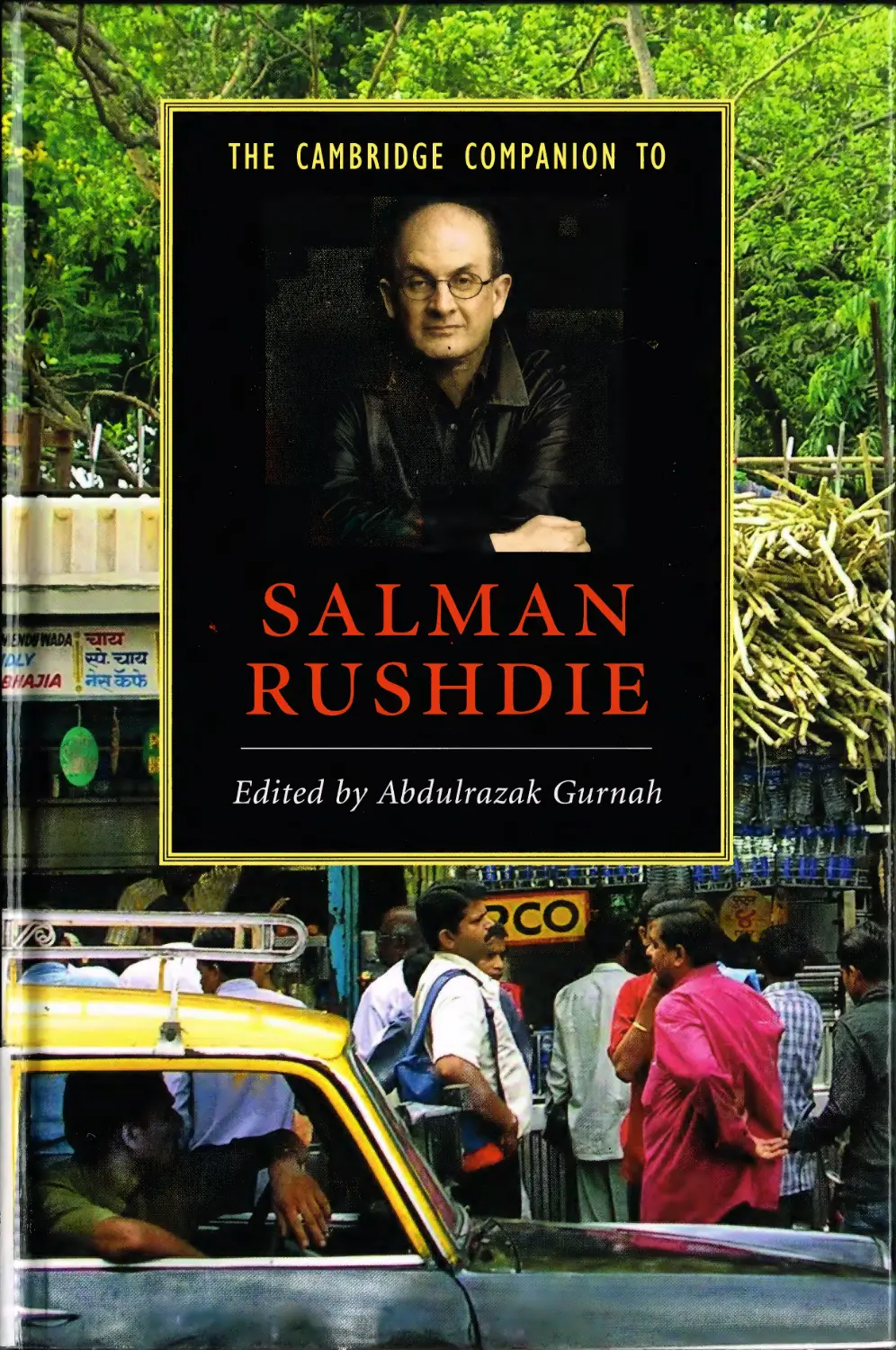
RUSHDIE
Edited by Abdulmzak Gurnah
’ .. 3“
. W-«wmxmvmmu‘lnnu
rmmm . 3
\‘WMvm u“
WWWW , ' _ ' 3 33 my 3 ‘ x" 3 33 , ' 3 WW
”My?! . 3‘ 3, Wu 3 n | 3 3 3n " .
" 3333333\\\3\\ \ ‘ n ‘ \335- .‘ “HM-3. ‘
' 1.. \‘ 1 ‘3'“ \ .33
"‘33 . ' “‘\‘:‘.'-w,‘“‘\3"\\ \. \ 3-, 3 3‘35
\ ‘ . ; . .\ ‘ 2 » ‘33 \ 3‘34.“ 3
m "\m

l||||||llllllllllllllHllllllllllllll||H|||llll|||||||ll|||
1431 988-1 0
PR6068.U757Z585 2007
The Cambridge companion to Salmar
001431988
AAA‘ A‘— A A A A

THE CAMBRIDGE COMPANION TO
SALMAN RUSHDIE
Rushdie is a major contemporary writer, who engages with some of the vital
issues of our times: migrancy, postcolonialism, religious authoritarianism. This
Companion offers a comprehensive introduction to his entire oeuvre. Part I
provides thematic readings of Rushdie and his work, with chapters on how
Bollywood films are intertextual with the fiction, the place of family and gender
in his writing, the influence of English writing and reflections on the fatwa.
Part II discusses Rushdie’s importance for postcolonial writing and provides
detailed interpretations of his fiction. In one volume, this book provides a
stimulating introduction to the author and his work in a range of expert essays
and readings. With its detailed chronology of Rushdie’s life and a compre-
hensive guide to further reading, this volume will be invaluable to students and
general readers interested in Rushdie’s work.
ABDULRAZAK GURNAH is a Professor of English and Postcolonial Literatures
at the University of Kent and the author of seven successful novels.

THE CAMBRIDGE
COMPANION TO
SALMAN RUSHDIE
‘ AAAA

‘ A A AA
THE CAMBRIDGE
COMPANION TO
SALMAN RUSHDIE
EDITED BY
ABDULRAZAK GURNAH
UNIVERSITY OF KENT
CAMBRIDGE
a): UNIVERSITY PRESS

CAMBRIDGE UNIVERSITY PRESS
Cambridge, New York, Melbourne, Madrid, Cape Town, Singapore, Séio Paulo
Cambridge University Press
The Edinburgh Building, Cambridge CB2. 8RU, UK
Published in the United States of America by Cambridge University Press, New York
www.cambridge.org
Information on this title: www.cambridge.org/ 9 7 8o 5 2. I 609 9 5 I
© Cambridge University Press 2007
This publication is in copyright. Subject to statutory exception
and to the provisions of relevant collective licensing agreements,
no reproduction of any part may take place without
the written permission of Cambridge University Press.
First published 2007
Printed in the United Kingdom at the University Press, Cambridge
A catalogue record for this publication is available from the British Library
Library of Congress Cataloging in Publication data
The Cambridge companion to Salman Rushdie / edited by Abdulrazak Gurnah.
(Cambridge companions to literature)
Includes bibliographical references and index.
978-0-521-84719—3 hardback
978-0-521-60995-1 paperback
1. Rushdie, Salman — Criticism and interpretation. 1. Gurnah, Abdulrazak, I 948— 11. Title.
111. Series.
PR6o68. U7572585 2007
823C9I4—dc22
ISBN 978-0-521-84719—3 hardback
ISBN 978-0-521-60995-1 paperback
Cambridge University Press has no responsibility for the persistence or
accuracy of URLs for external or third—party internet websites referred to
in this publication, and does not guarantee that any content on such
websites is, or will remain, accurate or appropriate.

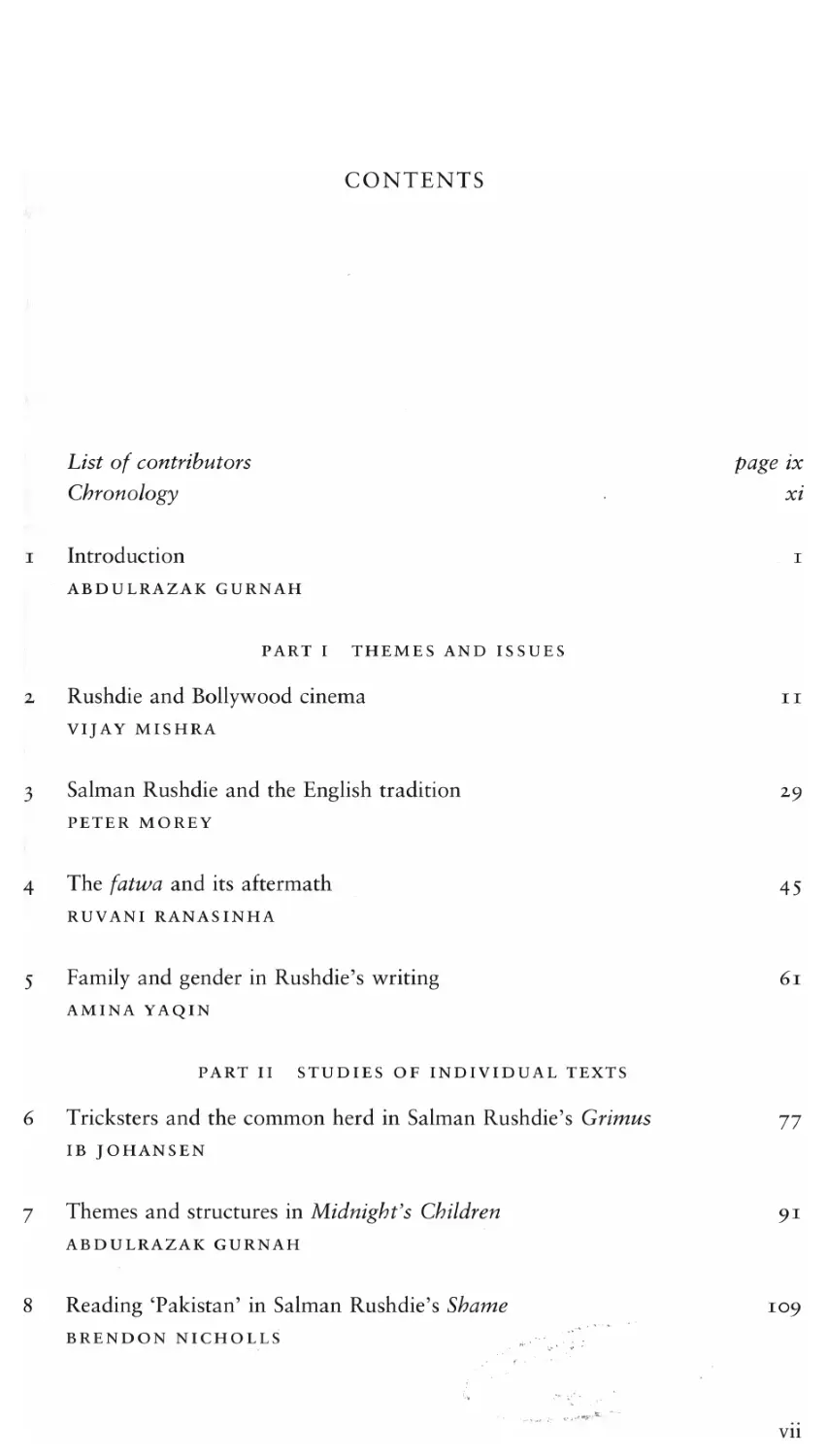
CONTENTS
List of contributors page ix
Chronology . xi
Introduction I
ABDULRAZAK GURNAH
PART I THEMES AND ISSUES
Rushdie and Bollywood cinema II
VI JAY MISHRA
Salman Rushdie and the English tradition 29
PETER MOREY
The fatu/a and its aftermath g 45
RUVANI RANASINHA
Family and gender in Rushdie’s writing 6 I
AMINA YAQIN
PART II STUDIES OF INDIVIDUAL TEXTS
Tricksters and the common herd in Salman Rushdie’s Grimus 77
IB JOHANSEN
Themes and structures in Midnight’s Children 91
ABDULRAZAK GURNAH
Reading ‘Pakistan’ in Salman Rushdie’s Shame 109
BRENDON NICHOLLS _.
. A .r ny'fu' ,
Vll
A AA;
A

IO
II
I2.
viii
CONTENTS
The Satanic Verses: ‘To be born again, first you have to die’
JOEL KUORTTI
The shorter fiction
DEEPIKA BAHRI
The politics of the palimpsest in The Moor’s Last Sigh
MINOLI SALGADO
The Ground Beneath Her Feet and Fury: The reinvention of location
ANSHUMAN A. MONDAL
Guide to further reading
Index
125
I39
153
I69
185
I97

CONTRIBUTORS
DEEPIKA BAHRI Emory University, USA
ABDULRAZAK GURNAH University of Kent, UK
IB J OHANSEN University of Aarhus, Denmark
JOEL KUORTTI University of Joensuu, Finland
VIJAY MISHRA Murdoch University, Australia
ANSHUMAN A. MONDAL Brunel University, UK
PETER MOREY University of East London, UK
BRENDON NICHOLLS University of Leeds, UK
RUVANI RANASINHA Brunel University, UK
MIN OLI SALGADO University of Sussex, UK
AMINA YAQIN School of Oriental and African Studies, University of London, UK
iX

I947
1954-61
1961—5
1962
1964
1965—8
1968
1968—9
1969
1970
1970—80
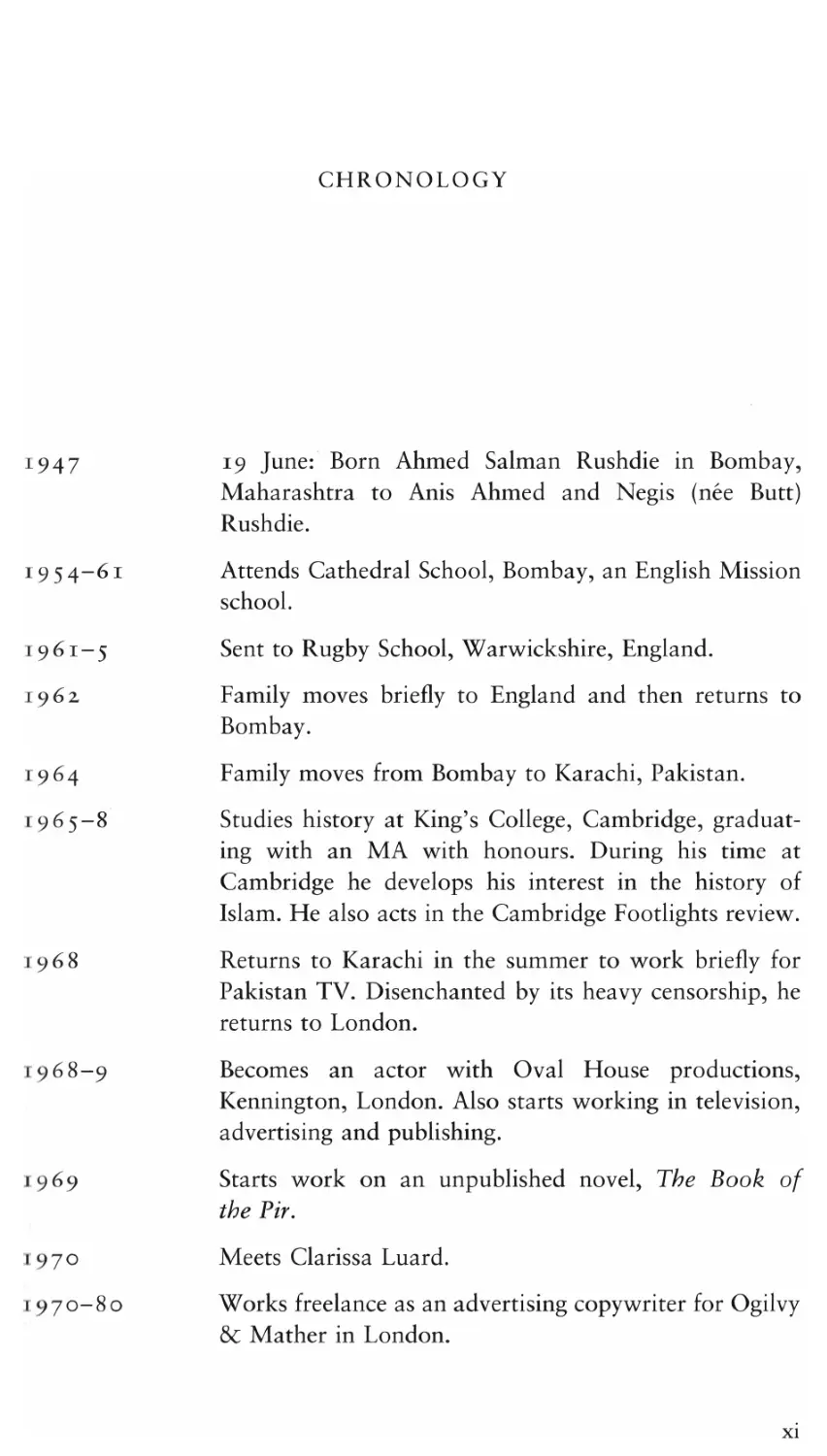
CHRONOLOGY
19 June: Born Ahmed Salman Rushdie in Bombay,
Maharashtra to Anis Ahmed and Negis (nee Butt)
Rushdie.
Attends Cathedral School, Bombay, an English Mission
school.
Sent to Rugby School, Warwickshire, England.
Family moves briefly to England and then returns to
Bombay.
Family moves from Bombay to Karachi, Pakistan.
Studies history at King’s College, Cambridge, graduat-
ing with an MA with honours. During his time at
Cambridge he develops his interest in the history of
Islam. He also acts in the Cambridge Footlights review.
Returns to Karachi in the summer to work briefly for
Pakistan TV. Disenchanted by its heavy censorship, he
returns to London.
Becomes an actor with Oval House productions,
Kennington, London. Also starts working in television,
advertising and publishing.
Starts work on an unpublished novel, The Book of
the Fir.
Meets Clarissa Luard.
Works freelance as an advertising copywriter for Ogilvy
86 Mather in London.
Xi

I974
I975
1976
1977-83
1979
I981
I983
I984
I985
I986
I987
I988
CHRONOLOGY
Travels around India with Clarissa Luard.
Grimus published by Victor Gollancz. Starts work on
Midnight’s Children.
Marries Clarissa Luard.
Member of the Camden Committee of Community
Relations working on projects in North London to help
Bangladeshi immigrants.
Son Zafar is born.
Midnight’s Children published by Jonathan Cape to
critical acclaim. Wins the Booker Prize, as well as the
James Tait Black Prize and the English Speaking Union
Literary Award.
Shame published by Jonathan Cape, shortlisted for the
Booker Prize, wins Prix du Meilleur Liz/re Etranger in
France. Starts work on The Satanic Verses. Is awarded
fellowship of the Royal Society of Literature.
Travels through Central Australia together with the
author Bruce Chatwin. Meets Robyn Davidson.
Produces the documentary film The Painter and the Pest.
Travels to Nicaragua, invited by the Sandinista Associa-
tion of Cultural Workers. Meets American author
Marianne Wiggins.
Publishes The jaguar Smile: A Nicaraguan journey
detailing his journey the previous year. Marriage to
Clarissa Luard dissolved.
Marries Marianne Wiggins. Writes and produces The
Riddle of Midnight, a documentary for Channel 4
television. September: Viking/Penguin publishes The
Satanic Verses, shortlisted for the Booker Prize, wins
the Whitbread award and, in Germany, the Author of
the Year Award. In an interview in India Today Rushdie
talks about the potentially offensive content of the
book. 5 October: The Satanic Verses is banned in India;
many other countries including Bangladesh, Sudan,
Sri Lanka, South Africa, Kenya, Thailand, Tanzania,

I989
I990
I991
I992
1993
I994
l995
CHRONOLOGY
Indonesia, Singapore, Venezuela and Poland follow suit.
10 December: first mass protest against the novel in
London.
14 January: public burning of The Satanic Verses at a
rally in Bradford. I4 February: the Ayatollah Khomeini
declares the fatwa on Radio Tehran sentencing Rushdie,
his publishers and translators to death. 15 February: a
bounty of £1. 5 million is placed on his head. Rushdie
goes into hiding. August: separates from Marianne
Wiggins.
February: publishes the essay ‘In Good Faith’ explicat-
ing the novel and ‘Is Nothing SacredP’, the Herbert Read
memorial lecture, given in his absence by Harold Pinter.
Haronn and the Sea of Stories published by Granta.
Meets Elizabeth West.
Imaginary Homelands: Essays and Criticsrn 1981—1991
published by Granta. July: Rushdie’s Italian translator
Ettore Capriolo barely survives a stabbing attack in
Milan. His Japanese translator Hitoshi Igarashi is
stabbed to death in Tokyo.
Publishes The Wizard of Oz for the British Film
Institute’s Film Classics series.
Midnight’s Children wins the Booker of Bookers, the
prize for the best book to receive the award in the past
twenty-five years. II August: Salman Rushdie walks on
stage during a U2 concert at Wembley Stadium. Meeting
with John Major. He visits the US and meets President
Clinton. He becomes Honorary Vice President 'of PEN
America and Honorary Professor at MIT, Cambridge,
Massachusetts. Marriage to Marianne Wiggins dis—
solved. His Norwegian publisher William Nygaard is
shot dead outside his home in Oslo.
Publication of East, West, a collection of short stories,
by Jonathan Cape.
The Moor’s Last Sigh is published by Jonathan Cape,
shortlisted for the Booker Prize and wins the Whitbread
Award for Best Fiction. 7 September: in London,
)(iii

I996
1997
1998
1999
2000
2001
2002
2003
2004
2005
CHRONOLOGY
Salman Rushdie makes his first pre-announced public
appearance since the inception of the fatwa.
Receives the European Union’s Aristeion Prize for
Literature.
Co—edits together with Elizabeth West The Vintage
Book of Indian Writing 1947—1997. Rushdie marries
Elizabeth West, birth of their son Milan.
2.4 September: at the UN general assembly, the Iranian
government officially distances itself from the fatu/a.
The Ground Beneath Her Feet is published by Jonathan
Cape. India grants Rushdie a five-year visa. Publication
of The Screenplay of Midnight’s Children by Vintage.
Meets Padma Lakshmi.
Travels to India with his son Zafar for the Common—
wealth Writer’s Prize. Moves to New York.
Fury published by Jonathan Cape.
Step Across This Line: Collected Fiction and Non-
Fiction 1992—2002 published by Jonathan Cape.
January: the Royal Shakespeare Company premiers the
play adaptation of Midnight’s Children at the Barbican
Centre, London. Becomes President of PEN America.
Marriage to Elizabeth West dissolved.
April: marries Padma Lakshmi.
Shalimar the Clown published by Jonathan Cape.

I
ABDULRAZAK GURNAH
Introduction
‘The past is home albeit a lost home in a lost city in the mists of lost time.’I
Salman Rushdie wrote that in 1982., in the early period of his new fame as
the author of Midnight’s Children, which had won the Booker Prize in
I981. The elegiac tone is striking. Many years before the fatwa threatened
to make Rushdie’s exile from India a permanent one, and at a time when he
was “enjoying the unique pleasure of having written . . . a book that people
liked’,2 he laments the loss of the city his novel celebrates. Clearly the
present life, London and fame, have not displaced the memory of India and
Bombay as a constitution of ‘home’. Rushdie here describes a sense of being
absent from his most intense reality that will be familiar to his migrant
readers. The ‘lost city in the mists of lost time’ is Bombay in the I950s,
which is the period when Rushdie grew up, and which is the period of
childhood in Midnight’s Children. It is to this time and this city that
Rushdie locates the best of India’s possibilities, a time when Nehru’s vision
of a tolerant and plural India seemed achievable, and in a city which in
some ways appeared to have made its own way towards that Vision.
Salman Rushdie was born in Bombay in I 947, the year of India’s partition
and independence. He was born in June, some weeks before the date of
India’s independence (15 August), but the family joke was that the young
Salman’s appearance was the true cause of the departure of the British. This
linking of the birth of a child and the birth of a nation provided ‘the germ of
a novel, Midnight’s Cbildren’.3 In the meantime, he had plenty of other
things to do before he got to write that novel. He attended Cathedral School
in Bombay, an English Mission School, just like his narrator Saleem would
do in the novel (‘In my nearlyninth year I had begun to attend the Cathedral
and John Connon Boys’ High School’4). He was at the school until 1961,
when he was sent to Rugby School, a famous boarding school in England.
The period from 1947 until I 96 I, when Rushdie was thirteen, is the only
continuous time of any length that Rushdie lived in Bombay, and is the
period that figures most profoundly in the ‘somewhat Proustian’5 dimension

ABDULRAZAK GURNAH
of Midnight’s Children, the part of it that is to do with retrieving the memory
of a lost time. Rushdie was at Rugby from I 96 I to I 96 5, a period rapidly
passed over in the description of Saladin Chamcha’s arrival in England in
The Satanic Verses: ‘Five years later he was back home again after leaving
school, waiting until the English university term began.’6 This sentence
describing Saladin’s return to Bombay is preceded by his first arrival in
London, with the disappointment he felt after so much anticipation, and by
the excruciating kipper-eating scene on his first outing at breakfast in Rugby.
This scene succinctly acts as a metaphor for Saladin’s simultaneous alien-
ation from England and his perverse determination to be English, a pre—
carious balancing act which is comically explored in the novel and which
provides one of the narrative strands in the novel’s migrant theme. But
Rushdie himself did not return to Bombay after Rugby, because in the
meantime his family had migrated to Karachi in Pakistan, and now Bombay
was forever the lost city of childhood.
Rushdie studied History at King’s College, Cambridge, graduating in
1:968. While at Cambridge he studiedIslamic history, and it was during this
period that he first came across the story of the satanic verses which was
later to be the source of the novel.7 He also acted in the Cambridge
Footlights review, something he was later to do professionally for a brief
while, soon after his return from Pakistan. After graduation, Rushdie went
to Karachi where his family now lived but only stayed for a few months,
disenchanted by the crude and heavy censorship in the work he did with
Pakistani TV during this period, and perhaps, as he makes Saleem Sinai say,
because it was not Bombay. In any case, he was in London before the end of
the year, working as an actor with Oval House productions and doing work
in television, advertising and publishing. It was during this period that he
started writing. For the next ten years, until the publication of Midnight’s
Children, he worked as a copywriter for an advertising agency, and he
sums up his writing career until this point as follows: “Before Midnight’s
Children, I had had one novel rejected, abandoned two others, and pub—
lished one, Grirnns, which, to put it mildly, bombed.’8
Most of Rushdie’s readers and critics have also taken this view of his first
novel and have mostly ignored it. Ib Johansen, in Chapter 6 in this volume,
is one of the few who has written about the novel, and he shows here the
sources and developments of its ideas. Grimas is also interesting, Catherine
Cundy shows, for the way it points to Rushdie’s later concerns:
Viewed from the standpoint of The Satanic Verses, Grirnns allows us to see
areas of debate which are subsequently handled with greater depth and
maturity in Rushdie’s later work — ideas of personal and national identity, the

Introduction
legacy of colonialism, the problems of exile and even the first signs of a
tendency to demonise female sexuality?
At the core of Grimns is a quest for knowledge or faith, or in another
sense, the individual’s need for meaning. These are central ideas in The
Satanic Verses and, to some extent, in Midnight’s Children. In Grimus, the
narrative is dominated by its intertexts, Dante’s The Divine Comedy and
Farid Ud-Din Attar’s The Conference of the Birds, from which it derives its
title.IO Perhaps it is the reliance on the ideas of its sources which makes
Grimus seem stiff-jointed and abstract in style compared to the later
Rushdie texts whose historical and cultural locations are explicit.
Compared to what was to follow, Grimas was a failure. Rushdie started
work on Midnight’s Children in the same year as Grimas’s publication,
although it is very likely that some of the material from one of the
earlier, abandoned novels found its way into it. Midnight’s Children was
published by Jonathan Cape in 1981 to huge acclaim in the United Kingdom,
in North America, in India and elsewhere. It won the Booker Prize that year,
the first time the prize was televised, turning it into the huge public event it has
since become. It made Rushdie famous, and in the years that followed,
ensured his frequent presence in the book pages of national newspapers: as
novelist, reviewer and commentator on current events. Rushdie scholars and
critics return to the novel repeatedly (as is evident in this collection of essays),
and few quibbled when it was chosen in 1993 as the best novel to have won
the Booker Prize in the Prize’s first twenty—five years. Much has been written
about the novel: its narrative inventiveness, its huge ambition, its intertexts,
which more recently have been shown to be filmic as well as textual. Vijay
Mishra in Chapter 2 of this Companion shows the significance of Indian
popular cinema in reading Rushdie, and especially Midnight’s Children.
In I98 3 Rushdie published Shame, about which the novel’s narrator, at
times unmistakably the novelist himself, has this to say: ‘I tell myself this will
be a novel of leavetaking, my last words on the East from which, many years
ago, I began to come loose.’II It turned out to be a mistaken prediction, of
course, but it expresses a compelling and recurring desire in Rushdie’s
writing, to write ‘the East’ out of him and found new origins, yet finding
himself not quite able to do so. The sentence just cited above is followed by:
‘I do not always believe myself when I say this.’ Aijaz Ahmad in his In
Theory: Classes, Nations, Literatures took Rushdie thoroughly to task on
his self-representation as an exile with the degree of agency that would
enable him to deliver ‘last words’ on ‘Pakistan’.“‘ Ahmad’s argument is
complex and detailed, and perhaps its real emphasis lies in the representa-
tion of women in the novel, and of Sufiya Zenobia in particular. However,

ABDULRAZAK GURNAH
Ahmad’s discussion is valuable on the issue of ‘self—representation’ as it
attempts to situate Rushdie’s novel (and at times it seems Rushdie himself) in
a modernist—postmodernist debate.
As we have noted above, Rushdie lived only very briefly in Pakistan,13
and everything he had had to say about that country by 1983, in both
Midnight’s Children and in Shame, expressed his repulsion. If the former
novel describes India’s lost possibilities, its tolerant and plural ambitions
squandered for expediency, the latter describes Pakistan as never having
had such possibilities because it was constructed out of intolerance and
narrow—mindedness. The failure of the state of Pakistan has a domestic
allegory in the squabble between two powerful families, only thinly dis—
guised to represent that of Zulfikar Ali Bhutto (Iskander Harrappa) and of
Zia ul-Haq (Raza Hyder).14 But the force of Rushdie’s critique of Pakistan
as an oppressive and authoritarian society is focused on the treatment of
women.
Sufiya Zenobia is born a girl when Raza Hyder wanted a boy. At her
birth, he rages at the medical staff as if somehow his anger will force them
to change the baby’s gender. Sufiya Zenobia blushes for shame. From the
moment of her birth, Sufiya Zenobia is made inadequate, shamed by her
gender. As the novel progresses she comes to represent an unavoidable
capacity for feeling shame while the world that dictates to her, the world of
men, cannot restrain itself from shamelessness. Rushdie’s argument sug-
gests a genderedsense of ‘honour’, a public sense in which men fraudulently
disguise cynicism by investing honour in the conduct of women, in the
process dictating to them, while conducting themselves with cruelty and
self-indulgence. Women, who are required to submit to what has been
invested in them and are made inadequate by this submission, feel shame.
Sufiya Zenobia cannot prevent herself blushing for shame, and is a literal
representation of this gendered condition, which is attenuated further by
making her retarded by illness to a permanent mental age of a siX-year-old.
So her blushes, in other words, are not from a heightened moral sense but
the metaphorical conditioning of her gender.
Rushdie’s women in Shame are not mere cyphers, though they are given a
problematic agency.IS The novel’s ‘peripheral hero’ has three mothers:
three sisters who had spent their lives in a huge blank-walled house shut off
from the outside world. The house is a metaphor, no doubt, for the
detention of women in the medieval form of Islam which Rushdie ascribes
to the idea of Pakistan. The house is called Nishapur, the birthplace of the
eleventh-century Persian poet Omar Khayyam, and has rambling rooms
with forgotten books which, perhaps, represent arrested learning. The three
sisters rebel against their incarceration by going to a dance in the British

Introduction
‘lines’ and returning with a joint pregnancy, whose outcome is Omar
Khayyam Shakil, whose self-indulgence knows no shame. Rani I-Iarrapa,
Iskander Harrapa’s wife, knits a shawl in which she records her husband’s
murders. Good News Hyder, Raza Hyder’s other daughter, kills herself
because she cannot prevent her husband fathering more babies on her. If all
these are problematic and, to some extent, tragic forms of agency, it is
Sufiya Zenobia who is given its most grotesque form.
In Rushdie’s argument, humiliation and shame will inevitably lead to
violence, which is as much about the oppression of women in Pakistan (and
Islam) as about the whole society. It is Sufiya who demonstrates this
argument. The first occasion is when she tears off the heads of 218 turkeys,
‘then reached down into their bodies to draw their guts up through their
necks’ (Shame, p. 138). Later, in the novel’s closing stages, she fulfils what
this early outburst of prodigious violence promises. She tempts four
nameless men to have sex with her, inverting the right of Muslim men to
take four wives, then she pulls their heads off:
Shame walks the streets of night. In the slums four youths are transfixed by
those appalling eyes, whose deadly yellow fire blows like a wind through the
lattice-work of the veil. They follow her to the rubbish-dump of doom, rats to
her piper, automata dancing in the all-consuming light from the black-veiled
eyes. Down she lies [...] Four husbands come and go. Four of them in and
out, and then her hands reach for the first boy’s neck. The others stand still
and wait their turn. (Shame, p. 219)
Her humiliation at the hands of men who should have loved her, her
father Raza Hyder and her husband Omar Khayyam Shakil, have turned
her into a Beast. Rushdie celebrates Sufiya’s violence as liberation, or makes
Omar Khayyam Shakil ponder along these lines, but the real force behind
this figuration of women is not so much to suggest a route to fulfilment, but
to issue a warning to the rulers of Pakistan. Out of the encounter of shame
and shamelessness will come violence. Not surprisingly, Shame was banned
in Pakistan, although it was short-listed for the Booker Prize.
Rushdie’s next novel, The Satanic Verses (1988), was also banned in
Pakistan, as it was in India and in many other countries, including several
Muslim countries. In Bradford in the United Kingdom, the novel was pub-
licly burned by protesters and in Karachi, Pakistan, the police fired into a
mass protest and killed ten people. The climax of these protests against
the novel was the death ‘sentence’, the fatwa, declared by the Ayatollah
Khomeini on Rushdie, his publishers and translators, with a bounty of
151.5 million offered to whoever would do the deed. It was a remarkable and
shocking intervention by a head of state in response to a novel. If this found

ABDULRAZAK GURNAH
an echo in many countries whose opinion—leaders were also repelled by what
they saw as the mockery of the Prophet, it also brought out writers, intel-
lectuals and many others in support of Rushdie and his right to write freely.
In any case, the invitation to murder drove Rushdie into hiding for several
years and broke his life and career in two. A great deal has been written
about the fatu/a and its consequences on Rushdie’s writing. This volume has
two chapters on the subject, by Ruvani Ranasinha on the background to and
consequences of the fatwa (Chapter 4), and by Joel Kuortti, who reads The
Satanic Verses in the light of the fatu/a (Chapter 9). There is little need here
to add to what those two readings undertake. In addition, Rushdie published
several defences of his novel and of his practice as a novelist, and these are
alluded to in the chapters of this volume. All these essays were published in,
Imaginary Homelands (1991:, 1992.), including an essay in which Rushdie
‘embraced’ Islam as a way of getting out of the impasse. Rushdie withdrew
this essay from later editions because he thought he had been ill-advised to
publish what looked like an apology.I6
During this period of great post-fatwa intensity, when Rushdie was
involved in a campaign to make his case to officials and the public, when he
was feted as an emblem of the writer’s freedom, he published the short
novel Haroun and the Sea of Stories (I 990). The novel is described as a
children’s book, yet it is one of Rushdie’s most complete books, which
gracefully manages his customary energetic comedy despite its dark subject,
the imposition of silence on a story-teller. In 1994, he also published a
collection of stories East, West; both these publications are discussed by
Deepika Bahri in Chapter IO in this volume. The following year, seven
years after the publication of The Satanic Verses and the trauma that fol-
lowed it, Rushdie published The Moor’s Last Sigh (I9 9 5 ), in many ways the
disillusioned sequel to Midnight’s Children. Towards the end of the earlier
novel, its narrator Saleem Sinai contemplates the possibility of ‘new myths’
being born after the failure, or the destruction, of Nehru’s vision of a
secular and tolerant India. That possibility is symbolically lodged in Aadam
Sinai, the ‘son’ of Saleem and Parvati-the—Witch, although his real father
was Saleem’s potent rival, Shiva. Aadam is the ‘son’ of the children of
midnight, but without Saleem’s sense of significance. His silence while the
Emergency lasted and his Ganesh-like features hint at a moral position and
a modest persona, a more practical attitude to what lies ahead for India and
for Bombay, which in its pluralism signifies India’s best possibilities. In The
Moor’s Last Sigh this possibility is utterly lost. In the novel, Bombay’s
parallel allegorical site of tolerance and pluralism is Muslim Spain. Its title
alludes to the place on the hill from which the last Muslim ruler of Granada
turned to look on his beautiful city for the last time, after his and his

Introduction
people’s expulsion by the fundamentalist Christian reconquista. Like
Granada in its era, Bombay is now in the hands of fundamentalists and
Aadam Sinai has fulfilled a wholly different future from that anticipated for
him in Midnight’s Children. He has found no new myths but has become a
gangster in the service of organised crime. In this volume, Minoli Salgado
discusses Rushdie’s method in this later reading of India and shows the
complex techniques the novel employs.
In 2000, Rushdie moved to New York and published the novel Fury
which is set in New York. This novel and the earlier The Ground Beneath
Her Feet (1999) signify a change of location for Rushdie’s fiction, and in
Chapter 12. in this volume, Anshuman Mondal discusses the significance of
this change. After the September 11 attack on the World Trade Center in
New York, which happened just before the publication of Fury, Rushdie
took a pronounced pro-United States government position in support of
‘the War on Terror’, and this is evident in the essays and columns he has
collected in Step Across this Line (2002.). He has retreated from this support
to some extent,” but his self-positioning on this issue opens up in an
interesting way the subject with which this Introduction began, the location
of ‘home’.
In zoos, Rushdie published Shalimar the Clown, a novel in which the
Indian sub-continent, with Kashmir as a central political event, features
prominently, returning his writing to the location primarily associated with
him. Clearly there are many more twists and turns to come from this writer,
and it is too soon yet to be definitive about recent developments in his work.
This Companion to Salman Rushdie is organised in two parts. Part I
contains four chapters on important themes of context necessary to
reading Rushdie’s work: Vijay Mishra on the influence of Indian popular
cinema, Peter Morey on the English tradition in Rushdie’s writing, Ruvani
Ranasinha on the consequences of the fatwa and Amina Yaqin on the
significance of gender and family. Part II studies the texts and offers readings
of all the fictional texts available in volume form, except for Shalimar the
Clown.I8 There are references to Rushdie’s non-fictional writing throughout
the book, and for the interested reader there is an extensive bibliography of
further reading.”
NOTES
l Salman Rushdie, ‘Imaginary Homelands’, Imaginary Homelands (London: Granta,
1991,1992),p-9.
2 Rushdie, ‘Introduction’, Imaginary Homelands, p. 1.
3 Rushdie, ‘The Riddle of Midnight’, Imaginary Homelands (1991), p. 26.
4 Salman Rushdie, Midnight’s Children (London: Jonathan Cape, 1981), p. 153.

IO
II
I2.
13
I4
IS
I6
I7
I8
19
ABDULRAZAK GURNAH
Rushdie, ‘ “Errata”: or, Unreliable Narration in Midnight’s Children’, Imaginary
Homelands (1991), p. 2.3.
Salman Rushdie, The Satanic Verses (London: Viking, I988), p. 44.
See Chapter 9 in this volume, Joel Kuortti, ‘The Satanic Verses: “To be born
again, first you have to die” ’, for a discussion of the sources of the story of the
verses.
Rushdie, ‘Introduction’, Imaginary Homelands (I99I), p. I. Grimas was the
winner of the Victor Gollancz Science Fiction Prize, and the prize was its
publication. The novel’s editor at Gollancz was Liz Calder, who later moved to
Jonathan Cape, and whom Rushdie followed there with Midnight’s Children
and later Shame. Liz Calder went on to found the independent publisher
Bloomsbury.
Catherine Cundy, Salman Rushdie (Manchester: Manchester University Press,
I996%[LIZ.
The birds’ quest in Attar’s poem is for their ruler Simurg, a sufi conceit for God,
and Grimus is, of course, an anagram of this name.
Rushdie, Shame (London: Jonathan Cape, I98 3), p. 2.8.
Aijaz Ahmad, In Theory: Classes, Nations, Literatures (London: Verso, I992),
pp.Iz3—58.
The narrator of Shame says: ‘Although I have known Pakistan for a long time,
I have never lived there for longer than six months at a stretch’ (p. 69).
The high drama played out by these two figures is too well known to be repeated
here. For some discussion of the feud see Chapter 5 in this volume, Amina
Yaqin, ‘Family and gender in Rushdie’s writing’ (pp. 61—74).
For a detailed discussion of Rushdie’s women in Shame, see Ahmad, In Theory
(I992),pp.139-52-
Rushdie, ‘Why I have Embraced Islam’, Imaginary Homelands (I991),
pp-430-2-
For example, on 8 November zoos, he participated in the protests against the
detention centre at Guantanamo Bay, where ‘terror’ suspects are held and
tortured, and in April 2005, he criticised President Bush for his failure to engage
with ‘the international community’ in pursuit of ‘the War on Terror’.
Rushdie has also written a story ‘The Firebird’s Nest’, which appeared in The
New Yorker, 23 and 30 June I997, pp. 122—7. The story is also published in a
special limited edition (Las Vegas, Nev.: Rainmaker Editions, 2004), and is
reportedly to be made into a film scripted by Rushdie himself with his wife in the
leading female role.
I am grateful to Florian Stadtler, who compiled the chronology and the
bibliography.

PART I
Themes and issues

2
VIJAY MISHRA
Rushdie and Bollywood cinema
‘nobody from Bombay should be without a basic film vocabulary’
Midnight’s ChildrenI
I
Any study of Rushdie remains incomplete, indeed deficient, if not seen
through the literature of migration and cinema. To read Rushdie through
these — demographic shift and artistic form — simply means that we are
more likely to get our understanding of him right than if we do not. The
fact of diaspora, of the trauma of migration, explains many facets of
Rushdie’s reading of culture: his emphasis on the mongrelisation of our
lives, delight in the chutnification of history, and importance given to the
moment when ‘newness’ enters the world. Indeed, some, like Timothy
Brennan, have found Rushdie’s anti-nationalist, non-foundational reading
of the nation state particularly prescient.2L The fact of cinema explains a
number of matters of representation in the Rushdie corpus which without
an understanding of cinema would be lost. Given the brief of this chapter,
though, we may want to set aside the theme of migration and diaspora,
referring to it only-in as much as it impinges on our reading of Rushdie’s
engagement with cinema, in particular Bollywood/Bombay cinema.
When Rushdie writes about Indian urban culture as a culture ‘full of
fakery and gaudiness and superficiality and failed imaginations’ but also
full of ‘high vitality, linguistic verve’3 and metropolitan excitement, he
reads Indian urban culture through the eyes of his beloved Bombay and its
dominant art form, the Bollywood cinema. The homage to Bombay and its
cinema began early as is evident from Rushdie’s tribute to The Wizard of
Oz.4 We note that Rushdie saw the film at the Metro Cinema in 19 57 at the
age of ten, a crucial age at which he also saw, as it seems from his novels,
two Bollywood films which had a decisive influence on him: Shree 420
(‘Mr 420’, 1955) and Funtoosh (‘The Madhatter’, I9 56). Metro Cinema,
now decrepit, is at the corner of First Marine Street (Anandilal Podar Marg)
and the Esplanade (Mahatma Gandhi Road), next to Cinema Lane and not
too far away from the Dhobi Talao area. The child of ten experiencing this
classic Hollywood fantasy may have been ignorant of foreign countries and
II

VIJAY MISHRA
‘about growing up’ but he came with a better understanding of the ‘cinema
of the fantastic than any Western child of the same age’.5 Rushdie was a
Bombay boy and like any other Bombay boy, regardless of class, he knew
his Bollywood, a cinema in which fantasy figures prominently. He confesses
that it is easy to satirise Bollywood, but then he continues: ‘gods descending
from the heavens to meddle in human affairs, supermen, magic potions,
superheroes, demonic villains and so on have always been the staple diet of
the Indian filmgoer’.6 The fantasies of Bollywood were forever lodged in the
young child and films, beyond Shree 420 and Pnntoosb, which the young
Rushdie would have found appealing around the time he saw The Wizard
of Oz would have included Baghdad Ka Chor (‘The Thief of Baghdad’,
1955), jungle Ka jadoo (‘The Magic Forest’, 19 55), Udan Kbatola (‘The
Aeroplane’, I955), Hatimtai (1956), Mother India (1957), Fatal Pari (‘The
Underworld Fairy’, 19 57), Tamsa Nabin De/eba (‘There’s No One Like
You’, 1957), Alladin Ka Cbirag (‘Aladdin’s Lamp’, I958) and Chalti Ka
Naam Gadi (‘When the Jalopy is King’, 1958). Except for two, these were
all black-and-white movies. Rushdie notes this fact and recalls the impact
the one-reel colour sequence — the suggestively defiant dance of Anarkali in
Emperor Akbar’s court — in the film Mngbal-e-Azam (1960) had on the
audience. K. Asif, the maker of the film, had intended to make his epic, like
the other epic, Mehboob Khan’s Mother India (I 9 57), in colour but could
not because of financial constraints. The film itself took a full seven or eight
years to complete. So what is given colour is not a battle scene or a formal
state occasion but the dance of the courtesan, the dance that connects
directly with male spectatorial desire. When Rushdie returns to this film in
his novels, it is invariably to invoke the allure of Anarkali, to suggest that
great moments of history are in fact moments of passion, of love, of desire
unrequited and entombed.
I pause to take in two films already mentioned -— Shree 420 and Puntoosh —
since they are films whose magic is singularly felt in the Rushdie corpus.
Both these films rework the picaro hero towards a distinctly Indian cos-
mopolitanism. In Shree 420, the simpleton traveller on the road saves a
city’s underclass from exploitation and transfers a term applied to
absconders and cheats (‘Mr 420’) to a city as a whole. The second film,
Pantoos/o, touches on the fine line dividing the sane from the insane, the real
from the magical. A man called Ramlal ‘Funtoosh’, the latter an attribute
rather than a name, insane due to a personal trauma, is located in an
‘International Madhouse’. In the establishing shots the inhabitants of this
madhouse are from all over the world (poetic licence is necessary here for
the spectator), and the man to be released, our Funtoosh, will now carry
this cosmopolitanism. His story will be written down by an out-of—work
I2

Rushdie and Bollywood cinema
writer; his life will be transformed into an item to be insured and from
which profit may accrue should he, in his madness, decide to die. Funtoosh,
of course, escapes all attempts at suicide at the behest of a shady indus-
trialist who had insured him and made himself the sole benefactor. He
manages to win the heart of the industrialist’s daughter, and drives the
industrialist himself insane as he in turn ends up in the International
Madhouse. Although the use of the word ‘funtoosh’ in Midnight’s Children
implies that a person is ‘finished, washed-up, or in our own expressive
word, funtoosh’7 (which is not its meaning in the film from which the word
is derived), the narrative of the film and its style shadow Rushdie’s writings
and indeed provide an insight into the ways in which Rushdie indigenises
the western picaro.
2.
‘Bollywood’ has finally made it into the Oxford English Dictionary. The
2005 edition defines it as: ‘a name for the Indian popular film industry,
based in Bombay. Origin I 970s. Blend of Bombay and Hollywood.’ The
acceptance of the word by the OED is certainly a plus for Bollywood which
between 1931, when the first talkie was made in India, and 2006 had
produced some 10,000 films (which must not be confused with the output
of Indian cinema generally, which would be five times more). What is less
evident is the way in which the word has acquired its current meaning and
has now displaced the earlier descriptors (Bombay Cinema, Indian Popular
Cinema, Hindi cinema) functioning, horrifyingly perhaps, as an ‘empty
signifier’ that may be used for any particularist reading of popular Indian
cinema. The triumph of the word is nothing less than spectacular, and
although Indians continue to feel uneasy with it (the vernacular press came
around to using it very reluctantly) its ascendancy has been such that
Bombay Dreams, the Andrew Lloyd Webber musical, finds its match in the
home—grown Merchants of Bollywood.
The best critic of Indian cinema, Ashish Rajadhyaksha, suggests that the
word first appeared as a joke in the journal Screen on its ‘Bollywood Beat’
page, with the ‘companion words Tollywood for the Calcutta film industry
based in Tollygunge and even, for a while, Mollywood for the Madras
industry’.8 The reference to ‘Tollygunge’/‘Tollywood’ is an interesting one
and may well point to a more local origin of the term ‘Bollywood’ itself and
one that may de-link its usage from a more generalist reading of it as a
signifier of a much larger process of globalisation. On this point the highly
original film critic Madhava Prasad located the first usage of ‘Tollywood’ in
a telegram that Wilford E. Deming, an American working on films, received
13

VIJAY MISHRA
as he was about to leave India: ‘Tollywood sends best wishes happy new
year to Lubill film . . . ’.9
Rajadhyaksha distinguishes between the political economy of the Indian
popular cinema based in Mumbai/Bombay and the hype around it. This
hype has led to a real confusion between ‘Bollywood’ as a fad, a taste, an
Indian exotica, and ‘Bollywood’ as a global phenomenon in the way in
which say the Beatles and Hollywood are. The hype and the confusion is
most noticeable in generalist magazines such as Newsweek and Time
which tend to celebrate Bollywood as a pervasive, global form, based on
the sometimes exaggerated claims of both film producers and critics
alike.IO ‘
Against the OED definition, which links Bollywood with popular Indian
cinema produced in Mumbai, Bollywood actually functions as something
more. Although cinema is central to its definition, Bollywood is, as
Rajadhyaksha says, ‘a more diffuse cultural conglomeration involving a
range of distribution and consumption activities from websites to music
cassettes, from cable to radio’.II The film industry may well be a small part
of this culture which is, as Bombay cinema, much older than Bollywood,
going back as it does to the I 9 308 and, if one has to be fastidious, even to
Phalke’s first silent movie in Hindi, Rafa Harisbchandra (1913). In this
reading Bollywood, as distinct from Bombay cinema, is very much an early
I99os phenomenon and hence just over a decade old. ‘The term today
refers to a reasonably specific narrative and a mode of representation’,
writes Rajadhyaksha (p. 28). Its features, some of which are not as new as
they are made out to be, include love stories couched in family values and
presented as staged musicals; stories that do not unsettle cultural pre—
sumptions (inter-caste or inter-religious marriage); representations that are
framed within Hindu iconography; a form that fetishises high tech values; a
cinema whose target audience is increasingly the Indian diaspora.
Rushdie’s own writings acquire added meaning when we recognise that
they began as Bollywood made inroads into the late modern Indian dia-
spora increasingly located in Europe and in white settler nations. This new
global diaspora turned to Bollywood for a commodified ‘feel-good’ version
of their own culture and began to provide ‘more than 60 percent of over—
seas revenues’ for it.” By the I 9 903, Bollywood cinema had become such
an indispensable cultural form in the lives of the global Indian diaspora that
British mainstream weeklies such as Time Out began to carry news about
Bollywood cinema. Diasporic cultural productions such as plays, films and
music in dance halls too paid direct homage to Bollywood. So when
the Indian diaspora began to intervene in British cultural productions with
an eye to its own distinctive artistic traditions, Bollywood became the
I4

Rushdie and Bollywood cinema
indispensable form to imitate (as in Mira Nair’s Monsoon Wedding),
parody (Kaizad Gustad’s Bomhay Boys), deconstruct (Gurinder Chadha’s
Bhaji on the Beach), creatively re-write (Gurinder Chadha’s Bride and
Prejudice) or simply imitate (Tamasha Theatre Company’s Fourteen Songs,
Two Weddings and a Funeral based on the 19 94 Bollywood film Hum Aap
lee Hain Koun). Listening to the latter musical with the original Bollywood
film in mind, parallel texts emerge but also an awareness of a sense of a
slight dissonance, because the original can never be adequately replaced.
The original remains the sign of the lost homeland that in the end defies
complete reclamation. As Rushdie presciently observed: ‘we will not be
capable of reclaiming precisely the thing that was lost’.13 With Andrew
Lloyd Webber’s Bombay Dreams, which began at Apollo Victoria in 2002
after Starlight Express ended its eighteen-year run there, a diaspora fetish
(Bollywood cinema) has found a different, mainstream translation. Here
the procedures are similar to those adopted by Tamasha but the audience is
cross-cultural, which was not the case with Fourteen Songs where the
audience were all Bollywood cinema buffs. In Bomhay Dreams, the art
form that has the highest currency in the Indian diaspora is repackaged for
a much wider audience because the form itself is seen as another element in
Western aesthetic modernity: for Western culture always adapts artistic
forms on the ascendant, and in so doing liberates art from generic
exhaustion.
How and why Bollywood is to so many a signifier of the cultural logic of
Indian modernity are questions whose answers may be discovered in the
Rushdie corpus. For what Rushdie did was to read Bombay cinema as
‘Bollywood’ (which as we have seen is more than just Bombay cinema) even
before it acquired that meaning. In his treatment, Bombay cinema was both
film and a particular logic of culture. It was, finally, a form that mediated
how Indians, both homeland and diaspora, read quotidian life.
3
‘Nobody from Bombay should be without a basic film vocabulary’, Saleem
Sinai had declared as he narrated his story in Midnight’s Children. And all
Rashid had to do as the teller of tales in Haroun and the Sea of Stories was
to ‘part his lips in a plump red smile and out would pop some brand-new
saga, complete with sorcery, love-interest, princesses, wicked uncles, fat
aunts, moustachioed gangsters in yellow check pants, fantastic locations,
cowards, heroes, fights, and half a dozen catchy, hummable tunes’.I4
So both in terms of controlling narrative structure and representa-
tion, Bombay cinema, ‘that raddled old tart’,” invades the Rushdie text.
I5
A
A

VIJAY MISHRA
In Midnight’s Children Saleem Sinai confesses, ‘I accept my life has taken
on, yet again, the tone of a Bombay talkie’I6 because like many Bollywood
films, he too has a double in Shiva. If we believe Saleem, albeit only on this
point, we begin to understand why Bollywood is so pervasive. Two features
in particular of this cinematic practice come across powerfully in Rushdie’s
first major novel: the synchronicity of the form (the Bombay film makes
sense regardless of when you enter it as a spectator/viewer), and its generic
capaciousness. In Rushdie, cinema functions as the aesthetic of India, as the
dominant cultural form of the country. India is recalled through it and its
mode of representation mediates the diaspora’s understanding of India. At
times in Midnight’s Children, direct stylistic connections are made between
film and novel: at one point, for instance, ‘a Bombay-talkie-style close-up’ is
inserted.I7 What is the Bombay-talkie-style close-up? One suspects the style
refers to the way in which the camera focuses on the face of the actor,
lingers on her for a while, absorbs her look, and then cuts to a flower or a
gushing waterfall. The montage technique referred to here is a predictable
form, since the cuts to the natural object are always thoroughly systemic
and capture, in segmental shots often, the juxtaposition of images that one
finds in Indian calendar and related art, including their chromolithograph
forerunner. In a massive metaphorical conceit (which, after Dr Johnson, is
the violent yoking of disparate images together) for which Rushdie is
famous, we are told it was in Homi Catrack’s film The Lovers of Kashmir
that the famous “indirect kiss’I8 was introduced to Indian cinema. The
indirect kiss is a special use of montage where a cinematic cut to flowers or
birds or a half-eaten apple just before the lovers’ lips meet is meant to
indicate the actual kiss that has taken place but which the spectator is
forbidden to see. In this way Rushdie brings to his writing, indeed to his
representational apparatus (for this is what the novel has to do), a discourse
that connects directly with this cultural form. The link between Rushdie’s
narrative discourse and the Bollywood film semiotic becomes clearer when
we look at the manner in which the reference to the indirect kiss is built into
a playful mode of narration:
In those days it was not permitted for lover-boys and their leading ladies to
touch one another on screen, for fear that their osculations might corrupt the
nation’s youth . . . but thirty-three minutes after the beginning of The Lovers,
the premiere audience began to give off a low buzz of shock, because Pia and
Nayyar [the lover-boy] had begun to kiss — not one another — but things.
Pia kissed an apple, sensuously, with all the rich fullness of her painted lips;
then passed it to Nayyar; who planted, upon its opposite face, a virilely
passionate mouth. This was the birth of what came to be known as the
indirect kiss —I9
I6

Rushdie and Bollywood cinema
The passage is longer and I shall quote from it again to carry my
argument forward. Let me pause here to examine how cinema actually
works with Rushdie’s postmodern narrative. First, The Lovers of Kashmir
was released in I 948, so it may have been made in I 947. In I 947, however,
no film by that name appears in any Bollywood film catalogue and there is
no evidence that in I947 or earlier either Homi Catrack or D. W. Rama,
financiers of the film, were producers of films. The closest we come to a film
that has something of Kashmir in it or has something to do with Gandhi (as
we see in the next paragraph) is the 1947 film Ahinsa (‘Non-violence’)
which, coincidentally, was produced by Kashmir Films. But what we do
know is that Homi Catrack echoes Homi Wadia, India’s best stunt film-
maker, and D. W. is obviously a reference to D. W. Griffiths, the legendary
Hollywood film producer and director.
Rushdie clearly constructs a non—existent film, but it is the moment of
cinema that bears witness to one of the great tragedies of modern India, the
assassination of Mahatma Gandhi. Against the backdrop of the invention
of the indirect kiss, as lovers kiss apples, mangoes and flowers, the ‘serpent’
of. the fictive discourse takes centre stage and makes his dreadful pro-
nouncement:
the amplified voice of the bearded man said: ‘Ladies and gents, your pardon;
but there is terrible news.’ His voice broke — a sob from the Serpent, to lend
power to its teeth! — and then continued, ‘This afternoon, at Birla House in
Delhi, our beloved Mahatma was killed.’20
The Lovers of Kashmir passage and its ‘end’ in the death of Gandhi
demonstrate a key feature of the Rushdie narrative generally. For what is
being suggested is the manner in which we lead our lives through texts, and
in a sense there is nothing that exists outside of them. So cinema, as text,
provides Rushdie with both a context (cinema as social fact) and a language
(cinema as a particular discourse, a particular representational technique)
with which to write a national allegory.
We have quoted twice the sentence that declares a direct link between the
people of Bombay and film vocabulary. The sentence occurs in the ‘Mer-
curochrome’ chapter of Midnight’s Children. Grandfather Dr Aadam Aziz
is in Amritsar, his nose sensing that things are perhaps not quite right in the
city. Rushdie continues:
Close—up of my grandfather’s right hand: nails knuckles fingers all somehow
bigger than you’d expect. Clumps of red hair on the outside edges. Thumb
and forefinger pressed together, separated only by a thickness of paper. In
short: my grandfather was holding a pamphlet. It had been inserted into his
hand (we cut to a long-shot — nobody from Bombay should be without a basic
I7

VIJAY MISHRA
film vocabulary) as he entered the hotel foyer. Scurrying of urchin through
revolving door, leaflets falling in his wake, as the chaprassi gives chase. Mad
revolutions in the doorway, roundandround; until chaprassi-hand demands a
close-up, too, because it is pressing thumb to forefinger, the two separated
only by the thickness of urchin-ear. . . . Now, looking out of his window, he
(my grandfather) sees it echoed on a wall opposite; and there, on the minaret
of a mosque; and in the large black type of newsprint under a hawker’s arm.
Leaflet newspaper mosque and wall are crying: ‘Hartczl!’ZI
The link between the film image and mental impressions, especially in
interior monologue or stream of consciousness style, had been detected
before, by Virginia Woolf, by James Joyce, and in the symbolic—realist
domain, by D. H. Lawrence. Here though what we get is an awareness of
the use of montage, the wavering point of View of the narrator, in ways that
link us not only to writers but to theory, and especially to theoretical work
on the value of montage such as that of the great Russian film-maker Serge
Eisenstein. Referring to blind Milton’s Paradise Lost, Eisenstein had noted
the ‘cinematographic instruction’ of Milton, the ease with which lines from
the monumental epic could be transformed into a ‘shooting script’ where
‘each number’ could indicate ‘a new-montage piece’.22 It is this awareness
which makes Rushdie’s account of the entry of Aadam Aziz into the his-
torical moment of the Amritsar massacre so different. Although Rushdie
has built cinematic instructions into the text, we can, following Eisenstein,
offer the following ‘shooting script’ of the passage cited above:
I (long-shot)(close-up) grandfather (Dr Aadam Aziz) enters the foyer of a
hotel
urchin thrusts a paper into his hand
urchin rushes through revolving door, leaflets falling
chased by the chaprassi
urchin and chaprassi running round and round in the revolving door
(classic Chaplin shot)
6 (close-up) chaprassi holds urchin by the ear with his thumb and
forefinger and ejects
7 dissolves to (close—up) of grandfather’s right hand: nails, knuckles,
fingers clumps of red hair on the outside edges, with a leaflet held
between his thumb and forefinger
8 (medium-shot) the message on the leaflet seen on a wall opposite
9 (long-shot) the same message on the minaret of a mosque
IO (medium shot) the same message in the newspaper under a hawker’s arm
II (close-up) single shot (on banner, newspaper or wall) of the word
Harm]!
MRWN
18
k A

Rushdie and Bollywood cinema
‘Narrative as shooting script’, I want to suggest, holds the key to
Rushdie’s narrative technique and to Rushdie’s rendition of reality as the
simulacral world of Maya where history is essentially a game of the Gods.
In this magical realist version of the real, the role of cinema, arguably the
greatest discovery of modernity, is crucial.
What follows the passage we have examined is a key historical moment
in India’s anti-colonial struggle. The Jallianwallah Bagh massacre on
13 April 1919 is remembered more than any other event as the turning
point in India’s relations with Britain. But when we examine the incident
itself and the account of the week before as Dr Aziz is seen looking ‘down
from his hotel window’, history is rendered magically as if the reader is
participating in a film scene. The scene, however, is not presented as realist
cinema; it is part Bollywood, part Hollywood-silent slapstick. As Brigadier
R. E. Dyer issues a command to shoot ‘the sneeze hits my grandfather full
in the face. “Yaaaakh-thoooo!” he sneezes and falls forward, losing his
balance, following his nose and thereby saving his life.’23
But Dr Aziz and his sneeze, the daubing of bodies with mercurochrome,
Naseem, his wife’s response and so on do not have any grounding in his-
tory. Realist novels have described such historical moments in the past but
have placed an historical consciousness (a mind) through which the scene
is filtered, and which gives a nuanced reading of the event that vies
with history itself for accuracy. Here history gets transformed into a series
of filmic shots in which it is Dr Aziz’s sneeze rather than the bullets which
become the centre of the text. This is postmodern play with surfaces,
the withholding of psychological depth, which is what the film image in
fact is.
As we have seen in the Mercurochrome chapter, the technique of film-
making is part of the structural design of Rushdie’s magic realist text. We
have argued, furthermore, that cinematic representation provides Rushdie
with a semiotic system that had already made use of what has come to be
known, generically, as postmodernity’s own brand of fragmented narra-
tion. In the next chapter of the novel (‘Hit-the-spittoon’) cinema is both the
dominant art form of Bombay (and of India) and the form that gives the
lumpen proletariat access to cultural capital. Not surprisingly, the moment
of filmic celebration is mediated through the consciousness of Rashid, the
seventeen-year-old rickshaw boy who reads posters advertising:
the new film Gai-Wallab, starring Rashid’s favourite actor Dev. FRESH
FROM FIFTY FIERCE WEEKS IN DELHI! STRAIGHT FROM SIXTY-
THREE SHARPSHOOTER WEEKS IN BOMBAY! the posters cried.
SECOND RIP-ROARIOUS YEAR!24
19

VIJAY MISHRA
Intertextual indebtedness to Bollywood is an endearing/enduring feature of
the Rushdie corpus. Indeed the Gai-wallah film itself (which should be
translated as ‘The Cowboy’) crops up again in Shame, Rushdie’s second
major work. Cinema in this novel becomes a symbol of the growing
separation of Hindus and Muslims, based largely on the power of religious
difference. So as tempers flare and partition becomes inevitable, the lonely
attempt by the cinema owner, Mahmoud the Woman, to run a double bill
with Gai-wallah for the Hindu (stone-godly) vegetarians and a Randolph
Scott Western for the meat-eating Muslims (the one-godly) is a dreadful
failure as ‘both sides, veg and non-veg, boycotted the Empire [theatre]’.25
Cinema, the premier product of the age of mechanical reproduction and,
as Walter Benjamin added further, a thoroughly democratic form, becomes
the site of nationalist fervour. In a parody of both the nature of the Indian
spectator (here divided between the vegetarians and the non-vegetarians,
the polytheists and the monotheists) and the form (Gai-wallah is an
impossible Bollywood narrative) the reference to the double bill at this
point in Shame explores the consequences of the end of tolerance and the
failure of people to transcend, for the sake of secular liberal world—view,
narrow sectarianism. Mahmoud’s solution is to show a double bill, but here
again with a View to making an ironic statement about those who wish to
break up the nation -— these people would rather see an American film than
one made in their own country. In fact, no one came to see the double bill
because consensus requires faith in multiplicity, in the play of difference, in
accepting that life is not to be divided along the lines of irreconcilable
binaries. Mahmoud the Woman’s scheme fails as he watches the films alone
and the theatre is bombed.
The debate between multiplicity and oneness — the crux of Midnight’s
Children and Shame — and won, in these novels, by those on the side of the
many, is replayed in The Satanic Verses. In this novel the chief character,
Gibreel F arishta, is an ex-film star. When we first meet Gibreel, he has mir-
aculously survived the explosion on the hijacked Air India jumbo jet (flight
AI-4zo). Suspended in the air he sings, ‘0, my shoes are Japanese . . . These
trousers English, if you please. On my head red Russian hat; my heart’s
Indian for all that.’ The song, as every student of Bollywood knows, is from
Raj Kapoor’s Shree 420 (195 5). The name Raj Kapoor had already
appeared in abbreviated form in Midnight’s Children as ‘R K Films’, one of
three key studios seen picking up extras from Bombay’s Pioneer Cafe.26 But
the ‘420’ reference itself antedates the film since a ‘420’ is someone who
cannot be trusted or who has had a minor criminal record. The usage goes
back to section 420 of the Indian Penal Code authored and subsequently
promulgated by the British in 1860. Section 420 reads: ‘Whoever cheats
2.0

Rushdie and Bollywood cinema
and thereby dishonestly induces the person deceived to deliver any property
to any person, or to make, alter or destroy the whole or any part of a
valuable security, or anything which is signed or sealed, and which is
capable of being converted into a valuable security, shall be punished with
imprisonment ...”‘7 Section 42.0 has come to be associated with petty
cheats and small-scale frauds but also with people who may simply abscond
with other people’s belongings, or even an unreliable person. Its use in Raj
Kapoor’s film as a description of both the hero and the city of Bombay
brings both people and the city together: one of the early scenes of the film
is a road sign which reads ‘Bombay 420’, which may be read as defining
Bombay or as indicating that Bombay is 420 miles away. Of course, the
whole point of the film is that through the love of the innocent Vidya, the
hero quickly learns to distinguish between the urban ‘villainy of politicians
and businessmen’28 and the hero’s own personal desire to be successful in
the city. Raj Kapoor’s 517766 420 was released in 1955 and, as we have
already suggested, it is one of two films of the period (the other being
liimtoosh) that Rushdie probably saw at the age of ten. We may also want
to note that Shree 420 is the first Bollywood film that he can fully recall,
and one with which he reads Bombay, the magical metropolis of his novels.
The film, along with Puntoosh, after all, are very much films about Bombay,
its streets, its buildings, its underworld, its colonial definition of a unit of
labour by ‘time-in’ and ‘time-out’ clocks, and so on.
If Gibreel Farishta’s initial entry into the novel is heralded through a song
(a song which is also heard in Mira Nair’s Mississippi Masala as a kind of
diasporic homage to both Raj Kapoor and Salman Rushdie), the character
himself is coded through the lives of N. T. Rama Rao, a successful actor in
mythologicals, and Amitabh Bachchan, arguably Indian cinema’s most
cndurable actor and a towering figure since the mid-19703. The latter’s
near death on the sets of Coolie (1983) is transformed into Gibreel’s own
collapse at the hands of the stunt-man Eustace Brown. Rushdie writes:
The whole of India was at Gibreel’s bedside. His condition was the lead item
on every radio bulletin, it was the subject of hourly news—flashes on the
national television network The Prime Minister cancelled her appoint-
ments and flew to visit him. Her son the airline pilot sat in Farishta’s bed-
room, holding the actor’s hand. A mood of apprehension settled over the
nation, because if God had unleashed such an act of retribution against his
most celebrated incarnation, what had he in store for the rest of the country?
If Gibreel dies, could India be far behind.”
The passage ends with an echo of Percy Shelley’s concluding line in “Ode to
the West Wind’: ‘If Winter comes, can Spring be far behind?’. There is hope
21

VIJAY MISHRA
in Shelley; in Rushdie there is despair, or at any rate ironic despair, for the
nation is rendered in terms of a film star whose near fatal illness brought the
nation itself close to death. The logic of the ‘serpent’ announcing, meta-
phorically, the death of a nation during The Lovers of Kashmir is repeated as
the actor’s life itself becomes theatre. The ‘real’ gets theorised through fiction,
the latter informing the former, changing the normal hierarchy of archive and
commentary. For, as the novel proceeds, it is Farishta, the Mr 420, the
fabulist, who dreams the text of Islam, reprojecting belief as desire, rendering
the archive indirectly as if it were the kiss of the lovers of Kashmir.
‘Why be afraid of love?’ sings Anarkali in the film Maghal-e-Azam,
which, along with Shree 420 and Funtoosh has a very special place in the
Rushdie corpus.” This film, and its earlier prototype, the artistically more
unified Anarkali (1953), find their way into The Satanic Verses. Gibreel,
walking through the city streets, recalls songs sung by Rekha Merchant
(modelled on the I97os and 19803 Bollywood megastar Rekha):
Rekha serenaded him with the sweetest of love songs singing every-
thing from the gazals of Faiz Ahmed Faiz to the best old film music, such as
the defiant air sung by the dancer Anarkali in the presence of the Grand
Mughal Akbar in the fifties classic Mughal-e-Azam, — in which she declares
and exults in her impossible, forbidden love for the Prince, Salim, — ‘Pyaar
kiya to darna kya?’ — That is to say, more or less, why he afraid of love?31
K. Asif’s Mughal-e-Azam (I960) is one of the two great film epics of India,
the other being Mehboob Khan’s Mother India (I957). It is a story about
Salim (Jehangir), Emperor Akbar’s son, and his love for the dancing girl
Anarkali, in the legend a daughter of a courtesan. The story had been made
into films before: a silent version in I 92.8, versions with sound in I 9 3 5 and
1953, with the I 953 film setting the standard for songs that K. Asif fol-
lowed. The 19 5 3 Anarkali remained true to the legend as Anarkali is
entombed alive. It also had the haunting song Ye zindagi asi ki hai jo kisi lea
ho gaya/pyaar hi me kho gaya (‘Life is for those who love; who lose
themselves in it’) sung by Lata Mangeshkar, the voice heard on All India
Radio in Midnight’s Children.32 The K. Asif version transforms this song,
which is a private, somewhat melancholic paean, into a song of defiance
sung in Akbar’s court in the presence of both the Emperor and his son. The
song marks the transition from accommodation of youthful enthusiasm
on the part of Salim to the latter picking up the defiant challenge in the
song and transforming it into an act of disloyalty towards the Emperor as
Salim takes arms against his father. All this adds to the drama. But the
K. Asif version also parts company with the legend and the earlier filmic
versions on another crucial point. It overcodes the text with the principle of
2.2.

Rushdie and Bollywood cinema
righteousness or dharma; it transforms, on this point, Akbar into the father
of the God Rama, Dasaratha, who too had declared in the Ramayana that
truth and his word were more important than political expediency. And so
in this version of the story, Anarkali is entombed, but a hidden sub-
terranean passage enables the Emperor to save her life and give Anarkali,
alive, to her mother. The law of dharma has to be followed because it was
Anarkali’s mother who had brought the Emperor news of the birth of
Salim, a son that he had yearned for but who came his way only after years
of religious penance. Upon receiving this news the Emperor had, in an
unguarded moment, declared, ‘Woman you bring wonderful tiding, here is
my royal ring, ask of me whatever you wish and it shall be granted? The
mother of Anarkali did not ask then, but she does just before Anarkali is
taken away to be entombed.
For Rushdie, the story acts as a cinematic spectacle, as an evanescent
moment that reminds him of the special syncretic quality of Indian culture,
the triumph of multiplicity over oneness. As a text about diaspora and
migration interwoven into the narrative of the arrival of a great world
religion which chose the law of austere oneness over the many, The Satanic
Verses uses cinema as a means of imparting an alternative, parallel narra-
tive of cosmopolitanism. In that narrative the discourse of Bollywood
brings an erstwhile Vision before fundamentalism began to shake India’s
liberal democratic and philosophically open culture.33
In Rushdie’s next major novel after The Satanic Verses, The Moor’s Last
Sigh (1995), his interest in films (now available to him only on video and
not in public theatres because of the Iranian fatwa) is extended and the
references to them brought forward to the early 19905. The novel also takes
up references, at times fictitious, to films in his earlier works as a means
of conflating the real with the postmodern hyperreal. The ubiquitous
Gai-wallah, transformed into an ongoing conceit, resurfaces: ‘cinemas [are]
showing the widescreen remake of the old classic Gai-W/allah’.34 Two
things strike us: the first is the word ‘remake’ which clearly situates The
Moor’s Last Sigh (at this moment in the narrative) at a time closer to our
own; the second is that there has been a technological advance. The old
classic was probably a black and white 35mm film. The new version is
widescreen and therefore in colour. The use of cinematic moments as part
of the novel’s histoire is a powerful endorsement of the enormous cultural
significance of Bollywood, especially if we also read this to mean that life in
India is indeed measured by dates of particular films. Cinema therefore
acts as a marker of history, providing the reader with implicit dates. So a
Shree 420 song places the narration after I 955 but also suggests that the
character at that juncture in the narrative would have seen the film. The
13

VIJAY MISHRA
same relationship is underlined by Sammy ‘Tin Man’ Hazaré’s rendition of
a song as he holds the photo of Nadia Wadia (the Australian Mary Evans
who played lead roles in many of Homi Wadia’s action movies in the 19403
and I 950s under the film name of Nadia). He sings Madhuri Dixit’s
Khalnayak (1991) song: ‘What is under my choli? What is under my
hlouse?’35 The song was a breakaway hit both in India and in the diaspora.
The more sustained use of cinema in The Moor’s Last Sigh, however, has
a different aesthetic motive. The magical narratives of Indian cinema,
captured in all their gaudiness and excess in films like Mr India (1987),
become entry points into the competitive claims of magic and realism in the
novel itself. Although in describing Mr India, the narrator doesn’t spare the
film from being subjected to a critical idiom of irony, the engagement with
this film suggests that for Rushdie it is films like Mr India that carry the real
deconstructive capacities of art, and through the popular ‘provide us with
an image of the National father after all . . . In Mr India’s struggle against
Mogambo I recognize the life-and—death oppositions of many movie fathers
and sons.’36
The debate between realist and magical texts gets a deeper focus when
Rushdie considers the humane values that the Bengali realist film-maker
Sukumar Sen (Satyajit Ray) brings to Indian cinema. His achievement is
seen to be the only one on a par with that of the painter Aurora da Gama,
the key female character of the novel. It is clear, though, that Aurora’s own
realism, the aesthetic demanded by the nationalist ‘spirit of the age’ as the
narrator suggests, was of a different order for she secretly preferred those
series of films by Sen ‘in which fish talked, carpets flew and young boys
dreamed of previous incarnations in fortresses of gold’.”
Aurora da Gama’s ‘instinctive dislike for the purely mimetic’ which
‘turned her back towards the epic-fabulist manner’38 is also the author
Rushdie’s own preference in the battle between Bollywood and the realists.
Abraham Zogoiby, in fact, admonishes Aurora’s flirtation with ‘naturalism’
with a clear reference to those Bombay films that were more realistic:
Will you spend your life painting boot-polish boys [Boot Polish, 1954] and
air-hostesses and two-acres of land [Do Bigha Zamin, 1953]?”
The narrator’s/Rushdie’s sympathies clearly lie with Abraham Zogoiby for
to him too ‘life [was] fantastic’40 and ‘realism confused him’.41 The genre of
Bombay cinema — as ‘ "Epico-Mythico-Tragico-Comico-Super—Sexy-High-
Masala—Art” ’42” — invades the Rushdie text as the magical genre of Indian
modernity.
A key cinematic trope that The Moor’s Last Sigh returns to is ‘Mother-
ness’ as the ‘big idea in India’.43 To make his case the narrator, Moor
2-4

Rushdie and Bollywood cinema
Zogoiby, begins by connecting the canonical Bombay cinema text, Mother
India, with the year of his own birth (I957).44
The year I was born, Mehboob Productions’ all-conquering movie Mother
India -— three years in the making, three hundred shooting days, in the top
three all-time mega-grossing Bollywood flicks — hit the nation’s screens.“
The towering figure in this film, which is also a response to Katherine
Mayo’s antagonistic but immensely influential critique of Hindu caSteism in
her book Mother India (1927), is, of course, Nargis who played the part of
Mother India in the film:
And as for its leading lady — O Nargis with your shovel over your shoulders
and your strand of black hair tumbling forward over your brow! — she became,
until Indira-Mata supplanted her, the living mother-goddess of us all.46
Aurora da Gama’s interest in Nargis, however, is more personal. She knew
her, of course, but couldn’t quite understand how she could have married
her own son, the actor Sunil Dutt who played the role of Birju, Mother
India’s younger son in the film: ‘And now look — you have gone and
marry-o’ed himl’47
Beyond asserting the cultural valency of a canonical Bollywood film,
Rushdie uses Mother India as the intertext for ‘Moor’ Zogoiby’s own
rebellion against his mother Aurora. And in so far as the real life relationship
of N argis and Sunil Dutt shadows the mother—son fictive relationship in the
film, this composite text of actor, wife and mother shapes the world of
R ushdie’s ‘Moor’ Zogoiby as well. Recounting the episode, ‘Moor’ Zogoiby
also establishes two further connecting threads. First, that like the husband
of Mother India in the film, who is made symbolically impotent because his
arms are crushed by a rock, his own father too may have become impotent.
Second, Birju’s desire for his mother in the film may be ‘Moor’ Zogoiby’s
own: ‘I have been keeping my secret for too long’, he says.48
4
What the characters say about each other is perhaps not as important as the
way in which Bollywood cinema is actually deployed by Rushdie toward a
postmodern aesthetic. In collapsing the real with the virtualité of cinema we
get not only the collapse of the real/nonreal divide but also the ‘device’ of
characters walking out of their filmic frames. In this sense Rushdie’s fiction
shows the complex ways in which stars operate in and out of cinema. As an
instance of creative appropriation of this cinematic practice, my point is
that the Rushdie aesthetic uses the archive of Bollywood to negotiate India
25

VIJAY MISHRA
itself. What is significant is that there is a cinematic point-of—view, a
cinematic organisation of the magical, of hybrid lives, that Rushdie uses for
his own project.
Whether as a huge conceit or as kitsch, Bollywood tends to serve post-
modernist ends for Salman Rushdie. Cinema functions as a text within a
text and cinematic characters enter into the body of his works. Rushdie
raises important questions about the role of the spectator in an artistic form
that constantly deconstructs the principle of the gaze and its unproblematic
consumption by the spectator. Rushdie’s spectator here is often the dia-
sporic spectator for whom, along with defamiliarisation and critical coding,
comes voyeuristic pleasure and consumption. In Rushdie’s postmodern
poetics, Bollywood is both an evanescent presence and a structural refer-
ence point as well as, for the diasporic reader, an empowering mode of
corporeal identification and self—representation. What Rushdie anticipates
is the current redefinition of Bollywood as something more than a con-
venient term that unproblematically displaces Hindi/Bombay Cinema.
Bollywood is in fact a way of thinking through a cultural shift directly
linked to Indian (post)modernity. Bollywood, for Rushdie, is like an empty
signifier into which is poured a number of things: diasporic idioms and
cultural practices, the English language which, as the universal tongue of
cyberculture, will gradually strip the genre of its historicity and Indian-
specific foundations, and a growing cosmopolitanism. Bollywood then is
integral to Rushdie’s style, both as source of discourse and of genre. In its
generic openness Bollywood, recalling the great epic texts, claims that what
is not there is nowhere else to be found. The Rushdie corpus insinuates a
similar capaciousness.
NOTES
I Salman Rushdie, Midnight’s Children (First published London: Jonathan Cape,
I981; all page references will be to the Picador edition, I982), p. 33.
2 Timothy Brennan, Salman Rushdie and the Third World (New York: St Martins
Press, I989).
3 Salman Rushdie, Imaginary Homelands (London: Granta, I 991, I992), p. 110.
4 Salman Rushdie, The Wizard of Oz (London: British Film Institute, 1992).
5 Ibid., p. II.
6 Ihid., p. II.
7 Rushdie, Midnight’s Children, p. 64.
8 Ashish Rajadhyaksha, ‘The “Bollywoodization” of the Indian Cinema: Cultural
Nationalism in a Global Arena’, Inter-Asia Cultural Studies 28 (2003 ), pp. 25—39.
9 M. Madhava Prasad, ‘The Name of a Desire: Why They Call It Bollywood’,
Unsettling Cinema. A Symposium on the Place of Cinema in India, Issue 52. 5
(May 2003 ). www.india-seminar.com/ 2003/ 52 5
2.6
‘AA A A

IO
.11
1.2
13
14
.15
16
l7
I8
19
2.0
2.1
2.2.
13
14
2.5
2.6
3-7
2.8
2-9
3o
31
32
33
Rushdie and Bollywood cinema
The producer of the Bollywood film Taal (1999) in fact declared that this film
would be noted by the ‘whole world’ (Rajadhyaksha, ‘The “Bollywoodization”
of the Indian Cinema’, p. 26). For a few days this seemed like being the case as in
the first three days of its release, over the weekend of 13—1 5 August I 999, the
film raked in $ 591,280 making it, in those few days, among the top ten films in
the American market.
Rajadhyaksha, ‘The “Bollywoodization” of the Indian Cinema’, p. 27. In the
pages of the Sydney Sun Herald (11 September 2005, S34) the pop culture
journalist Clara Laccarino uses Bollywood in a number of ways: Bollywood
fever, Bollywood industry, Bollywood bonanza, ‘hot’n’spicy Bollywood fever’,
a Bollywood fix, Bollywood Shakedown, Bollywood romp, Bollywood breaks,
Bollywood dancing, Bollywood calendar. And there is of course Planet
Bollywood, the restaurant.
Suketu Mehta, Maximum City: Bombay Lost and Found (New York: Alfred A.
Knopf, 2004), p. 57.
Salman Rushdie, ‘Imaginary Homelands’, in Imaginary Homelands, p. IO.
Salman Rushdie, Haroun and the Sea of Stories (London: Granta, I990),
pp.I6—I7.
Salman Rushdie, The Moor’s Last Sigh (First published London: Jonathan Cape,
I99 5; all references to the Vintage edition, I996), p. 173.
Rushdie, Midnight’s Children, p. 3 50.
Ibid., p. 346.
Ihid., p. 142. In Subhash Ghai’s Taal (1999) the indirect kiss takes the form of
lovers sipping Coca-Cola from the same straw, and then drinking from the same
bottle. The indirect kiss is alive and well in Bollywood.
Rushdie, Midnight’s Children, p. 142.
Ihid., p.143.
[hid., pp. 32—3.
Sergei Eisenstein, The Film Sense, trans and ed. Jay Leyda (London: Faber and
Faber, 1968), pp. 55—6.
Rushdie, Midnight’s Children, p. 36.
Ihid., p. 49.
Salman Rushdie, Shame (London: Jonathan Cape, I 98 3), p. 62.
Rushdie, Midnight’s Children, p. 216.
Quoted in Srinivas Aravamudan, ‘Being God’s Postman Is No Fun, Yaar:
Salman Rushdie’s The Satanic Verses’, Diacritics 19 (1989), pp. 3—20; this
citation p. 7.
Aravamudan, ‘Being God’s Postman’, 7.
Salman Rushdie, The Satanic Verses (London: Viking, 1988), pp. 28—9.
See also M. G. Vassanji, The Boo/2 of Secrets (Toronto: McClelland and Stewart,
1994) where the Anarkali story is again part of the fabric of the novel.
Rushdie, The Satanic Verses, p. 334.
Rushdie, Midnight’s Children, p. 70.
See also Salman Rushdie, Shalimar the Clown (London: Jonathan Cape), 2005,
p. I32 where Boonyi Kaul Noman (or Mrs Shalimar the Clown) performs ‘the
dance number from Anarkali, a new play devised by the group after the immense
success of the film Mughal—e-Azam’. Later Shalimar, the actor, proposes that
the Anarkali play should be reworked to show the dancing woman as a
2-7
A A

45
VIJAY MISHRA
Vietnamese peasant woman bricked up in her wall by American soldiers
(p. 231). This, Shalimar felt, would be readily seen as an allegory of India’s
treatment of Kashmir/Anarkali.
Rushdie, The Moor’s Last Sig/7, p. 374.
Ibid., p. 357.
Ibid., pp. 1:68—9.
Ibid., p. 173.
Ibid., p.174.
Ibid., p.174.
Ibid., p.174.
Ibid., p. 175.
Ibid., pp. 148—9.
Ibid., p. 137.
Released during Diwali week, October 19 57, Mother India, directed by
Mehboob Khan (1909—74), son of a Gujarati policeman with strong agrarian
roots, ran for a whole year at Liberty Cinema, Bombay. It received rave reviews
in key film journals such as Filmfare and Filmindz’a and in B/mrat jyoti and went
on to become the Bollywood film dubbed and subtitled more than any other.
The usually acerbic Baburao Patel noted in his Filmindia review ‘[Mother India]
is the greatest picture produced in India during the forty odd years of film-
making’, to which he also added in a later paragraph ‘Remove Nargis and
there is no Mother India.’ See Bunny Reuben, Mehboob India’s DeMille
(New Delhi: HarperCollins, 1999), pp. 261—8.
Rushdie, The Moor’s Last Sig/7, p. 137.
46 Ibid., p. 137.
47
48
28
Ibid., p. 137.
Ibid., p. I39.

3
PETER MOREY
Salman Rushdie and the
English tradition
At the turn of the millennium, Salman Rushdie left London, his home for
the previous thirty years, for New York, declaring the English literary scene
to be bitchy, insular and smug. The move was portrayed in some quarters as
a desertion of the country that had sheltered him during the dark years of
the Ayatollah Khomeini’s fatu/a, with the popular press particularly acerbic
in some of its comments. Even the liberal broadsheet newspaper the
Guardian joined the personalised attacks, merging Rushdie’s complex
private life with the plot of his ill-received 2001 novel Fury in a spoof
‘condensed account’ of the novel: ‘Self-regarding fiftysomething man dumps
his wife, moves to New York, meets the most beautiful woman in the world
and writes about it.’I
As the latest in a long line of controversies accompanying the author, the
storm over Rushdie’s relocation might serve as anecdotal evidence of
the fraught relationship between the writer and the British cultural estab-
lishment, and as an instance of the inherent difficulty of placing Rushdie
in relation to Britishness in general, and the English literary tradition in
particular. Moreover, attempting to characterise ‘the English tradition’
itself is an exercise beset with snares. Looking back into the recent history
of literary criticism the picture appears to have been clearer, at least to
cultural conservatives. Writing in an essay entitled, ‘The Englishness of the
English Novel’ (1981), Q. D. Leavis — with enviable certainty — described an
‘instinctive national preference’ leading to a ‘demand on creative writers
for inwardness, understanding, and the Shakespearian “fullness of life” ’:
something which was, for her, attainable only when English authors chose
‘to write from their roots’.2 With its attendant emphasis on social and
individual particularity, realism and psychological interiority, Leavis’s co-
ordinates of English writing marry the task of moral education with the
philosophical tenets of empiricism, valorising sensory experience above
theories and clarity above style. However, with its dependence on the
notion of roots, her prognosis might not be expected to be as congenial to a
7-9

PETER MOREY
writer like Rushdie, for whom roots are a conservative myth designed to
keep us in our places, and whose writing —- like his life — has consistently
celebrated the fraught delights of journeys and migrations. Indeed,
Rushdie’s great contribution to the English tradition might be said to be the
way he opens up this comforting but rather parochial vision, with its low-
key mode of address, to international influences and concerns, as part of his
postcolonial revision of Englishness. Against the national, Leavisite ‘Great
Tradition’, Rushdie has identified for himself an international lineage,
‘selected half consciously, half not’, which includes ‘Gogol, Cervantes,
Kafka, Melville, Machado de Assis; a polyglot family tree, against which
I measure myself, and to which I would be honoured to belong’.3
Nevertheless, as I wish to argue, Rushdie does not refuse or refute the
English tradition. Rather his work interacts intertextually with those
elements of it he finds most concordant. The imprint of numerous writers
from the canon of English literature — which, for the sake of convenience in
this essay can be extended to include those Irish and American-born artists
who have enriched it from time to time — can also be seen in Rushdie’s
work. Famously, F. R. Leavis’s canon, emphasising verisimiltude and moral
seriousness, was set out in 1948 with the declaration: ‘The great English
novelists are Jane Austen, George Eliot, Henry James and Joseph Conrad’,
a list to which Leavis subsequently added DH. Lawrence.4 Rushdie’s
‘tradition’, by contrast, has a place for Swift, Fielding, Sterne — whose
inventive, bawdy Tristram Shandy was described by Leavis as ‘irresponsible
(and nasty) trifling’5 — Blake, Lewis Carroll (who is especially important for
Haroan and the Sea of Stories), Dickens — initially dismissed by Leavis as
merely ‘a great entertainer’ — Joyce and Beckett. Rushdie responds to the
experimental, the playful and the flamboyant in these writers, and these
qualities characterise his own fiction. It is a lineage that makes room for the
epic and the fantastic. It also opens up to admit aspects of narrative from
different genres such as science fiction: as in the frequent device of over-
lapping dimensions or levels of reality in Grimns, The Satanic Verses and
The Ground Beneath Her Feet. At the same time, I wish to argue, by
reacquainting the English tradition with its partly suppressed elements,
Rushdie is offering a critique of a particular kind of imagined Englishness,
sanctified by time and codified in certain notions of ‘the literary’. He
achieves this through a kind of radical intertextual decentring.
Postcolonial intertextuality takes a variety of forms: strategically
deployed quotations or allusions; intertexts as structuring frameworks for
plot and thematics; the juxtaposition of many intertexts to create a parti-
cular effect and, thus, to generate meaning; and a dialogic engagement
between the novel and aspects of broader cultural discourse, such as the
30

Rushdie and the English tradition
grand narratives of history, science and progress. From the beginning,
Rushdie’s texts have always inscribed a recognition of how literary repre-
sentations of place and identity operate in a discursive field that is always
haunted by, and in dialogue with, authoritative constructions which pre-
cede and to some extent determine the cast of those representations. In
Crimns the authoritative intertexts are those of world mythologies, in
Midnight’s Children they are the established accounts of postcolonial
Indian history, and so on. His technique amounts to what Keith Booker has
described as ‘encyclopedic allusiveness’,6 borrowing from different cultures
and traditions. His often satirical intent is likewise well served by such
borrowings, allowing the narrative voice to inhabit but at the same time
Contest the common view.7
Thus, despite Rushdie’s own famous journalistic epigram, the empire does
not merely ‘write back’ to the metropolitan centre in terms of overturning
hackneyed tropes and contesting stereotypes. Rather it recognises that, to a
certain extent, the self-constitution of the text and sometimes of its char-
acters takes place through intertextuality and the ‘second-hand’: Saladin
Chamcha in The Satanic Verses carries around an ideal of a ‘picture post—
card’ England, composed of the Royal Family, cricket and the Houses of
Parliament; and the England of Sir Darius Cama in The Ground Beneath
Her Feet is a retrospective, aristocratic dream, allegorising the Parsi com-
munity’s close association with the British during the Raj.8 Intertexts may be
small or large: nods in the direction of Kipling occur in the frequent use of
the Kim and Mowgli tropes, and to E. M. Forster in Saleem Sinai’s grand-
father, the Westernised Dr Aadam Aziz, in Midnight’s Children, while
Shakespeare’s Othello and The Merchant of Venice provide strategic quo-
tations and intertextual structuring principles for The Moor’s Last Sigh.9
Rushdie is not afraid of importing, verbatim, whole passages of dialogue
from a source text if it helps to encapsulate a point about narrative and
authority: as when the local police chief — himself a facsimile of Kipling — has
Aurora Zogoiby’s father and uncle arrested in The Moor’s Last Sigh, and
udmonishes his charges with the very same words Kipling’s narrator uses to
describe the operations of colonial power in the short story ‘On the City
Wall’.IO (One of his most enjoyable intertextual forays is the short story
‘Yorick’, from East, West, which is a twentieth-century pastiche of an
Cighteenth-century—style retelling of a supposed incident from the life of
Shakespeare’s posthumous jester in Hamlet”)
There was a time in Rushdie criticism when j ustifiable offence was taken
by some at the tendency of critics only to bother to identify those Western
intertexts that dot the novelist’s work. Since then, a number of works have
emerged which acknowledge and explore those influences from Hindi,
3I

PETER MOREY
Urdu, the languages and texts of South India, the Persian inheritance and
the visual style and argot of Bollywood cinema.” It should now be possible
to acknowledge that all these traditions are mutually fructifying and, in
fact, impossible to disentangle. Taken together they constitute the fabric of
Rushdie’s writing, and exist in a creative tension that lends the work its
distinctive hybridity. It is also possible to suggest, however, that the nature
and insistency of Rushdie’s English sources betrays an ambivalence at the
heart of his attitude to those cultural values the fiction ostensibly sets out to
interrogate.
Englishness remains notoriously difficult to define, and the English trad-
ition can, therefore, seem equally elusive. Despite this, some defining
characteristics have been acknowledged. For example, the central philo-
sophical principle in the English tradition has often been identified as
empiricism. Empiricism is the theory that one gains knowledge and learns
to evaluate truth through sensory data. Deriving from the work of Hobbes
and Locke in the seventeenth century, and forming the mainstream of
English philosophy through at least to Bertrand Russell in the twentieth
century, empiricism presupposes a complete separation between the per-
ceiving subject and the object of perception. It is an epistemology which
privileges ‘being objective’, which believes that language can render sensory
impressions directly, and which therefore requires of language that it be as
transparent as possible in relation to that which it describes. Hobbes and
Locke famously viewed language essentially as a nomenclature — a system
of naming — thereby privileging nouns as the key units by which clear
communication might best be ensured.13 Anything that distracted from the
direct communication of impressions and ideas — such as clever wordplay
or ornate description — was to be strictly avoided. In Book Three of his
Essay Concerning Human Understanding (I689), Locke attacked stylistic
flourishes:
But yet, if we would speak of Things as they are, we must allow, that all the
Art of Rhetorick, besides Order and Clearness, all the artificial and figurative
applications of Words Eloquence hath invented, are for nothing else but to
insinuate wrong Ideas, move the passions and thereby mislead the Judgement;
and so indeed are perfect cheat.I4
Clearly, this emphasis on directness and truth cannot be applied wholesale
to the more imaginative and to some extent adjectival art of fiction.
Nevertheless, the idea of a transparent ‘styleless’ style does loom large in
the history of English novel criticism.
It was perhaps given its most celebrated shape by Ian Watt in The Rise of
the Novel (1957), where it was traced in the distinctive narrative qualities
32

Rushdie and the English tradition
of that group of eighteenth century novelists, Defoe, Richardson and
(less securely) Fielding, conventionally seen as the fathers of the novel form.
The term Watt coined for these shared techniques was ‘formal realism’:
novels — as opposed to the fanciful continental romances which preceded
them - were distinguished by the particularity accorded to plot, character
and setting, something which contributed to the defining effect of
verisimilitude, of being true to life."5 Yet Watt is merely one of a long line
of critics whose identification of English writing with the central tenets of
empiricism have led them to privilege the devices that make for realism. It is
:1 view that exalts the best writing of the late nineteenth and early twentieth
centuries — before the supposed depredations of ‘High Modernism’ — as the
apogee of the novel form (as witnessed by Leavis’s canon). Such preferences
include the close marriage of content and form, and the idea that the novel
ought to present incident and moral reflection dramatically, rather than
having the narrator intervene to direct us, thereby breaking into the illusion
of reality the novelist has set up.I6 Walter Allen has usefully summarised
this formalist, empiricist ideal behind what he calls the ‘pure novel’:
The writer of the pure novel sets out to delight us not by prodigality of
invention, the creation of a large gallery of characters, . . . but by attention to
the formal aspects of composition, to design, to the subordination of the parts
to the whole Readers who rejoice in the fiction of the great extroverts,
Fielding, Balzac, Tolstoy, commonly find an impoverishment when they turn
to the work of the pure novelists. Perfection, however, which is what the pure
novelist is after, demands the recognition of severe limits. Dickens recognizes
no limits at all; the art of Jane Austen is made possible precisely by the
recognition of limits.”
it should be remembered, of course, that this is merely one facet of the
linglish tradition, and that realism itself as an aesthetic category is far more
overtly ‘impure’, open to, and composed of highly artificial devices and
conventions, than this account allows. None the less, it is clear that Salman
Rushdie is, in these terms, anything but a ‘pure’ novelist. He prefers the
epic, the external and the fantastic to the realist, the internal and the
domestic, and throughout his work — especially in Grimus and Haroun and
(/26 Sea of Stories — his puns, anagrams, loaded names, double meanings and
interjections from different languages problematise the simple correspond-
ence between signifier and signified. Similarly, Rushdie’s writing tends to
shy away from that close identification, born of believability and a devel—
oping imagined relationship, that is used to establish a bond between reader
and central protagonist, preferring to keep us at arm’s length and making
frequent narratorial interventions. Where he does seek to explore the
33

PETER MOREY
psychological coordinates of character it is usually through the outward
c0nfluence of history, race and nation, and takes the form of obsessive
behaviour and grotesque transformations.
It is no coincidence, then, that Rushdie chooses to bypass the classic
realism of the nineteenth century and draws inspiration from the diverse
practices of the previous era. He has said: '
I think the eighteenth century is the great century for English literature, and
it’s no secret that I’ve been very affected by Tristram Shandy or Tom ]ones
and because they are those things that Henry James called ‘loose baggy
‘ monsters’ — I actually don’t think they’re that loose or baggy . . . Kundera has
this essay. . . about how the novel has two parents, one of which is
Richardson and Clarissa Harlow, and the other of which is Sterne and
Tristram Shandy and he says, and I think he’s right, that broadly speaking the
Children of Clarissa Harlow have populated the earth, and there are not that
many children of Tristram Shandy.18
In his fiction Rushdie exploits the greater freedom of the Shandian trad-
ition to mix genres, styles and registers, and revels in the unfettered power
of the well-told tale. Nowadays, postmodern and postcolonial literary
theories acknowledge the power of story — decried among some modernist
practitioners as a distraction from the proper aesthetic preoccupations of
the novel — for its own sake, and because it encodes alternative visions of
the world to those sanctioned by authoritative discourses. Peter Ackroyd
has remarked that: ‘Eighteenth century fiction is hybrid and various, part
realistic and part allegorical, combining heroism and farce in equal mea-
sure; it conflates epic with romance, and even includes critical theory?”
The novel wherein this miscellany is most memorably displayed is Laurence
Sterne’s Tristram Shandy (published serially 1759—67).
Digressive and episodic, Tristram Shandy offers a striking alternative to
what was emerging. as the dominant mode of eighteenth-century novel
writing, using techniques now familiar to the modern reader. There are the
many asides on writing itself which gleefully expose the artifice of a set of
conventions rapidly solidifying into orthodoxy. Sterne never lets us forget
that there are many different ways in which the story could be told: as many
ways as there are characters and incidents. In particular, the experimenta-
tion with the disjunction between ‘novelistic time’ (the time of writing) and
‘real time’ (the time of living) is conducted in a strikingly sophisticated and
self-aware manner.
As is well known, numerous elements of Tristram Shandy’s style
and thematics have been borrowed by Rushdie in Midnight’s Children
to tell the story of his miraculous child, born on the stroke of midnight on
34

Rushdie and the English tradition
I. 5 August 1947, and destined to live his life ‘handcuffed to history’. Like
his eighteenth-century forebear, Saleem Sinai feels obliged to approach the
narration of his birth by providing copious antenatal details — in his case,
concerning the history of India leading up to independence — so that the
central protagonist has to wait to make an entrance into his own story. The
run up to his birth is punctuated by the proleptic ‘tick tock’ of an imagined
clock counting down to 15 August, just as Tristram’s story really begins
with the parental coitus that is to conceive him being interrupted by the
necessity of winding the clock. Both books are unstintingly excursive.
Sterne, like his own literary progenitor Jonathan Swift, introduces digres-
sions on subjects as various as philosophy, dress, military, obstetric, edu-
cational and other matters, recommending them to the reader as ‘the
sunshine . . . the life, the soul of reading’ without which the book would be
as cold as winter. Likewise, Rushdie’s Saleem ‘destroying the unities and
conventions of fine writing’, pauses to muse on meaning versus con-
tingency, to attempt the categorisation of various smells, and to advance a
theory of how best to read his own narrative.“ It is the conviction of both
narrators that to tell the story of one life it is necessary to try to encapsulate
the whole of experience; Tristram’s comment, ‘nothing which has touched
me will be thought trifling in its nature’,21 is matched by Saleem’s assertion
that ‘To understand just one life, you have to swallow the world?“ Like
that other great eighteenth-century novelist Fielding — who was also given
to flights of erudition and authorial intervention — Rushdie is writing a
‘comic epic’.23 Midnight’s Children has been compared to Fielding’s Tom
jones (1749) and described as ‘a postmodern version of the picaresque’,
incorporating incident-filled journeys ‘from Kashmir to Amritsar, Agra,
Delhi, Bombay, Lahore, Dacca and back again’.“4 Echoes of other late
eighteenth- and early nineteenth—century novelists such as Tobias Smollett
and Thomas Love Peacock can also be detected in Rushdie’s exuberant,
exaggerated style.
However, the writer with whom Rushdie can be most closely compared is
Charles Dickens, one who often drew his inspiration from eighteenth-
century sources such as Fielding and Smollett. Rushdie says of Dickens:
‘I was particularly taken with what struck me as his real innovation: namely
his unique combination of naturalistic backgrounds and surreal fore-
grounds’ — almost a definition of Rushdie’s own brand of magic realism.“
Critics have been quick to note the Dickensian qualities of Rushdie’s
imagined capital city, Ellowen Deeowen in The Satanic Verses, with its
juxtaposition of slick, multi-channel postmodernity and the downtrodden
existence of the migrant communities, and its invocation of Our Mutual
Friend (1865). However, I would argue that the Dickensian strain is most
35

PETER MOREY
prevalent in Shame (I983). The note is struck from the start in the three
sisters, Chhunni, Munnee and Bunny, who are joint-mothers of Omar
Khayyam Shakil. Compared at various points to the three graces and the
three wise monkeys, and carrying echoes of the weird sisters from Macbeth,
they also recall the four Miss Willises from Dickens’s earliest work,
Sketches by Boz (1836—7). Dickens’s women too ‘seemed to have no
separate existence’, doing everything together and never being seen apart,
to such an extent that when a Mr Robinson begins visiting, it is unclear
whether he is courting one of the Miss Willises or all of them. The wedding
day arrives:
Who shall depict the perplexity of the clergymen, when all the Miss Willises
knelt down at the communion table, and repeated the responses incidental to
the marriage service in an audible voice — or who shall describe the confusion
when all the Miss Willises went into hysterics at the conclusion of the
ceremony, until the sacred edifice resounded with their united wailings.Z6
Dickens achieves the effect of ambiguity by keeping us outside the house at
the crucial moments, as does Rushdie with the uncertain maternity of Omar
Khayyam.
The Dickens novel that has the greatest affinity with Shame, and that
shares its interest in the corruption of power and the inevitable violence it
engenders, is A Tale of Two Cities (18 59). Both texts explore what happens
when a rotten political system is confronted by the newly awakened power
of the long-oppressed. Throughout Rushdie’s text there are echoes of
Dickens’s French Revolution novel: the shawls made by Rani Harappa to
record the iniquities of her husband’s regime resonate with Madame
Defarge’s knitting which acts as a register of crimes against the people by
the French aristocracy. She claims to be knitting ‘shrouds’, like the burqas
stitched by Rani Harappa in which her husband eventually flees. In Shame
the retributive dimension is mainly saved for the ending, when the people,
inspired by ‘the human guillotine’ that Sufiya Zinobia has become, take
control of their destinies and storm the ‘bastille’ of Nishapur:
All day a crowd has been gathering around the compound walls, growing
angrier as it grows larger Howwill it end with the mob surging into
the palace, lynchings, lootings, flames — or in the other, stranger way, the
people parting like waters allowing her through, their champion to do
their dirty work: the Beast with her fiery eyes.>27
Rushdie’s use of the word ‘mob’ here seems almost preprogrammed to
conjure the frantic revolutionaries of Dickens’s Paris: ‘changed into wild
beasts by terrible enchantment long persisted in’.28 The message of both
novels may be summarised in Dickens’s valedictory observation: ‘Crush
36

Rushdie and the English tradition
humanity out of shape once more, under similar hammers, and it will twist
itself into the same tortured form.’29
However, there is a revealing ambiguity at the heart of both novels.
Dickens understood the motives of the revolutionaries but deplored the
merciless violence of their methods. Rushdie too, despite his recognition of
the colonial roots of nepotism and corruption and the neocolonial strategic
considerations that sustain them, opposes brutality and religious funda-
mentalism with an appeal to the watchwords of the Enlightenment radical
tradition: Cliberty; equality; fraternity’.3o Such an invocation might appear
out of keeping with postcolonialism’s usual deep suspicion of Enlightenment
values. Yet it is of a piece with Rushdie’s invocation of freedom of speech
and the autonomy of art elsewhere: in his spirited defence of The Satanic
Verses in the essay ‘In Good Faith’, for example.31 It can be seen as part of
that valorised Romantic individualism and elevation of the writer that is a
feature of his work: one thinks of the urgent endeavours of Saleem Sinai, the
Joycean hero-as-writer of Midnight’s Children, and his counterpart Moraes
Zogoiby in The Moor’s Last Sigh. Damian Grant has commented persua-
sively on Rushdie’s latter—day commitment to the principles of the Romantic
imagination, likening his belief in art and the imagination as central to our
humanity to that of Shelley in his A Defence of Poetry (1840).” In fact, the
Shelleyan connection can also be read back into Shame, where the trans-
formed Sufiya Zinobia, confronting her husband and jailer Omar Khayyam
at the end, performs a similar role to Demogorgon in Shelley’s Prometheus
Unbound (1820) when he drags the tyrannical Jupiter down into Hell:
‘Descend, and follow me down the abyss/ I am thy child . . . / Mightier than
thee: and we must dwell together/ Henceforth in darkness.’33
Despite the Romantic valorisation of the artist as creator, it has been
convincingly argued, as Easthope has shown, that the continued quest to
find a significant relationship between subjective and objective worlds
means that Romanticism can still be understood as part of the empiricist
enterprise.34 The tensions between the constituent parts of Rushdie’s aes—
thetic — secular Islam, aspects of Hinduism, third world liberationism and a
rather lukewarm socialism — are brought most sharply into relief in The
Satanic Verses, where a centrifugal migrant hybridity pulls at a text
structured on a Miltonian fall motif and ideas of Romantic inspiration
drawn extensively from William Blake.
The distinctive quality of The Satanic Verses is its recognition of the
location of some of the deepest modes of identification in religious and
cultural, rather than specifically national paradigms. As the carrier of cul-
ture, language is seemingly up for grabs in the novel. This is made explicit
both by the text’s hybrid linguistic style and when the poet Jumpy Joshi, as
37

PETER MOREY
part of his attempts to appropriate English, muses on the ‘real language
question’ for the postcolonial subject: ‘how to bend it, shape it, how to let it
be our freedom, how to repossess its poisoned wells’.3’5 However, as the
controversy around the novel’s so-called ‘blasphemy’ might in part suggest,
the lodestar of Rushdie’s exploration — for all its flights of fantasy — can be
said to be the familiar glow of empiricist and Romantic verities.
This can be seen most clearly in the controversial revelation scene, where
Gibreel Farishta, in the guise of the angel of annunciation, discloses Allah’s
decrees to the prophet Mahound. Even setting aside the critical factor of
Gibreel’s incipient schizophrenia, Rushdie’s account of the revelation owes
less to divine authority than to the established lexicon of Romantic
inspiration. It is unclear whether the power that rends Gibreel emanates
from within or without him. There is a fusion of prophet and angelic
intercessor; Mahound says, ‘Often, when Gibreel comes it’s as if he knows
what’s in my heart. It feels to me, most times, as if he comes from within my
heart: from within the deepest places, from my soul.’36 The scene is con-
structed on the notion of the prophet-as-poet, the intuitive seer who is able
to process, distill and articulate powerful emotions, thereby performing the
central empiricist task of bridging the gap between external impressions
and the poet’s immortalising apparatus. The origin of the divine vision is,
thus, beside the point. Rushdie’s characters seem to be participants in a
process akin to that described in Coleridge’s ‘Apologia Pro Vita Sua’
(1822), where: ‘The poet in his lone yet genial hour/ Gives to his eye a
magnifying power,/ Or rather he emancipates his eyes/ From the black
shapeless accidents of size’, until, ‘His gifted ken can see/ Phantoms of
sublimity’.37 Compare this to Rushdie’s description of the artisticprocess:
‘Literature is made at the frontier between the self and the world, and in the
act of creation that frontier softens, becomes permeable, allows the world
to flow into the artist and the artist to flow into the world.’38 A secular
mystery has replaced the sublime Romantic muse, but the process appears
essentially the same.” The true home of the ‘divine’ lies in the human
imagination, something that is reiterated by the many references to Blake
and his visions in the text. When Gibreel immerses himself in a copy of
Blake’s Marriage of Heaven and Hell, his eye is drawn to a significant
passage: ‘I saw no God, nor heard any, in a finite organical perception; but
my senses discover’d the infinite in every thing.’40 Later we are reminded of
Blake’s dinner conversation with the prophet Isaiah wherein he asks: ‘does
a firm perstvasion that a thing is so, make it so? He [Isaiah] replied. All
poets believe that it does. (7’ in ages of imagination this firm persivasion
removed mountains?41 Different cultural readings and Blake’s unique
afflatus notwithstanding, to some extent Rushdie is utilising definitively
38

Rushdie and the English tradition
English tools to lay the foundations of a novel which is also, in part, an
attempt to critique Englishness.
Rushdie launches his exploration of conservative constructions of
linglishness by inhabiting its discourses in the guise of Rosa Diamond, the
octogenarian revenant into whose garden Gibreel and Saladin plummet at
the start of their adventures. Her house on the Sussex coast is the prime site
of English history, where the spectral arrival of William the Conqueror’s
invasion fleet is re—enacted for her private delectation on moonlit nights:
Best place to see ’em come, she reassured herself, grandstand View. Repetition
had become a comfort in her antiquity: the well-worn phrases, unfinished
business, grandstand view, made her feel solid, unchanging, sempiternal,
instead of the creature of cracks and absences she knew herself to be.42
With the evocation of T. S. Eliot’s elegiac ‘Little Gidding’ in the word
'Sempiternal’, and Rosa’s childhood psychic experience of being part of the
battle — its immediacy conjuring Dan and Una’s time-travelling historical
peregrinations in Kipling’s Puck of Poo/e’s Hill (1906) — the nostalgic,
palimpsest-world where the past overlaps with, and invades the present, is
matched in the palimpsest of intertextual resonances by which it is con-
jured. However, the converse fact of this Romantic conservative con-
struction is that, ‘in an ancient land like England there was no room for
new stories’: the anti-immigrant argument in a nutshell.43
Into this scene of atavistic torpor tumble Gibreel Farishta, soon to
metamorphose into the Angel Gibreel, and Saladin Chamcha, whose dia-
bolic horns and ‘sizeable erection’ will make him the embodiment of the
l'ctishised social and sexual threat posed by the outsider. His transformation
symbolises the cost of being an immigrant in 19803 Britain. As Jumpy Joshi
observes, he becomes but another Victim of: CWrongful arrest, intimidation,
violence . . . Illegal detention . .. psychological breakdown, loss of sense of
self, inability to cope. We’ve seen it all before.’44 The physical transmog-
rification belies his desperate attempts at cultural assimilation to the Brit-
ishness he so admires, and gives Saladin a salutary taste of the exclusionary
tactics of Thatcher’s Britain, with its nostalgia for imperial glory, amoral
free market capitalism, racism and police brutality. His uncritical adulation
of all things British means that he is initially ill-equipped to cope with
contemporary reality, unlike Anahita and Mishal Sufyan, fashion-conscious
teenage daughters of the ShaandaarCafé owner, and second generation
Britons for whom their parents’ country of origin means nothing and whose
name they cheerfully travesty as ‘Bungleditch’.
lnevitably, the focus of this frenetic activity is the metropolis itself.
London figures in the text as a place of danger and thwarted dreams. Gibreel
39'
AA‘ A* A

PETER MOREY
travels to the city excited by the promise of ‘Proper London’. However, as
his hallucinations take hold it becomes an apocalyptic landscape, a slippery,
shifting wasteland, ‘a confusion of languages. Babel: . . . “the gate of God.”
Babylondon’.45 Several critics have noted the Dickensian qualities in
Rushdie’s depiction of the capital. Yet his London is also the fictional des-
cendant of the chaotic and threatening cityscapes of Defoe, Fielding and
Hogarth.
By the end of the novel Gibreel is dead by his own hand and Saladin —
cured of his unthinking anglophilia — has made the return journey to India
to be with his dying father. The change of register in this last section of the
novel, ‘The Wonderful Lamp’, allows for the intrusion of an uncharacter-
istic degree of interiority and psychological realism, and brings the text to
rest in the uncharacteristically cathartic space of a return to roots, rounded
off by a moving deathbed reconciliation and an optimistic turning towards
the future. As Antony Easthope has remarked, pathos in the empiricist
tradition functions essentially to record personal, individual loss, and sev-
eral critics have remarked that this denouement appears to owe more to the
sentimental conventions of the Victorian novel than to the rumbustious
postmodern playfulness that has preceded it.46 However, it can also be
argued that the resolution of The Satanic Verses is in fact consistent with
the novel’s dissection of the idea of home in its many guises, which, while
exposing the intertextual nature of the postcolonial migrant’s construction
of belonging, nevertheless is always already indebted to the larger philo-
sophical structures framing that endeavour. In certain respects The Satanic
Verses is the most English of Rushdie’s novels, and not merely because of its
subject matter.
This is not to say that Rushdie’s aesthetic is somehow compromised in its
commitment to cosmopolitan ideals, since the cosmopolitan is a category
that must by definition include England, and Englishness, as one of its ports
of call. In the same way, the explosion of writing from the former colonies
and their diasporas now categorised as postcolonial, coupled with the
diversification of the reading public in the years since the Second World
War, mean that the English tradition itself has undergone radical change.“
In any case, Peter Ackroyd has claimed that historically: ‘Englishness is the
principle of appropriation. It relies upon constant immigration, of people or
ideas or styles, in order to survive”; it is, in short, a ‘mongrel’ tradition.48
Ultimately, it is impossible to separate the English tradition from a wider
literary inheritance across cultures and ages. Like his exile forebears Swift,
Conrad and Joyce, Rushdie takes a body of works and a set of conventions
and appropriates them for new purposes. Seamus Deane’s observation
about Joyce might, therefore, be equally applicable to Rushdie: ‘The British
40
A A;

Rushdie and the English tradition
imperium was overcome by parody, taking the tradition of literature as it
had expressed itself in the novel, and scrutinizing its silent assumptions?”
Tracing the English tradition in Rushdie always, in the end, brings us back
to the global perspective.
I:
2.
9
IO
I 2.
'3
I4
NOTES
Guardian, Saturday, 8 September 2001.
Q. D. Leavis, Collected Essays: Volume I, The Englishness of the English Novel,
ed. G. Singh (Cambridge: Cambridge University Press, 1983), pp. 3 14, 3 15, 322.
Salman Rushdie, ‘Imaginary Homelands’, Imaginary Homelands: Essays and
Criticism 1981—1991 (London: Granta, 1991, 1992), p. 21.
F. R. Leavis, The Great Tradition (London: Chatto and Windus, 1948), p. 1.
Ihid., p. 2, note 3.
M. Keith Booker, ‘Finnegans Wake and The Satanic Verses: Two Modern Myths
of the Fall’, Critique 32.3 (1991), p. 190.
See John Clement Ball, Satire and the Postcolonial Novel: V. S. Naipaul, Chinua
Achebe, Salman Rushdie (New York and London: Routledge, 2003), p. 5.
Salman Rushdie, The Satanic Verses (London: Viking, 1988); this citation from
the paperback edition (Dover, Del.: The Consortium Inc., 1992), p. 175. The
Ground Beneath Her Feet (London: Cape, 1999); this citation from the Vintage
edition (2000), pp. 28—30, 86—7. All subsequent references will be to these
editions.
See Salman Rushdie, The Moor’s Last Sigh (London: Cape, 1995), pp. 114—1 5
for reference to The Merchant of Venice, and pp. 224—4 5 for reference to
Othello. Page citations and all subsequent references will be to the Vintage
edition, 1996.
Rushdie, The Moor’s Last Sigh (1995), pp. 39—40. See also, Rudyard Kipling,
‘On the City Wall’, in Soldiers Three (London: Macmillan and Co., 1895),
pp.307-38-
Salman Rushdie, ‘Yorick’, in East, West (London: Jonathan Cape, I 994),
pp. 61—83. The story is also, in its own way, a testament to Rushdie’s own sense
of filial indebtedness to these earlier writers.
Vijay Mishra and Bob Hodge famously took Linda Hutcheon to task for listing
in detail Midnight’s Children’s Western influences but failing to name any
Indian intertexts; see Vijay Mishra and Bob Hodge,‘What is Post(-)colonialism?’,
in Patrick Williams and Laura Chrisman (eds.), Colonial Discourses and
Post-colonial Theory: A Reader (Hemel Hempstead: Harvester Wheatsheaf,
19 9 3), pp. 276—90. For an interesting account of some of Rushdie’s overlooked
South Asian literary sources see D. C. R. A. Goonetilleke, Salman Rushdie
(Basingstoke: Macmillan, 1998).
For an account of empiricism as central to the English tradition, see
R.S. Woolhouse, The Empiricists (Oxford: Oxford University Press, 1988);
Peter Ackroyd, Albion: The Origins of the English Imagination (London: Chatto
and Windus, 2002); Antony Easthope, Englishness and National Culture
(London: Routledge, 1999).
Locke quoted in Easthope, Englishness, p. 77.
41

15
16
I7
18
I9
20
2.1
2.2.
23
24
25
26
27
28
2-9
30
31
32
33
34
35
36
37
42
PETER MOREY
Ian Watt, The Rise of the Novel (London: Hogarth Press, 1987), pp. 9—34.
See for example George Henry Lewes, ‘The Novels of Jane Austen’, Blackwood’s
Edinburgh Magazine 86 (1859) pp. 99—113; George Eliot, ‘John Ruskin’s
Modern Painters, Vol. III’, in Selected Critical Writings, ed. Rosemary Ashton
(Oxford: Oxford University Press, 1992), p. 251; Henry James, The Critical
Muse: Selected Literary Criticism, ed. Roger Gard (London and New York:
Penguin, 1987); Percy Lubbock, The Craft of Fiction (London: Jonathan Cape,
1921); E. M. Forster, Aspects of the Novel (Harmondsworth: Penguin, 1990).
Walter Allen, The English Novel: A Short Critical History (Harmondsworth:
Penguin, 1958), pp. 108—9. f
‘Salman Rushdie talks to Alistair Niven’, Wasafiri 26 (1997), p. 5 5; reprinted in
Salman Rushdie Interviews, ed. Pradyumna S. Chauhan (Westport, Connecticut:
Greenwood Press, 2001) pp. 231—42.
Ackroyd, Albion (2002), p. 327.
See Laurence Sterne, The Life and Opinions of Tristram Shandy, Gentleman
(serially published 1759—67), this citation from the Oxford University Press
edition, 1983, p. 58; Jonathan Swift, The Tale of a Tub (1704), this citation
from the Penguin edition, 2004, pp. 107-8; Salman Rushdie, Midnight’s
Children (London: Jonathan Cape, 1981), this citation from the Picador edition,
1982, pp. 78—9, 236, 238.
Sterne, Tristram Shandy, p. 10.
Rushdie, Midnight’s Children (1982), p. 109.
Damian Grant quotes Rushdie’s use of this phrase in interview; see Damian
Grant, Salman Rushdie (Plymouth: Northcote House and British Council,
1999), p. 53. The term ‘comic epic’ was originally coined by Henry Fielding in
his Preface to ]oseph Andrews (1742).
Goonetilleke, Rushdie, p. 46.
Salman Rushdie, ‘Influence’, Step Across This Line: Collected Non-Fiction
1992—2002 (London: Vintage, 2003), 1999, p. 71.
Charles Dickens, Sketches hy Boz (London: Hazell, Watson and Viney Ltd.,
Undated), p. 19.
Salman Rushdie, Shame (London: Jonathan Cape, 198 3); all citations from the
Picador edition, 19 84, pp. 261—2.
Charles Dickens, A Tale of Two Cities (1859), all citations from the Penguin
edition, 1970, p. 263.
Ihid., p. 399.
Rushdie, Shame, p. 251.
Rushdie, ‘In Good Faith’, in Imaginary Homelands (1992), pp. 3 9 3—4 14.
Grant, Rushdie, p. 1. Grant reads Grimus, The Satanic Verses, and Haroun and
the Sea of Stories as essentially allegories of the operation of the imagination
(pp.11—12)
P. B. Shelley, Poetical Works, ed. Thomas Hutchinson (Oxford: Oxford
University Press, 1970), p. 243.
Easthope, Englishness, p. 104.
Rushdie, The Satanic Verses, p. 281.
Ihid., p. 136.
Samuel Taylor Coleridge, Poetical Works, ed. Ernest Hartley Coleridge
(Oxford: Oxford University Press, 1969), p. 345.

38
39
4o
41
42.
43
44
45
46
47
49
Rushdie and the English tradition
Rushdie, ‘Is Nothing Sacred’, in Imaginary Homelands, pp. 41 5—29; this citation
p. 427.
For more on these and other Romantic echoes, see Fiona Louise Richards,
‘Literary Irreverence in Selected Works of James Joyce and Salman Rushdie’,
unpublished Ph.D. thesis, University of Leeds (2002).
Rushdie, The Satanic Verses, p. 30 5.
(bid, p. 338.
lbid., p. I 30 (original italics).
lbid., p. 144.
lbid., pp. 252—3.
lhid., p.459.
Easthope, Englishness, p. 154. See also Michael Gorra, After Empire: Scott,
Naipaul, Rushdie (Chicago: University of Chicago Press, I 997), p.147;
Goonetilleke, Salman Rushdie, p. 91; Sara Suleri, ‘Contraband Histories: Salman
Rushdie and the Embodiment of Blasphemy’, in D. M. Fletcher (ed.), Reading
Rushdie: Perspectives on the Fiction of Salman Rushdie (Amsterdam: Rodopi,
1994), p. 235-
For a fuller account of this process see Steven Connor, The English Novel in
History: 1950—1995 (London and New York: Routledge, 1996).
Ackroyd, Albion, p. 23 7.
Seamus Deane, Celtic Revivals (Winston-Salem, North Carolina: Wake Forest
University Press, 1987), p. 100.
43

4
RUVANI RANASINHA
The fatwa and its aftermath
‘A poet’s work,’ he answers. ‘To name the unnameable, to point at
frauds, to take sides, start arguments, shape the world and stop it from
going to sleep.’ And if rivers of blood flow from the cuts his verses
inflict, then they will nourish him.I
I
I’ew novels have had such an influence on world affairs, or engendered
such divergent, interpretive communities and views that have continually
changed. Gayatri Spivak identified the implied multi-levelled readers of
Rushdie’s novel The Satanic Verses as the international, postcolonial
migrant readerships:
This is not the Christian enlightenment person for whom British literature is
written; nor the jaded European of ‘The Wasteland’ . . . if you read it from the
point of view of a ‘secular Muslim’ (Rushdie) is trying to establish a (post)
colonial readership — already in existence — who will share a lot of the echoes
in the book from Hindi films . . . that you and I might miss.
Rushdie was trying to create a post-colonial novel, from the points of
view both of migration — being in Britain as Black British — and of decolo-
nization.Z
Yet some of the contradictions of the term ‘secular Muslim’ emerged in the
diverse responses to the publication of the novel, as we shall see. Those who
interpret the novel as blasphemy object chiefly to two chapters in the book.
One of the protagonists of the novel is the Indian actor Gibreel Farishta,
who suffers schizophrenic dream-sequences in which God reveals his will to
the Prophet. A scribe named Salman writes down God’s commands as they
come from the lips of Mohammed, and he decides to play a trick by
changing some of the divine words. Rushdie here retells an old legend that
some of the Qu’ran’s original verses originated with Satan and were later
deleted by Mohammed, and Rushdie offended some Muslims by associating
the Qur’an, which Muslims see as the revealed word of God, with the work
of Satan. The Jahilia section of the novel probably outraged these Muslims
the most. The whores of Jahilia take the names of the prophet’s wives
revered by many Muslims as the ‘mothers of all believers’. For some,
45

RUVANI RANASINHA
Rushdie’s use of quotations and allusions from the Qu’ran and choice of the
name ‘Mahound’ (a medieval demonisation of Mohammed) indicates his
wish to insult Islam.3
While some Muslims world-wide read The Satanic Verses as a betrayal of
their faith by a writer who writes from within and to a cultural context
primed to disparage the Islamic faith, the most vociferous protest was voiced
by the British Muslims anxious to separate themselves from the intellectual
hitherto constructed as their representative.4 Some felt particularly betrayed
by the very person they had once admired as an ally. In an article on the
subject Yasmin Alibhai-Brown cites a young Muslim woman’s response:
‘And what hurts so much is that one of our own, someone I really used to
admire, someone who stood up on television and told the white British how
racist they were, has let us down so badly.’5 In the academic sphere some
postcolonial critics such as Feroza Jussawalla read The Satanic Verses as
evidence of Rushdie’s participation in orientalist disparagement of Islam,
arguing that he uses the genre of myth in order to debase native mythic
traditions.6 In her book Letter to Christendom (I 98 9) Rana Kabbani simi-
larly criticises Rushdie for taking over Western forms of orientalist prejudice
against Islam.7 Conversely, Fawzia Afzal-Khan (1993) argues that Rushdie
uses ‘Mahound’ to debunk the use of the term and thus to reverse its
meaning.8 Vijay Mishra and Bob Hodge (1991) read the use of the genre of
myth as ‘stylistic nuances that mark the text’s post-coloniality’.9 The debate
divided Muslim intellectuals. Prominent Muslim writers in Iran, Algeria,
Palestine and Lebanon wrote in support of Rushdie in the volume For
Rushdie.” While this contradictory literary reception was the subject of
much discussion, the vocal ‘non-readers’ who constitute a significant inter-
pretive community remain routinely sidelined in literary and sociological
discussions of the Rushdie Affair. The mass protests and public book
burnings by mostly non-readers in Bradford, Islamabad and India partly
inspired, and were in turn backed up by the ageing Ayatollah Khomeini’s
politically motivated, infamous fatwa. The fatwa was pronounced against
Rushdie and all those involved with the publication of The Satanic Verses on
I4 February 1989, driving Rushdie into hiding and ‘deforming’ almost a
decade of his life. Khomeini’s move grew out of the decline of the revolution
he led, the war against Iraq ended but not won, and a bitter conflict
underway in Tehran between the ‘pragmatists’ (desiring a freer economy
with more trade links with the West) and the ‘radicals’. By rekindling the
fervour of the revolution Khomeini sought to shift the balance of power,
ensure a ‘radical’ successor, and unite disparate Muslim sects and commu-
nities. Today, the fatu/a remains officially dormant (although not rescinded)
as it has been since I 998, and it is as interconnected to global warfare and
46
A A A A

The fatwa and its aftermath
political events as it was in I 98 9. The September II and July 7 attacks and
the global ‘war on terror’ inflame and conflate questions of Islam, immi-
gration and security. The current supreme leader Ayatollah Ali Khamenei
revived the fatwa in a lengthy tirade against Western and Zionist capitalists
in the context of the US—led war on Terror: ‘They talk about respect towards
all religions, but they support such a mahadour al-damrz mortad as Salman
Rushdie?”
The Ayatollah’s incitement to murder turned what had been seen by
Western readers as a cheerful, anti—Thatcherite polemic and comic post-
modern novel into a beacon of freedom of expression against religious
intolerance. This view was made more credible after the assassinations of a
Belgian imam and his assistant who spoke in Rushdie’s defence, the assassi-
nation of Rushdie’s Japanese translator Hitoshi Igarashi, and the attacks on
Rushdie’s Norwegian publisher William Nygaard and Italian translator
Ettore Capriolo. Rushdie met with uneven support within Western nations.
Backed by the liberal press and most writers, including those such as Farrukh
Dhondy, Hanif Kureishi and Tariq Ali who interrogated and explored the
fatwa and its impact in their own writing, some conservative commentators
argued Rushdie should have been more sensitive, or that he had brought this
on himself. A climate of fear prevailed. With the ban in place in forty—five
Countries with large Muslim populations, and fire-bombings and threats to
shops that displayed the novel in Western countries, many European pub-
lishers delayed publication. The publisher Collins dropped Lisa Appignanesi
and Sara Maitland’s collection of essays cataloguing worldwide support for
Rushdie, The Rushdie File, for‘ security reasons’. 12
The Satanic Verses and its contradictory reception began to be seen as a
metaphor for ‘the clash of civilisations’ with ‘dogmatic Islamic certainties’
pitted against the ‘free enquiry of Western liberalism’. It was examined in
such schematic terms by Malise Ruthven in A Satanic Affair: Salman
Rushdie and the Rage of Islam (1990) and Fay Weldon’s Sacred Cows
(.1989).I3 The Muslims’ mass peaceful protests were often elided with the
murderous violence of the killings. There were crude examples of intoler-
unce, rehearsing dominant fears of ‘intemperate minorities taking over’,
and anticipating the move beyond ‘an assertion of a Muslim subjectivity to
a full-blooded attempt to reconstruct society on Islamic principles’, putting
‘fundamentalist’ principles into practice. ’4 At the other end, there was the
'awkward’ liberal dilemma of how a ‘tolerant society’ deals with an
‘intolerant’ one, as articulated by Charles Taylor:
. all societies are becoming increasingly multicultural, while at the same
time becoming more porous. [M]ore of their members live the life of
47

RUVANI RANASINHA
diaspora, whose center is elsewhere. In these circumstances, there is some-
thing awkward about replying simply, ‘This is how we do things here.’ This
reply must be made in cases like the Rushdie controversy, where ‘how we
do things’ covers issues such as the right to life and to freedom of speech.
The awkwardness arises from the fact that there are substantial numbers of
people who are citizens and also belong to the culture that calls into question
our philosophical boundaries. The challenge is to deal with their sense of
marginalization without compromising our basic political principles.IS
As Taylor’s comments suggest, minority Muslim protests against Rushdie’s
The Satanic Verses provoked debates on multiculturalism, definitions of
Britishness and highlighted the gap between citizenship and integration.
While there has been a development of a significant communitarian strain
within liberalism, it is by no means flawless. Tariq Modood critiqued both
Taylor’s and Will Kymlicka’s exclusion of Muslims from their conceptions
of multiculturalism, particularly Taylor’s implicit assumption above that
excludes mainstream Muslims from ‘the politics of recognition’.16 Several
commentators interrogated the post-fatu/a homogenising of Muslims, and
the equation of Islam with intolerance that overlooked the differentiated
nature of Muslim responses.I7 Devout Muslims were not unequivocal
about either Rushdie or the Ayatollah’s fatwa, despite the high-profile
media projection of extreme Muslim voices such as the self-appointed
champion Kalim Siddiqui. Nor was it the case that all of those offended by
Rushdie’s text supported the fatwa and the book burnings. While the book
burnings attracted immense media coverage at the time, no detailed dis-
cussions appeared as to why some Muslims took offence at certain passages
of the novel, suggesting to some Muslims other Britons’ inability or
unwillingness to understand their values.
Academics such as Bhikhu Parekh, Akbar Ahmed and Tariq Modood,
called upon to act as cultural interpreters, consider why British Muslims’
mass protests provided a focal point for anti-Muslim racism within Britain
and elsewhere. Referring to ‘the denunciation of the demonstrators as
Nazis’, Modood argued: ‘the blend of anti-Muslim prejudice and colour-
racism in the hysterical over—reaction to the anti-Satanic Verses demon-
strators brought to the surface a highly specific form of cultural racism’.I8
Ahmed adds: ‘in their turn Muslims never appreciated the full impact in the
West of their death threat to the author and the burning of his book’."9
Modood shows how in the context of the Rushdie Affair and the first Gulf,a
War in 1990, Muslims were portrayed as a ‘radical assault upon British
values, a threat to the state and an enemy to good race relations’.”
Modood identifies the demonising of Islamic beliefs as problematic and
‘divisive’ in terms of the wider assumption that ‘religion divides, the secular
48
A

The fatu/a and its aftermath
unites religion is “backward” and negative, secularism is progressive;
religious people are the problem and secular rule is the solution’."‘I
Homi Bhabha goes further, problematising the equation between
secularism with non-belief and alerting us to the limits of liberalism as
evidenced in some liberal responses to fundamentalism that emerged in the
wake of the Rushdie Affair. In his essay ‘Unpacking my Library . . . Again’,
Bhabha observes that the ‘trouble with concepts like individualism, liber-
alism or secularism’ is that ‘they seem “natural” to us: it is as if they are
instinctive to our sense of what civil society or civil consciousness must
be’.” Bhabha suggests that it is the ‘complex, self—contradictory history of
“universal” concepts like liberalism, transformed through their colonial
and post-colonial contexts, that are particularly important to our current
social and cultural debates in a multicultural and multi-ethnic society’.
Signalling the dangers implicit in the opposition between fundamentalism
and traditional notions of secularism, Bhabha unpacks such constructions
of secularism and suggests they can be imperialistic. He argues that the term
secularism has been abused ‘by many spokespersons of the Eurocentric
liberal “arts” establishment who have used it to characterise the “back-
wardness” of migrant communities in the post-Satanic Verses cataclysm.
(ireat care must be taken to “separate” secularism from the unquestioned
adherence to a kind of ethnocentric and Eurocentric belief in the self-
proclaimed values of modernisation.’ Bhabha argues that the traditional
Claim to secularism is based on an ‘unreconstructed liberalism’ that
presupposes an even playing field, a utopian notion of the self as sovereign
and ‘ “free” choice as inherent in the individual’. This bears no relation to
the situation of the marginalised. Such a ‘secularism of the privileged’ is
differentiated from the secularism claimed by minority groups who struggle
against inequities of race, class, gender or generation, which are ‘exerted by
state institutions against minority groups, or by patriarchal and class
structures within minority communities themselves’. Bhabha argues that
'we need to “secularise” the public sphere so that, paradoxically, we may
be free to follow our strange gods or pursue our much—maligned monsters,
:23
as part of a collective and collaborative “ethics” of choice .
I 2
“he fatwa provoked a widespread discussion of issues of freedom and
responsibility in writing, both in the West and among Muslim intellectuals.
The most prominently articulated response insisted that freedom of speech
jlluuld be defended as vigorously as religious freedom.24 However, as
Webster argues in A Brief History of Blasphemy (1990), a civilised society
49
A A - - A

RUVANI RANASINHA
should have constraints on freedom to act in ways that have adverse effects
on others, and that freedom without responsibility is dangerous especially
if offensive and damaging to a community.25 He observes: ‘If we push
the liberal idea of artistic freedom to its logical extreme the inevitable
consequence would be an “amoral society” . . . absolute freedom of speech
is ultimately no more desirable than absolute freedom to murder.’ Citing
the Race Relations Act and tracing the history of internalised censorship
he shows the limits for artists set in the freest societies, and argues that
freedom of speech is not an absolute, nor equivalent to democracy.“ Other
commentators such as Melanie Phillips have argued that the Race Relations
Act and curbs on artistic expression are qualitatively different, making clear
how literature is seen as exempt from the criteria applied to other forms of
discourse.” .
Webster’s critique of ‘the freedom to blaspheme’ implicitly supports the
group of Muslims who sought unsuccessfully to invoke blasphemy laws,
which applied only to Christianity, against the novel in Britain in 1989.
Article I 9, a free speech pressure group who formed the International
Committee for the Defence of Salman Rushdie, also began to campaign
against blasphemy laws, which remained unchanged after much discussion.
The legacy of this conflict emerged in the recent debate over the law against
‘incitement to religious hatred’ strongly contested by Rushdie and many other
influential writers. In the context of this debate and the closure of Gupreet
Kaur Bhatti’s controversial play Behzti in December 2.004 due to Sikh
protests, Rushdie wrote in a letter to the Guardian published on 6 January
zoos: ‘The continuing collapse of liberal, democratic, secular and humanist
principles in the face of the increasingly strident demands of organised reli-
gions is perhaps the most worrying aspect of life in contemporary Britain.’ In
response, Home Office minister Ms McTaggart’s argument echoes Webster’s:
Free speech is a cruCial right for everyone, faith groups as well as artists. For
many years the law has established that free speech rights do not licence
people to stir up hatred of others on the basis of their race. Now we are
seeking to offer the same protection to people targeted because of their faith.
This is not religious appeasement, but a responsible reaction to the tactics of
those, especially from the extreme right, who would foster community tension
by stirring up hatred of members of a faith group.28
One argument against this form of literary censorship circulating around
the time of the fatwa (and articulated by Rushdie himself) is that the Affair
amounted to the suppression of intellectual debate or reasOned dissent,
proving Islam’s inability to endure criticism or change. Acknowledging that
‘there are those within Islam who do not like criticism and seek to

The fatwa and its aftermath
suppress it’, Webster suggests that ‘such a view is based on a reluctance to
attend closely to the actual terms of Muslim protest. For Muslims have
gone out of their way to distinguish between criticism and abuse . . . against
use of obscene and violent language in relation to their religious tradi-
tions?” Yet the Rushdie Affair brought to the fore the divisions amongst
anti-racists and liberal multiculturalists particularly over the oppression of
women that permeates fundamentalist religions. The feminist group
Women Against Fundamentalism, founded in the wake of the fatwa,
countered an anti—Rushdie march with the slogan ‘Rushdie’s right to write
is ours to dissent’. The WAF allowed feminists to protest against religious
fundamentalism of all faiths, and in this context provided a space for Asian
feminists to distance themselves from religious leaders, such as those whose
demands for separate Muslim schools for girls intensified in the aftermath
of the fatwa.” Similarly in 2.00 5 Rahila Gupta warned that the proposed
law against religious incitement would choke women’s right to dissent.3I
In his defence, Rushdie argues: ‘What is freedom of expression? Without
the freedom to offend it ceases to exist.’32 He also defends himself against
accusations of insults and abuse, and distances himself from the internalised
racism and ‘self-hating, deracinated Uncle Tomism’ he has been accused of.
He draws attention to the text’s sympathetic portrait of the dislocations of
migration experienced by characters such as Hind, and moreover points to
the fictionality of the text, not to be confused with the real opinion of the
author. He argues:
The Satanic Verses was never intended as an insult . . . the story of Gibreel is a
parable of how a man can be destroyed by the loss of faith . . . the dreams in
which the so-called ‘insults’ occur are portraits of his disintegration the
dream figures who torment him with their assaults on religion are repre-
sentative of this process of ruination, and not representative of the point of
View of the author.33
In reply to some Muslims’ objections that the issue was not Rushdie’s
exploration of Mohammed’s humanity or the nature of Islamic revelation,
but the offensive language, Rushdie has argued that the strong, meaty
language is in keeping with his characterisation of Gibreel.34
Commentators such as Bhikhu Parekh question Rushdie’s retreat into
fiction as ‘disingenuous’ given the text’s close historical resemblance to
Islam.35 This kind of response raises questions of genre and style: Rushdie’s
hallmark interweaving of history and fiction proved more explosive than
pure invention and fantasy. Umberto Eco has observed that the mass media
brings novels to people who have not read them and who do not share the
fictional agreement, and for whom the novel’s fictional status does not make
SI
‘ A A

RUVANI RANASINHA
it immune from causing offence.36 Rushdie himself similarly discredits
non-readers, implicitly dismissing their objections whilst making a distinction
between those who share the fictional agreement, the suspension of disbelief
and ‘a sense of humour’ and those who do not.37 Yet as David Bowen points
out, some Muslim readers ‘were so nauseated’ they stopped reading, and that
even if they were to read the novel it does not mean they would not be
insulted,38 as Rushdie seems to assume when he observes: ‘It has been
bewildering to learn that people, million upon millions of people, have been
willing to judge The Satanic Verses and its author, without reading it, without
finding out what manner of man this fellow might be.’39
In the novel, Rushdie’s character Bhupen says that to deny the ubiquity of
faith is elitist. Ironically, this is the very accusation levelled at Rushdie. As
Rushdie eloquently argues, his novel is not anti-faith: ‘What is the opposite
of faith? Not disbelief. Too final, certain, closed. Itself a kind of belief.
Doubt.’4" Indeed the novel thematises spirituality, and questions a mono-
logic God. Rushdie argues that he set out to subvert repressive orthodoxies
promoted throughout human history by ‘the apostles of purity, those who
have claimed to possess a total explanation, have wrought havoc among
mere mixed-up human beings’ as exemplified in his characterisations of the
Imam and Ayesha. He writes: ‘What does the novel dissent from? Certainly
not from people’s right to faith, though I have none. It dissents most clearly
from imposed orthodoxies of all types?“ In place of religious certainties,
Rushdie wrote, ‘Doubt it seems to me is the central condition of a human
being in the twentieth century.’42 Yet, despite this apparent rejection of
‘certainties’ and ‘orthodoxies’, the fictional agreement is a literary judge-
ment entrenched as normatiVe and universal in liberal discourse. This
subverts the widely received perception of the Rushdie Affair as embodying
the battle between dogmatic certainties and liberal. questioning.
Rushdie is unequivocal on the issue of blasphemy, as he states in ‘In
Good Faith’: ‘1 do not accept the charge of blasphemy, because, as some-
body says in The Satanic Verses, “where there is no belief, there is
no blasphemy”.’43 However, the defiant, secular voice that recognised a
‘God-shaped ~hole’ in a postmodern world, which could be filled with art
and literature, opposing imaginative writing with religion, faltered under
the pressure of his extreme circumstances. Rushdie reaffirmed the Islam of
his birth in an essay ‘Why I Have Embraced Islam’ in 1990 and offered to
suspend publication of the paperback and not to issue any more transla-
tions.44 He backtracked on this essay a few months later, and subsequently
omitted it from later editions of Imaginary Homelands, which suggests a
desire to erase this problematic episode from his self-conscious, crafted
account of ‘the plague years’.
52.

The fatwa and its aftermath
3
The best defence of literary freedoms lies in their exercise, in continuing to
make untrammelled, uncowed books.45
After almost a year in hiding, ‘impelled by necessity to keep on writing’,
Rushdie produced the two lengthy essays cited above in defence of his
work, ‘In Good Faith’ and ‘Is Nothing Sacred?’ In October I990, eighteen
months after the fatwa, Haroan and the Sea of Stories appeared. Haroan is
a children’s fairy tale offering an allegorical defence of The Satanic Verses
with the stifling of freedom of expression as its subtext. Some critics saw the
novel’s key issues debated in schematic terms. Others commented on the
significance of the representation of the Land of Cup, a place of foolish
prodigality for words, lack of care for them and lack of sense: ‘The world is
not so clear, right and wrong, black and white. Forced to rethink every-
thing, I’ve thought about everything?“
When he was asked in an interview if the fatu/a had scared him off
certain topics, Rushdie replied by commenting on his short story ‘The
Prophet’s Hair’ (1994).“ The story depicts in the manner of a spoof
Jacobean tragedy the havoc wreaked in the name of religious symbols.
Rushdie said, ‘I think “The Prophet’s Hair” is the answer to the intimi-
dation question. If I was scared off writing about Islam it wouldn’t be in
the [East, West] collection, would it?’48 Talking about The Moor’s Last
Sigh, the first large novel about India published seven years after The
Satanic Verses, Rushdie described the challenge of writing as an exile
entirely from memory: ‘it is painful, but the country is inside you for-
ever you just need to be aware of the pitfalls of sentimentality’.49 Yet
as Maya Jaggi observes, the novel is suffused with the nostalgia of
the exiled writer who loves intensely but may not safely and freely
visit India again. The narrator invokes the names of a dozen Bombay
localities ‘that have slipped away from me forever. All I possess is memory.
Forgive please if I yield to the temptation to conjure them up.’50 The novel
mourns the greater loss of the plural, secular Bombay of Rushdie’s child-
hood, now threatened by religious extremism and the rise of Hindu
fundamentalism.
The Moor’s Last Sigh and Rushdie’s other novels were censored in the
subcontinent and other countries in the wake of the fatwa. Similarly, the
proposed filming of Rushdie’s screenplay of his novel Midnight’s Children in
India had to be abandoned. The project then failed in Sri Lanka with
the government initially keen but later fearful of offending the Muslim
electorate in the context of the introduction of sensitive legislation. Rushdie
53

RUVANI RANASINHA
observed: ‘The rejection of Midnight’s Children changed something
profound in my relationship with the East. Something broke and I am not
sure it can be mended.’SI
Rushdie identifies other shifts in his post-fatu/a writing. In jest he talks
about his renewed zest for humour and happy endings. He also reflects that
where he used to identify with both positions now ‘in the struggle of insi-
ders and outsiders I’ve come down on the side of those who by pre-
ference, nature or circumstance simply do not belong?“ The darkness of
the fatwa years gave him ‘Time to reflect upon the countervailing value of
love. Love feels more and more like the only subject’,53 and both The
Ground Beneath Her Feet (1999) and Fury (2001) demonstrate this.
Step Across this Line (2002.) includes letters, articlesand reflections of
life under the fatwa and describes Rushdie’s sharp, angry response both to
the threat and to the personal attacks which he faced in Britain from the
right—wing press. He felt they reinforced in their readers the perception that
he was ‘the villain of the Rushdie affair’, and this treatment alongside
‘smaller, but still wounding slights’ clearly influenced his decision to move
to New York in 2000. The implied readership of the collection Step Across
this Line is palpably post-September II US, particularly in those essays that
endorse secularism.
These essays mark the impact of the fatwa on Rushdie. In contrast to the
earlier privileging of doubt, he now celebrates non-belief in stronger terms:
values and morals are independent of religious faith, good and evil
come before religion it is perfectly possible, and for many of us even
necessary, to construct our ideas of the good without taking refuge in faith.54
Faith, not only religious extremism, is now dismissed. In. an essay originally
written in 1993, Rushdie lamented that ‘If the worst, most reactionary,
most medievalist strain in the Muslim world is treated as the authentic
culture, so that the bombers and the mullahs get all the headlines
while progressive, modernizing voices are treated as minor and marginal
“Westoxicated” the fundamentalists are being allowed to set the
agenda.’55 Now he subscribes to monolithic versions of Islam, and some of
his pronouncements serve to polarise the debate: ‘When murder isordered
in the name of god you begin to think less well of the name of god.’56
Rushdie has long feared the ‘absolutism of the Pure’, forging a link between
his contestation of notions of purity (particularly of origins) and his con-
testation of the absolutism of religious faith. For Rushdie, if hybrid iden-
tities contest or destabilise claims to. mono-cultural identities, this is a
parallel process to undermining the monologism of faith central to most
understandings of Islam. In the author-narrator’s imagined Pakistan in
54

The fatwa and its aftermath
Shame (I983 ), Islam, unlike multi—cultural Bombay or London, cannot bear
the weight of the nation. Its monotheism and absolutism do not allow
hybridity. Post-fatwa Rushdie seems more emphatically dismissive of those
who resist his vision of liberal multiculturalism. In a letter to the Incle-
pendent in defence of Bosnian Muslims, he describes them as ‘indeed
secularised and humanistic, representing an attractive blend of Muslim and
European culture’. He privileges their multiculturalism against their British
counterparts who he assumes all ‘sneer at this hybrid culture’.57
The most striking shift is in Rushdie’s politics. He now supports the
‘authority of the United States’ as ‘the best current guarantor’ of ‘freedom’
against ‘tyranny, bigotry, intolerance, fanaticism’.58 This position sharply
contrasts with his critique of American imperialism in his non-fictional
work The jaguar Smile based on a three—week stay in Nicaragua in 1986.59
Commenting in February 2002. on the US-led invasion of Afghanistan,
Rushdie argues, ‘America did in Afghanistan, what had to be done, and did
it well.’6" Supportive of American ‘intervention’ and regime change, he
remains critical only of its selective imperialism:
Apparently Osama bin Laden and Saddam Hussein are terrorists who matter;
Hindu fanatics and Kashmiri killers aren’t. This double standard makes ene-
mies. . . . And it is in Iraq that George Bush may be about to make the biggest
mistake and to unleash a generation—long plague of anti-Americanism.6I
By November 2002 he appears to support the US-led invasion of Iraq: ‘a
war of liberation might just be one worth fighting’.62
In the wake of September II he is outraged by the left-liberal, ‘bien-
pensant anti-American onslaught’ that followed.63 While we can read the
trauma of the fatu/a into this shift, and his perception of his fate as a
foretaste of the Islamic terrorism unleashed on a massive scale in 2001, such
ideological changes are evident amongst other commentators of Rushdie’s
generation, notably Christopher Hitchens whose politics has swung more
emphatically, and to whom Rushdie dedicates Step Across this Line.
Ambivalence over the anti-war protests is echoed by another of Rushdie’s
contemporaries Ian McEwan in his novel Saturday (2004) about a day in
the life of a neurosurgeon as anti—war demonstrators gather in London.
This is not to say Rushdie has become an uncritical supporter of US
action or of the Bush administration’s ‘hard-line, ideologue right-wing
regime’.64 In the words of his New York-based protagonist Solanka in Fury
Rushdie plays with the idea that:
Might this new Rome actually be more provincial than its provinces; might
these new Romans have forgotten what and how to value, or had they never
known? Were all empires so undeserving, or was this one particularly crass?65
55

RUVANI RANASINHA
Instead, contesting the ‘easy condemnation’ of the dissemination of
American culture, Rushdie argues that rather than call America the tyrant,
‘Out there are real tyrants to defeat’.66 Written significantly before the huge
civilian losses in Iraq and the emergence of the Abu Ghraib atrocities, we
await our foremost commentator’s response.
I
2.
OO\1
IO
II
IZ
13
I4
15
I6
NOTES
Salman Rushdie, ‘Mahound’, The Satanic Verses (London: Viking, 1988), p. 97.
Gayatri Chakravorty Spivak, The Spiz/ale Reader: Selected Works of Gayatri
Cha/eraz/orty Spiz/ak, eds. D. Landry and G. M. Maclean (London: Routledge,
I 996), p. 22.
See Shabbir Akhtar, Be Careful with Muhammad! The Salman Rushdie Affair
(London: Bellew, 1989).
For examples of this response see The Satanic Verses: Bradford Responds, ed.
David Bowen (Bradford: Bradford and Ilkley Community College, 1992.).
Yasmin Alibhai, ‘Satanic Betrayals’, New Statesman and Society, 24 February
I989,p.12. '
Feroza Jussawalla, ‘Resurrecting the Prophet: The Case of Salman, the
Otherwise’, Public Culture 2. (1989), pp. 106—17.
Rana Kabbani, Letter to Christendom (London: Virago, I 989).
Fawzia Afzal-Khan, Cultural Imperialism in the Indo-Anglian Novel: Genre
and Ideology in Narayan, Desai, Markandaya and Rushdie (Pennsylvania:
Pennsylvania State University, I 99 3)
Bob Hodge and Vijay Mishra ‘What 18 Post- ColonialismP’, Textual Practice 5. 2.
(I991) pp 399—413
For Rushdie: Essays by Arab and Muslim Writers in Defense of Free Speech, ed.
Anouar Abdallah (New York: George Braziller, I 994)
‘mahadour al-damn’ refers to someone who has committed apostasy by leaving
Islam, ‘mortad’ applies to someone ‘whose blood can be shed with impunity’.
Phillip Webster, Ben Hoyle and Ramita Navai, ‘Ayatollah Revives Death Threat
on Salman Rushdie’, The Times, 20 January zoo 5, p. 4.
It was later published by Fourth Estate: The Rushdie File, eds. Lisa Appignanesi
and Sara Maitland (London: Fourth Estate Limited, I 989).
Malise Ruthven, A Satanic Affair: Salman Rushdie and the Rage of Islam
(London: Chatto and Windus, I 990), and Fay Weldon, Sacred Cows (London:
Chatto and Windus, I 989).
Bobby Sayyid, A Fundamental Fear: Eurocentrism and the Emergence of
Islamism (London: Zed Books, 1997), p. 17.
See Charles Taylor, ‘The Politics of Recognition’, in Multiculturalism:
Examining the Politics of Recognition, ed. Amy Gutman (Princeton: Princeton
University Press, I 994), p. 6 3. See also Will Kymlicka, Multicultural Citizenship:
A Liberal Theory Of Minority Rights (Oxford: Clarendon Press, 1996),
especially pp. I 54—5.
See ‘Introduction’, in The Politics of Multiculturalism in the New Europe, eds.
Tariq Modood and Pnina Werbner (London, New York: Zed Books, 1997),

I7
18
19
20
2.1
2.2.
2-3
24
2-5
26
27
28
9-9
30
31
32.
33
34
The fativa and its aftermath
pp. 3—4. See also Gayatri Chakravorty Spivak’s succinct critique of recent works
on liberalism and liberal multiculturalism in Gayatri Chakravorty Spivak, A
Critique of Postcolonial Reason: Towards a History of the Vanishing Present,
(Cambridge, Mass.: Harvard University Press, 1999), pp. 396—7, 11. 113.
Nikos Papastergiadis, ‘Ashis Nandy: Dialogue and Diaspora’, Third Text 11
(1990), p. 100. See also Homi Bhabha, ‘The Third Space’, in Identity:
Community, Culture, Difference, ed. J. Rutherford (London: Lawrence 86
Wishart, 1990), p. 214, who argues that ‘within the Shi’ite sect (which is too
easily and too often read as “fundamentalist”) there are a number of other
positions’ on the Rushdie affair. These make a ‘claim for a kind of hybridisation
which exists no matter whether you keep asserting the purity of your origins’.
See also Akbar Ahmed, Postmodernism and Islam: Predicament and Promise
(London: Routledge, 1992), p.176.
Tariq Modood, Not Easy Being British: Colour, Culture and Citizenship
(London: Trentham Books, Ltd, 1992), pp. 29 and 81. Other commentators also
point out the flaws in such a parallel, including Richard Webster, A Brief History
of Blasphemy: Liberalism, Censorship and the Satanic Verses, (Southwold: The
Orwell Press, 1990).
Ahmed, Postmodernism and Islam, p. 170.
Modood, ‘British Muslims and the Rushdie Affair’, in Race, Culture and
Difference, eds. J. Donald and A. Rattansi (London: Sage Publications in
association with the Open University, 1992), pp. 260—77, p. 268.
Modood, Not Easy Being British (1992), p. 87.
Homi Bhabha, ‘Unpacking my Library Again’, in The Post-Colonial
Question: Common Skies, Divided Horizons, eds. Iain Chambers and Lidia
Curti (London: Routledge, 1996), p. 208.
Ihid., all quotations pp. 209—11.
See for example, The Rushdie Letters: Freedom to Speak, Freedom to Write, ed.
Steve McDonough (Dingle, Co. Derry: Brandon, 1993).
Webster, A Brief History of Blasphemy, p. 46.
I hid., p. 46. See also Simon Lee, The Cost of Free Speech (London: Faber, 1990).
He argues that Rushdie supporters often invoke free speech to the disadvantage
of minority groups.
Melanie Phillips, cited in Bhikhu Parekh, ‘The Rushdie Affair and the British
Press’ i,n The Salman Rushdie Controversy in Interreligious Perspective, ed. Dan
Cohn-Sherbok (Lampeter: Edward Mellon Press, 1990), p. 82.
Mark Oliver, ‘Home Office to Meet Rushdie over Censorship Fears’, Guardian,
Thursday, 13 January 2005. A watered-down Racial and Religious Hatred Bill
was passed in 2006.
Webster, A Brief History of Blasphemy, p. 90.
For a discussion of these issues, see Refusing Holy Orders: Women and
Fundamentalism in Britain, eds. Nira Yuval-Davis and Gita Sahgal (London:
Virago, 1992).
Rahila Gupta, ‘Too High a Price to Pay’, Guardian, 12 March 2005.
Salman Rushdie, ‘In Good Faith’, in Imaginary Homelands (London: Granta,
1991), p- 396.
Rushdie, ‘Why I Have Embraced Islam’ (1990), Imaginary Homelands, p. 431.
Ibid., pp- 434-7-
57

35
50
51
52
53
54
55
RUVANI RANASINHA
Parekh, ‘The Rushdie Affair and the British Press’, p. 93. See also Bhikhu
Parekh, ‘Between Holy Text and Moral Word’, New Statesman, 24 March 1989,
pp. 29—3 3. Ziauddin Sardar and Merryl Wyn Davies make a similar point, arguing
that dreams are a way for Rushdie to ‘present his own ideas . . . without having to
acknowledge the limits of propriety, respect for the sensitivities of others or the
complexities of historical records’ in Sardar and Davies, Distorted Imagination:
Lessons from the Rushdie Affair (London: Grey Seal, 1990), pp. I 57—8.
Cited in Editorial, Economist, IO February 1990, online edition.
Rushdie interview with Alastair Niven (1994) in Writing Across Worlds:
Contemporary Writers Talk, ed. Susheila Nasta (London: Routledge, 2004),
p.134-
Bowen (ed.), The Satanic Verses: Bradford Responds, p.14.
Rushdie, ‘In Good Faith’, in Imaginary Homelands, p. 397.
Rushdie, The Satanic Verses, p. 92.
Rushdie, ‘In Good Faith’, in Imaginary Homelands, p. 396.
Ihid., p. 396.
Ihid., p. 405.
Rushdie, ‘Why I Have Embraced Islam’ (1990), in Imaginary Homelands,
pp. 4 3o—2. .
Salman Rushdie, ‘February 199 9: Ten Years of the Fatwa’, Step Across this Line:
Collected Non-Fiction 1992—2002 (London: Jonathan Cape, 2002), p. 294.
Cited in Review, ‘Haroun and the Sea of Stories’, Economist, 10 March 1990,
online edition.
‘The Prophet’s Hair’, East, West (London: Jonathan Cape, 1994), pp. 33—5 8.
Rushdie (1994) in Nasta (ed.), Writing Across Worlds, p.134.
Rushdie interview with Maya Jaggi, ‘The Last Laugh’, New Statesman and
Society, 8 September 1995, pp. 20—1.
Ihid., p. 21.
Rushdie, ‘Adapting Midnight’s Children’ (1999), in Step Across this Line, p. 87.
Rushdie, ‘February 1999’, in Step Across this Line, p. 294.
Ihid., p. 295.
Rushdie, ‘From an address delivered in King’s College Chapel, Cambridge, on
the morning of Sunday 14 February 1993’, in Step Across this Line, p. 252.
Rushdie, first published in the New York Times in July 1993 under the title ‘The
Struggle for the Soul of Islam’, in Step Across this Line, p. 2 58.
Rushdie, ‘First published on 7 February 199 3, under the title “The Last
Hostage” ’, Step Across this Line, p. 235. A
Rushdie, ‘From a letter to The Independent, July 1993’, in Step Across this Line,
p. 262.
Rushdie, ‘March 1999: Globalisation’, in Step Across this Line, p. 297.
Salman Rushdie, The jaguar Smile (London: Picador, 1986).
Salman Rushdie, ‘Anti-Americanism Has Taken the World by Storm’, Guardian,
6 February 2002.
Salman Rushdie, ‘Ironic if Bush Himself Causes Jihad’, Sydney Morning Herald,
10 September 2002, online edition.
Salman Rushdie, ‘A Liberal Argument for Regime (Ilmngc’, Washington Post,
I November 2002, A3 5.

The fatwa and its aftermath
63 Rushdie, ‘October 2001: The Attacks on America’, in Step Across this Line,
p- 392-
64 Rushdie, in a note added to ‘December 2000: A Grand Coalition?’ on its
appearance in Step Across this Line, p. 361.
65 Rushdie, Fury (London: Jonathan Cape, 2001), pp. 86—7.
66 Rushdie, ‘March 1999: Globalization’, in Step Across this Line, p. 298.
59

5
AMINA YAQIN
Family and gender in Rushdie’s
writing
In his comfortable, Upper West Side sublet, . . . Professor Malik Solanka
nursed a glass of red Geyserville Zinfandel and mourned. The decision to
leave had been wholly his; still, he grieved for his old life. Whatever
Eleanor said on the phone, the break was almost certainly irreparable.
Solanka had never thought of himself as a bolter or quitter, yet he had
shed more skins than a snake. Country, family, and not one wife but two
had been left in his wake. . . . He told them — each of his women in turn —
that friendship was what he had instead of family ties, and, more than
friendship, love.1
Thus writes Salman Rushdie of his protagonist Professor Malik Solanka
who resigns from his job at King’s College, Cambridge opting out of the
academy and cashing in on the lucrative world of television to make a series
of ‘popular history-of—philosophy’ programmes. The programme is even-
tually a success and is aired under the title ‘The Adventures of Little Brain’.
It stars his collection of ‘outsize egghead dolls’, all made by himself,
representing great thinkers. The chief ‘knowledge-seeker’ is the “female
time-travelling doll Little Brain’ — echoing other Rushdie characters who
journey through space and time, including Gibreel Farishta in The Satanic
Verses, shuttling between twentieth-century Britain and seventh-century
‘Jahilia’, and Flapping Eagle in Grimas who falls through a hole in the
Mediterranean into a different dimension. Little Brain is a ‘hip, fashion-
conscious, but still idealistic Candide, his Valiant—For-Truth in urban-
guerrilla threads, his spiky—haired. girl Basho journeying, mendicant bowl in
hand, far into the Deep North of Japan’.2 She is the only doll he falls in love
with and who breaks his heart. Appropriated by popular television she is
turned into a celebrity and her intellect dumbed down for the mainstream
Viewing public. The producers move her to ‘Brain Street’ in ‘Brainville’ and
Solanka decides to let her go. The more successful she becomes the more
Solanka hates her. Eventually his obsession about the doll drives an
unbridgeable gap in the marital home, sends him out on his life-changing
peregrinations and, thus, sets up the pattern of family and alienation that
marks the writer’s oeuvre.
61

AMINA YAQIN
This is one of the many examples of the themes of gender and the family
in Rushdie’s novels. I will examine these, drawing in part on Edward Said’s
ideas of filiation and affiliation which describe a movement away from the
natural bonds of home to those associative connections made in the modern
world: something which is particularly suggestive in the context of
migrancy. I will also consider the significance of a historicised under-
standing of the shifting category of woman and interrogate discursive and
ideological family networks which serve to allegorise the postcolonial
nation as much as they offer sites of love and belonging.
Fury encapsulates the themes of migration, separation from the family, a
crisis of masculinity and the search for love. Like most of Rushdie’s novels,
it is a narrative centrally concerned with ‘the idea of home’.3 Paradoxically,
Solanka leaves his North London home for New York in search of peace,
to be a sanyasi, to get rid of the murderous mid-life ‘fury’ stirring inside
him. But he cannot rid himself of the paternal love he feels for his son
Asmaan, who symbolises his need for natural ties and who ‘twisted in him
like a knife’. Meanwhile, in New York Solanka finds himself next to Mila
Milo, a young woman in her twenties with a father fixation who Solanka
initially recognises as ‘his angel of mercy, his living doll’. She says to the
Professor after she has discovered that he is the creator of Little Brain, ‘your
L. B., this little lady right here, has been my like total obsession for most
of the last ten years . And as you spotted, she’s only the basis and
inspiration for my whole current personal style.’4 So the Professor has his
ambivalent vanity piece. He has made a connection in New York City by
means of the very life he thought he had left behind. Mila becomes his
confidante and he confesses to her the reasons for his departure from
England. He tells her of the knife that he wielded over his sleeping wife and
son, an act which he connects to the murderous rage he felt over Little
Brain’s desertion.
Mila becomes his secret sharer; she will save him from his sinister
fantasies. Solanka, uncomfortably aware of Mila’s sexuality, is torn
between paternal feelings toward her and a desire to possess her sexually.
As Mila tells him the story of her father, their relationship progresses into
an ambiguous intimacy. The father-daughter resonance heightens Mila’s
fascination with Solanka while he imagines an incestuous past being relived
by her through him. In the process she is transformed from his rescuing
angel to the spider ‘caught in her own necrophiliac web, dependent on men
like Solanka to raise her lover very, very slowly from the dead’.5 During
their furtive meetings he cuddles Mila in his lap, treating her like a doll and
acting out the play of his inner fantasies. However he denies himself the
pleasure of sexual gratification as suspicions about the father—daughter
62.

Family and gender in Rushdie’s writing
relations continue to dog him. Eventually, Solanka rationalises his
relationship with Mila by choosing to recognise her as his creative muse
giving him the ‘breath of life’ on his workbench and falls in love with the
beautiful Neela Mahendra instead, a third generation Indian immigrant and
his friend’s lover. Rather predictably she cures Solanka’s fury. She unlocks
the story of his unhappy childhood in India, growing up with a stepfather
who had sexually abused him. Then, dolls had provided him comfort like
‘blood kin: the only family he could bring himself to trust’.6 Eventually, the
three women, Eleanor, his wife, Mila and Neela turn on him in an absurd
scene where they all confront him with his betrayals. The only love that
remains in the novel is what Solanka feels for his son, his ‘blood kin’.
Fury has not had the critical acclaim of other Rushdie novels. One of the
reasons for its weakness as a narrative can be attributed to the character-
isation which regurgitates gender stereotypes and hence lacks the interesting
ambivalence toward family, friendship and love which we find in his earlier
novels. The psychoanalytic account of Solanka’s character is in the end too
formulaic to engage the reader. Nevertheless, this whole episode in Fury,
which re-enacts the crisis of the male within the family, who leaves home to
find himself and eventually returns in a search punctuated by the need for
love, is characteristic of Rushdie’s novels. His protagonists are often in
search of a more meaningful sense of home and are doubly displaced as
outsiders within their own countries because they occupy the border spaces
of minority identity. As Rosemary Marangoly George has argued: ‘Homes
are not about inclusions and wide open arms as much as they are about
places carved out of closed doors, closed borders and screening appara-
tuses.’7 Rushdie’s narratives too are about those unheimlich ‘at home’ places
but are situated often within satirical treatments of the postcolonial nation
as in Midnight’s Children, Shame and The Moor’s Last Sigh.
It can be argued that in these novels his characters are searching for those
connections between filiation and affilation as described by Edward Said,
who refers to filial relationships as those which are fostered through natural
bonds ‘involving obedience, fear, love, respect and instinctual conflict’ and
affiliative links as ones which are formed by ‘transpersonal forms’ including
‘guild consciousness, consensus, collegiality, professional respect, class, and
the hegemony of a dominant culture. The filiative scheme belongs to the
realm of nature and “life” whereas affiliations belong exclusively to culture
and society.’8 In The Satanic Verses Saladin Chamcha and Gibreel Farishta
are literally thrown out of their filiative units and have to construct their
affiliative bonds without the helping hand of family while Saleem Sinai,
Omar Khayyam Shakil and Moraes Zogoiby (in Midnight’s Children,
Shame and The Moor’s Last Sigh respectively), have to negotiate their
63

AMINA YAQIN
affilations in the face of smothering parental intrusions and the arduous
networks of the family. All three are shadowed by confusion over their
paternity: Saleem, the son of Wee Willie Winkie’s wife Vanita and William
Methwold, is swapped at birth with his dark double Shiva and is unwit-
tingly taken into the bosom of the family of Amina and Ahmed Sinai; Omar
Khayam Shakil is effectively born of three mothers and may or may not
have been sired by an English army officer; and Moraes Zogoiby — living
and dying twice as quickly as everyone around him — teasingly holds out the
possibility that his father might not have been Abraham but Jawaharlal
Nehru, the Prime Minister of India himself. Likewise, in various ways the
three protagonists are caught in an oedipal relationship with their mothers:
in particular, Moraes Zogoiby who is tricked by his duplicitous lover Uma
into fantasising an incestuous scenario involving his mother Aurora. Thus,
filial relationships are never straightforward for Rushdie’s characters, and it
is in these intricate relationships that he interweaves those patterns of
gender and sexuality that have come to define his writing.
In his study of the history of sexuality in European culture, Michel
Foucault shows the multiplicity of institutional discursive traditions which
feed into the larger discourse of sexuality. He argues that sexuality should
not be considered as a pre-existing phenomenon but should instead be
thought of as a ‘historical construct’. This reflection on sexuality, he argues,
opens up the possibility of examining different discourses around the body
and pleasure, ‘the strengthening of controls and resistance’, which give us a
deeper understanding of how sexuality has been deployed in the struggle of
‘knowledge and power’. Foucault references the family as an institution
which has been used to ‘anchor sexuality’ since the eighteenth century.
For him, the husband—wife and parents—children alliance of the family
historically represents a regulatory model of sexuality that both exercises a
control over the female body and conveys the law.9
Foucault thus asks us to review our understanding of sexuality as a fixed
concept and to investigate the historicity of the subject 1n order to reflect
on the present. However, he bases his reading of ‘the truth of sex’ on an
East—West binarism of ‘ars erotica’ for the former and a ‘scientia sexualis’
for the latter, around which he unpacks his analysis of sexuality. The family
which he deconstructs is a European Christian one and this one-sided
approach makes it difficult to import his argument wholesale to another
context. Foucault’s model of study has since been critiqued by many scho—
lars. The Marxist critic Aijaz Ahmad regards Foucault’s poststructuralist
historiographical model as one-which does not allow the subject a ‘stable
belonging and subject position’ and sees it as complicit with the project of
‘elite’ postmodernism. Ahmad introduces a consideration of gender into his
64

Family and gender in Rushdie’s writing
reading of Shame. He focuses on four points: the major role women play in
the novel; Rushdie’s publicly stated reason for giving women such promi-
nence in the book which is to redress fictively their oppressed status in
Pakistan; the presence of alleged misogyny in their portrayal; and the lack of
male figures from the oppressed sections of society.” Ahmad performs a
useful task in drawing our attention to the class bias in this novel and in
Rushdie’s writing more generally where the spotlight usually falls on
members of the elite, politically aware middle and upper classes. Yet his
interpretation appears to be informed by a fixed understanding of sexuality
and women and also a slightly simplistic reading of women as a substitute
for the absent underclasses. By contrast Rushdie is concerned to highlight
the specificities of gender oppression in his version of Pakistani society,
which are to do with women’s domestic roles, child-bearing and socially
enforced passivity in relation to active male characters. For example, Good
News Hyder commits suicide because of her unending arithmetical pro-
gression of children, none of whom are male. As John Clement Ball observes:
‘This image of grotesque excess . . . enables a vivid satiric admonishment of
patriarchal ambition fearsomely imposed on the functional female body.’“L
Likewise Iskander Harappa’s discarded lover, Pinkie Aurangzeb, becomes
prematurely decrepit and eccentric without him,-satirising the notion of a
woman’s utility being bound up with her sexual desirability:
If a great man touches you, you age too quickly, you live too much and are
used up. Iskander Harappa possessed the power of accelerating the ageing
processes of the women in his life. Pinkie at fifty was beyond even the
memory of her beauty.”
In contrast to Ahmad, the feminist critic Joan Wallach Scott recommends
Foucault’s style of scholarship to feminist historians so that they may
demythologise the idea of an ‘inherent timeless, agency of women’.I3 She
recommends that in writing about the identity of ‘women’, the historian
should trace the specificities of the term in given contexts, and in that
process discover that ‘women refers to so many subjects, different and
the same’.I4 It is therefore interesting to juxtapose Scott with feminist
rereadings of Rushdie’s novels which, on the basis of a shared feminism, try
to reclaim women’s histories from the clutches of the male narrator, par—
ticularly in Shame, without sufficiently allowing for experiential differences
to do with geographical context and class.
The novel lends itself to feminist interpretations of suppressed women’s
histories when the narrator comments more than halfway through:
I had thought, before I began, that what I had on my hands was an almost
excessively masculine tale, a saga of sexual rivalry, ambition, power,
65

AMINA YAQIN
patronage, betrayal, death, revenge. But the women seem to have taken over;
they marched in from the peripheries of the story to demand the inclusion of
their own tragedies, histories and comedies, obliging me to couch my narra-
tive in all manner of sinuous complexities, to see my ‘male’ plot refracted, so
to speak, through the prisms of its reverse and ‘female’ side.15
It would seem on the surface that what is being attempted is a fictional
revision which will clear a space for the (supposedly unified) female voice:
just as Rani Harappa’s shawls, contradicting the official narrative of her
husband’s regime, reinterpret Pakistani history from a woman’s angle.
However, despite the narrative’s playfulness - the narrator in Shame is
unreliable and given to digression and personal intervention — the narratorial
claim of female agency has been taken literally by some critics. For example,
in the often cited feminist reading of the novel by Inderpal Grewal we find
that while she applauds Rushdie’s commitment to gender equality, she finds
his methodology wanting and complains that ‘the novel instead subverts
these [female] voices, indicating thereby that the male writer and his narrator
fail to carry through their participation in the concerns and lives of
women’.I6 Catherine Cundy finds the project of voicing the female narrative
a problematic one because it is ‘undercut by the representation of women
themselves’. She finds the ‘innocent/whore binarism’ to be characteristic of
the gendering in the novel and Sufiya Zinobia ‘the ultimate manifestation of
the destructive capabilities of female sexuality’.” Again, Cundy has a very
fixed interpretation of Sufiya as female here. By contrast, while Jenny Sharpe
suggests re-reading the women in Shame through a consideration of the
instability of gender roles, she sees Sufiya Zinobia as a positive character
because she encapsulates the anger and self-pride of shame instead of being
its vessel of embarrassment and family honour. ’8 As the narrator tells us, she
is the ‘collective fantasy of a stifled people, a dream born of their rage’
producing the violence to cleanse the shameless society.”
Sharpe’s reading is based on the silenced stories of British Asian immi-
grant women given voice in Shame through the incident of the Asian girl,
Anahita Mohammed, killed by her father because she had sexual relations
with a white boy. The narrator of Shame reflects on this Pakistani father’s
murder of his daughter in this way:
We who have grown up on a diet of honour and shame can still grasp what
must seem unthinkable to peoples living in the aftermath of the death of God
and of tragedy: that men will sacrifice their dearest love on the implacable
altars of their pride.”
Sharpe claims that the narrator is guilty of ignoring the role played by
British racism in the way the community structures itself around notions of
66
A -

Family and gender in Rushdie’s writing
honour and shame. It is this concern with ‘honour and shame’ amongst the
immigrant community that Sharpe focuses on. In her View, Rushdie’s
reversal of the effects of shame and violence in the character of Sufiya
Zinobia fails to alter the traditional gendering of Violence as an ‘active,
masculine response to Shame, and silence as a passive, feminine one’
whereas in contrast the work of numerous black women’s organisations in
contemporary Britain challenges those stereotypical male—female binar-
isms. Sharpe sees the work done by these groups as key toward reforming
the societal representations of conventional masculinity such as those
framed in Rushdie’s narrative. However, Sharpe’s ‘fantasy echo’ of ‘British
Asian immigrant women’ too easily runs together ‘real’ and fictionalised
female experience, and takes no account of the primary location of the story
or the elite class structures mirrored in Shame which have very little to do
with the working classes in Britain. In Pakistan, the family has been a
prominent feature of the state’s political discourse from the period of Field
Marshal Ayub Khan’s martial law in the I960s, during which he introduced
the liberalisation of family laws, to the military regime of General Zia ul-
Haq in the 19803 which implemented the Shariah laws. Zia deployed the
media-led Nizam-e Mustafa (The law of Muhammad) campaign, making
sex a public mattter mediated by religious law.“ It is this aspect of
Pakistani postcolonial politics that is satirised in Shame: a fact of which
most feminist readings appear unaware.
In order to problematise the rather fixed view of such interpretations
I wish to argue that gender in Shame can only be understood in relational
terms: the roles of females and males are mutually constitutive and inter-
dependent. In order to understand Sufiya Zinobia it is necessary first to
understand the character and narrative function of Omar Khayyam Shakil.
Sufiya is desired by Shakil, thirty-one years her senior, who falls in love
with her while she is under his care as an immunologist. As a peripheral
hero he suffers from vertigo attacks which seem to be cured by his love for
her. Underlying his condition is the absence of a father figure in his
upbringing and his hatred of his mothers. They are the ones who first
explain shame to him:
‘What does it feel like?’ he asked — his mother, seeing his bewilderment,
essayed explanations. ‘Your face gets hot,’ said Bunny-the-youngest, ‘but your
heart starts shivering.’
‘It makes women feel like to cry and die,’ said Chhunni ma, ‘but men, it
makes them go wild.’
‘Except sometimes’, his middle mother muttered with prophetic spite, ‘it
happens the other way around?“

AMINA YAQIN
Sufiya is the embodiment of that shame and it is significant that she is
initially treated by Shakil after her first violent outburst against Pinkie’s
turkeys:
What seems certain is that Sufiya Zinobia, for so long burdened with being
a miracle-gone-wrong, a family’s shame made flesh, had discovered in
the labyrinths of her unconscious self the hidden path that links shamm to
' 2.
Vlolence. 3
Shakil represents the symbolic order of language while for the mute Sufiya,
actions speak louder than words. Allegorically, her rape of the four youths
in the slums is a dark reversal of the Hudood Ordinances passed in the
I 980s in Pakistan which require the witness of four adult males in order to
register a rape crime.24 On the motif of rape itself Rushdie has recently
written about the honour and shame cultures that prevail in India and
Pakistan, commenting that:
[M]ale honour resides in the sexual probity of women, and the ‘shaming’ of
women dishonours all men. The ‘culture’ of rape that exists in India and
Pakistan arises from profound social anomalies, its origins lying in the
unchanging harshness of a moral code based on the concepts of honour and
shame. Thanks to that code’s ruthlessness, raped women will go on hanging
themselves in the woods and walking into rivers to drown themselves.“
Whether Sufiya is one of those women is debatable but Shame constantly
returns to the cultural phenomenon of honour and shame. Omar Khayyam
Shakil is Sufiya’s foil and his masculinity is an unstable construct in the
novel fluctuating from one extreme to another. At first he is associated
with the hyper-masculine carousing and fornicating antics of the unrec-
onstructed Iskander Harrapa. After Isky’s conversion to sobriety and
statesman-like behaviour he transfers his allegiance to the coming man
Raza Hyder, only to find himself fleeing the Presidential compound with
the deposed dictator dressed in the burqa, the very ‘shroud’ which has
previously functioned as a symbol of female oppression. On arrival in
Nishapur, he finds out from his mothers that Raza Hyder is the murderer of
his brother. They attack him for his lack of a sense of family honour and
taunt him with the familial legacy of fraternal betrayal: ‘You know this is a
family in which brothers have done the worst of things to brothers, and
maybe you even know that you are just the same.”‘6 Caught in feverish
hallucinations, language is no longer able to sustain him and he is destined
to wait for the Beast, ‘like a bridegroom on his wedding night’. She will
absorb him before exploding, because the ‘Beast of shame cannot be held
for long within any one frame of flesh and blood, because it grows, . . . until
the vessel bursts."°‘7
68

Family and gender in Rushdie’s writing
Families are notably foregrounded in Midnight’s Children, Shame and
The Moor’s Last Sigh — the latter two texts beginning with a family tree
mapping the complex genealogies of the Shakils and Hyders, and the Da
Gamas and Zogoibys respectively. In these novels families are often a
microcosm of the nation. In Midnight’s Children, Saleem Sinai directly links
himself to the birth of the nation:
Newspapers celebrated me; politicians ratified my position. Jawaharlal Nehru
wrote: ‘Dear Baby Saleem, My belated congratulations on the happy accident
of your moment of birth! We shall be watching over your life with the
. . . . . 92.8
closest attention; it w1ll be, 1n a sense, the mirror of our own.
It has been argued in this discussion that Rushdie uses the family as a
discursive device to critique the postcolonial nation. In Shame, the family
unit plays out in miniature the corruption and nepotism that lead to the
breakdown of civil society. In Midnight’s Children and The Moor’s Last
Sigh the family can be mapped onto political developments such as the
attempt by Indira Gandhi to establish dynastic rule and, as a result of her
policies, the increasing communalism which has since encroached on
Nehruvian ideals of secularism.
In the Indian subcontinent, I 947 saw the longed-for independent nation—
in—formation split in two. The bloody horrors of Partition permanently
underscored the memories of the new nations. The movement of millions of
people across the new borders had a direct impact on the structure of the
family. Such family break-up is at the heart of Midnight’s Children. After
the Indo—Chinese war Ahmed Sinai prophetically observes to his wife, ‘this
country is finished’.” After the ceasefire his wife Amina persuades him to
emigrate to Pakistan, to join her sisters.
Love, in these novels, often appears fragile and its tender affections are
frequently overturned or even crushed altogether by the machinations of
power and authority. This occurs both on the level of the national political
elite and, frequently, in filial relationships. To understand how power
operates in these families it is useful to understand them in the specific
historical context of Indian nationalism and consider the broader political
discourse of which they are a part.
According to Partha Chatterjee, the discourse of nationalism in nineteenth—
century India depended on a binary view of the relationship between the
coloniser and the colonised. Participation in the outer ‘material domain’ of
politics was deemed to be a necessary move towards modernity defined in
terms of the West, but with the retention of an authentic, inner ‘spiritual
self’ seen to be essential for the preservation of a true Indian identity.” This
ideology nominated women as keepers of tradition and also gave them the
69
A _ ~ ‘

AMINA YAQIN
status of ‘modern’ participants in the new nation. Chatterjee argues that
patriarchal nationalism gave women a new social status while at the same
time it bound them to the ‘historical goal of sovereign nationhood’.31
However, Sangari and Vaid have suggested that ‘modernising movements’
including social reform and nationalism offered a much more ‘liberal
space’ for middle-class women in colonial India while ‘democratising
movements’ worked toward altering the ‘social structures of patriarchal
formations’. In their analysis the common denominator setting the agenda
in both was the middle-class family.32
The middle classes are often the subject of Rushdie’s novels, and women
in these families are not always bound inside the home. In Midnight’s
Children, Amina Sinai conducts her affair with Nadir Khan, her ex-
husband, in the public space of the Pioneer Cafe. Saleem, who follows her,
hidden in the boot of the car, watches her betrayal in anguish and acts on
the moral code of honour and shame. ‘O shameless mother! Revealer of
duplicity, of emotions which have no place in family life.’33 Her shame-
lessness propels him into action: he punishes her by example, teaching her
the lesson of honour. ‘By umasking the perfidy of Lila Sabarmati, I hoped
also to administer a salutary shock to my own mother. Two birds with one
stone; there were to be two punished women, one impaled on each fang of
my forked snake’s tongue.’34 But another negotiation of honour and shame
takes place through the character of ‘Reverend Mother’, Naseem Aziz, who
is initially shown to be in purdah ‘at home’, even to the Doctor, Aadam
Aziz, who is later to be her husband, and who can only examine her
through a perforated sheet. Naseem preserves tradition at home by holding
on to her code of honour, but toward the end of the novel, with the progress
of age, she too branches out into the public sphere as manager of a petrol
pump which she runs with her daughter-in-law Pia Aziz on the busy Grand
Trunk Road between Lahore and Rawalpindi. This is not to suggest that
there is an easy liberation for women in these stories. The path to selfhood
is not always smooth, as in the case of Brass Monkey who becomes Jamila
Singer, a popular Pakistani chanteuse whose career is still managed by men
and whose respectability in the scandalous world of entertainment is only
salvaged by performing from behind the veil. Being a middle-class woman is
by no means a guarantee of a cosmopolitan modernity. What is interesting
about these middle-class families in Midnight’s Children is that Saleem
eventually leaves them behind for the earthy Padma, his ‘goddess of dung’.
Amrita Chhachhi writing about secular identity politics and women in
India reiterates that women have been ‘crucial markers of identity — of the
nation, community, caste group and religious group. They have been
objects as well as agents?” Drawing on Anderson’s work on nationalism
7O

Family and gender in Rushdie’s writing
she too focuses on how nations utilise the ‘language of kinship or the home’
to further their ideology. As an example she refers to ‘the merging of the
nation/community with the selfless mother/devout wife’ and makes the
observation that discourses of communalism, nationalism and fundament-
alism include ‘notions of revenge for the “violation of our mothers and
sisters” ’. In The Moor’s Last Sigh the narrator repeatedly invokes the motif
of ‘motherness’ and describes how the Indian cultural tradition of a
‘Mother India’ became a household symbol with the release of the film
Mother India in I 957: ‘Nobody who saw it ever forgot that glutinous saga
of peasant heroinism, that super slushy ode to the uncrushability of village
India made by the most cynical urbanites in the world.’ ‘Motherness’, he
says, ‘is a big idea in India . . . the land as mother, the mother as land, as the
firm ground beneath our feet.’36 Rushdie’s satiric treatment of a classic
paean to ‘motherhood’ attacks the idea of a benevolent motherland and
explodes the myth of secular nationalism in India. Symbolically, Moraes
Zogoiby, the narrator of the novel, was born on the day the film was
released. The youngest of four, he is the only male child and also the only
one his mother Aurora suckles at her breast while she is working on her first
‘Moor’ picture. In contrast to the idealisation of motherhood, Aurora
Zogoiby’s determined self-sufficiency allows her to be India’sforemost
woman artist. However, as Moraes observes, there is something of the
traditional female deference in her toleration of the sexual infidelities of her
husband, Abraham:
[She] was still, in some deep recess of her heart, a woman of her generation, a
generation that would find such behaviour tolerable, even normal in a man;
whose womenfolk shrugged off their pain, burying it beneath banalities about
the nature of the beast, and its need, periodically, to scratch an itch. For the
sake of family, that great absolute in whose name all things were possible,
women averted their eyes and kept their grief knotted in a twist of fabric at
the end of a dupatta.37
It is significant that her sexual indiscretions occur after Abraham’s
betrayals. Her confessional paintings are supplements for her feelings
toward Moraes but maintain the strong oedipal overtones that characterise
their relationship. In her To Die Upon a Kiss picture, ‘she portrayed herself
as murdered Desdemona flung across her bed, while I was stabbed Othello,
falling towards her in suicided remorse as I breathed my last’.38 Rushdie
mocks this mother—son intimacy through Moraes who gossips with his
ayah, Miss Jaya He about the ‘unhealthy’ relationship between Indira and
Sanjay Gandhi saying, ‘[t]he whole nation is paying for that mother—son
problem’. In response, Miss Jaya ‘snorted disgustedly. “You can talk”, she
71

AMINA YAQIN
said. “Your family. Perverts. Your sister and mother also. In your baby
time. How they played with you. Too sick.”’39 Their ambiguous rela-
tionship is thrown into relief by the arrival of Uma Sarasvati, also an
acclaimed artist at the young age of twenty and Moraes’s first love. She is a
release for Moor’s sexual passions but at a price. She encourages Moor’s
incestuous fantasies by inciting him to call his mother’s name during
intercourse. This marks the decline and eventual fall of Moraes’s position in
the Zogoiby family. Torn between two loves, he chooses the equivocating
Uma who promises to be a replacement for his family but ends up betraying
him and ironically dies in the trick suicide pact she engineers to get rid of
him. Cast out from the family he is only reunited with his father after
Aurora’s death. But Abraham brings him back into the family not for the
sake of love but for revenge.
The trajectory of The Moor’s Last Sigh is characteristic of Rushdie’s
fiction in that familial betrayals are the springboard for the central protag—
onist’s subsequent migrations. In Midnight’s Children it is the revelation of
Saleem’s true identity as the Changeling child rather than the true son of
Amina and Ahmed Sinai that causes him to be cast out. In Shame the family
home of Nishapur increasingly comes to be a prison for Omar Khayyam
Shakil. He rampages through the rambling corridors in an orgy of
destruction that symbolises his desire for escape, until he turns his gaze
outwards to the release apparently promised by Farah Zoroaster, the cus—
toms officer’s daughter. In The Ground Beneath Her Feet, both Ormus
Cama and the narrator Rai rebel against the stifling attitudes of middle-
class Bombay parents, the first through rock and roll and the second
through photography.
But in The Satanic Verses an interesting variation takes place through
the character of Saladin Chamcha. The novel has much to say about
parent-child relationships: Saladin’s socialist wife Pamela Lovelace has,
to her chagrin, inherited the Home Counties plumminess of her parents;
Allie Cone’s private life is constantly dissected by her cosmopolitan
mother; and the Sufyan girls, Mishal and Anahita, have little affinity with
their parents’ values and less still with the Bangladesh from which they
have migrated. However, the unit in which we, as readers, are asked to
invest most time and empathy is that of Saladin and his father Changez.
Saladin is a troubled child, bullied and tricked by his father, who, like
several other Rushdie protagonists, angrily abandons both his overbearing
parent and his country of birth to gain an independent identity. His values
are shaped by the Anglicised education his father has imposed on him.
Saladin’s adventures — including his miraculous escape from the Boeing
plane and the painful lesson he must learn about the Britain he has come to
72.

Family and gender in Rushdie’s writing
idolise, but which is now disfigured by greed and racism — eventually bring
him back to the home he has left as a child to attend to his dying father.
Here he is nurtured back to the path of love by the interventions of Zeeny
Vakil who begins the process of healing, which is also one of reconciliation
between father and child, nation and prodigal son. Saladin must suffer a
heart attack and face down bereavement, in the process recovering his
old place in the world —— symbolised by his re-adoption of his full name
Salahuddin Chamchawalla. His father’s lamp, which he had coveted as a
boy, becomes the symbol of the welcoming light of home to which he has
returned. He muses:
To fall in love with one’s father after the long angry decades was a serene and
beautiful feeling; a renewing, life-giving thing, Saladin wanted to say, but did
not, because it sounded vampirish as if by sucking this new life out of his
father he was making room, in Changez’s body, for death. How hard it
was to find one’s father just when one had no choice but to say goodbye.”
This uncharacteristically cathartic ending is nevertheless indicative of the
importance of families and homes in Rushdie’s fiction as contested ideals,
the value of which can only be truly understood when they are taken away.
Within these spaces both men and women occupy different roles, playing
out their identities in a complex mix of ideological impositions and primal
fantasies.
NOTES
Salman Rushdie, Fury (London: Cape, 2001), Vintage edition, 2002, pp. 29—30.
Emphasis added. All further references will be to the Vintage edition.
2 lhid., p.17.
00V CAM-{>-
IO
II
I2.
See the Introduction to Rosemary Marangoly George, The Politics of Home:
Postcolonial Relocations and Twentieth-century Fiction (Cambridge: Cambridge
University Press, 1996).
Rushdie, Fury, p. 90, original emphasis retained.
Ihid., p. 133.
Ibid., p. 2.23.
George, The Politics of Home, p. 18.
Edward W. Said, The World, the Text, and the Critic (London: Faber and Faber,
198 3), p. 20. ‘
Michel Foucault, The History Of Sexuality: Volume I An Introduction, trans.
Robert Hurley (London: Penguin, 1990 (1978)), pp. 105—12.
Aijaz Ahmad, In Theory: Classes, Nations, Literatures (London and New York:
Verso, 1992.), p. 143.
John Clement Ball, Satire and the Postcolonial Novel: V. S. Naipaul, Chinua
Achehe, Salman Rushdie (New York and London: Routledge, 2003), p. 138.
Salman Rushdie, Shame (London: Jonathan Cape, 1983), p. 181, emphasis in the
original.
73

AMINA YAQIN
I 3 Joan W. Scott, ‘Fantasy Echo: History and the Construction of Identity’, Critical
14
15
16
I7
Inquiry 27 (2001), pp. 284—304.
Ihid., p. 292.
Rushdie, Shame, p. 173.
lnderpal Grewal, ‘Salman Rushdie: Marginality, Women and Shame’, Genders 3
(1988), pp. 24—42; this citation p. 25.
Catherine Cundy, Salman Rushdie (Manchester: Manchester University Press,
I996), pp- 51-6-
18 Jenny Sharpe, ‘The Limits of What Is Possible: Reimagining Sharam in Salman
19
2o
21
2.2.
23
24
25
26
2-7
28
29
3o
31
32.
33
34
35
36
37
38
39
4o
74
Rushdie’s Shame’, http://social.chass.ncsu.edu/jouvert/vlil/sharpe.htm (accessed
15 December 2004).
Rushdie, Shame, p. 263.
Ibid., p. 115.
For a detailed view of Pakistani political history, See Ian Talbot, Pakistan: A
Modern History (Lahore: Vanguard, I 999).
Rushdie, Shame, p. 39.
Ihid., p.139.
See Asma Jahangir and Hina Jilani, The Hudood Ordinances: A Divine
Sanction? (Lahore: Rohtas, I990).
Salman Rushdie, ‘Where is the Honour in this Vile Code that Condemns Women
to Die in ShameP’, Times, 18 July 2005, p. 16.
Rushdie, Shame, p. 278.
Ihid., p. 286.
Salman Rushdie, Midnight’s Children (London: Jonathan Cape, I981; Picador
edition, I 982), p. 122. All further references will be to the Picador edition.
Rushdie, Midnight’s Children, p. 305.
Partha Chatterjee, The Nation and its Fragments: Colonial and Postcolonial
Histories (New Jersey: Princeton University Press, I 99 3), p. 120.
See Partha Chatterjee, ‘The Nationalist Resolution of the Women’s Question’, in
Recasting Women: Essays in Colonial History, ed. Kumkum Sangari and Sudesh
Vaid (New Delhi: Kali, 1999), pp. 233—53; p. 248.
See Kumkum Sangari and Sudesh Vaid, ‘Recasting Women: An Introduction’ in
Recasting Women: Essays in Colonial History, Sangari and Vaid (eds.), p. 19.
Rushdie, Midnight’s Children, p. 161.
Ihid., pp. 260—]:
Amrita Chhachhi, ‘Identity Politics, Secularism and Women: A South Asian
Perspective’, in Forging Identities: Gender, Communities and the State, ed. Zoya
Hasan (New Delhi: Kali for Women, 1994), pp. 74—95; p. 86.
Salman Rushdie, The Moor’s Last Sigh (London: Jonathan Cape, I 99 5; Vintage
edition, I 99 6), p. 137. All further references will be to the Vintage edition.
Ihid., pp. 222—3.
Ihid., pp. 224—5.
Ibid., p. 197.
Salman Rushdie, The Satanic Verses (London: Viking, 1988); this citation from
The Consortium (Delaware) 1992 edition, pp. 523—4.

PART 11
Studies of individual texts

6
1B JOHANSEN
Tricksters and the common herd in
Salman Rushdie’s Grirrms
I
Flapping Eagle, the Amerindian protagonist of Salman Rushdie’s Grimus
( I97 5), has many of the characteristics of the prototypical Native American
trickster. He is both ‘a creator of order out of chaos and a destroyer of
order which represses creative energies, [as] an animal being and a spiritual
force’, and ‘[w]hatever else he may be, [he] is also a SURVIVOR who uses
his wits and instincts to adapt to changing times’.‘T In her anthropological
study In Favor of Deceit (1987), Ellen B. Basso points out that ‘[t]he
widespread occurrence of trickster characters in folklore has long been an
intriguing puzzle to anthropologists and folklorists, who have written
insightfully — but exceedingly sporadically — about these mythological fig-
ures’.2 Franz Boas was, for instance, impressed by ‘the “troublesome psy—
chological discrepancy” between the apparently incongruous attributes of
the “culture hero” (who makes the world safe and secure for human life)
and the “selfish buffoon” (who ludicrously attempts the inappropriate)’.3
Others have emphasised the trickster’s explicit status as an outsider —
‘strikingly antisocial, marginal, or ambiguous’ — and that he represents, in
Karl Kerényi’s words, the ‘spirit of disorder, [as] the enemy of boundaries’.4
Claude Levi-Strauss in his preface to The Raven Steals the Light (1984) has
commented on ‘the Raven, a deity of the type called in English a trickster’:
The fact that the Amerindians placed a deceitful, insolent, libidinous and
often grotesque character with a penchant for scatology at the forefront of
their pantheon sometimes surprises people. But indigenous thought places the
Raven at the turning point between two eras . . . [and] [i]n a universe that is
undergoing constant change, the Raven is both . . . the ultimate rebel and the
foremost maker of laws.5
Flapping Eagle, or as he is also called, Joe-Sue or Born-from-Dead, is
from the very outset an outsider, and later literally an outcast, in the eyes of
the other members of his tribe, the Axona (an imaginary Native American
77

IB JOHANSEN
tribe belonging to the American South West). He is a pariah ‘[f]or three
reasons: first, my confused sex [he has a hermaphrodite’s name, even if he
is, in all other respects, a full-grown male]; second, the circumstances of my
birth [his mother dies moments before he is born and his father shortly
afterwards]; and third, my pigmentation [he is white-skinned and taller
than the rest of his tribe]’.6 However, in spite of these circumstances, which
are characteristic of his situation, he turns out to possess special gifts and
qualities as an individual which compensate for his ‘strikingly antisocial,
marginal, or ambiguous’ status. In the last resort these qualities make it
possible for him to become, in a wider perspective, precisely a ‘culture
hero’, that is, a person who is able to act not only on his own behalf, but on
behalf of the whole community — struggling against and eventually over-
coming the forces of evil.
According to Joseph Campbell in his classic study The Hero with a
Thousand Faces (1949), the quest of the archetypal/mythical hero can
ordinarily be divided into three phases: departure (I), initiation (2.) and
return (3).7 In Grimus, Flapping Eagle definitely undergoes or fulfils the
objectives of the first two phases whereas the third stage in his ‘progress’
can be said to represent a somewhat modified version of the last phase in
Campbell’s narrative, the ‘return’. However, in this connection we must
bear in mind that we may occasionally come across what Campbell terms
the ‘refusal of the return’. Ideally, ‘[w]hen the hero-quest has been
accomplished, through penetration to the source, or through the grace of
some male or female, human or animal, personification, the adventurer still
must return with his life-transmuting trophy. The full round, the norm of
the monomyth, requires that the hero shall now begin the labor of bringing
the runes of wisdom, the Golden Fleece, or his sleeping princess, back
into the kingdom of humanity, where the boon may redound to the
renewing of the community, the nation, the planet, or the ten thousand
worlds.’8 But as it is pointed out by Campbell, ‘the responsibility has been
frequently refused . . . Numerous are indeed the heroes fabled to have taken
up residence forever in the blessed isle of the unaging Goddess of Immortal
Being.’9 Taking up residence ‘forever [on] the blessed isle’ of Calf is pre-
cisely Flapping Eagle’s long—term project in Grimus, after he has fallen
through a ‘hole in the Mediterranean, into that other sea, that not-quite-
Mediterranean’ where Calf Island is situated, ‘and was carried towards the
misty beach in the first light of dawn as Mr Virgil Jones rocked in his chair’
(G, p. 3 8). In this case Virgil ] ones — combining some of the traits of Dante’s
poet-hero in his Divine Comedy and some of Mr. Everyman’s features — is
eventually going to become Flapping Eagle’s spiritual guide or psycho-
pomp, when he attempts to explore the secrets and hidden recesses of this
78

Tricksters and the common herd in Grimas
mysterious island. But the outcome of Flapping Eagle’s quest in the last
resort turns out to be disastrous, for it ends up with the wholesale anni-
hilation of the sacred centre, the Island of the Blessed or the Island of
Immortals, of Calf Island itself: ‘Deprived of its connection with all relative
Dimensions, the world of Calf Mountain was slowly unmaking itself, its
molecules and atoms breaking, dissolving, quietly vanishing into primal,
unmade energy. The raw material of being was claiming its own’
(G, p. 270). Instead of saving the world Flapping Eagle — who has refrained
from making use of his allegedly ‘life-transmuting trophy’ or magical tool
par excellence, the so-called Stone Rose — has actually destroyed this would-
be utopia. That is, he has desisted from using a powerful magical tool,
capable of making its possessor fit for intradimensional travel and other
preternatural feats, and instead employed the same Stone Rose to create a
world that contained no Stone Rose. This quasi-suicidal act, both on his
own behalf and on behalf of the other islanders seems synonymous with
obeying the impulses of the death drive.
Like a would—be ontological trickster Flapping Eagle — in his capacity as a
time- and space-traveller — can also be related to some of today’s most
important philosophical concerns. His ability to reshuffle or remodel our
present three-dimensional world in unexpected ways reminds us of
Nietzsche’s focus on philosophy as a game, and the philosopher as a kind of
foolhardy gambler, juggling metaphysical issues like balls in the air, as it
were: ‘[the philosopher] can no longer lead as a man of knowledge ...,
unless he wants to become a great actor, a Cagliostro and pied piper of the
spirit, in short a mis-leader but the genuine phiIOSOpher lives
“unphilosophically” and “unwisely”, above all imprudently, and bears the
burden and duty of a hundred attempts and temptations of life - he risks
himself constantly, he plays the dangerous game . . . ’I" As a matter of fact,
from the very outset we notice Flapping Eagle’s slippery status, his inability
to maintain any kind of permanent or stable notion of personal identity.
The protagonist’s penchant for imitating or mimicking the behavioural
codes of others is pointed out very early in the text: ‘[Flapping Eagle]
noticed in himself, not for the first time, a tendency to adopt the speaking
style and speech patterns of others’ (G, p. 40). In this connection we might
argue that the existential stakes may be interpreted in two diametrically
opposed ways: either as simply a symptom of a weak ego, or as an indi—
cation of Flapping Eagle’s status as a twentieth—century trickster, as an
‘enemy of boundaries’ (Kerényi), including in this case, the boundaries
of the self. And this somewhat wavering self-image on the part of the main
character can be related to the way in which the novel ‘brings a whole
series of different codes — associated with a number of literary genres and
79

IB JOHANSEN
conventions — into play. The text is characterized by its very heterogeneity,
its refusal to adhere to any one particular semiotic code, any one narra—
tological scheme.’II The multiple personality disorder of the protagonist
can be said to mirror or duplicate the multi—generic status of the narrative.
In section 2. below, I shall focus on the way in which Salman Rushdie in
Grimns manipulates and deconstructs his various mainly European and
Asian sources, thereby, to a certain extent, employing them for other
purposes than those for which they were initially designed. In that context
I shall take into consideration what intertextual links can be identified in
the novel. In section 3, I shall focus on the question of genre and in section 4
on the manner in which theoretical considerations — postcolonial and
postmodern — can be introduced into a reading of Grimus.
2.
Grimus is Salman Rushdie’s first novel, and in later years, after Midnight’s
Children (1981), the writer distanced himself to a certain degree from his
literary firstling. In 1982. he commented on his own debut as follows:
‘I think Grimus is quite a clever book. But that’s not entirely a compliment.
It’s too clever for its own good . . . ’I" In another interview in I 98 5 he said:
‘I feel very distant from [Grimus], mainly because I don’t like the language
it is written in. It’s a question of hearing your own voice, and I don’t hear it
because I hadn’t found it then.’13 In her article “‘Rehearsing Voices”:
Salman Rushdie’s Grimus’ Catherine Cundy has similar objections to the
novel: ‘Grimus is clearly a novel from a period when Rushdie had not yet
achieved the synthesis of diverse cultural strands and narrative forms. He
rightly attributes the novel’s failure to this lack of a defined voice at its
heart, or even, to borrow from Sufism, a unified voice which expresses its
own diversity’, and she then reproduces the quote from the Scripsi interview
above.14 However this may be, I still consider it worthwhile paying
attention to Salman Rushdie’s subtle manipulation of his narrative mate-
rials in this novel, the way he — like a true literary trickster — disrupts or
deconstructs what Jacques Derrida has called ‘the law of genre’.IS
Moreover, a number of different mythological systems intersect — and
interact — in the novel. We can find traces of ‘\Western’, Native American
and Asian mythological elements embedded in various ways in the narrative
structure of Grimns. According to Idries Shah in his study Oriental Magic
(1956), ‘[m]any stories have been handed down in the East relating to the
search for the Elixir of Life, by which immortality could be secured’.16 In
ancient China, the search for the Isles of the Blessed -— where immortality
might be acquired — was undertaken by more than one emperor. Thus
80
A A ‘~A

Tricksters and the common herd in Grimus
the Emperor Wu Ti in the year 133 BC is advised by an alchemist ([Li]
Shao—chun): ‘When your powers of long life have been increased [by
alchemical means] you will be able to see the hsien [immortals] who live on
the Island of P’éng-lai that is in mid—ocean. When you have seen them, and
have also performed the sacrifices in honour of heaven and earth, you will
become immortal?” But as is explicitly stated by Major Yetts in the article
just quoted, overseas paradises have been envisaged both ‘in the West and
in the Far East"I8 — the Irish cleric St Brendan’s voyage to the Islands of the
Blessed in the Far West is just one obvious example of the way such fan-
tasies have appealed to the ‘Western’ imagination.
In Grimns, however, immortality appears to be a highly problematic
issue — for here immortality is no longer associated with spiritual Enlight-
enment and an initiate’s mysterious approach to the divine or celestial
realm. Even if both Flapping Eagle, his sister Bird-Dog, and everybody else
on Calf Island have obtained immortality by means of the elusive Elixir of
Life, eternal life in this case in the long run turns out to be synonymous with
ontological loss and an altogether mediocre lifestyle. Here we may bear in
mind what Yetts writes about the First Chinese Emperor, who ‘grew so
obsessed with the desire to attain hsienship and evade the common fate of
mortals through the magic agencies to be found in the Isles of the Blest that
he became an easy dupe in the hands of Taoist adventurers, who imposed
upon his credulity to further their own ambitious designs’.” Immortality
can thus inadvertently be associated with the dubious activities of profes-
sional swindlers and Charlatans.
However, there is one literary parallel that bears a much more obvious
resemblance to the portrayal of the search for immortality in Grimus, and
that is Jorge Luis Borges’s ‘The Immortal’ (‘El inmortal’) from his El Aleph
(I949). The first-person narrator of the story, the antiquarian Josephus
Cartaphilus from Smyrna, obtains immortality and visits the City of the
Immortals in a remote African desert. But after almost 2,000 years on earth,
he longs for death and finally finds it, when he crosses a river capable of
counteracting the effects of the other river that gave him immortality in the
first place, for ‘[a] river can he found whose waters bestow immortality [on
humans]; somewhere another rwer may he found whose waters cancel z't’.“
In this case eternal life is experienced as a curse rather than a blessing, and
the City of the Immortals appears to be built by deities who are stark raving
mad: ‘To the impression of enormous antiquity were added others: of the
interminable, of the atrocious, of the completely insane. I had traversed a
labyrinth, but the glorious City of the Immortals terrorized and repelled
me?” In Grimus eternal life in a similar manner turns out to be a curse
rather than a blessing, and Flapping Eagle’s final act — where he creates a
81
A -

IB JOHANSEN
world that contains no Stone Rose — ultimately leads to the wholesale
annihilation of the Island of the Immortals (Calf Island). As in Borges’s
story, in Grimas we come across a thematic preoccupation with labyrinths
(the labyrinth is one of Jorge Luis Borges’s favourite topoi). When Flapping
Eagle enters the Kafkaesque Grimushome, inhabited by the arch-wizard
and power—crazed patriarch of Calf Island, Grimus himself, he and his
female companion, the prostitute Media, also have to traverse a labyrinth:
‘The house was a kind of rough triangular labyrinth, the face which it
presented to the ascending steps being the jagged base of the triangle ...
Inside, Flapping Eagle and Media found a bewildering series of interlocking
rooms ...’ (G, p. 241, my ellipses).
The labyrinth is the predominant topos in Rushdie’s novel on a higher
level of abstraction as well, insofar as it thematises what Virgil Jones,
who is Flapping Eagle’s host and his guide when he climbs Calf Mountain,
terms ‘the theory of potential existences’. What Virgil Jones asks Flapping
Eagle to focus on is a somewhat extravagant conceptual hypothesis: ‘So
suppose there were, say, merely four potential pasts and futures for the
Mediterranean sea. In one of them, there never was nor will be an island
such as this. In another the island existed but no longer does. In a third the
island does not exist but will at some time in the future. And in the
fourth . . . he gestured around him . . . it has existed; and continues to do so’
(G, pp. 55—6 (Rushdie’s ellipses)). But as a matter of fact, all these dimen-
sions ‘come in several varieties . . . There are a million possible Earths with
a million possible histories, all of which exist simultaneously’ (G, p. 56 (my
ellipsis)). These cosmological speculations bear a certain resemblance to
what we may come across in quantum theory or, for that matter, to the
probabilistic model of the universe suggested in many of the new cosmol—
ogies. As a matter of fact, ‘[i]t is quite remarkable that from the micro-
world [i.e. the world of the atom] we can predict the possible existence of
[a] host of other macro-worlds’.22
But such a ‘many worlds’ theory can be found as a decisive thematic
element in many other literary contexts as well (for instance in Philip
Pullman’s His Dark Materials trilogy, 1995—2000). And once more Jorge
Luis Borges offers a clear-cut example of this, namely in his short story ‘The
Garden of Forking Paths’ (I941), where the learned sinologist Stephen
Albert comments on the first-person narrator’s ancestor, Ts’ui Pen, and the
‘interminable novel’ he bestowed on posterity: ‘The Garden of Forking
Pat/as is a picture, incomplete yet not false, of the universe such as Ts’ui Pen
conceived it to be . . . He believed in an infinite series of times, in a dizzily
growing, ever spreading network of diverging, converging and parallel
times. This web of time . . . embraces every possibility. We do not exist in
82.

Tricksters and the common herd in Grirnus
most of them. In some you exist and not I, while in others I do, and you do
not, and in yet others both of us exist. In this one, in which chance has
favoured me, you have come to my gate. In another, you, crossing the
garden, have found me dead. In yet another, I say these very same words,
but am an error, a phantom.’23 What is offered here is, in other words, once
more a probabilistic model of the universe - similar to the one fore-
grounded in Rushdie’s novel, with its speculative approach to twentieth-
century cosmology and its focus on intradimensional travel.
3
Borges’s speculative fiction is occasionally classified as science fiction. Calf
Island on the other hand bears a certain resemblance to islands dominated —
or terrorised — in one way or another by a powerful patriarchal mogul or a
mad scientist, such as those portrayed by Jules Verne or H. G. Wells. Those
somewhat ambiguously invested representatives of Victorian patriarchy
could be essentially benevolent in their behaviour towards others — their
subordinates and visitors to the island, for example — as turns out to be the
case as far as Captain Nemo is concerned in Verne’s The Mysterious Island
(1874). Or they could be repressive and reckless in their fanatical pursuit of
their destructive objectives — like Wells’s scientist-villain in The Island of
Doctor Moreaa (1896).“ Rushdie’s Grimus, whose name anagrammatic-
ally refers to the fabulous super-bird Simurg(h) in Farid Ud-Din Attar’s
twelfth-century poem The Conference of the Birds, resembles both Nemo
and Dr Moreau. For to begin with, Grimus’s project appears to be bene-
ficent, when he creates Calf Island as a quasi-paradisiacal environment; but
eventually his misuse of so-called ‘Conceptual Technology’ (employing the
Stone Rose for this purpose) turns out to lead to disastrous results. In
the end, incessant blinks tend to dominate the whole setting, because the
cosmic continuum is essentially destabilised. Here we may bear in mind
what Brian McHale writes about postmodernist fiction and its ‘flickering’
symptomatology: ‘Not only presented objects but, says [Roman] Ingarden,
entire “ontic spheres”, worlds, may flicker. The worlds projected by means
of these strategies of self-erasure are precisely such flickering worlds?“
We come across several references to Dante’s Divine Comedy in Grimns,
where the relationship between Flapping Eagle and Virgil Chanakya Jones
bears a certain resemblance to the liaison dangerease between Dante and
Virgil in the medieval poem. In the latter, Virgil becomes the persona’s
guide in the Otherworld, all the way through Hell and Purgatory until they
reach the Gates of Paradise. At the end of Canto I in Dante’s Inferno the
9 C“
poet implores his ‘master : . . . lead me where thou now hast said, so that
83
A ‘ AAA‘ A

IB JOHANSEN
I may see the gate of St Peter, and those whom thou makest so sad.” Then
he moved; and I kept on behind him."‘6 And whereas Dante in the said
Canto I loses his way ‘in a dark wood’,"7 Flapping Eagle ‘was climbing a
mountain into the depths of an inferno, plunging deep into myself’
(G, p. 74). In other words, Flapping Eagle’s journey seems essentially to be
an inner journey, where he has to confront his own traumatic past and the
demonic agents of his unconscious.
The distance between Rushdie’s fictional world and that of his literary
predecessors becomes particularly clear if we take into consideration
the third part of Grimns, where Flapping Eagle finally gets access to
Grimushome (corresponding to Dante’s Paradiso) and where the Stone
Rose (embodying the technological knowhow of a higher civilisation, that
of the so-called Gorfs) replaces the ‘white rose’ of Canto XXXI of Paradiso:
‘In form, then, of a white rose displayed itself to me that sacred soldiery
which in his blood Christ made his spouse . . . ’28 In Grimus Flapping Eagle
at this point overcomes the antagonist of the novel (Grimus), and imme-
diately afterwards the father-tyrant is killed by a local posse, representing in
this context the Freudian brother horde, whose members ‘united to over-
power their father and, as was the custom in those days, devoured
him raw’.‘°'9
As a matter of fact, quite a few twentieth-century science fiction texts/
films operate with the idea of a superior extraterrestrial civilisation obser-
ving our own (‘ET, call home!’) — from Anna Kavan’s Ice (I 967) to Doris
Lessing’s Briefing for a Descent into Hell (I 971) and her Canopus in Argos
series (1979—83). In Grimus, ‘the most intelligent life-form in any Galaxy’
are the Gorfs. And after taking over some of Grimus’s consciousness,
Flapping Eagle encounters ‘the second thought-form’, that of ‘the great
thinker Dota himself’ (G, p. 2.62.). Everything in the world of the Gorfs (in
this case called ‘Thera’ alias ‘Earth’) is expressed by means of anagrams
(‘Gorf’ is ‘Frog’ and ‘Dota’ is ‘Toad’, etc.). What is interesting in this
connection is that according to an eccentric French amateur linguist, Jean-
Pierre Brisset (1837—1923), in his study La Science de Dieu (1900), all
human languages can be traced back to our forefathers in the swamp, i.e.
the frogs.30 No wonder that the Gorfs in Grimus (‘They look like frogs,
I thought. Huge stone frogs’)3I can be represented as superior beings
compared to us poor earthmen! In Brisset’s perspective our predecessors
thus belong to the animal kingdom, and Darwinian speculations about the
biological descent of Man have been replaced by what looks like a purely
linguistic aetiology.
Grimus himself refers anagrammatically to the legend of the Simurg:
‘When I became Grimus, I took the name from a respect for the philosophy
84

Tricksters and the common herd in Grimus
contained in the myth of the Simurg, the myth of the Great Bird which
contains all other birds and in turn is contained by them. The similarity
with the Phoenix myth is self—apparent’ (G, p. 248). When we bear in mind
that Grimus wishes to turn Flapping Eagle into his adopted son and make
him take over his position after his own carefully planned death, what Jorge
Luis Borges writes about the Simurgh in The Boo/c of Imaginary Beings
(1967) makes perfect sense: ‘The cosmographer al-Qaswini, in his Wonders
of Creation, states that the Simorg Anka lives for seventeen hundred years
and that, upon the coming of age of its son, the father burns himself on a
funeral pyre. “This,” observes Lane, “reminds us of the phoenix.”’32
However, Grimus’s project miscarries, for Flapping Eagle refuses to comply
with the arch—Wizard’s plans. And whereas the unio mystica at the end of
The Conference of the Birds -— where the thirty birds have reached the end
of their journey and confront the mythical Great Bird — is simply the
moment when ‘they realized that they and the Simurgh were one and the
same being’,33 a similar happy ending is impossible in Grimus. Instead of
the chaste wedding between Christ and His bride at the end of Dante’s
Paradiso we confront an ecstatic sexual climax, ‘[s]o that, as Flapping Eagle
and Media writhed upon their bed, the Mountain of Grimus danced the
Weakdance to the end’ (G, p. 2.71).
In many respects Grimus can be characterised as a ‘baggy monster’ (to
adopt Henry James’s term),34 containing fantasy as well as science fiction
elements, elements that may be related to fairy-tales and folklore, and
furthermore containing references to both Christian and Sufi religious
doctrines and mystical traditions. In the cosmological traditions of Islam
‘[t]he mountain of Kaf is separated from the terrestrial disc by a region
which men cannot cross, a dark area which would stretch for four months
walking, according to a saying of the prophet . . . ’.35 We notice that Grimus
presents us with a degraded version of such a cosmic barrier, in this case set
up by Grimus himself, simply to prevent others from having access to his
territory. In terms of genre the novel has many of the characteristics of
Menippean satire, as Bakhtin uses the term. It has an extraordinary freedom
of plot and philosophical invention. Its predilection is for extraordinary
situations, scandalous scenes and eccentric behaviour such as the episodes
taking place in the brothel entitled the House of the Rising Son.“ But ‘[t]he
primary carnivalistic act is the mock crowning and subsequent decrowning
of the carnival king’, and ‘under this ritual act of decrowning a king lies the
very core of the carnival sense of the world — the pathos of shifts and
changes, of death and renewal. Carnival is the festival of all-annihilating
and all-renewing time.’37 When Calf/Kaf Mountain is ‘slowly unmaking
itself, its molecules and atoms breaking, dissolving, vanishing into primal,
85

IB JOHANSEN
unmade energy’ (G, p. 270), it can possibly be related to ‘the festival of
all-annihilating and all—renewing time’. Flapping Eagle’s and Media’s
sexual excesses likewise appear to reflect precisely the same ‘pathos of shifts
and changes, of death and renewal’.
4
The question I should like to take up now is precisely to what extent it is
possible to read Grimus in the light of some of the insights of more recent
postcolonial studies and postcolonial theory. If we take a closer look at
characters like Flapping Eagle and Grimus it is obvious that they do — like
Virgil and his beloved Dolores O’Toole — make up a singularly ‘ill-assorted
pair’ (G, p. 52), with Flapping Eagle taking up the position of the indi-
genous ‘native’ and Grimus (characterised by his vastly superior techno-
logical knowhow) assuming the role of the European coloniser. Flapping
Eagle is an exile inside an alien white culture, and his situation may be
compared to what is experienced by many indigenous characters in con-
temporary or near-contemporary Native American fiction, for example in
the works of Scott Momaday, Russell Bates and Leslie Marmon Silko.
These characters are frequently unable to find their own cultural roots, and
at the same time are incapable of coming to terms with Western con—
sumerism and the values of the market. We recognise a self-destructive
strain in many of these Native American characters, and Flapping
Eagle’s final outburst — which makes the whole settlement on Calf Island
implode — could be interpreted in similar terms. On the other hand Grimus
is presented to us in Virgil Jones’s diary as an obvious representative of
middle-class values: ‘He said his name was Grimus; by his accents he is
evidently Middle-European, a refugee no doubt’ (G, p. 222). But at the
same time the wars of Old Europe have damaged him irreparably, for ‘I am
pliable, willing to believe anything, willing to accept any new horror, any
vile truth about myself’ (G, p. 2.5 5). Whereas Flapping Eagle’s destabilised
identity makes him adopt the tonalities and life-styles of his surroundings
in order to please these people, Grimus’s pliability is rather a kind of
supercilious damage control, allegedly adopted in order to take over the
centre of power. And at the same time we may distinguish behind Grimus’s
pliability - and his willingness to be involved in complicated power
games — a certain Sadeian penchant for illicit pleasure or perverse jouis-
same. In a certain sense Grimus can be said to subscribe to the Nietzschean
philosopher-trickster’s willingness to ‘[risk] himself constantly, [to play]
the dangerous game ...’ But even if the existential stakes are high (life/
death), somehow the game does not really take off.
86

Tricksters and the common herd in Grimus
On the other hand, the people of the City of K can also be interpreted in
Nietzschean terms as the ‘last men’, extremely self-complacent and
unwilling to take up any challenges, a characteristic behaviour of the
common ‘herd’ in modern mass society: ‘ “We have discovered happiness” —
say the last men, and they blink [an ontological flicker]. They have left the
regions where it is hard to live; for they need warmth.’38 As Nietzsche put it
in the Prologue to Thus Spa/ee Zarathustra (1883—5): ‘The earth has
become small, and on it hops the last man, who makes everything small.
His species is ineradicable as the flea; the last man lives longest?” In fact, in
K they live forever! As Flapping Eagle clearly perceives, the community in
the City of K makes up a sham society; for Virgil had said:
concentrate on the forms of things, the material business of living, and on
‘prime interests’, and the inner and outer universes would be blocked out. It
all fitted: that was why Gribb [the would-be philosopher and collector of
pompous bonmots] and the rest resolutely refused to discuss origins —- to do so
would be to admit the presence of the enemy [Grimus] which they had driven
from their minds. (G, pp. I 58—9)
But in Grimus it is the exilic voice that dominates. As it is pointed out by
Edward W. Said,
[a] condition of marginality, which might seem irresponsible or flippant, frees
you from having always to proceed with caution, afraid to overturn the
applecart, anxious about upsetting members of the same corporation . . . I am
saying that to be as marginal as someone who is in real exile is for an
intellectual to be unusually responsive to the traveler rather than to the
potentate, to the provisional and risky rather than to the habitual, to inno-
vation and experiment rather than the authoritatively given status quo. The
exilic intellectual does not respond to the logic of the conventional but to the
audacity of daring, and to representing change, to moving on, not standing
still.4"
In Imaginary Homelands Salman Rushdie himself envisages literature as
‘a large, rambling house. As you wander through it you realize it is so
enormous that you will never know it all’41 — and thus you may become a
sort of exilic wanderer anyway, even within the confines of your own
proper territory. And it is a multi-voiced building, where different voices
and tongues collide, get entangled in endless disputes, or simply overwhelm
everybody with the sheer volume of cacophonic noise. Within this enor-
mous building even the individual members of the Rushdie family (his
novels) get involved in longwinded struggles — just’as the City of K in
Grimus seems to be peopled by ‘the last men’, in Harourz and the Sea of
Stories (1990) there ‘was once, in the country of Alifbay, a sad city, the
87

IB JOHANSEN
saddest of cities, a city so ruinously sad that it had forgotten its own
name’.42 It needs all the courage Haroun can summon to set things right —
to make stories run smoothly from the storyteller’s mouth — but after
Haroun’s long quest it definitely ‘[l]ooks like this old city finally learnt how
to have fun’.43 So, unlike what happens in Grirnus, the narrator in Haroun
and the Sea of Stories can provide us with a real happy ending. And that is
not the worst exit for a storyteller.
I
2.
U0
NOTES
K. L. Nichols: ‘Native American Trickster Tales’, ‘Coyote and the Monster’
(http://members.cox.net/academia/coyote.html), p. 2..
Ellen B. Basso, In Favor of Deceit: A Study of Tricksters in an Amazonian
Society (Tucson: The University of Arizona Press, 1987), p. 4.
Ibid., p. 4.
Ihid., p. 5.
Claude Levi-Strauss, Preface to The Raven Steals the Light, drawings by Bill
Reid, stories by Bill Reid and Robert Bringhurst, 2nd paperback edn (Vancouver/
Toronto, Seattle: Douglas SC McIntyre, University of Washington Press, I 996),
p. II (my ellipses).
Salman Rushdie, Grimus (London: Victor Gollancz, I97 5). All page references
will be to the Granada edition 1983, and will be cited in the text preceded by the
abbreviation G. This citation is on p. I7.
7 Joseph Campbell, The Hero with a Thousand Faces (First published Bollingen
II
12
13
I4
15
Foundation, Inc., I 949; this edition Cleveland and New York: Meridian Books,
I963), 191147-243-
Ihid., p. 193.
Ihid., p. I93 (my ellipsis).
Friedrich Nietzsche, Beyond Good and Evil: Prelude to a Philosophy of the
Future, trans. R.J. Hollingdale, with an Introduction by Michael Tanner
(London: Penguin Books, reprinted with revisions and a new introduction,
1990), p. 132. (Nietzsche’s italics, my ellipses, except the last ellipsis).
Ib Johansen: ‘The Flight from the Enchanter. Reflections on Salman Rushdie’s
Grimus’, Kunapipi 7.1 (1985), p. 29 (my italics).
Interview with Salman Rushdie, Kunapipi 4.2. (1982.), p. 2 5 (my ellipsis).
Interview with Salman Rushdie, Scripsi 3.2—3 (1985), p. 125. Quoted from
Catherine Cundy’s article “‘Rehearsing Voices”: Salman Rushdie’s Grimus’,
in Reading Rushdie: Perspectives on the Fiction of Salman Rushdie, ed.
D. M. Fletcher (Amsterdam and Atlanta, Ga.: Rodopi, I 994), p. 54.
Ihid., p. 54. _
See on this theoretical issue Jacques Derrida: “La Loi du genre / The Law of
Genre”, Glyph 7 (1980), pp. 176—132.. In the English version Derrida begins by
stating emphatically: ‘Genres are not to be mixed. / I will not mix genres. /
I repeat: genres are not to be mixed. I will not mix them’ (p. 202). But of course
' it turns out that it is not as simple as that! And in Grimus Salman Rushdie has
88
precisely — as we shall see later on — permitted himself to ‘mix genres’.

16
I7
18
I9
Tricksters and the common herd in Grimus
Idries Shah, Oriental Magic (New York: E. P. Dutton 86 Co., Inc., 1973
(1956»,po87-
Major W. Perceval Yetts: ‘Taoist Tales’, Part III, New China Review 2. (1920),
p- 297-
Ihid., p. 290.
Ihid., p. 295.
20 Jorge Luis Borges, El Aleph (Madrid and Buenos Aires: Alianza/Emecé,
ZI
Decimonovena reimpresion, I 991), p. 23. My translation, Borges’s italics:
‘Existe un rz’o cuyas aguas clan la inmortalidad; en alguna region hahra otro rio
cuyas aguas la horren.’
Ibid., p. I 5. My translation: ‘A la impresion de enorme antiguedad se agregaron
otras: la de lo interminable, la de lo atroz, la de lo complejamente insensato. Yo
haba cruzado un laberinto, pero la nitida Ciudad de los Inmortales me atemorizo
y repugno.’
22 John Taylor, Black Holes: The End of the Universe? (Glasgow: Fontana Collins,
I974),p-I74-
23 Jorge Luis Borges, Fictions, ed. and with an Introduction by Anthony Kerrigan
24
2-5
26
27
28
29
30
3I
(London: John Calder, 1985), p. 91 (Borges’s italics, my ellipses).
See my reading of The Island of Doctor Moreau in ‘The Rise of Science Fiction’,
Inventing the Future: Science Fiction in the Context of Cultural History and
Literary Theory, ed. Ib Johansen and Peter Rnnnov—Jessen, The Dolphin II
(April 1985), pp. 19—21.
Brian McHale, Postmodernist Fiction (First published by Methuen in I 987; this
edition London and New York: Routledge, I989), p. 101.
The Inferno of Dante Alighieri (London and New York: Dent and Dutton,
1964), p. II (my ellipsis).
Ihid., p. 3.
The Paradiso of Dante Alighieri (London: J. M. Dent 8C Sons, Ltd., 1965),
p. 375 (my ellipsis).
Sigmund Freud, Moses and Monotheism: Three Essays, trans. and ed. James
Strachey (London: The Hogarth Press and the Institute of Psycho-Analysis,
I 974), p. 81. Freud’s theory of original parricide was initially put forward in his
Totem and Taboo (1912—13).
Cf. Jean—Jacques Lecercle, Philosophy through the Looking-Glass: Language,
Nonsense, Desire (London: Hutchinson, 1985), p. 25.
Rushdie, Grimus, p. 261: the first—person narrator here is Flapping Eagle.
32 Jorge Luis Borges with Margarita Guerrero, The Book of Imaginary Beings
33
34
(1967), revised, enlarged and translated by Norman Thomas di Giovanni in
collaboration with the author (Harmondsworth, Middlesex: Penguin Books,
reprinted with revisions I 974), p. 131.
Farid Ud—Din Attar, The Conference of the Birds, trans. S. C. Nott with brush
drawings by Kate Adamson (London and New York: Continuum Publishing
Inc., 2000), p.147.
See Henry James, The Tragic Muse, ed. with an Introduction by Philip Horne
(London: Penguin Books, 199 5), p.4. From the ‘Preface’: ‘ what do such
large loose baggy monsters [like Thackeray’s The Newcomes, Alexandre Dumas’
The Three Musketeers, or Tolstoi’s Peace and War (sic)], with their queer
elements of the accidental and the arbitrary, actually mean?’ (James’s italics, my
89
A A-

35
39
4o
41
42
43
90
IB JOHANSEN
ellipsis). In The Literary Fantastic: From Gothic to Postmodernism (New York:
Harvester Wheatsheaf, 1990), Neil Cornwell groups Rushdie with Joyce and
Pynchon in a literary company handling narrative materials in novels precisely
as it is done in Henry James’s ‘large loose baggy monsters’. He also uses the
term: the portmanteau novel.
The Encyclopaedia of Islam, Vol. IV (Leiden: E.J. Brill, 1973), p. 401 (my
ellipsis).
See Mikhail Bakhtin, Problems of Dostoevsky’s Poetics, ed. and trans. Caryl
Emerson, Introduction by Wayne C. Booth (Minneapolis: University of
Minnesota Press, 1984), pp. 114—16.
lhid., p. 12.4 (Bakhtin’s italics).
Friedrich Nietzsche, Thus Spa/ee Zarathustra, an adaptation based on the
Thomas Common Translation, Prologue, § 5 (WWW.luminary.ns/nz/zarathustra.
html-IOIk).
Ihid., § 5.
Edward W. Said, Representations of the Intellectual: The 1993 Reid Lectures
(London: Vintage, I 994), p. 47 (my ellipses, Said’s italics).
Salman Rushdie, ‘Is Nothing SacredP’, from Imaginary Homelands: Essays and
Criticism 1981-1991: (London: Granta Books/Penguin Books, 1991:), p. 49.8.
Salman Rushdie, Haroun and the Sea of Stories (London: Granta Books/Penguin
Books, 1990), p. 15.
Ibid., p. 2.08.

7
ABDULRAZAK GURNAH
Themes and structures in
Midnight’s Children
Midnight’s Children is a grand book, in the ambition and the scope of its
subject, and in the daring and dynamism of its method. It is also an intimate
book, attentive to childhood memories of people and neighbourhoods. In
both these respects, subject and method, the novel has sources which
influenced and informed its construction, and these will be discussed in
more detail below. One of them is the novel The Tin Drum by Gi'mter
Grass, first published in German in I 9 5 9. In 198 5, Rushdie paid this tribute
to Grass and to the novel:
In the summer of 1967 when I was twenty years old, I bought from a
bookshop in Cambridge a paperback copy of The Tin Drum There are
books that open doors for their readers And then there are readers who
dream of becoming writers . . . [For them] there are (if they are lucky) books
which give them . . . permission to become the sort of writers they have it in
themselves to be. This is what Grass’s great novel said to me in its drumbeats:
Go for broke. Always try and do too much. Dispense with safety nets. Take a
deep breath before you begin talking. Aim for the stars. Keep grinning. Be
bloody minded. Argue with the world.I
This was four years after the publication and great triumph of his own
Midnight’s Children, a novel which demonstrates the daring that Rushdie
claims Grass inspired in him, and which in its own right has inspired a
generation of Indian writers. Midnight’s Children is now a central text in
the study of the postcolonial phenomenon in writing in English, and has
engaged the attention of scholars and critics, as well as the general student
of literature.
Midnight’s Children was published in 1981, and before the end of that
year had made its author famous and won him the Booker Prize. It was
received with enthusiasm by most of its reviewers, who recognised its ori-
ginality and dynamism even when its detailed ambitions were not yet clear
to all its readers. Rushdie himself has described how Western readers take
91

ABDULRAZAK GURNAH
his writing to be fantasy, and South Asian readers take it to be history.2
Perhaps it is both, and like other great books, much else besides: politics,
social history, farce, filmic extravaganza, uncouth comedy, and a tragedy of
loveless families.
The discussion that follows will be organised in four parts: the novel’s
structure, its methods of narration and their sources, its form, and its
engagement with India’s recent history.
I
The novel is divided into three parts. The first part covers the period
1915—47, and is told over eight chapters. It recounts the lives of the
grandparents’ generation, and establishes the trail of loss and disillusion
that begins with Aadam Aziz’s loss of faith and his discovery of the
God-shaped hole in his chest: ‘can’t you see there’s a hole in the middle of
me the size of a melon?’3 The loss is associated with Abroad, a metaphor-
ical and physical location of unsettling knowledge whose outcome is
division and doubt, ‘that middle place’ of unbelief. Before travelling, the
world is a Paradise, a condition which ‘diaspora’ transforms into loss of
both innocence and belonging: ‘Now, returning, he saw through travelled
eyes . . . and felt sad, to be at home and feel so utterly enclosed’ (MC, p. I I).
It is a theme which is developed and made complex in The Satanic Verses
(1988), but here the novel opens with this sense of loss, and through the
figure of Dr Aziz inaugurates the narrative of India’s modernity as
ambivalence and doubt. Aadam Aziz knew that the ‘orientalist’ narrative
his German friends had constructed about him was ‘an invention of their
ancestors’ and was untrue, yet he was stranded in unbelief: ‘unable to
worship a God in whose existence he could not wholly disbelieve’ (MC,
p. 12.). The antithesis of Aadam Aziz’s doubt is Tai the boatman, ‘a quirky,
enduring familiar spirit of the valley’ (MC, p. I 5) whose conviction of the
continuity of existence is almost nihilistic. It recognises neither time nor ‘the
inevitability of change’ (MC, p.15), and runs human history through
the valley as if it were a personal spectacle. Tai refuses to wash because he
deplores change, a characteristic fusion of the real and the metaphorical
which is one of the methods of the novel.
The opening section also introduces the nose as an organ of note, and
later of miracle. This is one of the intertexts with Tristram Shandy, as
we shall see later, and in both novels it is a misleading indicator of aris-
tocratic ancestry. It is Tai the boatman, who first draws attention to the
mystic powers of the nose, and in particular, Aadam Aziz’s great nose:
‘A nose like that, little idiot, is a great gift. I say: trust it’ (MC, p. 17). Later,
92.

Themes and structures in Midnight’s Children
we find that it is in the nose that Saleem Sinai’s miraculous ‘midnight’
powers reside.
Padma, the listener in the novel, appears in this opening section too, a
plump muscular ‘goddess’. Where Scheherazade had the king, Shahariya, as
her listener, Saleem has Padma: ‘[T]hick of waist, somewhat hairy of
forearm’, who spends her days stirring vats of pickle (MC, p. 2.4). The
repeated references to The Thousand and One Nights both gesture towards
a genre of narrative which informs this one, but also make play with the
idea of narrative under pressure. Scheherazade tells her story to stay alive,
and she tells her stories to an all-powerful King Shahariya who also needs to
be saved from himself. Each night’s story will beguile him from carrying out
his despairing cruelties, until after a thousand and one nights he will
rediscover his humanity and learn to love. Saleem’s audience is Padma, the
‘unofficial’ listener. (This will be discussed in a little more detail later in this
chapter.) To her Saleem entrusts the story, and in this respect she represents
‘the people’, the line of transmission of ‘unofficial’ stories.4 It is worth
noting here that ‘the people’ are often privileged as trustworthy and
‘authentic’ in Rushdie’s early novels — in Midnight’s Children, for example,
the occupants of the magicians’ quarter are one representation of ‘the
people’, profanely squatting in the shadow of the Friday mosque and
clinging to a vision of plurality and secularism despite the erosion of these
founding principles by Indira Gandhi’s ambition. Padma’s ‘earthiness’ is
one of the many narrative expectations that Midnight’s Children overturns.
In the aristocratic traditions of A Thousand and One Nights, protagonists
are often kings and princesses, often menaced by besotted jinns, and even
the most humble figures cannot be taken for granted, because they are
capable of transformation into holy men or heiresses. Padma’s ‘nobility’ lies
in her uncomplicated directness, which is figured as a kind of integrity. Her
tenderness, despite appearances, affirms this unselfconscious truthfulness.
In the domestic narrative of the novel, the central event of this first part is
the extended courtship of Aziz and Naseem Ghani through the ‘perforated
sheet’. We witness the early days of their marriage, which establish the lines
of their lifelong confrontation, and the transformation of Naseem Aziz into
the Reverend Mother, a figure of melodramatic narrow-mindedness. The
public narrative is that of approaching independence and the debate over
partition. There is a dramatic account of the notorious Amristar massacre
(MC, p. 36), where the British General Dyer ordered his soldiers (who
were mostly Indian) to open fire on the civilian protesters. This account
also includes the first film intertext ‘we cut to a long-shot — nobody from
Bombay should be without a basic film vocabulary’ (MC, p. 33). It is an
event which has a huge impact on Indians and the British in the decolonising
93

ABDULRAZAK GURNAH
process. Another dimension of the independence narrative is the debate over
partition, and this is figured, at this stage in the novel, through Mian
Abdullah, a Muslim who opposed the partition of India, and whose oppo-
sition persuaded many other Muslims who preferred nation to religion,
including Aadam Aziz. Mian Abdullah is later recalled in the figure of
Picture Singh, the Most Charming Man in the World, who presides over the
magician’s quarter at the time of Indira Gandhi’s Emergency, and who also
speaks for India’s multiplicity against the drive to simplify it. One of Mian
Abdullah’s followers is Nadir Khan the poet, soft-bellied and timid, who
falls in love with Mumtaz, the daughter of Aadam Aziz and the mother of
Saleem. The domestic narrative merges with the public one, and this too is a
characteristic conceit of the novel, taken at times to fantastic lengths.
In the figure of the poet, Rushdie plays with stereotypes. This poet is
effete and (as it turns out) impotent, yet he remains Mumtaz’s lifelong
love. Until his impotence is discovered by the Reverend Mother, and he
is expelled, he and Mumtaz live a contented child-like life under the
floorboards, embracing and whispering, playing with the silver spittoon
they had been given as a wedding present (MC, p. 45). It is the only love
which endures in the novel, despite the obstacles, privileging the under-
statement of mutual undemanding affection over the havoc and the inevi-
table bitterness of passion. (Padma’s devotion to Saleem, although a more
robust besottedness appropriate to a muscular pickler, also hints at a selfless
integrity.) Mumtaz is re-named Amina by Ahmed Sinai, her new husband
and Saleem’s ‘father’, and makes no objection. Hers is an act of compliance
she has grown into as the youngest and the darkest daughter, whose mar-
riage to Nadir Khan had brought humiliation on the family. His is an act of
cOntrolling patriarchy: ‘this man who had re-named and so re-invented her,
thus in a sense becoming her father as well as her new husband’ (MC,
p. 66). The contrast between the two marriages is striking, and Mumtaz/
Amina has to teach herself to love Ahmed Sinai in bits, as her own father
had learned to love his wife through the perforated sheet. In both cases, the
full figure is intolerable.
Ahmed Sinai has no sense of direction (MC, p. 73) but somehow he
selects the move to Bombay, the city of miracle, although his choice is
thoroughly material: ‘Property is dirt cheap there now’ (MC, p. 90). In good
time, before the arrival of India’s independence and of Saleem, who needs
to be born there, Ahmed Sinai and his pregnant wife make the move to
Bombay. Ahmed Sinai never quite stops thinking of Bombay as something
he can make money out of, but in Saleem’s narration (and in Rushdie’s
oeuvre) Bombay — ‘Our Bombay, Padma!’ (MC, p. 9 3) — is both a metaphor
for possible futures for India, and the site for memories of lost childhood
94

Themes and structures in Midnight’s Children
and home. In later novels it also becomes a metaphor for India’s lost
futures, as it comes to signify the displacement of tolerance and plurality by
a narrow and criminal sectarianism.
The second part of the novel spans 1947—65 and tells of the birth of
Saleem Sinai and of India. Pakistan was born the previous day. In other
words, the narrator of the novel is born in the ninth chapter, 116 pages
after his narrative began, so he had been absent from everything he earlier
described in such dramatic detail. In this respect too Midnight’s Children
recalls Tristram Shandy as well as The Tin Drum, where the narrator is
born some considerable way into the events of the novel. At the heart of this
section is the story of the Methwold children growing up and of the chil-
dren of midnight learning of their telepathic abilities. The narrative of
childhood is intimate and painful as Saleem suffers one farcical humiliation
after another, culminating in the discovery of his miraculous powers while
hiding in a washing basket full of dirty laundry. When the midnight’s
children are properly introduced, they signify a transforming potential of
global magnitude:
as though history, arriving at a point of the highest significance and promise,
had chosen to sow, in that instant, the seeds of a future which would genu-
inely differ from anything the world had seen up to that time. (MC, p. 195)
There were 1,001 children but 420 die, another play on One Thousand and
One Nights, of course, but 42.0 is also an intertextual reference to Shree 420,
a film which has an important influence in Rushdie’s work, and which in this
instance would have been a joke with his Indian readers.5 It is as if the
moment of India’s independence was a moment of promise for humanity,
signified by the ‘Midnight Children’s Council’ as a group capable of pro-
found understanding of each other, but which corruption and cynicism
could not allow to survive. Nehru’s great ambition for post-independence
India begins to disintegrate almost as soon as India is founded, in the
partition violence and in the language marches. Throughout this period,
Saleem’s delusion that he is the cause of all major national events grows.
It is in this middle section of the novel that suspicions about Saleem’s
parentage become evident to his ‘father’: ‘I should have known. Just look,
where am I in that face. That nose, I should have . . . ’ (MC, p. 2. 3 6). Ahmed
Sinai thinks his wife had been unfaithful, but the reader has known for
more than 100 pages before this that the babies were swopped at birth by
the nurse, Mary Pereira. The scene of Ahmed Sinai’s rage is described as a
‘take’ with soundtrack, and closes with a ‘(Fade out.)’ (MC, p. 237), not
only reiterating the filmic interteXt but drawing attention to an ancient
narrative ploy and a favourite of Indian popular cinema: swopped babies
95

ABDULRAZAK GURNAH
and mistaken identities. Finally, during this middle section, the Sinai family
moves to Pakistan, and the move itself is a narrative of convoluted melo-
dramas and lingering tragedies. There is a return to Bombay, during which
Saleem’s sinuses are drained and he loses his miracle powers:
The operation whose ostensible purpose was the draining of my inflamed
sinuses and the once—and-for—all clearing of my nasal passages had the effect of
breaking whatever connection had been made in a washing-chest; of depriving
me of nose-given telepathy; of banishing me from the possibility of midnight
children. (MC, p. 3 04)
There is another move to Pakistan, and the section reaches a climax with
the war between India and Pakistan in 1965, during which Saleem is
‘brained (just as prophesied) by my mother’s silver spittoon’ (p. 343) and
loses his memory as well as his home.
The third part, of seven chapters, covers the period 1970—8 and tells of
the events in East Pakistan that led to the breakup of Pakistan and the
formation of Bangladesh. By now, Saleem’s nose has proved to have other
miracle qualities; he can smell treachery, vengeance and mines. In this
capacity, Saleem’s nose is taken to East Pakistan, as ‘a human dog’ in a
West Pakistani hit squad, but also to allow the narrative to witness the
killings in the Bangladesh war. Saleem himself has no memory, no
knowledge of himself, and, brutalised by unselfconsciousness, he has no
feelings. But in a novel in which the miraculous is mundane, Saleem regains
his memory in the Sundarbans and is magically returned to Bombay by
Parvati—the-Witch, one of the children of midnight, accompanied by Picture
Singh. In India, Mrs Indira Gandhi declares the Emergency, and among
other things, brings to an end Nehru’s promise of freedom, or at least the
particular form of it that he celebrated in his ‘tryst with history’ speech on
the night of independence. It also puts an end to Saleem’s delusion of
responsibility for India’s history as he comes to grasp his impotence under
the onslaught of Mrs Gandhi’s sterner form of history-making and her
desire for power. The novel ends with the defeat of Mrs Indira Gandhi and
the hope that new myths will have to be made now that the Nehru one of an
awakening tolerant India has proved too optimistic. Despite the suggestive
optimism of its conclusion, Timothy Brennan, in a very apt phrase, rightly
includes the novel in a genre which he calls ‘the nationalism of mourning’.6
2
As we have observed, the narrative has an audience, the muscular, earthy
Padma, whose name is also the name of a mythic lotus goddess. The lotus
96

Themes and structures in Midnight’s Children
grows in mud or dung and represents the possibility of beauty and nobility
arising out of impurity. The presence of Padma as listener enhances the
mythic form of the story. She is familiar with the sensationalist realist form
of mythic narrative and interrupts to speed the story in directions she
anticipates and prefers.These interruptions refine the cultural context of the
narrative’s reception, but they also give Rushdie the opportunity to describe
his method, to say what kind of narrative this is not: ‘But here is Padma at
my elbow, bullying me back into the world of linear narrative’ (MC, p. 38).
Saleem’s narration repeatedly refuses a linear narrative, anticipating,
delaying, at times unable to resist blurting out the significance of an event to
a future outcome, at other times appearing to struggle with admissions. Part
of this is to do with the retrospective nature of the narrative, so that the
meaning and significance of what is narrated is already known to the
narrator, and the drama is created as much by withholding as by revealing.
Linear narrative in these circumstances will lie. It will suggest order where
there is disorder, a simple meaning where only complex fragments are
possible. A linear narrative is ‘official’ in this respect, in the sense that
Bakhtin uses the word, whereas the non-linear and interrupted form of the
narrative suggests ‘heteroglossia’, where a multiplicity of voices and
meaning are brought into play, a characteristic of ‘unofficial’ discourse.7
The presence of a listener affirms the suggestive orality of the narrative,
its repetitions, its accumulation of details, its anticipations. Here is a
famous quotation of Rushdie’s describing his method in the novel:
It’s not linear. An oral narrative does not go from the beginning to the middle
to the end of the story. It goes in great swoops, it goes in spirals or in loops, it
every so often reiterates something that happened earlier to remind you, and
then takes you off again, sometimes summarises itself, it frequently digresses
off into something that the storyteller appears just to have thought of, then it
comes back to the main thrust of the narrative. Sometimes it steps sideways
and tells you about another, related story which is like the story he has been
telling you and then it goes back to the main story . .. So it’s a very bizarre
and pyrotechnical shape.8
Rushdie emphasises orality in this description of his technique, but he might
just as well have been speaking of what Bakhtin calls the ‘carnivalesque’,9
where facts and fantasy mingle to subvert the language of authority, and
hierarchies are overturned by allowing the impossible to happen, where an
impotent poet can come to signify enduring love and an illiterate stirrer of
pickle-vats can be ‘the ideal reader’. Padma as listener is ‘captivated,
helpless as a mongoose frozen into immobility by the swaying, blinkless
eyes of a hooded snake, paralysed — yes! — by love’ (MC, p. 121). Saleem
97

ABDULRAZAK GURNAH
reads this to Padma who is wounded and runs away, feeling herself mocked
by his discovery and Haunting of her love. But in her absence, he finds he
loses the sense of his narrative: ‘[I]n her absence, my certainties are falling
apart’ (MC, p. 166). He can no longer tell the difference between the
pickles, and if the pickles signify something about how the process of his—
tory is a combination of sources out of which a narrative is blended, then
his uncertainty also signifies a loss of the intuitive grasp that enables Saleem
to sense the true narrative from the false one. This is how Saleem describes
her return:
I am at my table again; once again Padma sits at my feet, urging me on. I am
balanced once more - the base of my isosceles triangle is secure. I hover at the
apex, above present and past, and feel fluency returning to my pen.
(MC, p. I94)
Typical of confused intentions which crowd the narrative and an aspect of a
perversity consistent with the carnivalesque, on her return Padma unin—
tentionally poisons Saleem with the love potion that was to make him
love her.
The use of the grotesque is a dimension of the ‘carnivalesque’, and signifies
an aspect of the ‘unofficial’ in the way it dwells on the body and its una-
voidable transformations. The moment of Saleem’s discovery of his tele-
pathic ability comes about in the grotesque form of ‘mucus rising higher
than mucus was ever intended to rise’ (MC, p. 162.) and making an electrical
contact that brings to life the capacity to receive telepathically. This happens
while he is in the washing-chest involuntarily watching his mother on the
commode. The body of Saleem dictates how and who he is, and proceeds in
its anarchic logic to confound linearity and logic. One of the novel’s alle-
gorical metaphors is accelerated decline, in which moments of disintegration
or transformation of the body coincide with national crises (MC, pp. 2 54,
298). One such moment, the disintegration of the potential of India’s
Midnight’s Children, coincides with the destruction of yet another myth of
the nation: ‘The gradual disintegration of the Midnight’s Children’s Con-
ference — which finally fell apart on the day the Chinese armies came down
over the Himalayas to humiliate the Indian fauj — was already well under
way’ (MC, p. 2 54). Equally, power is given a grotesque dimension to
emphasise its materiality, from Shiva’s deformed knees and his irresistible
fecundity, to the Widow’s centre parting and her black-and-white hair.
As we remarked earlier, the novel’s method has a number of different
sources. We have noted an intertextual relationship with The Thousand
and One Nights in the figure of the listener, and that there are many
references to the text and repeated play with the number I,OOI throughout
98

Themes and structures in Midnight’s Children
the novel. As is well known, another important source for Midnight’s
Children is Laurence Sterne’s Tristram Shandy, whose narrator is also
obsessed with the degeneration of his body and his approaching death, and
breaks into the narrative to give an account of his decay. The novel begins
long before the narrator’s birth, postponing the ‘real’ beginning with delays
and asides. There is some doubt about the narrator’s parentage. Both
narrators have extraordinary noses, and both are undone by a Widow.” In
Tristram Shandy, there is a pseudo-scientific discussion of the nose as sig-
nifier of aristocratic ancestry, and in Midnight’s Children, the first comment
that Amina Sinai makes to her husband about their baby, is to remark on
his nose and its resemblance to Aadam Aziz’s, affirming the ancestral link.
His nose, though, is not descended from Aadam Aziz but from the
Englishman Methwold, and thus the Raj has left its mark on India while
seeming to confirm Indian ancestral origins. And yet this sly imperial mark
does not prevent self-definition, does not make Saleem less Indian. When
the story of the baby-swap became known, Saleem tells Padma: ‘we all
found that it made no difference! I was still their son: they remained my
parents. In a kind of collective failure of imagination, we learned that we
simply could not think our way out of our pasts’ (MC, p. 118). The ‘col—
lective failure of imagination’ signifies Rushdie’s sense of a forgiving and
inclusive idea of Indian self-recognition, an idea which is consistent with
the novel’s valorisation of plurality and tolerance.
What Rushdie appears to admire about Sterne, in so far as we can
extrapolate this from his comments about eighteenth-century literature in
general and Tom ]ones in particular, is the order that lies behind the
appearance of disorder:
the thing that’s very impressive about Tom ]ones is the plot, that you have this
enormous edifice which seems to be freewheeling, rambling — and actually
everything is there for a purpose. It’s the most extraordinary piece of organ-
ization which at the same time seems quite relaxed and not straitjacketed by
its plot. I think that’s why the book is so wonderful. So, yes, I would have
thought the eighteenth-century novel has something to do with mine.”
In particular, he appears to admire the ‘relaxed’ organisation, which looks
permissive, inclusive and ‘freewheeling’, while never losing control. In other
words, in addition to some plot devices that allow us to draw comparisons
between Midnight’s Children and Tristram Shandy, we can see that the
novels’ methods also bear comparison.
As was observed earlier, another novel that is often mentioned as ‘lying
behind’ Rushdie’s is Giinter Grass’s The Tin Drum.I2 The narrator of The
Tin Drum, Oskar, is physically deformed and has magic powers. His voice
99
‘ A

ABDULRAZAK GURNAH
can shatter glass and when he plays his tin drum(s) he can revisit moments
in history. He too has a listener in the novel, his keeper in the asylum, and
he is impotent just as Saleem is. Both narrators are compelled to write
about their ‘becoming’ and about the unacknowledged roles they played in
the events of their times. Both narrators see themselves as responsible for
the history and politics of their thirty-year lives — for Oskar it is the history
of Germany, and Danzig in particular, in the second quarter of the twen-
tieth century, and for Saleem it is the history of India from Independence to
the end of the Emergency, with all the atrocities and horrors of those times.
Both narrators are menaced by a Widow/W itch.
Finally, the third text that Rushdie mentions as ‘lying behind’ his is
Gabriel Garcia Marquez’s One Hundred Years of Solitude.][3 I think
Timothy Brennan is right in seeing that Marquez’s influence on Rushdie’s
novel is on providing a theory of fantasy which is referred to colonialism,
whereas The Tin Drum ‘provides a model in the figure of a physically
deformed and morally reprehensible hero with magical powers’.I4 What
Rushdie takes from Marquez is to write the presence of the magical in the
everyday, to make the ‘real’ and fantasy run into each other. As critics have
commented, this is not a technique which is unique to Marquez, and indeed
the form of Hindu myth does just this as does the Indian popular cinema.
However, Marquez’s use of fantasy links it to a critique of colonialism, and
Rushdie’s even more so.
3
Against the appearance of ‘chaos’ in the method of the novel is imposed a
series of forms. Form, Saleem tells us, is a longing for correspondences even
against the odds: ‘As a people we are obsessed with correspondences . . . It
is a sort of national longing for form — or perhaps simply an expression of
our deep belief that forms lie hidden within reality; that meaning reveals
itself only in flashes’ (MC, p. 300). The midnight motif, linking the birth of
the children with the birth of the nation, for both a moment of miraculous
potential, is a recurring form in the novel. All major events happen at
midnight: India’s independence, the ‘pepperpots’ coup in Pakistan, the war
with China. Midnight is the time of the uncanny, associated with magic and
the unreal. Rushdie makes extensive use of the midnight trope, both as a
pastiche of ‘traditional’ storytelling, and also as a satire on how the brutal
(a coup or a war) and the banal (a flag ceremony) can be mystified by this
kind of staging.
The figure ‘thirty’ is also a formal element in the narrative. The story is
told in thirty chapters, by a thirty—year-old narrator, who is also the age of
ICC

Themes and structures in Midnight’s Children
post-independence post-partition India. There are thirty pickle jars, one for
each year, one for each chapter, and a thirty—first which is unfilled, sig-
nifying the stories of the future (MC, p.460). Indeed, the process of writing
itself takes place in the pickling factory (MC, p. 458) and pickling is figured
as the historical process (MC, p. 461).
Allegory is a prominent formal device in the novel. Allegory does not rule
out metaphor, but allows an event to have a concrete and metaphorical
meaning simultaneously. For example, Saleem is a mutiplicity in himself:
Hindu mother, English father, brought up Muslim by. a Catholic ayah, and
in this respect he is also a metaphor for polyglot and multi-faith Bombay,
itself an example to India. But Saleem is also cracking, just as India is
disintegrating, first through partition and then through corruption and the
betrayal of its hopes by Indira Gandhi’s Declaration of Emergency and
the cruelties it made legal. This disintegration is also suggestively linked to
the dispersal of the family, itself an allegory of nation.
But to speak of allegory as a fusion of the concrete and the metaphorical
may also be to simplify Rushdie’s practice in Midnight’s Children, for the
‘real’ here can also be magical. Food, for example, conceals emotion and
takes on the personality of the cook. The food Reverend Mother made is
described as ‘curries and meatballs of intransigence’, because she had
become so domineeringly obstinate. Mary Pereira, the ayah who had
switched the babies at birth and who was so tormented by this act that she
had given up midwifery to nurse Saleem, made pickles that ‘had a partially
counteractive effect — since she had stirred into them the guilt of her heart’
(MC, p. 139). The ‘counteractive effect’ was not enough to prevent Amina
Sinai filling up with rage when she ate the Reverend Mother’s food. Amina
herself stirred her ‘disappointments into a hot lime chutney which never
failed to bring tears to the eyes’ of anyone who ate it (MC, p. 175). Saleem
could also feel Aunt Alia’s vengefulness in her furniture, and food: ‘while
we lived in her Guru Mandir mansion, she fed us the birianis of dissension
and the nargisi koftas of discord’ (MC, p. 330).
There are other examples of this method by which metaphors become
‘real’, where the abstract mingles with the concrete. Ahmed Sinai’s shock at
the freezing of all his assets because he was a Muslim makes him blurt out:
‘The bastards have shoved my balls in an ice-bucket’ (MC, p. I 35), and
Amina Sinai ‘began to feel them growing colder and colder’ (MC, p. 136).
She manages to conceive Jamila just before they turn into cubes of ice, and
Ahmed Sinai turns into an unapproachable monster.
Another example is the episode in the Sundarbans, the great tidal jungle
at the mouth of the Ganges — ‘the jungle which is so thick that history has
hardly ever found the way in’ (MC, p. 3 5 9) — which signifies a descent into
101

ABDULRAZAK GURNAH
the Underworld. The episode describes events that can only be fantastical in
a way which takes them for ‘real’:
Rainwater poured off leaves all around them, and they turned their mouths up
to the roof of the jungle and drank; but perhaps because the water came to
them by way of sundri leaves and mangrove branches and nipa fronds, it
acquired on its journey something of the insanity of the jungle, so that as they
drank they fell deeper and deeper into the thraldom of that livid green world
where the birds had voices like creaking wood and all the snakes were blind.
(MC, 13- 362-)
The Sundarbans episode is a trope of the epic form, because it is through
this descent that Saleem will regain his memory, and the Pakistani soldiers
with him will see through the national myth that had obscured their sense
of responsibility as human beings. None the less, its method of allowing
fantasy to become ‘real’ is characteristic of the novel. If the Sundarbans
episode is something of a set-piece in this respect, the pseudo-curse that
Ahmed Sinai makes up to impress Methwold with his ancient ancestry is
flexibly worked into the narrative to very useful effect. Ahmed Sinai came
to believe in his own invention and for years practised the curse on the dog.
He assumed it did not work because he had the phrasing wrong, and kept
practising to get it right. An old servant of the family, Musa, robbed Ahmed
Sinai but swore his innocence and ‘called down upon himself the curse of
leprosy if he should prove a liar’ (MC, p. 280). Years later, Musa returns,
having contracted leprosy and now come to seek forgiveness from Ahmed
Sinai. Mary Pereira catches sight of the man ‘whose body lacked fingers and
toes and was littered with boils and holes’ (MC, p. 2.79) and takes it to be
the ghost of her lover Joe D’Costa. Mary had switched the babies Saleem
and Shiva to win back D’Costa, who was a socialist, and to whom Mary
had thought this metaphorical redistribution of wealth would appeal and
would win her back his love. She assumes that the ghost of Joe D’Costa has
come back to expose her and rushes in to confess her baby—switch to the
family. So the pseudo-curse persuades the old servant Musa that his leprosy
is the result of a curse, and his return to seek forgiveness precipitates
another series of events which were nothing to do with him, but which were
necessary to move on the story.
4
The most pronounced allegorical forms in the novel concern the repre—
sentation of history. There are repeated references to Saleem being linked
to history (‘I had been mysteriously handcuffed to history’ (MC, p.9);
IOZ

Themes and structures in Midnight’s Children
‘Wby, alone of all the more-tban-five-hundred-million, should I have to
bear the burden of history? (MC, pp. 382—3 (emphasis in the original)).
What befalls India befalls him, indeed he is responsible for it happening. By
the end, as the heteroglossic and multiple Indian family is fragmented and
at war, he too cracks (or will soon crack) into six hundred million frag—
ments. The figure of Saleem is an allegory for India, but it is also a mis-
understanding of the individual’s centrality to the narrative of nation.
Saleem is repeatedly inclined to see himself as the central figure of exis-
tence: ‘I was already beginning to take my place at the centre of the universe;
and by the time I had finished, I would give meaning to it all’ (MC,
pp. I 2.6—7). The explanation he gives to himself is that, after the portents and
prophecies before and at the moment of his birth, he fears insignificance:
‘I became afraid that everyone was wrong — that my much-trumpeted
existence might turn out to be utterly useless, void, and without the shred of
a purpose’ (MC, p. I 52.). So when he first hears voices, the first sign of the
telepathic connection with the other ‘midnight’s children’, he thinks he hears
an archangel, like the prophet, and that he is therefore the last prophet come
to announce the end of the world. This is what had been prophesied for him,
he thinks, and he promptly announces himself to his family, only to receive a
great slap on his left ear for his blasphemy, which deafens him.
The language marches in Bombay in the 19503 constitute another
example of this self-positioning. Saleem inadvertently lands among the
Marathi language marchers as a result of a mishap with a bicycle. When
invited to say something in Gujarati he can only offer a childish phrase he
had overheard the school bully using in mockery of the Gujarati. When this
is taken up as a marching chant, he takes responsibility for the violence that
came out of the language marches: ‘In this way I became directly respon-
sible for triggering off the violence which ended with the partition of the
state of Bombay’ (MC, p. 191).
Lord Khusro’s ascension to swami-hood is another example of Saleem’s
delusion of centrality. Saleem lends one of his childhood friends Cyrus a
Superman comic. It is the first issue in which the magical power of
Superman is explained by his miraculous origin elsewhere in the Galaxy
and his subsequent implanting in Mrs Kent as if he were a normal human
baby. Saleem believes this is the source of the fake-mythic story that
Mrs Dubash (Cyrus’s mother) tells about the miraculous birth of her own
son, whom she re-names Lord Khusro of Khusrovand. Saleem sees himself
as the source of all significant contemporary events: ‘I saw the hoardings
trumpeting the coming of Lord Khusro of Khusrovand Bhagwan; and found
myself obliged, yet again, to accept responsibility for the events of my
turbulent, fabulous world’ (MC, p. 270). As his power to control his mind
103

ABDULRAZAK GURNAH
grows, Saleem ‘becomes’ the people whose mind he enters ‘And finally I hit
my highest point: I became Jawaharlal Nehru’ (MC, p.174). During this
‘occupation’, it is he, Saleem, who was making things happen.
There is something comic and light-hearted about Saleem’s obsessive
delusion of centrality. The paragraph which describes his responsibility for
the death of Nehru is a good example of this,IS but the obsessiveness also
describes the isolation of the self and the failure of family and community.
It also allows Rushdie to develop the parallels between Saleem and India.
Saleem, like India and Bombay, is also an imperial bequest. The Methwold
estate is a further elaboration of this, and of course Saleem himself is a
concrete allegorisation of the impossibility of refusing history: English
father, Hindu mother, brought up Muslim etc. The birth of India coincides
exactly with the birth of Saleem (MC, p. 116) and as we have seen, in some
respects Saleem is an allegory of India. But in addition to these symbolic
duties, there are other senses in which Saleem acts as a means of revisiting
the Bombay of the 19508 for the power and poignancy of those recollec-
tions in their own right. And he is also a means of describing the failure of
Pakistan and the great tragedy of the Bangladesh War. But within the two
frames of the birth of nation and the birth of his voice, on the one hand, and
the Emergency on the other, the central stories are those of Saleem and
India. The moment of birth is one of great potential but it is attended by
bloodshed and war which also anticipate the failure of the nation. Saleem
and India are both cracking from the moment of their birth.
As we have observed, Bombay is constructed as an image of India’s
multiplicity: its languages, religions, cultures, histories. In contrast to
Bombay is Pakistan. In Pakistan, Saleem could not reach the midnight’s
children: ‘so that, exiled once more from my home, I was also exiled from
the gift which was my truest birthright’ (MC, p. 284). Karachi is described
as ‘grotesque’ (MC, p. 309), and possessing ‘an ugliness which eclipsed even
my own’ (MC, p. 307) and smelled of ‘acquiescence’ where Bombay
smelled of ‘nonconformity’ (MC, p. 308). Most of all, it was not Bombay
(MC, p. 307). In Pakistan, also, Saleem describes himself as ‘surrounded by
the somehow barren certitudes of the land of the pure’ (MC, p. 3 16), and is
almost overpowered by its formless meaninglessness (MC, p. 317). As is
consistent with the novel’s method, Pakistan as dystopia is made into a
family metaphor, and the nation is allegorised as family. Pakistan is like a
betrayal of ‘our Bombay roots’ and the family Sinai is mysteriously pun-
ished for its desertion by an ‘occult series of reprisals’ (MC, p. 338) which
finally kills off all members of the family who made the move.
But it is in East Pakistan, the future Bangladesh, where the true cor-
ruption of the human potential represented by the rhetoric of independence
104

Themes and structures in Midnight’s Children
is evident. Saleem describes Pakistan as ‘a country where the truth is what it
is instructed to be’ (MC, p. 326), whose rulers and ruling families are
cynical and arrogant. The authoritarian nature of this ruling elite is
represented by the military and their intervention in government. The
episode of the ‘pepperpot revolution’ comically exposes both the greed and
the malleability of the officer corps in advancing their narrow interests. The
East Pakistan sections in the novel describe the climax of the ‘wrong-doing’
of the Pakistani military (MC, pp. 356—8). The ‘wrong-doing’ has reached
through all levels of the military and the government, as a corrupt myth of
nation distorts reality, and prompts ordinary soldiers to participate in mass
killings and atrocities (MC, p. 3 57). The pursuit-flight south of Saleem’s ‘hit
squad’ (he is only the ‘man—dog’ tracker for the team but, arguably, is just as
blindly guilty as the rest) is towards the Sundarbans, which, as we have
already noted, is a location of overwhelming otherness. We might see the
flight as an attempt to escape from this sense of ‘wrong-doing’ by deserting
‘into the historyless anonymity of rainforests’ (MC, p. 360).
It is worth noting the predominance of the grotesque in this section of the
novel, from the electrified urinal (MC, p. 3 53) to the colourless leeches and
pale pink scorpions (MC, p. 362). It is a landscape in which reality is
shifting and unprevailing, a nightmare landscape without history, in which
the soldiers are tormented in turn by guilt and nostalgia, and are forced to
learn new responsibilities as adults, although this is not the end of their
torment, which increases to such a pitch that in the end they fill their ears
with mud and become deaf. It is also in the Sundarbans that ‘a transluscent
serpent’ bit Saleem and restored his memory (MC, p. 365) — except his
name, which would be given back to him by Parvati—the-Witch. The descent
to the Underworld has taught them almost intolerable shame and humi-
liation, and offered the ones still living the seduction of resignation in the
shape of the temple girls who represent the waste of their dreams
(MC, p. 367). They are returned to land by ‘a tidal wave’ and end up in the
field of ‘strange crops’ outside of Dacca, covered with dead Pakistani and
Indian soldiers, being harvested by ‘a scavenging peasant moving about’
(MC, p. 371). Amongst them Saleem sees the barely living bodies of
Eyeslice, Hairoil and Sonny, childhood friends whom the venality of poli-
ticians had brought to this field of the dead.
Picture Singh makes his first appearance in Dacca (MC, p. 378) and
inaugurates the final section of the novel. He is a snake charmer — ‘the
Most Charming Man in the World’ — in Dacca to entertain Indian troops
after their successful campaign. Parvati-the—Witch is also there and
recognises Saleem from the ‘Midnight’s Children Conference’ days. It is
she who gives Saleem his name back: ‘Saleem! O my God Saleem, you
105

ABDULRAZAK GURNAH
Saleem Sinai, is it you Saleem?’ (MC, p. 379). It is Parvati who magically
transports him from Dacca back to Bombay, to the magicians’ ghetto
where Picture Singh benignly rules by example and by a rhetoric of justice.
The magicians’ ghetto is a realisation in miniature of Nehru’s dream of a
plural secular community. In some respects, then, Picture Singh represents
the myth of India that was about to be terminated by the Emergency. But
he also plays match—maker between Saleem and Parvati. At this point
Parvati is already pregnant with the child of Shiva, Saleem’s grotesque
double, who will be born Aadam Sinai, another child who has misplaced a
father. Aadam Sinai is constructed as representative of a generation which
will have to create ‘new myths’ that are more practical and more durable
than the one the Emergency was about to put to an end. So, in a sense,
Picture Singh is also midwife to the new myths. For the Emergency is both
the death of the old India and the moment. of a new birth (MC, p. 419).
The birth of Aadam Sinai is told in a language which repeats the birth of
Saleem — with the difference that nothing grand is prophesied for Aadam,
and his arrival was not accompanied by celebrations. He does not speak, as
a protest against the Emergency, ‘rendered dumb by a surfeit of sound’
(MC, p. 42.0).
The Widow, driven by ‘occult tyrannies’ (MC, p. 9), brings into being a
new India, an India of ‘midnight’, a time of darkness now, rather that the
noisy miraculous promise of 1947. The penultimate chapter of the novel,
‘Midnight’, describes the vengefulness of the Emergency and the capture of
Saleem, who is forced to reveal the secret and the names of the midnight’s
children. The Widow, fearful of what promise the ‘children’ represent,
excises everything out of them, including their reproductive capacities.
Clearly this a metaphor for the effect of the Emergency and its cruelties, to
‘drain’ hope and possibility out of the myth of India. To hold on to power,
Mrs Gandhi had to flatter and ally herself with the enemies of that hope,
and destroy all that Nehru had promised for the new nation: tolerance and
freedom. The final chapter of the novel quotes Aadam Sinai’s first words,
‘Abracadabra’, after three years, one month and two weeks, the period of
the Emergency. ‘New myths’ (MC, p.457) will have to replace the one
Nehru had offered his nation in I 947.
Midnight’s Children runs history with the narrative of the self, with the
ego’s vulnerability and its delusions. In the end, Saleem has to see himself in
the mirror of humility and understand his defeat and that of the dream of a
nation. The novel achieves its ends by employing a multiplicity of narrative
forms and sources; oral, mythic, novelistic and filmic. The result is a
complex and dynamic text which challenges and debates processes of
fictional as well as historical narratives.
106

IO
II
12
13
I4
15
Themes and structures in Midnight’s Children
NOTES
Salman Rushdie, ‘Salman Rushdie on Gunter Grass’, Granta I 5 (Spring 1985),
pp. 179—85. The lines cited are on p. 180.
Peter Craven, Michael Heyward and Penny Hueston, ‘Interview’, Scripsi 3 (2—3)
(1985): ‘Rushdie: [T]here was a tendency’ to discuss it [Midnight’s Children]
much more as a Fantasy novel, whereas in India it’s discussed as a history book’
(p.113).
Salman Rushdie, Midnight’s Children (London: Jonathan Cape, 1981), p. 2.2. All
further references will be abbreviated to MC and will be cited in the text.
‘Why I have chosen to expound on Padma’s musculature: these days, it’s to those
muscles, much as to anything . . . that I’m telling my story . . . . I am learning to
use Padma’s muscles as my guides. When she’s bored, I can detect in her fibres
the ripples of uninterest; when she’s unconvinced, there is a tic which gets going
in her cheek.’ (MC p. 270)
For a more detailed discussion of this influence, see Mishra in this volume. The
number (‘associated with fraud’) is also significant in The Satanic Verses.
Timothy Brennan, Salman Rushdie and the Third World (London: Macmillan,
1989), p. 100.
For a detailed discussion of ‘heteroglossia’ see Mikhail Bakhtin, ‘Discourse in
the Novel’, The Dialogic Imagination: Pour Essays, ed. Michael Holquist, trans.
C. Emerson and M. Holquist (Austin: University of Texas Press, 1981).
Salman Rushdie, ‘Midnight’s Children and Shame’, Kunapipi 7.1 (1985),
pp. 1—19; this citation p. 7.
M. Bakhtin, Problems of Dostoevsky’s Poetics (192.9), trans. R. W. Rostel (Ann
Arbor: Ardis, 1973).
For an interesting discussion of Rushdie’s interest in Tristram Shandy, see
Clement Hawes, ‘Leading History by the Nose’, Modern Fiction Studies 39.1
(1993), pp. 147-68.
Una Chaudhuri, ‘Imaginative Maps: Excerpts from a Conversation with Salman
Rushdie’ (Interview conducted, 198 3), in Salman Rushdie Interviews: A
Sourcehook of His Ideas, ed. Pradyuma S. Chauhan (Westport, Conn.; London:
Greenwood Press, 2001), pp. 21—3 1.
Gunter Grass, The Tin Drum (London: Penguin, 1 96 5), first published in
German 1959, first translation into English, 1961. Rushdie talks about his
admiration for Grass’s novel in the Granta piece quoted above (see note 1), and
in the Chaudhuri interview (see note 11 above). ‘Lying behind’ is Rushdie’s own
phrase for what is often described as the relationship between the two novels.
Gabriel Garcia Marquez, One Hundred Years of Solitude (London: Jonathan
Cape, 1970), first published in Spanish in 1967.
Brennan, Salman Rushdie, p. 66.
‘If I hadn’t wanted to be a hero, Mr Zagallo would never have pulled out my
hair. If my hair had remained intact, Glandy Keith and Fat Perce wouldn’t have
taunted me; Masha Miovic wouldn’t have goaded me into losing my finger. And
from my finger flowed blood which was neither—Alpha-nor-Omega, and sent me
into exile; and in exile I was filled with the lust for revenge which led to the
murder of Homi Catrack; and if Homi hadn’t died, perhaps my uncle would not
have strolled off a roof into the sea-breezes; and then my grandfather would not
107

ABDULRAZAK GURNAH
have gone to Kashmir and been broken by the effort of climbing the Sankara
Acharya hill. And my grandfather was the founder of my family, and my fate
was linked by my birthday to that of the nation, and the father of the nation was
Nehru. Nehru’s death; can I avoid the conclusion that that, too, was all my
fault?’ (MC, pp. 278—9).
108

8
BRENDON NICHOLLS
Reading ‘Pakistan’ in
Salman Rushdie’s Shame
The pressures of contemporary civilization and the flux of values lead to
the forceful imposition of simplistic explanations, upon which befud-
dled men can base concerted courses of action, always with the end in
View of getting out of the mess of modern day reality.I
Our thoughts have bodies .. .2
I
Salman Rushdie’s Shame is as much a contemplation of the migrant artist
as it is an engagement with the problems of narrating Pakistan3 — a
nation superimposed upon an Indian geopolitical substrate and created-in-
division, comprising a sizeable (im)migrant population created by Parti-
tion’s displacement of 12. million people across South Asia (and the deaths
of I million). If Shame speaks of the artist-figure — Omar Khayyam, who
provides the model for the novel’s peripheral hero, Omar Khayyam Shakil -
with the consolatory sentiment that something can ‘be gained’ in the
translations of the migrant (Shame, p. 29), then the shifting nature of
reading practices should permit us to indulge in similarly beneficial trans-
ports. In effect, Shame’s insistence upon the primacy of translation
authorises the changeable character of our acts of interpretation. As
Rushdie’s fiction is keenly aware, translation always addresses at least two
places, whether it involves a movement between a source language and a
target language, or the migrant’s movement across borders and cultures. As
I hope to show, much of Shame’s imaginative work consists in a doubleness
of articulation that not only addresses post-Partition Pakistan and racism in
Britain in the early I980s, but may also enable literary criticism as a
political act within its own place and time. Formulating this aphoristically,
we might say that in the moment of writing, there may not be only one
story in town.4
109

BRENDON NICHOLLS
2.
In Shame, Rushdie engages with some of the most significant tensions and
concerns at work within formulations of postcolonial nationhood. Central
to Rushdie’s project is the sense that a national narrative founded upon
repression inevitably exhibits a crisis of plausibility. As such, any cultural
claim staked upon the homogeneity of the nation already authorises the
alternatives, detours and embellishments that antagonise its intention. To
put this another way, since the authoritarian state actively suppresses
possibilities within its own puritanical narratives, it at some level uncon-
sciously imagines-into-being the very same cultural contestants that it seems
unable to avow. Appropriately enough, in Shame’s imagining of a heavily
fictionalised Pakistan, Rushdie must seek an adequate literary form through
which to convey collective experiences and to indicate the consensual
silences that allow such collective experiences to operate. In Pakistan, he
suggests, a fundamental silence surrounds the subordinate position occu-
pied by women within the national corpus. This silence forms part of the
larger patterns of repression that texture national political life.
In this essay I shall argue against the orthodox View of Rushdie’s project
which holds that Shame is less fully achieved in formal or imaginative terms
than its counterpart, Midnight’s Children.5 Shame’s relative under-
achievement has become something of a critical commonplace.6 But while
the majority of Rushdie scholars are no doubt justified in their View that
Shame’s form and structure are unadventurous or inhibited, we might
rethink the conclusion that its limiting of possibilities amounts to formal
underachievement when compared with Midnight’s Children. Instead, I
would suggest that Shame may be viewed as an extension of the critical
project begun in the earlier book. In my View, ‘literary failure’ forms an
important part of Shame’s political strategy. If Midnight’s Children implies
that India’s official history is outweighed by its capacity for story, then
Shame suggests of Pakistan that a delight in extremity is the only workable
extremism. In short, Shame uses the conditions and contradictions within
Pakistan’s historical experience — and the reductive political logic of the
Bhutto and Zia regimes - as an apparatus upon which to base exaggeration.
This means that Shame exhibits a particular kind of formal response
to the imagining of community. In the post-Independence years, the
postcolonial novel frequently undertakes a writing of national identity that
can be read in terms of a modernist quest for form. For instance, the multi-
perspectival focalisation of Ngugi wa Thiong’o’s A Gram of Wheat (I967)
emulates the piecemeal structure of disclosure or confession necessary for
the Kenyan community to come to terms with the history of mutual
110
-A A‘

Reading ‘Pakistan’ in Shame
betrayals and collective traumas that it has suffered during the Mau Maa
insurgency. Likewise, Ken Saro-Wiwa’s novel, Sozahoy (1986), invents
cRotten English’ as an analogue for the complete disorder of Nigeria’s
Biafran War and as a way of relating the semi—educated consciousness of
the hero, Mene.7 Rushdie’s project in Shame is slightly different, because as
a migrant writer, the dispersals and displacements of the mobile subject are
incommensurate in places with a located or rooted national identity. Self-
evidently, Shame’s emphasis upon mobile and dispersed identities accords
with its focus upon the historical experience of the mohajir community and
the influence it has exerted upon Pakistani nationhood. The mohajirs (or
mahajz'rs)8 were Indian Muslims displaced by partition to Pakistan, who
initially ‘formed an urban and commercial elite’ and ‘enjoyed a certain
prestige due to the fact that they had played a leading role in the making of
Pakistan and had often suffered severe hardships for migrating to the new
state’.9 As Raza tells us, ‘in Urdu, the term mohajir refers explicitly to an
emigrant or refugee whose decision to leave the homeland is directly related
to the preservation of his/her faith’. As such, the moha/irs initially em-
bodied ‘an exalted form of migration’,” implying substantial sacrifices
made on behalf of their religious ideals. Thus, in Shame, Raza Hyder’s
gatta, or bruise of devotion, is a residual mark not only of his faith but, by
extension, a marker of his moha/ir status. In larger cultural terms, Shame
suggests that the mohajirs are an incompletely assimilated community
within Pakistan who evidence the unassimilable dimensions of trauma and
loss that Partition created.”I
If trauma is by definition made up of those aspects of our experience that
memory is unable to claim,12 then a national narrative animated by a
traumatic history must surely result in a failure of resolution. In other
words, the unrepresentable or unreclaimable elements of traumatic national
memory must emerge as disruptions or flaws in narrative design. Moreover,
in Shame, the tangential relation of the migrant writer to the nation, and
especially a nation that is itself composed of a sizeable moha/z'r con-
stituency, makes formal resolutions of national identity very difficult to
accomplish. Therefore, instead of embarking upon a modernist quest for
form, Shame undertakes a shifting postmodern quest for figure in order to
find metaphors proportionate to the extremity of historical experience on
the South Asian subcontinent and beyond.I3 Indeed, as Hima Raza sug-
gests, the displacement that operates within metaphors (where, for instance,
a nation might be made analogous to a bird) correlates with the multiple
displacements at work within the diasporic subject.I4 Diasporic subjectivity
has reference points in the world that are multiple, fluctuating and unstable,
and this fluidity approximates the substitutional mechanisms at work
III
A A

BRENDON NICHOLLS
within metaphor. Likewise, substitutional mechanisms are arguably at
work in the imposition of the mohajir language, Urdu, as the lingua franca
of Pakistan. Thus, Rushdie’s writing of the mohajir diaspora is unavoidably
figurative.
Shame’s shifting postmodern quest for figure allows Rushdie to write a
changeable national narrative whose ‘history’ responds situationally to the
political circumstances of the present. To put this more simply, Shame’s
writing of the national past is revisionist. The past is shaped retroactively,
taking on the political character of the present. As part of this strategy,
Rushdie writes a provisional, partial history appropriate to the impoverished
politics of post-Partition Pakistan. It is for this reason that Rushdie’s
account of Pakistani history must omit what one critic terms the ‘positive
sense of nationhood that inspired millions of Muslims to fight for indepen-
dence from the British and then migrate from India to Pakistan’.” In other
words, the epic Pakistani history that we might expect Shame to gesture
towards is unavailable because, in the novel’s analysis, Pakistan is a belated,
contrived invention and because the recent present of de facto one-party rule
under Zulfikar Ali Bhutto and military dictatorship under Zia ul-Haq
exhibits none of the magnificence or grandeur that an epic history might
accumulate. Thus, to read Shame is, quite appropriately, to succumb to a
necessary logic of disappointment after the dazzling inventiveness and the
explosive virtuosity of Midnight’s Children. If Pakistan is a nation that has
been ‘insufficiently imagined’ (Shame, p. 87), then Rushdie’s response has
been to write a novel that is, perhaps deceptively, ‘insufficiently imaginative’.
As I have suggested, these fictional strategies arise out of the complica-
tions of writing Pakistan. What are these complications? What is it about
Pakistan’s circumstances that makes Rushdie describe it as ‘insufficiently
imagined’? As an imaginative construct, Pakistan is fraught with theoretical
difficulty. Pakistan formally came into existence with the partition of British
India in I 947, based on the Muslim League’s demand for a separate Muslim
nation. As Shame informs us, Pakistan’s establishment approximates a
palimpsest that ‘obscures what lies beneath. To build Pakistan it was
necessary to cover up Indian history, to deny that Indian centuries lay just
beneath the surface of Pakistani Standard Time. The past was rewritten’
(Shame, p. 87). This belated nation was divided into an East Wing (later to
become Bangladesh) and a West Wing, separated from one another by the
Indian landmass. Indeed, Shame addresses the formal problem of a nation
with an excluded centre by describing Pakistan as ‘that fantastic bird of a
place, two Wings without a body, sundered by the landmass of its greatest
foe, joined by nothing but God’ (Shame, p.178), metaphorically linking
the disembodied geography of Pakistan to the highly provisional and
112.
~ A

Reading ‘Pakistan’ in Shame
insubstantial coherence offered by God. The secession of Bangladesh,
described in Shame (pp.I79—80), means that Pakistan has undergone
subsequent rewritings of its own horizons. Omar Khayyam Shakil,
Shame’s ‘peripheral hero’, is marginalised from the narrative’s political
action in a manner that repeats and intensifies Pakistan’s establishment on
the subcontinent’s geopolitical sidelines. The legacy of Partition and of
Bangladesh’s secession means that the Pakistan Rushdie inherits is always
destined to be complex.
However, the name ‘Pakistan’ contains even more complicated dimen-
sions. As Shame indicates, Pakistan’s nomenclature is derived from outside
the subcontinent, divesting it of an archaeological embedment within its
own political territory:
It is well known that the term ‘Pakistan’, an acronym, was originally thought
up in England by a group of Muslim intellectuals. P for the Punjabis, A for
the Afghans, K for the Kashmiris, S for Sind and the ‘tan’, they say, for
Baluchistan. (No mention of the East Wing, you notice; Bangladesh never got
its name from the title, and so, eventually it took the hint and seceded from
the secessionists. Imagine what such a double-secession does to people!)
(Shame, p. 87)
Hence, Pakistan’s name — its supposed guarantee of political singularity — is
imported from without like its mohajir constituency, scrambled from
within by its anagrammatic ensemble of ethnic divisions and sustained in
the face of two abiding moments of separation (Partition and secession). Of
course, Rushdie’s account is ever so slightly fictionalised, as Goonetilleke
demonstrates:
In fact, the name was coined by Chaudri Rahmat Ali, a Muslim graduate
student, in I93 3 (the date is significant -— this was in the era of simple Indian
nationalism), at Cambridge, England (he died there) — along the lines indicated
by Rushdie’s narrator. Though the fiction and fact do not tally completely, the
two accounts are agreed that the name was invented in England — remote from
the aspirations and experience of the people of Pakistan.“
Understood as a nominal fiction of coherence, as a unit of historical
presence, as a figure of territorial unity, as a metonym of a located political
history or as a rhetoric of belonging, ‘Pakistan’ is destined to be a com-
plicated proposition.” Given Rushdie’s professed estrangement from
‘Pakistan’ as a space, as a project and as an ideal, it isunsurprising to find
that nationhood is figured so problematically in Shame. Hence, Shame
enters a more viable proposition: that the nation’s historical, nominal and
territorial untenability is a way of floating free of the past, of transcending
national memory. In this respect, Pakistan’s unorthodox viability consists in
113
A -‘

BRENDON NICHOLLS
‘coming unstuck’, or embracing the migrant’s levity and cultural optimism
(Shame, p. 87). Likewise, Shame patterns itself upon notable migrations
within Islamic history more generally. In other words, Rushdie suggests
that Pakistani national identity must become unfixed if it is to embrace its
fluctuating historical precedents and its varying constituencies.
As a response to the endlessly shifting horizons of the nation, Shame
cannot be easily superimposed upon or written into an official history of
Pakistan, even if the glaring discontinuities and departures within such an
official history could be overlooked. Instead, informed by the precedents of
Partition, exile and migration, the novel works within a rubric of dispersal
and fragmentation. As a result, its characters, action and patterning are
juxtaposed with the sediments of the past. They exhibit a kind of nearness
to history, but escape becoming entangled within the formulas of ‘historical
narrative’. This strategy of proximate placement enables Shame to inhabit
the dispersals of history as bases for narrative hyperbole. For example,
Raza Hyder’s name ‘incorporates a submerged allusion to the cruel “raja”
Hyder (Ali) of Mysore (I761—82.)’,I8 but also suggests the British Raj.”
The surname ‘Harappa’ glosses the archaeological site of the ‘Harappan
civilization that borders Bhutto’s family estate in the Sind province’20 and is
a ‘subtle reference to Bhutto’s reign of terror’.” ‘Iskander’ alludes to
‘Alexander the Great’, a figure both powerful and profligate who ‘invaded
the part of India that is now Pakistan in 326 BC’, but it also refers to ‘the
real-life ex-major-general Iskander Mirza’ as a way of casting aspersions on
Bhutto’s democratic credentials.22 Even Barbar ‘is a pathetic version of the
Mughal Emperor Babur (“the Great”) [and] Pinkie Aurangzeb, Iskander’s
mistress [...] takes her name from the last great Mughal monarch and a
fanatical anti-sensualist’.23 All of these names obliquely suggest the
archaeological sediments of once-absolute power, whose fragmented legacy
is unearthed or re-articulated in the present as ironic decline. There is here
an unmistakable hint that any autocracy -— civilian or military, secular or
Islamised —— might heed such cautions from history and exercise restraint in
the interests of longevity.
3
Many critics have noticed that female characters are crucial to Shame’s
narrative architecture.24 Self-evidently, this is a consequence of filtering a
national history through the Harappa and Hyder family dynasties. Since the
ruling elite of Pakistan has been comprised of a relatively small class of
people, Rushdie elected to write about ‘the private life of the master race’,
‘a kind of domestic story about kitchen tyranny’."5 Given this domestic
114

Reading ‘Pakistan’ in Shame
focus, it becomes necessary to look upon the domestic as a conflicted
space. The narrator claims that ‘the women seem to have taken over; they
marched in from the peripheries of the story to demand the inclusion of
their own tragedies, histories and comedies’ (Shame, p. 173). In a reference
to Bilquis and Rani as circumstance, and Sufiya as consequence, the
narrator continues:
Repression is a seamless garment; a society which is authoritarian in its social
and sexual codes, which crushes its women beneath the intolerable burdens of
honour and propriety, breeds repressions of other kinds as well.
If you hold down one thing you hold down the adjoining. In the end
though, it all blows up in your face. (Shame, p. 173; original italics)
The women in Shame, especially a character like Rani Harappa, are always
powerful, if not necessarily empowered figures. The narratives contained in
Rani’s eighteen shawls may not necessarily be heeded by her daughter,
Arjumand Harappa (the ‘Virgin ironpants’), but they do at least attempt to
address her directly with another perspective; admonishing the daughter,
‘how selective, Arjumand, your ears’ (Shame, p. I 93). The shawls articulate
a suppressed memory of Iskander Harappa’s infidelities, violent conduct
and abuses of political power. For instance, one of the shawls depicts the
abortive military campaign against East Pakistan in terms of puerile
destructiveness. It shows ‘Harappa and Shaggy Dog like cruel boys slitting
the throat of an emerald chicken and plucking the feathers from its east
wing’ (Shame, p. I 9 3). As garments that embroider history with memory,
Rani’s shawls are perhaps the best indication of the seamlessness of
oppression. They are patiently worked expressions of how chauvinism and
political suppression converge.
But while gender is a multiform site of political critique in Shame, I think
it is important to highlight the novel’s submerged association of rape with
the law. Many of the principal female characters in Shame are subject to
acts of real or implicit or potential sexual violation. Most obviously, we
might consider Omar Khayyam Shakil’s rape of Farah Zoroaster and others
under hypnosis, which supplies his belated alibis of consent: ‘ “You will do
anything that I ask you to do, but I will ask you to do nothing that you will
be unwilling to do.” ’ (Shame, p. 52). Equally, the bomb that explodes in
the Empire Talkies ‘during a particularly suggestive love scene’ denudes
Bilquis of all but her ‘dupatta of modesty’: an item of clothing that fails to
completely repudiate the act of violation, even though it is symbolically
crucial in preserving Bilquis’s dignity. In a moment that coincides with the
political violence and demographic upheaval of Partition, Bilquis is left like
115
A A

BRENDON NICHOLLS
her fellow migrants ‘stripped of history, to stand naked amidst the scorn of
strangers’ (Shame, p. 6 3). Arguably, the language of denuding amidst
hostile strangers gestures uncomfortably towards the scene of rape: a form
of sexual violence that ran to ‘unaccountable numbers’ during Partition.26
Beyond Bilquis, Naveed Talvar (Good News Hyder) views her own suc-
cession of pregnancies in terms of culturally licensed forms of sexual
imposition: ‘no matter how hard you tried to be the most proper of ladies
the men would come and stuff you full of alien unwanted life’ (Shame,
p. 2.07). Both Arjumand and Rani Harrapa narrowly avert rape during their
period of house arrest, Rani by a kind of patient acceptance of Captain
Ijazz’s presence and Arjumand by stylising her sexual desirability (Shame,
pp. 188—90). Furthermore, even though the precise intricacies of Omar
Khayyam Shakil’s conception at Chunni, Munni and Bunnee’s party are
obscured, this moment is at the very least shadowed by a suggestive and
problematic discourse of sexual imposition. In phraseology that uncom—
fortably mimics the ‘music that acquired a fatally demonic quality when
forced out of the virtuosi’s outraged instruments’, we are informed that ‘it
began to be hruited in the bazaars of Q. that one of the three nose-in-air
girls had been put, on that wild night, into the family way’ (Shame, p. 16,
my emphasis). In this instance, the language of forcing sits suspiciously
alongside the elision of the Shakil sisters’ sexual agency, and both moments
are placed within an associative auditory relation — the ‘forced’ musical
instruments at the party are ‘outraged’ and the bazaar rumours are ‘bruited’
(a word that, etymologically, derives from the French hruire, ‘roar’)."7 But
most significantly, perhaps, Sufiya Zinobia’s first experience of shame and
her first symptomatic blush occur after her father, Raza Hyder, disputes the
fact that Bilquis has borne him a girl. We are told that ‘Raza tore away the
swaddling cloth; having penetrated to the baby within, he jabbed at
its nether zones: “There! I ask you, sir, what is that?”’ (Shame, p. 90).
Raza’s denuding of his daughter is a symbolic act of violation rendered in a
language of sexualised aggression. Even Omar makes the:
mistake of commanding [Sufiya] to lie down on the bed, without explaining
that he had no intention of forcing her to, of demanding his marital, so of
course she misunderstood his purpose and at once the thing began, the yellow
fire burning from her eyes, and she leapt from the bed and came at him with
her hands stuck out like hooks. (Shame, pp. 23 5—6)
Sufiya’s attack on Omar is based upon the assumption of culturally licensed
sexual prerogatives that he might exercise via demand, rather than request.
The unspoken issue of sexual consent is crucial in Sufiya’s monstrous
reaction.
116

Reading ‘Pakistan’ in Shame
Shame’s real or implicit acts of sexual violation have a bearing on how
we might read the novel’s gendering of political critique. A few points
should be made here. Firstly, the novel hints that sexual violation occa-
sionally produces female subjectivity in Pakistan/Peccavistan, and it is
telling that the prime perpetrator of rape in the novel is its otherwise
ineffectual and shabby ‘hero’, Omar Khayyam. Omar is disreputable not
only for the atrocious liberties he takes during hypnosis, but also for the
mechanics of his alibi. The alibi is notable for its belated transferral of
blame onto the Victim as a way of disavowing Omar’s own profligacy:
‘ “She was willing,” he told himself. “Then where’s the blame.” ’ (Shame,
p. 52). The point here is not simply that Omar’s alibi is a version of the age-
old subterfuge (‘She was asking for it’). Rather, Omar’s alibi stages a
far larger narrative of masculine self-justification that has unmistakable
political coordinates: those of the Hudood Ordinances. The Hudood
Ordinances were first introduced ‘in I 979 by General Zia-ul-Haq, the self-
proclaimed president of Pakistan, as a first step in his Islamization policies’
aimed at securing his fragile military power base through ‘alliances with
right-wing religious parties’."8 The legal interpretation of rape within the
second of the ordinances, the Zina Ordinance, means that the rape victim’s
testimony may amount to prima facie evidence of her indulgence in illicit
fornication, as might any pregnancy resulting from the rape, while the
perpetrator’s denials, or even the complete failure to mount a legal defence,
might mean that he avoids incrimination altogether. Compounding the
difficulty in prosecuting the rapist are discrepancies in the weighting of
evidence. Women’s testimony carries only half the weight of a man’s.
Furthermore, the eyewitness evidence of four Muslim males is required
before the more serious and well-defined punishment for Zina (Hadd) can
be implemented. This punishment is the stoning to death of married
Muslims, or the meting out of a hundred lashes in public for unmarried
Muslims and non-Muslims.”
Zia—ul-Haq’s introduction of the Zina Ordinance —- which recasts rape as
adultery or fornication -— is implicitly given an anxious psychosexual
motivation in Shame via Raza Hyder’s discovery of Bilquis’s reputed infi-
delity with the cinema manager, Sindbad Mengal (Shame, pp. 102—3).
Furthermore, read against Zia’s Zina Ordinance, Omar Khayyam may be
the exemplary sexual subject of the Pakistani legal system and its manip-
ulations of Sharia’h Law. Like many other perpetrators of rape in Pakistan,
Omar violates in the assurance that his alibi is politically guaranteed and in
the assurance that his victim is dispossessed not only of her honour but also
of her story.
117

BRENDON NICHOLLS
In these terms, then, we might reconceptualise Sufiya Zinobia and the
larger gender-political silences that she may inhabit. Self-evidently, the
mentally disabled Sufiya is a muted woman. ‘Raped’ by Hyder (a symbolic
counterpart to Shakil/Jekyll),3" Sufiya becomes a subject without a narra-
tive. Unable to voice the shame that she absorbs from all of the other
characters, Sufiya erupts into acts of Violence. Hence, it is precisely because
of her unfulfilled potential, precisely because of her unrealised capacity for
narrative, that Sufiya Zinobia acquires her dangerous energies. As the
embodiment of others’ shame, Sufiya expresses social ills in a psychoso-
matic manner — her adult body expresses what her childlike mind is unable
to fathom. Sufiya acts out what she is unable to say. She responds bodily to
her infantile violation — and her father’s subsequent adulterous liaison
with Pinkie Aurangzeb - with acts of traumatic repetition: ‘pulling off’
2.18 turkey-necks, raping and beheading 4 youths,3I and forcing a fatal
climactic embrace of Omar while he is standing ‘beside the bed and
[waiting] for her like a bridegroom upon his wedding night’ (Shame,
pp. 138—9, 224, 286).
If we read Sufiya as the embodiment of a suppressed narrative of sexual
violation, Omar Khayyam’s failure to consummate their marriage is doubly
intelligible. It is impossible for Omar to situate Sufiya within a larger cul-
tural structure of ‘female shame’ because she already embodies or epito-
mises that structure. Her own raping of four youths is an act of adultery,
which may also — let us not forget — traumatically repeat the covert scene of
her own infantile rape. Sufiya’s surname, Zinobia, may reference the
ordinance on ‘Zz'na’ (‘illicit sex’)3" and this reading is reinforced by the fact
that Sufiya is a character inspired by a Pakistani father’s murder of his
daughter in London’s East End for dishonouring her family by ‘making
love to a white boy’ (Shame, p. 115). No matter which context she
inhabits, Sufiya’s acting out of shame amounts to the politically and
sexually inexpressible.
4
In Rushdie’s fiction, situation is politics. It assembles circumstantial evi-
dence from culture and history and asks what other possibilities it might
contain. In this sense, Rushdie’s mode of critique is something like dream—
formation: it operates through displacement, condensation, juxtaposition,
distortion, misrecognition, duplication and duplicity. And by occupying an
oblique position in relation to the histories it addresses, Rushdie’s fiction
refuses to submit to any culture’s narratives of legitimacy. How might this
form of critique work in Shame? As is well known, Shame was banned in
118

Reading ‘Pakistan’ in Shame
Pakistan, despite the novel’s disclaimer that it was about the fictional
country ‘Peccavistan’. In this example, Shame’s transpositional footwork
lures the Pakistani censor into a structure of irrationality. By claiming to
legislate over ‘Peccavistan’, the Pakistani censor must unavoidably reveal
and recognise the irrational basis of its own authority. To put this another
way, by claiming to legislate over a fiction, the censor lets slip that the law
is fictitiously constituted. Rushdie anticipates this moment in his deploy-
ment of the name ‘Peccavistan’ — a Latin pun that translates ‘Peccavi’ or
‘I have sinned’ into ‘I have Sind’. Relying upon an apocryphal moment of
colonial wit, Shame ensures that to claim this space (‘I have Sind’) is irre-
vocably to undermine the legal foundations of its possession (‘I have sin-
ned’). Furthermore, by claiming a relation between Peccavistan and
Pakistan, as the censor does, one confers a priority upon transgression of
the law (‘I have sinned’) that threatens to unwrite the purity of principle
upon which the law itself claims to be constituted. This is an entirely apt
subterfuge, given that the received translation of ‘Pakistan’ as ‘the land of
the pure’ is immediately contested by the anagrammatic contaminants that
first produced its name.
This subtle form of critique may explain why the figure of the artist in
Shame, Omar Khayyam Shakil, is also a rapist. I have tried to demonstrate
that Omar Khayyam’s retroactive alibi for rape operates within a larger
framework of legality: the Zina Ordinance. Leading on from this, I would
like to suggest that the narrative mechanisms of Omar Khayyam’s hypnotic
alibis (‘ “You will do anything that I ask you to do, but I will ask you to do
nothing that you will be unwilling to do.” ’) and of the Zina Ordinance’s
legalisation of rape are exactly those employed by Rushdie at the level of
political critique. If Omar and Pakistani law retroactively legalise the crime
of Violation in ways that criminalise the victim and deprive her of response,
then I would suggest that Rushdie’s provision of a retroactive history
adjusted to the impoverished politics of the present functions in similar
ways. As a retroactive, revisionist reading of Pakistan or Peccavistan,
Shame offers its political opponents critique in the form of travesty or
violation. Like Omar Khayyam or the Zirza Ordinance, the novel deprives
its cultural opponent of response by evacuating all bases of authority from
which that opponent might appeal.
5
D. R. C. A. Goonetilleke has argued compellingly that ‘Sufiya is innocent
and good and, like Stevie in Conrad’s The Secret Agent, she is able to
preserve these qualities in a corrupt world because she is an idiot.’33 But the
119

BRENDON NICHOLLS
allusion to Conrad’s novel contains a more profound possibility yet. As a
repository of the multiple versions of shame transacted in national and
international theatres, Sufiya becomes something like a vehicle for affective
coherence, an instrument who concentrates insurrectionary energies that
are no less lethal for being misplaced. Omar Khayyam’s medical diagnosis
of Sufiya makes this explicit in its translation of the language of psychic
defence and immune function into the language of political warfare: ‘even a
broken mind is capable of marshalling macrophages and polymorphs; even
a stunted intelligence can lead a palace revolution, a suicidal rebellion of the
janissaries of the human body against the castle itself’ (Shame, p. 143). In
Rushdie’s novel, the body politic’s immunity to shame results in its own
destruction. As a national condition, shame turns the best defences of
political culture into vulnerabilities in a way that is both even-handed and
double-edged.
Doubleness of articulation is a theme with which I began this chapter.
In the moment of writing, there may not be only one story in town.
Rushdie’s fiction reminds us that, although Pakistan formally gained its
independence in 1947, the Imperial powers have remained invested in
South Asian geopolitical turmoil — most notably in the West’s support of
the Afghan rebellion against Soviet occupation during the 19803 and in its
consequent support for Zia’s Islamisation policies (Shame, p. 29). Closer
to home, the racist persecution of Britain’s South Asian communities, and
especially against British South Asian Muslim constituencies, has been an
ongoing and at times officially sanctioned injustice. Like Omar Khayyam,
the West also lives by its own hypnotic alibis and countless others suffer
by them. In this theatre, migrants have a privileged kind of purchase with
their ‘stereoscopic Vision’.34 Sufiya Zinobia’s name may not only reference
the ‘Zma’ Law but also the contemporary metropolitan injustice of
‘Xenophobia’. The scene of this xenophobia is, for the early Rushdie,
somewhat close to home, in ‘Proper London’ (Shame, p. 117), the same
London that provides the haunting setting of Anna Muhammad’s dead
body, ‘its throat slit like a halal chicken’ (Shame, p. 116). Sufiya Zinobia’s
origins, then, are also in a racist attack upon an ‘Asian’ girl by white
youths on a late-night underground train and in the dream of retributive
violence that this incident inspires, foreshadowing who knows what
explosions? Thus, Sufiya Zinobia, like Conrad’s Stevie, can be received in
terms of a ‘suicidal rebellion’: a homegrown conflagration mapping
extremities on both sides of a geopolitical meridian. If Sufiya Zinobia also
lurks incandescent within the metropolis, a repository for collective shame
in London or Karachi, who knows what headless chickens may come
home to roost?
12.0
‘ A A

Reading ‘Pakistan’ in Shame
NOTES
I Peter Brigg, ‘Salman Rushdie’s Novels: The Disorder in Fantastic Order’, Reading
Rushdie: Perspectives on the Fiction of Salman Rushdie, ed. D.M. Fletcher
(Amsterdam: Rodopi, 1994), p. 174. I am very grateful to Ananya Jahanara Kabir
for her careful reading of this chapter, and for her constructive criticisms and
insightful suggestions.
2. W. H. Auden, ‘Spain’ in Selected Poems (1937), ed. Edward Mendelson
(London: Faber, 1979), p. 53.
3 Salman Rushdie, Shame (London: Cape, 1983). All references will be to this
edition and will be given in the text.
4 Rushdie, at least, is well aware of this. He writes, ‘every story one chooses to tell
is a kind of censorship, it prevents the telling of other tales.’ (Shame, p.71).
Some of these tales may reside 1n the future. In my View, reading Shame must
also entail reckoning with its providential character.
5 Andrew Teverson has argued against this critical orthodoxy and mapped out the
politicising dimensions of the novel’s satirical intent. Andrew Teverson, ‘Salman
Rushdie and Aijaz Ahmad: Satire, Ideology and Shame’, The journal of
Commonwealth Literature 39.2 (2004), pp. 4 5—60.
6 Damian Grant states that ‘Rushdie’s critics have tended to line up against the
novel, treating it as the weak twin or dark shadow of Midnight’s Children’
(Damian Grant, Salman Rushdie (Plymouth: Northcote House, 1999), p. 57)
before adding that ‘one of the recurrent problems in Shame is the instability of
its fictional discourse’ (p. 58). Catherine Cundy writes: ‘The blend of fairy-tale
and hard-hitting social realism which characterises both Midnight’s Children
and The Satanic Verses is handled less deftly in Shame. It neither creates the
psychological “reality” of The Satanic Verses, nor does it have the characteristic
exuberance of Midnight’s Children’ (Catherine Cundy, Salman Rushdie
(Manchester: Manchester University Press, I 996), p. 44). Timothy Brennan
suggests that ‘[Shame’s] comic tyrants were so bitterly drawn that they induced
only horror, and the comic relief Rushdie promised came primarily in the form
of hopeless mockery on the verbal level, a willy-nilly distancing in a
“postmodern” mood of automatic, and humourless, parody’ (Timothy Brennan,
Salman Rushdie and the Third World: Myths of the Nation (Basingstoke:
Macmillan, I 989), p. 119). Roger Y. Clark argues that ‘In Shame Rushdie also
throws a cosmos at his readers, yet it is neither so complex, nor so studded with
hidden meaning [as Midnight’s Children]’ (Roger Y. Clark, Stranger Gods:
Salman Rushdie’s Other Worlds (Montreal and Kingston: McGill University
Press, 2001), p. 100). Sara Suleri identifies an evasion of the political in Shame,
which results in ‘the strangely shrugging course of Rushdie’s narrative, which
implies that because it can not possibly do justice to its history, it can at least do
violence to itself’ (Sara Suleri, The Rhetoric of English India (Chicago:
University of Chicago Press, I992), p.174). Sabrina Hassumani notes that
‘Shame has not received the critical acclaim enjoyed by Midnight’s Children or
even The Satanic Verses because most scholars believe that in this novel,
Rushdie is guilty of the very oppression he hopes to expose’ (Sabrina
Hassumani, Salman Rushdie: A Postmodern Reading of his Major Works
(Madison: Fairleigh Dickinson University Press, 2002.), p.48). In interview,
IZI

IO
II
I2.
13
I4
15
16
I7
18
19
2.0
2.1
2.2.
7-3
24
2-5
BRENDON NICHOLLS
Rushdie himself has said that Shame entails a ‘closure of possibilities’ instead of
‘multiple possibilities’ (John Haffenden, Novelists in Interview (London:
Methuen, 1985), p. 253). .
Ngugi wa Thiong’o, A Grain of Wheat (London: Heinemann, 1967). Ken
Saro-Wiwa, Sozahoy (Port Harcourt: Saros International Publishers, 1986).
I follow Rushdie’s orthography, moha/ir, throughout.
Christopher Jaffrelot (ed.), Pakistan: Nationalism without a Nation (London:
Zed Books, 2002), p. 16.
Hima Raza, ‘Unravelling Sharam as a Metaphor for Mohajir Identity in Salman
Rushdie’s Shame’, SOAS Literary Review 4 (Spring, 2003'), pp. 1—24. Quota-
tions are from pp. I and 3 respectively.
The political power-shifts in Pakistan have recently led to a feeling of
marginalisation among the mohajir community. Jaffrelot tells us that ‘to begin
with, the Mohajirs identified themselves with the new State of Pakistan which
was largely their creation. But the more they felt threatened, the more they
projected themselves as an oppressed minority with a distinct identity.’ Jaffrelot
(ed.), Pakistan: Nationalism without a Nation, p. 32.
See Cathy Caruth, Unclaimed Experience: Trauma, Narrative and History
(Baltimore: Johns Hopkins University Press, 1996), p. 1.
By this I mean that Rushdie formulates history and nation in terms of variation:
the erstwhile modernist quest for form gives way to the figurative transform—
ations that are possible within a series of critical metaphors. In Shame, one of
these critical metaphors resides in the imagery of slaughtered birds, which
figures the death of Anahita Muhammad in terms of halal practices, the triumph
of Zia’s inflexible Islamisation policies over the more interpretively tolerant
tradition of Sufi mysticism, and the partition of Pakistan into an ‘East Wing’ and
a ‘West Wing’.
Raza, ‘Unravelling Sharam’, pp. 1—24; p. 7.
Sabrina Hassumani, Salman Rushdie: A Postmodern Reading of his Major
Works (Madison: Fairleigh Dickinson University Press, 2002), p. 49.
D. R. C. A. Goonetilleke, Salman Rushdie (Basingstoke: Macmillan, 1998), p. 48.
Even Pakistan’s political character suggests a national identity alienated from
itself by its continuing investments outside of its political territory. As Jaffrelot
observes: ‘Pakistan, as a state, relies more upon anti-Indian nationalism than on
national integration. To put this in a nutshell, this is a case of nationalism
without a nation.’ Jaffrelot (ed.), Pakistan: Nationalism without a Nation, p. 42.
Goonetilleke, Salman Rushdie, p. 60.
Timothy Brennan, Salman Rushdie and the Third World: Myths of the Nation
(Basingstoke: Macmillan, 1989), p. 120.
Goonetilleke, Salman Rushdie, p. 61.
Brennan, Salman Rushdie and the Third World: Myths of the Nation, p. 119.
Ihid., p. 120.
Ibid., p. 121.
See, for example, Aijaz Ahmad, In Theory: Classes, Nations, Literatures
(London: Verso, 1992), pp. 145—51.
Rushdie quoted in John Haffenden, Novelists in Interview (London: Methuen,
I985), p- 254.
I22

26
7-7
28
29
3O
31
32.
33
34
Reading ‘Pakistan’ in Shame
Gyanendra Pandey, Remembering Partition: Violence, Nationalism and History
in India (Cambridge: Cambridge University Press, 2001), p. 2.
See J. A. H. Murray, H. Bradley, W. A. Craigie and C. T. Onions (eds.), The
Oxford English Dictionary: Being a Corrected Reissue with an Introduction,
Supplement, and Bibliography of A New English Dictionary on Historical
Principles, Founded Mainly on the Materials Collected by the Philological
Society (Oxford: Clarendon Press, 1933).
Khan adopts a different spelling, Hadood: Shahnaz Khan, ‘Zina and the Moral
Regulation of Pakistani Women’, Feminist Review 75 (2003), pp. 7 5-100.
Quotations are from pp. 76 and 89 respectively.
Sara Suleri offers an extremely incisive account of the Zina Ordinance and details
these hadd punishments in ‘Woman Skin Deep: Feminism and the Postcolonial
Condition’, Colonial Discourse and Postcolonial Theory: A Reader, eds. Patrick
Williams and Laura Chrisman (Hemel Hempstead, Hertfordshire: Harvester
Wheatsheaf, 1993), pp. 24 5—5 6.
Sufiya’s production within exogamous kinship structures means that she
transforms ‘from Miss Hyder to Mrs Shakil’ in a movement approximating
Stevenson’s Dr Jekyll and Mr Hyde, as pointed out by M. Keith Booker, ‘Beauty
as the Beast: Dualism as Despotism in the Fiction of Salman Rushdie’, Reading
Rushdie: Perspectives on the Fiction of Salman Rushdie, ed. D.M. Fletcher
(Amsterdam: Rodopi, 1994), p. 239 and by Joel Kuortti, Fictions to Live In:
Narration as an Argument for Fiction in Salman Rushdie’s Novels (Frankfurt:
Peter Lang, I 998), p. 97. In my View, the structure of Sufiya’s ‘personality’ is a
complex of the social contradictions expressed by Omar’s profligacy and Raza’s
piety.
Aijaz Ahmad reads the incident with the youths as rape, but objects that Rushdie
has ‘fashioned a caricature of what female resistance to cruelties might be; the
woman herself becomes, in this version, a rapist’. Ahmad, In Theory, p. 149.
Ibid., p. 146: ‘Sufiya Zinobia’ is also a pun ‘on the word “Sufi” and on the name
of Zainub, the granddaughter of the Prophet of Islam who is quite central to
several of the popular strands derived from Sufic Islam.’
Goonetilleke, Salman Rushdie, p. 57.
See Rushdie’s ‘Imaginary Homelands’, in Imaginary Homelands (London:
Granta, 1991), p.19.
I23
‘

9
JOELKUORTTI
The Satanic Verses: ‘To be
born again, first you have to die’
The publication of Salman Rushdie’s fourth novel The Satanic Verses in
September 1988 released an unforeseen process of reaction and protest
against and for the novel and its author.1 The protests against the book
concentrated on the issue of alleged blasphemy against Islam while those
defending it argued for freedom of expression. The protest culminated in
the fatwa, or a legal statement, by Ayatollah Khomeini on Rushdie, con-
demning him to death for intentionally opposing Islam:
I inform all zealous Muslims of the world that the author of the book entitled
The Satanic Verses — which has been compiled, printed, and published in
opposition to Islam, the Prophet, and the Qur’an — and all those involved in its
publication who were aware of its contents, are sentenced to death.Z
Consequently, Rushdie was forced to live in hiding for fear of assassination.
In the process, the novel itself attained the status of being talked about
while it remained notoriously unread. The novel will be discussed here as a
text: first its structure, characterisation and stylistic features, then the wide
range of themes it discusses and its intertextual reaches. The discussion will
close by considering the ethical issues Rushdie’s novel raises.
Despite its often misrepresented reputation, The Satanic Verses is a
complex, ambitious and rewarding novel which explores questions of
identity and belonging. The novel’s two main characters, Gibreel Farishta
and Saladin Chamcha, are travelling in a jumbo jet which is blown up by
terrorists over the English Channel. When they begin their fall — literally
and metaphorically — they go through a process of transformation in which
they become adversaries.
I
The novel is composed of two main storylines and is divided into nine
chapters which take place in different settings. The storylines are presented
12.5
‘- AA AA‘
A

JOEL KUORTTI
in interchanging sequences in which the narration is not straightforwardly
linear but flashes back and forth as the story evolves. In the first sequence
every other chapter, beginning with the first one, is set in the present of the
novel — late I 980s — in the United Kingdom (mostly London), Argentina or
India. The four other chapters, beginning with the second, make up the
other storyline sequence and take place in the Arabian Peninsula, in the
imaginary towns of Jahilia and Yathrib — modelled on Mecca and Medina —
as well as in the imaginary Village of Titlipur, India and in London in the
mytho-historical Islamic past in the seventh century as well as in the pre-
sent. The main storylines are followed throughout their settings, with other
stories embedded within them. The five chapters comprising the first setting
are further divided in parts that focus on different characters.
It is important for the reading of the novel to perceive its embedded
structure as a whole. For it was, indeed, the fragmentary, decontextualised
readings of the novel that caused much of the controversy around it. The
main connecting component between the two settings is Gibreel Farishta.
The implication is that the first setting is the actual world while the second
setting takes place in Gibreel’s dreams or ‘vision’, as we can see in the
beginning of Chapter 2, ‘Mahound’, where the opening lines frame the
narrative: ‘Gibreel . . . submits to the inevitable, . . . slides heavy—lidded
towards Visions of his angeling’ (SV, p.91; my ellipses). The dreams or
‘Visions’ combine fragments of Islamic history and the present, and the
themes are similar in both sequences. Gibreel suffers from insomnia —
rather, he fears sleep — and, as it later turns out, he suffers from paranoid
schizophrenia as well, causing him to see himself as an angel (SV, p. 429).
As his condition worsens, he begins to hear his own ‘satanic verses’ which
fuel his jealousy and lead ultimately to his death.
The other main character is Saladin Chamcha. He embodies several
antagonistic views of the world from those represented by Gibreel, especially
so in their approaches to identity: fixed (Gibreel) and fluid (Saladin). The
antagonism and interconnectedness of the two characters is expressed in
the beginning where their names are run together (SV, p. 5). Their destinies
are bound together and form the novel’s primary backbone and tension.
Gibreel - born Ismail Najbuddin — is an actor in Bollywood movies who
specialises in playing deities in ‘theologicals’ (SV, pp.I6—I7).3 He had
taken the stage name farishta, ‘angel’, modelled on the appellation used for
him by his mother. This identification is emblematic, for when his schizo-
phrenia sets in he imagines that he is Archangel Gabriel — in Urdu ‘Gibreel
Farishta’ — and he dreams revelations of the Prophet of Islam. Later, as his
condition deteriorates in London, he proclaims fire and brimstone with his
trumpet which he names ‘Azmeel’ (SV, p. 448; emphasis original).4
126

The Satanic Verses
Saladin Chamcha, too, is an actor. Born Salahuddin Chamchawala he
had since his youth had an obsession with England. Like Gibreel, Saladin
struggles with identity and shortens his stage name in order to assimilate to
England. But if Gibreel’s name is grandiose, Saladin’s is mundane: the Urdu
word ckamcha is a spoon and colloquially also ‘a yes-man, a sycophant’.5
Saladin first makes a career in England in radio voiceovers: ‘he was the Man
of Thousand Voices and a Voice’. While Gibreel plays celestial roles Saladin
plays earthly ones, successfully impersonating carpets, baked beans and
even the President of the United States — finally becoming a star of The
Aliens Show in children’s television (SV, pp. 60—3).
The character gallery of the novel is rich, complex and allegorically
suggestive; it comprises some hundred major and minor identified figures.
In this context, it is not necessary to outline characters other than Gibreel
and Saladin. Although most of the female characters in both sequences of
the novel are secondary to the male characters — being wives or mistresses —
many of them are significant both to the development of the plot and to the
themes. Furthermore, it is not only human characters that have a role in the
novel but places too. As in Rushdie’s other novels, Bombay (Mumbai) and
London have a special role. As metropolitan cities, they underline the
themes of multiplicity and hybridity.6 In The Satanic Verses, it is especially
London that takes this place, Saladin’s beloved ‘Ellowen Deeowen’ and
Gibreel’s labyrinthine Geographer’s London, A-Z which he wants to
redeem. Other places like Jahilia or Titlipur appear to be more allegorical,
drawing from different sources.
There is one more ‘character’ that needs to be mentioned, one whose
appearance in the narrative is as sporadic as it is intrusive: it is the narrative
voice, the first-person narrator. The narrator shows up in the text explicitly
to comment on things (‘I mustn’t interfere’, SV, p.4), to put questions
(‘Who am I? Who else is there?’, SV, p.4), give directions to the reader
(‘Slow down’, SV, p. 5) or to comment on his own metanarrative position
(‘I know the truth, obviously’, SV, p. 10; ‘Don’t ask me to clear things up
one way or the other’, SV, p. 408). This metafictional function of the nar-
rative is used sparingly but always gives an ironic representation of
authorial presence.7 At one point, this ‘author’s’ narrative voice, this
‘Supreme Being’, appears to Gibreel:
[He] was not abstract in the least. He saw, sitting on the bed, a man of
about the same age as himself, of medium height, fairly heavily built, with
salt-and-pepper beard cropped close to the line of the jaw . .. the apparition
was balding, seemed to suffer from dandruff and wore glasses.
(SV, p. 318)
12.7

JOEL KUORTTI
The resemblance with pictures of Rushdie from that time is striking. It
works towards undermining any simple, simplistic mimetic readings by
foregrounding the process of production.
The style and language of The Satanic Verses can be difficult at times.
There are several reasons for this. First of all, Rushdie uses different registers
and genres in his writing. The ‘high’ literary and linguistic forms are com-
bined with the ‘low’ ones, the ornamental with the blunt, the artistic with the
mundane, the erudite with the obscene. Through the use of postmodern
and deconstructivist devices and strategies such as portmanteau words and
historiographic metafiction,8 Rushdie manages to create a heteroglossic,
multi-voiced narrative which — explicitly as well as implicitly — plays
ironically with the readers’ expectations.9 In addition, Rushdie uses multiple
languages in his fiction. These can be just words from languages other than
English (often from Hindi or Urdu), or they can be longer phrases. They are
not always glossed in the text and this requires that the readers be aware of -
or at least open to — the complexity of such a polyglot text. All in all, the
structural characteristics of the novel present the reader with a multivocal
and multifocal narrative that resists mastery. The evocation of such multi-
plicity is also a risky matter, as Homi K. Bhabha has commented on The
Satanic Verses affair, for ‘there is always the threat of mis-translation,
DIO
confusion and fear .
2.
The Satanic Verses is a deeply thematic novel}I Its themes are not isolated
entities but overlap, interact, counterbalance each other throughout the
narrative. Here the discussion is restricted to the themes of migration,
hybridity and blasphemy.
The foremost theme running through Rushdie’s works, particularly The
Satanic Verses, is the issue of migration and migrancy. Rushdie affirms
this: ‘If The Satanic Verses is anything, it is a migrant’s-eye view of the
world.’I2 Other writers like Naipaul, Sam Selvon, George Lamming in The
Emigrants (1954) and G. V. Desani in All about H. Hatterr (1948) had
already been writing the migrant experience. But Rushdie’s The Satanic
Verses was by the time of its publication the fullest and most ambitious
attempt at voicing migrant issues — and despite the alleged failures, Rushdie
has been among the first to attempt raising migrant women’s concerns. The
term migrant itself has been made familiar by Rushdie when he connects it
in Shame (1983) with the international phenomenon of mass movements of
people: ‘All migrants leave their pasts behind . .. , because it is the fate of
migrants to be stripped of history, to stand amidst the scorn of strangers
12.8
A

The Satanic Verses
upon whom they see the rich clothing, the brocades of continuity and the
eyebrows of belonging.’13
As they enter England in the opening scene both Saladin and Gibreel
begin processes of transformation. This is another weighty theme in
Rushdie’s writing, allegorised here by the changes in Gibreel’s and Saladin’s
breath: ‘One man’s breath was sweetened, while another’s, by equal and
opposite mystery, was soured’ (SV, p. 133). This binarism of good and bad
breath mirrors other oppositions between the men. Gibreel represents the
fixed view of identity and consequently regards himself as the purveyor of
truth; Saladin vouches for a fluid identity and, as a result, is treated as the
embodiment of evil. Gibreel acquires angelic looks, complete with a halo;
Saladin turns into a devilish creature, with hoofs and horns. Gibreel is
received well in the UK; Saladin is treated in a violently racist manner.
Gibreel reaches the upper echelons of London’s cultural spheres; Saladin
ends up with the marginalised, invisible East London community of
migrants in the Shaandaar Café which functions as a community housing
establishment. The opposition between the two men, however, is not
necessarily decisive —- they could be seen as different sides of the same
character, as ‘doubles’. Rushdie acknowledges this kind of doubling and
connects it with his own migrant experiences as simultaneously ‘belonging
and not belonging’.I4
The novel is especially explicit in its critique of the way migrants are
treated in the UK. In this it reflects Rushdie’s extra—literary activities in the
19705 and early 19803 when he was involved in community work and race
relations. He wrote in 1982.:
I want to suggest that racism is not a side-issue in contemporary Britain; that
it’s not a peripheral minority affair. I believe that Britain is undergoing a
critical phase of its post—colonial period, and this crisis is not simply economic
or political. It’s a crisis of the whole culture, of the society’s entire sense of
itself. I 5
What Rushdie points to in his emphasis on ‘acrisis of the whole culture’ is
the importance of the postcolonial moment for a refiguration of both
‘home’ and ‘abroad’. Colonialism has always carried its double within but
when in the postcolonial period the colonised other is emerging from its
imposed invisibility it poses a crisis for the colonial culture.
After being rescued from the fall — through authorial intervention
(SV, p. I 33) — Saladin faces a humiliating process: the police, who have
received an anonymous report of suspected illegal entry, arrest him.
They are described as thrilled by the chase, and they are even physically
agitated, appearing ‘like pointer dogs’ (SV, p. 13 9). The moment they see
129
__ - _

JOEL KUORTTI
him, they raise their hands, pointing theatrically at him. The ‘pointing
finger’ (SV, p. 1:41) is a recurring figure from Midnight’s Children where
it indicates the imperial moment of description beyond doubt or
disapproval.“
When the police finally get their hands on Saladin, they cannot believe
their luck; they giggle, they laugh and cry for joy, make fun of Saladin, and
it is implied that they use violence. The ultimate shock to Saladin — and
proof for the police -— is to realise that he is growing ‘two new, goaty,
unarguable horns’ (SV, p. 141). Later on when Saladin is recovering in a
‘mysterious institution’ for immigrants, he gets an explanation why he and
the other immigrants around him have turned into nightmarish creatures
of the night: ‘They describe us That’s all. They have the power of
description, and we succumb to the pictures they construct’ (SV, pp. 167—8).
This is a powerful image of the power of the pointing finger, the
imperial move to subordinate, and Saladin’s experience of police brutality is
a part of that systematic structure of racialist policy in which migrants have
to live.
Saladin’s ideological and physical transformation into the image of the
ultimate Other — the Devil — is at the same time a very real torment for him.
He loses all his humanity in the hands of the immigration officers, is
humiliated, stripped naked, defiled by being made to eat his own excre-
ment, called names — ‘Packy billy’, ‘animal’, and he is not even sure if he has
lost his voice when the officers mimic his vain attempts at reasoning with
them with a goatish ‘Maa-aa-aa’ (SV, pp. 157-64). In the process, Saladin
begins to think he is having a nightmare; this could not take place in his
idealised England. But the pains are too real to be dismissed - it is England,
‘a universe of fear’ (SV, pp. I 58—9). When it finally turns out that Saladin is
‘a British Citizen first class’ the officers quickly beat him unconscious to
cover up their mistake (SV, p. 164).
It is after the beating that Saladin wakes up in the institution for immi-
grants. He is surrounded by creatures that the imperial descriptive act has
turned into manticores, snakes and other transformed, disfigured beings.
On Saladin’s arrival, the creatures are planning to break out of the sana-
torium, as the manticore explains to him: ‘before they turn us into anything
worse’ (SV, p. 168). Saladin is uncertain about joining in the escape plan as
he cannot yet understand the transformation. After all, he had lived in
England for years and nothing like this had ever happened. He enters a state
where he cannot tell whether he is awake or asleep. In this state, he
experiences a strange dream: ‘he found himself dreaming of the Queen, of
making tender love to the Monarch. She was the body of Britain . . . and he
had chosen her’ (SV, p. 169). This image of a sexual act with the Queen is
130

The Satanic Verses
another forceful counter-imperialist moment when Saladin is acting out the
worst fears of colonialists: the native violating a white woman (SV, p. 169).
That it is the Queen, the body of Britain, is the ultimate transgression. After
this dream/un-dream Saladin is ready to join the escape.
The inmates, together with the ‘prisoners’ of the nearby Detention
Centre, flee their captivity in different directions ‘without hope, but also
without shame’ (SV, p. I71). This hopeless but courageous breakout is the
migrants’ realisation of resistance, done in the name of re-humanising
those who had been demonised by the colonial centre. Saladin flees
towards the East, London, and the Shaandaar Café. This, too, is a reversal
of the colonial process: to go East to get to London. It also denotes
the specific location that plays a decisive part in the novel: East London,
named as Brickhall after the actual Southall and Brick Lane where many
migrants live.
In the Shaandaar, Saladin acquires a special role. As he grows bigger as
well as more devilish, his reputation grows among people of the ‘tinted
persuasion’ (SV, p. 286), the same people Saladin feels to be disadvantaged
because of their skin colour: ‘I feel sorry for you Every morning you
have to look at yourself in the mirror and see, staring back, the darkness:
the stain, the proof that you’re the lowest of the low’ (SV, p. 2 55). The
image of the Devil Saladin embodies picks up explicit anti-racist meanings,
as is explained to Saladin: ‘people can really identify with you. It’s an image
white society has rejected for so long that we can really take it, . . . occupy
it, inhabit it, reclaim it and make it our own’ (SV, p. 287). This counter-
descriptive move is a recurrent theme in Rushdie’s writing — like in
reclaiming the English language. In The Satanic Verses it is especially
manifest. Saladin’s nightmarish transformation is reclaimed by the com-
munity as an image of resistance, of identity not described by others.
Ironically enough, this ‘Satanist revival’ is also turned into merchandise:
there are badges and rubber devil-horns (SV, p. 286).
The symbolic resistance erupts as violence, too, in the last London
chapter. It is triggered by the death of a black activist, Sylvester Roberts aka
Dr Uhuru Simba in custody (SV, p. 449). Another instance of implicit police
brutality and systematic provocation, it fuels racial violence that ends with
the burning of both the Brickhall community relations council building and
the Shaandaar Cafe where ‘faceless persons stand at windows waving
piteously for help, being unable (no mouths) to scream’ (SV, p. 46 3)."7 The
invisible, faceless tenants without voice are a clear manifestation of the
novel’s underlying criticism of the persistent racist attitudes towards
migrants — and at the same time criticism of the exploitation within the
migrant community of each other.
131

JOEL KUORTTI
3
Rushdie does not only talk about migrants in the sociological sense. For him,
migrancy is a dynamic possibility. In Shame, he celebrates it as a Cconquest of
the force of gravity’ — the achievement of the ancient impossible dream, of
flying away (Shame, p. 85). Gibreel and Saladin manage in this, too, ‘pitting
levity against gravity’ (SV, p. 3). The foremost form in which this positive
dimension of migrancy is talked about in Rushdie’s writings is hybridity.
Migrants go through a process of transformation which is both real
and metaphorical. The migrant experiences the transforming hybridity in
his/her actual life, and migrancy also serves as a metaphor for the human
condition of always being in such a process whether one accepts it or not. As
Rushdie has commented, ‘The Satanic Verses celebrates hybridity, impurity,
intermingling, the transformation that comes of new and unexpected com—
binations of human beings, cultures, ideas, politics, movies, songs. . . . It is a
love-song to our mongrel selves.’18
It is, ironically, through the character of Saladin that the text deals with
issues of identity from the point of View of hybridity: whether one’s identity
is pure or impure, single or multiple, whole or fragmented. During the fall,
Saladin realises a change is taking place: he was ‘becoming metamorphic,
hybrid’ (SV, p. 7). Earlier he had tried to achieve a pure, single, authentic
identity of an Englishman. This idealised image is shattered in the hands of
the Immigration but the process had started earlier on in Bombay before he
had boarded the plane, as is revealed later (SV, p. 34). When he comes to
decide that a pure self is impossible, and comes to appreciate the optimism
of the eclecticism and hybridity of Indian art which is a fusion of many
traditions, he chooses inconstancy and mutability over constancy and
continuity (SV, p. 288). In his hybridity he is the opposite of Gibreel who is
untranslated, continuous, non-hybrid.
Interestingly enough, hybridity as a term does not feature in the second,
Islamic sequence. In that, another textual device is used: blasphemy,
although it appears in most of the other contexts of the story as well. Of all
the issues that have been seen as problematic in the reception of the novel,
this has been the most difficult one. Here I will not take issue with the novel
itself about whether it is blasphemous or not but instead look at how
blasphemy is treated as a theme.”
As a child, prompted by his mother’s (possibly inaccurate) stories about
the Prophet, Gibreel begins to dream ‘blasphemous thoughts’, fantasies of
being in the Prophet’s position (SV, p. 22). This is the first instance where
the term blasphemy occurs in the text. The next involves Saladin, whose
attempt at forming his identity as an Englishman the narrator describes
I32.

The Satanic Verses
as follows: ‘according to one way of seeing things; he’s unnatural, a
blasphemer, an abomination of abominations’ (SV, p.49). This implicitly
religious attitude to identity as given is contrasted with the ‘heroism’ of the
migrant’s socio-political necessity: ‘Our own false descriptions to counter
the falsehood invented about us’ (SV, p. 49). The resonances with previous
assertions about language and identity are clear: blasphemy is used as a
positive device for identity politics, as a device for self-construction.
If the ‘Devilish Saladin’ is taken as a symbol of resistance by the migrant
community, similarly blasphemy -— containing ‘the linkage between the term
black and the sin blasphemy’ (SV, p. 288; emphases original) — is remade
into an oppositional principle. A major instance of claiming such an
oppositional stance is the choice of the name ‘Mahound’ for the Prophet in
the second sequence. The text assures us:
To turn insults into strengths, whigs, tories, Blacks all chose to wear with
pride the names they were given in scorn; likewise, our mountain-climbing,
prophet-motivated solitary is to be the medieval baby-frightener, the Devil’s
synonym: Mahound. (SV, p. 9 3)
The name Mahound, used by Dante and other writers to denote their
perception of the diabolic nature of the Islamic prophet, carries with it a
history of Christian enmity against Islam. The narrative builds on this in its
attempt at giving a fictional interpretation of Islamic history. That such an
attempt is difficult is recognised by the text, too, when it refers to the
protests against a film version of the life of the Prophet Muhammad, The
Message: ‘But would it not be seen as blasphemous, a crime against ...’
(SV, p. 272.).2‘0 That the sentence is left unfinished is significant as it stresses
the religious void in the centre of the narrative, that the story is an attempt
at retelling the history of Islam from a secular point of view, ‘a secular
man’s reckoning with the religious spirit’.21
Even more explicitly the appropriation of blasphemy as an interpretive
device occurs when Mahound discovers that his scribe, Salman Farsi, is
adulterating his recitations. Mahound sentences him to death and Salman
begins the qalmah, in vain, for Mahound does not relent: ‘Your blasphemy,
Salman, can’t be forgiven. Did you think I wouldn’t work it out? To set your
words against the Words of God’ (SV, p. 374). In a way, The Satanic Verses is
just that, setting secular words against the absolute words of revelation. The
narrative is to a great extent a wrestling match between different verses,
satanic and otherwise. It contrasts various types of fundamentalism — Sikh
terrorism, Christian Creationist fundamentalism, Hindu communalism,
Muslim chauvinism — with a liberal humanist worldview. The Islamic history
is used as one of the settings in which these fundamentalisms are criticised.
133

JOEL KUORTTI
4
The architecture of The Satanic Verses is complex. Not only is it structurally
and thematically varied with a lot of characters, but it is also richly inter-
textual. For this complexity, it requires a lot of cultural, intercultural and
historical knowledge from its readership.22 While it is not exactly a lime c’z
clef, that is, a work of fiction that draws its material from actual persons
disguised behind fictitious names, it certainly reveals a prism of aspects
when looked at in its intertextual variety.
The intertextual features are there already in the title. The reference to
‘the satanic verses’ is problematic. The verses appear throughout the novel:
in the form of revelation, poetry, fables or punishment. For a novel
exploring the terrain between fact and fiction, the incident of the satanic
verses is a productive source. It refers to a disputed incident in the history of
Islam, mostly denounced by Muslim historians and theologians. Rushdie
makes explicit use of the incident in the second chapter, but already in
Chapter I Gibreel studies ‘the incident of the Satanic verses in the early
career of the Prophet’ (SV, p. 24). The ‘satanic verses’ are, transliterated
from Arabic, tillz al—gbamm'q al—‘ula wa inna shafa‘ata-hunna la-turtaja,
and translate into English as ‘these are exalted females whose intercession
is to be desired’ (SV, p. 340).23 As Rushdie’s novel too records, these
verses are said to have been added to the fifty—third sura of the Qur’an
entitled Surat-anna/m, The Star, in order to acknowledge the validity of the
goddesses Al-Lat, Al-Manat and ‘Uzza. The tradition goes on to say that the
verses were later withdrawn and denounced as ‘satanic’.
The historicity of the event is disputed by early Muslim historians such as
Ibn Ishaq, al-Waqidi, al-Zuhri, Ibn Sa’d, al-Tabari and Ibrahi. Ibn Hisham,
Ibn Ishaq’s editor, omits the passage but it is preserved as a quotation from
al-Tabari in Guillaume’s translation of Ibn Ishaq.“4 Most non-Muslim and
some Muslim commentators on the Qur’an have accepted this story of
Muhammad’s momentary acceptance of the verses. The prevailing Muslim
view of the ‘Gharaniq’ incident is that it is a fabrication created by the
unbelievers of Mecca in the early days of Islam, and Haikal comments,
afterwards the ‘story arrested the attention of the western Orientalists who
took it as true and repeated it ad nauseam’."5
Whatever one thinks of this incident or its representations, Rushdie’s
novel has indeed stirred deep emotions and values. Srinivas Aravamudan
has noted that regardless of the truth value or origin of the incident, the
satire of the novel ‘uses it to attack all names, all capital letters’."6 Related
to these ethical issues, one of the predominant aspects of the novel is the
importance of storytelling. The whole oppositional setting of different
134

The Satanic Verses
‘Verses’ — pitting against one another the secular and the religious, the plural
and the singular, constancy and inconstancy, sand and water — speaks
volumes about the centrality of fiction in human existence as is expressed
in the Jahilian poet Baal’s comment: ‘A poet’s work to name the
unnameable, to point at frauds, to take sides, start arguments, shape the
world and stop it from going to sleep’ (SV, p. 97). This stance reflects both
an appreciation of the heteroglossic world of literature and specifically — as
becomes even more pronounced in Rushdie’s next novel Haroan and the
Sea of Stories — the storytelling traditions recorded in A Thousand and One
Nights and the Katha-Sarit-Sagara, ‘The Oceans of the Streams of Story’
(SV, 13-342).
If the ethical fault line of The Satanic Verses, its meaningful borderline, is
fiction’s importance, the overriding marker of that line is the theme of love,
or failure of love. Love is approached from many angles in the relationships
and thoughts of the characters and it is arguably the most recurring topic in
the novel. There are many kinds of love: love between men and women,
love between parents and children, religious love, love of the arts: ‘the
myriad forms of love’ (SV, p. 443 ). But whatever the form, there is always a
critical attitude towards it: the unequal aspects of marital love (SV, pp. 20
and I7 5), the suffocating aspects of maternal love (SV, p. 3 9), the cliched
tackiness of Romantic love (SV, p. 487), or the fearfulness of religious love
(SV, pp. 213—14 and 483).
The novel makes an allusive gesture towards C. S. Lewis’s book
Pour Loves, when it talks about ‘a fourth and final love’ (SV, p.4oo)."7
Here, however, the fourth love beside affection, friendship and eros is not
agape (the love of God), but ‘the love of a dream’ (SV, p. 400). Saladin
dreams of being loved, adored in his childhood by his father. Towards the
end of the novel, then, love acquires a redeeming quality. It happens first
when Saladin understands that perhaps ‘love was more durable than hate’
and he loses his hostility towards Gibreel (SV, p. 407). Later on Gibreel,
who is chasing Saladin, finally finds him injured in the burning Shaandaar
Café. In a state of forgiveness this haunted schizophrenic saves him ‘so that
on a night when the city is at war, a night heavy with enmity and rage,
there is this small redeeming victory for love’ (SV, p.468). The most
redemptive moment of love happens between Saladin and his father
Changez when the latter is about to die. Saladin ponders: ‘To fall in love
with one’s father after the long angry decades was a serene and beautiful
feeling’ (SV, p. 52.3). For Saladin it is also a moment of coming to terms
with his different selves. Even if he does not become a singular self in the
process, he is ready for the final scene of letting the old die in order for the
new to be born.
135

JOEL KUORTTI
But before that there is yet one episode. Despite the mutual redemptive
moments, the enmity between Gibreel and Saladin resurfaces. It is indicated
that although they had both been freed of their devils, although ‘love had
shown that it could exert a humanizing power as great as that of hatred, it
is not a final solution, it is not a complete cure but a temporary denoue-
ment’ (SV, p. 540). This is its human scale. Perhaps the ‘small redeeming
victory for love’ (SV, p. 468) is not so small after all. As a story about the
importance of stories it can show the dangers of intolerance and the
capacity of love.
NOTES
1 Salman Rushdie, The Satanic Verses (London: Viking, 1988). All references will
be to this edition and will be cited in the text as SV.
2 ‘The fatu/a’ was first read as an announcement on Radio Teheran on 14 Feb.
1989; see Lisa Appignanesi and Sara Maitland (eds.), The Rushdie File (London:
Fourth Estate, 1 98 9), p. 84. The details of the ‘Satanic Verses affair’ are discussed
in Joel Kuortti, Place of the Sacred: The Rhetoric of the Satanic Verses Affair
(Frankfurt am Main: Peter Lang, 1997).
3 Rushdie comments that these ‘theologicals’ are actually called ‘mythologicals’
and that they are not a Bombay cinema form, but South Indian: ‘Salman Rushdie
Talks to the London Consortium about The Satanic Verses’, interview with Colin
MacCabe et al., (1996) in Salman Rushdie Interviews: A Sourcehoo/e of His
Ideas, ed. Pradyumna S. Chauhan (Westport, Conn. and London: Greenwood,
2001), p. 214.
4 Azraeel is the major Islamic angel of death and destruction.
5 Rushdie, ‘The Empire Writes Back with a Vengeance’, Times (3 July 1982), p. 8;
furthermore, Saladin ironically alludes to the famous twelfth-century Muslim
hero who conquered Jerusalem from the Crusaders in 1187 CE.
6 In his essay ‘In Good Faith’ (1990), Rushdie defines his own attitude further: ‘To
be a Bombayite (and afterwards a Londoner) was also to fall in love with the
metropolis. The city as reality and as a metaphor is at the heart of all my work’,
in Imaginary Homelands: Essays and Criticism 1981—1991 (London: Granta/
Penguin, 1991), p.404.
7 See Joel Kuortti, Fictions to Live In: Narration as an Argument for Fiction in
Salman Rushdie’s Novels (Frankfurt am Main: Peter Lang, 1998), esp. Chapter 4.
8 See Linda Hutcheon, ‘ “The Pastime of Past Time”: Fiction, History, Historio—
graphic Metafiction’, Genre 20 (1987), p. 285.
9 For more detailed discussion see: Hans Seminck, A Novel Visible hut Unseen: A
Thematic Analysis of Salman Rushdie’s The Satanic Verses, Studia Germanica
Gandensia 33 (Cent: Seminarie voor Duitse Taalkunde, 1993), pp. 70—3;
Margareta Petersson adds to the postmodern and postcolonial approaches to
hybridity the alchemical and the carnivalesque, Unending Metamorphoses: Myth,
Satire and Religion in Salman Rushdie’s Novels (Lund: Lund University Press,
1996), see pp. 284—99; Philip Engblom discusses The Satanic Verses as ‘a modern
Menippean satire’, ‘A Multitude of Voices: Carnivalization and Dialogicality in
136

IO
II
17.
13
I4
15
16
I7
18
I9
20
ZI
The Satanic Verses
the Novels of Salman Rushdie’, in D.M. Fletcher (ed.), Reading Rushdie:
Perspectives on the Fiction of Salman Rushdie, Cross/Cultures, 16 (Amsterdam
and Atlanta: Rodopi, 1994), p. 301; Timothy Brennan acknowledges the
metafictionality of Rushdie’s writing but suggests that it is rather an example
of ‘Third-World cosmopolitans” revisionist take on postmodernism, Salman
Rushdie and the Third World: Myths of the Nation (London: Macmillan, 1989),
pp. 85 and 141—2..
Homi K. Bhabha, ‘Beyond Fundamentalism and Liberalism’, New Statesman
and Society 2.. 3 9 (1989), p. 3 5; repr. in Appignanesi and Maitland, The Rushdie
File.
For Rushdie’s views, see especially ‘In Good Faith’, in Imaginary Homelands,
pp.450—5, and his interview with Colin MacCabe in Chauhan (ed.), Salman
Rushdie Interviews, pp. 213—29. See also Ameena Meer, ‘Salman Rushdie’
(1989), in Michael R. Reder (ed.), Conversations with Rushdie (Jackson:
University Press of Mississippi, 2000), pp.61—74, and Sean French, ‘Falling
towards England,’ Observer ( 2. 5 September 1988), p. 43. For critical considera-
tion of the themes, see Catherine Cundy, Salman Rushdie (Manchester:
Manchester University Press, 1996), pp. 1—1 1 and 6 5—6; Seminck, Novel Visible,
passim; and Margaret Reynolds and Jonathan Noakes, Salman Rushdie: The
Essential Guide, Vintage Living Texts series (London: Vintage, 2003), passim.
Rushdie, ‘In Good Faith’, in Imaginary Homelands (1991), p. 3 94.
Salman Rushdie, Shame (London: Jonathan Cape, 198 3), pp. 63—4 (emphases
and ellipsis added).
Rushdie interview with McCabe in Chauhan (ed.), Salman Rushdie Interviews,
p. 219.
Rushdie, ‘The New Empire within Britain’, New Society 62.1047 (9 December
1982.); repr. in Imaginary Homelands, p. 129 (emphasis added).
Salman Rushdie, Midnight’s Children (London: Jonathan Cape, I 981), pp. 122.
and 2.3 7.
In 1984, Rushdie wrote about a fire in such an establishment in ‘Council
Housing that Kills’. He comments on the resistance of people to their treatment:
‘The Mice have Started Biting Back’, Guardian (3 December 1984), p. 12; repr.
as ‘An Unimportant Fire’, in Imaginary Homelands, p. 142.
Rushdie, ‘In Good Faith’, in Imaginary Homelands, p. 394.
For the blasphemy debate, see especially Kuortti, Place of the Sacred; see also
Shabbir Akhtar, Be Careful with Muhammad! (London: Bellew, 1989), David
Lawton, Blasphemy (New York: Harvester/\Wheatsheaf, 1993) and Richard
Webster, A Brief History of Blasphemy: Liberalism, Censorship, and The
Satanic Verses (Southwold, Suffolk: The Orwell Press, 1990).
‘A reverent but inept 1976 film, originally released as Al—Risalah (English,
Mohammed, the Messenger of God ) depicting the life of Muhammad, fiercely
attacked by devout Muslims, who object to any pictorial depiction of the
Prophet. As Rushdie notes, the film avoided ever actually putting the Prophet on
the screen. This passage clearly reflects Rushdie’s consciousness that the story he
was about to tell would strike some as blasphemous’, Paul Brians, ‘Notes on
Salman Rushdie The Satanic Verses (1988)’, available at www.wsu.edu/~brians/
anglophone/satanic_verses/ (1996).
Rushdie, ‘In Good Faith’, in Imaginary Homelands, p. 396.
I37

2.2.
23
24
25
26
27
JOEL KUORTTI
Although it is not possible to discuss it in detail here, the single richest
intertextual framework for The Satanic Verses is cinema. Not only are the
references and allusions to different films, actors, actresses and directors
abundant, the book also uses cinematic techniques and vocabulary as textual
devices. Furthermore, Rushdie has on many occasions discussed the influence of
cinema on him: ‘movies had more impact on me than novels in a kind of
formational way’, ‘Goodfellas’, interview with David Cronenberg (1995) in
Chauhan (2003), p. 16 8; see also Vijay Mishra’s contribution to this volume, his
Bollyu/ood Cinema: Temples of Desire (New York and London: Routledge,
2002), and Rachel Dwyer’s All You Need Is Money, All You Want Is Love: Sex
and Romance in India (London: Cassell, 2000). The eclecticism of film is in line
with the novel’s emphasis on hybridity. Besides the influence of film, another
source for reference and allusion Rushdie uses is literature, drawing from a rich
variety of literary sources; see Brians, ‘Notes on Salman Rushdie’, for an
overview of the intertextual connections of the novel.
The transliteration is here without the diacritics. The translation used in the novel
is closest to the one in William Muir, The Life of Mohammad from Original
Sources (1861), rev. edn 1923, ed. T[homas] H[unter] Weir (New York: AMS
Press, 1975), p. 81. A different translation is in M. M. Ahsan, ‘The “Satanic”
Verses and the Orientalists’, Impact International 18.20 (20 October 1988),
pp.17—18; repr. in M. M. Ahsan and A. R. Kidwai (eds.), Sacrilege versus
Civility: Muslim Perspectives on The Satanic Verses Affair (Leicester: Islamic
Foundation, 1991), p. 132: ‘These are the high-soaring ones (deities) whose
intercession is to be hoped for!’ There are variant transliterations in Muhammad
Husayn Haikal, The Life of Muhammad (1935), 8th edn, trans. Isma’il
Ragi A. al Faruqi (N.p.: North American Trust Publications, 1976), p. 111. An
intriguing contribution to the discussion of The Satanic Verses is Jaakko
Hameen-Anttila’s article, in which he discussed the historical validity of the
verses in the light of stylistic and textual evidence, ‘Qur. 53:19, the Prophetic
Experience and the “Satanic Verses” — A Reconsideration’, Acta Orientalia 58
(1997), pp- 24-34-
Ibn Ishaq, The Life of Muhammad: A Translation of Ishaq’s Sirat rasul Allah,
ed. ‘Abdu’l-Malik Ibn Hisham, trans. A[lfred] Guillaume (Karachi: Oxford
University Press, 1990), pp. 165—6; see also Muir, The Life of Mohammad,
pp. lxxix—lxxx.
Haikal, The Life of Muhammad, p. 105.
Srinivas Aravamudan, “‘Being God’s Postman Is No Fun, Yaar”: Salman
Rushdie’s The Satanic Verses’, Diacritics 19.2 (Summer 1989), p. 12.
C. S. Lewis, Pour Loves (London: Geoffrey Bles, 1960).

IO
DEEPIKA BAHRI
The shorter fiction
Salman Rushdie’s shorter fiction, the novella Haroun and the Sea of Stories
(1990) and the short story collection East, West (1994), is distinguished by
old-fashioned qualities associated with storytelling: the ability of a good
story to give counsel and comfort and the potential for remaining mean-
ingful well beyond the season in which the tale was first told. Almost any
reading of these works, Rushdie’s first publications after the fatu/a of I 989,
is likely to seem overly determined by the fateful event, but in the final
analysis, these are books that outlast this immediate context to pose and
answer enduring questions about home and the world, the power of speech
and language, and the promise of stories. These themes are not new, even if
the context imbues them with unprecedented urgency. The challenge and
danger of writing fiction about issues that matter — language, religion,
politics, history, identity, tyranny, migrations — have been familiar to the
author since his turn to subcontinental material in Midnight’s Children and
continue to be relevant in works that follow.
Conceived in a commitment made to his son Zafar to write a book for
children, Harozm and the Sea of Stories, published a scant year after the
fatwa, is a book that keeps its word. ‘There’s no more absolute thing’,
Rushdie explained, ‘than a promise to your child. You can’t break it.’I
Looking back on the dismal months following the Ayatollah Khomeini’s
fatwa and his confinement, Rushdie admits to feelings of doubt: ‘I spent an
awful lot of time thinking I would never write again, not because I couldn’t
but because I didn’t want to.’2 In the first summer of his enforced protective
custody, however, Rushdie had begun to write a book set in the country of
Alifbay (alif and be are the first two letters of the Arabic alphabet), a story
of the struggle between Gup, where free speech and babble flourish, and
Chup, reputed to be a ‘place of shadows, of books that wear padlocks and
tongues torn out; of secret conspiracies and poison rings’.3 Inviting an
allegorical reading, Haroun and the Sea of Stories tells a timeless story
about language, returning to problems raised in The Satanic Verses: ‘how to
139

DEEPIKA BAHRI
bend it shape it, how to let it be our freedom, how to repossess its poisoned
wells, how to master the river of words of time of blood’, and how to
reclaim what has been ‘irredeemably polluted by history’.4
Rushdie’s shortest novel asks the question, ‘is not the Power of Speech
the greatest Power of all?’ (Haroun, p. 119). Language is at the heart of the
human enterprise, the tool that must be left free, even when it is trivialised
and abused. To lose it is to suffer that ‘unthinkable thing’ (Haroun, p. 26), a
fate that befalls Rashid Khalifa when his wife, Soraya, runs away with a Mr
Sen, a doubter who wonders, ‘What’s the use of stories that aren’t even
true?’ (Haroun, p. 2.0). Rashid’s son Haroun keeps faith with the power of
stories, travelling to the Moon Kahani to battle the forces that threaten the
wellsprings of the ocean of stories, and to reconnect his father with his
inspiration.
The lands of Gup, where debates can continue for weeks and months,
even years, ‘on account of the Guppee fondness for conversation’ (Haroun,
p. 88), are in imminent danger of siege by the grand panjandrum, Khattam-
Shud, who governs the lands of Chup:
Arch-Enemy of all Stories, even of Language itself. He is the Prince of Silence
and the Foe of Speech. And because everything ends, because dreams end,
stories end, life ends, at the finish of everything we use his name.
(Haroun, p. 39)
Khattam—Shud, the Cultmaster of Bezaban, retains the power of speech he
denies to his followers, the Chup-wallahs, and threatens the story-sea, upon
which the Guppees draw. Tired, borrowed stories now circulate in the
polluted sea, plugging the precious wellsprings. The forces that threaten
free speech and creativity, even when they take the shape of Prince Bolo’s
empty prattle and Princess Batcheat’s tuneless songs, must be fought. While
they expose the squandering to which a very precious commodity is subject,
the majesty and power of silence are evident in the person of Mudra, who
speaks the unconventional but ancient indigenous language of silent
Abhinaya. Haroun muses that ‘the dance of the Shadow Warrior showed
him that silence had its own grace and beauty (just as speech could be
graceless and ugly); and that Action could be as noble as Words’ (p. 12.5).
Mudra becomes a valuable ally in the fight against the forces of Chup.
The Guppees eventually prove themselves worthy opponents in pitched
battle: ‘All those arguments and debates, all that openness, had created
powerful bonds of fellowship between them’ (p. 185). The Chupwalas
‘turned out to be a disunited rabble’, for ‘their habits of secrecy had made
them suspicious and distrustful of one other’ (p. 185). Peace eventually
breaks out in this hopeful saga, and Rashid is awarded the highest tribute
I40

The shorter fiction
possible, the ‘Order of the Open Mouth’ (p. 192.). When he returns to his
own world, now refortified with the powers of story-telling, his tale
awakens its audience to injustice and the need for political action. Inspired
by his message, they chase the corrupt politicos away, and are now free to
elect leaders ‘they actually liked’ (p. 2.07). Fully aware that happy endings
are rare, Rushdie nevertheless provides one because it is the prospect of
happy endings that keeps struggles alive. Rushdie had written in The
Satanic Verses: ‘Language is courage the ability to conceive a thought,
to speak it, and by doing so to make it true’ (p. 28 I). The crowning lesson in
the novella that follows The Satanic Verses is the reminder that to surrender
a language is to rob the past of its capacity to instruct and the future of its
promise of a better world (Haroun, p. II 9).
For his next publication, Rushdie, an expansive writer at the best of
times, continued to work in a smaller frame. The stories in East, West are
divided into three sections, organised around a cartographic and civilisa—
tional rubric, four each in ‘East’ and ‘West’ and three in the last, ‘East,
West’. The stories in the first two sections are located in their nominal
geographic locales and those in the final section move between the two. The
stories none the less confound the translation of arbitrary boundaries into
schematic difference. Each of these ‘worlds’ is in transition, each riven by
conflicting and complex desires, each defying easy understanding. Together
they sound notes familiar in much of Rushdie’s later work: the crisis of the
self in the fray of modernity, the dangers of state power, the lure and perils
of migration, and above all, the need for stories and the danger of choosing
the wrong ones.
‘Good Advice is Rarer than Rubies’ introduces us to big—eyed Miss
Rehana, betrothed as a nine-year-old to Mustafa, then thirty and living in
Bradford. Rehana is one of many ‘Tuesday women’ who arrive at the
British Consulate on the allotted day in anxious quest of visas to join their
husbands or fiancés already in England. Instead of perpetrating his usual
scam, the fraudulent ‘advice expert’ Muhammad Ali who preys on the
women finds himself charmed into offering Rehana a fake British passport.
Rehana rejects the illegal proposition, walks through the consular gates,
fails to secure a visa, and reveals to the old man the circumstances of her
betrothal to a man she can no longer remember. In the end, Rehana will
remain in Lahore with her job as a nanny to three good boys who would
have missed her. Her smile as she is leaving on the evening bus, the author
tells us, is ‘the happiest thing . . . [Ali] had ever seen in his long, hot, hard,
unloving life’.5 Rehana has not been turned down, but has contrived to be
rejected by giving deliberately erroneous responses to the consular official’s
intimate questions.
141
A
k A

DEEPIKA BAHRI
The story draws attention to the plight of third world women in the
East, complete with the horrors of child marriage and/or abandonment
by partners who have left for the supposedly more desirable West, but
Rehana’s gentle refusal requires us to pause at the question of gender and
ask if a movement West will set her free? Rehana who now roams bare-
faced, big-eyed and independent might well find herself veiled and in service
of an ageing master in Bradford, in a stridently Muslim immigrant enclave.
Does the third world move with the woman, or indeed would Rehana find
in the West the third world she may so far have escaped? In the very first
story of the collection, Rushdie effectively undoes crude platitudes about
women in the East, in the West, and in the diaspora by initiating discussion
under the destabilising sign of woman, in what is one of few works to
openly broach the question of gender.
The next two stories return to themes and events earlier portrayed in
Midnight’s Children: ‘The Free Radio’ returns to the Emergency rule of
Indira Gandhi, with a focus on the topic of the mass sterilisation of mostly
poor young men. Health agencies strove to meet sterilisation quotas by
using the ‘free radio scheme’ which promised the aforesaid radio in
exchange for voluntary vasectomy ‘in the national interest’ (p. 26). The star
character of this story, Ramani, a good-looking young Rickshaw—puller, is
‘an innocent’ who succumbs to the dubious governmental scheme discreetly
implemented in a mobile white van where ‘things were done to [men]’
(p. 2.4). The elderly narrator of the story relates how Ramani falls for and
marries an attractive older widow with five children after undergoing a
vasectomy, takes to riding his rickshaw while cupping an imaginary radio
to his ear, is thrashed and thrown out into the dirt when he re-enters the van
in pursuit of his promised prize, and finally leaves for Bombay in search of a
new fantasy, that of becoming a film star. The coincidence of Ramani being
sterilised for love of a widow, when Mrs Gandhi was referred to as ‘the
Widow’ in Midnight’s Children, is characteristically intertextual play with
his own oeuvre that Rushdie veterans will relish.
At the heart of this story is the power of fictions. Ramani attempts to
supplement an ordinary life with the magic of imaginary radios or fantasies
of Bollywood stardom. There is also the fiction of ‘national interest’, of
seductively named groups such as the new ‘Youth Movement’ who turn out
to be the state’s hired goons, of the drama of the ‘State of Emergency’. The
narrative of national development and the importance of individual sacri-
fice for the nation may be one of the most effective and persuasive stories of
all time, judging by their widespread use and appeal, second only to that
other powerful narrative spotlighted in the next story: religion. ‘The Pro-
phet’s Hair’ returns to another historical moment referred to in Midnight’s
I42
‘ A

The shorter fiction
Children, the theft and restoration of the prophet’s hair from the Hazratbal
mosque in Kashmir. News of the theft set off rioting in locations as far
away as Calcutta in I 96 3—4. The relic reappeared as mysteriously as it had
vanished shortly after the disclosure of its theft. In Midnight’s Children
Saleem would have us believe that his grandfather, Aadam Aziz, crazed by
his son’s suicide, had stolen away to Kashmir, there to spirit away the
sacred relic as his revenge upon God (pp. 3 32—3 ). Dying five days before the
announcement of its ‘recovery’, Aadam Aziz was not at hand to speak
during the authentication process. Beginning to wonder, ‘[I]f . . . [the
authenticators] were wrong . . . ’, the narrator leaves us with the irresolution
of ellipses. Rushdie’s short story chooses to take a stance of distance from
the historical moment, resorting to the overtly fictional gesture of situating
it ‘[e]arly in the year I 9—’, to spin an elaborately contrived response to the
question left unanswered in Midnight’s Children.
Hashim, a wealthy moneylender, decides to add the accidentally dis—
covered relic to his collection ‘purely as a secular object of great rarity and
blinding beauty’ instead of restoring it and peace to a region devastated by
riots in the wake of its theft (East, West, p.44). Hashim rationalises the
misappropriation in the name of closer adherence to the Prophet’s injunc-
tions against relic—worship on the one hand and his purely secular interest in
it as ‘a man of the world, of this world’ on the other (p. 44). In the presence of
the relic, however, Hashim turns into a purist, intolerant domestic tyrant,
burning all books but the Qur’an, requiring regular prayer, rigid discipline,
and chaste behaviour by the household women. In desperation, his family
arranges for a thief, Sheikh Sin, to relieve them of the hair and the tyranny.
The thief is killed but not before a visit to his blind wife whose sight is
miraculously restored. Sheikh Sin’s four sons, crippled by the father to ensure
their successful begging careers, also find their limbs restored to wholeness,
their earning powers thus ‘reduced by 7 5 percent’, (p. 58) and their future
consequently ruined. The tragi-comic chronicle of disasters befalling those
who come into contact with the relic, whether they were of reverent,
secular or indifferent disposition toward it, underscores the power of sym-
bols. These ideas are developed more fully in The Moor’s Last Sigh where the
rise of Hindu Fundamentalism under the banner of Ram Rajya is examined.
By the end of this cluster of stories one has learned that good counsel in
our times is rare, miracles are not what they’re cracked up to be, and radios
aren’t free, but dreams and fictions are. The characters in these stories have
been living in the grip of powerful fictions, fictions about the West, salva-
tion and miracles, governmental largesse, the benevolence of the state or the
dreamworlds spun by Bollywood. Stories are powerful and they matter, but
our future may depend on which ones we choose.
I43

DEEPIKA BAHRI
These themes and preoccupations are not abandoned with the turn to the
West in the section that follows. If anything, they reach an apotheostic
intensity in the invocation of iconic representations of Western culture:
‘Yorick’ with its metonymic reference to Hamlet and thus Shakespeare as
the best known and most exported English cultural symbol; ‘At the Auction
of the Ruby Slippers’ and its nostalgic recall of a magical American culture
whose influence continues to grow in ever new forms; and ‘Christopher
Columbus and Queen Isabella Consummate their Relationship’ which
returns us to a curious moment in the history of European empire-making
and the iconic historic figure of Columbus.
‘Yorick’ retells a version of Hamlet from the perspective of a ‘multi—
coloured’ descendant of Yorick (p. 6 3). The second story foretells a future
dystopia in hock to a retail society in which everything is for sale, and the
final story reveals the sexual politics that underlie the desire for empire and
conquest. Irreverence is a hallmark of each of the stories. The investment of
objects, figures and historical personae with undue reverence functions
multiply in these stories and the collection as a whole: as the engine of
religious zealotry, as the schematic on which civilisation, difference and
hierarchy are based, as a device for stirring feelings of nationalism, and as
the signature mark of a commodity culture. Having questioned the conjoint
agendas of nationalism and development, and cast some doubt on the
authenticity of sacred relics, Rushdie goes on to tackle the aura surrounding
three major Western cultural icons.
‘Yorick’ is a rambunctious retelling in which the author tries to out-Sterne
Sterne, marrying a foul—breathed Ophelia to a superannuated Yorick who is
done-in by the spoiled child-prince Hamlet’s ear-poison ‘SPEECH’ which
will drive Ophelia, ‘accused and spurned by Yorick’ to death by grief. It will
also result in Yorick’s one-way trip to the execution block from whence an
‘unknown hand’ will retrieve and bury the head such that the prince
many years later will be confronted by his ‘grinning bony guilt’ (p. 80). The
narrator’s version, which is conceded to be different from ‘Master
CHACKPAW’s’, is offered as an alternative that might co-exist without
requiring difficult choices (p. 81). The narrator’s purpose has been ‘to expli-
cate, annotate, hyphenate, palatinate 86 permanganate’ (p. 64) the history
associated with Shakespeare’s ‘morbid prince’ by taking a fragment from
the famous play and floating Yorick’s saga into the most delightful torrent of
fustian. The empire writes back, speaking in many voices, bombastic and
excessive, laced with the ironies of imperial influence and colonial education.
If the action of the first story in the ‘East’ section takes place in the shadow
of the British flag, the first one in ‘West’ is ceded to a multicoloured voice
that exhumes a decayed relic, Yorick’s skull, to retell its tale anew.
I44

The shorter fiction
In a story flamboyantly celebrating the capacity of language to make
sense and nonsense, speech as poison and gossip as a venene without
antidote assume a central role. The excessive and nonsensical tone of the
narrator, the descendant of a fool, no less, now in multicoloured motley,
belies the harsh truth: Words can kill. For all that the story is a ‘COCK
AND BULL’, the ‘humble AUTHOR’, playing the fool, has overlaid the
Bard’s narrative with a coded lesson of his own (p. 83), a fiction to rival
more malicious fictions in circulation in a world that is ending. In The
Moor’s Last Sig/7, which follows soon after these stories, the Moor might
well be the multicoloured descendant on the run, short of breath, like Sterne
and Tristram who both suffered from pulmonary tuberculosis, but deter-
mined to leave behind his tale.
The time is no less out of joint in the dystopic future depicted in ‘At the
Auction of the Ruby Slippers’. The collusion of state and capital, a theme
that also reappears in The Moor’s Last Sig/9, finds pithy articulation in the
short story. ‘The cult of the ruby slippers is at its height’ with the auction of
Dorothy’s ruby slippers, which lie behind bullet-proof glass, threatening to
generate births as well as deaths, calling for the presence of obstetricians as
well as helmeted SWAT teams (p. 87). Feelings, illnesses, remedies, prob-
lems and their solutions are all supersized: the cuspidors into which people
may expectorate or vomit are ‘extra-large’, the psychiatrists in attendance
at the auction house are not only many but of ‘varying disciplines’ (p. 87),
and needs are ‘numberless’ (p. 93). Excess has become the norm and
‘everything is for sale’, mountains, monuments, spouses, pedigrees, selves,
and on special occasions, souls (p. 98).
The story plays with MGM’s historic I 970 auction of film memorabilia
and recalls Bollywood dream factories, which generate even more suc-
cessful fictions. While many are drawn by the talismanic power of the
magical slippers, fundamentalists promise to burn them because of their
fetish status, but the marketplace morality in operation has room for them:
‘what price tolerance if the intolerant are not tolerated also?’ (p.92).
Anyone who can pay — stars, collectors, tramps, exiles, poets, bandits or
fundamentalists — is welcome in this marketplace world because ‘anyone’s
cash is as good as anyone else’s’ (p. 93). Among the motley group, more-
over, are entirely imaginary beings, characters from novels and paintings,
who have successfully penetrated the real world. The blurring of the fic-
tional and real, the constant movement of items on the auction block, and
the air of impending disaster as societal unrest couples with the presence of
the might of the state conjure up a world of ceaseless and nightmarish
change in a state of perpetual storm, recalling Marx and Engels’s poetic
description of a world under the rule of capital: ‘All that is solid melts into
145

DEEPIKA BAHRI
air, all that is holy is profaned, and man is at last compelled to face with
sober senses his real condition of life and his relations with his kind.’6 Not
so much timeless as historyless, this condition speeds up time and com-
presses space, leaving the individual in a state of vertiginous uncertainty.
The futuristic society of Rushdie’s story sparks uncomfortable moments
of self-recognition for the present: in the descriptions of state control,
violence, economic disparity, star worship, and covert references to envir-
onmental ruination which has made ‘most of us . . . sick’ (p. 87). Thick with
references to items of high and low art in the culture industry, the story lists
numerous objects revered by a fetishised museum culture and its tendency
to equate value with price.
The narrator wishes to buy the slippers to win back his lover, Gale, who
would cry ‘Home, boy! Home, baby, yes — you’ve come home’, ‘at the
moment of penetration’ (p.95). The eX-girlfriend (Dorothy’s surname is
also ‘Gale’) who is also a cousin suggests that the narrator’s relation is with
a perfidious and powerful postmodern storm that sweeps everything up,
leaving the individual quivering for more and longing for home. Like the
marooned astronaut longing to come home to earth where no one seems at
home, everyone is out of place. The ruby slippers promise to take the
wearer home, however ‘[s]cattered, damaged [and] various a concept’ home
might now have become (p.93). The narrator explains: ‘We revere the
ruby slippers because of their powers of reverse metamorphosis, their
affirmation of a lost state of normalcy in which we have almost ceased to
believe’ (p.92).
In its own bid to ‘reverse metamorphosis’, ‘Christopher Columbus and
Queen Isabella Consummate their Relationship’ returns us to a past before
Marx and before empire, evoking another time and place to which Rushdie
will return in the novel The Moor’s Last Sig/7 to compare the rise of
Hindu fundamentalism to a historical juncture marked by religious des-
potism. Little is known of the historic Columbus who embarked early on a
seafaring life. Shipwrecked in Portugal, he travelled widely with Portuguese
voyagers and adventurers which fired his imagination to conceive a dream,
‘The Enterprise of the Indies’. When King John 11 of Portugal rejected his
request for finance, he approached Ferdinand and Isabella. Consumed by
the Moorish wars and fearful of threatening the hard-won recent peace
with Portugal, the Queen prevaricated for several years, finally sending
word that Columbus should hasten to Santa Fé, there to sign a contract
some four months after the fall of Granada. In Rushdie’s story, Columbus,
‘a foreigner’, is first ‘seen’ in the story in a posture of dignified supplication.
He is, in effect, courting the queen. Her favour is tied to his ‘hopes of cash,
and of three tall ships sailing across the ocean blue’ (p. 107). Rushdie
I46

The shorter fiction
translates his courtly attentions to the Queen into a literal wooing with
‘Coarse epistles tuneless serenades’.
In casting him as a foreigner and an outsider, the story places the much
maligned Columbus in a position aligned with some of the more wretched
of the earth who ‘are often poor and consequently willing to perform divers
necessary but dirty jobs’ (p. 108). It is sobering to see contemporary his-
tory’s favourite anti-hero repositioned thus, obliging us to reorient our
notions of East and West, hero and villain, then and now. In that place and
that time, Columbus is not so much a Western hero (it remains for him to
be made thus and then undone) as an attendant awaiting his turn as his
resources dwindle, his body ages, and his odds diminish. As the migrant
waits, Isabella’s internal ruminations on foreigners, rendered in italic
typeface, veer between rationalising their presence and resenting their
pretensions to equality. Whereas ‘[t]hey lend the place a certain cosmo—
politan tone’ and function as ‘a warning against complacency’, they also
tend to ‘forget their place (having left it behind)’ and ‘begin to think of
themselves as our equals’ (p. 108). Torn by contradiction, yet tempted by
his ambition, his foreignness, the Queen toys with Columbus, teasing him
with attentions that are followed by banishment.
A series of equations between sexual, economic and imperial desire knots
a variety of human impulses into a complicated motivational matrix. We
are asked to consider that ‘the loss of money and patronage . . . is as bitter
as unrequited love’ (p.115). Columbus says of Isabella: ‘no conquest
satisfies her, no peak of ecstasy is high enough’ (p. 114). As Columbus
waits, ‘running out of possible patrons, sales talk, flirtatiousness, hair,
steam’, Isabella flourishes, increasing her dominion and her power. This
waxing and waning is prefaced thus by the narrator: ‘[t]he sexual appetites
of the male decline; those of the female continue, with the advancing
years, to grow’ (p.111). The marriage of Columbus’s desire for money,
ships, patronage and position to Isabella’s desire for greater power and
more possessions marks a signal moment in the birth of a new history. The
author likens this consummation of intersecting desires to the yoking
together of ‘bonds far harder to dissolve than those of any mortal love, the
harsh and deifying ties of history’ (p. 117).
Columbus’s and Isabella’s desires spring from deep within their con-
sciousness, operating at the level of dreams which finally communicate with
each other when flirtations and courtly seductions have failed: ‘Columbus
dreams her seeing . . . visions of her own’ and dreams her remembering him
as the crucial realisation of the mutuality of their needs dawns upon her
(p. 116). When she understands that it is the unknown that sustains desire,
Isabella is able to see that ‘her need for him is as great as his for her’
I47

DEEPIKA BAHRI
(p. 116). Thus are the pioneer and the patron united in a sexualised
relationship of co-dependence. Like a proud lover, Columbus fantasises that
he will refuse her when she calls. He dissembles and resists the heralds’
bribes and cajoling. Opening his mouth to refuse, he answers, ‘Yes. I’ll come’
(p. 119). Columbus has answered nothing less than the call of history. He
could not have known that the desire for the unknown, conceived in his
mind as ‘The Enterprise of the Indies’ (and translating crudely but accu-
rately into the quest for cheaper spices) would lead him to the New World.
In 1498 another voyager, Vasco da Gama, would arrive on the coast of
Malabar (with the assistance of a pilot native to Gujrat), to discover India,
an event which will inaugurate the narrative of The Moor’s Last Sig/7.
The final group of stories, written expressly for the collection, is titled
‘East, West’, and begins with the promisingly and deceptively titled ‘The
Harmony of the Spheres’, a tale of perfidy featuring Eliot Crane, schizo-
phrenic expert on matters occult, his wife Lucy Evans, his friend ‘Khan’
from their Cambridge days, and Khan’s wife Mala. As youngsters in
Bombay, Lucy and Khan had exchanged kisses, an experience the narrator
is ‘anxious to repeat’ (p. 13 1). Opposites in so many ways, as Khan labours
to elaborate, Crane and Khan are unlikely but very close friends. Mala even
hints at their homoerotic relationship, suggesting that ‘Maybe you should
go to bed together and we-all can go home and get some rest’ (p. 1 3 9).
Crane has been working on ‘The Harmony of the Spheres’, a study of
occultist groups in Europe in the nineteenth and twentieth centuries while
Khan ‘was trying to be a writer’ (p. 140). Khan learns from Crane that in
the occult realm, the spheres have already been harmonising, unlike in the
visible world driven by history and its binary logic.
But in Eliot’s enormous, generously shared mental storehouse of the varieties
of ‘forbidden knowledge’ I thought I’d found another way of making a bridge
between here-and-there, between my two othernesses, my double unbelong-
ing. In that world of magic and power there seemed to exist the kind of
fusion of worldviews, European Amerindian Oriental Levantine, in which
I desperately wanted to believe. With his help, I hoped, I might make a
‘forbidden self’. (p. 141)
Khan hopes that it is Eliot, whose name recalls that other Westerner who
attempted a similar fusion of disparate worlds, who will show him an
alternative to ‘the apparent world, all cynicism and napalm’, one ‘wholly
without kindness or wisdom’ (p. 141).
After Eliot’s suicide, Khan goes through his papers to discover neither a
life of the Welsh nationalist Owen Glendower he was supposed to be
working on nor a manuscript on the occult but rather pages full of ‘inchoate
148

The shorter fiction
rants’ and obscenities, most disturbingly in fantasies about sex with Mala
and hate—filled fantasies about his friends. ‘Since then’, the narrator con-
fides, ‘there has been no intercourse between the spiritual world and mine’
(p. 144). Even when we find, in the story’s surprising if somewhat formulaic
punch-line delivered by Mala, ‘[t]hose weren’t fantasies’, the more poignant
and heart—breaking lessons have already come through: the longing of the
self for the other will break our hearts. The apparent world is what there is
and it is ‘without kindness or wisdom’ (p. 146).
The next story, ‘Chekov and Zulu’, again features two close friends and a
failed reconciliation. Bearing the ‘cosmonaut aliases’ of Chekov and Zulu
[sic] from the Star Trek series since their Doon School days, the two work
in the Indian secret service, remaining close friends and debating coloni—
alism and its chief culprits. While Chekov rants against colonial theft of
‘our treasures’ (p. I 56), Zulu urges nuance, restraint and forgiveness
because to him ‘[t]he colonial period is a closed book’ (p. 157). Chekov’s
nationalism and uninflected stance of postcolonial resentment humorously
recalls his Star Trek namesake’s brash pronouncements and ethnic pride.
Different in their outlook and lifestyle, they nonetheless profess to be ‘blood
brothers’, (p. I 57) until they fall out over the collusion of the state
government with anti-Sikh rioters.
Zulu’s disappearance from Birmingham on 4 November 1984, shortly
after the assassination of Indian Prime Minister Indira Gandhi at the hands
of her Sikh bodyguards, gives Chekov many moments of doubt as to his
Sikh friend’s reliability as a government agent infiltrating the separatist
Khalistani movement. Zulu, however, remains faithful to his task, returning
with useful intelligence but determined to quit the service in protest against
state—supported terrorism in the 1984 riots. While Zulu flourishes in private
enterprise upon his return to Bombay, Chekov, who cannot renounce
careerism for friendship, succumbs along with Indira Gandhi’s son, Rajiv,
in a terrorist attack by a homegrown Tamil revolutionist. Chekov and
Zulu, men with a mission in service of the nation, find it impossible to have
a common purpose when the abstract ideal of nation confronts the fissures
of ethnic identity and the challenges of reckoning with the might of state
power. Personal relationships, it would seem from the two stories, are not
only personal after all, whether in the East or in the West.
The title of the last story in the collection, ‘The Courter’, refers to the
chivalrous East European porter who serves as apartment hall porter in an
expensive building in London. He is thus named by the narrator’s Indian
nanny, Mary, whose habitual peppering of her conversations with the
adverb ‘certainly’, has earned her the sobriquet of ‘Certainly-Mary’. Her
difficulties with English produce a more apt description for the courtly
I49

DEEPIKA BAHRI
porter after all: ‘English was hard for Certainly-Mary . . . The letter p was a
particular problem, often turning into an f or a c. . . . As the elevator lifted
her away, she called “Thank you, courter!” ’ (p.176). The misnomer
intrigues the East European: “‘Courter,” he repeated to the mirror
People called him many things . . . But this name, this courter, this he would
try to be’ (p.177). The gentle courtship of this unlikely couple and their
transformation of chess into a private language of romance takes place
against a backdrop of racism on the public stage and a coming of age on the
familial one where the pubescent narrator is undergoing predictable
growing pains.
Much of the story is concerned with language, its loss, its seductions, its
misprision and its substitutes. The English of the immigrant subcontinental
family, however upper class and snobbish, is foreign to the locals, humi-
liating the former and unintentionally offending the latter when the nar-
rator’s father innocently asks a shopgirl for ‘nipples’ for his newborn.
Shocked to learn that ‘here they call them teats’, the family denounces the
word choice as ‘shameless’ (p. 184). Meanwhile, on the American side of
the pond, neither ‘teats’ nor ‘nipples’ will do when a perfectly good
euphemism, ‘pacifier’, can suffice. Wilde’s remark that the Americans and
the English have everything in common except the language strikes one as
both witty and insightful in having lighted upon the significance of the
stamp of place on the consensual usage of words even within the same
language. Certainly-Mary’s verbal tics further privatise what we take to be
a public and shared medium of communication. To understand her one
would need not only to know English but to know Mary as a user of
English with particular habits and limitations. Over time, the courter is
charmed by her lingual lapses and her habitual use of the word ‘certainly’.
Humbled by a stroke which has impaired his faculties and clouded his once
sharp brain, the former Chess Grandmaster is now reduced to being a
porter and covering for a Maharajah with a taste for prostitutes and violent
sex. For one so adversely and irreversibly changed by circumstances,
Mary’s practice of liberally larding her language with the definitive qualifier
‘certainly’ offers reassurance, if only verbal. Mecir’s own loss of both cer-
tainty and language (and indeed a name which no one seems able to pro-
nounce) have none the less left him with one means of communication:
chess, a game he teaches Mary, perhaps in exchange for the grace she has
offered him.
The courter comes to a poor end protecting Mary and her mistress from
revenge-seeking goons who mistake them for the Maharajah’s women,
while Mary chooses to return to Bombay, because England ‘was breaking
her heart’ (p. 209). The narrator too admits to having ‘ropes around my
150

The shorter fiction
neck pulling me this way and that, East and West’, but he refuses to
choose (p.211). ‘1 buck, I snort, I whinny’, he says, recalling Forster’s
horses at the end of A Passage to India, when Mr Fielding asks Dr Aziz why
they could not be friends now:
But the horses didn’t want it — they swerved apart; the earth didn’t want it,
sending up rocks through which riders must pass single file; the temples, the
tank, the jail, the palace, the birds, the carrion, the Guest House they
didn’t want it, they said in their hundred voices, ‘No, not yet,’ and the sky
said, ‘No, not there.’7
There is but a comma between East and West, a pause, an interval, a
difference in pitch, something cut off that longs for reconciliation but
cannot yet have it. Home, reconciliation, friendship, redemption turn out to
be fictions, albeit necessary ones. The world, as it is, is breaking our hearts,
forcing us to choose. The spheres are everywhere divided, in the East or
West, or indeed within ourselves. In The Moor’s Last Sigh Rushdie will
remind us of ‘that most profound of our needs, to our need for flowing
together, for putting an end to frontiers’.8 Till such reconciliation is pos-
sible, the narrator will fall asleep with the hope that he will awaken ‘into a
better time’ (p. 434). In the shorter fiction as in the more magisterial novel
to follow, the author keeps the faith with the promise of stories to recall us
to the promesse du honhenr.
NOTES
I Martin Amis, ‘Rendezvous with Rushdie’, Vanity Fair (December 1990), pp. 160-3;
this citation on p. 16 3.
2 James Fenton, ‘Keeping up with Salman Rushdie’, The New York Review of
Books (28 March 1991), pp. 26—34; p. 33.
3 Salman Rushdie, Haroun and the Sea of Stories (London: Granta, 1990), p. 102.
Further references are to this edition and will be cited in the text.
4 Salman Rushdie, The Satanic Verses (London: Viking, 1988), pp. 281, 297.
5 Salman Rushdie, East, West (London: Jonathan Cape), 1994, p. 16. Further
references will be cited in the text.
6 Karl Marx and Friedrich Engels, ‘Manifesto of the Communist Party’, in
The Marx—Engels Reader, ed. Robert C. Tucker (New York: Norton, 1978),
129469-500; p- 476-
E. M. Forster, A Passage to India (New York: Harcourt, I 924), p. 362.
Salman Rushdie, The Moor’s Last Sigh (London: Cape, I99 5), p. 434.
00\l

II
MINOLI SALGADO
The politics of the palimpsest
in The Moor’s Last Sigh
The Moor’s Last Sigh, Rushdie’s first major publication after The Satanic
Verses, was written in the shadow of the fatwa and in the wake of
Rushdie’s political exile from his former homeland.I The novel appears
to replicate the author’s predicament by foregrounding a sense of banish-
ment and impending death, opening and closing the eponymous Moor’s
narrative with his premature death in exile. Exile and death thus frame
the rich narrative collage that constitutes this saga of the Catholic—Jewish
Da-Gama-Zogoiby family, containing the events in a foreclosed temporal
register that offers both cultural and historical density to the text. The
Moor’s retrospective narration ‘re-covers’ — simultaneously reclaims and
layers — four generations of family history drawing intricate connections
between fiction and history by drawing on the trope of the palimpsest - a
writing surface upon which the original traces have been overwritten. This
trope — which I explore in depth later — is central to the model of histori—
ography as re-covery in the text and reflects the contingency of historical
narration, its production within a specific historical moment. Indeed, this
novel is one of Rushdie’s most ‘readerly’ texts in that its prime concern, as
Stephen Baker has pointed out, is ‘the rediscovery of a creative, historical
dimension in the reading process itself’.2 It is appropriate therefore to begin
by applying these terms to our own reading of the text: to reflect upon its
own moment of production as part of our engagement with a ‘palimpses—
tic’, or multilayered, reading of the novel.
I
Rushdie’s post-fatwa political exile and the upsurge of communal violence
in India are key events that shape the novel’s moment of production. Both
events reveal that religious boundaries are perhaps the least negotiable
of social boundaries, a fact highlighted by Samuel Huntingdon in his
153

MINOLI SALGADO
influential essay, ‘The Clash of Civilisations’:
Even more than ethnicity, religion discriminates sharply and exclusively
among people. A person can be half-French and half-Arab and simulta-
neously, a citizen of two countries. It is more difficult to be half-Catholic and
half-Muslim.3
On 6 December I992, the seventeenth-century Babri Masjid mosque in
Ayodha was destroyed by Hindu militants, inflaming a long-standing reli-
gious dispute over the claim that the site was sanctioned as the birthplace of
Rama, a Hindu deity. This event is written into the fictional trajectory of
the Moor’s life, creating the conditions for his exile (MLS, pp. 363—5). Over
1,000 people were killed in the Hindu—Muslim riots that followed the
destruction of the mosque, and Bal Thackeray, the founder of the Hindu
nationalist Shiv Sena party upon whom the character of Raman Fielding is
based, was alleged to have incited them.
This exclusionary context informs the heightened sense of dislocation in
the novel such that the India of The Moor’s Last Sigh is in fact ‘doubly lost
to its author’,4 as the barriers of exile come to be reinforced by the un-
homely transformation of Bombay — Rushdie’s birthplace and Thackeray’s
stronghold — into a cauldron of religious bigotry and intolerance. The fact
that Thackeray has never held political office but nevertheless retains tight
political control in the state, informs Rushdie’s reading of India itself as a
palimpsest in which a fictional veneer of spuriously objective official facts
hides incompatible contradictory social truths. What is more, in a text that
celebrates the democratising impulses underpinning social, cultural and
political pluralism — what Rushdie has described as ‘hybridity, impurity,
intermingling .. . [that which] rejoices in mongrelization and fears the
absolutism of the Pure’5 — it is fitting that Rushdie’s presentation of the
palimpsest is correspondingly plural and diverse. His palimpsest is at once a
metaphor for the multilayered and multicultural social reality of India, a
historical paradigm that makes active agents of his readers, a literary device
that informs the intertextuality of the novel in which multiple texts
are invoked, and a model of visual art that plays a central role in a narrative
that focuses on painting and visual representation. Through presenting
the palimpsest as an object, a theoretical paradigm, and a transformative
process, Rushdie is able to embrace his own contradictory position as an
exilic observer of events and one who is critically engaged in exposing
injustice.
Indeed The Moor’s Last Sigh brings to crisis fundamental tensions in
Rushdie’s aesthetic and political preoccupations. The desire to write a
national allegory from an exilic perspective and the qualified promotion of
154
A A

The Moor’s Last Sig/7
secularism are contained in a further paradox: the desire to satirise the
present while simultaneously presenting the ‘ideal’ of a multicultural past.
As Timothy Brennan has succinctly observed, ‘exile and nationalism are
conflicting poles of feeling’,6 but Rushdie’s insistence on writing the nation
from the margins of belonging and on promoting what Rustom Bharucha
has called a ‘very privileged reading of the Nehruvian legacy of secularism’7
while simultaneously calling it into question, reveal ideological tensions and
divergent impulses that appear to be self-effacing. Furthermore, they are
impulses that are themselves framed within the seemingly antithetical drives
of satire and utopianism. Rushdie’s self—conscious layering of Indian and
Spanish history in the novel is contained within a specific reading of history:
a presentation of the past with the ironic utopianism of a postlapsarian
perspective. The exiled imagination is clearly in evidence in Rushdie’s
nostalgic restitution of a ‘golden age’ of India’s hybrid past written from
a utopian temporal and cultural perspective marked by the era’s demise.
The ‘Moor’ Moraes’s preternatural and premature death in the fictional
Spanish town of Benengeli revives the ‘last sigh’ of Boabdil, the last
Moorish monarch of Granada whose abdication marked not only the
end of Muslim rule in Spain but ‘the annihilation of Europe’s most highly
articulated syncretic civilisation’.8 These emphatic temporal markings
that draw into alignment the hidden hybrid histories of India and Spain
reveal that Rushdie’s idealism is not only conscious and overt, but weighted
with the revisionist political charge of satire, so that the seemingly anti-
thetical drives of satire and utopianism converge. It is an idealism that is
utopian in its bearings and directed by the satiric impulse to revise the
political order.
For satire and utopianism are, as Fredric Jameson reminds us, homo—
logically linked, emerging as they do from related impulses: ‘each is always
secretly active within the other’s sphere of influence’.9 ‘All satire’, he claims,
after Robert C. Elliott, ‘necessarily carries a utopian frame of reference
within itself; all utopias, no matter how serene or disembodied, are driven
secretly by the satirist’s rage at a fallen reality.’I". Rushdie’s ‘rage’ at the
demise of the secular ideals that frame his vision of postcolonial India’s
identity bears similarities with the political drive underpinning much of
Midnight’s Children,” but also marks an important shift. Whereas the
earlier novel presents the threat to the secular ‘children’ of Indian inde-
pendence from within the framework of a revisionist national allegory, The
Moor’s Last Sig/o presents the erosion of secular ideals from a framework
that challenges the very possibility of a nationally bounded vision. Here
Nehruvian secularism is examined as both a dynamic belief and a fixed
ideal. As a dynamic belief it informs the changing representational styles
155

MINOLI SALGADO
of the secular artist Aurora, the Moor’s mother, as she explores her
relationship to the nation on canvas, and as a fixed ideal it takes the form of
a treasured family pet, Jawaharlal, who not only shares the former Prime
Minister’s name but also, it seems, the fate of the political principles that
Nehru stood for. The bulldog is taxidermised after his death, taken out of
the country and ‘consigned to a broom cupboard in a foreign land’ (MLS,
p. 407) after ‘he had lost most of one ear and there were a couple of missing
teeth’ (MLS, p. 395). Following a corresponding logic, most of Aurora’s
paintings are destroyed and the Moor’s exile is partly driven by his search
for the ones that remain. Nehruvian secularism is not dead but preserved as
a damaged ideal that brings hope and comfort to the banished narrator,
suggesting that Rushdie is all too aware of the limited agency of political
idealism to effect social change. Thus, as I will show shortly, one of the
significant shifts in Rushdie’s rationale between the writing of Midnight’s
Children and The Moor’s Last Sigh is in the status accorded to individual
agency, a shift that is directly registered in his use of the palimpsest.
Unsurprisingly, given the furore generated by its literary precursor, The
Moor’s Last Sigh is also in dialogue with The Satanic Verses.12 Fictional
characters from both Midnight’s Children and The Satanic Verses reappear
to critique Rushdie’s earlier political stance. Aadam Sinai, the progeny of
the principal child of midnight whose strength inspires hope that the anti-
democratic forces that have set out to exterminate his forebears will not be
successful, and Zeeny Vakil, the art critic who champions multiculturalism
in The Satanic Verses by writing a book that claims that “the entire national
culture [was] based on the principle of borrowing whatever clothes seemed
to fit, Aryan, Mughal, British, take-the-best-and-leave-the rest’ (SV, p. 52),
meet fates that delineate Rushdie’s perspective on the political trajectory of
secularism in India. Sinai reappears as an agent of destruction and Vakil is
murdered, suggesting that there is now little hope for effective resistance to
religious nationalism.13
In revisiting his earlier work, a practice that marks Rushdie’s oeuvre as a
whole, the author is using intertextual self-referencing to engage in a
practice of self—critique that suggests the processual, open-ended nature of
his literary enterprise. There are several other intertexts in the novel —
fictional and historical — which serve a similar purpose. These include
Othello, The Merchant of Venice, The Tempest, Don Quixote, Tristrarn
Shandy, The Thousand and One Nights, the nationalist film Mother India,
R. K. Narayan’s Waiting for the Mahatma, Carlos Fuentes’s Terra Nostra,
Juan Rualfo’s Pedro Paramo, short stories such as Saadat Hasan Manto’s
‘Toba Tek Singh’ and Rudyard Kipling’s ‘On the City Wall’, as well as a
host of real historical figures — what Umberto Eco referred to as ‘transworld
156

The Moor’s Last Sigh
identities”I4 — from the political, literary and aesthetic fields.15 The self-
reflexive use of this vast array of literary and extra-literary references, this
juxtaposition and negotiation of a multiplicity of different discourses and
realms, works to promote an open-ended differential discourse whose form
is contingent on its intersection with the reading process. This, it appears, is
Rushdie’s main aim in The Moor’s Last Sigh — the creation of an open
dialogue that works to address the needs of the present. The time of writing
and the time of reading intersect to generate and re-generate debates on the
key issues of his time: the role of religion in secular society, the appeal of
national allegiance, and the politics of exclusion. In the essay ‘Is Nothing
Sacred’, Rushdie made a claim that seems to be a guiding principle in The
Moor’s Last Sigh:
Can art be the third principle that mediates between the material and spiritual
worlds; might it by ‘swallowing’ both worlds, offer us something new —
something that might even be called a secular definition of transcendence?
I believe it can. I believe it must. And I believe that, at its best, it does.I6
I will now show that it is through a radical, performative engagement with
the palimpsest -— a central trope in postcolonial literature — that Rushdie
comes to mediate the material world of secular, rationalist politics and the
spiritual world of art and aesthetic endeavour in a way that promotes ‘a
secular definition of transcendence’.17 I will begin with a reflection on the
place of the palimpsest in postcolonial inscriptions of time, and move on to
show how in The Moor’s Last Sigh, Rushdie presents a performative model
of the palimpsest -— one inscribed in the reading process itself — that effec—
tively destabilises the very discourse of pluralism that seems so central to his
political aesthetic.
2.
The palimpsest has been defined as ‘a parchment or other writing-material
which has been written on twice, the original writing having been erased or
rubbed out to make space for the second’.18 It informs Freud’s formulation
of memory in his essay ‘A Note upon the “Mystic Writing Pad”’ when he
describes a toy writing instrument consisting of a waxed pad and celluloid
paper which allows writing to be inscribed and magically erased while the
writing surface bears the traces of the original inscription. The mystic
writing pad is, according to Freud, like memory, as it ‘provides not only a
receptive surface that can be used over and over again, like a slate, but also
permanent traces of what has been written’.” This model of memory as a
slab that can be inscribed, erased and reinscribed while carrying traces of
I57

MINOLI SALGADO
the original inscription, has parallels with models of history found in much
postcolonial writing. It is a model that is inherently paradoxical, built on
the contradiction of simultaneous erasure and retention, violation and
restoration, and rests on a specific reading of the past as both manufactured
and man—made, the product of contestatory power relations.
A postcolonial text is multiply marked by this process of erasure,
inscription and partial emergence of suppressed discourse. To mark a text
as postcolonial is of course to acknowledge the doubleness of inscription
and its effects. The very term ‘postcolonial’ contains within it a double time
that marks both a break from the past — that which happens after colonial
rule — and connection to it — a writing back, to, or against the grain of
colonial history and its effects.20 Thus a postcolonial text by its very defi-
nition occupies a liminal historical space of national emergence: one that
looks back towards the violence of colonial inscription and the partial
erasure of a precolonial past, as well as gesturing towards the more recent
violence of nationalist reinscription and the erasure of the colonial past. It is
an ambivalent space, both fluid and historically determined, locked in a
dynamic that serves a hegemonic reading of history as domination in the
very process of attempting to deconstruct it. Thus the postcolonial
palimpsest — the inscription of history as a palimpsest in postcolonial lit-
erature - marks a qualified subversion as it is effective only as a means of
countering a prescribed past, marking both the erasure and retention of this
dominant narrative.
Rushdie’s representation of history in his novels begins with an engage-
ment with this oppositional model of the postcolonial palimpsest in his
earlier work and moves on to the more radical use of the palimpsest as a
trope for historical deconstruction and cultural regeneration in The Moor’s
Last Sig/7. The desire to subvert the dominant narrative and write against the
grain of official discourse is clear in his first historical novel, Midnight’s
Children. Here monumental time and mythical time are connected and made
subject to scrutiny by the enforced links made by the unreliable narrator,
Saleem, who rewrites the Indian past from an overtly subjective position.
His connections between national and familial events foreground the
selectivity of the historian and serve to deconstruct the national narrative:
If I hadn’t wanted to be a hero, Mr Zagallo would never have pulled out my
hair. If my hair had remained intact, Glandy Keith and Fat Perce wouldn’t have
taunted me; Masha Miovic wouldn’t have goaded me into losing my finger.
And from my finger flowed blood which was neither-Alpha-nor—Omega, and
sent me into exile; and in exile I was filled with the lust for revenge which led
to the murder of Homi Catrack; and if Homi hadn’t died, perhaps my
- uncle would not have strolled off a roof into the sea-breezes; and then my
158

The Moor’s Last Sigh
grandfather would not have gone to Kashmir and been broken by the effort of
climbing the Sankara Acharya hill. And my grandfather was the founder of my
family, and my fate was linked by my birthday to that of the nation, and the
father of the nation was Nehru. Nehru’s death; can I avoid the conclusion that
that, too, was all my fault? (MC, pp. 278-9)
Rushdie is asserting here both the absurdity of enforced correspondence,
the illogicality and artifice underpinning the historical enterprise, and at the
same time asserting the individual’s need for meaning, order, coherence,
logic. In the process, the teleological projection of history as a goal-directed
enterprise is radically reinforced. Causality gives way to casualty — and I use
the word here to capture both the minor accident and the major tragedy —
but is wedded to a model of the world that reinforces the tyranny of linear
time in which Saleem is ‘handcuffed to history’ (MC, p. 9)."I
Rushdie’s emphasis on the tyranny of linear history and on our impulse
to manufacture ‘meaning’ from otherwise random events, presents the
discourse of history as an oppressive force that directs and determines the
construction of the past. It follows the historiographic logic characteristic
of many postcolonial writers who write back to the colonial or postcolonial
past and are thereby locked in a dynamic that serves the dominant order.
This approach subscribes to the model of history found in the postcolonial
palimpsest described earlier —_ a writing back to a prescribed past, marking
both the erasure and retention of this dominant narrative. Is it possible,
however, that in the liminal spaces afforded by the ‘double time’ of post-
coloniality there might be room to escape from the prescriptions of
the past? Is it possible to use the trope of the palimpsest to present not
merely erasure and reinscription upon the slate of a prescribed past but to
challenge the very linearity that such layering suggests?
Rushdie suggests it is — but only at a price. In The Moor’s Last Sigh he
radically revises his teleological model of history found in Midnight’s
Children and offers a dramatic and far-reaching challenge to the logic of
cause and effect. In this novel Rushdie explores the full implications of the
postcolonial palimpsest, the struggle for inscription of competing discourses —
colonial, postcolonial and postnational. In drawing richly upon the
palimpsest as trope, metaphor and artefact, Rushdie serves to create a new
model of the postcolonial palimpsest, one that has the potential to subvert
the linear logic of layered time. This change in representation of course has
ideological implications. Rushdie’s use of the palimpsest in the novel is — as I
will also show — constitutive of his apparent volte face in critiquing post-
modernism, a critical manoeuvre he has acknowledged in an interview after
the novel’s publication: ‘I’ve always been on the side of mongrelism. [. . .]
159

MINOLI SALGADO
But I was interested to try to suggest [in The Moor’s Last Sig/7 that] there’s a
flip side to pluralism; the down side can be confusion, formlessness, chaos, a
lack of vision or singleness of purpose. There are some very strong, mono-
lithic, brutal views around, and sometimes those who have a clearer View get
further.”2 It is therefore imperative to analyse the siting/citing of the
palimpsest in the novel if we are to identify Rushdie’s paradoxical political
stance as both an apologist for and critic of cultural hybridity and pluralism.
The palimpsestic layering of histories in the novel calls upon a cross—
referential reading of the text that is simultaneously dependent on the
multiple intertexts in the novel. As has been shown, the novel presents the
reader with a rich and ever-expanding set of intertextual connections.
Fictional characters are layered into historical events and ‘transworld
identities’ such as Nehru, Gandhiji, Vallabhbhai Patel and Indira Gandhi,
and a host of well-known writers and artistes of the I 9403 and 19503 such
as Manto, Premchand, Mulk Raj Anand, Ismat Chughtai and Nargis.
Characters from the novel are simultaneously written into and shown
to emerge out of other fictions, and visual art and written discourse
are brought into palimpsestic alignment — each writing into and over one
another — as the novel parallels the development of the artist with the
evolution of the nation. Aurora, the Moor’s mother, is the artist who
spends her life trying to represent the changes in personal relationships and
national development, documenting the changes in the country as it moves
from a history of cultural hybridity to a present of communalism. The novel
itself gains its name from multiple associations that are historical, fictional,
metafictional and extra-literary: the historical Sultan Boabdil’s last sigh as
he relinquished power and the Alhambra palace, the real Spanish place
named after the event, Othello’s sighs, the two fictional paintings in the
novel that are so named, and of course Moraes’s own impending death.
History, fiction and art are thus interlayered in an intertextual, multi-
cultural narrative accretion that brings to crisis the politics of representa-
tion. 'For this accretion of stories does not simply present a pluralist
discourse that serves to promote the cultural hybridity from which the
Moor’s story is constituted, it serves to reveal the impossibility of finding a
causal connection between events. This lack of logical connection works
simultaneously to promote a notion of enforced historical determinism,
which is a central feature of Midnight’s Children, and relativity which is
reflected in a corresponding lack of individual agency. Hence, in contrast to
Saleem who inscribes himself into a national past and alters it in so doing,
reflecting an assertion of individual will, the Moor is clearly shown to have
no agency at all. He is, as Laura Moss points out, not responsible for
history but subject to its processes.23 His accelerated ageing is symptomatic
160

The Moor’s Last Sigh
of his powerlessness in the face of historical determinism. In a passage that
merits comparison with the earlier one cited from Midnight’s Children,
Rushdie reveals how the experience of temporal acceleration is one which
means that the Moor’s ‘inside and outside have always been out of sync.’
(MLS, p. 162) so that his life comes to be determined by metaphors from
the past that have little correspondence to his will:
Ten years later the Moor [painting] found his next incarnation in me; and the
time came when Aurora Zogoiby, following in V. Miranda’s footsteps, also
made a picture which she called The Moor’s Last Sigh . . . I have lingered on
these old tales of Vasco because the telling of my own story obliges me to face
again, and reconquer, my fear. How am I to explain the wild, stomach—
dropping-away, white-knuckled scariness of living an over-accelerated life, of
being forced, against my will, to live out the literal truth of the metaphors so
often applied to my mother and her circle? In the fast lane, on the fast track,
ahead of my time, a jet—setter right down to my genes, I burned — having no
option — the candle at both ends . . . how to communicate the growing pains
in my knees that often made it impossible for me to run? (MLS, p. 161)
The Moor’s life is not only scripted for him by a predetermined past but
subject to compression through the experience of accelerated time. Such
temporal acceleration finds its visual counterpart in the palimpsest — a
layered representation not only constitutive of linearity, but of temporal
compression and simultaneity. The paintings referred to in the cited passage
are both visual presentations of compression. The first, Miranda’s painting,
is indeed a palimpsest, painted over the picture of Aurora with an exposed
breast, and Aurora’s painting of the same name metaphorically relates the
Moor’s expulsion through Boabdil’s expulsion from Granada (MLS,
p. 2.18). Thus Rushdie exposes the potential of the palimpsest as a model
not only for historical revisionism — the ability to write back to and over
hegemonic history — but as a paradigm for temporal compression and
synchronicity that subverts the very possibility for ordering history into a
logic of cause and consequence.
Rushdie’s use of the palimpsest as a discursive paradigm -— a model for
literary and historical representation — is also central to his ethical revalu-
ation of hybridity. The novel’s narrator is of mixed Spanish, Arab, Catholic
and Jewish descent but being born out of wedlock describes himself as
‘neither Catholic, nor ...Jew. I was both and nothing: a jewholic-
anonymous, a cathjew nut, a stewpot, a mongrel cur. I was — what’s the
word these days? — atomised. Yessir: a real Bombay mix’ (MLS, p. 104). Here
Rushdie takes the logic of palimpsestic discourse to its logical conclusion,
accelerating the process of cultural fusion by truncating, splicing and
161
AA

MINOLI SALGADO
indigenising the English language to create a new hybridised discourse. The
multicultural historical layers that make up the Indian past are made evident
in such disjunctive creolisation. The awkward register of this discourse has
drawn Vituperative criticism from an Indian reviewer and generated heated
debate on the status of Rushdie’s work,24 but it serves a specific political
purpose. It works to distance all readers, regardless of background, from
identifying with the cultural register of the text, dislocating them from any
easy identification, and by so doing makes us attentive to the way in which
hybridity itself can be a product of discourse, subject to construction.
Hybridity here is destabilising and non-assimilationist. It forms what
Bakhtin refers to as ‘intentional hybridity’ which, as Robert Young puts it,
‘enables a contestatory activity, a politicized setting of cultural differences
against each other dialogically’.25 Its interpellation of the reader insists on a
corresponding respect for heterogeneity and difference.
Thus Rushdie’s focus on the palimpsest as a form of historical com-
pression not only works against any straightforward oppositional stance
symptomatic of historical revisionism, but also works to spatialise history,
releasing it from the teleological temporality of sequential time. In this
novel temporal and spatial logic are not merely juxtaposed (as they are, for
example in The Satanic Verses, in which early Islamic and contemporary
British history are spliced together to create an intellectual rationale to
promote a specific model of migration and immigration) but flattened
into simultaneity, so that the past and present of India and Spain merge and
the reading of the one is dependent on the other. It is an aesthetic ration—
alisation that brings to bear on his fiction a consideration of the negative
side to cultural mergence. Hence Aurora’s fantasy world of ‘Palimpsestine’,
‘where worlds collide, flow in and out of another, and washofy away’
(p. 22.6), operates as a metaphor for cultural fusion. Bombay — and by
extension the whole of India26 — is represented as a palimpsest in a
passage reflecting on the corrupt business practices of Abraham, the
Moor’s father:
The city itself, perhaps the whole country, was a palimpsest, Under World
beneath Over World, black market beneath white; when the whole of life was
like this, when an invisible reality moved phantomwise beneath a visible
fiction, subverting all its meanings, how then could Abraham’s career have
been any different? How could any of us have escaped that deadly layering?
How, trapped as we were in the hundred per cent fakery of the real, in the
fancy—dress, weeping-Arab kitsch of the superficial could we have penetrated
to the full, sensual truth of the lost mother [India] below? How could we have
lived authentic lives? How could we have failed to be grotesque?
(hdLs,pp.184—s>
162.
‘A A

The Moor’s Last Sigh
Here the surface of the palimpsest is a fiction that obscures the reality
below. It is a ‘deadly layering’. But in condensing and accelerating time in
the novel and presenting us with a multiplicity of realities, Rushdie has
released the palimpsest from the bounds of a linear history into a simul-
taneity of simulacra that compete for authority. The tyranny that George
Orwell describes in Nineteen Eighty-Four in which ‘All history was a
palimpsest, scraped clean and re-inscribed exactly as often as was neces—
sary’,2'7and which so many postcolonial writers contend with in their work,
is here transformed into an open and emergent present and history itself is
shown to have no ontological status. The passage plays upon the notion of
surfaces, extrapolating from Abraham’s exploits a world of subterfuge that
challenges the certainty of the fictions that try to erase them.
Hence, we are told, land reclaimed from the sea could be built on by
people who had been rendered ‘invisible’ (by being excluded from the
national census) in order to construct buildings that did not officially exist:
Abraham explained how invisible funds could find their way through a series
of invisible bank accounts and end up, visible and clean as a whistle, in the
account of a friend. He demonstrated how the continued invisibility of the
dream-city across the water would benefit those friends who might have, or by
chance acquire, a stake in what had until recently been invisible but had now
risen up like a Bombay Venus from the sea. He showed how easy it would be
to persuade those worthy officers whose job it was to monitor and control the
number and height of new buildings in the Reclamation that they would be
advantaged were they to lose the gift of sight . . . so that great crowds of new
edifices could actually remain invisible to public scrutiny, and soar into the
sky as high as any one would wish. And, once again, hey presto, the invisible
buildings would generate mountains of cash, they would become the most
valuable real—estate on earth . . . Suppose the invisible buildings could be built
by an invisible work-force . . . the million or more ghosts who had just been
created by law . . . (MLS, p. 186)
Rushdie’s blending of fantasy and fiction, his play on the invisibility of ‘real
estate’, marks a disjunctive temporal order in the construction of the
palimpsest. The palimpsest here is not so much a layering of inscription in
time, but an open field of representation which is organised spatially rather
than temporally. In this novel the surface contaminates what it covers and
operates in opposition to it. The process is not closed, inscribed in the past,
but held in suspension in an open and unresolved present. Although set
during the period of the Emergency in the I 9703, the corruption this pas—
sage registers is a feature of the corporate present from which Rushdie
writes, offering us a collapsing of time-frames so that temporal layers blend
with one another.
163

MINOLI SALGADO
3
Rushdie clearly presents us with a performative model of the palimpsest
that draws upon the discourses of the past to disarticulate the present from
its prescriptive role. He is challenging the model of a culturally homogeneous
history maintained by Hindu nationalists of the present day by celebrating
the radical uncertainty and open-endedness of a hybridised Indian past.
In doing so, he also alerts us to the inherent dangers of a dehistoricised
vision: as in the cultural depthlessness of Uma whose multiculturalism is,
as Alexandra Schultheis points out, a matter of style and not belief.28
The transference of the Moor’s affections from Aurora to Uma marks
an allegiance to a false pluralism, one that has no historical basis and
lacks cultural roots. What is more, Uma’s assimilationism bears striking
and profoundly disturbing similarities to the ideological underpinning of
the Hindu nationalists themselves, the very political movement that
Rushdie sets out to critique in the novel. As Jill Didur has pointed out in her
incisive study of secularism in the novel, there is, embedded in Hindu
nationalism, a notion of cultural assimilationism that effectively works to
silence minority groups.” It promotes, she notes, ‘a formal notion of
equality that normalizes a majoritarian agenda’.30 I
Rushdie’s critique of cultural hybridity therefore is directly connected to
his awareness of the pitfalls of a historically vacuous multiculturalism
embodied in Uma, “the pluralist Uma, with her multiple selves, her highly
inventive commitment to the infinite malleability of the real, her modern—
istically provisional sense of truth, who turned out to be the bad egg’
(MLS, p. 272). It is also connected to its troubling correspondence with the
historical and political revisionism found in religious fundamentalism,
which also appropriates the discourse of pluralism for its own ends. For
Fielding the fundamentalist, Rushdie shows us, is quick to defend Muslim
culture, ‘sing ghazals and recite Urdu poetry from memory’ (MLS,
p. 299) presenting us with an appropriation of minority culture that
threatens to eradicate its agency.
In taking the logic of palimpsestic discourse to its logical conclusion,
Rushdie reveals the urgent need to connect the cultural pluralism of secu-
larist discourse to the social and historical context that generated it. It is a
need that is movingly presented through Camoens, the Moor’s grandfather,
whose words of comfort to his dying wife seem to be extinguished by events
even as he speaks:
He would whisper to her about the dawning of a new world, Belle, a free
country, above religion because secular, above class because socialist, above
164

The Moor’s Last Sigh
caste because enlightened, above hatred because loving, above vengeance
because forgiving, above tribe because unifying, above language because
many-tongued, above colour because multi-coloured, above poverty because
victorious over it, above ignorance because literate, above stupidity
because brilliant, freedom, Belle, the freedom express, soon we will stand
above that platform and cheer the coming of the train, and while he told
her his dreams, she would fall asleep and be visited by spectres of desolation
and war. (MLS, p. 51; original emphasis)
Here Camoens’s dream of a ‘freedom express’ is countered by the prophetic
Visions of his wife who sees instead ‘spectres of desolation and war’ remi—
niscent of the death trains that carried the mutilated corpses of those who
migrated across the border between the emergent nations of India and
Pakistan at the new countries’ dawn. The utopian basis of Nehruvian
secularism is powerfully projected in this ‘whisper’ reminiscent of the
Moor’s last sigh.
In this novel Rushdie reveals that he is all too aware of the idealism
underpinning his vision of a secular India but holds on to these ideals
nevertheless. He goes much further though. He brings to bear upon his
utopian vision of India a satirist’s rage and insight that compels his
readers to demand a more robust model of secularity, one that neither
simply celebrates nor conceals the contradictions of a multicultural past
but, instead, confronts the disjunctive temporalities it brings to bear — its
multiplicity of historical relations and time zones — in a way that requires
us to attend not only to the connection between cultures but also to the
differences between them. It is a View foregrounded by Didur when she
refers to Homi Bhabha’s notion of ‘ “subaltern secularity” ’ which is based
on the need to ‘keep faith’ with the ‘recognition of difference’.“ Didur
points out that Bhabha’s notion is — characteristically perhaps — kept
suitably vague, but that it also ‘raises the possibility that a fully rational
understanding of cultural difference may not be possible or even desirable
in debates around secularism’ (original emphasis).32 Rushdie’s text, in its
wholehearted investment in a palimpsestic reading of history, culture and
discourse, does more than insist its readers find their own bearings
between the text’s multiple temporalities and spatialities. By positioning
the text between two extreme political and cultural markers — that of
historically revisionist, exclusionary fundamentalism on the one hand, and
historically vacuous, inclusive multiculturalism on the other — it directs its
readers to move towards a space that might come close to ‘a secular
definition of transcendence’.
165

IO
II
12.
13
I4
15
16
I7
MINOLI SALGADO
NOTES
Salman Rushdie, The Moor’s Last Sigh (London: Jonathan Cape, 1995). All
subsequent references are from the Vintage edition and will be given in the text
with the abbreviation MLS. Rushdie’s political exile from India was exacerbated
by the fact that this novel was banned in the country for the first few months
after publication.
Stephen Baker,‘ “You Must Remember This”: Salman Rushdie’ s The Moor’ 5
Last Sigh’, journal of Commonwealth Literature 35.1 (2000), pp. 43— 54; p. 46.
S. Huntingdon, ‘The Clash of Civilisations’, Sunday Times (14 October 2001),
p. 4. The essay was first published in Foreign Affairs (Summer 1993).
Maya Jaggi, ‘Interview: The Last Laugh’, New Statesman and Society
(8 September 1995), pp. 20—1; p. 2.1.
Salman Rushdie, ‘In Good Faith’, in Imaginary Homelands: Essays and
Criticism 1981-1991 (London: Granta, 1991), pp. 393—414; p. 394.
Timothy Brennan, Salman Rushdie and the Third World: Myths of the Nation
(London: Macmillan, 1989), p. 2.3.
Rustom Bharucha, In the Name of the Secular: Contemporary Cultural Activism
in India (New Delhi: Oxford University Press, 1998), p. 4, cited in Jill Didur,
‘Secularism Beyond the East/West Divide: Literary Reading, Ethics, and The
Moor’s Last Sigh’, Textual Practice 18.4 (2004), pp. 541—62; p. 550.
Stephen Henighan, ‘Coming to Benengeli: The Genesis of Salman Rushdie’s
Rewriting of Juan Rulfo in The Moor’s Last Sigh’, journal of Commonwealth
Literature 33.2 (1998), pp. 55—74; p. 63.
Fredric Jameson, ‘Third World Literature in the Era of Multicapitalism’, Social
Text 15 (1986), pp. 65—88; p. 80.
Ihid., p. 80.
Salman Rushdie, Midnight’s Children (London: Jonathan Cape, 1981). All
subsequent references are to Picador edition, 1982., and will be given in the text
with the abbreviation MC.
Salman Rushdie, The Satanic Verses (London: Viking, 1988)). All subsequent
references are to the Vintage edition, 1998, and will be given in the text with the
abbreviation SV.
Baker, ‘ “You Must Remember This” ’, p. 51.
Cited in Brian McHale, Postmodernist Fiction (London: Methuen, 1987), p. 57.
Some of these intertexts are studied in detail in Stephen Baker, ‘ “You Must
Remember This” ’, Stephen Henighan, ‘Coming to Benengeli’, and Paul Cantor,
‘Tales of the Alhambra: Rushdie’s Use of Spanish History in The Moor’s Last
Sigh’, Studies in the Novel 2.9.3 (Fall 1997), pp. 323—41, Jonathan Greenberg,
‘ “The Base Indian” or “the Base Judean”? Othello and the Metaphor of the
Palimpsest in Salman Rushdie’s The Moor’s Last Sigh’, Modern Language
Studies 29.2 (1992), pp.93—107, and Laura Moss, “‘Forget those damnfool
realists!” Salman Rushdie’s Self-Parody as the Magic Realist’s “Last Sigh” ’,
ARIEL 29.4 (October 1998), pp. 121—39.
Rushdie, ‘ls Nothing Sacred’, in Imaginary Homelands, p. 420.
For a helpful critique on the palimpsest in relation to postcolonial debates see
B. Ashcroft, G. Griffiths and H. Tiffin (eds.), Key Concepts in Post-colonial
Studies (London: Routledge, 1998), pp. 174—6.
166

18
19
2.0
ZI
The Moor’s Last Sigh
The Oxford English Dictionary, Vol. XI, prepared by J. A. Simpson and
E. S. C. Weiner (Oxford: Clarendon Press, 1989), p. 95.
Sigmund Freud, ‘A Note upon the “Mystic Writing Pad” ’, in Collected Papers:
Vol. V (Miscellaneous Papers, 1888—193 8), ed. J.Stachey (New York: Basic
Books, 1959), p. 178.
Homi Bhabha develops the idea of a postcolonial ‘double time’ in ‘DissemiNation:
Time, Narrative and the Margins of the Modern Nation’ in Nation and
Narration, ed. Homi Bhabha (London: Routledge, I990), pp. 290—3 29..
Rushdie’s construction of time and agency bears striking correspondences to the
temporal dynamics found in chaos and complexity theory. This idea is explored
in Minoli Salgado, ‘Nonlinear Dynamics and the Diasporic Imagination’ in
Diaspora and Multiculturalism: Common Traditions and New Developments,
ed. M. Fludernik (Amsterdam: Rodopi, 2003), pp. 183—98.
22 Jaggi, ‘Interview’, p. 21.
2-3
24
2’-5
26
27
2.8
7-9
3o
31
32.
Moss, ‘Rushdie’s Self-Parody’, p. 12.4.
See C.J.Wallia, ‘The Rushdie Phenomenon: A Second Look’, IndiaStar: A
Literary-Art Magazine, http://www.indiastar.com/rsighs.htm. Wallia’s I 996
book review focused on Rushdie’s use of Indian English claiming that it was
‘absurdly inauthentic’ constituting a ‘grotesque exoticizing for the amuse-
ment of his Western readers’.
R]. C. Young, Colonial Desire: Hybridity in Theory, Culture and Race
(London: Routledge, 1995), p. 2.2.
Ania Loomba has pointed out how Rushdie’s ‘presentation of “hybrid” Kerala is
described in terms that are remarkably similar to his “hybrid” Bombay’,
suggesting that his representation of pluralism in India as a whole is dependent
on a culturally specific reading of his native city. A. Loomba, “‘Local-
manufacture made-in-India Othello Fellows”: Issues of Race, Hybridity and
Location in Postcolonial Shakespeares’, in Post-colonial Shakespeares, ed.
A. Loomba and M. Orkin (London: Routledge, 1998), pp. 143—63; p. I53.
G. Orwell, Nineteen Eighty-Four (First published Martin Secker and Warburg,
1949; this edition London: Penguin, 1990), p. 42..
A. W. Schultheis, ‘Postcolonial Lack and Aesthetic Promise in The Moor’s Last
Sigh’, Twentieth Century Literature 47.4 (Winter 2001), pp. 569—95; p. 583.
Didur, ‘Secularism’, p. 546.
Ihicl., p. 547.
Ihid., p. 548.
Ihid., p. 548.
I67

I2.
ANSHUMAN A. MONDAL
The Ground Beneath Her Feet
and Fury: The reinvention of location
I
The Ground Beneath Her Feet (1999) and Fury, published two years later in
2001, warrant critical attention as a pair of texts not only because of their
overt intertextual references, nor even because they are bound together by
the density of their shared themes, concerns and attitudes, but also because
they represent a profound ideological shift in Rushdie’s writing. The shift
began to emerge in his non-fiction from as early as 1992 but remained
embryonic in his major fictional work until the publication of The Ground
Beneath Her Feet.I It is signalled most obtrusively there by the relocation of
Rushdie’s imaginative geography away from the Indian subcontinent. Fury
consolidates this departure; whilst the earlier novel had embedded sub-
stantial portions of the narrative in Bombay, this latter work barely touches
upon Indian space at all, except for a few oblique references to the child-
hood of its protagonist, Professor Malik Solanka. Although India figures in
the narrative as the site of a repressed but nevertheless significant trauma,
the putative centre of this novel, as in The Ground Beneath Her Feet, is the
West and specifically the United States.z In place of Bombay, which Rushdie
had chronicled with almost Dickensian exhaustiveness, there is New York,
‘the beating heart of the visible world’.3 The reasons for this shift, and its
effects on Rushdie’s fiction, will be the object of this essay.
Accompanying the geographical relocation are two other themes that
bind The Ground Beneath Her Feet and Fury together: globalisation, driven
by the irresistible energies of consumer capitalism, and a global media and
telecommunications network with its attendant culture of celebrity. It is not
coincidental that these concerns intersect with the realignment of Rushdie’s
imaginative centre of gravity away from the global South to the North,
from the economic and cultural margins to the centre, from the postcolonial
stage to the hegemonic arena of the world’s only current superpower.
For globalisation is a process which is marked by the extension of
I69

ANSHUMAN A. MONDAL
footloose capital on a planetary scale but which is nevertheless thereby still
anchored — if more loosely —- to capital—intensive sectors of the global
economy. The force of Rushdie’s critique of globalisation, such as it is,
depends on his recognition of this economic and political fact. At the same
time, these novels oscillate towards an aestheticism that consistently
undermines this critique. The relation of The Ground Beneath Her Feet and
Fury to these issues is of utmost importance.
Triangulating between them are a set of familiar themes in Rushdie’s
fiction: the relationship between image, imagination and reality; the society
of spectacle; epistemological questions over truth, perception and experi-
ence; ontological questions concerning being and the fragmentation of
identity; and, pre-eminently, the effects of migration. The Ground Beneath
Her Feet and Fury extend and complicate his earlier attitudes toward these
ideas, constituting an ideological shift that is informed by personal factors
germane to his own position within what might be termed the ‘iconography
of globalisation’, as well as by more structural processes that have visibly
transformed the world from the end of the I 9803.
2.
In interviews prior to and following the publication of The Ground Beneath
Her Feet, Rushdie elaborated on his desire to find an appropriate subject
and form through which to examine and interrogate the accelerating social,
cultural, economic and political changes that are now signified by the term
‘globalisation’.4 Rock music, he felt, was the perfect vehicle for such an
ambition because it had ‘become only the third globalised phenomenon in
history after two World \Wars’.5 Its history is, in this sense, the history of
globalisation, and it provides perhaps the original template of the global-
ised celebrity. Rock music stands, therefore, not only as a metaphor of the
processes of globalisation but also as a metonym, representing it at its most
visible and extreme.
This convergence of rock music and literature in The Ground Beneath
Her Feet had an extra-textual analogue in Rushdie’s much criticised,
though much publicised, appearance on stage with the most successful rock
band in the world, U2. And yet, as he appeared on that stage, he did so not
as a mere writer but as perhaps the most famous, and infamous, writer in
the world — the very embodiment, in the eyes of some, of the idea of ‘the
writer’. In other words, Rushdie’s appearance on stage with global celeb-
rities such as U2 is the consequence of his own status as a global celebrity. It
is here that his personal trajectory intersects with that of the subject of his
novel. For just as his characters Vina Apsara and Ormus Cama both ride on
I70
A A A

The Ground Beneath Her Feet and Fury
the crest of fame and yet find themselves engulfed by its machinery of
representation, so too has ‘Rushdie’ become more signifier than signified, so
much more — and so much less — than the man himself and the books he has
authored. The ‘Rushdie’ who appeared on the stage at Wembley Stadium
was a conflicted sign within various representations that had circulated
around ‘the Rushdie Affair’. For some, he symbolised the most cherished
value of Western liberal democracy: freedom of expression, whilst for
others he was the very embodiment of western anti-Islamism: a blasphemer
and apostate.
It must be pointed out that Rushdie capitalised on his celebrity even if it
was a consequence of the trauma of Ayatollah Khomeini’s fatwa. Never-
theless, Rushdie’s media presence offers an opportunity to locate his rela-
tion to the subject matter of his later novels more precisely because his
authority to speak on celebrity and globalisation is bound up with his own
status as a globalised celebrity.
The consequences of this are two—fold. On the one hand, Rushdie is in a
better position than most to appreciate the duplicitous nature of celebrity,
and the rapid reversals of fame and reputation that celebrities are prone to.
This, however, is bound up within the larger contradictions and conflicts of
globalisation itself. As many commentators have pointed out, the ‘paradox’
of globalisation is that tendencies towards diversification, heterogeneity and
polarisation are enmeshed with processes that increasingly draw diverse
places and peoples into the hegemonic and homogenising frame of a single
economic system and its attendant cultural logic: postmodern consumer
capitalism.6 The effect, then, of the impersonal determinant on Rushdie’s
later work — globalisation — is to imprint paradox, contradiction and irre-
concilability into the fabric of the texts as significant tropes both at the level
of thematics and in terms of the novels’ structural metaphors. In The
Ground Beneath Her Feet the unstable earth, which results in ever more
frequent earthquakes, signifies the seismic shift represented by globalisation
and its paradoxical effects. The metaphor of constantly shifting tectonic
plates colliding and readjusting, swallowing up and throwing up, represents
the contemporary conjunction of contradictory social, political and eco-
nomic forces — a multiplicity of forces that can result in both binarism and
polarisation but also hybridisation, solidarity and new sites of identity.
In the time-line of the novel, these earthquakes occur more frequently,
and with greater intensity, during the I980s and early 19905 (the novel
closes in I 99 5 ). The seismic historical events of the period are paradoxically
literalised by metaphor, ‘Did you see that fault that just ripped out the
whole iron curtain? . . . Oh, man, the things these quakes are throwing up.
Poets for Presidents, the end of apartheid...’ (GF, p. 501). Moreover,
I7I
~ A A A

ANSHUMAN A. MONDAL
Rushdie is aware that the effects of globalisation are felt more intensely and
cause more upheaval outside the ‘West’ in the economic peripheries of the
global capitalist system:
In the West . . . [t]he scars left by the quakes are being transformed into
regeneration zones, gardens, office blocks, cineplexes, airports, malls . . . In the
South, however, the devastation continues . . . To many third—world observers
it seems self-evident that earthquakes are the new hegemonic geopolitics.
(GF, pp. 553-4)
As if to underscore the point, Fury opens with a paean to New York once
the faults are covered over, once the scars are healed; New York in ‘the first
hot season of the third millennium’ is enjoying ‘a golden age The city
boiled with money’ (F, p. I). And yet here too the effects of globalisation
can be felt in the more nebulous realms of the affective — in psychology, in
culture, in aesthetics — and this is registered in the novel’s central para-
doxical principle:
Life is fury . . . Fury — sexual, Oedipal, political, magical, brutal — drives us to
our finest heights and coarsest depths. Out of furia comes creation, inspiration,
originality, passion, but also violence, pain, pure unafraid destruction . . . We
raise each other to the heights of joy. We tear each other limb from fucking
limb. (F, pp. 30—1)
Numerous other contradictions are dispersed in the texts as epiphenom—
ena of globalisation. Malik Solanka muses on his situation as a ‘sarzyasi in
New York, a sanytzsz' with a duplex and a credit card . . . a contradiction in
terms’ (F, p. 82). Sometimes, the paradox of globalisation throws up
unexpected ironies: in The Ground Beneath Her Feet, the ‘cosmopolitan,
wholly secularized and Westernized’ businessman Yul Singh is revealed to
be ‘a secret zealot . . . one of the financial mainstays of the terrorist fringe of
the Sikh nationalist movement’ (GF, p. 407); and it is ironic that America’s
defeat at the hands of the Indochinese is merely the prelude to a much
greater victory:
They’d left a wooden horse standing at the gates, and when the Indochinese
accepted the gift, the real warriors of America — the big corporations, the
sports culture of baseball and basketball, and of course rock’n’roll — came
swarming out of its belly and overran the place. (GF, p. 441)7
At other times, however, there is a melancholic anger at a world that seems
to be falling apart at the seams. Ormus Cama sings, ‘It’s not supposed to be
this way’ (GF, p. 184) and Malik Solanka, amidst the glittering splendour
of fin de siécle New York, notes that ‘Something was amiss with the
world’ (F, p. 7).
I72

The Ground Beneath Her Feet and Fury
Inevitably, the shadow of the fatwa looms large over Rushdie’s encounter
with globalisation. Indeed, the climactic event in The Ground Beneath Her
Feet, the swallowing of its heroine Vina Apsara by an earthquake, takes
place on 14 February 1989 — the date Khomeini issued his edict. This
trauma not only engendered a severe dislocation in Rushdie’s personal life
by forcing him into hiding but it also caused a dislocation in his political
and ideological affiliations. Propelled by the ‘Rushdie affair’ into the glare
of the media spotlight, in which the terms of the debate ‘revolved around
binary conceptions of censorship and free speech, sacredness and blas—
phemy, archaism and modernity, and human rights and tyranny’,8 Rushdie
has increasingly come to see himself as many others in the West saw him,
that is, as a figure of Western freedom. In the 19808, all of Rushdie’s major
fictional works and the essays collected in Imaginary Homelands articulate
a broadly left-liberal politics from a postcolonial perspective, challenging
the hegemony of the ‘West’, dismantling its dominant and damaging
representations, promoting multiculturalism and anti-racism, and contest-
ing the binary model of centre and periphery, West and Rest. In contrast,
most of the articles collected in Step Across This Line: Collected Non-
Fiction 1992—2002 are ‘surprisingly indistinguishable, in their tone and
argument, from many mainstream [US] media responses to the events of
September II’.9 Actually, this is evident in many of the articles prior to
September II, 2001. In the 1999 essay entitled ‘Globalization’, first pub—
lished in the New York Times, he writes,
are there other universals besides international conglomerates and the inter-
ests of super-powers? And if by chance there were a universal value which
might, for the sake of argument, be called ‘freedom’, whose enemies — tyr-
anny, bigotry, intolerance, fanaticism — were the enemies of us all; and if this
‘freedom’ were discovered to exist in greater quantity in the countries of the
West than anywhere else on earth; and if, in the world as it actually exists,
rather than in some unattainable Utopia, the authority of the United States
were the best current guarantor of that ‘freedom’; then might it not follow
that to oppose the spread of American culture would be to take up arms
against the wrong foe.>10
By invoking an absolute concept of freedom that can be understood uni-
versally, Rushdie deploys a binary rhetoric of freedom versus tyranny, good
versus evil, ‘US’ and ‘Them’ that President George W. Bush would happily
agree with. This is from the author of The Satanic Verses, which in his own
words was a ‘love song to our mongrel selves’.II In an ironic instance of the
hyperreality that he elsewhere critiques, Rushdie’s later ‘writing self’ seems
to have merged with that simulacrum of him that had been deployed in
173
A

ANSHUMAN A. MONDAL
polarised debates about the ‘Rushdie affair’. Writing from within the
celebrity glasshouse, his work now is as much written from the American
centre as about it, as much a reinforcement of his own celebrity as an
indictment of the culture that sustains it, as much an articulation of glo-
balisation as a critique of it. The result is chronic ambivalence.
So even as Rai, the photographer, tells us that ‘I saw the hand of Mighty
America fall hard on the back yards of the world’ (GF, p. 419); even as he
acknowledges his love of America is based on a ‘well-off, green carded life’
in a ‘dream America everyone carries round in his head’ (p. 419) so too the
text replays that dream not as mirage but as fact, reinscribing America’s
foundational myths — the melting pot; a shelter for the world’s dispossessed
and persecuted; the land of the free; manifest destiny; America as the world:
I want to be in America, America where everyone’s like me, because everyone
comes from somewhere else. All those histories, persecutions, massacres,
piracies, slaveries all that yearning, hope, greed, excess, the whole lot
adding up to a fabulous noisy historyless self-inventing citizenry of jumbles
and confusions; (GF, p. 252.)
And yet, in between such panegyric, the text feels compelled — almost like a
repressed thought that keeps slipping through — to mention the less salutary
history of racial discrimination in America. On p. 291, for example, as
Ormus and his manager discuss how to market him, they simultaneously
acknowledge the importance of race even as they devise strategies to
neutralise it.
Perhaps one might object in Rushdie’s defence that these are conflicted
and ambivalent characters, uprooted but needing to belong, and therefore
comfortable in the ideological space afforded by such myths. And yet, as
Nico Israel points out, such is Rushdie’s propensity towards parabasis, in
which the author-figure emerges either self-consciously or from behind the
narrator or character, that it is difficult not to conclude that Rai, Ormus and
Vina are on such occasions mouthpieces for Rushdie himself.I2 This seems
to be the case in Fury too, as James Wood pointed out in his review of the
novel.I3 Whilst fulminating about the degeneration of contemporary
American culture, ‘old world, dandyish, cane-twirling little Solly Solanka, in
straw Panama hat and cream linen suit’, demonstrates time and again a
startling grasp of contemporary Americana even as he appears elsewhere to
be thoroughly disoriented by ‘the sheer immensity of his ignorance of the
engulfing mélée of ordinary American life’ (F, pp. 134—5). Thus, when
Solanka admits to being seduced by America, and that ‘he was compromised
by this seduction’ (p. 87), we suspect it is true also of his author. The novel’s
frequent jeremiads against the debased nature of contemporary American
I74

The Ground Beneath Her Feet and Fury
reality therefore have something of a hollow feel because, as Wood rather
witheringly puts it, ‘It is one thing to write an allegory or an apologia about
how America has compromised one’s soul, but it is quite another to publish
a novel that so emphatically re—enacts that compromise.’I4
Ambivalence is also the key register in the novels’ relation to celebrity.
The ostensible attitude is one of concern, even outrage, and the dominant
mode is satire. This is clearly more evident in The Ground Beneath Her
Feet, a novel that has, at its centre, the paradigmatic figure of global
celebrity: the rock/pop star. However, even in Fury the animating impulse
at the narrative’s core is also a celebrity, only this time it is not a human but
a doll: Little Brain. Both novels concern themselves with the society of
spectacle. Remy Auxerre, a character who seems loosely modelled on Jean
Baudrillard, states that the instantaneity of global mass communications
creates a ‘feedhack loop the initial purity of what happens is almost
instantly replaced by its televisualization . . . This loop is now so tight that
it’s almost impossible to separate the sound from the echo, the event from
the media response to it’ (GF, pp.484—5). In this scenario, reality is the
effect produced by the circulation of repeated media signifiers that deliver
not the thing or event itself but rather a simulacrum of it. As this effect is
immediate, there is no space to distinguish the ‘sound from the echo’, the
signified from the signifier, and so our sense of being is in this way en-
meshed in a system of signs that blurs the boundary between reality and its
representation. The point is made forcefully in Fury where a doll, ‘not a
thing in itself but a representation’ (F, p. 73), becomes as real as any
celebrity: ‘She now endorsed products on television, opened supermarkets,
gave after-dinner speeches, emceed gong-shows . got her own talk show’
(F, p. 99), and so on. That actual celebrities and dolls can be considered
equivalent to each other underscores the collapse between reality and
representation. In hyperreality only visibility signifies as such so that ‘real-
ity’ increasingly becomes only that which is visible. Celebrities are just
such signifiers, their visibility infiltrating the reality of the observer as if
they shared the same experiential space.IS In becoming an icon, the
celebrity is transformed into a pure sign, the ‘meaning’ of which involves a
tacit negotiation between observer and observed.I6 Vina and Ormus, by
their very conspicuousness, ‘entered that zone of celebrity in which every-
thing except celebrity ceases to signify .. . in a way they had ceased to be
real they had become little more than signs of the times, lacking true
autonomy, to be decoded according to one’s inclination and need’
(GF, pp.425-6).
In such a context, Rushdie’s aesthetics of excess is indeed appropriate to
a culture in which media saturation fuels excessive consumption, in which
175

ANSHUMAN A. MONDAL
enjoyment is reduced to entertainment, and culture constitutes nothing but
the passing ephemera of superficial sensation. The incessant lists to be
found in both novels, sometimes taking up more than a page at a time,
breathlessly catalogue this phenomenal flurry of passing signifiers, frag-
ments of a culture itself fragmented and graspable only in the shallow
immediacy of the present. This depthless form reflects an obsession with
surfaces where style is more important than substance, the dazzling mul-
tiplicity of which exhausts itself in the dull patina of mediocrity and dis-
posability. While some reviewers found this a weakness (especially James
Wood in his review of Fury), it could be argued in fact that it is a strength, a
perfect coincidence of form and content.
Nevertheless, it could also be argued that this same aesthetics of excess
generates a hyperbolic register that qualifies much of its critique by making
visible an implicit admiration of celebrities, which seems to give some
substance and stature to this apparently vacuous empire of signs. This is not
merely because as a global celebrity himself, Rushdie’s social circle includes
quite a few of them. Nor is it because these novels are almost exclusively
populated by characters with exceptional talents: VTO are the greatest rock
group of all time, Ormus is ‘genuinely ahead of his time’, and an entire
troupe of lesser characters are all invariably brilliant, extremely beautiful,
massively successful, or part of the global elite in some form or other. The
novels thus reinforce the idea that fame and privilege are a reflection of
one’s talent, that they are, in effect, deserved. This line of thinking rubs
against the critique of celebrity outlined above in which celebrity is an
effect of postmodern simulacra and instead articulates the old-fashioned
liberal notion of meritocracy, another of the American myths that Rushdie
recycles.
More problematic still is the hyperbole that surrounds Vina’s death in the
chapter ‘Vina Divina’. If it is troubling to note that the death of a rock star
can unite a planet that is otherwise shown to be bitterly divided and
polarised; if it is surprising that ‘Overnight, the meaning of Vina’s death has
become the most important subject on earth’ (p. 482.), at a time when the
Cold War is ending, we can nevertheless accept this as part of the satiric
comment of the novel on the rather bizarre manner in which celebrity has
come to acquire an importance much greater than is warranted. But the
novel goes further, and this time what is troubling is not so much its ana-
lysis of the world we live in but rather its representation of the potentiality
of celebrity to effect social and political transformation. So, when we
are told, ‘in death she has indeed transcended all frontiers: of race, skin,
religion, language, history, nation, class . .. Inspissated women in sexually
segregated societies cast off their veils, the soldiers of oppression lay down
176

The Ground Beneath Her Feet and Fury
their guns, the members of racially disadvantaged peoples burst out from
their ghettos, their townships, their slums, the rusty iron curtain is torn’
(p. 480), or, later, that ‘all over the globe Vina’s adoring constituency has
acquired a taste for collective action and radical change’ (p.487, my
emphasis), then we must pause. It seems that the power of the image will
indeed change the world — and not just any image but a particular kind of
image. Certainly not the images of the dead and dying, the corrupt and
mendicant, the brutality of war and the struggles of the poor: all of these
Rai has captured through his lens and in the world of the novel none of
them have made the slightest difference. Instead, it is his photograph of a
dying rock star that galvanises the utopian energies of the whole world. The
hyperbolic tone here is the register of a text overstretching itself to keep
suppressed what it dare not reveal (thereby ironically revealing precisely
what it seeks to conceal): that far from seeing the emergence of celebrity
culture as a scourge it is in fact deeply complicit in it. Hyperbole thus marks
the crossing point between satire and sympathy. Moreover, that it takes
the death of a celebrity to galvanise popular political energies actually
dismisses the popular as a generative site of radical social and political
action, whilst reserving for celebrity culture a radical political potential it
does not possess.
Such a gesture underlines the elitism of the text whilst simultaneously
offering an aestheticist vision of politics that actually vacates the political
field and in so doing consolidates the status quo.
3
Paradox and ambivalence: it is unsurprising, therefore, that at the core of
both The Ground Beneath Her Feet and Fury is the figure of the double.
Doubles proliferate prodigiously in both novels. In The Ground Beneath
Her Feet, there are two worlds. Ormus has a dead twin, so too does Rai: the
dead photographer, whose photos propel Rai to fame, Vina has a double in
the otherworld, Maria, and in her one, Mira. In Fury, Mila becomes Little
Brain, Solanka replicates himself as Professor Akasz Kronos, and replicates
Neela as Zameen, and so on. In The Ground Beneath Her Feet, Rai states,
‘Double exposure: like Kirlian photography, it becomes a new kind of
truth’ (GF, 420).
Far from offering clarification, however, the doubles underscore the
semantic indeterminacy of the texts. Take, for instance, the ‘otherworld’
conceit that is at the core of The Ground Beneath Her Feet. In one sense it is
a postcolonialising gesture that decentres the West by ascribing to one of its
most hegemonic cultural forms an origin outside the West. Judith Leggatt
I77

ANSHUMAN A. MONDAL
proposes that this has a ‘defamiliarizing effect on the reader, and parallels
the displacement Western readers might feel when forced to look at the
West through the eyes of Eastern characters’.” But one might equally point
out that in order to understand that such a displacement is taking place one
has to know what is being displaced. For someone unaware of Lou Reed’s
gender (a man, but a woman in the novel), or the details of the Watergate
affair, or the name of Elvis Presley’s dead twin (indeed, that he even had a
dead twin), the effect is nullified. In other words, in order for the dis-
placement strategy to be effective the centrality of Western history and
culture needs to be taken for granted. Additionally, if the novel purports to
offer such a displacement but assumes that non-Western readers recognise
it then it indeed confirms that Western culture, both high and low, does
have a universal cultural purchase.
This ambivalence creates certain problems for an ideological critique: the
density and richness of interpretation enabled by semantic multiplicity and
indeterminacy is offset by a resistance to interpretation for precisely the
same reasons. This may actually obscure the political significance of
Rushdie’s attempt to represent globalisation. It is not therefore enough to
show, as I have done thus far, that Rushdie’s sympathies have gravitated
towards an identification with the West because the West is not ideologic-
ally homogeneous. Within the frame of this Western reorientation (or, as
Rushdie would have it, ‘disorientation’) what specific perspective does
Rushdie’s later work articulate?
4
One issue on which Rushdie does not apparently equivocate is migration.
His entire literary project has involved the search for a suitable poetics of
migrancy.18 In counterpoint, his writing has always also engaged with the
related concept of ‘home’. Both are in turn related to Rushdie’s con—
ceptualisation of geopolitical space. Whilst these concepts have indeed been
constant presences throughout Rushdie’s work, their meanings have subtly
mutated over the course of his career.
Consider, then, this passage from Shame with two comparable ones from
The Ground Beneath Her Feet:
I am comparing gravity with belonging to explain why we become
attached to our birthplaces we pretend that we are trees and speak of
roots The anti-myths of gravity and of belonging bear the same name:
flight. Migration, n., moving, for instance in flight, from one place to another.
To fly and to flee: both are ways of seeking freedom . . .19
I78

The Ground Beneath Her Feet and Fury
in every generation there are a few souls, call them lucky or cursed, who are
simply born not belonging . . . without strong affiliation to family or location
or nation or race. .. the phenomenon may be as ‘natural.’ a manifestation of
human nature as its opposite . . . those who value stability . . . have erected a
powerful system of stigmas and taboos against rootlessness . . . But the truth
leaks out in our dreams . . .we soar, we fly, we flee. (GF, p. 73)
What if the whole deal — orientation, knowing where you are, and so on — what
if it’s all a scam? What if all of it — home, kinship, the whole enchilada — is just
the biggest, most truly global, and centuries-oldest piece of brainwashing?
Suppose that it’s only when you dare to let go that your real life begins? When
you’re whirling free of the mother ship, when you cut your ropes . . . step off
the map suppose that it’s then, and only then, that you’re actually free .
to act! (GF, pp. 176—7, my emphasis)
In the passage from Shame, people do not belong because they have
migrated from one place to another; ‘not belonging’ is thus a relative
concept. In The Ground Beneath Her Feet, however, some people are
‘simply born’ not belonging; the phenomenon is ‘natural’. Migration, rather
than involving a journey between spaces is in fact outside space altogether
(‘step off the map’). That a shift has taken place in Rushdie’s discourse on
migration is confirmed when we examine a recurring metaphor that is
analogous to the ‘mother ship’ passage quoted above, ‘The only people who
see the whole picture are the ones who step out of the frame’ (GF, p. 203,
original emphasis). Migrants — non-belongers -— are thus people who can see
things ‘whole’. Yet in ‘Imaginary Homelands’ Rushdie stated that the
migrant ‘is obliged to deal in broken mirrors’, and ‘stereoscopic vision’ is
what they can offer instead of ‘whole sight’.”
What we are witnessing is the emergence of a ‘metaphysic’ of migrancy,
which becomes the legitimating ground of Rushdie’s new politics. Whereas
before there had been intimations that he saw migrancy in universal terms —
‘the migrant condition . .. a metaphor for all humanity’21 — he did so in a
partial, relative sort of way because that prior concept of migrancy was
always determined by its relation to specific notions of ‘home’, which
operated in his writing as a metaphor for concrete and embedded forms
of identity, particularly national identity. ‘Home’ is where the ‘self’ is
located. From there, the ‘migrant condition’ was a metaphor for Rushdie’s
exploration of what it means to leave home and all the implications for the
‘self’ that invariably follow. In The Ground Beneath Her Feet and Fury,
however, the metaphysical concept of migrancy is accompanied by a pref-
erence for ‘homelessness’, an absolute concept which signifies less a lack of
any particular sense of ‘home’ and more an existential condition, ‘simply
I79
A“ A A ‘A‘

ANSHUMAN A. MONDAL
born not belonging’. Its lineage can be traced back to his I992. essay on
The Wizard of Oz where he states, ‘the secret of the ruby slippers is not that
“there’s no place like home” but rather that there is no longer any such
place as home’.22
The result is not just a relocation of Rushdie’s fictional space but also an
entirely new concept of geopolitical space. The globe is now a singular and
indivisible space without frontiers. Paradoxically, the trope of the frontier
appears ubiquitously in both The Ground Beneath Her Feet and Fury. This,
it seems, is another of the many paradoxes of globalisation, ‘for all their
permeability, the borders snaking across the world have never been of
greater importance’."3 Ormus Cama sings of life at ‘the frontier of the skin’
(which is ambiguously either about race or individual selfhood, or both).
There is the common trope of the frontier between imagination and actu-
ality; the frontier of sexuality (GF, p. 261); an ethical ‘frontier between
right and wrong action’ (GF, p. 325); between ‘cultural frontiers’ (GF,
p. 548); ‘culture’ and ‘celebrity’ (F, p. 2.4); animate and inanimate (F, pp. 74
and 190); ego and id (F, p. 128); love and death (F, p. 202.); of epistemo-
logical categories (GF, p. 386); of time and space (GF, p.421); of class
(F, p. 57); of gender (F, p. 86); language (F, p. 98). All of these are explicitly
figured as ‘frontiers’ or ‘boundaries’. Not once, however, do these tropes
refer to the borders between nation-states or other political entities.
Hitherto, the ‘frontier’ had appeared in Rushdie’s work in two particular
forms: that between imagination and reality, and the political borders of
nation—states which formed the constituent units of an inter—national con-
ceptualisation of global space. The Rushdie of The Ground Beneath Her
Feet and Fury, on the other hand, conceives of global space in terms of cities
such as New York, Bombay, London and so forth, which constitute nodal
points of a frontier-less — and largely postnational -— space. True, Rushdie
has always been an urban and metropolitan writer but large portions of
Midnight’s Children, Shame, The Satanic Verses and even of The Moor’s
Last Sigh were embedded in the hinterlands beyond these global cities. In
The Ground Beneath Her Feet and Fury they either do not figure at all or
they do so as backward zones (Nisha Shetty’s ‘hicksville’ Chickaboom) or
empty spaces (Rai’s journey to Piloo’s goat farms): as sites of trauma,
danger, simple-mindedness and narrow-mindedness.
The proliferation of frontiers in these novels overstretches the concept of
migrancy and diminishes it. For the earlier Rushdie, the value of migrancy
lay in its transgressive encounter with the institutional and ideological
frontiers of the nation-state. Migrancy was, therefore, a political act with
political implications. The power of his earlier fictions, therefore, lies in
their relation to the material reality of the nation-state and its borders.
180

The Ground Beneath Her Feet and Fury
Now, however, Rushdie advocates a ‘thesis of the post—frontier’ in which
frontiers — like migrancy, ‘home’ and identity — are primarily abstract and
metaphysical.24 In ‘Step Across This Line’ he states, ‘The first frontier
was the water’s edge In our deepest natures, we are frontier-crossing
beings?” What had been a political act now becomes an existential fact. If
we all cross all sorts of frontiers all of the time because to do so is part of
some general ‘human condition’, and not because of historical circum—
stance, political necessity or economic imperative then what makes
boundary-crossing so special? It is not coincidental, then, that Rushdie’s
representative migrants in these novels are characters for whom crossing
political frontiers is literally meaningless — all part of a day’s work for a
rock star on a global tour — because as members of a global elite they are
freed from the constraints of other, often impoverished, migrants for whom
the successful crossing of a state frontier is often an act of desperation, the
difference between life and death.
Rushdie’s discourse on migration has thus shifted from an earlier
affiliation with postcolonial theories of transnationalism and diaspora, both
of which complicate and dismantle nationalist perspectives on belonging,
home and identity, to a species of cosmopolitanism. Transnationalism
and diaspora are concerned with collectivities, with migrant flows across
borders, and with the social, political and economic as well as cultural
implications. Cosmopolitanism, on the other hand, has traditionally been
more philosophical, a register which Rushdie now seems to adopt."6 If
examined critically, however, this cosmopolitanism, which ostensibly
espouses a world without frontiers, can often be seen to be complicit with
the very nationalism it supposedly opposes.” In the US, in particular, this
duplicitous cosmopolitanism is, as Timothy Brennan has argued, an ideo—
logically dominant position within intellectual circles. Far from rejecting
American patriotism, cosmopolitanism is in fact an ambivalent expression
of it.28 Just as Rushdie’s new concept of non—belonging articulates a binary
rhetoric that excludes any third terms that might mediate between
belonging (read: narrow chauvinism) and non-belonging (read: broad-
minded global pluralism), so too does American cosmopolitanism offer a
straight choice between ‘nonnational emotion or concern and patriotic
American identity’, thereby occluding the possibility that such a position is
itself tacitly universalising a particular perspective in the guise of ecumen-
icalism: an American identity writ large on a global scale.”
What is the political value of Rushdie’s position? At best it has none, save
for a residual rhetorical value that attempts to outmanoeuvre the politics of
fear promoted by the US administration’s ‘war on terror’, for which the
permeability of borders represents a national security threat. Talking
181

ANSHUMAN A. MONDAL
about boundary crossing in existential rather than political terms may be
rhetorically useful because if such transgression is part of human ‘nature’
then why are some persecuted and others not? The reason, of course, is
political and because Rushdie vacates the political in favour of the philo-
sophical his strategy, in effect if not intent, is an endorsement of the status
quo. The Ground Beneath Her Feet correspondingly concludes with the
desire for ‘ordinary human life’ but situates it in the enclosed comfort of
contemporary American domesticity. At worst, however, Rushdie’s shift
represents not only an abdication of the ‘terrible, unquiet fuss’ of ‘Outside
the Whale’ in favour of quietism but is also complicit with the hegemonic
forces that insulate ‘ordinary [American] life’ from the ravages of globali-
sation.3O As such it reinforces the very boundaries that it would hope
to erase.
NOTES
I Salman Rushdie, The Ground Beneath Her Feet (London: Jonathan Cape,
1999); Fury (London: Jonathan Cape, 2001), hereinafter GF and F in citations.
2 Parts of GF are also set in London and Mexico; Fury also has scenes in London,
Cambridge and a fictional island called Lilliput-Blefescu, which is modelled
loosely on Fiji.
3 Salman Rushdie, ‘The Attacks on America’ (October 2001), in Step Across This
Line: Collected Non-Fiction 1992—2002 (London: Jonathan Cape, 2002), p. 391.
4 Salman Rushdie, Interview in Le Monde (1 October 1999).
5 Rushdie, ‘Rock Music’ (April 1999), in Step Across This Line, p. 300.
6 Fredric Jameson and Masao Miyoshi (eds.), The Cultures of Globalization
(Ithaca: Duke University Press, 1998).
7 See also Mariam Pirbhai, ‘The Paradox of Globalization as an “Untotalizable
Totality” in Salman Rushdie’s The Ground Beneath Her Feet’, International
Fiction Review 28.1—2 (2001), pp. 55—6.
8 Nico Israel, Outlandish: Writing Between Exile and Diaspora (Stanford:
Stanford University Press, 2000), p. 126.
9 Sabina Sawhney and Simona Sawhney, ‘Reading Rushdie after September 11,
2001’, Twentieth-Century Literature 47.4 (2001), p. 433.
10 Rushdie, ‘Globalization’ (March 1999), in Step Across This Line, pp. 297—8.
11 Salman Rushdie, ‘In Good Faith’ (1990), in Imaginary Homelands (London:
Granta, 1991), p. 394.
12 Israel, Outlandish, p. 13 5.
13 James Wood, ‘The Nobu Novel: Salman Rushdie’s Fury’, The New Republic
(24 September 2001), p. 33.
14 Hard, p. 36.
15 The result, in Homi Bhabha’s words, is a ‘hallucination of nearness which
abolishes a sense of distance and in so doing .. . is both a familiar presence
and a phantasmic icon’. Cited in Elisabeth Bronfen, ‘Celebrating Catastrophe’,
Angelaki: journal of the Theoretical Humanities 7.2 (2002), p. 178.
182

16
I7
18
19
2.0
2.1
2.2.
2-3
24
25
26
2-7
2.8
29
30
The Ground Beneath Her Feet and Fury
See Stuart Hall, ‘Encoding/Decoding’ in Stuart Hall, Dorothy Hobson, Andrew
Lowe and Paul Wills (eds.), Culture, Media, Language (London: Hutchinson,
1980), pp. 128—3 8.
Judith Leggatt, ‘Other Worlds, Other Selves: Science Fiction in Salman
Rushdie’s The Ground Beneath Her Feet’, ARIEL: A Review of International
English Literatures 33.1 (2002), p. 116.
Rushdie, ‘Step Across This Line’, in Step Across This Line, p. 434.
Salman Rushdie, Shame (London: Jonathan Cape, 198 3), p. 86.
Rushdie, ‘Imaginary Homelands’, in Imaginary Homelands, pp. 12 and 19; note
also the change in emphasis between ‘myths’, as used in Shame, and ‘scam’ or
‘brainwashing’.
Rushdie, ‘In Good Faith’, in Imaginary Homelands, p. 394.
Salman Rushdie, ‘Out of Kansas’, in Step Across This Line, p. 33.
Rushdie, ‘Step Across This Line’, p. 47. 5.
Ibid., p.425.
Ihid., pp. 407—8.
The collection of essays by the Social Text collective attempts to change this
dominant paradigm. See Pheng Cheah and Bruce Robbins (eds.), Cosmopolitics:
Thinking and Feeling Beyond the Nation (Minneapolis: University of Minnesota
Press, 1998).
Bruce Robbins, ‘Introduction: Part 1’, Cheah and Robbins (eds.), Cosmopolitics
(I998), p. 2-
Timothy Brennan, At Home in the World: Cosmopolitanism Now (Cambridge,
Mass.: Harvard University Press, 1997), p. 26.
Ihid., p. 2.3.
Rushdie, ‘Outside the Whale’ (1984), in Imaginary Homelands, p. 101.
183

GUIDE TO FURTHER READING
This bibliography is organised into the following sections:
Works by Salman Rushdie
Fiction page 185
Non-fiction I 8 6
Television, screenplays and play adaptations 186
Anthology 186
Interviews and collections of interviews 186
Secondary material
Bibliography I 8 7
Rushdie and his work 187
Popular culture and Rushdie 188
Feminism and Rushdie 188
Grimus 188
Midnight’s Children 189
Shame 190
The Satanic Verses 191
The Satanic Verses affair and the fatu/a 19 3
Haroun and the Sea of Stories 194
East, West 195
The Moor’s Last Sigh 195
The Ground Beneath Her Feet 196
Fury 196
Works by Salman Rushdie
Fiction
Grimus (First published London: Victor Gollancz, 1975; London: Vintage, 1996).
Midnight’s Children (First published London: Jonathan Cape, 1981; London:
Vintage, 2006).
Shame (First published London: Jonathan Cape, 1983; London: Vintage, 1995).
The Satanic Verses (First published London: Viking, 1988; London: Vintage, 1998).
Haroun and the Sea of Stories (First published Harmondsworth 86 London:
Penguin/Granta, 1990; 1991).
East, West (First published London: Jonathan Cape, 1994; London: Vintage, 199 5).
185

GUIDE TO FURTHER READING
The Moor’s Last Sigh (First published London: Jonathan Cape, 1995; London:
Vintage, 1996).
‘The Firebird’s Nest’, New Yorker (23 and 30 June 1997), pp. 122—7. Reprinted
in Gordimer, Nadine (ed.), Telling Tales (New York: Picador USA, 2004),
pp.45—64. Also published as a special edition by Rainmaker Editions, Las
Vegas, Nevada, 2004.
The Ground Beneath Her Feet (First published London: Jonathan Cape, 1999;
London: Vintage, 2000).
Fury (First published London: Jonathan Cape, 2001; London: Vintage, 2002).
Shalimar the Clown (London: Jonathan Cape, 200 5).
Non-fiction
‘Anti-Americanism has Taken the World by Storm’, Guardian (6 February 2002).
‘The Empire Writes Back with a Vengeance’, The Times (3 July 1982), p. 8.
Imaginary Homelands: Essays and Criticism 1981—1991 (1st edn London: Granta,
1991; 2nd edn Harmondsworth 8C London: Penguin/Granta, 1992).
‘Ironic if Bush Himself Causes Jihad’, Sydney Morning Herald (10 September 2002),
www.smh.com.au/articles/2002/09/09/1 03 1 1 1 599744 8 .html
The ]aguar Smile: A Nicaraguan ]ourney (First published London: Pan Books, 1987;
London: Vintage, 2000).
‘A Liberal Argument for Regime Change’, Washington Post (1 November 2002),
p- A35-
Step Across This Line: Collected Non-Fiction 1992—2002 (First published London:
Jonathan Cape, 2002; London: Vintage, 2003).
‘Where is the Honour in this Vile Code that Condemns Women to Die in Shame?’
The Times (18 July 2005), p. 16.
The Wizard of Oz (London: British Film Institute, 1992).
Television, screenplays and play adaptations
Rushdie, Salman, ‘The Riddle of Midnight: India, August 1987’, Channel 4
Television (27 March 1988). The script is reprinted in Imaginary Homelands.
Rushdie, Salman, The Screenplay of Midnight’s Children (London: Vintage, 1999).
Rushdie, Salman, Simon Reade and Tim Supple (adaptors), Salman Rushdie’s
Midnight’s Children (London: Vintage, 2003).
Supple, Tim and David Tushingham (adaptors), Salman Rushdie’s Haroun and the
Sea of Stories (London: Faber 86 Faber, 1998).
Anthology
Rushdie, Salman and Elizabeth West (eds.), The Vintage Book of Indian Writing
1947—1997 (London: Vintage, 1997); published in the USA as Mirror Work: 50
Years of Indian Writing (New York: Owl Books, 1997).
Interviews and collections of interviews
Amis, Martin, ‘Rendezvous with Rushdie’, Vanity Fair (December 1990), pp. 160—3.
Chauhan, Pradyumna S. (ed.), Salman Rushdie Interviews: A Sourcehook of his
Ideas (Westport, Conn. 85 London: Greenwood Press, 2001).
Fenton, James, ‘Keeping up with Salman Rushdie’, New York Review of Books (28
March 1991), pp. 26—34.
186

GUIDE TO FURTHER READING
Haffenden, John, Novelists in Interview (London: Methuen, I985).
Jaggi, Maya, ‘The Last Laugh’, New Statesman and Society (8 September 1995),
pp.zo—I.
Nasta, Susheila (ed.), Writing Across Worlds: Contemporary Writers Talk (London
86 New York: Routledge, 2004).
Reder, Michael (ed.), Conversations with Salman Rushdie (Jackson, Miss:
University of Mississippi Press, 2000).
Secondary material
Bibliography
Kuortti, Joel, The Salman Rushdie Bibliography: A Bibliography of Salman
Rushdie’s Work and Rushdie Criticism (Frankfurt am Main: Peter Lang, 1997).
Rushdie and his work
Afzal-Khan, Fawzia, Cultural Imperialism and the Indo-English Novel: Genre and
Ideology in R. K. Narayan, Anita Desai, Kamala Markandaya and Salman
Rushdie (University Park, Pa.: Pennsylvania University Press, I 99 3).
Banerjee, Mita, The Chutneyfication of History: Salman Rushdie, Michael
Ondaat/e, Bharati Mukher/ee and the Postcolonial Debate (Heidelberg:
Universitatsverlag C. Winter, 2002).
Bell, John Clement, Satire and the Postcolonial Novel: V. S. Naipaul, Chinua
Achebe, Salman Rushdie (New York 85 London: Routledge, 2.003).
Bloom, Harold (ed.), Bloom’s Modern Critical Views: Salman Rushdie (Philadelphia:
Chelsea House Publishing, 2.002.).
Booker, M. Keith (ed.), Critical Essays on Salman Rushdie (New York: G. K. Hall,
I999)
Brennan, Timothy, Salman Rushdie and the Third World: Myths of the Nation
(Basingstoke 86 London: Macmillan, I 989).
Clark, Roger Y., Stranger Gods: Salman Rushdie’s Other Worlds (Montreal 86
London: McGill-Queen’s University Press, 1001:).
Cundy, Catherine, Salman Rushdie (Manchester: Manchester University Press,
I997)
Dutheil de la Rochere, Martine Hennard, Origin and Originality in Rushdie’s
Fiction (Bern: Peter Lang, 1999).
Fletcher, D.M. (ed.), Reading Rushdie: Perspectives on the Fiction of Salman
Rushdie, Cross/Cultures 16 (Amsterdam SC Atlanta: Rodopi, I994).
Goonetilleke, D. C. R. A., Salman Rushdie (Basingstoke: Macmillan Press, I998).
Gorra, Michael, After Empire: Scott, Naipaul, Rushdie (Chicago 86 London:
University of Chicago Press, I 997).
Grant, Damian, Salman Rushdie (Plymouth: Northcote House in association with
the British Council, I 999).
Hassumani, Sabrina, Salman Rushdie: A Postmodern Reading of his Major Works
(Madison: Fairleigh Dickinson University Press, 2007.).
Kuortti, Joel, Fictions to Live In: Narration as an Argument for Fiction in Salman
Rushdie’s Novels (Frankfurt am Main 8C New York: Peter Lang, 1998).
Mittapalli, Rajeshwar and Joel Kuortti (eds), Salman Rushdie: New Critical
Insights, 2 vols. (New Delhi: Atlantic Publishers, 2003).
187
-

GUIDE TO FURTHER READING
Parmeswaran, Uma, The Perforated Sheet: Essays on Salman Rushdie’s Art (New
Delhi: Affiliated East—West Press, I988).
Reynolds, Margaret and Jonathan Noakes, Salman Rushdie: The Essential Guide
(London: Vintage, 2003).
Sanga, Jaina C., Salman Rushdie’ s Postcolonial Metaphors: Migration, Translation,
Hyhridity, Blasphemy and Globalization (Westport, Conn. 85 London:
Greenwood Press, 2001:).
Sawhney, Sabina and Simona Sawhney (eds.), ‘Salman Rushdie — Special Issue’,
Twentieth Century Literature: A Scholarly and Critical ]ournal 47:4 (Winter
2001), pp.43I—618.
Popular culture and Rushdie
Chakravarty, Sumita S., National Identity in Indian Popular Cinema 1947—1987
(Austin, TeX.: Texas University Press, I 993).
Desai, Jigna, Beyond Bollyu/ood: The Cultural Politics of South Asian Diasporic
Film (New York 86 London: Routledge 2004).
Dwyer, Rachel, All You Want Is Money, All You Need Is Love: Sexuality and
Romance in Modern India (London SC New York: Cassell, 2000).
Dwyer, Rachel and Christopher Pinney (eds.), Pleasure and the Nation: The
History, Politics and Consumption of Public Culture in India (Delhi: Oxford
University Press, 2001).
Ghosh, Bishnupriya, When Borne Across: Literary Cosmopolitics in the
Contemporary Indian Novel (New Brunswick, NJ. 86 London: Rutgers
University Press, 2004).
Mishra, Vijay, Bollywood Cinema: Temples of Desire (New York 85 London:
Routledge, 2002).
Feminism and Rushdie
Deszcz, Justyna, ‘Salman Rushdie’s Attempt at a Feminist Fairytale Reconfiguration
in Shame’, Folklore 115:1 (April 2004), pp. 27—44.
Grewal, Inderpal, ‘Salman Rushdie: Marginality, Women, and Shame’, Genders 3
(November 1988), pp. 24—42.
Kuortti, Joel, ‘Feminization of Narrative and Shame’, Zenith: A Literary Magazine
7 (2001-2), 1312-45-9.
Parameswaran, Uma, ‘Purdah in Salman Rushdie, Attia Hosain and Rama Mehta’
in Jain, Jasbir and Amina Amin (eds.), Margins of Erasure: Purdah in the
Suhcontinental Novel in English (New Delhi: Sterling, I995), pp. 33—48.
Phillips, Kathy J., ‘Salman Rushdie’s The Satanic Verses as a Feminist Novel’ in
Bacchilega, Cristina and Cornelia N. Moore (eds.), Constructions and
Confrontations: Changing Representations of Women and Feminisms, East and
West: Selected Essays (Honolulu, HI: University of Hawaii Press, I 996 ),
pp.I03—8.
Salih, Sabah A., ‘The Space of the Woman in Salman Rushdie’s The Satanic Verses’,
Notes on Contemporary Literature 32:3 (May 2002), pp. 2—3.
Grimus
Cundy, Catherine, ‘ “Rehearsing Voices”: Salman Rushdie’s Grimus’, The journal
of Commonwealth Literature 27:1 (1992), pp. I28—38.
188

GUIDE TO FURTHER READING
Dell’Aversano, Carmen, ‘Worlds, Things, Words: Rushdie’s Style from Grimus to
Midnight’s Children’ in Linguanti, Elsa, Francesco Casotti and Carmen
Concilio (eds.), Coterminous Worlds: Magical Realism and Contemporary
Post-Colonial Literature in English (Amsterdam: Rodopi, 1999), pp. 61-9.
Johansen, lb, ‘The Flight from the Enchanter: Reflections on Salman Rushdie’s
Grimus’, Kunapipi 7:1 (1985), pp. 20—32.
Syed, Mujeebuddin, ‘Warped Mythologies: Salman Rushdie’s Grimus’, ARIEL: A
Review of International English Literature 25:4 (October 1994), pp. 13 5—51.
Midnight’s Children
Afzal-Khan, Fawzia, ‘Myth De-Bunked: Genre and Ideology in Rushdie’s Midnight’s
Children 8C Shame’, South Asian Review 17:14 (December 199 3), pp. 76—84.
Bader, Rudolf, ‘Indian Tin Drum’, International Fiction Review 11:2 (Summer
I984), pp. 75-83-
Batty, Nancy, ‘The Art of Suspense: Rushdie’s 1001 (Mid-)Nights’, ARIEL: A
Review of International English Literature 18:3 (July 1987), pp. 49—65.
Bharucha, Rustom, ‘Rushdie’s Whale’, The Massachusetts Review 27:2 (1986),
pp.221—37.
Dingwaney, Anuradha, ‘Author(iz)ing Midnight’s Children and Shame: Salman
Rushdie’s Constructions of Authority’ in Nelson, Emmanuel S. (ed.),
Reworlding: The Literature of the Indian Diaspora (Westport, Conn. Sc
London: Greenwood Press, 1992), pp. 157—68.
Durix, Jean-Pierre, ‘Magic Realism in Midnight’s Children’, Commonwealth Essays
and Studies 8:1 (Autumn 1985), pp. 57—63.
Hawes, Clement, ‘Leading History by the Nose: The Turn to the Eighteenth Century
in Midnight’s Children’, MFS: Modern Fiction Studies 39:1 (Spring 1993),
pp.147—68.
Heffernan, Teresa, ‘Apocalyptic Narratives: The Nation in Salman Rushdie’s
Midnight’s Children’, Twentieth Century Literature: A Scholarly and Critical
journal 46:4 (Winter 2000), pp. 470—91.
Hogan, Patrick Colm, ‘Midnight’s Children: Kashmir and the Politics of Identity’,
Twentieth Century Literature: A Scholarly and Critical journal 47:4 (Winter
2001) pp 510-44
Kirpal, Viney, ‘Midnight’ 5 Children and the Allegory of History’, ARIEL. A Review
of International English Literature 26: 2 (April 199 5) pp. 41— —62.
‘Postcolonial Ekphrasis: Salman Rushdie Gives the Finger Back to the Empire’,
Contemporary Literature 38:2 (Summer 1997), pp. 232—59.
Kirpal, Viney (ed.), The New Indian Novel in English: A Study of the 1980s (New
Delhi: Allied Publishers Ltd, 1990).
Kortenaar, Neil Ten, Self, Nation, Text in Salman Rushdie’s Midnight’s Children
(Montreal & Kingston, Canada: McGill-Queen’s University Press, 2004).
Merivale, Patricia, ‘Saleem Fathered by Oskar: Intertextual Strategies in Midnight’s
Children and The Tin Drum’, ARIEL: A Review of International English
Literature 21:3 (July 1990), pp. 5—21.
Mishra, Vijay and Bob Hodge, ‘What is Post(—)colonialism?’, Textual Practice 5:3
(1991), pp- 399—414.
Mukherjee, Meenakshi (ed.), Rushdie’s Midnight’s Children: A Book of Readings
(New Delhi: Pencraft, 2003).
189

GUIDE TO FURTHER READING
Prasad, G. J. V., ‘Writing Translation: The Strange Case of the Indian English Novel’
in Bassnett, Susan and Harish Trivedi (eds.), Post-Colonial Translation: Theory
and Practice (London: Routledge, 1999), pp. 41—57.
Rege, Josna E., ‘Victim into Protagonist? Midnight’s Children and the Post-Rushdie
National Narratives of the Eighties’, Studies in the Novel 29:3 (Fall 1997),
pp-342-75.
Riemenschneider, Dieter, ‘History and the Individual in Anita Desai’s Clear Light of
Day and Salman Rushdie’s Midnight’s Children’, World Literature Written in
English 23:1 (Winter 1984), pp. 196—207. Also published in Kunapipi 6:2
(I984),pp.53-66o
Rushdie, Salman, ‘Midnight’s Children and Shame’, Kunapipi 7:1 (198 5), pp. 1—19.
Singh, Sujala, ‘Secularist Faith in Salman Rushdie’s Midnight’s Children’,
New Formations: A journal of Culture/Theory/Politics 41 (Autumn 2000),
PP-IS9—72-
Su, John J., ‘Epic of Failure: Disappointment as Utopian Fantasy in Midnight’s
Children’, Twentieth Century Literature: A Scholarly and Critical journal 47:4
(Winter 2001), pp. 545—68.
Swann, Joseph, ‘ “East Is East and West Is West?” Salman Rushdie’s Midnight’s
Children as an Indian Novel’, World Literature Written in English 26:2
(Autumn 1986), pp. 353—62.
Syed, Mujeebuddin, ‘Midnight’s Children and its Indian Con-Texts’, The journal of
Commonwealth Literature 29:2 (1994), pp. 95—108.
Trivedi, Harish, ‘Post—Colonial Hybridity: Midnight’s Children’ in Allen, Richard and
Harish Trivedi (eds.), Literature and Nation: Britain and India, 1800—1990
(London: Routledge in association with the Open University, 2000), pp. I 54—6 5.
Trousdale, Rachel, ‘ “City of Mongrel Joy”: Bombay and the Shiv Sena in
Midnight’s Children and The Moor’s Last Sigh’, journal of Commonwealth
Literature 39:2 (June 2004), pp.95—110.
Wilson, Keith, ‘Midnight’s Children and Reader Responsibility’, Critical Quarterly
26:3 (Autumn 1984), pp. 23—37.
Shame
Abrioux, Cynthia Carey, ‘In the Name of the Nation: Salman Rushdie’s Shame’,
Commonwealth Essays and Studies 18:1 (Autumn 199 5), pp. 48—55.
Ahmad, Aijaz, ‘Salman Rushdie’s Shame: Postmodern Migrancy and the
Representation of Women’ in In Theory: Classes, Nations, Literatures (London
8C New York: Verso, 1992).
Albertazzi, Silvia, ‘In the Skin of a Whale: Salman Rushdie’s “Responsibility
for the Story”’, Commonwealth Essays and Studies 12:1 (Autumn 1989),
pp.11—18.
Ben-Yishai, Ayelet, ‘The Dialectic of Shame: Representation in the Metanarrative of
Salman Rushdie’s Shame’, MFS: Modern Fiction Studies 48:1 (Spring 2002),
pp-I94-215.
Booker, M. Keith, ‘Beauty and the Beast: Dualism as Despotism in the Fiction of
Salman Rushdie’ in Fletcher, D. M. (ed.), Reading Rushdie: Perspectives on the
Fiction of Salman Rushdie, Cross/ Cultures 16 (Amsterdam 85 Atlanta: Rodopi,
I994),pp-237-54-
19o

GUIDE TO FURTHER READING
Brennan, Timothy, ‘Shame’s Holy Book’, The journal of Indian Writing in English
16:2 (July 1988), pp. 210—25.
Chandra, Suresh, ‘The Metaphor of Shame: Rushdie’s Fact-Fiction’, Commonwealth
Review 1:2 (1990), pp. 77—84.
Durix, Jean-Pierre, ‘The Artistic Journey in Salman Rushdie’s Shame’, World
Literature Written in English 23:2 (Spring 1984), pp. 451—63.
Fletcher, D.M., ‘Rushdie’s Shame as Apologue’, The ]0urnal of Commonwealth
Literature 21:1 (1986), pp. 120—3 2.
Grewal, Inderpal, ‘Salman Rushdie: Marginality, Women and Shame’, Genders 3
(November 1988), pp. 24—42.
Moss, Stephanie, ‘The Cream of the Crop: Female Characters in Salman Rushdie’s
Shame’, International Fiction Review 19:1 (1992), pp. 28—30.
Parameswaran, Uma, ‘Salman Rushdie’s Shame: An Overview of a Labyrinth’ in
Kirpal, Viney (ed.), The New Indian Novel in English: A Study of the 19805
(New Delhi: Allied Publishers Ltd, 1990), pp. 121—30.
‘Unravelling Sharam: Narrativisation as a Political Act in Salman Rushdie’s
Shame’, Wasafiri 39 (Summer 2003), pp. 5 5—6 1.
Raza, Hima, ‘Unravelling Sharam as a Metaphor for Mohajir Identity in Salman
Rushdie’s Shame’, SOAS Literary Review 4 (Spring 2005), pp. 1—24.
Sharpe, Jenny, ‘The Limits of What Is Possible: Reimagining Sharam in Salman
Rushdie’s Shame’, ]ouvert: A Journal of Postcolonial Studies 1:1 (1997), 18
paragraphs, electronic publication http://social.chass.ncsu.edu/jouvert/
Srivastava, Aruna, ‘ “The Empire Writes Back”: Language and History in Shame
and Midnight’s Children’, ARIEL: A Review of International English
Literature 20:4 (October 1989), pp. 62—78.
Suleri, Sara, ‘Salman Rushdie: Embodiments of Blasphemy, Censorships of Shame’,
The Rhetoric of English India (Chicago 85 London: The University of Chicago
Press, 1992), pp. 174—2o6.
Teverson, Andrew, ‘Salman Rushdie and Aijaz Ahmad: Satire, Ideology and Shame’,
The journal of Commonwealth Literature 39:2 (2004), pp. 45—60.
The Satanic Verses
Al-Raheb, Hani, ‘Salman Rushdie’s The Satanic Verses: Fantasy for Religious
Satire’, Literary Criterion 27:4 (1992), pp. 31—41.
Aravamudam, Srinivas, ‘ “Being God’s Postman Is No Fun, Yaar”: Salman
Rushdie’s The Satanic Verses’, Diacritics: A Review of Contemporary Criticism
19:2 (Summer 1989), pp. 3-20.
‘Fables of Censorship: Salman Rushdie, Satire and Symbolic Violence’, Western
Humanities Review 49:4 (Winter 1995), pp. 323—9.
Bader, Rudolf, ‘The Satanic Verses: An Intercultural Experiment by Salman
Rushdie’, International Fiction Review 19:2 (1992), pp. 6 5—7 5.
Balasubramanian, Radha, ‘The Similarities between Mikhail Bulgakov’s The Master
and Margarita and Salman Rushdie’s The Satanic Verses’, International Fiction
Review 22:1—2 (1995), pp. 37—46.
Ball, John Clement, ‘ “A City Visible but Unseen”: The (Un)Realities of London in
South Asian Fiction’, ]0urnal of Comparative Literature and Aesthetics 21:1—2
(I998), pp. 67-82.
191

GUIDE TO FURTHER READING
Bardolph, Jacqueline, ‘Language Is Courage: The Satanic Verses’, Commonwealth
Essays and Studies 12:1 (Autumn 1989), pp. 1—10.
Bhabha, Homi K., ‘DissemiNation: Time, Narrative and the Margins of the Modern
Nation’ in Bhabha, Homi K. (ed.), The Location of Culture (London 86 New
York: Routledge, 1994), pp. 139—70.
‘How Newness Enters the World: Postmodern Space, Postcolonial Times and the
Trials of Cultural Translation’ in The Location of Culture (London 86 New
York: Routledge, 1994), pp. 212-3 5.
Booker, M. Keith, ‘Finnegans Wake and The Satanic Verses: Two Modern Myths of
the Fall’, Critique 32:3 (Spring 1991), pp. 190—207.
Brennan, Tim, ‘Rushdie, Islam, and Postcolonial Criticism’, Social Text 31—32
(1992), pp- 271-5-
Brians, Paul, ‘Notes for Salman Rushdie: The Satanic Verses’ (13 February 2004)
electronic publication www.wsu.edu/~brians/anglophone/satanic_verses
Cavanaugh, Christine, ‘Auguries of Power: Prophecy and Violence in The Satanic
Verses’, Studies in the Novel 36:3 (Fall 2004), pp. 393—404.
Erickson, John, Islam and Postcolonial Narrative (Cambridge: Cambridge
University Press, 1998).
Finney, Brian, ‘Demonizing Discourse in Salman Rushdie’s The Satanic Verses’,
ARIEL: A Review of International English Literature 29:3 (July 1998),
pp- 67—93- ' ‘
Fokkema, Aleid, ‘Post-Modern Fragmentation or Authentic Essence? Character
in The Satanic Verses’ in Barfoot, C. C. and Theo D’haen (eds.), Shades of
Empire in Colonial and Post-Colonial Literatures (Amsterdam: Rodopi, 1993),
pp.51—63.
Gane, Gillian, ‘Migrancy, the Cosmopolitan Intellectual, and the Global City in
The Satanic Verses’, MFS: Modern Fiction Studies 48:1 (Spring 2002),
pp-18-49-
Gurnah, Abdulrazak, ‘Displacement and Transformation in The Enigma of Arrival
and The Satanic Verses’ in Lee, A. Robert (ed.), Other Britain, Other British:
Contemporary Multicultural Fiction (London: Pluto Press, 1995).
Hameen-Anttila, Jaakko, ‘Qur. 53:19, the Prophetic Experience and The Satanic
Verses — a Reconsideration’, Acta Orientalia 58 (1997), pp. 24—34.
‘Rushdie’s Dastan-E-Dilruba: The Satanic Verses as Rushdie’s Love Letter to
Islam’, Diacritics: A Review of Contemporary Criticism 26:1 (Spring 1996),
pp-50-73.
Jussawalla, Feroza, ‘Post-Joycean Sub-Joycean: The Reverses of Mr. Rushdie’s
Tricks in The Satanic Verses’ in Kirpal,.Viney (ed.), The New Indian Novel in
English: A Study of the 1980s (New Delhi: Allied Publishers Ltd, 1990),
pp.227—38.
‘Globalization, Postcoloniality, and the Problem of Literary Studies in The Satanic
Verses’, MFS: Modern Fiction Studies 48:1 (Spring 2002), pp. 50—8 2.
Kuortti, Joel, ‘ “Nomsense”: Salman Rushdie’s The Satanic Verses’, Textual Practice
13:1 (Spring 1999), pp- I37—46.
Kuortti, Joel, ‘ “To Be Born Again ...”: Reading Salman Rushdie’s The Satanic
Verses’ in Bennett, Andrew (ed.), Reading Reading: Essays on the Theory and
Practice of Reading (Tampere, Finland: University of Tampere, 1993),
pp.69—82.
192

GUIDE TO FURTHER READING
Mann, Harveen Sachdeva, ‘ “Being Borne Across”: Translation and Salman
Rushdie’s The Satanic Verses’, Criticism: A Quarterly for Literature and the
Arts 37:2 (Spring 1995), pp. 281—308.
Mishra, Vijay, ‘Postcolonial Differend: Diasporic Narratives of Salman Rushdie’,
ARIEL: A Review of International English Literature 26:3 (July 1995), pp. 7—4 5.
Mishra, Vijay and Bob Hodge, ‘What is Post(—)colonialism?’ Textual Practice 5:3
(1991), pp- 399—414-
Mookerjea, Sourayan, ‘Irradiations of History: The Author, Cosmopolitanism and
The Satanic Verses’, World Literature Written in English 32—3zz—1 (1992—3),
pp.107—21.
Mufti, Aamir, ‘The Satanic Verses and the Cultural Politics of “Islam”: A Response
to Brennan’, Social Text 31—2. (1992), pp. 277—82.
Myers, David, ‘From Satiric Farce to Tragic Epiphany: Salman Rushdie’s The
Satanic Verses’, Commonwealth Review 2.:1—2 (1990—1), pp. 144—67.
Nasta, Susheila, ‘Writing Home: “Unfinished Business” in Salman Rushdie and The
Satanic Verses’ in Home Truths: Fictions of the South Asian Diaspora in Britain
(Basingstoke: Palgrave, 2002.), pp. 132—70.
Petersson, Margareta, Unending Metamorphoses: Myth, Satire and Religion in
Salman Rushdie’s Novels (Lund: Lund University Press, 1996).
Rombes, Nicholas D. Jr., ‘The Satanic Verses as a Cinematic Narrative’, Literature/
Film Quarterly 11:1 (1993), pp. 47—53.
Sawhney, Simona, ‘Satanic Choices: Poetry and Prophecy in Rushdie’s Novel’,
Twentieth Century Literature: A Scholarly and Critical ]ournal 45:3 (Fall
1999), pp- 253-77.
Seminck, Hans, A Novel Visihle hut Unseen: A Thematic Analysis of Salman
Rushdie’s The Satanic Verses, Studia Germanica Gandensia 33 (Cent:
Seminarie voor Duitse Taalkunde, 1993).
Sharma, Shailja, ‘Salman Rushdie: The Ambivalence of Migrancy’, Twentieth
Century Literature: A Scholarly and Critical ]ournal 47:4 (Winter 2001),
pp.596—618.
Spivak, Gayatri C., ‘Reading The Satanic Verses’, Third Text 11 (Summer 1990),
pp.41—6o.
The Satanic Verses affair and the fatwa
Abdallah, Anouar, et al., For Rushdie: Essays by Arab and Muslim Writers in
Defense of Free Speech (New York: G. Braziller, 1994).
Ahmed, Akbar, Postmodernism and Islam: Predicament and Promise (London:
Routledge, 1992).
Ahsan, M. M. SC A. R. Kidwai (eds.), Sacrilege versus Civility: Muslim Perspectives
on The Satanic Verses Affair (Leicester: Islamic Foundation, 1991).
Akhtar, Shabbir, Be Careful with Muhammad! The Salman Rushdie Affair
(London: Bellew, 1989).
Alibhai, Jasmin, ‘Satanic Betrayals’, New Statesman and Society (24 February
1989), p. 11.
Appignanesi, Lisa and Sara Maitland (eds.), The Rushdie File (London: ICA and
Fourth Estate, 1990).
Bhabha, Homi, ‘The Third Space’ in Rutherford, J. (ed.), Identity: Community,
Culture, Difference (London: Lawrence 8C Wishart, 1990).
I93

GUIDE TO FURTHER READING
Bowen, David (ed.), The Satanic Verses: Bradford Responds (Bradford: Bradford
and Ilkley Community College, 1992).
Cohn—Sherbok, Dan, The Salman Rushdie Controversy in Interreligious Perspective
(Lewiston, Lampeter: E. Mellon Press, I990).
Donald, James and Ali Rattansi (eds.), Race, Culture and Difference (London: Sage
Publications in association with the Open University, I 992). .
Easterman, Daniel, New ]erusalems: Reflections on Islam, Fundamentalism and the
Rushdie Affair (London: Grafton, I 992).
Jussawalla, Feroza, ‘Resurrecting the Prophet: The Case of Salman, the Otherwise’,
Public Culture 2 (1989), pp. 106—17.
Kuortti, Joel, Place of the Sacred: The Rhetoric of the Satanic Verses Affair
(Frankfurt am Main: Peter Lang, 1997).
Lee, Simon, The Cost of Free Speech (London: Faber, I 990).
Majid, Anouar, ‘Can the Postcolonial Critic Speak? Orientalism and the Rushdie
Affair’, Cultural Critique 32 (Winter 1995—6), pp. 5—42.
McDonough, Steve (ed.), The Rushdie Letters: Freedom to Speak, Freedom to Write
(Dingle, Co. Derry: Brandon, I99 3).
Miller, Don F. (ed.), ‘Beyond the Rushdie Affair — Special Issue’, Third Text II
(Summer 1990), pp. 3—144.
Modood, Tariq, Not Easy Being British: Colour, Culture and Citizenship (London:
Trentham Books, 1992).
Mufti, Aamir, ‘Reading the Rushdie Affair: “Islam,” Cultural Politics, Form’ in
Burt, Richard and Jeffrey Wallen (eds.), The Administration of Aesthetics:
Censorship, Political Criticism, and the Public Sphere (Minneapolis: University
of Minnesota Press, 1994), pp. 307—39.
Rutherford, Jonathan, Identity: Community, Culture and Difference (London:
Lawrence 85 Wishart, I990).
Ruthven, Malise, A Satanic Affair: Salman Rushdie and the Rage of Islam (London:
Chatto and Windus, I990).
Sardar, Ziauddin and Merryl Wyn Davies, Distorted Imagination: Lessons from the
Rushdie Affair (London: Grey Seal and Kuala Lumpur: Berita, I 990).
Webster, Phillip, Ben Hoyle and Ramita Navai, ‘Ayatollah Revives Death Threat on
Salman Rushdie’, The Times (20 January 2005), p. 4.
Webster, Richard, A Brief History of Blasphemy: Liberalism, Censorship and the
Satanic Verses (Southwold: The Orwell Press, 1990).
Haroun and the Sea of Stories
Aklujkar, Vidyut, ‘Haroun and the Sea of Stories: Metamorphosis of an Old
Metaphor’, Commonwealth N ovel in English 6:1—2 (Spring—Fall I9 93), pp. 1—12.
Baena, Rosalia, ‘Telling a Bath-Time Story: Haroun and the Sea of Stories as a
Modern Literary Fairy Tale’, ]ournal of Commonwealth Literature 36:2
(2001), pp. 65—76.
Chandran, Mini, ‘Fabulation as Narrative in Haroun and the Sea of Stories’,
]ouz/ert: A ]ournal of Postcolonial Studies 7:1 (Autumn 2002), 23 paragraphs.
Electronic publication http://social.chass.ncsu.edu/jouvert/
Cundy, Catherine, ‘Through Childhood’s Window: Haroun and the Sea of Stories’
in Fletcher, D. M. (ed.), Reading Rushdie: Perspectives on the Fiction of Salman
Rushdie, Cross/Cultures 16 (Amsterdam: Rodopi, 1994), pp. 335—41.
I94

GUIDE TO FURTHER READING
Durix, Jean-Pierre, “‘The Gardener of Stories”: Salman Rushdie’s Haroun and
the Sea of Stories’, ]ournal of Commonwealth Literature 29:1 (1993),
pp.II4—22.
Goonetilleke, D.C. R. A., ‘Haroun and the Sea of Stories and Rushdie’s Partial/
Plural Identity’, World LiteratureWritten in English 3 5:2 (1996), pp. 13—27.
Krishnan, R. S., ‘Telling of the Tale: Text, Context, and Narrative Act in Rushdie’s
Haroun and the Sea of Stories’, International Fiction Review 22:1—2 (I99 5),
pp-67-73-
Merivale, Patricia, ‘The Telling of Lies and “The Sea of Stories”: “Haroun”,
“Pinocchio” and the Postcolonial Artist Parable’, ARIEL: A Review of
International English Literature 28:1 (January I 997), pp. 193—208.
Mukherjee, Meenakshi, ‘Politics and Children’s Literature: A Reading of Haroun
and the Sea of Stories’, ARIEL: A Review of International English Literature
29:1 (January 1998), pp. 163—77.
Rangachari, Latha and Evangelini Manickam, ‘The Story Teller Silenced: A Study of
Rushdie’s Haroun and the Sea of Stories’, Literary Criterion 30:4 (I99 5),
pp.15—24.
Sen, Suchismita, ‘Memory, Language, and Society in Salman Rushdie’s Haroun and
the Sea of Stories’, Contemporary Literature 36:4 (Winter 1995), pp. 6 54—7 5.
Teverson, Andrew 8., ‘Fairy Tale Politics: Free Speech and Multiculturalism in
Haroun and the Sea of Stories’, Twentieth Century Literature: A Scholarly and
Critical Journal 47:4 (Winter 2001), pp. 444—66.
East, West
Carey-Abrioux, Cynthia, ‘ “Coming Unstuck”: Salman Rushdie’s Short Story “The
C0urter”’ in Bardolph, Jacqueline (ed.), Telling Stories: Postcolonial Short
Fiction in English (Amsterdam: Rodopi, 2001), pp. 315—22.
Challakere, Padmaja, ‘Migrancy as Paranoid Schizophrenia in Salman Rushdie’s
East, West’, South Asian Review 20:17 (December 1996), pp. 66—74.
Rauwerda, Antje M., ‘East, West: Rushdie Writes Home’, South Asian Review 24:2
(2003),pp-I33-48-
The Moor’s Last Sigh
Baker, Stephen, ‘ “You Must Remember This”: Salman Rushdie’s The Moor’s Last
Sigh’, fournal of Commonwealth Literature 35:1 (2000), pp. 43—54.
Ball, John Clement, ‘Acid in the Nation’s Bloodstream: Satire, Violence, and the
Indian Body Politic in Salman Rushdie’s The Moor’s Last Sigh’, International
Fiction Review 27:1—2 (2000), pp. 37—47.
Cantor, Paul A., ‘Tales of the Alhambra: Rushdie’s Use of Spanish History in The
Moor’s Last Sigh’, Studies in the Novel 29:3 (Fall 1997), pp. 323—41.
Didur, Jill, ‘Secularism Beyond the East/\West Divide: Literary Reading, Ethics, and
The Moor’s Last Sigh’, Textual Practice 18:4 (2004), pp. 541—62.
Greenberg, Jonathan, ‘ “The Base Indian” or “The Base Judean”?: Othello and the
Metaphor of the Palimpsest in Salman Rushdie’s The Moor’s Last Sigh’,
Modern Language Studies 29:2 (Fall 1999), pp.93—107.
Henighan, Stephen, ‘Coming to Benengeli: The Genesis of Salman Rushdie’s
Rewriting of Juan Rulfo in The Moor’s Last Sigh’, ]ournal of Commonwealth
Literature 33: 2 (1998), pp. 55—74.
195

GUIDE TO FURTHER READING
Loomba, Ania, “‘Local-Manufacture Made-in-India Othello Fellows”: Issues of
Race, Hybridity and Location in Post-Colonial Shakespeares’ in Loomba, Ania
and Marti Orkin (eds.), Post-Colonial Shakespeares (London: Routledge,
I998),pp.143—63-
Moss, Laura, ‘ “Forget Those Damnfool Realists!”: Salman Rushdie’s Self-Parody as
the Magic Realist’s “Last Sigh” ’, ARIEL: A Review of International English
Literature 29:4 (October 1998), pp. 121—39.
Schultheis, Alexandra W., ‘Postcolonial Lack and Aesthetic Promise in The Moor’s
Last Sigh’, Twentieth Century Literature: A Scholarly and Critical ]ournal 47:4
(Winter 2001), pp. 569—96.
Trousdale, Rachel, ‘ “City of Mongrel Joy”: Bombay and the Shiv Sena in
Midnight’s Children and The Moor’s Last Sigh’, Journal of Commonwealth
Literature 39:2 (June 2004), pp. 95—110.
Weiss, Timothy, ‘At the End of East/West: Myth in Rushdie’s The Moor’s Last
Sigh’, ]ouz/ert: A ]ournal of Postcolonial Studies 4:2 (Winter 2000), 47
paragraphs. Electronic publication http://social.chass.ncsu.edu/j0uvert/
The Ground Beneath Her Feet
Bronfen, Elisabeth, ‘Celebrating Catastrophe’, Angela/e2: ]ournal of the Theoretical
Humanities 7:2 (August 2002), pp. 175—86.
Cabaret, Florence, ‘Writing as Translation in The Ground Beneath Her Feet’,
Commonwealth Essays and Studies 24:2 (Spring 2002), pp. 47—57.
Falconer, Rachel, ‘Bouncing Down to the Underworld: Classical Katabasis in The
Ground Beneath Her Feet’, Twentieth Century Literature 47:4 (Winter 2001),
pp.467-509.
Ganapathy-Dore, Geetha, ‘An Orphic Journey to the Disorient: Salman Rushdie’s
The Ground Beneath Her Feet’, World Literature Written in English 38:2
(2000), pp. 17—27.
Israel, Nico, Outlandish: Writing Between Exile and Diaspora (Stanford: Stanford
University Press, 2000).
Leggatt, Judith, ‘Other Worlds, Other Selves: Science Fiction in Salman Rushdie’s
The Ground Beneath Her Feet’, ARIEL: A Review of International English
Literature 33:1 (January 2002), pp. 10 5—26.
Linguanti, Elsa and Viktoria Tchernichova (eds.), The Great Work of Making Real:
Salman Rushdie’s The Ground Beneath Her Feet (Pisa, Italy: ETS, 2003).
Fury
Brouillette, Sarah, ‘Authorship as Crisis: Salman Rushdie’s Fury’, ]ournal of
Commonwealth Literature 40:1 (2005), pp. 137—56.
Deszcz, Justyna, ‘Solaris, America, Disneyworld and Cyberspace: Salman Rushdie’s
Fairy-Tale Utopianism in Fury’, Reconstruction: A Culture Studies efournal 2:3
(Summer 2002), 47 paragraphs, Electronic publication: http://rec0nstructi0n.
eserver. org/ 02 3/ deszcz .htm
Wood, James, ‘The Nobu Novel: Salman Rushdie’s Fury’, The New Republic (24
September 2001), pp. 32—6.
196

Abu Ghraib 56
Ackroyd, Peter 34, 4o
Afzal-Khan, Fawzia 46
Ahinsa 17
Ahmad, Aijaz 3, 64, 65
Ahmed, Akbar 48
Ali, Tariq 47
Alibhai—Brown, Yasmin 46
Allen, Walter 33
Amristar massacre 18, 93
Anarkali 22
Anarkali 12, 22
Appignanesi, Lisa 47
Aravamudan, Srinivas 134
Article 19 5o
Attar, Farid Ud-Din 83
The Conference of the Birds 85
Ayatollah Ali Khamenei 47
Ayatollah Khomeini 46
Bachchan, Amitabh 21
Baker, Steven 1 5 3
Bakhtin, Mikhail 85, 97, 162
Ball, John Clement 65
Basso, Ellen B. 77
Baudrillard, Jean 17 5
Benjamin, Walter 2o
Bhabha, Homi 49, 128, 158—65
Bharucha, Rustom 1 5 5
Bhutto, Zulfikar Ali 112, 114
Blake, William 37, 38
Boas, Franz 77
Bollywood 11—12
and Indian diaspora 14—1 5
and the indirect kiss 16
origins 13—14
as postmodern aesthetic 2 5—6
A
A
INDEX
A
Bombay Dreams 15
Booker, Keith 31
Borges, Jorge Luis
The Book of Imaginary Beings 85
El Aleph 81
‘El Inmortal’ (‘The Immortal’) 81
‘The Garden of Forking Paths’ 82
Bosnian Muslims 5 5
Bowen, David 52
Brennan, Timothy 11, 96, 100, 155, 181
Brisset, Jean-Pierre 84
Campbell, Joseph 78
Capriolo, Ettore 47
carnivalesque 85, 97, 98
Chatterjee, Partha 69—70
Chhachhi, Amrita 7o
Coleridge, Samuel Taylor 38
Coolie 21
Cundy, Catherine 2, 66
Deane, Seamus 4o
Defoe, Daniel 33
Deming, Wilfred E. 13
Derrida, Jacques 8o, 88
Desani, G. V. 128
Dhondy, Farrukh 47
Dickens, Charles 3 5
Our Mutual Friend 3 5
Sketches by Boz 36
A Tale of Two Cities 36—7
Didur, Jill 164, 165
Don Quixote 156
East, West 6, 139, 141
‘At the Auction of the Ruby Slippers’ 144,
145—6
197
A A A
A

East, West (Cont)
‘Chekov and Zulu’ 149
‘Christopher Columbus and Queen Isabella
Consummate their Relationship’ 144,
146—8
‘Good Advice is Rarer than Rubies’
141—2
‘The Courter’ 149—51
‘The Free Radio’ 142
‘The Harmony of the Spheres’ 148—9
‘The Prophet’s Hair’ 53, 142—3
‘Yorick’ 31, 144—5
Easthope, Antony 37, 4o
Eco, Umberto 51
Eisenstein, Serge 18
Eliot T. S. 39
Elliott, Robert C. 155
Empiricism 32
Essay Concerning Human Understanding
32
fatu/a 139
artistic freedom 49
as the start of ‘Islamic terrorism’ 5 5
assassinations 47
its current status 46
its pronouncement 46, 125, 135, I73
Fielding, Henry 33
‘Firebird’s Nest, The’ 8
‘formal realism’ 33
For Rushdie: Essays by Arab and Muslim
Writers in Defense of Free Speech 46
Forster, E. M. 3 I, 15 I
Foucault, Michel 64, 65
Freud, Sigmund 157
Fuentes, Carlos I 56
Funtoosh II, 12, 21
Fury 7, 29, 54, 55
celebrity 169, I75
crisis of love 62—3
globalisation 165—9, 172
idea of home 63
George, Rosemary Marangoly 63
Goonetilleke, D. C. R. A. 113, 119
Grant, Damian 37
Grass, Gunter 91
Grewal, Inderpal 66
Grimus 2—3, 61
Dante’s Divine Comedy in 78, 85
intertexts 31
labyrinth as topos 82, 83—4
Ground Beneath Her Feet, The 7, 31, 54
198
A
INDEX
celebrity 169, 170—1, 174, 175—7
family in 72
the fatu/a 173
globalisation I 6 5 — 9, 1 7o— 2
migrancy 178—80, 180—1
Guillaume, A. 134
Gulf War 1990 48
Gupta, Rahila 51
Haffenden, John 122
Haikal, Muhammad Husayn 134
Harlow, Clarissa 34
Haroun and the Sea of Stories 6, 53, 13 5,
139—41
heteroglossia 97
Hitchens, Christopher 55
Hobbes, John 32
Hodge, Bob 46
Hudood Ordinances 68, 117
Huntingdon, Samuel I 53
hybrid identities 54
Ibn Hisham I34
Ibn Ishaq I 34
Igarashi, Hitoshi 47
Imaginary Homelands 173
‘In Good Faith’ 37, 52
‘Is Nothing Sacred?’ 53, 87, 157
‘Outside the Whale’ 182
‘Why I Have Embraced Islam’ 52
Israel, Nico 174
Jaggi, Maya 53
jaguar Smile, The 5 5
James, Henry 85, 89
Jameson, Fredric I 5 5
Joyce, James 40, 9o
Jussawalla, Feroza 46
Kabbani, Rana 46
Kapoor, Raj 2o, 21
Katha-Sarit-Sagara 13 5
Kaur, Gupreet 5o
Kavan, Anna 84
Kerényi, Karl 77, 79, 8o
Khan, Ayub 67
King’s College, Cambridge 2, 61
Kipling, Rudyard 31
‘On the City Wall’ 31, 156
Puck of Poo/e’s Hill 39
Kundera, Milan 34
Kureishi, Hanif 47
Kymlicka, Will 48

INDEX
Lamming, George 128
Leavis, F. R. 30
LeaVis, Q. D. 29
Leggatt, Judith I77
Lessing, Doris 84
Levi-Strauss, Claude 77
Locke, John 32
Maitland, Sara 47
Manto, Saadat Hassan I 56
Marquez, Gabriel Garcia Ioo
McEwan, Ian 5 5
McHale, Brian 83
Merchant of Venice 31, 156
Midnight’s Children, The 1—2, 3, 63, 142,
143,155,160
and Bombay cinema 15—20, 93—4, 95
and the Booker Prize 91
family in 69, 72
form Ioo—Io2
Mahatma Ghandi in 17
‘new myths’ 6, 106, 156
screenplay 5 3
structure 92—6
Milton, John 18
Mishra, Vijay 46
Modood, Tariq 48
rnohajir 111—12, 113
Moor’s Last Sigh, The 6, 53, 63, 69, 142,
145,148,151
Bombay in I 54
cinema in 23—5
the fatwa and I 53
family in 71—2
historical representation I 58—6 5
Mother India and 24
‘Motherness’ in 71
Mr India and 24
palimpsest in 157—8, 159—63
Moss, Laura 16o
Mother India 22, 28, 71, 156
Mughal—e-Azam 12, 21—3
multiculturalism 48
Naipaul, V. S. 128
Narayan, R. K. 156
Nehru, Jawaharlal 64, 95, 96, 104, 106, I55
Ngugi wa Thiong’o IIo
Nietzsche, Friedrich 79, 86—7
Nygaard, William 47
Orwell, George 163
Othello 31, 156
Parekh, Bhikhu 48, 51
Phalke 14
Phillips, Melanie 5o
picaresque 3 5
postcolonial intertextuality 3o
Prasad, Madhava 13
Pullman, Philip 82
Race Relations Act 50
Rama Rao, N.T. 21 ’
Rafa Harishchandra 14
Rajadhyaksha, Ashish I3, 14
Raza, Hima 111
Richardson, Samuel 33, 34
Rualfo, Juan 1 56
Rushdie File, The 47
Ruthven, Malise 47
Said, Edward W. 62, 63, 87
Saro-Wiwa, Ken 111
Satanic Verses, The 2, 5, 31, 53, 61, 63, 92,
139,141,156,162,173
blasphemy as a theme 132—— 3
and cinema in 20, 22, 23
family in 72—3
hybridity 132
London in 39, 127
love 135—6
migrancy in 128— 31
reception and the ‘intolerance’ debate
45—6,47-9
Romantic ideas in 37—9
‘satanic verses’ source 134
structure 125—6
Schultheis, A. W. 164
Scott, Joan Wallach 65
Scripsi 80
Secret Agent, The 12 5
Selvon, Sam 128
September 11 47, 55
Shah, Idries 8o
Shame 3, 4—5, 54, 63, 128, 132, 178
and A Tale of Two Cities 36—7
cinema in 20
compared to Midnight’s Children 1 10, I 12
family in 69, 72
feminist reading of 6 5-—7
gender in 64, 67—8, 114—15
sexual Violation 115
and Sketches by Boz 36
Sharpe, Jenny 66—7
Shelley, P. B. 21—3
A Defence of Poetry 37
I99

INDEX
Shelley, P. B. (Cont.)
Prometheus Unbound 37
Shree 420 11, 12., 95
Spivak, Gayatri Chakravorty 4 5
Step Across This Line 54, 173
cosmopolitanism 181
‘Globalization’ 173
‘Step Across This Line’ 181
and ‘war on terror’ 5 5
Sterne, Laurence 34; see also Tristram Shandy
Sufism 80
Taylor, Charles 47
Tempest, The 156
Thousand and One Nights, The 93, 95, 98,
1 56 .
Tin Drum, The 95, 99—100
Tom Jones 34, 35, 99
200
Tristram Shandy 30, 34—5, 92, 95, 99, 156
Verne, Jules 83
Watt, Ian 32
Webster, Richard 49, 51
Weldon, Fay 47
Wells, H. G. 83
Wizard of Oz, The 11, 180
Women Against Fundamentalism 51
Wood, James 174, 175, 176
Yetts, Major W. Perceval 81
Young, R.J. C. 162
Zia ul-Haq, Muhammad 67, 112, 117
Zina Ordinance 117, 119

Cambridge Companions to
AUTHORS
Edward Albee edited by Stephen J. Bottoms
Margaret Atwood edited by Coral Ann Howells
W. H. Auden edited by Stan Smith
]ane Austen edited by Edward Copeland and
Juliet McMaster
Beckett edited by John Pilling
Aphra Behn edited by Derek Hughes and
Janet Todd
Walter Benjamin edited by David S. Ferris
William Blake edited by Morris Eaves
Brecht edited by Peter Thomson and
Glendyr Sacks (second edition)
The Bront'e's edited by Heather Glen
Frances Burney edited by Peter Sabor
Byron edited by Drummond Bone
Albert Camus edited by Edward J. Hughes
Willa Cather edited by Marilee Lindemann
Cervantes edited by Anthony J. Cascardi
Chaucer, second edition edited by Piero Boitani
and Jill Mann
Chekhov edited by Vera Gottlieb and
Paul Allain
Coleridge edited by Lucy Newlyn
Wilkie Collins edited by Jenny Bourne Taylor
Joseph Conrad edited by J. H. Stape
Dante edited by Rachel Jacoff (second edition)
Charles Dickens edited by John O. Jordan
Emily Dickinson edited by Wendy Martin
]ohn Donne edited by Achsah Guibbory
Dostoevskii edited by W.J. Leatherbarrow
Theodore Dreiser edited by Leonard Cassuto
and Claire Virginia Eby
]ohn Dryden edited by Steven N. Zwicker
George Eliot edited by George Levine
T. S. Eliot edited by A. David Moody
Ralph Ellison edited by Ross Posnock
Ralph Waldo Emerson edited by Joel Porte and
Saundra Morris
William Faulkner edited by Philip M. Weinstein
Henry Fielding edited by Claude Rawson
F. Scott Fitzgerald edited by Ruth Prigozy
Flauhert edited by Timothy Unwin
E. M. Forster edited by David Bradshaw
Brian Friel edited by Anthony Roche
Robert Frost edited by Robert Faggen
Elizabeth Gaskell edited by Jill L. Matus
Goethe edited by Lesley Sharpe
Thomas Hardy edited by Dale Kramer
Nathaniel Hawthorne edited by
Richard Millington
Ernest Hemingway edited by
Scott DonaldsOn
Homer edited by Robert Fowler
Ibsen edited by James McFarlane
Henry ]ames edited by Jonathan Freedman
Samuel ]ohnson edited by Greg Clingham
Ben ]onson edited by Richard Harp and
Stanley Stewart
]ames ]oyce edited by Derek Attridge
(second edition)
Kafka edited by Julian Preece
Keats edited by Susan J. Wolfson
Lacan edited by Jean—Michel Rabaté
D. H. Lawrence edited by Anne Fernihough
Primo Levi edited by Robert Gordon
David Mamet edited by Christopher Bigsby
Thomas Mann edited by Ritchie Robertson
Herman Melville edited by Robert S. Levine
Christopher Marlowe edited by Patrick Cheney
Arthur Miller edited by Christopher Bigsby
Milton edited by Dennis Danielson
(second edition)
Moliere edited by David Bradby and
Andrew Calder
Nabokov edited by Julian W. Connolly
Eugene O’Neill edited by Michael Manheim
George Orwell edited by John Rodden
Ovid edited by Philip Hardie
Harold Pinter edited by Peter Raby
Sylvia Plath edited by Jo Gill
Edgar Allan Poe edited by Kevin J. Hayes
Ezra Pound edited by Ira B. Nadel
Proust edited by Richard Bales
Pushkin edited by Andrew Kahn
Philip Roth edited by Timothy Parrish
Salman Rushdie edited by Abdulrazak Gurnah
Shakespeare edited by Margareta de Grazia and
Stanley Wells

Shakespeare on Film edited by Russell Jackson
(second edition)
Shakespearean Comedy edited by
Alexander Leggatt
Shakespeare on Stage edited by Stanley Wells
and Sarah Stanton
Shakespeare’s History Plays edited by
Michael HattaWay
Shakespearean Tragedy edited by
Claire McEachern
Shakespeare’s Poetry edited by Patrick Cheney
Shakespeare and Popular Culture edited by
Robert Shaughnessy
George Bernard Shaw edited by
Christopher Innes
Shelley edited by Timothy Morton
Mary Shelley edited by Esther Schor
Sam Shepard edited by Matthew C. Roudané
Spenser edited by Andrew Hadfield
Wallace Stevens edited by John N. Serio
Tom Stoppard edited by Katherine E. Kelly
Harriet Beecher Stowe edited by Cindy
Weinstein
Jonathan Swift edited by Christopher Fox
Henry David Thoreau edited by Joel Myerson
Tolstoy edited by Donna Tussing Orwin
Mark Twain edited by Forrest G. Robinson
Virgil edited by Charles Martindale
Edith Wharton edited by Millicent Bell
Walt Whitman edited by Ezra Greenspan
Oscar Wilde edited by Peter Raby
Tennessee Williams edited by
Matthew C. Roudané
Mary Wollstonecraft edited by
Claudia L. Johnson
Virginia Woolf edited by Sue Roe and
Susan Sellers
Wordsworth edited by Stephen Gill
W. B. Yeats edited by Marjorie Howes and
John Kelly
Zola edited by Brian Nelson
TOPICS
The Actress edited by Maggie B. Gale and
John Stokes
The African American Novel edited by
Maryemma Graham
The African American Slave Narrative edited by
Audrey A. Fisch
American Modernism edited by
Walter Kalaidjian
American Realism and Naturalism edited by
Donald Pizer
American Women Playwrights edited by
Brenda Murphy
Australian Literature edited by
Elizabeth Webby
British Romanticism edited by Stuart Curran
British Theatre, I7 3 0—18 3 0, edited by
Jane Moody and Daniel O’Quinn
Canadian Literature edited by
Eva7Ma'1‘ji‘E'Krb’ller‘ .
The Classic-RuSSian Novel edited by
Malcolm V. Jones and Robin Feuer Miller
Contemporary .Irish4P‘Qetry edited by
Matthew Campbell
Crime Fiction edited by Martin Priestman
The Eighteenth-Century Novel edited by
John Richetti
Eighteenth-Century Poetry edited by
John Sitter
English Literature, 1500—1600 edited by
Arthur F. Kinney
English Literature, I6 50—1740 edited by
Steven N. Zwicker
English Literature, 1740—1830 edited by
Thomas Keymer and Jon Mee
English Poetry, Donne to Marvell edited by
Thomas N. Corns
English Renaissance Drama, second edition
edited by A. R. Braunmuller and
Michael Hattaway
English Restoration Theatre edited by
Deborah C. Payne Fisk
Feminist Literary Theory edited by
Ellen Rooney
The Fin de Siecle edited by Gail Marshall
The French Novel: from 1800 to the Present
edited by Timothy Unwin
Gothic Fiction edited by Jerrold E. Hogle
Greek and Roman Theatre edited by
Marianne McDonald and J. Michael Walton
Greek Tragedy edited by P. E. Easterling
The Harlem Renaissance edited by
George Hutchinson

The Irish Novel edited by
John Wilson Poster
The Italian Novel edited by Peter Bondanella
and Andrea Ciccarelli
jewish American Literature edited by
Hana Wirth-Nesher and Michael P. Kramer
The Latin American Novel edited by
Efrain Kristal
Literature of the First World War edited by
Vincent Sherry
Literature on Screen edited by
Deborah Cartmell and Imelda Whelehan
Medieval English Theatre edited by
Richard Beadle
Medieval Romance edited by
Roberta L. Krueger
Medieval Women’s Writing edited by
Carolyn Dinshaw and David Wallace
Modern American Culture edited by
Christopher Bigsby
Modern British Women Playwrights edited by
Elaine Aston and Janelle Reinelt
Modern French Culture edited by
Nicholas Hewitt
Modern German Culture edited by Eva Kolinsky
and Wilfried van der Will
The Modern German Novel edited by
Graham Bartram
Modern Irish Culture edited by Joe Cleary and
Claire Connolly
Modernism edited by Michael Levenson
The Modernist Novel edited by
Morag Shiach
Modernist Poetry edited by Alex Davis and
Lee M. Jenkins
Modern Italian Culture edited by
Zygmunt G. Barafiski and Rebecca J. West
Modern Latin American Culture edited by
John King
Modern Russian Culture edited by
Nicholas thevsky
Modern Spanish Culture edited by
David T. Gies
Narrative edited by David Herman
Native American Literature edited by Joy Porter
and Kenneth M. Roemer
Nineteenth-Century American Women’s
Writing edited by Dale M. Bauer and
Philip Gould
Old English Literature edited by
Malcolm Godden and Michael Lapidge
Postcolonial Literary Studies edited by
Neil Lazarus
Postmodernism edited by Steven Connor
Renaissance Humanism edited by Jill Kraye
Roman Satire edited by Kirk Freudenburg
The Spanish Novel: from 1600 to the Present
edited by Harriet Turner and
Adelaida Lopez de Martinez
Travel Writing edited by Peter Hulme and
Tim Youngs
Twentieth-Century Irish Drama edited by
Shaun Richards
Victorian and Edwardian Theatre edited by
Kerry Powell
The Victorian Novel edited by Deirdre David
Victorian Poetry edited by Joseph Bristow
Writing of the English Revolution edited by
N. H. Keeble

1431 988-1 0
PR6068.U757Z585 2007
The Cambridge companion to Salmar
001431988

Rushdie is a major contemporary writer, who engages with some
i _ of the vital issues of our times: migrancy, postcolonialism,
religious authoritarianism. In one volume, this book provides a
stimulating introduction to the author and his work in a range of
expert essays and readings. With its detailed chronology of
Rushdie’s life and a comprehensive bibliography of further
reading, this volume will be invaluable to undergraduates studying
Rushdie and to the generalyreader interested in his work.
CONTENTS
Chronology
IDtI‘OdUCthH ABDULRAZAK GURNAH
_ PART I. THEMES AND ISSUES
Rushdie and Bollywood cinema VIIAY MISHRA
Rushdie and the English tradition PETER MOREY
The Fatwa and its aftermath RUVANI RANASINHA
Family and gender in Rushdie’s writing AMINA YAQIN
PART II. STUDIES OF INDIVIDUAL TEXTS
Tricksters and the common herd in Salman Rushdie’s Grimus
IB IOHANSEN
Themes and structures of Midnight’s Children ABDULRAZAK GURNAH
Reading ‘Pakistan’ in Salman Rushdie’s Shame BRENDON NICHOLS
The Satanic Verses: ‘To be born again, first you have to die’ JOEL SKUORTTI
The shorter fiction DEEPIKA BAHRI
The politics of the palimpsest in The Moor’s Last Sigh MINOLI SALGADO
The Ground Beneath Her Feet and Fury and the re-invention of location
ANSHUMAN MONDAL
Guide to further reading
Index
Cover image: [inset] Salman Rushdie © Timothy Greenfield-Sanders;
[background] Bombay street scene © Andrew Brown.
CAMBRIDGE ISBN 978—0—521—8471 9-3
UNIVERSITY PRESS ’
www.cambridge.org
9 780521 847193 >