/











































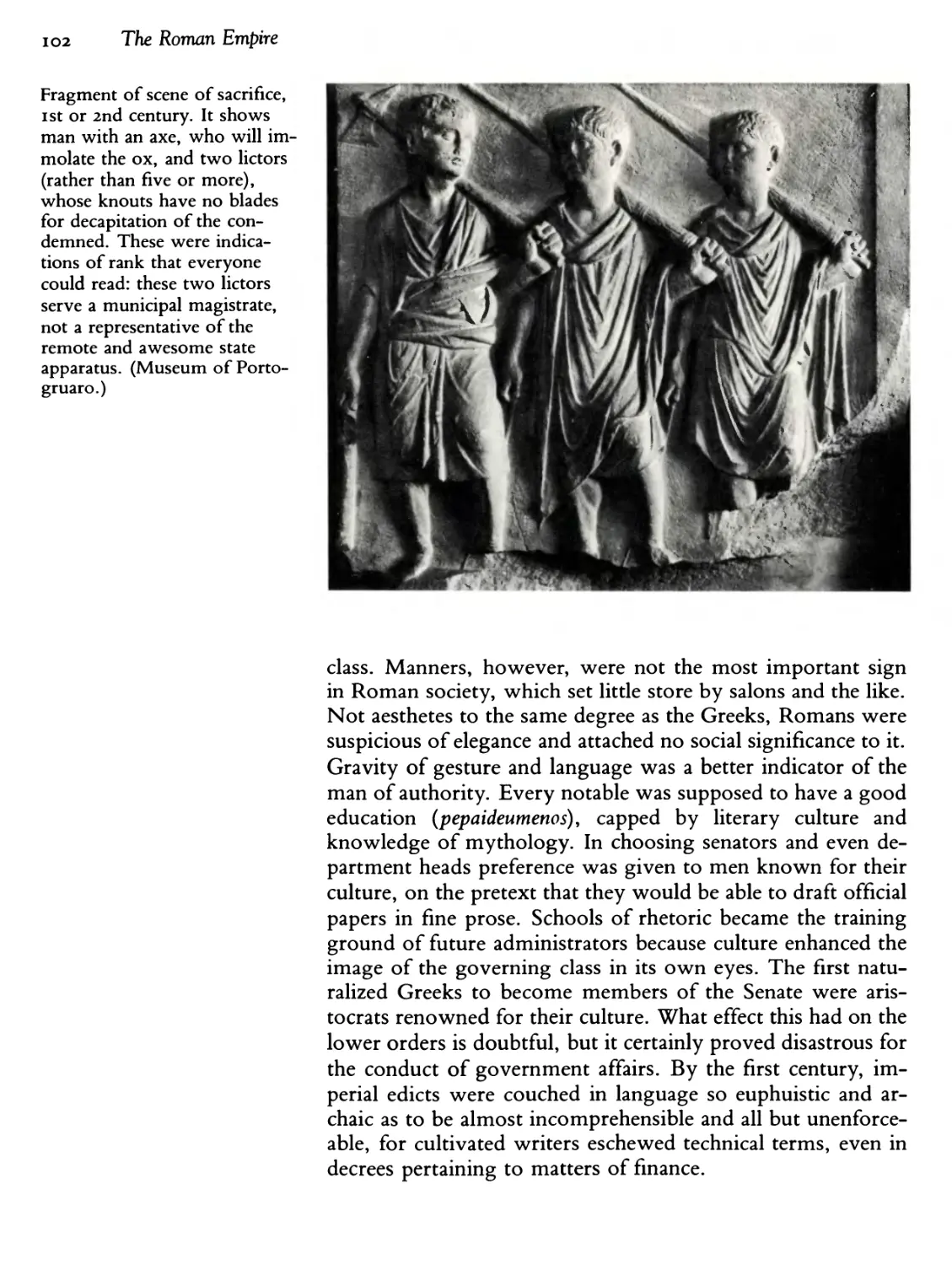





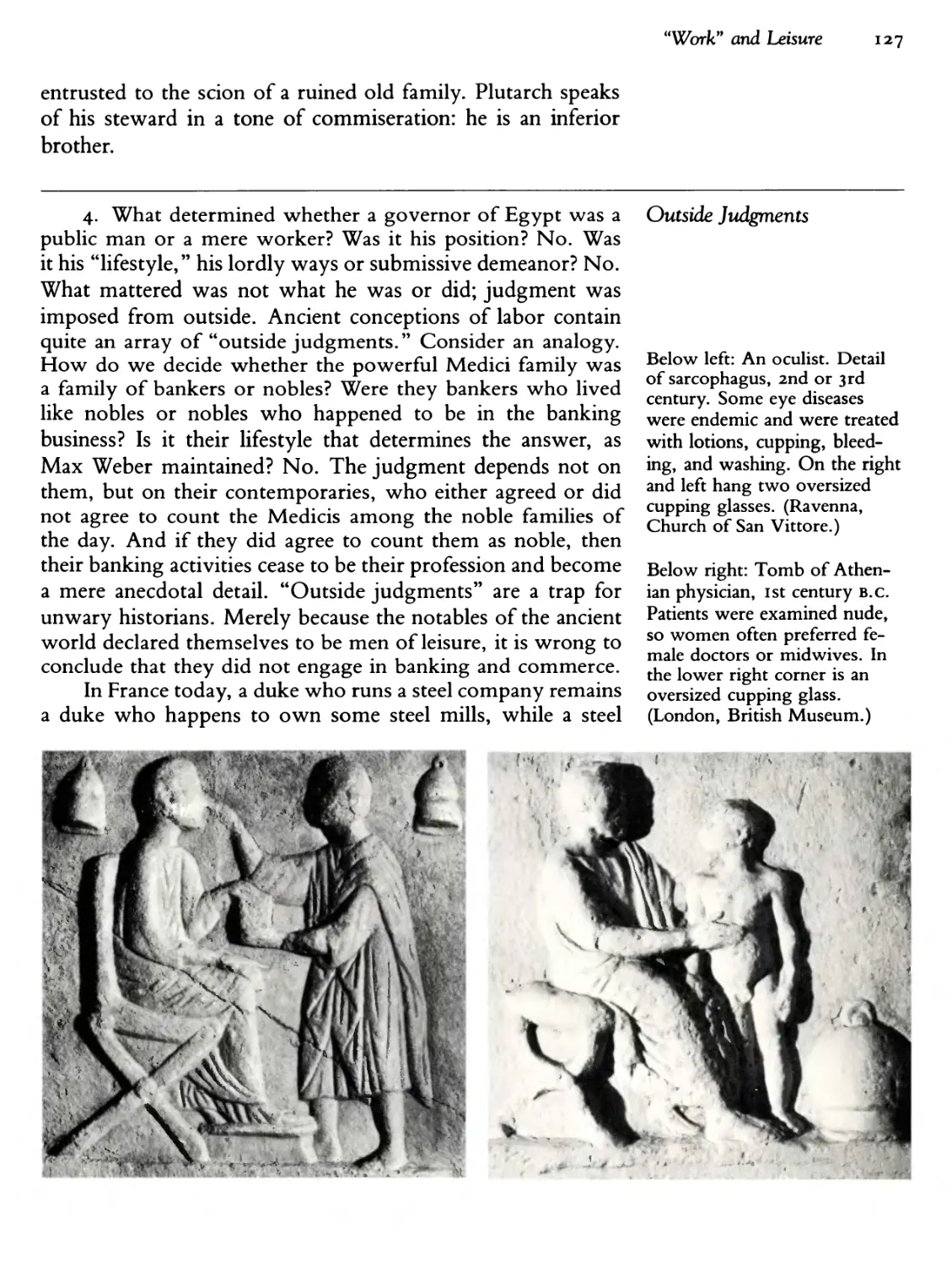
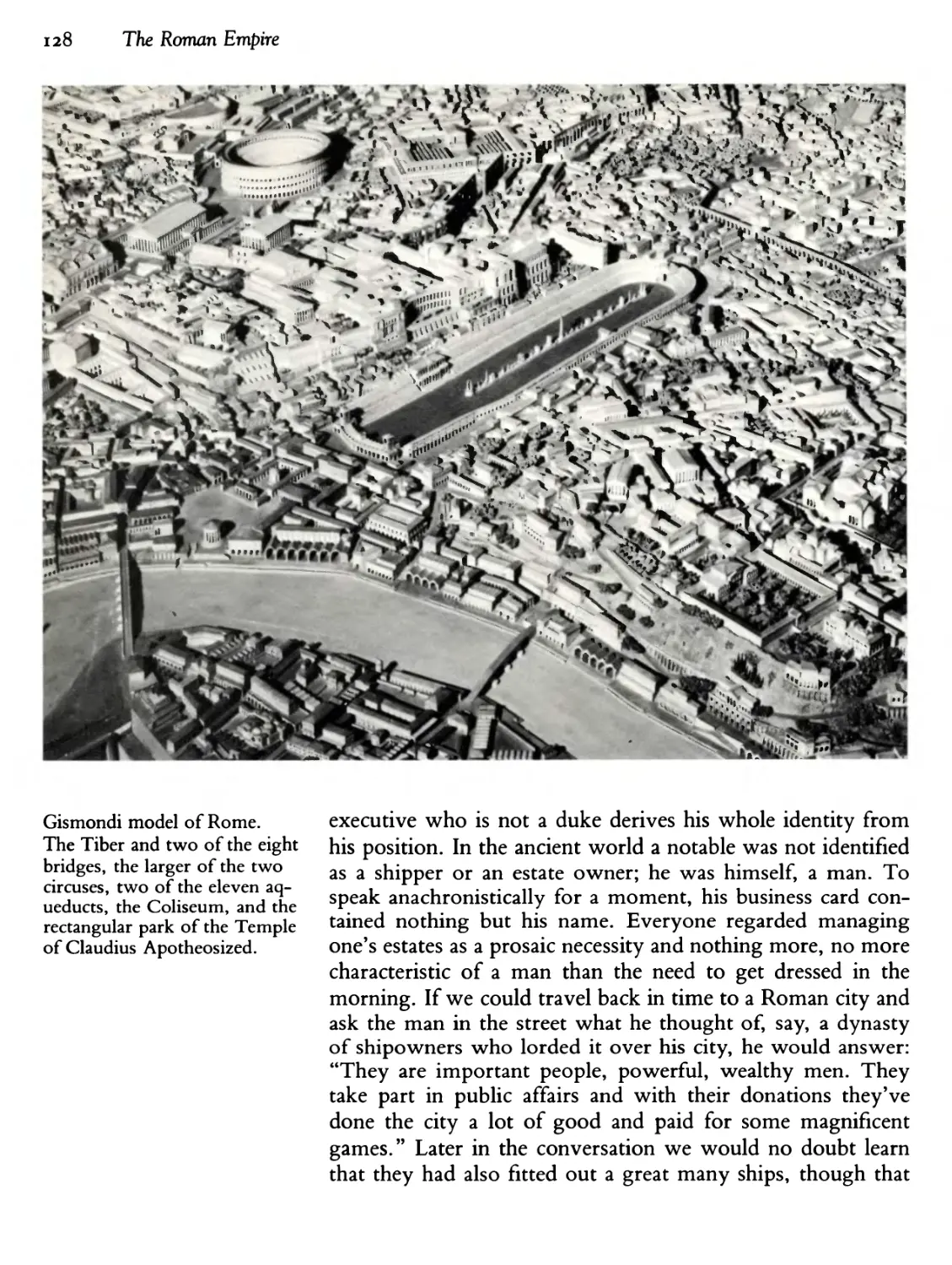
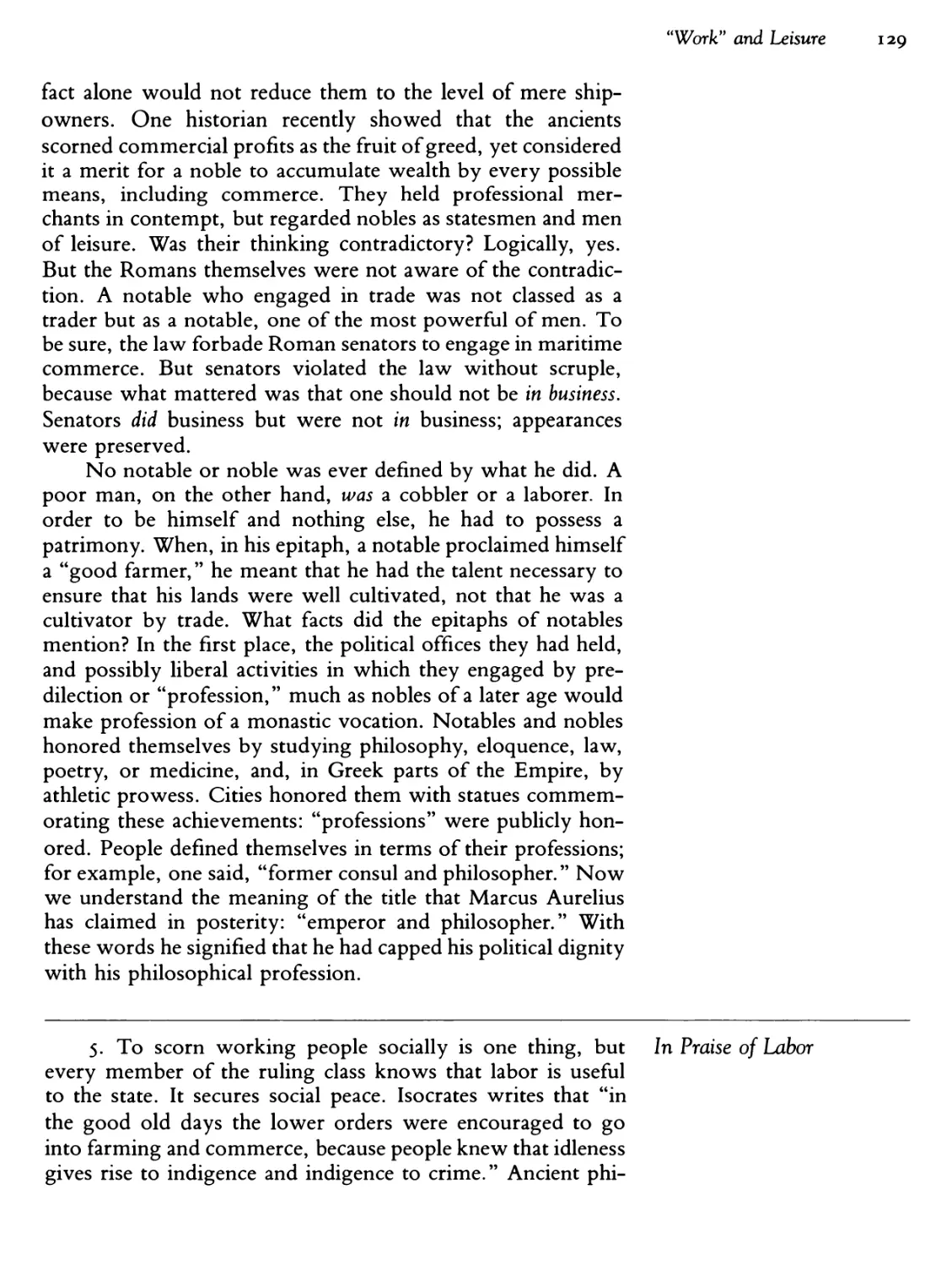

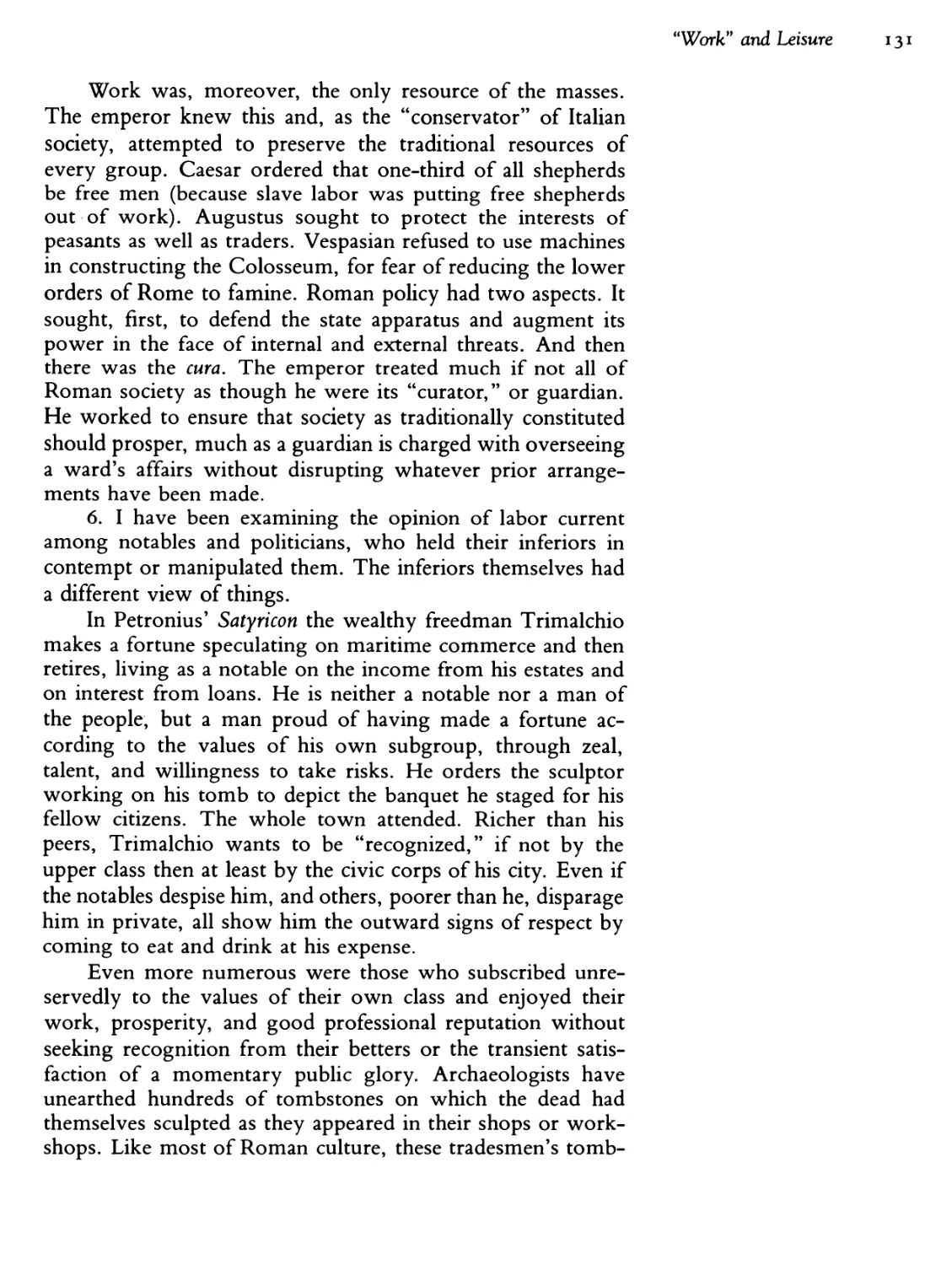

















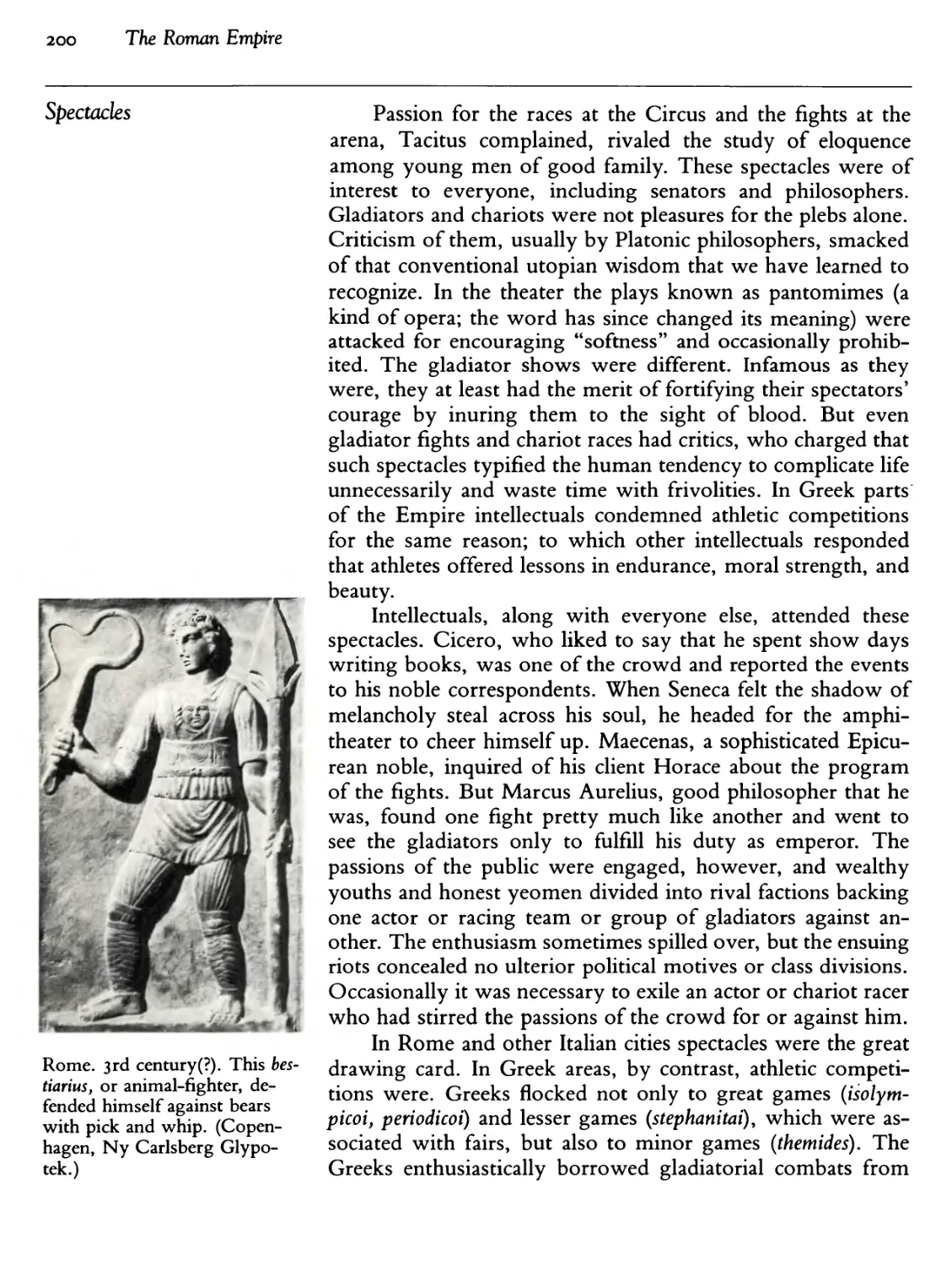


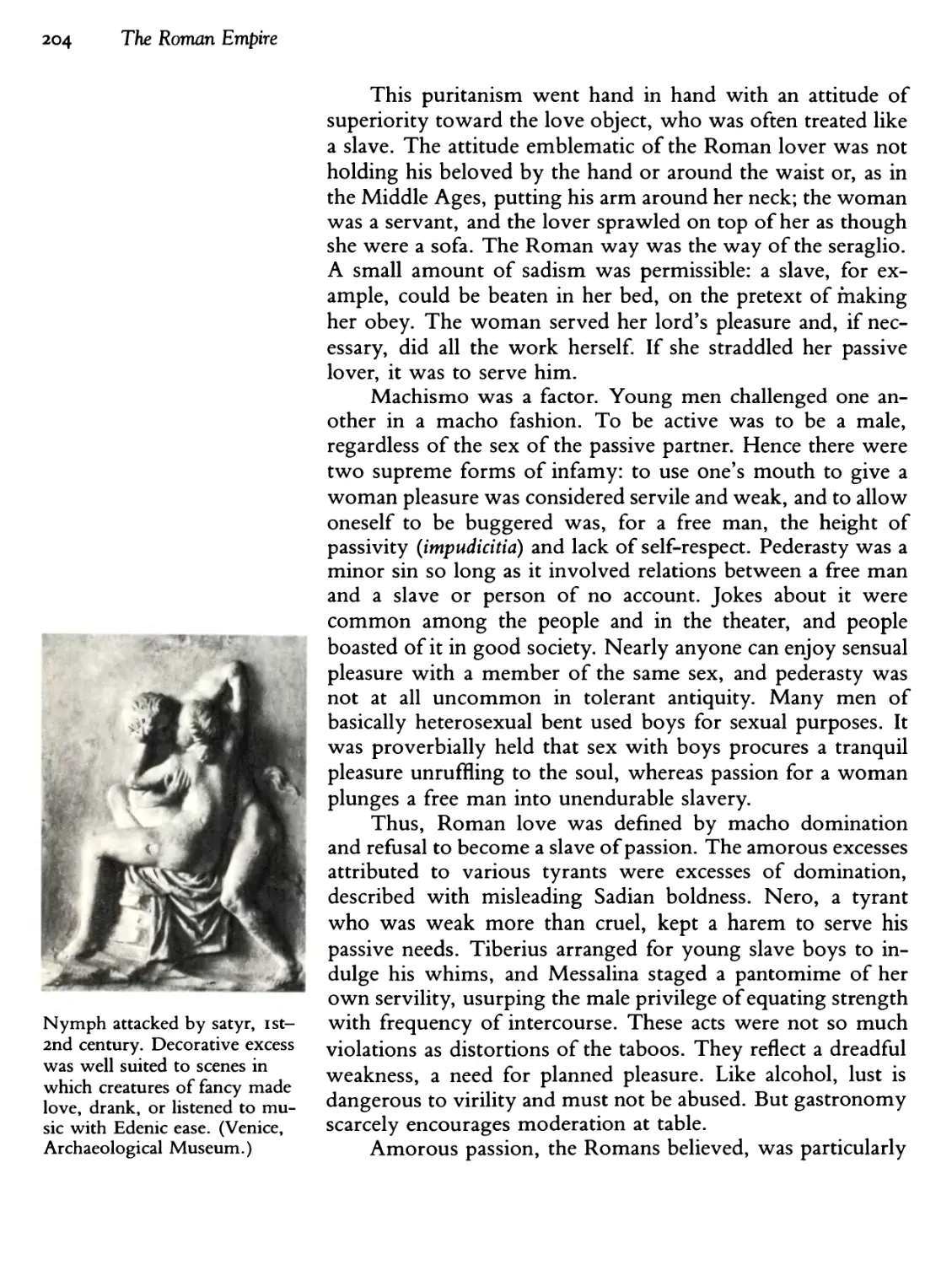

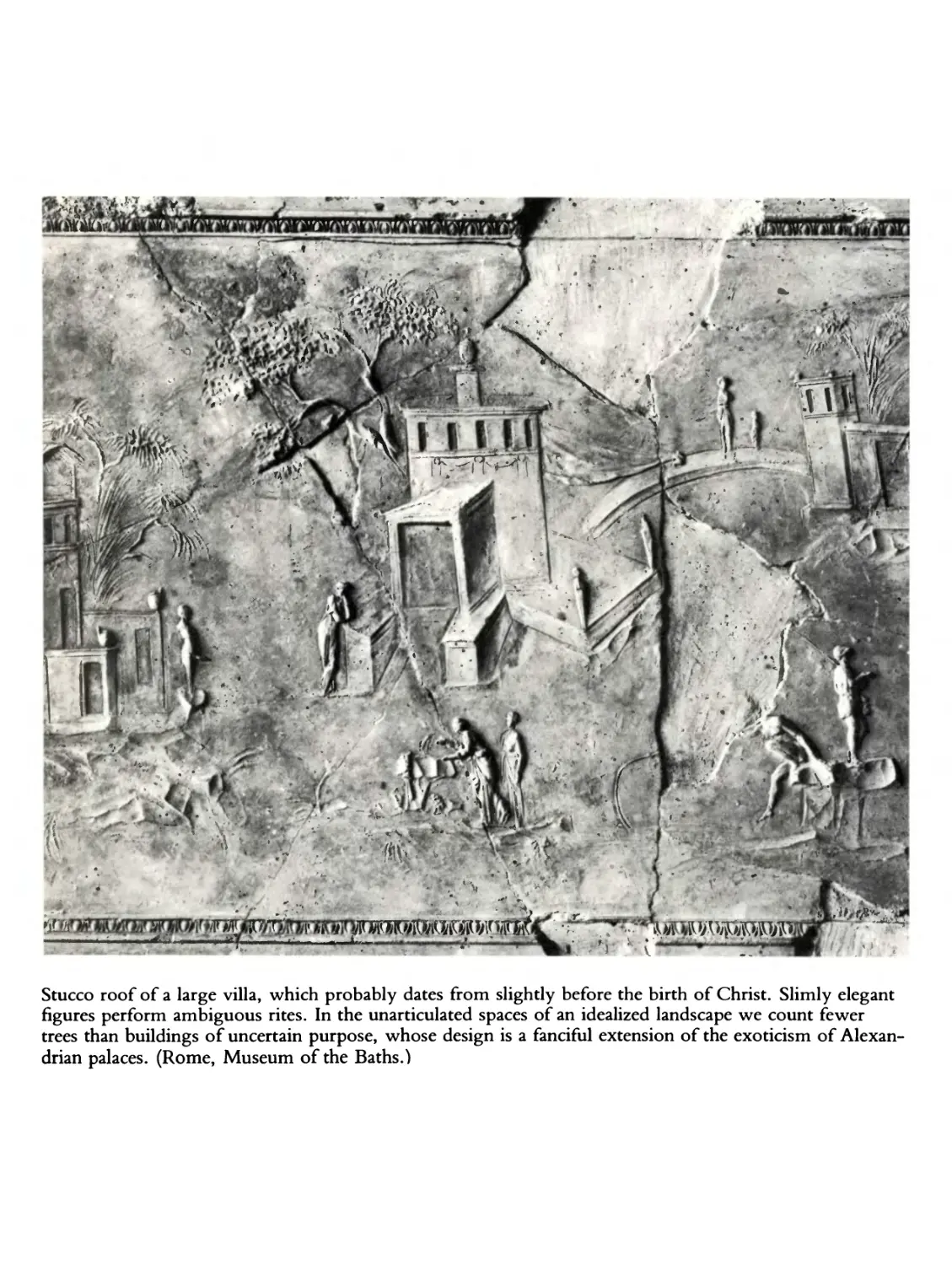






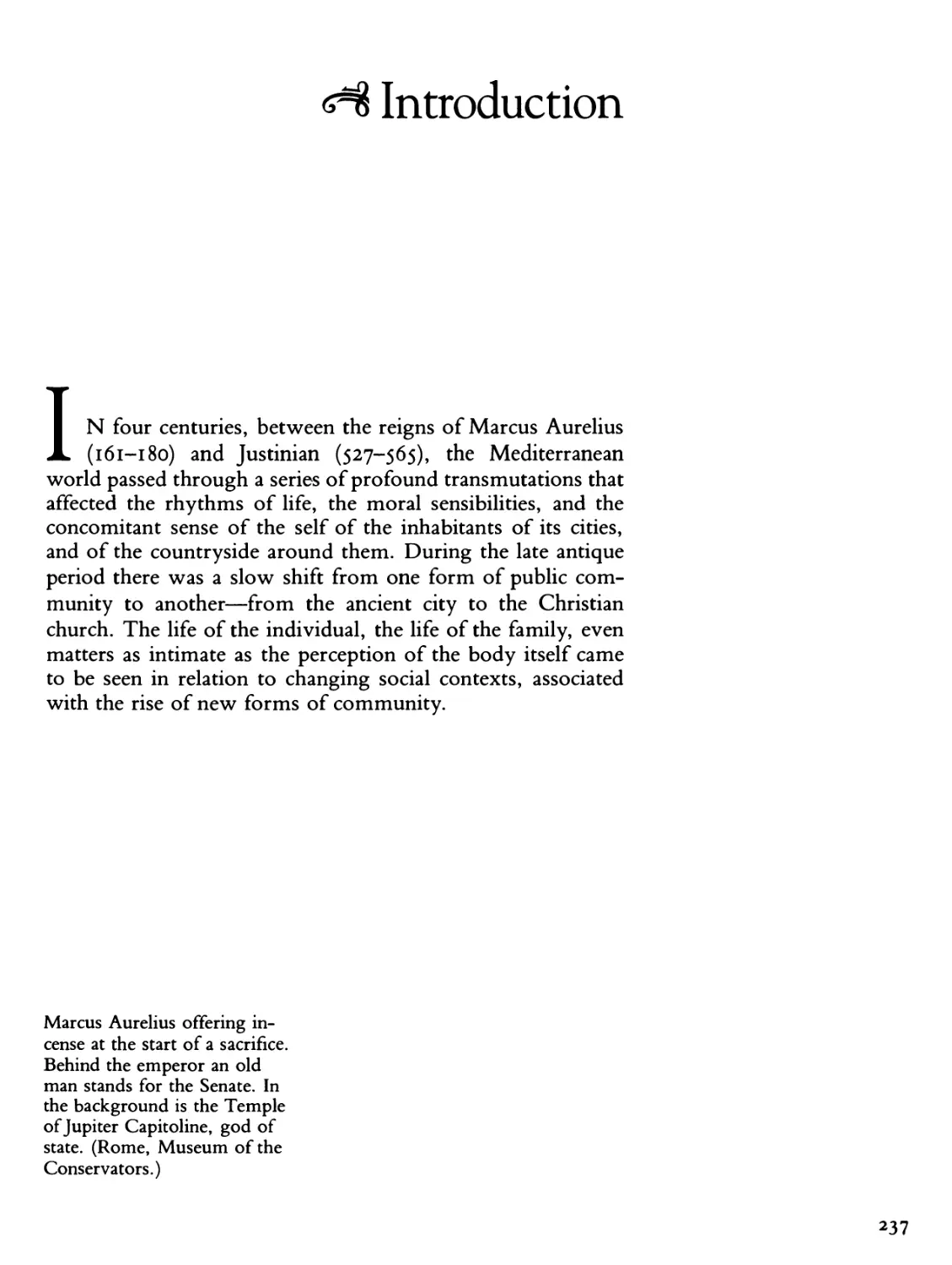

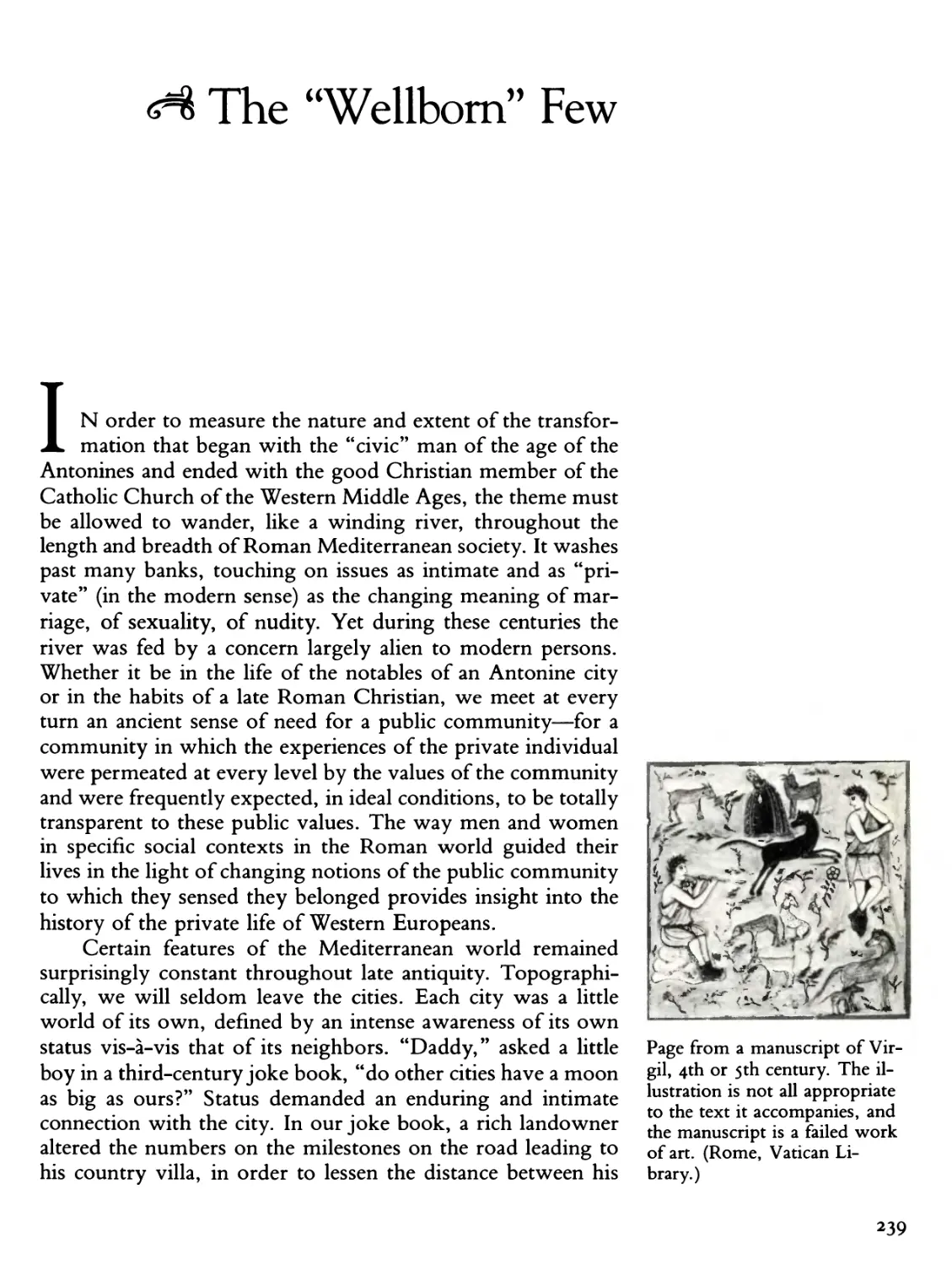
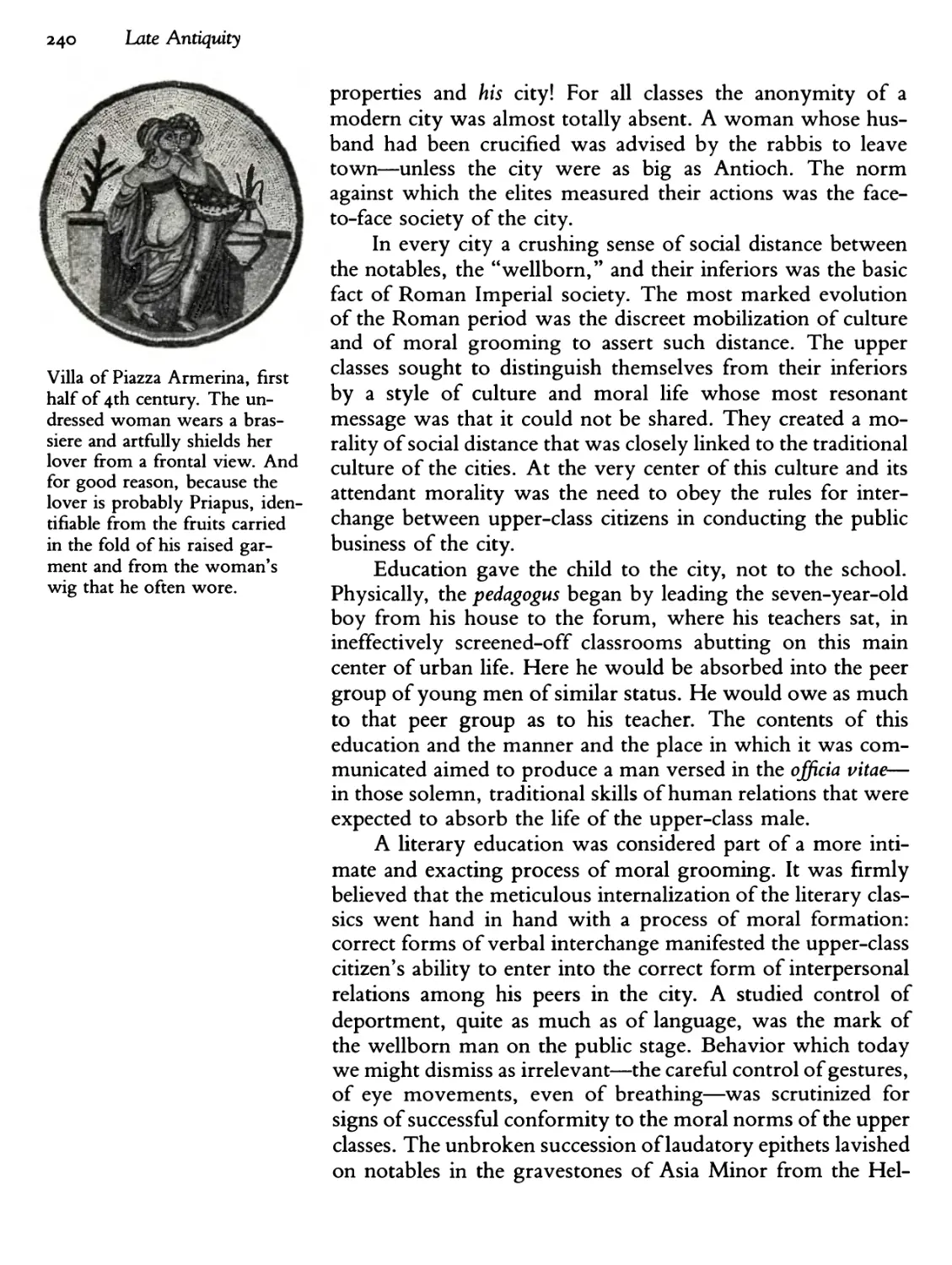


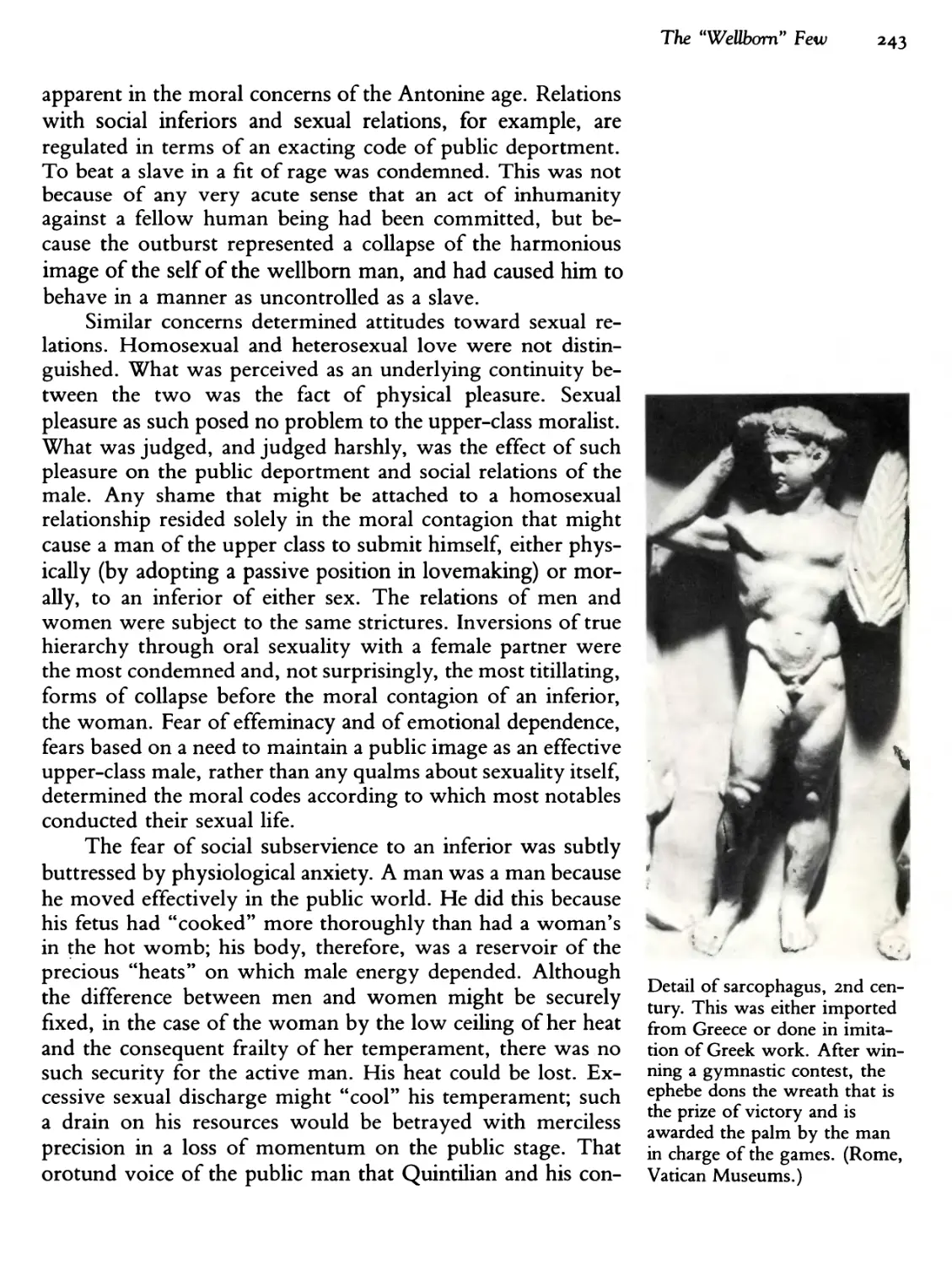























































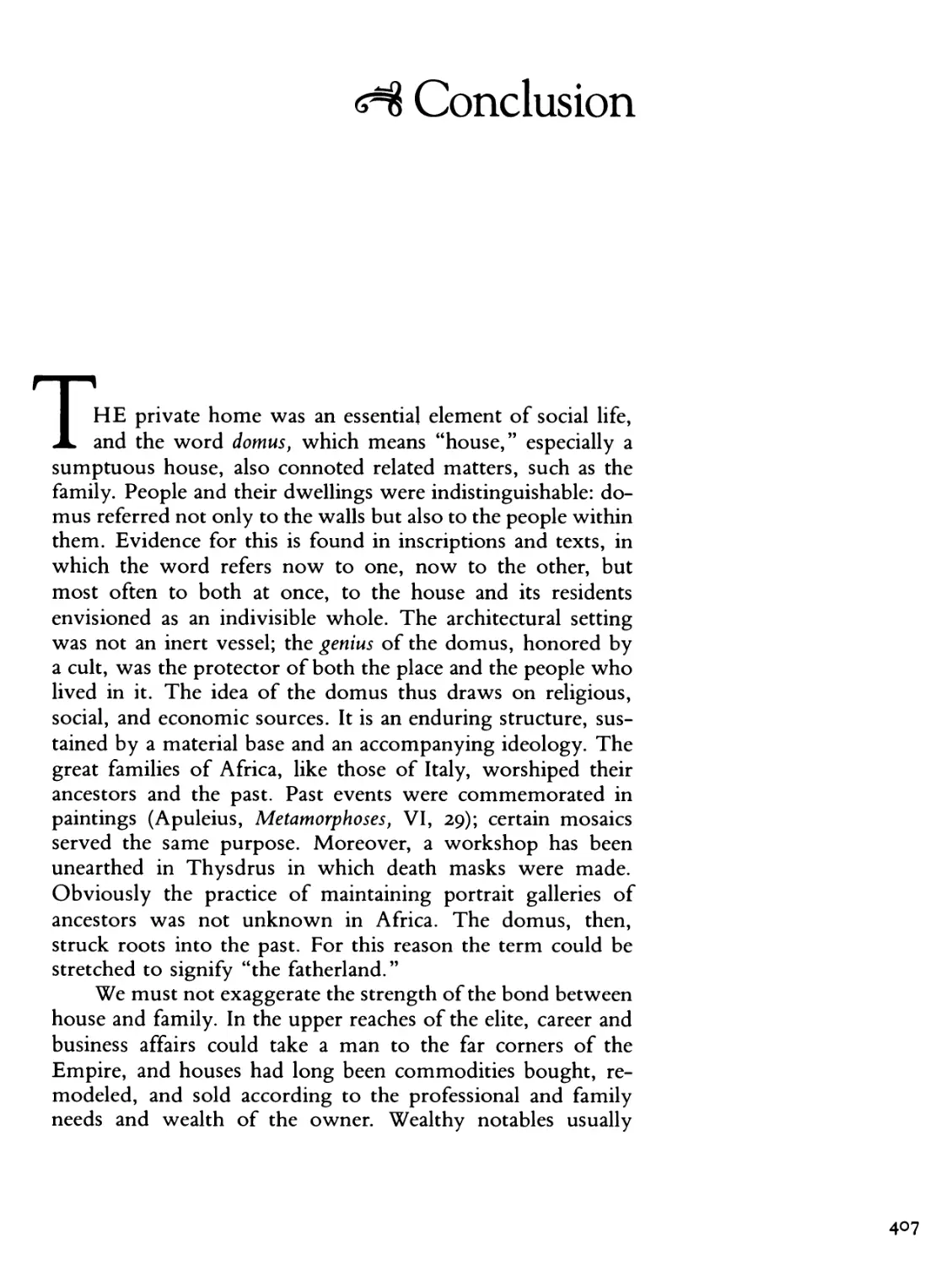























































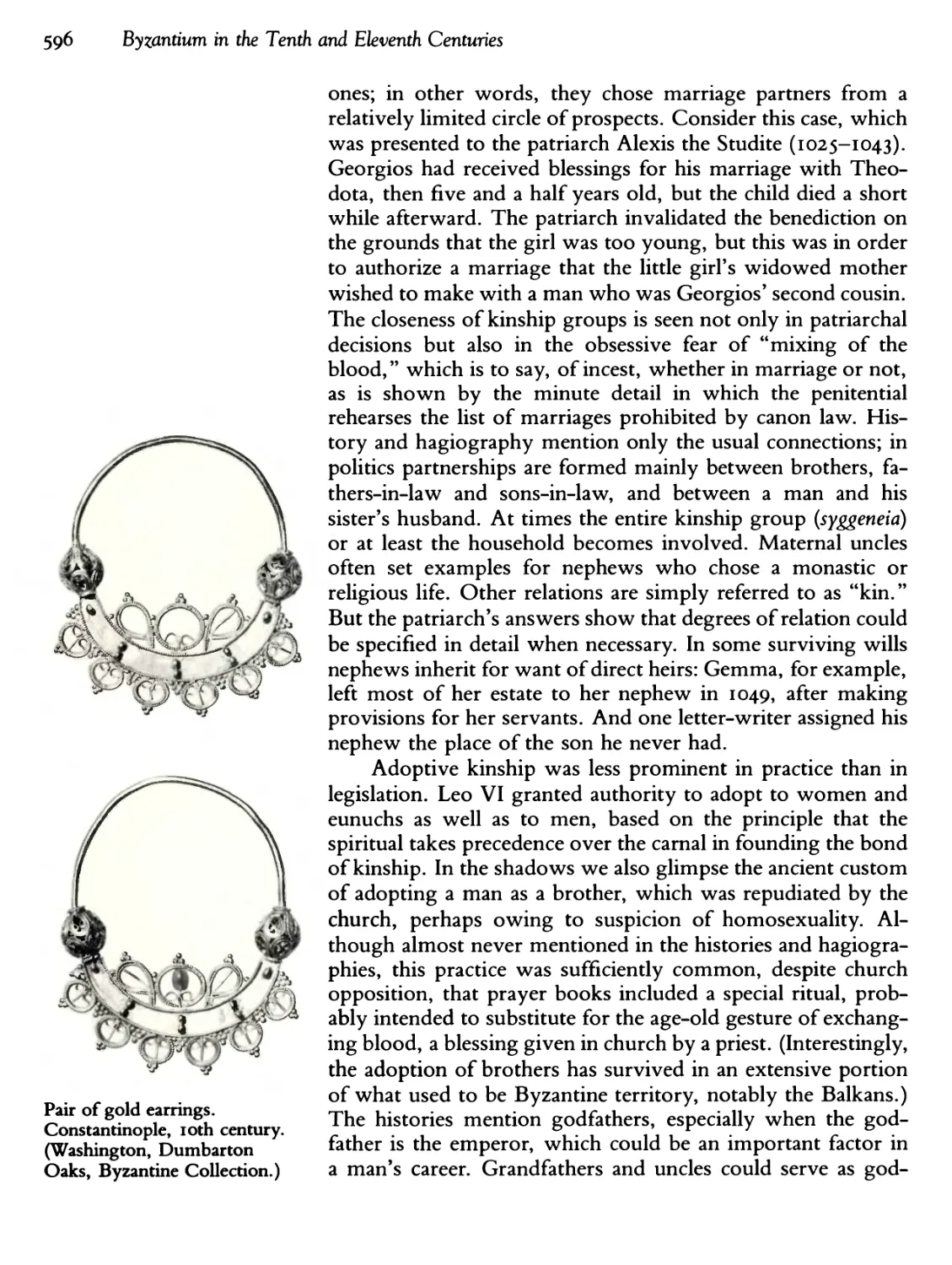

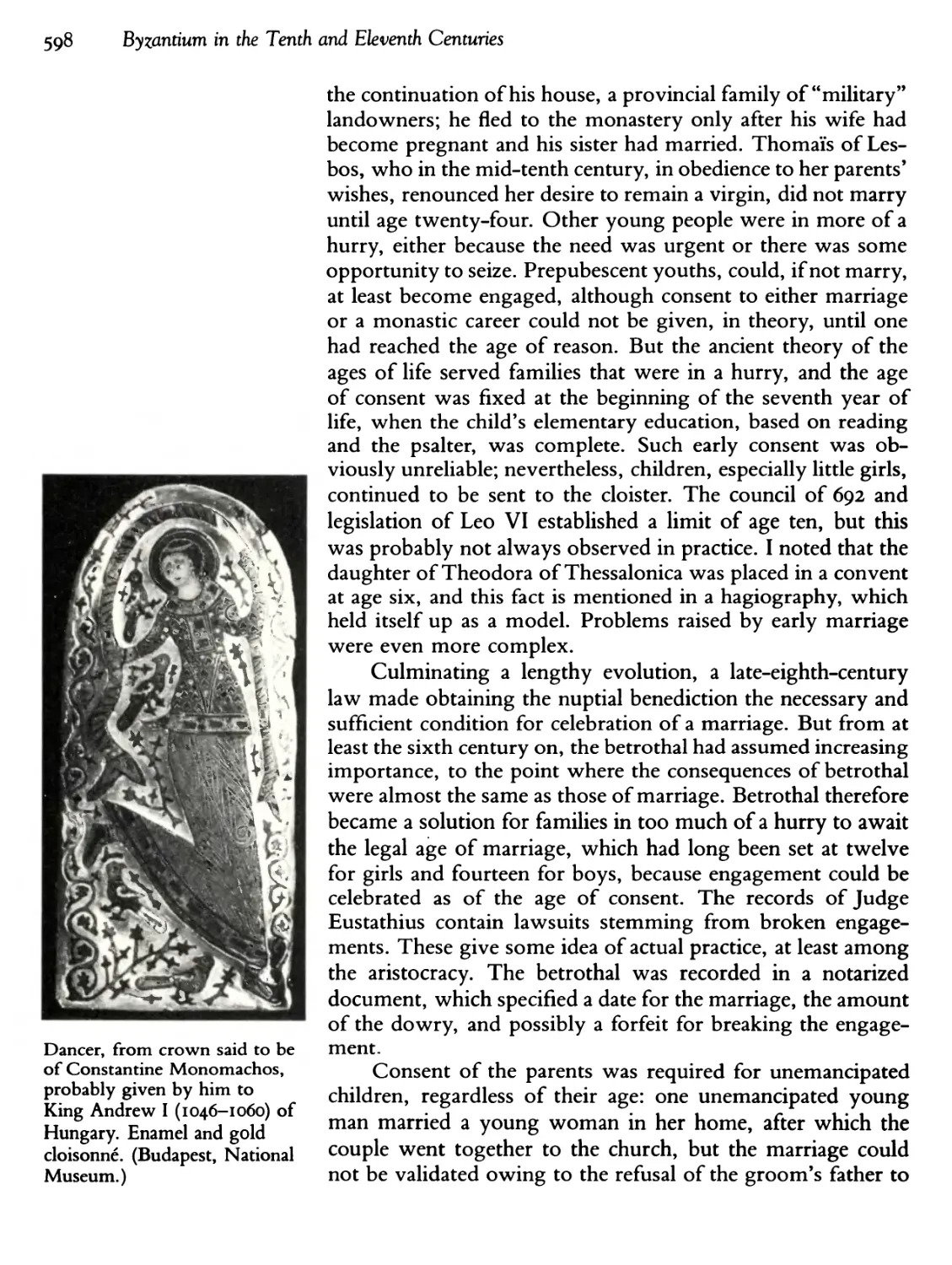
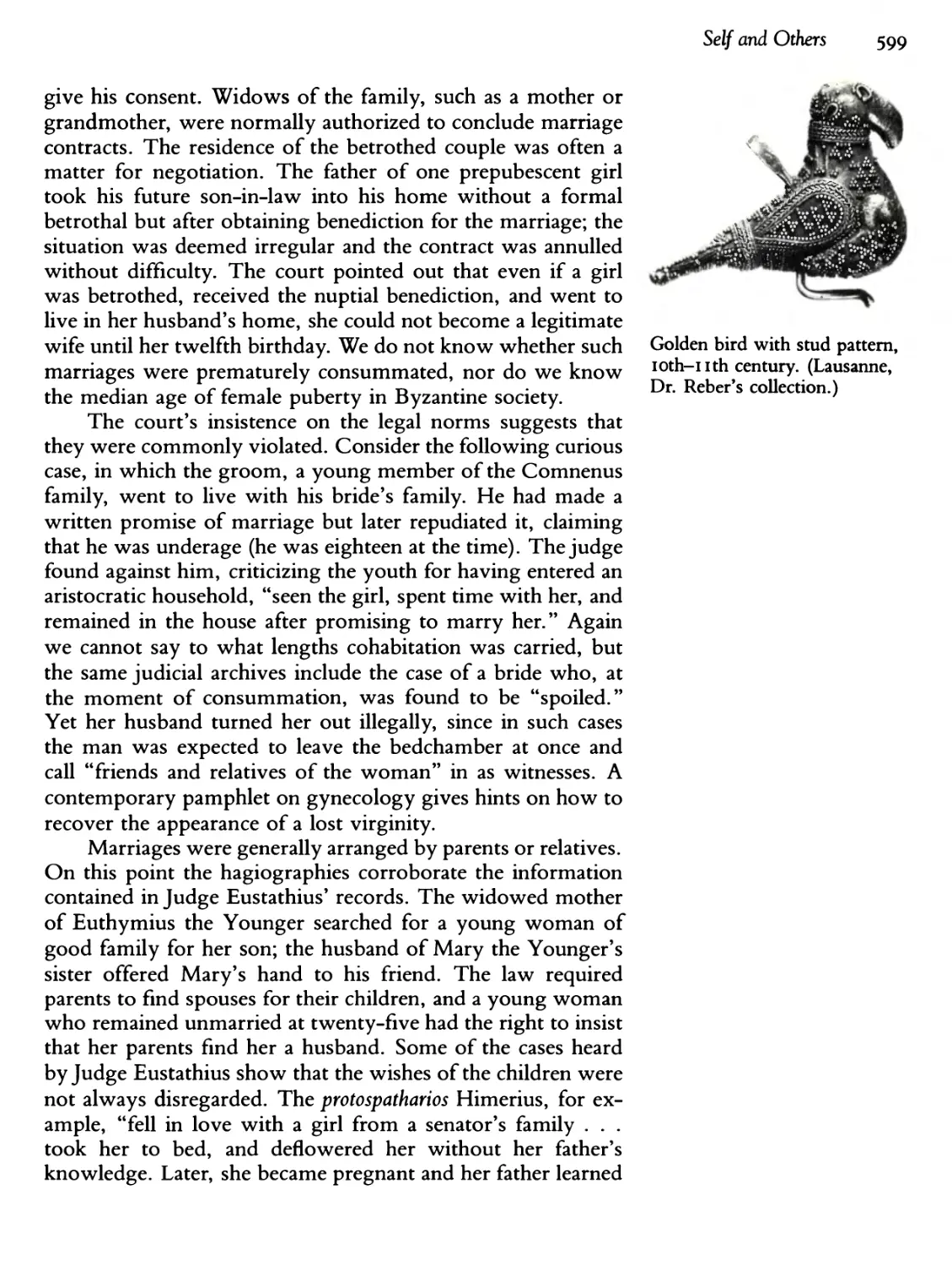
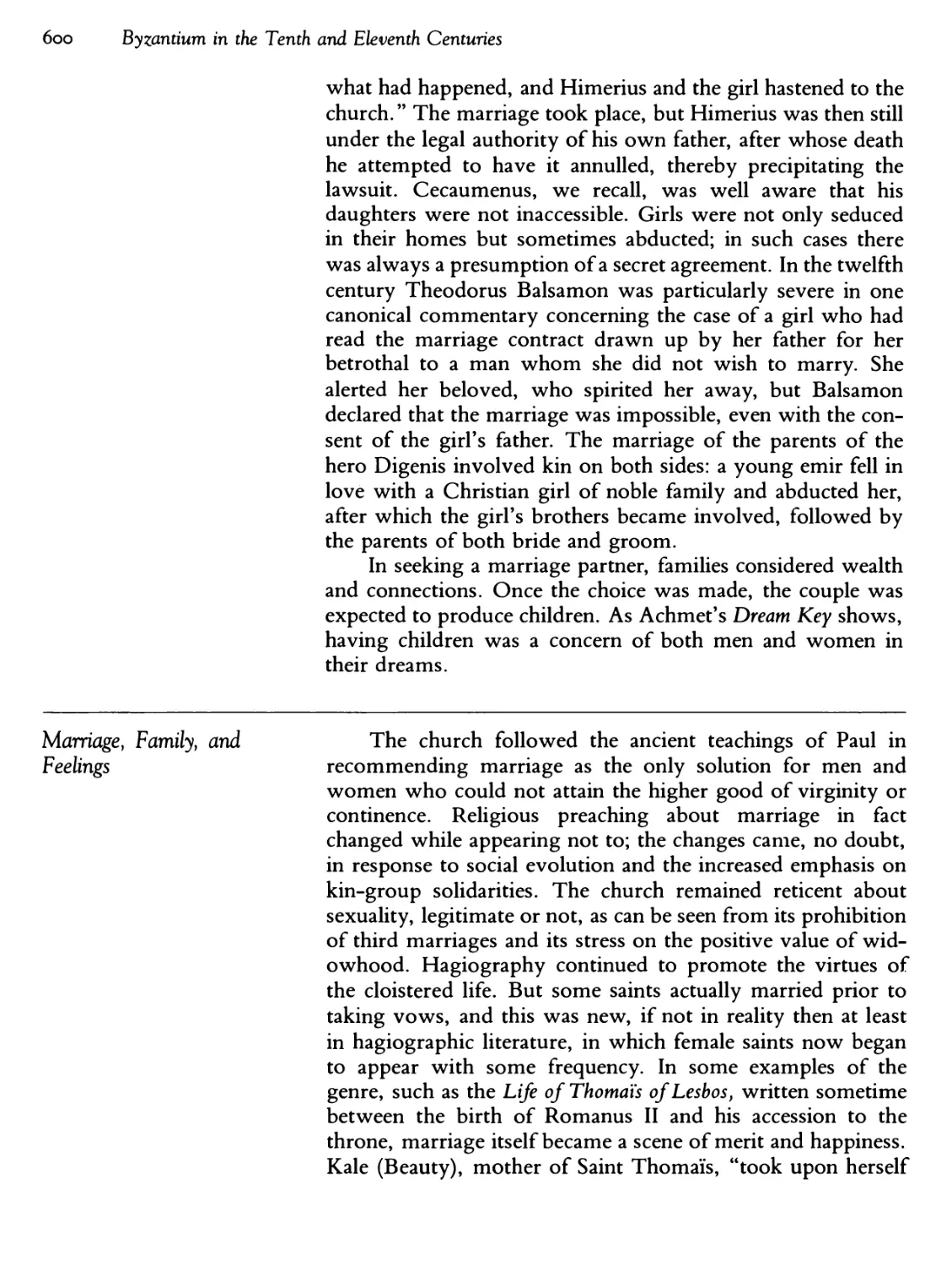






































Text
                    Philippe Aries and Georges Duby,
General Edi s
(c
-\
1
:&
\:
^ ~\
0
ro
Paw/V,
n a
a R me By
', Edi 'rtfciirCk)
ium
Translator

A HISTORY OF
PRIVATE LIFE
Philippe Aries and Georges Duby
General Editors
I • From Pagan Rome
to Byzantium

A HISTORY OF
PRIVATE LIFE
I • From Pagan Rome
to Byzantium
Paul Veyne, Editor
Arthur Goldhammer, Translator
The Belknap Press of
Harvard University Press
CAMBRIDGE, MASSACHUSETTS
AND LONDON, ENGLAND

Copyright © 1987 by the President and Fellows
of Harvard College
All rights reserved
Printed in the United States of America
Originally published as Histoire de la vie Privee, vol. 1,
De I 'Empire romain a Van mil, © Editions du Seuil, 1985.
BOMC offers recordings and compact discs, cassettes
and records. For information and catalog write to
BOMR, Camp Hill, PA 17012.
Library of Congress Cataloging-in-Publication Data
Histoire de la vie privee. English.
A history of private life.
Translation of: Histoire de la vie privee.
Bibliography: p.
Includes index.
Contents: v. 1. From pagan Rome to Byzantium /
Paul Veyne, editor.
1. Manners and customs—Collected works. 2. Family
—History—Collected works. 3. Civilization—History—
Collected works. 4. Europe—Social conditions—
Collected works. I. Aries, Philippe, II. Duby,
Georges. III. Title.
GT2400.H5713 1987 390'.009 86-18286

Contents
Foreword by Georges Duby
Introduction by Paul Veyne
The Roman Empire by Paul Veyne
Introduction
From Mother's Womb to Last Will and Testament
Marriage
Slavery
The Household and Its Freed Slaves
Where Public Life Was Private
"Work" and Leisure
Patrimony
Public Opinion and Utopia
Pleasures and Excesses
Tranquilizers
Late Antiquity by Peter Brown
Introduction
The "Wellborn" Few
Person and Group in Judaism and Early Christianity
Church and Leadership
The Challenge of the Desert
East and West: The New Marital Morality
Private Life and Domestic Architecture in Roman
Africa by Yvon Thebert
The Roman Home: Foreword by Paul Veyne
Some Theoretical Considerations
The Domestic Architecture of the Ruling Class
"Private" and "Public" Spaces: The Components of the Domus
How the Domus Worked
Conclusion
vii
I
5
6
9
33
5i
7i
95
117
139
161
183
207
235
237
239
253
269
287
297
313
315
319
325
353
383
407

The Early Middle Ages in the West
by Michel Rouche 411
Introduction by Paul Veyne 413
Historical Introduction 415
Private Life Conquers State and Society 419
Body and Heart 453
Violence and Death 485
Sacred and Secret 519
Conclusion 548
Byzantium in the Tenth and Eleventh Centuries
by Evelyne Patlagean 551
The Byzantine Empire 553
Private Space 567
Self and Others 591
The Inner Life 617
Private Belief 633
Conclusion 641
Notes 645
Bibliography 647
Acknowledgments 659
Index 661

Foreword to
A History of Private Life
Georges Duby
I HE IDEA of preparing a history of private life for a broad audience
JL came originally from Michel Winock. Philippe Aries took it up,
and it was he who initiated this undertaking. The work that we have
done, with him for a number of years and then, sadly mourning his
premature death, without him, is dedicated to the memory of this
generous historian, who pursued his fresh and penetrating insights
wherever they carried him. The boldness of his work is well-known:
he was the first to illuminate what had seemed impenetrable reaches of
modern history, opening new pathways for research and inviting other
pioneers to follow him in the investigation of childhood, family life,
and death, in seventeenth- and eighteenth-century Europe. That we
have been able to finish this work at all we owe to Aries's enthusiasm—
and to his boldness, wonderfully unfettered by academic routine.
Without these qualities of his we might have lost heart, but guided by his
judicious counsel, freely offered at planning meetings, at our
medievalists' colloquium at Senanque in September 1981, and at the final stop
on his scientific itinerary, a colloquium that he himself chaired in Berlin,
we were able to carry on.
Our project was fraught with peril. The ground we hoped to
explore was untouched. No one had sifted through or even identified
useful source materials, which at first glance seemed abundant but
scattered. We had to clear away the brush, stake our claim, and, like
archaeologists approaching a site known to contain riches too great to
be systematically explored, settle for excavating a few preliminary
trenches. We took our bearings without deluding ourselves into
thinking that the time was ripe for a synthetic overview. Obliged to feel our
way as we went, we decided from the outset that we would present
our readers with a program of research rather than a finished summary.
The five parts of this book ask many more questions than they answer.
We hope that they will arouse curiosity and encourage other researchers
to continue our work, to explore new ground, and to dig deep where
we have only scratched the surface.

viii Foreword to a History of Private Life
We faced another, less obvious but more troublesome problem.
We had decided that our research should cover all of Western history
and that it should emphasize the longue duree. To a period of more than
two millennia and to all of Europe, with its diversity of regional ways
and customs, we would therefore be applying a concept—that of
personal life—that had come into common use in certain parts of Europe
only quite recently, in the nineteenth century. How should we go about
writing the prehistory of such a concept? How should we define the
realities that it subsumed over the ages? We needed to circumscribe the
topic precisely in order to avoid wandering off into yet another
investigation of "daily life." When it came to discussing the history of
residential dwellings, for example, we hoped to avoid using bedrooms
and beds as a springboard for speculation about the history of
individualism, or worse, of intimacy.
We started from the obvious fact that at all times and in all places
a clear, commonsensical distinction has been made between the public—
that which is open to the community and subject to the authority of
its magistrates—and the private. In other words, a clearly defined realm
is set aside for that part of existence for which every language has a
word equivalent to "private," a zone of immunity to which we may
fall back or retreat, a place where we may set aside arms and armor
needed in the public place, relax, take our ease, and lie about unshielded
by the ostentatious carapace worn for protection in the outside world.
This is the place where the family thrives, the realm of domesticity; it
is also a realm of secrecy. The private realm contains our most precious
possessions, which belong only to ourselves, which concern nobody
else, and which may not be divulged or shown because they are so at
odds with those appearances that honor demands be kept up in public.
An indoor business, a matter of events that take place behind closed
doors and under lock and key, private life might seem to be walled off
from prying eyes. But, on either side of that "wall," whose integrity
the bourgeois of the nineteenth century so vigorously defended, battles
constantly rage. Private individuals must use what power they have to
fend off the encroachment of the public authorities on their domain.
And inside that domain the desire for independence must be contained
within bounds, for every private dwelling shelters a group, a complex
social organism, within which inequalities and contradictions present
in the larger society are brought to a head. Here the clash between male
and female power is fiercer than it is outside, the old and the young
are locked in struggle, and overbearing masters must cope with
impudent servants.
Since the Middle Ages, the tendency of our cultural development
has been to sharpen this conflict. As the state grew stronger, its
intrusions became more aggressive and invasive, while the launching of new

Foreword to a History of Private Life
economic initiatives, the declining importance of collective rituals, and
the internalization of religious attitudes tended to promote and liberate
the individual and increase the importance of other social centers outside
the family and the home, making private life more diverse. Starting in
cities and towns, the private realm came more and more to be divided
into three distinct parts: the home, to which feminine existence
remained confined; private places of business, such as the workshop, the
commercial shop, the office, and the factory; and places for private
gathering and relaxation, such as the cafe or club.
The aim of the volumes in this series is to make visible the changes,
some rapid, others quite slow, that affected the nature and the idea of
private life. For the very quality of private life was subject to constant
transformation. At each stage, "some of its features originated in the
very distant past," as Philippe Aries noted in one of the working
documents he left us. Other features, "of more recent origin, are
destined to evolve, either by undergoing further development or by having
their evolution cut short or by changing to the point of becoming
unrecognizable." Once made aware of the inextricable connections
between continuity and innovation, the reader may feel less disoriented
by ongoing changes, whose accelerating pace may at times seem
troubling. Space for private sociability outside the home and the workplace,
for example, may be disappearing. And the distinction between
masculine and feminine, which history shows to have been strongly rooted
in the distinction between the outside and the inside, the public and the
private, is rapidly becoming a thing of the past. There is, I think, an
urgent need to protect the essence of individuality from headlong
technological progress. For unless we are careful, individual men and
women may soon be reduced to little more than numbers in some
immense and terrifying data bank.

"Si
I
Paris
Trier
Mainz
\
Orleans
Atlantic Ocean
0?
Bordeaux
• Lugenfeld
Saint GalU
$
O;
ar*ube
\Ravcnna
o<
Wo #/vCr
Ma
iaZus
Uivc
Floret
%^-:
Romc^
*Ostia
•Cordoba
o
cj
bmpcn
Palefnic^
Mediterranean
iSea

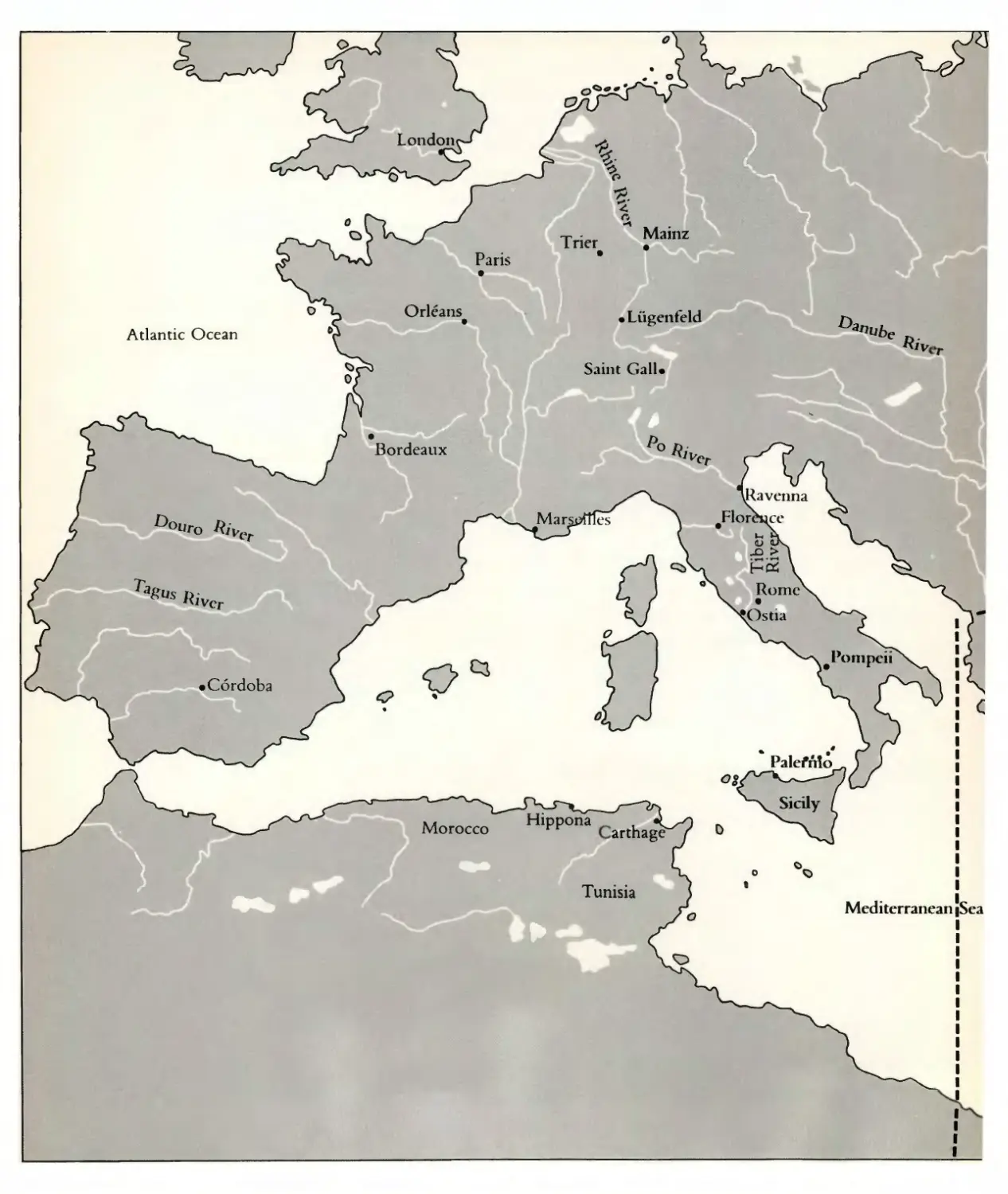
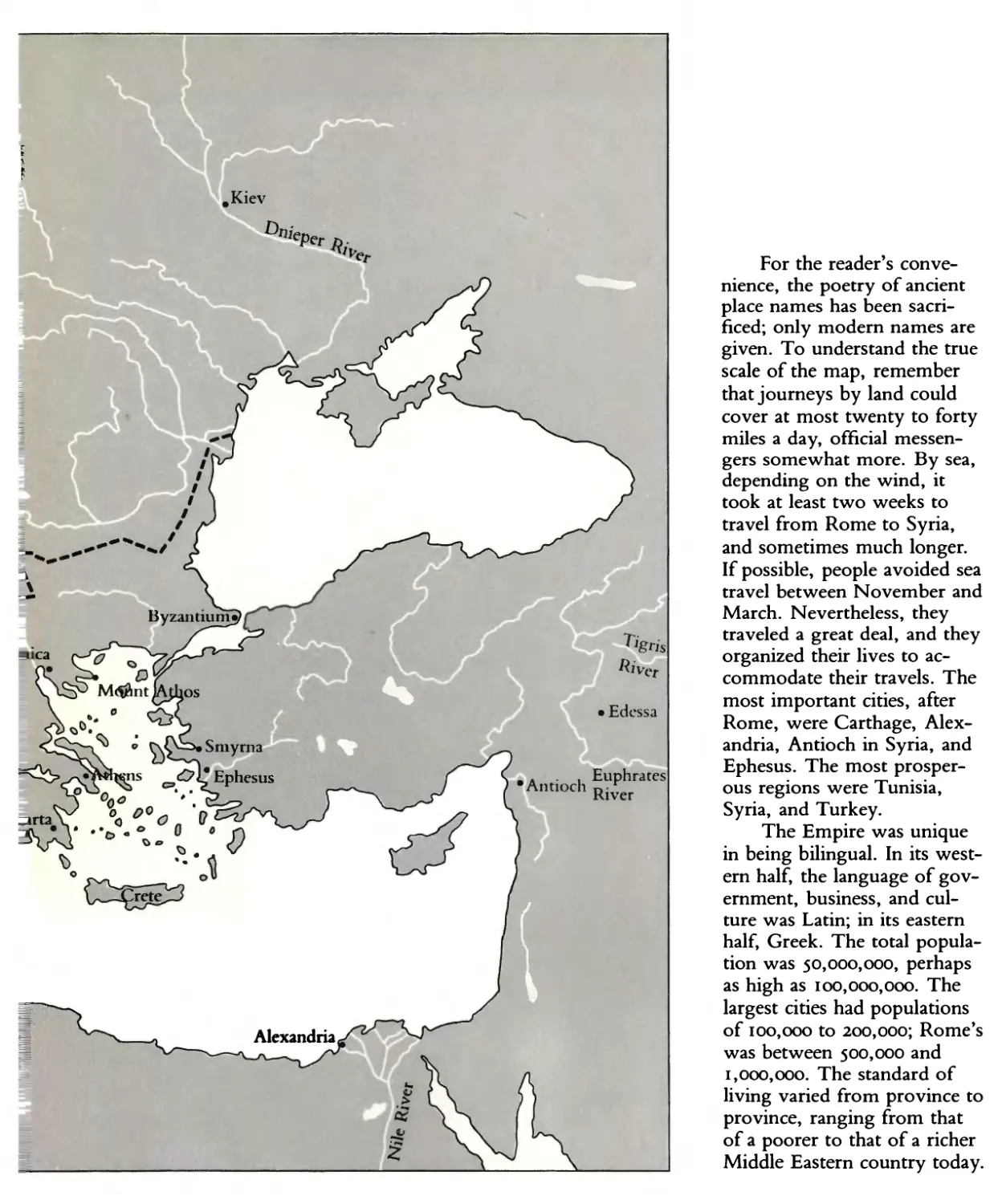
For the reader's
convenience, the poetry of ancient
place names has been
sacrificed; only modern names are
given. To understand the true
scale of the map, remember
that journeys by land could
cover at most twenty to forty
miles a day, official
messengers somewhat more. By sea,
depending on the wind, it
took at least two weeks to
travel from Rome to Syria,
and sometimes much longer.
If possible, people avoided sea
travel between November and
March. Nevertheless, they
traveled a great deal, and they
organized their lives to
accommodate their travels. The
most important cities, after
Rome, were Carthage,
Alexandria, Antioch in Syria, and
Ephesus. The most
prosperous regions were Tunisia,
Syria, and Turkey.
The Empire was unique
in being bilingual. In its
western half, the language of
government, business, and
culture was Latin; in its eastern
half, Greek. The total
population was 50,000,000, perhaps
as high as 100,000,000. The
largest cities had populations
of 100,000 to 200,000; Rome's
was between 500,000 and
1,000,000. The standard of
living varied from province to
province, ranging from that
of a poorer to that of a richer
Middle Eastern country today.

A HISTORY OF
PRIVATE LIFE
From Pagan Rome
to Byzantium

Introduction
Paul Veyne
FROM Caesar and Augustus to Charlemagne and even the accession
of the Comnenus dynasty in Constantinople, this book spans eight
and a half centuries of private life. There are, however, major gaps in
what is covered—deliberate gaps. An exhaustive inventory would have
held little appeal for the cultivated reader. Too many centuries are
known to us from sources so impoverished as to be lifeless. The fabric
of this millennium is full of holes. It is an oversized and tattered
greatcoat, which we felt would prove more serviceable if we cut it up
into pieces of sensible size with some life still left in them.
One piece covers the Roman Empire in pagan times. The story is
told in sufficient detail to bring out the dramatic contrast with Chris-
tianization. We are grateful to that fine historian Peter Brown for having
kindly consented to pour the acid that is Christianity on our Roman
reagent. What emerges is a diptych that tells a dramatic story: that of
the transition from "civic man" to "inward man."
Another segment deals with the physical setting of private life. We
look at housing in both pagan and Christian antiquity in great detail,
not so much at its material aspects as at its functions, its art, and its
life. We feel that this part of our work breaks new ground and hope
that readers will agree that the considerable amount of space we have
devoted to it is justified. We also felt the need to satisfy the public's
widespread interest in archaeology. It is common nowadays to see large
numbers of tourists, guidebooks in hand, flocking every summer to the
sites of excavations. But guidebooks do not tell all: they cannot teach
us how to see, how to interpret scant remains, how to rebuild in our
minds the walls, floors, and roofs of a crumbled dwelling, or how to
imagine the people who once lived there, to think about what they did
and how they lived, whether in isolation or intimacy.
The last two sections cover the early Middle Ages in the West and
in the Byzantine East. In the fifth century A.D., the Roman Empire lost
its western provinces, from which various barbarian peoples carved
their kingdoms. Reduced to its eastern half, the Roman Empire
endured. Byzantine civilization perpetuated Roman civilization, which
was gradually transformed by the passage of time. Two portraits, in
the style of the "new history," depict the contrast between life in the

2 Introduction
Merovingian and Carolingian West and life in the Byzantine Empire
under the Macedonian dynasty.
Given our avowed aims, the reader has every right to ask two
questions: Why begin with the Romans? Why not the Greeks?
Why the Romans? Because their civilization is supposed to be the
basis of our own? I am not convinced of that: Christianity, technology,
and the rights of man are far more important than anything the Romans
have left us. Nor am I quite sure what purpose the notion of a "basis
of civilization" might serve, except to justify certain opinions about
politics or pedagogy. In any case, historians have better things to do
than to perpetuate the genealogical fantasies of parvenus. History is a
journey into otherness. Surely it has as much right to help us overcome
our limitations as to make us feel at home with them. The Romans
were very different from us—no less exotic than the Indians of North
America or the Japanese. That is one reason for beginning with them:
to bring out the contrast, not to sketch the future of Western Europe
in embryo. The Roman "family," to take just one example, has little
in common with its legendary image or with what we would call a
family.
Well, then, why not the Greeks? Because the Greeks are in Rome,
are the essence of Rome. The Roman Empire is Hellenistic civilization
brutally manhandled by a state apparatus of Italian origin. The
civilization, culture, literature, art, and even religion of Rome came almost
entirely from the Greeks, over a half-millennium of acculturation. From
its inception, Rome, a powerful Etruscan city, was no less Hellenized
than the other cities of Etruria. If the upper reaches of the state
apparatus, the Emperor and the Senate, remained largely untouched by
Hellenism (such was the Roman will to power), the second institutional
level, that of municipal life, was entirely Greek. (The Roman Empire
was like a body whose cells were thousands of autonomous cities.) Life
in a city in the Latin West in the second century B.C. was identical to
life in a city in the eastern half of the Empire. And for the most part it
was in this municipal setting, completely Hellenized, that private life
unfolded.
At the time our story begins, a universal civilization (universal for
that time, at any rate) spanned the territory from Gibraltar to the Indus:
Hellenistic civilization. The Romans, a marginal people managed to
conquer this territory and complete their own Hellenization. Their
purpose was to share in a civilization that they experienced not as alien
or Greek but as civilization itself, the Greeks being merely the first to

Introduction 3
possess it. The Romans were determined not to leave a monopoly of
that civilization to the Greeks. Rome adopted as its own the culture of
another nation, Greece. The will to power of the Roman rulers was so
great that they had no fear of "losing their national identity." Thus,
this volume begins by describing private life in the Empire that is called
Roman but might just as well be called Hellenic. Such is the basis of
our history: an old, abolished empire.

f
. • * _*
1,1 ^/
' * w it* ~
* *+ •
* -■ ■..- . V »
*.
"% 'V
* >
i • "--> r ..-^' <- ** ^ "..-
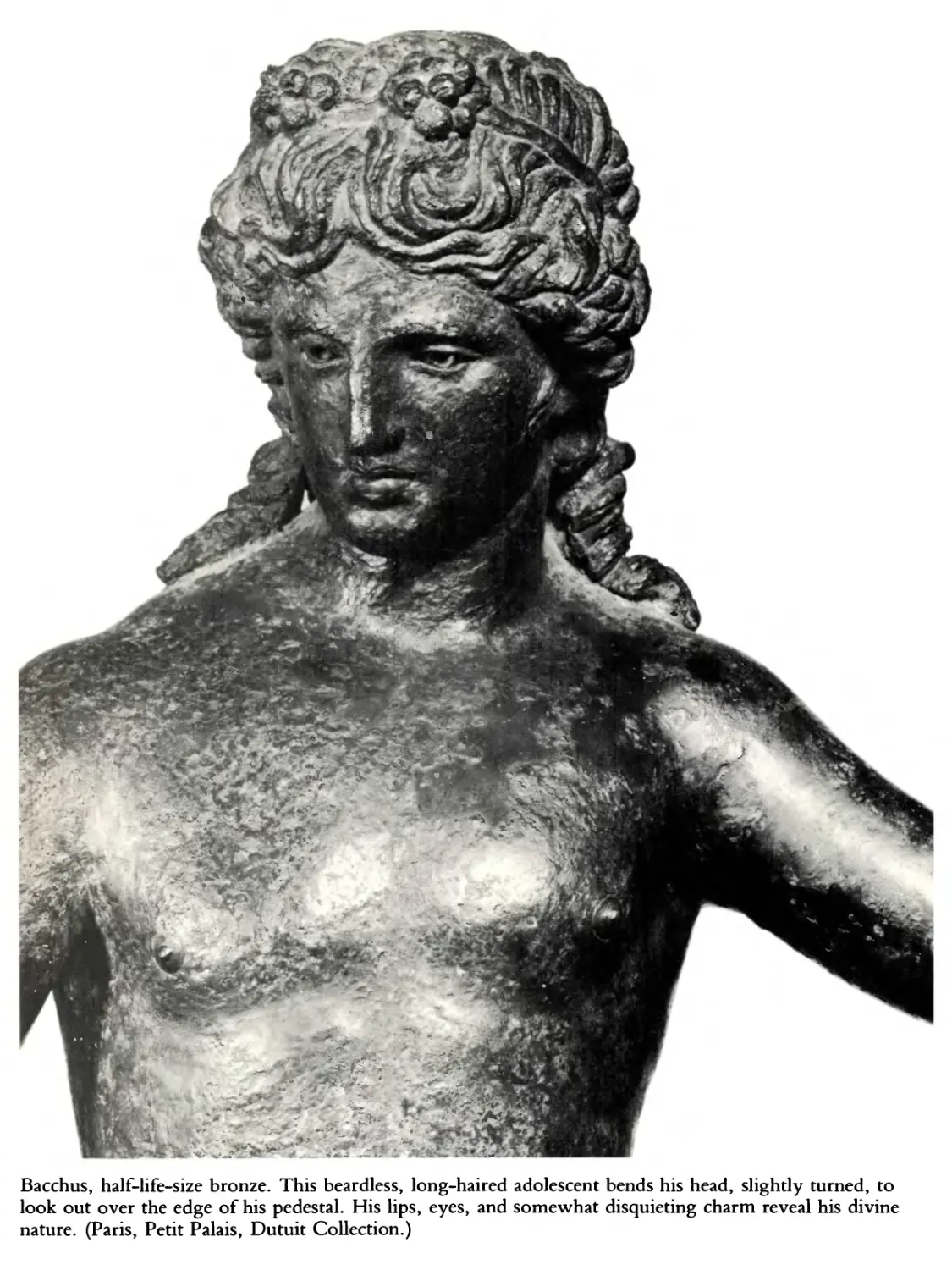
Bacchus, half-life-size bronze. This beardless, long-haired adolescent bends his head, slightly turned, to
look out over the edge of his pedestal. His lips, eyes, and somewhat disquieting charm reveal his divine
nature. (Paris, Petit Palais, Dutuit Collection.)

The Roman Empire
Paul Veyne

<rNS Introduction
Wi
\t\\
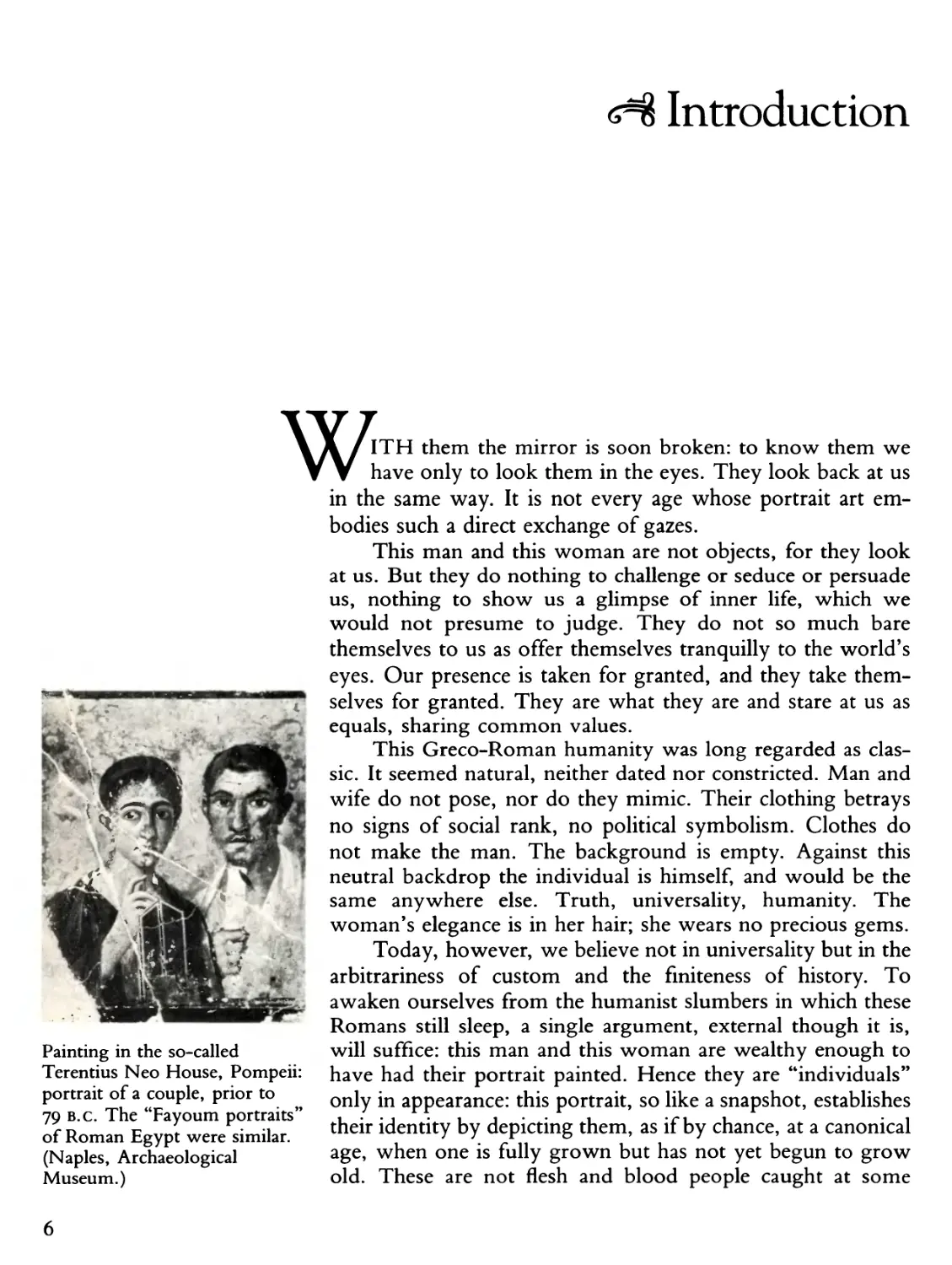
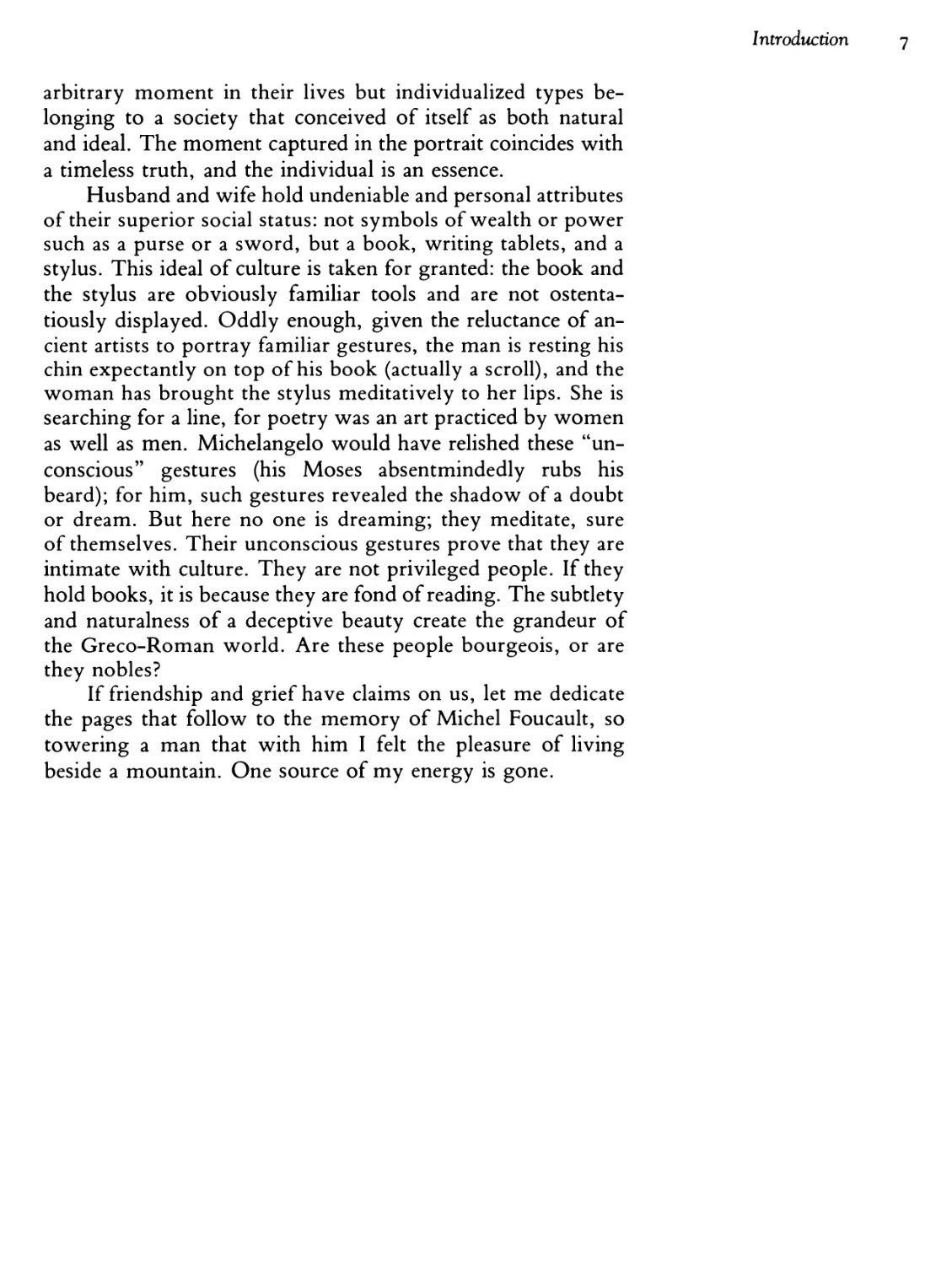
Painting in the so-called
Terentius Neo House, Pompeii:
portrait of a couple, prior to
79 B.C. The "Fayoum portraits"
of Roman Egypt were similar.
(Naples, Archaeological
Museum.)
ITH them the mirror is soon broken: to know them we
have only to look them in the eyes. They look back at us
in the same way. It is not every age whose portrait art
embodies such a direct exchange of gazes.
This man and this woman are not objects, for they look
at us. But they do nothing to challenge or seduce or persuade
us, nothing to show us a glimpse of inner life, which we
would not presume to judge. They do not so much bare
themselves to us as offer themselves tranquilly to the world's
eyes. Our presence is taken for granted, and they take
themselves for granted. They are what they are and stare at us as
equals, sharing common values.
This Greco-Roman humanity was long regarded as
classic. It seemed natural, neither dated nor constricted. Man and
wife do not pose, nor do they mimic. Their clothing betrays
no signs of social rank, no political symbolism. Clothes do
not make the man. The background is empty. Against this
neutral backdrop the individual is himself, and would be the
same anywhere else. Truth, universality, humanity. The
woman's elegance is in her hair; she wears no precious gems.
Today, however, we believe not in universality but in the
arbitrariness of custom and the finiteness of history. To
awaken ourselves from the humanist slumbers in which these
Romans still sleep, a single argument, external though it is,
will suffice: this man and this woman are wealthy enough to
have had their portrait painted. Hence they are "individuals"
only in appearance: this portrait, so like a snapshot, establishes
their identity by depicting them, as if by chance, at a canonical
age, when one is fully grown but has not yet begun to grow
old. These are not flesh and blood people caught at some
6

arbitrary moment in their lives but individualized types
belonging to a society that conceived of itself as both natural
and ideal. The moment captured in the portrait coincides with
a timeless truth, and the individual is an essence.
Husband and wife hold undeniable and personal attributes
of their superior social status: not symbols of wealth or power
such as a purse or a sword, but a book, writing tablets, and a
stylus. This ideal of culture is taken for granted: the book and
the stylus are obviously familiar tools and are not
ostentatiously displayed. Oddly enough, given the reluctance of
ancient artists to portray familiar gestures, the man is resting his
chin expectantly on top of his book (actually a scroll), and the
woman has brought the stylus meditatively to her lips. She is
searching for a line, for poetry was an art practiced by women
as well as men. Michelangelo would have relished these
"unconscious" gestures (his Moses absentmindedly rubs his
beard); for him, such gestures revealed the shadow of a doubt
or dream. But here no one is dreaming; they meditate, sure
of themselves. Their unconscious gestures prove that they are
intimate with culture. They are not privileged people. If they
hold books, it is because they are fond of reading. The subtlety
and naturalness of a deceptive beauty create the grandeur of
the Greco-Roman world. Are these people bourgeois, or are
they nobles?
If friendship and grief have claims on us, let me dedicate
the pages that follow to the memory of Michel Foucault, so
towering a man that with him I felt the pleasure of living
beside a mountain. One source of my energy is gone.

'Jff
.??*
\
\
1 [ '■■•■ . \ ' -
I'
%
V-
i*
\
1*
v
i.
v^
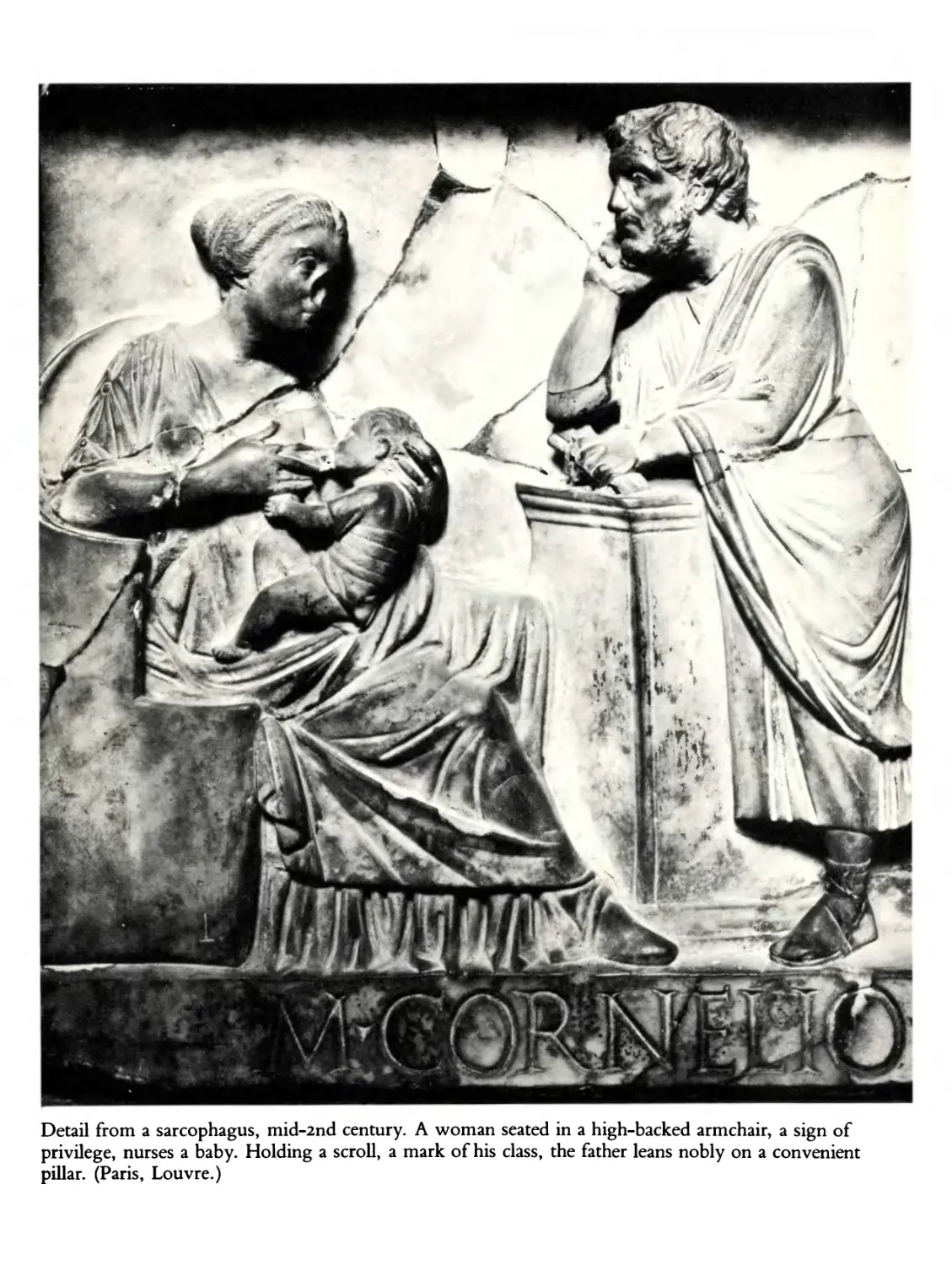
Detail from a sarcophagus, mid-2nd century. A woman seated in a high-backed armchair, a sign of
privilege, nurses a baby. Holding a scroll, a mark of his class, the father leans nobly on a convenient
pillar. (Paris, Louvre.)

g*% From Mother's Womb to
Last Will and Testament
T1
I HE birth of a Roman was not merely a biological fact.
JL Infants came into the world, or at any rate were received
into society, only as the head of the family willed.
Contraception, abortion, the exposure of freeborn infants, and
infanticide of slaves' children were common and perfectly legal
practices. They would not meet with disapproval or be declared
illegal until a new morality had taken hold, a morality which
for the sake of brevity I shall describe simply as Stoic. A
citizen of Rome did not "have" a child; he "took" a child,
"raised" him up (tollere). Immediately after the birth it was the
father's prerogative to raise the child from the earth where the
midwife had placed it, thus indicating that he recognized the
infant as his own and declined to expose it. The mother had
just given birth (in a seated position, in a special chair, away
from male eyes). Had she died in labor, the child would have
been cut out of her uterus. But birth alone did not signify that
a scion had come into the world.
A child whose father did not raise it up was exposed
outside the house or in some public place. Anyone who wished
might claim it. An absent father might order his pregnant wife
to expose her baby as soon as it was born. The Greeks and
the Romans thought it peculiar that Egyptians, Germans, and
Jews exposed none of their children but raised them all. In
Greece it was more common to expose female infants than
males. In I B.C. a Greek wrote his wife: "If (touch wood!) you
have a child, let it live if it is a boy. If it is a girl, expose it."
It is not at all clear, however, that the Romans shared this
prejudice. They exposed or drowned malformed infants. This,
said Seneca, was not wrath but reason: "What is good must
be set apart from what is good for nothing." The Romans

io The Roman Empire
I
♦ » '■ ♦'
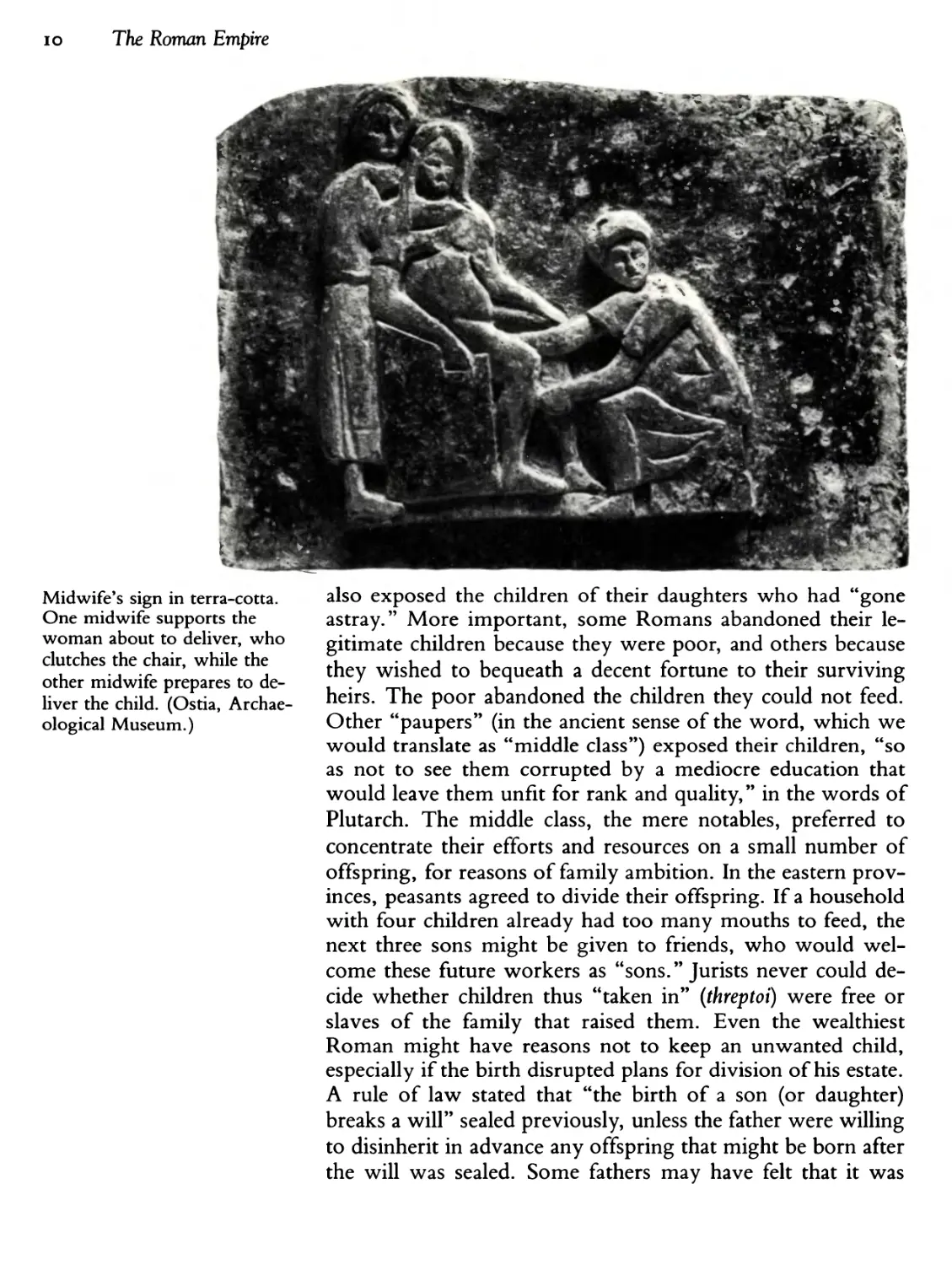
Midwife's sign in terra-cotta.
One midwife supports the
woman about to deliver, who
clutches the chair, while the
other midwife prepares to
deliver the child. (Ostia,
Archaeological Museum.)
also exposed the children of their daughters who had "gone
astray." More important, some Romans abandoned their
legitimate children because they were poor, and others because
they wished to bequeath a decent fortune to their surviving
heirs. The poor abandoned the children they could not feed.
Other "paupers" (in the ancient sense of the word, which we
would translate as "middle class") exposed their children, "so
as not to see them corrupted by a mediocre education that
would leave them unfit for rank and quality," in the words of
Plutarch. The middle class, the mere notables, preferred to
concentrate their efforts and resources on a small number of
offspring, for reasons of family ambition. In the eastern
provinces, peasants agreed to divide their offspring. If a household
with four children already had too many mouths to feed, the
next three sons might be given to friends, who would
welcome these future workers as "sons." Jurists never could
decide whether children thus "taken in" (threptoi) were free or
slaves of the family that raised them. Even the wealthiest
Roman might have reasons not to keep an unwanted child,
especially if the birth disrupted plans for division of his estate.
A rule of law stated that "the birth of a son (or daughter)
breaks a will" sealed previously, unless the father were willing
to disinherit in advance any offspring that might be born after
the will was sealed. Some fathers may have felt that it was

From Mother1s Womb to Last Will and Testament 11
better to do away with a child than to disinherit it.
What became of children who were exposed? Few
survived, according to pseudo-Quintilian, who distinguishes,
however, between the rich and the poor: when the rich
exposed a child, they hoped never to see it again, while the poor,
compelled by poverty alone, did all they could to ensure that
the infant might someday be reclaimed. Sometimes exposure
was faked: the child's mother would, without her husband's
knowledge, entrust the newborn to neighbors or subordinates,
who would raise it in secret. When the child grew up, it
became the slave of its educators, who would eventually set
it free. In extremely rare cases such a child might win
recognition of its freeborn status. Vespasian's wife was one such.
A legitimate and deliberate act, the decision to expose a
child was at times a statement of principle. A man who
suspected his wife of infidelity would expose a child he believed
to be the product of adultery. The little daughter of a princess
was abandoned, "stark naked," at the gates of the imperial
palace. Exposure could also be a political or religious
statement: when the well-loved prince Germanicus died, the plebs
indicated their displeasure with the gods' government by
smashing their temples, and some parents apparently exposed
their infants as a sign of protest. After the murder of Agrippina
by her son Nero, an unknown person "exposed his child in
the middle of the forum with a sign on which he had written:
/ will not raise you, lest you cut your mother's throat." If exposure
was a private decision, was there any reason why on occasion
it should not be public? One day a false rumor circulated
among the plebs: that the Senate, having learned from
soothsayers that a king was to be born that year, would attempt to
force the people to expose every newborn child. The Massacre
of the Innocents inevitably comes to mind (this, I might add
in passing, was probably an authentic occurrence and not a
mere legend).
The "voice of blood" spoke very little in Rome. What
mattered more than blood was the family name. Bastards took
their mother's name, and legitimation or recognition of
paternity did not exist. Forgotten by their fathers, bastards
played almost no social or political role in the Roman
aristocracy. This was not true of freed slaves, often quite wealthy
and powerful individuals, some of whom pushed their
children into the equestrian order and even the Senate. The ruling
oligarchy replenished its ranks with its own legitimate children
and with the sons of former slaves. Freed slaves adopted the
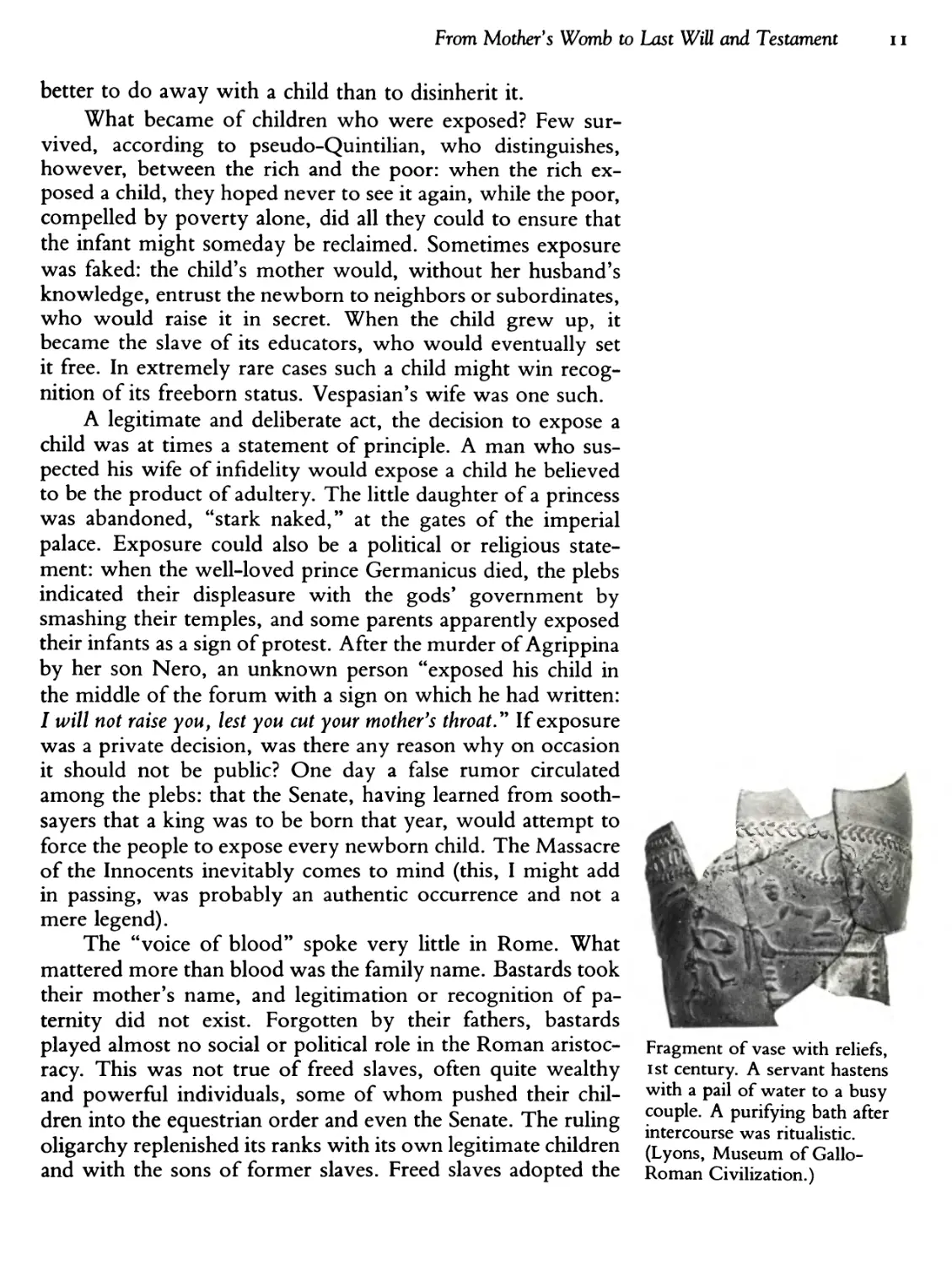
Fragment of vase with reliefs,
ist century. A servant hastens
with a pail of water to a busy
couple. A purifying bath after
intercourse was ritualistic.
(Lyons, Museum of Gallo-
Roman Civilization.)

12 The Roman Empire
family name of the master who set them free. This custom
accounts for the frequency of adoptions: the adopted child
took the family name of its new father.
Birth and Contraception Adoptions and the social advancement of freed slaves
compensated for the low rate of natural reproduction, for the
Romans made no fetish of natural kinship. Abortion and
contraception were common practices, although historians have
distorted the picture somewhat by overlooking the Roman
use of the term "abortion" to describe not only surgical
practices that we today would call abortion but also techniques
that we would call contraceptive. Precisely when after
conception a mother got rid of offspring she did not wish to bear
mattered little to Romans. The most stringent moralists might
argue that a woman had a duty to preserve the fruit of her
womb, but even they never dreamed of according to the fetus
a right to live. All classes of the population certainly made use
of contraceptive techniques. Saint Augustine, who speaks of
"embraces in which conception is avoided," gives no
indication that these were rare; he condemns the practice, even
between legitimate spouses. Augustine distinguishes between
contraception, sterilization by means of drugs, and abortions,
only to condemn them all. Alfred Sauvy (private
communication) states his opinion that, "based on what we now know
of the multiplicative powers of the human species, the
population of the Roman Empire should have grown much more
than it did and overflowed its borders."
What contraceptive procedures were used? Plautus,
Cicero, and Ovid allude to the pagan custom of washing after
sex, and a vase decorated with reliefs found in Lyons shows
a man carrying a pitcher to a couple busily occupied in bed.
Dressed up as a ritual of purification, the custom may have
been contraceptive. The Christian polemicist Tertullian held
that the sperm was already a child immediately after
ejaculation (and hence that fellatio was in fact cannibalism). In the
Veil of the Virgins he alludes, with obscene truculence that
obscures his meaning, to false virgins who give birth to
children who, oddly enough, exactly resemble their own fathers,
only to kill them, apparently with a pessary. Saint Jerome, in
his twenty-second epistle, speaks of young girls who "savor
their sterility in advance and kill the human being even before
its seed has been sown," an allusion to a spermicidal drug. As
for the menstrual cycle, the physician Soranus taught the the-

From Mother's Womb to Last Will and Testament 13
ory that women conceive either just before or just after their
periods; fortunately, this doctrine remained esoteric. All these
methods were the responsibility of the woman. No mention
is made of coitus interruptus.
How many children did Romans have? The law accorded
special privilege to mothers of three children, who were seen
as having done their duty, and this number seems to have
been canonical. The evidence of epitaphs is difficult to
interpret with assurance, but the texts mention families of three
children with particular frequency, almost proverbially. When
a writer of epigrams wishes to castigate a woman who, out
of greed, starves her offspring, he writes, "her three
offspring." A Stoic preacher shouts: "Do you suppose you have
done great things because by bringing two or three wretched
brats into the world you have helped to perpetuate the human
race?" These Malthusian attitudes served dynastic ends. As
soon as a man has more than one child, Pliny writes to one
of his correspondents, he must think of finding a wealthy son-
or daughter-in-law for his younger offspring. No one liked
to eat away at an inheritance. To be sure, the older morality
eschewed calculation of this kind, and even in Pliny's time this
was still the morality of certain old-fashioned heads of family,
who "did not allow their fertile wives to lie fallow, even
though in our time most people hold that an only son is
already a heavy burden and that it is advantageous not to be
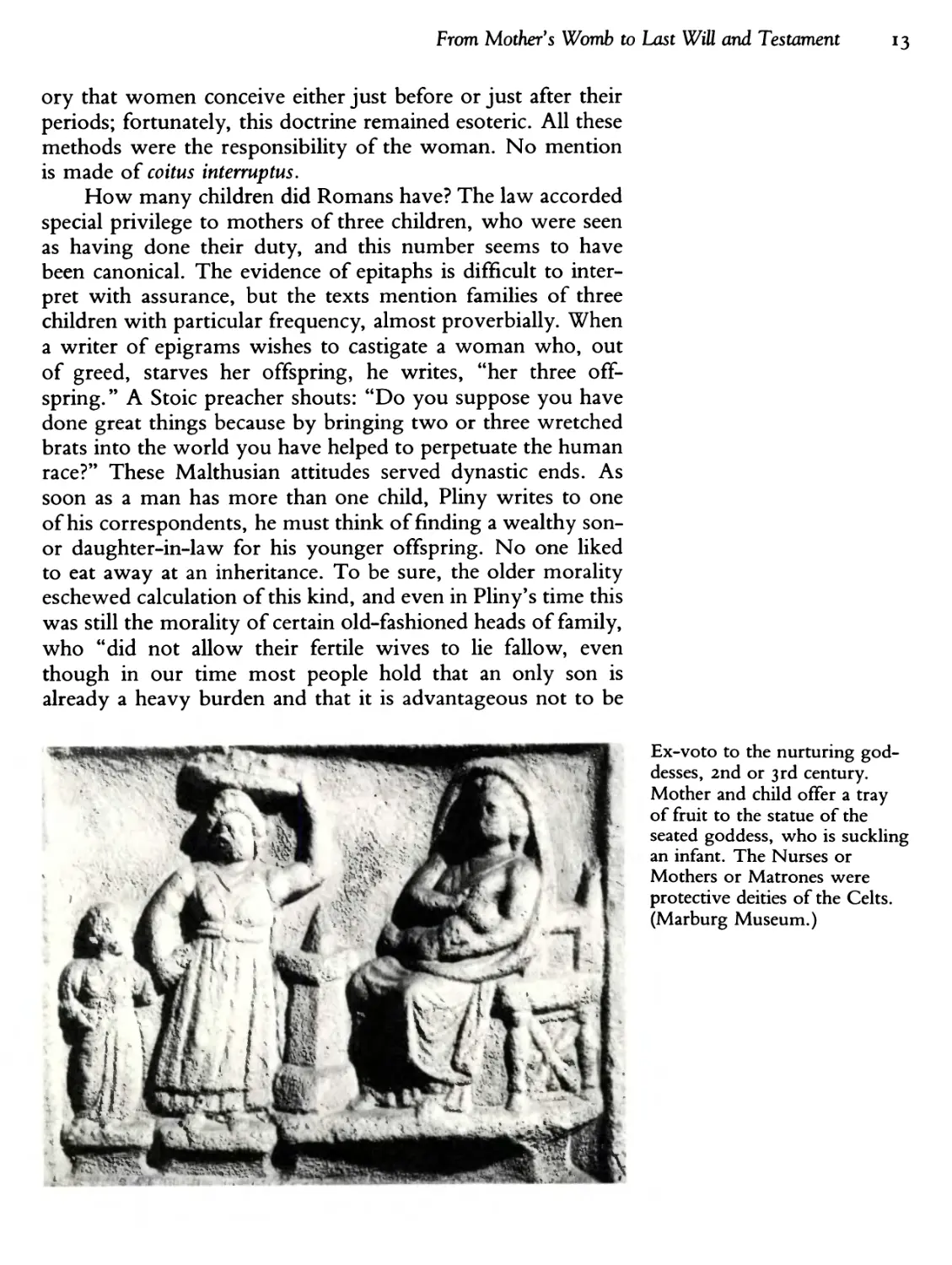
; ^ . " " . . Ex-voto to the nurturing god-
'■*vV*— M>- >• v?" * v^\ *v>> *v, >"; '* \ %; I desses, 2nd or 3rd century.
•,■'.".."^ v *\ Mother and child offer a tray
\-vs v ^ v x of fruit to the statue of the
V \ «
.v-
* * §jjj /"\ *v: s •" * seated goddess, who is suckling
'If . ^M^V?' , ■ ' an infant. The Nurses or
\ * *. .^y^ w ' v Mothers or Matrones were
V ^j^? . w' . \ protective deities of the Celts.
§* s v * ' (Marburg Museum.)
I;
1
■■■* % I, * 4* V \
1
(k
•V .'-K

14 The Roman Empire
overburdened with posterity." Do things change as we move
toward the end of the second century a.d. and Stoic and
Christian morality begins to take hold? The orator Fronto,
Marcus Aurelius' teacher, "lost five children" to childhood
maladies. He must have had many more. Marcus Aurelius
himself had nine sons and daughters. After three centuries
Rome returned to that golden age in which the exemplary
Cornelia, mother of the Gracchi, had given twelve children
to the fatherland.
Shortly after birth the newborn boy or girl was handed
over to a wet nurse. Breast-feeding by a child's natural mother
was a thing of the past. But the "nurse" did much more than
just offer the child her breast. She was responsible for
education up to the age of puberty, in conjunction with a
"pedagogue," also called a "nurse" (nutritor, tropheus). Marcus
Aurelius' pedagogue taught him to take care of himself and not
to become excited by the races at the Circus. Children lived
and took meals with their nurses, but dined in the evening
with their parents and guests at what was something of a
ceremonial dinner. Nurse and pedagogue remained important
figures even after a child was grown. Marcus Aurelius speaks
with suitable piety of his natural father, his adoptive father,
and his (male) "nurse," and the emperor Claudius would hate
his pedagogue throughout his life because of the free use the
latter had made of the whip. When a girl married, her mother
and nurse together offered last-minute advice for her wedding
night. Pedagogue, nurse, and foster child formed a kind of
surrogate family and enjoyed all sorts of indulgences in later
life; they were free to ignore the law. Nero, murdering his
mother, Agrippina, was aided by his pedagogue. Later, when
he was abandoned by everyone and facing death at the hands
of his rebellious subjects, only his nurse stood by to console
him. It was she who, with the help of his concubine Acte,
wrapped him in a winding-sheet after his suicide. Yet Nero
had been harsh toward his foster brother, to whom he should
have shown respect. A Stoic philosopher once delivered a
sermon on love of the family. Filial love, he explained, is in
accordance with Nature, and Nature is the same thing as
Reason; hence it is reasonable for a child to love its mother,
its nurse, and its pedagogus.
In noble households the surrogate family lived in healthy
rural surroundings, far from temptation, under the watchful
Education
Sarcophagus. Boy at play,
driving a cart hitched to a small
animal. Axle shafts had not yet
been invented. (Paris, Louvre.)

From Mother*s Womb to Last Will and Testament 15
•v *.
\-f'
• A..
. *i«\
^\
V**
xX
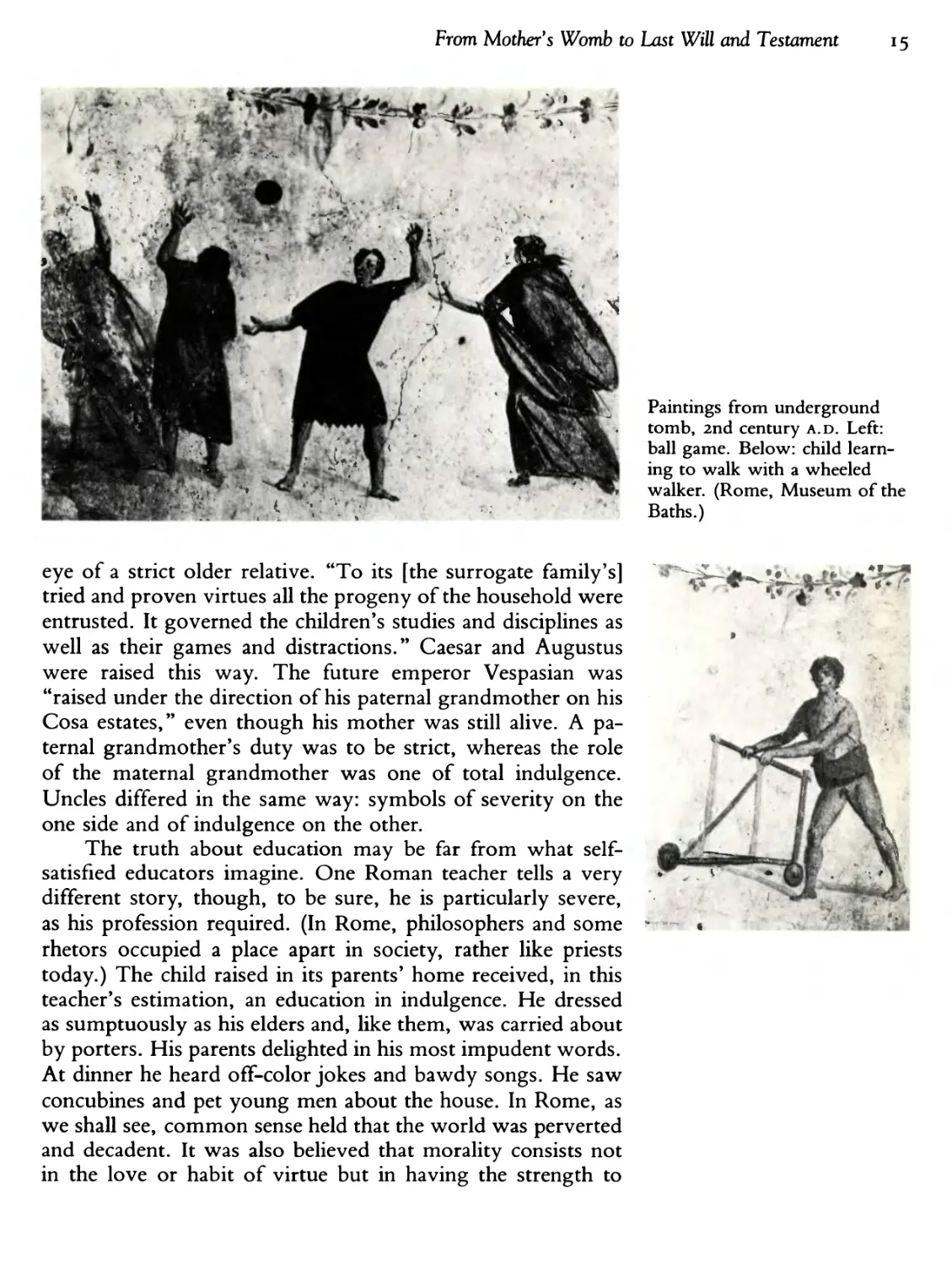
^ Paintings from underground
tomb, 2nd century a.d. Left:
ball game. Below: child
learning to walk with a wheeled
» walker. (Rome, Museum of the
Baths.)
eye of a strict older relative. "To its [the surrogate family's]
tried and proven virtues all the progeny of the household were
entrusted. It governed the children's studies and disciplines as
well as their games and distractions." Caesar and Augustus
were raised this way. The future emperor Vespasian was
"raised under the direction of his paternal grandmother on his
Cosa estates," even though his mother was still alive. A
paternal grandmother's duty was to be strict, whereas the role
of the maternal grandmother was one of total indulgence.
Uncles differed in the same way: symbols of severity on the
one side and of indulgence on the other.
The truth about education may be far from what self-
satisfied educators imagine. One Roman teacher tells a very
different story, though, to be sure, he is particularly severe,
as his profession required. (In Rome, philosophers and some
rhetors occupied a place apart in society, rather like priests
today.) The child raised in its parents' home received, in this
teacher's estimation, an education in indulgence. He dressed
as sumptuously as his elders and, like them, was carried about
by porters. His parents delighted in his most impudent words.
At dinner he heard off-color jokes and bawdy songs. He saw
concubines and pet young men about the house. In Rome, as
we shall see, common sense held that the world was perverted
and decadent. It was also believed that morality consists not
in the love or habit of virtue but in having the strength to
• •<,
N

16 The Roman Empire
V
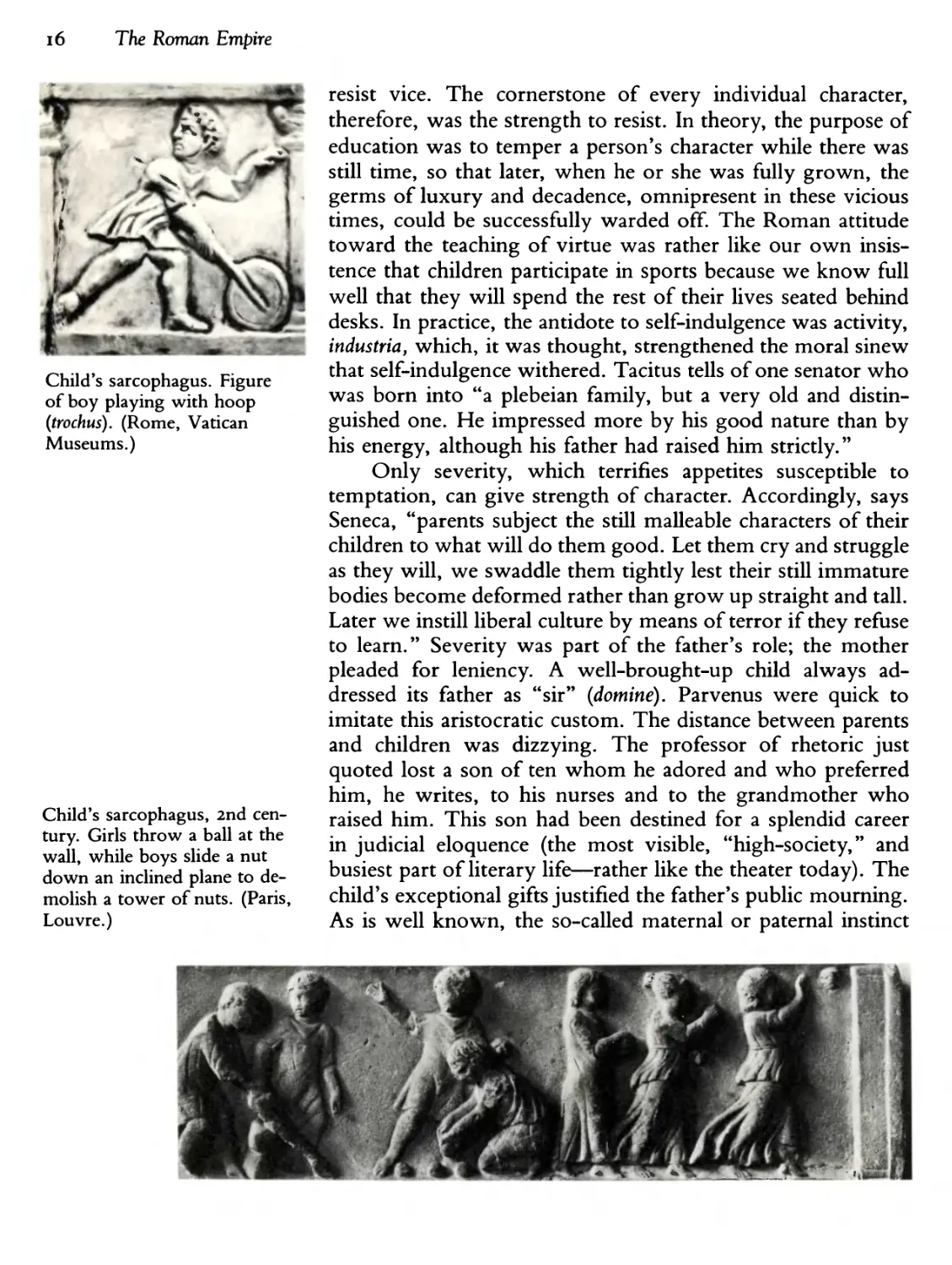
Child's sarcophagus. Figure
of boy playing with hoop
(trochus). (Rome, Vatican
Museums.)
Child's sarcophagus, 2nd
century. Girls throw a ball at the
wall, while boys slide a nut
down an inclined plane to
demolish a tower of nuts. (Paris,
Louvre.)
resist vice. The cornerstone of every individual character,
therefore, was the strength to resist. In theory, the purpose of
education was to temper a person's character while there was
still time, so that later, when he or she was fully grown, the
germs of luxury and decadence, omnipresent in these vicious
times, could be successfully warded off. The Roman attitude
toward the teaching of virtue was rather like our own
insistence that children participate in sports because we know full
well that they will spend the rest of their lives seated behind
desks. In practice, the antidote to self-indulgence was activity,
industria, which, it was thought, strengthened the moral sinew
that self-indulgence withered. Tacitus tells of one senator who
was born into "a plebeian family, but a very old and
distinguished one. He impressed more by his good nature than by
his energy, although his father had raised him strictly."
Only severity, which terrifies appetites susceptible to
temptation, can give strength of character. Accordingly, says
Seneca, "parents subject the still malleable characters of their
children to what will do them good. Let them cry and struggle
as they will, we swaddle them tightly lest their still immature
bodies become deformed rather than grow up straight and tall.
Later we instill liberal culture by means of terror if they refuse
to learn." Severity was part of the father's role; the mother
pleaded for leniency. A well-brought-up child always
addressed its father as "sir" (domine). Parvenus were quick to
imitate this aristocratic custom. The distance between parents
and children was dizzying. The professor of rhetoric just
quoted lost a son of ten whom he adored and who preferred
him, he writes, to his nurses and to the grandmother who
raised him. This son had been destined for a splendid career
in judicial eloquence (the most visible, "high-society," and
busiest part of literary life—rather like the theater today). The
child's exceptional gifts justified the father's public mourning.
As is well known, the so-called maternal or paternal instinct

From Mother's Womb to Last Will and Testament 17
does not exist. In some cases love between parent and child
develops from natural affinity (which is neither more nor less
likely to occur between parent and child than between any
two individuals brought together by chance). More often, no
doubt, parental sentiments are "induced" by the prevailing
morality. In Rome the prevailing morality taught that fathers
should love their children as bearers of the family name and
perpetuators of its grandeur. Tenderness was misplaced. But
it was legitimate to mourn the ruin of a family's hopes.
Our teacher had yet another reason to mourn his beloved Adoption
son: a great personage, a consul, had just adopted the boy,
thus ensuring that he would enjoy a splendid public career.
The frequency of adoption is yet another proof that nature
played little part in the Roman conception of the family.
Apparently one gave a child for adoption as one might give a
daughter in marriage, particularly a "good" marriage. There
were two ways to have children: to conceive them in
legitimate wedlock or to adopt them. Adoption could prevent a
family line from dying out. It was also a means of acquiring
the quality of paterfamilias, which the law required of
candidates for public honors and provincial governments.
Everything that could be had through marriage could also be had
through adoption. Just as a testator, in choosing an heir, also
made him the continuator of the family name, a man who
adopted a youth was careful to choose a successor worthy to
bear his name. The future emperor Galba was a widower, and
his two sons died. Having long since discerned the merits of
a young noble by the name of Piso, he had a will drawn up
naming Piso his heir and finally adopted him. A man could
adopt a son even if his own sons were still alive, as Herodius
Atticus did. The histories mention the practice of adoption by
will, but no trace of such a thing survives in legal documents.
The most striking instance of an inheritance linked to adoption
involves a certain Octavius, who became the son and heir of
Caesar and eventually the Emperor Octavius Augustus. In
some cases adoption, like marriage, was a means of controlling
the flow of wealth. A father-in-law impressed by his son-in-
law's deference might adopt him as a son after the young man
inherited his father's fortune, in order to gain control of the
inheritance. In return he would see to it that his adopted son
enjoyed a brilliant career in the Senate. Adoption could have
great influence on a man's career.

18 The Roman Empire
Children who were moved about like pawns on the
chessboard of wealth and power were hardly cherished and coddled.
Such matters were left to the servants. It was the nurse who
taught the child to talk. Noble households employed Greek
nurses so that the child might learn the language of culture in
the cradle. The pedagogue was responsible for teaching the
child how to read.
School Was literacy a privilege of the upper class? From Egyptian
papyruses we can be sure of three things: there were illiterates
who employed others to write for them; some people of the
lower orders knew how to write; literary texts, classics, could
be found in the smallest towns (here is the "culture" of which
the ancient world was so proud). Books of the fashionable
poets quickly found their way to the end of the world—
meaning Lyons. Beyond this we have only hints. (Historians
of literacy in early modern Europe are familiar with the
problems involved.) In one fictional tale a former slave is proud of
his ability to read capital letters. In other words, he did not
know how to read the cursive script of books, private papers,
and documents, but he could decipher shop and temple signs
and posters publicizing elections, plays, houses to rent, and
auction sales, to say nothing of epitaphs. Although only
wealthy families could afford private teachers, Ulpianus tells
"** *
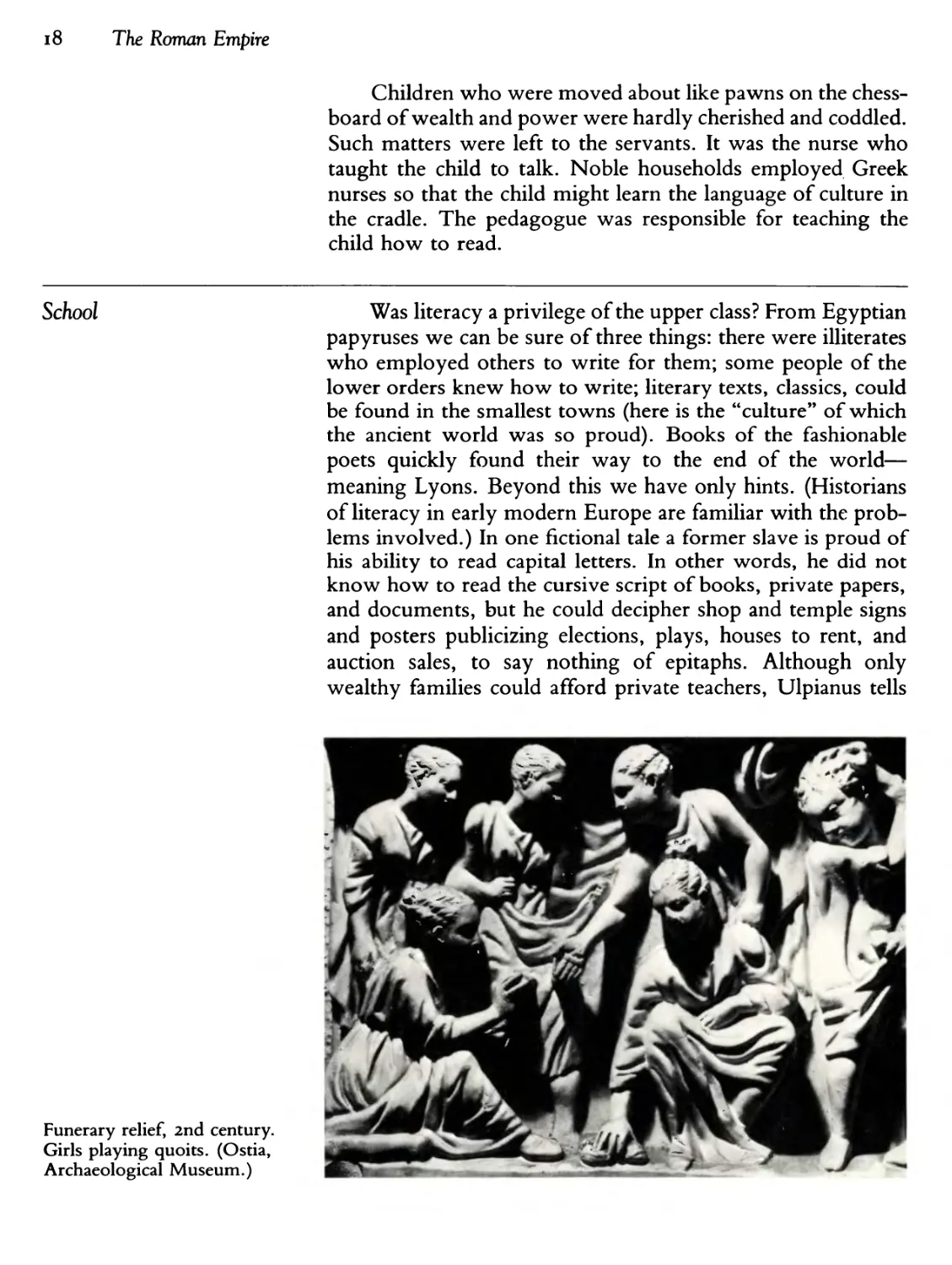
Funerary relief, 2nd century.
Girls playing quoits. (Ostia,
Archaeological Museum.)

From Mother*s Womb to Last Will and Testament 19
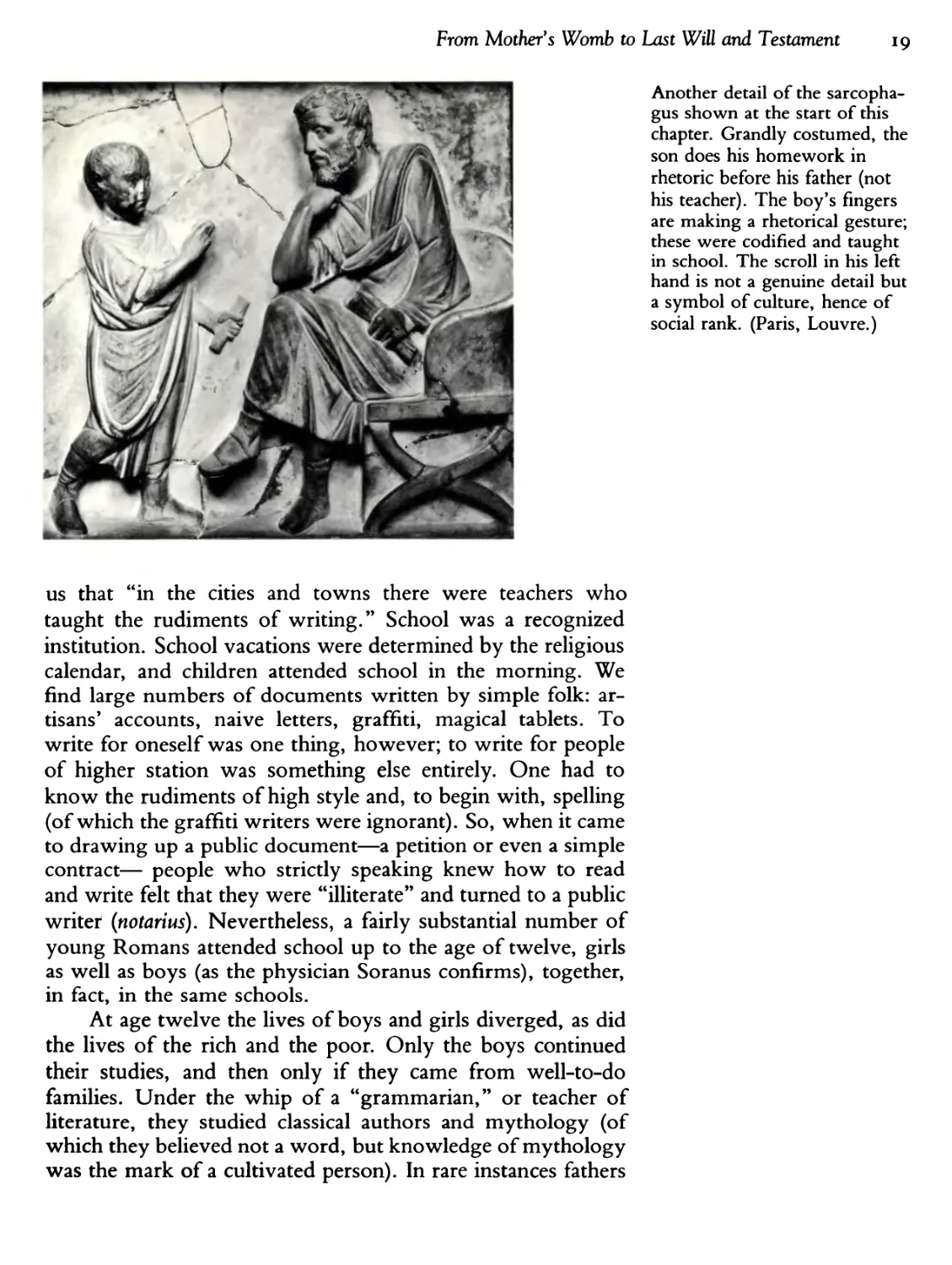
Another detail of the
sarcophagus shown at the start of this
chapter. Grandly costumed, the
son does his homework in
rhetoric before his father (not
his teacher). The boy's fingers
are making a rhetorical gesture;
these were codified and taught
in school. The scroll in his left
hand is not a genuine detail but
a symbol of culture, hence of
social rank. (Paris, Louvre.)
\
us that "in the cities and towns there were teachers who
taught the rudiments of writing." School was a recognized
institution. School vacations were determined by the religious
calendar, and children attended school in the morning. We
find large numbers of documents written by simple folk:
artisans' accounts, naive letters, graffiti, magical tablets. To
write for oneself was one thing, however; to write for people
of higher station was something else entirely. One had to
know the rudiments of high style and, to begin with, spelling
(of which the graffiti writers were ignorant). So, when it came
to drawing up a public document—a petition or even a simple
contract— people who strictly speaking knew how to read
and write felt that they were "illiterate" and turned to a public
writer (notarius). Nevertheless, a fairly substantial number of
young Romans attended school up to the age of twelve, girls
as well as boys (as the physician Soranus confirms), together,
in fact, in the same schools.
At age twelve the lives of boys and girls diverged, as did
the lives of the rich and the poor. Only the boys continued
their studies, and then only if they came from well-to-do
families. Under the whip of a "grammarian," or teacher of
literature, they studied classical authors and mythology (of
which they believed not a word, but knowledge of mythology
was the mark of a cultivated person). In rare instances fathers
u
.V
\
V -

of young girls might hire a tutor to teach them classics. At
age twelve a girl was considered nubile. Some were even
married off at this tender age, and the marriages were
consummated. By age fourteen a girl was considered an adult:
"Men then call them 'madame' (domina, kyria), and seeing that
there is nothing left for them but to share a man's bed, they
dress themselves up and think of nothing else." The
philosopher who penned these lines concluded: "It would be better
to persuade them that nothing will make them more estimable
than to appear modest and reserved." In good families girls
of this age and older were confined in the wall-less prison
known as "women's work," as visible proof that they were
not misusing their time. If a woman learned to sing, dance,
and play a musical instrument (singing, dancing, and music
went together), people praised her and appreciated her talents,
but hastened to add that she was nevertheless a decent woman.
In the end, it was the husband who completed the education
of a young woman of good family. A friend of Pliny had a
wife whose epistolary talents earned her praise: either her
husband was the real author of the letters attributed to her,
we are told, or he had been clever enough to cultivate the
talents of "this girl he married as a virgin" and hence deserved
the credit for himself. Seneca's mother, on the other hand,
was forbidden to study philosophy by her husband, who saw
such study as the road to dissolution.
Meanwhile, young boys attended school. Why? In order
to become good citizens? To learn a trade? To acquire the
means to understand their world? No: to embellish their
minds, to cultivate themselves through the study of belles
lettres. It is a peculiar error to think that schools always
perform the same function, that of shaping man or adapting him
to society. Roman education was neither formative nor
utilitarian. Rather, it conferred prestige, primarily through the
study of such subjects as rhetoric. It is rare in history that the
purpose of education is to prepare a child for life and equip
him with an image of society. The history of education is
generally a history of ideas about childhood; the social function
of education does not explain why things change. In Rome
the minds of little boys were decked out with rhetoric, much
as in the last century the bodies of little boys were decked out
with sailor suits or military uniforms. Childhood is an age
that we disguise by embellishing, by using it to embody our
ideals.
I have so far said nothing about education in the Greek

From Mother's Womb to Last Will and Testament 21
portions of the Empire, which differed from the foregoing
description in several respects. Nilsson's views on this
question are sound: Roman schooling was an imported product
and, as such, separate from everyday life, from religious and
political activity. Greek schooling, on the other hand, was a
part of public life; it look place in the palestra and gymnasium.
The gymnasium was like a second public square, a place where
anyone could go and where activity was not limited to
gymnastics. But gymnastics were an important part of schooling;
in my opinion, the major difference between Greek education
and Roman education was that sport took up half the time of
the Greek student. Even literary subjects (Greek, Homer,
rhetoric, a little philosophy, and a great deal of music, even under
the Empire) were taught in a corner of the gymnasium or
palestra. Schooling, which lasted until the child was about
sixteen, was followed immediately by one or two years of
ephebia, the program of which was identical.1
Apart from the public character of Greek education, its
music and gymnastics, there was another difference between
it and Roman education. No Roman of good birth could call
himself cultivated unless a tutor had taught him Greek
language and literature, whereas the most cultivated Greeks
thumbed their noses at the thought of learning Latin and
haughtily ignored Cicero and Virgil (with a few exceptions,
such as the functionary Appian). Greek intellectuals who, like
sixteenth-century Italians, went abroad and sold their talents
naturally used Greek when practicing medicine or teaching
philosophy, for Greek was the language of these sciences. In
Rome they picked up a little broken Latin. Even in late
antiquity Greeks would study Latin systematically only if they
wished to make careers in the imperial bureaucracy.
At age twelve the young Roman of noble birth completed Adolescence
his elementary education. At age fourteen he shed his child's
clothing and was allowed to do what every young man loves
to do. At age sixteen or seventeen he might choose a public
career or join the army—like Stendhal, who enlisted as a hussar
at sixteen. There was no such thing as a legal age of majority.
In Rome there were no minors, only prepubescents, who
ceased to be so whenever their fathers or tutors judged they
were ready to wear a man's garb and start trimming their
mustaches. Take, for example, one senator's son. At sixteen
he became an equestrian, and at seventeen assumed his first

22 The Roman Empire
iV> N
\>:-
A
■^.-v*a
Young prince, procession of
the altar of the Peace of
Augustus, 9 B.C. His great-uncle the
emperor leads the procession.
Beneath the gaze of the adults,
the boy may as well not be
there. This is unimportant, for
the main thing is to belong to
the imperial family, whose
private life became public, as this
image, as much a family as an
official portrait, proves. The
boy is characterized by his
youth—not yet old enough to
be officially himself. (Paris,
Louvre.)
public office. He was put in charge of the Roman police,
supervised executions, and governed the mint. From then on
he rose steadily, becoming in turn general, judge, and senator.
Where did he learn his craft? On the job. From his elders?
More likely from his subordinates: he would have carried
himself with enough aristocratic hauteur to seem to be making
decisions that others in fact made for him. One noble was a
colonel by age sixteen, as well as a state priest; he had already
pleaded his first cases at the bar.
Civic and professional matters were learned on the job;
culture was studied in school. (The lower orders had a culture
but not the ambition to cultivate themselves.) School was the
means by which one cultivated oneself, and this altered the
nature of the culture acquired; certain writers came to be
viewed as "classics." (Just as now, with the formation of a
"canon" of tourism, there are sites that one "must" visit,
monuments that one "must" see.) The schools taught subjects
that brought prestige to anyone familiar with them but that
actually interested only a few, even among those who admired
from afar. And since any institution soon becomes an end in
itself, the schools taught, and called "classic," what was easiest
to teach. Ever since Athens' golden age rhetoricians had been
developing a predigested doctrine, ready to teach. So, from
age twelve to age eighteen or twenty, Romans learned to read
their classics and then studied rhetoric. But what exactly was
rhetoric?
It was most assuredly not utilitarian; it contributed
nothing to "society." Eloquence at the podium and the bar played
an important role in the Roman Republic, but its prestige
derived from its brilliance as literature, not from its civic
function. Cicero, who was not the son of an oligarch, enjoyed
the rare honor of being admitted to the Senate, because his
brilliance as an orator lent prestige to that institution. Under
the Empire the public followed trials the way we follow
literature; poets, for all their glory, were not wreathed with
popularity to compare with the renown of talented orators.
Because of the popularity of eloquence, rhetorical art, or
eloquence reduced to formulas, became the sole subject matter,
apart from the classics, of Roman education. All Roman boys
learned typical speeches suitable for use in politics and the
courts, complete with model developments and catalogued
effects (our "rhetorical figures"). Did they quickly learn to
speak eloquently? No, because rhetoric as taught in the schools
soon became an art unto itself, an art whose rules had to be

From Mother's Womb to Last WiU and Testament 23
learned. There was a gulf between true eloquence and
rhetorical teaching, which the ancients never ceased to deplore even
as they delighted in it. The subjects assigned to young Romans
for their speeches had nothing to do with the real world. On
the contrary, the more mystifying a subject was, the more it
stimulated the imagination. Rhetoric became a society game.
"Suppose that a law holds that a seduced woman may choose
either to have her seducer condemned to death or to marry
him, and, further, that in one night a man rapes two women,
one of whom demands his death, while the other insists on
marrying him." Such a theme gave free rein to virtuosity and
to the Roman taste for melodrama and sex. It offered the
pleasure of paradox and vicarious amusement. Amateurs long
since done with school but highly trained in the rhetorical art
continued to play such games at home, before an audience of
connoisseurs. The genealogy of ancient education was as
follows: from culture to the will to culture, from there to the
school, and from the school to the scholastic exercise as an
end in itself.
While the young Roman, under his teacher's watchful Youth
eye, "advised Sulla to abdicate the dictatorship" or weighed
the choices open to the victim of rape, he also reached puberty.
This marked the beginning of a period of indulgence. It was
common knowledge that, as soon as a young man donned his
adult garb, his first thought was to buy himself the favors of
a servant or hasten to Suburra, Rome's quarter for mischief.
Or perhaps a woman of good society might take it into her
head to initiate the young man. (The ways of the Roman
aristocracy were as free as those of the French aristocracy in
the eighteenth century.) To physicians such as Celsus or Rufus
of Ephesus, epilepsy was a disease that healed itself at puberty,
that is, when girls have their first menses and boys their first
sexual encounter. In other words, puberty and sexual initiation
were synonymous for boys, while the virginity of young girls
remained sacrosanct. For boys, the time between puberty and
marriage was a time of parental indulgence. Such strict
moralists as Cicero and Juvenal, as well as the Emperor Claudius
in his capacity as censor, all admitted that allowances had to
be made for the heat of youthful passions. For five or ten
years young men chased prostitutes or lived with mistresses.
Gangs of youths were known to break down the doors of a
prostitute's house and rape her.

24 The Roman Empire
.^
"VXVa
\v'
N
Tomb of the Haterii (detail),
ca. a.d. ioo. This child's face
is a convention of Roman art,
but a delightful one. (Rome,
Lateran Museum; now at the
Vatican.)
It was, moreover, a semiofficial practice for youths to
form associations of their own. Organizations of young men
were common in Greek sectors of the Empire and also existed
(as collegia juvenum) in the Latin parts, although their precise
role remains obscure, probably because they served many
purposes and in any case tended to exceed the limits imposed
on them (the blood of youth being hot). Young men
participated in sports, duels, and hunting. They gathered in
amphitheaters to grapple with wild animals, to the admiration of
their compatriots. Unfortunately, they did not limit
themselves to such laudable physical activities, derived from the
physical education practiced by the Greeks. Taking advantage
of their numbers and their official status, they created public
disturbances. A privilege always accorded well-born youths
in Rome was the freedom to wander the streets at night in
gangs, beating passersby, manhandling women, and smashing
shops. (The young Nero was no stranger to this custom; once
he nearly suffered a thrashing at the hands of a senator attacked
by his gang, who failed to recognize the Emperor among his
attackers.) Groups of young men claimed this right as their
due. "Come home from dinner as soon as possible," we read
in one Latin tale, "for a gang of hotheaded youths from the
best families is pillaging the city." These same youths cheered
armies of gladiators and charioteers who clashed in pitched
battle, for this, too, was considered sport by the Roman
public. One jurist writes that "certain people, who usually call
themselves The Young Men, have been seen to cheer the sides
in certain public disturbances. If that is the extent of their
crime, they should first be admonished by the governor, and,
if they repeat the offense, they should be whipped and then
released."
The privileges of youth were also the privileges of youths
as a social group. Once a man married, the time for mistresses
was over, and so was the time for handsome male lovers.
That, at least, is what we are told by the poets who composed
epithalamiums and who, in their nuptial songs, do not hesitate
to describe the young bridegroom's past mischief, while
assuring their audience that the bride is so pretty that none of
these things will ever happen again.
Such was Rome's first moral code. But during the second
century a.d. a new code gradually took hold, in theory
supplanting the older morality. Backed by medical myths (and
bear in mind that ancient medicine had about as much scientific
validity as medicine in the time of Moliere), the new morality

From Mothers Womb to Last Will and Testament 25
attempted to confine sexuality to marriage, even for young
men, and encouraged parents to keep their sons virgins until
their wedding day. To be sure, love was not a sin but a
pleasure; the only trouble was that pleasure, like alcohol, is
dangerous. For the sake of health, it was advisable to limit the
amount consumed, and more prudent still to abstain
altogether. This was not puritanism but hygiene. Conjugal
pleasures were another thing entirely. They were part and parcel
of the civic, and natural, institution of marriage and hence a
duty. The Germans, whom Tacitus describes as noble savages,
"know love only late in life, so that the strength of youth in
them is not drained," as it was among the Romans. The
philosophers, rationalizers by vocation, supported the
movement. One wrote: "Regarding the pleasures of love, you must
keep yourself pure until marriage, so far as it is possible to do
so." Marcus Aurelius, philosopher as well as emperor,
congratulated himself "for having preserved the flower of his
youth, for not having performed the virile act too soon, and
for waiting perhaps even longer than necessary." He was also
proud of having touched neither his slave Theodotus nor his
servant Benedicta, even though he felt the desire to do so.
Physicians prescribed gymnastics and philosophical studies to
cool the sexual energies of young men. Masturbation was to
be avoided, not because it sapped a man's strength but because
it ripened him too quickly and hence produced fruit imperfect
because immature.
The new morality was bolstered by arguments drawn Patricide
from the old morality, with its civic and patrimonial concerns.
Over the centuries these gave rise to an idea new to the Roman
Empire, the notion of majority. Coming of age ceased to be
a physical fact recognized in customary law and became
instead a legal fiction: the prepubescent child was replaced by
the legal notion of the "minor" child. A young man who
abused his license to indulge in pleasure lost forever the
opportunity to temper his character. The emperor Tiberius, a
severe ruler and a Stoic as well, sent his young nephew Drusus
to command a regiment, "because he showed too great a
proclivity for the pleasures of the capital." Early marriage was
proof that one's youth was not misspent. Jurists had always
been more concerned with patrimony than with morality. A
youth of fourteen who had not yet come into his inheritance
might borrow at usurious rates of interest to pay for his

26 The Roman Empire
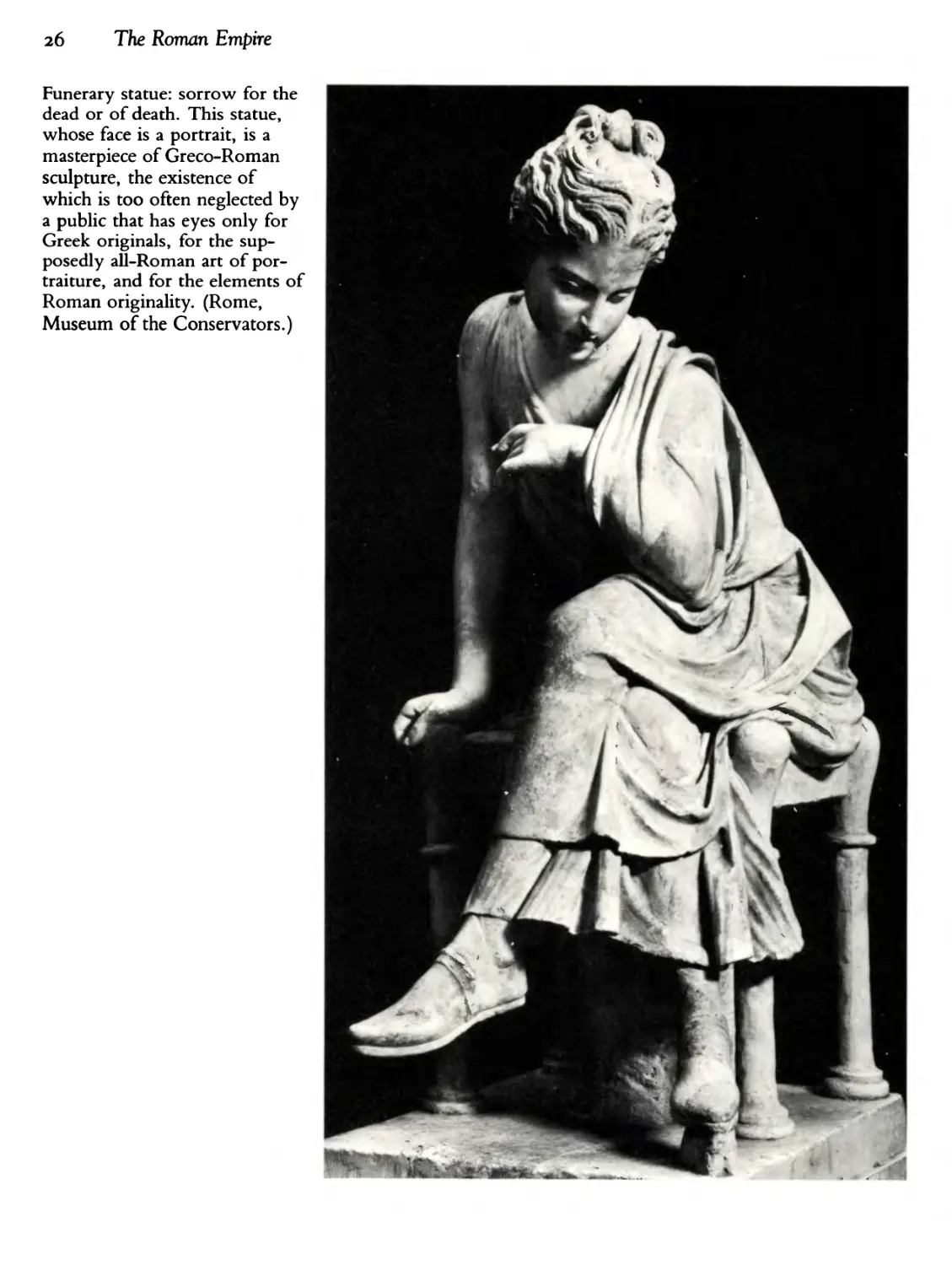
Funerary statue: sorrow for the
dead or of death. This statue,
whose face is a portrait, is a
masterpiece of Greco-Roman
sculpture, the existence of
which is too often neglected by
a public that has eyes only for
Greek originals, for the
supposedly all-Roman art of
portraiture, and for the elements of
Roman originality. (Rome,
Museum of the Conservators.)

From Mother's Womb to Last Will and Testament 27
pleasures, as he was legally entitled to do, and thus squander
his patrimony in advance of receiving it. Usurers (which in
Rome meant everybody) "seek the notes of young men who
have only recently donned the manly toga while continuing
to live under the cruel authority of their fathers." Laws,
renewed on several occasions, decreed that anyone who lent
money to the scion of a noble house forfeited the right to
collect the loan even after the youth's father had died. No one
was allowed to borrow money before the age of twenty-five.
There were other ways of dealing with the problem: a
grandfather or paternal uncle might compel an adolescent orphan
to obey a pedagogue who had shown that he was capable of
asserting his authority. As a matter of principle, however, any
fatherless adolescent was his own master. Quintilian tells, with
no particular astonishment, the story of a young noble who
just had time to bequeath his fortune to his mistress before
dying in the flower of youth, aged eighteen.
This brings us to a point that seems important and
may in fact be so. A peculiarity of Roman law that astonished
the Greeks was that every male child, past puberty or not,
married or not, remained under the authority of his father and
did not become a Roman in the full sense of the word, a
paterfamilias, until the father's death. More than that, the
youth's father was his natural judge and could privately
sentence him to death. A testator had almost unlimited discretion:
fathers could disinherit their sons. Hence it was possible for
an eighteen-year-old orphan to make his mistress his heir, yet
a grown man could take no legal action on his own while his
father was alive. "Where a son is involved," one jurist writes,
"public officials have nothing to say; though he were consul,
he would have no right to borrow money." Such, at any rate,
was the theory. What was the practice? Morally it was even
worse.
There were of course legal limits to paternal power. Not
every father disinherited his children, and to do so one had to
be sure not to die intestate. A son deprived of his inheritance
could contest the will in the courts. In any case, only three-
quarters of his patrimony could be taken away. As for a father
sentencing his son to death, a notion that played a large role
in the Roman imagination, the last instances date from the
time of Augustus and outraged public opinion. Still, a child
had no fortune of his own: whatever he earned or inherited
belonged to his father. The father could, however, grant him
a certain capital, the so-called peculum, to use as he saw fit. Or

28 The Roman Empire
* -
**,
J
\n
\
H \
N%
/
^
\
\
4-
_,x.r^ $?*ar%
.&,
A*
% * •*
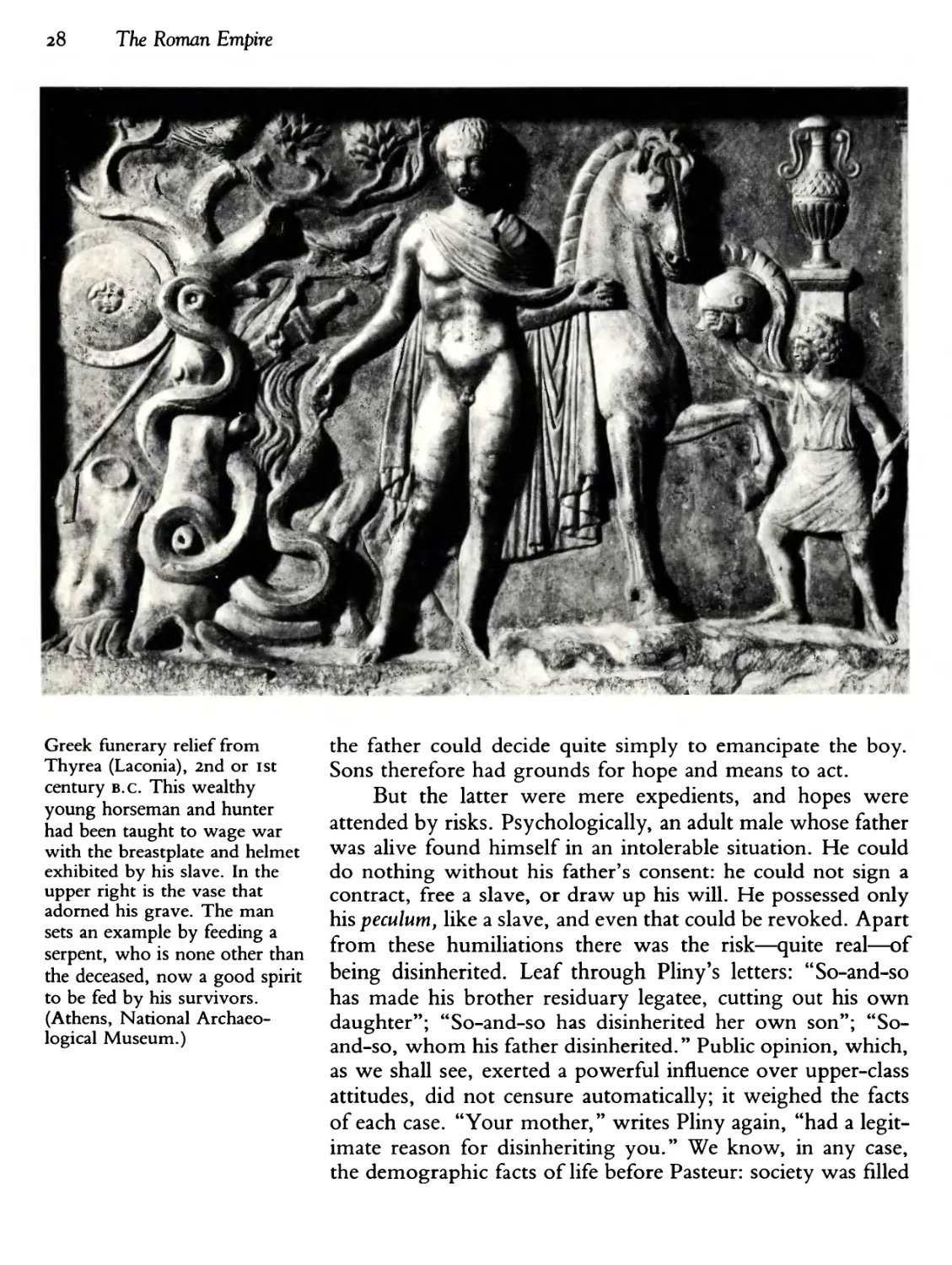
Greek funerary relief from
Thyrea (Laconia), 2nd or ist
century B.C. This wealthy
young horseman and hunter
had been taught to wage war
with the breastplate and helmet
exhibited by his slave. In the
upper right is the vase that
adorned his grave. The man
sets an example by feeding a
serpent, who is none other than
the deceased, now a good spirit
to be fed by his survivors.
(Athens, National
Archaeological Museum.)
the father could decide quite simply to emancipate the boy.
Sons therefore had grounds for hope and means to act.
But the latter were mere expedients, and hopes were
attended by risks. Psychologically, an adult male whose father
was alive found himself in an intolerable situation. He could
do nothing without his father's consent: he could not sign a
contract, free a slave, or draw up his will. He possessed only
his peculum, like a slave, and even that could be revoked. Apart
from these humiliations there was the risk—quite real—of
being disinherited. Leaf through Pliny's letters: "So-and-so
has made his brother residuary legatee, cutting out his own
daughter"; "So-and-so has disinherited her own son"; "So-
and-so, whom his father disinherited." Public opinion, which,
as we shall see, exerted a powerful influence over upper-class
attitudes, did not censure automatically; it weighed the facts
of each case. "Your mother," writes Pliny again, "had a
legitimate reason for disinheriting you." We know, in any case,
the demographic facts of life before Pasteur: society was filled

From Mother's Womb to Last Will and Testament 29
with widows and widowers; many women died in childbirth;
many others remarried after their husbands died. And since
fathers were almost entirely free to draw their wills as they
saw fit, the sons of a first marriage feared their stepmother.
Sons had one last yoke to bear: without their father's
consent they could make no career. A youth, if of noble birth,
could always have himself named a senator—or, if a mere
notable, a member of his city's Council. But how could he
meet the considerable expenses attached to such honors in an
age when bread and circuses were the means by which public
men got ahead? No youth would attempt to become a senator
or councillor without his father's consent, for the necessary
funds could be taken from his patrimony only if his father
approved. On many public buildings in Roman
Africa—buildings built by councillors to honor themselves—we find
inscriptions stating that the father has borne the expense on
behalf of the son. The father exercised sovereign authority in
deciding the fate of his children. The number of places in the
Senate and municipal councils was limited, and few families
could claim more than one for their sons. The attendant
expenses were considerable, so only the son chosen by the father
could enjoy the costly honor of a career. Other sons were duly
praised for their sacrifice. I should add that the eldest son
enjoyed no legal privilege, though tradition encouraged
younger sons to respect the priority of the eldest.
The father's death meant that, barring mishap, his chil- Wills
dren could enjoy their inheritance. It also signaled the end of
a kind of slavery. The sons became adults, and the daughters,
if they had not married or had divorced, became heiresses,
free to marry whomever they wished. (Although the law
required that a woman consent to her own marriage, it also
assumed that she always did consent, so in practice girls had
to obey their fathers.) Of course I am assuming that the new
heiress did not become subject to another authority, that of
her paternal uncle. A strict uncle might forbid his niece to take
lovers and assign her to work with distaff and spindle. The
poet Horace took tender pity on the fate of such unfortunate
women.
In these circumstances the obsession with parricide—a
relatively common crime—is not surprising. The reasons for
committing such a horrible act are quite comprehensible and
require no Freudian feats of explication. "During the civil wars

30 The Roman Empire
and their attendant proscriptions," writes Velleius of a time
when denunciations were common, "the loyalty of wives was
greatest, that of freedmen less great, that of slaves not
insignificant, and that of sons nil, so hard it is to bear the
postponement of hope!"
The only Romans who were men in the full sense of the
word were therefore free citizens, either orphans or legally
emancipated sons, who, married or not, were "fathers of
families" and who possessed a patrimony. The paterfamilias
occupied a place apart in the prevailing moral system, as the
following discussion, reported by Aulus Gellius, suggests:
"Must one always obey one's father? Some say, 'Yes, always.'
But what if your father orders you to betray your country?
Others respond subtly that one never obeys one's father
because it is morality that one obeys, to whose dictates he gives
voice." Aulus Gellius replies intelligently that there is a third
order of things that are neither good nor immoral, such as the
decision to marry or remain celibate, to enter one profession
rather than another, to leave home or to stay, to seek public
office or not. It is over this third order of things that paternal
authority is exercised.
The symbol, and weapon, of the father's familial
authority and social dignity was the will. The will was a kind of
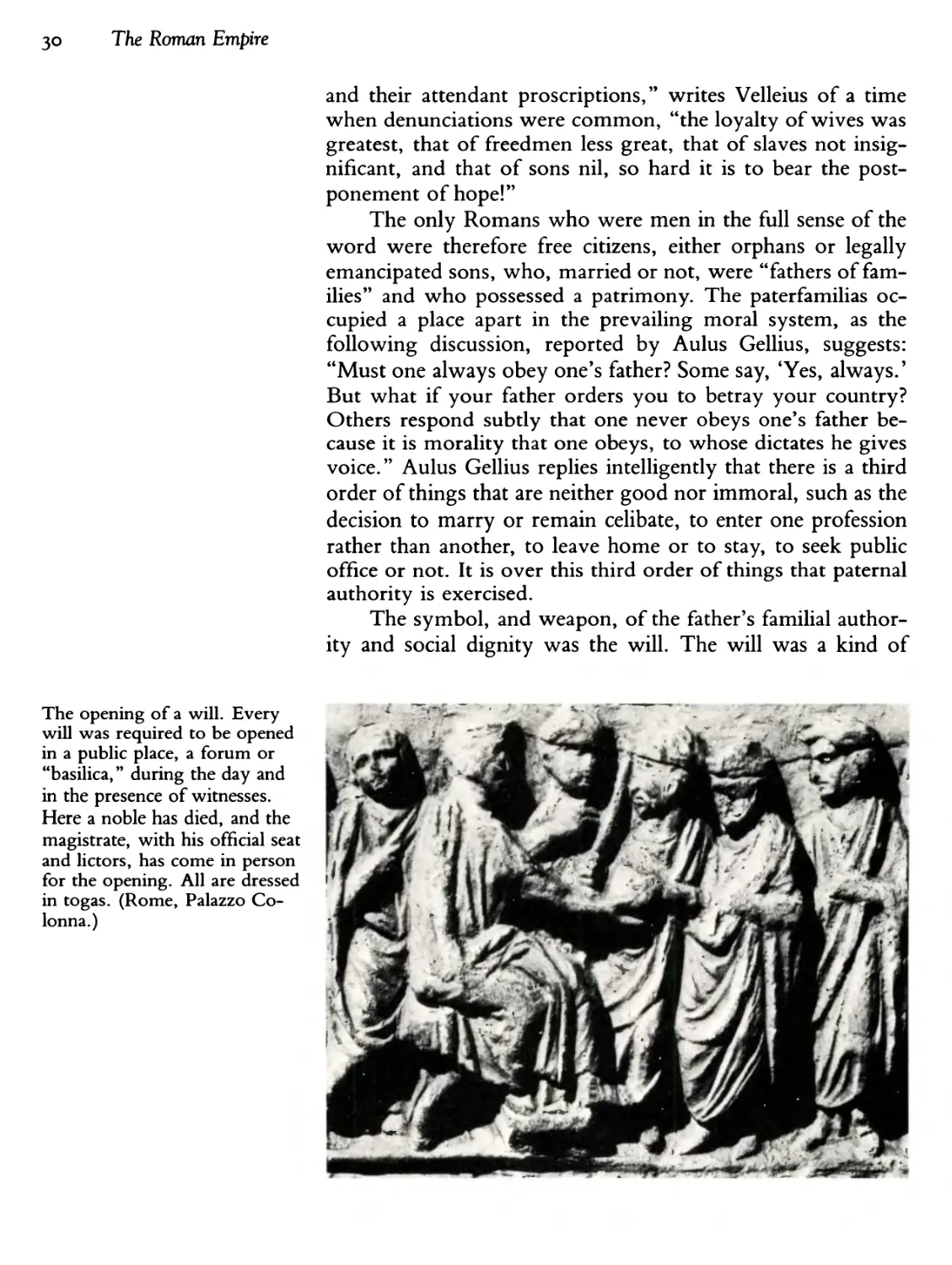
The opening of a will. Every
will was required to be opened
in a public place, a forum or
"basilica," during the day and
in the presence of witnesses.
Here a noble has died, and the
magistrate, with his official seat
and lictors, has come in person
for the opening. All are dressed t
in togas. (Rome, Palazzo Co- '
lonna.)
/ *
. r

From Mother's Womb to Last Will and Testament 31
confession in which social man revealed himself fully and by
which he would be judged. Had he chosen the worthiest heir?
Had he made bequests to all his faithful clients? Did he speak
of his wife in terms that would certify her as a good spouse?
"What a long time we spend deliberating in our heart of hearts
over whom we should name in our wills, and how much we
should leave them! None of our decisions is more thoroughly
examined." All kin, close or distant, were supposed to get
something, along with all members of a man's household:
deserving slaves were set free by their master's will, and loyal
freedmen and clients were not forgotten.
The public reading of a will was an event of some
significance. More was involved than just legacies and bequests;
the will had the value of a manifesto. The custom of
designating "substitute heirs," who received nothing unless the
principal heir refused to accept his due, enabled the testator to
name anyone he wished and to assign to each person he named
a theoretical fraction of his estate, a measure of his esteem for
that individual. A man could also insult, postmortem, anyone
he had secretly despised, and praise anyone he had esteemed.
The custom among nobles was to make a bequest to
fashionable writers of the moment. Pliny, a famous orator in his day,
went to every will-reading and remarked with satisfaction that
he was always left the same amount as his friend Tacitus. (He
did not lie, and epigraphists have found a will in which he is
named.) Politics played a part. A senator who had always been
taken seriously lost his reputation when his will was opened,
because in it he flattered Nero (obviously to avoid having his
will set aside and his estate confiscated by the Imperial Tax
Collector). Others insulted the freedmen who served the
sovereign as all-powerful ministers and even had rather
unflattering things to say to the emperor himself, be he Nero or
Antoninus Pius. A will was such a fine thing, of which people
were so proud, that many a testator in his cups found it
difficult to keep from reading his will so as to give his legatees
a foretaste of their good fortune and win their respect.
In other societies the deathbed ritual and the dying man's
last words were of great importance. In Rome what mattered
was first of all the will, which expressed the social individual,
and second, as we shall see, the epitaph, which manifested
what can only be called the public individual.

Painting at Herculanum, 79 B.C. Unmarried life as it exists in painting. This couple, accustomed to it, are
in no rush to take their pleasure. She is half nude, and he drinks wine from a raised vessel (with a hole in
the bottom that one held closed with a finger; the vessel was usually emptied in a single swallow).
(Naples, Archaeological Museum.)

<H$ Marriage
ROMAN Italy, in the first century before or after Christ,
was home to five or six million free citizens, male and
female. They lived in hundreds of rural territories, at the center
of which stood a cluster of monuments and private dwellings
(the domus); these were called "cities." In addition, some one
or two million slaves served as domestic servants and
agricultural laborers. Little is known about how they lived,
beyond the fact that marriage, at this time a private institution,
was forbidden to them and would remain so until the third
century. Slaves, it was believed, lived in sexual promiscuity,
save for a handful of trusted servants who acted as stewards
for their masters or, as slaves of the emperor himself, served
the state as functionaries. These privileged slaves lived mo-
nogamously with a single concubine, sometimes given them
by their masters.
Let us restrict our attention, then, to free men. Some of Criteria for Marriage
these were born free, the fruit of legitimate marriage between
male and female citizens. Others were bastards, born to
mothers who were citizens. Still others, born slaves, had been
subsequently freed. All were nonetheless citizens, entitled to
participate in the civic institution of marriage. To us this
institution seems paradoxical: Roman marriage was a private
act, which did not require the sanction of any public authority.
Bride and groom did not have to appear before the equivalent
of a priest or justice of the peace. No written document was
necessary: there was no marriage contract, only a contract for
the bride's dowry (assuming she had one), and the whole
procedure was quite informal. Notwithstanding all that has
been said on the subject, no symbolic act was required. In
33

short, marriage was a private event, like engagement today.
How, then, could a judge decide, in case of litigation over an
inheritance, whether or not a man and a woman were legally
married? In the absence of a formal act or contract, he based
his decision on certain signs, much as courts do today in
establishing matters of fact. What signs? Well, for instance,
such unambiguous actions as the constitution of a dowry, or
acts that proved a man's intention to be a husband, such as
referring habitually to the woman with whom he lived as his
wife. Or witnesses might testify that they had attended a small
ceremony whose nuptial character was manifest. Ultimately,
however, only husband and wife could be certain that in their
own minds they were married.
It was, nevertheless, important to determine whether or
not a man and a woman were legitimately married. For even
though marriage was a private institution, with no written
instrument or even formal ceremony to certify its existence,
it was a fact with legal consequences. The children of a
marriage were legitimate; they took their father's name and
continued his line; upon his death they inherited his estate,
assuming he had not disinherited them. Divorce, from a legal
standpoint, was as easy for the wife as for the husband and as
informal as marriage. It was enough for either party to leave
home with the intention of divorcing his or her spouse.
Certain cases gave jurists pause. Was there a true separation or a
simple quarrel? Strictly speaking, it was not even necessary to
notify an ex-spouse of the divorce, and cases are recorded in
which husbands were divorced by their wives without their
knowledge. Whether or not a woman took the initiative in
divorce, she left her husband's household with her dowry, if
any. On the other hand, children apparently always remained
with their fathers. Divorce and remarriage were quite
common, and nearly every family had children born of different
mothers.
A marriage ceremony involved witnesses, useful in case
the marriage was contested. The custom of marriage gifts
existed. The wedding night took the form of a legal rape from
which the woman emerged "offended with her husband"
(who, accustomed to using his slave women as he pleased,
found it difficult to distinguish between raping a woman and
taking the initiative in sexual relations). It was customary for
the groom to forgo deflowering his wife on the first night,
out of concern for her timidity; but he made up for his for-

Marriage 35
' *&.
Wr
A,
^\ V' '■ -
'••X
f*, * ^
',,!
•\
bearance by sodomizing her. Martial and Seneca the Elder
state this as a proverb, and the Casina confirms it. The same
custom existed in China. Women abstained from sexual
activity during pregnancy. Elian and pseudo-Quintilian found such
modesty natural, because they believed it was shared by
animals. Since conjugal pleasures were legitimate, wedding
guests had the right and even the duty to praise them bawdily.
In one epithalamium the poet went so far as to promise the
bridegroom an afternoon of love. Such boldness was
pardonable on the day after a marriage, but in other circumstances
making love during the daylight hours would have been
considered shamelessly libertine.
Why did people marry? For money (obtaining a dowry
was one honorable way to get rich) and for children who, as
legitimate heirs, were entitled to inherit an estate; those
children, moreover, perpetuated the state by replenishing the
ranks of its citizenry. Politicians called upon families to do
their duty as citizens and preserve the city. Pliny the Younger,
a senator no more pompous than most, added appropriately
that there was another way to make new citizens: by freeing
deserving slaves.
Wedding night, reproduction
of a Greek original. The veiled
bride sits on the edge of the
bed, as Persuasion encourages
her. At the foot of the bed sits
the god Hymen, bold and
relaxed, awaiting his moment.
Venus, or one of the Graces,
leans on a pillar, ready to
perfume the bride in preparation
for her lawful violation, from
which, thanks to the woman's
charm, matrimonial harmony
would grow. (Rome, Vatican
Museums.)

36 The Roman Empire
The Transformation of
Marriage
><f\Vr
V
Stabies, portrait of a couple,
prior to 79 B.C. Mediocre but
cruelly accurate. Between the
man and the woman is a small
Bacchus. (Naples,
Archaeological Museum.)
Whether in legitimate marriage or concubinage,
monogamy was the rule. But monogamy was not synonymous with
"couple." I shall consider here not what everyday married life
was actually like, but what prevailing moral codes required
husbands to think about their wives in different periods. Was
the wife a person in her own right, her husband's equal, his
queen as it were, and as such entitled to appear together with
him in a "royal portrait" (even if she served him as
handmaiden under a more respectable name)? Or was she a perpetual
child, whose only importance was as personification of the
institution of marriage? The answer is simple. In the first
century B.C. a man was supposed to think of himself as a
citizen who had fulfilled all his civic duties. A century later he
was supposed to consider himself a good husband; as such he
was officially required to respect his wife. At some point
people began to internalize, as a moral code, what had been a
civic and dotal institution: monogamous marriage. Why this
change? Michel Foucault thinks that the role of men, of males,
changed when the Empire supplanted the Republic and the
independent cities of Greece. The members of the ruling class,
formerly citizen-soldiers, became local notables and loyal
subjects of the emperor. The Greco-Roman ideal of self-discipline
and autonomy was associated with the desire to exert power
in public life. (No one is worthy to govern who cannot govern
himself.) Under the Empire, sovereignty over oneself ceased
to be a civic virtue and became an end unto itself. Autonomy
secured inner peace and made a man independent of Fortune
and of the power of the emperor. This was preeminently the
Stoic ideal, and Stoicism was the most widespread of those
sects of wisdom, or "philosophy," that enjoyed as much
influence with the Romans as religions or ideologies do with us.
Much Stoic preaching concerned the new conjugal morality.
Note, however, that everything I am about to say applies to
only a tenth or a twentieth of the free population, to the class
of the wealthy, who also considered themselves cultivated.
Given the nature of our sources, this is the best we can do. In
rural Italy free peasants, whether smallholders or
sharecroppers on the lands of the rich, were married. That is all we
know about them. The choice between the civic and Stoic
ideals was not an option for them.
The code of civic morality, then the morality of the
couple. When, over the course of a century or two, the transition
was made from one to the other, what changed was not the

Marriage 37
way people behaved (let's not be overoptimistic), or even the
rules they were supposed to follow, but something else,
something more abstract and yet somehow more crucial: the very
ground of morality, that which justified all the prescriptions,
and hence the way in which moral agents were perceived—as
soldiers with a civic duty to perform or as responsible moral
individuals. Form determined content. The older moral code
said: "To marry is one duty of the citizen." The newer said:
"To be a good man, one must make love only in order to
have children. Marriage is not a means to sexual pleasure."
The older code did not question the reasons for the rules: the
rule was that the only way to father a citizen was to take a
wife, so citizens obeyed and married. Less militarist, the newer
code sought to discover the grounds of social institutions.
Marriage outlives the duty to produce children, it was argued,
so there must be some other reason why it exists. Husband
and wife, both reasonable beings, live together all their lives.
Thus marriage, the Stoics deduced, must be a kind of
friendship, a durable affection between two good people who make
love only in order to perpetuate the human race. In short, the
new morality sought to justify its prescriptions to reasonable
people. But it was incapable of criticizing existing institutions.
Rational grounds for marriage had to be found. This mixture
of good intentions and conformity gave rise to the myth of
the couple. In the old civic code, the wife was nothing but an
accessory to the work of the citizen and paterfamilias. She
produced children and added to the family patrimony. In the
new code, the wife was a friend, a "life's companion." As a
rational person it was her duty to recognize her natural
inferiority and obey her husband. Her husband would respect her
as a leader respects his devoted subordinates—friends but
inferiors. In short, the couple came to the West when moralists
began to wonder why a man and a woman should spend their
lives together and ceased to regard marriage as a sort of natural
phenomenon.
The new moral code said: "Here are the duties of the Marriage as a Duty
married man." By contrast, the old civic code had said:
"Marriage is one of the duties of the citizen." Teachers of ethics
accordingly had made a point of reminding their pupils of the
existence of this duty. In 100 B.C. a censor could say to the
assembly of citizens, "marriage, as we all know, is a source
of trouble. Nevertheless, one must marry, out of civic duty."

38 The Roman Empire
K
\
\
.K-
Pompeii. Idealized figures
conversing. A fabulous or
theatrical model of elegance for the
real world. Gynaeceum scene,
perhaps a pastiche of Hellenistic
painting. The figures are not
placed at random; their
respective positions establish the
grandeur of the composition.
(Naples, Archaeological
Museum.)
Each citizen was called upon to ask himself whether or not he
would fulfill this obligation. Marriage was not taken for
granted but openly discussed as an issue. This created the
illusion of a "marriage crisis," a spread of celibacy. (Such
collective obsessions, as we know all too well, cannot be
countered by mere statistical evidence.) The Romans suffered
from this illusion before their historians took it up, and the
emperor Augustus promulgated special laws to encourage
citizens to marry.
Marriage was therefore perceived as a duty among other
duties, an option to elect or reject. It was not a matter of
"establishing a family" or setting the course of a life, but one
of many dynastic decisions that a noble Roman had to make.
Should he enter public life or seek to enhance his family's
wealth in the private realm? Should he become a soldier or an
orator? And so on. The nobleman's wife was not so much his
life's companion as the object of a major decision. She was so
much an object, in fact, that two noblemen could amically
pass her back and forth. Cato of Utica, that model of every
virtue, lent his wife to a friend and later remarried her, picking
up an enormous inheritance for his incovenience. A man by
the name of Nero "affianced" his wife Livia to the future
emperor Augustus ("affianced' was the word used).
Marriage was but one of a life's acts, and the wife was

Marriage 39
but one of the elements of a household, which also included
children, freedmen, clients, and slaves. "If your slave, your
freedman, your woman, or your client dares to answer you
back, you get angry," writes Seneca. Lords, heads of
household, settled things among themselves, dealing with each other
as sovereign to sovereign. If one of them had to make an
important decision, he convoked a "council" of friends rather
than discuss the matter with his wife.
Did husband and wife make a "couple"? Did the man of
the house allow his wife to see visitors as we in the West do
today, or did she quickly retire as in Islamic countries? When
a man was invited out to dinner, was it proper to invite his
wife as well? From the few indications in the sources, I have
not been able to arrive at any firm answers to these questions.
The one thing that is clear is that wives were allowed to visit
women friends, albeit in the company of chaperones.
A woman was like a grown child; her husband was
obliged to humor her because of her dowry and her noble
father. Cicero and his correspondents gossip about the caprices
of these lifelong adolescents, who, for example, might seize
upon the absence of a husband sent to govern a remote
province in order to divorce him and marry another. These
women's antics nevertheless had real consequences for political
relations among the nobility. Needless to say, it was impossible
for a woman to make a fool of her lord and master. Cuckoldry
(as we know it from Moliere) was not a part of the Romans'
conceptual universe. Had it been, Cato, Caesar, and Pompey
would all have been illustrious cuckolds. A man was the
master of his wife, just as he was the master of his daughters and
servants. If his wife was unfaithful, the man did not thereby
become a laughingstock. Infidelity was a misfortune, neither
greater nor less than the misfortune of a daughter who became
pregnant or a slave who failed of his duty. If a wife betrayed
her husband, the husband was criticized for want of vigilance
and for having, by his own weakness, allowed adultery to
flourish in the city—much as we might criticize parents for
overindulging or spoiling their children, allowing them to
drift into delinquency and thus making the cities unsafe. The
only way for a husband or father to avoid such an accusation
was to be the first to publicly denounce any misconduct by
members of his family. The emperor Augustus detailed the
affairs of his daughter Julia in an edict; Nero did the same for
the adultery of his wife, Octavia. The point was to prove that
the man had no "patience," that is, connivance, with vice.
Painting of an underground
tomb, 2nd century a.d. (Rome,
Museum of the Baths.)

40 The Roman Empire
People wondered whether the stoic silence of other husbands
deserved praise or blame.
Because deceived husbands were aggrieved rather than
risible and divorced women took their dowries with them,
divorce was common among the upper class (Caesar, Cicero,
Ovid, and Claudius married three times), and perhaps also
among the urban plebs. Juvenal tells of a woman of the people
who consults an itinerant soothsayer about whether she should
leave her tavernkeeper husband to marry a secondhand
clothing merchant (a prosperous profession in a time when the
lower orders bought their clothing used). Nothing was more
alien to the Romans than the biblical notion of taking
possession of the flesh. Roman men did not hesitate to marry
divorced women. The emperor Domitian remarried a woman
he had divorced, who had subsequently married another man.
For a woman to have known only one man in her life was
considered a merit, but only the Christians would undertake
to make such fidelity a duty and attempt to prohibit widows
from remarrying.
The Harmonious Union Since marriage was a civic duty and a private boon, all
that the old moral code required of spouses was to have
children and run the household. There were two degrees of virtue:
one for discharging strict marital duties, and another, higher
level of virtue for achieving a harmonious union. It is here
that the couple makes its first appearance in the West, but the
appearance is deceiving. The household is the household, and
husband and wife each have their respective duties to perform.
If they happen to get on well together, so much the better;
but mutual understanding is not essential. People were glad
to hear that husband and wife got on well, as did Ulysses and
Penelope in ancient times, or even that they adored each other,
as did the Philemon and Baucis of legend. But not every
couple was so fortunate. Marriage was one thing, happy
couples were another.
Love in marriage was a stroke of good fortune; it was
not the basis of the institution. Marital difficulties were
commonplace, and people resigned themselves to this. Moralists
said that by learning to put up with a wife's moods and the
flaws in her character, a man prepared himself to face the trials
and tribulations of the world. In many epitaphs a husband will
speak of his "very dear wife"; in others, no less numerous, he
will say rather, "my wife, who never gave me any reason to

Marriage 41
\
\
Probably 2nd century a.d. This
is not a fanciful image but a
funerary portrait set in a shell—
a common device. Evidently
there were women painters;
this one, with her pots of
paint, is working with a nude
model. Note the sophisticated
hairdo (a similar hairdo can be
seen in the portrait of a girl in
the Museum of Thessalonica).
(Rome, Villa Albani.)
complain" (querella). Historians compiled lists of couples who
remained together until they died. Nevertheless, when the
time came to pay one's respects to a new husband, people
emulated Ovid and said: "May your wife equal her husband
in exhaustible good nature! May quarrels rarely trouble your
life together!" Ovid was too shrewd and courtly a poet to
have committed a gaffe and embarrassed his audience.
Because treating one's wife well was not compulsory, it
was all the more praiseworthy, all the more meritorious to be
"a good neighbor, amiable host, kind to his wife, and lenient
to his slave," to borrow Horace's words. Ever since Homer,
tenderness toward one's wife had been held up as an ideal
beyond the strict obligations of marriage. Bas-reliefs depict
husband and wife holding hands, and this, whatever may have
been said on the subject, was a symbol not of marriage but of
this desirable additional concord. Ovid, exiled, left his wife in
Rome, where she administered his property and attempted to
win his pardon. Two things united them, he said: the "marital
pact," but also "the love that makes us partners." It was
possible for conflict to arise between duty and these extraneous
tender feelings. What to do, for instance, if one's wife turned
out to be sterile? "The first man who repudiated his wife on
grounds of sterility had an acceptable motive but did not

42 The Roman Empire
Bronze mirror bracket: Jupiter,
Juno, and Cupid, ist century
B.C.? In Italy, for five centuries,
scenes from Greek mythology
were de rigueur in elegant
boudoir decoration. (Paris,
Louvre.)
. ..*v.*-v'
;#*
.0M
p?
.* r -^ ; •> !*■ *. ^ «.
- . A '>**• * - ". .
:*rv;? ^ - .>;■■■■■.
escape censure [reprehensio], because even the desire to have
children should not have outweighed lasting devotion to his
wife," according to the moralist Valerius Maximus.
The New Illusion
Had the couple arrived in the West? No. A merit is one
thing, a duty another. Note the shade of difference: harmony
was praised where it existed, not held up as a norm implicit
in the institution of marriage, in which case disagreement
between husband and wife would have been seen as shocking
rather than only too predictable. And this was in fact the case
under the new moral code, related to Stoicism, which imposed
the couple as an ideal that husbands and wives should emulate.
Hypocrisy was the result. To suspect disharmony in a
marriage was now regarded as slander or defeatism. One symptom
by which we can recognize the champions of the new morality
of marriage is their edifying style. When Seneca and Pliny
speak of their married lives, they do so in a sentimental style
that exudes virtue and deliberately aims to be exemplary. One
consequence was that the place of the wife ceased to be what
it had been. Under the old moral code she had been classed
among the servants, who were placed in her charge by dele-

Marriage 43
gation of her husband's authority. Under the new code she
was raised to the same status as her husband's friends, and
friends played an important role in the social life of the Greeks
and Romans. For Seneca the marriage bond was comparable
in every way to the pact of friendship. What were the practical
consequences of this? I doubt that there were many. What
changed was more than likely the manner in which husbands
spoke of their wives in general conversation or addressed them
in the presence of others.
What can be said about this moral transformation is
approximately the same that can be said of any "event" in the
history of ideas. After a century of cultural sociology, many
historians frankly admit that they are incapable of explaining
cultural mutations and, even more, that they haven't the
slightest idea what form a causal explanation might take. Let
it be noted simply that the cause was not Stoicism. The new
morality had its champions among the enemies of the Stoics
as well as among Stoics and neutral onlookers.
Plutarch, a Platonist philosopher, was at pains to mark
his distance from Stoicism, the still triumphant rival of neo-
Platonism, its challenger for philosophical supremacy. He
nevertheless sets forth his theory of conjugal love, which he
regarded as a higher form of friendship. A senator, Pliny
belonged to no sect; he had chosen eloquence rather than
wisdom. In his letters he paints himself as a good man, and
he pronounces his opinion on every subject with dogmatic
certainty typical of the Roman senator. He decides, for
example, that remarriage is laudable even if the age of the parties
rules out procreation as its purpose, for the true end of
marriage is the aid and affection that the spouses bring each other.
He claims that his relations with his own wife are noble and
sentimental and that he shows her the greatest respect and
bears toward her the profoundest feelings of friendship,
marked by all the virtues. The modern reader must make an
effort to recall that the woman in question was a child bride
who came to Pliny in a marriage of convenience made for
money and for the sake of his career. Another neutral senator,
Tacitus, admitted that, contrary to republican tradition, a
woman might accompany her husband on a mission to govern
a province, even though this was practically a military function
and the female sex was barred from all things military. The
wife's presence would lend moral support to her husband,
strengthening rather than weakening his soldierly resolve.
In these circumstances it is hardly surprising that the
y* '/:/ i i '.
4
&- ■ '*■
This couple, 1st century B.C.,
has such an "old Roman" look
that at first we do not notice
that the sculptor has clothed
them in the Greek manner. The
Greeks sculpted Romans
without their togas, retaining only
the shoes of their usual
costume. (Rome, Museum of the
Conservators.)

44 The Roman Empire
$'•
'tf\ •■
:, -...'•if:"*..--''
vV£
>J;
^
i*
X
*A
J a

Marriage 45
Stoics, too, adopted the new morality, for it had emerged
triumphant and would henceforth be taken for granted. But
because there were so many Stoics, and their voices were so
powerful, they appear, misleadingly, to have been the
propagators rather than the dupes of the new moral outlook. I use
the word "dupes" advisedly, for nothing in Stoic doctrine
obliged them to preach submission to the reigning morality.
Indeed, the contrary was true. Stoicism, in its original version,
taught that mortals should strive to become the equals of the
gods, self-sufficient and indifferent to Fortune's blows. They
could achieve this end by applying critical reason to discover
the natural route to self-sufficiency and then courageously
sticking to this path. Individuals were obliged to accept their
social roles only insofar as these were compatible with the end
of achieving self-sufficiency and with the natural sympathy
that each man feels for his fellow human beings. Such a
philosophy could easily have led to a critique of the institutions
of politics and the family, and originally Stoicism did lead to
such a critique. But it became the victim of its success with a
clique of rich and powerful men of letters and was reduced to
little more than a sophisticated version of prevailing morality:
a man's duties to himself and others were identified with
institutions, which this bastard doctrine ingeniously sought to
internalize as moral precepts. Marriage, for example, was
conceived as a friendship—an unequal friendship—between a man
and a woman. We are far from the time when Stoics speculated
about desire for beauty and love for boys (which they
considered typical of love in general).
Apart from the deliberate conformity of the later Stoic Chaste Spouses
philosophy, there was a more genuine affinity between
Stoicism and the new conjugal morality. The new morality did
more than just prescribe certain marital duties. It exhorted
husband and wife to emulate a certain ideal of the couple,
relying on feelings of friendship, constantly tested, to dictate
their duties. Stoicism was a doctrine of moral autonomy,
which held that the reasonable individual ought to guide
himself, from within. But it was essential that he pay constant
attention to every detail along life's path. This had two
consequences: first, all the rigor of the matrimonial institution
was incorporated into conformist Stoicism; and, second, the
institution was made more rigorous than ever, by requiring
husband and wife to control their every gesture and to dem-
Typical tomb of Byzantium
and Mysia, 1st century B.C.,
showing a couple (but not their
children) and a symbol of
marital harmony. At the left is a
servant; in the middle a slave
standing with his legs crossed
(ready to obey his master's
orders). The omnipresent scroll
indicates the husband's high
social class. (Paris, Louvre.)

46 The Roman Empire
Cameo. Octavia, sister of
Augustus. Beautiful princesses,
treated as stars, added luster to
the new monarchy. (Paris,
Bibliotheque Nationale,
Cabinet des Medailles.)
onstrate, before giving in to any desire, that it conformed to
the dictates of reason.
Perpetuation of the institution. One must marry,
according to Antipater of Tarsus, in order to provide one's country
with new citizens and because the divine plan of the universe
requires propagation of the human race. The foundation of
marriage, according to Musonius, is procreation and mutual
support. Adultery is theft, according to Epictetus: to take one's
neighbor's wife is as thoughtless as to snatch his serving of
pork from his plate. "Similarly, for women, the portions have
been distributed among men." Marriage, according to Seneca,
is an exchange of obligations, possibly unequal or, rather,
different, that of the woman being to obey. Marcus Aurelius,
the Stoic emperor, congratulated himself on having found in
his empress "so obedient a wife." Since husband and wife
were both moral agents and contracts were mutual, adultery
on the part of the husband was considered as grave an offense
1 f *
' 3
r 4
r - •
^
/<;T ;
^
\
\
Detail of sarcophagus, 3rd or
4th century. Muse with bare
arms in melancholy daydream,
leaning against frame of
cultivated man's epitaph. (Paris,
Louvre.)
Vt V
\
N

Marriage 47
as adultery on the part of the wife (in contrast to the old
morality, which judged sins not according to a moral ideal
but according to civic reality, recognizing male privilege as a
fact).
It is clear that the requirements of marriage had become
more stringent than ever. Because marriage was friendship,
husband and wife could make love only in order to have
children, and even then with care not to indulge in too many
caresses. A man must not treat his wife as he would a mistress,
Seneca admonishes, and Saint Jerome cites him approvingly.
His nephew Lucan was of the same opinion. He wrote an
epic, a sort of realistic historical novel, in which he describes
in his own fashion the story of the civil war between Caesar
and Pompey. He shows Cato, model of the Stoic, taking leave
of his wife (the same wife he lent for a time to a friend) as he
prepares to go off to war. Even on the eve of such a lengthy
separation, they do not make love, as Lucan is at pains to
point out, explaining as he does the doctrinal significance of
the fact. Even that semigreat man Pompey, although no Stoic,
does not sleep with his wife on the farewell night. Why the
abstinence? Because a good man does not live for petty
pleasures and is careful about every action. To give in to desire is
immoral. There is only one reasonable ground for a couple to
sleep together: procreation. It was a question not of asceticism
but of rationalism. Reason asked: Why do this? By nature a
planner, reason found it difficult to accept "Why not?" as an
answer. Stoic planism bears a misleading resemblance to
Christian asceticism. In any case, Christianity was not a monolithic
religion. In its first few centuries it evolved far more than
Stoicism did; and it was quite a varied religion to begin with.
The Christian Clement of Alexandria was influenced by
Stoicism to the point of copying out the conjugal precepts of the
Stoic Musonius, without mentioning their true author. Saint
Jerome would have found this doctrine far too sensual. As for
Saint Augustine, one of the most prodigious inventors of ideas
the world has ever known, it was easier for him to create his
own doctrine of marriage than to copy someone else's.
Clearly we must not argue in terms of stereotypes and
imagine a conflict between pagan and Christian morality. The
real cleavage lay elsewhere: between a morality of matrimonial
duties and an internalized morality of the couple. The latter,
which originated somewhere in the heart of pagan culture,
was commonplace by a.d. 100, shared by both pagans and
Christians under Stoic influence. Stoics believed that this mo-
Venus. Roman replica of a
Greek original from the 5 th
century B.C., cloaked in "wet
drapery." (Rome, Museum of
the Conservators.)

48 The Roman Empire
'N
* i
Portrait of an unknown
woman, early Christian era.
(Paris, Petit Palais, Dutuit
Collection.)
tf •: «'
^v
•t.vN
v y\'
. " . /;■
\
-., ^ >v.
V
Portrait of an unknown man,
found in Annecy, 2nd century.
(Paris, Petit Palais, Dutuit
Collection.)

rality was morality par excellence, hence necessarily their own
invention. To affirm, on abundant evidence, that late pagan
morality was identical with almost all Christian morality is
not to confound paganism and Christianity but to blur the
outlines of both. There is no point arguing about those
massive but flimsy inventions; rather, we must take them apart in
order to study the more subtle mechanisms at work within
them, mechanisms that do not correspond to traditional
blueprints.
Besides, a moral code is more than just a collection of
precepts. Even if some pagans and some Christians shared
identical rules of marital behavior, questions would remain.
At a certain point in history both pagans and Christians said:
Do not make love except to have children. But the
consequences of such a declaration differ, depending on whether it
is made by a philosophy that offers advice to free individuals,
who may take it or leave it as they find its arguments
convincing or not, or by an all-powerful Church, which sees its
mission as one of securing salvation in the hereafter through
the regulation of consciences here below and seeks to lay down
the law to all men without exception, whether convinced or
not.
Rome, statuette of Venus or a
Season. The hairdo would have
been fashionable in the early
Christian era. Did she once
hold a mirror? This would
account for the resigned gesture
of the index figure beneath the
chin. At the waist is the buckle
of a girdle that lifted the
woman's dress so that it would hang
with more folds. (Paris, Petit
Palais, Dutuit Collection.)

Fragment of sarcophagus, 2nd or 3rd century. Scenes like this occur infrequently on tombs. Either the
man buried here was a wealthy landowner, or the plowing depicted had something to do with a myth,
such as that of Triptolemus. Summer carries a full basket of fruit. The yoke is attached, not very
efficiently, to the ox's withers. (Museum of Benevento.)

6*8 Slavery
AT any moment, Seneca says, death may catch you una-
l»wares: you may fall victim to shipwreck or bandits, "and,
leaving aside higher powers, the least of your slaves holds
over you the power of life and death." A worried Pliny wrote
to alert one of his correspondents that his friend Robustus had
left on a journey accompanied by some of his slaves and had
disappeared. No one had seen him since. "Had he been the
victim of an attack by his servants?" In Mainz an epitaph
immortalizes the tragic end of a thirty-year-old slaveowner
murdered by his slave, who then committed suicide by
jumping into the Main. The Romans lived in unspoken fear of their
slaves. Though by nature an inferior being, the slave was a
member of his master's family, one whom the master "loved"
and punished paternally and from whom he expected
obedience and "love" in return. The slave's relationship to his
master was ambivalent, hence dangerous. Love could suddenly
turn to hatred. The annals of modern criminology record any
number of bloody crimes committed by maids who had
previously given every appearance of being devoted servants.
Ancient slavery is a subject for Jean Genet.
Opinions to the contrary notwithstanding, the slave was
not a thing; he was considered a human being. Even "wicked
masters," who treated their slaves inhumanely, set them the
moral duty of being good slaves, of serving with loyalty and
devotion. One does not impose moral obligations on animals
or machines. Yet this human being was also a possession, the
property of its owner. There were two kinds of property in
the ancient world: men and things. My father, wrote Galen,
always taught me not to look upon material losses as tragic.
If an ox or a horse or a slave of mine dies, therefore, I do not

52 The Roman Empire
Tomb of the freedman
Cornelius Atimetus, who
manufactured and sold knives, ist
century a.d. In this scene
knives are being sold.
According to his epitaph, Atimetus
owned several slaves. Shown
on the right wearing a tunic, he
displays his merchandise to a
client wearing a toga. (Rome,
Vatican Museums.)
carry on. Plato, Aristotle, and Cato shared these sentiments.
Similarly, in our own day an officer may say, I lost a machine
gun and twenty men.
Because a slave was owned property, he was an inferior
being. And since this inferiority of one man made another
man, his owner, a man of power, the master, confident of his
majesty, consecrated that power by holding that the slave's
inferiority was a fact of nature. A slave, it was said, is
subhuman by fate and not by accident. Today's closest
psychological analogy to ancient slavery is racism. Furthermore, the
master's power over his human implement was not governed
by rules; it was absolute. The personal relation between master
and slave was therefore unlike the relation between employer
and employee; the slave was a devoted servant who obeyed
in his very soul. Though unequal, the master-slave
relationship involved two human beings. The master "loved" his
slave, for what master does not love his dog, what employer
does not love his good workers, what colonist does not love
his loyal natives? The officer who lost twenty men loved them
and was loved by them. Ancient slavery was a peculiar legal
relationship, which gave rise to common sentiments of
dependence and personal authority; it was an emotional
relationship between individuals, with little about it that
was anonymous.
Slavery was not, or at any rate not simply, a relation of
production. Though sharing a common inferiority, slaves
played the most varied roles in the economy, society, and even
politics and culture. A handful were richer and more powerful
than most free men. Their ethnic origin was of no significance.
The subjugation of vanquished peoples and slave trade at the
borders of the empire supplied only a small fraction of the
servile work force. Slaves reproduced themselves; their ranks
were swelled by abandoned infants and free men sold into
slavery. Children born to a slave mother belonged to her
master, regardless of who the father was, just as the offspring
of livestock belonged to their owner. It was the master's choice
whether to raise his slave children or expose them—or even
drown them as one might drown unwanted kittens. A Greek
tale tells of the distress of a slave-mistress, who trembles at
the thought that her master-lover might kill the child she is
expecting by him. A collection of "jokes," the Philogelos,
contains this good one: "The Absent-minded Fellow had a child
by one of his slaves, and his father advised him to kill the
child. But the Absent-minded Fellow responded, 'You tell me

Slavery
53
-"* . «*-
Vfcf*
* x ■.
o**i»* ~ . t-.
>_* -.
K * . ~. ,
- > * *>
5,
A:
'V.
.. V.;- . . **
v^> w
• ^ .
.*

"V'&
\,,1-
\
■Sy^..
Top: Relief, ist or 2nd century. A family workshop
(note the child at the left) in which metal vessels were
manufactured. A vessel's price depended on its
weight, which accounts for the scales. (Naples,
Archaeological Museum.) Bottom left: Tomb of
Cornelius Atimetus. Knives are being forged. Bottom right:
Detail of a sarcophagus, 2nd or 3rd century. A
cobbler and a ropemaker who lived together were buried
together because they were friends. (Rome, Museum
of the Baths.)

Slavery 55
to begin by killing my children; next thing you'll be telling
me to kill yours.'" As we have seen, the abandonment of
children was common, and not only among the poor. Slave
traders picked up babies exposed in temples or at public
dumps. Last but not least, poverty drove the indigent to sell
their newborn to slave traffickers (who took children scarcely
out of the womb and still covered with blood, before their
mothers had had a chance to see and develop affection for
them). Many adults sold themselves in order not to die of
hunger. Some ambitious men did the same in the hope of
becoming the stewards of noblemen or imperial treasurers.
This, in my view, was the story of the all-powerful and
extremely wealthy Pallas, scion of a noble Arcadian family, who
sold himself into slavery so that he might be taken on as
steward by a woman of the imperial family and who wound
up as minister of finance and eminence grise to the emperor
Claudius.
In the Roman Empire the emperor's slaves and freedmen The True Nature of Slavery
played a role analogous to that played in French history by
such illustrious royal ministers and advisers as Colbert or
Fouquet. Most of those whom we would call functionaries or
bureaucrats were also imperial slaves and freedmen: they
handled the administrative chores of the prince, their master. At
the opposite end of the spectrum were slaves who worked as
agricultural laborers. To be sure, the age of "plantation
slavery" and Spartacus' revolt belonged to the distant past, and it
is not true that Roman society was based on slavery. The
system of large estates cultivated by slave gangs was limited
to certain regions such as southern Italy and Sicily. (The slave
system was no more essential a feature of Roman antiquity
than slavery in the southern United States prior to 1865 is an
essential characteristic of the modern West.) Elsewhere, estates
were worked by sharecroppers and hired laborers as well as
slaves; in some provinces, such as Egypt, rural slavery was
virtually unknown. Large landowners used slaves to cultivate
portions of their estates not rented to sharecroppers. These
slaves lived in dormitories under the authority of a slave
overseer or steward, whose official concubine prepared meals
for all the slaves. Philostratus tells the story of a modest
vintner who resigned himself to tending his vineyard by
himself because his few slaves cost too much to keep.
Most artisans seem to have been slaves. Slaves and freed-

56 The Roman Empire
i t
1 . *
*>,
~* . V *

Slavery 57
men made up the entire staff of the pottery shops at Arezzo,
where a host of small, independent businesses employed from
one to sixty-five workers. In agriculture we find mainly small
independent peasants and sharecroppers, who worked for
large landowners. Additional labor was needed at times,
however, and we find both hired day laborers, free but miserable,
and "chained slaves," a phrase I interpret to mean slaves who
had misbehaved and were punished by being sold on condition
that the buyer keep them as prisoners in a kind of private
prison. Slave labor supplemented the vast peasantry already
on the land. For slavery to have become the primary relation
of production, the Romans would have had to subjugate this
free peasantry. At a rough estimate, slaves accounted for a
quarter of the rural work force in Italy. Given that the peasants
were the beasts of burden of the Roman Empire, the lot of
the slave was harsh indeed.
A slave who did not work the land was most likely to be
a domestic servant. An upper-class Roman employed dozens
of servants in his household, and a middle-class Roman (who
would have been wealthy enough to live without doing
anything) had one, two, or three. According to Galen, "there was
at Pergamum a grammarian who had two slaves. Every day
the grammarian went to the baths with one of them [who
dressed and undressed him] and left the second locked up at
home to watch the house and prepare the meal." Domestics
lived in a variety of situations, ranging from that of the slattern
to that of the powerful overseer mentioned by Galen, who
had charge of all of his master's affairs and who was seen by
the greatest doctors when he fell ill. Relations between
servants and their masters varied just as widely, and the slave
who was the accomplice of his master and led him about by
the nose was not just a figure of comedy (although the master
could, in a fit of rage, send him off to a life of hard labor
should their ambivalent relationship turn sour). Master and
mistress could set trusted slaves to spy on their "friends" and
clients or on preceptors, philosophers, and other freeborn
servants. These slaves reported the scandals and absurdities of
the household directly to the master. Certain types of work
were normally performed by slaves, who obtained secure
positions in the service of some great personage: grammarians,
architects, singers, and actors might be slaves of the master
who employed their talents. Intimacy with one of the great
was less sordid than working for a daily pittance, and
eventually the masters of these slaves would set them free.
Chariot race at the Circus. This
relief telescopes two different
phases of the race. The
magistrate who presides over and
pays for the games (identifiable
from his scepter) prepares to
throw down a handkerchief
signaling the start, and one
chariot pulls ahead of the
others, indicating the finish.
(Rome, Vatican Museums.)

58 The Roman Empire
Roman physicians were normally succeeded by slaves
whom they trained and then manumitted (there being no
medical schools at the time). The relation of employer to hired
labor was not seen as a neutral one governed by rules; it was
looked down on because it was not a personal bond. Personal
ties were highly unequal, and it was this inequality that was
common to all slaves, however different their conditions
might be in other respects. This common
condition—involvement in an unequal personal relation with a master—is what
makes "slavery" a meaningful word. Whether powerful or
wretched, all slaves were spoken to in the tone and terms used
in speaking to children and inferior beings. Slavery was an
extraeconomic relationship, and it was more than just a legal
category. What is inconceivable and distasteful (to us) is that
it was a social distinction not based on the "rational" criterion
of wealth, which is why we compare it to racism. In the
United States fifty years ago a black could be a famous singer
or wealthy businessman and yet whites would speak to him
in familiar terms and address him by his first name, as though
speaking to a servant. As Jean-Claude Passeron has observed,
there can be hierarchies, evident from visible signs of esteem,
that have nothing to do with wealth or power. Slavery, racism,
and nobility offer numerous examples.
V
11
n
., .\.
-i.^-V
Cover plate, 1st century. Prior
to construction of the
Coliseum, fights between gladiators
and wild animals were held in
the Circus. The seven boulders
indicate that the chariots have
completed seven laps. (Rome,
Museum of the Baths.)
I*

Slavery 59
1 ; , j. ■ >
^v|^1;j: ?-
f < '*j-
*«!-\
Slave collar in bronze, found
around the neck of a skeleton
in southern Rome: "If
captured, return me to Aproni-
anus, minister in the imperial
palace, at the Golden Napkin
on the Aventine, for I am a
fugitive slave." (Paris, Petit
Palais, Dutuit Collection.)
Bronze plaque, 3rd~4th
century. "I am Asellus, slave of
Prejectus attached to the
ministry of markets, and I have
escaped the walls of Rome.
Capture me, for I am a fugitive
slave, and return me to
Barbers' Street, near the Temple of
Flora." A slave who managed
to escape had virtually no way
to earn a living other than to
sell himself to a slave dealer in
the hope of being resold to a
better master than the one from
whom he had fled. (Paris, Petit
Palais, Dutuit Collection.)
The slave was inferior by nature, whatever he was or did.
This natural inferiority went hand in hand with legal
inferiority. If the master decided to set the slave up in business in
order to claim the profits for himself, he gave the slave a sum
of money called a peculum and full financial autonomy, along
with the right to sign contracts on his own initiative and even
to plead in court, so long as his master's affairs were involved
and the peculum was not revoked. Despite such useful sham
freedoms, the slave remained a person who could be sold at
any time. If the master, who had the right to punish a slave
at will, decided that he deserved the ultimate punishment, he
would hire the municipal executioner to do the job, paying
only the cost of the pitch and sulfur needed to burn the
unfortunate victim. In the public courts slaves could be subjected
to torture to force them to confess crimes of their masters;
free men were exempt from the threat of torture.
The barrier between humans and subhumans was
supposedly impregnable. It was indecent to point out that such
and such a slave had been born free and sold himself into
slavery, indecent even to speculate about the possibility that a
The Unquestioned Nature of
Slavery

6o The Roman Empire
free man might sell himself that way. It was legitimate to buy
futures—for example, a harvest "whenever it is ripe"—but it
was not legitimate to offer a price for a man, "whenever he is
forced to sell himself into slavery." This taboo was similar to
one that existed in the Ancien Regime in France, where a
respectful silence was maintained about the numerous
offspring of poor nobles who lived obscurely as commoners.
Since no ambiguity between freedom and servitude could be
tolerated, Roman law had a rule of presumption "in favor of
liberty," which held that when in doubt, a judge should decide
in favor of liberty. If, for example, there was doubt as to the
interpretation of a will that seemed to emancipate a late
testator's slaves, the judge should choose the more positive
interpretation, in favor of emancipation. Another rule was that
Scene from a Greek comedy
(or a Latin comedy with Greek
costumes). Four masked actors:
an angry master, ready to beat
his slave, is restrained by an
old friend. At right, the slave
seeks the protection of a third
party. Meanwhile, a woman
plays a double "flute" (actually,
a double clarinet). (Naples,
Archaeological Museum.)

once a slave had been freed, the decision could not be revoked,
for "freedom is the common property" of all orders of free
men, as the Senate reaffirmed in a.d. 56. To cast doubt upon
the manumission of a single slave would be to threaten the
liberty of all free men.
The principle of deciding in favor of the more humane
alternative was humanitarian in appearance only. Suppose we
had a rule that if a jury is divided equally between acquittal
and execution, the verdict should be innocent; it does not
follow from this that the execution of persons proven guilty
will give anyone pause. The principle is established in the
interest of the innocent, not in the interest of the guilty. The
paradox in the Roman case is clear: judges should opt for
freedom, but only in case of doubt. No one was concerned
about those slaves whose servile status was unambiguous. To
hate judicial errors is not to challenge the sanctity of justice
but to uphold it.
Slavery was an undeniable reality. Humanitarians did not
attempt to free slaves, merely to behave as good masters. So
assured were the Romans of their own superiority, that they
looked upon slaves as overgrown children. A slave was usually
called "little one" or "boy" (pais, puer), even if he was an old
man. Slaves addressed each other in the same way. Like
children, slaves fell under the jurisdiction of that domestic court
over which their master sat in sovereign judgment. If their
crimes brought them before the public courts, they could be
subjected to corporal punishment, from which free men were
exempt. Lacking social importance, slaves had neither wives
nor children. Their lovemaking and childbearing were like the
breeding of livestock: the master rejoiced when his herds
increased. Their proper names differed from those of free men
(just as we call our dogs Fido and Rover). Slave names were
of Greek origin, at least in appearance. (Greeks did not use
these names, which were merely Roman pastiches of Greek
names, made up for the purpose.) Slaves being children, slave
rebellions were like parricide. When Virgil consigned to the
lowest circle of his Hell all "those who have taken part in
impious wars and renounced the faith due their masters," he
had in mind Spartacus and his followers.
Romans looked with contempt on slaves' private lives,
which they regarded as puerile. Yet slaves did have a life of
their own. They participated in religion, for example, and not
just the religion of the household, which was after all their
own. Away from home a slave might well serve as the priest

62 The Roman Empire
Small bronze of a grotesque
character of fantasy, ist century
(?). A short, fat man should
not take such long strides,
especially when dressed in an
improvised garment held together
with one hand and ever so
slightly too short. (Paris, Petit
Palais, Dutuit Collection.)
of some sect or even of the Christian Church—which never
for one moment considered abolishing slavery. It is plausible
that slaves should have been particularly attracted to things
religious, whether pagan or Christian, for few other areas of
life were open to them. They also took a passionate interest
in public spectacles—theater, Circus, and arena—for on
holidays they were given leave to stop work, as were the courts,
the schools—and the beasts that toiled in the fields and on the
roads.
Romans smiled or smirked about such matters. The
feelings of slaves were not those of adults. A Roman would have
found it as humorous to imagine a slave passionately in love
as a Frenchman would to imagine a peasant of Moliere's racked
by Racinian passions and jealousies. And what if masters had
been obliged to concern themselves with the sentimental
caprices of their servants? "They fall in love now, do they, the
slaves from around here?" asks the shocked hero of one of
Plautus' fey comedies. A slave was supposed to live for his
work, and that was all. Horace amused his readers with stories
of the private life of his slave Davus, who went with cheap
whores in the back streets and stared wide-eyed at paintings
immortalizing the great matches of the gladiators. Judges were
less amused: religious fanaticism, excessive lust, and
immoderate passion for spectacles and paintings ("posters" may be
closer to the mark) were all defects that slave traders were
required to make known to prospective buyers. "Defects" in
the sense of defective merchandise? No: slaves were men, and
their defects were moral wrongs and psychological flaws.
It was commonly agreed that the psychology of servants
was different from that of their masters. A slave's psychology
came down to this: was he fit or unfit for his work, and did
he have feelings of loyalty toward his master? Historians and
moralists approvingly recount instances of slaves who carried
devotion to the point of performing humble acts of heroism,
who died to save their masters or who followed them to their
deaths. But there were far too many "bad slaves." The
adjective says it all. A bad slave was not a slave with certain flaws,
as we might say, an "overweight plumber" or a "lazy lawyer."
He was rather a slave unfit for his purpose, a "bad tool," a
slave who was not a slave.
Like the psychology of a child, the psychology of a slave
was the result of the influences he had absorbed and the
examples he had been set; his soul had no autonomy. It was
often said that imitating bad slaves could make any slave a

Slavery 63
gambler, a drunkard, or an idler, and that the example of a
wicked master could make a slave lustful or lazy. The law
permitted recourse against any person who corrupted one's
slave. It was an offense to knowingly offer asylum to a fugitive
slave or to encourage a slave to flee. Victims were all too often
primarily responsible for their slaves' misdeeds. A master who
wants to be respected by his servants should not joke with
them, says Plato, and he must be the first to rise each morning.
Many masters were weak and were censured for their
weakness by public opinion. A Roman grammarian offers a curious
detail: "In light comic sketches comic poets are allowed to
show slaves wiser than their masters, something that would
not be permissible in more formal comedies." In a short sketch
it was possible to envision a maliciously inverted world;
realistic comedy had to show the noble truth.
How did slaves endure such misery and humiliation? Did Evidence of Slavery
they feel smoldering rage or cunningly harbor thoughts of
rebellion that occasionally erupted in slave uprisings or slave
wars? Or did they resign themselves to their fate? Between
utter passivity and active rebellion lies a middle term, which
no doubt comes closer to describing everyday life:
accommodation. Like a Pullman traveler in an uncomfortable berth,
slaves adjusted their frame of mind so as to minimize their
suffering: unable to burn the master, they loved him. In the
slaves' argot the master was ipsimus or ipsissimus (roughly,
"most himself"). "I was a slave for forty years," a freedman
tells Petronius, "yet no one could tell whether I was a slave
or a free man. I did all I could to gratify my master, who was
an honorable and worthy man. And in the house I was dealing
with people who would have liked nothing better than to trip
me up. But in the end I came out on top, praise be to my
master! Now, that is real merit, because to be born free isn't
very hard at all." Thus, some saw slavery as a kind of career
in which to outperform other slaves.
With nothing else to guide them, slaves shared the values
of their master, admired him, and served him jealously. Like
voyeurs they watched him live his life with a mixture of
admiration and scorn. They took up his cause, defended his
person, and jealously guarded his honor. In case of riot or
even civil war they were the master's right hand, his soldiers.
Let the master assert over a slave or his slave's concubine his
jus primae noctis; the slave bore the blow with the aid of a

proverb: "There is no shame in doing what the master orders."
When a master came to visit his farm, his steward's wife
naturally slept with him. Obedience was the slave's cardinal
virtue, and slaves reproached other slaves for their refusal to
bend to discipline. "Your stupid masters don't know how to
make you obey," said one former slave to a "bad" slave.
It is not hard to imagine how such love, if frustrated or
offended, could turn to bloody rage against a master deemed
unworthy of affection. The slave uprisings led by Spartacus
and his emulators had a different cause, however. The
downtrodden did not think of fighting for a less unjust society from
which slavery would have been banished. To escape their
wretched condition, they embarked upon an adventure
comparable to that of the Mamelukes or the buccaneers,
attempting to carve a kingdom of their own out of Roman lands. A
generation before Spartacus, at the time of the great rebellion
of slaves in Sicily, the rebels established a capital, Enna, made
one of their number king, and even began striking coinage. It
is hard to believe that in this kingdom of former slaves slavery
would have been prohibited. Why should it have been?
No man has ever been able to look beyond the changing
backdrop of the historical dramas in which he is caught up
and peer deep into the wings of history's theater, for there are
no wings. No slave, no master, was ever able to imagine a
world in which the institution of slavery did not exist. What
slaves wanted—or what most of them wanted (for it was better
to serve than to be free and die of hunger)—was to escape
from servitude individually, to be set free. Masters themselves
regarded the manumission of slaves as a handsome deed. "My
friends," declaims Trimalchio in his cups, "the slaves, too, are
men and have sucked the same milk as us, even if fate has
struck them down. They shall nevertheless taste the water of
freedom before too long (but let us not tempt fate by speaking
of this, for I wish to remain alive!). In short, I set them all
free in my will." In speaking and acting this way a master
honored himself. Far from undermining the legitimacy of
slavery, he was in fact drawing the logical consequences of the
paternal authority he enjoyed over his slaves. A master who
loved his slaves would set them free, since freedom was what
they wanted most. By setting them free, he did not show that
he believed slavery to be an injustice rather than an accident
of fate; he proved only that he wished to be a good master.
To free slaves was a merit but not a duty: everything
hinges on that distinction. A king acts within his rights when

Slavery 65
he condemns a criminal to death, and commands respect when
he grants him pardon. But the pardon is a free act, and the
king is not in the wrong if he refuses to grant it. The pleasure
masters took in freeing their slaves confirmed the authority
that allowed them not to free their slaves. The master
commanded with love, and love knows no law. The subordinate
could not claim clemency as his due. The father had a double
image: he punished and he pardoned. Because granting the
pardon was not a duty, it could not be solicited by the slave
himself, but only by a third party, born free, like the master.
The intermediary honored himself by persuading the father to
substitute clemency for severity. At the same time he honored
the authority of masters in general over slaves in general.
A free man solicits a master to pardon one of his slaves: The Two Aspects of the
this is a typical episode of Roman life, which writers and even Master
the Digest delighted in portraying because they sensed vaguely
that its paradoxical flavor somehow contained the key to the
authority of the slave system. Ovid counseled the clever lover
to cast the woman he desired in the role of kindly aunt, while
the lover himself played the severe father: "When you might
easily on your own do something that you must do in any
case, always use your mistress as an intermediary. Have you
promised freedom to one of your servants? See to it that he
begs your mistress to intervene with you on his behalf. Do
you exempt a slave from his punishment? Let it be your
mistress who persuades you to do what you were going to do
anyway." Roman law did not regard as a fugitive a slave who
fled in order to ask a friend of his master to beg indulgence
of the latter. A master could be severe in individual cases
without damaging the reputation for kindness of the master
class as a whole. For clemency could be requested and decided
only between peers. A slave who asked for clemency would
have been regarded as impudent for having taken it upon
himself to prejudge which of the two paternal masks the
master would choose to wear.
If the master's indulgence was not the homage that slave-
holding paid to humanitarianism but merely the merit of an
individual, cruelties and even atrocities committed by some
masters were demerits that attached to individuals only, not
to the master class. Cruelty to slaves was not unusual. This is
clear from the advice that Ovid gives in his manual of
seduction: a woman who scratches her hairdresser or stabs her with

66 The Roman Empire
Hydraulic organ, 4th-century
tombstone. Water pressure
caused the pipes to vibrate.
The sonority of the organ
contrasted with the usual high
pitch of ancient music.
(Rome, Museum of Saint
Paul's Outside the Walls.)
r} o
a needle does not make herself attractive. One day the emperor
Hadrian, refined though he was, stabbed one of his slave
secretaries in the eye with his pen. He later called this slave in
and asked him what gift he would like as compensation for
the loss of his eye. The victim stood silent. The emperor
repeated his question, adding that the slave could have
whatever he wished. The answer was: "I want nothing but my
eye." Shortly before Christianity's final triumph, the council
of Elvira condemned Christian mistresses who, "out of jealous
rage beat their servingwomen so severely that they die,
provided that said death occurs within four days."
A cruel or wrathful master brought moral condemnation
upon himself and could do himself material harm. Once their
rage had passed, many repented of cruel acts. Consider this
incident from the second century a.d. The physician Galen
had left Rome bound for his home in Pergamum (near the
Turkish coast), accompanied by a man from Crete. This fellow
was not without virtues: simple, friendly, and honest, he was
not too demanding when it came to the daily expenses of
travel. But he was susceptible to fits of rage, during which he
went so far as to beat his slaves personally, kicking them and
beating them about the head with whip or cudgel. Upon
reaching the Isthmus of Corinth, the travelers dispatched their
baggage to Athens by sea from the port of Cenchreae. They
hired a coach to carry themselves and their slaves to Athens
by the coastal route via Megara. They had passed Eleusis when
Galen's companion noticed that his slaves had loaded on the
ship some baggage that should have been kept for the road.
He fell into a rage and, finding nothing at hand with which
to beat his men, took his sheathed traveling dagger from his
belt and proceeded to beat his slaves about the head. But the
knife cut through the scabbard, and two slaves received head
wounds, one quite serious. Thereupon the master,
overwhelmed by what he had done, went from one extreme to
the other: handing a whip to Galen and removing his clothes,
he begged Galen to beat him," as punishment for what he had
done under the influence of this accursed anger." Galen
laughed in his face, gave him a philosophical sermon on anger
(he was a philosopher-physician), and drew from the incident
the following moral for his readers: A master should never
punish his slaves with his own hands, and he should always
postpone the decision to punish until the following day.
This anecdote sheds light on one piece of conventional
wisdom: the idea that slavery, under the influence of Stoicism,

Slavery 67
became progressively more humane during the three centuries
of High Empire. This alleged humanization of slavery was in
reality a moralization, resulting not from some "natural"
tendency of civilized humanity but from a particular historical
development, which we have already described in discussing
the origins of the couple. This moralization of master as well
as slave was in no sense humanitarian, nor did it cast doubt
on the legitimacy of slavery, nor was it a ruse or ideological
camouflage intended to preserve the institution from some
sort of agitation by slaves. Once we refuse to allow our
thinking to be confined by these rigid yet inept generalizations, it
is easy to see that the moralization of slavery made it no less
harsh than before. Nor was the moralization of slavery the
consequence of imperial legislation. This legislation, alleged
to have improved the slave's lot, comes down to a single edict,
whose real significance was quite different. Under Antoninus,
anyone who killed his own slave was subject to death or
deportation unless he could prove to the satisfaction of a judge
that he had good reason for what he did. What must be
understood, however, is that for a master to kill his own slave
was different from sentencing the slave to death before the
domestic tribunal over which the master presided. Antoninus'
edict merely revived the ancient distinction between legal
murder and murder pure and simple. If an enraged master
sentenced a slave to death with a minimum of formalities, no one
could reproach him. But if, in his rage, he killed the slave
with his dagger, he would have to trouble himself to explain
to the judge that his rage had been legitimate (so legitimate
that, had he been given the time to set himself up as domestic
judge, he would surely have sentenced to death the slave he
had just stabbed). As long as the formalities were respected,
anyone could punish his slaves as he pleased without difficulty:
Antoninus confirmed this. Similarly, Hadrian condemned a
father who had killed his son during a hunt, claiming that the
murder had been committed in the name of paternal authority.
Other measures aimed to moralize, if not improve, the Morality
condition of the slave. Imperial legislation became more and
more prudish as time went by, and what we shall now consider
is a minor chapter in the history of sexual morality. The new
laws that afforded the slave moral protection could be enforced
only by the master, through exercise of his paternal power.
Slaves were commonly sold under restrictive conditions (for

example, a seller might stipulate that a bad slave be kept in
chains). When females were sold, it was sometimes specified
that they could not be used as prostitutes by their new owners.
If an owner went ahead and made a prostitute of a woman
sold under such a condition, the emperor declared that the
slave must be set free and that the buyer should lose his
property. A less well-known aspect of the moral order was
the new custom of allowing slaves to marry (mentioned by
TertuUian around A.D.200). It had previously been unthinkable
that these childlike creatures should have families. Later,
however, when marriage came to be looked upon less as a sign of
a power than as a token of morality, it was opened to slaves.
More married slaves are mentioned in the Digest than one
might think. Michel Foucault found the earliest reference to a
married slave in Musonius. Remember, marriage was nothing
more than a private decision marked by a private ceremony,
so slave marriage was more a matter of evolving custom than
of revolution in the law.
Moral evolution. Free men in republican Rome had been
hard on themselves as well as on their slaves, because their
sense of duty was based on civic status, without the illusory
but comforting involvement of moral conscience. There were
as many codes of ethics as there were statuses, and the morals
of a slave were different from those of a citizen. "Tolerance
of adultery," said one orator, "is infamous on the part of a
free man. On the part of a freedman with regard to his master,
it is the effect of a proper sense of gratitude. On the part of a
slave, it is duty pure and simple." But now morality seemed
to derive from the conscience of mankind in general. The
slave remained a slave, but ethics became universalist.
Slave owners have, at different times, conceived of
slavery in different ways, without making the institution any less
tyrannical. In the southern United States masters had their
blacks baptized because they believed that all God's creatures
have souls. They were no less authoritarian as a result. In the
Roman Empire the prevailing morality gradually shifted from
a concept of "political man" to a concept of "inner man."
Stoicism and Christianity would shape in their different ways
this new conception of man, which also affected ideas about
slaves. No longer was the slave always a human being whose
inner life was limited simply to understanding his duty to
submit to his masters. He became a human being with a moral
conscience, who obeyed his master not so much out of loyalty
to his private duties as out of a sense of moral duty in general.

To the slave were imputed duties to his wife, for he was now
allowed to marry, and duties to his children, for he was now
allowed to raise children, who became his morally even if they
remained indisputably the property of his master. Legal and
literary documents provide evidence of a growing tendency
not to separate families of slaves, not to sell the husband
without his wife and child. And Latin and Greek epitaphs
show evidence of a growing tendency to bury slaves according
to the proper formalities rather than simply disposing of their
corpses or leaving it to other slaves to bury their own.
The institution of slavery thus changed from within,
because everything around it was changing. We would be taking
too sanguine a view if we ascribed these changes to
humanitarian scruples, and it would be pedantic to try to explain them
as safety valves. They are signs of an autonomous change in
the prevailing moral climate. What is most striking of all is
the inability of Roman society to question or even alleviate
the harshness of the institution for a single moment. It was all
well and good to remind the paterfamilias of his duties as a
judge to respect the formalities and to allow slaves to marry,
but the formalities altered none of slavery's cruel punishments,
malnutrition, physical and moral misery, or tyranny.
This was all that the moralists, including the Stoics, were
able to accomplish. What some scholars say about Seneca's
attitude toward slavery is no more than projection of our own
brand of moralism. For Seneca, slavery was not a product of
"society" but an individual misfortune, a misfortune that
might befall any one of us, for we are all men, subject to the
same tricks of fate as these unfortunates. In wartime even the
noblest of men could be reduced to slavery. It is Fortune that
determines each man's fate. What, then, is the good man's
duty? To do whatever he has to do wherever fate has placed
him, be he king, citizen, or slave. If he is a master, he must
be a good master. The Romans had more respect for good
masters and good husbands than for bad ones. Philosophy
took this merit of some individuals and imposed it as a duty
on all who would be wise. Thus, Seneca taught his disciple
to comport himself as a good master toward those "humble
friends," his servants. Had he deigned to give lessons to the
slaves themselves, he would have taught them to comport
themselves as good slaves—as Saint Paul and Epictetus actually
did.

L>v"
'-I*'
- **- •
* #
V
\ -..
?riW:--
v>
••v . "\ *

<HS The Household and
Its Freed Slaves
A
ROMAN household consisted of a number of domestic
slaves or former slaves, a paterfamilias, his legitimate
wife, and two or three sons and daughters, along with a few
dozen free men known as "clients," who waited each morning
in the antechamber of their protector or "patron" to pay him
brief homage. A household was not a "natural" family. The
affections it induced are as dated as our own nostalgic family
emotions—though certainly more picturesque.
Nor was the Roman household a clan, an extended
patriarchal family—the gens or some weakened or disintegrated
form of that vast, archaic entity (despite the legend to the
contrary, which Yan Thomas has attempted to debunk). It is
not true that the father gradually ceased to reign over the
family as a monarch. In fact he never did reign. Archaic
Roman society did not consist of a number of clans, each ruled
by an ancestral monarch. Archaic Rome was an Etruscan city,
one of the largest. It does not hark back to some prehistoric
stage of human development. Let us therefore set aside these
political myths of origin and consider the facts: the father was
a husband, a propertyowner, a slavemaster, and a patron to
freedmen and clients. Over his sons and daughters he exercised
judicial authority delegated to him, in a manner of speaking,
by the city. This amalgam of heterogeneous powers did not
derive from any primitive unity.
Once orphaned and emancipated, every son became the
head of a family in his own right and felt no attachment to
his brothers and uncles but that dictated by private feelings or
family strategy. Whether or not a group of brothers would
live together in the family mansion was simply a question of
convenience and money. The family was a conjugal unit; every
An elegant dressing room. Was
it permissible to paint a lady
smaller than the slave who does
her hair? Yes, provided the
lady was very young. This
woman (a child becomes a
woman at the magic age of
fifteen) is being dressed for her
wedding. (Naples,
Archaeological Museum.)
71

72 The Roman Empire
family head preferred to have a home of his own, and every
son wished for the same thing. The sons of Cicero and of his
friend Celius rented an apartment so they would no longer
have to live at home with their fathers. If they damaged their
neighbors' property, the law held that they themselves should
be held responsible and that their fathers should bear none of
the blame. These children led their own lives. The father was
master primarily of the patrimony and the patrimonial rights.
His children were bound to him by money and hopes of
inheritance. But he did not insist that they remain at his side,
and newlywed couples, if they had the means, preferred to
live in homes of their own.
The Mistress of the House
\
i17
'ft
&L-
T.X
Woman's toilet kit, found at
Cumae. (Naples,
Archaeological Museum.)
The paterfamilias was, in principle, head of the
household. It was he who, every morning, gave the slaves their
orders and assigned their duties, he who went over the
accounts with the steward. And the mistress of the house? This
was a point of friction: some husbands, but not all, put their
wives in charge (curd) of the household and, if they deemed
her worthy, gave her the keys to the strongbox. Cicero's
sister-in-law made a scene one day when she was treated as a
stranger in his house, because a servant had been put in charge
of preparing lunch. Division of power over the household
gave rise to frequent quarrels, if we are to believe the Church
Fathers, enemies of marriage that they were. To marry was
to submit to a woman's authority, they said, or at least to
oblige oneself to suffer her recriminations. Physicians, for their
part, recommended that wives be given charge of the house,
because it was healthy for women to have some activity: "to
supervise the slave baker, oversee the steward's purchases of
supplies, and tour the house to make sure that everything is
in order." These duties were not insignificant, for normally a
wealthy woman had nothing to do but occupy herself with
distaff and spindle, killing time in a traditional and honorable
way.
Remember that these people had slaves constantly at their
beck and call and were never alone. They were not allowed
to dress themselves or put on their own shoes (although they
could brush their teeth rather than have them brushed by a
slave). On funerary steles in the museums of Piraeus and
Larissa we see maids kneeling to remove their mistresses'
shoes. The gospel phrase "I am not worthy to undo his
sandals" means precisely that "I am not even worthy to serve
him as a slave."

The Household and Its Freed Slaves 73
The vast Roman houses we can visit at Pompeii, Vaison,
and a hundred other places did not allow their owners to enjoy
the pleasures of wide, open space; they were more densely
occupied than today's low-rent apartment houses. Were
husband and wife alone in the bedroom at least? Not always. A
lover taken by surprise in one lady's bedroom claimed that he
was there not for the lady of the house but for the servant girl
who slept in the same room. The lady slept alone, but she
had a slave, or several slaves, close to her bed. More
commonly, slaves slept at the door to the master's bedchamber,
over which they stood guard. "When Andromache mounted
Hector," one satirist tells us, "their slaves stood with their ears
glued to the door, masturbating." Slaves apparently slept all
over the house. When the master or mistress wished to spend
an evening alone, they had the slaves move their cots to some
remote corner of the house.
The omnipresence of slaves was tantamount to constant
surveillance. True, slaves did not count, and their presence
could easily be overlooked. The poet Horace says: "I am
accustomed to walking alone." Five lines later we learn that
one of his three slaves is with him. Lovers never knew where
to meet in secret—his place or hers? Their servants would
know everything, and they gossiped. The only solution was
to borrow the house of an indulgent friend (who risked being
charged as an accomplice in adultery) or to rent the chamber
of a sacristan, whose sacred office compelled him to maintain
a loyal silence. Decency and concern for station required that
ladies of rank never go out without maids, companions (co-
mites), and a mounted servant known as a custos, often
mentioned by erotic poets. This mobile prison, which followed a
woman everywhere, was the Roman equivalent of the gyne-
caeum, or monogamous harem, in which a Greek woman
concerned for her reputation insisted that her husband lock
her up during the night. Even boys never went out without
a custos, for there was as much concern for their virtue as for
that of the fair sex. In any case, old-fashioned women proved
their modesty by going out as little as possible and never
showing themselves in public without a partial veil.
To be the mother of a family was an honorable prison, a
rather constricted dignity to which a proud noblewoman could
devote herself. But the daughters of the nobility inherited the
pride of their fathers, who lent them as it were to their
husbands. (An unhappy Roman wife who left her husband did
not "go home to mother"; she went home to father.)
Aristocratic pride was bolstered by wealth; wives often had fortunes
Statue of deceased woman, ist-
3 rd century. The posture
mimics that of draped statues in the
Hellenizing manner; the artist's
intentions are evident in the
drapery of the left shoulder.
This may be an early example
of the ornamental, graphical
style that supplanted the plastic
naturalism of antiquity. We see
here the decadence of the
classical style. (Aquileia,
Archaeological Museum.)

74 The Roman Empire
• *> * ±**r V >„ "S
'-\
>
VSC^t * V - - ;ri....-,v.r-u
H^kjt -v~ O **""**■
■"•?•**&.-
Silver from the 4th-century
crypt of Mildenhall, found not
far from a small villa. (London,
British Museum.)

The Household and Its Freed Slaves 75
of their own, which did not become the property of their
husbands. Women were the equals of men insofar as the laws
of inheritance were concerned, and they had the same right to
make a will. Brides also had their dowries. Some women,
nobler and wealthier than their husbands, refused to submit
to their authority. Some played important political roles
because, along with their patrimony, they inherited their
lineage's hereditary clienteles. Others, not content merely to
devote themselves to their husbands, showed the quality of
their blood by following them into exile or even suicide.
(Seneca, jealous of his wife's influence over his entourage,
attempted to extort from her and from his disciple Lucilius
promises of suicide.) Women were more than capable of
defending their marital interests when their husbands were exiled
or forced into hiding. They were also capable of an act that
earned them far less praise and that is symptomatic of the
impasse in which women found themselves: using a
misfortune such as the loss of a son as a pretext, they deliberately
renounced the world and cloistered themselves in perpetual
mourning.
What if our wealthy heiress was a widow, or, rather, a Widowsy Virginsy and
vidua, a woman without a man, widow or divorcee? Or a Concubines
virgin, yet the "mother of a family" because her father was
dead? Relatives would hasten to fortify her virtue by providing
her with a custos. An imperial edict compared the loves of a
vidua to adultery and rape, but it was never enforced. Imagine
a woman or girl, mistress of her own house and her own
patrimony: the wealthy widow was a period figure. She was
not flirtatious but "imperious," because she no longer had any
master over her. She was surrounded by suitors, who lusted
after her inheritance. She might remarry or take a lover. Such
liaisons, sometimes made respectable by promises of marriage,
were often known and almost openly admitted. The affairs of
young girls, by contrast, had to remain secret. They were
always suspected of having lovers, and people liked to think
that the guilty party was the girl's slave steward. For how
could a woman possibly manage her life without a lord and
master? The Church Fathers were horribly malicious about
the morals of widows and orphans, though they uttered no
slander. Had the state of affairs they described not been true,
where would Ovid have found the bevy of wealthy and
independent women to whom he taught the art of sin with his

76 The Roman Empire
N
>-
.1
—«5 '"
Funerary stele, 1st century. A
woman half-faces the
spectator; a freedwoman looks at her.
(Aries, Lapidary Museum.)
Lover's Handbook (Ars amatoria)? These women enjoyed the
best fate Rome had to offer the female sex. Their lovers had
to take pains to please them in bed, to the dismay of Seneca
and Martial.
What about the opposite situation—the widower father?
He might sleep with his servants or remarry, or he might take
a concubine. The word concubine had two different meanings:
pejorative at first, "concubine" eventually acquired an
honorable interpretation. Originally the word was applied to the
woman or women with whom a man, married or not,
habitually slept. Emperors, even when married, kept a harem of
slave concubines in the palace, and Claudius was known to
sleep with more than one at a time. But public opinion
eventually came to tolerate relations with a concubine, so long as
they were durable and exclusive, like marriage; and only the
social inferiority of the woman prevented the man from
converting the liaison into a legitimate marriage. The jurists
followed suit. For them, concubinage was a de facto situation,
but an honorable one, which did not degrade a woman to the
level of those whom decent men were obliged to hold in
contempt. It was necessary, however, that concubinage should
resemble marriage in every respect. In the second—and only
honorable—meaning of the word, a concubine had to be a
free woman (slaves were not allowed to marry), and the union
had to be monogamous. It was unthinkable for a married man
to have a concubine or for any man to have two concubines
at once. In short, concubinage was a substitute where marriage
was impossible. The typical case was that of a man who had
sexual relations with a freed female slave but who was
reluctant to marry a woman of such inferior station. The emperor
Vespasian, a widower, took as his concubine his secretary, a
freed imperial slave, and "treated her almost like his wife."
Some fifteen cases are known in which a man had an epitaph
written for himself, his late wife, and the concubine who
replaced her. Other epitaphs honor the memory of a man's
two successive wives.
Unlike lawful marriage, concubinage had no legal
consequences. The jurists, notwithstanding their indulgence
toward concubinage as an institution, were uncompromising on
this point. Children born of an honorable concubinage were
free, since they were the children of a free mother; but since
the woman was not married, they were bastards and bore
their mother's name. They could inherit from their mother,
but not from their natural father. Hence concubinage had

The Household and Its Freed Slaves 77
nothing but its honorable status: it conferred upon the woman
a dignity that would not have been possible had her relations
with the man not been stable and monogamous. Finally, what
about the case in which a patron overcame his initial hesitation
and decided to marry his freed slave and concubine? The
woman would have been proud to have been deemed worthy
of donning the traditional robes of the true "mother";
however, aware of her definitive inferiority, she would always refer
to her husband, in their epitaph, as "patron and husband," as
if the first quality were indelible and even conjugal affection
could never erase the taint of slavery. These, then, were the
families of the left hand, composed of a man, his concubine,
and his natural children. There were also more irregular
combinations, with which jurists did not concern themselves: a
man, his servingwomen, and his "pets." Before saying more
on this subject, we must penetrate the secret recesses of the
slave system and remind ourselves that the Roman Empire,
like colonial Brazil, was an empire of miscegenation.
After Vespasian lost his cultivated concubine, he whiled Unrecognized Bastards
away his hours in the company of one of his many servants.
Anyone who owned slaves might have done the same:
opportunity creates temptation. There was a word for husbands
who gave in to that temptation: ancillariolus, maid-chaser.
Their wives despaired of them. One cruel master drove his
slaves so far that they murdered him, castrating him as well;
they must have had their reasons. When the bloody news
reached the house, "his concubines hurried in, screaming and
sobbing." Slavery had its lyrical side. Horace delicately, even
poetically, described the emotions of a master following the
movements of a young female slave with his eyes. She is not
far from the age when she might know a man, and the master
savors the moment in advance. In short, the master might
have good reason to believe that some of the infants born to
his servants, who became his property, were his own children.
Neither he nor anyone else was supposed to say so, however.
It was essential that free status be above suspicion,
unambiguously distinct from the condition of slavery; it was
unthinkable that a master should scheme to recognize a slave as his
own son. This was one of the tacit laws of the slave system.
Yet everyone knew what the real story was: as one jurist put
it, "It sometimes happens that a slave is the child of his master
by a slave mother." Of course the master could always free
Bronze keys. Some keys turned
in the lock, causing a bolt to
advance or recede; others
withdrew a pivoting bolt. (Paris,
Louvre.)

78 The Roman Empire
"The fanciulla (maiden) of
Anzio"; found in one of Nero's
villas at Anzio. This celebrated
flat-chested "young woman" is,
in my opinion, a young male.
He carries various cult objects
on a tray. This statue-portrait
was probaby consecrated in a
temple by the model (or by
his parents, if he was a pais
amphithales). This is either an
original from the 4th or 3rd
century B.C. or a Roman copy,
as the somewhat sketchy
indication of the folds in the
drapery suggests. The lower
portion was carved in different
marble from that used for the
head and bust, so it may be a
Greek original whose lower
part was restored in Roman
times. Original or copy, this
masterpiece is a landmark in
the history of imperial art and
taste. (Rome, Museum of the
Baths.)

The Household and Its Freed Slaves
his child without saying why he chose to favor that particular
slave, but he could not recognize or adopt the child, even after
manumission: the law forbade it.
A curious custom permitted him to do more, however,
while keeping up appearances. The Romans liked to have
about the house a little boy or girl slave or foundling, whom
they brought up (alumnus, threptus) because they were fond of
the child (deliciae, delicatus) and found it cute. They kept the
child with them at dinner, played with it, put up with its
whims; sometimes they gave it a "liberal" education, in
principle reserved for free men. This custom was useful because
of its ambiguity: the pet child might be a plaything, but it
might also be a sexual object. It might have been adopted in
all innocence, or it might be the master's own child, enjoying
his secret favor. I should also mention the corps of adolescent
valets that, had they been well born, we might be tempted to
call pages; but they, too, were slaves.
Keeping a boy for sexual purposes was a minor sin for
gentlemen of quality, and their inferiors smiled respectfully.
Brutus, Caesar's murderer, loved a boy so beautiful that
reproductions of a sculpture of him could be seen everywhere.
The lover of the terrible emperor Domitian and Antinous,
Hadrian's celebrated lover, were praised by court poets (whose
successors would praise Madame de Pompadour similarly).
Jealous wives refused to allow their husbands to kiss a beloved
boy in their presence. Did husbands go further still when out
of sight? By convention no one in good society asked such
questions. The pet usually served his master as a squire or
cupbearer, pouring his drink as Ganymede, Jupiter's boy lover,
had done for the god. The corps of "pages" (paedagogium)
consisted of handsome boys who had no other responsibility
but to serve at table, to grace the hall with their presence and
add pomp to the ceremonial trappings. The first sign of a
mustache resulted in a major change in the life of a page. The
pretext of ambiguous sexuality having been eliminated, it
would have been scandalous to treat the now adult male as a
passive sex object. The pet lamented the loss of his position,
but the master caused his long, girlish locks to be cut—to
the great relief of the mistress of the house. Some stubborn
masters kept their pets even after they had stopped growing
(exoletus), but such behavior was considered reprehensible.
Masters sometimes had more innocent motives to delight
in their pets. A boy might be a sort of plaything with which
the master amused himself affectionately at table, as he might

8o The Roman Empire
Antinous, after 131. This Greek
work from the Roman era
bears the "signature" (or
name, if it is a replica) of
Antoninianos of Aphrodisias
(Turkey), a celebrated artistic
city. Hadrian's deceased lover is
compared to the god Sylvanus,
whose pruning knife he holds.
This apotheosis may have been
a poetic notion of the artist,
implying no cult, or the work
may have been commissioned
by an individual or
confraternity that championed the
monarchy and worshiped Antinous
as a "new Sylvanus." The first
explanation is more in keeping
with the pictorial nature of the
work. (Rome, Museum of the
Baths.)

The Household and Its Freed Slaves 81
do with a pet animal. In those days the most valued toys were
living creatures—birds, dogs, and, for little girls, rabbits (cats
were not yet domesticated in Rome). A master might even
feel genuine affection for a slave child. Plutarch writes:
"Sometimes people who are unalterably opposed to marriage and
children are eaten away by regret and freely mourn the death
of a servant's child or a concubine's infant." This was not
always because a man believed the child to be his own. There
were men with a vocation for fatherhood, who took under
their wing children born to members of their households; the
kisses lavished on these children were quite innocent. Though
opposed at first, kissing on the lips as a sign of affection
between men became fashionable; the adolescent Marcus Au-
relius exchanged some very sentimental kisses with his mentor
Fronto. The poet Statius has left some moving lines about the
death of a child whom he loved so well that he freed him at
birth: "No sooner was he born that he turned toward me, and
his wailing enveloped me and penetrated to my heart. I taught
him to use words, I comforted his hurts and sorrows when
he was still crawling on the ground, and I bent down to take
him in my arms and cover him with kisses. As long as he was
alive, I desired no son." These are the poet's best verses. Was
he the child's father? That is not certain: paternal sentiment
could be lavished more easily on a child without social
importance than on one's legitimate son, who, as the scion and
secret enemy of the man who now possessed what would one
day be his, had to be raised strictly. It is true that in other
poems by Statius or by Martial, the pet boy or girl is certainly
the father's unrecognized child. Such children were treated
like free men: dressed like princes, covered with jewels, they
never went out without an escort. All they lacked was the
garb worn by free-born adolescents (praetexta). The poet is at
pains to make this clear. These children are freed slaves and
must remain so.
IAF7VS-
PAT
\
V ,
Epitaph of a young girl, ist or
2nd century. This important
historical document is one of
the two earliest pieces of
evidence for the domestication in
Europe of the cat. (Bordeaux,
Aquitaine Museum.)
The question remains: Whose freedman was the slave?
Forgive this insistence on precision, but it will lead us into
another circle of hell: unusual relations among freed slaves.
Suppose a master had a child by a servant, whom he then
freed. Too late. The infant, conceived in the womb of a slave
mother, was born a slave of its own father. Suppose, further,
that the father freed his newborn child; then the child would
have its own natural father for its patron. But sometimes the
The Tribulations of the Freed
Slave

82 The Roman Empire
•n
/
X
Sign for shop of the fuller
Verecundus, Abundance Street,
Pompeii, shortly before 79. In
the center four men in short
pants wring out cloth around
an oven. Three men kneeling at
benches draw cloth. At right,
the master shows off a clean
piece of fabric. The inscription,
which pertains to an election,
should not have been affixed to
this sign.
mother, a wealthy freedwoman, could afford to purchase the
child from its master. Then her child became her slave or
freedman or -woman. Nor was it unusual for a son, out of
filial piety, to purchase his mother, who had remained a slave;
she then became the slave or freedwoman of her son. Epitaphs
and legal documents prove that such situations were not at all
hypothetical but in fact quite common. From here anything
was possible. A son who became the freedman of his mother
might have his own father for a slave, or a man might be the
freedman of his own brother. Family feeling may have counted
for more than the provisions of law in such matters. Yet
feelings, however powerful, had to contend with the authority
that legally belonged to anyone who purchased his or her
blood relative as a slave. Such purchases often involved heavy
financial sacrifice. The laws of inheritance also played a part.
The family life of former slaves must have been a veritable
hell, filled with conflict, ambivalence, and resentment. A
father might never forgive his son for his crushing generosity;
a son might never forgive his father for behaving like a ingrate.
Freed slaves usually did not live in the home of their
former master, although they continued to come there to pay
him homage. Set up in business as artisans, shopkeepers, or
merchants, they accounted for less than 5 percent of the total
population; yet they formed a group that was highly visible
socially and very important economically. Although not all
shopkeepers were freed slaves, all freed slaves were
shopkeepers and traders. Hence a certain image attached to the group,
earning it the enmity of many. Freedmen were seen as
avaricious exploiters, especially since many former slaves were
wealthier, sometimes far wealthier, than the majority of the
free population, which deemed itself dishonored by the
prosperity of individuals not born to freedom. People found it
hard to accept opulence in a freedman that they would have
found legitimate and admirable in a noble. The status of freed-

The Household and Its Freed Slaves 83
men was ambiguous, at once superior and inferior to that of
most of their fellow citizens. Privately they suffered from this
ambiguity and accordingly developed a culture of their own.
It seems that freedmen lived more often in concubinage
than in marriage. This at least is the conclusion that emerges
from comparison of the views of Plassard and Rawson.
Clearly the reason for this was not the concubine's social
inferiority. Many slaves during their years of servitude lived
as couples, especially the luckier ones—stewards of large
estates and imperial slaves, or state functionaries. A serving-
woman who lived for a long period with a single man might
be called a concubine. If the serving woman and her companion
were both freed, their union, which now became a union
between a free man and a free woman, would have been
considered honorable. The problem was that the couple, while
Funerary relief commemorating
a well-known merchant.
Rome, ist century(?). Two
customers are seated; five clerks
are standing, including one
woman, shown in profile (a
slave). The architecture is
remarkable, but it seems likely
that the columns were of
stucco rather than marble.
Note the arrangement of round
and flat roofing tiles ("Roman
tiles"). The floor is not tiled.
(Florence, Uffizi.)
• <P ,
1 tt
' 9
.*;
V
X
I
v ./

84 The Roman Empire
Tomb of freedman and freed-
woman with their son and his
pet pigeon. Note the faces and
the clumsy attempt to enliven
the composition by the tilt of
the man's neck. The man holds
a number of tablets rather than
a book; though not educated in
the liberal arts, he knows how
to read and write. The
woman's hairstyle is typical of the
fourth decade of the first
century or the second decade of
the second century. (Rome,
Museum of the Baths.)

The Household and Its Freed Slaves
still slaves, might have had children; legally speaking, those
children would have been either bastards or slaves of their
mother. Even if the two freed slaves married legitimately, the
father was not permitted to acknowledge his natural son. Even
if the freed couple redeemed their slave son from his master,
they could not make him their son, only their freedman. In
Ancona is the tomb of the freedman Titius Primus, who
became so notable a figure in that city that he asked the
stonecutter to represent him dressed in a toga, which had
become a ceremonial costume. At his right hand he had the
sculptor carve his "concubine" (this is the word used in the
epitaph), a free woman (no doubt a freed slave) by the name
of Lucania Benigna, who holds in her arms a baby girl named
Chloe. Since the child has only one name, she is a slave: she
was born when her mother was still a mere servingwoman.
The best her natural father could do was to take her for his
pet (delirium), and in the epitaph she is given no other title.
Nature and affection were powerless in the face of the law.
On the right is another freedwoman (there is nothing
surprising about this grouping: household tombs were
commonplace). It is hard to think of any reason why this couple should
have wished to "remarry" in a legitimate ceremony. Theirs
was a second type of concubinage, which stemmed from
indifference to marriage.
Everywhere we encounter signs of what tormented freed Further Tribulations of the
slaves: uncertainty as to their true place in society. The scale Freed Slave
of social conditions did not coincide with the status hierarchy,
and freed slaves fell in the gap between the two. They suffered
from a lack of legitimacy. Their wealth enabled them to live
luxuriously. In Rome many a costly tomb with sculpted
portrait belonged not to a noble but to a freedman. With their
dress, clients, slaves, and freedmen of their own, they imitated
good society—but, as demi-citizens, without hope of entering
it. With cruel lucidity their totally imitative existence is
portrayed in Petronius' Satyricon. Their base origins were betrayed
by their lack of cultivation; the children of slaves did not attend
school. They were not parvenus, as some have said, but
refugees who bore an indelible stain that kept them out of good
society: the barriers between status groups were unbreachable.
People of good society found the freedmen's imitation of good
manners absurd; they saw only pretentiousness and vulgarity.
Worse still, freedmen did not even constitute a social class

86 The Roman Empire
0}\
•JV \ '' t •
^\
•eSEXTITI .SSEXLPRlMVS
\ . Vl-VIR
■\ LVCAN1AEBEN1CNAE
| , CONCVBlNAE
<-Z TITIAECHRESTElt
CHLOEDELICIVM^
\
\
Tomb of the freedman Titius
Primus. (Museum of Ancona.)
worthy of the name. They could not console themselves with
class pride.There could be no "dynasties" of freedmen, for the
status died out after a single generation. The son of a freedman
was a full-fledged citizen. It would be a mistake to regard as
a social class what was only a transitional group. What is
more, the Roman upper class replenished its ranks largely by
admitting the sons of wealthy freedmen and freed imperial
slaves: many a senator was the grandson of a freed slave. All
in all, the chance of rising socially was somewhat better for
slaves than for men born free but poor, who had virtually no
chance at all.
The possibility of upward mobility was available to
freedmen because of wealth. This wealth they owed to their
vocation for trade, and that vocation must in turn be understood
as a result of the conditions under which they had been set
free. As much as, or even more than, the relations of
production, it is such minor details, the consequences of which are
often unexpected, that explain social structure. Roman nobles
preferred their freedmen to their impoverished fellow citizens
because, as we shall see, freedmen remained loyal to their
former masters, who knew them personally.
What factors moved masters to free slaves? At least three
are worth mentioning. The impending death of a slave was
one. Masters often felt compelled to give slaves the consolation
of dying in freedom and being buried as freedmen. When a
master died, he might free some or all of his slaves in his will,
leaving them freedom as a legacy just as he distributed other
bequests to all his loyal retainers. Since the will was a kind of
manifesto, the master who freed his slaves upon his death
proved that he was a good master by giving them what they
most desired: freedom. Finally, manumission often involved
a financial arrangement of some sort. A master might use his
slave as an agent in a business venture in which he offered the
slave a share of the profits; the two would agree beforehand
on the price of the slave's freedom. Or the master might offer
the slave his freedom as a reward, in return for which the
latter would continue to act as the master's agent with the
rank of freedman. Manumitted slaves were rarely turned out
to face life without some resources. When a master freed
worthy old servants at his death, he left them a small plot or
a pension (alimenta), as, later, wealthy people used to do with
their servants. A slave businessman's future was assured. Last
but not least, I imagine that many freed slaves remained in
the master's household and went right on doing what they

The Household and Its Freed Slaves 87
always had done, but with greater dignity than before. Others
were set up in business or a trade, the profits of which they
would share with the master as the price of freedom. The
number of conceivable arrangements is limitless. Usually
slaves were freed only if they were capable of earning money.
One type of slave was never freed, however: the slave who
handled his master's finances, even if the master was the
emperor himself and the slave the imperial treasurer. Freedom,
to which imperial slaves looked forward as a promotion at a
certain stage in their careers, was not accorded the treasurer.
This would have precluded the possibility of torturing him,
and it was thought useful to retain the threat of torture and
private justice in case the slave should be tempted to dip into
his master's funds.
Some freed slaves remained in the household of their
former master, in his service; others were set up on their own
elsewhere and became completely independent. In either case
the freed slave maintained a symbolic tie with the household
of his master, who now became his "patron." He was obliged
to pay homage (obsequium) to his master, who set great store
by this custom. This homage was due the master in gratitude
for his good deed in freeing the slave. If a freed slave neglected
this duty (which was difficult to enforce), he was stigmatized
Mosaic from Pompeii, of
"three itinerant musicians
wearing theatrical masks, with
an urchin looking on."
(Naples, Archaeological Museum.)
: J- t
'li J ?
Mir
151
i.
u
Pjuu;
/4
\
\
B&ft*.
m ■
'I
x: \>
...V it»*T. .1^ . *
1Jtf ...?*:«••!•■•? ,f •
-^ ■ * Hi M"1* ■ .Vw*>» • * , hi k V
* - *W :.V.-
••"wai . 'Jh^is -swj..: '*m„ t\

88 The Roman Empire
%*, - «*
fr v .
■ <•■• ' >«
w.>"
•V .V*.
*!&■
4* '<■*
»-L i •**
it *
:• * " .•■-■■* * .
J*4*
A>
Mosaic from Carthage, 4th
century. These buildings at the
water's edge might seem to be
figments of the artist's
imagination. But when it comes to
architectural landscapes, Roman
reality was stranger than
fiction. In the islet of Brioni
(Istria), a bay was surrounded
by an unbroken semicircle of
buildings: a magnificent villa
with hemicyclic portico, three
temples, baths, docks, a
covered promenade along the
water, and so on. The entire
bay was turned into a
decorative scene. (Tunis, Bardo
Museum.)
by all of society as an "ingrate." Ingratitude, said to be one of
the major problems of the day, provoked the Romans to
outrage. Freed slaves who left a family were supposed to
surround it with an aureole of obsequiousness, thereby
proving to the world how great the family was. The role of
"clients" was identical.
Romans were torn between two concepts of society: one
was civic, the other based on relations of loyalty between man
and man. On the one hand, because freedom was supposed
to be unquestionable, a master was not supposed to hinder
that of a freed slave by hedging it about with obligations. On
the other hand, the freedman owed a debt of gratitude to his
master and was supposed to remain forever his loyal servant.
If he did not, his patron had good grounds for punishing him
by striking him from the list of legatees and banishing him
from the household tomb—or, indeed, by beating him with a
stick. In principle, no Roman was allowed to raise a hand
against a free man. Yet it was "not to be tolerated that an
individual who was only yesterday a slave should come to
complain of his master, who has turned him out, beaten him
a little, or inflicted some punishment on him." The club, after
all, was a symbol! Still, the family and monetary interests of
even a newly liberated slave were sacred. A patron could not
require the freedman to do more work than had been agreed
upon beforehand, and he could not subject manumission to
restrictions so severe that the former slave would have been
free in name only. In particular, he could not make the
freedman promise to forgo marriage and children in order to secure
the patron's own rights as master to the former slave's estate.
He could not even (as a general rule, at any rate) forbid the
slave to go into competition with him in his own line of work.

The Household and Its Freed Slaves 89
Materially free within the limits of the manumission
agreement, the former slave remained symbolically under the
authority of his patron, and the Romans, much given to
vaguely paternalistic pronouncements, often repeated that a
freedman had the duties of a son—duties of piety—toward his
former master, whose family name had become his own. At
one time freed slaves were required to appear twice a day at
the home of their former master, to bid him good morning
and good evening, but this duty fell into neglect. Piety
required that freedmen pay their respects, however, and the
Cistellaria shows how grim the scene was. The freedman was
exasperated by the burden of a symbolic yoke that had
outlived its real power to compel. The master knew that his
power was gone and that his ex-slave, if he did not still fear
him, hated him, so he played up his own importance all the
more. These unduly prolonged relations were particularly
burdensome when the slave had obtained his freedom by agreeing
to perform certain specified work for his master after being
set free (operae libertorum). It seems that freedmen, unlike
clients, were not required to pay the patron a protocol visit
(salutatio) every morning. But they were often invited to
dinner, where they found the master on his couch surrounded by
those same clients. Dinnertime brawls between the two groups
of loyal but unequal retainers were common. Poor clients
Clientage
Silver found at Pompeii.
(Naples, Archaeological
Museum.)

90 The Roman Empire
\
Small bronze pot, 8 inches in
diameter, found at Doudeville.
Probably used to carry to the
bath or gymnasium the oil that
the ancients used instead of
soap. The scene depicts a
goatherd leaning on his crook,
with his goats. (Paris, Petit
Palais, Dutuit Collection.)
resented having to compete with prosperous ex-slaves for the
master's attention. The poets Juvenal and Martial, reduced to
paying court to the great in order to live, hated wealthy ex-
slaves as well as Greek clients, for these were their
competitors.
With a "court composed of clients and toilsome, not
ungrateful freedmen," as Fronto puts it, a household made a
brilliant place for itself on the public stage—a necessary and
sufficient condition to be deemed worthy of membership in
the ruling class. "I had many clients," wrote one very wealthy
former slave as proof of his success. What was a client? A free
man who paid court to the paterfamilias and openly declared
himself the client of his patron; he could be rich or poor,
miserable or powerful—sometimes more powerful than the
patron to whom he paid respects. There were at least four
kinds of clients: those who wished to make a career in public
life and counted on their patron for protection; men of affairs
whose interests could be served by the patron's political
influence, particularly when he stood to profit from their success;
poor devils such as poets and philosophers, often Greek, many
of whom had nothing to live on but what their patron gave
them and who, not being commoners, would have found it
dishonorable to work rather than live under the protection of
a powerful man; and, finally, those clients who were powerful
enough to move in the same circles as the patron himself and
who might legitimately aspire to be remembered in the
patron's will in gratitude for their homage. This last-named
group would have included leading statesmen and imperial
freedmen, all-powerful administrators. A wealthy old man
without heirs would have had many clients of this kind.
Such was the mixed crowd that lined up in regulation
order every morning in front of the patron's door at the hour
when the cock crows and the Romans awoke. The clients
numbered in the tens, sometimes even hundreds.
Neighborhood notables were also besieged, but by smaller crowds. Far
from Rome, in the cities of the Empire, the few powerful
rural notables also had their clienteles. That a wealthy or
influential man should have been surrounded by proteges and
self-seeking friends is hardly surprising. But the Romans
erected this unremarkable custom into an institution and a
ritual. Unimportant people, Vitruvius wrote, are those who
make visits but receive none. A man who was the client of
another man proclaimed the fact loudly, boasting of his own
importance and stressing the patron's influence. People re-

The Household and Its Freed Slaves
ferred to themselves as "the client of So-and-so" or "a familiar
of Such-and-such a household." Those who were not
themselves commoners would pay for the erection of a statue of
their patron in a public square or even in the patron's own
home. The inscription on the base would list the patron's
public duties and spell out the name of the client. When
shrewd patrons protested that the word "friend" was more
appropriate than "client," "friend" became a flattering
synonym for client.
The morning salutation was a ritual; to fail to appear was
to disavow one's bond of clientage. Clients lined up in
ceremonial costume (toga), and each visitor received a symbolic
gift (sportula), which enabled the poorest to eat that day; in
fact this custom supplanted the earlier practice of simply
distributing food. Clients were admitted into the antechamber
according to an inflexible hierarchical order that duplicated the
civic organization by ranks. At dinners, too, guests of different
rank were served different dishes and wines of different
quality, according to their respective dignities. Symbolism
reinforced the sense of hierarchy. The paterfamilias did not simply
receive individual greetings from certain of his friends; he
admitted into his home a slice of Roman society, respecting
public rank and inequalities. Over this group he exerted moral
authority, and his knowledge of proper behavior always
exceeded that of his clients: "A wealthy patron," writes Horace,
"governs you as a good mother might do and requires of you
more wisdom and virtue than he possesses himself."
The economic power that the household exerted over its Moral Authority
peasants, bound by sharecropping contracts, was coupled with
a kind of moral authority. When the Christian Church was
being persecuted, frightened Christian landowners who
decided to sacrifice to the idols compelled their farmers and
clients (amici) to emulate their apostasy. Other masters, with
a stroke of a magic wand, converted all the residents of their
estates by deciding one fine day that the rustic religion of their
peasants should henceforth be supplanted by worship of the
one true God; the pagan sanctuary was demolished and a
church erected in its place. The aura of prestige that
surrounded the household defined the limits of its authority.
Three centuries earlier Catiline had involved his sharecroppers
in his revolt against the Senate. And Cicero, on the eve of his
exile, had the consolation of hearing his friends offer to place

at his disposal "their bodies, their children, their friends, their
clients, their freedmen, their slaves, and their property."
The household exerted both material and moral power
over those who lived in and around it. In the public mind
what qualified a family for membership in the governing class
of its city, and indeed of the Empire as a whole, was its power
over this small group of people. Even in Rome, Tacitus tells
us, "the sound segment of the populace saw everything
through the eyes of the great houses." Wealth and power (the
two were one and the same) over a small circle qualified a
man for political leadership. Obviously I do not mean to imply
that the collective consciousness was somehow directly aware
of the power that each household exerted over its circle of
clients. Underlying this state of affairs was an implicit idea:
that governing men is not a specialized activity but the exercise
of a natural right, that the larger animals are entitled to rule
over the smaller. Because social importance and political
legitimation went together, the performance of public duties was
not a specialized profession as it is, say, in the civil service
today. Nobles and notables physically made up the
membership of the Roman Senate and city councils. This was true
even when the number of seats was so limited that not all
could be accommodated.
On the subject of social and political power, a more
general if less important point should also be made: any man who
bore a great name was obliged to take part, to play an honorific
role, in all activities of interest to his clients. This was one of
the more harmless aspects of that multifaceted phenomenon,
clientage. The Roman Empire, an indirect form of
government, was a federation of autonomous cities. Every member
of the nobility, whether senator or equestrian, sought to be
named or to earn the title of patron of one of those cities or,
if possible, of several. The title was in fact nothing more than
an honorific. Some gift or service to the city by the patron
was its cause or consequence. Patrons might donate money to
the municipal treasury, build or repair an edifice of some kind,
or defend the city in court in a dispute over boundaries. In
exchange, the patron was allowed to display in his
antechamber an official letter of honor sent him by the city. Deaths in
his family became local events: duly informed of the death,
the city would respond with a decree of consolation. If the
patron visited the city, he was received officially and made a
formal entry, in the manner of a king. The collecting of cities
as clients was one of the careers open to those avid for sym-

The Household and Its Freed Slaves
bolic tokens. Even the many associations (collegia) where
common people met for the pleasure of one another's company
had noble patrons. Because the main purpose of these
"colleges" was putting on banquets, the patron had no real power
other than deciding, perhaps, the menu of the feast paid for
by his donation. Ambition for symbols was one of the leading
passions in the Greco-Roman world. No celebrated person
could go out without a train of admirers. Actors and
charioteers had fans, as did even some physicians, who had become
"stars" in their profession.
There were minor variations from region to region. Italy
was the kingdom of clientage. In Greek areas, as everywhere
else, the influence, economic power, and powerful contacts of
the wealthy—natural allies of the Roman occupiers—were of
great importance. Powerful men periodically tyrannized the
cities whose patrons they were. But in these places the
ceremonies and salutations associated with clientage were
unknown. Freedmen did not play leading roles (in Athens they
accounted for about half the demi-citizens whose epitaphs
mention no deme), nor did they form entourages around
former masters. The ruinous passion to accumulate symbols of
patronage—recently dubbed "evergetism"—was particularly
prevalent in Greece, however. The Italians picked up this vice
from the Greeks.
%■•
Oil lamp, 6 inches long, in the
shape of a foot, with a chain
for hanging. (Paris, Petit Palais,
Dutuit Collection.)

Statue portrait, early Christian
era. A faceless noble (the head
is a modern restoration)
exhibits the busts of his ancestors;
the busts capture likenesses but
neglect small details. The
dynastic purpose of Roman
portraiture is here displayed with
impressive naivete. Roman
portrait art was a byproduct of
Hellenistic portrait art, and the
Romans never matched the
Greeks when it came to
recreating reality. (Rome, Museum
of the Conservators.)

<H Where Public Life
Was Private
VH AT did a Roman possess? What did he lose if sent into
exile? His patrimony, his wife and children, his clients,
and also his "honors." Cicero and Seneca tell us so. Honors
were public offices that a man might hold, generally for a
year's tenure, after which his having held the office served as
a token of nobility. Roman nobles had a keen sense of the
authority and majesty of their Empire, but nothing like our
notion of public service. They made no clear distinction
between public functions and private rank, or between public
finances and personal wealth. The grandeur of Rome was the
collective property of the governing class and the ruling group
of senators. Similarly, the thousands of autonomous cities that
formed the fabric of the Empire were controlled by local
notables.
In these cities, as in Rome, legitimate power was in the Cooptation
hands of the governing elite, which stood out by its opulence.
The elite had the exclusive right to judge whether or not a
particular family was worthy of membership. Legal criteria
such as election or wealth of some specified amount were
fictions, necessary conditions perhaps, but not at all sufficient.
If wealth had been the real criterion, thousands of landowners
might have contended for every seat in the Senate. The real
method of selection was cooptation. The Senate was a club,
and club members decided whether or not a man had the
social profile necessary for membership, whether or not he
could add to the prestige of the group. Senators did not select
new members directly, however; this chore was left to
innumerable clientage networks. Public offices were treated as

g6 The Roman Empire
I * - f "vl
^vt-.uir ivn ■
I :^
■" ■■.'':'r"
v^-
4V\
?.-■■* I
■v-\
^ *
<<r
■ v
Sacrifice, a.d. 2. The four
priests wear ritual veils, as does
the oboist. Telescoping time,
two of the priests burn incense,
while the other two appear to
be pouring a libation. At the
left is a lictor, because this
sacrifice was part of a public
cult. (Rome, Museum of the
Conservators.)
Above right: Libation on a
table of offerings, prior to
immolation of an ox, ist or 2nd
century. At left, a man
representing the crowd tweaks his
ear, a gesture whose
conventional meaning was: "Look
meditative.,, (Milan,
Archaeological Museum.)
though they were private dignities, access to which depended
on private contacts.
Too many historians, forgetting that Rome was not a
modern state, have mistaken these ancient principles for a
perversion of modern ones. Some have protested that Rome
was rife with corruption, bribery, and clientage; others have
passed over these matters in silence, on the grounds that such
"abuses" hold little more than anecdotal interest. To our
modern way of thinking, a man ceases to be a true public servant
if he lines his pockets with the spoils of office or if he places
personal ambition above the common good. But the modern
state is not the only effective form of rule: organized crime,
for example, functions quite well under different rules. The
Mafia that protects and exploits Italian immigrants in some
American cities and immigrant workers in France performs a
"public" function. It administers justice in an immigrant
population and, relying on ethnic solidarity, protects it from a
hostile society. It must serve its community well or risk losing
credibility; by serving the interests of its clients, it rules
paternally, and it is particularly assiduous in this because
otherwise it could never extort money from the immigrants it is

Where Public Life Was Private 97
supposed to protect. Whoever protects controls, and whoever
controls pillages. Like an old Roman, even the most
insignificant Mafia capo will make edifying speeches about his
devotion to the common cause and try to establish personal and
confidential relations with each of his proteges. A Roman
noble (or even a mere notable) has more in common with this
"godfather" than with a modern technocrat. Getting rich
through public service has never stood in the way of taking
public service for one's ideal. If it had, it would be surprising.
The honest functionary is a peculiarity of modern Western
nations. In Rome every superior stole from his subordinates.
The same was true in the Turkish and Chinese empires, where
baksheesh was the general rule. Yet all these empires proved
capable of governing effectively for many centuries. Similarly,
the Roman army was quite a capable fighting machine in spite
of some rather curious customs. "Soldiers traditionally bribed
their officers for exemption from service, and nearly a quarter
of the personnel of every regiment could be found idling about
the countryside or even lounging around the barracks,
provided their officer had received his kickback . . . Soldiers got
the money they needed from theft and banditry or by doing
the chores of slaves. If a soldier happened to be a little richer
than the rest, his officer beat him and heaped duties upon him
until he paid up and received dispensation." It is hard to believe
that these are the words of Tacitus. Every public function was
a racket; those in charge "put the squeeze" on their subordi-
Arch of Lepcis (Libya), a.d.
203. According to Epictetus,
people are always cursing either
the gods or the emperor, on
whom they blame all their
woes. But the emperor was
also the champion of Roman-
ness: on a chariot, Severus and
his two heirs apparent enter a
city as conquerors. At the
right, a child is carried away
with enthusiasm. Figures are
shown frontally in this naive
work. The youth who holds
the horses' bridles and who
wears a portrait of the prince
around his neck is probably a
slave page (paedagogium).
f
1-* '-'
\
x
k '
1 ,? t'
&
0:
'V
< ,'t
<■ :". fr \
' \^

98
The Roman Empire
nates, and all together exploited the populace. This was true
during the period of Rome's greatness as well as during the
period of its decline.
Even the least important public positions (militia), such
as apparitor or clerk of the courts, were sold by their
incumbents to aspiring candidates, because every position carried
with it a guaranteed income in the form of bribes. A new
officeholder was supposed to pay a substantial gratuity (spor-
tula) to his superior. In the Late Empire even the highest
dignitaries, appointed by the emperor, paid such a gratuity to
the imperial treasury. From the very beginning of the Empire,
every dignity bestowed by the emperor, from consul to mere
captain, imposed upon the person honored the moral duty to
make a bequest to his benefactor, the emperor. Failure to fulfill
this duty meant running the risk of having one's will set aside
for ingratitude and one's estate confiscated by the imperial
treasury. And, since every nomination was made on the
recommendation of "patrons" with court connections, these
recommendations (suffragia) were sold or, in any case, paid for.
The heart of Rome. The open
space shown in the middle of
this photo originally was tiled
(the agora at Athens was not).
This was the center of Rome,
the forum, from 600 B.C. to
a.d. 700—or what was left of
the forum after the
construction of various monuments. In
the foreground are three
columns from the temple of the
Greek demigods Castor and
Pollux, founded in 494 B.C. In
the background, on the left, is
the arch of Sever us (after 203)
and, on the right, with a
modern roof, the Senate, between
which stood the republican
electoral enclosure, destroyed
during the Empire. To the top
left of the photo, imagine the
Capitoline Hill, the acropolis of
Rome, on which stood the
temple of Jupiter (founded in
509 B.C.), god of Rome. Agora
and acropolis constituted the
city.
—» -; A
H" -<* -. '
2 »
iWv

Where Public Life Was Private 99
If the patron did not keep his word, the victim did not hesitate
to complain to the courts. Courtiers (proxenetae) specialized in
buying and selling recommendations and clientage (amicitiae),
though their profession was denounced as disreputable.
Public officials paid themselves. The troops that patrolled
the countryside and were responsible for rural administration
forced the towns and villages under their jurisdiction to vote
them gratuities (stephanos). Every official had his palm greased
before taking the slightest action. But, because it was
important not to skin the animals one fleeced, an official schedule
of bribes was eventually established and posted in every office.
Supplicants were careful to bring gifts whenever they visited
a functionary or high dignitary. The gift was a tangible symbol
of the superiority of rulers over ruled.
In addition to bribery, high mandarins practiced
extortion. After the Roman conquest of Great Britain, the military
administration forced the conquered tribes to take the grain
they paid as tax to remote public storehouses and then took
bribes for granting permission to use storehouses located
closer to home. Demanding payment of illegal taxes was big
business among provincial governors, who bought the silence
of imperial inspectors and split the profits with their
department heads. The central government allowed these abuses to
continue, content to receive its due. To pillage the provinces
of which one was governor, Cicero said, was the "senatorial
way to get rich." A good example was Verres, who ran his
province, Sicily, with an iron fist and conducted a bloody
reign of terror.
The notion that the government of a province was like a
private economic enterprise persisted, albeit on a less
spectacular scale, as long as the Empire. It was no secret. Erotic poets
waited impatiently for the husbands of their beloved
paramours to leave town for a year to make their fortunes in the
provinces. The poets professed to live for love alone and to
care nothing for career or wealth (the two being
interchangeable). Officials enriched themselves in part at public expense.
One governor was paid colossal sums for costs incurred in the
course of his mission; he never rendered an accounting. Under
the Republic, these costs accounted for the bulk of the state
budget. Apart from extortion, moreover, the governor
engaged in business. In the first century B.C. Italian traders took
over the economy of the Greek Orient with the help of gov-
The Empire of Baksheesh
■■■ ; /a-
A high-ranking officer wearing
a "muscled breastplate" (which
reproduced the pectoral
muscles in its relief) and a smaller
centurion with a "swagger
stick." (Museum of Syracuse.)

ioo The Roman Empire
Rome, Trajan Column, ca.
a.d. no, detail: civilization
conquers Romania. Trajan
(lower left) oversees the
construction of a fortified
bridgehead. We see ramparts,
haystacks for the horses, and
crenellated walls of sun-dried
brick (instead of the indigenous
wooden construction). The
column tells the story of an
annexation, and its 200 yards of
comic strip depict much
building of this type, in contrast to
the battles and massacres of the
barbarians shown on the
Column of Marcus Aurclius.
Without composition or style,
this art was intended to be a
pastiche of the painted signs
used to explain military
conquests to the populace.
&
ernors sent to the region, who profited from their complicity.
Roman governors backed Roman merchants because of
corruption, not "economic imperialism."
Until the past century it was not considered improper to
enrich oneself through government service. In Stendhal's
Charterhouse of Parma, when Count Mosca resigns his ministry
he is able to give the grand duke incontrovertible proof of his
honesty: when he took office he had only 130,000 francs; on
leaving it he has only 500,000. Cicero, after a year as governor
of a province, was making the equivalent of a million dollars
a year and prided himself on his scrupulousness: the sum was
considered quite small. Ancient bureaucracy was nothing like
our bureaucracy. For millennia sovereigns relied on racketeers
to extort taxes and control their subjects.
The cardinal virtue of the official was tact, not honesty—
rather like the merchant who must not let his clients think
that he is in business for his own sake rather than theirs. Even
as governors served themselves in serving the emperor,
oppressed people wanted to believe that their paternal masters
oppressed them for their own good. "Be obedient and the
governor will love thee," Saint Paul wrote. A good governor
knew how to fill his coffers without undermining such beliefs.
Just because officials get rich by governing does not prove
that government itself is not disinterested. Now and then an

Where Public Life Was Private 101
example was made of some unfortunate governor, subjected
to public trial and then executed or, if lucky, disgraced. One
particularly clumsy governor displayed his cynicism in a letter
to his mistress that unfortunately fell into the wrong hands:
"Joy! Joy! I am coming to you free of debt after selling out
half the people in my charge." (This is one of three or four
extant examples of ancient love letters.) The emperor and his
high officials proved their disinterest by disowning their
subordinates. The emperor openly criticized the tax collector,
who was merely the governor of the imperial estates.
Occasionally he granted the request of peasants who came to him
complaining of exactions made by his agents. And periodically
he would issue an edict outlawing corruption: "An end must
be put to the rapacity of all officials. I repeat: an end." Top
officials established a regular schedule of bribes, an act
tantamount to legalizing bribery.
Functionaries, soldiers, and governors did not think of Dignity
themselves as members of a corps whose reputation had to be
preserved but as an elite group with no specialized role—
simply superior in every way. Within this elite, gradations of
rank were created by the level of office that an individual held,
whether in the state apparatus or, in the case of local notables,
in the municipalities. Officials told themselves that by serving
their emperor or their city for a year, they enhanced their own
"dignity" as well as the dignity of their house; henceforth they
could appear in the ancestral portrait gallery in official garb.
"Dignity" was a great word. It connoted not a virtue, like
respectability, but an aristocratic ideal of glory. To the great
of the world, dignity was as much a matter of importance as
honor to El Cid. Dignity was acquired and increased; it could
also be lost. Cicero, exiled, fell into despair; his dignity was
gone, he was reduced to nothing. Because public dignity was
private property, it was acknowledged that holding public
office was a matter of pride and that a man might defend his
possession of office as legitimately as a king might defend his
crown. If he acted on such grounds, he was absolved of guilt.
No one could hold it against Caesar that he crossed the
Rubicon, marched on his fatherland, and plunged it into civil war.
The Senate had taken away some of his dignity, when Caesar
had made it clear that dignity mattered to him more than
anything else, including his life.
Certain outward signs indicated membership in the ruling

io2 The Roman Empire
Fragment of scene of sacrifice,
ist or 2nd century. It shows
man with an axe, who will
immolate the ox, and two lictors
(rather than five or more),
whose knouts have no blades
for decapitation of the
condemned. These were
indications of rank that everyone
could read: these two lictors
serve a municipal magistrate,
not a representative of the
remote and awesome state
apparatus. (Museum of Porto-
gruaro.)
\)
.?*■!■
■A >.'
t. '■*',
/ V
fa
class. Manners, however, were not the most important sign
in Roman society, which set little store by salons and the like.
Not aesthetes to the same degree as the Greeks, Romans were
suspicious of elegance and attached no social significance to it.
Gravity of gesture and language was a better indicator of the
man of authority. Every notable was supposed to have a good
education (pepaideumenos), capped by literary culture and
knowledge of mythology. In choosing senators and even
department heads preference was given to men known for their
culture, on the pretext that they would be able to draft official
papers in fine prose. Schools of rhetoric became the training
ground of future administrators because culture enhanced the
image of the governing class in its own eyes. The first
naturalized Greeks to become members of the Senate were
aristocrats renowned for their culture. What effect this had on the
lower orders is doubtful, but it certainly proved disastrous for
the conduct of government affairs. By the first century,
imperial edicts were couched in language so euphuistic and
archaic as to be almost incomprehensible and all but
unenforceable, for cultivated writers eschewed technical terms, even in
decrees pertaining to matters of finance.

Where Public Life Was Private 103
Broadly speaking, the governing class sought to recruit The Two Forms of Clientage
not capable rulers but individuals who would reflect the
private qualities that it held in esteem: opulence, education,
natural authority. It preferred to judge these qualities with its
own eyes because they could not be pinned down in
regulations. That is why cooptation tacitly continued to govern
entry into the ruling class and promotions in rank. The choice
of the elect was not made by the class as a whole. Each of its
members had his own stable of proteges whom he would
recommend to his colleagues, who in turn recommended their
proteges. Even the emperor depended on these
recommendations for nominations to the highest positions. This system
guaranteed that every important personage could enjoy the
pleasure of reigning over an army of aspirants—his clientele,
if you will, but be careful of this vague and misleading term.
There are two kinds of clientele: in one the client needs a
patron; in the other the patron courts clients for the sake of
his glory. In the former, the patron exercises real power. In
the latter, patrons compete for clients; the clients are the real
masters, for the patron needs them.
Alas, not every clientele system was of this sort! "In
Istria," Tacitus wrote, "the house of Crassus always had
clients, lands, and a name forever renowned." In rural areas
there prevailed a form of patronage comparable to the South
American caciquism. Large landowners tyrannized and
protected the peasants who occupied the land surrounding their
estates. Whole villages delivered themselves into the hands of
one of these protectors in order to be safe from the others. At
other times patronage was more a wager on the future than a
consequence of the status quo. During a civil war, Tacitus
reports, the city of Frejus supported the winning party, which
was led by a local boy who had grown up to become an
important personage; it did so out of "zeal for one of its own
and in the hope that he would one day be a powerful man."
Actually "clientage" and "patronage" were terms that the
Romans used indiscriminately to describe a wide range of
relations. A protected nation was called the "client" of a more
powerful state. An accused person was defended in court by
his patron—or perhaps he recognized as his patron the person
who was willing to defend him. Nothing is more misleading
than studies of vocabulary. Sometimes a man offered
protection because he already enjoyed power; at other times a man
was chosen as patron to provide protection. The latter case

io4 The Roman Empire
6" «
NF H NONR. H
A-F
B-C
oc
SQUINDICITHKKOLI^ | |,|
£ Him Uutfvlc
F
o-c
D^KAEDNR?
JN?
EC
MlVDlI .Vl«
E"AVGM^
p-FONTNV,,,
G«EN D-
HMEIDN5 EE
w m HvC
1 ( ^vCv?tA.lN\taT«tv
/"~\, \ ftinc<ONfiitvT/« f—• •""*
PR I H/*ij*\)iwiMWiuiulu vT ^IXI
VJfNhviM^TII Kt7A.1l ^"* *
AH ID NL« H EUDN>.
vi 1 iMflAC
"IftCO ftAM <giO
D*w,C
ho* eo.fr> ho
f> ARMKTRx
LVDI
IV 01
VfttNC «1V
^r^
N
Fn,G'
avd GvC *
woi - A*" G i
•N\ CEIDNV
,-tf ».» DwF
t, ,«,.«, E^CONShP",
h< r
The pace of life: detail of a
calendar ca. a.d. 25. Weeks did
not exist; days of rest were
religious feast days (a day of
work was sacrificed to the
gods), distributed throughout
the year. On feast days
magistrates, free men, students,
slaves, and animals all ceased
work. The word lvdi that
appears in various places means
"games" (such as chariot races)
or theatrical spectacles.
Gladiatorial combats were not
religious and do not appear on the
calendar. (Museum of the
Aquila.)
was associated with the patronage of careers. An ambitious
young man seeking promotion had little in common with the
poor folk subject to a powerful neighbor and obliged to honor
him, serve him, and rely on his support. The only problem
the young man faced was which patron to choose. A
compatriot? A well-placed old friend? A man who had supported
him in the early stages of his career? Once selected, the
protector would recommend the young man, possibly a stranger
the day before, simply because the ambitious fellow had
chosen him as protector, knowing that if he did not accept the
profferred loyalty, it would be given to another. The Romans
were in the habit of transforming generalized relations into
personal ones, ritualizing them in the process. The younger
generation divided itself into a thousand clienteles and went
every morning to hail its patrons.
In return for his protection, the patron took pleasure in
the knowledge that his peers' proteges did not outnumber his
own. The circulation of political elites depended on personal
connections. Oral promises, if not kept, resulted in charges of
ingratitude. Patrons deluded themselves into thinking that
they advanced the careers of young men out of pure
friendship. They liked to give advice about careers. (Cicero adopts
a condescending tone toward young Trebatius that he does

Where Public Life Was Private 105
not allow himself with other correspondents.) They wrote
innumerable letters of recommendation, which, though
usually quite devoid of content, became almost a distinctive
literary genre. The essential thing was to inform one's peers of
the name of some protege. Each patron trusted his peers and
used his influence in their behalf, as they used theirs in his.
Some aspirants were no doubt omitted when
recommendations were made. Only those likely to win the approval of the
governing class could be recommended; otherwise the patron
risked forfeiting his credibility. And credibility was
everything. The man with many proteges and many places to
distribute was hailed every morning by a small mob. By contrast,
the man who turned his back on public life was abandoned:
"He will have no more entourage, no escort for his sedan
chair, no visitors in his antechamber." Neither in law nor in
custom was there a clear dividing line between public life and
private life. Certain philosophers urged such a division, but
that was all. "Leave your clients, then, and come dine
peacefully with me," said the wise Horace to a friend.
Given the vague distinction between public and private, Nobility of Office
in identifying a person it was customary to indicate his place
in civic life, his political or municipal titles and dignities, if
any. These became a part of a man's identity, much as an
officer's rank or a noble's titles serve as identifying
characteristics for us. When a historian or writer introduced a character,
he specified whether he was a slave, a plebeian, a freedman,
an equestrian, or a senator. If a senator, he could be either a
praetorian or a consular senator, depending on whether the
highest rank held in the course of his career was consul or
merely praetor. If the man was a professional soldier, who
chose to command a regiment in some province or on the
borders of the Empire rather than return to Rome to take up
one of these annual posts (a duty deferred until later in life),
he was referred to as "young So-and-so" (adulescens), even if
he carried forty years beneath his breastplate; his real career
had yet to begin. So much for senatorial nobility. As for the
notables in each Roman city, here is how Censorinus
characterizes his protector (amicus), a man to whom he owes
everything and dedicates his book: "Yours has been a distinguished
municipal career. Of all the leading men of your city, you
have been singled out for honor by being named priest of the
emperors. And you even rise above your provincial rank,

io6 The Roman Empire
i
Consul about to throw a
handkerchief onto the track to signal
the start of a chariot race, 4th
century. (Rome, Museum of
the Conservators.)
thanks to your dignity as Roman equestrian." Thus, municipal
life, too, had its hierarchy. A man who was not a plebeian
and who belonged to the local council (curia) was a true
luminary. He became a leading man, a "principal," after he had
held all available annual posts, including the highest (which
were also the costliest).
"Engaging in political life," which meant simply "holding
public office," was not a specialized activity. It was something
that any man worthy of the name, and member of the
governing class, was expected to do—an ideal of private behavior.
To be deprived of access to public office and hence to the
city's political life was to be less than a man, a person of no
account. Erotic poets seeking to elicit smiles from their readers
with an amusing paradox used to say that they felt nothing
but scorn for a political career, that the only campaign that
interested them was that of love (militia amoris). Philosophers,
experts on the subject, usually held that, if absolutely essential,
political life (bios politikos) could be sacrificed, but only to
philosophical life, that is, to full devotion to the study of
wisdom. In practice, municipal offices and, a fortiori,
senatorial offices were accessible only to wealthy families. But this
privilege was also an ideal, almost a duty. Conformists, the
Stoics held that the political life was life lived in accordance
with Reason. A man could be as rich as he liked, but he did
not count among the "first men of the city" unless he cut a
figure on the public stage. Of course a wealthy man might
not be allowed to live by himself, undisturbed. Others of his
class might exhort him to become involved, or the people of
his city might wrest him from his estates by gentle coercion,
thrusting him into the political limelight. For the exercise of
any office, which lasted only a year but conferred a rank for
life, involved lavish expenditure on public pleasures, to which
the people were addicted.
The individual who held public office paid dearly for his
lifetime of honor. The lack of distinction between public and
private funds was not a one-way affair. The curious institution
of public benefaction by government officials has been called
"evergetism." Any man named praetor or consul was expected
to spend billions from his own pocket to pay for public
spectacles, plays, chariot races at the Circus, and even ruinous
gladiatorial battles in the Colosseum, to amuse the people of
Rome. Afterward the newly appointed official went to the
provinces to replenish his coffers. Such was the lot of families
included in the senatorial aristocracy—one family out of every

Where Public Life Was Private 107
ten or twenty thousand. The true nature of evergetism,
however, can be seen most clearly among the municipal notables:
perhaps one family in twenty. For them there was no
compensation for the financial sacrifices that evergetism obliged
them to make.
In the least of the Empire's cities, whether Latin was Evergetism
spoken or Greek or even Celtic or Syriac, perhaps the majority
of public buildings now explored by archaeologists and visited
by thousands of tourists every year were built by local notables
who bore the expense out of their own pockets. These same
men paid for the public spectacles staged each year to the
delight of the populace. Anyone who acceded to municipal
office was expected to pay into the city treasury a sum of
money, which went to finance spectacles during his tenure or
else to construct public buildings. If an officeholder found
himself in straitened circumstances, he was expected to make
a written promise that he or his heirs would some day pay
the expected sum. More than that, apart from the holding of
public office, notables made spontaneous gifts of buildings,
gladiator fights, public banquets, and festivals to their fellow
citizens. Such endowments were even more common in Rome
than in the United States today, with the difference that in
Rome the gifts of the wealthy were almost exclusively
intended to embellish the city and add to the pleasure of its
citizens. By far the majority of amphitheaters, those stony
monuments to wealth, were freely given by patrons, who
thereby left a definitive mark on their city.
Were these gifts a product of private generosity or public
duty? Both. The proportion varied from donor to donor and
every case was special. What began as a desire on the part of
the rich to make ostentatious display of their wealth
increasingly came to be seen as a duty imposed upon wealthy citizens
by their cities. Cities obliged wealthy men of rank to make a
habit of what they might have been inclined to do from time
to time. By their generous gifts notables demonstrated
membership in the governing class. Satirical poets mocked the
pretensions of the nouveaux riches, who hastened to provide
fellow citizens with the desired spectacles. Cities became
accustomed to a level of public luxury that they began to
consider their due. The nomination of annual officials provided
the occasion. Every year, in every city, little dramas took
place, as new sources of wealth were found and milked. Every

io8 The Roman Empire
111
.1
3 J
A1
\
^-
M >
* 4 >
»*,
%
■rm
\ •
•s.
K *>
^ ,
#
. * . *
•.%
^ -^
<** I
«,-..
Chariot race (relief destroyed in
1944), 2nd or 3rd century.
Statues of the gods are everywhere;
the races were offerings to the
gods, who took as much
interest in the events as did men.
council member protested that he was poorer than his peers
but that So-and-so was a fortunate and prosperous man and
such a magnificent person that he would surely accept an office
that required him, say, to pay for the cost of heating the water
in the public baths. But the man designated might complain
that he had already held this office. The more stubborn of the
two would win the argument. In case of stalemate, the
provincial governor might take a hand. Or the plebs of the city,
fond of its hot water, might intervene peacefully by hailing
the designated victim, extolling his spontaneous generosity,
and electing him to office by unanimous acclamation. Or,
again, an unexpected patron might come forward and
spontaneously offer to help his city. The city would then show its
gratitude by having the council name him to some high local
office or by awarding a special title, such as "patron of the
city," "father of the city," or "magnificent and spontaneous
benefactor," a title that might be inscribed on the man's
tombstone. Or the city might vote to erect a statue of its benefactor,
the cost of which he would of course volunteer to bear.

Where Public Life Was Private 109
These practices explain why local dignitaries gradually
ceased to be elected by their fellow citizens and instead were
designated by the council oligarchy, which chose officials from
its own ranks. The problem was not too many candidates but
too few. Since holding office was a matter more of disbursing
funds than of governing, people were willing to allow the
council to immolate one of its own members; the best
candidate was the one who agreed to pay up. Notables enjoyed the
dubious satisfaction of maintaining that the city belonged to
them because they had paid for it. In return, this class had the
privilege of assessing imperial taxes to its own advantage,
shifting as much as possible of the tax burden onto the
shoulders of the poor peasants. Every city was divided into two
camps: the notables who gave and the plebs who received. A
man was not a local luminary if he did not at least once in his
life pay for a public building or banquet. This was the way
the ruling oligarchy was formed. Was it also a hereditary
oligarchy? The question is not easily answered. A father's
dignities imposed a kind of moral obligation on his son, who
was expected to make gifts simply because he was his father's
heir. In seeking out victims cities always turned first to those
whose fathers had held high office (patrobouloi), hoping that
the sons would wish to emulate the generosity of their fathers.
In case of a shortage of sons of officeholders, municipal
councils resigned themselves to admitting into their ranks the scions
of merchant families, say, to whom costly offices might then
be assigned.
Fragment of sarcophagus, 4th
century. An important man (he
holds a scepter and is preceded
by a lictor) travels by carriage;
a secretary adds to his luster.
An empty sedan chair follows.
When the man reaches the city
gates he will switch to the
chair, being shrewd enough not
to make an ostentatious
entrance in his carriage. (Aquileia,
Archaeological Museum.)
4'
Ate
1
i
,' •' i
U

no The Roman Empire
Notables put up with this system only because custom
obliged them to. Protest was as common as silent submission.
The central government also had doubts. Sometimes to ensure
its own popularity it required notables to give the people
pleasures that "will ward off unhappiness." Sometimes it
sought the support of the notables by seeking to stem the tide
of popular demands. Still other times it pursued its own
interests and attempted to protect the rich from their penchant
for ostentatious display: Did it not make more sense to provide
a city with a new pier than to pay for a festival? The tendency
was to give the populace whatever it found amusing, or to
build buildings that flattered the vanity of the donor. It was
only during times of famine that the plebs thought of asking
its leaders to sell cheaply the grain held in their storehouses.
The wealthy paid for the amusements of their fellow citizens
out of civic spirit and for buildings out of ostentation. Civic
spirit and ostentation—the twin roots of evergetism—again
blurred the distinction between the public man and the private.
Aristocratic Civism Ostentation meant spontaneity, civic spirit meant duty.
The duty to give was paradoxical, in that it required the donor
to give the city more than its due. The citizens of a modern
state pay only the taxes they are required to pay, to the cent.
But Greek cities, and the Roman cities patterned after them,
held to a principle, or an ideal, that was far more exacting.
When possible, they treated their citizens as a modern political
party treats its militant activists: zeal is all or nothing and party
members are expected to devote themselves fully to the cause.
Ancient cities expected wealthy citizens to show similar
devotion. It would take us too far afield to explain why this
devotion went mainly to provide expensive amusements.
(Briefly, officials found it most difficult to turn down requests
to spend money on activities that were also acts of piety; when
one of them honored the gods of the city by staging a festival
or public spectacle, he always made a contribution to the
public treasury.)
Besides civic duty, there was the ostentation of the
nobility. The wealthy had always considered themselves public
figures. They invited all fellow citizens to their daughters'
weddings. If a rich man's father died, the entire city was
invited to the funeral banquet or the gladiator fight in honor
of the deceased. Such acts of generosity soon became
obligatory. Throughout the Empire any notable whose adolescent

Where Public Life Was Private 111
son first donned adult garb or who took a new wife was
expected to hold a public celebration or to donate money to
the city. If he wished to avoid this obligation, he had to take
refuge on one of his estates and celebrate the marriage there.
But to do so was to forgo public life entirely and to moulder
in oblivion. Nobles were proud men, who wanted their
memories to endure, so rather than provide the citizens some
fleeting amusement, they had buildings built with their names
engraved on them. Or they established permanent
foundations, another fashionable form of giving since every year on
the founder's birthday the city celebrated his memory, paying
for the celebration with the income from capital bequeathed
for the purpose. Sometimes a festival named for a wealthy
donor was celebrated in his honor.
All of these were ways in which wealthy men, living or
dead, could confirm their status as local luminaries. A
luminary is no longer a private person, however; stars are devoured
by their fans. The relation between a benefactor and his city
was a physical affair, a matter of face-to-face contact. In this
it resembled the relation under the Roman Republic between
ordinary citizens and political leaders, who made decisions
from the rostrum before the eyes of the crowd, visible, like
yesterday's generals, on the field of battle. Emperors, shut up
in their palaces, wanted to continue this republican tradition
by appearing personally in the amphitheater or circus, where
the plebs could examine them and gauge their responsiveness
to the wishes of the public, the one true judge.
The fate of municipal notables was similar. In a small
town in Tunisia archaeologists have found a mosaic in which
a powerful local figure named Magerius celebrated his own
generosity. The mosaic, which had served as decoration in his
antechamber, depicts a fight between four gladiators and four
leopards; the name of each gladiator is recorded next to his
portrait, as is the name of each animal. The mosaic is no mere
decoration, but a truthful record of a spectacle which Magerius
paid for out of his own pocket. It also records the acclamation
of the public, which heaped praise upon its benefactor:
"Magerius! Magerius! May your example serve to instruct those
who come after you! May your predecessors also heed the
lesson! When has anyone else done so much, and where? You
offer a spectacle worthy of Rome, the capital! You pay from
your own purse! Today is your great day! Magerius is the
donor! That is true wealth! That is true power! The very thing!
Now that it is over, give the gladiators something extra to
i JP /" ARiVf/WRHIVS
AHAfcUNVS-A\G
i\^.\f$ARUVRELIVS
V *vlM@DVyAVG
. nTs'tr agent vi- ct \x; * u
^-■■.■VflARlTE A^ASAFIl
4 ' ""'BBC* kVM*XCV;fcJk V.Vl
-■-EftEWLkCEM S'EMEIT VM
;^rAKA»TE.X*l-GVM=LX\'.' .
Rome, Villa Albani, between
177 and 180. The imperial
government defended merchants
against excessive customs
duties. This decision was recorded
in stone, because law
enforcement was never automatic or
assured.

ii2 The Roman Empire
\
<l
N
•\ ^-
"V
NUlBYNVW JAIH*t '
r \
^/-t'V.
'AAGER! ? , • '-•rjv; .y> ■-
• .1
The mosaic of Magerius
(overview with two details),
^ at Smirat (Tunisia).
^
SPIT TAR A

Where Public Life Was Private
send them on their way!" Magerius agreed to this last wish,
and the mosaic shows the four bags of silver (each marked
with an amount) that he sent to the gladiators in the arena.
The applause of the populace was normally followed by
honorific titles and marks of honor awarded for life by the
municipal council. Though obliged to bestow these honors,
the city had the right to determine who deserved them. A
notable could distinguish himself from his peers only by
paying homage to his city. The honorific titles awarded to a
benefactor, the public offices that he held, were no less
important than, say, titles of nobility in prerevolutionary France,
and they aroused just as much passion. The Roman Empire
offers us the curious paradox of aristocratic civism. The
hereditary presumption of the noble had to be confirmed by an
ostentatious display of civic spirit, by a generous act that made
the benefactor stand out but within a civic setting. Superior
to the plebs of his town, the notable was an important man
because he was worthy in the eyes of his fellow citizens, who
benefited from his largesse. The city was both the beneficiary
and the judge of its native son's devotion. The plebs was so
keenly aware of this ambiguity that people often left the
spectacle unsure whether they had been honored or humiliated by
their benefactor. A phrase that Petronius imputes to one
spectator captures this feeling well: "He gave me a spectacle, but
I applauded it. We're even: one hand washes the other."
Thus, patriotic devotion cohabited with lust for personal
glory (ambitus). Already, under the Roman Republic, members
of the senatorial class sought popularity by staging public
banquets and spectacles, more to please the plebs than to
corrupt the electors. Even after election to high office had
been eliminated, they carried on in the same tradition. Georges
Ville said: "Behind self-interested ambition often lurked what
one might call disinterested ambition, which sought the favor
of the crowd for itself and was satisfied with that and nothing
else."
Enough about the Roman "bourgeoisie." Like the clien- The Uniqueness of
tele system, evergetism cannot be understood in terms of class Evergetism
interest. It was, rather, the consequence of an aristocratic
mind-set, with its penchant for useless building and for
erecting honorific statues to the glory of family dynasties. This
heraldic art was fed by fantasies of nobility. To try to explain
these in terms of Machiavellian strategy, redistribution of

ii4
The Roman Empire
f.
//
This young Roman wears a
toga, although he is not yet an
adult (as is indicated by the
bulla around his neck, which
youths ceased to wear when
they donned the toga of
adulthood). Several copies of this
statue have been found, which
indicates that it was a widely
reproduced official portrait.
This young prince must be
either the unfortunate Britanni-
cus or the man who murdered
him, Nero. But because effigies
of Nero were destroyed after
his death, and one of these
statues was found in the Forum of
Velleia, this is Britannicus.
(Paris, Louvre.)
wealth, depoliticization, and a calculated effort to erect
symbolic barriers between the classes is to oversimplify and
rationalize a phenomenon whose cost and symbolic complexity
went far beyond what was socially necessary. What confuses
us is that this nobility, with its apparently civic symbolism,
its "public" buildings and magistrate's titles, seems so different
from the familiar European nobility of blood and landed titles.
The Roman aristocracy was a unique historical entity, which,
rather than extol the purity of its blood, sang its own praises
in terms drawn from the vocabulary of the ancient city.
The group of curials did not coincide exactly with the
class of the wealthy, if only because the number of seats
available on the municipal council was generally limited to
one hundred. The municipal council of a Roman city was an
aristocratic club; not all the wealthy were admitted. Imperial
laws insisted that, in case of financial need, wealthy merchants,
however vulgar, should be admitted. But the wealthy nobles
already in the club preferred to put pressure on one of their
own, to force him to ruin himself for the sake of his city.
Some nobles chose to flee the gentle violence of their peers.
According to the last book of the Digest, they took refuge on
their estates, with their farmers (coloi praediorum), for the
power of the public authorities did not extend far outside the
cities and into the countryside, where Christians like Saint
Cyprian fled from their persecutors.
The official class was aristocratic in another sense: families
that had attained prominent position tended to hold onto it
for long periods. True, nouveau-riche dynasties were allowed
to crash this exalted circle, but it is no less true that the leading
families maintained their position for centuries, intermarrying
and breeding among themselves. The marriage patterns of the
few great families in one city have been studied by Philippe
Moreau, who took Cicero's Pro Cluentio as his starting point.
In Greece abundant epigraphic evidence has enabled scholars
to trace the history of many a noble family over two or three
centuries, in Sparta especially, as well as in Boeotia and
elsewhere. Family trees fill entire folio-sized pages in our
anthologies of Greek inscriptions of the imperial period. The time
of the Empire was a time of stability for the aristocracy.
Evergetism was a point of honor among the aristocracy,
whose caste pride was the driving force behind the various
civic and liberal motives that historians have ably, but too
exclusively, described: civic spirit, zeal in largesse, desire for
distinction. But the historians are too subtle; the reality was

Where Public Life Was Private
far simpler. Noble pride was a fact, as was the existence of a
patrimonial, indeed a hereditary, nobility. Every noble wanted
to outdo his rivals so that he might claim to be the "first" or
the "only" person ever to engage in some unheard-of act of
generosity: previous officeholders may have distributed free
bath oil to the populace, but along comes a new champion
who prides himself on being the first to distribute perfumed
bath oil.
"I want to make money," says one of Petronius' heroes,
"and to have such a fine death that my funeral will become
proverbial." No doubt he will order his heirs to stage a public
banquet for the occasion. Bread and Circuses, or, rather,
buildings and spectacles: authority was more often a matter of
seizing the limelight than of obliging others to do one's
bidding through the wielding of public or private power. It was
monumentalization and theatricalization. Evergetism was not
as virtuous as its most recent commentators believe. Nor was
it as Machiavellian as some earlier commentators, imbued with
vague Marxism, maintained. Nobility resided in a competition
that was as irrational in a political and economic sense as
ostentation was wasteful. Evergetism far exceeded what was
needed to maintain one's rank or to mark class barriers, and
there is no basis for reducing so fundamental a phenomenon
as competition through waste to social terms, according to the
modern taste in historical explanation. Nor does it make sense
to rely on the explanations given by the ancients themselves:
patriotism, festivals and banquets, generosity, and so forth.
The phenomenon is as peculiar as the practice of potlatch that
anthropologists have discovered among many "primitive"
peoples. Among the Romans the passion to give was as all-
consuming as the passions unleashed in "civilized" nations
today by the desire for "political" power and "economic"
wealth and nothing else, nothing more mysterious—or so we
like to think.

I* ^
^r *
t:
View of the city of Alba Fucens (in the Abruzzi) ca. a.d. 50. It is difficult to interpret because it has been
simplified. Instead of expansive, sumptuous villas or huge multistory apartment buildings, this may have
been a city of tall, narrow houses. (Rome, Torlonia Collection.)

<r% "Work" and Leisure
C
^^L AVERY was an important part of the Roman economy.
V—^Men could also be imprisoned for debt, sequestered by
the creditor along with their wives and families and forced to
work. And there was the state sector: condemned men, slaves
of the innumerable imperial states, toiled under the whips of
slavedrivers; many Christians suffered this fate. But for the
most part Roman workers were legally free. Small
independent farmers worked to pay taxes. As Peter Brown has
written, the Roman Empire gave free sway to local oligarchies, to
whom it delegated responsibility for administrative chores.
Little was required of these local notables in the way of taxes,
and imperial authorities refrained from exhibiting too much
curiosity about the way in which taxes were extorted from
the peasantry. (Unencumbering government of this kind has
been the basis of much colonial rule in recent times.) Other
peasants worked for these same notables as sharecroppers.
Farm workers, laborers, and artisans hired to perform specific
tasks reached agreements with their employers on the terms
of employment, though this rarely took the form of written
contracts (except when workers were accepted as apprentices).
Just as the Napoleonic Code stipulated that the word of a
master should be accepted in a dispute with a servant over
wages, so did the Roman master mete out his own justice if
robbed by an employee, as though the employee were a slave.
Cities were essentially places where Roman notables (like the
"urban nobility" of the Italian Renaissance) spent the money
generated by land. The Roman Empire thus stands in sharp
contrast to the France of the Middle Ages, where the nobility
lived scattered about the countryside in fortified castles.
In the Roman city urban notables were surrounded by

n8 The Roman Empire
■s-r
i'\-
. :>.-./
"f r .",.
Detail of mosaic from the
Baths of Caracalla, 3rd or 4th
century. In the 3rd century
Rome rivaled Olympia as a
center of athletic competitions
in the Greek manner. This
elderly gentleman trained
professional athletes who came to
Rome from all over the world
to compete. (Rome, Lateran
Museum.)
artisans and merchants who catered to the needs of the
wealthy. Roman "cities" and modern cities have little in
common but the name. A Roman city could be recognized by the
presence of an idle class, made up of what I call "notables."
Idleness was the cornerstone of "private life"; in fact, in the
ancient world it was considered a virtue.
The urban nobility looked upon the countryside with
disdain, and upon the cities, filled with workers, with
suspicion. The imperial government did the same. In a.d. 215 an
emperor decided to expel from Alexandria the Egyptian
peasants who had gathered there in large numbers, because "their
way of life proves that rural people are not suited to civic
life." The Empire was really an empire only in its cities, where
the notables in control of the municipal councils could
regiment the working population. Romans were contemptuous
of central Turkey whose cities were mere country towns
inhabited by well-to-do farmers, wealthy enough to claim
immortality by paying to have their epitaphs engraved.
Around 1820 an astrologer says to the young hero of
Stendhal's Charterhouse of Parma: "In a century perhaps nobody
will want idlers any more." He was right. It ill becomes
anyone today to admit that he lives without working. Since
Marx and Proudhon, labor has been universally accepted as a
positive social value and a philosophical concept. As a result,
the ancients' contempt for labor, their undisguised scorn for
those who work with their hands, their exaltation of leisure
as the sine qua non of a "liberal" life, the only life worthy of
a man, shocks us deeply. Not only was the worker regarded
as a social inferior; he was base, ignoble. It has often been
held, therefore, that a society like the Roman, so mistaken
about what we regard as proper values, must have been a
deformed society, which inevitably paid the price of its
deformity. The ancients' contempt for labor, the argument goes,
explains their economic backwardness, their ignorance of
technology. Or, according to another argument, the reason for
one deformity must be sought in another: contempt for labor,
we are told, had its roots in that other scandalous fact of
Roman life, slavery.
And yet, if we are honest, we must admit that the key to
this enigma lies within ourselves. True, we believe that work
is respectable and would not dare to admit to idleness.
Nevertheless, we are sensitive to class distinctions and, admit it or
not, regard workers and shopkeepers as people of relatively
little importance. We would not want ourselves or our chil-

"Work" and Leisure 119
dren to sink to their station, even if we are a little ashamed of
harboring such sentiments.
Therein lies the first of six keys to ancient attitudes toward
labor: contempt for labor equals social contempt for laborers.
This contempt persisted until about the time when the
Charterhouse of Parma was written. Then, in order to maintain class
hierarchy and discourage class conflict, it became necessary to
recognize labor as a true value, shared by all. Social peace was
bought at the price of hypocrisy. There is no mystery about
the ancient contempt for labor; it is just that the social war
had not yet reached the stage of a hypocritical and temporary
armistice. A social class proud of its superiority sang hymns
to its own glory (such is the nature of ideology).
1. The first key to ancient attitudes toward labor is that The Virtue of Wealth
the source and character of a social group's wealth determined
its value. In classical Athens, when comic poets characterized
men by occupations (Eucrates the scrap dealer or Lysicles the
seller of sheep), they had no intention of doing them honor;
to be fully a man, one had to live in leisure. According to
Plato, a well-organized city is one in which citizens are fed by
the rural toil of their slaves and the trades are filled with people
of no importance. The "virtuous" life, the life lived by a man
of quality, is supposed to be one of "idleness." (As we shall
see, this meant the life of a landowner, who did no "work"
but spent his time overseeing his estates.) Aristotle failed to
see how slaves, peasants, and shopkeepers could be expected
to lead "happy" lives, meaning lives at once prosperous and
noble. Such lives were the exclusive province of men who
could afford to live as they pleased, according to their ideals.
Only such men of leisure conformed to the ideal of humanity.
Only they were worthy of full citizenship: "The perfection of
the citizen cannot be predicated of the man who is merely
free, but only of the man who is free from such necessary
tasks as are performed by serfs, artisans, and manual laborers;
the latter will not be citizens if the constitution awards public
charges to virtue and merit, since no one who leads the life of
a worker or laborer can practice virtue." Aristotle is not saying
that a poor man has scant means and little opportunity to
exhibit certain virtues, but that poverty is a defect, a kind of
vice. For Metternich, mankind began at the rank of baron; for
the Greeks and Romans, it began with the landowner. Greek
and Roman notables did not consider themselves to be supe-

i2o The Roman Empire
Fragment of sarcophagus, 3rd
century. A goatherd milks a
goat in front of a reed hut.
This sarcophagus was a popular
model (the same shop produced
a number of copies). The
pastoral scene aestheticized death
and dispelled sadness. (Rome,
Museum of the Baths.)
v
\
x\
"f . Wf.
11
\.
» //
VV:
,V \
AV
'X, (
■. ^
rior to the average run of humanity. They believed purely and
simply that they were humanity, hence that the poor were
morally inferior. The poor did not live as men ought to live.
Wealth was virtue. Demosthenes, in a trial in which he
stood as defendant and the Athenian mob as his judge, hurled
the following insults in the teeth of his adversary: "I am worth
more than Eschinus and I am better born than he; I do not
wish to seem to insult poverty, but I am bound to say that it
was my lot as a child to attend good schools and to have had
sufficient wealth that I was not forced by need to engage in
shameful labors. Whereas you, Eschinus, it was your lot as a
child to sweep, as might a slave, the classroom in which your
father served as teacher." Demosthenes won a decisive victory
in this case.
Greek thinkers confirmed this natural conviction in the
Romans. "The common arts, the sordid arts, are according to
the philosopher Posidonius those practiced by manual labor-

"Work" and Leisure
121
ers, who spend all their time earning their living. There is no
beauty in such occupations, which bear little resemblance to
the Good," writes Seneca. Cicero did not need to read the
philosopher Panaetius, whose conformism he respected, to
know that "wage labor is sordid and unworthy of a free man,
for wages are the price of labor and not of some art; craft
labor is sordid, as is the business of retailing [as opposed to
large-scale wholesale trade]." No egalitarian, socialist, or
Christian ideals existed to check this spontaneous contempt.
The ancients extolled the man who lived on unearned
income as immoderately as the old French aristocracy accused
commoners of beggary. A class of wealthy and more or less
cultivated notables, determined to maintain exclusive control
over the levers of power, exalted its idleness as the sine qua
non of a liberal culture and a political career. Workers,
Aristotle said, would not know how to govern; they cannot
govern, he added, they should not govern, and, what is more,
they scarcely even think of governing. In fact, according to
Plato, all too many of the wealthy took no part in public
affairs and concerned themselves solely with their pleasures
and with increasing their wealth. The rich, wrote the mystic
Plotinus, are all too often disappointing, but at least they have
the merit of not having to work, hence "they constitute a
species with some remembrance of virtue," whereas "the mass
of manual laborers is a contemptible mob, whose purpose is
to produce objects needed by men of virtue."
The rich of course had no need to work. The problem,
according to Plato, was that many of them worked
nevertheless, out of greed. Their love of wealth "leaves them no respite
to concern themselves with anything other than their private
property. The soul of the citizen today is entirely taken up
with getting rich and with making sure that every day brings
its share of profit. The citizen is ready to learn any technique,
to engage in any kind of activity, so long as it is profitable.
He thumbs his nose at the rest."
-" *v
Rome, detail of butcher's
tomb, 2nd century(?). The man
cutting chops may have been a
small shopkeeper or a major
wholesaler. (Dresden Museum.)
Historians have too often studied the ancients' ideas about
labor as though these were doctrines elaborated by jurists and
philosophers. In fact, they were confused collective notions,
as well as class ideologies. The ancients laid down no
principles. They did not say, for example, that "labor" existed only
if one worked for another man or for a wage. But their
representations were broadly applicable to inferior social
Class Struggle

122 The Roman Empire
\
j
Tomb of mosaicist, 3rd or 4th
century. Two seated workmen
are cutting small cubes with
large hammers. Two hod
carriers bring colored stone or
haul away the mosaic tiles. At
top right, a figure invites
spectators to admire the scene.
(This sort of "deictic gesture"
was to become very popular in
medieval art.) (Ostia,
Archaeological Museum.)
groups, whose members were reduced to earning their living
by wage labor or by entering the service of others. The point
was not to establish rules of conduct applicable to all, but to
ascribe value to a social class in which some worked as
servants, some as hired laborers. All were accused of "labor" so
that the entire class might be held in contempt. Workers were
reviled not because they worked, but because they belonged
to this inferior class. Conversely, the class of notables, rich,
cultivated, and powerful, was exalted because it possessed
either the virtue of not having to work or that of ruling the
city; it made no difference which. Thus, the "ancients' ideas
about labor" were not so much ideas as evaluations, positive
for the powerful, negative for the humble. Evaluation was the
essential point; the details of their arguments are of no interest.
2. In making class evaluations, Romans used whatever
argument came to hand. Xenophon explains that the manual
trades feminized the men who worked in them, "because these
men are forced to remain seated in the shade and sometimes
even to spend entire days at fireside." Artisans, moreover,

"Work" and Leisure
123
"haven't time to be concerned with their friends and contribute
to the safety of their city." By contrast, working in the fields
accustoms a man to endure extremes of heat and cold and to
get up early in the morning and encourages him to defend the
land that feeds him.
If we are willing to concede that class interest plays a role
in history, one historical mystery is easily solved: Why was
commerce almost universally devalued until the industrial
revolution? The key to the mystery lies in the fact that commercial
wealth belonged to the newly rich, while old wealth was based
on land. Inherited wealth defended itself against upstart
merchants by imputing to them every conceivable vice: merchants
are rootless, greedy, the source of all evil; they promote luxury
and weakness; they distort nature by traveling to far-off lands,
violating the natural barrier of the seas and bringing back what
nature will not permit to grow at home. These ideas persisted
from archaic Greece and India down to Benjamin Constant
and Charles Maurras. In Rome citizens were divided, on the
basis of wealth, into civic "orders" (simple citizens, decurions,
equestrians, and senators). In establishing wealth, however,
the census took account only of property in land. A wealthy
trader could raise his status in civil society only by acquiring
land. As Cicero wrote, if a merchant, tired of adding to his
fortune, aspired to return to port and place his money in rural
properties, he could shed his contemptible merchant's
character and win high praise.
Sign for a shop that was
undoubtedly called "Two
Monkeys and a Snail," an allusion, I
imagine, to the qualities of the
clerks who sold fruit and game.
The snail can be seen to the
right of the women shown in
profile.
J

124 The Roman Empire
The devaluing of nonlanded wealth amounted to a
rejection of the parvenu. As long as cultivated land remained the
principal form of wealth and agriculture the major source of
income, to be wealthy meant to own land; it was the universal
investment. Commerce was only a means to an end, a way
to become rich. Landed property distinguished the heir from
the parvenu. Commerce was a means of acquiring a desirable
thing; land was the thing itself. This system of values had one
peculiar consequence: a man who was already wealthy and
who owned land was not disdained as a merchant if he decided
to engage in trade. The important thing was not to begin in
trade.
Commerce is sordid, Cicero said, "if it is a small affair in
which one buys only to resell immediately what one has
bought. But if it is high trade, grand commerce, it no longer
merits much scorn." He adds that, while all artisans' work is
sordid, the liberal professions, such as architecture and
medicine, are honorable. They might not suit persons of the highest
rank, but anyone who did not belong to the cream of society
could practice these professions without opprobrium.
3. But did practice of the liberal professions constitute
"work"? What does the word mean? It has no exact equivalent
in Latin or Greek. Was a writer a worker? A minister? A
housewife? A slave did not "work": he obeyed, he did what
his master ordered him to do. Similar questions may be asked
in our own society. Is a soldier a "worker"? He follows orders.
Plato, in Laws, establishes that a true citizen should not work;
but two pages later he states that the same citizen should
"spend several hours each night completing his political chores
if he holds a public office or, if not, finishing off his business."
By this Plato means the management of his estates, worked
of course by his slaves. The physician and philosopher Galen
mentions a teacher of his who was forced to give up the
teaching of philosophy, "because his leisure was gone. His
fellow citizens had induced him to take on various political
tasks." This, however, was not work.
Consider the "philosophers, rhetors, musicians, and
grammarians" mentioned by Lucian, "all those who feel they
must accept a position in a household and receive a salary in
return for giving lessons," because they are poor (that is, in
the ancient meaning of the word, because their personal wealth
is inadequate to their needs). Did they work? No. Some writ-
A Definition of Labor
V.'
Coppersmith at work.
(Estonian Museum.)

"Work" and Leisure 125
.7 v * *r>* * |1 * Sign of a shop or dwelling
S^^vx *■ v \ \\l called "The Four Sisters," three
*~ -~"xv ,. » / ^w^ * • / / of whom were none other than
^ the graces. (Berlin Museum.)
\
\
t v
ers held that they practiced a profession truly worthy of a free
man, a "liberal" dignity; others held that they were "friends"
(the polite term) of the master who paid them. Still others
held that these teachers were poor devils forced to earn their
daily bread and to lead a life that was basically the life of a
slave: their time was not their own; like household slaves, they
heeded the bell that marked the beginning and end of the
working day in all good houses. Strange "friendship, that
speaks so much about labor and fatigue!" Tutors were not
even allowed to become true freemen, because they were not
allowed to acquire fortunes of their own. "Their wages,
assuming they were paid, and paid in full, had to be spent down
to the last cent. They could not put anything aside." Liberal
profession, friendship, or wage labor? It is idle to ask how the
Romans, or even their jurists, would have answered this
question, for they had no answer. They held all three opinions at
once, expressing astonishment at the paradox that an activity
as "liberal" as scholarship (or "grammar") should fall to the
lot of a poor devil with no money. Romans simultaneously
felt respect and contempt for their domestic grammarian, their
children's tutor. Friend or mercenary? In this society no one
was a worker; all social relations were conceived in terms of
friendship or authority.
Let us consider, finally, the activities that involved the
holding of high office and personal dignity, namely, public
functions. Here again we encounter an amalgam of prejudice

126 The Roman Empire
Gismondi model of Rome, near
the Aracoeli, an apartment
building from the 2nd century.
This was a fairly large building
of five stories divided into
numerous apartments; the ground
floor was occupied by shops.
} .
n<
;•:■■' •- f
* -. 1 ]
:**«'
'/
A deceased merchant about to
depart on a journey with his
horse and slave; his son will be
a worthy successor. One of
Apuleius' heroes was such a
merchant: he sold honey,
cheese, and so forth to
innkeepers and was always on the
road, ready to go wherever he
heard there was good cheese
for sale at a reasonable price.
(Aquileia, Archaeological
Museum.)
^<-
and historical tradition. If a senator was sent to govern the
province of Africa and received a fabulous salary for his work,
there was no ambiguity. He held a glorious position, fully in
keeping with the ideal that a noble should engage in political
activity. Yet the man sent to govern the province of Egypt
was not considered to hold high office. The difference was
that Africa's governors were chosen from the ancient Senate,
whereas Egypt's came from the corps of imperial
"functionaries" created in the early days of the Empire.
Did these imperial functionaries serve the state and their
prince? Their enemies charged that they were nothing more
than slaves of their master, the emperor, who was supposed
to use his servants to help him run the Empire much as he
might use them to run his private estates. But one of these
high functionaries, the writer Lucian, who served as high
treasurer of Egypt, spoke for all when he said that there was
no difference between an imperial functionary and a senator-
governor. He was right, but collective judgments are not
always based on reason. The physician Galen, who treated
one imperial functionary, saw him as a kind of slave, since the
man worked all day long for his master, the emperor, and
"became himself once again, independent of his master, only
at nightfall." The same ambiguity attached to another
important role: steward for a great family. This post was generally

"Work" and Leisure 127
entrusted to the scion of a ruined old family. Plutarch speaks
of his steward in a tone of commiseration: he is an inferior
brother.
4. What determined whether a governor of Egypt was a
public man or a mere worker? Was it his position? No. Was
it his "lifestyle," his lordly ways or submissive demeanor? No.
What mattered was not what he was or did; judgment was
imposed from outside. Ancient conceptions of labor contain
quite an array of "outside judgments." Consider an analogy.
How do we decide whether the powerful Medici family was
a family of bankers or nobles? Were they bankers who lived
like nobles or nobles who happened to be in the banking
business? Is it their lifestyle that determines the answer, as
Max Weber maintained? No. The judgment depends not on
them, but on their contemporaries, who either agreed or did
not agree to count the Medicis among the noble families of
the day. And if they did agree to count them as noble, then
their banking activities cease to be their profession and become
a mere anecdotal detail. "Outside judgments" are a trap for
unwary historians. Merely because the notables of the ancient
world declared themselves to be men of leisure, it is wrong to
conclude that they did not engage in banking and commerce.
In France today, a duke who runs a steel company remains
a duke who happens to own some steel mills, while a steel
% . ■* -•./•'/{r-v .
i \ ■ ■■'..-r
\ r,
■it; \
l
<•■•. .<
V
XI'
:.,<
11
Outside Judgments
Below left: An oculist. Detail
of sarcophagus, 2nd or 3rd
century. Some eye diseases
were endemic and were treated
with lotions, cupping,
bleeding, and washing. On the right
and left hang two oversized
cupping glasses. (Ravenna,
Church of San Vittore.)
Below right: Tomb of
Athenian physician, ist century B.C.
Patients were examined nude,
so women often preferred
female doctors or midwives. In
the lower right corner is an
oversized cupping glass.
(London, British Museum.)
*V
t • ;■...
! V
A

128 The Roman Empire
•at ,w
'^V?>^*
i * •
X
\*
-\- ; •"'^,v; ^
.<** ^V^\ , • v -*•
Gismondi model of Rome.
The Tiber and two of the eight
bridges, the larger of the two
circuses, two of the eleven
aqueducts, the Coliseum, and the
rectangular park of the Temple
of Claudius Apotheosized.
executive who is not a duke derives his whole identity from
his position. In the ancient world a notable was not identified
as a shipper or an estate owner; he was himself, a man. To
speak anachronistically for a moment, his business card
contained nothing but his name. Everyone regarded managing
one's estates as a prosaic necessity and nothing more, no more
characteristic of a man than the need to get dressed in the
morning. If we could travel back in time to a Roman city and
ask the man in the street what he thought of, say, a dynasty
of shipowners who lorded it over his city, he would answer:
"They are important people, powerful, wealthy men. They
take part in public affairs and with their donations they've
done the city a lot of good and paid for some magnificent
games." Later in the conversation we would no doubt learn
that they had also fitted out a great many ships, though that

"Work" and Leisure 129
fact alone would not reduce them to the level of mere
shipowners. One historian recently showed that the ancients
scorned commercial profits as the fruit of greed, yet considered
it a merit for a noble to accumulate wealth by every possible
means, including commerce. They held professional
merchants in contempt, but regarded nobles as statesmen and men
of leisure. Was their thinking contradictory? Logically, yes.
But the Romans themselves were not aware of the
contradiction. A notable who engaged in trade was not classed as a
trader but as a notable, one of the most powerful of men. To
be sure, the law forbade Roman senators to engage in maritime
commerce. But senators violated the law without scruple,
because what mattered was that one should not be in business.
Senators did business but were not in business; appearances
were preserved.
No notable or noble was ever defined by what he did. A
poor man, on the other hand, was a cobbler or a laborer. In
order to be himself and nothing else, he had to possess a
patrimony. When, in his epitaph, a notable proclaimed himself
a "good farmer," he meant that he had the talent necessary to
ensure that his lands were well cultivated, not that he was a
cultivator by trade. What facts did the epitaphs of notables
mention? In the first place, the political offices they had held,
and possibly liberal activities in which they engaged by
predilection or "profession," much as nobles of a later age would
make profession of a monastic vocation. Notables and nobles
honored themselves by studying philosophy, eloquence, law,
poetry, or medicine, and, in Greek parts of the Empire, by
athletic prowess. Cities honored them with statues
commemorating these achievements: "professions" were publicly
honored. People defined themselves in terms of their professions;
for example, one said, "former consul and philosopher." Now
we understand the meaning of the title that Marcus Aurelius
has claimed in posterity: "emperor and philosopher." With
these words he signified that he had capped his political dignity
with his philosophical profession.
5. To scorn working people socially is one thing, but In Praise of Labor
every member of the ruling class knows that labor is useful
to the state. It secures social peace. Isocrates writes that "in
the good old days the lower orders were encouraged to go
into farming and commerce, because people knew that idleness
gives rise to indigence and indigence to crime." Ancient phi-

130 The Roman Empire
losophy did not hold that a state is a "society" organized in
such a way that each man works for the benefit of all the
others. It maintained instead that a "city" is an institution
imposed upon natural human society in order to allow men
to live more nobly. According to this view, the poor work
not to contribute to society but to keep out of mischief: crime
and sedition. But there was one ancient thinker who believed
that work, or at least commerce, benefited all citizens by
securing necessary goods. Given the esteem for other activities
that contributed to the common good, he was surprised by
the contempt in which merchants were generally held. This
was none other than Plato, the same thinker who freely
expressed his disdain for people of low social rank. Even here
Plato does not say that society is sustained by the labor of all,
including tillers, artisans, and merchants. He mentions only
commerce. For him, every citizen is sustained by his
patrimony (cultivated by his slaves), a resource as "natural" as the
air we breathe. Man begins to render service to his fellow man
only when it becomes necessary to obtain goods not
"naturally" available. Commerce complements inherited wealth.
Detail of sarcophagus, 2nd
century or later. Visible are two
barrels (which had replaced
amphoras). On the left is a
customer, purse in hand; on
the right, the late merchant,
holding a cup and tap. Since
uninherited wealth bestowed
no rank, this major wine
wholesaler indicates only the
most concrete details of his
business, giving no idea of its
size; he could be mistaken for a
mere tavernkeeper. (Museum
of Ancona.)
£1*
V

Work was, moreover, the only resource of the masses.
The emperor knew this and, as the "conservator" of Italian
society, attempted to preserve the traditional resources of
every group. Caesar ordered that one-third of all shepherds
be free men (because slave labor was putting free shepherds
out of work). Augustus sought to protect the interests of
peasants as well as traders. Vespasian refused to use machines
in constructing the Colosseum, for fear of reducing the lower
orders of Rome to famine. Roman policy had two aspects. It
sought, first, to defend the state apparatus and augment its
power in the face of internal and external threats. And then
there was the cura. The emperor treated much if not all of
Roman society as though he were its "curator," or guardian.
He worked to ensure that society as traditionally constituted
should prosper, much as a guardian is charged with overseeing
a ward's affairs without disrupting whatever prior
arrangements have been made.
6. I have been examining the opinion of labor current
among notables and politicians, who held their inferiors in
contempt or manipulated them. The inferiors themselves had
a different view of things.
In Petronius' Satyricon the wealthy freedman Trimalchio
makes a fortune speculating on maritime commerce and then
retires, living as a notable on the income from his estates and
on interest from loans. He is neither a notable nor a man of
the people, but a man proud of having made a fortune
according to the values of his own subgroup, through zeal,
talent, and willingness to take risks. He orders the sculptor
working on his tomb to depict the banquet he staged for his
fellow citizens. The whole town attended. Richer than his
peers, Trimalchio wants to be "recognized," if not by the
upper class then at least by the civic corps of his city. Even if
the notables despise him, and others, poorer than he, disparage
him in private, all show him the outward signs of respect by
coming to eat and drink at his expense.
Even more numerous were those who subscribed
unreservedly to the values of their own class and enjoyed their
work, prosperity, and good professional reputation without
seeking recognition from their betters or the transient
satisfaction of a momentary public glory. Archaeologists have
unearthed hundreds of tombstones on which the dead had
themselves sculpted as they appeared in their shops or
workshops. Like most of Roman culture, these tradesmen's tomb-

stones are Greek-inspired, for in Athens as early as the fifth
century artisans had a "class consciousness" of their own.
A more positive idea of labor, which we should have
suspected all along, has been revealed by documents of popular
origin. This coexisted with the ideal of leisure cum political
activity that scholars have long held to be typical of ancient
society. In Pompeii some fine houses, filled with paintings and
marble statues, were owned by bakers, fullers, and ceramics-
makers, who proudly displayed the insignia of their trades;
some of these men belonged to the municipal senate. In Africa
a wealthy farmer asked a poet to prepare a verse epitaph, in
which he tells how work made him wealthy. Those merchants
and artisans and farmers who had epitaphs drawn up for
themselves were wealthy men (epitaphs were expensive), and all
made a point of indicating their occupation. One states that a
man "worked hard"; another that he was a "well-known
money changer"; still another that he was a "noted dealer in
pork and beef." It should be mentioned that at this time a
potter or baker stood higher in the social hierarchy than a
potter or baker today (an oven represented a fairly large
investment). In Petronius' Satyricon a. young man of letters is
put in his place by a freedman trader, who professes faith in
himself and others of his kind: "I am a man among men. I
walk with my head held high. I don't owe a cent to anyone.
I've never received a summons, and no one has ever said to
me from the forum, 'Pay me what you owe.' I've been able
to buy some land and save some money, and I support twenty
people, to say nothing of my dog. Come with me to the
forum and ask for a loan. You'll quickly discover whether I
have credit, despite my mere freedman's iron ring." We can
understand why the tombstones of shopkeepers detailed their
shops' interiors, showing merchandise, fine counters, beautiful
women being handed fabric cuttings, and the tools or
machines of the trade. Merchandise and tools were valuable
capital: signs of wealth rather than insignia of a trade. Such
funerary sculpture does more than just indicate the profession
of the deceased, like a death certificate. It celebrates his
position as the owner of a shop. But no one is ever shown working
with his hands.
Properly understood, these images express the opposite
of plebeian humility: they illustrate the wealth of a middle
class determined to distinguish itself from the plebs by means
of a costly display of bas-reliefs. I say "middle class," even
though this was not a large group; in terms of percentage of

"Work" and Leisure 133
the population it numbered in the single digits. Its situation,
however, was intermediate and ambiguous. These bakers,
butchers, and wine, clothing, and shoe merchants were not
municipal notables. They did not belong to the privileged civic
"order"—at least not yet. But they were as rich as many
notables. And, like Saint Paul (an eminent representative of
the middle class and the son of the owner of a shop that
manufactured tents and surely employed a number of slaves),
they knew how to read and write. They probably attended
school until they reached the age of twelve.
In antiquity bakers, butchers, and shoe merchants were
not poor shopkeepers but wealthy men. A baker, for instance,
was also a miller, who owned grain mills and the slaves or
animals needed to operate them. A butcher had to be wealthy
enough to buy a whole steer. A shoe merchant was not just a
cobbler working in a stall, or taberna, but a man who owned
a number of slaves who both produced and sold footwear.
For the sake of clarity, we should distinguish between three
levels of economic status. (1) A plebeian owned nothing,
simply earning his daily bread day after day. As in Ricardo's day,
wages were set at the subsistence level. (2) A poor shopkeeper
(a cobbler, say, or tavernkeeper) disposed of so little ready
cash that every morning he had to buy the merchandise he
would sell during the day. If a demanding client asked for a
good bottle of wine, the tavernkeeper would have to go out Blacksmith's tomb, ist or 2nd
and buy that wine from a wealthy wine merchant in his neigh- century. The epitaph states that
borhood. Even today in Greece or the Middle East a mer- tnis smith kept a number of
chant's cash reserves often amount to no more than a single slaves an^ freedmen (or freed-
, , , . / \ a 11 1 i_ 11 women). Center: the smith
day s business. (3) A wealthy merchant was one who could works ^ anvil; left: the fumace
afford to keep on hand several barrels of wine or sacks of flour ancj bellows. (Aquileia, Archae-
or sides of beef. He was not a wholesaler but a merchant who ological Museum.)

134 The Roman Empire
sold to private individuals as well as to lesser merchants. A
small butcher, for example, might buy a few chops from his
wealthy neighbor to sell to his customers during that same
day. Wealthy butchers, bakers, and clothing merchants lived
in houses with patios, just like notables. They invested all
their profits in these sumptuous dwellings, which set them
apart from poorer merchants. The latter had only their stalls
and slept above their shops, in attics accessible only by ladder.
In Pompeii the sumptuous homes with their patios and
celebrated murals stand out quite clearly from the poor shops.
But there are more sumptuous homes than there are shops.
Were the rich in Pompeii more numerous than the poor? One
has to assume, I think, that the richer homes were often rented
out to a number of poorer families, each of which occupied
several rooms.
Aesthetic Disdain What about the four-fifths of the population who really
worked? Theirs was a bitter struggle for survival, and no
doubt they lived by the precept of Saint Paul: "He who does
not work shall not eat." This was both a lesson to the
industrious and a warning to the lazy, who might have hoped to
share the meager pittance earned by others by the sweat of
their brow.
Of this hard-working crowd of peasants, fishermen, and
shepherds, some slaves, others free, we know very little. We
know at least how the upper class viewed them: with the eye
of the connoisseur. It was as a delightful exotic species that
laborers were depicted in bucolic poetry (which has nothing
but the name in common with modern pastoral) and
Hellenistic genre sculpture.
Modern pastoral takes aristocrats and dresses them up as
well-bred shepherds. But ancient bucolic was imbued with the
ethics of the slave system, just as the blackface musicals
attended by whites in the United States were imbued with
racism. The bucolic poets took slaves, idealized them
somewhat, polished them up, allowed them to speak their own
language and tell their own jokes, but disguised them as lovers
and poets. The point was to amuse "white" masters by making
them imagine a naive and touching little world, so far beneath
the real world that all is innocence: an idyll that survives no
longer than a dream. The living is easy in this Garden of
Eden—so, presumably, is the sex.
Genre sculpture, which decorated the homes and gardens

"Work" and Leisure
135
of the wealthy, depicted conventional types: the Old
Fisherman, the Plowman, the Gardener, the Drunken Old Woman.
These figures were represented with brutal, exaggerated
naturalism. The veins and muscles of the Old Fisherman stand
out with such relief that his desiccated body is reminiscent of
an anatomical illustration; his face is so abstracted that for a
long time this statue was thought to be of Seneca dying. This
picturesque style is midway between expressionism and
caricature. Old age and poverty are here nothing but a spectacle
for the diversion of indifferent aesthetes; the onlooker does
not penetrate beneath the surface, nor does he ever put aside
his fundamental disdain. Physical deformity is an occasion for
Left: Old fisherman. The
sculptor has realistically
detailed the fish in the basket.
(Rome, Museum of the
Conservators.)
The so-called dying Seneca, a
Roman copy of Hellenistic
original. This is another elderly
fisherman carrying his basket
offish. (Rome, Vatican
Museums.)
•\
M
%

smiles, like looking at midgets and giants at a carnival. Roman
naturalism was full of condescension, without scruples. The
philosopher Seneca was a scrupulous soul, who believed that
harsh treatment of slaves was demeaning to a master. But this
same Seneca one day happened to cast his eyes on the slave
posted as a guard by his door and found him so
unprepossessing that he turned to his majordomo, saying: "Where does
this decrepit creature come from? You did well to post him
at the door, for he seems on the verge of leaving this house
for good and finding his final resting place! Where did you
come up with this death's-head?" Whereupon the slave,
hearing what Seneca had said, spoke up: "But Master, don't you
recognize me? I am Felicio, with whom you used to play
when you were little." Seneca then turned his gaze upon
himself and wrote a meditation on the ravages that old age
had wrought on his own person, from which he drew a lesson
in wisdom and conclusions about the ontology of time.
To belong to the upper class, to the unmaimed, fully
human part of humankind, it was necessary, first of all, to be
wealthy enough to make a show of things that only money
could buy, tokens of elite status. You also had to be master
of your own time, at no one's beck and call, for only
independent men were truly human. It was easier to meet these
conditions by inheriting a fortune than by running a shop.
With inherited wealth came standing, independence, and
authority.
Rich and poor. What would seem striking to a modern
observer transported back to the Roman Empire is the contrast
between extremes of luxury and misery, not unlike what we
might see in an underdeveloped country today. Ammianus
Marcellinus wrote in substance that Aquitania was a
prosperous province because the common people there did not go
around in rags as they did elsewhere. When the poor get their
clothing from the ragpicker (centonarius), luxury begins with
new clothing.
The ancients did not scorn labor; they did scorn those
who were compelled to work in order to live. It is wrong to
imagine that ancient physicists neglected the technological
applications of science because they disdained labor and idealized
pure science. The error is threefold. First, it is hard to see
what contemporary scientific discoveries would have lent
themselves to technological application. Second, technology
is in large part independent of science. (Ferrari, the
automobile-maker, knew nothing about mathematics.) Finally, it is

true that Greek engineers invented a kind of theodolith, which
they used only for astronomical and never for geodesic
purposes. This, however, was not because they were enamored
of pure contemplation but because the vernier was not
invented until the sixteenth century. Without a vernier a
theodolith is precise only to within a half a degree (approximately
the angle subtended by the moon in the sky), which is far too
rough for surveying work. Greek mechanics invented amusing
steam-operated automata but never developed the steam
engine; the crankshaft and connecting rod were not invented
until the Middle Ages, and without a crankshaft it is
impossible to transform longitudinal into circular motion.
The ancients, nevertheless, did show great interest in
practical and profitable activity. Disdain for the working poor
has never prevented their being exploited.

t.
& : ^ ' **
i'l'-,-
» # .
x -»; .: fobs \.
v • - -Kf-'
4
r
* .
> ■• •
•■»'
- . \ ..- ■*&••'
!'1U*'y
^•<^l " "i
:. i VSM'
S •'••
m-*
.\*
Funerary relief, 2nd and 3rd century. A landowner checks his sharecroppers' accounts in a large account
book or polyptych (consisting of five wooden tablets covered with wax). The so-called Saint Augustine's
curtain is proof that the man was not easily accessible. (Trier, Landesmuseum.)

^ Patrimony
ALL men, even slaves, are equal in humanity, but those
with a patrimony are more equal than others. Patrimony
played as central a role in the ancient economy as the firm or
corporation plays in the modern economy. But in order to
understand it correctly, we must first shed notions more
applicable to early modern Europe than to the Roman Empire.
In Rome, to engage in business was no derogation of nobility.
Usury and commerce were not the exclusive province of a
specialized class or order, whether "bourgeoisie," freedmen,
or equestrians. Not all nobles and notables were absentee
landlords or "lazy aristocrats." Autarchy, that philosophers'
myth, was in no way the aim of their management, and they
did not limit exploitation of their estates so as to produce just
what they needed to maintain their rank. Landowners sought
to increase their wealth, to make money in any way they
could. The key word is not autarchy or laziness or derogation,
but business—noble business, to be sure. In ancient Rome the
employer, the business executive, was the paterfamilias, the
head of an extended household and master of a patrimony.
Patrimony was the basis of all business dealings.
The economy, accordingly, was part of private life, in
contrast to today's economy, which is based on publicly
owned corporations. Today's economic actors are moral
persons: firms or corporations. These moneymaking machines
channel wealth into the pockets of individuals. By contrast,
in Roman society the economic actors were private
individuals, heads of families. In our economy an import-export firm
does not change identity simply because some shareholders
sell their stock to other individuals. With the Romans, a
patrimony did not change its identity simply because its master
decided to abandon ocean commerce and invest in land in-

140 The Roman Empire
stead. It is wrong to conclude that the Roman family head
sought only to secure the future of his household rather than
to maximize his profit. The difference between the modern
economy and the ancient one lies elsewhere.
"Let us behave as heads of family should," Seneca wrote
Lucilius, repeating a proverb. "Let us increase what we have
inherited. Let the estate that I pass on to my heirs be larger
than the one I received." To squander one's patrimony was to
wipe out the family dynasty and fall into the realm of the
subhuman. Ruined nobles were potential malcontents and
conspirators, accomplices of would-be Catilines, while the son
of a parvenu or wealthy freedman might enter the equestrian
order and dream of seeing his own son a senator. Acquisitive
virtues were noble virtues. An upper-class child who was not
a ne'er-do-well should choose a career in public service, said
Cicero, for then at least he could help to increase the family
patrimony. A neglected aspect of Roman education concerns
the way in which young Romans learned to manage
patrimonial interests. In 221 B.C. the Roman people heard a funeral
eulogy for a very great lord named Cecilius Metellus, one of
whose merits was to have "amassed a great fortune by honest
means." Of course there was no dishonor in being "poor," as
most people obviously were; some, like Horace, even made
poverty a sign of wisdom.
The trouble is that the word "poor" does not mean the
Mosaic of Saint-Roman-en-Gal,
2nd-3rd century. Mosaics
illustrating feasts or labors
of the months are not
unusual. September is
apple-picking time; December
is for olive-pressing, using a
press with a horizontal screw.
(Saint-Germain-en-Laye,
Museum of National Antiquities.)

Patrimony 141
same thing in Latin and English. For us "poor" establishes an
implicit comparison between the majority who are poor and
the handful who are rich; the whole of society is included in
this comparison. For the Romans, however, the majority did
not count, and the word "poor" took its meaning as a relative
term within the minority that we would consider rich. The
poor were the rich who were not very rich. Horace, who
made a virtue of poverty, said he was prepared to see his
ambitions come to nought, for his poverty would serve as his
life raft. This "life raft" consisted of two estates, one at Tivoli
and the other in Sabine, where the master's house covered
some 6,000 square feet. Poverty in the Christian and modern
sense was inconceivable.
Did the business of amassing wealth, or at least of tending
to one's patrimony and affairs, mean forgoing leisure? No.
Business activities were not an essential part of a person's
identity (T. S. Eliot, to take a modern example, was a poet
rather than a bank clerk). Managing a patrimony in land meant
supervising the planting of estates, watching over a steward
or slave overseer, and selling what the estate produced at the
best possible price. Money had to be lent out at interest and
never allowed to lie idle. All of these activities were implicit
in the rights of ownership; indeed they constituted the exercise
of those rights. Other ways of "amassing a great fortune,"
some honest, some not, involved the exercise or abuse of civil
rights and civic honors: one could marry a dowry, seek out
legacies and bequests, extort money by abuse of office, and
pillage the public treasury.
Only common folk worked for a living. People of quality An Vnclassable Class
managed, that is, they engaged in the activity referred to as
cura or epimeleia, which one might translate as "government,"
in the sense in which Olivier de Serres spoke of the "domestic
government" of an estate. This was the only activity worthy
of a free man, for it involved the exercise of authority. A
family head's management of his patrimony, a public mission
assigned to an individual, and even the government of the
Empire were all instances of exercising authority, at least for
those philosophers who liked to think of the emperor as a
patriarchal sovereign. It hardly mattered that Scipio Africanus,
in governing his estates, guided the plow with his own hand,
like some latter-day Cincinnatus; he was nevertheless the
master. As long as a man was master, it was a virtue to be "hard-

142 The Roman Empire
f
ft
***:
Bronze scale, checked by the
authorities in a.d. 47. The pan
that hung from the chains has
disappeared. (Paris, Petit Palais,
Dutuit Collection.)
working," energetic. The adjective referred to a moral quality,
not an identity. When Virgil writes that with hard work one
can accomplish anything, he is not stating Holy Writ but
simply pointing out that with zealous application one can
overcome any obstacle. Not to be lazy was a virtue, born of
necessity. As Plutarch said, the man who never bestirred
himself, who neglected his friends, his glory, and public affairs,
lived like an oyster. A high official was an energetic man who
from morning till night minutely examined the accounts of
the treasury, line by line. "Don't gather rust" was a maxim
of Cato, that truly great man.
It is clearly impossible to give a medieval or modern
equivalent for the class that I have been calling, for want of a
better term, the notables: nobles plus "middle class" or
"gentry. " These were men as proud as the nobles of prerevolu-
tionary France, as universal in outlook and assiduous in
business as the modern bourgeoisie, as dependent on the land for
their income as the European aristocracy in general, and,

Patrimony 143
though hard-working, convinced that they constituted a
leisure class. And that is not all. In the Roman world we do not
find the (to us) familiar connection between social class and
economic activity. There was no Roman bourgeoisie, because
the class that owned the land also engaged, without making a
fuss about it, in more "bourgeois" activities. When we look
for a class of traders, manufacturers, speculators, usurers, and
tax farmers in Rome, we find it everywhere: freedmen,
equestrians, municipal notables, and senators all took part in these
activities. What determined whether Cato the Elder invested
in maritime commerce, or whether a family of prominent
municipal notables engaged in trade extending all the way to
the Danube, was not social class but individual character and
geographical location; there were considerable differences
from person to person and region to region. As a matter of
fact, Cato "invested his capital in solid and sure ventures. He
bought lakes stocked with fish, thermal springs, land for
fulling mills, starch factories, grazing land, and forests. He made
maritime loans, the most reviled of all forms of usury. To that
end he set up a company of fifty individuals and took a share
of the capital through his freedmen Quintio." Local traditions
were also important. One city lived shut off from the outside
world and was really no more than a peasant town of the kind
that one sees today in southern Italy or Hungary. Not fifteen
miles away, however, was the city of Aquileia, an ancient
Venice or Genoa. Its notables were maritime traders who did
business with the four corners of the world.
Left: Weighing balls of yarn
with a similar type of scale.
(Trier, Landesmuseum.)
Right: Shop interior, with
wholesale trade indicated. In
upper left corner is a scale,
suspended at an oblique angle.
(Rome, Museum of the
Conservators.)

144 The Roman Empire
-x
IV
Rural scene, 3rd or 4th century.
The hooded jacket was
commonly worn. This is
a simple and accurate image
of rural labor. (Trier,
Landesmuseum.)
Land ownership, individual investment, and family
enterprises tell only part of the story. Keen for profit, Romans
were quick to seize on business opportunities, particularly the
wealthy, who were joined by some rather shady speculators.
If a noble Roman learned from friends about a chance to make
a killing, he was quick to act, even if he had no experience in
that particular line of business and had to improvise as he went
along. A piece of confidential information was too good a
stroke of fortune to pass up; one could always put a freedman
in charge of the business. The absence of an open market
multiplied opportunities of this kind, as did the difficulty of
obtaining information and the importance of political backing.
The ruling and owning class connived with speculators who
enjoyed access to information and influence over policy; these
outweighed the laws of the market. The patrimonial economy
was not exactly patriarchal, nor was it liberal.
The nature of Roman economic activity varied with the
individual, the time, and the place. How do we know what a
Roman fortune involved? Just because Juvenal speaks
satirically of an ox driver and the young Virgil makes fun of mule
drivers, it does not follow that the ox driver drove his own
oxen or that the mule driver led his own mules. Reading on,
we discover that the one headed a company that ran mule
teams over the muddy roads of the Po Valley, while the other
owned huge herds of livestock. Similarly, the Baron de Char-
lus [in Proust's Remembrance of Things Past] speaks
contemptuously of Mrs. Singer [of the Singer Sewing Machine fortune]
as though she were a woman who worked all day at a sewing
machine. If the ox driver in question had owned only one or
two oxen, the texts would never have mentioned him, at least
not as an object of mockery.
Entrepreneurs
Suppose we have a text that refers to a Roman by name
without indicating the man's occupation. How might we
determine the nature and origin of his wealth? Since the
patrimonial economy was not fully professionalized, this wealth
could have come from many sources. A paterfamilias received
part of his income from the earnings of certain of his freedmen
and slaves, to whom he granted a measure of financial
autonomy and legal rights, allowing them to do business as free
men but for the master's benefit. This business "staff" worked
to increase the master's fortune. They were the real
businessmen of the Roman Empire, along with the steward, another

Patrimony 145
^
-__ - ' .-^r'.^>vil-i--I&-' Sarcophagus, 2nd-3rd
'...■'■■" -*"j.;-^-vV^'.'.
(Rome, Palazzo Salviati.)
■^.^,
*V %t
:"2
—--; ■v
- .-v*
is
hero worthy of Balzac. More often a slave than a free man,
the steward ran his master's estate and sold its produce, in
some cases managing all of the master's affairs. The Roman
economy rested on its stewards.
Many stewards were born free but sold themselves into
slavery in order to further their careers. Masters trusted them.
Accounting was not yet what it has become in our day.
Stewards did not open books for inspection regularly; masters let
their accounts run for years. The steward was expected to
keep an accurate record of income and expenditures and to be
ready to give an accounting whenever necessary—when the
master died, perhaps, or the slave retired, or the estate was

146 The Roman Empire
sold, or simply when the master was angry. Woe unto the
steward who could not then come up with a sum of cash
representing the difference between the total income and the
total expenditures! The steward whose books balanced (pari-
ari) earned the appellation pariator, an honor he might mention
in his epitaph. Landlords also allowed their farmers to
maintain open accounts for years on end. If the landlord died or
sold his property, the amount of rent due (reliqua colonorum)
was then calculated. Farmers were not systematically held in
debt; it was just that accounts were not settled periodically.
Such methods surely encouraged the idea that debt established
a bond as between patron and client and that the debtor who
sought to pay what he owed was a disloyal client who wished
to renounce his benefactor.
Notables were ubiquitous throughout the economy.
Some headed rural and commercial enterprises (not hesitating
to transform, if need be, their private residences into shops for
displaying their wares). As landlords, they sometimes acted
as silent partners in businesses run by their stewards. Notables
took shares in commercial companies and tax farms. The
humbler of them occasionally did work themselves. Among
Galen's patients was a man who cared little about the finer
things and ran about town constantly on business: "He
bought, sold, and often got into disputes, so that he perspired
more than he should."
The social and institutional character of the Roman
economy was so different from that of our own that it is tempting
to call it archaic. It sustained, nevertheless, a high level of
production and was as dynamic and ruthless as capitalism.
For, if Roman aristocrats distinguished themselves by their
culture and their interest in philosophy, they were still avid
for profit. The greatest nobles talked business. Pliny, a senator,
in letters intended to be specimens of the finest in the genre,
held up his behavior as a wealthy landlord as an example for
others to follow. When a noble wished to get rid of old
furniture or building materials, he held a public auction.
(Auctions were the normal way for private individuals to sell their
used belongings; the emperors themselves auctioned off
unwanted palace furniture.) Money was not supposed to lie idle.
Even loans to friends and relatives earned interest (not
charging interest on such loans was considered a mark of special
virtue). A woman's father had to pay interest to her husband
Noble Enterprise

Patrimony 147
frs
M
. X
.v>
Christian sarcophagus. Possibly
a scribe writing on parchment
(with a tanned skin suspended
overhead). The arch is
somewhat flattened by license of the
sculptor; no such arch was built
before the Middle Ages.
(Milan, Palace of the Sforza.)
t r
if transfer of her dowry was delayed. Usury was a part of
daily life; modern anti-Semites might have made ancient Rome
the object of their obsession instead of the Jews. In Rome
commerce and money-lending were not left exclusively to
professionals or to any one class of society. Any toil, no matter
how pleasurable, merited payment. One picturesque aspect of
amorous customs among the Romans was that the female
partner in a high-society affair was paid for her trouble. A
matron who deceived her husband received a large sum or, in
some cases, an annual income from her lover. Some cads
reclaimed these gifts when affairs were broken off, and on
occasion the courts became involved. The practice of accepting
gifts from lovers was considered not prostitution but work
for hire. The woman did not give herself because she was
paid, the jurists held; she was rewarded for giving herself of
her own free will. She who loved best was most handsomely
paid. Women sought the wages of adultery as eagerly as men
sought dowries.
This universal busyness effaced not only the boundaries
between social classes (or civic "orders") but also the
distinctions between economic categories. Men engaged in occasional

148 The Roman Empire
Ostia, 2nd~3rd century. A ship
enters Rome's primary port,
sailing in front of the
lighthouse, where a flame is visible.
Statues of gods are everywhere.
The large eye on the right, a
good-luck charm having no
relation to the picture, countered
the evil eye of the envious,
who would have liked to cast a
spell on the hero of this relief.
The naked figure holding a
horn of plenty who seems to
be offering a wreath to the ship
is Bonus Eventus, god of
happy endings. (Rome,
Torlonia Collection.)
business ventures in addition to their regular activities; they
were speculators as well as professionals (whether they called
themselves that or not). Men amassed wealth by the old-
fashioned means of gaining control of established fortunes as
well as by the modern means of creating wealth through
investment. They made money by producing and selling
goods as well as by extraeconomic means, some legal, some
not: inheritances, dowries, bribes, violence, legal chicanery.
They counted on the law of supply and demand as well as on
political influence and contacts with other "men of the world."
Apart from their involvement in business, notables were the
major landowners. Ancient society therefore consisted of an
immense and impoverished peasantry and a wealthy urban
class engaged in a variety of business activities. It is this variety
that makes the ancient world shine so brilliantly for us. Since
medicine was a costly business in those days, Galen's clients
were all notables, and males to boot. They lived in the cities,
supervised the work of their stewards, sweated in business,
practiced a profession (like Galen himself), helped run their
cities, and at home read or copied out the philosophical works
of their favorite sect. In old age they retired to their estates.
~~ Y
"X
> >> •
.*, '■
■r-^Y -h .1 -
•")*; *}v
>». V^ - V*. *5
-J • I
lX. ^ ** *>
. .-'rv«:< ^'- N '
^V *V\
.£N"
^'>- 'i^
1.H v.* W A.'O.-.'J . 1 v

Patrimony 149
When they died, their estates were held to consist of three
principal parts: cultivated land (with its farming equipment),
buildings (with their furniture), and notes of credit (nomina
debitorum). Bank accounts, known to have existed during the
Republic and early Empire, are not attested in the late Empire.
The usurers of the time were not bankers but notables
and senators. Every family head kept a strongbox, or kalen-
darium, which contained a calendar of due dates on loans along
with notes of hand and cash awaiting borrowers. The Roman
expression for "setting aside money for loans" was "put it in
the kalendarium." Every man had his own strategy when it
came to money-lending: some lent only a small fraction of
their wealth, others a much larger proportion; some lent small
sums to many borrowers, others large sums to a few
borrowers. Notes passed easily from creditor to creditor, either by
formal dation or, more simply, by outright sale. They served
as a means of liquefying debt and as an object of speculation:
an expandable supply of currency. A man could bequeath his
kalendarium and, with it, claims on his debtors and capital
intended for usury to one of his heirs.
Usury was considered a noble means of acquiring wealth,
the same as farming, dowries, and legacies. Among the
Romans it was as common to court a wealthy old man in the
hope of being remembered in his will as it is to flatter the boss
today. Although such behavior was universally derided,
everyone did it. It was customary for a testator to honor his
friends and reward faithful clients with a bequest. Because of
this custom wealthy men were surrounded by attentive
courtiers; these became the sign that a man was of some
importance.
A man or woman gained, Tacitus said, by not having
children, for then he or she met with even greater
consideration from others. Demographic research tells us that in pre-
revolutionary France an average family had four or five
children, only two of whom lived to the age of twenty. The
average Roman family had only three children. This suggests
that not a few Romans outlived their children. Thus, quite a
few inheritances must have been ripe for the taking, especially
since under Roman law and custom testators enjoyed great
freedom. With each new generation a considerable fraction of
the national wealth was up for grabs. Who got what?
Virtuosos when it came to chicanery, Romans knew what they were
Other Ways of Acquiring
Wealth

150 The Roman Empire
Gismondi model of 2nd-
century houses in Ostia.
Even in Rome, not all
apartment buildings were four or
five stories tall. In Ostia
apartment buildings were
two to four stories, with
shops at the street level and
about. One divorced woman named her son as heir but,
knowing that her ex-husband was of dubious reputation,
stipulated that the son could receive his inheritance only if, when
her will was opened, he was no longer under his father's power
(for in that case the estate would have passed to the father).
In other words, the son would inherit only if his father were
dead. As it happened, the father was still living when the will
was opened, but he hit upon a stratagem: he emancipated his
son, who then inherited from his mother. Was the father a
better man than his reputation suggested? The story is not yet
over. The man set about courting his own son with gifts of
toys and pets. In other words, he went fortune-hunting with
his own son's inheritance as quarry, and he got what he
wanted: the spoiled child died and left his estate to his father.
Public opinion did not condemn fortune-hunting, but
some ways of going about it were considered more
praiseworthy than others. "So-and-so, a man who in life had been
surrounded by fortune hunters, died and left everything to his
daughter and grandsons. Judgments varied: some called him
a hypocrite and ingrate who neglected his friends, while others
were delighted that this old man had frustrated the hopes of
the self-seekers." Spoken by a senator, these words have the
ring of truth.
a mezzanine.
aW /^

There were more ruthless ways of acquiring wealth. The
Roman Empire had no real police force. Some imperial
soldiers (such as the centurion Cornelius mentioned in the Bible)
put down riots and tracked thieves, but they showed little
concern about routine insecurity, which posed less of a threat
to the image of sovereign authority that the Roman authorities
wished to maintain. Daily life in the Roman Empire resembled
daily life in the wild and wooly American West: no police in
the streets, no deputies in the countryside, no public
prosecutor. Every man had to defend himself and mete out his own
justice, and the only practical solution for the powerless and
the not-so-powerful was to place themselves under the
protection of a strong patron. But who would protect these clients
from their patrons, and these patrons from one another?
Sequestrations, usurpations, and private prisons for debtors were
commonplace. Cities lived in fear of local and regional tyrants,
sometimes well enough ensconced to defy even so powerful
a personage as the provincial governor. A powerful man did
not hesitate to seize the property of one of his poorer
neighbors, or even, riding at the head of an army of henchmen and
slaves, to attack the "ranch" of another potentate. What could
be done against such depredations? The chance of obtaining
justice depended on the good will of a busy provincial
governor, who for reasons of state was obliged to go easy on
powerful landlords and who in any case would have been tied
to them by bonds of friendship and common interest. His
justice, if he chose to mete it out, would have been an episode
in interfamilial warfare, an attempt to shift the balance of
power among rival clans.
In addition to ordinary violence there was judicial
violence. The Romans are reputed to have been the inventors of
law. True, they wrote many remarkable lawbooks and took
glory and pleasure from knowing and using the arcana of civil
law. Law was a matter of culture, a sport, and a subject of
national pride. It does not follow, however, that law actually
governed daily life in Rome. Legalism merely introduced into
the chaos of Roman affairs an additional complication, not to
say a weapon: chicanery. In Greek regions of the Empire
judicial blackmail and paralegal extortion went by the ancient
name, "sycophancy" (from the Greek for "false accuser").
Suppose that a noble covets the estates of another noble
who happens to be out of favor with the imperial family. The
first man might then accuse the second of lese majesty. As
accuser, he stood to receive a portion of the accused's estate if

152 The Roman Empire
r «*
*'•
1 1 *>'
Villas at the water's edge.
Painting from the house of
Lucretius Fronto in Pompeii.
Architecture in a virgin
landscape, and close to reality.
the latter were put to death. Or suppose that, far from Rome,
a notable who had placed his hopes in a rich man's will was
disappointed. He might claim that the man had not died of
natural causes but had committed suicide or that he had been
poisoned and that his heirs had failed to prosecute the
murderer and avenge the death of their benefactor. The will might
then be set aside and the estate confiscated by the imperial
treasury, with a bonus paid to the informer. The imperial
treasury was not so much a tax collection authority as it was
a repository for estates confiscated by the emperor for want
of an heir or because of some irregularity. The treasury had
its own court, in which it sat as both judge and party. By this
means the emperor soon became the greatest landowner in the

Patrimony 153
Empire. The treasury was therefore quite ready to believe
denunciations by informers who provided opportunities to
seize still more estates. This was common knowledge, so some
testators, bent on frustrating their heirs, named the emperor
as colegatee. The treasury then saw to it that the emperor
received the entire estate. In short, the law served as a weapon
in the struggle over patrimonies. No one could feel secure in
the peaceful possession and transmission of his property. One
newly wed fellow was even robbed of his wife's dowry:
jealous relatives accused him of using black magic to seduce the
woman.
The more industrious ways of getting rich suggest that
the Empire was a chaotic place where anything was possible.
One could obtain a government concession to exploit some
resource, usually with monopoly rights, or take advantage of
a disorganized economy by establishing, say, a needed
transport service that nobody had yet undertaken to provide, some
for want of capital, others for want of initiative. More than
one Third World economy offers a similar spectacle today. In
these circumstances, it is not surprising that many a notable
found himself in charge of a host of unrelated businesses and
other activities with which he had become associated simply
because the opportunity was too good to pass up. One man
might easily be involved in real estate, fabrics, dyeing,
shipping on the Rhine and the Aegean, and farming, in addition
to teaching rhetoric for a fee and importing merchandise from
Egypt and Athens. It would be a mistake to think of an august
Roman personage as resembling a simple country squire,
living tranquilly amid fields and meadows. He led a more
colorful life, more like that of a modern South American
dignitary. In a society in which the contrast between rich and poor
was stark, he carried himself like a noble, with nothing of the
tradesman in his bearing.
All of this varied business activity derived from owner- Land
ship of land. A man's property might be scattered over many
provinces, an estate here, a farm in some remote corner of the
world. Every parcel, however, was recorded in the accounts
(rationes, libellus) of the head of the family, which reflected the
organization of the patrimony. Were the baths part of his
household or a separate business? We need only consult the
accounts, where the rent for the baths is recorded in a separate
account, distinct from the household accounts per se. Were

154 The Roman Empire
) 'Jxl
Painting from Ostia. The name
of the ship is Isis of Geminus; its
captain and pilot is Pharnaces.
This is a single-masted
commercial boat called a corbita.
The picture is a simplified
representation of an ocean vessel,
not a realistic image of a river
boat (caudicaria). The passengers
on board prayed to the goddess
Isis for a good crossing.
(Rome, Vatican Library.)
taxes paid by the landlord or his sharecroppers? What was the
"law" or "custom" established by the landlord? The account
books contain the answers. They also tell us whether tenants
were farmers who sold their produce themselves or
sharecroppers who paid the landlord in kind, leaving him to sell
the crop personally or assign the job to his steward.
Landed property meant more than just agricultural
estates. Buildings could be rented out in their entirety or divided
into apartments. The land supported businesses of every kind.
Notables may have owned not only the cultivated land but
also the second great source of wealth: urban dwellings. On
their property they constructed port facilities, taverns,
brothels, and storehouses (that is, docks that were rented out for
the storage of cargo and of precious objects and documents to
be protected against damage by fire). They schemed to obtain
that "princely boon," the right to hold a market on their
property and collect a tax on all transactions. They exploited
mines and quarries in conjunction with farming and industrial
activities, such as brickmaking and the manufacture of pottery,
which were done on the estate either under the landlord's
control or by a concessionaire. Agricultural laborers were
shifted to these activities during the off season. A contract
recently discovered in Egypt tells of a potter who agreed to
work for a period of two years for a landlord who had ovens
on his estates. The potter was supposed to produce 15,000 jars
per year, but the landlord was to provide the clay (it was
customary to provide masons and artisans with needed
materials).
We must be careful lest this diversity mislead us.
Agriculture was still the primary form of production on which all
other business depended. Crop yields were too low to allow
land to be what it has become today in the developed
countries: a resource so abundant that only a fraction of the
population is employed on it. Today overproduction is a greater
danger than famine. In antiquity agriculture yielded too little
to permit much development of industry. The vast majority
of the population had to work the soil to ensure their own
survival and sustain the few noncultivators. This fact, as we
shall see, greatly influenced the private strategies of the
wealthy.
Each man who cultivated the land with his own hands
fed no more than two or three others: his own family and the
notable who owned the land. Yields were too low to sustain
masses of industrial workers, though high enough to enable

Patrimony 155
the wealthy to transform the surplus into monumental
splendor, typical of class societies prior to the industrial revolution.
Yet this feat depended on the ability to sell what the soil
produced, that is, on a lively commerce. Wheat had to be
exchanged for columns and statues. If the Roman world had
been, as some have imagined, an empire without trade in
foodstuffs, tourists and archaeologists would have far fewer
ruins to explore. Agriculture and commerce were not
antithetical but identical.
Land was at once a repository of wealth, a means of
survival, and a source of trade goods. One ploy of the wealthy
was speculation in essential commodities. Storehouses were
filled with grain awaiting a bad harvest and higher prices:
"They refuse to sell the products of the soil at their just price,"
wrote the jurist Ulpianus, "and, since they wait for the famine
years, they are driving up the price." Regional specialization
was also practiced. Archaeologists are convinced that certain
regions of the Roman world (such as the Tunisian Sahel, then
well-irrigated and fertile) produced, exclusively for export,
one of the three principal riches of Mediterranean agriculture:
wheat, wine, or oil. When the market was depressed or trade
was interrupted, the patrimony survived; estates could fall
back on a subsistence economy. Landlords were careful not to
plant all their land in wheat or grapes, for these were
speculative and costly crops. Part of every estate was left forested,
for forests cost nothing to keep up and served as a kind of
savings bank. One proverb described a fool who does
everything backward by saying that he was "like a man in debt
who sells his woods instead of his vineyards." The important
thing was to own land, which would always maintain its
value. It was not necessary to grow crops. Was there any need
to waste time overseeing slaves, agricultural laborers, and
sharecroppers, amusing as this activity may have been? Cato,
according to Plutarch, came to "see farming as a diversion, as
much as, if not more than, a source of income." Caring little
for amusement, he preferred productive but uncultivated real
estate, which did exist: "fish-stocked ponds, thermal springs,
fulling mills, natural grazing land, forests." From these he
"drew an income that was not subject to the hazards of the
weather."
No matter how the patrimonial enterprise was organized, Investment
the important thing was to run it as a "good father" should.

This expression, less patriarchal than it may seem, survives in
modern commercial law, where it is used to describe the sound
management of publicly owned corporations. The
paterfamilias was supposed to be "honest and diligent," according to
Roman jurists, and Cicero and Seneca held that it was a merit
for a man to increase his patrimony. The Romans devoted
some thought to what they meant by "diligence" in this
context: a paterfamilias worthy of the name could not rest on his
laurels and merely pass on to his heirs an undiminished
patrimony. He was advised to invest wisely, weighing the possible
gains against the costs of investment.
In the final book of the Digest the jurist Paulus
distinguishes among "necessary expenditures, which prevent a good
from perishing or losing its values," expenditures on amenities
such as gardens, paintings, and marble decorations, and
"useful" expenditures (what we would call investments), which
"might not have been made without causing the property to
lose its value but which improve it by producing more
income," such as "planting more vines than necessary to
maintain a vineyard in good condition" or adding docks, a mill, or
a bread oven to a property, or, again, "putting slaves out to
apprentice." Paulus points out that the cost of these
investments should not ultimately reduce the net income of an estate.
For jurists, who frequently had to resolve questions of this
kind, the problem was to determine who had the right to
decide on an investment, and when. Justice required that such
an important decision be taken by no one but the legal owner
of the property. A guardian's only duty was to deliver to his
ward an undiminished estate, but the duty of a paterfamilias
was different, namely, to increase the size of the family
patrimony.
A guardian was not supposed to show zeal. It was not
his place to make investments whose risks would be borne by
his ward; nor was he to offer generous gifts in his ward's
name, even to enhance the child's reputation. The guardian's
primary duty was to sell perishable goods (furnished houses,
which could catch fire, and slaves, who might die) and invest
the proceeds in sure properties: real estate and gold to be lent
out at interest. (Hoarding was to be avoided at all cost, and
for a guardian to ignore this dictum suggested, as for the
servant of the Gospel, a lack of diligence.) Such a do-nothing
attitude was to be avoided by the paterfamilias, however.
Nothing could be further from the truth than to imagine that
the paterfamilias simply served as guardian of the family for-

Patrimony 157
j 1 .* *
a
t
l :
* \
* \\
tune, which actually belonged to his posterity, or that he was
merely the temporary beneficiary, the "usufructuary," of a
property over which the family dynasty as a whole enjoyed
eminent domain.
Under Roman law, moreover, the "beneficial occupant"
of a property was entitled to make investments, to "improve"
the property, as though he were the family head. The husband
who administered his wife's dotal property enjoyed the same
right. In Book XXIII of the Digest the jurist Javolenus tells of
a man who had established marble quarries on his wife's dotal
estates. He divorced and, as was customary, the woman
reclaimed her dowry. Should she not be obliged to reimburse
her ex-husband for the costs incurred in establishing the
quarries, which increased the value of her property? Jurists of the
old school answered no, because the expenditure was not
"necessary," and, far from "improving" the estate, the
husband had pillaged it of its underground supply of marble. But
to this argument Javolenus retorts that merely "useful"
expenditures are permissible, even on dotal property. He adds one
proviso: that the quarry be one in which the supply of marble
is not exhausted but "continues to grow." In that case the wife
A press for oil or wine, this
time with a vertical shaft. The
capstan was obviously known;
the crank was not invented
until the Middle Ages. (Aquileia,
Archaeological Museum.)

158 The Roman Empire
would not have lost anything, since the husband did nothing
but harvest the quarry's fruits. (The notion that marble and
gold grow like plants is common to many peoples; it forms
the basis of Roman law on mines and quarries.)
Reading between the lines, we can interpret what the
usufructuary was allowed to do as a clue to what every good
paterfamilias was required to do if he wished to be considered
a good administrator of his estates. Unlike the paterfamilias,
the usufructuary was certainly not allowed to alter the use to
which an estate, or part of an estate, was put. He could not
replace ornamental gardens with productive plantations, for
example. This restriction aside, he was allowed, as Ulpianus
observes in Book VII, "to improve the situation of the
property, " by establishing stone, sand, or chalk quarries (chalk was
used to starch clothing and give it luster), or by extracting
gold, silver, sulfur, and iron from mines "that the paterfamilias
had dug or might have dug." Certain conditions had to be
met, however. The mines had to bring in more than the
vineyards or olive trees they replaced. The underground
resources must not be depleted during the period of beneficial
occupancy. Finally, the new investment must not be so costly
as to ruin the estate, and overall income, allowing for the cost
of additional labor, must not be diminished.
These revealing texts show that the contrast often drawn
between capitalist rationality, which allegedly seeks to
maximize profits, and "patrimonial rationality," which allegedly
aims simply to transmit wealth undiminished from generation
to generation, is beside the point. The Romans sought to
increase their patrimony wherever possible and put themselves
ahead of their posterity. To say that a capitalist firm has no
strategy other than to maximize profits is like saying that
politics is the art of acquiring new territory. In reality, the
policies of a modern corporation are as complex as those of a
modern state and as variable from one company to another as
the foreign policy of Sweden is different from the foreign
policy of a great empire. Just about as worthless is the
academic claim that the Romans were a nation of peasants.
Roman notables were entrepreneurs who aimed to get rich. They
did not amass acres as misers amass gold. They invested, took
risks, and speculated. Their penchant for profit was an ethnic
feature that distinguished them from many other nations.
Nations with similar economic structures and class interests may
The Business Mentality

still exhibit quite different drives, just as some ethnic groups
are more hard-working, more artistic, or more bellicose than
others. The facts are the facts; such different "mentalities"
cannot be manufactured or produced at will. Economists who
have tried to develop certain Third World economies have
learned to their sorrow that knowledge of econometrics is not
enough, and that simply creating economic opportunities
cannot ensure that people will actually avail themselves of those
opportunities. Attitudes cannot be shaped at will. Roman
economic attitudes were very aggressive. To know what a Roman
paterfamilias was really like we should look not at economic
structures or obvious class interests but at attitudes, the real
independent variable in this equation. A wealthy Roman had
the soul of a businessman and knew a great deal about making
money. Obviously this had positive consequences for the level
of production. As for the distribution of wealth, that is another
question.
To conclude, let me say simply that this Roman talent
for business was strengthened by a rather surprising
circumstance. Like the Jews, the Greeks, and the Chinese, the
Romans were not just farmers, generals, and soldiers, but also
the people of a diaspora. In the last two centuries before Christ
and even earlier they fanned out through the Greek Orient,
into Africa, and out to the very limits of the civilized world
as traders and bankers as well as planters. Taking advantage
of their political influence, they seized the good land of Africa
and central Turkey and soaked up the profits of Greek
commerce. The city of Rome sheltered numerous Greek
intellectuals of whom their Roman counterparts were jealous, while
Mytilene and Smyrna were full of Italian businessmen, whom
the Greeks had excellent reasons to hate.

V -
"Vt
I- - —
X
&
■k ' *
i '■
♦_
v.l0"
*V_
^ . V
v ■
\
*
. * ' ; ^
\- if ^
x - x '
•v.'__
-v.
.*" •
f
\
- ^ ^ /
• «
- :: K }
* • *
v
i
■I •-- .
' V^
«s
•v **/.
A-l p
* 1.*—
is
*"H >
X-
V
v
i.
**v '<
«. "* *.«. -^ - . .> ?
Death scene, ca. a.d. ioo. Weeping women beat their breasts. The torches were kept burning even
during the day. At the feet of the deceased are three tablets containing his will. Seated, at right, slaves
freed by the dead man's will wear the Phrygian cap as a sign of freedom. (Rome, Vatican Museums.)

<HJ Public Opinion
and Utopia
I HERE we have it—a composite portrait of the ideal Ro-
JL man: a male, free and born that way, wealthy but not
newly wealthy, well-bred, even cultivated, a businessman,
proud of having held political office, and yet fundamentally a
man of leisure. Like the various details of his fine clothing,
each of our specimen individual's features is a legacy of the
Greek and Roman past. There was no need to coerce people
to accept this ideal; it was taken for granted.
Funerary art, less concerned with the hereafter than with
what a man had been on earth, cast this imposing image in
terms comprehensible to all. Depending on the whim of the
stonecutter and the preference of the buyer, tombs emphasized
varied aspects of men's lives. Opulence was represented by
showing the deceased poring over his accounts or accepting
the homage of his farmers or tending his shop or cutting wheat
with that recent marvel of human ingenuity, the mechanical
reaper. On a woman's tomb luxury might be symbolized by
picturing the noble lady seated in a high-backed chair or in
front of a mirror held by one slave while selecting jewels from
a casket held by another. Images were often little more than
emblems: an umbrella sculpted on the side of a tombstone
told passersby that the woman buried there had had a slave to
hold her umbrella and the leisure to go strolling. Or a woman
making her toilette might raise her hand in homage to a statue
of Venus, symbol of marriage, presented to her by a maid,
who had taken it from the household repository of pious
images (lararium). Senators' sarcophagi juxtaposed images of
private and public life. In the center of one, we might see the
late senator taking his wife's hand. On the sides, in a general's
armor, he could be shown seated on a dignitary's low folding
chair, accepting the surrender of barbarian chieftains he had
Ss
Detail of sarcophagus, 2nd
century(?). The woman honors
the religious statue of Venus
with a gesture of her hand.
This sculpture comes close to
the reality of Roman religion.
(Arezzo Museum.)
161

162 The Roman Empire
»* -'. „
-v* , ^.
&•■:
V v
Physician, seated, examines his
patient, a naked child who
stands before him, 2nd~3rd
century. In the background
are the doctor's two assistants
or pupils. Though slaves,
they will succeed him if he
emancipates them. (Rome,
Vatican Museums.)
vanquished (or might have vanquished, given his high office).
Other tombal reliefs depict money being distributed to his
fellow citizens at his behest or a gladiator fight paid for by the
late dignitary. The dead man's rank is suggested by the
number of fasces carried by the lictors, those apparitors and
executioners who preceded him everywhere during his year of
public life. Rome had no penal law, so every important
dignitary had the right to use force as he saw fit.
Every person had his or her role. On the left face (the
most honorable) of the tombstone the husband is shown
practicing his profession: he examines his patient, who stands
naked and at attention before the physician. On the right face,
the wife exhibits the feminine virtue of piety: followed by
slaves, she goes to raise her hand before the image of some
god in gratitude for a favor granted; a slave holds up a sign
on which her mistress has had a description of this favor
inscribed. In other words, some tombs commemorated not
the opulence, leisure, rank, or profession of the deceased but
finer aspects of character such as piety (for women) or
cultivation (for men). A woman burns a few grains of incense in
homage to a god, say, or a man seated in his armchair reads
a book (a scroll) or holds a rolled scroll in his hand as proof
that he has completed the studies that capped preparations for
entry into good society.
Little about these images was egalitarian or
individualistic. Originality, pride, cheerfulness, grace, and lightness of
touch are not conspicuous among Roman traits. Their
funerary art underscores this in a ponderous way. Roman society
was unequal in fact and inegalitarian in its distinction of
"orders" (akin to the "three estates" convoked by Louis XVI just
prior to the French Revolution). People were constantly and
visibly reminded of the differences between individuals. One
showed laudable "frankness" (parrhesia) by speaking
insultingly to people of the lower orders. The "friends" of great
personages were categorized into distinct, and unequal,
groups. (This was true even of the "friends" of the Gracchi,
two celebrated social reformers of the old Republic.) No great
man ever went out without a cortege. When he visited a town
that had named him its "patron" because of some public
benefaction, he made a formal public entry. "Yesterday I had to
dinner people of higher rank than you," Trimalchio proclaims
to his guests. He can be faulted only because, coming from a
vulgar freedman like himself, his words are an outrage; he has
invited above his station. Simple folk were especially suscep-

Public Opinion and Utopia 163
tible to the "simplicity" that a few of the powerful had the
knack of affecting. "That most respectable dignitary returned
our greeting," said one. Commoners were expected to address
their betters With humility. Every gesture contributed to what
Ramsay MacMullen has called the "explicit expression of sta-
tus.
These obvious signs of status were confirmed by no less The Individualism of the Law
explicit moral ideas, which now reinforced, now mitigated,
status differences. People might, for example, praise their
governor for his "mildness." Everyone was judged by his
scrupulousness in performing public and private duties. "The
tyranny of opinion—and what opinion!—is as beastly in the small
towns of France as in the United States," wrote the
individualist Stendhal, who had in mind the puritanical America of
his day. Pagan civism was perhaps no less harsh in its
judgment of private behavior than the small-town puritanism
reviled by Stendhal.
Rome, reputed to be the mother of law, is supposed to
have been a government of laws, a state where no one could
be obliged to do what was not prescribed by law and where
public justice supplanted arbitrary private justice. Roman law
can fairly be called individualistic. Both sexes enjoyed the same , , *. K
freedom to divorce, property could be freely alienated, and * ,r
testators enjoyed a large measure of freedom. No religious V v
belief was enforced; each city had its preferred gods, and each
individual had his or hers. The secular arm left it to the gods
themselves to avenge any insults—if they could—and the only
respect the citizens of a city were required to show its gods
was to observe their holidays by not working. The right to
change place of residence or line of work was uncontested.
An easygoing indulgence of sexual sins, even when committed
by women, was erected into doctrine by the Senate itself. Yet,
as Bleicken has remarked, this liberalism was a "tacit
consequence of an aristocratic idea of private life," and Rome, like
Greece, never incorporated formal guarantees of freedom into
its law. The law in fact was regarded as a mere codification
of the duties imposed by family piety, loyalty, wealth, and
status.
"Private" (the antonym of "public") was a common Latin
adjective, but its meaning was negative: it characterized those
things that an individual might do without failing of the duties
required of a man holding public office. There was no rec-
~ \.
* Wt
' if
%
\ "
Physician's wife carrying a
basket of flowers to a god. The
slave, carrying a sign, raises his
hand to his forehead in a salute
to the god.

164 The Roman Empire
"*>**
1 ■<
>
j*
'#
*;;
I,- c :
\ I
\
\V'
> i. # '
Silver coin from time of
Domitian. Diameter: 19 mm.
With this coin one could enjoy
an entire day of modest luxury.
Gold coins were used for major
purchases and international
trade.
ognized sanctuary in private law; there were boundaries which
the law did not transgress, but it was under no obligation not
to transgress them. Am I making a mountain out of a historical
molehill? No doubt, but the fact remains that the absence of
guarantees left the door open to all kinds of dangers. Like
storms, these dangers descended briefly on Rome, the
bloodiest episodes being the persecution of the Christians and
Manichaeans.
In addition, certain emperors attempted to enforce their
own notions of moral order. Roman sovereigns, unlike their
Chinese and Japanese counterparts, did not have what Maurice
Pinguet has called "the old Confucian habit of measuring
power by moral order." Some, such as Augustus, Domitian,
the Severi, and Constantine, did try to correct morals by
decree. Augustus instituted severe measures against adultery
by women (severe in appearance, at any rate). Domitian
compelled men to marry their mistresses, had buried alive one
vestal virgin who violated her vow of chastity, and forbade
satirical poets to use obscene language. The Severi made
adultery by the husband a crime and abortion an offense against
both husband and fatherland. Constantine's legislation swept
away a lax aristocratic ethic and substituted strict moral laws,

Public Opinion and Utopia 165
*
*&-•-
*i&~
1 ii
Nx
•i;v
V VO
t
tec «
4 \
■X
1 \ v
" \ -'
t
*'
; »v
Sarcophagus, 2nd century. The
three virtues of a nobleman.
Left: Clemency. As a general,
he conquers and pardons
barbarians (behind him are the
Fatherland and, with bare leg
and breast, Courage). Center:
Piety. He sacrifices an ox.
Right: Concord between man
and wife (dressed as a bride), in
the presence of Venus and
Cupid (with torch). A Grace,
with bared shoulder, touches
the bride's hand. (Mantua,
Ducal Palace.)
more popular than truly Christian in origin. This moralism
was quite unusual. Greek and Roman lawgivers could attempt
to revolutionize society by decree. Imprudent, they were not
always careful to avoid lagging too far behind or moving too
far ahead of actual mores. The ancients did not regard the city
as a product of natural social forces, but rather held that it was
an institution created by law, which could decay if not
protected by the lawgiver against its natural enemies. The citizen,
they believed, is a reprobate in need of discipline. Thus, the
main purpose of moral reform was to prove that the reigning
emperor was indeed a master, who, not content to establish
public order, which private vice scarcely threatened, sought
also to regulate the moral conscience of each individual. Once
this idea had been driven home, the revolutionary new laws
ceased to be enforced and were forgotten under the next
emperor. Only the code of Constantine endured, leaving its mark
upon the Middle Ages.
These brief tempests may be safely forgotten. In normal Did Roman Law Exist?
times civil law accurately reflected Roman mores. Law and
morality were linked by an umbilical cord that was never

166 The Roman Empire
\
Gr,
- y is «- -y"'
V i V
Bronze coin with head of
Severus. Diameter: 28 mm.
With this coin a slave could
buy his daily bread and
escape death by starvation.
* :^N
Reverse of same coin: each of
the three figures (gold, silver,
bronze) holds a horn of plenty
and a pair of scales.
really cut. Although technically complex, Roman civil law
was more verbal than conceptual, and scarcely deductive. It
afforded professional students plenty of opportunity to
demonstrate their virtuosity. Did it enable ordinary people to
obtain justice, however? Did it enforce respect for the rules when
people violated them and oppressed their neighbors? In a
society as unequal and inegalitarian as the Roman, it is obvious
that formal rights, however clear, had no reality, and that a
weak man had little to gain by going to court against powerful
enemies. But even when the law was not simply violated, did
it provide means of enforcing people's rights? One example
will suffice, I think, to show that the public authorities did
not so much supplant private vendettas as organize them.
Suppose I lend money to someone who decides not to
pay me back. Or, better still, suppose that all I own in the
world is a small farm, to which I am attached because my
ancestors lived there and the country is pleasant. A powerful
neighbor covets my property. Leading an army of slaves, he
invades my land, kills those of my slaves who try to defend
me, beats me with clubs, drives me from my land, and seizes
my farm. What can I do? A modern citizen might say, go to
court (litis denuntiatio) to obtain justice and persuade the
authorities to restore my property (manu militari). And this was
indeed what would have happened toward the end of
antiquity, when provincial governors finally succeeded in imposing
their ideal of public coercion. But in Italy in the first two
centuries a.d. events would have taken a different turn.
For one thing, the aggression against me by my powerful
neighbor would have been considered a strictly civil offense;
it would not have been covered by a penal code. It would
have been up to me, as plaintiff, to see to it that the defendant
appeared in court. In other words, I would have had to snatch
the defendant from the midst of his private army, arrest him,
and hold him in chains in my private prison until the day of
judgment. Had this been beyond my power, the case could
never have been heard (litis contestatio). But suppose that I did
manage to bring the defendant into court and, thanks to the
intervention of a powerful man who had taken me on as client,
succeeded in obtaining justice, meaning that the court declared
the law to be on my side. It then would have been up to me
to enforce that judgment, if I could. Was I obliged to recapture
my ancestral farm by myself? No. By an inexplicable twist in
the law, a judge could not sentence a defendant simply to

Public Opinion and Utopia 167
restore what he had taken. Leaving my farm to its fate, the
judge would authorize me to seize my adversary's chattels real
and personal and sell them at auction, keeping a sum equal to
the value placed on my farm by the court (aestimatio) and
returning the surplus to my enemy.
Who would have considered recourse to a system of
justice so little interested in punishing social transgressions? Most
likely two types of people. When powerful, stubborn men
quarreled over a piece of land, both parties wished to be judged
to have the better case by the many Romans who followed
trials in the courts because they found chicanery or legal
eloquence to their taste. Such men would have settled their
dispute in the courts, as they might have settled it at other times
in history in a duel before witnesses. Or a creditor might bring
suit against a debtor in default, who was scarcely in a position
to put up a fight. The creditor would already have seized the
debtor, who might at first have attempted to hide. Ulpian
tells of one debtor who stayed away from the public market
in order to avoid running into his creditor. When he saw him,
he quickly hid behind the columns of the courtyard or one of
the many kiosks in the marketplace. Recourse to the law was
therefore just one of many possible moves in the social game,
.5^v
•O
>*
^ J*
),:
i
r.
**s
>'
\!
>i f *
J
>■
X
- *}
ft
^%T
■ v, ■&*
Painting of a dispute before a
judge. This is the work of a
talented artisan, whose hand
captured the movement and
tension of the figures. At issue
in this lawsuit is a large
amphora of oil that has been
broken; the two pieces of the
amphora can be seen at the
orators' feet. (Ostia,
Archaeological Museum.)
CC
^ si
&SJV
VH
**-*,:

168 The Roman Empire
and some people begged that it never be used against them:
Juris consultis abesto, "No lawyers in this business!"
Apart from its strategic uses, the law formed part of the
substance of the old Roman culture. To have recourse to law,
to make learned use of the ins and outs of civil law, was
sophisticated behavior. Consider the following example. In
Tomb of the Haterii, ca. a.d.
ioo. The family tomb, which
resembles an overdecorated
temple, celebrates its own
construction. Above the temple the
sculptor has represented
another scene, for which he could
find no other place. The
machine on the left is a marvel of
human ingenuity, which the
family was proud to display on
its tomb. (Rome, Vatican
Museums.)
" - - - * -
" ?v r^< svu- S^ - v-
w
*^r*^ > \
4? >. ^ -*
if
w
'•». .■/■■■•■ : |VC' f^ter VW
- - .. ' n- ., > • • h
•-"■■>' . I '' ;'" \^ * <

Public Opinion and Utopia 169
theory, no Roman woman could take a case to court without
a male representative (although this rule of law was honored
mainly in the breach). A non-Roman inhabitant of the Empire,
a Greek or Egyptian woman, say, had even less right to take
her case to court. Yet the papyri tell us that many such women
went to court anyway. What was the rule? We are obliged to
admit that there was none. And we discover, too, that many
Roman women chose male representatives even though it was
not strictly necessary. Although there was no rule, there were
elegant, or perhaps pedantic, ways of going about things.
Obscurely baffling, Roman law was marked by survivals
of popular and private justice. Even under the Empire it was
not unusual to see justice meted out in the streets. The simplest
way to force a debtor to pay up was to surprise him at home
and provide him with an "escort" (convicium). The man was
heaped with ridicule, and mocking songs were sung, with
choruses demanding that the debt be paid. The jurists required
only that the debtor not be stripped naked and that the words
of the songs not be obscene. The sensibilities of the
community, called to witness, had to be respected. The debtor, for
his part, sought to win the public's pity. He dressed in
mourning garb and stopped cutting his hair as a sign of dereliction.
Fear of public opinion played a large role in private life,
of which the public considered itself a legitimate judge. In
small towns anyone who braved public opinion was hounded
and mocked. He was seized, placed in a kind of hearse, and
followed by a laughing and crying crowd of "mourners"
before being allowed to escape. Even the dead were insulted in
this way if their wills did not meet with public approval. Such
greetings were also in store for stingy heirs who offended the
crowd by not footing the bill for the gladiator fights expected
when a notable died. In one Ligurian town the plebs halted
the funeral cortege of a former officer in the town square. His
family was able to take his body to the pyre only after
promising to pay for a memorial spectacle.
The many, in other words, arrogated to themselves the The Publicity of the Tomb
right to judge the conduct of each individual. Whether notable,
plebeian, or senator, no Roman was allowed an intimate life
all his own. Anyone could address anyone else and judge
anyone else. The least important citizen could address the
"public," which after all consisted of other citizens like
himself. Any man willing to play the fool, for instance, could play
*
» 1 ;yj§.
$&Li
■' U . ■ S& •.
If
Via ddU TmSe i8
View upon leaving Pompeii,
just outside the city gates, on
the road to Herculanum. The
first of a row of tombs, all in
the form of altars, is decorated
with the image of a ship.

170 The Roman Empire
A deceased couple depicted as
Mars and Venus, after a.d.
120. Since the dead, like gods,
were venerable and invisible,
funerary art often immortalized
them as gods in an act of
hyperbole that only archaeologists
have taken literally. The
husband, who must have been a
good senator, was prouder of
his military functions than of
his civic ones. Just as many a
contemporary of Napoleon III
contrived to resemble the
emperor, this senator resembled
his emperor, Hadrian. His wife
refused to play Venus in the
nude; other women were
bolder. (Paris, Louvre.)
to the gallery. Nowadays of course we have subway graffiti,
a forum anybody can use to tell everyone else what's on his
mind or whom he loves or simply to record his name and the
fact that he exists. It was no different with the citizens of
Pompeii. The walls of that small city, like so many others,
are covered with graffiti left by strollers for the amusement
of other strollers.
Oddly enough, a similar kind of publicity was fashionable
in the ancient equivalent of our modern cemeteries: the
roadside. The land abutting the Roman highways belonged to no
one, and it was here that the Romans placed their tombs, on
the outskirts of their cities. No sooner did a traveler pass
through the city gates than his eyes were drawn to tombs
flanking the road. A tomb was meant to be viewed not by a
person's family and close friends but by everyone. The grave,
underground, was one thing, and was honored each year by
family memorial services. The tombstone with the epitaph
was something else again; it addressed itself to passersby. We
must not imagine that Roman epitaphs resemble modern ones,
which speak to heaven alone. A typical Roman epitaph was
cast in the following pattern: "Read, passing friend, what role
I played in this world . . . And now that you have read, have
a pleasant journey." And the passing reader inscribed his reply
on the tomb: "You take care, too." We know for a fact that
when a Roman felt like reading a little, he took a walk outside
the city. Epitaphs were easier to read than the cursive script
of books. Nothing will be said here about two later
developments: the necropolis and the pagan catacomb.
The roads leading out of Roman cities, with their double
rows of memorial billboards, were like some Broadway of the
beyond. Certain epitaphs sought to captivate the traveler's
attention, to distract his eyes from neighboring monuments.
They offered rest and recreation within the cemetery walls.
None spoke of the suffering of the bereaved; all mentioned
the social role of the deceased and his faithful discharge of
duties toward family and friends. To make dinner
conversation about one's host's tombstone was not a social gaffe likely
to bring morbid thoughts to his mind. He would have been
reassured, rather, that his dignity and virtues would remain in
the public eye after he was gone. Some men were not averse,
after a few drinks, to reading their own epitaphs, composed
by themselves as carefully as they composed their wills. There
was no better way for a city to show gratitude to a benefactor
than to detail the official honors that would grace his funeral.

Public Opinion and Utopia
One lady was delighted to learn that her fellow citizens
planned to donate saffron (then valued as a perfume) to scent
the pyre on which she was to be cremated.
Archaeologists have recovered some 100,000 Roman
epitaphs, and MacMullen has noted that they became all the rage
around the first century a.d. and began slowly to die out in
the third century. This is not surprising, for Roman epitaphs
reflected not some fundamental idea of death but the reign of
public rhetoric. Epitaphs were not limited to the great. Simple
private individuals may not have been public figures, but they
did live in the public eye, watched by their peers. Some
therefore left the public a message in their epitaphs as well as their
wills: "I lived meanly so long as it was given me to live, and
I advise you to enjoy yourself more than I did. That's life:
you get this far and no farther. I never heeded the advice of
any philosopher. Beware of the doctors: they are the ones who
killed me." The deceased draws from his life a moral for the
living. The hereafter, rarely mentioned in these epitaphs, has
been the object of too much attention from historians
influenced by Christianity, who fail to recognize the public
function of ancient tombs. In some cases epitaphs were used to
censure. From the grave people castigated those who had done
them wrong. One patron damned an ungrateful freedman,
calling him a highway robber. A father announced to all the
world that he had disinherited an unworthy daughter. A
mother accused another woman of poisoning her son. For us,
to engrave such words on a tombstone would be an affront
to the majesty of death. But the Romans washed their dirty
linen in public. In Pompeii, on the Nocera road, one epitaph
expresses the hope that a wicked friend will feel the wrath of
the gods of heaven and hell.
Public censure of private conduct was heard everywhere, Public Censure
and reminders of the rules of conduct were ubiquitous. The
air was heavy with calls to order, with an insistence on respect
for the rules. One notable in Pompeii had the following
maxim painted on the wall of his dining room: "Kindly
restrain your quarrelsome words, if possible. If not, get up and
go home. Keep your sweet eyes and lewd looks from straying
to other men's wives and let chastity shine in your face." The
guests did not consider these admonitions insulting. They felt,
rather, that virtuous mottoes graced their respectable
company. The Romans burned enough incense to virtue to kill an

ox. Ovid, a delicate poet forced to endure the tragedy of exile,
paid tearful homage to the devoted wife he left behind in
Rome; she did not betray him. Eulogizing himself, Horace
lays his cards on the table: as a young man, thanks to his
father's admonitions, he had been no one's catamite. Statius,
in praising the late wife of his patron, says that she was so
modest that she never would have betrayed him for anything
in the world, not even a large sum of money. It was a
compliment to praise a woman for not selling herself or an
adolescent for not having been kept. The same Statius
congratulates one adolescent for not participating, though an orphan,
in ephebic loves. However vigilant the censors, the praise was
crude.
Skeletons were eagerly let out of closets. When it came
to countering vice with virtue, the slogan was, "anything
goes." Statius, continuing his panegyric, tells us that the same
adolescent, his protector, ran into some difficulties; his mother
tried to poison him, but the emperor had sent her to prison.
If the poet passed judgment in public so clumsily, it was only
because public opinion had preceded him. The collective
conscience commented, as shamelessly as it pleased, on anyone's
life. This was considered not gossip but legitimate censure,
reprehensio. Every marriage, divorce, and will was weighed in
the balance, as Cicero's letters show and as Pliny's, written
only in order to be published, show even more. Pliny's
correspondence, in fact, was intended to serve as a manual for
the compleat Roman senator, with the author as prime
example. Whenever Pliny mentions a will or a divorce, he
carefully details what people thought, and, if public opinion was
divided, he decides which side was correct. The ruling class
felt it had the right to govern the private lives of its members,
in the interest of all. Those who braved public opinion faced
ridicule. Insulting songs (carmen famosum) were quietly
circulated, and pamphlets (libelli) passed from hand to hand,
heaping obscene insults and sarcasm upon the deviant in order to
demonstrate that public opinion was more powerful than any
man. When one senator decided to marry his mistress, Statius,
his protege, dotted the i's: "Let the lying insinuations in the
pamphlets be silenced. This illicit love has just submitted to
the laws of Rome, whose citizens have now seen with their
own eyes the kisses they used to jabber about." There was a
great deal of cant in this civic puritanism, which was quick to
denounce anyone who did not conform. An entire literary
genre, satire, has its roots here.

Public Opinion and Utopia
No one was exempt from justifying his private life before
the bar of public opinion, not even the emperors, or at any
rate not the "good" emperors. When Claudius learned of Mes-
salina's misconduct, he harangued the imperial guard, detailed
his wife's infidelities, and promised the guardsmen that "he
would never remarry, for marriage had turned out so badly
for him." When Augustus learned of his daughter's and then
of his granddaughter's mischief (both pretended to live as great
ladies rather than as exemplary members of the reigning
family), he listed their offenses in a message to the Senate and a
manifesto (edictum) to the people. The "bad" emperors turned
this public censure upside down: they paraded their mistresses
and catamites to show that a potentate stands above public
opinion.
A paterfamilias worthy of the name avoided criticism by
soliciting advice from friends and peers, seeking their approval
in advance for any important private decision, whether it be
to punish a son in accordance with paternal authority or to
free a young slave or to marry or to repudiate a wicked wife
or to remarry or to commit suicide (for otherwise a suicide
might be accused of cowardice). To the same council of friends
men laid out insults they had suffered. One man, unjustly
disinherited by his brother, publicly read his brother's will
along with his own; the contrast between the two aroused
general indignation. The council of friends had something of
a formal quality, and in old families when one quarreled with
a friend and no longer wanted his presence on the council, it
was necessary to notify him officially of that fact (renuntiare
amicitiam).
There was no conspiracy of silence within the governing
class. Public and private wrongs were set forth for all to see.
Pliny, who held himself up as a model of sophisticated virtue,
denounced his peers' foolishness or, rather, their flaws (no one
in Rome was mortified by being made to look a fool) and
published passages from private letters that led to the downfall
of one overly greedy governor. In senatorial tones Seneca
detailed the sexual perversions that prevented one of his peers
from being named consul. Members of the governing class
did not hesitate to slander their peers because they never spoke
as private individuals. Every citizen was to some degree a
public man, an activist. The legitimacy accorded to public
opinion resulted in a rather odd "freedom of the [oral] press."
People were permitted to accuse a late emperor of tyranny
and of wanting to suppress the frankness (parrhesia, libertas) of

174 The Roman Empire
noble opinion, provided that they were careful to add that the
reigning emperor was anything but a tyrant. Hence reigning
emperors were praised as freely as their predecessors were
damned.
Moral Authority A senator was not a man like other men. Whatever he
said was public and was supposed to be believed. He judged
the public and private actions of his peers, in much the same
way that our generals and diplomats award merits and
demerits in their memoirs to fellow generals and statesmen. The
governing class ruled legitimately, not so much by virtue of
the official titles held by its members as in the name of a class
"authority" (auctoritas) that was "naturally" theirs: that was the
way things were. This authority pertained to private morals
as well as public life. A senator was entitled to say how any
citizen worthy of the name ought to live. If the senator was
also a historian or philosopher, his books were not read in the
same way as the books of mere mortals. If a historian, he
would have been expected to say what people ought to think
about the Roman past, in order to drive home the political,
moral, and patriotic verities of which the Senate was the
conservatory or academy. Historians of more humble origin
would loyally repeat this edifying version of history. Or, being
themselves insignificant, they would, with all due respect,
content themselves with a valet's view of great affairs, regaling
their readers with anecdotes about the private lives of the
great. A senator who was also a philosopher, like Cicero or
Seneca, had the exclusive right to explain how philosophy
applied to politics and to scour the books of wisdom for traces
of old Roman principles, which it was the duty of the senator
to uphold.
Every noble was expected to be a man of gravity, since
he was already a man who carried weight (gravis). He was not
supposed to make jokes in public; to have done so would have
been a travesty. Still, there was a time for seriousness and a
time to let oneself go (non intempestive lascivire). A senator who
knew how to make jokes and be simple in private was
especially praiseworthy. Private life was the proper place for
humor. Scipio, so rigid in public, showed himself quite "civil"
with his intimates. Rome had a long tradition of aristocratic
sophistication; censure had long since ceased to be mordant
and become needlingly ironic. The satires of the noble Lucilius
retain something of the esoteric quality of works addressed to

Public Opinion and Utopia 175
"insiders." His mocking allusions are delicate without
sacrificing any of their bite. This same Lucilius laughed along with
Scipio and other peers. When they were together in their rural
villas, the stiffness imposed by the rigid aristocratic code of
behavior was no longer necessary, and these august personages
indulged in one of the children's games of the time: chasing
one another around the dinner beds. Their notion of private
civility allowed them to behave much like overgrown children
(repuerascere).
In doing so these nobles behaved, however briefly, much
as the common folk behaved all the time. Ordinary people
could sing in public as they harvested grapes or did the
mending. Seneca said, "A poor man laughs more often and more
heartily." The Romans did not share the haughty elegance of
the Greeks, for whom distinction of manners was an
important basis of public life and private attitudes. Two centuries
before the birth of Christ, Rome, which had always been a
semi-Hellenized city, entered for the first time into diplomatic
relations with the Hellenistic kingdoms, at that time still the
world's leading power. A Roman ambassador who found
himself in the presence of Antiochus the Great, the most famous
man of his day, could express his high conception of his
Roman fatherland in no other way than by holding himself
stiffly, in consequence of which his words were deemed
offensive. The king made the ambassador understand how little
he was impressed by such haughty, half-barbarian manners,
but added that he forgave him because he was so young—and
handsome.
Rome, whatever has been said about it, was a state that
obeyed not laws but orders from its governing class—pace the
many sociologists who will find this assertion difficult to
accept. Roman public law itself becomes clearer as soon as one
ceases to look for rules and accepts the fact that everything
depended on the relative strength of the various parties in
contention. What is even more curious is that Rome was in
no sense a traditionalist state, governed in the English manner
by respect for custom. Roman institutions were a jumble and
remained remarkably fluid throughout Roman history. Rome
was an authoritarian state unconstrained by rules. Much has
been made of Roman "good faith," but Roman loyalty was
to a man, not to a pact. Much has also been made, and still is
made, of "ancestral customs" (more majorum), but the claim is
specious: custom enjoyed no authority in Rome. Custom was
invoked only in connection with public institutions. Only the
This Roman bronze is a copy,
one-third scale, of an ancient
Greek statue of an athlete. But
the copyist has added a horn of
plenty in the left hand and
what may have been a wreath
in the right, thus turning the
idle beauty of the nude into a
Bonus Eventus. (Paris, Petit
Palais, Dutuit Collection.)

176 The Roman Empire
great, alone authorized to talk politics, mentioned it. And it
was invoked only as an objection, that is, only when it was
about to be violated. Ancestral custom was adduced in order
to prevent a rival from introducing an innovation
advantageous to himself or as grounds for doing something unusual.
(One could always argue that the new was really a return to
some forgotten custom.) In any case, current custom was
explicitly cited in opposition to ancestral custom; the one was
no less worthy of mention than the other. Whether ancient or
recent, custom served only as an argument. It could be used
to justify whatever one pleased.
Popular Wisdom Public life was ruled by the will of the governing class,
and private life by fear of what the governing class would say.
Public opinion was internalized in the form of self-restraint
and occasionally revealed itself in public outbursts of shame.
Such shame was considered honorable. As we saw earlier, one
wicked master, ashamed of having mistreated his slaves,
begged Galen to whip him. In Sparta when the sage Apollon-
ius accused a wealthy shipowner of neglecting public affairs
and thinking only of enriching himself, he burst into tears and
immediately changed his ways.
People were as obsessed with superstitions as we are with
Freudian slips. In the ancient world, astrology, considered a
scientific doctrine, was part of high culture and enjoyed the
same respect among the cultivated as does psychoanalysis
today. Maecenas and Tiberius never did anything without
consulting their astrologers. Dreams, too, were taken as omens.
The issue was very controversial. One high official, a most
learned man, had a dream one day that seemed to presage his
losing a case in court. He begged a senator with whom he
was friendly to postpone the hearing. The senator asked him
to think it over: dreams could no doubt be meaningful, but
their meaning was often ambiguous. Another high official
experienced what was not a dream but a true apparition: he
was walking in a courtyard when a giant figure appeared
before him. It was Africa, with the feminine features ascribed
to her by painters and sculptors, and she revealed that one day
he would enjoy the good fortune of being named governor of
the province Africa. This came to pass. Another fashionable
topic concerned the existence of ghosts. When the
philosophers were consulted, they said that this came down to the
problem of the immortality of the soul: if the soul is immortal,
ghosts are possible.

Public Opinion and Utopia
The "evil eye" was widely feared. To protect against its
spell people placed a painting or sculpture of a phallus,
scorpion, or some other penetrating creature in their doorways;
these were supposed to put out the evil eye. Fear of the evil
eye was essentially fear of the jealousy of neighbors or hatred
of rivals: Rumpere, invidia! is the legend found alongside one
phallic charm.
Such were the shames, fears, and phobias of the rich. The
private life of the common folk was governed by custom,
which had been erected into a kind of philosophy, a popular
oral doctrine comparable to that of the Old Testament's Book
of Proverbs.
Senatorial opinion reminded people at every opportunity
of what they ought to do. Popular wisdom, on the other
hand, taught that "the wise man does this, the madman that."
The man of the people instructed his children by expounding
the faults of others and painting a diptych of good and evil,
or prudence and imprudence in private dealings. Aristocratic
behavior did not claim to be based on any philosophy; it was
a law unto itself. Proverbs were good for the common folk.
The wealthy freedman who was father to the poet Horace
sent his son to school to obtain the liberal education that he,
the father, lacked; personally he instructed the boy in the
teachings of popular wisdom. In order to encourage his son
to shun vice and adultery, he cited the case of a man who had
been caught red-handed and lost his reputation. To teach the
principles of prudent management he told of another man
who had ended his days in poverty. The common man had as
much to fear from imprudence as from immorality. "How
can you fail to see that an action is either immoral or
unprofitable when the man who commits it gains nothing but
condemnation for his efforts?" As a positive example, Horace's
father cites a great man who, having been named to a jury, is
officially recognized as good: "There is an authority." When
he grew up to become a poet and thinker, Horace sensed a
kinship between the oral but explicit doctrine he had heard
from his father and the express, written lessons of philosophy.
Many others sensed the same kinship. An epitaph such as "He
never took lessons from any philosopher" or "He learned the
venerable truths on his own" expresses not disdain for culture
but the claim that popular culture and high culture are equal.
The man buried here, the epitaph claims, needed no
philosophy to live as a philosopher, to know what was good and
useful.

178 The Roman Empire
Softness Apart from this proverbial wisdom of the people, Rome
had an oral tradition of common sense, a tradition shared by
all classes of society and pertinent to every sort of problem.
It was a veritable philosophy, like Marxism or psychoanalysis,
the two varieties of common sense most prevalent in the West
today. Like Marxism and psychoanalysis, Roman oral
doctrines could explain and demystify anything. They
demonstrated that the reality in which people lived was radically
distorted, that it should have been other than what it was, and
that all ills, public and private, stemmed from this state of
affairs. The fault lay not with class society but with some
fundamental defect shared by virtually all men: softness,
perhaps, or extravagance. Everyone took these facts for granted,
and philosophers claimed to derive them from their doctrines
or, in perfect good faith, bolstered their doctrines with the
teachings of common sense. For at least half a millennium the
Greeks and the Romans lived convinced that their society was
decadent; "Roman decadence" was a familiar topos. Oral
philosophies are accidents of the history of ideas, not some sort
of immutable functional reflection of reality. They are free
creations, and each stands in a different relation to reality.
Some are conformist, others demystifying.
Softness destroys individuals and dooms societies, which
are mere aggregates of individuals. But what is softness? Not
so much a specific defect as a symptom, a clue to analysis of
the psyche. At first sight it seems to be but one defect among
others, perhaps no more than a set of not very virile traits: an
effeminate way of speaking, affected gestures, a slow way of
walking, and so on. But the Greeks and Romans subjected
these details to puritanical scrutiny and attached undue
importance to them. They held that this visible softness was a
symptom of a more deep-seated softness, a profound weakness
of character. Like a weakened organism unable to resist
infection, a character that lacked resistance was in danger of
succumbing to every vice, even, and perhaps primarily, those
vices bearing the least resemblance to the soft character. Thus,
softness was the cause of luxury and lasciviousness, for which
there was a single word (luxuria) and which consisted in
denying oneself nothing and believing that "anything goes." In the
Roman Empire a man who loved women too much, who
made love too often, gave proof that he was effeminate. How
could one combat softness? By struggling against its root
cause: indolence. Not that the Romans believed that "the Devil

Public Opinion and Utopia 179
finds work for idle hands"; nor did they share the modern
notion that man has an excess of energy, which he will expend
in sex if he does not invest it in work. The Romans held that
indolence is the grandmother of vice, because an idle character
will lose its muscle tone, will "break training," so to speak,
and become vulnerable to the diseases of the soul. The Greeks
and the Romans subscribed to a kind of machismo,
condemning pleasure, dancing, and passion with clerical strictness and
casting a pall of suspicion over solitary pursuits. During brief
periods, whenever an emperor or public opinion succumbed
to an excess of moral fervor, certain types of private behavior
were not tolerated.
Another philosophical anthropology hinged on the notion Excess
of extravagance, or excess, rather than softness. This enabled
the Romans to condemn man as he was and the world as it
was, in their very principle. Man may be a creature of reason,
but all men are mad. Delusions of grandeur drive men to want
more than they can ever use. Excess is thus the root cause of
ambition and greed, which in turn are the causes of luxury,
conflict, and decadence. This idea was central to the
philosophy of Horace, which consisted not, as some have said, in
recommending that the wise stick to the happy medium in all
things, but in deploring the fact that such obvious advice is
never heeded, that fate has arranged things so that there is a
radical flaw at the heart of every man. Against this universal
flaw, a highly systematic philosophy fought with energy born
of despair.
Proponents of this philosophy sought to show in a new
light the most widespread form of excess: greed, the desire
for wealth. It is enough, they argued, for a man to be
comfortable. What is the good of a man's wanting more than he
needs in order to live without working? But humans are
foolish enough not to be content with what they have, and to
want to live like millionaires. Clearly the conception of
poverty invoked here is one that seems rather peculiar to us. What
was the point, Galen asked, of owning fifteen pairs of shoes?
Two were enough. With a house, a few slaves, and suitable
furniture, one could live happily. From Prodicos to Musonius
and beyond, all the philosophers delighted in making
paradoxical praise of "poverty." Pleasure in this paradox was quite
widely shared. We find it in the theater, a popular pastime,
where the public expressed its approval. Seneca tells us that

i8o
The Roman Empire
ATI -NNh*
h
N v
1 *l AEkPlAfiOMrtlJ *JA* MfLNNjlHirAi. .V
KAIFA I * ZQNTrr
\
t \
Banquet on a Greek tomb. A
Roman epitaph explains the
meaning of such images: the
deceased, sorry to have led a
mean life, wished to be
depicted at least on his tomb at a
feast. "But what good is it to
the dead to be shown feasting?
They would have done better
to have lived that way."
(Avignon, Calvet Museum.)
audiences applauded tirades against the miserly and greedy,
who harm themselves with their passion for more. Greek
economists taught that the real goal of production ought to
be autarchy, which involved reducing needs to the point where
one was no longer dependent on the economy. This ideology
has persuaded some recent historians of the ancient world that
the ancients did not care about production and that therefore
the economies of Greece and Rome must not have been very
highly developed. Such a view reflects a fundamental
misunderstanding of the oral philosophy of excess, which did not
describe reality but condemned it.
We must know how to make do with little, said Epicurus.
But, he added, if need be. Whether condemning wealth or
softness, the oral traditions of the ancients had but one goal:
to protect the individual by censuring those weaknesses and
appetites that left him vulnerable to life's tempests. The
ancients were critical of anyone who hoisted too much sail in

Public Opinion and Utopia 181
heavy weather. They used philosophy as a tranquilizer. If
excess makes an individual vulnerable, religion, proverbs, and
eschatological speculation bring tranquillity. And if theory
condemns softness, reality offers an abundance of pleasures.
The common people condemned avarice above all,
avarice being defined as the accumulation of wealth without
enjoyment. But if a wealthy man—a prince or object of public
adulation—indulged himself ostentatiously and made a great
show of banquets, mistresses, and favorites, people regarded
him with a fair degree of sympathy; the simple pleasures of
the bed and dinner table everyone could understand. Reassured
plebeians consoled themselves with the belief that the powerful
were made of the same stuff as themselves.

^
^
V
\
Hercules and Bacchus, second half of ist century. These colossal statues, carved from very hard stone
(whence their smooth finish) were found in the imperial palace in Rome. The old satyr who grabs
Bacchus is larger than life. Hercules represents virtuous, civilizing power; Bacchus, whose face would not
be out of place on a statue of Venus, represents pleasure and wild abandon. (Museum of Parma.)

<^ Pleasures and Excesses
BATHING, wine, and Venus wear out the body but are
the real stuff of life," a proverb warns. In Sparta—yes,
Sparta—the following epitaph commented on an erotic relief
that graced one tombstone (such things were not unknown):
This is what is called a temple.
This is where your mysteries lie.
This is what a mortal must do
When he sees where life ends up.
To everything there was a season, and pleasure was no
less legitimate than virtue. One picture is worth a thousand
words: the ancients liked to show Hercules in moments of
weakness, spinning at the feet of his mistress Omphale or
drunk on wine, barely able to stand, his eyes distracted and
face alight. Besides pleasures, there were marvels: spectacles,
the grandeur of public buildings, the size of a city. People also
marveled at the miracles of technology; in the theater scenic
machinery enchanted spectators with its ingenuity.
Geographic maps and plans of cities and buildings were quite
common, less cause for astonishment than home computers
today. The engineer's art was held in high esteem by civilian
and military authorities and admired by the people. Major
projects such as canals and roads struck the imagination as
grand exploits; Nero's engineers undertook to cut off the
isthmus of Corinth by digging a canal. Technology in this
period did not pretend to dominate and revolutionize nature,
as it does today, but in isolated areas the ancients were capable
of amazing feats—miracles, as astonishing as the feats of
nature. Among them were the siphon (which enabled aqueducts
to span valleys) and the sundial. In the first century B.C. the
sundial was all the rage; every city wanted one. Emperor
Nero, well aware of the value of amazement, contrived to
reign as, much later, the princes of the Renaissance would
f* C t £
A fragment of an official plan
of Rome, engraved on marble
ca. 210. Part of what filled the
space between the monuments:
a street lined with shops and
multistory buildings and, side
by side, three houses with
patios (the three dotted
rectangles). The plan, which shows
domestic interiors as well as
outside walls, celebrated the
immensity of the city and
human domination of space
thanks to the surveyor's art.
183

184 The Roman Empire
do—as artifex, 2i word meaning both "artist who creates
spectacles" and "engineer." He was unfortunately overthrown,
because the notables and the nobility preferred urbanity, at
least in an emperor.
Urbanity required savoir-vivre. A well-bred man (pepai-
deumenos) exhibited neither baseness nor presumptuousness in
the company of his peers, and every noble, every notable, was
well-bred by definition. Respect for others was to be shown
with liberal ease; the deference due a superior was to be offered
with familiar simplicity, the mark of the free man's civic pride.
Let "barbarians stand petrified before kings" and the
superstitious tremble before the gods like slaves before their masters.
In the eyes of the governing class "liberty" reigned, and the
reigning sovereign was a "good emperor" so long as he
adopted a liberal tone with citizens of the upper class, gave
orders as though speaking to equals, avoided acting like a
living god or barbarian potentate, and refused to take seriously
his own divinization, a concession to the religious enthusiasms
of the masses. The political style of the High Empire was one
of conviviality. Public men, it was felt, should be as free and
easy with one another as the participants in Cicero's
philosophical dialogues, and religious life should be conducted in
the same liberal atmosphere. Nothing could be farther
removed from Christian relations with the divine, based as they
were on the model of the family. Filial love for the Father
must have struck the pagans as distastefully intimate and
servilely humble. It probably seemed plebeian.
Sarcophagus. Couple
banqueting, their children at their feet.
The lady, who is interested in
music, sits in a handsome
armchair, but her lord and master
is entitled to a dining couch.
Slaves serve an abundance of
dishes. (Rome, Vatican
Museums.)

Pleasures and Excesses 185
Even in politics, the style of interpersonal relations
between the emperor and his subjects was frequently much more
important than actual political or economic decisions or the
manner in which power was shared. Here again it is hard to
differentiate between public and private life. Emperors were
toppled because of private immorality or because of what they
thought privately about the people they governed. The
prince's private misconduct obviously did no harm to political
or material interests, but it was humiliating to Roman notables
to think that their emperor entertained megalomanic or
immoral ideas, which offended their sense of honor.
Our impression of the ancient world prior to the
"decadence" of the late imperial period—an impression of
classicism, humanism, clarity, reason, and liberty—comes from the
thin veneer of style that graced private relations within the
governing class. The style of private letters and prose
generally, including epitaphs, reflects the same values. Our
impression is also shaped by Roman art, with its taste for realism.
As Ernst Gombrich has written, the catacomb painters and
medieval sculptors who recreated the "Bible in images"
represented the elements and content of legend in a conventional
montage. By contrast, classical pagan art consisted of
momentary images—snapshots—of legends that presumably
everyone knew: man and the real stood on a footing of
equality. Portraits of the emperors from late antiquity depict the
sovereign with the traits of a mystic or a Mussolinian hierarch.
But imperial portraits from the period of High Empire show
the prince with the head of a handsome young man, an
intellectual, or a respectable gentleman. His features are
individualized; his head is that of a man like other men. There is
nothing ideological or didactic about these busts.
For those who subscribed to the liberal ideal, friendship
rather than passion epitomized the desirable qualities of
reciprocity and inward freedom. Love is slavery, but friendship
is freedom and equality. This despite the fact that in reality
the word "friendship" often (though not always) meant
"clientage." Did people really have more friends then than they do
now? I don't know. But friendship was talked about far more
often than we talk about it today. Frequently, though, a culture
speaks not of what really exists but of imaginary solutions to
its real contradictions. (The Japanese do not commit suicide
more often than Westerners, but they talk about it much
more.)
In late antiquity everything changes. Rhetoric turns dark
and expressionistic, and the style of politics becomes author-
-V
Gold coin. Weight: 8 grams.
Depicted is Emperor Augustus,
given the profile of a young
god by a Greek engraver.

186 The Roman Empire
itarian and sublime. The exaggerated tone of the Late Empire,
so extreme that it is almost a caricature, is responsible for the
period's reputation as "decadent." For a long time historians,
misled by this, believed that the population of the Empire,
urban life, production, the monetary economy, and the
authority of the government all suffered a serious decline. Such
is the power of style to deceive.
The Urban Ideal The style of the first two or three centuries of the Empire
was one of urbanity and urbanism. The notables, as we know,
were a nobility of the cities, who visited their rural estates
only during the heat of summer. As for nature, these city folk
appreciated only its agreeable aspects (amoenitas). They
explored its wild depths in cumbrous hunting parties only to
prove their virtu, or courage. The nature they loved was
"humanized" with parks and gardens; a landscape made a better
composition if the site's possibilities were exploited by, say,
placing a small sanctuary on a hilltop or at the end of a spit
of land. Men were fully themselves only in the city, and a city
was not so much a place of familiar streets and bustling,
anonymous crowds as an array of material conveniences (com-
rnoda) such as public baths and buildings, which lifted the
spirits of residents and travelers alike and made the city much
more than just a place where numbers of people lived. Pau-
sanias asks: "Can one call 'city' a place that has neither public
buildings nor gymnasium nor theater nor square nor water to
supply a single fountain, and where the people live in huts,
small shacks (kalybai) perched on the edge of a ravine?"
Romans did not really feel at home in the country. To feel at
home they needed a city, in particular a city surrounded by
ramparts. This is a trait of the Roman psychology: walls were
a city's finest ornament, defining the space of the communal
home. Nowadays, even if we do not live in fear of thieves,
most of us lock our doors at night. Similarly, walled cities
locked their doors at nightfall, and nocturnal comings and
goings were suspect. Would-be miscreants did not dare apply
to the night watch for the keys to the city gates and were
forced to enlist the aid of accomplices, who might lower them
in baskets from atop some poorly guarded section of the city
wall.
Banquets Walls were a sign of civility, banquets a ceremony of
civility. The moment Horace arrived at his beloved country

Pleasures and Excesses 187
retreat he invited a woman friend to join him for dinner, most
likely a freedwoman, a well-known singer or actress. Banquets
were occasions for the private man to savor his
accomplishments and show off to his peers. The banquet was as important
to the Romans as the salon to the eighteenth-century French
aristocracy, as important even as the court of Versailles to the
seventeenth-century nobility. The emperors kept no court.
They lived in their "palace," on the Palatine Hill, much as the
nobles of Rome lived in their private villas, with only slaves
and freedmen for company (which of course meant that the
palace housed the various ministries of government). When
night came, however, the emperor dined with his guests,
senators and others whose company he relished. The time of
public "honors" and "government" of the patrimony was
over. Now the private man could relax at table. Even the poor
people (hoi penetes), nine-tenths of the population, had their
nights of revelry. During a banquet the private man forgot
everything but his "profession," if he had one. Those who
had vowed to devote their lives to the pursuit of wisdom
celebrated not as the profane did but as philosophers.
There was an art to banqueting. Roman table manners
were apparently less elaborate and formalized than ours,
however. People dined with clients and friends of all ranks, and
-A
■*v-...■•■
v.y-
Silver pieces, found at
Boscoreale, before a.d. 79.
Rarely has the average of any
art reached as high a level of
good taste as in Late Empire
embossing. (Paris, Louvre.)
Banquet on a Syrian tomb, 2nd
century. (Museum of Beirut.)
1 -^ ii
* ,N
v
^0.
I
v
1 1
\ -1 xV

188 The Roman Empire
protocol was strictly observed in the assignment of "dining
couches" around the pedestal table that held the platters of
different dishes. Without couches there could be no real feast,
even among the poor. Romans sat up to eat only at ordinary
meals (with simple folk, the mother stood and served the
father seated at table). Roman cooking strikes us as a mixture
of oriental and medieval. The food was quite spicy and
covered with complicated sauces. Meat was boiled more often
than it was braised or roasted, so that it was bloodless, and
served sugared. Romans preferred their food in the sweet-and-
sour range. As for drink, there was a choice between wine
with a flavor something like marsala and a resiny wine such
as one might drink in Greece today, both diluted with water.
"Make it stronger!" the suffering erotic poet orders his
cupbearer. The trickiest part of the evening, and the longest, was
that set aside for drinking. Early in the dinner people ate
without drinking. Later they drank without eating: this was
the banquet in the strict sense of the word (comissatio). More
than a feast, the banquet was a festival, and each man was
expected to hold his own. As a token of festivity guests wore
hats with flowers, or "wreaths," and were perfumed, that is,
anointed with fragrant oil (alcohol was unknown, so oil was
used as a solvent for perfumes). Banquets were unctuous and
brilliant, as were nights of love.
The banquet was more than just a meal. Guests were
expected to express their views on general topics and noble
Family banquet. The banquet
motif, found on many tombs,
signified two things: "What
a fortunate life they led,"
and "This is the way to live,
for life is short." (Museum of
Plovdiv.)
>
h
• 11
v » V

Pleasures and Excesses 189
subjects or to give summaries of their lives. If the host had a
domestic philosopher or tutor on his staff, he would be asked
to speak. Between dishes there might be music (with dancing
and singing), by professional musicians hired for the occasion.
At least as much a social manifestation as an occasion for eating
and drinking, the classical banquet gave rise to a literary genre,
the "symposium," in which men of culture, philosophers, and
scholars (grammatici) held elevated discussions. Ideally the
banquet hall was supposed to resemble not a dining room but a
literary salon; when this happened, confusion with popular
merrymaking was no longer possible. "Drinking," then,
meant the pleasures of good company, culture, and in some
cases the charms of friendship. Thinkers and poets found it
perfectly possible to philosophize about wine.
Ordinary folk enjoyed one another's company in less Confraternities
ostentatious ways. They had taverns and "colleges," or
confraternities. As in Moslem countries today, men met friends
at the barber, the baths, or the tavern. In Pompeii taverns
(cauponae) were numerous. There one met travelers, had food
warmed (not all the poor had ovens at home), and flirted with
bejeweled waitresses. Amorous taunts are recorded on the
walls. These popular customs were considered bad form by
the nobility, and a notable seen lunching in a tavern risked
tarnishing his reputation. Street life was disreputable. One old
philosopher was so immoderate in his desires that he never
went out without money, people said, so that he could buy
any pleasure that he happened upon. The imperial government
waged war for four centuries against the taverns to keep them
from serving as restaurants (thermopolium), for it was
considered morally healthier to eat at home.
As for the collegia, or confraternities, the emperors were
suspicious of them, since they were places where numbers of
men gathered for purposes that were hard to define. Rightly
or wrongly, government feared their potential power. In
principle, the collegia were free, private associations, whose
members were free men and slaves who practiced a common trade
or worshiped a common god. Nearly every city boasted one
or more. In one town, for example, there was a weavers'
association and a college of worshipers of Hercules. A
neighboring town was home to a blacksmith's confraternity and an
association of clothing merchants who worshiped Mercury.
Each confraternity was confined to a single city. Members

190
The Roman Empire
-$*
Funerary relief. The deceased,
who served drinks in life, is
shown with two customers
seated at a table. (Ostia,
Archaeological Museum.)
lived in the town and knew one another. All were men; no
women were admitted. Finally, all the collegia, whether
religious or professional, were organized along the same lines as
the city itself. Each had a council, magistrates who held office
for a year at a time, and benefactors, who were honored with
handsome declarations patterned after the honorary edicts
issued by the city council. In sum, the collegia were make-
believe cities. They served religious and professional purposes,
and their members were common people from a particular
city or town.
Why did people join such groups? Why did the carpenters
in one town or the worshipers of Hercules in another feel the
need to band together? One thing is certain: the colleges were
nothing like modern trade unions, nor were they workers'
mutual aid societies. They offered men a place to meet and to
enjoy one another's company, away from women. If a college
was religious in character, honoring its god provided a pretext
for staging a banquet. If professional, it brought together men
working in similar trades; cobblers liked to talk to other
cobblers, carpenters to other carpenters. Each new member paid
an entry fee. Coupled with gifts from benefactors, these dues
enabled college members to stage joyous banquets and buy
members decent burials (which were also followed by
banquets). Slaves joined colleges to ensure that they would not
be buried like dogs. In this there is a strict parallel with the
workers' and religious confraternities of early modern Europe.
In Florence, Davidsohn tells us, religious and craft
confraternities were associated with worship of the Virgin or a saint.
Members' funerals were celebrated with much pomp, and a
cortege followed the deceased member's body to the collective
tomb the confraternity had built at its own expense. Early
modern confraternities were renowned for their immoderate
love of banquets, often held to honor founding members who
had donated money for toasts to be drunk in their memory;
Roman collegia seem to have been no different. The two
things that interest the collegia, Saint Cyprian wrote, are
banquets and burials. In a few cases the zeal for banqueting
required no pretext; at Fano on the Adriatic there was a
confraternity of "bons vivants who dine together."
Collegia proliferated to the point where they became the
center of plebeian private life. Not surprisingly, the imperial
government viewed them with suspicion. And not without
reason, for any association tends to acquire purposes beyond
its officially stated aims, beyond even its unconscious desires.

Pleasures and Excesses
When men come together for whatever reason, their
conversation will quite naturally range over matters of common
interest. At the end of the Republic, candidates for election
sought the support of colleges as well as cities. Later, in the
politically troubled city of Alexandria, religious colleges met
and, "under the guise of taking part in some sacrifice, people
drank and in their drunkenness talked nonsense about the
political situation." After "talking nonsense" long enough they
took to the streets, egged on by a notable who defended the
privileges of the city's Greeks against the Roman governor
and who, by means of generous donations, had secured for
himself the position of president of these religious groups, the
ancient equivalent of our political clubs.
More numerous, however, were the clubs where people
went merely to drink with friends. The need for association
was so great that groups formed even within households and,
under the guise of piety, in the finest society. The slaves and
freedmen of one household, or the sharecroppers and slaves
of an estate, might band together in a college, pay dues to
cover members' burial costs, and show devotion to the
master's family by erecting a small domestic sanctuary in honor
of the protective deities of the household or estate. These
colleges also mimicked the political organization of the cities.
In the cities themselves, as we saw earlier, wealthy bene- Bacchic Ideology
factors paid for public feasts. Banquets were important
occasions, rituals of conviviality and drink. Some were held at
fixed intervals, others on special occasions; eagerly anticipated,
they added solemnity to pleasure. Funerals, too, were
important occasions for which people prepared diligently. The
worship of Bacchus symbolized and glorified Roman attitudes
toward both feasting and death. "Worship" may be too strong
a word. Even if people naively believed in the existence of
Bacchus, they never worshiped this god, who was famous
mainly from his legends. Certain mystical sects held that he
was a truly great god, but most Romans, when they felt the
need of divine protection, worshiped deities considered more
authentic than Bacchus, to whom no shrines were erected.
Yet the legend of Bacchus was more than a legend. Bacchic
imagery was ubiquitous, and its meaning was obvious. Images
of Bacchus are found in mosaics, in paintings that hung on
the walls of houses and taverns, on dishes, and on household
objects of all sorts, to say nothing of sarcophagi. No other

192 The Roman Empire
Mausoleum of Igel, near Trier,
ca. a.d. 200. Servants of the
Secundini family, which owned
land and engaged in wholesale
trade, prepare drinks for their
masters.
v
\
<1
X
<
v*
A servant prepares drinks for
his masters. Note the style of
the furniture; the table leg
features a lion's head.
. *~fA
*V
$'
y ■ ■ *x
1
^:.v •
" '.A*.^'
&
4^

Pleasures and Excesses 193
image was as widely disseminated, not even that of Venus.
Bacchic imagery was appropriate anywhere because it evoked
only pleasant associations. The god of pleasure and sociability,
Bacchus was always accompanied by a train of tipsy friends
and ecstatic female admirers; pleasant excesses of all sorts lay
in store for them. A benevolent, civilizing god who soothed
the mind, Bacchus won peaceful victories in every corner of
the world. He was clever enough to calm the fiercest tigers,
who hitched themselves like lambs to his chariot. His admirers
were as beautiful, and as lightly clad, as his lovely mistress,
Ariadne. Bacchic imagery certainly had no religious or
mystical significance, but it was not merely decorative, either. It
affirmed the importance of sociability and pleasure, on which
it bestowed the blessings of the supernatural. It was an
ideology, an affirmation of principle. Against this was set the
image of Hercules, symbol of civic and philosophical "virtue."
Bacchus, emblematic of a principle, was one god the
people did not doubt. His worshipers banded together in
popular confraternities, whose chief concern (proved by their
regulations) was to drink toasts in honor of this amiable deity. In
the Middle Ages people no less joyously worshiped certain
Triumph of Bacchus, mosaic
from Susa, 2nd~3rd century.
Victory crowns the god on his
chariot, as putti ride lions. In
contemporary theater the
triumph of Bacchus was a
subject of (pyrrhic) dance, as
were Venus and the Graces,
Nymphs, and Seasons,
according to Philostratus and
Athenaeus. Only rarely did
mosaics depict pious images;
the gods most often
represented were Venus and
Bacchus, and their style was
mythological. (Tunis, Bardo
Museum.)
- -..r* ^—^s~w -•!*
'V*
^ *&: -' \
.*. ^*
f
! .'Vn N*
' * ) It
,:\-
■•' 'V - C'-'i ^.jv V"v .
■i'
J S.V
W

194 The Roman Empire
saints from the Golden Legend. To the cultivated, the Bacchus
legend was a pleasant fancy; the god might exist, or he might
be one of the many names of the godhead, or he might be a
superhuman individual who had lived in the distant past and
whose legend was based on authentic exploits. These beliefs
were enough to encourage speculation about the god, and a
few sects formed for the purpose of worshiping him: small,
isolated groups in which exalted piety and authentic religious
fervor coexisted with more worldly attitudes. To understand
this mixture of snobbery and salon mysticism, we need only
think of the early days of Freemasonry, in the time of The
Magic Flute. Like Freemasonry, the Bacchic sects had secret
rites, initiation rituals (or "mysteries"), and a hierarchy from
which women were not excluded. Archaeologists have
happened upon the actual site used by one of these mystery sects
only once or twice. Nevertheless, I feel I ought to say a word
about them, because sects, popular and otherwise, were a
feature of the age, and religious fervor was no less important
than the need for sociability. The speculations of these mystery
sects contributed to the spiritual revolution of late antiquity.
Festival and Religion Feasting and piety could coexist in sects and
confraternities because festival was an integral part of pagan religion. A
cult was nothing more than a festival, which pleased the gods
as much as it pleased the men and women who took part. All
religions are likely to confound spiritual emotion with formal
ritual; untroubled by the confusion, the faithful find sustenance
in both. Was wearing a wreath in antiquity a sign of feasting
or religious ceremony? How can we tell? Piety meant
honoring the gods as they deserved. Religious festivals yielded a
twofold pleasure: besides enjoying oneself, one did one's duty.
The pagans never asked the faithful how they "really" felt;
hence we have no way of knowing. Paying homage to the
gods was a solemn way of enjoying yourself. Fortunate were
those who, more than others, felt the presence of divinity and
whose souls were moved.
The principal rite of every cult was of course the rite of
sacrifice, which people attended in a contemplative mood. It
is important to bear in mind, however, that in a Greek or
Latin text the word "sacrifice" always implies "feast." Every
sacrifice was followed by a dinner in which the immolated
victim was cooked on the altar and eaten. (Great temples had
kitchens and offered the services of their cooks to worshipers
Funerary relief, ist~3rd
century. Young woman idealized
as bacchante. Crowned with
ivy, the plant of her god, the
seated bacchante or maenad
dreamily teases a goat, which
strains against her restraint. She
supports herself with one arm,
whose tension reveals the
energy dormant within her. This
melancholy masterpiece
poeticizes death; it does not suggest
that hope was vested in the
hereafter. (Rome, Museum of
the Baths.)

Pleasures and Excesses 195
.'■ - . v
t A
)
v • I
V •
\$yk
\
>
\
AK
A «.
j
1 ■* .,
/A*
*- '4

196 The Roman Empire
who came to sacrifice.) The flesh of the victim went to the
participants in the ritual, the smoke to the gods. Scraps from
the meal were left on the altar, and beggars (bomolochoi) spirited
them away. When sacrifice was made not on a household altar
but at a temple, the custom was to pay for the priests' services
by leaving them a set portion of the sacrificial animal; temples
earned money by selling this meat to butchers. (When Pliny
the Younger wishes to inform the emperor that he has
eradicated Christianity in the province of which he is governor, he
writes: "The meat of sacrificial animals is on sale once more,"
proving that sacrifices have resumed.) Which was it: Did
people eat sacrificial victims or did they sacrifice animals they
wanted to eat? That depends. The word for a man who made
frequent sacrifice (philothytes) came to mean not a devout
person but a host who gave good dinners, an Amphitryon.
The religious calendar, which varied from city to city,
was filled with festivals, days when no one was required to
work. These occurred at irregular intervals throughout the
Ornamental relief. The driving 1'
rhythms of the double oboe !
and tambourine set the pace of I
the march. The panther skin '
and long cane topped with pine
cone are the insignia of I
Bacchus. (Madrid, Prado.)
'M>
,«£"
I
; n
\
H
^
k
s
S
\ 4
>v-
^ <-
4W A
>

Pleasures and Excesses 197
•.. <-*•-*••
'^f^^^*j^Tr^^-%;~r^3jv^-
. %
-7 1*
■^••fvV ^IMA%>
* I'- » \
\
l^_- X
!'^ ^,1 vS >■>• \
1
&
\~<
year. (Incidentally, the week, a period of astrological rather
than Judeo-Christian origin, did not come into common use
until the end of antiquity.) On feast days people invited their
friends to sacrifices in their homes; such invitations were
considered a greater honor than mere dinner invitations. Vapors
of incense spewed forth from many houses on these great
occasions, according to Tertullian. Among the important
holidays were the national feasts of the emperors, the festivals of
certain gods, New Year's Day, and the first day of each month.
A custom cherished by Romans wealthy enough to practice it
was that of sacrificing a piglet on the first of the month in
honor of the household gods, the Lares or Penates. Once a
year the birthday of the paterfamilias was celebrated with
genuine fervor. On that day the family feasted in honor of its
protective deity, or genius. (Each individual had, as it were, a
divine double, or genius, whose existence had little
consequence other than to allow people to say "May my genius
protect me!" or "I swear by your genius that I have carried
out your orders.") The poor sacrificed less costly animals. If
Aesculapius cured them of some malady, they sacrificed a
chicken at his temple, and then returned home to eat it. Or
they might place a simple wheat cake on the family altar {far
pium).
A simpler means of sanctifying a meal was what Arte-
midorus, I think, called "theoxenies"; one invited the gods (in-
Sacrifice of a bull, a ram, and a
boar, first half of 1st century.
Officiating at the altar is a
veiled figure, probably an
emperor. The animals are ready,
and the scene will soon
resemble a slaughterhouse, a butcher-
shop, or a barbecue. (Paris,
Louvre.)

198 The Roman Empire
vitare deos) to dinner by removing their statuettes from the
house's sacred niche and placing them in the dining room
during the meal, as platters of food were heaped in front of
them. After dinner the slaves feasted on these untouched
dishes. This custom probably explains the following lines
from Horace: "O nights, O dinners of the gods at which my
friends and I ate before the household genius, and I gave my
excited slaves consecrated dishes to eat." If the slaves were
excited, it was the feast that excited them, and this was as it
should be. Peasants, too, celebrated seasonal festivals
according to a rustic calendar. With gifts formally offered by
sharecroppers, the great landlord of a district used to sacrifice a
tithe of the soil's produce to the gods of the fields, after which
everyone ate, drank, and danced. Then, at nightfall, as Horace
states explicitly and Tibullus implies, people had the right,
even the duty, to make love as a fitting end to a day in which
they had enjoyed themselves while honoring the gods.
Someone once reproached Aristippus, a philosopher and
theoretician of pleasure, for leading a life of indolence. "If it is wrong
to live like this," he replied, "why do people do it for the
gods' feasts?"
The Baths In addition to the enthusiasms and delights of the religious
calendar, there were other pleasures with nothing sacred about
them that could be had only in the cities. These were among
the benefits (commoda) of urban life, the product of public
benefaction, or evergetism, and included public baths,
theaters, chariot races at the Circus, and fights between gladiators
or hunters and wild animals in the arena of the amphitheater
(or theater in Greek areas). Baths and public spectacles cost
money, in Rome at any rate (we know little about the subject,
and it seems likely that generosity of benefactors had some
influence on the price of admission), but the cost was in any
case modest. Free seats were reserved at every show, and lines
began forming the night before. Free men, slaves, women,
children—everyone had access to the baths, even foreigners.
When gladiators were on display, people flocked to the cities
from great distances. The better part of private life was spent
in public establishments of one kind or another.
The baths were not for cleanliness. They offered an array
of pleasures, rather like our beaches. Christians and
philosophers denied themselves these pleasures. Not so soft as to lust
* ^
v
v
\
1
ft
Diana the archer. Hellenistic
art. Common women prayed
to the mother of Diana to give
them daughters just as
beautiful. (London, British Museum.)

Pleasures and Excesses 199
after cleanliness, they bathed only once or twice a month. A
philosopher's dirty beard was proof of the austerity on which
he prided himself. No rich man's house (domus) was without
a bath, which occupied several specially prepared rooms, with
heating under the floor. And no city was without at least one
public bath, supplied, if necessary, by an aqueduct, which also
carried water to the public fountains. (Door-to-door water
delivery was still a corrupt business monopolized by
criminals.) The gong (discus) that announced the opening of the
public baths each day was a sweeter sound, Cicero says, than
the voices of the philosophers in their school.
For a few coins the poor people could spend several hours
a day in a luxurious setting provided by the authorities, the
emperor, or the city notables. Along with complex
installations, including hot and cold baths, there were promenades
and fields for sports and games. (The Greco-Roman bath was
also a gymnasium and in Greek regions was still called by that
name.) The two sexes were separated, at least as a general
rule. Excavations at Olympia allow us to follow the evolution
of the baths over more than seven centuries. Originally
modest, functional buildings, with a cold pool, hot slipper baths,
and a steam bath, the "therms" eventually developed into
pleasure palaces. A well-known quip calls them, along with
the amphitheaters, "cathedrals of paganism." Beginning in the
Hellenistic era, their role expanded from one of facilitating
cleanliness to one of making life as pleasant as possible. The
great novelty (which dates from around 100 B.C. in Olympia
and earlier still at Gortys in Arcadia) was the heating of the
basement and even the walls of the building. Large numbers
of people were offered an enclosed place that was always
warm. At a time when, no matter how cold it became, people
had no source of heat at home other than braziers and wore
overcoats in the house as well as in the street, the baths were
a place to keep warm. Ultimately in the baths of Caracalla the
Romans introduced "climate control" throughout the building
by means of convection. There was another kind of evolution
in the baths: from functional edifice to dream palace, with
sculptures, mosaics, painted decor, and sumptuous
architecture making the splendor of a royal residence accessible to all.
Life at the baths was like life at the beach in summertime; the
greatest pleasure was to mix with the crowd, to shout, to
meet people, to listen to conversations, to spot and tell stories
about odd characters, and to show off.
>.;Vis^
■: V ^
*c*
The wind of musical abandon
effaces differences and stirs the
most splendid drapery. (Rome,
Vatican Museums.)

2oo The Roman Empire
Spectacles
r
)
*Tf»
^ ■«■;.
Rome. 3rd century(?). This bes-
tiarius, or animal-fighter,
defended himself against bears
with pick and whip.
(Copenhagen, Ny Carlsberg Glypo-
tek.)
Passion for the races at the Circus and the fights at the
arena, Tacitus complained, rivaled the study of eloquence
among young men of good family. These spectacles were of
interest to everyone, including senators and philosophers.
Gladiators and chariots were not pleasures for the plebs alone.
Criticism of them, usually by Platonic philosophers, smacked
of that conventional Utopian wisdom that we have learned to
recognize. In the theater the plays known as pantomimes (a
kind of opera; the word has since changed its meaning) were
attacked for encouraging "softness" and occasionally
prohibited. The gladiator shows were different. Infamous as they
were, they at least had the merit of fortifying their spectators'
courage by inuring them to the sight of blood. But even
gladiator fights and chariot races had critics, who charged that
such spectacles typified the human tendency to complicate life
unnecessarily and waste time with frivolities. In Greek parts
of the Empire intellectuals condemned athletic competitions
for the same reason; to which other intellectuals responded
that athletes offered lessons in endurance, moral strength, and
beauty.
Intellectuals, along with everyone else, attended these
spectacles. Cicero, who liked to say that he spent show days
writing books, was one of the crowd and reported the events
to his noble correspondents. When Seneca felt the shadow of
melancholy steal across his soul, he headed for the
amphitheater to cheer himself up. Maecenas, a sophisticated
Epicurean noble, inquired of his client Horace about the program
of the fights. But Marcus Aurelius, good philosopher that he
was, found one fight pretty much like another and went to
see the gladiators only to fulfill his duty as emperor. The
passions of the public were engaged, however, and wealthy
youths and honest yeomen divided into rival factions backing
one actor or racing team or group of gladiators against
another. The enthusiasm sometimes spilled over, but the ensuing
riots concealed no ulterior political motives or class divisions.
Occasionally it was necessary to exile an actor or chariot racer
who had stirred the passions of the crowd for or against him.
In Rome and other Italian cities spectacles were the great
drawing card. In Greek areas, by contrast, athletic
competitions were. Greeks flocked not only to great games (isolym-
picoi, periodicoi) and lesser games (stephanitai), which were
associated with fairs, but also to minor games (themides). The
Greeks enthusiastically borrowed gladiatorial combats from

Pleasures and Excesses
the Romans. Athletes, actors, racers, and gladiators were stars.
The theater set fashion, and many popular songs were first
heard on the stage.
The role of spectacles and competition in ancient life at
first seems surprising. The most distinguished individuals,
even public officials, confess a passionate interest in these
events without the slightest embarrassment. Rather than build
dams or docks, cities and their benefactors ruined themselves
building aqueducts (to supply water to the public baths),
theaters, and gigantic amphitheaters. This passion can be
understood. Public spectacles were not dependent on individual
tastes (as opposed to policy), nor were they leisure activities
(as opposed to the more serious and laborious parts of life).
Hence it is wrong to draw a parallel with our Olympic Games
or World Cup Soccer or World Series. The ancients did not
distinguish between popular and elite sports, and spectacles
were public institutions, organized (and sometimes financed)
by government authorities. In a period in which idleness was
an ideal, no contrast was drawn between pleasure and work;
nobles and plebeians alike took public spectacles seriously.
Philosophers charged that the passions aroused by these
spectacles were excessive, and Christians agreed: "The theater
is lasciviousness, the Circus, suspense, and the arena, cruelty."
As critics saw it, the cruelty belonged to the gladiators
themselves, who volunteered to commit murder and suicide. All
were volunteers; otherwise they would have put on a poor
show. The criticism that occurs to us—that the spectators must
have been sadists—never occurred to any Roman, philosopher
or not. The gladiators brought Rome a strong dose of sadistic
pleasure of which people fully approved: pleasure at the sight
of bodies and at the sight of men dying. Gladiator fights were
not mere fencing matches with actual risks. The whole point
was to witness the death of one of the combatants or, better
still, the decision whether to slit the throat or spare the life of
a fallen gladiator who, exhausted and frightened for his life,
was reduced to begging for quarter. The best fights were those
that ended in exhaustion, with the life-or-death decision made
by the patron who had paid for the show, in conjunction with
the public. Innumerable images on lamps, plates, and
household objects reproduced this great moment. And the patron
boasted of having decided a man's fate: the cutting of the
gladiator's throat was depicted in mosaic, painting, or
sculpture and placed in his antechamber or on his tomb. If the
patron had purchased from the imperial treasury men sen-
Detail of sarcophagus, 2nd
century (?). Boxers: an evocation
more literary than biographical
of Greek athletic competition
and educational methods.
(Rome, Torlonia Collection.)

202 The Roman Empire
tenced to death in order to have them executed during the
intermissions in the fights, he also had the artists show these
prisoners being thrown to wild beasts. After all, he had paid
for them. In Greek regions the death of a boxer during a
match was not a "sports accident." It was a glory for the
athlete to die in the arena, just as if he had died on the field
of battle. The public praised his courage, his steadfastness, his
will to win.
It would be wrong to conclude that Greco-Roman culture
was sadistic. People were not convinced that watching
suffering was pleasurable; they were critical of those, such as
Emperor Claudius, who took obvious delight in viewing the
slaughter, rather than adopting an objective attitude as if
witnessing an exhibition of courage. Greek and Roman literature
and imagery are not generally sadistic. In fact the contrary is
true, and when the Romans colonized a barbarian nation their
first concern was to prohibit human sacrifice. A culture is a
tissue of exceptions, whose incoherence goes unnoticed by
those involved in it, and in Rome spectacles were such
exceptions. Images of victims occur in Roman art only because the
victims died in spectacles that were sacred institutions. In our
own time sadistic images, justified on patriotic grounds, occur
in war films but are condemned elsewhere. Our pleasure in
such things must be unwitting. The Christians were more
critical of the pleasure than of the atrocity of the institution.
Desire and Passion Similar incoherences and baffling limitations are found in
every century. In Greco-Roman culture we find them
associated with another pleasure: love. If any aspect of ancient life
has been distorted by legend, this is it. It is widely but
mistakenly believed that antiquity was a Garden of Eden from
which repression was banished, Christianity having yet to
insinuate the worm of sin into the forbidden fruit. Actually,
the pagans were paralyzed by prohibitions. The legend of
pagan sensuality stems from a number of traditional
misinterpretations. The famous tale of the debauches of Emperor He-
liogabalus is nothing but a hoax perpetrated by the literati
who authored that late forgery, the Historia Augusta. The
legend also stems from the crudeness of the interdictions: "Latin
words are an affront to decency," people used to say. For such
naive souls, merely uttering a "bad word" provoked a shiver
of perverse imagination or a gale of embarrassed laughter.
Schoolboy daring.

Pleasures and Excesses 203
\
%
v V \
*
What were the marks of the true libertine? A libertine
was a man who violated three taboos: he made love before
nightfall (daytime lovemaking was a privilege accorded to
newly weds on the day after the wedding); he made love
without first darkening the room (the erotic poets called to witness
the lamp that had shone on their pleasures); and he made love
to a woman from whom he had removed every stitch of
clothing (only fallen women made love without their
brassieres, and paintings in Pompeii's bordellos showed even
prostitutes wearing this ultimate veil). Libertines permitted
themselves to touch rather than caress, though with the left hand
only. The one chance a decent man had of seeing a little of
his beloved's naked skin was if the moon happened to fall
upon the open window at just the right moment. About
libertine tyrants such as Heliogabalus, Nero, Caligula, and Do-
mitian it was whispered that they had violated other taboos
and made love with married women, well-bred maidens, free-
born adolescents, vestal virgins, or even their own sisters.
Pompeii, so-called Centenary
House. Painting found in an
out-of-the-way room of a
house whose decoration ranks
among the finest in Pompeii.
For reasons of modesty the
servant has not removed her final
layer of clothing. (Naples,
Archaeological Museum.)

204 The Roman Empire
v
Nymph attacked by satyr, ist-
2nd century. Decorative excess
was well suited to scenes in
which creatures of fancy made
love, drank, or listened to
music with Edenic ease. (Venice,
Archaeological Museum.)
This puritanism went hand in hand with an attitude of
superiority toward the love object, who was often treated like
a slave. The attitude emblematic of the Roman lover was not
holding his beloved by the hand or around the waist or, as in
the Middle Ages, putting his arm around her neck; the woman
was a servant, and the lover sprawled on top of her as though
she were a sofa. The Roman way was the way of the seraglio.
A small amount of sadism was permissible: a slave, for
example, could be beaten in her bed, on the pretext of making
her obey. The woman served her lord's pleasure and, if
necessary, did all the work herself. If she straddled her passive
lover, it was to serve him.
Machismo was a factor. Young men challenged one
another in a macho fashion. To be active was to be a male,
regardless of the sex of the passive partner. Hence there were
two supreme forms of infamy: to use one's mouth to give a
woman pleasure was considered servile and weak, and to allow
oneself to be buggered was, for a free man, the height of
passivity (impudicitia) and lack of self-respect. Pederasty was a
minor sin so long as it involved relations between a free man
and a slave or person of no account. Jokes about it were
common among the people and in the theater, and people
boasted of it in good society. Nearly anyone can enjoy sensual
pleasure with a member of the same sex, and pederasty was
not at all uncommon in tolerant antiquity. Many men of
basically heterosexual bent used boys for sexual purposes. It
was proverbially held that sex with boys procures a tranquil
pleasure unruffling to the soul, whereas passion for a woman
plunges a free man into unendurable slavery.
Thus, Roman love was defined by macho domination
and refusal to become a slave of passion. The amorous excesses
attributed to various tyrants were excesses of domination,
described with misleading Sadian boldness. Nero, a tyrant
who was weak more than cruel, kept a harem to serve his
passive needs. Tiberius arranged for young slave boys to
indulge his whims, and Messalina staged a pantomime of her
own servility, usurping the male privilege of equating strength
with frequency of intercourse. These acts were not so much
violations as distortions of the taboos. They reflect a dreadful
weakness, a need for planned pleasure. Like alcohol, lust is
dangerous to virility and must not be abused. But gastronomy
scarcely encourages moderation at table.
Amorous passion, the Romans believed, was particularly

to be feared because it could make a free man the slave of a
woman. He will call her "mistress" and, like a servant, hold
her mirror or her parasol. Love was not the playground of
individualists, the would-be refuge from society that it is
today. Rome rejected the Greek tradition of "courtly love" of
ephebes, which Romans saw as an exaltation of pure passion
(in both senses of "pure," for the Greeks pretended to believe
that a man's love for a freeborn ephebe was Platonic). When
a Roman fell madly in love, his friends and he himself believed
either that he had lost his head from overindulgence in
sensuality or that he had fallen into a state of moral slavery. The
lover, like a good slave, docilely offered to die if his mistress
wished it. Such excesses bore the dark magnificence of shame,
and even erotic poets did not dare to glorify them openly.
They chose the roundabout means of describing such behavior
as an amusing reversal of the normal state of affairs, a
humorous paradox.
Petrarch's praise of passion would have scandalized the
ancients or made them smile. The Romans were strangers to
the medieval exaltation of the beloved, an object so sublime
that it remained inaccessible. They were strangers, too, to
modern subjectivism, to our thirst for experience. Standing
apart from the world, we choose to experience something in
order to see what effect it has, not because it is intrinsically
valuable or required by duty. Finally, the Romans were
strangers to the real paganism, the at times graceful and beautiful
paganism of the Renaissance. Tender indulgence in pleasures
of the senses that became, also, delights of the soul was not
the way of the ancients. The most Bacchic scenes of the
Romans have nothing of the audacity of some modern writers.
The Romans knew but one variety of individualism, which
confirmed the rule by seeming to contradict it: energetic
indolence. With secret delight they discussed senators such as
Scipio, Sulla, Caesar, Petronius, and even Catiline, men
scandalously indolent in private yet extraordinarily energetic in
public. It was an open secret among insiders that these men
were privately lazy, and such knowledge gave the senatorial
elite an air of royalty and of being above the common law
while confirming its authentic spirit. Although the charge of
energetic indolence was a reproach, it was also somehow a
compliment. Romans found this compliment reassuring.
Their brand of individualism sought not real experience, self-
indulgence, or private devotion, but tranquilization.

%. ft- , .
"■* ."• J-* "\ ' ' .'■';-" ■•'' * v •
v
^ "'%►*• '••'.,- ■ ; -^ <
B • r
<%
i
*
¥'
#f • ' . .
—g—
-J 4;
' ^ ' • '
<■■ *
J - '
< < • *> . v.'
*\\ >' - f * '*/'■•
• . . • 4 \. •*• '( '
-ix' i.;v , 4
, . <* ■«♦ * ■ -^
-.. *s'N * . . . -. . •
'""#;.> ; :v.% . ~- •
i, , '**' V- . *v«
. *;. % t **, "
-,y-'-"-••;' r
v ,\ ^ •/■
- a .. f
V. • ..M N
■i • /
• '■ /»'.- '
'» •
•••;;• • * i
>v •" y.
* '
. ' t
r.»
' '"-.I'' " V
- • * * «_ i
t'
fc ■'"■ **^L
*— ** >» ^ : t , i
Stucco roof of a large villa, which probably dates from slightly before the birth of Christ. Slimly elegant
figures perform ambiguous rites. In the unarticulated spaces of an idealized landscape we count fewer
trees than buildings of uncertain purpose, whose design is a fanciful extension of the exoticism of
Alexandrian palaces. (Rome, Museum of the Baths.)

<H Tranquilizers
HOW can individual anxieties about life be alleviated? This
was the primary question for the various forms of wisdom
that we call "ancient philosophy," as it was for religion, which
generally did not aim to secure salvation in the hereafter.
Indeed, the very existence of a hereafter was often denied, or
else the other world was such a vague concept that it implied
little more than the peacefulness of death, the tranquillity of
the grave. Philosophy, religion, and the afterlife aroused
precious little anxiety. What is more, the boundaries of their
respective provinces were so unlike what they are today that
the three words meant something quite different from what
we imagine. Who am I? What should I do? Where am I headed,
and have I any reason for hope? There is nothing natural about
these modern questions; they derive from their Christian
answers. Ancient philosophy and religion managed to get along
without asking them. The problem of the ancients, with its
various subdivisions, was different.
For us, philosophy is an academic subject and a part of
our culture. Students study it and educated people are curious
about it. Our religion is an amalgam of spiritual practices,
moral precepts, and thoughts about the afterlife. The notion
that after life there is nothing strikes us as eminently
irreligious. For the ancients, however, moral precepts and spiritual
practices were an essential part of "philosophy," rather than
religion, which had very little to do with ideas about death
and the hereafter. Sects existed, but they were philosophical
sects, which furnished disciples with credos and rules of good
behavior. One became a Stoic or an Epicurean and lived more
or less faithfully, according to the convictions of one's sect—
much as one might become a Christian or a Marxist today
(thereby incurring a moral duty to live the faith or engage in

208 The Roman Empire
active political work). Ancient China offers a useful parallel.
There Confucianism and Taoism, doctrinal sects, offered
theories and ethical systems to anyone who cared for such things.
Another parallel is with modern Japan, where a man can take
an interest in a Buddhist sect, yet still observe, like everyone
else, Shinto religious practices. He may marry according to
the Shinto rite but die and be buried according to Buddhist
rite, implicitly accepting consoling Buddhist beliefs about the
afterlife to which he devoted scarcely any thought during his
lifetime.
The paganism of the Greeks and Romans, though a
religion without salvation or afterlife, was not necessarily
indifferent to man's moral behavior. What has misled some
historians is that this religion, without theology or church, was,
if I may put it this way, more an a la carte religion than a
religion with a fixed menu. If an established church is a "one-
party state," then paganism was "free enterprise". Each man
was free to found his own temple and preach whatever god
he liked, just as he might open an inn or peddle a new product.
And each man made himself the client of whichever god he
chose, not necessarily his city's favorite deity: the choice was
free.
Such freedom was possible because between what the
pagans meant by "god" and what Jews, Christians, and
Moslems mean, there is little in common but the name. For the
three religions of the Book, God is infinitely greater than the
world which he created. He exists solely as an actor in a cosmic
drama in which the salvation of humankind is played out. The
pagan gods, by contrast, live their lives and are not confined
to a metaphysical role. They are part of this world, one of
three races that populate the earth: animals, which are neither
immortal nor gifted with reason; humans, who are mortal but
reasonable; and gods, who are immortal and reasonable. So
true is it that the divine race is an animal genus that every god
is either male or female. From this it follows that the gods of
all peoples are true gods. Other nations might worship gods
unknown to the Greeks and Romans, or they might worship
the same gods under different names. Jupiter was Jupiter the
world over, just as a lion is a lion, but he happened to be
called Zeus in Greek, Taranis in Gallic, and Yao in Hebrew.
The names of the gods could be translated from one language
to another, just like the names of planets and other material
The Nature of Divinity
Mosaic, Pompeii. Enjoy life
while there is still time. The
measuring instrument (a square
with level) indicates that death
is the great leveler and gives
the true measure of all things.
(Naples, Archaeological
Museum.)

Tranquilizers 209
things. Belief in alien gods foundered only where it was the
product of an absurd superstition, something that smacked of
a fantastic bestiary. The Romans laughed at the gods with
animal bodies worshiped by the Egyptians. In the ancient
world religious people were as tolerant of one another as are
Hindu sects. To take a special interest in one god was not to
deny the others.
This fact was not without consequence for man's idea of
his own place in the natural order. Imagine a circle, which
represents the world according to the religions of the Book.
Given man's importance in the cosmic drama, he occupies at
least half the circle. What about God? He is so exalted, so
awesome, that he remains far above the circle. To represent
Him, draw an arrow, pointing upward from the center of the
circle and mark it with the sign of infinity. Now consider the
pagan world. Imagine a sort of staircase with three steps. On
the lowest step stand the animals; on the next step, humans;
and on the third step, the gods. In order to become a god,
one did not need to rise very far. The gods stood just above
humans, so that it often makes sense to translate the Latin and
Greek words for "divine" as "superhuman." Epicurus,
according to one of his followers, "was a god, yes, a god," by
which he meant a superhuman genius. This explains why the
cosmos was characterized as "divine"; things occurred that
were superhuman, that no human could cause to occur. This
also explains why it was possible to apotheosize kings and
emperors. The practice was ideological hyperbole, perhaps,
but not absurd. The emperor simply moved up a notch; he
did not go soaring off toward infinity. Given this conception
of divinity, the Stoics and Epicureans were able to ask disciples
to aspire to become sages, that is, mortal equals of the gods,
"supermen."
Human beings entered into relations with both the lower
fauna and the divine fauna. Because the gods were superior to
men, men were obliged to pay them homage, to offer the
same respect (colere, timan) offered to superior men, to
sovereigns. The gods had their own ways and their own
shortcomings; it was not amiss to smile respectfully at them, much
as one might be amused by the behavior of some foreign
potentate, wealthy enough to indulge his every desire. People
joked about the innumerable loves of the great Jupiter much
as the subjects of libertine kings joked about the royal loves,
while showing proper fear of and respect for the throne.
Joking about the sacred requires simple faith. Relations between
The "great cameo of France,"
probably a.d. 17. This is
neither the most beautiful nor the
least boring of ancient cameos,
but it is the largest (12 inches).
Depicted are members of the
dynasty founded by Augustus,
apotheosized or in glory. The
piece traveled from the imperial
treasury of Rome to that of
Byzantium and finally to the
Sainte-Chapelle in Paris, where
it was brought by pillaging
crusaders. (Paris, Bibliotheque
Nationale, Cabinet des
Medailles.)

2io The Roman Empire
Ephesus. One of two temples
to the apotheosized Hadrian,
donated by a public benefactor
in a.d. 118, with graceful and
sumptuous floral decoration.
The prettiness of the facade
results from the violation of a
rule to which our eyes are
unwittingly accustomed: rather
than a straight lintel supported
by two round columns or an
arcade supported by two
rectangular pillars, we have here
an arcade on columns,
imitating eastern models.
^ -.v
&.
'3
■*«
--•*-
&\ * * * *£ *
men and gods were reciprocal. A believer who promised
Aesculapius a cock in return for a cure hoped that the divine race
would honor its contracts as faithfully as men of good faith
honored theirs. Sometimes they were disappointed: "Is that
what you call honest dealings, O Jupiter!" When men were
disappointed in the gods, they criticized them, just as we
criticize the government: "Jupiter, have pity on this sick girl. If
you let her die, you'll be blamed." When the beloved prince
Germanicus died, the Roman mob demolished temples, as
demonstrators today might stone an embassy. People could
turn their backs on the gods: "Since the gods did not spare
me, I will not spare them either," wrote one furious
unfortunate.
Relations with the Gods
Relations between men and deities resembled relations
between ordinary men and such powerful brethren as kings
or patrons. A man's first duty to a god was to salute the god's
image. The most common form of prayer involved flattering
the god's power: "Help me, Jupiter, because it is in your
power." If the god did not help, he risked incurring suspicion
that he was less powerful than he seemed. Some people sought
to wear the gods down (fatigare deos), to overcome their

Tranquilizers
haughty indifference with endless prayers. They "frequented
their temples" and went every morning to hail the gods, as
clients hailed their patrons. Special homage was paid to the
god of the temple near one's home, for a powerful neighbor
was the best and most natural protector a person could have.
With liberal grace and serene naivete, the pagans modeled
relations with the gods on political and social relations among
themselves. It was the Christians who substituted the paternal
model, basing relations with God on relations within the
family, which is why Christianity, unlike paganism, would be a
religion of obedience and love. The genius of Saint Augustine,
the sublimity of Saint Theresa—these were extraordinary
elaborations of the familial model. And so was Luther's anguish
over the arbitrariness of the all-powerful Father. Pagans of
sound mind rejected still another model of divine relations:
the servile model. The man who constantly trembled with
fear at the thought of the gods, as though they were capricious
and cruel masters, projected an image unworthy of the gods
and unworthy of a free man. Such fear of the gods (deisidai-
monia) was what the Romans meant by "superstition." They
left it to the Oriental masses, accustomed to bow down to
potentates, to conceive of piety as a matter of declaring oneself
the slave or servant of a god. At bottom the classical relation
between man and god was noble and free, one of admiration.
True piety meant thinking of the gods as benevolent,
just, and providential, like good supermen. Not all men
achieved this, because every man's character affects his
behavior with the gods. Some held that a god is only as good as his
word; they offered a contract—"Cure me and I'll give you an
offering"—and paid up only if their prayers were granted.
Others believed that the gods were as unscrupulous as
themselves: "Make me richer than my neighbor," they asked. They
did not dare to utter such a wish out loud, in front of other
worshipers, so they wrote it down and left the sealed
document on the altar. The truly devout were more scrupulous,
knowing that the gods have always preferred a humble cake
offered by a pure heart to the costliest of sacrifices. If they
multiplied their solemn vows and turned to the gods whenever
they were in difficulty, it was out of love, not self-interest. A
pious man liked to be in contact with divinity as often as
possible: prayers, pilgrimages, apparitions of the gods in
dreams all served. Piety lay not in faith, works, or
contemplation but in a whole range of practices that seem
self-interested only because the beloved god-patron was a protector.
&
■V"
v'Vv'v*
" WO
u\\J
Two serpents, symbols of the
Lares, and an altar, indicating
that they were worshiped.
These symbols were borrowed
from Greece, where many
homes had live but quite
harmless serpents as tutelary deities.
(Ostia, Archaeological
Museum.)

2i2 The Roman Empire
Bronze statuette. Not an
exhibitionist but the god Priapus
himself, quite male despite his
feminine hair style and
clothing. His divinity was limited to
his power to chase away
thieves, whom he frightened
by his obscenity. This statuette
was intended to make people
laugh and to ward off the evil
eye by means of indecency.
(Paris, Petit Palais, Dutuit
Collection.)
Illness, travel, and childbirth were occasions to prove one's
loyal confidence in one's protector.
Some of these practices were consecrated by tradition.
What was the mark of an impious man? A little-known
passage in Apuleius tells us: "He never made solemn vow to any
god, never went to temple. When he passed a chapel, he would
have thought it a sin to bring his hand to his lips to signify
adoration. Not once did he offer the gods of his estates, who
fed and clothed him, first choice of the harvest and of the
increase of his flocks. On the grounds of his country seat there
is no chapel, no place consecrated to the gods, no sacred
wood." A pious man behaves quite differently. When
traveling, he "stops when he passes a chapel or sacred wood and
composes a vow, places a piece of fruit on the altar, and sits
for a moment with the gods." The gift and the vow, the
exchange of divine protection for man's gift, are as important
as prayer. If God is a father, there is little to do but pray to
him. But if the gods are patrons, one can offer them gifts and
receive gifts in return, symbolizing a friendship between
unequal partners, each with a life of his own; indeed, there would
be no reason for men and gods to enter into relations at all
were such relations not in the interest of both parties. If the
human partner behaved any more humbly, he would not be
acting like a free man. People smiled when women went to
temple and told the goddess Isis their troubles. Such intimacy
with the gods was plebeian. A free man knew how to maintain
a proper distance between himself and other men and between
himself and the gods. He did not abase himself before his
deity. Leave it to the common people to spend all day in the
temples waiting on their gods like slaves, behaving like valets
and hairdressers before the statues of their deities.
These private religious practices, reminiscent of the
popular cults of the saints in the Middle Ages, were reassuring in
two ways. People with little or no religious disposition, who
in another society would have been nonbelievers, sought in
relations with the gods a sort of magic tranquilizer for the
dangers and sorrows of real life; for them pious practices were
the equivalent of a good-luck charm or amulet. For those of
religious bent, these practices facilitated contact with
"another" reality. The divine devalued the real by suggesting the
existence of another realm. The closer one came to this other
world, the smaller reality seemed; the real ceased to be man's
only concern. In private letters, numerous examples of which
have been found in Egypt, there was much talk of the gods

Tranquilizers 213
(although the divinity of the emperor is never mentioned).
Detailed and complex, religious rites were performed with
great care in a meditative spirit. Innumerable bas-reliefs depict
worshipers, both male and female, making offerings to the
gods. If we knew nothing of the pleasure that pagans took in
performing these rites, we could no more understand these
sculptures than an asexual being can understand an erotic film.
The tranquilizer of magic was hardly distinguishable from
the tranquilizer of religion. Magical and religious acts and
symbols were commonly confounded. ("Religion" is one of
those paradoxical things whose essence is confusion.) A
country chapel evoked the possibility of supernatural aid. The
simplest religious act, such as pouring onto the household
altar the first drops from a cup one was about to drink from
(libatio), proved that the utilitarian was not everything. The
emperor himself was worshiped in private and had his place
in every household's niche of sacred images. Was this because
Left: Pompeii: bacchante
sacrificing on an altar before a
statue of Bacchus. Most
Bacchic images are of no
religious significance, but some
embellished the sacred meeting
place of a sect or the private
home of a Bacchic priest.
(Naples, Archaeological Museum.)
Right: Small bronze: tutelary
deity of city, or City
apotheosized. An authentic pious
image, as opposed to an image of
fantasy or myth. This image of
the City wears a crown in the
form of a rampart. The
goddess prepares a libation. (Paris,
Petit Palais, Dutuit Collection.)
» N
V*
■=r
%:

214 The Roman Empire
people considered him a god? No. Nobody made vows to
him and no one imagined that this mortal had the power to
cure illness or recover lost objects. Was it mere religious
camouflage for patriotic obedience? No. Was it a cult of personality
for a charismatic dictator? Not that either. In drinking a toast
to the emperor's sacred image after dinner, a man raised
himself to the level of that ineffable otherness, proof of whose
existence lay in the fact of its veneration.
Private religion played a third role (although not as well
as philosophy or, later, Christianity): it was the impartial
guarantor of a system of ethics and of interests that wished to
appear disinterested. Thus far we have considered religion
only in relation to the various individual gods of the
pantheon—Jupiter, Mercury, Ceres, and so on. Yet the Greeks
and Romans referred just as often to "the gods" as a group.
Or, rather than use the plural, they sometimes spoke of the
"divine" in the neuter or even of "god," that is, of god in
general (just as a philosopher might say "man") or even
"Jupiter." The plural "gods" and these various synonyms meant
something quite different from the sum of all the individual
gods. "The gods" had a function, and virtues, that each single
god lacked, or at least did not always have. Only individual
gods were honored by cults; "the gods" were not. But their
will was cited; it was hoped that "the gods" would not fail to
be providential, reward their friends, and avenge themselves
against their enemies. "The gods" loved virtuous men and
would ensure the victory of the just cause. They will punish
my persecutor, said one oppressed man; they will punish that
scoundrel in the afterlife, they will not allow such crimes to
go unpunished. "The gods" will protect our city. "The gods"
were Providence to every hope. It was commonly said that
"the gods" governed events or that they had arranged the
world for man. In truth, no one had any very clear idea how
they went about doing these things, but there was no need to
wonder about it. The gods' intervention was recognized and
anticipated only where laudable and desirable, and no attention
was paid to anything else. To say that an event had been
brought about by the hand of the gods was just a way of
saying that it was undeniably praiseworthy and that Heaven
itself ratified this objective judgment. With "the gods" in the
plural, paganism had its Providence, which it adduced but did
not worship.
"Tk Gods"
, >
Small bronze. Female
worshiper pouring a libation.
Another authentic pious image,
with little to satisfy the fancy
or the taste for art. The
woman's left arm hangs
submissively at her side. (Paris, Petit
Palais, Dutuit Collection.)

Tranquilizers 215
What is more, not only "the gods" (or Providence) but
also those good supermen, the individual gods of the
pantheon, promoted good morals. They were for virtue and
against crime. To be sure, the divine race existed for its own
sake and was not defined in terms of its role as lawgiver or
avenger. But gods were like good men: they approved virtue
and hated vice, and the wicked, who imputed to the gods an
immorality all their own, would one day learn this lesson, to
their sorrow. There is my considered answer to the highly
controversial but ill-posed question, Was paganism an ethical
religion in the same sense as Christianity? The gods liked men
to behave piously toward them. Because they profited from
what men offered them? No, but because piety is a virtue and
gods like virtue, just as men do. "I alone survived," says a
man who survived a shipwreck, "because I am a pious man."
A little later he rectifies this: "I alone was saved because never
in all my life did I do anything wrong." The gods, as I said
earlier, were a divine species of fauna, males and females
whose genealogies and adventures formed the subject of myths
set in an imaginary time, prior to and different from our own.
In the present, however, time has come to a halt for them;
they do not age any more than the characters in our comic
strips. These fictional beings also played the role of
metaphysical divinities, of Providence and the Good, and had done
so since the time of the Homeric poems. Here popular
religion, which I have been describing, and the religion of the
cultivated class, the wealthy elite, had come to a parting of
the ways several centuries earlier. The elite could believe in a
metaphysical divine but not in the gods of the mythological
pantheon, from which, however, they found it impossible to
divorce themselves entirely.
Irreligion was unknown among the Roman populace. The The Religion of the Educated
people never ceased to believe and to pray. But what might a
cultivated Roman, a Cicero, a Horace, an emperor, a senator,
a notable, have thought about the phantasmagoria of the
ancestral gods? My answer is categorical: he did not believe in
them at all. He had read Plato and Aristotle, who four
centuries earlier had already ceased to believe. Virgil, an
exquisitely religious soul, believed in Providence but not in the
gods of his own poems—Venus, Juno, or Apollo. Cicero and
the solemn encyclopedist Pliny could not find enough
sarcasms to heap upon the gods. These ethereal beings, they

216 The Roman Empire
" ' 2
\v *
x\
\
Pompeii. Because inlaying was
considered a minor art, the
artist felt free to portray this
touchingly familiar scene.
Despite the difficulty of cutting
marble, Hellenistic craftsmen
produced remarkably fluid
images. At least seventy other
examples of this Venus undoing
her sandal have survived.
(Naples, Archaeological Museum.)
wrote, have human figures, if the sculptors and naive believers
are to be trusted. Are we to believe, then, that inside their
bodies we find a stomach, intestines, and sexual parts? What,
pray tell, do the blessed immortals do with these organs? The
beliefs of the governing class deserve a separate chapter in
every history of Roman religion. Such a chapter would treat
not Mercury or Juno but perhaps "Providence, Chance, or
Fate"—not a bad title. For that was the crux of the religious
problem. Should one believe in Providence, as did many pious
and cultivated souls and followers of the Stoics? Should one
believe in Fate, as did those who studied physics and
astronomy (which included astrology)? Or was there nothing in the
confusion of this world but Chance, as many impious people
held, thereby denying the existence of any kind of Providence?
But all educated people smiled at the women of the lower
orders who worshiped the goddess Latona in her temple,
believed that she looked as the sculptor depicted her, found
her happy to have a daughter as beautiful as Diana, and wished
that their own daughters were as pretty. In the senatorial order,
guardian of the public religion and breeding ground of its
priests, the consecrated doctrine was one of amused skepticism
regarding official religious ceremonies and naive popular
beliefs.
Yet if it was impossible to believe in the strict letter of
the old religion, it was just as impossible to dispense with it
entirely, not because it was the official creed, believed in by
the populace, but because it contained a kernel of truth.
Polytheism gravitated not so much toward monotheism (which
historical accident would later bring to the fore) as toward the
simplicity of abstraction (and it is of the essence of abstract
words that they are used only in the singular). Providence and
the Good were subjects about which philosophers discoursed
at length. A cultivated man might have stated his beliefs more
or less as follows: "Providence exists, as I want to believe.
The kernel of truth in all these fables about the gods must lie
therein. But is there any other reality to Apollo or Venus? Are
these names of the one God? Emanations of the Godhead?
Names for his virtues? An abstract principle, yet at the same
time a living thing? Or nothing but a meaningless fable?"
There was certainty on the essential point, divine Providence,
but doubt about everything else. It was therefore permissible
to participate in popular religion, partly out of condescension,
for the fables tell the truth in a naive, thus false, language,
and partly out of intellectual prudence, for who knows if

Tranquilizers 217
Apollo, despite the legends that surround him, is not just a
name but an Emanation. It was possible to use the language
of the old religion without seeming ridiculous. When the
skeptic Horace just missed being crushed by a falling tree, he
thanked the gods of the pantheon according to the traditional
forms. Though sure that he owed his salvation to the
Godhead, he did not know how to thank that abstraction by other
than the venerable ceremonial means. When he saw his maid
offer a cake to the protective geniuses of his house, he
understood that she dimly sensed the conclusion to which he
eventually came: atheists notwithstanding, the Hazards of the
World are also a Providence whose will it is that we conform
to the Good.
We have seen what the common people, on the one hand, The Second Paganism
and the cultivated class, on the other, thought about the gods.
But around a.d. 100, speaking very roughly, there occurred
a transformation similar to that which we have witnessed in
other areas. The old paganism was internalized and
modernized and ceased to be beneath the notice of cultivated men and
women. Do not confuse this development with the more
recent conflict between Catholicism and the Enlightenment.
Antique irreligion was not an episode in the allegedly eternal
wars between enlightenment and obscurantism, or between
freedom of thought and the authority of the church. It hinged
on the question of whether religion was or was not culturally
respectable. Pagan religion oppressed no one. The question
was whether, for an educated person, it was ridiculous,
beneath contempt.
I am using the word "culture" in a very simple sense: "to
be cultivated" meant "not to think like the common folk."
Culture was a privilege, along with wealth and power. This
is not true in all societies. In Homer's day leaders talked,
thought, prayed, danced, and even dressed like their followers,
whose beliefs they shared. But Hellenistic and Roman society
was quite different from Homeric society: it was riven by a
cultural divide. For Cicero, religion was an amalgam of foolish
superstitions, good for the uneducated. How could anyone
believe, naively, that Castor and Pollux had manifested
themselves to a citizen in the Via Salaria, or that Apollo hovered
in the heavens with a silver bow?
That is not all. A cultivated man usually attaches too
much importance to words. He expresses his opinion and

218 The Roman Empire
&•;■• V.
\
Pompeii, tomb of a woman.
The ship of life has arrived at
its destination, and the sailors
furl the sail.
imagines that his words correspond exactly to his actions (just
as sociologists take the answers that people give to their
questionnaires as an authentic representation of their thinking).
The religion of the common people was not easily expressed
in words, however. A common man who prayed fervently to
Apollo rarely thought, while praying, of the god's silver bow
or the puerile myths about his loves and exploits. If
questioned, however, he would speak of those legends, docilely
repeating what he had been told. The educated judged the
uneducated on the basis of these naive responses, attaching
greater importance to words than to the secrets of the heart.
When paganism began spontaneously to modernize itself
around a.d. ioo, it ceased to be a mythological religion and
began to prefigure the Christian relation to God. Relations
between men and gods ceased to be those between two living
species, two kinds of fauna each with a life of its own, and
became those between a monarch and his subjects. This
monarch was either a single, providential god or a collection of
providential gods, all of which resembled one another and
may have been nothing more than several names for one god.
These gods were interchangeable, and all wore the
providential uniform. They lost their mythological biography and
personal traits. All fulfilled the same function: to govern, counsel,
and protect men and rescue them from the grip of blind
Fortune or Fate. It was not ridiculous to believe in such gods.
The gods no longer existed in a realm of their own; their
existence corresponded to the function of governing individual
human beings. And individuals began to count docile
obedience to the sovereign gods as a virtue. I do not think that this
docility was adopted from the ancient Orient, long habituated
to humbling itself before potentates. There is nothing servile
about it. The believer did not seek to abase himself but to
exalt the sovereignty of the divine. There was nothing
capricious or venal about the providence of the gods, which became
one with justice and reason. People no longer curried favor
with the gods by promising sacrifices. In the old paganism the
worshiper took the initiative and offered the god a bargain:
"If you see to it that I have a good journey to Alexandria, I'll
make you a sacrifice." In the new paganism the initiative
belonged to the gods themselves, who gave orders (called
"oracles") to the faithful for their own good: "Go to
Alexandria without fear, then offer me a sacrifice." People felt happy
and reassured because they lived under the protection of a
sovereign deity.

Tranquilizers 219
Finally the new paganism ceased to be institutionalized.
It was much more informal than the old paganism. Each
person could shape religion as he pleased. In the past, when
someone wished to know the will of the gods, he sought out
a priest or oracle: a legitimate institution. Now, the orders of
the gods were conveyed to individuals in all sorts of ways,
outside official channels. They came in dreams, in ominous
incidents, in vague presentiments, and so on. Divine
commandments were seen everywhere. The boundary between
ordinary life and the divine became fluid. The gods traveled
everywhere, without stopping at the official customs stations.
In addition, a whole literature of popular piety made its
appearance. Some of these books were best-sellers that helped
to modernize and "spiritualize" popular religious practices.
One concern is curiously absent from these musings on The Afterlife
religion: the afterlife, the immortality of the soul. The Romans
devoted little more thought to this subject than do most of
our contemporaries. The Epicureans did not believe in the
immortality of the soul, Stoics did not believe in it much, and
the official religion for the most part avoided the question.
Beliefs about the afterlife were a subject separate from religion.
The most widely held opinion, even among the lower orders,
was that death is nothingness, eternal sleep. The vague notion
that Shades survived somewhere after death was, it was often
repeated, nothing more than a fable. To be sure, numerous
philosophers had speculated in great detail about the survival
of the soul and its fate in the hereafter, but these speculations
remained the property of small sects. No generally accepted
doctrine taught that there is anything after death other than a
cadaver. Lacking a common doctrine, Romans did not know
what to think; consequently they assumed nothing and
believed nothing.
By contrast, funeral rites and funerary art made all sorts
of affirmations to allay the anxieties that attend the anticipation
of death. Even if people did not strictly believe these
affirmations, they appreciated the consolation they contained. A
sarcophagus found at Simpelveld, extensively carved on the
inside, showed nothing less than a domestic interior in which
the deceased lay on her bed, propped on one elbow. The Fates
cut the thread of life, but the tomb, this tomb in particular,
spun it out indefinitely, embroidering on the metaphor of
eternal rest: everything continues after everything has ceased,

22o The Roman Empire
!< ' >
J.
-\
Sarcophagus found at Simpel-
veld. Note the furniture. (Ley-
den, Museum of Antiquities.)
and nothingness assumes the comforting form of monotony.
On many children's tombs a sleeping putto equivocates
between sleep and death. Images of ships or of travelers on
horseback or in carriages, which appeared on many tombs,
illustrated not some voyage in the hereafter but the voyage
that is life in this world. The natural end of that voyage is the
port or roadside marker that is death. It was consoling to think
of death as a time of rest after a long journey. A more resigned
attitude was that life is after all but a brief voyage. On some
sarcophagi in fact a comparison was made between life and
the Circus races: the chariots race seven laps around the course
and then are gone.
The Romans had their feast of the dead, which lasted
from February 13 to 21. During this period they left offerings
at the graves of their loved ones. But they no more believed
that the dead ate these offerings than we believe that the dead
admire or smell the flowers that we place on their graves. In

Tranquilizers 221
Greece people had long placed in graves terra-cotta figurines,
tanagras, representing Cupids, Victories, or Sirens. Everyday
religion had little to say about these funerary geniuses, so
special beliefs pertaining particularly to funerals were created.
Distinct from other beliefs, these were viewed, in the absence
of more substantive teachings, as circumstantial rather than
universal truths. By the time of the Roman Empire they had
fallen into oblivion. Greek tombs, like their Roman
counterparts, now contained only small objects of homage such as
lamps, mirrors, and vials of perfume. Consoling ideas about
the afterlife stemmed from the desire to believe, not from the
authority of an established religion; they therefore lacked the
coherence of dogma. As Rohde has observed, a single epitaph
could simultaneously exhibit perfect incredulity and sublime
hope. A problem of interpretation confronts anyone who
would move from ancient images to ancient mentalities,
however. What an image represents often matters less than the
sphere to which it belongs. A Bacchic bas-relief on a tomb
indicates not so much belief in Bacchus as the existence of a
sphere of religious ideas—nothing more precise. Consider a
modern analogy. Many sixteenth- and seventeenth-century
religious paintings exhibit quite secular attractions: saints who
are too pretty by far, sometimes depicted in a state of semi-
nudity. Yet any viewer, even a philosophe or libertine, would
have recognized these as religious paintings and assigned them
to a sphere higher than that reserved for Boucher's nudes.
Bacchus, that happy deity and marginal character who
lent himself to every innovation, a god who belonged
primarily to mythology and was ignored by common religion
Life is a circuit of the track.
(Naples, Archaeological
Museum.)
* /£a
ir

222 The Roman Empire
A child died so young that his
life's journey ends (left) as it
began (right), on his mother's
knees. (Rome, Museum of the
Baths.)
and whom imagination could bend as it pleased, was the
favorite god of graveside theology. His legend and rites were
depicted on numerous sarcophagi, and especially on the tombs
of children. The death of a youngster called for consoling
poetization. One adolescent's epitaph reads: "He was kidnaped
by Bacchus to become his initiate and companion." Only
occasionally are these the sarcophagi of initiates of some
Bacchic sect, and their decoration does not reflect the
convictions peculiar to such sects. Nor do they illustrate, as some
have alleged, the existence of a widespread Bacchic religion.
Yet these figures are not just decorative. People were never
sure just how much truth there might be in any of these fables
or sectarian doctrines. Bacchus, god of the hereafter, was a
consoling "maybe" about whom everyone had heard.2
Epitaphs and funerary art tactfully suggested none but
consoling ideas. But Plato, Epicurus, Lucretius, and others
repeatedly tell that the souls of the dying were often troubled
by memories of their sins and crimes and anguished at the
thought of soon having to appear before the gods, who would
punish them. To us, such statements seem comprehensible.
What dying people feared was not punishment in the
underworld, a mythological fantasy that no one took literally. It
was "the gods" who frightened them, for everyone knew that
the gods were just, providential, and vengeful, even if they
did not ask exactly how these qualities manifested themselves.
The gods were there to avenge human conscience. Valerius
Maximus writes: "That scoundrel died with thoughts of his
perfidy and ingratitude on his mind. His soul was torn apart
.\
-<\M
."f'-^k"'
\
vs
Vf•' *
—- i
\
■y i'

Tranquilizers 223
as by a torturer, for he knew that he was passing from the
gods of heaven, who hated him, to the gods of the
underworld, who execrated him."
I do not believe that Lucretius, an Epicurean, exaggerated
the torment of the dying in order to make his sect's tranquil-
izing philosophy seem more essential. He simply told the
truth: paganism, a religion of festival, had an ethical
component, which aroused anxieties that it could not allay because
it was not a soteriological religion that could reassure the
faithful by organizing their lives in this world on the pretext
of securing salvation in the next. Those seeking to learn how
to live in this world had to turn to the philosophical sects: the
Stoics, the Epicureans, and others. The wisdom these sects
offered promised to free individuals from anxiety and make
them happy—that is, tranquil.
In a famous book, more learned than perceptive, Max Philosophical Sects
Pohlenz expressed astonishment that the philosophy of the
ancients, unlike that of the moderns, based moral obligation
on the self-interested grounds of happiness. In this he
displayed an odd lack of historical sense. It is hard to see how
the ancients could have done otherwise, for what they meant
by philosophy did not take for its aim, as Kant took for his,
establishing the possible grounds of morality. The aim of
ancient philosophy was to provide individuals with a method
for obtaining happiness. A sect was not a school where people
came to learn general ideas; they came looking for rational
means of achieving tranquillity. Morality was among the
remedies prescribed by certain sects, who gave reasoned
justifications for their prescriptions. This has confused modern
students of the subject.
The Epicurean and Stoic sects offered adherents a formula
based on the nature of the universe (that is, philosophically
grounded), whose purpose was to enable them to live without
fear of men, gods, chance, or death, to make individual
happiness independent of accidents of fate. In summing up their
aims, both sects declared that they wished to make men as
tranquil as the gods, their mortal equals. The differences
between the two sects lay in subtleties, and in the metaphysics
used to justify their remedies. Stoicism (not to be confused
with what Vigny calls by that name) prescribed mental
exercises by means of which a man might maintain his mind in a
state where nothing could harm it. Epicureanism held that

224 The Roman Empire
T5»r-
Y \
V.
>K
i>
< * < \\**---**-I -*'.
*
«
V
h
l-
\ ••
t
v-\\
1 N •
*-
}\ ." !
' l \
c
- " *
'' *i
c>
Tomb of a physician, 3rd~4th
century. He is not, as was once
thought, reading a medical
treatise but rather his classics;
however narrow his profession,
he is a cultivated man. (New
York, Metropolitan.)
man's chief need was to free himself of illusory anxieties. Both
sects were contemptuous not only of death but also of vain
desires, desires for money and honors, perishable goods that
cannot promise unbreachable security. The Epicureans taught
that man should liberate himself from false needs; they
recommended living on friendship and cold water. The Stoics
argued that their method was based on reason and Providence,
while the Epicureans, with their atomism, allayed fears born
of superstition. The Stoics believed that human beings feel
innate affection for their families and cities, so that if duties
toward these are neglected, feelings of incompleteness and
unhappiness result. The Epicureans, on the other hand, held
that human happiness requires us to abide by only those pacts
that we ourselves have ratified out of deliberate, self-interested
calculation. Both sects held that a man who, because of illness
or persecution, found it impossible to lead a humane life in
his body or his city could reasonably resort to suicide; indeed,
suicide was the recommejided remedy in such situations.
The sects did not barrage their members with moral
precepts; they promised happiness. Would a literate man have
made a free choice to join a sect had he not been seeking
personal advantage? Stoicism and Epicureanism were
intellectual faiths. They asked how man might be made heroic, how
he might be delivered from his anxieties and vain desires. And

Tranquilizers 225
<n|
Sarcophagus, traces of
polychrome, 2nd century.
Bacchantes and musicians. Silenus
and Pan precede Bacchus, left,
in chariot drawn by centaur.
The human figures are
overcome by rapture or ecstasy; the
animals, similarly
overwhelmed, lie on the ground.
(Rome, Museum of the
Conservators.)
\ *
they answered: by intellectual persuasion. If a man's intellect
is supplied with good reasons, his will will follow. It is hard
to see what authority a "director of conscience" might have
exercised in the ancient world other than that of persuasion,
for his followers were not subject to his discipline.
There was a clear difference between the sects and the
schools. All people of good society had been to school in their
youth and studied rhetoric. A few, at some point in their lives,
"converted" (this was the word they used) to the doctrine of
some sect. Besides a handful of wealthy converts who lived
lives of leisure, sects also included a handful of converts of
more modest station. These men had little income and were
obliged to supplement their meager resources by accepting
positions as tutors in noble households, becoming clients of
powerful lords, or making careers as itinerant lecturers. They
took vows of devotion to philosophy, proof of which could
be seen in their austere clothing—almost the uniform of the
philosopher. For the rich, who did not earn their daily bread
from their devotion, the degree of commitment to the sect
varied. Only the truly convinced carried the consequences of
their profession of faith to the point of wearing philosophical
garb and long, ill-kempt beards. Most well-to-do converts
were content to change a few symbolic details in the way they
lived, to read the works of their sects' authors, and to keep a

226 The Roman Empire
philosophy tutor around to teach them the dogma of the faith
and advertise the spiritual elevation of the household.
Why did these wealthy converts hesitate to commit
themselves fully to the wisdom of their sect? They frequently
claimed that they did not have the time, that managing their
property or tending to the duties of office demanded too much
of them. In any case, as Seneca pointed out, the important
thing was that they should devote their thoughts to the sects'
teachings, surround themselves with friends who were
philosophers, and spend their leisure hours in conversation with
the philosopher they kept on call. To one high official attracted
to Stoicism, Seneca recommended simply reading and doing
mental exercises, avoiding practices that he, Seneca,
considered more ostentatious than sincere, such as wearing the
philosopher's garb and beard, refusing to eat from silver plates,
and sleeping on a mattress on the floor. Nevertheless, many
people were quite serious about changing their lives, and some
even succeeded in doing so.
Simple people made fun of the converts and noted the
contrast between their avowed convictions and the way they
lived—their opulence, their groaning tables, and their
mistresses. These jibes were dictated by envy, for philosophers as
a human type enjoyed a considerable measure of admiration
and authority. A senator could, without losing caste, dress
and write as a philosopher, and so could an emperor. No
Roman writer, poet, or scholar played the role of public
conscience, which was reserved for the philosophers, provided
only that the way they lived, their exterior trappings, proved
that they lived in accordance with their teachings.
Philosophers were permitted to administer public rebukes and to give
advice; one of their functions was to give high moral counsel
to the cities they visited. When Saint Paul preached in the
Areopagus of Athens, he was following their example. In
essence, the philosophers constituted a lay clergy, and the
mockers told merry tales about them similar to those told
about the ways of the clergy in the Middle Ages. One senator,
condemned to death, went to meet his fate in the company of
his domestic philosopher, who continued to exhort him right
to the very end. Another, on his deathbed, engaged in learned
conversation with a philosopher of the Cynical sect. Still
another great personage, gravely ill, heeding the advice of a
Stoic that he commit suicide, let himself die of hunger.
The Influence of Philosophy

Tranquilizers 227
Every convert to a doctrine became a propagandist for
the faith and sought to attract new members. One prospect
might prove refractory, but another was not hopeless, there
was still a chance of winning him over. The words
"conversion," "dogma," and "heresy" were borrowed from the
philosophical sects by the Christians. Stoicism, Epicureanism,
Platonism, Cynicism, Pythagoreanism: each sect continued
the doctrine of its founder and remained, or believed that it
remained, faithful to his dogmas. The idea of an unfettered
search for the truth was anathema. The doctrine was passed
on from generation to generation as a sacred treasure, and each
sect engaged in ardent polemic with its rivals. The sometimes
considerable modifications these doctrines incurred over the
course of centuries were introduced unwittingly. The sects
were associations of believers who entered into them freely;
although there was no hierarchy or organization, nonetheless
they were "sectarian" in their beliefs. Besides being
unorganized, these sects differed from the Christian churches and
sects in one major respect: they did not assume that one day
their truth would or could impose itself on all mankind. They
believed that only a handful of the fortunate would ever see
the light. They did not seek to save mankind in spite of itself.
In other words, their universalism was not imperialistic.
The dogmas of the sects served as rules of life for the
\
v
Sarcophagus said to be of
Plotinus, late 3rd~4th century.
The deceased, a man of letters,
who must have been a
celebrity, sits in the center, a bundle
of books at his feet. Around
him are relatives or disciples.
At either end a Sage stands
guard, setting this uncommon
family or group of disciples
apart from the common run of
mankind. Chronological
objections have been raised to the
identification of this tomb as
that of Plotinus. Every age
boasted more than one
celebrated man of letters. (Rome,
Vatican Museums.)

handful of believers who considered themselves members. As
Pierre Hadot has shown, an ancient philosophy was not
constructed to be interesting or true but to be put into practice,
to change lives, and to be profoundly assimilated through
intellectual exercises, which would serve as the model for the
spiritual exercises of Christianity. These exercises were to be
practiced every day: "Remind yourself constantly of the truths
that you have often heard and even taught yourself." Members
were supposed to meditate upon the sect's dogmas and apply
them to everyday events; they were supposed to look for
occasions to think about these dogmas, to recapitulate the
verities, to repeat them silently in the presence of others and
aloud to themselves; and they were supposed to attend public
lectures and to give lectures themselves. Spiritual exercises
were also supposed to be recorded in writing. According to
Hadot, the Meditations of Marcus Aurelius are not, as was long
believed, the emperor's intimate diary, a collection of random
thoughts and free speculation, but the product of methodically
following a typical three-point plan of meditation.
The influence of sectarian doctrine was not limited to
members of the sect. It extended to many different aspects of
social, to say nothing of political, life, although the
significance of many points of doctrine changed as its scope of
application widened. Stoicism became an ideology of right-
thinking people, universally respected. The Stoics were such
vigorous conformists that people mistook them for original
thinkers. More generally, philosophy ceased to be a method
for living and became an object of intellectual curiosity among
cultivated people. It was little more than culture and ideology
to a man like Cicero, who lived as a lettered senator rather
than a philosopher. Philosophy played a considerable role in
his intellectual life and almost no role at all in his personal life.
No man could claim to be educated without some knowledge
of sectarian dogma. Physicians and architects were divided
over the question whether their arts should be philosophical
or strictly empirical. Above all, the philosophical doctrines
provided the raw material of rhetoric. A student or amateur
of rhetorical art could shine by decking his argument out in
philosophical dress. Teachers of eloquence taught apprentice
orators which doctrines were most useful to study. Philosophy
ended up as part of cultural life, incorporated into its
ceremonies and works, and people flocked to hear the eloquent
public lectures given by leading thinkers. It became an essential
ingredient of that paideia that literate men held up as the ideal

Tranquilizers 229
of their idle lives. On tombs, the image of a man of letters
reading might equally well represent a philosopher, an amateur
of belles-lettres, or a rhetor. The distinctions were irrelevant.
For the ancients, a man's study was a sanctuary of private life.
It was furnished with the works of writers and thinkers and
decorated with their busts or painted portraits.
The degree to which the lettered class, including those of
its members not enticed by the sects, was imbued with
philosophical notions can be gauged by its capacity to reflect upon
itself. Philosophy's success is demonstrated by the frequency
of philosophical suicide. A senator who learned that the
emperor was about to charge him with some crime and sentence
him to death might choose to end his own life. Or a sick or
elderly man might choose to die a decent death, one less
painful than if he waited for nature to take its course. Suicide
was accepted, even admired. The courage of the man who
decides to end his suffering and accept eternal rest was extolled
by the philosophers, for the suicide proved the truth of the
philosophical notion that what matters is the quality and not
the quantity of the time that one lives. Private life took refuge
in self-mastery, in both senses of the term: having the strength
to control the course of one's life, and granting oneself the
sovereign privilege to do so rather than leaving the decision
to nature or to a god. Suicide and eternal peace symbolized
the ideal of private tranquillity, to be achieved by renouncing
illusory riches.
The ancients sought not to retreat from social and ethical Care of the Self
norms but to "care for the self," achieving security at the cost
of pruning back the ego. In other societies private life later
came to mean secession from public life, or sailing life's seas
as a solitary mariner—or a pirate—tossed by the winds of
individual desire, fancy, and fantasy.
It is narcissistic and self-indulgent to give free rein to
desire, fancy, and fantasy. Smiles are rare in Greco-Roman
art. Tranquillity was bought at the price of tension and
renunciation—hallmarks of the ancient world as much as of the
world of the samurai or of Queen Victoria. The beliefs of the
ancients may seem somewhat superficial. Their moralists,
thinkers, and poets seem naive in their overestimation of the
possibilities of self-censorship and facile in their
underestimation of the potency of the censored material; they take a
narrow view of man. The simplest example is probably the

. y\
1
\
f
\\
most convincing. "Every person has his secret; in reverie,
unbeknown to others, he finds peace, freedom, sorrow. There
is a solitude between friends, between lovers, between all
human beings." So simple a judgment would have been
unthinkable in antiquity. To be sure, the second century
witnessed the emergence of a new, subjective style that introduced
a note of hypochondria and affectation. Aelius Aristides is
obsessed with his health; Fronto exchanges letters of the ten-
derest (and most unequivocal) sort with his pupil Marcus
Aurelius; and Herodius Atticus makes a ritual of sorrow of
his quite sincere grief. With the help of culture every spark of
spontaneity was converted into doctrine and artifice. Prisoners
of their aristocratic civism and haughtiness, the cultivated had
no escape other than philosophy, which imprisoned them even
more closely in prudence and self-mutilation. They completely
lacked the ability to "rework, in consciousness, the broadest
possible range of experience"; this adventurer's ideal would
have seemed unnatural. Our modern passion is to "have an
experience" in order to taste its flavor and judge its effects;
such an idea apparently never occurred to the Romans. As

Tranquilizers 231
\
\
V
Masterpiece of an identified
workshop, ca. a.d. 200. At the
extreme left, the handsome
shepherd Endymion has fallen
asleep. The amorous Luna,
haloed by her veil, descends
majestically from her chariot
to gaze at him. At right,
winged Zephyr is frozen at the
sight of such a handsome man.
Upper left, Morphius pours
poppies on Endymion. At
right, the rustic scene situates
Luna's loves in the innocence
of pastoral. (Genoa, Doria
Palace.)
v>
. I
i£
Heidegger says, the Greeks went to the games at Olympia
because they were interesting and an institution. None of them
said, "This is an experience that I absolutely must have."
Indeed, to want to explore the unknown was considered a
vicious temptation, something to be feared, and was called
"curiosity." This was the vice to which those who indulged
in magic were prone, and it always ended badly.
Accordingly, no ancient, not even the poets, is capable of
talking about himself. Nothing is more misleading than the
use of "I" in Greco-Roman poetry. When an ancient poet says
"I'm jealous, I love, I hate," he sounds more like a modern
pop singer than a modern poet. The modern singer and the
ancient poet do not recount their loves and sorrows; rather
they set Jealousy and Love on a stage. When an ancient poet
says, "Wealth means nothing to me," he is stating what one
ought to think about wealth. He speaks in the name of all and
makes no claim that his readers should be interested in his
own personal state of mind. To talk about oneself, to throw
personal testimony into the balance, to profess that personal
conviction must be taken into account provided only that it is

232 The Roman Empire
sincere is a Christian, indeed an eminently Protestant idea that
the ancients never dared to profess.
Paganism was something more than this and continues
to inspire dreams. With censorship came elegance. The art,
the books, even the writing of the ancients were beautiful.
Compare a Greek or Latin inscription of the first century,
done in a style worthy of our greatest typographers, with an
inscription of the Late Empire or Middle Ages. The decline
began in the second century. The world became increasingly
ugly to look at, while inwardly man ceased to avert his eyes
from his own unstylized suffering, impotence, and abysmal
depths. He ceased to be an elegant fool, a purveyor of empty
advice. Christianity placed its bets on the less constricted, less
sophisticated anthropology that it invented in the psalms. This
would prove more comprehensive and popular, but also more
authoritarian. For fifteen centuries pastoral authoritarianism,
ecclesiastic government of souls, would arouse greater
appetites and more revolts and, all things considered, shed more
blood than class struggle or even patriotism had ever done.
The Imagery of Death
Sarcophagus, 2nd century or
first half of 3rd century. Castor
and Pollux, wearing conical
hats, kidnap two beautiful
women, whose attendants flee.
Two warriors attempt to do
battle with the armed
companions of the two heroes. (Rome,
Vatican Museums.)
The Roman Empire was the property of an urban
nobility, if not by right of blood then at least by the fact of wealth
and by virtue of an aristocratic cast of mind cloaked in civic
trappings. As besotted by vanity as any of Saint-Simon's
contemporaries, Roman notables hesitated for quite a long time
between the old ideal of homo civicus and the new ideal of homo
interior.
As proof of this, let me point, paradoxically, to imagery
from which Frantz Cumont's many disciples have drawn
precisely the opposite conclusion: the mythological images
decorating the sumptuous sarcophagi of the wealthy. May they
be the last images that the reader takes with him from the
ancient city! From the second century a.d. wealthy Romans
, 'v^. —~
v.
\V*
.V
\
^"X
. J
V \

chose to be buried in sarcophagi decorated with bas-reliefs.
There was nothing morbid about these decorations, which
represented a wide variety of myths. Their style, even less
morbid than their subject matter, has the conventional
academicism of the "ancients," the graceful, serene humanism of
the Greek arch. When a sculptor gives pathetic animation to
one of his figures, the emotion that comes through is that
which a good storyteller imparts to his tales. These funerary
decorations speak of subjects other than death and the
deceased. A good example, on display in the Louvre, is the nude
Diana surprised in her bath by the indiscreet hunter Actaeon,
whom the chaste goddess thereupon has her dogs devour.
What are such graceful, if gratuitous, images doing on a
tombstone? Nothing is easier or more tempting than to
interpret symbolism. Cumont ascribed eschatological significance
to this mythology. Statues in the Louvre of Jupiter abducting
the handsome Ganymede to heaven, where he will serve as
the god's pet, and of Castor and Pollux abducting the
daughters of King Leucippus are described as allegories depicting
the immortal soul being wafted off to heaven. The trouble is
that such ingenious interpretations can be invented for only
some of the myths represented on tombs, and not necessarily
those that occur most frequently. Not to mention the fact that
they clash with the style.
If the mythological decorations on the sarcophagi are not
symbolic, must we conclude that they are simply decorative?
No. Iconography in the manner of Panofsky has limits; the
meaning of imagery is not just conceptual or doctrinal. The
mythology on the sarcophagi did not only fill space; it plunged
viewers into an unprosaic, nonrealistic atmosphere. It matters
little which myth is represented; the point is that the Romans
fled death through myth. The beautiful imagery of mythology
(so unlike the pathos in the portrait art of the same period)
was a way of aestheticizing death, of avoiding melancholy. In
this respect the imagery is pregnant with meaning. It was the
last flowering of the Apollonian spirit of ancient Greece. How
does the viewer react to a sarcophagus with mythological
decoration? The fear of death is eclipsed by a sense of the
marvelous, the fabulous, and the voluptuous, by thoughts of
carnal humanity. Costly, richly decorated tombs and moral
ease in the face of the afterlife were privileges that went
together. Refined Apollonian sentiments coupled with
self-imposed censorship; self-satisfied wealth confused with virtue;
conscious but secretly puritanical quietism and aestheticism: in
these things a whole world stands revealed.

\
M
*£^
\
Bust of a young pagan prince, late 2nd century. It is notable not only for its polished surfaces and sharp
outlines but also for a face consumed by inner reflection. This inwardness is the way the late pagan
nobility wished to appear, and it remained among the official styles of the Christian era. (Paris, Louvre.)

Late Antiquity
Peter Brown

^v
>»'
%:>>>
>< te?
^
in-
~f
♦ -
- i-
>/ - -
*S '
A>
• ^
* f
t •
v. v Y '
t . r
;*■*■*
** r

<H$ Introduction
IN four centuries, between the reigns of Marcus Aurelius
(161-180) and Justinian (527-565), the Mediterranean
world passed through a series of profound transmutations that
affected the rhythms of life, the moral sensibilities, and the
concomitant sense of the self of the inhabitants of its cities,
and of the countryside around them. During the late antique
period there was a slow shift from one form of public
community to another—from the ancient city to the Christian
church. The life of the individual, the life of the family, even
matters as intimate as the perception of the body itself came
to be seen in relation to changing social contexts, associated
with the rise of new forms of community.
Marcus Aurelius offering
incense at the start of a sacrifice.
Behind the emperor an old
man stands for the Senate. In
the background is the Temple
of Jupiter Capitoline, god of
state. (Rome, Museum of the
Conservators.)

Tomb, 2nd-3rd century.
Although the man buried here
lived in remote if urbane Ger-
mania, he nevertheless found a
sculptor of the right school to
execute his tomb. The master
wears a magnificent costume
and holds a scroll; the lady is
slender, and the child knows
what pose to strike. The foliage
is rich, but the sculptor has
chosen not to render the folds
of the robes, which are
sketched in a merely
"decorative" manner. (Trier, Landes-
museum.)

<r* The "Wellborn" Few
IN order to measure the nature and extent of the
transformation that began with the "civic" man of the age of the
Antonines and ended with the good Christian member of the
Catholic Church of the Western Middle Ages, the theme must
be allowed to wander, like a winding river, throughout the
length and breadth of Roman Mediterranean society. It washes
past many banks, touching on issues as intimate and as
"private" (in the modern sense) as the changing meaning of
marriage, of sexuality, of nudity. Yet during these centuries the
river was fed by a concern largely alien to modern persons.
Whether it be in the life of the notables of an Antonine city
or in the habits of a late Roman Christian, we meet at every
turn an ancient sense of need for a public community—for a
community in which the experiences of the private individual
were permeated at every level by the values of the community
and were frequently expected, in ideal conditions, to be totally
transparent to these public values. The way men and women
in specific social contexts in the Roman world guided their
lives in the light of changing notions of the public community
to which they sensed they belonged provides insight into the
history of the private life of Western Europeans.
Certain features of the Mediterranean world remained
surprisingly constant throughout late antiquity.
Topographically, we will seldom leave the cities. Each city was a little
world of its own, defined by an intense awareness of its own
status vis-a-vis that of its neighbors. "Daddy," asked a little
boy in a third-century joke book, "do other cities have a moon
as big as ours?" Status demanded an enduring and intimate
connection with the city. In our joke book, a rich landowner
altered the numbers on the milestones on the road leading to
his country villa, in order to lessen the distance between his
r *
f.-
- H *
N
3ffifW
f
r
•r
*l -
Page from a manuscript of
Virgil, 4th or 5 th century. The
illustration is not all appropriate
to the text it accompanies, and
the manuscript is a failed work
of art. (Rome, Vatican
Library.)
239

240 Late Antiquity
Villa of Piazza Armerina, first
half of 4th century. The
undressed woman wears a
brassiere and artfully shields her
lover from a frontal view. And
for good reason, because the
lover is probably Priapus,
identifiable from the fruits carried
in the fold of his raised
garment and from the woman's
wig that he often wore.
properties and his city! For all classes the anonymity of a
modern city was almost totally absent. A woman whose
husband had been crucified was advised by the rabbis to leave
town—unless the city were as big as Antioch. The norm
against which the elites measured their actions was the face-
to-face society of the city.
In every city a crushing sense of social distance between
the notables, the "wellborn," and their inferiors was the basic
fact of Roman Imperial society. The most marked evolution
of the Roman period was the discreet mobilization of culture
and of moral grooming to assert such distance. The upper
classes sought to distinguish themselves from their inferiors
by a style of culture and moral life whose most resonant
message was that it could not be shared. They created a
morality of social distance that was closely linked to the traditional
culture of the cities. At the very center of this culture and its
attendant morality was the need to obey the rules for
interchange between upper-class citizens in conducting the public
business of the city.
Education gave the child to the city, not to the school.
Physically, the pedagogus began by leading the seven-year-old
boy from his house to the forum, where his teachers sat, in
ineffectively screened-off classrooms abutting on this main
center of urban life. Here he would be absorbed into the peer
group of young men of similar status. He would owe as much
to that peer group as to his teacher. The contents of this
education and the manner and the place in which it was
communicated aimed to produce a man versed in the qfficia vitae—
in those solemn, traditional skills of human relations that were
expected to absorb the life of the upper-class male.
A literary education was considered part of a more
intimate and exacting process of moral grooming. It was firmly
believed that the meticulous internalization of the literary
classics went hand in hand with a process of moral formation:
correct forms of verbal interchange manifested the upper-class
citizen's ability to enter into the correct form of interpersonal
relations among his peers in the city. A studied control of
deportment, quite as much as of language, was the mark of
the wellborn man on the public stage. Behavior which today
we might dismiss as irrelevant—the careful control of gestures,
of eye movements, even of breathing—was scrutinized for
signs of successful conformity to the moral norms of the upper
classes. The unbroken succession of laudatory epithets lavished
on notables in the gravestones of Asia Minor from the Hel-

The "Wellborn" Few
lenistic age to the reign of Justinian betrays more than wishful
thinking. The central role of adjectives stressing controlled
and harmonious relations with peers and city, to the almost
total exclusion of all other values, betrays the oceanic weight
of expectations that pressed upon the successful male.
What could almost be called "moral hypochondria"
formed a firm barrier between the elites and their inferiors.
The harmonious person, groomed by long education and
shaped by the constant pressure of his peers, was thought to
live at risk. He was exposed to the ever-present threat of
"moral contagion" from anomalous emotions and actions,
inappropriate to his own public status though acceptable in
the uncultivated society of his inferiors. I use "hypochondria"
advisedly, for this was the age of great doctors—most notably,
the doctor Galen (a.d. 129-199)—whose works circulated
widely among the wellborn.
A specific body image, formed from a conglomeration
Social Distance
ffnTT»miUH*>niH»nrtinrt>rriniTtiTT»tifii|j|
■':''M\4^
..&*?&■•...- • -mj
5.,.. ;-T•••;%-^!'f#, ,.*- .;...
' Mt
k'*
-: *►**
Y :. .:#
\..
* »'
h
\
%
'm
.s!4 ],'.?;;.'
V;
Mosaic of Susa, 2nd~4th
century. Virgil seated on throne,
holding a copy of the Aeneid,
flanked by two Muses. The
only image of a writer ever
found on a mosaic features the
greatest writer of all. Was this
because the owner genuinely
liked Virgil's poetry, or
because, for all his reverence for
culture, he did not go so far as
to judge for himself the
ranking of authors in the classical
hierarchy?

242 Late Antiquity
Bronze tokens, showing
various sexual positions on one
side and numerals on the other.
They must have been used in
some sort of game.
v - r
of notions inherited from the long past of Greek medicine and
moral philosophy, was the physiological anchor of the moral
codes of the wellborn. In this model personal health and public
deportment converged with the utmost ease. In it the body is
represented as a delicately maintained balance of
complementary humors, whose health was upset by excessive losses of
needful resources or by excessive coagulations of detrimental
surpluses. The emotions that were held to disrupt or deplete
the carefully balanced deportment of the well-groomed man
could be traced in large part to the effects of such imbalances.
The body, therefore, was regarded as the most sensitive and
visible gauge of correct deportment; and the harmonious
control of the body, through traditional Greek methods of
exercise, diet, and bathing, was the most intimate guarantor of the
maintenance of correct deportment.
The status-based, inward-looking quality of a morality
rooted in an upper-class need to demonstrate social distance
by means of an exceptional code of deportment is immediately

The "Wellborn" Few
apparent in the moral concerns of the Antonine age. Relations
with social inferiors and sexual relations, for example, are
regulated in terms of an exacting code of public deportment.
To beat a slave in a fit of rage was condemned. This was not
because of any very acute sense that an act of inhumanity
against a fellow human being had been committed, but
because the outburst represented a collapse of the harmonious
image of the self of the wellborn man, and had caused him to
behave in a manner as uncontrolled as a slave.
Similar concerns determined attitudes toward sexual
relations. Homosexual and heterosexual love were not
distinguished. What was perceived as an underlying continuity
between the two was the fact of physical pleasure. Sexual
pleasure as such posed no problem to the upper-class moralist.
What was judged, and judged harshly, was the effect of such
pleasure on the public deportment and social relations of the
male. Any shame that might be attached to a homosexual
relationship resided solely in the moral contagion that might
cause a man of the upper class to submit himself, either
physically (by adopting a passive position in lovemaking) or
morally, to an inferior of either sex. The relations of men and
women were subject to the same strictures. Inversions of true
hierarchy through oral sexuality with a female partner were
the most condemned and, not surprisingly, the most titillating,
forms of collapse before the moral contagion of an inferior,
the woman. Fear of effeminacy and of emotional dependence,
fears based on a need to maintain a public image as an effective
upper-class male, rather than any qualms about sexuality itself,
determined the moral codes according to which most notables
conducted their sexual life.
The fear of social subservience to an inferior was subtly
buttressed by physiological anxiety. A man was a man because
he moved effectively in the public world. He did this because
his fetus had "cooked" more thoroughly than had a woman's
in the hot womb; his body, therefore, was a reservoir of the
precious "heats" on which male energy depended. Although
the difference between men and women might be securely
fixed, in the case of the woman by the low ceiling of her heat
and the consequent frailty of her temperament, there was no
such security for the active man. His heat could be lost.
Excessive sexual discharge might "cool" his temperament; such
a drain on his resources would be betrayed with merciless
precision in a loss of momentum on the public stage. That
orotund voice of the public man that Quintilian and his con-
<\***
Detail of sarcophagus, 2nd
century. This was either imported
from Greece or done in
imitation of Greek work. After
winning a gymnastic contest, the
ephebe dons the wreath that is
the prize of victory and is
awarded the palm by the man
in charge of the games. (Rome,
Vatican Museums.)

244 Ldte Antiquity
/*
*>
> ^
/ "V
r-l-'"v
v^;
V ^
i *
\ *
^'
fc.S
.r.
0
J ';
\
\
Marble marquetry, after 331. A
solemn parade crosses Rome,
headed for the Circus. Riding
in the ceremonial chariot is the
consul who will preside over
and pay for the races, followed
by the four chariot drivers who
will compete. So many chariots
are shown in profile in ancient
art that it is interesting to see
one head on. The frontal view
results in a perspective that
has been called "the exploded
chariot"; even the wheels are
splayed apart like the pages of a
book.
temporaries so dearly loved to hear echoing through the noisy
public spaces of the city was the fine fruit of a masculinity
carefully preserved by "abstinence from sex." The very real
puritanism of the traditional moralities of the upper classes of
the Greek and Roman worlds rested heavily on those who
subscribed to them. Such puritanism did not rest on sexuality;
it rested on sexuality as a possible source of moral contagion.
For sexual indulgence could erode, through the effeminacy
that could result from excessive sexual pleasure with partners
of either sex, the unchallenged superiority of the wellborn.
Hence the unquestioning particularity of the sexual codes
of the age. They did not apply to everyone. The notables
might tend to subject themselves and their families to a code
of dour masculine puritanism, closer to that still current in
Islamic countries than to the puritanism of modern northern
Europe. Yet, having drawn the carapace of deportment around
themselves, they found themselves all the more free to exhibit
the other side of their public selves: their popularitas. In their
relations, as givers of the good things of urban life, to their

The "Wellborn" Few
245
inferiors, they lavished on those assumed to have cruder
pleasures than themselves a succession of displays, amenities, and
paintings that flatly contradicted, in their cruelty and frank
obscenity, the orderly self-qontrol these men had arrogated to
themselves as the badge of their own superior status in the
city. Highly cultivated aristocrats patronized the appalling
bloodshed of the gladiatorial games in the Greek cities of the
Antonine age. Nor did the rise of Christianity greatly change
this aspect of their public life. If a modern reader remembers
anything about the emperor Justinian, it is likely to be Pro-
copius' portrait of the youthful career of his wife, Theodora:
a striptease dancer in the public theater of Constantinople,
geese used to peck grain from her private parts in front of an
audience of thousands of citizens. What is important to bear
in mind is the venomous precision of this sketch. Here was a
woman of the people, to whom upper-class codes of moral
restraint did not apply. Theodora is the exact inversion of the
respectable upper-class wives (soberly shrouded and even
secluded in Constantinople, by that time). Yet, as notables, the
husbands of such respectable ladies had for centuries donated
just such performances, to the everlasting glory of themselves
and of their city.
Nor is there anything surprising in the long survival of
indifference to nudity in Roman public life. This was not a
society bound together by the implicit democracy of sexual
shame. Athletic nudity remained a mark of status for the
wellborn. The essential role of the public baths as the joining
point of civic life ensured that nudity among one's peers and
Mosaic of gladiators, dead and
alive, with their names, 4th
century. The patron who paid
for the combat wished to
preserve the names of the stars
who fought and died at great
expense to himself. Never were
gladiatorial combats more
deadly than in the 4th century,
when sadism and munificence
were at their peak. (Rome,
Villa Borghese.)
ivy A>
o
<*
**
' '■■"-,*.■ smfifom ~' ; ]*£s&&f:y-H*$ pam fci we
lACf U
**
;*
"AV'tW
4
I y \% "^Vh-r-*? v- \ l El-
"-" *■*. r-' .
■■ - H
$
*
\ * ^"?.

246 Late Antiquity
in front of one's inferiors was a daily experience. The codes
of deportment, as we have seen, reached down into the body
itself; as a result, the clothes of the upper classes of the An-
tonine age, though expensive, lacked the ceremonial
magnificence of later ages. How a man carried himself, in the nude
or otherwise, was the true mark of his status—a mark all the
more convincing because understated. As for women, the
social shame of exposure to the wrong person, rather than the
fact of exposure itself, was the principal anxiety. Nudity before
one's slaves was as morally insignificant as nudity before
animals; and the physical exposure of the women of the lower
classes was yet another token of their disorderly inferiority to
the powerful.
Empire and Order
The deceased at the hunt, 4th
century. A crew was needed to
place the nets, hundreds of
meters long (visible at the right).
(Rome, Museum of the
Conservators.)
In the cities of the Antonine age the facts of power
weighed with all the unperceived mass of an atmosphere on
the upper-class subjects of a world empire. However intimate
the life of the average city might be, Rome was an empire,
one founded on and protected by violence. The cruelty of the
gladiatorial games was put on display as part of the official
celebration of the Emperor in every great city of the
Mediterranean. Such displays made plain the bloodthirsty will to rule
of the Italian elite. Even the games played by the humble, as
they tossed dice on the edges of the forum, were games of
war. The moves designated on the counters were: The Par-
thians are killed; the Britons are conquered; the Romans can
play. There was no disguising the fact that small-town politics,
which had remained the principal school of character of the
notables in every region, were now played out "beneath the
boots": that is, they were subjected to constant intervention
by the Roman governor, flanked by his military guard of
honor, in the strong leather boots of the legionary. If the life
vvi

The "Wellborn" Few
WM m /* I Iju k i A*/ k MMt • iVl ^ • / IA11V*/' I/ill" li\JiY«Mf!hU/l»' <H\M * * ' ft» h i ij. MMr j* JM^ r-
*l
<$
/, !
*>'■■*
v
V
tv
, V-
\ ^ ^
v >.
of the cities was to continue, the discipline and the solidarity
of the local elites and their ability to control their own
dependents had to be mobilized with greater self-consciousness than
ever before. A sense of public discipline had to reach deeper
into the private lives of the notables as the price for
maintaining the status quo of an imperial order. Accordingly, a
profound mutation in the attitude toward the married couple took
place during the course of the second century a.d.
In the Late Republic and early Empire the womenfolk of
public men had been treated as peripheral beings, who
contributed little or nothing to the public character of their
husbands. They were considered "little creatures," whose
behavior and relations with their husbands were of no real concern
to the all-male world of politicians. They might sap the
characters of their males by sensuality; they might even inspire
them to heroic improvidence through genuine love; they
frequently emerged as strong resources of courage and good
counsel in difficult times. But the married relationship in itself
carried little weight on the public stage. Much of what we call
the "emancipation" of women in upper-class Roman circles in
the Early Empire had been a freedom born of contempt. The
little creatures could do what they liked, as long as it did not
Sarcophagus, 3rd century.
Mounted on a horse, the
deceased, a cavalry officer, fights
with a lion. Left, the officer
again with one of his troops.
Right, his men take part in a
hunt. One of the army's official
missions was to hunt wild
animals, both to ensure the safety
of the population and to
capture animals for combats in the
arena. Behind the officer, bare-
breasted, stands Valor. (Rome,
Palazzo Mattei.)

248 Late Antiquity
1 ~\
'.V-
Statue of a woman, based on
an ancient Greek model, 1st or
2nd century. Note the majestic
elegance of the pose and the
robe. The left hand is veiled,
for reasons of distinction, not
modesty: in Greece it was
considered elegant, even for
orators, to leave the hands
underneath one's clothing
rather than to make grand
gestures. The right hand and face
are modern restorations.
(Rome, Vatican Museums.)
interfere with the serious play of male politics. Divorce was
quick and simple; adultery, though it might unleash occasional
savage revenge on wife and lover, in no way affected the
husband's public standing.
In the age of the Antonines the sense of the relative
neutrality of upper-class marriage arrangements collapsed. The
Concordia, the homonoia, of the good marriage was now brought
forward (often as a conscious revival of the imagined discipline
of the archaic Roman past) to act as a resonant new symbol
of all other forms of social harmony. Where the coins
celebrating the crucial Roman political and social virtue of con-
cordia had previously shown male politicians joining their
right hands in alliance, with Marcus Aurelius it is his own
wife, Faustina the younger, who appears on the coins
associated with concordia. Young couples in Ostia are expected to
assemble to offer sacrifice, "by reason of the exceptional
concord" of the imperial pair. A little earlier, in Advice on Marriage,
Plutarch had described how the husband should use the skilled
personal guidance associated with the philosopher to bring his
young wife, still thought of as a kittenish little creature more
interested in her partner's sexual vigor than in his philosophical
gravity, into line with the public deportment of the upper-
class male. Marriage was to be a victory of the mission civili-
satrice of the deportment of the wellborn along the disorderly
fringe of their own class: their womenfolk. The contours of
public eminence were that much more sharply drawn by
including even women in the charmed circle of upper-class
excellence. As a result, the married couple came to appear in
public as a miniature of civic order. The eunoia, the sumpatheia,
and the praotes of the relations of husband and wife echoed the
expectations of grave affability and unquestioning class loyalty
with which the powerful man both lovingly embraced and
firmly controlled his city.
The role of the philosopher and of the moral ideas
generated in philosophical circles in the second century must be
seen against the tense background of a need for closer
solidarity among the upper classes and for more intimate means of
control over their inferiors. The philosopher, "moral
missionary" of the Roman world, claimed to address humanity as a
whole. He was "the teacher and leader of men, in all things
that are appropriate to men according to nature."1 In reality,
he was no such thing. He was the representative of a
prestigious counterculture within the elite, and he originally
addressed his elevating message to members of that elite.

The "Wellborn" Few
I
V
•: *.
I
*
Carthage, ist century. Mother
Earth or Italia. (Paris, Louvre.)
The philosopher had never seriously considered
addressing the masses. He had reveled in the high moral status that
came from preaching to the unconvertible among his peers.
Philosophers had attempted to persuade the self-confident
rulers of the world to live up to their own codes; in so doing,
they had urged them to look beyond the narrow confines of
their immediate social horizons. In Stoic exhortation the
upper-class man v/as urged to live according to the universal
law of the cosmos, and to attempt to rise above the brittle
particularities and hot passions of mere human society. Such
preaching had the effect of adding qualifications, reserves,
additional dimensions, even consciously paradoxical a fortiori
elaborations to well-known moral codes; "also" and "even"
recur with telltale frequency. The public man was to think of
himself as a citizen not only of his city but "also" of the world.
The confirmed bachelor philosopher was to feel that "even"
he should recognize the new status accorded to marriage, "for
such a union is beautiful." The married man was to expect
"even" himself to shun infidelity to his wife—"no, not even [!]
with his own maidservant ... a thing which some people
consider quite without blame, since a master is held to have
it in his power to use his slaves as he wishes." Behind his
public face the public man was to be aware that, apart from
the expectations of his peers, his inner motives were known
"also" to the still presence of his guardian spirit.
As spokesman for the counterculture of the wellborn, the
philosopher enjoyed a paradoxical position as both buffoon
Mosaic at Piazza Armerina,
first half of 4th century. These
ladies, whose attire barely
preserves their modesty, are
featured in a spectacle intended
to titillate.

250 Late Antiquity
Sarcophagus, 3rd century,
found at Acilia. As Bernard
Andreae has shown, this was
the sarcophagus of a consul.
The elderly man wearing a
crown visible to his right
stands for the Senate. He looks
toward the consul and with a
gesture of the hand invites him
to inaugurate his consulate with
a solemn procession. Hence the
young man with shaved head
who is dressed in a toga is the
consul's son. He will march in
the parade and one day follow
in his father's footsteps.
(Rome, Museum of the Baths.)
^
\ v>,;
'/
^:'H
■A
and "saint of culture." Though their works bulk large on the
shelves of modern libraries, it is far from certain that such
works rested in great numbers on the shelves of the public
men of the philosophers' own times. Papyrus fragments found
in Egypt show that it was Homer who remained the true
"mirror of the soul" of the Greek gentleman; the Iliad and the
Odyssey can be reconstructed many times over from the debris
of the shelves of the notables throughout the whole length of
our period. Of the philosophical moralists of the second and
third centuries, not a fragment in papyrus has survived.
Competitive, logic-chopping, hopelessly otherworldly, when not
hypocrites, hiding lust and ambition beneath their coarse
cloaks and long, shaggy beards, the philosophers were fair
game for the scorn of the majority. Frescoes flanking the seats
of a public toilet in Ostia show these philosophers, self-styled
masters of the art of living, offering their seated clients stern,
gnomic counsels on the correct manner of defecation!
Yet verba volant, scripta manent: the philosophers'
preaching had only to be transferred from its original, highly specific

The "Wellborn" Few
and class-based context and placed among a different social
group, with a different social experience and significantly
different moral preoccupations, for the "even's" and "also's" of
philosophical exhortations to the upper classes quietly to drop
away. What the philosophers presented as further refinement,
tentatively added to an ancient and inward-looking morality
of the elite, became, in the hands of Christian teachers, the
foundation for the construction of a whole new building that
embraced all classes in its demands. Philosophical
exhortations, originally addressed to upper-class readers by writers
such as Plutarch and Musonius, were drawn upon by Christian
guides of the soul such as Clement of Alexandria in the late
second century and passed along to respectable urban
tradesmen and artisans. Philosophical exhortations enabled Clement
to present Christianity as a truly universalist morality, rooted
in a new sense of the presence of God and the equality of all
men before His Law.
The surprisingly rapid democratization of the
philosophers' upper-class counterculture by the leaders of the
Christian church is the most profound single revolution of the late
classical period. Anyone who reads Christian writings or
studies Christian papyri (such as the texts found at Nag Ham-
madi) must realize that the works of the philosophers, though
they may have been largely ignored by the average urban
notable, had drifted down, through Christian preaching and
Christian speculation, to form a deep sediment of moral
notions current among thousands of humble persons. By the end
of the third century they had been made available to the
inhabitants of the major regions of the Mediterranean, in the
languages current among the lower classes in those regions:
Greek, Coptic, Syriac, and Latin. In order to understand how
this could happen, we must go back in time a few centuries
and consider a very different region: the Palestine of Jesus.
Then we must retrace our steps through very different
segments of Roman society, to follow the growth of the Christian
churches from the mission of Saint Paul to the conversion of
Constantine.
jC.-
.xr*
Lateral face of sarcophagus,
2nd century. Socrates with a
Muse. He is doing the talking;
she is his friend rather than his
inspiration. (Paris, Louvre.)

The Good Shepherd with his Pan's pipe leads a stray lamb into his paradise. This shepherd tended no
earthly flock but watched over the dead in a bucolic Eden; birds emphasize the scene's idyllic nature. 3rd
century. (Rome, vault of the Catacomb of Saint Priscilla.)

<?% Person and Group in
Judaism and Early
Christianity
T1
I O move from the elites of the age of the Antonines, in
JL the second and early third centuries a.d., to the world of
later Judaism, of the second century B.C. onward, is to leave
behind a morality securely rooted in a sense of social distance
and enter the world of an afflicted nation. The very survival
of the group as a whole held the center of moral anxiety.
The continuance of the traditions of Israel, the continued
loyalty of Jews to those traditions and to each other, was the
common, central issue for Jewish figures as various as the
followers of Jesus of Nazareth, Saint Paul, and the later
rabbinic sages—not to mention the communal experiments of the
Essenes and the Qumran community. Seldom in the history
of the ancient world are we confronted with such an explicit
sense of the need to mobilize the whole of the self in the
service of a religious law, and of the concomitant need to
mobilize to the full a sense of solidarity between the members
of a threatened community.
"But now the righteous have been gathered,
and the prophets are fallen asleep,
and we also are gone from the land,
and Zion has been taken from us,
and we have nothing now save the Mighty One and His
Law."2
Even more unique in ancient literature is the clear and
persistent expression of the underside of this concern for
loyalty and for solidarity, an unrelieved anxiety that the
participants will fail to give the whole of themselves to so demanding
a venture. For only by such total loyalty could the affliction
of Israel be reversed:
"If, therefore, we direct and dispose our heart,
we shall receive everything that we have lost."

254 Late Antiquity
Ivory tablet, 5th or 6th
century. Height: 7 inches. Christ
offering benediction,
surrounded by the twelve apostles
and flanked by Saints Peter and
Paul. The eight books in the
box are the four Gospels and
the four great prophets. The
perspective is reversed: the
foreground figures are smaller than
the background ones. The
rather harsh style is that of a
copyist working from an
unknown model. (Dijon,
Museum of Fine Arts.)
The "heart" upon which such great hope must turn
became the object of profound and somber scrutiny. Much as
engineers, faced with the sagging mass of a building, are
driven to concentrate on the most minute flaws, to pay
attention to hitherto unexamined crystalline structures in the metals
that support it, so late Jewish writers came to peer intently
into the human heart. Like engineers, again, concerned with
the fatigue and breaking points of metals, they noted with
particular precision and concern the "zones of negative
privacy," those dangerous opacities in the heart that threatened
to exclude the demands of God and of fellow Jews (or fellow
Christians) upon the whole of the self
What emerged from these centuries of anxious concern
for the solidarity of a threatened group was a sharp negative
sense of the private. What was most private in the individual,
his or her most hidden feelings and motivations, those springs
of action that remained impenetrable to the group, "the
thoughts of the heart," were looked to with particular
attention as the possible source of the tensions that threatened to
cause fissures in the ideal solidarity of the religious
community.
This was a distinctive model of the human being. The
starting point was the heart, presented as a core of motivation,
reflection, and imagined intentions, that should ideally be
single, simple—translucent to the demands of God and its
neighbors. The heart of course was more habitually observed to be
double. The double-hearted cut themselves off from God and
their neighbors by retiring into those treacherous zones of
negative privacy that screened them from such demands.
Hence the sharpened features of the relations of the Jew, and
later of the Christian, to the supernatural world. Shielded by
"negative privacy" from the eyes of men, the heart was held
to be totally public to the gaze of God and His angels: "When
one commits a transgression in secret, it is as though he has
thrust aside the feet of the Divine Presence. "3
In the first century a.d. this model was supported, if with
widely varying degrees of urgency and abruptness, by the
belief that through the action of God a social state presently
governed by the abrasive opacities of double-heartedness
would give way, among a true remnant of Israel, to a time of
utter transparency to each other and to God. In such a true,
redeemed community, the tensions of the "evil heart" would
have been eliminated. Backed by a sharpened belief in the Last
Days and the Last Judgment, this high hope affirmed that a

Person and Group in Judaism and Early Christianity 255
1 ■ +■*
?h . ,^ * \ *
-\
/P
1, * • \
V
'• \
N\.
l'
' 1,
£
i<
y*
►i
£'■
>^
HI
V
%
\ .
it'1 k
, J
» ■*
±y% 3

256 Late Antiquity
Ivory in high relief. Height: 6
inches. Preaching of Saint Paul,
or possibly of Saint Mark,
legendary founder of the Church
of Alexandria; here he may be
surrounded by 3 5 of his
successors as head of that church. If
that assumption is correct, the
work would date from 607-
609, and the city would be
Alexandria. (Paris, Louvre.)
■ifc
<r
.1 " ** **
1 l' y : *
ft<
■ •
■*
* 1"
V
^ . /• -I
.// •. - firs*. £•. ' ' . :,>4- > -
- 1 • <»i
.. < » - ■».: i
■it • v "■
;;■•''IV;
' X , . . ■. It''- ;• v> ■■'■ '
,i..>1'-^-- >
'^i
state of total solidarity and of openness to others was the
predestined and natural state of social man—a state lost in the
sad course of history, but to be regained at the end of time.
Many groups believed that the ideal conditions that would be
achieved at the end of time might be foreshadowed in a present
religious community. A group such as the early Christian
community believed in the present coming of the Holy Spirit
upon the true remnant of Israel. Its adherents could expect to
experience, if in the hauntingly transient form of possession,
those solemn moments when the "hidden things of the heart"
would stand revealed, as the community of the "saints" stood
undivided, their hearts unveiled, in the very presence of God.

Person and Group in Judaism and Early Christianity 257
This is the vision of solidarity and, consequently, of the total
permeability of the private person to the demands of the
religious community that came to haunt the ancient world in its
last centuries.
When we talk of the rise of Christianity in the cities of
the Mediterranean, we are speaking of the destiny of an
exceptionally labile and structurally unstable fragment of
sectarian Judaism. The mission of Saint Paul (from about a.d. 32
to about a.d. 60) and of similar apostles had consisted of
gathering the Gentiles into a new Israel, made available to
them at the end of time by the messiahship of Jesus. In
practice, this new Israel was formed among pagans who had been
attracted, with varying degrees of commitment, to the
influential Jewish communities of the cities of Asia Minor and the
Aegean and to the large Jewish community in Rome. In its
view of itself, the new Israel was a "gathering in": Jesus, as
Messiah, had broken down previous "walls of division." Paul
in his letters recited the traditional catalogues of opposed
groups of persons—Jew and Gentile, slave and freeman, Greek
and barbarian, male and female—in order to declare that such
categories had been eradicated within the new community.
The sole initiation into the group—a single purificatory bath—
was presented by Paul as a stripping away of the garments of
all previous social and religious categories, and the putting on
of Christ, by which Paul meant the gaining by each believer
of a single, uncompartmented identity, common to all
members of the community, as befitted "sons of God" newly
adopted "in Christ."
This potent mirage of solidarity flickered on the horizons
of bodies of men and women whose position in Roman society
made the achievement of such solidarity a hope destined to
remain forever unfulfilled and, for that reason, all the more
poignantly central to their moral concerns. The early Christian
converts lacked the social situation that would have made
Paul's mighty ideal of undifferentiated solidarity "in Christ"
possible. The patrons and disciples of Paul and his successors
were not simple souls, nor were they the humble and
oppressed of modern romantic imagination. Had they been so,
his ideals might have been realized more easily. Rather, they
were moderately wealthy and frequently well traveled. As a
result, they were exposed to a range of social contacts, of
opportunities for choice and hence for potential double-
hearted conflict, on many more issues than were, for instance,
the rural poor of the "Jesus Movement" of Palestine or the

258 Late Antiquity
Detail of pagan sarcophagus,
before a.d. 275. Many pagan
sarcophagi represent images of
paradise borrowed from early
Christianity. (Rome, Museum
of the Baths.)
members of the sedentary and enclosed Jewish settlement at
Qumran. To "follow Jesus" by moving from village to village
in Palestine and Syria, to "choose the Law" by abandoning
"the will of their own spirit" in a monastic grouping perched
on the edge of the Judaean wilderness, exposed believers to a
range of choices mercifully more restricted than those
experienced by the men and women of the "gatherings of the
saints" in large and prosperous cities such as Corinth, Ephesus,
and Rome. In the history of the Christian churches in the first
and second centuries a.d. we are looking along a rich vein of
human material notably different from that known to us either
among the wellborn of the cities or among the villagers of the
Gospels.
We need look only at the Roman Christian community
of around a.d. 120, as it is revealed in the visions collected in
the Shepherd of Hermas, to see what this could mean. Here
was a religious group where everything that a student of
ancient religion could have predicted as capable of going
wrong in a "Pauline" urban community had indeed gone
wrong. Hermas was a prophet obsessed with preserving a
single-hearted solidarity among the believers. He wished
poignantly for a childlike innocence of guile, of ambition, of
double-hearted anxiety among his community. Yet Hermas'
fears reveal a group whose very sins were a measure of its
it n »v *v ci v
^■•^';
m **
'few . :
\
)
% *>'->
1.-**
L
%^
1H?1- x>v
T""- '.;

Person and Group in Judaism and Early Christianity 259
success in society. The church in Rome was supported by rich
patrons, whose contacts with the pagan community at large
had provided protection and prestige. The hearts of the
influential Christians were predictably divided between the
demands of solidarity and open-hearted dealing among the
faithful, and concern for the conduct of their business ventures
(hence with their contacts with pagan friends). The wealth of
their households and the success of their sons preoccupied
them. Hermas had no doubt that such persons, though a
source of anxiety and of double-hearted tension, played a
crucial role in a well-to-do Christian community: they were
the solid, dry wood over which the vine of a prosperous and
highly articulate religious community scrambled abundantly.
The prophet himself, Hermas—"patient, not given to
indignation, always with a smile"—was no simple soul. He was
a successful and sophisticated slave in an urban household. He
had been disturbed by sexual attraction for his mistress, who,
though a good Christian woman, still expected Hermas, as
her slave, to help her naked out of the Tiber after her bath!
He had witnessed the ravages of guile and double-hearted
dealings among rich Christian patrons, among priests, and
among rival prophets. Yet he couched a large part of his
message against the backdrop of a classical Arcadian idyll, for
this denouncer of the double-hearted contagion of wealth
experienced his visions in a well-trimmed little vineyard
property, which he happened to own in the residential countryside
just outside Rome! As Ortega y Gasset has said, the virtues
we do not possess are those that mean most to us. Much of
the history of the early Christian churches is the history of an
urgent search for equilibrium among those whose ideal of
single-hearted loyalty to each other and to Christ was
constantly eroded by the objective complexity of their own
position in Mediterranean society.
Paul wrote the community at Corinth, possibly in the Early Christian Morality
spring of a.d. 54: "God is not the author of confusion, but of
peace, as in all the churches of the saints." As so often, Paul
was writing to impose his own interpretation (in this particular
case, to stress the need for prophecy in languages intelligible
to all) on a situation of insoluble complexity. As we have seen,
the Christian churches in the cities depended on respectable
and well-to-do households, members of which might
welcome certain rituals of undifferentiated solidarity. But life in

260 Late Antiquity
Arycanda (Lycia). In 311-312,
a year before the triumph of
Christianity, delegates from
one province asked the
emperor to make those "atheists,"
the Christians, stop violating
the rules of piety. To that end,
they were to be forbidden from
engaging in their execrable
practices and ordered to
worship the gods. (Museum of
Istanbul.)
-r yjK.<\ u^mue no co\ id \s NM^
4(X)lVT\^CO**tt CUT US t I ">t Wl A v. .
>UNrA>WiOYA^€ PM^21 M€lN^ ^IapA mY
- i^^wS^K^ rcie Km 1 w: cia ffrpic a^.
lAueJu^eTH^rAl
-HAHOYCijA
tto Terr tri^
:ATeYP.OTHN^
MOCON Al '
v.. >AfcAlN6JK
&£lU)«A.tAlvuKilUJ
MUCH k Al Ktku3MC©Al
eL'NQPHCXiOACX^
-eP^ttAOJS! T,«I c YM* T£ ro IC AN6 M hq\ err ? oa H ko m
I V '
an urban environment, unless lived permanently among the
totally uprooted and marginal—which was not the case in the
Christian urban communities of the first, second, and third
centuries—could not be based upon such high moments. If
singleness of heart was to survive in the Christian churches
and be seen to survive before a suspicious pagan world on the
relentlessly public stage of everyday life in the city, it could
survive only if caught in the fixative of a group life consciously
structured according to habitual and resilient norms.
Hence the paradox of the rise of Christianity as a moral
force in the pagan world. The rise of Christianity altered
profoundly the moral texture of the late Roman world. Yet
in moral matters the Christian leaders made almost no
innovations. What they did was more crucial. They created a new
group, whose exceptional emphasis on solidarity in the face
of its own inner tensions ensured that its members would
practice what pagan and Jewish moralists had already begun
to preach. That singleness of heart for which a man such as
Hermas yearned would be achieved in the successful
community of Rome less through the undifferentiated workings
of the Spirit, than by the intimate discipline of a tight-knit
group, whose basic moral attitudes differed from those of their
pagan and Jewish neighbors only in the urgency with which
such attitudes were adopted and put into practice.
It is important to note at the outset the crucial difference

Person and Group in Judaism and Early Christianity 261
between the widespread morality adopted by the Christians
and the codes of behavior current among the civic elites. Much
of what is claimed as distinctively "Christian" in the morality
of the early churches was in reality the distinctive morality of
a different segment of Roman society from those we know
from the literature of the wellborn.
It was a morality of the socially vulnerable. In modestly
well-to-do households the mere show of power was not
available to control one's slaves or womenfolk. As a result, concern
for intimate order, for intimate restraints on behavior, for
fidelity between spouses and obedience within the household
acted out "in singleness of heart, fearing God," tended to be
that much more acute. Obedience on the part of servants, fair
dealings between partners, and the fidelity of spouses counted
for far more among men more liable to be fatally injured by
sexual infidelity, by trickery, and by the insubordination of
their few household slaves than were the truly wealthy and
powerful. Outside the household a sense of solidarity with a
wider range of fellow city-dwellers had developed, in marked
contrast to the civic notables, who continued throughout the
period to view the world through the narrow slits of their
traditional "civic" definition of the urban community. A sense
of solidarity was a natural adjunct of a morality of the socially
vulnerable. There was, therefore, nothing strange, much less
specifically Christian, in the inscription on the undoubtedly
pagan tomb of an immigrant Greek pearl merchant on Rome's
Via Sacra: "[Here] lie contained the bones of a good man, a
man of mercy, a lover of the poor."
•V* . «*
\ * yr*v.
*' •*!,? Wl
Trajan cancels the tax debts of
the poor. Date: under Trajan or
Hadrian. Poor citizens (as
shown by their clothing)
deposit the tablets on which their
debts are recorded so that they
can be destroyed. (Rome,
Forum; now in the Curia.)
The difference in the attitudes of the upper classes and the
average urban dweller toward giving and sharing affords a
sharp contrast. The civic notables "nourished" their city; they
were expected to spend large sums maintaining the sense of
continued enjoyment and prestige of its regular citizens. If
such nourishment happened to relieve some distress among
the poor, this was considered an accidental byproduct of relief
from which the civic body as a whole, the rich quite as much
as the poor, benefited by virtue of being citizens. A large
number of the city's inhabitants—most often the truly poor,
such as slaves and immigrants—were excluded from such
nourishment. These large sums were given to the city and its
citizens to enhance the status of the civic body as a whole, not
to alleviate any particular state of human affliction among the
A Morality of the Vulnerable

poor. Individual donations could be magnificent displays of
fireworks celebrating great occasions—the power and
generosity of the patrons, the splendor of the city. The idea of a
steady flow of giving, in the form of alms, to a permanent
category of afflicted, the poor, was beyond the horizon of such
persons.
Among the socially vulnerable it was a matter of daily
perception that a relationship did exist between the superfluity
enjoyed by the modestly well-to-do and the lack of means
experienced by their poorer neighbors. Such an imbalance
could be remedied, or at least muted, by the redistribution of
very small sums, such as were within the reach of any modest
city household or of any comfortable farmer among the rural
poor of the countryside. It had long been obvious also to the
Jewish communities, as it would be to the Christians, that
among small men the maintenance of a margin of financial
independence in a hostile world was possible through a small
measure of mutual support. By offering alms and the chance
of employment to the poorer members of their community,
Jews and Christians could protect correligionists from
impoverishment, and hence from outright vulnerability to pagan
creditors or pagan employers. It is against this social
background that we can begin to understand how the practice of
almsgiving to the poor soon became a token of the solidarity
of threatened groups of believers. The eventual replacing of a
model of urban society that had stressed the duty of the
wellborn to nourish their city by one based on the notion of the
implicit solidarity of the rich in the affliction of the poor
remains one of the most clear examples of the shift from a
classical to a postclassical Christianized world. This shift was
under way by the second century a.d. among the Christian
communities.
Even without the intervention of the Christian churches,
we can detect the slow rise, alongside the civic codes of the
notables, of a significantly different morality, based on a
different world of social experience. By the early third century,
long before the establishment of the Christian church, aspects
of Roman law and of Roman family life were touched by a
subtle change in the moral sensibilities of the silent majority
of the provincials of the Empire. Respectable wedlock was
extended to include even slaves. Emperors posed increasingly
as guardians of private morality. Suicide, that proud assertion
of the right of the wellborn to dispose, if need be, of his own
life, came to be branded as an unnatural "derangement."

Person and Group in Judaism and Early Christianity 263
The Christian church caused this new morality to The Democratization of
undergo a subtle process of change by rendering it more uni- Moral Codes: Sexual
versal in its application and far more intimate in its effect of Behavior
the private life of the believer. Among Christians a somber
variant of popular morality facilitated the urgent search for
new principles of solidarity that aimed to penetrate the
individual ever more deeply with a sense of the gaze of God, with
a fear of His Judgment, and with a sharp sense of commitment
to the unity of the religious community.
To appreciate the extent of the changes in moral ideals
brought about within the churches we need only consider the
structures of marriage and sexual discipline that developed in
Christian households during the course of the second and third
centuries. Galen was struck by the sexual austerity of the
Christian communities in the late second century: "Their
contempt of death is patent to us every day, and likewise their
restraint in cohabitation. For they include not only men but
also women who refrain from cohabiting all their lives; and
they also number individuals who, in self-discipline and self-
control, have attained a pitch not inferior to that of genuine
philosophers."4
On the surface the Christians practiced an austere sexual
morality, easily recognizable and acclaimed by outsiders: total
sexual renunciation by the few; marital concord between the
spouses (such as had begun to permeate the public behavior
of the elites, if for very different reasons); strong disapproval
of remarriage. This surface was presented openly to outsiders.
Lacking the clear ritual boundaries provided in Judaism by
circumcision and dietary laws, Christians tended to make their
exceptional sexual discipline bear the full burden of expressing
the difference between themselves and the pagan world. The
message of the Christian apologists was similar to that of later
admirers of clerical celibacy, as described by Nietzsche. They
appealed to "the faith that a person who is an exception on
this point will be an exception in other respects as well."5
It is important to understand the new inner structures that
supported what on the surface seemed no more than a dour
morality, readily admired by the average man. The
commonplace facts of sexual discipline were supported by a deeper
structure of specifically Christian concerns. From Saint Paul
onward, the married couple had been expected to bear in their
own persons nothing less than an analogue in microcosm of
the group's single-hearted solidarity. Even if these might be

264 Late Antiquity
Rome, bas-relief reused on
Constantine's Arch. Marcus
Aurelius distributes family
allowances to needy citizens, not
out of charity but in order to
sustain the citizenry. The
distinction between citizens and
noncitizens was gradually
giving way to a distinction
between the upper class and the
common folk. One inscription
refers to "plebeians, free or un-
free." In this relief, however,
we see only citizens. The one
in the center owned a toga, or
ceremonial costume; the other
two are dressed as plebeians.
The woman wears the robe of
the female citizen, which
extends to the feet.
V
^.
1
\.
•y _ .... ^ x
1 ' " s
>1
"" V.
"^ ,^
'\
^1
' ■'S'-'
*y.
v
v c-r ff.i: :t vMv'
dangerously confused by the workings of the Holy Spirit, in
the undifferentiated "gatherings of the saints" the proper
relations of husbands and wives, of masters and slaves, were
reasserted in no uncertain manner within the Christian
household. These relations were invested with a sense that such
fidelity and obedience manifested in a peculiarly transparent

Person and Group in Judaism and Early Christianity 265
manner the prized ideal of unfeigned singleness of heart. With
the moral gusto characteristic of a group that courted occasions
on which to test its will to cohesion, Christian urban
communities even abandoned the normal means which Jewish and
pagan males had relied upon to discipline and satisfy their
wives. They rejected divorce, and they viewed the remarriage
of widows with disapproval. The reasons they came to give,
often borrowed from the maxims of the philosophers, would
have pleased Plutarch. This exceptional marital morality,
practiced by modestly well-to-do men and women, betrayed an
exceptional will for order: "A man who divorces his wife
admits that he is not even able to govern a woman. "6
It was quite possible for Christian communities to settle
down into little more than that. Marital morality could have
been presented as a particularly revealing manifestation of the
will of the group to singleness of heart. Adultery and sexual
scheming among married couples could have been presented
as the privileged symptoms of the "zone of negative privacy"
associated with doubleness of heart. Without the tolerant space
accorded by the ancient city to the upper-class males in which
to work off their adolescent urges in relatively free indulgence
in sexuality, young people would have married early, as close
to puberty as possible, in order to mitigate through lawful
wedlock the disruptive tensions of sexual attraction. Women
and, it was occasionally hoped, even men would be disciplined
by early marriage and by a sense of the piercing gaze of God
penetrating into the recesses of the bedchamber. By avoiding
remarriage the community could assure for itself a constant
supply of venerable widows and widowers able to devote time
and energy to the service of the church. Less exposed than
notables to the tensions associated with the exercise of real
power—bribery, perjury, hypocrisy, violence, and anger—
these quiet citizens "of the middling condition" could show
their concern for order and cohesion in the more domestic
sphere of sexual self-discipline.
The disturbing ease with which the sexes mingled at ritual
gatherings of Christians remained distasteful to respectable
pagans, and strangers avoided speaking to Christians for that
reason. A Christian contemporary of Galen actually petitioned
the governor of Alexandria for permission to allow himself to
be castrated, for only by such means could he clear himself
and his correligionists from the charge of promiscuity! On a
more humble level, the difficulties in arranging matches for
young people, especially for Christian girls, in a community
'%
\
* *>Y
Detail of Christian
sarcophagus, 5th century(?). The
miracle of the loaves. (Rome,
Museum of the Baths.)

266 Late Antiquity
anxious to avoid marriage with pagans ensured that issues of
sexual control would be treated with an intensity greater than
that of more settled communities. It also meant that the
resulting morality would be much more apparent to outsiders
and applied much more rigorously to believers.
From Control to Continence Such pressures go a long way to explain the moral tone
of the average late antique Christian community. What they
cannot explain is the further revolution by which sexual
renunciation—virginity from birth, or continence vowed at
baptism, or continence adopted by married couples or
widowers—became the basis of male leadership in the Christian
church. In this, Christianity had made il gran rifiuto (the great
renunciation). In the very centuries when the rabbinate rose
to prominence in Judaism by accepting marriage as a near-
compulsory criterion of the wise, the leaders of the Christian
communities moved in the diametrically opposite direction:
access to leadership became identified with near-compulsory
celibacy. Seldom has a structure of power risen with such
speed and sharpness of outline on the foundation of so intimate
an act of renunciation. What Galen had perceived at the end
of the second century would distinguish the Christian church
in later centuries from both Judaism and Islam.
It is claimed that a disgust for the human body was
already prevalent in the pagan world. It is then assumed that
when the Christian church moved away from its Jewish roots,
where optimistic attitudes toward sexuality and marriage as
part of God's good creation had prevailed, Christians took on
the bleaker colors of their pagan environment. Such a view is
lopsided. The facile contrast between pagan pessimism and
Jewish optimism overlooks the importance of sexual
renunciation as a means to singleness of heart in the radical Judaism
from which Christianity emerged. The possible origins of this
renunciation may be diverse in the extreme, but they do not
in themselves explain why sexual renunciation rapidly became
a badge of specifically male leadership in the Christian
communities of the second and third centuries.
We must ask not why the human body could have come
to be treated with such disquiet in late antiquity, but the exact
opposite. Why is the body singled out by being presented so
consistently in sexual terms—as the locus of imagined recesses
of sexual motivations and the center of social structures
thought of sexually—as being formed originally by a fateful
sexual drive to marriage and childbirth? Why was this partic-

Person and Group in Judaism and Early Christianity 267
ular constellation of perceptions about the body allowed to
carry so huge a weight in early Christian circles? It is the
intensity and the particularity of the charge of significance that
counts, not the fact that this significance often was expressed
in terms so harshly negative as to rivet the attention of the
modern reader, who is understandably bruised by such
language.
The division between Christianity and Judaism was
sharpest in this. As the rabbis chose to present it, sexuality
was an enduring adjunct of the personality. Though
potentially unruly, it was amenable to restraint—much as women
were both honored as necessary for the existence of Israel, and
at the same time were kept from intruding on the serious
business of male wisdom. It is a model based on the control
and segregation of an irritating but necessary aspect of
existence. Among the Christians the exact opposite occurred.
Sexuality became a highly charged symbolic marker precisely
because its disappearance in the committed individual was
considered possible, and because this disappearance was
thought to register, more significantly than any other human
transformation, the qualities necessary for leadership in the
religious community. The removal of sexuality—or, more
humbly, removal from sexuality—stood for a state of
unhesitating availability to God and one's fellows, associated with
the ideal of the single-hearted person.
The Three Children of Israel,
7th-8th century. The arched
doorways were for loading
wood into the pyre. The Jews
are wearing Phrygian caps
because they were Orientals.
(Verona, Crypt of Santa
Maria.)
, t-
■ \
f. ■«*.■* fi
» -s
n
■1

1
Fresco, ioth century. Pope Sylvester (314-355). This contemporary of Constantine witnessed the triumph
of Christianity and the founding of Saint Peter's in Rome. (Rome, Museum of Saint Paul's Outside-the-
Walls.)

<HS Church and Leadership
T
I HE rise of a celibate male leadership in the Christian
JL church brings us to the reign of Constantine and beyond.
From the earliest period, the many forms of this celibacy had
a drive to create a firmly delineated "public" space in the midst
of the loose confederation of households that made up the
Christian community. This was public space created in the
bodies of the leaders themselves. Celibacy, however entered
into, for the Christian community meant removal from what
was held to be one of the most private sources of motivation
and the dismantling of one of the most private social bonds
on which the continuity and the cohesion of normal society
depended. Its effect was to place the society of the Church,
ruled and represented in public by celibate males, over against
the society of the world, in which double-hearted pride,
ambition, and the stubborn solidarities of family and kin group
raged unchecked.
Such celibacy tended to take the form of postmarital
abstinence from sexual relations. It was usually adopted in
middle age and would later be imposed on priests after the age of
thirty. This form of celibacy came to be expected as the norm
for the average urban clergyman in the late antique period. It
was not a spectacular renunciation. Sexuality was considered
by ancient men to be a volatile substance, rapidly used up in
the "heats" of youth. The grim facts of mortality in an ancient
society ensured a constant supply of serious-minded
widowers, who were available by their early middle age, "all passion
spent," free to indulge in the more public joys of clerical office.
In such a way celibacy demarcated quite unmistakably the
existence of a class of persons who were central to the public
life of the church, precisely because they were permanently
removed from what was considered most private in the life
' A
*v
Gold medallion, ca. a.d. 330.
Constantine and his imaginary
companion, Alexander the
Great. An autocrat who had
one of his sons and one of his
wives put to death,
Constantine assumed the role of head
of the Catholic Church. On the
eve of their victory, the
Christians were a minority, but an
active and concentrated one.

270 Late Antiquity
/- ■■•;■•'.'^N
^H, ■. ft ■■&■ * -1.
t-
(At-*1
*■
\ >#.>:'fe^
■11
?>-£
Glass on gold, Christian era.
A family heirloom with no
religious overtones; the
sumptuously costumed couple
receive victors' crowns, an
omen of prosperity.
of the average Christian layman in the world. Incorrectly
remembering Hermas' Shepherd a hundred years later, Origen
would speak of the "married," no longer simply of the rich,
as the solid, unproductive wood over which vine of the church
scrambled.
Celibacy, in the strict sense of entering into a state of
permanent sexual abstinence, was unusual for public men in
the Roman world. Thinking of himself as a man in his prime,
whose social status gave him unthinking access to sexual
satisfaction, Augustine admitted in Milan that, for all the high
influence and access to the great that he envied in Ambrose,
the Christian bishop, "his celibate state seemed a most hard
thing to endure." For active men to come to create a "public"
space in their own bodies through the renunciation of
marriage, such public space had to be palpable (even attractive)
and the community's need for a public space defined in this
drastic manner, in the persons of its leaders, had to be very
urgent indeed.
This was certainly the case for the Christian church of the
third century. By a.d. 300 this church had become a public
body in all but name. In 248 the church of Rome had a staff
of 155 clergy and supported some fifteen hundred widows and
poor. Such a group, quite apart from the regular congregation,
was as large as the city's largest trade association. It was an
enormous assemblage in a city where the average cult-group
or burial club could be numbered in scores, not in hundreds.
More revealing, perhaps, Pope Cornelius had paraded these
impressive statistics as part of his claim to be regarded as the
legitimate bishop of the city. Cyprian, who supported him,
was careful to stress the "moral delicacy of virginal
continence" with which Cornelius had shrunk from seizing high
office. With such impressive responsibilities and resources at
stake in every major city of the Empire, celibacy and the
language of power had to be seen as one on the wider stage
of Roman urban life. By being celibate and detached from the
world in this manner, by the end of the third century the
Christian bishops and clergy had become an elite equal in
prestige, in the eyes of their admirers, to that of the traditional
elites of urban notables.
It is to such a church, now firmly controlled by such
leaders, that the conversion of the emperor Constantine, in
312, gave a fully public standing that proved decisive and
irreversible in the course of the fourth century.

Church and Leadership 271
The empire that Constantine ruled as a declared Christian,
from 312 to 337, was profoundly different from the classical
urban society of the age of the Antonines. The huge fact of
world-empire, present from the very beginning, finally was
brought home to the cities. After 230 perceptible increases in
taxation were necessary to maintain the unity and defense of
the empire. In ancient conditions such increases meant far
more than an increase in the proportion of the surplus
appropriated by the imperial government. Upper-class society itself
Empire and City after
a. a 300
\ 4
V
V
H\
\
ft
.x.
ifi
V
Mausoleum, 3rd century.
Images of wealth. Above: noble
leisure (the master returns from
a rabbit hunt). Below: running
the estate (the master consults
the account book in the
presence of his paymaster and a
sharecropper). (Trier, Landes-
museum.)
^
•1
.,,!,.
ViJ- ¥
*^v %
V
■' t
.1
*
\ /

272 Late Antiquity
Ivory Diptych (right-hand
portion), ca. a.d. 400; height: 12
inches. When a noble was
awarded a high-ranking
position, he had the fact recorded
on an ivory tablet. Above, Ru-
fius Probianus, named vice-
prefect (of Rome?), sits on a
throne, flanked by secretaries.
With his hand he makes the
"orator's gesture," which
indicates that he is speaking, or
that he has the right to speak,
while others only have the
right to listen. Below, two
well-dressed lawyers (one holds
a petition in his hand) raise
their hands to beg the official's
attention, as schoolchildren do
in class and as the Greeks did
to attract the attention of a
god. (Berlin, Staatsbibliothek.)
had to be restructured so as to gain unimpeded access to that
surplus. Old-fashioned local exemptions and the old-fashioned
reluctance to injure the status of the rich by direct taxation
were set aside. Direct intervention in the affairs of the cities
became the norm for the imperial administration.
Such taxation did not cause the cities to disappear; still
less did it eliminate the traditional elites. The elites merely
changed their structure. Those who now wished to dominate
society did so by combining their former positions as local
notables with new roles as servants of the emperor. With the
towering advantages of access to the imperial administration
behind them, they came to consider themselves that much less
fellow citizens, competing with a circle of equals in the
traditional manner to nourish their "most sweet city." They were
the potentes, the men of power, who controlled their cities in
the name of the distant emperor in a manner that was far more
blatant and much less sensitive to the delicate restraints of the
diffused peer group of the wellborn. We noted in the age of
the Antonines the enormous pressure brought to bear on the
average civic notable by the insistence on a shared culture, and
especially on a shared morality of social distance. By
emphasizing the unbridgeable differences between their own class
and everyone else, the Antonine wellborn had been able to
consider themselves part of a group of interchangeable
members of an elite. In the second and early third centuries this
emphasis had effectively masked growing inequalities among
the upper classes and the outright dominance within the upper
class of those whose status depended on the service of the
emperor. By the end of the third century these facts came to
be accepted as the basic pattern on which Roman society had
to be organized, if it was to survive. The later Roman Empire
was a society explicitly dominated by an alliance of the
servants of the emperor and of great landowners, who
collaborated to control the taxpaying peasants and to assert law and
order in the cities. The dominance of the few at the expense
of their wellborn peers was stated unambiguously by the
potentes of the reign of Constantine and his successors. Codes
of behavior for the public man changed dramatically. Viewed
by the sober eyes of men who liked to remember the older
codes, the public man as potens came to blossom indecently.
The discreet, uniform dress of the classical period, common
to all members of the upper classes (think of the toga, heavy
with overtones of the unchallenged dominance of a class of
interchangeable nobiles) was abandoned in favor of the use of

dress as a heraldry, designed to show hierarchical divisions
within the upper classes. These new robes ranged from the
billowing silk gowns of senators and the uniform-based dress
of the imperial servants, embroidered with panels that
indicated precise official ranks, to the studiously faceless tunic
affected, in an equally explicit manner, by the Christian
bishop. Previously it had been the body itself, its deportment
in public and frequently, in the public baths, in the nude, that
had given the most clear signals of natural membership of a
distinctive class. Now the body was swathed in its owner's
rank, in the form of heavy, close-fitting dress, each of whose
ornaments spoke explicitly of a position in a hierarchy that
culminated at the imperial court.
As for the city, in most regions of the Empire economic
conditions ensured that it would no longer be an expanding
site, a stage on which the competitive urges of the notables
could express themselves in ever more lavish buildings,
spectacles, and forms of public largesse. These aspects of the city
did not vanish, however. They were maintained, often
splendidly, in the great imperial residences at Trier, Sirmium, and,
above all, Constantinople, as well as in major cities such as
Rome, Carthage, Antioch, Alexandria, and Ephesus. But the
splendor of the cities was now maintained by the Emperor,
and on his behalf by the potentes. From being a vivid stage
for the deployment of local energies in its own right, the city
had become instead a microcosm of the ordered security of
the Empire as a whole.
The fourth-century city was no pale shadow of its classical
past. Much of its public decor had been carefully maintained,
including the imposing facades of old pagan temples. In a
surprising number of cities the imperial government continued
to provide a privileged supply of foodstuffs, access to which
was strictly limited, as in previous centuries, to citizens,
irrespective of personal wealth or poverty. Similar supervision
maintained vast public baths in all major cities. The circus,
the theater (many altered at this time to accommodate ever
mere grandiose displays, such as water battles and wild beast
hunts), and, most notoriously in Constantinople, the
hippodrome replaced the ancient spaces traditionally associated with
pagan public worship as the places where the loyalty of the
city to its rulers, and so to its own survival, was solemnly
expressed. The numinous associations attached to the proper
performance of serious ceremonies clustered around such
gatherings with as much intensity as in the religious ceremonies

274 Ldte Antiquity
of pagan times. In Trier, Carthage, and Rome—all menaced
and mauled by barbarians in the fifth century—the populace
remained convinced that the performance of solemn circus
games had effected, through their mysterious occult power,
the continued survival of their city.
The potentes appeared less frequently in the forum. They
now tended to dominate their cities from opulent palaces and
country villas, set a little apart from traditional centers of
public life. Rather than retreats from public life, however,
these residences were the forum made private. The private
rooms of the women's quarters were flanked by large halls for
ceremonial receptions, often with an apse at one end. The
small banquets held here were solemn gatherings of the inner
group that ruled the city, very different from the magnificently
indiscriminate civic banquets of clients, freedmen, friends, and
fellow citizens on which, three centuries before, the younger
Pliny had lavished his supplies of studiously indifferent cheap
wine. Many of the masterpieces of classical statuary that once
had stood in or around the temples and the forums came to
rest in the extensive courtyards and entry halls of such palaces.
They were tokens of the right of the potentes to absorb and
preserve, on their own terms, the best of the classical city.
Such men and their dependents would have to be persuaded
that the Christian bishop and his fast-growing religious
community could offer an alternative to their own vision of an
urban world restored and maintained through the frank
exercise of their own power and that of their master, the
emperor. It was far from certain in the course of the fourth
century that the new Christian church could impose its own
peculiar notions of community on the ancient city in this, the
last, carefully restored stage of its long existence.
The Christian bishop and his church were only one
element in the new urban scene. Many churches might be
magnificently constructed through imperial gifts, according to a
new imperial design. The basilica was a building with heavy
associations of the audience hall of the Emperor—and so of
the judgment seat of God, invisible emperor of the world.
The clergy might receive exemptions and privileged
allocations of food. The bishop had access to the governors and the
potentes, in intervening, above all, for the poor and oppressed.
(Although, Augustine remarked, he often was kept waiting
for hours on end in the entrance hall of the great, while more
Church and City in the
Fourth Century

► V * *
V
x > \ <
->'
i
*
/* •*-
\ : ■ ■.■>*■■ •■-.:',:
I
* ■ - ■
(
. :. <
The grace of hesitation. With curls in the style of the time, does this woman of Pompeii represent the
cultivated woman or is she an imaginary portrait of the ideal poetess? The Romans were fond of pictures
of women writing. The left eye is higher than the right by a convention of perspective, indicating that
the face is shown slightly in profile. (Naples, Archaeological Museum.)

This marble Venus was found at Pompeii in the
Temple of Isis, a chaste goddess; but Venus was also the
goddess of marriage. It was common to give an
image of one god to another as an offering. The jewelry
is of gold, and the hair was painted blonde, as traces
of paint indicate. Naked parts of the body were left in
natural color of the marble. The gold on the chest is
for modesty's sake and does not represent some sort
of lingerie. The goddess is twisting her hair and is
therefore emerging from the bath. Ancient art
portrayed frozen moments of time; it did not attempt to
indicate the moral significance of an image by
abstracting from real time. (Naples, Archaeological
Museum.)
Pompeii, House of the Vettii, before a.d. 79, perhaps
before 62. In one painting the young Hercules
strangles two serpents. In the other King Pentheus, enemy
of Bacchus, is torn apart by the Bacchantae. The
paintings are placed on protruding walls with paneled
ceilings supported by slender columns. In the corner
the room seems to look out onto fantastic
constructions, shown in perspective.
I

Wings. Mosaic from Pompeii. The theater was religious, as were all festivals, which explains the presence
of garlands and sacred bandelets. Two actors in hide loincloths play satyrs; one wears a goat mask. The
play is a "satyric" farce, a classical genre. Another actor selects a female mask. (Naples, Archaeological
Museum.)

•m <
v
>»►
^
V
v ;*
*
t
Grounds of the villa of Hadrian at Tivoli (ca. a.d. 125): fanciful architecture in a rural setting. The statues
were excellent replicas of old Greek masterpieces. The pool lay between two hills, one of which was
equipped with additional colonnades, cupolas, and a tree-filled park.

•^"-
s>5 (" ?"
■i-A
-rr
,\V: v r ."-*
v.* *\";>.->.
V
"^1
■ ■
*
"-**
n
r
r$r*
♦»
,A
.X,
v
^ »
\.
Detail of a floor mosaic, 4th century. The man is distributing bread from a full basket.
(Aquileia, Cathedral.)

a*
'*■
fr."
5
;V- :- *»'-
\
V-
-'\
*«lt*»*-»-«-»,. ■^rK.«l~KTx»K»t- t.H*L
— V *3r. **j,_ **v-3i ->
Theotecnos, Nonnosa, and Hilaritas, 5th century. (Naples, Catacombs of Saint January.)

V
V \
K
w
*»
\
V
V *
•\
\
V
\
t
\ ', V
\
Af-
\ ,
Thysdrus: House of the Months. Mosaic of the Muses: from left to right and bottom to top, Euterpe and
Clio, Terpsichore and Calliope, Urania and Erato. (Museum of El Jem.)

.•" X
-- \>
V.
* ' *
r^ ' * I
' *<v ,- •' V
* X ■' . v ' ' ■■
* s
* ** A «_ \
J^""""* J*
"■V .
v?
%& ■•
„ **
£
<.-*" ",
u-A,..-.
*> T,
t\ f;f /\ •*•
tA.
1 * ■ ^i"\Ak *
-v^ys
,K%
* »
V*
*>' ;. t^-wvv -
<i^j3
.V*.
• ••* v-V/> • -
..,»
* **.,.. »
■.< «■
^
\---^.
": --^vs^i. ■. ^- ^
T V
* ..
V»
\^^.
r
*- v C
^V^
•Mi-.
;v ^ i» ^ . \
5»-
^ ^
^>-
V ^
» ^
*k*
* ^
Bulla Regia. Mosaic in the triclinium of the House of the New Hunt.

a
• • ,M A « • Wrr V
Bulla Regia: House of the New Hunt. Ornamental foliage framing the hunting mosaic in the triclinium.

^ w
\
I'i ».v*
vA\
nf
*v
•w
/
^ »M
t v
> > o
v
^F
?S
V
A *■
vl.
>
r
V
\ v
Utica: House of the Cascade.

rsV-'-' -9-°
^"V
^V
£
O
$
\*>©0
vf ^ ? >» ^fi O ^A ■* '
V\*;",
fi -v
X
hm
^^•>
■M-l- tf3
jfifr *
^
®
-V
v*
♦ AT
-«»>-.
O ^)^
* V -.V
r- V/@
Gilt silver clasps with filigree and almandine ornamentation. 7th century.
(Strasbourg, Archaeological Museum.)

V
* * * • V
*W ' ' . . . kx
1
.i
*>*
' r'
-;' ' .• ~:""C -1 ; ;- ;v<"V*s ■., /. V* v 4- •;'*■■' ■' /; •■:
Fresco, 12th century, depicting Clovis, King of the Franks, being treated by Saint Severinus.
(Chateau-Landon, crypt of Saint-Severin.)

^•^Mw**"
jty <
'■, ;iiV>^,«ffl|lr
/..
.*...-
%••
"V.
v>-
Ay'
a.tyTlXn*
<o
•3
r
-■Kir i*
.*v
$
■«4
"■• * *
, • 1
* v
i
4
* • i ' i
V N^
V
t
V
V
<v. •
#\
, 3£0Aj<
Ji-
■ v.
' ->v*v,. :>*;^" %*$/
• < E
I
z
r i
• £1*
,v ■ ■ r
e 'i
+,.
^ .p.
1<.-^.»'M
7m>«vl-N *f*> ,
^J>
Psalter, late nth century, Constantinople. Miriam, sister of Moses, leads women in a dance. A group of
musicians is visible in the center. (Rome, Vatican Library, Greek 752.)

\
L
\
t\
\
. f
V,
rf
^v
"9
■* K
v "i
j
1
\
/<■-*
• J
\
- r"
4 * j
-v ^ i
j >. * '
fc
&»
t;,.
^
s
■^
Mosaic of colored stones from a palace at Divanyolu, oth-ioth century. (Museum of Istanbul.)

ftjULHtA'l
• \
<i>
\ *
\
X*
<1
£. 4.7S-T* . "ki^r";
Mi:-
I
L U
„AXMiA'C
t.Afrc t& ,
^ * *
B,
H'f
v
s
' r -
0» viV "Vv i1 L-
«;'#•
#. •
11 <*:*iv
mi
ft
Danielis travels by litter from the Peloponnese to Constantinople to visit her former protege, now
Emperor Basil I. Her servants deliver gifts to the emperor. The bottom sequence of figures shows
Danielis in her old age visiting Constantinople and offering gifts to the young Leo VI. (Madrid,
National Library.)

1 \V r
i
\,.
> •%-
\
*
*
* £ % " ^ v fj
V
' > • . *^
V
'^ J.'
if
I
Octateuch (eight books of the Old Testament), nth century. At left, Rebecca laments her sterility, while
her husband prays to heaven. At right, Rebecca gives birth in seated position. Esau is lying on the
ground, as the midwife delivers Jacob. (Rome, Vatican Library, Greek 747.)

Church and Leadership 275
important figures were admitted ahead of him.) Impressive
though the fourth-century church might have appeared, it was
marginal to the saeculum, a world whose main structures had
evolved beneath the huge ancient pressures of power and the
need for security and hierarchy. Christianity, even though now
the nominal faith of the powerful, was peripheral to that
saeculum.
The Christian community remained united by its
distinctive mirage of solidarity. This solidarity could now be
expressed in full public view by the ceremonies that took place
in the basilica of the bishop. Though no longer a "gathering
of the saints," the Christian basilica remained a place where
the structures of the saeculum were pointedly absent. Secular
hierarchy was less clear within the basilica than in the city
streets. For all the new prominence of the clergy, for all the
careful segregation of men and women (on most occasions
onto different sides of the basilica's great aisles), for all the
continued ability of the powerful to shine among the drab
mass of their inferiors in spectacular Sunday clothes (now
piously embroidered with scenes from the Gospels)—the
Christian basilica remained the scene of a coming together of
men and women of all classes, equally exposed, beneath the
high chair of the bishop in the apse, to the searching eye of
God. John Chrysostom made himself exquisitely unpopular
in Constantinople by his habit of following with his eyes
individual great landowners and courtiers as they strode in
and out of the basilica during his sermons, marking them out
by such a penetrating and public glance as the actual
perpetrators of the sins and social wrongs he was denouncing. The
old freedom of speech of the philosopher as critic of the great
was now brought to bear on an entire urban community,
gathered by its clergy into the audience hall of God. A
community led in this manner, by such persons, was bound to
attempt to transform the ancient city into a community shaped
in its own, largely unfamiliar image.
In the eyes of these leaders the church was a new public
community held together by repeated emphasis on three
themes, each of which received a sharpness of focus hitherto
lacking in the ancient world: sin, poverty, and death. Those
three dark, seemingly faceless notions, closely interlocked,
ringed the horizon of the late antique Christian. Only by
coping with them in a manner laid down in no uncertain
manner by the clergy could the average man or woman gain
that "city of God" whose palpable joys still speak to a modern
• ._» -r
^
v%
i?/*!!
.* ■':'■' ?>
'
n^
m&0
=j~S£==S=5_p
y^ * ■
Fragment of an engraved cup,
4th century. In front of the
viewing stand, a chariot rounds
a marker with three staffs and
balls. (Trier, Landesmuseum.)
y^ffili"
(ririr. i
So-called Temple of Bacchus at
Baalbek, mid-2nd century. This
temple, with its high
foundation, is Roman in type, but the
columns are exceptionally tall.
The architecture of Roman
Syria is notable for its large
scale, its splendor, and (except
for Palmyra) its originality.

276 Late Antiquity
visitor in the sheer sensual delight of late antique Christian
mosaics and in the stilled, ever-beautiful faces of the saints.
For on the mosaics they could see the saints—men and women
acceptable to God and placed by Him, not in some ethereal
and antiseptic afterlife but in the ancient "Paradise of delights,"
in "a grassy place by refreshing waters, whence pain and
suffering and groaning are fled."7
Sin and Community The Christian basilica housed a gathering of sinners equal
in their need for the mercy of God. The firmest boundaries
within the group were those drawn by sin. One should not
underestimate the element of novelty in such a definition of
the community. Matters that might be as deeply private to
the individual as his or her sexual mores or his or her opinions
on Christian dogma could be adjudged by members of the
clergy as grounds for a resounding public act of exclusion
from the church. A public system of penance remained current
throughout the period. Excommunication involved public
exclusion from the Eucharist, and its effects could be reversed
only by an equally public act of reconciliation with the bishop.
Thus, in a fourth-century basilica public solidarity was linked
to the issue of sin and to the even more interesting "thought
crime" of heresy with a clarity that would be blurred in later
ages. Access to the Eucharist involved a series of visible acts
of separation and adhesion. The unbaptized were shepherded
out of the building when the main liturgy of the Eucharist
began. The ceremony began with the gesture of the believers
in bringing offerings to the altar-table. In the final solemn
advance of the faithful to participate in the "Mystical Supper,"
the only fixed hierarchy within the Christian group was made
clear: bishops and clergy first, then the continent of both sexes,
and, last of all, the married laity. In a specially designated area
at the very back of the basilica, furthest from the apse, stood
the "penitents," those whose sins excluded them from active
participation. Ideally humbled, dressed beneath their status,
their beards unshaven, they waited in full public view for the
public gesture of reconciliation with their bishop. Occasionally
the hierarchy of the saeculum and the democracy of sin would
clash, with memorable results: in Caesarea, Basil refused the
offerings of the heretical emperor Valens; in Milan, Ambrose
kept the emperor Theodosius among the penitents—the ruler
of the world stripped of his robe and diadem—for having
ordered the massacre of the people of Thessalonica.

Church and Leadership 277
The poor were ever-present. The crippled and indigent,
vagrants, and immigrants from an often afflicted countryside,
hordes of them squatted at the doors of the basilica and slept
in the porticoes surrounding its outer courtyards. The poor
were spoken of always in the plural. They were described in
terms that bore no relation to the earlier classification of
society into citizen and noncitizen. They were the faceless human
refuse of the ancient economy. It is precisely this anonymous
quality that brought them into sharp focus as the remedy for
the sins of the more fortunate members of the Christian
community. Alms to the poor were an essential part of the
prolonged reparation of penitents and the normal remedy for
lesser, venial sins—sins of idle, impure thoughts and of minor
self-indulgence—that did not require public penance.
The abject condition of the poor carried a heavy charge
of religious meaning. They stood for the state of the sinner,
in daily need of the mercy of God. The symbolic equation of
the poor with the afflicted sinner, abandoned by God, recurred
insistently in the language of the Psalms that formed the
backbone of the church liturgy, and especially of its ceremonies of
penance. Without such symbolism the leap of empathy simply
would not have occurred, by which the urban dweller, accus-
Solidarity and the Poor
Mosaic, 4th century. A noble
has had one of his villas
depicted here. Its central
courtyard is surrounded by a long
loggia flanked by two majestic
towers. The facade of the main
building is roofed by small
concrete cupolas, like the Baths
of the Hunt at Lepcis. (Tunis,
Bardo Museum.)

278 Late Antiquity
lilt
1
\j 1 •
* I I
it
I
•t
Xv
ft Jl!
1 !
^ t *wi-
tit
t
■UrtZr*
v-..»-
.".""V.
1 , t " '""
*
4 \
\
*» ***%♦%* ? 1.
Marcelliani model of the
medieval Vatican. The great edifice
that is the left half of the model
is the original Saint Peter's
Basilica, construction of which
was begun around 325. Every
city had at least one "basilica,"
or official meeting hall, as did
every palace.
tomed to perceiving such unpleasant human debris as little
more than menacing exceptions to the rule of the ancient civic
community of fellow citizens, came to accord to the poor a
privileged status as symbols of the afflicted condition of
mankind, his own sinful self included. Almsgiving became a potent
analogue of the relation of God to sinful man. The whining
of the beggars as the worshipers entered the basilica to pray
were overtures of their own, desperate appeals to the mercy
of God. "When thou art weary of praying," said John Chry-
sostom, "and dost not receive, consider how often thou hast
heard a poor man calling, and hast not listened to him." "It is
not for stretching out thy hand [in the orans gesture of prayer]
that thou shalt be heard. Stretch forth thy hand not to heaven,
but to the poor."8
The very anonymity of the poor helped maintain a sense
of the undifferentiated solidarity of sinners in the church. The
civic ideal that the great were under an obligation to give
largesse pressed in upon the Christian church; for the civic
ideal also implied that largesse made manifest the right of the
powerful to control their community. After all, few basilicas
would have been built without such a reflex. The most
spectacular were gifts of the emperor or of leading clergymen.
They were the acts of men who had every intention of making
it clear, in the old-fashioned way, that they were the ones who

Church and Leadership 279
had a right to nourish, and so to control, the Christian
congregations who assembled in them. The names of those who
brought offerings to the altar were read aloud in the solemn
prayers of offering that preceded the Eucharist; frequently
these names were acclaimed. Only the notion of sin could
flatten the profile of so confident and high-pitched a pyramid
of patronage and dependence. What the bishops emphasized,
therefore, was the fact that every member of the Christian
community had his or her own sins; and that, given as alms,
any sum, however small, would be welcome to the truly poor.
As a result, the obtrusive outlines of patronage by the great,
expressed in stone, mosaic, silken hangings, and blazing
candelabra, in the manner of the old civic munificence, were
veiled in the slight, but steady drizzle of daily almsgiving by
the sinful average Christian to the faceless afflicted.
The helplessness of the poor made them ideal clients for
a group anxious to avoid the tensions caused by real relations
of patronage to real clients. Of all the forms of patronage to
which the clergy had long been exposed, the most perilous,
and the most ignominious in the eyes of outsiders, was their
dependence on wealthy women. From Cyprian onward,
poverty and the role of influential women in the church were
closely related. The wealth of many virgins, widows, and
deaconesses created ties of patronage and of humiliating
obligation between the clergy and women who, by the end of
the fourth century, were leading members of the senatorial
aristocracy. Such wealth, and the patronage associated with it,
could be safely expended on the poor, for, as any ancient man
knew, the poor could offer nothing in return; their support
counted for nothing. Furthermore, strict codes of segregation
between the sexes had blocked access by women to public
power within the church. Any breach of these codes caused
studiously nurtured scandal whenever there was a threat that
influence in the church might come to be wielded by women
on the strength of their wealth, culture, or superior courage.
Such taboos, however, did not apply to a woman's public role
as patroness of mere human wreckage. As patronesses of the
poor, through almsgiving and through care of the sick and of
the stranger in hostels, well-to-do women came to enjoy a
real degree of public status in cities all over the Mediterranean
that was exceedingly rare in any other aspect of the
hierarchical, male-dominated public life of the powerful in the Late
Empire.
As patron of the poor and protector of influential women,
1 v
t-l'J
/IS
t-\\..
The deceased Comminia, 4th
or 5 th century. This figure, in
the Christian (and pagan)
attitude of prayer, represents
Comminia, her immortal soul,
and prayer itself. (Naples,
Catacombs of Saint January.)

280 Late Antiquity
whose energies and wealth he could direct into the service of
the church by acting as the spiritual director of large groups
of widows and virgins, the bishop rose to prominence in the
fourth-century city. He publicly associated himself with
precisely those categories of persons whose existence had been
ignored by the ancient, "civic" model of the urban notables.
In the words of the Canons of Saint Athanasius: "A bishop that
loveth the poor, the same is rich, and the city, with its district,
shall honor him." One could not have asked for a more
pointed contrast to the civic self-image of the notables of two
centuries earlier.
The Christian community, growing up parallel to the
ancient city, though far from dominant within it in the fourth
century, had created through its public ceremonies its own
sense of a new form of public space, dominated by a new type
of public figure. Celibate bishops, largely supported by
celibate women, based their prestige on the ability to nourish a
new category: the faceless, profoundly anticivic rootless and
abandoned poor. In the fifth century Mediterranean cities came
to be touched by further crisis. The crucial generations
immediately preceding and following a.d. 400 were noted
equally for urban catastrophes, such as the sack of Rome by
the Visigoths in 410, and for the emergence of influential
bishops, such as Ambrose at Milan, Augustine at Hippo, Pope
Leo at Rome, Chrysostom at Constantinople, and Theophilus
at Alexandria. These bishops ensured that the restored facade
of the late Roman city would collapse upon itself, leaving the
Christian bishop with his noncivic definition of the commu-
Rome, tomb of a blacksmith
in the Catacomb of Saint
Domitilla, 4th~5th century.
The use of engraving, less
costly than relief, represents a
democratization of funerary art.
(Rome, Christian Museum of
the Lateran.)

Church and Leadership 281
!>
"v-
h * • t
. y [: -\ I < mi K ■
^
•i
V,
v_
■A I .-J> t *
\
0:\
\ *
X
Part of an ivory diptych;
height: 12 inches. It
commemorates the consulate of Flavius
Felix in 426. He holds a scepter
with an eagle on top as an
insignia of his rank and wears a
long tunic, a dalmatic on top,
and over all, a sumptuously
embroidered toga. We have
moved from the age of draped
garments to that of sewn
garments with gold and silver
embroidery. (Paris, Bibliotheque
Nationale, Cabinet des
Medailles.)
leiNQVSlflXU *!
^mvrvsfiDius
UNBhCEVKXtBO
. V*KJVNIVII!K
b
Funerary mosaic, 5 th
century (?). In Spain and Africa
such mosaics cover the
gravestone, almost level with the
ground. Legible are the name
of the deceased, his age, and
the month and day of death
but, as in this case, not always
the year. The important thing
was the date on which the
anniversary of the death should
be celebrated. (Tunis, Bardo
Museum.)

282 Late Antiquity
nity free to act as the sole viable representative of urban life
around the shores of the Mediterranean.
The Impact of the Afterlife
k, $k
Detail of Christian
sarcophagus, 4th century. For centuries
funerary art showed husband
and wife half turned toward
each other, half toward the
spectator. (Rome, Lateran
Museum.)
Outside the cities stretched the quieter final solidarity of
the Christian graves. To walk from the pagan into the
Christian rooms of any modern museum is to pass into a world of
clear standard meanings. The haunting richness of the upper-
class sarcophagi of the second and third centuries—over whose
message scholars will long continue to labor, in large part
because they are so resolutely idiosyncratic—gives way to a
limited repertoire of clearly recognizable scenes, found with
few variations on all Christian tombs. The amazing variety of
pagan funerary inscriptions and pagan funerary art testifies to
a society with few common meanings about death and the
afterlife. The grave was a magnificently private place. The
dead person, supported by his traditional groups—family, peer
group, burial associates, even, in the case of the great, his
city—had to make the meaning of his own death clear to the
living. Hence the extraordinary proliferation of burial clubs
among the humble, the crucial role of the family mausoleum
among the well-to-do, and the almost bizarre diversity of the
statements of the deceased or about the deceased. (Recall the
Greek notable Opromoas, who covered his tomb with the
letters of praise for his civic generosities, written about him
by Roman governors, or the lines of a humble stone worker,
apologizing for the quality of the verses on his epitaph!) Such
tombs are the joy of any reader of Greek or Latin epitaphs,
but they are the despair of any historian of religion who might
wish to elicit from them a coherent doctrine of the afterlife.
In the pagan world of the second and third centuries no
widespread religious community had intervened to muffle the
variety of so many private voices from the grave.
With the rise of Christianity the church came gradually
to intrude between individual, family, and city. The clergy
claimed to be best able to preserve the memory of the dead;
their Christian doctrine about the afterlife made clear to the
living the meaning of the passing away of the deceased.
Traditional graveside ceremonies continued to be performed, but
they were not enough. Offerings at the Eucharist ensured that
the names of the dead would be remembered in prayer in the
Christian community as a whole, presented as the larger,
artificial kin group of the believer. Annual feasts in memory of
the dead and for the benefit of their souls—given, as always,

Church and Leadership 283
to the ever-available poor—took place in the courtyards of the
basilicas and even within their walls. The church rather than
the city now made manifest the glory of the departed. Once
brought within the precincts of the basilica, the democracy of
sin was made to stretch beyond the grave in a manner
inconceivable to pagans. The clergy could refuse the offering made
on behalf of unconverted family members, of unrepentant
sinners, and of suicides.
A new sense of holy ground drew the dead into the
shadow of the basilicas. Large Christian cemeteries,
administered by the clergy, had existed in Rome since early in the
third century. They included carefully engineered subterranean
galleries, designed to provide burial for the poor in great
numbers. The graves of the poor, cut in ledges one above the
other in the catacombs, remain to this day as silent witness of
the clergy's determination to act as patrons of the poor. Even
in death, the poor are mobilized. The rows of humble graves,
placed at a decent distance from the mausoleums of the
rich, represented the care and solidarity of the Christian
community.
At the end of the fourth century the spread of the practice
of depositio ad sanctos, the privilege of being buried in near
proximity to the shrines of the martyrs, ensured that if the
Christian community demanded a hierarchy of esteem among
its members the clergy, who controlled access to such shrines,
would emerge as the arbiters of that hierarchy. Virgins,
monks, and clerics are buried closest to tombs of the martyrs
in the cemeteries of Rome, Milan, and elsewhere. These, the
new elites of the urban church, are followed by the humble
laity, rewarded for good Christian behavior: "Probilianus
. . . for Hilaritas, a woman whose chastity and good nature
was known to all the neighbors . . . She remained chaste for
eight years in my absence, and so she lies in this holy place. "9
The dead, absorbed into the Christian churches in this
highly visible manner, were imperceptibly removed from their
city. In order to establish the repose and continued renown of
their dead, the Christian family dealt only with the clergy.
Civic forms of testimony were disregarded. Only among the
old-fashioned in small Italian towns was the anniversary of a
public figure still made the occasion of a large public civic
banquet for the notables and their fellow citizens. Petronius
Probus, greatest of the fourth-century Roman potentes, was
mourned publicly by the imperial court as a "first citizen."
But after that his memory was entrusted to the shrine of Saint
\
Statuette of an empress, ca.
38o(?). The polished appearance
results from more than just the
use of marble and the illusion
of scale. Under the cloak,
folded in the Hellenistic
manner, we glimpse the long, gold-
embroidered scarf worn by
empresses as early as the 3rd
century. (Paris, Bibliotheque
Nationale, Cabinet des
Medailles.)

Late Antiquity
r*.
K-
i,'
,T
*
-.-V
,3r . >.'
w*-
■><■
Painting from an imperial
reception hall, before 326. The
aureole or nimbus indicates a
princess, or perhaps an
allegory; crowned with laurels, the
woman is showing her jewels
as a sign of prosperity. (Trier,
Episcopal Museum.)
^.m^s
?~:.0?»,^
«s
-'-«'.■"■
tT-- -a
•1%
Mosaic, portrait of Saint
Ambrose, 5th century. Here we
see the melancholy man of
action, a small, aloof, cultivated
man whom Saint Augustine
managed to see only in church r .. «'
-*—1^5
on Sundays, a bishop whose E-'* <v £_£>** *" .'• .^'; *£*"""
policy relied on acts of violence "^fe* V" - ' - £ V *" ~L v
calculated to look like caprices. L '■* - „ '
(Milan, Church of Saint ^' "' '"'r
Ambrose.)
^ ■***
Peter. His splendid marble sarcophagus proclaimed Probus'
new intimacy with Christ in the court of Heaven. And so the
great man lay, some yards from Saint Peter himself, until
sixteenth-century workmen found his sarcophagus, filled with
the strands of gold woven into his last robe. As for the clergy

and other holy dead, the mosaics show them far from the
ancient city. They tread the enamel-green grass of God's
Paradise, beneath the Eastern palms, surrounded by a most un-
classical group of peers: "and now among the Patriarchs [he
lives], among the Prophets of clear future sight, among the
Apostolic company, and with the Martyrs, mighty men of
power."

I 1 t<MO» V ,, ,
-1.
.'!*. ' '!«»!
>.££? ^3CR£ * * *^,
\
v*' \
-. -— " V3-*. - *
:v- ' :*§-■&
%c*^.«: iic-jf* »£
_/
7
y •*
/
*■<
' *
T"N<V
/
I I I
ilffifflr. #."
Rome, Santa Maria Maggiore, ca. 435. Only the floor, the baldachin, and the altar are recent; the ceiling
imitates the ancient style. With a grace more imperial than sacred, it could pass for a pagan civil basilica.
This is a masterpiece in the antique style, with its harmonious precision of proportions. A frame in relief
once surrounded each mosaic, between the columns and the windows; these reliefs varied the flatness of
the upper sections without cutting them in two by interposing a continuous horizontal projection.

^ The Challenge of
the Desert
T1
I HE rise of monasticism in the course of the fourth century
X. brought a new element into the moral and social attitudes
of the late antique Christian world. Constantine on one
occasion wrote Saint Anthony, older than the emperor by almost
a generation. Anthony, who had abandoned his village in the
Fayum the year the emperor was born and was long settled
in the outer desert of Egypt, was unimpressed. Pachomius,
too, had established his first monasteries some years before
Constantine became emperor in the East. The Constantinian
dispensation, so notable in the cities, was a recent phenomenon
compared to the world of the ascetics. The monks—monachoi,
or "lonely ones"—drew on a very different, almost archaic,
Christian tradition. Their spiritual and moral attitudes were
nourished by the experience of a predominantly rural
environment, very different from that of the urban Christians. In
the fourth century the monks of Egypt and Syria enjoyed a
succes d'estime et de scandale throughout the Mediterranean
world. Athanasius' Life of Anthony appeared immediately after
that saint's death in 356. Between 380 and 383 John Chrysos-
tom withdrew, for a short but formative period, to live among
the ascetics in the hills outside Antioch. "Journey in thought
to the mountaintop on which Christ was transformed"
remained the poignant dream of that most city-bound of
Christian rhetors. In August 386 the story of Saint Anthony shocked
Augustine out of his desire to marry and launched him on a
trajectory that within a few years would lead to his ordination
as bishop of Hippo, where he remained for the remaining
thirty-five years of his life. By the end of the fourth century
the role of the Christian church in the cities had been
overshadowed by a radical new model of human nature and human
society created by the "men of the desert."

288 Late Antiquity
>• *•;
*\ fife- ' fr
-. ¥■'
v V *
r ;
~~£*U,
-^'
.■ % 5%,
t" *.-
. v. . ■ : * * -;
c>
#
*"
Saint Paul the Simple. The prestige of the monk lay in the fact that he was the
Menology of Basil II, nth cen- "lonely one." He personified the ancient ideal of singleness of
tury. (Rome, Vatican Library.) heart He had renounced the world in the most starkly visible
manner possible. By an act of anachoresis, he had moved away
to live in the desert: he was an anchorite, a man defined by
this single elemental move. Individual hermits or groups of
hermits settled on the tracts of useless (though by no means
always hostile) land that flanked the towns and villages of the
Near East. They were known as the men of the eremos, of the
desert, our "hermits." This desert had always been the ever-
present antithesis of the life of the settled world. Those who
moved into it often remained within sight and walking
distance of the settled communities that they had abandoned;
they soon came to serve the villagers as heroes and spiritual
guides.
The monks moved in a marginal zone, clearly perceived
as shorn of the habitual supports and definitions of organized
life in society. They had settled on the social equivalent of an
Antarctic continent, reckoned from time immemorial to be a
blank space on the map of Mediterranean society—a no-man's-
land that flanked the life of the city, flouted organized culture,
and held up a permanent alternative to the crowded and
relentlessly disciplined life of the villages.
In doing this, the individual monk had set himself free to
achieve, in the face of God and among his fellows, the ideal
of singleness of heart. Unriven by the tensions of settled so-

The Challenge of the Desert 289
ciety, slowly and painfully purged of the murmurous
promptings of demons, the monk longed to possess "the heart of the
righteous," a heart as unfissured, as clear of the knotted grain
of private, doublehearted motivation, as the solid, milk-white
heart of the date palm.
Admirers did not doubt that the monk, as "lonely one,"
had recaptured a touch of the original majesty of man.
Centuries of speculation about the "glory of Adam" gathered
around his person. He stood, as Adam had stood, in single-
hearted worship of God in Paradise. The bleak, asocial
landscape of the desert was a distant image of Paradise—the first,
the true home of humankind, where Adam and Eve had dwelt
in full majesty, before the subtle and overpowering onset of
the doublehearted cares of human life in settled society, before
marriage, physical greed, the labor of the earth, and the
grinding cares of present human society robbed them of their
original serenity. Totally singlehearted, therefore joined with the
angelic hosts in unfailing and undivided praise of God, the life
of the monk mirrored on earth the life of the angels. He was
an "angelic man": "Often He showed me [said old man A-
nouph] the hosts of angels that stand before Him; often I have
beheld the glorious company of the righteous, the martyrs
and the monks—such as had no purpose but to honor and
praise God in singleness of heart."10
The monastic paradigm drew on the more radical aspects
of the pagan philosophic counterculture, most notably on the
magnificently asocial lifestyle of the Cynics, and on a long
Judeo-Christian past. Its originality lay in its dramatic shift of
viewpoint. It equated the world with a clearly identifiable
phenomenon—settled society as it existed in the present—and
it viewed that society as transparent to a sense of the true, that
is, of the "angelic," ordering of man's first estate. Behind the
preaching of a man such as John Chrysostom, in his sermons
around 382 On Virginity, we can sense the excitement of John's
monastic vision of a human race standing on the threshold of
a new age. The life of a city such as Antioch, the facts of
sexuality, of marriage, of childbirth, solid and immemorial as
they might seem, even to conventional Christians, appear now
as no more than a confused eddy in a stream that was slipping
fast from Paradise toward the Resurrection. Society, like
human nature as adjusted to its demands, was an unplanned and
impermanent accident of history. "The present time draws to
its close; the things of the resurrection now stand at the
door."11 All human structures, all human society—all "arts and
*♦
*ik:i®
■-?.
Detail of floor mosaic, 4th
century. Not, as the guides would
have it, the devil sticking out
his tongue, but a cool Wind,
which complements the other
symbols of paradise visible in
the mosaic: flowers, river, and
a brimming pitcher. (Aquileia,
Cathedral.)

290 Late Antiquity
buildings," "cities and households"—even the socal definition
of men and women as sexual beings destined for marriage and
reproduction, were soon to come to rest in the vast hush of
the presence of God. Those who had adopted the life of the
monks and virgins on the edge of the city had anticipated the
dawn of man's true nature; they were "ready to receive the
Lord of Angels." That moment of rapt adoration at the high
moment of the liturgy of the Eucharist (as celebrated in An-
tioch), when the faithful joined their voices with those of the
angels in chanting "Holy, Holy, Holy" to the King of Kings
as He approached unseen to the altar, revealed for an instant
the true, undivided state of man. City, marriage, and culture,
the "necessary superfluities" of settled life, were but a passing
interlude compared with that clear state, shorn of the "cares
of this life." The monks on the hills outside the city strove to
make that moment last for a lifetime.
Desert and Society Christian monasticism aimed to create a world stripped
of familiar structures. The compartmentations, the hierarchies,
the sharp distinctions on which the life of the city continued
to be based, had been blurred and softened, by the impressive
communal rituals within the Christian basilicas. But these
basilicas remained encapsulated spaces within the solid
structures of the city. Social structures might be held in suspense
at high moments, but they were never banished entirely from
the minds of the believers, who would step out of the basilica,
once the ceremonies were over, to find themselves in the hard
world of the late antique city. Men like John Chrysostom now
wished all these to vanish in the growing radiance of a new
age. The dawn light of the "things of the Resurrection" already
played on the little settlements of "angelic men" on the hills
around Antioch; it might slip down to bathe the sleeping city.
This was Chrysostom's lifelong dream. He died in 407, in
exile—broken by the power of the world. Yet the acceptance
of monasticism by so many leading Christian figures betrayed
a sense of the vulnerability of the cities, as these had been
restored in the generation of Constantine. The fifth century
was marked by barbarian invasion in the West and dogged
organization of rising population and a consequent rising
misery in the East. The newly created structures of the late
Roman cities were yet further weakened as the radical
monastic view of the world helped the articulate leaders of the
Christian community to make plain the demise of the classical

The Challenge of the Desert 291
Yv \
**1
•'* * '^f
•*V
w * VI
'"-y O*.
city. The monks and their admirers were the first Christians
of the Mediterranean to look beyond the ancient city. The
monks saw a new society. Their personal preoccupation with
new forms of personal discipline, which included the
renunciation of sexuality, ensured that a very different flavor would
be instilled into the private life of the Christian family within
that society.
Coptic monastery of Saint
Simeon, west of Aswan, in the
desert. Cells are clustered inside
a fortified wall. Founded in the
4th century, the building
shown here is the result of 15
centuries of additions and
modifications.
In the monastic paradigm the city itself lost its identity as
a distinctive cultural and social unit. In many parts of the Near
East the rise of the monks marked the end of the splendid
isolation of the Hellenistic city from its surrounding
countryside. City-dwellers who trooped out to seek the counsel and
blessing of the holy men established in the neighborhood
tended to meet there village illiterates, who could speak, at
best, pidgin Greek. Throughout the Mediterranean region
the monks joined the faceless poor in forming a new universal
class, without ties to city or countryside because equally
dependent on the mercy of God in either. The symbolism of the
poor as dark mirrors of the abject condition of man was
immensely heightened by little colonies of voluntary poor,
which flanked the cities. The actual poor did not benefit, for
City and Countryside

292 Late Antiquity
<5 ' N^C * c
Vaticanus latinus 1202, nth
century: An example of the
lewdness which Saint Benedict
of Norcia saw in Rome and
which induced this Umbrian
influenced by eastern monasti-
cism to leave that city. He
retired at first to Subiaco, to the
ruins of the villa built by Nero
in a beautiful rural setting.
Later he founded the famous
Monastery of Monte Cassino.
The naked Venuses that were
celebrated in ivory and silver as
late as the 6th century here
represent sin.
the laity preferred to give alms to the monks, the "ceremonial
poor," whose prayers were known to be effective, rather than
to the noisy and repulsive beggars surrounding the basilicas.
The monks functioned much as a chemical solution functions
in a photographer's darkroom: their presence brought out with
greater sharpness of contrast the new features of a Christian
image of society. This was an image that ignored the cities,
by ignoring the old divisions of town and countryside, citizen
and noncitizen, and concentrated on the universal division of
rich and poor in town and countryside alike.
Take, for example, the Egyptian provincial city of Ox-
yrhynchus, which until the end of the third century had
enjoyed a privileged supply of food. This supply was allotted to
those who, irrespective of wealth or poverty, could claim
descent from the citizen class, and the genealogies recorded to
establish these claims go back to the very beginnings of the
Roman urban order in Egypt. By the end of the fourth
century, however, the city was ringed around with populous
monasteries and convents, and the ancient structures had been
definitively eclipsed. As Christians, the notables now
competed to lavish charity on the poor and the strangers rather
than on "the most resplendent city" of Oxyrhynchus.
The Christian notable is now the philoptochos, "lover of
the poor," no longer the philopatris, "lover of his home
town"—though it is still on bended knee that the humble man
must approach him. Although the misery of the poor had
been revealed by Christian symbolism of sin and its reparation,
they had not gone away. They shivered in the cold desert
nights, as they crowded around the basilica for a Sunday meal,
provided now by the monks, "on behalf of the souls" of the
"most resplendent families," who still controlled the city of
Oxyrhynchus and the surrounding countryside. These families
no longer felt the need to express any special love for their
city, as if it were any different from the mass of humble
persons, whom they controlled in town and country alike. As
"lovers of the poor," the great patronized the afflicted equally,
whether they had been born in the city or in the countryside.
A New Education
Monasticism not only destroyed the particularity of the
city; it threatened to weaken the city's hold on its notables at
one of its most intimate points: it challenged the role of the
public spaces of the city as the principal locus for the
socialization of young males. It would be misleading to treat the

The Challenge of the Desert
293
X
■t v
•Jit. .•'*
•
•
•J
O •
»»«»•
'i%»
♦ . • ;
** * *
.>;
f»
'iV
»;.'.;* .
monks as if they were without exception illiterate heroes of
an anticulture. Many converts to asceticism were educated
men, who had found in the desert—or in the idea of the
desert—a simplicity on the other side of great sophistication.
In the hands of a Basil of Caesarea or an Evagrius of Pontus,
techniques of moral grooming, standards of deportment and
of spiritual discipline, previously practiced only by the elites
of the cities, flowered with new vigor in the monasteries.
Nor was such a culture for mature men only; by the
middle of the fourth century monastic settlements were being
recruited from among the very young. Quite well-to-do
village and urban families dedicated their children to the service
of God, as often as not to keep the family heritage together,
unburdened by excessive sons—and especially by surplus
daughters. These very young monks did not simply vanish
into the desert. They tended to reappear some years later, and
even in the cities, as members of a new elite of abbots and
clergymen of ascetic training. The monastery, therefore, was
the first community prepared to offer a fully Christian training
from boyhood up. The monks demanded that their young
hermits absorb a literary culture based entirely on the liturgy
and the Bible. Monastic practice sharpened existing codes of
behavior, by basing the formation of young boys and girls on
the slow penetration of their souls with dread "certainty of
the Presence of the Invisible God." In its content and, even
more, in the emotions to which it appealed, this process of
socialization, as advocated in ascetic circles, spelled the end of
Codex Sinopensis on purple
leaves, 6th century. In this case
the decline of ancient
academicism resulted in something
other than clumsiness or
naivete: a lively theatrical talent is
evident. At right is the prison
where John the Baptist has just
lost his head (the scene is
agitated, and it is clear that a deed
has just been done). At left, the
head is brought to Herod Anti-
pas, Herodiad, and Salome
(wearing wigs), in the midst of
a banquet. (Paris, Bibliotheque
Nationale.)

294 Late Antiquity
-V
Painted glass, 5th century(?).
Two women in court costume
with a young prince, all
Christians; we do not know who
they are. (Christian Museum of
Brescia.)
the ideal of education by the city. For until the end of the
fourth century it had been taken for granted that all boys,
pagan and Christian alike, should be exposed to the
magnificently noisy, articulate, and extroverted "shame culture" of
competing peers, associated with the ancient rhetor's
classroom on the edge of the forum. Now this could fall silent.
That so drastic a new model of education had so little
effect on the public grooming of the younger members of the
upper classes in this period is a telling symptom of the vigor
of the late antique city. The educational ideals of the city were
by no means absorbed by those of the monastery. Yet the
monasteries clearly revealed a fissure that might open up at
any later time between the city and the Christian households
within it. The ancient city, whose intimate disciplines had
molded the private and public identities of its upper-class
members for centuries, threatened to dissolve into a mere
confederation of families, each of which ensured for itself, in
collaboration with clergymen or even with monks who lived
at some distance from the city, the true—that is, the
Christian—grooming of the young male.
Reading the sermons of John Chrysostom, we receive an
impression of the doors of the Christian household slowly
closing in on the young believer. His adolescence no longer
belongs to the city. A classical culture, the privileged tool of
interchange between upper-class peers, might continue to be
instilled in him by schools at the traditional center of the city.
But it was already a "dead" culture, derived from ancient texts,
still held to be necessary for correct writing and speaking, but
whose connection with daily life had been severed. The young
Christian's code of deportment no longer derived from the
same source that it would have two centuries earlier. The
deportment of the Christian believer is now revealed most
clearly in the lifestyle of the monk. This amounted to an
education in the fear of God, which could be observed in
contemporary monastic circles to cut far deeper into the
personality than did the old-fashioned civic fear of incurring
shame in the presence of the wellborn. It was mediated in an
environment that was more intimate and more stable than that
provided by the upper-class youth group. Chrysostom saved
the young Antiochene boy from the city, in order to hand
him over to the subtle dread of his own father. Chrysostom,
a great psychologist of religious awe, now saw the fear of
God, instilled every day in the growing boy by the weighty

The Challenge of the Desert 295
presence of the Christian father, as the basis of a new, and
Christian, code of deportment.
At a stroke, we glimpse early Byzantine Antioch as it
could yet be. No longer a Hellenistic city, the behavior of its
leading citizens is no longer subtly molded by codes derived
from life in ancient public centers. The ancient public spaces
are ignored. Theater and forum are absent. Winding, narrow
lanes lead back and forth from great religious gatherings in
the Christian basilica, to secluded courtyards in whose
screened privacy the believing father passes on to his sons the
religious art of the fear of God. It is a glimpse into the future,
to the Islamic town.
Yet the glimpse is misleading. Passing from the sermons
of John Chrysostom to the epitaphs of his contemporaries, in
Greek and Latin, we catch a very different sight of the urban
Christian. He had remained to the end a man of public space.
If no longer a "lover of his town," he was instead a "lover of
the people of God," or a "lover of the poor." Apart from a
few gravestones of monks and clergymen, hardly a single
inscription stressed the intimate motive force of the fear of
God in the Christian believer. The Christian layman had
remained an ancient man, gloriously sensitive to those ancient
adjectives that acclaimed his relations with his fellows. He was
far less concerned to lay bare for posterity motives that we
know to have caused his heroes, the monks, to sigh and
shudder throughout their lives in salutary dread.
Vi
\
v:
\
A
sH-
\
w
Silver wedding casket (detail),
found in Rome, 379-382.
Intended as a gift for a Christian
bride, Prospecta, the casket is
carried into the groom's home.
(London, British Museum.)
Of all the aspects of the life of the settled community
upon which the monastic paradigm laid a vast, impalpable
burden, the most intimate was that associated with marriage,
with intercourse within marriage, and with the role of
sexuality. The Christian household might be expected to close its
doors to the forum and the theater as places for the grooming
of the young; but it was called upon to open the doors of the
bedchamber to a new awareness of the nature of sexuality,
developed among the continent "men of the desert." The
varying degrees to which such households opened that door—
or, to be more precise, were expected to do so by their
bishops, clergy, and spiritual advisers—takes us to the beginning
of the contrast between the Christian societies of Byzantium
and of the Catholic West throughout the Middle Ages.
Asceticism and Marriage

Sarcophagus of Junius Bassus, ca. 359. In this consecrated rural setting and a dignified atmosphere, Adam
and Eve feel shame for the sin they have committed. (Rome, Vatican Grottoes.)

<?% East and West: The New
Marital Morality
I HE monastic paradigm had placed a question mark after
X. marriage, sexuality, and even the differentiation of the
sexes. In Paradise, Adam and Eve had been asexual beings.
Their decline from an "angelic" state of single-hearted worship
of God was assisted, if not directly caused, by a decline into
sexuality. This decline into sexuality started the fatal slide of
men and women into a world of double-hearted cares
associated with marriage, with childbirth, and with hard labor to
support hungry mouths.
The story of the Fall of mankind, in the persons of Adam
and Eve, was held to be a faithful mirror of the soul of the
contemporary ascetic, trembling on the brink of commitment
to the dire restraints of life "in the world," and summoning
up the resolution to opt for the "angelic" life of the monk.
For in the cramped world of the Near Eastern villages, as
among the dour households of the urban Christians, entry into
the world began, in practice, with a parentally arranged
marriage for the young couple in their early teens.
Told in this radical form, as pointing the road to a
Paradise Regained in the desert, monasticism threatened to wash
away some of the firmest supports of settled life in the eastern
Mediterranean. It implied that married Christians could not
hope to enter Paradise, which was accessible only to those
who in this life had adopted the sexual abstinence of Adam
and Eve before their fall into sexuality and into marriage. If
the life of the monk was thought to foreshadow the
paradisiacal state of an asexual human nature, then man and
woman—as monk and virgin, their sexuality eliminated by
being renounced—might yet wander together over the bleak
mountainsides of Syria, as Adam and Eve had once stood,
upon the flowering slopes of Paradise, untouched by gender
and by its present, disturbing sexual ache.

298 Late Antiquity
^
'. ft / % I "
One of six surviving diptychs
of Anastasius. Consul in
Byzantium in 517, he holds the
handkerchief that he will throw
down to signal the start of a
race. He also staged animal
hunts. Here one of the hunters
is bitten by a hyena, and others
attempt to lasso lions. (Paris,
Bibliotheque Nationale,
Cabinet des Medailles.)
The threat of an obliteration of gender, with a resulting
indifference to sexuality as an element to be feared in the
relations of men and women, was the Grande Peur (Great Fear)
of the fourth-century Eastern world. It provoked immediate
reactions from monks and clergy alike. A shrill misogyny is
the modern reader's first impression of much monastic
literature. The citation All flesh is grass was interpreted as meaning
that men and women, as indelibly sexual beings, were
permanently liable to instantaneous combustion! The good monk
was supposed to carry even his own mother across a stream,
carefully shrouded in his cloak, "for the touch of the flesh of
a woman is as fire." Behind such bruising anecdotes lies the
incessant challenge of a radical alternative. In radical Christian
ascetic groups, denial of the value of marriage tended to go
hand in hand with a denial of sexuality itself. This, in turn,
implied a denial of the division between the world and the
desert. For those whose feet already trod the slopes of Paradise
in this life, by opting for the "angelic" existence of the monk
or the virgin, might pass with eyes as innocent as those of a
child through the countryside, through the villages, and
through the crowded towns, mingling unrestrained with men
and women alike. Athanasius had to challenge the followers
of Hierakas on this issue in Egypt. Hierakas, a revered ascetic
thinker, had doubted whether married persons had any place
in Paradise and, at the same time, expected his austere
followers to be ministered to with impunity by virgin female
companions. Chrysostom preached against "spiritual partnerships"
of monks and virgins within the city of Antioch. Later the
stirrings of the Messalian monks, monks devoted to
wandering and perpetual prayer and notoriously indifferent to the
presence of women in their shabby ranks, became endemic in
Syria and in eastern Asia Minor.
As a result of the need to contain the radicalism implicit
in the monastic paradigm, the eastern Mediterranean became
a society explicitly organized, in a shriller manner than ever
before, in terms of a democracy of sexual shame. All persons,
from the married heads of upper-class families to the heroic
men of the desert, were expected to share a common code of
sexual avoidance, irrespective of class and profession. In
Antioch, Chrysostom even dared attack the public baths, social
gathering point par excellence of civic upper-class society. He
criticized aristocratic ladies for exposing themselves before the
eyes of troops of servants, their softly nurtured flesh draped
only in the heavy jewelry that was the mark of high status.

East and West: The New Marital Morality 299
In Alexandria even the scanty dress of the poor was thought
to create distressing fantasies in the believer, in a manner
inconceivable in previous centuries where such exposure
might be treated as contemptible but was hardly feared as a
source of automatic moral danger.
As for members of married Christian households in the
eastern Mediterranean, in this and in later periods, we are
faced with a paradox. The heroes and spiritual advisers of the
kosmikoi, "the men in the world," tended to be "men of the
desert." The kosmikoi dearly loved to walk out to visit them
or to receive them into their houses, their very bodies exuding
the "sweet smell of the desert." As we have just seen, the
monastic literature produced by the men of the desert
generated an exceptional amount of overt anxiety on the issue of
sexual avoidance. It presented the sexual drive as potentially
operative, for the bad, in all social situations between men and
women. Yet, beyond that, the concern of the men of the desert
with sexuality followed lines that were strictly parallel to those
of the married men in the world.
The spiritual masters of the desert, most notably Evagrius
and his Latin exponent, John Cassian, came to treat the fact
Syrian relief, ca. 200. The
Syrian woman is invisible
beneath her veils; the Syrian
goddess has become a nude Venus.
Below, Astarte-Venus, goddess
of nature, and her lover,
Adonis, oriental god of rebirth,
here stylized as a Greek hero.
At the left is a model of a
round temple offered by the
couple; above and below can be
seen a schematic representation
of folds in the temple curtain.
(Paris, Louvre.)
- ■ If ■■. !
1'
\

300 Late Antiquity
Ivory plate. A bearded Christ is
flanked by Peter and Paul and
scenes from New Testament.
(Paris, Bibliotheque Nationale,
Cabinet des Medailles.)
of sexuality as a privileged sensor of the spiritual condition of
the monk. Sexually based imaginations, the manifestation of
sexual drives in dreams and through night emissions, were
examined with a sensitivity unheard of in previous traditions
of introspection, and in a manner entirely independent of any
opportunities for contact with the other sex. To see sexuality
in this manner was a revolutionary change of viewpoint. From
being regarded as a source of "passions," whose anomalous
promptings might disrupt the harmony of the well-groomed
person if triggered by objects of sexual desire, sexuality came
to be treated as a symptom that betrayed other passions. It
became the privileged window through which the monk could
peer into the most private reaches of his soul. In the tradition
of Evagrius, sexual imaginings were scrutinized minutely in
and of themselves. They were held to reveal concretely (if
shamefully) the presence in the soul of yet more deadly,
because more faceless drives: the cold cramp of anger, pride, and
avarice. Hence the abatement of sexual imaginings, even the
modification of night emissions, was closely observed as an
index for the monk of the extent to which he had won through
to a state of single-hearted translucence to the love of God and
of his neighbors. "For you have possessed my innermost
parts," wrote Cassian, reporting the discourse of Apa Chaere-
mon. "And so he shall be found in the night as he is in the
day, in bed as when at prayer, alone as when he is surrounded
by crowds."12 The slow remittance of the lingering, intensely
private meanings associated with sexual dreams heralded the
passing away from the soul of those far greater beasts, anger
and pride, distant echoes of whose heavy tread appeared in
the form of sexual fantasies. With this the monk had closed
the last, razor-thin fissure in the single heart.
The doctrine of sexuality as a privileged symptom of
personal transformation was the most consequential rendering
ever achieved of the ancient Jewish and Christian yearning for
the single heart. In the hands of an intellectual such as
Evagrius, it was the most original approach to introspection to
come from the late antique world. Yet it scarcely touched on
the experience of the laity. The doors of the Christian
household, which we have sensed closing silently between the
young Christian and the claims of his city as the source of
moral guidance, closed also against the strange new sense of
sexuality developed, among themselves and for themselves,
by the men of the desert. The marital and sexual morality of
the early Byzantine Christian was dour; but little in it seemed

East and West: The New Marital Morality 301
f-;
c 0
^
** ~*"
i".
& - ~'N
u,^-
*. ^v
V -&
\
<V,
' 'H I1
v ---' V >„„„
v ;X.'"
1.
te:
\
x* V
■^
1. . . „c«*-
'*< . 1-
^
N
^ ■— \
A.t.^'X '
Vi-
^ :r
'c?.:
fi.
' /'
iifca
■- X *
A'
<5e

302 Late Antiquity
Convent of Saint Simeon
(Qal'at Saman), ca. 470.
Thirty-odd miles northwest of
Aleppo, this was a masterpiece
in a severe style, monumental
yet airy, in which the language
of ancient architecture was still
alive.
problematic. Its rules provided a clear guide for those young
persons who wished to remain in the world. Throughout the
Byzantine Near East the norms of married life were as familiar,
and as seemingly unshakable in their own way, as were the
structures of secular law and administration that still ringed
the Near East in the age of Justinian with the sense of an
Empire, with frontiers "firm as statues of bronze."
In Eastern Christian morality the facts of sexuality were
not communicated by the clergy as fraught with any particular
sense of mystery. Either one lived with them, as a married
person, in the world, or one abandoned them, in order to
soak the body in the "sweet smell of the desert." The latter
choice was best made at an early age; the age of stormy,
middle-aged conversions to the ascetic life had passed. By a.d.
500 it was important that the young man, and especially that
the very young girl, should make up their minds for or against
continuing to live as a married person in the world, before
the heavy social restraints of betrothal came to weigh in on
them in their early teens. Uncertainty after that point could
lead only to the disruptive consequences of an unsatisfied
yearning for the desert in later, married life. Very often the
choice that one of the parents might have made was postponed
••>.v
>
« % \
v^ ,
I \
* *- 1
f
t.*j
v \

East and West: The New Marital Morality 303
X
vv
- v... ♦
V,
I UA.,
'"""^^A* ^v %>
.{ <• I
. i ".-.>.
r i b -,:iT'
I 1 ^s.
for a generation, by being passed on to one of the children.
The sixth century is a century of child saints, of infant recruits
to the ascetic life. Martha, the pious mother of Simeon the
Younger of Antioch, raised her son to become a famous sty-
lite, or pillar-squatting, saint (at the age of seven!) because she
herself had been married off against her will to a newly arrived
artisan-colleague of her father. Young Simeon was a substitute
for Martha's own yearning for sanctity, cut short, as was so
often the case, by an arranged marriage.
Women in the eastern Mediterranean were shunned more
carefully than before. Ancient imaginative boundaries between
the sexes were reemphasized, including the exclusion of
menstruating women from the Eucharist. Yet in Byzantine cities
most people lived in close quarters, usually off a single central
courtyard; sexual segregation must have been largely notional.
The architecture of the harem, of a totally separate living
quarter for women, had not yet appeared in the Christian
cities of the sixth-century Near East. Among the males it was
known that the "heats" of youth could be discharged through
premarital sex. The only contribution of the ascetic tradition
on this point was a tendency to ask even male penitents if they
had "lost their virginity," and under what circumstances. It
Reliefs on wooden doors, ca.
432. One of the most ancient
images of the crucifixion.
Christ's cross, almost never
depicted in early Christian art,
does not appear. The noble
architecture in the background,
historically ridiculous, makes
the scene unrealistic and
represents, inaccurately, the church
with three entries built by
Constantine at Calvary. (Rome,
Church of Santa Sabina.)

304 Late Antiquity
would have been a very strange question indeed to ask three
hundred years earlier of a man for whom "virginity" was the
exclusive concern of his sisters and daughters.
Byzantine Realities Early marriage was proposed for the young of both sexes
as a breakwater that could shield Christian men from the
choppy seas of adolescent promiscuity. Yet even such a
moralist as Chrysostom could see little problematic in the act of
sex within the stilled waters of lawful wedlock. Ancient
restrictions still hedged in the act of intercourse, but they were
largely concerned with when or how it should be performed.
The time-honored imposition of withdrawal from the woman
in times of menstruation and during pregnancy had been
compounded by the obligation to abstain during church fasts and
festivals. When permitted, however, the intercourse between
married partners was taken for granted. What is more, medical
opinion continued to assert that only through a passionate and
pleasurable discharge, experienced by both the man and the
woman in a hot act of love, could the conception of the child
be guaranteed and, with it, the quality of its "temperament"—
that balance of hot and cold humors that might make it a boy
or a girl, a healthy or a morbid character.
Let us look back at the world of the early Byzantine men
in the world, flanked now, if at a safe distance, by the imposing
men of the desert. We see the outlines of a very ancient urban
society in its final days.
Beyond the doors of the basilica and the gates of the
Christian household, the city had remained stridently profane
and sexually undisciplined. In the city, although it might now
be supported by Christian notables in the name of an
ostentatiously pious Christian emperor, nude girls of the lower
classes continued to delight the upper-class citizens of
Constantinople; they splashed in great aquatic spectacles in Anti-
och, Gerasa, and elsewhere. In the "Blessed City" of Edessa,
oldest Christian city in the Near East, pantomime dancers still
whirled sinuously in the theater. A nude statue of Venus stood
outside the public baths of Alexandria—allegedly causing the
robes of adulterous ladies to blow up over their heads—until
it was finally removed, not by a bishop but by the local
Muslim governor, at the end of the seventh century. As late
as 630 in Palermo three hundred prostitutes rioted against the
Byzantine governor as he entered the public baths. (We know
of the incident only because the governor, a good Byzantine

East and West: The New Marital Morality 305
Detail of sarcophagus, 4th
century. Adam and Eve after the
Fall, facing eviction from Eden.
(Velletri, Communal Museum.)
who expected the clergy to do their duty by their city, had
met clerical demands by appointing the bishop Imperial
Inspector of Brothels—thereby earning the rebuke of a shocked
Western pope!) What remained of the ancient city in the
Byzantine East had evidently not rallied in all its aspects to the
moral codes exemplified for the laity by the monks.
In looking at the problems posed by sexuality, not from Laity and Clergy in the West
the "desert" and the "world" of Byzantium but through the
eyes of Augustine, the Catholic bishop of Hippo, and of
subsequent Latin clergymen, we can sense the outlines of another,
different world that would form around the bishops of the
Catholic Church in the provinces of the post-Imperial West.
The monastic paradigm, based on a sense of the presocial

and presexual glory of Adam and Eve, did not haunt the urban
bishop of the Latin West as it so plainly tantalized and
disturbed the bishops of the eastern Mediterranean. With
Augustine, its basic assumption was firmly abandoned. Human
society, including marriage and sexuality, was by no means a
second best, interim stage of humanity, rendered impalpable
by nostalgia for a lost "angelic" majesty of man. For
Augustine, Adam and Eve had never been asexual beings. They
would have enjoyed in Paradise a full marital existence; the
joys of continuity through children would have been granted
to them. Augustine saw no reason whatsoever why such
children should not have been begotten and conceived by an act
of intercourse accompanied by sensations of solemn and sharp
delight. Paradise, for the bishop of Hippo, was no shimmering
antithesis to life "in the world," but a "place of peace and
harmonious joys"—that is, not the absence of settled society,
as the desert was, but settled society as it should be, shorn of
the tensions inherent in its present condition. Paradise and the
experience of Adam and Eve there provided a paradigm of
social, even sexual, interchange, against which to judge—and,
given the fallen condition of man, find wanting—the most
intimate sexual deportment of the married laity. For if Paradise
could be presented as a fully social state, a shadow of Paradise
Regained could be seen not only, as in Byzantium, in the vast
silences of a desert, at a distance from organized human life,
but even in the solemn hierarchy of service and command,
within the basilicas of the Catholic church in the cities. Part
of this Paradise Regained would be associated not just with
the clear-cut, public abandonment of marriage for the desert,
but with the intensely private endeavor of married couples to
equate their own sexual behavior to the harmonious innocence
first exemplified, in married sexuality, by Adam and Eve.
In such a view sexuality ceased to be an anomaly whose
importance faded into relative insignificance when compared
with the far greater anomaly of man's sad decline from the
angelic state. Unlike Evagrius and John Cassian, therefore,
Augustine could not hope to see sexuality fade away from the
imagination of a single-hearted few, schooled in the vast
solitudes of the desert. Nor could he follow the Byzantine
householder and his spiritual guides in treating sexuality within
marriage as of little interest, provided that it was entered into
within traditional forms of social restraint. As long as sexuality
was dwarfed by a sense of the vast sadness of mortality, it
posed few problems. It was possible for John Chrysostom and

East and West: The New Marital Morality 307
other Greek bishops to present intercourse as no more than
an untidy, but necessary, means of securing continuity through
the begetting of children. Chrysostom indeed could acclaim it
as a positive boon, which had been granted by God to Adam
after his Fall, so that human beings, fallen from their angelic
majesty into death, could seek a fleeting shadow of eternity
through begetting children. For Augustine, by contrast,
sexuality was as intimate a symptom of the Fall of Adam and
Eve as was mortality; its present, uncontrollable nature
resulted from the Fall as immediately and as surely as did the
chill touch of mortality.
The anomaly of sexuality lay in its concrete experiences, Concupiscence
which registered with sad precision the gulf between sexuality
as it might have been enjoyed by Adam and Eve, had they
not fallen, and the sexuality of the present, fallen Christian
married couple. With the flair of an old rhetor presenting his
findings as a statement of the obvious, known to all men of
feeling and intelligence, pagan and Christian alike, Augustine
elucidated those aspects of intercourse that seemed to betray
a deep-seated dislocation of will and instinct. Erection and
»
t
Silver plate, 6th century a.d.
Diameter: 12 inches. Venus and
Adonis. This Venus, whose
small bust emphasizes her full
hips, reflects a taste for realism
that classical canons had
consigned to the minor arts. The
male nude is well built. The
pillar is a clumsy means of
breaking the symmetry. The
draftsmanship lacks precision,
but the boldness is impressive.
These are not idealized
creations but two magnificent
specimens of humanity. Byzantine
work. (Paris, Bibliotheque
Nationale, Cabinet des Me-
dailles.)

308 Late Antiquity
II ■
■«s
?*
\^
' »y»
ft^r'
k'%?""%r
Syrian plaque, 6th century.
One of the two Saints Simeon,
seated atop the column, around
which a serpent has wrapped
itself. The ladder symbolizes
the difficulty faced by the soul
in ascending to heaven. Images
of the two stylites were among
the first to attract cults.
orgasm hold his attention, for the will seemed to have no
access to either, in that neither could the impotent (or frigid)
summon up such a sensation by an act of will nor, once
summoned, could such sensations be controlled by the will.
For Augustine these were vivid and apparently irreversible
tokens in all human beings, men and women, married and
continent, of the wrath of God against the pride of Adam and
Eve in cutting themselves off from the will of God. An ageless,
faceless, and protean "concupiscence of the flesh" capable of
manifesting itself in such very precise symptoms in the
intercourse of married persons and requiring constant moral
vigilance also among the continent, was the sign of a fateful
dislocation of the former harmony of man and God, of body
and soul, of male and female, enjoyed by Adam and Eve.
They had lived in Paradise not as asexual celibates but as a
fully married human couple, and so as much an embryonic
human society as any Christian householder of Hippo. The
juxtaposition of an ideal human married state with the actual
married life of the lay person was a comparison as potent and
as pointed as it was invidious to the average couple.
Such views, or variants of such views, have become so
much a part of the bloodstream of Western Christendom, that
it is important to step back a little in order to sense their first
strangeness and to appreciate the particularity of the situation
that led Augustine and his successors to modify, in so
significant a manner, the monastic paradigm that they had inherited
from the East.
For the Christian layman nothing less was at stake than
a new interpretation of the meaning of sex. The new
interpretation implied the obsolescence of the codes of deportment
rooted on a specific physiological model of the human person.
Both the codes and the physiology had conspired in the An-
tonine age to harness the energies of sexual passion to a specific
model of society. The doctors and moralists of the period had
attempted to absorb sexuality into the good order of the city.
They had taken for granted that a vigorous discharge of
"generative heat," mobilized throughout the body as a whole in
both man and woman and accompanied by clear sensations of
physical pleasure, was a sine qua non of conception.
Conception and passion could not be disjoined. The only problem for
the moralist was that such passion should not sap the public
deportment of the male by being indulged in frivolously or
excessively in private. Furthermore, it was widely believed
that intercourse that took place according to norms of deco-

East and West: The New Marital Morality 309
rum that were in some manner continuous with public codes
of deportment would produce better children than would
intercourse in which such norms had been flouted, whether by
oral foreplay, by inappropriate postures, or by access to the
woman in menstruation. In such a way, the sexual act might
be presented as the most intimate token of the "morality of
social distance" associated with the maintenance of the codes
of public decorum specific to the upper classes.
Augustine dismantled this model; his views implied
nothing less than a new body image. Sexual passion was no longer
presented primarily as a diffused and mindless bodily "heat"
brought to a peak in intercourse. Attention was focused
instead on precise zones of specifically sexual feeling: for men,
the nature of the erection and the precise quality of the
ejaculation. These were weaknesses in which all human beings
shared equally. As a result, the more brutal forms of misogyny
were muted, in Augustine's thought at least, if not in
day-today practice in the early medieval West. It was less credible to
claim that women had more sexuality than men, or that they
sapped men's reason by provoking them to sensuality. Men
were as passive to deep-seated sexual frailty, in Augustine's
opinion, as were women. Both bore in their unruly bodies the
same fatal symptom of the Fall of Adam and Eve. The fact of
the swamping of the conscious mind in orgasm for both
parties eclipsed the ancient Roman dread of "effeminacy," of a
weakening of the public person through passionate
dependence on inferiors of either sex.
The surprisingly tenacious belief that upper-class
decorum in bed might contribute to the begetting of
"well-conceived" children—healthy, biddable, preferably male—was
superseded by a new sense of the sexual act as a moment of
inevitable disjunction from the rational, which meant in effect
from the social, aspects of the person. The "concupiscence of
the flesh," as revealed in the sexual act, was a streak of the
human person that defied social definition and could only be
touched externally by social restraint. For the layman and
laywoman normal restraints on intercourse, which had been
largely of an external, social nature, had to include a new sense
of a fissure deep within the texture of the act. Ultimately God
created and formed the child; the sexual act by which the
partners provided the material for His creative act owed
nothing whatsoever, even in the most remote manner, to the subtle
and penetrating disciplines of the city.
Whether such bleak and novel thoughts cast a chill over

310 Late Antiquity
the sexual relations of late Roman couples in the West is an
entirely different matter. One suspects that they did not. This
in itself is silent testimony to the strength of the ancient ways
of life, in the face of Christian clerical leadership. Christian
couples continued to believe their doctors: in any case, only a
hot and pleasurable act of love could give them the children
that justified the act of sex in the eyes of the celibate clergy.
Christians were careful to avoid intercourse on forbidden days,
as laid down by the church: mainly on Sundays, in Lent, and
on the vigils of great feasts. They feared the genetic effects of
such lapses from the new code of public decorum. Yet
Augustine's emphasis on the venial sin inherent in married
intercourse, though stated by him without a hint of prurience and
with far greater moral tolerance than usual among late antique
writers (who usually condemned out of hand all acts of sex
that were not consciously entered into with the express
purpose of begetting children "for the city"), did imply a sense
of inappropriateness in the sensuality of married love. In the
very different society of the high middle ages clergymen could
believe that married love might be consciously controlled so
as to minimize these inappropriate aspects, by deliberately
modifying subjective enjoyment in intercourse, through
controlling, for instance, forms of caress and endearment. The
Augustinian doctrine had opened a crack in the door of the
Christian household, such as no Byzantine had ever dreamed
of opening: and through that crack many a cold wind would
blow, from the canonists and their readers, the
father-confessors of the later Middle Ages.
Augustine's views imposed an ascetic's rigor and an
ascetic's awareness of human frailty on the humble householders
in the world. He joined world and desert in the Catholic
Church. In this he would be followed, in the silent rise of the
Catholic Church in western Europe. The urban Catholic
bishops of Gaul, Italy, and Spain, rather than the "men of the
desert," became the arbiters of the monastic paradigm as it
had been subtly and irreversibly modified by Augustine to
embrace even sexuality in the world. In this form, the desert
enters the city, and it does so from above. Desert and world
no longer operate parallel to each other, as remained the case
in Byzantium. Instead we have a new hierarchy, in which a
continent clergy, frequently trained, as were Augustine's
clergy, in urban monastic communities, came to govern the
Clergy, Laity, and the
Catholic Church

East and West: The New Marital Morality 311
laity, largely by means of disciplining and advising them on
the perpetual, shared anomaly of a fallen sexuality.
Apart from this one, clear hierarchy, we see a social
structure flattened beneath the gaze of the old bishop of Hippo.
Men and women, the wellborn and their inferiors, the "men
of the desert" as inescapably, if less luridly, as the married
"men in the world," were all held to share in a universal and
aboriginal weakness in the form of a sexual nature inherited
in its dislocated form from Adam and Eve. No renunciation
could raise a person above it; no studiously internalized code
could do anything more than contain it. This dislocation was
presented as a privileged, because a singularly intimate and
apposite, symptom of the human condition. Man as a sexual
being had become the lowest common denominator in the
great democracy of sinners gathered into the Catholic Church.
Around 1200 a minor writer of confessional manuals
declared: "Of all the battles of the Christians, the struggle for
chastity is the most great. There, combat is constant and
victory is rare. Continence, indeed, is the Great War. For, as
Ovid says . . . and as Juvenal reminds us . . . Claudian also . . .
As do Saint Jerome and Saint Augustine."13
In all later writings of the Latin church, it is notable how
the vivid love poetry of ancient Rome and the somber
warnings of the Christian writers of the late antique period blur
together. They communicate a strange sense that it is sexuality
and not, as for Byzantines, haunted still by the mirage of a
Paradise Regained in the deep desert, the darker and more
faceless pride and violence of the world that has become the
privileged concern, the horror, and even the delight, of the
western European.
Tombstone, 5th century.
Baptism was most commonly
administered when a person
reached adulthood. Water was
poured over him, in this case
by a dove representing the
Holy Spirit. As usual, the
baptized person is shown smaller
than the other figures.
(Aquileia, Christian Museum
of Monastero.)

f Cordoba.
Cadiz Wv _r-.S^
Columns of Hercules
#Banasa
" ^
/ •Volubilis"
I y .
■
• *■
Tipasa
Kerkouane |
"agc\

Private Life
and Domestic Architecture
in Roman Africa
Yvon Thebert

k-A.
■\: 4"-A
5*- ;. *
V
■,*.„.■«[
*
"* ■ ; % * ' <■ *
r « V
*
>-.--V ,<c;3? <&*- -js^'s *
: s-
'1 ***•.*" ' "1 .»'
.** *
1 1 *?
.'^ V.
**•♦-*
l._\-l-
**". >. '
> * ** ->
1 f
,*£.* $:*,;
-~s
.^
-% iK''i^ '-:i;' >■■■
* -f "v V
4. /-
'•*■• £^':>«V
--»>•-.».♦• -y»V"lJI|»-V» ; r vfBII £*&* , \—~» ~*>**> <
:-■**•
' \ * :>"v^' *
Fresco in a Roman domus. (Rome, National Museum.)

The Roman Home
A Foreword by Paul Veyne
ROMAN houses, except for the homes of a few privileged
individuals, had no running water. Aqueducts supplied water for public
fountains and baths.
Except for an equally small number of privileged individuals, no
one, citizen or foreigner, was allowed to travel about any city on
horseback or in a carriage; to do so would have been an affront to the
city's dignity. The ruts visible today in the streets of Pompeii were
traced by chariots carrying building materials and merchandise, as well
as by the occasional ritual chariot used in religious processions.
There was little glass. Windows were closed by shutters, often
articulated, or by latticework in stone or terra-cotta. People either went
cold or shut themselves up in darkness or stayed within the brief circles
of intense light cast by innumerable oil lamps.
Chimneys or fireplaces did not exist in Rome. The warmth of a
hearth on which a great fire roared, its smoke funneled through a hole
in the roof, was paradoxically praised as one of the great amenities of
rude rural winters amid snow-covered fields. In parts of the Empire
efficient heating systems were developed for country houses (as at
Pergamum in Turkey, according to a detailed account by Galen); but
in the cities of Italy winters were as they are today. Then as now people
wore overcoats indoors and went to bed fully clothed. (Erotic poets
complained about lovers so cruel that they refused to take off their
coats in bed.) But inside city homes braziers burned. Incapable of
heating whole rooms, they at least offered comforting warmth to
anyone who drew near.
Latrines were communal. According to a vulgar anecdote about
the poet Lucan, he found his heroes in the common latrines of the
emperor's palace. Those used by men were larger and grander than the
ones used by women (as in the temple of Aesculapius at Pergamum or
the magnificent villa recently discovered at Oplontis—Torre Annun-
ziata as it is now known—near Naples).
Roman homes contained little furniture. Our poetic array of
standard furnishings, those works of architecture in the small that we call
armoires, commodes, and cupboards, "ancient sideboards with plenty
of stories to tell," were rarely found. There were a few beds for sleeping

316 Private Life and Domestic Architecture in Roman Africa
and eating; small, round tables on three-legged stands; a few wardrobes
and closets—that was all. Some of this furniture was made of wood (a
few meager relics survive in Herculanum and England), some of stone,
marble, and bronze. And there were candelabra. Roman furniture
resembles our lawn furniture more than the furniture inside our homes.
The private architecture of the well-to-do—the domus, more a noble
town house than a "home"—was one of the finest creations of Greek
and Roman art. A dwelling was above all an empty space; this could
be sensed as soon as you reached the heart of a building, and in some
cases as soon as you crossed the threshold. You passed through a series
not of enclosed rooms but of open spaces: a covered courtyard, an open
courtyard with a portico, and a garden with fountains. There was more
empty space than filled space. Open space yielded perspective views.
The Samnite House at Herculanum reveals its internal structure at first
glance; we breathe freely inside its empty volume. Around this void
are scattered rooms whose small size is surprising. People withdrew
into these cells to sleep or to read, but they lived in the central spaces,
with dining rooms open along their entire length, like boxes from
which one of the four walls has been removed.
Whether a dwelling belonged to a wealthy man or a not-so-wealthy
man, its floors, walls, and ceilings were covered with mosaics in vivid
colors, with stucco, and with paintings of decorative and mythological
subjects. Fantastic trompe l'oeil architecture created imaginary spaces
in the walls. To us these rooms resemble not splendid princely
apartments but the riotous colors of a puppet theater. Imagination is in
charge here, not pomp. Some of it seems in atrociously bad taste
(fountains of mosaics encrusted with shells), some, for all its boldness,
is opulently harmonious. When we consider what Roman society was
like, with its clientele system and ponderous civism, nothing seems
more unlikely than these domestic feasts of imagination and color.
There is no point looking for allegorical meaning; people savored the
feast without worrying about its ingredients. Besides all this, there
were interior sculptures, half-life-sized. Our museums are full of them.
Unused space was another luxury. The essence of this architecture
lies in the wedding of vast, open spaces with small, private rooms
without the use of narrow corridors. The central space created these
side chambers. At Paestum a modest gentleman who owned at most
two or three slaves probably occupied a "small" home of about 1,000
square feet, with a kitchen and three small rooms. But these rooms are
cut out of the sides of a wide patio, an empty space that takes up most
of the house. The visitor who knocked at the door of this house (with
his foot, as was the Roman custom) entered directly into this vast, open
space, which informed him at once that the occupant was not a plebeian.
Toward the end of late antiquity, in the third or fourth century a.d.,

The Roman Home 317
the magnificent villa at Montmaurin in southwestern Gaul (whose
remains deserve more visitors than they receive today) was composed of
a series of empty spaces around which was arrayed a pleasant labyrinth
of small rooms and staircases where the mind can wander without ever
feeling lost. Eventually, in the depths of the building, one comes to the
sanctum sanctorum, a minuscule room in which the master of the
premises sat enthroned.
Whether at Ephesus in Turkey or Karanis in Egypt, modern
visitors are invariably surprised by the ubiquitous presence of art and
images. There is yet another shock: reliefs and statues were always
painted; the ideal of ancient sculpture was the painted plaster statue of
France's village churches. Ancient cities were never white. In Pompeii
the columns of one temple were painted yellow and white, the capitals
red, white, and blue. The Parthenon was painted to cover the marble
sheen, and what we now call the Pont du Gard was painted red.

<^ Some Theoretical
Considerations
\f HAT can we learn about private life from the study of
V domestic architecture? In attempting to answer this
question, I shall restrict myself to a well-defined class of dwellings
in Roman Africa: the urban homes of the ruling class. Given
the current state of our knowledge and my desire to avoid
repeating generalities, these limits are necessary. Roman Africa
is a fruitful area for study, since it was one of the most
important provinces of the Empire. By concentrating on a precise
geographical area I hope to elucidate general principles valid
for the Empire as a whole, as well as regional peculiarities, of
lesser importance perhaps but useful for gaining a better idea
of everyday life.
My aim is not just to understand private life by studying
the place in which much of it took place. Architectural
investigation offers a method of inquiry, not a theory of private
life. Yet we cannot dispense with such a theory if we wish to
understand what the ruins have to tell us. Domestic
architecture was not static; it evolved over time. The architecture and
decoration of private dwellings in the classical Greek city were
quite modest. Majesty and luxury were qualities the Greeks
considered appropriate only to the public sector, the city,
which involved both individual and community, private and
public. Here the individual owed everything, including his
status as a Roman subject entitled to lead a private life, to
membership in the political community. In the Hellenistic era
the classical city emerged from a crisis changed in ways that
can easily be interpreted as the result of a remarkable extension
of the private sphere at the expense of the public. Along with
other changes, homes became increasingly luxurious, and
people began to amass private collections of art, a development
3i9

320 Private Life and Domestic Architecture in Roman Africa
that paralleled the transformation of the work of art into a
commodity.
How are we to interpret these changes? Should we opt
for an evolutionary view, according to which what we are
witnessing is the emergence of private life as such? To adopt
such a view would be to argue that the Hellenistic era marked
a key moment in a lengthy historical process: the slow
development of the private vis-a-vis the public sphere. The ebb and
flow of this process could be traced over many centuries. The
problem is not quantitative but qualitative, the question being
not to measure the relative importance of public versus private
but to describe how the spheres were related, how each defined
the other. It is not true that the private sphere had to struggle
for its very existence against public constraints, but it is true
that society determines what private life will be like. Private
life is a product of social relations and a defining feature of
every social formation. Hence private life is subject, from time
to time, to radical redefinition; to attempt to trace its history
as a matter of continuous evolution, independent of sharp
discontinuities in other areas of social life, would be
misleading. It is particularly risky to take our current conception of
private life as a starting point and to trace its genealogy by
interpreting the past in the light of what we now believe. If
we adopted such an approach, we would very likely find that
"private life" did not begin until quite recently. But this
"finding" would be anachronistic, the result of misapplying modern
bourgeois notions to the past.
Nor is a strictly psychological approach adequate. By
"psychological approach" I mean one that begins with the
assumption that every individual has an "identity" that can be
characterized in terms of his "strategies" toward the outside
world. In this way of looking at things, the public/private
dichotomy is replaced by two other dichotomies: individual/
society and internal/external. The result is that the social
determinants of individual psychology are not taken into
consideration. My own view has much in common with the
approach taken by sociologists such as Erving Goffman, who
deny that internal psychological states are the decisive
determinants, and who emphasize the interaction between public
and private, which can be elucidated through the study of
"practices."
These theoretical considerations have had an important
impact on my work. I hold that the organization of domestic
space is not determined by autonomous private needs but is,

Some Theoretical Considerations
rather, a social product. This same view is present in the only
comprehensive meditation on architecture that antiquity has
left us, that of Vitruvius. Vitruvius asserts that there is a
connection between the floor plan of a house and the social
status of its owner. Even more significant, he states that the
house came into being not in response to individual needs but
as a consequence of social organization. When men finally
learned to tame fire and gathered together around its warmth,
they collectively invented both language and the art of
building shelters.
A further consequence of the foregoing theoretical
remarks is that domestic space is intrinsically unified. The
Roman household was the scene of extremely diverse activity
(diverse in appearance at any rate), some of which strikes us
as eminently public in nature rather than private. The master
of the house, for example, received large numbers of clients
every day. Vitruvius himself uses the expression "public
places" in referring to those parts of the dwelling open to
outsiders; it will be convenient, when it comes time to discuss
the various parts that went to make up a house, to use "public"
and "private" in describing the various rooms. Different parts
of any house are of course always "visible" to the public to a
greater or lesser degree, but in the Roman house this difference
of degree comes close to being a difference of kind. Yet it
would be a mistake to suppose that a Roman house was an
incoherent juxtaposition of two distinct areas, one essentially
private, the other essentially public. That a place was made in
the home for what came from "outside" was neither
contradictory nor irrational. Indeed, architecture gives us a way of
grasping the rather distended definition of private life current
among the Roman ruling class. This distension explains why
certain obviously social activities naturally took place inside
private dwellings. The Romans behaved as they did because
this was their way, not because they had no alternative or
because private citizens usurped power that rightfully
belonged to the public authorities.
The homes of African notables, like those of notables Modalities of Private Life
elsewhere in the Empire, sheltered several levels, several
modalities, of private life. They were, as homes usually are, places
to which the individual could withdraw, homes for the
"family" in the narrow, modern sense of the term: the master of
the house, his wife (who, in marrying, convenit in manum, that

322 Private Life and Domestic Architecture in Roman Africa
is, came under the paternal power of her husband), and their
children. The basic family structure showed a remarkable
capacity to expand; even though paternal authority was
considerably weakened by changing ways of life, the paterfamilias
remained theoretically in charge of the many disparate
elements that made up the household. Besides the master's wife,
and possibly other relatives, there were servants and slaves,
described as the familia, among whom one carefully
distinguished the vernaculi, those born in the house. The vocabulary
reveals how the family subsumed social relations that would
have been regarded as extrafamilial in other periods. The same
phenomenon is evident in relations between patrons and
clients, which were closely modeled on relations between a
father and his children, as well as in religious attitudes. Pagan
priests were in fact compared with parents and disciples with
children (Apuleius, Metamorphoses, XI, 21). The Christian sect,
also modeled on the family, simply carried on a long tradition.
In all of this we see the central role of the private sphere in
Roman society from the final centuries of the Republic
onward. Political life was concentrated in the home of Caesar or
Pompey as much as, or more than, in the Senate. The wealth
of activities in the home is explicable only in terms of the
nature of the society. We see here a reflection of the new
relations between public and private typical of the Roman
world (where Senators were, after all, patres). These relations,
which reflected the evolution of the Mediterranean world in
general, became established in the late Republic and endured,
in one form or another, to the end of the Empire.
In describing how the examination of domestic
architecture can help explain the private life of African elites, and of
imperial elites generally, I shall consider not only rich urban
remains but also African literature, less abundant than Italian
literature but also less exploited, at least from this point of
view. I shall assume from the outset that African literary and
African archaeological sources complement each other. This
requires us to begin with the archaeological remains, the
vestiges of the domus, that is, with the scattered and incomplete
material record. In order to distinguish what is of general
significance from what is unique, classification and
comparison are essential. I shall look first at the concrete archaeological
data before moving on to literary texts and comparisons with
other provinces or even other periods. This approach has the
advantage of confronting the facts directly, whereas the
literary sources interpret private life as much as they describe it. I

Some Theoretical Considerations 323
shall turn for corroboration to the work of numerous
researchers whose experience in the field has contributed to a revision
of earlier views of ancient society. Because these views were
based too exclusively on literary sources and idealizations,
every object was transformed into a work of art and treated
as if laden with symbolic significance. This "demythification"
of the past, though salutary, is not without risks. It sometimes
engenders hypercritical attitudes and can make scholars overly
cautious in interpreting the quality and significance of elite
dwellings. In studying domestic spaces I shall try to come to
grips with their true nature. To do this I must say something
about how owners shaped the designs of their homes. In this
regard ruins can be quite instructive.

~\
t:
i -\ * ^-
vs ?
V
•>
Fig. i. Kerkouane, house with columns.

<HS The Domestic Architecture
of the Ruling Class
T1
I HE nature of the ancient Mediterranean world directly
A* influenced the nature of the architecture favored by its
elites. For centuries a cultural community had existed there,
sustained by a massive flow of men, ideas, and merchandise.
Greece and its colonies had long been the heart of this
community, whose cohesion was strengthened considerably by
changes that occurred in the Hellenistic period. Although
conflict was continuous, the prevailing image is not that of a
world divided into hostile blocs but that of a whole consisting
of many individual parts, each shaped by the character of its
relations with the overall community. This underlying unity
is most clearly visible when we look at social elites, whose
political choices it influenced directly and whose culture
openly embraced a common civilization bearing the
characteristic imprint of Greece.
The architecture of the African ruling classes illustrates
this state of affairs. A major innovation in the history of
Mediterranean dwellings was the introduction of a peristyle,
or central courtyard surrounded by a row of columns, around
which the various parts of the house were disposed. This
Greek invention was soon copied throughout the Punic world,
as is proved by the house with colonnade at Kerkouane, a city
on Cape Good that was destroyed and abandoned around the
third century B.C. (see fig. i). African elites were immediately
drawn to a style of building that enhanced their prestige by
bringing into their private houses architectural composition
on a scale previously reserved for public monuments.
The traditional Italic house with atrium, or entry hall with
open central portion just off the vestibule, was unknown in
Africa. This assertion, once controversial, has been confirmed

326 Private Life and Domestic Architecture in Roman Africa
by recent research. Quantitative data on the relative
proportions of covered and open space show that the vast majority
of African homes with colonnaded courtyards and vast,
unroofed central spaces, should be classed as peristyle
constructions. The ratio of covered to uncovered space depends not
on the architectural character of the structure but simply on
the space available. The table compiled by R. Etienne, based
on his study of the wealthy northeastern district of Volubilis,
reveals that the peristyles with the lowest proportion of
uncovered area have the smallest total area; the converse is also
true.* Size was the determining factor. Hence these colonnaded
spaces can all be described as peristyles; there is no need to
interpret even the smaller domestic courts as atria.
Purely architectural criteria would in any case be
insufficient to prove that central courtyards were atria; the latter
term suggests a very specific function. The location of the
colonnaded courtyards in African dwellings and the relation
established between the court and other rooms show that their
role was not the same as that of the atrium. It is safe to
conclude that the atrium did not exist in Africa, except perhaps
for isolated instances without historical significance (because
remote from the Italic origins of the form). This conclusion
is bolstered by the evidence of African texts in which the word
"atrium" appears only once, in the description of an eccentric
structure (Apuleius, Metamorphoses, II, 4), as well as by the
evidence of ruins.
The absence of atria in Africa proves that African
domestic architecture was not a mere by-product of Italic
architecture but stood in its own unique relation to the dominant
culture of the Mediterranean world. Africans managed
without atrium-equipped houses and did not await the Roman
conquest to discover the peristyle. Africa's integration into the
Roman world intensified a preexisting cultural relationship; it
did not create the relationship.
A Theoretical Architecture African domestic architecture, like that of other Roman
provinces, was the product of theoretical reflection. As such,
it was distinguished from vernacular
architecture—architecture without architects, if you will—which often creates quite
different types of buildings in response to the same social
demand. Vernacular architecture usually has no real program.
The person commissioning the project states his desires in
some vague way, generally referring to concrete examples

The Domestic Architecture of the Ruling Class 327
close at hand. The result is a characteristic "regional"
architecture, with builders improvising on the possibilities inherent
in the locale: climate, availability of building materials, and so
forth.
In the Roman era, however, architecture freed itself from
local limitations and turned its attention toward social,
aesthetic, and individualistic considerations. This resulted in a
highly elaborate architectural theory, to which both architect
and client referred in making proposals and plans. A long
tradition of meditation upon the city and its component parts
had great influence on the considerable investment devoted to
urban improvement. Not only were existing cities frequently
and extensively renovated, but new cities were constantly
being founded. New cities were often planned in detail, down
to specifying typical house plans, or at least indicating how
much space was to be allocated for each individual dwelling.
Theories of the city directly influenced housing by
dictating sites, dimensions, and orientations. This does not mean,
however, that domestic architecture was subsidiary to urban
planning in the large. Urban plans were not abstract designs;
they went beyond just allowing for topography and the
necessities of public life. From Hippocrates to Aristotle and
Vitruvius, the correct orientation of buildings was considered
important to the salubrity of a city and the health of its
inhabitants; it had to be considered from the moment a city was
founded and its overall plan laid down. The needs of
individuals assumed an increasing importance in the minds of those
concerned with urban design. Aristotle was still mainly
interested in communal buildings. Vitruvius pondered all the
elements that go to make up a city and dwelt at length on the
problems of domestic architecture.
In addition to reflections on the city as a whole, there
were theories appropriate to each type of monument. In the
work of Vitruvius buildings are described for the general
principles they embody. His description of a basilica he built in
Fano follows, and illustrates, a general treatise on buildings of
this type. Theory preceded building. Builders and clients
adhered to a centuries-old tradition.
When it came to building a new dwelling or modifying
an old one, the ancients were on firm ground. General
principles governed the method of construction and orientation of
buildings; rooms were classified by type, and for each type
there were certain desirable proportions; aesthetic principles
guided both the details of decoration and the construction of

328 Private Life and Domestic Architecture in Roman Africa

The Domestic Architecture of the Ruling Class 329
the colonnade. The remarkable unity of Mediterranean
domestic architecture is a consequence of the social homogeneity
and political cooperation of the region's elites. Everywhere
the ruling classes built in order to live in the Roman manner,
thereby symbolizing their participation in the government of
the Empire and bolstering their prestige in the eyes of local
clients.
The importance of architectural theory gave a decided
ideological cast to domestic architecture. In the Late Republic
the luxurious dwellings of powerful men were severely
criticized by the senatorial majority, which clothed its political
anxieties in the trappings of moral argument. Imagine the
emotions stirred in Rome, in this conservative milieu, when
Crassus and Scaurus first used marble columns in their homes!
The size and luxury of private dwellings increased as political
life became more personal and charismatic leaders emerged to
rival the traditional auctoritas of the Senate. The domestic scene
was transformed radically, and for centuries, by the new
emphasis on luxury. The change affected the entire elite. While
the homes of the most powerful men continued to be
exceptionally large, even the most mediocre imperial notable
required a house that reflected his rank and facilitated the
transaction of business.
The theory of the city and its components was highly
developed. Domestic architecture was urban architecture. In
Africa, and most likely in Rome's other provinces as well, the
elite never fled the city for the countryside. Although members
of the elite did construct sumptuous villae on their country
estates, they never deserted the cities in which their political
fortunes, and hence their fate as individuals, were played out—
at least not until some time after the end of antiquity, however
broadly that term is construed. In deliberately neglecting the
rural residences of the African elite, I am departing from the
traditional approach to the subject but respecting the priorities
of what I call the group's "spatial strategy." I am also allowing
for the limits of the sources, for very few African villae have
been excavated, and still fewer have been the subject of
published works.
The nature of private space cannot possibly be described
without taking account of the urban environment in which
that space was situated. Consider a building's surroundings.
Vitruvius himself insists that venerable architectural formulas
must be modified in order to adapt a building to its
surroundings; he suggests, for instance, modifying the usual propor-
Fig. 2. Volubilis, northeastern
quarter (map by Hallier,
Golvin, and Lenne, from
R. Rebuffat, "Le developpe-
ment urbain de Volubilis,"
BAC, 1965-1966).

330 Private Life and Domestic Architecture in Roman Africa
tions of a room to improve its lighting. More broadly, the
way a building functioned depended to a large extent on how
the surrounding area of the city was laid out and equipped.
Water-distribution systems and sewers had a considerable
impact on daily life. Such things did not exist everywhere, and
where they did exist, they rarely dated from the founding of
the city. These vast public works greatly affected private
comfort. It is difficult to evaluate the quality of urban housing
properly without allowing for the availability of such public
facilities as baths and latrines, which cities made available to
residents. In this sense, public and private were not
antagonistic but complementary. Housing cannot be isolated from
its context.
How did individual houses relate to the city as a whole?
It often seems that the city's essential structure was determined
by its large public monuments, with private buildings filling
the interstices. But relations between public and private con-
Fig. 3. Portion of map of
Timgad colony. (E. Boeswill-
wald, A. Ballu, and R. Cagnat,
Timgad, une cite africaine sous
VEmpire romain [Paris, 1905], p.
337, fig. 166.) The original
layout included 132 square insulae
measuring about 70 feet on a
side. Walls that divided these
blocks into lots can often still
be made out. Insulae 73 and 82
were joined by appropriating
what had been a public street.
Insula 100 was enlarged by
extension into the street.

The Domestic Architecture of the Ruling Class 331
struction were not always so one-sided. In Timgad and Cui-
cul, for example, the area inside the walls was razed, probably
under the Severi, and new residential districts were erected.
And it seems likely that dwellings in the northeastern corner
of Volubilis (fig. 2) were not erected inside the area defined
by existing city walls, but that the walls were erected at the
behest of real estate promoters who hoped to make the district
suitable for luxurious homes and thereby raise the value of
their property.2 In this case a major construction project,
normally undertaken to bolster a city's prestige and defenses, was
coopted by private interests, which subverted its
fundamentally public significance. This is a striking illustration of the
changes that occurred between classical and imperial times.
By the time of the Empire the private sphere had expanded
to such a degree that it simply subsumed, as though by right,
what previously had been a matter for communal decision.
Little is known about the way in which houses related to
the streets on which they stood. It has not been possible to
reconstruct the full elevation view of any house facade. We do
not know how many windows there were, what size they
may have been, or where they were located; in most cases we
do not even know how they closed. Nor do we know how
windows were used. Were they kept open or closed? Did
people stand at the window or on a balcony? Were facades
decorated on feast days? Answers would shed interesting light
on the relation between domestic space and street life, but the
texts are silent.
Archaeology, however, does tell us something about the
relation between public and private space. Street and interior
communicated by means of porticoes rather than through a
simple doorway abruptly penetrating a facade. As an
architectural device, the portico is ambiguous: a transitional volume,
it can be either an essentially public space or a decisively
private one. The brief portico before the principal entry to the
House of Sertius in Timgad (fig. 24), for example, is part of
the house, an embellishment of its entryway. On the other
hand, when great colonnades, paralleling and broadening the
street, were built in conjunction with some ambitious plan of
urban redevelopment, their role was essentially public, as can
be seen from their architectural coherence and function,
namely, to facilitate pedestrian traffic. Colonnades established
a unified idea of the city, which relegated compartmentalized
private space to a position of secondary importance.
A closer look at the vast porticoes that bordered city

332 Private Life and Domestic Architecture in Roman Africa
streets reveals their architectural ambivalence. Their
homogeneity is never perfect, even along a main artery such as the
decumanus maximus in Volubilis, where the rhythm of inter-
columniation changes in front of the House of Hercules'
Labors (fig. 30). Great arches rest on nine pillars in a composition
clearly related to the house. To the right of the walls that
delimit where the house begins, even larger pillars are turned
in such a way as to support arches perpendicular to the axis
of the street. Aesthetically this space is attached to the house,
to whose boundaries it hews closely. Functionally the cut
is secondary. It does not destroy the coherence of the whole
or rule out the use of another portico as a complement to
that provided by the street. The ambiguity to which this public
space was subjected was not without significance, however:
in a parallel street, the House of the Train of Venus was able
to annex this space, impeding public circulation to a degree
(fig. 27: first entry vestibule V. 1 and room 19, which served
as a dressing room for the building's baths). Something similar
seems to have been done in Cuicul at the House of Europa
(fig. 20). The extension, probably during remodeling, of part
of one room out to the paving of the great cardo interrupted
the portico that paralleled that major thoroughfare. What was
left of the colonnade does not seem to have been annexed
completely. Yet the carving up of the portico, whose public
function depended on its continuity, had the effect of making
it an annex of the building, integrating it decisively into the
facade.
What was the meaning of this device? Domestic
architecture has specific properties of its own, related to the kinds of
needs it must satisfy, but these cannot be properly understood
unless we appreciate the close connection between public
monuments and private dwellings. Such a connection had a long
history (republican villas in Italy were in many ways strikingly
similar to official buildings, even down to the terminology
used by contemporaries to describe them), and it survived as
a vital tradition under the Empire. Mosaics are a good
example. The same geometric motifs were used in constructions
of all sorts. Certain complex patterns enable us to appreciate
the impact of official art on domestic decoration. In the home
of Asinius Rufinus at Acholla, for example, G. Picard has
shown how the contemporary mystique of the emperor
(Commodus' claim to be the Roman Hercules) influenced the
A Unitary Architecture

The Domestic Architecture of the Ruling Class 333
1
x
s
h ■•*'
choice of themes.3 The mosaic of the triclinium illustrates the
labors of Hercules, who is represented as a type created
under the reign of Commodus, known to us from coins of
the period. No doubt the emperor had dedicated a statue to
his favorite divinity, and this statue inspired the mosaicist of
Acholla.
The unity of public and private was no less important in
architecture, all aspects of which evolved in similar ways. In
the Late Empire houses and monuments were increasingly
likely to incorporate multiple apses or to replace the traditional
architrave with arches supported by columns. Architecture
and decoration were so coherent that, in the absence of
inscriptions, it can be difficult to identify remains. Indeed, in
some public buildings—for example, official residences,
buildings designed to house official guests of a city, and buildings
used by collegia, or confraternities, as centers of sociability—
the needs that had to be met were quite similar to those that
had to be met in a private home. The profound unity of
architecture in this period is evident in the many debates that
have raged over whether certain buildings were public or
private. Occasionally these controversies have yielded
satisfactory interpretations, as in the case of the House of the
Asclepiae at Althiburos (fig. 17). This ambitious building was
Fig. 4. Timgad: street bordered
by colonnades and broad
sidewalks in one of the new
neighborhoods built on the western
outskirts of the town. This was
the road to Lambesi, which
veered northward, disrupting
the original orthogonal city
plan. The arch, which dates
from the Severian era, once
marked the entrance into
Trajan's colony, but the city
grew in such a way that it later
occupied the center of town.
The milestones marking the
beginning of the highway are
under the arches.

334 Private Life and Domestic Architecture in Roman Africa
Fig. 5. Thugga: house with
peristyle at the foot of the
Capitol (House with Two
Fountains).
well suited to communal use, and the presence of a late mosaic
depicting a sort of basket bearing the inscription "Asclepia"
suggested, or so it was thought, that the building had at some
point changed its function, perhaps serving to house the cult
of Aesculapius. The correct interpretation of the object bearing
the inscription (which is in fact an agonistic crown awarded
to the winner of games of which Asclepius was the patron)
has made this hypothesis superfluous.4 This house never ceased
to be used by private owners, one of whom chose to
commemorate a victory in one of the many athletic competitions
held throughout the Mediterranean region.
The private basilica of the House of the Hunt at Bulla
Regia enables us to see how domestic architecture was affected
by the problems encountered and solutions worked out in
other types of construction. (The excavation of the insula of
the House of the Hunt, in Bulla Regia, to which I refer several
times, was carried out by R. Hanoune, A. Olivier, and Y.
Thebert.) The building, which dates from the first half of the
fourth century, was built according to a plan that combines
an apse, a transept (whose crossing was emphasized by the
iU
. ^r* '
• r
• r
' -K-
T~
; • -'vv
* "' 1.
***&?-.
vi-c"J:.
; 1
AC
>;>v
'
V > ^
■?•• "•
* . ■***.•
"V*
*'«
'"■
t>
''■**,
,
'- >
*
,.%£
-St
• -»
* " t
«
' .V
►' — -
^
■fc-T;:
• *-."■,
*
**-
■•*>
''£
£,
\*
.**"""
^
.
%■
s%
-**
*■ -i .
i"
' V '
-»'"*
•fc
- • ^ •
.A"
^
7r \

The Domestic Architecture of the Ruling Class 335
use of molded columns), and a long nave flanked by
dependencies occupying the place that, in a civil or religious basilica,
would have constituted the lateral naves (figs. 7, 8, 9). These
rooms, laid out in a series and for the most part
communicating with the central nave, made it possible for traffic to
move about the building in much the same way as in buildings
with three naves. The whole, designed at one time, is perfectly
coherent and easily reconstructable, in spite of numerous late
re workings.
Because several parts of this building call to mind identical
solutions adopted in the earliest Christian churches, we are
confronted with one of the most difficult problems in the
history of ancient architecture: the origins of the early
Christian basilica, which was based on the combination of a
rectangular hall divided into naves (the higher central nave receiving
its light from above the roofs of its lateral annexes), an apse,
and various secondary components, one of the most typical
being a transept.5 Though the literature on this subject is
abundant, much of it is based on an erroneous way of posing
the problem. Some scholars have been misled by a desire to
assert the originality of Christian architecture. Others,
rejecting this approach, have focused their attention on finding
antecedents for later styles and discovering influences of earlier
ones. The truth lies elsewhere.
Despite protestations of originality, it is obvious that
Christian monuments drew largely on solutions worked out
by architects of preceding centuries. The use of the apse for
the purpose of glorification was one of the most common
themes of civil and religious architecture from the early days
of the Empire. So was the creation of a vast meeting space by
juxtaposing several naves, some more important than others.
The manipulation of these architectural elements formed part
of a still-living tradition, and important innovations were
introduced during the Late Empire. But these innovations were
not animated by Christianity. They have to do with a broader
evolution in architecture, directly related to changes in social
relations. Cult buildings in the Late Empire were constructed
according to the same principles that governed the
construction of other kinds of buildings. "Christian architecture" can
refer only to buildings designed to serve the Christian cult and
hence fitted out in a certain way; the term does not designate
any original tendency in architecture that created new forms
or building plans.
The private basilica at Bulla Regia illustrates this point

336 Private Life and Domestic Architecture in Roman Africa
Fig. 6. Bulla Regia (map by H.
Broise, from A. Beschaouch,
R. Hanoune, and Y. Thebert,
Les mines de Bulla Regia [Rome,
^91l]y fig- 3)- I2: house no. 3
(see fig. 40); 18-19: insula of
the hunt (see fig. 8: the regular
shape of this insula contrasts
with other lots); 23: House of
the Fisherman (whose west
wing encroaches on the street).
Peristyles have been identified
in houses numbered 10, n(?),
12, 13, 17, 18, 19, 2i, 22, 23,
25, 28, 36, and 37. Private
baths have been identified in
houses 9, 18, 23, 25, 28, and
37(?).
especially well. Part of it is built according to a cruciform
plan, which in Christian architecture takes on symbolic
meaning. There is no archaeological evidence of any previous
transept in a pagan basilica, notwithstanding the text in which
Vitruvius describes "chalcidica," that is, transverse annexes
used to balance certain architectural compositions. The first
known examples of basilicas with transepts are the religious
constructions of Constantine in Rome and Constantinople.
Accordingly, some scholars have held that basilicas with
transepts were a specifically Christian variant on the basilica
theme, incorporating the grandiose symbol of a cross.
The debate was misconceived from the start. Around 380,
Gregory Nazianzen, describing the Constantinian Church of
the Holy Apostles at Constantinople, was the first to point
out its resemblance to a cross. Because the cult of the cross
was spreading at about the same time, this comparison met
with stunning success, as is illustrated in the West by the
constructions undertaken by Bishop Ambrose of Milan. But
Eusebius, who described the same church fifty years before
Gregory, failed to note the parallel. The chronology of the

The Domestic Architecture of the Ruling Class 337
Figs. 7, 8, 9. Bulla Regia, insula of the hunt and
southern basement (plans by A. Olivier, from
Ruines de Bulla Regia, figs. 44, 46). A: courtyard
for wagons; B: vestibule; C: stairway leading to
upper stories; D: bedroom; E: triclinium;
F: peristyle; G: exedra for reception; H: private
basilica; I: latrines; J: baths. The drawing in the
upper left corner of the page is a hypothetical
sketch of the original location of the basilica and
the large peristyle. The line of squares shows
the boundaries of the lot in the Hellenistic
period; the dotted lines show the gap between the
House of the Hunt, to the south, and the House
of the New Hunt.

338 Private Life and Domestic Architecture in Roman Africa
1 * -
■ '<*%*'
x-
-* :j ■*■•-
Fig. 10. Bulla Regia, insula of
the hunt seen from the
southwest.
symbol's discovery suffices to refute any attempt to explain
the development of the cruciform plan in religious terms. The
process was in fact the reverse: a Christian interpretation was
applied to an architectural theme that originally had no such
significance.
The dating of the basilica at Bulla Regia confirms this
argument. Among the Constantinian monuments and other
examples of cruciform Christian basilicas from the fifth or
possibly sixth century, none exhibits a construction of the
type found at Bulla Regia. It is noteworthy that this gap should
have been filled in part by a building that can be classed as
domestic architecture. This fact points up the need for
comparison between the use of the transept in paleo-Christian
architecture and its use in aulic monuments and other kinds
of architecture. Such a comparison reveals that the transept
solved a problem of circulation during ceremonies, whether
processions of the faithful around relics or deployment of the
clergy around the altar or dignitaries around the sovereign. At
Bulla Regia the problem was the same—the parade of the
dominus before his dependents—and the architectural solution
was identical, down to the proportions. The projecting parts
of the transept formed two squares, a solution also attested in

The Domestic Architecture of the Ruling Class 339
Christian architecture, and possibly in the imperial palace at
Ravenna.6
The most striking feature of these monuments is the way
in which space is quartered by the introduction of a transverse
axis that cuts across the long nave. This quartering creates a
convergence toward a central point, around which the
building's volumes are articulated. This spatial structure, which
singles out one place as special, as dominant over other spaces
to which participants or spectators are confined, is
diametrically opposed to the spatial arrangement of, say, a chamber of
deliberation, which requires not only a central plan but also
spatial unity. The cruciform plan reflects submission to the
emperor, bishop, or aristocrat. Onlookers are grouped
together in the long naves, where they can do nothing but look
straight ahead, into the apse. The transept reinforces this
focusing of attention and eases the task of arranging dignitaries
in a hierarchical fashion. Comparable needs led to parallel
architectural solutions, which drew upon an already elaborate
repertoire of techniques and modified them to meet
requirements that were not new but had become essential. The
construction of Bulla Regia shows that even so characteristic a
solution as the basilica with transept was not peculiar to
religious bulidings. It is remarkable proof of the unity of
architectural production.
When we consider the domestic architecture of Roman
Africa, we discover centuries of profound change that were
not without impact on the setting of private life. Changes in
plan, volume, and decoration modified domestic interiors,
sometimes requiring extensive renovations. The very outline
of the building might be altered, adding enough new space to
permit a complete redesign of the internal organization.
A house's location affected its design. Some quarters of
the city were densely populated; others, on the outskirts,
developed slowly. The contrast was particularly striking in cities
developed as colonies. Here, a grid of streets in the city center
marked out islands (insulae, or blocks) for construction. This
arrangement was not suitable for building large houses, so in
such cities the larger homes were built in outlying districts,
where there were fewer design constraints.
Timgad is a good example (see fig. 3). In this colony,
founded by Trajan in a.d. 100, the original territory of the
city was divided into squares of about 4,000 square feet. Only
A Dynamic Architecture

340 Private Life and Domestic Architecture in Roman Africa
Fig. 11. Bulla Regia, House of the Hunt viewed from the south. Foreground: secondary
peristyle and basement. Background: principal peristyle.

The Domestic Architecture of the Ruling Class 341
the forum and a few large public monuments exceeded this
size, covering several insulae. Private housing, which occupied
about three-quarters of the land thus divided, had to respect
the grid of streets. In some cases insulae were further
subdivided into lots assigned to individual owners. This layout,
which reflected a relatively homogeneous social composition,
proved inimical to the development of great houses, though
a few made their pretensions clear by adding modest
peristyles.
Some great houses reached proportions ten times the size
of the city's central insulae. Their magnificence could flourish
only in outlying districts, which soon developed beyond the
original walls. Some homes were even built where the wall
had stood before it was razed by real estate speculators.
J. Lassus has studied this coopting of public space—urban
fortifications—by private interests for the benefit of certain
wealthy individuals.7 Throughout the western section of the
enclosure, which became a central zone when the city stretched
westward, a strip of land 70 feet wide was placed at the
disposal of well-to-do residents. The constraints imposed by
the original grid were forgotten. Rather than extend existing
streets to impose a pattern on the newly liberated space, those
in charge of the city let the streets end where the new territory
began. Thus, the growth of the city led to social differentiation
of its districts. The sumptuous houses of notables (see, for
example, figs. 24, 25) were not erected in the original city,
hemmed in as it was by a grid of streets that imposed social
homogeneity. Instead, the wealthy arrogated to themselves
the spaces freed by the destruction of the city's walls, and they
made sure that those spaces would not be subject to the
communal constraints imposed on the old central district (fig. 4).
It is unusual to be able to trace the evolution of an African
city so closely. But Timgad was not unique. The central
portion of Banasa in Morocco is laid out according to an
orthogonal grid, which probably dates from the Augustan period,
when the colony was founded. What ensued was quite similar
to what happened in Timgad: most of the great houses were
located on the outskirts, outside the original checkerboard.
Development patterns in cities that were not originally
laid out according to orthogonal patterns were not
fundamentally different. Here, however, the city structure was more
flexible, and over the course of time luxurious homes were
constructed near the city center. This occurred in Thugga (fig.
5) and in Bulla Regia (fig. 6), where houses large enough for

342 Private Life and Domestic Architecture in Roman Africa
Fig. 12. Bulla Regia, House of
the Hunt, peristyle of basement
viewed from the east.
their rooms to be arrayed around a peristyle were built close
to the forum. Yet these centrally located dwellings cannot
compare in size with the grandest African homes.
It is impossible to say why the homes of the wealthy were
located where they were without taking into account each
city's history. In bustling cities well-to-do quarters grew up
on the outskirts of the center, no matter how it was laid out.
Volubilis, which never had a strict orthogonal plan, was quite
similar to Timgad in this respect. Over the centuries urban
dwellings in the old city remained rather small; peristyles were
rare. Here, too, the great houses were built on the outskirts,
in particular in the northeastern corner (see fig. 2), which was
developed in such a way as to allow each owner at least 12,000
square feet. Rather than renovate the densely populated central
city, the bourgeoisie transformed a suburban area into a
fashionable quarter.
In smaller, less vital cities the situation was quite different,
and local elites were forced to find space for themselves within
the old city. The well-to-do bought land and built houses
\ \
/.• . v-
A * •
v •-■
,\
u
> '■>

The Domestic Architecture of the Ruling Class 343
wherever they could and were forced to accept the
inconvenience of irregular lots, sometimes too small for their grandiose
ambitions.
It is in this context that I shall discuss a curious problem
of domestic architecture over which a great deal of ink has
flowed: the multistoried basements found in several
sumptuous houses at Bulla Regia (figs. 9-12). In itself there is
nothing extraordinary about this type of construction. The
design was not uncommon in Roman architecture; though
rarely used in flat terrain such as is found in Bulla Regia, it
was often employed elsewhere. The fact remains that Bulla
Regia is the only Roman city known to exhibit so many
examples of an architecture in which the occupant increased
the amount of space available to him by digging down into
the earth.8 Although the climatic advantages of such
construction are obvious, they are not in themselves a sufficient
explanation. Many other places with equally hot summers or
cold winters have no comparable architecture. The theory that
a local school of architects existed, though interesting, only
shifts the focus of the problem: Why this school in this place?
The only possible answer seems to be that local elites,
confronted with a stagnating city, resorted to this solution in order
to find more space. Such costly work would not have been
undertaken had there been any way to avoid it. Excavations
on the city's periphery have shown that growth remained
confined inside the old walls, even though the city's dynamic
elite sent several of its members to the Senate in Rome. No
outlying district of any size developed, and the ruling class,
unable to move into growing new districts, was forced to turn
to subterranean construction.
This history illustrates some of the general principles that
governed the development of African cities. In growing cities
the elite, in search of more space, tended to build homes on
the outskirts. In less expansive cities districts were less sharply
differentiated, and sumptuous homes had to be constructed in
relatively static areas. But the static nature of the old urban
centers should not be overestimated. Throughout the centuries
renovations were of course carried out. The simplest and most
common was to combine several smaller properties into a
single large one. In Bulla Regia the insula on which the House
of the Hunt stands shows traces of an earlier subdivision into
four equal rectangular lots (fig. 7). Two of these, oriented
east-west, were situated on the extremes of the insula; the
other two, oriented north-south, occupied the central portion.

344 Private Life and Domestic Architecture in Roman Africa
Unlike previously discovered blocks, with irregular outlines
traced by streets laid out according to no particular plan, the
block on which the House of the Hunt sits was traced by a
strict orthogonal design. Excavations have shown that this
plan was adopted under a Numidian monarchy in the
Hellenistic era and that it extends into the western quarter of the
city, though at present it is not possible to say precisely how
far (see figs. 6, 10).
Thus, this section of the city underwent renovations in
the Hellenistic period. (It was not virgin territory at the time
the orthogonal plan was instituted.) The principles adopted
were of Greek inspiration, and the strictness of their
application is reminiscent of the strict layouts of later Roman
colonies, although the historical context is quite different. The
original lots, about 5,000 square feet, were just large enough
to permit a small peristyle, and the remains of a house that
once occupied the southernmost lot show that at least one was
actually built. For three centuries the Hellenistic grid of streets
traced the space available for housing. It was not until the
Severian period, probably around the beginning of the third
century, that the southern lot and the central eastern lot were
joined. This made it possible to alter the plan of the building.
A large peristyle was erected to the north, while a smaller
peristyle opened the southern part of the building to the air.
The desire to expand was constant over a long period of time
and reflected real needs. Around the middle of the fourth
century the owner of the property managed to acquire the
second central lot, only a small portion of which was ceded
to the owner of the lot to the north. This further extension
provided the space to build private baths and a basilica. In a
century and a half the size of the building tripled, and its plan
was completely revised. A veritable domus, nearly 15,000
square feet in size, was created in a district of the city that had
long been populated, quite close to the center of town.
Renovation of buildings in dense urban centers was often
effected by similar means. In the original center of Volubilis,
where the average building covered 5,000 square feet, the
House of Orpheus was the only large building; it covered
more than 20,000 square feet created by joining four or five
separate lots. Room was found for a number of imposing
houses in the heart of Cuicul: the House of Europa, which
covers nearly 14,000 square feet, preserves traces of the
original lots combined to create the plot on which it stands (fig.
20).
Owners who wished to expand their property encroached

The Domestic Architecture of the Ruling Class
on the street, often impeding the flow of traffic. The
excavation of the House of the Hunt insula has revealed in detail
how the property grew. Because the final state maintained the
regularity of the original site, it had been assumed that the
expansion must have been carried out at one time or at least
that the relocation of each wall had been accomplished in a
single operation. On the contrary, a number of successive
operations were involved. Apparently the owners took
advantage of a repaving of the street (after its level was raised to
permit the installation of a drainage system) to relocate the
walls of the building. The recesses that had enlivened the
facade were gradually absorbed into the building, until the
original plan was finally reconstituted on a larger scale. The
extension of the building toward the street was not unplanned,
and the whole operation seems to have been carried out in
concert with the local authorities. One indication of this is the
abortive attempt by the owner of the House of the Hunt to
set up a pool as part of his private baths on the land where
the street to the west was located. This occurred fairly late,
well into the fourth century at the earliest. But the pool was
carefully filled in, probably after strenuous protests by the
authorities. Down to the fourth century at least, it seems that
the local authorities were powerful enough to control such
alterations to the city plan, especially in major, planned
improvements. At Utica, for example, the facades of several
insulae were moved toward the street without altering their
alignment.
Yet there can be no doubt that renovations could go only
so far in altering petrified central city districts. Study of the
expansion of the insula on which the House of the Hunt stands
shows that, five centuries after the Hellenistic grid was first
laid down, the size of the lot had increased by only 2,000
square feet, about 10 percent of the original area. A more
promising alternative was to annex the entire street. This not
only made for increased public space but also allowed
properties previously separated by the roadway to be connected.
Such an expedient wreaked havoc with city plans. In Bulla
Regia the expansion of the House of the Fisherman
transformed a small street into a dead end; pedestrians ran into a
wall behind which stood the expanded building. In the central
portion of the colonial city Timgad (see fig. 3) such joining
of lots by annexing the streets between them was the only
way to augment by any considerable amount the size of a
piece of property.
From the beginning Roman law was concerned with the

Domestic Architecture in Roman Africa
legal aspects of the relation between public and private space,
essentially because of the need to give due consideration to the
respective rights of neighbors owning adjoining properties.
The role of the state increased after the establishment of the
Empire, as is shown by the senatus-consult of 45 or 46 dealing
with real estate speculation in Rome. A new notion of the
public interest, as opposed to the interests of private property
owners, was gradually developed. By the Late Empire,
when this process was complete, legislation reflecting a
complex new relationship between individual rights and central
government prerogatives had been enacted.9 Certain measures
advance the claim that the government's rights are preeminent.
By the late fourth century there was an explicit procedure for
expropriation of property needed for public use.
The situation was not as simple as this piece of legislation
suggests. Many other measures show the authorities on the
defensive, as individuals improperly moved into or adjacent
to public buildings, which were disfigured by the addition of
board walls or improvised masonry. Ulpian, a jurist of the
Severian era, held that the judgment whether to fine or expel
private individuals who encroached on public property should
be made by the provincial governor, who was charged with
handing down a decision consonant with the interests of the
city in question. A document dating from 409 illustrates the
defensive battle being waged by the central government on its
own turf: "Any site in the Palace of Our City [Constantinople]
which has been occupied improperly by private buildings must
be restored forthwith by demolition of said buildings. The
aforesaid Palace shall not be restricted by private walls, for the
government is entitled to open spaces isolated from all other
property" (Codex theodosianus, XV, 1, 47). The general trend
is clear, though it is not uniform: private property was not
overwhelmed by governmental authority. The texts of the
laws, about whose efficacy and scope of application little is
known, provide no clue to the attitudes of the local authorities,
alluded to in certain passages of the imperial laws (Codex
theodosianus, XV, 1, 33, 37, 41). The terms of the relation
between private property and the public domain were set by
each individual city, based on local understandings and the
local power structure, which varied considerably from place
to place and time to time. Conflicts are rarely documented.
One inscription from Pompeii, dating from the time of
Vespasian, mentions a tribune who ordered restitution of public
lands usurped by private individuals. In general, our only

The Domestic Architecture of the Ruling Class 347
knowledge of such incidents comes from archaeology. The
history of the House of the Hunt at Bulla Regia, with its
successful but limited encroachments on public property and
its occasional attempts, thwarted by the authorities, to exceed
these limits, suggests how complex such affairs could be.
Did the well-to-do live, like the French aristocracy, in Domestic Interiors
buildings whose interiors changed very little over long periods
of time? To be sure there was continuity. Many walls were
constructed and left unaltered for centuries, and the essential
lines of a house remained fixed in many cases for very long
periods. This applies particularly to houses designed in one
period and erected on large plots. Improvements, such as
mosaic decorations, might be left untouched for many years.
Older houses often contain mosaic floors laid at many different
times. Even precious items of furniture seem to have been
transmitted from generation to generation either by
inheritance or through a developing trade in works of art. This has
been revealed through study of Moroccan bronze furnishings,
for example.10 Archaeologists note that fragments of luxury
objects, many quite old, have been found in late strata of
excavation sites, which correspond to the period when cities
were abandoned. In one room of the House of the Train of
Venus at Volubilis (fig. 27:11) archaeologists have found
various fragments, probably from the same bed, among which
are two particularly interesting bronze ornaments. One, a
splendid mule's head, dates from the first century; the other,
a head of Silenus, is of mediocre quality and dates from a later
period. Here is a concrete example of the extended use of a
precious object. The bed was evidently repaired by a local
bronzemaker, whose style differed radically from that of his
predecessors.
This continuity should not be allowed to mask an
important reality. Domestic interiors were frequently remodeled,
in ways that only careful excavation can uncover. Who could
guess at first glance that the great peristyle of the House of
the Hunt at Bulla Regia, with a large exedra in the central part
of the northern colonnade (fig. 8), underwent extensive
alterations? Originally, no room extended to the east. The court
(enclosed by 6 x 5 columns rather than 6 x 4 as it is now)
and the porticoes occupied the entire width of the newly
annexed lot. The space needed for the rooms of the east wing
was not obtained until later, thanks to a reduction in the size

348 Private Life and Domestic Architecture in Roman Africa
**
"1 *'■'■" ^
v •
v " ^ v
* •
"'i- . X
'"■'V -^ *
«*»
•V- * v, •
, <>.. . ;** *
»""*' '"\ I
\ •■ *
.■ X.
- -X-iS;
.. ~*K; . ^ r
% \. ^v».
>» ; •* ~v
-. - ■■■' . * *
>> • *[■
' "V
-■■**JT\
Z>i1r*.t~-%
;■ /* VV>
*- %£ v
X J
" - * r
. • -.
A
>.v
5*
**>*
Fig. 13. Bulla Regia, House of
the Hunt, peristyle of basement
viewed from northeast.
of the court of the peristyle coupled with a relocation of the
east facade, which was extended into what had been the street.
In fact, not a single house escaped some changes in
detail—a change in the shape of a room, say, or a modification
affecting the flow of traffic. Some renovations were so
extensive that they changed the character of the house entirely. In
the second half of the fourth century the owner of the House
of the Hunt at Bulla Regia had a basement built, of relatively
small size, nevertheless requiring the temporary destruction
of much of the northern wing (figs. 8, 9). At the same time
he had most of the mosaics on the ground floor replaced.
Thus, not just the architectural organization but even the decor
of the house was changed drastically.
Given the frequency and scope of renovations to houses,
it is reasonable to ask how the work was planned and carried
out. This can be answered by studying the remains of
buildings. The basement of the House of the Hunt at Bulla Regia
was built in the Severian era according to a rather simple plan

The Domestic Architecture of the Ruling Class
(fig. 9). It includes a small, square, underground peristyle
consisting of eight columns (fig. 13). Rooms were added on
two sides only: to the north, where the access stairway was
situated, and the main wing, to the west. The composition of
the main wing was traditional, simple and classical. A large
hall with three bays (a triclinium, or dining room) is flanked
by two bedrooms, whose doors, slightly eccentric with respect
to the bedrooms' axes, continue the tripartite composition of
the dining room. The plan is thus based on principles of
hierarchy and symmetry. The construction, however, reveals
disturbing irregularities, the most striking being the way in
which the peristyle is linked to the west wing. These two
essential elements are slightly askew, so that the principle of
symmetry, which underlies the design of the main wing, has
been flouted in establishing the relation of that wing to the
colonnade; there is a gap that considerably weakens the overall
effect.
What are we to make of such an irregularity? Does it
mean simply that the owner or his workmen cared little about
the details of actual construction? Or did they fail to
understand the classical architectural design, perhaps, since we are
in Africa, because they were provincials? The problem is
interesting to ponder in the light of a number of recent studies
of the ancient way of life.
The authors of these studies begin with the assumption
that not every antique object was a work of art; they try to
define more precisely what is meant by "artisanal production."
This approach is undoubtedly correct insofar as it rejects an
overly aesthetic conception of antiquity, but it can be carried
to extremes. To compare, say, a mosaic floor to a modern
carpet or wallpaper mural is an effective way of demystifying
the mosaic craft, but it glosses over basic differences and causes
us to lose sight of the adaptability of the artisans involved.
The repetitive nature of ancient architecture and decoration
has no obvious interpretation. It may have more to do with
identical needs of members of the ruling class than with the
mechanical nature of the work. These same authors
underestimate the role of the client in shaping the work. Given the
repetitive nature of the work, it is argued, the client was
concerned at most with the overall outlines of the plan and
decor. Whether for lack of interest, incompetence, or lack of
opportunity, the property owner, we are told, had no effective
influence over the work he financed. Taken together, these
arguments, if true, destroy the notion of an "architectural

35Q Private Life and Domestic Architecture in Roman Africa
program," which assumes that the owner knows what he
wants and monitors the work closely and that the artisans
engaged to do the job are not very adaptable and do only
what they are told. Accordingly, there is no reason to analyze
the irregularities in the basement of the House of the Hunt;
we have only to note that they exist and how they affected
the quality of life.
Excavation of the House of the Hunt, however, has
revealed the true reason for its structural irregularities. The
basement was actually created from a previously existing
underground chamber, which was entirely redesigned. The
present peristyle stands on the site of the original rooms, which
opened to the west, along the western portico. The northern
and western wings are for the most part new creations. All
this explains the reason for the major distortion: the offset of
the axis of the triclinium with respect to that of the peristyle.
The logic of the renovations is now clear. Taking account of
what was already in place, the owner calculated what it would
cost to make the desired renovations. Balancing his desires
against his costs, he decided on the compromise that offered
the best quality-price ratio.
Careful examination of the architecture and decor shows
that the owner was concerned to diminish as much as possible
the irregularities imposed by the reuse of the previously
existing walls. In order to bring the two main axes into the
closest possible alignment, the northern bedroom was made
smaller than the southern one, which made it possible to shift
the triclinium as much as possible toward the north. For the
same reason the northern portico is wider than the southern
one, which helps to bring the colonnade closer to its ideal
position. In front of the central bay of the triclinium,
moreover, the geometric mosaic that decorates the porticoes was
interrupted to make room for a picturesque scene, today in
ruins. The northern border of this painting is slightly oblique,
so as to link the pillar of the triclinium to the column of the
^i peristyle as harmoniously as possible. Furthermore, although
certain irregularities resulting from the reuse of the old walls
(such as the shortening of the southern end of the western
^ - portico) were allowed to remain, other defects were deemed
\ . ^ intolerable and rectified at the cost of major reconstruction.
Thus, the southern wall of the peristyle was entirely
reconstructed so as to give it a regular shape. Excavation has un-
Fig. 14. Thugga, entry porch covered, buried in the earth, the wall of the original basement,
of the trifolium house. whose oblique orientation was unacceptable.

The Domestic Architecture of the Ruling Class
In this case there is no evidence of incompetence,
indifference, or provincialism. The owner evidently attempted to
carry out a program that consciously incorporated
contradictory requirements and strove to achieve the best possible
compromise. The final solution is symbolized by the way in which
the west wing and the peristyle were ultimately linked. Since
it proved impossible to bring the two axes into line, the
builders manipulated the spaces so as to link the two volumes
along a diagonal running from the northeastern corner of the
peristyle to the southeastern corner of the triclinium and
passing through two of the corner columns. Although the strict
symmetry principle had to be abandoned, the design was
nevertheless rigorous and yielded rewarding optical effects.
This example makes it clear that no judgment of the quality
or significance of domestic architecture can be based on
appearances alone. Many inconsistencies can be explained in
terms of difficulties of construction or by the need to make
the best quality-price ratio.
A similar analysis could be given of the basement of the
house next to the House of the New Hunt, which was built
a century and a half later (fig. 9). And J.-P. Darmon in Nym-
farum domus has noted how architect and mosaicist cooperated
in the construction of the House of the Nymphs at Neapolis.
The architect was careful to shift the axis of the colonnade
slightly off center, while the mosaicist introduced subtle
distortions into the pavement in order to create the illusion of a
rectangular peristyle when the space was in fact trapezoidal.
Ruling-class homes were not turned out mechanically and did
not suffer from repetitiousness, lack of planning, or inability
to adapt construction to its context. Houses were planned,
some more elaborately, some less, and their owners played a
key role in the design, which reflected their needs and their
financial resources.

Fig. 15. Acholla, House of Neptune (S. Gozlan, Karthago, 16, 1971-1972, fig. 2). Peristyle with oecus to
the west, triclinium to the south, and bedrooms abutting antechambers or corridors in the southwestern
corner.

*% "Private" and "Public"
Spaces: The Components of
the Domus
ALL the interior spaces of the domus belonged to the sphere
of private life. Individuals could dwell in a house in many
different ways, however, ranging from isolation to the
receiving of large numbers of visitors with whom the owner was
not on intimate terms. Living space varied, with some parts
closed to the outside world, others not. It is therefore
convenient, if not strictly accurate, to use the terms "public" and
"private" in characterizing different parts of the domus.
How did the house communicate with the street? Many The Relation of Inside to
larger houses had several entryways, but there was always a Outside
main entrance, symbolically and concretely the point of
transition from outside to inside. It was here that Trimalchio
posted the sign stating, "any slave who leaves without orders
of the master will receive one hundred lashes." The sources
attach many meanings to the main entrance. A plaintiff
attacking the behavior of one family charged that songs were
shouted beneath the windows of their house and the door was
often kicked open; the fact that the home was not respected
proved it was nothing but a hovel (Apuleius, ApoL, LXXV).
In the many thefts recounted in Metamorphoses, the entrance
gate determines success or failure. Once this barrier was
surmounted, there was no way, short of mobilizing the
neighborhood, to prevent thieves from pillaging a home. The gate
protected property as it protected morality.
Builders took particular care with this strategic point. The
importance of the main entrance was usually emphasized by
the construction of a porch consisting of a roof supported by
two columns. This created an ambiguous space, often
projecting into the street, that was not really a part of the house's
interior. The true dividing line was marked by the door or

354 Private Life and Domestic Architecture in Roman Africa
gate, and the transition from street to house was often
arranged in a complex manner (fig. 14). Usually there was not
one gate but two or even three, with a clear hierarchy. A vast
central bay was closed by a double gate, flanked by one or
two smaller gates. But we must not assume that the large gate
was for carriages and the smaller ones for pedestrians. The
pattern of wear on the threshold and the organization of the
rooms inside refute the notion that any vehicle ever passed
through the main gate. The use of this entry way varied from
time to time. As a rule, only one of the smaller gates was
used, the small size of the entrance underscoring the division
between the outside world and the house proper. At certain
times, however, the main entrance was opened
wide—probably when the owner gave a reception of some importance,
and perhaps also in the morning, to indicate the moment when
he was ready to receive his clients' homage.
The functions of the entrance were complex. Symbols of
the owner's ambitions, entrances were the focus of much
architectural attention. Many who never actually entered
wealthy houses were aware of their owners' opulence from
the magnificence of their entrances. In a well-to-do section
like the northeastern quarter of Volubilis, splendid entrances
were the rule. Two embedded small columns frame the sec-
Fig. 16. Volubilis, entrance
of the House of Hercules
(Etienne, Quartier nord-est,
plate xxxin).

"Private" and "Public" Spaces 355
ondary entrance of the House of Hercules' Labors (fig. 16).
The entire composition is framed by moldings. The main
entrance is flanked on either side by twin embedded columns.
The design informs the passerby that this is a wealthy home
and, depending on the time of day and the positioning of the
gates, tells the person about to enter how he must present
himself.
After passing through the main entrance, the visitor finds
himself in the vestibule. This transitional space, although part
of the house proper, is one in which the visitor is still subject
to scrutiny. His view of the house is limited, and the vestibule
is under the watchful eye of a guard: the ianitor is often
mentioned in the texts, and many ruins include a small room,
directly off the vestibule, which is clearly where the slave
posted as guard watched those who came and went. The
vestibule was a transitional space in another sense: it was
supposed to herald the sumptuousness in store for the visitor.
When Apuleius describes the Palace of Psyche (an imaginary
palace, but nonetheless valuable for our purposes), he states
that its divine nature strikes the eye as soon as one enters
(Metamorphoses, V, 1). The magnificence of a house was
supposed to be on display from the moment one crossed the
threshold. Vitruvius numbers the vestibule among those
rooms that should be spacious and magnificent, and the
remains of wealthy homes fully bear out this precept. In most
great homes in fact the vestibule is one of the largest rooms.
Frequently it opens onto the peristyle via a spacious triple bay
that reflects the threefold entryway. Sometimes the nobility
of the vestibule is enhanced by a small colonnade, as in the
House of Castorius at Cuicul (fig. 19) or that of Sertius at
Timgad (fig. 24). One of the most striking of all such entrances
is found at Althiburos, in the House of the Asclepiae (fig. 17).
Behind a gallery nearly 70 feet long, set between two
projecting front rooms, are three vestibules, one for each of the
three entries. The main vestibule leads into the central hall,
located on the building's axis of symmetry. Covering nearly
700 square feet, it is the largest covered room in the building.
The care taken in its decoration is in keeping with its
magnificence. The walls are decorated with marble panels, and the
floor is covered with a mosaic featuring a large marine
composition, whose quality and complexity attest to the room's
importance. The two side vestibules are actually annexes to
the main vestibule. Each incorporates an uncovered pool
between it and the central vestibule and amounts to little more
n^r^j^L
Fig. 17. Althiburos, House of
the Asclepiae, original plan (M.
Ennaifer, La cite d'Althiburos
[Tunis, 1976], plan v). Behind
the front gallery are three
doors, the largest of which
leads to the vestibule, the two
others to porticoes flanking
pools. The courtyard of the
peristyle is a garden. Triclinia
are to the left and right. At the
northern extremity is an exedra
with a mosaic depicting an
agonistic crown.

356 Private Life and Domestic Architecture in Roman Africa
D □"" B
Fig. 18. Cuicul, House of the
Ass (Blanchard-Lemee, Quartier
central, fig. 4). xii-xiii: annexes
of vestibule; xiv through xix:
baths built when building was
extended to the north at the
expense of a temple, whose
cella (xx) is squeezed between
the baths and room xi,
decorated with a nymphaeum that
abuts the podium of the
sanctuary as well as an apse
extending into the street. This is
typical of the way private
construction usurped public space.
than a walkway offering access to side rooms at either of the
building's extremes. This symmetrical composition extends
over the building's entire width.
In discussing the relation of exterior to interior, it is not
enough just to call attention to the care taken in designing the
place where the transition from one to the other was effected.
For within the domus itself there were enclaves, often
including an area, accessible by wagons, used for the owner's
business activities. Household provisions were unloaded here (see
figs. 8, 26, 29). Many houses also had shops along their outside
walls. These could be used by the owner of the house to sell
his own products, as is clear in cases where shops
communicated directly with the domus, or rented to outsiders (see figs.
28, 29). They are architecturally complex: integrated into the
building (especially where symmetrically arrayed on either
side of the entry vestibule), they nevertheless functioned
independently. Often they served both as shops open to the
public and as private residences for the shopkeeper and his family.
There was another type of enclave inside the domus:
apartments rented to people who were not members of the
owner's household. This practice is often mentioned in Roman
sources and well attested in Africa. Apuleius was accused of
making nocturnal sacrifices in a domus where one of his
friends rented an apartment (ApoL, LVII). In practice, it is
difficult to recognize from the remains of buildings which
parts were rented to tenants. Texts and inscriptions suggest
that apartments were usually located in upper stories, so the
presence of stairways easily accessible from the street suggests
that a building may have contained independent rooms
suitable for renting. When the upper stories have been destroyed,
however, this hypothesis is difficult to verify. What, for
example, was the purpose of the staircase that led up from the
southeastern corner of the House of the Hunt at Bulla Regia
(fig. 8)? Did it lead to terraces? Or to separate apartments? Its
location, close to both the vestibule and the wagon entrance,
meant that it would have been accessible to tenants without
affecting the owner's privacy; but this argument is hardly
convincing. On the other hand, we can say with some
confidence that rooms in the northeastern corner of the House of
Coins at Volubilis (fig. 28) were intended for rental. This vast
building occupied an entire insula, and the small apartment in
question was almost surely part of it. It was set up for
independent access from the street to the north via corridor 36,
which served rooms 1 and 16, the first of which had a window

"Private" and "Public" Spaces 357
opening onto the street. Room 15 seems to have contained a
staircase offering direct access to the street east of the building.
Two ground-floor rooms and three upper-story rooms were
thus available for rental. Also in Volubilis, next to the vestibule
of the house to the west of the governor's palace, a staircase
leads to the street through one of the three doors (fig. 29). In
all probability it led to rental apartments above the shops
which, together with the entry vestibule, formed the facade
of the building. Rooms of very different status often stood
cheek by jowl. The house was in contact with the street only
through its vestibule, which like an antenna probed the outside
world, completely surrounded by rooms to let. We can only
assume that the corridor that served the upper-story rooms,
which must have been situated above the southern portico,
was lighted by high, narrow windows so as to protect the
privacy of the courtyard below.
The peristyle was the heart of every wealthy residence. The Peristyle
The central court, open to the sky, allowed air and light into
neighboring rooms, but it was the colonnade surrounding the
courtyard that made the peristyle the ideal place for developing
architectural ideas of some magnitude (see fig. 31). Where
space was lacking, an owner might have to settle for an
incomplete peristyle, eliminating one or two porticoes. Usually,
though, owners preferred to allocate as much of the available
space as possible to the peristyle. In the most ambitious houses
the peristyle attained vast dimensions: more than 3,500 square
feet in the House of the Asclepiae at Althiburos or the Peacock
House at Thysdrus, more than 5,000 square feet in the House
of the Fisherman at Bulla Regia, and around 6,000 square feet
in the House of the Laberii at Uthina.
Analysis of the peristyle turns out to be a more exacting
task than it appears at first glance. It is customary today to
maintain that the peristyle was the heart of the public portion
of the house, that this spacious area was where visitors were
received. This claim is corroborated by house plans, for the
peristyle is frequently accessible directly from the vestibule,
and most of the reception rooms are arrayed around its
boundary. Hence it would seem that this space served as a
complement to the rooms in which guests were received.
Such an interpretation suggests a sharp contrast between
the African house, with its peristyle used for receiving guests,
and the type of house found in Pompeii, with the traditional

Private Life and Domestic Architecture in Roman Africa
atrium on the facade used for the same purpose and the
peristyle located at the other end of the building, ostensibly
serving mainly to enhance the beauty of the house's private
portions. This contrast is, I think, too stark. A distinction must
be drawn between two types of visitors: ordinary clients who
came to pay respects and receive their sportulae (distributions
of food and other gifts), and other guests who were received
privately by the master. Although the atrium of the Pompeiian
house was well suited to receive clients, it was not useful for
receiving distinguished visitors, who would have been
entertained in one of the dining rooms or salons off the peristyle.
It is therefore wrong to draw a sharp contrast between the
atrium and the peristyle of the Pompeiian house on the
grounds that the former belonged to the "public" portion of
the house and the latter to the "private" portion.
Did the absence of an atrium in the African house make
the peristyle a much more public space? If so, clients would
have been received there; but there is no evidence for this
either in the texts or in the arrangement of space, which would
scarcely have lent itself to such assemblies. The functions of
the atrium were filled in the African house by other rooms:
by the private basilica, about which I shall have more to say
presently, and by the vestibule. We have seen that the vestibule
was generally an ample room. It is likely that it inherited at
least some of the functions of the atrium, although there is no
persuasive proof of this assertion. A glance at the plans of
many of these houses shows that their vestibules would have
been suitable as sites for the salutation ceremony. In the House
of the Ass at Cuicul the long vestibule ends in a sort of exedra
marked off by two columns, behind which stood two rooms
that might have served as storerooms for food handed out to
clients. Vestibules were especially large in houses built on plots
formed by combining a number of smaller lots. Rather than
gain additional space by staying with a single entry, several
entrances were kept in these houses. Some of the vestibules
seem far too large to have served as mere anterooms. How
else can we explain in the House of Europa at Cuicul the large
southern vestibule, far from the central part of the building
and not linked to the peristyle in any straightforward way
(fig. 20: i, 26)? Despite the tiled floor, it cannot have been an
uncovered room. The size of the triple doors and the fine
molding around the bays show that it was an important place.
Although the building has not been studied in sufficient detail
to warrant any firm opinion, it seems likely that this was not

"Private" and "Public" Spaces 359
I | 1MB -Mr ,i,inet
an earlier building's original entrance, retained when two
neighboring houses were combined, but an entrance
constructed when the joining of the properties made space
available. This vestibule apparently served as a waiting room for
clients; it has all the necessary appurtenances, and the stairs
that face the door could have served as a dais on which the
master might have stood or made his formal entrance. It
would be helpful if we knew more about the room located
just north of this vestibule, which communicated with the
street through two entries. (The portico in front of it rules
out the possibility that the larger of the gates was a carriage
entrance.) The fact that the floor was'tiled does not prove that
Fig. 19. Cuicul, House of
Castorius (Blanchard-Lemee,
Quartier central, fig. 62). At
15,000 square feet, this house,
built to a "bayonette" plan,
was the largest in central
Cuicul. 1: vestibule (possibly the
peristyle of an older building);
ix: vestibule (adjoining porter's
lodge [?], x); xvi: peristyle;
xvii: triclinium with three-part
bay and doors; xxii-xxviii:
baths with latrines; xxx-xxxii:
baths built later.

360 Private Life and Domestic Architecture in Roman Africa
U Ur
}Q O O
1 --[h -A,\-H M'-LlrTf
GRAND CMDD
Wm
-^
xj cr~^—^
Fig. 20. Cuicul, House of
Europa (Blanchard-Lemee,
Quartier central, fig. 49). This
house, covering some 14,000
square feet, stands on several
lots (note subdivision walls I-J
and F-F'). 1: vestibule with
triple doors; 12: peristyle with
courtyard filled with pools (a,
b, c) and jardinieres (d and d');
13: triclinium; 18: triclinium or
exedra; 26: vestibule; 27-28:
shops; 29-43: baths with
latrines in 29.
this room was open to the elements. The space communicates
with an inner room from which it is separated by nothing
more than a row of stone vessels. These troughs, which were
kept covered, would have been suitable for a room used for
distribution of sportulae. If this hypothesis is correct, then the
whole southwestern portion of the building, which included
shops (fig. 20:27, 28, 46), would have been given over to
"public" functions.
Thus, the African house was not without rooms located
close to the street and, like the atrium, suitable for receiving
certain visitors without disturbing the privacy of the rest of
the house. The usual way of stating the contrast between the
African and the traditional Italic house is therefore
fundamentally wrong, since, on the one hand, the peristyle in the Pom-
peiian house was not used only by residents and, on the other
hand, the African peristyle need not have been used to receive
all visitors despite the absence of an atrium. This impression
is confirmed by study of the rooms bordering the courtyard.
Reception rooms are next to rooms used for completely dif-

"Private
ferent purposes, proof that the peristyle was not used solely
as a public space.
The bedrooms, among the most private rooms in the
house, are easily identifiable. The bed was often installed on
a dais, raised slightly above the rest of the room; another
device was the use of two different kinds of tile, with the
simpler motif indicating the placement of the bed (see fig. 32).
Hence it is easy to see where reception rooms and bedrooms
were juxtaposed. Such an arrangement was commonplace.
The Sollertiana domus in Hadrumetum has two bedrooms
that occupy an entire wing of the peristyle (fig. 23:4, 6). At
Acholla, in the House of Neptune (fig. 15), a suite of rooms
occupies the northeastern corner of the peristyle, between two
dining rooms. Three of the rooms in the suite are probably
bedrooms, as is suggested by the use of two motifs in the
mosaic tiling. The House of the Hunt at Bulla Regia provides
a striking instance of this interspersing of public and private
rooms (see figs. 8, 9). The building contains two triclinia, one
on the ground floor, the other immediately below it on the
basement floor. Both rooms, which open onto the building's
second peristyle, are flanked by bedrooms.
The complexity of the peristyle is highlighted by the
placement of rooms serving such different purposes around
its periphery. The peristyle cannot, therefore, be characterized
as a reception area. It was the scene of such diverse activities
that one is forced to ask how they could have coexisted. I shall
return to this question when we consider how the various
parts of the house were related.
The ambiguity of the peristyle is evident, too, in the way
it was built. Construction sometimes highlighted the
utilitarian aspect. Some courtyards were made of packed earth, and
often there was a well and holes for cisterns. The House of
the New Hunt at Bulla Regia demonstrates such utilitarian
construction. Usually, however, the colonnaded space was
decorated, often with plants, suggesting a domestication of
nature. There were many different approaches. Some
courtyards were entirely paved with mosaics. This emphasized the
architecture and deemphasized the plants, which were here
limited to the potted variety. Still, water and vegetation were
constant, and complementary, themes of decoration,
sometimes to such a degree that the peristyle was transformed into
a garden with fountains and pools (see figs. 33, 34).
Practically every peristyle of any size was embellished
with fountains. One of the most common and simple devices

Private Life and Domestic Architecture in Roman Africa
was to place next to one of the porticoes a semicircular basin
with holes pierced through its lip. These were not pressurized
fountains, merely pools of water a few inches deep. There
were probably fixtures for inserting a frame to support a
trellis, which made for an intimate association of water and
vegetation on a small scale.
The same theme was carried to much greater lengths, and
many courts were filled with basins and pools. In the House
of Europa at Cuicul three complex basins are complemented
by two jardinieres (fig. 20:a, b, c, d-d). In the House of Cas-
torius, four semicircular basins flank the porticoes, while the
central space of the courtyard is occupied by a rectangular
pool. In this arrangement the space left open for passage
appears to have been quite limited. A more radical approach was
to give the court entirely over to water. Consider the House
of the Fisherman (fig. 9) at Bulla Regia.11 In an immense
peristyle, covering some 5,300 square feet, the court per se
occupies some 2,700 square feet. This entire area (apart from
a few places left open to allow air and light to penetrate to the
floor below) is filled with basins separated by low walls, in
which holes have been left to allow water to circulate. On top
of these walls there are traces of the fixtures used to support
wooden studs or small stone columns, some of which are still
in place. It is easy to imagine these devices supporting a light
framework decorated with hanging plants.
When it came to bringing water and plants into the heart
of the house, the owner had a wide range of possibilities. He
might opt for a single basin and a few potted plants, or he
might turn his entire courtyard into a garden with fountains
or even a watery fantasy upon which one gazed but did not
enter. Even the decor emphasized the "natural" aspect of the
peristyle. In the House of the Fisherman vestiges of paintings
depict birds and plants, while a basin with several lobes to
catch the overflow was decorated with a mosaic offish. In the
Villa of the Aviary in Carthage the mosaic of the porticoes
depicts various animals among the flowers and fruits. Frequent
remodeling reveals changes in taste, but there are too few
detailed studies to warrant the conclusion that owners devoted
increasing amounts of space to such artificial natural decor.
However that may be, no African house was without a
peristyle decorated in this manner.
The charm of the peristyle obviously would have
enhanced the private lives of the residents; its magnificent decor
was just as obviously intended for the eyes of visitors. Evi-

"Private" and "Public" Spaces 363
Fig. 21. Hadrumetum, House
of the Masks (L. Foucher, La
maison des masques a Sousse
[Tunis, 1965]). West of the
peristyle and separated from it by
a garden and gallery is a vast
triclinium. An exedra with apse
is located south of the peristyle.
dence for the latter assertion lies in the way in which the
decorative elements of the court were arranged. Usually the
basins were placed along the axis of the reception hall. In the
House of Castorius at Cuicul (fig. 19) three basins correspond
to each of the three bays of the main reception hall. Sometimes
the connection between the architecture of the peristyle and
that of the large adjoining halls is closer still. The rhythm of
the colonnade tin the House of the Trefoil Basin in Volubilis
was altered so that the columns would line up with the three
bays of the large hall (fig. 26:9). This extreme case, in which
the entire peristyle is subjected to the ceremonial necessities
of reception, merely confirms an obvious fact: this space was
intended to convey to visitors the owner's high status.
The peristyle was the perfect embodiment of the
complexity of the private sphere. Embellished by a combination
of architectural and natural effects, it was a space in which a
variety of activities took place, from solitary pursuits to great
receptions befitting the master's high social station—to say
nothing of the work of the servants, for whom the peristyle
served as passageway, work space, and water supply.
Whenever domestic chapels have been located in African houses,
*fl^\^rv^ r>»
Fig. 22. Elevation view of
southern wing of the House of
the Masks, showing rooms
lying to the east of the exedra
(3-5) and the southern portico
(1).

364 Private Life and Domestic Architecture in Roman Africa
they have been found either in or close to the peristyle. In the
House with Four Pillars, at Banasa in Morocco, the altar stood
in a room just off the peristyle. In Libya, in the insula of Jason
Magnus of Cyrene as well as in Ptolemais' House (with its D-
shaped peristyle), a small chapel stands in the courtyard. An
altar dedicated to the genius of the domus sat under one of the
porticoes of the Wild Animal House at Volubilis, as well as
the House of Flavius Germanus. The presence of a chapel did
not "privatize" the use of the peristyle, however. In the House
of Asinius Rufus at Acholla a cippus was dedicated by cultores
domus, clients who participated in the domestic cult of the
Asinii, the family that owned the house. The private cults
were not limited to the family in the strict sense but included
other "dependents." Hence it was entirely appropriate to place
these altars in the peristyle, whose many functions reflected
the many roles of religion.
Reception Halls Certain rooms were distinguished by size, architecture,
and decor. Reception halls, often easy to spot, played a very
important role in domestic life, since wealthy house owners
were obliged to receive guests often and treat them
handsomely. Meals were a favorite way of discharging this
obligation, and no noble house is without one or more dining
rooms (triclinia). The design of the mosaic often makes this
room easy to identify: the central space was usually decorated
with a choice motif; the space along the wall where the diners'
couches were placed was more simply decorated. The
importance of the dining room was often emphasized by its size and
three access bays; it frequently was the largest and most
sumptuous of the house's reception areas. The House of the Train
of Venus at Volubilis has a triclinium (fig. 27:11) with three
bays that measures 25.6 x 32.2 feet, larger than the court of
the peristyle; it is decorated with a complex mosaic
representing the navigation of Venus. In the new House of the
Hunt at Bulla Regia (fig. 8) the dining room is the largest and
most luxuriously decorated room; its central panel depicts a
hunting scene surrounded by a rich foliated scroll that twines
around the forequarters of various animals.
Complex architectural designs could make a room
particularly sumptuous. Vitruvius describes vast dining halls that
included an interior colonnade, which he called an oecus. This
device was used in Africa, as evidence of the remains reveals.
In the House of Masks at Hadrumetum (fig. 21), the tricli-

"Private
nium, nearly 2,500 square feet in size, is separated by a row
of pillars from a gallery some 8 feet wide that leads through
a colonnade into a garden. The House of Neptune at Acholla
(fig. 15) has a dining room of more than 1,000 square feet,
whose couches were separated from a peripheral gallery by a
colonnade.
The luxury of these rooms demonstrates the key role they
played. The dinner ceremony, designed to display the host's
wealth, was also an occasion to expound his philosophy and
announce changes in his circle of friends or family. This is not
the place to review information gleaned from well-known
sources, most of which in any case concerns Italy or the eastern
part of the Empire. The African sources tell us that in Africa
as in Rome the triclinium was where the master of the house
showed who and what he was.
The central propaganda theme was luxury. No attempt
was made to conceal the equivalence of power and wealth,
ostentatiously demonstrated in banquets. Let us follow the
hero of Apuleius' Metamorphoses: "I found a large number of
guests there when I arrived, the flower of the city, as befits
the house of so great a lady. Sumptuous tables glamed with
thuya and ivory, couches were upholstered with gold fabrics,
and the drinking cups were enormous, varied in their elegance
but all equally precious. Some were of glass with studious
reliefs, others flawless crystal, still others gleaming silver or
sparkling gold. Amber and other stones were miraculously
hollowed out for drinking. In short, one saw everything, even
the impossible. Several carvers, wearing splendid robes,
skillfully presented copious dishes. Curly-haired young boys
wearing fine tunics continuously offered old wine in cups each
of which bore a gem" (Metamorphoses, II, 19, from the French
translation by P. Valette). None of this is surprising, and
without dwelling on the luxury of the architecture, the decor,
or the furniture, I want to stress the social significance of the
food served. Wine of good quality (signified, as today, by age
and origin) was essential at a true feast. The food, too, had
significance. A host like Trimalchio organized an entire ritual
around every plate, whose presentation was turned into a kind
of spectacle. In Africa fish was the preeminent sign of a rich
table. And it was costly indeed: the edict of Diocletian states
that on the average fish cost more than three times as much
as meat, and, for an earlier period, we have Apuleius' remark
about "gourmands whose fortunes are being swallowed up by
the fisherman" (ApoL, 32). The problem of supply did not

366 Private Life and Domestic Architecture in Roman Africa
10 m
arise in coastal cities, but it is remarkable that fish was eaten
at all in the cities of the interior. The scarcity of fish is used
by Apuleius in answering a charge that he practiced magic: "I
was a long way inland, in the mountains of Getulia, where
fish can be found, yes, thanks to Deucalion's flood" (Apol.,
41). Hence it is no accident that dining rooms and nearby
corridors are often decorated with ocean scenes and
representations of seafood. In the House of Venus at Mactar the
decoration of the triclinium consists entirely of a catalogue of
edible marine life, with over two hundred items initially: "the
most important ancient work on marine fauna."12 Marine life
was not only decorative but reputedly prophylactic, capable
of protecting a house against noxious influences. Beyond that,
however, these maritime mosaics no doubt reminded viewers
of luxurious meals past. Apuleius explains that, following the
lead of the greatest names in Greek philosophy, he studied
fish. He dissected and described various kinds and summarized
and completed the work of his predecessors. He also coined
Latin words to translate Greek terms. This scientific interest
in classification and cataloguing is reflected in the mosaic at
Mactar, where the various animals are represented so
accurately that almost all have been positively identified by modern
researchers. The illustrative plates accompanying Pliny's re-
Fig. 23. Thysdrus: House of
the Peacock to the north and
so-called Sollertiana domus to
the south (L. Foucher, Decou-
vertes archeologiques a Thysdrus
en ig6i [Tunis, n.d.], plan 1).
The House of the Peacock
covers approximately 17,000
square feet. A: peristyle with
courtyard garden (40.5 x 33.5
feet); 4: exedra (32.8 x 26.2
feet) with service doors; 7 and
11: triclinia; 3 and 5: corridors;
C: small courtyard; D: small
courtyard with fountain; E:
small courtyard with garden; 9:
bedroom (see fig. 32); 18:
chapel(?). In the Sollertiana
domus we see A: peristyle; 1:
triclinium; B: secondary
courtyard; 3: exedra; 4 and 6:
bedrooms with adjoining
antechamber 5.

"Private" and "Public" Spaces 367
marks on fish may have served as one source for this group
of mosaicists. Was the culinary use of such scientific catalogues
a vulgar perversion of philosophical speculation? No.
Materialist and idealist interests coexisted in the noblest intellectual
tradition. Apuleius himself reminds us that Ennius, a
Hellenistic poet from southern Italy, wrote a poem celebrating
seafood, in which he probably imitated earlier Greek poets. In
this poem, for each fish he explains "where and how—fried
or in sauce—it ought to be eaten to obtain the best taste"
{Apol, 39)
After this our attention turns naturally to the basins in
the court of the peristyle—basins frequently decorated with
marine motifs, a way of artificially bringing home the
pleasures of the sea. This was not enough for some owners,
however. Fish were raised in pools in a number of African
houses. In the House of Castorius in Cuicul (fig. 19) small
amphorae are embedded into the masonry of the central basin,
a device indicating the presence offish. The same device occurs
in the House of Bacchus, also in Cuicul. The design of the
tank in the House of Sertius in Timgad (fig. 24) is more
complex. At the opposite end of the house from the main entrance
on the cardo maximus a room opens onto the second peristyle
yc.■£. jdc ^ T&E/fArsi j
Fig. 24. Timgad, House of
Sertius, with principal entry
(formerly tripartite?) off the
cardo maximus; tiled vestibule
with central colonnade; baths in
upper right-hand corner; from
right to left: first peristyle with
adjoining large room
(triclinium?); second peristyle with
pool and second triclinium (?)
preceded by an anteroom. This
building, which covers more
than 25,000 square feet, was
constructed on the site of razed
walls, whose location is
indicated by the dotted line (the
rounded corner next to the
second triclinium was the
southwestern corner of the city
wall).

368 Private Life and Domestic Architecture in Roman Africa
through an antechamber with two columns. This may have
been a triclinium. The court of the peristyle contains a basin
consisting of two tanks, one on top of the other, with two
holes to allow water to flow between them. Vessels, placed
horizontally in the masonry walls of the basement, were
designed as shelters in which the fish could spawn. These and
many similar tanks found elsewhere were not just decorative
ornaments but true fish hatcheries, which played an important
economic role. In inland cities they enabled the host to offer
his guests rare and highly prized fish dishes. These may have
been but pale copies of the vast hatchery operations that
occupied some Roman aristocrats to such a degree that Cicero
called them piscinarii, or Tritons of the breeding tank. But the
idea is the same, simply scaled down to suit local fortunes and
conditions.
The dining room was more than just a place for the master
of the house to display his wealth. It was used for more
subtle—and significant—manifestations of domestic life. In
Africa, as in the rest of the Roman world, women and even
children had long attended banquets (see, for example,
Augustine, Confessions, IX, 17, in which children are said to eat
Fig. 25. Timgad, House of the
Hermaphrodite. On the left,
underneath the portico
bordering the cardo maximus, which
separates this house from the
House of Sertius, is a string of
shops. From left to right we
have the entry vestibule, which
leads to a large hall adjoining
an enormous room (36 x 25
feet) with triple bays at either
end, undoubtedly a triclinium.
The thick northern wall of the
house follows the line of the
old city wall.

"Private
at their parents' table). Changes in family habits were reflected
in the order of meals, which was strictly governed, even in
the afterlife, as is shown by a funerary mosaic depicting a
couple observing the usual etiquette at a banquet in the other
world (fig. 37). The old custom had been that only men
reclined at table; women sat upright. But this custom had been
abandoned by all but the most conservative. When Apuleius
first describes Milo, known throughout the city for greed and
base manners, he shows him lying on a low couch preparing
to eat, with his wife seated at his feet and the table empty.
The slim pickings and poor furniture might be interpreted in
any number of ways, but the positions of husband and wife
remove all doubt (Metamorphoses, I, 32).
The meal also brought together the entire familia, or
household. Slaves were sometimes allowed to eat dinner
leftovers (Metamorphoses, X, 14); on holidays they were allowed
to recline while eating, just like their masters. Dinners marked
social differences but also brought together heterogeneous
groups. It is no accident that banquets became an important
social occasion in Christian communities and, in particular, an
opportunity to practice charity. In Africa these communal
dinners, often taken at graveside in honor of the deceased,
assumed such importance that the ecclesiastical authorities
were forced to take steps to curtail them.
The triclinium was an essential room, the reception room
par excellence as well as a setting for important family
occasions. Here the devout noble received the itinerant priests
of the Syrian goddess for a sacrificial meal (Metamorphoses,
IX, 1). Here the marvelous donkey that eats the same dishes
as humans is taken to show off its talents; the first thing his
slave attendant teaches him is to lean on his "elbow" and
recline at table (Metamorphoses, X, 16-17). Here the bonds that
hold the private realm together are most overtly displayed:
marital ties, family ties, household ties, and ties of friendship.
All of these relations were clearly manifest in mealtime
ceremony. What is more, the master used the dinner stage to
proclaim his conception of life. Space in the triclinium was
coded space: the place where one sat signified rank, for the
couches, and places on each couch, were hierarchically
ordered, culminating in the master's seat on the right side of the
central couch. To be magister convivio and preside over
banquets was the role of the master (ApoL, 98). The guests were
seated by a designated servant, the nomenclator, and the meal
was served by specialized slaves, the servi triclinarii, each of

370 Private Life and Domestic Architecture in Roman Africa
Fig. 26. Volubilis, House of the
Trefoil Basin, built according
to an axial plan (Etienne,
Quarter nord-est, taken from plate
xv). 7: peristyle with tiled
courtyard; 9: triclinium (?) (36
x 24 feet); 16: secondary
peristyle (25 x 23 feet), adjoining
rooms 17-20.
whom was assigned a specific task. African artisans were
careful to include these slaves in mosaics depicting banquet scenes.
Dinners were a visible affirmation of basic principles.
Listen to the African Tertullian: "Our meal indicates the reason
for its existence by its name, which is a word that signifies
'love' among the Greeks [agape] . . . Because it derives from
a religious obligation, it is neither base nor immodest. We sit
down at table [we do not recline] only after offering a prayer
to God. We eat as much as hunger requires. We drink as much
as sobriety allows . . . We converse in the manner of people
who know that the Lord is listening . . . The meal ends as it
began, in prayer. Then each person goes his own way ... as
though he had learned a lesson rather than eaten a meal"
(ApoL, XXXIX, 16-19, from the French translation by J.-P.
Waltzing). The same concern for propaganda through order
is found two centuries later in Augustine: his friend Possidius
reports that maxims engraved on the table are intended to
elevate the conversation and that diners use silver utensils but
earthenware dishes, not out of poverty but on principle.
These Christian attitudes derive without radical change
from the dining art of earlier centuries. Even in pagan ideology
the theme of temperance was developed in opposition to the
association of social rank with sumptuous, not to say
excessive, dining. When Erasmus in a later age praises "a table
richer in literate conversation than in dining pleasure," he is
merely repeating a favorite saying of the Romans, or at any
rate of those Romans who thought of themselves as competent
to pronounce on matters of the mind. Pliny the Younger, in
praising the dinners given by the emperor Trajan, stresses the
charm of the conversation and adds that the only diversions
offered were music and comedies, as opposed to the dancers
and courtesans so much in favor at African banquets. (A
mosaic in Carthage shows them in action in the space delineated
by the dinner tables.) When Apuleius seeks to discredit one of
his detractors, he describes him as "a glutton, a shameless
guzzler ... a man who does not shrink from carousing at
midday" (Apol., 57). The accusation seems never to have
grown stale. Another detractor is accused of having
"devoured" an inheritance of three million sesterces, most of
which ended up "in his stomach, frittered away on all kinds
of revels," so that "all that is left of a fair fortune is a miserable
scheming mind and an insatiable appetite" (Apol., 75).
Apuleius was too shrewd a man to have made such a charge unless
it was likely to do some good.

"Private" and "Public" Spaces 37*
«&ytts«s&/swHfio-
4
88 .
11
Fig. 27. Volubilis, House of the
Train of Venus (Etienne,
Quartier nord-est, plate xvn),
axial plan. Vi and V2: double-
entry vestibule (49.2 x 12.5 feet
and 19.7 x 17.4 feet). Vestibule
Vi and room 19 occupy space
once belonging to a public
portico that ran along the
building's facade. 1: peristyle (45.9 x
42.6 feet); 9: exedra; 10:
bedroom connected to peristyle by
corridor-antechamber; 11:
triclinium; 12: secondary
courtyard with pool; 18-26: baths
installed during remodeling at
the time the public portico was
annexed.
D E CU Af AN US M A X I M U S
The dining room, which played a key role in domestic
socializing, was a theater with its own conventions, its own
code governing relations of husband to wife and master to
guests. Guests were shown how the master lived and learned
his opinions of the day's fashions. Every gesture, every dish,
was of conscious significance. Reading how Juvenal or
Martial, intellectuals always ready to engage in analysis and
criticism, inform their guests in writing of the sophisticated,
falsely modest menu of the dinner they are about to eat, with
promises of properly moral, intellectual conversation, we see

372 Private Life and Domestic Architecture in Roman Africa
that there is no real difference between them and Trimalchio.
For all these hosts the dinner is an occasion to teach, to preach
a philosophy derived ultimately from the master's personal
history. The dining room was all the more revealing because
it was a dangerous place. As everyone knew, banquets often
provided the occasion for the most audacious acts. This was
the room where guests showed off, but it was also a room
where certain types of behavior were proscribed. Martial
promised his guests that on the day after one of his banquets
they would not regret what they had seen or heard (X, 48).
A citizen of Pompeii had maxims painted on the walls of his
triclinium exhorting his guests to behave modestly and
properly or risk being asked to leave. Augustine refused to
serve wine to anyone who swore.
The atmosphere at Roman banquets ranged from the
ascetic to the orgiastic. Augustine, in Book X of the Confessions,
in the section dealing with the senses (X, 43-47), warns of the
danger of taste: "For by eating and drinking we repair the
daily decays of our body . . . But now the necessity is sweet
unto me, against which sweetness I fight, that I be not taken
captive; and carry on a daily war by fastings; often bringing
my body into subjection . . . This hast Thou taught me, that
I should set myself to take food as physic. But while I am
passing from the discomfort of emptiness to the content of
replenishing, in the very passage the snare of concupiscence
besets me. For that passing is pleasure, nor is there any other
way to pass thither, whither we needs must pass . . . Placed
then amid these temptations, I strive daily against
concupiscence in eating and drinking. For it is not of such nature that
1 can settle on cutting it off once and for all, and never
touching it afterward, as I should of concubinage. The bridle of the
throat then is to be held attempered between slackness and
stiffness. And who is he, O Lord, who is not somewhat
transported beyond the limits of necessity?"13 For the sage,
whether pagan or Christian, the act of eating is revealing
precisely because it is both necessary and reprehensible. Recall
that the only sin Augustine imputes to his mother is that of a
somewhat immoderate, though quickly repressed, penchant
for wine (Confessions, IX, 18). The social fact was inescapable:
there was an art of eating, or, rather, a number of different
ways of eating, none of which was innocent. And it was not,
as in psychoanaylsis, after the fact that people became aware
of the real reasons for their actions. The moral dangers of the
table were well known and feared or accepted. This awareness

"Private" and "Public" Spaces
preceded the unconscious acts of daring or bold speaking
committed in the heat of a banquet. Some people were known to
be unable to control themselves, which only enhanced the
danger. Worse still, there were people who made "disorderly"
behavior at banquets a way of life.
Although the dining room was the most important room
for receiving guests, it was not the only room used for that
purpose. From what we now know, we can say with certainty
that at least one other room was used primarily for meetings
with visitors: the exedra, generally smaller than the dining
room but larger than other rooms and distinguished by a broad
access corridor and fine decoration. Exedrae are often easy to
identify. Opposite the dining room in the House of the New
Hunt at Bulla Regia is an exedra that was originally attached
to one of the porticoes of the peristyle by three bays (figs. 8,
38). The same arrangement was used in the House of the
Hunt, where the exedra is even larger than the triclinia. The
exedra is the largest room of the House of the Peacock at
Thysdrus (fig. 23:4), which gives some idea of the importance
attached to it by the owner. In the House of Masks in the
same city the exedra is accented by an apse. The noble house
in Africa rarely lacked an exedra.
Since the triclinium usually was reserved for the main
evening meal, the master of the house needed another room
in which to perform his social duties. The exedra of African
houses served many of the same functions as the tablinium in
the traditional Italic house. It was primarily the master's office.
In the House of Fonteius at Banasa the mosaic floor of this
room bears his name: s. FONTE(ius). When the master needed
to escape from the daily bustle of the house, it was to this
room that he retired. This was where he dealt with business
matters and received friends. Discussions and lectures took
place here. It is no accident that the decor of the exedra often
alludes to intellectual or cultural activities: mosaics represent
the Muses in houses in Althiburos and Thysdrus, and theatrical
masks and a portrait of a tragic poet have been found in the
exedra of the House of Masks at Hadrumetum (fig. 21).
Culture was important in the social life of the elite. One model
was the vir bonus dicendi peritus (gentleman skilled at speaking),
to repeat Apuleius' characterization (Apol., 94).
Conversational and epistolary skills revealed a man's talents and moral
qualities. The written sources mention other rooms used for
cultural purposes, but unfortunately we do not know how to
identify them in the archaeological remains. Apuleius, for ex-

374 Private Life and Domestic Architecture in Roman Africa
Fig. 28. Volubilis, House of the
Gold Coins (Etienne, Quartier
nord-est, plate x), at 17,000
square feet one of the largest in
the city, built to an almost axial
plan. 1, 15, 16, and 36:
independent apartments; 4:
vestibule (19.5 x 16.3 feet); 2, 3,
and 5: shops communicating
with the house; 6-11:
independent shops; 35: square peristyle
(41 feet on a side); 34:
triclinium (?) (24.2 x 21.3 feet) with
two small service doors; 30:
secondary courtyard with pool
serving room 21 (18.3 x 14.1
feet), which is tiled with
marble. To the south was a large
area of workshops, including
an oil factory and a bakery (not
shown).
10m
ample, describes a library, a room that could be locked and
that was guarded by a freedman (ApoL, 87).
When it came to meeting with clients, the exedra, which
was often located near the center of the house and, all things
considered, rather modest in size, might not have been
adequate. Clientele relations, which structured society by making
each person the dependent of a more powerful neighbor with
whom he exchanged services, were of great importance in
Italy, as is attested by abundant evidence. All signs are that
relations with clients were equally important in Africa. Apu-
leius married in the countryside in order to evade the patron's
duty to distribute sportulae on his wedding day (Apol., 87).
Augustine reports that Alypius, one of his students in Car-

"Private" and "Public" Spaces
thage, was in the habit of paying his respects regularly to a
senator.
These morning ceremonies, concrete expressions of the
dependence of client on patron, were represented in art. One
of the most significant examples is surely the mosaic of the
noble lulius from a house in Carthage (fig. 39). Paul Veyne
has reinterpreted this mosaic,14 so I shall confine my remarks
to points relevant to my subject. The villa occupies the center
of the composition, which is framed by scenes of preparation
for a hunt and includes symbolic components. According to
traditional interpretation, the four corners contain scenes
illustrating the four seasons: winter (beating of the olive trees
and duck hunting); summer (the grain harvest); spring
(flowers); and autumn (the grape harvest and aquatic birds). But
according to Veyne, the upper panel itself forms a coherent
composition: the three standing figures are walking toward
the woman in the center of the composition, bringing
offerings. How can this spatial unity be reconciled with the
temporal differentiation? By means of a symbolic interpretation.
All the seasons are constantly bringing gifts. Similar
symbolism occurs in the lower panel, which shows the noble couple
ensconced in lush vegetation. He is seated with a stool under
his foot, while she leans on her elbow next to a high-backed
chair (cathedra), details indicating that the couple is actually
inside the house. We are looking at an allegorical
representation of the ceremonies in which dependents paid homage to
their patron. What is symbolized is not simply clientele
relations but economic dependence. There are the lord's coloni,
peasants who were given a plot of land in exchange for a share
of the produce. Here they are shown not paying rent per se
but, according to Veyne's interpretation, bringing their
masters the first fruits of the land, the forests, and the waters.
(Corroboration of this religious dimension can be found in the
fact that the mosaicist clearly indicates that the beating of the
olive trees has only just begun, that the grain is still standing
in the fields, and that the grapes are still on the vine.)
Examination of the xenia—representations of fruits,
vegetables, and animals (familiar in Italic painting but a theme of
African mosaic as well)—confirms Veyne's analysis.
According to Vitruvius, such "still lifes" (which often contain not-
so-still elements) depict the gifts that the master of the house
bestows upon his guests. I have no reason to reject this
interpretation, but it appears that in Africa (and it is unlikely that
the phenomenon was purely local) these motifs carried a num-

376 Private Life and Domestic Architecture in Roman Africa
ber of different meanings. The imagery often establishes a
connection with the god Dionysus that transforms products
of nature into symbols of fertility. This religious ideology is
rooted, moreover, in a precise social context: the xenia are
also, perhaps primarily, images of the first fruits offered to
landlords by their coloni. Veyne's interpretation is bolstered
Fig. 29. Volubilis, house to the
west of the governor's palace
(Etienne, Quartier nord-est, plate
vm). Roughly axial plan. 1, 2,
4, and 5: shops (1 and 4
originally communicated with the
house); 3: vestibule (24.1 x 19.6
feet) with triple bays leading to
street and peristyle (the
stairway probably served rented
portions of the house); 11: ex-
edra; 13: probably the
triclinium, in this case especially
large (38 x 26.2 feet), with
service door at far end; 22:
courtyard for wagons; 23: secondary
peristyle serving dining room
27, whose entrance is set off by
two embedded columns; 24:
latrines (?); 26 and 29: baths (?).

"Private" and "Public" Spaces
by the floor of one of the bedrooms in the House of the
Peacock at Thysdrus, whose four central tiles depict baskets
filled with farm produce comparable to traditional xenia
(fig. 32). These still lifes also symbolize the seasons, since each
basket is filled with produce characteristic of one of the
seasons. The message is the same as in the mosaic of Iulius,
though here abstraction was preferred over allegorical social
realism.
Such ceremonies, which occurred throughout the year,
emphasized the power of the landlord, who alone was
authorized to offer up to the gods the fruit of the community's
labors. They also served as reminders of the rights of nobility.
The colonate system frequently afforded the peasants a large
measure of autonomy. Religion reasserted rights that the
organization of labor tended to obscure or undermine. By
according a leading role to the dominus, religion established his
power beyond the reach of human controversy. In the mosaic
of Iulius he is represented twice, once receiving visitors and
once preparing to depart for the hunt. His wife also appears
twice, and in a central role: receiving offerings. The peasant
is clearly showing the master a scroll containing either a
petition or his accounts. The master's wife is not relegated to
the second rank. Is her presence essentially symbolic,
signifying that she, too, is a landlord? Or is it a realistic portrayal
of her functions, suggesting that she actually participated in
these ceremonies designed to exalt the power of the nobility?
An answer would throw a good deal of light on the nature of
aristocratic marriage in the Late Empire, but unfortunately
none is at hand. Whatever the woman's actual role, the mosaic
shows that she did have a place in the management of the
family estates. In this connection it is perhaps worth
mentioning Apuleius' description of his future wife, "a businesslike
woman [who verified] the accounts of farmers, ox-drivers,
and lackeys" (Apol., 87).
Great landlords needed rooms in their residences both for
the daily visits of their clients and for other, less routine
ceremonies. The exedra and the vestibule, as we have seen, were
used for these purposes. R. Rebuffat has noted that in Tingi-
tane it is common to find houses with a large room entered
through a narrow door from the peristyle at a point close to
the vestibule (see, for example, the House of the Train of
Venus, fig. 27:3). He suggests that this was a storeroom for
sportulae, a hypothesis which would confirm my own
hypothesis that the vestibule was used for the reception of clients.

378 Private Life and Domestic Architecture in Roman Africa
Some houses contained a room specifically set aside for
ceremonial purposes having to do with patron-client relations;
Vitruvius calls it the private basilica. I have already analyzed
one of the most noteworthy examples of this type of room:
the private basilica in the House of the Hunt at Bulla Regia,
which, with its apse and transept (see figs. 7, 8), was well
suited for public appearances by the dominus. There can be
little question about the interpretation of the basilica in this
case. The basilica, with its independent entry, occupies the
better part of the new lot; nothing less would have been
suitable. It is not always so easy to identify private basilicas.
It is reasonable to assume that the long room near the
secondary entrance of House Number 3 in Bulla Regia (fig. 40:B) is
one. The presence of an apse, with sacred connotations that
would have enhanced the master's image, is further evidence
for this hypothesis. It is tempting to make a similar assumption
about the large rectangular room in the House of
Hermaphrodite at Timgad (fig. 25). Located near the main entrance,
it communicates with the peristyle via the vast triclinium,
separated from one of its two components by tripartite bays.
What we have here may be a rather subtle architectural device,
not without grandeur, for linking the peristyle with two
different reception areas connoting two degrees of intimacy.
Rather than cite other cases in which the interpretation of the
architecture is open to doubt, let me cite a mosaic from
Carthage that offers clear evidence of the presence of private
basilicas in large houses. It depicts an ocean villa, one of whose
parts is labeled "bassilica."
Other Rooms After the triclinium, few rooms are as readily identifiable
as the bedrooms. They were among the more private parts of
the house, and one might well apply to the noble African
abode Corbin's description of the nineteenth-century
bourgeois house, whose bedroom was a "temple of private life, an
intimate space deep in the heart of the domestic sphere."15 The
sexual connotations of the bedroom were as obvious in Roman
times as in other periods. It was here that the prevailing
morality was most shockingly transgressed—a place of adultery,
incest, and unnatural intercourse (Apuleius, Metamorphoses,
IX, 20-X, 3, 20-22); opening the bedroom to strangers was
the symbol of debauchery (Apuleius, ApoL, 75). Saint
Augustine's words reveal the profoundly intimate nature of the
cubiculum. In describing intense emotions, Augustine several

"Private" and "Public" Spaces 379
times in the Confessions uses metaphors based on elements of
domestic architecture, in which the bedroom is the most secret
and personal of all the rooms in the house: "Then in this great
contention of my inward dwelling, which I had strongly raised
against my soul, in the chamber of my heart" (cum anima
mea in cubiculo nostro, corde meo; VIII, 19). Or this prayer
to God: "Speak Thou truly in my heart . . . and I will let
them alone blowing upon the dust without, and raising it up
into their own eyes: and myself will enter my chamber, and
sing there a song of loves unto Thee; groaning with groanings
unutterable in my wayfaring" (XII, 23).
The opulence and complexity of domestic architecture
were often on display in the bedroom, for the lover "full of
ardent hope" (Apuleius, Metamorphoses, VIII, 11) was not the
only outsider who found his way there. It was customary to
receive travelers, relatives, and people sent on the
recommendation of a friend, so every noble house required guest rooms.
These are quite difficult to identify in the ruins, but the sources
prove that they did exist (for example, Apuleius,
Metamorphoses, I, 23).
This brings me to the question of private baths. All the
cities of Roman Africa were equipped with public baths. They
played an important part in everyday life, being used not only
Fig. 30. Volubilis, House of the
Labors of Hercules (Etienne,
Quartier nord-est, plate 1 v). 1:
vestibule (26.2 x 19.6 feet) with
double bay facing the street
(see fig. 16) and triple bay
facing the peristyle (and a possible
porter's lodge on the north
side); 2: large reception hall
(34.3 x 27.5 feet), triclinium or
exedra, with four small service
doors; 5: triclinium (23.6 x 16.4
feet) decorated with mosaic of
Hercules' labors; 6 and 8-11:
apartments with corridors and
anterooms (note circular pool
in room 10); 12 and 14:
secondary entrances; 17—24:
independent shops; 26—33: baths
added during renovations.

Private Life and Domestic Architecture in Roman Africa
for bathing and related activities but also for physical exercise
and intellectual activities. The public baths were a center of
social life, if only by reason of their size, which made it
possible to receive large numbers of users in rooms devoted
to many different purposes. The pattern of use changed over
time, and smaller neighborhood baths tended to be built as
supplements to these vast edifices, possibly because the former
were more convenient and accessible. There may also have
been a change in customs, if we can believe the late Gallic
author Sidonius Apollinaris, whose remarks appear to be
applicable to Africa as well as to his native Gaul. He tells us that
friends first gathered at a private home and then went to the
baths, not to one of the large public baths but to a smaller
establishment designed to respect each person's modesty
(Carmen, XXIII, lines 495-499). The new attitude seems to reflect
both the aristocratic need to stand apart from the crowd and
a new, more modest attitude toward the human body.
These developments are relevant to understanding the
proliferation of private baths in noble African homes. I feel
justified in using the term "proliferation" because, although
private baths had long been known, they seem to have become
much more common in the late imperial period. Private baths
were frequently added to existing houses or enlarged from
smaller facilities, and eventually they became commonplace.
Consider Bulla Regia: of the eight houses with peristyle that
have been fully excavated, four were equipped with small
baths. The baths of the House of the Hunt were built in the
fourth century, at the same time as the private basilica.
The use of private baths tended to make the wealthy more
independent of communal life, on which their comfort had
earlier depended, at least in part. This development went hand
in hand with increasing formalization of the social hierarchy.
Could the man who in the morning sat enthroned in his
private apse to receive dependents in the afternoon join those
same dependents in the public swimming pool, without
clothes to indicate his rank? Private baths made it possible to
maintain the necessary social distance.
Some African houses were equipped with latrines, and
for the same reason. In the House of the Hunt at Bulla Regia
these were built after the first private baths (see figs. 8, 41).
They replaced the original jrigidariutn, which was moved
farther south. Similar two-hole latrines have been found in other
houses; like public latrines, they could be used by more than
one person at a time. But the group of persons admitted was

"Private
now quite limited. The latrines were something new;
previously chamber pots had to be used when it was inconvenient
to go outside. The change probably reflects a new modesty, a
new attitude toward bodily functions, sounds, and odors.
Latrines in the House of the Hunt were supplied with a water
flush that emptied directly into the sewer in the neighboring
street. These architectural developments give us at best a
limited idea of a change in ruling-class habits that is parallel, it
would seem, to what Corbin dubbed the "deodorization" of
the nineteenth-century bourgeoisie. The new attitude toward
the body was directly related to the way in which power was
asserted; henceforth there was greater distance between rulers
and ruled and increasing hierarchy in social relations. The
strictly regulated ceremonies in the private basilicas and the
proliferation of private baths and latrines had a common cause.
Once public acts became private, domestic space played an
increasingly important role in public life; and, within the
house, rooms were assigned increasingly specific functions.
In conclusion, I want to say a few words concerning parts
of the home about which little is known. We do not know
what many of the rooms found in the remains of African
houses were used for. The service rooms, particularly
kitchens, are hard to identify, which proves that they housed
relatively simple operations and depended on large staffs to serve
such magnificent meals. The sources tell us a great deal about
this. Apuleius says that one of the master's most important
jobs is to command the familia (ApoL, 98). The mistress of
the house never went out without an escort of several servants
(Metamorphoses, II, 2). A well-bred lady would have been
served by several cubicularii (X, 28), and her husband would
have employed several chefs (X, 13). Add the pedagogue
(X, 5), and you gain some idea of the size of the household
staff But we know next to nothing about where in the house
such people lived. The most favored servants probably lived
in the upper stories, now in ruins. Two brothers, slaves who
worked as chefs, lived in a small room (cellula), but it was
large enough to house an ass in addition to themselves
(Apuleius, Metamorphoses, X, 13-16). More commonly, servants
kept their belongings in bags and slept on cots that could be
moved as the occasion warranted. When Lucius, the hero of
the Metamorphoses, is visiting a friend and needs to be alone in
his room, the bed of the slave traveling with him is removed
from the room and placed in another corner of the house
(Metamorphoses, II, 15).

■ ;■' ..v \;, .jjf t-
V-V'2 f m
> .
•a ••' -.'*'
v-
..*%
\
*' n
Fig. 31. Thugga, peristyle of trifolium house.

<H How the Domus Worked
\/E cannot understand how a building works without
V knowing how its parts are arranged. It has long been
customary to distinguish three types of floor plan, based on
the location of the vestibule relative to the peristyle and
triclinium. When all three line up along a single axis we refer to
an "axial plan." When the three axes are parallel but do not
coincide we speak of a "bayonette plan." And when the
vestibule is at right angles to the main axis of the house we have
an "orthogonal plan."
This typology has little to do with the functioning of the The Overall Arrangement
house, and it is not as easy to apply as it might appear. There
is sometimes little to distinguish between an axial and a
bayonette plan. The house west of the Governor's Palace (fig. 29)
has been described both ways. Other buildings are even harder
to classify. The House of the Hunt at Bulla Regia (fig. 8) can
be said to have an axial (or bayonette) plan if we focus on the
vestibule, the secondary peristyle, and the triclinium—or an
orthogonal plan if we focus on the vestibule, the principal
peristyle, and the exedra. But this typology tells us nothing
about the way in which the various components of the house
relate to one another. In any case, the axial plan, broadly
construed, was widely used in African domestic architecture.
This arrangement of the principal public rooms of the house
in a series seems to have been well suited to the reception of
large numbers of guests.
The arrangement of public reception areas was an
important aspect of house design. The public spaces established the
overall shape of the house and determined the location of the

Private Life and Domestic Architecture in Roman Africa
more intimate rooms. The master's social requirements shaped
the overall design, and architecture and decoration
underscored the house's basic plan. Builders had at their disposal a
repertoire of techniques in which sequences of architectural
elements culminated in crucial points: columns or pillars
(porticoes and tripartite bays), basins, and mosaics all reinforced
the principal axes of the house. (Stairways were of secondary
importance in African homes.) In the House of Neptune at
Acholla (fig. 15) the relation between the bays of the oecus and
the colonnade of the peristyle is underscored by the apses
traced by the low walls of the courtyard. The principal axis,
that of the dining room, is emphasized by the interruption of
the portico mosaic—a new motif fills the hiatus—and by the
treatment of the central basin, which is larger, deeper, and
more ornate than the others. Many similar examples could be
cited. Builders strove to emphasize the axis of one of the main
rooms of the house and to exploit the ample colonnade of the
peristyle. This type of sequence could be carried to grand
proportions indeed in houses with an axial plan: the central
axis became the backbone of the entire edifice. This is so in
the House of the Train of Venus in Volubilis (fig. 27), where
the visitor passed through two bipartite entries before coming
to the tripartite compositions: two columns on dies outlined
three bays opening onto the peristyle, whose colonnade,
aligned with the walls of the vast triclinium, had three inter-
columniations on the short side indicating the three entrances
to the dining room. The composition was further enhanced
by a long axial basin and by the mosaic floor, depicting animals
in harness, which led to the central bay of the triclinium. The
decoration, which grew richer as one penetrated deeper into
the building (with a panel depicting the Navigation of Venus
as the decorative centerpiece of the dining room), reinforced
the ascending motif embodied in the architecture: the
transition from a binary to a ternary rhythm, the greater size of the
portico preceding the triclinium as compared with the three
other porticoes, and the location of the largest room in the
house at the far end of the composition. The entire house is
arrayed around the central axis, which determined the residual
spaces where other rooms might be located.
The routing of traffic through the house was perhaps the
most important design consideration. Here the peristyle
played an important part. The principal peristyle was
frequently complemented by subsidiary areas that served the
same purpose, sometimes true minor peristyles, sometimes

How the Domus Worked
385
simple courts without colonnades, possibly embellished by a
fountain or garden. The rooms of the house were arrayed
around these primary and secondary central courts, and
corridors often led to rooms situated some distance away. The
rooms of the house were rarely arranged in a series. Each was
independent of the others, accessible from the common areas
that bore the brunt of household traffic.
A few examples will help to clarify these general
principles. In the original House of the Asclepiae at Althiburos
(fig. 17), all the rooms were accessible from the entry or
through the peristyle. In the House of the Peacock at Thysdrus
two galleries flank the vast reception hall, serving apartments
arrayed around the courtyards. In the adjacent Sollertiana
Domus (fig. 23) the design is similar. Here an antechamber
protected the privacy of rooms located just off a heavily trafficked
area like the peristyle (room 5 serves as antechamber to room
4 and bedroom 6). This arrangement is also found in the House
of the Labors of Hercules at Volubilis (fig. 30), where three
rooms (6, 10, 11) are isolated from the peristyle by an
antechamber in the form of a corridor. In this huge house traffic
is also organized by two corridors (12 and 14) that link the
Fig. 32. Thysdrus, House
of the Peacock: mosaic in
bedroom 9 (see fig. 23).

386 Private Life and Domestic Architecture in Roman Africa
Si. 1
i*
•,f
4 '/.'^K
Fig. 33. Utica, House of
the Cascade. Peristyle with
fountain-pool and garden.
peristyle to the street, and by two long galleries (15 and 16)
flanking the large triclinium, the first of which leads to the
bedrooms, the second to the private baths. Many houses in
Volubilis contain secondary peristyles, which serve as central
courts to more private sections of the house, often entered via
corridors. The House West of the Governor's Palace (fig. 29)
has a colonnaded courtyard (23) with basin that serves eight
rooms. In the House with the Trefoil Basin (fig. 26) the two
peristyles are linked by extending the southern portico of one
to become the northern portico of the other, using a
checkerboard plan that made the southeastern corner of the building
independent of the rest of the house. In the House of the Train
of Venus (fig. 27) a secondary courtyard with a basin of
complex design (12) gives access to five rooms, two of which (16,
17) were decorated with beautiful mosaic floors and contained,
on low brick columns, bronze busts of Cato and a crowned
prince. The House of the Gold Coins, at 17,000 square feet
one of the largest in Volubilis (fig. 28), had corridors running
all around the triclinium and a small courtyard with basin and
fountain (30) around which several rooms were placed.
The systematic use of peristyles, courtyards, and
corridors ensured that all rooms would be independent of one

How the Domus Worked
another. Does this prove, as is often asserted, that great houses
had a public portion (the reception rooms arrayed around the
principal peristyle) and a private portion (apartments arrayed
around a secondary central court)? The statement as such is
not true. I have already called attention to the existence of
many different kinds of rooms around the principal peristyle;
those around the secondary courtyard were equally
heterogeneous. The House of the Hunt at Bulla Regia (fig. 8) is a
good example. Off the main peristyle is a single reception hall,
while two large dining rooms open onto the two levels of the
smaller peristyle. What is striking about this house is the way
private rooms and reception rooms are interspersed around
both central areas. In the houses in Volubilis just discussed the
size and decor of certain rooms around the secondary
courtyards suggest that they were not intended exclusively for the
use of family members. The House of the Peacock and the
Sollertiana Domus at Thysdrus (fig. 23:7, 3) reveal a similar
design: a triclinium and an exedra are located off secondary
courtyards.
Corridors and peristyles served not to separate "public"
and "private" sections of the home but to permit the placing
of different kinds of rooms next to each other by affording
independent access. This subtle carving up of the available
space shaped the way the domus worked.
The time of day affected the way in which different parts Subdivision of Interior Space
of the house were used. Clients visited in the morning; the
master had guests to dinner in the evening. In between, a
central area like the peristyle could be reserved for household
and leisure activities. Although no traces of such a division of
use remain, signs of other arrangements can still be observed
in the ruins.
Roman houses, like modern ones, contained a great many
doors. It was almost always possible to close off access to a
room. In some well-preserved sites we can still see where
doors were affixed to the masonry and sills or attached to
wood frames whose mounting grooves are all that remain.
Few entrances lack such devices. Even the vast bays of the
great reception halls could be closed. The triclinium was
opened for the evening feast, but the rest of the day this huge
room was shut up, cut off from the rest of the house. There
are even doors between flights of stairs, and traces of gates
that controlled the flow of traffic between the porticoes and

388 Private Life and Domestic Architecture in Roman Africa
the courtyard of the peristyle can be found. This systematic
compartmentalization greatly increased the efficiency of the
house, which was designed to facilitate independent access to
all rooms.
Hangings were used in place of doors and above all to
break up large volumes; traces of them are obviously harder
to find than traces of doors. Drapes and curtains determined
how a space like the peristyle was used. Curtains blocked
spaces between colonnade columns and closed off porticoes
(fig. 43). This efficient way of regulating light and heat also
allowed the peristyle to be used simultaneously for different
purposes without destroying its architectural unity, which
derived essentially from the colonnade. It is easy to imagine the
guests at a reception in the triclinium looking out through the
open doors of that vast hall into the peristyle and enjoying the
view, while curtains preserved the privacy of a wing of the
court and prevented those not participating in the festivities
from being disturbed.
The use of fabric hangings changed as society evolved.
Fig. 34. Thugga, "Omnia tibi
felicia" house, peristyle:
courtyard with mosaic floor
surrounded by jardinieres.

As social relations became increasingly hierarchical, hangings
were used to dramatize the importance of a house's owner.
The higher a man's rank, the more hangings he had in his
home, says Augustine (Sermon, LI, 5). The bishop of Hippo
mentions the raised apse and throne draped with rich fabric
on which the bishop sat, in a display of pomp comparable to
that of a patron receiving his clients. Apuleius describes a
ceremony of the Isiac cult in which white curtains are arranged
on either side of the statue of Isis (Metamorphoses, XI, 20). It
is clear that religious ceremonies, both pagan and Christian,
as well as ceremonies in which aristocrats received the homage
of their dependents, all grew out of the same matrix, the most
sophisticated product of which was the complex ceremonial
ritual that gradually developed around the sovereign, the
center of late imperial society, who embraced both its political
and religious aspects. This point is important for an
understanding of private architecture. Draperies were no substitute,
no mere convenient alternative to walls and doors, but key
elements of architectural design. Curtains were not meant to
be pushed aside as they are today. They barred the way,
blocked passage. The curtain was the mask of all that was
most powerful: the emperor, the godhead, the nobility. The
sacred significance of curtains had great influence on the way
they were used; it took less audacity to open a door than to
raise a drawn curtain.
In the Late Empire the vast spaces of the traditional house
were usually divided up. The existence of the peristyle was
not fundamentally challenged, but it was divided in such a
way that its functioning was altered. There were two
complementary approaches: to separate the court from the
porticoes and to interfere with the coherence of the galleries. The
changes are evident in the decor. At the House of Neptune in
Acholla (fig. 15) the floors on all four sides have the same
geometic motif, but the composition was interrupted so as to
separate the gallery in front of the oecus from the other three
galleries. This decorative decision reflected other architectural
choices: the gallery, which extended well beyond the peristyle,
was separated from it in the same way. The decoration of the
House of the Train of Venus in Volubilis (fig. 27) was similar.
The mosaic floors of the porticoes broke the unity of the
courtyard and emphasized the axial composition instead.
The architecture of the peristyle changed in even more
striking ways. At a rather late but hard-to-pinpoint date a low
wall was built between the columns of the colonnade, high

390 Private Life and Domestic Architecture in Roman Africa
enough to swallow up the lower portion of the columns.
Usually this wall replaced a less substantial partition, which
often consisted of nothing more than tiles standing on end,
and underscored the separation between courtyard and
galleries. Another device was to adorn the porticoes with niches,
apses, sometimes even small rooms, considerably
complicating a space that was once quite simple and allowing it to stand
on its own. At the Sollertiana Domus in Thysdrus (fig. 23)
the northern corridor has a small apse at one end; in the House
of Dionysus and Ulysses at Thugga (fig. 42), one side of the
peristyle has been hollowed out and filled with niches. The
House of the Masks at Hadrumetum (figs. 21, 22) reveals still
another approach: the uncovered portion of the peristyle is
surrounded by a low wall and set below the porticoes, from
which it is separated by a narrow gallery pitched at an
intermediate height. This distinguishes the different parts of the
peristyle from one another.
Culminating this evolutionary trend, rooms simply
annexed the porticoes to which they were adjacent. The House
of the New Hunt at Bulla Regia (fig. 8) is particularly
instructive, because we can be fairly confident of the dates at which
changes occurred. During the second half of the fourth century
the owner changed the mosaic floors in the triclinium and
adjacent portico. That both floors were changed was no
coincidence. When the mosaic of the exedra was later altered,
not before the end of the fourth century, the floors in the
eastern and southern galleries were also replaced. The
renovations were completed later, probably during the fifth
century: the mosaic of the eastern corridor was extended at the
expense of the southern floor, and the space thus obtained was
enclosed by a wall pierced by two bays with doors. At the
same time no doubt an identical partition was built at the other
end of the peristyle, whose southern and western galleries are
separated by a wall through which runs a bay framed by
molded jambs on which hinge mountings are still visible.
What was left after all this work was no longer a unified,
central space (a court surrounded by porticoes onto which
various rooms opened) but a series of compartmentalized
volumes, the main rooms of which simply annexed the porticoes
and used them as vestibules (see figs. 44, 45).
Examination of the relationship of the western portico to
the court confirms this analysis. The two are separated by a
high wall capped by a course of large stones that may have
supported another, lighter partition. The openings onto the

How the Domus Worked 391
tf
**«L
X
*
:.«? v
♦*». «•*»-**.••
..'**
,&Tl« '>:.
<>. ^
. ^-^
^ ^ ° *
V'
:VE
:%';
.:,?*•<
#
^
' ^
• ; -... v •-/* ^ , . v. & . v—t^ ^
courtyard seemed unimportant enough that a trough of no
aesthetic value was placed in such a way as to obstruct the
space between two of the columns. Even the basin situated in
the second intercolumnar opening establishes no visual
relationship with the courtyard: holes in its lip supported a trellis.
This apse-fountain was merely an annex to the portico, which
exploited the courtyard's light without establishing any link
with the open space beyond.
In a sense, if the house with peristyle represented an
advance over the house with just a plain courtyard, the
evolution of the noble abode not just in Africa but in other
provinces as well tended to come full circle, back to the
original conception. The gain was not negligible, however: the
colonnades remained, although encumbered as they were by
numerous enclosures, it was hard to appreciate their rhythm.
Significantly, the principal rooms obtained annexes that
enhanced their majesty.
What is the meaning of this tendency to compartmentalize
domestic interiors? It may have been a response to the fact
that adjacent rooms served very different purposes. This
answer is unsatisfactory, however. The available room played a
part. The peristyle was opulent architecture; it required a great
Fig. 35. Bulla Regia, House of
Amphitriton: detail of mosaic
in triclinium.

392 Private Life and Domestic Architecture in Roman Africa
deal of space and paid off only in very large houses. Maybe
the residents of the House of the New Hunt found living space
rather cramped, which would have made it easier to give up
the luxury of a classical peristyle. This argument is not totally
convincing, given that the enclosure of the porticoes increased
the size of public reception halls, not of private rooms. It
seems, rather, that domestic space underwent a drastic change,
and I am afraid that in many cases excavation may have
eliminated ancient walls mistakenly identified as late additions.
They were late additions in a sense, yet part of the evolution
of domestic space rather than signs of decadence. It remains
to be seen what this evolution meant. It may be useful to
consider the parceling up of the vast central space of many
homes in light of what I said earlier about the proliferation of
private baths and latrines. Houses became increasingly
independent of communal facilities, while at the same time their
interiors were further compartmentalized and specialized.
Both developments were probably related to an idea that
gained currency in the Late Empire: the idea of the individual.
Increasing hierarchy in social relations, divinization of
authority, and greater emphasis on personal modesty are various
aspects of a single phenomenon, perhaps most succinctly
characterized as a regression of rationality and nakedness in the
face of "mystery" in all its various forms. This was the climate
in which the peristyle, a coherent space with a variety of
functions, was divided up and transformed into a suite of
adjoining rooms.
The design of individual rooms and the overall
organization of a building, taken together, emphasized the power of
its owner and provided a prestigious background against
which he played his assigned social role. Not until the
Renaissance do we find in Western cities such a large number of
private homes so clearly designed to allow their owners to live
luxuriously while meeting the obligations incumbent upon
men of high rank.
The significance of the surroundings is emphasized by the
decor. Only in rare cases do we know how walls and ceilings
were decorated, so our attention must focus primarily on the
mosaic floors. These were immovable decorations, usually
assembled on the property, and hence inseparable from their
architectural setting. Vitruvius emphasizes that a room's decor
must be adapted to its purpose; he might well have added that
The Message of the
Architecture

How the Domus Worked 393
its sumptuousness must be strictly in keeping with the
importance of the room.
This brings us to a theoretical issue: What was the owner's
role in deciding how the house ought to be decorated? Was
there a decorative "program"? The two questions are related,
and most contemporary scholars answer both negatively. The
owner, we are told, had little to do with the choice of
decorative motifs; mosaicists had a repertoire of designs from
which the homeowner had to choose. The designs had little
symbolic significance, and it is wrong to "overinterpret"
themes that at most referred vaguely to a cultural heritage
shared by everyone and expressive of no one in particular.
These arguments are welcome correctives to the torrent
of speculation set loose by some of the more fascinating
mosaics, speculation which, though ingenious, goes far beyond
the evidence. But the corrective also goes too far. It accords
to the ancient artist-artisan a role he never played. The man
who commissioned the work played the decisive role. He
decided what themes interested him, perhaps even the way in
which they were to be treated. We need only consider how
Fig. 36. Dionysus and Ariadne.
(Mosaic of Thuburbo Maius,
Tunis, Bardo Museum.)
f -S\
t

394 Private Life and Domestic Architecture in Roman Africa
Fig. 37. Funerary mosaic from the style and motifs of the mosaics evolved in parallel with
Thina. (Museum of Sfax.) other social developments and, more specifically, with the new
needs of the late imperial ruling class. The idea that an
illustration has meaning and is not chosen without reason cannot
be rejected out of hand merely because it is "obvious."
Decor employing scenes from pagan mythology raises
the issue in a particularly acute form. It has been fashionable
of late to argue that such scenes in no way reflected owners'
religious leanings. We are told that mythological subjects are
the sterile remains of a "culture," in the most banal sense of
the word. But the argument anticipates what would occur
several centuries later, when Christianity, by then dominant,
would adapt for its own use scattered elements of a
disintegrated but still prestigious ancient culture. In late imperial
times, however, the political, cultural, and religious situation
was different. Although it is denied that pagan mosaics have
any religious significance, no one would consider using the
same argument about mosaics with Christian motifs; it would
make sense to treat pagan themes so differently from Christian
ones only if Christianity had been the only religion in the Late
Empire. Similarly, it is frequently asserted that the
juxtaposition of Christian and pagan mosaics proves that the latter
had lost all meaning. How, then, can we explain why some
pagan mosaics were deliberately destroyed? In one recently

How the Domus Worked 395
Fig. 38. Bulla regia, House of the New Hunt, seen from the east. Foreground: exedra; in background,
beyond peristyle: triclinium.

396 Private Life and Domestic Architecture in Roman Africa
.. I
' * ^
\^f
&
? -«*
:s.
< * '
it.
f
.>,.
\
^ .,,\
,r
5 »^ rv;c
Fig. 39. Mosaic of lulius from
Carthage. (Tunis, Bardo
Museum.)
excavated building in Mactar in central Tunisia a marine
mosaic decorating a basin and a mosaic of Venus decorating a
fountain (fig. 46) were both covered over with a layer of
cement; all signs suggest that this destructive act was the work
of Christians. Given the way in which the Christian religion
spread, it is not surprising that we find pagan and Christian
motifs side by side. Christianity was not the cause of a radical
mutation in society and individuals; its growing popularity is
but one sign of a broad evolutionary process. It was this
evolutionary process that brought Christianity to the fore, not
the other way around. Apart from a minority for whom

How the Domus Worked 397
conversion to Christianity was a spiritual revolution and a
dramatic change in practice, the new beliefs did not replace
the old as much as they were added to them. The practice of
juxtaposing mosaics with incompatible motifs must be viewed
against this background, and it is not by chance that private
homes are an ideal place for observing the way in which
different attitudes coexisted. Owners were freer at home to
exhibit their personal convictions than they were elsewhere.
Augustine vehemently attacked the view that a man is fully a
king in his own home (Sermons, 224, 3). All men, regardless
of religious belief, believed at this time that the world was in
the grip of malevolent demons. While it was up to the city to
defend the community at large, it was up to each man to
protect his own home. Accordingly, many people set
alongside the Penates and other pagan deities the symbols of another
religion that claimed to offer protection and cited miracles in
support of its claim. It would be far more surprising if the
head of a family had deliberately and definitively renounced
any guarantee of well-being. People did not change their view
of the world because they became Christians; they became
Christians because they changed their view of the world. The
transitional period was inevitably quite long.
The extreme scarcity of overtly Christian motifs in the
late mosaics of wealthy African homes is striking. One has to
wonder whether Christianity penetrated the African ruling
class very deeply until quite late, the fifth century at the
earliest. It is as if African notables, remote from the central
government and its political and religious dictates, were able
to maintain both a culture that was essentially classical and a
religion that was essentially traditional until quite late. The
private house, once the ideal place for expressing these
religious and cultural attitudes, eventually became the only place
where they could be expressed at all.
Although it is risky to ask mosaics more than they are
prepared to tell, it is foolish not to ask them anything at all.
There may be proof that a mosaic was intended to convey a
message explicitly intended by its owner. A house in Smirat
in Tunisia has a mosaic commemorating the public benefaction
of one Magerius, who paid for games in the amphitheater.16
The names of the gladiators and leopards that took part in the
contest are listed in legends. Dionysus, Diana, and Magerius
himself presided over these games, and a central figure in the
mosaic is shown carrying cash prizes to the victors. This figure
is wreathed with an inscription that proves that the mosaic
^ dS|
Fig. 40. Bulla Regia, House
no. 3 (see fig. 6). Another
house with underground
rooms, partially excavated.
A: secondary entrance;
B: private basilica; C: peristyle.

398 Private Life and Domestic Architecture in Roman Africa
Fig. 41. Bulla Regia, House >
of the Hunt: private latrines, ^
photographed from the south. **
commemorated a specific event, not some sort of symbolic
contest. The text tells how Magerius, cheered by the crowd,
rewarded the participants in a manner likely to remain in the
memory of all who witnessed and hailed his magnificent
generosity: "That is what it means to be rich! That is what it
means to be powerful!" The famous day was immortalized in
mosaic for the greater glory of the master of the house.
The link between mosaic decoration and events in a
family's history can also be seen in the House of Castorius at
Cuicul (fig. 19), where some mosaics carry inscriptions. Two

How the Domus Worked 399
,* *A -~ -
-05-
; -vrl~ff**-
'jt.'V'" ""£
->■-.., '*>*■« \
\v4.
'Vf ?*«£%-
.^ ^^«<»,*
N
.: v
• -^-v
V - ,
»..V->
^V
\
** 1 ,
v' ^ ".. •
• '1 / I
■ • V
-V
* vl a.'/ '•.
it
'■V ' !»^.X
1 ^V ;A
*T*
Fig. 42. Thugga: western
portico of House of Dionysus
and Ulysses.
Fig. 43. Mosaic from Carthage
showing portico with draperies.

400 Private Life and Domestic Architecture in Roman Africa
Fig. 44. Bulla Regia, House of
the New Hunt: eastern portico
photographed from the south.
are well enough preserved to be intelligible. The first, located
in the eastern portico, is wreathed by a crown of laurels and
in all probability celebrates the owner of the house, one
Castorius, who undertook to repair some of the floors. We do
not know when Castorius or his ancestors acquired this house
with peristyle, one of the finest in the area, but the quality of
the mosaics for which he takes credit suggests a lower level
of wealth and culture than such a setting would lead one to
expect. Does this indicate the decline of a family or an entire
neighborhood or a social class? The second inscription, though
damaged, confirms this impression and offers a striking
example of the social pretensions of what we might today call
the "middle class." The inscription reads: "This house [haec
domus] is the home of these illustrious young men . . .
distinguished, they are clerks in the courts of fortunate Lybia . . .
happy are the parents so blessed."17 The office in question was
unimportant, even if it does suggest that these sons of a well-
to-do family had found employment in the entourage of the
provincial governor. This desire to exalt a relatively minor
accomplishment recalls a passage in Augustine's Confessions
(II, 5), in which he describes his father's efforts to enable him
- « *
*r "tt
rtt-y*- - *
» ^>
^
'» s
.-&■* &&
•»-* - *.-v *; . .

How the Domus Worked 401
w
V
south.
to continue his studies: "After my return from Madaura (a Fig. 45. Bulla Regia, House of
neighbor city whither I had journeyed to learn grammar and the New Hunt: western por-
rhetoric), the expenses for a further journey to Carthage were ^photographed from the
being provided for me; and that, rather by the resolution than
the means of my father, who was but a poor freeman of
Thagaste . . . Who did not extol my father, for that beyond
the ability of his means, he would furnish his son with all
necessaries for a far journey for his studies' sake? For many
far abler citizens did no such thing for their children."
There were more modest but no less effective ways to
exalt the splendor of the domus. Responding to a need for
aristocratic propaganda, mosaicists in the Late Empire created
new themes, in particular those involving great hunting
scenes. All the many variations on this theme depict the do-
minus and his friends on horseback hunting a variety of animals
with the help of numerous servants, who handle the dogs, set
traps, retrieve game, and dispose of the remains.
Houses were thus decorated with scenes of aristocratic
enjoyment. The economic consequences of these amusements
were not negligible, and the occasions themselves were a good
opportunity for men to get together. (Unlike women in some
societies, Roman women were excluded from the hunt.) That

402 Private Life and Domestic Architecture in Roman Africa
f 7
V
<> *
i
s«*
.,; .v ^**
^
mS»
- ^
Fig. 46. Mactar, House of
Venus. Mosaic of Venus.
(Museum of Mactar.)
the owner was intimately involved in the decoration of his
house is often attested by legends inscribed beneath these
hunting scenes, which indicate the names of the master's dogs and
horses; it is hard to believe that these were merely
conventional.
Yet these images were not just realistic; they were also,
in an essential way, symbolic, a social manifesto: the
superiority of the dominus and his companions was indicated by
their equipment (only they are on horseback, for instance),
their activity (they confront the animal, while their servants
only help out or trap living game), and their costume. Despite
the strenuousness of hunting, masters wear the gaudy clothing
that was one of the primary external manifestations of power
in the Late Empire. Physical exercise was not allowed to
perturb the vestimentary display, "which reveals each man's
rank" (Augustine, De doctr. christ., II, 25). Even when thrown
from the saddle a dominus remained a dominus, immediately
recognizable as such (fig. 47).
The mythical dimension given the hunt in these mosaics
amplified their social message. The allusion was sometimes

How the Domus Worked 403
direct. In a mosaic from the city of Uthina, close to the site
of present-day Tunis, the mosaicist has depicted an estate that
is the scene of farming as well as hunting. One of the hunters
who, armed with a spear, confronts a boar is shown nude,
that is, in the manner of a mythical hero. He is being compared
to Meleager, vanquisher of the monstrous boar that wreaked
havoc on the fields of his city.
Apart from funerary art, metaphors of this kind were not
Fig. 47. Bulla Regia: detail of
mosaic in the triclinium of the
House of the New Hunt.

404 Private Life and Domestic Architecture in Roman Africa
'"
M. -<!V
ai*UVM.
MM ^ .'
*w w* .
*. *f ».
v* •**
*• j * • < <
*\, ^ w^..
t> AN*'
.«-! \
tin
,rt«,v>
Detail of mosaic of Smirat (see
page 112): the servant delivers
four bags of a thousand denarii
each, one for each leopard
killed.
popular, probably because they deprived the master of the
external tokens that had become an essential ingredient of
power. But hunting scenes could be used to glorify the owner
of a house by establishing an analogy between him and the
emperor. Skill in hunting had long been one of the ways in
which the imperator manifested his virtus, the essential quality
that guaranteed prosperity—a gift of the gods. To overcome
an animal's strength and savagery by means of stamina,
intelligence, and skill became one of the signs of power. This may
have been artistic rhetoric, but the ideology had concrete
embodiments: Commodius did not hesitate to descend into the
arena to fire arrows at lions pitted against him.
The aristocracy, by decorating its houses with scenes of
hunting and its risks (accidents were often portrayed), turned
this imperial ideology to its own advantage. Lion-hunting was
a monopoly of the emperor, so aristocrats had to settle for
confronting boars or chasing hares and jackals. Yet on occasion
nobles were represented in battles worthy of an emperor, as
in the mosaic of the triclinium of the House of the New Hunt
at Bulla Regia, in which we see not only boars but such wild
animals as a panther (fig. 49) and two lions.
Study of the decor of aristocratic houses in Africa leads
to a more general question of political organization. How was
power distributed from echelon to echelon? The prince, model
of all forms of power, left his mark on the lower echelons as
well. But did his inferiors confine themselves to respectful
imitation, or were they potential rivals? Clearly the owner of
the (relatively modest) House of the New Hunt did not aspire
to the throne. The lions in his triclinium were not usurped
imperial symbols; more likely they referred to a favor that the
emperor often granted to African nobles: permission to hunt
the imperial animal (Theodosian Code, XV, 11, 1). Perhaps it
was because the owner of the House of the Dionysiac
Procession at Thysdrus lacked this privilege that he was obliged to
decorate his triclinium with a mosaic showing animals
attacking other animals (fig. 48) rather than succumbing to his own
skill as hunter.
Simply to ask whether such representations were or were
not illicit avoids more fundamental issues. On the one hand,
imperial power, whose mystical dimension grew steadily over
the centuries, was the only possible model for other kinds of
power. On the other hand, the very fact that the basis of
imperial power became more and more mystical and irrational
made it fragile and encouraged competition. In the end was

victory not the only justification of power? The scenes of lion-
hunting that decorate so many private homes express this
ambivalent attitude toward an eminently public problem, that
of power. Bear in mind that on several occasions the African
aristocracy either threw its welcome support to the reigning
emperor or produced its own candidates for the throne.18
Notables built homes that allowed them to live everywhere
not just in the Roman manner but as veritable local emperors.
In the vast majority of cases they intended nothing more than
respectful imitation of the model par excellence. Nevertheless,
ambiguity was always present; in the long run it was surely
important that the aristocracy conceived of its local power as
a mirror of the central power, down to matters of imagery
and ceremonial.

• *
:$"
"M^ V.V
V,*
V |V.
Fig. 48. Thysdrus, mosaic from triclinium of House of the Dionysiac Procession. (Museum of El Jem.)

<H Conclusion
I HE private home was an essential element of social life,
JL and the word dotnus, which means "house," especially a
sumptuous house, also connoted related matters, such as the
family. People and their dwellings were indistinguishable: do-
mus referred not only to the walls but also to the people within
them. Evidence for this is found in inscriptions and texts, in
which the word refers now to one, now to the other, but
most often to both at once, to the house and its residents
envisioned as an indivisible whole. The architectural setting
was not an inert vessel; the genius of the domus, honored by
a cult, was the protector of both the place and the people who
lived in it. The idea of the domus thus draws on religious,
social, and economic sources. It is an enduring structure,
sustained by a material base and an accompanying ideology. The
great families of Africa, like those of Italy, worshiped their
ancestors and the past. Past events were commemorated in
paintings (Apuleius, Metamorphoses, VI, 29); certain mosaics
served the same purpose. Moreover, a workshop has been
unearthed in Thysdrus in which death masks were made.
Obviously the practice of maintaining portrait galleries of
ancestors was not unknown in Africa. The domus, then,
struck roots into the past. For this reason the term could be
stretched to signify "the fatherland."
We must not exaggerate the strength of the bond between
house and family. In the upper reaches of the elite, career and
business affairs could take a man to the far corners of the
Empire, and houses had long been commodities bought,
remodeled, and sold according to the professional and family
needs and wealth of the owner. Wealthy notables usually

Private Life and Domestic Architecture in Roman Africa
owned not one old house filled with memories but a number
of different residences.
We have little reliable information about how owners'
attitudes toward their homes may have changed over extended
periods of time. Only in rare cases do we know the names of
a series of owners of a given property, and in no case can we
follow the way in which the property was transmitted from
generation to generation. This ignorance is but one aspect of
an even more glaring deficiency: our lack of knowledge
concerning the way in which the social elite reproduced itself.
How much new blood was admitted into the elite in each new
generation, and how much of a part was played by inherited
wealth? On occasion epigraphs enable us to reconstitute a
family's genealogy and the network of relations thereby
created, especially as that network relates to matrimonial strategy;
yet it is difficult to know whether these cases are typical or
exceptional. At any rate, it is difficult to tie whatever
conclusions one draws from this still fragmentary research to the
archaeological remains.
For the time being we must content ourselves with
speculating about the relationship between the few families whose
histories we know fairly completely and the ruins of
sumptuous houses. Architectural programs were very ambitious.
Although the size of houses varied considerably, the similarity
of architectural and decorative principles shows that the
ambition remained the same. Whatever their actual power,
members of the elite patterned their private dwellings after a single
model.
The organization of space within the home also follows
a fixed model. Given the wide range of activities that the
Romans classified as "private," it was necessary to provide a
number of rooms intended for different purposes and to take
great care in establishing the way in which these rooms related
to one another. A key role was assigned to the peristyle, not
only as an element of architectural composition but also as a
device for organizing activity within the home. The
multiplicity of its functions reflects the diversity of private activities.
The colonnaded courtyard typifies the aristocratic home.
Complemented by corridors and anterooms, the peristyle
contributed in a major way to the solution of an apparently
insoluble problem: how to provide a homogeneous space
suitable for heterogeneous activities. These contradictory
requirements could have produced at worst an incoherent

Conclusion 409
hodgepodge, at best a mere juxtaposition of "public" and
"private" areas. Fortunately builders and their clients were able
to transcend the contradictions and create a unified space that
faithfully mirrored the African elite.
\
♦ *
Fig. 49. Another detail of the
mosaic in the triclinium of the
House of the New Hunt (see
also fig. 47).
\
t:
V

.'' -1 tnr~* . i
* 1
V
fr
:f
<■-•■*
«#
•jr C?
-**- «.-'..-*-
.*<••N
.1!
•/'
_i
1
^
L I—,
•1
Manuscript, 9th century. Emperor Charlemagne and his son Pepin, king of Italy, each
holding the scepter of justice and wearing a sword, jointly preside over a tribunal.
Below, a cleric seated before an open law book, with a reed pen in one hand and a
knife in the other, prepares to record their judgment. (Modena, Capitulary Library.)

The Early Middle Ages
in the West
Michel Rouche

Face of Merovingian gold coin
worth a third of a solidus and
struck at Toulouse in the early
7th century. The coin is copied
from a Roman model showing
Romulus and Remus suckled
by a wolf, illustrating the
survival of Roman influence,
particularly in Aquitania. The coin
was struck by the minter
Magnus. (Paris, Bibliotheque
Nationale, Cabinet des
Medailles.)

Introduction
by Paul Veyne
I HREE centuries have passed. Clovis was baptized in 496 and
JL received the insignia of a consul of Rome (that is, of Byzantium,
capital of the Roman Empire minus its western provinces, which were
occupied by barbarians). In the West, at the dawn of the modern age,
the Greco-Roman world was no more. As Machiavelli said, "Men,
who had been called Caesar and Pompey, now became Johns and Peters
and Matthews." In the Byzantine East the Roman system remained
intact until Hellenism emerged as sole master.
The West was barbarized—not so much through the blows dealt
by the Germans, great admirers of Roman grandeur, as in reaction to
their assumption of political power. Humiliated by loss of power, the
old aristocracy of notables, the city fathers and civil servants of old
Empire, found that life no longer held meaning for them. They gave
up the ghost and thereby lost what had made Roman society "civilized":
its unconscious desire for self-stylization. Only the Church, for its own
ends, retained something of that desire.
Barbarism or culture? Societies called barbarian have a culture;
those called civilized give themselves one with great effort—for better
or worse. Puritanical, aesthetic, highly militarized, and capitalist free-
enterprise societies are all "civilized." The drama of the great invasions
lay not in the collapse of the imperial apparatus or in the realms of
economics or demography but in the obliteration of hitherto crucial
social distinctions: between those who read and those who do not, for
example, or between those trained to work hard and those not obliged
to undergo such training. Such transformations of self are not wrought
by schools or other institutions, which are really effects rather than
causes, but by what is called, quite inappropriately, education.
Education occurs when a social group that seeks unwittingly to adopt a
distinctive style influences the behavior of its members. But at the first
sign that the older generation does not practice what it preaches, the
younger generation ceases to heed its elders. The sermons of the elders
must be backed by real authority if they are to be believed.
In the West, with the great invasions of the fifth century, that
authority vanished, a tradition of self-stylization came to an end, and
what we sometimes call the "Dark Ages" began. The existence of a

414 The Early Middle Ages in the West
civilized culture, of deliberate self-cultivation, is thus an anthropological
fact, a characteristic feature of certain societies; like any tradition, it
cannot be taught or imposed by force. Culture has nothing to do with
what some censorious people like to think of as hard work and strict
upbringing. Culture needs to be saved from its friends: no deliberate
effort can" substitute for the realities of power or compensate for
humiliation. The transformation of self, when effective, is not demanding
work. It is rather like an ambition, a game, a luxury, even a form of
snobbery. Some people, no matter what they say, detest culture not
merely for its class content, but because it works against nature.

6*8 Historical Introduction
IN 584 King Chilperic had a son, whom he had "brought
up in the manor of Vitry, for he was afraid that, if he
appeared in public, some harm might befall him and he might
even be killed."1 In a few words, Gregory, bishop of Tours,
gives us an accurate indication of the atmosphere in which
private life in the early Middle Ages unfolded. Something of
importance had just happened to the king: a son had been
born to him. Only a male child was worthy of interest.
Nothing is said about the child's mother, whose name we do not
know. Perhaps she was a concubine. No sooner was the child
born than the king sent him from the city (in this case, Cam-
brai) to the country, where he lived with his nurse. Childhood,
years of fragility, had to be spent hidden away lest some harm
come to pass. The world was such a threatening place! The
birth had scarcely taken place before the father's thoughts had
turned to death. And indeed, of Chilperic's five children only
this one, the future Clotaire II, would survive. With his help
we already have a sense of what private life was like in the
early Middle Ages: it was a life of love, violence, anguish, and
death, for all its pretense of bucolic happiness.
Private life assumed much greater importance in the
Middle Ages than it had in Roman antiquity. The eclipse of the
city by the countryside is the most striking proof of this. The
joy of living, once cultivated in urban streets and buildings,
now took refuge in rude houses, even huts. The Empire had
held up public life as an ideal, promoted by its laws, its troops,
and its aediles. But in the age of the Germanic kingdoms
the cult of urbanity collapsed, and private life took its place.
For the newcomers, the Germans, practically everything fell
within the private domain.
Reverse of Merovingian gold
coin worth a third of a solidus
and struck at Toulouse in the
early 7th century. Like the coin
shown on page 412, this copies
a Roman model, but a
Christian rather than a pagan one.
The man wears a helmet and
laurel wreath and carries a
triumphal cross in his hand.
(Paris, Bibliothequc Nationale,
Cabinet dcs Mcdaillcs.)
415

416
The Early Middle Ages in the West
:&'•/
N*
'>*'■
'-:*
?v
**? ■>.
„ •<
**:>;'
••• ■"-/-. ■:'.>•■ ...vj;
-~*» ^
%:*?
* ^ . V .
'.^ •
t .v^
^VVS*J
< .* ^ '
<•- -^ ^'. >*<,: <
>i
^ : >,
*
*
v *■■ * ^; .4".
V \ T
fcs%^
r

It should come as no surprise that I shall have much more
to say about northern Gaul, the area north of the Loire, than
about southern Gaul. In the latter, which remained relatively
Roman in spirit until the ninth century, little documentation
of private life has survived. Very few Aquitanian or Provencal
writers have left descriptions of the marriages or burials of
their contemporaries or of what they ate or what they did in
bed. Powerless, they could do nothing but look on in horror
as the public institutions of Roman Gaul collapsed and as
frightful new customs invaded their lands. The best of them
later sought to convert the pagan intruders from the north and
east to Christianity.
The invaders, on the other hand, tell us much, through
their laws and their conflicts with the Church, about the
importance for them of personal property, food, the body,
women, and the family. We learn of their fears and their desire
for vengeance, their aggressiveness and their hopes, their
conceptions of the sacred, and, finally, their understanding of the
inner life. The imbalance in the portrait is the history of an
invasion of privacy, which proceeded from north to south.
Crucified thief, 8th century.
The last known private
mausoleum, the hypogeum
of Mellebaude, an early-
8th-century abbot and mystic,
typifies the manner in which
bodies were placed under the
protection of the crucified
Christ. (Poitiers.)

N
'M.:: \ ■'■■•■■■ \ ' - ■' ''."«>
x >
-\ . ;■ ■■■.-.. ... -..
v Z~ ■ '■
Life of Saint Radegund, ioth-nth century. Radegund is seated at the table of her husband, King Clo-
taire. The king's table differs little from that of a private individual; bread, a fish in a bowl, and a
knife suggest that, however formal the dress, food was eaten with the hands. (Poitiers, Municipal
Library.)

<?% Private Life Conquers
State and Society
I HE new governments established in fifth-century Gaul,
<A. be they Visigoth, Burgundian, or Frank, had little success
imitating either the political institutions or the social
arrangements of the Roman Empire. From the court down to the
lowest official, in city and countryside, in religious and
professional organizations, private persons took center stage. Wealth
itself became a personal matter, and individuals sought to
make everything, from their homes to their tables, private.
In the Late Empire the state had been glorified and the law
promoted as a means of establishing peace and eliminating
war. To Gallo-Romans, the Germanic tribes that established
the new monarchies were nothing but barbarians and slaves,
whose only duty was to submit to Constantinople, the new
Rome. Gregory of Tours, an excellent observer of the
monarchy and the new society, explicitly reserves, in his History
of the Franks, the word "republic" for the Eastern Roman
Empire. The res publica, or "public thing," a notion requiring
a certain capacity for abstraction, was incomprehensible to
barbarians. There was no such thing as a "barbarian state,"
because barbarism (a subjective term that did not necessarily
refer to all Germans and may have included the Celts of Britain
and various depraved Gallo-Romans) was a quality of soldiers,
who bristled at the slightest injury and knew only violent
emotions. They were extremely simple country people, who
ate themselves sick and drank themselves into a stupor, and
wherever they went they pillaged the people and picked the
earth clean. Even after a more temperate examination of the
"governmental" structures of the Franks and others, we must
concede that this judgment was not without foundation.

420 The Early Middle Ages in the West
The Confusion of Public and
Private
S
s
Merovingian signet ring in
gold, 7th century. The ring,
which bears its owner's name,
was used to seal letters and
personal notes, property deeds,
and other public and private
documents. (Paris, Biblio-
theque Nationale, Cabinet des
Medailles.)
In the Germanic tribes, power, whose origins were at
once magical, divine, and military, was exercised jointly by
the king, elected to command, and his troops of free warriors.
This unstable amalgam, which consisted of a heer-konig, who
was condemned to conquer in order to maintain his authority,
and warriors who remained faithful as long as their leader was
the strongest, constituted a new type of "state" (if it can be
called that), a sort of community of soldiers without fixed
residence or assured survival. What held the group together
was not, as in Rome, the idea of public safety and the common
good, but private interests, joined together in a provisional
partnership perpetuated by victory. The Franks, for example,
hesitated in choosing a leader. At first they elected Childeric.
Later, they expelled him and chose a Roman general, Aegidius.
After he was assassinated, they recalled Childeric from Thu-
ringia. And Childeric, as everyone knows, was the father of
Clovis and was buried in Tournai in a Gallo-Roman cemetery
in the midst of civilians and soldiers—a private warrior among
others, yet remarkable for the sumptuous furnishings of his
tomb. From that time forward the fundamental features of the
Frankish state were established once and for all, despite the
fact that Clovis was able to eliminate all his rival commanders
and all his relatives who claimed the right to succeed him.
The king was master of the booty of war and of whatever
territory his troops conquered. When he died his property was
divided equally among his heirs as though it were private
property: the kingdom was a form of patrimony. This
reduction of the state to the level of mere private real estate led to
bloody civil wars and resulted in the division of Merovingian
Gaul into independent regions: Burgundy, Aquitania,
Provence, Brittany, and so forth. The Carolingians, another noble
family that seized power by force, also divided the kingdom
as if it were private property: between Pepin and his brother
Carloman I in 741, and between Charlemagne and Carloman
II in 768. Charlemagne himself had planned to divide his
empire among his three sons in 806; only the fortuitous deaths
of the two younger brothers of Louis the Pious allowed the
Carolingian Empire to remain unified from 814 to 840. The
weight of German custom was such, however, that, despite
the advice of ecclesiastics who wanted the state once again to
become public property—a respublica Christiana, they called it—
the emperor's entourage of nobles, abetted by the empress
Judith, who wanted to do something for her dear little son

Private Life Conquers State and Society 421
Charles the Bald, pressed for and between 817 and 840
received at least four possible plans for dividing the empire.
The Treaty of Verdun (843), which even today makes the
map of Europe look like an exercise in baroque marquetry,
was a logical consequence of the principle that the kingdom
is patrimony. Lotharingia itself fell victim to this practice,
when Lothair I, upon his death, divided his kingdom among
his three sons, thereby shattering the central axis of Europe,
whose fragments today constitute the Netherlands, Belgium,
Lorraine, Switzerland, and Italy. There is no escaping the fact
that this concrete and carnal concept of the state, which held
that it was the personal property of the potentate, was shared
by all who wielded power in the early Middle Ages. What is
more, the Capetians might well have perpetuated this concept
had they not recognized in the end that the return to a notion
of the state as public good, a notion foisted on them by clerics
imbued with Roman law, actually served their interests much
better.
The Merovingians and Carolingians who preceded the
Capetians could not understand what seems self-evident to us
because Germanic law unwittingly confounded public and
private. Consider how the laws of the Germans were elaborated.
Visigoths, Burgundians, and Franks, for whom the written
word was limited to a few religious runes, during their years
of wandering entrusted rules of law to the memory of
designated specialists, whom the Franks called rachimburgs. These
men learned each article by heart and memorized the most
recent decisions, which created a body of precedents. Living
libraries, they were law incarnate, unpredictable and
terrifying. Simply let a judge pronounce in Old High German the
words Jriofalto uaua buscho (free man maimed on the grass), for
instance, and sentence was automatically passed: "A fine of
100 gold solidi." Because justice was primarily oral, the
judicial act was singularly personal and subjective; no one other
than the specialists knew the law.
What is more, each man's origin determined the law to
which he was subject: that of the Salian Franks, that of the
Ripuarian Franks (those from the Rhine region), that of the
Burgundians, or that of the Visigoths (better known as the
Code of Euric). The personal nature of the law reinforced the
compartmentalization of society and deprived justice of any
claim to universality. Roman Law had in its favor the fact that
it was applicable to all citizens of the Empire. Hence in quick
succession the laws of the various German tribes were com-
1 ^
k k *
"*
;* "* S^iwt
HIM •
■1
Sword handle and scabbard
from tomb of Childeric, 5th
century. Of the long sword of
Clovis' father, found in Tour-
nai, only the upper guard, the
handle, and the lower guard in
gilt cloisonne survived. The
scabbard shown here is for a
scramasax, a dagger sharpened
along one edge; its chape and
neck are also of gilt cloisonne.
The wooden sheath has
disappeared. (Paris, Bibliotheque
Nationale, Cabinet des
Medailles.)

422 The Early Middle Ages in the West
mitted to writing: the Code of Euric in 461, the Law of the
Burgundians in 502, and a first version of Salic Law in 511.
Despite this, the laws continued to be memorized as they were
applied until at least the tenth century, perhaps later. They
perpetuated a concept of law radically different from that of
Roman Law. Of 105 articles in the Law of the Burgundians,
only 6 pertained to "public law." Similarly, in Salic Law, only
8 of 78 articles were concerned with the public sphere. Other
articles oddly mingle the rights of the king and his treasury
with those of private persons. By contrast, the Theodosian
Code, promulgated in 438, included several dozen laws in
sixteen books. Only half of Book VIII and all of Book IX are
exclusively concerned with private law. The proportion is the
reverse of that found in German law. The Roman tradition
was perpetuated in Gaul by an abridged edition, the Breviary
of Alaric, published in 506 and applied to Gallo-Romans living
south of the Loire and to the Christian clergy. (Book XVI
pertains to the Catholic Church, although it is still public and
not yet canon law.) It is obvious that the expansion of the
domain of private law at the expense of that of public law was
a German innovation. Frankish judges devoted as much care
to a case involving the theft of a dog as Roman judges did to
Triumphal arch designed by
Eginhard, biographer of
Charlemagne. This
17th-century engraving was based on
the original. Here again the
memory of Rome was glorified
and Christianized at the same
time. Eginhard dedicated this
arch not to the emperor but to
God, lending mililtary
significance to the victory of the
Church over evil, symbolized
by the horseman treading on a
dragon. (Paris, Bibliothcque
Nationale.)

Private Life Conquers State and Society 423
cases involving the fiscal responsibility ofcuriales, or municipal
councilors.
Private affairs were paramount in Frankish, Merovingian,
and Carolingian justice. Boundary disputes, contested wills,
complaints by buyers against sellers, and disputes among heirs
all but overwhelmed the judges, including the royal courts.
Among the few surviving examples of Merovingian public
edicts, it is not surprising to find a judgment such as that of Decree 0f Charlemagne on
Dagobert (629-639) confirming the division of the legacies of parchment, 14 September 774,
Chrodolenus and Chaimedes between their heirs Ursinus and granting ownership of the
Beppolenus, or that of Clotaire III (657-673), organizing and forest of Kinsheim. The text
disposing of the legacy of a certain Ermelius. ls wntten ln a careful
^,r , 11 riii Merovingian cursive script.
Of course most such cases involved very powerful noble Note the6signum and moFno.
families. Yet the fact that questions of family property as- gram Karolus at the bottom,
sumed such proportions indicates the range of private inter- (Paris, National Archives.)
1 ' ( I 1 '' ■ ' f \ . 1 i( . • J
. , K--

424 The Early Middle Ages in the West
'**
'V
Crypt of Gourdon (Saone-et-
Loire), buried ca. 525. This
paten and chalice with bird's-beak
handles, used for consecrating
bread and wine, are among the
finest surviving examples of
liturgical goldsmithing from this
period. (Paris, Bibliotheque
Nationale, Cabinet des
Medailles.)
ests. An even clearer sign of this is the number of cases
involving theft of moveable property. For the Germans, who,
except for the Visigoths, had little experience with property
in land, ownership took the form of jealous and watchful
conservation of precious or vital goods, such as jewels, tools,
foodstuffs, or family livestock. Given such attitudes, the theft
of a pot of honey by a slave in sixth-century Angouleme could
assume dramatic proportions. The man would probably have
been hanged had not a hermit named Cybard intervened to
save his life. In 798 Theodulf, bishop of Orleans and a man
of Roman civilization, complained bitterly when, during a
circuit of missus dominicus made in the Narbonne region, he
witnessed the punishment of theft by death and of murder by
the payment of a sum of money. These priorities were an
ineluctable consequence of a warrior society's preference for
personal possessions over life and limb. Having was more
important than being for nations living on the edge of survival. Saint
Ambrose called this attitude "avarice," and Gregory of Tours
called it "rapacity." But for the errant and triumphant Germans,
those high-flying eagles, death was the best way to mark the
unbreachable boundary drawn around their private goods.
To the German warriors it made more sense that the gold
drained away to the imperial treasury by the complex Roman
tax system should remain, along with war booty, in the king's
personal treasury. Each warrior was entitled to part of this
booty, as the celebrated episode of the vessel or ewer of Sois-
sons reveals.2 What is more, each warrior expected gifts from
his king in exchange for his services. The Merovingians, like
the Carolingians after them, were lavish with gifts of gold
coins, gold cloisonne, cut glass, and swords whose handles
were encrusted with jewels taken from the royal coffers or
from the booty wagons—fifteen of which, each drawn by two
oxen, were needed to carry away the spoils of the victory over
the Avars in 796!
This mutual exchange of gifts between the king and his
noble warriors—ostentatious and obligatory
generosity—reinforced the bonds between the royal power and its troops. It
was a far cry from taxation. The Merovingian kings
recognized that the blood tax paid by the Franks who served them
created an exemption from payment of the tax levied on the
vanquished Gallo-Romans. Nevertheless, with the help of
functionaries in the south, they sought to maintain the
capitation and land tax on their other subjects.
The monarchy lost this long battle over taxation in the

Private Life Conquers State and Society 425
Carolingian period, and the private appropriation of what had
once been direct public taxes was so successful that historians
often disagree about whether the dues paid by peasants on
various large Carolingian estates were originally public or
private. Inevitably the word "franc" (Frank) came to mean
"free," hence exempt from taxation. Anyone who paid taxes
bore the stigma of servitude, and the tax itself was degraded
to a level equal to that of any other private service. Taxation
as such disappeared, a fact that was to mark France until the
end of the Hundred Years' War. The king was supposed to
live off his own property like any other landowner. Private
life strangled the state by depriving it of financial resources.
The army held out longer and more successfully. Yet even
here the German monarchs very early introduced a major
innovation: personal bodyguards. Called hirdh by the
Scandinavians and truste by the Merovingians, the bodyguard
consisted of young warriors, equal among themselves, who swore
to be faithful to their king even unto death. Among the Celts
these were often the king's foster sons, sworn to defend their
foster father. They took their meals with their commander,
or, as Salic Law puts it, they shared his bread, hence they
were the companions (cum panis, from which companio) of the
king, bound to him almost as if by blood ties. Blood shed in
battle fortified these ties and unified the king's protectors, his
"enforcers." Accordingly, the antmstions, or members of the
truste, were very valuable property. A person who killed one
of them was obliged to pay a fine of 600 gold pieces, the
highest fine imposed for any murder. By the fifth century this
fine was established throughout the Roman Empire, owing to
the continual attempts to murder important men. The Romans
and Visigoths called such warriors bucellaires, biscuit eaters,
for the army's best bread was reserved for them. Their loyalty
to their patron was so great that it continued after his death.
The emperor Valentinian III, afraid of the ambitions of General
Aetius, assassinated him in 454, only to have his throat slit
by Accila, one of Aetius' bucellaires, and his brother-in-law
Trasila. Here, two non-natural forms of kinship, commensal
and adoptive, led to behavior no different from what would
have been expected of a blood relative. War became a private
affair owing to the usurpation of state power by bonds of flesh
and blood.
What Fustel de Coulanges called "absolute monarchy
tempered by assassination," with murder the only limitation
on the king's omnipotence, brought with it an extraordinary
>?**
«*-s
\
•VM
Merovingian gold coins, 7th
century. Above: Dagobert I,
king of Austrasia and, later,
king of Gaul from 629 to 639.
This coin was mounted as a
medallion, showing that coins
were readily used as jewels.
Below: 1/3 solidus, struck at
Chalon. The king is shown
full-face rather than in profile,
a common practice in
Byzantium and among the Spanish
Visigoths. (Paris, Bibliotheque
Nationale, Cabinet des
Medailles.)

426 The Early Middle Ages in the West
' \
it
\
x , ?**
' f"
V
?> t
.*\v
Phalerae of gilded silver, 7th
century. These harness
ornaments were found in a
horseman's tomb at Ittenheim in
Alsace. One shows a boar
being hunted in a swamp, the
other a soldier wearing a
Roman officer's uniform and
helmet with plume and holding
his shield and lance.
(Strasbourg, Rohan Museum.)
confusion between public and private in what passed for
central government in the barbarian kingdoms. The famous
"mayor of the palace," who brought down the Merovingian
dynasty and created the Carolingian, was originally nothing
more than the steward of the royal estates inherited from the
Roman treasury. The Romans had distinguished between state
property, imperial property, and the emperor's private
property; the Merovingians confused all three categories. The
mayor of the palace became the greatest landowner in the
kingdom. Accordingly, the Carolingians did away with the
office. But in their attempt to restore the state, they fell into
old errors. Was the seneschal—sinis kalk in Old High
German—the most senior of the king's servants, truly a high
official? Not to judge by what he did, namely, wait on the
royal table. Similarly, we might mistake the king's butler for
little more than a sommelier if we did not know the important
"political" role of the "wine of honor," the cup drunk in honor
of one's guests and dinner companions. As for the prestigious
titles of "constable" and "marshal," recall that the words
originally referred to the stable master (comes stabuli) and horse-
tender or blacksmith (maris kalk), indispensable for the king's
travels. The chamberlain, too, was a servant, responsible for
changing the royal bed hangings and linen and for watching
over the coffers containing property deeds, sacks of gold, and
royal jewels.
Such confusion between public and private, such inability
to rise above strictly personal and concrete realities, explains
why no Merovingian officials were able to conceive a notion
of the common good, with the exception of clerics formed by
Roman culture. Great aristocrats sent their young sons to the
courts of Neustria and Austrasia to learn tasks that they would
later perform in the cities and countryside. They were called

Private Life Conquers State and Society 427
nutriti, "fed ones," for they were fully taken in charge by the
king, who became a sort of adoptive father, gave them room
and board (and I should imagine a good scrubbing), and kept
them under his own roof. This close relationship had its
emotional side, marked by specific gestures that triggered
responses of filial obedience. Since everyone at the king's table
(and at every other table, for that matter) ate with the fingers,
it was a coveted duty to hold the king's napkin whenever he
washed his hands. The mapparius (napkin holder) was therefore
a much more important man than his modest duty suggests.
The monarch was able to observe the child from age seven to
fourteen, when nothing can be hidden, and could judge his
affection and loyalty before naming him count or duke.
What an odd form of leadership training, in which heart
counted for more than competence! This community of
apprentice functionaries, called a schola, was maintained by the
Carolingians. But since "the heart has its reasons that reason
does not know," these former companions of the king or
emperor also confused public duty with private possession.
The revolt of Carolingian officials, which began in 840, and
their seizure of rights that had been the king's, resulted in that
Psalter of Utrecht (816-835).
Official entry into a fortified
city. A captain, accompanied
by his personal guard, is
triumphantly welcomed at the city
gate, as the residents prepare to
acclaim him. Boats are
anchored along the river banks.
In the sky the hand of God
blesses the scene. (Utrecht,
Library of the Royal University.)
i9 lh
£\<
V V-
v%
l.'J I l-t
. U ..
»1 ■ ,
-Ml.. /,
/ i! ' ]'j
7
f m *
>s
J^oK-;
X III
PSAI.otkjs
PHiaiASAB A

428 The Early Middle Ages in the West
^ ^ *
1 V
i w
>*
Merovingian gold coins, 6th
and 7th centuries. Three
Merovingian kings are shown
in imperial costumes. Left:
Theodebert I (534-548) wears
the crown of the Byzantine
emperor. Center: Childebert I
(511-538) is shown in profile,
wearing a toga, diadem, and
neck ribbon. Right: Dagobert
(629-639) wears a gold band
around his head, a Roman
imperial insignia. The coins were
struck in a royal workshop.
(Paris, Bibliotheque Nationale,
Cabinet des Medailles.)
expansion of local powers which we call feudalism. As one
annalist wrote in 888, "every man in those days wanted to
make himself king out of his own entrails." There can be no
better definition of the triumph of the private over the public.
Nor should it be forgotten that the roots of rebellion lay not
merely in ambition but in the balance of love and hate in
feelings toward the father-king. For Reginon, royal power
was literally secreted by the paternal gut, the seat of
tenderness. No man can be his own father. To attempt this
impossible feat was the absolute affirmation of self.
Appropriation of public goods can be seen in other areas.
The mint, a royal monopoly par excellence, is a good example.
As early as 560-580, the first private minters did not hesitate
to put their own names on coins in place of the king's name.
Charlemagne in 790 reclaimed all his rights in this respect and
forbade individuals to strike coinage. But with Eudes, the first
non-Carolingian king, the plundering returned, and a few
years before 918 a former functionary, Guillaume, duke of
Aquitaine, had a denier struck at Brioude. He thus opened the
way to a proliferation of feudal coinage. Another royal
prerogative inherited from the Romans was the right to maintain
roads and build fortifications. The Merovingian kings, as well
as Queen Brunhilde, kept up the Roman roads; "Brunhilde's
roads," as they are called, can still be seen crisscrossing rural
France. Charlemagne, too, maintained the roads. But the
shock of the Scandinavian invasions was such that no one
repaired damaged bridges and flooded roadways. In the tenth
century new roads, called "routes," appeared in various places
as the result of private initiative. And while Charlemagne built
stout citadels of wood and earth to consolidate his conquests,
Charles the Bald, in 864, complained that some men were on
their own initiative building haies etfertes, fortifications made

Private Life Conquers State and Society 429
of trees and thorn bushes tightly woven together, as well as
houses surrounded by palisades. By 950 feudal promontories
were rising throughout the kingdom. As Georges Duby has
written, feudalism was nothing less than the "fragmentation
of authority into a host of autonomous cells. In each of these,
a master held, as his private right, the power to command and
to punish. He exploited this power as part of his hereditary
patrimony."
Among the Roman laws in Alaric's Breviary is one that The Proliferation of Small
vainly attempted to prevent landowners from building houses Groups
against citadel walls, thereby avoiding the expense of building
a fourth wall but impeding the free movement of the garrison.
Similarly, we find private spaces being carved out everywhere,
along with horizontal private bonds that bypassed hierarchical
institutions or resulted in the creation of new institutions. The
term schola, which once referred to the imperial guard, came
to be applied in turn to a train of warrior-servants who waited
on the king, to the group of clergymen who waited on the
bishop, to the monks of a monastery, and ultimately to a
choral society; it did not mean "school" before the ninth
century. The antrustions had their counterpart in civil society,
namely, the vassals. The etymology of the word is particularly
enlightening. It comes from the Celtic gwas (from which the
French gars, garce, young man or woman). It designated a
young male slave, as is proved by its Latinized form, vassus,
in Salic Law. The vassus was ranked with the other household
slaves: the blacksmith, the goldsmith, and the swineherd. A
great landowner might own several, even as many as a dozen.
These young men (juniores) submitted to the authority of an
older man, or senior (from which seigneur), in a curious
ceremony, the "commendation," in which the younger man
placed his clasped hands between the hands of the master, who
enfolded them in his own. The vassus thus entered into a new
realm of protection and mutual services. Through the
touching of hands the warrior chief caused to pass from his own
body into the body of the vassal something like a sacred fluid,
the hail. Made taboo, as it were, the vassal thereupon fell
under the charismatic power, pagan in origin, of the lord: his
mundeburdium, or mainbour, true power, at once possessive and
protective. This ceremony went beyond the mere notion of
paternal protection and filial service. This new kind of
relationship, of inferior to superior, derived its force from pagan

430 The Early Middle Ages in the West
Charlemagne, 9th century. This
portrait introduced a collection
of capitularies compiled by
Ansegisus. The emperor,
holding the scepter of justice, is
depicted as the supreme judge
and legislator. (Paris, Biblio-
theque Nationale, Latin 9654.)
s
notions of interpersonal relations. Behind every individual
who wielded power the pagans saw the cosmos itself, which
they represented anthropomorphically. Like the power of
nature, the power of man was ambivalent, sometimes beneficial,
sometimes destructive. Minors, women, slaves, and servants
belonged to the father or chief. Similarly, the chief literally
breathed life into his vassals, structured their very being, with
his mainbour. Under the heat of these emotional and religious
relations, social differences literally melted away, and the
Jreund became jrei: the slave friend was liberated. Hence it is
not surprising that vassals became free men in the Carolingian
era, and that these groups of warrior-servants who took their
meals together with the king contributed greatly to the
Carolingian seizure of power. These ties of man to man seemed
so strong and so solid to Charlemagne that he thought it wise
to use them to consolidate his government. He therefore
introduced vassalage into the political society of his time,
adopting the practice of giving each vassal the income from an estate
and multiplying the number of vassals of the king, princes,
counts, and so forth, thereby creating a pyramid at whose
summit he saw himself. What happened was in fact the op-

Private Life Conquers State and Society 431
posite. At the time of the civil wars among the sons of Louis
the Pious, the vassals obeyed the lord to whom they were
closest and not that remote lord, the emperor, for they feared
the wrath of the nearby master much more than the anger of
the prestigious sovereign. As Robert Folz has pithily observed,
"Charlemagne [and his successors] were betrayed by men."
Each vassal faced a difficult personal problem: that of
lying, perjury. In a society dominated by youth, young men
absorbed in enjoyment of the present moment were scarcely
troubled by promises they had given. To dominate duration
and time is a weak old man's pretension. False witness and
perjury were so common that Salic Law, whose articles
generally consist of no more than three or four lines, devoted
three paragraphs to these offenses. One, concerning the man
who refused to respect an oath given to another, was thirty-
eight lines long! The subject must have been an important
one, and Theodulf, after observing a trial, is dismayed by the
litany of false oaths sworn by accused and accusers alike, to
say nothing of their assorted supporters and witnesses. And
what about the "Field of Lies," the Lugenfeld, thirty-odd miles
from Colmar, where on one tragic night the "loyal" vassals
of Louis the Pious crept out of camp to join his sons,
abandoning the emperor to his fate? Never was the weakness of
direct bonds between man and man so clear as on that night
of repudiated friendship, especially when Louis exhorted his
few remaining men to abandon him, "lest they lose life or
limb on his account." Lying, then, was eminently subversive.
The Church was so conscious of this that almost all early
medieval penitentials rank perjury first among sins. In the
penitential of Saint Columban, the most widely disseminated
and copied of all, the man who commits perjury out of self-
interest is condemned to remain shut up inside a monastery
for life, and the man who commits perjury out of fear is
condemned to seven years' penance, the first three on bread
and water, unarmed in exile—a horrible punishment for that
time; he also had to give alms and free slaves! In short, if
vassalage began as a nursery school for future friends, a
fellowship of youthful supporters of an aged king, or a shock
troop, it was also a snake pit, and the lord could easily find
himself bitten by one of his vassals.
The group of vassals was much less cohesive than other
groups. Not all the old Roman corporations had disappeared.
It seems likely that the stonecutters and glassmakers survived,
carefully guarding their trade secrets and know-how. Gregory
• ' i
*■■■ * * •
V.
\
Merovingian glass work, late
5th-6th century: a bottle, two
drinking glasses without feet, a
carafe, and a bowl. (Epernay,
Historical Museum; Saint-
Germain-en-Laye, Museum
of National Antiquities.)

432 The Early Middle Ages in the West
Ebbo's gospel book, 9th
century. On the lower portion of
church facade, a peasant is
shown sowing seed. (Epernay,
Municipal Library.)
of Tours mentions an architect who suddenly loses all memory
of his art and techniques. The Virgin appears to him in a
dream and restores his knowledge. The story says a great deal
about the importance, even for southerners imbued with
Roman civilization, of memorized knowledge and oral
transmission of culture.
More is known about the marginal communities
denounced as "conjurations" by the clergy and called "guilds"
by others. Men of all sorts—peasants, artisans, and, above all,
merchants—swore a mutual oath among equals to support one
another, come what may. These oaths were sworn on the
twenty-sixth of December, feast day of the pagan god Jul,
when it was possible to couple with the spirits of the dead
and with demons that returned to the surface of the earth.
Guild members prepared huge banquets at which they ate
themselves sick and drank themselves silly until, in a state of
total stupor, they were ready to enter into communion with
supernatural forces. Then each man swore a solemn oath, to
kill So-and-so, to back So-and-so in a business deal, and so
forth. Many clerics denounced these conjurations as being not
only a threat to public order but also, more serious in their
eyes, satanic and immoral. Hincmar, in 858, sought in vain to
Christianize them. In reality, these self-defense organizations
proved quite useful in the fight against the Vikings, in 859, in
the area between the Seine and the Loire. Merchants' guilds
were often quite necessary for dealing with pirates on the high
seas or setting prices in foreign ports. The guilds (so called
because of the money, or geld, deposited in common funds)
were probably quite effective. They were able to impose their
own economic laws, which explains the persistent hostility of
the Church as late as the eleventh century. Here again these
curious associations practiced both legitimate self-defense
and the law of the jungle, prandial fraternity and leveling
egalitarianism.
Jewish communities were even more closed than the
guilds. Born of the twofold Roman diaspora of the first and
second centuries, they established themselves in the cities of
Roman Gaul in Merovingian times and consolidated their
position during the Carolingian era in Septimania (lower Lan-
guedoc), the Rhineland, and Champagne. Life for them
revolved around the Torah, which, along with the rest of the
Bible, became their real fatherland. Communities of Jewish
households administered themselves through a council of
elders, which recognized no higher spiritual authority. Rabbis

Private Life Conquers State and Society 433
were merely teachers, and each believer had a precise place in
the social hierarchy. The community designated one of its
members to negotiate with the goyim, or pagans—in reality
Christians—over problems of coexistence, taxes, and so forth,
with the result that Gallo-Romans and Franks knew nothing
about the inward, intimate life of the Jewish families living
among them. The hermetic solitude of the Jewish
communities, coupled with the intellectual superiority of Jews, who
digested huge volumes of abstract commentaries on Scripture,
aroused fantasies in the minds of Christians confronted by
these autonomous, anonymous, but fiercely unified groups,
these roving traders who made homes in one place but seemed
to have roots elsewhere—in Spain, Egypt, Italy, and the like.
Christians were much more tolerant of monastic
communities, which they viewed as islands of repose and
springboards to eternity. There the Christian mysteries ceased to
seem strange and came to be embodied in an ideal microcosm,
an antisociety, ridiculously small and vulnerable compared
with the world of homo homini lupus outside. To be sure, the
first monastic rules followed in Gaul, as early as the fifth
century, still bore the imprint of joyous anarchism left by
those religious athletes, the illiterate Egyptian peasants, cham-
Marble floor, nth century.
These ancient marble tiles
traveled by donkey from Italy.
Early medieval churches had
splendid interiors, particularly
around the altar. (Saint-Benoit-
sur-Loire, Loiret.)
^•1
* >
^
' **?%- V
"^ -
dS
■>' ^
*v

The Early Middle Ages in the West
pions of fasting and mortification of the flesh. Soon, however,
with the help of the Irish monk Saint Columban, who
combined the ancient rules with that of Saint Benedict of Norcia
(died ca. 560), the cloistered monasteries, guarded by
gatekeepers, became throughout Gaul oases that revealed
characteristic traits of each region's physical and mental landscape.
As Saint Benedict said, "The monastery should, if possible,
be constructed in such a way that everything necessary, which
is to say, water, a mill, a garden, and various trades, can be
found inside, so that the monks are not obliged to seek every
which way for their needs, for to do so is not at all good for
their souls."
Unlike the Jewish communities, the monks did not cut
off all relations with the outside world and form a society
within a society. Guests, pilgrims, and novices were received
inside the walls, which were closed as much as possible for
the monks seeking God, but partially open for lay brothers.
The council of brother monks was always received by the
father abbot, who was obliged to consult on many decisions.
The community was organized horizontally and vertically; its
private space was a bridge between two worlds, the terrestrial
and the divine. Louis the Pious assigned his adviser, Benedict
of Aniane, to apply the Benedictine rule throughout the
Empire, after the decision of the Council of Aix in 817.
Monasteries then proliferated like social microbes, living, fraternal
Utopias. Adalhard, abbot of Corbie, said in 822 that no
monastery should house more than four hundred persons,
including lay servants, for otherwise there was a danger of
anonymity and the heart might be cut out of personal relations.
Benedict held that the abbot (from abba, "papa" in Aramaic)
should be an attentive father, that he should watch over and
direct his spiritual sons on the road to knowledge of God and
teach them the virtues of silence and humility. The monasteries
also became model artistic workshops as well as schools of
spirituality. Benedict was so insistent on the importance of a
stable community living according to the rule that he
disapproved of gyrovagues, wandering monks of the sort found in
Ireland and Egypt, who roved from cell to cell unsupervised;
he stipulated that hermits should not be authorized to live in
solitude until they had passed many years in the monastery.
The Weakness of the Lone In this respect Benedict was bucking the tide, because
Individual hermitism, which came in several waves, was one of the more
startling new developments in the Germano-Latin countries.

Private Life Conquers State and Society 435
The extent of the phenomenon is surprising, since the
extraordinarily violent character of medieval life made it imperative
that every individual seek the protection of a community.
Nevertheless, some individuals did not hesitate to lose
themselves in the vast forests of Gaul, which probably covered
more than two-thirds of the country, and to live as savages,
that is, as woodsmen (silvaticus, savage; from silva, woods).
The quest for solitude had nothing to do with the fierce
misanthropy of the superior man contemptuous of moral decay
among his contemporaries. It was dangerous, because the
hermit was lumped together with the outlaw, the man abandoned
by his tribe, whom anyone was at liberty to strike down, like
a mad dog. And many anchorites were indeed murdered.
Renunciation of the world was, as Jean Heuclin has
shown, a matter of taking one's distance, of seeking a personal
relationship with God; God then sent his faithful worshiper,
overwhelmed with love, back to conquer the world. The
desert gradually became populated around the hermit;
monasteries and soon cities flourished. In northern Gaul alone,
from the fifth to the eleventh century, more than three
hundred and fifty hermits spiritually and materially transformed
their social—ecological and, above all, human—environment.
There were three great waves of eremitism. The first came in
the fifth century, and the second in the sixth and seventh
Praying figure, nth century. A
man makes the ancient gesture
of appeal as he stands alone and
prays to God. (Crypt of Cruas,
Ardeche.)

436 The Early Middle Ages in the West
centuries, spearheaded by highly cultivated Irish and Aquitan-
ian monks. Then a crisis developed and the movement came
to a halt in the wake of Carolingian legislation aimed at
creating an orderly society and embodying the suspicious
attitudes of Benedict of Norcia toward gyrovagues. The new
standard was applied even to recluses who shut themselves up
in small cells or, like Hiltrude at Liessies, in an oratory attached
to the church, with which she communicated through a small
window. The rule of Grimlaic, from the first half of the ninth
century, all but put an end to the practice, which was
authorized in only a few cases so as to weed out the madmen.
The third wave of eremitism did not begin to gather force
until after 850. Meanwhile an important change had taken
place. In the seventh century common folk and women were
prominent among God's mendicants, but by the end of the
Carolingian era the majority of hermits were male and noble.
Prophetic solitude, a marginal and ultimately subversive way
of life, was hard to maintain in the face of an increasingly
organized church. It took an important personage to hold ouJ:.
Still, these extraordinary men, symbols of all that society was
not, continued to enjoy popular favor. Preachers, land-clear-
ers, farmers, they lived on herbs, roots, bits of dry bread, and
foul water. Constantly praying in silence, they healed body
Psalter of Utrecht (816-835). A
fortified city: God is like a
fortified city, according to the
psalm. Inside the walls men
engage in peaceful prayer, while
outside the enemy tramples on
the bodies of the vanquished.
(Utrecht, Library of the Royal
University.)

Private Life Conquers State and Society 437
and soul and exorcised demons, the old pagan gods. Their
rude huts were bare of furniture. The hermit was the opposite
of society: a countermodel, who refused the anxious quest for
possession, preferring instead the joy of simple existence.
It took uncommon courage and an extraordinary
personality to face the difficulties inherent in this kind of spiritual
journey with its risks of solitude and renunciation. For weaker
men it was easier to seek shelter in one of the places that the
Church had established as sanctuaries for the "poor," that is,
people without well-placed protectors. Here people came in
search of refuge from the consequences of a crime or a false
accusation. The impoverished could find shelter in any church,
cathedral, or rural parish chapel by placing their names on a
list, or register, along with twelve other companions in
misfortune (the number was symbolic), to whom the church
authorities offered food and shelter. The fugitive slave, the
hardened murderer, and the abandoned woman could all seek
refuge in the church's "parvis," the triple colonnaded gallery
adjoining the western facade. The perimeter of the parvis was
sacred, hence inviolable, because it was land belonging to the
patron saint.
These asylums sheltered entire families, pitiful human
flotsam, hopeless drunks—a veritable pandemonium of
vagrants. Longtime residents fell into bouts of drinking and
adultery, while their enemies, furious that their prey had
escaped, lurked outside awaiting the moment when the marked
man inadvertently set foot outside the sanctuary, so that they
might slay him on the spot. Gregory of Tours tells how Duke
Claudius laid a trap for a man named Eberulf inside and
outside the basilica of Saint Martin in Tours. The ambush
degenerated into a riot involving slaves of both men, vassals
of the duke, and churchwardens—a riot that left the pavement
covered with blood. Despite these flaws, or perhaps because
of them, the right of asylum was a constant of early medieval
society, a ray of hope for the weak and a place of respite for
the cynical.
The same concept of protected space in which the
unarmed were safe from armed thugs seems to me to have
inspired the privilege of immunity. Upon the request of a
bishop or abbot the king granted to land owned by a church
or monastery dispensation from any visit, inspection, or tax
that a royal official might otherwise be legally entitled to
make. With church lands thus immunized against the petty
tyrant of the village, the bishop or abbot, who could not wield
I <
>?
Trenching of grapevines. Gela-
sian sacramentary known as the
"de Gellone." Flavigny, 755-
787. Grapes require a great deal
of manual labor, especially in
the spring. After the dressing
of the vine, the soil is turned
with the hoe around the base of
the growing stalk. (Paris,
Bibliotheque Nationale,
Latin 12048.)

438 The Early Middle Ages in the West
"The labors of the months,"
809-818. Spring sowing, the
plowing of fallow land in June,
hay cutting, harvesting, the
sowing of winter wheat, and
the picking of grapes alternate
with tasks in uncultivated
areas, hunting with hawk,
boar-hunting, and dressing of
the hog. (Vienna, Austrian
National Library, taken from
the Astronomical Notices found
in Salzburg.)
Wtj
HBR
\W\
w:x
\
7
MM
""/ c
\ ,£;J"t
AijC
• it
$~
X ' . ..
PCI >-i w
A
.W. C
VjjN
7^
&«
MOME
X
.<?
--S
a sword, was free to use the income from that land as needed
for construction and poor relief.
In Merovingian and Carolingian society enclosures were
fundamental in establishing the notion of protected private
property. When the Saxons settled in the Boulonnais, they
established villages of huts surrounded by thorny hedges called
zaun. The word has left traces in present-day place names such
as Landrethun and Baincthun (zaun having yielded thun and,
in English, town). The hedge was a dividing line that made
the town an islet of private life. Burgundian and Salic Law
often mention tree lines, boundary markers, and hedges
protecting fields. Vineyards required special protection, and any

Private Life Conquers State and Society
domestic animal that trampled or ate vine shoots and grapes
was subject to immediate slaughter. With much legalistic
complication the Frankish rachimburgs punished those who stole
baled hay, cut down an apple or pear tree, stole another man's
fodder, or, worst of all, broke down an enclosure, with fines
ranging from 3 to 45 solidi. A man who pulled up several
stretches of hedge or who hauled stolen hedges away for his
own use or who hid them was subject to a fine ranging from
15 to 62/2 solidi. These were enormous sums, since a slave or
a horse was worth only 12 solidi! The Franks must have cared
deeply about protecting private property if they attached such
value to enclosures. The laws of the Bretons reveal similar
predilections and tell us much about the Celtic and Germanic
origins of the bocages, enclosed fields that are so prominent a
feature of the landscape of western France today.
The most prized of all enclosed spaces was the garden.
The Franks kept some gardens exclusively for turnips,
chickpeas, fava beans, and lentils. More commonly gardens were
used to grow a wide variety of vegetables. Fortunatus, bishop
of Poitiers, describes a friend's garden in a poem: "Here
crimson-colored spring brings forth the green grass and the air is
redolent with the heavenly fragrance of roses. And there
young vine shoots offer protection from the heat of summer
and shelter the vines heavy with grapes. The whole enclosure
is covered with a thousand flowers. Some fruits are white,
others red. Summer here is sweeter than anywhere else, and
a discreet breeze gently shakes the apples in the boughs. Chil-
debert grafted them with love." An intimate, quiet place, a
spot where a man could work alone, the garden was a world
unto itself where people tasted life's pleasures and sampled
fruits and vegetables they grew themselves, far more delicious,
as everyone knows, than fruits and vegetables grown by
anyone else. The gardener laboriously turns the earth and
painstakingly tends his vulnerable young plants, thereby
establishing a tangible connection between himself and the earth and
its produce. There were gardens in the monasteries and in the
huts of peasants, in Saint Gall and in every great Carolingian
manor. All required much work with the hoe, seeding, setting
of seedlings, weeding, and repair work on walls and fences.
Nearby stood the orchard, often with just one of each kind of
fruit tree. Monks were advised to devote strips of their gardens
to medicinal herbs such as abrotanum, which cured gout;
fennel, good for constipation, coughs, and diseases of the eye;
chervil, used for stopping hemorrhages; and absinth, for con-

440 The Early Middle Ages in the West
Pieds carolingiens
Metres
Plan of the monastery of Saint-
Gall. Drawn by Heito for the
abbot of Saint-Gall, this plan
was actually used in
construction, as archaeological
excavation has shown. Building n
was a guest house for guests of
high rank and building 31 a
guest house for paupers and
pilgrims, both with adjoining
service buildings.
(Charlemagne Exposition, Aix-la-
Chapelle, 1965, pp. 400-401.)
trolling fevers. Lovingly cultivated, gardens yielded not only
delightful desserts but also useful medicaments.
Gardens were good for entertaining visitors. Travel was
tiresome and dangerous. The abbot Loup of Ferrieres advised
a friend to take several stout companions with him on a
journey in case he should encounter thieves along the road. Such
risks were soon forgotten, however, when the weary traveler
was welcomed at the hostelry of a monastery or noble
household. Hospitality was obligatory. According to Burgundian
Law, "anyone who refuses to offer a visitor shelter and
warmth shall pay a fine of 3 solidi." In winter hay or barley
had to be provided for the horses. Any free man called to join
the army had to be given water and grass for his horse,
according to an Aquitanian capitulary of 768. Charlemagne,
in 789, stressed the need for hostels "for travelers, places for
receiving the poor in monasteries and clerical communities,
for on the Day of Judgment the Lord will say, 'I was a guest
and you welcomed me.'" The allusion is both to the Gospel
and to the Rule of Saint Benedict. Hospitality was a sacred

Private Life Conquers State and Society 441
duty, religious in its essence (both pagan and Christian). The
plan of the monastery of Saint Gall shows, to the right of the
entry, a house for pilgrims and paupers, a square room with
benches, two dormitories, and outbuildings containing
kneading troughs, an oven, and a brewery; to the left of the entry
we find a guest house with two heated rooms, servants'
bedrooms, and stables for the horses.
All this was a heavy financial burden, whether for
hospitals in the strict sense, called xenodochia, or hospices for
pilgrim monks, mainly Irish, the hospicia Scottorum, who
traveled across Gaul toward Rome and the East. It was difficult
to plan. At Corbie the monks counted on sheltering twelve
paupers every night, and one and a half loaves were set aside
for each one for dinner and for the road, with an additional
twenty-seven loaves in case of unforeseen arrivals. But Saint-
Germain-des-Pres received one hundred and forty guests per
day in 829. Every bishop and every abbot actually set up two
hostels, one for the poor and another for the rich, the count-
bishops and other dignitaries traveling on business. Travelers
could not take for granted that they would be sheltered along
the way, however. Saint Boniface reports that female pilgrims
to Rome, Anglo-Saxons like himself, were forced to prostitute
themselves in every town along their route in order to reach
their goal. Because of this withholding of alms, which induced
these women to engage in an unusual means of mortifying the
flesh, the Church was obliged to forbid women to embark on
pilgrimages. Salic Law imposed a heavy fine, 300 solidi, on
anyone who killed a guest of the king, an intimate who shared
the king's bread. If a dinner guest was killed, everyone at the
♦\:
Model of house built on cellar.
Cannon foundry, Douai, 6th-
7th century. Built of wood
with thatch roof and walls, the
floor of this hut was raised
above ground atop a cellar used
for storage and weaving. The
roof extends well beyond the
walls to protect the house from
runoff. (Douai, Museum
of Natural Science and
Archaeology.)
Merovingian ceramics from
Oise, 6th~7th century. These
black pots, decorated with
repeating motifs using an
embossed roller wheel, were used
for cooking and serving meals.
(Saint-Germain-en-Laye,
Museum of National
Antiquities.)

442 The Early Middle Ages in the West
dinner was obliged to pay the price for the man's murder.
Since "stranger" was always more or less synonymous with
"enemy," this was an important law. And it was important
for the future that the Rule of Saint Benedict prescribed that
"the abbot and all the monks shall wash the feet of all the
guests." Therein lay the seeds of an extraordinary reversal of
attitudes.
The Warmth of the Home The foregoing discussion of hospitality has brought us
to the threshold of the home, the true sanctuary of private
life. Beautiful Gallo-Roman villae with marble and mosaic
floors still existed south of the Loire. Descriptions left by
Sidonius Apollinaris in the fifth century and Fortunatus at the
end of the sixth century prove that nothing of the Roman art
of living had been lost at Aydat in Auvergne or at Bourg,
Besson, Beaurech, and Pregnac in the Bordelais, with all the
comforts of the city available in the countryside, just as in the
time of Pliny the Younger. But archaeological excavation at
Seviac in Gascony reveals that the villas were at some point
abandoned or altered. New construction was undertaken with
more rustic stone, and the plans of seigneurial and royal houses
on the great Carolingian estates are much simpler than those
of the Gallo-Roman villas. The best known is the manor house
at Annapes, from the early ninth century, "a very well built
house, made of stone, with three parts: the whole upper
portion of the house, surrounded by wooden galleries, included
eleven small, heated rooms; below was a cellar; and two
porticoes. Inside the court were seventeen other heated houses
made of wood, with as many rooms and other dependencies
in good condition, a stable, a kitchen, a bakery, two corn
cribs, and three barns. The court, stoutly defended by a hedge
with a stone gate, had a wooden gallery above for storing
provisions. A small courtyard, also surrounded by a hedge,
was nicely laid out and planted with trees of various kinds."
The reader will have noticed the importance of walls and
enclosures and the use of wood construction alongside
buildings of stone. Most houses must have been built of wood,
with cob walls and thatched roofs. Fortunatus, though an
Italian used to stone construction, admired what he called a
"palace of boards" joined in such a way that "one does not
see the cracks." This masterpiece of carpentry must have been
a luxury dwelling. Excavation by archaeologists has given us
a good idea of the huts occupied by peasants, "miserable

Private Life Conquers State and Society 443
dwellings . . . covered with leaves," Gregory of Tours
described them. Digs at Brebieres and Proville in the Nord have
shown that these huts ranged from 6 to 13 feet in length by 6
feet in width. The excavations have actually unearthed cellars.
Two, four, six, or eight beams carried thatched roofs that
reached down to the ground. The smallest huts, with cellars
of approximately 25 square feet, would have covered 50 square
feet of ground space. No trace of a hearth has been found in
any of these dwellings, which must have been temporary
houses or buildings used for weaving or perhaps toolsheds.
Nearby were a number of garbage pits and grain silos in the
shape of bottles. Only a few signs of hearths have been found
outside the huts. In Douai, alongside these primitive huts,
Pierre Demolon has found two rectangular wooden
farmhouses, one Merovingian, the other, built on top of it, Car-
olingian, 50 feet long and 13 feet wide. This house had corner
pillars of stout oak sunk into the soil with mortar bedding at
the base, proof that the building was sturdily constructed.
Analysis of traces of wood and excrement has shown that
paths bordered by wattle fences of hazel led from one building
to another and allowed the whole area to be fenced off. Men
and animals must have lived together in the largest building.
Suddenly we can see how men and women lived at close
quarters, hiding their grain and wine in silos and cellars,
sharing the warmth of the animals, slogging through dung and
mud. Similar farmhouses, but made of stone, existed in the
south, for example, at Larina, in Burgundy, in the fifth
century, but their roofs were made of flat stones rather than
thatch.
What was stored in the cellars and storehouses must have
attracted thieves, because Salic Law prescribed a fine of 15
solidi for anyone who burglarized an unlocked screona, or
weaving cellar, and 45 solidi for robbing a locked one. But
the huts themselves were poorly furnished: a few round pots
of red, gray, or black ceramic, cauldrons hung over the fire
by handles, some bone picks, and a few knives. Decorated
ceramic plates were found only in the south, where the early
Christians produced embossed ceramics. In the Carolingian
period there were also the so-called Pingsdorf or Badorf
ceramics, a kind of pitcher. Although the wealthiest families had
glass goblets and plates of silver or bronze, there was little
variety overall. The only major innovation was in eating
utensils: plates supplanted cups and other vessels that could be held
in one hand. The goblet and truncated conical vessel became
A key, symbol of woman's
power, was used to lock
treasure chests and cellars.
(Museum of Metz.)

444 The Early Middle Ages in the West
Anthology of medical treatises.
Pen and ink on parchment,
ca. 850. This ancient work
describes medicinal plants,
indicating their specific qualities
along with formulas for
combining herbs to produce a
variety of effects. (Paris,
Bibliotheque Nationale, Latin
6862.)
increasingly common, as early as the fifth century in the case
of early Christian ceramics. This proves that the Gallic habit
of taking meals seated around a table had won out, even in
the south, over the Roman custom of banqueting while lying
supported on one elbow. The Germans had long eaten sitting
up. Sitting permitted the use of knife and spoon and, above
all, made it possible to eat with both hands, quite often with
the fingers. This, in turn, made it necessary to wash one's
hands frequently, a practice that was hygienic as well as pagan.
Meals were veritable religious rituals, with the evening
meal always more important than the noon meal. It was
unthinkable to harm a person with whom one shared a meal.
Banquets welded the community together and established
communion with the gods, the source of life and regeneration.
The voracity of the Gauls was already celebrated in the lifetime
of the Aquitanian Sulpicius Severus in the fourth century.
The Germans only added to their reputation. The Franks
invented soup, a concoction of boiled meat served with bread
at the beginning of the meal. Chilperic, hoping to soften
Gregory of Tours, who had called him the Nero and Herod
of his day, offered him a more sophisticated soup, to which
chicken and chickpeas had been added. Gregory was careful
/L HKKsCARnroN
•N
i
w?i K^J-w-W^ u£f JL<iu~
-^L\ V"-
.M
*\
■ dflnnjiiif
nr+Awvi
r,ftjif mat
-cf ■ fa I
t-EKD ^BUNION A» ^'
f\A»» .Tffi'n .'a.l„feeloY*»Ain**>-4!L\ili>r>e*nr. aIh
^■■.; .-ft
J.pi** r J<* Wtfft'"'«»»«r*<W.i*•- v

Private Life Conquers State and Society 445
not to taste it, for to do so would have been to approve
Chilperic's policies. The Gallo-Romans ate a puree of dried
vegetables called pulmentum to start the meal. Then came
sauced and grilled meats—beef, mutton, pork, and game. The
meal was served with cabbage, turnips, and radishes and
seasoned with garlic, onion, and abundant spices, including
pepper, cumin, cloves, cinnamon, nard, orange pimento, and
nutmeg. Spices were thought to aid in digestion. Various
dishes were served with garum, a salty condiment obtained by
marinating the intestines of mackerel and sturgeon in salt,
along with oysters, rather like the Vietnamese nuoc-mam. For-
tunatus describes meals worthy of Pantagruel, which he left
with his "stomach swollen like a balloon." Gregory of Tours
was still furious when he told the story of the two bishops,
Salonius and Sagittarius, who spent the night eating and
drinking, got up from the table at sunrise, slept all day, and then
at nightfall "sprawled on the table again for another all-night
supper." In the circumstances it is easy to see that fasting was
not a hygienic necessity but a religious countervalue intended
as criticism of the cult of the stomach. The wealthy Briton
Winnoch ate nothing but uncooked herbs. One monk in
Bordeaux "did not even eat bread and drank nothing but an
infusion once every three days." Some people drank even
more than they ate. At the end of one banquet in Tournai,
"after the table was taken away, everyone remained seated on
their benches. They had drunk so much wine and had so
gorged themselves that the slaves [and the guests] lay drunk
in every corner of the house, wherever they happened to
stumble." For minds used to regarding drunkenness as a gift
of the gods and a form of true ecstasy, sobriety was no virtue.
What is more, wine was then the only tonic available to
everyone.
It would be naive to think that gluttony and drunkenness
were exclusive privileges of the wealthy. Slaves drank their
share, as we saw a moment ago. Overindulgence was a vice
shared by nearly everyone in Merovingian and Carolingian
society. Saint Columban, who counseled his monks to eat
"roots [turnips, radishes, etc.], dried vegetables, and porridge
with a little biscuit in order to keep the stomach from growing
too large and the mind from asphyxiation," would have been
surprised to see how much monks consumed. In the euphoric
years of Carolingian prosperity, monastic rations were
increased considerably. Each monk consumed, on the average,
3.7 pounds of bread every day (nuns ate only 3 pounds), along
ijlt *** »
A. ■
Aesculapius discovering be-
tony. Pen and ink on
parchment, ca. 850. This anthology
was widely used, as is shown
by glosses added in the margin.
(Paris, Bibliotheque Nationale,
Latin 6862.)

The Early Middle Ages in the West
with a quart and a half of wine or beer, 2 or 3 ounces of
cheese, and a puree of lentils or chickpeas amounting to 8
ounces (4 ounces for nuns). Laymen, both servants of the
monastery and outsiders, had to make do with only 3.1
pounds of bread, but they made up for it with a quart and a
half of wine or beer plus 3 ounces of meat and 6 ounces of
pureed dried vegetables and, to end the meal, 3 ounces of
cheese.
These rations amounted to some 6,000 calories, twice
what is now considered necessary for the average active man
and a third more than is needed by a man engaged in hard
labor. The medieval diet was based on the conviction that only
heavy and fatty foods were nourishing—bread, milk, and
cheese, especially bread. Everything served in addition to
bread was secondary: "herbs," roots, fruits, even meats and
purees. When there were not enough dishes to go around,
people ate these snacks on slices of bread. There is a word that
expresses this veneration of bread: companaticum, that which
accompanies bread, from which came the Old French compa-
nage. The other necessity at mealtime, to aid in the digestion
of all these dishes, was obviously wine, probably a very light
wine. When only beer was available, the ration was doubled.
Given the monotony of the menu, condiments, spices, and
garurri were indispensable for whetting the appetite and
awakening dormant taste buds.
The diet just described was the normal one, that eaten
even by hard-working peasants. On feast days people indulged
to excess. Holiday rations for monks, canons, and laymen
were one-third greater than normal rations, and the Christian
calendar included at least sixty holidays. In addition, the
birthdays of certain honored saints were celebrated, and in large
monasteries meals were eaten in honor of members of the
Carolingian family. At holiday banquets monks consumed the
same quantity of bread as on ordinary days, but the ration of
wine and dried vegetables was doubled, and each man received
six eggs and two chickens. On certain holidays the canons of
Le Mans received a kilogram of meat as well as "potions"
consisting of about a half-liter of wine flavored with fennel,
mint, or sage. During Lent, meat and chicken were replaced
by plaice, haddock, eels, and conger. Rations ran as high as
9,000 calories daily.
How and why were such meals ingested? Offering
excessive amounts of carbohydrates and proteins and insufficient
vitamins, they took a long time to digest. Siestas were essen-

Private Life Conquers State and Society
rial, and the ubiquitous belches and farts were produced as
noisily as possible, as a sign of good health and of gratitude
toward one's host. The guest was not happy until his belly
bulged. These feasts were not luxurious, sophisticated meals,
but gullet-stuffings intended to ward off hunger pangs
brought on by the unbalanced diet. The diet made people fat
and potbellied; they felt constantly unsatisfied. Charlemagne
developed an aversion to his doctors because they forbade him
to eat roast meat on account of his overly sanguine
complexion. The torture of hunger ended in the martyrdom of obesity.
A pagan religious idea, reinforced by Christianity, was
behind these Gargantuan feasts. The German practice of
dynastic commemorative meals originated in pagan rituals of
sacrifice, mimicked, as we saw earlier, by the guilds. Eating
a great deal was supposed to make a man sexually vigorous.
By making the Carolingians healthy and mentally sound, these
fabulous meals, accompanied of course by prayer, were
supposed to bring stability to the monarchy and protect the
dynasty. Prayers were also said for the queen or empress, that
she might bear children. In a curious but pious gastric
alchemy, the monk's paunch was the counterpart of the
pregnant queen's belly. The Carolingians did not distinguish
between mind and body, faith and intelligence, heart and reason.
If a quarter or two-fifths of liturgical time was devoted to
these banquets, the choice was deliberate. The point of such
gastronomic extravaganzas was to make people feel the unity
of spiritual joy and material well-being. Prayers and banquets
secured the safety of the empire and the emperor, the health
of his wife and offspring, the victory of his army, and the
abundance of the harvest. Piety insinuated itself into the gullets
of the faithful in a veritable incarnation, a "fleshification" of
faith—faith in God and in those to whom he had given power.
This veritable cult of dietary excess, typical of men and
women capable of feeling only strong emotions, came to an
end in the tenth century, at least for ordinary meals; banquets
lasting two or three days continued to be held. The councils
of the eleventh century put the Carolingian diet out of bounds
for monks and clergymen, although it remained the norm for
married men and women. This persistent gluttony, which
neither the physicians who took dietary recommendations
from Anthimus' De observatione ciborum and the dietetic
calendars nor the clergymen and religious legislators who
condemned the obsession with wine could stamp out, was rivaled
only by another form of sin: avarice.

448 The Early Middle Ages in the West
The Lust for Gold The feeling of power associated with the possession of
gold and silver was exhilarating to those who managed to
accumulate hoards of the two metals. This evil was denounced
by Gregory of Tours, who tirelessly repeated the lines of
Virgil: "Accursed lust for money, to what do you not drive
the hearts of men!" Apart from princely fortunes, the wealth
of certain leading laymen was impressive. One Merovingian
general, Mummolus, left 250 talents of silver and more than
30 talents of gold in the form of coins, vases, and silver plates,
one of which weighed 170 pounds—a total of 13,750 pounds
of silver and 1,650 pounds of gold. The silver basin alone
weighed almost 125 pounds! A Frankish landowner, who held
the son of a southern senator hostage and made him a slave,
demanded as ransom 7,200 pounds of gold, an amount
equivalent to the price of thirty slaves. A cultivated slave by the
name of Andarchius, who took care of his master's business
affairs, was able to convince a noble lady whose daughter he
wanted to marry that he possessed 16,000 solidi of gold (150
pounds). Greed spared no one. Gregory of Tours tells of a
peasant to whom a saint appeared in a vision, asking the
peasant to clean his oratory. The peasant did not comply with
this request, so the saint returned and beat the peasant with a
stick, but to no avail. On a third visit the saint left a gold coin
in plain view next to the peasant's bed. Miracle of miracles,
this time the peasant understood what was being asked of him!
The end of the Merovingian era was a period of hoarding,
and huge personal and ecclesiastical treasures were amassed.
In 621, for example, Bishop Desiderius of Auxerre, a native
of Aquitania, bequeathed to his church some 300 pounds of
liturgical objects in gold. Lust for jewels was such that Fre-
degund, who detested her daughter Rigunth, set the following
trap for her, according to Gregory of Tours: "She led the way
into a strong-room and opened a chest which was full of jewels
and precious ornaments. For a long time she kept taking out
one thing after another and handing them to her daughter,
who stood beside her. Then she suddenly said: Tm tired of
doing this. Put your own hand in and take whatever you find.'
Rigunth was stretching her arm into the chest to take out
some more things, when her mother suddenly seized the lid
and slammed it down on her neck. She leant on it with all her
might and the edge of the chest pressed so hard against the
girl's throat that her eyes were soon standing out of her head."
Rigunth was saved by her slaves. For her marriage to the king

Private Life Conquers State and Society 449
"v • ^"">Sj>
^ fci^^^"?^
w.
-<bp^i^r v'/>">
*%-
- j:
' ,1
\
<f
% »
^
v
iy'
1 j,
Merovingian metalwork. Top:
cross-belt of damascened iron,
silver, and brass, 650-700,
from the Burgundian cemetery
in Burgundy. Center: part of
cross-belt for holding sword,
made of iron plated with silver
and brass. Early 8th century.
Bottom: cast bronze clasps for
fastening clothing at the neck.
All 6th century. (Belfort
Museum; Auxerre, Museum of
Fine Arts; Saint-Germain-en-
Laye, Museum of National
Antiquities.)

450 The Early Middle Ages in the West
Silver basin, 4th century.
Found in the Rhone Valley
near Avignon, this basin,
almost 30 inches in diameter,
depicts the return of the
captured Briseis to Achilles, who
listens, head bowed, to a
speech of Ulysses. Precious
items such as this were found
in the private treasuries of
leading Merovingian aristocrats.
(Paris, Bibliotheque Nationale,
Cabinet dcs Medaillcs.)
of Spain she had obtained fifty wagons filled with gold, silver,
and precious clothing. Carolingian laymen amassed impressive
fortunes, as their wills prove. In the year 865, Evrard, founder
of Cysoin, owned nine swords with gold-decorated hilts and
tips, six gilt cross-belts encrusted with precious gems and
ivory inlay, and vessels of horn and marble covered with gold
and silver, to mention only a few of his possessions. Here we
touch upon yet another Carolingian tradition: opulence as a
quality of being, an element of status.
The work of the Merovingian and Carolingian
goldsmiths is probably unsurpassed. Aesthetic concerns, however,
were not uppermost in the minds of the smelters, engravers,
and goldsmiths, of whose work only a few marvels have
survived the centuries, such as the sword belts inlaid with
silver of the Paris cemeteries or the chalice of Tassilon. They
started out making protective amulets, whose function soon
turned to show. From the fifth to the eighth century sword

Private Life Conquers State and Society 451
buckles, filigreed cross-belts, cloisonne glass beads, garnets in
cabochon, round and arched fibulae, purse clasps, earrings,
and hairpins grew steadily in size. Signet rings, often made of
gold, were proof of personal power. Arnegund, one of the
wives of King Clotaire I, wore hers on her right thumb. Such
rings were used to emboss a mark in the wax seal at the bottom
of a public document and so displayed the wearer's rank and
wealth. Other rings bore ancient intaglios, and Merovingian
engraving was in no way inferior to that of the fourth century.
Excavation of cemeteries has revealed that the wearing of
precious stones gradually came to be limited to women, while
only arms, worn exclusively by men, continued to be
embellished with gold. Does this division of buried wealth suggest
that violence was the exclusive province of men and wealth
of women?

Bible of Charles the Bald, after 840. Inside an initial letter the illuminator has depicted the family of
Moses around his cradle; below the baby is cast adrift on the Nile, where Pharaoh's daughter discovers
him. (Paris, Bibliotheque Nationale, Latin 1.)

<H Body and Heart
URBICUS, bishop of Clermont-Ferrand, separated from
his wife when he became bishop, as was customary. But,
"the bishop's wife burned so hot with passion . . . that she
made her way through the pitch-black night to the church
house. When she found that everything was shut up for the
night, she started to beat on the doors of the church house
and to shout something like the following: 'Bishop! How long
do you intend to remain asleep? How long do you propose to
refuse to open these closed doors? Why do you scorn your
lawful wife? Why do you shut your ears and refuse to listen
to the words of Paul, who wrote: "Come together again, that
Satan tempt you not"' (I Cor. .7:5). As she went on in this
vein for quite some time, the bishop finally weakened. He
ordered that she be ushered into his bed and, after having
intercourse with her, turned her out." A short while later, as
though in counterpoint, the same author, Gregory of Tours,
tells the story of a young married couple who swore they
would practice continence and did so throughout a long life
of sharing the same bed. When they died, their heavy
sarcophagi were placed along opposite walls; but the next morning
the two were found side by side. People referred to their tombs
as those of the "Two Lovers." Celibacy versus marriage,
exigent libido versus affectionate continence: these pairs of op-
posites defined the place of the heart and the body in Christian
life. To make sense of the apparent contradictions we must
understand more about the demography of the period.
Clothes, though generally made of sewn fabric, were The Body
quite ample, attached by means of belts and buckles. Gallo-
Romans and Franks differed little in this regard. Everyone
453

454 The Early Middle Ages in the West
Among the objects commonly
worn on the belt was the ring
of soft iron, which could be
struck sharply against a rock to
start a fire. From Jandun
(Ardennes.)
wore knee-length linen shirts and tunics with long or short
sleeves (the same costume can be seen in Auvergne today, the
so-called hiaude), trousers with anklets or puttees, and either
leather half-boots or wooden shoes, depending on social rank.
Over the tunic women wore floor-length gowns, open in front
of lifted up by chains so that they could walk. In cold weather
people added jackets of animal hide or fine fur or cloaks
consisting of a square piece of wool thrown over the back and
held in front by a clasp that attached over the right shoulder.
Social differences were indicated only by the richness of the
fabric and the wearing of arms and jewels. People went nude
only when they swam or bathed or slept.
The Roman baths were kept up for some time, even in
monasteries, but they were reserved increasingly for the ill.
For swimming there were rivers and pools at the hot springs,
such as those at Aix, where Charlemagne liked to swim with
as many as a hundred guests. The Carolingian princes bathed
and changed their clothes on Saturdays. Each sex had its
grooming rituals and carried combs, tweezers, and other such
items on their belts.
The Franks wore their hair as their kings did, quite long.
The Romans cut theirs at the neckline. The Franks kept their
hair off their necks and foreheads and plucked their beards.
Slaves and members of the clergy were tonsured. Priests and
monks kept only a crown of hair or, like the Irish, a band of
hair running from ear to ear. The symbolism is clear: long
hair stood for strength, virility, and liberty. The tonsure was
a sign of slave status, which the clergy used to signify
subservience to Christ. Women's hair was left uncut, and judging
by the long hairpins that have survived, it must have been
artfully displayed. To tonsure a free boy or girl was an offense
punishable by a fine of 45 solidi under Salic Law, reduced to
42 solidi in the case of girls under Burgundian Law. Burgun-
dian Law further specified that the offense should not be
punished if it occurred outside the girl's house during the course
of a battle in which she took part.
Salic Law was equally severe on what pagans regarded as
offenses against the body. If a free man touched the hand of a
woman, he was obliged to pay 15 solidi; if he touched her
arm up to the elbow, 30 solidi; above the elbow, 35 solidi;
and if he finally reached the breast, 45 solidi. Why was the
female body taboo? Certain penitentials reveal that in some
pagan ceremonies a young girl or woman undressed
completely in order to call forth the fertility of the fields, bring on

Body and Heart 455
MM MMM *
Feminine toilet articles: bone
comb, hair pins, and a pair of
shears. (Strasbourg,
Archaeological Museum.)
\ 11 • 11 -1 m 1 » > . 1
... vM^,w ,v\
rain, and so forth. Touching a woman, therefore, was
interfering with the life processes. Men and women could be naked
together in only one place: the bed in which they jointly made
children. Nudity was sacred.
The significance of nudity in Christianity was quite
different. Until the beginning of the eighth century men and
women were baptized naked, on the night of Holy Saturday,
in an octagonal basin attached to every cathedral. Naked as
Adam and Eve at the Creation, they emerged from the water
dead to the world of sin and resurrected for all eternity. Their
nakedness signified the fact that they were God's creatures,
sinless, in a state of prelapsarian grace. The naked Christian
stood for a created being, the naked pagan for a procreator.
The disappearance of baptism by immersion in the Carolingian
era gave nudity a sexual connotation that it had previously
lacked for Christians, linking it to the pagan symbolism of the
bed. As early as the sixth century the Church had felt a need
to suppress crucifixes on which Christ was depicted nude, like
any other crucified slave. A priest in Narbonne one day had
a vision of a naked Christ who asked to be clothed. It was
around this time that it became common in Byzantium to
show Christ on the cross wearing a long tunic, the colobium.
People obviously had begun to react against what had come
Bronze medallion depicting
Theodoric the Great (ca. 454-
526), king of the Ostrogoths
ca. 493. Although the king is
shown wearing the uniform of
a Roman general, he has the
long, carefully curled hair that
was a sign of freedom among
the Germans. (London, British
Museum.)

456 The Early Middle Ages in the West
hi V
r
>,>-
I--,1
Fragment of ivory diptych,
early 5th century. Christ's
baptism by immersion in the River
Jordan. A glorification of the
human body, created by God
but encouraged to grow by the
Holy Spirit, which hovers over
the waters as at the Creation.
Possibly from Amiens. (West
Berlin, Prussian State Museum
of Culture.)
to be considered an indecent and, what is more, a dangerous
spectacle, the danger being that Christ would be worshiped
by women as a fertility god, like Priapus or the Viking god
Freyr, whose sculpted images with erect phallus leave no
doubt about his function. Dressed, bathed, combed, and cos-
setted, the body came to be revered. To avoid idolatry it had
to be clothed. Well aware of this, Saint Benedict advised his
monks to sleep fully dressed. "Each one shall have his own
bed," says the Rule, and, "if possible, all should sleep in the
same room ... so that . . . when the signal is given, they
may wake without delay and race to be first to set about God's
work." The monk's night was consecrated to the love of God
through prayer.
This pagan adoration of the body as usual elicited its
opposite: hatred and fear of the body. Salic Law dealt harshly
with rape and castration. (I shall have more to say about rape
presently, but it is curious to note that neither Roman Law
nor Burgundian Law penalized this act.) Castration must still
have been commonplace in the eighth century, for
Charlemagne was obliged to increase the fine for castration from 100
to 200 solidi and to add to the law the new crime of "castration
of an antrustion," punishable by a fine of 600 solidi. In the
collective unconscious of the Franks castration was equivalent
to death, although a fee of 9 solidi was allowed for the
physician who treated the victim. Slaves who stole could be
castrated but were more commonly whipped. In disputed cases
they were tortured.
Roman Law provided for torture for all condemned
criminals. Gregory of Tours tells tales that reveal the extraordinary
sadism of torturers and the crowds that watched them. Healed
wounds were reopened, and physicians were brought in to
treat torture victims so that "the torture might go on."
Gregory manages to save the deacon Riculf from the death penalty
but not from torture: "Nothing, not even metal, could bear
such blows as this wretched creature had to endure. From the
third hour of the day he hung suspended from a tree, with his
hands tied behind his back. At the ninth hour he was taken
down, racked with the rope and pulley, and then beaten with
sticks and staves and double leather thongs, not by one man
or by two, but everyone who could come within reach of his
wretched limbs." These practices continued in the Carolingian
era. The ordeal, of pagan origin, was much more frequently
used than in the past. The most common form of ordeal was
to force the accused to walk barefoot over nine white-hot

Body and Heart 457
plowshares. Providence was supposed to protect the innocent
person from any burn, and the accused had only to appear
some days later with soles more pink than shriveled purple in
order to be acquitted. God moved in pure bodies but refused
all contact with bodies tainted by murder. This pagan notion,
though opposed by some bishops, survived in Christianity
until the twelfth century, thanks chiefly to the support of
Archbishop Hincmar of Rheims.
The human body was the primary battleground in the
war between good and evil, malady and miracle. A miracle
was a manifestation of divine power, often obtained by dint
of prayer to a saint. Men were not the only source of physical
woe. Plague epidemics ravaged Gaul in the sixth and seventh
centuries. The appearance of buboes in the armpits heralded
a speedy death. The great Gallic sanctuaries chiefly sheltered
not healed plague victims but patients with slowly evolving
diseases.
Numerous reports of miraculous cures were prepared in
hundreds of copies in Carolingian as well as Merovingian
times by physician-monks who knew how to make diagnoses
in the manner of Hippocrates. Using these documents, we can
gauge the state of health of the population and establish a map
of human suffering. At important pilgrimage stations
throughout Gaul, we find that 41 percent of these healing
reports concern cases of paralysis, listlessness, or spasm; 19
percent, blindness; 17 percent, various diseases; 12.5 percent,
madness and possession; and 8.5 percent, deafness, muteness,
and deaf-muteness. Most of the paralyses can be accounted
for by the dietary deficiencies noted earlier, especially vitamin
deficiencies, which can cause polyneuritis, as well as such other
diseases as trachoma, glaucoma, and especially rickets in
children, large numbers of whom were counted among the
wretched occupants of the sanctuaries. Neglect of the
aqueducts led to the drinking of stagnant water, and swamps
proliferated as cultivated land was abandoned. The result was an
upsurge in polio, malaria, and paratyphoid fevers. Many
children were handicapped by peri- or postnatal diseases, and the
large numbers of such children suggest that both infant
mortality and childbirth mortality rates must have been quite high.
Many women and couples came to ask for an end to their
sterility or for a successful childbirth, which shows that
procreation came close to being an obsession.
Sickness and Health
<r*l .
Talisman of Charlemagne. This
crystal, surrounded by gold
and precious gems, was
supposed to ward off illness—
something of a cross between a
magical amulet and a religious
relic (Rheims, Cathedral
Museum.)

458 The Early Middle Ages in the West
With that we come to the psychosomatic and mental
illnesses. Some paralyses were the result of nervous diseases,
as were many sensory problems. But there were also cases of
hysteria and split personality, and manic disorders
accompanied by logorrhea, often of alcoholic origin. The monk-
physicians were often quite perceptive in describing manic and
depressive illnesses associated with epilepsy, which for
religious minds raised the problem of demonic possession. Even
though the authors of the reports believed firmly in
possession, they regarded the possessed as sick people, mentally and
physically infected by Satan. They emphasized that the
expulsion of the demon was invariably accompanied by
elimination of vicious, bloody, or purulent humors and pestilential
exhalations. The bodies of the sick were racked by suffering.
All bore some measure of guilt, owing to the constant
wavering between execration and adoration of the flesh.
What we learn from study of the body—of the importance
of clothing and hair styling, the taboo on nudity, the morbid
interest in castration and torture, and organic and mental dis-
Sculpture, nth century,
showing two trees, a stag, and a
hunter, symbolizing the
solitude of the Christian caught
between the savagery of nature
and the savagery of man.
(Priory of Notre-Dame-de-
Salagon, Mane, Alpes-de-
Haute-Provence.)

Body and Heart
eases—reveals that people in the early Middle Ages placed
extreme value on strength, procreation, and physical and
mental health, probably because these were indispensable in an
unstable, threatening, and incomprehensible world.
Studies of the population of one village from the fifth to Demographics
the eighth century reinforce these findings. The work of
anthropologist Luc Buchet on the cemetery of Frenouville in
Normandy has thrown much light on the demography of the
period; his results have been confirmed by smaller-scale studies
in the Nord. Broadly speaking, the infant mortality rate was
extremely high, around 45 percent. The life expectancy at
birth was scarcely thirty years. Average life expectancy was
around forty-five years, but only thirty to forty years for
women, many of whom died in childbirth or of puerperal
fever at from eighteen to twenty-nine years of age. Survival
therefore required large numbers of women and children. Old
people were rare, but if a person lived to be forty, his or her
chance of survival doubled. Jean Heuclin has calculated that
female hermits died at age sixty-seven on the average and male
hermits at age seventy-six. True, hermits ate a more balanced
diet than most other people, but many eighth-century bishops
also attained respectable ages.
What we are detecting here is probably the well-known
longevity of religious celibates, whose lives were less agitated
than those of laymen. Examination of skeletons has shown
high rates of endogamy and consanguinity, leading to
degenerative diseases that hastened death. Average height was low:
5 V2 feet for men, just over 5 feet for women, no doubt owing
to poor nutrition. These peasant populations had scarcely
changed since the neolithic age. Remains of foreign occupiers
as tall as 5 foot 10 inches have been found in only a few places.
Yet despite all the handicaps, the population of some
Merovingian villages seems to have doubled or even quintupled.
Though closed in upon themselves, villages grew.
Merovingian society, with its paradoxical victory of life
over death, was not unlike Third World society today,
although infant mortality, without vaccines and antibiotics, was
higher than it is now. Study of Carolingian polyptychs
confirms this observation. Mme Zerner-Chardavoine has recently
analyzed records from the estates of Saint-Victor of Marseilles
for 813-814. She finds that the birth rate surged upward at
irregular intervals, with a high level of infant mortality and

460 The Early Middle Ages in the West
Late-5th-century marble plaque
showing Abraham about to
sacrifice Isaac, who is
eventually replaced by the ram at left.
This common image was a
symbol of hope in the
resurrection to come and proof that
children could no longer be
victims. (Crypt of Saint
Maximin, Var.)
high fertility rate. As a result, 22 percent of the populations
consisted of children under twelve and 38 percent of unmarried
young people. The average number of children per family was
2.9. The mentally retarded were carefully noted, and retarded
girls outnumbered retarded boys. Families were not yet of the
Christian or nuclear type: father, mother, and children. A
society with more than 60 percent of the population under age
twenty-five could not avoid being youthful and energetic, no
matter how often death struck. Previously I deduced that early
medieval society emphasized the youthful values of physical
strength, procreation, and physical and mental health; here is
positive corroboration.
The Franks openly encouraged procreation. Anyone who
killed a free woman of childbearing age was obliged to pay
600 solidi, as much as for the murder of an antrustion; but a
woman killed after menopause rated a fine of just 200 solidi.
A pregnant woman who was struck and killed brought a fine
of 700 solidi, but only 100 if she lived and the child was
subsequently aborted. King Guntram added a further
stipulation in the late sixth century, probably because crimes of this
kind were on the rise. He imposed a fine of 600 solidi for
killing a pregnant woman, with an additional 600 solidi if the
dead fetus was a male. He could hardly have been more
explicit. Since a boy under twelve was "worth" 600 solidi and a
girl under twelve was "worth" only 200, a hierarchy of values
was established: at the bottom of the scale were young girls
and older women incapable of bearing children; in the middle,
young boys; at the top, pregnant women. Since, moreover,
the age of marriage was still quite close to the age of majority,
twelve years (Fortunatus tells of the young maiden Viltutha,
who married at thirteen and died in childbirth shortly
thereafter), and since King Guntram thought it wise to impose a
fine of 62/2 solidi on any woman who gave another woman a
magic potion of herbs and other plants intended to induce an
abortion, which potion resulted in permanent sterility, it seems
fair to say that women were respected only as mothers. Pagan
religion and the need to survive both converged on the same
goal: the child.
Children: Slaves or Princes
"A woman of Berry gave birth to a crippled, blind, and
mute son, more monster than human being. She tearfully
confessed that he had been conceived on a Sunday night and
that she did not dare kill him, as mothers often do in such

Body and Heart 461
v v ^ , - * -
*'\-l
"ft*.* '
. ^^ft
*«-
:^.u-
^|p
^C'-£V\'-" ft***£':
ink. *»:-,'%*. »rr5nB»-
> V
, s.
• r -■?'-'"4* wlP^tete X»^;'
* K«- \ "' ■ v. ^« **'■:*??*--*■->>& ^

462 The Early Middle Ages in the West
Merovingian pendant with
asymmetrical knotwork. (Metz
Museum.)
cases. She gave him to some beggars, who put him on a cart
and dragged him around for people to see." In this case the
wrath of the gods made itself manifest, literally visible, in the
shape of a monster. That wrath was particularly severe because
the Christian prohibition against intercourse on the Lord's Day
had been violated. The pagans had long practiced exposure of
newborns, but leaving a baby still bloody from birth at the
door of a church no longer resulted in death. The priest would
announce the discovery to the congregation and, if no one
claimed the child, would give it to the "inventor," who
became its owner, raised it, and made it his slave.
Generally speaking, however, children were well cared
for; the wealthy gave them to nurses, and common folk
breastfed their children until the age of three. Much evidence could
be cited to show that parents were attached to their children
despite the frightful infant mortality rates. The most touching
testimony is that of Gregory of Tours, who confesses to
having suffered horribly at the death of young orphans whom he
had personally taken in and spoon-fed but who fell victim to
an epidemic. Protectiveness toward children manifested itself
during wartime in a paradoxical way. A child was a precious
commodity, as precious as a woman, and as such was part of
the spoils of war. Whenever a city was captured, the victors
slaughtered "everyone who could piss against the wall." In
other words, they led away into slavery all the women and
nursing children, including boys under the age of three; older
boys were killed along with their fathers. This practice gave
rise to the custom of referring to the child as a "slave" (puer
in Latin).
Infants were treated more tenderly than older boys and
girls, who were often disciplined harshly. This difference of
treatment is clearly evident in monastic rules, which once
again ran counter to common practice outside the monasteries.
To be sure, monks were quite willing to receive a child offered
by its family in hope of good fortune; it was a matter of giving
to God what one held dearest. The Rule of Saint Benedict
states: "If the child is very young, have its parents prepare the
petition mentioned above and wrap it, along with the child's
hand, in the altar cloth with the oblation and offer it thus."
Every monastery sheltered numerous oblates, so that monastic
communities became veritable nurseries, especially among the
Celts, where adoptive parenthood, of pagan origin, became a
Christian value. At majority the oblate was free to take, or
refuse to take, perpetual vows. In the meantime, he or she

received an education radically at odds with the educational
practices of the time. Rather than teach young boys to be
aggressive and young girls to be submissive, the monks spared
the rod and sought to preserve the virtues of childhood,
considered weaknesses by their contemporaries. Bede the
Venerable, and many others after him, admired the young male:
"He does not persist in anger, he bears no rancor, he does not
delight in the beauty of women, he says what he thinks." Last
but not least, he was a docile pupil. In short, the monks sought
not to harden the heart but to open it up. But when puberty
came they were out of their depth. Forced to confront the
sudden transition from childhood to adulthood, they resorted
to old-fashioned strictness. The child's place in the family
varied from one extreme to the other. In Merovingian
cemeteries the corpses of children have left almost no trace
alongside the tombs of their parents, whereas children in the Car-
olingian era were cherished little dolls, as is suggested by the
first recorded use of a cradle. A slave in the household, a
prince in the monasteries, the child was two persons, at once
absent and present.
The same could be said of the elderly, of whom there
were very few, mostly useless except for the seniores, old men,
lords, heads of clans, tribes, parentelas, or great noble families.
That Brunhilde should have lived past eighty years of age was
considered a prodigy of the devil that had to be exorcised by
capital punishment, but that Charlemagne should have lived
to age sixty-seven was considered proof of the divine
protection he enjoyed. An old man behaved acceptably only if he
gave constant proof of his maturity and self-control.
Otherwise he was expected to make a gift to an abbey, in exchange
for which he received a prebend and could retire there to finish
his days. Contracts specified the number of loaves and the
quantity of wine or beer that the old man would receive each
day. In the Carolingian era the charity registers were often
filled with the names of old women and grandfathers (non-
nones). The barbarian laws had no provisions that applied
specifically to the elderly, but that may mean simply that there
were very few "elderly" people in the current sense of the
word, especially in Merovingian times. Children were in the
majority, and youth, as we have seen, set the tone for all of
society. The weak, or pauperes, paupers—that is, women and
children—therefore outnumbered everyone else and may have
accounted for as much as three-quarters of the population!
This disproportion of women and children relative to adult

464 The Early Middle Ages in the West
males necessitated extensive family structures, with widows
and young orphans, nephews, and nieces living together with
male and female slaves, all under the power of the male head
of the family. The family head descended from a stirps, an
ancient and well-known clan or dynasty. This broad structure,
referred to by some authors as an "extended family" and by
others as a "patriarchal family," was called simply familia by
early medieval writers, who used the word to denote a
complex, ramified community whose essential function was one
of protection.
The Parentela Salic Law makes it clear that an individual has no right
to protection if he is not part of a family. "If a person wishes
to quit his family, he must come before the judge or centenar
and break over his head four alder branches, and he must
throw these into the four corners of the courtroom. Then he
must say under oath that he abjures any protection, bequest,
or property coming from any member of his family. If later
some kinsman of his dies or is killed, he does not inherit from
him or receive any fine paid in compensation. If he himself
dies or is killed, any fine paid as compensation and any estate
go not to his parents but to the treasury." A veritable moral
person, the Frankish family was the protective unit par
excellence; in return it demanded obedience of its members. To
ward off the otherwise inevitable catastrophe, the man who
wished to quit his family, who committed the crime of
individualism, broke alder branches over his head—alder being
the tree of misfortune, which grows beside treacherous waters
and burns quickly, giving off little heat. This pagan practice
was supposed to prevent sudden or violent death. But the
expression of such fears betrays the somber reality. In Roman
society greater legal protections made possible smaller
"families," limited to no more than grandparents, parents, children,
and slaves. By contrast, in Frankish society, or, rather, in the
society north of the Loire, shaped by Celtic and Germanic
traditions, families had to be large if they were to survive and
if property was to be transmitted from generation to
generation. Large families were the price that had to be paid for the
lack of any notion of the public good; adoption and vassalage
provided the numbers needed for strength.
The advantages of numbers were considerable. Armed
companions were always at the ready, if needed for protection.
A poor man faced with a stiff fine could call upon relatives

Body and Heart 465
and neighbors for help. Pecuniary solidarity was obligatory.
Strict rules of inheritance governed the transmission of
property from one person to another. Every blood line was
associated with some piece of property, its seat. This property,
called "Salic land," could not be inherited by a woman;
otherwise her clan would have ceased to exist, would have been
absorbed by her husband's clan. This article of Salic Law was
misunderstood by royal jurists, who in 1316, upon the
succession of the direct Capetians, interpreted it as prohibiting
women from acceding to the throne. In fact, women were
allowed to inherit property, except for this one piece of
ancestral land, without which the Frankish system of private
protection would have collapsed.
Several dozen persons lived at times in great, hangarlike
wooden houses, where uncles and aunts, male and female
cousins, children, slaves, and servants all slept together, naked,
around a common fire. The number of such dwellings
diminished in Carolingian times, owing to the Church's
championing of the nuclear family; nevertheless, the officials who
prepared the polyptychs recorded precise numbers of
inhabitants per hearth, and the figures range from one or two to
eight, ten, or even twelve, creating the misleading impression
that the average was around four. A slave was marked down
as a familiaris, or family member. Thus the family, in this
extended sense, was the basic social unit. Monks used the
same word, familia, to refer to their community, which
included both monks and laymen, some living inside the cloister
walls, some outside.
For survival the family also needed women. The man
who headed the bloodline, guardian of the purity of the blood,
was owner of his children's mund. He delegated his protective
power to his sons-in-law through the marriage, or rather, the
engagement ceremony, which was not so much a survival of
the old custom wherein the would-be husband purchased his
future wife from her father as it was a guarantee against
violence and a certification of the bride's purity. During the
engagement ceremony the girl's parents received a sum of
money, a token of the purchase of paternal authority over the
bride. Among the Franks this amount was 1 solidus plus 1
denarius for a first marriage and 3 solidi plus 1 denarius for a
remarriage. The ceremony was public, and the gift obligatory and
irrevocable. A man who married a woman other than his
fiancee had to pay a fine of 62/2 solidi. Among the Burgundians
the gift exchanged for the mund, called a wittimon, was also
Capital from Saint-Benoit-sur-
Loire, nth century. Two
monks digging in the
monastery's garden, symbolizing the
"family" at work.

466 The Early Middle Ages in the West
Capital from Saint-Benoit-sur-
Loire, nth century. Exterior of
narthex. An eclectic work, but
perfectly in keeping with
ancient norms, this capital
depicts, between two volutes, a
very rare image, that of a
tumbler.
* •»
. '"■•'■" ...W*":.
\ • :a
"*
<'
: >- \
V ;
'" ^ .
. ■_ *
.'
■'.X : V. .
» < •** '
c; ? ■ • ■"
\. ^.
■ <r5 ,*• , ._ '
■" '* «■ y»
v /
l
( .
V •
y
i * I <' if
1 \
I *
* * ^ ". '' / * '*' * 1
' \
compulsory, and breaking the bond thus established called for
payment of quadruple damages. The Theodosian Code and
Roman Law in general accorded similar importance to the
earnest money paid at the time of engagement. The payment
of earnest money was equivalent to marriage, even though a
year or two might pass before the union was completed, since
the parents made the decision alone, without consulting the
prospective bride or even the groom. A glance at any number
of hagiographies, such as those of Saints Genevieve and Max-
ellende, reveals what a scandal could be caused by a girl's
refusal to marry. Officially, the Merovingian councils and the
decree of Clotaire II in 614 prohibited marrying a woman
against her will. In practice, however, but for rare
exceptions—a few strong-willed Christian women—young women
and young men were presumed to assent to their parents'
wishes. "When Leobard reached the appropriate age, his par-

Body and Heart 467
ents, according to the usages of the world [an expression
showing that the practice in question was not Christian],
obliged him to give earnest money to a girl and later forced
him to take her for his wife. The father easily persuaded his
son, still quite young, to act contrary to his will." A woman
who disobeyed her parents in this regard was considered to
have committed adultery, to have placed herself morally
beyond the pale. A son who disobeyed had to pay his parents
twice the "nuptial price"—that is, the amount of his mund—
but he was free to remarry. A Burgundian, of great family or
small, who married a girl without her father's consent "must
pay three times the mund to his father-in-law for not having
asked his permission, 150 solidi to his father, and 36 solidi as
a fine to the treasury." But in this case the marriage could not
be undone, because the carnal union had occurred at the man's
initiative and there was no reason to consider the woman to
be impure.
The foregoing remarks apply only to the engagement.
The engagement ceremony, which outshone the marriage
ceremony, was marked by a great banquet accompanied by much
drinking, singing, and deliberately obscene jokes intended to
spur the fertility of the newly weds. The fiancee then received
gifts. These gifts, conveyed by written deed under Roman
Law or certified before three witnesses among the Germans,
always included domestic animals, clothing, jewelry, precious
stones, coins, a strongbox, a bed with covers, utensils, and so
forth—mainly moveable property. In an old Gallic custom,
the fiance offered a pair of slippers as a token of domestic
tranquillity. Roman custom was for the fiance to give a gold
ring, a symbol of the oath he had sworn, in which the
unbroken circle of the ring symbolized eternity. The Romans wore
the ring either on the right middle finger or the left ring finger,
from which, according to ancient Egyptian physicians, a nerve
led directly to the heart. Finally, the engaged couple exchanged
a kiss on the mouth, a symbol of the union of their two bodies.
In short, the marriage was complete before the marriage
ceremony proper. This was true of the Gallo-Romans as well,
who followed Roman customs in marriage, concluding by
escorting the couple home, since, "according to custom, the
newly weds are placed together into the same bed."
Among the Franks and the Germans generally,
consummation was the essential feature of marriage, and cohabitation
in itself constituted marriage. Yet the gift given by the groom
to the bride on the morning of the wedding night, the mor-
10 1 *m
1 ' 1 I 1 I I
Reconstruction based on
archaeological findings of a
house, some 40 feet long, made
entirely of wood covered with
thatch. (Bonn,
Landesmuseum.)

468 The Early Middle Ages in the West
gengabe, was important too. It was customary among Bur-
gundians as well as Franks. This gift was a token of the
groom's gratitude at finding his wife a virgin and a sign that
any children she bore would indeed be his. The morgengabe
gave evidence of the purity of the bride's blood. It was not
given, accordingly, at second and third marriages, which,
though quite common, were not highly esteemed. A widowed
woman kept a third of the morgengabe and returned the rest
to the family of her late husband. Thus, a woman was
protected only if she was a virgin, for the offspring and the
inheritance were ultimately more important than the marriage
itself. The woman's purity was essential for both religious and
social reasons. A notion deeply rooted in the collective
unconscious was that purity and cleanliness are identical, and that
whatever could be done should be done to protect women
Plan of the village of Gladbach,
7th-8th century. Around the
great house stood huts,
storehouses, and silos. Each great
house was enclosed by a hedge.
(Bonn, Landesmuseum.)
"I Construction ras6e
j Grande maison-halle I 1 Autre maison. plus petite
l> <1 Maison sur cave I 1 Hutte sur cave

Body and Heart
from pollution. The equilibrium of all society was at stake.
This was a survival of the old Roman pagan idea of stuprum,
or violation of chastity, which created an indelible stain that
made marriage impossible.
In these troubled, violence-ridden times, the virgin rep- Love: Instinct or Sentiment
resented the future of the bloodline. Steps were taken to punish
the breaking of engagements and acts, such as rape, that made
marriage impossible. Rape, abduction, incest, and adultery
had to be avoided. Many articles of Roman and Germanic law
deal with these crimes. Among the Franks and Burgundians,
the female body was taboo. Rape of female slaves was
punished, but the damage was already done; rape victims were
deemed to have been "corrupted." The Gallo-Romans
punished the rape of a free woman by death, the rape of a slave
by a fine equal to her value. A corrupted woman had no
further value. She even lost the right to own property, as the
Visigothic Code of Euric stipulates in the case of a widow,
"who is convicted of having debased herself by adultery or
unlawful union." More than likely such women had no
alternative other than prostitution, which was strictly forbidden
but common nevertheless. In the sixth century the Franks
punished the rape of a free woman by a fine of only 62/2
solidi; Charlemagne increased the fine to 200 solidi, evidence
perhaps that the crime had become more common.
Abduction, which often ended in rape, was often treated
the same way, though the causes of the two offenses were
different. Among the Gallo-Romans wealthy heiresses were
often the prey of abductors, whereas Germans commonly
resorted to abduction in order to extort consent from reluctant
parents. Once the girl was abducted, perhaps with her consent,
and duly deflowered, the marriage was a fait accompli. The
parents had no recourse but to accept from the abductor the
price of the mundium plus 62lA solidi. It was better not to
prove that the girl had given her consent, for then she became
a slave. By accepting the fait accompli, honor was saved and
the purity of the blood protected. The importance of virginity
is corroborated by detailed examination of Burgundian Law.
If a girl returned to her father's home "uncorrupted," her
abductor had to pay six times the mund and a fine of 12
solidi. If he did not have the amount required, whether he
kept the girl or not he was handed over to her parents, who
could castrate him. The wayward or dishonored daughter was

47° The Early Middle Ages in the West
Merovingian jewels, 5th
century. The baugen, or gold
bracelet, signified royalty
among the Franks. The signet
ring, also of gold, bears the
name of its owner, Hiva. (Metz
Museum.)
h*i
VA
then left with her absurd eunuch and no heir. This law of
vengeance proves that rape and abduction were often the only
means available to a man of seizing a woman and thereby
acquiring power. The cult of the intact hymen was intended
to edify society in quite a literal sense.
Even more serious was the discovery, after
consummation of a marriage, of incest or adultery. Here, Salic Law,
heavily influenced by pagan religion, agrees with the texts
promulgated by the Merovingian councils, which strictly
prohibited marriages that were called "incestuous," even though
not involving relations between parent and child or brother
and sister. Saint Paul (I Cor. 5:1) had already referred to
relations between a son and his father's wife as incest. Indeed,
any relations between relatives by blood or marriage were
denounced as incest. Burgundian Law prohibited relations with
"a female relative or the sister of one's wife"; Frankish Law,
relations with "the daughter of a sister or brother, or the wife
of a brother or an uncle." Such "criminal" marriages bore the
"mark of infamy," and the guilty parties were separated. King
Childebert II, in an edict at the end of the sixth century, made
this condemnation even stronger. He also ordered that anyone
guilty of abduction be put to death and stipulated that a man
guilty of incest, already excommunicated by the Church,
should be declared an outlaw and treated as a foreigner,
meaning that sooner or later he was likely to be killed.
It seems reasonable to deduce that abduction and incest
were on the rise. That is not surprising, since, as Merovingian

Body and Heart 471
cemetery excavations have shown, endogamy was common,
extended families were quite broad, and it was a firmly
established belief that kinship by marriage was the same as kinship
by blood. Endogamy, branded incest, continually
strengthened the solidarity of the parentela. In the circumstances, it is
hardly surprising that the following passage should have
appeared in one penitential: "If, in your wife's absence, and
unbeknownst to her or to you, your own wife's sister came
into your bed and, thinking that she was your wife, you had
intimate relations with her ..." The occurrence must have
been commonplace, given the darkness of the night and the
common sleeping quarters. All these "incestuous" practices,
which made it seem normal for a widower to marry his first
wife's sister or a late uncle's wife or a cousin german, were
common in Merovingian times, for the kings refused to
prohibit marriages between fourth-degree kin. Not until the
Council of Mayence in 814 did such "impure" marriage begin
to disappear.
If "incest" between relatives was considered normal, adul- Women: Pure and Impure
tery was not. The "stench of adultery," to borrow a phrase
from Burgundian Law, was so reviled that an adulterous
woman was likely to be turned out of her house immediately
and later perhaps strangled and thrown to rot in a swamp. As
for the Gallo-Romans, a law promulgated by the emperor
Majorian authorized a husband who caught his wife and her
lover in the act to kill them immediately, "with a single blow."
The Franks were even stricter. Not only the husband but his
entire family, as well as the family of the adulterous woman,
considered the adultery a stain on their escutcheon, and the
guilty woman was condemned to die. Gregory of Tours cites
numerous cases in which close relatives, that is, members of
the parentela, went to the unfaithful woman's father and
challenged him "either to justify your daughter under oath, or else
she must die." The two families often came to blows and
slaughtered one another: "As for the woman, called to
judgment a few days later, she was strangled to death." Other
women were burned alive or subjected to the ordeal of water
to prove their innocence. A heavy stone was tied around the
woman's neck and she was thrown into the nearest body of
water. If she floated, which was most unlikely, her innocence
was proven.
The Burgundians extended the notion of adultery to

472 The Early Middle Ages in the West
This fourteen-year-old
German girl (from Windeby) was
blindfolded, garroted, and
deliberately drowned in the 1st
century, probably in
punishment for adultery. (Schleswig,
Schleswig-Holstein Museum
for Prehistory and Early
History.)
maidens and widows who slept with a man of their own
accord. Tainted ever after, they were treated as untouchable.
The Franks applied the term "adultery" to the crime of a man
who slept with another man's slave. If the union became
known, it meant slavery for the guilty man. The same
punishment applied to the free woman who committed the
analogous crime. The taint of adultery was darkened by the mark
of the slave. Sexually and socially, the moral connotations of
the two stains were the same. This calls to mind the dream of
a priest in Rheims, who saw two doves perched on his hand,
one black, the other white. The following morning, two
fugitives arrived in Rheims. One, a slave, had helped the other,
his master and the son of a senator, to escape. The priest
immediately identified the black dove with the slave and the
white dove with his master. Here we confront a pervasive,
Manichaean religious mentality. More than rape or abduction
(which, being deeds of men, could ultimately lead to
marriage), adultery resulted in pollution of the woman and her
offspring, poisoning the future. Any coupling in contempt of
social differences was unthinkable because socially subversive.
Similarly, the adulterous woman, by her own act, subverted
her children's claim to authenticity and destroyed the charisma
\
<
**H -

in her blood. The rapist or abductor was severely punished,
but not the adulterous man. For the former two directly
attacked the power of the clan heads, whereas the latter did no
harm to his own parentela, and any children born of his illicit
union belonged to the woman's husband. Last but not least,
his copulation did not pollute him. The woman, on the other
hand, committed a genuine crime by blotting out the future.
The woman's personal life, unlike that of the man, was in the
end wholly public, because of the consequences it could so
easily entail.
This difference between men and women—the man
master of his mund, the woman hedged about with taboos—is
even clearer in the case of divorce. We do not know if the
Franks permitted divorce. They did prohibit the breaking of
a betrothal, which was tantamount to marriage; the fine for
violating this law was 62V* solidi. Burgundian and Roman Law,
defying the Church, did authorize divorce, but under
conditions almost always unfavorable to the woman. A man could
legitimately turn out his wife if she committed "one of the
following three crimes: adultery, malefice [the use of potions
to induce abortion or impotence], or violation of a grave."
Roman Law substituted "poisoning or procuring" for the two
last-named offenses. But if a woman ever dared turn out her
husband, she could be strangled and thrown into the mud, for
only adultery could prompt such an action.
The Gallo-Romans practiced divorce by mutual consent.
Women could repudiate husbands who committed murder or
violated a grave. Here we touch upon a distinction that is
commonly drawn between the two civilizations. The Romans
thought in terms of equality between the sexes; the Germans
placed the man above the woman. More should be said on
this subject, but it is worth noting that, since neither
civilization punished male adultery, the distance between them was
less great than it might at first appear. Separation of married
couples, with remarriage permitted, was common in the
Merovingian era. Roman legal formulas used by notaries prove
that this was the case throughout southern Gaul, in Tours,
Angers, and even as far north as Paris, at least until 732, when
the formulary of Marculf was compiled. A late-sixth-century
document from Angers is quite revealing: "Mrs. So-and-so
states that her husband Mr. So-and-so, far from showing
affection toward her, behaved in an arrogant and unbearable
manner. It is known to all that, owing to the work of the
devil and despite the divine interdiction, they can no longer

474 The Early Middle Ages in the West
Ivory pyxis, second half of 5th
century. The ancient motif,
which depicts Dionysus
conquering the Indians, is treated
in a crude, violent manner
typical of a military culture. The
gods are larger in size than the
men. Below right, a satyr
prepares to decapitate a prisoner.
(From Trier, now in Vienna,
Museum of Art History.)

live together. They have therefore agreed, between themselves
and in the presence of the council of elders, that they must
release each other from their promises. This has been done.
Wherever the husband wishes to take a wife, he shall have the
power and liberty to do so. By the same token, wherever the
woman named above wishes to take a husband, she shall have
the power and the liberty to do so. And if, from today, either
one attempts to contravene this letter or to challenge its
provisions, he or she shall pay the sum of so many solidi to his
or her former spouse by way of legal compensation, upon
order of a judge. He or she shall obtain none of the claimed
damages. This letter shall remain in force for the years to
come." The Church must have tolerated divorce by mutual
consent, particularly when, as here, it was initiated by the
woman, whereas the barbarians found such divorces immoral
and scandalous. Other evidence, from as late as the eighth
century, shows that separations were encouraged in certain
delicate cases. At the root of marital discord might lie abuse
of the woman, her desire to take vows, the husband's
impotence, pagan ideas, adultery, sterility, leprosy, and so forth.
Once the Church was able to prohibit divorce completely,
a victory finally won during the reign of Emperor Louis the
Pious (814-840), it encountered yet another obstacle in the
behavior of private individuals. Franks settled by Charlemagne
in military colonies in southern France had taken wives. Upon
their return to Austrasia they took second wives. Many saw
nothing wrong with keeping both wives or renouncing one
as it served their interests. Among the high nobility especially,
where marriage increasingly took on social and political
importance, where endogamy, which strengthened the solidarity
of the family or parentela, was still advantageous, and where
the outbreak of civil war in 830 made it easy to rupture an
alliance by repudiating one's wife, leaving her her personal
property and morgengabe, monogamy and indissoluble
marriages were seen as intolerable shackles. In his epic on the
Viking siege of Paris in 855, Abbo of Fleury held that one
reason for the invaders' success was the nobles' immoderate
love of women and penchant for marrying kin. The relation
of cause to effect may not be obvious, but the marriages in
question were real. Hincmar, archbishop of Rheims (840-882),
had no compunctions about describing how certain great lords
rid themselves of troublesome wives: sent to inspect the
kitchens, the women had their throats slit by the slave butcher
otherwise occupied with the slaughter of pigs. After such a

476 The Early Middle Ages in the West
Retable of Goenels-Elderen,
ivory plaque, 8th century,
depicting the Coronation of the
Virgin and the Visitation. The
latter is a delicate portrayal of
tender affection between
relatives. (Brussels, Royal
Museum.)
"Carolingian divorce," the husband, having duly paid the
compensation for homicide to the woman's family, was, as a
widower, free in the eyes of the Church to enter into a second
marriage.
The great obstacles to indissoluble marriage remained the
well-established practice of polygamy among the Germans and
the Gallo-Roman custom of taking female slaves as
concubines. The laws condemned and set fines for rape, abduction,
or intercourse with another man's slave, even with her
consent, because such acts harmed the slaveowner's property and
offended his honor. But there was no law against a master's
sleeping with his own slave. Such a union resulted not in
marriage but in concubinage. In Roman Law, if a child born
to a concubine was not freed by her master, that child
remained a slave; in any event the child of such a union was at
the bottom of the social scale. Only marriage ensured that
children would be born free. Gallo-Roman and German
masters of all social ranks were in the habit of fathering children
on their female slaves. Polygamy, on the other hand, was
practiced by relative newcomers to France, the Franks and,
later, the Vikings, who made "Danish marriages" (more danico)
in Normandy as late as the eleventh century. Many factors
conspired to produce endogamy among the Germans. It was
in no one's interest to force a girl to leave one parentela and
join another, for she took her personal property along with
her. Parents chose for their sons officially sanctioned brides
from a closely related branch of the family. It was, however,
lawful for a man to take a second-class wife, a free woman,
to recognize a preexisting sexual bond. These were called
jriedlehe f tokens of peace. Finally, it was always possible for a
man to have one or more slave concubines. There was only
one marriage, but several wives. Officially, monogamy
reigned; in practice, there was polygamy. The official wife
enjoyed the fullest rights; the second-class concubine, or fried-
lehe, lesser rights; and the third-class concubine, or slave, the
least rights of all. Only the children of the official wife could
inherit property. If a friedlehe was repudiated, she left without
her dowry. Her children were regarded as free but bastards,
with no claims on the estate unless the official wife was sterile,
an important consideration in the eyes of contemporaries.
Slave wives had no power but that which they derived from
the master's passion. If this complex system of polygamy
provided for posterity, it suffered from one major drawback:
it pitted woman against woman in fierce battles for their man's
heart, and hence for power.

Body and Heart 477
\^
.4
V
i
-~ .1 d..
V
V
v\\
2v
S *<
>(
;t''. V-j
! I
; 3 • b
,\VlL.il 111 .IL-lirU .tl_lCTC3C3>'
ft
^
■\ ,r
^1*
A >v\
X X">-
V \
" \

The Early Middle Ages in the West
Royal families and the nobility were particularly affected
by these harem battles. On occasion they had disastrous
political consequences, owing to the heritability of the crown;
other times they were merely sordid. From Clovis on, nearly
all the Merovingian kings had several wives. Clotaire I (511-
561), whose wife asked him to find a good husband for her
sister Aregund, could think of no one better than himself, so
he made her his concubine. Here polygamy was complicated
by incest (in the broad sense discussed earlier). Theudebert
(543-548) had chosen a Roman matron from Beziers, Deu-
teria, as his free concubine. Her daughter by a previous
marriage grew up to be a beautiful woman, and Deuteria feared
that she would steal the king's heart. She therefore placed the
girl in an ox-cart and sent it hurtling into the Meuse at Verdun.
Everyone knows about the famous quarrel between Brunhilde
and Fredegund, but no one bothers to point out that the civil
war that they unleashed, which lasted from 573 until 613, was
due to the murder of Chilperic's official wife, Galswinth,
Brunhilde's sister. Chilperic was so inflamed with passion for
his slave Fredegund that he did not shrink from having his
wife strangled so that he might put his favorite in her place.
Remember, too, that the Carolingian dynasty was founded by
a bastard, Charles Martel, son of a concubine, who first had
to prevent his widowed mother-in-law from ruling through
her grandsons. It was the son of a concubine of Charlemagne,
Pepin the Hunchback, who fomented a parricide-regicide in
792, the last regicide in France until the murder of Henri III
in 1589. Finally, recall that Charlemagne, a womanizer, had
four successive official wives and at least six concubines.
Concubines quite often brought sisters, cousins, or nieces into their
master's harem. When the master died his concubines moved
on to the bed of his heir. This was double or triple incest in
the eyes of the Church, which for a long time could do nothing
about it. In attempting to eradicate endogamous polygamy,
the Church adopted all the futile interdictions of the
Merovingian councils concerning indissoluble marriage and
monogamy. These were broadened by the Council of Mayence in
813. Marriage was henceforth forbidden on grounds of
consanguinity to relatives as distant as second cousins. This
legislation aroused innumerable protests. The most serious was
that of Lothaire II, king of Lotharingia (later Lorraine), who,
having had no child by his wife Theuberge, wanted to
repudiate her and marry his concubine Waldrade, who had given
him a son. He clashed with the intransigent Hincmar, arch-

Body and Heart 479
bishop of Rheims, and Pope Nicholas I. Theuberge, as a good
wife concerned about her husband's succession, swore falsely
that she had been raped and sodomized by her brother, the
abbot of Saint-Maurice d'Agaune; she hoped that her marriage
would be annulled on grounds of incestuous and impure sexual
relations, in accordance with pagan beliefs. But nothing came
of her charges. Lorraine, for want of an heir, was divided
among the king's brothers. For the first time, a rule of private
life—the prohibition against divorce—prevailed over reasons
of state.
Monogamy and indissoluble marriage did not become
general practices until the tenth century, first among the
common people and later among the nobility, with Gallo-Romans
preceding Franks. The behavior of people in the south seems
to have changed radically between Merovingian and Carolin-
gian times. In the sixth century, for example, Gregory of
Tours told an anecdote that must have been inspired by a
recent occurrence: "Count Eulalius had married Tetradia . . .
But this man made concubines of his slaves and began to
neglect his wife. When he returned from one of his prostitutes,
he used to beat his wife . . . Finally, in an appalling situation
and stripped of the honor she had enjoyed, this woman
conceived a desire for her husband's nephew, named Virus . . .
He promised to marry her, but, fearing what his uncle might
do, he sent her to Duke Desiderius with the intention of
marrying her later. She took with her all of her husband's
fortune, gold, silver, clothing, in fact whatever she could
carry . . . Eulalius, nursing his resentment, waited a while
before attacking and killing his nephew. Desiderius then
married Tetradia. Whereupon Eulalius abbducted a girl from a
convent in Lyons and made her his wife, but his concubines
became jealous, or so it is said, and cast a spell over him by
witchcraft."3 Every conceivable marital trouble is contained in
this story: adultery with the nephew, theft of the husband's
property, murder of the lover, abduction of a nun, madness
brought on by concubines' black magic. But in the ninth and
tenth centuries such practices seem to have ceased in southern
Gaul, for no source mentions them. To be sure, concubinage
with servants, found in every rural society, continued, but
divorce and polygamy came to an end.
We are now ready to consider the sentiment of love in An Unruly Passion
the early Middle Ages. No source, secular or clerical, uses the

480 The Early Middle Ages in the West
V 5,
Bronze medallion depicting
Theodoric the Great (ca. 454-
526), king of the Ostrogoths
ca. 493. Although the king is
shown wearing the uniform of
a Roman general, he has the
long, carefully curled hair that
was a sign of freedom among
the Germans. (London, British
Museum.)
word amor in a positive sense. Love is always a sensual,
unreasonable, and destructive passion. It is applied to relations
between parents and children as well as between lovers. Never,
so far as I know, is the term "love" used in connection with
an official marriage. In referring to the sentiment of conjugal
love, Pope Innocent I (411-417), in a letter to Bishop Victrice
of Rouen, used the term charitas conjugate, which is difficult
to translate but obviously involves both conjugal grace and a
mixture of tenderness and friendship. Others used the word
dilectio, signifying preference and respect. Jonas of Orleans, in
the eleventh century, frequently used the word caritas in
referring to conjugal love, love that embraced both honesta copulatio
(honorable, temperate sexual relations) and fidelity coupled
with sensible and disinterested devotion. These
characterizations of love were not merely expressions of pious wishes by
moralists or Utopian Christians but maneuvers in a battle being
waged against the common equation of love with violent
desire. The new conception of love was put into practice by
certain cultivated lay persons. The Manual of Dhuoda, wife
of Marquis Bernard, which was intended for her son William,
is a good example of the contrast between a woman's
respectful and tender feelings toward her husband and her ardent
feelings toward her son: "Thy mother's heart burns ardently
for thee, my first-born." Conjugal love and maternal love are
here clearly opposite sides of the same coin. As for Eginhard,
a contemporary of Dhuoda who lost his wife in 836, just after
completing his biography of Charlemagne, Stephane Lebecq
has pointed out how his loss reveals the depths of a love that
possessed him body and soul. In a letter to his friend Loup,
abbot of Ferrieres, Eginhard indicates his tender feelings
toward a woman who was at once wife, sister, and companion.
Despite his faith in resurrection, grief, sorrow, and melancholy
have brought him to the brink of a nervous breakdown. Given
Eginhard's shrewd psychoanalysis of his grief over the loss of
the woman he loved, it is hard to deny that Christians did
indeed experience conjugal love. This is something quite
different from the Platonic relationship praised by Gregory of
Tours. It is no longer the dream of a monk who reviles the
flesh, or of a couple like Melanie and Pinien who in the fifth
century, after discharging the obligation to produce offspring,
joyously separated so that each might at last enjoy mystical
marriage with God through cloistered prayer. It is, rather, a
love between a man and a woman who together experience
the difficulties and pleasures of a love that is both physical and

spiritual. Make no mistake, however: such couples were quite
rare.
By now it should be clear why the word "love" was not
used in connection with marriage in the early Middle Ages.
The influence of Ovid's Amores was insignificant, since the
work was scarcely known at the time. Instead, people were
convinced that love was the result of an irresistible sensual
impulse, of desire inspired according to the pagans by the
gods and according to the Christians by Satan, but in any case
a subversive, destructive passion. This conviction was as
firmly established in the schools as it was in people's minds.
A scholastic exercise discovered in an eleventh-century
manuscript in a Belgian abbey by Jean-Pierre Devroey describes the
theological virtues and their exaggerations and opposites:
"Love, desire seeking universal possession. Charity, tender
unity. Hatred, contempt for the vanities of this world." Love
is the opposite of charity, its negative. The Germans had
another word for this unreasonable and possessive spirit: libido.
This always stemmed from the woman. Gregory of Tours
used the word in describing the poor woman abandoned by
her husband Urbicus when he became bishop, and also in
connection with Tetradia. A special edict was promulgated in
517 by the Burgundian king Sigismund concerning a widow,
Aunegilde, who was engaged to remarry a man named Fre-
degiscle with the approval of both their parents. But, "burning
with hot desire (libido), she broke her pledge to the court and
ran to Baltamod, taking with her not her vows but her
shame." She would have been put to death had she not
received a royal pardon at Eastertime. Similarly, any widow
who, "overcome by desire (libido), freely and spontaneously
has sexual relations with a man, and that fact becomes known,"
immediately loses her rights and cannot marry the man in
question. Such desire was seen as base and unworthy of
marriage, a serious flaw. Love is destructive.
This deeply rooted belief was reinforced by another belief
encountered in the story of Count Eulalius: the idea that
concubines used spells, potions, amulets, and magic of all sorts
to inflame passion and hold onto their lovers. Women were
thought to be property of the cosmos, of the infernal and
nocturnal powers, since their menstrual cycle, like the moon's,
was twenty-eight days. Imagine the terror that gripped entire
populations when there was an eclipse of the moon! People
believed that the world was about to come to a standstill and
that women would bear no more children. The shadows had

The Early Middle Ages in the West
to be driven from the moon with the help of "noisy
ceremonies" called vince luna, or "victorious Moon," which were
condemned by the Council of Leptines in 744. Although
Isidore of Seville's brief work De natura rerurn made available to
the clergy a scientific explanation of the moon's eclipses, the
Church had a hard time persuading people that women were
human rather than cosmic beings. The Council of Leptines
remarked that some people believe that "women surrender to
the moon like pagans so as to capture the hearts of men." For
many men, woman remained a mystery, sometimes good,
sometimes evil, a source now of happiness, now of sorrow,
at once terrifyingly pure and destructively impure. To calm
anxieties and appease the gods, newlyweds were given a cup
of hydromel, alcohol obtained from fermented honey (also
known as mead). Tranquilizer, euphoric, and love-potion
antidote, this drug, at once strong and sweet, was supposed to
give the couple courage to penetrate the mysteries of the flesh.
This is the origin of "honeymoon," that time of coming
together and feeling at one with the world known to all newly
married couples. The honeymoon exorcised the demons of
love and enabled the couple to survive many more moons,
thereby preserving the order of things.
On this long, and still pagan, journey from the body to
the heart, we have discovered that the naked body was sacred
and that the marital bed was the temple of procreation and
affection. But the body, however venerated, was also detested.
Rape, castration, and torture were constant threats, as were
innumerable mental and physical diseases. Adored or reviled,
racked by microbes and anxieties, obsessed with survival,
medieval bodies were mostly young; there was little room in
society for the elderly, and women of childbearing age enjoyed
every protection. Children were a precious, though fragile,
commodity. The purpose of the parentela, headed by the
family chief, was to protect the weak: unmarried men, married
women, children, slaves, and so on. Marriages were arranged
by parents; children had no say. The bride had to be a virgin
in order for her offspring to be considered authentic and of
pure blood. Hence everything possible was done to prevent
abduction, incest, adultery, and, to a lesser extent, divorce.
Endogamy and polygamy tended in the opposite direction,
however, giving rise to pollution, corruption, indecency, and
filth of all sorts, which had either to be purified by iron and
fire or drowned in water and mud. Impurity attached mainly
to women, even though most sexual offenses were committed

by men. Woman, blamed as the source of the destructive folly
of love, had to be wrested from the cosmos, or at any rate
from the world of wickedness, and made safe for the dignity
of marriage and tender motherhood, the basis of society. The
sacredness of the body and the need to exorcise passion
account for the status of women and of the family in general.

•<- ■•-•*->
•f ' */•>
*' /> t* V-^
J' ■;.,
, " r." l
■•••' / *
i •■
- i' >.r,r?
«E
Stele, 7th century,
depicting a Frankish
warrior combing himself.
In his hand he holds a
sheathed sword, while a
two-headed monster
threatens him in the
background. Alongside
him stands a ceramic
pitcher. From the
cemetery of Niederdollen-
dorf. (Bonn, Rhine
State Museum.)
'* J '
1 „»**

<s^8 Violence and Death
MANY crimes are committed nowadays," wrote Gregory
of Tours in 585, to which the biographer of Saint Leger
added, in 675, "every man sees justice in his own will." There
is no better way of saying that violence had become a strictly
private affair; if childbearing was the symbol of womanhood,
murder was the symbol of manhood. What mechanism led
from aggressiveness, an indispensable quality, to destructive
violence and death, from innocent games to hunting to rioting
to the quiet of the graveyard and phantasms of the afterlife?
The intellectual education of young boys, except where Education for War
placed in charge of a preceptor, ceased to be a private act and
moved into the monastery or cathedral schools, but physical
education, through sports and hunting, continued to be a
family responsibility. This part of a boy's training usually
began after the barbatoria, the ceremony that followed the boy's
first shave. The presence of facial hair was proof that the boy's
aggressiveness, a fundamental attribute of the male, was ripe
for encouragement. The Franks had been able to defeat Rome
only by dint of constant cultivation of the military virtues.
Indeed, the word "frank" comes from the Old High German
frekkr, which means bold, strong, courageous.
From the age of fourteen or even earlier, swimming,
running, walking, and horseback-riding were sports that boys
quickly learned and practiced constantly, because the skills
involved were indispensable. Because the stirrup did not come
into use until the ninth century, the young boy had to leap
onto the horse like a modern bareback rider. To dismount,
the rider brought one leg over the horse's back and then

486 The Early Middle Ages in the West
x.
-V
t r~r
\>
\
■i
Codex Legum Longobardorum,
11 th century. Kings Pepin of
Italy and Lothaire I. The two
Carolingian kings are shown in
formal dress and carrying the
scepter of justice. Lothaire is
followed by a warrior, who
carries a lance and wears a
hunting horn affixed to his
neck. (Cava dei Tirreni, Italy,
abbey archives.)
.\ -U'V. H
■ ■ \
V ''
4
jumped, feet together, to the ground. A bond quickly grew
up between boy and horse, a bond so strong that in 793, when
a Moslem army attacked Conques, a young Aquitanian
aristocrat named Datus chose to keep his horse rather than
exchange it for his mother, who had been taken prisoner. The
enemy soldiers tore off the woman's breasts and beheaded her
before the eyes of her son, who later felt horrified.
Men were similarly attached to the swords they received
from their fathers or lords after the dubbing ceremony.
Dubbing seems to have been a very ancient practice. The word
comes from the Frankish duban, meaning "to strike." Military
training included lessons in the use of sword, bow, and battle-
axe, or francisc, a weapon which, well thrown, could smash
an enemy's shield and lay him open to the final charge. When
training was complete, the boy's biological or foster father
had him kneel and struck him a hard blow on the shoulder to
test his resistance. Dubbing was a rite of passage, proof that
the young man could hold his own in battle and kill to protect
his clan. Now real battles could begin. Games were apparently
of little importance, except for dice, which were thrown by
Gallo-Roman aristocrats in the time of Sidonius Apollinaris
(late fifth century), and chess, which was played by all Celtic
and Germanic nobles for it was still regarded as training in
military tactics.
The most important lessons were in hunting, where the

Violence and Death
487
boy learned to kill big game and catch small animals. He drew
closer to the domestic animals that helped the hunters and
developed hostility and aggression toward the wild and
uncultivated. The mysterious wild, devoid of men, was called
for-estis as early as the seventh century, from which comes our
"forest." Originally the word referred to wild nature outside
(for) the reach of man. In the minds of the Franks wild nature
could be subdued only by violence, at the moment when it
was most vulnerable, in autumn, when plants began to die
and young animals no longer needed their mothers. Then
began that contest between man and animal to see which was
stronger, nature or culture, instinct or intelligence.
The purpose of hunting was not only to supply the
kitchen with venison but to train young men in the arts of
war and killing. Frequently men were the victims. During a
hunt in the forest of Bondy, east of Paris, in 675, the
Merovingian King Childeric II ceased to be hunter and became the
hunted; rebellious nobles led by Bodilon slit his throat as if he
were a stag, along with the pregnant Queen Bilichilde. Charles
the Bald's son, Charles the Child (the epithet suggests how
precocious this episode was), died in 864 after a hunting
accident, as did a nephew, Carloman II, wounded by a boar in
884. And Carloman's brother, King Louis II, who had
triumphed over the Vikings only two years earlier, had
nothing better to do than hunt more tender game, a young girl,
who fled into her cottage. Forgetting that he was on
horseback, the king galloped toward the door and fractured his
skull on the lintel. The pleasures of the hunt had their darker
side.
The war between man and beast yielded not only the
pleasure of slaughter but also that of a close relationship with
hunting animals, whose instincts had to be trained by man.
The Gallo-Romans used two types of hunting dog, Umbrians
and mastiffs, possibly equivalent to latter-day running dogs
and bulldogs that caught the prey by the neck. The Burgun-
dians used the boarhound, a fast runner, the segusiave, which
led the pursuit, and the petruncule, possibly another kind of
bulldog. Anyone who stole a dog was obliged to kiss its
behind in public, or, if he refused this dishonor, to pay 5 solidi
to the owner plus a fine of 2 solidi. The Franks assessed a
much higher fine: 15 solidi. A tame stag, branded by its owner,
was "worth" 45 solidi if stolen. The old Celtic practice today
known as chasse au brame, troat-hunting, involved placing a
rutting stag in a U-shaped trap of trees and nets; when the
X
T
Man shooting a bow. Ebbo's
evangelary, 9th century. The
bow was used by both soldiers
and hunters. Here it is wielded
by a simple peasant. (Epernay,
Municipal Library.)

488 The Early Middle Ages in the West
.J
.£■ v
•"
I
II 1
l_J-
.ȣ**
* ' -V
^1:
^
' 4* .
•s.
V
0»V
-1
Iftfe
'"»'i
%
/
Buckle and component of
harness, made of bronze and
silver-inlaid iron, from the late
6th or early 7th century and the
first half of the 7th century,
respectively. (Metz Museum.)
stag began to troat, does and other stags would approach and
be caught. Equally precious were birds of prey, which were
quite difficult to train. For stealing a falcon on its perch, hence
ready for use, the Franks imposed a fine of 15 solidi, and for
stealing a falcon locked in its cage, a fine of 45 solidi—as much
as for a trained stag and three times as much as for a slave.
To discourage such thefts the Burgundians hit on an even
better solution: the stolen falcon would be allowed to devour
five ounces of red meat from the thief's chest, a thrust of the
beak away from pecking out an eye.
This passion for hunting, for hunting animals, and for
birds of prey was universally shared in Merovingian and Car-
olingian Gaul. Louis the Pious, in a capitulary, states that if a
man wished to pay a wergeld, or compensation for murder, in
kind rather than cash, his sword and his sparrow-hawk should
be an obligatory part of the payment, for a man attached such
emotional value to those two indispensable companions
through thick and thin that he invariably overestimated their
actual worth. Two hunting weapons apparently considered
less valuable, although just as essential, were the bow and the
boar-spear. The bow and arrow were used for hunting birds.
Sidonius Apollinaris depicts Theodoric II, king of the
Visigoths (451—462), bird-hunting on horseback; he shoots
deliberately, using a bow already armed by a squire in his train.
The boar-spear was used, in 456, by Avitus, a senator from
Auvergne who became emperor of Rome; he had to dismount
and approach the boar on foot, then sink the spear into the
body of this most dangerous of all game. The bow and the
spear must have been cheaper and easier to obtain than the
sword or the hawk, and men were not so attached to them as

they were to the latter, for everyone cherished childhood
memories of blows well struck with the Frankish sword, that
marvel of supple keenness, or of years spent training a faithful
dog or hawk that never missed its prey.
A complex relationship developed between hunter and
prey, one of imitation mingled with fear. Wolves were then
common, and in very cold winters they came, starving, to
fortified towns; in Bordeaux, in 585, they devoured many
dogs. Early in the ninth century, Charlemagne, in his
capitulary De villis, ordered his masters of the wolf hunt to cross
the moat and, trap wolves, especially cubs in the month of
May. Frothaire, bishop of Metz, praised the emperor's forests
in a letter to Charlemagne: "I killed more than a hundred
wolves in your forests." To kill wolves, traps consisting of a
lure and a stretched bow were set in the "desert," that is, in
uncultivated areas. Merely touching the trip was enough to
fire the arrow and kill the curious animal, or man. In order
to prevent this kind of accident, Burgundian Law specified
that a trap must be marked by one sign on the ground and
two in the air. Wolves terrorized human populations and were
considered as dangerous as the boar, which, when attacked,
became an aggressive animal capable of killing with a thrust
of its tusks. Hunting it was so difficult that a fine of 15 solidi
was assessed against any hunter who stole or killed a boar that
other hunters had started. Sows were never hunted, for, unlike
the male, which attacks at once, the sow runs away. The
Franks could hardly avoid drawing a parallel between the
aggressive boar and man, on the one hand, and between the
fleeing sow, protective of her offspring, and woman, on the
other. Animal nature literally dictated to humans the roles of
male and female: respectively, aggression and tenderness,
superiority and inferiority.
Not only feared, animals were also imitated. In the second
half of the fifth century it became less and less usual for Gallo-
Roman aristocrats and even commoners to call people by three
names; single names were in vogue. The Franks followed suit,
choosing names composed of two roots. Often, in the hope
of securing for a child the qualities of an envied wild animal,
they chose names that referred to the beast: Bern-hard, strong
bear; Bert-chramm, shining crow; and Wolf-gang, walks like
a wolf (implying for a long time).
Since the name makes the man, the Gallo-Romans were
slowly won over to the same way of thinking. Duke Lupus
(wolf) had a brother, Magnulfus (great wolf), and two sons,

490 The Early Middle Ages in the West
Germanic weapons, late 5th
century, from a princely tomb
at Pouan in Aube. From top to
bottom: scabbard for scrama-
sax, scramasax, two belt
buckles, scabbard for sword, and
sword. These sumptuous arms,
embellished with gold
cloisonne, probably belonged to a
general. (Troyes, Museum of
Fine Arts.)
Johannes and Romulfus (Roman wolf, a clever,
Latino-Germanic allusion to the origins of Rome). Impressed by
northerners' name choices, southerners, even clergymen, gradually
adopted Germanic names with martial or animal connotations.
South of the Nantes-Besanqon line, only 17 percent of bishops
had Germanic names in the sixth century; by the seventh
century the figure has risen to 67 percent. This change suggests
that Merovingian society in general had become more
aggressive, and hunting was now more widely practiced than in the
past. Not all German-sounding names were totems of
anthropomorphic cults, however, and apart from areas in which the
Franks had settled it seems likely that almost no one
understood exactly what these names meant.
Nevertheless, as we learn from reading the
condemnations repeatedly issued by Merovingian and Carolingian
councils against members of the clergy who bore arms and hunted
with dogs and falcons, the art of killing became for many a
devouring passion that attacked even those who should have
been peaceful pastors. At the time of independence in the
eighth century, the bishops of Aquitania were renowned for
their skill with the lance. Although things had begun to change
by the ninth century, Jonas of Orleans complained of men
who loved hunting and dogs so much that they neglected
themselves and the poor. "In order to kill beasts fed by no
one, the powerful dispossess the poor." These criticisms had
little effect, for hunting was both a stimulant of, and a release
for, aggressive instincts. During the siege of Paris by the
Vikings in 885, some defenders kept their hawks with them,
as today's soldier might keep a handkerchief. And the most
ardent fighter of all, helmeted, armor-clad, sword in hand,
dispatching pagan after pagan, was the city's bishop, Gozlin.
Article 36 of Salic Law provides that if a domestic
quadruped kills a man, its owner shall pay half the compensation
set down for homicide, and the offending animal shall be
turned over to the plaintiff. This practice, out of which grew
the later custom of trying animals in court, reveals the
profound belief in the destructive capacity of beasts, in the dark
violence of a nature that had to be subdued. The point was
not merely to prove that an animal was guilty in order to
avoid suspicion falling on man—such commonsensical
reasoning is quite anachronistic. People sensed, rather, a complicity
between man and beast, a shared death instinct.
The same feelings gave rise to the German custom of
dressing in fur. Roman disgust for the barbarians stemmed

Violence and Death 491
not only from such habits, widespread among Burgundians,
as greasing the hair with rancid butter and eating garlic and
onion, but also from the custom of going "clad in fur," to the
Romans a sure sign of savagery. Now, along with Germanic
names, the wearing of fur jackets spread throughout the
population. Charlemagne wore one, as did peasants in winter, but
with the hair turned inward, a significant detail noted by
Robert Delort. People wished to acquire the animal's qualities,
but to show hair on the outside was to look so much like an
animal as to run the risk of being possessed by one. It was to
be reduced to the level of the beast, to take on its essential
qualities and its way of killing.
If hunting established ties with death, fishing seems to
have been oddly attached to life. Not that people did not enjoy
eating fish; fishing just did not mobilize their energies. Salic
Law specified that stealing fish was as serious an offense as
stealing hunting animals or prey, but it gives no further details.
Fishing was too peaceful an activity to provoke theft. Imperial
:!
V
^ tit
Portion of consular diptych
showing combat with animals
in an amphitheater, 400-450.
Hunting games were very
popular in Roman cities until the
middle of the Merovingian
period. (Museum of Bourgcs.)
•1
v
^ 1
A
/
;V
\
V

492 The Early Middle Ages in the West
Sarcophagi, 6th~7th century.
These sarcophagi, of limestone
from the Poitou, are decorated
with multibranched crosses and
are typical of Gallo-Roman
cemeteries south of the Loire.
(Poitiers, Baptistry of Saint
John.)
. J'X" ~* > t -. Ji <
VV*
,. ■>.
4-- '■
1?f ' "-
V
<v s
•r
— ^
m *\
game wardens were supposed to keep as close a watch on
rivers and hatcheries as on nets and warrens, but we know
nothing about what conflicts might have resulted from thefts
of fish or diversion of streams. Fish were in fact closely
associated with monks. The Rule of Saint Benedict specifies that
"concerning the flesh of quadrupeds, all must totally abstain
from eating any, except for patients in very weak condition."
During Lent and on Fridays lay people imitated the monks by
eating only fish. The consumption of salt-water fish increased
slowly until, some time in the tenth century, it exceeded that
of fresh-water fish. In social and dietary symbolism, however,
eating fish continued to be associated with the monks who
had initiated it. It was the food of peace, of unarmed men,
and, owing to its aquatic origins, a source of life associated
with woman. In extreme cases fishing was despised as the
antithesis of hunting, an ignoble, demeaning occupation unfit
for a nobleman.
Arson and Theft: Capital
Crimes
Theft and arson were private acts of great importance in
the mechanism of escalating violence. The elders who drafted
the Salic Law were obsessed with theft. Of 70 articles, at least
22—nearly a third—are concerned with theft in one wa^y or
another. By contrast, Burgundian Law devotes only 13 out of
105 articles to the subject. Such details suggest that the Bur-

gundians, and the Goths generally, had known real property
longer than the Franks, for whom moveable property was the
essence of wealth and ostentatious display.
The enumeration of offenses in Salic Law is almost
maniacal. After the theft of hogs we find theft of cattle, sheep,
and goats, hunting dogs, birds of prey, roosters, chickens,
tame peacocks, geese, turtledoves, and other birds caught in
traps. Next come thefts of hives and swarms of bees, the only
source of sugar at that time, followed by slaves of all sorts:
swineherds, vine tenders, stablemen, blacksmiths, carpenters,
goldsmiths, and so on.
The lawmakers clearly listed the most common offenses
first, followed by the rarest. They also indicated the value of
each type of property. Some of these estimates are surprising:
45 solidi for a stolen jar of honey, but only 35 for a slave or
a mare (increased to 62/2 if the slave was a skilled artisan).
Men had no intrinsic value, only use value. The highly prized
cart horse or stallion was worth 45 solidi—more than an
ordinary slave. Objects of all sorts were stolen: sow's and sheep's
bells, flour from the mill, sewing thread, barrels of wine, hay,
and so on. The portrait that emerges is one of a fussy,
possessive society, where no detail was too small to be noticed,
every loss became a personal insult, and the thief caught in
the act might pay for his crime with capital punishment. Theft
by a slave, on the other hand, was punished by 120-150 lashes,
torture, or castration, because slaveowners did not wish to
lose their capital.
It would be easy to emulate the Christian clergy of the
time and pronounce moral judgment at this point. But these
harsh laws were in reality a means of regularizing relations
among the Franks. They were shaped by the Frankish concept
of wealth and the elders' knowledge of the envy that lies at
the root of larceny. This in the face of increasing social
differentiation, which heightened the distinctions between once
equal warriors and made some clans more powerful than
others. These draconian measures were intended to establish a
distinction between the spoils of war, or legal theft at the
expense of an enemy, and theft pure and simple, theft from
other Franks, which provoked intestine conflict. Torn between
war and their land, these soldier-peasants made no distinction
between outward and inward aggression, between theft and
plunder. And they were ready to risk life and limb over a
trifle. Proof of this assertion can be had from a glance at
Burgundian Law, where the crimes already enumerated,

494 The Early Middle Aiges in the West
which seemed so important to the Franks, are characterized as
minor and punished by a fine of 3 solidi. Only the theft of a
plowshare or a pair of oxen with their yoke was considered
serious. For such a crime the thief was condemned to slavery.
Clearly, landed property was of much greater importance to
the Burgundians. (And, a fortiori, to the Gallo-Romans,

Violence and Death 495
whose laws are filled with questions of displaced boundary
markers, fraudulent sales, burned deeds, invaded estates, and
so on.)
But to consider these matters would take us too far afield,
since we are concerned here with private business, not business
transacted through notaries. What is more, brigands, thieves,
latrones, also known in Gallic as bagaudes (people who band
together), preyed upon rural Gaul from the fifth through the
tenth century. When caught by the king's troops, these bandits
were condemned to slavery, imprisonment, or death. Such
"criminals," unafraid of torture or punishment, made people
anxious and worried, and they frequently barricaded
themselves in their homes for protection.
If theft was an attack on the person, arson was an attack
on the community and clan, and people found it even more
terrifying. Nothing could have been simpler than to set fire
to a thatched cottage, a salt sieve, a granary, barn, pigsty, or
stable. Salic Law imposed heavy fines on anyone who
committed such crimes while people were sleeping. An indemnity
had to be paid for each person killed and for each who escaped
alive. Yet the arsonist was not personally punished. By
contrast, Roman Law provided for banishment of noble artisans
and sentenced free commoners to hard labor in the mines. If
the arson caused major damage, the perpetrator could be
condemned to death. In both cases I am speaking of arson
committed with malice against one's neighbors; Roman Law, for
its part, distinguished carefully between criminal arson and
accidental destruction of a neighbor's property caused by a
fire started for the purpose of clearing land and which
subsequently spread uncontrollably.
Rather than explain the difference between Roman and
Salic Law as a difference between two civilizations, something
needs to be said about the depths of the collective psychology
of Romans and Franks. Fire was perceived as an instrument
of purification. A person threatened or injured in his own
home, in whose hearth burned the beneficial fire par
excellence, considered himself accursed and impure, no matter
whether the fire that did the damage was accidental or
deliberately set. In the minds of Gallo-Romans and Christians,
cities that burned—such as Tours on several occasions,
Bourges in 584, Orleans in 580, and Paris in 585—were being
punished for their sins or destroyed by the demon. A defense
had to be found, some form of protection. Homes were
protected by crucifixes or tau crosses. An image of Saint Martin
Gallo-Roman mosaic from Lil-
lebonne, 250-300, depicting
troat-hunting. The central
panel shows Apollo pursuing
Daphne, while the four side
panels depict hunting for stags,
using a doe tied up and
concealed behind bushes. Her
troating attracts the male deer.
This technique was still in use
in Merovingian times. (Rouen,
Departmental Museum.)

496 The Early Middle Ages in the West
might be placed inside, or relics on a private altar. "When the
city of Bordeaux was ravaged by a fierce fire, the home of the
Syrian Euphron, though surrounded by flames, was not
damaged in the slightest," because he had a bone from Saint Ser-
gius' finger atop one wall. Rumor had it that Paris had been
racked by fires ever since one day somebody, cleaning the
drains, "had removed a snake and dormouse made of bronze,
which had somehow previously consecrated them." This
story, from Gregory of Tours, shows that even heaven's fire
could be demonic and even chthonian, subterranean, one with
the darker forces of the cosmos. The only way to stop it was
with apotropaic symbols of animals themselves drawn up out
of the earth, like the snake and the dormouse, which spend a
part of the year underground.
The Franks shared this view, but they disagreed with the
Gallo-Romans when it came to the guilt of the arsonist. They
held that if the fire proved lethal, the crime was one of murder,
which as we shall see was not a reprehensible act but a form
of masculine aggressiveness, a human invention. Do not forget
that men were buried in the Merovingian cemeteries with oval
rings of iron, used for lighting fires, attached to their belts.
Held firmly in one hand, these rings were struck against flint
with a series of sharp blows to start the fire. Cut flints have
been found clutched in the hands of some cadavers. This
method of starting fires recalls another, even older method
called nodjyr, "fire of necessity." A stick of hard, dry wood
was turned rapidly with the aid of a short cord in a piece of
soft, dry wood; eventually the tip of the stick would become
hot, turn red, and produce a flame. This technique was
believed to be magical, and the fire thus obtained was thought
Cover of evangelary in ivory,
840-870. It shows the pilgrims
of Emmaus meeting Christ at
the gates of Jerusalem. Like the
illustration on page 498, it
emphasizes the protective role of
the city, the only secure place
in an exposed and violent
world. (Paris, Bibliotheque
Nationale.)
k
VsT ■ ■ ■ <
\
v:
, =,V^

Violence and Death 497
to be a gift of the gods. The practice was condemned by the
Council of Leptines in 744, but to no avail. Men who
committed arson armed with such sacred fire inspired holy terror.
It was best not to touch them.
The Church, however, found a way to deal with these
untouchable arsonists, without admitting it in so many words.
The penitentials provided a penitence for masturbation. It was
insignificant for children but increased to a year for an adult
male and three years for a female. Now, as C. G. Jung has
pointed out, nearly all arsonists are masturbators. The cases
he cites show that there is a profound connection between
arson and masturbation, two ways of producing a "heat" that
is at once destructive and creative. The arsonist committed
both acts simultaneously; fire literally spurted out of his body.
The penitentials explained that the prohibition against
masturbation was necessary to punish an excess of desire (libido),
greater in women than in men, a point corroborated by Jung.
No explicit connection was made with arson. It is possible,
nevertheless, that masturbation was seen as a dangerous
practice. Thus theft, regarded as a masculine act, and arson,
regarded as more feminine than masculine, reveal the sexual
origins of aggressive behavior.
The conjunction of sex and death brings us to the widow. Murder, Torture, and
Widowers are never mentioned in early medieval society, Vengeance
probably because they did not exist: the male death rate was
extremely high owing to public and private violence. The laws
of the Germanic peoples did what they could to prevent
widows from remarrying, because their libido was considered
dangerous. Because widows required economic independence,
they retained their dowry and morgengabe. Burgundian Law
stipulated that if the children of a widow married they should
inherit at most two-thirds of their father's property lest their
mother fall into misery. Hence some widows became
powerful, even domineering figures, especially since control of the
family passed to them on the husband's death. On the other
hand, if a woman remarried she came once again under the
mundium of her new husband. The Franks in fact required
the second husband to pay 3 gold solidi to the woman's kin,
a sum known as the reipus, or gold of maturity. It is proof
that, although women, or at any rate widows, could be
powerful and respected figures, they could never be totally free
because they required men to perform acts of violence on their

498 The Early Middle Ages in the West
Bible of Charles the Bald, ca.
846. Saint Paul is shown being
healed in Damascus by ^
Ananias. (Paris, Biblioteque f*
Nationale, Latin 1.)
M
11-
- J>:
isV
»»*
i
y-
A"
If
A Mil [xs Mi f& 5CA CAfllTV.S T?v "vi
behalf. The widow's ripe sexuality and established fortune
made her at once vulnerable, attractive, and powerful.
Violence was much more common in the early Middle
Ages than it is today; wounds and blows sometimes claimed
lives. The weary indifference found in the writings of Gregory
of Tours and the cries of horror that can be heard in the poetry
and sermons of Theodulf, bishop of Orleans, and Hincmar,
archbishop of Rheims, suggest that violence was an everyday
affair. No one will be surprised to learn that laymen
slaughtered one another, but what about clerks who rebelled against
their bishop? And what are we to think of the nuns of Sainte-
Croix in Poitiers, who abused their abbess and bishop,
disrupted a council and caused it to disperse, gathered "an army
of murderers, sorcerers, and adulterers," and attacked their
own convent? Pierre Riche mentions a ninth-century case
involving the bishop of Le Mans, who, unhappy with his priests,
had them castrated. Charlemagne had to intervene to have the
madman evicted from his see.
It would be wrong to think that all such acts were the
result of mental aberration. Aggression was routine, as the
assassination of Archbishop Fulk of Rheims at the instigation
of the count of Flanders early in the tenth century points out.
The wise elders who framed the Salic Law rehearsed a whole
litany of violent acts culminating in murder, punishable by the

Violence and Death
499
so-called wergeld, "man gold," money paid in compensation
for murder. Only gold could stem the flow of blood. Cases
envisioned by the law ranged from murder by poisoned arrow
to bludgeoning that caused blood to drip upon the ground.
Three punches rated a fine of 9 gold solidi. A hand or foot
cut off, an eye plucked out, a sliced ear or nose rated 100
solidi. If, however, the hand or the thumb remained attached,
the fine was reduced. The reckoning was complex, because
an index finger, which was used in shooting the bow and
arrow, was worth 35 solidi, whereas a little finger was worth
only 15. Worse still, some brutes went so far as to pluck out
their enemy's tongue, "so that he cannot speak"; the penalty
for this atrocity was 100 solidi.
It is not hard to guess the reason for such ferocity:
vengeance. Why else take the trouble to perform difficult
"surgery" on a screaming patient held down by accomplices unless
there was a profound urge to annihilate that part of the body
which had wronged the attacker? It is easier just to kill a man;
one can do it alone, and it cost no more in fines unless the
victim was an antrustion or guest of the king. Every murder
was categorized by the social status of the victim. The fine
paid to the victim's family was the same whether he was a
Frank or a Roman. Only the place in the social hierarchy made
a difference—king's man or mere free man. For the third time
we come upon the curious Frankish custom of putting thieves
to death but fining murderers. It is particularly astonishing in
light of the fact that both the Romans and the Burgundians
provided the death penalty for murder. Among the
Burgundians murder committed in legitimate self-defense led to the
payment of half the applicable compensation to the family,
depending on the victim's status: noble, free man, or man of
inferior rank.
Something more needs to be said about the notion of
vengeance, "that vengeance against a kinsman that we call
faide," in the words of Reginon of Priim. As soon as a murder
was committed, the victim's family incurred a religious duty
to avenge the death against either the murderer or his family.
That victim's family then incurred a similar obligation, and
so on, ad infinitum. The training in violence culminated in an
endless series of private vendettas, sometimes lasting centuries,
and reported to us from the time of Gregory of Tours in the
sixth century down to Raoul Glaber in the eleventh. It was
considered shameful not to avenge one's family. After
learning from the murderer himself that his parents' throats have
Head of man preserved in a
peat bog, 1 st century. A man
about fifty years old was
decapitated, as a surviving
cervical vertebra proves. His blond
hair was knotted on the right
side, as was common among
the Suevians. After decapitation
the head was thrown into a
swamp at Osterby. (Schlcswig,
Schleswig-Holstein Museum.)

5oo The Early Middle Ages in the West
Gospels, 800-850, possibly been cut, young Sichar, though a Roman, says to himself that
from Chartres. The beheading if he does not avenge his parents he is not worthy to be called*
beVorS a man' that he is nothinS but a "feeble woman." Whereupon
B^oWque NarionaCutin he saws off the head of the sleeping murderer. After the mur-
9386.) der of Chilperic, King Guntram cries out: "If I do not succeed
in avenging Chilperic's death before this year is up, I ought
no longer to be held a man." Again, the equation of murder
with virility.
The act of killing was not reproved; indeed, it became a
habit. "If a man finds at a crossroads a man whose enemies
have left him without feet or hands . . . and if he finishes that
man off, he shall be subject to a fine of 100 solidi." Or again:
"If a man beheads a man whose enemies have set him upon a
stake without prior approval ... he shall be subject to a fine
of 15 solidi." Incomprehensible as these acts are to us, they
were serious matters. In both cases the victims had been
exposed in sacred places—at a crossroads or on the stake of an
enclosure—to signify that a religious duty had been
discharged, that vengeance had been exacted for some wrong. If
a third party intervened in these faides, another round of
vengeance might be triggered, a third clan might become
involved. Such affairs could become quite complicated. Queen
Brunhilde escaped from one tangled situation by getting the
members of two warring clans drunk and then having them
slaughtered by her henchmen.
As Sylvie Desmet points out, however, there was a simple
way of breaking the chain of violence: payment of the
wergeld. Since every wound and every person literally carried a
"price tag," private vengeance could be halted if one family
accepted payment of the wergeld by the other. In a society
where human life counted for nothing and all that mattered
was the damage sustained, this was obviously a tempting
solution. The sums involved were large and could result in
instantaneous enrichment. But greed was often outweighed
by hatred, or by the fear of being called a coward or a woman.
If men did not behave as men, the equilibrium of the society
was threatened. Often the wergeld was not paid and vengeance
followed its own course.
Vengeance was obligatory. Earlier I mentioned banquets
at which the guests swore to kill someone or to defend their
companions come what may. The men who drafted a new
chapter added to Salic Law in the late eighth century were
well aware of such obligations. They felt the need to state
that, "when the law was set down in writing, the Franks were

.A
***'
Violence and Death 501
V
# . )
c-
\v ,^
\
9
_ y>k.
-4s
■ v ^
\
v
• v
\ vx
>

502 The Early Middle Ages in the West
Gold coin worth '/3 solidus,
from Le Mans, 7th century.
The cross, symbol of
protection and triumph, appears on
the front and the back. Such
coins were used to pay fines for
theft and other offenses. (Paris,
Bibliotheque Nationale,
Cabinet des Medailles.)
not Christians. Hence they swore oaths with their right hands
and upon their arms." Subsequently they accepted the
Christian manner of swearing oaths. But the old manner of
swearing, sealed with symbols of death, did not suddenly die out.
Men were still quick to draw their swords. The Burgundians
punished anyone who did with a fine, but they seem to have
been less violent than the Franks, for their laws were
concerned mainly with questions of teeth being knocked out by
fists. The hand and. the weapon were one and the same thing,
and there was nothing to tame the instinct to shed blood at
the slightest provocation. Impulse was not distinguished from
premeditation, nor were words distinguished from actions,
particularly among the Franks, though other peoples followed
suit. Why? Because insults made violence obligatory.
Laughable or pitiful as it may seem that lawmakers were
reduced to evaluating the severity of different kinds of insults,
the fact remains that honor was at stake: the honor of the
insulter as well as that of the insulted. Not to respond was to
accept that the insulting characterization of oneself was true.
For a weak man, vulgar insults were the only means of
attacking a powerful enemy. People believed implicitly in the
power of words. The Romans settled for punishing only
insults made in public. The Germans, however, believed that all
insults were destructive, because they attacked the private
virtues by which the pagans set such great store. The most
dishonoring of all insults was to call someone a prostitute; for
this the fine was 45 solidi. This is but another instance of the
obsession with female purity. Less serious were various insults
applied to men. Punishable by a fine of 15 solidi was the
accusation of pederasty. Below that, at a fine of 3 solidi, was
the charge of concagatus (conchie in Old French, soiled with
excrement). The proximity of these two insults in the law
shows that in the martial, rural world of the Franks the male
homosexual was no longer the lustful lover of ancient renown
but a mere "buttsucker," base and ignoble. All sexuality was
supposed to be pure, even in private.
Righteousness was esteemed, and it was considered
insulting to call a man a fox, a traitor, or a slanderer. Physical
courage was also esteemed, so that it was an insult to declare
that a man had thrown down his shield in the midst of battle
or had run like a scared rabbit. Here, again, we see the
identification with animals and their vices. The whole panorama
of insults suggests an individualistic, prelogical mentality, as
well as certain collective obsessions with dishonoring acts.

Violence and Death 503
No one would deny that words can do injury, but in the
early Middle Ages the psychosomatic damage was palpable.
No insult could be allowed to pass, and violence became
obligatory.
I have said nothing thus far about the most damaging
insult of all, for it involves the powers of the underworld and
brings us face to face with the question of the afterlife. "If a
person calls another person a witches' servant or accuses him
of carrying the bronze cauldron that the ghouls use for cooking
. . . he shall be subject to a fine of 62/2 solidi." "If a ghoul eats
a man . . . she shall be subject to a fine of 200 solidi." Witches
who required the entrails of men for their brew were
particularly feared. Associated, like the priestess of Vix's crater, with
the infernal powers, they foretold the future with the help of
human blood spread over the insides of their cauldrons.
Witches were called bloodsuckers and cannibals. Woman, the
creator of life, was also a cause of death. The ambivalent
attitude toward death of the Franks, and of pagans in general,
is clearly visible here. On the one hand, death is not something
to be afraid of, but on the other hand, those familiar with its
mysteries sow fear. Like sex, death fell within the province of
the sacer. Because no one knew what harm the dead could do
to the living, death caused fear and trembling. But it was
necessary to kill in order to live, as is shown by the human
sacrifices still practiced by the Franks as late as the sixth
century, but even more because war was essential to the survival
of the tribe.
People therefore took their distance from death, stood
apart fearful and full of respect. The living created a separate
place for the dead, the cemetery, which in Merovingian times
was always located far from the village and its dwellings. This
was not unlike the Roman practice of burying the dead along
roads outside the city walls. But the Germans developed their
own unique brand of rural burial grounds, which they set, if
possible, on the south slope of a hill, near a well, or in the
bed of a dry stream or the ruins of a Gallo-Roman villa. The
fashion quickly spread from north to south. In Frankish
territory the body was often buried naked in the ground,
sometimes surrounded by a caisson of vertical stones. South of the
Loire sarcophagi of stone or marble were common. Wooden
coffins with ironwork fittings were also used frequently.
Children's graves were sometimes grouped around the tombs of
Fear of the Dead
Buckle of engraved bronze, ca.
400, from the Cemetery of
Landifoy (Aisne). The
engraving depicts two women, one
dressed as a warrior, the other
wearing a hairpiece, along with
two seated lions. The buckle
probably belonged to a Roman
centurion. (Laon, Municipal
Museum.)

504 The Early Middle Ages in the West
'..i
i
v
\ ,'
\\
Vv
V*
V:''
Crater of Vix and Cauldron of
Gundestrup, 5th century. The
crater depicts a female chimera
with a petrifying stare; her
protruding tongue signifies death,
an allusion to the bloody
sacrifices she demanded. On the
Celtic cauldron below, a
priestess performs such a sacrifice.
For the Franks such practices
were still current or else
remained fresh and vivid
memories. (Chatillon-sur-Seine,
Archaeological Museum;
Copenhagen, National Museum.)

their parents. Originally cremation was universal, and in the
fifth and sixth centuries it was still practiced in the north in
some Saxon and Frankish cemeteries. Its purpose was chiefly
to prevent the dead from returning to haunt the living. Thorny
shrubs were frequently planted on the grave to confine the
dead to their own world. The Franks used a stake or bridgelike
stele for the same purpose.
The increasing recourse to burial, even prior to Chris-
tianization, tended to foster belief in the notion that the dead
inhabit a world of their own. The rural cemetery recreated the
endogamy of the village. The dead were always clothed before
burial. Only a few buckles have survived in the graves of the
poorest people; from the late seventh century we have hooked
fasteners that were used to secure the burial shroud. Some
men, especially blacksmiths, were buried with their tools. At
Herouvillette a complete set of blacksmith's tools was found
in one grave. The fivre, as the smith was called in the Middle
Ages, knew the mysterious arts of taming fire and bending
metal. He cut a distinctive figure in the village—part sorcerer,
part sawbones. A piece of the sacred was his; hence he had a
place apart in the cemetery. Other men were buried in small
groups with their weapons (sword, scramasax, lance, shield)
and domestic implements (comb, hair tweezers, flint and iron).
Women were consigned to the earth with jewels, necklaces,
bracelets, earrings, round and bowed pins, hairpins, purses
filled with gold, and silver-tipped anklet laces. The graves of
princes such as Hordain in the north or Aregund at Saint-
Denis were often extraordinarily sumptuous. A kinswoman
of Duke Guntram Boso was buried with "much-prized jewels
and a great deal of gold." Accompanied by familiar objects,
the dead passed from private life to private death, but they
remained separated from the living by an invisible frontier.
The various funerary fashions of the Merovingian era give
some idea of the ambiguous relation of the living to the dead,
at once intimate and estranged. The first duty was to make
sure that the corpse was well buried, set up on its own in the
afterlife. A half-dozen tombs from north of the Seine indicate
that horses were sacrificed and buried along with the body.
This custom was an allusion to Wotan's horse Sleipnir, a solar
symbol and servant of the war god who carried the dead back
to earth once a year, on December 26, the feast day of the
pagan god Jul. Less commonly, a stag, symbol of royalty, was
buried with the body. To keep the dead confined in the other
world, magic talismans and phylacteries were also buried:

506 The Early Middle Ages in the West
Grave of the blacksmith of
Hcrouvillette (Calvados), 6th
century. This grave, located in
the center of the Herouvillctte
cemetery, held the weapons of
a man who was a soldier as
well as a blacksmith. It also
held his blacksmith's tools,
including a hammer and tongs,
along with a number of coins;
these would prove useful in the
man's journey through the
other world. (Caen, CRAM.)
J#
"5 ./:■ ;
.A.
' * ;i • v 4»K. . h .--V
4** V
r. "
4'—.'
r
ir
t
necklaces of amber pearls, crystal pendants, boar's tusks,
bear's teeth. Rare stones were credited with the power to ward
off demons. The teeth of wild animals were supposed to
preserve a man's strength. Pouches of hair and fingernail
trimmings were supposed to impart vitality because hair and nails
continue to grow after death.
Sometimes Christian influence led to the burial of relics.
The coin placed in the mouth of a cadaver to pay the boatman
for taking the body across the River Styx (Charon's obolus)
was replaced by a host, despite a Church ban on the practice.
Ceramic pitchers and glass goblets or flagons were sometimes
placed at the feet of the body, offering terrestrial nourishment
for the long journey into eternity. On occasion archaeologists
have recovered the remains of food offerings that were placed

Violence and Death 507
in these vessels, compounded of meats, porridges, and nuts.
Symbols of masculinity were included, such as hazel branches
and cut flints (we have already seen why), as well as symbols
of femininity, such as seashells, whose white mouths were
thought to resemble the vulva. In short, the corpse ate, fought,
and loved like a living person.
Materially, the life of the dead offered an exact parallel to
the life of the living. Everything possible was done to keep
the dead happy—in their own world. Some bodies, thought
to be particularly dangerous, had their demons exorcised in
cruel ways. Stillborn children were impaled, for it was
believed that innocents could not remain underground. They
tended to wander upward toward the surface of the earth,
y
w
-*o
J J
o
Young girl's jewelery from a
cemetery near Strigny, 6th-7th
century, including two curved
silver fibulae, a necklace, a
bracelet, gold earrings, a pair
of stylets, pieces of a comb,
and a buckle, typical of the
jewels buried with the bodies
of well-born women.
(Chalon-sur-Saone, Danon
Museum.)
J
O
J
o
o

508 The Early Middle Ages in the West
^
•4*
V
<t a
Model of Hordain cemetery,
6th~7th century. Amid
ordinary earthen graves stands a
stone building intended to
receive a personage of some
importance. (Douai, Museum
of Natural Sciences and
Archaeology.)
where they reproached the living for not having been allowed
to live, or beyond, to heaven. Others, possibly sorcerers or
criminals, were nailed into their coffins, mutilated,
decapitated, or surrounded by a circle of purifying charcoal.
Fear of death made it imperative that the needs of the
dead be provided for. Hagiography and archaeology show that
bodies were embalmed with myrrh and aloe. The body of
Queen Bilichilde was discovered in Saint-Germain-des-Pres
with a cushion of aromatic herbs under the head. Obviously
such practices were employed only by wealthy families.
Others cared for their dead in more prosaic ways, essentially in
order to comfort themselves, to make life triumph over death
by means other than lending to the cadaver the appearance of
life. The body was placed on a stretcher and taken from the
village to the cemetery in a procession, with a cloth or
handkerchief over the face to avoid the evil eye. The body was
carried at knee-height so that it would not escape the attraction
of the underworld. Relatives came at regular intervals for
commemorative banquets at the graveside, and archaeologists
have even discovered the diners' refuse. Church councils, such
as the Council of Tours in 567, protested: "Some people,
perpetuating ancient errors, bring food to the dead for the
Feast of Saint Peter [February 22] . . . and eat vegetables
offered to the demons." These memorial banquets reaffirmed
family ties and, it was thought, calmed the dead. We find
traces of the practice as late as the eleventh century. There
were also night vigils and nocturnal dancing and singing
intended to drive away ghosts. Through such practices
people brought peace to the cemeteries and calmed their own
anxieties.
One final precaution had to be taken: the living had to be
prevented from opening graves. The practice was common
enough. How many archaeologists have been disappointed to

Violence and Death 509
Gallo-Roman cemetery at La Gayole (Var), 5th-6th century. In contrast to the cemetery shown in the
preceding illustration, we find heavy stone sarcophagi laid out in rows, illustrating the difference between
egalitarian and hierarchical attitudes toward death.

The Early Middle Ages in the West
find tombs in which they were interested already broken into,
and how many sarcophagi can be seen today in our museums,
smashed or with holes through which deft hands were passed
to rob the cadaver of his weapons and jewels! Grave-robbing
often occurred right around the time of the burial. Gregory
of Tours mentions several instances, the best-known being
that of a female relative of Guntram Boso, who was buried in
a basilica in Metz; shortly thereafter the duke's "servants made
their way into the church . . . shut the doors behind them,
opened the tomb and stole as many of the precious objects
from the dead body as they could lay their hands on." For
contemporaries this kind of crime had two disastrous results.
The individual whose grave was robbed lost his or her rank
and returned at night to haunt the living. Such beliefs were at
the root of legends of nocturnal phantoms, who followed
either Diana and her dogs (as the Gallo-Romans believed) or
Hilda (as the Germans believed) in a screaming train.
In order to quell such nightmares, steps had to be taken
against the impious, whom greed made fearless of death. Some
went so far as to rob a slain man's body before he had been
laid in his grave; others waited until after the burial. "If a
person breaks open a man's grave and robs it, he shall remain
an outlaw until he has paid compensation to the relatives of
the deceased. Until then no person shall give him bread or
afford him hospitality. He shall pay the relatives or the wife
or a close friend ... 15 solidi. The author of such a crime
shall be liable to a fine of 200 solidi." As we can see, the
smaller amount went to the parentela, the larger amount to
the representative of the king. The crime injured not only the
deceased but also his kin. Solidarity continued beyond the
grave, and it is not hard to understand why relatives were
upset whenever a grave was robbed. It is more accurate,
perhaps, to speak of graves being "violated" rather than "robbed."
The crime, whether committed by a man or a woman, was
grounds for divorce among Romans and Burgundians. The
sexual connotations of "violation," with implications of
necrophilia, would certainly suggest that the guilty party made
him- or herself impure. Grave violation was seen as nothing
less than adultery with the dead. Sex and death, both hedged
about with taboos, were not supposed to come in contact, lest
the world be turned upside down.
The final resting place was supposed to be strictly private.
Contact between cadavers might disrupt the order of things
and trouble the living. "If any person places one dead man on

Violence and Death 511
v /
top of another in a coffin or a tomb ... he shall be liable to
a fine of 45 solidi." King Guntram extended this prohibition
to include those who buried bodies in either an ordinary
funeral basilica or a basilica containing the relics of a saint. There
must have been sharp battles over the enforcement of such
regulations, for archaeological excavation has shown that
double and even triple burials were quite common. It was difficult
to protect the intimacy of the tomb. This body of taboos was
more restrictive than the set of marriage regulations, because
it dealt with subjects that were at once public and private:
burial and death, social status and tombs. When it came to
sexuality, it was easier just to impose a strict set of rules on
women to keep them from going astray. But try to keep an
eye on a dead man! Doubts persisted all the more because they
pertained to something invisible.
The Church took action, seeking to make death a public
event so as to quell anxieties about the unknown and to make
the moment of death and the state of being dead part of a
journey toward another life, a reason for hope. The turning
Plan of Mondeville cemetery
(Calvados). This is the oldest
known example of a cemetery
built next to a parish church
(Saint-Martin of Mondeville,
which dates from the second
half of the 7th century). (Caen,
CRAM.)

512 The Early Middle Ages in the West
point seems to have come in the second half of the seventh
century. The last private hypogea and mausolea date from
around 750; in the meantime cemeteries were moved from the
village outskirts into the parish churchyard. The oldest
example, and the most surely dated (sometime between 650 and
700), is a cemetery at Saint-Martin-de-Mondeville in
Normandy, discovered by Claude Lorren. It was patterned after
suburban funerary basilicas dating back to the sixth century.
Burial near the principal altar and the bodies of saints yielded
a promise of salvation that pagan burial practices were unable
to match. At the same time, the tombs of the privileged, of
princes and military leaders, were distinguished from those of
ordinary mortals and gathered together under the floors of
churches or even in private chapels.
Thus death became a public phenomenon. The faithful
stood on the bodies of their loved ones as they prayed. The
world of the living and the world of the dead were united,
separated only by a symbolic divide, the church floor, and
sharing the same sacred space. The anxiety of private death
gave way to the calm of public death, although women
continued to wail, flay their cheeks with their fingernails, and tear
out their hair to appease the deceased. Still, a definitive page
in the history of death had been turned. Twentieth-century
archaeologists, hoping for a major find in a Carolingian
cemetery, have been frustrated by the new practice of mingling
the dead with the living inside the village sanctuary. The
thousands of skeletons that had slowly accumulated in
Merovingian necropolises were now piled up in the shade of the
parish orchard. Death was integrated into humankind.
The struggle against death's terrors stirred the prophetic
and eschatological imagination. The afterlife became
increasingly important as a category of thought, and the clergy
attempted to reshape the religious imagination, transmuting
sublunary terrors into fears for eternal life. As the dead were
moved from unconsecrated to hallowed ground, pastors
sought to shift worries and fears about the end of the world
from the present to the more or less distant future. This would
allow human energies to be devoted to the transformation of
humankind in preparation for eternal life rather than to
warding off the forces of nature. The eschatological visions of
private authors, made public by books and preaching, had a
major impact on private psychology. They altered the human
Fantasies of the Afterlife

Violence and Death 513
\ri\\. »,
^
\
.x- - -r
^rv^ XT-*'
Soissons, crypt of Saint-Medard, 7th-~9th century. Sculptures of the Merovingian princes were placed in
these sacred surroundings, bringing temporal power under the mysterious protection of the saint.

514 The Early Middle Ages in the West
V", %
\-:l-
%
^'^
v \
■ f
Jouarre, tomb of Bishop
Agilbert, late 7th-early 8 th
century. One of the finest
Merovingian sculptures, it is an
image of the resurrected Christ in
triumph.
imagination forever. As early as the sixth century a few
inspired leaders had sought in vain to herald the coming of a
new world. By the end of the seventh or the beginning of the
eighth century, however, a number of visionaries had come
forward in response to anxieties stemming from the crisis of
the Merovingian monarchy and the advance of Islam in the
Mediterranean region. Crises of civilization always produce
mystics capable of crystallizing the secret hopes and fears of
many people. This crisis was no exception, yielding its share
of pessimistic as well as optimistic visions.
The monk Baronte was a converted Frankish noble who,
in the course of a journey through the other world, was
reproached by demons for "having had three wives, which is
not allowed, and for other adulteries." In other words, this
former functionary had practiced polygamy and concubinage,
and the sins weighed upon his conscience. In his monastic
retreat in Meobecq (Berry), he imagined, some time before
678-679, a journey through heaven and hell, which gave him
a foretaste of the afterlife. Hell, according to Baronte, was
not, as the pagans had said, underground. It is somewhere in
space, outside our world. Hence it is impossible for the dead
to return to earth to torment the living. The damned can never
escape: "Thousands of men emitting melancholy moans,
bound and garroted by demons, who hover like bees around
the hive . . . Overwhelmed by their torture, they scream
endlessly." The devils are black. They first tear their victims with
their nails and fangs, then devour them. Clearly the focus of
anxiety has been shifted away from the present. In painting a
terrifying image of the fate in store for sinners, Baronte hoped
to shock his readers and bring about an inward conversion
such as he himself had experienced. Finally, accompanied by
the archangel Raphael, he passes through three gates and
comes to a fourth, the gate of heaven, guarded by Saint Peter.
But Peter bars the entry. The time has not yet come. Baronte's
journey through the other world ends just short of ineffable
happiness, which the soul must merit. Thus hell provokes
anxieties, the purpose of which is to transform the present arid
thereby force open the gates barring the way to the mysterious
future. The imagination being absorbed in the afterlife, realism
prevails in everyday life; Christian man was free to
acknowledge history, as pagan man had never done. The pagan cosmos
had neither beginning nor end and was ruled by eternally
recurring forces. But the Christian visionary evoked fears of
damnation, not today but tomorrow. He broke the endless

Violence and Death 515
;< ■ *
, ;\
„ ,x * . t;.
\
..*■* V-'
^
/
V- ; 'v^*
U
>
i
■ > \
* V t
V
1. •.■>*- r. * ' ■• '' ■■*■■ ■''*■ ' .V ■' V
. ■» . *>*-. . ^ ^ » ,-V <• * ■ * K-'^ ■■■•■■ k • * \ * >
J -, ■'. •" • " -i' * ' . .i •••' ' ',■"■' * ■§■'■
*
' %k
* * * ,.,-'•< - •■: Or
\ v5 ' ■ ;*-
• 4 » ft^.:<k •'! V
cycle of spring, summer, autumn, and winter, of birth, ma- Jouarre, tomb of Bishop
turation, harvest (or razzia), and death, and thus swept aside Agilbert, late 7th-early 8th
the pagan myth of eternal recurrence, substituting instead a century The resurrection of the
r P. , r- -ill- dead, whose joy at being re-
new vision, that of irreversible, linear time. leased from tJh Jr graves*is evi_
A man's work, this pessimistic vision was addressed to dent. This vision of hope was
the overgrown children, the eternal youths, who composed located in a convent.
Merovingian society. Violent men, the only lesson they
understood was that of corporal punishment. A more optimistic
vision, this one the work of a woman, was addressed to a
different audience and fostered a different kind of imagination.
Aldegund, a young noblewoman, had refused several offers
of marriage. Her parents finally accepted her decision, and she
founded a convent at Maubeuge, where she died in 684. There
she had twelve visions, which she recounted to her nuns for

516 The Early Middle Ages in the West
Plaque used to separate choir
from nave, which is to say,
clergy from faithful, in the 8th
century. Two birds peck at a
vine, symbol of eternity.
(Metz, Church of Saint-Pierre-
de-la-Citadclle.)
their spiritual edification. Whereas Baronte had drawn upon
pagan anxieties about the cosmos, Aldegund concentrated her
attention on the pagan sexual dilemma: destruction or
procreation. She sought to overcome the contradiction by
drawing a parallel between male-female relations and the relations
between humans and the God who created them. In a highly
personal style, reminiscent in some ways of the Song of Songs,
she describes her quest for God in concrete images. Then, in
her sixth vision, she tells of the intoxicating encounter with
her Beloved, a moment of ineffable happiness followed by
sudden loss. There follows a scene of darkest night,
reminiscent of Theresa of Avila. Aldegund writes of the impossibility
of love, of its inevitable failure before the strangeness of the
Other. The luminous globes that had lighted the convent give
way to thirst, pallor, affliction, caustic fire, ardent heat, and
the temptation to renounce the quest. Suddenly, the heavenly
spouse is rediscovered and the ultimate union takes place,
freely accepted after so much suffering. The original instinct
has been transformed into acceptance of a beloved quite
different from the nun's first image of Him. Here, the earth has
been projected into heaven, and the optimistic nun has placed
amorous passion, the bane of terrestrial marriage, at the center
of her vision of heavenly marriage. What was to be feared on
earth becomes constructive in heaven, provided that one first
dies to the world and to one's own instincts. The imagery of
heavenly marriage is thus diametrically opposed to the
imagery of earthly marriage. Baronte was content to use fear of
damnation to obtain good behavior and hence salvation.
Aldegund transformed passion into love of liberty, a response to
the love that saves. This was something of which only a small
minority were capable, perhaps only a few individuals. But
the fact that they were able to broaden their imaginations to
such a degree proves that Christian culture had become firmly
established. Private life took on a new dimension: the relation
of the self to the afterlife, whether in salvation, damnation, or
self-realization.
In visionary literature, which abounded in Carolingian
times, the supernatural is omnipresent. Premonitory dreams,
descriptions of infernal tortures and glorious arrivals in
paradise, proliferated and spread outside the monastery. Most if
not nearly all followed the pessimistic line traced by Baronte.
The punishment of the great of this world was a nearly
universal theme. At least three such essays were produced after
the death of Charlemagne, all foreseeing his damnation unless

prayers were said asking forgiveness for his sexual sins,
presumably with his many concubines (relations with whom, as
we have seen, were considered a form of incest). The Caro-
lingians were as realistic as their predecessors: wild animals
devour the parts of the damned responsible for their sins;
dragons breathe fire; pitch, sulfur, lead, and wax are melted
in ovens. The visionaries could draw upon a large arsenal of
purifying instruments, and the way in which each'did draw
upon that arsenal reveals his or her obsessions. As in earlier
periods, those obsessions grew mainly out of troubled
consciences, especially in the wake of a rising tide of civil war
and defeat at the hands of the Vikings after about 830. People
worried that their failure resulted not from neglect of the laws
of this world but from the indirect influence of the other
world. Heaven and earth were in communication. Sex and
death therefore appeared in a new light: Would they stand in
the way of man's future happiness?

'■ m
\
\
1
Monk reading. Ivory, 9th century. (Montpellier, Fabre Museum.)

<^ Sacred and Secret
I HE burden of violence and fear of sex and death gave rise
JL to obscure feelings of guilt. With the victory of
Christianity over paganism the relations between each individual and
God assumed paramount importance. The meaning of
intimacy and inwardness changed. The Church made writing
sacred, and the clerk and the scribe—mediators between man
and God who knew, or perhaps revealed, everyone's inner
secrets—played a key role in promoting new kinds of
behavior. Everything was questioned, and much ambiguity lay in
the answers.
In 391 Christianity replaced paganism as the state religion
in Gaul and throughout the West. Denounced by miracle-
working saints and condemned by church councils, pagan
religious practice became steadily more private and,
increasingly, hidden. Paganism took refuge in nocturnal cults,
divination, magic, and folklore, or, better still, donned Christian
garb. For paganism the "sacred" meant an amalgam of cosmic
powers subsuming men and things, powers that anyone could
use for good or ill, for himself or others, by performing the
appropriate rituals, based on the idea of a strict exchange of
gifts. As the official cults disappeared, particularly after the
Council of Leptines in 744, which probably shut the last rural
temples, or fana, pagan faith, henceforth restricted to the
countryside, was increasingly subject to Christian influence
through the penitentials, guidebooks of the confessors.
Although these guides were eventually molded rather effectively
to their purpose, they showed little grasp of the fear and
anguish that underlay pagan religious attitudes.
Bishops and clergy complained, more or less constantly Pagan Survivals
until at least the tenth century, about the continuation of pagan
5i9

520 The Early Middle Ages in the West
Hooked lance, second half of
5th century. Sarcophagus in the
Capuchin cemetery at Bourges.
This iron lance, with two side
hooks terminating in animal
heads attached to the central
shaft, bears the inscription pa-
tricius regis, king's patrician. It
must have belonged to a high
official of the Visigoth king.
(Bourges, Museum of Berry.)
practices, particularly in northern Gaul, Friesland, and Saxony,
all recently conquered regions. Many private observances
continued unchanged for more than five centuries, as did such
pagan public holidays as New Year's Day (which has
continued to do rather well). Traditional methods of divination, both
Roman and German, helped people cope with anxiety about
the future. A squawking crow that circled to the left foretold
a happy journey. Barley that leapt into the air when thrown
on hot coals was an omen of danger. Careful study of the
snorting and excrement of horses and oxen could reveal
whether the day would be good or bad. Soothsayers
sometimes called upon the dead. At a sacred spot such as a
crossroads they would sit, for instance, on the hide of a bull, bloody
side up so as to force the demons to come up out of the earth.
In the dead of night they held mysterious communication with
spirits, thanks to which they were able to predict the outcome
of a battle or the reason for a disaster.
Such arts, long practiced by the Gauls and Celts, are
mentioned by Burchard of Worms as late as 1008-1012. Bur-
chard also says that women were still being used as mediums.
The Celtic filida were supposed to be able to foretell the
outcome of future battles. Among the Germans, women were
the keepers of the sacred runes, used by the Vikings in the
ninth and tenth centuries. The word "rune" means "secret,"
but also "tender friend." The mystery of the runes was just
one of the untold riches believed to be possessed by the female
sex. Every letter contained secrets of the gods. The rune y
signified wealth and favor; n, misery, misfortune; t, victory;
j, a good harvest and a prosperous year. The letters were
carved on sticks, which a woman drew at random, like lots.
Even after Christianization the runes were still thought to tell
the future. Indeed, the practice was Christianized to such a
degree that it was at times tolerated by the Church, which
referred to the runes as the sortes sanctorum, or saints' lots.
Of forty-six known penitentials, twenty-six mention,
without particular disapproval, the practice of having a child
or priest open the Bible at random and read the first line on
which his eyes happened to fall; this was believed to reveal a
true prophecy. Gregory of Tours mentions the practice several
times. The career of Gundovald the Pretender, which ended
tragically at Saint-Bertrand-de-Comminges in 585, was
predicted in another way—by interpretation of a natural disaster.
Lifted up on the pavois, or shield that soldiers wore on their
shoulders, the new king stumbled and nearly fell to the

Sacred and Secret
521
ground. Later there was an earthquake, and a column of fire
hung in the sky with a star perched on top of it. In Gregory's
mind these portents foretold GundovakTs violent death.
Christian or pagan, these methods of fortune-telling were
based on a fear that God or the gods had willed a certain fate,
nullifying free will. When this happened, a person could only
try to gain some control over the sacred powers that held the
future in their hands. In this civilization of oral tradition,
books, indeed anything couched in written form, became
mysterious and sacred objects. This was unprecedented. The
latest example of this state of mind is the Domesday Book—the
very name is revealing—promulgated by William the
Conqueror in 1086. In reality of course the book had nothing to
do with "doomsday" at all; it was merely a compendium of
what was due the king and his lords, so detailed that a glance
at the page pertaining to this or that estate was enough to put
an end to any dispute and make definitive judgment possible.
To the illiterate, writing therefore appeared magical and
prophetic.
The Council of Paris (829) renewed earlier condemnations
>P
J,
G
Manuscript from Aratos, 9th
century. Diana, the moon
goddess, holding a large reed pen,
rides in a chariot drawn by two
oxen. This work on astronomy
and astrology mingled a little
scientific knowledge with a lot
of belief in the influence of the
stars. (Boulogne-sur-Mer,
Municipal Library.)
^
m
7Hc

522 The Early Middle Ages in the West
"^
Handle, bronze, 7th century.
This late Merovingian piece
depicts a man brandishing two
crosses designed to ward off
evil spirits. (Metz Museum.)
of these beliefs, which influenced even the clergy. Pierre Riche
has discovered Carolingian manuscripts bearing magic
squares, which state that an illness can be ended "by
combining the letters of one's name with the numbers of the days on
which one became ill." Incantations in macaronic Latin were
used as remedies for hemorrhage, dropsy, eye ailments, and
so forth. Secret magic could be used to do good or harm to
others.
Magic, though strictly prohibited, was the ideal
expression of ambivalent pagan notions of the sacred. It was used,
in particular, as a means of altering one's relations with other
people. Earlier I mentioned the use of amulets and phylacteries
to protect the dead. The living also wore these magic charms,
the most famous example being the crystal talisman that
Charlemagne wore around his neck. Belt buckles were decorated
with designs supposedly capable of fending off evil. Bundles
of herbs were tied to arms or legs as good-luck charms. Oaths
were sworn by a man's hair or beard, so that in case of perjury
one became subject to the vital force that supposedly issued
from the head. Rabanus Maurus reports that the skulls of dead
men were sometimes reduced to ashes, from which a
therapeutic potion was prepared. A magical medicine sought to
capture whatever effluvia of the divine the cosmos contained.
No effort was spared to save a sick child. The mother might
place the child at a crossroads in a tunnel of earth closed by
thorns at either end. Contact with mother earth was supposed
to simulate a return to the maternal breast. The underworld
somehow trapped the evil, and if the child ceased to cry, it
was cured. Children with whooping cough were placed inside
a hollow tree. For each disease, a way had to be found to tap
the forces of the occult, to work an exchange, draw off some
flux, or barricade the route.
I shall say nothing about the gathering of herbs and
medicinal plants, carried out, to the accompaniment of
incantations, on the first of every month. These practices were
quickly Christianized through the recital of a Pater and a
Credo. More interesting were the potions, which embodied
common ideas about sex and death and reveal the extent to
which private life was racked by dark combats and constant
obsessions. Everyone believed in evil spells, as the laws attest,
and most spells were associated with magic potions, which
could do good or ill. The penitentials corroborate these
assertions. Twenty-six of them state that poisons obtained by
mixing, among other things, belladonna and honeysuckle could

Sacred and Secret 523
Baptistry of Saint John,
Poitiers, 6th century. One of
the few Merovingian monu-
,/f ments to have survived, despite
V • the elimination of baptism by
cause death or abortion. There are forty-eight references to
love potions, twenty-six of which were prepared by women.
To make a man impotent it seems that sewing ribbons to the
clothes of the man and his wife was not enough. A woman
who wished to cause impotence undressed, covered herself
with honey, and rolled around on a pile of wheat. The grains
were then carefully removed, placed in a hand mill, and
ground by turning the handle clockwise rather than the normal
counterclockwise. With the flour thus produced, the woman
baked a bread which she gave to the man she wished to
"castrate." Since the flour had been milled in the wrong
direction, the stimulating effects of nudity and honey were
nullified and the man was unsexed. If, however, the flour was
milled normally and the dough kneaded between the woman's
thighs (that is, on her genitals), the result was the opposite;
bread baked with this dough could be used to arouse desire in

The Early Middle Ages in the West
a woman's husband or a man she wished to seduce. Another
magical technique involved placing a fish in a woman's vagina
until the fish died. Thereby imbued with generative and
aphrodisiac powers, the fish was cooked, seasoned, and given to
the woman's husband. This not only worked as an aphrodisiac
but also prevented the husband from taking a mistress. No
wonder men of the early Middle Ages were convinced that
women possessed not only the secrets of that folly, love, but
also the keys to that precious treasure, life. The Celtic myth
of the love potion that brought Tristan and Isolde together
despite themselves, a myth spread by word of mouth long
before it was written down in the twelfth century, must have
had its counterpart in real life. To believe in the folly of love
was to experience it.
I shall not dwell further on other types of love potions,
concocted of such ingredients as menstrual blood, sperm, and
urine. The principle in all cases was the same: to capture the
vital forces contained in various emanations of living bodies.
The great secret of the soothsayers, sorcerers, and women
who frequented the sacred woods (nimidas, nemeton) by night,
who joined in ritual dances to secure fertility and prosperity,
to keep the dead in their graves, and to ward off ghosts, was
knowledge of how to tame the sacred, how to approach
stealthily its dangerous power.
The Dawn of Conscience How was the transition from the pagan sacred to the
Christian sacrament effected? How could beliefs impregnable
because domestic and intimate be Christianized? How was one
to find God in one's heart, when previously divine power had
been experienced as something external? The creation of new
sacred spaces, basilicas and sanctuaries, the development of
the cult of the saints, and liturgical processions and
celebrations helped to make faith public. We have already seen why
the cult of the dead became public. In order to "privatize"
Christian belief, two courses of action were available: evil
magic could be attributed to Satan, or beneficial magic could
be transformed by Christianization. I have mentioned the way
in which the Christian imagination incorporated the devil into
its vision of the afterlife. The devil was also incorporated into
life here below. Idol worship was branded a manifestation of
Satan: the idol was itself a demon. Similarly, potions,
incantations, sortes sanctorum, and magic of all kinds were
condemned as demonic. The Councils of Agde (506) and Orleans

Sacred and Secret 525
(511) condemned soothsayers and pythonesses as "possessed Crypt of Saint-Germain of
by demons." Demons, described as incorporeal but real beings Auxerre. Tomb of Saint
and symbolized by lions and serpents, were useful as person- Germain,
alizations of the obscure cosmic forces feared by the ancient
pagans. Naming the enemy shifted the balance of power.
Demons could change their shape at will; we saw how they
were driven from the bodies of the possessed in the
sanctuaries. Gregory of Tours tells us that the devil "soiled the
bishop's throne, on which he sat in mockery, dressed as
woman." He attacked the weak: "Women, cringing creatures,
must always fear him." He could also become an enemy
within, insinuating himself into evil thoughts, deceptive
actions, and jealous feelings. Fear of the devil became the new
name for the feelings of anxiety people felt toward the world's
evil forces. Fortunately the saints were nearby to nullify the
devil's work with their powerful patronage. Threateningly
vast, untamed nature left plenty of room for a duel with the

526 The Early Middle Ages in the West
'* N devil, a combat rather than, as with the pagan gods, a legalistic
arrangement occasionally violated by ruse.
Evidence as to the inner reality of this changing
perception of the devil is lacking, however, for autobiography, a
new genre inaugurated by Augustine's Confessions, was
abandoned in the seventh century. It does not reappear until the
twelfth century, with Raoul Glaber and especially Guibert of
Nogent. If we turn to hagiography for information about the
internalization of religious feelings, we encounter the same
obstacles and obtain at best indirect evidence, notably in
connection with cases of possession. By contrast, there are
numerous examples of the Christianization of pagan behavior.
In the compendia of miracles a fair proportion (as high as 26
percent) are concerned with accidents and maladies,
particularly paralysis, that befall men and women, often of high rank,
when they refuse to obey a saint's orders or indicate their
skepticism or hide their sins. These "miracles" of punishment
suggest that the punished themselves felt latent guilt,
particularly in the Carolingian sanctuaries of northern France. Such
phenomena are rarer in Merovingian times, and when a sinner
is punished, the saint heals but does not cause the punishment;
in other words, the saint's role is external. Therein lies a crucial
difference between these two important phases of
Christianization, as though the nature of conscience had shifted from
external awareness of wrongdoing to internal awareness of
responsibility.
In order to gain a better grasp of this important
phenomenon, the development of an inner conscience, we should
examine changes in the sacraments. Baptism in the Carolin-
» gian era was limited to children (except in missionary
territories). Aspersion replaced immersion. Water stood now for
regeneration rather than a source of life; it symbolized the
passage from death to resurrection. Baptism was perceived as
a sacrament that washed away sin and brought the individual
* into the Church, into society, and into Christendom, while
holding out the promise of salvation. In a sense, baptism was
believed to work automatically, almost magically, and this
notion was responsible for Charlemagne's forced baptism of
the Saxons, over the protests of Alcuin.
Baptism established a spiritual kinship between the infant,
the godmother, and the godfather, which became a canonical
impediment to marriage between godparent and child. The
Council of Rome (721) imposed on couples who violated this
prohibition seven to fifteen years' penitence and forced them

Sacred and Secret 527
to separate. The Carolingian clergy believed that such
marriages were a form of incest. In effect, godmother and
godfather became members of the child's kinship group. Stress
was placed on the "new birth" represented by baptism. But
the death rate in those days was high, and many children must
have found themselves orphans with godparents as their
guardians. There must have been pressure on the godparents
to become parents in the flesh, that is, to marry, since adopting
a child created a strong emotional bond. Marriages between
godparents must have become common as the baptism of
children became increasingly popular. Baptism, like
relationships created by marriage, vassalage, and so on, was a way of
fostering solidarity. The councils dealt severely with endoga-
mous marriages, common among pagans, owing to the Au-
gustinian principle that marriage is a seminarium caritatis, a seed
of love, meaning love as distinct from kinship. Because
parental, filial, and spiritual love already exists in a family, it is
pointless and dangerous to reinforce it, but indispensable and
creative to draw that love out of the family and "sow" it
elsewhere. Thus, the view that baptism somehow implies
adoption of the child by the community worked against the
endogamous family and served to counter the forces of
attraction that the baptism ceremony, like similar pagan
ceremonies, tended to unleash.
Another revealing change concerns the eucharist. In
Merovingian times the consecrated bread was placed in the hands
of the communicant at mass. But the Council of Auxerre (561-
605) stipulated that when a woman received the body of
Christ, she must wrap her hand in her dress, as though some
trace of impurity, having to do with menstruation, attached
to her flesh. The Carolingian church did not go so far as the
Byzantine church in this regard, but when the Roman
liturgical reform was adopted, Alcuin took advantage of the
occasion to win approval of the principle that, in order to avoid
sacrilege, the communion wafer (now of unleavened bread)
should be placed directly into the mouth of the communicant.
The use of unleavened bread was a point of constant
dispute with the Byzantine church. There can be no doubt
that it gave concrete representation to what was at bottom a
pagan, magical notion, that the eucharist was nonperishable
and untouchable. The idea of the bread of the eucharist as a
natural nourishment was thereby obscured, supplanted by a
supernatural idea, and the relationship with God lost
something of its human aspect. Christianity asked each believer to
Pair of pagan idols: a male on
the left, a female on the right.
Wood, 5th century, from the
Braak Marshes. These crudely
sculpted branches exemplify
pagan beliefs in fertility gods.
(Schleswig, Schleswig-Holstcin
Museum.)

528 The Early Middle Ages in the West
Life of Saint Radegund, nth
century. Radegund is shown
seated beside her husband
Clotaire I. Disgusted by his
polygamy, she sought and
obtained permission to separate
and entered a convent at
Poitiers, which she dedicated to
the Holy Cross. (Poitiers,
Municipal Library.)
\
\
\ ^ Vifl.
t </
*v
1 r
:»
* >'
F \
A
Jk-
\
*»».• * '
make a considerable leap, from belief in distant and terrifying
gods to belief in one God, good and immediately present.
With the acceptance of large numbers of Germans into the
Church, compromise became necessary, and fear of a
transcendent God may have been the least objectionable
pedagogical alternative for approaching Him with respect.
If the eucharist became less familiar than it had been in
late antiquity, penitence evolved in the opposite direction.
Until the time of Caesarius of Aries (503-542) absolution was
freely offered to sinners who wished to be shriven of sins.
The sinner who desired healing joined a special group, the
order of penitents. This joining was a public event, and
absolution was granted only once in a person's lifetime. Such
public dishonor was inconceivable for German warriors.
People were afraid of being damned if they died after repeating a
sin for which absolution had already been granted. Hence late-
sixth-century Celtic monks proposed a new manner of
reconciliation with God: private penance with auricular
confession, a secret avowal of sins coupled with a whole schedule
of punishments, rather like the schedule of punishments in the
Germanic laws. This proposal met with immediate success
and enjoyed continued popularity for many years to come,
since the last penitential, that of Alan of Lille, dates fom 1180.

Just as death was made public in order to eradicate fear of the
dead, penitence became private in order to help people cope
with the fear of dying.
At first glance, it seems unlikely that penitential literature
should have changed the way people thought, given the close
kinship between the Germanic laws and the penitentials,
particularly those composed prior to the ninth century. For each
sin the penitentials specified a punishment consisting of a
certain number of years on bread and water. If a person could
not or would not fast, he or she was allowed to pay so many
solidi per year of fasting in lieu thereof. Such a practice could
hardly foster the development of conscience, since no account
was taken of the sinner's intention, recidivism was always
possible, and the commutation of sentence by payment of cash
perpetuated the notion that salvation could be bought. In
short, the old pagan contract do ut des—I give you so that you
will give me—was maintained. The free grant of God's mercy
was totally neglected. Accordingly, the Council of Paris (829)
condemned the penitentials and ordered all of them burned.
Again, however, the high Carolingian clergy was totally out
of touch with its flock, for in practice, of the two or three
books that a country priest would have owned in the ninth
and later centuries, one was always a penitential. The
prescriptions contained therein obviously responded to deeply felt
needs of the faithful and must have alleviated their anxieties.
Whatever concessions the penitentials may have made to
pagan religious attitudes, they nevertheless resulted in a
complete reversal of the values embodied in the Germanic laws.
Whereas the latter considered theft a more serious crime than
murder, and rape and abduction more serious than polygamy
and concubinage, the penitentials placed three major sins at
the top of the list: fornication (a term applied to sexual sins of
all sorts), acts of violence, and perjury. Perjury was the only
common concern of lay and clerical lawmakers. To give in to
the temptations of the flesh, to kill a man, or to swear falsely
were the sins most often committed and most reprehensible
in the eyes of all. Another innovation was that the penalty for
each sin took no account of the sinner's social status (although
it is true that only the wealthy could afford to pay to have
their penance commuted). It made no difference whether a
man was a slave, a free man, a noble, a royal antrustion, or
what have you. Equality before God was genuinely affirmed,
and the arbitrary power of masters over slaves was denounced.
Penance for a given sin did vary, however, depending on

The Early Middle Ages in the West
whether the sinner was a layman or an ecclesiastic. From
psalmist to bishop, penances were graduated; and in any case
they were always greater than for laymen. But among the
latter no account was taken of sex, occupation, or ethnic
origin. Penalties for sins helped to establish equality among
laymen and "sacrality" among clerics, which is why the
penalties on the clergy were so harsh. The penitentials gave
currency to the notion that priests and monks ought to be
absolutely impeccable, thereby setting them apart from other
Christians.
That said, it should come as no surprise that a lay
murderer was liable to a penance of three to five years, whereas a
bishop who committed murder lost his episcopal status and
was obliged to fast on bread and water for twelve years. In
punishing violence, the penitentials reflect a heightened sense
of personal responsibility, a shift toward primacy of being
over having. Theft, with the exception of church- and grave-
robbing, which represented an attack on sacred values, was
not severely punished in comparison to murder. The Code of
Euric had stipulated that a slave who committed a crime on
orders of his master should not be punished. The penitentials
went even further: they stated that the slave's master bore
responsibility for the crime and should be required to pay
damages. Such a statement would have been impossible in the
fifth century, as would the notion that a master who beat his
slave to death should be obliged to do four or five years'
penance, just as if he had killed a free man.
The real innovations lay elsewhere, however. Certain
penances seem to have been aimed at violence within the clan.
A master who raped his slave was obliged to make amends
(in certain cases) by manumitting the woman. Many masters
must have gnashed their teeth over this affront to what they
considered their right. Even harder to accept was the
punishment offaide, murder for vengeance. The Church was tolerant
of this crime at first, but from the ninth century on, murder
committed with malice aforethought was punished much
more severely than other kinds of murder. Judges took note
of the criminal's subjective intentions, even if this was never
stated in so many words. After a.d. 800 penances for murder
of a bishop, spouse, or lay person for reasons of vengeance
were increased in an effort to put an end to these crimes, not
new to be sure but increasingly considered intolerable in this
age of Carolingian renaissance. This is particularly clear, I
think, in the case of the murder of a woman by her husband.

Sacred and Secret 531
♦ \
\ i' V\ V Ci .
^
\
•
^ 1 • V
* V.
' I
./;
m
\
*>
^1
N
* v*
Soldier trampling his
enemy. Ivory, 9th-ioth
century. (Florence, Bargello.)

532 The Early Middle Ages in the West
o"
)
'H
v^:
>-A «
4 n«v<i
* * *
« V
/
» I
*r*£rt)r
Abbot wearing liturgical robes
and holding a crook. Gelasian
sacramentary known as "de
Gellone," Flavigny, 755-787.
(Paris, Bibliotheque Nationale,
Latin 12048.)
Penitentials prior to the ninth century do not mention this
crime, though far be it from me to suggest that the
Merovingians did not murder their wives; remember that Chilperic
had Galswinth strangled. In those days, however, the need to
get rid of one's wife, especially in the nobility, was not as
great, given the practice of polygamy. But the new emphasis
on monogamy and indissoluble marriage resulted in an
increase in what I called "Carolingian divorce." Something had
to be done to stem the rising tide of murders. Wife-murder
was therefore declared the most serious kind of murder. Three
penitentials condemned the murder of a lord or a father or "of
one's wife, who is a part of oneself." The wife who poisoned
her husband was included in the same group. Men and women
were here treated equally, even if married women enjoyed
special protection. The penance for adultery, which prior to
the Carolingian reform had been three years, was increased to
seven years. Murder of a spouse, which had been punished by
fourteen years' penance in the ninth century, demanded
lifetime penance in the eleventh. With such severity the frequency
of the practice decreased, to judge by the chronicles. Nobles
who wished to get rid of sterile, ill-tempered, or useless wives,
or simply of wives who stood in the way of their political
ambitions, had to concoct falsehoods about being more closely
related than canon law allowed, in the hope of being granted
an annulment and permission to remarry.
The authors of the penitentials were much less severe
toward rape and abduction. The penance for these crimes,
around three years, did not increase, unless clerics were
involved. Why? For the same reasons responsible for severity
regarding wife-murder: the Church sought to allow women
equality with men and freedom in marriage. The ecclesiastical
authorities began to take an interest in cases concerning
abductions and rapes committed by youths seeking to
circumvent parental opposition to marriage, in order to determine
whether the parties had consented, on the grounds that
"mutual consent makes marriage." In northern Gaul a curious
custom known as the stefgang, or walk between stakes,
appeared. If a family complained that a daughter had been
abducted and raped, the girl was obliged to stand between two
stakes; behind one stake stood her own family, behind the
other the family of her abductor. She had to decide which to
choose. If she chose her own family, the compensation for
abduction and rape had to be paid. If she chose her abductor's
family, her marriage was officially celebrated. Thus, in order

to validate the mutual consent of the two parties, given in
private, that consent had to be made public. A woman's
private life thus became fully autonomous, a first step toward a
certain equality.
The penitentials really did change private life insofar as
outward behavior was concerned. A more delicate question,
however, is whether auricular confession actually altered
private marital behavior, for here the clash between the Christian
ideal and pagan beliefs and practices was clear. What did people
confess to priests that paganism had not disapproved? Many
real sins were acknowledged to the confessor, sins that
paganism did not punish. In order of seriousness it seems that
bestiality, often linked to sodomy, ranked first, followed by
oral sex, incest in the broad sense, divorce and indeed all forms
of marital separation, especially after the ninth century and in
particular on grounds of sterility of the woman.
The latter prohibition was totally incomprehensible to the
new Christians, as was the condemnation of female
homosexuality, which pagans did not consider a grave matter. These
two attitudes were patently contradictory, in that the sterile
woman was held to be damned by the gods, while the lesbian,
unlike the pederast, remained pure. Less serious sins incurred
milder punishments, generally a few fortnights rather than the
three to seven years incurred for the graver sins; included were
masturbation and the use of sexual positions other than face
to face. In addition, it was recommended that couples abstain
from sex for three days prior to Sunday, Easter, Christmas,
and other holidays. (From penitentials such as Finnian's in the
sixth century it has been calculated that no more than two
hundred days remained during which couples could have
legitimate intercourse.)
By now we have a fairly clear picture of what the
confessors rejected out of hand and what they strongly
recommended. In keeping with the Bible, they opposed any union
that did not mirror the union of Christ with the Church, that
is, monogamous and indissoluble. They sought a natural
order, at once divine and human, both in society and in
psychology. It followed from this that women needed some
measure of protection from men, that blood vengeance had to be
quelled, and that desire had to be channeled toward useful
ends. Pleasure in sexual intercourse was never condemned for
itself, only when it became an end in itself. Pleasure does not
seem to have been an overwhelming preoccupation of the male
at this time. Fellatio, for example, is condemned not because

534 The Early Middle Ages in the West
3
R
t
'¥ '
1 V
x
\*
k
"t
Bible of Charles the Bald,
ca. 846, showing Saint Jerome
translating the Bible. (Paris,
Bibliotheque Nationale,
Latin 1.)
the male seeks pleasure but because the woman performs it
on her husband, "so that he will love you by dint of your
diabolical exertions." Many sexual practices must have been
considered pagan, magical, or demonic. That is why the
pejorative term amor, unruly passion, and its opposite, caritas,
chaste conjugal love, do not appear in these purely disciplinary
texts. Only once does Halitgaire of Cambrai employ the word
amor in his penitential: "If by casting a spell someone seeks to
obtain the amor of someone else." The word here clearly refers
to unruly passion. By contrast, libido, desiderium, concupiscentia,
and delectatio—lust, desire, selfish desire, and pleasure—occur
frequently. In sharp contrast to the Germanic laws, however,
both sexes are treated alike. Whereas pagans held that woman
alone produced passionate desire, Christians blamed both men
and women. This helps explain the clash between pagan and
Christian outlooks and the serious conflict that occurred in the
ninth century between Church and nobility over the question
of marriage.
The change in mental outlook did not occur overnight.
Violence perpetuated male superiority, as did a linguistic
phenomenon about which little is known: the shift from vulgar
Latin to pro to-French. Although Carolingian councils such as
the Council of Compiegne (757) proclaimed "a single law for
men and women," people were slow to accept the idea.
Evidence for this assertion can be found in the words of one
bishop to the synod of Macon in 585, words that are all too
well known: "He rose to say that a woman cannot be called
man (homo), but he calmed down when the bishops explained
to him that the Old Testament says: 'Male and female created

Sacred and Secret 535
He them,' and called them Adam, which means man (homo)
made of earth; at the same time He named the woman Eve
[the living]. In other words, he said that both were men."
This text, responsible for the legend that a council denied that
women have souls, actually reveals a linguistic mutation from
which modern French still suffers. When the bishop raised the
question, he was thinking of homo in the sense of vir, the male,
rather than "humankind in general." His question was
perfectly logical, but his Latin was already French, and French,
which had dropped the term vir, still lacks a specific word for
man in the sense of male (whereas German distinguishes
between der Mann and der Mensch). The dual meaning of "man"
(human being and male) perpetuated the conviction that one
sex was superior to the other, whereas the biblical text implied
strict equality. Here the gap between the pagan and Christian
mentality is patent, and because of the power of the signifier
to obscure the signified, the distinction remains irremediable
even today.
If the Church's intransigence on questions of sexuality
and marriage divided pagans and Christians, there were
nevertheless points of agreement. The penitentials reveal how
Merovingians and Carolingians sought to make private life fruitful
and pure. Sodomy and adultery had been considered grave
sins by the pagans. But the penance for adultery by a woman
had been greater than that for adultery by a man up to the
ninth century, when the two became equal. In other words,
Christianity rejected the pagan notion that adultery pollutes
the woman but not the man. Pagans and Christians were in
accord when it came to the condemnation of abortion;
contraception (including the use of pessaries and philters);
mutilation, especially castration; the prohibition of nudity (for
which reasons were never given); and banning sexual relations
during menstruation or after childbirth (for reasons of
impurity). The penitentials adopted two important religious
intuitions of the pagans: that the purpose of marriage is procreation;
and that this purpose cannot be realized unless both husband
and wife are completely pure. (Here the misogyny of
paganism reemerges: abortion, infanticide, and contraception are
considered acts for which the woman bears sole responsibility,
and the remarriage of widows was still considered inadvisable.)
Woman is impure by dint of her blood and all that flows out
of her. One cannot help being struck by the total contradiction
between these prescriptions and the words of Matthew 15:18:
"What comes out of the mouth proceeds from the heart, and
Psalter of Utrecht (816-835).
Soldiers pray, their lances stuck
into the ground, while the
besieged citizens beg the Lord to
send his angels to close the city
gates. The mystery of trust in
God. (Utrecht, Library of the
Royal University.)

536 The Early Middle Ages in the West
this defiles a man." Here again we encounter the confusion of
purity with cleanness. Pagan ideas clearly influenced Christian
behavior. But in a rural civilization, where men and women
lived in mud and dung, how could such confusion have been
avoided? Daily life was unclean, hence private life was also
contaminated, and in these conditions moralism flourished.
Inwardness through Prayer Such were the secrets whispered into the ear of the
confessor in an atmosphere of ambiguous sacredness, now in
agreement, now in disagreement with the pronouncements of
the Church. Confession was a positive counterpart to pagan
proscriptions and Christian anathemata; it created a conscience
in laymen and even more in monks and priests, whose sins
were punished much more harshly than those of the laity.
Much literature was addressed to laymen in order to form
their moral judgment. The Mirrors of the princes sought to
foster a Christian political judgment based on justice and
obedience. De institutione laicali by Jonas of Orleans disseminated
an ideal of Christian marriage based on restraint and chastity.
Dhuoda, in the manual she addressed to her son, sought to
teach the future warrior about loyalty, charity, and prayer.
Halitgaire of Cambrai produced a penitential enumerating the
qualities that one should seek to develop in a Christian, be he
active or contemplative: faith, hope, and charity, the latter still
defined as love ("He who does not love does not believe and
hopes in vain"), prudence, justice, strength, and temperance.
Prayer was the ultimate education.
The initiator of this education of the heart in Gaul was
John Cassian, who founded a monastery and convent in
Marseilles in 417. His Institutes of the Cenobites, Conferences of the
Elders, and, above all, Collations were read constantly, at
supper (from which comes the modern sense of "collation,"
meaning "light meal"). They helped develop a method for
gaining knowledge of God based on study of the Bible, or
lectio divina, divine reading.
Based on the psalms and on the internal experiences of
the first monks, divine reading was a rumination "of mouth
[out loud] and heart," called divine because it was the word
of God proffered in the presence of God. ("Wherever two or
three people pray to me, there I shall be found," said Jesus.)
Knowledge of God came from listening to the words, much
as in the course of a long conversation each participant lets
others know who he is by what he says. Reading and rumi-

Sacred and Secret 537
\ Saint Luke. Ivory, 9th-ioth
century. The evangelist is
^ shown here writing in the clas-
% # ^ sical pose of the scribe, seated
** on a cushion. (Lyons, Museum
^t of Fine Arts.)
^
v
V"
\
:* ^
-Hy
V
V 7' , W' * i- ' .' " •
nation eventually impressed the word of God upon the minds
of those who prayed. Then, even in the midst of manual labor,
meditation could arise from the depths of one's being,
meditation being a combination of dialogue and emotion welling
up from the words engraved upon the heart. Cassian also
provided a stratagem against vice and a form of therapy: each
monk should confess his every wicked thought to the elder
who served as his spiritual guide. Such deep psychological
introspection was radically new. Conscience ceased to be

538 The Early Middle Ages in the West
ffv-LA; DUUBRO
ciAliOKieNiepeuc*F
O
_i^O liocmv n *
^ pe ici ec *sa
X 6nces--
'*
V' '
moftchilpe i
lUW-vw *;l
^ lb -tiO ipicepi-c
^ c;nv i aIc :-
Manuscript of Gregory of
Tours, 7th century. His History
of the Franks was written
between 567 and 593. Shown is
the table of contents to Book 6.
(Cambrai, Municipal Library.)
merely a vague sense of guilt imposed from outside and
became a method of observing and analyzing inner spiritual
conflict.
Saint Benedict of Norcia, whose rule was adopted in 817
by all monasteries throughout the Carolingian Empire, further
developed Cassian's innovations in the direction of a personal
relationship with God. "We must prepare our hearts and
bodies [note that minds are not mentioned] for combat under holy
obedience to the divine commandments . . . We are therefore
going to establish a school in which one may learn the service
of the Lord." Once the young monk learned to read and write
by committing all 150 psalms to memory, "rumination"
allowed him to embark upon meditation. The rule required each
monk to chant or recite all the psalms every week. Fifty-two
times each year, the monastic community sang all 150 psalms.
The rule even specifies, in a seemingly tedious chapter, the
order in which the psalms are to be intoned. But the point is
really to suggest the course that each monk ought to follow
in his personal relationship with God, from praise of His
greatness to the suffering of the forsaken sinner to
thanksgiving for the Lord's gifts. The poetic language of the psalms
makes impalpable eternity seem real, lifting the monk above
this fallen world. Spiritual culture becomes second nature, and
renunciation of the world slowly effects a change of attitude,

as the monk comes to trust in his Protector. At a time when
violence was the way of the Franks and even the Gallo-
Romans in the world outside, the monks in the monasteries
shunned that world and turned elsewhere for strength and
assistance.
Yet conquest of the inner dimension meant not
abandonment of the world but transformation. The break with the
world and the struggle with vows of poverty, chastity, and
obedience enabled the monk to return to the natural world
once his personality was defined. The whole Benedictine ideal
has been summed up in the phrase "Pray and work" (ora et
labora). This represents quite a departure from the Roman ideal
of cultivated leisure, otium. Although (or perhaps because)
Benedict was originally a well-born Roman, he condemned
otium and praised its opposite, negotium, work viewed as
suffering. Why? Because "idleness [otiositas] is the enemy of the
soul. Hence the brothers must be occupied during specified
hours with manual labor, and at other times with divine
reading." A radical revolution! Hard physical labor became an
ideal, and intellectual work, whether solitary or communal,
ceased to be recreation and became work like any other. It is
not surprising that the monasteries, while encouraging inner
life (and so long as they did not lose their equilibrium),
succeeded in building a new world.
These innovations were considerable, for they
emphasized the importance of inner conviction, as opposed to
instinctive, subjective reaction to danger, as a cause of action.
The changes required intense intellectual activity, including
common reading at meals and after complin and sometimes
even during work in the kitchens and elsewhere. Guests of the
monastery also listened to the readings. Saint Benedict
carefully delineated the time set aside for personal reading: two
hours every morning from Easter until the first of November,
and three hours in winter. During the siesta, "if someone
wishes to read, he may do so, provided he does not disturb
anyone." Reading was almost always out loud, since in those
days the texts had no punctuation and words were not
separated. Silent reading was a difficult feat in a society where
solitude was rare, the result, as the pagans said, of "a hatred
of humankind." But Benedict did not hesitate to encourage it
and even to make it compulsory. During Lent, Sundays were
also set aside for private reading. At the beginning of Lent the
brothers took "a book from the library that all would read in
turn." There were more than twenty hours of private reading

540 The Early Middle Ages in the West
each week. This discipline was so difficult to maintain that
two senior monks were assigned to keep watch during reading
hours, looking for chatterers, idlers, and others who
succumbed to otium or acedia (spiritual torpor). Those who wished
to read at night were given light. The aim was to press each
monk toward the oratory. "If he wishes to pray alone, in
private, he may enter and pray silently, not out loud, but with
tears and twinges of the heart." Silent prayer was thus the
result of intense asceticism and of intellectual labors that
seemed extraordinarily difficult to contemporaries. And it was
done without words, spoken or unspoken—another
intolerable form of suffering.
The Discovery of Silence Solitary reading was intended to enforce silence, silence
without which it was impossible to gather one's thoughts.
"The ninth degree of humility," the Rule says, "is that the
monk forbids his tongue to speak and, maintaining silence, he
waits until spoken to before uttering a word ... At all times
monks should cultivate silence, but especially during the hours
of night . . . Upon leaving complin no monk shall be allowed
to say anything to anyone." The goal of silence was, in
Augustine's phrase, to cultivate the inner man. This, too, was a
new value. Benedict insisted upon it, at times with severity
and irritation, for in his eyes it was essential if monks were to
arrive at the goal of desiring eternal life with "all their spiritual
desire" (concupiscentia spiritualis). The word "concupiscence" is
here deliberately chosen to make it clear that the relationship
with God is a kind of love, not selfish and limited by the flesh
but all-encompassing and transcendent. In the privacy of
cloister and oratory Benedict and his followers fashioned a
ramifying subjectivity in which the analysis of emotions, feelings,
and spiritual progress paved the way for the discovery of all
the riches of the human personality, free at last of bondage to
this world. No longer a slave, man could dream of becoming
a master. The example of the great monks, like Boniface,
Benedict of Aniane, and Odo of Cluny, shows that a new
type of man had been created, outwardly isolated and weak
but in fact strong for having confronted the rigors of silence.
Another solitary figure reveals similar progress of the
inner life: the scribe. Scribes were monks who, less fortunate
than their brothers, were obliged to spend long hours away
from the warmth of the stove and who often complained, in
inscriptions left on the colophons of manuscripts, that they

Sacred and Secret 541
were cold or that the dinner hour was still a long way off or
that the ink was freezing in the inkwell. Of all the actors on
the historical stage, there are few about whom we know less.
The scribe's task was facilitated by the abandonment in late
antiquity of the rolled papyrus scroll, and the adoption of the
codex, whose pages (made of parchment) we still turn today.
This invention had important psychological repercussions. For
one thing, it was no longer necessary to have a slave-reader if
one wished to take notes. The text could be held with one
hand and notes taken with the other. This practice of
simultaneous reading and writing, which encouraged the shift to
silent reading, seems to have been common in Carolingian
times. It made possible an inner dialogue between reader and
text. Besides affording an opportunity to meditate upon what
one read, the codex made it easier to copy texts or to compare
several versions of a manuscript.
A scribe's work was nevertheless quite demanding. Even
when several scribes worked together in the same room, they
had to keep silent in order to concentrate. The book or scroll
to be copied was placed on a stand. The scribe wrote with a
split reed or, in the Carolingian era, more commonly with a
quill, either on his knees or on a board or table. Before
beginning his copying he had to trace horizontal and vertical
Psalter of Utrecht (816-835).
God punishes the city, whose
residents pray in vain at the
altar as the enemy storms the
gates. (Utrecht, Library of the
Royal University.)

The Early Middle Ages in the West
lines with a dry point, indicating the margins and rows.
Besides the copyist there were other solitary workers: correctors,
rubricators, painters, illuminators, and binders. The "Carolin-
gian minuscule" was invented at Corbie in the late eighth
century and later gained in popularity. This highly legible
character (our Roman font) had to be drawn calligraphically
rather than written at one stroke, like the quick Merovingian
cursive. The change was a progressive one, but it increased
the toil of the scribe. It was hard work, according to one: "It
clouds the sight, makes one hunchbacked, pulls in the chest
and stomach, and causes back pain. It is hard on the whole
body. So, reader, turn the pages gently and do not put your
fingers on the letters." Copying, like praying and fasting, was
a truly ascetic endeavor, an antidote to the passions and a rein
on the imagination because of the attention that the work
demanded and the strain on the fingers. It took a man one
year to copy a Bible. We are indebted to these Carolingian
scribes for more than eight thousand manuscripts, among
which are contained most of the known works of the ancient
authors.
What v/ent through the minds of the scribes as they
copied pagan texts that often may have seemed false, insignificant,
or indecent? They never made selections from or censored
what they copied. The scribes were faithful to their text. Few
have left any record of their impressions. Hrostvita, a nun at
Gandersheim in the tenth century, who copied comedies
modeled on those of Terence, admits that certain expressions of
the author, even transcribed outside their obscene context,
made her blush. But other copyists held their peace. As Dom
Leclercq points out, "an element of mystery remains that we
had better respect." It is clear that the texts were honored and
respected, and no effort was spared to embellish them. Books
were very expensive. To copy Cicero or Seneca required
enough parchment to consume an entire flock of sheep, at four
folios per head. The bindings and cover plates were often done
in cloisonne gold with insets of precious gems, books being
like reliquaries in this regard. The taste for beautiful books
made of the written work something of a sacred object,
worthy of sharing the private life of the medieval man of letters.
In monks, for whom other pleasures, sophisticated or vulgar,
were out of bounds, the taste for beautiful verse is easy to
understand. Abbot Loup of Ferrieres, who rejoiced at sending
a friend a gift of juicy peaches, never tired of the most
sonorous verses of Virgil, while in the previous generation Paul

Sacred and Secret
543
the Deacon amused himself by writing "gently satirical"
poems. The solitude of the scribe and of all authors encouraged
the search for beauty of expression, and a nicely turned phrase
gave almost ineffable pleasure.
Could the pleasures of such an intense life of the mind be
conveyed to others? There was of course the time-honored
literary correspondence, the masters of which remained Pliny
the Younger and, above all, Sidonius Apollinaris, who died
bishop of Clermont-Ferrand in 484 after defending the culture
and the faith against the Visigoths. Only the ninth-century
Loup of Ferrieres rose to their heights of eloquence, but he
remained the exception, and his literary apostolate had no
heirs, except perhaps for Eginhard, a layman as cultivated as
the learned bishop. Correspondence was more commonly a
matter of business, as in the insults exchanged between Bishop
Importun of Paris and Bishop Frodebert of Tours (ca. 665) or
the innumerable letters written by Hincmar, archbishop of
Rheims, who worked indefatigably to retrieve lands stolen
from his church. Others, like Alcuin, begged in letters that
prayers be said to win pardon for their sins and repose for
their souls. The increasing emphasis placed on prayer led to
the formation of communities of priests and laymen who
pledged themselves to pray for any brother who fell ill, to
attend his funeral, and to celebrate masses in his honor after
his death. Churches and monasteries sent round scrolls on
which were inscribed the names of their dead, so that prayers
might be said for their souls. Pierre Riche notes the formation
of an association whose members were Saint-Germain-des
Pres, Saint-Denis, and Saint-Remi-de-Reims in 842. When a
monk died, other monks recited the psalter for a month. The
priests celebrated masses on the first, seventh, and thirteenth
day after death. This was the precursor of the prayers for the
dead, the great specialty of the monks of Cluny in the tenth
century. But such prayers threatened to degenerate into mere
mechanical recitation, and were a far cry from the fervent
inner prayer of the great monks of old.
Monks and priests were believed to be privileged
intermediaries between ordinary people and God. Having a
personal relationship with things divine, they could be useful for
life in this world as well as the next. These men, who created
holy spaces for themselves in monasteries, churches, and
asylums, who stood watch over the relics of the saints and the
sacred books, and who abstained from sex, cut themselves off
from the rest of the population. They more or less consciously
«k ■ f
CPXCKi- J / CCTCRC V '^V ]
«
\
Manuscript of Alaric's breviary,
700-750, showing Lodhari,
king of the Alemanni,
conveying the law of his people to a
bishop, a duke, and a count.
(Paris, Bibliotheque Nationale,
Latin 4404.)

544 The Early Middle Ages in the West
Bible of Charles the Bald,
ca. 846. Moses bringing the
law tablets to the Hebrews. A
Carolingian version of the only
law that mattered, the law of
God, here entrusted to the king
and his officials. (Paris, Biblio-
theque Nationale, Latin 1.)
maintained the confusion between sacer and sanctus, taboo and
holy. At the end of the Carolingian period, moreover, the
clergy's deliberate reversion to a religion of fear and trembling,
the only effective means of combatting the unbridled violence
of the times, heightened the sense that the Church was in
possession of the sacred.
To be saved, an individual had to take possession of the
Church: a simplistic notion responsible for the development
of the so-called private church, or Eigenkirche. From the
beginnings of the mission in Gaul, Germanic aristocrats helped
the missionaries by granting them land and other essentials
for building the first churches. In their minds they believed
that they owned the new church, both the buildings and the
men who staffed them. Nothing was easier for an aristocrat
than to choose some peasant slave, emancipate him to satisfy
the laws of the Church, and pay for his training as a priest.
The lord thus acquired his own private priest whose job was
to secure his salvation through prayers and masses. The same
more or less conscious calculation was made by princes who
IT
1 -* ... -- 1—
V _
■i
■^ ^ '**"
1
4L
A,
ll '
»i-%
i 1
i

founded monasteries and bishoprics. The private church
system turned priests into servants, particularly in the north, in
Francia. As Jonas of Orleans put it quite bitterly: "There are
priests so poor and so deprived of human dignity, and so
scorned by some laymen, that they are used not only as
stewards and accountants [only the priests knew how to read and
write] but as domestic servants, and are not allowed to eat at
their lord's table." Powerful laymen held the clergy in such a
tight grip that by the tenth century the situation had
deteriorated to the point where it was intolerable. The result was the
Gregorian reform, nothing less than a liberation of the clergy.
Only a few pious laymen such as Girard of Vienne and Gerald
of Aurillac had seen the danger in the late ninth century and
founded monasteries exempt from all secular authority. But
Gerald was one of the few nobles of his day who led a pious
life while remaining in the world. Not only did he recite
psalms from the moment he awoke, even as he dressed, but
he had biblical texts read to him at table and personally
commented on and explained them to his guests.
Wherever the inner life was held to be important, relations
between laymen and clerics had a pious foundation. But where
inner life was unimportant, the clergy was viewed as a
sacerdotal caste and the church as a private possession. Incomplete
Christianization of private life helped revive pagan notions of
the sacred. By the year iooo we find powerful lay lords eager
to gain possession of the clergy's secrets and magical formulas
in the hope of alleviating anxieties that the exercise of political
power, by this time totally private, could no longer quell.
Thus, Christianization, although more thorough in Car-
olingian than in Merovingian times, was unable to eradicate
pagan beliefs. Prelogical knowledge, female intuition, magical
formulas, potions, philters, and the like were all related to
obsessions with love, death, and the afterlife. The Church
attempted to dispel fears of malevolent forces by ascribing
them to a concrete agent, the devil, in order to liberate the
individual conscience. But the slow transition from an external
to an internal—and more personal—conscience remained
incomplete. Sacraments such as baptism and the eucharist were
not exempt from a touch of magical thinking. Penitence and
marriage were probably the most effective means of
Christianizing private life. To be sure, a look at penitentials from
the sixth to the eleventh century shows that there was
undeniable progress in creating a moral conscience. The Church was
genuinely uncompromising with regard to murder, polygamy,

The Early Middle Ages in the West
and divorce; it insisted that all laymen were equal with regard
to sin, and to some extent that women were equal to men.
Being took precedence over having. In all these ways the
penitentials were totally in contradiction with the laws of the
Germans and contributed to profound changes in personal and
social behavior. As for marriage, the sudden emphasis on
indissolubility and on a natural order of sexual relations met
with vehement opposition, of which the Lothaire-Theutberge
affair was a relatively minor manifestation.
The bishops were well aware, however, that the
penitentials tolerated a considerable degree of compromise with pagan
beliefs, as is evident from the fact the synods attempted to
prohibit their use. All too often, acknowledgment of sin was
akin to acknowledgment of a crime or physical defect rather
than to acknowledgment of refusal of divine love. The
automatic penance made the religious bond equivalent to a kind
of contract. Acceptance of pagan reasons for refusing certain
practices led to contradictions with the Gospel. Finally, since
intentions were not taken into account (except in cases of
vengeance), there was no consciousness of the motives behind
sinful actions. There was progress, since now the results were
judged rather than the damages sustained, but this only called
for further progress that had to await the work of Abelard.
Individual conscience emerged slowly from the Church's
contradictory efforts. Intransigent on some points,
compromising on others, over the course of ten centuries the Church
saw love and death move from the realm of the pagan sacred
to that of the Christian secret. Yet the primitive mentality
survived. Any process of acculturation exhibits a combination
of rigor and laxity. Jacques Maritain speaks of "kneeling before
the world" to describe the way in which the Church respected
and even capitulated to non-Christian values. The early
medieval Church, in taking possession of the pagan sacred, was
playing with fire, but it rescued individuals from that fire so
that they might become themselves.
Shaping the inner life through prayer, solitude, and silence
was the only way to prepare for the eventual "desacralization"
of the subjective relationship with God. Here no ambiguity
was tolerated. Asceticism of body and heart took its place,
through manual and intellectual labor, fasting, and prayer.
Benedict of Norcia launched an intellectual revolution by
introducing lectio divina and reading in general. Like the scribe
in his lonely labor over his parchment, the man of prayer did
violence to himself in order to open his mind and heart to the

Sacred and Secret
547
needs of others. The prestige of the praying monk, coupled
with the sacralization of the clergy (through the severity of
punishment for its sins, as prescribed by the penitentials) and
of books and writing, turned the tables on powerful lay lords,
who then seized those vestibules of the afterlife, the
monasteries and churches. The praying monk and the priest became
magical instruments for gaining access to paradise. The inner
life, a private discovery that could not be conveyed to others,
was transformed into a vulgar formula.
-V
i^\*
i. . A
4
-' A
Emperor Louis the Pious,
included at the beginning of his
own capitularies. The emperor,
holding the scepter of justice,
dictates the law to a scribe.
(Cava dei Tirreni, Italy.)
2^/ii c*»
r<&~ >/

<H$ Conclusion
FROM the state as private property to the private church
we have come full circle. In politics and religion the early
Middle Ages were marked by powerful individual
personalities; it was a time of rejection of abstraction and long views,
a time for small groups and warmly emotional communities.
Instinct was the primary value; voraciousness and rapacity
were the leading qualities of a world avid for life and pleasure.
The body and the heart were at odds. Nature set out to
conquer culture. Animals fascinated men. The body was
venerated, mutilated, tortured. Violence was the only means of
survival. Death was at everyone's back.
This is no Romantic image, no Hugo-esque panorama of
the origins of France painted in hues of blood, gold, and royal
purple. Think, rather, of the early Middle Ages as our
collective unconscious, as the time when our spontaneous passions
were buried for good, when the repudiation of all public
institutions laid bare the nature of our instincts and thus paved
the way for the building of a new man. Think of it as a time
of combat between two religions, pagan and Christian, over
the family, sex, and death.
The obsession of Gaul's invaders, which they
communicated to the Gallo-Romans, was survival. Born of harsh
experience on the poor land and in the brutal forests of Europe,
this obsession forced them to reduce their concept of man to
the art of killing and of women to childbearing. Sexuality was
a tool for building society, which had to be used in accordance
with nature's teachings. The lesson of nature was that only
the fittest survive and that wives and mothers must be pure.
Love, a destructive madness, was banished. The beneficent
powers of the mysterious cosmos had to be harnessed, and

the malevolent powers repulsed. Death, the possession of the
invisible underworld, was as dangerous as sex. Violence was
inescapable. It was in this climate that endogamous villages
grew, burying their dead in outlying fields.
Countering the religion of fear was a religion of hope,
both sympathetic and hostile to the pagan legacy. The new
religion accepted pagan beliefs about the child and the purity
of marriage but sought to destroy the parentela by imposing
monogamous marriage. In a compromise with paganism, the
Gallic church Christianized pagan practices. It made important
progress in two areas, public and private. To combat anxiety
over death, it moved the dead to the churchyards, where the
living could see them. To combat the fear of punishment, it
moved penitence from the marketplace into the confessional.
Last but not least, to men who knew only the hard life of
marital camaraderie, the Church offered the lonely hermit and
the prayerful monk as alternative models. However
ambiguous the Church's influence on private life may have been, this
slow process of acculturation, impeded by many failures and
most notably by the failure of the Carolingian Empire, helped
make individual human beings increasingly independent of
their environment. Once fearful of the world, man had to
learn contempt for the world before he could set forth to
conquer it.

N
*■«►» •
i
\
"V.
.^■-
Constantinople, the Golden Horn at the beginning of the century.

Byzantium in the
Tenth and Eleventh
Centuries
Evelyne Patlagean

<.- -■>
1
-\
. •*
%
• J -
v
"""~
'
-J.
-_
v
-'**'
\
**
i
\*
>.\
j
*
If
" V^
-, V - "^^
*
r? J 1
1
* a *"
* »* —.
* -
^•xggr. •
.91 ~ *
v-
'
f -
f
rf V
v*"
•u
*'' £
• -*w*« JI
f';u
JT*.
~i
•**
*-
i ^
-* ,
>
V
X. •
A
■
-*
-* * "" f '■
t «*
*■
•
#*
*
^
" ■•
.U *
a*..-
*■' .' ■
» ** ■■
C —
4
V
**
- <
-
'■t
f
■t
i-
- ' - j!V- —. -
►.'■^ ■ r "
•.* •** '"-' _--.•••—^ *5«te*~-
- *" ^-_
•?
-
/'■\
-
! .
> -
. .
'• ~€"
<
l< *r *
/ i
*
» "-1 ■ ■*£
> • *
' *X »"
.42*^—-~>
- v,^
: " ,'i^r
* . *«s
*" „—?
""•^J. -w
. -
V
'-
-L.M-
<
N
>*
<H
■** .
^
« 7.
*
4
*
V -
V
%
1
«
\
*>v.
•J
-r-'V
4*
* V
/«
.>r;
Quadriga of heavy silk, 8th century. (Paris, Cluny Museum.)

^ The Byzantine Empire
BYZANTIUM" refers to a millennium of history; to a
capital, Constantinople; to an immense empire; and to a
society shaped and reshaped by the centuries. My focus here
is on the period 900-1060, which covers Byzantium's apogee
in the tenth century and its first steps toward modernity in
the eleventh. Like any healthy society, the Byzantine expressed
itself in voluminous documents, many of which shed revealing
light on the cultural and mental categories with which this
book is concerned: the contours of private space and private
time, the activities conducted within that space, and the things
that were said there. First let me set the stage and introduce
the cast of characters so that the reader, before being forced
to confront the complexities of the documentation, can
appreciate the social variety subsumed under the term
"Byzantine Empire."
As this period opens the Byzantine Empire was bounded Geography and History from
on the east by the Armenian foothills of the Caucasus and the the Ninth to the Eleventh
upper Euphrates and on the southeast by the Taurus Moun- Century
tains. In the Balkans it stretched along the left bank of the
Danube, separated by the lower stretches of that river from
the Bulgar kingdom, born in 681 and converted to Christianity
in 864 by a Byzantine mission. After a ninth century marked
by the political emancipation of Venice and a running struggle
with the Arabs, in which the prizes were Sicily, Crete, and
the islands of the Aegean, the tenth century was one of
triumphant reconquest. Byzantium recaptured Crete; it
reestablished its colonial presence in southern Italy with a new
province whose centers were Bari and Tarentum (Taranto); and it

554 Byzantium in the Tenth and Eleventh Centuries
Bronze charioteer,
Constantinople, ioth century(?). (Paris,
Mallon Collection.)
again invaded Mesopotamia, capturing Edessa. On the lower
Danube it formed an alliance against the Pecheneg Turks with
the Russian government of Kiev, which had entered into trade
relations with Byzantium earlier in the century and joined the
Byzantine church in 988. Then, in 1014, Byzantium defeated
the Bulgar Empire. In the eleventh century an influx of Italian
merchants and western mercenaries, coupled with the rise of
the Seljuk Turks, gradually changed the picture.
This history is of little importance to my subject. Suffice
to say that the Byzantine Empire subsumed a variety of
societies and cultures, on which the sources shed varying
amounts of light. We do know something of the life of
Constantinople, which was not only the greatest city of the Empire
and of all Christendom but the "reigning city," the capital,
within which stood a veritable city within a city: the imperial
palace. The sources also cast light on the eastern frontier from
the Taurus to Armenia and, further north, on Thessalonica,
"the great city," the only city at all comparable with the
capital, but different. In the background we catch glimpses of
the peninsula of Mount Athos, where monks settled in the
ninth century and organized in the tenth. Farther to the west
lay southern Italy, present-day Apulia and Calabria, with its
coastal cities Bari and Tarentum and its wooded mountains to
which monks retreated, turning their back on Arab incursions
farther to the north, toward Rome. It is hard to believe that
such diverse populations, living in such disparate
surroundings, shared a common civilization.
Yet there was a Byzantine civilization, shaped by a
political history that involved not only the palace in Constantinople
but the entire Empire. In 867 Emperor Michael III was
assassinated by his favorite and co-emperor, Basil, about whose
provincial origins little is known. Basil founded a dynasty that
endured until 1056, when Theodora, his last descendant, died.
With the accession of Basil's son Leo VI, however, political
tensions developed between the palace, seat of the dynasty and
center of power, and the empire's great generals, indispensable
in time of war. Basil's assumption of power marks the
beginning of a policy of reconquest, not to say aggression, that
continued until the death of Basil II, aided by fruitful
missionary efforts aimed at the young Slavic states to the south
and east.
It was this policy that gave such an important role to play
to the generals, whose families dated back no earlier than the
eighth century and whose success was commemorated by the

The Byzantine Empire 555
7
■i
\
» *
'2
HCQ
v <a * v.-
+ 4-4-
* 4
King Solomon holding the
Book of Wisdom. Enamel,
Constantinople, 10th century.
(Venice, Crypt of the Cathedral
of Saint Mark.)

556 Byzantium in the Tenth and Eleventh Centuries
adoption of a family name derived from an adjective or
familiar word. The most celebrated of the generals were natives
of eastern and southeastern Anatolia and the Armenian border
region. A residence in the capital, a short distance from the
palace, was the mark of a general's eminence, but the source
of power remained property and loyal supporters in the
provinces. Even the throne was not out of reach, although in
principle it passed from father to son, because the emperor
could form an alliance with a particular general who thereby
became co-emperor. Romanus I Lecapenus (920-944) obtained
his position in this way, and his daughter married the
adolescent Constantine VII.
In 963 Nicephorus II Phocas, from the fourth generation
of a family that had risen to the first rank, married Theophano,
widow of Romanus II, the son of Constantine VII. He was
murdered and replaced in 969 by his sister's son John I Tzim-
isces, the empress' lover as well as a brilliant general related
to the important Sclerus clan. On John I's death in 976, Basil
II, son of Romanus II, was old enough to rule personally and
was forced to defend his throne against a formidable uprising
in eastern Asia Minor during which he played one powerful
relative, Bardas Phocas, off against another, Bardas Sclerus.
Officially associated with his brother Constantine VIII, he
reigned without partner or spouse until his death in 1025,
followed by the death of Constantine in 1028.
In the absence of any sons, the dynasty was carried on by
Constantine's daughter, Zoe, who had two marriages, one
with Romanus Argyrus (Romanus III), whom she had
executed in 1034, the second with Michael IV, brother of a court
eunuch (1034-1041). She then adopted the latter's nephew,
Michael V, who was deposed in 1042, after which Zoe shared
the throne with her sister, the nun Theodora, while marrying
the aristocrat Constantine Monomachus (Constantine IX).
Zoe died in 1050, Constantine IX in 1055, and the dynasty
ended with Theodora in 1056. In 1057, her hand-picked
successor, Michael VI, was eliminated by Isaacius Comnenus
(Isaac I), first of the Comnenus dynasty. The Comneni
regained the throne in 1081 after the reigns of two Ducae,
Constantine X (1059-1067) and Michael VII (1060-1067 and
1071-1078), as well as Romanus IV (1068-1071) and
Nicephorus III (1078-1081). The accession of Isaac's brother Alexis I
began the century of the Comneni, another era.
I have chosen the dates of rulers as chronological
milestones, not out of idiosyncratic preference but because the

The Byzantine Empire 557
W *'*:
.V
sources make such a choice unavoidable. Our knowledge of
the social history of the period is not limited to anecdotes
about Basil I, his descendants, and the great dynasties,
however. The eastern frontier of the empire had a life of its own,
remote from the cultural and political forces of the capital and
in contact with the periphery of the Islamic world. To be sure,
this border region was administered by Constantinople,
divided up into districts each under the command of a local
general ensconced with his troops in a fortress. These generals
were in some cases local leaders who had been integrated into
the Byzantine defenses. But the official organization of this
defensive system tells us nothing about the liberty of the
soldiers themselves. Nor does it help define the unique aspects
of a civilization that would gradually disappear in the eleventh
century, when the empire came increasingly to rely on
mercenaries, and the Turks emerged as a new force. In the capital,
civil and religious leaders mingled: palace personnel, officials
of the imperial bureaucracy and the courts, and officials of the
patriarchal bureaucracy and courts. All defined and
distinguished themselves by their learning and skill with language,
that is, by their knowledge of the genres and rules of rhetoric
and their familiarity with the cultural heritage of pagan and
Christian antiquity. This high culture, which ultimately in-
Gregory Nazianzen, Collected
Sermons, showing the tax-
collector Julian performing his
duties. (Paris, Bibliotheque
Nationale, Greek 550, a
12th-century copy made at
Constantinople.)

558 Byzantium in the Tenth and Eleventh Centuries
\'}
**
■ *V>
**1
* 0
>.
"IT
|^?- ~|
.*■■ -^v-
>••
0
t M
'? • .-
,.
0
y-
*;,■* ^
. v. »• :
1 v^
•-*■•••
;
°* !•
*»*-v'*-*
V ' « ■ A
- . •-. *
•#j
1 •••••_•
■„
» . r
Fragment of winding-sheet of
St. Lazarus. Byzantium, 11th-
12th century. (Paris, Cluny
Museum.)
eluded knowledge of the law, was imparted by schools that
prepared students for careers in government and the church.
Throughout this period the emperors took a great interest in
the running of these schools. The central authorities ramified
in the provinces, to which the emperor sent his functionaries
and the patriarch his bishops.
The real center of society and productive activity was the
countryside, which was inhabited by peasants, some of them
smallholders, others sharecroppers, and still others slaves.
Most lived in villages, but in border regions particularly one
finds them also on large estates established on virgin lands.
Landowners formed a diverse class, varied in wealth, social
influence, and political power. Central and eastern Anatolia, a
region which traditionally boasted many large estates, was not
typical. The monasteries also owned land, a considerable
amount overall but, again, unevenly distributed. During the
period in question, moreover, urban revival is evident in the
Byzantine Empire as in other parts of the world, a revival
sustained by the work of artisans and by trade. The tenth
century witnessed the development of trade on a large scale,
involving such goods as silk fabrics, spices, furs, and slaves.
If the traders were often Jews, Muslims, or Italian merchants
from Amalfi and Venice, the great marketplaces were
Constantinople, Thessalonica, and Trebizond. Foreign merchants
were granted concessions in the capital: the Russians were the
first to obtain a concession, in the early tenth century, followed
by the Venetians at the very end of that century. The trend
continued in the eleventh century, establishing Constantinople
as a major international marketplace. In the eleventh century
the capital took on more and more of the features of a big
city, with a complex, diversified, and bustling urban society.
Alongside civil society stood the church. Church and
society were related by family, local, and cultural ties. The
Byzantine church survived a major crisis in the ninth century,
when icon worship was definitively reinstated. Justified by the
cult of the saints and, in the last analysis, by the dogma of the
Incarnation, this practice left a unique stamp on collective and
individual piety. Once this crisis had been resolved, the
organization of the church changed little. The patriarch, backed
by his bureaucracy and his courts, ruled the church, meaning
bishops, parishes, laymen, and even monks (so long as their
monasteries were not autonomous and under the direct
jurisdiction of the emperor).
In reality the monks were paramount in the Byzantine

The Byzantine Empire 559
church, and in Byzantine Christendom, throughout this
period. The manner of shunning the world had changed since
the first flowering of monasticism between the end of the third
and the end of the fifth century. The religious as well as the
political authorities had worked to eradicate the freer, more
individualistic forms of monastic life, and social forces
probably worked toward the same end. Domestic asceticism, for
example, had all but disappeared. The principle that monks
should live in a community of some sort had prevailed over
hermitism, and monasteries played an increasingly important
role in urban life. The status of monasteries varied: some were
imperial, some patriarchal, some subject to the local bishop,
some autonomous or even private, that is, the property of an
individual, a family, or even another monastery. The leading
centers of monasticism were Brusa and especially Mount
Athos, the "holy mountain," a monastic republic (a smaller
replica of which was established in southern Italy). In
Constantinople, the Studion monastery, a center of religious
radicalism, enjoyed an official priority of sorts. The emperors
had their favorites, however, particularly those not belonging
to the dynasty of Basil I. Nicephorus II Phocas and his brother
Leo founded the Lavra monastery of Athos; Alexis I and his
mother lavished their attentions on Saint John of Patmos.
Private persons great and small gave gifts and made bequests
to the monasteries. But there was religious dissidence in the
Byzantine Empire, especially in the eleventh century.
This brief geographical and social sketch should help ex- Sources
plain the kinds of sources that Byzantine society produced, as
well as why some survived and others did not. Archaeology
of the medieval Byzantine Empire has yet to produce results
comparable with those found in the West. Earthquakes have
caused extensive damage, as did classical archaeologists of the
nineteenth century, who razed the Byzantine strata of Athens
in their fervor to get at more ancient remains. Sites are now
excavated more carefully than in the past, so as to preserve
traces of the long transition from antiquity to the Ottoman
Empire. The Byzantine levels are not always accessible,
however, as in the case of the Istanbul site. The archaeology of
villages and fortresses is only just beginning, though the
exploration of the well-known cave churches of Cappadocia has
yielded interesting data. In short, excavation sites and
monuments have little to say about the period in which we are

560 Byzantium in the Tenth and Eleventh Centuries
■\.
k
;,
^ . \
\:
l »
v • >..
:■ \^ '
]
J '
^
>
..T^
1
Ivory-covered wooden chest,
ioth-nth century. Right:
Adam at the forge. Left: Eve
works the bellows. (Darmstadt,
State Museum of Hesse.)
interested. There is no dearth of objects, however, some
common, others rare, including precious gems, ivory pieces, silk
fabrics, jewels, and especially the instruments of personal
communion with the realm of the invisible, such as icons and
amulets.
Many painted images—manuscript miniatures—have
survived, and it is tempting to use them to fill the gaps in the
archaeological record. But such evidence is not easy to handle.
A great deal of illustration was done in the tenth and eleventh
centuries both in Constantinople and in the provinces. Books
were quite often produced on commission, in which case their
decoration depended on the desires and wealth of the client,
possibly the emperor himself. Among the extant items are a
psalter and menology (a calendar of the saints' festivals)
allegedly made for Basil II. Certain texts called for illustration:
the Gospels, psalters, collections of the Homilies of Gregory
Nazianzen, one of the Fathers of the Greek church. But one
copy of a treatise on snake bites contains painted illustrations.
A manuscript I shall cite often is the Chronicle of John
Scylitzes, written in the late eleventh century and concerned
with recent history. Though recopied in the thirteenth century,
it apparently contains partial reproductions of miniatures
contemporary with the original draft. One wonders about the

topicality of the images. The meal at the marriage of Cana,
the demon standing beside the simoniac priest, and the peasant
tending to his labors—were these drawn from a book of
models or inspired by the times? Or is it idle to raise such a question
with regard to a civilization where progress was slow, unless
there are explicit references to ancient sources of the sort tenth-
century authors were fond of making?
Archival documents have suffered more than other
sources from the ravages of history. What has survived from
this period comes from the monastic cartularies, primarily
those of Mount Athos. Others may not yet have delivered up
all their secrets. I shall cite a number of foundation charters,
monastery rules (typikori), anticipated donations, and wills that
in one way or another came to be stored in the cartularies.
Wills were made on the eve of entering a monastery, since
monks were not allowed to own property. Other wills tell us
how widows acquired the capacity to manage family property.
By contrast, the only marriage contract with information
about what wedding gifts were given is a Jewish document
drafted in 1022 at Mastaura, on the banks of the Meander, and
discovered outside the Empire, in the celebrated archives of a
synagogue of Old Cairo. The dearth of private documents is
partly compensated by a remarkable collection of decisions of
the judge Eustathius the Roman, who heard cases in the capital
during the first thirty years of the eleventh century. The briefs
are excellent, and we have several conjugal and familial
lawsuits from which to choose. Lastly, there is evidence in books
themselves. Copyists sometimes did more than just sign their
work. Book owners signed their names, annotated their
books, and sometimes transcribed documents onto blank
pages. Modern Hellenism also began to take shape in this
period. The spoken language, the invaluable evidence of
family names, and various beliefs, proverbs, and songs traces of
which have survived come under this head.
The lives of Byzantine men and women were supposedly
governed by edicts of the sovereign and the church, through
which we can sometimes discover what practices the
authorities approved or tried in vain to stamp out. The Novels (laws)
of Leo VI from the late ninth century suggest a systematic
plan to revise the legal code; this is less true of tenth- and
eleventh-century Novels, whose number is much smaller. The
church, for its part, waged a steady campaign, continued over
several centuries. The Council of 692 took important steps to
eradicate customs and festivals that it deemed polytheistic. The
Second Council of Nicaea, which temporarily reinstated icon

562 Byzantium in the Tenth and Eleventh Centuries
worship in 787, did important work concerning the discipline
of clerics, monks, and laymen and helped to establish how
these different orders of Christian society should relate to one
another. The Council of Constantinople (861) dealt with
similar issues. The patriarchate of Constantinople relied on a
permanent synod, whose decisions we know at least indirectly.
Much of the penitential literature is still unpublished; in any
case it is not as rich a source as penitentials in the West for
this period. In the twelfth century the councils of 692, 787,
and 861, among others, were commented on by three students
of canon law: Theodore Balsamon, the patriarchate's greatest
jurist and functionary and, later, Patriarch of Antioch; John
Zonaras; and Alexios Aristenos. Finally, two pamphlets—one,
from the early eleventh century, signed by a monk named
Euthymius, the other, from the reign of Alexis I Comnenus,
signed by yet another Euthymius—attacked heresy in terms
that signal a change in the nature of piety.
I shall also be citing many other documents, some signed,
others anonymous, but all examples of a particular genre:
letters. The information these letters contain is in part
determined by the rules of the epistolary genre. Byzantine culture
always sought to wrap itself in tradition, whether authentic
or apocryphal. It is all too often believed that it was therefore
lifeless and static. Emphasis on tradition only defined the rules
Gospels, Constantinople, mid-
10th century. Above: payment
of ground rents. Below: labor
in a vineyard. (Paris,
Bibliotheque Nationale,
Greek 74).
I 1
,v
A 0 I f <. *
<sV. ;q< ■>**'■'•','
A /
* ,*
1 rt of ioi
|« rr
\\ * . ■-, ,\ ^r
•• t> "*J
• - • - h » • - v • v ' <
2SJL./U7 ~JU*

The Byzantine Empire 563
V.-.
-S/"
K.
of the game. Nevertheless, these rules make it difficult to ferret Monastery of Daphni (Greece),
out evidence for the history of ideas and attitudes. IItn century.
Hundreds of tenth- and eleventh-century letters have
survived, not by simple accumulation in the archives but by the
deliberate choice of Byzantine librarians, who compiled
epistolary anthologies and preserved the letters of certain
distinguished writers, such as Michael Psellus, an important political
and cultural figure of the eleventh century. These letters
express the view of a homogeneous social group, all of whose
members were men: high functionaries, bishops, assistants to
the sovereign, and on occasion the emperor. In addition to
these letters we have a document unique in its form and
personal tone, the Counsels and Stories composed between 1075
and 1081 by Cecaumenus, an aristocrat who had retired from
imperial service and returned to his native province. Although
I have made little use of the learned poetry written by men of
letters, I do use the epic of Digenis Acritas, because beneath
the Romanesque trappings one can discern the epic subjects
of which early tenth-century itinerant musicians used to sing

564 Byzantium in the Tenth and Eleventh Centuries
1 \« '
;*vr
John Damascene, Florilegium
(Sacra Parallela), 9th century,
Italy or southern Palestine.
Above: preparation of
medication. Below: a painter. (Paris,
Bibliotheque Nationale, Greek
923.)
as they made their way from castle to castle along the eastern
frontier. An oral form of the epic itself was probably current
in the eleventh century, disseminating, far from the capital,
models of heroism, seduction, and love.
Monastic and private libraries contained books for use in
prayers for all occasions, household medicine, and the
interpretation of dreams. They are particularly hard to date; the
liturgy of Constantinople was already established by the eighth
century, as one manuscript reveals. The Hippocratic tradition
left its mark on such works as a pamphlet on gynecology and
a dietary calendar indicating what foods should be eaten
throughout the year to maintain health. The science of dream
interpretation, old as antiquity, in Byzantium took at least two
forms. I will examine Achmet's Oneirokritikon; the author is
mysterious, but the work, composed between 813 and the end
of the eleventh century, adds new observations to ancient
material.
In answer to the question of whether biographies from
this period have survived, I should point out that the lives of
the saints were biographies of real individuals as well as ex-
empla for the faithful. The biographical aspect is especially
prominent in tenth- and eleventh-century hagiography,
although the exemplary aspect is not lacking. Hagiographies
were composed for the glory of a monastery or sanctuary
associated with a particular saint or to aid in the celebration
of the saint's festival. Although all the authors are monks,
they exhibit a good deal of cultural diversity. The saints
themselves are a diverse group. I shall discuss some twenty in all
from the tenth and eleventh centuries, a few women but
mostly men. None were from the lower classes, for that would
have been inconceivable, but before entering the monastery
or convent these saints had led a variety of lives in the world.
The biographic (as opposed to exemplary) parts of the
hagiographies feature different geographical and social settings,
from Constantinople to a province in Asia Minor or southern
Italy to the trails of Mount Athos. The historical literature of
the period is no less rich, but it is more difficult to use.
Histories focused on the palace when they were not directly
inspired by the emperor. Hence information about the
emperors must be treated with caution and cannot be compared
directly with information about other individuals because of
the symbolic importance attached to the person of the
emperor. Still, the histories do contain information unavailable
elsewhere about the aristocracy that gravitated toward the seat
of ultimate power.

The Byzantine Empire 565
The foregoing, though not an exhaustive survey of
sources concerning the Byzantine Empire in the tenth and
eleventh centuries, does list materials useful for research into
private life in this period. The Greek language will show us
the way. Greek has a word for private in the sense intended
here. Old words persisted: affairs (pragmata) in the broad
sense, as opposed to rest (hesychia), whether profane, political,
or spiritual, and "leisure" (schole). We have private in the
patrimonial and social sense (idios, from which idiazein, to live
in private) and private (oikeios) in the sense of a person or
good belonging to the household (pikos). But history had
profoundly altered the traditional meanings of some other
words. The city (polis) was now usually fortified (kastrori), in
the provinces at any rate, and populated not by citizens
(politai) but by mere inhabitants (oiketores). Politikos meant civil,
particularly in the tax classifications, where it was opposed to
stratiotikos, military. Socially there were the powerful (dynatoi)
and the poor (penetes). The government (demosion) meant the
sovereign together with his fiscal and judicial bureaucracies;
the people (demos) had long since been reduced to little more
than a figure in the imperial liturgy, a group that acclaimed
the emperor in ceremonies. The demotes, man of the people,
was just the man in the street or, worse, a good-for-nothing;
this changed somewhat in the eleventh century. The revival
of urban life meant that democratia ceased to be mob rule and
became, at least for a while, a matter of political pressure
exerted by a population of artisans and merchants.
These changes in public terminology show the effects of
the long decline of the ancient city as the center of social and
political life and the rise of imperial government, with its
principle of centralized uniformity. The change was too
dramatic not to have left its mark on the realm of the "private,"
even if the vocabulary appears to have remained static. As for
the religious realm, the laikos was one of the Christian people
(laos). Here the "private" was perhaps that which escaped from
the supervision of clerics and monks, such as ceremonies that
the church did not recognize. I should point out that by
"public" I do not mean merely the state, but collective life, external
life, in general, in all its manifestations. By "private" I mean
intimate life, life among those to whom we are closest, as well
as the inner life, the life of the "self" that each of us becomes
when we are free to be as we wish.
Words
Monogrammed ring, not
earlier than the 6th century.
(Paris, Bibliotheque Nationale,
Cabinet des Medailles.)

Set of keys with mono-
grammed key-ring. (Menil
Foundation, Baltimore,
The Walters Art Gallery.)

<H$ Private Space
T
I HE household defined the limits of private space. In
.X. Greek a distinction is made between oikos, household,
meaning the people who worked and resided in the house,
and oikia, the house per se. Right away, then, we see that the
oikos was defined in terms of a space and a group of people,
and by the relations between the two. That the household was
a closed, intimate space, set apart from the world outside, is
suggested by Achmet's Dream Key, in which oneiric
significance is attached to the various parts of the body: "The mouth
is man's household (oikos), which contains all that is personally
his . . . the teeth are to be understood as the man's relations."
In fact, molars stand for children: uppers for boys, lowers for
girls.
The oikos, however, was not entirely private; it stood at The Secular Household
the junction between two realms. In some respects the home
was a public place. In the villages, assemblies of "heads of
household" shouldered judicial and, more importantly, fiscal
responsibilities, with all households included in the tax census
represented. Certain families, designated "military
households," were required to send to the army a family member
fully equipped for combat. We read in the histories, moreover,
of this or that aristocratic oikos settled in the capital. The core
of the oikos consisted of the family members, but they were
joined by oikeoi, or familiars, servants, some of whom were
slaves (oiketai). The terms anthropoi, men, and philoi, friends,
were also used. The aristocratic oikos played a political role
at the palace, to which it gained access through the military
exploits of the family head or by way of hereditary
connections or marriage. In case of disgrace brought about by the

568 Byzantium in the Tenth and Eleventh Centuries
discovery of a conspiracy or a change in the political climate,
the family retreated to its residence. Hesychia (repose) was at
times "retirement" enforced by dismissal from the imperial
entourage. The aristocratic oikos was an ambivalent place. At
the antipodes from the palace, the political heart of the Empire,
it could be either a hotbed of political intrigue or a retirement
retreat. The same is true of the country seats of the great
families, which could at any time become the center of some
political scheme. When Basil II stopped at the country seat of
one of the great magnates of his day, Eustathius Maleinus, the
emperor took his sumptuous welcome, with his host's private
army massed nearby, as a sign of subversive intentions.
Each oikos formed part of a larger kinship group, or
parentela. Starting in the ninth century, perhaps even as early
as the late eighth century, kinship groups began to identify
themselves by adopting family names, which were then
transmitted from generation to generation. Historians often
mentioned a man's family and place of residence in Constantinople
in order to identify him. The few surviving tax documents
from this period indicate the names of peasant families.These
did not live together under one roof, since more than one
head of household is listed. According to the Life ofPhilaretos
(ca. 821), the house of that wealthy but saintly landowner was
home to three generations. The Life of Mary the Younger (died
902; biography written after 1025) and the Life of Cyrillus of
Philea (died mo) show families with young children. The
records of Judge Eustathius prove that men sometimes moved
in with their wives' families. Peasant wills and household
inventories attest that some households were headed by
widows. One letter-writer lived with his mother, who died after
forty years of widowhood; many others were celibate clerics
who never mention any relatives.
Servants were not distinguished from what we would
now call the family. Despite the ambiguity of the terminology,
it is clear that many servants were slaves. Theodorus,
metropolitan of Nicaea, says in one letter that he left his house in
Constantinople in the middle of the night, heading for the
Church of the Holy Apostles where he intended to honor
Saint John Chrysostom. A nephew mounted on an ass
preceded him, and two servants followed, worthies who proved
incapable of defending him from attackers. Exiled, the same
bishop left his house in the keeping of a lone caretaker, who
daily made sure that all the doors and windows were barred.
Manumission of slaves was so common that the prayer books

Private Space 569
Gospels, Constantinople, mid-
11th century: swineherd with
swine. (Paris, Bibliotheque
Nationale, Greek 74.)
contained an appropriate ritual. It was often accomplished
posthumously, by will: in 1049, Gemma, widow of a
functionary in southern Italy, freed her slave Maria. The slave was
to receive the bed in which her late owner had slept and four
measures of wheat from the coming harvest.
Families received guests and visitors of all sorts. The lives
of saints who came as children or adolescents to
Constantinople (such as Evaristus, a monk of Studion, or Nicephorus,
bishop of Miletus) show that these youngsters were taken in
by well-placed relatives or patrons. Concubines (pallakai) may
have lived in the homes of their lovers. Each great house had
a chaplain to celebrate religious services. And when Digenis
leaves his provincial home for his first hunt, he is accompanied
not only by his father and maternal uncle but also by a group
of boys (agouroi) who live in the same house. City houses were
sometimes arranged in such a way as to unite related families
without forcing all to share the same roof; several houses
might open onto a common aule, or courtyard, each with its
own entrance.
Multistoried buildings in cities housed several families.
An artisan lived, worked, and sold his wares in his ergasterion,
or shop. The sources sometimes refer to an oikiskon, small
cottage. People of modest station often rented lodging.
Aristocratic houses, by contrast, were presumably freestanding
buildings. Interior courts with galleries, terraces, corbeled
windows, large halls, smaller rooms, and baths were the
theater of urban life, grand or modest, according to the family's
fortune. In rural areas the freestanding house served both ends
of the social spectrum: slaves and tenant farmers lived in huts
on the large estates, and great magnates occupied splendid
country seats. Some of these villas date from antiquity;
excavation has revealed fine specimens in Syria and Palestine from
the early years of Islam. From there the model was reintro-

57° Byzantium in the Tenth and Eleventh Centuries
A >
w
^
V
\',
p
V
•1 t
v *.-•
r n
•
o.
Tile depicting Virgin with
Child. Ceramic polychrome
(white earth), Constantinople
region, ioth century (30 cm x
29.8 cm x 1 cm). (Sevres,
National Museum of Ceramics.)
duced into the Byzantine Empire, especially in the east, and
the palace voluptuously described in the Digenis epic is a
fanciful remembrance of one such villa. What the house in
which Eustathius Maleinus received Basil II with such
impudent opulence looked like, however, we do not know. At
Cavusin, near Urkup, a castle embedded into rock with a

Private Space 571
fortified tower has been discovered, along with a church
whose donors, painted in the apse, are identified as Emperor
Nicephorus II Phocas and his wife Theophano; his father,
Bardas Phocas; and his brother, Leo Phocas. Peasant dwellings
were grouped together in villages; proximity, kinship, and
joint ownership fostered solidarity as well as conflict. And a
few homes usually stood apart from the rest of the village.
The typical home was an intimate, probably comfortable,
haven. Alexandros, metropolitan of Nicaea, loudly
demanding to be released from prison where he had been sent in
connection with an obscure libel case, complained that he
missed his house and was forced to make do without bath or
privy. Theodorus, another metropolitan of Nicaea, wrote to
someone in a position to help end his exile: "Can you give
me back my house (oikia), from which I have been expelled,
as from the capital itself, as if I were filth, so that now I sleep
out under the stars, living like a wild animal, I who must
contend every day with my maladies and my liver pain, who
need medicine and treatment. And may the Lord give you in
recompense a home in heaven." The house—closed as tightly
as the mouth—was protected by an elaborate system of locks,
examples of which have survived. Interiors were divided by
curtains (which are raised by the characters in Scylitzes'
Chronicle). These not only served as partitions but also helped to
prevent drafts, about which Bishop Liutprand of Cremona
complained bitterly when, during his embassy to Nicephorus
II, he was lodged in a rather breezy palace. It was customary
to cover walls with ceramic tiles depicting animals or bouquets
of acanthus.
The variety of personal and household objects is evident
from the list of trades in Constantinople compiled by the
prefect under Leo VI. Boxes of sculpted ivory and fragments
of dinnerware have survived. It is not clear, however, whether
certain rooms were permanently set aside for specific purposes
such as receiving guests. Household furnishings do not
enlighten us, and there is nothing in the surviving sources
comparable to the estate inventories that we have for medieval and
later periods. This dearth of evidence is not accidental. The
Jewish bride who married in Mastaura in 1022 brought with
her not only a personal trousseau but linen and utensils for
the house; unfortunately, her marriage contract is an isolated
piece of evidence in two senses. The few surviving eleventh-
century wills do not list furniture and common household
items, partly by omission. When the wealthy provincial Eus-
'%
fofc****
Ivory-covered wooden chest
(15.7 cm x 23 cm x 16 cm),
Constantinople, second half of
10th century or first half of
nth century, depicting ancient
warriors, Dionysiac figures,
and animals. (Washington,
Dumbarton Oaks, Byzantine
Collection.)

572 Byzantium in the Tenth and Eleventh Centuries
\
"\
Frieze of animals. Ceramic
polychrome (white earth),
Constantinople region, ioth
century (7.8 cm x 32 cm).
(Sevres, National Museum of
Ceramics.)
Tile decorated with peacock.
Ceramic polychrome (white
earth), Constantinople region,
ioth century (29.3 cm x 30
cm). (Sevres, National
Museum of Ceramics.)
tathius Boilas disposed of his property in 1059, the only
inventory worthy of the name pertained to his donation to the
domanial church, which included icons, books sacred and
profane, and precious metal utensils. No detailed information
is given concerning the division of his real and moveable
property among his married children. The will of the widow
Gemma (1049) is similar. She left "the entire house, as is, to
Kostas and Petros, sons of [her] nephew Leo." There was
apparently no need to inventory the contents of the house. In
the same will, however, Gemma does bequeath a number of
items of furniture.
It would be wrong to conclude that material life was
impoverished; the sources belie any such claim. But living
arrangements do not seem to have been highly elaborate and
may have been rather fluid. This would explain why no fixed
distribution was set in wills. A major exception to this rule,
however, was the imperial palace in the tenth century, whose
routine and formal uses are known from the histories and,
above all, from the Book of Ceremonies compiled under Con-
stantine VII. But what are we to make of this? In the palace
we find not only rooms for audiences, offices, libraries, and
copying but also dining rooms, an oratory, and the imperial
bedchamber. Was all this nothing more than an elaboration of
an aristocratic way of life? What about the bath where the
emperor's wife bathed on the eve of the marriage and the
"purple residence" that marked an imperial birth as legitimate?
The palace also contained an area that was exclusively
private by definition: the section reserved for women. Not
that Byzantine women were recluses. Thomai's was able to
travel freely to the temple of the Virgin of Blachernae in a

Private Space 573
suburb of the capital and even spent the night there in prayer.
The mother of Nicephorus, bishop of Miletus, came to
Constantinople to see her son, who had been sent there as a child;
she went to school with him to protect his purity, behavior
held up as exemplary by the hagiographer. But an illustration
in Scylitzes' Chronicle shows that women, or at any rate one
wealthy widow, traveled with a whole entourage—she is
carried on a litter and surrounded by servants—suggesting that
wealthy women who left home took the entire gynaeceum
with them.
Women and girls were kept strictly segregated from the
outside world. The Life of Philaretos (ca. 821) describes his
indignation when imperial envoys, seeking a wife for the
young sovereign, asked to see his granddaughters. He
apparently gave in, however, because one of the girls was chosen.
A similar question regarding the role of women tormented
old Cecaumenus at the end of the eleventh century. He was
vehemently opposed to allowing guests to sit at the same table
with the women of the family; as proof that women should
be served apart, he tells of a wife seduced and a husband
deceived. Honor is of paramount concern: "An unchaste
daughter is guilty of harming not only herself but also her
parents and relatives. That is why you should keep your
daughters under lock and key, as if proven guilty or impru- V
dent, in order to avoid any venomous bites." To be sure, M
Anna Dalassena, mother of Alexis I, summoned Cyrillus of
Philea to her bedroom when she wished to make his
acquaintance. But she was an old woman and he a saint. The
segregation of women was the first principle of interior design.
Michael Psellus' Chronography confirms that in the eleventh
century both the palace and private homes contained a gynai-
konitis, or woman's apartment. Of what social classes this was
true, however, we do not know. In principle, outsiders were
not allowed to frequent the women of the house, but as
Cecaumenus' story shows, the principle was not always
respected.
Dining served a complex social function. At the very
least, holidays were observed at family dinners. When, during
the reign of Basil I, Mary the Younger was falsely accused of
illicit relations with a servant, her husband was so angry that
he refused to allow her to come to table even for the first
Sunday of Lent, and "he remained alone with his brothers [or
brother and sister, according to the story] and intimates, eating Silver ewer. (Paris, Hayford
and drinking." Imperial dinners were charged with political Pierce Collection.)
V

574 Byzantium in the Tenth and Eleventh Centuries
Scylitzes' Chronicle (southern
Italy? 13th century, based on
earlier models): two spies listen
to a conversation in the palace.
(Madrid, National Library.)
I* • K.
-L.
\i
S'
m
V
significance, but it is worth mentioning that Eudocia Ingerina,
the mistress of Michael III whom he gave to Basil to marry,
was present at the supper where Basil murdered the emperor.
Some information can be gleaned from manuscript
illustrations. The Madrid manuscript of Scylitzes shows the widow
Danielis seated, as mistress of the house, between her son and
the future emperor Basil, who is still unknown but whose
future greatness Danielis divines. The two men eat from the
same plate; the woman, with the guest seated on her right,
does not share the meal. Another scene shows an official meal
after Basil has assumed the throne: he is alone at a separate
table set at right angles to a long table full of men, over which
he presides. Women are allowed at dinners, say the canonists,
provided they are not "drinking bouts" (symposiai), that is,
banquets punctuated by dubious entertainments. The presence
of a woman at such an occasion was grounds for her husband
to sue for divorce; male guests, however, were not criticized
for being there.
The imperial couple, according to the Book of Ceremonies,
normally shared the same room and bed. Scylitzes, in his
account of the murder of Nicephorus II Phocas in 969,
describes the emperor as an ascetic who was repressing a
monastic vocation. In observance of periods of abstinence
prescribed by the church, he slept outside the imperial
bedchamber. His murder took place during Advent, and the
murderers were forced to wander through the palace looking for
him, finally locating him asleep on a bearskin, gift of his
maternal uncle the monk Michael Maleinus, wearing a purple
cap. The instigator of the crime, John Tzimisces, sat on the
imperial bed waiting for the blow to be struck. The empress

Private Space 575
; ■*M&
Fabric with griffins in medallions, ioth-nth century. (Florence, National Museum.)

576 Byzantium in the Tenth and Eleventh Centuries
Ceramic plate with engraved
decoration, 12th century.
(London, British Museum.)
Zoe shared the bed of her husband Romanus III as well as that
of her young lover, the future Michael IV. But Constantine
IX met his lover Scleraina outside the palace, while Leo VI
slept with his mistress, Zoe Azoutzina, in a country residence
when the empress was absent. An empress gave birth not in
the bedroom where the imperial couple conceived its children
but in the "purple residence" reserved for the purpose,
probably because of the impurity inherent in childbirth, which
would have been incompatible with the sacred dignity of the
Empire.
We know less about the habits of ordinary married
couples, apart from the customs of the wedding night. Luke the
Stylite, who lived in the tenth century, restored life to a baby
whose parents had accidentally suffocated it in their bed. By
contrast, Mary the Younger's husband did not sleep in her
room but entered in the morning, where he found her asleep
with an infant in her arms. The Church prescribed periods of
abstinence, in particular during Lent and on Saturdays and
Sundays. Although observance of this rule was a condition
for receiving communion, we have no way of knowing
whether it was actually respected. Nor do we know if sexual
relations, or at least sharing of the marital bed, were in fact
halted during menstruation or during the period between
childbirth and the subsequent "churching." Miniatures show
sick patients, the dying, women in childbirth, and corpses in
very narrow beds, but with frames mounted on legs and
headboards. The paralytic of the Gospel, however, is carried
on his back on a light cot.
Private worship services were held in the oratories of
great houses and in domanial churches that landowners had
been building on their estates since the fourth century. In his
will of 1059 Eustathius Boilas bequeathed a collection of books
and precious objects to furnish his private church. Some Cap-
padocian churches may have belonged to specific families, to
judge by the named statues of donors found in them. Private
ownership of churches was something upon which the Church
had long cast a suspicious eye, because it opened the way to
heresy. But the demand continued, and priests were authorized
to hold private services with approval of the local bishop,
although not outside their own parishes. (The rule was widely
flouted, particularly since the private churches allowed abuse
of the rules concerning offerings.) Evidence of private worship
has survived, as is seen in small, portable icons, painted on
wood and decorated with silver; hard stone icons; ivory cas-

Private Space 577
7^\t ou en a-; f
en
4* £ C
K XT0" KCM. UTp cT30Tl
o
op
1 c*i\ • "c^\cjl»
James of Kokkinobaphos, Homilies on the Virgin (12th century), illustrated by the author or under his
supervision: Joachim and Ann give thanks after the birth of the Virgin. (Paris, Bibliotheque Nationale,
Greek 1208.)

578 Byzantium in the Tenth and Eleventh Centuries
Gregory Nazianzen, Selected
Speeches: St. Gregory
officiating. Constantinople, 12th
century. (Paris, Bibliotheque
Nationale, Greek 543.)
kets and reliquaries; and probably also some of the surviving
liturgical items in bronze and silver. The corner reserved for
icons in Orthodox homes then and now is prefigured in an
illustration in the Madrid manuscript of Scylitzes, which
shows Theodora, wife of Theophilus. the last iconoclastic
emperor, secretly worshiping holy images arrayed in a secret
closet in her apartment.
In wealthy homes there was a place for reading and, if
need be, writing, although we cannot say exactly where it
was. Numerous representations of the evangelists have made
us familiar with the image of a man writing, with the necessary
implements arranged on a small desk illuminated by a hanging
lamp and standing next to an open cabinet filled with books.
This image may be misleading because it is elliptical, but the
library is undoubtedly that of the copyist in his studio and the
reader in his home. Did people read themselves (as opposed
to being read to)? The answer is that they did, judging by the
reading notes of the ninth-century patriarch Photius. Each
page begins with the words: "Read such-and-such a work."
But if we believe the evidence of a manuscript preserved in
> \
\ "
■%*
\ \ v
&•
?W
V f
1.- * %*&.
li<V<
\
, s
\ \
-5
.V

Private Space 579
the Athonite monastery at Vatopedi and copied in 1021 by
Basilius, "reader and chronographer, man of Lord Nicolaus,"
the answer is negative. True, this characterization may be
nothing more than a clerical rank. Basil I, a man of obscure
origins, had books read to him and also practiced calligraphy.
Many aristocrats and members of the urban middle classes
knew how to read. Women also learned to read, to judge by
contemporary hagiographies, even if they did not read the
same things as men. Reading was a leisure activity. Cecau-
menus insists on this point, and one letter-writer suggests this
as an excuse for his correspondent's tardiness. Books were
purchased from booksellers, especially in Constantinople, or
ordered directly from copyists and monasteries. Different
styles were practiced in Constantinople, on the eastern
frontier, and in southern Italy. In addition, the palace, noble
houses, and monasteries had copying done on the premises.
Writing is another matter. Not that writing was
considered, as in some societies, a subaltern occupation: in the tenth
century even emperors practiced calligraphy. But written
communication was complex, as surviving letters attest. Some
are complete in themselves; others are mere eloquent, well-
turned "cover letters," accompanying a messenger who
conveyed the real news orally. Not all letters were physically
transcribed by their authors; many were dictated to secretaries.
Sometimes a writing assistant (grammateus, grammatikos) was
put in charge of the master's correspondence and library or
even made an assistant in creative endeavor; this is suggested
by a scene of dictation in a manuscript of the Acts of the
Apostles copied in 1045 (Paris Greek 223).
The monastery was also referred to at times as an oikos Monastic Households
as well as a place of repose (hesychia). It was home to a
symbolic family, the brotherhood (adelphotes) of monks, or
brothers (adelphoi), under the authority of a hegumen, or spiritual
father (pater pneumatikos), not only of the monks but also of
lay children (tekna), who might or might not remain in the
world. At least three monks were required to constitute a
monastery, and one large Mount Athos monastery was home
to as many as seven hundred. Donations, foundations, and the
taking of vows were common in this period, as if the cloister
were the ultimate goal of all life, the final retreat, to which
men were sometimes driven against their will.
Like the military household, the monastic household per-

580 Byzantium in the Tenth and Eleventh Centuries
f
--.W/r.*
*** -W*
Saint George killing the
dragon, 1 ith-century fresco.
(Church of the Serpent,
Goreme [Cappadocia].)
formed a recognized public service; it therefore enjoyed
various tax privileges and received income from a variety of
sources. In the tenth century, and even the eleventh, the wealth
of the monasteries and their exemption from taxation was not
justified by their charitable role but by the universally
acknowledged power of the monks to intercede with God and
to offer spiritual guidance to ordinary men. It was desirable
and profitable for real estate to be granted monastic status,
and this no doubt played a role in the upsurge of private
foundations and, in the eleventh century, in the practice of lay
management of the temporal property of monasteries. With
regard to discipline, Greek monks still adhered to the
principles elaborated in the fourth century by Basil of Caesarea. But
Theodorus developed a rule for the Studion in Constantinople,
whose period of glory began with him in the ninth century.
This rule inspired the monks of Mount Athos and elsewhere,
including monasteries founded by monarchs in the new Slavic
states. The councils of 787 and 861 elaborated the rule still
further. Yet every monastery founder, monk or layman,
continued to establish his own rule, covering such matters
as operational details, prayers to be said, and charitable
endeavors.
Monks were not supposed to own property. Once a monk
chose a monastery he was expected to remain there forever;
he made his will, if need be, before donning the habit. Some
monks paid to be admitted into monasteries, but once
admitted they lived, in theory, by working in the community,
though in fact (in this period) largely from the income
generated by the monastic estates. Twelfth-century satirical
poems written in Constantinople depict the superiors of the
monasteries as gluttons and satyrs who bathe weekly and have
doctors in attendance at their bedsides, while the poor monks
live in discomfort and destitution. The agreement signed by
the Athonite monastery at Lavra and the monk Athanasius
reveals a sorry state of affairs. Nephew of the previous
superior, Athanasius gave his private monastery at Bouleuteria,
with its cells, church, and vineyards, to the Lavra monastery,
which improved the establishment. For himself Athanasius
asked to be made a member of the community in which he
had taken vows. The contract guaranteed him his choice of
lodging, upkeep for his three servants, and a boat, a horse,
and annual rations; it was further stipulated that his family
would inherit the contents of his cell when he died.
On occasion the emperor granted use of a monastery to

Private Space 581
*£*■ -^ -*S£ «cb ,oe |j| .^ >■ ^ ^
.. .■ -^ ■-.-
%$
\
\
".0?"
&■
1 -<o**
" * ■■"■■
" *..
-"S
r=
1 -
^ -^
1
#'
> -*?A *fl~
-*• «•»■-•» -*^u.
«* ~of ^ ^a? 'i5^? ^ ~4© .,-g? %9
Annotated gospels,
Constantinople, early nth
century: Saint Luke writing.
(Paris, Bibliotheque Nationale,
Greek 64.)

582 Byzantium in the Tenth and Eleventh Centuries
i
>
>
AM ' '*J*
^ >
:i ■.. «
r»-
Top: Scylitzes' Chronicle: the monk Lazarus resumes painting icons in
the convent of St.-John-the-Precursor after he is martyred. Bottom:
Empress Theodora, wife of Theophilus, secretly venerates an icon in
her apartment. (Madrid, National Library.)
* V
i V
v V

Private Space
a layman who took vows for this very purpose. This was in
accordance with a general tendency in the late eleventh century
for the central government to assign incomes to private
individuals. In 1083, for example, Alexis I Comnenus ordered
that, in reward for his services, one Stephanos, also known as
the monk Simeon, be given the Athonite convent at Xeno-
phon, together with all its possessions. Stephanos, a eunuch
and admiral who had served the preceding emperor Nicepho-
rus III, had expressed a desire to quit the world. Stephanos,
his three "boys," and his familiars became monks, as is shown
by the fact that they changed their names and were tonsured.
A document intended to put an end to subsequent spoliation
of the property mentions this fact and presents an inventory
of properties belonging to the monastery, icons, and additions
made to its library of 130 volumes.
The private monastery was a prominent feature of
Byzantine society in this period. It was not unusual for private
houses to be transformed into monasteries. In Constantinople,
for example, there was the house of the strategos Manuel (ca.
830); the home of one Mossele, whose family, of Armenian
origin, had been closely involved with palace affairs since the
late eighth century; and the home of Romanus I himself, which
after Romanus became co-emperor was transformed into the
convent of the Myrelaion. A document from Lavra, dated
1016, indicates that a woman named Glyceria and her late
husband had given their "poor home" to the convent so the
woman might take vows as a nun. Many other monasteries
were built specifically as private establishments, both in
Constantinople and in the provinces, where great landowners had
monasteries built on their property. The Argyroi owned a
patrimonial monastery consecrated to Saint Elizabeth; it was
located in the Charsianon district, where so many aristocrats
had country estates, and was founded by the tourmarchos (troop
commander) Leo, grandfather of one Eustathius Argyros, a
contemporary of Leo VI. Euthymius the Younger (died 898),
scion of a relatively modest military household, built a
monastery and a convent for his descendants. Some private
monasteries were quite modest. A law of 996 notes that the
inhabitants of certain rural villages had built private churches and
small neighboring convents for themselves and possibly two
or three others. Private monasteries could of course be sold
or given as gifts, and records of such transactions are preserved
in the archives at Mount Athos.
Not all monasteries founded by private individuals were
:::,: A:*r'
A
Communion plate. Onyx and
gold cloisonne, 10th century.
(Brussels, Stoclet Collection.)

Byzantium in the Tenth and Eleventh Centuries
destined to remain private monasteries. The monastery of
Backovo, today in Bulgaria, was founded and endowed in
1083 by two Georgians who had made careers in Byzantium:
the great domestikos Gregorios Pakourianos (Bakouriani) and
his brother. The monastery was said to be independent, but
relatives, servants, and compatriots of the two brothers were
given preference for admission. By contrast, in 1077 the judge
Michael Attaleiates chose wording that kept his foundation in
the private realm: in his will he bequeathed the monastery,
which housed seven monks in the capital, to the Creator,
whom he names as "heir . . . administrator and master." But
the actual administration was reserved, using the same
language, to the judge's direct descendants, including female
descendants if no male were available to take up the
responsibility.
Private monasteries served as family burial places and
ensured that deceased members of the family would be
remembered. The body of Eustathius Argyros was buried in his
family monastery. Michael Attaleiates stipulated that prayers
should be said for himself, his relatives, his two successive
wives, several persons named but not identified and, finally,
the emperors. Burial in a monastery was no doubt a spiritual
privilege that the wealthy procured for themselves and granted
to their proteges. Basil the New, a strange seer who frequented
the great houses of Constantinople in the mid-tenth century,
was buried in a monastery owned by one of his followers.
Now we can understand why Simeon the New Theologian
found so many lay tombs when he took over as director of
Constantinople's monastery of Saint Mamas, and why, as part
of his campaign of reform, he had bodies that did not belong
removed from the premises. Some private monasteries were
apparently dependencies of laymen's homes. The eunuch Sa-
monas, Leo VI's evil genius, once received the emperor in a
monastery that he owned. Some men took vows in their own
monasteries or even in their own homes transformed into
monasteries.
The council of 861 denounced these common and well-
known practices. The transformation of a private home or
construction of a private convent was sometimes nothing
more than a profitable sham; taking the tonsure in one's own
house did not necessarily infringe on a man s customary
pleasures. The council therefore required that no home be turned
into a monastery without approval of the local bishop, with
whom an inventory of property had to be filed. Men who

Private Space 585
took vows in monasteries they owned had to be received by Lavra monastery,
a hegumen. Hagiographers were careful to give their stories Mount Athos.
the proper moral. An extreme case is that of Cyrillus the
Phileote, a contemporary of Alexis I. Having received the call
after a stint in the navy, he at first acceded to his wife's pleas
that he not abandon her and make orphans of his still young
children and that he not give his wicked neighbors cause to
rejoice. "Retire from the world in our own home," she said.
He lived in a cell near his house for a while but finally entered
a monastery. The central thread of the story is the saint's quest
for hesychia, or repose, which introduces him to the spiritual
life. Most hagiographies associate this repose with the cloister,
however, and do not fail to recount how ardently the hero
waits for his chosen spiritual father to grant him the hooded
black habit and tonsure along with a new name.
Under what conditions did monks live in the monasteries?

586 Byzantium in the Tenth and Eleventh Centuries
v\V
4 .^ sir
^ *• «- -« I
Windows of the Church of Hosios Lukas (Greece), nth century.

The hagiographies and monastic rules tell us a great deal about
the nature of monastic repose in the tenth and eleventh
centuries. Traditionally monks lived alone (even if they had
servants) in a kellion, or cell. In cities all the kellia of the
monastery were generally grouped together in a building, separated
from the street by an enclosed space. As for Mount Athos,
the documents sometimes mention isolated cells or small
groups of cells, but these were satellites of a monastery, which
imposed discipline and took care of the liturgy. The common
areas included the refectory, the chapel or church (which in
the cities received lay worshipers from outside the monastery),
the library, the treasury, the archives (entrusted to a
conservator), a bath, and an infirmary. Convents for women were
similarly organized. We also know something about how
people lived inside the cloister. The typikon, or rule, specified
what should be eaten on ordinary days and holidays, as well
as what should be given to the sick and the poor and what
clothes should be worn the year round. As we saw earlier,
however, the rule was sometimes evaded. The principle that
monks should work was also unevenly respected. The rule of
the Studion in the early ninth century was intended to make
the monastery self-sufficient. But in this period monks
increasingly lived off the income from their lands. Lavra, in the
mid-eleventh century, distinguished itself by engaging in
commercial shipping and fishing.
Comparison of the monastery with the lay oikos reveals
two points of difference. The principle that women inhabit a
place apart was transposed, or, rather, extended in the
monasteries to exclude women entirely (and in the convents to
exclude men). Not only were women excluded, so was
anything that might serve as a similar temptation, such as female
animals (the penitentials are explicit on this point) and
beardless youths (pupils were housed separately). Under the
patriarchate of Nicholas III (1084-im), a scandal was provoked at
Athos by the Vlaques, a nomadic shepherd people, when it
was discovered that their wives and daughters, disguised as
men, grazed the monks' flocks and served in the monasteries.
Eunuchs had their own convents. Michael Attaleiates set his
aside for them and stipulatated that the only exceptions to this
rule should be his own relatives, or men of stainless reputation
above the age of fifty who owned land. The principle had to
be modified for women's convents (many of which were
founded by men), because a male priest was required to
exercise sacerdotal authority.

588 Byzantium in the Tenth and Eleventh Centuries
A**';'
V
A-
'v v.
* *
. v
■" * s
VvW
Mount Athos. The penitentials imply what one might have suspected,
that not all monks and nuns scrupulously observed the rule of
segregation; but that does not make the rule any less
significant. The inhabitants of the cloister were cut off from the
outside world. Monks were not allowed to leave without

authorization from their superior. Council after council
repeated the prohibition against peripatetic monks. When the
patriarch Michael Cerularius, who entertained a suspect
interest in magic and fortune-telling, was accused of wrongdoing
in a document drafted after 1058 by Michael Psellus, he was
charged with having met three people who constitute a perfect
triumvirate of evil: a pythoness disguised as a male and two
monks with whom she traveled about the country.
The ultimate monastic repose was found in the individual
cell. Rules prescribed that monks must do their work in their
cells but forbade any conversation or activity requiring more
than one person. According to the typikon of Pakourianos,
monks were supposed to pass their time "in private" (idios).

1^ IVA II I V JllAft \ - ' T
IWM 1 Jh'OC
t><» T
ei1
> *
lldftt
t.~
Frontispiece of an anthology of laws. Above: three imperial lawgivers; left to right:
Justinian, Leo III, and Constantine V. Below: table for computing degrees of kinship.
Probably from Calabria, a.d. 1175. (Venice, Marciana Library, Ancient Holdings,
Greek 172.)

«*8 Self and Others
T
I HE relations between self and other and self and others
A* still define the axes, or, rather, the circles of private life.
In Byzantine society during this period these relations were of
course different from what they are today. The boundary line
between public and private life was also different, according
to our model. Nowadays the family is, in theory, entirely a
private affair in regard to both property and emotional
attitudes. Various aspects of social practice frequently contradict
this theory, but the principle remains, rightly or wrongly, the
basis of our consideration of societies remote from us in time
and space.
In tenth- and eleventh-century Byzantium relations
between individuals were differently organized. To begin with,
relations between equals were distinguished from relations
between superiors and inferiors—meaning servants, slaves,
and followers. A person's equals were divided into two groups
regardless of sex: relatives and friends. The terms may be
familiar to us, but their meanings were quite different. Kinship
was determined by recognized criteria such as birth, adoption,
marriage, and ritual. And friendship applied to a whole range
of relations not covered by these various kinds of kinship,
which one might be tempted to call free relations were it not
for the fact that they were often sealed by sworn pacts. This
system of classification interacted with the household
classification described earlier, but the two were not identical. For
example, the servant, or oiketes, was part of a man's
household, but the familiar, or oikeios, had a more ambiguous
position, somewhere between an equal and an inferior. The
division between public and private, as well as that between
lay and religious, further complicated the picture.

592 Byzantium in the Tenth and Eleventh Centuries
Families and Their Strategic The kinship group, or parentela, was conscious of its
Choices extent both horizontally and vertically and could be expanded
in either direction in a variety of ways. Its importance can be
traced in fact to remote Greco-Roman antecedents. But the
prominence of such groups in Byzantine social history varied
with time. In one sense the social history of Byzantium can
even be viewed as a dialectic between the kinship group and
the state, where the latter term refers to the legislative, fiscal,
and judicial authority subsumed by the Greek term demosion.
The tenth and eleventh centuries were part of a longer period,
which began during the eighth century at the latest, in which
kinship groups openly figure in the investment strategies of
the state and its church. Hence it is misleading to look at the
kinship group as a setting for private life until we have defined
the limits of its more public role.
To clarify what I mean, let me discuss two examples from
different levels of the social hierarchy. The first has to do with
1 the high politics of the tenth century. Multiple marriages
linked the three leading families of the time—the Phocas,
Sclerus, and Maleinus clans. Nicephorus II Phocas, who
became emperor in 963 through his marriage with Theophano,
widow of Romanus II, was the great-grandson of one Phocas,
whose given name became the family name in the next
generation. This Phocas was a man who, according to one
chronicler, enjoyed military success because of his "extraordinary
strength." His son, Nicephorus the Elder, had an illustrious
military career in the early ninth century; his grandsons, Bar-
das and Leo, soon found high positions in government service.
Bardas, father of the future emperor, married a Maleinus
woman. The Maleinoi were then in their third generation,
illustrious on both sides. Manuel Maleinus, brother of Bardas'
wife, became a spiritual master of Athos under the monastic
name Michael, indeed the superior of the founder of Lavra,
the monastery that would be favored by his nephews Leo and
Nicephorus even before the latter acceded to the throne. The
Maleinoi are also known to have been important landowners
in Cappadocia. To Bardas Phocas and the Maleinus woman
he married (women are almost never identified by first name,
except for the wives, sisters, and daughters of emperors) were
born, so far as we know, Nicephorus and his brother, Leo, as
well as two girls. One of the latter married an illustrious
general by the name of John Curcuas and became the mother
of John Tzimisces, who murdered and succeeded his uncle in

N
Self and Others 593
!
\
969. When he in turn married the empress, Tzimisces was a
widower; his first wife was a woman from the Sclerus family,
which, like a number of prominent families, was of Armenian
origin but present in the upper reaches of the military
hierarchy since at least the beginning of the ninth century. The end
of the tenth century was marked by an uprising in Asia Minor,
which essentially pitted the provincial clients of the Phocas
and Sclerus families against Basil II, who became emperor in
976. Basil II fostered conflict between Bardas Phocas, son of
Leo, the brother of the assassinated emperor, and Bardas
Sclerus, brother of Tzimisces' first wife and of the wife of Bardas
Phocas. With this complicated background in mind, it is easy
to understand the furious, or perhaps merely objective, note
found in the margin of the Novel (or law) of 996 whereby
Basil II sought to eliminate various abuses committed by
"powerful clans" to the detriment of the central government
and its taxpayers. The note identifies these clans as the "Pho-
cades, Scleroi, and Maleinoi."
My second example, less resounding though in other
respects quite similar, comes from the Life of Theodora of Thes-
salonica, % nun who died in 892. Born in 812, she was the third
child of a priest from the island of Aegina. Her mother having
died in childbirth, Theodora's father turned the child over to
her godmother to raise; she was affianced to a local notable at
Scylitzes' Chronicle: baptism of
the son of Leon VI, the future
Constantine VII, by the
patriarch Nicolas Mystikos; at right,
the godfather, brother of the
emperor. (Madrid, National
Library.)

594 Byzantium in the Tenth and Eleventh Centuries
Scylitzes' Chronicle: marriage
(Greek rite) of Constantine VII
to Helen, daughter of Roman I
Lecapenus. (Madrid, National
Library.)
the first legal opportunity, when she turned six. Theodora
married and was the mother of three children when in 826 an
Arab invasion forced the family to flee to Thessalonica. Her
elder sister, who was dead by this time, had been a nun. Her
brother, massacred during the invasion, was a deacon, which
is to say that he had embarked upon a clerical career. In
Thessalonica, Theodora's father ended his days as a monk.
After her two youngest children died, the future saint offered
the eldest, her "first fruit," to the Church. The little girl was
taken to Sister Catherine, sister of the archbishop of
Thessalonica, and a "relative" of the family. After the death of her
husband, the heroine of the story also enters a convent, to
which she gives a portion of her estate and whose superior is
another "relative." Later she meets her daughter, who has
become her sister in religion and the superior of her convent.
The hagiographer, a Thessalonican priest and
contemporary of the saint, has no purpose in writing other than to
edify the faithful and to glorify his city and Theodora's
convent. But his account can be read as an illustration of the way
in which a typical provincial clan invested its all in the church,
placing its sons in the clergy and some of its daughters in
convents. Taken together, these two examples show how
private families controlled public goods. This fact has a bearing
on the manner in which the question of the family's relation
to private life ought to be posed. I shall not delve deeper into
;A
\
©r^
'■**■
«£rr, z i
3 uaJ? g *y*oarn&Q<l *n^z//j0.« ru
! >

Self and Others 595
these strategies, which also cast doubt on the meaning of the
public category. Let me simply say that the kinship group
straddled the divide between public and private and that I am
considering only the private aspects of kinship group behavior.
The forms of kinship proliferated because family
connections were socially useful. Kinship served as a metaphor for
many other kinds of relationships. Marriage rules were stated
in terms of degree of kinship, and marriage was an important
part of every family's strategy for social advancement. In the
fourth century, the church, whose decisions were backed by
imperial edict, established the principle of "not confounding
names," that is, not assimilating the relations of the bride and
the groom into a single family. Sisinnius issued explicit rules
in 997: second cousins and second cousins once removed were
forbidden to marry; two brothers (or sisters) could not marry
two women (men) who were second cousins of each other; a
man and his nephew could not marry sisters; a woman and
her niece could not marry brothers; marriages between uncle
and niece (or aunt and nephew) had long been prohibited; and,
finally, a man could not marry two sisters in succession, nor
could he marry a woman and then marry her mother.
Adoptive kinship and kinship through baptism incurred
the same prohibitions as biological kinship. Marriage between
a man and his goddaughter had been prohibited since the sixth
century, but the council of 692 took a decisive step by
prohibiting marriage between a child's carnal and spiritual
parents, that is, between mother and godfather. The reason given
for this was that "kinship according to the spirit" is superior
to "kinship according to the flesh." Church doctrine was
perfectly in harmony with the objective, common to all kinship
groups, of extending the network of solidarity as broadly as
possible. In practice people shunned some marriages not
prohibited by canon law, as between a man and the daughters of
a family that adopted him. In the tenth century the aristocracy
also sought to forge alliances between established clans or
between an established clan and an impressive new arrival on
the scene. It did so because it had still not consolidated its
position and was open to new members. The example of the
Phocas, Maleinus, and Sclerus families suggests that access to
the aristocracy had already become more difficult by the end
of the tenth century.
Questions addressed to the patriarchate call attention to
otherwise obscure families that chose marriage strategies
intended to fortify existing solidarities rather than create new
• ^N
- i
Bracelet in cloisonne enamel,
nth century. (Budapest,
National Museum.)

596 Byzantium in the Tenth and Eleventh Centuries
Pair of gold earrings.
Constantinople, 10th century.
(Washington, Dumbarton
Oaks, Byzantine Collection.)
ones; in other words, they chose marriage partners from a
relatively limited circle of prospects. Consider this case, which
was presented to the patriarch Alexis the Studite (1025—1043).
Georgios had received blessings for his marriage with Theo-
dota, then five and a half years old, but the child died a short
while afterward. The patriarch invalidated the benediction on
the grounds that the girl was too young, but this was in order
to authorize a marriage that the little girl's widowed mother
wished to make with a man who was Georgios' second cousin.
The closeness of kinship groups is seen not only in patriarchal
decisions but also in the obsessive fear of "mixing of the
blood," which is to say, of incest, whether in marriage or not,
as is shown by the minute detail in which the penitential
rehearses the list of marriages prohibited by canon law.
History and hagiography mention only the usual connections; in
politics partnerships are formed mainly between brothers,
fathers-in-law and sons-in-law, and between a man and his
sister's husband. At times the entire kinship group (syggeneia)
or at least the household becomes involved. Maternal uncles
often set examples for nephews who chose a monastic or
religious life. Other relations are simply referred to as "kin."
But the patriarch's answers show that degrees of relation could
be specified in detail when necessary. In some surviving wills
nephews inherit for want of direct heirs: Gemma, for example,
left most of her estate to her nephew in 1049, after making
provisions for her servants. And one letter-writer assigned his
nephew the place of the son he never had.
Adoptive kinship was less prominent in practice than in
legislation. Leo VI granted authority to adopt to women and
eunuchs as well as to men, based on the principle that the
spiritual takes precedence over the carnal in founding the bond
of kinship. In the shadows we also glimpse the ancient custom
of adopting a man as a brother, which was repudiated by the
church, perhaps owing to suspicion of homosexuality.
Although almost never mentioned in the histories and hagiogra-
phies, this practice was sufficiently common, despite church
opposition, that prayer books included a special ritual,
probably intended to substitute for the age-old gesture of
exchanging blood, a blessing given in church by a priest. (Interestingly,
the adoption of brothers has survived in an extensive portion
of what used to be Byzantine territory, notably the Balkans.)
The histories mention godfathers, especially when the
godfather is the emperor, which could be an important factor in
a man's career. Grandfathers and uncles could serve as god-

fathers. The honor was reciprocal, and the bond between
godfather and godson was, and still is, socially recognized in
the Christian societies of the Mediterranean. The validity of
this bond between men contrasted with the prohibition against
marriage, or indeed any form of carnal relationship, between
a child's godfather and its mother. This point is stressed not
only in the penitential but also in tales of the afterlife and the
punishment of sinners, as well as in the "Letter fallen from
heaven," an apocryphal and variable text that first appeared in
the fifth century and subsequently incorporated, in its various
Greek versions, most of the common clerical injunctions. The
godfather at baptism was designated to serve as godfather at
his goddaughter's wedding, holding the marriage crown of
the Greek rite over her head. He may have played a role in
that key element of family strategy—arranging the marriage—
but this we do not know for certain.
Arranging the marriage was the key but not the only
element of family strategy. Choice of career was also
important, at least for those families whose lawsuits are recorded in
the register of Judge Eustathius and whose questions are
recorded in the archives of the patriarchate, as well as a few
families mentioned in the hagiographies. These were
aristocratic families attracted to the capital, as well as middle-class
and clerical families, often well placed in public service, and
for the most part urban, possibly residents of Constantinople.
Marriage could further a man's career and did not prevent
boys from entering the clergy. The monastery was another
avenue of advancement. Castration of young boys was still
practiced, although the law limited it in theory to cases where
medically indicated; it could open the way to a lay or clerical
career. The history of the Byzantine eunuch has yet to be
written, and the period in which we are interested was the
period of the eunuch's greatest importance. The eunuch was
not at all the figure of fun that he became for Enlightenment
writers fond of tales of the romantic Orient. He was seen,
rather, as a third sex, in which nature was entirely abolished
and only culture remained. A variety of consequences flowed
from this abolition of nature.
The family, and in fact the entire kinship group, chose
futures for its offspring. The sources vary as to the age at
which the choice was made. Most of the hagiographies depict
adolescents or young adults who choose the ascetic life when
a marriage is proposed and rejected. Euthymius the Younger,
who died in 898, agreed to marry at age eighteen to ensure

598 Byzantium in the Tenth and Eleventh Centuries
\*f
Dancer, from crown said to be
of Constantine Monomachos,
probably given by him to
King Andrew I (1046-1060) of
Hungary. Enamel and gold
cloisonne. (Budapest, National
Museum.)
the continuation of his house, a provincial family of "military"
landowners; he fled to the monastery only after his wife had
become pregnant and his sister had married. Thomai's of
Lesbos, who in the mid-tenth century, in obedience to her parents'
wishes, renounced her desire to remain a virgin, did not marry
until age twenty-four. Other young people were in more of a
hurry, either because the need was urgent or there was some
opportunity to seize. Prepubescent youths, could, if not marry,
at least become engaged, although consent to either marriage
or a monastic career could not be given, in theory, until one
had reached the age of reason. But the ancient theory of the
ages of life served families that were in a hurry, and the age
of consent was fixed at the beginning of the seventh year of
life, when the child's elementary education, based on reading
and the psalter, was complete. Such early consent was
obviously unreliable; nevertheless, children, especially little girls,
continued to be sent to the cloister. The council of 692 and
legislation of Leo VI established a limit of age ten, but this
was probably not always observed in practice. I noted that the
daughter of Theodora of Thessalonica was placed in a convent
at age six, and this fact is mentioned in a hagiography, which
held itself up as a model. Problems raised by early marriage
were even more complex.
Culminating a lengthy evolution, a late-eighth-century
law made obtaining the nuptial benediction the necessary and
sufficient condition for celebration of a marriage. But from at
least the sixth century on, the betrothal had assumed increasing
importance, to the point where the consequences of betrothal
were almost the same as those of marriage. Betrothal therefore
became a solution for families in too much of a hurry to await
the legal age of marriage, which had long been set at twelve
for girls and fourteen for boys, because engagement could be
celebrated as of the age of consent. The records of Judge
Eustathius contain lawsuits stemming from broken
engagements. These give some idea of actual practice, at least among
the aristocracy. The betrothal was recorded in a notarized
document, which specified a date for the marriage, the amount
of the dowry, and possibly a forfeit for breaking the
engagement-
Consent of the parents was required for unemancipated
children, regardless of their age: one unemancipated young
man married a young woman in her home, after which the
couple went together to the church, but the marriage could
not be validated owing to the refusal of the groom's father to

give his consent. Widows of the family, such as a mother or
grandmother, were normally authorized to conclude marriage
contracts. The residence of the betrothed couple was often a
matter for negotiation. The father of one prepubescent girl
took his future son-in-law into his home without a formal
betrothal but after obtaining benediction for the marriage; the
situation was deemed irregular and the contract was annulled
without difficulty. The court pointed out that even if a girl
was betrothed, received the nuptial benediction, and went to
live in her husband's home, she could not become a legitimate
wife until her twelfth birthday. We do not know whether such
marriages were prematurely consummated, nor do we know
the median age of female puberty in Byzantine society.
The court's insistence on the legal norms suggests that
they were commonly violated. Consider the following curious
case, in which the groom, a young member of the Comnenus
family, went to live with his bride's family. He had made a
written promise of marriage but later repudiated it, claiming
that he was underage (he was eighteen at the time). The judge
found against him, criticizing the youth for having entered an
aristocratic household, "seen the girl, spent time with her, and
remained in the house after promising to marry her." Again
we cannot say to what lengths cohabitation was carried, but
the same judicial archives include the case of a bride who, at
the moment of consummation, was found to be "spoiled."
Yet her husband turned her out illegally, since in such cases
the man was expected to leave the bedchamber at once and
call "friends and relatives of the woman" in as witnesses. A
contemporary pamphlet on gynecology gives hints on how to
recover the appearance of a lost virginity.
Marriages were generally arranged by parents or relatives.
On this point the hagiographies corroborate the information
contained in Judge Eustathius' records. The widowed mother
of Euthymius the Younger searched for a young woman of
good family for her son; the husband of Mary the Younger's
sister offered Mary's hand to his friend. The law required
parents to find spouses for their children, and a young woman
who remained unmarried at twenty-five had the right to insist
that her parents find her a husband. Some of the cases heard
by Judge Eustathius show that the wishes of the children were
not always disregarded. The protospatharios Himerius, for
example, "fell in love with a girl from a senator's family . . .
took her to bed, and deflowered her without her father's
knowledge. Later, she became pregnant and her father learned

600 Byzantium in the Tenth and Eleventh Centuries
what had happened, and Himerius and the girl hastened to the
church." The marriage took place, but Himerius was then still
under the legal authority of his own father, after whose death
he attempted to have it annulled, thereby precipitating the
lawsuit. Cecaumenus, we recall, was well aware that his
daughters were not inaccessible. Girls were not only seduced
in their homes but sometimes abducted; in such cases there
was always a presumption of a secret agreement. In the twelfth
century Theodorus Balsamon was particularly severe in one
canonical commentary concerning the case of a girl who had
read the marriage contract drawn up by her father for her
betrothal to a man whom she did not wish to marry. She
alerted her beloved, who spirited her away, but Balsamon
declared that the marriage was impossible, even with the
consent of the girl's father. The marriage of the parents of the
hero Digenis involved kin on both sides: a young emir fell in
love with a Christian girl of noble family and abducted her,
after which the girl's brothers became involved, followed by
the parents of both bride and groom.
In seeking a marriage partner, families considered wealth
and connections. Once the choice was made, the couple was
expected to produce children. As Achmet's Dream Key shows,
having children was a concern of both men and women in
their dreams.
The church followed the ancient teachings of Paul in
recommending marriage as the only solution for men and
women who could not attain the higher good of virginity or
continence. Religious preaching about marriage in fact
changed while appearing not to; the changes came, no doubt,
in response to social evolution and the increased emphasis on
kin-group solidarities. The church remained reticent about
sexuality, legitimate or not, as can be seen from its prohibition
of third marriages and its stress on the positive value of
widowhood. Hagiography continued to promote the virtues of
the cloistered life. But some saints actually married prior to
taking vows, and this was new, if not in reality then at least
in hagiographic literature, in which female saints now began
to appear with some frequency. In some examples of the
genre, such as the Life of Thomais of Lesbos, written sometime
between the birth of Romanus II and his accession to the
throne, marriage itself became a scene of merit and happiness.
Kale (Beauty), mother of Saint Thomais, "took upon herself
Marriage, Family, and
Feelings

Self and Others 601
•^ •
, .;#
* * *
r*
* "-**.
,:.■ :-. 'Nv
;.-< v
"* v i
.•*., - **. w*s.
-•'V
'U
4 ^K
r^-
Vr»
*. **■
■*
« * .*
•*' ■ \
s: *
*
- •. H#- '
* j r "* -:
*k * .» }•
# * v '' x
"4K
*v
s.
V
* . > ■
i
-f**\-
"' "^
<^T
'*>*- ^
V
^;
,-m
X
..?>*:?■ fat.£
If*
WL-
'H\f
\\:
.A
■»r
4 ■ ? :* -*
.fc
.;■* ,
c -
-■'4 « .
Adulterous woman: detail of a fresco of Sant'Angelo in Formis (Italy), school of Cassino, nth century.

602 Byzantium in the Tenth and Eleventh Centuries
the golden yoke, which she wore in concord thrice happy,
blessed, and evangelical, observing the divine
commandments." She and her husband rivaled each other in spiritual
merit, living together in perfect harmony. Their marriage was
motivated "not by physical pleasure but by the desire for a
virtuous child," a theme that the author of this hagiography
develops at length. After the traditional period of waiting,
found in so many saints' lives, a child was finally born to
them: Thomai's.
The poor child was less fortunate than her mother but
even more virtuous. She preferred virginity but accepted
marriage, "two things universally praised and respected," and her
husband's blows made her a saint. Mary the Younger was also
mistreated after a false accusation that she had sinned with a
servant. Her husband locked her up and questioned her
favorite maid, "with cross looks and a gruff voice." Despite the
maid's denials, Mary was beaten, drawn by horses, and kicked
until she nearly died. This account may reflect monastic
hyperbole in treating the vexations of marriage, but similar
horrors can be found in the archives of Judge Eustathius. In a case
involving the property of a woman who fled her husband and
went to a convent, the husband was allowed six months to
persuade his wife to return; her relatives were forbidden to
prevent him from seeing her. It was up to the husband to
"flatter her with words, to lay a full table before her, and to
do everything in his power to rekindle old feelings, but
without violence or assault." A third person, apparently a nun
from the convent, was to stand by during these interviews
and intervene if the last-named condition were violated.
The use of pallakai, concubines, though disapproved by
the church, was common. Men dreamed of having one, and
the penitential drew a parallel between a man's concubine and
his wife (metruia) when it came to the violation of sexual
taboos. Many concubines must have been women of the lower
orders, and their children would have faced many difficulties.
Judge Eustathius heard one case involving a man whose
mother had died and the daughter of a servant whom the
man's father had impregnated and later married after his first
wife's death. A will, dated 1076 and drawn up by Genesios,
son of Falkon, just before entering a monastery, confirms his
grant of freedom to one Loukia (Lucia), "my slave, purchased
for cash," along with a bequest to the woman's daughter,
Anna, to which he adds two vines, "because of the care and
attention she showed them," even though she had no idea that

Self and Others 603
- . 7>~t *-J.'**
iX ?<
♦3 "VAX ,' * ' »j »fciT fctffi ""7*"
''J . I . '
■•' , 14
K
JV
->
t-
\
•y 1
; *_^* ' • _j_ ' *
>JJLUK
yvP7«*7-t
* s.' *T» "^ a*
they would one day be hers. Given that all the other legatees
are nephews and nieces, it is tempting to conclude that Anna
was Genesios' daughter. Romanus I, father-in-law of
Constantine VII and co-emperor, had a son by a concubine (whose
name we do not know) along with numerous legitimate
offspring. The boy was castrated, which prevented him from
founding a rival dynasty but not from making a career in
politics—a brilliant career thanks to the fact that his nephews
were still minors. Another interesting case is the imperial
menage a trois described by Psellus. Zoe, who became the
legitimate ruler after the death of her uncle Basil II and her
father, Constantine VIII, was old—in her fifties—when she
married Constantine Monomachus. Now, Constantine lived
openly with a woman of the Sclerus clan, the niece of his
second wife. He visited his mistress in her own home and,
while waiting for Zoe to die so that he might be free to marry,
formed with her an unprecedented philia, or friendship, which
scandalized the Senate. But the mistress died before Zoe. Apart
from the political aspects, such situations may have been
common, for Psellus shows no compunctions about saying that
Zoe's age justified the arrangement.
There were well-defined standards of female conduct,
infringement of which a man could cite as grounds for repu-
Scylitzes' Chronicle: acrobatic
interlude at the hippodrome.
(Madrid, National Museum.)

Byzantium in the Tenth and Eleventh Centuries
diating his wife. Judge Eustathius mentions baths and lavish
dinners with men from outside the family and trips to the
races at the hippodrome. The law specified grounds for
divorce, which over time became increasingly narrow: adultery
by the woman, impotence on the part of the man, attempts
on the life of a spouse, and leprosy. In theory, adulterous
couples had their noses cut off, and the woman was sent to a
convent. The husband was allowed two years to take her back.
But theory and practice did not coincide. Couples separated
by common agreement and entered the cloister, and some
wives chose on their own to enter convents. The first wife of
Basil I was turned out summarily, without legal proceedings
of any kind, so Basil might marry Eudocia Ingerina; so was
the wife of Romanus III Argyrus, so that he might marry
Zoe. Such practices were tolerated by the church, which had
so strongly condemned the fourth marriage of Leo VI and
raised objections to the marriage of Nicephorus II and the
imperial widow on grounds of spiritual kinship. Does this
mean these practices were not unusual?
Finally, some of the lawsuits already cited show that
families occasionally adopted matrimonial strategies that required
earlier marriages to be annulled. The loss of a spouse offered
new opportunities, but it is difficult to say how those
opportunities were used in practice. The church, backed by the law,
prohibited third marriages, and even second marriages were
not fully approved. That widows served as heads of household
for tax purposes and had charge of community property for
the purpose of making wills is attested in the sources; they
could also serve as guardians responsible for finding marriage
partners for their children and grandchildren. Eustathius Boi-
las, from whose autobiographical testament I shall cite
frequently, never remarried after losing his wife early in the
eleventh century, while he was still young; he considers the
fact worthy of note. Marital decisions, especially the choice
of a mate, were influenced by considerations of property. "The
engagement was broken off for reasons of inadequate wealth,"
states one affidavit in the archives of Judge Eustathius. The
widow's legal capacity made matters easier; broken promises
of all sorts made them more difficult.
It is almost impossible to delve into the realm of intimate
feelings. Two convergent historical factors make it difficult to
know what they were. In the first place, the family was defined
by a set of publicly accepted values and by behavioral choices
dictated by those values. The History of Leo Deacon, a late-
tenth-century historiographer, can be read as political history,

as a chronicle of the reigns of John Tzimisces and the young
Basil II and of the great aristocratic uprising in Asia Minor. It
can also be read as dynastic history, illustrating the effects of
family solidarity and vengeance. The theme raised by Cecau-
menus, of family honor endangered by wives and daughters,
is not really a matter of intimate feelings. Families are
discussed in documents whose purpose and genre left no room
for individual expression, apart from rare exceptions and
writers willing to bend the rules. We must examine each genre
separately and make no mistake about the intentions of our
texts. The eleventh-century sources discuss feelings with a
freedom more modern than was possible in the austerely
classical climate of the tenth century, and the behavior they
describe was perhaps also more liberated.
Much attention has been devoted to hagiography in this
period, and a good deal of information has been gathered
about the saints as children and adolescents, about their
education and family plans. But the purpose of hagiography is
neither documentary nor anecdotal nor entirely biographical,
because biography is constrained by the mold of sanctity; its
only purpose is to demonstrate the holiness of the future saint,
and every detail is nothing but a prefiguration of a sainthood
that will be proved, ultimately, by miracles. The precocious
greatness of the hero or heroine rubs off on the parents,
particularly the mother. The mother's desire to have a child is in
effect a desire for edification, as is clear from the words of the
Virgin announcing the birth of Thomai's to her mother.
Hagiography tells us that mothers played a role in early
education, even of boys; this, in any case, was an ancient
tradition. The mother of Nicephorus of Medicion (died 813)
is held up as an example in the life of that saint, written
between 824 and 827, because she gave her three sons a good
education. She found teachers to "teach them holy letters" and
kept them away from amusements tainted by association with
the old cults, such as carnivalesque dances, races at the
hippodrome, and plays in the theaters—all the sorts of things, says
the hagiographer, that delight young children. In the tenth
century, when the mother of Nicephorus of Miletus, who was
a child during the reign of Romanus I, protects his purity by
changing his little shirt for a longer garment and
accompanying him to school, she is laying the groundwork for his future
merit; the child's early castration for the sake of his career
occasions no comment, however.
It was common to say that such and such a child behaves
like an old man and shows no interest in childhood diversions,

606 Byzantium in the Tenth and Eleventh Centuries
':■-■>■■■■ ^ i.
"T
r
S
*>
t.
\
1
N^ "
MS,
/ o eN
-TtfAYTff OFflf'iAOniX" yx
I
•JU, ^ ^ * . -
cr v
Gregory Nazianzen, Selected Sermons: Cover page of "Discourse on
the love of the poor." The star-shaped composition depicts various
scenes of relief for the poor. In the margin, children play with swing.
Constantinople, 12th century. (Paris, Bibliotheque Nationale, Greek 550.)

as though this were some sort of miracle. The adult saint had
to exhibit the ultimate in virtue; eulogistic rhetoric demanded
it, and hagiographers, trying to outdo one another, could
make do with no less. So Euthymius the Younger leaves his
pregnant wife without a sigh, and Theodora of Tessalonica
overcomes her worry about her little daughter's harsh life in
the convent, and Mary the Younger overcomes her sorrow at
losing two children. In death Mary will appear to a reclusive
painter and inspire him to paint her own icon, which shows
her flanked by her two dead children and her faithful servant.
To be sure, a personal accent can sometimes be heard even in
hagiography. When, around 821, the monk Nicetas wrote the
life of his grandfather and godfather Saint Philaretos, emulator
of Job, he was in fact compiling a family chronicle that
Philaretos himself had asked him to write. The writing, however,
bears the undeniably intimate stamp of a happy childhood.
Texts intended for private use probably have more to
offer. Nothing could be less revealing, however, than the
many bravura pieces composed in docile obedience to the laws
of ancient rhetoric or the rules of such genres as letters of
condolence and marriage congratulations. Though full of
information about social and cultural models, they are without
exception extremely disappointing to anyone in search of the
intimate secrets of Byzantine life. In letters addressed to freely
chosen correspondents, by contrast, writers were free to talk
about themselves and their correspondents, at least in those
letters collected for posterity, written exclusively by men
under the sign ofphilia, or friendship. In particular, letter-writers
often excuse themselves by explaining the reasons for a long
silence or delay in answering. Constantine VII, for example,
tells one of his correspondents, the logothetos and magistros
Simeon, of his concerns about his children, especially his
youngest child, who has been ill. Private wills and monastic
foundations left room for the expression of some family
feelings, for such documents could be drafted in a rather free
style—rhetoric had no part in their composition. Eustathius
Boilas begins his will, drafted in 1059, with an
autobiographical sketch. He recalls how, shortly after his family moved
into its present home, "my son, who had just finished his
third year, left this life in the sixth indiction; and in the ninth
[that is, three years later], his mother, my wife, her head
shaved and clad in a nun's habit, followed her child, by divine
Providence leaving behind our two daughters and, for my

608 Byzantium in the Tenth and Eleventh Centuries
lifetime, myself." That is all—and it is enough. When Gene-
sios, son of Falkon, was seized by the desire to enter a
monastery, he divided his property, near Taranto, by drawing up
a will in the year 1076. He leaves something to Falkon and
Gemma, the children of one of his brothers, and adds a further
bequest "for Gemma alone, whom I loved for her fine manners
and for the respect that she was pleased to show me." Therein
lies a clue, to be sure, but to what, we will never know.
Couples, married or not, come to life in eleventh-century
texts. This does not mean that the couple came into being at
that time but, what is more significant, that people began to
see it and hear it. Amorous ways were recognized, albeit for
purposes of mockery and criticism. Psellus describes with
cruel precision the seductive maneuvers that young and
handsome Michael used to win the overripe and overpassionate
Zoe, who held legitimate title to the throne: "He behaved as
lovers do. Taking her in his arms, he gave her quick kisses,
he touched her neck and hand, following the instructions of
his brother [the eunuch John] . . . Then their kisses led to
intercourse, and they arranged to be found sleeping together
in the same bed by many eyes." Cecaumenus also knew how
a woman's favors were won and why no woman of his family
could be trusted alone with a visitor: "If he thinks he can get
away with it, he will give your wife an affectionate nod, he
will stare at her without reserve, and he will even sully her if
given the chance." This severe provincial goes on to tell the
true story of a man from Constantinople who is sent away on
a mission only to find a seducer in his house when he returns
three years later, a man who had introduced himself as a
relative of his wife's. The woman's sin caused the unfortunate
husband and his relatives great distress. "As for the young
man, he boasted of his exploit as though it were one of the
Labors of Hercules."
Psellus also described the passion that joined Constantine
IX and Scleraina: "They were both so involved in love (eros)
that neither could stand to be without the other, even in
circumstances where they seemed to be courting woe." The
epic of Digenis, as it has come down to us, depicts the hero
as a man fully involved in a flourishing marriage but also
irresistibly, if remorsefully, drawn to the pleasures of adultery.
The text cannot be adduced here as evidence, however,
because we are unsure of the dates of the surviving written
versions. The subject itself, though bearing traces of ninth-
century events, dates from the eleventh or twelfth century.

Self and Others 609
The poor of the cities were often forced to turn to
charitable institutions when they became sick or grew old. These
were modeled on institutions that developed between the
fourth and sixth centuries in the cities, especially the larger
cities, of the late Roman Empire. Founded by the emperor or
by private individuals and managed by monks, hospitals
enjoyed, after a long period of decline, a revival in the eleventh
and especially the twelfth century, a development related to
the revival of the cities that began as early as the ninth century.
The Hospital of Christ the Omnipotent, established and
provided with a detailed set of regulations by John II Comnenus
in 1126, is the best known and most fully developed example.
On a more modest scale, Michael Attaleiates, in a will (1077)
cited previously, established a hospice along with his
monastery. In the urban houses of the well-to-do and probably also
in the huts of peasants, one came into the world, suffered, and
died at home. That physicians came to their patients' bedsides
is attested by letter-writers. Mid wives did the same, and if
some miniatures depict the rooms in which the Virgin or
Christ were born, others show the birth itself: Rachel and
Rebecca bring their sons into the world either seated or
standing up. The Life of Mary the Younger recounts her death in the
bosom of her family, of injuries sustained when she was beaten
by her husband. The onlookers burst into tears when the time
comes to prepare the funeral bath, a scene represented in
innumerable illustrations.
The monastic oikos was a metaphor suggesting an anal- Spiritual Kinship
ogy between the brotherhood of monks and the household of
an ordinary family. The reality of this metaphoric kinship is
attested by its legal consequences and its effect on the
transmission of property. It was an unusual form of kinship in that
marriage did not exist. The brotherhood (adelphotes) lived in
an oikos and possibly other secondary residences (metoikia)
under the authority of a father (pater). This father was chosen
in various ways set down in the rule of the monastery, usually
involving the monks and the descendants of the monastery's
founder. The brotherhood (sisterhood, in the case of convents)
grew and perpetuated itself by accepting new members,
individuals who in theory decided voluntarily to take vows but
in fact were often obliged to do so for one reason or another,
as in the case of children, women turned out by their
husbands, and defeated politicians. After a period of probation,

6io
Byzantium in the Tenth and Eleventh Centuries
\
v
V
V
So-called menology of Basil II,
Constantinople, late ioth
century: death of Saint Martin of
Tours. (Rome, Vatican Library,
Greek 1613.)
the postulant was accepted and tonsured (in a symbolic
negation of sexuality) by the father, who gave the new monk a
habit and a new name, symbolizing the beginning of a new
life. Similarly, in convents, the sisterhood lived under the
authority of a mother, whose lack of sacerdotal authority
meant that convents could not function as perfectly closed
communities, a difficulty that was met in a number of ways.
The brotherhood of monks was an idealized, which is to
say fleshless, reflection of ordinary kinship. It had nothing to
do with godparenthood or fraternal adoption, these being
strictly worldly customs. Nor did monks own slaves. These,
at any rate, were the interdictions set forth in the founding
rule of the monastery of Lavra in 963, and similar rules existed
in other monasteries. In reality, things were not quite as
specified: monks kept free servants, and ordinary kinship relations
did not disappear when private homes were turned into
monasteries; for example, brothers, uncles, and nephews entered
the Studion monastery. The Life of Theodora of Thessalonica
tells of a mother and daughter meeting in a convent and insists
that profane feelings of filial affection gave way to the love
that one nun feels for another; even more praiseworthy, the
mother is obedient to her daughter, who has become abbess
of their convent. Lay persons were at times taken into the

monastic family by spiritual adoption. In 1014 Constantine
and Mary Lagudes, who had no children or other heirs,
bequeathed their belongings to the monastery of Lavra, with
which they enjoyed a spiritual relationship. Above all, the
"spiritual father" played an extraordinarily important role as
the director of individual conscience from the ninth century
on; he established a link of the utmost importance between
the world and the cloister.
The spiritual father was always a hieromonachos—a priest
as well as a monk—even though there was more to his role
than merely hearing confessions. His spiritual kin included
both monks and lay persons, and the latter sometimes left
property to the monastery. In 1012 the monk Eustratius, later
hegumen of Lavra, received a gift from a childless couple, the
koubouklesios (patriarchal chamberlain) John and his wife, Gly-
ceria. When the local bishop attempted to get hold of the
property, Glyceria, who had in the meantime been widowed
and taken vows as a nun, signed a confirmation of the gift.
This document shows explicitly that the paternal metaphor
carried real force. Our knowledge of the relation between
spiritual father and his children comes from the models and
exempla that monastic authors of the ninth, tenth, and
eleventh centuries set for themselves. The importance of the
spiritual father figure matched the monks' growing and
increasingly open insistence that their way of life was the best and
that they as a group should enjoy social supremacy in
Byzantine Christendom.
By 837, when the Life of Peter of Atroa was written shortly
after his death, confession had become a central theme. Peter
identifies hidden sins. He briefly resurrects a monk who died
while he was away from his monastery, unable to confess to
Peter as he had wished, whereupon the monk declares: "Peter,
I never allowed myself to look upon you or listen to you as a
mere human being. I looked upon and listened to you as
though you were an angel from on high, and all my life I
have taken your words to me as commandments of divine
origin." Peter also hears the confessions of lay persons and
assigns them penances. Here we witness a development that
went far beyond the scale of spiritual penalties attested as early
as the fourth century. The Life of the Patriarch Euthymius,
written a few years after Euthymius' death in 917 by a monk in
his monastery, can be read in one sense as a chronicle of the
reign of Leo VI. Its real purpose, however, was to exhibit the
sovereign authority of the "father" over the emperor himself

612 Byzantium in the Tenth and Eleventh Centuries
and the emperor's entourage. This authority is seen at work
in times of political difficulty and crisis and outside any
sacramental context.
Another tenth-century text also makes a point of
exhibiting spiritual authority over the emperor, for to exercise such
authority was to rule beyond all argument. The text to which
I refer is the rule of Athanasius, who founded the monastery
of Lavra on Mount Athos in 963. Athanasius mentions that
Nicephorus II Phocas participated in this project before
assuming the throne and alludes to Nicephorus' monastic vocation
at that time. Then Athanasius himself enters the story. He
points out that Phocas became emperor, left the construction
site, and went to the capital, and he reproaches him
vehemently: "I called the most pious emperor to account, for I
knew that he would quietly suffer me to say what I had to
say." Indeed, Phocas does apologize for his behavior. The
letter-writers of the tenth century give us a more down-to-
earth, if more ornately expressed, view of the affection
bestowed upon the "spiritual father" (although certain letters
suggest that the person referred to is actually a godfather).
As a final example of spiritual fatherhood, consider the
relation between the monk Simeon of Studion and his disciple,
Simeon the New Theologian, who was born in 949 or 950
and died in 1022, hegumen of the monastery of Saint Mamas
in Constantinople. The latter Simeon is a key figure of the
eleventh century and of Byzantine mysticism. We know him
through his work, portions of which are now attributed, in
fact, to his master, and through his Life, written by his own
spiritual son, Nicetas Stethatus, some time after 1054. At the
heart of his story Nicetas placed two themes: the illumination
of Simeon the New Theologian, who received his doctrine
and liturgical hymns directly from the Holy Spirit, and his
close relationship with his spiritual father, Simeon. This
relationship was so close that when Simeon died his disciple had
his icon painted and also established in his honor a public
holiday that enjoyed great success. These two themes probably
also figured in the charges brought against him by the
patriarchal tribunal, where he explained at great length, in terms
recounted in the Life, the nature of the holiday and the cult of
holy men. Both the claim of personal revelation and the
unprecedented exaltation of the spiritual father, emphasizing that
the relationship with him must be one of total obedience and
complete frankness, represent a sharp break with monastic
tradition, at once a disintegration of monastic brotherhood

Self and Others 613
and emancipation from its bonds. What is more, Nicetas saw
himself in a similar relationship to the New Theologian. The
latter, a young eunuch from a good provincial family,
renounced a political career while still an adolescent and came
to receive the tonsure from the monk who also gave him his
name and who was already his spiritual father in the world.
Their intimacy was such that the postulant slept in his master's
cell, "for want of space." At the end of the story, Nicetas has
a vision of the New Theologian, now dead, lying on a bed in
an imperial residence. Simeon "took [Nicetas] in his arms and
kissed [him] on the mouth" and then handed him a written
document that he wished published. These physical contacts
are supposed to demonstrate to readers of the Life that holy
men have been granted the reward and grace of "insensibility"
(apatheia). The theme is related to the question whether the
body dies a real or symbolic death, which, as his biographer
points out, is an important part of the New Theologian's
ascetic meditation.
Although the examples mentioned thus far involve only
men, the penitentials also provided for confessions by women,
both nuns and laywomen. Spiritual kinship with women
developed in similar ways, as is shown by the relation between
the patriarch Nicholas I and Empress Zoe, mother of Con-
stantine VII. But the fundamental asymmetry due to the
sacerdotal power of men and the segregation of women caused
problems, which neither the sacrament of penance nor the
duty to confess to the mother superior could entirely
overcome.
As fundamental and as broad as the kinship metaphor Friends
was, it did not cover all types of private relations, for the
society was too complex. A person could be another's "man,"
for example; Boilas in his will refers to someone as his "lord"
(authentes). I shall say nothing here about this kind of
relationship, which is not the aspect of private life under scrutiny in
this book. Kinship was also linked to friendship (philia),
whose meaning was complementary and in a sense residual:
friendship described those relationships not compelled by
biological kinship, kinship through marriage, or metaphorical
kinship stemming from a ritual of some sort.
Most of the sources concern friendship between men,
where friendship, at least at first glance, means much the same
thing as it does today. It was about this sort of friendship that

614 Byzantium in the Tenth and Eleventh Centuries
;* ,
. a-
\
. s.
Scylitzes' Chronicle:
conversation among men. (Madrid,
National Library.)
men expressed their personal feelings in letters. Of course
people of the class that wrote letters straddled the divide
between public and private, and their friendships were implicated
in both realms. The histories show that friendship, often sealed
by a solemn oath, was frequently the prelude to political
conspiracy, in which case even relatives could become
"friends." The fathers of a married man and woman, for
instance, might form a friendship as an additional bond
between their two families, a bond freely chosen, hence all the
more effective. "Friendship" also described the illicit pact
between the eunuch Samonas, Leo VTs trusted secretary, and
two Greek merchants, whom he helped to obtain a profitable
monopoly in trade with Bulgaria.
On a more mundane level, friendship was often the
grounds for recommending a friend's protege or relative for
special favor. Correspondents kept each other informed about
their careers and exchanged news of mutual friends. This was
perfectly traditional behavior, as can be seen from a glance at
fourth-century correspondence. Less traditional is the lack of
reserve with which letter-writers described their moods and
detailed their illnesses. Today's reader finds rather discon-

certing the ardent if stereotyped phrases in which letter-writers
expressed their feelings about a friend's absence; it is for such
feelings that the letters were preserved. The fragments of
private correspondence judged worthy of inclusion in an
anthology or in someone's Works can hardly pass for intimately
personal texts. They must have been composed in keeping
with rules of rhetoric of which they were deemed worthy
exemplars, owing in part to the identity of their authors but
in part, too, I should imagine, to their fine style. Byzantine
society emphasized friendship between men; no epistolary
evidence of friendship between women or of a love affair has
survived. What is more, masculine friendship is expressed in
terms that nowadays would raise questions about the nature
of the relationship. For example, Simeon Magister, a high
fiscal official in the latter part of the tenth century, wrote to a
correspondent who was either a monk or the "son" of a
common spiritual father in these terms: "You are with me
constantly in my soul, my desired brother, and thoughts of
your tender company are ever on my mind." Elsewhere in the
same letter we read: "I have received your very dear letter,
and the more deeply I delved into its characters, the more love
(eros) I felt." It would be easy to multiply examples in which
letter-writers use the vocabulary of the heart. Desire (pothos)
is felt for the absent individual; it is a matter of nostalgia rather
than sexuality. Tenderness (agape) is intense but nonspecific.
Love often seems questionable, but suspicions are invariably
dispelled by further reading. On the whole, it seems fair to
say that among members of the social elite, educated in good
schools, the rules governing talk about feelings were different
from what they are today and different from what they were
for monks at the time.

-A,
* l*
to
' • ^ i
\
-*i\?
y .
•\
U f
I ■. %
\\ v
A
V *
V
, SS
>
v1
^4
i
v<>*
» ■ ?.
N. -
<U
A
^Sf
\
K
k-
:\
■sn
> \
V
w.
Hunter with hare; use of sword, pike, and bow Sides of a woo • en c est, iot -nt century. (Museum o
Rheims.)

<H The Inner Life
LET me move on to the self, to the inner life of the individual.
J Again the evidence comes exclusively from men, adults,
notables; what information we glean about others must be
read between the lines. We can only hope that what these
writers have left is a fairly comprehensive portrait of the
human condition in Byzantium.
At first glance Byzantine writers seem wholly without Awareness of the Body
reserve when talking about their bodies. We have seen how
Theodorus of Nicaea detailed his ailments in a letter asking to
be allowed to return home. John, a monk of Latros, adopts a
similar tone in excusing his failure to write: "Rest assured,
most dear and desired friend, that I have not seen the pure
light for one single day, nor have I had any appetite for food
or drink, nor have I slept, even though I have plenty of leisure,
afflicted as I am and tormented by a disease that I can only
call invisible. To those who see me I seem to be in good
health. In fact I am not entirely well." Theodorus of Nicaea
paints what seems to be a caricature of himself but is in fact
quite a literary portrait: he is, he says, a man "with a thick
beard, fat neck, and protuberant and swollen stomach," as
well as a bald head and a scowling look, yet innocent of the
crimes of which he stands accused, despite this
unprepossessing appearance. In the dreams interpreted by Achmet all the
parts of the body and all its secretions and evacuations play a
part. Yet one must not place too much trust in these.
A more attentive reading shows the tension that existed
in the high culture of the elite between ancient heritage and
contemporary practice. One place where this tension was
strongest had to do with the visible presence of the sexualized
617

618 Byzantium in the Tenth and Eleventh Centuries
^
Button, gold and enamel
cloisonne (3.2 cm x 1.5 cm).
Constantinople, nth century.
(Washington, Dumbarton
Oaks, Byzantine Collection.)
body. On ivory caskets one sees the nudity of Adam and Eve
in precise anatomical detail, as well as mythological figures
depicted according to the ancient taste. Manuscript paintings
were quite different. In the Scylitzes manuscript in Madrid,
for example, we see only a silhouette of the widow Danielis
on her travels, closely wrapped. On a psalter painted in
Constantinople in the late eleventh century, the dancers are
sumptuously but fully clothed; even their hands are hidden in long
sleeves, and they wear tall hats upon their heads. Men worked
and fought with bare legs, but in the cities it was rare to see
a gentleman's ankles.
Attention should be paid to the ways in which sexual
desire was made explicit. Lay writing displays a crudity that
had less to do with individual candor than with fidelity to an
ancient literary tradition. Consider the letter that Theodorus
Daphopates, secretary of Romanus I, wrote in the name of
the protospatharios Basilius to a friend of the latter who had
married the night before—a letter shocking to the unprepared
modern reader. Theodorus tells how he imagined the sequence
of events on the wedding night, using the customary martial
metaphor; he goes on to explain how his imagination affected
him physically, describing in precise detail what took place.
What the reader must understand is that this text belongs to
a traditional genre, the epithalamios, or nuptial compliment,
and that Theodorus is merely making use of the well-known
ancient theme of a man witnessing his friend during a night
of love. Still, the writer made free use of this classical
remembrance in a letter so far from being intimate and confidential
that it was copied and included in an epistolary anthology.
The medical rather than the literary tradition undoubtedly
did most to shape the attitudes of both laymen and monks in
regard to sex and the body. Private libraries contained books
of domestic medicine, especially dietary calendars which
described, in accordance with the Hippocratic doctrine of the
four humors, what foods should be eaten at different times of
the year. The same venerable authority assured men that
women, too, experienced desire and pleasure and, moreover,
that these were essential for conception. The resulting ideas
and customs were explored in an essay on the "female
pathology of the womb," written at some point between the
sixth and the twelfth century and signed by one Metrodora,
whose name seems too eloquent to be real. The basis of this
essay is the presumed fundamental importance of the womb
in determining the health of women. The author (possibly a

The Inner Life 619
SU
U
I
,1 -•. ■
W
//
Vv''-;\#4
J5- O
O
John Damascene, Florilegium
(Sacra Parallela), 9th century.
Ezechias, ill, with the prophet
Isaiah. (Paris, Bibliotheque
Nationale, Greek 923.)
woman) details an astonishing variety of ailments developed
by women "who became widows in their flower, or virgins
who allowed the crucial moment of marriage to pass them
by." These maladies are explained as resulting from the fact
that "natural desire has remained unemployed." Although this
is a secular work, the proposed cure is not sexual activity but
the use of various remedies, whose composition is given.
There are preparations for treating diseases of the womb and
problems of conception and childbirth as well as for
determining virginity without local examination, concealing the
loss of virginity, extracting confessions of adultery, preventing
sexual relations with a third party, and heightening the
pleasure of the woman or the couple. The treatise also contains
formulas for making the breasts beautiful and the face "white
and brilliant." In general, the detailed observations and the
doubtless largely traditional pharmacopoeia respected the
prevailing distinction between the married and the unmarried
woman.
Male sexual desire also received attention from the
doctors because of the need to suppress it for ascetic purposes.
This obstacle in the way of any man seeking the holy life had
always been a theme of hagiography. The hagiographer Ni-
cephorus of Miletus, monk and later bishop, developed the
theme in order to justify the presence in one particular ha-

Byzantium in the Tenth and Eleventh Centuries
giography of a person who had been castrated in his youth.
The man's purity was such that he never allowed himself to
be touched or even looked at by members of his own family.
That, the author tells us, will not seem especially remarkable
to those unscathed by the struggle with desire, "but those
who, in conformity with the human condition and the laws
of generation laid down by the Creator, know the violence of
combat with this bit of flesh, who are assailed by impure
thoughts, and who are inured to the painful struggle with
carnal ideas and desires—they will deem remarkable and
worthy of recounting"—a fact that proves that the saint avoided
occasions that might provoke even the thought of pleasure.
The hagiographer goes on to hope that his readers will not
protest that "removal of the testicles" was responsible for this
remarkable fortitude, "for, as physiologists are well aware, the
drive for carnal union is stronger and fiercer in [eunuchs] than
in those whose bodies are unmaimed and intact." He cites
ancient sources in support of this assertion. What is more, in
the original Greek the Life ofNicephorus of Miletus develops a
terminology for the psychic sources of sexual desire whose
subtleties cannot be adequately rendered in translation.
The link between medicine and asceticism is also evident
in another classic issue of monastic discipline: nocturnal
emissions. An Essay on the Government of Souls, addressed by Leo
VI to the superior of his imperial monastery, Euthymius
(possibly the future patriarch), discusses this question in terms of
Hippocratic concepts. Shortly after becoming a monk John
Zonaras wrote a brief treatise on the subject, entitled To those
who regard the natural flow of semen as unclean. He thinks that
the position stated in his title is not only extreme but also
marked by a rather Jewish adherence to Old Testament
scripture, and he refutes it with arguments drawn from physiology.
Victims of nocturnal emission, he argues, should not be
indiscriminately barred from the sacraments and contact with
icons. Each man should examine his conscience. When the
flow of semen is merely a natural consequence of a superfluity,
there is nothing to reproach; a sin is committed only where
desire for a woman has been nursed to the point where it
satisfies itself in a dream.
The tradition just discussed dominates the surviving texts,
but there is evidence that some Byzantines adopted different
attitudes toward the body. Achmet's Dream Key takes readers'
sexual aims into account as a matter of course. No one will
be surprised to learn that hair signified both political and sexual

The Inner Life 621
<*
**
.\ ^
t* r
I* •
4
% *
.-/?«
Nicander, Theriaca (a treatise
on snake bites and their
remedies), 10th century. A garden is
cleared of serpents, after which
a man walks peacefully through
the area. (Paris, Bibliotheque
Nationale, annex to Greek
2470
\
\ .-*
> *•«
* ,-*.
f'V
* ■•* ' I •
■*"*•'
*:■

622 Byzantium in the Tenth and Eleventh Centuries
v
.\
\ v
• *
• ,%t;
X
\
«.-
Ivory-covered wooden chest,
ioth—nth century: Adam and
Eve nude. (Darmstadt, State
Museum of Hesse.)
potency, and Achmet devotes several paragraphs to the
growth and loss of hair on various parts of the body. The set
of a man's shoulders can reveal whether he has concubines
and prefers them to his legitimate wife. A nod to a woman is
a sign of future relations; this was the gesture that the
suspicious Cecaumenus feared. Anyone who puts on new sandals
but does not walk in them will find a wife, or, if married, a
new concubine. If a man dreams of kisses or even bestiality,
the interpreter of dreams is not surprised. On the other hand,
ninth- and tenth-century hagiographies of both men and
women still exhibit the ancient theme of flight from marriage
and desire in order to protect one's virginity, and it would be
wrong to view this as a mere commonplace of monastic
authors. There is all too clearly a connection between the choice
of virginity and the ideal of hesychia, or repose. In the case
of women we must also take account of the situation or
situations in which they lived.
The eleventh century was a more loquacious time, and
its attitudes were perhaps somewhat different from those
encountered thus far. Laughter at the body was an ancient
tradition, though one disapproved of by Christianity. But
Christian censorship seems to have been lifted when Michael Psellus
drew the portrait of Constantine IX Monomachus, that is, the

The Inner Life
portrait of a Constantinople aristocrat who, in the mid-
eleventh century, came to the throne by means of a late
marriage. "The soul of the monarch smiled at amusements of
every sort, and he wanted constant distraction." Nothing
amused him more than speech defects, and he made a great
favorite of one man who humorously accentuated his
impediment and who, through his off-color remarks about the
empress Zoe, wife of Constantine IX, and her sister Theodora,
became the darling of the court. "He claimed to be the child
of the elder sister, and he swore by his great gods that the
younger sister [a nun] had given birth and gave details of the
circumstances. And as he remembered his own delivery, he
recounted the sequence of his sufferings and shamelessly
described a woman's womb." The same sovereign is depicted,
after the death of his mistress Scleraina, "turning over the
subject of love (eros) in his intimate conversations. He
wandered off into all sorts of digressions, imagining the most
extravagant scenes. For he was by nature curious about the
things of love (erotika), and he was incapable of putting an end
to his troubles through facile intercourse. He preferred to let
himself be racked by wave after wave of desire before
attempting a first embrace." Psellus assures us that he blushes
to tell of it; yet his whole portrait stands in sharp contrast to
the grandiose austerity of the preceding century.
Ascetic discourse in this period is new in its accents,
although traditional references can still be found. We saw how
Simeon the New Theologian claimed to have achieved a
personal relationship with the Holy Spirit in the solitude of his
cell. He made no claim, however, that his brand of asceticism
was new, and he traced its origins to a phrase in the treatise
of John Climacus on the contemplative life. While visiting his
family Simeon found this book, which had been widely read
in the seventh century, in the family library and read that "not
to feel is to cause the soul to die; it is the death of the spirit
before the death of the body." Struck by this idea, Simeon
spent nights in prayerful vigil over the tombs of the dead,
"painting their image in his heart." He repeated this practice
whenever he fell victim to the ascetic's peculiar form of
"discouragement": "He sat down and imagined in his mind the
dead beneath the earth. Sometimes he remained in mourning,
sometimes he spoke out, his voice in tears . . . Like an image
painted on a wall, the vision of those dead bodies was
impressed upon his mind." Soon all his perceptions changed to
the point where everything seemed "truly dead." To achieve
A
\ „,
\%(:
"There was Abraham buried,
and Sarah his wife." Genesis
35:10. (Rome, Vatican Library,
Greek 747.)

624 Byzantium in the Tenth and Eleventh Centuries
the death of the senses through concrete imagination of actual
individual death represents a sharp departure from the
practices usually described in hagiography, however venerable the
reference adduced in justification.
Also new on the scene were the heretic Bogomiles, whose
puritanism was heir to a long tradition of radical denial of the
flesh and repudiation of the ecclesiastical institution; and for
just as long the radicals had been suspected of transgressions
and all sorts of iniquities. The name Bogomile is attested in
Bulgaria as early as the tenth century, but the sect did not
become prominent in Byzantium until the eleventh. Like
Simeon, the Bogomiles were not so much perpetuators of
tradition as they were harbingers of things to come or symptoms
of changes already under way. This important movement will
be discussed more fully later. For now let me simply cite the
description of the Bogomiles given by Anna Comnena during
the reign of her father, Alexis I: "The Bogomile kind are
frightening for their simulation of virtue. You will not see a
hair on a lay Bogomile. The evil is dissimulated under cassock
and hood. The Bogomile looks somber, he is covered down
to his nose, he walks with his head down, and he murmurs
in a low tone." A lay asceticism? The princess concludes:
"Inwardly, however, he is an uncontrollable wolf."
Dreams and Visions Traditionally the Byzantine paid attention to dreams,
which were believed to be premonitory messages received
during sleep. Romanus I wrote anxiously to Theodorus
Daphnopates, saying that he had seen himself the previous
night in a dream inside a temple that at first seemed splendid,
well lighted, and full of treasures but then turned dark,
tottered on its foundations, and became filled with dead animals
and black Ethiopians wielding bloody swords. In response the
secretary offered an edifying interpretation, based on the idea
that man is a divine temple. The histories tell of the dreams
of emperors and other political figures; iconography
represents them. The dreams of private individuals were interpreted
in terms of social position and sex. The influence of tradition
is clear and not surprising: the section of Achmet's manual
devoted to animals can be compared with ancient bestiaries
like the Physiologos. Along with asses, pigs, sparrows, and
wolves, we find, in imperial dreams, the eagle and lion as well
as the dragon; the camel and elephant lent an exotic touch.
Achmet's dreamers also have visions of such religious figures

The Inner Life
v. \
(4
V X
jM
;'£<F'
x^
/N
as the prophet Elijah, the Virgin Mary, and Christ. Today we
regard dreams as commonplace but visions as extraordinary;
in Byzantium, however, visions were considered a normal and
rather common experience. For the Byzantine a vision was
not a feat of the imagination but a religious experience. For
Achmet's readers there was no difference between dreaming
about a living person and dreaming about Christ; in both
dream and vision the individual confronted the other just as
he would have done in real waking life. The dividing line
between real and imaginary was not the same as it is today;
whether the imagined experience was frightening or magical
in content made no difference.
Fictional stories, whether told or read, unquestionably
belonged to the realm of the imagination, however. Once
again we must consider the question of private as opposed to
public reading. What court officials were by and large obliged
to read I call public reading, which was closely connected with
Lion devouring a gazelle,
ioth-i i th century. (Athens,
Byzantine Museum.)

626 Byzantium in the Tenth and Eleventh Centuries
John Damascene, Florilegium
(Sacra Parallela), 9th century.
David and Bathsheba. (Paris,
Bibliotheque Nationale, Greek
923.)
the vogue for classical culture. Here, however, I am interested
in something else: private reading, which was a leisure activity.
What did people read in private? The private reading of a
public man is decribed in the Life of Basil I, which was inspired
or written by his grandson, Constantine VII. Basil's reading
included historical narratives, political counsels, moral
exhortation, patristic and spiritual literature, and accounts of the
lives and exploits of great generals, emperors, and saints.
Similar reading matter can be found in the
library—probably representative of the private libraries of the aristocacy—
of Eustathius Boilas, whose will (sealed in 1059) was cited
previously. Apart from the Bible, he mentions a number of
volumes of history and hagiography. But he also owned a
Dream Key and a Romance of Alexander. The fact that Cecau-
menus' reading was fairly similar shows that private reading
was not strictly for amusement; some was for instruction,
whether spiritual or profane. The line between the two is not
always easy to draw, as I shall try to show by discussing two
works.
Barlaam and Josaphat takes place in India, that continent
of delights to which the Byzantine imagination so often turned
for escape. The story concerns a Christian mission that
succeeds in inspiring a monastic vocation in young Josaphat, son
of the king of India and later king himself. The missionary is
the monk Barlaam, who comes disguised as a merchant from
the desert of Senaar. The story's central theme, that of a king
who is also a monk, had topical resonances in tenth-century
Byzantium. The work, traditionally attributed to John
Damascene, a doctor of the eighth-century Greek church, may
in fact date from that era in both its Greek and Georgian
versions. Although the question does not concern us here, I
want to emphasize that Byzantine works always announce the
genre to which they belong, and the subtitle of this work is
"history (historia) useful to the soul," which suggests that it
was one of the many edifying and marvelous tales told about
the desert anchorites, a genre that was popular in late antiquity
and still read, to judge from the manuscripts, in later centuries.
This example of a work that is both an edifying tract and an
adventure story shows how difficult it is today to distinguish
between what was diverting and what was utilitarian in
Byzantine literature. I should add that the work was often
accompanied by illustrations.
Even more complex and interesting is the Romance of
Alexander, whose hero's incomparable renown had made him,

The Inner Life
ever since the third or fourth century, the central figure in
stories set not only in India, from which he wrote letters to
his mentor Aristotle, but also in heaven and in a subsea other-
world. The exceptionally rich Alexandrian tradition was
further developed in Byzantium and elsewhere during the
Middle Ages, though we have no idea which version of the
legend was contained in Boilas' library. Like Barlaam and Jo-
saphat, and despite its different subject matter, Alexander
combines the charm of heroic characters with adventures in far-
off places and pious Christian wisdom.
It is difficult to know just how much literary pleasure
women were allowed. Edifying works were probably
available to them, and the comparative importance of hagiogra-
phies of female saints in this period is a point in favor of
this hypothesis. Yet, as we have just seen, the term "edifying"
covered a far broader range of literature than one might
expect. On the other hand, young girls and women were
deprived of access to classical culture, at least in theory. This
was still true in the mid-twelfth century, when George
Tornikes composed the funeral eulogy of Anna Comnena,
daughter of Alexis I. Tornikes points out that the princess began the
study of classical literature (grammatike) without the knowl-
Scylitzes' Chronicle:
philosophers and their pupils.
(Madrid, National Library.)
M .
*«>''
1 v I
v*»
* * M'
I
• 4
M
- I
~,» *
C ir&j 6
^Tl>
■\ \ \

628 Byzantium in the Tenth and Eleventh Centuries
\ /'
'*■ ,J~"
r ■* -
K
Gospels, Constantinople, 12th century: Saint Luke. (Paris, Bibliotheque Nationale, Greek 189.)

The Inner Life 629
edge of her parents, who were quite properly afraid that she,
a girl of pure virtue, would become acquainted with myths
"containing many gods and hence no God" and possibly suffer
moral harm. Anna managed to overcome all the obstacles in
her way, but she never escaped from the domestic confinement
to which women of good society were subjected. If she learned
medicine, she practiced it only in her home. At best she gave
a scholarly turn to homely skills that, to judge by the
compendia of medical wisdom discussed earlier, were widely
shared. How did women of this social class spend their time?
Some decades earlier the empress Zoe had taken a passionate
interest in the manufacture of cosmetics. (Recall that the work
of Metrodora contained both beauty secrets and medical
remedies.) But Psellus tells us that Zoe never practiced "woman's
work"— meaning sewing and knitting, as well as
embroidering—although the surviving samples of embroidery all
postdate the eleventh century.
Thus far our portrait of private life has scarcely moved Beyond the Household
outside of private homes and monasteries—homes that were
open in one degree or another to visitors. The sources tell us
little about sociability in the tenth and eleventh centuries.
About street life we know nothing. Certain humble trades are
mentioned in a compendium compiled by the prefect of
Constantinople in the tenth century. The wretched poor who lived
under the porticoes and the lowlife who frequented the taverns
furnish the background to various episodes in the Life of
Andrew the Mad, but this work, generally said to date from the
tenth century, may be based on an earlier period of urban
ascetic life. To learn more about these aspects of private life
we must await the twelfth century, by which time the
importance of urban life had increased even further and taste in
literature turned more to realism, still tinged, however, with
preciosity.
Too many of our sources are urban for us to expect them
to devote much attention to nature. They are urban not only
as a matter of fact but also as a matter of cultural heritage,
through an unbroken tradition stretching back to classical
antiquity. The discomfort of the countryside and the savage state
of its inhabitants are a common refrain in letters written by
exiles or by men of letters sent to serve in remote bishoprics,
such as Theophylactus, bishop of Ohrid from 1090 until his
death in 1108. In this same period Cecaumenus, in retirement,

630 Byzantium in the Tenth and Eleventh Centuries
So-called menology of Basil II,
notice for October 23: seven
people sleeping in a cave at
Ephesus. (Rome, Vatican
Library, Greek 1613.)
took an interest not in nature as such but in the operation of
his estates, also a part of antique tradition.
Only the hunter and the ascetic saw solitude and
wilderness as positive values. Hunting had both public and private
significance, or perhaps one should say that, no matter
whether the hunt was public or private, its meaning was the
same: to make the hunter a hero through his victory over
game. This was the purpose of the elaborate protocol of the
imperial hunts, and it also explains why accidents that
occurred during these affairs were taken as warnings; it enables
us, too, to interpret young Digenis' first hunt as a rite of
passage. Nothing surprising here—yet the texts are
remarkably alive. One shows the aging Basil I in hot pursuit of a giant
stag, which leads him far from his escort, turns to face the
hunter, lifts him by the belt, and drags him helplessly away.
Another portrays Digenis as an adolescent begging his father
to allow him at last to undergo the trial until finally, one
morning, the two leave their castle in the company of the
boy's maternal uncle and a band of agouroi, or young
companions.
Similar remarks can be made about asceticism. Since the
fourth century, when Christianity developed its model of
saintliness, the desert (eremos) had been the place where the
V
)
^ ^ v
"^*
i>j°
£Sv
■*«-*%*

saint proved his mettle through mortification of the flesh,
renunciation of civilization, and struggles with demons. Saints
turned their backs on the city, but for a few insignificant if
not frankly heretical exceptions. Fifth- and sixth-century saints
were for the most part founders of monasteries, and hagio-
graphies from this period generally divide neatly into two
parts: one recounting the hero's initial spiritual experience,
which takes place in solitude; the other a chronicle of the
monastery of which the saint is the pride and glory.
By the ninth century the picture has changed somewhat.
The venerable model of spiritual combat in the wilderness has
given way to a new model emphasizing conventual values,
obedience foremost among them. Yet the original model
survived both in narrative and in practice. Consider the case of
Paul, son of a squadron commander and founder of the
important monastery of Latros near Miletus. He takes to the
mountains with a single companion, a friend who eventually
leaves him; Paul then lives on acorns, endures the assaults of
demons, and survives his time in "solitude" (monosis), even
though he is in fact not far from a semi-conventual monastic
establishment (lavra). Until his death in 955 his life is a series
of retreats and returns, covering an ever wider expanse of
territory. In reality, however, the monastic church of the ninth
and tenth centuries took an increasingly dim view of the
completely solitary life, for it allowed a man too much freedom.
Athanasius, who in 963 founded the Athonite convent of
Lavra, brought back into the fold the hermit Nicephorus the
Naked (as he was called). Was it significant that Nicephorus
was a native of Calabria?
The most eloquent tales of the beauty and attractions of
nature produced in this period did in fact come from this
Byzantine equivalent of the Far West. The masterpiece of the
genre is the Life of Nil of Rossano, who died in 1004. The
text, which bears some resemblance to the Life of Paul of
Latros, recounts Nil's slow journey from the Gulf of Taranto
to Rome, near which he founded the monastery of Grotta-
ferrata. His travels take him through a wooded, mountainous
region, far from the coasts that were so vulnerable to attack
by Arabs. The model, as one might expect, was exclusively
masculine, although the ninth century did produce a new
version of Mary the Egyptian in the story of Theoctiste of
Paros, which emphasized, in its edifying way, the return of
the female body itself to a state of nature.

IC
~V^
^ > *
v
r $
j|i'
? (
$ ..r
' V./ ^o^
*& ****
,x -
;*i ■
01 .riOlTGCT^P&KONTfc
\\v
*
t' >
J
a
\
*. \
The forty martyrs of Sebaste and Christ in majesty. Ivory plaque, Constantinople, ioth-nth century
(17.6 cm x 12.8 cm). (Berlin, Prussian State Museum of Culture.)

<HS Private Belief
BYZANTINES believed that their world was part of a
much vaster universe, whose structure had been worked
out in an earlier time. There was a place for the saved and a
place for the damned. The distinction between public and
private carried over into this universe without destroying its
fundamental unity. Public religion, led by the emperor and
the patriarch, sought the protection of heaven for the
community and its armies. That is why Leo VI preached in person
at Saint Sophia and led the people of Constantinople to the
port of that city to receive the relics of Saint Lazarus,
accompanied by a hymn that he himself had composed. The
sovereign's liturgical role was part of religion's public side, as were
the government's requests to monks to intercede with heaven
on behalf of the state.
Certain forms of religious devotion were also part of
public religion: the entire Empire honored Christ in majesty;
Mary, the protector of its armies; and Saint Michael, a warrior
who led the souls of the dead to the other world. Saint
Demetrius watched over Thessalonica, the second most
important city in the Empire. The house of Basil I prayed to the
prophet Elijah, whose solar imagery accorded well with the
traditional symbolism of imperial power. Also public in a
rather different sense were the cults of the saints, which
honored their tombs and icons. And finally there were public
religious traditions that dated back for centuries, such as the
custom of casting a horoscope whenever a child was born to
the imperial couple; or the Dionysiac carnivals that were
always banned by the Church and always celebrated by the
crowd: masked men and women engaged in lascivious dancing
in the streets and laughed—a serious matter, for Dionysus had

634 Byzantium in the Tenth and Eleventh Centuries
Enamel medallion of Christ
(3.3 cm diameter), set in a
frame of silver on wood.
Constantinople, mid-nth
century. (Washington, Dumbarton
Oaks, Byzantine Collection.)
been demoted to the rank of demon, and demons delighted in
laughter.
Private religion was built from the same constituents. The
few estate and donation inventories that we possess attest the
private ownership of liturgical objects such as sacred books
and icons. Certain surviving religious books and objects may
well have served private devotions. This was certainly true of
various icons and reliquaries, and of crosses and medallions
bearing images of the saints that were worn around the neck.
Icons played as important a role in personal piety as they did
in public religion. These strictly regulated and widely
reproduced images drew upon the dogma of the Incarnation and
the charisma of the saints. Christian transcendence, vision,
icon, and physical presence of the saint—all entered into a
coherent system in the hagiographies. From the seventh
century on, pious tales were told of icons intervening in human
affairs, helping, for instance, to bring about the signing of a
contract. Believers worshiped familiar icons in their own
homes. Psellus tells us that the empress Zoe spoke to her icon
of Christ.
The most popular private cults were the same as the
public ones, especially the cult of Mary. In the lives of the
saints it is Mary who announces long-awaited births, and the
women of Constantinople prayed to her at night in her temple
in the Blachernae. Even in private, however, Mary was not
yet the wholly feminine and maternal figure with which we
are familiar. Lay and monastic cults honored a variety of saints,
but the Church eventually sought to impose limits on this
freedom. In the tench century an official compilation was made
of the traditional hagiographies and an iconographical canon
was imposed on icon painters, most of whom were monks.
A new cult could come into existence at any time.
Miracles performed by living persons earned them veneration, but
there was no cult in the strict sense until veneration was
organized around the tomb. Hagiographies by definition dealt
with cults that had become public, that is, communal and
official. The control exerted by the authorities over the
proliferation of new cults is evident in the charges brought against
Simeon the New Theologian as reported by his biographer,
Nicetas Stethatus. Simeon established a cult in honor of his
spiritual father, the Studite monk Simeon: he established a
holiday and had an icon made, and followers gathered at his
invitation. In doing these things, however, he was obeying an
inspiration vouchsafed to him alone, and for this he was

Christ on the cross between the Virgin and Saint John. Portable icon of steatite, ioth-i2th century.
(Paris, Bibliotheque Nationale, Cabinet des Medailles.)

636 Byzantium in the Tenth and Eleventh Centuries
brought before the patriarchal tribunal. The case shows what
tension existed between ecclesiastical authority and personal
spirituality.
Demons and Primitive Beliefs Private religion involved coexistence with demons (dai-
mones)—demons more complex and domestic than the carnival
Dionysus. Demons lurked everywhere but especially in the
home, as well as in deserted places, ruins, and bodies of water.
In ninth- and tenth-century hagiography they are neither as
primordial nor as undifferentiated as they are in stories about
the ascetics and miracle workers of late antiquity. These latter-
day demons, no longer faceless, prefigure the demons of
modern Greek belief. Many have names, are associated with
specific places, and are endowed with particular skills; like angels
they have bodies. No Byzantine at any level of society
disbelieved in demons, as is shown by the gold-mounted amulets
that women of the tenth-century wore as pendants or, still
more telling, the importance of demons in the work of
Michael Psellus and his eleventh-century contemporaries, after
the great renaissance of classical learning in the preceding two
centuries.
Humanist learning, far from introducing a rationalist
corrective to popular beliefs, nourished and enriched those beliefs
with new questions, references, and allusions. Probably before
this renaissance, moreover, Slavic influence affected the belief
in demons, perhaps accounting for the importance of water
demons and certain methods of fortune-telling. Belief in some
demons, such as the horrible Gyllu, who attacks women in
labor, has survived down to our own time. The old deities,
long since demoted to the rank of demons, continued to play
a part in private rites of magic; in the eleventh century they
attracted the worried interest of learned theologians.
In this respect the high culture of the time was quite
primitive; knowledge was supposed to achieve practical
effects. Astrology, magic, and alchemy were part of the
intellectual landscape for a Psellus or his contemporary, the
patriarch Michael Cerularius. After the latter was deposed in 1058,
Psellus prepared for the synod an astonishingly ambiguous
indictment against him. Tenth- and eleventh-century prayer
books show signs of a similar concern with efficacy. Cecau-
menus reproaches "uneducated people," who turn to
fortunetellers to know the future. But this preoccupation was not the
exclusive province of the uneducated.

Private Belief 637
1 *• x
Medallion-amulet of lead, with
ring, showing figure on
horseback. (Paris, Bibliotheque
Nationale, Cabinet des Me-
dailles.)
\
\-
Around the turn of the eleventh century, Simeon the New
Theologian and the Bogomile sect attempted to alter the
relation between the church and the faithful in novel but not
unprecedented ways. Although the approaches of Simeon and
the Bogomiles were different, there is a striking historical
similarity between them. Simeon's position was discussed
earlier, albeit too briefly; here I want to focus mainly on the
significance of Bogomile practices. The Treatise of the
Bulgarian priest Cosmas, which appeared in 972 or shortly
thereafter, attacked the Bogomiles of Bulgaria, a country
profoundly influenced by all forms of Byzantine culture. In
Byzantium itself the Bogomiles were the subject of two
orthodox tracts written by two monks of the Peribleptos
monastery in Constantinople. Both monks were named Euthym-
ius; one wrote his tract around 1050, the other during the
reign of Alexis I Comnenus (1081-1118).
The Bogomiles eliminated the distinctions on which the
Christian social structure was based. Churches, they said, are
mere "common houses." Baptism is nothing but water and
oil; the eucharist, bread and wine. They recognized neither
priesthood nor sainthood, did not venerate the cross, uttered
no prayer but the Pater Noster, rejected marriage, and urged
married couples to separate. They held that Christ was bap-
Other Religions Experiences

638 Byzantium in the Tenth and Eleventh Centuries
0
Barberini Psalter, ca. 1092.
Folio i6v: "Hades receiving
sinners driven by an angel."
(Rome, Vatican Library,
Greek 372.)
tized by the spirit, and they sought to reproduce that baptism
in their neophytes. After examination, neophytes received the
imposition of the Gospels and of the hands of those in
assistance, men and women alike. The Bogomiles practiced mixed
mutual confession. Finally, all Bogomiles inhabited by the
Holy Spirit were worthy to be called theotokos, progenitor of
God (a term normally reserved for the Virgin Mary), because
the Word was also in them. All these details stem from a
dissident position with respect to the Incarnation, the
fundamental principle of the Christian social order. As a result, the
sect lived what can be considered a private form of religious
life within Byzantine society.
The Bogomiles participated fully in the common religious
life, but each individual Bogomile interpreted the meaning of
ordinary religious practices as he or she saw fit. Their masters
exhibited a knowledge of Scripture and the Church Fathers
that the official church considered to be inspired by the devil.
Orthodox baptism did not trouble them, for they held that it
had no effect; nor did Bogomiles disdain to wear monastic
habit. They attended church services, the better to conceal
themselves. Inwardly they believed that the term "sinner"
designated the orthodox; that Bethlehem, birthplace of the
divine Word, signified their own church; and that Jerusalem,
still under Jewish rule, meant the official religion. Their dis-
Barberini Psalter, ca. 1092,
illustration in margin: simoniac
ordination. The black silhouette
of a demon stands beside the
corrupt priest. (Rome, Vatican
Library, Greek 372.)
\
- I n
tAV
0 wicrot/ !•
(7 "VXtoo
v c ^ ^
* 00 a
pi txot/o
ty Tooya
vuuoaoujToy

sidence was not new, in that it continued ancient tendencies
in eastern Christianity associated with the Paulicians in the
ninth century before being taken up by the Bogomiles in the
tenth. The Bogomile movement, however, attained an
unprecedented level of theoretical vigor and social importance in
the eleventh century, and it is tempting to link this fact to the
progress of urban society. Indeed, the first Euthymius
mentions the cities of Thrace and the region of Smyrna as the
target of successful proselytizing by John Tzourillas, who is
said to be well known "for having left his wife after having
made her a false nun, he himself having become a false monk."
Repressive measures instituted by Alexis I Comnenus
suggest how important the sect had become in
Constantinople. In the wake of this repression the Bogomiles seem to have
adopted still more elaborate forms of dissimulation and mental
reservation. The sources are more explicit, to be sure. But it
was a new age, in which the Bogomiles' experiments with a
private, inward form of religion, not unrelated to that
practiced by Simeon the New Theologian, exerted a tremendous
fascination.

»
Convent of Goreme (Cappadocia), nth century.

(^ Conclusion
I SHALL end with the dawn of the twelfth century. What
I hoped to show was not that private life existed in tenth-
and eleventh-century Byzantium; that was obvious from the
start. All societies of any complexity distinguish between
public and private. But the definition and structure of the private
vary from one society to another, depending on such variables
as power, religion, housing, and the family. It is primarily
cultural discourse that determines what is private and what is
not. Using the written records of the government and the
social elite, the only evidence we have, we have examined the
private life of Christian society in the eastern Mediterranean
region around the year iooo: Byzantium in the period we call
medieval. We have discovered that the eleventh century was
distinguished from the tenth by a change of tone. Private
experience, corseted by classicism in the tenth century, seems
to have emancipated itself in the eleventh, in a society
undergoing broad structural change. Was this merely a change in
what people said or was it a change of conscience? That is
hard to say. What we can say is that the twelfth century
continued the trend and carried it yet another step forward.

•>.>
* *
•'-*
*V'

Notes
Bibliography

Notes
i. The Roman Empire
i. The importance of gymnastics and music in
Greek-inspired education during the imperial period
(see Marcus Aurelius, I, 6) was confirmed by Louis
Robert, in the proceedings of the international
congress on epigraphy held in Athens in 1982 (I, 45).
The basic reference on Hellenistic and Roman
education is Ilsetraut Hadot, Arts liberaux et Philosophie
dans la pensee antique (Paris: Etudes agustiniennes,
1984).
2. Bacchic imagery is more than decorative and
less than religious (in the full sense). The key to this
problem is an idea attributable to Jean-Claude Pas-
seron, which seems to me of great theoretical
importance. The language of images, Passeron says, is
not "assertoric." An image can neither affirm nor
deny what it depicts, nor can it add modifiers such
as "a little," "perhaps," "tomorrow," and so on.
Bacchic imagery is an attractive proposition that
requires no response and leaves the question of its
reality in suspense. The point is not, as is often said,
that all symbolism is fluid and admits of a thousand
different interpretations. It is rather that symbolism
does not require us to respond yes or no. Spectators
need not know what they think about Bacchus. The
image, being less than an assertion, takes no position
and does not require its viewer to take a position.
But to say that an image is not assertoric in no way
implies that it is merely decorative.
2. Late Antiquity
1. Musonius Rufus, fragment 14, ed. and trans.
Cora E. Lutz, Yale Classical Studies, 10 (1947): 93.
The words quoted in the next paragraph are from
fragment 12, p. 87.
2. II Baruch 85.3; lines in the next paragraph are
from II Baruch 85.4.
3. Cited in E. Urbach, The Sages: Their
Concepts and Beliefs (Jerusalem: Magnus, 1979), p. 358.
4. Galen, cited in an Arabic author; see R. Wal-
zer, Galen on Jews and Christians (Oxford: Oxford
University Press, 1949), p. 15.
5. F. Nietzsche, Die frbhliche Wissenschafi 358
(Stuttgart: Kroner Taschenbuch, 1956): 251.
6. Sentences of Sextus no. 236.
7. J. Doresse and E. Lanne, Un temoin archaique
de la liturgie copte de S. Gasile (Louvain: Bibliotheque
de Museon, i960), p. 28.
8. John Chrysostom, Homily 11 in 2 Thessalon-
ians and Homily 1 in Titus, trans. Library of the
Nicene Fathers (Grand Rapids, Mich.: Eerdmans,
1979), 13:373, 479-
9. E. Diehl, Inscriptiones latinae christianae ve-
teres, no. 2157 (Berlin: Wiedman, 1925), 1:423. The
following paragraph closes with Inscriptiones no. 967,
p. 179.
10. Historia Monachorum 10.
11. John Chrysostom, On Virginity 73.1.
12. John Cassian, Collationes 12.8.
13. Cited in M. Mueller, Die Lehre von dem
heilige Augustinus von der Paradiesehe (Regensburg: F.
Pustet, 1954), p. 152, n. 79.
3. Private Life and Domestic Architecture in
Roman Africa
1. R. Etienne, Le Quartier nord-est de Volubilis
(Paris, i960), pp. 121-122.
2. R. Rebuffat, "Enceintes urbaines et insecurite
en Mauretanie Tingitane," Melanges de VEcole fian-
caise de Rome-Antiquite, 86 (1974): 510-512.
3. G. Picard, "Deux senateurs romains incon-
nus," Karthago, 4 (1953): 123-125.
4. N. Duval, "Couronnes agonistiques sur des
mosaiques africaines," Bulletin archeologique du comite
des travaux historiques, n.s., 12-14 (1976-1978): 195-
216.
5. For an overview of the current state of this
question, see N. Duval, "Les origines de la basilique
chretienne," Information d'histoire de Vart, 7 (1962): 1-
19.
6. G. de Angelis d'Ossat, "L'aula regia del dis-
trutto palazzo imperiale di Ravenna," Corsi di cultura,
23 (1976): 345-356.^
7. J. Lassus, "Une operation immobiliere a
Timgad," Melanges Piganiol, pp. 1120-1129.
645

646 Notes
8. Y. Thebert, "Les maisons a etage souterrain
de Bulla Regia," Cahiers de Tunisie, 20 (1972): 17-
44.
9. Y. Janvier, La legislation du Bas-Empire romain
sur les edifices publics (Aix-en-Provence, 1969).
10. C. Boube-Picot, "Les bronzes antiques du
Maroc. II: Le mobilier," Etudes et travaux d'archeologie
marocaine 5 (Rabat, 1975).
n. Y. Thebert, "L'utilisation de l'eau dans la
maison de la peche a Bulla Regia," Cahiers de Tunisie,
19 (1971): H-17-
12. G. Picard, "La maison de Venus," Re~
cherches archeologiques Jranco-tunisiennes a Mactar, 1
(Rome, 1977): 23.
13. This and other quotations from Augustine
are from The Confessions of Saint Augustine, trans. E.
B. Pusey (New York: Dutton, 1951).
14. P. Veyne, "Les cadeaux des colons a leur
proprietaire," Revue archeologique (1981): 245-252.
15. A. Corbin, Le miasme et lajonquille. Vodorat
et Vimaginaire social (Paris, 1982), p. 269.
16. A. Beschaouch, "La mosaique de chasse de-
couverte a Smirat en Tunisie," Comptes rendus de
I'Academie des inscriptions et belles-lettres (1966): 134-
157.
17. M. Blanchard-Lemee, Maisons a mosaiques
du quartier central de Djemila (Cuicul), n.d., pp. i66ff.
18. The debate that has raged for decades about
the opulent villa at Piazza Armerina in Sicily typifies
the confusion inherent in the emerging society of the
Late Empire. The magnificence of its architecture
and the use of porphyry (which, like lion-hunting,
was supposedly an imperial privilege) have involved
scholars in a lengthy debate on the identity of the
owner: great lord or imperial personage? The fact
that such a building could have been built at all
reveals the ambitions of the elite.
4. The Early Middle Ages in the West
1. Unless otherwise noted, this and subsequent
quotations are from Gregory of Tours, History of the
Franks, trans. Lewis Thorpe (London: Penguin,
1974)-
2. For those who may not be familiar with this
episode, here is a brief resume. Clovis' troops had
plundered many churches, and from one they had
taken a large, carefully wrought ewer. The bishop
of this church asked Clovis to return the ewer. The
king told the bishop's messengers to follow him to
Soissons where the booty would be divided,
promising that if the ewer fell to his share, he would
return it to the church. In Soissons he put it to his
men that they grant him the ewer over and above
his regular share. One man demurred, saying that
the king should have only his share and no more,
then took an axe to the ewer, smashing it. Later,
when Clovis inspected his troops, he found fault
with this man's equipment, and when the man bent
forward to pick up his weapons, split his head open
with a battle-axe. A full account may be found in
Gregory of Tours' History of the Franks. (Translator's
note.)
3. This passage was retranslated from the
author's French rendering, which varies somewhat
from the standard English version of Gregory's
account used previously.

Bibliography
i. The Roman Empire
Alfoldy, G. Die Rolle des Einzelnen in der Gesellschaji
des romischen Kaiserreiches: Erwartungen und Wert-
massstdbe.
Sitzungsberichte der Heidelberger Akademie,
1980, VIII.
Ameling, W. Herodes Atticus. 2 vols. Hildesheim,
1982.
Andre, J. UAlimentation et la Cuisine a Rome. Paris:
Les Belles Lettres, 1981.
Andre, J.-M. Les Loisirs en Grece et a Rome. Paris:
Presses Universitaires de France, 1984.
Andreau, J. Les Affaires de Monsieur Jucundus. Rome:
Ecole francaise de Rome, 1974.
Aufstieg und Niedergang der romischen Welt. Geschichte
und Kultur Roms im Spiegel der neuren Forschung, ed.
H. Temprini and W. Haase. Several volumes have
been published in Berlin and New York by W.
De Gruyter.
Balland, A. Fouilles de Xanthos, VII, Inscriptions d'e-
poque imperiale du Letoon. Paris: Boccard, 1981.
Blanck, H. Einjuhrung in das Privatleben der Griechen
und Rbmer. Darmstadt: Wissenschaftliche Buch-
gesellschaft, 1976.
Bleicken, J. Stattliche Ordnung und Freiheit in der
romischen Republik. Frankfurter Althistorische Studien
6. Kallmunz: Lassleben, 1972.
Blumner, H. Die romischen Privataltertumer. Hand-
buch der klassischen Altertumswisswnschaft, IV,
2, 2. Munich, 1911.
Boulvert, G., and M. Morabito. "Le droit de l'es-
clavage sous le Haut-Empire." Aufstieg und
Niedergang, II, vol. XIV, p. 98.
Brodner, E. Die romischen Thermen und das antike
Badewesen. Darmstadt: Wissenschaftliche Buch-
gesellschaft, 1983.
Brunt, P. A. "Aspects of the Social Thought of Dio
Chrysostom and the Stoics." Proceedings of the
Cambridge Philological Society, 1973, p. 9.
"Charges of Provincial Maladministration
under the Early Principate." Historia, 10 (1961):
189.
Social Conflicts in the Roman Republic. London:
Chatto and Windus, 1971.
"Stoicism and the Principate." Papers of the
British School at Rome, 43 (1975): 7.
Buti, I. Studi sulla capacita patrimoniale dei "servi."
Pubblicazioni della Facolta di giurisprudenza
dell'universita di Camerino. Naples: Jovene, 1976.
Cagnat, R., and V. Chapot. Manuel d'archeologie ro-
maine. 2 vols. Paris, 1916.
Canas, B. A. "La femme devant la justice pro vinciale
de l'Egypte romaine." Revue historique de droit
(1984): 358.
Christes, J. Bildung und Gesellschaji: die Einschdtzung
der Bildung und ihrer Vermittler in der grichisch-rom-
ischen Antike. Darmstadt: Wissenschaftliche Buch-
gesellschaft, 1975.
Cockle, H. "Pottery Manufacture in Roman Egypt."
Journal of Roman Studies, 71 (1981): 87.
Corbier, M. "Les families clarissimes d'Afrique
proconsulate." Epigrafia e Ordine senatorio, 5 (1982).
"Ideologic et pratique de l'heritage (ler siecle
avant Jesus Christ - He siecle apres Jesus Christ)."
Index, 1984. Proceedings of the GIREA
colloquium, 1983.
Cotton, H. "Documentary Letters of
Recommendation in Latin from the Roman Empire," Beitrage
zur klassischen Philologie. Hain: Konigstein, 1981.
Crook, J. Law and Life of Rome. Ithaca, N.Y.:
Cornell University Press, 1967.
Daremberg, Saglio and Pottier. Dictionnaire des An-
tiquites grecque et romaine. Paris, 1877-1918.
D'Arms, J. H. Commerce and Social Standing in
Ancient Rome. Cambridge, Mass.: Harvard
University Press, 1981.
David, J.-M. "Les orateurs des municipes a Rome:
integration, reticences, et snobismes," Les
Bourgeoises municipales italiennes. Paris and Naples:
Centre Jean Berard, 1983.
De Marchi, A. // Culto privato di Roma antica. 2 vols.
Milan, 1896-1903.
De Robertis, F. Lavoro e Lavoratori nel mondo romano.
Bari: Laterza, 1963.
Dill, S. Roman Society from Nero to Marcus Aurelius.
647

648 Bibliography
New York, 1904. Reprint. New York: Meridian,
1957-
Dunbabin, K. The Mosaics of Roman North Africa.
Studies in Iconography and Patronage. Oxford:
Oxford University Press, 1978.
Etienne, R. La Vie quotidienne a Pompeii. Paris: Ha-
chette, 1966.
Eyben, E. "Family Planning in Graeco-Roman
Antiquity." Ancient Society, 11-12 (1980-1981): 5.
Fabre, G. Libertus, recherches sur les rapports patron-
affranchi a la fin de la Republique romaine. Rome:
Ecole francaise de Rome, 1981.
Finley, M. I. The Ancient Economy. Berkeley:
University of California Press, 1973.
ed. Slavery in Classical Antiquity. Cambridge,
England: Cambridge University Press, i960.
Flory, Marleen B. "Family and Familia: A Study of
Social Relations in Slavery." Ph.D. dissertation,
Yale University, 1975.
Foucault, M. Histoire de la sexualite, vol. 2, L'Usage
des plaisirs; vol. 3, Le Souci de soi. Paris: Gallimard,
1984.
Friedlander, L. Darstellungen aus der Sittengeschichte
Roms in der Zeit von August bis zum Ausgang der
Antonine. 9th ed. Edited by G. Wissowa. 4 vols.
Leipzig, 1920.
Frier, B. W. Landlords and Tenants in Imperial Rome.
Princeton: Princeton University Press, 1980.
Gabba, E. "Ricchezza e classe dirigente roman." Ri-
vista storica italiana, 93 (1981): 541.
Galbraith, J. K. The Nature of Mass Poverty.
Cambridge, Mass.: Harvard University Press, 1979.
Gage, J. Les Classes sociales dans VEmpire romain. 2d
ed. Paris: Payot, 1971.
Garnsey, P. "Independent Freedmen and the
Economy of Roman Italy under the Principate." Klio,
63 (1981): 359-
ed. "Non-slave Labour in the Graeco-Roman
World." Cambridge Philological Society, supplement
VI, 1980.
Goldschmidt, V. La Doctrine d'Epicure et le Droit.
Paris: Vrin, 1977.
Le Systeme stoicien et Vldee de temps. Paris:
Vrin, 1953.
Gombrich, E. The Image and the Eye. Oxford: Phai-
don, 1982.
Gourevitch, D. Le Triangle hippocratique dans le monde
greco-romain: le malade, sa maladie et son medecin.
Rome: Ecole francaise de Rome, 1984.
Hadot, I. Seneca und die grichisch-romische Tradition der
Seelenleitung. Berlin: W. De Gruyter, 1969.
"Tradition sto'icienne et idees politiques au
temps des Grecques." Revue des etudes latines, 48
(1970): 133.
Hadot, P. Exercices spirituels et Philosophie antique.
Paris: Etudes augustiniennes, 1981.
Hands, A. R. Charities and Social Aid in Greece and
Rome. London: Thames and Hudson, 1968.
Harris, H. A. Sport in Greece and Rome. London:
Thames and Hudson, 1972.
Helen, T. Organization of Roman Brick Production in
the First and Second Centuries A.D. Helsinki, 1975.
Hengstl, J. Private Arbeitsverhdltnisse freier Personen
in den hellenistischen Papyri bis Diokletian. Bonn:
Habelt, 1972.
Jerphagnon, L. Vivre et Philosopher sous les Cesars.
Toulouse: Privat, 1980.
Kampen, N. Image and Status. Roman Working Women
in Ostia. Berlin: Mann, 1981.
Kaser, M. Das romische Privatrecht, vol. 1, Das altrbm-
ische, das vorklassische und klassische Recht. Hand-
buch der Altertumswissenschaft, III, 3,1. 2nd ed.
Munich: Beck, 1971.
Das romische Zivilprocessrecht. Handbuch der
Altertumswissenschaft, III, 4. Munich: Beck,
1966.
Kelly, J. M. Roman Litigation, Oxford: Oxford
University Press, 1966.
Kleiner, D. Roman Group Portraiture: The Funerary
Reliefs of the Late Republic and Early Empire.
London and New York: Garland, 1977.
Koch, G., and H. Sichtermann. "Romische Sarko-
phage," Handbuch der Archaologie. Munich, 1982.
Krenkel, W. Der Abortus in der Antike. Wissenschaft-
liche Zeitschrift der Universitat Rostock, 20, 1971,
P- 443-
La Rocca, E., M. de Vos, and F. Coarelli. Guida
archeologica di Pompei. Milan: Mondadori, 1976.
Laubscher, H. P. Fischer und Landleute. Studien zur
hellenistischen Genreplastik. Mainz: von Zabern,
1982.
Leveau, P. Caesarea de Mauretanie, une ville romaine
et ses campagnes. Rome: Ecole francaise de Rome,
1984.
Lewis, N. Life in Egypt under Roman Rule. Oxford:
Oxford University Press, 1983.
Lilja, S. "Homosexuality in Republican and
Augustan Rome." Societas scientiarium Fennica, Commen-
tationes humanarum litterarum, 74, 192.
Linnott, A. W. Violence in Republican Rome. Oxford:
Oxford University Press, 1968.
MacMullen, R. "The Epigraphic Habit in the Roman
Empire." American fournal of Philology, 103 (1982):
233.
Paganism in the Roman Empire. New Haven:
Yale University Press, 1981.
Roman Social Relations, $0 B.C. to A.D. 284.
New Haven: Yale University Press, 1974.

Bibliography 649
Mallwitz, A. Olympia und seine Bauten. Munich:
Prestel, 1972.
Marquardt, J. Das Privatleben der Romer. Handbuch
der romischen Altertumer, VII. 2d ed. 2 vols.
Leipzig, 1886.
Marrou, H.-I. Histoire de I'education dans VAntiquite.
Paris: Seuil, 1965, expanded 6th ed. For a
nonfunctional methodological approach to the history
of education, see M. Nilsson, Die hellenistische
Schule. Munich, 1955, which reaches different
conclusions.
"Mousikos Aner," Etude sur les scenes de la vie
intellectuelle figurant sur les monuments juneraires ro-
mains. Rome: Erma, 1965.
Martin, R. "La vie sexuelle des esclaves d'apres les
'Dialogues rustiques' de Varron," in J. Collart,
ed., Varron, grammaire antique et stylistique latine.
Paris: Les Belles Lettres, 1978, p. 113.
"Pline lejeune et les problemes economiques
de son temps." Revue des etudes anciennes, 69 (1967):
62.
Mocsy, A. "Die Unkenntnis des Lebensalter im
romischen Reich." Acta antiqua Academiae scientia-
rum Hungaricae, 14 (1966): 387.
Moreau, P. "Structures de parente et d'alliance
d'apres le Pro Cluentio," Les Bourgeoises municipals
italiennes. Paris and Naples: Centre Jean Berard,
1983.
Nardi, E. Procurato ahortonel mondo greco-romano.
Milan: Giuffre, 1971.
Neraudau, J.-P. Etre enfant a Rome. Paris: Les Belles
Lettres, 1984.
Nilsson, M. Geschichte der griechischen Religion, vol.
2, Die hellenistische und romische Zeit. Handbuch
der Altertumswissenschaft, V, 2. 2nd ed. Munich,
Beck, 1961.
Nock, A. D. Essays on Religion and the Ancient World.
2 vols. Oxford: Clarendon, 1972.
Norr, D. "Zur sozialen und rechtlichen Bewertung
der freien Arbeit in Rom." Zeitschrift der Savigny-
Stifiung, Roman. Abt., 82 (1965): 67.
Paoli, U. E. Vita romana. La vie quotidienne dans la
Rome antique, trans. J. Rebertat. Paris: Desclee de
Brouwer, 1955.
Pauly-Wissowa. Realencylopadie der klassischen
Altertumswissenschaft. Stuttgart, 1893-1981.
Picard, G.-C. La Civilisation de VAjirique romaine.
Paris, Plon, 1959.
Pleket, H. W. "Collegium juvenum Nemcsiorum:
A Note on Ancient Youth Organization."
Mnemosyne, 22 (1969): 281.
"Games, Prizes, Athletes, and Ideology:
Some Aspects of the History of Sport in the
Greco-Roman World," Arena, 1 (1976) 49.
"Urban Elites and Business in the Greek Part
of the Roman Empire," in Garnsey et al. Trade in
the Ancient Economy. London, 1983, p. 131
"Zur Soziologie des antiken Sports," Mede-
delingen van het Nederlands Instituut te Rome, 36,
(1974): 57.
Pohlenz, M. Die Stoa, Geschichte einer geistigen Bewe-
gung. 5th ed. Gottingen: Vandenhoeck und Ru-
precht, 1978.
Pomeroy, Sarah B. Goddesses, Whores, Wives, and
Slaves: Women in Classical Antiquity. New York:
Schocken, 1975.
Prachner, M. Die Sklaven und die Freigelassenen im
arretinischen Sigillatagewerbe. Wiesbaden: Steiner,
1980.
Quet, M.-H. "Remarques sur la place de la fete dans
le discours des moralistes grecs." La Fete, pratique
et discours. Annales litteraires de Vuniversite de Besan-
con. Centre de recherches d'histoire ancienne, 42 (1981):
4i-
Rabbow, P. Seelenfuhrung Methodik der Exerzitien in
der Antike. Munich: Kosel, 1954.
Raepset-Charlier, M.-T. "Ordre senatorial et divorce
sous le Haut-Empire." Acta classica universitatis
scientiarum Debrecenensis, 17-18 (1981-1982): 161.
Ramin, J., and P. Veyne, "Les hommes libres qui
passent pour esclaves et l'esclavage volontaire."
Historia, 30 (1981): 472.
Rawson, B. "Family Life among the Lower Classes
at Rome," Classical Philology, 61 (1966): 71.
"Roman Concubinage and Other De Facto
Marriages." Transactions of the American
Philosophical Association, 104 (1974): 279.
Reekmans, Tony. "Juvenal's Views on Social
Change." Ancient Society, 2 (1971): 117-161.
Robert, J., and L. Robert. Bulletin epigraphique, in
Revue des etudes grecques since 1938 (collected in
indexed volumes since 1971). Contains a wealth
of facts and ideas, the majority of which pertain
to Greek areas of the Roman Empire or under
Roman domination.
Robert, L. Opera minora selecta. 4 vols. Amsterdam:
Hakkert, 1974.
Sailer, R. P. Personal Patronage under the Early Empire.
Cambridge, England: The Cambridge University
Press, 1982.
San Nicolo, M. Aegyptisches Vereinswesen zur Zeit der
Ptolemder und Romer. Munich: Beck, 1972.
Schmitt-Pantel, P. "Le festin dans la fete de la cite
hellenistique,"Ld fete, pratique et discours. Annales
litteraires de l'universite de Besancon. Centre de
recherches d'histoire ancienne, 1981, vol. 62, p.
85.

650 Bibliography
Schuller, W., ed. Korruption im Altertum. Munich:
Oldenburg, 1982.
Syme, R. Roman Papers. Oxford: Oxford University
Press, 1979.
"Greeks Invading the Roman Government."
Brademas Lectures. Brookline, Mass.: Hellenic
College Press, 1982.
Thomas, Y. Paura dei padri e Violenza dei figli: im-
magini retoriche e norme di diritto. In Pellizer and
Zoerzetti, La Paura dei padri nella societa antica e
medievale. Bari: Laterza, 1983.
"Remarques sur le pecule et les honores des
fils de famille." Melanges d'archeologie et d'histoire
de VEcole francaise de Rome. Antiquite, 93 (1981):
529.
Toynbee, J. M. C. Death and Burial in the Roman
World. London: Thames and Hudson, 1971.
Turcan, R. A. Mithra et le Mithriacisme. Paris: Presses
Universitaires de France, 1981.
Vallat, J.-P. "Architecture rurale en Campanie sep-
tentrionale," Architecture et Societe. Rome: Ecole
francaise de Rome, 1983, p. 247.
Versnel, H. S., ed. Faith, Hope and Worship. Aspects
of Religious Mentality in the Ancient World. Leyden:
Brill, 1981.
Veyne, P. L'Elegie erotique romaine. Paris: Seuil, 1983.
"Le folklore a Rome et les droits de la
conscience publique sur la conduite individuelle." La-
tomus, 42 (1983): 3-
"Suicide, Fisc, esclavage, capital et droit ro-
main." Latomus, 40 (1981): 217.
"Les saluts aux dieux et le voyage de cette
vie." Revue archeologique, 1985.
"Mythe et realite de l'autarcie a Rome."
Revue des etudes anciennes, 81 (1979): 261.
Ville, G. La Gladiature en Occident, des origines a la
mort de Domitien. Ecole francaise de Rome, 1981.
Wissowa, G. Religion und Kultur der Romer. Hand-
buch der Altertumswissenschaft, IV, 5. 2nd ed.
Munich: Beck, 1971.
2. Late Antiquity
Although recent historiography of the later
Empire has produced many reliable surveys of the
political, social, and religious history of the late antique
period, it offers no single treatment of the age from
the viewpoint of this series. The short work of a
master is closest to such a survey: H.-I. Marrou,
Decadence romaine ou antiquite tardive? (Paris, 1977).
In the English-speaking world, William Lecky,
History of European Morals from Augustus to Charlemagne
(London, 1869), summarizes a traditional attitude.
A. H. M. Jones, The Later Roman Empire, vol. II
(Oxford, 1964), esp. pp. 873-1024, contains much
evidence but little comment. Without the work of
Paul Veyne, I would have lacked not only the
information necessary to venture along this new path but
also the courage, which I owe largely to his vigor
and deep erudition in handling subjects rarely
approached in the same manner by other scholars.
The world of the city: P. Veyne, Le Pain et le
Cirque (Paris: Seuil, 1976), and R. MacMullen,
Paganism in the Roman Empire (New Haven: Yale
University Press, 1981). Education and socialization in
the city: H.-I. Marrou, Histoire de Veducation dans
VAntiquite (Paris, 1948; reprint, Paris: Seuil, 1981, 2
vols.), remains unsurpassed; this is true also of A. J.
Festugiere, Antiochepaienne et chretienne (Paris, 1959),
esp. pp. 211-240. A. C. Dionisotti, "From Auson-
ius' Schooldays? A Schoolbook and Its Relatives,"
Journal of Roman Studies, 82 (1982): 83, makes
available a charming new document.
Sexuality, deportment, and medical images of
the body: P. Veyne, "La famille et l'amour sous le
Haut Empire romain," Annates, 33 (1978): 35, and
"L'homosexualite a Rome," Communications, 35
(1982): 26, represent a new starting point for
discussion; Aline Rousselle, Porneia: de la maitrise du corps
a la privation sensorielle (Paris, 1983), is exceptionally
illuminating. The stability of normative values on
inscriptions: L. Robert, Hellenica, 13 (1965): 226-
227, to begin with, as any other of the many passages
dedicated to such issues from the pen of an unrivaled
connoisseur of the Greek world under the Empire.
Social distance: R. MacMullen, Roman Social
Relations (New Haven: Yale University Press, 1974),
is convincing. Popularitas and the moral quality of
the shows: L. Robert, Les gladiateurs dans VOrientgrec
(Paris, 1940), sees an ugly matter with unfailing
precision; see also G. Ville and P. Veyne, "Religion et
politique: comment ont pris fin les combats de
gladiateurs," Annates, 34 (1979): 651. The
democratization of philosophical ideals in Christian circles: H.
E. Chadwick, The Sentences of Sixtus (Cambridge,
Eng., 1959), and the humane and learned
introduction and notes of H.-I. Marrou (with M. Harl) to
Clement d'Alexandrie: Le Pedagogue, Sources chre-
tiennes 70 (Paris, i960).
On the "heart" and the "evil inclination" in late
Judaism, J. Hadot, Penchant mauvais et volonte libre
dans la Sagesse de Ben Sira (Brussels, 1972), is a good
introduction; G. F. Moore, Judaism (Cambridge,
Mass.: Harvard University Press, 1950), pp. 474-

Bibliography 651
496, assembles the rabbinic evidence. The sociology
of the early Christian community in Corinth has
been studied by G. Theissen, especially in articles in
Zeitschrift fur neutestamentliche Wissenschaft, 65 (1974):
232, Novum Testamentum, 16 (1974): 179, and Evan-
gelische Theologie, 35 (1975): 155: these are translated
in The Social Setting of Pauline Christianity
(Philadelphia, 1982). Wayne Meeks, The First Urban
Christians: The Social World of the Apostle Paul (New
Haven: Yale University Press, 1983), represents a
quantum-jump in sociological sophistication. For the
remaining centuries, we are left with the work of an
Altmeister, A. Harnack, Mission und Aushreitung des
Christentums (Leipzig, 1902). H. Giilzow, Kallist von
Rom, Zeitschrift fur neutestamentliche Wissenschaft, 58
(1968): 102, and L. W. Countryman, The Rich
Christian in the Church of the Early Empire (New York,
1980), are revealing.
On almsgiving and shifts in popular morality,
P. Veyne, Le pain et le cirque, pp. 44-50, and remarks
in "Suicide, Fisc, esclavage capital et droit romain,"
Latomus, 40 (1981): 217, are the best starting point.
Celibacy and marital rigorism in the Early Church:
C. Munier, L'Eglise dans Vempire romain (Paris, 1979),
pp. 7-16, is a clear summary. Etica sessuale e
matrimonio nel cristianesimo delle origini, ed. R. Cantala-
massa (Milan, 1976), contains some excellent essays,
esp. P. F. Beatrice, "Continenza e matrimonio nel
cristianesimo primitivo," p. 3; Les Actes Apocryphes
des Apotres: Christianisme et monde paien, ed. F. Bo von
(Geneva, 1981), touches on related issues. On the
issue of sexual renunciation in late antiquity, 1 am in
disagreement with the luminous little book of E. R.
Dodds, Pagan, and Christian in an Age of Anxiety
(Cambridge, Eng., 1965).
Social structure and city life in the later Empire:
Peter Brown, The Making of Late Antiquity
(Cambridge, Mass.: Harvard University Press, 1978), pp.
27—5 3, advances an interpretation and assembles
much secondary literature; C. Lepelley, Les cites de
VAjrique romaine au Bas-Empire, 2 vols. (Paris, 1979-
1981), is a definitive addition; see also R. Krauthei-
mer, Three Christian Capitals: Topography and Politics
(Berkeley, 1983). On costume: R. MacMullen,
"Some Pictures in Ammianus Marcellinus," Art
Bulletin (1964): 49, and G. Fabre, "Recherches sur l'or-
igine des ornements vestimentaires du Bas-Empire,"
Karthago, 16 (1973): 107; acute and concrete, Marrou,
Decadence romaine, pp. 15-20, sees the importance of
such changes.
Urban ceremonial and the mystique of power:
H. Stern, Le Calendrier de 354 (Paris, 1953), remains
essential; M. Meslin, La fete des kalendes de Janvier
(Brussels, 1970), describes a significant mutation in
pagan folklore; J. W. Salomonson, Voluptatem spec-
tandi non perdat sed mutet (Amsterdam, 1979),
illustrates the continuity of a mystique of the games in
Christian circles. The relation between the palaces
of the potentes and the ideology of their power
registered in mosaics has been recently studied by K.
M. D. Dunbabin, The Mosaics of Roman North Africa
(Oxford, 1978). The mosaics of the villa at Piazza
Armerina in Sicily have provoked much discussion;
see S. Settis, "Per l'interpretazione di Piazza
Armerina," Melanges d'archeologie et d'histoire: Antiquite, 87
(1975): 873; for the discovery of similar mosaics at
Tellaro and Patti, see Lellia Cracco Ruggini, La Si-
cilia tra Roma e Bisanzio: Storia di Sicilia (Naples,
1982), III, 66.
City and basilica: R. Krautheimer, Rome: Profile
of a City (Princeton, 1980), is a masterly supplement
to the monumental study of C. Pietri, Roma cristiana,
2 vols. (Paris, 1977). For changes in ecclesiastical
ceremonial and almsgiving, see Peter Brown, "Dalla
plebs romana alia plebs Dei. Aspetti della cristian-
izzazione di Roma," Passatopresente, 2 (1982): 123,
and The Cult of the Saints: Its Rise and Function in
Latin Christianity (Chicago, 1981), pp. 39-49. On
poverty and almsgiving, E. Patlagean, Pauvrete eco-
nomique et pauvrete sociale a Byzance (Paris, 1977),
marks a new departure in the study of late Roman
society and the influence of Christianity on the urban
community.
The idiosyncracy of pagan epitaphs is well
presented by R. Lattimore, Themes in Greek and Latin
Epitaphs (Urbana, 111., 1962). The care of the dead
in Christian communities receives outstanding
treatment by P. A. Fevrier, "Le Culte des morts dans les
communautes chretiennes durant le iiieme siecle,"
Atti del ix° congresso di archeologia cristiana (Rome,
1977), I, 212, and "A propos du culte funeraire: culte
et sociabilite," Cahiers archeologiques, 26 (1977): 29,
and by R. Krautheimer, "Mensa, coemeterium, mar-
tyrium," Cahiers archeologiques, 11 (i960): 15. These
and others contributed to the interpretation in
Brown, Cult of the Saints, pp. 23-38. B. Young,
"Paganisme, christianisme et rites funeraires me-
rovingiens," Archeologie medievale, 7 (1977): 5, is an
important contribution for one region; Y. Duval,
Loca sanctorum Africae (Rome: Ecole franchise de
Rome, 1982), is a magnificent collection for another.
V. Saxer, Morts, martyrs, reliques en Afrique chretienne
(Paris, 1980), documents clerical attitudes.
For the antecedents of monastic spirituality, see
A. Guillaumont, "Monachisme et ethique judeo-
chretienne," Judeo-Christianisme: volume offert au car-

652 Bibliography
dinal J. Danielou: Recherches de science religieuse, 60
(1972): 199. The impact of monasticism is best
approached through the work of its major exponents
in an urban environment: Jean Chrysostome: La Vir-
ginite, ed. B. Grillet, Sources chretiennes 125 (Paris,
1966), and Gregoire de Nysse: Traite sur la Virginite,
ed. M. Aubineau, Sources chretiennes 119 (Paris,
1966)—the latter particularly useful. The theoretical
radicalism of the monastic paradigm can lend itself
to serious exaggeration of the rigor of the ascetic
practices of the monks; not even the best accounts
are immune, notably Festugiere, Antioche, pp. 291-
310, and A. Voobus, A History of Asceticism in the
Syrian Orient, vols. 1 and 2 (Louvain, 1958 and
i960). D. Chitty, The Desert a City (Oxford, 1966),
an exceptionally learned and humane book, and E.
A. Judge, "The Earliest Use of 'Monachos,'" Jahr-
buch fur Antike und Christentum, 20 (1977): 72, provide
correctives. Monastic poverty and its relation to the
self-image of a Christian society, shown to be crucial
by Patlagean, Pauvrete, has been studied in the Pach-
omian communities by B. Biichler, Die Armut der
Armen (Munich, 1980). Oxyrhynchus is discussed in
J. M. Carrie, "Les distributions alimentaires dans les
cites de l'empire romain tardif," Melanges d'archeo-
logie et d'histoire: Antiquite, 87 (1975): 995, and by R.
Remondon, "L'eglise dans la societe egyptienne a
l'epoque byzantine," Chronique d'Egypte, 47 (1972):
254. Monastic education and the city: Festugiere,
Antioche, pp. 181-240, and Marrou, Histoire de Ve-
ducation, pp. 149-161, see issues clearly; Jean
Chrysostome: Sur la vaine gloire, ed. A. M. Malingrey,
Sources chretiennes 188 (Paris, 1972), is the most
revealing source. On monastic introspection and
sexuality: F. Refoule, "Reves et vie spirituelle d'apres
Evagre le Pontique," La vie spirituelle: Supplement,
14 (1961): 470; M. Foucault, "Le combat de la chas-
tete," Communications, 35 (1982): 15, and A. Rous-
selle, Porneia, pp. 167-250, are new approaches to a
topic usually covered with platitudes in scholarly
treatments; Evagre le Pontique: Traite pratique ou le
moine, 2 vols., ed. A. and C. Guillaumont, Sources
chretiennes 170 and 171 (Paris, 1971), is invaluable.
Byzantine marital morality and urban
conditions: C. Scaglioni, "Ideale coniugale e familiare in
san Giovanni Crisostomo," Etica sessuale, ed. Can-
talamessa, p. 273, and the contributions in Jean
Chrysostome et Augustin, ed. C. Kannengiesser (Paris,
1975), mark a beginning. Barsanuphe etjean de Gaza:
Correspondence, trans. L. Regnault (Solesmes, 1971),
gives a delightful picture of the moral problems on
which laymen and monks sought the advice of a
local holy man. Sexuality as a remedy for mortality
in Greek Christian thought: Ton H. C. van Eijk,
"Marriage and Virginity, Death and Immortality,"
Epektasis: Melanges J. Danielou (Paris, 1972), p. 209,
is the most important study.
A. Kazhdan and A. Cutler, "Continuity and
Discontinuity in Byzantine History," Byzantion, 52
(1982): 429, discusses medieval Byzantine society
problems that could be applied to the fifth and sixth
centuries. Peter Brown, "Eastern and Western
Christendom in Late Antiquity: A Parting of the
Ways," Society and the Holy in Late Antiquity
(Berkeley, 1982), p. 166, suggests the outlines of possible
divergences between East and West.
The attitude of Augustine has been studied at
length, but not always about the issues discussed
here. Augustine's de nuptiis et concupiscentia, written
to Count Valerius (418), is a central text, as is Book
Fourteen of the City of God (420). The de nuptiis is
edited with an excellent commentary by A. C. de
Veer, Premieres polemiques contre Julien: Bibliotheque
augustinienne 23 (Paris, 1974)- The letter (421?) of
Augustine to the patriarch Atticus of Constantinople
is a clear statement of his later views on the sexuality
of Adam and Eve and on the nature of present-day
concupiscence: J. Divjak, ed., Corpus Scriptorum Ec-
clesiasticorum Latinorum 88 (Vienna, 1981). I find M.
Muller, Die Lehre des heiligen Augustins von der Para-
dieseche und ihre Auswirkung in der Sexualethik des 12.
und 13. Jahrhunderts (Regensburg, 1954), the most
reliable for the later reception of Augustinian
doctrine by medieval canonists and authors of
confessional manuals.
3. Private Life and Domestic Architecture in
Roman Africa
Becatti, G. "Case ostiensi del tardo impero." Bolle-
tino d'Arte, 33 (1948): 102-128, 197-224.
Boethius, A., and J. B. Ward-Perkins. Etruscan and
Roman Architecture. London: Penguin, 1970.
Bruneau, P., et al. L'llot de la maison des comediens.
Delos, XXVII. Paris, 1970. A detailed list of Greek
houses from the second century B.C. in which the
interior courtyard was transformed into a peristyle
ringed by porticoes.
Clavel, M., and P. Leveque. Villes et structures ur-
baines dans I'Occident romain. Paris, 1971.
De Vos, A., and M. de Vos. Pompei, Ercolano, Stabia.
Rome, 1982.
Duby, G., ed. Histoire de la France urbaine, vol. 1, La
Ville antique des origines au IXe siecle. Paris:
Seuil, 1980.

Bibliography 653
Lancel, S., ed. Byrsa I et II. Rome: Ecole francaise
de Rome, 1979, 1982.
La Rocca, E., M. de Vos, and A. de Vos. Guida
archeologica di Pompei. Verona, 1976.
Lassus, J. "Adaptation a l'Afrique de l'urbanisme
romain," 8e Congres international dy archeologie clas-
sique, Paris, ig6j. Paris, 1965, pp. 245-249.
Martin, R. L'Urbanisme dans la Grece antique. 2nd ed.
Paris, 1974.
Martin, R., and G. Vallet, "L'architettura domes-
tica," in E. Gabba and G. Vallet, eds., La Sicilia
antiqua, vol. 1, part 2, pp. 321-354.
Pasini, F. Ostia antica. Insule e classi sociali. Rome,
1978.
Pavolini, C. Ostia. Rome, 1983.
Picard, G. La Civilisation de VAjrique romaine. Paris,
1959.
Picard, G. C, and C. Picard. Vie et mort de Carthage.
Paris, 1970, esp. pp. 220 ff.
Rebuffat, R. Thamusida II. Rome: Ecole francaise de
Rome, 1970. A thoroughgoing reconsideration of
African private architecture through the study of
individual buildings.
"Maisons a peristyle d'Afrique du Nord,
repertoire de plans publies." Melanges de VEcole
francaise de Rome, 81 (1969): 659-724; 86 (1974): 445-
499-
Romanelli, P. "Topografia e archeologia deirAfrica
romana," Enciclopedia classica. Turin, 1970.
Van Aken, A. R. A. "Late Roman Domus
Architecture." Mnemosyne (1949): 242-251.
4. The Early Middle Ages in the West
Alvaro d'Ors, E., ed. Codigo de Eurico. Madrid,
i960.
Archeologie medievale. Paris: Centre de recherches ar-
cheologiques medievales de Caen, 1971-
This journal publishes a compendium of medieval
excavations in France along with important
articles.
Baehrens, E. Liber medicinalis de Q. S. Sammonicus.
Leipzig, 1881.
Bellanger, G., and C. Sellier. Repertoire des cimetieres
merovingiens du Pas-de-Calais. Arras, 1982.
Beyerle, F., and R. Buchner, eds. Lex Ribuaria.
Monumenta Germaniae Historica. Hannover,
1954-
Buchet, Luc. "La necropole gallo-romaine et me-
rovingienne de Frenouville (Calvados), etude an-
thropologique." Archeologie medievale (1978): 5-53.
Center for the Study of the Early Middle Ages.
Proceedings of the Twenty-Fourth Congress. 2
vols. Spoleto, 1977. On marriage.
Chapelot, J., and R. Fossier. Le Village et la Maison
au Moyen Age. Paris, 1980.
Coleman, E. R. "L'infanticide durant la haut Moyen
Age." Annates (1974): 315-335-
Delage, M.-J. Sermons au peuple de Cesaire d'Aries. 2
vols. Paris: Cerf, 1972-1978.
Demolon, P. Le Village merovingien de Brebieres.
Arras, 1972.
Devisse, Jean. Hincmar, archeveque de Reims (845-
882). 3 vols. Geneva, 1976, pp. 367-468. A
discussion of Christian marriage.
Dill, S. Roman Society in Gaul in the Time of the
Merovingian Age. New York, 1926; reprinted 1966.
Dittrich, Otto. Sainte Aldegonde, une sainte des Francs.
Kevelaer, 1976. A bilingual French-German
edition.
Drew, K. F. "The Germanic Family of the Lex Bur-
gondionum." Medievalia et Humanistica (1963): 5-
14.
Dubois, Dom J., and L. Beaumont-Maillet. Sainte
Genevieve de Paris. Paris, 1982.
Eckhardt, K. A., ed. Pactus Legis Salicae. 2 vols.
Monumenta Germaniae Historica. Hannover,
1862-1969.
Einhard. The Life of Charlemagne, with a foreword
by Sidney Painter. Ann Arbor: University of
Michigan Press, i960.
Faral, E. Poeme sur Louis le Pieux et Epitre au roi Pepin
par Ermold le Noir. Paris: Champion, 1932.
Ganshof, F. L. "Le statut de la femme dans la
monarchic franque," Recueil de la Societe Jean Bodin,
1962, pp. 5-58.
Gransen, G. "La lettre de Hincmar de Reims au sujet
du manage d'Etienne," Pascua mediaevalia. Lou-
vain, 1983, pp. 133-146.
Halphen, L. Vie de Charlemagne par Eginhard. Paris:
Champion, 1923.
Hartel, C., ed. Prosper d'Aquitaine. Vienna, 1894.
James, E. The Merovingian Archeology of South-West
Gaul. 2 vols. London, 1977.
Joffroy, R. Le Cimetiere de Lavoye. Paris, 1974.
Kalifa, S. "Singularites matrimoniales chez les an-
ciens Germains, le rapt et le droit de la femme a
disposer d'elle-meme." Revue historique du droit
jrancais et etranger (1970): 199-225.
Kottje, R. Die Bussbiicher Halitgars von Cambrai und
des Hrabanus Maurus. Berlin and New York, 1980.
Krusch, B., and W. Levison, eds. Passiones vitaeque
sanctorum aevi Merowingici. 7 vols. Monumenta
Germaniae Historica. Hannover, 1920. An intro-

654 Bibliography
duction to the private life of the major patrons of
Gallic churches.
Latouche, R. Histoire de France par Richer. Paris:
Champion, 1923.
Lauer, P., ed. Flodoard, Annates. Picard, 1905.
Histoire des jils de Louis le Pieux, par Nithard.
Paris: Champion, 1926.
Lelong, Charles. La vie quotidienne en Gaule a l'epoque
merovingienne. Paris: Hachette, 1963.
Leo, F., ed. Fortunatus. Monumenta Germaniae His-
torica. Hannover, 1881.
Levillain, L. Correspondance (82Q-862) de Loup de Fer-
rieres. Paris: Champion, 1927.
Loyen, A. Poemes et lettres de Sidoine Apollinaire. 3
vols. Paris: Les Belles Lettres, 1960-1970.
Manselli, R. "Vie familiale et ethique sexuelle dans
les penitentiels." Rome: Ecole francaise de Rome.
A colloquium on Family and Kinship in the
Medieval West. Rome, 1977, pp. 363-378.
Meyer, P., and T. Mommsen, eds. Codex theodosi-
anus. 2nd ed. 2 vols. Berlin, 1905.
Moussy, C. Poeme dyaction de graces et Priere de Paulin
de Pella. Paris: Cerf, 1974.
Munier, C, and C. de Clercq, eds. Concilia Galliae.
2nd ed. 2 vols. Turnhout, 1963.
Pharr, Clyde. The Theodosian Code and Novels and
the Sirmondian Constitutions. Princeton: Princeton
University Press, 1952.
Riche, P. Manuel pour mon Jils, par Dhuoda. Paris:
Cerf, 1975.
La Vie quotidienne dans I'Empire carolingien.
Paris: Hachette, 1973.
Rouche, Michel. "La faim a l'epoque carolingienne:
essai sur quelques types de rations alimentaires."
Revue historique (1973): 295-320.
"Les repas de fete a l'epoque carolingienne,"
Congres de Nice, Boire et manger au Moyen Age.
Nice, 1982; Paris: Les Belles Lettres, 1984, 1, 265-
296.
Salin, E. La civilisation merovingienne. 4 vols. Paris,
1950-1959, 4 vols.
Salis, L. R. de, ed. Leges Burgonionum. Monumenta
Germaniae Historica. Hannover, 1892.
Schmitt, F., ed. Corpus Consuetudiunum Monastica-
rum. Siegburg, 1963.
Simonnot, H. Le Mundium dans le droit de famille
germanique. Paris, 1893.
Stuard, S. M., ed. Women in Medieval Society.
Philadelphia: University of Pennsylvania Press, 1976.
Temple, S. F. Women in Frankish Society. Marriage
and the Cloister, 300 to goo. Philadelphia, 1981.
Theiss, L. "Saints sans famille? Quelques remarques
sur la famille dans le monde franc a travers les
sources hagiographiques." Revue historique (1976):
3-20.
Thevenin, A. Les Cimetieres merovingiens de la Haute-
Saone. Paris, 1968.
Uddholm, A., ed. Marculf's "Formulae." Uppsala,
1962.
Vogue, A. de. La Regie de saint Benoit. 7 vols. Paris:
Cerf, 1972-1978.
Wallace-Hadrill, J., ed. Fredegaire. London, i960.
Wasserchleben, F. W. H. Die Bussordnungen der
Abendldndischen Kirche. Halle and Graz, 1958. A
collection of penitentials.
Werminghoff, A., ed. Concilia aevi Karolini. 2 vols.
Monumenta Germaniae Historica. Hannover,
1904-1908.
Zerner-Chardavoine, Mme. "Enfants et jeunes au
IXe siecle, la demographie du polyptyque de
Marseille, 813-814." Provence historique (1981): 355—
384.
Zeumer, K., ed. Formulae Merowingici et Karolini aevi.
Monumenta Germaniae Historica. Hannover,
1886.
5. Byzantium in the Tenth and Eleventh
Centuries
L'Art byzantin, art europeen. Athens, 1964.
Beaucamp, J. "La situation juridique de la femme a
Byzance." Cahiers de civilisation medievale, 20
(1977): 145-176.
Beck, H. G. Das byzantinische Jahrtausend. Munich:
Beck, 1978.
"Byzantinisches Gefolfschaftswesen," Sit-
zungsber. Bayer. Akad. d. Wissensch. Philos. -Histor.
Ki, vol. 5, 1965.
Geschichte der byzantinischen Volksliteratur.
Munich: Beck, 1971.
Kirche und theologische Literatur im byzantin-
ischen Reich. Munich: Beck, 1959.
Brehier, L. Le Monde byzantin. 3 vols. Paris: Albin
Michel, 1946-1950; reprinted with a
bibliographical supplement by J. Gouillard, 1969-1970.
Buckler, G. "Women in Byzantine Law about 1100
a.d." Byzantion, XI (1936): 391-416.
Byzantine Books and Bookmen. Washington, D.C.:
Dumbarton Oaks, 1975.
Centre de recherche d'histoire et civilisation byzan-
tine, Travaux et Memoires, vol. 6, Recherches sur le
Xle siecle. Paris: Boccard, 1976.
Dauvillier, J., and C. de Clercq. Le Mariage en droit
canonique oriental. Paris: Sirey, 1936.
Grabar, A. L'lconoclasme byzantin. 2nd ed. Paris:
Flammarion, 1084

Bibliography 655
La Peinture byzantine. Geneva: Skira, 1953.
Guillou, A. La Civilisation byzantine. Paris: Arthuad,
1975.
Hackel, S., ed. The Byzantine Saint. London:
Fellowship of St. Alban and St. Sergius, 1981. See
esp., R. Morris, "The Political Saint of the
Eleventh Century," pp. 3-50, and E. Patlagean, "Sain-
tete et pouvoir," pp. 88-105.
Hendy, M. F. "Byzantium, 1081-1204: An
Economic Reappraisal." Transactions of the Royal
Historical Society (1970): 31-52.
Hunger, H. Die hochsprachliche profane Literatur der
Byzantiner. 2 vols. Munich: Beck, 1978.
Reich der neuen Mine. Der christliche Geist der
byzantinischen Kultur. Graz, Vienna, and Cologne:
Styria, 1965.
Hussey, J. M., ed. The Byzantine Empire. 2nd ed.
vol. 4 of Cambridge Medieval History. Cambridge,
Eng.: Cambridge University Press, 1967-1968.
Kazhdan, A., with S. Franklin. Studies on Byzantine
Literature of the Eleventh and Twelfth Centuries.
Cambridge, Eng., and Paris: Cambridge
University Press, Maison des Sciences de l'Homme, 1984.
Kazhdan, A., and G. Constable. People and Power in
Byzantium: An Introduction to Modem Byzantine
Studies. Washington, D.C.: Dumbarton Oaks,
1982.
Kirsten, E. "Die byzantinische Stadt," Berichte zum
XI internationalen Byzantinisten-Kongress. 3 vols.
Munich, 1958.
Lemerle, P. Cinq Etudes sur le Xle siecle byzantin.
Paris: Centre Nationale pour la Recherche Scien-
tifique, 1977. Compare A. Kazhdan, "Remarques
sur le Xle siecle byzantin. A propos d'un livre
recent de Paul Lemerle." Byzantion, 49 (1979):
491-503.
Lopez, R. S. Byzantium and the World around It:
Economic and Institutional Relations. London: Variorum
Reprints, 1978.
Mango, C. The Art of the Byzantine Empire. Sources
and Documents in the History of Art. Englewood
Cliffs, N.J.: Prentice-Hall, 1972.
Morris, R. "The Powerful and the Poor in Tenth
Century Byzantium: Law and Reality." Past and
Present, 73 (1976): 3-27.
Obolensky, D. The Bogomils. A Study in Balkan Neo-
Manichaeism. Cambridge, Eng., 1948.
Ostrogorsky, G. Histoire de I'Etat byzantin. Paris:
Payot, 1976.
"Observations on the Aristocracy in
Byzantium." Dumbarton Oaks Papers, 25 (1971): 3-32.
Proceedings of the 13th International Congress of
Byzantine Studies. Oxford: Oxford University Press,
1967.
Svoboda, K. La Demonologie de Michel Psellos. Brno,
1927. Compare P. Gautier, "Le De daemonibus du
Pseudo-Psellos." Revue des etudes byzantines, 38
(1980): 105-194.
Vasiliev, A. A. History of the Byzantine Empire. 324-
1453. 2nd ed. Madison: University of Wisconsin
Press, 1952.
Vryonis, S. "Byzantine Demokratia and the Guilds."
Dumbarton Oaks Papers, 17 (1963): 287-314.

Acknowledgments
Index

Acknowledgments
The authors wish to thank Simone Lescuyer,
Agnes Mathieu, and Claude Simion, who supervised
the illustration of this book with taste, skill, and
originality. We are indebited to Mme Judith Petit,
conservator of the Dutuit Collection at the Petit
Palais, for illustrations from that collection's
catalogue of bronze coins. We also wish to thank
Professor Christian Goudineau of the College de France
and J.-P. Darmon, a research associate at the Centre
National de Recherche Scientifique.
The sites and objects illustrated in this book (on
the pages noted) are found in various locations, as
follows: Aquitaine Museum, Bordeaux, 81;
Archaeological Museum, Aquileia, 73, 109, 126, 133, 157;
Archaeological Museum, Chatillon-sur-Seine, 504;
Archaeological Museum, Milan, 97; Archaeological
Museum, Naples, 6, 32, 36, 38, 60, 71, 72, 87, 89,
203, 208, 213, 216, 221; Archaeological Museum,
Ostia, 10, 18, 122, 167, 190, 211; Archaeological
Museum, Strasbourg, 455; Archaeological Museum,
Venice, 204; Arezzo Museum, 161; Austrian
National Library, Vienna, 438; Baptistry of Saint John,
Poitiers, 492; Bardo Museum, Tunis, 88, 193, 277,
281, 393, 396; Bargello, Florence, 531; Belfort
Museum, 449; Berlin Museum, 125; Bibliotheque
Nationale, Paris, 293, 422, 430, 437, 444, 445, 452, 496,
498, 501, 532, 534, 543, 544, 557, 562, 564, 569,
577, 578, 581, 606, 619, 621, 626, 628; Bibliotheque
Nationale, Cabinet des Medailles, Paris, 46, 209,
281, 283, 298, 301, 307, 412, 415, 420, 421, 424,
425, 428, 450, 502, 565, 635, 637; British Museum,
London, 74, 127, 198, 295, 455, 480, 570; Byzantine
Museum, Athens, 625; Caen (CRAM), 506, 511;
Calvet Museum, Avignon, 180; Capitulary Library,
Modena, 410; Catacombs of Saint January, 279;
Cathedral, Aquileia, 289; Cathedral Museum, Rheims,
457; Cava dei Tirreni (Abbey archives), 486, 547;
Charlemagne Exposition, Aix-la-Chapelle, 440;
Christian Museum of Brescia, 294; Christian
Museum of the Lateran, Rome, 280, 282; Christian
Museum of Manastero, Aquileia, 311; Church of Saint
Ambrose, Milan, 284; Church of Saint-Pierre-de-la-
Citadelle, Metz, 516; Church of San Vittore,
Ravenna, 127; Church of Santa Sabina, Rome, 303;
Church of the Serpent, Goreme [Cappadocia], 580;
Cluny Museum, Paris, 552, 558; Communal
Museum, Velletri,305; Crypt of the Cathedral of Saint
Mark, Venice, 555; Crypt of Cruas, Ardeche, 435;
Crypt of Santa Maria, Verona, 267; Crypt of Saint
Maximin, Var, 460; Curia, Rome, 261; Danon
Museum, Chalon-sur-Saone, 507; Departmental
Museum, Rouen, 495; Doria Palace, Genoa, 231;
Dresden Museum, 121; Ducal Palace, Mantua, 165;
Dumbarton Oaks, Byzantine Collection,
Washington, D.C., 571, 596, 618, 634; Episcopal Museum,
Trier, 284; Estonian Museum, 124; Fabre Museum,
Montpeillier, 518; Hayford Pierce Collection, Paris,
573; Historical Museum, Epernay, 431; Landesmu-
seum Bonn, 467, 468; Landesmuseum, Trier, 138,
143, 144, 238, 271, 275; Lapidary Museum, Aries,
76; Lateran Museum, Rome, 24 (now at Vatican),
118; Library of the Royal University, Utrecht, 427,
436, 535, 541; Louvre, Paris, 8, 14, 16, 19, 22, 42,
44, 46, 77, 114, 170, 187, 197, 234, 249, 250, 256,
299; Mallon Collection, Paris, 554; Marburg
Museum, 13; Marciana Library, Ancient Holdings,
Venice, 590; Metropolitan Museum, New York, 224;
Municipal Library, Boulogne-sur-Mer, 521;
Municipal Library, Cambrai, 538; Municipal Libary,
Epernay, 432, 487; Municipal Library, Poitiers, 418, 528;
Municipal Museum, Laon, 503; Museum of Ancona,
86, 130; Museum of Antiquities, Leyden, 220;
Museum of Antiquities, Rouen (P. Perrin photogaph),
454; Museum of the Aquila, 104; Museum of Art
History, Vienna, 474; Museum of the Baths, Rome,
15, 39, 54, 58, 78, 80, 84, 120, 195, 206, 222, 251,
258, 265; Museum of Beirut, 187; Museum of Be-
nevento, 50; Museum of Berry, Bourges, 520;
Museum of Bourges, 491; Museum of the Conservators,
Rome, 26, 43, 47, 94, 96, 106, 135, 143, 225, 236,
246; Museum of Fine Arts, Auxterre, 449; Museum
of Fine Arts, Dijon, 255; Museum of Fine Arts,
Lyons, 537; Museum of Fine Arts, Troyes, 490;
Museum of El Jem, 406; Museum of Gallo-Roman
Civilization, Lyons, n; Museum of Istanbul, 260;
Museum of Mactar, 402; Museum of Metz, 443, 462,
488, 522; Museum of National Antiquities, Saint-
Germain-en-Laye, 140, 431, 441, 449; Museum of
National Science and Archaeology, Douai, 441, 508;
659

66o Acknowledgments
Museum of Parma, 182; Museum of Plovdiv, 188;
Museum of Portogruaro, 102; Museum of Rheims,
616; Museum of Saint Paul's Outside-the-Walls,
Rome, 66, 268; Museum of Sfax, 394; Museum of
Syracuse, 99; National Archaeological Museum,
Athens, 28; National Archives, Paris, 423; National
Library, Madrid, 574, 582, 593, 594, 614, 627;
National Museum, Budapest, 595, 598; National
Museum, Copenhagen, 504; National Museum,
Florence, 575; National Museum, Madrid, 603; National
Museum, Rome, 314; National Museum of
Ceramics, Sevres, 572; Ny Carlsberg Glypotek,
Copenhagen, 200; Palace of the Sforza, Milan, 147; Palazzo
Colonna, Rome, 30; Palazzo Mattei, 247; Palazzo
Salviati, 145; Petit Palais, Dutuit Collection, Paris,
4, 48, 49, 59, 62, 90, 93, 142, 143, 175, 212, 213,
214; Prado, Madrid, 196; Priory of Notre-Dame-de-
Salagon, Mane, Alpes-de-Haute-Provence, 458;
Prussian State Museum of Culture, West Berlin, 456,
632; Dr. Reber's Collection, Lausanne, 599; Rhine
State Museum, 484; Rohan Museum, Strasbourg,
426; Royal Museum, Brussels, 476; Saint-Benoit-
sur-Loire, Loiret, 433; Schleswig-Holstein Museum
for Prehistory and Early History, 472, 499, 527;
Staatsbibliothek, Berlin, 272; State Museum of
Hesse, Darmstadt, 560; Stoclet Collection, Brussels,
583; Torlonia Collection, Rome, 116, 148, 201; Uff-
izi, Florence, 83; Vatican Grottoes, Rome, 296;
Vatican Library, Rome, 239, 288, 610, 630, 638; Vatican
Museums, Rome, 16, 34, 53, 56, 135, 160, 162, 168,
184, 199, 227, 232, 243, 248; Vault of the Catacomb
of Saint Priscilla, 252; Villa Albani, Rome, 41, in;
Villa Borghese, Rome, 245; The Walters Art Gallery,
Menil Foundation, Baltimore, 566.
Photographs were supplied by the following
agencies and individuals: Arabesques (J.-C. et E. Cham-
brier), 275b, 302; Archives Ph. Toutain, 550; Ar-
mand Colin, 440; Bulloz, 4, 48, 49, 58, 59, 62, 70,
90, 93, 140, 142, 175, 212, 213, 214, 241, 281, 423,
457; G. Dagli Orti, 13, 15, 18, 30, 36, 38, 39, 41,
50, 54b, 56, 58, 66, 72, 78, 81, 87, 99, 104, in, 116,
120, 121, 122, 125, 126, 127b, 143c, 147, 150, 152,
154, 183, 187b, 190, 192, 200, 201, 203, 208, 210,
213a, 243, 251, 258, 260, 267, 268, 279, 289, 295,
418, 43id,e, 441, 455a, 486a, 490, 511, 525, 528,
547, 580, 586, 640; Edimedia, 74, 277; Collection
Snark, 396; Giraudon, 8, 16a, 18, 19, 22, 42, 46b,
209, 256, 298, 301, 449b,c, 450, 470, 491, 494, 498,
504, 507, 518, 521, 537, 554, 558, 560, 573, 575,
583, 595, 598, 599, 616, 622, 625, Alinari-Giraudon,
14, 26, 32, 53, 54a,c, 60, 82, 83, 102, 106, 108, 124,
127, 145, 148, 280, 294, Anderson-Giraudon, 6, 70,
94, 118, 154, 160, 184, 196, 206, 236, 264, 278, 286,
Lauros-Giraudon, 255, 544, 555; M. Langrognet,
216, 563; Jacques Laurent, Tarbes, 455; Magnum/E.
Lessing, 252, 296, 305; ARXIU MAS, Barcelona,
574, 582, 593, 594, 603, 614, 627; C. Michaelides,
288; Roger-Viollet, 76, 98, 100, 164b, 166, 188, 211,
242, 249b, 291, 292, 449a, 585, 588; Hurault-Viollet,
43ia,c, Alinari-Viollet, 28, 89, 168, 197, 248, 265,
Anderson-Viollet, 35, 195, 199, 282, 314, 601; J.
Roubier, 425a, 435, 458, 461, 477, 480, 492, 509,
513, 514, 515, 523; M. Rouche, 465; Scala, Florence,
128, 284b; Y. Thebert, 324, 333, 334, 338, 340, 342,
348, 350, 382, 386, 388, 391, 393, 394, 398, 399,
400, 401, 402, 403, 404, 406, 409; R. Tournus, 77,
249a, 299; private collections, 47, 86, 97, 109, 161,
169, 185, 193, 245, 261, 303, 433.
Credits for color plates, in order of appearance
are: Naples, Archaeological Museum, Edimedia ©
Archives Snark; Naples, Archaeological Museum,
G. Dagli Orti; Naples, Archaeological Museum, G.
Dagli Orti; Tivoli, Hadrian's Villa, M. Langrognet;
Aquileia, Cathedral, G. Dagli Orti; Naples,
Catacombs of Saint January, G. Dagli Orti; Bulla Regia,
Y. Thebert; Museum of El Jem, Y. Thebert; Bulla
Regia, Y. Thebert; Utica, Y. Thebert; Strasbourg,
Archaeological Museum, G. Dagli Orti; Chateau-
Landon, G. Dagli Orti; Rome, Vatican Library;
Museum of Istanbul, G. Dagli Orti; Madrid, National
Library, ARXIU MAS, Barcelona; Rome Vatican
Library.
I wish to thank Arthur Goldhammer for
undertaking the arduous task of making this book available
to an English-speaking audience. Much additional
material that was not present in the original French
is included in this version; a few minor cuts and
corrections have been made.
P.V.

Index
References to illustrations are printed
in italics.
Abbo of Fleury, 475
Abortion, 9, 12, 164
Achmet, 564, 567, 600, 620
Acholla, 332; House of Asinius
Rufus, 364; House of Neptune,
352, 361, 365, 384, 389
Actaeon, 232
Acte, 14
Activity (industria), 16
Adam and Eve, 305, 306, 308,
311, 622
Adonis, 307
Adoption, 10, n-12, 17-18, 79,
596; spiritual adoption, 610-611
Adoptive kinship, 595-596
Adultery, 11, 39, 46-47, i47»
164, 248, 265, 470-473, 532,
535. 603-604
Aelius Aristides, 230
Aesculapius, 197, 210, 445
Africa, Roman, 132, 312; domus
of, 325-381; governing class of,
325; law in, 345-347
Afterlife: belief in, 207, 219-223,
25S, 505, 507, 508; Christian
belief, 282-285, 514—515; early
medieval images of, 512, 514-
517
Agilbert (Bishop), tomb of, 514,
Agriculture, 33, 55, 57, 123, 144,
154. 155. 438-439; plowing
scene, 50; slave laborers, 55, 57;
labors of the months, 140, 438;
enclosure of lands, 437-442;
labor in a vineyard, 437, 562; in
Byzantine Empire, 558; swine-
herd with swine, 569
Agrippina, 11, 14
Alba Fucens, 116
Alchemy, 636
Alcuin, 527, 543
Aldegund, 515, 516
Alexander the Great, 269
Alexandria, 273, 280
Alexios Aristenos, 562
Alexis I, 556, 559, 624, 639
Alexis the Studite, 596
Althiburos: House of the Ascle-
piae, 333-334. 355> 385
Ambition, 113
Ambrose, 270, 276, 280, 284, 336
Ammianus Marcellinus, 136
Amphitheaters, 24, 107, 201
Anastasius, 298
Annapes, 442
Anthimus, 447
Anthony (Saint), 287
Antinous, 79, 80
Antioch, 273, 289, 290, 295, 298,
304
Antiochus the Great, 175
Antipater of Tarsus, 46
Antoninus, 67
Anzio, fanciulla (maiden) of, 78
Apollonius, 176
Apuleius, 212, 355-356, 365-367,
369-370, 373-374. 389
Aquileia, 143
Aquitania, 136
Arc of Lepcis, 97
Architects, 57, 228
Architecture, 124; financing of
public buildings, 29, 107, 109,
in; climate control, 199;
domestic, 319-321, 329, 332;
vernacular, 326-327; theoretical,
327, 329-332; urban, 329; unity
of public and private functions,
333-336, 338-339; Christian,
335-336, 338-339- See also
Churches; Domus, Roman
African; Houses; Villas
Arezzo, 57
Ariadne, 193, 393
Aristippus, 198
Aristotle, 119, 121, 327
Armaments, 421, 490, 520
Arnegund, 451
Arson, 492, 495-497
Artemidorus, 197
Artisans, 118, 122-124, 131-132;
slave artisans, 55, 57; freed
slaves as, 82; mosaicist, 122;
coppersmith, 124; blacksmith's
tomb, 133, 280; membership in
confraternities, 190
Asceticism, 287, 310, 542, 546,
559, 623, 624, 630; and marital
morality, 295, 297-311; and
health, 618-620
Astarte, 299
Astrology, 176, 521, 636
Athanasius, 280, 298, 630
Athens, 119, 120
Attaleiates, Michael, 584, 587,
609
Auctions, 146
Augustine (Saint), 540; on
contraception, 12; on marriage, 47; on
celibacy, 270; ordination as
bishop, 280, 287; on sexuality,
306, 307, 308, 309, 310; on the
senses, 372; on the emotions,
378-379; on family ties, 400-
401
Augustus, 15, 38-39, 131, 164,
173, 185, 209
Aulus Gellius, 30
Austerity, 199, 225
Autarchy, 139, 180
Autonomy, 36, 45
Avarice, 181, 448
Bacchantes, 195, 213, 224
Bacchus, 4, 182, 221-222; worship
661

662 Index
Bacchus (com.)
of, 191, 193-194, 196, 213;
Triumph of Bacchus, 193; Tern-
pie of Bacchus, 275
Balsamon, Theodore, 562, 600
Banasa, 341, 364, 373
Bank accounts, 149
Banquets, 109, 115, 180, 184,
186-189, 191, 369, 372-373;
family banquet, 188; in Roman
Africa, 365, 370
Barbarism, 290, 413, 419
Baronte, 514, 516
Basil I, 554, 559> 573» 574» 579»
604
Basil II, 554, 556, 593
Basil of Caesarea, 276
Basil the New, 584
Basilica, 327; Christian, 274-276,
278, 278-279, 290, 335, 336,
338; private, 334-336, 358, 378
Baths: public, 108, 198-199, 245,
273, 298, 379-380; private
Roman African, 380
Benedict of Aniane, 434, 540
Benedict of Norcia, 434, 436,
538-540
Bestiality, 533
Bilichilde, 487, 508
Bogomile movement, 624, 637,
638, 639
Boilas, Eustathius, 626
Boniface, 540
Books and manuscripts, 560, 579,
625-627, 629; manuscript of
Virgil, 239; legal treatises, 422,
590; Utrecht Psalter, 427, 436,
535, 541; Alaric's Breviary, 429,
543\ Ebbo's gospel book, 432;
medical treatises, 444, 618-619,
621; Bible of Charles the Bald,
452, 498, 534, 544', Gospels
from Chartres, 501; visionary
literature, 516-517, 634;
astrological works, 521; Domesday
Book, 521; writing as magic,
521; divine reading, 536—540;
History of the Franks, 538',
scribes' role, 147, 519, 540-543;
Collected Sermons of Gregory
Nazianzen, 557; Scylitzes'
Chronicle, 574, 582, 593, 603,
614; Homilies on the Virgin, 577;
Selected Speeches of Gregory
Nazianzen, 578, 606; marriage
depicted in, 607-608; menology of
Basil II, 630; Barberini Psalter,
638
Bourgeoisie, 143
Bribery of public officials, 96, 97,
98, 99-101
Britannicus, 114
Brown, Peter, 117
Brusa, 559
Bulla Reggia, 336, 338, 341, 343,
344; House of the Hunt, 334,
337> 340, 342, 345» 347. 34&>
348-349, 350, 361, 364, 373,
380-381, 383, 387, 398; House
of the Fisherman, 345, 362;
House of the New Hunt, 361,
373. 390» 395. 400, 401; House
of Amphitriton, 388, 391;
House No. 3, 397
Burchard of Worms, 520
Burgundians, 421, 422, 471, 473,
489. 493. 502
Byzantine Empire, history of, 553-
565
Caesar, 15, 131
Caesarea, 276
Caesarius of Aries, 528
Calendars, 104, 196-197, 618
Caligula, 203
Capetians, 420-421
Caracalla, 118, 199
Carloman I, 420
Carloman II, 420
Carolingian Empire, 420-421,
425-427, 430, 436, 450, 490,
527. 535. 549
Carthage, 88, 273, 274, 362
Cassian, John, 299, 300, 536, 537
Castor and Pollux, 232, 233
Catacombs, 283
Catiline, 91
Cato of Utica, 38
Cato the Elder, 142, 143, 155
Cecaumenus, 608
Cecilius Metellus, 140
Celibacy, 38, 263, 269, 270, 453
Celsus, 23
Cemeteries and burial practices:
funerals, 191, 219; in early
middle ages, 496, 503, 505, 506-
512; grave-robbing, 510; crypt of
Saint-Medard, 513; crypt of
Saint-Germain of Auxerre, 525;
burial in monasteries, 584
Censorinus, 105
Ceramics, 441, 443-444, 570,
572, 576
Character, tempering of, 16, 178
Chariot races, 56, 93, 106, 108,
198, 200, 244, 275, 315, 554
Charity, 261, 262, 264, 278, 279,
463, 606, 608-609
Charlemagne, 410, 420, 428, 430,
447, 478, 489; Talisman of
Charlemagne, 457
Charles Martel, 478
Charles the Bald, 421, 428
Charles the Child, 487
Childbirth, 9
Childebert I, 428
Childeric, 420
Childeric II, 487
Childrearing practices: during
adolescence and youth, 21-25; Par'
ent-child relations, 30; slaves'
children, 52, 55, 61, 69, 77,
79, 81; concubines' children,
76; in late antiquity, 240-241,
293-294; and monastic
movement, 293-295; Christian, 302-
303; in early middle ages, 460,
462-464; career choices, 597-
598; saints as children, 605. See
also Education
Chilperic, 415, 444, 478
Christian ceremonies, 276, 280,
282-283
Christianity, 256, 258; comparison
with paganism, 47, 49, 211,
215, 218, 260; and marriage,
47, 49, 295, 297-311; and
public spectacles, 201-202; and
philosophical sects, 227-228,
251, 289; and Judaism, 257,
260, 267; urban communities,
258-259, 260, 265, 274-276,
280, 291, 304; and late antique
morality, 259-261, 262-267;
and the poor, 261, 262, 277-
280, 282, 291-292; and
sexuality, 263-267, 269-270, 295,
297-311; leadership of the
church, 269, 280, 636; belief in

Index 663
afterlife, 282-285, 514-515; and
education, 292-295; baptism,
311, 526-527, 545. 595. 597.
637-638; and mosaic decora-
tion, 394, 396-397; Christiani-
zation of pagan behavior, 396-
397. 524. 526, 534. 535-536,
545-546, 549; penitence, 431,
528-530, 532-533. 545-546; as
state religion, 519; eucharist,
527-528, 545, 637; confession,
528-529, 533, 611, 613, 638;
prayer, 536-540, 543. 546;
Byzantine Christendom, 558-559,
576, 578, 633-634;
communion, 583; Bogomile movement,
624, 637, 638, 639
Churches: architectural features,
335-336, 338-339; Baptistry of
Saint John, 523; private church
system, 544~545» 576, 583-584;
Church of Hosios Lukas, 586;
Saint Sophia, 633
Cicero, 91-92, 100, 172, 199,
215, 228, 368; on
contraception, 12; oratory of, 22; on
youth, 23; on wives, 39; on
extortion, 99; exile of, 101; on
wage labor, 121; on merchants,
123; on commerce, 124; on
patrimony, 140; on paterfamilias,
156; on spectacles, 200
Circus, 56f 198, 200, 273, 274
Cities, 33, 118, 130, 186; tutelary
deity of, 213; in late antiquity,
239-240, 272-273; Christian
communities, 260, 265, 274-
276, 280, 291, 304; theories of,
327, 329; and houses, 330-331;
street life, 331, 629;
development patterns in, 339, 341-344;
street plans, 341, 344; in
Byzantine Empire, 558, 565
Civic spirit, 36-40, 46-47, 110-
iii, 113-115, 248-249
Class conflict, 119, 121-124
Classics, teaching of, 22
Claudius, 14, 23, 76, 173, 202
Clement of Alexandria, 47, 251
Clergy, 61-62, 226, 232, 263,
276, 280, 282-283, 310-311,
453» 53o, 532, 543-545. 547
Clientage. See Patronage
Climacus, John, 623
Clotaire I, 415, 418, 478, 528
Clotaire III, 423
Clothing, 85, 114, 144, 160, 246,
272-273, 315, 453-454. 490-
491
Clovis, 413, 420
Codex Sinopensis, 293
Coins, 164, 166, 185, 248, 412,
415, 425, 428, 502
Columban (Saint), 434, 445
Commerce, 123-124, 129-130,
139, 143, 147, 153, 558
Comminia, 279
Common sense, 15, 178
Community, 239
Comnena, Anna, 624
Concubinage, 36, 76, 77, 83, 85,
476, 481, 569, 602
Confraternities, 24, 93, 189-191,
193-194, 333
Constantine, 164, 165, 269, 270,
271, 287
Constantine V, 590
Constantine VII, 556, 572, 594
Constantine VIII, 556, 603
Constantine IX, 556, 574, 576,
608, 622
Constantine X, 556
Constantinople, 245, 273, 280,
304. 55o, 559
Contraception, 9, 12, 535
Corinth, 258, 259
Cornelia, 14
Cornelius (Pope), 270
Cornelius Atimetus, 53, 54
Council of Agde, 524
Council of Aix, 434
Council of Auxerre, 527
Council of Compiegne, 534
Council of Constantinople, 562
Council of Leptines, 519
Council of Nicaea (Second), 561
Council of Orleans, 524-525
Council of Paris, 521-522, 529
Council of Rome, 526
Council of Tours, 508
Courtiers, role of, 99
Crucifixion images, 303
Cuicul, 331; House of Europa,
332, 344, 358, 360, 362; House
of Castorius, 355, 359, 363,
367, 398, 400; House of the
Ass, 356; House of Bacchus,
367
Cults, religious, 194, 214
Culture, 18, 22, 217, 240, 413,
414
Cumont, Franz, 232
Cupid, 42
Curcuas, John, 591
Custom, 175-177
Customs duties, 111
Cynicism, 226, 227, 289
Cyprian (Saint), 114, 190, 270
Cyrillus of Philea, 568, 573, 584-
585
Dagobert I, 423, 425, 428
Dalassena, Anna, 573
Damascene, John, 619
Daphnopates, Theodorus, 618,
624
Darmon, J.-P., 351
Davus, 62
Death, 220, 222, 232-233; sorrow
for the dead, 26\ death scene,
160
Decadence, 16, 178, 179, 186
Decorative arts: mythology
represented in, 42, 49; silver pieces,
89, 187; excess in, 204; frescoes,
314, 601; liturgical gold-
smithing, 424; marble tiles, 433.
See also Mosaic decoration
Demons, belief in, 507, 524-526,
636
Demosthenes, 120
Deportment, 242-244, 246, 248,
294
Desiderius (Bishop of Auxerre),
448
Desmet, Sylvie, 500
Diana, 198, 216, 232, 521
Diet, 242, 365-366, 444-447, 492
Digenis Acritas, 563, 608
Dignity, 101, 105
Dining, 187-188; Roman
banquets, 109, 115, 180, 184, 186-
189, 191, 369, 372-373; family
banquet, 188; in Roman Africa,
365, 369-372; in early middle
ages, 418, 444-447; in
Byzantine Empire, 573-574
Dionysus, 376, 393, 474, 635
Divination, 520-521, 624-625

664 Index
Divorce, 34, 39-40, 75-76, 172,
248, 473, 475-476, 532, 603-
604
Domitian, 40, 79, 164, 203
Domus, Roman African, 33; la-
trines, 315, 380-381, 398;
family life revealed in, 321-322,
369; atria, 325-326, 358; of
governing class, 325-381, 407-
409; peristyle, 325-326, 344,
347. 357-364, 384-385, 389-
391; porticoes, 33i"332, 347.
390; triclinium, 333, 369, 373,
387; multistoried basements,
343; renovation of, 344-345,
347-35 x» 39°; public and
private space, 346, 353-381, 383-
384, 387; interiors, 347-351.
353» 387-392; entryways, 353-
357, 384, 387; pools and
fountains, 355, 361-362, 367-368,
386; vestibule, 355, 358-359,
377; rented apartments, 356-
357; bedrooms, 361, 378-379;
chapels, 363-364; dining rooms,
364-366, 368-369, 371-372;
reception halls, 364-378, 383,
387; exedrae, 373-374, 377; and
patronage system, 374, 377-378;
baths, 379-380; kitchens, 381;
floor plans, 383-392; corridors,
384-387; decoration of, 392-
394, 396-398, 400-405
Douai, 443
Dreams, interpretation of, 176,
300, 622, 624-625
Drusus, 25
Dubbing ceremony, 486
Edessa, 304
Education, 14-23; moral
education, 15-16, 536-540;
schooling, 18-23, 133; tutors, 18-19,
124-125; social function of, 20-
21; of slave children, 79; of
freed slaves, 85; of public
officials, 102; in managing
patrimonial interests, 140; in late
antiquity, 240; Christian, 292-
295, 485; physical education,
485-492; Byzantine, 557-558;
humanist learning, 636
Egypt, 9, 126, 127, 169
Elian, 35
Eloquence, 22-23, 228
Elvira, 66
Emperor, 76; slaves and freedmen
of, 55; as patron, 103;
appearance at public spectacles, in;
as guardian, 131, 262; moral
order enforced by, 164-165; and
public opinion, 173-174;
portraits of, 185; relations with
subjects, 185; national feasts of,
197; worship of, 213-214;
spiritual authority over, 610-611
Empress, statuette of, 283
Enamelware, 555, 618, 634, 634
Endymion, 231
Engineering projects, 183
Enna, 64
Ephesus, 210, 258, 273
Epictetus, 46, 69
Epicureanism, 219, 223-224, 227
Epicurus, 180, 209, 222-223
Epitaphs, 31, 132, 170-171, 177,
183, 222, 282, 283
Eschinus, 120
Eudes, 428
Eunuchs, 596, 597, 603, 620
Eusebius, 336
Eustathius, 561, 568, 599, 602,
604
Euthymius, 562, 637, 639
Euthymius the Younger, 597, 599,
607
Evagrius, 299, 300
Evergetism, 93, 106-111, 113-
H5> 273
Excommunication, 276
Exile, 101, 118
Exposure of infants, 9-11, 52, 55,
462
Extortion by public officials, 99
Family life, 8; size of families, 13,
149; love within families, 14,
16-17, 480; surrogate family,
14-15; grandparents, role of,
15, 27; paternal authority, 16-
17, 27-29, 30-31, 67, 71;
households, 71-93; in late
antiquity, 236, 262, 269, 291,
294, 300; and African domestic
architecture, 321-322, 369;
depicted in mosaic decoration,
397-398, 400-401; in early
middle ages, 464-469; in
Byzantine Empire, 567-579, 591,
592-600; mirrored in monastic
household, 579-580, 583-585,
587-589, 609-613; adoptive
kinship, 595-596. See also Child-
rearing practices; Marriage
Faustina, 248
Festivals, 194, 196-198, 432, 505,
633, 634
Feudalism, 428, 429
Fishermen, 134, 135
Flavius Felix, 281
Florence, 190
Fortunatus, 442
Foucault, Michel, 36, 68
Foundations, in
Franks, 419, 420-421, 471, 473,
475-476, 485* 489* 493> 495"
496, 502-503
Fredegund, 448
Freed slaves, 81-91; children of,
11, 79, 81-82, 85; social
mobility of, 11-12, 85—93; emperor's
freedmen, 55; concubinage
between, 83, 85; and patronage
system, 87-88, 89-91, 92
Frescoes, 314, 601
Friendship, 37, 43, 45, 47, 91,
162, 185, 224, 369, 480, 591,
613-615
Frodebert (Bishop of Tours), 543
Fronto, 14, 81, 90, 230
Frothaire (Bishop of Metz), 489
Fulk (Archbishop of Reims), 498
Funerary art, 132, 163, 219-222,
229, 232-233, 503; Greek
funerary relief, 28; Byzantine, 44;
Mysian, 44; Christian tombs,
147, 265, 282-285, 311;
mythology used in, 161, 170, 232;
sarcophagi decorations, 161,
220, 251, 492; status expressed
in, 161-163; public opinion
expressed in, 169-171; Spanish
and African, 281; mosaic
decoration, 394; crucified thief, 416;
praying figure, 4^5; Biblical
scene, 461
Furniture, 187-188, 315-316, 347,
560, 571, 622

Index 665
Galba, 17
Galen, 51, 57, 66, 124, 126, 146,
179, 263
Gallo-Romans, 471, 473, 476,
487, 488, 489, 495, 496, 548
Games. See Sports and games
Ganymede, 232
Genet, Jean, 51
Genre sculpture, 134-135
George (Saint), 580
Gerald of Aurillac, 545
Gerasa, 304
Germania, 9, 25, 51, 238
Germanic tribes, 419-421, 424,
425, 476, 502
Germanicus, 11
Ghosts, belief in, 176
Girard of Vienne, 545
Gladbach, 468
Gladiator fights, 58^ 106, 198,
200-202, 245, 246, 397
Glass work, 431
Gods, 163, 208-219, 222. See also
Mythology; names of specific gods
Gombrich, Ernst, 185
Governing class, 92; adoption
into, 11, 17; evergetism, 93,
106-111, 113-115, 273; signs of
rank, 101-102; hierarchy of,
105-107, 125-126; inheritance
of position, 109, 114; civism of,
no—in, 113-115, 248-249;
ostentation of, 110-111, 115;
and public opinion, 172-177;
religion of, 215-217; and
philosophical sects, 225-226; in late
antiquity, 272-273; African,
325; domestic architecture of,
325-381, 407-409; Byzantine,
597; career strategies of, 597
Graffiti, 170
Grammarians, 19, 57
Great Britain, bribery of military
administrators in, 99
Greece, 325; infanticide in, 9;
education in, 20-21; patronage
system in, 93; Senate members
from, 102; aristocracy of, 114;
legal rights of Greeks, 169;
athletic competitions, 200-201;
belief in afterlife in, 221; Greek
language in Byzantine era, 565;
monks in, 580
Greed, 179
Gregory (Bishop of Tours), 415,
419, 431-432, 448, 453, 462,
471, 479, 510, 525, 578
Guilds, 432
Gundovald the Pretender, 520-521
Guntram, 511
Gymnasium, 21, 186, 199
Gynaeceum, 73
Hadot, Pierre, 228
Hadrian, 66, 67
Hadrumetum, 364-365, 373, 390
Halitgaire of Cambrai, 534
Happiness, 224
Harems, 303
Haterii, Tomb of the, 168
Health and illness, 242, 457-460;
midwives, 10, 609; nurses, 14,
18; physicians, 58, 72, 93, 124,
127, 162, 224, 228, 609;
hypochondria, 230; medicinal herbs,
439-440, 444, 522-523; plague
epidemics, 457; life expectancy,
459-460; magical remedies, 522;
preparation of medication, 564;
dietary calendars, 618; and
sexuality, 618-620
Heating systems, 315
Heliogabalus, 202, 203
Herculaneum, 32, 316
Hercules, 182, 183, 189, 193
Hermas, 258, 259
Hermits, 288, 434-437, 630-631
Herodius Atticus, 17, 230
Hierakas, 298
Hincmar (Archbishop of Reims),
432, 475, 478-479» 543
Hippo, 280, 287
Hippodrome, 273, 603
Holidays, 197, 520, 573
Homer, 250
Horace, 29, 41, 62, 73, 77, 91,
105, 140, 141, 172, 177, 179,
186-187, 198, 200, 217
Hospitality, as a sacred duty, 440-
442, 444, 569
Household, Byzantine, 567-579,
587, 609
Household, Roman, 71-72;
paterfamilias of, 17, 27, 30, 69, 72,
90—91, 156, 173, 197; domestic
servants, 33, 57, 72-73, 192,
369, 381; governance of, 39-40,
72; mistress of, 72-73, 75-77;
accounts, 153; gods of, 197; and
Christian morality, 261; in late
antiquity, 269, 294, 300
Houses, 315-317; and apartment
buildings, 126, 150, 154, 356;
cities, 330-331; atria, 357-35$,
360; peristyles, 358; tablinium,
373; in early middle ages, 441,
442-443, 465, 467; cellars and
storehouses, 443-444;
Byzantine, 569-570, 571, 578;
household furnishings, 571-572;
oratories, 576; transformation into
monasteries, 583-584. See also
Domus, Roman African; Villas
Hrostvita, 542
Humanism, 185
Humor, 52, 55, 174, 175
Icons, 576, 633, 634
Illegitimacy, n, 76, 77, 79, 81,
85
Imperial functionaries, 125-126,
272
Importun (Bishop of Paris), 543
Incest, 470-471. 478, 533. 595
Indolence, 178-179, 205
Infanticide, 9-11, 52, 55, 462,
535
Ingerina, Eudocia, 573-574, 604
Isaac I, 556
Isidore of Seville, 482
Isis, 212
Isocrates, 129
Italia, 249
Javolenus, 157
Jerome (Saint), 12, 47, 534
Jesus Christ, representations of,
*55> 257-258, 301, 496, 5*4*
635
Jewelry, 420, 451, 462, 470, 507,
5&5> 595. 596
John Chrysostom, 275, 278, 280,
287, 289, 290, 294, 298
John I Tzimisces, 556
John II Comnenus, 609
Jonas of Orleans, 490, 536, 545
Judaism, 9, 253, 254, 257, 260,
262, 265-267, 267
Junius Bassus, 296

666 Index
Juno, 42
Jupiter, 209, 210, 232
Justice, 151, 166, 167, 169
Justinian, 245, 590
Juvenal, 23, 40, 90
Kerkouane, 2,24, 325
Labor, 124, 141; attitudes toward,
118-125, 127-137, 539
Landowners, 119, 123-124, 129,
139, 146, 153-155, 198; labor-
ers hired by, 55, 57, 138, 145-
146; slaves belonging to, 55;
authority of, 91; as patron, 103; in
late antiquity, 272; private
residences of, 377; monasteries as,
437-438, 558, 587; Salic land,
465; monasteries built by, 583;
Byzantine, 558
Language, development of, 534-
535. 565
Lassus, J., 341
Latin, teaching of, 21
Latona, 216
Law: of freedom, 60-61;
imprisonment for debt, 117; judicial
blackmail and extortion, 151-
153; penal law, 151, 162; civil
law, 163-165, 166-169; and
morality, 164-166; dispute
before a judge, 167; rights of
property owners, 345-347, 423-424,
437-439, 609; in Roman Africa,
345-347; of Germanic tribes,
421-423; legal treatises, 422,
590; decree of Charlemagne,
423; of false witness, 431;
perjury, 431, 529; offenses
against hospitality, 441-442;
offenses against the body, 454-
455; castration of criminals,
456, 493, 597; torture of
criminals, 456, 457, 493; age of
majority, 460, 598; of fornication,
529
Lazarus (Saint), 633
Leisure, 118, 122, 132, 136, 201,
539
Leo (Pope), 280
Leo III, 590
Leo VI, 554, 561, 576, 596, 598,
604, 620, 633
Libraries, 564, 587, 626
Literacy, 18, 19, 519, 578, 579
Literature, 21, 102, 240
Lothaire I, 421, 486
Lothaire II, 478
Louis II, 487
Louis the Pious, 431, 434, 475,
488, 547
Loup of Ferrieres (Abbot), 542,
543
Love, 185, 204, 205; filial, 14,
16-17; marital, 40-41, 43, 481;
between master and slave, 52,
64, 65; in early middle ages,
479-483; magical potions, 523-
524
Loyalty, 88, 104, 175, 253
Lucan, 47
Lucania Benigna, 85
Lucian, 126
Lucilius, 174-175
Lucretius, 222, 223
Luke (Saint), 537, 581, 628
Luke the Sty lite, 576
Luna, 231
Luxury, 16, 178-179
Lyons, 18
Machiavelli, Niccolo, 413
MacMullen, Ramsay, 163, 171
Maecenas, 176, 200
Magerius, 111, 112, 113
Magic, 213, 481-482, 483, 505,
506, 519-524, 636
Maleinus, Manuel, 591
Manners, 175
Marcus Aurelius, 14, 25, 46, 81,
129, 200, 228, 236, 248, 264
Maritime trade, 143, 154
Mark (Saint), 256
Marriage, 545; marriageable age of
women, 20; conjugal morality,
24-25, 36-38, 40, 45~47» 49»
295, 297-311; and sexuality,
24-25, 34-35» 47» 6oo» 6o25
consent required for, 29, 466-
467, 598-599; formalities
required, 33-34; slaves forbidden
to marry, 33, 61, 68; legal
consequences of, 34; social function
of> 35> 595-596, 597> 604;
wedding night scene, 35; as civic
duty, 36-40, 46-47;
monogamous marriage, 36-37; role of
wives, 36, 37, 38-39, 42-43;
dowries, 40, 75, 147; love in,
40-41, 43, 481; and Christian
morality, 47, 49, 263-265;
patterns in noble families, 114;
administration of wife's property,
157-158; in late antiquity, 247-
248, 249, 261; and Christian
asceticism, 295, 297-311; in early
middle ages, 465-469, 475,
476, 478-479; refusal to marry,
466-467; incestuous marriage
prohibition, 470-471, 478-479,
595; endogamous, 471, 527;
polygamy, 475-476, 478; "Danish"
marriages, 476; between
godparent and godchild, 526-527; in
Byzantine Empire, 574, 576,
597» 598-600, 602-605, 607-
608; arrangement of, 599;
repudiation of marriage contract,
599
Mars, 170
Martha, 303
Martial, 35, 90
Martin of Tours (Saint), 610
Martyrs of Sebaste and Christ in
majesty, 632
Mary the Younger, 568, 573, 576,
599, 602, 607
Maubeuge, convent at, 515
Maurus, Rabanus, 522
Merchants, 82, 83, 118, 123-124,
126, 129, 130, 132-134, 143
Mercury, 189
Merovingian Empire, 421, 423,
424, 426, 428, 448, 459, 471,
490, 535
Messalina, 173, 204
Metalwork, 74, 443, 448-451,
503, 522, 566, 599, 637
Michael III, 554, 573
Michael IV, 556, 574, 608
Michael V, 556
Michael VI, 556
Michael VII, 556
Middle class, 10, 57, 132-134,
400-401, 597
Milan, 276, 280
Mildenhall crypt, 74
Military service, 97, 99, 105, 247,
420, 424-425* 429, 4&4> 53*

Index 667
Mines and quarries, 154, 157-158
Modesty, 73, 172
Monarchy, 420-421, 424-429,
430, 478, 514, 574, 576, 581,
583, 633. See also Emperor
Monasticism, 287, 288, 289, 290,
547; and cities, 291-292; Coptic
monastery, 291; and education,
292-295; and marriage, 295,
297-311; Convent of Saint Sim-
eon, 302; in early middle ages,
433-434. 445-446; property
owned by monasteries, 437-438,
558, 587; duty of hospitality,
440-441; plan of a monastery,
440; ivory of reading monk,
518; personal relationship with
God, 538-540; goal of silence,
540, 546; death of a monk, 543;
Byzantine, 558-559, 579-580,
583-585, 587-589; monastery of
Daphni, 563; family model of,
579-580, 583-585, 587-589,
609-613; Greek monks, 580;
private monasteries, 583-584;
Lavra monastery, 585, 591;
solitude of monks, 585, 589; Mount
Athos, 588) age of consent to
enter, 598; convent of Goreme,
640
Moneychangers, 145
Monotheism, 216
Morality, 17, 174, 223; teaching
of, 15-16, 536-540; conjugal
morality, 24-25, 36-38, 40, 45-
47, 49, 295, 297-311; and sex-
uality, 24-25; civic morality,
36-40, 46-47; and slavery, 51,
67-69; and law, 164-166;
Christian, 259-261, 262-267,
295, 297-311
Moreau, Philippe, 114
Morphius, 231
Mortality, 306-307
Mosaic decoration, 316, 332-334,
355, 366-367, 385, 399;
mosaicism 122; still lifes, 374-377;
mythological scenes, 388, 393,
394, 402; choice of design, 393-
394; and Christianity, 394, 396-
397; funerary mosaics, 394; pas-
toral scenes, 396; depicting
family history, 397-398, 400-401;
hunting scenes, 401-404, 406,
4g4\ portraits, 403
Mount Athos, 559, 588
Municipal councils, 29, 105-106,
109, in, 114
Murder, 67, 425, 460, 488, 490,
499, 500, 530, 532
Muse, portrait of a, 46
Music, 21, 57, 66, 87', 199, 563-
564
Musonius, 46, 68, 179
Mythology: teaching of, 19, 102;
decorative arts utilizing, 42, 49;
in funerary art, 161, 170, 232;
in mosaic decoration, 388, 393,
394, 402
Names, 11-12, 17, 489-490, 568
Nazianzen, Gregory, 336
Nero, 11, 14, 39, 183, 184, 203,
204
Nicephorus II Phocas, 556, 559,
57i, 574, 59i, 604
Nicephorus III, 556
Nicephorus of Miletus, 605, 619,
620
Nicephorus the Elder, 591
Nicholas I (Emperor), 613
Nicholas I (Pope), 479
Nicholas III, 587
Notables, 92, 109, no, 113, 142,
143, 232; and infanticide, n;
ostentation of, iio-in, 115;
leisure of, 117-118, 120-122,
129; business activities of, 146;
virtues of a nobleman, 164;
urbanity of, 184, 186; in late
antiquity, 239-251, 272-273, 292,
304; Christian, 294. See also
Governing class
Nouveaux riches, 107, 114, 123
Nudity, 245, 246, 455-456, 535
Octavia, 39, 46
Octavius Augustus, 17
Odo of Cluny, 540
Oikos, 567-579, 587, 609
Olympia, 199
Omphale, 183
Origen, 270
Orphans, 75
Ortega y Gasset, Jose, 259
Ostia, 148, 150, 248, 250
Ovid, 12, 41, 65, 172
Oxyrhynchus, 292
Pachomius, 287
Paestum, 316
Paganism, 208, 214-215, 217-
219, 223, 232; compared to
Christianity, 47, 49, 211, 215,
218, 260; Christianization of,
396-397, 524, 526, 534, 535"
536, 545-546, 549; in early
middle ages, 519-524; fertility
idols, 526, 527
Pages, role of, 79
Pakourianos, Gregorios, 583
Palatine Hill, 187
Palestra, 21
Pallas, 55
Panaetius, 121
Parentela, 464-469, 568, 591
Parricide, 29, 30
Passeron, Jean-Claude, 58
Paterfamilias, 17, 27, 30, 69, 72,
90-91, 156, 173, 197
Patrimony, 17, 25, 27, 72, 129,
139-159
Patronage, 71, 93, 103-104, 185;
women as patrons, 75; freed
slaves and patrons, 87-88, 89—
91, 92; public officials and
aspirants, 92, 95-96, 98-99, 103-
105, 108; of confraternities, 93;
police functions provided, 151;
in Christian communities, 279;
domestic residence used, 374,
377-378
Paul (Saint), 69, 100, 133, 134,
226, 256, 257, 259, 470
Paul the Deacon, 542-543
Paul the Simple (Saint), 288
Paulus, 156
Peasants, 134
Feodum, 27-28, 59
Pedagogues, role of, 14, 18
Pepin (King of Italy), 410, 420,
486
Pepin the Hunchback, 478
Petrarch, 205
Petronius, 63, 85, 113, 131,
132
Petronius Probus, 283, 284
Pets, 79, 81
Philaretos (Saint), 568, 607

668 Index
Philosophy and philosophers, 36,
90, 106, 174, 181, 207, 225-
228, 230, 248-251, 289, 627
Philostratus, 55
Phocas, Bardas, 556, 571, 591, 593
Phocas, Leo, 571, 591
Piazza Armerina, villa of, 240
Pinguet, Maurice, 164
Plato, 119, 121, 124, 130, 222
Platonism, 227
Plautus, 12, 62
Pliny, 13, 28, 31, 42-43, 51, 146,
172, 173, 215
Pliny the Younger, 35, 196, 274,
370, 543
Plotinus, 121, 227
Plutarch, 43, 81, 142, 155, 248
Poets, 90, 106
Pohlenz, Max, 223
Police functions, 151
Pompeii, 132, 134, 169, 170, 189;
Terentius Neo House portrait, 6;
gynaeceum scene, ^8; Lucretius
Fronto house, 152; Centenary
House, 203; atria of houses,
357-358, 360
Popular wisdom, 176-177
Possidus, 370
Poverty, 140-141, 179; and
infanticide, 10-11; effect on slave
traffic, 55; as vice, 119-120;
and Christianity, 261-262, 277-
280, 282, 291—292; and
charitable institutions, 463, 608-609
Prayer, 210-212, 218, 278, 425
Priapus, 212
Privacy, 72-73, 229-232, 254
Prodicos, 179
Professions, 124-125, 127, 129,
190, 597
Prostitutes, 23, 68, 304
Proverbs, 177, 181
Providence, in men's lives, 69,
215, 216-217, 2I$
Psellus, Michael, 563, 573, 589,
608, 622-623, 636
Pseudo-Quintilian, 11,35
Public opinion, 27-28, 163, 169-
177
Pythagoreanism, 227
Quintilian, 27, 243
Qumran, 258
Racism, slavery compared to, 52,
59
Radegund (Saint), 418, 528
Rank, indications of, 101-102,
161-163
Rape, 469, 470, 530, 532
Realism, 185
Religion, 207-223. See also
Christianity; Judaism; Paganism
Religious ceremonies, 273-274
Religious confraternities, 190, 193,
194
Religious festivals, 194, 196-198
Reliquaries, 455, 496, 576, 634
Republican tradition, 111
Respect, 184
Restaurants, 189
Retable of Goenels-Elderen, 477
Rhetoric, 19, 20, 22-23, IQ2»
228, 607
Rigunth, 448, 450
Roadways, 170-171, 428
Robustus, 51
Romanus 1, 556, 624
Romanus 111, 574, 604
Romanus IV, 556
Rome, 273-274; forum, 98; Trajan
Column, 100; Gismondi model
of, 126, 128; official plan of,
183; Christian community in,
258-259; Vatican, 278; sack of
Rome, 280; Santa Maria Mag-
giore, 286
Rufius Probianus, 272
Rufus of Ephesus, 23
Rural life, 14-15, 118, 186, 274,
396, 629
Sabine, 141
Sacrifices, 96, 102, 194, 196, 197,
198, 211, 2^6, 504
Sadism, 201-202, 204
Saint-Roman-en-Gal, 140
Saints, cult of the, 524-526, 564,
600, 605, 607, 630-631, 633-
634. See also names of specific
saints
Samonas, 584
Satire, 172, 174-175
Satyrs, 474
Sauvy, Alfred, 12
Scipio Africanus, 141
Scleraina, 608
Sclerus, Bardas, 556, 593
Scribes, 147, 519, 540-543
Scylitzes, John, 560, 573, 574;
Scylitzes' Chronicle, 574, 582,
593, 603, 614
Season, statuette of a, 49
Self-control, 16, 36, 176, 266
Self-indulgence, 16
Senate, 98; parental consent prior
to joining, 29; freed slaves
serving in, 86; cooptation of
members, 95—99, 103; Greek
members of, 102; ranking of
members, 105; sarcophagi of,
161; moral authority of senators,
174-176
Seneca, 35, 39, 136, 175, 200; on
infanticide, 9; on childrearing,
16; on marriage, 42-43, 46-47;
on slavery, 51, 69; on manual
labor, 120-121; on patrimony,
140; on paterfamilias, 156; on
philosophical sects, 226
Serpent imagery, 28, 211, 308
Serres, Olivier de, 141
Servants, domestic, 33, 57, 72-73,
192, 369, 381
Severi, laws of, 164
Severus, 97, 98, 166
Sewer systems, 330, 381
Sexuality, 243, 480-483, 502;
initiation of youth, 23; and
marriage, 24-25, 34-35. 47. 600,
602; and morality, 24-25;
portrait of an unmarried couple, ^2\
celibacy, 38, 263, 269, 270,
453; of slaves, 62-63;
pedophilia, 79, 204; passion, 202-205;
homosexuality, 204, 243, 502,
533» 596; in late antiquity, 243-
244; and Christian beliefs, 263-
267, 269-270, 295, 297-311;
and Jewish beliefs, 265-267;
concupiscence, 307-310; and
body image, 456, 617-618;
masturbation, 497; fornication as
sin, 529, 533-534; in Byzantine
era, 576; and health, 618-620
Shame, 176, 298
Shepherds, 134
Shopkeepers, 132-134, 142,', knife
shop, 5^, 54; cobbler's shop, 54;
ropemaker's shop, 54; servants

Index 669
employed by, 57; freed slaves as,
82; fuller's shop, 82; butcher's
shop, 121; fruit and game shop,
i2yt sign of The Four Sisters,
125; scales used by, 142, 141
Sicily, 99
Sidonius Apollinaris, 380, 488,
543
Sigismund, 481
Simeon of Studion, 612
Simeon the New Theologian, 584,
612, 613, 623, 634, 637
Simeon the Younger of Antioch,
303
Sin, 276, 277, 278, 292, 310,
529. 533-534
Sirmium, 273
Sisinnius, 595
Slander, 173
Slavery, 117; infanticide of slaves'
children, 9; marriage forbidden
to slaves, 33, 61, 68; inferiority
of slaves, 51-52, 58, 59-63;
master-slave relations, 51-52,
55» 57-6i, 63-65, 67-68;
children of slaves, 52, 55, 61, 69,
77, 79, 81; agricultural workers,
55» 57; artisan-slaves, 55, 57;
emperor's slaves, 55; domestic
servants, 57, 72-73;
manumission of slaves, 58, 60-61, 64-
65, 86, 88, 89, 530, 568-569,
602; physician-slaves, 58; collars
and plaques worn, 59; private
lives of slaves, 61-62;
accommodation by slaves, 63-65; cruelty
to slaves, 65-67, 69; and
morality, 67-69; stewards sold into
slavery, 145; membership in
confraternities, 190; theft of
slaves, 493; training as priests,
544-545; in Byzantine Empire,
568-569. See also Freed slaves;
Vassals
Smirat, 397
Social class, 143
Social distance, 240, 241-246, 272
Socrates, 250
Softness, 178-179, 200
Soranus, 12-13
Spartacus, 61, 64
Spectacles, 62, 183, 198, 200-
202, 273; financing of, 106-
107, 110, 113, 201—202, 245
Speculation, 144, 148, 155-158
Spontaneity, no, 230
Sports and games, 14, 15, i6} i8}
24, 200-201, 246, 249;
gymnastics, 21, 25; hunting, 28, 246,
401-404, 406, 486-489, 490,
491, 616, 629-630; chariot
races, 56t 93, 106, 108, 198,
200, 244, 275, 315, 554;
gladiator fights, 58, 106, 198, 200-
202, 245, 246, 397; financing
of, 107; portraits of athletes,
175, 243; boxers, 201; bronze
tokens used in game, 242;
horseback riding, 426, 485-486,
488; swimming, 454; archery,
487, 488; falconry, 488, 490;
fishing, 491-492; dancing, 598,
618
Statius, 81, 172
Stewards, 127, 144-146
Stoicism, 45, 219, 223-224, 226-
228, 249; and conjugal morality,
36-37, 42-43, 45, 47, 49; and
slavery, 66-69; and political
life, 106
Suburra, 23
Suicide, 75, 224, 229, 262, 283
Sundial, 183
Superstition, 176, 177, 211, 521
Sylvester (Pope), 268
Syria, 298
Tacitus, 16, 43, 92, 97, 103, 149
Taverns, 189, 190
Taxes, assessment of, 99, 109,
117, 271-272, 424-425. 579-
580
Technology, 168, 183
Temple of Jupiter Capitoline, 236
Tertullian, 12, 197
Textiles, 388-389, 552, 558, 575
Theater, 57, 60, 93, 179-180,
183, 198, 200-201, 273
Theft, 424, 443, 487, 491-495.
530
Theodebert I, 428
Theodora (Empress), 245, 554,
556, 578, 5S2
Theodora of Thessalonica, 593,
594. 607
Theodoric II, 488
Theodoric the Great, 480
Theodorus of Constantinople, 580
Theodorus of Nicaea, 617
Theodosius, 276
Theodulf (Bishop of Orleans), 424
Theophano, 571, 591
Theophilus, 280
Theoxenies, 197-198
Thessalonica, 276
Theuberge, 479
Theudebert, 478
Thomais of Lesbos, 597-598, 600
Thugga, 341, 350, 382; House of
Dionysus and Ulysses, 390, 399;
House with Two Fountains, 334;
Omnia tibi felicia house, 388
Thysdrus: House of Masks, 373;
House of the Peacock, 366, 373,
385; Sollertiana Domus, 361,
366, 387, 390
Tiberius, 25, 176, 204
Tibullus, 198
Timgad, 330, 331, 333, 339, 341;
House of Sertius, 355, 367;
House of the Hermaphrodite,
368} 378
Titius Primus, 85, 86
Tivoli, 141
Toilet articles, 454, 455
Tombs. See Cemeteries and burial
practices; Funerary art
Trajan, 261
Treaty of Verdun, 421
Trier, 273, 274
Triumphal arch, 422
Turkey, 118
Tutors, 18-19, 124-125
Tzimisces, John, 574, 591-593
Ulpian, 18-19, 155, 158, 167
Urban planning, 327
Urbanity, 184, 186, 415
Urbicus (Bishop of Clermont-
Ferrand), 453
Usufructuary, 157-158
Usury, 25, 27, 139, 141, 146-147,
149
Utica: House of the Cascade, 386
Valens, 276
Valentinian III, 425
Valerius Maximus, 222-223
Vassals, 429-431

670 Index
Velleius, 30
Vengeance, 163, 166, 169, 499,
500
Venus, 47, 4g, 161, 170, 216,
292, 299, 307, 402
Verres, 99
Vespasian, 76, 77, 131
Vikings, 476, 517
Villas, 152, 187, 206, 274, 277',
569-570
Ville, Georges, 113
Violence, in early middle ages,
497, 498-500, 502-503
Virgil, 61, 142, 144, 215, 241
Virginity, 23, 25, 75, 266, 303,
304
Virtue, 16, 193, 214, 215; wealth
as, 119-122, 136
Visigoths, 280, 421
Vitruvius, 90, 321, 327, 329, 355,
364. 374
Volubilis, 326, 328] House of the
Train of Venus, 332, 347, 364,
371, 384, 386; House of Or-
pheus, 344; House of Hercules,
354; House of the Gold Coins,
356-357» 374> 386'» House of
the Trefoil Basin, 363, 370,
386; Wild Animal House, 364;
House West of Governor's Pal-
ace, 376, 386; House of the
Labors of Hercules, 379, 385
Water distribution systems, 330
Wealth: belonging to women, 73,
75; of freed slaves, 82, 89;
private wealth and public service,
95~97> 99» IOO\ 109-111; ev-
ergetism, 106-111, 113-115,
273; as virtue, 119-121, 122,
136; landed and nonlanded
wealth, 123-124; of middle
class, 132-134; and decoration
of the domus, 392-394, 396-
398, 400-405
Weber, Max, 127
William the Conqueror, 521
Wills and inheritance, 10, 29-31,
149-150, 172, 465, 569, 571,
572, 596, 607; adoption by will,
17; disinheritance, 27-28, 88;
opening of the will, 30;
manumission of slaves in wills, 60—
61, 64, 86; women's rights, 75;
concubinage, inheritance under,
76
Witchcraft, 503
Women: exposure of female
infants, 9; education of, 10-20;
age of majority, 20; consent to
marriage, 29; role of wives, 36-
39, 42-43; painter, 41; divorced
women, 40, 75-76, 473; as
mistress of household, 72-73, 75-
77; wealth of, 73, 75; as
patrons, 75, 279; testamentary
rights of, 75; widows, 75, 497,
498> 535» 568, 598, 604;
concubines, 76-77; legal rights of,
169, 247; abduction of, 469,
532, 600; in early middle ages,
471-473. 475-476, 478-479;
magical powers attributed to,
481-482, 483, 520, 524; in
Byzantine Empire, 572-573, 587;
authority to adopt, 596; access
to literature, 627, 629
Xenophon, 122
Zephyr, 231
Zoe (Empress), 556, 574, 603-
604, 608, 613
Zonaras, John, 562, 620

>
o
§

A HISTORY OF PRIVATE LIFE
Philippe Aries and Georges Duby, General Editors
Vol I From Pagan Rome to Byzantium
Edited by Paul Veyne
Vol. II From Feudal Europe to the Renaissance
Edited by Georges Duby
Vol HI From thfe Renaissance to the Enlightenment
Edited by Roger Chartier
Vol. IV From the French Revolution to the Great War
Edited by MicheJk Perrot
Vol V From the First World War to Our Times
Edited by Antoine Prost and Gerard Vincent
This brilliant, abundantly illustrated new series will be a milestone
in historical research, written and edited by leading scholars yet in-
tended for any reader who wonders how people lived and behaved in
earlier times — their thoughts, their feelings, their bodies, their
attitudes, their habits and habitations, their codes, their marks, and their
signs. These five volumes, to appear at yearly intervals, will cover the
development of the private domain over twenty centuries, with each
time and culture imprinting its own definition of "private life." Vol-
umes will examine the legal definition of privacy, the relationship
between the private domain and the state, the dialectics of privacy
and intimacy. The field of investigations includes the household,
family feeling, affective and sexual relationships, and attitudes toward
birth and death. The unrivaled sweep and erudition of the series is a
tribute to the work of some of the earliest members of the Annales
school of history (including the late Philippe Aries, the original editor
of the series with Georges Duby) as well as to the endeavors of
brilliant scholars who have tracked down images of private life wherever
they can be found, on the parchment of texts, the silk or homespun of
garments, and the stones of dwellings.
Belknap
PRINTED IN U.S.A.