/















































Author: Ariès Phillippe Duby Georges
Tags: история социальная история новое время
ISBN: 0-674-39975-7
Year: 1989




Text
                    Philippe Ariès and Georges Duby,
General Editors
t y
t if
P V; fth * enaissance
Roge C t'Y, t'tor .thurGoldhammer, Translator

A HISTORY OF
PRIVATE LIFE
Philippe Aries and Georges Duby
General Editors
III * Passions of the
Renaissance

A HISTORY OF
PRIVATE LIFE
III ♦ Passions of the
Renaissance
Roger Chartier, Editor
Arthur Goldhammer, Translator
The Belknap Press of
Harvard University Press
CAMBRIDGE, MASSACHUSETTS
AND LONDON, ENGLAND
1989

This book was willed, conceived, and prepared by Philippe
Aries. Death prevented him from seeing it through to
completion. We, the contributors, have written it with his
goals and thoughts of his friendship in our minds.
Copyright © 1989 by the President and Fellows of
Harvard College
All rights reserved
Printed in the United States of America
Originally published as Histoire de la vie Privée, vol. 3
De la Renaissance aux Lumières, © Editions de Seuil,
1986.
Library of Congress Cataloging in Publication Data
(Revised for volume 3)
A history of private life.
Translation of: Histoire de la vie privée.
Includes bibliographies and indexes.
Contents: v. 1. From pagan Rome to Byzantium / Paul
Veyne, editor — v. 3. Passions of the Renaissance /
Roger Chartier, editor; Arthur Goldhammer, translator.
1. Manners and customs—Collected works. 2. Family—
History—Collected works. 3.
Civilization—History—Collected works. 4. Europe—Social conditions—Collected
works. I. Aries, Philippe. II. Duby, Georges.
GT2400.H5713 1987 390'. 009 86-18286
ISBN 0-674-39975-7 (v. 1 : alk. paper)
ISBN 0-674-39976-5 (v. 2 : alk. paper)
ISBN 0-674-39977-3 (v. 3 : alk. paper)

Contents
Introduction by Philippe Ariès i
Figures of Modernity by Yves Castany François Lebrun,
Roger Chartier 13
Introduction by Roger Chartier 15
Politics and Private Life 21
The Two Reformations: Communal Devotion and Personal Piety 69
The Practical Impact of Writing 111
Forms of Privatization by Jacques Revely Orest Ranum,
Jean-Louis Flandrin, Jacques Gélis, Madelaine Foisilf
Jean Marie Goulemot 161
Introduction by Roger Chartier 163
The Uses of Civility 167
The Refuges of Intimacy 207
Distinction through Taste 265
The Child: From Anonymity to Individuality 309
The Literature of Intimacy 327
Literary Practices: Publicizing the Private 363
Community, State, and Family: Trajectories and
Tensions by Nicole Castanf Maurice Aymard,
Alain Collompy Daniel Fabref Ariette Farge 397
Introduction by Roger Chartier 399
The Public and the Private 403
Friends and Neighbors 447
Families: Habitations and Cohabitations 493
Families: Privacy versus Custom 531
The Honor and Secrecy of Families 571

Epilogue by Roger Chartier 609
Notes 615
Bibliography 629
Credits 635
Index 637

A HISTORY OF
PRIVATE LIFE
Passions of the
Renaissance

Introduction
Philippe Ariès
J
I S IT possible to write a history of private life? Or does the notion
JL "private" refer in different periods to such different states and values
that relations of continuity and difference among them cannot be
established? That is the question which I hope will be answered.
Let us begin by comparing two periods whose characteristic
features I will simplify for the sake of argument. In the late Middle Ages
we find the individual enmeshed in feudal and communal solidarities,
incorporated into a more or less functioning system. As part of a
seigneurial community or a clan or bound by ties of vassalage, he (or
she) and his family moved within the limits of a world that was neither
public nor private as those terms are understood today or were
understood at other times in the modern era.
Simply stated, private was confounded with public, "chamber"
with exchequer. What did this mean? First, and crucially, it meant that,
as Norbert Elias has shown, many acts of daily life were, and for a
long time would continue to be, performed in public. Let me correct
this broad statement by appending two remarks. First, the community
that defined the boundaries within which the individual moved—
whether rural village, town, or urban neighborhood—was a familiar
world in which everyone knew and kept an eye on everyone else.
Outside lay a terra incognita peopled by figures of legend. The only
inhabited space, the only space subject to the rule of law, was communal
space.
Second, even in periods of relatively dense population, there were
places in the community where a precarious intimacy flourished. These
were recognized and to some extent protected: a corner by a window
or in a hallway, a quiet spot beyond the orchard, a forest clearing or
hut.
Compare this medieval situation to the situation as we find it in
the nineteenth century. Society is far vaster and more anonymous.

Introduction
People no longer know one another. Work, leisure, and home life are
separate, compartmentalized activities. Men and women seek privacy.
To obtain it, they insist on greater freedom to choose (or to feel that
they are choosing) their own way of life, and they withdraw into the
family, which becomes a refuge, a focus of private life.
As late as the beginning of the twentieth century, however, old
forms of collective and communal sociability persist, particularly
among the urban working class and peasantry: for men, the cabaret;
for women, the public washhouse; and for both, the street.
How was the transition between these two historical periods made?
Several ways of approaching the problem suggest themselves. One
possible approach is evolutionary. According to this view, the history
of Western society since the Middle Ages was foreordained; progress
toward modernity was steady and uninterrupted, with perhaps an
occasional pause, an abrupt reversal, or even a momentary regression.
Such a model obscures the diversity and complexity that must be
counted among the leading characteristics of Western society in the
sixteenth, seventeenth, and eighteenth centuries. It is hard to distinguish
between the innovations and the survivals (or between what we take
to be innovations and survivals).
A second approach is more attractive, and closer, I think, to the
reality of the situation. It requires us to modify the usual periodization,
arguing instead that from the central Middle Ages to the end of the
seventeenth century there was no real change in people's fundamental
attitudes (mentalités). I reached this conclusion through my work on the
history of attitudes toward death. In other words, a periodization that
is appropriate for doing political, social, economic, and even cultural
history is not appropriate for the history of mentalités. There were so
many changes in material and spiritual life, in relations between the
individual and the state, and in the family that we must treat the early
modern period as something autonomous and original, even bearing in
mind all that it owed to the Middle Ages (seen of course in a new
light). Nor was the early modern era merely a precursor of the modern:
it was something unique, neither a continuation of the Middle Ages
nor an adumbration of the future.
The Evolution of the Modern Age
What events changed people's attitudes, in particular their ideas of
the individual and his role in daily life? Three external events, belonging
to the realm of political-cultural history, played a part. The most
important of these probably was the change in the role of the state, which
from the fifteenth century on steadily established itself in a variety of
forms and guises. The state and its system of justice increasingly inter-

Introduction
vened, at least in name and, in the eighteenth century, also in fact, in
the social space that had previously been left to the communities.
One of the individual's primary missions was still to acquire,
defend, or increase his or her social role within the limits of the
community's toleration. As communities gained new wealth in the fifteenth
and sixteenth centuries, and as the inequalities between people in
different walks of life grew more pronounced, there was greater room to
maneuver within those communal boundaries. People sought to win
the approval or incite the envy of others, or at least to secure toleration
of their difference, by means of show, or honor, as this particular form
of appearance was called. To protect and defend one's honor was to
save face before the eyes of the community.
What mattered was no longer what an individual was but what he
appeared to be, or, rather, what he could successfully pass himself off
as being. To ensure such success, no effort was spared: lavish
expenditure, generosity (injudiciously chosen moments at least), insolence,
ostentation. In defense of honor words and blows were exchanged
publicly and duels were fought, unleashing a cycle of vengeance (since
recourse to the courts or other state institutions was ruled out).
From at least the time of Louis XIII the state did what it could to
establish some semblance of order in this world of appearances. Under
Richelieu, for example, dueling was prohibited on pain of death, and
sumptuary laws regulated ostentation in dress (and the use of such
ostentation to usurp a position to which the wearer was not entitled).
The lists of the nobility were revised to eliminate interlopers. The state
increasingly intervened in what we consider the very heart of private
life, the family, by means of the so-called lettres de cachet. More precisely,
the state placed its power at the disposal of one member of the family
to be used against others. This enabled family heads to avoid recourse
to normal government institutions, which was considered demeaning
to family honor.
This strategy had important consequences. The state and its system
of justice viewed society as a composite of three elements. First was
the king's court, a veritable forum, which perpetuated in a modern
form an archaic mixture of political action, festivity, personal
commitment, service, and hierarchy, many elements of which already existed
in the Middle Ages. At the other end of the social ladder we find the
urban lower class and the peasantry, among which the traditional mix
of work and celebration, ostentation and prestige persisted for a long
time. Social relations were extensive, variable, and constantly changing.
This was the world of the street, the tavern, the mall, the church square.
Finally, between the common people and the court was an intermediate
zone, populated for the most part by people of culture, the minor
nobility of office and the church, the middling sort of notables who in

Introduction
unprecedented fashion enjoyed staying at home and engaging in
agreeable relations with a select "society" (the very word that was used at
the time) of friends.
The second major event that changed attitudes was the progress
of literacy and the increased availability of books, thanks largely to
printing. The increasingly common practice of silent reading did not
entirely eliminate what had long been the only way of reading: out
loud; in rural veillées we find passages from broadsides and blue books—
inexpensive pamphlets distributed throughout the country by hawkers.
Nevertheless, silent reading allowed more than one person to form his
own idea of the world and to acquire empirical knowledge. It made
possible, outside convents and hermitages designed with the needs of
pious solitude in mind, a solitary reflection that otherwise would have
been far more difficult.
Not unrelated to the changed role of the state and the spread of
literacy was the development of new forms of religion in the sixteenth
and seventeenth centuries. The new religions, while fostering inward
piety, by no means discouraged more collective forms of parish life.
They also encouraged individuals to examine their
consciences—Catholics through confession, Puritans through keeping private diaries.
Among laymen, prayer most commonly took the form of solitary
meditation in a private chapel or even a corner of the bedroom, using
an item of furniture specially designed for the purpose: the prie-dieu.
Measures of Privacy
How did these changes affect people's attitudes? I shall examine
this in six distinct areas.
(i) The literature of civility reveals how the chivalric customs of
the Middle Ages were transformed into rules of conduct and etiquette.
Norbert Elias has found evidence in this literature to support his idea
that the gestation of modernity was a long, slow process. More recently,
Roger Chartier has taken a fresh look at the subject, and Jacques Revel
reviews current thinking on the question in his contribution to this
volume.
Between 1500 and 1800 people developed new attitudes toward
their own bodies and toward the bodies of others. Where earlier
literature on civility emphasized, say, the proper way for a young man to
serve food at table, later treatises stress the impropriety of touching or
looking at other diners, thereby creating a protected zone around the
body. People stopped embracing with wide-open arms; they no longer
kissed the hand or foot of a woman they wished to honor, and men
stopped prostrating themselves before their ladies. These histrionic
demonstrations gave way to discreet, understated gestures. People no

Introduction
longer attempted to cut a figure, to create an appearance, to assert
themselves; they behaved properly in order to discourage attention, to
pass almost unnoticed. A new modesty emerged, a new concern with
hiding certain parts of the body and certain acts. "Cover this breast,
which I do not like to see," says Tartuffe. Gone was the sixteenth-
century practice of covering the male organ with a codpiece that
simulated an erection. Newlyweds were no longer put to bed by a crowd
of onlookers who returned to greet them the following morning. The
new modesty, in conjunction with ancient taboos, even made it difficult
for a male surgeon to gain access to the bed of a woman in labor—a
place reserved "by nature" for women.
(2) Private diaries, letters, confessions, and autobiographies
revealed the determination of some people to set themselves apart. They
wrote in order to know themselves, but not necessarily to communicate
that knowledge to anyone except perhaps their own children, who, it
was hoped, would keep their memory alive. Heirs were often instructed
to destroy such writings, the variety of which indicates the new relation
that existed between reading, writing, and self-understanding.
People did not necessarily write only about themselves, but often
they wrote for themselves and no one else. Few sought to publish what
they wrote. Written purely for pleasure, such works survived, if at all,
only by chance, stored away perhaps in a forgotten trunk or attic.
Autobiography met a need, and met it so well that it became a literary
genre (like the medieval will) and a means of literary and philosophical
expression, from Maine de Biran to Amiel.
It is no accident that in England, the birthplace of privacy, diaries
were widely kept from the late 1500s. In France there is nothing
comparable, although livres de raison, kept by growing numbers of people,
were perhaps more detailed than ever before.
(3) In the past it had been thought improper for a man of quality
to be alone, except for prayer, and this attitude persisted for a long
time. The humblest folk needed company as much as the great.
Loneliness was the worst form of poverty, hence it was deliberately sought
out by ascetic eremites. Solitude, which causes boredom, is contrary
to the human condition. By the end of the seventeenth century,
however, these traditional beliefs had fallen out of fashion, and a taste for
solitude developed. Mme de Sévigné, never alone in Paris, wrote later
in life of the pleasure that she experienced in Brittany, where she was
able to spend three or four hours by herself, walking with a book
among the trees in her park. The wooded park had already taken on
some aspects of what Rousseau would later hail as "nature."
(4) People became so fond of being alone that they wished to share
their solitude with a dear friend, a teacher, relative, servant, or
neighbor—a second self. Friendship of this sort had little to do with the

Introduction
brotherhood of arms of the medieval knight, which largely survived in
the military camaraderie of a period when war was the occupation of
the noble male from a very early age. Great friendships like those found
in Shakespeare's plays or in the life of Michelangelo were probably
quite rare. Friendship was usually a more civil sentiment, a gentle
commerce, a tranquil fidelity, which existed in a wide range of varieties
and intensities.
(5) All these changes, and many others, contributed to a new
conception of daily life and a new way of organizing it. The primary
determinants no longer were chance, utility, architecture and art. Living
became a matter of externalizing one's inner life and private values.
Hence a great deal of attention was paid to what went on in routine
home life and daily intercourse. Sophistication, requiring time and
interest, came to be prized, and taste became a real value.
In the past little had been done to decorate the home. Tapestries
might be hung on walls or tables provided for the display of precious
objects. Other furniture—such as beds, chests, benches—was simple,
capable of being taken apart and transported from place to place as the
owner required. But now people began to reserve a special place for
the marriage bed. The storage chest became an objet d'art or, still more
significant, was replaced by an armoire or commode. No longer did
armchairs signify and dramatize the social eminence of their occupants.
Mme de Sévigné straddles the divide between two eras, and her letters
contain examples of both attitudes. On her first journey to Les Rochers,
she took her bed with her, and though still relatively indifferent to the
minor art of furniture, she admired her daughter's taste.
The minor art of interior decoration inspired the high art of
painting. Seventeenth-century Dutch painters often portrayed domestic
interiors, which represented a new ideal, a new concept of how people
ought to live. At the same time there developed an art of food and
drink, which required an initiation, a cultivation, a critical spirit—all
aspects of what we still refer to as "taste." Not only did grand cuisine
become an art; but ordinary cooking took on a new sophistication,
requiring perhaps greater skill than ever before. Crude, rustic dishes
were transformed into the traditional recipes of the potagers, carefully
and often subtly prepared. Similar observations could be made about
dress, especially home attire.
(6) The various psychological changes that took place may be most
fully revealed by the history of housing. After remaining fairly stable
from 1100 to 1400, housing began to undergo a complex series of
changes that have continued up to the present day. The size of rooms
was reduced. Small rooms first appeared as annexes to main rooms, as
offices or alcoves, but soon most activity was concentrated in them and

Introduction 7
they took on a life of their own. Private stairways, halls, corridors, and
vestibules were provided to allow rooms to be entered without the
need to pass through other rooms. Rooms acquired specialized
functions. (Samuel Pepys had a nursery, a bedroom for himself, another for
his wife, and a living room; Mme de Sévigné had nothing comparable
at either the Hôtel de Carnavalet in Paris or Les Rochers.) In many
places rooms were reserved for a particular kind of work rather than a
particular form of intimacy. The history of the fireplace, which was
used for both heating and cooking, is particularly important.
Monumental fireplaces, once a key architectural component, gave way to
smaller fireplaces equipped with conduits and blowers, possibly a
Western adaptation of the Central European stove.
The Individual, the Group, and the Family
How were these various elements brought together to form
coherent and highly unified structures of daily life, and how did those
structures evolve? The sixteenth and seventeenth centuries saw the
triumph of individualism in daily life (though not in ideology, where
there was a time lag). The social "space" liberated by the rise of the
state and the decline of communal forms of sociability was occupied
by the individual, who established himself—in the state's shadow, as it
were—in a variety of settings, none of them very functional. Consider
that legacy of the Middle Ages, the window:
Beautiful Doette sits by the windows
Reading a book her heart is not in,
For it belongs to her friend Daon,
Who has gone away to far-off Laurion.
Often the need for privacy was associated with the pursuit of love.
A new bedroom arrangement created useful space for private
intercourse. The bed was moved from the center of the room toward the
wall, creating a ruelle, or space between bed and wall, where lovers
could exchange confidences and where politics and business could be
discussed in private, even when the bedroom was full of people. In the
late seventeenth century young Jamerey-Duval, aged seven or eight,
fled his stepmother and for a while found refuge among shepherds,
who taught him to read. He later became a domestic servant in a
community of eremites, who gave him a corner of his own in which
he was able to acquire his autodidacte erudition. Much later, the glazier
Jacques-Louis Ménétra had a room of his own, but he used it to receive
mistresses, much like a nineteenth-century bourgeois!
After 1800 individualism declined as the family took on new im-

Introduction
portance. The family became the focus of the concerns of even its more
recalcitrant members. Solitary pursuits were still possible, but they were
largely confined within the home.
Between 1500 and 1800 there was change among the "middling
sort," people who stood below the court but above the common folk.
Here a new culture developed, a social life that revolved around
conversation, correspondence, and reading aloud. People met in intimate,
private rooms or around a lady's bed—for the ladies played an
important role in these "little societies," at least in France and Italy. When
the possibilities of conversation and reading were exhausted, people
sometimes joined in "society games" (the term is significant), sang or
played music, or engaged in debate (the English "country parties").
In the eighteenth century some of these groups adopted formal
rules and organized as clubs, intellectual societies, or academies, losing
some of their spontaneity in the process. They became public
institutions. Other circles shed some of their gravity and turned into literary
salons. In the nineteenth century prominent ladies set aside certain days
for receiving visitors, days that became one of the diversions of the
cultivated bourgeoisie. Tentatively I would argue that "conviviality,"
as the term was understood in the seventeenth century, had ceased to
be a major factor in society by the end of the nineteenth century.
Ultimately the family became the focus of private life. Its
significance changed. No longer was it merely an economic unit for the sake
of whose reproduction everything had to be sacrificed. No longer was
it a restraint on individual freedom, a place in which power was wielded
by women. It became something it had never been: a refuge, to which
people fled in order to escape the scrutiny of outsiders; an emotional
center; and a place where, for better or for worse, children were the
focus of attention.
In developing these new functions, the family became a haven, a
defense against outsiders. It separated itself more sharply from the
public realm. It extended its influence at the expense of the anonymous
sociability of street and square. The family head became a figure of
morality, a prominent fixture on the local scene.
This was only the beginning of an evolution that would culminate
in the nineteenth and twentieth centuries. Resistance to change remained
quite strong, and little seemed to be occurring except in certain social
classes in certain regions and cities. Anonymous forms of sociability
persisted in old guises (as in the street) as well as new, derived perhaps
from the conviviality of the preceding period (country parties, clubs,
academies, cafés). These changes that slowly took place within the
family came about within a relatively stable community and in
competition with new forms of conviviality. The result was a mixed culture,
which would continue to evolve throughout the nineteenth century.1

Introduction 9
The Dual Definition of the Public
As I see it,2 the entire history of private life comes down to a
change in the forms of sociability: from the anonymous social life of
the street, castle court, square, or village to a more restricted sociability
centered on the family or even the individual. The problem then
becomes: How did the transition take place from a form of sociability in
which private and public are confounded to one in which they are
distinct, and in which the private may even subsume or curtail the
public? I am here using the word "public" as it is used in "public park"
or "public place," to denote a place where people who do not know
each other can meet and enjoy each other's company.
The history and scope of this important change is well worth
tracing. I soon discovered, however, that, although my friends and
colleagues did not entirely disagree with my thesis, neither did they
fully accept it.3 They conceived of the public/private dichotomy
differently. The seminar on the History of Private Space and the
conversations that followed it helped me to realize that the problem was not as
monolithic as I had imagined.
A second aspect of the public/private opposition had escaped me
because I have been alienated from political history. The word "public"
also refers to the state, and to service of the state, whereas "private"
(or particulier, as one used to say in French) referred to everything
outside the state's purview. For me, this was a new and most rewarding
way of looking at the question.
In the Middle Ages, as in many societies in which the state is weak
or plays only a symbolic role, the individual depended for protection
upon a community or patron. A person had nothing that he or she
could call his or her own—not even his or her own body. Everything
was in jeopardy, and only willingness to accept dependency ensured
survival. Under such conditions public and private were not clearly
distinguished. No one had a private life, and anyone could play a public
role, if only that of victim. This approach, centered on the state, is not
without parallels to the other, centered on sociability, for the same
conditions encourage a confusion between public and private forms of
sociability.
An important first step was the appearance of what Norbert Elias
has called "court government." The king's court assumed responsibility
for certain governmental functions that had previously been
decentralized, such as maintaining law and order, courts of law, the army, and
so on. Space and time thus became available for activities without public
significance: private activities.
The change did not come about simply. In the sixteenth century
and the first half of the seventeenth century the state did not actually

Introduction
perform all the functions it claimed as its right. The void was filled by
client networks, which exercised both public functions and private ones.
Henri de Campion did not hesitate to leave the king's service and join
the princes in rebellion against him. In fact, he insisted that he was
serving the king no matter which side he fought on. Those who
exercised real power (military, judicial, or police) in the king's name did
so, moreover, with their own money and were quite pleased if from
time to time the king, through generous gifts, allowed them to recoup
their costs and more. Under such conditions, the home of a provincial
governor or premier président [chief judge in the court of law known as
the parlement] came to be identified with his office. Mme de Sévigné,
for example, complains of the extravagant expenditures of M. de Gri-
gnan, the king's lieutenant-general in Provence; but Grignan was acting
as stand-in for the king in his court. It was impossible to bring a lawsuit
without entering into dealings with the judges of a sort that to our
modern way of thinking seem unethical but without which the judges
would not have been informed about the facts of the case. Litigants
were actually dealing with the state, and were perfectly well aware of
the differences between a government official and a private individual,
but the state was still administered as though it were family property.
This attitude toward public affairs and public service corresponds,
chronologically at any rate but perhaps in deeper ways as well, to the
different forms of sociability that I have distinguished. Human relations
were important as a means of transmitting information and shaping and
carrying out decisions, and groups in this period tended to be defined
by affinities, which determined the nature of conviviality. Contacts
made in the course of "public" life encouraged "private" friendships
which were indispensable for creating trust.
Things changed when the state finally succeeded in discharging the
functions that it had long claimed rightfully belonged to it. In France
the government of Louis XIV, with its intendants and its minister
Louvois, replaced clientele networks with clerks and "bureaus" and
substituted a public payroll for private expenditure. Other states, such
as England, followed a different course: the local nobility (service
clientele, we would call them) played the role of the intendants, while
agreeing to accept and obey the laws and orders of the state.
We thus reach the end of the seventeenth century and the beginning
of the eighteenth. The public realm is by now quite "deprivatized."
Public affairs are no longer confounded with private interests. Hence it
became possible to create a closed private preserve, or at any rate a
private realm totally divorced from the public service and completely
autonomous. This liberated zone would be filled by the family. But the
men who inhabited this private realm without participating in public
life (unlike the nobles and notables of the sixteenth and seventeenth

Introduction 11
centuries) felt frustrated, and from this frustration were born a way of
thinking about politics and a set of political demands. Thus we come
full circle.
The problem of private life in the modern era must be approached
from two directions. One approach should focus on the opposition
between the public servant and the private individual and the relations
between the state and what would ultimately become the domestic
preserve. The other should focus on the transition from an anonymous
form of sociability, in which notions of public and private were
confounded, to a more fragmented sociability that combines remnants of
the old anonymous form with relations based on professional affinities
and with the equally private relations born of domestic life.

î
Pieter de Hooch, Farewell injront of a Country House. (Amsterdam, P. de Zoer Gallery.)

Figures of Modernity
Yves Castan
François Lebrun
Roger Chartier

Introduction
by Roger Chartier
JN ORDER to understand the new way in which a boundary was
traced between the private realm and the purview of public and
communal authorities in the sixteenth, seventeenth, and eighteenth
centuries, Philippe Aries suggested that we look at three fundamental
changes occurring at that time in Western society: the new role of the
state, which was increasingly taking a hand in matters that had long
remained beyond its reach; the Protestant Reformation and the Catholic
Counter-Reformation, which demanded of believers greater inward
piety and more intimate forms of religious devotion; and the spread of
literacy, which enabled individuals to emancipate themselves from the
old bonds that had attached them to the community in a culture based
on speech and gesture. In this section we have followed Aries's advice
and tried to understand how the modern state, post-Reformation
religion, and spread of literacy redrew the dividing line between public
and private in three centuries' time. In so doing, we touched on, and
engaged in dialogue with, many other subjects of active historical
research.
It is generally agreed that the limits of the private sphere depend
primarily on the way public authority is constituted both in doctrine
and in fact, and in the first place on the authority claimed and exercised
by the state. (This is true whether social life is "private" virtually in its
entirety or the private sphere is limited to the family and household.)
Thus the gradual construction of the modern state—not necessarily
absolutist but always administrative and bureaucratic—is a necessary
precondition for defining a private sphere as distinct from a clearly
identifiable public one.
The connection between the consolidation of the state and the
process of privatization can be understood in several different ways.
That proposed by Norbert Elias in his now classic book The Civilizing
Process establishes a close relation between the fashioning of the
absolutist state, most fully achieved under Louis XIV, and the various

16 Figures of Modernity
emotional and psychological changes that led to the relegation of once-
public acts to the private sphere. The new type of state that developed
in Europe between the end of the Middle Ages and the seventeenth
century aimed to establish social peace, hence punished all unsanctioned
violence; it strengthened and regulated the bonds that existed between
individuals; and it yielded a new social formation—the
court—distinguished by a code of conduct that became more and more constraining
as it gradually came to be imitated by other social strata. For all these
reasons the new type of state instituted a new way of being in society,
characterized by strict control of the instincts, firmer mastery of the
emotions, and a heightened sense of modesty.
These changes in the social environment (habitus) first affected the
court, then gradually spread, whether by appropriation or inculcation,
to the whole of society, thereby creating the private sphere. Henceforth,
two types of behavior were sharply differentiated: that which was
permissible in public without embarrassment or scandal, and that which
had to be hidden from view, including (with differences in time or
degree according to the social class) exhibition of the naked or sleeping
body, satisfaction of natural needs, and the sexual act. The taboo applied
not only to actions but also to words, to the naming of functions that
ought to be kept secret or parts of the body that had become shameful.
This external distinction between types of behavior appropriate in
public and private was also inscribed within individuals themselves. Psychic
conditioning to control the instincts and inculcate the proper
distinctions between appropriate public and private behavior disciplined
individuals by forcing them to internalize social norms. External
constraints imposed by the authorities or the community were
transformed into internal inhibitions.
Elias portrays changes in the state, and the effects of those changes
on society, as the decisive factor in explaining how the new classification
of behavior came into being. The state determined, in more or less
peremptory fashion, which activities were permissible and which were
illicit, which were to be visible and which hidden, which were public
and which private. He also focuses our attention on the historicity of
man's psychic makeup, which, he argues, is by no means universal or
immutable. Thus he relates the progress of privacy, which over the
centuries affected a growing range of behavior and social strata, to
changes in the structure of the personality, which was reshaped in the
modern era owing to the increased tension between instincts and social
controls, emotions and repressive forces.
Seen in the light of Elias' interpretation of the evolution of Western
society and civilization, the history of France, in this sense paradigmatic,
can be viewed as a transition from a relatively weak state to a powerful
administrative monarchy, which, using resources previously monopo-

Introduction
lized by families and private corps, began to redefine the boundaries of
private life. The public authorities proposed to regulate and, if need be,
to defend private interests in such a way as to maintain an autonomy
that served its own ends. These private interests (regional governments,
professional groups, families) were rivals, enough so to make an alliance
against the sovereign impossible, yet dependent enough on one another
that none was sufficiently powerful by itself to threaten the social
equilibrium.
Yet if the "private" is a product of the modern state, the "public"
is by no means a state monopoly. In England by the end of the
seventeenth century and in France during the eighteenth, a public space
began to develop outside of government. It grew out of the private
sphere, a consequence of what Jiirgen Habermas has called the public
use of reason by private individuals. The public social life of the
Enlightenment took many forms, only some of which were
institutionalized. Discussion and criticism gradually came to focus on the authority
of the state itself. In literary societies, Masonic lodges, clubs, and cafés,
people learned to associate as intellectuals, recognizing all participants,
regardless of status, as equals. The demand for rational critique was
extended to areas hitherto exempt from public debate, as intellectuals
claimed the right to speak in the public's name against the policies of
the prince.
This led to a startling reversal in the meaning of the words public
and private, as is illustrated by Kant's article "What Is Enlightenment,"
published in the Berlinsiche Monatsschrijt in 1784: "The public use of our
reason must always be free, and it alone can bring enlightenment to
man. But the private use of reason can be severely limited without
noticeably impeding the progress of enlightenment. By public use of
reason I mean the use that one makes of reason as a scholar before the
reading public. I call private the use that one is entitled to make of one's
reason in a civil post or office." As an example of the private use of
reason, Kant cites the case of an officer in the army or a minister in
church; such private use can and perhaps even should be limited, he
argues, for the sake of discipline and obedience. But the individual's
right to the public use of reason is inalienable. The public sphere is the
place where private individuals address other private individuals in full
freedom and in their own name, whereas the private sphere is
associated, in Kant's view, with the holding of a civil or ecclesiastical office.
This semantic inversion reveals a new division in which public and
private are no longer opposed as they were in the seventeenth century.
Instead, practices once characterized as private define the realm of public
reflection and political affirmation.
The new affirmation of personal piety in the Reformation may
have been the result of a similar process of definition, a similar insistence

18 Figures of Modernity
on private discipline by the public—in this case, the
ecclesiastic—authorities. Personal piety was not limited exclusively to Protestants, nor
was it a solely private affair. In the Catholic Church personal religious
practices were incorporated into the heart of collective devotions
conducted under the auspices of a priest. Silent prayer in the vernacular
during mass, the duty to make individual confession during the Easter
season, and the pilgrim's private vow were all ways of encouraging
introspection and intimacy with the sacred. By contrast, domestic piety
was practiced outside consecrated places and without clerical discipline,
raising the possibility of heresy. Private devotion in its various forms,
whether that of the worshiper in the privacy of his soul or that of the
small group gathered for the purpose of prayer, became an important
part of the Church's efforts to establish a Catholic (etymologically, a
universal and communitarian) religion. Following a symmetrical path,
the Protestant churches, based on individual faith and personal
knowledge of Scripture, soon enmeshed the individual in a web of teachings
and practices intended to ensure a proper reading of the Bible, spiritual
conformity, and a communitarian spirit. Despite their differences and
confrontations, churches on both sides of the Christian divide pursued
the same goal: to articulate, within the context of a revitalized
Christianity, the disciplines necessary to the faith, coupled with a credo
invariably uttered in the first-person singular.
The development of the modern state, like that of a more individual
religion, depended crucially on the written and printed word.
Increasingly, and in the face of resistance, the will of the authorities was
transmitted in written form, and it was the written word that sustained
the more intimate forms of piety. For those who did not yet have access
to the supreme experience—purely mental prayer and direct
conversation with God—the book was a necessary prop, as Teresa of Avila
points out in the Way of Perfection: "I spent more than fourteen years
unable to meditate except with a book. Many people are no doubt still
in that position." To which she adds: "Others are even incapable of
meditating upon what they read; they can only pray out loud." This
suggests a hierarchy of spiritual exercise, in which devotional reading
(which of course presupposes an ability to read) is an obligatory stage
on the way to communion in God. In the Protestant sects, where
(although the development may have come later than is generally
believed) each member was expected to read the Bible in its entirety
several times during his lifetime, reading was the keystone of the new
faith, establishing a close connection between religion and literacy.
The state too, with its courts and its exchequer, born in the late
Middle Ages and consolidated in the first two centuries of the modern
era, required a growing number of people capable of reading and
writing. Writing in its various forms (judicial, administrative, polemi-

Introduction 19
cal, and so on) did much to undermine the old values associated with
the spoken word, which had long been the primary means of
enunciating the law, pronouncing sentence, uttering commands, and, in a
word, wielding power. That these changes did not come without
hesitation and opposition is beyond doubt, but in the end they profoundly
transformed relations between the individual and the state at the same
moment in history when the relation between the individual and God
was also being reconsidered. The spread of literacy is important,
therefore, not only because it opened new possibilities for solitary,
gregarious, and family activities to a growing number of people but even more
because it was an essential ingredient in the major political and religious
changes that occurred in the West between 1500 and 1800, redefining,
alongside of or even within public space, a sphere of existence that was
held to be private.

^
>
-<!
A
x
School of Charles Le Brun, Etablissement de l'Académie des sciences. Measurement of the earth was one of
the primary concerns of the Academy of Sciences. In this scene the globe is turned in such a way as to
give prominence to Europe and the Atlantic, the objects of France's ambitions. (Château de Versailles.)

<s*% Politics and Private Life
Yves Castan
w
HEN Etienne de La Boétie attempted to explain that most
incomprehensible perversion of the social bond, the
"voluntary servitude" that made possible the tyranny of one over
all, he did not attack the principle of delegation of authority.1
For him, the peril stemmed from showing excessive
confidence in, or even feeling a proper gratitude toward, the
sovereign, on the model of private friendship. "Our nature is
such," he wrote, "that the common duties of friendship
consume a good portion of our lives. It is reasonable to love
virtue, respect noble deeds, feel gratitude for the boons we
have received, and often to diminish our own comfort in order
to increase the honor and advantage of the one we love and
who is worthy of it."
Private Connections and Public Authority
Although Renaissance jurists reserved the bulk of their
praise for republican government, seeing the common good
as incontrovertible justification for domination and tribute,
more worldly men clung to the habit and need to dedicate
their ardor and their service to superiors whom they knew
well and to whom they committed themselves voluntarily.
Even in quite literary circles, where men manifested a concern
to measure the value and the cost of the subordination to
which they assented, Henri de Campion, a Norman gentleman
who composed his Memoirs early in the seventeenth century,
discovered without scandal but not without some resentment
how difficult it was to reconcile the obligations of the noble
client with the duties of the loyal subject.2 No doubt we should
see Campion's adherence to the princes' party—the party of
21

22 Figures of Modernity
his protectors, the Count of Soissons and the Vendômes—as
a sign of his approval of a just effort to combat tyranny, an
effort with which the political conscience of this honest and
lucid gentleman was perfectly at ease. Yet even Campion
records periods of tension during which he was obliged to
think hard and make moderate use of casuistical skill in order
to find an honorable way out of his predicament.
Political Adventure and A needy gentleman and younger son who, out of tact,
Clientage felt bound to offer his loyalty only to a prince prepared to
accept it, Campion carefully notes the elective affinity at work
in his choice of the Duke of Beaufort, who "lived with me at
that time and ever after in a most obliging fashion and with
greater civility than princes ordinarily show to those who have
given themselves to them; so that I immediately felt a zeal and
an affection for him that no ill treatment has been able to make
me lose." At the beginning of his career, however, in 1634,
when he was in his twentieth year, he had been less cautious.
As an ensign in a royal border regiment, he was invited to
improve his position by joining the forces that the Duke of
Orléans, following a private pact with Spain, had begun to
levy in preparation for a bellicose return from exile. At that
time the problem was not a political one: "I was in truth only
a poor cadet seeking to make his fortune. But I wished to
achieve my end by none but honorable means, and, since I
was currently serving with the king's troops and in a place
that belonged to him, it seemed to me that it was not
appropriate for me to engage myself until I had returned my
commission to my adjutant." In other words, Campion merely
wished to resign his commission in the proper manner so that
later no one could accuse him of desertion. As for leaving the
king's service to join a prince allied with his enemy and bent
on subverting the realm, "I would have a valid reason to
exonerate me, in that I would not have acted as a deserter and,
Monsieur [as the Duke of Orléans was called] being the
brother of the king and heir apparent to the throne, no one
could accuse me of treason, especially . . . since this prince,
claiming no lapse in the obedience he owed H[is] M[ajesty],
had no quarrel but with his enemy the Cardinal [Richelieu]."
The whole argument is couched in terms of private honesty,
the goal being self-advancement: Campion is recruited by a
relative for "the purpose of putting me, too, on the road to
fortune." Who can blame a soldier in a mediocre position,

Politics and Private Life 23
\TALAEEi\Epi.y:iA «■ -, * f* * ^^
V
'^*-- *
{■
*.-*
vV
m
■> à
' ■ i
V.
The Duke of Beaufort, whose
style was too agitated for
Campion's taste, here pays
"just tribute" to the king. Note
the amused or self-satisfied
looks of these willing
participants in the ceremonial of
power. The legitimate
authorities were never overtly
rejected, but merely flouted,
often with the greatest of ease.
(Paris, Bibliothèque Nationale.)
*^ IfXtnairL- Du. JjAbi tf't
Rjttfas Lr faidiuiair
without prospects, who resigns of his own free will in order,
as he frankly avows, to curry favor with the heir to the throne?
We have a clear sense that thirty years later Campion is still
proud of his most considerate decision, which unfortunately
he is unable to carry out as planned because, obliged to flee
for his life along with two comrades, "we dispensed with the
ceremony of returning our commissions to the adjutant." At
the beginning of his memoirs he states that he is writing to
instruct his progeny, so we must assume that in recounting
this minor and rather fruitless adventure he is commending
the practice of scrupulously discharging one's duties even
when making the most radical change in one's loyalties. At
issue was nothing more than a personal decision, with nothing
at stake beyond one officer's availability to one camp rather
than another.
A more perplexing dilemma was posed in 1643 by the
Duke of Beaufort's plot to assassinate Mazarin. Campion did
not approve, for in his eyes the minister was exempt from so
violent a judgment, for which he, gentle soul, did not wish
to bear the blame. Furthermore, he believed that success in
this murder would not prove advantageous to the party that
carried it out. Nevertheless, he agreed to keep the secret, and,
if it was decided to proceed with the plans, engaged himself
to do as Beaufort wished, provided only that he was not

24 Figures of Modernity
required to deliver the blow against the cardinal personally.
His private ties with Beaufort were thus reaffirmed: "I had
resolved to follow him come what may and never to abandon
him whatever decision he might take." If the prince was
determined to be present at the scene, he, Campion, would
overcome his repugnance and stand "without scruple at his
side . . . my employment with him and my affection equally
obliging me to do so." This time he plainly rejected the
political pretext and understood that he was taking part in an
unjust, capricious, and outrageous act; he even said as much
to the duke. Yet he was obliged "to serve him loyally and as
a man of honor," that is, according to the norms of private
devotion to which he had assented and which outweighed his
scruples as a citizen and his conciliatory caution. Much
progress in comprehending the reasons for men's actions had been
made by this studious man, who never departed for battle
without books as "part of the wagon's load." But as for direct
motives, honesty and loyalty, those two guarantees of honor,
though sufficient to cause change, are in themselves invariable.
They are part of the reservoir of affection, which is so
powerful a force in Campion's life once he has accepted the accident
upon which his friendship, love, or paternal amazement is
built.
Private Ambitions and the This generation of Frenchmen, which was born and at-
Capture of the State tained maturity during the period of crisis associated with the
growth of the monarchical state, faced a paradoxical situation,
in which the state was obliged to reward its clients with liberal
favors in much the same way as the leaders of sedition
rewarded theirs. Once again Campion clearly saw how things
stood, thanks to the example of his prestigious elder brother
Alexander, who had preceded him down ambition's road: "His
long familiarity with the factious . . . had inspired in him,
against his penchant, a desire to see the court of State always
in turmoil; he has since given several other signs of this
inclination, more acquired than innate." Logically enough,
Campion also hoped that the causes he espoused one after another
would bring him a good deal of renown. What we see in these
attempts to capture the political realm by means of private
intrigue is therefore not a simple matter of greed and avarice.
Those who served the seditious princes usually lived on
emoluments offered by the regiments entrusted to their
protectors. They made it a point of honor to discharge their duties

Politics and Private Life 25
with distinction, even panache in battle, and with ingenuity
in council. They lived and died at the king's expense, or, when
victory allowed, at the expense of his enemies. A man had to
learn when to quit his lieutenancy and his company: in bleak
periods of inactivity, for instance, or when—sure sign of
disfavor or neglect—no promotion followed after scenes of
human carnage had been witnessed at close quarters. Should a
man in such a position accept the subsidies that generous
princes did not fail to offer? Campion's attitude was that such
gifts should be refused. He preferred to gamble, and excelled
at it, once he abandoned the hazards of dice for backgammon
and various card games; for, although games of chance were
nobler, they were also riskier, and honest skill, maintained
through fortune and misfortune, eventually reaped its reward.
But to a man obliged to flee his country, past favor and
employment were of no avail, and gambling was useful only
for a limited time. Only in exile, therefore, was it permissible
Dirk Hals, Game of Trictrac.
The pleasure and the spectacle
of gambling. (Lille, Museum of
Fine Arts.)
:v

20 Figures of Modernity
Not a call to military duty but
an image of pride in mastery of
an art. (Paris, Bibliothèque
Nationale.)
to live at the expense of a patron, provided that zeal in service
was responsible for the exile in the first place. Liberality might
also be authorized by a faction's success: "I told [the Duke of
Vendôme] that when his side's situation had changed, he could
pay me in accordance with my service." Although he later
found cause to complain of the family's ingratitude, Campion
readily acknowledged the correctness of the pension he was
offered, limiting his grievance to the charge that he was treated
more distantly and less openhandedly than in the past. It was
probably in a spirit of derision rather than amusement that
Tallemant des Réaux exaggerated to the point of caricature
the subjection of belonging: "A gentleman of the count of
Lude, on the point of death and urged to confess, said: 'It has
been my wish never to do anything without Monsieur's
consent; I must find out whether he approves.'"3 Even as he
prepares to shed his last ties to this world, the fidèle is said to
be as blind as the miser who refuses to make restitution of his
ill-gotten gains; one anecdote does for both, and the naïveté
of the one could be mistaken for that of the other.
What was this sense of "belonging" that directed toward
a person and the group he headed all the feelings of devotion
Anonymous, Soldiers in a
Guardroom. 17th century.
Campion had other interests besides
gambling, but he did not
disdain either the profits or the
risk. (Béziers, Museum of Fine
Arts.)
V f

and affection normally reserved for a man's family and
"fatherland"? It was more potent, it seems, than a mere sense of
duty. Henri de Campion, just as he shamelessly confesses his
love of gambling and of winning, also avows that, though
not himself of a quarrelsome nature, he was always tempted
to join in the quarrels of his friends. "I liked my friends to
become involved in disputes so that I might serve them, with
the idea that, according to the custom of those times, I might
distinguish myself by dueling and in the ceremonies that
surrounded it." As always, he shows no compunction in
acknowledging concern for his own "fortune." Dueling, like
war, offered an opportunity to display valor, but with much
greater certainty of obtaining advantage by attracting the
excited attention of a man's peers, who admired spontaneity and
courageous initiative. Serving as a client, binding oneself by
what can only be called a private contract, offered the greatest
opportunity for advancement in a society predicated on
devotion of a familial type and esprit de corps.
How does such private thought and action assume, on its
periphery, a public aspect? Beyond his Christian attitudes,
Henri de Campion exhibits a humanity capable of according
to all, even to the troops of the enemy—that vile herd
slaughtered after battle by order of the victor—a compassion he
regards as their due. He is able to judge the political action in
which he is engaged from the standpoint of the public good,
the only standpoint he deems appropriate. In his account,
however, it is as if these broad views were of no avail, as if
the real forces could act only within the concentric spheres of
private life: the need to maintain self-discipline at the cost of
harsh sacrifice; the duty to seek one's fortune, at times staking
one's life in the endeavor; and the fascination with the fate of
the great men behind whom one advanced or perished, in the
hearty comradeship of others who had given of themselves
without reservation.
Such are the attitudes of the subjective center toward the
social surround, attitudes which, through a sense of dignity,
honor, distinction by deeds, and devotion to the prince as
embodiment of the state, invigorated the political virtues. The
sketch of those virtues, flattering but by no means
contaminated by an entire century's ethnic reveries, which the
viscount de Bonald would much later supply in his Tomb of the
Nobility, incorporates most of these features but ascribes to
them an entirely public purpose. Privilege, favor, and quality
are, for Bonald, mere corollaries of the nobility's distinctive

28 Figures of Modernity
station, which establishes its vocation as one of public service
by freeing it from the need to amass wealth and conserve life's
resources.4 An arresting paradox: an entire class, constantly
reproduced by commerce, by the passion to get and to get
ahead, by reverence for ancestors and profitable marriages, is
subordinated to a political purpose and portrayed as avid for
the annual rites of spring that preceded its galloping off to
battle and consuming at each new stage of growth the
advances so generously offered one stage earlier.
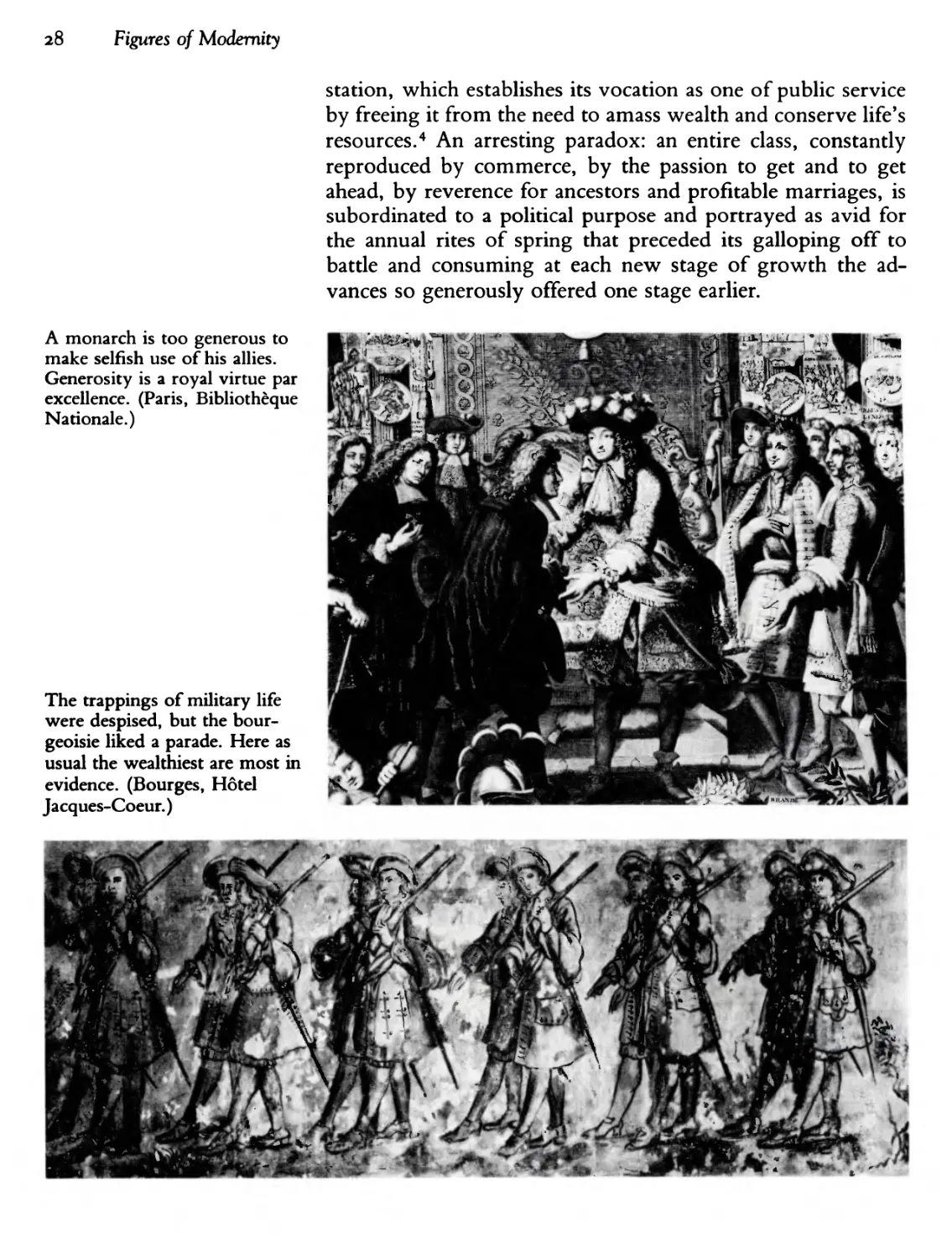
A monarch is too generous to
make selfish use of his allies.
Generosity is a royal virtue par
excellence. (Paris, Bibliothèque
Nationale.)
■* ♦
>
z-4. ^ *
The trappings of military life
were despised, but the
bourgeoisie liked a parade. Here as
usual the wealthiest are most in
evidence. (Bourges, Hôtel
Jacques-Coeur. )
r! 1
X'
}A
t «
% •:••■
^u
X *J
vv
* :- \ À
^
-■£'
■* ■ /
i?
r
f
4 .
^V
**
¥?*\
>N
*«/•**".
-a <.
<
\
f*
^.r...
•t'r *ï*.
■•-v
£•
J,

Politics and Private Life 29
Two generations after Campion, in the period between
the last of the wars of Louis XIV and the beginning of the
Seven Years' War, we find in these same lower ranks
gentlemen under no illusion as to the limits of fortune, men who
traveled much greater distances to serve in much larger armies
and without benefit of powerful protectors. All that saves
them from anonymity is the brotherhood of arms and the
possibility of serving under a colonel with enough influence
at Versailles to promote their careers or at any rate to win
recognition of their merits. The correspondence of officers—
unpublished letters of Gascon noblemen—reveals a concern
for useful contacts but in more reserved and courtly terms;
letter-writers invoke relatives with supposed influence and
recall former comrades promoted to better positions.5 There
is little enthusiasm for the narration of martial exploits; at
Serving the King
1 «t!
Distant and severe, the king is
not only protector of the arts
but a redoubtable warrior.
Beneath medallions depicting the
works of the monarchy and
surrounded by courtiers frozen
in gestures of deference, he
assumes the pose of a hero whose
collaborators are gods. (Paris,
Bibliothèque Nationale.)
< *f 4 '
--;*-** 1
•wis
• ' /f^::
. i
'.S
«'£■
r
*
•J;
-if-
\
u :
r,U_,

30 Figures of Modernity
t.
■■■ ^
^..
' /,
*
T
/?¥*•?,
if
si V
1
tu r. .: : ■ , "i;
/'
A ■'
% I, ,
A drawing of lots to choose
men for military service, which
was feared not so much for its
dangers as for its duration.
(Paris, Bibliothèque Nationale.)
most, discreet allusion is made to well attested merits. Letters
are filled with news of the court and of battle, anxiously
heeded but for practical reasons; with talk of supplies; with
the movement of troops; with precautions to be taken by
individuals and families; and with professional matters, there
being a constant need for advice and a friendly hand in dealing
with the thousand and one details of forage, livestock,
discipline, subsistence, uniforms, and equipment. For these officers
the discipline of a regimented public service is coupled with
the free and familiar manners of men accustomed to living at
close quarters with other men. Theirs is a rather temperate
spirit of tolerance, which must be maintained even when an
impromptu inspection requires feverish preparation. The
bureaucratic organization easily and perhaps profitably
accommodates this ability to maintain a private life in the midst of
a common effort, but it is clear that there are no more private
designs, no ambitions that reach beyond the promotions and
honors planned for these subalterns, who after thirty years of

Politics and Private Life 31
service, should they be lucky enough to live so long, were
entitled to a Cross of Saint Louis and a pension of 500 livres.
Professional soldiers, they owed little to the contacts and
patrons who at most secured their commissions for them at a
time when the king had need of his military nobility. Poor
families contributed enough to give their man a start and make
sure that he would never return home: 300 livres for
equipment, twice that to tide the man over until he received his
first pay. Thereafter soldiers helped one another, circulating
information, some in the bivouacs, others in the upper reaches
of the general staff—two separate worlds, whose paths rarely
crossed. Between field and staff officers there existed feelings
of vigilant affection, made tender by distance and not
compromised or threatened by any confusion of interests.
These men were no longer, like Campion, soldiers of
fortune who, to advance themselves, pledged to follow
patrons whom they served loyally, not distinguishing between
private ambitions, honors, and service and what, by
anticipation of usurpation, counted as public. For the lower-ranking
officers of the bureaucratic monarchy, military service was
one of the few ways to live and die in dignity. Their lives
were absorbed by their work, as they moved from garrison
to garrison, battlefield to battlefield, allowed an occasional
leave but almost never permitted even to think that they could
live in any other way. Their letters, filled with details of
projects not of their own devising, never suggest devotion to
"'. r
w
\
M
Troops were used not only in
war. The imposing palace
guard underscored the presence
of the prince and his army.
(Paris, Bibliothèque Nationale.)
c
Georges de La Tour, Dice
Players. A pure game of chance,
except where there was cheating.
(Middlesborough, Teesside
Museum.)
I
**
\

32 Figures of Modernity
Jean-Baptiste Pater, Troops on
the March. Military life was not
yet cut off from the people.
Manners were observed even in
the field, and the entourage
was not entirely military.
(Caen, Museum of Fine Arts.)
some great public purpose; instead they manifest a resigned
submission to higher purposes translated at this level into
abuse. These subalterns take their public roles seriously but
not conscientiously; their daily labors are a routine from which
amusements provide a respite that sometimes seems more like
a duty. Gambling, which for Campion was an absorbing
possibility, is now no more than an unavoidable occasion to risk
scarce funds with little hope of success. These settled warriors
scornfully viewed duels of honor as mere games indulged in
by young knaves still wet behind the ears and simpleminded
dragoons fond of the adventure of attacking the king's tax
collectors with saber and sword.
It is tempting to characterize the condition of the
professional military as one of servitude rather than service; no
longer was the officer free to quit when his mediocre position
no longer held out promise of glory. Campion, in his avid
youth, would not have tolerated the long periods of boredom

Politics and Private Life 33
» I»
V
^
in which the military machine became mired when obliged to
stand still. But if discipline and hierarchy eliminated the last
vestige of personal ambition from the military, officers now
lived in an atmosphere not of rivalry but of familiar, almost
familial, affection. When friends cast their eyes back over their
years in the field, they recite the names of the dead, not with
an eye to positions opened and promotions made available but
with a tone of pious and fraternal commemoration, recalling
close, cordial, and trusting friendships through years of virtual
exile.
Nicolas de Largillière, The
Aldermen of Paris (detail).
Symbol of the Arts joining their
prestige to the dignity of
Commerce. Honest pursuit of profit
served the glory of the state.
(Amiens, Picardy Museum.)
For Campion, who in public life never distinguished
between political and private goals, an exemplary loyalty,
warmed by feelings of gratitude and hopes of fortune, served
a variety of purposes: it assuaged his conscience, renewed his
zeal, and gave evidence of partisan commitment. Having
declared himself to be a man full of sympathy and emotion, he
needs an intimate stage on which to display his feelings life-
size. He can neither fully enjoy his private happiness nor fully
A Close and Absolute
Superior

34 Figures of Modernity
The natural order is an
extension of the political order,
which promotes knowledge of
the laws of nature in the
general interest and as a means of
enhancing the sovereign's
power. (Paris, Bibliothèque
Nationale.)
The king heeds counsel, but
intuition is his only master. His
decisions are received as the
revelation of his will, of
general significance. (Paris,
Bibliothèque Nationale.)

Politics and Private Life 35
drain his cup of sorrows except in the domestic setting, again
with relationships so exclusive that, when his favorite
daughter dies, he finds it his duty to show no more than unenthu-
siastic concern for his remaining children. Apart from
emotions associated with love, he seems susceptible only to
that bitter disappointment that ever since the Middle Ages had
been an inevitable part of the vassal's commitment. Toward
one's superior it was still necessary to feel a mixture of respect,
gratitude, and love, to say nothing of righteous fear, as
seventeenth-century treatises on moral theology recall.6
The word "superior," with its connotations independent
of the type of superior concerned (whether husband, master,
priest, officer, magistrate, or lord), goes a long way toward
explaining why it was so difficult to separate the notion of
beneficent and lifegiving power from that of cringing
affection, the ultimate fear being one of banishment from the
source of benevolence and nourishment. Since it was not, at
every level of society, necessary for every individual to have
a direct relation with every conceivable superior, it was
considered praiseworthy, indeed parsimonious, to limit one's
homage to one's immediate superiors. A woman in the
temporal order could claim to recognize no superior other than
her husband, and a servant went beyond legitimate bounds if
Gabriel Metsu, Soldier Visiting a
« Young Woman. Respectful
solicitude like Campion's was a far
cry from soldierly impudence.
^ -V1 (Paris, Louvre.)
*\ V.
i

"Chancellor Séguier," The
Entry of Maria Theresa into Paris
(detail). Pomp and reverence
surround a high servant,
satellite of the great star. More than
any other official, the
chancellor was enveloped in symbols
of royal majesty, for it was he
who made the king's acts
explicit. (Stockholm Museum.)
Loyalty and submission were
crucial words for the clients of
the king and the nobility.
High-ranking ministers were
great personages, but as
servants of their master. (Paris,
Bibliothèque Nationale.)
"ïiiSWftiftr Wï Jvfc.'
FIDE ET OBSE • UIO.
11«,
E^~
J
NIL SINE T^.
^^
"■"••. .. f
^<.
ttinjttirsÉ. î:r r
.11? UW
■i:-\.
jm v
■t t t y-
he or she appealed to an authority higher than the master's,
to, say, a political authority. Transgression of these boundaries
would have called their very meaning into question and raised
a host of other problems. As it was, a valet could be as
confident of the excuse that he was just following orders as
Campion was that the Duke of Orléans would feel duty-bound
to include in his treaty with the king mention of those
subalterns whose only crime was to follow the orders of their

Politics and Private Life 37
prince. Even as late as the Enlightenment the charge, leveled
against people of modest station, of being "republican" was
in no way intended to impugn their loyalty to the monarchy.
If they were seen as "bad subjects," it was not as subjects of
the king, of whom they had no opportunity to speak; in
question usually was their insubordination toward masters and
other notables, the rector or the lord, or perhaps simply a lack
of alacrity and obligingness or a presumption to judge the
actions of the curate or the consuls by the standard of public
utility.
This limiting of acknowledged authority to those closest
at hand did not prevent people from attaching an often
prestigious symbolic value to authorities whose exercise of power
had consequences—such as taxes—but which entailed no real
contact and brooked no conceivable opposition. People readily
hailed as "Our Lords" remote authorities such as the Parlement
or the royal court; in Languedoc the title was even accorded
to the deputies of the Estates General of 1789, much as it had
been granted in the past to the deputies of the provincial
estates. The term almost always connoted distant respect for
the power that validates and authorizes rather than that which
is exercised directly.
In these customs of speech and action, legitimacy was
regularly recognized but rarely effective, yet the question of
the legality of obedience was almost never raised, so utterly
did the reality of the superior impress the imagination or
govern the habits of his subjects. Abnormal situations did arise
on occasion, however, demanding specific responses that
reveal something about the nature of authority.
The heroic sign of power
transmitted from the prince to
the assembly. Sovereign power
penetrates the body of the
virtuous, heroic, generous
assembly. (Private collection.)
~T7r<£?— OM.Q USÙ, CLSSesrA&'ûjL.
0 SdH^mrs^d Ùtéiié, èAvia^^ty oloivc/
2>ûrws <Vq«S^ &Lyos frtOins, -&uc/ié. taTjotcv^ :
Votes Qvlis iojusÉœ, eé Co- &£cl& : ^ 9 _,_
<SilV> VoSTTVOites tséhwtéi fuwr/uuuC Qvcwhzwf, 'l/ùTiôï.'.
_JLA)«CJkXJ a. Z-o~^aoa-,
<j e*i- .QCÙéZàcun. i>-voikv4ii/}«- ^£?~
~~Z>

38 Figures of Modernity
A Community in Disarray An example from the early years of the eighteenth century
concerns a case of rabies in a small community in the bailliage
of Gévaudan.7 Everyone—the afflicted man, his family, and
all the parishioners, peasants from the surrounding
countryside—turned to the curé of Pierrefiche to cope with the
emergency. Pierre Marcou, the victim, relied on the priest not for
medical care (having himself done what was necessary at the
appropriate time and having touched the miraculous holy
keys) but because he felt death approaching and, aware that
his malady posed a threat to the general public, wanted
protection in his final days. While the doctors and neighbors,
alarmed by his outbursts of rage, debated possible ways of
putting an end to his life or abandoning him, the priest offered
reassurance, taking into account the victim's spiritual as well
as physical interests, rejecting the idea of deliberate murder
(by opening four veins), and refusing to countenance
abandonment of the dying man, which would have caused him to
abandon hope.
Marcou's relations with the priest had not been good, the
curé having pressed him for the payment of certain debts.
Nevertheless, under the circumstances he felt he could count
on the priest's protection, which he demanded in the name of
"loyalty. " He demanded the same loyalty of the apothecary
who did the bleeding, which he accepted as treatment yet
feared might be used as an unobtrusive method of taking his
life. Noticing that his vein remained open, he wondered
whether it was wise to close it and turned to the curé for
advice: he "relied on him [to know] whether it would be
wrong to leave his vein open in order to die sooner, for if it
was wrong he did not want to do it."
Following the priest's advice, he closed the vein but took
note of the fact that this legitimate authority, whose loyalty
was guaranteed by his duties as minister, was not the only
person with control over his fate. The neighbors who were
called upon to stand guard over him were afraid to tie him
up; instead they placed a screen around his bed to confine him.
But in a fit of rage he tore it down, shouting that he wanted
to bite everyone and burn everything. The guards were forced
to flee the house and to extinguish the flames with water
poured into the house through a wooden conduit placed in a
window; they were then obliged to surround the house and
keep it under siege through a long December night at an
altitude of more than 3,300 feet, fearful lest they fall asleep

and be awakened by a fatal bite. Earlier, Marcou, well aware
of what inevitably came to pass in cases such as his, had
anticipated that the townspeople would want to kill him. After
making confession, ordering restitution, and asking for
prayers, he refused extreme unction because he thought that his
best protection against the impatience and panic of his guards
was to leave the preparations for his death incomplete.
Strangely enough, he seems to have paid little attention to the
temporal authorities, represented in the admittedly
unimpressive person of the lord's bailiff. It was the guards who hit
upon this expedient. Because the priest who had organized the
guard was paralyzed by a sense of duty, someone was needed
who, in the name of public safety, would dare to hasten
Marcou's depth. The bailiff accepted the role that was thrust
upon him and dispatched his son to shoot Marcou with a rifle.
In the minds of these peasants, nearly all of them illiterate
(as is shown by the fact that only one of the witnesses signed
the affidavit), the danger and difficulty of this pathetic
situation made action imperative. There was wide agreement,
however, that only the family, the close relatives of the
afflicted man, had the right to make decisions, in this case when
to abandon hope in medical treatment. A priest from a nearby
parish advised the priest of Pierrefiche to do nothing more
than administer the sacraments and otherwise to stay out of
the affair. The failure of the family to assume its responsibility
in a sense forced the hand of those who, in one way or another,
believed they bore official responsibility. Marcou had no one
on his side but his young wife, terrified by his sudden illness
and soon driven by fear and by her husband's orders to seek
refuge with the priest, where she cried, begged, and sought
help in vain. Afraid of his own rages, astonished by his horror
of whatever came into view, Marcou had sent the rest of his
family away. He had no close friends. Although the term
friend, or good friend, was widely used, it was in the sense
of good neighbor, a person with whom one enjoyed cordial
relations. Neither Marcou nor those who surrounded and for
the most part liked him gave any thought to a friendship that
might go beyond relations of habit, familiarity, and loyalty.
Before long the common good became the paramount
concern: since Marcou was suffering the tortures of the
damned, and since his madness drove him to do terrible
things, why not do away with him? Had he not cried out to
be torn limb from limb, so that he might merge his suffering
with that of Christ in his Passion? Had he not screamed that

he wanted prayers sung around his corpse? Had he not tried
to hide in the pile of wood chips in front of the warm oven
to stop his shivering, even though he could no longer bear
the sight of fire? Had his family been present, they would
surely have assented to a fate of which Marcou himself
whispered: after the last rites, let him be suffocated or bled to
death.
The evidence that public security was at risk in this case
of violent execution was not well received. The murderers
loudly proclaimed their horror of an action that they
undertook only with the greatest reluctance. The witnesses, when
compelled to speak, expressed the bitterness of people who,
eager to see the drama end and be relieved of their guard,
wanted simply to make way for the proper officials to do their
job, to deal with the calamity properly and without scandal.
Those who did not take sides were unashamed to say that the
important thing was to contain the victim's destructive frenzy
by restraining or confining him after the last sacraments had
been administered and enough food had been provided to see
him through to the end. It would have been preferable to have
left any irreversible decisions to the family and its private sense
of honor, but, failing that, the community had been obliged
to do what prudence and decency required. The problem was
that there had been no official prestigious enough to see to it
that the afflicted man was treated firmly but without violence.
Most people had resigned themselves to abandoning the dying
man to his fate, partly because they had notified the
responsible officials and partly because there was nothing they could
do to alter the inevitable. Neither the bailiff nor the apothecary
could offer any solace beyond a quick and violent death. The
latter, because he was the only one who knew much about
the horrors of the disease, was also the only one who dared
admit that he was glad to have put his patient out of his misery.
The attitudes and behavior revealed by this case can be
analyzed thanks to the care taken in the interrogation of
witnesses and the patience of the "official," or ecclesiastical
judge—who is almost always more thorough than the
ordinary judge with whom he collaborated—for this was a
criminal case in which a priest was implicated. It would have been
easy to conclude on the basis of a more summary investigation
that the community wished to deal on its own, according to
its tried and true traditions, with a problem in which the curé
had been invited to play a limited preliminary role. In fact,
however, the community did not act as an autonomous col-

Politics and Private Life 41
lectivity. Initially, it was the priest who took in the family,
organized the guard, and offered or ordered whatever
assistance he deemed necessary. His behavior may be judged
ambiguous, in that it anticipated the more cruelly decisive second
phase of whose inevitability the priest was aware. Still, when
the neighbors discovered that their siege was useless and in
the absence of a response that could truly be termed "private,"
that is, from the family, they did turn to a person whom they
were able to regard as the representative of public authority.
At this modest level, the hesitation of the populace seems to
indicate not an extension of private solidarity but an anxious
quest for a public authority capable of dealing reliably but
according to its own norms with a case for which tradition
provided no norms at all.
What strikes the modern observer of this drama is that
the atmosphere is not one of anonymity and indifference. At
first the response is private: the neighbors rush to assist. Then
the secular authorities are called upon, and their orders are
rigid and brutal but clear and probably reasonable, justified
by the purpose of confining the disease. The only truly private
party involved, the man's wife, lacked the strength to influence
Hope of a miracle fervently
maintained at the end of the
Enlightenment. Private
gratification combines with public
amazement. (Paris, Carnavalet
Museum.)

42 Figures of Modernity
events directly. She lacked the support of a public authority
that could have represented her interests, as the priest did
within the confines of his religious domain, to work out a
compromise acceptable to the family in distress. The lonely
victim's only success had been to remove from the scene all
who might have been moved by pity or loyalty toward him;
his rage and his impassioned threats had put them in an
impossible position. The outcome was a foregone conclusion,
since there was no family prepared to assume full and effective
responsibility and since the private individuals pressed into
service to protect the public interest had no rules to guide
their conduct in such an emergency.
Long-Term Justice The very fact that such a complex investigation was
carried out four years after the incident shows that the courts had
a substantial role to play and were capable of uncovering facts
and punishing offenses. Did the wheels of justice grind so
slowly that the courts intervened only belatedly, in time to
provide the drama with its epilogue? Yes, but this failure is
not the important point, since the fact that the court did
intervene was the first step in establishing rules to ensure that
such situations would in the future be dealt with in more
orderly fashion. The most serious flaw in the operation of
justice is that the crime would have remained buried along
with its victim beneath the frozen winter soil had it not been
for a private grudge that the prior of the commandery nursed
against the curé of Pierrefiche. The case of Pierre Marcou, like
the fate of the man himself, was decided by outside forces.
Remote as these poor peasants were from the world of
politics, their malaise stemmed from causes not unlike those
responsible for Henri de Campion's scruples. When public
authority is not organized, or in any case not wrapped in the
mantle of legal obligation, it is difficult for modest and humble
folk to defend their privacy or even to establish its boundaries.
The extended family, the parish, the community, and the
patron appear to offer protection until they become the means
by which social imperatives are transmitted to the individual,
and transmitted with all the more bluntness and coercive force
because they are so close, and obliged to make do with limited
means. The witnesses to Marcou's murder reflected upon their
experience with a bitterness not unlike that occasioned in
Campion by his disappointments. They had observed a man
who wished to die of natural causes but who had been unable

Politics and Private Life 43
to forestall the obvious preparations for a deliberate crime.
Campion, once an ambitious man, had seen himself reduced
to the state of a penniless exile with no hope of obtaining a
settled position.
It would be wrong to generalize from such examples by
saying that the sovereign power worked to obtain greater
freedom for its subjects. It is more accurate to say that, in
the early modern period, the sovereign tended to back the
authority of subordinates too weak to offer rivalry or
resistance but strong enough to transmit its orders and to serve as
instruments of its action. States, cities, corps, communities,
and families were exhorted to make themselves useful; in
return they were guaranteed certain privileges in their
restricted domains. Two antagonistic but complementary
meanings of the word "privacy" emerged. One referred to the
authorized defense of the civil liberty of each individual insofar
as that individual's behavior was not governed by law or the
duties of office. The other, more active interpretation of
private authority was to specify the legitimate scope of the
authority of the superior over individual members of a group,
that is, his right to govern their work, their leisure, and the
use they made of their property, positions, and even, in the
case of the family, their bodies. This authority was justified
on simple grounds: exact reciprocity in the case of marriage;
in the case of a group, a concern for maintaining order,
without which the group risked disintegration; or, in the case of
the weak, the need to obtain the protection of the strong. The
model of all authority, that of God over his creatures,
implicitly precluded any hasty defense of individual rights. The
superior by right showed solicitude to, and therefore
supervised the behavior of, the inferior.
A political order also makes its influence felt in the way
it distributes powers, positions, jurisdictions, responsibilities,
and honors. Each official seeks to ensure that he will have a
free hand to exercise those powers for which he must answer
to higher authority. Many people prided themselves on
cheating the tax collector, often a well-known neighbor, of his
peremptory exactions, or depriving a creditor, scarcely more
indulgent than the king's agent, of his due. Even the most
commonplace supplies such as lard and grain were hidden
from prying eyes in safe storage, and although the dinner
menu varied little from house to house, it was considered
secret enough to preclude visiting during the hours when
dinner was being prepared. Records of investigations and hear-
^
•7N*
'*£'
J.E Li VR E'N FXESSA1B '
n7 toutcsortctù i 2>/fi/i/roHs. ^^
KBarreme
etrttufiwnt-i?'cic \ffr
. £ [*' " , OU<VH1i7C lltlL'
''■■ W ^ , 7 fous A'A tt<:.•..■/«■///>•
/// rh/'r/.t/ T;:«-.v7«v
■ '?/ \icurs i/r.'-.\t wife <
\&
r— >a
•n
V
l*,m.' Cficz t.i'Vcm'cMaiC
'*'" h il\n ,
v \g ansl*lhmvf/h//-UiuonJuS.
Ham '//?( 'JurU qua y t/i'Co/ify a Li v
*n-mtav potte Corhnv apt K'/u A tw,K-Gnau\unff-
^ f\ir<J*it<:•//-,*• JuiZtty '•// /71'S
Many people wished to keep
private accounts; in the absence
of convenient means of
calculation, tables of sums enjoyed
considerable success. Aptitude
for mental arithmetic,
developed by youthful practice, was
less cumbersome, but it was
easier to resort to the ready-
reckoner. (Paris, Bibliothèque
Nationale.)

44 Figures of Modernity
ings generally reveal the uselessness of such precautions, since
the truth could rarely be hidden from the sharp eyes of
watchful neighbors. Attempts to preserve the secrets of daily life
had a more subtle purpose: people were not obliged to speak
of what they did not see, and neighbors, even if they knew,
could feign ignorance and avoid making public what
proximity made perceptible. For relatively poor families, private
life depended less on their ability to isolate or hide themselves
than on the convention—partly sincere—of seeing and hearing
only what was deliberately divulged and reporting only what
was deliberately made manifest. This explains why a
neighborhood or family dispute would draw crowds of indiscreet
onlookers: in the heat of argument people said things that they
ordinarily would have concealed from third parties. When a
disreputable person was accused of a fairly serious crime with
a strong likelihood of family complicity, the family's version
of each member's role was generally accepted by the
authorities, as long as someone was willing to make a plausible
acknowledgment of guilt. It was considered the family's right
to conceal the details of the plot that had brought its members
together! Through this presumption of ignorance as to
relations between husband and wife, parents and children, the
authorities were able to economize on punishment. At any
rate general opprobrium and discredit attached to the entire
family, and people cast a suspicious eye on the possible
machinations of the bad seed. Allowance was made, however, for
secrecy in family relations when the entire family was not
involved in criminal activity, in which case the right to secrecy
was consecrated by custom. But a crime committed against
another family member could outweigh this scruple.
Certain limits were more firmly respected once their legal
standing had been tested.8 Take the case of a peasant who
defended his "land" against an alleged easement guaranteeing
passage. As long as the case remained in dispute, the man
took it as a test of his neighbors' discretion: did they spy on
him as they came and went? Once he had the court's judgment
in hand, however, he repelled all intruders with truly military
determination. The neutrality of public space could be invoked
to protect its use for leisure activities or games which injured
no one, occasioned no criticism, and suffered no prohibition.
A hunter who leans against a tree on "the king's road" will
not countenance a protest from the owner of the adjoining
A Limited Emancipation

Politics and Private Life 45
*
/ '■/ \ "•
property, who demands to know "whose land he pretends to
be hunting on." Youths sitting on the steps of a covered
market discussing plans for a future celebration will not allow
an unwelcome intruder to sit beside them: "We are discussing
our own business. Leave us alone. You would be better off
over there." Teasing, always especially lively in the
countryside, turned malicious rather than insolent. There were fewer
brawls in cabarets, fewer flagons and goblets swept from the
table with the back of the hand, fewer humiliations of the
enemy, but more shrewd or insidious manipulations designed
to aggravate the other fellow and force him to make the crude
gesture or aggressive move. To treat any person as a man
with no will of his own, infinitely malleable, became
unacceptable. The stranger who, while watching a heated card
game, made ironic jibes against one of the players went too
far when he grabbed the man's purse and dumped the few
small coins it contained onto the table. He thereby violated
boundaries of privacy that everyone considered inviolable. It
was permissible to force the gambler himself to prove that he
had sufficient resources to play in a high-stakes game, but it
Jan Josef Horemans, Cabaret
Interior. Drinkers, smokers, and
onlookers surround cardplayers
absorbed in their calculations.
Gambling was a favorite
recreation, for it made talk largely
unnecessary and lent unusual
gravity to action. (Cambrai,
Municipal Museum.)

46 Figures of Modernity
Grevenbroeck, Visits to the
Usurer and the Fortuneteller.
Two ways of coping with the
future: a cash advance and
knowledge foretold. (Venice,
Correr Museum.)
was highly offensive to lay hands on his money for the purpose
of an indecent display. A gentleman whose purse has been
pilfered and who, riding crop in hand, insists on taking the
thief back to the scene of the crime to be identified is begged
by onlookers either to forgive the man or turn him over to
the authorities but in any case to leave him to his work, since
there is no danger that he will flee.
Attitudes in this regard had changed considerably, as can
be seen from records of trials in the second half of the
seventeenth century which involved, beyond disputes over
property (which often were mere pretexts), abusive or brutal
attitudes that public opinion increasingly refused to tolerate,
at least outside the domestic redoubt. No longer could a
gentleman without warning seize the first peasant who happened
by and set him some task, which the peasant was supposed to
perform happily and even enthusiastically in the hope of being
rewarded by the generosity of his better. No longer could a
r\
V

Politics and Private Life
nobleman invade a peasant's home on the pretext of getting
out of the sun, there to order the man's servants about, to rest
in the man's chair and drink his wine. Even sharecroppers,
who could not refuse the visits of the lord who controlled the
way they worked their land, attempted to maintain a
professional tone in their exchanges, precluding idle curiosity. Valets
and maids, however, imprisoned in a home that was not their
own, remained subject to arbitrary intrusions. This, it can be
argued, was a problem of cohabitation, always difficult to
resolve in any family. But debt, even when contracted for a
limited term only, sometimes created a deliberate servitude,
subjecting the unpunctual debtor to taxation, forced labor, and
the whim of his creditor. The debtor understood quite well
that his best hope of avoiding the worst—seizure of his
property by the creditor—was to make the debt agreeable and even
profitable. Thus he freely offered his services, allowed his
creditor to gather fruit from his orchard, vineyard, or garden,
and willingly submitted to various controls on his
expenditures. Many patient lenders, by no means inclined to seize the
property of their victims in arrears, were quite adept at taking
despotic and unscrupulous advantage of the private power that
their credit secured.
Wherever the legal guarantee of independence was
nullified, whether in domestic servitude or alienation through debt,
an uncontrolled appetite to absorb the private domain of others
emerged. The change of attitude, at least in the middle classes
vulnerable to the actions of the courts, no doubt had to do
with the protection that the law was felt to afford to property
and person. Although verbal insults were still freely exchanged
outside the distinguished classes of society, the slightest
physical assault, the least attempt to appropriate or embezzle
property, could be punished, provided the plaintiff took the
precaution of having the facts of the offense verified. And
even if one did not face a powerful opponent, who could be
sure that a malevolent adversary would not be glad of an
opportunity to annoy and exploit a penniless wretch at little
cost to himself?
The aim of justice, upon which the government insisted Surveillance and Security
most firmly at the precise moment when the king's exchequer
needed to ensure the solvency of his most humble subjects,
was surely not to guarantee that every man would enjoy peace
and quiet in his own home. The need was to guarantee proper

and profitable use of property and talents, so potential
aggressors had to be taught that to attack even the most modest
of homes, possessions, and persons was fraught with peril. A
poor wretch whom some hardy predator had thought to harass
with impunity might receive assistance from a personal enemy
of the plaintiff. Given the necessary subsidies to pursue the
case by appeal to a higher court, the defendant's resolve might
be stiffened. Once deprived of the possible protection of the
local magistrate, the presumptuous village luminary might
find himself faced with a heavy judgment damaging to both
his fortune and his prestige.
"Secret parties" increasingly involved themselves in court
proceedings, and people soon learned that it was prudent to
abstain from provocation or intrusion. In the 1660s youthful
revelers in Toulouse broke down the doors of the poor,
especially poor widows unable to defend their daughters' virtue;
a century later young gentlemen were obliged to offer
consideration and gifts in exchange for the clandestine concessions
of women "of the lowest rank" but apparently decent. Indeed,
respectability was so easily offended that honest pretexts had
to be found for visits that might otherwise alarm neighbors
and provoke complaints. People who lived in want knew that
they owed their survival to their betters, who recommended
them for jobs and charity. Such favors went to those who
were "interesting" not only for their poverty but also for their
innocence, hard-working determination, and pure morals, to
say nothing of their zeal in gratitude. Undeniably this
encouraged certain domestic virtues such as cleanliness, not to
mention a certain ostentatious prudishness that discouraged
the often unwanted familiarities of neighbors.
The new rules brought some measure of decency and
privacy to the lives of the least fortunate, the poor and the
fallen, who lived without visible or regular means of support.
The deserving poor adjusted their behavior as instructed, to
avoid being seen, heard, or in any way attracting attention.
Officious neighbors who came to satisfy themselves that a
proper standard of decency was being maintained had to be
welcomed. It is always difficult to be sure whether compulsory
decency promoted private life or undermined it. During
working hours one room was expected to be kept clean and neat
for visitors, and necessary chores were to be hidden from
view. Women had work to do at home, and custom provided
few legitimate occasions for them to go out. They were truly
free only in the hidden recesses of the house. Hours of sleep

and work were strictly regulated, as were the much rarer hours
of leisure. Shabby housing held all sorts of surprises for its
tenants: blood dripped through the ceiling of one apartment
located beneath a butcher shop; ash and plaster rained down
when the room above was used for storage; abominable odors
wafted in when it was used for drying hides.
In the workers' quarters, where visits were frequent and
doors were kept open, respectability seems to have been less
strenuous than in more middle-class neighborhoods, where
except for the occasional ceremonial visit people mostly stayed
at home. Those who closed their doors, drew their curtains,
and refrained from gossip became the focus of suspicion. Not
that people expected free access to their neighbors' homes at
any time of day or night. Even children were taught to respect
the threshold and to call to friends from street or landing.
Doors were closed at mealtimes and at nightfall. Behind them
people spoke freely and loudly and laughed or cried without
restraint; relations, good or bad, were intense. Usually this is
considered a sign of emotional vitality rather than want of
privacy.
The variety of private life is not so great as to suggest a
corresponding variety of conditions in public life. The very
ease of access offered to thieves and intruders and the openness
with which private quarrels were pursued in public suggests
not that the lower orders were fatalistic but that they had
confidence in "the public faith." Ordinarily there was nothing
to fear, because the good folk behaved as they always do: if
by chance some good-for-nothing appeared in the
neighborhood, there were plenty of eyes to survey his movements.
Frank and frequent communication among neighbors
guaranteed security. Yet privacy was no problem, for the clock
dictated when visits were and were not acceptable. The
occasional noisy celebration was easily tolerated. Already many
prided themselves on keeping up appearances. Wealth, which
made the task easy, is not a useful discriminant. Ambitions
most often exceeded means, hence security required a wall of
discretion. There was nothing to fear from neighbors' actions,
but much to fear from their curiosity, which, if unsatisfied,
exposed its object to risk, especially if he was a stranger or
newcomer to the neighborhood. There were few accusations
of dishonesty as such, but many charges of disreputable
background, dubious character, and bad habits, born of a desire to
get rid of a troublesome or scandalous neighbor by making
allegations to the dizenier or priest, the secular authorities being

50 Figures of Modernity
less ready to take offense. This too reflects substantial
confidence in the public order, which in normal circumstances
could tolerate, without undue alarm and little more than moral
concern, a family's withdrawal behind private walls. What of
the temptation to destroy, for frivolous or malicious reasons,
a social facade constructed with the utmost difficulty? And
what of indignation, real or feigned, against those who might
hide their debauch behind an irreproachable front? Clearly no
private life was possible unless publicly sanctioned. Securing
privacy required little effort, only firm determination. Because
everyone knew at once virtually everything that everyone else
did, any perceptible and verifiable offense brought quick
response to which no culpable party could remain indifferent,
since the lure of damages and the support of interested rivals
could easily overcome the timidity of the most humble.
Surely the first to avail themselves of the sanctions
guaranteeing privacy were those strata of society that had most to
gain from good reputation and from the orderly home life and
morals on which reputation rested. The cost of maintaining
order was considerable, especially for those who did not
directly profit from it. Keeping up appearances was crucial, and
to do so people did not hesitate to make sacrifices including
death. Privacy manifested itself primarily as discipline, but it
could also be nourishing and life-sustaining. Without it, people
with a bare minimum of resources could not have risen to the
daily challenge of surviving with dignity. It is hard to say
whether the exhausting struggle for survival aroused enough
enthusiasm, pride, and camaraderie to permit, in the face of
all the obstacles, pleasure in the delights of private life and
family tenderness.
In Praise of "Countenance11 Even if the political authorities were only seeking
subordinates capable of extending their control to the most
humble of subjects and taxpayers, they shored up their authority
with guarantees and warnings reinforcing the moral
significance of the "countenance" recommended by manuals of
etiquette. The ability to keep one's countenance was a virtue of
prodigious importance, capable of disconcerting demons,
which, being of angelic nature, were incapable of penetrating
a man's conscience but clever at interpreting the emotions
betrayed by his features and gestures. The secret man, Baltasar
Graciân's el Discrete, was more than just a model for
magistrates and courtiers who concealed their designs beneath a

reassuring outward mask; he set for all an example of
retirement, aloofness, and freedom of maneuver, qualities that
enabled him to maintain his rectitude without either
immobilizing or exposing his countenance. Once violence
became unavailing as a means of thwarting organized plots,
ascetic vocations, and ambitions of all sorts, then prudence,
whether natural or assumed, and the need to anticipate the
course of events in the near or more distant future required a
discretion in manners and language of a nature to forestall any
possible challenge.
It is hardly surprising, therefore, that the longing to retire
to private life is a constant theme of picaresque adventure.
The rewards of privacy are pursued by social outcasts who at
first seem highly unlikely to succeed. Whatever the underlying
motive of Jean Van prés, whose dramatic aspect Emmanuel Le
Roy Ladurie sought to discover beneath Abbé Fabre's sunny
southern style, the plot hinges on the need, for one whose
start in life has been fraught with difficulty, to secure
prosperity by making a "good" or at any rate a reasonable
marriage.9 The hero, son of Truquette, a thief who ended on the
gallows, endures a childhood which, despite its reality of
wretched poverty, is wreathed in mythical language by a
grandmother who has never given up her dreams of grandeur.
She wants her grandson to acquire education and manners,
but he sees the foolishness of her plans and prefers the life of
the petty thief roaming fields and orchards, surviving by dint
of strength and cunning—a rural Ulysses, who draws a new
and useful lesson from every episode along the way to his
goal.
In the end he reaps the reward of the legitimate heir, for
he recovers his grandmother's secret hoard, the remains of his
father's booty. Truquette's accomplices, spared his sad end,
remember him as a generous fool, for which reason Sestier,
the wealthiest and most settled of the group, agrees to hire
the son as a jack-of-all-trades. The young man conceals his
game well, gets Sestier's daughter with child, and finally, in
a speech addressed to the lord but in the manner of a soliloquy,
reveals his modest pride at being received as son-in-law in a
rich man's home. There is nothing miraculous in this rather
vulgarly realistic tale, yet the grandson of a woman who sells
matches and the son of a hanged man grows up to be a
gentleman worth 40,000 ecus, a goodly fortune for a country
boy, much of it in measures of grain whose price knows no
limit.

An optimistic outcome—or an immoral one if, like the
lord in the tale, you prefer to observe the proprieties—and a
conclusion all but unimaginable in the Spanish picaresque of
the seventeenth century, conceived before the social order had
attained such a peak of perfection. That a new order has been
established is plainly indicated by the fact that wealth is
justified not by history but by the mere appearance of legality.
No one is concerned to trace the origins of the hero's fortunes
back to its legitimate roots, or to wax indignant if no such
roots can be found. Truquette's treasure is ill-gotten, to be
sure, but at what price! No matter, since Jean Tan prés [the
name is dialect for "John took it"] is the legitimate heir. Ses-
tier's trust is abused, but he who is deceived is himself a
would-be deceiver. His daughter Babeau is as eager as her
seducer, whose intentions are as pure as his motives are just.
Those who know the true story have least to gain by telling
it, and in all likelihood the heir whose birth is imminent will
never know. Old Sestier with his powdered wig had already
obtained respectability and patronage. Babeau is a charming
child, radiantly naive. Jean will be what he always wanted to
be, a good landlord, alert to the realities of life. After three
generations of debauched women, "gibbet's prey," thieves and
scoundrels, the cradle is ready to receive an honest man, who
will be lavished with affection, carefully educated, and
prepared to take his place in good society.
The point to notice is that the family, whatever its
inclinations, never lacked "countenance," that indispensable
component of private demeanor. Masculine honor and feminine
tenacity preserved its essential qualities, resorting as necessary
to absurd pretension and strict secrecy, stubborn deception
and heroic endurance. To pretend to such a degree, to conceal
even the realization of one's true purpose, is to protect one's
privacy. Such an attitude is credible only as long as success
remains plausible. The vices of Jean l'an prés and his
grandmother are presented without the slightest hesitation in this
minor morality tale: from Truquette's ridiculous wedding
meal to the burial of the Huguenot grandmother, everything
is exposed in the most wretched detail, even the undignified
private quarrels that no sense of propriety conceals. In the end,
however, the peculiar private project succeeds. Nurtured in
solitude, its vigor remains undiminished and its existence
unknown, and the wealthy, securely ensconced in privilege, are
outwitted and outmaneuvered by the agile and determined
poor. In this world of at least temporary poverty, where it is

Politics and Private Life 53
almost impossible to escape the neighbors' scrutiny, where the
door cannot be slammed in anyone's face and probably has no
lock, individuals must protect their privacy by more secretive
means. They must conceive their plans in secret and carry
them out surreptitiously, calling upon whatever assistance and
credit they can muster. Even before achieving comfort,
respect, and security, they can work their will, but at the price
of aloofness and secrecy.
Jean l'an prés tested his mettle in a world in which it was
still permissible to compel an impudent upstart to atone for
his audacity by ordering him beaten at the hands of lackeys
and valets. But such methods were of little avail against an
ambitious man who knew how to harden himself. To the man
who knew what to make of ambition, the law provided strong
enough guarantees to dispel fatal fears and give hope of
success.
The law did not create the cells within which ties of work Legal Chicanery
and kinship were supposed to form, but in the civil sphere it
did provide guarantees of cohesion that encouraged what
might be called a "solidarity of proximity, " coupled at times
with a warmth of emotion. Private behavior became more
determined, even if that determination resulted from
repressive constraints, as can be seen in judicial archives concerning
various kinds of domestic and business relations. At Toulouse,
for example, in the final years of Louis XV's reign, the widow
of a master craftsman accused one of the journeymen
employed in the shop of stealing tools. The charge was quite
plausible, since a locksmith's kit of tools was expensive to
acquire, to say nothing of the cost of equipping the shop itself,
and a workman whose position was precarious after the death
of the master might well aspire to go into business for himself.
In this case, however, abundant testimony indicated that it
was not true.
Within a guild it was easy to obtain restitution without
pressing formal charges of theft, which, if they resulted in
conviction, could entail the death penalty. Hence it seems
likely that the gravity of the charge was intended as a threat,
and that the case was motivated by either hatred or blackmail.
The answer appears to lie in the widow's distress. In the hope
of finding a successor for her late husband, she had cast her
eyes on the intelligent and hard-working journeyman, even
though he was much younger than she. She had hoped that

54 Figures of Modernity
Law and order were slow to
take hold. The legend, which
reads "Tax collector who pays
straightaway the proceeds of
his collections," suggests an
ironic appreciation of the
brigand's act. (Paris, Bibliothèque
Nationale.)
the lure of promotion in a trade where it was all but impossible
to obtain the status of master craftsman except through
inheritance would overcome any reluctance caused by the
disparity in age. When the man hesitated, the widow brought
pressure to bear by accusing him of theft, a charge that was
easy to substantiate since the locksmith used the master's tools
every day as though they were his own. The mistress left
herself room for negotiation, for she could later concede that
she had misinterpreted the journeyman's actions. Cynics often
said that the best way to ensure a servant's loyalty was to
possess proof that he had committed some offense. In this
case the mistress wanted not only a good servant but a
husband, whose loyalty would subsequently be enforced by a
common interest in the business.
Another case involved a theft of wool. A confession is
heard by hidden witnesses, and to settle the affair the thief is
forced to acknowledge an enormous debt that can be repaid
only by a lifetime of indentured servitude. The witnesses and
the thief became confederates, to whom the secrets and
misdeeds of the business could safely be revealed.
These foci of solidarity, secrecy, and, ultimately, privacy
were not created by common accord or natural cohesion. The
guarantees and threats of the law were used to create and
f 9$ t '
/<„„„,; j; \j&«..-,. JJ.V^y..
t^ il,r
r
a
- ?*■,
Iff Jn<*'ut«'t^]iu inùr *i
fil: *'V /«v malclumMw

Politics and Private Life
strengthen bonds among people who shared neither friendship
nor affinity. Such relations were unintended and no doubt
unforeseen consequences of the law itself, of the logic of
delegating authority primarily in order to foster responsibility.
Since each family, each business, and each community was
assigned primary responsibility for maintaining its own order
and exacting its own price, an esprit de corps, born of anxiety
over the risks of mismanagement and sometimes inspired by
the honor implicit in responsibility, served to maintain close
relations even among people who felt no sympathy for one
another.
When a chimney fire threatens to burn the tax collector's
house, all the village inhabitants hasten with buckets and
ladders to extinguish the blaze, as neighbors should—but not out
of a spirit of charity. Everyone knows that the collector's
property will, as a regular precaution, be sequestered in order
to guarantee the king his due. Nothing saved from the fire
will remain for his own use. "Provided enough remains!" the
people think; otherwise the community will still be liable for
the tax, having paid their taxes already for nought. Such was
the system of joint responsibility, to which people were subject
by custom, not choice. Often the only way out was to name
the individual who was to bear the burden in case of a legal
claim, so that, for example, only the head of the family could
be dunned, or the master craftsman of the shop, or the consul
or syndic of a town.
The social fabric was sturdy enough to be manhandled The Troubled Gaze of Justice
without tearing, but everyone was aware of the damage.
Agencies were called "private" not only to distinguish them
from what was public but also because, although they might
fulfill a strictly public function, their resources and
motivations were private. The art of politics was to exert control
over a vast network of such agencies with the smallest possible
means. It was no small feat to integrate forces that rarely pulled
together. The term affidé (confederate), which etymologically
suggests confidence, still carried a pejorative connotation.
Criminal trials in the lower courts provide a window into
otherwise closed milieus, revealing certain ambiguities in the
attitudes of public authorities toward their private rivals.
Family feeling, clan spirit, and local and domestic loyalties are
plain to see in court documents. Parties worked out their story
in private, taking prudent liberties with the truth in order to

56 Figures of Modernity
If: fe
,v-
•Jv
- I
'/ i
ft
y '
'VVi
ir-
i\ «
' •
f
[
*.*
<•' v-'.r' x
" •< \
\,
r
- — ;..
'' *.. X'
■
."'' IK
■ * N
A crime is attested, a judge
hears the case, and cruel torture
is endured. The truth was
extracted either under oath or by
torture. No greater violence
could be done to the
individual. (Paris, Bibliothèque
Nationale.)
present a plausible version of the case. Witnesses performed
loyally but under duress. Deals were made of course, and
witnesses sometimes tripped themselves up by not daring to
tell the crucial lie. When the several depositions were finally
read and compared in open court, the more timid witnesses
liked to leave themselves some means of escape in case they
were caught in a lie. Appeals to higher courts were seldom
futile, for the appeals judge could easily divine the witnesses'
hesitations and doubts from the transcript and therefore tended
to discount their testimony. Not even fearful servants could
readily be compelled to fully support their masters with their
testimony, and even the poorest of debtors could discredit
such malleable witnesses. Private conspiracies regularly
succeeded, probably owing to the influence of family and
hierarchy, but frequently they yielded only partial success or even
crushing defeat. Thus the courts aroused bitterness and
suspicion, suggesting that people were made uneasy by the
unpleasant facts of collusion and coercion.
The discomfort was increased by rampant hypocrisy:
witnesses, if not actually asked to lie, were asked to swear to
things of which they had no knowledge. There was nothing
to fear. They did not risk damnation, for the cause in which
they were enlisted as coconspirators was legitimate. For some,
however, the tension was too great. Although they might
willingly repeat hearsay, they could not in good conscience
make their version of the truth coincide exactly with that of
their master or benefactor. In thousands of cases it is rare to
find an instance in which another person's words are repeated
exactly (and when it does happen it is usually because the
witness is feebleminded). Between husband and wife or par-

ents and children, communication, especially in isolated rural
families, was so thorough and complete that agreement as to
the facts does not necessarily prove deliberate collusion. Even
in the kinds of cases most likely to engender myths, such as
fear of brigands or obsession with witchcraft (which,
incidentally, became less common in the eighteenth century), we do
not find stories so consistent as to enforce general conviction.
When identical versions do occur, with all witnesses repeating
a lesson learned by heart, it may be taken for granted that the
story was invented and agreed to in advance. What the
witnesses believed in their heart of hearts is another matter.
These observations do not suggest a significant decline in
private solidarities. The delegation of authority actually
increased the power to command private allegiance. A more
pertinent question is whether individuals learned to weigh one
allegiance against another and refused to go along
automatically, mimicking or feigning conviction instead. The religious
enthusiasms of the Reformation and Counter-Reformation
enforced adherence to a new kind of community. The Huguenots
of southern France quickly and effectively created a disciplined
minority community, and the Jesuits similarly sought to stiffen
the resolve of the larger Catholic community. Both
developments convey the urgency of the situation. Lacking anything
better, the power of the state, naked and triumphant, needed
the support of intermediate societies. But these, with the
exception of the family, turned out to have no soul, to be in
themselves inert, simple cogs driven by outside forces.
It does not follow, however, that Enlightenment society
was no more than a vast, undifferentiated mob. Common
attitudes emerge in tranquil and lawful affirmations of
community, but only in highly self-conscious bodies or in the
general assemblies of rural parishes. Increasingly the virtual
activity of society took place in associations defined,
symbolically at any rate, by shared purposes—societies of thought,
lodges, and clubs—that is, in associations in which individuals
joined with others whom they did not necessarily know
beforehand but who were impelled by similar tastes or ideas to
participate in common causes or activities. These associations
were the heirs and in some respects the continuators of the
sociability of the confraternities. But the confraternities usually
drew their members from a single parish and as such were a
mere embodiment of preexisting private ties, if not
representatives of a professional or occupational group. There was
something ambiguous in these associations born of familiarity,

58 Figures of Modernity
opportunity, and proximity; they fostered hostility as well as
neighborliness. That hostility was largely quelled by the
effective prohibition of serious violence, albeit with the
undesirable consequence of encouraging litigiousness. But litigation
was too costly for many pocketbooks.
Emanuel de Witte, Woman at
the Clavecin. Music was a
presence at social gatherings and in
the most intimate settings.
(Rotterdam, Boymans-van-
Beuningen Museum.)
Family and Community Life
Did the disarming of warring parties encourage warm
and trusting relations, widening the circle of security, fostering
freedom in manners and speech, and nurturing attitudes of
helpfulness and devotion? Eighteenth-century court records
from Languedoc reveal considerable tolerance of vigorous
speech and by no means uncordial familiarities in both the
lower and the upper classes. This ease of social intercourse
was warmly esteemed, and any departure from the norm, any
display of anger or contempt, called for explanation. It was
permissible to test a person's readiness to help, for there was
no false shame when it came to setting limits, and everyone
knew more or less what he could expect from others.
Helpfulness was a clear and rather generous measure of benevo-
1 :
siitn
.;*
1
If1
1 1
1 1 J

Politics and Private Life 59
Tvr
.* '
I 1
" y;.
::
"\
> ■> .
»■>*.
t ;
'« f
'""A ^V * .
-/.;
v<
'^' ^,V ;
lence, but prudence remained a consideration. It was not wise
to tell all to "strangers," and children were warned at an early
age about the dangers of indiscretion. Nor was it wise to be
truly importunate or to seem impoverished or incapable,
hungry or thirsty—unless of course one was truly penniless.
Finally, it was a good idea to remain on guard against
unexpected, disturbing, or alarming events, hence not to
reveal too much and not to risk being caught unprepared.
Outside the family good humor, a decent fancy, and a light tone
were valued qualities. Relations were informal and governed
by tradition.
It was essential to be tight-lipped with outsiders
concerning family matters: money and property, ambition, marriage,
and work were none of their business. This does not mean
that the family debated such matters in plenary session. Every
decision was governed by a set of interdependent factors,
simple in some cases, complex in others. The father, or
sometimes, in the case of a daughter's marriage, the mother,
disclosed the family's intentions to interested parties and agents.
Threats were rarely necessary; consent was taken for granted.
When only one family member was involved, he or she was
asked to keep the decision secret until the time was right for
a public announcement. A family might rent or buy a piece
of land for a younger son to work, so he would have some-
The young ladies gather in
small groups around their
teachers, each studying on her
own in accordance with the
Italian pedagogical maxim that
"another person's rule is valid
only for him." (Saint-Omer,
Henri Dupuis Museum.)

6o Figures of Modernity
thing useful to do at home, but there was no need to inform
him of the details of the agreement or the ultimate fate of the
property. Such things were more properly discussed with the
woman of the house or the eldest son. Or, better yet, not
discussed at all: absolutism arouses opposition when it goes
looking for approval. A man could act like a paterfamilias of
Roman Law without knowing it. Mme de Maintenon
explained to "her girls" at Saint-Cyr that a patrimony, regardless
of its legal status, was not something that its owner could
dispose of freely, being bound by duties of management,
conservation, and devolution. Absolutism avoided complicating
those duties further with a need for justification.
Private Life, Ordered Life Within the family an atmosphere of intimacy (in which
people later placed great hopes) was kept from developing,
not by the loosening of family ties, contempt for women and
children, or insensitivity, but by the concentration of authority
and responsibility in paternal hands. On this point too Mme
de Maintenon took a severe tone with her girls, much given
to dreaming of husbands who would accord them idyllic
freedom: "You will have, Mademoiselle, your husband to look
after, and then you will have a master . . . You may displease
him; he may displease you. It is virtually impossible that your
tastes will be similar. He may be of a mind to ruin you; he
may be greedy and deny you everything. I would be tedious
if I told you what marriage was like."10
The letters, opinions, and conversations of this most
august teacher show that her constant concern was to prepare
young ladies for domestic life, for managing relatively humble
households whose lack of wealth enforced modesty without
dampening pride. Families living in such conditions were not
likely to spend much time mingling in high society; with
proper instruction they should have had ample opportunity to
foster a private life at home. Yet the most frequent warnings
are against the illusory comforts of uninhibited privacy.
Compared with life at boarding school, with its myriad rules and
regulations, family life was even more demanding. Once
married, a girl might as well bid farewell to sheltered youth and
the affectionate companionship of mistresses and friends. Her
life became one of toil and struggle, of coping with necessities,
sustaining life, husbanding resources, sacrificing her hours of
leisure and even the time she might have liked to devote to
piety and charity. She was supposed to serve her family with

Politics and Private Life 61
•>
,•<•>-*-
>si^
. ^
^;
y
J1 5».
■I
"■I-
V
V- ■
Private tutors went beyond
primers in preparing students
for secondary school. Here the
students work independently,
but are quizzed by the master.
(Paris, Bibliothèque Nationale.)
.:-:N.
prayer in her mind, knowing that she might have no other
time for religion. She even had to overcome her desire to give
to the needy, for the first imperative was to meet the needs of
family and servants.
To girls who believed that no discipline could be more
severe than that of their school, Mme de Maintenon affirmed
that the rule of family life was far harsher. A married woman
could count on no rest, no secrecy, no privacy of her own,
for her services were continually and urgently in demand by
husband, children, dependents, and servants. She had no more
private life than "a sergeant traveling from skirmish to
skirmish" in the thick of battle—and battles were relatively
infrequent, whereas the married woman was constantly under fire.
Such a prospect should seem daunting, Mme de Main-
tenon told her pupils, only to the lazy and willful. Resignation,
submission, even subjugation were virtues of the finest sort.
We can now see why the state was able to recognize and even
encourage private life organized in accordance with such
norms. There was no mystery about privacy. Everyone did
some things in private. Publicity would have been pointless
and possibly indecent. The relation between public and private
was a question of honor. Proper demeanor within the home
made people more capable of behaving honorably outside it;

62 Figures of Modernity
nothing must ever be done to forfeit esteem. In private, in an
atmosphere of mutual trust (but not connivance), motives best
hidden from public view could be discreetly avowed. What
was forbidden and what was permitted were clearly defined,
and religious teaching made matters even more explicit. When
not under orders from higher authority, a person's first
concern was unabashedly for his family. A solid family structure
formed the foundation of the state, and the education offered
the girls of Saint-Cyr shows that this was a matter of great
concern to the king. More dramatically, the conclusion of
Molière's Tartuffe shows the sword of justice ready to strike
at any perversity, however devout, that threatens the
household of a loyal subject.
The Public Spirit: Mme The eighteenth century does not seem to have achieved
Roland such a satisfactory compromise between public and private
authority. It is as though the citizen is no longer free to choose
a career of state service. The man who would advance his
family's fortunes as he might plot a political strategy can no
longer find full satisfaction in the range of choices open to
him; he must painfully repress his most natural emotions.
When Turgot, in the final days of the ancien régime,
observed that France had declined into what he called an
"indiscriminate society" (société générale), he was expressing
outrage at the withering of family feeling.11 No longer did anyone
express affection for or indulgence toward women and
children, unless somehow they managed to make their presence
felt in the enlightened conversation of the salons. Normally
they had no part in those circles where the broader interests
of the nation were discussed, far beyond their modest
horizons. Were children at least cared for as they deserved? Child-
rearing by parents seems to have become obsolete, or at least
it was no longer considered to be in good taste. Children were
entrusted to servants, who everyone pretended to believe were
zealous in their duties. Adolescents were sent away to
boarding schools or convents, whose usefulness as educational
institutions would later be challenged. As young people grew
to adulthood in the care of paid retainers, some fared better
than others. Society required a new tone, a new candor, which
could, among others of their own class, disqualify those who
were educated at home. Such an education was fit only to
create "private" citizens, comfortable in their own homes and

among those with whom they came into contact in the course
of daily life but not fit to participate in "higher" society.
What had caused this disturbing turn of events, against
which new educational theories protested vehemently, as did
the new theater of sentiment, with its "simple and natural"
characters, and the new painting, with its moralistic and
sentimental subjects? Manon Phlipon, who became Mme Roland,
was an exceptional woman in many ways. Yet it is interesting
to consider her as a specimen: one who, though gifted in
expressing her emotions, stubbornly insisted and no doubt
believed that she never abandoned her wifely role, even as she
succumbed to the fatal attractions of high politics and high
society. [The wife of Jean-Marie Roland de La Platrière, a
revolutionary statesman, she kept a salon in Paris that was the
headquarters of Republicans and Girondins; she was executed
during the Terror.] In her prison writings, although she does
not entirely forget about her courageous husband Roland or
the touching little daughter who would be left an orphan in a
storm by a mother determined to sacrifice herself, she is
mainly concerned with offering an impassioned justification
of Girondist policies and heaping calumny upon the "monsters
of the Mountain" (her political enemies). She makes no real
attempt to save her life for the sake of her family. The
republican heroine has no need to complain about the perversion of
the revolutionary regime, which is simply a part of the tumult
of the times that the revolutionary soul must overcome. For
her to think nostalgically about individual happiness means
recalling the time before she entered the world, when the
affection of relatives and the friendship of other girls at the
convent filled her heart with the charm of private life. All that
belongs to her childhood, to the time before she became
involved in the shaping of events. It is a far cry from her new
life as the wife of the Minister of the Interior, giving dinners
and soirées which she considered public because the guests
were her husband's collaborators, who naturally continued
over dinner the debates that animated their working hours.
"His colleagues of every description, along with a few friends
and acquaintances, gathered at his table once a week. There,
in very public conversations, they openly discussed matters
that interested everyone." The ambiguity in this text is
shrewd: it was essential to avoid any suggestion that this was
a small clique meeting to hatch some sort of plot. To be sure,
Mme Roland draws a clear distinction between political life,

64 Figures of Modernity
whose attractions she recognizes, and private friends, people
with whom she "was on terms of friendship independent of
any political consideration." Immediately, however, she adds
that friendship means a sharing of feelings and opinions: "I
admit it openly and rejoice in such conformity." Is this not
proof, she asks, of her and her friends' utter devotion to the
public good, since they choose one another on the basis of
their shared conception of the common goal? Not all the
revolutionaries are her friends, but her friends share a common
view of republican righteousness. It is the cause that defines
affinities and friendships; private relations merely reflect the
accidents of birth and profession. To internalize, along with
one's comrades, the general will means giving up much of the
autonomy of privacy.
The Real Issue: Private Life The old order had its tensions and imbalances, but with
little effort the sovereign was able to settle the minor
differences that arose. Under the new political order, however, the
wills of individual citizens were simultaneously mobilized to
create an irresistible general will. If a Saint-Just made
steadfastness in friendship a test of republican virtue, it was simply
to promote solidarity in the ranks of the citizenry. Roger
Chartier, analyzing the monarchy's strategy of reproduction,
cites a key passage from Norbert Elias' The Civilizing Process:
"The equilibrium among the various social groups of roughly
equal strength and the resulting ambivalent attitude of each
group toward the central ruler were certainly not the creation
of any one king. But when interdependence and social tension
produce a situation of this type, it is of vital interest to the
central ruler to perpetuate the instability."12 The king did this
by limiting the power of authorities internal to each group,
thereby encouraging the group to develop some measure of
autonomy; at the same time the emulation of other groups
introduced dynamism and resolve. Conformity was
encouraged, individualism discouraged, and internal discipline
recommended by moral and political authorities.
Consolidated by administrative pacification, the ancien
régime strengthened its subaltern agencies, built around
narrow sympathies and confident of their survival, which
combined, at least symbolically, duties of love, fear, and solidarity.
This encouraged despotisms, in the proper sense of absolute
domestic authorities, or repelled disappointed sensibilities, for
emotions overflow naturally in families not pressed by neces-

Politics and Private Life 65
Wedding Meal. A sumptuous
wedding feast. (Paris, Louvre.)
sity. Well-to-do bourgeois and noble families had begun to
taste the delights of comfort and leisure. Authority began to
be relaxed, although it could be suddenly reasserted when a
son was ordered to remain celibate or a daughter to marry a
man she did not love. Disappointments and resentments
undermined family order and revealed the absurdity of sacrifice
in so petty a cause. The only great causes, ones worthy of
individual adherence, were public, as the Ancients had
insisted. For young people there was scarcely any other
educational or emotional model, for the Counter-Reformation had
run its course and no longer could attract an audience with
the charms of piety.
Hence the groundwork was laid for the illusion that
Benjamin Constant would denounce once it became possible to
reflect upon the results of the Revolution, upon whether or
not it had answered the true aspirations of people in the final

years of the monarchy. In his foreword to Constant's De la
liberté chez les Modernes (On the Modem Idea of Liberty),
Marcel Gauchet calls attention to Constant's horror of that
"almost limitless empire over human existence," which, from
Mably to Rousseau and Filangieri, late-eighteenth-century
political philosophy attributed to a new kind of power, conceived
without sin, a power that would entail no corruption but
rather would drain the abcesses that selfish private interests
had created in the body social.13
The law, Mably wrote, "ought to seize hold of us in the
first moments of life, hedging us about with examples,
pretexts, rewards, and punishments. It ought to direct and
improve that numerous and ignorant class which, having no time
to examine things for itself, is condemned to receive truths on
faith and as if prejudged. Whatever time the law leaves to us
is time left to the passions to tempt, seduce, and subjugate
us." Because the indvidual is emancipated, freedom seems
assured, but now society is held together only by the coercion
of the state, which alone must create the universal social bond.
There is no further need for intermediate social cells; although
the family, it is generally conceded, is still required for
reproduction, any other intermediate cells merely serve as screens,
blocking out the organizing light of reason. The family must
be freed from all the private associations that cluster about it
in the local community. Private life is reduced to nothing more
than an agency for providing indispensable care to relatives
enfeebled by dint of age, sex, or physical or mental
constitution.
Constant takes a very different view of the subject. The
revolutionaries, he says, wanted to limit the arbitrariness of
the political authorities, which endangered customary
liberties, but they never intended for people to be made subject to
an omnipotent and unquestionable law. To be sure, "arbitrary
rule is the enemy of domestic bonds," to be combated by
insisting on strict adherence to the forms of justice. The law
is harsh not in order to make citizens vigilant but in order to
punish where necessary; it respects "the generosity that leads
men to pity the weak when attacked by the strong and to
offer their assistance without hesitation." The people's
profound wish was that private life be delivered from arbitrary
rule, from the abuses and excesses of authority; but the two
regimes engendered by the Revolution failed to see that the
people by no means wanted authority over families and
communities to be handed over intact to the new, purified power

of the general will. Nevertheless, Constant's analysis, more
penetrating than most in this period of transition, foresaw the
development of new "private" needs in an era of economic
growth and argued that it was reasonable for citizens to look
to the authorities for help in matters of education, health, and
relief of the poor. As a liberal critic of the Revolution, he was
uneasy about the state's encroachment on private prerogatives,
but he anticipated desires that would arise when the comforts
of private life became available to all.

\ *
r».
This painting by Pietro Longhi shows a priest hearing a woman's confession in a Venetian church. The
rudimentary confessional separates the confessor from the penitent. (Venice, Querini Stampalia Gallery.)

<H? The Two Reformations:
Communal Devotion and
Personal Piety
François Lebrun
FROM its inception, Christianity has been torn by two
apparently irreconcilable tendencies. It is an eminently personal
religion, calling upon each person individually to convert, find
faith, and seek salvation: "Daughter, thy faith hath made thee
whole" (Mark 5:34). It is also a communal religion dependent
upon a church: "Thou art Peter, and upon this rock I will
build my church" (Matt. 16:18); "That they may be one, even
as we are one" (John 17:22). The quintessential religious act
is prayer, and Christ prescribes that prayer be individual: "But
thou, when thou prayest, enter into thy closet, and when thou
hast shut thy door, pray to thy Father which is in secret"
(Matt. 6:6). A few days later, however, he seems to
recommend collective prayer: "For where two or three are gathered
together in my name, there am I in the midst of them" (Matt.
18:20). This contradiction lies at the heart of Christianity,
along with that between contemplation and action and
between the church as institution and the church as mystical
body. But did not Christ define himself as a sign of
contradiction?
The history of Christianity begins with the community
of the twelve apostles, who, on the night of the Ascension,
gathered in "an upper room" and "all continued with one
accord in prayer and supplication" (Acts 1:13-14). Idealized,
perhaps, by the writer of the Acts, these early Christian
communities, or churches, would later serve as a model for those
displeased by the obtrusive power of the institutionalized
church—an ambiguous model, since the early church, though
egalitarian in its practices, was also highly collectivized and
by no means individualistic. Gradually the Church took on a
hierarchical structure, with local churches headed by bishops,

70 Figures of Modernity
a"
.ïeS
it
i •
ati
if
!.i
'M
-.".?, -#
ft
*-» ÏÏ" *■■»
~' S*f liB«
i r » il
=-*' K - >
^ 4 - ,C
.- I.-' '■ _ ^S
■>.<».
'.>'. _. fc>;.
If
Service at the parish church of
Saint-André in Lille. Water-
color from F.-C. Pourchez,
Description of the Celebrations in
the City of Lille, 2Q September
172c, in Honor of the Birth of
Monseigneur le Dauphin.
(Lille, Municipal Library.)
first among whom was Peter's successor, the bishop of Rome.
As early as the third century, however, Christians seeking
total perfection fled the world for the desert, where, in
solitude, they hoped to find God through prayer and
mortification. Soon these desert anchorites were joined by communities
of cénobites, who also led an ascetic life, but not alone.
Though highly structured, these monastic communities
fostered intense personal piety and even mysticism.
To a degree the dialectical tension between personal and
communal religion has shaped the entire history of
Christianity. The tension between these two contradictory vocations
has been constant. A hierarchical institution, the Church has
always been wary of what it considered to be excesses of
personal piety. It often appears to have been satisfied with a
communal religion whose apparent unanimity may have
indicated more of docile conformism than of sincere, deliberate
commitment.
This background should be kept in mind as we examine
the role of Christianity in the emergence of private and inner
life. We begin with the Reformation in the sixteenth century.
To what extent did the Protestant sects and the Roman
Catholic Church encourage or hinder private worship? There can
be no doubt that Christians of all persuasions agreed that,

The Two Reformations: Communal Devotion and Personal Piety 71
because individual salvation is the crux of Christian life,
personal piety is of paramount importance. But while Catholics
reaffirmed the value of the seven sacraments and reinforced
the role of the clergy as obligatory intercessors and guardians
of orthodoxy, Protestants insisted on a direct relation between
the individual believer and God, yet without eliminating the
role of the family and the ecclesial community.
The Catholic View
In response to Protestant attacks, the Catholic Church
after the Council of Trent sought to reemphasize the
importance of collective piety. Closely supervised by the clergy,
communal religious practices were thought to express the
reality of the universal church. At the same time, however,
the influence of sixteenth-century Spanish and seventeenth-
century French mystics led the Church to pay greater attention
to various forms of personal piety. In the seventeenth and
eighteenth centuries many compulsory as well as optional
religious practices were affected by these apparently
contradictory but in fact complementary tendencies.
Attendance at mass on Sundays and holy days was the Participation in the Mass
sine qua non of Catholicism. In areas bordering on
non-Catholic countries, failure to observe this obligation aroused
suspicion that a person belonged to a reformed sect. Mass, though
a collective rite, was for a long time less a communal devotion
than a conjunction of individual prayers. During the sixteenth
and much of the seventeenth century the faithful formed a
passive audience, many of whom could not even see what was
going on at the altar because they were seated in a side chapel
or behind a rood screen. This state of affairs does not seem to
have offended religious writers. In 1635 Jean Huchon, curé of
Saint-Sauveur in Lille, wrote in his Flambeau des chrétiens:
"Anyone who is present in body and attention during the
celebration of the mass, even if he is far from the altar but
provided he attends to the entire mass, fulfills the
commandment; it is not necessary to see the celebrant or to hear his
voice. "
Catholics were exhorted to pass the time as devoutly as
possible, by reciting the rosary. In 1610 Saint Francis de Sales
wrote to one of his penitents: "At mass I advise you to recite
your rosary in preference to any other vocal prayer." Father
Suffren recommended the following prayers during the time
spent at mass: "Vocal orisons, rosary, litanies, the seven

72 Figures of Modernity
■ '■*■ . - >
V*'
*?,.
V
k />/«»•/ .j /.i /;
Jean Lepautre, engraving: a
Roman-style altar of the late
17th century. The altar,
previously in the apse, was now
placed at the crossing of the
transept, closer to the faithful
in the nave. (Paris,
Bibliothèque Nationale.)
psalms, and the hours of the Cross, the Holy Spirit, or the
Virgin." In 1642 Saint Jean Eudes recommended "reciting
one's hours or rosary."
Only the sermon interrupted this passive participation. It
was preceded by prayers recited in unison by the entire
congregation, in response to the priest: these included prayers for
the dead, the pope, the king, and the local seigneur, followed
by the Pater, Ave Maria, Credo, and commandments of God
and the Church. Then came the sermon proper (a "familiar
explanation of the gospel of the day or of some point of
Christian ethics for the instruction and edification of the
congregation"), followed by notices of holy days, fasts, the offices
of the week, and possibly marriage bans or the reading of an
episcopal letter. In other words, the congregation actually
participated only in those parts of the service that did not
belong to the mass proper.
The situation evolved considerably in the second half of
the seventeenth century. Change had been urged by various
religious writers, especially the priests of the Oratory, who
agreed that the mass ought to be something more than an
exercise in individual devotion, indeed that it was the essential
act of the Catholic faith and as such required the participation
of the entire community. At the beginning of the century
Saint Francis de Sales had wondered openly whether the mass
as then practiced was really superior to "prayer at home." In
1651 the Archbishop of Rouen, François de Harlay de
Champvallon, published On the Proper Manner of Hearing Mass,
which met with great success. In it he wrote: "All prayer must
cease when the priest prays and when he offers the sacrifice
for all. You must pay attention to the prayer that he makes
on your behalf and on behalf of the entire congregation, and
you must think about the sacrifice, offering it and yourself
through the priest in the spirit and union of the Church."
Numerous other works on the subject express similar
sentiments. In 1676 a writer from Lille produced Method for All the
Faithful to Celebrate the Mass Usefully along with the Priest. This
treatise states: "It is a mistake to think that it is better to recite
one's hours or rosary or other devotions during mass than to
join one's spirit and intention with that of the priest. The
Church also makes us sacrificers along with the celebrant."
This is a far cry from what Jean Huchon had said just forty
years earlier. In the preface to the Missal of Paris in Latin and
French (1701) we read: "Although those who, inspired by
devotion, pray silently or out loud during the divine sacrifice

The Two Reformations: Communal Devotion and Personal Piety 73
are not to be condemned, we nevertheless remain convinced
that the best way to hear the mass is to join with the priest so
as to enter into the spirit of the words he utters."
These recommendations led to certain concrete measures
intended to encourage real communal participation in the
celebration of the mass. Toward the end of the century rood
screens were removed and choirs altered in many churches,
particularly in large cities. To be sure, these renovations also
reflect a new taste for orderly, uncluttered, and well-lighted
designs, which can be characterized as neoclassical. Primarily,
however, they reveal a desire to make religion more vital and
communal by bringing the congregation closer to the altar,
the theater of the sacrifice in the mass. In this, the design of
Saint Peter's Basilica in Rome was very influential, and new
churches were said to be "in the Roman style." In 1698-1700
at Angers, for example, the canons of Saint-Maurice cathedral
led the way: the old rood screen was removed and the main
altar was moved from the apse to the transept. Similar changes
were made in five other churches in the city between 1706 and
1722.
Another way of involving the congregation was through
the use of missals in which French and Latin texts were printed
side by side. Catholics were urged to buy such missals and
use them in church. Worshipers could follow the celebrant
and recite the prayers along with him. Thus, rather
paradoxically, the bilingual missal, an instrument of private devotion,
became a primary means of involving the congregants in the
mystical communion of holy sacrifice. But this communion
was the opposite of a communal religious practice, for the
prayers were not recited out loud but murmured quietly by
each individual. Bilingual missals were distributed widely at
the end of the seventeenth century in the hope that they would
be used to convert Protestants. To that end, Pelisson in 1679
ordered that a Latin-French Missal be printed and distributed
in France. In 1685, the year of the Revocation of the Edict of
Nantes, the Archbishop of Paris caused to be printed, on
orders from Louis XIV, 100,000 copies of Catholic Hours,
preceded by the ordinary of the mass in French.
There was vigorous opposition to such translations,
which were characterized as Jansenist. Detractors feared, or
pretended to fear, that lay Catholics would imagine that "they
are priests in the same sense as the priest." The battle grew
even fiercer after publication of the papal bull Unigenitus
(1713); but this did not prevent the publication of new missals
LIVRE
D'EGLISE
A L'USAGE
DE PARIS,
POUR LA COMMODITE'
DES LAIQJJES-
Mis en cet ordre parfe commandement de
Monfeigneur Illuftnffime & RCVCrendiff.
Archcvefque de Paris.
b^''titrer--
MDC LXXXI.
This book, published in 1681
at the behest of François de
Harlay de Champvallon,
Archbishop of Paris, contained
most of the prayers for Sunday
mass. In 1651, while still
Archbishop of Rouen, Harlay de
Champvallon published La
Manière de bien entendre la messe
(On the Proper Way of
Hearing Mass). (Paris,
Bibliothèque Nationale.)

74 Figures of Modernity
-<çr~>;
i ■■-■*»>
'.:
lOlTTŒ
IXE
lEGLISE
ET DE ,
EN J.stTIN L
ry /cat J
^ / r l&rlfytti
» iff traduiteJ)l
W-~
',r nim h 7f I, III
.V^jl'l
It- , mfflfpr™
ILL ..**&&
The Office of the Virgin,
published in Paris in 1651, is a
collection of prayers and
ceremonies for celebrating the
feasts of the Virgin. The book
is a typical product of a
movement that attempted to provide
books of prayers to Christians
in French without Latin. (Paris,
Bibliothèque Nationale.)
in which a literal French translation or paraphrase appeared
alongside the Latin text of the ordinary. Also published were
various Exercises for the Holy Mass, anthologies of prayers and
meditations for use in various parts of the service. The purpose
of such books was, as one author put it, "to enter into the
sense of what the priest is saying without following his words
exactly. "
How widely were these missals and other works
distributed, and exactly what role did they play? Illiteracy of course
limited their impact. Between 1686 and 1690, 71 percent of
grooms and 86 percent of brides did not sign their marriage
certificates. There were regional variations: if we draw a line
across France from Saint Malo to Geneva, the area below that
line, comprising most of southern and western France, was
more illiterate than the area above. But the figures are
misleading; more men and certainly more women knew how to
read than these statistics indicate. Yet even among the minority
who knew how to read (larger in the city than in the
countryside), probably only a small number owned and used
missals and books of spiritual exercises. That is why certain priests
with Jansenist leanings recommended that the celebrant read
all the prayers of the mass aloud, including the canon. Still,
as Henri Bremond wonders, What good did it do laymen to
hear the prayers of the canon recited in a language they did
not understand? No one, not even the most out-and-out Jan-
senists, called for the mass to be celebrated in French. Some,
however, did go so far as to ask that, after the gospel was
recited in Latin, it be read again in French translation.
In fact, apart from private use of missals, which remained
rare (except possibly in some urban parishes and in the chapels
of religious communities open to laypersons), all attempts to
involve the congregation in the prayers of the liturgy recited
at the altar ended in failure. The most perceptive priests,
especially those who officiated in rural parishes, would have
agreed with the prior-curate of Roissy-en-France, who said,
in 1687: "It is not necessary for every individual who attends
the service to hear every word that is said. The devotion with
which they accept, in a spirit of charity and communion, the
wishes and duties of the Church will suffice to permit them
to share in the grace and bounty that God provides."
Things changed little over the next century. Priests were
content as long as their parishioners attended Sunday mass.
(In the diocese of Strasbourg, a verger in each parish inspected
houses during the hour of mass to make sure that no more

The Two Reformations: Communal Devotion and Personal Piety 75
than one person stayed home to stand guard, as was deemed
indispensable.) They required little more of their parishioners
than respectful attention during the service and perhaps
participation in the singing of the canticles in French, German,
Breton, or Occitan. While the priest celebrated the holy
sacrifice, the most devout of the congregation recited their
prayers, usually the rosary. I therefore find it difficult to agree
with Henri-Jean Martin that in the second half of the
seventeenth century a veritable revolution in religious practice
occurred, as attendance at mass ceased to be merely one of many
forms of worship and participation in the divine sacrifice
assumed a central place in a person's spiritual life. Admittedly
this was the goal proposed by many French religious writers,
but it is far from certain that this goal was attained to any
significant degree.
Although attendance at Sunday vespers was not
compulsory, in the eighteenth century many parishioners seem to
have acceded to pressure from the clergy to participate in this
service as well. But even more than during morning mass,
participation was passive. Only the devout recited prayers,
while in the choir the clergy chanted psalms in Latin.
Parishioners attended mass and vespers not only on the fifty-two
Sundays of the year but also on obligatory holy days. The
number of holy days, which varied from parish to parish, was
reduced from between forty and sixty in 1650 to about thirty
in 1780 by bishops concerned about the fate of the poorest
workers, for whom every holy day was a day without work,
hence without pay. Of even greater concern to the bishops
was the "profanation" of these holy days, which, instead of
being observed as days of rest and prayer, were all too often
given over to pleasure and recreation.
Another obligation incumbent upon every Catholic was
confession and communion at Eastertime. In the early
seventeenth century communal confession and general absolution,
widely practiced in the fifteenth and sixteenth centuries, were
still in effect in many dioceses in northern France (but not in
the south, in parishes where the langue d'oc was spoken and
the Roman custom observed). Communal confession took
place at the end of Lent, in some dioceses on Holy Thursday
but more frequently on Easter Sunday. The ceremony, which
followed the offertory, began with the recital, out loud and in
French, of the first part of the Confiteor. This was followed
Individual Confession and
Frequent Communion

by a detailed enumeration of sins, the list of which varied from
diocese to diocese, probably modified by each priest based on
his knowledge of his parishioners and the kinds of sins they
committed most often. This was followed by recital of the
second part of the Confiteor, which included an admission of
guilt, a promise not to repeat the sin, and a plea for intercession
and absolution. Finally, the celebrant granted collective
absolution, employing one of several formulas, and the
parishioners approached the holy altar to receive communion.
The value of communal confession was limited, however.
Remission could be granted for venial and forgotten sins, but
mortal sins could be effaced only by individual confession
followed by absolution granted by a priest (who uttered the
words ego te absolve) and private penance. A fifteenth-century
diocesan manual states the Church's position: "No one should
think that [communal confession] is valid for absolution of
any mortal sin of which he has memory, unless it is confessed
secretly and with true repentance." Despite such warnings,
the practice lent itself to misinterpretations. Over the course
of the seventeenth century it was gradually eliminated, owing
partly to questions raised by Protestants, partly to the
substitution of the Roman liturgy for northern French practices, and
partly to the growing importance of clerical examination and
direction of the individual Catholic's conscience.
Seventeenth-century catechisms stress the idea that
examination of one's conscience, in the sense of a "diligent search
for the sins that one has committed," was the "primary
prerequisite for properly receiving the sacrament of penance."
The Catechism of Agen (1677) insists that examination of the
conscience is a highly personal matter, a question of stringent
introspection: "Question: What must I do in order to examine
my conscience well? Answer: First, you must retire to a private
place; second, you must kneel down and beg God to bestow
upon you the light necessary to know your sins . . . Question:
How diligent must this examination be? Answer: You must
take as much care as you would with an important matter of
business, since our salvation is the most important business of
all."
For a minority of the devout, regular self-examination
and confession led to what was called the direction of
conscience or the "cure of souls." Some men and even more
women not only went monthly or even weekly to confession,
but chose confessors with whom they kept track of their
progress toward perfection, recording every lapse. The con-

The Two Reformations: Communal Devotion and Personal Piety 77
Giuseppe Maria Crespi, one of
the series of Seven Sacraments,
supposed to illustrate a central
episode in the life of Saint John
of Nepomuk (1330-1393),
confessor to the Queen of
Hungary. The confessional, a
type in common use for several
centuries, has a place for the
priest in the center and two
small windows giving access to
penitents kneeling on either
side. (Turin, Sabauda Gallery.)
fessor offered advice, warnings, and encouragement. Most
spiritual directors belonged to an order such as the Jesuits, the
Oratorians, or the Dominicans. In his Familiar Conversations
between a Penitent and His Spiritual Father (1627), the Jesuit
Antoine de Balinghem praised those "men of religion, much
in vogue in the sacred ministry of hearing confessions and
highly renowned on account of their great dexterity in calming
agitated and troubled consciences."
There were several reasons why the regular clergy played
such an important role in the direction of consciences. In the
absence of a major impediment, Easter confession was
compulsory and had to be made to the parish priest. Other
confessions, however, could be made to any priest with the
permission of the local bishop. Unlike the parish priest, the
regular clergy had time to spare. Confession was also fashion-

78 Figures of Modernity
Bernard Picart, engraving
(1733), showing a more
theatrical confessional scene. (Paris,
Bibliothèque Nationale.)
.^"vjw*
■# Ji
* ,-** .v-v-V
:J ' '.«'I. '-
1 -* :v
X • .->
able, and the reputation of certain orders, such as the Jesuits,
attracted many of the devout or those who would seem
devout, the hypocrites mocked by La Bruyère in the 1694 edition
of his Caractères: "Choose a director more widely heeded than
the Gospel. Derive all your sanctity and all your prominence
from the reputation of your director. Disdain those whose
director is less in vogue and set little store by their salvation.
Love only those words of God that your director preaches.
Prefer his mass to other masses and the sacraments given by
his hand to those less suitable." Although the direction of
consciences inevitably encouraged laxity and hypocrisy, the
practice increased markedly in the seventeenth century and
contributed greatly to the development of internalized,
personal forms of privacy among the lay population.
But for most of the faithful, particularly in rural parishes,
individual confession, required at least once a year, was the
most reluctantly accepted of all the compulsory practices of
the faith. Many Catholics were reluctant to confess their sins
to a priest, not only because they were ashamed but also
because they feared that he would not respect the secrecy of
the confessional. In 1700 Christophe Sauvageon, prior-curate
of the parish of Sennely in the Sologne, described the situation
in candid terms that no doubt apply to other parishes as well:

The Two Reformations: Communal Devotion and Personal Piety 79
"There is an entrenched but deplorable custom in this parish
of going to confession without the slightest preparation.
People approach the confessional without having examined their
consciences in any way. They rush to church, hasten to the
confessional, and practically fight one another to be the first
to enter. But once at the priest's feet, they scarcely even cross
themselves, unless they've been told to do so. They almost
never remember when they made their last confession. Most
of them have not completed their last penance. They have
done nothing and accuse themselves of nothing. They laugh
and talk about their wretchedness and poverty. If the priest
reproaches them for some sin that he has seen them commit,
they give alibis and plead their case, they blame their neighbors
and accuse everyone but themselves. In short, they do
everything in the confessional but what they are supposed to do,
which is to state their sins with sincere contrition. They praise
evil as well as good, minimize their faults, and whisper their
most serious sins between clenched teeth for fear that the priest
might hear what they are saying. Seeking to deceive him, they
deceive themselves. There are very few good confessions,
especially on the part of those whose lives are not upright and
Christian. "
The attitude of most confessors encouraged such
reluctance on the part of their parishioners. Thanks to the influence
of Charles Borromeo's widely used Instructions to Confessors,
almost an "official manual" for the French clergy, confession
became one of the primary instruments of religious
indoctrination. In the confessional (which came into wide use in the
sixteenth century), the priest, alone with the penitent, asked
specific questions intended to explore the conscience of the
sinner who had not already done so; he then reminded his
charge of the magnitude of his or her sins and the punishments
they entailed, before imposing penance and pronouncing
absolution. Hence annual confession was usually seen as a
distasteful obligation to be completed as painlessly as possible.
Only in unusual circumstances was confession honest and
aboveboard, leading in some cases to personal conversion.
Missionaries went to villages and preached intensively for
three to five weeks in order to prepare the villagers for a
"general confession of their entire past life. " Another
exception was the deathbed confession. This too was supposed to
be a general confession, as recommended in one Guide for the
Sick and Dying (1706) used by the clergy: "According to Saint
Francis de Sales, it is appropriate as death approaches to make
- ^
wM*
Philippe de Champaigne,
Portrait of Saint Charles Borromeo.
Charles Borromeo, nephew of
Pope Pius IV, was named
Archbishop of Milan in 1564.
His efforts to improve
Christian education and moral
training helped bring about the
success of the Catholic
Counter-Reformation. He
became the model of the post-
Tridentine bishop for all of
Europe. (Orleans, Museum
of Fine Arts.)

8o Figures of Modernity
AVIS
DONNEZ
AVX CONFESSE VRS
par S. Charles Borromée
Archevêque de Milan.
Chapitre Premier.
Du Pouvoir du Corfefaur.
JE*"
a v c v n PreftrePft„.
„„, Secuher ou Relier ne^ar
, *4&\ s inScrc à'adminirtrer le écrie
Sacrement de
Penitence » s'il n'a par écrit noftre
approbation & noftre permiffion,
comme l'ordonne Le Concile de
irente, parce qu'autrement il en,
courcrou l'excommunication, tfo-
A ij
Charles Borromeo's Instructions
to Confessors was soon
translated into French. The saint
recommends among other
things that the curé or his vicar
keep a chart describing the state
of the soul (status animarum) of
each parishioner. Here, a
dagger signifies an affirmative
answer, a zero a negative
answer. (Paris, Bibliothèque
Nationale.)
a general confession, covering in at least summary fashion the
various situations in which the patient found himself during
the course of his life." At such times everyone left the
sickroom, leaving the priest alone with his penitent.
Easter communion, even when not preceded by a general
confession, was one of the high points of the liturgical
calendar, expressing the unity of the parish in communion with the
resurrected Christ. In the words of Christophe Sauvageon,
"Easter is the high holy day of priests, at which time they eat
the Lamb along with the disciples." Few people failed to
observe this essential obligation of the faith. Those who
refused were officially denounced as public sinners; if they
persisted unto death, they were buried outside the consecrated
ground of the cemetery. Increasing numbers of the faithful
went beyond mere Easter communion. By confessing more
often, they were able to participate more often in the
sacrament of the Eucharist. After the Council of Trent, it became
customary for pious Catholics to receive communion
monthly—if not weekly or even daily; frequent communion
became the hallmark of personal piety. Even the Jansenists
recommended it, regardless of what their adversaries said. The
Catechism of Nantes, which was accused of Jansenist
sympathies, was quite explicit: "Question: Should a Christian be
content to confess once a year and to receive communion on
the holy day of Easter? Answer: No, piety should lead him to
participate in these two sacraments far more often, on every
one of the holy days of Our Lord and the Holy Virgin, say,
or once a month, or even every Sunday, in order to lead a
holier and more Christian life in proportion as he approaches
the holy mysteries more often."
FORME D'ECRIRE L'ETAT DES AMES.
Quartier dr....
\Ruëde....
ÏA l'Enfeigne de.
Famille de Pierre»
i. Le nom.
*. L'âge
j. La condition.
Confirmanon ,. Leclurc de bon* line»,
i. DcTo.r PafchaJ. %. Pratique dc la vmu
f. C«ech,fn*. I ,. AfrlduUé a ,a Vito]^
4. Prière «commun. 4. Fréquentation des Sa<
--'• *' 4' ' *• *• 4.
Sacremens.
Pierre....
âgé de yo. an*.
Charpentier.
?• *• I- 4.
t t t O.
1. Education des enfani.
1. Querelle, Procès,
j. Facultez.
4. Bonnes qualité* te défauts.
'• *• »• 4
■• *• j. 4.
o. o. t t
1. ». j. 4.
O. t,
Peut faite l'aumône,
eft fujet a

The Two Reformations: Communal Devotion and Personal Piety 81
Apart from the events of the liturgical calendar,
individuals participated in a variety of acts that were not only religious
but also rites of passage: the sacraments of baptism,
communion, marriage, and last rites concerned the individual's
personal relation to God, but the associated ceremonies expressed
his membership not only in the parish community but also in
the invisible community of the universal church. Salvation,
every Catholic was reminded, is the major concern of each
person's life: "For what shall it profit a man, if he shall gain
the whole world, and lose his own soul?" (Mark 8:36). And
salvation was not possible outside the communion of saints.
Baptism, celebrated on the day of birth or the day after,
marked the newborn's entry into Christian life. Washing away
original sin, baptism made the infant a Christian. If, as was
only too common, the child died in the days or weeks that
followed, he or she would be assured of eternal beatitude.
When a name was bestowed by the godfather or godmother,
the child received a patron saint who served as both model
and intercessor. The godparents also pledged to assume re-
The Sacraments: The Ritual
and the Intimate
Bernard Picart, engraving
(1733). Emergency baptism
was performed when there was
danger of a newborn's dying
without benefit of baptism.
The midwife or father or priest
poured water over the child,
uttering the words, "I baptize
thee." (Paris, Bibliothèque
Nationale.)

82 Figures of Modernity
The Church also authorized
home baptism when the
parents wished to delay the formal
baptism ceremony. Here the
Duke of Brittany is baptized on
the day of his birth, 25 June
1704. (Paris, Bibliothèque
Nationale.)
ft
' W~*_jfi5
V
«ft
■r
* K71"
^
V,,:'^...
,, 1 si
"X ■■'.
4-
IS.'
v^
^\
■. ■**■ -v
»!/», I ».
,A G J h
„f(
Pietro Longhi. More
commonly, the child was brought
to the church "as soon as
possible." There, the godfather and
godmother, who gave the child
its name, presented it to the
priest, who then baptized it.
(Venice, Querini Stampalia.)
sponsibility for their godchild: "You have become his
guardians in the eyes of the Church. It is your duty to ensure that
he faithfully executes the promises he has made through your
words. It is your duty to remind him of his great obligations
and urge him to live up to them just as soon as he is old
enough to understand and to lift his heart up to God."
Generally only a few persons attended the baptism (the father, the
godparents, the infant's brothers and sisters), but the ringing
of the church bells involved everyone in the parish.
Upon completing catechism class (at age twelve, thirteen,
or fourteen, depending on the parish), the child received
communion for the first time. In the sixteenth and seventeenth
centuries there was no special first-communion ceremony; on
Easter Sunday each child simply received communion along
with its parents. Toward the end of the seventeenth century
some parishes established a special ceremony, generally on the
Monday or Tuesday after Easter or on one of the following
Sundays: the children, especially well dressed for the occasion
and carrying lighted candles, received communion together,
boys on one side, girls on the other, in the presence of the
assembled parishioners. In some places they then "renewed
the promises made at baptism." By the late eighteenth century
first-communion rites were a firmly established custom, al-

The Two Reformations: Communal Devotion and Personal Piety 83

84 Figures of Modernity
Giuseppe Maria Crespi, another
of the series of Seven
Sacraments, this one illustrating
communion. The priest, wearing
surplice and stole and holding a
ciborium, distributes the host
to those kneeling before him.
(Dresden, Gemâldegalerie.)
Bernard Picart, engraving
(1733): a more common form
of communion. The
communicants receive the eucharist from
the hand of the priest, who
takes the host from the
ciborium. Behind him, the door of
the tabernacle is open. The
priest will close it after
returning the ciborium to its place. In
the background, other
worshipers deposit their offerings
in plates. On the table are a
crucifix and reliquaries. (Paris,
Bibliothèque Nationale.)

The Two Reformations: Communal Devotion and Personal Piety 85
though they had yet to assume the importance that they would
take on in the following century.
Marriage was not only a sacrament but also a
commitment by husband and wife to fulfill the primary purpose of
their union: to bring a child into the world and baptize it as a
Christian. However much they might desire each other,
marriage was more than a joining of two individuals. The
Catechism of Nantes is quite specific on the point: "Beyond the
joining of a man and a woman, marriage implies what is
greatest in religion, namely, the union of Jesus Christ with his
Church . . . The grace of the sacrament of marriage is its
fecundity, but a fecundity which gives children to God. The
benediction of marriage is not to have children who are born
only unto the world." A marriage involved the whole parish,
and much of the community participated in the ceremony.
The final sacraments, too, had both an individual and a
communal meaning. Penance, communion, and extreme
unction made a "good death" possible. Whereas many Catholics
seem to have resented the obligation to confess annually, they
looked upon the priest's presence at the deathbed as a grace
and a necessity, and upon his absence as the worst of
misfortunes. Priests were conscious of their responsibilities in this
regard. In 1653 Henri Arnauld, Bishop of Angers, addressed
his clergy: "What will God's priest answer on Judgment Day,
what will he say to a soul which, having been lost for eternity
usually because of want of assistance at the end of his life, asks
God, in the midst of eternal flames, that justice be done to
him who left that soul in such wretched abandonment?" Of
all the obligations incumbent on Catholics, baptism and last
rites were the only ones the seventeenth- and
eighteenth-century clergy did not have to remind their parishioners about.
People looked upon both as necessities, the stakes being eternal
salvation. Both birth and death were wrapped in ritual
expressing the idea that no one can hope to achieve salvation on
his own. Except during final confession, a dying man or
woman was surrounded by priest, family members, perhaps
even "brothers" of a confraternity. All present prayed ardently
to help the dying person repel the devil's final assaults, confess
past sins, and obtain God's mercy.
The pomp of the funeral depended on the social rank of
the deceased. The observance included transfer of the body
from the mortuary to the church, a religious ceremony, and
burial in the church or cemetery. In the lower classes it was
all rather simple: the family and a few friends followed the
*\
Pietro Longhi, The Final
Moments. After administering
extreme unction to the dying
man, the priest, in surplice and
stole, accompanied by
members of the family, recites the
prayers for the dying. (Venice,
Querini Stampalia Gallery.)

86 Figures of Modernity
Bernard Picart, drawing of a
funeral procession, 18th
century. Two caparisoned horses
draw the funeral coach with the
coffin draped in black cloth.
The coach is surrounded by ►
r ■ •*
prominent personages; a cor- «
tege follows in the rear.
4:
T^fc
->.' ..A' V-
>i'
- ILisL
casket, carried by a few pallbearers. Among the wealthy and
the nobility, however, funerals were occasionally far grander.
Numerous priests from the parish and religious communities
preceded the casket, which was carried in a hearse drawn by
caparisoned horses. The hearse was followed by paupers from
the general hospital, dressed in black and carrying candles;
next came family and friends and finally members of the
deceased's confraternity, corps, or community. In the church,
draped in black, a funeral mass was said around a catafalque
bristling with lighted candles. To be sure, there were degrees
of ostentation, and not all funerals of the wealthy exhibited
such baroque profusion. But the laying to rest of the deceased
was always, even in the most modest cases, conceived as a
spectacle, in which the entire parish was invited to participate
as actor or spectator.
Public Devotion:
Confraternities
In addition to the compulsory practices of the faith, there
were various optional devotional practices, some of them,
such as confraternities and pilgrimages, collective. Created or
recreated in the seventeenth century, usually at the behest and
always under the control of the clergy, confraternities were
intended to be primarily religious organizations. Listen to the
statutes of the Confraternity of the Holy Sacrament in the

The Two Reformations: Communal Devotion and Personal Piety 87
'f.
V 1
•' i
'0 -•-.-
« i
c A " **-
"**
: V~^'
rt '•■<
V* -' .
r-
■.r- -6 *
¥»*•
1 ■#■•.. < ■* ,
.3
■*-.*'£ • >
parish of Coësmes, diocese of Rennes (1653): "Woe unto him
who is alone, for should he stumble, no one is there to help
him up. Better two than one, for there is profit in society and
company." Later the same statutes offer nothing less than an
apology for the concept: "The confraternity joins us together
in such a way that all our affections, which without it would
be isolated, are through it mingled and reunited in bonds of
brotherly love, stronger even than the love between natural
brothers because it is based on something nobler and more
solid than nature, which is Jesus Christ in the beloved
sacrament of the Eucharist. "
Confraternities bore a variety of names. Scattered
throughout France were Confraternities of the Agonisants,
which as the name implies were intended to solace people in
the throes of death. Rather similar were the confraternities of
Charité found in most Norman parishes, whose members,
known as charitons, cared for the sick and dying and helped
with funeral arrangements. There were Confraternities of
Souls in Purgatory, especially numerous in Provence;
Confraternities of Saint Joseph, patron of the good death; of the
Sacred Heart of Jesus, whose numbers increased between 1720
and 1760; and of various saints, differing from diocese to
diocese. In southern France, Confraternities of Penitents
spread from the cities to the countryside. Typical of the ancient
'-^jJ^Sl^^^l. -J&>1_ '
m m
'rÏÏ %
'mi '
A—- v.-
~&
Popular image, Paris, 17th
century. The Confraternity of
Saint-Cloud served the master
nailmakers, tinsmiths, and
ironsmiths of the city of Paris.
(Paris, Bibliothèque Nationale.)

88 Figures of Modernity
Flemish school, 17th century.
Parade, in arms, of the
members of the Guild of Saint
Barbe, patron saint of the
cannon- and crossbow-
makers of Dunkirk, 10 May
1633. (Dunkirk Museum.)
and ostentatious religion of Languedoc and Provence, on
numerous occasions these groups attracted the suspicion of the
clergy. Penitents, wearing hoods and robes, gathered in public
for brothers' funerals as well as for the procession of the
Passion. Most widespread of all were the Confraternity of the
Holy Sacrament and that of the Rosary. Confraternities of the
Holy Sacrament proliferated in every diocese in France during
the seventeenth and early eighteenth centuries; by 1720 one-
third of the parishes in the diocese of Aix had one. They
encouraged their members to take part in the sacrament of the
Eucharist, especially the Benediction of the Blessed Sacrament.
The Confraternities of the Rosary, created at the behest of the
Dominicans, stressed worship of the Virgin and recitation of
the rosary.
Apart from whatever religious practices confraternities
may have encouraged, all served as mutual-aid societies,
offering primarily spiritual but in some cases also material
assistance to their members. Looking beyond the fine rhetoric of
their statutes to the rights and duties of members and, where
possible, to what they actually did, we find that all shared the
goal of seeing to it that their members would die a good
death. To that end they required members to do various
things. As a group, members took part in masses, processions,
and benedictions of the Blessed Sacrament on prescribed days
of the year. Oddly, however, confraternity members were
required as individuals to perform certain religious exercises, in
exchange for which they received indulgences according to an
\ *"
\ *
\
J *

The Two Reformations: Communal Devotion and Personal Piety 89
established schedule. In 1733 the Confraternity of the Rosary
established in the Dominican monastery known as Bonne
Nouvelle at Rennes received a papal grant: "One hundred
days' indulgence for each silent prayer lasting a quarter of an
hour; for two quarters of an hour in succession, seven years
of the same indulgence; and for two quarters of an hour in
succession [sic], or at least a quarter of an hour every day for
a month, we shall grant them, once a month, plenary
indulgence and remission of all their sins." Similarly, bulls of
indulgence delivered to members in the form of membership
certificates or cards stressed the major concern of every
Christian: "Considering the fragility of our mortal nature and the
severity of the Last Judgment, we hope with all our might
that the faithful prevent that final judgment by good works
and devout prayers, so that, by effacing the stain of their sins,
they can easily achieve eternal happiness." When a member
lay mortally ill, his brothers stood by at his bedside; when
death came, they helped with funeral and burial arrangements
and prayed for the repose of his soul.
When all is said and done, however, joining a
confraternity was a calculated move; it cost money, which people were
willing to pay not out of disinterested love of God or their
neighbor but in order to secure salvation for themselves.
Not all Christians belonged to confraternities, even
though they could be found in nearly every parish. But all or
nearly all Christians made a pilgrimage at least once in their
lives. Of ancient origin, the practice remained extremely
popular. To be sure, lengthy pilgrimages were less common than
they had been in the Middle Ages or the sixteenth century.
Trips to Jerusalem and Rome increasingly became a privilege
of the wealthy, although penitents of every class continued to
wend their way to Compostela.
Within France, however, various sites attracted a steady
stream of pilgrims: Mont-Saint-Michel, Saint-Martin of
Tours, Sainte-Baume, and, for devotees of Mary, Chartres,
Le Puy, and Rocamadour. Even greater numbers of pilgrims
set out for lesser-known regional or local shrines in honor of
the Virgin or a saint, some ancient, others quite recent. In the
diocese of Saint-Malo^ for instance, two sites stood fairly close
together. The shrine of Saint Méen (or Mewan) dated from
the seventh century. The saint, a companion of Saint Samson,
was the founder of the abbey that bore his name. The other
Pilgrimages

90 Figures of Modernity
M • /-* = U ^ >
_/*.J ; ^* .v^
'tfA.
"~ -«SES»'
••« «..«.*»•*• «-
EGO -^ ?
'<-'- ^ '
v „r>, >0 .<:
[f's
' %4^'; ■' , IP-'Ï
^ir
:v'
r^.
^;^î,.f
^%; ■ >- ■■ ■ V . • ■ ;.
^zr- -^i—:- - -. -*i* ;*4nm* ^. %^s%%m
o„^Mxjort AnMODUM DOMINO D OEKAKDO SEROSA ^iW POSITO DlGNISSIMO CATEM5QUE ' US
Ç^S^IO^^ATO^TIN ASPEBCTCOLLE CONSTHyXI PATRIBUS IN MARIANO^ *• TO i-MATA
S"^S^2îln ^TmVS HANC QUAM IN DELITIIS HÀBENT UT IN OCULU, * GLOMDM
MEUORA ^^SS^^GWEM FRED HOVmS DD.CONSRCRATCUJE *

The Two Reformations: Communal Devotion and Personal Piety 91
site, the Shrine of Our Lady at Plancoët, dated from October
1644, when two villagers saw an "image of Our Lady" in a
fountain. Pilgrims immediately flocked to the site, and the
first miracles soon followed. In December 1644 the Bishop of
Saint-Malo dispatched his vicar-general and his promoteur to
investigate and gather testimony. He then authorized
pilgrimages to the site under the supervision first of the Oratorians
and, from 1647 on, the Dominicans. The whole story
conforms to the classic pattern of the "invention" (in the Latin
sense), of which there were many examples in France in the
first half of the seventeenth century: a discovery by a shepherd
or peasant in the woods or near a fountain; arrival of the first
pilgrims; miracles; resistance on the part of suspicious
ecclesiastical authorities; followed, after brief investigation, by
surrender before the enthusiasm of the populace.
Most saints venerated in this way were thought to have
healing powers. They were invoked not only to cure the
diseases of men but also to preserve livestock and protect
harvests. Each saint had his or her particular specialty. Some
were thought to have the power to cause certain diseases,
known or evoked by the saint's name, hence also the power
to cure those same maladies. For example, scabies, which often
affects the hands, was called Saint Méen's disease, according
to the learned Dom Lobineau (1725), "because of the relation
between hand (main) and Méen, just as there is a relation
between Eutrope and dropsy (hydrope) or between Louis and
hearing (ouie)." The Virgin, considered the most powerful of
all intercessors, was invoked in all circumstances against all
kinds of diseases. Each province and locality had its own
shrines dedicated to the Virgin and the various protective and
healing saints.
Pilgrims were obliged to follow precise rules in order to
obtain the favor they were seeking. The sufferer (or, if he
could not make the journey, his proxy) had to go to the
consecrated spot, which might be the altar of a parish church
or an isolated chapel near a fountain. There he repeated the
ritual prayers before kissing the saint's statue or reliquary or
immersing himself in the fountain (or, in the case of a proxy,
dipping a piece of cloth in the fountain so that, upon his return,
it might be placed upon the absent sufferer's body).
A pilgrimage could be either an act of personal piety or
of communal devotion. People were free to set out at any
time of the year to pray for immediate grace, to fulfill a vow,
or to offer thanks that a prayer had been granted. These were
s *
V,
.**-
1 **;
' •' ■'
r i
h
-•*■'"
' :va
.*■ à '". ,
f '
J ft,':- = *"
. f * '1 ■", *
«?*«** V
■& *.
k .
The True Portrait of the
Miraculous Image of Our Lady of
Valcourt. (Paris, Bibliothèque
Nationale.)
Pilgrimage to Our Lady of
Montaigu in Brabant (northeast
of Lou vain), 17th century. In
the foreground, a legless man
gives thanks to the Virgin for
saving his life. Beyond, a
possessed man has his demon
exorcised. In the background, a
procession led by the clergy
wends its way to the church,
having passed by the tree with
the image and two chapels.
(Paris, Bibliothèque Nationale.)

92 Figures of Modernity
Another 17th-century image
of a pilgrimage to Our Lady
of Banelle, near Gannat in
Auvergne. Once again,
miraculous images are found in a tree,
one of Mary with the dead
Christ, the other of the
crucifixion. Crutches and replicas of
arms and legs hang from the
branches, attesting to the
miracles obtained. (Paris,
Bibliothèque Nationale.)
personal acts, attesting to the individual's profound confidence
in the saint's intercession. At the major pilgrimage sites one
found numerous pilgrims, many of whom had walked alone
for long days or even weeks. Before leaving, they obtained a
certificate from their local priest, an indispensable passport
which entitled them to lodging in hospices along the way.
Women and children were accompanied by one or more family
members. On the final legs of the journey, pilgrims sometimes
joined other travelers whom they met on the road or at
hospices where they passed the night. Of the 2,500 pilgrims who
stopped at the Hospice of Saint Yves in Rennes in 1650 prior
to embarking upon the final day's journey to Saint Méen's
tomb, 40 percent were traveling alone (almost all of them
young men between the ages of twenty and thirty), 50 percent
were accompanied by a family member, and 10 percent
belonged to groups that had formed en route.
IMAGEDENOSTREDAME DEPIT1ÉTROWEE A : IMAGE DVCRVCIFIX TROWEE A UOVPOSITE
BANELLES, QVI FAIT PLVSIEVRS MIRACLES, f DE LADITE NOSTRE DAMÇ DE BAiJELLES.

The Two Reformations: Communal Devotion and Personal Piety 93
it a
s\
Some pilgrimages were demonstrations of collective
piety. On their saint's feast day, whole parishes set out under
the leadership of their priest. Such mass pilgrimages were not
only religious events but also popular revels; at night the
pilgrims stopped to drink, gamble, and dance. This explains
why the practice was so popular. It allowed people to escape
the routine of the parish's institutionalized religion and
participate in another kind of religion, combining the extraordinary
and the irrational, in a communion in which peasants and city
dwellers, rich and poor, men and women all mingled. It is
not hard to understand why the church hierarchy attempted
to impose discipline and eliminate "abuses," including belief
in the magical healing powers of certain saints, indiscriminate
claims of "miracles," and debasement of religious celebrations
into profane revels, reprehensible in themselves but
particularly scandalous on a holy day.
Popular image (detail),
Orleans, late 18th century. This
frieze, which might have
decorated the front of a fireplace,
depicts, on the left, the four
evangelists, John and the eagle,
Matthew and the ox, Luke and
the angel, and Mark and the
lion. On the right are the
doctors of the Church: Augustine
(shown), along with Gregory
the Great and Jerome (not
visible). (Paris, Musée des Arts et
Traditions populaires.)
Missions too were manifestations of collective piety, their
purpose being, in the words of Louis-Marie Grignion de Mont-
fort (1700), to "renew the spirit of Christianity among
Christians." To that end, missionaries—Capuchins, Lazarists,
Jesuits, Montfortians—organized their missions as though they
were dramatic productions, with themselves as the directors
and the parishioners as both actors and spectators.
This description applies not only to the assemblies and
processions that marked the opening and closing of the
mission but also to the preaching that constituted its reason for
being. Sermons addressed to different segments of the
populace (children, women and girls, men and boys, servants, and
so on.) were delivered one after another according to a care-
Missions and Works of
Charity

94 Figures of Modernity
* - V /®\ r
fully prepared schedule. Preachers addressed their audience in
a very direct manner, aiming not to persuade but to impress
and move the audience in such a way as to bring about
"conversion," which manifested itself concretely in restitutions,
foundations, offerings, and other pious works, as well as in
confession and communion.
The clergy looked upon pious works as unambiguous
signs of piety and love of one's neighbor. Whether done
collectively in a confraternity or, as was more common,
individually, the works of charity and misery traditionally numbered
seven: giving food to the hungry; giving drink to the thirsty;
giving lodging to pilgrims; visiting prisoners; visiting the ill;
clothing the naked; and burying the dead. Not only was
charity a theme treated by many seventeenth-century artists such
as Abraham Bosse, it was a daily reality in the lives of many
Christians. True, after 1680 the state attempted to intern
paupers and beggars in the general hospitals, hoping that
henceforth they would be viewed not as Christlike figures but as
dangerous individuals best dealt with through confinement
and forced labor. Despite all the official proclamations, how-
Abraham Bosse illustrates one
of the seven works of mercy:
"giving drink to those who are
thirsty." This is a good pretext
for a realistic portrayal of the
contrast between rich and poor.
(Paris, Bibliothèque Nationale.)

The Two Reformations: Communal Devotion and Personal Piety 95
ever, the "great confinement" ended in failure. The "eminent
dignity of the poor" remained firmly rooted in the Christian
conscience. An economic necessity, charity in the form of
household assistance and alms remained the most common
embodiment of the commandment to "love thy neighbor."
A less common manifestation of personal piety and
religious fervor was the practice of foundations. By "founding"
a mass, a sermon, a mission, or a school, a Christian could
participate in the prayers of the Church or help in its
apostolic works. The financial sacrifice required could be fairly
substantial, but usually it was posthumous, most foundations
being endowed by will. Drawing up one's last testament was
considered nothing less than a religious duty, and writers on
spiritual subjects advised that it not be "put off until a time of
illness, when the mind is too agitated to do as one should."
Preparations for a "good death" included signing a will, which
involved more than just settling worldly affairs. Wills dealt
with conditions of burial, repaired wrongs done during the
lifetime of the deceased, and through legacies and foundations
sought to ensure that prayers would be said for the soul as
long as possible after the death of the body. Wills opened with
an invocation of the Trinity ("In the name of the Father, of
the Son, and of the Holy Ghost") and with a pious thought
("Since nothing is more certain than death and nothing less
certain than the hour of its occurrence"). Always included was
a clause in which the testator "commends his soul to God
Almighty, to his Only Son Jesus Christ, to the blessed Virgin
Mary, to Saint Michael Archangel, Saint John the Baptist,
Saints Peter and Paul, and all the saints in heaven." He then
indicated in general terms how he wished to be buried,
including the location, the number of priests and monks to be
included in the ceremony, and the nature of that ceremony.
This was followed by a list of pious bequests, especially
foundations of masses, which could be said "in a low voice" or
"in a loud voice and chanted," and could be either perpetual
or for a limited period. The total number of masses and their
distribution throughout the year varied widely from individual
to individual. The purpose of the mass was also stipulated;
sometimes it was exclusively for the repose of the donor's
soul, but other times it included his "deceased relatives and
friends." Again we find a selfish obsession with individual
salvation, which reflected an important aspect of the clergy's
teaching.

go Figures of Modernity
Individual Prayer The primary means of demonstrating personal piety was
through individual prayer. First in importance were morning
and evening prayers, about which most seventeenth-century
catechisms agreed: "Immediately upon awakening, you must
lift your heart unto God, make the sign of the cross, dress
promptly and modestly, take holy water, kneel before some
pious image, and say the prayer in the following manner."
According to the Catechism of Nantes, morning prayer
consisted of a brief preamble followed by the "Pater, Ave, and
Credo in Latin or French and the commandments of God and
the Church." In the evening the same prayers were repeated,
followed by an examination of conscience and the Confiteor.
"Then you must undress in silence and go modestly to bed
after making the sign of the cross with holy water; you must
fall asleep thinking of death, eternal repose, and the sepulcher
of Our Lord or other, similar things. "
To facilitate individual prayer and meditation, many of
the devout used personal prie-dieux, defined by Furetière in
1690 as "desklike stands for holding a prayer book." He adds,
"people sometimes use the term prie-dieu to refer to small
oratories in the bedroom or study." Although the Church
approved the use of the prie-dieu, it stressed the value of
family prayer, particularly in the evening, invoking the words
of Christ: "For where two or three are gathered together in
my name, there am I in the midst of them" (Matt. 18:20). In

The Two Reformations: Communal Devotion and Personal Piety 97
the Catechism of Agen we read: "Question: How ought we to
make the evening prayer? Answer: Together, the whole family
should kneel down without bowing and taking care not to sit
on the heels, with heads bare and hands joined." The Catechism
of Nantes adds this comment for the benefit of the clergy:
"You must do all that you can to exhort each family to gather
in the morning and the evening for common prayer, with a
member of the family reciting each prayer out loud."
Morning and evening prayers recited individually or as a
family group were a minimum requirement. Good Christians
were also expected to address God at other times. Toward
that end, prayer anthologies became popular in the late
sixteenth century. The first example of the genre is the Treasury
of Prayers, Orisons, and Christian Instructions for Invoking God at
All Times, published in 1585 by Jean de Ferrières, curé of the
parish of Saint-Nicolas-des-Champs in Paris. The book
contained chapters with such titles as "Orison for the Child to
Say before Studying His Lesson," "Orison for Time of
Plague," "Orison for Keeping a Good Reputation," and
"Orison for a Woman Who Wishes to Marry. " Other anthologies
responded to the special needs of different "estates." One such
was Christian Instructions and Prayers for All Sorts of Persons,
published by Antoine Godeau in 1646, which contained
prayers for married men, husbands mourning their wives, fathers
and mothers mourning the death of an only child, children
faced with deciding upon a career, financial officials,
government ministers, merchants, and so on.
Apart from such specialized prayers, personal piety could
be expressed through various kinds of individual and collective
devotions. In the seventeenth and eighteenth centuries the
eucharistie devotion became very popular. In Practices of Piety,
Father Le Maistre wrote: "I want you to attend the benediction
of the blessed sacrament two or three times daily, or, if you
cannot go to church, I want you to go to your oratory to
make a little prayer and a brief review. " The Ave Maria
became quite fashionable at court, as La Bruyère mockingly
noted: "Neglect vespers as something old and outmoded; stay
in your place for the Ave Maria." In many parishes pious
individuals joined together for an hour during the day or night
in the presence of the consecrated host, which thus became
the object of uninterrupted adoration. Similarly, in the
seventeenth century, the Infant Jesus became an object of
devotion, as did, somewhat later, the Sacred Heart. Marguerite of
the Blessed Sacrament, a Carmelite from Beaune influenced by
L--
.M#ji
^ /
i
!/•»'
Crucifix (1764) of black wood
and bone. This is a so-called
Jansenist crucifix, with Christ's
arms being close together in
order to symbolize the small
number of the elect. (Paris,
Musée des Arts et Traditions
populaires.)

98 Figures of Modernity
Italian school, 17th century, an
old woman saying her rosary,
exemplifying the growing
popularity of this form of worship
in Catholic countries in the
17th and 18th centuries.
(Nantes, Museum of Fine
Arts.)
Pierre de BéruUe, became an ardent propagandist on behalf of
the devotion of the Infant Jesus; the Carmelites and Oratorians
successfully promoted the movement in the 1640s. At the end
of the seventeenth century Marguerite-Marie Alacoque, a
Visitant from Paray-le-Monial, after seeing visions in 1673,
originated the new devotion of the Sacred Heart of Jesus.
The cult of Mary experienced an uncontestable revival in
the seventeenth century, despite hostility from some quarters
within the Church. Late in the century Louis-Marie Grignion
de Montfort made himself the champion of the cause with his
treatise on The True Devotion to the Blessed Virgin, which
involved reciting the prayers of the rosary, a practice already
popularized by the Dominicans and the Confraternities of the
Rosary. If the curé of Sennely is to be believed, by 1700 "the
devotion of simple folk who do not know how to read is

The Two Reformations: Communal Devotion and Personal Piety 99
limited to recitation of the rosary. " Devotion to Mary was
sometimes indicated by the wearing of a scapular, occasionally
referred to as the "habit of the Virgin."
The cult of the saints remained vigorous. Evidence for
this, apart from pilgrimages, can be found in the vogue for
"saints' leaves," pages bearing pictures of the saints in vivid
colors together with the stories of their lives and prayers to
be recited regularly. Sold by hawkers of religious wares, they
were pinned to bedroom walls.
In mystical states we attain the ultimate degree of personal
piety. Mysticism in the strict sense is the feeling of knowing
God through intuition and of entering into direct
communication with him, ecstasy being the supreme condition of such
union. Compulsory religious practices were external and often
collective, but mysticism, the highest form of spirituality,
concerns relations with God of a most intimate and personal
kind. In the first half of the seventeenth century Francis de
Sales and Pierre de Bérulle were the two greatest
representatives of what Henri Bremond has called the "French school of
spirituality." The expression is misleading in some respects,
in that the French authors, however original, have their place
in a long tradition going back to the Flemish and German
mystics of the fourteenth and fifteenth centuries and to the
Spanish mystics of the sixteenth century. Francis de Sales's
Introduction to the Devout Life (1608) moved mysticism out of
the monasteries and into the world. "It is heresy," he wrote,
"to wish to banish the devout life from the soldier's company,
the artisan's shop, the prince's court, or the married couple's
home. Wherever we are, we can and must aspire to a perfect
life. " He showed how performance of one's duties to the state
could be as effective a means as prayer and contemplation for
achieving perfection and attaining the highest levels of
spirituality. He also expounded the idea that devotion and even
mysticism do not belong to a separate part of life, to a few
exalted moments, but ra"her that they should be nourished
every day, even during working hours. Thus he responded to
the needs of many Christians who, though engaged in the
world, aspired to a perfection that hitherto had seemed
reserved exclusively for men of the cloth.
By contrast, Pierre de Bérulle spoke primarily but not
exclusively to those devoted to the religious life: priests,
monks, nuns. In his Discourse on the Condition and Grandeur of
Mystical Experiences
INTRODVCTION ^
A LA VIE
DEVOTE,
*Par François A Sales,
Eue/que de Geneue*
SECONDE EDITION,
En laquelle le tout a efté rcucu, corrige &
augmenté par l'Auteur.
i *$
>\
F
&'
A LYON^
CherPiiniti RiGAVD,ruc Mercière,au
ceing de rue Fcrrandicrc » d l'Horloge. «*
M. DCIX.
Autc ivprobation <ki Dofteun , & Priuiltp ia%t*.
Francis de Sales, Introduction
to the Devout Life, written in
1604, published in 1609,
reprinted forty times in the
author's lifetime, and translated
into seventeen languages. Its
success has continued to the
present day. (Paris,
Bibliothèque Nationale.)

ioo Figures of Modernity
Jesus (1623) he developed the idea that personal perfection
consists in "adhering" to Christ. This adherence was to be
achieved by imitating his various "conditions," the most
significant episodes of his life on earth. Bérulle advocated not
mere moral imitation but veritable spiritual annihilation in
Christ. The furor over Quietism at the end of the seventeenth
century provoked the Church not only to condemn the
excesses to which mysticism could lead but also to acquire an
enduring suspicion of mystics themselves. Nevertheless, the
teachings of de Sales, Bérulle, and other spiritual writers
helped strengthen a school of thought within Roman
Catholicism according to which the ultimate perfection consists in
personal union, in this life, of the soul with God.
Based on justification by faith, universal priesthood, and
the exclusive authority of the Bible, the Protestant
Reformation placed each believer in a direct relation with God and
enjoined the faithful to read and question the Bible every day,
since it contained the word of God. Luther said, "Everything
is governed and ordained by the Gospel, baptism, and Sunday
prayer; that is where Jesus Christ is found." Alphonse Dupront
provides the following gloss: "This light but important
baggage is enough to enable man to do what is necessary for
salvation, and to do it by himself. The Lutheran soteriology
demolishes the intellectual framework and instinctual basis of
the communal soteriology which saw Christendom as the
historical incarnation. Now man struggled alone with his
eternal destiny." All intermediaries other than the Book were
either eliminated or minimized: liturgy, clergy, sacraments,
cult of the saints, prayers for the dead. Most had in fact lost
their meaning, since the Christian was saved not by his own
works or by any form of intercession but by faith alone, by
his personal adherence to Christ the savior. Hence not only
were all Christians priests, equal by baptism, but most of the
communal forms of piety maintained and encouraged by the
Roman Catholic Church no longer had any reason to exist.
Emile G. Léonard describes the contrast between
Protestantism and Catholicism: "The principle of Protestantism is
salvation through faith. Not faith in itself, with no precise object,
but faith in Jesus Christ as the only possible restorer of contact
with the Father. That is the basis of all Christianity. In order
to state this idea in Protestant terms, we must say 'through
individual faith in Jesus Christ,' emphasizing the word indi-
The Communal Practices of
the Protestant Reformation
h
Jean Calvin (1509-1564), the
man of the book, in his study.
This 17th-century painting is
one of numerous portraits of
the reformer showing him in
three-quarter view, wearing a
hat with ear flaps and a long
beard. (Paris, Society for the
History of Protestantism.)

The Two Reformations: Communal Devotion and Personal Piety 101
«■H
* >
N
vidual. In practice, Catholicism places before God not so much
the individual as mankind, in the Christian form of the
Church. The Church is saved because it has faith in Jesus
Christ, and each Christian is saved because (and insofar as) he
belongs to the Church. It is by contrast with this idea of
salvation through the Church that the Protestant notion of
direct and personal salvation through faith takes on its value
and reveals its originality."1
It would be misleading to view the Protestant as a person
left to confront God alone, in contrast to the Catholic,
enveloped in a community tightly controlled by the clergy. In
strict theology, belief in the communion of saints or in
purgatory and the efficacy of prayer for the dead was unthinkable
for a Protestant. Concretely, however, when it came to
establishing the conditions of life in this world, both Luther and
Calvin were too conscious of the realities of the age, as well
as of the needs of men living in society in any age, not to have
acquiesced in the establishment of a series of institutions and
communal practices intended to help the just man maintain
his faith without impinging upon his personal relation with
God. Study of these practices reveals that the gap between
Protestants and Catholics was not as wide as one might think.
Pieter Brueghel the Elder,
The Preaching of Saint John the
Baptist. This is a good
representation of Calvinist preaching
in the "wilderness," which was
done wherever Protestants
were in the minority and
forced to worship in secret.
(Private collection.)

io2 Figures of Modernity
Lutherans and Calvinists both engaged in individual daily
prayer and Bible-reading, usually as a family group. There
were several reasons for this. Until the end of the eighteenth
century, notwithstanding the progress that had been made in
education in Protestant countries, many of the lower classes
still did not know how to read. Moreover, Bibles were quite
expensive, and a family rarely owned more than one, which
was piously preserved and passed from generation to
generation. In 1620 Anne de Mornay, daughter of the celebrated
Huguenot leader Philippe du Plessis-Mornay, wrote in her
Bible: "This Bible was given to me by M. du Plessis, my
much-honored father. After I am gone I want it to go to
Philippe des Nouhes, my eldest son, so that he may read it
carefully in order to learn to know and serve God in the Holy
Trinity. To encourage him in this endeavor, let him think of
the example of his grandfather, from whom he received
nourishment, and let him constantly remember the wishes that I,
his mother, have made for him." Finally, the reformers
themselves stressed the value of family worship.
The father usually presided over the family Bible-reading.
In the morning and the evening he assembled his wife,
children, and servants and read a few verses. Then the family
sang psalms, recited the Our Father, and read prayers which
in Lutheran Alsace were drawn from Luther's Catechism.
French Calvinists from Poitou to Languedoc and Lutherans in
the Montbéliard region used French bibles printed in Geneva,
Lausanne, or Neuchâtel. Alsatian Lutherans used German bi-
Family Worship
Abraham Bosse, Blessing of the
Table, showing a Protestant
family at dinner. On the wall,
in a place of honor, is a
reproduction of Exodus, chapter 20:
"Thou shalt have no other gods
before me."

The Two Reformations:
Communal Devotion and Personal Piety 103
\*
M
V
This painting on wood
represents a Quaker meeting in the
United States at the end of the
eighteenth or beginning of the
nineteenth century. (Boston,
Museum of Fine Arts, Karolik
Collection.)
bles printed in Strasbourg, Basel, or Cologne. There were
separate books of psalms, usually reproducing the hundred
and fifty psalms of David adapted by Clément Marot and
Théodore de Bèze. Singing played an important role; both
Luther and Calvin praised the "virtues of song." In addition
to the morning and evening prayers, the head of the family
pronounced a blessing and said grace at the beginning and end
of every meal. A good illustration can be seen in an engraving
by Abraham Bosse, a Huguenot from Tours, of a Protestant
family at the dinner table. The father's role extended far
beyond presiding over family worship. He was also responsible
for making sure that everyone in the family, including the
servants, followed the path of righteousness. Olivier de Serres
wrote: "The father shall exhort his servants, insofar as they
are capable of understanding, to seek virtue and shun vice, so
that, well instructed, they will live as they should without
injuring anyone. He shall prohibit blasphemy, debauchery,
thievery, and other vices, suffering none of these to proliferate
in his home so that it may remain a house of honor. "
Protestant piety did not flourish only at home. Calvinists
and Lutherans were members of a parish and joined with
others in communal religious practices. Even more than
Luther, Calvin was convinced that individuals could not be left
"Catechism, that is, formulary
for instructing children in
Christianity, in the form of a
dialogue, in which the Minister
interrogates and the child
responds, by Jean Calvin."
(Paris, Bibliothèque Nationale.)

io4 Figures of Modernity
alone with their faith but required firm discipline. To be sure,
every Christian was a "priest," and there was no question of
reestablishing a priesthood limited to a few. But an "attenuated
clerisy" was not incompatible with the universal priesthood.
Each parish was headed by a pastor or minister, assisted by
one or more schoolmasters and a consistory of elders. In the
Lutheran principality of Montbéliard, with 28 parishes, there
were, in 1725, 34 ministers, 97 schoolmasters, and 192 elders
(not counting 87 mayors representing the prince). Thus, some
410 persons in all served a religious community of 15,000, a
ratio of almost 1 to 40, which enabled the religious authorities
to maintain strict discipline.
Preaching and Holy Discipline pertained first of all to communal religious
Communion practices, the most important of which was Sunday services.
Services served three purposes: worship, conversion, and
instruction. Prayer, Bible-reading, and singing were the
instruments of worship and conversion. Instruction was achieved
through the pastor's teaching. Article XII of the Discipline of
the Reformed Churches of France (1675) states that pastors "shall
not preach on any subject not based on a text from Holy
Scripture, which ordinarily they will follow." After Sunday
services adults generally attended catechism classes. In
Montbéliard there was also an afternoon service, with sermon, on
Wednesday or Friday, as well as daily morning prayer in
church.
Lutherans and Calvinists celebrated the Lord's Supper
four times a year—at Easter, at Pentecost, in early autumn, and
at Christmas. Parish members received communion in the
form of bread and wine. In offering the bread the pastor said:
"The bread that we are breaking is the communion with the
body of Our Lord Jesus Christ, who has died for our sins."
When he offered the cup of wine, he added: "Remember that
Christ spilled his blood on the cross for the remission of your
sins." Before communicating, each parish member handed a
crudely engraved token to an elder, thus enabling the
consistory to determine if anyone failed to fulfill his duty. Having
abolished private confession, the Protestant churches came up
with a variety of substitutes to prevent avowed sinners from
approaching the communion table. In Lutheran churches the
pastor read a public confession of sins from the pulpit and
then dispensed what was called "evangelical absolution" to the
entire congregation. Calvin, concerned that "many people are

The Two Reformations: Communal Devotion and Personal Piety 105
iË?*?£~
iiîïiliUmirim 5 • * *»
r ; ï
^>---
n MJ
*■'"■ -'4*' -^ •■'vl^i—
r>}\ ■
/i.r
!■;)■:
/
^ ..
^*j£3a-
m
This engraving, taken from
Bernard Picart, Cérémonies et
Coutumes religieuses de tous les
peuples du monde, published in
Amsterdam in 1733, illustrates
the Lutheran practice of
granting collective evangelical
absolution, which the pastor
enunciates in the presence of
the gathered faithful, men on
one side, women on the other.
(Paris, Bibliothèque Nationale.)
An engraving from the same
work of Picart showing the
Lord's Supper. The faithful,
seated around a long table, take
bread from a plate carried by
one of the pastors, while a cup
of wine is passed from hand to
hand.
a
y- .*<
«.
^ v J*
«at- *
I
X
;^ J,t**.* **
: •". v.w t^V\v
- v \a

io6 Figures of Modernity
rushing without deliberation to holy communion," instituted
the practice of "ecclesiastical discipline" in his churches:
individuals were required to appear before the consistory for
examination, and sinners were admonished or in some cases
excommunicated, that is, forbidden to receive communion.
Thus, admonition replaced confession, and public penance
replaced private penance. Paradoxically, in this respect it was
the Catholics rather than the Protestants who respected the
sanctity of the inner life. The Protestants' concern with
"evangelizing the church" took precedence over respect for the
liberty of the individual Christian.
Collective Ceremonies Major milestones in the lives of individuals were
celebrated in church with the rest of the community. Protestants
were less concerned with early baptism than were Catholics,
whose attitudes toward salvation were different. Children
born during the week were baptized together on Sunday,
before the sermon. In his Apology for Those of the Religion
(1647), Moise Amyraut described the baptism ceremony as
practiced in his time: "After a solemn prayer, the child was
offered to God, asking in the name of Our Lord Jesus Christ
that he be made a participant in his salvation and that baptism
produce in him his virtue, in remission of the original sin and
in sanctification when he will have come of age. And, after a
promise has been secured from those who present him that
they will instruct him in the faith of the Gospel and the love
of piety, water is poured over his head and the child is baptized
in the name of the Father, the Son, and the Holy Ghost." A
father could present his own child and choose its first name.
Godparents, not mentioned in the Bible, were not obligatory;
in practice, however, the custom of choosing godparents
survived. Engagements and weddings were also celebrated in
church. An engagement to marry was a solemn promise that
could be broken only by the consistory "for great and
legitimate cause. " Marriage, which was not considered a sacrament,
was normally celebrated six weeks later in the presence of a
minister from either the bride's or the groom's parish.
By contrast, death and burial were private affairs, which
should come as no surprise since neither Luther nor Calvin
believed in Purgatory or in intercession on behalf of the dead.
Burials were modest, with none of the pomp that marked
some Catholic funerals. Among the Lutherans of Montbéliard,
a short prayer was recited and the deceased was buried in the

The Two Reformations: Communal Devotion and Personal Piety 107
presence of his family. Then relatives and friends gathered in
church to hear the pastor deliver a sermon. Calvinist funerals
were even simpler. Calvin himself had set an example by
asking that his body be wrapped in rough cloth and carried
to the cemetery without hymns or speeches and that no stone
mark his grave. Such simplicity shocked Catholics and even
Lutherans, like Elie Brackenhoffer of Strasbourg, who visited
Geneva in 1643: "No funeral prayer, no song, no
commemoration, much less any ringing of bells for the occasion. When
a man dies, he dies. He is not given so much as a Paternoster
for alms. The bereaved and others thus return home without
consolation and without exhortation." The Discipline of the
Reformed Churches of France forbids pastors to attend burials:
"No prayer or preaching shall be made at burials to prevent
any superstition." The deceased does not need the prayers of
his friends and relatives, and they, sure of his election, need
no consolation; salvation is a personal affair, and the hope of
survivors is a certitude.
From family prayer to "ecclesiastical discipline," from Solidarities and Election
baptism to Sunday services and holy communion, Protestant
Protestant church built in 1599
in Quevilly at the gates of the
city of Rouen to serve
approximately 5,000 worshipers, or 7
percent of the population of
Rouen in 1602. Note the two-
story construction and the
interior staircase. (Taken from
History of the Persecution of the
Church in Rouen, 1704. Paris,
Bibliothèque Nationale.)

io8 Figures of Modernity
it?**'--<*v-
^m^M-'^
■r, v^
-• ■"^""^^j1»»- %-
r » *-. -
;,,*rts«B<f]£.-:
rww?; .1
* 1 —' -
; -'-H ;. <\ ■"■.
-^
iS*
V
-'■* '
' «-ÏÛ
ci" tî «
* V
* *
I
*-
• - ^
; r
•V
%'^x
*
J ' . ■
; ' ^ ~
■"*..* *
-**
•v. J
ftfa;* <
--
s ^
>*; ' '
H
•V
* v
\
«fe
\
3*
* r
v N
:i*
• v ' Jr. ■'■
■■j\ •» i. .. v ';••;■':
tr
"'-: :.^5fJ

The Two Reformations: Communal Devotion and Personal Piety 109
practices seem to have been at least as communal as Catholic
ones. Yet there was a fundamental difference. For Catholics,
the sacrifice of the mass, prayers for the dead, and pilgrimages
to holy places derived meaning and justification from the
communion of saints. The Christian did not seek salvation
alone; working in his behalf were not only the merits of Christ
but the suffrages of the saints and the prayers of the living.
For Lutherans and other Protestants, the only purpose of
communal religious practices was to sustain (and possibly to
monitor) the faith of each individual.
The Protestant knew he was among God's chosen. But
the certainty of numbering among the elect entailed a
responsibility to the saving God. The Catholic, with the aid of grace,
was supposed to merit salvation through good works. But the
Protestant was supposed to live in accordance with the law
without expecting any compensatory reward. Unlike the
Catholic, he was freed from anxiety concerning death and
judgment, but in return he was obliged to show by his
conformity with the requirements of the Word that God had
indeed chosen him. Thus, individualism and the inner life were
at the heart of reformed theology. It is in this sense, and this
sense only, that Claudel was correct when he wrote in Les
Souliers de Satin that "the Protestant prays alone, but the
Catholic prays in the communion of the Church." Both the
Protestant Reformation and the Catholic Counter-Reformation
played key roles in the internalization of piety. The Protestant
churches attached as much importance to communal practices
as did the Catholic Church, if not more. Philippe Aries noted
that the new forms of religion established in the sixteenth and
seventeenth centuries played a major part in altering people's
views of the world, particularly the idea of the self and its role
in everyday life.
Painting on glass, Strasbourg,
1768. A Protestant marriage.
The pastor, dressed in black
with a white pleated collar,
blesses the young couple, who
clasp hands. The bride wears a
black dress with a white collar
and decorated bodice; on her
head is a bridal crown. The
legend beneath reads: "You are
blessed, married couple, reach
your hand out to me, I am
ready." (Paris, Musée des Arts
et Traditions populaires.)

\.
Georges de La Tour (or his studio), Saint Jerome. Jerome was the reader most commonly portrayed in
17th-century painting. Alongside the open book are writing implements and a skull representing vanity.
(Paris, Louvre.)

^ The Practical Impact
of Writing
Roger Chattier
ONE of the most important developments of the modern
era, according to Philippe Aries, was the advent of written
culture in Western society. The spread of literacy, the
widespread circulation of written materials whether in printed or
manuscript form, and the increasingly common practice of
silent reading, which fostered a solitary and private relation
between the reader and his book, were crucial changes, which
redrew the boundary between the inner life and life in the
community.
Between 1500 and 1800 man's altered relation to the
written word helped to create a new private sphere into which the
individual could retreat, seeking refuge from the community.
This development, however, as I will show, did not
totally obliterate earlier practices, nor did it affect everyone who
dealt with printed materials. Reading aloud, reading in groups
for work or pleasure, did not cease with the arrival of silent
and private reading. Different kinds of reading overlapped.
But this should not cause us to lose sight of the fact that new
models of behavior were being established, models that tell us
a great deal about the process of privatization in the early
modern period.
Measuring Literacy
Can the extent to which the written word penetrated
Western societies in the early modern period be measured?
Attempting to do so, historians have counted signatures on
documents from parish records, notarial archives, the courts,
and tax authorities; using these data they have estimated what
proportion of the population consisted of people able to sign
in

112 Figures of Modernity
their own names. After lengthy debate, it is now widely
accepted that, although this figure can be taken as a very rough
estimate of a society's familiarity with writing, it cannot be
interpreted directly as a measure of cultural advancement. In
early modern societies, where the small fraction of children
who attended school learned first to read and then to write,
everyone who could sign his name could also read, but not
everyone who knew how to read could sign his name.
Furthermore, not all signers could actually write. For
some, instruction in writing never went beyond learning how
to sign their names; for others writing was a skill lost for want
of practice, and the ability to sign was merely a relic of that
lost skill. Paradoxically, the signature is the mark of a
population that knows how to read but not necessarily how to
write. It is impossible to estimate what fraction of the signers
could actually write, and some people who could read never
learned to sign their names. This does not mean that all the
data concerning percentages of signers at different times and
in different places are worthless. The figures constitute a kind
of rough, composite index, which does not precisely measure
the diffusion of either writing skills (which the percentages
exaggerate) or reading skills (which they underestimate).1
With this caveat in mind, it is clear from all the data that
between 1500 and 1800 the percentage of signers rose sharply
throughout Europe. (For convenience, we may refer to this
percentage as the "literacy rate," bearing in mind that it does
not necessarily indicate the percentage of the population that
could both read and write.) We possess sufficient data about
three countries to permit generalizations on a national scale.
In Scotland signatures collected for the National Covenant of
1638 (which affirmed the unity of the Presbyterian churches)
and for the Solemn League and Covenant of 1643 (which
promised Scottish support to the English Parliament, provided
that it established the Presbyterian religion) reveal a literacy
rate among males of 25 percent. A century later, signatures
collected in the 1750s before the High Court of the Judiciary
reveal rates of 78 percent for men and 23 percent for women;
corrected to reflect differences between the social composition
of the witness group and the general population, these figures
suggest literacy rates of 65 and 15 percent, respectively.2 In
England signatures collected for the Protestation Oath of 1641
(an oath of allegiance to the "true religion, reformed and
Numbers of Readers

The Practical Impact of Writing
Protestant"), for the Vow and Covenant of 1643 (an oath of
loyalty to Parliament), and for the Solemn League and
Covenant of 1644 (which introduced Presbyterianism) indicate a
male literacy rate of 30 percent. In the second half of the
eighteenth century the marriage registers of the Church of
England, which after 1754 required the signatures of both
bride and groom, reflect the progress of the written word: 60
percent of the men signed in 1755 and in 1790, compared with
35 percent of the women in 1755 and 40 percent in 1790.3 In
France, finally, signatures of brides and grooms in the parish
registers (recorded in almost all départements by
schoolteachers enlisted for the purpose by Rector Maggiolo in 1877) reflect
a century of progress: in 1686-1690, only 29 percent of men
and 14 percent of women signed; in 1786-1790, 48 percent of
men and 27 percent of women did.4 Thus, over a period of a
century and a half, male literacy rates rose by 40 percent in
Scotland, 30 percent in England, and 19 percent in France.
In other countries, for which we lack the data to
determine the national literacy rate, we find evidence of similar
progress in specific cities or regions. In Amsterdam, for
example, notarized betrothal agreements were signed by 85
percent of men and 64 percent of women in 1780, compared with
57 percent of men and 32 percent of women in 1630.5 In Turin
83 percent of husbands and 63 percent of wives signed their
marriage contracts in 1790, compared with 70 and 43 percent,
respectively, in 1710. And in the province of Turin—that is,
in the rural region governed by the city—progress was even
more spectacular: the percentage of male signatories rose from
21 to 65, and of female signatories from 6 to 30.6 In New
Castile, in the jurisdiction of the inquisitorial court of Toledo,
witnesses and accused (eight out of ten of whom were men
and nearly one out of two a notable), 49 percent could sign
their names, more or less, between 1515 and 1600, 54 percent
between 1651 and 1700, and 76 percent between 1751 and
1817. The nature of the sample precludes using these figures
as an indication of the literacy of the Castilian population as a
whole, but the rising percentages suggest that literacy was
making steady progress.7
The trend was similar in the American colonies. In New
England, 61 percent of men signed their wills in 1650-1670,
69 percent in 1705-1715, 84 percent in 175 8-1762, and 88
percent in 1787-1795.8 For women, the comparable figures
for the first three dates were 31, 41, and 46 percent,
respectively. In Virginia, 50 percent of men signed their wills be-

114 Figures of Modernity
Throughout 18th-century
Europe learning to write meant
assimilating a complex
repertoire of gestures and postures.
To write well one had to learn
to sit at a proper distance from
the paper, place one's arm
correctly on the table, and grasp
the sharpened quill properly.
Master writers were both the
guardians and teachers of this
technique, virtuosos of
calligraphy. (Paris, Carnavalet
Museum.)
£_ / prtnciptauti ./ p a laicraha la
to ta un palme dlmcno •> cjclcbracz
nala carta Jntta alia luta.c autan--
rr da c</ajuattrc dtta eta juclli c
ban faite \ habite w la*a ./VJi/àarr il
yuitatru
primo tue
^;#13
ri 1 l>il '
ïitâWhMIHii
tween 1640 and 1680, compared with 65 percent between 1705
and 1715 and 70 percent between 1787 and 1797.9
Thus, there was a widespread and often marked increase
in the percentage of men and women able to sign their names,
an increase that occurred regardless of the absolute level of
literacy. In Protestant as well as Catholic countries, in
countryside as well as cities, and in the New World as well as the
Old, more and more people were familiar with writing. Large
numbers of people acquired cultural skills that previously had
been the exclusive possession of a minority. This is not to say
that progress was uninterrupted. Although the literacy rate
reveals a marked trend upward stretching over centuries, it
was not without setbacks and recessions. In England the
percentage of signers among witnesses before the ecclesiastical
court of the diocese of Norwich shows temporary but
significant declines. They affected those who reached their tenth
year between 1580 and 1610, especially merchants,
husbandmen, and yeomen; as well as the civil war generation, educated
in the 1640s, where the decline among yeomen reached 20
percent; or in the period 1690-1710, which saw a particularly
sharp decline in peasant literacy, especially among
husbandmen.10
In Madrid the second half of the seventeenth century
witnessed a similar decline in literacy: in 1650, 45 percent of
testators signed their wills or declarations of poverty; between

The Practical Impact of Writing
1651 and 1700, this figure dropped to 37 percent.11 The decline
was more marked among men (68 to 54 percent) than among
women (26 to 22 percent). Finally, in Provence the generations
educated between 1690 and 1740 show no progress in literacy
and in some areas suffered a sharp decline, to judge by the
percentages of signatures on wills and marriage documents.12
In general, literacy in Provence increased as it did everywhere
else: between the end of the seventeenth century and the
beginning of the nineteenth century, thirteen out of a sample of
twenty communities doubled the percentage of signers. Yet
this overall progress came in spite of lack of progress or even
decline in the intervals between periods of significant advance,
which in the case of Provence came between 1650 and 1680
and in the fifty or sixty years after 1740.
Reasons for the lack of progress, which varied from place
to place, included deterioration of the schools, influx of less
literate immigrants, or setbacks in the economy. The
important point is that between 1500 and 1800 the progress of
literacy was neither steady nor uninterrupted. It is this,
perhaps, which distinguishes our period most sharply from the
the nineteenth century, when the advent of mass education
inaugurated an era of steady improvement.
Although familiarity with writing increased, it was not Unequal Skills
shared equally. Certain inequalities stand out, probably the
most glaring of all being the inequality between men and
women. Everywhere the male literacy rate is higher than the
female, with a gap between the two as high as 25 or 30 percent.
Obviously women had less of a role to play in the world of
the written word. But the figures do not give an accurate idea
of differences in reading ability. In early modern societies
learning to read was long considered a part of a girl's
education; learning to write was not, for writing was held to be a
useless and dangerous skill for women to acquire. In Molière's
Ecole des femmes, Arnolphe is eager for Agnès to read so that
she can absorb his "Maxims for Marriage," but he succumbs
to despair when he discovers that she knows how to write,
especially to her beloved Horace. Thus, for women even more
than for men, the percentage of signers is an inadequate
measure of the percentage of readers (especially in the lower
classes).
Inequalities existed between people in different
occupations and estates. In seventeenth-century rural England the

116 Figures of Modernity
*$.*&_ .=**.? .-saw.-..:
1:; nlf #&,v
^çAufflïieiïle <lixne lftlt.r_f|.crï
CoiaJLelcrire Acs lettres.
er /« Jss phis bcAUK e/frits
r- = *^ *^*« * ■
A ' ACSTERDA3C.
r^z IeaiiIanlSoii.*///££*.
Jean Puget de La Serre's Le
Secrétaire à la Mode, published
in 1640, was a best-selling
anthology of sample letters.
Initially intended for noble and
bourgeois letter-writers, the
secretaries soon became mass-
market items. La Serre's book
was included in the Blue
Library of popular editions
published in Troyes, along with
the Fleurs de bien dire, a book
that taught proper speech.
Whether these learned models
were really useful to lower-
class readers is open to
question, but owning such a book
was a sign of cultural
ennoblement. (Paris, Bibliothèque
Nationale.)
ability to sign (measured by signatures of witnesses before the
ecclesiastical courts) was closely correlated with work and
social status. Nearly all clerics, notables, and important
merchants knew how to write. Skilled artisans (goldsmiths,
harness-makers, drapers) and yeomen could write in seven or
eight out often cases. In most other trades, especially textiles
and clothing, only about one in two could sign their names.
Next came the village artisans and merchants (blacksmiths,
carpenters, millers, butchers, and so forth), of whom only 30
to 40 percent could sign. At the bottom of the scale were
building laborers, fishermen, shepherds, husbandmen, and
agricultural workers, of whom at most one in four could sign
their names.13 With minor variations this example holds good
throughout rural Europe, where the ability to sign one's name
was largely determined by such factors as the degree of skill
required by one's work and the degree of involvement in
nonlocal markets.
In cities too the ability to write depended largely on
occupation and status, but city dwellers were far in advance
of their rural counterparts in absolute percentages. Consider
early-nineteenth-century marriage records from the Emilia
region of Italy.14 In the five cities Piacenza, Parma, Reggio,
Modena, and Bologna we find that 42 percent of grooms and
21 percent of brides were able to sign their names, whereas in
the surrounding countryside the corresponding figures were,
respectively, just 17 and 5 percent. The same is true in northern
Europe: seventeenth-century London artisans and merchants
were two to three times as literate as their rural counterparts,
and domestic servants were two-and-a-half times as literate
(in London, 69 percent signed, compared with only 24 percent
in rural England).15 This is one reason why the culture of the
modern city was unique: large numbers of city dwellers knew
how to write, and the ability to read and write was less
unequally distributed than in the countryside.
All of these differences in access to the written word
affected the process of privatization in the sixteenth,
seventeenth, and eighteenth centuries. The ability to read was an
essential prerequisite for certain new practices around which
people built their private lives. Personal communion with a
read or written text liberated the individual from the old
mediators, freed him or her from the control of the group,
and made it possible to cultivate an inner life. Solitary reading
permitted the development of new forms of piety, which
radically altered man's relation to the divine. The ability to

The Practical Impact of Writing 117
C
\ !
»l •'*
\ •
^^
3S
read and write enabled people to relate to others and to the
authorities in new ways. The greater a person's familiarity
with writing, the more emancipated he was from traditional
ways of life, which bound the individual tightly to his
community and made him dependent on others to read and
interpret the divine word and the commandments of his sovereign.
Jean-François de La Motte of
Tournai, a specialist in trompe-
l'oeil painting, here depicts a
variety of writing implements
and forms of writing. Next to
the manuscript is a letter-
opener, an inkwell, a stick of
wax, a notebook, a portfolio, a
letter and sealed envelope, and
a sealed memoir. Next to the
printed works is an engraving
on copper (AD fecit) and an
almanac (Almanack for the
year of Our Lord Jesus Christ
MDCLXIX, calculated by M.
André de La Porte). (Saint-
Omer, Municipal Museum.)
Increasingly private ways of reading and relating changed The Geography of Literacy
the nature of European society, but at a different pace in each
country. Broadly speaking, northern and northwestern
Europe enjoyed higher rates of literacy than other areas. By the
end of the eighteenth century 60 to 70 percent of the men in
the more literate regions could sign their name: 71 percent in
France north of the Saint-Malo—Geneva line, 61 percent in

n8 Figures of Modernity
■is?» ■. ""S58*^"—. rr.—■
Engraving from Bernard
Picart, Cérémonies et Coutumes
religieuses de tous les peuples du
monde (Amsterdam, 1733). In
the 17th and 18th centuries
catechism in the Protestant
countries made use of the book,
which was read out loud and
commented on by the pastor,
while the pupils followed
along, reading silently as they
listened to the lesson. This was
similar to teaching in medieval
universities, where the master
read aloud from his manuscript
as students followed along in
their books. (Paris,
Bibliothèque Nationale.)
Austrian-dominated parts of the Low Countries,16 60 percent
in England, 65 percent in Scotland. For women, the figures
are 44 percent for northern and northeastern France, 37 percent
in the Low Countries, and 40 percent in England. It is harder
to gauge the literacy rate in other parts of Europe, where
historians have done less research, but various signs indicate
that it lagged well behind the rate of the more advanced
regions. In Emilia, for instance, the urban signature rates were
no higher than 45 percent for men and 26 percent for women
in the early nineteenth century—a very late date. Hence there
is every reason to believe that the literacy rate of the Italian
population as a whole, counting peasants as well as city
dwellers and the Mezzogiorno as well as the relatively advanced
north, must have been lower, probably much lower, than that
in northern Europe. In Hungary, in 1768, only 14 percent of
the municipal magistrates in villages and towns could sign
their names, and the percentage for the peasant population
must have been even lower.17 Finally, in Sweden, only 35
percent of conscripts in the 1870s knew how to write, which
suggests that the literacy rate in the late eighteenth century
must have been very low.
On the whole, however, northern and northwestern
Europe was culturally more advanced than the rest of the
continent: a crude contrast, but undoubtedly correct as far as it
goes. Some corrections are called for, however. Between
regions where the signature rate was as high as 30 percent in
the late eighteenth century and regions where it was as low as
10 or 20 percent, there were transitional zones. Southern
France, below the Saint-Malo-Geneva line, was one: on the
eve of the Revolution, 44 percent of men and 17 percent of
women signed their marriage papers.
Furthermore, even within the relatively backward zone,
we can distinguish between areas where people could neither
read nor write (as may have been the case in Italy and
Hungary) and those where many people who could read were
unable to write. In mid-eighteenth-century Sweden, for
example, few people could write but 80 percent could read. With
the promulgation of the Church Law of 1686, the Lutheran
Church, backed by the state, had launched a campaign to teach
people to read and see with their own eyes what God ordered
and commanded through his sacred word. The parish clergy
subsequently took charge of teaching reading. Periodically,
parishioners were examined to test their reading skills and
knowledge of the catechism, and those who could not read

The Practical Impact of Writing
and did not know their catechism were prevented from
receiving communion and marrying in the church. The
campaign, which reached a peak of intensity between 1690 and
1720, left an enduring mark on the populations of Sweden and
Finland, where everyone knew how to read (having been
trained to do so by the clergy for religious purposes) but only
a narrow elite knew how to write.18
Such a situation was probably not peculiar to Sweden. It
may also have been true of Denmark, where the gap between
reading and writing at the end of the eighteenth century seems
to have been quite marked. It was surely true of Scotland, one
of the most literate countries in Europe. According to evidence
gathered in 1742 by the evangelical pastor of Cambuslang, a
parish at the center of the religious revival then shaking the
Church of Scotland, every man and woman in the parish
claimed to be able to read, but only 60 percent of the men and
10 percent of the women said that they knew how to write.19
Many said that they had learned to read in order to avoid the
"shame" of not being able to participate fully in religious
assemblies. Thus, in some Protestant countries, the ability to
read was universal, regardless of the "literacy rate" measured
by counting signatures.
A high rate of literacy was not a necessary effect of Pro- Writing and the Reformation
testantism, however. In Germany, as early as the third decade
of the sixteenth century, Luther abandoned his insistence that
every Christian should know how to read the Bible. Instead
he emphasized the importance of preaching and catechism,
that is, the role of the pastor as teacher and interpreter of the
holy text. In Lutheran states there was a marked difference
between the education offered to the pastoral and
administrative elites and popular religious instruction, which, being
mainly oral and based on memorization, was quite compatible
with illiteracy.20 In the Rhineland, in the second half of the
sixteenth century, religious examiners found that many people
could recite texts that they did not understand and that they
responded to questions with answers learned by heart and not
always appropriate, proving that catechism classes taught
formulas by rote and did not seek to foster a personal
interpretation of the Bible.21
It was not until the so-called Second Reformation initiated
by Pietism at the end of the seventeenth century that all the
faithful were expected to learn what was in the Bible and

i2o Figures of Modernity
Gérard Dou here portrays an
old woman reading aloud to an
old man. Reading interrupts
the daily chores of these elderly
peasants. In Calvinist areas,
where many were literate, it
was expected that the Bible
would be read daily in every
home. (Paris, Louvre.)
|\
develop a personal interpretation. To that end, Protestants first
taught one another in religious conventicles. Later the
government issued ordinances governing the course of instruction
to be offered in the elementary schools. This changed the very
status of the Bible. In sixteenth-century Germany it had been
a book for pastors, students studying for the ministry, and
parish libraries; by the early eighteenth century it had become
a book for everyone, mass-produced and sold at a low price.
This may account for the steep increase of literacy among
German Pietists: in eastern Prussia the percentage of peasants
capable of signing their name rose from 10 percent in 1750 to
25 percent in 1756 and to 40 percent by the end of the
century.22 Pietism, not Lutheranism, spread the ability to read in
Germany.

The Practical Impact of Writing 121
The progress of literacy and diffusion of reading were Medieval Advances
major factors contributing to change in Western man's idea of
himself and his relation to others. The magnitude of the
phenomenon can be measured, however, only for the seventeenth
and eighteenth centuries, because series of documents suitable
for such techniques as counting signatures did not become
available until the very end of the sixteenth century, and often
much later. The cultural state of Europe in the late Middle
Ages and even in the sixteenth century therefore remains
largely unknown, and it is probably incorrect to assume that
literacy rates were low everywhere and that only the clergy
knew how to write. In Flanders, for example, various signs
suggest that ordinary people could read, write, and count. In
the cities "Latinless" schools taught the basics to common folk.
There were probably more than twenty of them in Saint-
Omer in 1468, and Valenciennes, a town of 10,000 inhabitants,
had twenty-four such schools in 1497. Another sign is the
presence of texts on church frescoes and paintings. Still
another is the high percentage of signatures—on the order of 70
percent—found in receipts of all sorts (for rents, supplies, and
labor) collected by the accountants of the aldermen and
hospitals of Saint-Omer in the fifteenth century. Many merchants
and artisans seem to have been literate, and only laborers and
haulers appear in the majority to have been unable to sign
their names. In the countryside the situation was no doubt
different, but the keeping of poor-table records, community
and charity registers, and tax rolls suggests that writing was
a widely shared ability, and the posting of tax rates suggests
that at least some people could read them.23
Medieval Flanders was by no means unique in its ability
to read and write. In Italian cities, as early as the fourteenth
century, many people, even among the lower orders, were
able to write. In Florence, in 1340, 45 to 60 percent of children
between the ages of six and thirteen attended city elementary
schools; since far more boys than girls attended school, the
percentage of boys receiving an elementary education must
have been very high.24 In some places the ability to write was
an accomplished fact by the end of the Middle Ages.
Accordingly, the spectacular and widespread advances that occurred
in the period 1600-1800 should not be taken to indicate that
only a very few people knew how to read and write between
1400 and 1500.

122 Figures of Modernity
The Rejection of Writing The progress made should not be allowed to obscure a
persistent hostility to writing and its dissemination.
Shakespeare dramatizes this resistance in Henry VI, Part 2 (whose
quarto edition dates from 1594), in the treatment of Jack
Cade's rebellion. In scene 2 of act 4 Cade and his men decide
to kill "all the lawyers" and for their first victim choose the
clerk of Chatham. Their social animosity is fed by a threefold
rejection of writing. First, writing is the medium in which the
decisions of the authorities are couched. Cade's reference to
"parchment scribbled o'er" and sealed undoubtedly alludes to
royal writs, which since the twelfth century had been used to
record complaints submitted to the king and to convey
decisions of the royal courts to local sheriffs. (Cade had been
sentenced to having his hand burned for stealing livestock.)
Second, writing was used to record the obligations of the
poor, whence the reproach leveled against the clerk of
Chatham: "He can make obligations and write court-hand,"
which is to say, he records debts in the cursive script used in
notarized documents. Third, writing was thought to have
magic and evil powers. The clerk of Chatham has "a book in
his pocket with red letters in't," in other words, a book of
witchcraft with rubrics or titles in red ink, possibly associated
with his Jewishness, as indicated by his name, Emmanuel,
whose epistolary significance is understood by Dick, one of
the rebels: "They use to write it on top of the letters." The
ability to write is thus a tool of the authorities, a method of
domination, whether by law or magic, employed by the
strong against the weak, hence the sign of a rejection of
communal equality. Thus, Cade asks the clerk: "Dost thou use to
write thy name, or hast thou a mark to thyself, like an honest
plairi-dealing man?" The mark, which anyone can make, is
proof of respect for man's original equality, whereas the
signature, which sets apart those who know how to write,
indicates rejection of the common rule.
In scene 7 the rebels, having gained control of London,
give free rein to their hatred of written culture. They attempt
to destroy the places where that culture is transmitted ("others
to th'Inns of Court: down with them all"), its ancient
monuments ("burn all the records of the realm"), its techniques of
reproduction (Lord Say is accused of having constructed a
paper mill and introduced printing), and its lexicon of
description (another charge against Lord Say being that he is
surrounded by men "that usually talk of a noun and a verb, and

The Practical Impact of Writing
such abominable words"). Against these oppressive and
corrupting innovations Cade sets forth the claims of a traditional
culture, based on speech and signs: "My mouth shall be the
parliament of England." He thus alludes to the ancient
conception of law, according to which its force stems from its
oral proclamation. Instead of books and printed materials,
Cade prefers the ancient practice of recording private debts by
making notches on pieces of wood: "the score and the tally. "
In fact, Jack Cade's rebellion took place in 1449, twenty-seven
years before the introduction of printing into England. In
writing about a rebellion that occurred a century and a half
earlier, Shakespeare was able to incorporate into his play the
fundamental tension between two cultures: one increasingly
based on recourse to the written word in both the public and
the private spheres; the other based on nostalgic and Utopian
esteem for a society without writing, governed by words that
everyone could hear and signs that everyone could understand.
Whatever his intention in depicting a popular uprising as
foolish and bloody and the rebels as dupes manipulated by others,
it is clear that the underlying cause of the rebellion is hostility
to writing, which is blamed for the upheavals that are
transforming the society.
If Shakespeare depicted hostility to writing as a sentiment
of the lower classes, that sentiment had a more literate
counterpart in the rejection by the educated of printed books, a
common reaction around the turn of the sixteenth century. In
Venice, for example, a Dominican named Filippo di Strata
proposed an argument against Gutenberg's invention that was
accepted by a large part of the Venetian Senate. Printing, he
maintained, was guilty on several counts: it corrupted texts,
which were circulated in hastily manufactured, faulty editions
composed solely for profit; it corrupted minds by making
available immoral and heterodox works over which the
ecclesiastical authorities had no control; and it corrupted
knowledge, which was debased by being divulged to the ignorant.
Whence the judgment: "Est virgo hec penna, meretrix est stam-
pificata" (The pen is a virgin, the printing press a whore).25
More than a century later echoes of di Strata's argument
can be heard in Lope de Vega's Fuenteovejuna, published in
Madrid in 1619. In act 2, lines 892-930, a peasant, Barrildo,
and a licentiate of the University of Salamanca, Leonelo,
discuss the merits of printing. The learned Leonelo reveals his
doubts about the usefulness of Gutenberg's invention. To be
sure, it preserves valuable works and assures their wide dis-

124 Figures of Modernity
r.
1
In the 18th century, for Car-
montelle and others, reading
was primarily an act of solitude
and silence, as indicated by the
mouth closed with the
fingertip. Here the Count of Schom-
berg has sat down to read in
front of an open window, not
behind a desk as for study but
in a more relaxed posture, with
his head resting on his hand.
His book, The Works of
Voltaire, has been set aside, and
the reader is lost in thought.
(Chantilly, Condé Museum.)
tribution, but it also causes errors and absurdities to circulate,
allows those who would ruin an author's reputation to usurp
his identity and distribute nonsense in his name, and confuses
people's minds with an overabundance of texts. Far from
contributing to the progress of knowledge, printing may well
have added to the sum of ignorance. When Barrildo says that
the growing number of printed books has made it possible for
every man to think of himself as a scholar, Leonelo curtly
replies: "Antes que ignoran màs" (No, they are more ignorant
than before).
The advent of written culture in the West had to contend
with the persistent notion that dissemination of knowledge
was tantamount to profanation. The growing number of those
who could read and write and the proliferation of printed
matter caused disarray among "clerks" (lay as well as
ecclesiastical), who had hitherto enjoyed a monopoly of the
production and discussion of knowledge. In the Christian tradition,
only clerics were authorized to interpret the secrets of God,
nature, and the state. With the scientific revolution of the
seventeenth century, the ancient taboos and limitations on
access to knowledge were lifted, but only for a small minority,
the respublica litteratorum, whose members were held to be the
only people capable of pursuing knowledge without danger
to religion, law, and order. At a time when Icarus and
Prometheus became emblems of a knowledge without limits,
people were also reminded that knowledge must remain the
exclusive province of the new clerks: the intellectuals.26
Two motifs were indissolubly linked: the idea that the
lower orders rejected written culture because they saw it as an
instrument of domination and a threat to the social fabric, and
the idea that the educated resisted appropriation by the vulgar
of knowledge that had been theirs exclusively, hence also of
the keys that gave access to that knowledge. Before the written
word could find a place in Western society, it had to overcome
both of these representations.
Reading Practices
Silent Reading
Between the sixteenth and eighteenth centuries, as
growing numbers of people learned to read, new ways of reading
became popular. The most novel of these, as Philippe Aries
has noted, was private reading in a quiet place away from
other people, which allowed the reader to engage in solitary

The Practical Impact of Writing 125
reflection on what he or she read. This "privatization" of
reading is undeniably one of the major cultural developments
of the early modern era.
What conditions made it possible? First of all, people
needed to acquire a new skill: the ability to read without
pronouncing the words as they were read. Otherwise the
reader remained subject to communal contraints while reading
in a library, say, or a room where others were present. Silent
reading also made possible the immediate internalization of
what the reader read. Reading aloud was slow, laborious, and
externalized; silent reading was faster, easier, and more
immediate in its impact on the inner self. Apparently, during the
Middle Ages, one group of readers after another mastered the
technique of silent reading. The first were the copyists
working in the monastic scriptoria. Then, around the middle of the
twelfth century, scholars in the universities acquired the
ability. Two centuries later the lay aristocracy learned to read
silently. By the fifteenth century silent reading was the norm,
at least for readers who also knew how to write and who
belonged to segments of society that had long been literate.
For others, who belonged to groups that slowly learned to
read and for whom books remained strange, rare objects, the
old way of reading no doubt remained a necessity. As late as
the nineteenth century, neophytes and maladroit readers could
be identified by their inability to read silently. In Labiche's
play La Cagnotte (1864), the farmer Colladan replies to a person
who loses patience when he reads a very private letter out
loud: "If I read out loud, it's not for you, it's for me . . .
Whenever I don't read out loud ... I don't understand what
I'm reading."
Silent reading opened new horizons for those who
mastered it. It radically transformed intellectual work, which in
essence became an intimate activity, a personal confrontation
with an ever-growing number of texts, a question of
memorization and cross-referencing. It made possible a more
personal form of piety, a more private devotion, a relation with
the sacred not subject to the discipline and mediation of the
Church. The spirituality of the mendicant orders, the devotio
moderna, and even Protestantism, all of which presuppose a
direct relation between the individual and God, relied heavily
on silent reading, which enabled at least some people to
nurture their faith on private reading of spiritual books or the
Bible itself. Finally, silent, secret, private reading paved the
way for previously unthinkable audacities. In the late Middle
Gérard Dou, painting of an old
woman moving her lips as she
reads the Bible. For a long time
humble readers found it
necessary to speak the words as they
read in order to understand.
(Leningrad, Hermitage.)

126 Figures of Modernity
v3* ^ T: ;\\ \*
- -^ —
v 7
\% ;*;* S.i
V. $ '* ' -. :
1 r £rr r c
i :-i
«I ^
Et- J.
"N
'"52?-* '-
/ / //p^'inrmnl
....... -,.*- 1*1
^
.V
? ,i
s* s \
-4 *"'
■ We ■ f». ;" T ** **
**4?
;■*■ > . :v i ; v ■>
*V
4
An almanac for 1681 in the
form of a wall poster, entitled
Almanac of what is said, or the
newsmongers of the Quai des
Augustins. In front of the
bookshops and stalls along the quay,
a man reads a gazette out loud
to a group of impatient
customers. The verse commentary
mocks this enthusiasm for
news, which could only be
satisfied by an immediate public
reading: "Gentlemen, the affairs
of state are to divert your
souls, and the affairs of your
wives leave your foreheads in
good shape. One of them may
be happening now, while the
Gazette is being read." (Paris,
Bibliothèque Nationale.)
Ages, even before the invention of the printing press, heretical
texts circulated in manuscript form, critical ideas were
expressed, and erotic books, suitably illuminated, enjoyed
considerable success.27
Although the invention of printing was indeed a
"revolution" in that it made it possible to produce a large number
of identical copies at a cost much lower than that of copying
by hand (even at a time when print runs were small and
printing costs quite high), it should not be credited with
intellectual and psychological changes that were really the result
of a new method of reading, regardless of whether the text
was printed or manuscript. By the sixteenth century, the
"other revolution"—the revolution in reading—was already
accomplished, although it had only recently made its impact
felt on laymen and remained incomplete, since large numbers
of readers who had not yet mastered writing were incapable

The Practical Impact of Writing 127
of reading silently. There seems to have been a clear division
between those for whom reading was a private act and those
for whom it remained a communal act, perhaps even an act
of class solidarity.
Did silent reading result in greater familiarity with books
and a more prominent place for them in the home? The
evidence is unfortunately imperfect, incomplete, and much
criticized; we must rely primarily on inventories, generally
compiled after a death, which described (to a limited extent)
and estimated the value of an individual's possessions,
including his books. One problem is that the presence of a book in
an estate inventory does not imply that the book was read or
More Books for More
Readers
X I * '■ ' ^
+ ,
||Fol fc taîfànt,nc diffère du fàge:
*" ^.^'Delafbllicelr tefmoingle langage
ojyïp- ' ï i ! Doncq' par le doigt la bouche clofe, & mue I , *' «
ïj"? - -»S En Harpocras/Eeyptien fe mue. * / ;^
-■«**•* 'h* ?**•
■r -••"••• j—"-j—j—■■*-- i,fi
I-^iES^ —" ~
ti.iii. mulni,,,,,,.,,.^,.
îr.,:
In contrast to humbler readers,
the learned read silently and
without moving their lips.
In this emblem, taken from
Alciat's Emblems, newly translated
into French (Lyons, 1549), a
reader in his study is shown
closing his lips with his finger.
(Paris, Bibliothèque Nationale.)

even purchased by the deceased. Inventories also failed to
include printed materials of little value, even though these
might constitute the bulk of a person's reading, and of course
omitted any valuable or dangerous books that might have
been removed from the library beforehand. Such evidence,
therefore, should not be relied upon for anything more than
very general indications concerning, for instance, the presence
of a particular book in the libraries of a particular class of
society. Even more than in the case of signature rates, we must
be very cautious in comparing data from different places, for
the figures may be influenced by differences in notarial
practices and in the composition of the populations for which estate
inventories were compiled.
By the sixteenth century the evidence suggests that
private individuals owned more books than ever before. In some
places the percentage of book owners, both overall and by
social class, remained constant, but the number of books
owned increased. In Valencia, for example, books are
mentioned in one out of three inventories between 1474 and 1550.
The hierarchy of ownership remained stable: nine out of ten
clerics owned books, as did three out of four members of the
liberal professions, one out of two nobles, one out of three
merchants, and only one out of ten manual laborers. Within
each group the number of books in the average library
increased. Between the end of the fifteenth century and the
second quarter of the sixteenth century, the average physician's
collection increased from 26 to 62 books; the average jurist's
from 25 to 55; and the average merchant's from 4 to 10. As
for artisans in the textile trade, who had generally owned only
one book, the average "library" now increased to 4 volumes.28
In sixteenth-century Florence the percentage of
inventories compiled by the Magistrato de'pupilli in which books are
mentioned remained quite low: 4.6 percent between 1531 and
1569, 5.2 percent between 1570 and 1608. (It had reached 3.3
percent between 1413 and 1453 but fell to 1.4 percent in the
second half of the fifteenth century.) This percentage is much
lower than that found in Valencia or Amiens (where, between
1503 and 1576, 20 percent of inventories mentioned books).29
Was Italy backward in this respect? It is hard to say. We can,
however, assert with confidence that, while the percentage of
book owners increased very little, the proportion of books
belonging to the largest libraries increased substantially.
Libraries containing fewer than 6 volumes accounted for 55
percent of the total before 1570, but for only 31 percent after

The Practical Impact of Writing 129
'f '[ 1/
\
ii\
\*
that date. Conversely, libraries with 51 to 100 volumes
increased from 4.5 to 9 percent, and those with 101 to 200
volumes from 1 to 8 percent. Libraries with from 6 to 50
volumes, which had accounted for 38 percent of the total
before 1570, rose to 47 percent afterward.30
A third possibility was an increase in the percentage of
the population that owned books. In Canterbury, around the
turn of the seventeenth century, inventories of men's estates
indicate ownership of books in one out of ten cases in 1560,
one out of four cases in 1580, one out of three cases in 1590,
and nearly one out of two cases in 1620. A similar pattern has
been noted in two smaller cities in Kent: Faversham and
Maidstone. Here again, ownership of books depends strongly on
social rank: between 1620 and 1640 in Canterbury 90 percent
of men in the professions and 73 percent of nobles owned
books, compared with only 45 percent of textile artisans, 36
percent of construction workers, and 31 percent of the city's
Jacob de Gheyn the Younger,
i62i(?), vanity. In this and
many similar early-17th-
century vanities, time and
death vanquish the written
word in all its bookish forms
from the small format to the
large folio, just as they
vanquish military glory and artistic
creation. In the face of a belief
in the immortality of literary
works reinforced by printing,
which seemed to confer upon
them an indestructible,
perennial quality, the vanity painters
issued a reminder that all things
are ephemeral, even those born
of the pen and recorded by the
press. (New Haven, Yale
University Art Gallery.)

130 Figures of Modernity
Flemish school, 17th century,
portrait of a young man,
perhaps a student, with his back to
the fireplace. In portrait art,
books have always been one of
the most reliable indicators of
condition, estate, or practice.
(Paris, Louvre.)
yeomen. With such high percentages the three cities in Kent
are not typical of England as a whole. In rural parishes books
remained rare, even in the seventeenth century. Only 13
percent of inventories in Bedfordshire at the end of the second
decade of the century and 14 percent of those from Middlesex
between 1630 and 1690 mention the presence of books.31
Did private ownership of books increase between 1500
and 1800? Did growing familiarity with books contribute to
the privatization characteristic of the period? The answers to
these questions depend on location. Leading Europe in book
ownership were the cities of the Protestant countries. In the
middle of the eighteenth century, in the German Lutheran
cities of Tubingen, Spire, and Frankfurt, books are mentioned
in, respectively, 89, 88, and 77 percent of all inventories.32
Compare this with Catholic France, whether in Paris, where
only 22 percent of inventories in the 1750s mention books, or
in provincial cities. (In nine cities of western France, the figure
for 1757-1758 was 36 percent, and in Lyons in the second half
of the eighteenth century it was 35 percent.)33 Other Protestant
countries were more like Germany, even largely rural
countries like the United States. At the end of the eighteenth
century, 75 percent of the inventories in Worcester County,
Massachusetts, 63 percent in Maryland, and 63 percent in
Virginia mention the presence of books.34 These figures
indicate marked progress compared with the previous century,
where the figure in these same regions was about 40 percent.
Protestant Reading
Religion established an important difference with respect
to book ownership. There is no more striking proof of this
than a comparison of Catholic and Protestant libraries in the
same city. In Metz, between 1645 and 1672, 70 percent of
Protestant inventories mention books, compared with only 25
percent of Catholic ones. The gap remains wide, regardless of
occupation: 75 percent of Protestant nobles owned books
compared with only 22 percent of Catholic nobles; in the legal
professions the figures are 86 and 29 percent; in the medical
professions, 88 and 50 percent; for minor officers, 100 and 18
percent; for merchants, 85 and 33 percent; for artisans, 52 and
17 percent; for "bourgeois," 73 and 5 percent; and for manual
and agricultural laborers, 25 and 9 percent. Protestants owned
more books than Catholics. Protestant professionals owned
on the average three times as many books as their Catholic

The Practical Impact of Writing
131
V

counterparts, and the ratio was the same for merchants, aris-
tans, and minor officers. As for those classed as "bourgeois,"
the libraries of the Calvinists were ten times as large as those
of the Catholics.35
There were differences in the composition of libraries and
in reading practices. In Lutheran countries all libraries,
regardless of the social rank of the owner, were organized
around a common set of religious books. In Rhenish cities this
consisted of the Bible, pious books, manuals of preparation
for communion and confession, and hymnals or Gesangbucher.
The larger libraries had more titles and more different editions,
but basically the same kinds of books. Differences in wealth
and education were reflected not in these religious works but
in the number and nature of profane books (which are found
in just over a quarter of the libraries in the second half of the
eighteenth century). Protestants thus developed a religious and
cultural identity around a common set of books, used in
connection with various religious exercises: Bible-reading, prayer,
hymns, sermons, communion. Not all Protestant libraries
were as homogeneous as these Lutheran ones, however. In
seventeenth-century Metz, for example, apart from the Bible
and psalms, titles and genres of books varied widely. The
more puritanical Calvinist libraries resembled Lutheran ones,
however, although they usually contained a smaller number
of books.
In America reading and religion were inextricably
intertwined, defining a culture based entirely on familiarity with
the Bible.36 Biblical stories were heard before they were read,
since fathers or servants often read aloud to the entire family.
In memoirs published in 1852, Joseph T. Buckingham, editor
of Boston's first daily newspaper, recalls: "For a number of
years ... I read every day [in the presence of his master and
mistress] at least one chapter, and often two or three chapters
in the Bible ... I have no doubt that I read the Bible through
in course at least a dozen times before I was sixteen years old,
with no other omissions than the jaw-breaking chapters of the
Chronicles. The historical parts I had read much oftener, and
the incidents and the language became almost as familiar as
the grace . . . said before and after meals—neither of which
ever varied a word during . . . nine years." In this culture the
ability to read was taken for granted; from the moment the
child first confronted the written word, he recognized texts
that he had heard before and often memorized. Buckingham
says: "I have no recollection of any time when I could not

The Practical Impact of Writing 133
read ... In December, 1784, the month in which I was five
years old, I went to a master's school, and, on being asked if
I could read, I said I could read in the Bible. The master placed
me on his chair and presented a Bible opened at the fifth
chapter of Acts. I read the story of Ananias and Sapphira
falling down dead for telling a lie. He patted me on the head
and commended my reading."
Reading meant returning again and again to the same
books—the Bible and a few others—which were transmitted
from generation to generation. This practice, sometimes
termed "intensive" reading, had its radical exponents, such as
the Quaker William Penn: "Keep but few books, well chosen
and well read, whether concerned with religious or civil
subjects. Reading many books only takes the mind away from
meditation. Much reading is an oppression of the mind." The
practice also had its methodological treatises. A sermon
published in Boston in 1767 contains these recommendations: "Be
diligent in reading holy scripture. Every morning and every
evening you must read a chapter of your Bible or a passage
from a pious sermon, and when you read you must not scan
the text and then set it aside. Better not to read at all than to
read in that way. When you read, you must pay close attention
to what you are reading, and when you have finished you
must mull over what you have just read. "37
Repeated reading of the same texts was the norm for
American Protestants. In memoirs published in 1857, Samuel
Goodrich, a writer and editor, says: "In our family Bible it is
recorded that he [my father] thus read that holy book through,
in course, thirteen times, in the space of about five and twenty
years." The Bostonian Robert Keayne declared in his will: "As
my special gift to him [my son] my little written book in my
closet upon I Cor. 11, 27, 28, which is a treatise of the
sacrament of the Lord's Supper ... [It is] a little thin pocket
book bound in leather, all written in my own hand, which I
esteem more precious than gold, and which I have read over
I think 100 and 100 times ... I desire him and hope that he
will never part with it as long as he lives." Read and reread,
religious texts inhabited the minds of the faithful, who drew
from them not only spiritual comfort but a manner of speaking
and writing and ways of organizing individual and communal
life in accordance with the divine word. Consider the
experiences of Joseph Cross well, an itinerant preacher born in 1712
and converted during the Great Awakening: "I know not
when I have experienced greater consolation in reading the
r
Samuel King, Portrait of the
Reverend Dr. Ezra Stiles,
minister of the Congregational
Church, professor of
ecclesiastical history, and president of
Yale College—the very figure
of the gentle Puritan. On the
shelves, in identical bindings,
are works of Plato, Livy, the
Ecclesiastical History of Eusebius
of Caesarea, Newton's Princi-
piat a History of China, a book
in Hebrew, and works of the
Puritan preachers Isaac Watts
and Cotton Mather. All
knowledge is gathered here to make
the point that encyclopedic
erudition is necessary to faith in
God, omnipotent and
omnipresent in the heart of the believer.
(New Haven, Yale University
Art Gallery.)

J34 Figures of Modernity
word of God. Blessed be its glorious and gracious Author.
Sweetly regaled in the afternoon by the heavenly south breezes
of the divine Spirit, whilst repeating scripture passages ... I
have this day repeated the whole book of Canticles by heart .
. . Some enlivening about noon while passing through woods
and repeating the last three chapters in the Canticles."
In America's Puritan culture we find the most radical
privatization of reading. The book became the center of family
life. People read for themselves and for others. They
memorized passages, which by dint of frequent repetition became
part of their everyday language. No doubt such diligence was
quite rare, but practices were similar in other Protestant areas,
even where the Calvinist and Puritan influence was small.38
The Library, Retreat from The book thus became the companion of choice in a new
the World kind of intimacy. And the library, for those who could afford
one, became the ideal place for retreat, study, and meditation.
Consider, as one of many possible examples, the case of
Montaigne. In 1579 he sold his post as conseiller with the Bordeaux
parlement and went to Paris to oversee the printing of the
works of his friend Etienne de La Boétie. The following year,
upon returning to his château, he had painted on the walls of
his library, "a beauty among village libraries," this Latin
inscription: "In the year of Christ 1571, at the age of thirty-
eight, Michel de Montaigne long since bored with the slavery
of parlement and public office but still vigorous, withdrew to
lay his head on the breast of the learned Virgins in calm and
security; he shall pass the remaining days of his life there.
Hoping that fate will allow him to perfect this dwelling, this
sweet paternal retreat, he has consecrated it to his freedom,
tranquillity, and leisure. "
In the first place, then, the library was a retreat from the
world, freedom enjoyed out of the public eye. Montaigne's
description in the Essays (III:3) emphasizes its role as refuge:
"When at home I turn aside a little more often to my library,"
the most exposed room in the castle, "which I like for being
a little hard to reach and out of the way, for the benefit of the
exercise as much as to keep the crowds away."39 Separated
from the main building by a courtyard, the library is where
he engages in the best of the "three kinds of commerce," that
of a man with his books, which is to say, with himself. Retreat
does not mean seclusion or rejection of the world, however.
Montaigne's library is a place from which one can see without

The Practical Impact of Writing 135
/>«*»•»»///.•// Ju^n\un{ Cabinet Je I tires Je I'Hstcl {c SouHtc , du ./wwi u S * Hat-pin .
being seen, which gives a kind of power to the person who
retires there. Power over the household and its inhabitants: "I
turn aside a little more often to my library, from which at one
sweep I command a view of my household. I am over the
entrance and see below me my garden, my farmyard, my
courtyard, and into most of the parts of my house. " Power
over nature, which offers itself up to the eye: "It offers rich
and free views in three directions." Power over the knowledge
accumulated in the books that the eye takes in at a glance:
"The shape of my library is round, the only flat side being the
part needed for my table and chair; and curving round me it
presents at a glance all my books, arranged in five rows of
shelves on all sides." At a glance too Montaigne can take in
the Greek and Latin sayings that have been painted on the
beams, those taken from Stobaeus at the beginning of the
retreat having been covered over later, in 1575 or 1576, by
others taken from Sextus Empiricus and the Bible.
The tension between the desire to withdraw from the
crowd while at the same time maintaining control over the
world is probably symbolic of the absolute liberty made
possible by commerce with books, hence of the possibility of
complete self-mastery without constraint or supervision:
"There is my throne. I try to make my authority over it
An engraving by Pierre-Jean
Mariette from the Decoration of
the Great Library of the Hôtel de
Soubise, showing a most
imposing set of shelves designed
by Harpin. The classical
arrangement of books was by
decreasing size, with folio
editions on the lowest shelves and
the smallest formats (twelves
arid sixteens) on top. Under
Louis XV sumptuousness
turned into luxury, and
libraries exhibited rank and provided
comfort. (Paris, Bibliothèque
Nationale.)

136 Figures of Modernity
•J
h
"V l ■ A *
J, ■ - 'I \1
V.V..
-1, : .'
-r
lit
French school, 18th century.
Harpin's design seems to have
become a reality, at least on
canvas. Reading has become an
occasion for social intercourse,
a time for young men and
women to meet under the
indulgent gaze of stone busts.
(Private collection.)
absolute, and to withdraw this one corner from all society,
conjugal, filial, and civil." The hours spent in the library are
hours of withdrawal in two senses, which define the essence
of privacy in the modern era: withdrawal from the public
sphere, from civic responsibility, from the affairs of city and
state; and withdrawal from the family, from the household,
from the social responsibilities of domestic intimacy. In
retreat, the individual is free, master of his time, of his leisure
or study: "There I leaf through now one book, now another,
without order and without plan, by disconnected fragments.
One moment I muse, another moment I set down or dictate,
walking back and forth, these fancies of mine that you see
here. " And dictate: note that the ancient method of
composition, the writer speaking his words out loud as he walks and
requiring the presence of a scribe, is not thought to be in
contradiction with the sense of intimacy that comes from
familiarity with the books of the library, which are close by
and easy to leaf through.

The Practical Impact of Writing 137
Du.hef.ft /'rrf/r et tn-if
V
-h
> 1 i-y'\\ k
)
, 1
n
&
À
( ~
\
\
'^îS^ùtiu^Âi^ •
<£,
The sense of power conferred by withdrawal into a library
is depicted in other texts, such as Shakespeare's The Tempest,
probably written between 1610 and 1613. Like Montaigne,
Prospero preferred the privacy of his study to public affairs:
"Me, poor man, my library / Was dukedom large enough"
(act 1, scene 2, 11. 109-110). In exile, he thanks the person who
allowed him to take some of his precious books: "Knowing I
lov'd my books, he furnish'd me, / From my own library,
with volumes that / I prize above my dukedom" (act 1, scene
2, 11. 166-168). But these familiar, cherished books,
companions in solitude and misery, are also the instruments of a secret
power, feared and fearsome. Knowing this, Caliban thinks
that Prospero's power can be destroyed if his books are seized
and burned: "Remember, / First to possess his books; for
without them / He's but a sot, as I am" (act 3, scene 2, 11. 83-
85), and "Burn but his books" (1. 87). Prospero himself
associates books with his power: "I'll to my book; / For yet,
ere supper-time, I must perform / Much business
appertaining" (act 3, scene 1, 11. 92-94). He also repudiates that power:
"And, deeper than did ever plummet sound, / I'll drown my
book" (act 5, scene 1, 11. 56-57).
Thus there emerges a strange alliance between reading,
that most private and hidden practice, and true, effective
power, power far more effective than that of public office.
The reading of books of magic (such as the Books of
Experiments in sixteenth-century England or the nameless book of
magic widely read in rural Aragon and Languedoc in the
nineteenth century) became the paradigm for all reading,
which had to be done in secret and which conferred upon the
reader a dangerous power.40
From François Boucher, Interior
Furnishing and Decoration (1760-
1780). French readers in the
18th century preferred the
straight-backed bergère (right)
with its padded sides,
sometimes lined with cushions, or
the duchesse (left), in one or
more pieces, upon which the
reader could stretch out and
abandon himself or herself to
the pleasures of reading. (Paris,
Musée des Arts décoratifs.)

138 Figures of Modernity
Reading Becomes Private "Study: a place of retirement in ordinary homes where
one can go to study or to find seclusion and where one keeps
one's most precious goods. A room that contains a library is
also called a study." This definition, from Furetière's
Dictionary, reveals the library's new status. It is no longer, or at any
rate not always, an ostentatious room for receiving visitors,
for "show" as Pascal put it, but a place for keeping "one's
most precious goods," not only useful and rare books but
one's own self. Privately owned books and the place where
they were kept and consulted therefore commanded special
attention.
Consider two contemporaries, Samuel Pepys (1633—1703)
and John Locke (1632—1704). In the diary he kept from 1660
to 1669, Pepys, then Clerk of the Acts of the Navy Board and
living in an apartment adjoining the offices of the Royal Navy,
tells of his efforts to acquire, bind, and store books.41 An
assiduous client of bookstores (and not only so as to make
free with the bookseller's wife) as well as an avid reader ("I
know not how in the world to abstain from reading," he

The Practical Impact of Writing 139
wrote on 18 March 1668, at a time when his eyesight had
already suffered serious deterioration), he took upon himself
the task of arranging his books (13 October 1660: "Within all
the afternoon, setting up shelfes in my study"), preparing a
catalogue (4 February 1667: "A little to the office and then to
my chamber and there finished my catalogue of my books
with my own hand, and so to supper and to bed, and had a
good night's rest"), until, his eyesight almost gone, he asked
his brother to finish the job (24 May 1669: "To White Hall,
and there all the morning, and thence home, and giving order
for some business and setting my brother to making a
catalogue of my books"). Wanting his books to look good, he
made frequent trips to the binder (3 February 1665: "My bill
for the rebinding of some old books to make them suit with
my study cost me, besides other new books in the same bill,
£3; but it will be very handsome"). Pepys kept his money in
his study and did business there, suggesting that this was one
of the most private rooms in his house. On 11 December
1660, having discussed at the tavern the best ways to invest
his money, he wrote: "Up to my study, and there did make
up an even iool and sealed it to lie by. After that to bed." On
18 July 1664 he returned home with a man who owed him
money, "and there he took occasion to owne his obligations
to me, and did lay down twenty pieces in gold upon my shelf
in my closett."
John Locke, collector and scholar, marked each of his
books with his personal stamp and organized his library so as
to facilitate research. In 1691, after years of exile in the United
Provinces, Locke returned to England and installed his library
in two rented rooms in Sir Francis Masham's castle at Otes in
Essex, twenty miles from London. With the aid of an assistant,
he numbered each work (with a tag glued to the back of the
binding and reproduced on the top plate inside). He then
marked each number on sheets inserted into the Catalogus
impressomm of the Bodleian, published by Hyde, which served
as both an annotated bibliography and a catalogue of his own
library; later he pasted his numbers in two somewhat less
cumbersome catalogues. This effort made his library more
usable, the catalogue numbers facilitating the task of finding
books on the shelves, where they were arranged according to
size in two ranks, with no order by subject.
Every book that came into Locke's library was carefully
marked as his personal property. He placed his signature on
the top plate of the binding, alongside the book's number. He
l u *' >
* 5
,h;'
Lt-
a:.
A portrait of John Locke, book
collector, one of several drawn
by Godfrey Kneller and
engraved in 1738. The image
depicts the three-volume edition
of the Works of John Locke (1st
edition 1714, 4th edition 1740).
(Paris, Bibliothèque Nationale.)

140 Figures of Modernity
4 ^^>-^ <>v •■*_«,*
3r
At
>>*•';"
>^ t./» "* • *
^-•i
The bookplate was the usual
way of indicating possession of
a book. Here the treasurer of
the Estates of Languedoc
displays his coat of arms and his
library, so that each work
contains an image of the whole of
which it is a part. (Paris,
Bibliothèque Nationale.)
underlined the final figures of the date on the title page, placed
a line over the page number on the final page, marked the
price he had paid for the book, usually on the eleventh page,
and recorded the number, date, and pagination in his
catalogues. While reading he made additional marks in at least
some of his books. Pages were noted on the lower plate of
the binding, and notes were sometimes written on inserted
sheets. Locke also made symbolic notations (letters in italics,
dots, dashes, plus and minus signs, initials) whose meaning is
for the most part unclear. (Some of these signs seem to refer
to the merits of the edition or text or to the presence of a
second copy in the library.)
Locke's commerce with his books was thus a
time-consuming occupation. He respected them, never writing or
underlining on pages that contained text. They were his most
intimate possessions and therefore demanded to be passed on
to someone who would know how to make good use of them.
In his will, Locke specified what was to become of his books:
some were to go to Dame Damaris Masham, his host's second
wife ("four folios, eight quartos, and twenty small books
which she may choose among the books of my library");
others to Mr. Anthony Collins of the Middle Temple, a
freethinker and recent friend of Locke's; the bulk of the library,
some 3,641 titles, was to be divided between his cousin Peter
King and Francis C. Masham, Damaris Masham's only son,
"when he shall have attained the age of twenty-one years."42
The presence of books became firmly linked to the habit
of reading and privacy in seventeenth-century England. Estate
inventories from Kentish towns show that they were less likely
to be found in the hall, the most open room in the house,
where guests were received, and more likely to be found in
private areas such as the study (closet) or bedroom. (Between
1560 and 1600, 48 percent of books were found in the hall,
compared with 39 percent between 1601 and 1640; the
proportion of books found in more private rooms rose from 9
percent to 23 percent during the same interval.)
Books were found more often in the bedroom than in the
"study" or "parlor," probably because it had become common
to read before going to sleep. In Kent, for example, the wife
of one yeoman in Otham was described by her maid in court
documents as "reading her book as she often did before going
to bed." This was Pepys's habit too, and in his diary we find
frequent notations such as these from 1667: "and so after
supper to read, and then to bed" (1 May), and "I to my book

The Practical Impact of Writing
again, and made an end of Mr. Hooker's Life, and so to bed"
(19 May).
Evening reading was not necessarily solitary. A couple
might read together or to each other: "I fell a-reading in
Fuller's History of Abbys and my wife in Grand Cyrus till 12 at
night; and so to bed" (7 December 1660). Sometimes they
read the same books (poems of Du Bartas on 2 November
1662, Aesop's Fables on 24 May 1663), and sometimes (as on
2 November 1660) one read aloud to the other: "In Paul's
church-yard I called at Kirton's, and there they had got a mass
book for me, which I bought and cost me twelve shillings;
and, when I came home, sat up late and read in it with great
pleasure to my wife, to hear that she was long ago so well
acquainted with." (Pepys's wife, Elisabeth Marchand, was the
daughter of an exiled Huguenot and for a time had been a
student at the Ursulines' school in Paris.)
Frequently Pepys ordered his valet to read to him, even
before his eyesight had begun to deteriorate: "I had the boy
up tonight for his sister to teach him to put me to bed, and I
heard him read, which he doth pretty well" (22 September
1660). Or again, on 9 September 1666: "Anon to Sir W. Pen's
to bed [after the London fire, Pepys had had to leave his
damaged apartment], and made my boy Tom to read me
asleep." And on 25 December 1668: "So home and to dinner
alone with my wife, who, poor wretch! sat undressed all day
till ten at night, altering and lacing of a noble petticoat: while
I by her, making the boy read to me the Life of Julius Caesar,
and Des Cartes' book of Musick, the latter of which I
understand not . . . Then after supper I made the boy play upon
his lute, which I have not done twice before since he come to
me; and so, my mind in mighty content, we to bed." Like
the presence of the scribe in Montaigne's library, the presence
of the "boy" in Pepys's bedroom by no means spoils his
intimacy with his book; reading could be a private without
necessarily being a solitary pursuit.
By contrast, a person could enjoy a strictly private
relation with his book outside the confines of the home. Pepys
read at home in the evening, but he also read a great deal in
various places around London. Sometimes he read while
walking. On 18 November 1663: "And so I walked to Deptford,
where I have not been a very great while, and there paid off
the Milford in very good order . . . After dinner came Sir W.
Batten, and I left him to pay off another ship, and I walked
home again reading of a little book of new poems of Cowley's,

142
Figures of Modernity
.1
1' *
r-^
\\
i if.
i>*~- .-.»
-S

The Practical Impact of Writing 143
given my by his brother." On 9 May 1666 he again went to
Deptford: "Walked back again reading of my Civill Law
Book." Then, on 17 August 1666: "Down by water to
Woolwich, I walking alone from Greenwich thither, making an end
of the 'Adventures of Five Hours,' which when all is done is
the best play that ever I read in my life. " Reading whiled away
the hours while traveling the Thames by boat, as on 1 May
1666: "Thence by water to Redriffe, reading a new French
book by Lord Brouncker did give me today, L'histoire
amoureuse des Gaules, being a pretty Libell against the amours of
the Court of France." Or, on 10 June 1667, as Pepys returns
from Gravesend: "So I homeward, as long as it was light
reading Mr. Boyles book of Hydrostatickes, which is a most
excellent book as ever I read . . . When it grew too dark to
read, I lay down and took a nap, it being a most excellent fine
evening."
Silent reading created an air of intimacy that separated the
reader from the outside world. Thus, even in the middle of
the city, in the presence of other people, he might be alone
with his book and his thoughts. Certain kinds of reading
demanded more privacy, however. On 13 January 1668 Pepys
"stopped at Martins my bookseller, where I saw the French
book which I did think to have had for my wife to translate,
called L'escholle des Filles [attributed to Michel Millot and Jean
l'Ange], but when I came to look into it, it is the most bawdy,
lewd book that ever I saw, rather worse than putana errante
[by Aretino], so that I was ashamed of reading in it." His
shame seems not to have lasted very long, since on 8 February
he revisited the bookshop "and bought that idle, roguish book,
L'escholle des Filles; which I have bought in plain binding
(avoiding the buying of a better bound) because I resolve, as
soon as I have read it, to burn it, that it may not stand in the
list of books, nor among them, to disgrace them if it should
be found." The next day finds him impatient to read this
promising work: "Up, and at my chamber all the morning
and the office, doing business and also reading a little of
L'escholle des Filles, which is a mighty lewd book, but yet not
amiss for a sober man once to read over to inform himself in
the villainy of the world." And that evening, after dinner and
an afternoon spent with friends and well lubricated by drink,
he says: "And then they parted and I to my chamber, where
I did read through L'escholle des Filles\ and after I had done it,
I burned it, that it might not be among my books to my
shame; and so at night to supper and then to bed." In the
Hubert Robert, Mme Geojfrin's
at Breakfast. The lady is being
read aloud to by a valet, who
has set aside his broom and
taken up a book. Reading was
one of the duties of a servant,
which accounts for the
preference for educated domestics
and the very high rate of
literacy among manservants in the
late 18th century. (Paris,
Private collection.)

144 Figures of Modernity
pidgin he reserves for such occasions, he describes the effects
of his reading: "It did hazer my prick para stand all the while,
and una vez to décharger. " Licentious reading material cannot
be exposed to public view.
Reading Attire The example of this seventeenth-century English reader
shows that reading did indeed become a private activity, but
in a variety of ways. By the eighteenth century the correlation
of reading with privacy was firmly established, as though
reading defined the limits of the inner life. Evidence for this
can be seen in Chardin's painting The Amusements of Private
Life. Commissioned in 1745 by Louise Ulrique of Sweden to
paint two works, one on "Strict Education" and the other on
"Gentle, Insinuating Education," Chardin chose to paint two
different subjects: a women surprised while reading a book
covered with colored paper resting on her knees, and a women
recording her household expenses. The diptych thus contrasts
leisure time with time spent in the chore of family
administration. The second painting was called The Administrator and
the first, The Amusements of Private Life. The latter name was
acquired early in the history of the work, because the Swedish
ambassador to Paris used it in a letter dated October 1746,
after the work was shown at the Salon; an engraving made in
1747 used the same name.43 This is, so to speak, a pictorial
synecdoche: the part (reading) stands for the whole (private
life). A single practice, that of reading, stands for the whole
range of private pleasures in the time left free after family
chores and obligations.
In this portrait of a woman reading, contemporaries
recognized a classic theme: the reading of romantic fiction.
Consider two descriptions of the painting. In his Reflections on
Some Causes of the Present State of Painting in France (1747),
Lafont de Saint-Yenne saw it this way: "He [Chardin] has
given this year a piece that represents a pleasant but idle
woman in the guise of a lady casually if fashionably dressed,
with a rather striking face wrapped in a white bonnet tied
under the chin, which hides the sides of her face. One arm
lies on her lap, and her hand casually holds a brochure. Beside
her, a little to the rear, is a spinning wheel set on a little table."
One year later, the painting, now referred to as Amusements of
the Tranquil Life, was described in these terms in Observations
on the Arts and Some Paintings Shown at the Louvre in 1748: "It
represents a woman nonchalantly seated in an armchair and

The Practical Impact of Writing 145
holding in one hand, which rests on her lap, a brochure. From
a sort of languor in her eyes, which gaze out toward a corner
of the painting, we divine that she is reading a novel, and that
the tender impressions it has made on her have set her
dreaming of someone whom she would like to see arrive at any
moment. "
Thus, Chardin's painted act of reading is characterized in
two ways: in terms of objects and in terms of postures. The
objects situate the reader in a comfortable apartment, a setting
of some wealth. The reader's armchair is a high-backed
bergère with a thick cushion and stuffed armrests, which allow
the chair's occupant to relax with feet raised on a small
footstool. Other styles of furniture—the chaise longue and the
duchesse—permitted the reader to stretch out and relax even
more. The casual if fashionable clothing worn by the woman
I v'
Jean-Baptiste Chardin,
Amusements of the Tranquil Life
(Stockholm, National
Museum), and The Administrator
(here in a 1754 engraving by
Jean-Philippe Le Bas, Paris,
Bibliothèque Nationale). These
images, which contrast two
roles of women, two moments
of domestic life, and two uses
of writing, were painted
shortly after Chardin's
marriage to Françoise-Marguerite
Pouget.

146 Figures of Modernity
Pierre-Antoine Baudoin,
Reading. The artist depicts a
comfortable, mellow interior,
its privacy ensured by the
closed door and screen. To the
left, knowledge, symbolized by
the large folio volumes, has
been abandoned, left lying on
the table or propped up on the
floor. On the right are objects
pleasing to a woman, including
a guitar, a small dog, and a
novel that has overwhelmed its
reader, who has abandoned
herself to sensuous imaginings.
The painting carries a double
message. Moralistically it
warns against the dangers of
romantic literature; lasciviously
it violates the young woman's
most intimate retreat. (Paris,
Musée des Arts décoratifs.)
is a warm but lightweight indoor garment known as a liseuse—
a dress for reading rather than for show or seduction. The
book she holds in her hand is a "brochure," a book that is not
bound but held together by a paper cover. On a low cabinet
in a corner of the room, several bound books, larger in size
than this brochure, are ranged against the wall.
For the commentators, the woman's posture is one of
abandonment: she sits "nonchalantly" and "casually" holds the
brochure; her gaze is languorous. These signs suggest that she
is reading a novel, which fills her mind with disturbing images
and sentiments and arouses her senses. From this description
a modern spectator has some difficulty recognizing Chardin's
painting, which shows, seated in a comfortable but austere
room, a woman who is not languid at all and whose eyes by
no means convey emotional turmoil. In fact, the descriptions

The Practical Impact of Writing 147
seem to refer to other paintings, to Baudoin's Reading, for
instance, which depicts, in a highly eroticized representation,
a young woman in a state of total abandonment. The
comments reveal the power of an association between female
reading and idleness, sensual pleasure, and secret intimacy. More
than the painting, which is deliberately estranged from the
toposy the commentators' remarks reveal how
eighteenth-century men imagined the act of reading by women, which by
then had become the quintessence of private activity. Without
the painter's intrusion it would have remained shrouded in
silence.
In the eighteenth century the iconography of reading is The Spoken Text
exclusively female and secular, whereas previously it had been
almost entirely male and religious—think of Rembrandt's
readers, hermits and philosophers who have withdrawn from
society in order to meditate over a book. Yet painting does
not yield an exhaustive catalogue of early modern reading
practices. Between 1500 and 1800 reading aloud, whether
among friends or chance companions, was an essential
ingredient of social life, even among the elite. Thus, the corrector de
la impresion (editor of the revised edition) of La Celestina,
published in Toledo in 1500 as La Comedia de Calisto y Melibea,
specifies how it ought to be read in an octet that he appends
to the work. It is entitled Dice el modo que se ha de tener leyendo
esta tragicomedia (He indicates the manner in which this
tragicomedy should be read). The lector (reader) to whom these
instructions are addressed is advised to vary his tone, assume
the part of every character, speak asides between clenched teeth
(cumple que sepas hablar entre dientes), and make use of the mil
artes y modos, the thousand ways and means of reading so as
to capture the attention of his listeners, los oyentes.
Like the Latin and Humanist comedies, La Celestina was
written to be read "theatrically" but by a single voice before
a limited if select audience. In a prologue added to the Sara-
gossa edition of 1507, which alludes to contradictory opinions
about the work, the author accounts for the diversity of
opinions by invoking the conditions under which the work was
read: "So, when ten people gather to hear this comedy, in
which, as is always the case, there are so many different
humors, would anyone deny that there are grounds for
disagreement about things that can be heard in so many different
ways?" Ten listeners choose to come together to hear a text

read aloud; the book becomes the center of a cultivated society
of friends or acquaintances.
Along with La Celestina, other texts, particularly pastorals
and novels, were favored for such gatherings, in which the
written word was mediated by the spoken voice. Cervantes
refers to this practice in Don Quixote, first by dramatizing, in
chapter 32 of part 1, the reading of the Curioso impertinente by
a priest to a small group of avid listeners gathered at an inn.
And as title for chapter 66 of part 2 he chose: "Which treats
of that which he who reads will see and that which he will
hear who listens to a reading of it.M44
In the seventeenth century people frequently listened to
books read aloud. In the army in the field, such activity whiled
away the time, strengthened friendships, and provided food
for thought. As an ensign and, later, lieutenant in the
Normandy Regiment between 1635 and 1642, Henri de Campion
described in his Memoirs reading in the military: "I had my
books, which took up a portion of my wagon's load, and
frequently spent time with them, sometimes alone but most
of the time with three friends from the regiment, intelligent
and studious men. The Chevalier de Sévigné, a Breton and
captain of the corps, was one. He was by nature a studious
man, had read widely, and from birth had always been at war
or at court. Le Breuil-Marcillac, a Gascon, brother of the
lieutenant colonel and my captain, was the third member of
our group. He had studied until the age of twenty-eight, his
parents having destined him for the Church, which he quit in
order to take up the sword, having spent well his time in
school and later at the Sorbonne. He was a mild man,
accommodating, with nothing of the rudeness of military men.
D'Almivar, from Paris, a lieutenant and my close friend, was
the fourth party to our studious commerce. He had a polished
wit, was agreeable in conversations of all sorts, and quite
sociable." Reading, listening to, and arguing about books
established a strong and lasting friendship among the four men:
"Those were the three men with whom I spent my hours of
leisure. After reasoning together about the subjects that came
up, without bitter dispute or desire on the part of one to shine
at the expense of the others, one of us would read some good
book aloud, and we would examine the finest passages in
order to learn to live well and to die well, in accordance with
morality, which was the principal subject of our study. Many
people enjoyed listening to our discussions, which, I believe,
were useful to them, for nothing was said that was not con-

The Practical Impact of Writing 149
ducive to virtue. Since then I have found no society so
comfortable or reasonable; it lasted seven years, during which I
served in the Normandy Regiment. "45
Thus, different ways of reading defined different but
related social practices: solitary reading encouraged personal
study and intellectual interchange; reading aloud, combined
with interpretation and discussion of what was read, fostered
friendship; and these friendly study groups could attract a
wider audience, which benefited by hearing the texts read and
discussed.
Similar "convenient" and "reasonable" societies existed in
the cities. Before official academies came into being, people
came together over books, which they lent to one another,
discussed, examined, and read aloud. In 1700 a petite académie
was founded in Lyons. Seven scholars and friends met in the
home of one of their number: "The place where we hold our
meetings is the study of one of our academicians. There we
gather amid five or six thousand volumes, which constitute a
library as choice as it is large. That alone provides ready and
agreeable assistance to our scholarly conferences" (letter from
Brossette, one of the founders and an avocat at the court known
as the présidial, to Boileau, 16 July 1700). Sometimes a friendly
visit could lead to discussion of books. Laurent Dugas, pres-
Joshua Reynolds, The
Conversation. Men gather in the
presence of the written word. The
library, a natural meeting place,
was painted for Horace Wal-
pole. He received the painting
in commemoration of three
friends who, during the 1750s,
spent Christmas and Easter
with him at Strawberry Hill:
George Selwyn, with book in
hand; Richard, second Count
Edgcumbe, drawing; and
George James Williams, who
looks on. (Bristol, Museum
and Art Gallery.)
u:
J

150 Figures of Modernity
^ mm
1 ^îASh^
si «Ir^f^^
I?:--' V-. ■ 'I Ifc^f
Daniel Nicolaus Chodowiecki,
engraving of women reading.
One listens, another does not.
(Paris, Bibliothèque Nationale.)
ident of the Cour des monnaies and one of the seven
"academicians," gives a number of examples of this in his
correspondence. On 12 January 1719: "Yesterday in my study
I spent a good part of the evening with Father de Vitry and
Father Follard, regent of rhetoric. I gave them chocolate. We
spoke of M. de Cambrai and we argued about literature.
Father de Vitry wanted to look at the new edition of Saint
Clement of Alexandria, which the bishop of Oxford has
published and which I own, to see if the editor remarked upon
passages he had noted." 27 March 1731: "Cheinet spent the
evening and had supper with me. We read some letters of
Cicero and complained about the ignorance of the public, by
which I mean the want of taste on the part of our young
people, who amuse themselves reading new and often
frivolous or superficial books and neglect the great models that
might teach them to think well." 23 March 1733: "M. de La
Font, gentleman-in-waiting to the queen, arrived and told me
that he thought I would enjoy hearing a reading of a new
work by M. de Voltaire entitled The Temple of Taste. If I were
agreeable, however, we would await the return of my son,
who had gone that morning to Brignais and was expected at
any moment. He arrived a half-hour later and took the role
of reader. The reading lasted an hour and a half. My wife,
who came in at seven o'clock, heard three-quarters of it."
Thus, people listened to readings, read to each other, talked
about books, and conversed in their libraries: all were common
practices, which depended on the existence of readers who
often read alone but who sometimes used books as the basis
of social occasions.46
Travel provided another opportunity for reading. On 26
May 1668 Samuel Pepys returned from Cambridge to London:
"Up by 4 a-clock; and by the time we were ready and had
eat, we were called to the coach; where about 6 a-clock we
set out, there being a man and two women of one company,
ordinary people, and one lady alone that is tolerable
handsome, but mighty well spoken, whom I took great pleasure
in talking to, and did get her to read aloud in a book she was
reading in the coach, being the King's Meditations [the
meditations of Charles I prior to his execution]; and the boy and
I to sing." Here, reading is a way of establishing a temporary
and friendly bond between traveling companions who had not
known each other previously. An anonymous, ephemeral
community is bound together by reading, conversation, and
song, helping make the journey more agreeable for all. "We

The Practical Impact of Writing 151
*•.'*
1
i
*j;
*
:*_ »t
1
: I
• »r-
.. *
%
\-
-r*j* T * *
" ft v
dining all together and pretty merry," Pepys notes, recording
the felicitous consequence of his initiatives.
Reading influenced privatization in several ways. It
contributed to the emergence of a sense of self, as the reader
scrutinized his own thoughts and emotions in solitude and
secrecy. It was also a group activity, which made it possible
"to avoid both the boredom of solitude and the crush of the
multitude," as Fortin de La Hoguette put it in his treatise On
Conversation. There are numerous eighteenth-century images
of these small groups bound together by reading. In 1728
Jean-François de Troy painted Reading Molière. In a rococo
salon, at 3:30 according to the clock, five women and two
men, comfortably seated on low armchairs, listen to one of
the company reading a bound book, which he holds in his
hands. The door is closed and a screen has been opened to
protect the little group, gathered in a circle around the reader,
from the rest of the world.
A year earlier Marivaux had written for the stage a play
Jean-François de Troy, Reading
Molière, 1728. Salon reading
gathered a select company but
did not fully absorb everyone's
attention, as is evident from the
glances exchanged or avoided,
signs of desire and complicity.
The spectator, stared at by two
of the women, is forced to spy
upon this little group.
(Collection of the Marquise de
Cholmondeley.)

152 Figures of Modernity
Diderot wrote of this popular
engraving of a painting by
Jean-Baptiste Greuze: "There is
no man of taste who does not
own this print." The image of
reading here is opposed point-
by-point to that of de Troy's
Reading Molière: a peasant
family versus a society gathering, a
folio Bible rather than an
unbound book in small format,
absorbed listeners (only the
infant's attention wanders) as
opposed to the roving thoughts
of the socialites, and a scene
closed in upon itself rather than
open to the regard of the
spectator. (Private collection.)
f J
# *
xi > *
«c: -,
entitled Love's Second Surprise. One of the characters, Horten-
sius, is presented as a "pedant" who has been hired by the
marquise to direct her reading and read to her: "Two weeks
ago I took on a man to whom I have entrusted my library. I
do not flatter myself that I will become a scholar, but I am
eager to occupy my time. He reads me something every
evening. Our readings are serious and reasonable. He establishes
an order that instructs as it amuses me" (act i, scene 7). But
Hortensius' readings are not reserved for his mistress alone.
The marquise invites her visitors, such as the chevalier in scene
8 of act 2: "Chevalier, you are master if you wish to remain,
if my reading pleases you. " In both the painting and the play,
listening together by no means precludes private sentiments.
De Troy suggests them through the play of glances: eyes meet,
glances are averted, people avoid looking at one another.
Marivaux has the chevalier react strongly against what he hears
being read, which is a way of stating his incipient love for the
ironic and flirtatious marquise.
Family Reading
Reading aloud was a way of structuring family life.
Husband and wife read to each other. On 22 December 1667
Pepys's wife had taken to her bed: "After dinner, up to my
wife again, and who is in great pain still with her tooth and
cheek; and there, they gone, I spent the most of the afternoon
and night reading and talking to bear her company, and so to

The Practical Impact of Writing
supper and to bed." Three days later, on Christmas Day, she
does the reading: "And all the afternoon at home, my wife
reading to me the history of the Drummer, of Mr. Monpesson,
which is a strange story of spirits, and worth reading indeed."
Fathers and sons read to each other. Dugas of Lyons gives
several examples: "I spent considerable time with my son
reading Greek and some odes of Horace" (22 July 1718); "I
read with my eldest son Cicero's Treatise on Laws, and with
my second son I read Sallust" (14 September 1719); "At night
I play chess with my son. We start by reading a good book,
that is, a book of piety, for half an hour" (19 December 1732).
Sometimes the entire family gathered around the reader,
especially when the family was Protestant and the book the
Bible. Protestant books of domestic instruction often
described such compulsory reading. Justus Menius' Oeconomia
Christiana shows, on the title page of the 1554 Regensburg
edition, a father reading to his wife and children on his right
and his servants in another corner of the room. On the table
we see a heavy Bible, another, smaller book (perhaps the
Oeconomia itself), a pair of eyeglasses, and a sandglass.47
Although such Bible-reading was not always practiced in
Protestant families, it is attested in a number of places from
sixteenth-century Switzerland (where Felix Platter
remembered from his youth that "my father was in the habit, before
we went to church, of reading the holy Bible and preaching
from it") to eighteenth-century New England.
Conviviality, family and domestic intimacy, and individ- Popular Customs
ual retirement were the three aspects of life in which books
and reading played a major role—and not only for the educated
elite. Among the lower classes too printed materials fulfilled
a variety of functions, but those materials were seldom books.
Those who could read well usually read aloud to others who
read less well or not at all. This was true in the cities and in
the fields, at work and at leisure, among strangers or fellow
workers. Reading matter ranged from "books of portraiture, "
that is, collections of models and patterns used in sixteenth-
century workshops, to placards posted on city walls, from
religious texts (as in Swabia, where peasants gathered in the
late eighteenth century to listen to the reading of the Bible)
to mass-circulation books such as those in France's
"Bibliothèque bleue." or Blue Library, which were read in family
gatherings or by people who shared a common life, such as

154 Figures of Modernity
Shordy after the French
Revolution the editors of La Feuille
villageoise, a new periodical
intended to serve rural readers,
used a 1777 drawing by
Marillier to represent their
plans to educate and civilize
readers: "It seems to us that
wealthy Landlords, well-to-do
Farmers, patriotic Curés, and
Physicians and Surgeons . . .
will be able to make themselves
more useful to their Fellow
Citizens, the Peasants, by
buying and reading them this paper
. . . These public readings will
form a new Community, and
small rural Clubs will spread
truths and social virtues." In
the picture a prominent
personage gives a reading after
Sunday mass concerning a
fundamental art—baking. (Paris,
Bibliothèque Nationale.)
early eighteenth-century shepherds in Lorraine, according to
the testimony of Jamerey-Duval.48
In sixteenth- and seventeenth-century Spain, popular
audiences gathered to hear a variety of works read aloud, novels
of chivalry foremost among them. They were listened to by
the common folk in the cities, according to Juan Arce de
Otalora (1560): "In Seville they say that there are artisans who,
on holidays and in the evening bring a book and read it on
the Gradas," that is, in front of the cathedral.49 Peasants also
listened, at least in Don Quixote, according to the chapter cited
earlier (part 1, chapter 32). In describing the novels of chivalry
that he keeps in his inn, the innkeeper says: "As far as I can
see, there is no better reading in the world. I myself have two
or three of them along with some manuscripts, and they have
been the very breath of life, not only to me, but to many
others as well. For in harvest time the reapers gather here in
Ludolf de Jongh, The Message,
1657. A message is read aloud
in a tavern by a professional,
the town messenger or crier,
who "with shouts and
flourishes of trumpets" publicized
official documents. The Dutch
painter shows the figures,
perhaps illiterate, in characteristic
absorption, while treating the
canvas in such a way as to
close the painting in upon
itself, without assuming the
existence of a spectator.
(Mainz, Mittelrheinisches
Landes museum.)

The Practical Impact of Writing 155
?t::,'''1-.: ww*- ?" ! -.■ 1 /' *\
^
• - - 5
v r» " • .. -. t
■«...
* 4' W&*\ 'J*
V
- < ' ■■' . 9k-■'■■■■■■ I :* '^#|ii$^w^ r*-\-■-$.■.
J -à ^ '
*.-

156 Figures of Modernity
In certain dioceses of
southern France, including that of
Lyons, it was part of the
marriage ritual for the groom
to give his bride a marriage
charter along with the wedding
ring. The charter contained, in
calligraphy or print, the text of
the wedding service, the names
of the participants, and the date
of the wedding and was signed
by the curé. The iconography
usually contained the four
evangelists, frequently the
Annunciation and the wedding
of Mary, and more rarely the
temptation of Eve. (Private
collection.)
1*.
•m
,v
v
L
•;
4\
W iNOMDI 1 ASAlNCMlLri.NUIUDVI
IninUjVrc, fi hl> tt laiiu I I ijini
M
nue «(in Is-1101
I l< If |-«< Ollllli
mli..fri-ii.ft!
.,„■
"P,J
....{.•
I'.in i)i
dun,,,,,
u.lliv S
vu» nr 111:! I
ii< - .iinrioliu-.f oinriK-Unir.n
Kciii.iuu- ruiiiinii'- t^m-lluwi
iiihi. Doiuit' A f<n\nj \<iy
»■■■/"*•»—-\
ï>4
'%.
large numbers on feast days, and there are always some among
them who can read. One of them will take a book in his hands
and thirty or more of us will crowd around and listen to him
with so much pleasure that we lose a thousand gray hairs."50
Gathered to hear Don Circongilio of Thrace or Felixmarte of
Hircania, the peasants and the innkeeper's family, including his
daughters, never tire of listening: "We could go on listening
day and night," says the master of the house. Other texts
suitable for reading aloud included the pliegos sueltos or pliegos
de cordel. Related by format (quarto volumes of two to sixteen
sheets) and poetic form (generally octosyllabic, assonant
romances), these plays were written to be read aloud. Their titles,
always similar in structure, could be shouted out by those
who sold them, usually blind hawkers who belonged to
confraternities; the texts lent themselves to being spoken or sung
to a public that related to the written word by way of the ear
rather than the eye.
The common folk also had other access to written
literature. Between 1500 and 1800 writing insinuated itself into
the majority of households in the form of printed materials
on which people set a high emotional value because they were
associated with important moments in the life of the family
or individual. In certain dioceses marriage charters were part
of the marriage ritual; the husband handed the charter to the

The Practical Impact of Writing 157
wife, and its text and images served as reminders of the
ceremony. Certificates were distributed to pilgrims as proof that
they had completed their journey and accomplished their
religious duty. Confraternities gave certificates attesting to
membership and fidelity to a heavenly protector. Whether
displayed on a wall or kept in a safe place, such documents,
which always included images along with the text, could be
deciphered in a variety of ways. They played a fundamental
role as aids to memory and self-affirmation, thus helping to
constitute a private life that was at once intimate and on
exhibit.
Some common folk used their ability to write to write From Reading to Writing
about themselves. The practice may have been more
widespread than is suggested by the few surviving autobiographies,
such as Jacques-Louis Ménétra's Journal of My Life and the
writings of Louis Simon.51 Ménétra, a Parisian glazier, began
writing his journal in 1802 or 1803, based on fragments he
had been accumulating since 1764. Simon in 1809 began
writing "the principal Events that happened in the Course of my
life" in a "book" (that is, a handwritten journal) inherited
twenty-one years earlier from an uncle by marriage. The book
opens with the century-old accounts of the uncle's uncle, who
had been a wine merchant at La Flèche.
Ménétra and Simon had acquired the habit of writing
long before beginning their memoirs. While touring France as
a journeyman glazier, Ménétra used his writing skills for a
variety of purposes, including keeping records for an
organization of fellow journeymen known as the Devoir: "I was
accepted as a companion of the Devoir, and my fellow
members asked me to recopy the roll of what they call Maître
Jacques or the Devoir, and I was named Parisien le Bienvenu"
[companions called one another by secret names]. He wrote
to his family in Paris, especially his grandmother, asking for
financial assistance. He dealt with the correspondence and kept
the books for the widows who hired him. And he acted as
secretary for his comrades in a dispute with the intendant of
Bordeaux over the drawing of lots for the militia: "They cast
about for one of their number who could write. The Guyen-
nois came looking for me, and I was the thirty-first companion
[that is, he was added to the delegation of thirty chosen to
negotiate with the authorities]. Thereafter I wrote the rules
and counted up my fellow journeymen." Through frequent

158 Figures of Modernity
The tide page of Ménétra's
Memoirs. (Paris, Historical
Library of the City of Paris.)
IASLS
m r
suy-O? emsrnxj
ceJ oeOmj^c^ 77£U ■ (70
-I fit-
Ce ûw • lay tcxxïô ^iit pou fu rnorv SeuL
<$um<]ue> nlaisi & C£
letters he nourished the hopes of the widow in Nîmes who
expected that he would return to marry her when his tour of
France was complete and who in the mean time treated him
most generously.
Louis Simon, a clothmaker from the village of La
Fontaine, was esteemed for his ability to write. He was called
upon to keep the books of the fabric and the town government
and to draft the parish's grievances against the government.
For him, the French Revolution was time spent—and
wasted—writing: "For I went three years without working
because of the disturbances, and here they could only turn to
me since I was the only one who knew how to write and who
understood a little of affairs."
In writing their accounts of their lives, both men made
perhaps unwitting use of books they had read in the past.
Young Louis Simon came to know the books in the local

The Practical Impact of Writing 159
^
N,, '.
.t.-'
•*v
;'.**: A
~.\
*e yQ dead- , ±$&\
priest's library as well as those (no doubt from the Blue
Library) sold by a hawker who had returned to the area: "I spent
my time enjoying the pleasure of playing instruments and
reading all the books that I could obtain on ancient history,
wars, geography, the lives of saints, the Old and New
Testament, and other books sacred and profane. I also loved songs
and psalms." His writing bears traces of this half-scholarly,
half-popular background.
Ménétra mentions few books (only the Bible, the Petit
Albert [a book of black magic], and the works of Rousseau),
but his reading and knowledge of contemporary literary forms
shaped the retelling of his life, part real and part imaginary.
Erotic novels had provided him with a repertory of ribald
plots and characters (the nun who violates her vows, the
noblewoman whose lust is insatiable, the girl who succumbs
against her will but to her great satisfaction, and so on). The
theater, which he loved, had taught him how to arrange the
players in his little dramas so as to give himself the leading
role, as in his encounter with Rousseau. Stories borrowed
from widely circulated books give relief to his more
commonplace adventures. Though not cited in the Journal, these
texts served as so many mirrors, or rather prisms, by means
of which Ménétra observed at his own life and then recom-
posed it to suit his desires, creating an embellished, idealized
version.
The two men were very different. Simon sought to
recapture through writing his beloved wife, who had died five
years earlier, whereas Ménétra gazed admiringly upon his own
past and attempted to assert his own culture, reflected in his
deliberate refusal to abide by the ordinary rules of punctuation
and spelling. The writings of both show that ordinary folk
were familiar with writing, the written word, and books.
Gravestone. In highly literate
colonial America, writing was
found on objects of every kind,
from "posy rings" given to a
loved one to mourning rings
worn in memory of the
departed to tombstones, in this
case that of Thomas Nichols,
"who exchange worlds in the
month of April 1765/Aged
almost 83 years." The words
"Arise ye dead" express
absolute confidence in the Last
Judgment. (Wakefield,
Massachusetts.)

J.-A. Larue, known as Mansion, Bourgeois Interior. (Nancy, Lorraine Historical Museum.)

Forms of Privatization
Jacques Revel
Orest Ranum
Jean-Louis Flandrin
Jacques Gélis
Madeleine Foisil
Jean Marie Goulemot

Introduction
by Roger Chartier
MANY innovations in architecture, literature, and emotional and
. physical life occurred between 1500 and 1800. As outlined by
Philippe Aries, the changes can be classed under six heads: manners,
which promoted a new set of attitudes toward the body;
self-knowledge, gained through private writing; solitude, prized not only for its
ascetic value but as a kind of pleasure; friendship, cultivated in private;
taste, valued as a means of self-presentation; and convenience, the result
of improvements in daily living.
The contradictory relation between civility and intimacy is
examined in this section. Prescriptions set forth by the many texts intended
to govern social conduct are opposed, point by point, to the private
passions and their physical and emotional consequences. Civility
pertained to the space of communal existence, to the distinctive social life
of the court and the salon, as well as to the domain of social ritual,
whose norms apply to every individual regardless of status. By contrast,
intimacy requires privacy, a space outside society that can provide
solitude, secrecy, and silence. The garden, the bedroom (with its alcoves
and recesses), the study, and the library filled the need, hiding what
could not and should not be seen (care of the body, natural functions,
the act of love) and offering a place for practices more than ever
associated with isolation, such as prayer and reading.
The rules of civility, which governed the individual's behavior in
society, established a protected zone around each individual.
Prohibitions against physical contact became stricter as new social forms,
particularly the court, established what Elias has called "the
representation of rank by form," making the essence of the individual
increasingly public and visible. People began to sleep alone. Physical contact,
whether at play or in battle, was censured. Table manners no longer
condoned eating from a common plate or with the fingers.
All of these things reflected a need for greater distance between

Forms of Privatization
one body and another, necessitated by the growing frequency of human
contact and increased density of human relations. By contrast,
intimacy—carnal or spiritual love or friendship—required proximity to
another person's body, or at least an object capable of representing that
body, of rendering it present even in its absence. From this need a new
set of customs developed. Communion with another, so devoutly
desired, was achieved by carrying an object that had once touched the
beloved or preserving a memento of a departed loved one, or by
contriving to sense the presence of God in one's own body. Certain
behavior was prohibited in public but permitted, even required, by the
proximity of loved ones; intimate gestures abolished absence, rendering
present a body that could not be touched. This need, felt throughout
the period dealt with in this book, may have grown stronger as the
affections came to be concentrated on a few loved ones: the immediate
family.
Civility and intimacy were opposed in another way. Civility was
supposed to restrain the emotions, bridle the passions, dissimulate the
impulses of heart and soul. Manners were rational, and rationality
required that behavior toward another person take that person's rank
and the desired effect into consideration. Manners could thus be used
to create an image of oneself, to reveal only that identity by which one
wished to be recognized. In solitude or in intimacy with another, this
discipline ceased to be appropriate. Occasionally individuals were all
but overwhelmed by the most immodest outpourings and the most
extreme emotions. Civility did not stifle the passions entirely, as the
words of the mystics or the occasional erotic confession reveals.
In courtly society all behavior was public and symbolic.
Privatization undercut this public symbolism. It can be understood in terms
of a shift from sumptuousness to luxury, to borrow a distinction first
proposed by Jean Starobinski. In a monarchy the sumptuousness of the
court is a kind of rhetoric, intended to make a point, to persuade others
of the king's power: first the court, then the subjects. Monuments and
rituals are emblems of public power—images that can be manipulated.
Yet it was precisely in late-seventeenth-century France, where absolute
monarchy attained its apogee, that this symbolic system began to
crumble. Emancipated from the tyranny of the state, civil society conceived
new aspirations, in which private expenditure, symbolized by
aristocratic and bourgeois luxury, came to be associated with taste taken as
a sign of distinction.
One chapter in this section deals with taste in food, for this was
the area in which the primary modern sense of "good taste" emerged.
A number of changes can be linked to the shift from sumptuousness to
luxury. A centralized, theatrical manifestation of sovereign power gave
way to a fragmented representation in which social differences were

Introduction
multiplied. Luxury emphasized the gulf between the happy few and the
common herd. Display of wealth, including that of the prince,
supplanted demonstration of power. At the same time good taste, evidence
for which could be seen in refined manners, an aesthetic attitude toward
life, and a keen interest in pleasures of the most delicate sort, justified
the assertion of distinction, no longer through strict observance of the
formalities of court etiquette but rather in private comfort and
convenience. Small, well-appointed apartments, clothing and furniture
designed for domestic intimacy, and a new culinary emphasis on the
distinction between raw produce and cooked dishes are signs of a new
way of life that no longer had to mark social distances on the public
stage, satisfied as it was with a certitude of privately enjoyed and self-
bestowed superiority.
In this way one of the many bonds linking forms of privatization
with the new individual self-consciousness was constituted. Three
manifestations of this new self-consciousness can be singled out: the
emergence of a new image of the child as a unique person distinct from the
family community, the prevalence of private writing in journals and
diaries; and the change in the nature of literature, whose truth came to
rest on exploration, exhibition, and exaltation of the self. To be sure,
the history of private life should not be confused with the constitution
of the individual as subject, whether in the philosophical, psychological,
or political sense. But the new concept of the individual had an
important influence on the definition of private space in the early modern era.
Away from the public eye people behaved in new ways. At home
they played with their children; tenderness toward the young
accompanied discovery of their individuality. In solitude writers recorded the
details of daily life or explored the self by means of autobiography,
confession, or fiction. These new habits of writing redrew the boundary
between public and private. Literature based on self-dramatization
offered the most private of secrets—about attachments, feelings, and even
perversions—to the curiosity of readers, of whom it was hoped there
would be a great many. Previously there had been a strict division
between what could be written—for others, naturally—and what could
not, a division based on the distinction between the universal, subject
to public judgment, and the particular, which was suitable only for the
author's eyes. Now the self was set up as sole guarantor of the text's
veracity, and it became permissible to publicize in literature that which
had to be concealed in society. As private space expanded, thanks to
the triumph of intimacy over civility and of luxury over sumptuous-
ness, the most innovative literature made the private world the primary
object of its most public pronouncements, as if the definition of a sphere
of existence not subject to the law of the prince or the gaze of others
made intrusion legitimate and public confession possible.

V v. .
•
\
\
N V
* ■'
"'•>*.
v,. .-...- ,'-:,x ' .
«5-:. ■' . . J
■' S''
*• \.*--l<!.
**-—,
-
• IT
\
I
•v
Study of Hands, 18th century. "Alphabets of the fingers and grammars of gesture": the iconography of the
hand in the early modern era conveyed a complex characterology. The code was twofold: hands were
expressive, but they also betrayed the dispositions of the soul. (Montpellier, Fabre Museum.)

The Uses of Civility
Jacques Revel
7
/ HAT of the hands? We beg, we promise, call, dismiss,
f threaten, pray, entreat, deny, refuse, question, admire,
count, confess, repent, fear, blush, doubt, instruct, command,
incite, encourage, swear, testify, accuse, condemn, absolve,
insult, despise, defy, vex, flatter, applaud, bless, humiliate,
mock, reconcile, commend, exalt, entertain, rejoice,
complain, grieve, mope, despair, wonder, exclaim, are silent, and
what not?" Montaigne (Essays 2:12, Frame translation) was
surely not the first to recognize that there is "no movement
that does not speak both a language intelligible without
instruction and a public language. " Yet he does so at the end of
a century that had passionately debated the nature and
significance of nonverbal languages, particularly body language. His
contemporaries were also interested in the function of such
languages: movements of the body and face, bearing, and dress
were taken as psychological and social signs, from which a
vocabulary of recognition was created.
Montaigne was at odds with his contemporaries,
however, in his praise for a language intelligible "without
instruction. " The sixteenth century was a time of intense effort to
control social intercourse through rules of civility. Society
insisted that a person's gestures be intelligible to others.
Behavior was judged by the group. The rules of civility were in
one sense a technique for limiting or even negating private
life. The historian's task is to understand how, as manners
changed over the course of three centuries, the boundary of
privacy shifted.
There are two contradictory aspects to the evolution of
manners in the period between 1500 and 1800. On the one
hand, social control was intensified. Public behavior was
167

168 Forms of Privatization
subjected to strict regulation through education and various
physical and spiritual disciplines. On the other hand,
extracommunal refuges proliferated, the family foremost
among them. Over the long run these two developments
profoundly altered social experience.l Summarized in this way,
the story is admirably simple, but unfortunately it takes for
granted the dichotomy between public and private, which is
precisely what I want to explain. A half-century ago Norbert
Elias proposed looking at social and behavioral
transformations as part of one social process.2 By stressing discipline and
the reproduction of social norms, his analysis restores unity
to history. The rules of behavior became increasingly effective
as they were internalized by individuals. Social constraints thus
became subject to personal and private manipulation.
One way of evaluating Elias' interpretation is to turn to
the literature of civility. The evidence is at best ambiguous.
Social behavior is indeed minutely codified in the manuals of
civility, but like all normative sources these raise a fundamental
issue. To what extent were the rules they prescribe actually
followed? It is possible to give at least a partial answer to this
question. At times we can compare the prescription with the
reality. Social representations, moreover, are no less "real"
than their observable consequences. Treatises on civility were
written for pedagogical purposes. All prescribed proper
manners, but in a variety of ways that depended on the importance
attached to rules, the intended audience, and the nature of the
training suggested. By reading between the lines of the texts,
we may be able to identify the audiences to which they were
addressed and the private uses of manners which they
proposed.
Changes in social behavior and imagery occur slowly and
often in diffuse and contradictory fashion. We can rarely assign
a precise date to a particular change or innovation. In the
history of manners, however, one event does stand out, for
the entire literature of civility derives from a single work,
which was invoked as an authority if not mercilessly pillaged
and deformed by subsequent writers. Erasmus' Manners for
Children (De civilitate morum puerilium), first published at Basel
in 1530, met with enormous success.3 Not only did this brief
and didactic Latin treatise reformulate the very notion of
civility; it set the tone for the whole "literature of manners" for
the next three centuries.
Erasmus: A Social
Transparency

The Uses of Civility 169
At first glance there is nothing very impressive about the
book. It was considered one of Erasmus' minor works, and
Guillaume Budé reproached the elderly humanist for
squandering his remaining powers and compromising his reputation
with a "trivial book." It is a manual of a few dozen pages, in
which Erasmus collects and puts into rough order observations
and advice to children concerning the most important
situations they are likely to meet in society. It discusses public
demeanor and behavior in church, at table, in meetings, while
gambling, and in going to bed. The same basic list can be
found, with occasional additions, in the innumerable later
treatises the book inspired. Yet Erasmus never intended to be
original. He was in fact continuing an ancient tradition,
knowledge of which was widely shared. He relied first of all
on a vast classical literature on education and physiognomy,
ranging from Aristotle to Cicero, from Plutarch to Quintilian.
He knew something of the abundant medieval writing on these
subjects, which since the twelfth century had attempted to
regulate behavior. The medieval texts are diverse in origin and
nature: anthologies for the instruction of monks, mirrors of
princes, treatises on courtesy, advice to the young. Each type
of work was addressed to a fairly specific audience, the size
of which varied considerably. Yet works of different types
borrowed from one other to such a degree that eventually a
consensus was achieved. In addition to these scholarly and
semischolarly sources, Erasmus did not disdain to incorporate
folk wisdom into his text: proverbs, maxims, and fables,
which he saw as a source of lost wisdom, of simple truths
unaffected by changing fashions.
Thus, Erasmus' book was a composite of disparate
materials reworked over a period of centuries, all making the
same point: that physical signs—gestures, mimicry, postures—
express a person's inner state in an intelligible fashion,
revealing the disposition of the soul. Manners for Children begins
with these words: "If a child's natural goodness is to reveal
itself every where (and it glows especially in the face), his gaze
should be gentle, respectful, and decent. Wild eyes are a sign
of violence; a fixed stare is a sign of effrontery; wandering,
distracted eyes are a sign of madness. The glance should not
be sidelong, which is a sign of cunning, of a person
contemplating a wicked deed. The eyes must not be opened too wide,
for this is the mark of an imbecile. To lower and blink the
eyelids is a sign of frivolousness. To hold the eyes steady is
the stamp of a lazy mind, and Socrates was reproached for it.
One of the first Latin editions
of De Civilitate morum
puerilium, printed in Antwerp
in 1530, the same year as the
first publication in Basel. This
particular book was well-
traveled; a handwritten note
indicates that it was used
much later by the Parisian
Oratorians. (Paris,
Bibliothèque Nationale.)

170 Forms of Privatization
For Charles Le Brun and the
physiognomic tradition that
preceded him, the features of
the face were an alphabet of the
passions that everyone had to
learn to read. He was fascinated
by the similarities in the
expressions of men and animals.
(Paris, Bibliothèque Nationale.)
Piercing eyes signify irascibility. Too keen and eloquent eyes
denote a lascivious temperament. It is important that the eyes
signify a calm and respectfully affectionate spirit. It is no
accident that the ancient sages said: the eyes are the seat of the
soul." Psychological interpretation of the eyes is for us a
commonplace. But every physical movement and gesture lends
itself to similar interpretation, as does clothing. Gestures are
signs and as such can be organized into a language, interpreted,
and read as moral, psychological, and social markers. By such
signs even the most intimate secrets are betrayed.
Conversely, if the body reveals a man's innermost secrets,
it should be possible to influence and redress the dispositions
of the soul by regulating the visible outward signs. Hence a
literature came into being whose purpose was to define what
was legitimate and to proscribe what was improper or wicked.
The inner man was viewed solely as an object to be
manipulated, to be brought into conformity with a model based on
the notion of a happy medium, a rejection of all excess.
This view was widely shared, but Erasmus' treatise was
innovative in three crucial ways. First, it was addressed to
children, whereas previous texts generally purported to
instruct both young people and adults. Along with piety, ethics,
and the humanities, manners thus became part of the basic
curriculum. The earlier in life lessons in civility were taught,
the more effective they would presumably be, and humanists
placed boundless confidence in such teaching. Embodying the
simplicity and innocence of the gospel, the child not yet
perverted by social life was held to be ripe for learning. He was
also considered transparent, incapable of hiding any aspect of
his being.
Second, Morals for Children was addressed to all children,
without distinction. Late-medieval texts such as John Russel's
Book of Nature, the Babies Book, the German Hof- and Tisch-
zuchten, or the French books of courtesy and table manners
were intended exclusively to teach the rudiments of aristocratic
life to young members of the elite (and occasionally to their
elders). True, Hugh of Saint-Victor's Instructions for Novices
(twelfth century) did propose a "discipline," a model of
behavior, to a wider class of people, namely, aspiring monks.
But they were supposed to set an example for the rest of
society, an example that most people lacked the means to
emulate.4 Admittedly, Erasmus' treatise was dedicated to a
"child of great promise," the youngest offspring of a noble
family that had long been the great humanist's protector. But

The Uses of Civility i71
the book was addressed to everyone: "It is shameful for the
well-born not to have manners appropriate to their noble
extraction. Those whom fortune has made plebeians, humble
folk, or even peasants must strive even harder to compensate
by means of good manners for what chance has denied them
in the way of advantages. No one chooses his country or his
father. Everyone can acquire virtues and manners."
Third, Manners for Children was innovative in that it aimed
to teach a code of manners valid for everyone. Although
Erasmus worked with traditional material (from which he
occasionally distanced himself through ironic variation), he
used it in a highly nontraditional way. Previously, the practices
of a particular group or milieu had been held up as norms. By
contrast, Erasmus sought to use a common code of manners
as a basis for establishing social transparency, which he
considered a necessary precondition for broader social intercourse.
He did not often insist that particular forms of behavior were
necessary. Rather, he was critical of any physical gesture (or
habit of language) whose likely effect would be to make
society opaque by inhibiting the free circulation of signs. He
proscribed any gesture or posture that debased man to the
level of the animals: a horselike laugh, a nasal voice
reminiscent of the elephant, or a lopsided carriage like that of a stork.
He censured anything likely to create confusion (between the
sexes especially) or permit indiscreet expression of individual
passions. But the primary target of his criticism was behavior
typical of a particular group: a trade, a nation, or a social class.

[ 72 Forms of Privatization
LA CI VI-
_L I T E' P V
fill I L E.
^AS^B^^i
A French translation by Pierre
Saliat (done in 1537) of
Erasmus' book (published in Lyons
in 1544). This elegant pocket-
book edition was obviously not
intended for children only.
(Paris, Bibliothèque Nationale.)
From this point of view, the behavior of aristocrats was no
better than that of common folk, although the aristocracy was
granted greater collective license: "For princes everything is
proper. We want to shape the child. " True civility, whose sole
purpose was to bring men closer together, meant ridding
oneself of all idiosyncratic gestures and using only those
recognized and accepted by the majority of people.
Contrary to what is often said, the novelty of Erasmus'
treatise did not lie in the supposed shrewdness of its
psychological and sociological observation. The author was largely
content to repeat age-old commonplaces; he stated as his one
principle that the child is naturally good. The work was
innovative because it attempted to base social relations on a code
of behavior learned by all. Erasmus was interested not so much
in creating a science of the inner life as he was in fostering
new social attitudes based on conscious efforts to transform
the self and its relations to others. His last word is a plea on
behalf of tolerance: "The most important rule of civility is
this, that irreproachable as one may be, one must be ready to
excuse the infractions of others . . . The rules we have just
transcribed are not so essential that one cannot be a decent
man without them." The goal is neither to bare the secret
inner life nor to constrain the soul, but to prepare children for
a better life.
Morals for Children became a best-seller by
sixteenth-century standards. It was promptly reprinted in Basel, Paris, and
Antwerp and a little later in Frankfurt, Leipzig, and Cracow.
New editions adapted Erasmus' text in a relatively free
manner: the humanist Gisbertus Longolius published an annotated
edition in Cologne in 1531; Hadamarius recast the work in the
form of questions and answers in 1537; and selected excerpts
were published at various times. In each instance the book
was recast so as to reach an audience that was suspected of
being somehow different from the others. Translations came
quickly: a German version appeared in 1531, an English-Latin
bilingual edition in 1532, French and Czech versions in 1537,
and a Dutch version in 1546. All in all, there were at least
eighty editions and fourteen translations; by 1600 several tens
of thousands of copies had been printed and distributed, for
the most part in northern Europe, with an exceptionally high
concentration in northern France, the Low Countries, and the
Rhineland.5
That a humble manual, a peripheral product of the
humanist renaissance, should have enjoyed such astonishing sue-

The Uses of Civility 173
cess is rather puzzling. Norbert Elias has proposed a
convincing explanation: that Erasmus' book was not his alone but a
collective work written in response to a need whose importance
the success of the book reveals. The beginning of the modern
era, Elias argues, was a moment of change and uncertainty
between two ages of social glaciation. The unity of
Catholicism had broken down, and the rigid hierarchies of the Middle
Ages had suffered profound damage as courtly and chivalric
society was called into question, but absolutism had not yet
established its dominion. This was a period of social and
cultural realignment. Social groups were more diverse than
ever before, and relations among them more complex.
Changing societies required a new common language and common
points of reference. Even more than his specific teachings,
Erasmus' project responded to these needs and gave them
form.
Interest in manners survived well beyond this transition Manners for All
period. Erasmus' book became common property from the
moment it was published. It was very quickly adapted for a
variety of uses and purposes, for the most part before 1550,
and its influence continued to be felt until the middle of the
nineteenth century.
Although the book had been written from a humanist
standpoint, it was quickly adopted by Lutheran and Calvinist
reformers, as can be seen from the geography of its success:
the book triumphed wherever the Reformation had succeeded
or caused deep turmoil. This is not really surprising—although
Erasmus had carefully steered a middle course between the
two camps of Christianity—because the education of children
was a central problem for the reformers. As Pastor Veit
Dietrich of Nuremberg put it: "Is there anything on earth more
precious, more dear, or more lovable than a pious, disciplined,
obedient child ready to learn?"6 This concern with education
stemmed from two convictions. The first, diametrically
opposed to Erasmus' belief, was that the child, like every other
creature, is wicked, born with a propensity for evil. Only
grace can save it, but a strict education can at least lay the
groundwork for salvation and temporarily restrain the child's
evil instincts and alarming spontaneity. The second conviction
was more empirical: that, however sinful, children would
grow up to be adults and would have to live together. Hence
religious concern took on a political aspect. In most places

174 Forms of Privatization
Cornelis de Vos, Family.
Erasmus relied on the family to
educate its children, but the
future of civility lay in the
schools. (Antwerp Museum.)
where the Reformation succeeded, schools were subjected to
close supervision by the lay and ecclesiastical authorities, who
examined rules, educational programs, and schedules.
Lessons in civility played a central role in this
authoritarian program of education and discipline. The soul was
disciplined by controlling the body, and all children were taught
the same rules of social behavior. Children were trained to
monitor their use of time, their occupations, and their
attitudes. Five years before Erasmus, Otto Brunfels, a monk who
had become a Protestant and been put in charge of the schools
of Strasbourg, published On the Discipline and Instruction of
Children, a treatise that, significantly, was published together
with Manners for Children in several Protestant editions. The
text sets forth in incredible detail the rules that were supposed
to govern not only the child's religious exercise and school-
work but his every action from morning till night.
The teaching of manners increasingly became the
province of the schools. This was not the original intention.
Erasmus favored education at home by the family or, failing
that, by a carefully chosen tutor. At home the child could find
examples of proper behavior: "If he does something
inappropriate at table, he is chastised and thereupon learns to follow
the example that is set for him. Taken to church, he learns to
kneel down, to join his little hands, to remove his hat, and to
assume the proper posture for prayer." Like the ancients,
Erasmus was convinced that good manners were best learned by
imitation, a social talent in which small children excelled. But
Protestant pedagogues took a much more pessimistic view.
None of them abandoned the idea that the family, under the
authority of the father, was the place where a certain kind of
education took place, but that by itself was no longer enough.
Discipline was also needed, and the proper kind of discipline
could be found only in the schools. More and more,
instruction in civility was dispensed by the schools for civic as well
as religious purposes.
Such instruction was destined primarily for children
between the ages of seven (the "age of reason") and twelve (when
puberty began), who were also taught reading, writing, and
sometimes arithmetic. Throughout the sixteenth century
school regulations, almost maniacal in their detail, prescribed
lessons in civility for students in Germany from the Rhine to
the Baltic as well as in England and the Netherlands; the
Estates of Holland made such instruction compulsory in 1625,
and it remained so throughout the seventeenth century.7

The Uses of Civility 175
.,t
\
k

176 Forms of Privatization
Learning the rules of civility
was associated with the basic
physical discipline of learning
to write. (Paris, Bibliothèque
Nationale.)
te ur f.t < ,> itn / r/r* 1 iCscrtre)
1
#■ v
«
The manual of civility quickly
became a manual of general
knowledge and behavior. In
this one we find a Gothic
alphabet similar to 16th-century
French handwriting. Manuals
of civility would continue to be
printed in this hard-to-read
font down to the middle of the
19th century. (Paris,
Bibliothèque Nationale.)
lHJW!IIH!ff!!!!fl!Pii| !Hllfjlii)!ill||lil!il!!J!J!ll|i|i|!j!!J|}l!l|jiJ 11 ||I! ||inill)li|||l J |l|||f || If p. Ililtu
îattU ctj (La, SiuttÇtiè STtcttUf*.
JL.CL, vvononctaUotj QtèLtttttè
«. £. cT^. , y$'J) i- (j« t. m. m. 0. p. «.
<v x. (&. e. <$ &.f. <â £>. J. jl. wv.
av. o- #. Q. Gf. £• <fc 0?. <& .-j. £.
c^ A ira ^ arc,

The Uses of Civility 177
In addition to these decisions by the public authorities,
there are many signs that treatises on civility became an
essential element of elementary education in northern Europe.
(This is not to say that they were not also used elsewhere.
The Jesuits employed such treatises in their college at Cologne
in 1574, and in 1578 François Hemme, professor at the
capitulary school of Courtrai, produced a verse version of
Erasmus' Manners which Nicolas Mercier, himself a teacher at the
college of Navarre, republished in 1657 together with his own
De ojficiis scholasticorum. It also inspired many seminary
regulations.)
In smaller schools, treatises on civility were the
culmination of the curriculum. After learning the alphabet and
numbers, students were taught to read first Latin and then the
vulgar tongue. After mastering printed materials, they were
taught the art of deciphering manuscripts. After 1560 books
on civility were increasingly printed in a new style invented
by printers first in Lyons and then in Paris and based on the
cursive script of the time.8 Apart from their actual content,
they were therefore convenient texts for teaching pupils how
to read handwritten manuscripts.
So successful were the civility manuals as textbooks that
by the final third of the sixteenth century their influence had
spread beyond the confines of the Protestant world. As early
as 1550 the University of Louvain recommended that such
works be read, and the suspicions that surrounded Erasmus'
text (often "corrected," it is true, by Protestant adaptors) were
quickly dissipated. Instruction in manners became a part of
the vast enterprise of Catholic Reformation. A telling sign is
the use of a treatise on civility, now called Instruction in
Christian Manners and Modesty, in the girls' schools that Pierre
Fourier established in Lorraine in the early seventeenth century.9
The change in title was not without significance. The
reforming saint was careful to limit the aims of instruction. Mistresses
"shall . . . take account of the reasonable desires and wishes
of the father and mother and will refrain from including
anything that is proper and peculiar to the religious life."
Such prudence did not last. In the final third of the
century, Charles Démia and later the Christian Brothers (founded
in 1679 by Jean-Baptiste de La Salle) organized charity schools
in Lyons, based on the Erasmian model but authoritarian in
their structure, intended for poor urban children. Children
were not only taught manners but also kept under close
surveillance. In 1703 La Salle published a weighty tome on Rules
*'
"f.
> 'vi;
TV ;.?
" ■;' . :'./> -*>.
* f ;" "•* 1.
! ' :'^:S'
I . „*■ v.rr '
? T%i\\K ilP
..'^^:^Wlt4
V-* '% -^!:-A
Pitff '"'"** '-.I----'
- , , /■' V
'^V: -v \-\ - ^
>,\ *>:* ■ ;.- zù.~-
The Counter-Reformation
proposed a curriculum for the
education of young girls that
included lessons in civility.
(Paris, Bibliothèque Nationale.)

of Propriety and Christian Civility, which also enjoyed an
impressive success. (At least 126 editions had been published by
1875.10) This was the culmination of a lengthy process, which
for a century and a half had made the teaching of manners
increasingly a matter for the schools.
These developments had important consequences.
Erasmus' book had aimed primarily to make children aware of the
need for a common code of social behavior, but in other
respects it was by no means prescriptive, relying instead on
lessons taught by the family on the virtues of imitation.
But the first adaptations of the book show that a need for
more disciplined instruction was felt. Responding to this,
Hadamarius recast the book in the form of questions and
answers, others rewrote it in verse, and Evaldus Gallus drew
from it a set of authoritarian precepts (Leges morales, 1536).
By the 1530s Manners for Children had been incorporated into
Protestant texts which made no distinction between
instruction in reading, morals, and religious indoctrination.11 An
example is the rough translation by the Protestant Claude
Hours de Calviac entitled Civil Decency for Children, With
Lessons in Reading, Pronunciation, and Writing (1559). The text
began to incorporate alphabets and summaries of the rules
of punctuation and spelling. It became nothing less than a
textbook.
Two consequences flowed from this. First, there was a
change in the way good manners were learned. Erasmus' book
was designed to make the child aware of what his physical
gestures revealed about his inner disposition; the real
instruction took place at home, in the family. As the text evolved,
however, so too did the practices for which it provided the
rationale. The text acquired a value of its own. Many widely
used seventeenth- and eighteenth-century textbooks of
manners address the reader personally. The text had to be learned
by heart, through dialogue like a catechism, or certain maxims
had to be memorized regardless of the child's actual
experience. Before long, the child's entire training in control of his
physical gestures was obtained in school, where it was
associated with arithmetic, writing, and prayer as part of a
hierarchical program of education. The teacher read, the pupils
repeated after him with their eyes on the book, and then they
wrote down what they had read. Manners were learned as
part of a lengthy educational process based on repetition and
obedience. Instruction took place in a group, and teachers soon
learned to make use of the possibilities of mutual surveillance

The Uses of Civility 179
• /
\
Dutch school, 18th century,
and G. F. Cipper, known as
Todeschini, The Village
Schoolteacher. At school rules were
inculcated by means of repeated
exercises. The child listened to
the teacher, repeated after him,
wrote down the lesson, and
recited it back.
^

offered by the classroom. The active invention of a new form
of social life had given way to a coercive conformism.
Furthermore, as civility became a central element in the
scholastic curriculum, its connections with the specific
historical circumstances in which it had emerged as a subject were
severed; it became a part of an enduring educational model.
This was a period during which the school curriculum was a
composite of disparate elements, particularly in smaller
schools; civility, however, remained a central item well into
the nineteenth century.12 Textbooks, it is true, went through
several metamorphoses. Still, given the wholesale social
transformations that took place in the interim, the endurance of the
original formula is impressive. In 1863 the Congregation of
the Mission reprinted, in Latin, the Rules of Civil and Christian
Proprietyy first published in 1667.13 This pedagogical
conservatism was common to both Protestant and Catholic schools.
In 1833 the Guizot Commission discovered that Manners for
Children remained a basic text in French schools. Twenty years
later school inspectors noted that it was still in use, and as late
as 1882, Ferdinand Buisson's Dictionary of Pedagogy, a paean
to the glory of the new French school system, circumspectly
noted that certain of its rules "have remained popular."
This endurance of more than three centuries is puzzling.
One reason for it was the very inflexibility of a pedagogical
and cultural model that quickly achieved widespread
dominance. Pierre Saliat, who was the first to translate Erasmus'
treatise into French, was proud to announce in 1537 that "the
French nation is second to none, and indeed surpasses all, in
decency, countenance, gestures, and mores, and, in short, in
all manner of gracious, human, and civil action and speech,
which it seems by nature to possess." Similarly, seventeenth-
and eighteenth-century texts referred to "the civility that is
practiced in France." In fact, however, the rules remained the
same in all countries, variations on an Erasmian theme.
Another reason for the endurance of the model was the
invention of a new kind of book, small in size and low in
price, which offered readers access to the same elementary
wisdom. Erasmus' success was made possible by the
extraordinary flourishing of the publishing industry in the Age of
Humanism. His successors also benefited, and when the
bookseller Richard Breton died in 1571 his estate was found to
include 1,600 copies of Calviac's adaptation of Erasmus' book.
When Manners for Children was included in the Blue Library,
however, the scope of operations was dramatically increased.
The first edition published by Girardon of Troyes in 1600

The Uses of Civility 181
was followed by several others in the second half of the
seventeenth century. In the eighteenth and nineteenth centuries
adaptations of Erasmus were joined by new editions, abridged
and unabridged, of Jean-Baptiste de La Salle's Rules, In
northern France, Normandy, the Loire Valley, and Flanders,
publishers followed Girardon's lead, producing not tens but
thousands of copies.14 These books copied one another
including even textual errors, and no canonical version was ever
established. Most included lessons on manners, moral maxims
(with Pibrac's Quatrains frequently added to the treatise on
civility after the Oudot edition of 1649), reading and spelling
exercises, and sometimes even "Pythagorean tables" to teach
the rudiments of calculation, or a list of homonyms to help
students distinguish between words that sound alike. The titles
stressed the diverse resources offered by each text. An edition
published by the widow Gamier of Troyes in 1714 bore this
title: Civil Decency for the Instruction of Children, in which is
included at the beginning a way of learning to read, pronounce, and
write properly; newly revised, and supplemented at the end by a very
fine Treatise for learning how to Spell. Prepared by a Missionary.
Together, fine Precepts and lessons for teaching the Young how to
behave properly in all sorts of Company. All this in eighty pages
and a small format.
We sense that in these mass-circulation editions the nature
of civility has undergone a change, for the books are aimed at
an audience outside the schools. Did not the very official
Dictionary of the Academy record at the end of the
seventeenth century that "one says proverbially of a man who fails
to perform the most common duties that he has not read
Manners for Children?" Aimed at the masses in all their
diversity, the textbook became a compendium of knowledge of
both a rudimentary and more individualized kind. Mme de
Maintenon recalled having learned Pibrac's Quatrains when she
was a young girl. The young bourgeois who proudly wrote
on the first page of his text that "this book belongs to X"
obviously came from a different milieu from the child who
clumsily attempted to sign his name on the cover. For many
if not most buyers, the treatise on manners, bought for little
money but hard to read with its ancient and worn characters,
served as a ready home reference, an encyclopedia of
everything one needed to know in order to live in society. When it
comes to cultural goods, possession is often tantamount to
ownership. People acquired knowledge of manners well past
childhood and outside the classroom in ways that we can only
guess at.
—3 . . «&■■■'■
Abbé Morvan de Bellegarde,
The Perfect Education, 1713.
(Paris, Bibliothèque Nationale.)

182 Forms of Privatization
Intimacy and Secrecy
,rv
r^-
^
*
t'
&
1
f
s*
'* ^
%^-
>-
*
.*&' . '■
t& .*•• •«
fï , * ^
' , %
Bronzino, Eleonora of Toledo
and Her Son. A great lady and
her son. The portrait reveals
the importance of
self-presentation: "Something grave and
majestic." (Florence, Uffizi.)
Montaigne writes: "One French gentleman always used
to blow his nose in his hand, a thing very repugnant to our
practice. Defending his action against this reproach (and he
was famous for his original remarks), he asked me what
privilege this dirty excrement had that we should prepare a fine
delicate piece of linen to receive it, and then, what is more,
wrap it up and carry it carefully on us ... I found that what
he said was not entirely without reason; and habit had led me
not to perceive the strangeness of this action, which
nevertheless we find so hideous when it is told us about another
country" (Essays 1:23, Frame translation, p. 80). Montaigne's
amused irony is either too early or too late. Between 1500 and
1800 manners became stricter and more uniform. Elias was
the first to show how group pressure influenced every
individual in this direction and how individuals increasingly
internalized social rules. Socialization was not a result of
obedience to external constraint. The process was not
complete until each individual sought, as so many ancient texts
recommend, to become his own master, and thus came to
regard social norms as a second nature, or, better yet, as the
one true nature rediscovered at last.
Books of manners were intended to create conditions
under which social intercourse would be easier and more in
conformity with the heightened requirements of religion.
Readers were exhorted to abide by ever more imperative and
intrusive rules. Carrying the Erasmian logic to an extreme,
they regarded every individual act as though it took place in
public view. Yet the same textbooks invited each person to
distinguish between what could be shown in public (what was
"civil" and therefore good) and what was not fit to be seen
even by the person himself. Individual space was thus invaded
by communal controls, but at the same time a part of that
space was hidden in silent shame; a part of the self, in other
words, was repressed. It is misleading, however, to distinguish
too sharply between these two aspects of the process, which
were inextricably intertwined.
In one sense appearances triumphed. The traditional
literature of manners had emphasized appearances for two
reasons: self-presentation implied self-control, and it created the
conditions necessary for social intercourse. But whereas the
treatises on courtesy had regulated only certain kinds of public
behavior, such as waiting on table or serving in the military,
and whereas Manners for Children proceeded from the simple

The Uses of Civility i83
principle that one should not do anything to offend or deceive
others, later texts were quick to impose requirements on all
aspects of daily life. Erasmus had little to recommend other
than a happy medium, aurea mediocritas, equidistant from every
form of excess and acceptable to the largest possible number
of people. He prescribed nothing more than a "smiling and
composed face, the sign of a clear conscience and an open
mind," a "calm and frank" regard, a "gentle, serious voice,"
and, most important of all, discretion in all things. Almost
two centuries later, La Salle devoted the entire first part of his
book to "the modesty that one must exhibit in the carriage
and bearing of the various parts of the body. " The tone is set
in the opening pages: "What contributes most to make a
person look distinguished and set him apart by his modesty as a
wise and well-behaved individual is when he holds all parts
of his body as nature or custom has prescribed." Thus, La
Salle's Rules turn modesty into a form of ostentation, with
meticulous instructions for every pose: "Although there
should be nothing studied about one's external appearance,
one must learn to measure every action and attend to the
carriage of every part of the body. " Children were now
expected to exhibit not Erasmian playfulness but "something
grave and majestic," "a certain air of elevation and grandeur,"
"an air of gravity and sagacity."15
La Salle's recommendations did not end at generalities.
Consider, for example, behavior at table, long a favorite of
pedagogues, who since the mid-sixteenth century had
counseled chiefly moderation, decency, and respect for one's fellow
diners. Later texts reiterate these concerns, but the whole
business is now complicated by a new attentiveness to the
most minute details of gesture and bearing. Dining was but a
pretext for a complex ritual and an occasion for social
demonstration.16 Table manners were delineated precisely. While
Calviac, as late as 1559, could still be informed about the
diversity of French table manners, his followers no longer had
room for such ethnographic relativism, except to condemn it.
Eating in company required self-control. A person had to
forget about his body, with its indiscreet appetites, its
functions, its noises, and its humors. But that alone was no longer
enough. The diner had to learn how to conduct himself at
table and how to consume his food. A meal became a kind of
ballet, during which every gesture of every diner had to be
controlled. The use of individual place settings and a variety
of new utensils—plates, glasses, napkins, knives, forks—re-
wu*
-
--
j;
=i"
-----
' C '- %
1 '**
\\.■■■' ~« \
{ -
Eating in the company of
others was one of the high points
of the social ritual. A banquet
was as disciplined as a ballet.
(Paris, Bibliothèque Nationale.)

quired training. Today all of this is so familiar as to seem
natural. But it was only after the new rules had been learned
that dining could fulfill its true function: to render visible the
social relations among the diners.
Examples could be multiplied easily. All show that a high
value was attached to whatever could be shown in public
according to the rules. In a society undergoing reorganization,
recomposing and reinforcing all its hierarchies, many things
needed to be exposed to public view in order to be evaluated
properly. Thus, manners were most essential in places where
the social ritual was enacted in the open. Some were modest:
the classroom, where the rules of the game were learned; the
church; the street. One, however, enjoyed great prestige and
in the second half of the seventeenth century came to function
as a reference for all others: the court. Furthermore, these
worldly models were bolstered by new religious requirements.
Once manners had been for children and respectable men and
women; now they applied to all Christians. Not that the duties
of religion and the eminence of its practice had been ignored.
But now these too had to conform to the rules of appearance.
The pious Courtin, whose motives are scarcely open to
suspicion, made this clear in an astonishing passage (1671): "If
one were unfortunate enough to forget or neglect to kneel
before God because of want of devotion, softness, or laziness,
one must do it anyway for the sake of propriety and because
in such a place one may encounter people of quality."17 What
matters is first of all what can be seen.
By the same logic, whatever was removed from the
public eye, whether deliberately or not, tended to be seen as
uncivil. Erasmus advised his pupil to avoid laughing in society
for no apparent reason. "Nevertheless, it can happen.
Politeness then requires you to state the reason for your hilarity. If
you cannot do so, you must think of some pretext, lest one
of the company think that you are laughing at him." The rule
is still good will toward others. By the early eighteenth
century, however, La Salle is ready to condemn even the most
innocent action if it suggests a flagging of attention to social
obligation: "When seated, you must not use a stick or cane to
write on the ground or to draw pictures. To do so indicates
that you are a dreamer or an ill-bred individual." Perhaps he
meant a dreamer, hence ill-bred: any sign of inner life had
become suspect. Here again, the Christian reference is
fundamental. Children and adults do not have to show themselves
as they really are, in the name of some sort of sincerity. We

The Uses of Civility 185
Arthur Devis, Day of Rest at
Dr. Clyton's School in Salford.
The stiff bodies, fixed stares,
and frozen gestures are alien to
our concept of rest and leisure,
but they demonstrate perfect
self-control that was never
relaxed for a moment. (London,
Christie's.)
1
/
.1
\
have come a long way from the Erasmian requirement of
transparency. Rather, individuals are required to show by their
gestures that they conform to proprieties that are at once civil
and Christian. Forbidden is "anything which shows that a
person has no virtue and is not striving to dominate his
passions and that his manners are wholly human and not at all in
accordance with the spirit of Christianity. "
Clearly the constraints of civility affected the body most
strictly of all.18 Was not the body the source of the most
shameful passions as well as the "temple of the Holy Spirit"?
Tirelessly the moralists insisted that the body be forgotten but
that the divine presence within it be respected. Between these
contradictory imperatives the rules of civility steered a difficult
course: "Sin has made it necessary for us to wear clothing and
to cover our bodies." Hence clothing had to conform to moral
and religious norms, and nudity was identified with original

186 Forms of Privatization
Franz Hals, Balthasar Coy mans.
Sumptuously austere, clothing
was invested with a dual
function. It hid the misery of the
body, whose obligatory
cleanliness was symbolized by the
whiteness of collar and cuffs.
At the same time it was a sign
of social position. (Washington,
National Gallery of Art,
Mellon Collection.)
'*' f •
r
\ -
\
\
sin. Yet clothing could also become an object of unreasonable
zeal, of immodest passion. In order to avoid veering from one
sin to the other, it was necessary to "show contempt for what
appears without," while taking account of the exigencies of
life in society. La Salle's Rules insist on an uncompromising
middle course. Outside the realm of behavior fit for public
display, however, they insist on a strict elision of the body
(which "popular" versions of the text would state in even
stronger terms throughout the eighteenth century).
In some respects this evolution began much earlier.
Erasmus stressed the special prudence required by "parts of the
body which natural modesty causes us to hide. " Yet he made
an exception for the excretory functions: "To retain one's urine
is injurious to health. It is proper to let it flow away from the
company." He further recommends respecting the privacy of
those who are responding to the call of nature. Thirty years
later Calviac is more severe: "It is most decent in a young
child not to handle his shameful parts, even when necessity
i
\
\

The Uses of Civility 187
requires it and he is alone, except with shame and reluctance,
for this indicates great modesty and decency. " Fifty years later,
in 1613, Claude Hardy, who purports to be a "Parisian aged
nine, " proposed yet another lesson in his adaptation of
Erasmus' book: "To refrain from urinating is harmful to health.
But to withdraw from the company before making water is
worthy of the shame required of a child. " Here, at the end of
the process, the moral judgment is totally incorporated into
the physical experience. The bodily function is still seen as a
base and repugnant act. But the threat of spontaneity and
sensuality is now dealt with, in the case of a routine need, by
enforcing an obligatory distance, by relegating the function to
a neutral zone defined by a technology.
We saw this previously in the case of table manners; not
surprisingly we encounter it again in connection with the
child's bed. While sleeping, the child is admonished not to
allow the sheets to suggest the shape of his body, and "when
you get out of bed, you must not leave it uncovered and you
must not place your nightcap on a chair or in any other place
where it might be seen." As Elias has shown, the logic of
civility could go so far as to eliminate certain forms of behavior
altogether. The texts for a long time discussed ways of
blowing one's nose in public without inconveniencing one's
neighbors. La Salle established rules in the name of both hygiene
and morals; finally, in a late-eighteenth-century version of his
book, the gesture was simply omitted.
Contemporaries were sometimes aware of the
establishment of a network of constraints on behavior. Courtin
observed that "in the past it was permissible to spit on the ground
in the presence of persons of quality, and it was enough to
place one's foot on the spot. Now this is indecent. In the past,
one could yawn as long as one did not speak while yawning.
Now a person of quality would be shocked by this." He thus
attributes the changes to the growing self-control of a social
elite, and in this he was not wrong. Nevertheless, in the
diffusion of this elite model, religion—the Reformation and
the Counter-Reformation—played a decisive role by stressing
that even a person's innermost thoughts were not hidden from
the eye of God. Erasmus had reminded his pupil of the
constant if benevolent presence of guardian angels. By La Salle's
time surveillance had become so strict that a person could no
longer relate directly even to his own body: "Propriety
demands that in going to bed you hide your body from your
own eyes and refrain from even the least glance. " All intimacy
\f^'P-'jfT:
■ J*,-:
.*'
'f
At a time when many physical
expressions of emotion were
proscribed, tears were tolerated
to a remarkable degree. At the
turn of the 19th century they
became a sign of private
emotion. (Paris, Bibliothèque
Nationale.)

188 Forms of Privatization
was radically denied. On the eve of the Enlightenment a whole
range of practices was rendered furtive, clandestine, shameful.
The body was protected by layers of silence and secrecy.
These extraordinarily complex changes call for a few
additional observations. Although the overall trend of behavioral
change between 1500 and 1800 is clear, the pace of change
varied depending on the nature of the behavior. Bodily
functions soon ceased to be a question of civility. Although most
expressions of emotional spontaneity soon came under
surveillance, some were tolerated by the community for a long
time. Consider crying.19 Throughout the eighteenth century
tears were permissible in public—at the theater, say, or while
reading La Nouvelle Héloïse with a companion. Not until the
beginning of the nineteenth century did this sign of sensibility
give way to doleful melancholy, of which Senancour was the

precursor. The meaning of tears had changed. They had been
tolerated over a long period of time because they were a public
sign by which members of the elite experienced and made
visible the privileged sensibility that united them.
The changes in mores that occurred in this period cannot
all be related to civility, as Vigarello's work on the history of
cleanliness shows.20 From the end of the Middle Ages to the
middle of the eighteenth century the manuals of civility reveal
that cleanliness had little to do with water and was largely
unconcerned with the body, except for the hands and the face,
the only parts that showed. Concern was focused on what
was visible: clothing and above all linen, whose freshness at
collar and wrists was the true index of cleanliness. This accords
well with what has been said thus far about civility. But it is
also related to an idea of the body according to which water
was to be shunned as a dangerous agent because it could
penetrate everywhere. Cleaning was therefore "dry." It was a
matter of wiping and perfuming rather than washing. Whence
the importance of body linen, which was not simply a sign of
social conformity. In the 1740s, water—first hot, then cold—
made a spectacular comeback, and no doubt its use became a
mark of new social distinctions. But again this use was
associated with a new image of the body that went beyond mere
propriety. Hygiene rehabilitated the body and bestowed
legitimacy upon the search for better ways to use its resources.
The object first of medical and later of pedagogical interest,
the body became the focus of new methods of social control.
Even though body care was strictly regulated, it could not be
fully socialized solely by manuals of etiquette; several levels
of representation were involved, extending well beyond the
realm of civility.
Much routine behavior in the seventeenth and eighteenth
centuries could not be discussed. Linen touched the naked
body and metonymically revealed its cleanliness to all. Its
function was to cover the surface, yet it simultaneously
revealed what it hid. It separated the outside from the inside.
But the body itself was thereby made an object of autonomous
investments. It was not talked about, it was excluded from
the realm of etiquette, yet dealing with it on a daily basis
required close attention, special techniques, and, ultimately, a
new sensibility which in the eighteenth century made possible
new ideas about washing and hygiene. "Rules created a space"
within which a lengthy process unfolded, ultimately calling

iço Forms of Privatization
the rules themselves into question. The history of cleanliness
suggests that we ought to look at repressed activities for signs
that another kind of intimacy was developing.
Aristocratic Privileges: Innate
versus Acquired
PARFAIT
COVRTISAN DV
COMTE RALTASAR
C ASTI L LO NOIS ,
Es deux Lufues, rrfponJjtns pjr deux ecletnnet, fvne
À l'autre,peur ceux qui veulent *unr l'intelligence
de Cvne d'utiles.
Pc la traduction de G a b r i r i Ckapvis
Tourangeau. *\
A PARIS,
Par Nicolas Bonfons, demeurant rue oeuuc
poftrcDaracàl'EnfcigneS. Nicolas.
Castiglione's Courtier, the
breviary of court literature. The
original Italian edition dates
from 1528, the first French
translation from 1537. This
1585 edition is bilingual,
indicating that in the late 16th
century the courtier model was
still seen as partly foreign.
(Paris, Arsenal Library.)
The Erasmian tradition of civility was based on two
implicit assumptions: that good behavior can be taught, and that
it is the same for everyone. From the late sixteenth century
on, these principles were modified in various ways, especially
the second. As social hierarchies were revised and more
precisely codified, manuals of etiquette began to pay more
attention to questions of status and the proper distance between
people of different classes. This was particularly true of La
Salle's Rules of Propriety and Christian Civility, which dwelt at
length on the question of recognizing social signs and gestures
expressive of social differences. Nevertheless, even La Salle
believed that the same general principles were valid for all.
At about this time, another series of texts approached the
same problem in an entirely different way. These derived not
from the books of courtesy of the thirteenth to fifteenth
centuries but from the new court literature that first flourished in
Italy in the first sixty years of the sixteenth century,
exemplified most notably by Baldassare Castiglione's Courtier.21
Published in 1528, two years before Manners for Children, this work
too met with impressive success. It was translated into all the
languages of Europe and, like Erasmus' work, was adapted,
altered, and plagiarized. Similar works subsequently enjoyed
successes of their own, such as Giovanni della Casa's Galateo
(1558) and Stefano Guazzo's Civil Conversazione (1574). Yet
The Courtier, which for two centuries became what A.
Quondam has called "the basic grammar of court society," offered
its readers a very different model from that of Erasmus.
The book is cast in the form of a conversation among
aristocrats at the court of the Duke of Urbino, who in a light
tone discuss the rules and values of social life. Thus, it presents
itself not as a textbook but as the free improvisation of an
elite, which is immediately recognized as such and which has
no need to burden itself with "any kind of order, rule, or
distinction of precepts." Furthermore, in drawing a portrait
of their society, the book's characters do not seek to identify
a model against which conformity can be measured. The
perfect courtier can be recognized by two sets of criteria. The
first is external, based on a simple social calculus: among the
criteria included are the favor of the prince, the success that

The Uses of Civility 191
accompanies such favor, and the esteem of peers. The second
consists of criteria that cannot be described, only affirmed:
grace, birth, and talent. It follows that the excellence of the
courtier is not something that can be learned; rather, it is
obvious in his every action. The true gentleman demonstrates
his merit by refusing to do anything that might indicate that
his qualities are the result of effort. Grace consists in "always
exhibiting a certain contempt and nonchalance [sprezzatura]
that hides what is artificial and shows what one does as though
it came easily and almost without thinking about it . . . True
art is that which seems artless, and no effort should be spared
to hide it, because if it is discovered it takes away all credit
and esteem. "
Thus, the courtier model contrasts point by point with
the Erasmian model and its dream of social transparency. For

192 Forms of Privatization
<< y
J} \
\
H
V
Antoine Watteau, Costumes.
(Paris, Ecole des Beaux-Arts.)
Fragonard, Reading. (Private
collection.) Grace versus effort.
Elegance becomes an index of
election.
Castiglione and his successors the rules of social behavior are
distinctive; adherence to those rules depends on the
cooperation of a closed group, which has set itself up as the sole judge
of perfection. The courtier is one who aims to create a social
role for himself, who seeks to please by the number and
quality of his talents (in conversation, arms, dancing,
gambling, and ordinary social intercourse). This image alone
matters, and all signs of the inner man, of tension and effort, must
be repressed. The function of "honest dissimulation" is to
indicate through gesture, bearing, and attitude that social life
takes precedence over the inner life. Seeming becomes a way
of being.
Courtly literature exerted considerable influence for a
long period and in many different social and cultural contexts.
In Italy, Galateo, which in so many ways was inspired by
Castiglione, ultimately came to be read, and read widely, as a
manual of etiquette, contrary to its own initial logic. In France
it was quickly classed among the manuals of civility and
published as such.22 The doctrine of aristocratic privilege and the
primacy of appearances was received and interpreted
differently in different cultures.
The range of interpretations in France was wider, perhaps,
than in any other country and sheds more light on the social
issues raised by the attempt to establish a code of behavior.23
The courtier model was initially adopted in aristocratic and
society circles, where in the 1620s and 1630s a theory and
practice of honnêteté—refined, proper social behavior—were
elaborated. The ideal of honnêteté was established in
opposition to the king's court, which was reproached for its crass-
ness, ostentation, and excess; it emphasized restraint and
decorum in the social life of a closed elite consisting of a few
noble Paris houses, the most celebrated of which was the hôtel
de Rambouillet. The court was a public place, highly
hierarchical and increasingly under the king's thumb; his courtiers
were professionals. By contrast, the hôtel de Rambouillet
received an elite that chose its own members, or, more precisely,
whose members recognized one another's right to belong.
When M. de Saint-Chartres made known his wish to be
received in 1637, Chapelain advised him to wait patiently as
required by the rules of the game: "I shall be glad to arrange
things so that they will learn what you are worth and have no
less desire for you than you have for them." This was a private
hôtel, a place of intimacy ruled by a woman and in which
commerce with women played a major role in civilizing man-

The Uses of CiviUty 193
■ *
.1 •
•>
X
\ 4
\ *
N
N.

194 Forms of Privatization
* f 1.
~- X
>
1
J
"Z *Cp<
1 r- -'
1
■A -/
^t;
\ «
i _
■* * -*
j> ": ..
—
A
«
'^"*--
\
-V
""*
^
*
--
\
Appearance, created in the
mirror. Court dress was governed
by laws, by a strict hierarchy as
well as a system of mutual
recognition that one had to know
how to use to advantage in
every situation. (Paris,
Bibliothèque Nationale.)
ners. Ostentation was out of the question, and the ordinary
rules of civility did not govern daily interchange. Members of
the group wrote and above all talked to one another.
Conversation was a sacred art, the forum in which the group
developed its taste. L'Astrée was staged as well as read; other reading
included the historical novels of La Calprenède and Mlle de
Scudéry, which held up a mirror of this microsociety.
Commentary on such works was living theater.
Increasingly the word honnêteté was used instead of
civility to denote the embodiment of what was both an
individual virtue and a social need. It was a virtue that could not be
taught or learned outside the closed circles in which it was
practiced by those who already distinguished themselves by
possessing it. There was no way of codifying it in a treatise.
It was simply the group's amorphous commentary on itself in
conversation, in correspondence, in the margins of Cléopatre
or the Grand Cyrus, commentary which was the sole arbiter
by which the rules of the group were established. What rules
were there other than the exercise of judgment, the only social
form of intelligence? Like the heroes of the novels they read,
the select crowd that frequented the great Parisian salons
continually questioned the grounds for the rules of civility and
for the pleasure they took in one another's company.
Interminable discussions ended with amazed recognition of the
ineffable nature of honnêteté: "That talent must be a gift of
birth, since it cannot be acquired by art . . . Judgment guides
it . . . There must also be I know not what turn to an
expression that finally makes it agreeable." The circle of
complicity was thus closed. A unique gift, honnêteté flourished
only in private.
This model had no future, however. In the second half
of the seventeenth century it was supplanted by the strictly
regulated social life of Louis XIV's court. The groundwork
for this triumph had been laid over a long period of time.
After 1630 steps were taken to control the public behavior of
the nobility through the use of royal agents.24 The king viewed
the repression of excess and institution of civil norms as ways
of curbing the nobility's claim to a privileged moral and
political position and of eliminating private allegiances. The court
was the culmination of these efforts, a visible symbol of their
enduring success.25 Nobles were granted the visible privilege
of social eminence, but at the price of unconditional surrender
to the supreme authority: the king. The court was ruled by
appearances. From top to bottom of the hierarchy, behavior

The Uses of Civility 195
ft % 4
\e* ..
■>Ml MM l>l I \ lilt UK \llilN I I I VI I M U I \ II Kl< \«^l Dl" » ll-MI AI III <„ .-* ^ •% '^ \ I kSAi I 1 I *• l'< U I,' I II I I Ml\ M l< »\ I I ! I I U' DAIi I 11 |i I <^l I \ j 11 |||.-| \l (» I \M»\
1)1 \l\KIV.I HI MVPWII I'll l-lll 1* Mil 111 III I W \M I \\|(IH>\ Ta" / Y , 4 "IL I'lllI 11MM ^l( 'i\|l .l\l \M IIIVVM I I \N\ I V )l-1 M I It I \ \\|\
- . ^ .O ' I,' . ." ' ,. (,'. IL. ,C ■ h-3Z& **£&■''*• " '-•' <• (l '"^,{
• - -^** ■*-«?* T7 ( .' I
was governed by rank. Rules of etiquette spelled out this
inegalitarian discipline in detail. At the same time, the rest of
society contemplated the spectacle offered by the court, a
model for all to admire and imitate.
Court manners ceased to be a private affair and became
eloquent signs of perfection, universally understood. "A king
wants for nothing," wrote La Bruyère, "except the comforts
of private life." This was even more true of his courtiers,
whose every action was scrutinized by agents of the king and
by one another. Appearances were everything. Etiquette,
clothing, speech, and bearing were governed by the rules of
rank. Perfume, powder, and wigs altered everyone's
appearance to conform to the general expectation. The complete
externalization of the rules of behavior is perhaps best
illustrated by dancing. Through the codification of a rhetoric of
gestures, this quintessential social art presented the individual
body as part of a group, governed by its norms. No attempt
was made to justify the superiority of the elite. Courtiers did
not discuss the reasons for their election, as had been done in
Parisian salons a generation earlier. They did not have to: they
were perfect because they were at court and because the rules
of the court required it.
Between the ethic of the salon and that of the court,
between the belief in a birthright and the assumption of
quality, lay a difficult middle ground. Absolutist society contained
The court, where everyone was
watched by everyone else and
by the nation at large.
Appearance was the universal rule.
(Paris, Bibliothèque Nationale.)

196 Forms of Privatization
groups outside the court that aspired to emulate various
models of perfection: lower-ranking nobles, provincials, and
various elites who had linked their fate to that of the monarchy.
Numerous treatises were published on such subjects as the
"happiness of the court and true felicity of man" (Dampmar-
tin, 1592), "the art of raising the nobility to virtue, knowledge,
and other exercises appropriate to its condition" (Grenaille,
1642), and the "courtly spirit" (Bary, 1662). These works were
addressed not to those who actually lived in proximity to the
sovereign but to those who dreamed of gaining access. Among
many other works, The Courtier's Guide (Nervèze, 1606) and
the Treatise on the Court (Refuge, 1616) would have helped
them find their bearings. Most of these texts drew on Italian
works of the previous century, but the French court was part
of a quite different system of social relations. If Castiglione's
courtier felt that his talents were not duly recognized wherever
he was, he could always move on to another court. In France,
however, all power was concentrated in one place, and the
court monopolized its symbols. Hence the apprenticeship
required of the courtier was more stringent, because social
success increasingly came to be identified with access to the king's
graces. Aspiring courtiers differed from the "happy few" of
the hôtel de Rambouillet, however, and had little in common
with those already designated by royal election. Unlike the
former, they had to believe that grace was not a birthright but
something that could be learned. And unlike the latter, they
had to invent qualities that would compensate for the
deficiencies of their birth; while respecting the importance of social
appearances, they somehow had to revive the notion of
individual merit.
At court dancing was perhaps
the most polished and complex
discipline of self-presentation.
A social art, it showed the
body only in order to
demonstrate the dancer's control over
it. (Paris, Bibliothèque
Nationale.)

The Uses of Civility 197
Consider two cases in point. In 1630, Nicolas Faret
published The Honnête Homme or the Art of Pleasing at Court. The
author himself was a living example of his preaching: son of
a provincial artisan, he rose to a position of high responsibility
in the king's entourage while also attaining a position of honor
in literary society. As Sorel bitterly charged, he was a
professional courtier. Accordingly, his treatise, dedicated to
"Monsieur, the only brother of the King, " was first of all a lengthy
paean to the courtly ideal (at a time when its legitimacy was
not yet firmly established). Anticipating Elias, Faret saw the
court as the paradigm of a whole social order. He also saw it
as a mirror of virtue and, relatedly, as a theater of individual
success. Borrowing Castiglione's maxim, he restated it in
more uncompromising form: success at court rewards the only
merits that count. Where were those merits acquired? "I will
say first that it seems to be very necessary that anyone who
wishes to enter into the great commerce of the world be born
a gentleman." Immediately, however, he corrects himself:
"Not that I wish to banish those to whom nature has denied
this good fortune. Virtue has no prescribed condition, and
examples are fairly common of people who, though low-born,
have raised themselves to heroic acts and grandeur." Thus it
is virtue that equalizes opportunities unjustly distributed by
birth. Virtue compensates for innate privilege, restores value
to acquired graces, and bestows a role on the private
individual: "Whoever feels that he possesses this treasure, the
qualities that we have set forth, may boldly expose himself to the
court and claim to be considered there with esteem and
approbation. "
Forty years later Antoine de Courtin's New Treatise on
Civility as Practiced in France among the Honnêtes Gens (1671)
espoused a similar view. But in the meantime things had
changed. The court of Louis XIV had become the sole
legitimate model and was viewed as such by a very much broader
public. The very title of Courtin's Treatise reveals the change,
for it treats as "civility" what had previously been the practices
of an elite. Even the size and shape of the book resembled the
size and shape of the widely read manuals of civility. And it
enjoyed a similar success: by the middle of the eighteenth
century, more than twenty French and foreign editions had
been published. The fusion of two hitherto distinct literary
genres makes it clear that Courtin's teaching was addressed
not necessarily to readers who aspired to succeed at court but
to people who wished to adopt courtly manners: young people
of course, but also those who have not "the convenience or
N OUVEAU
TRAITE'
DELA
CIVILITE
QJJ l SE P R. A T I QJJ E
EN FRANCE
PARMI LES HONNESTES GENS.
Cinquième Edition t rcvcuc 3 corrigée
<T augmentée.
A PARIS,
Cher Hblie Josset, rue S. Jacques,
. » la Fleur-de-Lys d'Or.
M. D C. L X vTx~
Antoine de Courtin's Treatise
on Civility, first published in
1671 and widely translated,
proposed to teach its readers
grace and to enable them to
forget that their knowledge of
the court was acquired rather
than innate. (Paris,
Bibliothèque Nationale.)

the means to come to Paris and to court to learn the fine points
of politeness." With its mixed parentage, this text marks a
crucial moment in the popularization of the courtly model.
Courtin forced his readers to enter into the rituals of a
hierarchical society. The rules of etiquette vary according to a
person's rank, prestige, and authority: "All conversation
occurs either between equals, or from inferior to superior, or
from superior to inferior." There are no absolute rules, and
the first lesson is to recognize one's place in society and one's
precise distance from people of every other rank. Courtin
accepts without reservation the forms that the court held up
as models to the rest of society. Yet he, and his readers along
with him, probably believed that social preeminence was more
than just a birthright. Like Faret, Courtin ascribed special roles
to virtue and religion.26 Discernment and manners were visible
proof of a charitable attitude. What is more, Courtin was a
teacher. His principle was that everything can be learned
(which places him squarely in the tradition of Erasmus). Hence
his book is filled with tension. As an optimistic educator, he
places his confidence in the resources of the individual; yet he
accepts the existing rigid hierarchy and teaches submission to
its rules. Courtin walks a narrow line between contrary
convictions, recommending that his readers convert the acquired
into the innate, the lesson into the gift. When the earmarks of
learning fade, nature can finally be revealed: "Civility must be
entirely free, entirely natural, and not at all artificial or
superstitious." Thus, the Treatise concludes by covering its own
tracks.
Three years earlier Molière had painted a noticeably
darker portrait of the contradiction between the rules and the
individual in his play Georges Dandin, which was presented at
court as well as in Paris in 1668. This farce is the story of an
education in courtly manners gone awry.27 The hero is a
peasant who has made a lot of money and married the daughter
of impoverished provincial nobles. But his social advancement
is deceptive in two ways. The unfaithful Angélique makes a
fool of him in his own home, while his hopes of being
recognized as a true aristocrat are disappointed. His in-laws (who
themselves conform to a rather old-fashioned code of conduct)
refuse to accept his clumsy efforts to adapt (act 1, scene 3).
Social distance can never be traversed: "Although you are our
son-in-law, there is a great difference between you and us,
and you must know yourself." Dandin consistently fails to
live up to rules specifically designed to thwart his efforts. His

The Uses of Civility 199
failure makes the audience laugh, but it also destroys the inner
man. Rejected by all the leading figures in the play, Dandin
eventually ceases to believe what he sees and no longer knows
what he is saying or who he is. The play ends with a fantasy
of destruction which is at odds with its overall tone. In this
case, the rules overwhelm the person, where the word
"person" is intended in its most physical sense.
In the final third of the seventeenth century the values of The Revenge of Intimacy
civility were extended to an unprecedentedly broad and
diversified portion of the French population, groups that differed
considerably from one another. To accomplish this, the values
were considerably altered. The purpose of the rules was
changed, and the style of social life varied accordingly. The
result was a family of different codes of manners: one for small
schools, another for bourgeois collèges; one for the court,
another for the city; one for the high aristocracy, another for the
petty provincial nobility and the "bourgeois gentlemen." Yet
despite the diversity of practices, the word "civility" continued
to imply a common frame of reference. The impressive success
of La Salle's Rules may be taken as a sign of this ambiguous
triumph. This book, which set forth the canonical version of
the rules of civility at the beginning of the eighteenth century,
centrally embodied the contradiction between Erasmian uni-
versalism and social discrimination. Its success proves that a
diverse audience was won over by its middle-of-the-road
position.
Yet just when this compromise seemed secure, it began
to be challenged in ways that led, after several decades, to a
thorough reexamination of the whole question.28 A process of
disintegration was under way. The notion of civility began to
fall apart, revealing underlying changes in society and in
society's image of itself. One shrewd observer, Louis Sébastien
Mercier, has nothing but contempt for "those foolish and
ridiculous usages, so familiar to our ancestors, unhappy
proselytes of a hampering and constraining custom." In his Portrait
of Paris (2:62) he notes: "Only among the petty bourgeois are
those tiresome ceremonies and pointless and eternal customs
practiced, which they still take for civilités, and which are
excessively tedious to people accustomed to society." At the
end of the eighteenth century the old civility was seen as
outmoded and formulaic.
At first this reversal may seem surprising. It was in the

200 Forms of Privatization
TA BLE
DBS CHAPITRES,
Je l» premiere Pmrtit de ce Livre.
Chapitre I. IPX U Porc & du mairmen de
_1 3 tout Je Corps, page u
Chap. II. De Ja Tête & des Oreilles. 15
Cknp. m. Des Cheveux. 17
Chap. IV. Du Viiage. 1S
Chap. y. Du Front, des Sourcils, & des
Joués, xx
Chap. ri. Des Yeux, & de la Vcuë. 2 5
Chap. VII. Du Nez, &dj la manière de fe
moucher, &d'éternucr. 19
Chap. VIII. De la Bouche, des Lèvres ,dcs
Dents, & de la Langue. 35
Chap. IX. Du Parler, &de la
Prononciation. 36
Chap. jr. Du Baaillcr, du Cracher , & da
Touffèr. 40
Chap. XI. Du Dos, des Epaules, des Bras,
& du Coude. 44
Chap. XII. Des Mains, des Doigts, & des
Ongles. 47
/p iji tp. «p. «j» <ji j;\ <ji Tjr »;» iji »p >;i r\ jj». »j\^
P £ £*F A C E.
C'EST une chofe furprenante, que
la plupart des Chrétiens ne
regardent la Bicn-féance & la Civilité,
que comme une qualité purement
humaine & mondaine j 8c que ce penfant pas à
élever leur efprit plus haut, ils ne la con-
(iderent pas comme une vertu, qui a raporc
à Dieu, au prochain, & à nous-mêmes:
c'eit ce qui fait bien connoître le peu de
Chriftianifmc qu'il y a dans le monde,
Se combien il y a peu de perfonne» qui y
vivent & fe conduifenc iclon l'cfprk de
Jesvs-Chmst. Cell cependaut ce feul
clprit qui doit animer toutes nos actions,
pour les rendre faintcs, & agréables à Dieu;
fitc'cftune obligation dont faint Paul nous
avertit, en nous difant en la perfonne de
premier» Chrétiens, que comme nous Je-
vons vivre par l'efprit de J E s o s-Ch r. i s t,
nous devons auflî nous conduire en toutej
choies par le même efprit.
Comme il n'y a aucune de nos actions,
felon le même Apocre, qui ne doive ctrj
faicie j il n'y en a aufli pas une qui ne doive
Aij
Initially intended for use by the
pupils of the Christian
Brothers, La Salle's text was widely
used in the 18 th and 19th
centuries. It carried physical
discipline to an extreme and made
it a requirement of Christian
morality as well as manners.
(Paris, Bibliothèque Nationale.)
eighteenth century, and perhaps even more the first half of the
nineteenth century, that the rules of civility enjoyed their
widest social acceptance. Treatises on the subject were distributed
in the remotest regions by printers specialized in mass
circulation, and the rules remained more or less unchanged for a
century and a half. What became of all those books? They
were certainly used in the classroom, but that use probably
became increasingly problematic. In the seventeenth century
they were still used to teach handwriting, but as handwriting
evolved toward simpler forms, closer to what we know today,
the old "French art of the hand" became increasingly difficult
to read, and there was less and less need for the ability to read
it. At best, teachers continued to rely on the manuals as
essential texts for teaching the rules of manners. They probably
stopped reading pages that had become inaccessible to the
majority. When Grimoux painted a young girl with a manual
of civility in her hands (see color illustration in this book),
was she really reading, or was she holding a badge of social
conformity?29 Whatever the answer may be, all signs are that
the teaching of manners was becoming more remote from
actual practice and increasingly old-fashioned. Reading the
lessons required an effort at best, or mere lip-service to
convention at worst. The old manners ceased to be regarded as
"natural," at least by those who decided what natural meant.
The status of the civility concept was even more radically
jeopardized by its very success. As we have seen, there was
conflict over whether to define civility in terms of rules
applicable to all or in terms of conformity with a model
established by a small elite. By the late seventeenth century some
of the elite concluded that the rules applied to too many people
and began to distance themselves from a code that seemed
likely to undermine their privileges. In 1693 F. de Callières,
anxious to clarify the meaning of social distinctions, wrote On
the Good and Bad Use of Manners for Self-Expression. On
Bourgeois Ways of Speaking; In What Respects They Differ from Those
of the Court. The treatise includes the advice that "vous rendre
des civilités is a bourgeois way of speaking which must never
be used under any circumstances." At almost the same time
the abbé de Bellegarde, author of Reflections on the Ridiculous
and Ways to Avoid It (1696), made this more general
observation: "Bourgeois, provincials, and pedants are much given to
flattery. They overwhelm people with their eternal
compliments and embarrassing politeness. They encumber every
doorway with interminable arguments about who shall enter

The Uses of Civility 201
last. The French have gradually ceased to pay heed to rules
that seem inflexible." Here we are introduced to concentric
circles of exclusion: foreigners are distinguished from
Frenchmen, and commoners and provincials are distinguished from
the aristocracy, which has rediscovered the advantage of being
wellborn. Civility is a mark of vulgarity. In response to the
danger of leveling through conformity to common rules,
style—freedom to shape appearances independent of all
authority—again becomes the arbiter of true propriety. Writing
nearly a century later, Mercier has little to add. Himself a
bourgeois, he is careful to note that it is only the "petty
bourgeois" who lack familiarity with the ways of society. A
few decades later only peasants continued to bear the
unpardonable taint, still believing that the exterior equals the
interior, that manners can be learned from books, and that correct
behavior is the result of diligent effort. The cognoscenti sneer
at these age-old delusions. Among them, other signs of
distinction have taken hold.
Yet the fundamental crisis of confidence in civility cannot
be explained simply by saying that broad acceptance of the
rules of manners robbed them of value as social markers. The
very values on which the whole enterprise of civilizing
manners had been based were being questioned. One line of
criticism was anthropological. What was a code of manners but
one possible convention among many? What was the basis for
belief in the correct gesture or for faith in a general semiology
of behavior, unambiguous in its meaning and applicable to all?
The most vigorous statement of this doubt comes of course
from Montaigne: "Not only each country but each city has its
particular forms of civility, and so has each occupation. I was
brought up in this carefully enough in my youth, and have
lived in good enough company, not to be ignorant of the laws
of our French civility; I could run a school of it. I like to
follow these laws, but not so timidly that my life would
remain constrained" (Essays 1:13, Frame translation, p. 32).
Thus, the Erasmian notion of civility is criticized on relativist
grounds; eventually it was reduced to one system of manners
among many.
The need to reinforce outward signs of social distinction
now became more urgent. Courtin and later La Salle tried to
preserve the idea of a general rule by detaching civility from
its "purely human and worldly" aspects and reinterpreting it
"as a virtue which pertains to God, to our neighbor, and to
ourselves." Despite their immense success, they were waging
FORTVNE
DES GENS
DE QVALITE*
ET DES
GENTILS-HOMMES
PARTICVLIERS,
Enfcignant l'Art de viure à la Cour,
fuiuanc les Maximes de la Politique
& de la Morale.
Pér Monfirur DE CAUUEXJ, Mârtfihâl /•
BMtdi/U des Armées du 4*/^
A PARI
Chez ESTIENNE LOYSOl
à l'entrée de la Galerie des Pfift
au Nom de lis vs.
M. DC. LXVIII.
sAFtC FJ^lFILMGE DP *J>T.
Appearance was challenged
even as it was taking hold
everywhere. What if it were
nothing but falsehood,
deception, vanity, or simply
foolishness rather than the foundation
of social intercourse? Too
much civility was incompatible
with civility. (Paris, Arsenal
Library.)

202 Forms of Privatization
"Ingenious lie," appearance was
now denounced as artificial.
Since it could be taken apart, it
should be unmasked. (Paris,
Library of Decorative Arts.)
\
^ >
A. >w
*:%' L
p*
<l
%>^
<.>
>M'
\
^
y > '*-**
.**■■•: \
* ik?:$
a rear-guard action, for they addressed their teachings to the
masses and therefore failed to reach the true elites, whose
privilege it is to dictate proper behavior. In the French of the
Age of Louis XIV civility became more or less synonymous
with politeness. At best it was regarded as a strictly social
exercise, a way of easing human intercourse. Listen to Mercier:
"Without this ingenious falsehood, a circle would be an arena
in which the petty and vile passions would appear with all
their deformities." Frequently critics went further still. By the
middle of the eighteenth century civility was seen as an
impoverished form of politeness. Voltaire even drew a contrast
between the two words in the dedication to Zaire (1736): "This
politeness, unlike what is called civility, is not an arbitrary
thing but a law of nature." Without going quite so far, the
Encyclopedia limited the rules of civility to the most outward
forms of social behavior, of interest only to "persons of infe-

The Uses of Civility 203
rior status."30 In other words, because the rules applied to
everyone, they lacked depth.
Another, more radical criticism denounced the deceptions
of social parody. The sharpest expressions were heard just as
the French elites exchanged real power for a mere semblance
of power. At the height of the Fronde, after an attempt on the
life of Condé, Retz gave this cynical assessment: "We were in
conversation with one another, we paid each other civilités,
and we were eight or ten times on the point of strangling one
another. " His contemporary Pascal denounced in darker terms
the worldly vanities that subjected social life to so many evil
illusions. Civility, he said, "must be accepted simply because
it is a custom and not because it is reasonable or just."
Although Pascal went further than anyone else in denouncing
the falsehoods of this world, he was by no means alone. All
the great seventeenth-century moralists, from La
Rochefoucauld to Saint-Evremond, touched on the same theme, each
in his own way. Even Courtin, that zealous propagandist for
the new civility, was compelled to devote considerable space
' _. . . ,. ' '/y . ^* '.'■'. ■■*■,'.'-*■ Simplicity rediscovered: the
♦ ri? >''*'' 'J-. Mi *' * . '* natural and moral education of
" * n. \ :,r T ^ f ,\ » , \ the individual. The child, under
, v yV ^V.-- ■■""' .&' v n*s other's watchful eye, learns
'^ •/ * ' r:\^ ^ ' *" the true values of work and
'. . c ' ./ *- . vr/"'-fc.Vi| r■;:'A:' ^ mutual respect. (Paris, Biblio-
._!,,-. ^ . ^\ thèque Nationale.)

204 Forms of Privatization
, *f
&&
; *** , ' vv
.J*- -■*
~V/
^ ■.■■•;■ -■>
« .1 " I 'si* •-. '
Return to the bosom of the
family. In a Rousseauist setting,
a child's first lessons are taught
by its parents through love and
example. (Paris, Bibliothèque
Nationale.)
in his Treatise to the need to distinguish between true civility,
which makes second nature the charitable disposition of the
Christian soul, and false civility, which bears the stamp of
affectation and calculation and aims to deceive.31
Not surprisingly, this antiworldly radicalism can be found
a century later in the work of Rousseau. But here the
intellectual and emotional context of the criticism is quite different.
The theme is still denunciation of the conventions that
constrain behavior and falsify the relations between man and man.
But the order of values is reversed. Where Pascal saw nothing
in the human heart but inconstancy and falsehood, Jean-
Jacques in Emile pleads on behalf of man's essentially good
and moral nature. Against the tyranny of custom he invokes
the heart and reason, the forgotten resources of intimacy. Nor
was he alone, even if he upset many by the incivility that he
not only advocated but practiced aggressively. Emile was to
be brought up outside society in order to prepare himself for
life in society. At the same time, the French elite's educational
ideal was changing. No longer was the emphasis on collective
education, on training in the collège. Now it was the inner life
that counted, the sensibility, the learning of values, the
absorption of a morality. In the family or its extensions
(especially the tutor's classroom) children were brought up in a
new way. The principle of the new education was that lessons
are best learned in the context of private and natural relations—
blood relations. The child's nature and personality were best
expressed and fostered at home.
Thus, intimacy had its revenge, more or less putting an
end to the reign of civility. Yet treatises on the subject
remained popular, and during the French Revolution
"republican" manuals of civility attempted to bring about an
impossible marriage between Rousseauist educational
principles and a revised version of the Erasmian formula. The
offspring of this unholy union were strange monsters, textbooks
that combined the old gestures and the new values in a
traditional framework that had scarcely changed at all. Voltaire's
maxims replaced Pibrac's Quatrains, but the "simple ideas
about God and Religion" as well as the "Precepts on Reason"
were still being printed in ancient sixteenth-century fonts. The
teaching, however, invoked the name of Rousseau and
adjusted to the changed political climate: "In the days when men
judged themselves and were judged according to their birth,
their rank, and their wealth, much study was required to learn
all the nuances of consideration and politeness to be observed

in society. Today there is but one rule to follow in life's
commerce, and that is to be free, modest, frank, and honest
with everyone."32 This is nothing but a reformulated version
of the old dream of a perfectly comprehensible social order.
Apart from these ringing introductory declarations, however,
the body of the text remained more or less the same, although
homage to the Supreme Being replaced La Salle's pious
exercises. The formula had become fossilized, a victim of its
own success, and could not be reworked or adapted. No
sooner was the Revolution over, than France returned to its
canonical textbooks of civility.
But even as these texts were adopted for use everywhere,
they had lost much of their significance. A relic of the past,
impoverished, outmoded, undermined by internal
contradictions, the whole enterprise of constructing rules of social life
was reduced to a set of authoritarian precepts, a farce in which
only the simplest folk still believed. New social codes had yet
to take hold; in the meantime civility cut a poor figure
compared with the individualism and spontaneity, for the time
being triumphant. Reduced to mere outwardness, civility
became laughable. The shabby mid-nineteenth-century tutor
described by Stanislas David was an ignoramus who had studied
nothing and had no idea how to live. For this plebeian astray
in the mansions of the wealthy, the all-purpose reference was
a small treatise entitled Civility. "Oh! He studied it every day.
It was his code, his rule of behavior, his store full of fine
things. He thought about how to present himself. He studied
himself, experimented with a thousand postures and a
thousand turns of phrase. He delayed as long as he could the
moment of his appearance, for he was singularly fearful of the
new figures."33 A textbook which for three centuries had been
used to teach children about society had become an emblem
of maladaptation. The dream of a "government of the soul"
had degenerated into little more than ridiculous posturing.
Civility remained where nothing else had been learned.

**■
Attributed to François Clouet, Diane de Poitiers(?). Portraits of women included the objects that decorated
her body and nourished her spirit: clothing, combs, flowers, jewels, mirrors, books, letters. (Worcester,
Massachusetts, Art Museum.)

<^ The Refuges of Intimacy
Orest Ranum
HOW can we get beyond the heroic histories of the
individual and individualism of which traditional historians
have been so fond?1 In recent years historians have explored
the social aspects of history in minute detail. Yet in studying
the space of privacy—the imagination of self and intimate
relations—they have not progressed much farther than the
stage of edifying biography. In the history of the self and of
intimacy, almost everything remains to be written.
European societies of the sixteenth, seventeenth, and
eighteenth centuries differed markedly from one another, yet
when compared to contemporary society they seem alike in
at least one respect: individual development was hindered by
family, communal, civic, and village ties. In old societies
intimacy can never be taken for granted. Hidden behind coded
behaviors and words, it must be ferreted out, reconstructed
from the places and objects in which human emotions and
feelings were embodied. To explore the sites where intimacy
flourished and understand the significance of the relic-objects
found there, we need to take an archaeological approach.
My hypothesis is this: in the past the individual identified An Archaeology of the
most intimately with certain particular places—an identifica- Intimate
tion effected by means of emotions, actions, prayers, and
dreams. The souvenir-space (walled garden, bedroom, ruelle,
study, or oratory) and the souvenir-object (book, flower,
clothing, ring, ribbon, portrait, or letter) were quite private,
having been possessed by an individual unique in time and
space. Nevertheless, the significance of such spaces and objects
was encoded and perfectly comprehensible to others. The
source of meaning was social. The Metropolitan Museum of
207

2o8 Forms of Privatization
imi sowenir
Jan van Eyck, Timotheus. The
words inscribed on the frame
confirm what is expressed by
the expression and the message.
(London, National Gallery.)
Art has a fifteenth-century boxwood comb covered with
hearts and arrows and bearing the inscription "Prenez plaisir'
(Take Pleasure)—a relic-object, which a woman might have
given as a favor to her beloved. Thousands of similar objects
must have existed over the centuries. Even if the historian
cannot hope to discover the private thoughts of people who
lived long ago, he can identify the places where they thought
and the objects on which their thoughts centered. The
significance of having clothing, a bed, or a rosary of one's own
went beyond mere ownership. And even when belongings
were shared, they might still lend themselves to intimate uses.
The intimate is also revealed in portraits, whether in paint
or words. Such relic-objects have a special power. Not only
do they speak to us in the language of smiles, expressions,
and glances, but they also invite us to resume a never-ending
dialogue. By inscribing the words leal souvenir at the bottom
of his Timotheus, Van Eyck conveys the private significance
of this portrait to the modern beholder. At first, these too-
eloquent objects seem to betray their secrets rather than
conceal them, but the closer we look, the more we realize that
they may well be no more revealing than initials engraved on
a sword or a silver locket or a cheap ring. The absence of
private notations in the well-known memoirs of Turenne,
d'Argenson, or Richelieu, for example, is a sign that one
should not expect intimate revelations of a portrait by Nanteuil
or the letters of Mme de Sévigné.
People expressed themselves by signing with a flourish,
an emblematic device, or even an "X" duly attested before a
notary. Just as men have always chosen nicknames or
compared themselves with certain animals to assert their identities,
so too have they distinguished themselves with secret signs
engraved on rings, decorated writing desks, painted roof
beams, tombstones, sculpted doors, and bookbindings. Even
if we cannot always decipher the signs, all of these things are
powerful relic-objects. Certain political and religious sects
thrived on secrecy and mystery and seem to have made use
of secret signs. Petrarch felt a deep affection for Saint
Augustine. Rather like a schoolboy, he recorded in a special
notebook—his Secret—the substance of inspired conversations with
his venerable and holy friend. A divine force incarnate in mind
and body, friendship encouraged dialogue with a man who
had been dead for nearly a thousand years. Petrarch cherished
this notebook as a relic-object, an intimate and precious pos-

The Refuges of Intimacy 209
session. Other early modern diaries are often less religious
than Petrarch's Secret, yet they reveal a need for intimate self-
expression.
Sometime about 1660 Samuel Pepys, who suffered from
gallstones, recovered from a bout with the disease at a critical
moment in his family history and political life. Over the course
of the next nine years he would write, in cipher, some
1,250,000 words about his intimate life.2 Some of his
compatriots wrote in Latin to prevent wives and relatives from
reading what they had written. Pepys felt a deep need to
preserve some memento of both his body's workings and life's
pleasures. As if to enable himself to recapture at will the details
of his inner life, he recorded memories of a pleasant tune, an
agreeable stroll, the fragrance of the country in spring, feasts
of oysters and wine, and a glimpse of a beautiful woman in
church. He enjoyed writing. His amorous passions outstripped
the evocative power of his words, and when Italian phrases
proved insufficient to compensate for the deficiencies of
English, he simply left a blank space on the page.
Intimate memoirs not infrequently evoke the ineffable.
Accounts of mystical experiences, ecstatic moments at ancient
ruins or in the depths of the forest, and sublime instants in
which flesh and spirit were joined in love reveal a need to
express to oneself or others an inner sense of transcendence.
The self-portrait, a relic-object that was preserved by the
painter himself or given to a friend, shares many characteristics
of the intimate diary. At age thirteen Durer (1484) drew a
picture of himself with the aid of a mirror, a prodigious
accomplishment for such a young boy.3 Even in Germany,
where self-portraiture would flourish in the sixteenth century,
it was still not quite a genre. According to Panofsky, the
inspiration came from Durer's father, a gold- and silversmith,
who had earlier made a portrait of himself.4
Rembrandt went even further in developing the uses and
symbolism of self-portraiture. Durer had searched for his
identity by painting himself in rather exotic costumes and elaborate
hairdos. Rembrandt went beyond exoticism and exhibitionism
to concentrate on physiognomy and expression, as if these
expressed the self in its entirety. In innumerable self-portraits
he recorded his most intimate thoughts in a gaze that gazes
upon itself. Such concentration on things of the spirit is quite
rare among early modern artists and artisans, whose chief
means of expression is their manual dexterity. Rembrandt was
V
Rembrandt, Self-Portrait. The
relation between the intimate
and narcissistic pleasure is a
historical question. (Florence,
Pitti Palace.)

2io Forms of Privatization
thus a forerunner of the narcissistic painters of the twentieth
century; in his visual quest for the essence of the self, he had
no direct disciple.
In studying the history of intimacy, then, we draw upon
three kinds of evidence. We can study the kinds of places that
lent themselves to private intercourse between two
individuals. Second, we can examine the relic-objects which people
used as mementos of love and friendship. And third, we have
the evidence of painting and text: self-portraits, portraits,
letters, autobiographies, diaries, and memoirs, which are just as
much relic-objects as combs and rings. Every object speaks in
its own way. Rather than allow one type of object to speak
more than the others, we should note the diffusion and spread
of intimate imagines. That they happen to appear in works of
high art is no proof of their origin; obviously, relic-objects
"of no artistic merit" are not preserved in museums. Nor did
the sixteenth-century rosebud rosaries worn by the queens
elected by youth groups in west-central France lend
themselves to preservation for posterity as readily as did the painted
roses that crowned the heads of Virgins.5
i t t
" ir ■ ■
Castle and garden of Idstein,
16th century. Only single men
and couples are to be found in
this space reserved for
contemplation and amorous
encounters. (Paris, Bibliothèque
Nationale.)
The Scene of Intimacy
Europeans at the end of the Middle Ages considered
certain sites and spaces to be particularly propitious for
communing with oneself or with another person. Few of these
places exist today, but abundant iconographie sources tell us
a great deal about them. Some small private gardens have
survived adjacent to the private apartments of certain
sixteenth-century English castles, such as Hampton Court. The
closes of Oxford and Cambridge—small gardens surrounded
by walls—still exist, as do the gardens of the English cathedral
schools and the occasional Carthusian garden, used today for
contemplation and intimate conversation. Although the decor
of these gardens was modified between 1500 and 1800, none
of their intimate significance was lost. The classical garden
seems to have supplanted the small private of garden of old,
but in fact the grove with its small gate cut into a box tree
and its single bench hidden in the shadows fulfilled the same
function as the walled garden.
In the early modern era architects created new private
spaces in the homes of the well-to-do, or, rather, they
increased the amount of private space by transforming into
rooms what had previously been mere objects of furniture. In

The Refuges of Intimacy 211
' £
Attributed to Robert Peake,
Henry, Prince of Wales (detail),
1610. The walled garden, with
its empty bench, enticed those
seeking calm and repose.
(London, National Portrait
Gallery.)
. *t
» >» **
the various languages of Europe, words such as study, cabinet,
bibliothèque (shelf or library), and écritoire (writing desk or
writing room) may still refer to items of furniture, but they
also designate rooms serving a particular, often private,
function. In French, even the word cuisine (kitchen), when distinct
from the dining room, shares a similar ambiguity. It is not
always clear whether one is talking about the room where the
food is cooked or the food itself. The inclusion of distinctive
rooms within the home is therefore not conclusive proof of
privatization, except in the sense that a man who once kept a
locked writing desk could now closet himself in his writing
room and lock the door. From here it was but a short step to
the nineteenth-century bourgeois home, with its accumulation
of objets d'art, papers, books, and curiosities, always neatly
ordered in glass cabinets and kept under lock and key.6 The
Master of the Hansbuch,
Amorous Couple. The presence
of the small faithful dog and
the vase of carnations reassures
us: love does not transgress the
bounds of friendship. (Paris,
Bibliothèque Nationale.)

2i2 Forms of Privatization
number of objects increased, they were more widely dispersed
physically, and greater numbers of people enjoyed their use.
But none of this necessarily implies privacy; the word still
meant primarily "secrecy" and pertained to the realm of
thought. The man who possessed a locked casket may have
enjoyed the same level of privacy as the man who owned a
vast house in which each room served a particular function.
With the help of fifteenth-century paintings, wood
engravings, and tapestries we can not only describe the walled
garden but almost smell its flowers and breathe its salubrious
air. Low wooden enclosures, walls of espaliered fruit trees, or
woven wicker fences enclosed beds of flowers or flowered
lawns with low mounds to sit on. Fountains and pools, narrow
lanes, and trellises covered with roses or grapevines completed
the garden, the ideal place for an amorous, courtly, or religious
encounter. Seldom was the garden depicted without young
couples off to one side, absorbed in conversation or playing
musical instruments. Often a solitary individual sat reading,
or there might be a Virgin enthroned on a pedestal of wood
or stone, surrounded by trees in blossom and garlands of roses.
The walled garden was always an intimate place, except in
Brueghel's drawings, in which we see gardeners at work. The
presence of the Virgin, alone or with a patron saint, provided
an occasion for anyone looking at the painting to kneel before
her, as in the garden itself.
The air inside the garden was not the same as the air of
city streets or country fields. It was saturated with fragrances
of a superior kind—odors of roses, pure water, and sanctity,
capable of healing the body and giving repose to the soul. The
humanists and, later, the baroque literati stripped the garden
of its rustic and Gothic trappings, substituting antique
columns and benches as well as busts of philosophers for the
edification of those who entered. But the potential intimate
uses of the place remained. Flowers and grass were still
providential messages, as in Henry Hawkins' Parthenia sacra (1633).
Despite the symbolic tower of Babel erected by the poets,
flowers retained their power to make man reflect upon himself:
"the Lillie of spotless and immaculate Chastitie,
the Rose of Shamfastness and bashful Modestie, the
Violet of Humilitie, the Gillsflower of Patience,
the Marygold of Charitie, the Hiacinth of Hope,
the Sun-flower of Contemplation, the Tulip of Beautie
and Gracefulness."7
The Walled Garden
Charles-Dominique-Joseph
Eisen, Love Scene in a Copse.
A mound of earth pillows the
head of the sleeping woman,
who has a coquettish smile on
her lips. (Paris, Bibliothèque
Nationale.)

The Refuges of Intimacy 213
And man reflected not only upon himself but, more
profoundly, upon love and death. The garden inspired the poet.
The beloved seemed nearer, and the poet himself decided when
she would come and when, cruelly, she would disappear.
In Tasso the ultimate encounter of Armida with Renaldo
takes place in a flowered garden. French opera would turn the
garden into a magical place capable of melting hearts and
confounding even the most sincere. In the paintings of Wat-
teau, Boucher, and Fragonard, the garden became a park, but
lost none of its almost magical power. The masked encounters
enacted, two by two, by the denizens of Count Almaviva's
household take place in a garden made particularly sensual by
the dark of night. The solitude of the garden, the passage of
time and season, and the fading of the flowers were reminders
not only of life's fragility but of the death of Christ: "I walk
the garden and there see / Ideas of his agonie. "8 In a print by
A
■.'*;'■■
•***■
*» XV:
Engraving by Fernand de
Launay after Jean-Honoré
Fragonard, Love's Cipher. Like
initials engraved with diamonds
on window panes, letters
carved into a living tree gave
concrete embodiment to
the union of souls. (Paris,
Bibliothèque Nationale.)

2i4 Forms of Privatization
Martin Schongauer, Saint Mary
Martin Schongauer showing Christ's appearance to Saint
Mary Magdalene, the desertlike quality of the garden is
striking, with just one small, leafless tree and a few small mounds
of bare earth. The single tree, with or without leaves, retained
its power to evoke death.
After 1640 portraits of elderly couples began to appear in
Holland. The favorite setting was the garden. Hoogstraten's
paintings helped the bereaved widow or widower to imagine
the departed spouse in a place of happiness by depicting the
couple together in the garden. This kind of portrait gave
concrete embodiment to a moment of thought, perhaps even
of prayer and love. In Steen's painting of an elderly couple
playing chess, the trellis evokes not only tranquil afternoons
passed in its shadow but also weddings and baptisms, which
were often celebrated in such places.
If, over the course of the seventeenth and eighteenth
centuries, marriage for love and friendship gradually replaced
marriage for interest and money, it was in the garden that love
was expressed and thereupon recorded in portraits of young

The Refuges of Intimacy 215
couples either alone or with their children. Donors, male and
female, along with children and parents, were initially painted
alongside the Virgin or a patron saint, frequently placed in a
garden or in an oratory whose window opened onto a garden.
They remained in the garden long after the intercessory saint
had disappeared from the paintings. Double portraits on a
single canvas became increasingly common in Protestant
countries in the seventeenth and eighteenth centuries. In
England and her colonies couples sought refuge in the intimacy
of garden or park. Those of more modest means memorialized
in writing the same activities that the wealthy immortalized
in paint. Samuel Pepys, with lodgings at the Admiralty in
London, had no garden to speak of, but the "leads" offered
him the same enjoyments. On hot days he went there with
his wife for a cool drink or to play his theorbo by moonlight.
Only the threat of a Dutch invasion drove him to take refuge
in his country house, where he buried his money in the garden.
Dutch painters transformed the walled garden into the
common farmyard, but without eliminating its connotations
of intimacy. The Virgin and saints have gone, but the image
of two people absorbed in conversation remains, as does that
Rembrandt, Portrait of the
Mennonite Pastor Anslo and His
Wifey 1641. The word of God
joins them. Is the pastor-
husband trying to solidify his
wife's faith? The inner meaning
of the painting escapes us, for
Rembrandt does not always use
the iconographie elements (the
handkerchief and empty candle-
holder) according to the
established codes. (Berlin,
Dahlem Museum.)

2i6 Forms of Privatization
of reading, no doubt of pious or romantic works. In reaction
against conventional images of love and faith, certain simpler,
coarser, but nonetheless intimate feelings were evoked. Young
couples are shown playing chess or drinking (always with one
glass for both), or, in a painting by Terborch in the Berlin
Museum, a mother is seen searching for lice in her daughter's
hair, an act that for centuries had been associated with thoughts
of love.9 An old woman seated alone in a small, shrubless
courtyard or a dark corner of the house literally internalized
these intimate acts, inciting the spectator to meditate upon his
own death.
For those of melancholy temperament, gardens with their
beds of flowers and colored sand were disorienting and
upsetting. True repose lay in nature, untouched by the hand of
man. The Puritans condemned geometrical gardens with
shaped trees and shrubs, these being products of human
reason, hence capable of impeding progress along the inner way.
They systematically eradicated mazes of shrubbery.10 Ruins
were tolerated, however, since they helped the soul to
concentrate on the hereafter. Thus, the new sensibility of inward-
■I
v
Franz van Mieris, Elderly
Couple, represented under the
sign of friendship (carnations),
with no indication of whether
or not they are married.
(Florence, Uffizi.)
vV-

The Refuges of Intimacy 217
ness, which regarded artifice as artificial, anticipated the
eighteenth-century English garden and mystique of virgin
forests, deep lakes, and ancient ruins.
The primary dwelling space (hall, salle, Stube, and so on) The Chamber
was the scene of varied activity. Here was the hearth or stove,
along with kitchen utensils, a table, stands, benches, empty
barrels, and bags of supplies, plus bedding, that is, some
material to lie on but without a wooden bedstead or curtains.
In one-room dwellings all activity took place in the hall, except
those natural functions best performed in the fields or on the
manure pile. When there was another room on the same level
as the hall, separated from it by a door with a lock, it was
variously called the camera, inner room, chamber, or borning
room. In German the word Zimmer evokes the wooden panels
that were attached to the wall, but otherwise the arrangement
was the same. The chamber contained a large, curtained bed.
In fourteenth- and fifteenth-century Florence the word camera
was invested with dignity, and this may have been true of the
French chambre as well. In fifteenth-century prints the matron
of the house is always shown with keys attached to her belt.
In large households in the city, the chamber was always kept
locked. Seventeenth-century Dutch paintings show the
relation of hall to chamber, the two being separated by a wall,
with the street in the background.
When he was about thirty years old, Leon Battista Al-
berti, a wealthy Florentine merchant, wrote a book entitled
On the Family. In it he describes the moment when a newly
married husband shows his bride her new home. The visit
ends in the chamber, where, having locked the door behind
him, he shows her his riches—silver, tapestries, clothing, and
jewels—which he keeps locked up in this private sanctum
where he can enjoy the pleasure of looking at them in solitude.
His books, ricordi (memoirs combined with accounts), and
ancestors' papers were kept apart, in his study under lock and
key, always hidden from his wife. The study described by
Alberti could be either a separate room, the so-called studiolo,
or a piece of furniture that could be locked. Ricordi were
guarded, Alberti explains, "almost as if they were sacred and
religious objects."
Having shown his treasures, Alberti requested that his
bride never share her bed with another man and never admit
anyone other than himself into the chamber. He insisted that

2i8 Forms of Privatization
Israhel van Meckenem,
Amorous Couple, ca. 1480. The
woman's belt with its keys is
undone; the boxes of makeup
are the sign of the courtesan.
(Paris, Bibliothèque Nationale.)
she behave modestly, shunning rouge and avoiding flirtation.
Following these admonitions, husband and wife knelt and
prayed God to help them and bless them with many children.
As they prayed, their eyes were fixed on a saint "made of
silver, with head and hands of ivory. " Alberti did not record
the name of the saint; the statue interested him primarily as a
precious object. To his modern mind, little influenced by the
theologies of the word emanating from the Sorbonne, noble
and precious materials embodied the divine as such, without
specific associations other than the form. If Alberti owned any
paintings (none are included in his list of precious objects),
they probably were of religious subjects and hung in the
chamber rather than the hall.11
Such a division between secretly pleasurable activities and
activities in the hall was characteristic of the great merchant
class of the late Middle Ages. It tells us much about the
division of space within the house, the classification of objects,
and the role assigned to the wife. As time went on, these
distinctions affected other classes as well.
When a family could afford a second room, it became the
center of emotional life and intimate relations. Van Eyck's
painting of the Arnolfinis (1439) seems to confirm Alberti's
account that the newly married couple joined in the chamber
in a ceremonious celebration of their new intimacy. And in
Israhel van Meckenem's engraving of a couple seated on a
bed, the chamber contains not only a large wooden bed with
columns and panels but also a small table covered with a cloth
on which have been placed a candlestick with two candles,
boxes of powder, and a brush. A knife has been stuck into the
lock on the door, preventing its being opened. The man has
removed his sword and placed it on the dais. His left hand
reaches around the woman's back and holds her below her left
arm, an obvious sign of his desire to kiss her. Her arms are
folded, but she seems to be removing her belt and keys. The
bed curtains are parted. There is nothing religious about this
scene.
The chamber also lent itself to use by wealthy men
seeking the favors of "courtesans." Meckenem's engraving is the
visible embodiment of a nightmare that Alberti sought to
avoid by showing his riches to his new wife, praying with
her, and in a sense keeping her locked up along with his other
precious goods. The table with its boxes of powder, brushes,
combs, and bottles of perfume symbolizes sexual intimacy out
of wedlock. Boucher and Fragonard attempted to make the

The Refuges of Intimacy 219
lady's dressing table a worthy and morally neutral subject, but
this came later, at a time when the idea of marriage for love
was making headway among the elite. In Fragonard's Le
Verrou (The Lock), the chamber has become the place where the
passions are vented. The man is shown locking the door while
continuing his seduction. By contrast, Le Placard (The Closet),
by the same artist, is an attempt at moralizing reflected in the
painting's obvious academicism. Veering from the intimate to
the theatrical, it reveals nothing about the nature of intimacy.
Seventeenth-century Dutch painting confirms the
intimate nature of the chamber, depicting in even greater detail
the physical acts that take place there. Women dress and
undress, nurse their babies, and receive visits from female
relatives and friends after giving birth. Canvases by de Hooch
and Steen showing disheveled beds and women dressing alone
attest to the fact that in the early modern period well-to-do
males continued to fantasize about the bedroom. There is
Gabriel de Saint-Aubin,
L'Académie particulière. The
conceit of an artist with his
model conceals an erotic
chamber of the rococo period. A
canvas turned toward the wall
and a palette do not a studio
make. (Paris, Bibliothèque
Nationale.)

220 Forms of Privatization
nothing ambiguous about the Rembrandt engraving entitled
Het Ledekant which shows a man mounted atop a woman in
a canopied bed. The surrounding space is obscure, as was
customary with Rembrandt, but only the wealthy owned
canopied beds.
The Ruelle and the Alcove
Rembrandt, Het Ledekant (often
translated as "French-style
bed"), 1646. The man has
placed his hat on the bedpost as
a sign of conquest. The couple
has drunk wine from a single
glass (as usual) before going to
bed. The artist, who has not
decided whether he wishes to
portray the woman as simply
lying back "asleep" or actively
participating in the sexual act,
has given her three arms.
(London, British Museum.)
In sixteenth- and seventeenth-century France the ruelle,
or space between the bed and the wall, was regarded as an
especially intimate place. Think of Marguerite de Valois's La
Ruelle mal assortie. Here too the lover in Tristan L'Hermite's
Le Page disgracié felt shivers in his limbs and other physical
reactions that threatened to transgress the bounds of propriety.
Dumont de Bostaquet recounts in his Memoirs that, when a
fire broke out in his house, "all my effort went to saving my
papers: I had had a very proper alcove built in my chamber,
and I had great closets in the ruelle of my bed, where my
clothes were kept, and all that was most valuable, the deeds
to my house."12
Like the ruelle, the alcove was a space beyond the bed,
on the side away from the door leading to the hall (or
antechamber in the homes of the elite). Thomas Jefferson had a
compartment built around his bed, completely enclosing the
little room beyond, to which he alone could gain access by
getting out of bed on the side of the ruelle.
In the seventeenth and eighteenth centuries some felt a
need for privacy greater than that offered by the chamber.
: ■•'it's >:"&UH *■ /■ ?•■•*
l. „i»*vNrr-- ft tfv .'# • $■
! 4'\m\%t
•M^fr'1 fa M ' •* -
\ \^i ill. -*>*•- ' . ^ .v . -„ ' ^ktAX VU 1.
r t.. ***- . r"
.K\--'.„ "• !>!
i ^' J*
l-f
f
_„
V
L *-
\\y
\ -
•
X».V
: .V
V<" ►" v *

The Refuges of Intimacy 221
Diego Velazquez, The Toilet of
Venus, ca. 1648-51. Does not
the ribbon held by cupid
indicate the presence of the man
who commissioned the
painting? The mirror here is not
merely the symbol of vanity
but an instrument for
intensifying the amorous gaze.
(London, National Gallery.)
: -x
Following the death of the Jansenist scholar Le Nain de Til-
lemont, a "belt covered with metal studs" was discovered in
the ruelle of his bed. Mortification of the flesh, an ancient
practice, was one purpose to which private space might be
put.
In the eighteenth century the chamber lost none of its
importance as a place of intimacy. Painters emphasized signs
of intimacy and activities that took place nowhere else. In the
previous century Abraham Bosse had been content to show a
young woman fully clothed beneath the bedcovers, waiting
for the handsome young doctor to administer the clyster while
a maid stood by with a commode. In the eighteenth century,
however, a painting of the same subject showed a woman
lying naked on her alcove bed ready to receive the clyster,
now administered, however, by the maid.
Watteau, Boucher, and Greuze provided more explicit
versions of nearly all the intimate and erotic themes of
seventeenth-century Dutch painting.13 Watteau went well beyond
the conventions in The Lady at Her Toilette. A young woman,
her nightshirt open, sits on her bed, preparing to take a bath.
A maid holding a basin passes her a sponge. The subject is
quite banal, but the painting is so explicit that the observer,
even in the twentieth century, feels like an intruder. This
painting is quite small. To see it clearly, the observer must
move quite close to the canvas, and he feels like a voyeur. The
bather in the painting is doing nothing indecent, but the
beholder is drawn into indecency.14 Small statues and paintings
*■'

222 Forms of Privatization
of pretty, naked women playing with dogs that hide between
their legs compel the beholder to abandon his civilized
detachment and confront his moral innocence or knowledge.
As early as the fifteenth century female grooming had
become a commonplace of erotic art. Much of this grooming
took place more or less "in public." Durer invited the
voyeuristic onlooker to gaze through a partially open shutter at
six naked women in a public bath. Women at public baths
and courtesans dressing alone in their rooms were subjects
painted repeatedly over the centuries, but they were rarely
evocative of inner lives, except in the imagination of the
onlooker. Enforced proximity was an impediment to intimacy.
In the eighteenth century the Rodez girl described by Prion
d'Aubais in his Autobiography complained of the demands of
the female relative for whom she worked: "Alas, she said to
Tintoretto, Susanna Bathing.
There is nothing intimate about
this space. The female body is
celebrated for a lover who may
be lurking about in the person
of one of the elderly gentleman
in the background. (Paris,
Louvre.)

The Refuges of Intimacy 223
me, I cannot imagine a woman more difficult to serve. She so
loves her precious body that she is entirely occupied with its
convenience and comfort. The least disturbance in her health
alarms her so much that she becomes perturbed. The slightest
draft upsets her head. She is so afraid of the consequences that
she is almost reduced to tears. Yet she nevers tires of preaching
against the delicacy of those who are unwilling to suffer . . .
I am always in a tizzy before I give her an enema, because she
suspects that it will be too cold. And while I am giving it she
complains that it is too hot . . . Since she insists that I try all
her medicines and other drugs before she takes them, my
bowels are always loose. She even wanted me to taste her
enemas."
Titian's Venuses were both an idealization of the female
body and pornography for the elite. Paintings by the School
of Fontainebleau of women bathing embodied a particular
human sensibility. These bathers did not emerge miraculously
from the waters, nor did they relax like goddesses in the depths
François Boucher, Madame
Boucher. With a purse, book,
letter, and chinoiserie dear to
her husband, Mme Boucher
exhibits a respectable flirta-
tiousness. (New York, Frick
Collection.)
%
s <v
\ 1 --
1
Ï
\
^
\

224 Forms of Privatization

The Refuges of Intimacy 225
of the forest. They were depicted in their chambers, amid
servants, fireplaces, and furniture. Such paintings figured in
the autoerotic fantasies of women as well as men, for the ladies
in them seem quite happy to be painted nude, wearing only
their jewels.
Similar in her female sensibility, but visibly modest for
all her flirtatiousness, Mme Boucher stares at her husband, the
painter. Lying fully dressed on her chaise longue among
everyday objects arranged on distinctive eighteenth-century tables
and shelves, she is not in a bedroom. Boucher was avoiding
the iconography of the courtesan: his wife wears slippers and
a bonnet; on the table lie a letter and a book; a purse hangs
from the key to the drawer. There is not the slightest sign of
religion, but that does not mean that a secularization of private
space was under way. The early modern era always had a
language of love free from religious sublimities. Adapted to
the needs of consumer society, this secular discourse has
contributed to the definition of the woman as a precious object
possessed by her lover. We shall never know what hung on
the walls of Boucher's bedroom, but it is not difficult to
imagine a bust of Voltaire or of a Chinese on the mantelpiece
of the study, as was common in eighteenth-century Paris, and
a crucifix attached to the bed curtains.
Daniel Roche has observed that the location of the bed
within the bedroom changed over the course of the eighteenth
century, moving toward the corner of the room or into an
alcove.15 Bedrooms were furnished with minuscule shelves,
small tables, dressers, and screens. After 1760 urban bedrooms
became quite congested. Despite the installation of
innumerable hallways, doors, antechambers, and partitions in old
buildings, there may have been little increase in privacy before
i860. The wealthy naturally increased the amount of private
space available to them, but for the rest of the population, the
vast majority, the idea of privacy did not extend beyond the
bedroom, and perhaps not beyond the bed curtains.
Jean-Baptiste Pater, A Woman
Bathing. Adaptation of a genre
scene known since the early
16th century. The man hidden
behind the curtains or shutters
always elicits pleasant surprise
from the bather. (London,
Wallace Collection.)
The studiolo, a tiny room or cell without fireplace or large
window, first appeared in Italian Renaissance palaces, no doubt
copied from monastic models. The two meanings of the word,
which could refer either to a kind of writing desk or to a room
used for the same purpose, tell us something about the way
in which new private spaces were invented.16
The Study

226 Forms of Privatization
Baccio Pontelli, paneling and
marquetry from the study of
Federico Montefeltro in
Urbino, 1476. The images on
the closed doors are a semiotic
portrait of what lies behind,
emphasizing the importance of
the study in private life.
• i*V...
•I» *
7u:
nu •
till
till
Ml;
"1
<ii
U
\
{11
i f 41 _. .
Lorenzo Lotto, Study. This
young prelate is surrounded by
everyday objects, including a
canopied bed. He remains alone
while reading. A bell is nearby
for calling a servant. (London,
British Museum.)
:f
■»."->
'<*.'■ ^
*rr*
^
-t
_v<
0 v
X1
/v
t\
\
J

The Refuges of Intimacy 227
A retreat reserved for the master of the house, the study
was sometimes equipped with sturdy locks and bolts.
Reading, keeping accounts, and prayer required little furniture
other than a small table and a chair. In less well-to-do homes, _
escritoires and small chests or coffers for storing letters,
papers, and account books took the place of the study. Books
were stored as in a monk's cell or hermitage, in niches in the
wall of the study where rats could not reach them.
If fourteenth-, fifteenth-, and sixteenth-century portraits
of Saint Jerome can be considered evidence for the
transformation of the study, then it is clear that this room grew from
an item of furniture to something like furniture in which one
lived. The walls were covered with wooden panels and small
cabinets with doors. The decor of surviving studies, especially
in Urbino, is edifying, with iconography on the panels and
marquetry depicting wisdom human and divine, mingled with
the owner's blazons, devices, and initials.
Lawyers stored professional papers in their studies,
alongside youthful verses and translations from the works of ancient
authors. The proportion of bachelors in the liberal professions
was much higher than in other elite groups; as a result, the
study of a doctor or of a lawyer often contained his bed as
well as books and equipment for scientific experiments.17
Lorenzo Lotto's small drawing of a clergyman in his study is
undoubtedly a more reliable source, or description, than are
the portraits of Saint Jerome.
Love letters might also be kept in the study, especially if
they were relic-objects of an extramarital liaison. The master
went to his study alone or with a close friend, a son, or a
nephew to discuss "in confidence" family business such as
plans for marriage. The humanist synthesis of an active life in
business and politics with love of literature and devout solitude
had its focus there. Some studies sheltered collections of coins,
medals, stones, or enamels. A collector like Pepys could live
in his study among portraits, medals, and engravings of
illustrious men.
In sixteenth-century France, châteaux and large urban
houses also contained studies, often located in a tower or some
other place at a distance from the hustle and bustle of daily
life but almost always adjacent to the master's bedroom. At
Tanlay the princely study is decorated with a very original
program of iconography, proof that it was possible to combine
royal politics with heroic mythology.

228 Forms of Privatization
The Cabinet
M
#
1
H i-l
t;:-. :■'•'»:
v-
Nicolas Cochin, Tta L^^y's
Tailor. The conceit of the tailor
conceals a nonintimate
pornography. But this image might
have inspired erotic dreams.
(Paris, Bibliothèque Nationale.)
The word cabinet referred both to a small item of furniture
with a lockable door or drawers and to a small, wood-paneled
room. Both were decorated with small paintings, frequently
pious but even more often erotico-religious. The sober cabinet
in the château de Beauregard was perfectly suited to a devoted
servant of the state. At Vaux-le-Vicomte, the architect Le Vau
and the painter-decorator Le Brun produced for Nicolas Fou-
quet (1615-1680), the man in charge of the king's finances, a
veritable jewel: a cabinet lined with mirrors in which the
master could contemplate himself. Louis XIV's great cabinet
at Versailles (no longer extant) was also mirror-lined; the
king's self-directed gaze was at once religious and narcissistic.
During the seventeenth and eighteenth centuries these spaces
were to some extent secularized and even eroticized, as the
individual cast off the bonds that had attached him to venerable
moral and religious values.
In England studies and cabinets served the same functions
as in Italy and France. Robert Burton wrote The Anatomy of
Melancholy (1621) in his study at Christ Church, Oxford. In
the seventeenth century, however, the word closet (from the
Latin clausum, closed) became increasingly common. In King
Lear Shakespeare explained why the closet existed: "I have
locked the letter in my closet" (Act III, Scene 3, line 12). Pepys
and his wife, imitating a fashion borrowed from wealthy
Italians, each had a bedroom and closet. Once, in return for a
favor, Pepys received a cabinet as a gift. After carefully
examining the operation of its secret drawers, he had it installed
in his wife's closet. This story gives us pause. Did possession
of furniture that could be locked really mean that privacy had
increased? Pepys's wife could keep no secrets from prying
Samuel's eyes.
Eighteenth-century novelists increasingly saw a woman's
cabinet as endowed with erotic powers. Incapable of irony,
Rousseau used all the commonplaces of sixteenth-century
amorous discourse in describing Julie's private space, leaving us
with a fine inventory of love's relic-objects: "How charming
this mysterious place! Everything here gratifies and nourishes
the ardor that devours me. O, Julie! It is full of you, and the
flame of my desires touches every vestige of your presence.
Yes, all my senses are intoxicated. I know not what almost
indetectible fragrance, sweeter than rose and lighter than iris,
emanates from every part. I think I hear the pleasing sound
of your voice. The scattered items of your clothing fill my
ardent imagination with images of the parts of yourself they

The Refuges of Intimacy 229
\\
-' <r
Abraham Bosse, The Vision.
A well-bred woman grooms
herself before a closed bed. Her
hair is curled and she wears a
coif. (Tours, Museum of Fine
Arts.)
once covered. This slight hairpiece that adorned your
abundant blonde hair, pretending to cover it. This lovely scarf,
against which for once I shall not have to murmur. This
elegant and simple negligee so characteristic of the taste of the
woman who wears it. These slippers so dainty that a supple
foot fills them easily. This bodice so slender that touches and
embraces . . . what an enchanting waist ... in front, two
delicate contours . . . O, voluptuous spectacle . . . the corset
has ceded to the force of the impression . . . delicious imprints,
I kiss you a thousand times! . . . God! God! What will it be
when . . . Ah, already I can feel that tender heart beating
beneath my happy hand! Julie! my charming Julie! I see you,
I feel you all over, I breathe the air that you have breathed.
You penetrate all my substance. How burning and painful
your room is for me!" (La Nouvelle Héloïse, part 1, letter 54).

230 Forms of Privatization
From Black Robes to
Dressing Gowns
Lorenzo Lotto, Young Man in
His Studio. After 1420 it
quickly became popular for
well-to-do young men to have
their portraits painted. The
salamander can withstand fire,
but why is it included here?
(Venice, Accademia.)
If female clothing became more and more explicitly
eroticized as time went on, some items were never mentioned.
Male clothing continued to be associated with the study. In
the sixteenth and seventeenth centuries men who repaired to
their studies most commonly wore clerical garb—a veritable
labyrinth of symbols linked to religious orders, universities,
and the professions of law and medicine. Many young students
in Italian Renaissance portraits are dressed in black. But in
intimate portraits of men who were not scholars, courtly garb
little by little supplanted the black gown. Given the current
state of research, it is impossible to catalogue male costumes
that were in some way "original," that is, invented to some
extent by those who wore them. Consider Machiavelli, who,
inspired by the Roman republican "model," was in the habit
of wearing a toga while writing his books on politics and
history. Montaigne thought deeply about the significance of
clothing as an expression of the self, but was content to remain
"modest" in his attire, even in his "library," a tower to which
he retreated to muse in solitude.

The Refuges of Intimacy 231
After 1650 the dressing gown became fashionable among
men. Made of brown satin and, in northern Europe,
embroidered with flowers, it expressed a new pleasure in privacy that
had nothing to do with religion. Pepys posed for a portrait in
his. Dutch painters liked to depict two friends in dressing
gowns playing chess. In the eighteenth century Diderot,
echoing the ancient philosophers, sang the praises of his old
dressing gown, which he said had molded itself to the shape of his
body. It was marvelously in tune with all the objects in his
room, accumulated over the years. When he acquired a
beautiful new gown, the room had to be totally done over. The
old furniture was replaced, and papers and brochures were
stored behind the "glass doors of a fine bureau." The paintings
and sculptures, previously placed carelessly about the room or
pinned to the wall without frames, were rearranged to bring
the whole cabinet into harmony with the taste of the age.
Despite this great change, Diderot swore that he would remain
the same, always ready to receive visitors. The revolution in
his clothing and private space would not change the man.
The philosopher acknowledged that he was attached to
the things that surrounded him, especially to the works that
he had received from his artist friends, and, moreover, that a
sense of a person's environment is an essential part not only
of what others feel about him but also of what he feels about
himself. In his epitaph he transferred this philosophy to his
offspring: "He is long since dead, and his children are still
looking for him in his armchair." Studies and cabinets
increasingly became the expression of the individual as creator and
intellectual, yet they continued to bear traces of their origins
as a place for study, prayer, and seduction.
Things of the Heart
In the early modern era it was believed that behavior is
determined by the quality and quantity of body heat. That
heat was thought to come not from the liver or the spleen or
the brain but from the heart. The idea of the self was therefore
centered in the heart.
A man derives his unique identity from the passions of The Ambiguities of the Heart
his heart, to which can be traced the darkest of crimes, the
most heroic of deeds, the most violent of loves, and the most
human or inhuman of sexual acts. Despite education, religious
Roger van der Weyden, Saint
Yves Executed. This portrait
attempts to portray the inner life.
(London, National Gallery.)

232 Forms of Privatization
faith, and fear of punishment or ostracism, reason cannot
always control the heats that well up from the heart; men have
great difficulty keeping them within accepted bounds. Excess
is to be avoided. A man may be nothing without passion, but
without control of the passions by reason he is lost.
Every individual sought to facilitate the process of
deciphering his or her own behavior by creating an inner
vocabulary, a veritable reckoning of passionate actions. In the
fourteenth century signs of the existence of such reckonings
begin to appear in the ricordi. One of the obligations of
friendship was to allow new friends to see this record of passionate
thoughts and actions—effects of the heat of the heart—for,
after all, friendship itself was a thing of the heart.
In societies still marked by the spirit of chivalry, a triumph
over an enemy celebrated for his courage did not go unnoticed.
If through prayer a person came to see the Virgin or feel the
body of Christ within himself, sooner or later that fact too
became public. If his heart was moved by a woman's potent
gaze, altering his behavior, or if he felt ill or listless, friends
and relatives would want to know what had happened. In
many cases the physical effects of the passions were apparent.
Since the intensity of the heats was thought to vary
enormously, the actions induced by those heats could also vary.18
Souvenirs The passions left powerful impressions on the memory.
In the vocabulary of intimacy, the word souvenir, though not
limited to memories of the passions, became the preferred
word for them in the eighteenth century. It even acquired a
double meaning, denoting both a memory and/or a common
object such as a ribbon or comb that belonged to a loved one
or a gift that expressed the identity of the giver or recipient.
Through the exchange of souvenirs the self became other and
the other, the self. All souvenirs were unique and intimate yet
immediately recognizable as such by society. A secret was a
souvenir decipherable by someone else and therefore kept
private by one or the other.
For centuries the heart remained a central symbol of
intimacy and inwardness. It could be found everywhere, in
engravings, sculpture, drawings, and paintings. As a symbol
the heart is revealing of much that was ambiguous in the
nature of intimacy. Was it a souvenir of religious faith? Of
courage? Of love? In objects of aristocratic origin it was often
explicitly a sign of love, either sacred or profane. But invari-
\.0V
Anonymous print, 1685. A
man's sins leave their mark
on his heart, especially when
he sins intentionally, that
is, with all his heart. (Paris,
Bibliothèque Nationale.)

0>
f- '.-
e sii»$tt.."7;'?A^
^;..r?.
te,- .*••
v
v*»*»
-A3
',**■■ Y
V^V-5&lU.V*'
&
The Refuges of Intimacy 233
In this popular 16th-century
woodcut François I offers his
heart and Eleanor of Austria
offers flowers to the Virgin and
the Infant Jesus, asking their
blessing for a marriage that for
diplomatic reasons never took
place. (Château de Panât,
Aveyron.)
ably it was a sign of "inwardness," which expressed itself
through passion or responded to the sensory impression made
by another. Not everyone who carried the sign of the heart
on his sword, ring, clothing, and books, or who lived in a
house with a heart clumsily carved into the lintel of a door as
a protective charm, was concerned about the symbolic
significance of the object. They cared only about possessing a
souvenir at once historic and present, capable of evoking some
secret action or passion. As time went on, the search for self
and others through the sight or feel of a souvenir become both
increasingly common and increasingly complex.
Souvenir-collecting became prevalent just as a sort of
"advanced technology" was making it possible literally to hold
on to the man or woman with whom one had been on intimate
terms. Private religious devotion had always depended on an
intimacy made possible by the physical souvenirs known as
relics. Churches were filled with relics that enabled the faithful
to commune inwardly with the holy. Up to about 1700 it was
common practice in princely and noble families to remove the
Relics

234 Forms of Privatization
Heart of Jesus, taken from
Joseph de Gallifet, L'Excellence
de la dévotion au coeur adorable
(Lyons, 1743). Anatomy lends
support to religious imagery.
(Paris, Bibliothèque Nationale.)
heart from a cadaver before it was laid to rest in the family
vault or burial ground.
What was done with hearts thus removed from the bodies
of the dead was determined by a strict hierarchy of sanctity.
The Bourbons were quite scrupulous in such matters. When
the Count de La Marche died in 1677 at the age of three years,
three months, and twelve days, his heart was enclosed "in a
small lead box in the shape of a heart" and placed in the coffin.
But the heart of Mlle de Clermont, who died in 1680 when
she was only fourteen months old and who had received not
a formal but only an emergency private baptism (ondoyée), was
not placed "in a small leaden heart as was customary."19
Affection for the body of the deceased was far more
common than one might think from the prohibitions of the
Church, which opposed it vigorously. Mme de La Guette
recounts that at the death of her mother, "I was inconsolable;
and in my painful emotion I even breathed into her mouth for
a quarter of an hour, thinking that I could bring her back to
life. I shed so many tears over her face, and I touched it so
many times, that it became as smooth as glass ... I conceived
a desire to sever her head from her body so that I might put
it in my cabinet and look at it in comfort and at my leisure. I
found no occasion to do so, however, because the clergymen
who watched over her told me that they would never give
their consent."20
More familiar no doubt was the habit of keeping a lock
of hair as a souvenir, and Mme de Sévigné regretted not having
kept either the hair or a portrait of her late husband (even
though the marriage had not been one of perfect love).
Throughout this period the boundary line between the body
literally preserved and its sign or souvenir was surprisingly
fluid. No doubt Norbert Elias was right to stress man's
growing estrangement from his body, but the body remained
present in the intimate souvenir.
A brief inventory of the things of the heart will help show
not only the ambiguities but also the elaborate and external
nature of acts of passion. Fourteenth- and fifteenth-century
houses, except perhaps for those of the high nobility,
contained little furniture. Few objects were bequeathed by
ancestors, and such rare souvenirs had market value. Intimate
souvenirs were found only in churches, piled one on top of
another. In the nineteenth century houses were filled with
furniture and small mementos, many of no value yet capable
of evoking the memory of an ancestor or a particularly moving

The Refuges of Intimacy 235
incident. Between the time when homes were bare and the
time when they were packed with souvenirs there was a long
period during which the power of objects to serve as souvenirs
of others and reminders of one's own passions was developed
and elaborated.
I shall not catalogue the most public acts of passion—
deeds of courage and valor—of which the principal souvenir
was the sword. It is not surprising that swords were engraved
with various signs to make them better fit to serve as
reminders. In addition to colors, blazons, ciphers, rebuses, initials,
devices, votive offerings, images of patron saints and the
Virgin, and other signs that will never be deciphered because their
creators took their secret with them to the grave, we find a
variety of ancient motifs, names of comrades-at-arms,
numbers and names of regiments, and dates of battles. Hearts often
figured among these signs, but, of all the acts of passion,
courage, being public, is perhaps the least ambiguous, which
is not to say that acts of courage were not also occasions for
self-examination.
The inner life of religion has always revolved around the Holy Figures
figures of the holy. The question was how to achieve the
repose of the saints in the presence of Almighty God. The
fourteenth and fifteenth centuries saw an obvious humaniza-
tion of the images not only of the Virgin and saints but of
Christ himself. This took two forms. Artists in the Low
Countries preceded their Italian and Spanish counterparts in
depicting the divine body in ever greater physical detail.
Christ's wounds and agony were realistically portrayed in
small paintings, commissioned mainly by confraternities, and
in books of hours. Meticulously detailed images of suffering
and death were supposed to promote intimacy with God.
Confusing human passions with Christ's passion, people
identified with his suffering. Through the body he entered the
spirit. People felt his wounds as their own, they shared his
humiliation, his shame, and, most intimate of all, his pain
without the mediation of theology. In rare but well-known
cases, blood actually appeared on the hands, feet, and flanks
of men and women who had sought intimate union with God.
At times this realism of the passions went beyond the bounds
of convention, as in the small painting of Christ's Crucifixion
by van Eyck (Berlin): beneath the veil that surrounds Christ's
loins, his "shameful parts" can be seen. This seems less sur-

236 Forms of Privatization
Mortifement de Vaine Plaisance
(Mortification of Idle Pleasure),
15 th century. Quest for union
with Christ through
contemplation of his torment. (Metz,
Municipal Library, ms i486.)
prising when we remember the collections of relics contained
in the churches of that time. Christ's five wounds were often
depicted without his body on a single sheet of parchment, the
better to evoke his Passion (book of hours, Walters Art
Gallery, Baltimore). In the seventeenth century the seven swords
that pierce the heart of the Virgin (Saint-Amans-d'Escou-
dournac, Aveyron) reflect a desire to assess blessings and
afflictions, much as stations of the cross and rosaries helped the
faithful to comprehend the intensity of their individual quests
for God. From the fifteenth to the eighteenth century this was
probably the dominant theme in popular religion, perhaps in
all religion.
The second aspect of the humanization of holy imagery
was more social. People continued to observe the ancient
tradition of attaching their own rings to a relic of a saint (as
at Conques), dressing the relic as they believed it deserved.
The nature of religious offerings is significant. Perhaps the
most important was the small donation to a confraternity to
pay for candles. Confraternal worship was far more intimate
than weekly masses. Reciting the rosary before an image of
the Virgin, lighted by a small candle,21 recalled the biblical
f7* ZITk
;\*".vr.')
%
\
\

The Refuges of Intimacy 237
Frans Hals, Young Man Holding
a Skull. The theatrical look and
gestures are not incompatible
with either the inward
expression or the "naturalism" of
the 17th century. (London,
National Gallery.)
• ■
exhortation to go pray "in thy closet" rather than call attention
to oneself in the midst of a solemn service. Books of hours,
made chiefly for the wives of wealthy merchants, encouraged
an intimate, individualistic form of worship that involved
reading and contemplation. Dutch genre painting evokes this
feminine piety, for example, in the very popular Old Woman
Reading Alone.
Religious paintings were filled with objects to assist
worship: not only prayer books but also crucifixes and the
ubiquitous skulls. Such objects were sometimes combined with
the "signatures" of the saints, such as Saint Jerome's lion. El
Greco's Saint Francis (Ottawa, Canada) shows the saint
holding a skull, which he contemplates with attentive indulgence.
Corpses spurred the emotions. Hamlet, seizing Yorick's skull,
says to the gravedigger: "Alas, poor Yorick! I knew him . . .
he hath borne me on his back a thousand times. And now,
how abhorred in my imagination it is! My gorge rises at it.
Here hung those lips that I have kiss'd I know not how oft"
(Act V, Scene 1).
V

238 Forms of Privatization
Small details of daily life were added to religious
iconography. God left his house to be welcomed into the house
of everyman. In a painting of the birth of Saint John the
Baptist, angels seem to be making the bed of Saint Anne.
Bouts portrayed the Virgin feeding porridge to the Infant
Jesus. The more doctrinaire paintings were of course visual
embodiments of what began as mere words, but the results
were often entirely in keeping with the spirit of "passional"
painting. The Master of Erfurt (mid-fifteenth century) used
gold to indicate the presence of the divine fetus in the belly of
the Virgin (Berlin). A painting attributed to Witz, showing
the holy infants John the Baptist and Jesus at the location of
their holy mothers' hearts, embodied a whole tradition of
theology. It was only one step further for the artist to
"remove" the heart of the Virgin or of Christ from the body in
order to present it by itself, wreathed in a crown of thorns,
inflamed and spewing forth the blood of Redemption.
1
Jan Steen, Patient and Physician.
The signs of illness on the face . t
are confirmed by the position
of the hand and legs. The phy- v
sician need only decipher the
body's signs. (Prague, National
Gallery.)
>
v
S

The Refuges of Intimacy
Alain de La Roche (ca. 1465) preached that the Rosary
had been established by the Virgin. Confraternity members
were granted certain protections against "fire, thunder,
thieves, murderers, pestilence, sudden death, and wicked
assaults by the hellish enemy," provided they said a certain
number of Ave Marias and paternosters. In addition to
receiving God's protection, the obliging member experienced God's
presence at his side: "By means of this psalter, with which he
served the Virgin Mary, she marries him with a gold ring;
and, more than that, she makes him feel most strongly her
blessed son Jesus Christ, head against head, arm against arm,
foot against foot."22
The Virgin and Christ are seen exhibiting their hearts in
a walled garden. And the pious work Les Quinze Joies de Notre-
Dame endowed flowers, books, rosaries, crucifixes, and
religious paintings with personal significance for the multitude:
"Sweet Lady, pray [Christ] that he may sway my heart and
all my thoughts." In Jean Molinet's Roman de la Rose moralisé
(1483) there is a rosary composed of paternosters. A "minor
office" for private use in honor of the Sacred Heart was
published in 1545 by Jean-Baptiste Anyès. The confraternities of
the Sacred Heart spread throughout the world. The first
church dedicated to the Sacred Heart of Jesus in the diocese
of the Holy Spirit in Brazil dates from 1585. Veneration of
the Sacred Heart made inroads even among Protestants, most
notably in the seventeenth and eighteenth centuries among
German Pietists, whose internalization of the faith went
beyond church conventions to link up with the great mystical
tradition.
Our knowledge of encounters between the individual and Spiritual Passions
the divine comes from narratives of the inner life. Some of
these accounts inspired others, imitation being particularly
prevalent among nuns. The stories of Catherine of Siena and
Teresa of Avila induced thousands of nuns to follow their
example. In their accounts of inner experience, the
surroundings are almost devoid of devotional objects, yet pious objects
with specific associations abound in the cells of nuns who
venerate these saints.
Intimacy between God and those who seek him was not
uniquely centered in either the body of the believer or the
divine image. In the baroque era, confessors and spiritual
directors were endowed by the Church with the power to aid

240 Forms of Privatization
Flemish school, Young Woman
on Her Deathbed, 17th century.
The father or husband who
commissioned this portrait
sought to record the passage
from life to death. (Rouen,
Museum of Fine Arts.)
^5*
X
^T>
<
V
Christians in their search for fulfillment in God, while
ensuring that the quest remained within prescribed bounds. Since
the physical manifestations of sacred love were the same as
those of profane love, a religious authority was needed to
distinguish the spiritual from the carnal path. In the tradition
of Virgil, to which Dante and Petrarch contributed greatly,
union with God was pursued by means of an idealized woman,
and it was hard to distinguish between sacred and profane
love. A Roman "courtesan," upon hearing the sound of
midnight bells signifying the Ave Maria, leapt from her
companion's bed to kneel and recite her prayers. The "mother" of the
house entered a room in "wrath and fury" to snatch a
medallion of the Madonna from the neck of another courtesan,
lest the medal be tainted by sin. These facts were recorded by
Montaigne, good ethnographer that he was, during a sojourn
in the capital of the Church. And the same Montaigne, because
he believed deeply in the signs of divine love, caused to be
placed in the famous rustic house of the Virgin at Loreto a
shrine containing silver figures representing himself, his wife,
and his daughter, all kneeling at the feet of the Virgin. He
longed for pure love in an intimate, personal relationship with
the mother of God.
Religious relics were not only possessions but also sources
of miracles. In 1659 Mme de Beauvau told how a fall from a
horse threatened the life of Prince Charles, only son of Duke
François of Lorraine: "After six hours Mandra, his first gen-

tleman-in-waiting, decided to go and fetch Our Lady of Foix,
which the late Prince Ferdinand, his brother, used to pack
with his wardrobe, and which had been given him by Father
de Véroncourt, a Jesuit, because it had distinguished itself by
sundry miracles. No sooner was it applied to the heart of the
prince than he breathed, renewing hope for his life."23 The
provenance of the relic was noted in detail, in order to make
its power both more irresistible and more specific.24
The relations between Mme de Mondonville and her
spiritual director, Ciron, show that the quest for God via the heart
could lead to passions of a quite carnal sort. When Ciron
departed in the service of God, Mme de Mondonville was
made feverish by his absence. In her letters to Ciron, she
repeatedly indulges a need to reveal her inner life, and from
his letters to her she draws divine sustenance: "Your letters
are for me a torch, which reveals things in my heart about
which I knew nothing."25 With her director gone, she was
often able to express her innermost thoughts with even greater
intensity than usual: "Yes, Sir, you may speak to my heart,
for it has true need of it, and I know not what it is, but it
understands no other language . . . Having suffered a great
barrenness at prayer, it suddenly seemed to me that I had some
secret knowledge about both of us that God wanted . . . When
that passed, I fell into a state of languor, which makes life
tedious. You look without seeing, you eat without appetite,
you live as if in a dream, and you love what you do not know.
You wish there were someone to whom you could relate your
pain, and you want to give air to the damped fire that seems
to consume you. "
Mme de Mondonville knows perfectly well that nothing
can be hidden on the Day of Judgment. She has her secrets,
her secret desires, and her concerns for Ciron's
health—"horrible thoughts." Her need to learn from God what must be
"circumcised" from her heart involves her in fasting, prayer,
and the humiliations of mortifying charity. Her customary
good work is to make the beds of female patients at the Saint-
Jacques Hospital, but when workers are lacking she serves the
male patients as well. A wounded young soldier "suffered
greatly because his head was full of vermin." She cut his hair,
"which at first made me sick to my stomach. But the thought
I had, that it was for Jesus Christ that I was performing this
service . . . led me to take the most vermin-laden locks and
put them in my mouth. " Ciron continued to guide his charge
by letter and sent her a portrait of Saint Teresa, in which Mme

de Mondonville apparently saw not only the saint's face but
also her soul. She wrote Ciron that she had been praying
mightily: "While looking at God in Himself in order to
discover His will, it seemed to me that I was told that He wanted
you to reveal that hidden fire that I then saw in you, as it
seemed to me, and I have never been able to think differently. "
She carried a cross "outside, but which penetrates deep
within. " When a nocturnal dream frightened her, she went to
her cabinet to savor the peace afforded by the crucifix she kept
there. And when, alone, she had difficulty breathing and
feared death, Mme de Mondonville felt that she was in the
heart of Jesus, or else experienced a vision of God. She could
no longer express what was in her heart.
She sent Ciron a small reliquary, to be worn as a scapular.
Oddly, however, she seems, like Alberti, to have forgotten
the saint's name, which is left blank in the letter. Documents
attesting to her progress toward divine peace follow one after
another, an accounting of pietistic and theological dissertations
written in the language of the notary. At prayer she forgot
herself and, in 1660, soiled herself, but her director encouraged
and supported her: "Since love dirtied itself by becoming flesh,
you must not berate yourself." Objects of piety, such as the
cross she wears around her neck, the crucifix in her cabinet,
the portrait of Saint Teresa given her by Ciron, and especially
his letters, help her to understand her passions and dominate
them with the aid of divine love. These objects would remain
powerful souvenirs throughout her life.
How typical was this case? Mme de Mondonville was
certainly not an ordinary woman. What is interesting about
her is her unwavering self-consciousness. A woman of the
world, born into a pious and wealthy family, her sensibility
was shaped by religion and by her decision to withdraw from
social life. Her quest for intimacy with God through the
agency of her spiritual director can only be interpreted as an
especially intense and well-documented instance of a vast
social and religious movement. In her Memoirs, written at a much
later date, she describes her first meeting with her future
confessor: "I saw in passing that M. de Ciron was giving
communion ... I informed him that I wished to confess . . .
I therefore went to him with an extraordinary attraction . . .
I was dressed in the fashion of the day and always had the
most beautiful clothes . . . but after confessing to Father
Lejeune ... I had not shown my bosom and enjoyed a
reputation for being highly modest. " Ciron began his direction

The Refuges of Intimacy
of her conscience by ordering her to wear "what people called
Jansenist cuffs, which covered the arms." The path to reason
and divine love was thus marked by exhortations to dominate
the passions of the heart and objects intended to aid in that
purpose.
In Joseph de Gallifet's erudite work on the life of
Marguerite Alacoque, we find not only an ethnology of the
devotion to the Sacred Heart of Jesus but also a science of its
practice. Historical discussion is limited to the origins of the
devotion of the Sacred Heart, with reference to the meditations
of leading Church figures on the words "Create in me, O
Lord, a new heart." Christ's inner suffering, that is, the
suffering of his heart, was far crueler than his outward
humiliation and wounds. Marguerite says: "I saw him, and I felt him
very near me. I heard his voice. And I did so far better than
if it had been through the physical senses. For I would have
been able to distract myself from their impression and turn
away, but I had no defense against these other sensations . . .
After these words he [Jesus] asked for my heart. I begged him
to take it. Which he did, and placed it inside his own venerable
heart, and made me see that mine was like a tiny atom which
was consumed in that ardent furnace. Then he drew it out,
like a burning heart-shaped flame, and put it back in the spot
from which he had taken it . . . The ardor [of the inflamed
heart] did not die out, and you could find only a little cooling
in bleeding."26 This is still the physical world described by
Lucretius. There is a close connection between the perfect light
of the divine and the primordial heats of the human body as
well as the cosmos. But the heart engraved and printed in the
book also belongs to the anatomy of the century.
Physical beauty can arouse passions in bodies young and Love-Power
old. The merest glance can provoke a blush, a lowering of the
eyes, a quickening of the pulse, even a swoon. Love is a kind
of power, as the proverb (Roman des déduis, 1375) says:
Amour a si très grant pouvoir
Et par tout si grant seignorie
Qu'Elle vaint tout
Love has such very great power
and such great dominion over all
that it vanquishes everything.

244 Forms of Privatization
#4
■^*.«
>■**
.-Vs^C.
Scalion de Virbluneau,
Legitimate and Modest Loves,
1599. Divine power manifests
itself by sending man love (the
heart) and death (the skulls).
(Paris, Bibliothèque Nationale.)
Love can so disturb the mind as to cause violent emotions,
sickness, and even death. The person upon whom an amorous
gaze has fallen may give a start or cry or talk nonsense or
write verse. The power of love comes from outside the
individual, from heaven or some more funereal place, and disturbs
the equilibrium of the bodily fluids. All human beings are
subject to love, but men and women react to it differently
because of differences in their organs. Man is by nature colder
than woman, hence less subject to love's great passions. In
regard to women Rabelais wrote: "Nature has placed within
their bodies, in a secret, intestine place, an animal, a member,
which is not in men." The functions of the uterus, determined
by the moon, can cause women to behave in terrifyingly
deranged ways. Men are disturbed when a woman looks at
them with love in her eyes. To be sure, what theologians have
to say about the effects of love differs from and in some ways
contradicts what physicians and jurists have to say, but the
differences must be seen in the context of a broad consensus.
French law held that man is more subject to the effects
of passion than woman, even if woman is the very incarnation
of passion. The jurist Jean Chenu observes: "Experience,
master of all things, shows that more husbands are passionately
in love with their wives . . . and, in second marriages, second
wives are more commonly favored by their husbands than are
second husbands by their wives . . . And the reason for that
is that man, as the Comic said, cum ratione amare non potest
[cannot love with reason], so that in order to arrive at his ends
he will spare nothing."27
The amorous gaze and the passions that it provoked
resulted in a new attitude toward the body and clothing. Lovers,
already careful about their grooming, became even more so.
Until the aging King Henri IV fell in love with young
Charlotte, he had been in the habit of neglecting his hair and beard
and wearing worn, stained clothing. Suddenly he began to fix
his hair, groom himself with great care, and dress in splendid
new clothes.28 Even before the rumors started, everyone at
court knew perfectly well that the king was in love. His
changed attitude stemmed from a new awareness of his
outward appearance. Conversely, absence of the beloved could
lead to neglect of the body and lack of appetite.
Passion also had inward effects, encouraging
introspection. The presence of the beloved, her eyes, her gestures, her
smile, her words, and above all objects that touched her body
became sacred to the man who loved her. In profane as well
as sacred love, a force, mysterious and divine, caused two

The Refuges of Intimacy 245
Jean-Baptiste Pater, The Duo.
Dressed as in the time of Henri
III, the man lifts his eyes up to
those of the "peasant girl." The
music is drawing to a close.
(Paris, Cailleux Collection.)
hearts to beat as one. The love poetry of Ovid, Virgil, Dante,
Petrarch, and the troubadours found prosaic and rather
physical embodiment among aristocrats in the sixteenth century
and among other classes in the centuries that followed.
Poetry, for all its subtleties and contradictions, always
centered on the scene of the amorous encounter and the beauty
of the female body. Echoes of chivalry and pastoral can be
found in intimate love letters. It was usual to use a word like
"thing" or secret signs like the stars to refer to a part of the
body or a sexual act while waxing ecstatic about imaginary
cupids. Even those most secret and intimate diaries composed
in cipher by Englishmen who wished to prevent their wives
from reading what they had written were not entirely exempt
from poetic flights.29 Pepys wrote in Italian to describe his
amorous adventures with London girls. While on a military
expedition Henri IV, a king who in language and conduct
belonged neither to the elite nor to the common, described
for Corisande (the Countess of Gramont) islands near Marans,
which he compared to love-nests. His erotic nature often
expressed itself in descriptions of forests, especially the
"delightful and lonely" woods near Fontainebleau. Young woman
posed nude as Venus or Diana for portraits that were usually
set in sylvan surroundings, with water nearby for bathing and
perhaps a small hillock, as in the walled garden.
f:
' il. &.'■ . 0\-
v.tfe*
Earthenware plate, 16th
century. The amorous gaze implies
surveillance. The hand on the
shoulder is a possessive gesture.
(Paris, Louvre, Taillemas
Collection.)

246 Forms of Privatization
The Exchange of Objects
to
Pendant of a necklace designed
by Hans Holbein. It became
increasingly commonplace for
people to distinguish
themselves as individuals by wearing
their own initials. (London,
British Library, Sloane
Collection.)
German midwife's sign, 16th
century. The
"vanities"—mirror and jewels—are for once
relegated to a position of
secondary importance, while the
lady listens to three instructions
for a good childbirth. (Château
du Gué-Péan, Loir-et-Cher.)
Words of love were given concrete embodiment in certain
relic-objects: notes, letters, perhaps even a single word in the
handwriting of the beloved. In Dutch genre painting, an old
woman reading a book signified piety and death, but a young
man or woman reading a letter signified love. A lady who
received a letter from her lover put it in her bodice, close to
her heart. Love letters also could be placed in a small leather
bag and worn around the neck as a charm. Such letters might
be written in secret ciphers or in readily comprehensible signs
such as "S," an enigmatic symbol of fidelity and love known
since the fourteenth century but increasingly common after
1550; it occurs frequently in the love letters of Henri IV.30
Favorite love tokens included women's combs, ribbons,
rings, bracelets, handkerchiefs, gorgeoires (bodice covers),
mirrors, pearl necklaces, belts, and garters. A man gave his
beloved a ring or a ribbon in exchange for a ribbon of hers or a
handkerchief. In the sixteenth century it became increasingly
popular to commission small portraits, and great artists such
as Holbein and Hilliard supplied the needs of what might be
called the market for intimate commodities.31
The fiction of the time described the exchange of love
souvenirs in a style that was almost religious. Affected though
it is and despite its picaresque inspiration, Tristan L'Hermite's
Le Page disgracié is informative about the discourse of love, the
sites of intimacy, and the objects exchanged by lovers.
Tristan's heroine is sensitive, wealthy, and generous. For the
French male she embodies an age-old fantasy: the beautiful
English lady. He writes: "I felt a great emotion upon her
arrival, and if someone had then touched my side, he would
have recognized from the palpitation of my heart how much
that object had moved me." When she is away, he kisses her
dress and visits her private rooms, especially her cabinet. The
lady touches his arm and begs him to keep, as a token of her
love, "a small diamond ... in exchange for a gold ring that
he was wearing. His beloved gave him gifts such as paintings
on marble with borders of lapis and gilded silver . . .
candlesticks for the study, and small silver plates to keep in the
ruelle of my bed. "
Their meetings take place in her cabinet, where "at first
she took my arm and, having sat in her chair . . . she asked
me how I had spent the night." They talk about love novels,
music, jealousy, abandonment, and death. Vows of fidelity
follow, with "my heart stirred by my sobs and my eyes well-

The Refuges of Intimacy 247
II
A 4
-^
.s. <•
•.' !w •
\

248 Forms of Privatization
ing with tears." She gives him a bracelet made from her hair,
with a clasp of "very beautiful table-cut emerald." These
scenes from Tristan L'Hermite read like captions for Vermeer's
paintings of amorous couples. Tristan then receives the
ultimate gift: "A diamond-covered locket . . . and the portrait
inside was covered with delicate paper, folded in four, on
which I read the words, 'Wear these things for love of me, as
I wish always to carry your image in my soul. ' The note was
unsigned, but there was a cipher [that she] had a hundred
times in my presence engraved on the window glass with the
point of a diamond."32 Up to the end of the nineteenth century,
intimate expressions engraved on glass would serve as the
perfect symbol of the ambiguity of love and death. Tristan
wears the locket over his heart. His beloved comes to him in
her dressing gown, which moves him greatly. To avoid the
heat of the English climate, she enters a grotto, one of those
places where the dividing line between the divine, the human,
and the animal was quite fluid.
Despite the faithful passion of the two lovers, the
heroine's family intervenes to separate them. Tristan will forever
keep secret the name of his beautiful lady, but he will never
forget her. His Memoirs are the relics of an intimate
relationship, real or imagined. Sick with plague and in a state of
delirium, "they put an epithem over my heart to give me
strength, and since my eyesight was as clouded as my
judgment, I imagined that that huge black plaster was an opening
in my body, through which the beautiful lady whom I had
loved had removed my heart."33
Miniatures and Jewels In the England of Queen Elizabeth I it became fashionable
for people to have themselves painted "lonely and
languishing" in the depths of the forest. Herbert of Cherbury, whom
Tristan probably met, commissioned a portrait of himself in
which he is shown lying in the woods. Such wilderness
portraits were inspired by the absence of the beloved or by the
spurning of a man's suit. A beautiful lady of the court went
to Issac Oliver and asked for a miniature of Herbert's portrait.
Later, while moving from chamber to chamber in the palace,
Herbert saw with his own eyes, through partially drawn
curtains, this same lady, alone in her bed, contemplating his
portrait in miniature by the light of a candle.
Thousands of miniatures like the one given Tristan by
his beautiful lady have survived the vagaries of time. Although
* . * . '■ ■ *
"$*&&" "^
Iron chest, 16th century,
decorated with a painting of two
persons in a garden. The lock
is not to prevent theft but to
protect intimate secrets: money,
jewels, love letters. (Avignon,
Cal vet Museum.)

The Refuges of Intimacy 249
no comprehensive study has yet been done, it is clear that
after 1500 the need for portrait painting became widespread
among merchants, professionals, and nobles throughout
Europe. About 60 percent of the surviving portraits bear no name
and will remain anonymous, proof that the people who
commissioned them did so to capture and exchange intimate
feelings.
Miniature portraiture flourished, especially in Germany
and England. Sixteenth-century portraits were rather like
effigies on a blue background. In the art of Nicolas Hilliard we
see evidence of increasing inwardness, a trend that culminated
around 1660 in the miniatures of Samuel Cooper, which
portray individuals staring into the distance. In one Hilliard
portrait, of a young, anonymous courtier standing among wild
roses with his right hand on his heart, the subject's look and
pose convey a feeling of love and melancholy, insensible to
time and space. Portraits of young men surrounded by flames
are not rare. The flames make the passions of the heart visible
to the beloved, who is supposed to think of the man's suffering
when she sees the painting.
Miniatures were framed by jewels and hung around the
Isaac Oliver, Lord Herbert of
Cherbury. The duelist describes
how he spent the night alone in
the woods before one of those
duels whose notoriety and
knightly aspect set many a
female heart aflutter at the
English court. (Print after a
portrait from the collection of
Count Powis.)

250 Forms of Privatization
s~
\-.:
"1 V
•1
Nicolas Hilliard, YowHg Man
among the Roses. He is
surrounded by wild roses, a
torment for this lover, separated
from his beloved. (London,
Victoria and Albert Museum.)
'<i*
* :*-;
*
V
,*<
■cr-
Isaac Oliver, Portrait of a Child.
This baby is no temporary
visitor in its parents' house. It will
remain in their hearts forever.
(Ham House, Surrey.)
neck on chains. Lockets with clasps became quite popular in
the eighteenth century, as did locked diaries in the nineteenth.
The portrait was often wreathed with a lock of hair,
establishing a connection between the actual body of the beloved and
the image. One remarkable example of a locket is
three-quarters of an inch by one inch in size and contains miniatures of
a mother and her daughter (or perhaps two sisters), with
strands of both women's hair plaited together and fastened to
the locket by two gold stars. Miniatures depicting just the eye
of the beloved were fashionable in the eighteenth century.
Often hidden in a locket or bracelet clasp, these eyes kept the
passions alive when lovers were separated. Such contrivances
reveal an obvious desire for intimacy, for bodily contact, no
less significant than the desire to be buried along with the
beloved.
A large cameo representing a woman "as the huntress
Diana" (in the Bibliothèque Nationale) is designed to evoke
the presence of the beloved not only by sight but also by
touch. The sculpture's décolletage enabled the lover to mingle
his pleasures. More familiar and no doubt more popular were
small rings with clasped hands, and, even more widely
represented, hearts from which knots or chains of flowers emerge.
Gilles Legaré's book of designs (1663) indicates the models
current at the time: knotted ropes, which, like drawings of
knots of flowering plants in the closed garden, signified union,
fidelity, and the souvenir of love between lovers or between
husband and wife. Skulls, often present on these popular rings,
were reminders of death, but they also betokened loyalty unto
death to a lover, a spouse, or a friend.
In eighteenth-century popular jewelry heart-symbolism
may have lost ground to other motifs, such as a pair of
turtledoves or entwined garlands of oak leaves. The custom of
engraving a brief saying or posy on either the outside or inside
surface of a ring remained popular throughout the early
modern period.
The often intimate relations between artists and artisans
and their wealthy patrons encouraged self-expression in
clothing, gifts, and furnishings. Petrus Christus' painting of Saint
Eligius as a goldsmith portrays a young couple, most likely
in the act of choosing a wedding ring. Rings for sale are
displayed in a small casket. As the saint weighs one of them,
the young woman makes a gesture of assent, and her fiancé
encourages her with an embrace.
Erotic motifs were probably more common than one

The Refuges of Intimacy 251
Woman with jewels and belt in
the form of a chain. The book
suggests a fairly high social
rank, as do the rings and the
coat of arms. One wonders if
she knows how to read,
because she is holding the book
closed with its clasps in place.
1
Samuel Cooper, Miniature of a
Lady. The pearl necklace was a
prestige item in northern
Europe. Is this a love portrait
or a death mask? With
miniatures the question did not arise.
The intimate did not allow
itself to be differentiated.
(London, Victoria and
Albert Museum.)

252 Forms of Privatization
would guess from the few vestiges of the genre that have
survived successive periods of asceticism. Disguising women
as goddesses fooled no one. Artists willing to make death
masks no doubt were also prepared to use their talents to
gratify the erotic fantasies of their patrons. The large size of
paintings such as The Woman with the Red Lily (Atlanta),
Titian's Venus (Prado), and the so-called Diana in Her Bath by
Clouet (Washington) raises the question of where they were
hung. They are far too large to have been hidden in a ruelle,
even in a princely residence, or to have been hung behind a
secret door in a cabinet. Henri IV kept an unframed portrait
of his beautiful Charlotte rolled up in his private quarters.
Large portraits celebrating the beauties of the female body
were presumably exhibited in small, secret rooms, where no
confessor or devout relative was likely to see them. The fact
that some small cabinets with doors and drawers are decorated
with erotic paintings supports this hypothesis. Were such
paintings equipped with clasps and locks or "custodes" (doors
and curtains that hid the picture beneath)?
Love in marriage was expressed through the rhetoric of
"perfect friendship," or the union on earth of two souls
through divine love. Sexuality is often mentioned, but in
friendship reason dominates the flesh, and reason is divine. In
the seventeenth century the Vacherolles family lived nobly
twenty-five miles from Le Puy. The young wife sent her
husband genuine letters of love and friendship: "My very dear
heart, I am pleased to have this opportunity, on the first day
of the new year, to renew my vow to love you all my life and
to cherish no one in the world but you. I beg you, my dear
friend, to remember me, because whenever you think of me,
you will find that my thought is in you, so that if our bodies
are separated, our spirits are always together. "34 Individual and
couple flourished in this union of souls. The husband's
character adjusted to that of his wife and friend, and vice versa.
The self was discovered in the other, and there was an end to
the contradiction between passion and reason. In another letter
the literary origins of Mme de Vacherolles words are more
obvious, but her private thoughts lose none of their
authenticity: "My very dear heart, I do not ask for more persuasive
evidence of your love than you have given in the past. There
is no need to sign in blood, because I believe in your love
sufficiently without it, and I would be doubting that you love
me were I to demand things of that kind."
Love and Friendship in
Marriage
School of Fontainebleau, The
Woman with the Red Lily, 16th
century, an intimate portrait
made for the pleasure of her
lover and no doubt
commissioned by him from an artist
whose talent was no better than
average but who could
reproduce the usual erotic signs—the
head slightly lowered, the eyes
upraised. (Atlanta, High
Museum of Art.)

The Refuges of Intimacy 253
<t
7 *■*" v
'Z>
•% *,
5\
o

254 Forms of Privatization
fc
*-r
.-. -<
O O «3* *i>^ *3
Gilles Legaré and Collet,
Drawings of Rings. Knotted
rings held hearts firmly
together. They sold for modest
prices. (Paris, Bibliothèque
Nationale.)
Mme de La Guette, a sort of amazon born into a family
belonging to the high noblesse de robe, tells the prosaic story of
how she fell in love: "I saw in the princess' chamber a very
well-built man, who looked at me a great deal. I returned to
my father's house, but not as free as when I left, because that
well-built man gratified my thoughts and troubled me without
my being aware of the reason. I have discovered it since, for
I loved him enough to make him my husband."35 The man
too had fallen in love. After several visits, "he spoke to me in
the most gracious terms and assured me of his loyalty and
fidelity, which were inviolable." They were subsequently
separated by war, but "it was a great relief for me to receive his
letters, and even at the time the great sorrow that was
consuming me began to dissipate." Her father seems to have
objected to the marriage plans for the simple reason that he
had been deprived of his choice of son-in-law. But despite the
opposition, with the help of aristocratic friends, the lovers
married. A question of inheritance complicated matters. In a
meeting in the presence of various august personages, the
father and the husband "became so angry at each other . . .
that I was taken aback to see plates being hurled at the tapestry
. . . All the dignitaries fled, for those gentlemen are terrified
of trouble and as a rule fight only with the pen ... I saw my
father and my husband within an inch of death . . . [And] I
placed myself in front of my father as a shield and bared my
breast. Then I said to my husband, who had unsheathed his
sword: 'Pierce me here. You will have to kill me before you
touch a hair on my father's head.'" Mme de La Guette was of
the opinion that this gesture was dictated by nature, but surely
it was influenced by memories of literature and the theater.
Sometimes the colloquy between lovers exceeded the bounds
of reason.36
Mme de La Guette was made jealous by her husband's
visits to a fine lady: "I had no rest. I could not remain in one
place. Everything became unbearable to me, including my
bed. One night, in my husband's presence, I paced up and
down a thousand times, and he asked, 'What is the matter
with you? You keep moving around. Let's go to sleep, I beg
you.' 'I can't sleep ... I have a terrible headache . . . and you
are the only one who can cure it.' He said: 'Explain what you
mean.' 'All right, let's explain ourselves . . . What I have to
say to you is this: if you continue to see a certain lady, I am
determined to ruin you both. Make up your mind what you
want.

The Refuges of Intimacy 255
Samuel Pepys was no doubt in love with the young Mr. and Mrs. Pepys
Frenchwoman whom he married and who allowed him to
think that she was a Huguenot refugee. He kept an obsessive
eye on his wife's clothing and hairdo, yet he took genuine
pleasure in accompanying her to town, to church, or to the
theater. The almost religious nature of his love is evident in
his efforts to avoid seeing the Queen of England except in the
company of Mrs. Pepys. The sight of the queen was supposed
to be an intimate act, full of amorous, sexual, religious, and
political significance.
One day, when Pepys returns home, he hears his wife
and her dancing teacher practicing in her room. When the
sound of their steps ceases, jealousy causes him to break out
in a cold sweat. He has no reason to doubt his wife's fidelity,
but, since he himself is so drawn to every skirt in London, he
cannot help believing that his wife is deceiving him.
In town Pepys meets women of every station and always
tries to slip his hand under their skirts or into their bodices.
The number of women who allow him to have his way is
remarkably high, an indication that behavior of this sort was
part of the role of bar-girls and chambermaids. In church he
always places himself where he can look at a beautiful woman
during the sermon, and during the week he becomes aroused
at the thought that on Sunday he will see this or that woman
when he goes to pray. With certain women he is in the habit
of "making love," but such occasions are infrequent, perhaps
because the women in question are not particularly "fresh" or
beautiful. His own servants provoke fatal passions in him.
Pretty Deb combs her master's hair, and he cannot stop
himself from slipping his hands under her skirt. Mrs. Pepys learns
of this and forces him to show Deb the door. He walks the
streets in hope of a chance encounter. Jealous and angry over
her husband's passion for Deb, Mrs. Pepys approaches the
bed with a hot poker hoping to intimidate him, but Samuel
remains intrepid, even though he is being driven out of his
mind by guilty passion. He reasons and he raves. Trying to
get through to him, his wife confesses that she is not a
Huguenot but a Catholic! This revelation troubles Pepys, not for
the sake of his soul but on account of his political ambitions,
for anti-Catholic sentiment ran high in England in the 1660s.
Scientific observer that he was, however, Pepys recorded in
his diary that his wife seemed to take more pleasure in sex
when she was angry than when she was calm.

256 Forms of Privatization
John Hayls, Samuel Pepys,
1666. Pepys had himself
painted for his own pleasure.
Here he is shown in a dressing
gown, holding music that he
had composed. (London,
National Portrait Gallery.)
V /4
As
Pepys's house does not seem to have been filled with
souvenirs of relatives or with inherited furniture. The couple
chose their own new furniture with great care. Mrs. Pepys
had nothing to say about major purchases, but she apparently
exercised full powers when it came to selecting linen or
curtains. A nursery was planned, but after a few years it becarr^
Mrs. Pepys's bedroom. At one point Pepys attempts to buy
a child, but later he is glad not to have one.
He commissions portraits of his political protector, his
wife, his father, and himself. In the last-named, instead of the
conventional landscape, he asks the painter to leave the
background obscure. He had himself painted in a dressing gown,
holding a sheet of music that he had composed. Intended to
record the face of a virtuoso in minute detail, the portrait was
in no way meant to be a reflection upon death, despite the
empty background. The music is a love song, insignificant

The Refuges of Intimacy
when compared with the greatest examples of the genre but
beautiful to Pepys because it was his own work. Pepys truly
loved his wife and remained her sincere friend, but he fell
easily into debauch. The portrait of his wife and his diary were
his most cherished relic-objects.
A perfect melding of love and friendship was proposed
in a broader religious context by certain Protestant radicals.
The Lutherans and some British Protestants viewed marriage
as a sacred fusion of divine love and friendship and as the
"natural" bond between man and woman. For them, celibacy
was not a superior state for men; the only true incarnation of
divine love on earth, they held, was in marriage.
The Vacherolles were able to feel that they were always
together in spirit, even after death, but for Protestants, who
did not believe in the efficacy of prayer for a late spouse or in
the power of the dead to serve as intercessors on behalf of the
living, threats to the marriage bond were a more serious
matter. Revolutionary individualism deeply affected the existing
ambiguity between love and friendship. Daniel Defoe's
Conjugal Lewdness or Matrimonial Whoredom (1727) was a God-
centered philosophy of marriage that enumerated the various
forms of selfishness to be avoided by the loving husband and
wife. As an example of the rhetoric of love and friendship in
marraige, listen to Sarah Goodhue, an American woman, who
wrote: "O dear Husband, of all my dearest bosom friend, if
by sudden Death I must part from thee, let not thy troubles
and cares that are on thee, make thee turn aside from the right
way. O dear heart, if I must leave thee and thine here behind,
of my natural affection here 'tis my heart and hand."37 Sarah
Goodhue wrote what she could not say to her husband, who
was concerned about her as she was about to begin the labor
of childbirth. She seems not to have had the slightest worry
about the fate of her own soul if she chanced to die, but the
possibility that her husband might lose his apparently
accounted for her writing this intimate note. The word bosom
here has its biblical sense: the bosom of Abraham, a place of
safety. The offer of her heart, symbolizing the inner self, and
hand, symbolizing friendly loyalty, reflects the marriage vow.
Her use of thee is another sign of her search for intimacy with
her husband and with God.
In the early modern era, social and professional relation- Intimate Friendships
ships were primarily friendships. Throughout Europe
municipal political authorities, knightly orders, religious com-

258 Forms of Privatization
The inscription on the inside of
this ring reads: "Gift of R.
Sanders, 1744." This was a
talisman given to a son, nephew,
or friend to impart visible form
to an intimate affection.
(Worcester, Massachusetts,
Art Museum.)
munities, confraternities, prominent families, and even
scholarly organizations fostered friendly relations that formed the
basis of emotional life. These friendships expressed themselves
through strictly codified behavior. In the sixteenth century it
was not unusual for the word "friend" to be used to refer to
someone who belonged to one's own social corps.
An individual, it was believed, could be drawn into ever
more intimate relations with another through the combined
effect of heart, humors, and spirit. Close friendship was a
form of love, a love whose affections and passions were held
in check by reason, that is, by the spirit. For an individual of
the early modern era, there could be no true friendship without
such affection of one body for another. The iconography of
friendship celebrated the union of bodies and minds.
Close friends cherished the memory of their first
encounter. They gave each other presents, not to outdo one another
socially but to give pleasure or show respect. Jewels, clothing,
books, combs, mirrors, and pious objects were exchanged not
as the calendar prompted but as the intensity of the friendship
grew. A sick friend was a subject of much concern, even
anxiety. In a great philosophical or religious friendship a part
of one's self died along with the friend, as if a limb had been
torn away. Friends exchanged portraits. Alberti liked to sketch
the faces of his friends. His self-portrait in bronze sports a
winged eye, Alberti's impresa and a sign that friendship is
sustained by the gaze. A friend was quick to lend clothing and
money when needed. Between friends of the same sex, the
greatest physical affection, sexuality, was ruled out by reason,
but erotic words and glances remained possible. Dark secrets
were shared with one's friends, as were one's most terrible
fears.
Marriage involved a mingling of bodies, if not out of
passionate desire then at least out of duty. But sexual relations
were not necessarily intimate or friendly. The sexual act
required not intimacy, only privacy. When a couple married for
profit rather than love, sex without spiritual intimacy was
more like masturbation than lovemaking. When husband and
wife did not confide in each other, or where the desire to
reveal one's innermost self had been exhausted or never
existed, their letters lacked the signs of friendship. Yet wives
were usually referred to by their husbands as "friends," for it
would have been almost an insult not to have done so.
Nevertheless, it was not unheard of for a man to address his wife as
"Madame." Even without intimacy, marital relations
remained civil.

The Refuges of Intimacy 259
Lawrence Stone has observed that if intimate relations Father and Son
existed in English aristocratic families, they were between
father and eldest son. This may be true of aristocratic families
throughout Europe. In the ancient world male friendship had
a language all its own. In France relations between fathers and
sons such as the Pasquiers, Talons, Arnauld d'Andillys, and
Lefebvre d'Ormessons were so close that the taboo against
expressions of affection and strong emotions by males led to
the creation of a literary genre: letters and wills in which
fathers expressed their love for their sons and sons for their
fathers. Even when father and son lived under the same roof,
they wrote to each other.
When Olivier Lefebvre d'Ormesson's son André died,
the father wrote, nostalgically no doubt but also with a jurist's
knowledge of the depths of the heart, that "he loved me and
Gerard Terborch, The Reading
Lesson. A genre painting
showing a huge book, no mere
primer. Intimacy thrived on
pious and philosophical
reading. (Paris, Louvre.)

2Ôo Forms of Privatization

The Refuges of Intimacy 261
I loved him very tenderly, and the names father and son served
only to augment our reciprocal friendship and to make it
stronger and more legitimate. This friendship, which was my
joy during his lifetime, has been my affliction since his death
... I have lost a son: that is not enough to express my pain,
for the loss of a son is not always a great affliction for a father.
But I have lost a loving son."38
Filial rebellion sometimes ended all possibility of close
friendship. Arnauld d'Andilly built an entire philosophy of
friendship around his warm relations with his father and
father-in-law, perhaps to compensate for the bitter break
between himself and his eldest son.
Among educated women we find little evidence of a
similar concept of friendship with daughters. Of course there are
far fewer sources to work with, perhaps because there were
so few educated women. Mothers may have overcome their
emotional inhibitions and discussed many things with beloved
daughters. Mme de Sévigné is a shining example. Separated
from her daughter for long years and by great distances, the
marquise lived for her child and made herself a philosopher
of intimate and creative friendship. She was driven toward
intimacy not only by the warmth of her heart but also by the
spirit, that human and religious force that keeps friends
together forever.
Even more revealing of paternal friendships are the
autobiographies of artists and artisans. Those of Benvenuto
Cellini, Dupont de Nemours, and Jacques-Louis Ménétra,39
different as they are by virtue of time and place, are linked by
a common desire to relate to others an aging man's memories
of youth. At the beginning of his account, Ménétra insists that
he is writing solely for his own pleasure, but his story reflects
throughout the importance of relations between master and
apprentice.
Ménétra is overcome with emotion at the thought that
his boy might be killed in the war. Among artisans and artists
there was no sharp distinction between the image of the
friendly apprentice and the beloved son. Ménétra is forced by
his wife to sell his shop, however, before he is sure that his
son has really decided not to follow him in the glazier's trade.
Although his own father had not treated him kindly, he had
taught him his trade and provided him with a shop. At the
end of his life Ménétra is unable to do the same for his son.
Even sons who quarreled with their fathers over the
choice of a career never doubted that they had inherited their
Anthony Van Dyck, Portrait
of Jean Grusset and His Son.
Nature, in the background, is
neither menacing nor inviting.
(Paris, Louvre.)

262 Forms of Privatization
fathers' talents. Autobiographers from the lower classes
boasted of it, describing their fathers' appreciation of their
work as apprentices. After many years of conflict with his
father, Dupont de Nemours proved that he really could abide
by his father's rules. He made a magnificent watch upon which
he engraved his father's name. With this gift he finally escaped
his father's constant surveillance. To these artists and artisans,
the hands were endowed with gifts and even powers that were
neither entirely inherited nor entirely divine, but which they
believed had little to do with the intelligence.
Cellini felt a strong affection for a young apprentice, an
affection he likened to that of father for son. He played music
with the lad, and during the plague he risked his life because
he could not abandon a dying friend and fellow artist.
Behavior of adults toward youths and vice versa was governed by
a generally accepted hierarchy of talent and professional skill.
Measuring an object, Cellini notes that it is "as long as the
hand of a twelve-year-old boy. " Young apprentices preserved
their "freedom" by refusing to marry. Ménétra always
preferred the intense social life of the shop coupled with amorous
adventures, travels, outings, and common meals shared with
his fellow journeymen. He did not worry much about money
or regular employment, even after his decision to "make an
end," by which he meant to marry.
Friends versus the Wife The girl whom Cellini kept for "his pleasures" does not
appear to have been part of his intimate life. Apparently his
relations with her were simply carnal. Neither Cellini nor
Ménétra experienced love in marriage, but they knew that
such a thing did exist. While traveling in Languedoc, Ménétra
falls in love with a Huguenot widow, toward whom he is
quite affectionate. A sensitive woman, she corresponds
perfectly to his idea of a loving wife. But her relatives have their
eye out for a husband who will be capable not only of running
the shop but also of assuming her late husband's place in
society and civic life. In the end, Ménétra decides that he is
not ready to give up the adventurous life or the companionship
of his fellow workers. For the rest of his life he looked back
on this lost idyll with regret. When he did marry, his wife
simply stepped into the role previously occupied by his
stepmother. She took his money, ostensibly for household
expenses but in reality to give to her nephews.
Ménétra's close friends are the people about whom he
Continuing a 14th-century
Italian tradition, 17th-century
Dutch genre painting depicted
the ultimate physical pleasure.
From an illustrated French
translation of Boccaccio's
Decameron (Paris, 1757-1761).
(Paris, Bibliothèque Nationale.)

feels most warmly. Each contributes a little money to pay for
the services of a prostitute. With one friend Jacques-Louis
commits what can only be called a rape. With another he
arranges a rendezvous with a woman who, he discovers the
next day, is his father's mistress. He maintains that the woman
admitted that she had "more pleasure than she ever did with
[his] father. " Yet he foregoes the pleasure of a night with a
friend's girlfriend out of consideration for him.
From novels, plays, or the opera, a simple glazier like
Ménétra learned the rhetoric of love and friendship. A woman
looking for a husband tells him: "I see from what you just
said that you never loved me." And he concedes: "She was
right, for no woman ever touched my heart except for the
pleasure of the senses, and nothing else." He rents cheap rooms
to see his women in, and in one eighth-story room in the
Saint-Germain cloister he installed "a wall of small mirrors,
which enabled me to see myself in bed from all sides." This
secret place was not reserved exclusively for the pleasures of
the flesh, it seems, but clearly such a bachelor's lair was a
necessity for making new conquests. Yet even for Ménétra,
intimate relationships—between young men or fathers and
sons—were apparently one of life's basic needs.

Nicolas Lancret, Lunch with Ham (detail). (Chantilly, Condé Museum.)

<H$ Distinction through Taste
Jean-Louis Flandrin
T
I HE first History of French Private Life, published in 1782
JL by Le Grand d'Aussy, dealt exclusively, and in three
volumes, with customs pertaining to food and the table. This
book cannot devote as much attention to the subject, so I shall
omit the most familiar topics,1 and focus on changes in taste
in food in the seventeenth and eighteenth centuries and on the
role of taste in social relations.
The Refinement of Table Manners
Growing emphasis on a community of manners and tastes
profoundly transformed the nature of the pleasure that people
took in eating and drinking in company in the early modern
era. Medieval manuals of civility (perhaps in speaking of this
period one should say "manuals of courtesy"), when
discussing table manners, condemned gluttony, fidgeting, filth, and
lack of consideration toward other guests. These vices
continued to be denounced in the seventeenth and eighteenth
centuries, but new prescriptions were added. They usually
pertained to matters of cleanliness. The use of individual
plates, glasses, knives, spoons, and forks was recommended.
Use of the fingers tended more and more to be forbidden, as
did transferring food directly from the common plate to the
mouth.
The changes reveal not only an obsession with cleanliness Utensils, Cleanliness, and
but also a growing individualism. Invisible walls went up Individuality
around each diner. In the Middle Ages people served
themselves from the common plate with their hands. Two or three
265

266 Forms of Privatization
people sipped soup from the same bowl and ate meat from
the same cutting board. Everyone drank from a single cup,
which circulated around the table. Knives and spoons were
passed from person to person. Bread and meat were dipped
in the same saltcellars and sauceboats. By contrast, in the
seventeenth and eighteenth centuries each person had his or
her own plate, glass, knife, spoon, fork, napkin, and bread.
Whatever was taken from common serving dishes, sauceboats,
or saltcellars had to be served with utensils and placed on one's
own plate before being transferred to the mouth. Thus, every
diner was surrounded by an invisible cage. What was the
Nicolas Arnoult, Feast
Celebrating the Peace ofRyswick, 1697.
(Paris, Bibliothèque Nationale.)
At the end of the 17th century
the spoon and the fork were
permanently adopted by the
social elite. Both utensils were
still rather different from those
we know, and they were used
in somewhat different ways.
0^5 Y\i \*£> ~v ~*~ ' ~* /^V^ '-^: :* , j».. . -■

Distinction through Taste 267
reason for these precautions, two centuries before Pasteur's
discovery of bacteria? Of what uncleanliness were people so
afraid? Perhaps their greatest fear was of contact with others.
The abundance of references to cleanliness in the
seventeenth century is striking, particularly in works relating to
food and the table. Georges Vigarello has shown how much
our current notions of hygiene owe to this century, which in
fact was one of the filthiest in history.2 The ambiguity of
seventeenth-century notions of cleanliness needs further
emphasis, however. According to Robert's Dictionary, the French
propre (clean) did not become an antonym for dirty until 1640.
As late as 1704 the Dictionnaire de Trévoux defined the French
propre as being synonymous with the Latin ornatus (ornate),
compositus (carefully arranged), or comptus (adorned), and
propreté as synonymous with elegantia and concinnitas (elegance).
Elegance more than cleanliness was intended when one said:
"Women are often affected and ridiculous in their propreté. "
It is true that the seventeenth-century French attached a
great deal of importance to the "cleanliness" of the kitchen,
plates and utensils, and eating habits, and that they denounced
the "filthiness," "wretchedness," and other "disgusting ways
of preparing and serving things" common in France in earlier
periods and still current in other countries, especially outside
Europe. But "cleanliness" and "filthiness" did not mean what
they do today.
Furthermore, there was no obvious reason for some of
the new table manners. Food was not to be placed in the
mouth with the tip of the knife, but the tip of the knife could
be used to pass well-cleaned pieces of cheese to one's
neighbors. The fork was recommended for eating most foods, but
olives were to be eaten with a spoon and green walnuts with
the fingers. The napkin was not to be tied around the neck
but smoothed against the chest. Ingenious explanations have
been proposed for most of these prescriptions.3 Whatever their
value, they are less important than the role of table manners
in creating social distinctions. This is especially clear in the
case of rules that were replaced by their opposites as time went
by. From the fifteenth to the seventeenth century all the
manuals recommended cutting bread with a knife rather than
breaking it with the hands, but from the eighteenth century
to the present, the custom has been the opposite: bread must
not be cut (in France at any rate) but broken with the hands.
Table manners seem to be subject to fashion. What matters is
not the rationality or morality of a practice but its conformity
with the ways of the world.
-CSE
W>:îm':f&f
'fc&i^
Anonymous engraving,
Noontime, 1697. (Paris, Bibliothèque
Nationale.)

268 Forms of Privatization
In the 18th century forks took
on the shape that we know
today. Spoons came in a
bewildering variety of shapes: stew
spoons, coffee spoons, spoons
for entremets, and so on.
(Paris, Musée des Arts
décoratifs.)
- '■ ;
! \_
c ;:
' -2 ~*,«^_,

Distinction through Taste 269
Fashions in manners were inaugurated by the entourage
of the king and the leading nobles. They were not always
accepted without resistance, however, and some were never
accepted. Consider the question of how to hold oneself at the
dinner table. In 1545 Guillaume Durand wrote in his French
adaptation of Jean Sulpice's manual of civility (1483) that "the
wealthy are accustomed to doing as they please and to more
insolence than is reasonable. Whence it comes to pass that they
are most insolent at table. They may be in the habit of resting
their elbows on the table, but you shall not imitate them." In
1613 Claude Hardy is similarly reticent about the way in which
certain courtiers break their bread: "Pressing the bread with
one hand and breaking it with the nails and tips of the fingers
is a pleasure that you must leave to a few people at court. For
you it is proper to cut the bread decently with a knife." At
the beginning of the seventeenth century Arthus Thomas,
Sieur d'Embry, caricatured the affected manners of Henri Ill's
entourage in his Description of the Island of Hermaphrodites. He
mocks their reluctance to eat with the fingers and their use of
the fork: "They never touch the meat with their hands but
with forks which they raise to the mouth as they reach forward
with their necks . . . They take the salad with forks, for it is
forbidden in this country to touch food with the hands,
however difficult it may be to pick up, and they would rather
touch their mouths with this little forked instrument than with
their hands . . . Some artichokes, asparagus, and shelled beans
were brought in, and it was delightful to watch them eat these
with their forks, for those who were not as adroit as the others
let as many fall onto the serving dish or their plates or the
ground as they placed in their mouths."4 As the seventeenth
century progressed, however, such opposition disappeared,
and the most distinctive customs acquired the force of law at
all levels of society.
Medieval literature, particularly in Italy, commonly used
peasants to typify bad manners.5 Although there is hardly an
example of this in France before the end of the fifteenth
century, by the sixteenth century it had become a commonplace.
A custom was henceforth correct if practiced by respectable
people, contemptible if typical of peasants and other common
folk.
It is surely no accident that such sociological distinctions
became increasingly common at about the same time that
distinctive dining utensils came into use. The poor could not
afford these utensils, possession of which became a convenient
* /
C\
<S5A
Models of Letters, 18th century.
To prevent servants and
ungrateful guests from making off
with the silver, spoons and
other utensils were usually
marked with the owner's
initials. (Paris, Musée des Arts
décoratifs.)

270 Forms of Privatization
social marker. The new table manners, along with
concomitant changes in language and literature, undoubtedly widened
the gap between the social elites and the masses.
Segregation at the Dinner
Table
*f.
■*f L-aJ ''
i"-l
'.1
* ■ - r
Jean Michel Moreau the
Younger, The Refined Supper.
Libertinage and increased social
segregation led to the
development in the 18th century of
wine coolers and other
conveniences that made it possible to
dispense with servants and their
ever-present surveillance.
(Paris, Bibliothèque Nationale.)
A related development was segregation at the dinner
table. Evidence for this can be found in remarks about how to
avoid disgusting or annoying one's guests. La Civilité nouvelle
(1667) recommends that plates removed from the table not be
scraped clean in the presence of the guests, for "it will sicken
those who see it." A few years later Antoine de Courtin
warned that when truffles were served covered with ashes,
they "must never be blown on," because "breath from the
mouth is disgusting to some people." He also says that after
eating with a spoon, it should be wiped before using it to
serve, because "some people are so delicate that they would
not want to eat soup in which you placed your spoon after it
had been in your mouth." Furthermore, a napkin should never
be so soiled that it resembled a kitchen rag, for that would
"disgust anyone who saw you wipe your mouth with it."6
During the sixteenth century servants were forbidden to
sit at their master's table in the dining rooms of noble
Romans.7 In the seventeenth century wealthy English nobles
became increasingly reluctant to invite poor or modest neighbors
to dinner in their country houses.8 In the case of France, it is
difficult to find proof that social heterogeneity at the dinner
table existed in the Middle Ages. At banquets important
personages were seated at different tables from the domestics.
Few descriptions of ordinary meals have survived.
Nevertheless, many signs suggest that social segregation increased at
the table as it did in other areas of daily life.
Up to at least the beginning of the seventeenth century,
being seated at the same table did not necessarily mean eating
the same food or drinking the same drink. Olivier de Serre
advised the country gentleman to stock wine of inferior quality
for less illustrious guests, saving his best wine for their betters.
Manuals of civility, cookbooks, handbooks on carving, and
other literature pertaining to food were full of advice about
what dishes to serve to the master of the house and the
illustrious guests who honored his table with their presence.
Segregation increased in the eighteenth century as table
manners became freer and more egalitarian. Intimate
"libertine" suppers are a special but noteworthy case. No servants

Distinction through Taste 271
*<S«' «o^
1 "*s
L '■
... ,;ft
'*
I -t .. vj
>•"!' ^
V.
.. u
ri- ,
were present, and pleasures other than food and conversation
were a part of the evening's entertainment. Guests at such
suppers could not enjoy themselves unless the company was
homogeneous.
Homogeneous in what sense? Wealth and social rank were
not the only or even the most important criteria. Seventeenth-
and eighteenth-century salons and tables saw nobles mingle
with commoners and the rich with the not-so-rich. Already
people were aiming for a homogeneity of culture, manners,
and taste—taste in many things, not just food. Of course I am
speaking of occasions where conviviality was essential. For
ceremonious occasions, which still existed, good manners
sufficed.
Like table manners, tastes in food changed in the
seventeenth and eighteenth centuries. Even more than manners, it
became an object of fashion and a creator of social distinctions,
a pole around which new social groups were formed. In the
seventeenth century and later the very idea of taste assumed a
new importance.
Michel Barthélémy Ollivier,
Supper at the Prince ofConti's
Residence at Temple. Guests
who are not conversing
privately with their neighbors are
lost in quiet reverie or read a
paper or listen to a tune played
on the harp. The large and
sumptuous dining room, the
number of guests, and the
presence of a few servants did
not prevent these 18th-century
aristocratic diners from
enjoying their meal in an intimate
atmosphere. Even the dogs are
calm. Their presence,
traditional for centuries at noble
tables, has become a deliberate
sign of simplicity. (Versailles.)

272 Forms of Privatization
The Transformation of Taste
Taste in food did change, to judge from travel literature
and cookbooks. Relative to changes in table manners,
however, the change in taste at first seems rather paradoxical, for
rather than widen the gap between the elite and the lower
classes, it narrowed that gap substantially.
In France and other European countries, one of the
principal distinctive features of aristocratic cuisine in the
fourteenth, fifteenth, and sixteenth centuries was the use of
Oriental spices. In the seventeenth century, however, French
travelers began to criticize the spicy dishes that were still being
served in the rest of Europe. In France, meanwhile, cooks
were actually using pepper, clove, and nutmeg more often
than in the past but in smaller quantities, and they almost
stopped using spices such as saffron, ginger, cinnamon, mal-
aguetta pepper, hot pepper, galingale, and mace.9
The Decline of Spices Native herbs and spices, not widely used in aristocratic
kitchens in the Middle Ages, became much more prevalent in
seventeenth- and eighteenth-century cooking: mint and
hyssop lost favor to chervil, tarragon, basil, and especially thyme,
laurel, and chive. Parsley, frequently mentioned in the Middle
Ages, became even more popular. Shallots, scallions, and
Spanish garlic were added to the medieval onion. Garlic,
always regarded as a vulgar herb, was rejected by some cooks
such as L.S.R. (the author of L'Art de bien traiter, The Art of
Good Cooking), but prized by others such as Menon (who
mentions it in his Soupers de la cour, Court Suppers). Such
Provençal condiments as capers, anchovies, olives, lemons,
and bitter oranges came into favor. Even more characteristic
of French cooking in this period was the use of truffles and
mushrooms of every variety. All of these ingredients were far
more accessible to the common folk (in their native provinces
at any rate) than were the exotic spices of the Orient. Thus
class distinctions were apparently diminished.
In the Middle Ages fowl and game furnished the noble
meat courses; butchered meats, especially beef, were used
primarily in stocks, minced meat dishes, and slowly cooked
stews. As a result, chefs employed by the aristocracy seldom
mention the different cuts of meat. Between 1400 and 1700,
however, cooks began to discuss the characteristics of many
The Choice of Meats

Distinction through Taste 273
C EPA.
Franc. Ciboulle»
ou Oignons»
Irai. Cipoll/i.
All. ZwifcU
CEREFOLIVM
Chcrcphyllon
Matth.'Jajt.Ltig.i.
Fr. CtrfuiiL
It. Certfello.
AW. Kerf el Kraut
QVALITEZ
ch. & fcch.
P E P O
M*ttk. Fuch.
Lugd. Caft.
Fr. M«/m.
It. Pepone.
Efp. Mr/»».
All. Meluon,
more cuts, and butchered meats were more often served as
roasts as well as in stocks, stews, and pot roasts.
Surprisingly, most of these cuts were known to the
butchers of the fourteenth century, and a number of them are
mentioned in the Ménagier de Paris, a book intended for use in
bourgeois households. Less well supplied with fowl and game
than were the princely courts, more modest kitchens may have
been obliged to make better use of butchered cuts. The chefs
employed by the aristocracy in the seventeenth and eighteenth
centuries seem to have followed the lead of bourgeois cooks,
a development that cannot be explained in terms of an alleged
improvement in the quality of the "gross meats."10
The location of an important social dividing line changed:
the key distinction was no longer between aristocrats, who
ate game and fowl, and bourgeois, who ate gross meats, but
between the nobility and bourgeoisie, which ate the good cuts
of meat, and the common people, who ate the bas morceaux,
the low-grade cuts. Much could be said about precisely which
cuts belonged to which category, because judgments varied
with time and place. Cooking techniques were adapted to the
specific qualities of each cut (or perhaps the cuts were selected
with an eye to the dishes desired). Cuts with no particular
qualities were rejected. The choice of cut took on a social
character, dividing the vulgar from the distinguished.
Consider pork, a "gross meat" from an impure animal. We can
follow the changing list of rejected parts of the animal by
studying contracts between the purveyors and the stewards
employed by princes and other high nobles. Pigs' ears vanish
from the contracts in 1659, pork chops in 1660, fry and lard
in 1667, and feet, snout, belly, back, chitterlings, and chair de
porc (byproducts of butchery) after 1670. Other nobles,
including the king, ceased to buy any pork products other than
Scallion, chervil, and melon
from the History of the Plants
of Europe (Lyons, 1671). (Paris,
Library of the National
Museum of Natural History.)

274 Forms of Privatization
Rembrandt, Beef Carcass, 1655.
Beef was eaten by the lower
classes and the bourgeoisie in
the Middle Ages; it was
especially popular in Flanders. In
the 17th and 18 th centuries the
better cuts began to be served
at aristocratic tables, stewed,
braised, and sometimes even
roasted. (Paris, Louvre.)
suckling pigs, ham, and lard, which long remained
indispensable for cooking, despite the rising consumption of butter.
Cookbooks confirm that there was a new squeamishness about
eating pork. Ham gradually supplanted all other cuts of pork,
which virtually disappear in the second half of the seventeenth
century. Nor was this a passing fashion: twentieth-century
writers on gastronomy still must contend with bourgeois
contempt for other parts of the hog.
As the social elites became increasingly aware of the
quality of different cuts of meat, the common folk resorted to
piquant seasonings to make the less-than-choice cuts left to
them palatable. In 1746 Menon remarks at the beginning of
his chapter on beef in La Cuisinière bourgeoise (The Bourgeois
Cook) that "in explaining the principal parts of the steer, I
will not go into detail about what we call basse boucherie [the
base cuts], which meat is used only by the bas peuple [the
lower orders]. They prepare the meat with large quantities of
salt, pepper, vinegar, garlic, and shallots to cover its insipid
taste.
In the seventeenth and eighteenth centuries good cooks
turned against many old practices that concealed the natural
taste of food. Nicolas de Bonnefons wrote in his Délices de la
campagne (Country Delights, 1654): "The subject . . . of this
third book is the true taste to be given every food. . . . Try
your best to diversify and distinguish by taste and appearance
whatever you prepare. A good healthy soup should be a good
bourgeois dish, well stocked with carefully selected, good-
quality ingredients, cooked in a little stock, without chopped
meats, mushrooms, vegetables, or other items. It should be
simple, because it is called healthy. A cabbage soup should be
flavored entirely with cabbage, a leek soup entirely with leeks,
a turnip soup entirely with turnips, and so on . . . And you
will see that your Masters will be healthier and have a better
appetite and that you and the cooks will receive the praise.
What I say about Soups holds true in general and is the law
for whatever is eaten."
In order to preserve the characteristic taste of each food,
chefs in aristocratic kitchens acquired the habit of cooking
separately each ingredient of a complex dish. For instance,
Menon gives one recipe for lamb stew in which the turnips
are cooked with the mutton and another in which they are
cooked separately and added to the meat at the last minute.11
Another technique of good cooks in the seventeenth and
eighteenth centuries was to cook meat rather rare and serve it

Distinction through Taste 275
without sauce. In 1660 Pierre de Lune wrote in Nouveau
Cuisinier (New Cook): "Ducks and waterfowl should be drained
and roasted on a spit without larding, and when half done
they should be seared with lard and eaten quite rare, with salt
and white pepper and orange juice or a natural poivrade"
(p. 83). In 1674 L.S.R. went one step further. Of lamb roasted
on the spit he wrote: "When it is almost cooked, sprinkle very
fine salt on the top only, and pay no attention to those foolish
petty-bourgeois recipes that use white bread, which only sucks
up the substance and juice from the meat, or that recommend
putting endless quantities of chopped parsley on lamb as well
as veal and mutton" (p. 54). As for squab: "Such meat requires
a vinaigrette or a poivrade, depending on your taste. But to
tell the truth, the best and healthiest way to eat the roast is to
take it straight from the spit in its natural juice and not too
well done, without undue preparation which only destroys
the true taste of things" (pp. 55-56). He then gives an example
of an abominable old practice still in use in bourgeois kitchens:
"Like those who, wanting to eat a good sirloin, after removing
it from the spit cut it in pieces, place it in a mixture of water,
vinegar, stock, and salt along with garlic, shallots, lemon and
orange peels, nutmeg, capers, and a hodgepodge of other
things which after a quarter an hour of boiling change the
nature of the meat, making it tougher and more tasteless than
Etienne Jeaurat, The Copper
* v Pot. In the 18th century the
' ' • * herbs and roots used in humble
soups inspired painters of the
simple life, but they were also
.-=-■■ used constantly in haute cuis-
, " ine. (Auxerre, Museum of Art
and History.)
$&.%

276 Forms of Privatization
. fv
*. 1
>»
Ï-
\

Distinction through Taste 277
wood. I maintain that the steak should be cooked according
to its thickness on a slow fire to begin with, and that it should
be eaten straightaway and enthusiastically in its own juice
with nothing other than some salt and a little white pepper"
(P. 56).
Quick cooking was recommended not only for roast meat
but also for vegetables such as asparagus. L.S.R. writes:
"Remember that asparagus should crunch when it is bitten and
should retain all its green color, for otherwise it is just stringy
. . . which you can tell easily by grasping the asparagus by
the bottom. If it bends easily, that is a sign of overcooking,
which is not appropriate and offensive to taste." More briefly,
Le Cuisinier fiançais warned in 1651: "Do not overcook them,"
and "get by with as little cooking as possible, that is the best."
And Menon wrote: "A half of a quarter of an hour is enough
cooking; they should be fairly crunchy."
To be sure, seventeenth- and eighteenth-century cooks
did not carry this trend toward natural and proper cooking as
far as they might have done. Some celebrated chefs like Mas-
sialot paid scarcely any attention to the question. The trend
emerges only in comparison with medieval cooking, not in
comparison with the twentieth century's nouvelle cuisine.
Many other trends were typical of this period: among
them were the advent of meat-based sauces; the vastly
increased use of butter in cooking (already important in the
sixteenth century), despite the continued use of lard in haute
cuisine; the tendency to separate sweet from salty dishes, still
hesitant but already significant; a diminishing taste for acidic
flavors, not unrelated to the moderation in the use of spices.
But my purpose is simply to point out the changes that played
a role in the transformation of social relations.
Gérard Dou, The Vegetable
Seller. In the 17th century
cabbages, onions, and various
kinds of roots began to appear
on aristocratic tables as well as
those of the lower classes and
the bourgeoisie. Asparagus,
originally popular in southern
France, began to be grown in
other regions, where it was
used in refined cooking.
(Nîmes, Museum of Fine Arts.)
The Refinement of Taste
Historians of gastronomy make two related points. All
agree that medieval Frenchmen were big eaters but not
gourmets. "Ostentatious quantity of consumption was more
important than quality."12 Related to this is the idea that "for the
medieval diner, the visual effect of food was as important as
its taste, perhaps even more important."13 The implication is
that seventeenth- and eighteenth-century diners were more
concerned with the taste of what they ate than were medieval
diners. Yet neither of these assertions has been proved
conclusively.

278 Forms of Privatization
Quantity and Quality
Abraham Bosse, Seating
Arrangement at the Feast Given by
His Majesty to the Knights after
Their Creation at Fontainebleau,
14 May 1633. It was not in the
Middle Ages but in the 17th
century that tables disappeared
beneath a carpet of dishes.
(Paris, Bibliothèque Nationale.)
The idea that medieval feasts were abundant but crude,
whereas modern dinners were more modest in quantity but
more refined in quality, was articulated as early as the
seventeenth century. In the preface to VArt de bien traiter, for
instance, L.S.R. wrote: "Today there is not in good dining that
prodigious superfluity of dishes, that abundance of ragouts
and hashes, that extraordinary assemblage of meats, those
bewildering heaps of diverse species, those mountains of meat
. . . [these] are not the most prominent objects of the delicacy
of our taste, but rather the exquisite choice of meats, the
fineness of their seasoning, the politeness and propriety of
their service, their quantity in proportion to the number of
people, and finally the general order of things which
contribute essentially to the quality and beauty of a meal that charms
both the palate and the eye. "
One troubling fact does not square well with this view
of things: no medieval representation of a meal shows a table
groaning beneath the weight of huge mounds of food. To be
sure, the Duke of Berry's table in the Très Riches Hemes is
Y '
■v
*>&$.
u
Â
j*A
w
.>..v
V -■-
\
~X
-T- «A-
^
>■
N -^
|i ■■ V
*s
É' "K" i% \ V \
a ^
\
-S
j**>
5,1"' ^rv>*
V

Distinction through Taste 279
*. ^
v - >*■■ r
xV»
well provided with dishes of every variety. But it was actually
in the seventeenth and eighteenth centuries that tables began
to disappear beneath a veritable carpet of dishes and we find
roasting pans filled with meats of every description. Consider,
for instance, Abraham Bosse's engraving of the banquet given
by Louis XIII on 14 May 1633 for the knights of the Holy
Spirit, or the dinner given by Louis XIV on 30 January 1687
at Paris's hôtel de ville. Note the pryamids of fruits and cakes
that can be seen in every picture of a dessert, buffet, or supper.
In comparison with these seventeenth- and eighteenth-century
feasts, most medieval tables seem woefully bare. However
unrealistic the artists may have been, it is clear that in the
fourteenth and fifteenth centuries the aristocratic banquet was
no gastronomic orgy.
The few surviving examples of medieval French menus,
including the twenty-five recorded in Le Mênagier de Paris, are
François Alexandre Desportes,
Meat Lunch. Meat days and
meatless days continued to
govern dinner menus in 18th-
century France, but to a lesser
degree than in the Middle
Ages. Here fresh radishes and
cherries are served along with
the ham and pâté. (Paris,
Private collection.)

280 Forms of Privatization
l^\' '^ )^' ' \ v-^*\J-V
li ï i»
* . .t i.Vi
«'■ir -j»-* ,>» "•
■ f j^U "
f'^'
' i !
.
w
.'*
I ..*
' Jl
arx rz~ Jorzjcxaeg'Mi: jzcs-ttttlzj H
•ii \\i ■ ■»
\
A-
t •;
U
S
?v
. >
V
sS>
A
:r<
•i •*
» i!
*>
*
- ' » . ■ i'
V:
\
c^r-
. ,Vh' MM-'. V^r^W,
si. DINK D\ TlOYAL'Hir ,\ D
h PAU .
1 >
V»

Distinction through Taste 281
certainly lavish. But those published by Massialot in 1691, at
the beginning of his Cuisinier royal et bourgeois, are no less so.
On the contrary. The banquet given by the Duke of Aumont
on 27 December 1690 included 16 soups, 13 entrées, and 28
hors d'oeuvres in the first course, and 16 meats, 13 side dishes,
and 28 hors d'oeuvres in the second course. Add to that no
fewer than 57 desserts, for a total of 171 dishes, some quite
substantial, for 42 guests, as compared with no more than 36
dishes in the most lavish menu in Le Ménagier.
True, feasts of Rabelaisian proportions were not
unknown in the Middle Ages. Consider the banquet given to
honor the installation of George Neuvile, chancellor of
England, as Archbishop of York in the sixth year of the reign of
King Edward IV (1466-1467). The guests consumed 300
quarters or 4 tons of wheat, 300 barrels of ale, 100 barrels of wine,
a cask of hippocras, 104 oxen, 6 wild bulls, 1,000 sheep, 304
calves, 304 hogs, 400 swans, 2,000 geese, 1,000 capons, 2,000
suckling pigs, 400 plovers, 1,200 quail, 2,400 rees (a kind of
bird), 104 peacocks, 400 wild ducks and teals, 204 cranes, 204
kids, 2,000 chickens, 4,000 pigeons, 4,000 rabbits, 204
bitterns, 400 herons, 200 pheasants, 500 partridges, 400
woodcock, 100 curlews, 1,000 egrets, and 500 deer, as well as 4,000
cold venison pâtés, 1,000 dishes of many-colored jelly and
3,000 of single-colored jelly, 4,000 cold pies, 3,000 creamed
dishes, 600 pike and 800 bream, 12 porpoises and seals, and
quantities of gingerbread, sweets, and waffles.
Clearly the amount of food consumed here is impressive,
and other accounts tell of banquets equally if not more
grandiose. But these were public occasions, not unlike the civic
banquets of the French Revolution, which must have
consumed food on just as vast a scale. Attending the banquet
honoring the Archbishop of York were most of the great lords
and ladies of England, the high clergy, the leading
officeholders and jurists, lay and religious notables, monks of the town,
country squires and wealthy peasants of the region, 69 royal
pages, more than 400 servants attending the various illustrious
guests, plus 1,000 servants and waiters and a kitchen staff
numbering at least 177. In all there were about 2,500 diners
seated at innumerable tables in the hall, the chambers, the
lower hall, the galleries, and kitchens of the castle, to which
one should probably add the common folk of the city of York
and the surounding countryside, who were not seated inside
but who surely must have feasted on what was not consumed
by the 2,500 invited guests and servants.
Dinner Given by the King at
the Hôtel de Ville of Paris, 30
January 1687. Note the many
platters heaped with roasts and
meats of every variety. Each
guest has a fork, apparently
used for serving meat from the
platter. For putting the food
into their mouths four of the
guests are still using their
fingers. (Paris, Bibliothèque
Nationale.)

282 Forms of Privatization
Banquets of this kind teach us less about the refinement
or lack of it in the taste of the medieval elite than about the
way in which social prestige was established in the Middle
Ages. A great personage like the Archbishop of York had to
feed immense crowds, seated hierarchically as far as the
facilities allowed. In the seventeenth and eighteenth centuries, by
contrast, the concern was not so much to please the crowd as
to gratify the taste of the social elite, which was now
increasingly cut off from the common folk. The dichotomy of quality
and quantity refers to this change in social relations.
In the Middle Ages such magnificent repasts very likely
enticed some guests into overindulgence. But there is no proof
that such excesses were the rule around the head tables or in
the dining rooms where the most notable guests were
assembled, portrayed in medieval painting as dignified to an almost
depressing degree.
Literature of the Kitchen Treatises on cooking tell us something about the aims of
those who staged banquets in medieval and early modern
times. Historians of medieval cooking have called attention to
some of the spectacular side-dishes that adorned the medieval
table: pâtés of fowl which, when cut, released flocks of living
birds; a "painted" dish that depicted the "knight on the swan"
floating in a gondola, described in the second part of the
Viandier de Taillevent in the Vatican Library; a dish that showed
a Saracen tower attacked by a wild man, another that showed
Saint George rescuing a maiden from the claws of a dragon,
and yet another showing Saint Martha holding a dragon on a
leash. Such spectacular dishes were typical of the fourteenth
and fifteenth centuries, but examples from the seventeenth, and
even the eighteenth and nineteenth centuries, are not
unknown. No one was obliged to eat the figures of mincemeat
and pastry or the scenes painted on canvas with wooden
frames, and since the guests had already eaten their fill of other
dishes, the pleasure they took in such showpieces in no way
implies that they sacrificed their gastronomic pleasure.
A more significant change was the trend away from
serving large birds complete with all their feathers. With great
difficulty the bird's skin was removed without tearing it. Then
the bird was roasted over a slow fire, after which it was put
back inside its skin before being brought to the table, which
probably did nothing to improve the already questionable
gastronomic value of such species as the swan, stork, cor-

Distinction through Taste 283
morant, crane, heron, or peacock. Unlike the decorative side
dishes, these birds were intended to be eaten.
This fashion eventually passed, surviving only in the
practice of decorating pâtés of pheasant and other handsome birds
with feathered heads and tails. These unappetizing species
gradually disappeared entirely from the cookbooks: the
cormorant some time in the sixteenth century, followed by the
swan, the stork, the crane, and the peacock between 1555 and
1650, and finally the heron, which Le Cuisinier français still
included in its list of meats in 1651 but which vanished from
later treatises for the kitchen. Instead of these large wildfowl,
people began eating a wide variety of smaller birds, many of
which are still prized by gastronomes today: snipe, the warbler
of Provence, the bénaris or vénaris of Gascony, the bunting,
the white-tail, the thrush, the lark, and so on. No doubt these
birds were eaten in the Middle Ages in some regions of France,
and they may have been served at the tables of the king and
the high nobility. But cookbooks rarely mention them, and
when they do it is simply under the head of "small birds."
The substitution of tasty small birds for decorative large ones
probably reinforced the idea that medieval eaters were inter-
f :
> / '
%
. "%
Martin Engelbrecht, The Cook.
To L.S.R., decorating a pâté
with the head of the bird
whose meat was used in the
dish was "a grimace of the
pâtissier ... an ornament that
strikes me as so bourgeois that
I cannot tolerate the custom."
Once considered elegant, this
practice, like so many others,
seems to have survived longer
in Germany than in France, at
least to judge by this
engraving, which shows a pâté
decorated not only with the bird's
head but also with its tail and
wings.

284 Forms of Privatization
ested mainly in the visual spectacle, while modern ones are
interested more in taste. The same conclusion might be drawn
from the disappearance of whale, dolphin, and seal from the
menu in the seventeenth century. Yet the whole argument
seems rather ethnocentric, or perhaps one should say "chron-
ocentric," given the impossiblity of proving objectively that
swan, stork, crane, peacock, and heron or the great marine
mammals are gastronomically inferior to snipe, bunting, and
thrush.
The Lexicon of Flavors Comparison of the words used in medieval and modern
cookbooks is revealing. Three medieval manuscripts evince a
concern for the quality of the dishes prepared. The word
"good" (or "goodness") occurs 29 times, "better" 19 times,
"tasty" 3 times, and "delicious" once. But four treatises from
the seventeenth and eighteenth centuries refer more often and
with a richer vocabulary to the quality of dishes: "good"
("goodness") occurs 56 times, "bad" 4 times, "better" 22
times, "delicate" ("delicacy") 14 times, "delicious" 2 times,
"excellent" 10 times, "exquisite" 2 times, "refined" ("refinement")
7 times, "tasteless" once, "insipid" 3 times, and "tasty" 3
times. In all, more than 124 occurrences as compared with 52.
Nevertheless, if the modern vocabulary is more varied
when evaluating different dishes, it is less precise in
describing the diversity of flavors. The word gout (taste) does occur
far more often in the modern treatises but generally in a vague
sense and, in phrases such as "a good taste," more as a term
of praise than a category of description.
Medieval treatises used the more technical term saveur
(flavor), and a far wider range of flavors was evoked. To
describe the sour flavor then so much in vogue, the sources
used a range of words (aigre, aigret, aigu, aiguiser, vert, verdeur)
and expressions (saveur bien aigre, goût de verjus, assavourer de
vinaigre), whereas modem treatises yield only three terms
(aigrir, pointe, piquante). The medieval sources all speak of
saltiness, with words and expressions such as "to desalt,"
"oversalted," "too salty," "properly salted," and so on,
whereas the modern sources seem unconcerned on this score.
Again, medieval sources refer to "spiciness" in a variety of
ways, while modern ones neglect it. On the other hand,
bitterness is mentioned once in one of the seventeenth-century
cookbooks but not at all in any of the medieval ones. Yet the
medieval sources evoke bitterness indirectly in terms of green-

Distinction through Taste 285
ness, tartness, and arsure (a burnt taste). Sweetness is
mentioned in both periods—ten times in the medieval sources and
at least as often in the modern ones. But the word doux was
used in the Middle Ages not only to refer to the sweetness of
sugar but also to denote the absence of a salty taste.
In general, although taste was more highly valued in the
seventeenth and eighteenth centuries, it seems to have been
better analyzed in the fourteenth and fifteenth. Champions of
medieval cooking might argue that modern cookbooks exhibit
more rhetoric than discernment. To which proponents of
classical French cuisine might retort that it was too complex and
sophisticated to be analyzed with such simple terms as sour,
salty, spicy, bitter, and sweet.
Change is also evident with regard to cooking techniques,
consistency of sauces, cleanliness in the kitchen, and beliefs
concerning the healthful qualities of different foods. Here
again, however, there is no clear evidence that cooking became
more sophisticated in the later period. Nor were aesthetic
concerns more prevalent than before.
The truly significant changes are found in the details of The Value of Colors
cooking, particularly in the area of colors. Not that the
medieval cookbooks mention more or different colors than
modern ones. But medieval cooks were interested in color for its
own sake or for the pleasure it gave the eyes, whereas
seventeenth- and eighteenth-century chefs were interested in color
for what it revealed about the nature and flavor of food.
In the Middle Ages many dishes were identified by their
color as much as or even more than by the ingredients they
contained. Examples include blancmange, green sauce, white
garlic, green garlic, yellow sauce, yellow pepper, black pepper,
red stew, green stew, green eel stew, white German stew, and
so on. Furthermore, except for white, these colors were
generally added to what we consider the essential ingredients of
the dish.
We find such instructions as "add saffron for color," "mix
in saffron to redden the blend," "add green coloring," "add a
little saffron to the green," "burn the bread to give it color,"
and so on. Recipes for dishes such as "stuffed poultry," found
in most of the cookbooks, are concerned primarily with the
presentation of the food, and color is of central importance:
"Decorate or cover with green and yellow: for yellow, take a
great quantity of soft eggs and beat well with a little saffron,

and put the dressing in a plate or other vessel. And for a green
dressing, chop greens into the eggs. And after your chicken
is cooked . . . pour the dressing all over it and put it back on
the fire two or three times until it takes, being careful not to
overcook" (Taillevent, Vatican ms, pp. 92-93).
Various methods and substances were used for coloring
dishes, starting with herbs used to add a green tinge, a list of
which can be found at the end of Le Viandier (Vatican Library),
after the spices: "Parsley. Hearbe averts. Sorrel. Grape leaves or
buds. Currants. Green wheat in winter." Other more or less
edible colorings included saffron for adding yellow or red;
sunflowers for blue, violet, and red; alkanet for dark red; and
red cedar for other shades of red and pink. But the effect of
other colorants on the edibility of food is more dubious. The
second part of Le Viandier lists fine azure (powdered lapis
lazuli), gold leaf, silver, and for less noble repasts, "white,
red, and green tin leaf." And the dishes in question were not
decorative but intended to be eaten.
The medieval habit of selecting ingredients according to
the desired color of the dish did not disappear all at once.
Blancmange with green sauce is still eaten today. The
seventeenth- and eighteenth-century sources mention white
sausages as well as such artificially colored items as green base
and red base, and green, red, yellow, and violet jelly, obtained
by means of food coloring that could be purchased "from the
grocer." Pierre de Lune made a "green cream" by mixing
cream with an herbal juice.14
For the most part, however, the colors mentioned in the
more modern sources were not artificially added. They were
the "natural" colors of the food, or the colors that resulted
after proper cooking. References to yellow and red carrots, to
white and green chicory, to green and yellow peas, to green
beans, green currants, green almonds, and green apricots
served to distinguish particular varieties of these foods with
their own special flavors and properties. Similarly, the white
of the leek was quite different for culinary purposes than the
green. The white meat of the chicken tasted different from the
dark. The white of the egg was not the same as the yellow.
All of this was perfectly obvious and taken for granted.
More interesting from the standpoint of the history of
taste and cooking are the colors that result from cooking.
White stock differed from brown stock in that the former was
prepared by boiling raw meat, the latter by boiling meat that
had been browned. White stock was used for "white soups"

Distinction through Taste 287
and for cooking "white meats," whereas brown stock was
used for "brown soups," "brown entrées," and "brown
meats." All these categories were eminently cultural products,
but they are so fundamental to the structure of classic French
cooking that they came to seem natural.
There was also "white butter," butter heated just to the
melting point, and "brown butter," cooked longer and over a
higher heat. Flavored with a variety of spices, these two
butters provided the base for the two great classes of sauce in the
seventeenth century: white sauce and brown sauce.
Today as in the seventeenth century color terms are used
to describe cooking techniques. To blanch means not to
whiten but to boil briefly in water. To brown means to cook (with
or without butter or oil) until a piece of meat or vegetable
begins to turn brown. Roasting or frying instructions often
specify cooking until the meat takes on a "good color." And
when Nicolas de Bonnefons says that a steak should be eaten
"all bloody and red," he means not that it should be tinted
with arkanet or red cedar but that it should not be overdone.
Thus, color was used to indicate both the quality of a
food and the degree to which it should be cooked, and it is
clear from the sources that seventeenth- and
eighteenth-century cooks and diners were very attentive to such matters.
Discussing "blue-cooked" pike, Bonnefons explains that it
should be "well sprinkled with salt and doused with good
vinegar" which "gives a very azure blue that is very pleasant
to look at. " Could this indicate a survival of the taste for blue
that caused medieval cooks to add "powdered azure" to their
dishes? But Bonnefons adds that "if the fish is alive, it takes
on a much more beautiful blue than if it is dead." Clearly this
is a fairly substantial reason for liking the blue of cooked fish
and no doubt explains better than a supposed fondness for the
color blue why people favored "blue-cooking."
To sum up, early modern cooks were not the first to
concern themselves with the gastronomic quality of their
dishes. Both medieval and modern cooks were also concerned
about the visual appearance of food, as is shown by their
words and their deeds. But the relation of aesthetics to
gastronomy changed. Given our lack of knowledge about the
tastes of the elite, it is hard to say just how much gastronomic
pleasure fourteenth- and fifteenth-century chefs sacrificed to
visual aesthetics, but it does seem clear that the two values
were sufficiently independent that one could be pursued to the
detriment of the other. By contrast, from the seventeenth
7^ -"
V
French school, Banquet (detail),
17th century. Fowl that were
to be roasted were generally
wrapped in bacon, because they
were supposed to remain white
and be covered with sauce.
Roasts served dry, however,
were supposed to take on a
nice color in cooking. They
were therefore laced with
lardons, which provided enough
grease to keep the meat from
drying out or burning but not
from browning. (Strasbourg,
Museum of Fine Arts.)

288 Forms of Privatization
H'*'
•V1
iil
X.
Jean-Baptiste Lallemand, The
Bourgeois Kitchen. The domain
not only of the cook but also
of the mistress of the house,
old bourgeois kitchens were
vast warehouses. Though well
equipped with utensils, these
were not arranged in any
practical or pleasing manner, and
the room seems quite cold
despite the fire kept burning
throughout the day. (Dijon,
Museum of Fine Arts.)
century on the aesthetics of food became inextricably
associated with its gastronomic qualities. The color of a dish was
considered beautiful only because it augured well for the
flavor. Signs of freshness were more enticing than realistic
replicas of living animals.
Since we cannot ask those who dined how they felt about
the pleasures of the dinner table, we must examine what
contemporaries wrote on the subject. Hugh of Saint-Victor's
twelfth-century De institutione novitiarum was translated into
French in the fourteenth century. In it he reproaches gourmets
not so much for their gluttony as for their over refined tastes.
There is no need to bother with food that is "overly precious
and delicious" or "overly rare and out of the ordinary." He
chides those whose gullets "cannot swallow anything that is
not rich and delicious" and who excuse themselves if offered
less exalted dishes, on the grounds that their stomachs are
weak or their throats dry. Similarly reprehensible were those
who totally shunned "the common run of dishes" and sent
flocks of servants scouring "every crossroads" and hunting "in
trackless mountain wastes" for certain roots, shrubs, or tiny
fish. He condemned as too proud those who sought to distin-

Distinction through Taste 289
guish themselves by the excellence of their diet, claiming to
"be as unique in merit as they are in dining," as well as those
gourmets who "took useless trouble in preparing their food"
and invented "endless decoctions, fries, and flavorings." Or
those who, like pregnant women, hanker after dishes "now
soft, now hard, now cold, now hot, now boiled, now roasted,
now with pepper, now with garlic, now with cumin, now
with salt." To conclude his chapter on the oversophisticated
palate, Hugh mocks wine-lovers who, "like tavernkeepers,
raise the roof of the mouth with each mouthful of wine in
order to savor the taste. "
Confronted with such evidence, how can anyone think Gluttons and Epicures
that it was not until the seventeenth century that people began
to care more about the quality of food and drink than about
the quantity? What is striking about early modern texts on
gourmet dining is that sophistication in taste is somewhat
indulged, while gluttony is severely denounced.
In the best-known seventeenth- and eighteenth-century
dictionaries, "gourmet" is simply a synonym for "glutton."
Furetière's dictionary defines gourmet as a "ravenous eater,
one who eats greedily and to excess." Between 1694 and 1798
the French Academy added the word "glutton" to this
definition. And in 1611 Cotgrave's French-English dictionary
defined gourmand as "a glutton," with "gormand" as a possible
second translation.
Frequently using the same definitions, the same
synonyms, and the same examples, French dictionaries gave a far
less complex image of the gourmand and gourmandise than did
the medieval texts. Alone among the major dictionaries, the
Encyclopedia introduced a note of ambiguity and confusion
with its unusually long and radically different article on
gourmandise, which begins: "Refined and uncontrolled love of good
food." Two columns of text elaborate on this definition with
examples from antiquity: the excessive refinement of the
imperial Romans and Sybarites is contrasted with the simpler
gastronomic pleasures of Homer's heroes and with the
frugality of the early Romans, the Spartans, and the ancient
Persians. Gourmandise is portrayed as a consequence of
luxury, which leads to decadence; the sophisticated gourmets of
antiquity are denounced as a warning to the men of the
eighteenth century.
Surprisingly, the Jesuits' Dictionnaire de Trévoux sharply

2ço Forms of Privatization
rebuked this view in its 1771 edition: "gourmandise: Not, as
the Encyclopedia maintains, the refined and uncontrolled love
of good food. The word does indeed encompass and denote
the idea of excess, but not that of refinement in food.
Gourmandise is the vice of the person who eats greedily and to
excess. Gourmandise is one of the seven deadly sins." The
reason for this reaction, apart from a consensus of the
dictionary writers over two centuries, was probably that there existed
another French word for sophisticated enjoyment of good
food: friandise.
Richelet defined the friand as a person "who likes to eat
something good." The Academy (1694—1798) defined him as
one "who likes delicate and well-seasoned morsels." Similarly,
friandise meant "passion, love for delicate or good-tasting
food," according to Furetière and the Dictionnaire de Trévoux,
and "love of good morsels" according to the Academy.

Distinction through Taste 291
Clearly this sensual passion was troubling to moralists.
Richelet noted that it was "a rather uncontrolled appetite for
things delicate and good to eat." But friandise was far less
worrisome than gourmandise or gluttony, as the Jesuit authors
of the Dictionnaire de Trévoux stated in no uncertain terms:
"Friandise is a fault, but it is not as shameful as gourmandise."
The Academy and Furetière said much the same thing.
Why such indulgence? If sophistication in taste was
traditionally a form of gluttony, a capital sin, why was friandise
considered less shameful than gourmandise? Furetière and the
Dictionnaire de Trévoux observed that, in a derivative sense,
"friandise is also said of things that are eaten for pleasure only
and not for nourishment." This suggests that the friand eats
for pleasure rather than out of natural need, in which respect
he resembles those who use their conjugal rights "for pleasure"
rather than for procreation. An age-old tradition held that it
was worse to indulge in intercourse for pleasure than simply
to indulge too often, that is, with a kind of gluttony. Why
was it not the same, or no longer the same, when it came to
eating? One possible interpretation is that both ecclesiastics
and laymen in this period placed too high a value on
sophistication in taste of every kind to condemn the epicure as
severely as the glutton.
If in one sense friandise or epicureanism was a defect, in
another sense it was a quality. The Dictionnaire de Trévoux puts
it this way: "A good gourmet must have epicurean taste {le
goût friand)." Here, the French word gourmet is used in its
original sense, meaning a wine broker or taster employed by
a wine dealer (Cotgrave, 1611). In 1679 Richelet defined a
gourmet as "a person who tastes wine in the port of Paris to
see if it is legitimate and marketable. " But the meaning of the
word was changing. A few years later, both Furetière and the
Dictionnaire de Trévoux tell us that the word gourmet no longer
applied only to certified professionals but to anyone capable
of distinguishing between good and bad wine. This shift in
meaning suggests that before the end of the seventeenth
century a need was felt for a word denoting a connoisseur of
wine, probably because connoisseurs existed outside the ranks
of the professionals and were proud of their knowledge of
wines, just as friands were proud of their knowledge of "good
morsels."
To complicate matters even more, the word friand also
applied to connoisseurs of wine. According to the Academy
(1694-1717), "one says that a man is friand in wine in order to
é&.
'M v*#
i"l\?
"•■r4r
*^~
*£.?£.
From G. F. Goez, Exercises of
Imagination of the Different
Human Character and Forms
(Augsburg, 1784). In the 17th
and 18th centuries gourmand
was synonymous with glutton.

292 Forms of Privatization
say that he has a refined taste and knows good wine. " Between
a gourmet and a friand en vin there were certain subtle
distinctions, however. Nevertheless, the existence of two words with
such similar meanings is yet another sign of heightened interest
in sophisticated taste.
Tastes and Humors
M. Desmaretz, Banquet Given
in Paris by the Duke of Alba for
the Birth of the Prince of the
Asturias, 1707. With each
course the table was covered
with a variety of dishes among
which the guests were free to
choose. Here we see the last
course: desserts and fruits.
(Paris, Bibliothèque Nationale.)
Traditionally the rule was tolerance of the diversity of
tastes, as evidenced by the Latin proverb "De gustibus non est
disputandum," which was included in the Art de bien traiter in
1674 and translated by the Academy in 1694: "Il ne faut point
disputer des goûts" (or, as we say in English, There is no
disputing taste). This tolerance was also manifest in the way
food was served, what was known in the nineteenth century
as the "French style of service." In the so-called Russian style
that replaced it, and which is still in use today, the various
courses of the meal are served one after another to each diner,
and everyone is expected to taste all the dishes served. In the
older French style of service, however, many dishes were
simultaneously placed on the table, as in today's buffet or
smorgasbord. For a dinner party of six to eight people, the
Nouveau cuisinier royal et bourgeois (1742) proposed a menu of
seven dishes per course. In good houses a dinner consisted of
at least three courses. Hence a total of twenty-one dishes
would have been served. For a party of twenty to twenty-five
people the same book recommended serving twenty-seven
dishes per course, for a total of eighty-one.
Not that the Frenchmen of old ate like pigs. Most guests
were content simply to sample one dish that happened to be
located near where they were seated. But their freedom of
choice was far greater than ours today, and they saw nothing
impolite about asking that a dish be passed from the opposite
end of the table.
Old cookbooks and butler's manuals clearly state that the
reason for the large number of dishes was to accommodate
the diversity of tastes. The Nouveau cuisinier recommended
arranging the dishes so that "each person can take whatever
suits his appetite." It was important to "avoid placing two
similarly prepared dishes close together, without another dish
of a different kind in between. To do otherwise would be
ungracious and might constrain the taste of some at table,
different people liking different things."
Such indulgence of the variety of tastes, which is no
longer the rule in private homes, accorded well with old the-

Distinction through Taste 293
' V?> *
h N\ ,
Î4 \.
*
r.-'V
^
*•'**■■.■
*■ ^ <H
IL
nr.
D
:i
II*
iiviH
t 1
^i
>*--^;
.iP'lïv
TA
■v
~\
>^ *
A » • *'
4 •
< V
-\
v *,■
4 ■' f ■-.'
Wf
'0
%
&***
5^* <3^
'-^*."=5-
€> •*
—. - :■ "■"/.
> .? *vA
i- ;-j
•_•«&
*?l
l-
i\
\ i

2Ç4 Forms of Privatization
Idle ie 2+ C averts 9fervfc à 29, p 9,
11 o o o o o o o o o vt6 o o
ories of diet, which attached the utmost importance to the
diversity of temperaments and the different needs of each.
Consider L'Art de bien traiter (1674): "People are often
encountered who reject and condemn many good things to whose
taste they have never been able to accustom themselves. It is
a rare occasion when someone in the company does not object
to something as antipathetic to his mild natural propensity,
hence it is proper always to serve more than one sort of thing,
so that the dominant humor can find what is most suited and
in conformity with its desire." There was believed to be a
basis in nature for the diversity of appetites. Taste was
envisioned as a kind of sympathy between a person's nature and
a particular food, and dislikes resulted from physiological
aversion. Such sympathies and antipathies could be the result of
habit, a second nature, but for the most part they were
temperamental characteristics, that is, consequences of the relative
importance of each of the four humors that constitute the
temperament of every individual: blood, bile, phlegm, and
melancholy. A person's taste could no more be changed than
his temperament.
As time went on, however, these liberal attitudes were
undermined by changes in the theory of diet and by the rise
of gastronomy. In the Middle Ages physicians had
recommended that the sick be fed very differently from the healthy.
Disease was thought to consist in an excess of heat, cold,
Diagram from Ménon, New
Treatise on Cooking (Paris,
1739). Massialot, in his New
Royal Cook (1742) wrote that
"nothing is more disagreeable
than confused and disorderly
service." Cookbooks provided
maîtres d'hôtel with table
designs for various shapes of table
and numbers of guests. (Paris,
Bibliothèque Nationale.)

Distinction through Taste 295
de la Cuisine. *>
4 vJ^pti" vrn-i'TY rh-fi'v i«
MENUS
& une Table devingt- cina couvert 1
fervic à vingt-neuf, a dîner
au mots de Janvier.
PREMIER SERVICE.
J. T' ™T N Surtout pour le milieu;
2.1 f Deux Criftuux de profil à
\^-/ côté du Surtout.
j. Deux pots à fleurs à côté des deux
criftaux.
4. Dru* por/ à Ouille à coté des pots
àfleurs.
Un d'un ris au blanc.
Un d'une Ouille à l'Efpagnofe.
c. Deux Ouillcs aux deux flanc f.
Une d'une Jullienne aux pointes d'A£
perges.
Une d'une Gendarme aux Racines.
6. Quatre hors-d* oeuvres de Pâlijferic
à côté des flancs*
Un de Bouillat»,
to Nouveau Traite*
Un deRifloles.
Un de petits Pâtez à PEfpagnole.
Un de petits Pâtcz au coulis d'Ecre-
vifTes.
7.Quatre hors-d'oeuvres de BoudinaïUti
à côté de la Pâtijjcrie.
Deux de Boudins blancs.
Deux d'Andouilles & Sauciflcs.
8. Qttatre moyens potages aux quatre
coins des Boudin aille s.
Un d'une bifque de Pigeons au jus dô
Veau.
Un de Perdrix aux Marons.
Un de Sarcelles aux Navets.
Un de petitsPoulcts aux Choux-fleurs,
9. Quatre hors-et œuvres de grillades
aux coins des potages.
Un d'Aillerons à laSainte-Menehould,
Un de cottelettcs de Veau aux finea
herbes.
Un de Poulets à la Tartare entiers.
Un de P:geons en hattelets.
JO. Quatre coiffes pour renfermer Ut
deux CT troifumeflUls.
Deux d'Allouettes.
Deux de queues dcMouton aux petïtf
pignons auParmefan,
Once a table design was
adopted, it had to be
maintained throughout each course
of the meal. Here is the first of
four courses from a menu
intended to go with the table
design shown in the preceding
illustration.
dryness, or humidity, and the patient's diet was supposed to
correct this. If necessary, the sick might be given medicines
that were poisonous if consumed by healthy individuals. By
contrast, the "good health diet" was supposed to maintain a
proper complexion, that is, a mix of humors suited to the
temperament of the individual. Those who were warm by
nature were advised to eat hot foods, to which they naturally
found themselves drawn; those who were cold by nature ate
cold foods; and so on. Such advice could be found, for
example, in Aldebrandino of Siena's Regime of the Body in the
thirteenth century or as late as the beginning of the sixteenth
century in Platine en Jrançoys.
By the late sixteenth and early seventeenth centuries,
however, the principles of a healthy diet had changed completely.
The Trésor de santé (1607) maintains that foods and drinks
"that are humid and warm in quality" should be given "to
those of melancholy humor" (that is, dry and cold). Drinks
"that are cold and humid" should be given to the "choleric,"
by nature warm and dry. "Warm and dry" foods should be
given to "phlegmatics," by nature cold and humid. And so
on. After 1550 physician-dieticians began to treat
temperaments as though they were diseases. They believed that good
health was based on an equilibrium of the humors such that
none dominated the rest, and that in order to attain such
equilibrium a person was well advised to eat foods that would

296 Forms of Privatization
From G. F. Goez, Exercises of
Imagination of the Different
Human Character and Forms
(Augsburg, 1784). (Paris,
Bibliothèque Nationale.)
V ;'. • ■•
s
,i
S^i
^
--■
^
"Pîîî.^
>-
, r
. -,....
^>
— - .--
-*■
V
- -
~J*<'
' «'"V
.-A'.- v
y ,
:^i
"V
1 .
\
fc»
:,.' **■ -
•v ** I
** 11
:" i-%
m J
<*s Kin
\ «
^
7'"*
•>:•- -5^ •-
I , '
5» «■'.
*T"
p-H*-
_-j^_
'^; ' ■;,
••»;>.,
.«**■?"
^■v
' ^4:
,■;.
■/
- f -A
. * .... >i
compensate for his or her dominant humor. In other words,
diet should counter rather than reinforce the peculiarities of
the individual constitution.
After 1600 gastronomical principles were introduced into
the kitchen. Nicolas de Bonnefons stressed "the true taste to
be given to each food." Natural flavors were to be preserved
rather than covered over by an endless variety of "mincemeats,
mushrooms, herbs," and other superfluous ingredients. Bon-
nefons's aim is not simply to give specific recipes but to
establish general culinary and gastronomic principles. In a less

Distinction through Taste
general but equally significant way L.S.R. set forth similar
principles in Art de bien traiter, such as the instructions for
roasting pigeon cited earlier.
Cooks were in no better position than other artists of the
time to impose their personal tastes on their employers. By
the seventeenth century, however, they had shed the
submissive attitude characteristic of medieval cooks. In the fifteenth
century the excellent Martino concluded his book of recipes
with: "Make it sweet or sour according to the common taste
or as your patron wishes." He never indulged in criticism of
anyone's taste. Contrast this with L.S.R.'s attitude in 1674.
Although he frequently allows his reader freedom to add or
omit some ingredient or to serve or not to serve a particular
sauce with a dish, habits such as pouring sweet sauce over
meat strike him as evidence of a totally depraved taste. Of
roast hare, for instance, he says: "Serve with a poivrade on
the side. If anyone likes and asks for a sweet sauce, which
strikes me as a highly impertinent and quite ridiculous thing
to do, you may satisfy him by boiling red wine in a saucepan
with sugar, clove, and cinnamon and reducing to the
consistency of syrup. "
By the middle of the seventeenth century cookbook writ- Good Taste
ers had begun to discuss their art in terms of "good taste,"
which they took to be a universal principle, not specific to
any time or place. They used that principle to criticize the
gastronomic deviations not only of individuals but of entire
nations.
In 1674 L.S.R. attacked his rival and predecessor La Var-
enne for what he considered to be ridiculous recipes,
"wretched things with which one would put up more readily
among Arabs and Levantines than in a pure climate such as
ours, where cleanliness, refinement, and good taste are matters
of utmost concern." And in 1691 Massialot defended the
culinary art: "Man is not everywhere capable of such
discernment, which is an emanation of his reason and intellect . . .
Only in Europe do cleanliness, good taste, and skillful
seasoning of meat prevail. . . while Europeans also rightly appreciate
the marvelous gifts that we owe to the fortunate situation of
other climates. Above all in France we can pride ourselves on
our superiority in this regard to all other nations, as well as
in manners and in a thousand other well-known advantages."
Not that good taste had been vouchsafed to the French

298 Forms of Privatization
Attributed to Jan Brueghel the
Elder, Allegory of Taste, 1618.
The central figures are said to
have been painted by Rubens.
Meat, fish, and fruit of every
variety figure in this early-
I7th-century Flemish allegory.
Around the same time in
France, Abraham Bosse treated
the same subject in a very
different way. His table contained
artichokes, made fashionable by
the Italians. Rather than a crude
glutton, he showed a refined
man and woman, the man
holding a glass by its stem, the
woman delicately eating a leaf
of artichoke. Flemish
gourmandise was thus contrasted with
the delicacy of French taste.
for all eternity. Seventeenth- and eighteenth-century
Frenchmen were aware that they had possessed it for only a few
generations. Listen to the Jesuits Guillaume-Hyacinthe Bour-
geant and Pierre Brumoy, who wrote the preface to Dons de
Cornus (1739): "The Italians taught manners to all Europe, and
there is no denying that they taught us to eat . . . Meanwhile,
France has been familiar with good cooking for two centuries,
but without prejudice I can tell you that it has never been as
refined as it is now, and that the job has never been done as
expertly or with as sure a taste as it is now." Refined cuisine
cannot exist without refined taste on the part of its consumers,
and it is the good fortune of French culinary art that such taste
exists in the eighteenth century: "We have in France several
great lords who, to amuse themselves, do not disdain on
occasion to discuss cooking, and whose exquisite taste greatly
contributes to the formation of excellent officers."
For these reasons, culinary art has progressed with the
other arts and with civilization itself: "Cooking, like all the
other arts invented for need or pleasure, is perfected along
with the spirit of the nation, and it has become more refined
■.•«Up

Distinction through Taste
as that spirit has become more polished . . . Progress in
cooking . . . among the civilized nations has followed the
progress of all the other arts." Although our two Jesuits feel
obliged to refer to taste in food as a "corporeal taste," as
opposed to the "spiritual tastes" that have developed in the
plastic arts, music, and literature, they argue that one can
"ascend from the corporeal taste to a very refined principle
which it shares in some way with the purely spiritual taste."
Their rather embarrassed treatment of the subject comes at the
end of a century whose finest minds had been concerned with
the nature of taste.
The ardor with which the reflection on taste was pursued
can be gauged from the dictionaries. The articles in the
dictionaries of Nicot (1607) and Cotgrave (1611) are brief and
contain but one example not pertaining to taste in the culinary
sense. Toward the end of the century, however, we find much
more extensive articles in the dictionaries of Richelet, Fure-
tière, and the French Academy as well as in the Dictionnaire de
Trévoux, and these are primarily concerned with taste in the
figurative sense.
People for a long time remained conscious of the fact that
to use the word taste in other than a culinary sense was to use
a metaphor. Listen to Voltaire in his Dictionnaire philosophique
(1764): "Taste, the sense, the gift by which we distinguish
what we eat, has yielded in all languages the metaphor
whereby the word taste expresses the sentiment of beauties
and defects in all the arts. It refers to a rapid discrimination
like that of tongue and palate, and which similarly forestalls
reflection. Like taste in the proper sense, it is sensitive and
voluptuous with respect to the good. It too rejects the bad
with disgust." This intellectual taste was credited with as
authentic an existence as taste in the physical sense. Everyone
agreed that its judgments were just as prompt. Indeed, the
reason for the metaphor was to account for this type of
intuitive, immediate judgment.
However philosophical and spiritual these reflections may
have been, they indicate the importance of culinary taste in
seventeenth- and eighteenth-century culture. It is scarcely
conceivable that such a metaphor could have been elaborated to
such a degree by a society indifferent to refined cooking and
delicate discrimination in matters of food.
The metaphorical use may have encouraged the
development of the idea of good taste in the culinary domain. The
idea of taste dominated thinking about literature and art in the

3oo Forms of Privatization
Alexandre-François Desportes,
Still Life Showing Gold and
Silver Pieces from the Royal
Collection. Sumptuousness and taste
are combined in this still life
from the reign of Louis XIV.
The vessels are richly decorated
but in perfect taste according to
the standards of the time. The
painter has attempted to show
the succulence of the meats and
fruits: note the plump ham and
the creases in the figs, which
are so ripe that they have split
open. (J. Helft Collection.)
second half of the seventeenth century. According to Father
Bouhours: "Good taste is a natural sentiment that derives from
the soul. It is a kind of instinct of right reason." Voltaire
develops in several works a parallel between good taste in
food and good taste in literature and art: "Just as bad taste in
the physical sense consists in being gratified only by overly
piquant or exotic seasonings, so bad taste in the arts is a matter
of being pleased only by affected ornament and of not
responding to natural beauty" (Dictionnaire philosophique).
The question remains whether the related ideas of good
and bad taste developed first in the culinary or in the artistic
and literary domain. At the beginning of the seventeenth
century they were to be found in neither one. But they were used
in connection with cooking and gastronomy in the last quarter
of the century. Although Father Bouhours and Saint-Evre-
mond may have talked about good taste in literature and art
at about the same time, Madeleine de Scudéry and the
Chevalier de Méré did so even earlier.
But where did classical taste, which for Voltaire meant
the same thing as good taste, first develop? It is natural to
suppose that the authors of cookbooks followed in the wake
of the great artists and writers who set forth its rules. Yet the
purified taste that Voltaire championed, the taste for the
natural, can be found as early as 1654 in Nicolas de Bonnefons's
Les Délices de la campagne, long before the doctrine of classicism
had been formulated in art and literature. Does this evidence
weigh in favor of a materialist interpretation, according to
which classicism in the arts derived from tendencies already
evident in the kitchen?
Related to the concept of good taste was the notion of a
"man of taste." Although the term homme de goût does not
appear in the dictionary of the French Academy until 1932,
Voltaire used it in his Dictionnaire philosophique as early as 1764:
"The gourmet promptly senses and recognizes the mixing of
two liquors. The man of taste, the connoisseur, will promptly
notice the mixing of two styles. He will note the defect as
well as the embellishment."
Ostentation and Taste
In the seventeenth century old aristocratic families felt
threatened by the rise of parvenus, and indeed they really were
threatened. They waged a political battle to hold onto part of
their power. The program of aristocratic reaction, elaborated
in the middle of the seventeenth century, was in large part

Distinction through Taste
301
4^ .
, 7
1 * • <"'
* \* f
v.
.:. ft i
*
\"<
-
>
■f
■1 J. ■ > •
"'
... >
t
f -
J
<\
<>
\
•'ft'v1
(.* k '»■
.Jr
.V4"
■\

realized in the eighteenth century. The rivalry between
nobility and wealthy bourgeoisie was played out in part
symbolically, in terms of ostentation. In book five of L'Histoire comique
de Francion (1623), for example, the hero organizes a group
of "worthy and generous" nobles to humiliate the sons of
merchants vain about their sumptuous clothing. To stem the
insolent display of wealth by the bourgeoisie, kings had for
centuries promulgated sumptuary laws, but to no avail. The
bourgeoisie could not be prevented from dressing like great
lords, buying offices, titles of nobility, estates, and châteaux,
building luxurious hôtels, and staging ostentatious banquets.
In such circumstances, was not good taste a weapon forged
by the aristocracy to preserve some of its symbolic
preeminence?
The new culture of the aristocratic salons enabled the
aristocracy to look down its nose at even the most erudite of
commoners. Similarly, new manners and new standards of
taste, of which great nobles remained the arbiters, may have
permitted the aristocracy to look down its nose at the
ostentation of the newly rich.
Seventeenth-century literature is full of attacks on the
bourgeoisie. Furetière in his Romant comique made fun of their
way of being individual and natural, and Molière, in Le
Bourgeois gentilhomme and Les Précieuses ridicules, ridiculed their
efforts to imitate the aristocracy. Everywhere the tone was one
of derision.
The tone of aristocratic cookbooks was similar. L'Art de
bien traiter ascribes to the bourgeoisie or to even lower classes
any taste the author wishes to discredit. From the very first
page he attacks the "rusticity" of old ways of cooking and
serving, which he castigates not for being too simple or poor
but for yielding "useless and endless expenses, the utmost
profusion without a semblance of order, and inappropriate
excess that brings neither profit nor honor." Later he calls
attention to the "baseness" and "shabbiness" of the Cuisinier
fiançais and expresses his dismay that such "disgusting lessons"
had "lured and beguiled [not only] the foolish and ignorant
populace" (which he subsequently calls the plebs) but also
"some fairly enlightened people." In the chapter on roasts he
makes fun of "vile petty-bourgeois recipes" that call for
sprinkling lamb with breadcrumbs and chopped parsley. As for
soups, he gives vent to a more traditional prejudice against
the stinginess of the bourgeois: "To serve a soup naked,
without any garnish or ornament: good God! What vileness for so

Distinction through Taste 303
small a saving! Away with bourgeois seasonings! Egg yolks
mixed with verjuice on an important soup, and other
ingredients of the same ilk: is there anything more mechanical and
more egregious than such a method?" Later, discussing a
pigeon stew, he is willing to countenance the use of the same
garnish denounced so vehemently when applied to a soup, but
the reference to the bourgeoisie is no more positive: "If you
are lacking all the above . . . use the most common and
bourgeois liaison, which you make by mixing egg yolk with
verjuice."
To break bread with the hands rather than with a knife
was an aristocratic way of affecting simplicity. So was the
decision to eschew Oriental spices in favor of native herbs, as
well as the use of butter, traditionally used in peasant cooking.
The great birds with their magnificent plumage were sacrificed
on the altar of sophisticated taste—another way of catching
the parvenus off guard, just when they thought they could
rival the old nobility in ostentatious display. In dress Bussy
d'Amboise employed much the same gambit when he came
to the Louvre, "dressed quite simply and modestly, but
followed by six pages clad in gold-embroidered costumes,
proclaiming loudly that the time had come when those of
André Bouys, The Scourer.
^ (Paris, Musée des Arts
* - décoratifs.)
I
' -.. ... - - -v
t\ ' * A "-■■*'■.

least account would be the most gallant," that is, most
richly dressed.15
Not all the new culinary fashions were as paradoxical or
provocative, since many of the favored new foods, like truffles
and first fruits, were rare and expensive. The crucial thing was
that fashions in cooking changed constantly, and the power
to launch new fashions in this and other areas remained with
the great nobles—and their cooks.
Vincent de La Chapelle, chef to Lord Chesterfield and
later to the Prince of Orange, tells, in Cuisinier moderne, of
changing fashions: "The arts have general rules. Anyone who
wants to practice them must abide by those rules. Yet the
rules are not enough, and perfection requires constant effort
to improve on methods that are established, yet, like all things,
subject to the vicissitudes of the times. Therefore it is
absolutely essential to follow today's rules. If a great lord's table
were served today as it was twenty years ago, the guests would
not be satisfied." But the ideology of progress quickly
obscured the futility of fashion and the brutality of the
mechanisms by which social prestige was ensured. In 1785 the author
of the London Art of Cookery wrote: "Cookery, like every other
Art, has been moving forward to Perfection by slow Degrees;
and though the cooks of the last century boasted of having
brought it to the highest Pitch it could bear, yet we find that
daily Improvements are still making therein, which must be
the case of every Art depending on Fancy and Taste. " As we
saw earlier, the preface to the Dons de Cornus (1739) made a
similar point, even though its authors were peculiarly aware
of how much the art of cookery owed to the tastes of the
great lords who employed the leading chefs.
The mechanisms of social distinction and class rivalry
within the elite appear to have had some influence on the
elaboration of the notion of taste and the ideology of progress
in the arts. But they do not explain everything. For one thing,
"men of taste" did not always come from the old aristocratic
families, and not all blue-blooded aristocrats were renowned
for their taste. For another, if the nouveaux riches were hateful
and the bourgeois comical, minor nobles did not receive much
better treatment at the hands of seventeenth- and eighteenth-
century writers.
Furthermore, it is not at all clear that the notion of taste
first emerged in connection with criticism of the nouveaux
riches. It was not until 1932 that the Academy's dictionary
drew a contrast between taste and wealth, and it was only in

Distinction through Taste 305
1835 that it contrasted luxury with magnificence. There is no
trace of such connotations in any of the major seventeen th-
and eighteenth-century dictionaries.
Only a few individuals were blessed with taste. According
to La Bruyère, "there are few men whose intellect is
accompanied by a trustworthy taste." And the Encyclopedia, after
noting that there are beauties "that affect only sensitive souls,"
concluded that "these kinds of beauties, made for a minority,
are the proper object of taste. "
Some writers held that taste was innate. For Saint-Evre-
mond, "taste is a sentiment that cannot be learned or taught.
It must be born within us." Similarly, Richelet wrote that "it
is a part of ourselves that is born within us." The Dictionnaire
de Trévoux (1752) developed the same idea at greater length:
"Taste does not come from knowledge. One can know a great
deal, be highly enlightened, and still have bad taste. Taste is
a natural sentiment that derives from the soul and is
independent of any learning that one may acquire. It is true that it can
in some cases be perfected by knowledge, but in other cases
knowledge can also spoil it . . . From which it follows that
taste is the judgment of nature."
Yet no one in all these comments on taste suggests that
it might be hereditary or the exclusive property of the
wellborn. In prerevolutionary France, where the nobility did not
scruple to claim a monopoly on courage and the exclusive
right to bear arms, this silence seems significant. Apparently
others could have good taste.
Not only were seventeenth-century literary salons full of
intelligent people of common birth, but the connoisseurs and
patrons who encouraged the most celebrated artists and men
Juste-Aurèle Meissonnier, Book
of Ornaments. Serving dishes
designed for table use. (Paris,
Bibliothèque Nationale.)

of letters and supported them with their patronage were by
no means all nobles of the oldest stock. Fouquet, who amassed
a huge fortune through financial dealings as a royal official,
discovered in the years that followed the Fronde most of the
writers, painters, architects, and gardeners who were to bring
luster to the age of Louis XIV. Somewhat later the banker
Lambert had a hôtel built for himself on the He Saint-Louis
that rivaled that of the Duke of Lauzun. Several men celebrated
for the sophistication of their dinner tables were wealthy
bourgeois or nobles of recent date: Grimod de La Reynière, the
inventor of gastronomic literature, and his father, a royal tax
farmer, are the best known. In the seventeenth century,
however, there was the financier Bechameil, who gave his name
to béchamel sauce, and Jacques Amelot, to whom Pierre de
Lune dedicated his Nouveau cuisinier (1660) in gratitude for
Amelot's having taught him to "please a difficult taste." Yet
Amelot, premier président of the Cour des Aides, had not been
Marquis of Mauregard for very long, his family having been
ennobled in 1580. And the Marquise de Pompadour, daughter
of a military supplier by the name of Poisson, showed herself
to be particularly perspicacious in her choice of writers and
artists as protégés. Many famous recipes took their names
from her château de Bellevue.
Let us leave the eighteenth century, however, and turn
once more to the Histoire comique de Francion. The hero is a
minor Breton noble who detests royal officeholders and
merchants. After becoming the protégé of a great lord, he exhibits
this prejudice openly: "Gentlemen from the courts, finance,
and commerce passed daily through my hands, and you cannot
imagine what a pleasure it was for me to strike a few hard
blows against their black satin gowns. Those who called
themselves noble were not, nor did they find themselves exempt
from the effects of my righteous wrath." Even before meeting
his lord, Francion organized a gang of youths to prevent the
sons of wealthy bourgeois from taking over the streets. Who
belonged to this gang? "Everyone who was willing to abide
by those ordinances . . . was accepted ... no matter if he was
the son of a merchant or a financier, provided he was willing
to denounce commerce and finance. We paid attention not to
breeding but only to merit."
Young men from a variety of social backgrounds chose
to defend Francion's aristocratic ideal. The "gallant and
generous" defended not their class interests or some religious ideal
but a freely chosen way cf life. As the seventeenth century

Distinction through Taste
progressed, a community of manners and tastes drew to the
banquet table and salon people from very different
backgrounds and walks of life, all of whom shared similar tastes
in language, literature, music, painting, architecture,
gardening, furniture, clothing, food, and so on. In all these areas the
function of the arts was not only or even primarily to make
life more agreeably pleasant for members of the elite but to
enable them to exhibit their good taste, a new criterion of
social distinction.
The criteria of distinction remained numerous, for social
life was complex. Possession of political, economic, or
military power did not necessarily imply a leading position in
society, where birth, wealth, brilliance, and other qualities all
contributed to distinction. Over the years it was in urbane
society that the criteria of distinction proliferated. The Middle
Ages had prized courtliness above all other qualities. In later
years such criteria as civility, urbanity, and politeness came
into vogue. Talking well was prized in the Renaissance and
remained so thereafter. The seventeenth century invented
good tase.
Good taste, partly a matter of what one was and partly
of what one had, is the first of all these criteria to involve the
individual as consumer. No doubt this had something to do
with the fact that the great lords lost the major part of their
old political and military powers in the seventeenth century;
thus their primary role became that of great consumers. And
the various classes that composed the social elite in the
seventeenth and eighteenth centuries found it easiest to
communicate with one another by means of consumption and luxury.
Good taste became the primary social virtue, a matter of
inner being as well as outward appearance. Politeness and
polished speech concerned only behavior toward others. But
taste affected what a man was, what he felt about the world.
The seventeenth century was greatly concerned with
appearances, but it was not as cold and solemn as we might think.
For it was also the time when people began to be concerned
with what they felt, with what they were in their heart of
hearts.

/
\
i
Nicolas Poussin, Holy Family. An attentive mother plays with her wide-eyed infant, while the father
looks on. (Detroit, Institute of Art.)

<H5 The Child: From
Anonymity to Individuality
Jacques Gélis
FOR centuries a "naturalistic" view of life and time prevailed
in western Europe, despite efforts by the Church to
substitute a different, more theological view. In a society that
remained fundamentally agricultural until the nineteenth
century, Mother Earth was the origin of all life, an
inexhaustible breeding ground that ensured the perpetuation of all the
species, including homo sapiens. Year after year nature repeated
the same spectacle. Season followed season without
interruption, and everything else followed.
In a world where the old was constantly being replaced
by the new, no affliction was more serious than sterility, which
broke the cycle, disrupting the continuity of the family line.
Dependent on the family, the individual alone was nothing.
The bearing of children established a link between past and
future, between humanity that was and humanity yet to come.
To break the chain was unthinkable. Women played a special
role, bearing and nursing the children on whom the future of
the family and the race depended. They participated in fertility
rites associated with "natural temples": stones or trees or
springs thought to have special power to impart fertility, as
though children sprang from seeds found in nature at certain
designated sites.
The life of every individual was like a curve, its length
varying from person to person. One sprang from the earth at
conception and returned to it after death. The dead resided
underground, where departed souls awaited reincarnation in
their grandchildren. The custom of naming children after their
grandparents persisted for a long time, as if the practice
somehow ensured the family's survival.1 Behind these beliefs and
customs we can perceive a circular structure, a vital cycle,

31 o Forms of Privatization
Ex-voto, 18th century.
Carrying twins to term was
exceptional. Only a miraculous
Virgin could grant such a
favor. (Brabant, Our Lady of
Hal.)
•*v
according to which the world was populated by an unvarying
number of souls, some living, some dead. Souls departed this
life and joined the world of the dead.
The Body: Self and Others
This view of life, this image of a series of generations
following one after another, derived from an idea of the body
very different from our own. People believed that each
individual possessed a body of his or her own, yet the blood tie
was so powerful that that body was not totally individual,
totally independent of the family. My body was my own, but
it also belonged to others, to the living members of my
extended family as well as to my dead ancestors.
Consequently there was a contradiction between the
collective destiny of the family and the right of the individual to
savor life's pleasures, to "live his own life"—a right that today
we consider perfectly legitimate. This contradiction was
resolved in favor of that body whose survival had to be ensured
at all costs: the family. The individual was master of his or
her body only to the extent that his or her desires did not
contradict family interests. In a sense, humans perpetuated life
without really being allowed to live it. Their sole duty was to
pass life on to the next generation.

The Child: From Anonymity to Individuality 311
Given these views of life and the body, the child was
considered a scion of the family, an offshoot of the family
tree. Individual branches might come and go; the tree endured.
In the broad sense the child belonged to the family as much
as to its own parents. It was, in this respect, a public child.
Contradicting this interpretation, however, was the fact that
the child was closely bound to its mother until the time of
weaning. In fact, this privileged relationship reflected a
necessity: born "incomplete," the child was incapable of providing
for its own basic needs. The mother, having nourished it with
her own blood during gestation, now nursed it with her milk,
which was believed to be a bleached form of blood.2 Weaned
at twenty, twenty-four, or thirty months, the child embarked
on a period of increasingly "public" education, although the
father and mother would long remain the primary teachers.
The point is that the child was from birth the object of
both public and private concern. It came into the world in a
private place—its parents' bedroom—but its birth, witnessed
by female relatives and neighbors, was a public occasion. It
took its first steps in the cemetery where its ancestors were
buried or in church during the elevation of the host, as a
symbol of continuity, a public ritual marking the beginning
of its existence as an independent individual. The first steps
proved that the family line would endure.3
French school, Little Girl with
Dolly 18th century. In the
century of Emile, this portrait of a
child with her toy attests to the
newfound interest in children.
(Grenoble, Museum of Painting
and Sculpture.)
V \
v
The common room of a
country house. There was only one
answer to the ever-present
danger of death: a houseful of
children. (Paris, Bibliothèque
Nationale.)
'X
\ '• l k ';
i .
i'

Forms of Privatization
Marguerite Gérard, The Child's
First Steps. A child takes its
first steps, watched by its
mother, nurse, and godmother.
(Cambridge, Massachusetts,
Fogg Art Museum, Harvard.)
Baptism, which was both a sacrament erasing original sin
and a ritual of socialization, was also an opportunity to assure
the soundness of the infant's body by magical means. After
the ceremony, when the priest had departed, the child's body
was rolled on the altar to strengthen its muscles and prevent
rickets and lameness. To protect the child from stammering
and muteness, the godfather and godmother were supposed
to kiss as they passed under the belfry on their way out of
church. Young people sometimes played an important role in
the ritual. At Massiac in Auvergne at the beginning of the last
century, the children of the village followed the procession
after the baptism, raising a terrible racket with hammers and
rattles in order to make sure that the child would not grow
up deaf and dumb and, in the case of a girl, that she would
have a pleasant speaking and singing voice.4
Early childhood was a time for learning. The toddler
explored its home, its village, and the surrounding
countryside. It learned to play with other children of the same age or
with older children more knowledgeable and more daring. It
\-

The Child: From Anonymity to Individuality 313
111
W
Jan Steen, The Painter and His
Family. In 17th-century
Holland, a country ahead of its
time, children were admired
for their grace and talent. (The
Hague, Royal Museum.)
1
r
,r
,' \ 1
learned to take care of itself, to abide by the rules of the
community, to make its way in life. The child's father and
mother played an important role in this early education. At
the age of seven or eight young boys began to accompany
their fathers into the fields to prepare them for "placement"
with a neighbor or relative. Girls generally stayed home with
their mothers, from whom they learned the rudiments of the
wifely role that would one day be theirs. The experience of
childhood and adolescence was supposed to strengthen the
body, sharpen the senses, equip the child to deal with
adversity, and above all prepare him or her in due course to become
a parent. The influence of the community made every child a
product of the group and equipped him or her to do what
society expected. In such circumstances there was little
intimacy, but a growing sense of belonging, for better or worse,
to an extended family.
Early in the ninth decade of the sixteenth century, one of
the sons of Scevole de Sainte-Marthe, mayor and comptroller
of the town of Loudun, fell ill while still a nursling. The ablest
"I Will Not Let Her Die!"

314 Forms of Privatization
Gabriel Metsu, Sick Child. In
the 16th century there was a
new determination to save sick
children from death, evidence
of the emergence of a new
sensibility. (The Hague, Private
collection.)
physicians were called to his bedside, "but their efforts proved
futile. They despaired of a cure. " Scevole, however, was not
ready to resign himself to his son's premature death. "Since
he was a very good father and very learned," he rose to the
challenge, sent the quacks packing, and "attempted to heal
[his son] himself. To which end he diligently studied the most
curious and learned works on the nature and complexion of
children. A man of clever and lively mind, he penetrated the
darkest secrets of nature and physics, and he put his knowledge
to such good use that he snatched his son from the jaws of
death." This exemplary father is known to us because, in
response to subsequent urgings to "preserve his curious
researches for posterity," he produced a poem in Latin, the
Paedotrophia, concerning the feeding of young children.5
By the end of the fourteenth century signs had begun to
appear of a new attitude toward children among wealthy urban
families. The change affected not so much feelings toward
children as it did the will to keep them alive. Scevole de Sainte-
Marthe, who comes two centuries after these first signs of
change appeared, may be taken as typical of the attitudes of
the new Renaissance elite. The seventeenth century saw even
greater determination to prevent premature death. Mme de
Sévigné exemplifies the new unwillingness to accept the
worst. When informed that her granddaughter was ill, she
shouted: "I will not let her die!"
Anguished parents now did everything they could to cure
sick children and save them from death. Make no mistake: at
no time did parents willingly accept the death of a beloved
child. But in years past a more cyclical view of life had made
death somehow less final; resigned, parents who lost a child
had no choice but to give birth to another. However hard the
blow, the perpetuation of the family was essential. Thus, the
refusal to accept death is one sign—an important one—of a
new attitude toward life and time. There was nothing new
about turning to doctors to prolong life and alleviate suffering.
In the sixteenth century, however, the need for medical
services manifested itself so forcefully that there can be no doubt
of a fundamental change of outlook. Unfortunately, the
medical profession, ill-prepared to assume its new role, remained
incapable of meeting the need at the end of the seventeenth
century, as Molière's plays make clear. John Locke's Some
Thoughts Concerning Education, published in London in 1693
and translated into French by Pierre Coste in 1695, became
one of the classics of European eighteenth-century pedagogy.

The Child: From Anonymity to Individuality 315
fc\^ ~v
^A-
"A. ■
* *v
V '
Ex-voto, 18th century. Until
the 18th century people were
helpless in the face of disease.
Death claimed its regular
tribute of infants. (Upper Rhine,
Our Lady of Kientzheim.)
Locke calls attention to the virtues of prevention as the best
means of preserving a child's health: "The consideration I shall
here have of health shall be not what a physician ought to do
with a sick or crazy child but what the parents, without the
help of physick, should do for the preservation and
improvement of an healthy or at least not sickly constitution in their
children."6
It was not easy to reconcile the demands of family with
the growing desire on the part of individuals to live their own
lives and choose their own careers. The man who worked
exclusively to support his family and who saw himself as a
link in the chain of generations had little reason to be
concerned with himself. But now self-interest, present and future,
M31 Body, M31 Child

316 Forms of Privatization
became a vital concern. Having learned to count, man knew
that his days were numbered.
- In an effort to resolve this contradiction, families changed
x their behavior. The calculating spirit, not limited to
commerce, also affected family strategies. Was lending money at
' ; * interest a sin? After much controversy the Church
compromised on the usury issue, which led to new ways of doing
business. Similarly, the contradiction between the family and
the individual was resolved by a series of compromises as the
family-centered mentality waned and the powers of the
individual increased.
* As the relation of individual to group changed, a new
k image of the body took shape. Increasingly it was seen as the
property of the individual, not the family: "My body is mine,"
therefore I will try to spare it the agony of disease and
suffering. Yet because I know it to be perishable, I will attempt to
perpetuate it in the body of my child. This symbolic appro-
Avon studio, earthenware priation of the body, wrested from the family by the individ-
statuette, 17th century. (La ual, is no doubt the key to much seventeenth- and eighteenth-
Rochelle, Orbigny Museum.) century behavior. We can understand, for instance, why
children came to occupy so important a place in their parents'
concerns.
The cyclical image of time gradually gave way to a more
linear, more segmented view of existence, a change that
affected first the wealthy and then the poor, first the cities, then
the larger towns, and finally rural villages. The individual, no
longer in the shadow of the family, acquired a distinctive
personality of his own.
The change in the attitude toward children, a cultural
change of profound importance, took place over a very long
period of time, and its pace varied from place to place. Cities
led the way, as the modern nuclear family began to emerge in
fifteenth-century Europe. In the Renaissance city, man's once
close relation to Mother Earth became more distant.
Awareness of the changing seasons diminished. Concern with
ancestors, once of primary importance, became less vital. There
was less space in the cities to sacrifice to the dead, and less
time to devote to them. Sterility was no longer seen as a
problem to be resolved by "natural" magical means. In this
new man-made environment, this Renaissance city
increasingly "conceptualized in physical terms," the nuclear family
withdrew into the intimacy of the private home.7 Italian cities,
A New Attitude toward
Childhood

The Child: From Anonymity to Individuality 317
Florence in particular, led the way as early as the fourteenth
century.8 During the next two centuries cities in England,
Flanders, and France would follow suit.
In France, however, these changes were halted if not
actually reversed during part of the seventeenth century. The
political and religious upheavals of the previous century, as
well as the witch craze that affected much of Europe, had been
symptoms of a profound crisis of values. In the early sixteenth
century signs of a new attitude toward childhood had been
evident. Literary and medical texts of the period discussed
subjects that we usually associate with the eighteenth century.
Consider swaddling. The child was born into a world of
constraints, of which swaddling, which denied freedom of
movement, became the symbol. Sixteenth-century physicians
such as Simon de Vallambert argued that this lack of freedom
could only be harmful to the child's health and development.9
Georges de La Tour, The
Newborn. (Rennes, Museum
of Fine Arts.)
The child taking the nipple or
resting after a long drink was
the very image of happiness.
The willingness to deprive a
baby of its mother's breast and
send it off to drink "mercenary
milk" is evidence that new
values had taken hold in urban
society.

318 Forms of Privatization
Joshua Reynolds, George
Clive(?) and His Family.
(Berlin, Stattliche Museen
Preussischer Kulturbesitz.)
Wealthy families had few
children, but they had their place
at the center of the family.
■ <•■•■ •
^.-
K " N
Cornelis de Vos, Portrait of the
Artist and His Family. (Brussels,
Royal Institute of Art.)
Similar criticism was directed against the practice of using
bonnets and caps to reshape the child's head in conformity
with some aesthetic ideal.10 The use of wet nurses was
discouraged or even condemned. "Mercenary milk" was said to
be dangerous; it was believed that "nurture transmits nature, "
hence that the "transfusion" of milk, affecting the spirit as
well as the body, posed a threat to the very identity of the
infant. Thus, the question of wet-nursing was situated in the
context of a more general debate on the subject of nature
versus nurture.11
The use of wet nurses was not a sixteenth-century
innovation. In Florence the practice began in the late fourteenth
century and became increasingly popular in the century that
followed. The separation of mother and child, which all too
often ended in the death of the latter, was strongly condemned
by physicians and moralists. Even animals, they insisted, nurse
their young.12 But many parents ignored the criticism; new
values were taking hold in the city, values different from those
still prevalent in the rural environment in which infants lived
with their nurses.13 Hired wet nurses relieved the wives of the
wealthy of a major burden. A woman might become pregnant
again sooner because she did not nurse her child, but between
pregnancies she had more free time for conversation, reading,

The Child: From Anonymity to Individuality 319
,.-4
&
,>V«i>-*S''
'■m^m
%• 1
- \
v.-/
sb„

32o Forms of Privatization
and ambling about. For the mother, however, the cost of this
new attitude was high: estrangement from a beloved child and
increased dependence on her husband. The separation of child-
bearing from child-rearing changed the very way in which
women were seen and altered woman's place in the cycle of
life. It became easier to limit women to a reproductive role.
Fertility was all that was expected of them. A woman carried
her husband's child and gave it life, for in the city the child
belonged to its father and to the paternal lineage.
But if some parents sent their children to wet nurses,
others found "amusement and pleasure" in their company.14
There was no contradiction between the two attitudes, only
proof that choice was now possible. True, "nature" still argued
in favor of the child's being raised by its mother. But a
mother's life was no longer one of pure duty. Women claimed the
right to lives of their own. Their husbands approved when
they exhibited a desire to keep their bodies fresh and comely.
The choice was never easy. The child's interests had to be
weighed against the mother's. It is not surprising that the
question attracted a variety of answers.
Parents, Children, and The change in the relationship between parents and chil-
Education dren affected the children's behavior. Sixteenth- and
seventeenth-century writers championed the cause of the "new
child. " He was more alert, they said, and more mature.
Sometimes the difference was noted with astonishment. Early in
the seventeenth century Louise Bourgeois, midwife to the
queen of France, Marie de Medici, noted in her Instructions for
her daughter that "today's little children are remarkably
fine."15 Moralists became critical of parents who indulged their
children. "For he that has been used to have his will in
everything as long as he was in coats, why should we think it
strange that he should desire it and contend for it still when
he is in breeches."16
Moralists did not condemn the privatization of child care
as such, but they did fear that parents would go too far.
Indulgence fostered weakness. Some mothers behaved in truly
deplorable ways, such as those who, still impure from having
given birth, could not "refrain from indiscreet zeal in hugging
and kissing their infant." So said physician Jacques Duval,
who added that "indiscretion causes them to love like apes,
who it is said squeeze their young so hard out of ardent
affection that they suffocate them."17

The Child: From Anonymity to Individuality 321
1
To combat such excesses, a whole school of seventeenth-
century writers sought to impose rules of proper behavior.
Such repressive attitudes toward private education, alleged to
be too tender and indulgent, may have contributed to the
assumption of responsibility for education by church and state.
Such innovations as the collège (roughly equivalent to our
secondary school) quickly won the support of parents, who
became convinced that their children were prey to elemental
instincts that had to be repressed and that it was important to
"subject one's desires to the government of Reason." To put
a child in school was to wrest him from the grip of nature.18
The new schools were successful not for that reason but
because they trained the mind while meeting the needs of an
ever more exuberant individualism. There was no
contradiction between private child-rearing in the nuclear family and
public education. With the old extended family fallen into
disrespect and with a new emphasis on individual fulfillment,
Jan Steen, Mixed School.
(Edinburgh, National Gallery
of Scotland.)

322 Forms of Privatization
Needlework and pious reading
turned model little girls into
exemplary mothers. A good
education was one that taught a
child its proper place and
position. (Paris, Bibliothèque
Nationale.)
Were pupils in one-room
schoolhouses really free? In
reality, from the 17th century on,
education was no longer a
pleasurable amusement. Children
were sent to school to protect
them from nature and to train
reason to curb the desires.
-r
jr$
1
"V';l.C,"r',;iinT>'"'i]H»"[H'niii'i .run imwin'ii
l.KCOJ.K 1)K S FILLES
w
//.„//././, .,.,,/,-
it became necessary to turn to outsiders to impart to children
the knowledge they could not obtain from their parents.
Parents themselves recognized that education at home might well
frustrate their children, since they were incapable of supplying
what they themselves had received from the community.19
Thus, as the extended family gave way to the nuclear family,
the old open, communal form of public education and
socialization was replaced by a system of public schools.20
Public Models, Private Uses
The change in the status of the child did not come about
solely as the result of the evolution of family structures.
Church and state undeniably played a part. The new attitude
toward children that became evident around the middle of the
sixteenth century was embodied in legislation responding to
moral and political concerns.21 The new laws, though not
widely enforced, were the first sign of a determination on the
part of the state to protect young children and, in a broader
perspective, to intervene in matters of demography.
The most important role of church and state, however,
was the elaboration of ideological models. The model child
was a far cry from the ordinary child of the time, yet the
model itself helped to alter the way in which people thought
about children. The Church popularized two images of chil-

The Child: From Anonymity to Individuality 323
dren: the child as mystic and the child as Jesus. By exalting
those whose faith was strong enough to withstand the worst
physical agonies, the mystics focused attention on the qualities
of the individual. They created the model of the child saint:
Peter of Luxemburg or Catherine of Siena, who from a very
early age had no ambition other than to devote themselves to
God. Their love of God led them to ignore the things of this
world and neglect their still frail bodies. The exaltation of the
child mystic was thus totally at odds with the "naturalistic"
image of the family as a single body. The family did not
tolerate behavior that threatened to interfere with the cycle of
birth and death. But mysticism encouraged celibacy and
looked with equanimity upon the prospect of a life without
progeny; or, rather, it envisioned a posterity of a higher, more
spiritual order.
Devotion to the Christ Child was popularized in
seventeenth-century France by Cardinal de Bérulle, the Carmelites,
and the Oratorian Fathers. Devotional manuals emphasized
the human features of the "godly child," whose sweetness and
innocence so touched those who gathered around the
Christmas manger. Pierre Thureau, a priest in Orléans, reports in
his Saint Enfant-Jésus (1665) that in the school at Château vieux,
a bleak town in the diocese, there was "a large copper-plate
engraving of the Infant Jesus, wrapped in swaddling clothes
but holding out his hands to all who wish to be, like him,
simple and small, and primarily to the children."22 For three
centuries the Church had preached against the dangers of the
flesh, working on the fears of the faithful. Now the image of
Jesus became the focal point of new and inward forms of
piety.23
In a more secular vein was the image of the child prodigy.
In 1613 a nine-year-old child by the name of Claude Hardy
published a French translation of Erasmus' book on civility.
In 1630 a child known as le petit de Beauchasteau was born. By
the age of seven he was able to speak several languages, and
at twelve he published a collection of poems.24 And of course
in the eighteenth century there was Mozart.
A public personage from birth, the child of royal blood
was not expected to prove himself at once. Kept under
constant surveillance, a future king had no private life. His every
gesture was observed and even recorded: witness the account
of young Louis XIII left by Héroard, the royal physician. The
heir apparent grew up under the watchful eyes of the court.
Future father to his subjects, he had little contact with them.
'1
V
■s*>€»*.\
•<£
5SU-
Quentin Metsys, Triptych of the
Confraternity of Saint Anne at
Louvain (detail). (Brussels, Old
Art Museum.)
\V Tyranis 1
V,-: /-imagiftr.
«#
^S
-^
Training the mind sometimes
required training the body.
(Paris, Bibliothèque Nationale.)

324 Forms of Privatization
^

The Child: From Anonymity to Individuality 325
His image was propagated by engravings, and especially by
coins. In the second half of the seventeenth century and even
more in the following century, the birth of a prince was often
the pretext for striking a new coin, minting having become a
royal privilege. "Populationist" theories being much in vogue,
coins showing the royal couple flanked by its children were a
good way of exhorting every family to follow the august
example of the prince.
After Simon François of Tours,
The Adoration of the Word
Incarnate. The "godly child," image
of innocence and sweetness,
was quite popular in the 17th
century. (Carmelite Collection.)
Children had always learned part of what they needed to
know in public, outside the family, and part in private, from
their parents. The two influences were often complementary.
Over the course of the seventeenth and eighteenth centuries
their relative importance changed. It is difficult to believe that
there ever existed a period in which people were indifferent
to their children and that, thanks to "progress" and
"civilization," indifference gradually turned to enthusiasm.
Enthusiasm and indifference coexist in any society, and at any given
moment one may become dominant for cultural and social
reasons that are not always easy to isolate.25 The alleged
medieval indifference to the child is a myth, and in the sixteenth
century, as we have seen, parents were concerned about the
health and welfare of their children.
Thus, the development in the eighteenth century of a new
attitude toward children—our attitude—must be seen as a
symptom of a profound upheaval in beliefs and structures of
thought, a sign of an unprecedented change in Western
attitudes toward life and the body. Life had been conceptualized
in terms of clan and community; now those images gave way
to the image of the nuclear family. The child had had a place
in the public life of the community as well as in the private
life of the family; now it became a possession of its mother
and above all of its father. Increasingly, however, the spirit of
the age was individualistic. In educating the child to realize its
full potential, the couple, encouraged by church and state,
delegated a portion of its powers and responsibilities to
professional educators. A rural model gave way to an urban one,
and men and women now had children not to ensure the
continuation of a cycle but simply to love and to be loved in
return.
Childhood: Enthusiasm and
Indifference
&
L
French school, Louis XIV as a
Child, 17th century. From birth
the royal child was a public
child who served as a model
for his future subjects. (Bcaunc,
Carmelite Convent.)

Charles Emmanuel Bizet d'Annonay, Still Life with Books (detail). Manuscript books, their pages
disfigured by time, with parchment or leather covers. Kept by the master of the house, some contain only a
few pages while others are voluminous. (Bourg-en-Bresse, Musée de l'Ain.)

^ The Literature of
Intimacy
Madeleine Foisil
IT IS not easy to penetrate the private or inner lives of people
. of the past. Private life was in part confounded with public
life, and the inner life was hidden from view. The use of such
sources as memoirs, diaries, and family record books (livres de
raison) is intended not to glean anecdotes and miscellaneous
facts but to shed light on how people conceived of their
privacy. In other words, I am interested not in private life as such
but in attitudes toward private life, hence not only in what
people say but also in what they do not say.
Definition of a Genre
Memoirs, diaries, and family record books were the main
vehicles of private writing in the late seventeenth and
eighteenth centuries. Contemporary dictionaries shed valuable
light on the differences between these genres. Furetière's
(1690) gives the following definition: "Memoirs, in the plural,
refers to books by historians, written by those who took part
in affairs or were eyewitnesses of events, or which contain
accounts of the lives and principal actions of such people. This
corresponds to what the Latins called 'commentaries.'"1 This
definition is followed by a list of examples: the memoirs of
Sully, Villetory, Cardinal Richelieu, Marshals Thémines and
Bassompierre, Brantôme, Montrésor, La Rochefoucauld, Pon-
tis. By contrast, a livre de raison is "a book in which a good
householder or merchant writes down what he receives and
spends, keeping a systematic record of all affairs."
The contrast is clear. Memoirs are written by historians
or eyewitnesses of political affairs and are concerned with
important actions. Family records are kept by good
householders and are concerned with receipts and expenditures.

328 Farms of Privatization
Historical Memoirs
Seventeenth-century memoirs, individual works by
public figures treating their glorious acts and describing men and
events they witnessed at close range, were intended to be read.
Without Louis XIV there could have been no Memoirs of Saint-
Simon or Journal of Dangeau. Without Henri IV, Louis XIII,
and a life filled with military exploits, there could have been
no Memoirs of Bassompierre. Without Anne of Austria there
could have been no Memoirs of Mme de Motteville. And
without the renown earned by battlefield exploits there could
have been no Memoirs of Villars.
Marc Fumaroli points out that late-sixteenth- and
seventeenth-century memoirs were deliberately similar to historical
narrative.2 Memoir writers, having "devoted too much time
to fashioning and playing a public 'persona,'" used what little
time remained to them to put the finishing touches on the
character they had created for themselves. Memoirs described
the public lives of men who had had little or no private life.
Margaret MacGowan, relying particularly on the case of
Bassompierre, has attempted to analyze the contents of the
historical memoir. The author, she believes, writes as an
observer or spectator of his own life or of the life of someone
he has served as confidant, servant, or companion. He
recounts what anyone else would have seen in his place; he does
not confide, confess, or analyze. The memoir discloses the
Master of the Annunciation of
Aix-en-Provence, The Prophet
Jeremiah (detail). (Brussels,
Royal Institute of Art.)
^
N

)
\
i i*;rin
Wall painting on wood, 1705. Marriage in Brittany at the beginning of the 18th century. In the center
the priest, wearing a surplice and stole, listens to the mutual vows of the bride and groom. On the
left, the groom and his witness are dressed in the noble fashion of the day. On the right, the bride and
her witnesses are all dressed modestly and wearing hoods. The inscription at the bottom probably
reads: "Done in 1705 in the time of Yves Pulhasan, churchwarden." (Finistère, Chapel of Saint-Tugen-
en-Primelin.)

'*
A
Alexis Grimoux, Girl Reading. Is she actually reading? Or is she adopting a proper pose, with her
book of manners in her lap on prominent display, attesting to her good breeding? (Toulouse, Musée
des Augustins.)

Olof Fridsberg, Ulla Tessin in Her Study. This painting features a north European woman at a time
when French styles were in fashion. An intimate setting filled with an overabundance of objects:
bibelots of every sort and style, portraits of loved ones, boxes and chests, books, manuscripts.
The woman's writing is interrupted for a moment by a thought or memory. (Stockholm,
Nationalmuseum. )

'•*. ** t
•^v>. . •'
« v\ -
/•'
Domenico Fetti, Young Girl Sleeping. With a slight smile on her lips, the young woman rests, adorned
by flowers, jewels, a ring, and a handkerchief—almost a catalog of the items in favor. (Museum of
Budapest.)

: \K
V
t .
Ivory Dealer. Two young nobles cannot make up their minds about a gift for a lady: among the items
to choose from are combs, spherical boxes, musical instruments, bracelets, and brushes. (Venice,
Correr Museum.)

^ V x ■ "* ■ • ' u-^ ' "> *
VA
*'*
\ .
r
r
r
Jean-Baptiste Chardin, The Serving Table. Anything that did not have to be brought hot from the
kitchen was placed on the serving table before the meal. A salad to be served with the roast is no
doubt waiting in the earthenware bowl next to the silver-capped vials of oil and vinegar. The large
cold pâté will be served after the entremets. For desert there are fruits, preserves in the three sandstone
or glass jars, and cheese in a wooden container. A sugar loaf is wrapped in blue paper. The sugar bowl
stands next to the cups. A spirit warmer is available to heat the coffee. (Paris, Louvre.)

I,"
1J
Koedyck, Weaver's Shop. A Flemish family occupies a large, sunny room in a scene of domestic bliss,
with mother and child, cat, work, and leisure mingled. (Lille, Museum of Fine Arts.)

William Hogarth, Family Gathering. At once an interior scene and family portrait illustrating the new
way of life of the aristocracy and well-to-do bourgeoisie. Pomp is here supplanted by comfort.
(London, Christie's.)

K **
Pieter de Hooch, Young Bourgeoise and Her Servant. Summer in the Low Countries. The door is wide
open, as is the window, through which we see a bridge arching over a canal. The bourgeoise is
preparing cabbage; the servant is about to go out. (Lille, Museum of Fine Arts.)

Bruegel de Velours, The Château de Mariemont (detail), a vast rural estate. (Dijon, Museum of Fine
Arts.)

, *ï «.
J » ••
X
\ '
l-t'-:
:fï
•T •> f
<■ * .f.
K
Hubert Robert, 77ie Cenotaph of Jean-Jacques Rousseau in the Tuileries in 1794. (Paris, Carnavalet
Museum.)

\*
X
\ "t
. .' >
-< I
*^
*t\ ■
■:-t $
y
tft
■')
Anonymous, Loww XIV on Horseback Passing the Grotto of Thetis, 17th century. The court of Louis XIV
was a place where the crème de la crème crowded in, ostensibly to see the king but in fact to be seen
by him. Courtiers became useless actors in a spectacle controlled by the king down to the minutest
detail. (Château de Versailles.)

H
}
5 v..
""1 ^ !» \>
~V
> v
i\ ■ . " * y.
V
V'V(!
Etienne Jeaurat, Carnival in the Streets of Paris (detail), 1757. The center of this scene is a young man
juggling kitchen implements. The woman beating the drum would be out of place in a more
Mediterranean setting, where the drum was associated with the authorities. The painter shows how the
carnival fostered brief communication between men and women, who are shown here in rather clearly
differentiated groups. (Paris, Carnavalet Museum.)

Joseph Vernet, View of the Port of Toulon (detail). In the foreground a howitzer is being readied for
action. The background, with its rows of cannonballs and cannon, resembles an industrial storage
area. (Paris, Naval Museum.)

A'
1 Tl
r\ a# r.
-nu-
ï
I *- -\ - '-7 - :>> '
uni V :• . i / "4 •?€ n ^
1/ .'i
• I
»] fins v" l i /
'# ^ ' •:L..-|l
5-r> • 'A v-v-:
A
\ -
Joseph Vernet, View of the Port of Toulon (detail). Chained galley slaves arrive in port, whence they
will sail for the prison colonies. Many young men later wrote home begging for their freedom. (Paris,
Naval Museum.)

NT"
; j.
I|V,A< P N %TRF. 1 ^'t
i-i
t
s. Ol"" '*'.:•- .
ï I""
|i: 1',, i
■. ■■
L *
*o-
W |l
u
'.'
Nicolas Raguenet, The Intersection of the Place de Grève and the Rue de la Mortellerie in 1751. Whenever
there was a public execution, windows on the place de Grève were filled with spectators. On hiring
days the square was filled with job-seekers. (Paris, Carnavalet Museum.)

The Literature of Intimacy
active self, which barely has time to reflect on events. Bassom-
pierre "is a man surprised in the thick of action . . . He portrays
himself to his sympathizers in technicolor, attending to the
needs of war. "3
To our way of thinking today, these seventeenth-century
authors lacked awareness of the inner self. They were not so
much autobiographers as authors of quasi-official portraits. In
the words of Yves Coirault, "We have become accustomed to
more intimate memoirs, to frank and indiscreet confessions
... to unbuttoned autobiography and self-portraiture. "
Coirault goes on to distinguish, in his preface to Saint-Simon's
Memoirs, between egocentrism and egotism: "Saint-Simon's
extreme indulgence of the Duke de Saint-Simon, his
extraordinary egocentrism, do not impart to his Memoirs that flavor
of egotism that . . . delights us so much in the memoirs of
our contemporaries . . . Some readers may be disappointed
that Saint-Simon never appears in his dressing gown . . . [and]
that the intimate scenes nearly always concern others."4
A systematic analysis of the series of memoirs investigated
by Bourgeois and André5 and by Cioranescu6 would no doubt
confirm the foregoing remarks. Even the titles are revealing.
Many are short: Memoirs, or Memoirs of so and so. Longer
titles add military, political, or diplomatic subjects, building
on a variety of basic forms: Memoirs of, Memoirs for,
Memoirs containing, Memoirs touching on, Memoirs for the
purpose of, Memoirs to explain, Memoirs in which one sees.
Some run as long as twenty or thirty words, which locate the
work in history and justify its existence. Memoirs of private
life do not exhibit such a profusion of titles, and it may be
that historical memoirs are not private documents at all.
Any sweeping statement is likely to be misleading when
applied to so profoundly individualistic a genre. Henri de
Campion, for example, confesses his feelings for his little
daughter Louise-Anne.7 The abbé de Marolles writes about
his childhood.8 And Fontenay de Mareuil dedicates an account
of his public life to his children.9
Historical memoirs should not be confused with
autobiography. Autobiography, which appeared much later, is
defined by Philippe Lejeune as "a retrospective account, in prose,
of a person's own life, in which the main emphasis is on the
life of the individual and especially the history of his or her
personality."10 By contrast, in the historical memoir
personality is secondary to history.

330 Forms of Privatization
Diaries and Family Records Diaries and livres de raison—for simplicity call them
journals—were often kept in the seventeenth and eighteenth
centuries. Until recently widely dispersed and neglected by
scholars, such humble writings were far more modest and less
ambitious than historical memoirs. Originally the journal was
simply a book of accounts, and even in more highly developed
and elaborate examples of the genre the account remains the
central element. Each day's happenings were recorded in the
pages of the journal while they were still fresh in mind. The
contents tend to be prosaic, the activities described of the most
ordinary kind, recorded day after day in a formulaic and
unsophisticated prose.
Journals divide time and action into a series of moments
whose extent never exceeds a single day.11 Perceived in this
way, the action is fragmented. No literary form unifies its
distinct moments. Narration, description, and other stylistic
qualities are excluded. Hence the journal is not recognized as
literature. Elisabeth Bourcier observes: "The problem of
literary creation never arose for those who in the seventeenth
century wrote daily in their journals. Authors were never
tempted to submit their homely, monotonous notes to the
curiosity of a wider public. Historical memoirs and, later,
confessions and autobiographical journals were written to be
published. Sometimes they were published immediately,
sometimes after a delay, but they never remained anonymous.
By contrast, journals and family records were consigned to
oblivion until historians and ethnographers turned to them as
sources."
What can be learned from such sources? They often yield
an abundance of details from which it is possible to bring the
past back to life. Gilles de Gouberville sits next to the
sputtering kitchen fire. At dawn, even before the master of the
house arises, people gather in his bedroom. One February
night he takes a book from his library and reads it out loud
to the family. The passage of time is recorded not only by the
quarter-hour but also by the liturgical calendar—the saints'
days, the major holy days—and even by the movements of
the sun. We learn about the senses, about hearing and touch,
if only sporadically, as well as about sickness and health, which
are recorded not in the physician's arcane language but simply
and directly.
The density, bulk, and duration of a few exceptional
journals should not be allowed to conceal the fact that many

The Literature of Intimacy 331
were no more than a few pages long and had been soon
neglected or abandoned. Others are not so much journals as
village chronicles, recording baptisms, marriages, deaths, and
local events but little or nothing of the inner life. Journals are
by nature dry. Crisp in form, curt in expression, they lack
narrative continuity as well as confidential confession.
Comparison of French with English journals of the same period
brings out these characteristics with even greater clarity.
Great care is required to read and interpret such sources
correctly. Every family record is a distinctively individual
work.12 I shall concentrate on a few fairly typical examples of
a vast genre: the journals kept by Gilles de Gouberville and a
man whose style of life and writing was rather similar, Paul
de Vendée; Charles Demaillasson, a prominent citizen of
Montmorillon in the Poitou; Pierre Bourut, sieur des Pascauds
and an avocat (attorney) in the parlement of Angoulême; and
Trophime de Mandon and François de Merles, nobles from
Nîmes and Avignon. In addition, a rare example of a journal
kept by a woman, Marguerite Mercier, has been rescued from
obscurity. Finally, the private life of a prominent citizen of
Rheims, a contemporary and relative of Colbert, is revealed
to us by the journal of a merchant, Jean Maillefer.13
Several more intimate memoirs are worth delving into.
The dragonnades, or persecution of Huguenots in Poitou, had
a profound impact on the life of Jean Migault, a schoolmaster
from Mauzé. In exile he wrote and copied for each of his
children a memoir of the trials he and his family had endured.
Dumont de Bostaquet, another man who endured a lengthy
exile, embellishes the past as he relives it in memory.14 We
also have what Bernard Beugnot has called the "retirement
memoirs" of that pugnacious gentleman Henri de Campion,
written after the death of his daughter, as well as the memoirs
of Mme de La Guette, one of the few women to try her hand
at the genre at a time when writing memoirs was a male
monopoly.
Some journals, such as those kept by physicians and
servants, reveal the private lives of people other than the writer.
Physician's journals are rare, but surviving specimens are of
the highest quality, such as Héroard's account of the health of
Louis XIII15 and the record of Louis XIV kept by his primary
physicians, Vallot, Daquin, and Fagon.16 These are rather
episodic accounts, more summary than daily report, but they
tell a great deal about the king's responses to illness. Servants'
journals are rarer still, and I shall cite only two examples: that
i
Jan Josef Horemans, The
Gallant Concert (detail).
(Dijon, Museum of Fine Arts.)
Elisabeth Bourcier writes: "In
closely examining these ancient
and authentic documents, we
would like to read beyond the
yellowed pages and between
the hastily written lines the
state of mind in which each
journal was written, for behind
the document there lies the

332 Forms of Privatization
of Dubois, valet to Louis XIII and Louis XIV, which was
copied by the brothers Antoine, also valets;17 and that of Mme
de Motteville, maid and confidant to Anne of Austria.18
Héroard's Journal
A page from Héroard's Journal,
a manuscript that puts us in
direct contact with the author.
We can see how he wrote—
carefully or not, deliberately or
hastily. We see what he crossed
out and where he used the
blotter. When his pen quivers
with emotion, we are aware of
it. (Paris, Bibliothèque
Nationale, ms 4022, fol. 131.)
The most fascinating but also the least well known of
journals is that kept by Jean Héroard.19 In form it is a
monotonous, repetitious compendium of daily notes concerning not
receipts and expenditures but the health of the king.
Paradoxical as it may seem, it is similar in structure to the journal of
the minor noble Gouberville, and the same methods may be
used to study both.
Héroard's journal covers the period from the birth of
Louis XIII through his twenty-seventh year. It is a banal
compilation of information about the physical condition of the
young prince in sickness and in health. We learn about the
exercises intended to strengthen the royal child and the meals
he was served four times a day: breakfast, dinner, snack, and
supper. We learn about the little prince's gestures and words,
recorded as they occurred, registered by the hour, the half-
hour, and the quarter-hour. For a period of 10,000 days there
are roughly 100,000 observations, a minimum of four per day.
There is virtually no mention of public life—an occasional
allusion, perhaps, but nothing like the continuous narratives
contained in contemporary memoirs. Everything in the
journal pertains directly to the private life of the prince.
Despite the scientific, professional rigor of the record,
Héroard observed the child with the tender eye of a father.
Each page quivers with emotion, bringing the young prince
to life as he runs, plays, dances, and talks.
The most valuable information in Héroard's journal
concerns the first ten years of Louis XIII's life, during which time
the royal child was under the physician's constant scrutiny.
As required by his office, Héroard attended the prince during
meals. He watched him play. He kept the young lad at his
side as he wrote his journal, as can be seen from the scribblings
and drawings that litter its pages. He also accompanied little
Louis on his strolls in the park, took part in some of the child's
games, and followed him on the hunt.
The wealth of information goes far beyond a mere
medical record. We learn about the rhythm of the prince's day,
about the interior of the old château at Saint-Germain, about
the park that surrounds it, and about the new château whose
appearance we are able to reconstruct. We meet the characters

The Literature of Intimacy
.....*• ••<■•*• »«-" -' •— v.l. A ~.-*ir. . • ..-.«,„ At, Ç.Alr r.H ,r *rtf ff (' Çt-f-e*
^.» /iff - w*" ^ 1<~ •—J*..* *»*■ '•'— £*..«. Ur *" r;i.V»'/ % »^ t
* !.. ^, /T..... ,* •» v --•' ;
v.*»- . 'J'«*. '" „ * 4 . * ' ^ ; • /I
%,•;„.. ,A,ty,'iJ 3 A....- '- .-•< - ' •■ }<-■ •<•*-'■•<- *;
'.'. ._•> ''--a '• ••• '•— ■•/-- -^ '•• - r-t: ''•/V't
:J"A j„ Cf.— *~ -■ A^ "-'"<* (-.£&> Are qu\( « *,* /*-«*" *~ ' ^
0luiL\-—'« A\/a r*** fit *««* A'AtxyC , m* Sl<^, MS IX *<%*-£** j~
[,„<■ hrv ^—^, jvitt'r, cév^Set .^JLt*, aTW 4-*t?0* ^«- Jr«.-ft*-
^s;^.. f~ A /^'//. ^^ «rtr-wwt ^J; «.^v. «.„ a-^^fK-'^.. /^~.f ^~' ^V 'M-iCr
v-... . ^v , ■•^•" . «- ,^-V* ■-* ^-^*- . A" ^»^ * . ,W~* -'-^-V, ^ n<" '*"' '
... .r . 4-.-ri..* ;C ^./«.t* ^«.«v* *«**<.~r }>*+ k «"«*~.w^* .. *i*m**< — .
.,; ^ .., .r.'.!* m/nu* <!*«./*. „?y\ /}lr,^•/^, ' *^ /

334 Forms of Privatization
who compose the royal entourage—not the lifeless lists that
can be found in the papers of the royal household but the
living court as revealed in conversation, recreation, argument,
and conflict. We discover just how much time the king and
queen spent with their son: from 1602 to 1606, the king spent
366 days, the queen 346. We learn how they behaved as
parents. In the background we glimpse the other royal children
and bastards, although Héroard's primary subject is always
the dauphin. We are introduced to the cast of characters
responsible for his welfare: governess, physician, and nurse, the
future king's first teachers. We also meet the valets and
chambermaids, the military officers and rank-and-file soldiers who
wait on and protect him, as well as the workers and artisans
who attend to the needs of his household. In all, an entourage
of some fifty persons, a veritable social microcosm, in which
the future king, treated always with the respect due his royal

The Literature of Intimacy 335
t-/r^4V £*? -f*U /^l
m 1 c
»-i ev\
JÏÏI
^.s te tuait jyfttifKfix t
V
Seated beside Héroard, the little
prince practiced writing letters
and drawing pictures. The
physician carefully preserved all
these sheets, dated them, and
inserted them in his Journal.
(Paris, Bibliothèque Nationale,
ms 4022, fol. 481.)
£
^
^
^ . V
nsU
21 September 1606: "Amuses
himself drawing on paper.
Makes a crow, which he names
thus." Louis would be five
on 27 September. (Paris,
Bibliothèque Nationale,
ms 4022, fol. 320.)
\
'N (-
\ '
Here, Fréminet, first court
painter to Henri IV, guided the
hand of young Louis XIII in
his first drawing lesson, when
the prince was four. (Paris,
Bibliothèque Nationale,
ms 4022, fol. 398.)

336 Forms of Privatization
person but also as familiarly as any child, learns to relate to
other people.
Finally, the journal tells us about the education of a royal
prince. Young Louis learns manners and self-control. If Mme
de Montglat raised the boy with a firm hand, threatening the
whip more than she actually used it, Héroard intimates, if he
never actually says, that his own methods relied far more on
tenderness and affection.
Space does not allow me to explore Héroard's journal as
fully as it deserves, so I shall limit myself to one aspect, the
primary reason for its existence: the record of Louis's physical
health.
In contemplating this
perspective view of the park of Saint-
Germain, Héroard's reader can
note not only the imposing
geometric design but also the
lively, mobile figure of the
young dauphin, as he learns to
walk, exercises, and plays
outdoors. (Paris, Bibliothèque
Nationale.)
Private Space
In his introductory remarks Philippe Aries pointed out
that private and public life in the late Middle Ages were closely
intertwined. The record books of rural families in the period
confirm his assertion, for they reveal no clear distinction, no
dividing line, between public and private space. For all their
valuable evidence, however, journals are not the best source
for studying private living arrangements. Brief, episodic
notations cannot compare with paintings, prints, and engravings.
Estate inventories are far more instructive when it comes to
interior decoration, furniture, objets d'art, tapestries, and
fabrics. Such sources are far more useful than journals for
discovering whether people's surroundings were bare or
crowded, light or dark, comfortable or uncomfortable.20
What Elisabeth Bourcier says about autobiographers
applies as well to journal writers: "They seem to have no home,
no room, no bed and to notice nothing that goes on in the
street." Although Bourcier studied English writers, the French
were similiar in this regard. She continues: "The setting of
family life is barely depicted. Houses were enlarged and
modernised, but only the most recent are mentioned."21 Nor do
we find descriptions of the surrounding landscape.
Private space is seen only as it relates directly to everyday
experience. It must be read between the lines. We learn, for
example, that one of Charles Demaillasson's daughters is born
in the "lower hall" and another in the "russet" room. When
repairs are made to Paul de Vendee's house, we learn the names
of its various parts: hall, kitchen, pantry, upper-story
bedrooms (reached via a staircase). Enhancements to comfort are
mentioned occasionally: walls are whitewashed, floors tiled,

The Literature of Intimacy
P0RTR1T DES CHASTEAVX RO
DESAL\CT GERMAIN
, IN LÂYE
1 PM.ln
AIj-j Jettr hofaurk (HitA
. la/cun fo. tintes de Kj J j
rfq.O. Je larve - J L
Ù.La^rstteJ ' OrjréeA I
CLa^jroM-e de Brrsee.]}
lïLa^rvkr Jrpv.-bbune "
t'.Lljrz<tt' Jes Dctwi
Kf^j chpeB&i Ju /?^j
et Je L Rvpne. I
Gr.Lrs Jeu,*pciitz iar
Jùts cut âji.faj/ês Je
H.Lajraiick &uli a 1
j+.tjucj Je lot M "^•Jj
S: Jr ^Kfr' Il
LL&t (toileries Ju /i^ll
et Je la R^ptie ant jr^J I
hu^t Je Lnj et j:.Lpte\ I
KLcm Jeux cours Jes J |
jfftca *nt 18. tvtfcM
hna et 2.0. Je hfje-
. L. Le vied
IJhcaJr 3S ^jfe* ir &
'cute 4.3 '
M.L* ba/Jeeaur a ££ (
bises Jr lonû et zS.Jr
lapx.
N^LeoranJiarJùi Ju \
Rep a j so. byes
etjtf. de lanre ^_ _
\fruu >o esur qui e£tJA\
uanr la prVnJe lafle II
tuGues a la riuiere iluA I
xS-tvifès Jej>enk.
t Je le tu I
Ju F\\
m^pi »... \ i ,. . j o„ <• 1
JLeui^ri jut
M ^
1 \y^- pT^i7^- ^>-»Tf
L- ^t^JLTÏT-
$
f>enh ajjy htia Je una et j-a Je brae
&
: «JU—«*«» »'"
"^■™:
L"- t:
if" / 7 .^^ f
_««r- tt—^18 a* ' _
-r-^^-/
?. ^ ~ Ml
ftTJwuia j jt/j. JtVi-x
->J!'ti«>i
\74 ; / :*
1
.■,^T<
-I
^ 1.
n
T__
30
1 - &._.h
S 5i
*

fireplaces made more efficient. When Gilles de Gouberville's
floor begins to crumble into the cellar, he has it repaired. The
kitchen floor and fireplace are refurbished. The mill is
improved: walls are repaired, the roof is replaced, and new carts
are constructed. No description is given, but as the work
progresses over a period of three months, repeated notes
enable us to visualize what the wood and stone building looked
like—a perfect example of the kind of information that can be
gleaned from family record books.22
Unexpected events reveal something about the nature of
the place in which they occur. Dumont de Bostaquet, a
Protestant compelled to write his memoirs in exile, devotes little
space to the description of private residences.23 But a fire on
31 August 1673 brings surroundings into sharp focus. The
master's children share a room with a maid, separated from
the master bedroom by a tapestry. Bostaquet's eldest
daughters sleep in a room "full of beds and furniture under the
peaked roof." The master bedroom, with its private alcoves
and large armoires at the head of the bed, is decorated with
portraits of the master and his wife. There is a beautiful
wooden staircase and a fine roof of slate and lead. An estate
inventory would yield a far more detailed description of the
contents of the house, but the journal lets us experience the
fire: the panic, the cries for help, the desperate race up the
stairs to the smoke-filled bedroom, the furniture hurled out
of windows, the children transported without clothes to the
village.
The journals of Héroard and Gouberville are very
revealing. Héroard gives us a feel for Saint-Germain, with its
old and new châteaux and its terraces, grottoes, and
fountains.24 These are sketched in rapid strokes as the young prince
moves about the premises. Interiors are mentioned but not
described: the dauphin's bedroom, the nurse's room, the
bedroom of Mme de Montglat, Héroard's office. Various other
places are visited by the dauphin at certain times of day: the
chapel, the oratory, the ballroom, the palemail, the king's and
queen's apartments. Outside we explore the terraces and
gardens in which the child plays and walks, diligently followed
by his doctor. In passing we glimpse patios, herb gardens,
walks, and the grottoes of Orpheus, Neptune, and Mercury,
and we hear the splash of the fountains. The only places
mentioned in the journal are those visited by the prince.
Gouberville's journal never describes the physical
appearance of his estate, which can still be visited today. It included

The Literature of Intimacy 339
a manor, church, surrounding farms, enclosed pastureland,
and cultivated plots. The surroundings figure in the journal
only as they related to the writer's social life. He is the center
of his world.
Gouberville's journal is a source of unrivaled richness on
the subjects of familiarity and hospitality. Not a day went by
when he did not record the most basic social gestures and acts.
We discover, first of all, the familiarity that existed between
the rural master and his servants, who lived nearby and whose
families mingled constantly both at home and in the fields.
Orders were given for each day's task, wages were paid by
the master personally, and men and women worked together
in fields, meadows, and woods.
Conversation was frequent and familiar. What was
discussed is rarely indicated, but we can surmise: the weather,
farm work, village news. There were frequent visits and
encounters on the road or in the fields, of which Gouberville
has left innumerable vignettes. Sunday mass was an important
social occasion. It is not hard to picture what it must have
been like in the village of Mesnil-au-Val, which has been
preserved much as it was then. Around the church, in the
cemetery, and on the roads into town peasants isolated all
week long in their hamlets greeted one another. After mass
the nobleman normally invited the curé to dine at the manor.
Hospitality was an important part of social life.
Gouberville's valuable account tells us not just about great occasions
but about the spontaneous, everyday forms of hospitality.
Guests were received mainly in the manor's kitchen,
occasionally in the hall, and rarely in the master's bedroom, where
they arrived, we are told, "before I awoke," "with the rising
sun," "in the early morning," "before I got out of bed." Here
we touch on an important aspect of rural mores: no time and
no place were reserved exclusively for private life. It was not
considered an invasion of privacy to enter a man's bedroom
at what we would consider an inappropriate hour.
In the ordinary course of the day guests who arrived at
the manor kitchen close to mealtime were frequently invited
to dine. Often they were asked to stay for supper and spend
the night. When the day ended at Mesnil-au-Val—"at sunset,"
"as the sun faded," "as the cock crowed"—Gilles de
Gouberville would invite his visitor to remain under his protective
roof, safe from the dark and the dangers of the night, from
Familiarity and Hospitality
-^va
Î..NSQJL SEP -TAVT ASTHOtOCÎK
j>visç\t vEift&a- vE\rr loge*
"^ M.C.H^ftF-QCMO'KrnON
"*'v- 7* wLVNYVMrKWR-ixu'' new
^ 1EK.-Ç lA-VO/S DOUtéRA UTTM/E
!»* NOLJt-KN-ÇW1 CWCMi OOVtt.
S3T _/«rIA%C« CN&OOVlUk-
Gouberville's Journal helps us
appreciate the intense social life
that accompanied the summer
chores of mowing and
harvesting. (Paris, Bibliothèque
Nationale.)

34° Forms of Privatization

The Literature of Intimacy 341
t*
. *
.? • .1
*■*'-.*}.. «
J ' :.i
f
fc
cu
the immemorial fear of darkness. Those asked to stay included
peasants, villagers, artisans, judges, and noblemen.
Illness and death were important social occasions, times
when public and private life were confounded. Gouberville's
journal makes it clear that sorrow, sadness, and outpourings
of grief were not private emotions but a part of the common
life of the village. The healthy hastened to the bedsides of the
ill, the living to the homes of the dead, bearing gifts and
offering assistance. With the nearest physician or barber miles
away in the city, whichever villager was most competent did
whatever he could to ease pain and suffering. The afflicted
person was never alone.
Death occurred amongst family. The living pressed
around the deathbed to pay their final respects, and a priest
was called to hear the dying person's last words. Gouberville's
brief notes and descriptions of deathbed scenes make us feel
as if we were actually present in sixteenth-century Mesnil-au-
Val.
Wolfgang Heimbach,
A Kitchen. At the manor of
Mesnil-au-Val the kitchen was
the center of daily life and
hospitality. (Nuremberg,
Germanisches
Nationalmuseum.)
The Loves ofGombault and
Macée. Images of private life in
an area not far from where
Gouberville lived, here
preserved in tapestry. (Museum of
Saint-Lo.)

342 Forms of Privatization
Families The family was the center of social life. Gilles de Goub-
erville was not married. The family depicted in his journal
consists of brothers, sisters, and servants. To learn more about
family life we must consult other sources.
The livres de raison by their very nature contain no
narrative and little evidence about family life as such. Their texts
must be examined very closely to elicit whatever information
can be read between the lines. Discretion was a part of the
sensibility of the time. Writers were not effusive; they confided
their feelings in few words. Furthermore, few journals were
kept by women. Because things are depicted exclusively from
the male point of view, we lack information about the crucial
role of wife and mother.
What do we learn, for instance, about Elisabeth Delavau
from the journal of Pierre Bourut, lord of Les Pascauds? She
was his companion for ten years, administrator of his
household (as the text frequently intimates), and mother of
numerous children. But how did the couple get along? When Jeanne
Preverault, the woman he married four years after Elisabeth's
death and who filled the same role of mistress of the household
and fertile spouse, also died, Pierre wrote: "Ah, great God,
our company was pleasant!" Did he love one more tenderly
The Wife

The Literature of Intimacy 343
than the other? Was his second wife more diligent and
competent in her domestic duties than the first? There is not the
slightest hint of a distinction between the two.
Charles Demaillasson, a minor notable from Montmoril-
lon, has very little to say about his wife, who is mentioned
only twenty or so times in thirty-nine years. The author finds
his good woman no more worthy of extended attention than
himself. We never see her inside the home in her role as
mistress of the house. At best there are a few allusions to her
management of the female servants. When she experiences
difficulty in childbirth, however, her husband delicately allows
his anxiety to show: "That same day, at ten at night, my sister
arrived from Lairat on account of my wife's illness, the labor
having caused her much distress." Anxiety is also evident in
the fact that Demaillasson, a great traveler, remained at his
wife's side in the months that followed. When she becomes
pregnant a second time, the journal entries again become
briefer and more frequent.
At death the closeness of the couple is finally revealed:
"On Friday died my dear wife Anne Clavetier, at two o'clock
in the morning. She was a very worthy and virtuous person
with whom I enjoyed a pleasant life during the time of our
marriage. "
In Aries, at the opposite end of France, Trophime de
Mandon had little more to say about the woman with whom
he shared his life. As Sylvie Fabarez observes, "he mentions
Gabriel Metsu, Family.
Journals, by nature modest and
reserved, reveal few details of
family life, but the nature of
family feelings can be read
between the lines. (Berlin,
Stattliche Museen
Preussischer Kulturbesitz.)
1 -,

344 Forms of Privatization
French journals, almost all kept
by men, have little to say about
intimate matters such as
childbirth. Paintings and engravings
tell us much more about the
appearance of the newborn and
the care of the infant. (Paris,
Bibliothèque Nationale.)
his wife Marguerite on few occasions: when she brings a child
into the world, when he calls upon her services, or when she
assists him in the management of domestic affairs." In charge
of the household, she administers her husband's fortune,
manages his business, and raises his children. Yet he offers us no
portrait; she is a faceless assistant. But he too is shaken by her
death. The tenderness that a careful reader senses throughout
the journal bursts into the open at the hour of her death: "On
5 January 1666, Wednesday morning, my very dear, most
virtuous, honored, and lamented wife yielded up her noble
soul to God."
From these varied texts, authored by men of very
different social background and geographical location, a pattern
typical of many similar journals emerges. The woman of the
house is mentioned only briefly. We learn nothing about her
appearance, her relations with her husband, her possible
conflicts with him, or her behavior as a mother. Births, which
occur almost annually, are discussed, especially when the
difficulty of labor or postpartum complications elicit signs of the
i{
■£'*
J I
, , l hi: f 1
v J* ^
I ■
* V.
' ' M
•■Av ,
^
- ■ 4 ■-■
W.
t *
* J
.Str*i ***rf ttfMt
■r&cti.Çdt œ*l*.

The Literature of Intimacy 345
husband's devotion to or affection for his wife. The labor itself
is rarely mentioned, nor the aftermath of a childbirth without
complications. Only at death is the happiness of a long
marriage evoked. Afterward the memory of the departed spouse
is exalted and sublimated. The Huguenot schoolmaster Jean
Migault saw his first wife die at the time of the persecution
of Huguenots in the Poitou. In the memoirs he is writing for
his children, their mother occupies an important role: "I knew
sixteen or eighteen years of prosperity during the lifetime and
with the delightful companionship of Elisabeth Fourestier, my
beloved wife and your good mother. That is why, even though
it was but a short time since God had called her to rest, I
experienced such a profound pleasure in writing about the
pains she had endured and suffered with me at the beginning
of the persecution . . . This was so that the smallest of you
might in this way come to know the woman who brought
you into the world." These moving words are those of a man
who remains bruised by the persecution, writing long after
the events that he describes.
The years of early childhood, the most fragile years of The Child
life, are the very heart of private existence. Little is said in the
journals about the presence of children. There are no stories
of their activities, no portraits to tell us how they looked.
Feelings toward them are seldom mentioned. Yet the livre de
raison was not only a journal of household accounts but also
a family record book—an essential if all too often elliptical
family document. About children we find only brief notes,
which must be read very carefully if we are to bring them
back to life. Births were recorded, but in the manner of an
official record with no note of congratulation. Baptism, which
followed soon after birth, was also carefully recorded. The
child was a creature of God, and in the infant one saw the
future Christian: "May God grant that this child receive the
Holy Ghost, preserve his baptismal innocence, live according
to God's commandments, and die in holy fear and love of
Him." More or less the same formula was repeated by Pierre
Bourut at the birth of each of his children. Meanwhile, at the
opposite end of the realm, Trophime de Mandon wrote: "God
bless him in His holy grace" or "God bless the little girl."
Raising a child required the family to bear the cost of a
wet nurse and, later, school tuition and board. These
expenditures are recorded, but nothing is said about the child's looks

346 Forms of Privatization
Aubry, Family Scene. The
child's place in the home. The
father's tenderness toward his
child, about which journals tell
us very little, is admirably
rendered here. (Paris, Library of
Decorative Arts.)
i -
> ;':x . <m
■n ^
X
, y
\>:
1,
'*-,■'" *
• ^ ".■ ' ^ '
•- .. . * -^ ' >>■- •* «
-
^
Sw
■'-■y .
-,
%•
" •
i> . 2
I ( ."■ ■ .,
" \ .•'"•'■■'
\
V r"
^ . v >'
*» ',' '■' ■'■ v/'-
. >
V
»
or behavior, physical prowess or character. But the absence of
signs of affection does not indicate that parents were
indifferent toward their children. Tenderness can sometimes be
inferred from the use of diminutive nicknames: Trophime de
Mandon writes of his Margot, Fanchon, and little Togne,
whereas his eldest son, François, is already addressed by his
last name, and severely, to remind him of his family
responsibilities. Affectionate epithets are attached to his children's
names by Eusèbe Renaudot, a Parisian physician and son of
the celebrated Théophraste, who speaks of "Manon," "Ca-
thaut," and "little François," also known as "Pépé." But the
eldest boy is referred to with pride and severity as "my dear
colleague. "
Children were loved, but there was no sentiment about
childhood. If a child died, little was said in the journal. It was
not that people were insensible to the death, but that their
sensibility differed from ours, as we gather from the fears of
Jean Migault during the mortal illness of his "little René" or
the distress of Charles Demaillasson when two of his
grandsons die at the ages of five and seven. Yet his lament is modest
and restrained: "He was 5 years, 4 months, and 22 days old,
and as perfect in mind and body as one could wish." Of the
second child he wrote: "He had a mind without equal."
Renaudot describes the death of little François, nicknamed Pépé,

The Literature of Intimacy 347
as though it were predestined from birth: "His hands remained
together" after his birth, in the attitude of a saint, which he
became upon his death. The father's tender love and deep
sorrow at the death of another child are transcribed in brief
sentences in the journal: "We shall miss him for his beauty
and his gentleness, which made us look upon him as another
dear Pépé."
Family records were almost always kept by the father.
There is little evidence of the woman's point of view. We do,
however, have the journal of the Parisian bourgeoise
Marguerite Mercier, into whose life came little Nanette. A month
before the child's birth the family purchased a wicker cradle,
a basket, a cover, and a small mattress. Shortly after the birth,
which may have come sooner than expected, they bought "an
aune [about a yard and a quarter] of serge for the little girl's
cradle." Then the child was sent away to a wet nurse but
continued to appear in the household accounts: at eight months
she received a pair of shoes and two pair of stockings, and at
one year another pair of shoes and "a pair of chamois gloves."
At nine months she was also given a "child's chair" and at
one year "children's toys." At eighteen months she received
another toy.
When the little girl was almost two, she returned to her
parents' home. At first Marguerite Mercier had referred to the
Slingelaudt, Soap Bubbles. With
the exception of Héroard's
remarkable work, private
journals had little to say about
•» childhood games and pranks.
(Lille, Museum of Fine Arts.)
Ï

Forms of Privatization
child as "our child." Then, during the time she was with the
wet nurse, she became la petite, the little girl. Now that she is
home again she becomes Nanette, and a new and more
affectionate relationship develops between mother and child. But
then Nanette falls ill. She is bled, a doctor is called, but no
details of her illness are given. She seems to be doing better,
because she receives another pair of shoes and stockings. Then
silence. A single line in the household accounts alludes to her
death: "6 1. to bury my poor child." The only sign of distress
is the word "poor." But the handwriting in the manuscript is
shaky and irregular, and the expression "forgot to write,"
which has never appeared before, occurs three times during
the period of the child's illness.
This ambiguous document requires delicate
interpretation. Does it indicate that Marguerite Mercier was a cold
woman, one who lacked tendreté (the word used at the time)?
A literal reading suggests that her daughter's death touched
but did not really shake her. The livre de raison, basically a
book of accounts, was not the place for an outpouring of
sorrow; nevertheless, sorrow, unconsciously recorded, can be
glimpsed in its lines. Elsewhere perhaps, in a letter or note,
Marguerite Mercier gave vent to pain and love here betrayed
by a word and a trembling hand.
Memoirs provided more ample scope for the expression
of emotional turmoil. Witness Henri de Campion's obvious
devotion to his daughter Louise-Anne: "I loved her with a
tenderness that I cannot express," he writes after her death. "I
spent my time at home very agreeably . . . playing with my
daughter, who, despite her tender age, was so amusing to
those who saw her. " This was a rare confession at a time when
people avoided mentioning "such things, which many people
deem undignified." The little girl died on 10 May 1653, at the
age of four. In defiance of convention, her father cannot
contain his distress: "People say that such strong attachments may
be excusable for grown persons but not for children." He
rejects this view. The child, by her death, has entered his
memory, filling it with "her luminous and sorrowful
presence." In a similar vein, the Protestant Dumont de Bostaquet
wrote: "Continuing my sorrows and chagrins, I suffered the
pain of losing a son . . . This little boy was a handsome child."
English Private Diaries Elisabeth Bourcier has analyzed English diaries
contemporary with the French ones already discussed. As in France,

The Literature of Intimacy
the picture of family intimacy that emerges is quite different,
not only from what we know today but also from what we
see in private writings a few decades later. The diary-writers
do not describe family life for its own sake, but they seem to
have been less discreet than their French counterparts: the livres
de raison say nothing about marital difficulties; the English
diaries reveal differences of character and conflict between
husband and wife. Adam Eyre recorded his wife's tantrums,
rages, and oaths. Reverend Newcome, who advocated mutual
affection and good relations between husband and wife, cannot
hide his wife's rancor. And Sir Humphrey Midmay confided
to his journal an account of his wife's abrupt changes of
mood.25
Another difference between French and English journals
is that the activities of women were better described on the
English side of the channel. More Englishwomen seem to have
kept diaries. In the sixteenth century both noblewoman and
farmer's wife led full and active lives. Lady Clifford rose at
three or four in the morning to inspect her estates on
horseback: "I have spent most of my time working," she wrote.
Left a widow, she filled her days with the management of her
estates, supervising domestics, overseeing the work of
seamstresses and cooks putting up preserves, and redecorating her
house. No French journal tells us in as much detail about the
activities of the mistress of a household like Lady Hoby:
sewing, mending, cooking, putting up fruit and meat preserves,
and manufacturing candles. The spinster Elisabeth Isham
recorded the various kinds of needlework with which she
occupied much of her time. Rural women visited the sick and
helped women in labor to cope with fear, pain, and the dangers
of childbirth. The diaries of both men and women yield
poignant descriptions of interminable births.
If the diaries of Englishmen are less reserved about their
wives' faults than are those of Frenchmen, in times of sickness
or death both wax eloquent about the indispensable presence
of a woman. Sir Thomas Mainwaring traces the development
of his wife's illness day by day; when she finally recovers, he
commissions a service of thanksgiving. Adam Eyre overlooks
his wife's cantankerous character and takes her to London for
treatment. Anthony Ashley describes the wife he has just lost
as beautiful, chaste, affectionate, and an expert homemaker.
And when Sir Henry Slingsby's wife dies after eleven years
of marriage, he paints in his journal the portrait of a good and
pious woman of the sweetest temperament.

350 Forms of Privatization
English writers were also less reserved when it came to
talking about their children. Reverend Josselin tells us that his
little Thomas was climbing stairs by himself at the age of one,
and that a month later he was trying to close doors by himself.
John Greene worries that one of his son Alexander's shoulders
is larger than the other and that he is slow to walk. At age
two he is still walking in leading strings. Lady Cifford reports
that her daughter Margaret fell several times while attempting
her first steps. But childhood was short, and children were
soon sent off to school where, deprived of the warmth of
home, they prepared for the rigors of adult life.
Remarkable for its candor even among English diaries is
that of Samuel Pepys, an exceptional document of English
middle-class life covering the years 1660 to 1669.26 Written in
a richer, more narrative style than Gouberville's journal of the
previous century, it takes us into the heart of private existence.
Pepys casts a sharp eye on his marriage, his infidelities, even
his own body. Where Gilles de Gouberville chose to remain
silent, Pepys is voluble.
The spirited Pepys, in his thirties, writes of his marriage
to a young Frenchwoman who claims to be a Huguenot émi-
grée: to bed, before going to bed, we went to bed early, to
supper and then to bed are phrases that occur repeatedly. "We
stayed in bed a long time," or "I stayed in bed with my wife
and took my pleasure with her" or "Stayed in bed caressing
my wife and gossiping. " On another occasion he says that the
couple made peace and went to bed together for the first time
in four or five days. But the marriage does not remain calm
for long. Despite the affection that husband and wife feel for
each other, it is marked by jealousy and bitter quarrels.
Disputes are followed by reconciliations. Jealous of her husband's
infidelity, Elisabeth Marchand loses her temper. On 20
November 1668 we read: "But when I came home ... I find my
wife upon her bed in a horrible rage afresh, calling me all the
bitter names; and rising, did fall to revile me in the bitterest
manner in the world, and could not refrain to strike me and
pull my hair." An even more violent scene occurs on 12
January 1669: "She silent, and I now and then praying her to
come to bed, she fell out into a fury, that I was a rogue and
false to her." Then, "about one a-clock, she came to my side
of the bed and drow my curtaine open, and with the tongs,
The Diary of Samuel Pepys
'>**•'> ■;-'-■
* -1 .
^■-À1' % ,< ' ■/
;" ■ > - -t- j
.- . *• -! ' ijs
ÈVVK&
BV
■■#1:+ '
;. ?.-■*
irâu'*.' -y^xraiJ-'-: ^
K*-.'"u - ;.-'' -v
t . ■. , — <v^ • 1
iSW^ . -:. V- ^
. -■■' ,'iv,
Guybert, The Charitable
Physician. "I have described to
you in this little booklet the
manner of preparing in your
home the remedies used daily
by good and faithful physicians
for all sorts of diseases. "
(Paris, Ordre National des
Pharmaciens, Bouvet
Collection.)

The Literature of Intimacy 351
% ;**rj
&

■•Sired hot at the ends, made as if she did design to pinch me
with them; at which in dismay I rose up, and with a few
words she laid them down." What would become of this
couple, its marriage shaken but still intact? The diary, which
ends on 31 May 1669, does not say.
The Body
The body appears in writing in a variety of ways: in
health, in exercise, in public—or in triumphant "spectacle," as
Lucien Clare puts it in his study of the abbé de Pure's L'Idée
des spectacles.27 We also find a more intimate, more immodest
view of the body in sickness rather than health.
In the livre de raison illness is recorded without details as
a brief episode. The body is not only healthy but without
sexual secrets. When sex is mentioned, the allusion is so
obscure as to be all but impossible to decipher. Unconsciously,
however, some writers moved toward a more intimate kind
of diary, impelled perhaps by ill health or chronic disease. In
this respect there is a world of difference between a Gilles de
Gouberville and a Jean Maillefer.
Anonymous, Still Life with
Books, 17th century. Journals
like Gouberville's and Pepys's
were not intended to be read
but by chance were preserved,
the former in a private
collection, the latter in Magdalene
College, Cambridge. (Berlin,
Staatliche Museen Preussischer
Kulturbesitz.)

352 Forms of Privatization
Silence and Secrecy in Gouberville is often satisfied with a vague statement that
Gouberville's Diary someone is ill.28 Occasionally, however, he names the illness:
colds, headaches, upset stomachs coupled with vomiting,
intestinal problems, and colic are among the milder maladies.
Several times he is stricken with more serious diseases: "I was
very sick and did not get out of bed." He suffers "a most
violent toothache." Another time "I caught a chill, was obliged
to vomit, and lay ill the rest of the day, suffering in my heart,
my head, and my stomach." There is no analysis of the
sickness, and no narrative. Though afflicted with syphilis, he never
mentions the word; we divine the disease from his allusions
to a variety of treatments, baths, fumigations, and purchases
of mercury. Yet it is clear that Gouberville is more concerned
with himself than with others. Words pertaining to sickness
are used most often in connection with himself and those
closest to him. His sister's illness upsets him so much that he
drops everything and rushes to her bedside in the middle of
winter. The frequency of illness is another indication of
position in the social hierarchy: the persons most often afflicted
are those who have the time and leisure to remain in bed.
Servants and peasants are obliged to have better constitutions;
in any case, they are rarely mentioned in Gouberville's journal.
Nevertheless, if one of them "takes to bed," Gouberville is
most solicitous.
Sexuality is no more prominently discussed than disease.
Secrecy is the rule in regard to both the marriage bed and the
brief encounter. The livres de raison paint a picture of
untroubled marriage, private and undisturbed by temptation or
transgression. Gouberville does break the silence, however, in
a dozen notes written in Greek characters to foil prying eyes.
This curious procedure may have been common practice. At
about the same time the English alchemist and philosopher
John Dee resorted to a similar subterfuge. "Probably in order
to keep the contents of his journal secret," Elisabeth Bourcier
recounts, "he even employed Greek characters to record
certain details of his conjugal life." And we know that
Gouberville was not indifferent to either alchemy or England.
We find the same dearth of confidences concerning illness
and sexuality in journals of farmers and notables from around
the same period or somewhat later, as well as in the journal
of Marguerite Mercier, despite her agitation over her
daughter's mortal disease. Journal-writers as a general rule are stingy
with words, not much given to description or narrative.

The Literature of Intimacy 353
Encyclopedia. "Few remedies are
as widely used as bleeding."
The one notable exception to this general rule is Jean The Illness of Jean MaiUefer
Maillefer, a bourgeois of Rheims, who shows that in at least
one instance the livre de raison evolved toward something more
like what we would consider an intimate diary.29
Maillefer and Gouberville are poles apart. Gouberville's
rural universe has little in common with the urban world of
Maillefer, a man prominent in the textile trade and a distant
cousin of Colbert. The two men approach ethics and culture
in completely different ways. Gouberville reads books but
does not identify with their authors. Maillefer, an assiduous
reader of Montaigne, takes the author of the Essays as his
teacher and model. In one section of his journal he compares
himself to his favorite writer: "I share much of Montaigne's
liking for the uniformity of a tranquil and ordinary life."
Elsewhere he says: "Knowledge of ourselves is very necessary
in order to govern our actions during the course of this life."
Maillefer's journal is clearly a descendant of the discreet and

taciturn livre de raison, but he adds two new elements:
autobiography and philosophical reflection in the manner of
Montaigne. Patterned on a great model and composed in a skillful,
supple style, his text combines the form of a livre de raison
with the modernity of an intimate diary.
In an attempt to draw a portrait of himself entitled
"Parallels with Montaigne," Maillefer reveals that he shares with
his illustrious model a reluctance to spend too much time in
bed or at table, a willingness to "let nature take its course in
disease," and courage in adversity. The body's miseries
become a subject for literature, effecting the transition from the
livre de raison to the intimate diary with its quota of self-
indulgence and immodesty. We learn of hearing problems,
toothaches, and frequent falls on his back, but the information,
brief and episodic, remains anecdotal. However, an intestinal
hernia forces Maillefer to live with affliction and reveals the
body in an intimate way. Frequent symptoms encourage
frequent notes. Maillefer's vocabulary responds to his body's
messages as he enumerates his ills: "My rupture, my hernia,
my retention of urine, my intestines, my abrasions, my
bandages [described in detail], my doctors." Some chapters are
entirely given over to descriptions of this sort. In 1673, ten
years after the hernia first developed, Maillefer devotes four
full pages to his affliction: "I shall produce this chapter for the
use of my children should they be stricken. " A few years later
he takes stock of his infirmities: "I shall speak of mine up to
this day, 21 October 1678. I will be sixty-seven years old.
. . . Sixteen years ago I had a rupture that has been herniated
for twenty-seven months." Nothing else from the period
compares with Maillefer's journal, which marks a major step
toward a more intimate literature.
A much later example is the unpublished correspondence
of Monseigneur de Saint-Simon, bishop of Agde. It deals in
a most singular way with the bishop and the state of his body,
which since youth has suffered from asthma as well as malaria
contracted in the swamps of Languedoc.30 In some letters,
which concern the wretched state of his health, he describes
at self-indulgent length his body's malfunctions and troubles.
He relates his fear of summer nights, when a choking sensation
sometimes drives him from his room. He discusses the state
of his nerves: "You can see from my writing that my nerves
are not in good shape." Full of self-pity, he describes the pains
in his legs, his horrible insomnia, and his intimate diseases.
He also discusses his meals, based on the finest recipes in the
pharmacopoeia.

The Literature of Intimacy
The letters of Monseigneur de Saint-Simon and the
journal of Jean Maillefer both owe their intimate character to
chronic illness. Had they not suffered, neither man would have
been quite so frank in genres that were not intended to be
literary but that would receive their literary patents of nobility
in the centuries to come.
English diary-writers were much more aware of their
bodies than their French counterparts.31 The slightest illness is
examined in minute detail. For months on end Geoffroy Star-
key records his coughs, his spitting of blood, and his fever.
Thomas Mainwaring is tormented by toothaches. Adam
Smith records the duration of his bouts of colic. For John
Greene the least chill was an occasion to note in incredible
detail the evolution of his illness, reviewing in turn all the
parts of his body: nose, mouth, throat, ears, head, stomach.
Justinien Pagitt vigilantly observed every physical ailment:
colds, sore throats, nosebleeds. The body was not viewed with
the self-indulgent, narcissistic gaze that would become evident
in later diaries, but rather with uncertainty and anxiety in the
face of disease and death.32 Health was not the principal
preoccupation of Samuel Pepys, despite the fragile state in which
he had been left by an operation for gallstones at the age of
twenty-five (1658). He does, however, mention various
afflictions: stomachaches, bowel troubles, extreme sensitivity to
cold, and unbearable colic. On 14 May 1664 he screams with
pain. The notation is brief and realistic but not at all self-
indulgent. As soon as the pain has passed, he lauds the return
of good health.
What better place to find a description of the body than The Body of the Prince:
in the journal of a physician? From the doctors we learn not Louis Xlll
only about diagnoses of disease but also about attitudes toward
and images of the body. Louis XIII's physicians Héroard and
Fagon offer unique evidence about the body of one man.
With a clinician's precision, Héroard provides daily
readings of young Louis's pulse, temperature, urine, and stools.
We also learn about the prince's meals, which are described
daily. When this mass of information is finally indexed and
catalogued, it will tell us more than any other source about
the diet of the time.33
Héroard's only extended description of the infant Louis
is the detailed professional account he gives of his examination
of Marie de Médicis' newborn: "Large in body, stout in bone

structure, highly muscular, well nourished, smooth skin,
reddish in color, vigorous." The infant lies in its cradle sleeping
or wailing. It chews its hands and takes the breast of its wet
nurse.
But we also learn details that no other writer would have
dared to state with as much sincerity as the physician. The
child's body, especially its head and face, suffers from the
nurse's mediocre milk. At an unusually early age Louis is given
a porridge, the first time on 14 October, when he is seventeen
days old. He is not being cleaned properly or sufficiently. Not
a very pleasant child to look at or touch, according to Hér-
oard's description: his eyelids are swollen, the skin of his face
is marred by "red blotches" and "dry patches," there is oozing
behind the ear and pimples on the face. In January his head is
"circled with scabies like a crown." For seven months the
same words, indicating the same state of ill health and the
same unattractive appearance, occur again and again. Finally
such notations become less and less frequent, and in August,
Héroard finally writes: "The head is clearing up." The child
grew, gained strength, recovered his health, and began to
walk. On 19 September 1602 he "is beginning to walk with
confidence, held by leading strings under the arms."34 His
childish grace finally reveals itself. Yet the prince's hygiene
would remain inadequate. He was cleaned up, but when did
he wash? When did he bathe? The words "washed" and
"bathed" occur only once each in the first year. On 4 July "he
is combed and for the first time enjoys it and offers his head."
In subsequent years we read that the prince is "combed [and]
dressed" every morning, but there is no mention of a more
complete grooming. After every meal he washes his hands, as
the words "clean hands" indicate. As Philippe Erlanger has
written, "A prideful slovenliness reigned at court." Héroard's
Journal bears him out.
Thus, our first portrait of Louis is not very flattering, but
the royal physician feels bound by the obligations of his
profession to record what he sees. This image is gradually
effaced as the young prince comes into his own. He is a healthy
child, and the words in which his good health is recorded by
his physician are simple and invariable: "smiles, very nice,
good face, gay." His progress, which can be followed in the
pages of the Journal, amazed the members of his entourage.
His first tooth arrives on 15 April, at the age of six and a half
months. He is a vivacious child who recognizes the various
people in his world. He babbles and gurgles his first barely

The Literature of Intimacy
intelligible sounds, which Héroard eagerly records and
interprets with astonishing naivete. Aged one month, twelve days,
the child is asked "Who is that man?" With a perfectly straight
face, Héroard records that he answers, "incomprehensible to
all but the initiated but readily, 'Eoua.'" His hair grows longer
and more beautiful: "His hair makes him more radiant as it
turns blond" (27 March, six months). "His brown hair is
turning light chestnut" (4 May, seven and a half months). "His
hair is turning even lighter" (13 July, nearly ten months).
By this time Héroard has fallen under the child's spell; in
addition to his regular notes on hygiene, he dwells on little
Louis's antics, which enliven the pages of the journal. The
following passage, typical of numerous others, dates from 11
December 1602. It admirably captures the vigor and
exuberance of the healthy, fourteen-month-old prince and at the same
time reveals Héroard's style: "The eleventh, Wednesday, at
8:45. Annoyance and anger, quick and impatient. Strikes
Mistress de Montglat on the fingers with an iron-clad stick. She
tries to take the stick away from him. He cries, strikes out,
writhes like a serpent, amused by the battle, comes charging
back, and lets loose with a good blow, striking the forehead
of de La Berge, his page, and causing a large lump. Resolute,
gay, babbling away, he goes strutting about."
Concerning the child's sexual initiation and activity,
Héroard's Journal is an unparalleled source of information. Though
not an intimate diary, it takes us into the very heart of the
prince's private life. The sexual gestures, immodest teasing,
and questions whose answers are known in advance are all
well-known from one of the most novel chapters of Philippe
Aries's influential Centuries of Childhood.35
It would be a mistake to think that the Journal is filled
with observations of Louis's sexual behavior. Such notes are
interspersed with all the rest, recorded in the same banal and
episodic style. Between 1601 and 1610 (3,285 days), there are
101 notes on sexual subjects, using a limited number of
words.36 The actual frequency of sexual behavior was no doubt
much higher, and it is clear that Héroard placed no particular
emphasis on this type of observation. The first such note
occurs on 24 July 1602, when Louis, ten months old, is said
to have laughed "uproariously" when touched by his nurse.
Sexual notes are numerous up to 1606 (when Louis was five)
but almost totally absent after 1607; there are only two for all
of 1609 and 1610. In other words, particular attention was
paid to the prince's sexual behavior in early childhood.

358 Forms of Privatization
Page from Héroard's Journal
containing a fragment of a
letter from the six-year-old Prince
of Wales, the future Charles I,
to the dauphin, recopied and
signed by Héroard. (Paris,
Bibliothèque Nationale,
ms 4022, fol. 195.)
The child was not an inadvertent witness of gestures made
and words spoken in his presence but the principal actor in
the scene, urged on by members of his entourage who attached
a high value to the royal genitals. The sexual games played
were neither hidden nor shameful: "Asked for his penis to be
kissed," "played with his penis," Héroard writes without a
hint of prohibition or repression.
Young Louis's entourage included not only lackeys and
maids but also those responsible for the prince's education.
The king, the queen, and above all Héroard, author of the
Institution of the Prince, insisted that "our little Prince, given
by heaven to command . . . begin with himself, by learning
that it is the duty of a King not to become the slave of desire
and pleasure, that he must submit his vain and unbridled follies
to the power of reason . . . and that he not think that perfect
happiness lies in idleness and gratification of his desires."
Héroard had an unusual feeling for childhood and respected it as
a unique time of life. Indulgently, he drew Louis's attention
to his genital organs on numerous occasions (12 December
1602, 12 August 1604, 27 August 1604, 2 April 1605, 1 July
1605, 19 August 1605, 17 October 1605) and provoked
responses (17 September 1605, 21 July 1606, 30 November
1606). He observed what happened, scrupulously recorded the
child's attitude, and stressed the laughter that accompanied
sexual games. In a marginal note added on 15 May 1606, after
a veritable exhibition, he wrote: "By nature will like pleasure. "
The Kings Suffering Body
Intimate images of a sick, suffering body were recorded
by the physicians of Louis XIV in a journal whose original
manuscript has survived. There is no splendor in this
document, only the misery of an afflicted body and a record of the
care that was provided and of the routine effects of that care.
The journal describes the various serious diseases from
which the king suffered over the course of his life: smallpox
in 1647, the "Calais disease" in 1658, measles in 1663, dental
problems in 1684, and a major operation for a fistula in 1686.
These afflictions were known to the public at large. But the
king also suffered from a series of more minor ailments:
vapors, fluxions of the stomach, colds, stomachaches, and so
on. In the physicians' account we see the king off the public
stage. We see his body in a way in which no other writers
would have permitted themselves to portray it.
Here are a few images, as reported by Fagon. Suffering

The Literature of Intimacy
fo >
r\
J
frnt /"" f*"4' , *+ v*«r%*/« c* rm J,* Or pi,,,,,,, „m„j 'élurS
JkK> „<*jr et eewCicn. * A«t ?<>Jtrr.*y wK*Kfw ^ur/^u, Cln«c
rT* &*Lif c»ni*e fn f* n-ff Am,j*ie CÇ X*f ■»■*■*■ <** -J* ^^
C
f £„< ^
rJ~ Imri
/ •
y\^*+ «* /.." A-*f. S'«f>e. *ri't*jr J?- sA*sp** £.~ltfi W~~*t ?• ■—"*? "**«
,»•*»—* w«.*> / th/ * t^itu /f#/<•**.-. y> /*****- **//»■ '—A /^> ^u*m j.^^mJ.v,/».w>«

from a paralyzing gout, the king could not sleep: "Gout in
the left foot somewhat prevented him from sleeping" (21
November 1688). "Pain . . . interrupted his sleep for several
hours during the night." "The nights were very bad, almost
sleepless" (26 September 1694). "The pain . . . became quite
violent and almost unbearable between eleven o'clock and
midnight" (3 October 1694). Another cause of insomnia was
a boil on the neck: "As the King put on his wig in the morning,
he felt pain in the back of his neck . . . The King lay awake
all Saturday night." Pain and suffering did not exempt the
king from performance of his duties but obliged him to do
what was necessary in unusual circumstances: "Gout prevents
the King . . . from wearing his regular shoes" (May 1696).
And he is forced to wear "galoshes" or to be carried in a sedan
chair during a procession in cold, rainy weather at Marly on
6 May 1699. When the pain became unbearable, the king
remained in bed, where he continued to attend to affairs of
state. In January 1705 he experienced a gouty catarrh: "The
pain that the King felt upon getting out of bed in the morning
increased his suffering considerably . . . The King could not
get out of bed ... He heard mass in bed and since then has
carried on in the same fashion, holding Council in bed, unable
to stand on account of the pain. "
The effects of the king's health were evident in 1685, the
year of the Revocation of the Edict of Nantes. During that
and the following year Louis suffered terrible jaw pains as a
result of a tooth extraction in 1684. He also made the
courageous decision to have his fistula operated on, and equally
courageously bore the consequences.
Conversely, public events affected the king's health.
Military campaigns were fatiguing: "The King spared no effort
and did not rest day or night at Mardick, for the sieges of
Dunkirk and Bergues," Vallot wrote in 1658, when Louis was
twenty. And in 1691 Fagon wrote: "After his lengthy and
difficult travails at the siege of Mons ... he had gout in the
foot."
His diligent attention to affairs of state brought Louis
XIV the usual host of problems associated with the sedentary
life: "Frequently, when H[is] M[ajesty] left the Council in the
evening, his head was quite heavy and painful and filled with
vapors" (1670). And in 1674 "air and movement do him a
notable good, remedying the ills that his sedentary life and
diligence in affairs cause to recur. "
Private sorrows inevitably affected the king physically,

The Literature of Intimacy
despite what Fagon called his "unshakeable courage in pain
and peril." In 1711 came the "thunderbolt" (Fagon's word) of
"the death of Monseigneur," which shook the king to his core.
"H.M., arriving that night at Marly, fell into a general
shivering of vapors caused by the violent shock to his heart . . .
since then the constant recurrence of his sad and painful
condition, perpetuated by the orders the King has been obliged
to give in regard to this distressing subject, has left him to
endure the unfortunate effects of an ever-present sorrow." For
reasons we do not know, Fagon's journal ends a few days
after this invaluable testimony. What would he have written
about the torments of the year 1712, including the sudden
deaths of the Duke and Duchess of Burgundy, which
imperiled the continuity of the crown?
We have learned a great deal not only about the physical
and emotional aspects of private life but also about people's
attitudes toward their private existence. Private activities and
intimate feelings (to which the public has no access) were not
a subject of writing before the second half of the seventeenth
century. The few examples that we possess should not be
allowed to conceal this truth. What we learn about private life
from Gouberville comes from the facts he relates despite his
indifference to the subject. His journal is typical in its dryness,
reticence, omissions, and absence of narrative. His reserve is
extreme. These déficiences of the French journal emerge
clearly from the comparison with contemporary English
diaries, which are infinitely richer, freer, and denser—harbingers
of things to come.
In France it is often to public figures that we owe the
most revealing texts about private life. Not texts that they
wrote themselves (as Louis II of Bavaria would do much later)
but texts of which they were the principal subject, written by
a relative, a physician, or a servant. The writers were not
indiscreet; they were just doing their job. When it comes to
writing on private life, Héroard, Fagon, Dubois, and Mme de
Motteville are unrivaled in the seventeenth century.

l - iN rv :.
. i A
r
^l' MANDA i-OM '
4
^4
r
HM/f //-
b
Defrance de Liège, At the Sign of Minerva. As the activity of reading became increasingly private, the
book became the primary instrument of cultural exchange. (Dijon, Museum of Fine Arts.)

<H§ Literary Practices:
Publicizing the Private
Jean Marie Goulemot
MEDIEVAL literature was oral and public. Genres such as
.the chansons de geste, chansons de toile [stories told by
women while sewing or weaving], fabliaux, and works for
the theater show that the consumption of literature was not
yet conceived as a strictly individual act. This fact is related
to the conditions under which the works were produced as
well as to contemporary reading practices. Thematically too
literary works dealt primarily with collective material,
whether the defense of Christendom or fratricidal struggles
among feudal lords or clergymen, to whom the arcane
symbolism of the Roman de la Rose was familiar and legible. The
bonds among the various Knights of the Round Table reflect
the fundamentally collective nature of the Arthurian cycle.
Most medieval works are essentially religious; their
religious character reflects the way in which the general subsumes
the particular. Even François Villon, who since the nineteenth
century has been seen as the originator of modern lyrical
poetry, conveys not so much the inner life of the individual
as the unhappy consciousness of having violated the rules of
the community. Unhappiness is born of separation, and even
a parody like Villon's Testament evoked, however unwillingly,
a society in which the individual was caught up in a network
of filiation and exchange. The passage of time so lamented by
Villon is expressed in terms of common experience; his poems
are all marked by a desire to reestablish communication with
the other, the community: "Brother humans, who after us live
on . . .," or "Tell me where, in what country ..." The
rhetorical overture of the ballads incorporates this anguished
appeal, this desire for reunion.
Medieval literature was for the most part anonymous.

364 Forms of Privatization
Writers belonged to the community: jongleurs, clerics, authors
of sacred mysteries and profane plays existed only because a
community—a convent, confraternity, or
city—"commissioned" their works. The community, in which specific
cultural practices were embodied, was the writer's raison d'être',
his work served its needs and brought it renown.
Private Space and Early A tradition of sociological interpretation of literary
Modern Literature works, still very much with us today, is based on content
analysis. Evidence about private life allegedly can be gleaned
from heroic adventures or from some detail of customs and
habits. This approach denies that literature has anything to
add to the historical record and reduces the literary text to the
status of a historical document. No doubt it is interesting that
in libertine novels by writers like Crébillon the action is
generally situated in bedrooms, boudoirs, and alcoves. But other
novels involved travel over long distances. The younger Cré-
billon's Sopha, Egarements, and La Nuit et le Moment may be
contrasted with Diderot's Jacques le Fataliste or Abbé Prévost's
Manon Lescaut, whose heroes roam widely.
One might of course resort to statistics. How many
novels of travel were there, and how many intimate fictions? But
the figures, at best suggestive of tendencies, would still require
interpretation. If the libertine novel evokes private pleasures
(the "follies" of the urban elite, savored in out-of-the-way
petites maisons), it is rather paradoxical that such private
pleasures were paraded in public. At a time when new forms of
social intercourse were making love more private and secretive
than in the past, the libertine novel broke the new rules by
talking about what ought to have been kept quiet and
transforming into a public act what ought to have been confined
to an intimate and private setting. It is superficial and
misleading to suggest that the exhibition of private activities
violated the new rules. The reader, forced by the libertine novel
to assume the role of a voyeur, spies in private upon ostensibly
private acts.
Interpretation demands caution, so I shall concentrate on
the presence of private space as mediated through new
narrative forms and new literary ideologies and practices. I shall
focus on the emergence of intimate journals, memoirs, first-
person novels, and Utopian tales, which evolved slowly as
genres or at least categories of literature. I shall also consider
the development of new ways of legitimating the literary

Literary Practices: Publicizing the Private 365
statement. Authors will henceforth invoke their own moral
authority as proof of the truth of their writing, as Rousseau
does so strikingly in the Dialogues of Rousseau with Jean-Jacques.
Literature also appropriated new subjects: self-knowledge, as
in Rousseau's Confessions; autobiography; and pornography,
which accounted for a major part of the literary output of the
second half of the eighteenth century. All of these things are
related: new themes, new narrative forms, and new means of
legitimation (that is, a new ideology of writing and of the
writer) are connected in complex ways. Intimate life is special,
condemned to silence on pain of denying itself. It is necessarily
separate from public life, yet it is also sought out as a retreat,
and it is not always easy to distinguish which is which. The
special status of private life does not provide grounds for a
broad reinterpretation of early modern literature. The question
to be asked of literature is what new things it had to offer
writers and their readers.
Renaissance Contradictions
The sixteenth century was a period of transition during
which the mutations and divisions so evident within the
literary practices of the late Middle Ages were perpetuated. This
is not the place to explore the inexhaustible riches of
Renaissance literature, but three figures illustrate the way in which
cultural habits were affected by the constitution of a private
realm: Montaigne, Rabelais, and Ronsard.
Montaigne's Essays represent a mutation in the nature and
status of knowledge. The work is in no way derivative of the
medieval summa, or scholastic commentary. Where the summa
is systematic, the Essays are fragmentary. Where the
commentary refers to a unique work, of which it offers a gloss, the
Essays are a compendium of many sources, a summary of
wide reading. What makes them coherent is first of all
Montaigne himself, sole master of his references and his queries
and creator of his library. He characterizes his method of
reading as plunder, as a rubbing of his mind against the minds
of others. Perhaps the best statement of his method is this
passage from "Of Idleness" (1:8, p. 21; Montaigne quotations
are taken from the translation of Donald M. Frame): "Lately
when I retired to my home, determined so far as possible to
bother about nothing except spending the little life I have left
Montaigney or the Mutation
of Knowledge

366 Forms of Privatization
&
V
French school, Montaigne, 16th
century. "These are my
fantasies, by which 1 try to give an
idea not of things but of
myself." (Chantilly, Condé
Museum.)
in rest and seclusion, it seemed to me I could do my mind no
greater favor than to let it entertain itself in full idleness and
stay and settle in itself. . . But I find . . . that, on the contrary,
like a runaway horse, it gives itself a hundred times more
trouble than it took for others, and gives birth to so many
chimeras and fantastic monsters, one after another, without
order or purpose, that in order to contemplate their ineptitude
and strangeness at my pleasure, I have begun to put them in
writing, hoping in time to make my mind ashamed of itself. "
Underneath the teasing style is a determination to be
entirely free, an affirmation of the powers of the self and of
the attention the self demands. Throughout the Essays
Montaigne reiterates that knowledge and even wisdom are never
external to the subject of inquiry, who chooses and orders.
Knowledge being constituted by the subject, Montaigne
rejects any knowledge that is preconstituted. He recognizes the
existence of knowledge only in the process by which the self
interrogates facts, established dogma, and wisdom
institutionalized or revealed. Nothing is ever definitively acquired.
Montaigne not only makes the reading and thinking self the
foundation of all knowledge, he also transforms it into the
primary object of his reflection. Textual support for these
assertions is plentiful: "These are my fancies, by which I try
to give knowledge not of things, but of myself " (II: 10, "Of
Books," p. 296). Or: "I dare not only to speak of myself, but
to speak only of myself" (111:8, "Of the Art of Discussion").
The assertion, often repeated, is in the nature of a provocation.
Not that it was forbidden to speak of oneself, just that it
was not yet acknowledged that the self could be the source of
wisdom or knowledge. Did it even exist? To be interested in
one's self was at best a foolish and frivolous waste of time, at
worst a sin. Consider Saint Augustine. Montaigne was
perfectly aware that he was altering the end of writing, yet he
felt no guilt. "This book was written in good faith, reader. It
warns you from the outset that in it I have set myself no goal
but a domestic and private one. I have had no thought of
serving either you or my own glory" ("To the Reader," p. 3).
Montaigne's introduction is exemplary in its clarity. It states,
in a striking mirror image, that not only is the act of writing
private but so is the use to be made of it.
Rabelais Divided François Rabelais and his work occupy a distinctive place
in the literature of the Renaissance. Mikhail Bakhtin argues

Literary Practices: Publicizing the Private 367
that he is heir to a burlesque tradition in medieval popular
culture. Not only humanist polemics, Gargantua and Pantagruel
are also vehicles for the popular culture of the Middle Ages.
Evidence for this can be found in what Bakhtin calls the
"vocabulary of the marketplace," part invented, part
traditional, as well as in forms and images borrowed from the
medieval feast, with its inversions, its giants, and its lunatics.
In a broader sense, Rabelais's language creates a philosophy
of existence out of a grotesque conception of the body, setting
a "low," material style against a conception of man that is at
once aristocratic, Christian, humanist, and courtly. Hence
Rabelais, Bakhtin argues, is not the Renaissance man he is made
out to be in traditional histories of literature. A Rabelais often
judged to be in violation of the "canons and rules of the literary
art" can only be explained as a product of the carnivalesque
culture of the Middle Ages who has somehow survived into
the Renaissance.
My own interpretation differs from Bakhtin's. What he
interprets as a strict expression of a carnivalesque culture can
equally well be read as a text that refers to a society that by
its very nature excludes private space. Consider Rabelais's
invocations of the organic: his discussion of wiping the behind
(Gargantua, chap. 13) or the chapter in which Gargantua
urinates on the Parisians who have come to admire him
(Gargantua, chap. 17). These are merely verbal transcriptions of
socially accepted and recognized practices. They were
shocking in the second half of the sixteenth century only because
new codes of civility had begun to take hold, imposing taboos
on the exhibition of such basic physical acts. Similar
anachronism is apparent in the verbal incontinence of Rabelais's
characters, in his giants, in Gargamelle's delivery, and in a
thousand other episodes of the Rabelaisian tetralogy.
Seen in this light, Rabelais's work bristles with
contradictions. On the one hand it contains elements of feast and
carnival, of the open, communal society of the Middle Ages.
On the other hand, however, it contains a critique of religious
and political authority and embraces antiauthoritarian social
forms. Even Rabelais's encyclopedic knowledge is significant.
Like that of Montaigne, it represents a choice, an affirmation
of the individual's freedom to set his own standards, to reject
received ideas and accepted beliefs, and to constitute a
knowledge of his own. Yet in many respects the implicit goal of
total knowledge betrays nothing less than a medieval summa
in a new and modern guise.
'. Gargantua.
Using the giant Gargantua's
enormous body, prodigious
physical and intellectual
appetites, and mixture of the trivial
with the spiritual, Rabelais
dramatized the dualist Baroque
conception of man and the
world. (Paris, Bibliothèque
Nationale.)

368 Forms of Privatization
Ronsard: The Exhibition of
the Singular
Excessive eating and drinking
on the Ile de Crévepance leads
to vomiting and drunkenness:
the Familière description du très
vionporratimalvoisé et très enui-
taillegoulementé Royaume Parti-
gonnois. (Paris, Bibliothèque
Nationale.)
Ronsard, and with him the group of poets known as La
Pléiade, can be credited with originating lyric poetry as the
Romantics would later define it: poetry that expresses private
feelings and experiences. Much of Ronsard's poetry belonged
to the still-flourishing genre of song, and many of his poems
were set to music in his own time. He was not entirely
uninfluenced by collective (though no longer communal) forms
of social and cultural exchange, to which we are indebted for
his Discourses on the Miseries of the Age and La Franciade (an
epic in the manner of Virgil). But he is no longer a poet who,
like Villon, suffered from being separated from the
community of believers and whose unhappy consciousness of his
estrangement defined his inspiration. Ronsard's lyricism not
only adopted new forms such as the ode and the sonnet but
also concerned itself exclusively with the fate of a single
individual. His reflection on time's flight takes the form of an
exaltation of subjectivity, of individual desire, anguish, and
love. The poems that Ronsard wrote on the eve of his death
4
UL
• L--4_-- *■'" •, ^§'N^! •'■'-««"0^ ""A ftiT ' "•

Literary Practices: Publicizing the Private 369
illustrate to perfection his appropriation of a general theme in
a particular discourse:
Je n'ay plus que les os, un squelette je semble,
Décharné, denervé, démuselé, depoulpé,
Que le trait de la Mort sans pardon a frappé:
Je n'ose voir mes bras de peur que je ne tremble.
Apollon et son filz, deux grans maistres ensemble,
Ne me sçauroient guérir; leur mestier m'a trompé,
Adieu, plaisant Soleil! mon oeil est estoupé,
Mon corps s'en va descendre où tout se desassemble.
Quel amy me voyant en ce point despouillé
Ne remporte au logis un oeil triste et mouillé,
Me consolant au lict et me baisant la face,
En essuiant mes yeux par la Mort endormis?
Adieu, chers compaignons, adieu, mes chers amis!
Je m'en vay le premier vous preparer la place.
I have nothing left but my bones, I am like a skeleton
Without flesh, nerves, muscles, or pulp,
Struck by Death's unforgiving arrow:
I dare not look at my arms lest I tremble.
Apollo and his son, both great masters,
Would not be able to heal me. Their profession
has betrayed me,
Farewell, pleasant Sunshine! My eye is stopped up,
My body is falling apart.
What friend, seeing me ravaged to this point,
Does not come with eyes sad and moist,
Consoling me in bed and kissing my face,
While wiping my eyes, which Death has put to sleep?
Farewell, dear companions, farewell, dear friends!
I shall go ahead and make a place for you.
Unlike Villon's verses, these lines make no reference to
the Christian community, which implies a radical change in
the mode of address. Solitude is experienced as a misfortune
and the imminence of death is rendered in terms of individual
physical decline. A parade is made of the singular, the
personal, and the intimate. Realistic descriptions of suffering and
the body's ruin were a part of medieval communal discourse,
as evidenced by church sculpture and charnel-house imagery.
Here the same description is transposed to the first person, yet
it continues to be presented in a public literary space. The
situation is paradoxical, for given the new rules of civility

370 Forms of Privatization
Engraving by René Boyvin
after Rosso, The Three Fates.
(Paris, Bibliothèque Nationale.)
^
$»
V
■/>
<?i-
IV
' v
?" *8
l^W
It
i ,
there is every reason for such images to be kept silent and
secret.
Examination of three major sixteenth-century writers
thus reveals a literature of transition, in which some old
elements remain unchanged while new elements have begun to
emerge. Rabelais is rife with contradictions, while Ronsard
stands on the brink of a mutation in the nature of poetry that
neoclassical poetry would conceal. With Montaigne and the
poets of the Pléiade a new relation of the writer to the written
literature is seen. The writer's subjectivity justifies and
legitimates the writing, whether it be lyrical poetry or the knowl-
edge-in-the-making that is the subject of the Essays. The self,
its freedom and its history, has become the justification for
the act of writing. The change is an opaque symptom of the
constitution of a private space not yet under the seal of secrecy
nor silenced by a taboo.
Private Life, Hidden and Revealed
It is logical to think that tendencies that first manifested
themselves in the Renaissance would have been clarified and
deepened in the age of neoclassicism (the seventeenth and
eighteenth centuries), but this is far from the case. Although
the baroque novels of Paul Scarron, Charles Sorel, and
Antoine Furetière can be situated in the tradition of Rabelais,
other literature of the period, whether lyrical poetry or the
theater, is characterized by a dissimulation of private and
intimate subjects.

Literary Practices: Publicizing the Private 371
The theater that came into being in the seventeenth
century did not serve the same function as the medieval theater.
One radical difference between the two lay in their relation to
urban life. Unlike medieval mystery plays and comedies,
neoclassical drama was not part of any civic or religious ritual. It
did not engage either the Christian community or the group
to which it was addressed, although it did represent the
privileged leisure of the urban elite and cultivated courtiers. It was
viewed as an art, constructed according to an aesthetic code,
that is, referring to nothing outside itself except in a secondary
way and fundamentally severed from everday life and the
ordinary experience of time. Sacred tragedy became a separate
genre, with its own authors: Boyer (Judith, 1696), Duché
(Jonathan, 1699; Absalom, 1702), Nadal (Saul, 1705; Hérode, 1709).
During Racine's lifetime a careful distinction was made
between his sacred and his profane plays. A play, whether
religious or not, either pleased or displeased its audience. The
public's attitude toward a play, its relation to the theater, was
determined by pleasure or lack of it. There was the "theater
of the fairground," lively plays in the Italian style,
impressively catalogued by Lesage and d'Orneval in their Theater of
the Fairground, or Comic Opera, Containing the Best Plays
Performed at the Saint-Germain and Saint-Laurent Fairs (10 vols.,
1721-173 7). There were also the vulgar verbal fantasies of a
Piron (1719-1730) and the so-called parades, plays written in a
scatological argot for the private entertainment of important
officials and judges. These genres bear nostalgic traces of a
time when theater served another function.
In neoclassical theater per se a variety of rules served to
exclude discussion of private space. Such theoretical treatises
as La Mesnardière's Poétique (1639), d'Aubignac's Pratique du
theatre (1657), Pellisson's Discours sur Sarrazin (1656), and Rap-
in's Réflexions sur la poétique (1674) tell us at once that the
theater, even when it treats individual destinies in particular
situations, always speaks of man and his celebrated nature,
and that the particular is only a means of expressing the
general. Playwrights in their prefaces invariably made this maxim
their own. They were able to do so because at that time people
believed passions were timeless and universal.
The value of revealed feelings was essentially that of an
example. Recourse to ancient or Oriental subjects, as in
Racine's Bajazet, indicates a desire for distancing. Baring the
heart was but a means of approaching a general truth. Various
restrictions on the use of language (exclusion of low diction
The Primacy of the Universal
*.'• \ '%>.*&? ^..
I
J ". ■*
,'■ \
-i- . .-■'
■1
L À
LNVKNTAIRL VNIVER.SEJL
OF.S CFVirKF* T)E TABARIW
Center.ant fes tantaifics,dialoauts.
Pa rajcxe* farces 7*R c\ centres,
/C7^ C Ccncsvticn*
I ,
>A ,PstHJS .
CJirt^ Pisrrf I\proz.t.ET * r 4aT0ixf Estoc
Tains en i' a "eric irs prycvtiers M X>C XXII
-*
ix
1
«
Popular plays involving the
crimes of Tabarin, performed
on the Pont-Neuf or at the fairs
of Paris, reflect a nostalgia for
the communal theater of old.

372 Forms of Privatization
M
French school, The Gelosi, 17th
century. Italian comedians, like
the Pont-Neuf players, were
active, histrionic, and noisy.
(Paris, Carnavalet Museum.)
and coarse or vulgar words) and other rules of theatrical
propriety accentuated this tendency. At issue were the dignity and
function of the theater. Everything was done to prevent the
spectator from assuming the indiscreet posture of the
concupiscent voyeur and to prevent him from identifying with the
destinies of the characters, from sharing their inner doubts and
transports. An impersonal model was enforced. In spite of
appearances, comedy followed the same course. The vices
condemned by Molière and Regnard are illustrated chiefly in
terms of their social consequences. Religious hypocrisy,
avarice, social pretension, misanthropy, and the passion for
gambling are portrayed as a source of distortion and perversion in
social relations.
One looks in vain for lyrical poetry in the neoclassical
age. Apart from a few lines of La Fontaine, a few well-hidden
confidences in Racine, a few verses that embody Abbé Bre-
mond's definition of pure musicality, it does not exist. The
lyricism of the Pléiade poets was abandoned. To measure the
distance traveled, compare Ronsard's lines on the death of
Helen or on his own anticipation of death with Malherbe's
Consolation to M. Du Perier, a Gentleman of Aix-en-Provence,

Literary Practices: Publicizing the Private 373
^1 ^v
Antoine Watteau, At the
Comédie Française. (Private
collection.)
?
Engraving by Sylvestre after
Jean Le Pautre, Entertainments at
Versailles. Third Day. Le Malade
imaginaire. (Paris, Bibliothèque
Nationale.)
In contrast to the popular
theater and Italian comedy,
the classical theater created
a new kind of representation,
a distant, glacial ritual.
• ■ ■ ■ - - J \ ***
* • *♦
1 ■ ■ >•■.
.!'■■
I
" * V • ' ■ •
».<«
• . ' if ■ ï ,
J."
'- », /
%'
v*'.\^ * '*■ .- "■ - -,v ..•• ' ■•'•., . ' -^ -:.- . n ■■' .•: v -*r< ' "V
^ei- , yrohttrmc , ou nice . ..■ <■ * *4 " *fc?^ L tc* tcrtiiu. : "'
^3§eT _ , tTroistcnic * ourtiee .
'~%:~-'«-_ — / M>i/<t</r uH.iifitnurr tornrthe rrpnwnttt
^< WB) LjcstcrtuM.

374 Forms of Privatization
concerning His Daughter's Death. A lyricism based on experience
as filtered through the subjectivity of the poet has been
replaced by a poetry that proceeds directly to the universal, to
a level of generality that has been called the lyricism of the
impersonal. Private pain and suffering are dissimulated behind
a veil of dignity and resignation. There is a refusal to expose
what the men of the time believed ought to be borne not by
the community at large but by the individual in private
solitude, coupled with an exaltation of universality and generality.
It was no accident that the poet ceased to be regarded as
either an accursed or an inspired figure and instead came to
be seen as a fool, "no more useful to the state than a player
of ninepins," Malherbe quipped. Molière transformed him
into a grotesque pedant, a boor incapable of conforming to
the rules of the new civility. Mathurin Régnier (Satire II) paints
him as large of mouth and jaw, and Boileau and many others
spun out caricature. The poet's image was degraded to the
point where his private personality and history no longer
sufficed as justification of his lyric.
Resistance In various forms Pascal's stinging reproach to
Montaigne—that "the self is hateful" and that his project of painting
himself was "foolish"—was accepted as a general rule.
Literature conformed to the tenets of the new civility, whose ideals
were discretion, reserve, and conformity. The change did not
come about without struggle or resistance, however. To be
sure, the personal lyric produced no immediate offspring, but
the limits of the apparent triumph of the new civility can be
seen in the fact that farce survived even in the early plays of
Molière (La Jalousie du Barbouillé, l'Etourdi ou les Contretemps,
le Dépit amoureux, le Docteur amoureux) and obscene and
scatological material flourished in the baroque novel. Scarron's
Romant comique (published in 1651 and 1657) flouted the new
taboos with its heterogeneous narrative and heavy reliance on
scatological humor. Excrement—now private—was supposed
to remain hidden, shameful, unspoken. Scarron's insistence
on using the crudest verbs and portraying the natural bodily
functions; his preference for the chamber pot, the privy, and
the sweat of tennis-players over the aesthetic refinements of
salon conversation; his exaltation of the bed and the table; and
his fondness of drunkenness and vomiting were as much
provocation as they were nostalgia. His vocabulary was equal to
the occasion. Insults ("cuckold's beard," "daughter of a bitch")

Literary Practices: Publicizing the Private 375
are dispensed with all the creative verve of a language untram-
meled by the strictures of a Vaugelas. Scarron's work, like
that of Sorel (Francion, 1623) and to a lesser degree Furetière
(Roman bourgeois, 1666) proved that old and already archaic
forms of sociability did survive. Because the dissimulation of
the body, that machine for producing secretions, sounds,
odors, and pleasures, accompanied that of the inner life, the
baroque novel can also be read as a nostalgic survival.
Throughout the eighteenth century there is a persistent Nostalgia for Communal
regret of the more joyous forms of community. Rousseau Exchange
gives vent to this nostalgia in evoking the delights of the
popular festival, whether in fiction, as in La Nouvelle Héloïse,
or, in more philosophical terms, in the Letter to d'Alembert
(1758): "What peoples have better grounds to assemble often,

376 Forms of Privatization
. -J
If
: V
\ *
^n*v- ; "
"**v« ^
Mayer, Jean-Jacques Rousseau
Gathering Herbs. When
Rousseau turned his back on a
society filled with enemies, he
gave himself up to the joys of
solitary promenades and self-
contained reverie. (Paris,
Carnavalet Museum.)
and to form among themselves the sweet bonds of pleasure
and joy, than those who have so many reasons for loving one
another and remaining always united? . . . Let us not adopt
those exclusive spectacles that sadly enclose a small number
of people in a dark cavern . . . No, happy peoples, those are
not your feasts! It is in the open air, beneath the sky, that you
must gather and surrender to the sweet sentiments of
happiness . . . But what will the objects of those spectacles be?
What will they show? Nothing, if you like. With freedom,
wherever affluence reigns, well-being also reigns. Set a post
topped with flowers in the middle of a square, call the people
together, and you will have a festival. Better yet, make a
spectacle of the spectators. Make the people themselves the
actors. Let each one see himself and love himself in the others,
so that all may be united."
The idea of a citizenry transparent to itself continued to
obsess Rousseau in the anguish of his final solitude (Reveries
of a Solitary Walker, "Fifth Walk"). Although it is tempting to
reduce the idea to nostalgia for a more primitive way of life,
it is something more than that. It is also more than an idea
only of Rousseau, first expressed in his Discourse on the Sciences
and the Arts and Discourse On the Origin of Inequality, where he
shows that man in a state of nature knows no social passions
and that families in a presocial state promote communal
exchange. The myth of the noble savage is not simply a
convenient literary and philosophical device for judging
contemporary society from the outside. It often represents
nostalgia for a type of communal organization in which
secrecy, isolation, and privacy are impossible. In Diderot's
Addendum to Bougainville's Travels the dialogue between the two
Europeans concerning the advantages of Tahitian society is
unambiguous in this respect. Diderot shows that modesty and
secrecy in regard to sexual practices are a product not of nature
but of convention: "Man does not wish to be disturbed or
distracted in his ecstasies. Those of love are followed by a
feebleness that would leave him at the mercy of his enemy.
That is all that could possibly be natural about modesty; the
rest is convention . . . Once woman became man's property
and furtive pleasure came to be regarded as a theft, the terms
modesty, reserve, and propriety came into use and imaginary
vices and virtues were invented. In short, barriers were erected
between the sexes, which prevented them from inviting one
another to violate the newly imposed laws, and which
produced the opposite effect by warming the imagination and

Literary Practices: Publicizing the Private 377
stimulating desire. When I see trees planted around our
palaces, and an item of clothing covering a part of a woman's
breast, I think I spy a secret return to the forest and a call to
the liberty of our ancient dwelling place. "
Do not be misled by the reference to the forest. The
passage is really concerned with nostalgia for transparency.
The same is true of Diderot's Jacques le Fataliste, in which the
master, contemptuous of the respect that one is supposed to
show for another person's privacy, insists upon questioning
Jacques about his loves. The narrator engages in a long tirade
against the hypocrisies of language and love: "And what has
genital action, so natural, so necessary, and so just, done to
you, that you exclude its sign from your conversations, and
that you imagine that your mouth, your eyes, and your ears
would be soiled by it?" Even more, in his Letter on the Blind
!■ ■ ■/■■ •■••: ■;•''&: ■»
' 1 • - ' ".:u, lit.!' V"
'* -;r^:*- ifi J14--' , •'■&]£.*'?£"•
■lit ■>
•W
•':V-:* rfe
Kc
S
V
>*rsv
i? j. >?
1» »/
.;\ *«
'.'» |"\iiiï j '
\
77ie Ne^ro «5 T/iere >4re Feu/
Whites, Paris, Year III. The
noble savage was the white man's
other, his historical precursor,
whether naked or a king. He
embodied an impossible
compromise between nostalgia for
the past and the constraints of
the present.

378 Forms of Privatization
for the Benefit of Those Who See, Diderot puts forth a materialist
explanation of modesty. The etiquette of love was often
questioned by the writers of the Enlightenment. With the
exception of Voltaire, they took a paradisaical view of primitive
society, which must be seen as a reflection upon the forms of
social intercourse.
The debate on methods of education, so important at the
time, also touched on the problem of modesty and reserve, as
can be seen in Rousseau's Emile. (Bear in mind, however, that
Rousseau admits in the Confessions to having been guilty of
exhibitionism.) People were fond of educational experiments,
real or imaginary, which allowed them to debate the issue of
whether intimacy is natural. Du Laurens, in Imirce, daughter of
nature (1766), took one side, while the History of a savage girl
found in the woods at the age often, published by Mme H...t and
attributed to La Condamine (1765) took the other. There was
endless discussion of the basis for various amorous rituals.
Utopia The theme of Utopia met with considerable success in the
eighteenth century. Between 1700 and 1789 some eighty new
works on the subject were published. The Utopian novel was
an imaginative response to anxiety caused by the destruction
of traditional political forms. Utopian literature was thus a
response to absolutism, whose designs it publicized and
fortified. The Utopian city was a human invention, atemporal
and ahistorical. Utopian discourse is concerned with the past.
Utopia, it has been said, is the future of the past.
A Utopia is created by a founding act: that of Utopus in
More's Utopia (1516), of Sévarius in Vairasse d'Alais's Histoire
des Sévarambes (1702), or of Vicorin in Rétif de La Bretonne's
La Découverte australe (1781). The founding act determines the
unique characteristics of each Utopia and inaugurates its
ahistorical existence. As a secondary sign of perfection, social
relations in Utopian societies are communal: meals are taken
in common, education is collective, and festivals involve the
entire community. The individual is never alone; each person
lives under the scrutiny of all the others. The young Tahitians
in Diderot's Addendum even copulate in public, urged on by
spectators. In Utopia houses have neither doors nor windows,
so that nothing can be concealed from onlookers. In Grivel's
lie inconnue (1783) incest symbolizes the fact that the
inhabitants of the new world live in desirable proximity to one
another: the society begins when a brother and sister are
shipwrecked, and their offspring populate the island.

Literary Practices: Publicizing the Private 379
Examples could easily be multiplied, some
straightforward, others more in the nature of metaphors, to show that
Utopian literature was sustained by a peculiar paradox. In most
Utopias the state is extraordinarily powerful, indeed
omnipresent to such a degree that some Utopian literature has been
called totalitarian. The state determines the forms of
communal exchange. The inhabitant of Utopia is a ward of the
state. The transparency of hearts is revealed in public space,
defined and controlled by the state, almost as if Utopia were a
way for the social imagination to reconcile the irreconcilable:
dreams of bygone liberty with present-day institutional
constraints. Privacy is lacking not because of the pervasive
presence of communal relations but because everything is
organized by the state. (In this respect it is perhaps true that
Utopia is totalitarian.) Privacy is not defined, as in Orwell's
1984, in terms of an area of freedom preserved or wrested

380 Farms of Privatization
-..*^<. •>
Aa^iç*»
'■■ v*'%
:ftfo
From Ld Découverte australe par
un homme volant (Paris, 1791 ),
with illustrations by Binet.
Utopia also provided room to
dream. Rétif de La Bretonne's
hero takes off on a solo flight
of discovery. He will colonize
the peoples he finds on his
journey. (Paris, Bibliothèque
Nationale.)
from the state. Instead it is conceived as the means by which
one individual cuts himself off from others. Diderot, thinking
perhaps of Rousseau, who had become his enemy, wrote that
"the wicked man is always alone." The withdrawal of an
individual was seen not as a form of opposition to the
authorities' surveillance but as a kind of moral pathology.
Paradoxically, in an age when the political rights of the individual
were first established, he was judged morally and socially in
terms of his openness to others.
This is illustrated in the new stagecraft, whose basic tenets
were set forth by, among others, Diderot in his De la poésie
dramatique (On Dramatic Poetry, 1759) and Entretiens sur le Fils
naturel (Conversations on the Natural Son, 1757). Bourgeois
drama as defined by Diderot, Sedaine, Louis Sébastien
Mercier, or even Beaumarchais aimed to create a theater of
conditions rather than of characters and individuals. Man was
defined in terms not of his own nature but of his relation to
various social roles, functions, and practices. Even more than
neoclassical theater but in a different way, bourgeois drama
avoided portraying man's inner life or secret self. Its heroes
were identified by their most external characteristics. In a
sense, bourgeois dramatists had learned their lesson from
Pascal, who demonstrated the importance of dress, occupation,
and appearances, but only in order to emphasize their futility.
In translating this for the stage, however, the irony was
eliminated. The habit truly made the monk. Social status alone
determined what was moral and how people behaved.
In this neoclassical debate, this obscure clash which,
properly interpreted, reveals so much about the constitution
of private space, the theory and practice of the theater function
as a valuable and often paradoxical proving ground. In his
Letter to d'Alembert Rousseau attacked the theater as a corrupter
of men, where women were exhibited and virtues held up to
ridicule. For him the theater represented a degradation of
family values and social intercourse. As a place where people
were together yet separate, it was a caricature (perhaps tinged
with nostalgia) of paradise lost. Rousseau contrasted the
theater with the popular festival, in which the people were both
actors and spectators. The claims made on behalf of private
space were not initially seen as positive and progressive.
Memoirs and Diaries Writing memoirs first became fashionable in the sixteenth
century. Disruptive, contentious events such as the wars of

Literary Practices: Publicizing the Private 381
religion, the regency of Anne of Austria, the Fronde, and the
wars of Louis XIV yielded an abundant harvest of memoirs.
As can be expected in an aristocratic society, most were
written by prominent members of the social elite: generals, leaders
of factions, eminent judges. Few people of humble or modest
station left memoirs, even though they possessed the cultural
equipment needed to write them. Even today it is surprising,
as we cast our eyes over a list of eminent dignitaries and
notables, to come upon such names as Mme de La Guette, the
wife of a rather modest military officer, and Jean Marteilhe,
who in 1757 penned the Memoirs of a Protestant Condemned to
the French Galleys for Reasons of Religion, Written by Himself
The sudden vogue for memoir-writing is significant.
Leaving aside atypical cases, most memoirists abided by the
implicit code of the genre. Writing as participants in known
and recognized public events, they sought to describe and
justify their own roles. The genre is an aristocratic one; the
individual is reduced in it to his public acts. In a sense the
memoir ends where private life begins. Anything not pertinent
to public life was excluded. Indeed, memoirists often
intimated that they had no private or inner life, or that, if they
had, it was without interest and not a fit subject for public
discussion. Readers of the memoirs of Cardinal de Retz learn
nothing about his childhood, nor do readers of the memoirs
of Saint-Simon, who begins with a genealogy of his house
followed by his début in society. Never was such discretion
combined with such prolixity. This is especially interesting in
light of the fact that Saint-Simon has a great deal to say about
the depravity of others. By their very construction his Memoirs
embody the notion that what is not public is not sayable.
It would be more accurate, however, to say that the status
of private life was ambiguous. The Memoirs suggest on the
one hand that there is nothing to say about private life even
out of public earshot, but on the other hand that there is an
inner life which is not fit to be spoken or written about. In
either case, positive value is ascribed only to public life.
When we look at the matter more closely, however, we
find that even the notion of public life is frequently subject to
serious distortion. The actions described may be generally
known, but hidden motivations, or at any rate motivations
unknown to most readers and generally kept silent, are
revealed. This additional information can be interpreted as an
expansion of the public domain or as a sign of its limits. The
relation between memoirist and reader is problematical. A
MÉMOIRES
DE iMONSIEUR LE DUC
DE S SIMON,
ou
L'OBSERVATEUR
VÉIUDIQUE,
Sur le Règne de Louis XIV9
& fur les premiè/es époques <Ls
Règnes fui vans. [
TOME PRE M I E&
Et fe trouve , A PARIS, chez BcthcN-
Libraire. Hôitl de Coctlofquet, me KaLte-
feuiUe, Na- 10 ,prè» lame des Coideliers.
Et A MARSEILLE, chez Jean Mossy
Pete & Fil» , Imprimeurs-libraiies.
.— ■ 1 11 *****
M. DCC LXX XVIII.
Ancien-régime memoirs were
products of an aristocracy.
(Paris, Bibliothèque Nationale.

382 Forms of Privatization
memoir is usually a plea on behalf of some action or a
demonstration of the writer's satisfaction with his
accomplishments. Implicit in this is the idea that the individual can fulfill
his ambitions only through public life. Yet at the same time
the memoir confirms the new importance attached to the
individual subject at the expense of the collective subject. The
reign of the hero, to which the production of memoirs bears
witness, is thus contradictory in its consequences.
The emphasis of the individual at the expense of the
collective is even clearer in diaries. To be sure, the diary-
writer is not interested in magnifying his or her own role or
in pleading a cause. Yet he is aware of having something to
say that is beyond the reach of those who played a leading
role in events. The diary-writer's view is unique because it is
a common view, exterior to events. The writer rescues from
oblivion what he himself has seen, heard, or inferred from the
events of the day. Here we have the point of view of one who
has deliberately set himself apart in order to provide an
individual view of collective action. This is a less contradictory
position than it seems, for diaries presumably were not
intended for publication. If they were published, it was long
after they were written, and almost by accident. This
distinguishes the diary from the memoir, which was written from
the outset to be read by a large public.
The popularity of diary-writing increased steadily
Ménétra's journal and Jamerey-
Duval's memoirs marked the
beginning of a new social
practice: writing by autodidacts and
social outcasts who created an
identity for themselves through
writing.
y ecu* iststJ*/ .'<vi <r.*
/
» f

Literary Practices: Publicizing the Private 383
throughout the neoclassical period. Diaries were kept by city
dwellers, travelers, and heads of family (expanding on the livre
de raison). New importance was attached to the testimony of
the individual. What each person saw and said now counted
for something against the weight of public opinion. In fact,
the development of private writing (not intended for
publication) is not direct evidence for the constitution of private
space. The diaries I am describing are not yet "intimate" diaries
in which the writer is himself the object of his daily notations
(such as the nineteenth-century diaries of a Benjamin Constant
or Henri Amiel). What distinguishes the kind of diary I have
in mind is the fact that the writer posits himself as the grounds
for the truth of what he says. The guarantee of the private
diary's veracity stems, paradoxically, from what is not public,
from the private and intimate. Truth is not something to be
proved. It has nothing to do with the subject's public actions.
It is not the possession of a group, defined by the majority of
public opinion. Rather, it is vested entirely in the individual
gaze, marginal and almost secret, upon the things of this
world. The diary-writer is conscious of this privilege from the
moment he sits down to write.
The New Legitimacy of Writing
The diary should be viewed in relation to a broader range The Credibility of Fiction
of literature, which established new standards of plausibility
in fiction. Eighteenth-century novels often went to elaborate
lengths to establish the credibility of the literary text. It was
alleged, for example, that the manuscript of the work had
been found in an attic or chest (Robinson Crusoe, La Vie de
Marianne). The epistolary novel (La Nouvelle Héloïse, Les
Liaisons dangereuses) was based on letters sent or discovered; the
author presented himself in the role of a simple scribe. The
novel could attempt to pass for truth because it was presented
as the spontaneous testimony of a person who was not a writer
and did not intend to publish his or her words. Throughout
the century prologues and prefaces attempted to establish the
private, intimate character of the work. This explains why the
novel was so often attacked. Lenglet Dufresnoy compared it
unfavorably to history, and other critics denounced its
corrupting influence on feeble minds who took its pretensions
literally.
First-person novels also became increasingly common.

384 FoT7Ti5 of Privatization
Joseph Highmore, Pamela. It is
impossible to exaggerate the
importance of the novel in
publicizing 18th-century private
life. (London, Tate Gallery.)
One way of analyzing this is in terms of political ideology.
How did the emphasis on the first-person subject of the novel
figure in ideological conflict? What is interesting is the
narrative appropriation of the new fictional practices by a subject
who in effect vouches for the story's truth. Because the subject
speaks directly to us, we believe what he or she says. The
truth of what is said is grounded in the intimate and the
private, in that which is hidden from public view. Hence it is
worth taking a fresh look at the vogue for first-person novels.
The seventeenth century had witnessed the emergence of a
new ideology of merit, and the subject of the novel, in
affirming himself, shared in that ideology. But at the same time
truth was increasingly based upon individualized enunciations.
The truth-effect of the first-person narrative derived from the
intimate recognition of the writer by the reader. This helps to
explain the success of the picaresque novel, both in translations
from the Spanish (Guzman d'Alfarache, Picarajustina, Vida del

Literary Practices: Publicizing the Private
Buscôn) and in French adaptations and imitations, which
became popular in the wake of Lesage's Gil Bias de Santillane.
The adaptations may have been popular because the first-
person narrative is so similar to the oral tale, capable of
creating an illusion of direct communication without the aid of
the usual cultural mediations.
In a broader perspective, all literature of the late
seventeenth and early eighteenth centuries is influenced by a similar
affirmation of private life, which is not easy to analyze. This
is obviously true of the genre to which contemporaries
referred as "secret histories," based on the assumption that there
exists a hidden, hence truer, face of public events. Beyond the
apparent political causes of any revolution, for instance, there
are usually strictly private causes: jealousy, desire,
uncontrolled and uncontrollable passions. Examples include not only
Mme Caumont de La Force's Secret History of Mary of Burgundy
(1694) and Secret History of Henri IV of Castile (1695) but also
Eustache Lenoble's Idelgerte, Queen of Norway, or Magnanimous
Love and Abra Mule or the History of the Overthrow of Mohammed
Kas well as Lesconvel's Sire d Aubigny (1698). The method is
simple, as Lenoble indicates: "One treats in two different ways
the things about which one undertakes to impart, knowledge
to those who wish to learn. The simplest and most common
is to reduce that knowledge to precepts presented in a didactic
order . . . But the more sublime way is to borrow the finesse
of Art in order to wrap those precepts in historical tales or
events, which teach lessons without appearing to do so, and
which, by diverting the mind, lead it imperceptibly to what
one wants it to know" {Secret History of the Most Famous
Conspiracies, Of the Conspiracy of the Pazzi against the Medici).
In the late seventeenth century the private became an
essential element of fiction, the foundation of its truth as well
as the truth of historical causality. It is tempting to assume
that this evolution was relatively simple and clear-cut: that a
private space did emerge, that its emergence aroused
resistance, and that it became a site of transference and investment
of new values. But evidence shows that the process was in
fact complex, and that the constitution of a private space and
the new value attached to the inner life went along with
exaltation of public man and of the social space of
communication. Pascal was not alone in denouncing amusements that
estrange us from inner truth or in condemning Montaigne's
introspection. There is a disparity between the two objections,
however. For Pascal, denunciation of appearances and social

386 Forms of Privatization
LES LIAISONS
DANGEREUSES.
« .._!_■• ,...M...uii^.r1 „! , „
LETTRE LI.
La Marqulft DE MsKTKVIt au
Ficomu DE Valmost,
$1/n vérité, Vicomte, vous êt« infup-
portable. .Vous me traitez avec autanr
de légèreté que fi j'étois votre Mai-
trèfle. Savez-vous que je me ficherai,
& que j'ai dans ce moment une humeur
effroyable ? Comment! vous devez voir
Danceny demain matin ; vous favez
combien il eft important que je vous
parle avant cette entrevue ; & fans vou
inquiéter davantage, vous me la;fle?
Aj
LES LUISONS '
DANGEREUSES,
OU ',
LET TRES -
EtL-ieillit't djns un* S<xîtW, 0 puc'ieet
pour Ci.iflrucllon de quelques autres.
Par M. C DE L...
A AMSTERDAM;
Et fe trouicàPjiRis,
v-lez Durand Wcvcu , Libraire , 1 !a*
Sagcllè 'rue GalaniL-.
M. DCC. LXXX1L
Pages from Choderlos de
Laclos's novel Les Liaisons
dangereuses. (Paris, Bibliothèque
Nationale.)
signs of power does not imply wholesale acceptance of the
inner life. He asks the believer to examine himself and
reproaches him for preferring social diversions to necessary
self-scrutiny, but he does not acknowledge the legitimacy
of literature whose object is the self. Fearing that narcissistic
self-indulgence will estrange man from God, he criticizes
Montaigne for conceiving of "the foolish project of painting
himself."
The epistolary novel, which enjoyed a peak of popularity
in the eighteenth century, should be seen in light of the same
evolution. Just as the first-person narrative creates an aura of
truth because an individual narrator sets himself up as a
guarantor of veracity, so the epistolary novel is authenticated by
its intimate character. Its truth (or, more properly, truth-effect)
derives in part from the fact that it presents itself as nonfiction
and in part from the fact that letters are a strictly private,
intimate medium. Jean-Jacques Rousseau in La Nouvelle Hé-
loïse, Rétif de La Bretonne in La Paysanne pervertie, Crébillon
the younger in Lettres de la marquise de M. au comte de R., and
Choderlos de Laclos in Les Liaisons dangereuses all insist on the
authenticity of letters that they have been given for safekeeping
and which they have subsequently edited. Not one claims to
be the author, although Rousseau does offer his "Remarks on
Novels" in a lengthy preface. The structure of the epistolary
novel not only makes it possible to manipulate fictional time,
to construct the narrative as a series of echoes, thus delegating
the novelist's omniscience to the reader; at the same time it
enhances the credibility of the fiction. In his "Editor's Preface"
Laclos says: "This work, or, rather, this anthology, which
readers may find too voluminous, contains but the smallest
possible selection of the correspondence from which it is
extracted." Yet the "Publisher's Notice" ironically underscores
the fictional character of the correspondence: "We do not
guarantee the authenticity of this anthology and . . . we even have
strong reasons to believe that it is only a novel. "
Thus we are told that here is a literary device to create an
aura of truthfulness, whose deeper meaning we are obliged to
analyze. The truth-effect undeniably depends on the
dramatization of a private practice. Once again, however, the use of
this device leaves the narrative in a paradoxical situation.
Intimacy creates an impression of truth, but in doing so it
becomes public. Literature presents itself as a violation. The
private material warrants the truth of the fiction only because
it is made public. Belying the public attitudes of Valmont and

Literary Practices: Publicizing the Private
Merteuil, the correspondence reveals their inner secrets. The
correspondence tells the truth: it is the place where the
characters surrender themselves. Even when a letter-writer lies in
order to deceive the recipient, the reader knows where the
truth lies. He is not deceived; at worst he is an accomplice.
Reading places him in the position of the voyeur who glimpses
the most intimate of secrets. The reader, who violates the
sanctity of private space, always knows more than the
protagonists who reveal themselves in their letters. The paradox is
that the secrecy of private space produces its effect only by
ceasing to be secret.
In a sense the Enlightenment was nothing more than an
innovation in educational techniques: letters, dictionaries, and
philosophical tales were all new ways of educating the public.
Those who availed themselves of the new methods sought to
establish their legitimacy. The writers of the Enlightenment
continually asked what gave them the right to speak and
repeatedly questioned their relation to truth. They frequently
succumbed to the temptation to play the role of priest.
Voltaire's allusions to the "new Church" were not innocent. Not
that Voltaire was an unwitting believer. The problem is to
establish the degree to which existing models influenced
Enlightenment ideology and shaped writers' ideas of themselves
and their struggle against "superstition." Revealingly, the
philosophe saw himself as being in the world. The article
"Philosophe" in the Encyclopedia states that for the philosopher
"civil society is, so to speak, a divinity on earth." The truth
of his propositions is grounded in reason, proof, and
observation. He combines natural talent with method and diligence.
He is a public figure: "Our philosopher does not think of
himself as being in exile in this world. He does not think of
himself as being in enemy territory. He wants to enjoy ..."
And later: "Reason requires that he know, study, and work
to acquire the sociable qualities." He must participate in
political debate: the people will be happy when the philosophers
are kings, Antoninus reputedly said. The philosopher is
granted a limited role in establishing the truth by means of
his "natural talent." In many respects the Enlightenment
philosopher continued to hold a religious view of his relation to
truth. Some seem to have considered themselves inspired
souls. In Diderot's Essay by M. S... on Merit and Virtue, a
philosopher draws a parallel between himself and his brother,
a canon, whom he sees as carrying out a comparable mission.

388 Forms of Privatization
The Self as the Ground of
Truth
The limits of illustration. The
engraving on the right, by
Moreau the Younger, for
Rousseau's La Nouvelle Héloïse
was rejected by the author. The
reader is cast in the role of
voyeur, surprising the couple in
its rapture. The engraving
below, by Gravelot, where the
passion is just suggested, was
accepted by Rousseau. (Paris,
Bibliothèque Nationale.)
This view of the philosopher's relation to truth was
transformed by the radical challenge of Jean-Jacques Rousseau.
Rousseau did not believe that truth could be discovered by
reason or that it was inspired by God. Instead he attempted
to give a moral definition of the status of philosophical
pronouncement. The philosopher, he said, is not a "bookman"
or a "man of letters" or a "petty intriguer." Rather, he is a
man who writes out of inner necessity. His frequently invoked
description of his "illumination" on the road to Vincennes
revealed to him the moral, political, and philosophical system
that he would set forth in his two Discourses and in the Social
Contract: "Suddenly I felt my mind dazzled by a thousand
lights. Innumerable vivid ideas crowded in on me with such
force and confusion that I was plunged into inexplicable
turmoil" ("Letter to Malesherbes," 12 January 1762).
Those who merely "make books" seek worldly success.
They act out of vanity and the desire for fame. They yield to
fashion and cater to popular opinion. They are as servile valets
to powerful men. They live and act only for the world. The
public space that determines their character is also the source
of their alienation. By contrast, the philosopher, as Rousseau
JR-. «;
4>
■"£-
&l r'
*
•'•'■•■■; - • -'''7
'^c. «- ♦ 4«L
: .3=;&«,^
- t.
m
-^.-w i*4 _
*
;/.'i*.-«-
V
V
-r*..-.;' \ =
%
• a >u*-.*v^-

Literary Practices: Publicizing the Private
understood the term, exists only because he is free and
independent. His liberty is fundamental, because without it he has
no access to the truth. Being free, he is a stranger to worldly
interests, and in particular to the interests of powerful and
wealthy men. Hence he is able to choose for himself the stance
from which he speaks.
Rousseau's "reformation" (which begins with his refusal
to wear stockings, a wig, and a sword and continues with his
determination to earn his living by working as a copyist, his
withdrawal from Paris society, and his break with Diderot
and the group around the Encyclopedia) was a deliberate
decision, the beginning of his commitment to philosophy. The
road to truth passes by way of social and moral asceticism.
The truth is accessible to Jean-Jacques Rousseau because he is
a moral person, free from compromise. In other words,
freedom from social constraint is essential in order to know the
truth. We may smile when Rousseau goes walking in the
Saint-Germain forest in order to discover how men lived in a
state of nature, yet his strolling is a significant part of his
philosophical imagination. As a result of his antisocial
attitudes, the Genevan misanthrope incurred the hatred of his
fellow philosophes. It is oversimplifying, though perhaps
reassuring, to see Rousseau's proud solitude as proof of neurosis.
It is also an exaltation of privacy as the ground of philosophical
truth. A man cannot speak the truth about the world unless
he cuts himself off from it.
Rousseau's conversion experience on the road to Vin-
cennes has often been compared to the ecstatic experience of
a mystic. His vocabulary invites such comparison, for he
describes the experience as one of revelation, as an unexpected
and blinding vision of the truth, which is recognized as such
by the force of inner conviction. Between this inner perception
of truth and sentimental knowledge of God as developed in
the Profession of Faith of the Vicar of Savoy there is no difference.
Reasoning has little to do with either. Philosophy speaks to
the heart rather than to the mind. This accounts for Rousseau's
peculiar style of writing, which addresses the reader's feelings
more than his intelligence (except perhaps in the Social
Contract).
Rousseau steadfastly defends the morality of his behavior
against the attacks of his critics. In the end he insists that it is
the morality of his behavior alone (or at least in large part)
that establishes the truth of his philosophical system. In
Rousseau, Judge of Jean-Jacques he dramatizes an inquiry into his case

390 Forms of Privatization
Engraving by N. Cochin for
Rousseau's Confessions (1793):
"I have laid bare my insidcs."
(Paris, Bibliothèque Nationale.)
designed to demonstrate that his behavior is virtuous, hence
that his philosophy is true. He has made the transition from
private life to the inner life. The dialogues focus on the
philosopher's thoughts as well as his actions. Witnesses and judges
lay bare his innermost being. Morality is not so much a
codification of relations between individuals as an inner conviction
of innocence.
The burden of proof is thus shifted from external criteria
such as valid reasoning and sound observation to inner criteria,
to inward conviction and self-knowledge. Much would be
made of the change in the nineteenth century, but in the
eighteenth it remained a minority view, strictly associated with
the name of Rousseau. Yet it was the first sign of discord
within the philosophy of the Enlightenment, marking a turn
away from the dominant ideology of literature of the
seventeenth and eighteenth centuries. Ultimately this would lead to
the elaboration of a new ideology and image of the writer-
thinker totally at variance with the neoclassical ideal.
Necessary Autobiography
Quite apart from the usefulness of the Confessions in
Rousseau's battles against his adversaries, it was a natural
consequence of his philosophical views that he should have written
a book analyzing his inner self. His autobiography is not
concerned with the accidents of biography but with the
essential logic of his approach to philosophy. Self-analysis is not
contingent but necessary for him, and he returned to it
repeatedly. Rousseau's willingness to delve within was not
simply a consequence of his "unhappy consciousness" but the
source of his entire philosophy.
He proclaims his ambition at the beginning of the
Confessions: "This is the only portrait that exists or probably ever
will exist of a man painted exactly according to nature and in
all its truth." He proposes to give us a self-portrait without
embellishment or modesty, a book that will tell all from the
noblest of deeds to the most abject of vices. Truthfulness and
sincerity are set up as absolutes with which no compromise is
possible: "I want to show ... a man in all the truth of nature.
And that man will be myself ... I have shown myself as I
was, sometimes contemptible and vile, sometimes good,
generous, and sublime. I have laid bare my insides" (Confessions,
book 1).
A decision is made at the outset to discuss what normally
was kept silent, bottled up within. Rousseau reveals his taste

Literary Practices: PubUciwng the Private 391

for being spanked, his love affair with Mme de Warens, and
his various temptations. The subject of his autobiography is
the history of the self, with emphasis on the inner, hidden self.
The barrier between public and private life has ceased to exist,
as the private is exhibited in public. The reader is asked to
understand the hidden self once the social cloak has been
removed. Rousseau searches for the key events that explain
his personality. He tears away masks and penetrates lies. He
identifies the acts of foundation and records the continuities
that have shaped his life. As Philippe Lejeune has noted, the
key phrases in his style are "already at that time" and "still
today. " He compares past and present knowledge in order to
know himself and recognize himself. The discontinuous
chronology, repeatedly begun anew, is the price to be paid for
inner knowledge.
The degree to which autobiographical writing marked a
new departure in literature has to be appreciated. Those who
practiced it in the eighteenth century were to some degree
social misfits: not only Rousseau but also, somewhat earlier,
Valentin Jamerey-Duval, a former peasant who became the
imperial librarian in Vienna and who has left us a memoir of
his peasant life. What is more, autobiography was defined in
opposition to the traditionally aristocratic genre of the
memoir. Whereas memoirs were concerned with the public realm,
autobiography was concerned with the private and intimate.
Memoirs dealt with having, autobiography with being.
The memoir was a coherent genre—a public document
about public roles and actions. By contrast, autobiography
was paradoxical in that it bared the writer's innermost secrets
and exposed his private life to public view. The reader is
pressed into service as witness. He becomes in a sense the
negation of the secrecy that defines and gives value to the
private and intimate. As a result of what Lejeune calls the
"autobiographical pact," the reader takes the writer at his word
and accepts as true his account of his own life; to doubt the
writer's veracity would be to deny the work its status as
autobiography. Hence the reader is necessary. A bond is
established between writer and reader, who agrees to forgo
proof and believe in the writer's sincerity. The result is a pale
but nonetheless real reflection of that transparency of hearts
which is for Rousseau the distinguishing characteristic of
primitive and not-yet-corrupted societies. Autobiography thus
makes reading a more private act than it properly ought to
be, which may be the best reason for its existence.

Literary Practices: PubUciwxg the Private 393
Pornography was not very clearly defined. The word Erotic Literature
"obscene" was not widely used. "Pornographic," strictly
speaking, meant writing about prostitution. The words galant,
erotique, and paillard were more or less synonymous. In any
case, erotic literature enjoyed tremendous success. The
eighteenth century saw the publication of the classics of the genre:
Gervaise de La Touche's Histoire de Dom Bougre, portier des
Chartreux (1718), the Marquis d'Argens's Thérèse philosophe
(1748), Mirabeau's Erotika Biblion (1783), and Rétif de La Bre-
tonne's Anti-Justine (1793), all of which were reprinted
innumerable times. Not one of the leading eighteenth-century
writers escaped the temptation to try his hand at erotic fiction.
Diderot wrote Les Bijoux indiscrets and Montesquieu Le Temple
de Gnide, while Voltaire sprinkled his tales with erotic
anecdotes, such as the story of the old woman in Candide. Even

Forms of Privatization
the virtuous Rousseau alludes to the febrile reading of his
youth, done "with one hand." However poor some of these
works undoubtedly were, erotic literature was an important
eighteenth-century phenomenon, more important even than
the revolutionary pamphlet. It also had a major influence on
iconography. If Louis Sébastien Mercier is to be trusted,
pornographic literature was everywhere. It circulated in the public
marketplace as well as in workshops, boudoirs, and salons.
By the very nature of pornography, its setting was
private. Sexual practices belonged to the realm of secrecy, and
bodies were hidden beneath ample garments and ribbons. But
pornographic literature, using a range of devices, exposed the
most intimate acts. As in other novels, the reader was made
to assume the position of voyeur, but here he was even more
of an intruder. If heroes often began their careers by surprising
a couple in the act of love, the purpose was to remind the
reader how the book ought to be read.
Does pornography suggest a nostalgia for a time when
bodies were more openly exhibited and sexual gestures were
displayed with fewer inhibitions? Or does its popularity
correspond to the individualization of reading? The phenomenon
was complex. Pornography reflects not only changes in the
nature of writing but also tensions engendered by new social
practices. Hence it is worthy of serious attention.
Pornographic novels made use of all the new fictional
devices: epistolary structure, first-person narrative, and
dialogue form. The Marquis de Sade made abundant use of all
three. The contradiction inherent in publicizing private and
intimate behavior is even more striking in pornography than
in autobiography, because reading pornography is by nature
furtive and individual.
Sade's novels cannot be dismissed as simply pornographic
or obscene. His work is not to be confused with the typical
erotic tale. The difference, one feels, is evident even in the
prohibitions that define his work, which may well have to do
with the exhibition of the body. Sade extends sexual discourse
to an intolerable degree, including the organic and the visceral.
Ecstasy in his work involves the internal anatomy. Thus he
violates what was undoubtedly an inviolable taboo.
Processes of Writing, Modes
of Reading
One possible objection to my thesis is that I have confused
the private with the intimate and the public with the
communal, identifying the one with the individual, the other with
the collective. I believe, however, that these necessary ambi-

Literary Practices: Publicizing the Private
guities accurately reflect the unique status of literature.
Although literature is affected by social history, it does not reflect
that history in any simple way. Literature scrambles social
change, superimposing one thing upon another in such a way
that it never strictly follows the evolution of society and can
never be offered as straightforward illustration or proof of any
historical proposition.
One question that has yet to be addressed concerns the
production of modes of reading by literary texts themselves.
Every text invents an imaginary reader, whom it addresses
and calls to witness. In this process, the controversy between
public and private in literary practice is clearly relevant. A
more systematic study of the phenomenon is required, and
the evolution of Rousseau's style may be a useful place to
begin. His writing in the Discourses and the Social Contract is
still social and public; subject and audience are simultaneously
embraced. His later style is more contradictory. Its subject,
Rousseau's private self, is distinct from his audience, the
French public. Ultimately he restores unity to his style in the
Reveries of a Solitary Walker, where writing is said to serve no
other purpose than self-knowledge and the pleasure of
commemoration: "My enterprise is the same as Montaigne's, but
my aim is just the opposite, for he wrote his essays only for
others, and I write my reveries only for myself. If, in my old
age, on the eve of departure, I remain, as I hope I shall, in the
same disposition as now, reading them will remind me of the
sweet pleasure that I savor as I write, and by reviving times
past will as it were double my existence" ("First Walk").
Once again, however, this evolution toward a literature
that would abolish communication is a mirage. Reflecting the
desires of a solitary man as well as his wish for revenge, the
Reveries are a less than exemplary culmination, at best the trace
of one individual. Even though much of nineteenth-century
literary practice would follow Rousseau's example in
concentrating upon the private, intimate subject, the Reveries
exemplify but one kind of intimate writing, a tradition that would
be continued in the diaries that became commonplace after the
Revolution. For the most part literature would evolve first in
a different direction, toward a discourse addressed to a unique
and privileged recipient, creating an illusion of exchange
modeled on the private confidence. Later, following its own
dynamic as well as responding to further social and ideological
change, an extraordinary range of contradictions would re-
emerge, contradictions whose problematic diversity was
anticipated in the neoclassical age.

V —
J-,
''• -llA»11 Ill, r l . •'" ' ■■
•"!'V-" ,ri ■ r-.- ' ~ -=- t
il- I--.
.- M «
I --
rv
French school, Place and Fountain of the Saints-Innocents (detail), 18th century. (Paris, Carnavalet Museum.)

Community, State, and
Family:
Trajectories and Tensions
Nicole Castan
Maurice Aymard
Alain Collomp
Daniel Fabre
Ariette Farge

Introduction
by Roger Chartier
BETWEEN 1500 and 1800 people began to imagine, experience,
and protect private life in a new way; the change was neither
smooth nor steady nor unambiguous. Philippe Aries suggested one
possible periodization, in three phases: first, a period of heightened
individualism, as the individual set himself apart from the collectivity;
second, a period during which individuals escaped their newly created
solitude by joining together in small groups of their own choosing
(smaller than the village or neighborhood, the class or guild, but
larger than the family); and finally, a shrinking of the private sphere
to coincide with the family unit, which became the primary if not
the unique center of intimacy and emotional investment. In this
section we make use of this periodization in order to bring out some
of the fundamental conflicts and tensions in early modern private life.
In some instances it has been necessary to abandon the comparative
approach in favor of more detailed case studies. But whatever the
method, the goal remains the same: to trace the history of private
existence in all its complexity.
In order for private life to flourish, various obstacles had to be
overcome. In particular, a clear boundary had to be drawn between
the function of public representation and the private sphere of
intimate retreat. Many people in the ancien régime held office and
wielded authority; all of them, from the sovereign on down, had to
divide time and space, roles and practices, between the public and
private spheres. This was made possible by the transformation of the
state, which imposed its laws and controls in domains hitherto
governed (whether by tacit contract or through open conflict) by
individuals, families, and client groups.
Because of the care taken to distinguish between the requirements
of public office and the protected, secret commitments of private life,
the exercise of public authority was thoroughly deprivatized (despite
the persistently ambiguous status of ancien-régime administrative
archives, which are considered to be both public documents and

400 Community, State, and Family: Trajectories and Tensions
personal papers). Thus, the servants of the state led something of a
double life, a situation accentuated and extended by the Revolution,
which made obligatory an ostentatious civic commitment not always
backed by similar private sentiments. This doubleness in a sense
prefigures the antagonism that would develop in the nineteenth
century between workplace and home, between professional conduct
and behavior within the family. It affected not only public men but
every individual in a society that required each to indicate his social
status by appropriate gestures and codified appearances.
The opposition between intimacy and representation was perhaps
most intense, in certain countries at any rate, when the state
attempted to regulate all aspects of social life—not only the social life
of its subjects but even more that of its administrators and rulers.
France in the mid-seventeenth century is of course the prime example.
A longer-term development was the effort to constitute a private life
outside the constraints of the family. Although in the nineteenth
century the family became almost synonymous with private life,
earlier it had been one of the obstacles to an individual's freedom to
live as he pleased among friends and confederates of his own
choosing. Loyal friendships, repeated encounters, and voluntary or
obligatory membership in various groups, some strictly regulated, others
not, encouraged the development of especially close bonds among
certain people. Such relations were free and pleasant, devoid of the
formality required of public officials and of the discipline enforced
by the family. Richelet (1679) defines the word privé as meaning not
only "familiar" but also something like the English "at home": he is
most privé here, he is most privé with Mr. So-and-so, are the examples
he gives. Clearly there was a connection in people's minds between
the familiarity of freely chosen social relations and the concept of
privacy. Thus privacy did not require isolation, retreat, or protective
walls. It was defined primarily by the ability to choose freely the
company with whom one spent time not devoted to routine business
and chores. Whether feminine or scholarly, amical or juvenile, secret
or open, these freely chosen societies permitted a convivial intimacy
that family life appears to have inhibited.
Thus, "the private" in the modern sense was defined by its distance
from both the res publica and the family order. It was also defined by
freedom from the collective constraints of custom. Custom in fact
gave concrete form to the "anonymous sociability" that, according
to Aries, was slowly destroyed between 1500 and 1800 by the process
of privatization. In this context, "anonymous" does not mean that
people mingled with others whom they did not know but rather that
custom established institutions, rituals, and penalties to enforce
conformity with generally accepted norms. Social rules and roles were
learned and internalized, and deviation from the norm was punished.

Introduction
Every individual decision was subject to strict social controls, in some
cases enforced by specific groups such as the "youth abbeys," in
others embodied in ritual or applied by the entire community.
This collective surveillance gradually was repudiated, discredited,
and denounced as an intolerable violation of the individual's freedom
of choice or the family's sovereign right, an invasion of what came
to be considered as privacy, the private sphere being that which was
not subject to the jurisdiction of the community. In southern France
collective restraints on the will of the individual were hotly contested
in the eighteenth century. Elsewhere, especially in bourgeois milieus
in large cities, precocious breeding grounds of individualist
sentiment, the challenge probably came even earlier.
Among the now private prerogatives that the community had once
tried to regulate were marriages, relations between husband and wife,
and household life. The family became the focus of private life. For
one thing, it occupied a space of its own. Most homes in this period
sheltered a married couple and their children, but even if the house
was occupied by several related families, each possessed its private
space. Even in the cities, where the nature of housing made a certain
promiscuity inevitable, individuals, couples, and families created
what privacy they could in rented room, furnished apartment, or
garret. The family became the center of emotional life. It was hardly
novel in the eighteenth century for individual honor to be bound up
with family honor, as many a seventeenth-century comedy proves.
Also, friendships made at work, during youth, or by chance could
rival familial and marital commitments. But, new attitudes toward
children and a new respect for ancestors demonstrate that in the
eighteenth century private life centered on the family.
Yet the privacy of the family was constantly threatened by
community interference as well as by the imprudence of family members.
To guard against scandal required reliable and powerful allies.
Families were forced to turn to the public authorities, first and foremost
to the authority of the king. It alone could ensure the secrecy required
to maintain family honor while at the same time quelling the disorder
that threatened to tear the family apart. It alone could protect the
liberty of each individual from the collective constraints of custom.
Endangered families could be helped in many ways, by the courts or
the Church. But the principle was always the same: domestic troubles
had to be disclosed to the public authorities, in return for which the
authorities effected a discreet, private settlement without appeal to
the customary organs of censure. Thus the construction of a modern
state not only established the boundary line between the public and
private realms but, more important, helped to sustain and defend the
private authority thus constituted, whose influence over family life
was becoming a force to be reckoned with.

n
<t
m*
t
■S^f*
> 1
j ^ *f*
A.*.
Jacobus Vrel, Cify Corner. The doorway and window, principal observation points, marked the boundary
of the family's territory. The street was part public, part private, a place for meetings, exchange of news,
and commentary on current events. (Amsterdam, Private collection.)

^ The Public and
the Private
Nicole Castan
PUBLIC and private inevitably meet at a boundary. In
Talleyrand's words, "the citizen's life must be walled off."1
By the wall of private life, obviously. But what lay on either
side of that wall? Today there is no ambiguity: on one side, a
haven of peace, essentially a family refuge but also a place to
invite friends and enjoy private pursuits; on the other side, the
constraints of public life, the hierarchical discipline of work,
and binding commitments of many kinds. Such a dichotomy
heightens the value of the private preserve, which is portrayed
as constantly menaced by fatally encroaching public demands.
This interpretation does not fit the seventeenth and
eighteenth centuries, however. At that time the meaning of
different spaces was subject to continual reinterpretation, and
there was ambivalence about public and private roles.
Throughout the period people stubbornly resolved to clarify
the definition of both. Yet at first sight their lives were either
entirely public or exclusively domestic. Who lived in a more
kingly (at once noble and pleasurable) manner than Louis XIV?
The king devoured the man, dispossessing him of privacy
even in death. How easy it is to die in public! The same was
true of the principal nobles until the seventeenth century.
Teresa of Avila observed: "Nothing is private in the life of the
great. " Her friend Mme de La Cerda, an illustrious lady, "lives
according to her rank and not according to what she loves, in
a state of servitude that makes her the slave of a thousand
things."2
Among more modest folk life was exclusively private.
Bourgeois rentiers and relatively impecunious provincial
nobles by their own admission devoted themselves entirely to
the pleasures of the hunt and the delights of the dinner table.
One Gascon squire confesses that he had nothing to occupy
403

404 Community, State, and Family: Trajectories and Tensions
him except "idle fancies for little girls, no sooner conceived
than satisfied." Perhaps the need to alternate between public
and private roles and spaces is related to social rank. But then
what are we to make of the poor of Naples, described in
uncompromising terms by the French jurist de Brosses:
"These people have no homes. They spend their lives in the
streets."3 From the king to the wretched of Naples, the rule
seems to have been that life was either entirely public or
entirely private. A rather less simple and conventional picture
will emerge, however, from more detailed study of a variety
of cases.
The Family Tamed
Liberty, like independence, is won first from the family.
The family of the ancien régime was far from an affectionate
haven. Regardless of rank, individuals were obliged to accept
the dictates of the family and authoritarian assignment of tasks.
Strict discipline protected the family honor and patrimony.
Yet the overweening need for solidarity did not confine the
individual. Escape from the group was possible without
rebellion.
Childhood As soon as they were old enough to be cut loose from
women's apron strings, young boys, aged four to fourteen or
fifteen, were largely on their own. At first it might seem that
the opposite was more likely, for boys were sent to work in
the fields, to learn a trade, or away to school. A gentleman
from lower Languedoc does not hesitate to attribute the death
of his three sons to the fact that they were sent away too early
to boarding school at La Flèche. But many escaped this fate,
attending school as day students and receiving supplementary
private lessons at home. The journey from home to school
offered important opportunities, as can be seen in the
autobiography of the poet Tristan L'Hermite, raised at the court
of Henri IV,4 or in the childhood tales of Fonvielle, born in
1760 to an ennobled bourgeois family in Toulouse,5 or of
Guillaume Hérail, grandson of a wealthy merchant who had
bought the Sérignac estate in the Agenais.6 Though from
different times, backgrounds, and education, all three men
indulged in similar youthful escapades. They led double lives,
appearing to be good students and pious children while
enjoying secret pleasures in a world all their own. Tristan L'Her-

The Public and the Private 405
y *' <<
Louis Le Nain, YowHg Card
Players. Hope for a miracle
accounts for the passion for
gambling in a society where
wealth came slowly and
amusements were monotonous.
The model influenced even
children. (Private collection.)
mite shared meals with a young prince of his own age, as well
as lessons, games, exercises, and journeys from castle to castle.
In return, he was obliged to wait on the prince from the "time
his eyes opened until they closed," to amuse him, to cheer
him up when he was sick. For this he employed his marvelous
talents as a storyteller. His overflowing imagination soon
captured the young prince's fancy: "Ah! Little page, I can tell that
you are about to say that the wolf ate the lamb. I beg you to
say that he did not eat him!" He thus earned his master's
affection, a guarantee of freedom in a situation of constant
servitude.
Unlike L'Hermite, Fonvielle and Hérail were raised at
home. As the eldest sons in their families, their upbringing
was carefully watched. Their schooling was ambitious and
closely monitored. Educated initially by private tutors, they
later received lessons at schools, supplemented by instruction
from private coaches. Both were relieved when they finally
escaped the constant surveillance of their families at age five
or six, even if the reason was discord between the parents (a
father involved with hunting and business, a mother caught
up in the social whirl).
A boy had to know how to conceal his true feelings. In
the confessional both Hérail and Fonvielle affected piety, and
both carried religious tracts in their pockets whenever they

406 Community, State, and Family: Trajectories and Tensions
Drawing from the Illustrated
Land Register ofSadournin and
Esparros (Gascony, 1773),
showing a child eagerly
reaching for a tame magpie.
Children often played with animals.
were home. Both boasted of their progress in Latin,
arithmetic, and letters and with impunity held forth on what they
had learned to the delight of women too ignorant to judge.
Skillfully they copied their lessons with great haste. They were
also prudent, always present for compositions and the award
of grades. As "libertine" as ten-year-olds can be, they
concealed their fondness for amusements, games, and good food.
The key to avoiding family discipline was to take
advantage of the time spent passing from the jurisdiction of one
authority to that of another. On the pretext of performing
never precisely specified duties, L'Hermite wandered through
the corridors and galleries of the palace. He mingled with
valets, guards, young lords, and even actors who came to give
performances. Since he was required to amuse his master, he
had every excuse to scour Paris in search of a tame linnet or
trained bear or other exotic creature. These expeditions were
also excellent occasions to have a look about, meet people,
and take part in games. At the end of the eighteenth century
Fonvielle and Hérail took advantage of similar opportunities.
Traveling between home and school offered chances to explore
town and country in the company of other young rascals.
Whatever time was left after school and family all three boys
devoted to their "passions": reading (novels of chivalry, plays,
Buffon), animals (birds and cats), flowers, but most of all
cards and dice. Gluttons, they sampled little pâtés at age five,
and Hérail boasts of having tasted a bottle alone at age eleven.
These pleasures had to be paid for. Clearly, private life
began when a lad found himself with money in his pocket.
Our three heroes admit that they were not short of cash and
make no mystery about its provenance. The page L'Hermite
took bribes from the purveyors of birds and other items to
the prince. Hérail and Fonvielle simply stole, at first grain
from the family stores that they resold for cash, then money
itself. Hérail says that "his hands were glue" and that he
convinced himself that "the money was not stolen as long as
it did not come from the family. " Stealing small amounts, 15
to 20 sous daily, he amassed a tidy sum, which he spent freely.
Yet he was never short of cash. His father and grandfather
provided him with "shiny new" gold louis to show in public,
but he had to give an exact account of how he had spent the
money, which was given as proof of the family's means and
not for the child to squander.
Such free ways at a still tender age did not cause trouble,
provided the child was shrewd enough to find protectors and

The Public and the Private
accomplices at home. Young lords and actors hid the wayward
page and protected him from the tutor's wrath. If worse came
to worst, he could always find sure refuge in the arms of the
prince: "For the price of a tear or two he obtained his pardon."
Fonvielle and Hérail shamelessly took advantage of a mother's
weakness for her firstborn. Actually they depended even more
on the complicity of the servants. Fanchon, whose bed
Fonvielle shared, concealed his absences and helped him sell stolen
grain or exchange purloined cash.
Hérail says that he preferred the servants' company to
that of his father and mother. The domestics encouraged his
pranks, in which they found malicious amusement. In later
years he judged them to be pernicious and corrupting, no
doubt the better to praise nature for having restored his
innocence.
Freedom was not limited solely to wealthy boys like the
three on whose remembrances we have been relying until
now. Ordinary village lads and artisans' sons and even the son
of a Rouergue notary also knew how to grab life by the horns.
For such youths the first priority was to serve the family
business. But they knew how to enjoy themselves during
breaks in the work and how to take advantage of familiar
relations with maids, apprentices, clerks, and even clients. In
short, they enjoyed a life of their own, more or less openly
avowed, despite the usual constraints.7
The women of this period were so confined to the home The Private Life of Women
that it may seem paradoxical to speak of their private life.
They were excluded from public office and responsibilities
outside the home, whether political, administrative,
municipal, or corporative,8 as Natalie Davis has shown in the case of
Lyons.9 It was acknowledged, though not without acrimony,
that women could play an unofficial role, but certainly not an
official one.
A woman's occupations were essentially domestic. The
household was her stage, and her calling was to embody the
image of wife and mother sanctioned by the Church and civil
society. Honor—a matter of saving face, loyalty to one's own,
and good reputation—sums it up rather well. It was a woman's
responsibility to serve those who shared her home and hearth:
to feed them, raise them, attend to them in sickness, and assist
them in death. Although women frequently contributed to
production, it was not customary to praise them for their

408 Community, State, and Family: Trajectories and Tensions
Jacques Gamelin, Interior Scene.
Home was the woman's
dominion. To be sure, the man
at table is being served, but
here he was not on his own
turf. (Carcassonne, Museum
of Fine Arts.)
Pieter de Hooch, Courtyard of a
House in Delft. A diptych
juxtaposes two female roles. On the
right a housewife in her private
domain fondly guides her
child's steps. On the left,
standing in the corridor
halfway between courtyard and
street, another woman, scruples
overcome by curiosity, spies
and eavesdrops. (London,
National Gallery.)
participation or to take note of it in one's will. Consider the
devotion of Mme Acarie, future founder of the Carmelite
Order in France, to her household and her daughters. She
ruled them with a steady hand, calling them one by one to
her side in order to establish "an amical communication that
will instruct them and win their hearts." Her role is one of
constant service.10 Or Mme d'Ayne, mother-in-law of Baron
d'Holbach. At her château de Grandval every summer she
received, in addition to her children, numerous guests,
including Diderot, who was a frequent visitor in the 1760s and
who ascribed to her all the virtues of the perfect household
mistress. Her constant concern, he tells us, was for the welfare
and amusement of others: "If you showed interest in a dish,
the next day you would have it, and so it was in all things."11
The woman was thus both servant and mistress of the
household. The master delegated to her as much authority as
she needed to carry out her tasks, demanding in return the
virtues of modesty, devotion, and economy. She was not a
strict subordinate of the family head, but one who shared in
his powers and duties. Mme Phlipon, mother of Mme Roland,
was the wife of a well-known master engraver in Paris. She
reigned over the house, as he did over the shop, where
journeymen and clients mingled. Mme Phlipon not only managed
the household economy and directed the work of the maid

The Public and the Private 409
\
I' H
•■,''' ' .?nr*m»iim,iXr
ïiIHUIÙI I* I ,'-tj. ■■
j.tt tr uni If Mjri* ,r"
-1 - tr
%
- -v ç -\ - -N _V
l \

4io Community, State, and Family: Trajectories and Tensions
Pieter de Hooch, The Linen
Closet. Linen, sumptuous
closets, gleaming tiles—a
utilitarian, harmonious setting
for family life. (Amsterdam,
Rijksmuseum.)
I
but also took charge of her daughter's education. She wanted
to raise a finished, polished young lady, according to tradition.
She handpicked the girl's tutors and supervised their work.
The child received a smattering of all the arts and was dressed
most fetchingly, above her station. Naturally she could not
go to the market, to church, or to visit a relative without her
mother's approval. On Sunday afternoons the family went
walking in the King's Garden or, in summertime, at Soucy or
Meudon.12
Mme Phlipon enjoyed many intimate and affectionate
moments with her daughter, yet her attention to domestic
matters never flagged. In the study of home life, the problem
is to determine just how much freedom and privacy was
possible. Women above the poverty line were not defenseless;
for protection they had the marriage contract and the power
to make a will. The contract was as fundamental to marriage
as the sacrament; among the wealthy it was de rigueur. It
protected the woman's dowry and gave her power over her
own property, hence the means to adopt a personal strategy
(usually shaped by family politics, however). Even Jeanne
Fabre, a modest Nîmes housewife, was able to arrange her
daughter's marriage with a gift of 36 livres and a few clothes.
The Marquise de Lacapelle changed her will to settle a certain
sum upon her granddaughter. In return, the girl was to be

The Public and the Private 411
brought up by the Maltese nuns of Toulouse and to "pay
court" to her benefactor. A woman could do as she pleased
with her property, even at the risk of scandal. Mme de Pol-
lastron, wife of a Gascon noble and of average wealth for her
station, inherited some family property. Following her natural
penchant and in the hope of securing a brilliant match, she
added 3,000 ecus to the dowry of a young cousin when 200
ecus worth of clothing would have sufficed.13 By so doing she
betrayed not only her husband, who was kept in the dark, but
also her children, who were robbed of a part of their
inheritance. But legally she was perfectly within her rights.
Letters and court records suggest that women enjoyed a The Locus of Privacy
considerable degree of freedom, enough so that on occasion
they could drop their masks and behave in unexpected ways.
For instance, the choice of female servants was left to the lady
of the house. One bourgeoise who lived in a noble manner in
upper Languedoc in 1770 chose not only her maids but also
her private lackey, all of whom she "insisted be comely and
unmarried. Yet she closely monitored their expenditures and
refused to allow them a free hand with her purse." She also
administered punishment, ordering a servant who had stolen
a hairpiece to be whipped in order to force her to confess and
return the stolen goods. Apparently such behavior was normal
for the wife of the prosecutor of Velay. Yet she not only
supervised the work of her household staff but also lived with
them on terms of familiarity, not to say complicity. Sophie
The signing of the marriage
contract, at which the notary
officiated, preceded the
wedding, at which the priest
officiated. The custom was
widespread in southern France.
The contract guaranteed the
\ wife her dowry, other
property, and widow's portion,
y- which afforded her some in-
\ dependence in the family
economy. (Toulouse, Paul-Dupuy
Museum.)

412 Community, State, and Family: Trajectories and Tensions
-.■»:(
Jean-Honoré Fragonard, The
Small Falls of Tivoli. (Paris,
Louvre.)
Volland used her devoted maid to communicate with Diderot
without her mother's knowledge. (Sophie was forty years old
at the time.) And Mme de Pollastron was not unusual in the
life she led in her country château or her house at Auch, which
in the opinion of her spiritual director involved too much
familiarity with her serving girls, whose company she
preferred to that of her family. The mistress mocked her
husband's rustic manners in the presence of her maids and said
insulting things about her in-laws.
Women did not participate in the external economy unless
they were widows or members of the upper classes. They
made no deals in the marketplace. Administration of the
patrimony, handling money, and making loans were not
normally within their purview. One Toulouse woman even
admitted that she was ashamed to ask her shopkeeper husband
for money.
Nevertheless, money, supplies, clothing, and services did
circulate among women, often without the knowledge of their
men. Women's ventures were small-scale but significant. A
worker's wife in Montauban borrows a few sous from a
neighbor to buy her daughter ribbons, so that the girl can try her
luck at attracting a man. Groups of three or four peasant
women often left their villages in the early hours of morning
to carry eggs and garden vegetables to the nearest market.
Whatever they earned went into a private nestegg. A poor
woman from Lavaur shows her confidence in a friend by
revealing to her the existence of this secret stash (in this case,
12 sols kept in a bag stuffed into a hole in the fireplace). The
two women swear to use the money for winding sheets.
Private funds did not always go to the family. A maid from
Montpellier entrusted three years of her wages to a friend. She
had saved the money so that she might one day start a home
of her own and did not wish to surrender her treasure to her
family.
Women for the most part lived in a world of their own
but not cut off from the outside. An open or closed door was
both a symbol and a reality, whether in rich man's house or
poor farmstead. In the country it was considered immoral for
a man to enter another man's house when only women were
home. When the door was closed at the end of the day, visits
normally ceased—a surprising fact, which was remarked and
commented on. But home was not a prison. Opportunities
for independent relationships existed.14 Friendship was not an
empty word. To his beloved friend Sophie Volland, whom

The Public and the Private 413
<s
^-
Jean-Honoré Fragonard, Young
Woman at the Fountain. (Private
collection.)
These two studies by
Fragonard give evidence of a
woman's world open to the
outside. Ovens, washhouses,
and shops were the province of
women. A "chorus" of
housewives made and unmade
reputations and spread rumors. In
the rural south, the cabaret, the
center of male social life, was
practically closed to women.
Grimm called a man and woman rolled into one, Diderot
wrote in a somewhat ironic tone from the château de Grand-
val: "After dinner, the women returned, and we left them to
their little confidences. When they have not seen each other
for some time, this is an urgent need with them ... [as are]
the caresses they customarily bestow on one another."
For those who did not mingle in "society," friendship was
limited to neighbors and kin. In crowded urban
neighborhoods there were plenty of prospects. One three-story house
in a Toulouse suburb accommodated the families of sixteen
artisans. Lack of space and comfort forced people to leave
home in search of water, warmth, and light. Women went to
the washhouse, the fountain, the oven, and the mill. In the
south of France they often traveled in groups of two or three
and stayed for hours chatting with their neighbors.

414 Community, State, and Family: Trajectories and Tensions
What we have subsequently come to think of as indoor
work and activities overflowed outdoors as well.15 Doorways,
streets, and even public squares were taken over by women.
In the eighteenth century they were said to gather in Toulouse
in "little platoons," sorting herbs and feeding their children.
A barmaid naturally washed her glasses. In short, we see here
a world that cannot be called strictly domestic but that has yet
to be subdued by the public authorities. It would take many
years of stubborn ordinances and renovations in housing to
drive these private activities back into the home and its
adjoining courtyard, garden, and staircase.
During the seventeenth and eighteenth centuries this is
where the shifting boundary between public and private was
located. There are many further indications of the
appropriation of public streets for private purposes. When a woman in
Bigorre is beaten by her husband, two neighbors bring her
food in the street "out of friendship." And when a mother is
informed of the death of her son, rather than take refuge in
the bosom of her family she rushes into the street and collapses
in tears in the arms of a neighbor.
Religion as Liberation Feasts and holy days were opportunities to escape the
family bastion. In the south of France girls were excluded
from such youthful hijinks as charivaris, but traditionally they
were allowed certain liberties, if only to exercise their charms
in the hope of attracting a mate. Of course they were never
allowed to be alone. At Saint-Antonin in Quercy girls walked
arm-in-arm on the public square, Catholics and Protestants
alike. In summertime they danced under an old elm "in groups
so lovely, so bright, and so nimble" yet so difficult to
approach, sighs Fonvielle, at that time an official in the royal
salt monopoly. Feasts and other collective rituals were
primarily occasions for the young, and girls took advantage of
the opportunity.
Marriage marked a sharp break in a girl's life. Suddenly
her role was changed. She became too old to celebrate along
with the young. For compensation, she had religion. Like
marketing chores, church provided an occasion to leave the
house and meet friends, always under the watchful eye of the
family and community. Religion necessitated not only
attending services but also going to hear missionary preachers and
setting out on seasonal pilgrimages. Women needed escape,
and religion made escape legitimate. In the Albi suburb of
Bout-du-Pont, in 1709, wives of wool-carders insisted that

The Public and the Private 415
nothing in the world could keep them from going to hear the
Franciscan preachers after supper, while their husbands went
to the taverns.
The Counter-Reformation unintentionally enlarged the
scope of women's private lives. Saint Francis de Sales had
managed to reconcile the requirements of salvation with those
of society.16 The influence of his Introduction to the Devout Life
was profound. New pastoral techniques, involving
particularly the use of missions, promoted a new model of feminine
piety from the highest to the lowest ranks of society. Women
were encouraged to experience with greater intensity than ever
before the great truths of the Christian religion. Spurred on
by missionaries and confessors, women arranged to include
periods of retreat in their daily schedules. Consider the wife
of a Toulouse surgeon in the 1750s. A diligent housekeeper,
she rarely went out except occasionally to dine with friends
or to attend church services with her neighbors. Usually alone
but sometimes with a neighbor she also went to church every
day at four o'clock for private prayer and to pay her respects
to the Infant Jesus.
Antoine Watteau, Fête
champêtre. Classes, sexes, and
ages mingle on a river bank,
with monuments in the
background. (Agen, Municipal
Museum.)

4i6 Community, State, and Family: Trajectories and Tensions
w—
k
K
1
L
'«À
* *>
i, ■ ■
7/
X
*
J
Ï
"1
' '
f ■*
À
ja/efA
II- J
J,<Où*y*t<A
... A
The Counter-Reformation
encouraged private worship,
especially devotion to the
Infant Jesus or the Sacred
Heart. Pilgrimages remained
popular. (Drawing from the
Illustrated Land Register of
Sadournin and Esparros.)
Education, which had ceased to be strictly a family affair,
obviously influenced these developments. Among the urban
petty bourgeoisie girls often spent two or three years at a
convent school, where their eyes were opened to hitherto
unsuspected vistas. In the mid-seventeenth century in Auch,
Mme Hérail discovered friendship in the convent, where she
was drawn to a judge's daughter with a lively appetite for life
by the name of Vavarette. Their friendship survived marriage,
and the women invited each other for long stays at their
respective country homes. For years they exchanged
confidences, plotted together, and maintained an active
correspondence, so active that it interfered with family life and disturbed
their husbands. Manon Phlipon had a similar experience. At
age twelve she asked her parents to send her to a convent
school in the faubourg Saint-Marcel so that she might prepare
for communion in a proper spiritual climate. Unexpectedly
she befriended several girls unknown to her family, including
two nuns who offered her the use of their cells, where she
could read in peace and speak freely. In addition, she met
another boarder, Sophie Cannet, who remained a loyal friend
until her death: "My Sophie and I shared everything"—tastes,
reading, thoughts. Thus, the convent school offered girls the
same opportunity that the collège offered boys: an opportunity
to sample life and to test themselves outside the family.17
The texture of private life became increasingly complex.
For now, however, this seldom fostered a need for solitude or
intimacy, which required a freedom and culture not often
found. As a child Manon had fixed up her own alcove where,
without telling anyone, she went at night to read books
surreptitiously borrowed from her father's workmen. Her
mother, who saw her reading, kept her secret but also kept a
watchful eye on what she read. But few women, even those
with a smattering of culture, reached this stage. In merchant
families in Toulouse and Montpellier some women shared a
taste for reading and in the interstices of domestic life found
sufficient freedom to exchange books and to discuss their
reading during late-afternoon visits.
From Rumor to Scandal
On the whole, however, women's lives remained largely
unchanged. There was something contradictory about their
role. Mistresses at home, they also shaped public opinion and
spread rumors abroad. Such was their reputation, at any rate.
Women allegedly knew nothing but how to talk, in particular

The Public and the Private 417
about private matters, which, thanks to their conversations at
the washhouse and in the doorway, they knew better than
anyone else. They were said to be curious by nature. Women
of the lower orders shamelessly admitted it. One confesses
that she was "obliged" to follow the movements of a passerby,
another that she could not help overhearing a conversation or
lying in wait for a neighbor. And whatever they noticed was
repeated. Not even thefts or secret births could remain
unknown in this panoptic society, in which anonymity was so
hard to come by. In Pézenas if a shop clerk paid attention to
a young girl, a group of women immediately ran to inform
her mother, but not before having calculated the probability
of marriage and teasingly questioning the girl: "When can we
expect to be eating sweetmeats?" Such rumors had no
serious consequences, for their irresponsible nature was
generally acknowledged. Responsible males, particularly court
officials, were expected to be more sober.
It was an entirely different matter, however, when family
secrets became a matter of public notoriety. The victim was
Constantin, Landscape. The
doorway was an extension of
domestic life into the outside
world. (Marseilles, Longchamp
Museum.)
\
.*>.
V
•. K ;
ii
■*- **•
hv- ■<
•-X "
t
4t
•=*
r-S .
%
:,,;*fc
■i _£►' '■
•, y
!;- .
\ '
• ■■1J
1;
)>& i
.. V
.V* \
*
-JW
J^ K
V
■"V
• - ' - fi
r

4i8 Community, State, and Family: Trajectories and Tensions
S si tifachmte txvoid
then obliged to seek reparation or forfeit his good name.
Women played a decisive role in provoking scandal when
norms were seriously violated. At Bédarieux, in 1780, a
woman reputed to be a prostitute shared a one-room dwelling
with the local physician. Pregnancies and miscarriages
followed one after another. As long as the woman remained
confined during her pregnancies, the talk remained muted.
Scandal erupted only after the hussy publicly moved into a
rented house with a maid to wait on her: "Rules, decency,
modesty are no more!"
Women were important instruments of social control,
often to their own detriment, since they were the primary
target. Yet they were simply exercising their prerogative as
guardians of the home and of family morality. For this purpose
they wielded powerful weapons. By disclosing private
scandals they aroused public opinion. They broke the law of silence
that normally applied to domestic affairs, but only when the
offense was grave. By revealing what they knew, they brought
justice to their ever-changing domain.
C
A Redefinition of Roles
The Sun King reigned from 1643 to 1715, and for fifty-
four of those years he reigned personally. Louis XIV
established himself in magnificence at Versailles in 1683. The young
court had grown to maturity. Now the difficult years began,
Two images of woman. The
headless figure confirms the
popular saying: "Abyss of
stupidity, seminary of misfortune,
babbling mouth, cause of
quarrels, and firebrand of hell."
Below a woman is reading the
life of a saint. Reading had
become widespread, especially in
the cities, where it figured in
private devotional practices.
■ !
» P
i ?
ilflMè.'ttM'irr" m\
"tn ">Z3 ÏB Vi '*
rs$ s=f
1Tf>
Il ^
U;*
nrri r oBuiiiHiumn
w
«:«'
*
«

The Public and the Private 419
the years of crisis in the European consciousness. Man's view
of the world and concept of life were transformed. The state
extended its influence through the courts, the police, and the
fiscal authorities. Meanwhile enlightened citizens longed to
participate in government. People felt a need for clear
distinctions between public, private, and family. Withdrawal from
public life no longer implied retirement, to which
Saint-Simon, speaking of the former chancellor, Pontchartrain,
referred as "a wise and holy interval between life and death."
Pontchartrain had devoted his life to king, country, and
family. In old age, after the death of his wife, he left the court
forever.18 But in the eighteenth century men left the court not
out of devotion to the king but in order to sample what Count
de Brienne called the "delights of private life."
The first glimmerings of change could be seen while Louis
XIV was still alive. At Versailles the prince and his courtiers
occupied center stage, playing the complementary roles of
sovereign and acolytes of monarchy. Amid the luxury of state
chamber, salons, and royal park, all public places, the king
lived a public life, inscrutable master of himself and his realm.
There was little intimacy and still less family life; symbolism
was everywhere. The king devoured the man. In return he
expected a great deal of the grandees and nobles whom he
held hostage at court because of their deserved reputation for
Ceremony and Leisure
till!
• •{■■1 l
I i *
""•f'tv-Ti • *K
■ m ■-.4#J*
Jr
- T S|ji I:-:' !* :. '.. * ««. i
%■
I : 'I i*^V>'^>'-i-
I
I ill
The Palais Royal in Paris: a
monumental verticality and a
real-estate speculator's dream.
The Duke of Orleans turned
this palace in the very heart of
Paris into a meeting place and
crossroads of ideas. (Paris,
Carnavalet Museum.)
\

42o Community, State, and Family: Trajectories and Tensions
'H .. v> . j'Mi, 1.. '
The king receives the homage
of the Duke of Lorraine. As in
all public royal acts, the
ceremony and speeches were
governed by strict rules of eti- \J ^f^^^f* ; J. \ Ht j
quette, which emphasized the $i: j!'^\ ^fjj, i",j||foH'" ]
majesty of the sovereign. _;H >i y,, r*c4.'.- '''^I
(Paris, Bibliothèque Nationale.) r, ." J-c\
*■ IS '-"'fr*'1-- y
'"N,v> -V
\ r>
i> V
!"
ft i
nr ■ ï,
i
Ai ' '
U/\ Ï
:fe..*
ferz-y mr i.
é& V-"'A
■Î^^V;!;,-^ I
*i ^
' .*r ■■#• iff ■"' '
, &
Va' ■
1 '- ■#-
:^
, r
r^ffiffi* ^T^rr>"iBS-£gs^
f J Hi;
«• ^
■ 1 Sf
# -.1.' ■♦.
\)V"'i.2, '
1 t
sedition. The nobility surrendered not only its personal life
but its political power. In exchange it received the favors of a
ubiquitous master who knew the secrets of every family. The
king made himself protector of the aristocracy. When a
noblewoman to her chagrin discovered herself to be pregnant at
an inopportune moment, it was to the king that she confessed
in secret audience. In return the king protected her honor by
packing her husband off to war.19
Hence all was grace for these aristocrats forced to live in
foul-smelling, cramped quarters in the palace mezzanine and
attics. Family and friends were sacrificed for the privilege of
having to watch whatever one said. A century later Manon
Phlipon was outraged to see the Archbishop of Paris living
close to Versailles so he could "slink off every morning to the
levers of those Majesties." Attendance being obligatory, the
crowds were so large that it was almost impossible to see.
In the wings the actors permitted themselves a moment's
relaxation. The monarch himself was in the habit of slipping
off into private apartments into which few were invited.
Anyone could address the king in public, but a private audience
in his cabinet was a signal favor. In his private quarters, not
often described, the king dropped his mask. The Venetian
ambassador, Primo Visconti, noted that as soon as the king
crossed the threshold, "he assumed a different expression, as

The Public and the Private 421
though obliged to appear on stage." In private he lived with
his intimates and much-envied valets. He saw his children and
received his architects, whose plans he carefully scrutinized.
Of course the jockeying for power never stopped, not even
in Mme de Maintenon's apartment, where over the years the
king became accustomed to a rather conjugal domestic life,
much to the dismay of Saint-Simon, who was also irritated
by the practice of granting audiences in the king's private
cabinet. When the king came to work in private with one or
two ministers or to receive a visitor, Mme de Maintenon was
always there, the ever attentive confidante whom Louis called
his "rock." She knew how to make him relax and divert
himself at plays and concerts presented to a small circle of
people away from the court. She also persuaded him to go to
Marly, which Louis had envisioned as a place of "small scale
and solitude," where the etiquette and protocol were less
cumbersome, so much so that the Princess Palatine was scan-
Pierre Mignard, Portrait of the
Grand Dauphin and His Family
(detail). An official portrait of
• the royal child, whose
education was entrusted to Bossuet.
1 The pomp of the scene is coun-
.* terbalanced by the presence of
the small dog, the child's play-
.^ . " t mate. (Paris, Louvre.)
\

422 Communityt State, and Family: Trajectories and Tensions
Before Marly, the Trianon was
a relatively private place to
which the king could retreat, at
first for lunch, though later it
was enlarged to allow the
monarch and guests to stay for
brief periods. (Paris,
Bibliothèque Nationale.)
ft
JL_S
- -vN
IS;
i * VI)
s * 1 •
dalized: "The king is little in evidence. Everything is
disorganized. The court is dispersed."
Thus, whenever there was a break in the ceremony, both
king and court were quick to amuse themselves. The courtier
regained his freedom—but not the same freedom he enjoyed
at the beginning of the seventeenth century, for uprooted he
was and uprooted he would remain. It was up to him to carve
out a new role for himself, a new kind of liberty.20
The Height of Good Living
In the eighteenth century a new style of living took hold
among the aristocracy, achieving a peak of dominance in the
1750s and 1760s. The court set the tone. The king set an
example both in the exercise of power and in his determination
not to allow his power to consume him entirely.
Unlike his predecessor, Louis XV did not relish his role.
He distanced himself from the throne and spoke of state affairs

The Public and the Private 423
as though he were not their master: "They thought it was best
to do thus and so." As the monarchy became increasingly
bureaucratic, the royal role became in some ways more
remote. The rules of court ceremonial remained the same; but
in return for submitting to them the king expected to be
allowed a space of his own, first in his private cabinets and
later in apartments concealed in the upper stories of the palace,
where he could live free of the constraints of court etiquette.
His inner sanctum included salons, galleries, a library, and
even an aviary. To those who were granted the priceless
privilege of entry, the king's apartments were a delightful retreat;
to others they were a rat's nest. Family life bored the monarch,
and the eighteenth century was hardly one to extol the
domestic virtues. The king spent much of his time with his
mistress and friends or alone in his library. To his celebrated
suppers he invited a dozen or so frequent guests, who dined
untroubled by the gaze of servants. The tone of these
gatherings was free. The king, grim and silent in public, was gay,
affable, and modest in private, where he laid aside the burdens
of office in a setting that was much to his liking: small salons,
decorated in discreet shades of gray and green and carefully
arranged for comfort. Here the king lived the life of a great
noble, a libertine to be sure but also a sedentary, a lover of
cards, prints, cats, preserves, and coffee.
Grevenbroeck, The Château de
la Muette. An old royal hunting
lodge, La Muette was rebuilt
in 1764 by Louis XV. Located
on the edge of the Bois de
Boulogne and surrounded by a
charming park, it was one of
those "follies," which
expressed, in their simple yet
refined comforts, the rural
nostalgia of the aristocracy.
Louis XVI often came here
to flee the formality of the
court. (Paris, Carnavalet
Museum.)
:a M
.-■!'■
: itf-
¥'}
V
i. Mt''J""'
M-'i

424 Communityt State, and Family: Trajectories and Tensions
Dogs and cats, refined by
careful breeding, were treated like
pampered children. Cats were
particularly prized by the
aristocracy, and Louis XV once
became furious when his cat
was mistreated by a page. The
vogue for house pets reveals a
new attitude toward nature and
animals, which were no longer
regarded as "wild." (Paris,
Bibliothèque Nationale.)
Following the king's lead, the court emancipated itself
even more fully from the constraints of protocol. At Versailles
rival coteries still jockeyed for influence, but courtiers lived
with one foot in the palace, the other in Paris. The aristocracy
pursued its personal life in renovated urban hôtels or in smaller
suburban houses in Passy or Auteuil, not to mention the
anonymity, sometimes deliberately sought, that only Paris
could offer. The city took revenge on the court. Public opinion
was now shaped in Paris rather than Versailles, and Paris set
the tone in manners.21
Greater intimacy was now de rigueur, indispensable for
observation and analysis of a self no longer held to be hateful.
Innumerable letter-writers did not wait for Jean-Jacques's
Confessions to plumb the self's depths. But the Enlightenment
also had its hidden aspects, lust not least among them. The
voluptuary's epicurean indulgence required its secret gardens.
Of these the best known was of course the convent favored
by Sade, shut off from the world but open to a few initiates.
The erotic novels that proliferated in the second half of the
M,„; i^V^VSfe
■ / W
fcLj.^..^?
i V > 'W
.- ^V$ , , J|f!rr-'- ,..,/,*•**« -^ V':
• -.' ■ ^. , ,V ' .7^7^ ' ^'7U

The Public and the Private 425
eighteenth century observantly detailed the new topography
of sex. Andréa de Nerciat, a contemporary of Choderlos de
Laclos, recounted the career of a libertine in Felicia ou mes
fredaines (Felicia or My Escapades).22 Here architecture played
a considerable role, ensuring the secrecy of pleasure. A coun-
terweighted elevator moving in a padded shaft between the
two floors of an apartment created a veritable labyrinth of
lasciviousness. A gentleman furnished with the proper key
could descend via the elevator and through a sliding panel
enter the desired secret room, whose ordinary entrances had
been blocked up. Thus anonymity was assured. Except that
the operator of the premises, Sir Sydney, required for his own
pleasure that he be able to keep an eye on the entire labyrinth.
The architect had therefore provided him with a secret room
between the two floors, connected to each bedroom by
acoustic tubes and peepholes in the columns. Hidden in the
shadows, the voyeur thus assured the principals the illusory
security of secrecy.
Consider Diderot. The son of a cutler from Langres, by The Triumphant Example of
the age of fifty he had become one of the princes of the the Aristocracy
Republic of Letters and was received in many of the best-
known salons, including that of Baron d'Holbach.23 (The
philosophes' most generous disciples were to be found among
the high nobility.) Thus in many ways he was a "new man,"
which gave him the necessary lucidity to measure the extent
to which styles of life had changed. "In the past people lived
among their families, joined coteries, and frequented taverns.
Young people were not received in good company. Girls were
practically sequestered. Even their mothers were little in
evidence. Men were on one side, women on the other. Nowadays
people live pell-mell. Youths of eighteen are received. They
gamble out of boredom. People live apart. Little children have
twin beds, and grownups have separate apartments. Life is
divided between two occupations: gallantry and business. A
man is in either his office or his petite maison, with his clients
or his mistress."
People of different age, sex, and status thus mingled more
than ever before, but the gap between business and pleasure
had widened. Diderot fits his own description. His family life
was most sporadic. His home was hardly a peaceful haven.
His marriage to a cantankerous linen maid, a moody,
temperamental nag of a woman, was unfortunate and left him per-

426 Community, State, and Family: Trajectories and Tensions
-> \
l-^r
Portrait of Baron d'Holbach,
who frequently entertained
Diderot and Grimm at Grandval
in the 1760s. The generous
hospitality of the baron,
himself a philosopher, earned him
the epithet "maître d'hôtel to
the philosophes." (Chantilly,
Condé Museum.)
manently unsatisfied. His daughter Angélique had been
surrendered, defenseless, to the shrew: "What health could
have resisted?" Diderot returned home to comfort the girl and
take charge of her education, but his real life was elsewhere:
in his writing and, in those years, in the publication of the
Encyclopedia. He spent his mornings in unavoidable discussions
with authors, printers, booksellers, and engravers: "Using up
my blood in writing and work ... I wear out my eyes on
plates bristling with figures and letters." The end of the day
was taken up by friends, recreation, and lessons with
Angélique. One day he dined with Grimm in the Tuileries, then
strolled with him through Paris: "We talked." Sometimes he
went to the theater, and often he spent his evenings in some
salon. Vexing as his chores were, private life clearly offered
rights, obligations, and liberties of its own.
One of the high points of his life came in the fall, when
he left for a long stay with Baron d'Holbach at Grandval.
There he found what made eighteenth-century life worth liv-
I- t
Carmontelle painted this
portrait of the mother of Mme
d'Epinay playing chess with
her maid and daughter's tutor:
an evening of bourgeois
simplicity in casual attire.
(Chantilly, Condé Museum.)
\ V*
-■>«>:•
:%w-*
■5T-
5 >—
4
li.'
v
^^
— --\ :
/?

r
The Public and the Private 427
ing: comfort and freedom. He was given a quiet, cheerful,
warm apartment, the most pleasant in the house, for he liked
his comforts, and nowhere more than in the country. His
hosts demanded nothing of him and left him free to read,
write, or relax. Mornings and many afternoons were his own.
But Grandval was no hermitage. The company relished the
pleasures of the table as well as the mind: "Ice cream! O, my
friends, what ice cream! It is so good you have to be here,
you [Sophie] who love it so . . . Impossible to be sober here.
I am becoming as round as a ball, my stomach touching the
table and my back the fire. " The charm of country living: all
obligations forgotten, one moved from the labor of writing
to the pleasures of society. In the afternoon or at supper friends
of the baron's or neighbors like Mme d'Epinay gathered for
half-teasing, half-serious talk about the dog Pouf or for
speculation about anything under the sun, for an enlightened mind
was supposed to be capable of comprehending the full range
of human knowledge. In conversation the rule was anything
goes, so long as it was witty and observed the proprieties.
And when the guests were gone, the intimates remained to
French school, Departure for the
Hunt, 18th century. Interior
scenes were common in 18th-
century painting. They reflect a
less starchy atmosphere than
interiors of the previous
century and a greater willingness
to enjoy the pleasures of nature
and society. (Orleans, Museum
of Fine Arts.)

428 Community, State, and Family: Trajectories and Tensions
savor even gayer moments. Diderot enjoyed fireside chats and
long walks with Father d'Hoop over the slopes of the Marne
valley. On nights when the women arranged to take supper
in the salon, the men were free to converse in nightcap aned
dressing gown. Too much solitude was to be avoided,
according to Diderot, because it was a source of "spleen." This
charming account of a vacation in the country reveals an age
that refused to conceive of private life solely as a matter of
exile, religion, and old age.
The Plurality of Roles: The The court and the city led the way, the provinces fol-
Provinces lowed. President de Maniban, born in Toulouse in 1686,
reflects fairly well the changes in the life style of the provincial
aristocracy.24 As premier président of the parlement of Toulouse
(the second most important parlement in France), he seems at
first to have devoted his entire life to the service of the king.
Duties of office and rank overwhelmed his private life. His
family, of the high noblesse de robe [persons considered to be
of noble rank because of their ownership of judicial office],
was notoriously upper crust. Its substantial fortune, shrewdly
managed, had, by the mid-seventeenth century, grown to
approximately a million livres.
Maniban was destined to hold the highest offices,
especially after he left Toulouse for a ten-year stint in Paris. Rather
than take a bride from within the Toulouse aristocracy, he
made a brilliant match in Paris, marrying in 1707 a
Lamoignon, who brought him a dowry of 240,000 livres and contacts
in one of the leading families in the Paris parlement. He
became the brother-in-law of Chancellor de Lamoignon and the
uncle of the director of the press, M. de Malesherbes. Frequent
visits to Paris cemented the bonds with his in-laws, and he
began a steady correspondence with the chancellor. In letters
written "for you alone," he confided his opinions, his anguish,
and his disillusionment. In 1722 Maniban was named premier
président of the parlement of Toulouse, a post he held until
his death in 1762. A devoted servant of the king, he was
motivated by a spirit of justice and a desire for peace. Yet he
also championed the cause of parlement, which was troubled
by internal dissension over religion and politics. His heavy
responsibilities denied him opportunities to pursue friendship
and self-interest, and he never allowed pleasure to interfere
with discipline and business. An exemplary official, he
defended the interests of Toulouse at Versailles, while enforcing

The Public and the Private 429
respect for the king's authority in his own jurisdiction. In
September 1727, for example, he learned in Paris that a flash
flood had inundated the Toulouse suburb of Saint-Cyprien.
He hastened to the scene immediately. Unstinting in his
efforts, he used a gift from the king of 95,000 livres to organize
relief for the victims. Order was maintained, and the king was
duly informed of his success.
Symbolism played an important part in Maniban's life. A
court official could hardly do without ceremonial. Firmly he
set the rules for young magistrates, who were advised to
maintain an impassive face and to walk slowly: "He counted
his steps and miraculously knew just how far to advance or
retreat . . . He believed that the muscles of the face that
produce laughter must never move in the physiognomy of a
magistrate. " And so he appears in his official portrait, playing
his role to the hilt. Yet he has a sharp eye. He belonged, as it
was the duty of a premier président to belong, to the
aristocratic confraternity known as the Blue Penitents, and he served
as godfather to a converted Jew.25 His successors joined the
Lodge of Perfect Friendship. He was a patron of scholars and
a supporter of the Academy of Sciences. He was generous to
the poor, who looked upon him as the "father of his people. "
Everyone was welcome in his hôtel. This too was a part of
his service to His Majesty, for in fact he did not like the
■■»'''' ikr" r&V7'S^^^
Clubs, cafés, and philosophical
societies were places where
enlightened minds met,
exchanged information, and
conversed outside the home,
fashioning the "public spirit" in
a semiprivate setting. (Paris,
Bibliothèque Nationale.)
m
II-. ff*>
.•■j!i|;|!iï!i
=2S«-.r
X

43° Community, State, and Family: Trajectories and Tensions
sciences, the salons of Toulouse, or the theater. In return,
from his people he expected respect and even veneration,
which he received in abundance whenever he appeared in
public.
For such a man sumptuous living was an official duty,
and Maniban lived a life of unparalleled luxury. Everyone who
was anyone in the province was welcome at his dinner table.
He gave suppers every night at the hôtel des Pins and staged
magnificent receptions for important guests. In 1754 Marshal
de Richelieu, commander-in-chief of Languedoc, was guest of
honor at a supper of four tables with twenty-five diners per
table. Major events of the monarchy such as the king's
marriage in 1725 and, in 1744, his recovery followed by the
dauphin's marriage were celebrated with fireworks, illumination
of the hôtel, fountains of wine, and so on.
All of this was only to be expected. A great noble had to
maintain a magnificent household, particularly if he
represented the king. His office, which provided an income of only
15,000 livres annually, would not have sufficed, but a personal
income estimated at 60,000 livres permitted him to make ends
meet. The required expenditure was all the more onerous
because the provincial aristocracy customarily lived on the
produce of its own estates. But those who symbolized the
monarchy were forced to buy from Paris: fancy dress, liveries
for the servants, lighting, fireworks, a four-seat coach and
horses (six of which were ordered in 1751 at great expense).
The chef was paid 120 livres per year. Barrels of sugar and

The Public and the Private
spices were ordered from Bordeaux (331 livres in November
1741). Wine was shipped by sea from Burgundy in a variety
unheard of in Paris. For this Maniban paid 525 livres in 1730,
even though he owned numerous vineyards in Armagnac. He
also employed seventeen servants (compared with six for the
average parlement family), and three carriages and teams
(compared with one carriage and a sedan chair for his
colleagues). To top it off, he paid a confidential secretary to
handle his correspondence. Accordingly, when he went over
his books in 1752, he found that not much was left of his
60,000 livres: "No fortune is great that is not public."
Joseph Gaspard de Maniban paid dearly for the privilege
of being premier président. There was no sharp distinction
between official and private functions. Of course the king's
service, demanding as it was, also brought favors and
pensions. The more devoted the public servant, the more he
expected of the king, and Maniban expected a great deal. He
was disappointed, and said so bitterly in confidential letters
written to his brother-in-law, the chancellor. He wrote because
he had little opportunity to vent his frustrations at home.
Fashionable marriage precluded conjugal intimacy, and
correspondence, whether between Diderot and Sophie or
Maniban and Lamoignon, served as a partial substitute.
Maniban lived alone in a hôtel that was open to all. He
had no family life, probably as a consequence of his fashionable
Parisian marriage. Despite a clause in the marriage contract,
Mademoiselle de Lamoignon refused to live in the provinces.
She could not do without the court and Paris, where, as the
marquis noted with resentment, life was so expensive. As for
children, she bore him only two daughters, so, to his great
disappointment, his office and his fortune would pass at death
to his cousin Campistron. The two girls were of course
brought up in Paris and eventually made quite splendid
matches at court (with the marquis of Malauze and of Livry);
the king signed the marriage contracts. With the girls went
dowries of 450,000 and 500,000 livres respectively, 50,000 of
which was payable in cash. Maniban was forced to borrow
from his friends, for his wife refused to contribute: "A man
needs a good deal of patience," he exclaimed when the
negotiations were concluded. Yet he felt real affection for his
daughters.
Maniban's life was one of unremitting responsibilities,
sporadic contact with his family, and little or no privacy. As
compensation he bought himself a present, though not until

432 Community, State, and Family: Trajectories and Tensions
A rustic theater and a country
château of the sort in which
the members of the Toulouse
parlement, extensive
landowners, spent their judicial
vacations without undue luxury.
(From the Illustrated Land
Register ofSadournin and
Esparros.)
\
a
- ^
it / {
* , K
U:
RE
H UTETPUSSA
NT
SE G EU
BERNARD DE-
C WAÎLLAC
\
^ J
i -* a <+> *
1748: a retreat, a place of pleasure. He paid dearly for it: 48,000
initially and an additional 23,000 for renovations. The estate
at Blagnac, three miles outside Toulouse, earned no income,
but it was a place where Maniban could go "to relax and enjoy
the country" in moments of discouragement. As a man who
already owned several châteaux, he had no need for another,
but this one pleased him. Everything, even the bed, was new,
and there was no frivolous luxury in the renovations. Instead
of Gobelins or other tapestries, Maniban preferred
whitewashed walls and sturdy furniture. His expenditures were
prudent and aimed at providing genuine comfort. The style
of life was modest compared to that of the hôtel des Pins, for
here in the country symbolic ostentation was unnecessary. The
staff was relatively small and very devoted. Maniban retained
a private secretary and two gardeners, however, for even

The Public and the Private
though he had no interest in making this property profitable,
he did insist on a garden and a park as essential to the pleasures
of country living. The garden of some two and a half acres
provided his table with asparagus, artichokes, strawberries and
other seasonal fruits and vegetables. He explicitly requested
that a wall be erected around the twenty-five-acre park, but
he did not care for geometrical designs or statues, savoring
instead the quiet and the cool breezes from the Garonne.
Here Maniban lived unostentatiously, even frugally.
Although he dressed casually, he was rarely alone, for solitude
frightened him. He liked to invite his friends, who praised his
taste: "I would die of boredom if I were there alone, but I
always have many visitors because the city is so close. " All in
all, Maniban's life is quite typical of his time and rank: in
compensation for his unremitting devotion to duty, he
permitted himself a private refuge not with his family but with
a select circle of friends. As old age and illness overtook him,
he grew even more eager for retirement. The Lamoignons saw
to it that he was treated for his maladies by the celebrated Dr.
Fizes, who also treated Rousseau. Maniban's daughter the
marquise de Livry comforted him with her presence; for the
last three years of his life, she even came to live in Toulouse.
In death, however, the magistrate triumphed over the private
individual. In his will he had stated: "I want to be buried in
the cemetery of the parish in which I die, without any pomp
or funeral oration, which I expressly prohibit." But his funeral
was in fact a grandiose affair, with all the magnificent ritual
due a président du parlement, which Maniban was more than
most. Twenty years later ideas had changed, and his successor,
Puyvert, in accordance with his will, was buried simply.
By the end of the century people had clearly tired of The End of a Way of Life
incisive wit and dry rationalism, a style that inhibited the
spontaneity of the civilized man.26 Emotional enthusiasms
were back in vogue: "Return, prodigal child, return to nature"
(Holbach). After Bougainville, tales of travel in the Pacific and
descriptions of primitive societies in Tahiti and elsewhere held
out the promise of renewed happiness and innocence in the
bosom of nature. It became fashionable among the high
nobility to keep a place in the country not too far from Paris
where homage could be paid to the illusion of wilderness;
these were referred to as folies (follies). The supreme examples
are the Petit Trianon at Versailles and Saint-Cloud: gifts of

434 Community; State, and Family: Trajectories and Tensions
the king, fitted out for the retirement of a twenty-year-old
queen. These were private properties in the strict sense of the
word: no one, not even the king, was admitted without
invitation. They were simple country houses, modest in size but
exquisite in proportion and decor. Also at Versailles was the
Hamlet, where the queen could play peasant in the midst of a
cleverly constructed but apparently simple park.
There is abundant evidence that even those who occupied
the throne desired a life free of the constrictions of the court:
"I do not care for Court, I live as a private citizen." A life of
freedom was one whose pleasures derived from friendship and
shared tastes, with a minimum of obligations and protocol.
Everyone did as he pleased. The queen strolled about in a
white muslin gown, without a retinue. "She is no longer a
queen," her enemies in Paris exclaimed, "she is a woman of
fashion!" Do not imagine, however, that the monarchy was
somehow at stake in the rules of the court at Versailles. As
far as possible the queen lived in her own private apartments
with servants and friends. She insisted that her dressmaker,
The queen's Hamlet was HV i ;
widely copied. Sensitive souls *.%?/\
enjoyed solitary reverie and ¥*'/**& \
rustic labors. In fact, the "wil- 4 ^ ,-» 5
derness" was cleverly arranged .^. V i ,

The Pubiic and the Private 435
A
(
X
MfW-^. m
-À\
—%/:
r
^rV
^
'*■ '*>
^
Far from the menacing
atmosphere of the gambling den,
these aristocratic card players
attend to their game but do not
neglect other amusements in a
setting made charming by
noble architecure and abundant
foliage. The Paris parlement
deplored the popularity of
gambling in good society and
lamented its inability to punish,
at this level of society, a vice
that threatened so many
families with ruin. (Paris,
Bibliothèque Nationale.)
Bertin, and her hairdresser, Léonard, both retain private
clients, so that they would not lose their touch.
Clearly the queen earnestly wished to escape the burdens
of sovereignty and to live a more down-to-earth life. As a
result, she cut the monarchy off from its natural environment.
Elderly duchesses refused to call on her, for they never knew
whether or not the queen would be available to receive their
homage. She became the prisoner of her chosen circle, whose
astonishingly free ways she tolerated, particularly those of her
friend the Duchess de Polignac: "I think that just because Your
Majesty wishes to come to my salon, that is no reason to wish
to exclude my friends."27 The queen gave in. Thus, a
limitation on sovereign power was recognized: the private life of
others, as respectable as one's own, was inviolable. The public
was scandalized by such unprecedented expansion of the rights
of privacy. At the same time the most enlightened citizens had
no other aspiration but to escape the confines of civil society
and participate at last in political decisionmaking.

436 Community, State, and Family: Trajectories and Tensions
Revolutionary Changes
We come to 1789 and the last generation of the
Enlightenment, a time of widespread criticism of existing social
institutions. Many, like Mme Roland, acquired the habit of
"considering the relations between man and society." The
problem was of the utmost importance at a time when the
political system was being remade and the rights of man were
being proclaimed. The old orders and the statutes that
governed them had been abolished, and the field remained open
for private initiative. Many people were therefore more
concerned with the expansion of the individual citizen's
prerogatives than with possible abuse of power by the state.28
With the aid of private papers we can follow the history
of the Gounons, a family of provincial notables. In 1789 the
family was headed by a wealthy merchant, Joseph Gounon.
Born in Toulouse in 1725, he made a fortune in business,
became a city magistrate, and acquired nobility by purchasing
a seigneurie. He married the daughter of a family belonging
to the noblesse de robe (whose members had also held municipal
offices in Toulouse) and acquired the right to call himself
Monsieur de Gounon, lord of Loubens—a classic
ancien-régime career. Nevertheless, the fact that his wealth came from
commerce is worth noting in a city dominated by its parlement
and by landed wealth. It was more usual to obtain honors
through office- and landholding than through trade.29
Throughout his relatively smooth rise to prominence
Gounon's main interests were his family and the
administration of his city. Joseph and his brothers continued to live much
as they always had done. The youngest brother was sent to
Paris to represent Toulouse in the offices of the royal
administration, staffed by arrogant bureaucrats. The Gounons
passively embraced Enlightenment ideas that had become
common currency among the urban elite, but they never
adopted aristocratic forms. Month after month they wrote
letters to one another, some marked "confidential." Yet none
have the nonchalant freedom of tone of a Julie de Lespinasse
or a Diderot, nor are they very intimate. They simply express
unshakable affection and solidarity in the face of all adversity,
even lawsuits. Joseph makes this clear in a straightforward
declaration: "I am always for our name."
As Philippe Aries has pointed out, the Gounons were
unusually attentive to and affectionate toward their children.
After his wife died when quite young, Joseph never remarried,

The Public and the Private 437
v
and he devoted much of his free time to the education of his
three children. Joseph's personality can be glimpsed in his taste
for the natural sciences, an interest he shared and discussed
with his brothers and friends. He ordered Buffon's Natural
History from Paris and subscribed to various gazettes. And he
was genuninely curious about agronomy, meteorology, and
economics, all sciences with a direct bearing on his
management of his wealth and his concerns as a public official.
Not surprisingly in view of his breadth of intellectual
interests and demonstrated competence as a public
administrator, Joseph de Gounon took a lively interest in public affairs,
which were largely handled at Versailles. Thanks to his
brother, he had a good sense of what was going on. He had
served for a time as his city's deputy at the Estates of
Languedoc, which met in Narbonne. Hence he knew better than
most that the administration of a provincial capital like
Toulouse depended in large part on measures taken by the
intendant in Montpellier or on decrees issued by the King's Council
or on a letter sent by a minister. This irritated him at times,
yet neither brother presents himself as a reformer ready to put
forward a specific program in order to enable others like
themselves to have greater access to the political process. In
keeping with tradition, they simply list their grievances. Be-
Family portraits. One is a
classical representation of the
magistrate adorned with symbols of
his office. In private life he was
an attentive father who did not
remarry after the premature
death of his wife, here pictured
in the fashion of the time and
in a most dignified pose.
(Private collection.)

438 Community, State, and Family: Trajectories and Tensions
Adepts of reading, as an
activity not of solitary meditation
but of passionate commentary.
In the faces and attitudes we
read expression ranging from
mean and obtuse to
pontificating and reverential. The picture
undoubtedly was intended as a
satire of a new social mode; it
also reflects Foulquier's taste
for compositions filled with
contrasting physiognomies,
each abandoned to its
"unpunished vice." (Toulouse, Paul-
Dupuy Museum.)
fore long, towns all over France would be filling books with
similar grievances to lay before the king.
The Gounons are critical of the enormous waste at court.
They disapprove of Admiral d'Estaing and favor the return of
Necker. They are irritated by members of parlement, ces
grandes perruques (bigwigs), and bitter about the despotic royal
bureaucracy with its overpaid civil servants (who, they
claimed, earned more than 1,000 ecus annually and appeared
at the office only to pick up their pay). There is nothing very
original in all this criticism of the crushing burden of taxation
on the poor or in these protestations of loyalty to the
monarchy and support of Necker's reforms. The brothers favor
moderate reform and, for themselves, greater participation in
public life. In calling for a new society they are neither unduly
optimistic nor Utopian.
Yet Joseph de Gounon, a former city magistrate, was also
a proud lord, who had recently had his land register
straightened out by an expert in feudal law and who had brought suit
to enforce his hunting rights. He viewed the coming of the
first Revolution with the greatest of curiosity but with no
wish for a sudden break with the past. The family drew closer
together, as families do in times of uncertainty. Landowners
worried about the abolition of feudal rights and later about
the circulation of paper currency and overhaul of the tax sys-
t'K
JS--
t y ■■
• *X .'*
i
\ >**~
'■■'si?'s
'■ \y~~
*v£>
^Sa^T^ ''■•> '--1*' ■ '
,;-\ £■■■.■■■&--i^,g ; . . -
\3N&' &>
- <*1
^
¥?
^
■*"■" -iff- ^"Ci - »• ' ~" *~* '- *
4 -v*.

The Public and the Private 439
tern. Those who did not gain power through election reacted
as best they could, seeking to continue to wield influence over
the members of the National Assembly. They gathered
information in Paris and passed it along to correspondents in
Toulouse. Such information could be useful in responding to the
rapidly changing situation. In fall 1790, for example, the Gou-
nons did not hesitate to sign a declaration of loyalty to both
the king and the Assembly in the face of a threat from the
"enemies of the people. " Actually they were gradually
withdrawing from public life. Attentive observers, they
nevertheless kept to themselves. Their greatest desire was to see a
quick end to the Revolution.
In 1792 everything changed abruptly. War and the fall of The Break with the Past
the monarchy radicalized the Revolution. The new republic
set out to build a society around the social contract. It was to
be a community of citizens, each of whom desired only the
good of all. A new world dawned, one of supposedly
transparent and harmonious social relations accepted by all and
prescribed by law.30 Meanwhile, before the promise was
fulfilled, the republic was in danger, threatened by enemies from
without and traitors from within. All citizens were expected
to join the nation, one and indivisible, in its hour of need.
For the Gounons and others like them, ignorant of
Rousseau's political ideas, the change in the Revolution signaled an
end to the world as they had known it. Building the ideal
republic required destruction of the ancien régime, and the
Gounons were inevitably suspect: "We have on our bodies
three indelible marks: we are ex-nobles, we have an
exaggerated reputation for wealth, and we are of such an age that we
may be expected to be moderate . . . The people are in a blind
rage against simply the name ex-noble or even ex-ennobled."
They had to prove their loyalty in order to be accepted as
citizens of the new nation. One way to do so was to purchase
a certificate—a new savonnette à vilain [vulgarity remover, as
royal offices were known under the ancien régime],
indispensable for any suspect who wished to be recognized as a
patriot. The Gounons did not know which way to turn.
Accustomed to rendering unto Caesar what was customarily
Caesar's, they were now obliged to confront the intrusive
demands of a state that was "revolutionary even in peace."
They were forced to deal with subsistence committees and
bureaus responsible for issuing loyalty and residence certifi-

44o Communityf State, and Family: Trajectories and Tensions
cates. In 1794 they had to fill every requisition for grain and
hay or face the death penalty. They had to pay taxes and
contribute to compulsory loans to the government, which
were no longer paid back.
Citizen Gounon sought refuge on his estate at Fourque-
vaux near Toulouse, where he spent much of his time.
Fulfilling his obligations as a citizen became a full-time
occupation—and a trying occupation it was, as all the things
that had enabled the family to rise under the old regime
became targets for the new. In letters to a cousin in Toulouse,
Joseph vents the bitterness and astonishment of a well-born
gentleman forced to confront the rigors of the new egalitarian
society. Every journey, every application for a new certificate,
required the presentation of papers and passports: "My
documents must be more than in order." Thus the ex-noble was
reduced to a status akin to that of a homeless vagabond under
the ancien régime.
An even more onerous burden came in 1793 with the
advent of mass conscription: national service and love of the
fatherland required the sacrifice of all. Jean Mathias Gounon,
the family's eldest son, was immediately dispatched to the
Army of the Eastern Pyrenees, where he was horrified by the
brutality of the generals and the rigors of war (rotten food,
winter nights spent out-of-door, days spent digging trenches,
epidemics). Only the peasants were equal to these harsh
conditions, according to Jean, who was quite prepared to admire
their fortitude: "But it is too much for us . . . How wonderful
it will be to return home!"31
In such unpredictable circumstances it was not enough
merely to observe all laws and regulations scrupulously.
Loyalty had to be demonstrated in concrete ways. The Gounons
quickly learned the new morality: "Christian virtues are good,
but they cannot be applied at the present time." What was
needed was a reputation for patriotism. It was essential that
every act of loyalty be duly recorded. Give and give again,
advised the cousin from Toulouse, who recommended a
donation to the municipality (in 1794 an assignat, or paper bill
issued by the revolutionary government, worth 400 livres) in
exchange for a receipt or, better yet, an affidavit from the
commune "declaring you to be a true, good, and useful
republican." In the winter of 1793 the cousin himself had sent
the republican club an "anonymous gift, delivered by a chair
porter, of 130 pounds of bedsheets and tablecloths, along with
a speech" (which he sent Joseph as a model, asking that it be

The Public and the Private
returned promptly just in case); he had been certain, he
confessed, that the right people would know who the donor was
by the mark on the linen and the scientific expressions in the
speech.
Revolutionary pressure intensified in 1794. The cousin
had more advice than ever: put in an appearance at the Temple
of Reason, he recommended, but avoid the two churches still
open, since it was rumored that the municipality had decided
to "record the names of the supposedly good patriots who
attend mass ... I myself shall behave as if I were in China. I
shall hear my special mass, and I will not disturb the peace
simply to see the priest at the altar. " It was wise, however, to
attend the celebrations organized in the various
neighborhoods. At supper time everyone put a table out in the street
and provided a dish or two. Patriotic songs were song, and
people danced the farandole on the Place de la Liberté. "We
shall make a good time of it. The whole family will be
together, the children too despite the cold. We do not want to
deprive them of this beautiful and brilliant feast." Here we see
a first attempt at collective communion, intended to overcome
traditional conflicts and private rancor.
The Gounons were not convinced supporters of the Rev- Refuge
olution, despite their professions of public faith, which were
merely propitiatory gestures. Never before had they so
completely withdrawn from public life, one in a remote country
house at Fourquevaux, the other cowering in his room in
Toulouse. Apart from the occasional visit of a loyal friend,
the latter's only pleasure was his scientific hobby: reading rain
gauges. He lived in utter privacy, reduced to staring out the
window through his spectacles and exclaiming, "What a sad
life!"
In reality it was a double life. Performing the required
rituals ensured security; the underground life survived it. The
family fell back upon proven allies, its clients and contacts. A
member of the subsistence committee, "an intimate
acquaintance of ours," was called upon to avoid a requisition or secure
an exemption for Jean Mathias Gounon on grounds of poor
eyesight. In Roussillon the family rented a room for the young
man and paid for his meals at an inn so that he could escape
the indiscriminate company of his fellow soldiers in the field.
Survival was everything, and survival depended more than
ever on connections. Obtaining food was a good test. Supplies

442 Community, State, and Family: Trajectories and Tensions
yi+sO

The Public and the Private 443
were difficult to come by for a variety of reasons (The Gou-
nons mention inflation, price ceilings, and requisitions for the
army.) Toulouse experienced shortages. During the winter of
!793> people lined up in front of the butcher shops as early as
six in the morning, often in vain.
As it happens, the cousin in Toulouse, though toothless
as was to be expected at his age, was a gourmet and a glutton.
He dreamed of juicy meat, crisp beans, and fine old wine,
all but impossible to find since sale of wine by the glass at
fixed prices had been instituted by the people. But our man
could not countenance the acidic new wine, black bread, and
tough meat. So he found a way. A sharp-witted young valet
managed to find food in town, and additional supplies were
sent from Fourquevaux on the carts used by the sharecroppers
to deliver food to the subsistence committee. Joseph sent wood
and dried vegetables to his overjoyed cousin: "With your
shipment I am in heaven." Everything was scrupulously noted
down for future repayment. The cousin himself played an
active if occult role, relying on trusted friends. Like many
others, he bartered hard-to-find luxury items such as tobacco
(the finest available) and chocolate straight from Bayonne for
capons and dancing shoes.
One could go on indefinitely about such double-dealing.
The Gounons, who would have been suspect whatever they
did, were simply trying to protect their kin and their property.
Publicly they did what was expected of them and espoused
the language of patriotism, following the example set by the
announcement of the Ninth of Thermidor (which ended the
Reign of Terror): "The terrible news that has so abruptly
dispatched from the scene the most famous members of the
Committee of Public Safety . . . Everyone is waiting in
astonishment for what will happen next." The Gounons greet
the event in noncommittal republican terms: "Never has the
fatherland been more in need of concord and peace within and
of a war to the death on its borders . . . We must be firm
with the resolve of the sans-culottes." Their worries did not
end with the demise of the Terror, however. In 1797, at a time
of political and monetary crisis and new arrests, Joseph Gou-
non wrote: "Indeed it seems that the Revolution has only
begun."
In the end their strategy paid off. Outwardly patriotic,
they withdrew from the public scene and waited, attentive to
news and rumors while remaining silent themselves, and
writing nothing except in letters delivered by trustworthy couriers.
Conformity after the
Revolution ceased to be a matter of
attending church and became a
question of projecting the
private virtues into the public
arena. Men made public
profession of their political
beliefs. (Private collection.)

444 Community, State, and Family: Trajectories and Tensions
In 1794 a city official of their acquaintance said: "What are
you complaining about? All the ex-nobles have been arrested.
Stay in your home!" For those who through ambition and
office had shared the hope of just and rational reforms, such
behavior was hardly ideal. (A few, perhaps, persuaded
themselves that in withdrawing from the world they were
following Rousseau's ascetic example.) For the rest, the
redistribution of power and freedom was difficult. They
understood nothing of the aspiration to create, through the
citizens' own commitment and even sacrifice, an ideal
egalitarian nation. All they saw was the threat to the boundaries
of private life.
What conclusions can be drawn from this overview of
two centuries? Traditional society was in no sense
homogeneous or unified, neither in what it was nor in what it aspired
to become. It was dominated by a privileged minority capable
of thinking in new ways about the division between the public
and the private. For the favored few, protected by law and
social institutions, access to private life was a sign of freedom.
But for the rest, for those who lived humbly, and especially
for the masses of peasants scattered throughout the
countryside, there was no freedom. Family and work imposed
constraints that left little room for innovation, except for those
willing to risk uprooting themselves and enduring the
attendant uncertainties.
Few who renounced the certainties of tradition survived.
Hierarchical gradation of
figures relative to the Tables of
the Law. The Tree of Liberty,
as the earthly foundation of the
supreme good of liberty as well
as the legal apparatus erected
by the sovereign people, juts
from the pedestal itself.
(Toulouse, Paul-Dupuy
Museum.)

The Public and the Private 445
When the controls were loosened there were of course
opportunities for people to work together on common projects or
to enjoy themselves in dancing, gambling, or hunting. There
was no shortage of such occasions in a society that knew how
to bide its time and cope with necessity. Private life was not
conceived of in individual terms. It consisted of more or less
open activities that filled the intervals between collective
obligations. Not that intimacy (in marriage) or even secrecy was
not sought at times. Perhaps the most intimate concern of all
was money: hoarding it, hiding it, bequeathing it, and
investing it after much patient deliberation.
In his book The Wheelwright's Shop, George Sturt asked
whether private life could exist at all in traditional society.
Thought, behavior, and exchanges of goods and services were
so ritualized that each individual life reflected the underlying
and animating common life. Yet each had his or her own jobs,
responsibilities, and feelings. One person was much like
another, yet everyone had personal attachments. Private life
did exist, but it was inseparable from the indispensable
community.

Robert de Tournières, Lunch with Ham. At a table set up for the occasion in an antechamber, the master
receives unceremoniously. A certain disorder and freedom in attitudes and gestures suggests the new
familiarity that prevailed in male company. (Versailles, Lambinet Museum.)

<?% Friends and Neighbors
Maurice Aymard
FOLLOWING the lead of anthropologists, historians of
early modern Europe in the last twenty or thirty years have
paid considerable (perhaps even too much) attention to the
family. An abundance of sources has made this a rich vein to
tap. Endless documents discuss daily living, domestic
architecture, social relations, family law, and questions of
household economy. The history of private life could perhaps be
reduced to a history of the family organized around three
major themes: the family's relation to larger structures defined
by kinship and marriage; its relation to other families, with
which it competed and compromised; and its relation to those
ambitious and overweening institutions known as Church and
state, which sought to regulate and control its behavior.
Gradually the individual succeeded in establishing supposedly new
rights, partly in opposition to the family, partly with its
support.
Etymologically privatus means limited. The private realm
can be defined in terms of concentric boundaries. Some of
these have survived; others have been redrawn over the years,
with certain ones assuming special importance. These changes
occurred as the result of a series of significant and datable
conflicts. The end result was that the "citizen's life must be
walled off," a phrase that Stendhal, in a letter written on 31
October 1823, attributed to Talleyrand.1
Yet the interpretation of history as a question of the
establishment and subsequent disintegration of a "family
monopoly" is simplistic and misleading. Mediations,
intermediaries, and arbitrators were never lacking between the
family and the rest of society or between the individual and
the family. Indeed, throughout the early modern era they were
numerous and constantly changing. The family did not occupy

448 Communityf State, and Family: Trajectories and Tensions
The mawkishness of mother
and nurse and the bucolic
setting mask the brutality of the
practice of turning children
over to wet nurses, which
became popular in 18th-century
cities. (Paris, Bibliothèque
Nationale.)
V \
^
-' n
■w<*
the whole of the private sphere, nor was it the only theater of
the emotions or the only school of personality. No child spent
all his time within the family, which quickly learned to
delegate some of its responsibilities. The old urban practice of
giving the infant to a wet nurse became increasingly popular
in large cities in the seventeenth and eighteenth centuries. The
lower classes found it expedient to give up their children
temporarily or permanently, for the costs were assumed by
charitable institutions.2 Older children were sent to school or
apprenticed or placed in service (the frequency of which
shocked seventeenth-century Italian visitors to England) or
with guardians, who were not ncecessarily relatives. The
education, occupational training, and socialization of the child
involved people outside the family and places other than the
home. And not only for boys: in England in the early
seventeenth century "a stint in service was the usual method of
preparing the daughters of the aristocracy for the only
vocation open to them, marriage." Certain houses, such as that of
the Countess of Huntingdon, "whose ability to educate [girls]
. . . was as widely recognized as Lord Burghley's ability to
educate their brothers," became widely known for receiving
them.3
Individuals thus acquired a certain experience of the
world. Some of this would be forgotten after they settled into

Friends and Neighbors 449
lives of their own, and some early ties would be neglected,
but others would blossom into lifelong friendships. The mere
fact that friendships were not recorded in letters or intimate
diaries does not make them any less real. Friendship combined
with blood relations to create a network of horizontal and
vertical ties around every individual, a mesh of symmetrical
and asymmetrical relationships, some tranquil, others full of
conflict. Each such relationship established certain rights and
duties, for the interpretation of which a subtle casuistry was
evolved. There was a rational, reasonable solution for every
difficulty. Jaucourt's article on "Friendship" in the Encyclopedia
is a model of the genre. In contrast to the Stoic tradition,
which liked to pose these problems in all-or-nothing terms,
here we find no single definition or code but rather "duties of
friendship" that varied "according to degree and character."
For example, "the friend with whom one has nothing in
common but simple literary amusements" or "whom one may
have cultivated for the pleasure and charm of his conversation"
was to be distinguished carefully from "the friend of good
••-.•■' :. j v^.- " r- - Ar- \*
S. de Bray. Before cafés and
clubs, bookshops and print and
painting galleries were favorite
places for 17th-century
meetings and discussions.
!» (Amsterdam, Rijksmuseum.)

45o Community, State, and Family: Trajectories and Tensions
counsel," who himself had no right to the "confidence that
one bestows only upon friends who are also family and kin."
In every exchange based on gift, it was pointed out, there is
a fundamental inequality: expect or demand "less rather than
more," give "always more or less." There was also a desire
for an equality that friendship had "to find or create." Yet
friendship could "do no more . . . than blood relations," for
between persons "of very different rank" neither friendship
nor kinship authorized a change from "respect" to
"familiarity." Yet friendship could be a source of "mutual satisfaction"
and of the "pleasure" that comes from sharing thoughts, tastes,
doubts, and difficulties—but always within prescribed limits.
In other words, friendship is defined by the same elementary
attitudes that A. R. Radcliffe-Brown analyzed in kinship
(respect, humor, avoidance, and familiarity)4 and that Claude
Lévi-Strauss formalized in terms of reciprocity and mutuality,
debt and credit.5
Nevertheless, no historian and few anthropologists before
Robert Brain6 have studied friendship for itself, whereas love,
for obvious reasons linked to present-day concerns, has been
the object of much curiosity. The issue has been confused by
the fact that love borrowed the vocabulary of friendship. The
Church referred to love as "carnal" friendship; more modestly
it was called "tender" friendship. The word love was reserved
for God alone. However much friendship may have been
regulated and codified, it was never identified with any stable
or visible institution of European society until the initially
rather discreet emergence of "societies" based on "voluntary,
optional, and flexible" individual membership of which
Freemasonry was for a long time the prime example.7 Yet
friendship affected in overt or covert fashion the operation of most
if not all social institutions, to the point of turning them
against themselves. Families and communities, for instance,
were at times divided into opposing factions cemented by ties
of friendship. Friendship can also affect the very meaning of
a social institution, as happens today when a political party or
trade union or bureaucratic organization or even government
is taken over by "friends of friends."8
Friendship is difficult to analyze because it can be viewed
in two extreme and contradictory ways. On the one hand it
is often confused with everyday social relations, while on the
other hand it is seen as something exalted, which, like love,
has only an individual history. The sources alternate freely
between these two different interpretations.

Friends and Neighbors 451
In certain respects friendship was like an arranged
marriage, whose success was guaranteed not by personal feelings
but by objective factors such as status, wealth, family strategy,
and parental approval. When Lorenzo Alberti, the father of
Leon Battista, fell ill and became concerned about his
children's future, his cousins Adovardo and Lionardo were able
to reassure him without entering into competition with his
brother Ricciardo: "We would like everyone to recognize that
we are your good and very loyal relatives, and if friendship is
stronger than kinship, we will do the same as true and just
friends." Whereupon Lorenzo swore that he respected them
as "dear relatives and true friends," individuals "who are tied
to me by blood and whose ties to me I have tried throughout
my life to increase through benevolence and love. "9
Relatives, Neighbors, and
Friends
Pieter de Hooch, Family
Gathering. Courtyards and
alleyways provided an intermediate
gathering place between the
home and the street. Families
shared this space with friends
and neighbors, with no
apparent need to isolate themselves.
(Vienna, Kunsthistorisches
Museum.)
V

452 Community, State, and Family: Trajectories and Tensions
David Téniers, Country Revel.
A rustic version of a gathering
place, as idealized by an urban
painter. After the summer's
labor is over, people gather
outdoors with relatives and friends
and the entire village for drink,
dance, and conversation.
(Madrid, Prado.)
It would be interesting if this close affinity between
kinship and friendship were somehow related to the existence
(consecrated by law in certain regions of Italy and in the parts
of France influenced by the tradition of Roman law) of a
system in which a number of people resided together in a
house (ostal or casa) under the absolute authority of a chief. In
Tuscany this system was known as the mezzadria. It also
existed in Montaillou, where Le Roy Ladurie has shown that
the domus (house) was at the center of a "network of bonds"
that "included not only kinship but also alliance between two
different houses" as well as "friendship, born of intimacy and
in some cases acknowledged through godparent relationships"
and finally "proximity."10 People helped one another in
financial difficulty, in raising orphaned children, in providing
apprenticeship and other occupational training, in resolving
conflicts of interest, and of course in case of the inevitable
vendetta.11
Yet the terms "relative" and "friend" were also associated
in Normandy, which was governed by the tradition of
customary rather than Roman law. In 1700 a marriage contract
was drafted "in the presence and with the consent of the
relatives and friends" of the future bride and groom.12 A third
term, "neighbors", is often found in conjunction with the
other two. The phrase parenti, vicini, e amid (relatives,
neighbors, and friends) is often found in Italian documents. The
recurrence of this association reflects the endogamy that
existed at the parish level and that still exists today; in some
V*
'V .
V Jy
> I'
\

Friends and Neighbors
parts of France all the inhabitants of a village consider
themselves to be related.13 But there may be more to it than that,
as is suggested by the requests of peasants in the Alpine valleys
of the Como diocese, who in the sixteenth and seventeenth
centuries asked church authorities for dispensation from the
rules of consanguinity.14
In their letters they emphasized the need to renew old
alliances upon which the maintenance of friendly, neighborly
relations depended. Friendship was not a luxury but an
essential component of the necessary social bond among these
peasant families. Such friendship was fragile: "It needs constant
or, rather, periodic proof, made concrete by the exchange of
women." Friendship bound families more than individuals,
or, rather, it bound individuals through their families.
Calculated friendship of this kind confirmed and reinforced
kinship and marriage ties, translating them into practical terms,
reciprocal obligations extending over two or three
generations. Hence people sought to replenish and accumulate this
essential capital of friendship. Consanguine marriage not only
allowed "closer unity through kinship" but also "renewed" or
"increased" the friendship between "always good friends." It
also permitted an end to hostilities or, as in Normandy,
prevented possible conflict.15 Danger, always lurking, had to be
avoided, and in villages of a few dozen hearths local marriage
was an ideal way of doing so: "We do not go elsewhere
looking for wives, and the people from neighboring villages
do not come here."16 But this endogamy was itself a source
of division, which only friendship could overcome. Also of
course there were many degrees of friendship, ranging from
nodding acquaintance to intimate familiarity.
Friendship was ubiquitous, commonplace, and necessary. Friendship and Friendships
It took many forms and was a part of the fabric of social
relations, which it helped to shape. It kept the social machinery
running smoothly. Yet friendship, when it involved two
people who chose each other freely and with no end in mind but
themselves, was also exceptional and unique, setting the
friends apart from the rest of society. Such friendship was so
rare that Montaigne, boasting of his with Etienne de La Boétie,
reckoned its probability at "once in three centuries." Personal
friendship was defined by contrast with ordinary social
friendships. It took its model from the Stoics and adapted it to the
realities of the age.

454 Community, State, and Family: Trajectories and Tensions
Jan Ver nicer, The Lesson. From
father to son or tutor to pupil,
the teaching of reading was
a masculine business, which
stressed the hierarchy of
knowledge and prepared young
boys to assume adult
responsibilities and occupations.
(London, National Gallery.)
lift ■
\
>v
(From Rétif de La Bretonne,
Le Paysan perverti.) The
ambiguity of relations between men
was nothing new, but the 18th
century, imagining
homosexuality everywhere, both
encouraged and condemned close
male friendships. (Paris,
Bibliothèque Nationale.)
Did the family foster natural friendship? Toward fathers,
Montaigne tells us, children felt not friendship but respect, for
they were separated by "the greatest disparity," and it would
have been improper for fathers to communicate "their secret
thoughts" to their children lest they "engender a private
misunderstanding," just as it would have been improper for
children to offer "advice and correction, which is one of the first
offices of friendship. " And brotherly love—though "truly the
name of brother is a beautiful name and full of affection"—
was hard put to survive in an atmosphere of competition and
conflict created by "the confusion of ownership, the dividing,
and the fact that the wealth of one is the poverty of the other."
The family, a hierarchy, was based on and reproduced
inequality. It dramatized what it sought to quell.
"Affection for women," Montaigne says, "is the result of
our choice," which gives it a decisive advantage over family
ties, for "father and son may be of entirely different
dispositions, and brothers also." Nevertheless, love "is an impetuous
and fickle flame, undulating and variable." Unlike friendship,
"enjoyment destroys it, as having a fleshly end, subject to
satiety." "As soon as it enters the boundaries of friendship . . .
it grows faint and languid," unless it incites vengeance, like
that of Mme de La Pommeraye against M. des Arcis in Jacques
le Fataliste. And marriage "is a bargain to which only the
entrance is free . . . and . . . ordinarily made for other ends,"
which makes it susceptible to external influences. "And
indeed, but for that, if such a relationship, free and voluntary,
could be built up, in which not only would the souls have
this complete enjoyment, but the bodies would also share in
the alliance, so that the entire man would be engaged, it is
certain that the resulting friendship would be fuller and more
complete." But for Montaigne, who definitely does not
believe in equality between the sexes, women are incapable of
true friendship: "their soul [does not] seem firm enough to
endure the strain of so tight and durable a knot."
As for "licentious Greek love," though "justly abhorred
by our morality, " Montaigne finds more promise in it than in
love between man and woman, despite the "disparity in age
and difference in the lovers' functions." But success depends
on overcoming these initial disparities and transcending
"external" in favor of "internal" spiritual beauty in a relationship
of education, imitation, and mutual perfection. It too can
become "a love ending in friendship."17
It is tempting to contrast Montaigne's "modernity" with

Friends and Neighbors 455
X

456 Community, State, and Family: Trajectories and Tensions
the more "traditional" forms of friendship associated with
kinship and proximity of residence. It might seem plausible
that the evolution from the latter to the former was a
straightforward matter, that the cultivated elite led the way in insisting
upon and practicing a new form of friendship based on
freedom of choice and absence of self-interested motives.
According to this view, exercise of freedom in friendship would have
preceded its exercise in love, since free choice of friends did
not necessarily imply conflict with the family and might easily
be reconciled with family obligations. Thus, the ability to
choose one's friends prepared the way for the ability to choose
one's spouse.
But this interpretation is misleading. Montaigne's
friendship with La Boétie derived directly from ancient Stoic
tradition. Montaigne contrasts it with "acquaintanceships and

Friends and Neighbors 457
familiarities formed by some chance or convenience," but
these had nothing to do with his family. They too were based
on the preferences and decisions of a mature man involved in
the political life of his time. They bear the mark of a
temperament "quite capable of acquiring and maintaining rare and
exquisite friendships" and which "fastens so avidly on
acquaintances that are to its taste," but "common friendships
. . . [are] by no means sterile and cold." Nor does friendship
prevent him from appreciating the "gentle commerce ... of
beautiful and respectable women."18 Montaigne envisions a
"soul of many stories . . . which is comfortable wherever
fortune takes it" and capable of easy and correct social
intercourse of every degree. In many ways he thus anticipates the
dissolution of friendship in the diffuse, undifferentiated, and
indiscriminate social relations characteristic, according to
anthropologists, of contemporary society, composed of a
"diaspora of individuals."19
It is best to avoid the pitfalls that lurk in the various
theories of friendship (whether modernizing or pessimistic,
literary or scientific). In every era and every society such a
theory has been proposed, and no doubt we can find in all of
them the tension between friendship in the singular and friend-
Hyacinthe Rigaud, Arch of
Triumph. Amid the geometrical
order of the French garden,
games of amusement and
recreation exacerbated the tension
between the strict rules of
politeness and the individual's
need to protect his privacy.
Everyone lived in public,
scrutinized by everyone else
including the king, but all wore
masks. (Paris, Library of
Decorative Arts.)

458 Community, State, and Family: Trajectories and Tensions
ships in the plural. Change is most likely to be found at the
level of specific, concrete social practices, which determine the
rules of friendship: where it takes place, at what age, according
to what rituals, and involving what rights and duties. Between
1500 and 1800 these practices, which orient the behavior and
strategy of individuals and groups, evolved slowly. The family
had obtained the upper hand long before. By persuasion,
domestication, and/or coercion it sought to socialize its members
to assume roles and perform tasks necessary for its own
perpetuation and for maintaining relations with other families as
well as larger groups such as the community or the state.
Both rural and urban society pretended to ignore or at
best to tolerate any peer friendship not sanctioned by society.
Conceptualized as a relation of perfect reciprocity, friendship
was something "extra," something distinct from normal social
relations. It existed outside the family, often in institutions
that replaced the family on a temporary or permanent basis:
the school, youth cohorts, the army. The existence of such
friendships implies the existence of a sphere of freedom.
Friends were not chosen at birth by a child's parents or
relatives or by the chance of being born on a certain day, as is the
case in some non-European societies studied by
anthropologists. Yet two men could decide from birth that their children
would marry. In 1698 Dreux and Chamillart, both conseillers
in Parlement and "intimate friends," decided, when their
wives gave birth "at the same time to a son and a daughter,"
that the two children would marry in twenty years. But they
could not decree that the son and daughter should like each
other. Dreux's son grew up to be a "very brave man but
stupid, gloomy, and brutal . . . and his wife was not happy
either through him or with him as she so richly deserved to
be."20
The best portrait of friendship in all its many guises and
languages is probably the Mémoires of Saint-Simon. To
appreciate the full grandeur of the work, one must look beyond
Saint-Simon's attempt to marry one of the daughters of the
Duke de Beauvillier, the failure of which elicited from him
the lament "that it was not his wealth that drew me to him
nor even his daughter, whom I had never seen, but he himself
who charmed me and whom I wanted to marry along with
Mme de Beauvillier" (I, 116). The beginning and end of this
attraction must be borne in mind. Beauvillier "had always
Saint-Simon: Polyglot,
Strategist, and Hero of
Friendship

remembered that my father and his father had been friends,
and that he himself had lived on such terms with my father,
insofar as the difference in their ages, situations, and lives had
permitted, and he had already been most attentive to me"
(I, 114-115).
Beauvillier, married to one of Colbert's daughters, was a
minister of state, head of the Council of Finances, and first
gentleman of the chamber. For Saint-Simon, the result of the
attempt to marry his daughter was the same as if the marriage
had actually taken place: "The conversation ended in the most
tender protestations of undying and intimate concern and
friendship. He said that he would serve me in everything and
for everything with all his counsel and credit, in small things
as well as grand, and that he would henceforth consider us as
father-in-law and son-in-law and as linked by an indissoluble
bond" (I, 121). In addition to this spiritual marriage, Saint-
Simon enjoyed all the benefits of a real marriage with the
daughter of Marshal de Lorge. Yet his marriage did not
prevent a partial break with his widowed mother-in-law, who
refused to facilitate a friendship between Saint-Simon and his
brother-in-law.
Thus, Saint-Simon, just starting out in life at age eighteen
soon after the death of his father and mother, after many years
of preparation scored a double victory. Born in 1675 of a
father nearly seventy years old and a mother not yet thirty,
he had heard his mother "repeat continually" that he had better
find someone to whom he could prove his worth, since he
was "a young man entering society on his own, the son of a
favorite of Louis XIII all of whose friends were either dead or
no longer in a position to be of any help, and of a mother
who had been raised from childhood by a relative, the elderly
Duchess of Angoulême, and who, having married an elderly
man, saw only their old friends and had never had an
opportunity to make friends of her own age" (I, 16). She had,
moreover, lost all her close relatives except for "two obscure
brothers, the elder ruined." To make one's way in the world,
no fortune was sufficient, because wealth could do its work
only if it was lavishly and ostentatiously spent; one's friends
were as important as one's kin and connections through
marriage. Friendship defined a wider circle than kinship or
marriage and was complementary to them. In a system based on
exchange, such relations were important. Friends could be
bequeathed almost like personal property: the friends of Saint-
Simon's father and mother were supposed to protect him even

460 Community, State, and Family: Trajectories and Tensions
after the parents themselves were gone. Friendship was
therefore capital, partly inherited, partly accumulated over the
course of a lifetime; managed accordingly, its fruits were
transmitted to one's heirs at death.
As with any capital investment, it was prudent to
diversify. Among his friends a man needed not only peers and
superiors but also inferiors. In fact the latter made the best
friends, for provided they were properly grateful they were
eternally in one's debt. Saint-Simon's grandfather, nearly
ruined, had made his two sons pages of Louis XIII, "where
people with the greatest names placed their sons in those days"
(I, 56). The younger boy was clever enough as a page to make
himself "quite the favorite," thereby securing his fortune. Nor
did he forget his duty toward his elder brother. He was also
"fortunate in several kinds of domestics, who made
considerable fortunes" (I, 63): Tourville, father of the future marshal
and sailor, was "one of his gentlemen"; his secretary had a
son, Du Fresnoy, who became a high official under Louvois;
two "domestic surgeons" enjoyed brilliant careers; and two
valets, one the father of the celebrated Bontemps, "owed their
fortune" to him. Hence early in the morning on the day after
his father's death, Saint-Simon went to see Bontemps and
Beauvillier, who arranged for him to be received by the king
that very afternoon so that he could be confirmed as his
father's successor as governor of Blaye, a position sought by
the brother of Mme de Maintenon, and of Senlis, which the
Prince de Condé wanted for himself. Quick action saved the
day.
In 1698 Saint-Simon courted another minister of state,
this time Pontchartrain, who became chancellor the following
year. If the result "does him too much honor not to be
embarrassed to report" it, his approach was necessarily quite
passive. Unlike Beauvillier, Pontchartrain was not an old
friend of Saint-Simon's father, so any direct initiative would
have been seen as an intrigue. The overtures had to come from
Pontchartrain. In 1697 Pontchartrain's son had married a first
cousin of Mme de Saint-Simon, a marriage that the Saint-
Simons had desired "only for the contacts . . . and they did
all that was necessary to take advantage of them." The second
step was to establish a friendship between the two cousins.
"Sympathy of virtue, taste, and spirit soon formed [between
the two women] a friendship that ultimately became extremely
intimate, with as little reserve between them as between two
sisters." At the same time Mme de Saint-Simon fostered a

Friends and Neighbors 461
close friendship with the Duchess of Lesdiguières, the two
"living together less as cousins than as sisters" (II, 374). Next,
Pontchartrain "urgently" requested of Saint-Simon "the honor
of [his] friendship." Once over his surprise, owing to "the
disproportion of age and employment, " Saint-Simon
understood that he had to choose sides: "I told him that ... I had
one friendship that would always take precedence over all
others, and that this was my intimate relationship with M. de
Beauvillier, with whom I knew he was not friendly, but that
if he still wanted my friendship on that condition, I would be
delighted to give it to him, and overjoyed to have his." This
declaration is followed by expressions of emotion and an
exchange of embraces and promises: "We pledged ourselves to
each other. We both fully kept our word until his death, in
the greatest of intimacy and the fullest of confidence."
Informed straightaway, Beauvillier also "tenderly" embraced the
young duke and approved his actions. The secret was confided
to no one else: "What is unusual is that Pontchartrain said
nothing about it to his son or daughter-in-law, nor did I, and
for a long time no one at court suspected that so singular a
thing had occurred, namely, an intimate friendship between
two men so unequal in everything" (I, 559-560).
For Montaigne, friendship spoke the language of passion.
For Saint-Simon, it spoke the language of a carefully calculated
marriage, one that, like his own, created a profound and
durable understanding. The affair was begun by the search for
an alliance. It was furthered by fostering an "intimate
friendship" between two women, cousins who became like sisters.
And it ended with an unwritten but scrupulously observed
contract between two men, as a result of which they agreed
to overlook their inequality of rank and to share confidences
and secrets.
The same pattern can be found in Saint-Simon's relations
with still another minister, Chamillart, who became
comptroller general of finances in 1699. The king accepted
Chamillart as a friend because he was a good billiards player. (Saint-
Simon's father had won the good graces of Louis XIII because,
while hunting, he had alertly presented the king with a fresh
horse onto which he could leap from his old one without
having to dismount.) Chamillart also enjoyed friendly
relations with the Duke of Chevreuse and his brother-in-law
Beauvillier owing to his diligent efforts concerning the sale of
certain properties. Again the first step was a marriage: Saint-
Simon's brother-in-law married Chamillart's third daughter.
V -;v ? v.
"No salvation without
reconciliation." The public kiss
sealed a new friendship or
repaired a breach in an old one
before God and in the eyes of
"Christian morality." (Paris,
Library of Decorative Arts.)

462 Community, State, and Family: Trajectories and Tensions
•1 ^ .
Engraving by Saint-Igny after
Abraham Bosse, Young People
Strolling. A century earlier the
castle garden was the scene of
amorous encounters that but
for a miracle never resulted in
marriage. (Paris, Bibliothèque
Nationale.)
The marriage had been arranged by Chamillart's mother-in-
law at the behest of Lauzun, her other son-in-law, without
Chamillart's knowledge and at a time when he was openly
advocating a different marriage.
Saint-Simon, who knew of Chamillart's distaste for the
marriage but otherwise knew the man only "as one knows
people in official positions," called on him to offer his
congratulations. "Never was there an initial conversation so full
of confidence on both sides, though first encouraged by that
of Chamillart, between two men who knew each other so
little and whose employments were so different." Next,
Chamillart asked for Saint-Simon's friendship. "I behaved
with him as I had in similar circumstances with the chancellor
[Pontchartrain]. I naturally confessed to him my intimacy with
the father, my connection with the son, that of Mme de Saint-
Simon and of Mme de Pontchartrain, cousins-german but
more closely united than two true sisters, and I told him that
if, under those conditions, he desired my friendship, I should
give it to him with all my heart. This frankness touched him
. . . We made promises to each other, and until his death we
tenderly and loyally kept them." Saint-Simon then informed
Pontchartrain and his son, who received him as Beauvillier
had done four years earlier. The results were as expected: the
brother-in-law's career and marriage failed, and Mme de
Lorge, wife of the marshal, withdrew from society in
frustration. Saint-Simon, moreover, enjoyed "the pleasure of
Chamillart's confidence and of the services I was able to render my
friends and to obtain for myself, " to say nothing of an
abundance of information "about the court and the state. "
Unabashedly and passionately curious, Saint-Simon
found himself at the center of a prodigious intelligence
network, which he supplemented with news gleaned from his
many female friends: Chamillart's daughters, the ladies of the
palace, the Duchess of Villeroy, and various others, who "kept
him informed of a thousand feminine bagatelles often more
important than they themselves believed" (II, 146-150). He
lacked only the friendship of Torcy, the fourth minister but a
nephew of Colbert. Despite the fact that the Castries were
their common friends, friendship between the two men would
have to wait until conflict erupted in 1721 between Torcy and
Cardinal Dubois, which enabled Saint-Simon to act as
mediator and by the elegance of his intervention make up for his
former hostility to the secretaries of state. "Torcy was most
grateful for my contribution and to his death we lived on

terms of the utmost intimacy" (VI, 714-718). In return Saint-
Simon was shown Torcy's memoirs and copies of letters
opened by postal officials at his behest, an invaluable source
of information.
That frankness and confidence should so effectively
negate inequalities of age, status, and power is somewhat
surprising and might lead one to doubt Saint-Simon's sincerity.
Yet his account reveals the precise rules that governed the
closed, hierarchical society of the court and of the families and
client networks that revolved around it. Calculation was the
key to success, but prudence sometimes required taking great
risks in the hope of reaping great rewards. That is the meaning
of Saint-Simon's frankness. But one also had to know when
to say no, as Saint-Simon did to the Duke of Maine. His
behavior is remarkably consistent, and the whole detailed
ritual of passionate declarations, requests, compliments, and
lifelong pledges is to be taken literally. This was the essence of
friendship.
The patiently constituted network to which Saint-Simon
owed his influence at court did not include all of his friends.
He maintained other personal contacts far from rumor-ridden
Versailles. One, who had been a friend of his father, was the
celebrated Ranee, reformer of the Trappist monastery located
five leagues from Saint-Simon's property at La Ferté-Vidame,
to which he made periodic retreats. The Bishop of Chartres,
Saint-Simon's "diocesan," also came to see him "with an old
friend of [his] father's": "Little by little friendship grew up
among us, as did trust." At the same monastery he also met
the count of Le Charmel, who had renounced society for the
sake of his soul (I, 560-561).
At the other extreme, Saint-Simon enjoyed special
relationships with the Duke of Chartres (later the Duke of
Orleans), who would become regent after the death of Louis
XIV. The two men shared a common background and had
played together as children at the Palais-Royal: "Eight months
younger, I had practically been raised with him, and if age
permits such an expression to be used between two youths of
such unequal rank, friendship united us." After both had
married, however, the libertine behavior of young Chartres cast
a cloud over their friendship: "My life suited him as little as
his suited me, so great had the distance between us become"
(II, 77). It took the mediation of common friends, acting at
the express wish of the Duke of Orleans, to revive the youthful
friendship: "The revival of the old friendship on my part was

464 Community, State, and Family: Trajectories and Tensions
*M
Joseph Vernet, The Port of
Bordeaux Seen from Château
Trompette, 1759. Esplanades on
either side of fortified walls lost
their military usefulness over
the course of the 18 th century
and became fashionable places
to stroll. The predictable
hazards of encounter gave
opportunities to exchange greetings
and winks, bows and empty
formulas, or to engage in more
intimate conversation. (Paris,
Naval Museum.)
the result of the many advances with which he honored me,
and it was quickly sealed by total confidence between us,
which lasted without interruption until the end of his life" (II,
78). This despite a lessening of the intimacy between the two
men at a time when Cardinal Dubois's power was at its peak.
Saint-Simon made a symbolic gesture of friendship in 1712,
when the duke, rumored to have poisoned the dauphin and
dauphine, was abandoned by the entire court: "I was the
only—the unique—person who continued to see the Duke of
Orleans at my regular hour and in his apartments as well as
in the king's, the only one to approach him and to sit with
him in a corner of the salon." Despite the advice of Beauvillier,
Pontchartrain, and all his other "friends, male and female,"
who told him that he risked his downfall "by conduct so
opposed to the universal judgment... I remained firm. I felt
that in case of such rare misfortune it was proper not only not
to abandon one's friends when one did not believe them to be
guilty but also to draw even closer to them" (III, 1224).

Friends and Neighbors
Like Montaigne, Saint-Simon chose his friends outside
the circle of relatives and neighbors. Of course he relied
heavily on his father's friends, but to that inherited circle he added
new friends of his own, whom he chose deliberately for their
usefulness in furthering his objectives. Friendship ties
sometimes coincided with bonds of kinship and marriage, but the
three were not identical. Excluded for reasons that are not
difficult to imagine was Louise de Crussol, wife of Saint-
Simon's paternal uncle, a "proud and nasty woman who had
never forgiven my father for remarrying" and for having had
a male heir, and "who had done everything she could to drive
a wedge between him and his brother" (I, 232) and who had
found "the means to transfer most of my uncle's property to
the Dukes of Uzès" (her brother and nephew) "and to make
my father and me pay a large part of his debts, while leaving
the rest unpaid" (I, 56). Also excluded was his brother-in-law,
the Duke of Brissac, who, being "too Italian" a husband,
quickly separated from Saint-Simon's half-sister. Upon her
death in 1684 her nephew inherited the bulk of her estate.
Also excluded, as we saw earlier, was his brother-in-law de
Lorge and his widowed mother. And Lauzun, his brother-in-
law by marriage, was never really included either. His ties to
Colbert's two sons-in-law, Beauvillier and Chevreuse, did not
give him access to the nephew of the minister Torcy, though
he was their cousin by marriage. His friendship with Pont-
chartrain does not appear to have resulted from the good offices
of Jerome Bignon, a member of the council of state and a
good "friend of his father," who had agreed, "though not
related," to be the executor of the Brissac will and who had
married the chancellor's sister. Friendship might depend on or
grow out of marriage, but it was always deliberately sought
by individuals who coveted its advantages and accepted its
constraints and obligations.
In combining ostentatious disinterest with the profits of Family and Friendship:
friendship anticipated and hoarded, Saint-Simon was not Spiritual Kinship
unique at the court of Versailles, where everyone was obliged
to develop personal bonds of trust, intimacy, and privacy. The
court, with its many constants and single variable, was like a
scientific laboratory. The constants were the hierarchies of
rank and fortune, marriages and titles, which remained stable
but for the accidents of birth and death. The variable was the
king, the powerful master who manipulated all the stakes and

466 Community, State, and Family: Trajectories and Tensions
who could be approached only through intermediaries: his
children, both legitimate and illegitimate; his ministers; his
"domestics"; and his favorites, male and female. Individuals
had no choice but to gamble on friendship for their own sake
and for the sake of their families. The rules of the game had
long been established; it was up to each courtier to make the
best of the cards he was dealt.
Change the variable—the riveting, artificial presence of a
single center of power—and the rules remained the same. The
point of the game still was to control a vast segment of society
as completely as possible. The social structure centered of
course not on the individual but on the family. In the eleventh
and twelfth centuries the lineage had attempted to arrogate the
power of social control to itself. At that time true friends, so-
called friends by blood,21 could be acquired only through
kinship or marriage. But only a few feudal lineages were
powerful enough to enforce their claims, so the attempt was
doomed to failure. Other answers needed to be found quickly.
The most robust and general solution was to combine kinship,
proximity, and friendship. Yet an earlier response was the
systematic development of spiritual kinships. In fourteenth-
and fifteenth-century Genoa families were incorporated into
larger structures known as alberghi, whose names they
adopted. Members were obliged to come to the aid of their
neighbors in specific ways and circumstances that were spelled
out in detail before a notary. Such formalization, however,
was extreme.
By "spiritual kinship" anthropologists mean a set of
institutions and formalized practices modeled on the family,
whose vocabulary, rights, and obligations they borrow.
Normally these institutions incorporate individuals and/or groups
from outside the family, however broadly it may be
conceived, and in one way or another complement or compete
with its functions. Adoption, godparentage, blood
brotherhood, and adoptive brotherhood share similar features.
Individuals or groups enter into a commitment voluntarily, or at
any rate their commitment is ritually enacted as though it
were voluntary (like marriage, once it is held to depend upon
mutual consent of husband and wife). By so doing they
assume certain reciprocal obligations, even if they are not equals
and even if the definition of their relationship implies
differences of age, social status, prestige, and so forth. The function
of spiritual kinship is to do what the family cannot: take care
of children, orphaned or not; provide religious or professional

education; and prepare children for adult life. It also serves as
a defensive bulwark against external threats. Finally, real or
symbolic sanctiuns are provided in case the obligations of
spiritual kinship are not met. To emphasize the total life-or-
death nature of the commitment, those sanctions were as
severe as any in the realm of interpersonal relations. The state
sometimes tolerated them, but it never assumed any
responsibility for enforcement.
Spiritual kinship exists in many forms and for a variety
of purposes, sometimes explicit, sometimes quite vague. It
can serve family interests, but it can also conflict with those
interests, since it is difficult for the family to accept that the
life or property of one of its members is subject to the power
of an outsider. The nature of spiritual kinship depends on
whether or not the partners are equals. Although most of the
work on spiritual kinship pertains to non-European societies,
all the practices identified elsewhere are well-attested in
antiquity and the Middle Ages. After the sixteenth century they
did not disappear, but they did lose their institutional support.
Absorbed by the private sphere, the practices no longer
appeared in written records; they increasingly came to seem like
anomalous vestiges of a lost tradition ultimately destined to
disappear wherever the new social and political rules took
hold. Families attempted to assert control over surviving
practices for their own purposes, and the Church and the state
attempted to eradicate them. Yet they continued to influence
individual as well as collective behavior. Under these
conditions the symbolic character of spiritual kinship practices was
reinforced. The terminology ("blood pact," "friendship in life
and death") was increasingly divorced from immediate and
practical ends. Practices that survived this routinization
acquired a greater and more personal emotional charge;
individuals seized upon them as a means of free expression.
Adoption, for example, disappeared from French law and
did not reemerge until the Revolution, at which time the laws,
which now envisioned adoption only in the case of the death
of both parents, were designed to protect the adopted child,
who was placed in the hands of guardians. Nevertheless, it
remained a common practice to entrust the education of a
child, orphaned or not, to a relative—a grandmother, uncle,
aunt, or cousin—or even to a person or couple not related to
the child's parents. Relations with the adoptive parents or
foster parents were not governed by legal statute.
Blood brotherhood was sealed by a blood pact: the part-

468 Community, State, and Family: Trajectories and Tensions
ners drank each other's blood either from a deliberately made
wound or from a glass. It has been said that such a pact joined
the blood brothers "more intensely than consanguinity itself."
The practice, attested in early medieval legends from
Germany, Scandinavia, and Ireland, is repeated in the literature of
chivalry.22 Subsequently it seems to have disappeared, whether
in spite of or because of the implicit allusion to the Last Supper,
and we find only a few surviving traces, as in the western
Highlands in the seventeenth century.23 In the nineteenth
century it was found to exist in Bulgaria, where the blood brother
was "not just a brother but more than a brother"24 and in
Albania, Serbia, and Montenegro, where it was associated
with communal sharing of property and women.25
Other practices survived more successfully. Adoptive
brotherhood, the traditional basis of interfamilial solidarity
The Church prohibited
adoption, which did not become
legal under French law until the
Revolution. But a guardian had
all the rights, duties, and
responsibilities of a father. (Paris,
Bibliothèque Nationale.)
*
-
\ *«
:l
d t
• «
J
V
w"
■ -,-v
■U
Ç
\
:" ^

among both peasants and nobles, was aided by the
demographic crisis of the fourteenth and fifteenth centuries:
"Brotherhood in fifteenth-century Cévenne . . . ultimately became
an essential part of social life."26 Relatives, spouses, and friends
commonly signed contracts of mutual support. The practice
declined slowly, succumbing to the increasing demands of the
nuclear family. The vendetta, or private war, which in the
thirteenth and fourteenth centuries was legal everywhere and
in some cases compulsory,27 survived for a long time in spite
of the state's new claim to a monopoly of violence. And so
did godparentage, which established spiritual kinship between
unrelated families, with the result that members of the
baptized child's family were not allowed to marry members of
the godparent's family or even the family of the priest who
celebrated the baptism. The practice existed throughout
Europe. The French compérage was equivalent to the Spanish
compadrazgo; in English we have the word godsib(ling), from
which gossip derives. Italian has compare, commare, German
Gevatter, Gevatterin, and Slavic Kumf Kuma for godfather and
godmother.28
The high and low points of the institution of
godparentage are significant. Luther rejected "spiritual relations" as
"superstitions . . . limiting the Christian's freedom" and "traps
intended to enrich the Pope. "29 Catholic dogma soon followed
suit. The Council of Trent did not go as far as Luther had,
but it did limit spiritual kinship to the parents, godparents,
and child. The political authorities of central Europe, from the
German Princes to Joseph II, issued regulations modeled on
the sumptuary laws limiting the number of godparents a
person could have and placing restrictions on their geographical
and social origin. At about the same time godparentage
became extraordinarily popular in Spanish America, while in
Europe it all but disappeared outside of Spain, Italy, and the
Balkans.
Jesuit missionaries to Albania discovered an extreme form
in 1890: spiritual kinship was acquired at baptism and extended
indefinitely, whereas the Church had never asked for more
than four degrees of kinship and settled for much less.
Furthermore, the godparent was not permitted to be related to
the child. In tribes practicing systematic exogamy, many
things seem to have been pretexts for identifying a new form
of spiritual kinship: blood pacts, baptism, and even a ritual
associated with the child's first haircut, for which "they chose
the person with whom they were most friendly or with whom

47o Community, State, and Family: Trajectories and Tensions
The workshop opened into
both house and street, creating
solidarities that could be hard
to distinguish from family ties.
(Florence, Uffizi, ceiling by
Poccetti.)
they desired closer relations. They subsequently enjoyed with
that person and his or her parents a relationship of total
confidence, as if they were members of the family." Marriage
witnesses also "joined the broad group of kumar [spiritual kin]
with whom they enjoyed a special fraternity and friendship
and who would come to their aid in case of sangue [vendetta]
as well as in other circumstances." The friend whose aid was
enlisted in a vendetta was not allowed to take the initiative in
granting pardon or offering financial compensation.
Disillusioned, the Jesuit missionaries concluded that "these false
kinships ... are held in much higher esteem than the Church
admits" and that it would do no good "to condemn such
prejudices repeatedly, [for] it would take time for them to
disappear. ,,3°
Missionaries and anthropologists realized that the
practices they were studying were no longer familiar. Often they
justified even the more extreme practices on the grounds that
they were necessary or useful. Yet they failed to observe the
parallel decline of the godparent's role as religious educator,
protector, and provider. Later of course the godfather would
become the principal figure in criminal organizations that also
required initiation, instruction, respect, and obedience.
Children continued to maintain a special relation with
their godparents, further strengthened by a tendency to
exclude the child's parents. In 1845 in Franche-Comté the
residents of Broye had created "a kind of religious kinship through
baptism of their children. Everyone was a godfather or
godmother. "31 But the decline in the importance of such spiritual
solidarities was well under way by the fifteenth or sixteenth
century. This was related to the gradual pruning back of the
lineage to the more narrowly defined family, traditionally
favored by the Church but also encouraged by the growing
power of the state. As this process continued, a new, more
inward and autonomous view of the individual gained
prominence, opening the way toward new forms of friendship.
Forms of Association: From
Brotherhood to Friendly
Societies
First to occupy the newly abandoned terrain were various
kinds of associations. Ostensibly composed of voluntary
members, these established a model of what the family ought
to be but was not. Yet many faced similar constraints and
risked similar failure.
An early example was the compagnonnage, composed of
journeymen, or compagnons, employed in a particular trade.

<■"_.
/.
V.
. < '
A
.VJ *-*•
Friends and Neighbors
471
"X
"\"
* \W
J \
M
v ~ )
\

472 Community, State, and Family: Trajectories and Tensions
Engraving by Galle after
Stradan. The workshop
brought together workers of all
ages, from children to the
elderly. Far from fostering
equality, however, it underscored
and accentuated hierarchies of
knowledge, age, and status.
(Paris, Bibliothèque Nationale.)
?:i
*Y V
£
■li
\
*V
A
Their terminology was borrowed from the family. Each
compagnonnage was headed by a "mother." Members were
obliged to support one another in conflicts with the masters
who employed them and with compagnonnages representing
other trades. The compagnonnages borrowed initiation
procedures and secret oaths from rituals associated with
friendship. Their purpose was to establish order in the crucial period
of apprenticeship. The status of master craftsman was not
strictly hereditary; frequently some hurdle had to be
overcome. The compagnonnages also maintained discipline among
skilled craftsmen who often had no hope of acquiring the
status of master. Many journeymen traveled about the country
in search of work, cut off from parents and family and unable
to start families of their own. The more fortunate ones lived
in their master's house and ate at his table; in return they were
expected to submit to his paternal authority. Hence the
compagnonnage was intended to be a family of a different kind,
based on perfect equality among its members. In a memoir
published in Lyons in 1572 that included "phrases from
journeymen briefs in Lyon in 1539-40," journeymen printers
wrote that in their trade, "above all the other Arts, the Masters
and Journeymen are and should be only one body together,
like a family and fraternity."32
A constant in the language of associations, whether
religious or nonreligious, professional or nonprofessional, the
reference to fraternity, confraternity, and brotherhood has
survived to this day in union programs and party platforms. Men

Friends and Neighbors 473
have long dreamed of rebuilding the world on the basis of
universal brotherhood. This is merely the egalitarian version
of the family terminology favored by these early voluntary
associations. Such a choice could turn out to be tenuous and
misleading, however, if the words masked competition within
a hierarchy (as between masters and journeymen) or between
individuals ("my dear colleague, yet still my friend") over the
very purposes of the organization (such as problems of wages
and clients) or access to positions within it. The
compagnonnages reveal that unmarried journeymen, who possessed a
strong sense of their dignity and skill, experienced a real need
to establish a personal and professional identity for themselves.
This need was particularly strong among the journeymen
printers of Lyons: although their masters maintained that they
were levissime Uteris tinti, barely tinged with letters, their ability
to read and write led them to define themselves "as free men
working voluntarily at an excellent and noble calling"—a
definition in which every word is important.33 Again, the
compagnonnage aroused hopes that it could not fulfill.
The Masonic lodges, established two centuries later, are
often seen as a new form of association, whose aim was to
establish a civil society based on free choice and total absence
of state control. The secrecy upon which the Masons insisted
Masonic Lodge in Paris, 1740.
Initiation into the secrets of
Freemasonry provided access to
a society of equals, joined
together by shared knowledge
and common ideals. (Paris,
Bibliothèque Nationale.)

474 Community, State, and Family: Trajectories and Tensions
IMS?;i.'::'-' ¥fc
If-
>s
&
Introduction de lïdpprentifi^J)
m&çv dan enw d&ÛLÎÇràt.
Introduction of the Apprentice
Mason into the Temple of Virtue.
Along with the knowledge of
Masonic secrets went new
duties and a new code of conduct.
(Paris, Bibliothèque Nationale.)
was that of private (that is, nonpublic) assemblies.
Freemasonry rejected "a discipline based on age-old and unalterable
solidarities: family, parish, corporation, order. "34 Lodges were
based on the principle of social equality. Rank and promotion
were to be determined by "true personal merit," a
combination of virtue and talent. The Masonic lodges were an
innovation but not a radical break with the past, for their only
avowed goal was one of faith and morals and their only claims
were universal. They were actually a locus of sensibility rather
than an instrument of private interests. Hence even a
government as nervous as the French monarchy did not see the
Masons as an organized corps that had to be regulated or
abolished. By contrast, the state much earlier felt a need to
exert control over such institutions as the family, the village,
and the guild or corporation. These posed a greater threat to
it, because they were more fundamental and more fully
integrated into society, whose reproduction they accomplished by
purusing their own private and concrete goals.
As long as the Masonic lodges did not become political
"academies," the state could regard them as neutral and leave
them alone. Members included both unmarried men (soldiers
and clergy) and married ones. Officeholders and merchants
played a major role in establishing Masonry, which suggests
that the lodges helped such men escape the confines of their
local environment, meeting the needs of more mobile
members of society whose work required them to move from place
to place. But the lodges were not a substitute for the family,
nor did they serve family interests. They existed outside the
family and were indifferent to it. Masons were not required
to renounce other commitments; the lodges operated on
another level. A rather vague ideology served as a basis for
moderate, limited social relations among individuals who had
freely chosen one another. That ideology incorporated certain
practices and obligations of friendship, but these were routin-
ized, and the individual's newly won freedom was submerged
in the harmony of egalitarian interpersonal relations. The
"fraternal friendship" of lodge brothers was functional and
enforced by statute. The organization's identity was bolstered
more than that of its members, enabling it to evolve as they
did without major conflict.
Freemasonry was not simply a byproduct of the
Enlightenment but also a manifestation of a more long-term change
in the nature of social relations, at least among males.
(According to the terms of Ramsay's Discourse [1736-37] women

Friends and Neighbors 475
, * ....
5*
V
r< J
4
1:
*^1
<; »
-1 - ,-4
*i ;
-r-^
A London coffeehouse at the
end of the 17th century.
Coffee, a new drink, was drunk by
men who wished to escape the
low company of the taverns.
(London, British Museum.)
were excluded from membership "for the sake of the purity
of our maxims and mores.")35 Men had begun to gather in
regular assemblies, in some cases institutionalized. These
groups shared common interests, whether scientific or
intellectual, religious or secular, perhaps even political or merely
a liking for "honest commerce" or plain conversation.
Renaissance princes like the Medicis and Farneses had led
the way by hosting gatherings of humanists, artists, courtiers,
and friends who were distinguished from the rest of the
entourage because they were received on intimate terms by the
prince. Louis XIV used invitations to Marly as a tool for
controlling the nobles who crowded the court at Versailles. A
new situation was created in the seventeenth and eighteenth
centuries, however, by the proliferation of public meeting
places such as taverns, coffeehouses, and chocolate houses.

476 Community, State, and Family: Trajectories and Tensions
The authorities became alarmed. The Church kept a watchful
eye and increased the number of penitential confraternities,
over which it exercised influence.36 The state was prepared, as
always, to offer support in exchange for submission to its
control. Richelieu created the Académie française out of the
circle of men of letters that in 1629 had begun to meet once a
week at the home of Valentin Conrart. Napoleon acted in a
much more discreet manner vis-à-vis the Société d'Arcueil
that formed around Berthollet and Laplace.37
Richelieu's action combined two traditions. There was,
first of all, a long tradition of royal control over "assemblies"
and "corps," which the king exercised by asserting his right
to issue letters patent authorizing such bodies. Colbert
systematically pursued a policy of creating a culture that would
contribute to the king's glory.38 Second, there was a tradition of
aristocratic patronage, a good example of which can be seen
in the efforts of young Federico Cesi in the early seventeenth
century to create the Academy of the Lincei in Rome:
"Nepotism and diplomatic objectives counted more heavily in the
recruitment of members than did strictly scientific criteria."39
And municipal authorities in eighteenth-century Provence
kept a wary eye on theater audiences.
Even more than Italy, England provided the model of
free associations with its clubs, which date back as far as the
fifteenth century (the Court de Bone Compagnie) and the
sixteenth century (Friday Street or Bread Street, which was
founded by Sir Walter Raleigh and met at the Mermaid
Tavern). Over the next two centuries the number of clubs
increased dramatically. Samuel Pepys and his friends went to
Wood's in Pall Mall "for clubbing." During the Enlightenment
the French imitated this English habit, but the experience of
the Revolution compelled them after 1815 to create a substitute
for the club known as the circle, a name chosen to underscore
its nonpolitical nature. Rules for such meetings, quite simple,
were quickly established. Members were all male. Club
members decided who could and could not join on the basis of
social and cultural criteria.
Clubs always met outside private homes; in this they were
distinct from salons. Meetings originally were held in public
places, usually a tavern or café. In the nineteenth century many
clubs obtained their own premises, access to which was limited
to members. Their purpose was simply to foster social
relations in a very general sense. Some clubs favored discussion
of political or literary subjects, but many more simply catered

Friends and Neighbors 477
"Establishment of the new
philosophy. Our cradle was a
café. " Cafés imitated the décor
of aristocratic salons, and the
philosophes who congregated
in them aped the dress and
manners of the aristocracy, the
better to change the world.
(Paris, Bibliothèque Nationale.)
°\
3$
x. i
"Ï
\
**/
V
\
to the leisure-time tastes of the wealthy. Ignoring the family,
the club established a new model of private relations, without
secret rituals, initiations, or programs. Gone were all
references to brotherhood and all commitments to mutual support.
Members merely agreed to abide by a common code of
conduct, which neither forbade nor required any preferential
treatment of particular individuals. Conviviality was liberated from
the constraints of friendship and family: "English life—that
death of the heart—the life of clubs and circles," wrote
Baudelaire.40
In one respect these new types of social relation bore the Masculine-Feminine
mark of their origin: they were almost exclusively masculine.
Unlike the salons, the clubs were not simply microsocieties.
Members deliberately sought isolation and segregation not

478 Community, State, and Family: Trajectories and Tensions
Reception of Women at the Lodge
of the Mopses. In the mid-18th
century people mocked the
Masons for segregating men
and women. Abbé G.-L.
Calabre Pcrau followed the
fashion with his books The
Secret of the Freemasons (1744),
The Freemasons Crushed (1747),
and The Secret of the Mopses
Revealed. (Paris, Bibliothèque
Nationale.)
1 1 • *:
1 Jf
NrV-
*&
*£W - ^■"•^
-&r -■-■■& 4vk .i Alii* - ■ J
Î- " *."-"» 1- " :->■ i
only from the family but also from the mingling of sexes and
ages that occurred in the ordinary course of life. Not only
women but also children and adolescents were excluded from
club membership. A young man's admission into the tavern
marked his arrival at adulthood and acceptance of
responsibility for his own decisions and livelihood. Women had been
the spirit behind the first "circles." Saint-Simon tells us that
Louis XIII missed the "majesty of the circles of his mother
the queen" (II, 412). Under Louis XIV circles formed around
the dauphine and later around the Duchess of Burgundy.
Women continued to be the animating spirit behind this form
of social life down to Madame Bonaparte.41 But after that the
very word was stolen from them by men. To be sure, women
subsequently had their own lodges and clubs, but these were
kept scrupulously separate from the men's groups. This
systematic exclusion of women suggests another aspect of the
club's significance.

There is no shortage of explanations for this state of
affairs. For the sake of morality men had to be kept safe from
temptation: this was the reason invoked by the Masons, whose
membership at the time included a large proportion of
unmarried males and men traveling alone.42 A strict division of
labor and territory confined women to the home and denied
them access to the "public" places in which men met. Women
in any case enjoyed less liberty than men, for they were subject
to the authority of father or husband. They also lacked skills,
and those who worked were denied access to the trades
organized in the form of compagnonnages.
None of these arguments applies to women of the
wealthier classes, who were served by numerous servants and who
enjoyed comparative freedom of movement and even, in the
eighteenth century at least, of morals. Mme de Saint-Simon
was frequently invited to Marly without her captious husband,
who never dreamed of complaining—quite the contrary. The
fact that the exclusion of women was an object of derision
confirms that it was indeed a basic principle and perceived as
such. President de Maniban grasped this point when he wrote
to Cardinal de Fleury from Toulouse on 18 April 1742: "on
the eighth of this month an order was established at a supper
attended by a few ladies and gentlemen of mature age, which
was at first to be named the Order of Free Friendship but
whose name was changed to the Gallant Knights ... as a joke
. . . directed at the Freemasons, whose secret is a mystery and
who do not admit women. "43
The primary danger obviously was the mingling of the
sexes, not the establishment by women of an alternative set
of institutions. It is clear that men wished to be alone with
other men, at leisure as well as work. The sexes continued to
be separated at work, but the growing number of leisure
activities might have brought them together. Over a very long
period this determination to keep the sexes apart was typical
of the various youth associations (referred to as "kingdoms,"
"abbeys," and youth corps) that were formed as early as the
twelfth or thirteenth century outside of, but patterned after,
the Church. These appear to have been the earliest form of
association, although some doubt remains in regard to
England and Spain.44 In other respects, however, the youth
associations were quite different from adult clubs: age of
membership, freedom of entry, duration of participation, and
geographical range of recruitment. They were "temporary"
but obligatory associations of the youths of a village or neigh-

Community, State, and Family: Trajectories and Tensions
borhood.45 They remained exclusively male; girls were called
upon only for those activities that required their presence, and
their participation was always of secondary concern.
Traditionally youth associations were active in four areas.
They monitored morals, and especially marriages. For this,
they relied primarily on charivaris, or noisy mock serenades,
to deride adulterers of both sexes, battered husbands and
wives, and widows and widowers who remarried persons
younger than themselves. Second, they acted as a kind of
militia. In the eighteenth century a well-armed royal militia
made the youth abbey's military function superfluous, though
it remained a colorful part of local folklore.46 In seventeenth-
century Brabant, however, constantly traversed by troops of
every stripe, youth militias frequently battled one another yet
paraded side by side on Saint Michael's Day. When a group
of drunken soldiers aimed their muskets at the bourgeois of
Nivelles in October 1695, townspeople called upon the youth
brigade, which arrested two of the offenders.47 None of this
is surprising, given the large number of "young" men in the
population, almost as many as there were able-bodied heads
of household. Well-organized and disciplined, they were more
accustomed to fighting than their elders and always ready to
cross swords.
The third function of the youth abbeys was to organize
festivals, which in the eighteenth century became more
common as they became increasingly secularized. But the fourth
function, that of exercising political opposition through
derision in carnivals and other ritual forms of social inversion,
was subject to increasingly strict surveillance after the
sixteenth century. The youth abbey acted as the voice and the
right arm of the entire community.48 It had all the appearances,
if not the powers, of an institution.
Because the youth abbey was actually an organized age
cohort, it played a key part in shaping the personalities of its
members. It disciplined young men during the period between
puberty and marriage (or emigration). For men marriage was
delayed even longer than it was for women, and the period
of "youth" could last a good ten years—from age fifteen to
twenty-five. Thus the youth organization assumed
responsibility for the years after a boy had ceased to be fully a part of
his family but before he was reintegrated into adult society as
the head of a household. Here, in other words, we have a
severance of ties followed by a reintegration: the two classic
phases of the rite of passage.49 In the interim the youth group

Friends and Neighbors 481
was a haven recognized by peers and accepted or tolerated by
adults.
The function of the youth group was shaped by
contemporary educational practices. Boys and girls were raised
together by women until they reached the age of nine or ten.
Boys then passed into the hands of men, either their fathers
or other adults to whom authority over them was delegated. »
Meanwhile, at home or in another household, girls continued l^ .
to learn domestic chores and responsibilities. The two sexes
were most separate during this period, which lasted from age A
ten to twenty or twenty-five.
In addition to activities assigned or tolerated by the
community, the youth abbey intervened in two kinds of conflicts. Jl.
Young men, deprived of power, wives, and property, often
found themselves in conflict with their fathers, who were
everywhere masters (and, in those parts of France governed jean-Baptiste Chardin, The
by written law, absolute masters) over their sons. The father Toiling Mother. (Paris, Louvre.)
decided when a boy was ready to marry, what the material
conditions of his marriage would be, and who his partner
would be. In view of the functions assigned to the youth
abbey, it seems that fathers preferred to allow youths to
participate in the life of the community rather than relinquish
power in this area. In addition to conflict between fathers and
sons there was conflict between families, in which youths
could potentially act as mediators. Literature from Romeo and
Juliet to Roger Martin du Gard's twentieth-century novel Les
Thibault has depicted such mediation exercised by a pair of
young people (through love or friendship).
Last but not least, youth abbeys were at least tacitly
assigned the crucial role of teaching young men how to behave
sexually in accordance with the "well-defined and
institutionalized masculine status" assigned them by society.50 Emphasis
was therefore placed on the difference between males and
females and occasionally on aggressiveness toward women.
Individuals could of course be as aggressive toward women
as groups: in his fifteenth year Valentin Jamerey-Duval told
his successive masters—farmers, shepherds, millers, and
others—that he would obey them but not their wives, but his
protestations were of no avail and he was regularly obliged to
leave his employment: "Without knowing [the other sex] I
had imagined that a defensive league of men would protect
me from its attacks."51
When hostility toward women was expressed by a group
rather than an individual, its range was wider and its attacks

482 Community, State, and Family: Trajectories and Tensions
"The husband holds the
distaff." Throughout the early
modern period, reversal of
male and female roles provided
the theme for innumerable
engravings. (Paris, Carnavalet
Museum.)
vil Iff
>'
S>
». " Y'
\
. ■ ,1
* t
i
\ '
k',^ r^hme a ië oattract lacjuenoiul YL*poux
P locrcepcmr urcrois lên£an t fur lex^enotix»
\
were more effective. Individuals who might hesitate to be so
bold on their own were obliged to conform by group pressure.
The choice of victims in charivaris is revealing of the group's
underlying intentions. Why attack the widow or widower
who remarried a younger single person, given the fact that
for most young people marrying a rich widow was a coveted
means of rising socially? This was especially true of
journeyman artisans, who could aspire to marry the widow of a
master craftsman. Why the indiscriminate attack on adultery,
when male adultery affected young males only if committed
with a single woman and when female adultery could be to
their advantage? Why single out couples in which wives beat
their husbands? It is quite plausible of course that there should
have been a wish to punish any attempt by women to "wear
the pants" in the family.52 Yet male submissiveness was also
denounced, as was masochistic pleasure in being beaten. En-

Friends and Neighbors
483
gravings showing men with their breeches lowered being
flogged by their wives are all too reminiscent of Jean-Jacques's
spanking at the hands of Mile Lambercier: "After the spanking
I found the trial less terrible than the anticipation had been,
and what is even more bizarre is that this punishment made
me feel even more affection than before for the woman who
had administered it . . . For I had found mingled with the
pain, and even the shame, a sensual pleasure that had left me
feeling more desire than fear to feel it administered again at
once by the same hand . . . Mile Lambercier, no doubt having
detected some sign that the punishment was not achieving its
desired end, declared that she would not go on . . . Until then
we had slept in her bedroom . . . Two days later we were
made to sleep in another room, and from then on I enjoyed
the honor, which I willingly would have done without, of
being treated as a grown youth. Who would have thought
that this punishment, received by a child of eight from a
woman of thirty, would have determined my tastes, my
desires, my passions, and my self for the rest of my life?"53
Jamerey-Duval and Rousseau were both exceptional
individuals who insisted upon their unique status as "social
bastards."54 They taught the eighteenth century to say out loud
(or rather, to write—which is at once more and less) what had
previously gone unsaid. And the unspeakable was particularly
so for groups that were by definition conservative. The youth
abbey naturally dispersed when its members married, and we
■ t
f;;tii
1.
'*«*
pT-;-?
! .1
'Nu " '
-C</ pmme en*
- ; ^11 fa
rt: * "*
r- >
foueUi'
X' 'ûtinejJttL-' fxuJàu
• /
41
^A
-1 '-4/
;J '■ 1. ■
V ;
\9,
%~ z ;.
• !t-..
V
"'Down with your breeches,
you deserve a whipping' . . .
'That's enough, my backside is
all bloody.'" The woman who
beats her husband is the
ultimate target of derision. But the
engravings often suggest that
the male victims feel a curious
mixture of pleasure and pain
and that they accept a status
which is really that of a child
more than a woman. (Paris,
Bibliothèque Nationale.)

484 Community, State, and Family: Trajectories and Tensions
do not know whether the youthful bonds that it created
proved durable. The organization and hierarchy of the abbey,
the discontinuous nature and occasional brutality of its
activities, were hardly conducive to the development of intimate,
emotional relations between two or more individuals. The
abbey in fact functioned as an instrument of socialization, and
as such it was challenged by adults and reduced to a marginal
position.
The authorities, who equipped themselves with police
forces of their own, no longer required the assistance of youth
associations. The government, from Louis XIV's militia to
the introduction of mass conscription, asserted the right to
call upon young men for military service and imposed its own
recruitment procedures, organization, and discipline, though
not without resistance from young men and their families.
Municipal and ecclesiastical authorities increasingly frowned
upon charivaris and "other masquerades," which were
denounced as "disorders." At best only festivals escaped the ban
on youth group activities.
New groups, drawn from the ranks of a trade, a social
class, or a neighborhood, imitated certain aspects of the youth
abbeys but began to accept married members. At a deeper
level, the youth groups lost their educational and socializing
role as they were replaced by new institutions whose avowed
objective was to instill discipline. These included, in order of
emergence, apprenticeship, preparatory school, and the army.
Adults assumed control over the education of children and
adolescents, limiting what autonomy and spontaneity had
been left to the young. The new discipline was not only
powerful and coercive but technically sophisticated and
effective. As a result, the nature and purpose of friendship was
profoundly altered.
Adolescence Philippe Aries, responding to Natalie Davis' critique of
his view that the notion of adolescence was a creation of the
eighteenth century, called attention to the change in
"education, that is, in the transmission of knowledge and values,"
that had been brought about since the Middle Ages by the
system of apprenticeship, whose spread "tended ... to destroy
. . . the system of age cohorts" and "obliged children to live
among adults, who conveyed to them both know-how and
manners."55 And Alan MacFarlane has explained what he
believes to be a feeble sense of family continuity and weak

Friends and Neighbors 485
emotional bonds between parents and children at all levels of
society in medieval and early modern England as the result of
"fostering out" young children to families other than their
own as servants, farmhands, apprentices, pupils, or pages.56
In both France and England, however, education
continued at home. The father's authority was strengthened at the
expense of ties between members of the same generation,
though not enough to prevent young boys from forming
bonds with other boys of the same age. The fact that boys
often found themselves among others in similar situations, far
from their own families, encouraged this. Jean-Jacques's
friendship with his cousin Bernard ("who did not take undue
advantage of the fondness that people in the house felt for him
as the son of my tutor") dates from the time that both were
boarders in the home of the Lamberciers: "In no time at all I
felt more affectionate toward him than toward my own
brother, and that affection has never disappeared."57
School created an even deeper rift between the child and
his or her family. Over the past thirty years the history of
education in the early modern period has been thoroughly
studied, from its inception in response to a strong demand on
the part of families to its development in a climate of intense
competition among cities, states, religions, and lay and
religious orders.58 Research has shed much light on the
geographical distribution of educational institutions, the recruitment of
students, the organization of schools, and the development of
a variety of specialized educational institutions. Here I am
mainly interested in the new discipline of children and
adolescents. Children were sent to schools that offered courses
roughly corresponding to our secondary-school curriculum,
including logic and physics. They were divided into classes as
the needs of the curriculum dictated and subjected to
unremitting discipline, day and night. The discipline of boarding
students set the model for the discipline imposed on day
students. The curriculum emphasized modernity of content,
efficiency of method, and quality of the final result in every
sense—religious and moral as well as intellectual. Graduates
were equipped to make their way in the world, to obtain (and
perform well in) positions that their families desired for them
and to which they enjoyed access owing to rank, wealth,
connections, or simple good fortune.
As one might expect, the reality was a long way from
the theory, especially in the less prestigious schools. Only the
best institutions offered quality courses in all subjects. Until
JCmJUhA.
—-t*
■ &>:■
*C Mori *•; ,*r«*r «nui Ji-S.
Engraving by Engelbrecht.
Adolescence was a long period
of waiting, not fully justified
by the time required to learn a
trade, that ended with the
death of the father. In the
meantime the young man could
only play at being an adult and
ape adult occupations and
games. (Paris, Bibliothèque
Nationale.)

486 Community, State,, and Family: Trajectories and Tensions
the eighteenth century there was a fairly wide disparity of ages
within each class, and despite the discipline there was much
violence in the schools, ranging from daily brawls to outright
rebellion requiring the intervention of troops. This situation
persisted longer in England than in France.59
The very ambition of the school was contradictory and a
source of great tension. On the one hand, formal education
institutionalized the notion of a homogeneous age cohort, thus
emphasizing age rather than family ties or even social rank as
a unifying principle. The cohort became a more cohesive
group than it ever was in ordinary life. In this respect
schooling was like knighthood, but on a much broader scale
involving a wider spectrum of social groups and affecting men whose
later careers were far more diverse. On the other hand, the
school sought to destroy solidarity among its students through
competition, constant surveillance, encouragement of tattling,
and corporal punishment administered by the students
themselves. The aim was to eliminate all horizontal ties, leaving
only one vertical tie between student and master.
The collège of La Flèche, a
model boarding school of the
first half of the 17th century.
The school was patterned after
the model of the aristocratic
monastery. (Paris, Bibliothèque
Nationale.)

Friends and Neighbors 487
^ass&AW^u 1
U\
.5 '"
In the 17th century the
wealthiest students had rooms of their
own and servants. In this
dormitory at the Collège de
Navarre, the precursor of that
of the Ecole Polytechnique, the
rows of cells kept students
isolated and facilitated round-
the-clock surveillance. (Paris,
Bibliothèque Nationale.)
As always, students' families took a middle-of-the-road
position, anxious in the short run, self-interested in the long.
They supported scholastic discipline, which they felt
guaranteed the profitability of their substantial investment in
education. They also expected the child's education to reap long-
run benefits, which depended on the formation of lasting ties
to other students. At school French children made what P.
Coustel in 1687 called "advantageous acquaintances and
friendships that often lasted until the end of their lives."60 The
sentiments of Italian parents were similar, although with an
indifference to the location of the child's future career that is
to be expected in a politically fragmented country. In a letter
dated 7 October 1705 to his son Marco Antonio, a student in
Parma, Vincenzo Ferdinando Ranuzzi Cospi, a Bolognese
senator, writes: "Keep in mind that if you make friends at school
with others who will graduate along with you, and if God
grants you the long life that I desire for you . . . [your fellow
graduates will become] prelates, cardinals, ambassadors, and
generals, men of such importance that, thanks to your
friendship with them, they will be in a position to make the fortune
of the house into which God has caused you to be born."61
The compromise struck between the rebelliousness of the
young and the obedience to schoolmasters advocated by
parents (who had swallowed the advertising claims of school
officials) tended to promote close relations among classmates,
which did not end with adolescence but continued, even with-

488 Community, State, and Family: Trajectories and Tensions
The French monarchy set up
specialized schools to train
military officers, taking over
educational responsibility from
the students' families. Future
officers were taught to march
and obey orders in much the
same manner as the soldiers
they would one day be called
upon to command. (Paris,
Bibliothèque Nationale.)
; 4. ■„•• ■: > *
Iff ':;--f ■ '
■% .
U/>sSlV =
EEjiJ • ■ ,m*<~
ZZJ * .*) [" - .. ..
!.. >*•':'■'• X>
,'4'.t> ■ ■
1 " v*. >
■1*^i*-'"- ;' '
il"
:C5;
fit:., fcs''' •!• . . r7%**»•
out institutional support, to influence careers in later life. This
became even more pronounced as religious and secular schools
were established that offered specialized training beyond the
secondary level: seminaries and novitiates, after the end of the
sixteenth century; naval colleges and companies of cadets, after
the end of the seventeenth century; and military schools after
the middle of the eighteenth century. The Ecole militaire of
Paris, patterned after the academies of Saint Petersburg and
Berlin, was founded in 1751; it followed the School of
Engineers of Mézières, which was established in 1748, and preceded
the School of Artillery of La Fère, founded in 1756.
Combining academic and technical training with a discipline designed
to make youths from different backgrounds conform to a
common mold, the military academies were the first of a series
of highly selective institutions whose purpose was to train
state functionaries.

Up to this point only an elite was affected. Even among
the wealthy, many people still favored traditional methods
such as education by tutors or on-the-job training. Statistics
show that in 1627-1629 there were 40,000 students in Jesuit
secondary schools in France and that in 1789 there were some
48,000 students in secondary schools of all kinds. But figures
can be misleading. Like English universities in the early
seventeenth century, the schools accepted students of two sorts:
elder sons and younger sons.62 The former often completed
only a part of the curriculum and were content to receive a
general education in the liberal arts. Barring misfortune, their
positions were assured, for as elder sons they would in due
course assume leadership of their families. Younger sons,
however, had to make their own way in the church, the army,
or the government, in France, and in England, in trade or
liberal professions as well. Many remained bachelors and
pursued careers that permitted them to maintain their friendships
with those they had met at school. With luck they might
benefit from contacts with both elder and younger sons of
families wealthier than their own.
The very discipline of the school created a climate
favorable to strong and passionate friendships. By isolating
adolescents from the rest of society, it made adolescence the age of
friendship. The nature and vocabulary of friendship may have
remained the same as before (it is difficult to be certain), but
its social, spatial, and temporal environment changed
profoundly. Friendship, or at any rate its origin, was isolated
from the family. It could be disinterested, but it could also
mask attractions that schoolmasters found disturbing. It might
endure beyond the school years, though this was by no means
assured. Chronologically prior to love, friendship was the
child's first discovery of the "other." Hence it played a central
role in the definition of identity.
Still another novelty was the education of the daughters
of the elite in convent schools and by sisters of the new
teaching orders such as the Ursulines, Visitandines, and Sisters
of Saint-Louis and Saint-Cyr, which were established in the
sixteenth and seventeenth centuries. For the first time the sexes
shared similar experiences. We read, for example, that "the
Countess de La Marck, . . . daughter of the Duke de Rohan,
was a close friend of Mme de Saint-Simon and her sister Mme
de Lauzun, her former companions in the convent." When the
former died in 1706, a good dozen years after the three had
left the convent, the tears of the two sisters did not please the

490 Community, State, and Family: Trajectories and Tensions
Saint-Cyr. Like their brothers
at the military school, the poor
girls of good family who were
admitted to Saint-Cyr learned
skills that would equip them
for the duties of adulthood.
One had to know how things
were done in order to see to it
that they were done properly
by others. (Paris, Carnavalet
Museum.)
king, "who knew little of the laws of nature and the
movements of the heart." Saint-Simon, for his part, was "deeply
touched" by his wife's bitter tears (II, 554-555).
All these changes had just begun, and the nineteenth
century would prove to have much more to say on the subject
of school and convent friendships than did the eighteenth. Yet
we can already see that things are moving toward a broadening
of the social horizons. Through friendship, whether freely
contracted as in the case of Montaigne and La Boétie or sought
for mutual interest as in the case of Saint-Simon and his friends
at court, the adult asserted his independence from the family
and from the superficial relations of ordinary social
intercourse. As for the latter, the same adult males attempted to
organize, codify, and institutionalize it, to make it comfortable
and peaceful, in England in the seventeenth and in France in
the eighteenth century. In others words, they tried to create a
setting outside the home where they could be themselves on
a footing of equality with others.
Family networks did not disappear. For the majority of
the population, especially in the country, they remained a
necessity. Spiritual kinship was on the decline, however. The
family's main support now came not from other families but
■ -.if.;
J J .
in

from the state, which in exchange for protection obliged the
family to withdraw into itself and to sever some of the many
ties that surrounded it. The interval between childhood and
adulthood became the age of friendship, a time of protracted
adolescence, of anticipation and learning, of choice and
personal commitment. Some adolescent friendships endured in
later life. It was up to individuals to decide.
In character, morals, and style of life, no two men could
have been more dissimilar than Boswell and the Reverend
William Johnson Temple. But having met at the University
of Edinburgh, they continued to write and confide in one
another for thirty years. Boswell named Temple as his
executor, and, on 24 June 1767, Temple wrote: "Your friendship
is, I believe, the only happiness in my life. For the members
of my family are in truth my worst enemies: a cruel father, a
wretched brother . . . O Boswell! Believe me, I love you as
myself, and when I die I shall thank God above all else for
having given me your friendship."63

Michel-François Dandré Bardon, The Hearth. The narrow window provides less light than the fire in the
hearth. The furniture is rudimentary. This composition, with two young women and six young children,
is more a genre painting of filth and disorder than a portrayal of a family group. (Marseilles, Museum of
Fine Arts.)

<?% Families: Habitations
and Cohabitations
Alain Collomp
ALBRECHT Durer left a number of drawings and
watercolors of houses in rural villages and urban
neighborhoods in Germany, Austria, and Italy in the late
fifteenth or early sixteenth century. They are precious not only
for their artistic qualities but also for the acuity of Durer's
observation, whether of houses, trees, rabbits, or fading
peonies. The drawings give an accurate idea of the building
materials used at the time. Bricks were sometimes left exposed,
sometimes covered with a protective coating, as in the
beautiful half-timbered houses with sloping tiled roofs of
Nuremberg's Saint John's quarter.1 Houses in the village of Kalchreut
were large and well spaced, with immense thatched roofs, and
tucked away in a vale in the shade of hundred-year-old trees.2
In Italy's fortified town of Arco stone houses with slightly
sloping tile roofs were packed tightly inside the ramparts.3
This last watercolor suggests the northern artist's amazement
at the bluish leaves of the olive trees and the novel light of the
southern countryside. Durer sometimes reused his sketches of
houses in engravings such as the Prodigal Son. The biblical
scene serves as a pretext for showing a German farmyard
surrounded by buildings with a few windows or small
openings for light and low doorways but all topped by immense
thatched roofs.
Representations: From the House to the
Domestic Interior
In shape, size, and construction material,
sixteenth-century houses in the Nuremberg region closely resemble houses
built in German and Alsatian villages two or three centuries

494 Community, State, and Family: Trajectories and Tensions
later. And the Italian houses sketched by Durer on his first
trip to Venice share many of the characteristic features of
eighteenth-century southern French and Italian construction.
Thus the main types of regional domestic dwellings (which
are today being catalogued in Italy, France,4 and England on
the basis of surviving examples, many of relatively recent
construction) are well-represented in early-sixteenth-century
German and Flemish painting. Construction techniques
endure for centuries, and, despite the changes and improvements
that occurred between 1500 and 1800, residential housing
exhibits fairly stable regional characteristics of a cultural as well
as material order. Unfortunately, Dùrer's drawings permit no
access to the interiors of homes whose exteriors he so carefully
observed.
Brueghel and the Flemish Somewhat later than Durer, Pieter Brueghel the Elder
Farm painted detailed portraits of Flemish villages showing
buildings with wood-framed cob walls and high thatched roofs. A
few large houses were all brick, with a gable atop a staircase
on the facade. Brueghel occasionally allows us to penetrate
into the interior of the house. The Farm Visit is known to us
from two copies of what was probably a pencil-sketch
original, one (a polychrome on wood) by Pieter Brueghel the
Younger, the other by Jan Brueghel.5 The copies by the two
sons, quite similar, depict a large room inside a farmhouse.
We see the contents of a late-sixteenth-century peasant's home:
a large bench cum storage chest with back and arm rests, a
child's low chair and armchair, a cradle in the foreground with
a dog asleep in it, a round table covered with a white tablecloth
(the same white tablecloth found in peasant interiors by the
brothers Le Nain) upon which are bowls filled with some kind
of cream soup (the farm clearly has cows, because a man and
a woman in the background are churning butter). The most
surprising feature is the central hearth, at floor level, above
which a huge cauldron hangs suspended from an enormous
pothook. The father, as master of the house, receives three
visitors. In the background, behind what seems to be a nuclear
family—a couple and three children—we can make out five
other persons, who appear to be part of the household. A man
seated on the bench, another drinking soup at the table, a
young man and woman churning butter, and, not obviously
coming or going, a young woman in the doorway, with a
wooden door topped by a transom of leaded glass.
Albrecht Durer, The Prodigal
Son, ca. 1498. This engraving
of the biblical scene shows a
south German town of the
early 16th century, with its
church, high thatched roofs,
cob or brick walls, and tiny
windows. (Paris, Bibliothèque
Nationale.)

Families: Habitations and Cohabitations 495
r :
4 rift.. Vk.i" r3'^y -t. ■
»rIW« "Y,-'
r\ *<■-* -
1 ■« W
***:
■•'1 i*^"?1»-.
— ••■^"—•• -'^.5v,^-
"V
->N
, _^; #?**
---%~^ .-7.
•W <
"3
» Vf- " >
V
i
;\
r ^
V - * * V
'•»M\
^
*-
%. '
K
.:c
V';
V-
lw

496 Community, State, and Family: Trajectories and Tensions
J>*>
>
\
^
Jan Brueghel the Elder, Farm
Visit. Three bourgeois visit a
Flemish peasant home in the
late 16th century. The table is
set for the seven people of the
household. In the foreground
are the three children, the
youngest in the arms of the
mother, who warms herself
from the central hearth, above
which hangs an enormous
cauldron. (Vienna,
Kunsthistorisches Museum.)
We are inside a Flemish farmhouse at mealtime. The
adults are absorbed in their occupations with the exception of
the eldest, who, like the bare-legged eldest child, is facing two
of the visitors. We have no idea of the relation among the
various figures in the painting. Are they related? The picture
probably was painted not as an inventory of a peasant interior
but as an allegory illustrating for moralistic purposes some
proverb or scene from the Bible, as was common in sixteenth-
century Flemish painting. The visitors, to judge from their
dress, are wealthy bourgeois. Are they paying a call on a
woman about to give birth, or, as some critics have suggested,
have they perhaps come to see the eldest child, who seems to
be conversing with the lady in the foreground and who may
be her son or a young relative put out to nurse in this peasant
home?
Genre paintings were in great demand by Flemish art
buyers in the sixteenth and seventeenth centuries, and in them
the documentary interest is usually secondary. Behind the

Families: Habitations and Cohabitations 497
depiction of routine bourgeois or peasant life in Vermeer's
interiors or Brueghel's Farm Visit usually lay a gnomic
significance of some sort, expressed in a sort of code understood
by all who studied art. Commonplace objects are present for
precise symbolic reasons; the same was true of contemporary
still lifes, often "vanity paintings." It would be a mistake to
ascribe too much documentary significance to such objects
and to consider these representations of peasant and bourgeois
interiors as authentic snapshots of the daily life of Flemish
merchants and peasants.
The Le Nain brothers' paintings of seventeenth-century Peasant Interiors by the Le
French peasant interiors lend themselves to similar errors of Nain Brothers
interpretation. The celebrated Peasant Meal (1642) and Peasant
Family, both in the Louvre, are not accurate portraits of family
groups.6 The Le Nains were too great as painters and too
shrewd as salesmen to have painted mere sociological
documents. The Peasant Family, which depicts a thin old woman
with a wry smile and men in the prime of life together with
a younger man and several grave children playing the violin
and the flageolet, evokes the theme of the ages of life, a favorite
of Italian painters from Titian to the imitators of Caravaggio,
rather than a family group.
Neither painting reveals much about the order of the
meal. The Le Nains avoided overloading their canvases with
relatively trivial culinary detail, preferring a more open
composition with an air of timeless irreality contributing to the
symbolic meaning of the work. In the Peasant Meal we see a
tablecloth but not a set table. The cloth is too large for the
bench over which it has been thrown, and the table contains
only a wine pitcher, a loaf of bread, and a knife that has begun
to cut the loaf. The other painting contains only a tin bowl
on a plate and a single spoon.
The setting of the Le Nains's peasant interiors is always
the same: the ceiling is peculiarly high, the fireplace huge. The
room seems vast, more like a stage setting than an accurate
portrayal of a poor peasant's smoky cottage. There is little
furniture: one or two benches, a few chairs and stools. The
bed or beds, which in peasant homes were always located in
the salle (hall, or living-dining room), seldom appear, although
the canopy of a bed with velvet curtains can be seen in one
corner of the Peasant Meal.
Flemish and Dutch interior paintings from the same pe-

498 Community, State, and Family: Trajectories and Tensions
Le Nain brothers, Peasant Meal,
1642. The Le Nains painted
several groups of peasants at
the dinner table. Here the
woman is standing and the
men are seated, sharing, almost
symbolically, bread and wine.
(Paris, Louvre.)
riod provide more accurate depictions of household
furnishings and architecture. Pieter de Hooch shows us urban
interiors and even suites of apartments. The northern light,
admitted through high windows, is reflected by gleaming
checkerboard floors and brings out the furniture's high polish.
An alcove is hidden in a dark corner of the room. Luxury,
order, calm, and a certain feeling for comfort and convenience
are evident. Other Flemish painters such as Adriaen Brouwer
and David Teniers inclined toward the popular and
picturesque. Their interiors are dirty and disorderly, with nothing
but a half-barrel for a table and a stump for a seat.
Brouwer's hastily painted genre scenes, Durer's travel
sketches, Brueghel's illustrated proverbs, and the tranquil
compositions of the Le Nains recorded an instant of time for
all eternity. Fascinating as such works are to the historian,
they do not help us discover how Flemish and German farmers
\
%-*
V
«

Families: Habitations and Cohabitations 499
I .J.^-'l;':!
» MI "
i V
:\-,
X:
or Laonnois peasants lived in the sixteenth and seventeenth
centuries. We must turn to other sources, primarily written
documents.
Ways of Living
How many persons lived in the low houses built of wood,
cob, and thatch in the villages of Auge and Sologne? How
many occupied the large, half-timbered houses with gallery
and interior courtyard found in the Alsatian plain? And how
many inhabited the tall, narrow stone houses tightly packed
together in the villages of Provence? Ideally we would like to
know not only how many people lived together but what
relations existed among them. Was the structure of the peasant
family always the same? Did nuclear families live alone, or
did several families share a single house presided over by a
patriarch? We would like to know how these family systems
functioned. How were they affected by laws and economic
conditions? The size and structure of households must have
been influenced by variations in what Jean Y ver has called "the
geography of customs," regional variations in the laws of
inheritance.7
Pieter Elinga Janssens, The
Sweeper (detail). A servant,
whose face can be seen reflected
in the mirror, sweeps the
gleaming marble tiles of this
well-to-do Flemish house.
(Paris, Louvre.)
Pieter de Hooch, Woman
Picking Lice. This Flemish
interior is simpler. The floor is of
terra-cotta tile. A mother picks
lice from her daughter's head in
front of a bed entirely enclosed
by curtains. De Hooch used
this same interior in other
kinds of scenes. (Amsterdam,
Rijksmuseum.)

5oo Community, State, and Family: Trajectories and Tensions
A peasant house was not simply a building inhabited by
a family. Usually it also sheltered the family's livestock, its
reserves of food, its unsold harvest, and its farm implements.
The domus of southern France,8 the ousta or ostal of northern
France, the Hof of Alsace and Germany were factories as well
as residences, identified by a patronymic or, in Alsace, a family
insignia. The words domus, ousta, and Hof referred not only
to buildings but also to lands, to the whole of the property
owned by a family, as distinct from the common lands and
possessions shared by all the inhabitants of the village:
passageways, common pasture, and even, in Provence and
Languedoc where the available space was quite limited, common
threshing grounds.
A Changing Habitat What a family owned was not immutable. The uses to
which different buildings and lands were put changed over the
generations in response to changing needs. In the seventeenth
century just as today, a part of the barn might be fixed up as
an extra bedroom. Or a house might be divided in two to be
shared by parents and children or by two brothers. New
homes were constructed around an existing courtyard to house
retired parents or to provide space for a newly married son
and his family. In 1788 the Jargots, laborers in the village of
Courcelles (Burgundy), shared their house with their eldest
son after his marriage. The marriage contract specified that "a
newly constructed house" would be provided for their second
son, Jean. And for their youngest boy, Simon, the parents
reserved "a small space for building a hayloft adjoining another
area located in the aforesaid Courcelles and provided him in
dower, on which he may build a house."9 Thus the parents'
house was joined by two new dwellings, and the three
younger Jargots evidently planned to live as close neighbors.
Similarly, at Azereix, a village in the Pyrenees in which
large houses were built inside walled family compounds, Anne
Zinck has noted that the number of hearths increased from
116 in 1636 to 171 in 1792, although the amount of developed
space in the village did not increase: "Sons, brothers, and
sons-in-law built new houses within the existing family
compounds."10
Villages in France and Germany were constantly changing
as old houses were abandoned and new ones were built. There
were several reasons for this. Economic and demographic
factors were important. The wars of the early seventeenth

Families: Habitations and Cohabitations 501
-■1 ** >' * • " if
II
century had a major impact on housing in Lorraine, but so
did meteorological conditions. Less obvious factors were also
at work. Practices pertaining to the division of family property
upon inheritance and to the establishment of children at
marriage played a crucial role. The availability of resources
dictated the choice of building materials. The social composition
of the village influenced the nature of the houses built there,
for relatively wealthy plowmen and merchants lived
differently from ordinary farm laborers.
Before going to Italy, a very
young Durer painted several
watercolors of his native
Nuremberg. The houses of the
Saint John's quarter are
minutely detailed, with their tiled
roofs and half-timbered walls.
(Bremen, Kunsthalle.)
In the seventeenth century and even less in the eighteenth
century, not all peasant houses were smoky cottages with walls
of dried mud mixed with straw or heather and roofs of rye
straw or reeds or other local vegetation. Such crude cottages
were poorly insulated and vulnerable to the elements. "These
cob-wall buildings had to be repaired annually. A new cottage
The Homes of the Poor

502 Community, State, and Family: Trajectories and Tensions
Hans Van Dalem, Farmyard
with Beggars. This farmyard
contains a house and several
barns. (Paris, Louvre.)
required repairs the year after it was built."11 Fire could destroy
them in a matter of hours. They were small dwellings with
only one room fit for human habitation and small openings
for light. Toward the end of Louis XIV's reign the prior of
the village of Sennely (Sologne) remarked on the discomforts
of his parishioners' homes. They "do not like high ceilings,"
he said. "They like to touch the beams with their heads." As
for light, "they ought to have large windows for ventilation,
but instead their houses are dark, more suitable as dungeons
for criminals than as homes for free men."12
Single-room dwellings were fit to house only small
families: a husband and wife (or a widow) together with their
younger children. Older children had to rent space in the
homes of wealthier neighbors or move elsewhere to earn their
livings. Such small huts simply could not accommodate more
than two generations or large numbers of children. Apart from
>*

Families: Habitations and Cohabitations
lack of space, small cottages implied small means. Common
between 1500 and 1800 in many parts of Europe, their number
increased in the wake of war, pillage, and famine. Wretched
huts coexisted with much more spacious homes, reflecting the
inequalities of rural society. In some localities the huts of the
poor were scattered about here and there, while in others they
were concentrated in a particular location. In
eighteenth-century Auvergne there were "slums" of laborers' huts ranged in
long lines, each with a door and small window and access to
the loft in the rear.13 In late-eighteenth-century Corsica,
"certain peasants have no place to live except for a single-room
hut with drystone walls."14
Archaeological research in Brucato, Sicily, has shown that
bracciante, poor agricultural laborers, lived with their families
in single-room huts from the fourteenth to the nineteenth
century, as did the vast majority of Sicilian villagers. Auvergne
slum dwellings consisted of a single room divided into two
parts. People and possibly animals slept in the darker portion,
farthest from the street. The other portion contained the hearth
and kitchen area. Both archaeological and documentary
evidence suggest that the space in front of each house was also
appropriated for domestic activities.15
At still lower levels of poverty in sixteenth- and
seventeenth-century England and France, particularly western
France, housing was even worse. In 1649 the people of Saint-
Christophe-en-Roc in Poitou outlined their wretched living
conditions in an affidavit to the Estates General: "There are
only about ninety hearths, and most are begging and scraping
for their bread . . . Nowadays one sees nothing but crowds
of paupers . . . and all sleep on straw and have been forced to
build small huts in the fields for want of other lodging."16
Cabins at the forest's edge, huts in the fields, dilapidated
hovels on village outskirts—these were not suitable dwellings
for stable family groups. Of course the residents of Saint-
Christophe drafted their petition in troubled times: the Fronde
was then agitating all of France. But, to judge from surviving
tax records, even in calmer periods beggars were a common
sight in many regions as late as the end of the eighteenth
century. Crippled husbands shared shabby huts with sickly
wives, and blind fathers lived with working sons, depending
in part on local charities to see them through. When famine
threatened, many fled, either alone or in groups, with or
without their families, to other parts of the country and
especially to the cities, where they were imprisoned.

504 Community, State, and Family: Trajectories and Tensions
Higher up the social scale we find farmers in Ile-de-
France, Flanders, and Lorraine, peasant landowners in
Languedoc and Provence, rural master craftsmen, and
vine-growers in Burgundy and the Loire Valley. Their homes were more
spacious than those of laborers, with more than one room for
habitation plus outbuildings such as barns, stables, and storage
sheds.
In Villejuif, not far from Paris, the contents of a farmer's
house were inventoried in 1647. The house consisted of "a
lower kitchen on the street, adjacent to a staircase, with a
wagon entrance on the other side, two large bedrooms above,
and a small bedroom with an attic above it, and another lower
hall at the end of the kitchen."17 In other words, this was a
two-story house with attic, made of stone as was common in
Ile-de-France, with a tile roof covering both the house and its
dependencies connoting a certain level of wealth, thatched
roofs being far more common than tile in most northern
French villages in the seventeenth century.
Broadly speaking, houses were constructed of earth and
wood in the northern countries (northern France, Flanders,
England, Germany) and of stone in the south (southern
France, Spain, Italy). But this general statement needs to be
qualified. Granite was used in Brittany and Cornwall,
limestone in Burgundy, and quarry stone in Ile-de-France. The
choice of materials was dictated by their availability, and stone
was not always preferred to earth and wood. Not all stone
houses were opulent, as the stone huts of Corsica and Sicily
indicate. Conversely, the cob-and-wood construction found
in Kochersberg (Alsace) as well as in certain Norman manors
was used to build spacious and even sumptuous homes that
accommodated the substantial households of wealthy farmers
and nobles.
How did farmers and rural artisans live? Guy Cabourdin
has studied three farmhouses in the village of Anthelupt near
Lunéville. In the villages of Lorraine houses were built close
together along both sides of the main street. All three peasant
houses in question had two wings; ordinary laborers' houses
had only one. One roof covered not only space for human
habitation but also storage area and barn. In the
mid-eighteenth century these three peasant families had two inhabitable
rooms: "In front, next to the street, was a room referred to
as the belle chambre or grande chambre or poêle [stove], and in
The Homes of the Wealthy
<<A\
M
%
<^d^
In the villages and towns of
eastern France as well as in
some parts of southern France
where houses are entered
directly from the street one finds
richly decorated doorways with
coats of arms, owners' initials,
mottoes, and pious images.

Families: Habitations and Cohabitations 505
IV
S"~M
Anonymous, A Farm in Autumn
(detail), 18th century. This
prosperous farm includes
several buildings, one of which
contains two stories. The walls
are carefully built and the roofs
are covered with tile. (Rheims,
Saint-Denis Museum.)
This sketch, from Barthélémy
Faujas de Saint-Fond, Study
of the Extinct Volcanoes of the
Vivarais and Velay (Paris, 1778),
shows a group of peasant
houses in central France, a so-
called barriade, often a hamlet
of several houses occupied by
related families. (Paris,
Bibliothèque Nationale.)
]1 ' >..
V-.,;
i;/' ■ v
*v

5o6 Community, State, and Family: Trajectories and Tensions
In eastern France, Germany,
and Switzerland, where winters
are cold, stoves of glazed tile
(Stùbé) provided warmth and
gave their name to the room in
which they were placed. (Paris,
Bibliothèque Nationale.)
back, the kitchen."18 The French poêle was the equivalent of
the German Stub, used in Alsace and other German-speaking
regions. Montaigne, in his Journal de voyage en Italie (1580),
expressed amazement at the heating systems he encountered
in Lorraine, Alsace, Germany, and the Swiss cantons, a system
well adapted to the harsh winters in these regions: "Is there
anything more perfect than their stoves, which are made of
pottery?" The system was indeed ingenious: the stove was
placed between the two rooms, it heated both and could also
be used for cooking. This allowed full use to be made of both
rooms, whereas in other regions the only fireplace was located
in the hall, and in winter people tended to crowd into that
room to sleep.
Beds in the three farmhouses at Anthelupt were located
in both the belle chambre and the kitchen, sometimes in alcoves.
In Alsace twin beds were placed in a large alcove, almost a
separate room carved out of the vast Stub, in which the master
of the house and his wife slept. Elsewhere beds were usually
placed in dark corners of the room, seldom in the middle.
Between 1500 and 1800 the bed, like other furniture, evolved
considerably. The first beds, called châlits, were quite rudi-

Families: Habitations and Cohabitations 507
mentary affairs, little more than boards covered with straw
mattresses. Gradually they became more elaborate and costly.
By the end of the eighteenth century beds had columns of
turned wood, canopies, curtains of Bergamo tapestry or serge
in vivid colors, most often green, wool-stuffed mattresses,
down pillows, blankets, and bedspreads.
Estate inventories from the second half of the eighteenth
century show that people attached considerable importance to
the quality of their bed. The beds of the poor were amazingly
expensive, as Gérard Bouchard noted in the poor Sologne
villages he studied: "In a sample of fifty hired laborers, the
bed accounted for forty percent of the total value of their
property."19 Beds were constructed differently in different
countries, reflecting different needs and tastes. Sleeping
customs, characteristic of any culture, persisted for centuries.
Montaigne observed: "You make a German ill by putting him
to sleep on a mattress, or an Italian on feathers, or a Frenchman
without curtain and fire" (Essays III: 13).
How were beds distributed about the house? In single- Sleeping Arrangements
room dwellings the answer is simple: one or more beds were
placed in the only room, which was used not only for sleeping
but also for eating and other waking activities. Among poor
peasants the whole family often shared a single bed. In 1683
the Count de Forbin, a Provençal nobleman of high rank,
traveled by post from Blois to Poitiers. Having "strayed from
the trail in a fog at night" in the marshes of Poitou, he came
to a peasant's house: "Upon entering, I asked him if he could
make us a fire and take us in for the evening. 'Alas, Monsieur,
as you can see, I have only this wretched bed for myself, my
wife, and my children.'"20
Even in larger houses with several rooms, owned by
wealthier farmers and bourgeois, the bed or beds were always
located in the room in which people lived, kept a fire going,
and prepared and ate food. This was true in Lorraine,
Provence, and Burgundy, as well as in the large houses of Beam
and the valleys of the Pyrenees, as Frédéric Le Play noted in
1850 of the Mélouga family.21 When people did sleep in
different rooms, it is clear that sleeping in the room with the
fireplace or stove was the privilege of the head of household
and his wife. Evidence of this has been found in Kochersberg
as well as in four-room dwellings in upper Provençal villages.
In Varzy (Burgundy) seventeenth-century estate inventories

508 Community, State, and Family: Trajectories and Tensions
leave no doubt: "The utensils used for preparing and cooking
food were listed in the inventory as having been in the room
in which the deceased had passed away. This appears to have
been the room ordinarily used for family activities, an all-
purpose room, the poor man's calfectory. "22 A traveler from
Paris, employed as a salt-tax inspector, recorded the disgust
he felt at the smell of the Stiibe in poor Alsatian homes: "It is
almost impossible to stay in the room, because they sleep in
it, eat in it, dry their laundry in it, and store fruit in it, which
gives rise to a repulsive stench."23
The number of beds depended on the number of people
living in the house. Of the three farm families from Anthelupt,
one consisted of a couple and young child, the second of a
couple and four children between the ages of eight and twenty-
two, and the third of a couple and eight children between the
ages often months and twenty years. But all three houses had
two rooms. It is not hard to imagine the crowding in that of
Jean Homand and his wife Anne Damien, whose youngest
children had to sleep in the parents' bedroom while the older
children used the other room. And they slept not in canopied
beds but on simple boards with straw mattresses.
Adriaen van Ostade, Farm
Interior. Van Ostade has left a
number of quick sketches of
everyday life, such as this one
showing a family gathered
around the hearth. The
curtained bed and the rod on
which clothes were hung to
dry are located near the fire.
(Paris, Museum of the Ecole
supérieure des Beaux-Arts.)

Families: Habitations and Cohabitations 509
Single-room dwellings were often quite large and filled
with a good deal of furniture. In a village in the Maçonnais,
the estate inventory of a cooper who died in 1674 indicates
that the main and only habitable room of the house contained
a fireplace, four beds with curtains, five chests with locks, and
two kneading troughs.24 We do not know the composition of
the family that occupied the four beds, however.
The widow of a former military official died in the
Maçonnais in 1780, having slept, according to her estate
inventory, in a four-poster bed in one bedroom of the house, which
also contained another bed "in which the shepherdess sleeps."
(The latter may have been employed as a nurse to watch over
the elderly woman in her last days.) The woman's two
unmarried daughters slept in another bedroom, each in a four-
poster bed. This house had no bed in the kitchen—a hallmark
of bourgeois status, but also a consequence of the fact that
several grown children had already left home. As late as the
end of the eighteenth century not everyone slept alone. In this
bourgeois home, however, privacy was a symbol of status.
The notary is careful to point out that the mother, elder
daughter, and younger daughter each had separate closets, or, rather,
locked armoires, which in the 1600s and 1700s replaced locked
chests for the storage of clothing, personal effects, and linen.
When a woman married, her chest or armoire was moved to
her husband's house on the wedding day; its contents
accounted for a substantial share of her dowry.
In boarding houses and inns many beds were often
crowded into every room. Montaigne praised the quality of
German inns, some of which offered heated rooms with single
beds and hallways allowing access without having to pass
through other rooms. The Count de Forbin recounts in his
Memoirs (1677) a night spent in an inn at Montargis: "It was
time to go to bed. They put all four of us in one room with
three beds." The other three were travelers whom the count
had met on the road: a canon from Chartres, originally from
Provence, and two unknown "gentlemen" wearing officers'
uniforms, who turned out to be highway robbers, one of
whom would later be executed on the place de Grève in Paris.
In rural houses many people may have been forced to
share a single room, but at least they were close relatives. In
the cities virtual strangers were forced to live in close
proximity owing to poverty and a shortage of housing. In
eighteenth century Rouen a "lady" was obliged to "place her bed"
in a sublet corner of a room already occupied by a married
couple.25
After Baudoin, The Sleeping
Guard. The closeness of the
beds is a pretext for a rather
spicy scene of a sort quite
popular in the 18th century. (Paris,
Bibliothèque Nationale.)

5io Community, State, and Family: Trajectories and Tensions
Residential Groups and Family Structures
In Anthelupt the three farmhouses already described
accommodated nuclear families. In other parts of France, Italy,
and Germany residential groups were more complex. Joseph
Baret's house in the Provençal village of Saint-Léger in the
Var Valley was home to ten people. In 1782 Baret was fifty-
three years old. His wife, slightly older, lived with him, along
with their five children, all boys, aged fourteen to thirty. In
addition, Baret's mother lived with her son, as did Marianne
Genesy, the wife of Baret's eldest son Claude, and one-year-
old Joseph Baret, son of Claude and Marianne, who, if God
spared him, would as eldest son of the eldest son one day
become the head of the household.
Two Family Systems The differences between Jean Homand's household in
Lorraine, with its nuclear family of ten, and Joseph Baret's
household in Provence reflect two different family systems,
which affected the apportionment and use of living space.
When a married son lived with his parents, the division of
roles was different, sotial relations were more ritualized and
hierarchical than if he lived in a house of his own. The son
was subordinate to the father and the daughter-in-law to the
mother-in-law, complicating the usual subordination of wife
to husband.
Inheritances were also divided differently in the two
systems. Where nuclear families predominated, laws were
different from those in regions where trigenerational households
were in the majority. In the former the law usually enforced
an equal division of property among the children, or at least
among the sons. In the latter it was customary to choose a
single heir, who remained in the parents' home. The law
sanctioned such discrimination in favor of the chosen heir at
the expense of his brothers and sisters. Although laws varied
considerably from region to region until the adoption of the
Code civil, there were regional patterns in regard to
inheritance and division of property.26 In France most provinces
south of the Loire favored the single heir and unequal division
of property, whereas most provinces to the north favored a
more egalitarian system. The detailed picture is considerably
more complex than this bald summary suggests, however.
There was a transitional zone in the center of the country, and
there were provinces in the north and east that adopted the
inegalitarian system. Note too that this entire analysis is based

Families: Habitations and Cohabitations 511
.* )
n
. V
\
r ^ - fc
»'■(
N h
l.\.
on legal documents. But the laws of each province were not
always in accord with the practical realities. The situation was
equally complex in Germany, Italy, and Spain, where the
problems of interpretation are similar.
The family strategies that governed social and biological
reproduction in the old agricultural societies were complex
responses to economic, material, cultural, and ideological
conditions. In Great Britain before the sixteenth century and in
many parts of France, including Normandy, Anjou, and the
open-field regions of the Paris basin, all the children left the
home in which they were raised. Some left home when quite
young, either for positions with other families or to seek their
fortune. Others moved into new houses built close to their
parents' homes, maintaining close ties and even working
together. Yet it would have been considered improper for a son
to bring his bride home to his father's house. Young men
Le Nain brothers, Preparations
for the Dance. This is one of
several paintings the brothers
made of children who are
dancing to the sound of the
flageolet, watched over by an
elderly woman. (Private
collection.)

512 Community, State, and Family: Trajectories and Tensions
Le Nain brothers, Interior
Portraits. Here, despite the
presence of a musician, the children
are not dancing but posing for
a family portrait. The group
includes two couples, one older
than the other, perhaps the
parents with their younger
daughter, while the older daughter
stands next to her husband.
(Paris, Louvre.)
preferred to delay marriage until they could afford to establish
an independent household. Mother-in-law and daughter-in-
law preferred not to cook their soup over the same fire.
In other parts of France, Italy, and Germany, more
extensive than is generally believed, one child continued to live
with the parents. The purpose of this arrangement was to
promote continuity in the management of patrimonial
property, whether an ancestral fief, an office in parlement, a farm,
or an artisan's shop. This system is often referred to as that
of the stem family.
The Stem Family: Places and
Roles
When a daughter-in-law came to live with her husband's
family (or, more rarely, when a son-in-law married a woman
in line to inherit her family's property and went to live with
them), inevitable problems of integration arose. Where should
the couple sleep? Certainly not in the room where the parents
slept, and not in the room or rooms where the other siblings
had their beds. There had to be a vacant room ready to receive
the young bride and whatever trunks she brought with her,
containing her trousseau.
The two couples (parents and newlyweds) could if
necessary coexist in a two-room dwelling provided that the son
was the only child who remained at home. In reality, in most
regions where the stem-family model prevailed, houses were
large enough to accommodate at least three and often four
inhabitable rooms.

Families: Habitations and Cohabitations
More than half of the hundred or so houses in Saint-
André-les-Alpes in Provence's Verdon Valley contained four
inhabitable rooms in the mid-eighteenth century.27 Houses
were tall and narrow, usually with four stories, and contiguous
with one another. On the ground floor were a barn and storage
area. Above it were two occupied floors, "hall and chamber
on the second floor, hall and chamber above," as the notaries
put it, with a hayloft at the very top. Four rooms to live in—
a substantial amount of space for a modest family of peasants
or artisans, indeed a luxurious amount at times in the family
cycle when the house was occupied only by parents and
children. But at other times the head of household and his wife
occupied the alcove of the second-story hall, where the fire
was kept, while the unmarried children slept in the adjacent
hall. In some cases daughters might share a room with a
widowed grandmother. The son and his wife usually slept in
the hall above the son's parents, and the son's children slept
in the adjacent chamber. Eighteenth-century estate inventories
as well as more recent oral testimony suggest that people in
Provence intensely disliked having older children sleep in the
same room they slept in. While nursing, however, children
did sleep in the same room as their parents.
Eighteenth-century inventories frequently mention the presence of a cradle
along with a child's covers and sheets.
In both the semidetached houses of Provençal villages and
the large detached houses of the Pyrenees, the existence of
complex residential groups comprising three or even four
generations meant that rooms were assigned in a ritualized,
hierarchical manner. The head of household and his wife were
given the best room. In Saint-André-les-Alpes this was the
second-floor hall, which had a view of the street and contained
the fireplace, in which a fire was always kept burning. The
priorities were the same in the villages of Provence and
Languedoc as well as in the Alsatian plain with its large houses.
Eventually, when the father died, the son and his wife
would claim the prized bed in the alcove of the main hall (or
Alsatian Stub). If the son's mother survived her husband, she
would move to another chamber, which she might share with
her unmarried daughters or granddaughters. The son inherited
the best bed along with the right to govern the household.
The stem-family system (whether practiced in Provence
or Italy or Japan) implies a division of labor between two
generations: father/son and mother-in-law/daughter-in-law.
Roles were differentiated at home, in the fields, and at church.

514 Community, State, and Family: Trajectories and Tensions
Ritualized distinctions made cohabitation less difficult and
reduced the opportunity for conflict. In every household there
was a hierarchical assignment of female roles. The mother-in-
law ran the kitchen, and the daughter-in-law minded the
children and worked in the fields. The family ate in the same hall
in which the mother and father slept, with seating and service
of the meal dictated by tradition.
The seating hierarchy in Kochersberg was as follows:
"The master of the house has the best place, which is left
empty when he is absent: namely, the corner of the bench,
from which he can keep an eye on the street, the courtyard,
and the family papers, kept under lock and key in God's
corner. " At meals "the master is at the head of the table, his
wife at his right, his sons at his left, his daughters alongside
their mother, and then the domestics."28 An almost identical
Illustration by Binet from * „ * ^|r *:
Nicolas Rétif de La Bretonne, t, < ,; , * j :.
La Paysanne pervertie (The <•>; 4 v^ " - \ .-■ •
Hague, 1784). The family meal ' l " ' ' ,* ? '
described by Rétif is depicted ■ £. - .* V
in this celebrated engraving in a * - ■ ' ' ; - * ^
naive, idealized manner. The r*. * ~. "*'./,-< * *
ancestral portrait dominates the "; | \ • / '* *-\'Y ■ • * : >, ^ k. '
scene. (Paris, Bibliothèque , 3- * "- ^ *~r* I
Nationale.) -* *Jf ■*':"' ^" ^-^'
Hi
}%
fc ? "
s- V ■ .
■■■. -^v^.■■-
*$■■-

Families: Habitations and Cohabitations 515
description of the seating arrangements in the houses of
northern Burgundy can be found in Nicolas Rétif de La Bretonne's
La Paysanne pervertie, early editions of which contained an
engraving of a family meal.
No doubt this portrait was somewhat idealized, not only
by Rétif but also by the ethnographers who studied Alsatian
customs in the late nineteenth century. It pertains essentially
to large family farms, rarely encountered in practice. There is
abundant evidence that even among the wealthier peasants
women rarely sat at the table while the men ate. Instead they
served. Lazare de La Salle de L'Hermine writes in his Memoirs
of a journey through Alsace: "Whatever the nature of the feast,
the mother never sits down except for dessert. In other words,
when she joins the company, everyone knows that there is
nothing more to be ordered or brought from the kitchen."
The father cut the bread, poured the wine, served himself first
(no doubt taking the best pieces), and then distributed what
remained to the other guests.
Not only room assignment and the ritual of dining but The Father's House
also teaching children correct attitudes, gestures, and forms of
speech (such as the use of the formal vous with parents,
common in many regions) served to instill in the young a proper
respect for their elders. The younger sons—and the daughter-
in-law—were taught to accept the preferential treatment of
the eldest son. The private correspondence of Provençal
merchants and householders is full of marks of respect and
deference of children toward parents and younger toward older
brothers. Census records for villages like Saint-Léger list the
members of each household in hierarchical order: first the head
of the family, next his wife, next his eldest son. If the son was
married, his wife's name usually followed those of his younger
brothers. Then came the sisters of the heir-apparent, followed
by the children, that is, the grandchildren of the head of
household.
In Provence, Languedoc, and Aquitaine the laws of
inheritance contributed to the maintenance of paternal authority.
The father had full control of the family patrimony. By will
or gift he was free to favor one child over the others. What is
more, he had the option of retaining the usufruct of any
property whose ownership was granted by marriage contract
to the son who remained with him. This was prudent
insurance against being left with nothing of his own, a way of
* 0
An Alsatian baker has identified
his house with his initals and
the symbol of his profession.
(Paris, Bibliothèque Nationale.)

516 Community, State, and Family: Trajectories and Tensions
keeping a tight grip on the household reins and enforcing
continued respect. The prospective heir, whom his father and
mother had "promised to feed and maintain," could hardly
complain about being obliged to work "for the benefit of the
estate," since ultimately the patrimony would fall to him—
but only after the death of his father. Fathers agreed to
emancipate only those sons who left the paternal home and
established themselves elsewhere. The heir-apparent, often referred
to in French as the fils de famille, the family son, was deprived
of the right to make decisions, sell property, or draft a will—
even as a married man in his forties—as long as his father
remained alive.
Evidence shows that heirs tolerated their father's
authority over themselves, their wives, and their children even as
late as the eighteenth century. "Community contracts," signed
when an heir married, always included an escape clause: "in
case the parties prove incompatible" or "incapable of tolerating
one another" or "in case of incompatibility," as the notaries
put it. In Saint-André-les-Alpes, however, elder sons seldom
left their parents' home. When a split did occur, it was almost
always in the months following a son's marriage. It soon
became apparent whether mother-in-law and daughter-in-law
could or could not get along. If they could not, the son
established a separate household, supporting himself by
working land that his father had promised to give him immediately
in case of rupture de la communauté, severance of community
relations. The young couple might occupy the upper part of
the house, now divided in two, or they might move into a
nearby house owned by the family. After the eldest son had
claimed his share of the inheritance, the father, if family
finances still permitted, would take in one of his younger sons
and attempt to establish a new "community."
The stem-family system could not function without a
minimum level of prosperity. In addition to a fairly large
house, it required an income from shop or farm sufficient to
support two families. After the daughters had received their
dowries and the younger sons their portions, the force de
l'héritage, or strength of the legacy, as the notaries put it, had to
be great enough to feed five to ten people. The system
flourished in regions where peasants owned their own land. There
were exceptions to this rule, however. In Berry and Limousin,
where sharecropping was common, so were extended families.
The stem-family system was also prevalent in regions where
master craftsmen and merchants possessed substantial reserves

Families: Habitations and Cohabitations 517
This view of a farm, from
Merian, Topographia provinci-
arum austriacarum, is placed in
the upper corner of an
engraving that represents an Austrian
village of the mid-17th century.
The use of each building is
carefully noted.
of cash, land, and livestock. The Englishman Arthur Young,
who traveled in France in the late eighteenth century,
remarked that peasant smallholders were far more common in
France than in England. In Flanders, Alsace, on the banks of
the Garonne, and in Beam, small landowners struck Young
as being so prosperous that they deserved to be called farmers
rather than cottagers. As it happens, these regions were
precisely those in which the stem family was most common.
In a variant of the stem-family system, the parents retired
from active management of the household when the heir-
apparent took a wife. This system was found in Germany,
Austria, and Ireland. When the parents retired, they moved
into a separate house. Sometimes this was located nearby
(within the enclosure of the Hof in Germany). Sometimes a
small addition was built onto the main house, as in certain
Austrian villages. In Alsace a new room was added, called a
Kleinstilb', in Ireland it was called a "west room."
The parents not only lived separately but also had their
own budget. When they relinquished control over the bulk of
the farm and the main house, they drew up a contract
specifying which fields were reserved for their use and what items
would constitute their "survival pension": grain and other
supplies, clothing, fuel, and money to be paid by the heir.
This modified stem-family system was a compromise
between the pure system (found in Provence and the Pyrenees)
and the system of equipartition practiced in Lorraine,
Normandy, and England. Like the stem family, the compromise
solution tended to concentrate the bulk of the patrimony in

518 Community, State, and Family: Trajectories and Tensions
the hands of a single heir at the expense of his brothers and
sisters, but parents and child lived separately and the parents
relinquished much of their authority, as in the more egalitarian
system of equipartition.
The Egalitarian System and The fact that there were compromise solutions between
Lineage Solidarity the stem-family and egalitarian systems suggests that the
dichotomy should not be interpreted too strictly. We must also
be wary of anachronism. In the ancien régime the separation
of parents and children at the time of marriage (or even earlier
among poorer peasants, and commonly in regions of
equipartition) may indicate not individualism or a desire for
independence on the part of the younger generation but simply a
response to economic necessity. Different systems of
inheritance and residential group structure essentially are different
ways of answering a single question: How can a society whose
primary resource and means of subsistence is land reproduce
itself generation after generation?
In all cases, regardless of the manner in which the soil
was farmed, the land—ancient manses, parishes, or fiefs—was
divided among family units, whose members lived together.
However different the various systems of inheritance were, all
derived from a common principle. Some favored one heir
over the others, giving precedence to the vertical transmission
of property within household units (maison, oustal, domus).
Others, more egalitarian, required a new division of
ownership or land rights with every generation. Such division posed
problems for the survival of family farms, but the dangerous
division was compensated by purchase or exchange of parcels,
which reconstituted parcels fragmented by inheritance. In
open-field regions, where equipartition was practiced, law and
custom reflect strong solidarity within lineages. There were
restraints, both moral and legal, on the sale of land to nonkin,
such as the retrait lignager, a right of first refusal accorded to
members of the lineage. In the plains communal customs
strengthened the solidity of the lineage.
Solidarity within the lineage was not simply economic; it
extended to social and affective life as well. Even though
people in equipartition regions lived in separate small
households, feelings of allegiance and solidarity were not lacking
within larger kinship groups. Small residential units were part
of a larger network of relations between parents and children,
brothers and sisters, and in-laws, who shared or exchanged

Families: Habitations and Cohabitations 519
-J
v-
Vi
parcels of land. In Ile-de-France nuclear households remained
grouped together in courtyards; in Normandy they were
grouped inside farm enclosures; and in Lorraine they were
lined up along the main street. Endogamy was just as much
a force among vintners in the Paris basin or artisans in Norman
villages as it was in regions where inegalitarian inheritance
prevailed. In potters' villages in eighteenth-century Auge,
"family structures were confined within a tightly closed en-
dogamic circle. The potters' children, themselves potters,
shared a central courtyard. Divisions of property gave rise to
numerous rights and obligations."29
What became of widows and widowers once the family
patrimony was divided among the children? If their children
refused to pay their pensions, did they end their days living
alone on handouts? Some parents certainly did implore their
children for help. In 1730 the widow of a laborer from
Avenières "in view of her advanced age and infirmity, begs
Jean-Baptiste Greuze, Village
Betrothal. "Be joined, my
children, may love keep you
together." La Fontaine's verses
are illustrated in this painting
of an engagement in a rural
village, with all the pathos
characteristic of the painter and the
period. (Paris, Louvre.)

52o Community, State, and Family: Trajectories and Tensions
— - - ; __ - , . -
L " -><■' ■-"■■\/*.V: ^ * *'■ -• *..,,\ - . :J
n - ^n ■:-.. v ■ . ^- -.,
x. -*-V ' -: "%- - *^ ^ Xi. -^x^*^" h
After Jacques Callot, The Fair
at Gondreville. The long rows
of houses in this Lorraine
village stretch into the distance in
this flat region. (Paris,
Bibliothèque Nationale.)
Jean Heaume, farmer, her son, to kindly take her into his
home along with her few possessions and see to it that she is
given room, board, bed, and washing, given that she is unable
to earn her living."30
One hopes that other widows did not need to issue such
public appeals to stir their sons' filial feelings. Judging from
eighteenth-century census data, there were few single-person
households in regions of equipartition. At Longuenesse
(Artois) in 1778 there was only one out of sixty-six hearths,
compared with eleven households in which a married couple
lived with one or both of the husband's parents. Two
demographic factors inflated the proportion of nuclear households:
people died young and married late.
In the regions of equipartition, and just as we saw earlier
in the stem-family regions, no fundamental challenge was
raised to the authority of parents in such matters as the choice
of spouse or division of the patrimony. Even where newly
married couples established their own households, the parents'
good will was essential. If the parents delayed in dividing their
property, a son might have to wait until he was thirty or more
before he could marry and start his own household. Young
plowmen and vintners continued to live and work with their
parents until they reached that age.

Families: Habitations and Cohabitations 521
Although there were undeniable regional differences in Family Systems: Similarities
construction, use of space, and legal codes, the daily life of a
farmer in Ile-de-France may not have been very different from
that of a peasant in Provence. Housing had to suit the
environment (soil, climate, and agricultural methods). Although
very ancient legal principles played a part in determining the
rules of inheritance and coresidence, the different systems were
also responses to natural and socioeconomic conditions.
Hence it was possible for more than one system to coexist
in a single province or in two neighboring provinces. In Gal-
icia, a province of northwestern Spain, we find three distinct
systems. In the hills, the stem-family system was common.
In the valleys close to the sea and in fishing villages along the
coast, a different type of inegalitarian system was found: a Anonymous drawing, View of
daughter was chosen to inherit the parents' house. (In many the CitY and Castle ofSisteron,
parts of southwestern Europe male heirs were not preferred s^owing *f stone houses of
r - 1 * * 1 ■ 1 1 • /- 1 ^. i- • • -• the upper Provençal town
to females.) And in the plains of southern Gahcia equipartition squee^d between the cliffs and
was the rule, parents and their married children seldom oc- the Durance. (Paris, Biblio-
cupied the same house.31 thèque Nationale.)
, A.
"A
■ft;
% *:' >* /
?>■
It?
if
•^
, ■■*..•••■. ■ ^^$hj£
• •-si
i6,^...,...
^ c^-
r^^^^''?^^

522 Community, State, and Family: Trajectories and Tensions
In both stem-family and equipartition regions,
households were relatively small. In seventeenth- and eighteenth-
century France, Italy, and Great Britain, the number of related
individuals living under one roof in peasant homes was never
very high. In equipartition regions the reason for this is clear:
at marriage the young couple established its own household
and subsequently lived alone with its children and possibly a
parent. Yet the numbers of inhabitants were not very different
in stem-family houses, because economic conditions set a
ceiling to the number of people who could inhabit one house.
The marriage of the eldest son was delayed in order to make
sure that no daughter-in-law would arrive until a requisite
number of sons and daughters had moved out. In some regions
people preferred to settle the elder children in new homes and
to keep the youngest son at home as heir, to support his
parents in their old age.
In stem-family regions it was highly unusual for two
married brothers to share a house, even after their parents had
died. Multiple households of this kind, known as frérèches,
did not exist in seventeenth- and eighteenth-century Provence,
Alsace, or the Pyrenean valleys. Such an arrangement would
have been contrary to the ideology of the stem family, which
favored a single heir, as well as dangerous for the economic
and affective equilibrium of the household. Younger brothers
seldom remained in their parents' homes to the end of their
lives. Lifelong celibacy was rare in rural areas during the ancien
régime, and even rarer for males than for females.
Thus, households were quite small even in stem-family
regions. As numerous historians have found, the notion of a
"great patriarchal family," a single household accommodating
grandparents (and perhaps great-uncles and great-aunts),
several of their children, all married, and numerous
grandchildren, is a myth. After the sixteenth century in western Europe
there is no tangible reality to which it might correspond. For
a long time the only known example of such a patriarchal
family was the Yugoslav zadruga, believed to be an aberrant
survival from antediluvian times. In fact, however, similar
extended-family communities were widely spread throughout
many regions of central and eastern Europe—in Hungary,
Romania, and especially Russia—in the eighteenth and
nineteenth centuries.
Indeed, if we look carefully, it is not impossible to find
A Survival: Extended-Family
Communities

Families: Habitations and Cohabitations
very large households in France as late as the eighteenth
century: in Auvergne and Berry as well as some parts of
Burgundy, the Jura, and the Bourbonnais. They are mentioned
by travelers in the sixteenth, seventeenth, and eighteenth
centuries. François de Belleforest had this to say about the
Limousin in his Cosmographie (1575): "The inhabitants . . . are
healthy, bright, ready, and strong and, what is more, such
good housekeepers that for fear that their houses might be
ruined, you will see in the villages families in which an old
man takes in his offspring down to the fourth generation, who
without dispensation will marry among themselves, never
dividing any of their property. And I have seen such families
in which more than a hundred related persons lived in
common as at a boarding school."32 Two centuries later the Breton
Le Quinio, in Journey in the Jura, described family communities
in much the same terms: "Father, mother, children,
grandchildren, great-grandchildren, cousins, and grandcousins all
live together. It is a genealogical tree whose branches divide
only after a very long time, and the venerable patriarch, who
thanks to pure air and a simple life almost always remains
quite healthy at the end of a long career, has long held
command over a large army of offspring."33
Agricultural communes in the ancien régime were defined
as groups of people generally related by blood or marriage
and "making residence and common life in the same pot, salt,
and purse." Contemporary texts called them communs,
communes, parsonniers, or coparsonniers. The customaries of central
and to some extent western France called them "tacit
communes" or "silent communes," as did sixteenth- and
seventeenth-century legal commentaries, particularly that of the
well-known Nivernais Guy Coquille. Here "tacit" and "silent"
are intended to imply that these family corporations were valid
even in the absence of a written contract, simply by virtue of
"common residence and life for a year and a day. " This sufficed
until the middle of the seventeenth century. Later, however,
under pressure from royal edicts requiring the registration of
deeds, notaries prepared formal documents covering the
constitution of these family corporations as well as changes to
that constitution (such as admission of new members,
departure of old ones, and dissolution).
The form of the agricultural commune varied from time
to time and region to region. In size communes ranged from
four or five persons to more than forty. Some were composed
of individual smallholders, others of sharecroppers. The nature

524 Community, State, and Family: Trajectories and Tensions
of housing varied widely. Most common were the communes
of smallholders, which were known by the family name, a
patronymic of the founding ancestor: the Jault community in
the Nivernais, for example, or the Quittard-Pinon in Thiers
(Auvergne), which became famous in the late eighteenth
century because of the philosophes' interest in it. Also in
Auvergne were the Gamier, Pradel, and Anglade-Tarenteix
communities, along with others too numerous to mention.
The symbol and physical embodiment of the commune
was a particular kind of dwelling. A commune like the Quit-
tard or Pradel could not have functioned without its
communal house or hostel, any more than a monastery could have
functioned without a refectory and dormitory. The communal
house was a large building, usually a blockhouse, with a large,
often enormous, common room: 79 by 26 feet in the Jault
commune and 82 by 33 feet in the Légaré commune, also in
the Nivernais—in other words, about ten times the size of a
farmhouse in Ile-de-France. The hall contained either an
immense central fireplace or a number of wall fireplaces. All
members of the commune gathered for meals in this heated
room. Much of social life took place here. But the common
room also contained beds for the master of the community,
chosen by election, and his family, who, like the head of a
stem family, was given the privilege of sleeping in a heated
room. The master, called a mouistre in Auvergne, enjoyed
extensive powers; his word was law. In large communes there
was also a mistress, usually not the master's wife. Her main
role was to tend the children of commune members.
In addition to the common room with its monumental
fireplaces, the big house contained any number of small rooms
in which commune members lived with their wives and
children. In some very large communes other nearby buildings
provided additional housing. Some big houses had long
corridors giving access to these rooms, while others offered direct
access to each room from the courtyard. Built of stone or
half-timbered, the blockhouses of central and western French
communes are in some respects reminiscent of the great
wooden houses found in eastern European communes, such
as the Pâlots and Matyos communities in nineteenth-century
Hungary.34
In France communal houses came in many forms. In the
large communes of the Nivernais large blockhouses typically
conformed to a basilica plan. Elsewhere there were long
houses with multiple bays, possibly reflecting a polynuclear

Families: Habitations and Cohabitations 525
family organization. In Quercy there were even multistory
communal houses. Like other houses, communal buildings
were subject to renovation, addition, subdivision,
abandonment, and reconstruction.
In other communes the rules of communal life were less
strict. Rather than living together in one large house,
commune members occupied several separate dwellings. "This was
the case at Boischaut in the early sixteenth century and at
Chippaudière, where the Chippault commune resided with its
thirty-three members, twenty-four of them children. Two
families lived in old buildings, another in a 'newly built' house,
and a fourth in a house and barn built 'for the purpose of
lodging.'"35
Were these less disciplined communes stable? Perhaps not. Constitution and Dissolution
A statistical study has been done of land use in the provinces of Tacit Communes
of central France. The results show that in regions such as
Auvergne, communal living was the most common form of
residence. Many of the communes were small, including just
a few brothers or brothers-in-law or parents and children.
During the fifteenth century, when frérèche arrangements
were most in vogue, perhaps 60 to 90 percent of all inhabitants
lived in a commune of some sort. The phenomenon was still
current in the sixteenth century. But then, as in all periods,
many communes fell apart (as a result of poverty or seizure
of property), while others formed. It now seems certain that
the celebrated Quittard-Pinon commune, which in the late
eighteenth century was believed to be at least five centuries
old, had actually been founded at the end of the sixteenth
century by three brothers, sons of Jean Quittard, plowman in
the village of Pinon.
In the sixteenth century or later hamlets were created
when family communes dissolved. J. Chiffre cites an example:
"In Autunois, the Chèze commune collapsed some time
between 1500 and 1514, leading to the creation of two hamlets,
one called Bas de la Chèze and the other called Haut de la
Chèze. Some years later these took the names Bonnards and
Pelletiers, respectively, names that they have kept to this day."
No doubt traces remain of old communes in hamlets with
patronymic names, often that of the founder preceded by the
word Chez, such as Chez-Fiataud and Chez-Blanchet in
Limousin, Chez-Piffetaud and Chez-Gentet in Charente, and
Chez-Gagnat and Chez-Bariou in Thiers. In other instances,

526 Community, State, and Family: Trajectories and Tensions
This genealogical reconstitution often in the same regions, the hamlet is designated simply by
of the Bergentzle family of Al- the patronymic preceded by the plural definite article: Les
sace gives free reign to the ara- Mondaniaux, Les Ferriers, and Les Garniers are three hamlets
w^wTthTtfst'e forYh°eqold- in Thiers' stiU inhabited today. The Gamier commune was
fashioned. (Strasbourg, Alsatian dose to the Quittard, and, in the eighteenth century, the two
Museum.) frequently intermarried. However, the existence of
patronymic hamlet names, quite common in some Provençal valleys,
while it may honor the memory of a founding ancestor, is not
proof that communal residence ever existed. In Provence and
many other parts of southern France there were never either
small frérèches or extended-family communes. The
patronymic hamlets of Provence were inhabited by kin, but they
lived in separate houses.
It is tempting to relate the presence or absence of tacit
communes to the different legal status of peasants in central
and southern France. Southern peasants had long since freed
themselves from certain feudal constraints that still bound

Families: Habitations and Cohabitations
peasants in eighteenth-century Auvergne, Bourbonnais, and
Burgundy. In those last-named regions peasants had only
limited rights to the land they tilled, and in the absence of a direct
male heir residing in his father's house there was a danger
that the plot would revert to the landlord upon the father's
death. One way to avoid the risk of mortmain, as this
reversion was called, was to enter into "communal life for a year
and a day," even with remote kin. Thus, wherever mortmain
existed, tacit communes flourished. Many authors, starting in
the eighteenth century, have noticed this, but it was probably
just one reason among others—economic, social, and
affective—for the formation of communes.
Like the stem family and the egalitarian family, the
extended-family commune was a fundamental social model. Its
complex organization is highly instructive. In some respects
the family commune resembles the stem family, in others the
egalitarian family. For economic and demographic reasons,
even extended-family communes could not keep all children
of all branches together. With each new generation some
number of children had to be excluded. Joachim Faiguet, writing
on "Moravians and united brothers" in volume 10 of the
Encyclopedia noted: "Each of these families forms different
branches, which live in a common house and whose children
intermarry, but in such a way that each of the consorts settles
just one son in the community, who will one day, after the
death of his father, represent the branch within the
community." The children who leave the commune "are excluded by
law" from sharing in the common property, in compensation
for which they receive a fixed sum of money. This system is
highly reminiscent of the stem-family system in southern
France, in which younger sons are forced to leave their parents'
home.
However, unlike the stem-family system, which is based
on the father's authority over the married son and heir who
shares his home, tacit communes were organized as
corporations. Each member owned a certain number of shares, which
he either acquired upon joining the commune or inherited
from his parents. Marriage added to the general fund of
property, hence scarcely affected the operation of the commune.
Formally at least, the system was egalitarian. In reality things
were more complicated: a woman who married a commune
member brought both a communal dowry and a personal
dowry.
Authority in the communes was not wielded in a patriar-

528 Community, State, and Family: Trajectories and Tensions
chal manner. The master of the commune, though elected for
life, was chosen by the other members. From notarized
documents we know something about the personalities chosen to
head the Quittard-Pinon commune in the eighteenth century.
In 1705 Annet Quittard was elected master. He was only
thirty-seven years old and succeeded not his father but his
uncle Blaise Quittard, who had sons of the same age in the
commune. Thus in this one commune at any rate, authority
was neither vested in the old nor transmitted hereditarily from
father to eldest son.
The Myth of Utopia Joachim Faiguet de Villeneuve was the first intellectual to
discover the great communes of Thiers. He first wrote about
the Quittard-Pinon commune in the Journal économique in 1755,
and ten years later contributed his article "Moravians and
United Brothers" to the Encyclopedia. Drawing on the book
Rustic Socrates by the Swiss physician H. C. Hirzel, the
Marquis de Mirabeau and other physiocrats advocated the
commune as a model of social and family organization. Toward
the end of the eighteenth century a mythical image of the
commune as an organization at once patriarchal and
democratic was propagated in France and survived the Revolution.
Nicolas Rétif de La Bretonne described in Le Paysan per-
verti (1776) thefictitious"statutesofthetownofOudun, compiled
by the R. family, living communally. " He imagined a Utopian
commune, a collective farm explicitly modeled on the
communes of Auvergne. He advocated "total equality among our
children," while recommending that they remain "subject to
the eldest sons of the eldest male in our family." The author
of La vie de mon père (My Father's Life) imagined the
construction of a building that would contain not only the communal
oven but also a "great hall capable of holding a thousand
persons: this will be the communal refectory."
Twenty years later Legrand d'Aussy in his Journey in 1787
and 1788 through the former Upper and Lower Auvergne (1795)
gave a lyrical account of the Quittard-Pinon, who were
described as the direct descendants, blond and hirsute, of the
ancient Arvernes. In an age of progress and growing
individualism, economists, philosophers, and essayists gave specious
luster to archaic and confining communal structures in the
very moment of their decline.
The stem family, solidly implanted in parts of France,
Germany, Italy, and Spain, proved better able to withstand

Families: Habitations and Cohabitations 529
the increasingly individualistic and egalitarian tendencies of
the nineteenth century. The stem family frequently coincided
with the small family farm, and by keeping the property intact
it could be preserved over several generations. The old custom
of choosing a single son as heir remained workable, despite
the leveling tendencies of the Code civil. Younger sons,
content to accept cash payments, did not demand a share of the
inheritance. Intergenerational bonds and lineage solidarities in
equipartition regions remained intact even longer. The changes
in family structure that occurred during the nineteenth century
were as much the results of social and economic upheaval as
of cultural evolution.

\
\
\
Attributed to Quentin Matsys. The signing of the marriage contract was a decisive moment. The future
bride shown here appears to have brought nothing to the marriage but her personal belongings and
jewelry, but she will enjoy the use of her husband's hard cash. In the background an innocent hails with a
wide-open mouth the addition of a new member to the fraternity of ridiculed husbands. (Sâo Paulo,
Museum of Fine Arts.)

<s^8 Families: Privacy
versus Custom
Daniel Fabre
IN RURAL villages and urban neighborhoods everything
having to do with marriage was for a long time subject to
the closest scrutiny. The moment of domestic reproduction
was of concern not only to close relatives but also to neighbors
and especially to young people of the same age group as the
prospective bride and groom. Scrutiny of the marriage
arrangements was extended to scrutiny of the marriage itself,
with censure if necessary of any infraction of the unwritten
rules of propriety. Rumor and slander, sometimes discreet,
sometimes public, were prevalent, as were outbursts of
invective against offenders. Until the last century of the ancien
régime, however, in many segments of society the most
common way of publicizing and punishing infractions of custom
was part and parcel of the ritual of social transition itself. At
those times in an individual's life when he or she moved from
one social status to another, self-identity was entirely
dependent on collective recognition. The rite of passage bestowed
a new role and at the same time reflected a judgment of
conformity, the obligatory counterpart of its integrative
function. Hence those who experienced the rite experienced not
only the anxiety of the neophyte but also the nervous
anticipation of public judgment, for charivari accompanied marriage
as its shadow.
Between 1300 and 1800 charivaris incurred the censure of
both religious and civil authorities, which after 1650 agreed
that order and decency required the prohibition of the
"insulting commotions" sometimes provoked by marriages and
marital disputes. Even more significant, in France after 1740
the number of complaints and court cases associated with
charivaris began to rise as the targets of derision fought back.

532 Community, State, and Family: Trajectories and Tensions
Clearly this mechanism of social control was in the process of
being rejected, but the change, which did not come about
without resistance, led to the invention of new controls.
The Rites of Unveiling
Maypoles
.^iA*--s:;
c
¥ , ft -. !i "*==■«■ "••• "m
Papillon, Rejoicing. An official,
public maypole is planted on a
promenade outside of town,
hailed by the authorities and a
military band, while in the
background people dance the
farandole. (Paris, Bibliothèque
Nationale.)
When a girl reached marriageable age, her change in status
was recognized in one or more ceremonies celebrated at fixed
times of the year. On the night of 30 April a maypole was
erected in front of the house of any nubile girl. By so doing,
young men as a group not only paid homage to the girl but
also rendered a judgment on her behavior. The symbolism
was known to all: prickly plants denoted the ambiguous
quality of pride; elder, which not only stank but was also easy to
"drill, " proclaimed debauch for all to see. If feelings ran
particularly high, a wider spectrum of defamatory signs was
brought into play, including smelly cade oil, urine, and
manure. Worse yet, in early May 1717 an ironmonger in
Carcassonne found "bones and carcasses of horses and other animals"
in front of his shop; ox horns had been nailed to the facade.
In the morning his neighbors were upset to find their street
"filled and infected" with carrion. Five or six young men from
the same neighborhood and milieu (sons of artisans) had taken
their revenge against Catin, the shopowner's daughter. After
nine at night they had loaded up with supplies at the rubbish
dump outside the walls of the lower city, dragged their booty
back into town, and left it under the girl's window. They
were paying her a ramade, they said, using a term which in
the local Occitanian dialect referred to the setting of a
maypole. They also sang songs whose "insulting and defamatory
words" denounced a scandal about which we know nothing
more.1
Every year in early May a code of olfactory signs was
used to categorize and classify nubile girls. At carnival time
in Mediterranean regions another kind of code, even more
comprehensive and ostentatious, was used. In Carcassonne
again, this time in the City, the "mad virgin" of the year,
represented by a grotesque marionette bearing her name, was
the subject of a song that detailed her adventures in the crudest
terms. Males, ranging from young boys to adults, met
throughout the winter in an out-of-the-way cabin to rehearse
the song before singing it in the church square on Palm
Sunday.

Families: Privacy versus Custom 533
For young girls the only question was honor. It was not
simply a question of virginity but rather a judgment of all her
qualities: dress, language, and above all resistance to male
overtures, tact in distributing tokens of love, and constancy
of choice.
The emphasis shifted at the time of marriage. It was
important to make a good match, and many considerations
came into play. The first requirement was of course that both
parties be free to marry. If either party was widowed, the
community might object to the marriage despite the approval
of the Church. The result was a so-called charivari, or concert
of bells, horns, drums, tongs, and cauldrons alternating with
shouts and catcalls. A plausible argument has been made that
this ritual commotion was intended primarily to secure the
separation of the surviving partner from his or her late spouse.2
According to this view, the explosion of cacophony, a
perversion of the harmonious wedding music, amplified by the
raucous oaths of the young males, made possible the union of
the new couple.
But at least in part the charivari was intended as a
denunciation of the impending marriage. For a widower to marry
a virgin violated a rule whose essential tenet was expressed in
1818 by Captain Deville: "In seeking the possible causes of
this custom, I have been obliged to settle on this: at a time
when women were no doubt less numerous than they are
today, men stimulated by the desire to bind their destiny to a
woman must have found it difficult to watch one of their
number, who had already claimed his tribute from the fairer
sex, aspire to take another at the expense of those still animated
by this fond hope. Unable to thwart his will without violating
the law, they sought, by holding him up to public mockery,
at least to inspire fear in anyone who might dare imitate the
action" (Annales de Bigorre, Tarbes, 1818). In other words,
remarriage improperly deprives some male of a possible mate.3
There were other grounds for charivaris. A great disparity
in age between bride and groom might provoke an outburst.
So might a glaring difference in social rank, or the fact that
the husband was regarded as a "stranger"—not necessarily a
foreigner but perhaps from a nearby village or district.
Charivaris thus stigmatized marriages in which bride and groom
(or their families) failed to maintain a "proper distance. "
By noisily publicizing the discordances in an impending
Charivaris
**
J
■\
' "" i
"J*.
"V
X •>
^
n
3psT-
$*•-> ■ *
h r-
■ **• ',
:•■-"*••
* ,*-
-,\
-* ^
fV
in
4*
i;>6y>^5
^ ^-^ - ^',1 ^ ^ ^*3S* ^^_
The early-18th-century "horn
merchant" belongs to a popular
genre that ridiculed cuckoldry.
Young bourgeois and other
literate people participated in this
written and figurative form of
carnival. A "Diploma of
Cuckoldry" was printed in
Toulouse in 1746. In Bordeaux,
Bernadau, future correspondent
of Abbé Grégoire, wrote one
of many "Dissertations on
Horns." The function of these
rituals was ambivalent: they
affirmed man's symbolic fate
but they also censured real
excesses. (Paris, Bibliothèque
Nationale.)

534 Community, State, and Family: Trajectories and Tensions
^ 1
Jfitic , •■ • '£, ^
5^ " *|fc,V*
îf^û '^ '*'"
*& X
;^^H^x;;.<;v,\. ^
/'■" *
\
'■ &$ *
;_;f*~ .,Y
■53k vk
Mariette, Springtime. This
maypole, which represents the
season, may have had a more
personal purpose as well. Two
young women look on
attentively as young men raise the
leafy, beribboned tree. The
children in the foreground are
carrying a basket that probably
contains eggs for an egg hunt
and food for a picnic. (Paris,
Bibliothèque Nationale.)
marriage, the charivari implicitly restored harmony. The
couple about to marry were offered a chance to reduce the
intensity of the disturbance by paying a certain sum of money to
the potential demonstrators. In some cases this sum was fixed
by custom, but in the eighteenth century it was usually
determined by private negotiation. The scope, duration, and
aggressiveness of the ritual were determined by this transaction.
If the couple were evasive or niggardly or refused to enter
into negotiations, the charivari could easily turn violent. In
early February 1787 a small group of young artisans from
Varages, a pottery-making town in lower Provence, harassed
Jean Eissautier, a weaver their own age, and Victoire Roux,
his intended spouse, a widow of sixty. When the banns were
read the youths ran through the streets ringing cow bells.
They seized the old widow and paraded her about on a wagon.
A week later they waited for the couple outside the offices of
the notary where they signed their marriage contract and

Families: Privacy versus Custom 535
pitched them into the mud. Finally, on the day of the
benediction, they serenaded them in front of the church.4
Sometimes entire communities became involved in the
derision, which could reach spectacular heights. Prion, clerk
in the seigneurial court of Aubais, in his Chronologiette tells of
one memorable charivari: "On Thursday, 4 February 1745,
one Baudran, tanner of the city of Sommières, aged 64,
married in Aubais Miss Thérèse Batifort, aged 44, their two ages
together totaling 109 years [sic]. The lady claimed to have 22
teeth, canines and molars; the groom had only 14, age having
claimed those that might have been serviceable. The groom
in this wedding couple being a widower, the youth of Aubais
performed the most extraordinary charivari in the world. The
groom had not been as generous as he should have been.
Offended by his stinginess, the young people, 117 in number,
assembled and formed a barricade so that the newly weds could
not leave the village. They removed the wheels . . . from
Venus' wagon. His honor the Judge, flanked by his shepherds,
went in person to try to raise the barriers that had been placed
in the way of the nuptial cortege. The oldest people in Aubais
swore that never had there been as great a commotion as that
.,/>>«?. JU
>3,
I:.'. -vul
< 1
^1?
:'■;,• v
*" n,>
/-.^
?9
* .-«fc^.èTv • ">..
* 4=
0 Jb^^ft
Engraving after a drawing by
Brueghel the Elder of the
wedding of Mopsus and Nisa, a
subject treated in his Combat
between Carnival and Lent, in
which the wedding party is
included in the train of King
Carnival. Although the two
heroes take their names from
Virgil's Eighth Eclogue, they
actually represent the burlesque
marriage of a wild woman,
played here by a coarse-
featured male wearing a sieve
for a crown. As the players go
from place to place, a young
man collects money from the
crowd.

536 Community, State, and Family: Trajectories and Tensions
which greeted this elderly couple. All the people of Aubais
came out of their homes to enjoy the spectacle of insults.
When the members of the nuptial cortege mounted their beasts
of burden, they were warned that all passages were blocked.
The nymph and nymphet and members of the company took
a different route, but the young men and children involved in
the charivari headed them off. The charivari frightened the
horses, and the riders were pelted with mudballs. The bride
was riding with another girl or woman in a wagon ill disguised
as a carriage. Ten or twelve of the malcontents climbed on
the back of the wagon, with the result that the traces lifted up
and the horses pawed at the air . . . On the road from Aubais
to Sommières are . . . two castles called Gavernes and Grestin.
Carters had barricaded the road with their carts, and shepherds
had gathered with cowbells. With these and other similar
instruments they made a charivari that could be heard as far
away as Aubais. People shouted with all their might. When
they drew near Sommières they were greeted by the entire
populace with horrible jeers and an equally tumultuous
charivari. Tombs along the way were decorated with lighted
candles. Never had this city seen such a tumultuous uproar. The
soldiers of the garrison fired upon those responsible for the
charivari. But the soldiers were found to be at fault and
imprisoned on the spot to expiate their crime . . . The leaders of
the charivari tied the arms of Baudran, the groom, whom they
placed at the head of the cavalcade for the entry into the city,
in which posture he was exposed to the laughter and jeers of
the people. "5
The Asouade When charivari reached such paroxysms, it set aside its
furtive, masked, nocturnal aspect. In disrupting the nuptial
cortege and turning the groom into the protagonist of a
grotesque cavalcade, the riotous crowd was drawing upon the
symbolism of another ceremony of sanction, often visited
upon married couples involved in some kind of disagreement.
The most ostentatious public punishment was reserved for the
husband who was dominated or beaten by his wife, or, much
more rarely, for the wife beaten by her husband. This was the
asouade, z public parade in which the victim was mounted on
an ass. It occurred only when a marital dispute extended
outside the house. In becoming an affair of the street and
marketplace it became fair game for public censure.
In Beam on 19 April 1762 Raymond Blasy, "responsible

Families: Privacy versus Custom 537
for marking the fabric" manufactured in the textile town of
Coarraze, entered a cabaret there to have a drink. He sat down
for a game of cards with three partners, including the taverner.
A short while later his wife, Ménine, arrived and, on the
pretext that someone wanted to speak to him, attempted to
persuade her husband to quit the game. Seeing that nothing
was happening, she hurled herself on the players, tore up their
cards, and dragged her husband home. Onlookers, scandalized
by Blasy's passivity, immediately threatened to make him "run
the ass," and a decision was reached soon after his departure.
Two days later, the town crier of Coarraze announced to the
entire village that "on the 24th, Sunday next, the ass would
be run for Labadie de Magouber [the Abbey of Misrule] and
that anyone who wished to attend the spectacle was invited."
The announcement was repeated the following day, and on
Sunday night the parade began. Two drummers and a group
of boys preceded a tip-cart filled with singers who chanted a
rhymed commentary on the events. They were followed by
two figures "dressed in capes and hats, one riding an ass, the
other a horse." The pantomime, which would be repeated
until midnight, was always the same: the woman—played of
course by a boy—grabbed her partner by the hair and threw
William Hogarth, Skimmington.
A cavalcade of cuckolds. Some
wear horns, others carry
distaffs or kitchen utensils, while
marching to the sound of horns
and the rhythm of a cauldron.
(Paris, Bibliothèque Nationale.)

538 Community, State, and Family: Trajectories and Tensions
William Hogarth. This
charivari is directed against a tailor,
who no doubt had been beaten
by his wife, to judge by the
participants' beating of sticks,
bones, and butcher blocks.
Tailors, who worked indoors
at tasks considered feminine,
were generally believed to be
weak and easily dominated.
(Paris, Bibliothèque Nationale.)
I
V-
v^
'N
1, ^V:.S^ >«: •■' *&*C

Families: Privacy versus Custom 539
This Florentine woodcut
juxtaposes two successive phases in
the story of the carnival king:
the judicial procession and the
hanging. At one time violators
of sexual and marital norms
were exhibited on parade.
(Florence, National Library.)
him from his ass, then beat him with a distaff that she carried
with a flourish. Later there was another episode: a card game
was simulated on the back of the ass, but once again the wife
arrived, disrupted the game with her distaff, and tore up all
the cards.6
In addition to the use of masks and the performance of a
farce, another detail illustrates the ceremonial nature of this
Béarnais rite. The crier had mentioned Labadie de Magouber,
the Abbey of Misrule, a reference to the raucous confraternities
that organized carnival festivities in such sixteenth-century
cities as Dijon, Macon, Lyons, and Rouen. And after 1750 in
the region of Toulouse and northern Catalonia, the carnival
culminated on Ash Wednesday in a ritual of derision against
the foolish husband organized by a variety of mock
organizations known variously as cours comuelles, sociétés asiniennes,
and tribunaux carnivores.
Continuing along life's course, we reach the ultimate rite Rituals of Death
of passage: the passage from this world to the next. Since the
central Middle Ages the Church had sought to gain control
over it. The three aspects of the death ritual that were disputed
especially bitterly were the vigil over the body, the lament for
the dead, and the meal following the burial. There were
opportunities in the ritual for public judgment to be expressed.
In southern Europe funeral monologues such as the Béarnais
aurost and the Corsican vocero were occasions for nothing less
than posthumous indictments, formulated by women who
specialized in the genre.7 There is also oral evidence from

540 Community, State, and Family: Trajectories and Tensions
various locations, particularly western France, supporting the
claim that funeral rites from the vigil to the cortege were
sometimes interrupted by charivarilike demonstrations. In
these no doubt extreme cases the community wished to
express disapproval of the deceased.
Code and Intentions After 1640 the authorities prohibited not only
matrimonial charivaris but all "nocturnal assemblies," "disreputable
songs," and "indecent actions" associated with a variety of
rites of passage. Thus they began to apply the still obscure
notion that ceremonies of this sort should be coherent and
homogeneous.
In what respects do these various kinds of disruption seem
similar? First, they obviously shared a common language. A
similar code (olfactory, musical, and theatrical) applied to a
variety of rituals despite obvious differences between them:
for example, the charivari took place at night, the asouade in
the daytime; the strewing of branches was done in silence,
while other demonstrations were accompanied by much
tumult. This festive language marked the rite of passage and the
arrival of carnival and Mayday. By relating private judgments
to regular rituals, it established a link between the linear time
of human life and the cyclical time of the calendar.
In all these rituals the intention and dynamic were the
same. They registered a protest against some indignity about
which local people were in agreement, including even those
who took no part in the action. This unanimity of judgment,
evidence for which can be seen in the absence of internal
conflict over the demonstrations, stemmed from the
transparent nature of social relations. The ritual merely manifested
what everyone already knew. Implicit, discreet knowledge
was transformed into spectacle, not in order to change the
course of events but simply to take public note of an
individual's reputation. There was a subtle gradation in the means of
derision: the items strewn about in the May ritual, the intensity
of the charivari, the duration and repetition of the asouade,
and the possibility of combining more than one form of insult
all depended on the magnitude of the scandal and the way in
which the ritual was received.
Those cases that have been recorded for posterity were
singular events. In the first place, there was nothing automatic
about the decision to stage a charivari or other disruption.
Not all flirtatious girls or remarriages or henpecked husbands
elicited a punitive ceremony. Judgment was merited only in

Families: Privacy versus Custom 541
r^.
^" * "" ' * nil >
\ * •*-■■■ -*&
< ^
"i: • . /
■^.^*ci^..'Vn
■'•:~v;r*
*^ ~i
^ %- -
**:■?
■v__ » „ .,
1 1. .
cases where a variety of grievances had accumulated against
an individual and his or her family. Hence there is an obvious
disparity between the alleged pretext—an inappropriately ex-
ogamous marriage, say—and the charges formulated in bawdy
songs and jeers, which in their comprehensive hostility always
went far beyond the mere offense to custom. In Montréal
(Aude) in 1769 a violent charivari smashed the door and set
fire to the hedge of a modest peasant, apparently in protest
against his daughter's impending marriage to a "stranger," a
native of Lézignan, fifteen leagues away. But the protesters,
shouting their lungs out, told another story: the prospective
groom had left a girl with child in his native village. He had
swindled a second out of 80 livres. His mere presence in
Montréal had transformed his father-in-law's house into
nothing less than a "public bordello."8
The first order of business in a charivari was to paint a
portrait of the victim that justified the intervention of the
populace. Once a charivari had been planned, the victim was
informed, sometimes by an official delegation. At this stage
The Torture of the Cuckolds,
with Seville in the background,
portrays a scene earlier
described in La Celestina (1494).
While the judge looks on, three
people are whipped by an
attendant and jeered by
onlookers, some of whom
mimic horns with their hands.
We see the illicit lovers and,
probably hidden beneath the
thick false beard, the procuress.
The man wears deer's antlers
adorned with flowers, which
are naturally yellow, probably
Spanish broom. The young
woman rides in front, covered
with honey, which attracts a
swarm of insects. Taken from
Georges Bruin, Theater of Maps
of the World (Brussels, 1594).

542 Community, State, and Family: Trajectories and Tensions
the criticism still could be toned down. The victim could pay
off the demonstrators or offer them a drink or even play along
in the hope of becoming the hero of a triumphant burlesque.
In the 1740s we read in official reports that "no one reported
to me that the new husband complained" or "the young people
made a charivari, which the newly weds bore gracefully." But
those who, like the elderly couple in Aubais, decided to defy
their tormentors laid themselves open to every kind of offense.
This negotiable gradation—typical of the charivari but in fact
omnipresent—added to the fear inspired by the ritual of
unveiling and reinforced its authority. Since censors were
traditionally conciliatory, it was the victim himself who by refusing
to compromise knowingly chose to incur their wrath. Thus,
as late as the eighteenth century some courts were concerned
not so much with the legitimacy of the ritual as with the
proper price to be paid for their moderation.
The Mockers
With their broad field of action, protean forms of expression,
and striking effectiveness, all these rituals can be interpreted
This Italian woodcut depicts
the "wagon of death," known
in southern Europe since at
least the early 14th century.
There are aspects of charivari in
the conceit: the dead come
noisily to welcome the new arrival.
The band of masked youths
recurs frequently in rituals of
derision. (Florence, National
Library.)

Families: Privacy versus Custom
as aspects of a strict mechanism of social control. In areas
ranging from the honor of girls to the authority of husbands
it laid down the law in the centrally important realm of
authorized sexual behavior. But how extensive were these
practices in ancien régime societies? If the orders of clergy and
police prohibiting them can be taken literally, they concerned
only the lower orders, the bas peuple of town and countryside.
Certain evidence, however, makes us hesitate to accept such
an interpretation. Because of its spectacular drama, we know
of the so-called bal des ardents, or ball of the burning dancers,
in which courtiers disguised as savages burst into flames before
the panicky eyes of the future Charles VI. Two centuries later
Bassompierre reports that a charivari at the court of Louis XIII
was directed against an officer who had married a widow and
that it was witnessed by Gaston d'Orléans.
No doubt such ceremonies were devoid of punitive intent
and were seen simply as friendly entertainments to enliven
otherwise dull weddings. Town dwellers of the best society
had long celebrated in this way, occasionally being interrupted
by overzealous police. In Toulouse on the night of 27 June
1750 a number of youths and two officers rented instruments
with which to "serenade" a widow who was about to remarry.
The lieutenant of the watch threatened to arrest the
demonstrators and, returning later, collared a number of them. But
this was a well-to-do neighborhood, and the ruckus brought
a magistrate, several officers, and a number of ladies into the
street from a nearby house, all of whom began jeering the
lieutenant. The military commandant quickly put an end to
what had become an ugly affair: "I had the opportunity . . .
to speak with the prosecutor, who told me that according to
the letter and spirit of the law the assembly of instruments
used here did not constitute a charivari and who assured me
that the lieutenant of the watch had erred in his judgment and
by his imprudence caused the disturbance. I am not aware that
the newly married husband had filed any complaint or that
he had called this officer, which is a clear sign of his
imprudence. "9
Thus, in eighteenth-century towns there were charivaris In Town and Village
and charivaris. The ritual and the reasons for a demonstration
might be known to all, but there were distinct ways of going
about it and normally only common folk paraded in the
streets. There were also sharp differences between rural and

544 Community, State, and Family: Trajectories and Tensions
urban charivaris. Many examples are known of ritualized
social controls in nineteenth-century villages. In addition to the
charivari and the funeral demonstration, there were other
rituals, less frequent and more cautious in their expression. The
annual judgment of girls at carnival time was never as
aggressive in rural villages as it was in larger towns, where it
was relatively easy to single out a servingwoman who slept
with her master or a linen maid whose independent ways
earned the scrutiny of her neighbors. By contrast, in the village
ritual the social relations subject to censure were at once more
egalitarian, more permanent, and more complex. Seldom did
an unmarried woman lack relatives to defend her, so
disapproval took more furtive forms. Hence in the eighteenth
century punitive rituals were most fully developed and most
regularly practiced among urban artisans, shopkeepers, and
clerks.
Keeping these distinctions in mind, we can examine the
social nature of these rituals. Although the tacit consent of a
fairly extensive community was always required, the actual
participants were drawn from a much narrower group. Who
were they? What relation existed between their role as
enforcers of norms of personal and family conduct and their
position in local society?
At Castelnaudary in 1735 a group of fifteen women
pursued a woman known as Mélix, who was accused of acting
as a procuress for her daughter while her son-in-law was
serving with the hussars. "They chanted songs in the faubourg
and distributed copies in which they referred to the aforesaid
Mélix as a whore and a drunk and a woman incapable of
holding her wine . . . They incited the Bourrel children to
insult her." The only couplets mentioned in the indictment
are in Occitanian. They describe Mélix's fondness for the
bottle and portray her husband as a fixture at the local tavern
and as a man dominated by his wife, to whom he spoke in
the meekest of voices. The six women accused are young,
ranging in age from twenty-five to forty. Several are
shopkeepers, and all but one can sign her name. When interrogated
about the songs, the leader of the group even claimed the
supreme distinction of not understanding patois.10
We know of similar occurrences in nineteenth-century
Vaud. Women, often assisted by children, placed horns in
doorways and scrawled insulting slogans on walls. Such pun-
An Exception: Groups of
Women

Families: Privacy versus Custom 545
ishment was meted out to a clerk who impregnated another
man's fiancée, to a widow and daughter of a physician accused
of loose morals, and to the wife of an elderly man who took
young mistresses. To be sure, it was unusual for women to
assume the role of symbolic censure, but the very rarity of
examples makes these even more significant. They indicate,
first of all, that women in the communes of Vaud and the
commercial streets of Languedocian cities enjoyed a substantial
degree of economic and cultural autonomy, so much so that
they were able to assume full charge of these rituals rather
than merely designating victims and bringing charges. More
important, there is in all these affairs a notable congruity
between the principles of the women involved and their
punitive intentions. Whether defending a pregant girl or
chastising another woman's debauch they behave as though by
defending the honor of all women they were giving proof of
their own integrity. The ritual not only denounces the im-
Mariette, March. Celebrations of
the Popinjay. "Shooting the
popinjay" here represents the
month of March, though it
more commonly occurred at
the beginning of May or at
Ascension or Pentecost. In this
18th-century scene it has
become almost a military
exercise, with the men carrying
muskets. The game connotes
both virility and youth. In the
name of youth's ancient
prerogatives young men in the
cities defended the right to shoot
birds and name an annual king.
(Paris, Bibliothèque Nationale.)
î*?S
^-^r
. 4 dkr
* : -.r. -v
;,#.'. *"*' ■/'
,: \t
#J
C~V
1 '^é:
'■-*&m
, :'\ ^J&v;
\
,t.(-fi ^
y>&>
^y"'"
-> 'il «a-
■i V,
I- .^
=-i^
^^■;
i.r
^l^-'v;;.
>: '** "v ^■^■^#--i^^^^;-,
^"'
■ ■.,^' '::■■

546 Community, State, and Family: Trajectories and Tensions
morality of some scandalous act but at the same time upholds
the morality of the participating women. The value judgment
involved was so unanimous that a pastor from Mézières
(Vaud), though in principle hostile to demonstrations of this
kind, wrote the court in 1817 that he was in favor of charivaris
conducted by women.11
The Rule: Youths As a rule, however, the principal actors in eighteenth-
century charivaris were young men, and the contrast with
female-led demonstrations is striking. Here unanimity was
unthinkable, for the youths involved were often at odds with
official morality. They were the principal actors in a ritual of
social control, which they claimed as their right.
Let us focus attention on the Youth (the capital was
always used in contemporary reports) of Limoux, a small town
in Languedoc at the head of the Aude valley. Limoux in 1786
was a textile center with some 6,500 inhabitants as well as a
market town serving a region in which a variety of crops were
grown. It had a diverse, hierarchical social structure, primarily
industrial and mercantile. In this period these characteristics
suggest that it would have possessed an ebullient youthful
population. And in fact, between 1740 and 1789, in consular
affidavits, political council minutes, instructions to the
seneschal, and private complaints to the provincial commandant at
Montpellier give evidence of more than a hundred cases, some
minor, others serious, some unique, others recurrent,
involving young people.12
A gentleman by the name of Terrier, salt-tax collector,
gives some idea of the general tenor of the charges in his
Memoir in Complaint against the Youth of Limoux (November
1746), which rehearses in conventional terms the usual litany
of accusations. "The town of Limoux possesses a very libertine
and uneducated Youth, which day and night insults men and
women in the streets. In the eight years that I have been there
I have seen all sorts of disorders, usually committed by a troop
of a dozen who assemble in one particular house, where they
decide what disturbance they will create each night. They are
indeed of a rather mature age, and most of them have neither
father nor mother and have consumed all their inheritance, so
that it is dangerous to meet them. For besides the insults that
one receives from them, they knock at doors in such a way
as to break them down, not even sparing the religious
communities of both sexes; not long ago they broke down the

Families: Privacy versus Custom
door of the hospital sisters and shattered it. They remove door
knockers; block up the pipes leading to the fountain that
supplies the entire city with water, causing them to break; climb
the walls of courtyards and gardens to steal chickens and
anything else they can find; demolish the stone benches
alongside houses and around the square; break windows; and engage
in every kind of excess. For nearly two years I have been the
target of their whims without being associated with them in
any way. There is no insult that I have not received. My wife
and daughters are continually jeered. My windows are broken
by stones. A bench by my door was demolished. My door
lock has been blocked up with small iron nails. And they are
constantly knocking at my door saying that the whole town
is on fire."
These young men were not disciplined by any youth
organization, such as those that still survived in Provence and
Poitou under the aegis of the consular or seigneurial
authorities.13 Limoux's youths regained their corporate identity only
when a solemn entry required the population to form up in
battalions for a procession. Their accusers simply pointed out
"certain young people" or a "troop of youths" or "young
libertines," generally of mixed social origins. The gang that
persecuted the salt-tax collector with a charivari whose reasons
are not obvious was by his account composed of homeless
orphans. Yet one of them, named Poulhariez, protested in a
lengthy petition that he was an honorable merchant;
admittedly he had made some bad business deals, but he was no
criminal. As for the companions with whom he liked to "fool
around," some came "from the best families in the town."
Another merchant joined him in denouncing the slander. In
l7S7 "prominent young men in the town" rebelled against the
consuls and escorted two young prostitutes to prison. In 1772
an inspector of public works for the diocese, serenaded
throughout the carnival as a cuckold, one night "recognized
the voices ... of youths of good family. "
No gang could do without a few relatively well-to-do
youths, who gathered around them a group that reflected the
familiar allegiances of urban society, the interrelated
specialities of the leather and wool trades, of manufacturing and
commerce. In the early 1770s, when Youth bitterly defended
its carnival rights, bold young laborers reinforced the gangs
of young men who jeered, insulted, and mocked the town
consuls. To be sure, social divisions among youths did emerge
from time to time. At one carnival lower-class lads who

548 Community, State, and Family: Trajectories and Tensions
danced to drums and oboes clashed with the children of the
wealthy, who danced to the sound of violins. But
neighborhood and clientage bonds tended to mask or efface class
differences. At any rate, as far as the rest of society was
concerned, Youth was defined by a style of behavior, a set of
shared customs.
Circumventing Established Youthful customs were associated with certain places.
Order The outskirts of Limoux belonged to the young. Youths
claimed the esplanade outside the town walls, which was
closed in 1765 and again in 1767 because of frequent brawls.
In the moat beyond the esplanade, prostitutes serviced their
clients in broad daylight. Inside the walls, not far from the
gates, young people congregated on the streets alongside the
convents of the Augustinians and Franciscans, whose window-
less walls provided protection against curious onlookers.
Gambling dens and meeting places were perpetually on the
move from neighborhood to neighborhood; when one closed
down, another opened up. When night fell the entire city
became fair game. A baker, a midwife, and a bourgeois
returning from a reception testified to gatherings glimpsed from
afar and carefully avoided, for the city by night belonged to
Youth. This nocturnal rule enabled the young to circumvent
the order that even the smallest eighteenth-century cities had
managed to establish.
Little by little the streets became public property. The
consuls of Limoux prohibited their use as chicken yards or
parking lots for hay carts. Pigs were banished beyond the city
walls. Garbage could no longer be emptied in the street.
Monuments were erected in the heart of town. The central square
of Limoux was the object of the city fathers' attention.
Bordered on three sides by arcades topped by balconies, it was a
bustling center of activities whose aspect varied with the
season. During the summer action centered on the fountain,
whereas in wintertime the covered arcades offered protection
against bad weather. Shops lined the square. A weekly market
was held. Every day during the summer day laborers gathered
in the square for hiring. On Sundays worshipers from the
nearby Church of Saint Martin paused to chat with their
neighbors. After a terrible fire in 1693 stone gradually replaced
the wooden pillars, floors, and facades, and the public fountain
was restored and enlarged.
In this showcase of urban order the young, performing

Families: Privacy versus Custom 549
'-.-■.*
»0 ♦
"'te
• :. m
. * .
* i
. '•>>:}«?-
1 «
i
f •>
**■ *
A-
«*** T"»- • t
their usual rituals, annually struck fear into the hearts of the
populace. On the night of 28 January 1771 the carnival was
officially begun. A frightened woman testified as to what
occurred: "The town square was illuminated by flames, which
she believed emanated from the surrounding arcades.
Approaching the square, she allegedly saw a fire and a brazier
under two of the roofs, which are built partly of stone and
partly of wood and mostly covered by the wooden floors of
houses."
In August 1748 another gang scandalized a local
merchant. "We have in the middle of the town square a large and
beautiful fountain, the water from which accumulates in a
substantial basin. This always remains filled with water for
use in case of fire. The water flows along a small channel,
overflowing occasionally but without bothering anyone.
These young libertines amused themselves, however, by
diverting the ordinary stream. After channeling it beyond a
Van Nieulant, Carnival Scene
before the Walls of Antwerp.
Beyond ramparts, moats, and lists
were the winter sports arena
and the carnival area. This was
the city's wilderness, a
disreputable zone ruled by card
sharps and young libertines.
Here in Antwerp bourgeois
men and women have come by
carriage to watch a masked
parade on the slippery, frozen
ground. (Brussels, Old Art
Museum.)

55o Community, State, and Family: Trajectories and Tensions
small lot next to the arcade, they funneled it over a steep
incline toward the door of my house, where there is an iron
grille to allow light into the courtyard. To that spot they
channeled a large amount of water from the aforementioned
fountain by making a large hole between two of the stones of
which the aforesaid basin was constructed."
The implicit rule governing the nighttime activities of
youths was that everything in the streets belonged to them.
They destroyed the benches of wood and stone that lined the
facades of buildings. They smashed merchants' stalls in the
marketplace, overturned butchers' tables, and used ladders to
climb up and knock over a vase of flowers in a window and
to remove a bird cage that was then tossed into a hastily
improvised fire.
Because of these routine disturbances, people closed up
their houses and property more tightly than before, inciting
even more destructive violence. Doors—symbolic as well as
physical barriers—were forced open, stoned, or smashed by
rampaging youths. A barber complained that one gang
repeatedly forced his door and smashed the water pitcher that
was kept nearby. And in 1747 the following confrontation
occurred: "Sieur Bernard Reverdy, master tailor, stated that
around 11 o'clock at night, while he was at work in his shop,
a gang of youths that had been kicking all the doors on the
street came to his and broke it down, damaging the lock,
catch, and hinges . . . When he went into the street to see
who had committed the crime, the younger Roques boy
accosted him and said, 'You scoundrel, how dare you venture
out against so large a gang! I thumb my nose at you and the
whole town. ' And then he hurled several stones at him, which
[Reverdy] avoided only by hastening back to his shop and
barricading himself inside. "
Vegetable gardens, farmyards, and rabbit hutches near
cities, villages, and noble residences were periodically visited:
"They are suspected of having robbed the Château de la Tour-
zelle and several other nearby châteaux of all its chickens,
turkeys, and so forth during the carnival" (1760).
Unstinting Expenditure Young bourgeois shared with young laborers an ethic of
free expenditure, which contributed to their disdain for law
and order. The main occasions for this expenditure were the
lengthy carnival and other festivities. The carnival began on
January 1 with a tour of the village and ended on Ash Wednes-

Families: Privacy versus Custom 551
V \
■2 r>$ * ;•
■< - *r ** #
r--.g
'1
<-H^* ^ '
$'■ -*9
■■■■■■' - ■ ■ ,\ ,V ;■■ ■* :. ^, ' ,-!r#::/
' V*V.\.. : ■■■--- - <
^
^ -'vvv-'K *
v>.
3» ^>
■*\ \'
s^.-*'
'"-v^
L^%^^r^ :_
day. Extravagant costumes were not yet a necessary part of
the ritual, but householders were expected at the very least to
pay for the music that accompanied street-dancing. Rival
gangs fought over the services of musicians who were
summoned from long distances. In 1763 three hautbois players—
from Villardebelle, Saint-Hilaire, and Espéraza—earned a total
of 27 livres for the evening of Mardi gras and 19 during the
day of Ash Wednesday. The more prestigious violinists
probably earned twice as much. Spending money for musical
entertainment became the sine qua non of youth festivities.
Throughout the year for occasions of every kind—a serenade
for prostitutes, a charivari, a masked attack on well-to-do
strangers walking the streets, a New Year's party in the
consular prison—musicians were hired to play the hautbois and
violin.
During the long winter months another popular
entertainment was gambling. Games of chance sprang up in private
homes and out-of-the-way gardens as quickly as the authori-
Mariette, February. Masquerade.
During carnival nouses had to
open their doors to masked
revelers. To the music of violin
and hautbois they presented a
short play and solicited food
for the pre-Lenten feast: a ham
and a strip of lard hang from
the rafters. The girls, who
were often serenaded on these
occasions, exhibit a mixture of
fear and interest. (Paris,
Bibliothèque Nationale.)

552 Community, State, and Family: Trajectories and Tensions
- )
o
Vs
vl
^
Q K
: •, s- ,1
i* j
•'A-
»\
Flemish school, Carnival Scene,
17th century. This nocturnal
revel takes place out of doors.
Groups of skaters glide along
the frozen canal. The
musicians, in the center, are
preceded by a small boy wearing a
crown who beats a friction
drum, a child's instrument,
which establishes a link
between the carnival and the
charivari. (Evreux, Municipal
Museum.)
ties could stamp them out. Associated with taverns and
sometimes with prostitution, brelan and lansquenet tables attracted
the cash of young bourgeois as well as craftsmen. In the midst
of the carnival of 1769 an anonymous letter denounced the
situation to the councils: "It is shameful for an honest man to
write an anonymous letter, but I am forced to do so in spite
of myself for fear that otherwise some harm might befall me.
As a father I am pleased to beg you to put an end to a game
of chance that has long existed in our town. My children are
ruining me, to say nothing of other families that have also
been ruined. The guilty party is Sieur Balada, a stranger to
these parts, who was driven out of Pamiers for having
operated a card game there. He has a house near the Franciscans,
which is used only for gambling. I know that M. Andrieu
[the first consul] has warned him not to operate this game,
but in spite of that he continues to do so night and day. This
is a scandalous thing near a church . . . from which they can
be heard shouting and fighting."
Those who operated gambling dens were often accused
of inducing their habitués to commit robbery: "Youths
dishonor themselves to cover their considerable losses." Raids
were ineffective. When the authorities knocked, those within
doused the lights and in the darkness smashed the lanterns
carried by the consuls and their lackeys, allowing the gamblers

Families: Privacy versus Custom 553
to make their getaway. According to neighbors compelled by
the courts to talk, the young gamblers "plotted to destroy
houses" and set out out to wander about the city amidst "a
frightful din."14
Young men were equally profligate in their relations with
prostitutes. In eighteenth-century Limoux no house of
prostitution was tolerated, so prostitution was a family affair, a
business carried on by a widow and her daughter, two sisters,
and the daughters of a bankrupt miller. Married men and
wealthy bourgeois were discreet about their visits. They could
be seen, according to neighbors, creeping along the walls at
daybreak, hiding their faces. By contrast, young bachelors
paid public homage to the ladies of the night. They kissed
them in the street, serenaded them, danced the farandole with
them during carnival, and bestowed gifts that the ladies wore
with pride. The sisters Anne and Marguerite Pascal, notorious
for their behavior in the years from 1752 to 1758, "wore very
William Hogarth, The Rake's
Progress. At the gaming table
hopes of fortune go up in
smoke, hatreds are unleashed,
youth is corrupted, and families
are ruined. (Paris, Bibliothèque
Nationale.)
,..£->
■\)0%-fl :
"ï«
MM. .-*■
n?* life
:~Y.-
<*&''■:■
'■ :. MP, -|
>>:i
'^\^
£*>
■■■" P 1 :!S---^
••/ ^A-'A ~$i- *W V.;-.,

554 Community, State, and Family: Trajectories and Tensions
proper clothing, hairpieces, and lace, very expensive items,
beyond what the ladies and damsels of this town can afford. "
They also wore "silver buckles on their pumps." Their young
admirers were fervently devoted. In 1754 an apprentice
goldsmith stole some scrap silver and a Spanish pistole from his
master to give to the elder of the two sisters, Anne. He also
bought her, on his father's account, a fine piece of muslin,
which she had made into an apron. Other prostitutes received
silver dishes and gold rings from their clients.
Social Conformity and Nocturnal mischief and expenditure as pleasure were the
Orderly Disorder rules by which youths lived, according to their neighbors and
victims, who described what they had seen and endured. And
yet the young insisted on punishing others for supposed
misdeeds. Private individuals, bourgeois visitors, and young
women were targets, for reasons that we cannot always grasp,
of jeers, songs, stonings, and displays of carrion, while their
young assailants hid in the dark, protected by masks, bonfires,
and the music of violins. In 1773 youths directed the
customary charivari against a widow of good family who, though in
mourning for her father, persisted with plans to remarry.
Because the groom refused to pay, the couple became the
target of the usual clamor, stench, and stones.
Starting about 1770, however, these youthful protests
seem to have assumed a rather theatrical dimension.
Demonstrations continued throughout the year, culminating at
carnival time. A case that went to the courts in 1772 furnishes
useful details. Since August of the preceding year Jean-Pierre
Amans Dufour, inspector of public works, had been the
subject of a song sung by more than a hundred youths. It could
be heard in the first hours of darkness beneath Dufour's
windows. On at least one occasion the youths had attempted to
enter his house, probably to negotiate with their victim or to
abduct him. As carnival drew near, the youths chose two lesser
victims to accompany the inspector—the bakers Fregoli and
L'Auzino—and went from house to house dancing and
"singing the aforementioned songs, occasionally shouting Couioul!
Couioul!"—patois for cuckold. For cuckoldry was indeed the
misfortune said to have befallen the three heroes of a farce
related in fifteen couplets set to fifteen well-known tunes and
entitled the Noubel Opera de Cournanel (New Opera of Cour-
nanel). Deceived by a wife who prefers younger men, and
himself impotent, as evidenced by five years of childless mar-

Families: Privacy versus Custom 555
riage, the cuckold was asked to accept his lot and inscribe his
name in golden letters in a book preserved in the "Archives
of Cournanel."
Apparently the parodied text changed each year. An opera
in 1772, in 1775 it appears to have been a political constitution,
to judge from the title, which is all that has survived: Las Leis
del Grand Cornelius, ame le discours dal general das couiouls (The
Laws of the Great Cornelius, with the Speech of the General
of Cuckolds). The skit was written, rehearsed, and staged by
a whole army of youths. After New Year's its tone became
sharper. The whole thing was written down and copied by
the most literate of the youths, perhaps a clerk or a student—
yet another reason for broad social recruitment. This particular
skit was composed in Occitan, a language that had been little
used for writing for two centuries and whose oral tradition
licensed the crudest turns of phrase. The young made this
dialect their own. In music and writing it became their most
incisive and fearsome weapon.
This portrait of youth culture in a small town at the end
of the ancien régime reveals an interesting paradox. On the
one hand, it is tempting to see the youths of the town as
enforcers of the common morality, for their condemnation of
bad marriages, impudent girls, and indulgent husbands seems
to have been widely shared. Yet they themselves were accused
not only by the authorities but by the community at large of
being dissolute troublemakers, always ready to sow disorder.
The edifying intent of their rituals seems to have become no
more than a pretext for mischief.
For a long time social conformity appears to have been
enforced by those who temporarily found themselves on the
margins of the social order. In this instance the object of
control was marriage, and it was those who had not yet
married and who did not yet bear responsibility for a family
who were accorded the right and the duty to eradicate
disharmony by exposing it. To that end they used a language of
dissonance: cacophonous noises, obscene words, and
incongruous objects. In a broader sense, it was incumbent upon the
young to reveal the dissonance in the social order by testing
the limits of the tolerable. In rural villages the natural settings
for their activities were the forests and marshes, where
disruptive savagery could be observed from a safe distance. In
town the same experiments took place in areas in which, in
the eighteenth century, law and order reigned by day but
debauch reasserted itself by night. In both town and country
Louis Sébastien Mercier, Paris
"at nine at night. " The
perversion of public order, or, rather,
the assertion of another order.
In the second half of the 18th
century municipal authorities
throughout France took steps
to install street lighting in order
to maintain order in the streets
at night. (Paris, Bibliothèque
Nationale.)

556 Community, State, and Family: Trajectories and Tensions
every house contributed, through voluntary gifts, extorted
contributions, or tolerated pillage, to the expenditures of the
young for gambling and reveling, youthful activities in which
the cardinal values were extravagance, chance, and contempt
for thrift. That such temporary, codified disorder could give
rise to a durable order is exemplified by the life of the former
bachelor who, upon taking a wife and becoming a father,
renounced his youthful ways. In eighteenth-century
Languedoc the married men of the village did not fail to make the
new head of household pay for his innocence.
Owing to this implicit logic of juvenile social control,
men tolerated a custom they had once practiced themselves.
They may have cursed, but they did not fight very hard. Even
the authorities tolerated the mischief, "because Youth must
pass." But the paradox inherent in the system became
increasingly apparent. Achieving order through disorder became an
The Despair of the Ladies of the intolerable contradiction. The rites of derision revealed noth-
Night. (Paris, Bibliothèque ing but the uncivilized behavior of those who participated in
Nationale.) them.

Families: Privacy versus Custom 557
Public Order and the Private Sphere
Leading the way, the Church for reasons of liturgical Condemnation by Church
discipline condemned charivaris against widows. A second and Parlement
marriage was no less sacred than a first. Charivaris, which
mocked the sacrament of the second marriage, were therefore
sacrilegious. The Council of Compiègne had proposed this
argument as early as 1329-30, and it would be repeated
verbatim by dozens of synods and bishops in France and Italy
down to the middle of the eighteenth century.15 True, the
Church itself had for a long time deprived the second marriage
of solemnity. In the first place, a widow retained ties of kinship
to her late husband's lineage, so that many who might have
been convenient marriage partners were ruled out—down to
the fourth canonical degree. Second, moralists had painted a
rather dark portrait of the widow, casting doubt on her
character and suggesting that she was a poor choice for a mate.
More important, the theology of the marriage sacrament
excluded benediction of second marriages in many dioceses. (It
is still not known how these were distributed geographically.)
Yet the Church opposed, vehemently but ineffectively, all the
parallel and rival rituals that apparently resulted from its own
adherence to a sacrament without a rite.
Although the civil authorities initially borrowed the
vocabulary of the prelates, their intention was different. During
the fourteenth and fifteenth centuries the police and the courts
never dealt with charivaris and similar rituals as such unless
they led to some bloody incident such as a riot or murder,
particularly since local customs, whether urban or seigneurial,
sometimes legitimated the control of marriages by young
unmarried males. The authorities even claimed a portion of the
customary charivari fine paid by the groom. But when order
became an end in itself, made all the more urgent by religious
and social antagonisms, explicit prohibitions began to appear.
The very Catholic parlement of Toulouse prohibited charivaris
in 1538, and it repeated the ban four more times in the
sixteenth century. The prohibition became familiar: the
parlements of Burgundy in 1606, Bordeaux in 1639, and Aix-en-
Provence in 1640 issued reminders of a prohibition that applied
throughout the kingdom. Yet in view of the fact that the civil
authorities were defending not a holy sacrament but "public
tranquillity," it is surprising that none of the proclamations
mentioned cited by name any disturbance other than the chari-

558 Community, State, and Family: Trajectories and Tensions
A R R E S T
DE L 1 COUR
DE PARLEMENT,
Qv 1 fiitdcjcnfcs jtoutesp^.fj-.r.ts, Jt yucLjucut & cond.::oi
qu'elles purjjent être. Je s'^jfcxhier & di. s'c:uwp»rt fous
aucun prétexte, & dans aucun temps de Icnruzi it fimulet
les fondions de la Jvfilce ; de couru mafcuas ou dc^uiftes da. 1
la \t'de O fiiuxtourgs Je \ crberic ; porter ou représenter
aucune effigie ; faire aucuns charivaris , paradis , Cavalcades ,
ou auires jeux tumultueux ,• infulter aucuns particuliers Je
auelju'tiat & condition ou'i < Jutent, par défoulions directes
ou tndire Jet, fous les peines portées aud.l An^i.
EXTRAIT DES REGISTRES DU PARLEMENT.
Du fix Ft\ria mil ft pi cent quatre tirçt trois.
VU par la Cour Ij Requête présentée par le Procureur
Cl-iiéral du Roi , contenant qu'il a été irî'»rmc q-.ie
dans la ville de Verbcric, plusieurs particuliers s'alTemblcnt
au nombre de truite ou quarante, le Mercredi des Cendre?
pour faire le procès à quelques habitans de ladirc ville
fou* le prétexte qu'il aura iré trappe par l'a tomme, oi
qu'il aura rempli quelques fonctions intérieure:, du ménage
ARRESTS
DE LA CO U R
DE PARLEMENT^-
portant DEFENCES
de faire aucunes A (Temblées
appellees Charivary > à peine de mille
livres d'amende.
Domi U frtmttr jour d'Avril iCît.
A TOULOUSE.
Vit Iznti Boude , In primeur du Roy, de» EP«* Gcirrai
Ht laPiovwceMc Limited >c, de I Ci.r.eifire de ToJoa c,
8c <icli Cour, prez le Ci-llcge de ro:x. 1681.
Parlementary decrees
condemning charivaris. (Above: Paris,
Musée des Arts et Traditions
populaires; right: Paris,
Bibliothèque Nationale.)
E TRjîIT T>ES ^EQIST^E
• **"* deT rlemettt.
^ OUÏS par la grace de Dieu, Roy de France & \
I |Navarre> au premier noftrc Huiffier ou Sergent fur ce i
^^quis, comme (ur les requi/ïtions verbalement faites à Nofl
Cour de Parlement de Touloufc, par De Maniban, pourr
ftre Procureur General, dif*nt que par un abus très- contraire a
bonnes mœurs, & à la Police générale de noftrc Royaume ,oi
accouftumé de faire dans la prrlentc Ville ^ & autres du RefT
de noftrp. dire. Cour» des Affemblées ncûtrnes, qu'on nomi
âe Charivary , à l'occaficn des féconds Mariages d'un homi
Veuf avec une Fille, ou d'une Veuve avec un Garçon }& comi
ces Aflemblces font toûfours pleines de difïblution& de deb;
chc, Ton fe donne auflîprefquc toujours la licence de dccrièi
F épuration des gens, & de divulguer le fecret des familles s
qui peut non feulement produire des inimiticz implacables, it
encore fcvorifcr les reflentimens & les vengeftees, txcircr
émotions, & troubler le repos & la tranquillité publique j a
quels inconveniens, auflî-bicn qu'à la difîolution d*s n.œi
. cftant tres-impottant de remédier, requeroit ne ftredite Coi
* de faire tres-cxprefTcs inhibitions & deffenfes a toute fo^te
perLnncs d'-entreprendre'de faire à l'avenir aucune de ces Aflc
bittes noâyrnes appellees Charivary, fuit dans la prefente\
le>quc dans les autres du BefTort, a peine de mille livres d
jriencîe , & des contrevenions en cfire enquisparle pterr
noftrc luge ou Magiftrat requis ^ pour l'information faire & r
poïtéc, cfire décerné contie les coupables tel décret que

Families: Privacy versus Custom 559
vari. Why this long silence concerning other rites of derision
such as the asouade, which were even more disruptive of law
and order?
The discreet silence of the decrees calls attention to a latent Ritual Penalties and Judicial
tension between local customs and the penal code elaborated Punishments
in the courts. We learn from a court document that in 1375 in
Senlis the customary rule that "husbands who allow
themselves to be beaten by their wives shall be obliged and
condemned to ride an ass, with their face in the direction of said
ass's tail" had been applied. In 1404 a similar article was
contained in the Customs of Saintonge. And as late as 1593 the
bailiff of Hombourg decided that, "in accordance with ancient
custom," a woman who had beaten her husband should be
made to ride backward on an ass whose bridle was held by
her feeble spouse. In England under the Tudors and Stuarts
the courts sentenced both men and women to ride backward
on a horse while wearing the clothes of the opposite sex,
sometimes to the accompaniment of "rough music."16 Three
decrees of the Paris parlement between 1729 and 1756, as well
as a custom of Toulouse attested as late as 1775, held that a
notorious procuress should be made to ride backward on a
female ass, while her husband, if she had one, followed on a

560 Community, State, and Family: Trajectories and Tensions
mule. In Toulouse the asses were equipped with bells. A
common threat in eighteenth-century Languedoc was that of
being forced to "ride through town with feathers and a
basket, " reminiscent of the feathering of prostitutes and
adulteresses. The women were first covered with honey, then rolled
in feathers, and baskets were placed over their heads; then they
were paraded through town on the back of a donkey. Fernando
de Rojas' Celestina was subjected to this ignominy. (See
illustration on page 541.) Other punishments, including removal
of the roof, smashing of doors and windows, dismantling of
wagons, spoiling of wells, and immersion in water, which
figured in "popular" rituals of censure in various parts of
Germanic and Latin Europe, were also part of the official penal
code until the seventeenth or eighteenth century.17
In all these punishments the public was supposed to serve
not as passive onlookers to be edified by example but as active
participants. Indeed, the severity of the punishment was
determined by the intensity of the laughter, jests, and satiric
improvisations of the public. Judges and crowd shared a
conviction that the punishment must fit the crime. With time,
however, the scene of punishment became increasingly
restricted. The penal code insisted upon a more solemn
spectacle, on breaking the symbolic link between the crime and the
punishment and establishing in its place an abstract schedule
of penalties. With the adoption of the French Penal Code and
similar codes in other countries, a formal system of
punishments triumphed throughout Europe. But this product of the
Enlightenment was a long time coming. Burning at the stake
was outlawed by the end of the seventeenth century.
Thereafter, little by little the ritual punishments were gradually
discredited, freeing judges who came upon rites of derision to
declare firmly and unequivocally that they were
unquestionably illegal.
In 1610 the parlement of Bordeaux condemned those
responsible for a "ceremony called running or riding the ass,
because of hatred of a man . . . who had allowed himself to
be beaten by his wife"—but only after a memorable trial in
which the attorney for the defense argued doggedly that the
ritual was not only lawful but morally justified.18 In 1655 the
aldermen of Bayonne issued a writ against individuals who
"boast of running the animal that they call an ass." Other
prohibited rituals included "defamatory verses" (Bayonne,
1655) and "obscene and insulting songs" (Toulouse, 1762).
Judges classified these offenses together with illicit nocturnal

Families: Privacy versus Custom 561
assemblies, extortions, libels, and the like. Statutes were
occasionally directed against specific situations, such as the one
created by "the youths of several towns and places who . . .
frequently congregate, especially on Sundays and holidays,
run through the streets at night singing wicked songs of all
sorts, and create various disturbances and disorders"
(Montpellier, 1737).
Repression became broader and stricter than in the past.
It was aimed at a style of conduct rather than a particular
offense, and in this respect it had much in common with the
concerns of Counter-Reformation clerics, who used similar
language. But it took most of the eighteenth century to
persuade authorities at lower levels of the hierarchy, particularly
in the villages, of the wisdom of this approach. The elites felt
that the village authorities were sometimes too apt either to
compromise with custom or to impose unduly harsh penalties
upon their local enemies.
These new laws and penalties, developed for a variety of The Victims' Resistance
reasons, answered a growing need. Throughout the eighteenth
century the courts heard growing numbers of cases involving
every conceivable form of ritual derision. Between 1700 and
1790 the criminal chamber of the parlement of Navarre judged
forty-seven charivaris. During the second half of the century,
in the vast jurisdiction of the parlement of Toulouse, courts
at all levels heard more than five hundred such cases. In
Provence the frequency was no doubt similar, and investigation
will probably yield equivalent results in other regions.19
Although the authorities sometimes acted on their own, most
cases originated with the filing of a complaint by a private
individual. The strength of custom had established a necessary
accord among those involved in the ritual. But when the
custom ceased to be uniformly accepted, some victims did not
hesitate to counterattack, even at the risk of aggravating
hostilities. What were the points of dispute? And what were the
social causes of what can be only be considered the revolt of
the victims?
For one thing, there was increased resistance to the
extortion of money by youth gangs, for which derisive rituals
provided the most lucrative pretext. For any marriage a bribe
had to be paid: in Mediterranean France the pelote, in the Vaud
the so-called vin des mariés, or newlyweds' wine. The fee was
increased for exogamous marriages, and it cost even more to

562 Community, State, and Family: Trajectories and Tensions
mute a charivari. But those who could most easily have paid
began to resist. They protested against demands that increased
insatiably with the victim's ability to pay. A bourgeois from
Saint-Victor (Uzège) decided after two months to petition the
military commandant in regard to "horrible noise" and
"vulgar songs." He notes: "At first I employed the most decent
means of putting an end to this persecution, inviting them for
food and drink and handing out a substantial sum of money. "
In order to prevent the ante from being raised, the first consul
of Paulhan in 1780 heroically chose to turn a deaf ear to the
toutoures, clay horns that were sounded on the night of May
1: "Since I had just married for the second time, and since I
knew the malice that certain people bore me, I understood
that this was a charivari and was prudent enough not to get
up."
More often than not, however, a dispute ensued. When
the youths of Saint-Hippolyte-du-Fort presented their
demands during the engagement banquet of a widower who
happened to be a fairly wealthy merchant, his fiancee's
outraged parents drove them away, provoking a monster
charivari. Subsequently they refused to end the derision in the face
of demands for payment that reached 50 livres.20 "Remember
that they are attacking me and that I owe them nothing!"
exclaimed a remarried young widower to witnesses of an
attack by youths who assailed him in broad daylight on the
streets of his village. Against the ritual he asserts the law,
which justifies his refusal while protecting his money.
Eighteenth-century property owners reacted agressively
against youths who attempted to take what belonged to them.
In small Languedocian towns such as Limoux contributions
to youthful festivities, whether freely given or coerced,
became increasingly rare after 1750. Anyone who wished to
make a celebration had to pay out of his own pocket.
Inevitably youths of the "better ranks" took the lead in rituals and
games that required music.
The nature of the search for money changed. For some
gangs New Year's Day rounds became an occasion for theft
and pillage. Youths broke into the homes of helpless artisans,
emptied their pantries and cellars, manhandled and threatened
the occupants. The customary nocturnal pilfering by young
males, which had been condoned as long as it was kept within
certain limits, now got out of hand. Those who robbed
gardens and farmyards were punished. In Pézenas "young
artisans, farm laborers, and gardeners [who] mischievously pick

Families: Privacy versus Custom
grapes at night and, not content with thievery, do considerable
damage by destroying vines were attacked." Any derisive
ritual, from mocking a fornicator with bells to a full-scale
charivari, came to be regarded as a major crime if it was
accompanied by damage to property. Any action that
destroyed, damaged, or dislocated property was punished. Such
actions became the leading forms of protest against the
established order. Defying the bourgeois in one quarter of Castel-
naudary, youths in October 1729 smashed all the doors on
one street. People felt an almost physical attachment to their
private property, and, certain that they were in the right to
protect it, protested against symbolic attacks as well as
extortion.
By thus rebelling against youthful male traditions,
property owners not only exacerbated the violence but helped to
transform into common crimes what once had been considered
rituals of derision. That at least, is the impression given by
the endless charges and affidavits, signs of an ongoing war
between youths and their elders in the towns and small cities
of France in the years prior to the Revolution. The bourgeois
of the time made free use of the word "libertine" to describe
any disruption to law and order as defined by people of
established families: idleness, keeping low company, squandering
of patrimony through gambling and frequenting prostitutes,
spendthrift street festivities, and contempt for authority.21
Youths who wielded the weapon of derision posed an
even greater threat to the new order. They would have been
no less offensive had they done little damage to property and
little to disrupt law and order, because, in claiming to influence
the institution of marriage, the nexus of family history, they
crossed an increasingly impregnable line. Their worst offense
was no longer attacking the "sacrament of marriage" or
"public tranquillity" but, as the parlement of Navarre put it in a
1769 decree outlawing charivaris, against "freedom within
families." Faced with growing numbers of recalcitrant victims,
judges around the middle of the eighteenth century began to
question the justification for the ritual itself. The charivari,
wrote the prefect of the Hautes-Pyrénées in the Year XII, was
a relic "worthy of the ancient savages who lived in these
parts." In other words, it was a ritual in which the community
presumed to judge and to punish the actions of families. But
the property-owning bourgeoisie, whose members sat on the
courts and filed charges before them, had gradually been won
over to the view that these were matters for families them-

564 Community, State, and Family: Trajectories and Tensions
selves to decide and that no outside agency ought to influence
their decisions. And the law unambiguously favored the right
to throw a veil of secrecy around private life.
A great deal of evidence supports this interpretation, as
does the language itself, which reflects growing awareness of
the change. Yet among the thousands of cases recorded in the
archives, some interesting anomalies remain to be explained.
In Limoux in the period 1740-1790 the leading targets of
derision included an officiai of the slat monopoly, a specialist
in feudal law, a prosecutor in the court of the seneschal, and
an inspector of public works for the diocese. All reacted
vehemently against the attempt to censure their private behavior
as husbands or fathers. All owned property, but primarily
they were men who wielded paper and quill. Embodying the
external legality of the state and accordingly well-versed in
the use of the courts, they precipitated a debate between
tradition and ritual on the one hand and legal and bureaucratic
modernity on the other. And just as, in the past, every family
sooner or later encountered the charivari, now every family
eventually ran afoul of the new state apparatus.
In rural villages tension focused even more significantly
on another very important personage: the curé. Trained in the
seminaries of the Counter-Reformation, which brought
uniformity to priests' views on religion and morals, the curé
naturally opposed all traditional forms of derision. In the name
of "family peace" he condemned the charivari and the carnival
judgment. In Vivarais priests denounced the practice of setting
maypoles with phallic symbols in front of girls' homes. In
Burzet a priest in 1780 went so far as to protect a couple
threatened with charivari by dispensing them from two of the
three readings of the banns and celebrating their marriage
secretly in the middle of the night. Denouncing the traditional
customs of youth, the curé refused to allow young men to
collect what they considered their due at occasions like
weddings: "Whenever anyone marries, [the youths] make them
pay for food and drink. If the newly weds refuse, they
immediately repair to some tavern and order quantities of food
at the couple's expense, while harassing and insulting them
until they pay up" (Saint-André, Lodève, 1749).
Priests kept a detailed record of the "exactions,"
"scandals," "disorders," and "sacrileges" perpetrated by youths.
"They counterfeit the ceremonies and pay no heed to remon-
The Powers of the Curé

Families: Privacy versus Custom 565
i
strances. They run through the village in disguise, dancing,
displaying carnival on Ash Wednesday. They enter the
sanctuary during services, station themselves between the cross
and the priest in processions as though they were clergy, turn
their backs to the altar, laugh and talk during services, pound
on the benches, fire pistols in church or in front of it on
wedding days and holy days, dance in front of the church on
the pedestal of the cross, even before catechism and during
Advent, and sing obscene songs" (Neffiès, Béziers, 1769).
To be sure, in opposing such unorthodox practices, the
curé was faithfully reflecting a religious ideal. But his social
ambitions and de facto position in the community more or
less obliged him to oppose the right to scrutinize morals that
youths claimed to exercise on behalf of the community as a
whole. Since the end of the seventeenth century the curé had
filled two equally important roles. He now possessed the
cultural equipment to discharge his pastoral role more effectively
than ever before, and his hand was strengthened by his control
over the elementary school. In addition, the monarchy had
Mural painting on wood, 1705.
The authority of the curé over
his flock was reinforced by
periodic visits of the bishop, who
made sure that the local priest
was maintaining good order
and strict discipline. During
this visit the bishop is
confirming the newest communicants.
(Finistère, Chapel of Saint-
Tugen-en-Primelin. )

566 Community, State, and Family: Trajectories and Tensions
chosen him as its representative at the village level.22 From
1667 on he was empowered to record baptisms, marriages,
and deaths; in 1737 a new regulation required him to make
copies of these records, establishing the keeping of vital
statistics as a universal practice. He was also called upon to
provide other data. In Protestant areas, for example, the curé
monitored the behavior of new converts and, if need be,
denounced miscreants to the authorities. In southern France,
where municipal authorities were often illiterate, he assessed
taxes and from the pulpit at the end of mass read decrees and
ordinances received from the provincial governor.
Because he fulfilled a dual role, at once religious and
political, the curé was able to keep a close watch on family
morals and denounce such transgressions as adultery,
concubinage, and illegitimate pregnancy. He acted as an
intermediary, facilitating certain marriages, and was often called upon
to give advice in marital matters. He could refuse communion
to the dissolute or refuse burial in the church cemetery to a
"libertine." And he could personally hear the confessions of
girls whom he knew to be tempted by dancing or flirtation.
Every priest aspired to direct the consciences of the women
of his village, especially those from the wealthiest families.
Some asked probing, intimate questions about the "lamentable
secrets" that enabled women to avoid pregancy. Nicole Castan
tells of one priest who compelled his eighteen-year-old
penitent, daughter of the local castellan, to leave for the convent
the very night after she had spent three hours in his
confessional accusing her family, for he believed her to be in jeopardy
owing to the untoward affections of an elderly and jealous
father.
A disproportion of urban victims of charivari consisted
of officials and bureaucrats. The conclusion to be drawn from
that fact is confirmed by evidence from rural villages: that
ritual censure in the eighteenth century was directed primarily
against its most outspoken opponents, foremost among whom
was the village curé. Himself a long-time resident of the
village, the curé headed a family of sisters, brothers, nieces, and
nephews, whose education he watched closely and whose
futures he sought to assure. His own life was quiet and
meditative, and he pointedly contrasted his demeanor with the
disorderly conduct of others, especially youths. "Sunday last,
the holy day of Pentecost, they appeared as usual, beating
their drums and dancing their farandole. At that time I was
busy on the ground floor of my house, rereading my breviary.

Families: Privacy versus Custom 567
It was impossible to concentrate. I went out to apprise them
of the sanctity of my occupation, but in response to my
prayers and warnings, they told me to address their behinds, and
they accompanied their words with gestures of the hand"
(Estesargues, Uzès, 1774).
By upholding public order and family freedom, the curé
acquired a discreet power of his own. By exercising
bureaucratic authority as well as spiritual persuasion, he defined a
sphere that was private, to be sure, but also transparent to his
gaze alone.
This evolution did not go unopposed. In the first place, Custom's Revenge
families seem to have misunderstood its significance. Among
townfolk and rural merchants the aspiration to greater
autonomy was coupled with nostalgia for the paternal authority of
old. In southern France the father retained absolute power
over family affairs and choice of heir. As late as the eighteenth
century notaries in Lodévois were still recording solemn
emancipation rituals. To combat "libertinage," even to go as
far as to have a wayward son imprisoned by lettre de cachet,
was to join in the Church's moral struggle but without
necessarily submitting to the authority of the curé, whose power
frequently provoked factional disputes or led to insidious
charges of sexual misconduct, fairly common in the eighteenth
century, which saw numerous parish priests accused in
diocesan courts.
The youths whose rituals were condemned replied in
more obvious ways, persecuting the curé with all the means
at their disposal: banging on his door at night, pilfering the
presbytery garden, singing insulting songs, and stoning,
sometimes accompanied by more serious threats. At Aramon
on the right bank of the Rhône young men were particularly
unruly in the 1790s. During one carnival they staged a
charivari against a newly married couple, singing a song in which
they promised to parade the husband on an ass. The curé
condemned the agitators, but when they reacted he did not
persist, having been made prudent by a terrible mishap that
had befallen his predecessor, who had taken the bold step of
entering the cabaret, that ineradicable den of iniquity, to
continue his sermon against the town's youth: "Three or four
youths grabbed him, tied him up, and carried him on their
shoulders to the Rhône, into which they proposed to throw
him. But one of them was moved by his shouts, and he was

568 Community, State, and Family: Trajectories and Tensions
untied . . . They made him swear that he would never name
them, and he kept his promise. "
These challenges to tradition were not without effect on
the rituals themselves, and changes in them reveal the strength
of the protest. The customary right of scrutiny was strictly
limited to relations between the sexes at the time of marriage.
Communal censure was permissible only when a violation of
the norms became public. Infractions before or after marriage
were protected as long as they were discreet. Only the
wedding itself was fair game for public scrutiny and judgment.
The Church's oversight went much further, and since the
Church set itself up as the rival as well as the adversary of
traditional forms of censure, traditionalists were obliged to
broaden their field of view. In Aramon a 1781 charivari, which
provoked strong opposition from both the husband and the
curé, led to increasingly detailed revelations. The gentleman
in question had "attempted to violate the honor of several
women, who brought charges against him." A song was
composed which recounted in detail his misadventures with a
neighbor woman and a laundress. His wife, a serving woman
who "did not earn her living by crossing her legs, " had given
birth to a stillborn child fathered by her late master; it was
further intimated that she had somehow misappropriated a
part of his estate. In Limoux that same year more than one
hundred persons, led by "eight or nine youths, law clerks and
manufacturers' and retailers' boys, aged fifteen to twenty,"
had serenaded a notary's daughter from carnival time until
midsummer. The girl was accused of seeing too much of a
female friend, the daughter of a dealer in animal feed.
Thus, the most private of matters became grist for the
mills of public morality as well as the Church. This trend
continued in the nineteenth century. In Germany, according
to E. Hinrichs, the scope of the charivari, or Haberfeldtreiben,
expanded: "In addition to the usual charges of immorality,
adultery, and forbidden love, now homosexuality, incest,
concubinage, and polygamy were added to the list. After 1870
sodomy was also included." In Gascony as well as Germany,
the sex lives of the two representatives of political and moral
authority, the curé and the schoolteacher, were subjected to
close scrutiny.23 Primarily for their benefit a new ritual of
derision was invented: ivy, feathers, sawdust, and weevil-
gnawed beans were strewn between the doors of the illicit
lovers by night. This was an offense that the lawmakers had

Families: Privacy versus Custom 569
not foreseen, a derivation from the defamatory rituals of May
and an inversion of the custom of honoring newlyweds by
throwing rice at them or strewing flowers on the ground. It
was a way of revealing the secrets of those who knew and
manipulated the secrets of everyone else.

/
It
4*
Jan van Hoogstraten, Slippers. An open door with the keys left in the lock. There was little distinction
between inside and outside in 18th-century Paris apartments. News was exchanged at the threshold, and
noise filtered in from outside. (Paris, Louvre.)

(^ The Honor and Secrecy
of Families
Ariette Farge
PARIS was a city that worked like a mirage. Attracting
people whom the countryside could no longer support, it
simultaneously expelled those who could not adapt, who
could not accommodate themselves to the illusion. It
encouraged a constant circulation, as people came to the city in winter
and returned to the fields in summer. Thus its population was
a mobile one, not made stable by either housing or work.
Paris was a city at the boil; as such it fascinated contemporary
chroniclers and memoir-writers, who recorded events in full
awareness that they were at the tumultuous center of the
world. "Must the capital be destroyed in order to populate the
countryside?" asked Louis Sébastien Mercier in his celebrated
Tableau de Paris, in which he enthusiastically described an
active, eloquent urban population, a people from whom
flowed an "unstanchable deluge of words."1
Those who moved to the city came from the lowest strata
of society; the homeless and penniless. It was not the wealthy
peasants who left the land but laborers, hired hands, and
youths from Savoy and elsewhere—what Abel Poitrineau has
called "migrant flocks."2 Families were divided: some left,
others remained. Some returned to the country, but most
envisioned sending for family members left behind. In the
meantime, those who went made their lives in the city. They
encountered others who had come, perhaps from the same
village, and to make life easier a man and woman sometimes
shared a room without benefit of wedlock. The numbers of
abandoned children reached impressive heights, and the
Foundlings' Hospital was a most dismaying refuge, ravaged
by disease and death.3 Putting children out to wet-nurse far
from Paris was a necessity: of 21,000 children born each year,

572 Community, State, and Family: Trajectories and Tensions
20,000 were dispatched on a bizarre and dangerous journey,
hauled away in wagons by hired agents to be delivered to wet
nurses over whom the parents had no control.4
In view of the precariousness and harshness of urban
conditions, it might seem that among the common folk no
such thing as family existed. But that was far from the case.
Even a brief glimpse at police archives reveals a life not more
benign but more complex than is usually described. This
complexity created some unusual interactions between public and
private.
The Urban Family The family did indeed exist, although not always under
one roof.5 Grandparents and grandchildren might live in
different places, but they were aware of one another's existence,
as police records show. Even among the poorest segments of

The Honor and Secrecy of Families 573
the populace very few people claimed to have no nearby
relative. A major event about which we happen to be
particularly well informed is revealing in this respect. On 30 May
1770 the dauphin's marriage was celebrated in Paris with royal
pomp and popular revels.6 Responding to the king's appeal,
people crowded the streets around the Place Louis XV, where
they hoped to see a display of fireworks larger than that
planned for the Hotel-de-Ville. Despite the tremendous
crowds, carriages insisted on crossing the square, with
disastrous results. One hundred thirty-two people died, some
trampled but most standing up, simply unable to breathe
because of the pressure of the crowd. The dead were laid out
in the Cemetery of La Madeleine La Ville-1'Evêque for
identification by friends, neighbors, or family. Three-quarters of
the bodies were claimed by relatives. Few people were truly
alone in Paris.
Another event gives similar indications of the presence of
family. When execution dates were set for persons condemned
to death by the revolutionary tribunal, they wrote letters of
farewell. These were intercepted by Fouquier-Tinville [the
revolutionary prosecutor] and can be found today among his
Etienne Jeaurat, The Arrival of
the Wet Nurses. Parents who
awaited the convoy's arrival
sometimes were able to
recognize their child only by its
clothing. (Laon, Municipal
Museum.)

574 Communityt State, and Family: Trajectories and Tensions
&
£*v
Pv^
30 May 1770: the marriage
of the dauphin to Marie-
Antoinette. At the height of the
celebration, disaster struck: 132
died on Rue Royale, crushed in
a panic that probably could
have been avoided. (Paris,
Bibliothèque Nationale.)
papers in the National Archives.7 Some were written by
humble folk who ran afoul of the revolutionary authorities for
shady dealings that had nothing to do with ideology or
politics. Nearly all were addressed to a family member: wife,
brother, sister, or child.
The life of the family was not withdrawn or self-centered.
It was dispersed yet connected. Exposed to the world, it knew
no intimacy in the current sense of the word. It was open to
the outside to the extent that it could not sustain itself
otherwise. Among the nobility of court and robe family was a
matter of lineage, title, landed property, inheritance,
primogeniture, and blood. The common folk lived a different kind
of life, open to the scrutiny of others. Family was but one of
many networks of relations on which they relied to make a
life for themselves not only in the present but in the uncertain
future as well.
The typical family was permeated, if not in fact
constituted, by a network of external dependencies. Its essence was
living in day-to-day confrontation with other people, in
solidarity with some, in antagonism with others.

The Honor and Secrecy of Families 575
Housing, a powerful constraint on its occupants, estab- The Apartment House: A
lished a uniquely Parisian way of life. Tenements were Public Theater
hemmed in by narrow, muddy, ill-smelling streets. Buildings
were densely populated, as owners sought to turn a profit on
every square inch. They were full of passageways, attics,
alleyways linking ateliers to courtyards, and quarrés, exterior
balconies surrounding the courtyard and sometimes equipped
with a source of water. Latrines were located on staircase
landings. Inhabitants were mercilessly on display.
In the eighteenth century it was still usual for the
bourgeoisie to mingle with the common folk. The well-to-do had
not yet decamped toward the west end of the city or retreated
into splendid hotels; they still occupied the "noble floors" of
ordinary buildings, generally the apartments on the second
through fifth floors. Above and below, ordinary workers were
housed wherever space was available. The ground floor
usually contained a workshop or boutique with an entry from the
street, sometimes with displays extending into the street itself.
A mezzanine just above the work space contained a storage
area as well as bedrooms for apprentices and journeymen,
linked to the shop space via a ladder. Next to the shop was
an alleyway, closed at night, through which residents passed
to gain access to the inner courtyard and upper stories of the
building; pedestrians also used the alley to pass from the street
to other buildings located off the courtyard. One or more
staircases with windows served the upper stories, with access
from landings to the apartments, whose rents varied. Some
rooms on the landings were connected with others, and
custom required doors to landings and to other apartments to be
kept open much of the time. It was possible to go from room
to room, or perhaps to another staircase or passageway. At
the very top were garrets and attics: cold in winter, hot in
summer, they sheltered a working population as large as it
was mobile. If the artisan or merchant who owned the ground-
floor shop was wealthy enough, he would sublet this space to
his employees. Otherwise garrets and furnished rooms were
rented to lodgers for two or three sous a night. The poor lived
several to a room, sleeping on mattresses or straw, usually
placed on the floor, and wrapping their meager belongings in
the sheets.8
An apartment building was a public theater. Some held
forth, others squabbled, but no one had any privacy. Marital

576 Community, State, and Family: Trajectories and Tensions
disputes, illicit love affairs, noisy tenants, restless children—
nothing could be concealed and everything could be heard.
Behavior and habits were shaped by inescapable promiscuity.
Street and Shop
N
^
The Cries of Paris. Hawkers
and street vendors cried their
wares. (Paris, Carnavalet
Museum.)
Work space was no better protected. Innumerable street
businesses gave Paris a unique look often described by writers
and sketched by artists. Many carried their businesses on their
backs: tinkers, pastry-makers, dentists, florists, ironmongers.
For them visibility was the key to survival. People in certain
trades wore distinctive clothing so as to be easily recognized.
They made their way through the streets, shouting to
announce their presence, and customers hailed them from their
windows. Known in the neighborhood, they attracted a
regular clientele; sometimes, for greater security, they set up shop
temporarily at a crossroads or under a porch. Handymen,
street porters, and chimney sweeps also did business this way.
The atelier, traditional workshop of artisans, journeymen,
and apprentices, was a space intermediate between public and
private. Stalls and workbenches extended out into the street.
Clients and journeymen conversed throughout the day. Far
from being confined, workers rapidly learned what was
happening in the neighborhood, and this encouraged exchanges
with passersby and feelings of solidarity. If the master got into
a dispute with his workers, everyone knew about it, and
anyone could tell at a glance which shops were well run and
which were not. In such circumstances competition was fierce,
and masters did not hesitate to set their apprentices to spying
on the neighbor's clientele so that they could be drawn in as
they passed by.
Children were a familiar sight around the shop as well as
in the apartments above. Between the ages of ten and sixteen
they lived an adult existence, while clinging to the pleasures
and games of childhood. Apprenticed early or obliged to help
their parents with routine chores, children knew the rhythms,
constraints, and rigors of working life. Not yet independent
from the family, the child served as a link among the various
areas in which individuals moved. Belonging as much to the
neighborhood as to his parents, he carried messages, ran
errands, or struggled as an apprentice under the watchful eye of
his master. He roamed throughout the city with astonishing
freedom and played a genuine part in public as well as private
life. Neighbors, artisans, merchants, curates, and deacons all
kept an eye on youngsters growing up.

The Honor and Secrecy of Families 577
}
I
V
Pieter Brueghel, Market. Stalls
and workshops encroached
upon the street, and a merchant
was more likely to sell his
wares if he obtained a good
location at a street corner. (Aix-
en-Provence, Museum of Fine
Arts.)
Emanuel de Witte, The
Amsterdam Fish Market. At stalls there
was as much discussion as there
was buying. Cities facilitated
many kinds of exchange,
allegiance, and conflict. (Lugano,
Thyssen-Bornemisza Collection.)

578 Community, State, and Family: Trajectories and Tensions
A neighborhood was much more than a section of the
city. It was an autonomous environment with rules and laws
of its own, a place where everyone was watched by everyone
else. Various authorities kept all under surveillance: the chief
constable (commissaire) and his associates along with the parish
priest and his acolytes and deacons.9 Moral figures of the
utmost importance, these were the guarantors of order and
charity. People sought them out when they needed authority
or understanding, severity or indulgence. They were visible
presences, well-informed and available to all. In some cases
they worked together. The constable often turned to the priest
for information about a suspect neighborhood resident. People
were aware of this, and the police archives contain numerous
certificates of clean living issued by the parish priest.
The constables were the eyes and ears of the
neighborhood, and the lieutenant general of police made sure that they

The Honor and Secrecy of Families 579
did their job, that they went everywhere and knew everything.
The slightest incident brought them running. Constables and
informers kept them apprised of rumors and plots discussed
in the streets, inns, and cabarets and around the fountains.
In such turbulent conditions, where public life and private
life were mingled, where people lived outside as much as
inside, and where rules were enforced by the scrutiny of
others, honor was a most important possession, an indispensable
necessity.
Honor
Honor had long been considered an essential good, almost The Honor of the Poor
as essential as life itself, and to be defended in every possible
way. Early in the sixteenth century Jean de Mille, provost of
Paris and a leading figure in legal circles under François I,
wrote a long text entitled Criminal Practice, addressed to the
members of his profession. In his dedication to the king he
wrote: "I have in the past had to deal with cases that came to
me as the occasion arose, both in the city . . . and in the
provinces. Upon returning home I attempted to assemble
these cases in due form in a single corpus. I have been
particularly interested in crimes against persons. A loss of property
or patrimony is always reparable in one way or another, but
never a loss of honor or life."10
Dishonor, a fate comparable with death, was a familiar
theme in seventeenth- and eighteenth-century treatises on
civility. Honor, Courtin wrote in his Treatise on the Point of
Honor, "is what makes men prized and esteemed. It is the
foundation of all good faith, upon which one swears. It is that
which triumphs over all the insults of fortune and all the
attacks of the world. It is that alone which brings happiness.
It is that which, in the end, men prefer to life itself, what men
hold most dear, most precious, and most sacred."11
Far from being a monopoly of the great, honor was a
good to which common folk vehemently laid claim: "Ask
anyone what it means to possess honor, and he will tell you
that it means to have heart. Ask what it means to have heart,
and he will tell you that it is to die rather than suffer a wrong"
(Courtin). Being wronged was more than an idea or notion,
it was a feeling, a conviction with which ordinary men and
women lived and struggled. In the eighteenth century Lenoir,
the lieutenant general of police, wrote about the common

580 Community, State, and Family: Trajectories and Tensions
■#...
"'M Ï
-i
V,
"ir /
■ 1
a»
A poor man had little but
his honor to protect. (Paris,
Bibliothèque Nationale.)
man's jealous regard for honor: "Administering the police
force of a large city, in which societies of all kinds mingle and
men and women live in one another's almost constant presence
. . . gives one a good idea of the power of slander and
calumny. Charges of insult and libel were frequent in Paris. Some
people sought to recover damages in the ordinary courts. But
the greater number of Parisians importuned the police with
their domestic disputes and their points of honor."12
Here we sense police irritation at the growing number of
complaints involving honor and reputation. Lenoir had a good
grasp of the source of the problem: when men and women
"live in one another's almost constant presence," as in an
eighteenth-century city, words carried tremendous power.
Slander and calumny could do grave harm and provoke serious
conflict.
One source of honor was the constant interaction between
families and communities in a situation in which there was no
clear distinction between public and private. This continuous
scrutiny yielded knowledge of others and justified discussion
of their behavior. Police reports often begin, significantly,
with the words: "I knew him to be . . ." Everyone, moreover,

The Honor and Secrecy of Families 581
knew and shared the hazards of daily life. Risk was a part of
everyday experience. Cities were dangerous and sometimes
threatening. Sickness, accidents, loss of employment, and
death were daily occurrences of which all were aware.
Attitudes toward risk affected behavior. Some people were
overwhelmed, others coped, and still others defied the odds or
attempted to shift the burden. In a situation of shared danger
one person could get ahead at the expense of others.
Ordinary people continually tested their equality in the
face of physical and economic insecurity. Unable to rise
socially, they strove not to fall below what they considered their
proper level. Conditions were precarious, and everyone was
vulnerable to neighbors and onlookers. People were careful
not to say too much or to show themselves lest they become
the victims of the moment. In a society of "equals," one Woman Picking Lice. (Stras-
needed the esteem of one's neighbors. bourg, Museum of Fine Arts.)
People were also acutely aware that as subjects of the king
they belonged to an indistinct mass. They were le peuple, the
common crowd, upon which the sacred power of the king
rested. Within this mass, however, honor made a man stand
out. But his singular status could evaporate very quickly, for
it depended on the opinion of others and on every man's desire A meaj and alms be-
to distinguish himself from the crowd. Honor and dishonor given to the poor. (Paris,
marked the destiny of the individual within the solidarity of Bibliothèque Nationale.)

582 Community, State, and Family: Trajectories and Tensions
the community. The logic of honor permitted collective
actions taken in self-defense against the authorities to coexist
with personal challenges to one's neighbor, by means of which
each person defined his or her place.13
Words and Insults
Richard Brakenburg, Interior of
an Inn. A place for relaxation
and discussion but also for
work (where shopboys and
apprentices were hired and the
wages of journeymen were
paid). Women were also
welcome. (Paris, Louvre.)
"Words are dangerous intruders, which breach established
defenses."14 In neighborhoods where social life outside the
home revolved around talk, a man's words established his
identity in the community. Conversation created society, but
it could also endanger members of that society.
Louis Sébastien Mercier has left a marvelous description
of urban talk: "In the merest marketplace or shop one engages
in conversation on any number of irrelevant topics. Making
the smallest purchase requires endless verbiage, and lowering
the price a few sous wears out the lungs of both parties. Even
extensive conversation in a room is not enough. It is
customary to continue conversing in the doorway, on the landing,
and all the way down the stairs. . . . Listen to the noisy,
loquacious, and foolish disputes in the cafés. Petulance of
language is familiar to Parisians, for every café table has its
talker. If he is alone, he talks to the busy waiter or to the

The Honor and Secrecy of Families 583
owner's wife and cashier, or, failing that, he looks around for
anybody willing to listen. Coachmen and carters swear at one
other with well-known oaths before falling into a crude war
of insults. They come to blows only after much talk, and the
talk resumes once the blows have ceased. On passenger barges
there is such a constant hubbub that you cannot hear at all.
The sailors find it difficult to exchange the words necessary
for maneuvering the boat. When two barges meet, a loud
voice rises from the deck of each, exciting the passengers and
unleashing a broadside of rapid insults, as each person attempts
to get the better of his neighbor. Sharp and thunderous voices
argue back and forth. Even if the barges lay two hundred
fathoms deep, one could still hear the din of a protracted
clamor and the particular tone in which some foolish oath was
uttered."15
People established their own position in society through
conversation with others. The social hierarchy was subtle
enough that a person had to worry constantly about how he
was seen by others. Where talk is supreme, there is always
the danger that some day one will fall victim to it. This was
compounded by the obligatory proximity to one's neighbors
and the impossibility of concealing one's habits.
Any insinuating, provocative, or even evasive remark
about a person's reputation had immediate consequences.

584 Community, State, and Family: Trajectories and Tensions
-■H.
v£
f
V—•
Tanzio da Varallo and Giovanni
d'Errico, Christ Appearing before
Herod (detail). A word
whispered in an ear can make or
break a reputation. (Varallo,
Sacro Monte, Chapel 28.)
Doubts about an individual affected all who had considered
themselves his peers, all with whom he had been involved in
relations of reciprocal esteem (or assent). The egalitarian
relationship was ended, replaced by a hierarchy. The offending
individual was excluded. Yet this cessation or modification of
relations with a particular individual leaves the larger system
of social relations intact, for that larger system is itself
composed of rival alliances, accustomed to competing with one
another.
Insulting words thus threatened a social order founded on
reason and nature. Both the social elites and the police wished
to maintain a society based on dependency: "This society can
endure only through subordination, which is naturally the soul
of every society. " So said Courtin, here explaining "precisely
what an insult is." Once this principle is accepted, if follows
that everyone must honor not only parents and sovereign but
also hierarchical institutions of any kind. With such a view of
society it is a simple matter to define "insult. " One must not
assault a person's life or bed, Courtin says, for to lose "the
honor of modesty is a loss as irreparable as that of life."
Marriage is the bedrock of society, a sacred and natural
principle. Attacking a person's property or reputation is also an
unforgiveable insult. It is also impermissible to impair in any
way the welfare or tranquillity of civil society.
This definition of insult reveals where families and
communities are most vulnerable, hence where insult is most
damaging and destructive. Insult destroys values, because slander
and calumny undermine the natural consensus that individuals
develop through their relations of dependency. A review of
cases involving insults in the police archives makes it clear that
conflict arises wherever there is subordination.
It is not surprising that the most popular way of insulting
an individual or a family was to draw upon the age-old arsenal
of conflict between men and women. The commonest form
of insult was to question the virtue of a woman. Insults of
this sort have a peculiar universality, but their effects were
nonetheless real. Lenoir, in a chapter of his memoirs entitled
"On the difficulty of stamping out false rumors once they
have become established" (ms 1422, fol. 302), alludes to this
perpetual problem: "Nothing was more common in Paris than
to cast doubt on the virtue of women, even those women
whose behavior gave no real or apparent grounds for
reproach." This tactic was used to defame both the woman
herself and the men related to her. It was often used in situa-

The Honor and Secrecy of Families
tions other than marital dispute or emotional conflict. A
journeyman, for instance, might seek to ruin his master's
reputation by casting doubt on the behavior of the master's
wife. Much less frequent than sexual insults were slanders on
the traditional themes of honesty, sobriety, industriousness,
thrift, friendship, and so on.
The social effects of insults were compounded by the
grave economic consequences of a bad reputation. The socially
discredited individual stood to lose profits, employment, and
lodging. Given the instability of the population, this was a
serious matter. An artisan taunted for drunkenness, laziness,
boastfulness, or an ill-behaved wife could lose clients. An
apprentice about whom neighbors gossiped might never find
a new job. A man or woman whose marital affairs were
criticized might lose a job or get into difficulties with a
landlord. A woman seduced and abandoned had little hope of
finding a place to live with her child.
Honor had economic value. Insults were aimed squarely
at vulnerable spots. The artisan was vulnerable socially and
economically. The couple, no matter how secure
economically, was vulnerable to sexual innuendo against the wife. And
women were vulnerable in their very existence, not only to
direct attacks but also to casual insinuations made simply to
spice up a conversation. Anyone who brought charges of
slander knew that they faced economic risks. Hence they
sought to reestablish, as one put it, "the honor on which their
bread depends," by appearing before the constable and if
necessary subpoenaing witnesses.
Recourse to the authorities was a necessity. A family Restoring Lost Honor
whose reputation was besmirched had to prove its innocence.
If a member had in fact violated one of the traditional norms,
a way to erase the sin or cause it to be forgotten had to
be found in order to restore normal relations with the
community.16
The constable, as the local representative of the lieutenant
general of police, was a key figure in the neighborhood. After
1738 there were forty-eight constables in Paris, each with the
title of conseiller du roi, councilor to the king. They were
exempt from tallage and enjoyed certain other privileges.
Their responsibilities were vast, modeled on those of their
immediate superior, the lieutenant general. Their civil duties
included supervising the seizure of property and the affixing

586 Community, State, and Family: Trajectories and Tensions
Nothing happened without the
knowledge of the police
constable, the best-informed person
in the neighborhood. (Paris,
Bibliothèque Nationale.)
TUT"-
4 jgf^s;-~ifi
IHii"":1T~:: \-<"'"
%n: ■■■■ -*'*m
A
*■-
*
v Vll
"^•r'v
•1 :' 1,
r? J
*1
^V-
^ *
of seals, which provided the bulk of their legitimate income;
when an estate was divided, they made the necessary inquiries
and notified relatives. Their responsibilities in the area of
criminal justice were no less important. All charges and complaints
were made to them, and they prepared affidavits and
subpoenaed witnesses. In case of flagrant crime, they were obliged
to act swiftly—to arrest the perpetrator, interrogate him, hold
him in prison, conduct an investigation, and gather evidence.
In addition they performed ordinary police duties, hearing the
complaints of people involved in lawsuits or disputes.
The constable's office, usually his residence, was easy to
locate, because its walls were covered with printed notices,
police ordinances, royal edicts, notices of sentence, and
announcements of public punishments. People posted items of
news and notices of lost property there. Sometimes hastily
scribbled denunciations were posted by private individuals.
Thus the constable's house was a center for news and infor-

The Honor and Secrecy of Families 587
mation, a meeting place, in some cases a haven, in others a
scene of wrath.
Among his other duties the constable was expected to
keep the lieutenant general of police informed of everything
that happened in the quarter. He was obliged to report on any
unusual occurrence: carriage accidents, marketplace brawls,
fires, large gatherings, suicides. So, besides maintaining a
permanent headquarters, he was obliged to be constantly on the
move throughout his quarter, and he was constantly exhorted
by his superior not to neglect duty. Finally, he was expected
to supervise necessary public works for the maintenance of
sewers, public sanitation, and roads.
"Close" to the common folk, the constable knew their
hopes and concerns. He learned what angered them or
outraged their sense of decency, and he discovered in what areas
they felt they needed protection. He was a unique figure
precisely because his responsibilities were so broadly defined.
Well-informed, he could plausibly pose as the representative
of royal authority. He was also seen as something of a father-
figure, now reproachful, now conciliatory, and he used this
to his advantage. He was both loved and hated, at once
repellent and fascinating. Authors who wrote treatises on the
police function perpetuated this image and commented on the
constable's functions, symbolic as well as real: "I regard the
constable's house as a kind of civil temple, to which people
go to seek help against misfortune. " Here the soothing
vocabulary (house, help) accords well with the socialization of the
function (civil temple). Despite the public nature of the
constable's authority, he was clearly an intermediary figure in
whom public and private easily mingled.
A person who heard slander spoken of himself could
come to the constable to complain and if possible to put all
suspicion to rest. Witnesses were sometimes called, and the
constable moved quickly to calm tempers and admonish the
party guilty of spreading the ill-founded gossip. Some
constables kept notebooks in which on occasion they recorded the
advice they gave about protecting honor and reputation.
When a family's honor was seriously jeopardized by the
flagrant misbehavior of one of its own (a prodigal son, a
libertine wife, a drunken husband who regularly slept away
from home, a child living as a concubine) and the constable's
admonitions were to no avail, the family could file a formal
complaint against its wayward member requesting judgment
and public punishment. The purpose of punishment was to
\
.v.
:X
"1
V
M-
ï
*
UN
-/
The police made arrests day
and night. Their haste
sometimes led them to commit
errors. (Paris, Police Museum.)

588 Community, State, and Family: Trajectories and Tensions
sever the offending member from the family and to discourage
him (or her) from continuing his wicked ways.
One situation that arose frequently was a woman's
demanding that her husband be imprisoned because his behavior
was condemned by all his neighbors. His offense might be
squandering the family's resources, spending too much time
at the cabaret and neglecting his noisy or unruly children, or
carrying on with women in a disreputable manner. Women
who filed such complaints generally got what they wanted.
Neighbors were questioned, the husband was interrogated,
and ultimately he was thrown into prison. But not for long:
many women needed their husbands to support them and
quickly dropped charges until the next incident.
These were rather traditional problems. For some families
the public judicial process was as scandalous as the
transgression it punished. They considered themselves twice
dishonored, once by the fault and again by its public punishment.
Justice was public: the sentence was posted and the victim was
pilloried at a busy corner or, if a juvenile, whipped. Thus
honor was not truly restored. The mark of justice was an
enduring blemish on a family's reputation, and appealing to
the authorities was a double-edged sword.
The Lettre de Cachet For families in the mid-eighteenth century faced with
dishonor because of the behavior of a family member yet
unwilling to turn for help to the usual authorities, the lettre de
cachet proved to be a great boon. This was a letter granted by
the king that could be used to order imprisonment without
public proceedings; it became a means of restoring honor
without violating family secrets.
A curious appeal to an early-eighteenth-century order of
Chancellor Philipeaux, Count de Pontchartrain, sheds a great
deal of light on the principles and purposes of the lettre de
cachet. In 1709 Pontchartrain became embroiled in a prickly
affair with M. de Brilhac, premier président of the parlement
of Rennes. A young woman by the name of du Colombier
had been abducted by soldiers acting on orders of Brilhac as
she left mass at midday. She was taken to a convent that
housed women of ill-repute on the sole grounds that she had
had an affair with one Martiny, a président of the parlement
of Rennes. Her abduction was ordered without judicial
proceedings of any kind, in the manner of an arrest based on a

The Honor and Secrecy of Families 589
lettre de cachet. When Pontchartrain learned of the case, he
wrote two sharp letters, one to M. de La Bédoyère, président
général of the parlement of Rennes, and one to M. de Brilhac.17
In these letters he stated his views on the proper form of arrest
orders and the manner in which the king wished them to be
used.
He objected first of all to Brilhac's acting on his own
initiative: "You cannot give any order on your authority alone.
Otherwise justice would become arbitrary and would reside
entirely in your person. Only the king can act in this way,
and he does so only with much circumspection on
extraordinary occasions and by way of lettres de cachet. " No one but
the king was entitled to arrogate to himself the privilege of
direct judgment, not even a président of parlement. High
judges were simply not allowed to dispense with the normal
judicial procedures. If the lady in question was the cause of
some disorder, then an indictment should have been obtained
from the royal prosecutor. The case could not be heard by a
président of parlement until a lower court had issued its
judgment and that judgment had been appealed. In other words,
the lettre de cachet was not to be abused even by those who
wielded great power, as was of course the case with a premier
président.
In his second letter, to the président général, Pontchartrain
emphasized the secrecy necessary in affairs of this kind,
demonstrating that one of the principal reasons for use of the lettre
de cachet was clandestinity: lettres de cachet "can be executed
only after precautions of every sort have been taken in order
to avoid notoriety and scandal." In the case of the young
women abducted upon leaving mass, the action had been so
public that the entire city of Rennes and indeed all Brittany
knew the facts. "Could one imagine a more notorious way of
proceeding, or one that would have done more to dishonor
this officer in society, than that which was taken?"
Pontchartrain continued: "Even if the premier président believed that
it was his right to proceed in this way, he should at least have
taken measures to prevent scandal, and he did the opposite. "
Pontchartrain probably would have pardoned the offense
had secrecy been maintained. And secrecy was the essence,
the supreme justification, of the lettre de cachet. By a single
royal act a person could be arrested quietly and without
scandal. Both the offense and the guilty party could be buried
without a word. M. de Brilhac had bungled the affair in every
•-%Sv\- *-*
W- ** * . <-. L
-r*
- 3* ■?■ ^ -~*
'• ** "* v
,, V. ;.fc
l\ V?\"s
'^i'\i-
■ ^
\ • *
£fe^.W, *~
*/*-* *r~\r-.~
No one knew how to write a
letter to the king better than
the public writer. Before taking
up his pen, he listens to the
complaints of a woman who
wants to have one of her sons
imprisoned by lettre de cachet.
Illustrations from Louis
Sébastien Mercier's Tableau of Paris.
(Paris, Bibliothèque Nationale.)

590 Community, State, and Family: Trajectories and Tensions
An arrest on royal orders saved
a man from dishonor, for there
was no noisy commotion, no
"public clamor." (Paris,
Bibliothèque Nationale.)
respect. Not only had he claimed a right that was not his, but
he had acted with such notoriety as to provoke immediate
scandal and dishonor.
Pontchartrain's letters give us the strict interpretation of
the lettre de cachet as it was understood in 1709. By mid-
century royal orders were probably easier to obtain, and they
were certainly used more often. In Paris the lieutenant general
of police possessed the exclusive privilege of executing royal
orders, and he had the right to use them as he deemed
necessary for the maintenance of public safety and tranquillity.
The lettre de cachet became a tool for cleaning up the capital.
Families not only assented to the use of the letters, but sought
to obtain them on their own initiative.
Secrecy Preserved
For a family without rank or position, to maintain honor
in the face of violence, aggression, theft, bad faith, and
deception was a way of life, a way of battling the evil words of
others. When a blemish on the family escutcheon became an
object of public notoriety, one way to clear the family name
was to denounce the offending member to the police, who
would investigate the matter and, if warranted, jail the
transgressor. Honor was safe so long as the king's order to imprison
the offender remained a secret, private act and did not involve
the regular courts. With dishonor removed from public view,
the family's purity was restored, its public face unblemished.
By proceeding in this way a family concealed what could
not normally be concealed owing to the lack of a clear dividing
line between private life and public life. Thus, in order to
maintain secrecy and a kind of intimacy, families made use of
the most arbitrary of all royal institutions, that which made
the monarchy seem most absolute. There is a surprising
paradox in this. The lettre de cachet served the interests of
ordinary families in at least two ways: it made them feel that they
were just as much royal subjects as bourgeois and noble
families, and it enabled them to preserve their honor while
avoiding the degradation of a public judicial process.
Family Demand
Families internalized this process. It never occurred to
them that recourse to this institutionalized royal power might
be an excessive response to the threat of lost honor. Families
sometimes were in no hurry to see their prisoner released for

The Honor and Secrecy of Families 591
A- l J O
\aLuzns K~^cu CisLf ic/<a.*& c/i
^^o/"fCf] *èi eiScviA- t^LTLSU /2 6 (fro and m. ^ on /u* iw? ^#
9c
C l/lCn A.CCn.4 An(?,.r0 /Ç).
CI16L/ (*S\ Vieup<Tf \c> f~^f
>i<fci<
7cr> >,
c9,
r%
1 cAa,
/5V^/7 £ tlt^' frA/t/y^/^^L OLU/éuS) ?va*A~n //i>y ^/?^x? V<a/^ g ^*<7'a/2-<^ ' * <•
^1 *m*- /ts>co/~
if /?] <Ul JUTL*-
A>A / A*^ VO</f *£- ^
e. C£r>
'- M^ USXM. ■

592 Community, State, and Family: Trajectories and Tensions
fear that honor would again be compromised by further
escapades. Prisoners' files are highly illuminating in this regard.
Petitions addressed to their families often drew severe rebukes
from relatives unwilling to countenance release.
Letters of the governor of the Ile de la Désirade are quite
instructive. From 1763 to 1789 he prepared lists of "subjects
whom he considered to be ready to return to society." In
almost every instance he noted that the family was unwilling
to agree to the prisoner's release, even though the young man
was prepared to submit to any decision they might make. One
said he would consent to the marriage his father desired.
Another said that despite his "miserable countenance," he
would no longer refuse to become a monk, as his family
wished. Many of the prisoners named in these odd lists
suffered tragic ends, racked by sickness, misery, and exhaustion.

The Honor and Secrecy of Families 593
In 1765 a prisoner by the name of Alliot wrote a particularly
poignant letter to his father: "Deign at least to alleviate my
suffering. Am I not punished enough by the pain in my leg
and the separation from my wife and son without having to
be 2,000 leagues from home, more miserable than the Negroes
who inhabit this country?"18
Men and women held closer to home, in Parisian jails,
also maintained curious relations with their relatives. Families
were regularly informed of the behavior of their prisoners and
offered their advice about whether or not the person should
remain in prison. It was not uncommon for prisoners to ask
to remain in prison despite their good conduct, but the reports
are so laconic that it is impossible to know the reasons for
their decisions.19 It is not implausible that some people may
have preferred the certainty of three prison meals a day to the
harshness of the seasons, the hazards of a difficult family life,
and the suspicions and slanders of others. In any case, the
degree to which families accepted the imprisonment of one of
their members as a means of preserving honor and secrecy
and of compensating for the failure of their authority is truly
remarkable.
Initially the royal administration met the families' de- The Response of the
mands for imprisonment unhesitatingly. It held that the prac- Authorities
tice was entirely justified, on grounds of public order and
tranquillity. Maintaining the latter was one of the reasons for
which the post of lieutenant general of police had been created
in 1665. Treatises on the police point out that public
tranquillity depends on family harmony and the happiness of all.
Des Essarts wrote: "Police is the science of governing men
and doing good for them, the art of making them happy as
far as possible and to the extent that they ought to be in the
general interest of society. "20 To promote happiness and
contribute to the general welfare or, better still, to promote the
general welfare by making men happy: that was the
philosophy of "police." So defined, the task was immense. With such
a conception of the general welfare, it made sense to exclude
from society potential causes of serious disruption likely to
lead to tumultuous judicial action. Thus, imprisonment could
both protect family honor and maintain public order. This led
to the elaboration of a "civic" conception of honor, defined in
terms of respect for order in general, a far cry from the
conception of honor as a manifestation of caste superiority.

594 Community, State, and Family: Trajectories and Tensions
It is not surprising that a police based on a philosophy of
happiness and order should have taken an interest in the well-
being of families. Its jurisdiction, accordingly, was vast, as
Duchesne indicated in his Code of Police (1757), described by
its author as an abridgment of Delamare's great Treatise: "The
object of police is the public general interest, hence the objects
that it embraces are in a sense unlimited." Here the idea of
public interest is akin to that of "civilization," or
reasonableness of manners and customs, and civilization itself was often
confused with such notions as politeness, gentleness, and
civility. Norbert Elias points out that the word "civilized," more
or less synonymous with "cultivated," "polite," and policé,
was used by people at court to characterize the specificity of
their behavior and to contrast their high standards with those
of humbler, less socially advanced folk.21 The elder Mirabeau
was not mistaken when he wrote: "If I were to ask, 'What is
the nature of civilization?' someone would answer: 'The
civilization of a people is the amelioration of its mores, urbanity,
and politeness.'"
The nobility and the bourgeoisie always believed
themselves to be in possession of civility and politeness, which
visibly distinguished them from their inferiors. In the
eighteenth century, however, it became necessary to promote an
idea of civility distinct from the traditions of court and robe—
in other words, to transform civility into a social norm. No
longer was civility embodied in a social class or group; now
. it was represented by the state itself. A process of civilization
I was begun: whatever seemed barbaric, violent, or
unreasonable had to be refined or eliminated. The police became one
% of the most reliable means of obtaining a minimum of civili-
i zation where there had been only confusion, especially since
* • the authorities were able to exercise power by altering the
equilibrium between social groups. Nobility and bourgeoisie
, ^ h. canceled each other out: between them there was enough com-
Y mon ground to keep the social system intact but enough con-
»i flict to prevent their joining forces against the king. The
' people, still too weak to govern, became the target of efforts
1 v of pacification, sanitation, and civilization. Civility and har-
) mony were to reign everywhere. The royal police (including
_ _2 ~ ■ - the Paris police) embodied an eighteenth-century dream: to
— achieve happiness through civilization without disturbing the
Militiaman, 1736. (Paris, Bib- established order. King and people were to be forever joined
liothèque Nationale.) through the exercise of personalized forms of authority.

The Honor and Secrecy of Families 595
The mission of the police was to know the people and to
intervene in its everyday affairs and family relations in order
to encourage orderly behavior. The police, which reflected the
personal power of the king, became as much an instrument
of vision as an instrument of order. Its deep involvement with
families was one aspect of Utopia; the families' assent to that
involvement was the other. And that Utopia was nothing less
than the fusion of the people with its king.
The lieutenant general of police was the official in the Authority and Secrecy
best position to exercise personal power and to embody the
royal presence. Through his lieutenant the king named the
unnameable disease and cured it through imprisonment, which
the family in its tragedy experienced as both symbolic and
real. If the lieutenant general deigned to consider a family's
case, he simultaneously acknowledged that family's existence
and granted it pardon, thereby personalizing its relations with
the king. Families therefore submitted to examination of their
most intimate secrets. In exchange for their gift of privacy
they expected the king to eradicate forever whatever scandal
might attach to their name.
Thus, a temporary equilibrium was established between
arbitrary royal power and ordinary people who used that
power to protect their honor and assure normal relations with
others. The various lieutenants general used and abused their
powers as their personalities dictated: Berryer, Sartine, and
Lenoir (to name a few) often expressed satisfaction at having
averted scandal, saving the names of certain families. The
lieutenant general operated with quite a free hand. In addition
to heading the police, he was, in Marc Chassaigne's phrase,
"the king's newsman."22 He kept himself informed of
everything that was said and done, becoming the king's eyes and
ears. The qualities needed for the job were more curiosity and
cunning than knowledge of the law. Des Essarts was correct
in saying that the lieutenant general needed "unflagging
attention, exact vigilance, rare energy often and great wisdom
always."23 He made up his job as he went along, for it was
his responsibility not to enforce an existing code of laws
(although he did enforce royal edicts) but to create rules,
customs, procedures, and orders wherever he believed that none
existed.
At times, however, the people did attempt to limit these

596 Community, State, and Family: Trajectories and Tensions
Pieter de Hooch, Card Players
(detail). Family honor was at
stake, and one way of
protecting it was to turn to the king.
(Paris, Louvre.)
extraordinary powers. Families accepted the principle of
imprisonment by lettre de cachet unless the implicit principle of
equal exchange—royal favor in return for submission to
scrutiny by the authorities—was violated. A single example will
suffice: the rebellion that erupted in May 1750 to protest the
mass arrest of artisans' children on the streets of Paris.24 Youths
caught gambling (and called libertines) were arrested in broad
daylight on orders of the lieutenant general by police
inspectors and informers, some of whom wore disguises. Many of
the children were hauled away in windowless police vans.
Outrage mounted. People gathered and rioted, chased
constables and police officers, and murdered several of them. As
soon as a family discovered the whereabouts of its arrested
son, it hastened to the jail and obtained his release. The
disturbances worried the Paris parlement. An investigation was
begun, and numerous witnesses were heard. The police were
interrogated about their activities and asked where their orders
had come from and how they had gone about carrying them
out. They were astonished to find themselves the target of
widespread enmity, forced to bear the shame of accusation.
Did they not respond daily to the complaints of parents unable
to control their own offspring? Were their offices not besieged
by parents requesting imprisonment of their own offspring?
Why, then, was it suddenly so scandalous that they had
arrested these young gamblers and roughnecks? And why were
parents who normally requested the help of the police this
time driven to rebellion?
The event is revealing. Requests for imprisonment were
normally private acts for purposes of private repression. They
were used to avoid publicity and keep an arrest private. The
matter took on an entirely different complexion when the state
acted on its own initiative through the lieutenant general of
police. The act became public, and the royal gift of
imprisonment was no longer a favor but a formal and public
punishment. The lettre de cachet and arrest warrant became
arbitrary and despotic.
The curious history of the lettre de cachet cannot be
understood unless this difference between private and public
initiative is kept in mind. When the police usurped the
initiative, the delicately balanced system fell apart. "The lettre de
cachet was the consecration of paternal authority by royal
power . . . Here royal power is merely a counterpoint to
domestic authority. "25

The Honor and Secrecy of Families 597
Tensions and Debates
The brief alliance between domestic peace and public
order eventually broke down in the face or rising demands,
freedom of thought, proliferating notions of individualism,
and hostility to despotism.
The constables had so much work to do in so many areas A Challenge to Arbitrariness
(roads, traffic, provision of supplies, criminal justice, and so
on) that by 1760 the responsibility for family disputes had
become burdensome. Were disputes between husband and
wife or parents and children really a matter for the police?
Questions were raised about the propriety of making the
private sphere a prime target of the police. At about the same
time liberal writers were attacking the use of royal orders.

598 Community, State, and Family: Trajectories and Tensions
The king was criticized for becoming an accomplice to
parental tyranny, as well as for allowing a sacred power to be used
in ridiculous, petty disputes. There was debate about the need
for laws and the infringement of freedom. Some demanded
that power be restored to judges, who were bypassed in the
recourse to authoritarian methods. Furthermore, as Males-
herbes was quick to point out, no one could fail to be struck
by the fact that low-ranking police officials had become the
real masters of royal orders. Remonstrances were regularly
made to the king on this score, but the monarch invariably
invoked the close connection between domestic tranquillity
and public tranquillity (Louis XV, for example, used this
argument in 1759.) But no one was convinced. Eventually even
the lieutenant general came to doubt the efficacy of the lettre
de cachet in settling family disputes. Sounding quite modern,
Lenoir wrote to the constables' syndics in October 1774: "It
is dangerous to use, in regard to children not subject to penal
servitude, a punishment [prison] that throws them together
with older individuals who cannot but serve as bad examples
. . . Prison, which is inflicted upon them as punishment, does
not cure them of vice but teaches them new ways of being
vicious . . . Except in cases of grave offense, they should be
returned to their parents rather than sent to the school of
vice."26
Lenoir's letter contains three distinct themes: the prison
as school of vice; children as vulnerable and best protected
from exposure to adults; and parents as the primary educators
of their offspring. The last-named stands out as particularly
important. Once public, the responsibility for education was
in the process of being shifted from the state to private
families. Little by little a line was being drawn between public
order and domestic harmony.
The idea was in the air. There was concern about the
legitimacy of family demands for lettres de cachet, which
could be used for private intrigue and manipulation of
inheritances or in other ways that were flagrant abuses of power.
It became increasingly difficult to understand how family
honor could be saved by a mere procedural device. Did not
the cause of dishonor lie in the punishment rather than in the
offense? So argued Mirabeau in his book On Lettres de Cachet
and State Prisons (1782). What is more, lettres de cachet were
in daily use in ways that had nothing to do with protecting
family honor. The growing numbers of victims included
people ranging from thieves to priests, libertines to prostitutes.

The Honor and Secrecy of Families
No one knew any longer what offenses fell within the
jurisdiction of the ordinary courts. The arrest records of the police
show that an extraordinarily high proportion of those arrested
were imprisoned on royal orders, without judgment, yet it
was impossible to say why a particular criminal was treated
in this way rather than by the regular procedures of justice.
The lettre de cachet became the focal point of a storm of
protest. It symbolized the most odious and intolerable aspects
of royal power. The king's power to judge privately was
challenged. Judgment, many felt, ought to be public. The
problems of families were not problems of state.
Malesherbes and Mirabeau unleashed fierce attacks on the
lettre de cachet. A memorandum drafted in 1784 by Breteuil,
minister of the king's household, attempted to establish rules
where arbitrariness alone had prevailed.27 Obvious abuses had
to be eliminated at once. Families were by nature emotional,
hence given to disproportion and exaggeration. Restraints had
to be placed on the parents' will: "One can at least make a
few rules, which will cover the majority of cases." Lunatics
and "imbeciles" were no problem: society had to be protected
against them, and they had to be protected against themselves.
As for libertines, who, except in extreme cases, posed no
threat to public order, reason required only that they be
subjected to a brief period of "correction," not to exceed one or
two years. A great deal of mischief could be ascribed simply
to the passions of youth. Of course the "weaknesses of women
and girls" had to be dealt with. And marital disputes
demanded great vigilance: these were the cases where abuses
were greatest and excesses most harmful. In any case, families
should be aware that discredit attached not to them but to the
guilty individual and that the intervention of the public
authorities was not required in every case.
This text is important because its tone is one of
embarrassment. Breteuil does not for a moment contemplate simply
rejecting the families' demands out of hand. His only purpose
is to establish stricter rules. Yet he does question the reality
of the dishonor to a family caused by a member who is a
debauchee or libertine. And he asks whether it really ought to
be an affair of state. He also calls attention to problems that
would not be eliminated by the abolition of the lettre de cachet
in 1790, problems that would be much debated in
revolutionary assemblies.
The parlement of Paris made remonstrances to the king,
reiterating its criticisms of royal authority. Louis XVI stood

6oo Community, State, and Family: Trajectories and Tensions
firm. For him, domestic order and public order were one and
the same. On 21 November 1787 he answered: "I will not
suffer my parlement to raise its voice in protest against a power
that family interest and the tranquillity of the state often
demand."28 On 11 March 1788 parlement resolutely renewed its
attack, charging that lettres de cachet were "lamentable
errors."29 The opinions of the king's advisers varied. Maupeou,
for example, argued that the letters were valid when required
for reasons of state but that abuse of the practice by families
should be curbed. By contrast, the cahiers de doléances,
compilations of grievances submitted by communities throughout
France, were unanimous: the lettre de cachet was the symbol
of tyranny.
Law versus King The Declaration of the Rights of Man states that no man
may be deprived of liberty except by due process of law. The
era of the lettre de cachet was definitively over. Yet Louis
XVI declared in June 1789 that a way had to be found to
reconcile the suppression of royal orders with "the
maintenance of public safety." Public safety, the king argued,
depended on the absence of rebellion, the absence of criminal
collusion with foreign powers, and family honor. A
committee, with Mirabeau among its members, was established to
look into the problem. The National Assembly debated the
issue extensively before voting, in March 1790, to abolish the
lettre de cachet. The following August, however, a law was
passed establishing a system of family tribunals.
Why could the government not allow families to take
care of their own honor? The question debated was at once
clear and obscure. Initially we encounter very definite
convictions, based firmly on ideological and philosophical certitudes.
The people, it was proclaimed, are no longer the property of
the king. The will of the nation determines the law. It is
degrading to be subject to royal authority and liberating to
live under a government of laws. The inversion, both real and
symbolic, is complete. No longer did one feel "touched" by
the goodness of the king and protected from the public
punishment of the regular courts, for the holy union of king with
people was a thing of the past. The king's proven tyranny had
put an end to a thousand-year-old accord and inaugurated the
reign of liberty. "It is a degrading privilege to be judged by
the king rather than by the law!" exclaimed the Count de

The Honor and Secrecy of Families 601
■l1.
T 1
l
y
t -U
•- ■ x Z '
!':
' >
1 L s
L,K'f
.1 .1
- '$ *
■.a 1 - *
-H
' :•" tf'ii i- V * 7 it N
FC- .'
^ -i i
4
^
:M-
-I „ v \ i ItV : 4.i-
Castellane, deputy, at a session of the National Assembly in
October 1789.30
Castellane continued: "No one speaks any longer of
family honor, which they once said could be preserved only by
arbitrary orders. Now that well-worn phrase is nothing but a
mask for the secret proponents of slavery!" It was barbarous
for the king to take charge of matters of family honor,
particularly in light of a tenacious prejudice according to which the
relatives of a criminal are somehow tainted by the infamy of
his crimes. Such a notion of collective honor must be
eradicated, Castellane maintained; crime is an individual matter,
and its shame attaches only to the individual, not to those
close to him. On 21 January 1790 Abbé Papin expressed his
views on the subject in the strongest of terms: "Give in to the
cries of reason. Reproach what sound philosophy condemns.
In a wise nation crimes should be exclusively individual affairs
... It is a barbarous prejudice to allow the guilty man's
dishonor to affect an innocent family down to the most recent
generations."31
The very architecture of the
Bastille embodied the tyranny
of the lettres de cachet. The
dank spaces, heavy grilles,
thick iron rings, bars, and
chains speak for themselves,
shouting that it was a
"degrading privilege to be judged by
the king rather than by the
law." (Paris, Carnavalet
Museum.)

6o2 Community, State, and Family: Trajectories and Tensions
Abolition of privileges, 4
August 1789. Seven months later
the lettres de cachet were also
abolished. But the legislators
immediately began debate on
another way of preserving
family honor. (Paris, Bibliothèque
Nationale.)
In order to combat this prejudice people's attitudes must
be changed. Error that has been deeply rooted for centuries
must be eradicated. Guillotin, who spoke on the same day as
Papin, predictably observed that the difficulty of the task was
compounded by the fact that this was a prejudice rooted in
the archaic superstitions of common folk. Whether in the
ancien régime or at the height of the Revolution, error was
the province of the common man: "It is in the people above
all that [error] has established itself. The nobility had already
freed itself from this belief. Moral truths are not readily
grasped by a people that has been misled, which out of habit
respects everything that it has inherited from its forebears and
religiously worships even the falsehoods that it heard repeated
in its cradle. It is to be hoped that the people will hasten to
educate itself. "
Laws existed in order to establish truth, hence the
legislature should act at once to alter opinion by not confiscating
the property of condemned criminals: "It is admirable to
govern opinion" and undermine archaic beliefs. Two proposals
were made in the course of the debate. First, when a man was
executed, it was proposed that the judge rehabilitate his
memory at the site of the execution. Second, anyone criticizing the
condemned man's relatives should be punished. "No one
should be allowed to reproach a citizen on the grounds that a
'»
fi ...
• •w-
/
i V
*-*■* k
-,l ,p
, . ,,&>,* *?<v c^V"*r .
' 1 , • £' ; ■fj' '-ft î _ . ; v ; «
, ■ - ^ ' .. - ''-V '' ' '
. J-
*'"\ * X
"J-

The Honor and Secrecy of Families
relative was executed or convicted of disgraceful crimes.
Anyone who dares to do so shall be reprimanded publicly by the
judge. Do not doubt for a moment that the prejudice persists.
This revolution will take time to accomplish. Nothing is more
difficult than to destroy a foolish notion that has attached itself
to the imposing pretext of honor" (Guillotin).
Initially, then, family honor was linked to the
superstition, barbarousness, backwardness, and credulity of the lower
orders. The law was to be written so as to rescue the notion
of honor from the confusion in which tyranny had been careful
to leave it shrouded. The condemnation is harsh and firm.
The common people are dismissed as backward and
superstitious. Nothing at all is said about the equilibrium that had
come to exist between families and authorities. Originally
families at least had had recourse to the arbitrary power of the
king on their own initiative and for their own purposes, at
times unjust. The sovereignty of the people, though ostensibly
based on the national will, called for laws whose purpose was
to educate a people that had allegedly been misled. To quote
Guillotin once more: "Being universal, the revolution will
strike at the moral fallacy that has the innocent sharing the
punishment for a crime or misdemeanor."
While legislators argued about the individuality of guilt Family Tribunals and
and the scope of feudal barbarism, discussion also turned to Paternal Authority
other questions. It seemed impossible to separate the notion
of family difficulties from that of security. The need for
preventive detention, protection of family secrecy, and
preservation of paternal power channeled debate toward the idea of
establishing a family tribunal. It was with this prospect in
view that the lettre de cachet was abolished. Only a few
months later, in August 1790, the tribunal became a reality.
The problem of preventive detention was raised on 7
February 1790 by Voidel, deputy for Sarreguemines, in
connection with a specific case. The twenty-four-year-old son of
an officer of the parlement of Nancy was a particularly
dissolute and unstable character, in debt up to his ears. One night,
after a series of escapades, he feigned suicide, and when the
national guard broke down his door he fired three shots from
a pistol, wounding one of the guardsmen. But after the young
man was taken into custody, the prosecutor of Nancy made
plans to release him, even though the prisoner repeatedly
stated that he intended to kill his father. Thus the immediate

604 Community, State, and Family: Trajectories and Tensions
Jeaurat de Bertry, Revolutionary problem facing the legislators was that to prevent a parricide,
Allegory. (Paris, Carnavalet a man would have to be held in prison on orders of the
Museum.) prosecutor and at the behest of his family. The deputies'
answer was immediate. An order from the prosecutor would be
a lettre de cachet, which they wanted no part of. The answer
was simple. In Mirabeau's words: "Let us hasten to establish
a family tribunal. Prevent crimes by justice, never by
arbitrariness."32
Looking beyond this case, the deputies were concerned
about prisoners already held under lettres de cachet. To free
all of them at once, on the grounds that the lettre de cachet
had been abolished, would pose a danger to society. Debate
on the question was acrimonious, and Robespierre, voicing
his opinion on the articles of a law about to be voted by the
assembly, expressed astonishment: "You will not free these
wretches from the dungeons of despotism only to transfer
them into the prisons of justice." Despite such reservations,
the family tribunal was seen as an institution necessary to cope
with the dangerous and slippery domain of family relations.
In this period, when every established truth was open to
question, it was well and good to be convinced that family
honor was an archaic concept and that every individual was
responsible for his own actions. Family difficulties still caused
real worry, and scandal continued to be something that
prudent people took precautions to avoid. Avoiding publicity was
still the rule, just as it had been under the ancien régime.
Family honor and secrecy remained public questions, and
thinking about the issue remained contradictory: the
protection of privacy required the assistance of public authorities,
while private scandal was supposed to be kept secret.
In this connection the session of the National Assembly
on 5 August 1790 is quite revealing: "The purpose of the
family tribunal is to control by legal means youths still under
the authority of their fathers or guardians who ignore that
authority and who give cause for alarm concerning the abuse
they are likely to make of their freedom. It is also necessary
to quell without notoriety disputes between husband and wife
or close relatives, which otherwise may not only scandalize
society but bring an entire family to ruin."33
Once it became clear that a family tribunal would be
established, people began considering the question of paternal
authority. One deputy, Gossin, stated: "After the Declaration
of the Rights of Man and of the Citizen, it is appropriate to
make a Declaration of the Rights of Spouses, Fathers, Sons,

The Honor and Secrecy of Families
605
* *
JM/M
fUt^O
V
\
« * t^*'<. ; V
% A
.-* *r
I* »
*V
' Aw
* I
-7 V r •
./

6o6 Community, State, and Family: Trajectories and Tensions
and Relatives, as it were."34 On 16 August 1790 the law
establishing family tribunals was passed. Each party to a dispute
was to name two arbiters. In case of a tie vote, an outside
judge could be called in to decide. A party displeased with the
judgment could appeal to the district court.
Not surprisingly, difficulties were encountered
immediately. Families could not always find members objective
enough to act as judges. It was then decided that arbiters did
not have to be close relatives, whereupon the family tribunal
ceased to be a family tribunal and became a public institution.
The Constitution of Year III did away with the family tribunal.
Families were no longer obliged to settle disputes internally.
But that did not end the debate. In 1796 the Council of
Five Hundred, meeting on 29 Pluviôse, discussed the issue in
an animated session. (The Revolution had adopted a new
calendar, which was used for several years.) It raised the
question whether the Constitution of Year III had in fact abolished
the family tribunal. Some deputies argued that the abolition
was implicit; others insisted that a law be passed; still others
refused to accept abolition. Renaud, the deputy for Orne,
summed up the debate in a lyrical speech in which he argued
that a family tribunal was necessary to protect morals and
preserve family harmony and secrecy: "How is it possible that
the Constituent Assembly wished to destroy so beautiful,
touching, and useful an institution as this? An institution
whose primary purpose is to protect morals and preserve
family harmony. An institution whose aim is to reconcile son
with father, wife with husband, brother with brother. Nothing
in the world is more vital than an institution of this kind.
Nothing is more important for the Republic than these
tribunals, responsible for calming domestic animosities and
hatreds, restoring family peace and happiness, and avoiding
the odious and scandalous public spectacle of a son pleading
in court against the man who gave him life, forced to end his
career by relentlessly persecuting his own flesh and blood; or
of a wife dishonoring her husband in the eyes of the nation,
overwhelming him with humiliation and suffering and,
contemptuous of all modesty, striving to heap upon him
opprobrium and infamy. And they talk of abolishing these
tribunals!"35
As work progressed on the Civil Code, the debates over
paternal and marital authority had a familiar sound. For some,
"the errors of children should be smothered in the bosom of
the family, without judicial formalities or written records."

The Honor and Secrecy of Families
For others, "the father has the right to imprison a child of
twelve, but a constable must give his authorization for the
imprisonment of a child over sixteen." Still others argued that
excessive power breeds barbarism and that the law of nature
requires that the authority of parents be protected and that
children show "proper respect." Ultimately, articles 375-383
of the Civil Code of 1803 resolved the problem by establishing
laws governing paternal (not parental) correction.
Imprisonment was abolished. In its place fathers were granted certain
rights over their minor children and husbands over their
wives. The Penal Code added the possibility of prison terms
for miscreant women, and in 1838 a law was passed
establishing insane asylums in each département to deal with the
traditional problem of "imbeciles and lunatics."
The law gave men the right to punish those who were
the source of domestic woe. The rights of fathers and husbands
were private rights publicly recognized. The family was an
authoritarian realm within which women's rights were
nonexistent. Families were able to satisfy the need for secrecy
while meeting the conditions established by the law. Once
"named" in law, the private and public spheres took on a life
of their own. Men alone wielded authority and bore civic
responsibility.

<H$ Epilogue
Roger Chartier
T
I HIS cannot be considered a conclusion, because the evi-
A» dence and analyses collected in this volume are but the
first fragments of a new kind of history, which has yet to be
written. Still, at the end of this collective effort, I would like
to say a word or two about our choices, our decisions, and
our limitation of the subject, particularly with regard to time
and place. The history of private life, like that of attitudes
toward childhood and death, is not a national phenomenon.
Its natural setting is that of an entire civilization, the Western
world. It would have been impossible to examine the various
topics considered here on so broad a scale. Hence we
deliberately chose to deal with each topic on a different scale. In
some cases we consider the West in its entirety, but in others
we focus on specific, homogeneous societies—a province, a
city, even a nation.
When our focus is national, France is our country of
choice, as is only natural in a book written by French historians
and others who are specialists in French history. Contingent
though it is, this choice can also be justified on historical
grounds. France during the ancien régime was deeply affected
by the three evolutionary processes that redrew the boundary
between public and private in the early modern era. Of all
European states the French monarchy provides the purest,
most fully realized model of absolutist government:
government which arrogates to itself the right to judge and to tax
and which imposes its own order upon society, based upon
the model of the court. Furthermore, France was a country of
divided religious allegiances; it experienced the effects of both
Reformation and Counter-Reformation, admittedly to
unequal degrees. Finally, between 1500 and 1800 French society

was introduced to the culture of the written word. Within its
boundaries the cultural dichotomy of the West as a whole is
reproduced: northern and northwestern Europe—England,
Holland, Flanders, the Rhineland, and northern France—had
highly literate populations quite early, while southern Europe
remained largely illiterate for a much longer time. Thus, it is
legitimate to approach the history of private life in the early
modern era through France, because all the major factors
influencing that history can be observed there.
The French slant to this volume has affected its
chronology. Some chapters have been extended down to the time of
the Revolution (which will be examined in its entirety in the
next volume of this series). In some areas, such as the tension
between public behavior and private isolation or the relation
between family secrecy and the jurisdiction of the state, the
Revolution merely continued what the monarchy had begun.
The emphasis on France has given particular prominence
to the second half of the seventeenth century, to the reign of
Louis XIV, a period that emerges as a turning point. A private
life based on sumptuousness, civility, and ostentation and
dominated by the new ambitions of the state began to yield
to a new concept of personal privacy, sustained by an
increasingly individualized notion of piety. People learned to read,
discovered the seductions of the self, and retreated into
domestic intimacy.
The limits of this volume reflect certain explicit decisions.
We did not wish to separate the spaces, habitats, or objects of
intimacy from the affective investments that they reflected or
allowed. Hence primary importance was accorded to
sentiments and values rather than to the history of material
culture—to housing, decoration, furniture, or dress. To the
extent that material culture does figure in our work, it is
always as it relates to social and individual practices. Also we
have sought to relate three concurrent or overlapping aspects
of privatization: friends and associates, family, and individual
retreat. This was necessary because there is no single or
universal definition of privacy. The relations among these distinct
components of privacy change over time, and a given social
form (the family, for instance) can be at times a refuge, at
other times a trap. Kindred, lineage, nuclear family, friends,
and associates—all are now foci of an individual's most
intimate and secret affections, now intolerable constraints on his
freedom. Accordingly, we cannot avoid looking into conflicts
between friendship and marriage, family and community, in-

dividual freedom and family discipline. Related to this is a
further intention of our work, which is to use the history of
private life as a means of understanding the different
definitions of public space: village or neighborhood, jurisdiction of
the sovereign, or realm subject to criticism by what is held to
be public opinion.
In all these areas our work calls for further study, and for
evidence culled from witnesses other than those so often
invoked in this volume: Montaigne and Pepys, Henri de
Campion and Saint-Simon, Jamerey-Duval and Ménétra. The
crucial, and difficult, question is to evaluate the extent to
which the model of privatization as revealed by study of
France can be applied to other countries where religious
divisions were less pronounced, where absolutism did not exist,
and perhaps where the progress of literacy was less dramatic.
The speed with which a private sphere was constituted varied
from country to country. To unravel the complexity of the
phenomenon we have proposed a number of hypotheses,
interpretations, and models. By doing so we have tried to keep
faith with the intentions of the man whose idea this series
was—Philippe Aries.

Notes
Bibliography
Credits
Index

Notes
Introduction
i. The first part of this Introduction was
written to introduce a seminar on The History of Private
Space, organized in May 1983 by the Wissenschafts-
kolleg of Berlin.
2. The editor of this volume and various
contributors to it have here appended their recollections
of the thoughts that the seminar inspired in Philippe
Aries.
3. Some of the ideas expressed in this
Introduction, particularly those concerning the state, were
inspired by conversations with Maurice Aymard,
Nicole and Yves Castan, and Jean-Louis Flandrin.
i. Figures of Modernity
Politics and Private Life (Yves Castan)
1. Etienne de La Boétie, Discours de la servitude
volontaire, éd. Gayard-Fabre (Paris: Flammarion,
1983).
2. Henri de Campion, Mémoires, éd. Marc Fu-
maroli (Paris: Mercure de France, 1967).
3. Tallemant des Réaux, Historiettes, éd. G.
Mongrédien (Paris: Garnier, 1932).
4. Louis Gabriel Ambroise de Bonald, Théorie
du pouvoir politique et religieux, éd. C Capitan (Paris:
Union Générale de l'Edition, 1965).
5. Unpublished letters.
6. R. Bonald, Le Cours de théologie morale
(Toulouse, 1651).
7. Uncatalogued records of criminal trials in the
parlement of Toulouse.
8. Ibid.
9. Abbé Fabre, Histoira dé Jean l'an prés, an Oc-
citanian tale of the eighteenth century, examined by
Emmanuel Le Roy Ladurie in L'Argent, l'amour, la
mort en pays d'Oc (Paris: Seuil, 1980).
10. Madame de Maintenon, Extrait de ses lettres,
avis, conversations et proverbes (Paris: Hachette, 1884).
11. Turgot, Lettres à la Péruvienne, éd. Bray-
Landy (Paris: Flammarion, 1983).
12. Roger Charrier, "Norbert Elias, interprète
de l'histoire occidentale," Le Débat 5 (1980): 138—
143.
13. Benjamin Constant, De la liberté chez les
Modernes, éd. Marcel Gauchet (Paris: Actuels, 1984).
The Two Reformations (François Lebrun)
1. Emile G. Léonard, Le Protestant fiançais
(Paris: Presses Universitaires de France, 1953).
p. 138.
The Practical Impact of Writing (Roger
Chartier)
1. My interpretation of signature rates therefore
differs from that of François Furet and Jacques
Ozouf, Lire et Ecrire. L'alphabétisation des Français de
Calvin à Jules Ferry (Paris: Minuit, 1977), I, 27. After
examining, for 1866, signatures on marriage
documents, conscripts' educational documents, and
cultural data, they conclude that "the ability to sign
one's name corresponds to what we now call
literacy, meaning the ability to read and write" and that
"there is a presumption in favor" of the hypothesis
that the correlation between ability to sign and
complete literacy is valid "for earlier periods. "
2. Robert Allan Houston, "The Literacy Myth?
Illiteracy in Scotland, 1630-1760," Past and Present
96 (1982): 81-102.
3. See David Cressy, Literacy and the Social
Order. Reading and Writing in Tudor and Stuart England
(Cambridge: Cambridge University Press, 1980),
pp. 62-103, for the oaths of 1641-1644, and R. S.
Schofield, "Dimensions of Illiteracy, 1750-1850,"
Explorations in Economic History 10 (1973): 437-454.
4. Michel Fleury and Pierre Valmary, "Les
progrès de l'instruction élémentaire de Louis XIV à
Napoléon III d'après l'enquête de Louis Maggiolo
(1877-1879)," Population 12 (1957): 71-93, and Furet
and Ozouf, Lire et Ecrire.
5. Simon Hart, "Onderzoek naar de samen-
stelling van de bevolking van Amsterdam in de 17e
en 18e eeuw, op grond van gegevnes over migratie,
huwelijk, beroep en alfabetisme," Geschrift ien Getal.
Een keuze uit de demograjisch-economisch en sociall-his-
torische studiën op grond van Amsterdamse en Azzanse
archivalia, 1600-1800 (Dordrecht, 1976), pp. 130-
132.
615

6i6 Notes
6. M. R. Duglion, "Alfabetismo e società a
Torino nel secolo XVIII," Quaderni Storici 17
(May-August 1971): 485-509.
7. M.-C. Rodriguez and Bartolomé Bennassar,
"Signatures et niveau culturel des témoins et accusés
dans les procès d'Inquisition du ressort du tribunal
de Tolède (1525-1817) et du ressort du tribunal de
Cordoue (1595-1632)," Caravelle 31 (1978): 19-46.
8. Kenneth A. Lockridge, Literacy in Colonial
New England: An Inquiry into the Social Context of
Literacy in the Early Modern West (New York:
Norton, 1974).
9. Kenneth A. Lockridge, "L'alphabétisation
en Amérique, 1650-1800," Annales ESC, 1977,
pp. 503-518.
10. Cressy, Literacy, pp. 157-174.
11. André Larquié, "L'alphabétisation à Madrid
en 1680," Revue d'histoire moderne et contemporaine,
1981, pp. 132-157, and "L'alphabétisation des
Madrilènes dans la seconde moitié du XVIIe siècle:
stagnation ou évolution?" Colloque "Instruction, lecture,
écriture en Espagne (XVIe-XIXe siècle)"
(Colloquium on Teaching, Reading, and Writing in
Spain [i6th-i9th century]), Toulouse, 1982,
mimeographed.
12. Michel Vovelle, "Y a-t-il eu une révolution
culturelle au XVIIIe siècle? A propos de l'éducation
en Provence," Revue d'histoire moderne et
contemporaine, 1975, pp. 89-141.
13. Cressy, Literacy, pp. 130-137, esp. table 6.8,
p. 136.
14. Daniele Marchesini, "La fatica di scrivere.
Alfabetismo e sottoscrizioni matrimoniali in Emilia,
Sette et Ottocento," in Gian-Paolo Brizzi, // Cate-
chismo e la Grammatica (Bologna: Il Mulino, 1985),
II, 83-169.
15. Cressy, Literacy, pp. 124-125, 128.
16. Joseph Ruwet and Yves Wellemans,
L'Analphabétisme en Belgique (XVIII-XIXe siècle) (Lou-
vain, 1978), p. 22.
17. Kalman Benda, "Les Lumières et la culture
paysanne dans la Hongrie du XVIIIe siècle," Les
Lumières en Hongrie, en Europe centrale et en Europe
orientale, proceedings of the 3rd Colloquium of Ma-
trafîired (1975) (Budapest, 1977), pp. 97-109.
18. Egil Johansson, "The History of Literacy in
Sweden," in H. J. Graff, éd., Literacy and Social
Development in the West: A Reader (Cambridge:
Cambridge University Press, 1981), pp. 151-182.
19. T. C. Smout, "Born Again at Cambuslang:
New Evidence on Popular Religion and Literacy in
Eighteenth-Century Scotland," Past and Present 97
(1982): 114-127 (which cites Markussen and Skov-
gaard-Petersen's study on Denmark).
20. Richard Gawthrop and Gerald Strauss,
"Protestantism and Literacy in Early Modern
Germany," Past and Present 104 (1984): 31—35-
21. Bernard Vogler, Vie religieuse en pays rhénan
dans la seconde moitié du XVIe siècle (1556-1619) (Lille,
1974), H, 796-799.
22. Rolf Engelsing, Analphabetentum und Lek-
tiire. Zur Sozialgeschichte des Lesens in Deutschland
zwischen feudaler und industrieller Gesellschajt
(Stuttgart, 1973), p. 62.
23. André Derville, "L'analphabétisation du
peuple à la fin du Moyen Age," Revue du Nord,
special issue, Liber amicorum. Mélanges offerts à Louis
Trénard, nos. 261-262, April-September 1984,
pp. 761-776.
24. Christiane Klapisch-Zuber, "Le chiavi
florentine di Barbalù: l'appredimento délia lettura a
Firenze nel XV secolo," Quaderni Storici 57 (1984):
765-792. The reason for the variation in the
percentage of children in school has to do with varying
estimates of the Florentine population in the period
1330-1340.
25. M. J. Lowry, The World of Aldus Manutius.
Business and Scholarship in Renaissance Venice (Oxford:
Basil Blackwell, 1979), pp. 26-41.
26. Carlo Ginzburg, "High and Low: The
Theme of Forbidden Knowledge in the Sixteenth
and Seventeenth Centuries," Past and Present 73
(1976): 28-41.
27. Paul Saenger, "Silent Reading: Its Impact
on Late Medieval Script and Society," Viator.
Medieval and Renaissance Studies, 13 (1982): 367-414.
28. Philippe Berger, "La lecture à Valence de
1747 à 1560. Evolution des comportements en
fonction des milieux sociaux, " Livre et Lecture en Espagne
et en France sous l'Ancien Régime, colloquium of the
Casa de Velazquez, ADPF, 1981, pp. 97-107.
29. André Labarre, Le Livre dans la vie amiénoise
du XVIe siècle. L'Enseignement des inventaires après
décès, 1503-1576. (Paris-Louvain: Nauwelaerts,
1971).
30. Christian Bec, Les Livres des Florentins
(1413-1608), éd. Leo S. Olschki (Florence, 1984),
esp. pp. 91-96.
31. Peter Clark, "The Ownership of Books in
England, 1560-1640: The Example of Some Kentish
Townfolk," in Lawrence Stone, éd., Schooling and
Society. Studies in the History of Education (Baltimore:
Johns Hopkins University Press, 1976), pp. 95-111-
32. Etienne François, "Livre, confession, et
société urbaine en Allemagne au XVIIIe siècle:
l'exemple de Spire," Revue d'histoire moderne et
contemporaine, July-September 1982, p. 353—375.
33. For an overview of the French data, see

Notes 617
Roger Charrier and Daniel Roche, "Les pratiques
urbaines de l'imprimé," in H.-J. Martin and Roger
Charrier, eds., Histoire de l'édition française (Paris:
Promodis, 1984), vol. 2, Le Livre triomphant,
1660-1830, pp. 402-429, which uses, among other
things, the work of Jean Quéniart on the cities of
western France and that of Michel Marion on Paris.
34. R. A. Gross, "The Authority of the Word:
Print and Social Change in America, 1607-1880,"
paper presented to the colloquium Needs and
Opportunities in the History of the Book in American
Culture, Worcester, Mass., 1984, mimeographed.
35. Philip Benedict, "Bibliothèques
protestantes et catholiques à Metz au XVIIe siècle," Annales
ESC, 1985, pp. 343-370.
36. David D. Hall, "Introduction: The Uses of
Literacy in New England, 1600-18 50," in William
L. Joyce et al., eds., Printing and Society in Early
America (Worcester, Mass.: American Antiquarian
Society, 1983), pp. 1-47, from which the quotations
that follow are taken.
37. The quotations in this paragraph have been
retranslated from the French.
38. Rolf Engelsing, "Die Perioden der Lesfor-
schung in der Neuzeit. Das statistische Ausmass und
die soziokulturelle Bedeutung der Lekture," Archiv
fur Geschichte des Buchwesens 10 (1969): 945-1002, and
Der Burger als Leser. Lesergeschichte in Deutschland,
1500-1800 (Stuttgart, 1974).
39. Michel Eyquem de Montaigne, The
Complete Essays of Montaigne, trans. Donald M. Frame
(Stanford: Stanford University Press, 1957), P- 629.
40. Daniel Fabre, "Le livre et sa magie," in
Roger Chartier, éd., Pratiques de la lecture (Marseilles:
Rivages, 1985), pp. 182-206.
41. The Diary of Samuel Pepys, éd. Robert C.
Latham and William Matthews, 9 vols. (Berkeley:
University of California Press, 1970-1976).
42. John Harrison and Peter Laslett, The Library
of John Locke (Oxford: Clarendon, 1971), 2nd éd.,
esp. Laslett, "John Locke and His Books," pp. 1-
65.
43. Concerning these two paintings, see the
notices in the catalogue Chardin, i6çç-i77ç (Paris:
Editions de la Réunion des Musées Nationaux, 1979),
pp. 278-283.
44. Miguel de Cervantes Saavedra, Don Quixote
de la Mancha, trans. Samuel Putnam (New York:
Modem Library, 1949), p. 943.
45. Mémoires d'Henri de Campion (Paris:
Mercure de France, 1967), pp. 95-96.
46. See Correspondance littéraire et anecdotique
entre M. de Saint-Fonds et le président Dugas (Lyons,
1900), and Roger Chartier, "Une académie avant les
lettres patentes. Une approche de la sociabilité des
notables lyonnais à la fin du règne de Louis XIV,"
Marseille, no. 101, Les Provinciaux sous Louis XIV,
1975, pp. 115-120.
47. Gerald Strauss, Luther's House of Learning:
Indoctrination of the Young in the German Reformation
(Baltimore: Johns Hopkins University Press, 1979),
pp. 108-131, engraving p. 114.
48. David Sabean, "Small Peasant Agriculture
in Germany at the Beginning of the Nineteenth
Century: Changing Work Patterns," Peasant Studies 7
(1978): 222-223. Valentin Jamerey-Duval, Mémoires.
Enfance et Education d'un paysan au XVIIle siècle
(Paris: Le Sycomore, 1981), pp. 191-193. On the
reading of Blue books, see Roger Chartier, "Livres
bleus et lectures populaires," Histoire de l'édition
française, II, 498-511.
49. Cited by Maxime Chevalier, Lectura y
Lector es en la Espaha de los siglos XVI y XVII (Madrid:
Turner, 1976), p. 91.
50. Cervantes, Don Quixote, trans. Putnam,
P- 275.
51. Jacques-Louis Ménétra, Journal de ma vie
(Paris: Montalba, 1982); trans, by Arthur Goldham-
mer as Journal of My Life (New York: Columbia
University Press, 1986). Anne Fillon, "Louis Simon,
étaminier 1741-1820 dans son village du haut Maine
au siècle des Lumières," thesis, Université du Maine,
1982.
2. Forms of Privatization
The Uses of Civility (Jacques Revel)
1. Philippe Ariès, L'Enfant et la vie familiale sous
l'Ancien Régime (Paris: Seuil, 1961).
2. Norbert Elias, The Civilizing Process, trans.
E. Jephcott (New York: Pantheon, 1982). A study
of variations on the notions of civility and its values
may be found in Roger Chartier, "From Text to
Manners. A Concept and Its Books: Civilité between
Aristocratic Distinction and Popular
Appropriation," in The Cultural Uses of Print in Early
Modern France, trans. Lydia G. Cochrane (Princeton:
Princeton University Press, 1987), pp. 71-109.
3. De civilitate morum puerilium libellus (Basel:
Froben, 1530). The most recent French translation is
that of A. Bonneau (1877), republished in 1977 with
an introduction by Philippe Ariès. [The author used
this for the quotations in his text; the English
versions are translated from his French. Trans, by
Robert Whytington as A Lytell Boke of Good Manners for
Children (1563); and by Thomas Paynell as The Civ-
ilitie ofChildhode (1560).

6i8 Notes
4. Cf. Jean-Claude Schmitt, "Gestures," History
and Anthropology 1 (1984): 1-18.
5. Henri de La Fontaine Verwey, "The First
'Book of Etiquette' for Children," Quaerando 1
(1971): 19-30; on sixteenth-century editions, see
Roger Charrier, Dominique Julia, and
Marie-Madeleine Compère, L'Education en France du XVÏe au
XVIIIe siècle (Paris: SEDES, 1976), pp. 139-140.
6. Gerald Strauss, Luther's House of Learning:
Indoctrination of the Young in the German Reformation
(Baltimore: Johns Hopkins University Press, 1979);
Steven Ozment, When Fathers Ruled: Family Life in
Reformation Europe (Cambridge, Mass.: Harvard
University Press, 1983).
7. Franz Bierlaire, "Erasmus at School: The De
civilitate morum puerilium libellus," in R. L. De Malen,
éd., Essays on the Works of Erasmus (New Haven: Yale
University Press, 1978), pp. 239-251.
8. Harry Graham Carter and Hendrik D. L.
Vervliet, Civilité Types (Oxford, 1966); Henri de La
Fontaine Verwey, "Les caractères de civilité et la
propagande religieuse," Bibliothèque d'humanisme et
Renaissance 16 (1964): 7-27.
9. Alix de Rohan-Chabot, Les Ecoles de
campagne en Lorraine au XVIIIe siècle (Paris, 1967), p.
167.
10. Presentation of the Règles de la bienséance et
de la civilité chrétienne by Brother Marucie-Auguste,
Cahiers lassalliens, no. 19 (Rome, 1964). As early as
1722 an edition for use in Christian girls' schools
was published.
11. Rodolphe Peter, "L'abécédaire genevois ou
catéchisme élémentaire de Calvin," Revue d'histoire
et philosophie religieuses 1 (1965): n-45.
12. Dominique Julia, "Livres de classe et usages
pédagogiques," Histoire de l'édition française, II,
468-497.
13. Praeceptiones ad vitam inter homines ex decoro
eoque christiano instituendam (Paris, 1863). The text is
by Jacques Carborand de La Fosse. I am indebted to
Dominique Julia for this document.
14. Cf. Claude Lanette-Claverie, "La Librairie
française en 1700," Revue française d'histoire du livre,
1972, pp. 3-44.
15. Georges Vigarello, Le Corps redressé:
Histoire d'un pouvoir pédagogique (Paris: Jean-Pierre De-
large, 1978).
16. Elias, The Civilizing Process, chap. 4; J.-C.
Bonnet, "La table dans les civilités," in La Qualité de
la vie au XVIIe siècle, special issue of the review
Marseille, 1977, pp. 99-104.
17. Antoine de Courtin, Nouveau traité de la
civilité qui se pratique en France et ailleurs, parmy les hon-
nestes gens (Paris, 1671); 1675 Brussels edition cited
here, p. 87.
18. Michel Foucault, Surveiller et punir:
Naissance de la prison (Paris, 1975).
19. Anne Vincent-Buffault, Histoire des larmes
(Paris: Rivages, 1986).
20. Georges Vigarello, Le Propre et le sale.
L'Hygiène du corps depuis le Moyen Age (Paris: Seuil,
1985).
21. // libro del Cortegiano (Venice, 1528). On this
central text, see the collection edited by Adriano
Prosperi, La Corte e il cortegiano (Rome: Centro di
studi sull'Europa delle Corti, 1980).
22. The French translation published in 1598 by
Jean de Tourny used the so-called civility font.
23. The fundamental work remains Maurice
Magendie, La Politesse mondaine. Les Théories de
l'honnêteté en France au XVIIe siècle, de 1600 à 1650,
2 vols. (Paris, 1925).
24. Orest Ranum, "Courtesy, Absolutism, and
the Rise of the French State, 1630-1660," Journal of
Modern History 52 (1980): 426-451. Although
extreme, the French case was not unique; cf. J. A.
Vann, The Making of a State: Wurttemberg, 1593-1793
(Ithaca: Cornell University Press, 1984), pp. 128-
132.
25. Norbert Elias, La Société de cour (Paris, 1974;
rev. éd., 1985).
26. A whole series of treatises, many ofjansen-
ist leaning, gave a "Christian" interpretation to the
concept of civility. Notable among them was that of
Pierre Nicole, whose Civilité chrétienne (1668) was
mentioned by Courtin. These texts laid the
groundwork for La Salle's synthesis, which combined
"propriety and Christian civility."
27. Roger Charrier, Le Social en représentation.
Lectures de George Dandin, forthcoming.
28. See Elias, The Civilizing Process, chap. 6,
and Charrier, "Civilité."
29. Grimoux's painting is in the Museum of the
Augustins in Toulouse. It was discussed by Aries in
L'Enfant et la vie familiale, p. 432.
30. Encyclopédie ou dictionnaire raisonné des
sciences, des arts et des métiers, vol. 3 (Paris, 1753). The
article on "Civility, politeness, affability" is by the
Chevalier de Jaucourt.
31. Courtin, Nouveau Traité, chap. 21.
32. Chemin, Civilité républicaine contenant les
principes de la morale, de la bienséance et autres
instructions utiles à la jeunesse. Imprimé en différentes sortes de
caractères, propres à accoutumer les enfants à lire tous les
genres d'écritures (Paris, Year III), pp. 14-15.
33. Cited in Les Enseignants vus au XIXe siècle
(Paris, 1984).

Notes 619
The Refuges of Intimacy (Orest Ranum)
1. Warm thanks to Roger Chartier, Georges
Dethan, Gérard Defaux, Robert and Elborg Forster,
Josué Harari, Pierre Lançon, the Count de Panât,
Patricia M. Ranum, and Mack Walker for their help
in writing this chapter, which Philippe Aries had
requested, but which I hesitated to submit to his
scrutiny.
2. The Diary of Samuel Pepys, ed. Robert C.
Latham and William Matthews, 9 vols. (Berkeley:
University of California Press, 1970-1976).
3. There was nothing very original about the
act itself. For self-portraits of Marcia (ca. 1400), see
Millard Meiss, French Painting in the Time of Jean de
Berry: The Limbourgs and Their Contemporaries, 2
vols. (London, 1967; New York: Braziller, 1975),
ills., pp. 287ff.
4. Erwin Panofsky, Albrecht Durer, 3rd ed.
(Princeton: Princeton University Press, 1948), vol. 1.
5. Nicole Pellegrin, Les Bachelleries.
Organisation et Fêtes de la jeunesse dans le Centre-Ouest (Poitiers,
1982), p. 94.
6. See Peter Thornton, Seventeenth-Century
Interior Decoration in England, France and Holland (New
Haven: Yale University Press, 1978).
7. Sir Roy Strong, The Renaissance Garden in
England (London, 1979), p. 210 (quotation from
Henry Hawkins).
8. Ibid., p. 206 (Henry Vaughan quotation).
9. Emmanuel Le Roy Ladurie, Montaillou,
village occitan de 1294 à 1324 (Paris: Gallimard, 1975),
p. 204. Trans, by Barbara Bray as The Promised Land
of Error (New York: Braziller, 1978).
10. Janet Bord, Mazes and Labyrinths of the
World (New York: Dutton, 1975), p. 46.
11. Kent Lydecker, "Domestic Setting of the
Arts in Renaissance Florence," PhD thesis, Johns
Hopkins University, 1987. See also Robert Wheaton,
"Iconography of the Family Portrait," Journal of
Family History, forthcoming.
12. Dumont de Bostaquet, Mémoires, ed. M.
Richard (Paris, 1968), p. 77.
13. Elise Goodman-Soellner, "Poetic
Interpretations of the 'Lady at Her Toilette,'" Sixteenth
Century Journal 14 (1983): 426.
14. Watteau himself confirms this hypothesis
with the "voyeur" who creeps up on his knees to
look at the naked women in L'Enseigne de Gersaint
(Berlin, Charlottenburg Castle). On intimacy in
eighteenth-century painting, see Michael Fried,
Absorption and Theatricality: Painting and the Beholder in
the Age of Diderot (Berkeley: University of California
Press, 1980).
15. Daniel Roche, Le Peuple de Paris (Paris:
Aubier, 1981), p. 135. Trans, by Marie Evans as The
People of Paris: An Essay in Popular Culture in the
Eighteenth Century (Berkeley: University of
California Press, 1981).
16. W. Liebenwein, Studiolo: Die Entstehung
eines Raumtyps und seine Entwicklung bis zum 1600
(Berlin: Mann, 1977).
17. Françoise Lehoux, Le Cadre de vie des
médecins parisiens au XVIe au XVIle siècle (Paris, 1978),
P- 135
18. Janet Todd, Women's Friendship in Literature
(New York: Columbia University Press, 1980),
p. 109. I disagree with Todd's interpretation that the
nosebleed in Clarissa is a "simulacrum for the rape."
Since men also bled from the nose (including the
statue in The Castle ofOtranto, IV), a nosebleed is
rather an "effect of the passions."
19. Sainctot, Chantilly, ms 113B27, fol. 26.
20. Mme de La Guette, Mémoires, ed. M.
Cuénin (Paris: Mercure de France, 1982), p. 67.
21. Pierre Lançon, "L'Ordre des Dominicains
dans la ville de Rodez depuis leur fondation à la
Révolution," MA thesis, University of Toulouse.
22. A. Wilmart, "Comment Alain de La Roche
prêchait le Rosaire," La Vie et les arts liturgiques 11
(1924): 112.
23. Mme de Beauvau, Memoirs (Cologne,
1688), p. 170.
24. Krzysztof Pomian, "Entre le visible et
l'invisible: la collection," Libre 3 (1978): 3-56.
25. Mme de Mondonville, Lettres inédites, ed.
Léon Dutil (Paris, 1911), passim. See also A.
Auguste, "Gabriel de Ciron et Mme de Mondonville,"
Revue historique de Toulouse 25 (1914).
26. Joseph de Gallifet, L'Excellence de la dévotion
au coeur adorable de Jésus-Christ (Lyons, 1743), p. 43.
27. Jean Chenu, Cent notables et singulières
questions de droit, 4th ed. (Paris, 1611), p. 268.
28. André Lamandé, éd., Les Lettres d'amour
d'Henri IV (Paris, 1932).
29. Elisabeth Bourcier, Les Journaux privés en
Angleterre de 1600 à 1660 (Paris, 1976).
30. Claude Dulong, "Les signes cryptiques dans
la correspondance d'Anne d'Autriche avec Mazarin,"
Bibliothèque de l'Ecole des Chartes 140 (1982): 61-83.
31. John Murdoch et al., The English Miniature
(New Haven: Yale University Press, 1981); Anne
Ward et al., Rings Through the Ages (New York,
1981).
32. Tristan L'Hermite, Le Page disgracié, ed. M.
Arland (Paris: Stock, 1946), p. 147.
33. Ibid., p. 38.

620 Notes
34. Jean Torrilhon, éd. Le Maître de Craponne
(Puy-de-Dôme: Nonette, 1980), p. 75.
35. La Guette, Mémoires, p. 44.
36. Her behavior on the night following her
husband's death is also worth noting: "When
everyone had retired, and the priests had gone off to eat
something ... I got up quietly to fetch my dear
husband's body, with the intention of hiding it in
my bed. As I lifted him up onto my shoulders, which
was very difficult to do because he was already cold,
I made some noise, which those good priests,
supping in the room below his bedroom, heard"
(p. 159). Thus, the same priests who prevented Mme
de La Guette from doing as she wished with her
mother's body now intervened again to protect the
body of her husband.
37. Gordon E. Geddes, Welcome Joy: Death in
Puritan New England, ed. Robert Berkhofer (Ann
Arbor: UMI Research Press, 1981), p. 51.
38. Olivier Lefebvre d'Ormesson, Réflexions
d'un père sur la mort de son fils, ed. A. Chéruel (Paris,
1860-1861), I, lvii.
39. Jacques-Louis Ménétra, Journal de ma vie,
with commentary by Daniel Roche (Paris: Mon-
talba, 1982), p. 197; trans, by Arthur Goldhammer
as Journal of My Life. (New York: Columbia
University Press, 1986).
Distinction through Taste (Jean-Louis
Flandrin)
1. See Barbara K. Wheaton, Savoring the Past:
The French Kitchen and Table from 1300 to 178g
(Philadelphia: University of Pennsylvania Press, 1983).
2. Georges Vigarello, Le Propre et le sale.
L'hygiène du corps depuis le Moyen Age (Paris: Seuil, 1985).
3. Norbert Elias, La Civilisation des moeurs
(Paris: Calmann-Lévy, 1973), PP- 173-183.
4. Alfred Franklin, La Vie privée d'autrefois. Arts
et métiers, modes, moeurs, usages des Parisiens du XIle
au XVIIIe siècle, vol. 6, Les Repas (Paris: Pion, 1889),
pp. 181, 206, 104-105, 107.
5. J. Dauphiné, "Bonsevin de la Riva: De quin-
quaginta curialitatibus ad mensam," Manger et boire
au Moyen Age, colloquium proceedings, Nice, 15-
17 October 1982 (Paris: Les Belles Lettres, 1984), II,
7-20.
6. Franklin, La Vie privée, pp. 218, 231,
232-233, 234.
7. Cf. Francesco Priscianese, // Governo delle
corte di un signore in Roma (1543), and Cesare Evita-
scandolo, // Dialogo del maestro di casa (Rome, 1598),
cited by Lucinda Byatt in a seminar at the Institut
universitaire européen.
8. Felicity Heal, "The Idea of Hospitality in
Early Modern England," Past and Present 102 (1984):
66-93.
9. Philippe Gillet, Par mets et par vins. Voyages
et gastronomie en Europe. XVIe-XVIIIe siècle (Paris:
Payot, 1985), pp. 157-167; Jean-Louis Flandrin, "La
diversité des goûts et des pratiques alimentaires en
Europe du XVIe au XVIIe siècle," Revue d'histoire
moderne et contemporaine 30 (January-March 1983):
66-83; Jean-Louis Flandrin, Mary and Philip Hy-
man, Le Cuisinier françois (Paris: Montalba, 1983),
pp. 14-17.
10. The common people generally ate older
oxen and cows. But the monks of Charité-sur-Loire
consumed a young ox in the Middle Ages. Cf.
Frédérique Audouin, "Les ossements animaux dans
les fouilles médiévales de La Charité-sur-Loire,"
Comptes rendus de l'Académie des inscriptions et belles-
lettres, January-March 1984, p. 213.
11. Menon, La Cuisinière bourgeoise (Brussels,
1777), p. 62.
12. Fernand Braudel, Civilisation matérielle et
capitalisme (Paris: Armand Colin, 1966), p. 139.
13. Wheaton, Savoring the Past, p. 15.
14. None of the ingredients of blancmange was
found in the 37 recipes studied. Cf. Jean-Louis
Flandrin, "Internationalisme, nationalisme et
régionalisme dans la cuisine des XIVe et XVe siècles,"
Manger et boire au Moyen Age, II, 75-91.
15. Bussy d'Amboise, Journal de l'Estoile pour le
règne d'Henri III, 6 January 1578.
The Child: From Anonymity to
Individuality (Jacques Gélis)
1. The custom also ensured the perpetuation of
the first name, a symbolic possession highly prized
by families. In England the first two or three sons
were sometimes given the same name. If the eldest
died, his younger brother filled the breach. See
Lawrence Stone, The Family, Sex and Marriage in England,
1500-1800 (London, 1973), p. 409.
2. The theory probably dates back to
Hippocrates. See Marie-France Morel, "Théories et
pratiques de l'allaitement en France au XVIIIe siècle,"
Annales de démographie historique, 1976, p. 395.
3. Folklorists report evidence of such rituals of
the first steps from the late nineteenth century. See
Jacques Gélis, L'Arbre et le fruit (Paris: Fayard, 1984),
pp. 472-473-
4. Arnold Van Gennep, Le Folklore de
l'Auvergne et du Velay (Paris, 1942), p. 22.
5. Scevole de Sainte-Marthe, Paedotrophia ou la

Notes 621
manière de nourrir les enfans à la mamelle, translated
from the Latin (Paris, 1698).
6. John Locke, The Educational Writings of John
Locke, ed. James Axtell (Cambridge: Cambridge
University Press, 1968), p. 115.
7. Françoise Choay, "La ville et le domaine bâti
comme corps dans les textes des
architectes-théoriciens de la première Renaissance italienne," Nouvelle
Revue de Psychanalyse 9 (Spring 1974): 239-251.
8. Christiane Klapisch-Zuber, "Parents de
sang, parents de lait: la mise en nourrice à Florence,
1300-1530," Annales de démographie historique, 1983,
pp. 33-64; Women, Family and Ritual in Renaissance
Italy (Chicago: University of Chicago Press, 1985).
9. Simon de Vallambert, De la manière de nourrir
et gouverner les enfans (Paris, 1565), chap. X. See also
See vole de Sainte-Marthe, Paedotrophia.
10. Gélis, L'Arbre et le fruit, pp. 434-457.
11. See Scevole de Sainte-Marthe, Paedotrophia.
His criteria for choosing a wet nurse prefigure those
of the eighteenth century: neither young nor old,
neither stout nor thin, gay, with a good complexion,
a broad chest, and large, round breasts. She should
not have had a miscarriage.
12. Klapisch-Zuber, "Parents de sang," p. 60.
13. We do not know how rural wet nurses
viewed the parents who entrusted to them the
responsibility of nursing. Given what we know of
their view of the world, they must have regarded
these city folk as unnatural creatures, indifferent to
the fate of their offspring. But why would they have
cared about what became of these children rejected
by their own parents?
14. See Philippe Ariès, "Les deux sentiments de
l'enfance," L'Enfant et la Vie familiale sous VAncien
Régime (Paris: Seuil, 1973), pp. 134-142.
15. Louis Bourgeois, Instructions à ma fille
(Paris, 1626), pp. 218-219.
16. Locke, Educational Writings, p. 139.
17. Jacques Duval, Des hermaphrodits, acouche-
mens des femmes (Rouen, 1612), pp. 260-262.
18. On this debate, see the discussion between
J.-B. Pontalis and Philippe Ariès, "L'Enfant,"
Nouvelle Revue de psychanalyse 19 (Spring 1979): 13-25.
See also the excellent survey of sixteenth- and
seventeenth-century educational doctrines in Jean Mo-
lino, "L'éducation vue à travers l'Examen des esprits
du Dr Huarte," Marseille (Spring 1971), pp. 105-
115.
19. See Eugenio Garin, L'educazione in Europa,
1400-1600: Problemi e Programmi (Bari: Laterza,
1957).
20. Philippe Ariès sees a relation between the
increased attention paid to children and education in
the schools; see his review essay "L'enfant à travers
les siècles," L'Histoire 19 (January 1980). Lawrence
Stone, however, believes that the school was a result
of the destruction of the old family structure, certain
of whose functions were assumed by public
institutions.
21. Examples cited by François Lebrun, La Vie
conjugale sous l'Ancien Régime (Paris: Armand Colin,
1975), PP- 153-154-
22. Ibid., pp. 66-67.
23. See Jean Delumeau, Le Péché et la peur
(Paris: Fayard, 1983).
24. François-Mathieu Chastelet, known as de
Beauchasteau, La Lyre du jeune Apollon ou la Muse
naissante du petit du Beauchasteau (Paris, 1657).
25. Daniel Teysseyre, Pédiatrie des Lumières
(Paris: Vrin, 1982), pp. 7-8.
The Literature of Intimacy (Madeleine
Foisil)
1. Furetière, Dictionnaire universel, 1690. This is
our best source concerning seventeenth-century
French language.
2. Marc Fumaroli, "Le Dilemme de
l'historiographie humaniste au XVIIe siècle," in the
proceedings of the Strasbourg and Metz colloquium, 18-20
May 1978, in Noémi Hepp and Jacques Hennequin,
eds., Les Valeurs chez les mémorialistes fiançais du
XVIIe siècle (Paris: Klincksieck, 1979), pp. 21-45.
3. Margaret MacGowan, "Découverte de soi ou
poursuite de la gloire? Le Dessein ambigu des
mémorialistes," in Hepp and Hennequin, eds., Les
Valeurs chez les mémorialistes fiançais, pp. 211-222.
4. Yves Coirault, introduction to Saint-Simon,
Mémoires de Saint-Simon (Paris: Gallimard, 1983).
5. Emile Bourgeois and Louis André, Sources
historiques, 1610-171$, vol. 2, Mémoires et lettres
(Paris, 1913).
6. Alexandre Cioranescu, Bibliographie de la
littérature française du XVIIe siècle, 3 vols. (Paris: CNRS,
1969).
7. Henri de Campion, Mémoires (Paris: Mercure
de France, 1967); "Les Valeurs"; Bernard Beugnot,
"Livre de raison, livre de retraite. Interférences des
points de vue chez les mémorialistes," in Hepp and
Hennequin, eds., Les Valeurs chez les mémorialistes
fiançais, pp. 47-64.
8. Michel de Marolles, Mémoires, 2 vols. (Paris,
1656-57).
9. Fontenay de Mareuil, Mémoires (Paris: Mi-
chaud et Poujoulat, 1837).

622 Notes
io. Philippe Lejeune, L'Autobiographie en France
(Paris: Aubier, 1985).
11. Madeleine Foisil, Le Sire de Gouberville, un
gentilhomme normand au XVIe siècle (Paris: Aubier,
1981).
12. Christian Jouhaud, Mazarinades, la fronde des
mots (Paris: Aubier, 1985), is a stimulating study,
with interesting methodological remarks.
13. The texts mentioned are treated in the
following monographs: Sylvie Fontaine, "Le Livre de
raison de Paul de Vendée d'après le Journal de Mes-
sire Paul de Vendée, seigneur de Vendée et de Bois-
Chapeleau, publié par l'abbé Drochon, Société de
statistique des Deux-Sèvres, 1879," master's thesis,
Paris—Sorbonne, 1981; Vincent Boyenval, "Le Livre
de raison de Charles Demaillasson, 1653-1694,
publié par V. Baldet, Archives historiques du Poitou, t.
XXXV-XXXVI, 1907-1908," master's thesis,
Paris—Sorbonne, 1981; "Pierre Bourut, sieur des
Pascauds, papier de raison publié par A. Mazière,"
Bulletin de la société archéologique de la Charente 3
(1902-03): 1-177; Sylvie Noëlle Fabarez, "Les Livres
de raison de Trophime Mandon d'après les
manuscrits conservés aux Archives nationales," master's
thesis, Paris—Sorbonne, 1983-84; Corine Bouquin,
"Beauchamp, vie d'une seigneurie du comtat Ve-
naissin au XVIIe siècle, d'après le livre de raison de
François du Merles, seigneur de Beauchamp,"
master's thesis, Paris—Sorbonne, 1983-84; Patricia
Moutet, "Le Vécu quotidien professionel, familial et
social du XVIIe siècle, d'après les livres de raison
d'Eusèbe Renaudot, médecin parisien, 1646-1679, et
de Mathieu François Geoffroy, maître apothicaire
parisien, 1670-1702," master's thesis,
Paris—Sorbonne, 1984; Christine Wautier, "Le Foyer et la
sociabilité au XVIIe siècle, d'après le livre de raison de
Marguerite Mercie conservé à la Bibliothèque
d'histoire du protestantisme français," master's thesis,
Paris—Sorbonne, 1981; Florence Terrien-Duquesne,
"Mémoires, Œuvres morales et Journal de Jean Mail-
lefer d'après les Mémoires de Jean Maillefer,
marchand bourgeois de Reims (1611-1684), publiés par
Jadart, Reims," master's thesis, Paris—Sorbonne,
1979-80; Nadine Meaupoux, "Etude structurelle
thématique de journaux et Mémoires protestants: le
foyer et la famille, en particulier d'après le Journal de
Jean Migault publié d'après le texte original par N.
Weiss, reprints, 1978, 307 pp.," master's thesis,
Paris—Sorbonne, 1982.
14. Dumont de Bostaquet, Mémoires (Paris:
Mercure de France, 1968).
15. Jean Héroard, Journal de Louis XIII,
Bibliothèque nationale, ms Fr. 4022-4027. The only
published edition is mediocre and gives a false idea
of the text: Soulié and Barthélémy, Le Journal de J.
Héroard, 2 vols. (Paris, 1868).
16. Vallot, Daquin, and Fagon, Journal de la
santé du roi Louis XIV de Vannée 1647 à l'année 1711
(Paris: J. A. Le Roi, 1862).
17. Dubois de Lcstourmière, Mémoires publiés
par L. de Grandmaison, Bulletin de la Société
archéologique, scientifique et littéraire du Vendômois,
1932-1935.
18. Mme de Motteville, Mémoires (Paris: Mi-
chaud et Poujoulat, 1838).
19. Madeleine Foisil, "Le Journal d'Héroard,
médecin de Louis XIII," Etudes sur l'Hérault 15 (May-
June 1984): 47-51; "Et soudain Louis, neuf ans,
devint roi," Historama, April 1985. These brief articles
summarize a number of theses devoted to Héroard's
Journal, a critical edition of which is currently being
prepared by the Centre de recherche sur la
civilisation de l'Europe moderne. The theses in question
were written by Monique Beynes-Jauffret, Sylvain
Bihoreau, Thierry Bornet, Pascal Busson, Marie-
Christine Cecillon, Patrick Coville, Valérie
Desnoyers, Catherine Dufils, Christian Dupin, Michel Fla-
ment, Isabelle Flandrois, Didier Lamy, Laurence
Leport, Francis Montécot, Bruno Nguyen, and
Marie-Christine Varachaud.
20. Annik Pardailhé-Galabrun, La Naissance de
l'intime, jooo foyers parisiens XVIIe-XVIIIe siècles
(Paris: P.U.F., 1988); Daniel Roche, Le Peuple de
Paris (Paris: Aubier, 1981).
21. Elisabeth Bourcier, Les Journaux privés en
Angleterre (Paris, 1976).
22. Foisil, Le Sire de Gouberville, "Bâtir et
réparer," pp. 128-135.
23. See Jean-Marie Constant, La Vie quotidienne
de la noblesse française au XVIIe siècle (Paris: Hachette,
1985), pp. 222-223.
24. Georges Houdard, Les Châteaux royaux de
Saint-Germain-en-Laye (Paris, 1911).
25. Bourcier, Les Journaux privés, pp. 221 ff.
26. Samuel Pepys, Diary.
27. Lucien Clare, "Les triomphes du corps ou
la noblesse dans la paix, XVIIe siècle," Histoire,
Economie, Société, no. 3, 1984.
28. Foisil, Le Sire de Gouberville, vol. 4, part 2:
"Maladie et mort," pp. 209-218.
29. Maillefer, Mémoires, pp. 270 ff.
30. Xavier Azema, "Un prélat valétudinaire,
Mgr de Saint-Simon, évêque d'Agde," Etudes sur
l'Hérault, 1985.
31. Bourcier, Les Journaux privés, part 2, chap. 4.

Notes 623
32. Ibid. Subsequent examples are from the
same chapter.
33. My study is based on unpublished work on
diaries done at the Centre de recherche sur la
civilisation de l'Europe moderne.
34. Jacques Gélis, Mireille Laget, and M.-F.
Morel, Entrer dans la vie: naissance et enfance dans la
France traditionnelle (Paris: Archives, 1978). Héroard's
Journal confirms the authors' remarks on early
childhood, based on much more theoretical sources.
35. Philippe Ariès, L'Enfant et la vie familiale
sous l'Ancien Régime (Paris: Seuil, 1973). See also
Hélène Himmelfarb, "Un journal peu ordinaire,"
Nouvelle Revue de psychanalyse 19 (Spring 1979),
"L'Enfant." Pierre Debray-Ritzen, La Sexualité
infantile (Paris, 1982), has related the subject to more
general questions of pediatrics and medicine.
36. See Isabelle Flandrois's introduction to the
forthcoming critical edition of Héroard's Journal.
3. Community, State, and Family
The Public and the Private (Nicole
Castan)
1. The expression occurs in an 1823 letter
written by Stendhal. Compare successive definitions
given by the dictionaries of Furetière, Trévoux, the
Encyclopedia, and Larousse.
2. Teresa of Avila, Autobiography.
3. Letter from President de Brosses to M. de
Neuilly, Epistoliers du XVIIle siècle (Paris: La
Renaissance du Livre, n.d.).
4. Tristan L'Hermite, Le Page disgracié
(Grenoble: Presses Universitaires de Grenoble, 1980).
5. Chevalier de Fonvielle, Mémoires historiques
(Paris, 1820).
6. Guillaume Hérail, Mémoires, manuscript
copy in the municipal library of Toulouse. Hérail
and Fonvielle grew up in the last twenty years of the
ancien régime but wrote their memoirs later, one at
the beginning of the Restoration, the other in 1793,
under the influence of Rousseau's Confessions and of
a change in values associated with the Revolution.
7. Compare the adventures of the young Count
de Losse-Valence, who was twelve years old in 1778
when seen in Paris on the arm of a streetwalker. On
his school vacation he deceived his family and found
freedom. Departmental Archives of Haute-Garonne,
series E, 182.
8. Unclassified criminal court records.
9. Natalie Zemon Davis, Society and Culture in
Early Modern France (Stanford: Stanford University
Press, 1965). For Languedoc, see Nicole Castan,
Justice et répression en Languedoc à l'époque des Lumières
(Paris: Flammarion, 1980).
10. Mme de Maintenon, Lettres, avis et entretiens
sur l'éducation (Paris: Hachette, 1885).
11. Diderot, Lettres à Sophie Volland (Paris:
Gallimard, 1938); Mme de Charrière, Caliste, lettres
écrites de Lausanne (Paris: Editions des Femmes,
1979).
12. Mme Roland, Mémoires (Paris, 1821).
13. Fonds Pollastron, Departmental Archives
of Haute-Garonne, series E.
14. Hérail, Mémoires: "My mother was happy
to have a woman friend, which allowed her to go
out occasionally and enjoy herself."
15. Ariette Farge, Vivre dans la rue à Paris au
XVIIle siècle (Paris: Gallimard, 1979).
16. François de Sales, Œuvres (Paris: Gallimard,
1969).
17. Mme Roland, Mémoires. George Sand
enjoyed similar friendships in a convent in the early
nineteenth century but regretted that social
boundaries were not transgressed more often; Histoire de
ma vie.
18. As did Mme Lou vois. See André Corvisier,
Louvois (Paris: Fayard, 1983).
19. Duc de Saint-Simon, Mémoires (Paris:
Gallimard, 1983-1985); Louis XIV, Mémoires et lettres
(Paris: Taillandier, 1927); Georges Mongrédien,
Louis XIV (Paris: Albin Michel, 1962).
20. Norbert Elias, The Court Society, trans. E.
Jephcott (Oxford: Basil Blackwell, 1983).
21. Daniel Roche, Le Peuple de Paris. Essai sur
la culture populaire (Paris: Aubier, 1981).
22. See also the numerous works of Mirabeau.
23. He considered the proliferation of furniture
with secret compartments a sign of the century's
corruption.
24. Departmental archives of Haute-Garonne,
subseries J, Maniban; S. Clair, "Joseph Gaspard de
Maniban, premier président du parlement de
Toulouse," thesis of the Ecole des Chartes, ms 306 on
deposit at the Departmental archives of Haute-
Garonne.
25. Michel Taillefer, La Franc-Maçonnerie
toulousaine, 1741-17QQ, Commission on the Economic
History of the French Revolution, 1984; Robert
Forster, The Nobility of Toulouse in the Eighteenth
Century: A Social and Economic Study (Baltimore:
Johns Hopkins University Press, i960).
26. Cf. J.-F. Marmontel, Mémoires d'un père pour
servir à l'instruction de ses enfants, 4 vols. (Paris, 1807):

624 Notes
"I cannot express how charming and pleasurable life
was for us until the time of the Revolution."
27. Mme Campan, Mémoires, ed. Jean Chalon
(1979); Prince de Ligne, Mémoires et lettres (Paris,
1923); Count de Tilly, Mémoires, ed. Melchior-Bon-
net (1965).
28. Marmontel, Mémoires: "Soon the interests
of the republic and worries about the fate of the state
took hold of my spirit, and my private life
necessarily changed."
29. I wish to thank M. Charles-Louis d'Orgeix,
who kindly allowed me to consult his personal
archives, which contain the private records and
correspondence of the Gounon-Loubens family.
30. Jean-Jacques Rousseau, The Social Contract,
Saint-Just, L'Esprit de la Révolution (Paris: Pion,
1963).
31. The letters of Jean Mathias de Gounon from
the Army of the Eastern Pyrenees are filled with
observations on the progress of the revolutionary
war as seen by an admittedly not very enthusiastic
citizen soldier.
Friends and Neighbors (Maurice Aymard)
1. Emile Littré, Dictionnaire de la langue française,
article "Privé."
2. Volker Hunecke, "Les enfants trouvés:
contexte européen et cas milanais, XVIIIe-XIXe siècle,"
Revue d'histoire moderne et contemporaine 32 (1985):
3-29. For more on family roles, see Esther N.
Goody, Parenthood and Social Reproduction: Fostering
and Occupational Roles in West Africa (Cambridge:
Cambridge University Press, 1982).
3. Ivy Pinchbeck and Margaret Hewitt,
Children in English Society, vol. 1, From Tudor Times to
the Eighteenth Century (London: Routledge and Ke-
gan Paul, 1969), p. 28.
4. Alfred R. Radcliffe-Brown, Structure and
Function in Primitive Society (London, 1952).
5. Claude Lévi-Strauss, "L'analyse structurale
en linguistique et en anthropologie" in Anthropologie
structurale (Paris: Pion, 1958), pp. 37-62; trans, by
Monique Layton as Structural Anthropology (New
York: Basic Books, 1963, 1976).
6. Robert Brain, Friends and Lovers (London:
Hart-Davis-MacGibbon, 1976).
7. Meyer Fortes, Kinship and the Social Order:
The Legacy of Lewis Henry Morgan (London, 1969),
p. 63, cited in N. Sindzingre, "Amis, parents et
alliés: les formes de l'amitié chez les Senufo (Côte-
d'Ivoire)," paper delivered to the colloquium "Ami-
cizia e le Amicizie," Palermo, November 1983,
pp. 24-26, to appear in the colloquium proceedings
and in the journal Cultures.
8. Jeremy Boissevain, Friends of Friends.
Networks, Manipulations and Coalitions (Oxford: Basil
Black well, 1974).
9. Leon Battista Alberti, / Libri della famiglia,
intro. by Ruggiero Romano and Alberto Tenenti
(Turin: Einaudi, 1969).
10. Emmanuel Le Roy Ladurie, Montaillou,
village occitan de 1294 à 1324 (Paris: Gallimard, 1975),
p. 83; trans, by Barbara Bray as Montaillou: The
Promised Land of Error (New York: Braziller, 1978).
11. Ibid., pp. 84-85, and Charles de La
Roncière, "Une famille florentine au XIVe siècle:
les Velluti," Famille et Parenté dans l'Occident
médiéval (Rome: Ecole française de Rome, 1987),
pp. 228-248.
12. J.-M. Gouesse, "Parenté, famille et mariage
en Normandie aux XVIIe et XVIIIe siècles.
Présentation d'une source et d'une enquête," Annales
ESC 27 (4-5): July-October 1972, p. 1145.
13. Jean-Louis Flandrin, Familles, parenté,
maison, sexualité dans l'ancienne société, 2nd. ed. (Paris:
Seuil, 1984), p. 40.
14. R. Merzario, // Paese stretto. Stratégie matri-
moniali nella diocesi di Como. Secoli XVI-XVIII
(Turin: Einaudi, 1981), pp. 23-26.
15. Gouesse, "Parenté," p. 1146.
16. Merzario, // Paese, p. 105.
17. All quotations in the preceding paragraphs
are from Montaigne, "On Friendship," Essays, I, 28;
Frame translation, pp. 136-138.
18. Ibid., Ill, 3, "On the Three Commerces."
19. Brain, Friends and Lovers, pp. 301-302.
20. Saint-Simon, Mémoires (Paris: Gallimard,
1953—1958), 1» 659-660. Further references to these
memoirs are found in the text.
21. Marc Bloch, La Société féodale, 2nd ed.
(Paris: Albin Michel, 1949); trans, by L. A. Manyon
as Feudal Society, 2 vols. (London: Routledge & Ke-
gan Paul, 1961).
22. L. Hellmuth, Die germanische Blutsbruder-
schaft, Wiener Arbeiten zur Germanischen Alter-
tumskunde und Philologie, 7, Vienna, 1975.
23. H. Tegnaeus, La Fraternité de sang. Etude
ethno-sociologique des rites de la fraternité de sang,
notamment en Afrique (Paris: Payot, 1954), P- 25.
24. S. Ciszewski, Kunstliche Verwandschafi bei
den Siidslaven (Leipzig, 1981), p. 47.
25. Hellmuth, Die germanische Blutsbruderschaft.
26. Emmanuel Le Roy Ladurie, Les Paysans de
Languedoc (Paris: SEVPEN, 1966), I, 166; trans, by
John Day as The Peasants of Languedoc (Champaign:
University of Illinois Press, 1974).
27. Bloch, La Société féodale, I, 215.
28. S. W. Mintz and E. R. Wolf, "An Analysis

Notes 625
of Ritual Co-parenthood (compadrazgo),"
Southwestern Journal of Anthropology 6 (1950): 34iff., and
Shmuel N. Eisenstadt, "Ritualized Personal
Relations: Blood Brotherhood, Best Friends, Compadre,
etc. Some Comparative Hypotheses and
Suggestions," Man 96 (July 1958): 90-95.
29. Luther, "Tischreden: Anton Lauterbach's
Tagebuch aufs Jahr 1539," D. Martin Luther's Werke,
Kritische Gesamtausgabe, vol. 4, 1916; Weimar cited
by Mintz and Wolf in the article cited on p. 349,
n. 28.
30. G. Valentini, La Legge délie montagne albanesi
nelle relazioni délia missione volante, i88o-igj2
(Florence, "Studi Albanesi, Studi e testi, 3," 1969), p. 25.
31. Arnold Van Gennep, Manuel de folklore
fiançais contemporain, vol. 1, Du berceau à la tombe (Paris:
Picard, 1943), p. 233.
32. Natalie Zemon Davis, Society and Culture in
Early Modem France, 4th ed. (Stanford: Stanford
University Press, 1975), p. 3.
33. Ibid., p. 5.
34. Ran Halévi, Les Loges maçonniques dans la
France d'Ancien Régime. Aux origines de la sociabilité
démocratique (Paris: Armand Colin, 1984), p. 11.
35. Gérard Gayot, La Franc-Maçonnerie française.
Textes et Pratiques (Paris: Gallimard/Julliard, 1980),
p. 69.
36. Maurice Agulhon, Pénitents et Francs-Maçons
de l'ancienne Provence (Paris: Fayard, 1968).
37. Maurice Agulhon, Le Cercle dans la France
bourgeoise, 1810-1848. Etude d'une mutation de
sociabilité (Paris: Armand Colin, 1977), pp. 19-20.
38. Daniel Roche, Le Siècle des lumières en
province. Académies et Académiciens provinciaux, 1680-178g
(Paris and The Hague: EHESS-Mouton, 1978),
p. 18.
39. J.-M. Gardair, "I Liucei: i soggetti, i luoghi,
le attività," Quaderni storici 16 (December 1981): 768.
40. Baudelaire, La Fanfarlo, 1847, cited by
Agulhon, Le Cercle, p. 52.
41. Agulhon, Le Cercle, p. 23.
42. Gayot, La Franc-Maçonnerie, p. 69.
43. Ibid., p. 123.
44. Davis, Society and Culture, pp. 166-172.
45. Robert Mandrou, Introduction à la France
moderne. Essai de psychologie historique, 1500-1640
(Paris: Albin Michel, 1961), pp. 184-187.
46. Agulhon, Pénitents et Francs-Maçons,
PP- 947-950.
47. X. Rousseaux, "Criminalité et répression en
milieu rural et urbain. Le cas du Brabant wallon au
XVIIe siècle, " paper presented to the meeting of the
International Research Group on the History of
Justice and Criminality, 11-12January 1985, Paris, Mai-
son des Sciences de Fhomme, p. 13.
48. Davis, Society and Culture, p. 171.
49. B. Bernardi, / Sistemi délie classi di età. Or-
dinamenti sociali e politici fondati sull'età (Turin:
Loescher, 1984), p. 20.
50. Frank W. Young, Initiation Ceremonies: A
Cross-Cultural Society of Status Dramatization
(Indianapolis: Bobbs-Merrill, 1965), p. 30.
51. Valentin Jamerey-Duval, Mémoires. Enfance
et éducation d'un paysan au XVIIle siècle (Paris: Le
Sycomore, 1981), p. 150.
52. O. Niccoli, "Lotte per le brache. La Donna
indisciplinata nelle stampe popolari d'Ancien
Régime," Memoria, 2 October 1981, pp. 49-63.
53. Jean-Jacques Rousseau, Les Confessions, in
Oeuvres complètes (Paris: Gallimard, 1959), p. 15.
54. Jamerey-Duval, Mémoires.
55. Philippe Ariès, L'Enfant et la vie familiale
sous l'Ancien Régime (Paris: Seuil, 1973), p. viii.
56. Alan MacFarlane, The Origin of English
Individualism: The Family, Property, and Social Transition
(Oxford: Basil Black well, 1978).
57. Rousseau, Confessions, p. 13.
58. Ariès, L'Enfant; G. P. Brizzi, La Formazione
délia classe dirigente nel Sei-Settecento. I seminaria no-
bilium nell'Italia centro-settentrionale (Bologna: Il
Mulino, 1976); F. de Dainville, "Collèges et
fréquentation scolaire au XVIIe siècle," Population 12
(July-September 1957): 476-494.
59. Ariès, L'Enfant, p. 356.
60. P. Coustel, Règles de l'éducation des enfants
(Paris, 1687), cited by Ariès, L'Enfant, p. 422.
61. Brizzi, La Formazione, p. 165.
62. Lawrence Stone, The Crisis of the Aristocracy,
1558-1641 (Oxford: Clarendon, 1965), p. 689.
63. James Boswell, Boswell veut se marier, 1766-
176g (Paris: Hachette, 1959).
Families: Habitations and Cohabitations
(Alain Collomp)
i . Albrecht Durer, Saint John 's Chapel at
Nuremberg, C2l. 1494, watercolor and gouache (Bremen,
Kunsthalle).
2. Albrecht Durer, The Village of Kalchreut, ca.
1500, watercolor (Bremen, Kunsthalle).
3. Albrecht Durer, Arco, 1495, watercolor and
gouache (Paris, Louvre).
4. A series of volumes on French rural
architecture, classified by region, is currently being
published by the Musée National des Arts et Traditions
populaires (Paris: Berger-Levrault).
5. Pieter Brueghel the Younger, Farm Visit,

626 Notes
painting on wood, 1620 (private collection);
reproduced in catalogue to the Brueghel exhibition
(Brussels, 1980), no. 90. Jan Brueghel, Farm Visit, copper
engraving (Vienna, Kunsthistorisches Museum), no.
118 in the Brueghel catalogue.
6. Le Nain, The Peasant Meal, also called The
Benevolent Women and The Topers, and The Peasant
Family (Paris, Louvre).
7. Jean Yver, Essai de géographie coutumière
(Paris, 1966).
8. Emmanuel Le Roy Ladurie, Montaillou,
village occitan, de 1294 à 1324 (Paris: Gallimard, 1975);
trans, by Barbara Bray as Montaillou: The Promised
Land oj Error (New York: Braziller, 1978).
9. G. Gudin de Vallerin, "Habitat et
communautés de famille en Bourgogne (XVIIe-XIXe
siècle)," Etudes rurales 85 (January-March 1982):
33-47-
10. Anne Zinck, Azereix, une communauté rurale
à la fin du XVIIle siècle (Paris, 1969).
11. Gérard Bouchard, Le Village immobile:
Sennely-en-Sologne au X Ville siècle (Paris, 1972),
p. 95; cahier de doléances of the inhabitants of Vou-
zon in 1789.
12. Ibid., p. 94, n. 32.
13. Abel Poitrineau, La Vie rurale en basse
Auvergne au XVille siècle (Paris, 1970).
14. Paul Arrighi, La Vie quotidienne en Corse au
XVIIIe siècle (Paris, 1970).
15. J.-M. Poisson, "La Maison paysanne dans
les bourgs siciliens (XlVe-XIXe siècle). Permanence
d'un type?" Archeologia médiévale (Geneva) 7 (1980):
83-94.
16. Louis Merle. La Métairie et VEvolution de la
Gâtne poitevine, de la fin du Moyen Age à la Révolution
(Paris, 1959).
17. Jean Jacquart, "L'habitat rural en Ile-de-
France au XVIe siècle," proceedings of the
colloquium on the "Quality of Life in the Seventeenth
Century," Marseille 109 (1977): 69-73.
18. Guy Cabourdin, Quand Stanislas régnait en
Lorraine (Paris, 1980), p. 317.
19. Bouchard, Le Village immobile, p. 98.
20. Count de Forbin, Mémoires, 2 vols., 1729.
21. Frédéric Le Play, L'Organisation de la famille
selon le vrai modèle (1871), 5th ed. (Tours, 1907),
P. 143.
22. Romain Baron, "La bourgeoisie de Varzy
au XVIIe siècle," Annales de Bourgogne
(June-September 1964), pp. 161-208.
23. Lazare de La Salle de L'Hermine, Mémoires
de deux voyages et séjours en Alsace, 1674-1676 and
1681 (Mulhouse, 1886).
24. Suzanne Tardieu, La Vie domestique dans le
Maçonnais rural préindustriel (Paris, 1964).
25. J.-P. Bardet, Rouen aux XVIIe et XVIIIe
siècles (Paris, 1983).
26. Yver, Essai.
27. Alain Collomp, La Maison du père. Famille
et village en haute Provence aux XVIIe et XVIIIe siècles
(Paris, 1983).
28. M.-N. Denis and M.-C. Grohens,
VArchitecture rurale française, Alsace (Paris, 1978).
29. Florence Colin-Goguel, "Les potiers et
tuiliers de Manerbe et du Pré d'Auge au XVIIIe siècle,"
Annales de Normandie 25 (June 1975): 99-111.
30. François Lebrun, La Vie conjugale sous
VAncien Régime (Paris: Armand Colin, 1975), p. 64.
31. Carmelo Lison-Tolosana, "The Ethics of
Inheritance," in J. G. Peristiany, éd., Mediterranean
Family Structure (Cambridge: Cambridge University
Press, 1976).
32. François de Belleforest, Cosmographie
universelle de tout le Monde, 1575.
33. J. Le Quinio de Kerblay, Voyage dans le Jura,
2 vols. (Paris, 1800).
34. B. Gunda, "The Ethnosociological
Structure of the Hungarian Extended Family, " Journal of
Family History (Spring 1982), pp. 40-52.
35. Jean Chiffre, "La maison commune et les
différents bâtiments de la communauté familiale,"
special issue, "Avec les Parsonniers," Clermont-Fer-
nand colloquium, 1981, Revue d'Auvergne 95 (1981):
273.
Families: Privacy versus Custom (Daniel
Fabre)
1. Archives cantonales, hereafter abbreviated as
A.C., Carcassonne, FFi.
2. Claude Karnoouh, "Le charivari et
l'hypothèse de la monogamie," in Jacques Le Goff and
Jean-Claude Schmitt, eds., Le Charivari (Paris: Mou-
ton-EHESS, 1981), pp. 33-44.
3. The "matrimonial economy" figures in the
analysis of charivari by Claude Lévi-Strauss in Le
Cru et le cuit (Paris: Pion, 1964), pp. 343-344.
4. Archives départementales, hereafter
abbreviated as A.D., Var, Justice seigneuriale de Varages,
May 1788.
5. Private archives; excerpts from the Chrono-
logiette were published in E. G. Léonard, Mon village
sous Louis XV (Paris: Presses Universitaires de
France, 1940).
6. C. Daugé, "Une azoade à Coarraze en 1762,"
Bulletin de la société de Borda (Dax) 45 (1921):
107-115.

Notes 627
7. On Marie Blanque, see M.-C. Salles, La
Poésie populaire en vallée d'Aspe (Orthez, 1980),
pp. 96-106; and E. de Martino, Morte e pianto rituale
(Boringhieri, 1975).
8. A.D., Aude, B 1210.
9. A.D., Hérault, C 6851.
10. A.D., Aude, B 2641.
11. L. Junod, "Le Charivari au pays de Vaud
dans le premier tiers du XIXe siècle," Schweizerisches
Archiv fur Volkskunde (Basel) 47 (1951): 114-129.
12. All the cases cited are taken from the
communal archives of Limoux, which were examined
systematically for the period 1740 to 1790, along
with complaints and petitions to the military
command of the province (A.D., Hérault). In addition,
I examined an extensive sample of unclassified
documents for the seneschal's court (A.D., Aude).
13. Maurice Agulhon has noted a disparity
between the role of youth as a municipal institution
and the actual behavior of youths, based on his
examination of the police archives of Toulon
(1774-1779); see his Pénitents et Francs-Maçons de
l'ancienne Provence (Paris: Fayard, 1968), p. 62. For the
case of Poitou, see N. Pellegrin, Les Bachelleries dans
le Centre-Ouest (Poitiers, 1983).
14. See Le Jeu au XVille siècle (Aix-en-Pro-
vence: Edisud, 1976).
15. See André Burguière, "Pratique du
charivari et répression religieuse," in Le Goff and Schmitt,
Le Charivari, pp. 179-196. No catalogue of civil
sentences has yet been compiled. For some
observations on the question, see J.-L. Sourioux, "Le
Charivari. Etude de sociologie criminelle," L'Année
sociologique (Paris: Presses Universitaires de France,
1962), pp. 410-414.
16. M. Ingram, in Le Goff and Schmitt, Le
Charivari, p. 253.
17. On these penal rituals, see P. Saintyves, "Le
Charivari de l'adultère et les courses à corps nus,"
L'Ethnographie (Paris, 1935), pp. 7-36, and R. Pinon,
"Qu'est-ce qu'un charivari?" Kontakte und Grenzen,
Festschrift for Gerhard Heilfurth (Gôttingen, 1969),
pp. 393-405.
18. The plea is reprinted in Plaidoyers et actions
graves et éloquentes de plusieurs fameux avocats du
parlement de Bordeaux (Bordeaux, 1646), pp. 197-208.
19. For Béarn, see Christian Desplat, Charivaris
en Gascogne (Paris: Berger-Levrault, 1982), p. 103.
Nicole Castan examines fifty cases from Languedoc
in Le Goff and Schmitt, Le Charivari, pp. 197-206.
20. For these three cases see A.D., Hérault, C
6864, 6666, 1778.
21. On libertinage, see C. Nicod, "Les
'Séditieux' en Languedoc à la fin du XVille siècle," Droit
pénal et Société méridionale. Mémoires et Travaux publiés
par la Société d'histoire du droit (Montpellier, 1971),
pp. 145-165. Remarkable portraits of libertines
imprisoned by lettres de cachet at the fort of Brescou
near Agde can be found in G. Sarret de Coussergues,
Une Prison d'état au milieu du XVIIle siècle (Paris: Les
Presses Continentales, 1950). A portrait of a rural
libertine, the abbé Fabre'sjeaw l'an prés, is examined
in Emmanuel Le Roy Ladurie, L'Argent, l'amour, la
mort en pays d'Oc (Paris: Seuil, 1980).
22. On the curé at the end of the ancien régime,
see Nicole Castan, Les Criminels de Languedoc
(Toulouse: Université de Toulouse—Mirail, 1980),
pp. 127-128, 145-158, and the continuing research
of A. Molinier, described in "En Languedoc: Le Curé
de village (XVII-XVIIIe siècle)," Etudes sur Pézenas
et l'Hérault 11 (1980-1983): 59-65.
23. For Germany, E. Hinrichs has found a
similar redefinition of the boundary of social control
in Le Goff and Schmitt, Le Charivari, pp. 297-306;
for Gascony, see Daniel Fabre and Bernard Trai-
mond, ibid., pp. 23-32.
The Honor and Secrecy of Families
(Arlette Farge)
1. Louis Sébastien Mercier, Tableau de Paris
(Amsterdam, 1781-1788; Babil éd., Paris: Maspero,
1979).
2. Abel Poitrineau, Remues d'hommes. Les
Migrations montagnardes en France, XVIIe-XVIIIe siècle
(Paris: Aubier, 1983).
3. Lenoir, "Mémoires," Municipal Library of
Orléans, ms 1422.
4. Georges Duby, éd., Histoire de la France
urbaine (Paris: Seuil, 1981), III, 316.
5. Daniel Roche, Le Peuple de Paris au XVIIle
siècle (Paris: Aubier, 1981).
6. Ariette Farge, Vivre dans la rue à Paris au
XVille siècle (Paris: Gallimard, 1979), p. 82.
7. Olivier Blanc, La Dernière lettre. Prisons et
condamnés de la Révolution 17Ç3-17Ç4 (Paris: Laffont,
1984).
8. Thefts of money, handkerchiefs, snuffboxes,
and watches occurred frequently. Complaints to
constables describe the space assigned to each person
and how personal affairs were stored.
9. There were twenty quarters in Paris and
forty-eight constables.
10. Jean de Mille, Pratique criminelle, intro. by
Arlette Lebigre (Paris: Les Marmousets, 1983),
P. 37.
11. A. de Courtin, Traité du point d'honneur et

628 Notes
des règles pour converser et se conduire sagement avec les
civils et les fâcheux (Paris, 1675).
12. Lenoir, "Mémoires," fol. 302.
13. Julian Pitt-Rivers, The Fate ofShechem or the
Politics of Sex (Cambridge: Cambridge University
Press, 1977).
14. Michel Maffesoli and Alain Pessin, La
Violence fondatrice (Paris: Le Champ urbain, 1978),
p. 69.
15. Mercier, Tableau de Paris, p. 37.
16. This question is examined at length in
Ariette Farge and Michel Foucault, Le Désordre des
familles. Lettres de cachet des Archives de la Bastille (Paris:
Gallimard, 1982).
17. Paris, Bibliothèque Nationale, ms fr. 21129,
fols. 174-178, collection of letters written by
Pontchartrain, 1699-1714 (reference thanks to
Dominique Julia).
18. Archives nationales, C10D2, Archives of La
Désirade, July 1765.
19. Archives of the Bastille, ms 12690, 1740,
state of persons imprisoned at Sainte-Pélagie in
accordance with royal orders.
20. N. T. des Essarts, Dictionnaire de police, vol.
7, 1786-1789, p. 343.
21. Norbert Elias, La Civilisation des moeurs
(Paris, 1973), p. 67; trans, by E. Jephcott as The
Civilizing Process (New York: Pantheon, 1982).
22. Marc Chassaigne, La Lieutenance générale de
police à Paris (Paris, 1906).
23. Des Essarts, Dictionnaire, 7, 343.
24. Jean Nicolas, "La rumeur de Paris: rapts
d'enfants en 1750," L'Histoire 40 (1981): 48-57;
Charles Romon, "L'affaire des enlèvements d'enfants
dans les archives du Châtelet, 1749-1750," Revue
historique 170 (1983): 55-95; Ariette Farge and
Jacques Revel, "Les Règles de l'émeute: l'affaire des
enlèvements d'enfants, Paris, mai 1750," Mouvements
populaires et Conscience sociales, XVIe-XIXe siècle,
1985, pp. 635-646.
25. Franz Funck-Brentano, "Origines du
pouvoir royal en France," Revue du foyer, 1 February
1912.
26. Archives nationales, Y 11262, 4 October
1774, letter to syndics in archives of Constable
Thierry.
27. Breteuil's memorandum to the intendants
of the kingdom and to the lieutenant general of
police in Paris concerning prisoners held by lettres de
cachet, March 1784; Franz Funck-Brentano, éd., Les
lettres de cachet à Paris, 1926, p. xlii.
28. Flammermont, Remontrances au parlement de
Paris, 1787, III, 713.
29. Archives nationales, X1B8979, cited by
Monin, L'Etat de Paris en 178g (Paris, 1889).
30. Archives parlementaires, 1790, 9, 413-414.
31. Ibid., 11, 279.
32. Ibid., 11, 488.
33. Ibid., 17, 617.
34. Ibid.
35. Le Moniteur universel, 27, 523-524.

Bibliography
Adams, W. H. Les Jardins en France. Le Rêve et le
Pouvoir. Paris: Equerre, 1980.
Agulhon, Maurice. Pénitents et Francs-Maçons de
l'ancienne Provence. Paris: Fayard, 1968.
Aimer en France. University of Clermont—II, 1980.
Amussen, S. D. "Féminin/masculin. Le genre dans
l'Angleterre de l'époque moderne," Annales ESC,
pp. 269-287.
Aragon, H. Les Lois somptuaires en France. Perpignan,
1921.
Ariès, Philippe. L'Enfant et la vie familiale sous
l'Ancien Régime. Paris: Pion, i960; Seuil, 1973. Trans,
by Robert Baldick as Centuries of Childhood: A
Social History of Family Life. New York: Knopf,
1962.
Images de l'homme devant la mort. Paris: Seuil,
1983. Trans, by Janet Lloyd as Images of Man and
Death. Cambridge, Mass.: Harvard University
Press, 1985.
L'Homme devant la mort. Paris: Seuil, 1983.
"Avec les parsonniers," special issue of Revue
d'Auvergne, no. 486, 1981.
Babelon, J.-P. Demeures parisiennes sous Henri IV et
Louis XIII. Paris: Le Temps, 1965.
"Du Grand Ferrare à Carnavalet. Naissance
de l'hôtel classique," Revue de l'Art 40-41 (1978).
Baczko, B. Rousseau. Solitude et Communauté. Paris
and The Hague: Mouton, 1974.
Lumières de l'Utopie. Paris: Payot, 1978.
Bakhtin, Mikhail. Rabelais and His World, trans.
Hélène Iswolsky. Cambridge, Mass.: MIT Press,
1968.
Bardet, J.-P. Rouen aux XVIIe et XVIIIe siècles. Paris:
SEDES, 1983.
et al. Le Bâtiment. Enquête d'histoire
économique, XlVe—XIXe siècle, vol. 1, Maisons rurales et
urbaines dans la France traditionnelle. Paris and The
Hague: Mouton, 1971.
Bénichou, Paul. Le Sacre de l'écrivain. Paris, 1973.
Bercé, Y.-M. Fête et Révolte. Des mentalités populaires
du XVIe au XVIIIe siècle. Paris: Hachette, 1976.
Berkner, Lutz K. "The Stem-Family and the
Development of the Peasant Household: An Eighteenth-
Century Austrian Example," The American
Historical Review 77 (1972): 398-418.
Bertelli, S., and G. Crifo, eds. Rituale, Ceremoniale,
Etichetta. Milan: Bompiani, 1985.
Bouchard, G. Le Village immobile, Sennely-en-Sologne
au XVIIIe siècle. Paris: Pion, 1972.
Bourcier, Elisabeth. Les Journaux privés en Angleterre
de 1600 à 1660. Paris, 1976.
Brizzi, G. P. La Formazione délia classe dirigente nel
Sei-Settecento. I Seminaria nobilium nell'Italia centro-
settentrionale. Bologna: Il Mulino, 1976.
Campion, Henri de. Mémoires. Paris: Mercure de
France, 1967.
Camporesi, P. // Paese délia fame. Bologna: Il
Mulino, 1980.
Alimentazione, Folclore a Società. Parma: Pra-
tiche, 1980.
Caro Baroja, J. Las Formas complétas de la vida reli-
giosa. Religion, sociedad y carâcter en la Espaha de los
siglos XVI y XVII. Madrid: Alkal, 1979.
Castan, Nicole. Justice et répression en Languedoc à
l'époque des Lumières. Paris: Flammarion, 1980.
Les Criminels de Languedoc. Les Exigences
d'ordre et les voies du ressentiment dans une société
prérévolutionnaire (1750-1790). Toulouse, 1980.
Castan, Yves. Honnêteté et Relations sociales en
Languedoc, 1750-1780. Paris: Pion, 1974.
Certeau, Michel de. "La formalité des pratiques. Du
système religieux à l'éthique des Lumières (XVIIe-
XVIIIe siècle)," L'Ecriture de l'histoire. Paris:
Gallimard, 1975, pp. 152-214.
La Fable mystique XVIe-XVIIe siècle. Paris:
Gallimard, 1982.
Chartier, Roger. "From Text to Manners, A
Concept and Its Books: Civilité between Aristocratic
Distinction and Popular Appropriation," in The
Cultural Uses of Print in Early Modern France. Trans.
Lydia Cochrane. Princeton: Princeton University
Press, 1987.
"Livres bleus et lectures populaires," in H.-
J. Martin and Roger Chartier, eds., Histoire de
l'édition française. 2 vols. Paris: Promodis, 1982, II,
498-511.
éd. Pratiques de la lecture. Marseilles: Rivages,
1985
"Stratégies éditoriales et lectures populaires,"
in Martin and Chartier, eds., Histoire de l'édition
629

630 Bibliography
française, I, 585-608.
and Daniel Roche. "Les pratiques urbaines
de l'imprimé," in Martin and Chartier, eds.,
Histoire de l'édition française, II, 402-429.
Dominique Julia, and Marie-Madeleine
Compère. L'Education en France du XVIe au XVIIle
siècle. Paris: SEDES, 1976.
Chaunu, Pierre. Le Temps des réformes. Histoire
religieuse et système de civilisation. Paris: Fayard, 1975.
Chevalier, Maxime. Lectura y Lectores en la Espana de
los siglos XVI y XVII. Madrid: Turner, 1976.
Claverie, E., and P. Lamaison, L'Impossible mariage.
Violence et parenté en Gévaudan, XVIle, XVIIle, et
XIXe siècles. Paris: Hachette, 1982.
Collomp, Alain. La Maison du père. Famille et village
en haute Provence aux XVIIe et XVIIle siècles. Paris:
Presses Universitaires de France, 1983.
Compagnon, Antoine Nous, Michel de Montaigne.
Paris: Seuil, 1980.
Compère, Marie-Madeleine. Du collège au lycée
(1500-1900). Généalogie de l'enseignement secondaire
français. Paris: Gallimard/Julliard, 1985.
Corpus de l'architecture rurale française. Paris: Berger-
Levrault, 1977.
Curtin, Michael. "A Question of Manners: Status
and Gender in Etiquette and Courtesy," Journal of
Modem History 57 (1985): 395-423.
Dann, O., éd. Lesegesellschafren und bùrgerliche Eman-
zipation. Munich, 1981.
Darnton, Robert. The Literary Underground of the Old
Regime. Cambridge, Mass.: Harvard University
Press, 1982.
Mesmerism and the End of the Enlightenment in
France. Cambridge, Mass.: Harvard University
Press, 1968.
Davis, Natalie Zemon. The Return of Martin Guerre.
Cambridge, Mass.: Harvard University Press,
1983.
Society and Culture in Early Modern France.
Stanford: Stanford University Press, 1975.
Delany, Paul. British Autobiography in the Seventeenth
Century. New York: Columbia University Press,
1969.
Dellile, G. "Dot des filles et circulation des biens
dans les Pouilles aux XVIe et XVIIe siècles,"
Mélanges de l'Ecole française de Rome 96 (1983).
Delumeau, Jean. La Peur en Occident (XlVe-XVIIIe
siècle). Une cité assiégée. Parte: Fayard, 1978.
Le Péché et la Peur. La Culpabilisation en
Occident (XUIe-XVIIIe siècle). Paris: Fayard, 1983.
Demoris, R. Le Roman à la première personne. Paris,
1975.
Dickens, A. G., éd. The Courts of Europe: Politics,
Patronage, and Royalty, 1400-1800. New York,
1977.
Dumont de Bostaquet. Mémoires. Paris: Mercure de
France, 1968.
Dupront, Alphonse. "Réformes et 'modernité,'"
Annales ESC, 1984, pp. 747-767.
Ebner, D. Autobiography in Seventeenth-Century
England. The Hague, 1971.
Elias, Norbert. Uber den Prozess der Zivilisation. So-
ziogenetische und Psychogenetische Untersuchungen.
Basel, 1939; Berne: Francke AG, 1969. Trans, by
E. Jephcott as The Civilizing Process: The History
of Manners. New York: Urizen, 1978; Pantheon,
1982.
Die hbfische Gesellschafi. Untersuchungen zur
Soziologie des Konigstums und der hofischen Aristo-
kratie. Neuwied and Berlin: Hermann Luchter-
hand, 1969. Trans, by E. Jephcott, as The Court
Society. Oxford: Basil Black well, 1983.
Engelsing, Rolf. Analphabetentum und Lektùre. Zur
Sozialgeschichte des Lesens in Deutschland zwischen
feudaler und industrieller Gesellschaft. Stuttgart,
1973-
Der Burger als Leser. Lesergeschichte in
Deutschland 1500-1800. Stuttgart, 1974.
"Die Perioden der Lesergeschichte in der
Neuzeit," in Zur Sozialgeschichte deutscher Mittel-
und Unterschichten. Gôttingen: Vandenhoeck and
Ruprecht, 1978.
Fairchilds, Cissi. Domestic Enemies. Servants and their
Masters in Old Regime France. Baltimore: Johns
Hopkins University Press, 1984.
"Famiglia e communità. Storia sociale délia famiglia
nell'Europa moderna," Quaderni Storici 38, 1976.
Farge, Ariette. Vivre dans la rue à Paris au XVIIle
siècle. Paris: Gallimard/Julliard, 1979.
La Vie fragile. Violence, pouvoir, et solidarités à
Paris au XVIIIe siècle. Paris: Hachette, 1986.
and Michel Foucault. Le Désordre des familles.
Lettres de cachet des Archives de la Bastille. Paris:
Gallimard/Julliard, 1972.
Fillon, A. Louis Simon, étaminier 1741-1820 dans son
village du haut Maine au siècle des Lumières.
University of the Maine, 1982.
Flandrin, Jean-Louis. "La diversité des goûts et des
pratiques alimentaires en Europe du XVIe au
XVIIIe siècle," Revue d'histoire moderne et
contemporaine, 1983, pp. 66-83.
Familles. Parenté, maison, sexualité dans
l'ancienne France. Paris: Hachette, 1976; rev. ed. Paris:
Seuil, 1984.
Les Amours paysannes. Amour et sexualité dans
les campagnes de l'ancienne France (XVIe-XIXe siè-

Bibliography 631
de). Paris: Gallimard/Julliard, 1975.
Le Sexe et l'Occident. Evolution des attitudes et
des comportements. Paris: Seuil, 1981.
Foisil, Madeleine. Le Sire de Gouberville. Un
gentilhomme normand au XVIe siècle. Paris: Aubier, 1981.
Forestier, H. "Le 'droit des garçons' dans la
communauté villageoise aux XVIIe et XVIIIe siècles,"
Annales de Bourgogne (1941): 109-114.
Foucault, Michel. Surveiller et punir. Naissance de la
prison. Paris: Gallimard, 1975. Trans, by Alan
Sheridan as Discipline and Punishment: The Birth oj
the Prison. New York: Random House, 1979.
Franklin, Alfred. La Vie privée d'autrefois. Arts et
métiers, modes, moeurs, usages des Parisiens du XHe au
XVIIIe siècle. Paris, 1888-1901.
Frigo, D. Il Padre difamiglia. Amministrazione privata
e Pubblico Governo nell'Italia moderna. Rome, 1985.
Frijhoff, W. La Société néerlandaise et ses gradués,
1575-1814. Une recherche sérielle sur le statut des
intellectuels. Amsterdam, 1981.
Gayot, G. La Franc-Maçonnerie française. Textes et
Pratiques. Paris: Gallimard/Julliard, 1980.
Gélis, Jacques. L'Arbre et le fruit. La naissance dans
l'Occident moderne, XVIe-XIXe siècle. Paris:
Fayard, 1981.
M. Laget, and M.-F. Morel. Entrer dans la
vie. Naissances et enfances dans la France traditionnelle.
Paris: Gallimard/Julliard, 1978.
Gillet, P. Par mets et par vins. Voyages et gastronomie
en Europe, XVIe-XVIIIe siècle. Paris: Payot, 1985.
Gillis, John R. Youth and History. New York:
Academic Press, 1974.
Ginzburg, Carlo. / Benandanti. Stregoneria e Culti
agrari tra Cinquecento e Seicento. Turin: Einaudi,
1966.
// Formaggio e i Vermi. Il Cosmo di un mugnaio
del '500. Turin: Einaudi, 1976. Trans, by John and
Anne Tedeschi as The Cheese and the Worms: The
Cosmos of a Sixteenth-Century Miller. New York;
Penguin, 1982.
Gloton, J. Renaissance et Baroque à Aix-en-Provence.
Essai sur la culture architecturale dans le midi de la
France. Paris, 1979.
Goody, Jack. The Development of the Family and
Marriage in Europe. Cambridge: Cambridge University
Press, 1983.
Joan Thirsk and E. P. Thompson, eds.
Family and Inheritance. Rural Society in Western Europe,
1200-1800. Cambridge: Cambridge University
Press, 1976.
Gough, R. The History ofMyddle, ed. J. Hey, 1834.
London: Penguin, 1981.
Goulemot, J.-M. "Démons, merveilles et
philosophie à l'âge classique," Annales ESC (1980):
1223-1250.
"Pourquoi écrire? Devoir et plaisir dans
l'écriture de Jean-Jacques Rousseau," Romanistische
Zeitschrifi fur Literaturgeschichte 4 (1980).
"Le lecteur-voyeur et la mise en scène de
l'imaginaire viril," Laclos et le Libertinage. Paris,
1982.
Groethuysen, Bernard. Origines de l'esprit bourgeois en
France, vol. 1, L'Eglise et la bourgeoisie. Paris:
Gallimard, 1927.
Grussi, O. La Vie quotidienne des joueurs sous l'Ancien
Régime à Paris et à la cour. Paris: Hachette, 1985.
Gunda, B. "The Ethnosociological Structure of the
Hungarian Extended Family," Journal of Family
History (1982): 40-52.
Gutton, J.-P. Domestiques et Serviteurs dans la France
de l'Ancien Régime. Paris: Aubier, 1981.
La Sociabilité villageoise dans l'ancienne France.
Solidarités et voisinages du XVIe au XVIIIe siècle.
Paris: Hachette, 1971.
Habermas, Jùrgen. Strukturwandel der Offentlichkeit.
Neuwied and Berlin: Hermann Luchterhand,
1962.
Halévi, R. Les Loges maçonniques dans la France
d'Ancien Régime. Aux origines de la sociabilité
démocratique. Paris: Armand Colin, 1984.
Heal, F. "The Idea of Hospitality in Early Modern
England," Past and Present 102 (1984): 66-93.
Hepp, Noémi, and Jacques Hennequin, eds. Les
Valeurs chez les mémorialistes français du XVIIe siècle.
Paris: Klincksieck, 1979.
Jamerey-Duval, Valentin. Mémoires. Enfance et
éducation d'un paysan au XVIIIe siècle. Paris: Le
Sycomore, 1981.
Le Jeu au XVIIIe siècle. Aix-en-Provence: Edisud,
1971.
Joyce, William L., David D. Hall, Richard D.
Brown, and John B. Hench. Printing and Society in
Early America. Worcester, Mass.: American
Antiquarian Society, 1983.
Jurgens, M., and P. Couperie. "Le logement à Paris
aux XVIe et XVIIe siècles: une source, les
inventaires après décès," Annales ESC (1962): 488-500.
Kagan, Richard L. Students and Society in Early
Modem Spain. Baltimore: Johns Hopkins University
Press, 1974.
Klapisch-Zuber, Christiane. Women, Family and
Ritual in Renaissance Italy. Chicago: University of
Chicago Press, 1985.
Kniebiehler, Y., and C. Fouquet. L'Histoire des mères
du Moyen Age à nos jours. Paris: Montalba, 1980.
Kolakowski, Leszek. Chrétiens sans Eglise. La Con-

632 Bibliography
science religieuse et le Lien confessionnel au XVIle
siècle. Paris: Gallimard, 1966.
La Fontaine-Verwey, H. "The First 'Book of
Etiquette' for Children: Erasmus' De civilitate morum
puerilium," Quaerendo 1 (1971): 19-30.
Lafon, J. Régimes matrimoniaux et mutations sociales.
Les époux bordelais (1450-1550). Paris and The
Hague: Mouton, 1973.
Laget, M. Naissances. L'Accouchement avant l'âge de la
clinique. Paris: Seuil, 1982.
Laslett, Peter. Family Life and Illicit Love in Earlier
Generations. Cambridge: Cambridge University
Press, 1977.
Karla Oosterven, and Richard M. Smith.
Bastardy and Its Comparative History. London:
Edward Arnold, 1980.
R. Wall, and J. Robin, eds. Family Forms in
Historical Europe. Cambridge: Cambridge
University Press, 1983.
Lebrun, François. La Vie conjugale sous l'Ancien
Régime. Paris: Armand Colin, 1975.
Le GofF, Jacques, and Jean-Claude Schmitt, eds. Le
Charivari. Paris and The Hague: Mouton, 1981.
Lehoux, F. Le Cadre de vie des médecins parisiens au
XVIe et au XVIIe siècle. Paris: Picard, 1978.
Lejeune, Philippe. L'Autobiographie en France. Paris:
Armand Colin, 1973.
Le Pacte autobiographique. Paris: Seuil, 1975.
Le Roy Ladurie, Emmanuel. L'Argent, l'amour, et la
mort en pays d'Oc. Paris: Seuil, 1980.
Le Carnaval de Romans. De la Chandeleur au
mercredi des Cendres, 1579-1580. Paris: Gallimard,
1979.
and Orest Ranum. Pierre Prion, scribe.
Mémoires d'un écrivain de campagne au XVIIIe siècle.
Paris: Gallimard/Julliard, 1985.
Levi, G. L'Eredità immateriale. Camera di un esorcista
nel Piemonte del Seicento. Turin: Einaudi, 1985.
Liebenwein, W. Studiolo: Die Entstehung eines Raum-
typs und seine Entwicklung bis zum 1600. Berlin,
1977.
Livre et Lecture en Espagne et en France sous l'Ancien
Régime. Paris: ADPF, 1981.
Lottin, A. Chavatte, ouvrier lillois. Un contemporain de
Louis XIV. Paris: Flammarion, 1979.
et al. La Désunion du couple sous l'Ancien
Régime. L'exemple du Nord. University of Lille—III,
I975-
Lougee, C. Le Paradis des femmes. Women, Salons and
Social Stratification in Seventeenth-Century France.
Princeton: Princeton University Press, 1976.
MacFarlane, Alan. The Family Life of Ralph Josselin,
a Seventeenth-Century Clergyman. An Essay in
Historical Anthropology. Cambridge: Cambridge
University Press, 1970.
The Origins of English Individualism. The
Family Property and Social Transition. Oxford: Basil
Blackwell, 1978.
McKendrick, Neil, John Brewer, and J. H. Plumb.
The Birth of a Consumer Society. The
Commercialization of Eighteenth-Century England. Bloomington:
Indiana University Press, 1985.
Magendie, M. La Politesse mondaine et les Théories de
l'honnêteté en France au XVIIe siècle, de 1600 à 1650.
Paris, 1925.
La Maison de ville à la Renaissance. Paris: Picard, 1984.
Malgeri, F., and C. Russo, eds. La Société religiosa
nell'età moderna. Naples, 1973.
Manger et Boire au Moyen Age. Paris: Les Belles
Lettres, 1984.
Maza, Sarah. Servants and Masters in
Eighteenth-Century France. The Uses of Loyalty. Princeton:
Princeton University Press, 1983.
Ménétra, Jacques-Louis. Journal de ma vie. Jacques-
Louis Ménétra, compagnon vitrier parisien au XVIIIe
siècle. Paris: Montalba, 1982. Trans, by Arthur
Goldhammer as Journal of My Life. New York:
Columbia University Press, 1986.
Merzario, R. // Paese stretto. Stratégie matrimoniali
nello diocesi di Como, secoli XVI-XVIII. Turin:
Einaudi, 1981.
Milstein, Barney M. Eight Eighteenth-Century Reading
Societies. A Sociological Contribution to the History of
German Literature. New York: Peter Lang, 1972.
Montaigne, Michel Eyquem de. The Complete Essays
of Montaigne, trans. Donald M. Frame. Stanford:
Stanford University Press, 1957.
Morgan, Edmund S. The Puritan Family. Religion and
Domestic Relations in Seventeenth-Century New
England, rev. ed. New York: Harper and Row, 1966.
Muir, Edward. Civic Ritual in Renaissance Venice.
Princeton: Princeton University Press, 1981.
Pellegrin, N. Les Bachelleries. Organisation et fetes de
la jeunesse dans le Centre-Ouest, XVe-XVIIIe siècle.
Poitiers: Société des Antiquaires de l'Ouest, 1982.
Pepys, Samuel. The Diary of Samuel Pepys, ed.
Robert Latham and William Matthews. Berkeley:
University of California Press, 1985.
Peristiany, J. G., ed. Mediterranean Family Structure.
Cambridge: Cambridge University Press, 1976.
Pinchbeck, Ivy, and Margaret Hewitt. Children in
English Society, vol. 1, From Tudor Times to the
Eighteenth Century. London: Routledge and Kegan
Paul, 1969, and Toronto: University of Toronto
Press, 1970.

Bibliography 633
Plumb, J. H. "The New World of Children in
Eighteenth-Century England," Past and Present 67
(1975): 64-95-
Poisson, J.-M. "La Maison paysanne dans les bourgs
siciliens (XlVe-XIXe siècle). Permanence d'un
type?" Archeologia médiévale 7 (1980): 83-94.
Pratiques de la confession. Des pères du dessert à Vatican
II. Quinze Etudes d'histoire. Paris: Cerf, 1983.
Prosperi, A., éd. La Corte e il "Corteggiano." Rome,
1980.
Prùsener, M. "Lesegesellschaften im 18 Jahrhundert.
Ein Beitrag zur Lesergeschichte, " Archiv fur Ge-
schichte des Buchwesens 13 (1973): 396-594.
Ranum, Orest. "Courtesy, Absolutism, and the Rise
of the French State, 1630-1660, "Journal of Modern
History 52 (1980): 426-451.
"Inventing Private Space. Samuel and Mrs.
Pepys at Home, 1660-1669," Wissenschaftskolleg
zu Berlin, Jahrbuch IÇ82/83, pp. 259-276.
Les Rites de passage. Neuchâtel: Museum of
Ethnology, 1981.
Roche, Daniel. Le Peuple de Paris. Essai sur la culture
populaire. Paris: Aubier, 1981.
Le Siècle des Lumières en province. Académies
et Académiciens provinciaux, 1680-1789. Paris and
The Hague: Mouton, 1978. Trans, by Marie
Evans and Gwynne Lewis as The People of Paris: An
Essay in Popular Culture in the 18th Century. New
York: St. Martin's, 1986.
Rossiaud, J. "Prostitution, jeunesse et société dans
les villes du Sud-Est au XVe siècle," Annales ESC
(1976): 289-325.
"Les fraternités de jeunesse dans les villes du
Sud-Est au XVe siècle," Cahiers d'histoire (1976):
67-102.
Roux, S. La Maison dans l'histoire. Paris: Albin
Michel, 1976.
Saenger, Paul. "Silent Reading: Its Impact on Late
Medieval Script and Society," Viator, Medieval and
Renaissance Studies 13 (1982): 367-414.
Saint-Simon. Mémoires. Paris: Gallimard, 1953—
1958.
Scala, G. Illuminismo e Reforme nelVItalia del Sette-
cento. Bologna: Zanichelli, 1970.
Segalen, M. Mari et Femme dans la société paysanne.
Paris: Flammarion, 1980. Trans, by Sarah
Matthews as Love and Power in the Peasant Family.
Chicago: University of Chicago Press, 1983.
Shorter, Edmund. The Making of the Modern Family.
New York: Basic Books, 1975.
Smith, S. R. "The London Apprentices as
Seventeenth-Century Adolescents," Past and Present 61
(1973): 149-161.
Sole, J. VAmour en Occident à l'époque moderne. Paris:
Albin Michel, 1976.
Starobinski, Jean. L'Invention de la liberté, 1700-1789.
Geneva: Skira, 1964.
Stone, Lawrence. Family, Sex, and Marriage in
England, 1500-1800. New York: Harper and Row,
1977.
Strauss, Gerald. Luther's House of Learning:
Indoctrination of the Young in the German Reformation.
Baltimore: Johns Hopkins University Press, 1979.
Strong, Roy. The Renaissance Garden in England.
London: Thames Hudson, 1979.
Tardieu, Suzanne. La Vie domestique dans le Maçonnais
rural préindustriel. Paris, 1964.
Thomas, Keith. Man and the Natural World. London:
Penguin, 1983.
Religion and the Decline of Magic. Studies in
Popular Beliefs in Sixteenth- and Seventeenth-Century
England. London: Penguin, 1973.
Thornton, Peter. Seventeenth-Century Interior
Decoration in England, France, and Holland. New Haven:
Yale University Press, 1978.
Todd, Janet. Women's Friendship in Literature. New
York: Columbia University Press, 1980.
Trexler, Richard C. Public Life in Renaissance
Florence. New York: Academic Press, 1980.
Versini, L. Le Roman épistolaire. Paris, 1979.
Vigarello, Georges. Le Corps redressé. Histoire d'un
pouvoir pédagogique. Paris: Jean-Pierre Delarge,
1978.
Le Propre et le sale. L'hygiène du corps depuis
le Moyen Age. Paris: Seuil, 1985.
Vogler, Bernard. Vie religieuse en pays rhénan dans la
seconde moitié du XVIe siècle (1556-1619).
University of Lille—III, 1974.
Vovelle, Michel. La Mort et l'Occident de 1300 à nos
jours. Paris: Gallimard, 1983.
Watkins, O. C. The Puritan Experience: Studies in
Spiritual Autobiography. New York: Schocken,
1972.
Watt, Ian. The Rise of the Novel. Studies in Defoe,
Richardson, and Fielding. Berkeley: University of
California Press, 1965.
Weissman, Ronald F. E. Ritual Brotherhood in
Renaissance Florence. New York: Academic Press,
1982.
Wheaton, Barbara K. Savoring the Past. Philadelphia:
University of Pennsylvania Press, 1983.
Yver, J. Essai de géographie coutumière. Paris, 1966.
Zapperi, R. L'Uomo incinto. La Donna, VUomo e il
Potere. Cosenza: Lerici, 1979.

Credits
The objects illustrated in this book (on the pages
noted) are found in various locations, as follows:
Accademia, Venice, 230; Alsatian Museum,
Strasbourg, 526; Antwerp Museum, 175; Arsenal Library,
Paris, 190, 201; Bibliothèque Nationale, Paris, 23,
26a, 28a, 29, 30, 31a, 34ab, 36b, 43, 54, 56abc, 61,
72, 73, 74, 78, 8oab, 81, 82, 84b, 87, 90, 91, 92, 94,
99, 103b, io5ab, 107, 116, 118, 126, 127, 135, 138,
139, 140, 145b, 150, 155, 169, 170, 171, 172, i76ab,
177, 181, 183, 187, 188, 191, 194, 195, 196, 197,
200ab, 203, 204, 210, 21 lb, 212, 213, 214, 218, 219,
228, 232, 234, 244ab, 254, 262, 266, 267, 270, 278,
280, 290, 291, 293, 294, 295ab, 296abcd, 305ab,
311b, 322, 323b, 333, 334, 335abc, 337, 339, 342,
344, 359, 367, 368, 370, 373b, 375, 380, 381, 3863b,
388ab, 391, 393, 420, 422, 424, 429, 434, 435, 448,
454, 456, 462, 468, 472, 473, 474, 477, 478, 483,
485, 486, 487, 488, 495, 505b, 506, 509, 514, 515,
520, 521, 532, 533, 534, 537, 538, 545, 551, 553,
555, 556, 558c, 559, 572, 574*b, 57**, 580, 581b, 586,
589ab, 591, 594, 597, 602; Boymans-van-Beuningen
Museum, Rotterdam, 58; Bristol Museum and Art
Gallery, 149; British Library, London, 246a (Sloane
Collection); British Museum, London, 220, 226b,
475; Cailleux Collection, Paris, 245a; Calvet
Museum, Avignon, 248; Carmelite Collection, 324, 325;
Carnavalet Museum, Paris, 41, 96, 114, 372, 376,
396, 418-419, 423, 482, 490, 576, 601, 605; Chapel
of Saint-Tugen-cn-Primelin, Finistère, 565;
Marquise de Cholmondeley, collection of, 151 (photo A.
Kurt); Christie's, London, 185; Conde Museum,
Chantilly, 124, 264, 366, 426ab; Correr Museum,
Venice, 46; Dahlem Museum, Berlin, 215; Dunkirk
Museum, 88; Ecole des Beaux-Arts, Paris, 192;
Fabrc Museum, Montpellier, 166; Fogg Art
Museum, Cambridge, Massachusetts, 312; Frick
Collection, New York, 223; Gemaldcgalerie, Dresden,
84a; Gcrmanisches Nationalmuseum, Nuremberg,
341; Château du Gué-Péan, Loir-et-Cher, 247; Ham
House, Surrey, 250b; J. Helft Collection, 300; Henri
Dupuis Museum, Saint-Omer, 59; The Hermitage,
Leningrad, 125; High Museum of Art, Atlanta, 253;
Historical Library of the City of Paris, 158; Hôtel
Jacques-Coeur, 28b; Institute of Art, Detroit, 308;
Kunsthallc, Bremen, 501; Kunsthistoriches
Museum, Vienna, 451, 496; Lambinet Museum,
Versailles, 446; Library of Decorative Arts, Paris, 202,
346, 353, 457, 461, 583; Library of the National
Museum of Natural History, Paris, 273abc; Long-
champ Museum, Marseilles, 417; Lorraine Historical
Museum, Nancy, 160; Louvre, Paris, 35, 65, no,
120, 131, 222, 245b (Taillcmas Collection), 259, 260,
274, 412, 421, 481, 498, 499a, 502, 512, 519, 570,
582, 596; Mittclrhcinisches Landcsmuseum, Mainz,
154; Municipal Library, Lille, 70; Municipal Library,
Metz, 236; Municipal Museum, Agen, 415;
Municipal Museum, Cambrai, 45; Municipal Museum,
Evreux, 552; Municipal Museum, Laon, 573;
Municipal Museum, Saint-Omer, 117; Musée de l'Ain,
Bourg-cn-Bresse, 326; Musée des Arts décoratifs,
Paris, I37ab, 146, 268ab, 269, 303; Musée des Arts
et Traditions populaires, Paris, 93, 97, 108, 558ab;
Museum of Art and History, Auxcrrc, 275; Museum
of the Ecole supérieure des Beaux-Arts, Paris, 508;
Museum of Fine Arts, Aix-en-Provence, 577a;
Museum of Fine Arts, Béziers, 26b; Museum of Fine
Arts, Boston, 103 (Karolik Collection); Museum of
Fine Arts, Caen, 32; Museum of Fine Arts,
Carcassonne, 408; Museum of Fine Arts, Dijon, 288, 331,
362; Museum of Fine Arts, Lille, 25, 347; Museum
of Fine Arts, Marseilles, 492; Museum of Fine Arts,
Nantes, 98; Museum of Fine Arts, Nîmes, 277;
Museum of Fine Arts, Orleans, 79, 427; Museum of
Fine Arts, Rennes, 317; Museum of Fine Arts,
Rouen, 240; Museum of Fine Arts, Sâo Paulo, 530;
Museum of Fine Arts, Strasbourg, 287, 581a;
Museum of Fine Arts, Tours, 229; Museum of Painting
and Sculpture, Grenoble, 311a; Museum of Saint-
Lô, 340; National Gallery, London, 208, 221, 231,
237, 409, 455; National Gallery, Prague, 238;
National Gallery of Art, Washington, 186 (Mellon
Collection); National Gallery of Scotland, Edinburgh,
321; National Library, Florence, 539, 542; National
Portrait Gallery, London, 211a, 256; Naval Museum,
Paris, 464; Old Art Museum, Brussels, 323a, 549;
Orbigny Museum, La Rochelle, 316; Ordre National
des Parmaciens, Paris, 350 (Bouvet Collection); Our
Lady of Hal, Brabant, 310; Our Lady of Kientzhcim,
Upper Rhine, 3i5ab; Chateau de Panât, Aveyron,
233; Paul-Dupuy Museum, Toulouse, 411, 4i8ab,
430, 438, 444; Petti Palace, Florence, 209; Picardy
Museum, Amiens, 33; Police Museum, Paris, 587;
635

636 Credits
Count Powis, collection of, 249; Prado, Madrid,
298, 452; Querini Stampalia Gallery, Venice, 68, 83,
85; Rijksmuseum, Amsterdam, 410, 449, 499b;
Royal Institute of Art, Brussels, 319, 328; Royal
Museum, The Hague, 313; Sabauda Gallery, Turin,
77; Sacro Monte, Chapel 28, Varallo, 584; Saint-
Denis Museum, Rheims, 505a; Society for the
History of Protestantism, Paris, 100; Stattliche Museen
Preussischer Kulturbesitz, Berlin, 318, 343, 351;
Stockholm Museum, 36a, 145a; Tate Gallery,
London, 384; Teesside Museum, Middlesborough, 31b;
Thyssen-Bornemisza Collection, Lugano, 577b; Uf-
fizi, Florence, 182, 216, 471; Château de Versailles,
20; Victoria and Albert Museum, London, 250a,
251b; Wallace Collection, London, 224; Worcester
Art Museum, Massachusetts, 159, 206, 258; Yale
University Art Gallery, New Haven, 129, 133; P. de
Zoer Gallery, Amsterdam, 12.
Photographs were supplied by the following
agencies and individuals: ACL, Brussels, 319, 323a, 328;
Anderson-Giraudon, 216; Archives
photographiques, 455, 582;J. Bernard, Aix-en-Provence, 417,
492; Bridgeman Art Library, London, 250b, 25iab;
Bridgeman-Giraudon, 185, 321, 477; Bruckmann-
Giraudon, 84a, 314; Bulloz, 28a, 36a, 65, 88, 100,
102, no, 136, 192, 193, 230, 260, 264, 266, 275,
311, 372, 373a, 376, 396, 405, 412, 413, 415, 446,
451» 457» 490, 511, 552, 576, 601, 602, 605; CDDP
des Hautes-Pyrénées, Tarbes, 406, 416, 432; Carmel
de Beaune, 325; Carmélitaine Collection, 324; J.-L.
Charmet, 41, 54, 61, 96, 156, 158, 169, 190, 201,
202, 333, 335abc, 350, 353, 359, 382, 461, 473, 482,
533, 541, 583, 587; Fabre Collection, 535; G. Dagli
Orti, 46, 160, 182, 247, 326, 346, 452, 464, 472, 530,
584; Goulemot Collection, 377, 379; M. Feronato,
68, 83; H. Fillipetti, 504, 517; Fotografia Chomon-
Perino, 77; Frequin-Photos, 58; J. Gélis, 310, 3i5ab;
Giraudon, 12, 20, 25, 28b, 31b, 33, 45, 86-87, 117,
124, 125, 142, 152, 166, 238, 245b, 248, 271, 274,
279, 287, 301, 308, 316, 317, 339, 366, 402, 421,
426ab, 495, 505a, 508; Hanfstaengl-Giraudon, 549;
Cl. Inventaire Centre/J.-C. Jacques and R. Mal-
noury, 427; Inventaire général-SPADEM-1978, 565;
Kunstfoto Speltdoorn, Brussels, 101; Lauros-Girau-
don, 26, 32, 59, 79, 98, 114, 229, 240, 245, 276, 362,
423, 481, 519, 573; Mary Evans Picture Library,
London, 249; Private collections, 37, 101, 136, 142
(Paris), 152, 156, 193, 279, 314 (The Hague), 373a,
402, 405, 413, 437, 442, 511; Réunion des Musées
nationaux, 35, 120, 131, 222, 259, 498, 499a, 502,
512, 570, 582, 596; Roger-Viollet, 175, i79ab, 209
(photo Anderson-Viollet); 213, 223, 246, 283, 313,
592; Scala, Florence, 85; Seuil Archives, 99, 103b,
107, 116, 155, 177, 181, 187, 196, 197, 2ooab, 290,
291, 294, 295ab, 296abcd, 322, 323b, 339, 342, 375,
381, 386b, 474, 478, 515, 537, 538, 553, 558abc,
581b; Yan, 408, 444.
Credits for color plates, in order of appearance, are:
Chapel of Saint-Tugen-en-Primelin, Finistère,
Inventaire général-SPADEM-1978; Musée des Augus-
tins, Toulouse, Yan; Nationalmuseum, Stockholm,
Statens Konstmuseer, Stockholm; Museum of
Budapest, Lauros-Giraudon; Correr Museum, Venice,
G. Dagli Orti; Louvre, Paris, Lauros-Giraudon;
Museum of Fine Arts, Lille, G. Dagli Orti; Christie's,
London, Bridgeman-Giraudon; Museum of Fine
Arts, Lille, Lauros-Giraudon; Museum of Fine Arts,
Dijon, G. Dagli Orti; Carnavalet Museum, Paris,
Lauros-Giraudon; Château de Versailles, G. Dagli
Orti; Carnavalet Museum, Paris, G. Dagli Orti;
Naval Museum, Paris, G. Dagli Orti; Naval Museum,
Paris, G. Dagli Orti; Carnavalet Museum, Paris, G.
Dagli Orti.

Index
References to illustrations are printed in
italics.
Académie française, 476
Academy of the Lincei, 476
Academy of Sciences, 20
Acarie, Mme, 408
Adoption, 467; spiritual adoption,
468-469
Adultery, 568; ridiculing cuckoldry,
533, 537, 54*
Agricultural communes, 523—528
Alacoque, Marguerite-Marie, 98, 243
Alais, Vairasse d\ Histoire des Sevar-
ambes, 378
Alberti, Leon Battista, 217
Alberti, Lorenzo, 451
Aldebrandino of Siena, Regime of the
Body, 295
Amelot, Jacques, 306
Amyraut, Moise, 106
Ancien régime, 64, 381, 436, 439,
5i8, 543
Andilly, Arnauld d\ 261
Animals, house pets, 424
Annonay, Charles Emmanuel Bizet
d\ Still Life with Books, 326
Anonymous sociability, 400
Anyès, Jean-Baptiste, 239
Apprenticeship, 576
Architecture, of intimacy, 210-229.
See also Country houses; Houses
Aries, Philippe, 15, 109, in, 124,
336, 399, 436, 484, 611
Arnauld, Henri, 85
Arnoult, Nicolas, Feast Celebrating the
Peace ofRyswick, 266
Ashley, Anthony, 349
Asouade, 536-539
Ateliers, 576
Aubais, Prion d\ 222, 223
Aubry, Family Scene, 346
Aussy, Legrand d\ 528
Authority, 36, 37, 43, 57, 64, 399,
527, 594
Autobiographies, 5, 222, 329-330,
354, 390-39I
Ayne, Mme d\ 408
Bakhtin, Mikhail, 366, 367
Bal des ardents, 543
Balinghem, Antoine de, 77
Banquets, 278-282, 292, 2Ç3
Baptism, 81, 82, 83, 85, 100, 106,
312, 345
Bardon, Michel-François Dandre,
The Hearth, 492
Bassompierre, Memoirs, 328
Bathing, 188
Baudoin, Pierre-Antoine, 146
Beaufort, Duke of, 22, 23, 24
Beauvau, Mme de, 240
Beauvillier, Duke de, 458, 459
Bechameil, Louis de, 306
Belleforest, François de, 523
Bellegarde, Abbé Morvan de, 181,
201
Belonging, sense of, 26-27, 3 *
Bertry, Jeaurat de, Reuolutionary
Allegory, 605
Bérulle, Pierre de, 98-99, 100
Beugnot, Bernard, 331
Bignon, Jérôme, 465
Blood brotherhood, 467-468
Boccaccio, Decameron, 262
Boétie, Etienne de La, 21
Boileau, Nicolas, 374
Bonald, Viscount de, 27
Bonnefons, Nicolas de, Délices de la
campagne, 274, 285, 296, 300
Bookplates, 140
Books, 4, ni, 126, 136, 138-144,
326, 326; literature of manners, 4,
168-181, 182, 190-192, 196-200,
265, 269, 579; tables of sums, 43;
picaresque adventure, 51-53, 384-
385; religious tracts, 71-74, 97;
missals, 73-74; catechisms, 75, 80,
85, 96, 97, 103; mystical treatises,
99; psalm books, 103; hostility to
writing, 122-124; Fleurs de bien
dire, 116; silent reading, 124-127,
143; almanacs, 126; erotic
literature, 126, 143-144, 159, 364, 392-
394; private ownership of, 127-
130; Protestant reading, 130, 132-
134, 153; the Bible, 132, 133, 153;
of magic, 137; reading and power,
137; bibliophiles, 138; Samuel Pe-
pys and, 138-139, 140-141, 143,
150, 152-153; John Locke and,
139-140; evening reading, 140-
141; romantic fiction, 144; reading
attire, 144-147; La Celestina, 147;
spoken texts, 147-152; women
and, 147, 150; family reading,
152-153; the Blue Library, 153,
180; of portraiture, 153; reading
among the lower classes, 153-157;
chivalric novels, 154, 192;
marriage charters and, 156-157; Gala-
teo, 192; reading, 193, 259, 438;
storage in studies, 227; of poetry,
245, 314, 368-370; cookbooks,
272, 274, 278, 281-289, 292, 294,
296-297, 302, 304; attacks on the
bourgeois in, 302, 306; devotional
manuals, 323; medieval literature,
363-364; content analysis of, 364;
scatological humor in, 374-375;
nostalgia for community in, 375-
378; Utopian theme in, 378-380;
credibility of fiction, 383-387;
epistolary novels, 383, 386-387; first-
person novels, 383-385; secret
histories, 385. See also
Autobiographies; Diaries and journals; Family
record books; Libraries; Literacy;
Memoirs; and names of specific
authors
Borromeo, Saint Charles, Instructions
to Confessors, 79, 80
Bosse, Abraham, 94, 221; Blessing of
the Table, 102, 103; Seating
Arrangement at the Feast, 278, 279
Bostaquet, Dumont de, 220, 338,
348
637

638 Index
Boswell, James, 491
Boucher, François, 137; Madame
Boucher, 223, 225
Bourcier, Elisabeth, 330, 336, 348,
350
Bourgeant, Guillaume-Hyacinthe,
298
Bourgeois, Louise, 320
Bourut, Pierre, 342, 345
Bouys, André, The Scourer, 303
Boyvin, René, The Three Fates, 370
Brackenhoffer, Elie, 107
Brain, Robert, 450
Brakenburg, Richard, Interior oj an
Inn, 582
Brémond, Henri, 99
Breton, Richard, 180
Breughel, Jan (the Elder), Allegory of
Taste, 298; Farm Visit, 496
Breughel, Pieter, Stalls, 577
Breughel, Pieter (the Elder), 494,
496-497; The Preaching of Saint
John the Baptist, 101
Brilhac, M. de, 588, 589
Brissac, Duke of, 465
Bronzino, Eleonora of Toledo and Her
Son, 182
Brouwer, Adriaen, 498
Brumoy, Pierre, 298
Brunfels, Otto, 174
Buckingham, Joseph T., 132
Budé, Guillaume, 169
Buisson, Ferdinand, Dictionary of
Pedagogy, 180
Burton, Robert, 228
Cabourdin, Guy, 504
Cafés, 8, 17, 45, 42c, 476, 477, 582
Callières, François de, 201
Calviac, Claude Hours de, 178, 186
Calvin, Jean, 100, 104, 106, 107
Calvinism, 102, 103, 104, 107, 173
Campion, Alexander, 24
Campion, Henri de, 21-27, ^8, 329,
348
Cannet, Sophie, 416
Casa, Giovanni Delia, Galateo, 190
Castellane, Count de, 601
Castiglione, Baldassare, Courtier,
190-191
Catholicism, 18; confession, 18, 75-
80, 85; prayer, 18, 71-74, 96-99;
Jesuits, 57, 93, 177, 289, 290, 298,
469, 470; communal religious
practices, 71, 100; participation in
the mass, 71-75; personal piety,
71, 95, 96; communion, 75-80, 82,
84, 85; baptism, 81-82, 83, 85; the
sacraments, 81-86; extreme
unction, 85; funerals 85-86; marriage,
85, 557; penance, 85;
confraternities, 86-89, 94, 98; pilgrimages,
89-93; Capuchins, 93; Lazarists,
93; missions, 93-95; Montfortians,
93; charity, 94~95; foundations, 95;
Carmelites, 97, 98; eucharistie
devotion, 97; Sacred Heart of Jesus,
97, 98, 239, 243, 416; cult of
Mary, 98-99; Dominicans, 98; Or-
atorians, 98; cult of the saints, 99;
mysticism, 99-100, 323; salvation,
109; mendicant orders, 125; book
ownership and, 130; instruction in
manners and, 177, 180; images of
the child, 323; carnal or tender
friendship, 450; spiritual kinship,
469; Sisters of Saint-Cyr, 489;
Sisters of Saint-Louis, 489; Ursulines,
489; Visitandines, 489; charivaris
and, 557, 564-567; authority of the
curé, 564-567; parish priests, 577.
See also Counter-Reformation
Cellini, Benvenuto, 261, 262
Cervantes, Miguel de, Don Quixote,
148, 154
Cesi, Federico, 476
Chamillart, 461, 462
Champaigne, Philippe de, 79
Chapelle, Vincent de La, Cuisinier
moderne, 304
Chardin, Jean-Baptiste, 144-145;
Child with Top, 205, 481
Charity, 94-95, 581
Charivaris, 482, 484, 531, 533"536\
53** 540-544, 552, 554, 568;
women participating in, 544-545;
youths participating in, 546-556,
561-564; Church disapproval of,
557, 564-567; legal condemnation
of, 560-561, 563-564
Chartier, Roger, 4, 64
Chartres, Duke of, 463
Chassaigne, Marc, 595
Chauveau, François, The Pleasures of
the Spirit, 456
Chenu, Jean, 244
Chiffre, Jean, quoted, 525
Childbirth, 343~345, 349
Child-rearing practices, 8, 59, 60, 62,
165, 205, 206, 309-325, 448;
education in manners, 168-181, 183;
natural goodness of children, 170,
172, 204, 323, 324, 325; evil
instincts of children, 173; sleeping
habits, 187; care of sick children,
313 —315, 348; death of children,
314, 346-348; nursing infants, 316,
317, 318; swaddling, 317; caps
used to reshape head, 318;
indulgent practices, 320; images of
children, 323; royal children, 323, 325,
332, 335, 336, 355-358; journals
describing, 345-348; gaining
independence from the family, 404-
407, 414-416; adolescence, 484-
491; instilling respect for elders,
515; abandonment of children,
571, 572; apprenticeship, 576;
community supervision of
children, 576
Christianity, 4, 69-109, 125, 184-
185, 213-215, 239-243. See also
Catholicism; Protestantism
Christus, Petrus, 250
Church Law of 1686, 118
Churches, 69, 70, 72, 73, 77, 79, 107
Cipper, G. F., The Village
Schoolteacher, 179
Circles, 476, 477
Citizenship, 62, 64, 440
Civil Code of 1803, 606, 607
Civil liberty, 43, 66, 401, 600-603,
606
Civility. See Manners
Claudel, Paul, Les Souliers de Satin,
109
Cleanliness, 189, 265-270, 285
Clientage, 22-24, 27
Clive, George, 318
Clothing, 6; reading attire, 144-147;
moral and religious norms for,
185-186; cleanliness of, 189; court
dress, 194, 230-231; clerical garb,
230; dressing gowns, 231;
ostentation in dress, 303-304
Clouet, François, 206; Diana in Her
Bath, 252
Clubs, 8, 17, 57, 429, 476-484
Cochin, Nicholas, The Lady's Tailor,
228
Coffeehouses, 475
Coirault, Yves, 329
Colbert, Jean-Baptiste, 476
Commentaries, 327
Committee of Public Safety, 443
Communion, 75-80, 82, 84, 85,
104-106
Community life, 48, 49, 58, 59, 414,
576-577, 580, 586-587
Compagnonnage, 470, 472, 473

Index 639
Confession, 4, 5, 18, 68, 75-80, 85,
239, 330
Confraternities, 57, 86-89, 94, 98,
157, 236, 239, 476
Conrart, Valentin, 476
Constant, Benjamin, 65, 67; De la
liberté chez les Modernes, 66
Constantin, Landscape, 417
Constitution of Year III, 606
Conversation, 194, 427, 428
Conviviality, 8
Cooper, Samuel, 249; Miniature of a
Lady, 251
Coquille, Guy, 523
Cospi, Vincenzo, 487
Coste, Pierre, 314
Council of Compiègne, 557
Council of Five Hundred, 606
Council of Trent, 71, 80, 469
Countenance, 50-53
Counter-Reformation, 15, 57, 65,
177, 415
Country houses, 12, 311, 432, 432
Court, 9, 16, 334; manners at court,
190-198, 199; dress, 194; courtly
garb, 230; feasts held at, 278-282;
life of the courtier, 419-422, 424,
466; bonds of trust and intimacy
at, 465-466
Courtin, Antoine de, 184, 187, 584;
Treatise on Civility, 197-199, 203,
204
Coustel, P., 487
Coymans, Balthasar, 186, 186
Crespi, Giuseppe Maria, Seven
Sacraments, 77, 84
Cross well, Joseph, 133, 134
Crussol, Louise de, 465
Crying, 187, 188, 189
Dancing, 195, 196
Dangeau, Marquis de, Journals, 328
Dauphin, 573, 574
David, Stanislas, 206
Davis, Natalie, 484
Death, 240, 313, 539; extreme
unction, 85; preparation of a will, 95;
Protestant burials, 106-107; of
children, 314, 346, 347, 348; in
Gouberville's journal, 341, 342; in
lyric poetry, 369; community
disapproval of the deceased, 540;
wagon of death, 542; execution of
family members, 573-574, 602
Debt, servitude for, 47
Decency, compulsory, 48
Declaration of the Rights of Man,
600, 604
Dee, John, 350
Defoe, Daniel, 257
de Gheyn the Younger, Jacob, 129
dejongh, Ludolf, The Message, 154
De Launay, Fernand de, 213
Delavau, Elisabeth, 342
Demaillasson, Charles, 336, 343, 346
Démia, Charles, 177
des Essarts, N. T., quoted, 593, 595
Desmaretz, M., Banquet Given in
Paris, 293, 293
Desportes, François Alexandre: Meat
Lunch, 279; Still Life, 301
Devereux, Robert, 230
Deville, Captain, 533
Devis, Arthus, 183
Diaries and journals, 4, 5, 165, 209,
327, 330-361, 380-383; Pepys's
memoirs, 209, 245, 355; Héroard's
journal, 332-336, 338, 355"358;
Gouberville's journal, 338-342,
352, 353; wives described in, 342-
345, 349; children discussed in,
345-348; women's activities
recorded in, 349; sexuality
mentioned in, 350; illness described in,
352-361; Maillefer's journal, 353—
355
Diderot, Denis, 231, 413, 425-428;
Addendum to Bougainville's Travels,
376-378; Jacques le Fataliste, 377;
Letter on the Blind, 377-378; De la
poésie dramatique, 380; Essay by M.
S... on Merit and Virtue, 387; Les
Bijoux indiscrets, 392
Dining, 6, 164, 165, 184, 446; table
manners, 183, 265-270, 303;
utensils, 183, 266, 268, 269, 508;
cleanliness in, 265-270, 285; libertine
suppers, 270-271; segregation of
classes, 270; cookbooks, 272, 274,
278, 281-2*89, 292, 294, 296-297,
302, 304; herbs and spices, 272,
273, 275, 303; preparation of
meats, 272-277, 279, 287, 302;
taste in food, 272-307; use of
vegetables, 273, 276, 277; quantity and
quality, 278-282, 289-292;
description of flavors, 284-285; colors
used in dishes, 285-288; gourmand
and gourmandise, 289-292; French
style of service, 292; Russian style
of service, 292; temperament and,
292-297; "man of taste," 300;
ostentation and taste, 300-307;
excessive eating and drinking, 368;
seating hierarchy, 514-515
Dou, Gérard, 120, 125; The Vegetable
Seller, 276, 277
Dress. See Clothing
Dubois, Cardinal, 462, 464
Duchesne, Code of Police, 594
Dueling, 27
Dufresnoy, Lenglet, 383
Dugas, Laurent, 149, 150, 153
Dupont de Nemours, Pierre Samuel,
261, 262
Dupront, Alphonse, 100
Durand, Guillaume, 269
Durer, Albrecht, 209, 222, 493, 494;
The Prodigal Son, 493
Duval, Jacques, 320
Edgcumbe, Richard, 149
Edict of Nantes, 360
Education, 39, 63, 448, 485; private
tutors, 61, 174; boarding schools,
62; convent schools, 62, 416, 489;
religious, 118-119, 120; in
manners, 168-181; schools, 174, 177-
180, 183, 321, 322, 485-487, 489;
Locke's theories, 314-315; youth
abbeys and, 481; military
academies, 488
Eisen, Charles-Dominique-Joseph,
Love Scene in a Copse, 212
El Greco, Saint Francis, 237
Eleanor of Austria, 233
Eleonora of Toledo, 182
Elias, Norbert, 4, 9, 15, 16, 64, 163,
168, 173, 234, 594
Engelbrecht, Martin, The Cook, 283
Enlightenment, 17, 387, 424, 436
Epinay, Mme d', 427
Erasmus, Desiderius, 174; Manners
for Children, 168-173, 178, 180,
182-183, 184
Erlanger, Philippe, 356
Etiquette. See Manners
Eyre, Adam, 349
Fabarez, Sylvie, quoted, 343-344
Fabré, Abbé, Jean l'an prés, 51-53
Fagon, quoted, 358, 360, 361
Faiguet, Joachim, 527
Family life, 7, 8, 42, 59, 173, 309,
3i6, 399, 40°, 401, 447; complicity
in crimes, 44; countenance, 52;
secrecy in, 59-60, 590-600;
discipline in, 60-62; intimacy in, 60;
paternal authority, 60, 65, 515,
516, 566, 606-607; affection

640 Index
Family life (com.)
within, 62; political philosophy
and, 63, 66; Catholic family
prayers, 97; Protestant family worship,
102-104; reading aloud, 152-153;
father-son relations, 259-262;
mother-daughter relations, 261;
friendship and, 451-454; brotherly
love, 454; independence from the
family, 511; dining rituals, 514-
515; room assignments, 512-515;
retirement of the parents, 517;
execution of family members, 573-
574, 602; external relations, 574-
579; relations with police, 587-588,
594-598, 600; family honor, 587-
607; imprisonment of family
members, 590-593, 595, 596, 598,
604; lettre de cachet used, 590-
600. See also Childrearing
practices; Households
Family record books, 327, 330-361,
383
Faret, Nicolas, The Honnête Homme,
197
Ferrières, Jean de, 97
Feudal rights, 438
Follies, 433
Fonvielle, chevalier de, 405, 406,
407
Food and drink. See Dining
Forbin, Count de, 509
Fortunetelling, 46
Foundations, 95
Fouquet, Nicholas, 228, 306
Fragonard, Jean Honoré, 219;
Reading, 193; The Small Falls of Tivoli,
412; Young Woman at the Fountain,
413
François I, 233
Friendship, 4-6, 163, 232, 257, 258,
400, 450, 453, 457, 458; among
military officers, 27, 33; reading
fostering, 148-151; in marriage,
258; father-son, 259, 261, 454;
mother-daughter, 261; women
and, 412-414, 416, 454; duties of
friendship, 449-450; Church's
attitude toward, 450; kinship and,
451-454; free choice of friends,
454, 456; love compared to, 454;
marriage compared to, 454; in
Saint-Simon's Mémoires, 458-465;
adolescent, 489-491
Fumaroli, Marc, 328
Funerals: Catholic, 85-86;
monologues, 539
Furetière, Antoine, 96; Dictionary,
138; Romant comique, 302
Furniture, 234; prie-dieux, 4, 96;
marriage bed, 6; storage chest, 6;
bergère, 137, 145; duchesse, 137,
145; chaise longue, 145; the
cabinet, 228; beds, 506-509
Gaillifet, Joseph de, 234, 243
Gallus, Evaldus, 178
Gambling, 25, 31, 32, 45, 4°5, 435,
551-553
Gamelin, Jacques, Interior Scene, 408
Gardens, 210, 212-217, 462
Gamier of Troyes, 181
Gauchet, Marcel, 66
Generosity, 28
Gerard, Marguerite, The Child's First
Steps, 312
Girardon of Troyes, 180
Godeau, Antoine, 97
Godparentage, 469-470
Goez, G. F., Exercises of Imagination,
2Ç1, 2QÔ
Goodrich, Samuel, 133
Gouberville, Gilles de, 338-342, 352,
353
Gounon, Joseph de, 436-444
Gracian, Baltasar, 50
Great Awakening, 133
Greene, John, 355
Grégoire, Abbé, Dissertations on
Horns, 533
Greuze, Jean-Baptiste, 152; Lazy
Child, 322; Village Betrothal, 319
Grevenbroeck: Visits to the Usurer and
the Fortuneteller, 46; The Chateau de
la Muette, 423
Grivel, Ile inconnue, 378
Grooming, depicted in paintings,
221-225, 22c
Grusset, Jean, 260, 260
Guardianship, 468
Guazzo, Stefano, Civil Conversazione,
190
Guette, Mme de La, 254
Guilds, 53, 88, 399
Guillotin, Joseph Ignace, 602, 603
Habermas, Jùrgen, 17
Hadamarius, 172, 178
Hals, Dirk, Game of Trictrac, 25
Hals, Franz: Balthasar Coy mans, 186;
Young Man Holding a Skull, 237
Hands, 166, 167
Hardy, Claude, 187, 323
Harlay de Champvallon, François de,
On the Proper Manner of Hearing
Mass, 72, 73
Hawkins, Henry, 212
Health and medicine, 238; growth of
modesty and, 5; rabies, 38-42;
healing powers of the saints, 91;
scabies, 91; bodily functions, 186-
187; diet and the humors, 294-296;
sick children, 313-315, 348; child-
rearing practices, 317-318; diaries
describing, 350, 352-361; bleeding
353; care of royalty, 355-361
Heart: ambiguities of the heart, 231-
232; idea of the self, 231; as
souvenir, 232-233, 234; love-symbolism,
250
Heating systems, 506
Heimbach, Wolfgang, A Kitchen, 341
Hemme François, 177
Henri IV, 244, 246
Hérail, Guillaume, 404-407
Herbert of Cherbury, 248, 24g
Héroard, Jean, 332-336, 338, 355—
358
Highmore, Joseph, Pamela, 384
Hilliard, Nicolas, 249, 230
Hinrichs, E., quoted, 568
Hirzel, H. C, 528
Hogarth, William, 338; The Rake's
Progress, 553; Skimmington, 537
Holbach, Baron d', 426
Holbein, Hans, 246
Holidays, 414, 332; Easter, 80, 82,
104; saints' days, 93; Christmas,
104; Pentecost, 104; youth abbeys
and, 480; Lent, 550, 551, 554; Ash
Wednesday, 565
Homosexuality, 454, 568
Honor and dishonor, 579-590, 593,
596, 600-607
Hooch, Pieter de, 219, 498; Farewell
in Front of a Country House, 12;
Courtyard of a House in Delji, 40c;
The Linen Closet, 410; Family
Gathering, 451; Woman Picking Lice,
499; Card Players, 596, 596
Hoogstraten, Samuel van, 214
Horemans, Jan Josef: Cabaret
Interior, 45; The Gallant Concert, 331
Horsemanship, 198
Hospitality, 339-341
Hôtels, 424, 430
Households, 499; family systems,
510-512; stem-family system, 512-
517, 521-522, 528-529; equiparti-
tion, 518-519, 521-522; lineage

Index 641
solidarity, 518-519; extended
family communities, 522-528; urban
families, 572-574. See also Family
life
Houses, 6, 7, 49, 499; fireplaces, 7,
492; the chamber, 217-220, 221;
alcove, 220; ruelle, 220; bedrooms,
225, 507-509; the study, 225-227;
the cabinet, 228-229, 246; in
family record books, 336, 338;
kitchens, 341; Durer's drawings of,
493-494, 495, 501; Brueghel's
paintings of, 494, 496-497;
farmhouse, 494, 496, 502, 504, 505,
517; Le Nain Brothers' paintings
of, 497-499; peasant houses, 497-
503; changing uses, 500-501;
construction materials, 504; rural
artisans' houses, 504; barricade, 505;
and the stem-family system, 513;
communal house, 524-525;
apartment buildings, 575-576; shops
located in, 575
Huchon, Jean, Flambeau des chrétiens,
71
Hugh of Saint-Victor, De institution
novitiarum, 170, 288, 289
Huguenots, 331, 345
Hygiene, 186, 187, 189, 267
Individualism, 7, 265
Inns, 582, 509
Insane asylums, 607
Insults, 580, 582, 584, 585
Intellectual societies, 8
Intellectuals, rise of, 124-125
Intimacy, 163, 164, 207, 400; and
secrecy, 182-199; civility and, 199-
206; archaeology of the intimate,
207-210; architecture of, 210-229;
with God, 239-243; sexual
relations and, 262-263
Isham, Elisabeth, 349
Jamerey-Duval, Valentin, 391, 481
Jansenism, 73, 80
Janssens, Pieter Elinga, The Sweeper,
499
Jeauart, Etienne: The Copper Pot,
275; The Arrival of the Wet Nurses,
573
Jefferson, Thomas, 220
Jewelry, 246, 248-252, 254, 258
Journals. See Diaries and journals
Justice, 42-44, 47, 48
Kant, Immanuel, 17
Keayne, Robert, 133
King, Samuel: Portrait of the Reverend
the Dr. Ezra Stiles, 133
L'Hermite, Tristan, 404, 405, 406; Le
Page disgracié, 246, 248
L.S.R., L'Art de bien traiter, 272, 275,
277, 278, 294, 297, 302
La Bruyère, Jean de, 78, 97, 195, 305
La Hoguette, Fortin de, On
Conversation, 151
La Motte of Tournai, Jean-François
de, 117
La Salle, Jean-Baptiste de, 177, 181,
183, 184, 190, 200
La Serre, Jean Puget de, Le Secrétaire
à la Mode, 116
Labiche, La Cagnotte, 125
Laclos, Choderlos de: Les Liaisons
dangereuses, 386; Félicia ou mes
fredaines, 425
Lagniet, Illustrated Proverbs, 375
Lallemand, Jean-Baptiste, The
Bourgeois Kitchen, 288
Lancret, Nicolas, Lunch with Ham,
264
Largillière, Nicolas de, The Aldermen
of Paris, 33
Larue, J.-A., 160
La Tour, Georges de: Dice Players,
31; Saint Jerome, 111
Launay, Fernand de, 213
Law, 44, 602; family complicity, 44;
rights of property owners, 47, 48,
515, 562; protection of the person,
47-48; secrecy in the law, 48, 54;
of theft, 53-54; criminal trials, 55-
56; witnesses' behavior, 56-57; liti-
giousness, 58; effect of passion,
244; property rights of women,
411-413; Tables of the Law, 444;
of inheritance, 510-511, 515-516,
518; local customs and, 559-561;
punishment, 559-560; charivaris
and, 560-561, 563-564; French
Penal Code, 560; loss of honor
and, 579-580; 584, 587-588; lettre
de cachet, 588-600; family
tribunals, 600, 604, 606
Le Brun, Charles, 228; School of,
Establissement de l'Académie des
sciences, 20
Le Grand d'Aussy, History of French
Private Life, 265
Le Nain Brothers, 497-499; Young
Card Players, 405; Preparations for
the Dance, 511; Interior Portraits,
512
Le Nain de Tillemont, 221
Le Play, Frédéric, 507
Le Quinio, Journey in the Jura, 523
Le Roy Ladurie, Emmanuel, 51, 452
Le Vau, Louis (architect), 228
Legaré, Gilles, 250
Lejeune, Philippe, 391
Lejeune, Pierre, 329
Léonard, Emile G., 100
Lepautre, Jean, 72
Lettre de cachet, 588-600
Lévi-Strauss, Claude, 450
Libraries, 128, 129, 132, 134-144
Liège, Defrance de, At the Sign of
Minerva, 362
Lighting, street, 555
Literacy, 4, 18, 19, in, 121;
religious tracts and, 74; national
literacy rates, 112-115, 117-119; class
differences in, n 5-116; rural-
urban differences, 116; and the
Reformation, 119-120; hostility to
writing, 122-124; among servants,
142. See also Books; Libraries
Literary salons, 8, 305-306
Literary societies, 17
Literature. See Books
Little societies, 8
Livre de raison. See Family record
books
Lobineau (Dom), 91
Locke, John, 138-139; Some Thoughts
Concerning Education, 314-315
Longhi, Pietro, 68, 83, 85
Longolius, Gisbertus, 172
Lotto, Lorenzo: Study, 226, 227;
Young Man in His Studio, 230
Louis XIII, 323, 332, 355-358, 461,
478
Louis XIV, 10, 15, 279, 280, 325,
358, 360, 361, 403, 418, 419, 475,
478
Louis XV, 422, 423, 598
Louis XVI, 599, 600
Love, 7, 243-245; courtship, 35;
garden scenes, 212-215; letters, 227,
246; in marriage, 244, 252, 254;
exchange of objects, 246-248, 258;
miniature portraits, 248-252;
friendship compared to, 454
Loyalty, 36
Lune, Pierre de, Nouveau cuisinier,
275, 286, 306
Luther, Martin, 100
Lutheranism, 102-104, 109, 118, 173

642 Index
Mably, Gabriel Bonnet de, 66
MacFarlane, Alan, 484
MacGowan, Margaret, 328
Machiavelli, Niccolô, 230
Maillefer, Jean, 353-355
Main tenon, Marquise de, 60, 61,
181, 421
Mainwaring, Thomas, 349, 355
Malesherbes, 598, 599
Malherbe, François de, 373, 374
Mandon, Trophime de, 343-345,
346
Maniban, Joseph Gaspard de, 428-
433, 479
Manners, 4, 5, 49-53, 163, 164, 182,
184, 594; literature of manners, 4,
168-182, 192, 196-200, 265, 269,
579; table manners, 183, 265-270,
303; Christianity and, 184-185;
constraints on behavior, 184—199;
at court, 190-199; courtly
literature, 192; honnêteté, 192, 194, 197;
intimacy and, 199-206; in Rabe-
lais's novels, 367
Manuscripts. See Books
Marcou, Pierre, 38, 39, 40
Mareuil, Fontenay de, 329
Marguerite of the Blessed Sacrament,
97
Mariette, Pierre-Jean, 135;
Springtime, 534; March, 545; February,
Marivaux, Pierre de, Love's Second
Surprise, 151-152
Marolles, Abbé de, 329
Marriage, 414, 531, 592;
arrangement of, 59, 592; husband's
authority, 60; role of wives, 61, 218,
288, 313, 342-345, 349, 408; as
sacrament, 85, 557; wedding feast,
65; Protestant ceremonies, 106,
iog, iyj\ marriage charters, 156-
157; love in, 244, 252, 254;
friendship in, 258; diaries recording, 349;
contract, 411, 452, 530; friendship
compared to, 454; spouse abuse,
482-483, 536, 559; living with
inlaws, 512-515; community
contracts, 516; engagements, 319; in
communes, 527; charivaris and,
533-536, 540, 554, 561-562, 568;
community disapproval of, 533,
534, 535, 536, 539, 568;
remarriage, 533, 537; marital disputes,
536; police complaints filed against
spouse, 588
Marteilhe, Jean, 381
Martin, Henri-Jean, 75
Masonic lodges, 17, 473, 474, 478,
479
Massialot, Cuisinier royal et bourgeois,
281, 297
Master of Erfurt, 238
Master of the Annunciation of Aix-
en-Provence, The Prophet Jeremiah,
328
Master of the Hansbuch, Amorous
Couple, 211
Matsy, Quentin, 330
Maypoles, 532, 533, 534
Mazarin, Jules, 23
Measures of privacy, 4-7
Médici, Marie de, 355
Medicine. See Health and medicine
Meissonnier, Juste-Aurèle, Book of
Ornaments, 305
Memoirs, 327, 380-383, 391; Pepys's
memoirs, 209, 245, 355; historical
memoirs, 328-329, 381; Saint-
Simon's Mémoires, 458-465
Ménétra, Jacques-Louis, 157-159,
261-263
Menius, Justus, Oeconomia Christiana,
153
Menon: Soupers de la cour, 272; La
Cuisinière bourgeoise, 274, 277
Mercier, Louis Sébastien, 200, 203,
393, 555, 582; Tableau de Paris,
571, 597
Mercier, Marguerite, 347, 348, 350
Metsu, Gabriel: Soldier Visiting a
Young Woman, 35; Sick Child, 314;
Family, 343, 343
Metsys, Quentin, Triptych of the
Confraternity of Saint Anne at Lou-
vain, 323
Midmay, Humphrey, 349
Midwives, 247, 320
Migault, Jean, 345, 346
Mignard, Pierre, Portrait of the Grand
Dauphin and His Family, 421
Migrant workers, 571
Military service, 25-26, 28, 29-33,
440, 480, 488
Mille, Jean de, Criminal Practice, 579
Mirabeau, Comte de, 594, 598, 599,
600, 604
Miracles, 41, 240
Missions, 93-95
Modesty, 4, 5, 16, 60, 186, 376
Molière, Jean-Baptiste, 374; Tartuffe,
62; Georges Dandin, 199; Le
Bourgeois gentilhomme, 302; Les
Précieuses ridicules, 302
Molinet, Jean, Roman de la Rose
moralisé, 239
Monarchy, 34, 64, 419-420, 422,
434» 435, 465; service to the King,
29—3 3 ; education of princes, 323,
325, 332, 335, 336; health of
royalty, 355-36i; sexual behavior of
royalty, 357-358; lettre de cachet
and, 594-596, 598-600
Mondonville, Mme de, 241, 242
Montaigne, Michel de, 230, 240,
453, 454, 456, 457, 509; Essays,
134, 135, 136, 167, 182, 202-203,
353, 365-366
Montesquieu, Baron de, Le Temple
de Gnide, 393
Montfort, Louis-Marie Grignion de,
93, 98
More, Thomas, Utopia, 378, 379
Moreau, Jean Michel (the Younger),
The Refined Supper, 270
Mornay, Anne de, 102
Motteville, Mme de, 328
Music, 58, 331
Mysticism, 99-100, 323, 389
Names, patronymic hamlet, 525-526
Napoleon, 476
National Assembly, 439, 604
National Covenant of 1638
(Scotland), 112
Natural and political order, 34
Naturalism, 309, 316, 433
Neighbors. See Community life
Neoclassicism, 370, 390
Neuvile, George, 281
Newcombe, Reverend, 349
Ninth of Thermidor, announcement
of the, 443
Nostalgia, 375"378
Nudity, 185-186
Oliver, Isaac: Lord Herbert of Cher-
bury, 249; Portrait of a Child, 250
Ollivier, Michel Barthélémy, Supper
at the Prince ofConti's Residence at
Temple, 271
Orléans, Duke of, 22, 463, 464
Ormesson, Olivier Lefebvre d\ 259
Ostentation, and taste, 300-307
Otalora, Juan Arce de, 154
Pagitt, Justinien, 355
Painting, 208; domestic interiors, 6,
427; of women, 206, 221-225; self-
portraits, 209-210; of elderly cou-

Index 643
pies, 214, 216; double portraits,
215; of young men, 230-231; of
saints, 235-239; miniatures, 248-
252; genre paintings, 496-497
Palais Royal, 418-419
Papillon, Rejoicing, 532
Papin, Abbé, 601
Pascal, René, 203, 385
Pater, Jean-Baptiste: Troops on the
March, 32; A Woman Bathing, 225,
225; The Duo, 245
Patrimony, 515-517
Peake, Robert, Henry, Prince of
Wales, 211
Peasants, treatment of, 46-47
Pelisson, Paul, 73
Penal Code, 607
Penn, William, 133
Pepys, Samuel, 7; and books, 138-
141, 143, 150, 152-153; memoirs
of, 209, 245, 355; and gardens,
215; furniture of, 228; portrait of,
231, 256; marriage of, 255-257
Petit Trianon, 433
Petrarch, Secret, 208-209
Philosopher's relation to truth, 387-
390
Philosophical societies, 429
Phlipon, Manon. See Roland, Mme
de
Phlipon, Mme, 408, 410
Physiognomy, 170-171
Picart, Bernard, 78, 81, 84, 86;
Cérémonies et Coutumes religieuses de tous
les peuples du monde, 105, 118; The
Lord's Supper, 105
Pietism, 119-120
Pilgrimages, 18, 89-93, 4*6
Plessis-Mornay, Philippe du, 102
Poetry, 245, 3M, 374Î lyric, 368-370,
372
Poitiers, Diane de, 206
Poitrineau, Abel, 571
Police: duties of constables, 577, 579,
585-587, 597; lieutenant generals,
577, 579, 585, 587, 593, 595;
complaints involving honor and
reputation, 580, 584, 587-588; domestic
disputes and, 580; family relations
and, 587-588, 593-598, 600;
civilization process and, 594
Politics, 55, 64, 66; private
ambitions, 24-28; aldermen, 33; natural
and political order, 34; legality of
obedience, 37; distribution of
responsibilities and honors, 43;
ideological conflict and first-person
novels, 384-386. See also
Citizenship; Clientage
Pompadour, Marquise de, 306
Pontchartrain, Count de, 419, 460,
461, 462, 588, 589
Pontelli, Baccio, 226
Porta, G. B. della, 171
Poussin, Nicolas, Holy Family, 308
Prayer, 4, 18, 71-74, 96-99, 102, 104
Presbyterians, 112
Preventive detention, 603
Preverault, Jeanne, 342
Prion, 535, 536
Prison, 590, 595, 596, 598, 601, 604
Prostitution, 218, 222, 240, 418, 544,
552, 553, 554, 559
Protestantism, 18, 57, 71; baptism,
100, 106; communal practices of,
100-101, 103, 104, 109; family
worship, 102-104; personal piety,
103; communion, 104-106;
evangelical absolution, 104-105; prayer,
104; preaching, 104—106;
admonition, 106; death and burial, 106—
107; ecclesiastical discipline, 106;
engagement to marry, 106;
marriage, 106, 109, 257; public
penance, 106; salvation, 107, 109; the
catechism, n 8-119; religious
education, 118-119, 120; book
ownership and, 130; family reading, 153;
education of children, 173-174,
178, 180; curés' monitoring of
converts, 566
Protestation Oath of 1641 (England),
112
Provincial life, 428-433, 437
Public, dual definition of, 9-11
Puritanism, 134, 216
Quakers, 103
Quietism, 100
Quondam, A., 190
Rabelais, François, 244, 366-367
Racine, Jean Baptiste, 371
Radcliffe-Brown, A. R., 450
Ranee (Trappist reformer), 463
Reason, public and private use of, 17
Réaux, Tallemant de, 26
Reformation, 15, 17, 57, 101, 119—
120
Régnier, Mathurin, 374
Reign of Terror, 443
Relic-objects, 208, 209, 210, 227,
228, 246
Relics, 233-235
Rembrandt: self-portraiture, 209-210;
Portrait of the Mennonite Pastor An-
slo and His Wife, 215; Het Ledekant,
219-220; Beef Carcass, 274
Renadout, Eusèbe, 346
Republican righteousness, 63, 64, 66
Respectability, 48, 49, 50
Rétif de La Bretonne, Nicolas, 528;
La Découverte australe, 378, 380; Le
Paysan perverti, 393, 434; La
Paysanne pervertie, 514, 515
Retz, Cardinal de, 203
Revel, Jacques, 4
Revolution, French, 63, 66, 205, 439,
440, 441, 443, 444
Reynière, Grimod de La, 306
Reynolds, Joshua: The Conversation,
149; George Clive and His Family,
318, 318
Richelieu, Cardinal, 476
Rigaud, Hyacinthe, Arch of Triumph,
457
Robert, Hubert, Mme. Geoffrin's at
Breakfast, 142
Roche, Alain de La, 239
Roche, Daniel, 225
Roland, Mme de, 63, 416, 420
Ronsard, Pierre de, 368-370, 373
Rousseau, Jean-Jacques, 388, 389,
393, 483; Emile, 204; La Nouvelle
Héloïse, 228-229, 375, 386; Letter to
d'Alembert, 375, 376, 380; Discourse
on the Origin of Inequality, 376;
Discourse on the Sciences and the Arts,
376; Reveries of a Solitary Walker,
376, 395; Rousseau, Judge of Jean-
Jacques, 389-390; Confessions, 390-
391
Russel, John, Book of Nature, 170
Sacred Heart of Jesus, 97, 98, 239,
243, 416
Sade, Marquis de, 394, 424
Saint-Aubin, Gabriel de, L'Académie
particulière, 219
Saint-Germain, park of, 337
Saint-Simon, Duc de, 328-329, 421,
458-465
Saint-Simon, Monseigneur de, 354,
355
Saint-Yenne, Lafont de, 144
Sainte-Marthe, Scévole de, 313-314
Saints, 101, 218; healing powers of,
91; cult of the saints, 99;
pilgrimages to shrines, 89-93; Jerome,
111, 227; Mary Magdalene, 214;
Yves, 231; humanization of holy

644 Index
Saints (cont.)
imagery, 235-239; Francis, 237;
John the Baptist, 238; Catherine of
Siena, 239; Theresa of Avila, 18,
239, 403; Eligius, 250; the child
saint, 323; Augustine, 366
Sales, Francis de, 71-72, 99, 415
Saliat, Pierre, 180
Sauvageon, Christophe, 78, 80
Scarron, Paul, 375
Schongauer, Martin, 214
Second Reformation, 119
Secrecy: in daily life, 43-44; of legal
proceedings, 48, 54, 588-600; in
family life, 59-60; and intimacy,
182-199; in diaries, 350; epicurean
indulgence and, 424-425; lettre de
cachet and, 588-600
Scguicr, Chancellor, 36
Selwyn, George, 149
Sentimentality, 63
Serre, Olivier de, 270
Servants, 339, 448; domestic, 47;
servitude for debt, 47; indentured
servitude, 54; literacy among, 142;
dining customs and, 270; journals
kept by, 331-332
Scvignc, Chevalier de, 148
Scvignc, Marquise de, 5, 6, 7, 10,
261, 314
Sexuality, 258; erotic literature, 126,
143-144, 159, 392-394; intimacy of
the chamber, 219-222; intimacy of
the cabinet, 228-229, 246; erotic
motifs in miniatures, 250, 252;
intimacy and, 262-263; diaries
discussing, 350; behavior of royalty,
357-358; in Utopian literature,
378; secret chambers, 424-425;
youth abbeys and, 481; insults
involving, 584-585
Shakespeare, William: Henry VI, Part
2, 122-123; The Tempest, 137; King
Lear, 228
Sharecroppers, 47
Shops and shopkeepers, 575, 576,
577
Simon François of Tours, The
Adoration of the Word Incarnate, 324
Simon, Louis, 157, 158, 159
Slingclaudt, Soap Bubbles, 347
Slingsby, Henry, 349
Smith, Adam, 355
Société d'Arcueil, 476
Solemn League and Covenant of
1643 (Scotland), 112
Solemn League and Covenant of
1644 (England), 113
Solidarity, 54, 55, 57, 64
Solitude, 5, 163, 369, 376
Souvenir, 242; heart as, 232-233,
234; collecting, 233-235
Souvenir-object and space, 207
Spiritual kinship, 466-470, 490
Starkey, Geoffrey, 355
Starobinski, Jean, 164
State: rise of, 9-10; consolidation of,
15-17; coercion of, 66-67
Steen, Jan, 214, 219; Patient and
Physician, 238; The Painter and His Fam-
!"'y» 313> Mixed School, 321
Stiles, Ezra, 133
Stoicism, 453, 456
Stone, Lawrence, 259
Strata, Filippo di, 123
Street life, 8, 402, 414, 431, 576-577
Street lighting, 333
Sturt, George, The Wheelwright's
Shop, 445
Sulpice, Jean, 269
Superior, notion of a, 35-37, 43
Talleyrand-Périgord, Charles
Maurice de, 403
Tapestries, 340
Taste, 292-297, 299, 300; in food,
272-307; ostentation and, 300-307
Taverns, 475, 476, 552
Teasing, 45
Temple, William Johnson, 491
Téniers, David, 498; Country Reuel,
452
Terborch, Gerard, The Reading
Lesson, 239
Teresa of Avila, 18, 239, 403
Theater, 371-375, 380
Thomas, Arthur, 269
Thureau, Pierre, Saint Enfant-Jésu,
323
Tintoretto, Susanna Bathing, 222
Titian, 223; Venus, 252
Tombstones, 13c
Torcy (minister), 462-463
Tournières, Robert de, Lunch with
Ham, 446
Trianon, 422
Troy, Jean-François de, Reading
Molière, 151
Turgot, Anne Robert Jacques, 62
Ulrique, Louise, 144
Usury, 46
Utopia, 378-380, 528-529, 595
Vallambert, Simon de, 317
Vallot, quoted, 360
Van Dalem, Hans, Farmyard with
Beggars, 302
van der Weyden, Roger, Saint Yves
Executed, 231
Van Dyck, Antoine, Portrait of Jean
Grusset and His Son, 260
Van Eyck, Jan: Timotheus, 208;
Christ's Crucifixion, 233
van Hoogstraten, Jan, Slippers, 570
Van Meckenem, Israhel, 218
van Mieries, Franz, 216
Van Nieulant, Carnival Scene before
the Walls of Antwerp, 34c
Van Ostade, Adriaen, Farm Interior,
508
Vanity, 12c
Varallo, Tanzio da, Christ Appearing
before Herod, 384
Vega, Lope de, Fuenteovejuna, 123-
124
Velazquez, Diego, The Toilet of
Venus, 221
Vermeer, Jan, The Lesson, 433
Vernet, Joseph, The Port of Bordeaux,
464
Versailles, 419, 424
Vigarello, Georges, 267
Village life, 500-501
Villars, duc de, Memoirs, 328
Villeneuve, Joachim Faiguet de, 528
Villon, François, 363
Virbluneau, Scalion de, Legitimate and
Modest, 244
Virginity, 532, 533
Visconti, Primo, 420
Volland, Sophie, 412
Voltaire, 387; Zaire, 203; Dictionnaire
philosophique, 299-300; Candide,
392
Vos, Cornelis de: Family, 173;
Portrait of the Artist and His Family,
319
Vow and Covenant of 1643
(England), 113
Vrel, Jacobus, City Corner, 402
Walpole, Horace, 149
Watteau, Antoine: Costumes, 192;
The Lady at Her Toilette, 221; At
the Comédie Française, 373; Fête
champêtre, 415

Index 645
Wet nursing, 318, 320, 347, 348,
356, 448, 517-572, 573
Williams, George James, 14c
Wills, 95, 433
Witchcraft, 57
Wittc, Emanuel de: Woman at the
Clavecin, 58; The Amsterdam Fish
Market, 577
Women: pilgrimages made by, 92;
literacy rate of, 112, 113, 115; and
reading, 147, 150; civilizing
influence of, 193; portraits of, 206,
221-225; prostitutes, 218, 222, 240;
role of wives, 218, 288, 313, 342-
345» 349» 4°8; as incarnation of
passion, 244; mid wives, 247, 320;
fertility rites and, 309;
motherhood, 311, 318, 320, 407, 481 ;
journals kept by, 347, 348, 349,
350; diaries recording activities of,
349; domestic life of, 407-411;
property rights of, 411-413, 545;
friendships of, 412-414, 416, 454;
widows, 412, 482, 519, 557; escape
through religion, 414-416; scandal
provoked by, 416-418; exclusion
from club membership, 477-484;
hierarchical assignment of roles,
514; in communes, 527; reaching
marriageable age, 532, 533;
charivaris participated in by, 544-545;
attacks on virtue, 584, 585
Workshops, 471, 472
Writing skills, 157—159, Uà
Youth abbeys, 479-484
Youth gangs, in charivaris, 546-556,
561-564
Yver, Jean, 499

A HISTORY
OF PRIVATE LIFE
Passions of the Renaissance
iVeaders interested in history, and in the
development of the modern sensibility, will revel in this
large-scale yet intimately detailed examination of
the blossoming of the ordinary and extraordinary
people of the Renaissance. This third in the
popular five-volume series celebrates the emergence
of individualism and the manifestations of a
burgeoning self-consciousness. It explores an era
characterized by a new regard for children as unique
personalities, by a sudden upsurge in private
writings such as journals and diaries, and by a new
concentration on, and exaltation of, the self in
literature and art. A host of internationally
recognized historians have joined forces to display the
many facets of private life in a period that has
much in common v\ ith our own.
Three processes were at work changing attitudes
toward the "private," beginning as early as 1500.
First, there was an increasing centralization of
power: the state intervened far more often in social
areas that had previously been left to local
authorities. Second, the advancement of literacy and the
increased availability of books led naturally to
solitary, silent reading, not only devotional but also
for the acquisition of knowledge. Third, the new
Protestant religions and the Catholic Church of the
Counter-Reformation encouraged private piety,
including meditation, examination of conscience,
and silent prayer.
Within these large processes there were specific
and profound innovations, starting with a new set
of attitudes toward the body: people began to sleep
Continued on back flap

alone, to eat with utensils, to exhibit a novel
modesty concerning parts of the body and natural
functions, including sex. Private writings revealed
that some people actually wished to set themselves
apart and valued solitude not only for its ascetic
value but because it was pleasurable. Friendship,
cultivated in private, became as important as family
relations, and was more openly expressed. "Good
taste," recognized in house decoration, dress, and
food, contributed to improved self-esteem. Housing
changed: for those who could afford it, rooms
were more numerous and smaller, and developed
specialized functions.
Illustrating these multifarious changes in daily
life, the authors delve into all manner of subjects,
including house pets, the scope of women's lives
and authority, neighbors, associations and lodges,
coffeehouses, youth groups, adolescence,
education (for boys and girls), domestic architecture,
sleeping arrangements, the concept of family and
personal honor, the infamous lettres de cachet, the
curious custom of the anarchic and often violent
charivari. Passions of the Renaissance shows us the
ascension of the individual to a degree not to be
displayed again until the modern era.
The book includes an introduction by the late
Philippe Aries, and each section is introduced by
Roger Chartier, who is Director of Studies, Ecole
des Hautes Etudes en Sciences Sociales, Paris.
Other contributors to this volume include Yves
Castan, François Lebrun, Jacques Revel, Orest
Ranum, Jean-Louis Flandrin, Jacques Gélis,
Madelaine Foisil, Jean Marie Goulemot, Nicole
Castan, Maurice Aymard, Alain Collomp, Daniel
Fabre, and Ariette Farge.
Jacket illustration: Van Loo, The Painter and His Family.
(Versailles; Archives Hubert Josse.)
Jacket design: Joyce C. Weston
The Belknap Press of
Harvard University Press
Cambridge, Massachusetts
and London, England
PRINTED IN U.S.A.

A HISTORY
OF PRIVATE
LIFE
Passions
of the
Renaissance
III
Belknap
Harvard

A HISTORY OF PRIVATE LIFE
Philippe Aries and Georges Duby, General Eàtors
From reviews of previous volumes:
"[A] masterpiece that re-creates history through the eyes
of a fly on the wall watching humans at their most intimate
domestic moments—in their 'private lives.' This absorbingly
illustrated series is intent on presenting the past with both
physical immediacy and with as little academic fuss as
possible . . . History-to-touch."
—Kirkus Reviews
"One of the most arresting, original, and rewarding historical
surveys to be published in many years."
—The Atlantic
"A heady bouillabaisse of historical topics—daily life,
material culture, domestic architecture, bathing, the literature of
inferiority, self-portraiture, medieval deodorants . . . [The
authors] take their readers behind locked doors and into the
secret chambers of emerging Europe."
— Patrick J. Geary
New York Times Book Review
"A marvelous re-creation of history as it was actually lived,
an archaeological excavation of daily life few historians
have attempted. "
—Publishers Weekly