/


































































































Text
                    BERNIE KRAUSE
Into a
Wild Sanctuary
Into a
Wild Sanctuary
A Life in Music & Natural Sound
Bernie Krause
Introduction by JackTurner
Heyday Books
Berkeley, California
© 1998 by Bernie Krause.
All rights reserved. No portion of this work may be reproduced or transmitted in
any form or by any means, electronic or mechanical, including photocopying and
recording, or by any information storage or retrieval system, without permission
in writing from Heyday Books.
Portions of the text are reprinted with permission from Notes From the Wild
(Ellipsis Arts, 1996)
Library o f Congress Cataloging-in-Publication Data:
Krause, Bernard L.
Into a wild sanctuary : a life in music and natural sound / by Bernie
Krause ; introduction by Jack Turner.
p. cm.
ISBN 1-890771-15-5 (cloth). —ISBN 1-890771-11-2 (pbk.)
1. Krause, Bernard L. 2. Musicians—United States-Biography. 3.
Nature sounds—Recording and reproducing. I. Title.
ML419.K74A3 1998
780'.92—dc21
[B]
98-29177
CIP
MN
Cover Image: © 1997, PhotoDisc, Inc.
Cover Design: Jack Myers, Design Site, Berkeley, California
Interior Design/Typesetting: Rebecca LeGates
Editing: Julianna Fleming
Editorial Assistant: Simone Scott
Printing and Binding: Publishers Press, Salt Lake City
Orders, inquiries, and correspondence should be addressed to:
Heyday Books
P. O. Box 9145, Berkeley, CA 94709
510/549-3564, Fax 510/549-1889
heyday@heydaybooks.com
Printed in the United States of America
10 98765432 1
To Ken Norris, the guide ever strong and tactful, full of life and
good humor, who taught me to hear the music of the natural world in
ways I would have never otherwise discovered, and who has patiently
led so many of us to discover its endless marvels. Woof, to you.
Contents
Introduction ix
Prologue xv
Parti
I think I could turn 1
and live awhile with the animals... 6
they are so placid and self-contained, 12
I stand and look at them long and long. 19
They do not sweat 25
and whine about their condition, 29
They do not lie awake in the dark 38
and weep for their sms, 40
They do not make me sick 43
discussing their duty to God, 49
Not one is dissatisfied... 53
not one is demented with the mania of owning things, 59
Not one kneels to another nor to his kind 62
that lived thousands of years ago, 69
Part 11
Not one is respectable or industrious 75
over the whole earth. 87
So they show their relations to me 92
and I accept them; 96
They bring me tokens of myself.. 105
they evince them plainly in their possession. 107
I do not know where they got these tokens, 129
I must have passed that way untold times ago 132
and I negligently dropt them, 136
Myself moving forward 154
then and now and forever, 159
Gathering and showing more always and with velocity, 169
Infinite and omnigenous and the like of these among them; 172
Not too exclusive toward the reachers of my remembrancers, 174
Picking out here one that I love, 183
Choosing to go with him on brotherly terms. 186
Biophonies 189
Acknowledgments 197
Discography 199
(chapter titles from Song of Myself by Walt Whitman)
Introduction
Into a Wild Sanctuary is an autobiography, mostly an intellectual
autobiography, that records the highlights of a life devoted to sounds
and to music. Because it covers so much ground, personal and
cultural, it will appeal to different readers for widely different reasons.
But for me it is especially interesting because of the author’s radical
notions about “acoustical ecology,” a field that came into existence
only in the late 1970s, for which his research and speculations will, I
have no doubt, serve as prolegomena.
Bernie Krause is both a musician and a naturalist, and a genius in
both areas. During the fifties and sixties, he devoted himself to
music—-jazz, pop, blues, folk, and even gospel—with more success
than he seems willing to give himself credit for. But it wasn’t until
1965, when he was introduced to electronic music by Karlheinz
Stockhausen, that he broke with our conventional musical heritage.
His new interest led him to the Moog synthesizer, of which he was an
early champion, and after that, nearly everything Krause has done in
the world of music and sound has been marked by the idea of synthesis.
Krause has approached the richness of natural soundscapes as
both a musician and a naturalist. As a naturalist—Krause has a
doctorate and wrote a thesis on bio-acoustics—he has recorded soundscapes
throughout the world. Obtaining adequate data for a single site typically
x JackTurner
requires 500 hours of field recording to get fifteen minutes of usable
material, making Krause’s understanding of different habitats even
more impressive; the intensive labor involved in gathering data also
reveals the diversity within restricted sections of habitats, a complexity
to which we are, literally, deaf His collection of environmental
sound, the largest private collection in the world, contains 3,500
hours of entire habitats—20 percent of which are now extinct.
Krause realized that the natural soundscapes he recorded might
also be used as music, even altered with a synthesizer. Here the artist/
conductor plays with natural sounds the way a painter plays with
color, transforming reality into a unique composition. It is not
possible to convey in words the impact of Krause’s recordings, many
of which are available through his own label, Wild Sanctuary,
distributed by Miramar Recordings. I love the sound of sand dunes
singing as they shift, the movement of water in the phloem of a tree,
the astounding gong-like call of a male walrus.
Of particular concern to Krause is what he calls the “profound
breach” created by the loss, in the West, of the relationship between
music and natural sounds. While investigating this subject, he became
increasingly aware of our ignorance of nature’s aural dimension in a
culture dominated by visual experience. Even when we do direct our
attention to natural sound, it is always to individual sounds—a bird’s
song, thunder, an insect’s buzz. We do not attend to the synthesis of
these sounds. Instead of a cacophony, a natural soundscape can be seen
as a symphony, a spontaneous composition with structure, with each
individual creature occupying the position of a particular instrument
or voice in a coherent whole. People from some remaining traditional
cultures, Krause discovered, possess the acuity not only to respond to
individual sounds within this aural complexity, but to perceive its
overall structure and even to build upon it with their own compositions.
Western Civilization must now consider wholly new possibilities for
making music, perhaps even for communication, with older and
more complex cultures.
Introduction xi
For me, one of the most intoxicating aspects of Krause’s long
odyssey is his discovery of biophony—“the combined sound that
whole groups of living organisms produce in any given biome.” As
Gary Snyder has pointed out, human language is wild—organizing
and reorganizing itself independently of human will. Krause suggests
that the communicative structures of a biome are also wild—a
constantly changing, reflexive synthesis of sound.
Among his greatest contributions to our understanding of the
world is his identification of “acoustical niches,” the ways in which
different species within a single soundscape jostle for acoustical
territory and unoccupied frequencies in which they can communicate.
By recognizing acoustical niches, something creative and important
emerges: the possibility (I believe the reality) that acoustical ecology is
as important as spatial ecology, with communication as significant in
defining territory, habitat, and ecological integrity as, say, trophic
structure. Territory, habitat, and ecological integrity may now no
longer be definable in the three spatial dimensions alone. We need to
add sound as a fourth dimension. And since some traditional people
can tell where they are by smell, and smells and secretions vary7 with
species, our concept of habitat may require five dimensions—or
more. Which, at the very least, suggests we should consider our
impacts on environments with even greater humility.
With our proclivity for visual definition, we tend to describe
wildness through its spatial dimension. Krause’s focus on the aural
expands our sense of the wild by, literally, expanding the boundaries
of perception. It also rivets us to the present tense—to life as it is—
singing in its full-throated ease. No doubt each singer is striving for
survival, but also is part of an ever-changing, complex whole that
Krause’s work allows us to enter, as if for the first time. Krause takes us
into a wilder world beyond the mundane and the merely visual,
suggesting, as the insights of all great naturalists have, that wild nature
is both more complex and more compelling than meets the eye.
Jack Turner
July 1998
Biophany—n. an insight about the natural world of living
organisms as we allow it to be revealed to us. A particular vision or
appearance of biological life.
Biophony—n. the combined sound that whole groups ofliving
organisms produce in any given biome.
Prologue
Karisoke (Rwanda). Dian Fossey's camp
It was my second day in the field recording sounds at this remote site.
At first, everything went smoothly. The researchers and guides,
reassured that I could be left alone with my gear, went off to
document their own observations. Settling down to work, I didn’t
notice that I had inadvertently positioned myself between Pablo, a
young male silverback mountain gorilla, and Ziz, the dominant male.
Pablo, who sat sulking away from the other gorillas, had been caught
trying to mate with one of Ziz’s favorite females and had subsequently
been pounced on by the alpha beast. My recorder was running and I
was sitting with my back to Pablo when I heard an explosive crash.
With stereo microphones, it was impossible to tell that the crash I
heard was coming from directly behind me. It was only when Pablo’s
large, hairy, black hand grabbed my right shoulder, picked me up,
equipment and all, and flung me fifteen feet through the air that I
learned the painful truth. But other than the incredible smarting pain
on the side of my face when I landed in a patch of stinging nettles, I
escaped major injury.
XV
xvi BernieKrause
Antarctic
As I sat on a rock outcrop in a well-padded dry suit, I saw at least two
or three hundred killer whales (Orcinus orca) milling about at the
surface. The sea was calm, and it was my first really good sound
recording opportunity in two weeks at this site. One magnificent
male orca with a seven- or eight-foot dorsal fin had been spy-hopping
(thrusting his head vertically out of the water to look around) for
fifteen minutes directly in front of me. He swam closer to where I was
perched and lunged upward—holding a vertical position for an
unusual length of time before finally settling into the water.
Instinctively, I reached for my recorder and clutched it tightly. Then,
not ten feet away from where 1 sat, the whale suddenly leapt out of the
water onto the ledge and snaked his way onto the rock shelf. I hadn’t
noticed the Emperor penguins grouped inland behind me—but he
had. Moving swiftly on his belly, the whale chased the birds over the
rocks until he caught one. Then, with great agility, he turned around
with bird in mouth, slithered to the ledge, and slipped back into the
water with his well-earned meal.
The North Slope in Alaska, seventy-five miles east of Barrow
near Pitt Point on the Beaufort Sea
I had pitched my tent here for ten days. I was alone with a few good
books, just the way I like it. It was late spring, and the ice was
beginning to break up; the lengthening daylight made things easier
although it was still chilly, -20°F. A few distant recordings of whales
and the marvelous glissandos of bearded seals (which sound like
missiles falling in a World War II movie) were finally on tape. While
warming up the twelve recorder batteries under my arm that morn-
ing, I heard a crunching noise on the ice at the back of my tent. Odd,
I thought. I hadn’t heard a plane land or anyone approach. Perhaps it
was a seal or a large bird. Or maybe I was afloat on an ice flow.
Into a Wild Sanctuary xvii
Still in my thermal underwear, I unzipped the tent flap and
peered outside to find a polar bear standing less than twenty feet away,
sniffing the air and looking in my direction, its massive off-white head
slowly oscillating back and forth as if deciding what to do next.
Cautiously, I moved back into the tent, reaching for my only
semblance of a weapon—a flare gun. Quickly slipping on my boots, I
cocked the gun, stepped outside, and waited to see if the animal would
move a bit closer. With no outer layer of clothes, I was cold and
couldn’t quite grip the gun without shaking a little—even when
holding it with two hands. When it came within ten feet of me, the
bear stood up on its hind legs, giving me a full view of its eight-foot
bulk. Everything else was lost to my view but the texture of its fur and
its very long claws. As it moved slowly toward me, shuffling on its
hind legs, I carefully aimed the gun at its chest and squeezed the
trigger. The flare hit the bear between its two front legs and managed
to ignite some of its fur. Startled, the animal stopped; it smelled the
smoke, then turned and lumbered off toward the water. It took me
three hours to stop shaking long enough to load my one remaining
flare into the chamber. I had two more days to wait before the plane
was scheduled to pick me up; with no serious weapon, my radio
batteries dead, and fearing the bear’s return, it would be a long wait.
For the first time, I felt quite vulnerable.
Glen Ellen, California
I have always been drawn to the idea of the canary7 in the mine as a
metaphor for our own human lives. The Lancashire coppy, a canary
with a lovely, melodious song, became extinct between the two
world wars. (Recently, it has been re-created from crossbreeds that
were its offspring.) These canaries were a fairly hearty breed, able to
endure contaminated air, dampness, darkness, and oxygen deprivation.
It was the original test bird. Placed in cages at different levels in the
xviii Bernie Krause
mine shafts, the birds were carefully watched by miners for evidence
oflethargy or impending death; silent coppies were the clearest sign of
dangerous conditions in the mine.
In the course of my life’s work, I used to feel much like the
•coppy, experiencing a dark and suffocating existence caused by
ungratifying work and “needs” I thought I couldn’t resist. However,
instead of remaining a prisoner in this cage, I have been able to find
satisfaction in my life, a sense ofliberation that came when my choices
were vibrant, filled with natural sound and blessed light.
For the past thirty years, I have recorded the sounds of creatures
and the wild habitats in which they live. Rainforests to polar regions,
high plains to desert, coral reefs to open ocean, river habitats to
mangrove swamps, these are the places that make up my office.
People may wonder how I can prefer the risk of snakebites, bear
attacks, and gorilla fights to an existence in modern Western society.
But I find it easier to embrace the uncertainty, wonder, and passions of
the animal world; this is a jungle I can bear. Throughout my
experiences as a musician and naturalist, I have discovered that an
essential place for me is the natural wild, a place where I can leave
behind the noise of my life and finally hear the sounds that speak
resonantly to my soul. It is a place where my senses are truly alive and,
at the same time, completely at peace.
Parti
I think I could turn
Detroit
Edgar Cayce, my mother’s favorite psychic, was commissioned to do
a “life reading” of me when I was six weeks old. In it, he forecast my
future as “one that will be tempered with song, music, those things
having to do with nature.” I never saw or knew of the prediction until
I was twenty-five years old, and by then, the course of my life was
well underway.
I experienced the house in which I was born as a daily sym-
phony. It was built on the corner of an intersection in north-west
Detroit, an area still mostly farmland in the late 1930s. The
modest-sized house had three small bedrooms, a small living room,
dining room, kitchen, one-and-a-half baths, and a den which served
as a library.
My room was located in the back of the house above the
kitchen. It was there that the rhythm of Krause and creature life
embedded itself in my memory. Open windows on both sides of the
corner room let in the early morning sounds of mourning doves,
frogs, wood warblers, cardinals, chickadees, vireos, robins, starlings,
and crickets from the nearby fields. Inside the house at dawn, doors
2 Bernie Krause
would creak and snap shut, plumbing would spring to life from the
bathroom down the hall, and pots, plates, and silverware would rattle
with the same reassuring timbre each morning from the kitchen
below. Throughout the day, the women my parents hired to help
clean and care for me and my sister went about their tasks, each
establishing her own unique ambient performance in the process. At
first, my parents hired German refugees to work for us. Then, soon
after the war began, Camille, an African-American woman, was
hired, and she remained with our family for many years.
There was no local preschool and few kids in the neighborhood
of whom my parents approved, so I generally stayed by myself,
playing in my room with small musical instruments, a marvelous train
set by Lionel, Erector sets, model airplanes, or science kits. But
mostly, I just listened for the muffled sounds of the daily routine
coming from the washing machine or the mangle in the basement, the
rush of air through the heating grates, the whirring of the old Hoover
vacuum, and the gentle humming of Camille as she went about her
tasks. Sometimes, during a mid-week afternoon, when my mother
tucked me away for a nap, sounds of laughter and conversation from
her regular canasta game would waft upstairs to the room where I lay
wide awake, trying to make some sense of the sounds from the living
room world below.
My parents were very strict about our behavior during mealtimes.
Periodically, I was sent to my room or into the kitchen to eat with
Camille for my misbehavior during dinner. Even though I felt
ashamed by the punishment, I also felt relieved from having to endure
the strict discipline at the table. When sent to my room, I’d lie on the
floor until bedtime, vaguely aware of time only by the changing light
outside and the retrograde sounds as the house was put to sleep. The
whip-poor-will, bullfrog, and crickets in the adjacent field, the last
flushes of the toilet and running water in the sink, the final creak of a
door hinge, and the snap of a latch as the door to my parents’ bedroom
closed for the night were the codas for each day.
Into a Wild Sanctuary 5
At times, before putting me to bed, my dad or mom would read
me a bedtime story. But it was always the rhythmic pulse of a cricket
or the voice of a distant nightjar that would lull me to sleep. In that
way, I was first drawn to the sounds of the natural world, which made
me feel that all was well and safe in mine. Sometimes, just before
drifting off, I’d imagine having conversations with these mysterious
creatures who lay just outside the grasp of my tiny hands.
My parents were terrified of animals. They were especially alarmed
by the dirt and diseases creatures carried. “Why can’t we have a dog
(or a cat, or a hamster) like other kids?” my sister and I would ask
over and over.
“They’re dirty!” my mother would sniff, quickly adding, “If
you want to clean ’em, you can have ’em.”
My parents sensed unseen ferocity in animals, even in the tamest
beast. My mother would pull me close to her whenever a neighborhood
dog approached too closely. Both she and my dad were too stalwart to
express their fear verbally, but their facial expressions and firm grip on
my hand were giveaways.
The wildest creatures ever to cross our threshold were goldfish.
They were easy to care for and if they died—which most did—cost
only a dime to replace. We had an occasional painted turtle, which I
would try to provoke into action only to have it retreat stubbornly
into its shell. I soon got bored playing with them, and I’d forget to put
them back in their small glass container. They’d escape under the rug
or the bed, never to be seen alive again, but ultimately recovered by
their decaying smell after a few weeks.
Instinctively, I loved animals. But my parents, lacking an
understanding of creature life, never showed my sister or me how to
properly care for those that came into our lives. And truly wild
animals? Not a snake in the world was harmless. Frogs lived in muddy
ponds. Birds fouled their own nests and lived in filth. Just look at
4 Bernie Krause
robins digging in dirt for worms! These vile creatures are certainly not
of our world. Early on, I adopted my parents’ aversion to animals—
something that took me years to overcome.
The first time I took a violin into my hands, it was said, I was able to
play a recognizable melody. I was three-and-a-half years old at the
time, and my parents were thrilled that a tune could spring from the
half-sized instrument they had purchased for twenty-five dollars for
their prospective wunderkind. They chose the violin because of my
apparent enthusiasm after we attended a Fritz Kreisler concert. As it
turned out, my level of musicianship proved to be somewhat below
the expectations of both my parents and teachers. Part of the problem
was my poor eyesight, which my parents were slow to notice. As a
result, I gave some pretty imaginative renditions of Pleyel and simple
Bach exercises.
I was, nevertheless, skilled enough to show some talent. I
learned mostly by imitating my baffled teacher, who also didn’t realize
that I was having trouble seeing notes on the page. When composition
and solfege classes were added a year later with my teacher’s encour-
agement, my parents thought they had a prodigy on their hands—
especially since my teacher was the first principal violinist in the
Detroit Symphony. But once again, I was doomed to disappoint
everyone. My progress was neither swift nor certain enough. For me,
solace appeared somewhere on the other side of the window, outside
the room where I was supposed to practice two hours a day.
Relegated to my small room in the back of the house, I spent many
happy hours alone with the window wide open, listening to sounds
coming from myriad creatures I had yet to know.
Whenever I tried to investigate the creature world on my own
or asked a question about it, my parents diverted my attention back to
music—a more “civilized” preoccupation that they understood.
Into a Wild Sanctuary 5
Early on, I learned the intricate songs and calls of some of the birds in
the fields around our house; this helped me develop a discriminating
ear, making the transition to music fairly easy. When more music
lessons were added to what my mentors saw as a “practical” way for a
three-and-a-half-year-old to spend time, the melodies of whip-poor-
wills were relegated to a low priority. While I tolerated the diversion,
I didn’t enjoy music at this young age. My training was strictly a rigid
form of “Old World” European discipline; I had no musical role
model who could show me that music could be passionate or natural.
To escape, I played outside in the fields along with the other
neighborhood kids, digging tunnels and searching out rabbits and
frogs. Meanwhile, the house was a veritable font of discovery. Any
time I was left alone, I would sneak over to the old 78 rpm record
player in the living room and begin to explore. I had figured out that
the needle in the player arm vibrated as a result of tracking the grooves
of the records. I remember trying to run the needle along the grooves
in the whorls of my thumbprints to see, if by some miracle, I could
produce a musical or bird sound. As I ran my thumb back and forth
across the needle, the speaker crackle and sputter was magic to hear.
But just when I thought I’d made a discovery, my mother walked in
and yelled at me for “ruining” the player.
This was a confusing time for me because, while I knew what I
was drawn to, I had no way to express what I felt, and there was no one
within the circle of my family who could guide me. But the sounds
coming from the field outside my bedroom window left an impression
that would continue to interest me whenever I took the time to listen.
I was years away from discovering that I could actually create a life
around the chirps of birds and the growls of mammals.
and live awhile with the animals...
When I was young, my dad would take me to local farms to visit the
animals, or to the zoo where he would react with the same childlike
delight as us kids when the lions roared or elephants swung their heads
from side to side. I watched his reactions closely to see what he would
do or say. As much as he’d ooh and ah, I always had the feeling that he
was comfortable only when standing at some distance from the safety
railing. It became clear that this was as close as he ever wished to get to
“nature.” In those rare moments when he’d let go of my hand and
look away, I’d quickly scoot under the railing and stand nose to nose
with whatever creature I could. It was then that his face would turn
ashen and, in a panic, he would rush forward to pull me back behind
the railing. Having both a love and fear of living things, my father
passed on to me a conflict so strong it would take many years to resolve
it. Still, as we watched the animals together from behind a fence, I felt
he was trying to find a way to give me something he yearned to
connect to, and yet, he lacked whatever courage or personal history it
took to do so. The result for me was a paradoxical perception of seeing
the animals, their keepers, and visitors all as prisoners of one kind or
another. If he felt the same, he never expressed the irony.
Into a Wild Sanctuary 7
On winter Sunday afternoons or during the few evenings when
he wasn’t too tired from working, my father would build a fire in the
fireplace, seat me next to him on the floor, and read Dickens, Melville,
Hawthorne, Thoreau, or Blake late into the night until I curled up
and fell asleep, dreaming of the nineteenth century world he loved so
well. But this wasn’t the world I had to meet each new day. From that
there was no escape except in fantasy.
Like the animals I have come to know through my craft, the
lyricism and warmth of my dad’s voice stayed with me and often
helped me endure uncertain times. I vividly recall the readings of
Ahab’s pursuit of the great whale. Even at five or six it occurred to me
that the whale was somehow us. Many years later, I would think of the
great white whale when, as director of the operation that led
Humphrey the humpback whale from the rivers of the San Francisco
Bay back to the Pacific, my mind would return to what seemed like a
safer and more secure time.
My father had graduated from law school and practiced law before I
was born. But he left his practice to join his father in a thriving bakery
supply business when a serious illness kept my grandfather from work
for a considerable period of time. My dad’s brother-in-law (who died
several years ago) also joined the company. Shortly after the war,
considerable amounts of money mysteriously disappeared from the
company account. An audit made it clear that my uncle was the cause.
At the time a recreational gambler, he needed funds to cover his
mounting debts. So he misappropriated money from the company,
forging my father’s signature on checks and seriously threatening the
viability of the business. When my uncle was confronted by my
parents and given an ultimatum to pay it all back or go to jail, my
grandfather sided with his son-in-law who, despite his actions, was
allowed to remain with the company.
8 Bernie Krause
This surprise decision forced my dad to leave a job he badly
needed. Desperate and bewildered, he stopped spending much time
with my sister and me. I was ten years old then and still remember how
profoundly our lives changed; overnight, it seemed. No longer did we
venture to the zoo or to nearby farms to visit the animals. No longer
did we take rides into the country in his beige ’47 Chevy to see the fall
colors or the cider pressing mills. Instead, Dad used to take me with
him when he stood in the unemployment lines. A deep malaise settled
around us, and my parents began to fight between themselves over
issues I could not then understand.
Sometimes I’d eavesdrop while hiding near the top of the stairs,
but the meaning of their heated and intense exchanges was often lost
to me. Late at night, the harsh whispers would keep me awake and
afraid. While I wasn’t sure what was happening, and my parents didn’t
explain anything, I knew something was wrong. Dad became
increasingly depressed and detached the more he realized he had lost
his livelihood and had been betrayed by his father and his brother-in-
law, two men he had respected and trusted. Trying to protect the
integrity of our family, my mother stood adamant in the face of these
betrayals, refusing to budge from her ever-hardened positions.
Because of my mother’s unwillingness to compromise, many of
our relatives and friends—particularly on my dad’s side—drifted away
from us. No longer did we visit our cousins on Sundays or during
holidays. Even though there was rivalry between us, they had been
fun to play with. I missed their companionship and their world, so
different from the more serious and restrained atmosphere of our
home. Not having many friends that my parents approved of, my life
became even more lonely.
While this was happening, I continually dreamt of living with
the creature world. At school I wrote a paper about living with the
animals. I fantasized (and wrote) about how peaceful it would be to
live underground and to sleep for many months during the year, just
like the grizzlies I read about in books. This only made me withdraw
Into a Wild Sanctuary 9
further into a world of fantasy and daydreams. I was charmed by
thoughts of living in a creature world with protective families of
wolves and bears, all the while surrounded by sounds as I sang and
reassured these animals through music that I wasn’t there to do them
harm, thus creating a mystical but wonderful bond.
Despite all the stress and family troubles, my parents hit on an
idea they could develop together and struggled to build a small retail
business featuring utensils for gourmet cooking and baking. In 1950,
with a modest amount of money they had put away for my sister and
me, they bought an old jeweler’s safe for their fledgling enterprise at
the estate auction of a single man who had left no heirs. We were all
working at the warehouse they had rented in a depressed part of
town—Dad and I were painting and rat-proofing the floor when we
heard a sudden, loud scream from my mother. Rushing into the
office, we found her sitting on the floor clutching a fistful of cash.
With the $10,000 she had discovered in a false bottom of the safe, my
parents were able to order a small inventory and purchase a used truck,
while still retaining enough money for us to live on for a time.
The tension that had accumulated during my pre-teen years
evaporated almost overnight as my parents recovered some measure
of vitality, self-esteem, and hope. It marked the beginning of their
working relationship together, building a business from scratch that
would ultimately prosper. But while it brought our immediate family
closer together during those difficult times, for my sister and me, the
isolation from the rest of our kin seemed only to increase.
Our middle-class Detroit home was fairly liberal in thought and
expression, if not exactly in deed. Dad often spoke in lofty terms of his
love of Gandhi as a mentor of peace. As a former attorney, he admired
those whom he thought best expressed notions of fairness and justice,
often quoting Cardozo, Brandeis, and Darrow as examples. He spoke
io Bernie Krause
of unions as being the great social equalizer in our culture, necessary to
bring benefits to the “little man.” It was only later that I realized just
how very conservative and cautious my home environment was in
practice. My parents seemed fearful of exploring complex ideas, even
to test and play with them. The more I tried to engage them and ask
questions beyond the practical—like why we didn’t have any non-
Jewish or black friends—the more defensive they became, meeting
my inquiries with silence or a new subject.
With constant pressure to think as they thought, I often felt
somewhat humiliated and made to feel as if I were failing them. They
seemed disappointed in my inadequacies, like my mediocre grades in
school, my questions that flew in the face of strongly held values, or
my actions to find answers for myself. Their responses were often
subtle: a pursed lip; a raised eyebrow; arms folded across a chest; a tone
of voice. All demonstrated that I had crossed some imaginary line
between the proper and improper.
In my own way, I began to show a certain amount of contempt,
strongly pressuring them to engage in discussion and debate. Frustrated
and unable or unwilling to play along with the challenges, Mom
would become infuriated and respond as if I had insulted her.
Sometimes she’d just yell. Other times, she would strike me hard with
the back of her hand—the one with the large diamond ring. Once, I
was thrown down the stairs. It made her feel bad to lose control like
that. Hours later, when all had been too quiet for too long, she would
come to my room to see if I was all right. I always had the impression
it was more to see if she was forgiven. She was.
By the late forties, the dirt road bordering the south side of our house
had been paved, and traffic increased to the point where accidents
frequently occurred day and night. My parents moved me into the
bedroom nearest to the street so they could get some needed sleep in
Into a Wild Sanctuary и
my old cater-comer room in the back. Things had changed there, too.
Where fields had existed only a few years before, houses now stood;
the birds were long gone, their songs replaced by muffled sounds of
radios and new televisions the neighbors had purchased—their
windows and a brick wall not ten feet from where I used to gaze across
fields that stretched, it seemed, for miles.
I didn’t mind the room change so much at first. The new room
was a little bigger. However, the sounds of creature life were replaced
by constant traffic noises. During these turbulent times in my childhood,
I remember how the music of Bessie Smith, the Modern Jazz Quartet,
Leadbelly, Burl Ives, and Marais and Miranda opened up a world that
temporarily carried me beyond the limits of our tiny piece of Detroit
property. Because this was not my parents’ favorite music, I could only
listen to these records when my parents were out of the house.
It was in the world of such disparate sounds that I found some
sense of well-being and confidence, although it was clear to me then
that some component was missing. It would take some time before I
finally began to piece the puzzle together.
they are so placid and self-contained,
While the music we heard as a family was often restricted to the
classics, the influence of radio and the records passed along by family
friends somehow made my adolescent life bearable. By the early
fifties, before my early teens, most of my musical interests focused on
jazz, pop, blues, and occasional folk music being performed locally.
“Amazing Grace” was one of the first tunes I learned outside of the
prescribed music in our family. Sung by Camille, the tune often
inspired me to skip Sunday Hebrew classes and sneak into her church
just to hear the choir perform. The sheer energy of gospel music
brought joy and excitement to my life as a very timid and self-
absorbed child. I was enchanted by those moments.
My musical roots and interests were fairly eclectic. By the mid-
forties, some friends of my parents, whose house we would frequently
visit, introduced me to jazz, theater, and pop music with a passion I
had never experienced at home. Three things drew me to jazz as a kid:
it was much less stiff and controlled than the music my parents
endorsed; it seemed to be much more visceral and therefore natural;
and, finally, it was something I understood intuitively that my parents
12
Into a Wild Sanctuary 13
didn’t, which was liberating because it gave me special territory that I
could call my own.
By the time I was thirteen, the violin had become an ordeal. So
I quit and tried a number of other instruments: cello, bass, viola,
harp—pretty much all the strings—until one summer at a camp in
Ontario, I heard someone play the guitar and thought I had gone to
heaven! I studied hard and quickly learned every style of the time—
rock jazz, classical—and actually became a fair reader and performer.
The music of Bertha Chippie Hill, Louis Armstrong, Earl Fatha’
Hines, Fats Waller, Billie Holiday, Bix Beiderbecke, and Bessie Smith
were all familiar to me before I entered ninth grade. By the time I was
fifteen, I was playing guitar and amplified ukulele in a dance band and
having a great deal of fun.
The guitar, of course, made my parents crazy. For one thing,
they viewed it as a blue-collar instrument—a class they definitely
were striving to exceed—and certainly not something to have fun
with. Second, it was taking all my time; I wanted nothing to do with
the family. When they went out to dinner, I wanted to stay home,
listen to rock and roll or Andres Segovia, and practice. Nothing they
could offer was more enticing than playing guitar. It was the first thing
I could do completely on my own.
My high school was located in the northwest section of Motown. I
spent most of my time outside of school bopping down the street in a
chopped and blocked ’51 powder blue Ford convertible—certainly
not mine—with the old tube radio blaring Bill Haley and the Comets
or Bo Diddley. The local deejays of the time (like Robin Seymore, for
whom the song, “When The Red, Red, Robin Comes Bob, Bob,
Bobbin’ Along” was written) called out tunes that made the playlists.
When jazz performers came to town, a bunch of us would gather
outside the local clubs, like the Minor Key on Livernois, pressing our
14 Bemie Krause
ears to the back doors because we were too young to get in. Sooner or
later, the bouncer would send us on our way; but sometimes, when
his mood was right or when the crowd was light, he’d crack open the
door just enough to let us hear performances of some of the all-time
greats, such as the Modern Jazz Quartet, Eric Dolphy, or Miles Davis.
Usually, I was able to get my musical fixes only from records—
those recordings that were passed along by friends who were finished
listening or bored with the stuff, or when I had a birthday. My parents
didn’t have enough money to spend on “frivolous” purchases like
“unusual” music. “Not practical!” my mother would sniff, adding
nothing more substantial.
My parents had only a limited interest in music other than the
albums they bought or programs selected on the radio. Some of their
friends and a few of my high school buddies had a much wider musical
range. I guess my mom’s response was more academic—endorsing
only the music we “should” listen to and know. Bach or Beethoven
were at the top of the list; Chopin and Rachmaninov were her
romantic favorites because of their beautiful melody lines. She never
expressed any particular desires for other styles. Neither parent ever
suggested we go hear jazz, rock and roll, or any of the pop artists who
frequently came to town to perform. My parents disliked Elvis Presley
when he burst on the scene. Even Harry Belafonte was looked upon
by my mom with a combination of desire and suspicion: “Why does
he have to wear his shirt open like that?” she hissed at my dad, who sat
on the couch, puffing on his cigar and staring straight ahead. My dad,
on the other hand, although his tastes were fairly limited, seemed to
respond to the spirit of music and occasionally would even express
some emotion over a great performance. It was the enthusiasm of
their few music-loving friends that added the necessary juice to my
teenage life.
Sometime in the early sixties, my parents’ jazz-collecting
friends, then retired and divesting themselves of extra belongings,
packed the remainder of their collection of rare 78s and shipped it to
Into a Wild Sanctuary 15
me. One day, a large semi-trailer pulled up outside my small Brooklyn
Heights apartment and dumped a pallet of large, heavy cartons on the
sidewalk. To this day, I still haven’t listened to all of this material,
although much of it has been cleaned up and transferred to compact
disc. It is a remarkable accumulation: music from Louisiana bayous
dating back to the twenties, blues, early Armstrong, Klezmer music,
Burl Ives, Marais & Miranda, Leadbelly, and even some jazz
performances Doris Day did when she was a teenager that were far
more exciting than her later work.
Because some of the collection had been given to me over the
years beginning in the mid-forties, as a teenager in the mid-1950s, I
already had a strong hunch that there was much to be discovered in
what was then called “ethnic” music. It was also a time when folk
music was becoming the rage, first popularized by Burl Ives, Woody
Guthrie, Pete Seeger, the Weavers, Josh White, Belafonte, and the
Kingston Trio. Some of it was deemed politically “safe.” Some of it
was seen as more dangerous—like songs containing ideas that there
might be better ways to connect with people and our environment
than by killing, maiming, or polluting—stirring indignation from
some quarters and discomfort in my parents.
New York
My family would frequently travel to Manhattan by overnight train.
For me it was the heart of magic—a fierce contrast to the flat,
uninspired environment of Detroit. It was on one such trip, when I
was seventeen, that I first saw the Weavers during their 1955 Town
Hall concert, the first of many comeback events. The offer to take
me to a Weavers concert was quite unusual for my parents—a
departure from the normal and safe classical performances they
usually dragged me to. I felt their apprehension but was also deeply
touched by their outreach.
i6 Bemie Krause
The air in the hall was thick with excitement and expectation.
When the Weavers began to sing, the atmosphere was palpable. I
couldn’t believe that their live appearances could exceed the quality
of the recordings I had all but worn out at home. In spite of Joseph
McCarthy’s attempts to silence members of the group, they had
managed to persevere and survive with their freshness and political
passion intact. The crowd was on its feet most of the time. Even
standing on my seat, I rarely caught a glimpse of the group that night.
But I sure as hell could hear the music, and I can still recall the feeling
of love and energy in the air that night. And for a fleeting moment, I
even imagined myself on the stage, guitar in hand, singing with them.
Ann Arbor
While a student at the University of Michigan in the mid-fifties, I
joined the Folklore Society, which immediately caused me to be
blackballed from the fraternities I had mistakenly thought I might like
to join. Those of us in the Folklore Society aggressively sang folk
songs and hustled dates with our guitars. I played the instrument as
hard and as loud as I could—and not necessarily very well, either. But
apparentlyjust well enough to improve my social life. We had weekly
meetings—“hoots”—and occasionally split off into smaller performing
groups to play at fraternity parties and other campus functions. Our
youthful energies were largely spent strutting for attention: who was
the best guitar performer, who could sing the most French or Spanish
songs, or who was the most radical, the most angry, the most
victimized, the most underprivileged, and, of course, the most “hip.”
The men soon discovered that these displays had a tendency to attract
women—the not-too-subtle subtext of most of what was going on.
Among the members of the Society was Al Young, then a
published poet, short-story writer, and essayist, not to mention a
talented vocalist, guitar player, and performer; Bill McAdoo, then a
devoted Marxist; and Joe Dassin, son of Jules (director of the film,
Into a Wild Sanctuary 17
Neveroti Sunday), a singer and raconteur. With each of us expressing
various degrees of political passion, we felt that our music would help
change a world we saw as corrupt; several of us laid our asses on the
line, traveling south to engage in voter registration, or to Washington
to address anti-nuclear issues, disarmament, and Cuba. In later years,
Al Young became a Stegner Fellow, taught at Stanford, and published
several novels and books of poetry. McAdoo became a colleague of
Malcolm X’s, only to end up later on Wall Street as a broker. And
Dassin, after enjoying a successful career in France, committed suicide
one night in his Paris apartment.
A few in the Society began to assume the mantle of being the
most hip and politically relevant. This meant, of course, enviously
turning against the very things in the folk genre that were gentle and
well-motivated: specifically against spokespeople with some kind of
moral center who were finally getting attention for their art. Peer
pressure demanded that we view these important folk musicians as not
imaginative enough, not “folk” enough, not “ethnic” enough, or not
whatever-came-to-mind enough. We also needed to create objects of
scorn. In this way, the Weavers and Seeger became targets for the
most radical elements of the Folklore Society. No one in his or her
right mind would mention the Kingston Trio or the Limelighters in a
positive light. Many in the group would never be seen at their
concerts. The music itself had little to do with the issue; the musicians
were targeted simply for making money.
Some fellows in the Folklore Society spent a good deal of time
defending their political turf with fist fights. Mostly, the battles were
about which songs were most politically relevant or how they should
be performed. We sang of peace and harmony and holding hands
around the world, but would still end up beating on each other about
the most inane things. “If I Had a Hammer” was written by capitalists,
and by singing it, you were so labeled. “Midnight Special,” on the
other hand, because it sprang from the oppressed, showed your
affinity to more substantive issues. “I’ll squash you!” McAdoo
i8 BernieKrause
screamed one day as an unwitting white fellow dared to play a C major
7th chord on his guitar, thus desecrating the sanctity of “Midnight
Special.” Stepping outside the room, they duked it out and both
disappeared for the rest of the evening.
Then there were political discussions. Middle-class whites in the
Folklore Society were made to feel inadequate for not having suffered
quite enough. But some of us saw through all this bullshit pretty early
in the game and moved on to more interesting matters—like the
wonderful varieties of music that were beginning to emerge from
everywhere around us.
A few of us from the core members of the Society formed a
performance group. It consisted of Al Young, Bill McAdoo, Joe
Dassin (who sometimes appeared and sometimes didn’t, depending
on the current state of his female companionship), and me. Despite
all the heartache brought about by ego trips and ignorance, the
music prevailed, and we generally rose above our differences when
onstage. The music had the effect ofcaiming and reassuring us, and
we always felt better for having performed it together. To keep
active, we were constantly forced to look for new material. It was a
time when wonderful music from the American South and Africa
was beginning to have a voice—even appealing to uptight academics
in the music department.
I recall no particular feeling oflightness then, just intensity. The
songs of the birds had become only a distant echo. I was distracted by
what I was told I should be doing with my life by my parents,
professors, friends, lovers, and the media. My slow coming of age was
painful: music was the bandaid.
I stand and lookatthem longand
long.
Whenever I wasn’t studying, which was the maximum amount of
time I could get away with, I drove into Detroit to hang out at
recording sessions wherever the great guitarist Joe Messina was
playing. Sometimes he could be found at Motown recording sessions
in the garage of Berry Gordy, Motown’s founder. Other times,
Messina worked at a downtown television studio, WXYZ, from
which the “Soupy Sales Show” was broadcast. After I studied with
him for a time and became good enough, I would occasionally be
asked to sit in and play music with the studio groups, even earning
enough extra money to cover expenses at school. Between sessions I
kept looking for aural ideas I could claim as my own and incorporate
into my work.
For this influence, I turned to Moe Asch at Folkways, one of my
early mentors, who had released many new collections of music from
around the world—Africa, Eastern Europe, Asia—and material from
the Alan Lomax collection of the American South. From these
recordings I could find ways to learn new material and incorporate
20 Bemie Krause
fresh rhythms, harmonies, and instrumental textures into my music.
This music gave me some insight into what my rather insular life
lacked; I began to get a window on the greater world and I was an
eager student.
New York
In the late fifties, while I was still in college, I formed a duo with
Carole Werner, daughter of the vice president of NBC-TV, Mort
Werner. (He was also Dave Garroway’s manager on the side, in the
days before conflict of interest was an issue.) A network insider who
knew all about the workings of the “Quiz Show,” Mort had significant
influence (we needed all we could get) and landed us a spot on the
“Today Show,” performing over several months. Because the phobia
from the McCarthy era was still strong, the show staff, over our objec-
tions, always picked the most innocuous material for us to perform.
Before one show, I was handed a piece of paper—a loyalty oath
that we were required to sign before we went on the air. It stated that
we were not Communists, never knew a Communist, and wouldn’t
know one if we saw one. I asked the producer if everyone on the set
had signed it, and he told me, “Not everyone.” Ten seconds before
air-time, tiny scraps of the document drifted from my hands to the
floor like snow. There was nothing NBC could do. With a face full of
rage and contempt, the floor producer signaled our attention to the
camera, and we launched into what was to be my last appearance on
television for nearly fifteen years.
The Weavers and Pete Seeger were the first popular American
artists to borrow from the traditions collected by Moe Asch and Alan
Lomax, one of the most influential ethnomusicologists and collectors
of the twentieth century. The Weavers had a string of hits in the early
fifties: “Tzena, Tzena,” “So Long It’s Been Good to Know Ya,” “On
Top of Old Smoky,” “Good Night Irene,” and “Wimoweh.” Their
performances were exciting, and they made the music sound easy to
Into a Wild Sanctuary 21
sing and play. They incorporated freshness and electricity into their
shows still unmatched today in any medium; their sense of theater
became extremely influential on me. The Weavers’ music was the
first I had heard with strong messages, and I particularly liked the
intimacy of their performances.
Folk music began to work for me on a number of different levels
that other idioms couldn’t quite match. It was compelling, it was
inspiring, and it touched listeners in very personal ways. However,
with graduation only a year away, I needed to find a job, whether the
Folklore Society approved or not. Every artist booked within 100
miles of Ann Arbor had to contend with me backstage after their
performance, where I begged for a chance to play backup guitar. The
only one who agreed—well, sort-of—was Bob Gibson.
Chicago
In May 1959, Bob Gibson came to Detroit to give a concert. While I
was in college, I had learned every Bob Gibson technique simply
because I was drawn to the pure energy7 of his performances. I idolized
Gibson and thought he was remarkable. He played guitar and banjo
closer to Seeger’s style than almost anyone else I had heard.
After the concert, I went backstage with my guitar and sat
outside his dressing room, playing every lick Gibson had performed
that night. Eventually, Gibson came over to where I was playing and
said, “You seem to know all my songs.”
“Yeah,” I said confidently, “and I hear you’re looking for a
backup guitarist. You got one.”
“Well, I can’t give you much money, but I’m booked at the
Gate ofHorn inJune, and I need some help.” he said. “Why don’tyou
come and we’ll see how things go? Oh, by the way, I can pay five
bucks a night. But you gotta get your ass to Chicago on your own.”
Sounded like good luck! With all the clothes my guitar case
would hold, I jumped a freight heading west out of Detroit; I was
22 Bernie Krause
making good time until I was detrained by a guard in South Bend. So
I wandered around for a while until I hitched a ride with a truck driver
to the Loop. I arrived in Chicago’s Old Town without enough
money in my pocket to eat.
Al Grossman, Gibson’s manager, had an office a few blocks from
the Gate. Bob had suggested we meet there. His office, located in an
old brick building, had posters of Gibson, Odetta, and other famous
people Grossman managed (prior to his management of Bob Dylan
and Peter, Paul, and Mary). When Grossman’s secretary finally
sauntered into the chairless waiting room, I asked if Al was there.
“Yeah, he’s in a room down the hall,” she mumbled, motioning to an
unlit hallway.
“Well, I’m here to meet Bob Gibson,” I said.
“I wouldn’t know,” she answered. “He never told me anything
about your arrival or any meeting.”
“Well, Gibson told me to show up. I’m supposed to play with
him tonight. Open at the Gate of Horn.”
She shrugged indifferently and told me to walk down the hall
and speak with Al. Following her instructions, I walked into a room
where, to my youthful amazement, Al was in a bed with a woman! He
brought his hand up from under the sheet for me to shake. Wet and
sticky, his handshake was memorable. “Wait for me in the office and
I’ll talk with you when I’m done,” I heard him mutter.
I left—feeling a bit sick—and sat on the floor in the waiting room.
The secretary, seeing that I was bored and anxious, offered to let me use
the phone. I called my mother to tell her I had arrived safely, then left a
message at my grandfather’s office, inviting him to come to the club.
Gibson finally arrived around four in the afternoon. At first, he
looked surprised because he had either forgotten his invitation or
didn’t really expect me to show up. (I suspected he’d had a little too
much smoke when we had met in Detroit.) Then he motioned to me
and said, “Come on, we’re going to walk over to the club for a sound
check. Bring everything you got.”
Into a Wild Sanctuary 23
Walking down the street, Gibson grabbed my shoulder and
motioned to an old manjust ahead of us. “Y ou see this guy with the white
hair? Let’s follow him. I think he’s gonna go into that record store.”
We followed the white-haired man as he turned into the store.
Approaching him, Gibson said, “Bemie, come here. I want to
introduce you to somebody. Bernie, this is Carl Sandburg.”
Catching my breath, I struggled to say something intelligent but
was silent from shock. To my surprise, Sandburg grinned and invited
us to his place, which happened to be just down the street. We hung
out with Sandburg for an hour or so, drinking iced tea, singing a little,
and talking a lot.
Late in the afternoon, Bob and I left Sandburg’s apartment after
he assured us he would come to the opening. Then we went to the
Gate of Horn to do the sound check. A fragile-looking young woman
with long, black hair, bare feet, and marvelous, enigmatic eyes sat
alone in the corner of the empty room. I fell in love with her in a
nanosecond. It was her first gig out of Cambridge, and she was the
opening act for Gibson. I sat down next to her at the table, and we
began playing guitar together, exchanging tunes, and singing to one
another. Except for a hello in passing at an airport, Joan Baez and I
have never since exchanged a word.
After the sound check, I phoned my grandfather again. He told
me he’d already heard from my mother and she was unhappy with my
choice of occupations. I was really proud of my first job but could hear
in his voice that he didn’t share my enthusiasm. I tried to forget about
our conversation as I prepared for my professional debut.
That evening, every seat in the Gate was filled; people were
lined up against the back wall and sat on the stairs, spilling out into the
street. Baez finished her set to mild applause, and then it was our turn.
Walking up on the stage with Gibson and playing the opening tune
was one of the most emotionally charged moments of my life. In my
mind, I was finally a pro, and with every successive measure of music,
I felt more assured, empowered, and vindicated.
24 Bernie Krause
Toward the end of the first song, I caught a glimpse of three
figures elbowing people aside as they forced their way toward the
stage. I couldn’t see very clearly because of the spotlight glare and
the haze. But I did notice that two of them didn’t stop shoving until
they reached the lip of the stage. As we launched into the opening
bars of the second tune, these two goons jumped up on the stage and
shoved their way past the mics and cables to where I was standing.
One grabbed my guitar and the other gripped my arm; they lifted me
off the platform, through the room, up the stairs, and out the door—
my feet barely touching the ground during the whole transaction. I
thought they were cops and felt utterly helpless. I had no idea what
I had done.
Dragging me outside, one of these jerks pushed me up against the
wall and pinned my arms. The other stood in the background, gripping
my guitar by the sound hole. It was only then that I saw my grandfather
standing in the shadows. He gave a nod. The fellow holding my guitar
smashed it to pieces on a fire hydrant. Then my grandfather bounded
over to me in a rage, and with one goon still restraining me, he slapped
me hard across the head and screamed, “No grandson of mine is going
to play these dives with whores and prostitutes!”
After the beating, the two thugs, hired through some of my
grandfather’s “better” acquaintances from his Chicago Prohibition
days, hustled me into a limo and drove me out to Midway Airport
where a waiting plane flew me back to Detroit. I was so embarrassed
and furious that I never spoke with my grandfather again. Since my
mother was a knowledgeable co-conspirator, I couldn’t bring myself
to speak with her until several months later. While we endured a civil
relationship, from that point on, any residual trust I may have felt
before that incident was shattered forever. As for Gibson, about
twenty-five years later we met for breakfast in Los Angeles. I asked if
he remembered that night in Chicago. After I told him the story, he
just shrugged and remarked, “So, that’s what happened?”
They do not sweat
New York
After I graduated from college in 1960, I went to work for NBC in
New York. As an associate producer on “Monitor Radio,” a
weekend AM radio series, I was responsible for scheduling music for
our segment of the program as well as auditioning newly-released
single tunes hustled by heavily-perfumed music promoters in sharkskin
suits. The promoters offered the network producers many incentives.
These perks were not always limited to cash under the table or
expensive meals; exotic sex and serious drugs were also staple
offerings on the menu. Even though I occasionally programmed some
of their music when it fit, I never went for the perks, probably because
I didn’t like the options. I do have to admit that I was tempted,
though, as I was being paid only eighty-five dollars a week.
I soon learned that there was an unwritten record playlist
mandate from the head production office. It went something like this:
only one black singer, male or female, could be programmed in any
one hour; no more than three female performances in any one hour;
instrumentals were ok only if performed by recognized white or-
chestras; folk music was a Communist plot. When I asked why the
25
26 Bernie Krause
mandate existed—apparently something you could do only once in
your 1960s corporate career—I was told stations in the South would
object and cancel the programming. However, I continued to
program Ella Fitzgerald, Nancy Wilson, Barbra Streisand (who was
actually considered too upbeat by the senior producers), Ray Charles,
and Belafonte more frequently than allowed.
After a couple of months, Max Loeb, the program director, had
enough of my efforts to change network broadcasting, and I was
hauled into his office. In spite of Loeb’s directive to stop playing
“nigger music,” I refused to stop programming the artists I liked and
was soon fired.
After NBC, I began performing in some of the clubs in
Greenwich Village. During the summer of 1960,1 met up with a folk
duo called Art (Podell) and Paul (Potash). Their manager, a
moonlighting program director from a Manhattan radio station,
offered to match my NBC salary if I would back up the group on bass,
guitar, banjo, and mandolin. As part of the bargain, I was also required
to be their road manager.
Dayton
After our engagement in New York at the Roundtable as the opening
act for Mabel Mercer, we played one small club in Dayton, Ohio, the
Racquet Club. We were making so little money that we had to share
one tiny room in a cheap motel. Somehow we managed to get three
beds into a room that was large enough for only one double. The lack
of space, fresh air, and discipline had us at each other’s throats, and
after a few days we had a huge three-way fight. Nothing serious,
really. But Podell broke his toe when it got caught in the bedsprings of
one of the hideaways, ending the fight. That same night, Buddy
Hackett, for whom we were the opening act, grabbed a drunk patron
by the shirt collar, dragged him into the parking lot, and beat the shit
Into a Wild Sanctuary 27
out of him for making some anti-Semitic remarks. This ended the gig
for all of us and closed down the club.
I went back to Detroit for a short time because a close childhood
friend of mine had cancer, and I wanted to be with him. Danny died
after a few months—the first in a string of close male friends lost over
the course of my life. I didn’t wait around for the funeral because I
couldn’t face any more grief. Instead, I loaded my VW with all my
earthly belongings and drove south to the Ohio Turnpike. At the on-
ramp, I flipped a coin. Heads, east. Tails, west. Except for gas, I never
stopped until I arrived in Boston.
Cambridge
There was a girl in college in Boston who I had dated in my mid-teens,
and I had the misfortune to think I was madly in love with her. Her
father, an arrogant fellow with much higher sights for his daughter
than this dreamer, did everything he could to keep us apart, including
playing on my family’s misfortunes in the late forties. On a postcard,
she wrote that she wanted to marry someone “who earned $10,000 a
year and had a place in the community.” I was mortified for failing to
win her over and grew extremely depressed in this new city. I needed
to do something that made me feel good.
Again, I returned to what I knew: music. The folk music scene in
Boston and Cambridge was chaotic. Music heard on television or radio
came mostly from artists willing to sign a loyalty oath; obviously, the
best music wasn’t broadcast. Although there was wonderful material
coming from clubs, these artists had no way to reach the larger public.
Recordings were just beginning to play a major role in folk music.
Television shows like “Hootenanny,” a variety show featuring
folk music, began to gain mainstream popularity while I was living in
Cambridge. The homogenized, abstracted music on the show was
what the larger public knew as folk music. A number of groups were
28 Bernie Krause
“clean.” Outfitted in striped shirts, khaki pants with little buckles on
the back, blond hair in brush-cuts, and boat-neck sweaters, most of
them knew just three or four chords and could sing in only a couple of
keys. The Highwaymen and the Kingston Trio come first to mind.
With the exception of Dylan, Pete Seeger, the Weavers, and Joan
Baez, many of these folk groups lacked originality. Since the Weavers
weren’t allowed public media access, the Kingston Trio was copying
their material without acknowledgment; the Highwaymen, in turn,
were copying the Kingstons; and the New Christy Minstrels, Gateway
Singers, and the Brothers Four were copying everyone else.
Despite what was happening on television and the radio, I was
still committed to working within the music industry. In late 1961, I
managed to get a job as an FM disc jockey at a small station in
Framingham, Massachusetts; I worked six hours a night, six nights a
week, for sixty-five dollars a week. During the day, I was able to meet
some people from the larger city stations, and within a few months I
was working in Boston at WBZ in the promotion department. I
started taking classes at MIT as part of Westinghouse’s executive
training program. I liked the deal because I didn’t have to go to the
office every day, and I wasn’t committed to work full-time until after
graduation. At the time, I was working as a head of radio market
research, taking classes, working for Manny Greenhill with his
concert promotions at Folklore Productions, singing at night at local
clubs, and teaching guitar in my spare time. The pay at the station was
so meager that I had no choice but to hold down several jobs, leaving
almost no time to sleep between work, school, and dates.
and whine abouttheir condition,
I was quite impatient with myself during this period, probably because
I was seeking recognition rather than happiness and fulfillment.
Finally, it was the avuncular Manny at Folklore Productions who
took an interest in my life and gave me some guidance through his
example. He actively encouraged me to look at life with a measure of
hope. Manny had a wry sense of humor that he brought to the office,
making work fun and rewarding to me for the first time. This was
quite a change from WBZ, where the program manager had just put a
.45 to his head and decorated the walls of his apartment with
fragments of cerebral tissue and skull bone.
I worked with Manny for a year and a half, managing the office,
typing, booking some talent, selling ad space in local ethnic newspapers,
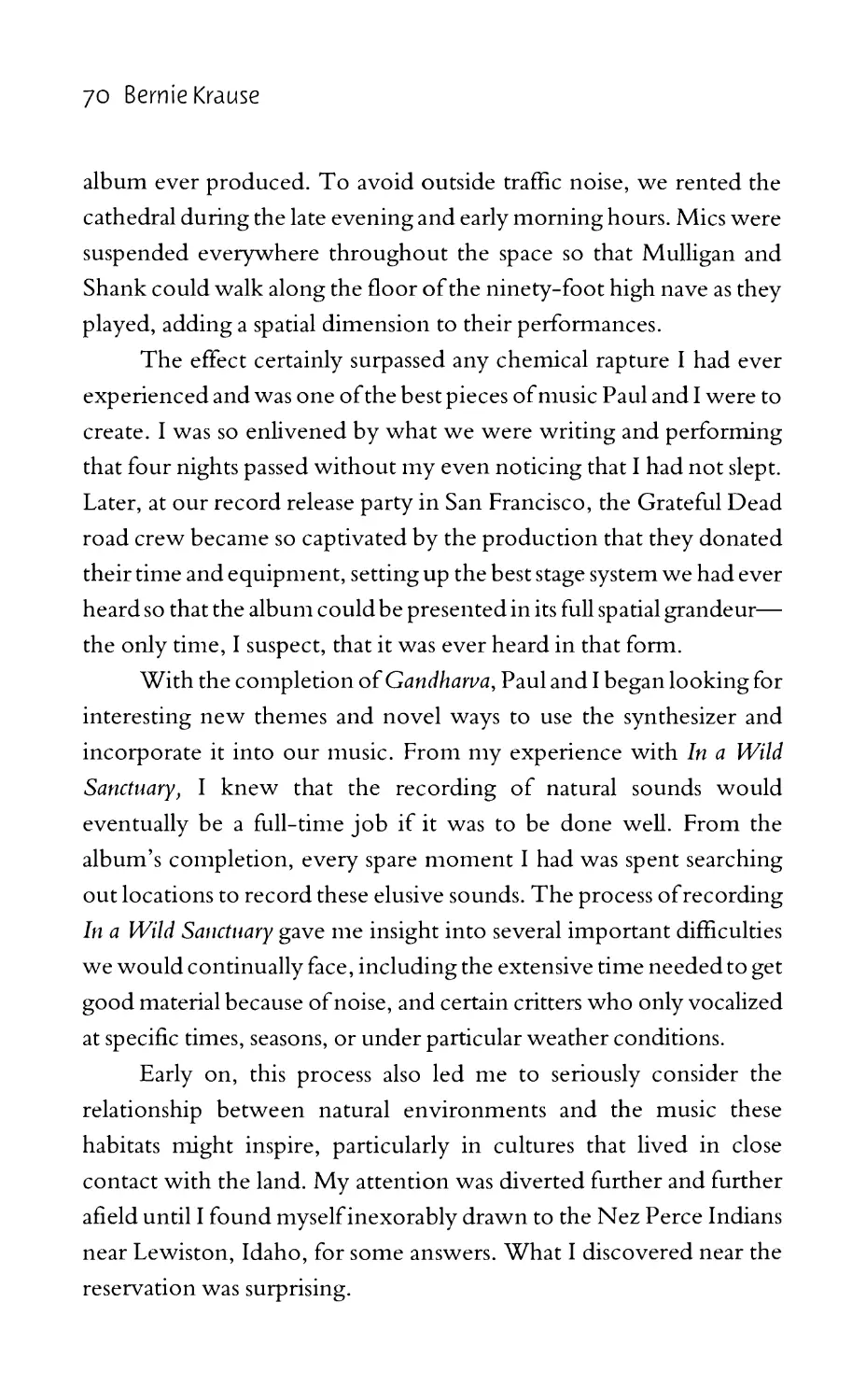
and answering the phone. I spent most of 1961 setting up an annual
folk concert series around the Boston area, including performers such
as Peggy and Pete Seeger, Joan Baez, New Lost City Ramblers, Doc
Watson, Odetta, Jeannie Redpath, Ramblin’Jack Elliott, Jesse Fuller,
Flatt and Scruggs, and the Alfred Deller Consort. I loved the
grassroots, traditional feeling of these groups and felt that there was an
honesty and substance to their performances that many of the more
29
30 Bernie Krause
polished groups lacked. By the time we sponsored the Weavers on the
program, I thought that I had developed some pretty definite tastes in
music and performance styles.
While I attended most of the other concerts, I avoided the
Weavers. I had seen many of their shows and felt that they weren’t
radical enough for me—although to be fair, I hadn’t the vaguest idea
what the radical standard du jour was supposed to be. Since the
Weavers weren’t producing much new material, I naively believed
that they were becoming tired and a bit boring. I thought Erik Darling
and Frank Hamilton, Pete Seeger’s successors, brought some musical
sparkle to the instrumental and vocal areas of the group. Erik,
however, seemed to be the only one of the Seeger replacements
whose performances and additional material were inspired. When I’d
try to discuss the Weavers with Manny, he thought I was generally full
of shit about those issues, and he was probably right. He had the good
sense and grace to laugh it off and not to take things too seriously.
On the night of the Weavers’ October 1962 concert at MIT, I
went to Club 47 and performed a satirical set based on the Weavers’
songs. I was up onstage in the middle of a half-contemptuous rewrite of
“ If I Had a Hammer” when I saw Lee Hays of the Weavers laughing in
the audience. Realizing that my attempt at satire was hideously stupid,
I became flustered and thankfully missed a few choice lyrics. Lee
thought it was all very amusing. Catching me completely off guard,
Lee later approached me and said that the Weavers were auditioning
for the Seeger chair and a Carnegie Hall reunion concert coming up in
May. He asked me to submit an audition tape.
A few weeks later, after learning every tune from their records, I
cranked out a tape with seven or eight numbers. I figured, what the
hell. I was broke, nothing was happening, and I certainly had nothing
to lose. When I learned that musicians such as Eric Weissberg
(“Dueling Banjos”) were vying for the spot, I was rightly concerned
that my guitar and banjo techniques were not sharp or fluent enough.
Although I was a quick study and could fake styles pretty well, I didn’t
Into a Wild Sanctuary 51
think I had a chance. However, strongly influenced by Lee, the other
members of the group asked me to come to New York for a live
audition as a finalist.
I was never told exactly how the final decision was made, but 1
somehow got the job. At first, Lee Hays became my mentor and
guide. He was a literary man of sharp intellect and wit, and he had
written many of the great songs of the period such as “Wasn’t That a
Time,” “Darlin’ Corey,” “Kisses Sweeter Than Wine”—some of
them with Pete Seeger. Lee was terrifically generous, supportive, and
helpful in many ways. But the other side of his character was also
apparent. His puffy face, lusterless skin, and slightly yellowed eyes
suggested a serious drinking problem. He also seemed uncertain
about his sexuality, making for many stressful moments—particularly
where his expectations of our relationship were concerned.
New York
When I arrived from Cambridge in January 1963, I was too broke to
get my own apartment. Lee and Harold Leventhal, the group’s
manager, suggested I move in with Lee for a while. I was expected
not only to fill the shoes of Pete and Erik, but I was also supposed to
look after Lee—something I hadn’t bargained for. As time passed,
Harold made his expectations clear, and I became increasingly
unhappy and distracted.
I was never at ease in Lee’s Brooklyn Heights digs on Willow
Street. For one thing, the apartment was small and very dark. For
another, Lee, a heavy smoker, always kept the windows tightly
closed. Norman Mailer, his upstairs neighbor, would often hammer
away on his bongos late into the night. There was no lock on my
bedroom door, and Lee would slip in unannounced, sometimes when
I was entertaining a female date—always apologizing, always gawking
just a little too long, always with a strong smell of liquor on his breath.
He would send me weird, ribald pictures and letters, then take them
32 Bemie Krause
back when I was gone. He would also rifle through my few
belongings, sometimes stealing personal letters and other items when
I was away.
Feeling trapped, I struggled to hold things together. I didn’t
have much money and couldn’t afford the independence I needed to
prepare for the performances. Much to Lee’s disappointment, I
managed to get a small apartment just around the corner. But it didn’t
help much. In the middle of the night, I’d see Lee scurrying down the
block after dropping more weird pictures and notes into my mailbox.
I felt isolated and had nowhere to turn for help. When I brought these
problems to Harold’s attention, my concerns were dismissed. Harold
wanted to give Lee a reason to continue living and working, which
meant proceeding, however we could, with the Weavers. Feeling
completely undermined and betrayed, I knew I had to get out of the
city and as far from Hays’s apartment as possible.
Beacon, NY
In the spring of 1963, I went to stay with Pete Seeger at his home in
Beacon, north of New York City on the Hudson River. I was very
touched by the way he and Toshi, his wife, forged their lives together.
Pete expressed his strong sense of moral certitude in everything he did
or said; this was inspiring to a person like me who was still trying to
find a personal source of expression. For the moment, it helped me to
enjoy the task at hand, and it centered me musically. Pete was able to
provide some invaluable pointers about how to give music a message
and use the media to get it across; his message was one of love that
went well beyond the banal.
I wanted to learn some of Pete’s banjo and performance
techniques and thought I could actually capture some of his magic by
hanging out and learning some of his style. I also hoped I could learn a
sense of Pete’s amazing musical grace. Was I ever wrong! Even with
youthful naivete, for me to expect that I could learn to be Pete Seeger,
Into a Wild Sanctuary 35
learn what he knew and how he did it, or capture a fraction of his
sensibilities and instrumental touch demonstrated a profound lack of
judgment bordering on the insane.
I slept in the barn next to the house. Except for summer camp, it
was the first time I had lived outside the city in a rural environment.
All night long the mice scampered through the walls and across the
ceiling. With the racket made by the mice, I couldn’t sleep, so I would
entertain myself by looking through the Seeger family photo albums I
found in cardboard boxes.
On those cold mornings, Pete would come get me before
sunrise, and we’d go chop wood and sing Leadbelly, lining out songs
like we were the Hudson River Valley chain gang. During the
evenings, we’d sit by the fireplace, singing and playing for a few hours.
Pete would throw back his head like he was performing at Carnegie,
rarely making personal or eye contact. Bewildered by his aloofness, I
kept my mouth shut, endured my misgivings, and learned what I
could. (Looking back on this period, I would give anything for
another crack at that moment—one of the few in my life I’d want to
relive.) After a few weeks of working together, we drove into the
city for rehearsals with the rest of the group. Pete would lead our
caravan, dropping my fare into the toll booth receptacle as we
moved toward the city. No one had ever done that for me before.
Within minutes of crossing the bridge, I was already missing the
fresh air of Beacon.
New York
During March and April of 1963, Ronnie, Freddie, Frank, Erik, Lee,
Pete, and I would meet at the old Vanguard Records studio on
Fourteenth Street several days a week. Pete introduced
“Guantanamera” to the group along with a few Dylan songs. The
Dylan material and songs by other writers were rejected because the
group couldn’t seem to grasp it musically. After seeing Pete’s
54 Bernie Krause
suggestions shot down, I kept my Dylan, Dave Van Ronk, and
Bonnie Dobson song suggestions to myself. I immediately recognized
that none of the songs I had brought with me fit into the tight,
southern Baptist church harmonies that formed the Weavers’ unique
sound signature.
“Guantanamera” worked, though. I wonder if it would have
survived if Americans had known that their favorite hit was written by
one of Fidel Castro’s favorite poets, Jose Marti; that the original
version of the song was similar to the American sophomoric couplet,
“There once was a man from Nantucket...”; and that the title meant
“Whore of Guantanamo,” a snide rejoinder to Americans serving at
the base and dedicated to the Cuban women forced to service
Americans stationed at the eastern tip of the island. It wasn’t too long
after the Weavers’ arrangement was recorded that it was copped note
for note and word for word by a studio group from Los Angeles who
got ultimate credit for the hit. The Weavers, still stigmatized by
blacklist issues, couldn’t get their version on the air. (It didn’t help
matters much that the marketing folks at Vanguard weren’t terribly
effective with the media of the day.)
From the deal I made for myself with the Weavers, I obviously
knew nothing about the business, either. I signed a contract to
perform with the group for $150 per week, which seemed to be an
enormous amount of money at the time. I was given no royalty
participation on recordings, nor any perks other than health insurance,
but I was still convinced that the deal was generous and that I had a
secure future as a performer. It didn’t take me long to figure out that
I’d been had. A healthcare provider for Lee would have earned my
weekly salary in one day, and I was serving in both capacities.
To continue holding the Weavers and Lee together, Harold
arranged the Carnegie Hall reunion, accurately calculating the media
attention it would get and how electrifying the experience would be
for the audience. During the concert, I sang “Motherless Child” with
Ronnie as a duet and performed a guitar solo, the theme from “Black
Into a Wild Sanctuary 35
Orpheus.” Ronnie, Hellerman, Lee, Pete, and I sang“Guantanamera.”
But my performance wasn’t notable. I was too nervous and had little
performing experience—something I tried to convey to Lee many
times before I joined the group. But he wouldn’t listen to my
concerns and, instead, kept reassuring me that, with his guidance, it
would all work out.
The reviews, as they say, were tepid. It was my first time onstage
and the intimidation, pressures, and distractions were overwhelming.
My parents, who were against my performing, especially with a
perceived radical group like the Weavers, attended nonetheless, with
mixed feelings of pride and trepidation: at least their son was
performing at Carnegie Hall. My grandfather, who had facilitated the
Chicago episode, could be heard on the Vanguard Records concert
master tapes snoring somewhere in the orchestra section at the front
of the hall.
After the performance, the group took a long summer break and
then booked a few concerts, one or two a week, mostly on weekends,
the only time Lee would agree to perform. We almost never
rehearsed. Lee was often too hungover and sick to leave his apartment,
canceling at the last moment. Fred and Ronnie were dealing with
personal issues and frustrations. It seemed that the members were not
able to tolerate much of one another’s presence. There was always an
undercurrent of tension when we finally did get together. Tempers
were short, and when there weren’t disagreements, a disparaging
attitude was evident everywhere—often directed at me for reasons I
would never quite understand but began to take personally. When
their expectations of me finally surfaced, the original members came
at me with a level of hostility that I was unprepared to deal with at
twenty-five years of age.
I was mostly left to rehearse alone, playing to previously
recorded albums, getting together with the group only moments
before we went on stage. This made me feel quite unsure of myself.
Disconnected and lonely, I had almost nowhere to turn for reassurance.
36 Bernie Krause
I sensed that Fred, Ronnie, and Lee were getting to the point where
they got no pleasure from each other or their work. Even though our
performances were well received, it soon became clear to me and
everyone else that I was not to become the glue that would hold them
together. I once overheard Fred remark during a radio interview that
I offered nothing particularly germane to the group. Although I was
offended and humiliated by this public assertion, I never questioned
him about his remark and kept my anger to myself. Ronnie was
having lots ofphysical problems during that period, causing her a great
deal of pain and discomfort. However, she was usually kind and
would often offer suggestions and support.
Despite the offstage distractions, onstage no group was more
professional than the Weavers. They exuded a vitality and put across
songs in ways I have never experienced before or since with any other
group. The performances were charged with excitement without the
fancy production tricks that most groups need today. They were
dramatic, vigorous, and magical. One thing that never flagged was the
incredible love the group was able to convey to audiences no matter
where we performed or under what physical or emotional condition
the group members were in. The Weavers came from a performance
tradition ofresponsibility that reached well beyond simple presentations
of the music. The “show” was immensely important to them. This
theatrical sense of integrity and respect for the audience was a lesson I
would carry with me into the future.
Chicago
The final concert inJanuary 1964 marked the end of one of America’s
truly great performance teams, and there was a great deal of sadness
backstage. We had scheduled the concert for an earlier date, but it had
been canceled by weather and national grief over the Kennedy
assassination. There was a whole lot of commotion from the press
Into a Wild Sanctuaiy 57
swarming all around; Studs Terkel was there and interviewed us. I
vividly recall the stress I felt when the back of my pants ripped only
five minutes before curtain, and I had to scramble to close the seam
with gaffing tape.
Although I was relieved to be finished, I didn’t want the concert
to end because I had no clear idea what I would do after the breakup.
I had come to the Weavers from a diverse musical background. I had
studied music, knew many styles, and was comfortable playing several
stringed instruments. I loved sound but was never really happy as a
performing musician. However, it was what I knew. Alternative
careers in the family business, law, or medicine were, to me, not viable
options, and I was overcome with anxiety just trying to imagine
myself in those roles.
They do not lie awake in the dark
New York
During my brief tenure with the Weavers, I was uncertain about my
own commercial aspirations. On the one hand, I was disappointed
with the group and myself because I wanted them to be very
successful. In fact, I wanted to play a role in that success so they could
find new reasons to perform. I hoped to be seen as a valued
contributor, and, not least of all, so I could qualify for a more generous
participation. I wanted to bring material to them that would make
them prosperous again. On the other hand, I just wanted things to go
on the way they were. I had simply desired modest gains and the
comfort of more than one or two concert performances a week. I
didn’t realize until much later how fundamentally lazy and frightened
I had been.
I knew that the Weavers felt they had earned their place in
musical history, but cannot recall that we ever discussed it. From the
perspective of a twenty-five-year-old, they were acting old and
couldn’t seem to deal with the new material or each other. At the
time, my focus was so narrow that I didn’t wonder what the others felt
38
Into a Wild Sanctuary 59
about anything beyond rehearsals and performance. A couple of
times, I asked why we weren’t developing new material but quickly
dropped the issue. From a musical standpoint, the Weavers felt
comfortable with fairly simple lyrics and verse-chorus types ofmusical
forms mixed with very close harmonies. There were modest exceptions
to this formula—like “Dartin’ Corey”—but they were rare. The newest
music, like Dylan’s poetry, stretched the limits in all directions and
tended to be even more personal and reflective, concepts the Weavers
seemed slow to grasp and incorporate into their music. It was as if they
had bought into a certain folk image; that image was so firmly implanted
that it left little room for growth. As I reflect on this now, I suppose I
missed the point altogether. The Weavers were just plain tired.
By 1964, folk music in its commercial form was boring me to
death. While it had been a major inspiration in my musical experience,
it certainly wasn’t my only interest. However, I was a long way from
finding my own voice. I searched everywhere, turning to other
influences like John Cage, Stockhausen, Boulez, a Brazilian by the
name of Antonio Carlos Jobim, and Middle Eastern music.
Shortly after the Weavers broke up, I formed a duo with Bonnie
Dobson. I loved her lyricism, personality, and richly-textured alto
voice. We introduced a mix of traditional songs with jazz harmonies
and rewritten lines. After a brief time, it was apparent that the folk
idiom wasn’t terribly tolerant of our musical embellishments; as a
team, we did not have the industry backing to survive. We split in the
spring of 1964, and I left New York to get involved in other aspects of
music and recording. Folk music had reached a dead end for me.
and weep fortheir sins,
Detroit
By the mid-sixties, new audio technologies, such as multi-track
recorders and signal-processing gear, were quickly becoming the
production tools I could only dream about. Fascinated by the
possibilities, I went back to Detroit and worked as a freelancer for
several months at Motown; I did some producing and arranging,
played guitar, and tested new studio skills. As it happened, I was one of
only a handful of Caucasians working there. Our positions were
always a bit tenuous. Berry Gordy’s entire family worked for the
company, and his allegiance to kin and friends came first. I admired his
loyalty even if it didn’t always work in my favor.
While living in Detroit, I met and married Denise, whose
parents had been killed during the German occupation of France. Her
father had died fighting for the Underground, and in 1944, Denise
and her mother had been shipped from Paris to Auschwitz. By some
miracle, Denise was saved by a French flic (policeman) and sent to live
as a ward of the French state. She came to Detroit in the mid-fifties,
learning the culture through television, movies, and a fair amount of
reading. She had a sharp, if not dark, sense of humor, and her
40
Into a Wild Sanctuary 41
judgments about the world around her were like my mother’s.
However, throughout our marriage, Denise refused to work, saying,
“Why should I work when you make so much money doing so little?’’
This forced me to work long and hard hours because I felt obligated to
support her.
Unfortunately, it was a bad winter in the Midwest that season.
Everything came to a standstill, including my freelance stint at
Motown. I wanted to go to the West Coast, but Berry Gordy
wouldn’t send me. Having no other real prospects except for working
in the family’s business, I headed west, newly-married, with less than
$200 to my name, and entirely prepared to work as a studio musician
in Hollywood. With the promise of a job as staff music composer at
Hanna-Barbera, the cartoon production company famous for “The
Flintstones,” I thought we would at least have a working income.
California
By the time I arrived, Hanna-Barbera had changed management,
leaving me without a job after all. With a little hustling, I managed to
convince a few producers to allow me to play studio guitar, mostly on
television and radio commercial sessions. Then, a radio station in
Santa Ana hired me to write ad copy and the music for its station
identifications. It wasn’t long before I was fired for my peculiar mix of
religion, politics, and humor (which, according to the program
director, who became particularly upset with me when I questioned
why the station was still flying an American flag with forty-eight stars,
was not the type of mix appropriate for the station), and because the
station manager was always coming on to my wife. Without losing
much sleep over the decision, Denise and I loaded up the VW and
headed north to San Francisco.
In late 1965, I enrolled in the Tape Music Center at Mills
College in Oakland where Karlheinz Stockhausen, a leading European
composer of avant-garde music, was giving a series of lectures and
42 Bernie Krause
workshops. Pauline Oliveros was also there, teaching early modular
synthesizer. As I began to work with the newly developed modular
electronic instruments and saw what some composers were doing
with them, I found myself completely captivated. It was quite
liberating to be able to create any number of complex rhythms and
timbres and to discover, mostly by trial and error, whole new ways of
expressing audio performances.
By 1966, I had begun to study electronic music seriously. It
became immediately apparent to me, mostly because of our culture’s
affinity to technology, that this medium would be the next strong
influence in studio production. For me, Bob Dylan’s transition to
electronics at the 1965 Newport Folk Festival opened up many
possibilities for what was to come. His performance elated me. By this
time, my own work in folk music was already becoming a peripheral
part of my musical development. I was becoming more and more
interested in a wider variety of styles and forms of music.
They do not make me sick
While studying electronic music at Mills College, I read an article
about a man in New York who had been paid $35,000 for seven
seconds of music for an American Express commercial. Five thousand
dollars a second for six notes! Impulsively, I bought an airplane ticket
and found myself heading east to meet this composer.
Eric Siday had purchased one of Robert Moog’s first prototype
modular instruments and had used it to create the commercial spot.
During our meeting, Siday tried to recreate the commercial but was
having technical difficulties, which he said were not unusual. As we
talked, I couldn’t take my gaze off the synthesizer—all six feet of it
mounted on a table. It was so simple to operate that I was absolutely
convinced I was seeing the future of media music unfolding before me.
Back at Mills, I told my teachers and colleagues what I had found
but couldn’t generate much enthusiasm. They were unimpressed by
instruments that humans could easily control by methods that
smacked of conventional keyboards. The academics had determined
that the machine itself should generate random sounds which, by the
composer’s choice ofinclusion or not, would ultimately be considered
finished compositions.
43
44 Bernie Krause
Throughout this time in the Bay Area, I had a job as an account
executive for a Lake Tahoe gambling casino. Unfortunately, the
agency ran out of money soon after I was hired. After a few weeks
without paychecks, John B., a friend from the agency, and I decided
to open our own business. We calculated what was owed us in back
wages, then went downtown to the office to reckon the value of the
furniture and a couple of typewriters. We rented a truck, loaded it
with various items, left a note for our ex-boss, and opened up our own
office in an old, shabby building in downtown San Francisco.
Naming our new enterprise Parasound, we had no idea what we
would do for a living. We tried many things. Once, we invested in an
antigravity device. A black box appeared at our doorstep one evening,
chaperoned by a down-and-out, acne-faced kid in his early twenties.
Inside the box was a rotating arm mounted on a jury-rigged chassis
that rotated around a fixed axis. When in motion, it was supposed to
render the box and its contents weightless. However, when he set the
spinner in motion, it went out of control, and parts flew all over the
room; a valuable ceramic sculpture and some good dishes were
destroyed in the process.
At that particular moment in our career, we were cynically
convinced that print advertising was where it was at. The main goal of
print advertising was to capture readership by offering short and
simple, no-more-than-eighth-grade-reading-level messages that
engaged the consumer long enough to convince them to buy the
advertised product. John had earned his Ph.D. in communications
and therefore knew intimately all of the possibilities. However, we
thought up a venue for advertising that had been overlooked. For
several weeks, we stood in lavatories, ostensibly washing our hands,
but actually running a time clock on the average length of time men
spent in stalls. It’s a wonder we weren’t arrested for loitering. After
accumulating enough data, we calculated that each person spent at
least a full minute in a stall. It didn’t take much to see that an
advertiser would receive 100 percent readership for a guaranteed
Into a Wild Sanctuary 45
period of time wherever their message was plastered on the inside of
bathroom stall doors. Our next goal was to sell the concept, which we
called LavaCard.
Ready to make our mark on the advertising world, we contacted
Donnelly Outdoor Sign Company and forwarded a written proposal
to the vice president of marketing. The proposal included all of our
data and our plan for test-marketing the idea in gas stations along
Route 66. When we called to arrange a meeting, the vice president
picked up the phone and said, “This is the most scatological and
deranged idea we’ve ever received, and I never want to hear your
names again. Ever!”
With the twenty-three dollars we had left in our business
account, John and I went out to Bay Meadows and bet it all on a horse.
We’re still waiting for it to finish.
One day while sitting in the office, desperately thinking of ways to
earn some money before my credit cards were fully charged, I
received a call from Jac Holzman, then president of Elektra Records.
He had heard that I was working with synthesizers and asked if I knew
Paul Beaver. I told Holzman that I had never actually met Paul, but I
had heard about his work on “B” sci-fi movies and had seen him once
on a film soundstage performing his magic. Holzman arranged for
Paul to come north for a meeting because Elektra was considering
commissioning an album that would be the first one to combine
synthesizer and traditional orchestra for a piece based on some New
Age gobbledygook about the Zodiac. Within an hour of meeting,
Paul and I established an immediate and close rapport with one
another and, over time, became unlikely but close friends.
Paul was a shy and quiet man who had grown up in rural Ohio.
Extremely conservative, he wore a wide-lapel, double-breasted, blue
serge suit wherever he went, on all but the hottest days in Los Angeles.
There was always a sprinkling of dandruff on his shoulders and a small
46 Bernie Krause
Republican Party elephant adorning his left lapel. He described
himself as politically to the right of John Ashbrook, an avid Scien-
tologist, and bisexual. He tried only once to get me involved in all
these scenes. He brought them up for discussion all at the same time,
and we had what was to be our only intense disagreement; none of the
issues was ever discussed again in my presence. But he did invite me to
spaceship gatherings on the lower slopes of Mount Shasta, where he
was certain that one of the seven refueling stops of interstellar vehicles
was located. He’d also tell me stories of his wandering alone and naked
around the mountain—only in the heat of summer when it was
comfortable enough to do this, of course—trying to find the entrances
for the spaceships. He claimed to have seen them. I listened to his
detailed descriptions of these galactic happenings, but somehow my
curiosity was never aroused enough to investigate.
Not long after our first meeting, Paul and I visited Robert Moog
at his small factory near Ithaca, New York. We were concerned that
his synthesizer would not be able to maintain stability of tunings and
other key features. Undaunted, Moog placed a synthesizer on a three-
foot high table and pushed it over the edge where it fell to the floor
with a terrific thud. “That’s my bench test,” he chuckled as we looked
on in horror. Then he plugged it in and let us try it. It worked! We
bought one of the first models, pooling our life savings of$7,500 each
to make the purchase. We did not know then what a struggle it would
be to get people in the music industry to believe that this extraordinary
electronic instrument was viable.
During the mid-sixties, Paul had purchased a run-down
warehouse near downtown Los Angeles where he stored his arcane
equipment (like the vintage theramin used to craft sci-fi’s favorite wee-
ooh sounds) and set up a small studio. It was in the midst of this
controlled chaos that we plugged in our Moog synthesizer and began
to explore our new musical voice. In the beginning, we had little
money and were loaded with debt. I often slept on the floor under the
long table upon which we had set up the synthesizer. Sometimes we
Into a Wild Sanctuary 47
bought small packages of pasta and cooked it on an electric burner in
the bathroom for lunch, re-warming what was left over for dinner.
Because the instrument was so new, it had no history and there
were no skilled synthesists to whom we could turn for advice or
camaraderie. There was only a lot of conjecture and theory, and little
of it applied to what we wanted to accomplish with our evolving
knowledge. In many ways, we were like kids again, sometimes
working for thirty-hour stretches to master a new technique or to
create a new sound before collapsing from fatigue. While Paul
immediately understood the language of the instrument, I was a much
slower learner. He was very patient and would explain every detail of
what he understood, sometimes over and over. Whenever we began
the process of trying to learn a particular task, I would record his every
word on cassette, then transcribe it later to see if it made sense to me.
By May 1967, I had a complete set of notes on modular synthesizer
techniques and acoustic principles.
Every time I learned a new skill or we had a musical revelation,
I would make an appointment with a record or television producer
and encourage them to try the synthesizer on their new projects. I
always brought a tape demonstrating the sample we had just recorded.
This went on for well over a year without much luck. The closest we
came to a possible job was from a small label producer who said, “If
you guys can do a cover of‘Monday, Monday,’ maybe we can talk.”
We did a demo that was actually quite good, but the producer got
fired, and we didn’t get the contract.
Meanwhile, Holzman was the only person who was convinced
that our technology would work; he had the foresight to feature it in
his Zodiac album project. As part of the process, he envisioned an
opportunity to include the synthesizer as an element of orchestration
and to feature its use as a marketing tool. In late April 1967, a
traditional live orchestra and our synthesizer combined for the first
time in Hollywood at Western Recorders on Sunset Boulevard, and
the Zodiac album was produced on Elektra using the Moog.
48 Bemie Krause
Despite the release of our album, I was still unable to interest
anyone from the music community, commercial radio, or television
production. Our Zodiac work with Elektra did not generate as much
publicity as we had hoped. Furthermore, Walter Carlos’s Switched on
Bach was seen by most as a fluke, no matter how popular it may have
been. Although we were nearly broke from our investment in
equipment, Paul and I decided to try one last time to make a go of it.
discussi ng their duty to God,
A couple of months later, I found myself sitting next to Holzman on a
flight from Los Angeles to Monterey. Using the last of our savings,
Paul and I were going to demonstrate the synthesizer in a small booth
at the Monterey Pops Festival. During the flight, I explained to
Holzman that we had notes from our learning sessions on the Moog
and showed him an outline ofwhat we had done. Holzman suggested
that we create a guide to electronic music for his Nonesuch label that
would feature recorded samples of the raw sounds, descriptions of
how they could be combined (synthesized) into new timbres, and a
detailed booklet summarizing the techniques and rationale behind the
product. Holzman offered us a $2,000 advance for our work and a
small royalty. (For artists other than the Doors, Judy Collins, or Carly
Simon, Holzman was not known for his spirit of generosity.) Paul and
I saw this as a chance to demonstrate the potential of the technology.
And two kilobucks was at least something. But first we needed to
survive the Festival.
The booth was small. The few hundred dollars we were able to
pool together got us a large folding table, a rented amplifier, and a
cheap pair of headphones. At first, no one came, but little by little.
49
50 Bemie Krause
individuals would arrive at our tiny 8x10 cubicle and queue up to lay
their hands on the keyboard controllers we had programmed. We
synthesized crashing waves, thunder and rain, and different instrumental
sounds, depending on what we knew of the artists’ taste. Paul would
synthesize a Hammond B-3, trumpet, or string sound. I would set up
a pattern on the sequencer that would play extended rhythm and
melody lines through a tape delay unit then called an Echoplex, which
provided a unique repeat or echo of the sound we had patched. The
crowd was captivated, as it was generally stoned. It was also,
thankfully, very well-heeled thanks to the generosity of CBS, RCA,
and Capitol Records, who were literally fighting with each other to
contract the talent represented in the Festival showcase.
By the second afternoon, the traffic jam in the aisle in front of
our space became so large that security guards had to control the flow
of people to and from our area! After a year of almost no work, we
returned to Los Angeles a week later to find ourselves on-call in the
studio, working at double scale, sixty to eighty hours a week, on major
feature films and many hit albums with major groups. We actually had
to buy a second synthesizer to cover our numerous projects. For the
first time, we began to make a good living. However, I hated the traffic
and the smog in Los Angeles, and I refused to move south, preferring
instead to commute from San Francisco several times a week.
While working madly on these projects, Paul and I began to
create the electronic music guide for Holzman. The main question
we had to resolve was how, and whether, electronic media altered the
definition of music, and whether the Western academic models were
too restrictive. We felt they were, and we set about to add new
information to the existing paradigms.
Both Paul and I came from the fringes of different traditions.
Although we were both classically trained musicians and understood
the current popular music styles, our main thoughts centered around
whether or not the music—any music—sounded true to its form,
medium, and roots, and whether this made it sound convincing.
Into a Wild Sanctuary 51
Academia had been trying to define ethnomusicology and its various
frontiers ever since I could remember. (To my mind, it has come no
closer to success at the end of the twentieth century than it was at the
beginning. Even so, music of the late twentieth century encompasses
a much broader scope of inquiry now than what was allowed thirty
years ago. There are aspects commonly covered today that would
have caused a major riot if the issues had been brought up for inclusion
then.) After helping to introduce the synthesizer as a viable instrument
and writing the original Nonesuch Guide to Electronic Music (1968), Paul
Beaver and I presented a new definition of music, limiting it to three
words. Quite simply: control of sound.
The Nonesuch Guide to Electronic Music took four months to
complete. All of the recording was done at our studio in Los
Angeles. It was an agonizing and grueling process, and we threw out
several different versions of the music because it was simply not what
we wished to release. I wrote and typed the detailed manuscript for
the album booklet, which explained acoustics, analog synthesis of
sound, and audio terms, at the kitchen table in my small apartment in
San Francisco. As Paul learned the intricacies of the synthesizer, he
would call me into the studio and offer convoluted explanations of
what he was doing and why. Completely unfamiliar with and
intimidated by technology, I paid careful attention to his every word
and move. From our first meeting, I questioned and recorded
everything for later review. With the tapes from those sessions, I
began to transcribe the text for the Guide, finally finding some useful
outlet for my extensive notes. When concepts weren’t clear, I went
back to our studio for yet another session with Paul so that I could
fully grasp and explain them. As a result, I not only finished
something original, but I had also learned valuable knowledge about
acoustics and the synthesis of sound.
The night I finished the Guide, I cried from relief and the sheer
joy ofpersonal accomplishment. Whereas none of my other work felt
truly original or particularly creative, this was the first time I had
52 Bernie Krause
completed a task that I alone had initiated. It simply felt wonderful and
gratifying. The only other time in my life that I have felt a similar sense
of pride was, fifteen years later, when I formulated the idea of
biophonies—the ways in which animals in any natural habitat vocalize
as an orchestra. For the first time, I was elated by the certainty that I
had done good work that might be helpful to others. By the time the
Guide was completed and the master tapes given to Elektra/Nonesuch,
Paul and I had spent over $ 10,000 of our own money on the project in
production costs alone—money we were never to recover even
though the album was on the Billboard charts for twenty-six weeks.
Not one is dissatisfied...
Soon after the release of the Nonesuch Guide, Limelight Records, a
subsidiary of Mercury, signed us to their label, and we recorded an
album called Ragnarok (Mercury7 Records, 1968). With the help of
Van Dyke Parks, we began the long process of turning the symthesizer
into an instrument of musical expression—one with a voice all its
own. Intrigued by the musical possibilities, our new friend, George
Martin, the elegant arranger/producer genius behind the Beatles,
bought an instrument from us and agreed to write liner notes for the
album jacket. Although the album and the record company' were
largely unsuccessful, Ragnarok served as a major breakthrough for
many recording techniques we were to use on future projects. Our
growing enterprise, however, was not without many7 setbacks.
The main problem we experienced in the studio was the
producers’ request that we symthesize the sounds of strings, horns on
demand, and other traditional instruments. One day, when we were
working on a film soundstage where a feature was being scored, we
filled in for some string players who were late because of another
session across town that had run into overtime. At the end of the
session, the union contractor from the American Federation of
S3
54 Bernie Krause
Musicians (AFM) Los Angeles Local 47 demanded our presence at
the office for what he described as a “little discussion.” Paul and I
showed up at the AFM offices late in the afternoon and were seated
at a conference table surrounded by an intimidating group of
serious-looking men. We were armed with a small cassette recorder,
which we placed in the middle of the table in clear view of the
others. One of the union officers began the discussion, informing us
that we had violated an unwritten law that prevented any electronic
technology from replacing other musicians. Prepared for the
argument, Paul cited the Hammond Organ case of the late 1930s,
when many of the old instruments used in solo lounge acts had a
“rhythm” or drum machine that established a beat to which the
organist performed. He reminded them that the union had once
tried to ban its use, but had lost the restraint-of-trade issue in the
U.S. Court of Appeals nearly thirty years before. Unmoved, the
AFM threatened to shut us down unless we promised never again to
try to emulate string or horn sounds, thereby replacing other
musicians. When we asked them how they described our studio
performance if we weren’t musicians, they were silent. We then
asked them to put their threat in writing, which they promptly did.
We took the tape and document directly to our attorney, who
promptly called the president of AFM International in New York and
informed him that unless the issue was dropped, Beaver and Krause
would file a $500 million restraint-of-trade lawsuit against the union
based on the merits of the Hammond case. Faced with litigation and
some bad press, the AFM dropped their threat, and although we
continued to hear grumblings about synthesizers replacing musicians,
we were never again restricted from synthesizing strings or horns or
anything else. Much to our surprise, the little publicity we got
brought us even more work.
Although Paul and I had been appointed sales agents for Moog,
we were largely unconcerned about the repercussions of our seminars
and sales to other artists. We were so busy then that we actively
Into a Wild Sanctuary 55
welcomed the competition we were creating. For us, the main
problem was exhaustion. Not only were we working steadily, but we
also gave synthesizer classes and tutored individuals at night. Some of
those we worked with included Elmer Bernstein, George Martin,
Dave Grusin, George Harrison, The Beach Boys, Van Morrison, and
Frank Zappa, among others. Recording sessions with most of these
artists were generally short. In most cases, we did not spend more than
a few hours performing on a particular song and had little interaction
with the artist beyond the work at hand.
As a result of the success of the Nonesuch Guide and the extensive
film work we were doing, we connected with a whole new group of
exciting talent. Among them were Randy Newman and Van Dyke
Parks. They were what Warner Brothers called “experimental” artists
during the golden era of American pop music, when the record
companies tended to be run by people with vision and courage rather
than the MBAs who began to take over in the late seventies. Van
Dyke and Randy were instrumental in bringing us to the attention of
Joe Smith, then the president of Warner Brothers Records. We
worked out the terms of a contract with Smith for a series of albums
that would ultimately change the course of my life. During the
sketches of the first concept, I thought often of my parents, who had
inadvertently brought me to the edge of this pilgrimage in spite of
themselves and their fears.
With our new Warner Brothers contract in hand, Paul and I
were sitting in our studio one fall day in 1968 when Van Dyke Parks
came by to chat. Paul and I had been talking about the theme of our
next album and were remarking that the music we were hearing as a
result of the glut of synthesizer recordings was already becoming
tedious. As synthesizer studio musicians much in demand, we had
little time for work of our own. Even so, we were being asked more
frequently to replicate our own sounds or the sounds we had created
for artists like Stevie Wonder, the Byrds, or the Doors. It was
becoming clear that we had to take a different creative tack.
$6 Bernie Krause
Van Dyke suggested that we do something on ecology—a new
word for us, but one that would have an impact on our lives much
sooner than we thought. With all of the new, more compact
technologies, he urged us to try recording material in natural
environments and use it as a compositional element in our music. In
that way, he suggested, we could use our art to address the need to
preserve habitats and use the sounds as a new source of music for our
craft. I admit that this idea, at first, was not terribly intriguing. Both
Paul and I had always lived in cities, and we knew nothing about field
recording besides the small amount of ambient sound or effects we
created for film. But Paul had a small Uher recorder and a couple of
decent mics. I took the equipment home with me and began to
experiment. In the meantime, we decided that our album would be
called In a Wild Sanctuary, which was inspired by a line from the late
nineteenth century American author, Ellen Glasgow: “Preserve,
within a wild sanctuary, an inaccessible valley of reveries.”
San Francisco
With a portable recorder slung over my shoulder and a pair of stereo
mics in hand, I drove to what I then considered a natural habitat—
Muir Woods—located north of San Francisco in Marin County.
Aside from the noise of light aircraft and distant traffic, there was not a
creature sound to be heard. Of course, it didn’t immediately occur to
me that I was trying to record in late fall, when most of the birds and
other animals were either absent or fairly silent. Also, redwood
habitats, compared to other types of habitats, are not as aurally robust.
Undaunted, I continued the search. I visited the ocean and recorded
waves. I hiked to a nearby stream and recorded the sound of trickling
water. I went to the beach by Fisherman’s Wharf to capture people at
play by the water’s edge, and then I visited the zoo.
Just to hear the habitats transformed through stereo headphones
at each site had a powerful impact on me. The sounds were
Into a Wild Sanctuary 57
resplendent. Amplified and more vivid then those we generally hear,
the sounds had a feeling of space that was vastly expanded and lustrous.
I recorded for hours, riveted by what I thought I was hearing.
However, when I returned to my studio and tried playing back my
field recordings, I was completely horrified. To my great
disappointment, almost none of the tracks sounded like what I
remembered hearing only a few hours before. The ocean waves
sounded diminished and distant. The stream sounded like constant
static. The redwood forest sounds were composed mostly of hiss—
produced by a combination of the audio tape and noise introduced by
the electronics of the recorder—and a few indistinct bird calls. Except
for the sounds at Fisherman’s Wharf, nothing was as I had heard. The
illusion and magic of the moment was completely lost, and I had no
idea why. I began to think of our experience in film sound and
remembered that the effect, or illusion of sound, is much more
important to the human ear than the sound’s original source.
As it happened, our stream sound on In a Wild Sanctuary was
ultimately created by placing a pair of mics in a toilet bowl and letting
the water run so that the effect sounded like a stream. We never got
the ocean waves right so we synthesized them, just as we did the
thunder. The bird sounds had to wait until mating time in the spring
of ’69. The zoo sounds required many more visits as well.
During the six months it took us to orchestrate In a Wild
Sanctuary, we tried many different ways to fold natural sound
recordings into our music. Late one evening, I walked through San
Francisco’s Nob Hill neighborhood, hoping to catch some
environmental sound that would inspire music. The rhythmic pulse
of the underground cables that power the cable cars caught my
attention. As I walked into the middle of the street to place my mics in
the cable slots, a man came up to me from the opposite side of the
street and asked what I was doing. He introduced himself as Frank
Oppenheimer, founder of the Exploratorium (he later informed me
that he was the brother of the late J. Robert). He watched, completely
$8 Bernie Krause
absorbed, as I recorded samples of the cable rhythms. When I finished,
we went to a nearby coffee shop to chat. I told him about our idea to
use sound to convey aspects of the natural environments that were
disappearing everywhere. He, in turn, told me about his experiences
trying to get Exploratorium board members to listen to his ideas about
how to relate the wonders of nature. “Use your cable recordings to
symbolize the ways in which Western industry has depleted our
resources,” he offered. “The sounds of pure nature are so rare now,
that people don’t even recognize environments when they hear the
recordings.” Most of his efforts, he said, had fallen on deaf ears. When
we parted for the evening, he gripped my hand warmly and expressed
the hope that Paul and I would somehow be more successful.
not one is demented with the mania
of owning things,
In a Wild Sanctuary, finished late in the spring of 1969, introduced
many new elements into the field of music and music synthesis. It was
the first time unaltered natural sound had been directly used as a
component of orchestration, a technique I would further develop in
natural sound sculptures. Another feature we introduced on the
album was the method used in a tune called “Spaced.” Conceptually,
the music begins with the chaos of simulated wooden wind chimes
mixed with a flute-like obbligato that has the spatial effect of moving
around the listener’s head as it is performing. Toward the end of this
section a single note, G, is introduced and heard from a distance.
Gradually, as it is brought closer in perspective to the listener, it splits
into eight parts with each note traveling through a long glissando,
while, at the same time, getting closer and closer to the listener until it
finally resolves into an eight-note D-major chord. That piece was
knocked off by radio stations for their identifications, a major
automobile company for its commercials, and a well-established
Northern California film company that has used a remarkably similar
59
6o Bernie Krause
concept as a trailer for their cinema audio system for years. Their film
company composer failed to disguise this “coincidence,” beginning
his iteration on the same note and resolving it on precisely the same D-
major chord. (Despite the fact that we have a copyright on the music
and had recorded it some fourteen years prior to their unlicensed use,
our friendly local film company continues to claim that it originated
the performance, even though our version had been distributed
worldwide for well over a decade.)
Our rendition of “Walking Green Algae Blues,” featuring
Howard Roberts on guitar and Paul on the Hammond organ, was an
environmental lament dedicated to Frank Oppenheimer. That tune,
like others on the album, expressed a strong anti-war and environmental
sentiment, something Paul initially felt uncomfortable with because
of his rather conservative political leanings. It didn’t take long to
convince him that speaking out through our music was the right
action. While on a trip to Lausanne, Switzerland, in the early
seventies, I discovered that Daniel Cohn-Bendit, the leader of the
French student uprising in 1968, had adopted the tune as the anthem
for his new Green Party that he was forming in Germany. Paul found
these acknowledgments of our work both appalling and amusing. On
the one hand, he expressed delight when our music found an
audience. Yet he saw Cohn-Bendit’s endorsement as embarrassing
since he would subsequently have to defend our work when the press
or audience members asked questions about it. Finally, the album was
the first recording to be encoded in quadraphonic and surround sound
in all available playback formats.
In a Wild Sanctuary was an enormous critical success but only a
moderate commercial one. We were able to get a great deal of film
scoring and studio work in Hollywood, New York, and London as a
result. More than all of the financial rewards, however, the process of
recording the album left me with a sense of dedication and direction
that completely altered my future work.
Into a Wild Sanctuary 61
Most importantly, I discovered that being outdoors and record-
ing could be complementary endeavors. Each time I went further
afield, I found myself energized and inspired by what I heard and
experienced. Also, I became less terrified and began to find comfort
working alone in remote areas of what I’ve come to know as the wild
natural—isolated habitats that still exist more or less in their wild,
natural state. I often found myself daydreaming about doing nothing
but being outdoors, recording for the rest of my life. The thought of
working in an office or studio gnawed at me, and I began to have
nightmares about session work, where Paul and I would frequently
waste our time waiting for self-indulgent artists to sober up and get
their act together.
I took In a Wild Sanctuary very much to heart as a creative and
expressive center for our work, and as a raison d’etre for working in a
quiet place with fresh air and a place where I could learn about the
disappearing wildness around me. Every time I thought about the ways
in which I wanted to put these types of natural sound albums together,
I felt calmer and more focused. But at the same time, I had bought into
a lifestyle “demented with the mania of owning things” that demanded
quite different standards. Because of my troubled marriage to Denise,
I wasn’t quite ready to give up this lifestyle, even though conflicting
signals were becoming stronger with each passing day.
Not one kneels to another norto his
kind
Late one fall night in 1968, George Harrison phoned me at home
and asked if I would come to London and bring a Moog synthesizer
with me. I had already sold one to George Martin and to Mick
Jagger. A month earlier, Harrison had asked me to play synthesizer
on his Jackie Lomax album production at Armin Steiner’s Sound
Recorders in Hollywood. After the session was wrapped up,
Harrison asked me to stay behind and demonstrate the Moog set-ups
I had used on the session as well as other possible sounds. It was
already quite late, around 3:00 A.M., and I had flown in from San
Francisco early the previous day. In my exhausted state, I didn’t
notice that he had ordered the engineer to keep a tape machine
rolling. Had I been aware that he was recording my demonstration,
I would have never shown examples of what Paul and I were
considering for our next album, which was to be Gandharva. As I
showed him the settings and gave some performance examples,
Harrison seemed impressed with the possibilities. I had no idea at
the time exactly how impressed he was.
62
Into a Wild Sanctuary 65
At the end of the demonstration, he asked me when he could get
a Moog III delivered to London. I told him that he could have it thirty
days after we got a 50 percent deposit. He reminded me that he was,
after all, a Beatle, and the Apple Music Organization generally didn’t
give deposits. In a calm voice and looking him straight in the eye, I
responded that as soon as I received a deposit check from Apple and it
cleared the bank, a synthesizer would be on its way within a month.
He asked if we could move up the schedule for him—again, because
he was a Beatle. I told him that there were no exceptions.
After a couple of months, I got a call from George, asking where
his synthesizer was. Feeling that I was speaking with a total idiot, I
once again repeated the terms. He agreed, then asked if I would
personally travel with the Moog to London to help clear customs and
to teach him how to operate the machine. I said that I would, as long
as he paid for my expenses and time, thinking that it would be
wonderful to meet the other members of the group. I had heard
rumors of their impending split and wanted to experience the inner
circle before its demise.
Early in January 1969, another call came from Harrison, telling
me that a deposit had been sent and that I should arrange to come over
to London to work with him. (He never asked if it was convenient, or
possible, or if the timing was right; he just said, “arrange to come.”)
He said that he would pay for my expenses but nothing for my time.
“You’re selling the bloody things!” he reminded me. “Now show me
how to play it!” He had a point.
A first class ticket arrived in the mail, which I immediately
cashed in for two coach tickets so that my wife could accompany me.
The Friday before we left, I checked with Harrison to confirm the
trip. The Apple office verified all the arrangements.
Seated in the aisle and middle seats in the first row behind the
first class bulkhead of an old 707, we had a clear view of the first class
cabin. As the plane pulled away from the gate, a female passenger in
first class jumped up and began to rip off her clothes screaming,
64 Bernie Krause
“The plane’s going to crash! Everyone get off ’cause the plane’s
going to crash!”
Robert Mitchum, who was apparently sitting a row behind her,
calmly got up and wrapped a blanket around the woman as the plane
returned to the gate so that the flight attendants could get her off the
flight. As it turned out, this was Dory Previn in the throes of her
breakup with her conductor-husband, Andre, which subsequently
led to the mental breakdown she would later write about. The trip
began unpleasantly and never varied.
London
Apple had booked us into the Dorchester Hotel. It was within
walking distance of the office, and so, after settling in, I walked over to
the Apple shrine to find out what was happening. The approach from
the street looked more like a circus, with lots of kids milling about in
different trendy costumes, gawking at whomever entered the hallowed
gates. When I went into the office, I was greeted by the first security
battalion with an air of incredible snottiness and indifference. No one
seemed to know that I was expected—even though they had ordered
the synthesizer, sent me a ticket, and arranged for my stay in one of the
better hotels in town on their tab. Finally, someone volunteered
that Harrison had his tonsils removed the previous Friday (the day I
called to confirm the trip) and would be out of commission for about
a week. I’d have to cool it, they told me. They would call when
George was ready.
I hadn’t planned to stay in London more than a week to work
with Harrison and felt in my gut that this was going to turn into a
major ordeal. Having finally located Harrison’s assistant, I told him
that I could be reached in Paris at a particular hotel and he should call
me when Harrison was ready. I also gave the forwarding number to
the Beatle’s business manager, a couple of the secretaries, and to the
Into a Wild Sanctuary 65
concierge of the Dorchester. Figuring I’d covered my bases, Denise
and I went to Paris.
Several days passed; I don’t remember how many. Every couple
of days I would call the Apple office to see if there was any news. It was
always the same, “He’ll call when he’s ready.” Finally, after about a
week, a call came from the office. “Where the fuck have you been!?”
a voice screamed from the other end. “George has been sitting around
waiting for you for days! Why aren’t you where you’re supposed to
be? And furthermore, we haven’t been able to get the synthesizer out
of customs, and we need help because they can’t define what the
bloody thing is, and we sure as bloody hell don’t want to pay the tax
they want to charge us!”
Completely caught off-guard, I told the woman on the end to
shove her attitude where the sun don’t shine and to call me back when
she got it straightened out. Then I hung up. When she called back
apologetically, I outlined in clear terms what I required if they wanted
my help with anything and told the assistant that I would return to
London in a couple of days.
Meeting our flight at Heathrow, the Apple folks drove us
directly to British customs where the instrument was still being held.
I had asked the office to send an amplifier to the airport with the driver
so that we could play the synthesizer live. That suggestion saved the
day. From customs’ perspective, the synthesizer was still an
uncategorized or miscellaneous electronic device. The import duty
would therefore be some outrageous sum of 60 or 70 percent.
However, if it was an electronic organ, the duty fell below 10
percent—an enormous savings on a $15,000 instrument. The agent
allowed me to unpack the synthesizer and demonstrate it to him. I
plugged it into the amplifier, patched a few oscillators, quickly
synthesized a Hammond B-3 organ sound, and proceeded to play a
couple of musical lines. Satisfied that it was only an electronic organ,
he allowed Apple to pay the requisite tax and let the instrument into
the country.
66 Bemie Krause
Late in the afternoon, two cars came to the hotel to take me and
my wife, separately, to Harrison’s house in Esher, a suburb outside of
London. Its location was so obscure that the driver was provided with
a radio telephone so that he could be “talked” through the maze of
small streets to get to the house. In the light of the headlights, the
house looked like a low-lying, one-story, suburban ranch-style
residence that would look more in place somewhere around Houston.
Its only distinguishing mark was a garage door outrageously decorated
with a psychedelic graphic all but obscured by the Mercedes parked in
front. Harrison’s wife, Patty, answered the door and asked if we
would like something to eat. We were ushered into the kitchen where
George and Patty were making a large salad. “We’re vegetarians, you
know. We don’t eat meat and don’t like to use products from dead
animals,” he said, offering the compulsory joint and escorting me into
the living room. He promptly directed us to sit on a fifteen-foot long
leather couch; I didn’t bother to ask where the leather for the couch
came from.
In one corner of the living room, there was an uncrated multi-
track tape recorder and a two-track machine with a tape cued up and
ready to play. The Moog synthesizer had been set up along the
opposite wall facing the leather couch. Any conversation was
interrupted by phone calls and people dropping by the house to ask
George if he wanted to buy this Mercedes or that Ferrari. Harrison
seemed greatly distracted by all the activity while, at the same time,
reveling in the commotion. Finally, things calmed down for a while
and Harrison returned to the room. “Before we get started,” he said,
“I want to play something for you that I did on a synthesizer. Apple
will release it in the next few months. It’s my first electronic piece
done with a little help from my cats.”
He hit the “play” button on the recorder. At first I didn’t
recognize the material. However, little by little I became increasingly
uncomfortable, knowing that I had heard this performance before.
After a few more minutes I realized that the recording was taken
Into a Wild Sanctuary 67
from the Lomax demo session I had played for Harrison only a few
months earlier.
I finally mustered my courage and said, “George, this is my music.
Why is it on this tape and why are you representing it as yours?”
“Don’t worry,” he answered, “I’ve edited it and if it sells, I’ll
send you a couple of quid.”
“Wait a minute, George, you never asked me if you could use
this material.” I said. “We need to talk about it.” At which point he
got red in the face and began to get pissed.
“You’re coming on like you’rejimi Hendrix,” he said, his voice
rising in pitch and volume. “When Ravi Shankar comes to my house,
he’s humble.” Then, as if not to be undone by this American upstart,
he screamed his most famous line, “Trust me, I’m a Beatle!”
I quietly got up, put on my coat, and asked him to order me a
car because I’d had enough and was going home. As I waited for my
ride, he had the audacity to ask me if I would show him how to set up
a bagpipe sound. Without saying a word, I patched one for him and
left thinking that all he had to do was to stick the chanter up his
butt—and blow.
George Harrison’s album, Electronic Music, was released some
months later. But not before I had it recalled and ordered my name
taken off the cover. I didn’t have the money or energy to sue him. The
proper retribution would have to wait for someone more courageous
and less intimidated by Harrison’s tendencies to copy—like the
person who wrote “My Sweet Lord” and chased George down until
the matter was settled against Harrison. Rather then reprinting the
album cover, Apple simply had my name silvered over. (If you can
find one of the old issues of the album, hold it in the right light, and
you can still faintly see my name right there—spelled incorrectly, of
course.) Although I did get credit on the inside jacket, along with his
cats, I never did receive a single “quid.” Also, the son-of-a-bitch never
did invite me back to his house so I could show him my “I’m-as-
humble-as-Ravi-Shankar” act, which I’ve been practicing ever since.
68 Bernie Krause
I told the story to a reporter at Rolling Stone, but his editor
refused to accept it because Harrison was their media hero of the
moment. Instead, they ran a story about George shopping for shoes.
They even refused to publish my letter to the editor describing what
had transpired, although, with some pressure, they finally published a
seriously edited form of it many months later. Mostly, at the time, I
was astonished and confused by the difference between Harrison’s
image and what I experienced in the studio and at his home. His
refusal to acknowledge where he got the material left me sad and
enraged, but also feeling powerless. And certainly, a little wiser and
more cynical. I try to understand greed and the endless need for
power, but to this day, I cannot accept that it is the only way some
people feel the need to act toward one another.
The Harrison experience was disappointing because I had
different expectations of what our relationship would be and could
have been. By that time, I was known as a talented synthesist, an
excellent programmer, and could have been very helpful if I had been
treated better. However, I had much more important things to think
about—like my new project with Paul that would include jazz
immortals and heroes like Gerry Mulligan, Howard Roberts, Bud
Shank, and ourselves, all in the same group. We had long thought
about doing an album that spoke of noise in our environment,
intentionally using a poorly recorded rock and roll cut at the
beginning as an example of aural pollution, then gradually making the
album quieter and more peaceful to the fading echo of the last
lingering note at the end.
that lived thousands of years ago,
San Francisco
For years I had dreamed of putting together a major group of
musicians to help Paul and me realize one of our more ambitious
compositional ideas. Our big chance came as we were preparing to
record Gandharva, our second album for Warner Brothers. With the
budget provided by the record company, we were able to bring
together many extraordinary artists such as Leroy Vinnegar, Mulligan,
Mike Bloomfield, Shank, Roberts, and Gale Laughton.
To get a reverberation effect, we wanted to rent a
decommissioned Nike missile silo located north of Sacramento. Our
thought was to turn “swords” into music. But when we visited the site
to test record, we accidentally dropped an expensive four-track
recorder forty feet into the giant pit. Because of the local press about
the Nike silo incident, we got many calls for alternative venues to
record in. Offers ofcisterns, churches, empty warehouses, the holds of
cargo boats, and storm drains poured in. Then we were offered San
Francisco’s magnificent Grace Cathedral, the best venue of all.
Our idea was to present this progressive musical journey of
“noise” to the ethereal, in what was to be the first live quadraphonic
70 Bernie Krause
album ever produced. To avoid outside traffic noise, we rented the
cathedral during the late evening and early morning hours. Mies were
suspended everywhere throughout the space so that Mulligan and
Shank could walk along the floor of the ninety-foot high nave as they
played, adding a spatial dimension to their performances.
The effect certainly surpassed any chemical rapture I had ever
experienced and was one of the best pieces of music Paul and I were to
create. I was so enlivened by what we were writing and performing
that four nights passed without my even noticing that I had not slept.
Later, at our record release party in San Francisco, the Grateful Dead
road crew became so captivated by the production that they donated
their time and equipment, setting up the best stage system we had ever
heard so that the album could be presented in its full spatial grandeur—
the only time, I suspect, that it was ever heard in that form.
With the completion of Gandharva, Paul and I began looking for
interesting new themes and novel ways to use the synthesizer and
incorporate it into our music. From my experience with In a Wild
Sanctuary, I knew that the recording of natural sounds would
eventually be a full-time job if it was to be done well. From the
album’s completion, every spare moment I had was spent searching
out locations to record these elusive sounds. The process ofrecording
In a Wild Sanctuary gave me insight into several important difficulties
we would continually face, including the extensive time needed to get
good material because of noise, and certain critters who only vocalized
at specific times, seasons, or under particular weather conditions.
Early on, this process also led me to seriously consider the
relationship between natural environments and the music these
habitats might inspire, particularly in cultures that lived in close
contact with the land. My attention was diverted further and further
afield until I found myself inexorably drawn to the Nez Perce Indians
near Lewiston, Idaho, for some answers. What I discovered near the
reservation was surprising.


Part 11

Notone is respectable or industrious
Before the European migration to North America, Native Americans
experienced natural sound as an outdoor symphony where all the
creature voices performed as an integral part of an animal orchestra.
The varied iterations of wind, rain, insects, birds, amphibians, and
mammals during each season made up the fabric of their aural
experience. This special combination of sounds not only helped
define physical territories for each tribe, but also served to strongly
influence their music. As their habitats became radically transformed
by deforestation, agriculture, and urbanization, and with many tribes
decimated by war and disease, numerous Native American families
lost their direct source of sonic natural textures in a relatively short
period of time. Where their music had always been directly related to
the natural world before contact with Western culture, a profound
breach was created as the wild natural became so deeply transformed,
and this connection was all but lost. In some isolated areas of the
planet, however, this fragile natural link still exists. Older forest-
dwelling humans are still keenly aware of the impact of natural sound
on the totality of their lives and integrate their knowledge of sou nds into
nearly every spiritual and non-spiritual aspect of their daily existence.
75
76 Bernie Krause
From the combined perspective of artist and naturalist, I have
long been intrigued by the ways in which nighttime hunters from
non-industrial societies use sound to determine the types, numbers,
and condition of game (and other creatures) that are hundreds of
meters away. In these cultures, it is astounding how closely their
music reflects the complex rhythms, polyphonies, and sonic textures
of the habitats where they live and hunt. Unlike these highly
sophisticated groups, industrial societies are primarily visual cultures,
no longer connected spiritually or aesthetically to the sounds of the
natural wild. As a consequence, we’ve lost a certain aural acuity once
central to the dynamic of our lives. This, of course, has had a profound
impact on our understanding of the natural world, which we now
experience as abstract and distorted. For me, the first glimpse into our
ancient aural past began to unfold about thirty years ago.
Lake Wallowa. Northeast Oregon
I worked with the Nez Perce in Idaho and central Washington in the
late sixties and early seventies, recording oral histories, music, and
natural ambient sound. Many of the Elders, wishing to have their
traditions preserved, generously permitted us to record their stories.
These exchanges of family histories played an important role,
establishing a mutual trust over a period of many months. One
member we interviewed, tribal Elder Angus Wilson, suddenly became
very pensive and quiet one afternoon when I told him, among other
personal revelations, that I was a musician. “You white folks know
nothing about music,” he said, half-serious, half-teasing with a
confrontation unusual in his culture. “But I’ll teach you something
about it if you want.”
Early the next morning, we drove from Lewiston to Lake
Wallowa, one of the many campsites in northeastern Oregon where
Chief Joseph had lived and where the Nez Perce had lived and hunted
for many centuries. Wilson led my colleague and me to the bank of a
Bernie, с. 1941, was drawn to sound at a young age.
Bernie's parents, Guilda and Sydney Krause, in Ann Arbor. Michigan, c. 1935.
Living in Boston, Bernie, c. 1962, set up an annual folk concert series.
CARNEGIE HALL
1962-63 SEASON
Carnegie Hall Thursday Eve., May 2nd and Friday Eve., May 3rd, 1963
HAROLD LEVENTHAL
Presents
Jifteentk ДннМегЛагц Ccncert
THE WEAVERS
ERIK DARLING RONNIE GILBERT LEE HAYS FRED HELLERMAN
FRANK HAMILTON PETE SEEGER
And BERNIE KRAUSE
Tonight marks an historic event, the celebration of the fifteenth anniversary of THE
WEAVERS. The pioneering efforts and influence that this group has had on folk
music in our country has resulted to a large extent in the great popularity and mass
audience that folk music now enjoys.
Program continued on page 9
Program for the Weavers’ 1964 Carnegie Hall Reunion concert.
L to R: Ronnie Gilbert, Eric Darling, Freddie Hellerman, and Lee Hays of the
Weavers, c. 1960. Photograph from Michael Ochs Archives, I enice, C.4.
Performing with Bonnie Dobson, 1964. Photograph by David Mahill.
Paul Beaver at San Francisco’s
Grace Cathedral, 1969. Photograph
by Graham Arlen, Oakland, CA.
Taping Gandharva at Grace Cathedral, 1969. Photograph by Graham Arlen, Oakland,
CA.
Saxophonist Gerry Mulligan at Grace Cathedral, 1969. Photograph by Graham Arlen,
Oakland, CA.
Tribal Elder Angus Wilson of the Nez Perce, Lake Wallowa, northeastern Oregon,
1972. Photograph by Robert Primes.
Cheetah photographed during Kenya trip for the California Academy of Sciences,
1983. Photograph by Bernie Krause.
Recording a tortoise, Kenya, 1983.
Rescue efforts during Humphrey the Whale’s return to the San Francisco Bay in
1989. Photograph by Bernie Krause.
Tom Wrubel, founder of The Nature Company, 1986. Photograph courtesy ofThe
Nature Company.
An orang-utan near Camp Leakey. Borneo. 1991. Photograph by Bernie Krause.
Nick Nichols photographing the Virunga Mountains along the Rwanda-Zaire
border, 1987. Photograph by Bernie Krause.
Recording sil тЬаск gorillas, Rwanda, 1987. Photograph by Nick Nichols, Magnum
Photos.
Photos on the wall of Dian Fossey’s cabin, Rwanda, 1987, two years after her
murder. Photograph by Nick Nichols, Magnum Photos.
The gorilla graveyard near Dian Fossey’s cabin. Rwanda, 1987. Ph
Krause.
ilcrme
Recording insect larvae in a tidepool near Point Reyes, 1992. Photograph by Fred
Mertz.
Into a Wild Sanctuary 77
small stream, the east fork of the Wallowa River, and motioned for us
to sit quietly on the ground. In the chilly October mountain air, we sat
huddled in fetal positions, arms wrapped tightly to our sides, trying to
keep ourselves warm for the better part of an hour. Every now and
then, we glanced in the direction of Angus, who sat stoically and
motionless about fifty feet upstream. For a long while, except for the
calls of a few jays and ravens, we heard nothing. After what seemed
like a long time, a slight breeze came from up the valley and began to
stir the branches of the aspen and fir trees. Suddenly, the whole forest
burst into a cathedral of sound! Like a huge pipe organ with all the
stops out, a giant cacophonous chord echoed from everywhere
throughout the valley. Angus, seeing the startled looks on our faces,
walked slowly in our direction and said, “Do you know yet what
makes the sound?”
“No,” I said, shivering and irritated. “I haven’t the slightest idea.”
Without another word, he walked over to the bank of the
stream and, kneeling low to the water’s edge, pointed to the reeds that
had been broken different lengths by wind and ice. Slipping a hunting
knife from the leather sheath hanging at his belt, Angus cut one of the
reeds at the waterline, whittled some holes, and, without tuning the
instrument, brought the transformed reed to his lips and played a
melody. After a long while, he stopped and said quietly, “This is how
we learned our music.”
Kenya
Ten years later, that chilly morning at Lake Wallowa with Angus
Wilson came to mind again. I had been recording sounds in the forest,
working long hours over many evenings, waiting for some grazing
elephants to stop pulling up the trees around our tent and render some
vocalizations. Exhausted, I experienced the early morning insect
sounds and distant hyenas as a kind of dream in which they performed
as an animal symphony. As this occurred, many thoughts came to me
78 Bernie Krause
all at once. Through the haze of weariness, I gradually became
conscious of the possibility that this wasn’t a dream and recorded the
ambience to see if I would feel the same way later when I revisited the
moment on tape.
Since the end of the nineteenth century, researchers in the natural
sciences have focused their work largely on the study of single
creatures in order to understand an organism’s connection to the
whole environment. This is based on the assumption that isolated
studies are always easier to observe and measure within the canons of
pure and carefully considered academic terms—that once each part is
understood, the whole can somehow be extrapolated. It is easier to
impose controls on the study—the quantified results offer models that
fit common expectations—at the expense of comprehensive
knowledge. Indeed, even in my relatively new field of bio-acoustics
(bio - life, acoustics - sound), when portable and professional quality
tape recorders and microphones that could be used outdoors first
emerged in the late sixties, field researchers enthusiastically taped
single creature sounds and isolated individual animal vocalizations
only to find that significant parts of the messages eluded them
altogether. It is what Stephenjay Gould calls “the invisibility oflarger
contexts caused by too much focus upon single items, otherwise
known as missing the forest through the trees.” (“Abolish the
Recent,” Natural History, May, 1991, pages 16-21.) Bearing this in
mind, we are just now beginning to explore the important role
ambient sound plays in our environment. Hearing the sounds in
context with each other tells the creature story in a very different way.
From my perspective, taking the voice of a single animal from a
habitat and trying to understand it out of context is a little like trying to
comprehend an elephant by examining only a single hair at the tip of
its tail (before cloning, of course).
Into a Wild Sanctuary 79
Our ancestors had intimate knowledge of what successfully
drives many forest inhabitants today. It is the knowledge that in every7
biome of the wild natural, where the environment is still intact, a
unique voice made up of the complex relationships between all vocal
creatures is quite unequaled. All sound-producing organisms generate
utterances that fit solely into their environment relative to other vocal
or sound-creating organisms in that territory. These organisms, when
vocalizing, produce niches measurable by time (rhythm) and frequency
(pitch). Furthermore, they have evolved sound-generating
communication mechanisms that create audio output complementary
and relative to other noise-producing creatures and the particular
acoustical properties of their respective habitats. From what I can tell,
this phenomenon occurs in every type ofhabitat on the planet, marine
and terrestrial. What is especially noteworthy is the way in which the
acoustic niche changes as one moves short distances throughout a
forest—even where vegetation and the geological features appear
constant. While there are general or regional similarities, any subtle
change in the mix of creatures changes the manner in which the niche
articulates itself, thus defining territorial grids ofmany shapes and sizes
that are often in a state of flux. These are vastly different perameters
than the usual scientific grids of 100 square meters we were originally
taught to use.
Figures 1 and 2 show simple and complex habitat ambient
niches where consistent dark lines running horizontally across the
page represent a unique mixture of insect voices occupying several
“bands” of a 20-10,000 Hertz frequency spectrum in Figure 1, and a
20—20 kHz. spectrum in Figure 2. The darker the line, the greater the
amplitude in that particular range. The short lines toward the bottom
of the page in Figure 1 represent the low voice of a Zenaida dove
(Zenaida macroura), a species of bird living in the Virgin Islands on St.
Martin. This sample was taken on Pic Paradis, a 400m mountain on
the French side. The Figure 2 sample was recorded recently in
Borneo. Again, the consistent horizontal lines running across the
8o Bernie Krause
8К
2K
INSECTS
INSECTS
•*-hM**‘^*'*n**V+*+*‘-*W**4*<HY+Ti*"^^
t io 0011 о oooo________________________________________________________________________________+ 10.001
PIC PARAOIS. ST HAARTEH 10kHz ?pec. 10	III I 6	1203360
16K
8K
4K
Figure 2
INSECTS
INSECTS
Into a Wild Sanctuary 81
middle of the page represent insect voices. Notice the Asian paradise
flycatcher (Tcrpsiplioucparadisi) vocalizations at both the left and right
sides of the page. Its voice is made up of three harmonic components
called formants, and they fit uniquely and exactly into several niches
where there is little or no vocal energy represented by the light or
white spaces. It turns out that in every unaltered habitat we have
recorded, many birds, mammals, and amphibians find and learn to
vocalize in acoustical niches unimpeded by the voices of less mobile
creatures such as near-ranging insects.
When examined from this perspective, territory now becomes
defined in dimensions well beyond the 3-D topographical chartings
on a traditional map. Furthermore, examining habitats from an aural
perspective may allow us to actually date them in time. For instance,
in younger environments, birds and mammals seem to occupy only
one niche at a given moment. However, in older environments, some
tropical rainforest animal vocalizations, like the Asian paradise flycatcher
in Figure 2, are so highly specialized that their voices occupy several
niches of the audio bio-spectrum at the same time, thus laying
territorial claim to several channels at once—a trait that must have
taken a particularly long time to develop.
These types of observations may be able to reveal a great deal
more about the ways in which birds respond to the sounds of their
environment. For example, many migrating eastern American warblers,
able to learn only one song and call in their lifetime, find themselves
unable to adjust to the changes in ambient sound when they fly to
their disappearing Caribbean and Latin American winter nesting
grounds. Where these environments have been deforested, and when
birds try to move to nearby and ostensibly similar or secondary growth
habitats, they sometimes discover that they are unable to be heard.
Our recordings are beginning to show a strong likelihood that
survival might be impaired because territorial and/or gender-related
communications are masked.
82 Bemie Krause
To obtain these recordings, we typically spend 500 hours on site
to get fifteen minutes of usable material—a ratio of 2,000-to-l. The
long wait is due primarily to human-induced mechanical noise such as
chain saws (heard from twenty miles away), aircraft, and motorized
riverboats. Mechanical noise is endemic and nearly universal. It has
become so virulent that we are now beginning to include it as a
component of niche studies to see how it affects creature voices.
After my experience in Kenya, the recording of ambient sound
as a field endeavor became more prevalent. Partially out of boredom
while waiting for creature events to occur, we recorded pure ambient
sounds to give ourselves something to do. However, little by little, I
began to realize that what is represented is indeed an animal orchestra
with each creature vocalizing in its own niche. I noticed that when a
bird sang or a mammal or amphibian vocalized, the voices appeared to
fit in relation to all of the natural sounds of the immediate environment
in terms of frequency and the rhythm patterns in which sound is
delivered. Over a number of years, I would return to the same sites
only to find, when the recordings were analyzed, that each place
showed incredible bio-acoustic continuity—much like we would
expect to find from fingerprint matching. The bird, mammal, and
frog vocalizations we recorded all seemed to fit neatly into their
respective niches. And the unique sound groupings from each of these
locations all remained the same (given time of year, day, and weather
patterns) no matter where we worked. I refer to this combination of
creature voices as a biophony, the combined sound that whole groups
of living organisms produce in any given biome. Furthermore, the
sounds of each of these zones are so singular and important to creature
life in a given location that if one creature stops vocalizing, another
immediately joins the chorus to keep the acoustical integrity of the
habitats intact.
If, as I am suggesting, the ambient sound of primary growth
habitats functions much as a modern-day orchestra with each creature
voice occupying its own place on the environmental musical staff
Into a Wild Sanctuary 83
relative to frequency, amplitude, timbre, and duration of sound, then
there may also be a clear acoustical message being sent as to the
biological integrity of these sites.
It appears that ancient human beings learned well the lessons
imparted by natural sounds. Their lives depended as much (if not
more) on their ability to hear and understand the biophonies of their
surroundings as on visual cues. Small enclaves of indigenous people—
such as the Jivaro and other tribes of the Amazon Basin, and the
Bayaka of the Central African Republic—survive using this information
today. Not only can these extraordinary forest-dwellers distinguish
one creature sound from another within a din of noise, but they can
recognize the subtle differences in sound between various mini-
habitats as small as twenty square meters in a forest, even when these
areas appear to have visually identical biological and geological
components. Even when traveling in total darkness, these people
seem able to determine their exact location simply by listening.
Moreover, after closely observing chimpanzees, mountain gorillas,
and orang-utans pounding out complex rhythms on the buttresses of
rainforest trees, I cannot help but be struck by the articulation of their
message, its effect on other primates within hearing range, and the
natural origins of the human art of drumming and making music—
particularly when combined with the rest of the forest sounds.
Experienced music composers know that in order to achieve an
unimpeded resonance, the sound of each instrument must have its
own unique voice and place in the spectrum of events being
orchestrated. Too little attention has been paid to the possibility that
insects, birds, and mammals in any given environment have been
finding their aural niche since the beginning of time—and much
more successfully then we might have imagined. Indeed, a graphic
printout of the diversity and structure of natural sounds from a
rainforest graphically demonstrates very special relationships of many
insects, birds, mammals, and amphibians to each other. A complex
vital beauty emerges that the best of sonic artists in Western culture
84 Bemie Krause
have yet to achieve. It is my hunch that the early human development
of sound arts owes a great deal to the “noise” of our natural
environments.
I believe that this newly discovered evidence points to the roots
of ancient musical composition. One only needs to hear the compelling
music of the Bayaka (Bayaka:The Extraordinary Music of the Babenzele
Pygmies, by Louis Sarno, Ellipsis Arts, 1996, a book and compact disc),
to hear the connection. Described by Sarno as “one of the hidden
glories of humanity,” Bayaka music is recognized by its emphasis on
full, rich voices and bright-sounding harmonies. The sonorous
textures, polyrhythms, and dissonance all seem to flow from and be
influenced by the natural sounds from the forest which enfolds
them—a feature that both Sarno and I think is central to the creation
of most aspects of their music.
Research continues on the issues suggested by this hypothesis.
The study of acoustic ecology began in the late seventies with R.
Murray Schafer and Barry Truax and is currently considered a
valuable tool for defining the health of both marine and terrestrial
habitats around the world. Adding this information to the body of
knowledge is important for many reasons, not the least of which is the
rediscovery of a direct cultural link to our natural surroundings before
they all disappear. For the past several centuries, Western academics,
writers, and artists have labored at some length to keep themselves and
their work separated from the wild natural. This is especially articulated
through the output of their craft. The use of the very word “nature”
makes these habitats seem abstract, as if it has no particular connection
to our lives. By learning to listen, unafraid and unthreatened to
wildness and the incredible beauty it represents, we may yet be able to
mitigate this collective deafness to the natural world.
Natural orchestrations—the sounds of unaltered temperate,
tropical, arctic, desert, and marine habitats—are becoming exceedingly
rare and difficult to find. The keys to our musical past and the origins
of complex intra-species connection may be better understood from
Into a Wild Sanctuary 85
the acoustic output of these wonderful places, as the late Angus Wilson
demonstrated in a remote part of the Oregon wilderness. Upon our
return to the reservation, his mother, Elizabeth, told us a number of
stories, which we recorded and edited down to a narrative poem
recorded on our album, A11 Good Men. In part, it tells our story, too.
The way the medicine men went and got guiding spirit,
Contact with animals or whatever it is,
They kept on dancing every winter.
They got strong and power came to them. Power came to them.
Everything was different.
It must have been in those times when everything was different.
Clear air and wilderness, and they could get in touch with animals
like that.
But I don’t think they can now.
Every thing gone—noise and all.
All right! Legend days will be over; humanity is coming soon.
No more legend days.
There will be no more.
And they will be sad like I am,
Brokenhearted over my last child,
Never to return again.
Death takes her.
And that’s the way it’s going to be.
I wander along only in the higher mountains,
And the heads of the streams all the way through.
I’m never down anywhere where it’s civilized country.
I’m way up in the wilderness.
Years to come people will lose their only child,
And they’ll have thefeeling just like I have: sad.
And that’s why these days we are that way.
Sadness comes to us.
86 Bemie Krause
As we lose the core of our own spiritual voice, we are beginning
to learn that the isolated voice of a songbird cannot give us very much
useful information. It is the acoustic fabric into which that song is
woven that can enlighten us about our lives, our past, and the wild
depths of ourselves that we long to know.
I had learned to expect nothing from my experiences in the
wild, which is why they deliver such a sense of ecstasy to me. With
everything else, I had so many expectations, so many childhood
promises carried into adulthood. Security from hard work. Things to
buy. Recognition. A place in the world. Most of these were fraught
with conflict, remorse, and betrayal. This great stewpot, in spite of
everything that had occurred, was a place where events were
beginning to converge in a way that was to become very nurturing for
me. Not, however, without a few bumps.
overthe whole earth.
London
A couple of years after the release of Gandharva in 1971, Paul and I
were asked by an American film producer living in London if we
would score his science fiction movie. He also wanted to feature
Gerry Mulligan as soloist for the score. When S. called us, we had
already worked together with Mick Jagger on an earlier film called
Performance. He was well aware of the level of work we would bring to
this new project. During our first conversation, he mentioned that the
film needed only fifteen minutes of music scoring. The production
company would pick up all of our expenses but could only pay us
$5,000—about a tenth of the going rate at the time. We would have
the London Symphony Orchestra to work with, as well as the Bach
Chorus of fifty singers. Although I thought the pay was low, I told him
we’d do the job for the experience, provided that the music would not
exceed fifteen minutes in length. I then requested that he specify the
terms of the offer in a telegram.
When we got to London in late May, Paul and I immediately
went to a film screening to determine which scenes needed to be
88 Bemie Krause
scored and what musical mood each sequence would require. After
several run-throughs, it became apparent that the film required nearly
forty-five minutes of music, not fifteen. I arranged a meeting with S.
to discuss the issues. “Three times the time, three times the money,” I
insisted. “And that’s still very low pay for a full score.” S., looking
through hooded eyes, leaned toward me and hissed, “I don’t like to be
challenged, but I’ll think about it.” Paul and I, having heard this act
before, were utterly amused and unshaken.
For five weeks, S. thought about it and stonewalled us. Nearly
every day, I reminded him that we needed a revised contract.
Meanwhile, we wrote our score and arranged for Mulligan to fly to
London so we could record the new music. We found out later that
Mulligan was paid more for playing than we got for writing and
playing on the entire score! We had obviously taken the job for very
little money because it gave us the opportunity to work with a full-
sized symphony orchestra and chorus—something we had wanted to
do for some time.
About a week before we were to record on the soundstage in
Wembley, we hired the orchestra and chorus and arranged for the
studio, knowing that in England, one pays for these elements well in
advance. It was clear to us that the producers had already committed
nearly $17,000 in cash for the orchestra and studio. The day before the
sessions, we still didn’t have a contract, so I called S., insisting that he
get us the money. At one point in the conversation, he threatened,
“ You’ll show up tomorrow with that score at the price we set earlier,
or both of you are going to end up in the Thames with cement shoes.
Furthermore, you’ll never work again in Hollywood!”
After picking myself off the floor from hysterical laughter and
checking the map to make sure where we were at the moment, I
answered, “S., I want you to know that I’ve been recording this call all
along. When we finish this conversation, I am sending the tape
directly to our barrister so if anything does happen, someone will
immediately know where to look. As for the session, we are bringing
Into a Wild Sanctuary 89
a portable telephone with us and hiring a security guard who will be in
charge of the scores and awaiting our instructions in a car somewhere
nearby. We want a check in the amount of$15,000 U.S. currency on
the podium when we get up to conduct that orchestra tomorrow
morning. Otherwise we will call the guard on the phone and order the
scores burned.” The next morning, the check was on the conductor’s
podium, and we finished scoring what in England was called The
Final Programme, and in the United States was called The Last Days of
Man on Earth.
At the end of the job, I felt exhausted because it was an ordeal
instead of pleasurable work. While I had welcomed professional
confrontations before and still had the youthful will to fight, this time
I felt drained rather than energized, depressed rather than mentally
invigorated. For the first time, I had a fleeting image of wishing I were
somewhere else, doing something different.
LosAngeles/San Francisco
We came back to the States just in time for the release of our new
album, All Good Men, the last music Paul and I were to complete
together. We had other projects planned and had even written the
text to the Revised Nonesuch Guide, which anticipated by several years
how emerging digital technologies were going to affect music and
music production in the future. For a year and a half, we had tried to
interest Nonesuch Records in the project. In December 1974, they
finally agreed.
The first week in January, we worked on the text of the Guide
and sketched out the music format for the new album. Paul looked
tired but nonetheless seemed excited about the process of updating
our first album. When we finished the first draft, I returned to San
Francisco to do some commercial sessions and to review what we had
done. A week later, Paul called; after some discussion about changes
90 Bernie Krause
that needed to be made in the text of our album, he said, using a
newly-acquired Scientological expression, “I’m leaving my body.”
“What the hell are you talking about, Paul?”
“I’ve decided to leave my body—dying. My set of keys to the
studio and a complete inventory of our stuff are in the top drawer of
my desk. Make sure that the pipe organ parts in the basement go to
someone who could use them.”
I had heard Paul say strange things before, sometimes to be
shocking or funny. But this resonated with me in a different way. I was
in San Francisco when I got the call from our Southern California
manager and close friend, Bob Eisenstein. At the end of a concert in
Los Angeles, Paul had collapsed on the stage, stricken by a cerebral
aneurysm. Paul and I hadjoked about our respective demises, and this
was one of the scenarios he had offered for himself, but I was
completely stunned. “Well,” I thought, “at least he went at the tail
end of a standing ovation.”
Paul was taken off life support twenty-four hours after his
collapse. He left no will. (Originally, he had asked me to witness his
will, which designated all ofhis earthly goods to Scientology. When I
discovered this, I refused to sign as witness to the document. No one
else signed, either. From the moment Paul introduced me to the
organization, I felt uncomfortable about the defensive and obsessive
nature of the business and was not going to see royalty proceeds partly
derived from my work going to that group.) It didn’t take too long for
several ofhis family members, most of whom had been only remotely
in touch with him during his life in Hollywood, to determine that
they were entitled to all his possessions. The Mercedes went first.
Then a lot of the equipment. I have no idea what happened to our
master tapes because they disappeared. And finally, the Moog was sold
along with all the rest of his things. By the time I pulled myself
together to check out our office, it had been cleaned out and locked
up; I had no recourse because, technically, except for the master tapes,
I had no claim to any property. The Nonesuch project died with Paul.
Into a Wild Sanctuary 91
I was, however, left with very fond memories of a good friend,
the most charitable partner I have known. Until his death, I had no
idea how much of an enigma he was and how little I actually knew
about him. Although he often seemed dispassionate, his deeds
affected the lives of others in the most generous of ways. At the
hospital while he was on life support, people whom I had never met
gathered in the hall outside his room. It turns out that Paul had loaned
money, supported, or given shelter to just about anyone who asked.
When I called Denise to tell her of the tragedy and my incredible
sadness, all she offered was an indifferent, “Too bad.” She had always
been jealous of my relationship with Paul because it pulled so much of
my energy away from her. Oddly enough, it was just that relationship
which had kept our difficult marriage together. It was to Paul that I
turned for emotional and creative support because I wasn’t able to get
this from my wife. While she seemed unable to be supportive, my
dependence on Paul for those exchanges still must have made her
upset. After Paul’s death, I knew with certainty that our marriage was
not going to survive much longer.
I returned to the San Francisco airport the next day with the
echo of my wife’s words still ringing in my head, and I simply could
not make the move to go home. Instead, I looked at the flight board,
went to the counter, and booked the next flight going anywhere. It
turned out to be New York. For nearly ten days I lay in bed in some
midtown hotel, reflecting sadly on my life, my marriage, and my
recent partnership. I felt sad that I couldn’t trust my wife with my
inner feelings or thoughts, and I was too vulnerable and raw-nerved
to tolerate another disparaging remark. With Paul gone, what had
kept our marriage together by default for all those years was no longer
in place. I came home determined to resolve that issue once and for all.
A year later, my wife and I agreed to divorce.
So they show their relations to me
The following five years were filled with a great deal of anxiety. I had
always felt like half a person as far as our work was concerned. I think
Paul felt that way, too. We each brought valued elements to the
partnership and were dependent upon one another in helpful ways.
Paul was fluent in the technology but not particularly comfortable
expressing himself creatively. I brought the creative and conceptual
ideas to our work but was terrified by electronics. And so we thrived
within this delicate balance until his death. After the realization hit me
that I needed to fill in some gaps in order to feel whole as an artist, I
began to flounder since, having reached my mid-thirties, I had no idea
what to do or how to go about it.
In a knee-jerk reaction, the first thing I did was to reach out to
the community to find new talent to connect with. This led me to
Andy Narell, a terrifically talented young man who had just graduated
from UC Berkeley School of Music and who played keyboards and
steel drums. I had heard him on the street outside my office at
Fisherman’s Wharf. We created music for a few commercials together
before I asked him to help me put together an album I was originally
going to do with Paul. Citadels of Mystery (Takoma Records, 1975)
92
Into a Wild Sanctuary 93
was written and produced in a climate of grief and confusion. I wrote
it in the one small bedroom of the tiny apartment I still shared with my
wife—all that I could afford at the moment. All of the usual aesthetic
exchange I had shared with Paul was now absent, and 1 was faced with
trying to connect creatively with virtual strangers. No one had any
idea what I would be able to do alone, least of all me.
Takoma Records, a subsidiary of Chrysalis, bought the project.
We put together a very sympathetic and wonderful team of musicians,
including Andy Narell, Mark Isham, Chris Michie, George Marsh,
Ray Rivamonte, Mel Martin, Kenneth Nash, Glenn Cronkhite, and
Dave Dunaway, and the album was recorded in the fall. The theme of
the album was cities and peoples mysteriously lost to the ravages of
time, greed, and nature. Of the forty-five albums I’ve recorded, it is
probably the best music I have ever done. Composed at a time of great
loss, I completely immersed myself in the process of creating music
that described my feelings about life, work, and the future I would
have to face without a close friend and partner. Every time I hear it, its
lyricism makes me hopeful.
Unfortunately, Takoma Records was poorly run. The graphics
for Citadels were badly designed and the title misprinted. Two of the
three words were missing. “No problem,” quipped the illiterate artists
and repertoire manager at Takoma. “No one will notice.” There was
a lag time of two years before it was finally released. And there was no
budget to promote it. Although this was not atypical, I was very
disheartened by the handling of our work. Then, in a surprise move,
Mobile Fidelity, a premium label, licensed and remastered the album,
redesigned the cover, and sold many more copies than any of us
expected. I never saw a dime of royalties from that arrangement
because of the deal made with Takoma. Fantasy Records in Berkeley,
California, now claims to own the master but has shown no interest in
releasing it.
To pay my rent, I continued to create and produce music for
commercials in San Francisco, Los Angeles, and New York, but the
94 Bernie Krause
market was quickly becoming more competitive. I felt burned out
and weary from the large amount of hype and little return. The next
four years of my life were a blur. However, I did find the time to get
into the field and record sounds from the wild. This re-energized me
every time. Strangely, the more I did this, the more I was drawn away
from traditional music. But the remote places where recordable
animals still lived were mostly research stations that were difficult to
get permission to work in as an artist. I had no idea how to make a
living doing what I loved most.
In 1979,1 was working as a synthesist on the score for Apocalypse Now
with David Shire, the first of the film’s many composers. It was my
133rd film contribution, and I felt certain that a more brilliant piece of
film music had not been written. But Shire’s wife, Thalia, Francis
Coppola’s sister, began to have an affair with someone back East.
When he found out, the ever-nepotistic Francis fired David. As I had
been working for David, I was fired also. Coppola’s father, Carmine,
a composer of modest film talent who was a flute player in Toscanini’s
NBC Symphony Orchestra in the forties and early fifties, was hired
because Francis wanted something grand and operatic and felt that
Carmine had the experience.
Being fired from Shire’s group gave me the opportunity to apply
to go to the Antarctic to work and record for that December and
January. However, the National Science Foundation wouldn’t approve
my application. “There are only 1100 beds on the entire land mass and
no room for artists,” I was told. “If you’re a scientist and are part of an
ongoing project, we’ve got room.”
Undaunted, I returned home, determined to scale down my
commitments. I let my secretary and associate go, cut back the
number of professional audio products we were marketing and
selling, rented a smaller office space, and applied to graduate school to
Into a Wild Sanctuary 95
study bio-acoustics. Finally, I made up my mind that the outdoors, as
far away from the Hollywood world as I could get, was where I
wanted to be. But not, however, before I finished the ordeal of
working with Francis Coppola.
After Shire was fired, Francis decided he wanted synthesizers to
be used as the instrumental basis for the score. But he had hired his
father, a man who knew practically nothing about synthesizers and
not a great deal more about scoring film. Carmine could only write
melodic tunes—hollow caricatures of Pucinni or Verdi melodies, his
favorite operatic composers and virtually his only musical references.
This was hardly the material demanded by Coppola’s epic. Francis
then began his grand search for the world’s leading synthesizer players.
First he went to Japan to talk with Kitaro. Kitaro, although famous
and a name Francis immediately recognized, didn’t speak sufficient
English and wasn’t impressed by Coppola’s erratic schedules and
demands (which increased my respect for Kitaro). After several
months, I was asked to come in and take a look at the current cut of the
film. I, in turn, hired Shirley Walker to play keyboard, then went into
the studio to program the instrument.
The music Carmine had written was dreadful. We had to
transform it radically to make his sketches work. Then we performed
what we had rewritten and gave Francis some helicopter effects to use
in the opening scene. Finished with our work, we waited for what
seemed like weeks before we got word of Coppola’s decision.
Eventually, by this hellish selection method, he chose five synthesists
to work on his film, including me. Over the course of the next six
months, I was hired and fired six more times. In between firings, I
went into the field, recorded, studied, discovered the nucleus of what
would be my life’s work, and worked on my dissertation.
and lacceptthem;
My doctoral work took three years to complete. Originally, my thesis
was dedicated to the study of bio-acoustics. I began with a study of
killer whale vocalizations, comparing the differences between captives
in marine parks and their known pods of origin, and trying to
determine whether and how the orca is able to alter its communication
to accommodate for human-induced noises, like boats and machinery,
in its environment.
The vocalizations of the animals in captivity sounded so
lethargic when compared to their wild mates that I began to get
dispirited. Also, as I became more involved in the subject, I was
more interested in finding ways to express aspects of what I
discovered in accessible audio art forms and not just through
academic publications. Combining my interest in whales with my
interest in music, I completed my dissertation and project in creative
arts with an internship in bio-acoustics.
From the moment I completed my doctorate in December of
1981,1 never looked back. I made the decision that the rest of my life
would be spent working primarily in the field and on projects related
to natural sounds. However, first I needed to find a way to make a
Into a Wild Sanctuary 97
living doing what I loved. I realized that I didn’t want to get to the end
of my life only to discover that the sole thing I had created was thirty
seconds of music to sell a pair of pants. I had already been to the
Antarctic to work on a killer whale recording project as an associate
researcher, but, for the most part, had been unable to get an
assignment or the financial support to spend extended periods of time
doing more extensive sound recording.
The representations of the natural wild I was encountering in
museum and zoo exhibits fell far short of capturing the essence of what
I had experienced in the field. Graphic and taxidermy objects are
lifeless; nature is dynamic and robust—constantly changing. Events in
films and videos occurred in a time and space so compressed that the
result looked more like images from a controlled zoo. Events in the
natural world occur over much larger expanses of time and space—
much too long for videos and the short attention span of the average
museum visitor. And in exhibits of forest creatures living near ground
level, the natural sound recordings were often projected from dismal
mono speakers near the ceiling. The basic ambient sounds were so
terrible to begin with that some exhibits even tried to lubricate the
result with layers of New Age music.
Natural sound by itself, when recorded in the field, produced,
and delivered well, might be only an abstraction, but what a lovely
abstraction it can be. I could put a listener in a darkened room and play
the vibrant sounds of a rainforest, conveying more of a sense of place,
space, and dynamic than I had ever seen in an exhibit with false trees,
turf, and lighting. And while graphic exhibits have always been
accompanied by descriptive signage and text, sound was just tossed
into the mix with no attempt to connect the visitor with it. Inspired by
these observations, I began to dream of doing sound sculptures better
than they had ever been done before.
98 Bemie Krause
Kenya
A year after I received my Ph.D., Kevin О’Farrell, a marvelous designer
working at the California Academy of Sciences, asked me to go to
Kenya to record specific animals and their habitats on behalf of the
institution. His idea for an exhibit was to create a day-night cycle of
sounds, about fifteen minutes in length, featuring creatures that vocalize
at each time of day. Synchronous lighting (dark during the evening and
night segments, bright during the daytime sequence) was to be used for
the first time in an exhibit to highlight the drama of the daily events. I
was given a menu of sounds to record, a small budget, and about three
weeks in Kenya to get the material. Because of the exhibit’s opening
schedule, we had to record in February, the worst time of year to get an
abundance of animals in the Southern hemisphere. As a result, we had
to work very long hours to collect the material.
Just about the time I finished my degree, I married for the
second time. Pam, whom I had met while writing and producing the
music for a wine commercial that required an operatic soprano, was
then an Adler Fellow with the San Francisco Opera. She was
comfortable living outdoors, having grown up in rural Idaho, and
joined me as a field assistant on this trip.
In Nairobi, our guide, Jim Simons, offered many transportation
options, including hiring a plane, but I chose to remain on the ground
so that we could record at a moment’s notice if something looked
interesting. As it turned out, everything was. The first giraffe I saw
looked as if it were walking on a stage set. I couldn’t get over the fact
that this wasn’t a large zoo—the animal was actually in its natural
habitat. It saw us on the road but just kept on browsing. Everything
around the giraffe seemed to fit. The particular golden color blending
with grass and land, the sounds of other creatures, the incredible
unbroken spaces, the special scent of the dry air of the high plains—all
was wonderfully refreshing and new.
Because we were on a research visa, we were permitted to
journey off the road and to work at night where others couldn’t. This
Into a Wild Sanctuary 99
allowed us to avoid what the natives called “click-click” tours:
Abercrombie and Kent Land Rovers filled with people shouting,
“Look! There’s a lion,” then surrounding the animaljust long enough
to click off a few shots with their cameras before departing in a cloud
of dust. Lucky as we were, we were never able to get far enough away
from the off-road vehicle engines, the light aircraft, and vehicles
carrying exclamatory tourists whose voices carried great distances
over the terrain. But the problem wasn’t always the tourists.
One evening while we were recording a particularly dramatic
type of tree frog, I heard the sound of two men speaking off in the
distance. It was dusk, and I couldn’t figure out where the voices were
coming from because I couldn’t see the speakers. Jim finally picked
them out with his binoculars. They were two Masai heading across a
ridge better than a mile ahead of us, and my microphones were
picking them up. When I handed the earphones to our driver, he
grinned, looked at me warily, then asked if we were with the CIA.
For the better part of ten days, we tracked a leopard, hoping to
record one. Late one afternoon, we finally had one in sight, actually
sitting in the middle of the road, j ust fifty yards in front of us. But when
I turned on the recorder, all I could hear were the strains of “Stop in
the Name of Love” by the Supremes from some small, distant village.
At the same time, the animal began to vocalize. Since leopard duets
with Motown weren’t what we had in mind, we gave up and decided
to rest. The animal soon ambled off into the shadows of the evening
light, and we never saw (or heard) it again.
After my experience in Kenya, I returned to San Francisco and
created a series of ten-second sample analyses of aural events from
habitats at different times of the day and night. The sonagrams,
sometimes called voice prints, confirmed visually that each vocal
creature was finding its own place in the vocal spectrum and that they
limited themselves to certain strict parameters. The sonograms
юо Bernie Krause
graphically demonstrated individual placement of sounds for each
creature, although a great deal more work needed to be done before
my confidence would be high enough to share this idea with others.
The museum exhibit had to be completed, and I wanted to
make the technology work in the best way possible. The finished mix
turned out to be sixteen minutes in length with events moving from
the dawn chorus, through mid-day, afternoon, evening, and night
before cycling back to dawn. Changing in sync with the ambient
sound, the dawn sequence opened with dark blue lighting, changing
to a bright white for midday, getting gradually darker as the sounds
moved toward late afternoon, and finally turning blue-red at the
crepuscular moment in the program. This was one of the first times an
exhibit was brought out into the visitor area so that the display became
part of the visitor’s environment. It turned out to be the Academy’s
most successful exhibit up to that time and for many years to follow.
For me, it also provided a new line of work to pursue.
This time of transition was particularly difficult. On the one
hand, I longed to be out in the field but had no way of making a living
or getting outside support for the work. In the field of science,
ambient recordings were not deemed relevant since the paradigm was
to record single species. For most Western exhibit designers, at least,
the wild natural world had been historically represented as heavily
controlled environments. For instance, individual species are still
separated out, caged, and then featured as examples of wildlife. Lack
of environmental context, such as the creation of spaces for groupings
of creatures from a similar environment, produces a representation
that conveys, more than anything, an inaccurate portrayal of the
natural world. Sound in zoos and museums is still driven by systems
where the visitor pushes a button to hear a sound or see a video.
Designers still install sound systems that constantly repeat the same
program over and over.
Through sound alone, I discovered that we could celebrate the
wonder of habitat mutability while at the same time demonstrating
Into a Wild Sanctuary 101
their strong continuity. I began to think about production techniques
and technologies that could best express this seeming contradiction of
natural reality. With a few notable exceptions, attempts to bring this
wonderful, ambiguous aspect of the natural world into our public
spaces had been met with incredible resistance. The market for
natural sound recordings at the time was extremely limited, and I
didn’t have the money to create, package, and market albums
featuring recorded sounds.
As music was all I knew with any confidence, I continued
writing and producing a few radio and television commercials and, as
an aside, acquired audio forensic skills. This mostly involved removing
unwanted background noise from audio tapes recorded by law
enforcement and analyzing voices and gunshots recorded during 911
calls or the commission of crimes. I never liked this work very much
because I found it too adversarial. Testifying as an expert witness
seemed like part of a game that had virtually nothing at all to do with
justice, fairness, or truth. More than anything, it drew me further
away from my real desire—recording in the field.
With over 2,000 pieces of such music to my embarrassment, I
began winding down my commercial music business. I had my new
degree proudly in hand and finally realized what I genuinely loved to
do. Every time I was faced with writing another piece of commercial
music or testifying on behalf of another drug dealer or murderer, the
tension overwhelmed my ability to perform very well. I was beginning
to see more and more that both fields were useless, wasteful, and
consisted of fundamentally unethical work that only brought in a few
bucks and nothing else of human value for me.
Almost everyone I knew in advertising appeared to be
encouraging other people to buy inferior or unnecessary products
they clearly didn’t have any use for. I knew that many of the industries
I was working for were doing damage to the natural and human
environments. We were all participants in a dreadful waste of
resources: intellectual, natural, and creative. I wanted no further part
102 Bernie Krause
of the action. One international advertising agency, in particular,
unwittingly provided the final impetus.
Late in 1984, I received a call from an executive producer of a large
advertising agency with offices in San Francisco. The producer asked
if I would create a demo with full orchestration and singers for a well-
known, multi-million dollar communications account. The producer
told me that I had to have the music “in the can” within twenty-four
hours, and there was only $1,000 left in the budget. Moreover, he
explained that two other music houses were also doing a version, and
the commercial would be tested with focus groups for the best
response. The winner, I was assured, would get to produce the
national spot, which meant a fair amount of money. I agreed to do the
music with the understanding that we would get the contract if our
music won. However, the caller had a questionable reputation among
suppliers; to make certain I didn’t misread the offer, I secretly
recorded our conversation.
After writing and producing the music, I delivered it to the
agency and was told the results of the market testing would be
available in a month. After seven weeks of waiting, I called the
associate producer to find out where things stood. Not trusting her
either, I decided to record that conversation, as well. After hedging
for some time, she told us her boss had decided that even though our
spot had won the market test, we were not getting the job. I called her
boss immediately, continuing to record the conversation, only to be
told that the job went to another music house because the executive
and the winning music producer were friends. Furthermore, if we
were smart, we were strongly advised to fade away and not make
waves, particularly if we expected more work from the agency in the
future. “Mostly,” he said, “you folks have a reputation for playing it
straight. I mean, I have a child in private school, and my Marin house
Into a Wild Sanctuary 105
needs a new redwood deck, and I do have friends in the music business
who understand what that means if they expect to do business with me
on these very large and important projects.”
Trying to control my anger, while at the same time grasping for
moral high ground, I told the producer that we had been guaranteed
the job based on our music having won the test market study and we
would pursue it by whatever means necessary. Moreover, I said that I
was tired of being promised large jobs by his agency—particularly
those that never materialized such as, “If you will only cover and
accommodate us with one more small production because we’ve
run out of money and need yet another favor. Guaranteed, the next
one is yours.”
Then the stonewalling began. No one does it like an advertising
agency producer—except maybe, a film producer. Our calls were not
returned. Our letters went unanswered. The final straw occurred
when we obtained a copy of an unlicensed air check of the music we
had created and copyrighted, but were not allowed to produce. As the
producer admitted to us, our music had been arranged by the
executive’s friend. Since we had the music copyright, we had a license
to sue. Having exhausted all other reasonable avenues of discussion,
we filed suit against the agency, listing the client as an accomplice for
copyright infringement and breach of contract. We also called the
advertising trade publications and released transcripts of the tapes to
them along with an invitation to review the recorded material.
Several reporters actually came to our office. One, who had done
investigative reporting for another publication, told us that this same
agency had been sued for stiffing suppliers in a similar manner during
the sixties and had a terrible reputation for continuing the practice on
the West Coast.
The suit approached several hundred thousand dollars. When
the agency’s client was ordered to give a deposition, the agency
quickly decided to settle out of court, and we got a fair amount of
104 Bemie Krause
change in the settlement. The agency finally dropped the music
altogether. I felt like Brer Rabbit in the briar patch, I was so happy.
When details about the conflict were published in Advertising Age and
other trade publications, I got calls from music producers all over the
country congratulating me on my courage and wishing me luck.
Some told me they wished they had the guts to do the same. In the
meantime, I finally had enough money to buy some wonderful field
recording equipment I needed and got the time to record and do a
little fishing in Alaska as part of the bargain.
During the discussions I had on tape, I was told that I would
never be allowed to work again in the agency world and that I was
“blackballed.” My response, also on tape, was that if I had to work in
a world with creeps like the one I was dealing with, I welcomed the
option. I never did work again in the San Francisco agency world.
And I never again had a knot in my stomach from distasteful,
thankless, and useless work.
Despite this personal victory, it was during this period that Pam
and I decided to split, having grown far apart over the short time we
were married.
They bring me tokens of myself...
Over the next year, I spent my time developing the audio forensic
segment of my business while recording in the field between
assignments. By this time, I had accumulated a fair amount of natural
sound recordings and had begun to acquire the necessary equipment
to analyze them. So there was a natural fit between the sounds from
the natural environment and the forensic jobs I managed to get. The
latter paid some of the bills so I wouldn’t have to turn to the
commercial music world for work. Meanwhile, some of my
publications on natural sound theories were beginning to gain
recognition. The glimmer of light at the end of the burrow was
getting brighter.
In 1984, 1 talked with Dr. Ken Norris, Dean of Environmental
Studies at the University of California at Santa Cruz, about the
implications of recording spade-foot toads at Mono Lake. He suggested
that I bring a hydrophone with me to hear if they made sound
underwater—something that, to his knowledge, hadn’t been
documented previously. On a deep purple, glorious, cloudless day,
high in the eastern Sierras, my new female companion and I lay out in
the midday warmth on the north side of the lake, thinking about the
105
io6 Bemie Krause
recording logistics. With my equipment set up by the edge of a
shallow vernal pool where the snow had just melted, I dropped the
hydrophone about six inches below the surface and switched on the
machine for a test. There were no airborne frog sounds just then, but
my headphones revealed a chorus of sounds under the surface that was
utterly astonishing. There were three dist’nct types of voices, although
I couldn’t imagine what could be creating the biophony.
I recorded for well over an hour, using up most of my tape
supply, before the sun disappeared behind the mountain peaks and the
creature sounds abruptly stopped. Quickly, before the temperature
dropped, I scooped up samples of mud into a bucket and carefully
rinsed away the ooze, leaving tiny critters on the sifting screen I had
rigged. What was left were mosquito larvae, spade-foot toad tadpoles,
and several waterboatmen (a tiny underwater wood-munching
creature). I had never heard (nor read of) this type of mix of creature
voices—particularly in this type of environment. The thought that
this kind of biophony occurred in pools of still water as well as on dry
land was truly exciting. This discovery was the second of my few
original findings in the area of natural sound, and I was thrilled to be
able to share the moment with my companion, knowing that she and
I were among the first humans to hear these creature voices.
they evince them plainly in their
possession.
In October 1985, Peigin Barrett, Director of the California Marine
Mammal Center, called me to report that a humpback whale was
stuck in San Francisco Bay. It needed to be removed somehow
because the Bay was not saline enough to allow the whale to survive
for very long. The Center helps stranded marine mammals recover
from illnesses and gunshot wounds, then rehabilitates and re-releases
them back into their natural environments. Under Barrett’s
indefatigable guidance and fundraising abilities, the Center has
become one of the most important rescue organizations in the
country, providing aid for thousands of stranded creatures over the
past decade and a half.
Although the animal had been first sighted on October 1 Oth, the
Center waited until the 16th to call me—as if I would know what to
do with a whale stuck in the Bay. I had some experience with marine
bio-acoustics and, in particular, the recording of humpbacks in
Hawaii. As far as I knew, no one was sure what sounds would make a
humpback respond with either aversion or attraction. Other types of
107
io8 Bernie Krause
whales, like the California Gray, frequently found their collective
way into the Bay and just as frequently found an easy way out. But
not this time.
The animal had moved from the open Bay to fifty miles
upstream, past the Sacramento Delta, and into a narrow slough where
it seemed to be trapped. Its condition appeared to be deteriorating: its
breathing was becoming more frequent and shallow, and its skin was
showing signs of sloughing. In addition, the animal researchers had
grave concerns that the low level of salinity in the water would cause
a fatal swelling of the whale’s brain.
The plight of the wayward whale quickly became a media
circus. Many names had been suggested for the animal, but when
someone in the print media suggested Humphrey, it somehow
stuck. The following excerpts are from my diary chronicling three
weeks on the scene:
Wednesday, October 16th
Peigin, speaking in breathless, non-stop sentences, tells me that
yesterday the humpback got stranded on a sand bar off Decker Island
until the tide rose enough for it to free itself. She says that David Bain,
a young undergraduate researcher from San Francisco State University,
had been playing some killer whale sounds to try to scare the animal
downstream toward the ocean but got no results—probably because
of the poor equipment and sounds he was using, or maybe because the
animal was under too much stress.
“Can you pull together the equipment and sounds to do the
job?” she asks. Not knowing exactly what equipment, sounds, or job
she means, I tell her I don’t know of any previous event where a whale
has been in a similar position and survived, nor do I know of any
method that might work. I do tell her that I am willing to pull together
a team of biologists and to research literature that may shed light on
the matter. She asks me to contact Debbie and Mark Ferrari, a
Into a Wild Sanctuary 109
husband-and-wife team and two well-known observers ofhnmpbacks,
who are upstream near where the whale is trapped. I haven’t got a lot
of time since I am working on a surveillance recording involved in the
defense of an alleged drug dealer in the Virgin Islands. I’m a sucker,
but I do it. Debbie Ferrari gives me the full report in a measured but
energetic tone of voice. Debbie also tells me that they have absolutely
no funds for the operation and very little cooperation from the
National Marine Fisheries Service (NMFS) people who are determined
to direct the operation from 400 miles away in Long Beach.
Trying to establish the terms of my involvement and anticipating
no payment for my effort, I tell her that I’ll get involved pro bono, but
I must be given credit for what I am able or not able to accomplish. At
first, she agrees, saying that it is a reasonable request. I tell her I can
immediately organize technical personnel, an underwater speaker,
and amplification equipment for the following day. I call the Navy
Postgraduate School in Monterey and speak with Brian Wilson and
Greg Pless, lab personnel who generously volunteer their time. They
have the J-l 1, an underwater speaker that costs about $17,000, and
can supply the amplifier as well. As soon as I get off the phone, it rings.
Peigin is on the line. “The whole thing’s off,” she says. “Mark and
Debbie didn’t like your request for credit. ” In addition, she continues,
Sheridan Stone, an employee from NMFS in Long Beach, is coming
up with his boss, Jim Leckey, to assess the situation personally.
Because the whale has been in the Bay and Delta for only one week,
NMFS wants to leave the animal alone to see what it will do on its
own. I have a gut feeling that the animal will die if something isn’t
done fairly quickly.
Thursday, October 17th
I pick up Dr. Dianna Reiss, a colleague, at her apartment in the city.
Dianna has her Ph.D. in Marine Biology and has worked with
toothed whales for several years. We have known of each other’s
no Bernie Krause
work from marine mammal conferences, and I have consulted with
her on her various dolphin communication projects at Marine
World. Together, we drive to the Marine Mammal Center to pick up
Peigin who, as usual, is not ready. While we wait, one of the
volunteers shows me a list of “suggestions” for saving Humphrey
that have come in by phone to the Center. They have been flooded
by calls from “experts” and the press, tying up their only two phone
lines. Some of the suggestions include dropping ice blocks into the
water so he’ll be more comfortable, dropping a massive curtain
(similar to Christo’s massive outdoor art hangings) behind the
animal as he swims downstream so he can’t go backward (no one
figured how they were going to get him to move in the first place),
dangling a piece of raw meat in front of the animal to lure him, and
other cockeyed suggestions.
Dr. Ken Norris is the grand old Renaissance man of whale
research. One of the people who discovered dolphin echolocation, he
tells me over the phone that he has been suggesting Oikomi pipes
since the beginning of the week, but NMFS hasn’t been listening. He
describes these devices as eight-foot long metal pipes, about two to
three inches in diameter, with one end submerged in the water. When
the exposed end is banged with a hammer by people holding the pipes
in a boat, the noise transmitted into the water sometimes induces
aversion behavior; the whale, like the dolphins being herded in Japan
to be slaughtered for dog food by this method, may respond by
swimming away from the noise. He asks me to try convincing NMFS
and to keep him posted.
A boat and guide have been arranged for us at the Rio Vista
Coast Guard Station. Mark, Debbie, Peigin, Dianna, and Larry Burr,
a photographer from Time-Life, and I are all on the same craft. The
Sportfish is Jack Findleton’s pride. Approximately twenty-six feet long
and set up to fish mostly for bass, it is captained by a short, stocky man
whose opening line to me is something about being a Vietnam vet and
head of the California Striped Bass Association. He speaks as though
Into a Wild Sanctuary hi
barking orders to some unseen platoon over the deep-throated roar of
his wide-open inboard engine.
I ask Findleton to shut down the boat and drift, and shout to the
others to shut up for a few minutes so I can take some sound readings
of the river and channel environments. By doing this we hope to
discover what keeps attracting Humphrey’s attention, luring him
further from the ocean. We are now about seventy miles upstream
from the Golden Gate Bridge in water that contains only slight traces
of salinity. The sloughs are narrow trenches not more than forty or
fifty feet wide—about the length of the whale itself. This is no
environment for a saltwater, ocean-going mammal.
We head up to Cache and Prospect sloughs and find Humphrey
exhibiting what appears to be feeding behavior, although no one
knows for sure since no humpback has been observed in these kinds of
waters before. He is leaving “footprints,” the result of fluke motion
near the water’s surface as he swims in elliptical paths. This creates
distinct patterns that define the whale’s location and level of activity.
The water is forty feet deep at this point, and we decide to do some
more sound tests. We get only the sounds of a hydrophone that is
beginning to malfunction. I change the coupling to my recorder and
things quiet down a bit. Better readings. Better recordings. It’s getting
late, so we return to Rio Vista and San Francisco to prepare for an
evening meeting. Mark sits quietly by himself and appears to brood
most of the trip. But he and Debbie have lightened up a bit. I guess
they sense that we’re all there to help and not to “scoop” one another.
They have worked hard and, along with Peigin, are among the most
talented and dedicated people working on this project. For the past
several years, the Ferraris have tirelessly gathered data on humpback
whales and deserve much more credit than NMFS, which is getting
the lion’s share of attention from the press.
That evening at Dianna’s San Francisco apartment, Peigin tells
us that the Mammal Center group has been working on the problem
for a little over a week. We go around and around about the next day’s
ii2 Bernie Krause
meeting with NMFS at Rio Vista and are thoroughly frustrated,
feeling that we, as scientists outside NMFS and academia, have little
power and no voice. We fear that we will be there only to help
facilitate the will of NMFS, who have already made known their
fondness for “quick fixes” through the use of cracker shells and seal
bombs (both are underwater explosives sometimes used to deter
marine mammals or fish from exhibiting undesirable behavior). Their
other alternative is to do nothing because they feel nothing can be
done and any attempt would be too expensive. No one has a budget to
pay for a large scale operation.
We all concur that both suggestions are too drastic and insensitive.
I propose that we need some kind of moderator—a politician
perhaps—someone with enough personal and political persuasion to
guide the NMFS to a more moderate position. I have already called
the television stations, but they have more important stories breaking.
Earlier in the afternoon, I had called congresswoman Barbara Boxer,
only to overhear her tell her assistant that she didn’t want “blood on
her hands.” No help from anyone else we call, and we have one hell of
a phone bill. I’m getting the clear impression that Boxer’s cynical
response will prevail, and I am worried. In spite of my failure to rally
support, Peigin and Dianna see enlisting a politician who supports
environmental issues and has the connections to make things happen
as a brilliant solution. Keeping the pressure on ourselves, we call
Channel Five again. Tired of hearing from us, a woman in the
newsroom gives us State Senator John Garamendi’s home number,
warning us not to reveal where we got it.
As luck would have it, Garamendi is home. In an excited
voice, he says, “I can’t believe I’m getting this call now. I came
home for dinnerjust this evening and told my wife, Patty, that I was
so frustrated because I wanted to help the whale and didn’t know
where to turn first.”
Dianna and I fill him in on the scenario, our voices hoarse and
failing. He calls back at 10:00 p.m. with word that he will be at the
Into a Wild Sanctuary 113
Coast Guard station in Rio Vista the following day with an entourage
of state, federal, and local representatives. He has also arranged for
helicopters, barges, tugs, small boats, and any kind of personnel
support we need. Furthermore, he will enlist whatever other agencies
we need to help us.
Friday, October 18th. Rio Vista
At the early morning meeting, the one thing that becomes clear is
everyone’s concentrated resolve to get the whale out alive. All except
for the NMFS people, that is. Early on, it becomes apparent that
NMFS wants to control the operation. NMFS representatives Sheridan
Stone and Jim Leckey inform us that they have discussed the matter
with their bosses at NOAA (National Oceanic and Atmospheric
Association), and they want to wait longer before any action to
remove the whale is undertaken. Their primary" concern is the cost.
(This is the middle of the Reagan administration, and cost is the
operative term.) During a break, I overhear one of the NMFS
representatives in the hall suggesting that when the animal dies, which
should be soon, they’ll get the California Conservation Corps to just
cut the thing up and bury the parts!
After Dianna and I present a summary of the known science, it
becomes apparent that no one has enough information to make
informed decisions. Given the unique circumstances, we will be
applying new techniques, gathering new science, and generally flying
by the proverbial seats of our pants. Garamendi asks who wants to work
with his group as director of the scientific scope of the operation.
Everyone looks in my direction; since Dianna and I have just given a
presentation, it appears as if we knotu something. I do not raise my hand
because I haven’t a clue what to do. I, in turn, look over to Dianna, who
averts her gaze. We both look to the Ferraris, who shrink back. By
default, I am designated scientific director of the operation and quickly
turn to Dianna for partnership into the vast unknown.
ii4 Bernie Krause
When I speak with Dianna later in the day, I confess that I feel
we’ve been trapped and given a task that no one in their right mind
would or should take, given the fact that we have no information
about this type of situation, and the press will be in our faces every
moment of the way. It is clear why the Feds backed away from the
center of attention. If we fail, it’s no big deal and not their fault. As
both Diana and I are independently funded, and meagerly so, I figure
we haven’t got a whole hell of a lot to lose.
The NMFS folks check with their absentee boss, Charlie
Fullerton, and decide to let the whale ride out the weekend without
our assistance. They won't be pushed into action. In the meantime,
they tell us to begin to prepare for the pipe operation, just in case the
animal shows serious signs of deterioration.
Saturday & Sunday, October 19th—zoth
Dutra Construction in Rio Vista makes their helicopter available to
me all weekend so I can be flown out to view Humphrey. On Sunday
morning, we get a discouraging report that he is nowhere to be seen.
Later, Humphrey is located in Shag Slough, a very narrow, shallow,
freshwater channel, a couple of hundred yards long and maybe thirty
yards wide, located between heavily fertilized fields.
At some point, the whale had swam past the rotten pilings below
the water’s surface at the Liberty Island Bridge. But now, try as the
boaters might to herd him out using the noise generated by their
outboard and inboard motors, Humphrey seems completely unwilling
or unable to swim past the bridge again. I record from the bridge and
from the banks of the slough, hoping to get some vocalizations from
the whale. Others prepare for the pipe-herding operation, which will
begin sometime the following week if all else fails.
We are all feeling stressed when a couple of tattooed, drunk,
young punks across the bank begin pelting Humphrey with empty
beer cans each time he surfaces to breathe. Enraged, I scream at them
Into a Wild Sanctuary 115
to stop, imagining how many shots it would take to obliterate the
fools if I had a .357 Magnum. I’m getting too emotionally involved, a
biologist colleague dispassionately informs me. I have to be physically
restrained from responding to him how I feel. Finally, after several
minutes of the beer can-throwing, the CHP comes and intercedes.
The harassment has stopped—for a while. I spend a lot of time just
watching the whale and the enormous crowds that have gathered
since the media have picked up this story. I’m frustrated and gravely
concerned for Humphrey and for those who are really trying to help.
It takes me a long time and a lot of meditation to calm down.
Late Sunday I return alone to Rio Vista to meet with Dr. Norris
and his research colleague from Santa Cruz, Dr. Ken Marten. We try
to record the animal in the slough once again. Over several hours, we
get occasional sounds we think are from the whale. I think I hear some
faint “click trains” that may suggest some kind of echolocation. If this
is true, it will be the first time echolocation has been detected from any
Pacific humpback population. My interest is certainly piqued.
Monday, October 21st
I begin to analyze the recordings we did over the weekend to see if
there is any evidence of echolocation. As far as I can tell, it doesn’t
exist, although several ofus suspect it’s there. The clicks I hear seem to
be nonbiological (mechanically or electronically generated) and are
probably from the downshifting of gears on the boats in the slough.
However, I recall that leopard seals in the Antarctic and walruses off
the coast of Alaska generate sounds that give the impression to our ears
of being nonbiological, so my judgment is suspended on this one. I
spend many hours in the lab analyzing and reanalyzing the recordings,
but I can’t be sure. Norris and Marten do the same in Santa Cruz and
come up with the same uncertain results.
It doesn’t help that I am constantly distracted by calls from the
Coast Guard station, the press, and Garamendi’s office. After about
н6 Bemie Krause
eight hours, I return to the forensic drug case I have to prepare for next
week. The defense has given me an audio tape ofwhat the prosecution
says is of a drug transaction between the suspect and an undercover
agent. I have recorded the suspect using the same equipment, in the
same location, saying the same things that the Feds have on the
original tape. Even though I’m dead exhausted from the Humphrey
analysis and the disruptions, it doesn’t take much to hear and see in the
voice spectrograms (voice prints) that the suspect’s voice is not the same
as that on the original tape. I figure it will take a lot of time to prepare
the evidence for the jury. I have no juice for a trial at this point, but I am
hoping that I can catch the FBI Audio Lab making mistakes like they
did during the last trial where we met head-on.
Wednesday, October 23rd
Over the last few days, the Ferraris, Dianna, Peigin, and I have been in
constant contact with eight leading scientists. During our meeting,
we review the options. These include seal bombs, strobe lights, a large
sling (which the offerer somehow expects a forty-ton whale to simply
leap into the middle of, so we can then hoist it onto a barge and carry
it to open water), and, of course, Ken Norris’s Oikomi plan. Norris’s
plan wins with one modification: the California Conservation Corps
will drop a weighted curtain over the side of the bridge once Humphrey
has passed the obstacle so that he cannot return to the slough.
Findleton, owner of the Sportfish and leader of the boat crews, is
assigned to direct a flotilla according to a carefully orchestrated plan
we have devised. It becomes the responsibility ofDutra Construction
to provide the two dozen Oikomi metal pipes and the hammers with
which to hit them. The impulse noise transmitted through the pipes
into the water will create irritating pressure waves, hopefully causing
the whale to swim in the opposite direction. Peigin assumes
responsibility for providing 100 volunteers from the California
Marine Mammal Center. It becomes more and more apparent how
Into a Wild Sanctuary 117
important the combination ofcompassion and good leadership can be
in mustering cooperation between so many groups and people. 1 am
beginning to wonder what it takes to get this kind of team work every7
day. What is it about this animal at this particular time that brings
people together as they are now? Why is all this energy, money, and
attention being spent on the suffering of a whale and not the suffering
of people? Maybe we need a whale for president.
Thursday, October24th
We gather at the marina in Rio Vista just after sunrise on a warm,
hazy, fall day. Debbie Ferrari and I are on Findleton’s boat along with
half a dozen or so other people. Each of the eight other small boats
carries three or four volunteers: one to hammer, one to secure the
pipe, and a driver to keep intact the integrity of the crescent-shaped
flotilla formation. All the boats are equipped with hand-held radios
so Findleton can coordinate the operation. Dianna is onshore at the
Liberty Island Bridge with my Nagra, recording the sounds of the
pipes and, hopefully, vocal responses from Humphrey as he nears
the structure.
We arrive around 10:30 a.m. and maneuver the boats slowly
into position at the north end of Shag Slough. The whale is sighted by
Mark Ferrari halfway between our position and the bridge. The order
is given to put the boats in gear at just a bit faster than idle speed and
then to begin striking the pipes.
Until that moment, the whale seemed lethargic. I noticed his
behavior, and Debbie mentioned similar concerns. As soon as the noise
is transmitted into the water, however, a different animal emerges.
Immediately, Humphrey responds by moving away from the noise. As
the flotilla slowly advances to the south, the animal moves just ahead of
the boats, now spread entirely across the entire width of the slough. But
when the whale finally reaches the bridge, he stops abruptly, rolls onto
his side, exposes a pectoral fin, and will go no farther.
н8 Bernie Krause
It turns out that earlier in the week, when we went out to
measure certain conditions at the bridge, Findleton’s fish-scope
revealed what looked like old pilings just below the surface of the
water at what was otherwise the widest gap between the visible pilings
and the deepest water. This space between the new pilings was the
widest gap under the replacement bridge. Apparently the whale
became aware of the old submarine pilings and “saw” them as
formidable obstacles. He was reluctant to swim over them again,
despite his swimming into the slough several days before. Perhaps he
had hurt himself on entry and didn’t want to repeat it.
Seeing the whale’s aversion behavior at the bridge, Debbie
shouts to Findleton to give the creature a rest to try to prevent it from
getting stressed. It’s amazing! Everyone is really giving their best on
this project, and I feel in my gut that there will be some kind of
miracle. There has to be, because everyone is behaving in extraordinary
and helpful ways toward one another that, I suspect, they would never
otherwise do in “real life.” We try several more times in the
afternoon, but the whale doesn’t respond to our best efforts. Debbie
asks us to call off the event. Everything stops.
Friday, October 25th
I forget that I have left my Nagra recorder with Dianna so she could do
more test recordings at the site this morning. Bummed because I have
to prepare certain material for the trial on that machine, I call a film
sound effects friend for a favor, because I’m leaving early tomorrow
and have lots of work to do before I go. Working on the trial
recording, I am constantly interrupted by Humphrey-related calls. I
try to balance the preparation work I desperately need to finish with
what is happening at the slough. I can’t help it, but I’m glued to AM
radio and am completely distracted. The trial work goes poorly. The
results are muddled and inconclusive, but I keep running the numbers
and voice prints until I get it right. Meanwhile, I talk to Bill Dutra,
Into a Wild Sanctuary' 119
president of Dutra Construction, who tells me that his crew has
removed some of the obstacles at the widest gap under the bridge, but
none of the submerged pilings have been removed since his crew
couldn’t secure the necessary hooks to the rotting timbers.
Throughout the day, I am updated on the operation; by mid-
afternoon, I am not encouraged by what I hear. Then, at about 4:15,
Jay Zeigler, Garamendi’s press secretary, calls to tell me the whale is
past the bridge. “Findleton and his crew have done it!” he shouts into
the phone with a greatly relieved voice. “They’re moving the whale
downriver toward Rio Vista.” My first response is absolute delight.
Then I remember that this is a wild animal. Banging may have got him
200 yards past the bridge at Liberty Island, but the damn thing has
about sixty-five miles to go before he’s home free. That’ll take a lot of
pipes and boats—particularly when it gets into more open water
several miles across from shore to shore.
Saturday, October26th
I arrive early evening in St. Croix for the trial. When I check into my
hotel, there is already a stack of messages from Rio Vista and the
press—all of them urgent. When I call Garamendi’s office, I learn that
the whale had been brought back to the Rio Vista Bridge, and he
wouldn’t go under. In apparent frustration and without consulting
the others involved, Stone sneaked a rifle or shotgun aboard Findleton’s
boat and fired a seal bomb somewhere behind the whale in front of a
crowd of 10,000 people! Shortly afterwards, Humphrey beached
himself. I have been gone only a few hours but feel completely
betrayed by Stone and Leckey’s behavior. I am very angry7 and, at the
same time, feel powerless.
If only I can get hold of a copy of the Marine Mammal
Protection Act, maybe, just maybe, there’s something there that will
help us. I ask Michael Joseph, the public defender, if I can use his law
library. Alone in the stuffy room, I spend the entire evening reviewing
i2o Bernie Krause
the document. The text spells out clearly that Stone’s action is illegal
and punishable by heavy fines and a jail sentence. I want to see him and
his boss arrested and am determined to send a message.
I call Garamendi around 10:00 p.m. PST (it is already 2:00 a.m.
where I am). I read him the part of the Marine Mammal Act that
applies to harassment and tell him what I want done. He tells me he
felt the same way, but it is more important to consider what the results
will be if we proceed with my scenario. After considerable discussion,
I am convinced that if the whale has any chance, we will need all the
government help we can get. Stone calls a while later, and we talk
about many things. He cools off. I cool off. We are compelled to work
on the same team—for the moment. I begin to get back to the task at
hand. An innocent man is faced with a long jail term if I don’t get my
presentation straight for Monday’s trial.
Until I return home on Tuesday evening, I keep constantly
informed of the events back in Rio Vista, learning that Humphrey has
moved upstream and downstream many miles in the Sacramento
River. Findleton and his crew will move him five to ten miles toward
the Bay but have to abandon the effort when it gets dark. No one
knows what happens each night, but nearly every7 dawn, the whale is
found again upriver closer to Rio Vista. By now everyone is
frustrated, and NMFS has cut back their operation considerably.
Money is the issue, they tell us. But we know that the issue is control.
When I get home on October 29,1 call Garamendi’s office to find that
one last effort is being mounted. We are all to meet at the California
Water Resources Board in Sacramento for a national teleconference
of scientists and relevant parties that Dianna and I have assembled.
Thursday, October 31st. Sacramento
Before the meeting, I call my office for messages and find that Michael
Joseph’s client has been acquitted on all charges. A poll of the jury
afterwards concludes that my testimony was critical to their decision.
Into a Wild Sanctuary 121
Since we were up against the FBI’s elaborately fabricated testimony,
the day begins well.
At the meeting, Lou Herman, via telephone from the University
of Hawaii, suggests that it might be worthwhile to try a luring
method. He says that his research group has performed some playback
experiments in Hawaii—using humpback feeding sounds—that
produced strong approach responses. He suggests that if we use a
suitable audio production system, such as aj-l 1 underwater speaker,
and locate it downstream of the animal, luring might be successful.
Herman tells us that he was surprised that the experiment
worked so well, mostly because humpback whales are not known to
feed in Hawaiian waters. Even so, he says the animals were more
attracted to the feeding sounds than to any other humpback or
synthetic sounds that were introduced in the experiment. He suggests
that we use his sounds for short periods of time until the animal is
attracted, then turn them off for a while, beginning again when the
animal gets off track. He offers to send us a tape but patronizingly
reminds us (as if we are idiots and don’t understand the technologies)
that we need to use proper playback equipment. We accept his offer,
getting a backup source for the same types of Alaskan humpback
feeding sounds from Duane Johnson of California Fish and Game in
case Herman’s recordings don’t work.
By the end of the conference, we determine that the only
method we know for certain that works is the Oikomi process.
Despite his obvious reluctance, Fullerton offers us a chance to try the
luring method.
Friday & Saturday November ist-2nd
A package arrives at my lab from Herman. It contains a standard audio
cassette tape and a short letter. The letter tells me that the tape is a
twenty minute loop, originally played back on a Sony cassette
recorder and using an 800 watt amplifier with a J-11 underwater
122 Bemie Krause
speaker. It also says that the animals were lured from as far away as two
kilometers (a mile and a quarter). I know perfectly well that the J-l 1
can’t handle 800 watts since it’s rated at 200 and will blow if you give
it that much power. I also know that sound travels faster and farther in
water; two kilometers is nothing unusual. As for the decibel rating
provided, I have no faith in Herman’s data because he gave us no
information about the power output or how, and under what
conditions, his instrumentation was calibrated. Furthermore, his
students gathered data from studies with free-ranging animals in
normal saltwater conditions, not a trapped animal in a freshwater river
and slough probably suffering from disorientation and considerable
stress, not to mention edema. Finally, there is no information
provided about the duration of the playback tests his students had
done. Both Dianna and I are concerned that Humphrey will eventually
habituate himself to the repeated sounds and discount them as
irrelevant noise.
Field recordings made for experiments are typically of a poor
quality. However, when I play Herman’s cassette on my machine, the
quality of the copy is really dreadful and confirms my worst fears.
Aside from the whale vocalizations we need, it contains lots of
extraneous noise. Furthermore, each segment of the loop is extremely
short in duration. It contains basically one segment, fifty-five seconds
in length, which is then repeated over and over. This may have
worked in Hawaii under relaxed conditions, but I know our situation
is much more problematic.
I call Dianna to see if she can find out who did the original
recordings and experiments. I want to speak directly with Herman’s
students to obtain more precise information since I don’t trust his
information. Meanwhile, at my expense, I rent time at a local
recording studio that has a digital Kurtzweil keyboard sampler and
digital and analog signal-processing gear. With a digital filter originally
developed for the FBI and the FAA to remove unwanted noise from
surveillance and aircraft “black box” tapes, I remove some of the
Into a Wild Sanctuary 125
extraneous background engine noise on the Herman tape. This takes
nearly six hours to accomplish, even though the recording is only
fifty-five seconds long.
Then comes the difficult part. I know we will need longer
segments, mainly for two reasons: the unique nature of the habitat and
the habituation problem. I decide we will need at least a fifteen to
twenty minute tape that, to the animal, will “sound” a little different
each time it hears the recorded vocalizations. I know from my
previous work that humpback vocalizations, while often similar, are
almost never repeated exactly the same way twice.
After I’ve finally reduced the boat engine noise as best I can
without destroying the integrity of the original whale feeding sounds,
the short segment is programmed into the sampler. By subtle
manipulation, I change the duration, the pitch, the reverberation, the
amplitude over time, and even the timbre of the material, recombining
and mixing various combinations. That way, it won’t sound like
we’re repeating the same thing every minute or so. The work is
tedious. I’ve worked on rock and roll sessions that have been easier.
The session, which begins on Friday, continues late into
Saturday evening. During a short break, I call Dianna, and she tells me
that she has spoken with Joe Mobley, one of Herman’s students. It
turns out that he conducted the Hawaiian playback studies earlier in
the year. He also tells Dianna that when the experiment was originally
proposed, Herman was not supportive, but Mobley did it despite his
resistance. This was why, he explained, Herman was surprised with
the results. Mobley also tells Dianna that Scott Baker, another student
in Herman’s program, recorded the original feeding sounds in Alaska
during the summer of 1984.
Sunday, November 5rd
We meet at the marina opposite Brown’s Island in Pittsburgh and wait
for the boat Findleton has arranged to pick us up at 8:00 a.m. The
124 Bernie Krause
Bootlegger, a forty-foot cabin cruiser, finally meets us at around 10:00
A.M., and we begin to move upriver toward the bridge in Antioch
where the whale was last sighted. Findleton and his persistent group of
volunteer boaters have managed by sheer determination and incredible
endurance to move the whale some fourteen miles to this point, but
they have probably covered more like 150 miles if one takes into
account all the retreats and advances they have had to withstand over
these past ten days.
As we approach Antioch, we can’t actually see the whale but
hear on the radio that Humphrey has been sighted in the San
Joaquin—upriver from where we are now, just around the bend from
where we eventually want him to be in the Sacramento River. As we
approach the Antioch Bridge, we see that the river is completely filled
with boats, which stretch the mile width of the river from shore to
shore. Helicopters from the major television networks dot the skies,
generating an incredible noise because they won’t stay at the required
distances the FAA has mandated for this operation.
Charlie Fullerton gives a command over the radio: we have five
minutes starting at 11:00 a.m. to try our sounds. If they work, fine. If
not, get the hell off the water so the pipes can be attempted. I am
tempted to get on the radio and tell Fullerton that whales don’t operate
on NMFS time and to lighten-the-hell-up. But with no time to think,
we hastily set up our equipment. We lower the 120-pound underwater
speaker into the water. A solid mass of stainless steel, a bit bigger than a
large can of Crisco, with rubber diaphragms attached to each end, this
device is suspended by two cables off the bow of the boat and comes to
rest about ten feet below the surface. One cable is the electrical wire that
powers and sends signal to it. The other holds the weight and secures the
instrument. Although we can put a maximum of200 watts through the
speaker, we carefully set our levels at a maximum of 168 watts peak. The
J-l 1 on this boat is the only one operational on the West Coast, and we
don’t want to blow anything. We are ready.
Into a Wild Sanctuary 125
In an eager and officious tone, Fullerton orders us to start the
tape. I switch on the recorder to play back the reconfigured tape and,
at first, because I am below the deck in the cabin operating the
recorder, I am unaware of what is happening. It doesn’t take long to
figure things out. Humphrey makes a beeline to our boat, covering
the 400 yards in less than fifteen seconds. He comes so fast that when
he arrives, his nose virtually nuzzles the underwater speaker at our
bow, and his body, which by now is stretched along the starboard side
of the Bootlegger, bumps the vessel—hard! The combination of the
whale’s weight and nuzzling motion causes the boat to list so that the
port deck is nearly awash. For a brief moment, everyone is terrified
that the boat will capsize. We are absolutely stunned and panicked.
But the whale slowly backs off when I stop the tape, and the boat
rights itself.
I yell to put the boat in gear dead slow. To our surprise,
Humphrey follows the boat, his nose to our stern like he has just
discovered a long lost friend. Perhaps he recognizes the voice. We
move the boat a bit faster, somewhere around six knots, and the whale
continues to follow.
Using the protocol Mobley described to Dianna, we use the
sounds sparingly, turning the machine on when Humphrey seems
distracted and veering off in another direction, turning it off when he
is following closely in our wake. As we have over forty miles to go, we
want to save the sounds so he will not get used to them.
The Coast Guard’s Point Hyer, with Lt. John Carroll commanding,
clears a mile-wide path for us on the river, ordering all other vessels
out of the way. Mostly, the cutter is the only boat we see for the next
several hours. It remains a half mile ahead of us. We are alone on the
river with Humphrey and, thankfully, he never stops moving. The
press helicopters are still annoying and, we think, distracting the
whale; they are coming in lower and lower with each successive pass
until, in one case, we see water virtually roiling in the downwash of
126 Bernie Krause
the blades as one hovers directly above the animal trying to get a close-
up shot. Humphrey’s movements show signs of becoming a little
irregular. I get the FAA on the radio and tell them to get the choppers
and all other light aircraft out of the area. I ask Travis Air Traffic
Control to divert all flight approaches, takeoffs, and landings to the
north of the field, effectively clearing the area. Soon the sky is clear of
aircraft and quiet again, and the animal’s behavior is less erratic.
A bit more than an hour has passed, and we are making
unimaginable progress. The animal has moved almost ten miles
toward the Bay without a single problem, and we are all beginning to
relax. Just then, Fullerton orders us over the radio to stop playing the
sounds so he can arrange to have the whale tagged. NMFS had tried
unsuccessfully to tag Humphrey when he was still located near the
Rio Vista bridge. The tags always fell off, failing to stick to the skin.
Dianna and I have no patience for this nonsense. Dianna screams into
the handheld radio in no uncertain terms that if Fullerton persists she
is finished with the operation. She tells him that there are several ways
to visually identify whales developed by Dr. Peter Tyack and Ken
Balcomb. We tell him that Humphrey, should he ever make it out of
the Bay, is the most photographed whale in existence. Therefore,
there is no need to jeopardize the whole momentum of the operation
in order to gain such a minimal advantage.
Fullerton remains adamant. So do we. Since we have a powerful
handheld transmitter, I simply hold down the “send” button so that
no one can transmit or receive, and order Jim Cook to keep going.
When I finally release the button, hoping to save what’s left of our
batteries, Fullerton, who has gone ballistic, explodes into the radio,
warning us that he’ll take us off the river and have us arrested if we ever
pull that stunt again. Of course, we’re not too alarmed; the issue, as far
as we’re concerned, is resolved. We have the sounds, and the whale,
after all, is moving. Having absolutely nothing to lose, I countermand
Fullerton and order our boat to continue.
Into a Wild Sanctuary 127
One of the most remarkable things about the day’s adventure is
the way Humphrey leaves our wake for short periods of time to swim
close to the shorelines of the small river towns we pass—as if he knows
what he is doing. At Martinez, Port Costa, and Crockett, where
townspeople line the shore, he swims over to the riverbanks and does
either a full breach or a tail slap, sending great plumes of water up into
the air to the delight of the crowds. We can hear the cheers a mile out
on the river as the people applaud each display as ifjerry Rice had just
scored a touchdown in the final moments of the Super Bowl. It
appears that Humphrey is thanking them for their incredible support,
and it seems like some sort of miracle where we have all, in an instant
of time, met the Other on common turf. The experience is more
satisfying than I could ever have hoped.
The other miracle is that this wild creature, which everyone
thought was ill, incapacitated, or crazy, follows the recorded sounds
for seven hours and covers nearly fifty miles from Antioch to Angel
Island before we lose him in the dark.
The next morning, Humphrey is found off Point Richmond
near the Brothers Islands, and the Findleton-Beef/e^erteam try to lure
him again with pipes and feeding sounds, working all day until they
finally have him past the Golden Gate Bridge at around 4:00 p.m. on
Monday, October 4. Sick with a bad case of flu, I remain on shore in
touch with the Point Hyer and Garamendi’s office, leaving the final
glorious moment to Dianna and the others.
Lou Herman called me soon after the rescue and tried to intimidate
me by accusing me of all kinds of turpitude. When he got nowhere
with me, he called every television and radio station in the area,
bitterly complaining that he and his research organization at the
University of Hawaii had been shortchanged, and his program, which
had funded the research that had generated the recordings to begin
128 Bernie Krause
with, had not been acknowledged. That didn’t work either, but I got
a call from Dianna Reiss. She told me that she was concerned about
Herman. He was furious and borderline pathological about the lack of
acknowledgment and had a reputation for being vindictive and
aggressive. “Being from New York and a little paranoid, he thinks
you stole his science,” she told me, her voice shaking. Dianna feared
that Herman would make trouble for her if the problem wasn’t
handled. She told me to call him, write him a letter, just do anything to
get him off her back. She was afraid of retaliation because Herman sat
on review committees for her grant proposals and papers. I called
Herman, but he was almost incoherent with resentment. Since there
was no way to reason with him, I terminated the call after a few
minutes. I credit the people who do the work, not the senior
professors who claim it.
Garamendi demonstrated extraordinary leadership qualities
during the rescue. Peigin Barrett, Dianna Reiss, Debbie and Mark
Ferrari, and Jack Findleton also worked heroically to save Humphrey.
The volunteers of the California Marine Mammal Center, Dutra
Construction, and the California Conservation Corps, all five hundred
of those wonderful souls who gave their time onsite, are also true
heroes. And finally, Mobley and Baker, who refused to let their so-
called wiser academic elders dissuade them from searching out an
idea, made an invaluable contribution to the rescue. For me, it was
one of those gratifying yields that conies from taking the necessary risk
with the natural world.
Humphrey was a hapless, imprisoned creature. It didn’t take
much projection to see myself in his skin. Many people I speak with
feel like they’re stranded in a slough or trapped down in a mine
somewhere, hoping for deliverance and release sometime soon. The
whale was lured out by dedication, hard work, and imagination, as
well as an incredible outpouring of love and connection to the
environment that we need to get to know again.
I do not know where they got these
tokens,
About a year prior to the whale rescue, during the time that my short,
second marriage was unraveling, I went alone into the studio one
afternoon. Wanting to relax and think, I put on a copy of the Africa
tape I had created in 1983 for the California Academy of Sciences. My
Moog synthesizer was already installed on a table in the room because
I had been using it for another project. While the tape of events
around the waterhole played, I began to explore some musical ideas I
thought might complement the sounds of topis, masked weaver birds,
giant forest pigs, elephants, lions, Egyptian geese, and hyenas, and I hit
upon some textures and musical themes that supported the original
composition. I can’t even remember at what point I turned on the
recorder to capture what I had played. But the next day, when I
returned to the studio, the basis for a new musical piece and format
appeared on audio tape. I began to spend more and more time
developing new ideas about sculpting natural sound in traditional
symphonic form until I felt that the statement of themes and the fabric
of the synthesized timbres balanced out against the textures of natural
129
130 Bernie Krause
sound and supported the settings of the sculpture. I was concerned
that with well-produced natural sound sculptures, traditional music
forms would only detract from the beauty of the natural recordings.
Several weeks later, I completed what I then titled “Still Life at
the Equator.” The piece, about sixteen minutes in length, was sub-
mitted to nearly 200 different producers and record companies. A few
were at least kind enough to send form rejection letters; most never
responded. By the time Humphrey swam up the Sacramento River, I
was ready to abandon the project and move on to the next distraction.
While my days were filled with field recording and forensic work, I was
constantly thinking about ways to release “Still Life.”
The followingjune, several months after Humphrey’s rescue, I
applied for a job at The Nature Company in Berkeley as director of
media product—a position not yet created. I felt that my background
in electronic media and, in particular, in video and sound, combined
with my credentials in natural science would certainly qualify me for
some position, although I wasn’t certain that I wanted regular
employment. I wanted to meet with the owner of the company, Tom
Wrubel, but was sidetracked, instead, to a lower-level associate for the
initial meeting. I brought along a package of material with me as
samples of the kinds of things I thought would be useful to consider,
including a cassette tape of “Still Life.” After the presentation,
Wrubel’s colleague said, “We are very busy now finishing our new
catalog. It’ll be done in about a month. Your stuff looks interesting,
but we probably won’t be able to get back to you right away. Leave it
for our review and call us in a month.”
Hope was dwindling. It was another of those many times when
money was tight, and I was gravely concerned about covering the
next rent check. Bills were mounting to the point where, once again,
I had borrowed every cent I could, had no cash in the bank, was fully
extended on my credit cards, had closed my small office, and generally
had no great prospects of making a decent living. A couple of evenings
later, however, the phone rang.
Into a Wild Sanctuary 151
About 7:30 p.m. I received a call from a man who sounded like
he was crying. “I’m parked by the side of Highway 1 with the top
down in my Mercedes listening to your tape, and I can’t believe how
beautiful it is. I haven’t been able to drive for the past half hour. Oh
yes,” he said, “I guess I should give you my name. I’m Tom Wrubel,
and I was just driving up the coast from our store in Carmel, and there
was this tape on the seat. I thought, ‘Here’s another one of those
damned New Age things,’ but it wasn’t. Yours is amazing, and I am
prepared to give you anything for it if you will let us put it out on our
label. I’ve been thinking about just this kind of tape and didn’t know
how to put it together. When can we talk?”
I must have passed that way untold
times ago
I met Wrubel the next day at his office in Berkeley. His enormous
energy filled the room, and his eyes danced with excitement. I could
see immediately that he possessed the rare combination of personal,
aesthetic, and ethical business values that makes life worth trying just
to get to those singular wonderful moments. He understood media
and the messages it could convey. He knew music—rather, he had a
clear idea of what he liked and didn’t like. His late father, a musician,
had written “Zip-A-Dee-Doo-Dah” for Disney and virtually retired
on that note, thus providing the startup capital for Wrubel’s company.
Although he knew next to nothing about the technical side of
audio, Tom instinctively understood what worked dramatically and
what didn’t. In this he exhibited an unerring sense of judgment. His
comments about “Still Life” ranged from problems he had with the
title, which he changed simply to “Equator,” to subtle elements in the
piece itself. Then he asked me to fill out the album with a piece
representing the marine environment that would work differently
from “Equator.” “‘Equator’ is a temporal piece,” he said, being one of
132
Into a Wild Sanctuary 133
the few people able to make the distinction. “It begins at dawn and
brings the listener back to the same point the next day. Make me a
piece that moves through space rather than time. Y011 can do it. Begin
at some point, say up in the mountains at the headwaters of a stream,
and take the listener on an audio journey down the stream, to the edge
of the sea, and then,” he thought for a few seconds, “how about under
the surface so the listener can hear whales, dolphins, and even fish?
You do have fish sounds, don’t you?”
Because he didn’t know the limitations of the technologies,
there were no boundaries for Tom Wrubel. At these moments, his
mind was possessed with the wonderful playfulness and creative
thoughts of a young child, completely without ego. He’d call me just
about anytime, offering a suggestion here, another there. He’d drop
by unexpectedly to the studio and listen quietly—sometimes not
saying a word—then leave. Eight hours later—at midnight—he
would call to suggest subtle changes that, when incorporated, would
ultimately improve the product noticeably. He was also a man whose
body was ravaged with terminal cancer.
By mid-July of 1986, the album was finished, the cover was
designed, and Equator went to press in compact disc and cassette
formats. Wrubel aggressively promoted the product, giving it the
outside back page spread in his fall catalog. Within two days of its
release in September, the album had paid back a substantial advance
and was in the black. Tom was understandably excited, and he
commissioned a second album on the spot.
Other than my creative partnership with Paul, I had not found a
connection as vital and exciting as my brief working friendship with
Tom Wrubel. We debated and argued about many things having to
do with product aesthetics and the nature sounds people would
tolerate. The arguments were always respectful and supportive, never
personal. Each of us understood the language, and we continually saw
value in each other’s perspectives, which went well beyond commercial
considerations. Tom retained the right of veto, although he rarely
154 Bernie Krause
exercised it on my product. I would carefully consider the points he
advanced and tried to incorporate them into the sound sculptures
before finally deciding whether or not they would work. Invariably,
I would defer, because in most of the instances I can remember, he
was right.
My second album was due to be finished and released by the
beginning of 1987. Before I would sign a contract with Tom, I felt
strongly that we had to establish a fund generated from the sale of my
albums to help preseve the habitats we were recording. Prior to
presenting my case to Wrubel, I made a ten-day trip to Washington,
D.C., and visited—unannounced—the offices of many different
environmental organizations. I was looking, in particular, for those
whose resources were not spent on luxurious offices, fancy cars, and
highly-paid officers. On one occasion, I was waiting outside the
headquarters of the National Wildlife Federation offices. A stretch
limousine pulled up to the front door of the headquarters, and John
Denver got out to be greeted by the president of NWF. I just
happened to be passing within earshot of the door when I heard the
man say to Denver, who was then a spokesperson for the organization
and a high-profile environmentalist, “You know, John, you shouldn’t
be coming to these offices in a stretch. It doesn’t look right. Next
time, for appearances at least, take a taxi.” I turned around and went
back to my hotel.
After visiting several organizations, I finally decided on donating
a share of my royalties to The Nature Conservancy because, even
though it had recently been having some organizational problems, the
people there seemed dedicated, focused on habitat preservation, and
provided a larger percentage of their donations to their stated mission
than most of the others. With this information in hand, I went back to
Tom with my thoughts on the subject. I presented to him the idea that
not only would a percentage come from my royalties, but I wanted to
encourage Tom to make a small contribution from the profits of the
Into a Wild Sanctuary 135
albums as well. “I am amazed,” he said. “For several years now, The
Nature Conservancy has been designated as a recipient in my will. But
I’m not certain that this won’t be perceived as some kind of political
statement. I’m also concerned that this will be seen as some kind of
gimmick. I need to think about it.”
“But Tom,” I argued, “the Conservancy is not a political
organization. If anything they are rabidly nonpolitical and, frankly,
that is quite refreshing for me. On top of that, if we can actually do
something to help preserve these places by providing money and
support from the profits of our endeavors, that is to the good, and it
ain’t no gimmick. I am convinced that, ultimately, everyone
involved—your customers, your business, the Conservancy and
their goals—will be well-served by this. At this moment there is no
other partnership like it.”
The details took nearly a year to work out, but, since 1988, The
Nature Conservancy has received well in excess of $300,000 in
donations directly related to the sale of my product.
and I negligentlydroptthem,
Following the completion of Nature, my second album with Tom, the
Aperture Foundation in New York asked if I would be interested in
going to Rwanda with Nick Nichols, the award-winning National
Geographic photographer commissioned to do a book on the mountain
gorillas around Dian Fossey’s camp, Karisoke. Nick’s idea was to
arrange for a worldwide traveling photo exhibit that would convey
the plight of the animals and their habitat, with sounds from the
environment accompanying the show. With two albums doing well
and with support from the Aperture group, I was eager to get into the
field to work. It had been a full year since I had been in a rainforest, and
I missed the energizing solitude of recording alone in the jungle. The
Rwandan trip was even more remarkable because travel before the
recent war was fairly easy, and the government was stable.
Unfortunately, it would be impossible today to do what we did eleven
years ago. Highlights from my journal tell a little of what it was like to
record there.
156
Into a Wild Sanctuary 157
Kinigi, Rwanda
It is a three-hour drive to park headquarters from Kigali, the capitol,
and nearly twenty kilometers from the nearest town. I meet Nick at
the small house arranged for him by the World Wildlife Fund. Jim, an
American veterinarian from Seattle who works for WWF, has been
hired to oversee the medical needs of the gorillas and lives nearby.
Somehow in this small, desperately poor country, Nick manages
to secure a small four-wheel drive vehicle as well as good shelter, not
to mention all kinds of other perks that will eventually come in handy.
Late in the afternoon, we take a drive through the nearby countryside
to photograph the Virunga Mountains along the Zaire border.
Sunday
Today we visit Group Nine—an extended family of about fifteen
gorillas, and one of several in the area. From the road to the edge of the
protected forest, we walk about four miles to get to the group, which
is headed by a large silverback and comprises of several infants and
mothers, as well as seven juveniles. As we approach, the distinct, spicy
odor of the silverback permeates the air. There is very little ambient
sound from birds and insects and no vocalizations from the gorillas,
just the sound of the animals munching on wild celery and bamboo
shoots. I am impressed by their size and by the grace and power with
which they plow through the dense bamboo and foliage.
On this trip, the tourist numbers are light. Only one couple
from Australia, Jim, Nick, myself, and two trackers. Aside from the
munching, the only sounds I hear are the rustling of Gore-Tex
jackets, the click-clicking of cameras, and the irritating mechanical
whine of the Australians’ VHS zoom lens. Luckily, I didn’t shlep the
cumbersome and heavy Nagra tape recorder on this journey; I took
only my light cassette recorder instead. Today’s a bust, having got
nothing but human noises. Not a grunt from the gorillas. The animals
158 Bemie Krause
actually move to within five feet of us, and, because of Mark
Condiotti’s brilliant habituation of these creatures to humans, they
seem totally unconcerned and unaffected. I reach down and pick a
tender bamboo shoot from the forest floor. It tastes fresh and good.
We are allowed to stay with the tourist gorilla group for only an
hour before we must leave. On the way back to the jeep, we run into
one of the frequent, violent thunderstorms that appear each afternoon
during the rainy season. We hear a fantastic cloudburst, but I am too
slow, as usual, getting my equipment set up because the components
are so awkward. The recorder is large and quite heavy, the mics and
wires get snagged, and the threaded mount for the tripod is stripped,
making it nearly impossible to set the mics properly and quickly.
After the sun sets, we are able to locate a nearby kitchen serving
dinners of pomiiies frites (the chicken, locally called con-con, has
disappeared from the menu by the time we arrive). When we finish
and everyone has gone, I sit alone outside our shelter to get a sense of
the sounds of the place. It’s definitely rural: I hear chickens, dogs, and
even human voices from Ruhengeri, some twelve miles away. There
are few birds, mostly because there aren’t any trees left. The tropical
hardwoods were cut in the first half of the century by the colonial
French who occupied the country, depleting its valuable natural
resources until their departure in the sixties.
Mark Condiotti, a young man from Santa Rosa, California, has
been here since 1979, working as a biologist and habituating groups of
mountain gorillas so that tourists can visit. He gives a lecture to a
busload this evening. The remarkable thing that differentiates his
gorilla work from Fossey’s science groups, he tells his visitors, is the
way he has discouraged interaction between humans and the animals
he has laboriously habituated. While the animals are aware of human
presence, they act out their ordinary routines as if we aren’t present.
“The gorillas won’t crawl into your laps,” he says to the rapt crowd,
“and they won’t grab at your equipment as the animals are often
encouraged to do with the scientific groups in thejohn Lilly syndrome. ”
Into a Wild Sanctuary 159
Tuesday
The sun rises very quickly at the equator—literally in a matter of
seconds. The dawn chorus of birds, which may last an hour in
temperate climates, hardly has a chance to establish itself, with only
about fifteen minutes for birds to chirp, call, and present a viable song.
Because of deforestation in the areas surrounding the gorilla reserve,
bird sound is extremely light, undoubtedly affected by the stress
evident in the relatively small biological islands that remain.
The Suzuki jeep needs some carburetor work because it’s full of
gunk from bad gas, dusty roads, and a total lack of maintenance. It
nearly shut down altogether on the trip back from Ruhengeri last
night. That sucker has been trampled to shit on these badly torn up
roads. I get the carburetor cleaned out as best I can without the proper
tools. At least now we can move about ten miles an hour, just about as
fast as one would dare to travel in this part of the country.
A few weeks before we arrived, the film crew for Gorillas in the
Mist had wrapped up their shoot; they left the already badly rutted
roads in even worse condition because of the outrageously heavy
vehicles Hollywood demanded to feed and house the crew. They also
left a completely changed local economy in their wake. Everyone
expects more from rich Americans, and when locals see us coming
down the road, outstretched hands appear from everywhere. Also left
behind were the stories. Poor Sigourney Weaver, we are told by one
of the guides, she was really upset when her bottle of Evian froze one
night in camp. Somehow she managed to survive.
After about two hours with the animals in as many days, I have
not heard much in the way of ambience or vocalizations that I’d like to
record. As I consider the options, Nick and I cook dinner in our
shelter. The rain is beating so hard on the metal roof that it drowns out
everything, especially the Elvis tape Nick has brought to play on his
compact portable stereo. Over the loud din of the driving rain, I shout
for him to save his batteries and shut the thing off.
140 Bernie Krause
Wednesday
Today we visit Group Eleven. On our way, we trek into Zaire over
the border: two and a half hours out, one on site, and two and a half
hours back. It wouldn’t be so bad except for the weight of my
equipment—about forty-five pounds—and the fact that I still haven’t
recovered completely from an operation in April to relieve my
compressed spinal cord. I ache all over, and my left arm is becoming
numb again. The Nagra is truly a pain in the ass. The mics keep
tangling themselves everywhere in the underbrush. I have a hard time
figuring out what to protect: me, from tripping in the secondary
growth that continuously snags my feet, or the recorder.
Condiotti recorded a scream on his cassette, but when I hear it
this evening, it is completely distorted. I am able to record nothing but
munching, twigs breaking, and the constant rustling of Gore-Tex
clothing. After we return to our shelter at park headquarters, we meet
David Watts early in the evening. He’s the researcher who took over
after Fossey’s death a couple of years ago. Very serious. Very shy. I
suspect from the twinkle in his eye that he has a good sense of humor.
From what I am hearing about Karisoke this evening, if I were there as
long as he has been, I’d need something to hang onto to survive. I’ll
know for sure tomorrow when I finally get there.
Thursday
The drive to the Karisoke trailhead takes about an hour, though it is
only about ten kilometers from where we have been staying in Kinigi.
The altitude at the bottom of the trailhead is about 8,200 feet. One of
our guides, a short man in bare feet, loads my 125-pound duffel bag on
his head and begins to run up the final 2,000-foot, muddy, steep
incline toward the camp! Within forty yards I’m exhausted, still not
having completely adjusted to the altitude change from sea level. I
Into a Wild Sanctuary 141
realize only now that I should have waited longer before coming. But,
I figure, these opportunities come when they come, and you either
take advantage of them or you don’t.
Along the deeply rutted and muddy trail, we pass patches of
stinging nettles that penetrate three layers of our protective outer gear.
We slog through mud that comes nearly to our knees, sucking our
boots off our feet with each painful step. The climb is notable but
nothing, I suspect, like what we’ll be encountering later where there
are no trails. I try to relax and focus on the moment, thinking well past
my discomfort and shortness of breath. After a couple of rest stops, we
enter a flat clearing that marks the place where Dian Fossey chose to
set up her famous camp.
My first impression of Karisoke, being an inveterate Westerner,
is that the campsite is rather primitive, even by Rwandan standards.
Small tin-roofed huts are strategically placed very far apart from one
another—seemingly to discourage interaction between the inhabitants
in this very remote place. The cabin to which Nick and I are assigned
is located at the far end of camp on the edge of the forest. It is made up
of one room, about ten feet by fifteen, with two sway-backed beds
and a long wooden board that is to serve as our kitchen. The floor is so
badly rotted out that we have to move very carefully to avoid the
trampoline effect of the remaining flooring or stepping through the
numerous large gaps. The angles of the shelter are lopsided and out of
plumb. Kerosene lamps, our only source of light if we don’t want to
use up precious batteries, burn oil when it is available. Small rats with
bushy tails scurry over everything, never out of sight.
Fossey’s cabin is the largest in camp and is located closest to ours,
about 200 meters away. It hasn’t been used, occupied, or even opened
since she was murdered some twenty-two months ago. The place is
covered in a blanket of leaves, moss, and spider webbing. It is late
afternoon when we walk over to the site. Nick heads toward the
graveyard just behind the building. He was last here in the early
142 Bernie Krause
eighties, when Fossey was still alive. All the animals she knew and
worked with, and which were poached or died of disease, are buried
in well-marked plots.
I walk over to the cabin and peek into the bedroom where she
was murdered. Even through the filthy translucent glass, I am able to
make out dark bloodstains on the wall above the bed. I turn away,
thinking of the contrast between the violence that occurred inside and
the magic of the forest outside her window. We learn that Nick’s
return will be cause for the house to be reopened after being sealed for
two years, but it won’t happen today.
Nick caught a cold on the trip and has been trying to shake it
before visiting the gorillas. We have been warned repeatedly about
how sensitive these animals are to human viruses. Anyone with the
slightest sign of a sniffle or other malady is forbidden to come
anywhere near the animals.
I boil up some packaged chicken soup for Nick and get him to
drink some. As we sit around a tree trunk outside our cabin at dusk, we
watch a tree hyrax just above our heads checking us out. This
Cheshire Cat-like creature, furry and brown, cousin to the elephant,
sits in a crook between two large branches and looks very much like
something out of Alice in Wonderland. Its wonderful and special
screech-and-ratchet voice makes it seem much larger than it actually
is. At first, I’m unprepared for the loudness ofits voice and completely
overload the input of the recorder I’m testing. Late in the evening, I
finally have the right set-up and record evening forest sounds and the
hyrax for hours before falling asleep with my earphones on.
Friday
We gather early in the morning to visit Group Five. It is about a two-
and-a-half-hour walk through very dense foliage, replete with vines,
thistles, and nettles that become entangled in everything I carry and
wear. I have to learn to walk all over again—with the secondary forest
Into a Wild Sanctuary 145
floor growth, each step must be taken with knees chest-high. Because
of the cumbersome mass of my equipment, I am always on the verge
of losing my balance. At one point along the path, I don’t see the mud
patch through the vines and don’t even know I have fallen until I feel
the sharp pain in my left wrist. I get up and move on, but after about
ten minutes, the swelling gets so bad that I can’t move my wrist, carry
the Nagra, or do much of anything at all. We finally get to the group
and they are magnificent, but with my left hand useless, I am
thoroughly depressed. I set up David Watts with the Sony cassette
recorder and a pair of extra mics so at least he can get some stuff. One
of the trackers walks me back to camp, helping to carry some of my
equipment. So much for my first day in the field.
When I get back to camp, a guard explains that we’ve been
moved into a new cabin. Our new habitat is much worse than the
place where we spent the previous night. It’s darker and smaller, and
has less storage space and more rats. Why we were moved remains a
mystery. A denser population of rats scampers across the food
counter—not three feet from my bed—and then up the walls, onto
the shelves, and across the ceiling. So many rats have accumulated in
our cabin that their feet generate a noise like static on the radio.
I have spent the afternoon trying to address the Nagra weight
and balance problem. Because of its weight, the mic cables, the mic
mounts, and tripod, it is a cumbersome system to drag through the
undergrowth. In addition, I have to take extra supplies of D-cell
batteries (twelve in all) in case I run short on power. This adds to the
weight. I’m constantly cutting the mic cables loose from stinging
vines and nettles. These vines, by themselves, make even the
otherwise unencumbered trackers extra wary of every step they take.
The gorillas are always on the move, sometimes eating through half a
mile of vegetation during any particular day. To keep pace, we
obviously have to move quickly, too. Early in the morning, a mature
female cautiously approached me while I was nursing my wrist. I tried
to pay no obvious attention to the curious gorilla as she tenderly
144 Bemie Krause
explored the canvas cover of the recorder and the cables of the mics.
But no sounds yet. Tonight I will figure out a way to combine and
lighten my equipment so that my hands are free. With everything we
are encountering, I still feel a pure sense of exhilaration just being here
and know that these problems will be worked out.
Saturday
Warned about the dangers of nearby cape buffalo that had been
sighted early in the day, I set out on my own, exploring the many
miles of foot and game trails in the territory. After many hours, it
seems that the ambient sound across the river from camp is the best
I’ve heard. I rig my mics so that they fit into brackets, which I secure
with tape and thread to my San Francisco Giants baseball cap. That
way I can get rid of the tripod and mic mounts. Once I begin
recording, I just have to be careful not to turn my head too much so
that the stereo perspective doesn’t change too radically.
I set up my tent and equipment so that it is located in a clearing
about twenty meters from where the forest begins, at an edge habitat
not too far from a small swamp. Since early this morning, I have
recorded bushbuck barks, tree hyrax, and many different kinds of
frogs and insects. It feels great to get some usable daytime material on
tape. By noon it begins to rain and hail with major thunder. I wait all
afternoon in my tent for the storm to blow over. After dark, when the
storm passes, I step outside and flash my light around the edge of the
forest, only to see reflected back at me the retinas of many creatures,
among which are some feral dogs I had been warned about and whose
fleeting silhouettes I had momentarily glimpsed just before sunset.
Using a pair of mics that would withstand total humidity and
direct hits from the storm, which suddenly appeared full-force again,
I continue to record. About 2:30 a.m., the rain stops, and I manage to
get some bushbuck alarm barks, bats, and a few hyrax before I doze
off. I must have been dreaming because I awaken just before dawn
Into a Wild Sanctuary 145
with a start. I dreamed that something had reached underneath the
tent and was dragging me out into the open. When I look outside the
tent with my light, there is a large steaming pile ofcape buffalo dung,
not two feet from the entrance. I try to engage myself in conversation
for no other reason than to remain awake long enough to capture the
imminent dawn chorus. However, for all my careful planning, I am
too far from the forest edge to get enough sound, and the trees are not
of sufficient density to get the animal mix that I need today. At that
moment, a quote by I. B. Singer comes to mind: “Man plans. God
laughs.” With another set of dead batteries and not much sound, I
ain’t laughing.
I pack off again into the forest, this time to follow the Beatsme
group (some gorilla groups are recognized by the dominant male’s
name) with Loma Anness, a young Scottish researcher who is
working on her masters degree and spending the year at Karisoke.
Trackers tell us that Beatsme is closer to camp, just over the border
into Zaire, and the walk is not as arduous.
We stay watching and recording the Beatsme group for nearly
two hours, recording nonstop. Problem is that the animals hardly
vocalize while we’re in their presence. The weather on that side of
the mountain has turned sunny and warm, and the clothes we wear
are dry for the first time. Lorna and I sit in a patch of nettles and
watch as the giant silverback plays with newborns, juveniles, and an
immature female.
We leave the gorillas just after they get up from their noon siesta.
As we begin to pick up the trail again, I remark to Lorna, “I smell a
silverback!” Seconds later, there is a terrifying, earsplitting scream and
a lot of thrashing and chest-beating as the animal barrels through the
undergrowth directly toward us. Apparently, Beatsme sighted the
porters and got spooked. I just happen to catch a glimpse of him as his
massive body comes roaring and tearing into plain view, displaying his
canines. I had been taught never to run but to stand there at full height
and take the charge. Most charges are bluffs, I have been assured. But
146 Bemie Krause
when I see Beatsme coming, glimpse the porters disappearing down
the trail, and see Lorna dive into a patch of nettles off to the side of the
trail, I don’t hesitate for a second before I do the same. I’m airborne
just a fraction of a second before the gorilla would have made contact
with my body. Suddenly the animal veers off to the other side of the
trail and vanishes into the forest. All is very quiet for twenty minutes
or so while we gather ourselves together, badly shaken but breathing,
for the long walk home. My clothes are wet again. And it isn’t because
of the weather.
We return to camp at about 2:00 p.m. and see Nick crossing the
river from the other side, returning from his adventures with Group
Five. His face is ashen, and his clothes look like he’s been buried
underground for days. It seems that Pablo, one of the young males,
had been provoked by someone and grabbed Nick by the shoulder,
dragging him about twenty yards through the undergrowth, ripping
his delicate and expensive 300-millimeter lens right out of its camera
mount. Nick isn’t hurt, but he is stiff and unnerved.
In the evening, we are invited to eat with the porters and
trackers. They serve a meat and rice dish, which we eat without
utensils in their shelter. Nick brings his stereo and plays “Fish Wrap,”
a tune I composed with some friends where the instrumental voices
are made entirely of marine creatures that I recorded mostly during
the course of graduate work. The voices were sampled into a
computer, then played back on a piano-like keyboard. When he plays
Equator, the first album I had done for The Nature Company, he tells
me to explain to the men that this was the sound of a whale.
“A whale,” I begin in French, “is a very large animal that Eves in the
ocean and breathes air. Sometimes it grows to thirty meters in length.”
At this all the porters look at each other and break into
uproarious laughter, some even pounding the table.
“Impossible!”
“No animal can grow that large.”
“And what is the ocean?”
Into a Wild Sanctuary 147
Rwanda is a land-locked country, and these men know every-
thing there is to know about their forest. Only a few have ever been to
a body of water as large as a lake. So there is no reference, no way to
explain. I draw a picture. David details in ki-Swahili and French what
I’ve explained. One of the men takes me outside and asks me to pace
off thirty meters to make sure I know what I’m talking about. Lorna is
laughing hysterically. They shake their heads politely but are
unconvinced about this fool’s whale story. Now that I think about
the story from their perspective, I’m not too sure about the whale
myth, myself.
Back at our cabin, I shake the rats out of my sleeping bag, where
they have been eating away at the ticking. I give my down jacket a
thorough shake as well. By flashlight, I try to help Nick repair his lens
with the few tools I have. The damned thing has been literally ripped
out of the screw mounts, and all of the screws are totally stripped with
no way to re-tap the threads. When I hand it back to him, he averts his
gaze, and his chin drops to his chest. He is not a happy man.
At some point during the night, Nick wakes up screaming,
“Holy shit!”
“What’s the matter, Nick?”
“A damned rat just ran across my face.” Apparently, this ain’t a
great night for him, either.
Monday
We visit Group Five today. Things are getting easier as I learn to walk
the special forest walk, and I have regained the use of my hand again.
After two and a half hours of trekking through the usual mud, bamboo
forest, and vines, we catch up to the animals. The trackers are simply
sensational in their ability to find these creatures and lead us directly to
them every day with ease. Today I am lucky. Immediately there are
pig-grunt vocalizations as well as some gorilla screams, playing sounds
148 Bernie Krause
among the juveniles, and even some singing! With mics snugly
mounted on my head and not as many wires to entangle, I move freely
among the group. I must look very strange to the animals, because
they are very curious. Many gather around to feel the textures of the
equipment, and some even try to sit on my lap. I ignore them, hard as
it is with their obvious displays of affection. I completely agree with
Condiotti’s rule ofindifference and no contact. No point conditioning
wild animals to trust humans at any level. But the temptation is
certainly strong.
I remain at camp to catalog tapes, catch up on my notes, make
the mic mount more secure, and baffle the cables so they won’t make
so much noise rubbing against my rain gear. First, I break apart a pair
ofheadphones and sew the headpiece into my Giants cap. Then I tape
the mics in position across the top of the hat so that they meet nose to
nose at a ninety-degree angle. Finally, I sew the wires to the cap so
they won’t rub against the fabric. This solution is still quite heavy and
awkward, but at least it’s more steady and reliable, and the animals
have less obvious things to grab at. About a half mile from camp, I test
my equipment, capturing delicate bird and insect ambience and
bushbuck barks. The buck, startled when it emerges from the woods,
comes across the trail to find me sitting squarely and quietly in the
middle ofits path. It pauses for a moment, takes a few steps toward me
until it’s almost within reach, then bolts off into the deep forest.
When we order food in camp, we have to write down exactly
what supplies we need several days in advance. The porters then walk
down the mountain—often as far as Ruhengeri, about a four-hour
walk—to purchase what we want. Onions, potatoes, tomatoes,
bananas, fruit, rice, and any other food needs to be stored in rat-proof
Army ammo boxes made of heavy-gauge metal. The food soon gets
covered with mildew, but at least it doesn’t get eaten by the rats. This
week, we’ve ordered too late and are completely out of stores for at
least the next couple of days.
Into a Wild Sanctuary 149
Lorna invites us over to her cabin for pancakes. She mixes up the
batter in what looks like an old army helmet and cooks the pancakes
directly on the metal top of the charcoal-burning stove, there being
no pans to do the job. With jam she has made from forest fruits and
sugar, we feast on what she has made. To save batteries, she rewinds
the music cassettes she wants to play by inserting a pencil in one of the
slots and twirling the cassette by hand until it is cued at the beginning
of the tape. While she’s doing this, I string up a guitar she has in the
cabin and pluck out some of the few tunes I still remember. With
Fossey no longer on site making life miserable for researchers and
trackers, we can enjoy a few light moments at Karisoke without the
reprisals she was so well known for.
Sometime later, I return to our cabin and chase the rats from
where I want to sit. Having given up on my sleeping bag, they’ve
begun to work on the mattress, which is now sagging precariously in
the middle. I prop it up with what is left of my once-warm North Face
downjacket that the company generously donated for the trip. It, too,
has lost much ofits down fill to the rats and is now pretty much just an
outer shell.
Wednesday
Today is a very successful, if not harrowing, day. While following
Group Five, we record a large number of different vocalizations. The
animals are now so used to me that I am able to nest down with them
during their afternoon siesta while waiting for the daily rains to stop.
They’re usually vocal at the end of this period, and my patience pays
off immediately. Screams, grunt vocalizations, playing, singing,
fighting, grooming, eating—all of the material I really need to create a
sound sculpture—come rushing at me all at once in a ninety-minute
period of time. I also notice that there seems to be many more
vocalizations than what I recall Fossey noted in her papers and book,
but I will have to check that later.
150 Bemie Krause
Around mid-afternoon, a large forest elephant emerges. The
trackers are the first to see it, and they high-tail it for the tallest, closest
tree while yelling, “Tembo! Tembo!” (elephant in Swahili). I am settled
in a comfortable position, recording, and get the elephant alarm call at
the same time it sees us. It is very loud. In the meantime, Group Five
splits into the bush, Nick and Lorna follow the trackers up the same
tree, but I’m left out in the open with my equipment, still unable to
move with any agility because of the weight. Everyone is screaming at
me to get out of the way. Reality prevails. I scoop up my gear and
scramble up the tree trunk along with the others—with no time to
spare. Now there are five of us in one tree, with me hanging from the
lowest branch about fourteen feet above the ground. The elephant
extends it’s trunk in my direction, and it comes so close to my feet that
I can literally feel and smell it’s hot, rancid breath. We must have been
up there for some time because my ass is numb from straddling the
thin branch. Finally, after what must have been forty-five minutes or
so, the animal lumbers off into the forest. After waiting for what seems
like an eternity, I descend slowly, followed cautiously by Nick and
Lorna. Elephants are known to return at the most inopportune times.
The porters don’t come down for another half hour. They must know
something we don’t.
Saturday
Today is a rest day. Nick and Lorna go out to photograph the four
elephants that have been seen in the vicinity. I stay behind and play
Lorna’s funky, old guitar until noon, and then I catch up on my field
notes and catalog tapes, and clean my equipment. Nick and Lorna
return around three with no particular luck. About mid-afternoon,
we are told that Fossey’s cabin will be unlocked for the first time in
nearly two years. We will be the first allowed to enter.
Into a Wild Sanctuary 151
Fossey’s cabin is dark with small windows; the light that filters
through the dust and hygenia trees outside gives the place an eerie
feeling. Apparently, when she was killed, her family came from
Northern California to gather up her papers and other things they
thought would be valuable, as her handwritten and unwitnessed will
that left everything to the Digit Foundation was challenged by her
parents and declared invalid by a California court. That meant
everything went to her nearest living relatives, even though Fossey
was reportedly estranged from them. Her parents ended up with the
royalties from her book, Gorillas in the Mist, and money from the sale
of the movie rights, as well. Allegedly, they were not terribly generous
about spreading the proceeds where their daughter would have
wanted them to go.
By the time we get there, Fossey’s house is cleaned out as far as
her papers are concerned. As we begin to look around, we notice a lot
of intriguing books, including some rare first editions, along with
other notable objects that the family missed when they swept
through. One of the books, published in 1861 and called Explorations
and Adventures in Equatorial Africa by Paul В. Du Chaillu, was signed to
Dian by Richard Attenborough and was one of the first books
published in English on the subject of gorillas.
In a dusty box of tapes, I find a how-to-stop-smoking self-help
tape and a cassette of a 1983 Christmas party, which I listen to after
getting my cassette recorder and some earphones from our cabin. The
party recording is a raucous affair—probably lots ofponibe (a fermented
banana drink enhanced with a little saliva from the maker) and other
beverages of note. Fossey’s voice can be heard in the background,
yelling and insulting some trackers or porters. I recognize the name of
one of the victims. Because her French is barely literate, she is
furiously hurling epithets in a kind of babbling Franglais at the poor,
unfortunate soul. She sounds incoherent. In between breaths, which
sound short, stressed, and emphysemic, she coughs her way through
i$2 Bernie Krause
each diatribe. I listen for a while and then rewind the tape, not
wanting to hear any more. I think about making a transcript or a copy
but decide against it, even though this is near the end of our trip. I also
think of erasing it but pass on that idea, too.
After putting it back, I wander through the house, looking for
other things. On another shelf, I find a small vial containing a lock of
hair. I had heard stories about a local witchcraft practice where a vial of
hair is left at the home doorstep of someone you wish to place a curse
on. When I show this to Nick, he gets really spooked. As his face
drains of color, he tells me that he believes in the power of native
rituals and prefers that I return the vial to where I found it. I don’t
share Nick’s sense of cross-cultural powers of human hair and ritual
objects, but I eventually put it back.
The kitchen is still stocked with canned goods and rusting
utensils strewn all over the counter tops. The living room walls are
papered with black and white photos of various gorillas, lovingly
arranged by group. Although the cabin is anything but neat, everything
in it has a certain practical, functional organization to it. I have no way
to tell if this is Fossey’s design or that of the investigators after her
demise. The bedroom where she was murdered almost two years ago
reveals more detail than my first observations from the outside: blood
stains everywhere—on the mattress still askew on the bed, on the wall
at the head of the bed, on the floor—and a nightstand with a huge
hack mark deep in the leading edge of the top from one hell of a sharp
and heavy object. There remains a feeling of single-minded drive and
intent in this house, but not much in the way of warmth. Many
artifacts remain, but they are arranged in odd places along the walls,
counters, or tables.
Fossey’s house is more remote than the others in the compound.
This theme of isolation is carried out in the way the cabins are
scattered across the Karisoke plateau site. The impression is one of
seclusion beyond solitude, and there is a certain austerity in a place
already very cut off and remote. Instead of grouping the researchers’
Into a Wild Sanctuary 155
cabin sites closer to her or to one another, Fossey preferred them
spread far apart throughout the camp. No cabin is easily in sight of
another, and one has to walk a hundred yards or more over muddy or
treacherous paths to get to a neighbor’s shack. This is hardly a site that
promotes information sharing or a respite from isolation. It feels like a
place that is specifically designed to preclude normal human contact.
While I have enormous respect for those researchers who did and still
do prevail for long periods of time in these kinds of conditions, at the
same time I have a great deal of sympathy for those others not able to
endure the separation and distance that Fossey’s otherwise remarkable
life engendered.
We are nearing the end of our month-long trip, and I dread
going back. I’ve separated myself from the deadening opiate of
Western television and newspapers, and my mind feels “clean” for the
first time in a long while. My legs are strong now, and I manage the
trails easily. I am beginning to recognize landmark references in the
forest not only by sight but also by sound. 11 seems that every change of
altitude and every few hundred meters of travel results in a different
sound, as each microhabitat generates its own sonic fingerprint.
Amazingly, I feel at very much at home here.
Myself moving forward
San Francisco
Before Tom Wrubel died in late 1989, he had commissioned nine
albums from me. The last one he participated in was called Gorilla.
When I returned from Rwanda with lots of wonderful material in
hand, it was natural that we do an album with material gathered from
this rare habitat. Before his illness almost totally incapacitated him,
Tom dropped by to listen to the some of the raw material from
Karisoke. He decided, even though he wasn’t completely convinced
about the project, that he was willing to take a chance.
During the production, Tom became hospitalized for what
would be the final time. I sent him tapes for review every couple of
days because I knew he still wanted to be involved. At three o’clock
one morning, the phone rang. I knew it was Tom, but his voice was
weak and hardly recognizable. “Right now, the album sounds great.
But it needs more mountain gorilla sounds. More music. And for
Christ’s sake, get those people sounds out of there. We don’t want
people in nature!” He hung up before I could answer. As I was dozing
off to sleep, the phone rang a second time. “Forget what I said about
the people. Leave them in. But whatever you do, don’t fuck it up!”
154
Into a Wild Sanctuary 155
That was the last time I spoke with him. Tom Wrubel died a few days
later. I felt like I had lost a great friend and a very helpful partner.
After Tom’s death, I did one more album for The Nature
Company. Called Meridian, it was based on a Native American legend
of the “Good Red Road,” a route often taken by Southwest natives
while on their vision quests. For this sound sculpture, I recorded
habitats in the high desert from Nogales along the 111 meridian,
straight north to the Canadian border. With my colleague, Phil
Aaberg, we set the sound sculptures to music, tracking spring as it
moved north sixteen miles a day. The recordings and concepts were
enchanting and evocative. A National Geographic team filmed us,
including a scene recording ants (Pogonomyrmex maricopa).
At The Nature Company, there was no single person who truly
understood the medium, and the accepted product aesthetics were
changing within the organization virtually on a daily basis; there
seemed to be a great deal of confusion as to what was acceptable. “Too
heavy in the bass,” said one buyer in her late forties, who had a year of
piano in her childhood to her music credit. “Footsteps!? Do I hear
human footsteps?” said another, echoing the late Tom Wrubel’s
earlier mandates. “Either take them out or turn them way down!”
demanded another. “No humans in our product,” she insisted with a
certain amount of automatonic corporate authority. “Change the
title,” ordered the new president of the company. “Even though our
customer base is educated, no one will know what meridian means.”
The final product, while good, suffered from a mix of rather
unfortunate corporate decisions coming from several different people,
none of whom had the vaguest idea of sound recording as a creative
medium, music, or their market base. As a result, the product fell short
of everyone’s vision. Phil and I were enraged and completely
frustrated. Until then, I had always enjoyed the process of creating
these special commissions, mostly because of Wrubel’s involvement,
trust, and support. He had the rare combination of creative intelligence
and knowing what he was doing. However, because no one else at the
i$6 Bernie Krause
Nature Company expressed a clear view, aptitude, or language related
to the work, the product had to be mediated rather than created as a
labor of love.
By this time, I was working in the field some seven months a
year and collecting wonderful material from Alaska, polar regions,
Africa, the Northwest, the Rockies, equatorial rainforests, marine
environments, and deserts. I desperately wanted to find an outlet for
the comprehensive library of sound I was amassing. The Nature
Company, in its chaotic state, was no longer much of an option for
me, so in 1989, I started my own small record company, Wild
Sanctuary, and began to release a series of different ambient titles
under that name.
From the time of my early successes with The Nature Company, I
began to do a number of community outreach programs in schools
throughout the West. At first, these programs were presented in a
straightforward manner, using the sounds of living organisms and
playing them as examples throughout the program. But this type of
presentation was boring to me and, undoubtedly, to the students who
had to sit through it. Soon after our second album, I joined with a
couple of musicians and produced a piece of music called “Fish
Wrap,’’ which was done entirely on spec. The tune was made up of
animal sounds, each one coming from a marine environment. We
used the sounds of fish, crustaceans, and several different kinds of
whales, each of their voices represented a traditional instrument. The
musical lines were created first by sampling, or recording each animal
voice into a computer, then controlling the length and pitch of each
sound with a piano-like keyboard, playing every line just like it was a
traditional instrument.
After completing “Fish Wrap,’’ I would only do kids’ programs
armed with a professional 200-watt studio loudspeaker system, a four-
channel mixer, and my digital audio recorder (DAT) containing “Fish
Into a Wild Sanctuary 157
Wrap.” With the system cranked, I blasted the otherwise inattentive
audience with fish music! First, this had the effect ofbeing louder than
they could talk, so they got quiet rather quickly. Second, the spitballs
quit flying across the auditorium. Once the tune came to an end, I
would casually tell them, “All of the sounds you just heard were made
from the voices of animals,” and then spend the next forty minutes
demonstrating the point to a now-captive audience.
I would play each individual sound, telling the story7 behind the
recordings and the problems I had getting them on tape. Then I’d
introduce some comments about the dangers of working in the field.
The stories described the rewards (other than financial) that outweighed
any reasons not to do it. Then we’d talk about the environment,
creatures, science, and sound. At the end of the program, there would
always be several young students who would come up and ask how
they could learn to do what I did.
Their range of responses was amazing to me. Typically, third or
fourth graders would ask, “What can we do to help?” or “How can we
do what you do?” The questions that threw me came from those
eleven years and older. “How much money do you make?” many
would ask. A young boy of about eleven or twelve once asked, “What
is the most dangerous animal you’ve ever recorded?”
“Man,” I responded without missing a beat.
“You mean, a man’s more dangerous than a polar bear?”
“When was the last time you saw a polar bear with an AK47?”
“But my father says bears...” he continued to insist, and I knew I
had lost the argument. Sadly, our deep-seated fears of the natural
world are what we need most to overcome. But this response is, by far,
in the minority. For years, we have offered these programs free of
charge and continue to do so. As part of these school programs, I
always try to shed new light and create a sense of wonder about taking
the time to explore the natural world—things young students may not
have thought of before. I try7 to inspire the seventh graders to ask the
same questions as the third graders. I am particularly moved by the
158 BernieKrause
letters I get from students telling me how meaningful the program was
and how it led to changes in their thinking, levels of interest about the
natural world, and even the direction of their lives. I feel triumphant if
one in a crowd of a hundred asks a meaningful question, writes a letter,
or sends an e-mail to find out more about what we can do. These are
the responses that keep me doing the programs.
then and nowand forever,
As Nick Nichols was photographing the great apes of the world—
mountain gorillas, chimpanzees, and orang-utans—I began thinking
that, since their habitats are disappearing at a rate so swift that even
biologists are unable to grasp the full impact, we had better get some of
these places recorded and create a sonic record to compare the
differences between disturbed and undisturbed sites. While we have
some indication of the severe impact from the ways in which the
biophonies have been altered, I realized that a great deal of recording
work remained to be done. When comparing different biomes, the
sounds present in disturbed forests are less dense, or else they feature
animals that are forced to adapt to edge habitats (open spaces alongside
clear cutting) where the altered microclimate tends to be hotter,
windier, and more severe. This upsetting of the organic balances of
tropical forest life are as evident in Indonesia as anywhere on the
planet. My journal entries reflect some of what we experienced when
recording sounds there.
159
i6o Bernie Krause
Indonesia.March, 1991
Ruth Happel and I have come to Sumatra and Borneo to record
orang-utans and their habitats for a sound sculpture that was
commissioned for the Cleveland Zoo’s rainforest exhibit.
Ary, our guide, finds a small, local guest house that is full, but it
has a very tiny room, open to the elements, with two camp cots. The
temperature is in the mid-nineties and humid. Our host serves us a
bowl of veiy hot noodle soup made mostly of red peppers. We are
unable to tolerate more than a couple of spoonfuls even though we
have had nothing to eat or drink since early morning. We are too tired
to wash. Officially, the restaurant is closed, but no sooner do we try to
sleep than activity on the road just outside erupts all over again.
Sporadically, loud motorcycles arrive at the other side of our cloth
barrier, the drivers asking for drinks or food. The innkeepers, friendly
and accommodating people, reopen each time someone comes.
When the procession finally stops and the overhead light is unscrewed,
we are left with distant forest night sounds mixed with the coughing
of both innkeepers. No one here doesn’t smoke, it seems. We don’t
sleep that night.
Thursday, March 7th
Across the river, where the research camp is located, Ary has been
trying to negotiate our accommodations since breakfast today. Turns
out everything is full there, too, except for the abandoned “student
quarters.” The first thing we notice about the slabs that will serve as
our beds is the box at the head of each. It’s the place into which one
puts one’s head at night to avoid having rats run over one’s face while
one sleeps, we are told.
We settle in and arrange our equipment in a way that’s easily
accessible, keeping the things that need to stay dry away from obvious
places where the roof leaks. After lunch we begin to scout sites where
Into a Wild Sanctuary 161
we might record—places far enough away from the river, the road,
and other typical camp noises. As we walk, the first thing we notice are
the small, inch-long ground leeches—tens of thousands of them—
undulating and twisting their tiny bodies toward anything warmer
than the forest floor. They eat through our socks and shoes. When we
return to camp, exhausted from our day’s hike to locate a quiet place
to record, we find them engorged and attached painlessly to the
surfaces of our feet and ankles. We remove our shoes carefully so as
not to bust them open and spill blood all over the rest of our clothes.
The leeches are particularly attracted to the heat generated by
the batteries powering my recorder. These fascinating creatures crawl
all over and into the machinery as I sit and watch in amazement. On
our way back to camp, we spot an orang and her baby resting in a tree
and watch her for some time. She makes no sound. Neither does her
baby. We also see long-tailed macaques, barbets, and several rhinoceros
hornbills. It looks like a good place to be doing what we need to do.
Setting up our equipment and picking leeches off our shoes, we wait
for the dusk chorus, which soon reveals a wonderful composition of
cicadas and frogs.
Monday,March nth
For the past several days, we have consistently recorded a rich library
of leaf monkeys, gibbons, squirrels, and a wide variety of birds. We
just have to learn to stay away from the guides, who smoke and cough
continuously.
Last night, Lisbet, a young, bright, and enthusiastic researcher
from Holland, told us of her plight recording the clouded leopard. In
three months of trailing the animal, she’s never seen it, thinks she heard
it once, and knows it’s around only by the daily trails of paw prints,
scat, and the occasional sightings mentioned by local guides. Apparently,
she hopes to see it by chasing it down; I think it’s a lost cause unless
she’s willing to reconsider her modus operandi. I ask her what she wants
i62 Bemie Krause
the animal to do. She tells me that she wants to see it just one time
before her six-month research grant expires. With some thinly-
disguised assurance, I tell her, if she wants, we’ll see it tomorrow. She
tells me I’m crazy. I tell her, maybe so, but I intend to see it tomorrow
and she can meet me at dawn if she is prepared to sit for a whole day in
one spot without moving.
Before sunrise, Lisbet meets me on the trail leading from camp,
and we head out to a confluence of several forest paths where she has
previously observed many paw prints and collected scat. Her body
language and tone of voice betray a deep skepticism and little hope. I
don’t blame her. Creating what appears to be a ritual, I set up two
tripod canvas stools and invite her to sit in one. I sit in the other,
having set up my mics some distance down a trail that looks
promising. The dawn chorus passes quickly, as it does in rainforest
habitats located near the equator. We begin to feel a gradual warming
as the sun moves higher. The dappled shadows of the light through
the canopy combine with the bird and insect sounds playing differently
with each passing hour. Four hours pass. Six. Eight. Lisbet is growing
impatient but I implore her not to move.
Just before dusk, I hear a quick, faint rustling of leaves on the
forest floor behind us. Turning my head very slowly to the left and
looking over my shoulder, I see the clouded leopard emerging from
the undergrowth. It is much smaller than I would have imagined, a
little over four feet long from head to tail, but lithe and graceful. It
glances at us, and I meet its gaze for a brief second before looking
away, not wanting to provoke or frighten it. The cat moves slowly in
a large circle about twenty feet away, and I notice, when I glance at
Lisbet to see her reaction, that tears are streaming down her face. The
animal continues to circle tentatively around us, directly in front of
where we are sitting. When the leopard completes the first turn, I
think it will head back into the forest. Instead, it continues to circle
three more times, and with each slow orbit maintains the same twenty
Into a Wild Sanctuary 163
foot radius. Lisbet is now sobbing quietly, I guess hoping that she can
get one last glimpse. After a moment or so, she rises, walks to where
I’m still sitting, and gives me a big hug. I certainly won’t ever confess
the truth, but I’m as surprised as anyone at seeing the wee beastie.
The research station at Ketambe (Sumatra) consists of a few thousand
acres of untouched forest that are nibbled away at by residents of
nearby towns. Thus, the habitat of the orangs grows smaller with each
passing hour. There’s also a huge Indonesian black-market trade in
baby orangs and other forest-dwelling animals. Current black-market
rate: $100.1 remember that even a well-respected director of a major
midwestern American zoo called just before we left on our trip to see
if I “could score a source for procuring baby proboscis monkeys” for
him. I was led to believe that we could expect some kind of quid pro
quo, although I didn’t allow the conversation to get that far.
Over the weeks in camp, we find that the trails are pretty well
marked, and our guides are helpful, leading us to viable habitats we
can still catch on tape without too much outside noise coming from
the camp or traffic several miles away. There remains the problem of
stream noise, however, which affects the work.
At night, the rats run amok in our cabin. Since no one has
figured out how to supply oxygen to the head-boxes we’re supposed
to use, we opt to sleep unprotected, and they occasionally run over
our pillows. As in Karisoke, we reacclimate ourselves to them after a
while. Last night, one creature ate through several layers of nylon
backpack material, sealed thick plastic, and tin foil to reach my stash of
granola. It left a huge hole in the side of the backpack, which I then
spent the better part of a precious good-weather day (of course)
repairing since it was my only available means of carrying equipment
and supplies through the forest.
164 Bernie Krause
Tuesday, March 12th
0530 hours. We set up to record in a wonderful spot just before dawn
today. Our guide, who we cannot seem to get rid of, is standing a
hundred meters away, smoking and coughing incessantly. The mics
we use are so sensitive, he can be heard a quarter of a mile away,
flicking the flint wheel of his lighter, then snapping it shut. This
happens every few minutes and is terribly annoying. Even though
we’ve asked him to go back to camp and leave us, he hangs around.
Shamas (songbirds) and gibbons begin to sing from a distance. But
now there’s traffic from three kilometers (nearly two miles) away.
Exasperated, we return to camp at 0900 hours, eat breakfast, then
prepare to return to the forest for midday and afternoon ambience.
We try everything to get away from noise today, but the wind has
shifted, and traffic from the road completely overwhelms us. We give
up for the night and try to think of things to write in our diaries.
Perhaps we can make up a good story or two.
Wednesday, March 15th
Much better! We get siamang (a type of gibbon) vocalizing this
morning—and very close at that. We stand under a tree alongside the
trail, and a couple of different animals let go with a marvelous chorus
seemingly just for us. Also, we get an excellent dawn chorus, which
makes up for yesterday. Ruth tries recording termites, but they’re not
vocal like their kin in Tanzania—at least not today. After breakfast, we
hear that a sun bear (the smallest weighs in around a hundred pounds)
and python (one of the largest) were sighted nearby, and we head out
to investigate. By the time we arrive, they are long gone. But there are
leeches everywhere. Usually, I set my Sony recorder, which is the size
of a medium-sized book, on the ground. The machine is powered by
a set of eight D-cell batteries, both of which get warm when the
Into a Wild Sanctuary 165
machine is recording. Leeches love heat, and if I’m not careful, the
battery pack and recorder are literally covered with hundreds of
undulating, inch-long creatures slithering over everything in my
pack, including my water bottle and lunch.
By 1600 hours we have secured orang grunt vocalizations, leaf
monkeys, and a Munkjak deer barking in the forest. This is the same
location we recorded at earlier. It seems as if all the animals we had on
our list today converged in this place for one rare performance. On
our way back to camp this evening, millions of spiders on the forest
floor reflect light coming from our head lamps off of the retinas of
their eyes. Looks like the Los Angeles basin at night from high up on
Mulholland Drive. When we shut down our headlamps, caterpillars,
whose tails glow with two bright bioluminescent spots, take us
completely by surprise. Also, the forest floor is lit with the
bioluminescent glow of the abundant fungi. Between the sounds
and available biological light, I am beginning to understand how
hunter-gather groups might be able to safely navigate over great
distances at night through this terrain without the aid of torches or
other illumination.
The wind conies up at around 2000 hours. Just when we begin
to feel safe, Ary warns us to watch out for falling trees. It’s the greatest
danger to people unfamiliar with the forest, he tells us. The fertile soil
runs only a few inches in depth. The tree roots splay out over large
distances and do not descend beyond the range of nutrients offered by
the thin top layer. When the wind blows or rainwater coats their
upper canopy, the trees become top-heavy and topple without
warning. On our way back to camp, Ruth stumbles upon an
eighteen-inch long, black-and-white pit viper. Ruth observes the
creature in the beam of her flashlight and determines that, while quite
dangerous, it is indifferent to us for now. She takes out her pocket flash
camera and, bending quite close, clicks off several shots.
i66 Bernie Krause
Saturday, March 16th. Bohorokin northern Sumatra
The site Ary has chosen to take us to is our greatest nightmare—a
tourist camp. Neither of us can understand why he chose this spot,
considering the conditions we placed on the trip while planning it
with him in Jakarta. It is filled with several hundred families visiting
for the weekend. Like all summer vacationers, these folks are
celebrating. With guitars (amplified and otherwise), boomboxes,
soccer games, music from the restaurant, and the playing at the nearby
river, noise resonates everywhere. Ruth and I, limited by our time
and energies, are quite baffled. There’s an orang feeding station in a
nearby forest above the camp where—I can only guess—Ary thought
we would get some of the long calls high on our list of things to record.
However, it’s one of many tourist attractions, so thirty or forty people
go at a time to visit the primates. Because of the way our trip is
scheduled, we’re trapped here for a few days with no transportation
unless we want to hitchhike, which we don’t, not with a couple of
hundred pounds of technology. At times like this, I begin to despair
and become very quiet.
Anticipating a rare chance to record tonight, I spend the day
hiding in my cabin, trying to rest because the noise in camp kept me
up all last night. Ruth has gone off to search for a quiet place. At lunch,
in the dining room, I watch a young female cat sitting on my table,
begging for scraps of food. As she rotates her ears independently in
many different directions, I get an idea. With some paper, scotch tape,
and nail polish, I fabricate a set of ears in the shape of the cat’s and
mount them, along with two small mics, onto either side of my
earphones. When I switch on the recorder, the binaural effect is
anything but subtle. It enhances the stereo space dramatically so that it
sounds as one might hear normally—up, down, all around. Truly
astounding! I can’t get away from the noise tonight, but the sounds of
bat fly-bys, insects, and birds moving around the space where I sit on
the trail are enough to convince me that my new ears work rather
well. Tomorrow we leave for Borneo, and I’ll know for sure.
Into a Wild Sanctuary 167
Wednesday March 20th. Camp Leakey, Tanjung Puting,
Kalimantan (Borneo)
Our dugout canoe is tethered to one of the million aerial roots that
define a mangrove swamp, just a few kilometers from camp. We’ve
paddled here very carefully since the waterline is inches from the
gunwale and our canoe is loaded with valuable gear—never mind the
crocs that line the shore of this black-water river. Tannin from the
decaying vegetation turns the water a dark tea-like color. The water
looks murky and dark, but is often quite drinkable if there aren’t too
many humans or domestic animals nearby. Recently, because a
couple of Indonesian and German mining operations have set up
camp upstream, mercury has been dumped into the river so we aren’t
inclined to taste the water on this trip. Problem with the color is that
it’s difficult to pick out objects more than an inch or so below the
surface even though the river water might be otherwise quite clear.
With my new “ears,” I’m trying to record afternoon ambience,
so I’m not paying much attention. For a long while, other than the
sounds ofinsects, birds, and distant proboscis monkeys, it’s very quiet.
After several minutes of recording, I hear a number of splashes coming
from nearby. At first, they don’t signal anything particular to me.
Could be a fallen branch, a diving bird, or even a fish leaping out of the
water to capture an insect.
1 attach the “ear” system to a nearby tree to see if I could achieve
the same effect as 1 had with the earphones on my head. It worked so
well that my attention is completely drawn to the recording, and I
neglect to notice what is going on around the boat until my eye
catches an unusual disturbance on the water, inches away from where
I am sitting. Then I see another ripple, followed by several more.
When the scaled back of a croc breaks the nearby surface, I realize that
we are surrounded by many more than 1 can accurately count.
While not particularly large by croc standards, the animals in this
river have jaws which, nevertheless, can close around prey with a
force approaching 5,000 pounds per square inch, enough to put a hole
i68 Bemie Krause
or two in my leg. Trying to remain cool under the circumstances, I
remark in measured, even tones to Ruth, who is sitting in the bow, “I
don’t like this. I think we should probably go, now.” It was one of the
few times in my experience in the field with her that she didn’t hang
around to find out what would happen next.
Tuesday, March 26th. Tanjung Harapan, Borneo
This afternoon, on the way to Camp Leakey, we stop along the river
to record proboscis monkeys but get caught in an approaching
thunderstorm. Avoiding ground leeches trying to bore through our
shoes, we huddle for shelter under the thatched roof of an abandoned
hut. I set up my mics just in time to capture some of the loudest claps
of thunder I’ve ever heard. This storm is dramatic and wonderful,
echoing throughout the forest as the birds and insects sing along in the
fading light of the day. All of our equipment is working, and we get
remarkable material.
Gatheringand showing more
always and with velocity
When I first began to write about sound and nature, I looked up the
word nature in Webster's Unabridged Dictionary of the English Language
(1972) just for fun. Here’s what I found: “(a) nude; naked as one is
when born; (b) uncivilized; (c) not cultivated or tamed; wild; savage;
(d) unrenewed in spirit; unregenerate; at enmity with God.” While
this is what I had always understood before seeing and hearing nature
for myself, it is quite different from the nature I have come to know.
What is described as “naked,” I find gloriously outfitted. What is
noted as “uncivilized,” I find elegantly refined. What is explained as
“not cultivated,” I find hopeful. And what is defined as being at
“enmity with God,” I find to be God’s very essence. Once there, I
discovered that, to me, every living thing in the natural world is both
separate and different while, at the same time, absolutely dependent
on all other forms of life; a composite where everything miraculously
interacts and interrelates. I had to come to terms with the distances I
felt when experiencing wilderness or wildness in the natural world by
describing the encounter as a kind of ecotone. This is the place in the
169
170 Bernie Krause
margins that Florence Krall speaks about in her book of the same
name. In a footnote, she refers to Nature as meaning “the nonhuman
as well as the human components of the Earth and the processes that
bind organisms and nonliving environment in interrelationships.”
Nature and Earth are capitalized “to emphasize the specificity and
numinous quality of this dwelling place and of life processes. ” For me,
it also comprises an unquantifiable, primary experience of the natural
world—something I’ve learned through many hours of listening to
the sounds of many different habitats. I do not experience this forest
music in a romantic sense, but rather, with a high level of acceptance
that comes with the certainty that there are many permutations of
environment. Therein lies the wonder for me.
I can’t help but speculate why, in our culture, the word nature
has such a strong context all its own. Significantly, in all of the
approximately 300 Native American languages in North America,
not one has a single word for nature or, for that matter, wilderness or
wildness. The comparisons with our own language and words for the
natural world continue to fascinate me and, at the same time, make me
very suspicious of what we continue to do in relation to it.
For those reasons, the word nature is rarely used to describe my
work except as a reference. At times, I admit, I am tempted because it
would be so much easier to do so. Meanwhile, my culture continues
to use the term even as it separates us from the wild natural by a
substantial and growing margin. In this way, we maintain a sense of
superiority instead of seeking balance, arrogance in lieu of humility.
I’ve never been able to describe much about the natural world
through words. However, the solutions are easier for me when trying
to convey aspects of the wild natural through sound. David Abram, in
his book, The Spell of the Sensuous (Pantheon Books, 1996), suggests
that we in Western culture do not possess the language to express the
requisite connections to the wild natural and that we somehow need
to recover that link through the introduction of new words. Of
course, there are other handicaps, as well. The models of nature I have
Into a Wild Sanctuary 171
been taught are greatly distorted. Where I was once taught that I could
understand the wild natural by examining a bird out of context of the
forest where it lived, I’ve learned that the interrelated components of
the forest are so vast that none of us can ever hope to know them all.
The natural world holds secrets that it is very slow to reveal. But I am
eager to learn and to share with others what I have come to know.
Infinite and omnigenous and the
like ofthese amongthem;
As I listened long and hard enough, both with and without headphones
on, I began to discern certain patterns of sound that had never been
described before. In a kind of biophany, the moment when the
natural world reveals a secret, I first experienced unique acoustic
patterns while working in Africa in the early eighties. As a result,
wherever I travel, I still try to make recordings of every site I visit. I
have spent much of my life building a natural sound archive that
represents entire habitats. To date, my library, The Wild Sanctuary
Sound Archives, consists of about 3,500 hours of material—20
percent of it lamentably from now-extinct habitats. Instead of
believing that fragile environments can be continuously and endlessly
developed, people must begin to listen and observe what changes are
taking place. The world of commerce (of which we are all a major
part) thinks of the natural world as a resource: profits, yes; consequences,
no. But the world has changed in ways we cannot even imagine.
Economics plays a major role in this current mutation.
172
Into a Wild Sanctuary 175
Some developmental advocates have suggested that ifjust small
biological islands of primary growth habitats are preserved, that will
be enough—especially for the development of eco-tourism. However,
it has been shown in our own country7, from work done in North
American national parks, that many formerly abundant species are
becoming extinct at an increasing rate and are doing so in an inverse
relationship to the size and age of the parks. The smaller the park, the
faster the decay. For example, when we have tried to record in new
stands of trees planted in the Olympic peninsula by Georgia-Pacific
and other lumber companies, we have found a surprising biophonic
lack of relationship between vocal creatures, evidenced by a scarcity
of clear graphic definition in our sonograms and, more so, by the
deafening silence. This is probably due to the homogeneous corn-
rowed stands of fast-growing conifers and lack ofsupporting vegetation
growing on the forest floor, habitats that the normal mix of creatures
have not repopulated. Compare these recordings with those of
nearby, healthy old-growth forests, and the measurable differences
are astounding. Yet we are continually reassured that the new growth
is healthy. Whenever I hear this argument, I can’t help thinking, again,
that I’m that Lancashire coppy gasping for oxygen in a wire cage.
The niche hypothesis has only recently been considered a
valuable tool for defining the health ofhabitats. Adding this information
to the body of biological knowledge is important for many reasons,
not the least of which is the rediscovery of a direct cultural link to our
natural surroundings before they all disappear.
The unaltered biophony of our temperate, tropical, arctic,
desert, and marine habitats is becoming exceedingly rare and difficult
to find. We are just beginning to discover that the keys to our musical
past and the origins of complex intraspecies connection are still found
in the unbroken acoustic fabric of these wonderful places.
Not too excl usive toward the
reachers of my remembrancers,
Essentially, the relationship of humans with the natural world and its
wonders has a history of being adversarial and isolated. This is
especially evident when we try to replicate aspects of the wild natural
in our natural history museums and aquaria. In many of these spaces,
animals are lumped together in contained areas: African species mixed
with Asian, estuary with open ocean. The audio media used to
reproduce this material is not much better. Frequently set up in
reverberant or noisy outdoor spaces and competing with other
events, the sound is often boring and hard to hear. Video material is
also of poor quality. And many museums, zoos, and aquaria are still
using antiquated push-a-button, hear-a-sound (or see-an-event)
systems. For me as a visitor, nothing much is gained from these
encounters, as they are so far from useful experience. As part of my
own work, I have gone to lengths to address these problems through
the development of new technologies that play back sound as it would
be heard in a natural state. When these systems are used to play back
excellent field recordings, the visitor is able to experience a bit of the
174
Into a Wild Sanctuary 175
wild. In doing so, we’ve begun to address the art of recreating natural
environments more realistically. Other forms of sound art, however,
still lag behind.
For instance, what has happened to Western musical expression
and our so-called connection to the natural? Our art forms have
become so detached from our direct experience with the wild that,
while aspects of music attempt to emulate or express nature, none I’ve
heard sounds particularly convincing. Some composers may take the
melodious voice of a thrush or warbler and be inspired to write a
symphony as a result. However, the articulation of the bird through
the limits of Western instrumental voices, elaborate compositional
techniques, or computers doesn’t begin to capture the dramatic aural
complexities and textures one experiences in natural habitats. Yet
some of us still fool ourselves into thinking we are able to capture its
essence. As Claude Levi-Strauss wrote in his recent book, titled Look,
Listen, Read, “an uninformed listener cannot say that it is the sea in
Debussy’s composition of the same name...but once the title is
known, one visualized the sea on hearing...La Mer. ”
I suspect that we are functionally incapable of reaching back far
enough in time to be able to make the important distinctions between
what we have composed or orchestrated and what really exists in the
wilderness. Long ago, we acquired our musical heritage largely from
the animal world, of which we were once a collective and integral
part. We now earn our musical certification by degree at institutions
like Juilliard, Eastman, the Paris Conservatory, Yale, or through a
grant from the NEA. Having experienced more than a little of both
worlds, it is my impression that modern music education does not
appear to be linked in any way to the natural world. Roy Lichtenstein
once said, “artists try to tell you that what they do comes from nature,
and I’m always trying to tell you that what I do is completely abstract.”
To me, it is the sound from the unaltered natural world that is the real
music I love most.
176 Bernie Krause
Paul Shepard, in his book, The Others: How Animals Made Us
Human (Island Press, 1996), reminds us of the Greek tale of Orpheus,
“who created music and taught it to the astonished beasts.” He then
goes on to say that the Greeks had it backwards. It was the animals
who first made music, and it was our ancestors who listened. “When
humans uttered their first words,” he continues, “birds, frogs, and
insects were already whistling, dancing, drumming, and trilling.”
One evening, while on a field trip to Africa commissioned by the
California Academy of Sciences, I heard what I thought was a group
of these amazing creatures chorusing in a kind of harmonious
synchronicity—a cohesive and precise animal orchestration that was
special to that particular habitat. This biophany was a revelation that
began to challenge some tenaciously-held Eurocentric notions I had
believed for so long.
In my own life, I have been recording natural sound and
utilizing the results as components of orchestration since 1968, when
I first began this odyssey. I love the task of recording and creating, and
I can’t imagine doing anything else more blessed in this life. I like to
think of myself as a fairly competent naturalist, field recordist, and
producer who, until very recently, spent an average ofseven months a
year in the field, often alone. I don’t fear the natural world, its
creatures, or the events I encounter. However, I have come to greatly
respect it and have learned its dangers firsthand. Nevertheless, I feel
much more comfortable and safe when I’m alone in a rainforest or a
desert at night than I do when walking around the streets of
Manhattan, Los Angeles, or Paris in broad daylight, or enduring the
pitfalls of academia or the business world. The apparent contradiction
here is that I prefer living in the presence of wildness, in the ecotone
where uncertainty is the expectation. At least, there, the limits of
uncertainty are knowable. Yet my Western conditioning is so strong
that I am always reluctantly and sadly drawn back to the “civilized”
world I have grown up knowing. Psychologically, I am unable to
make the final break, so at best, my relationship with the wildness is
Into a Wild Sanctuary 177
more or less tenuous. At the same time, there is a kinship to the wild
(perhaps genetic) that I cannot escape no matter how hard I try. And
so I live in two worlds: romantically desiring to be in one (evidenced
by my work), and inevitably being sucked back into the sullen realities
of the other (also evidenced by my work).
One of the things I like best about wildness is the profound lack of
judgment. A creature either thrives or it doesn’t. I am either prey or a
predator, and I have learned enough to distinguish between the two and
to make certain choices about my behavior in the presence of the
Others. Without a serious weapon, I become simply one ofthe many—
certainly more equal—and the experience has taught me a kind of
humility that I was quite unlikely to learn living primarily in cities, the
rural countryside, or at any university. Ego counts for zip in the bush.
As a recordist, though, I am a voyeur, taking what I can for the
moment within the limitations of my equipment. I used to think that
what I captured on tape was “authentic.” I know better, now, and
have become much more modest with my claims. The abstractions I
capture with current technologies, be they music or ambience, are
nothing more than a mere shadow, much like the phantoms that once
played out their hour on Plato’s cave wall—a kind of delusion, a
speculation void of context and meaning that is further distorted as we
confine those iterations to compact discs. I realize that the very act of
recording these habitats means to dissect the natural—carefully
selecting for time, place, dynamic creature performance—then further
choosing one small aspect to create new contexts akin to an ideal
expression of whatever aural vision momentarily comes to mind. I’ve
traveled long distances to collect what John Cage somewhat
disparagingly referred to as “found compositions.” Like most of us, he
missed the point. But, there still remains a viable context where
human-created music is directly connected with “nature.” In some of
the few forest-dwelling groups of people whose music, stories, and
culture still resonates with birdsong and the throbbing choruses of
frogs at dawn or dusk, the tenuous synapse remains.
178 Bemie Krause
Shortly after my 1983 trip to Kenya, where I first considered the
niche hypothesis, I had an opportunity to visit both Australia and
southern Ecuador, where I encountered the Pitjantjara and Jivaro
groups, respectively. The Pitjantjara of central Australia move through
what, to us, may look like completely flat and undifferentiated terrain.
To them, however, it is described to a significant degree by sound
definitions of their ancient routes (songlines): “Travel along this route
as long as you hear the green ants sing, then, when their song ends, head
toward another voice (and so on) until you get to your destination.”
Thejivaro were former headhunters who continued to rearrange
the skull sizes of their adversaries until the late sixties. In 1599, after
wiping out a Spanish-controlled town of around 20,000 inhabitants,
they were considered to be so fierce that they earned a reputation as
the only South American tribe to effectively repel these Iberian
invaders. On one visit, when I was allowed to accompany a group of
men on a night hunt, I was astounded to discover that they found their
way through the densest foliage without the aid of torches, guided
primarily by subtle changes in forest sounds. With amazing accuracy,
they were able to describe unseen animals far down the path by the
slightest variation of insect and frog articulation. Their music, too,
seemed to reflect a notable relationship to the sounds around them
and often appeared to be driven by the “mood” of the forest daytime
or evening sounds.
Unfortunately, I was too focused on separating human sounds
from those of the forest at that time and did not think to record the
music and forest ambience together. So I was able to capture the forest
on tape and left behind one of the more relevant links in a fit of
ignorance. I deeply regret this oversight but honestly didn’t know
better. Other discoveries, however, are beginning to reveal new
evidence of links we have long dispensed with in our own culture.
There has been a great deal of work done recently by people like
Louis Sarno, who has been living with the Babenzele (Bayaka)
Pygmies in the rainforests of the Central African Republic. Sarno
Into a Wild Sanctuary 179
suggests that music and language of the Bayaka arises from the
biophony of their respective environments, among many other
influences. The relationship between the music of the Bayaka and
sounds of the forest seems so strong that they often appear to use the
environmental sounds as a kind of natural karaoke orchestra to which
they perform. He adds that one of the most robust links is an
association to the forest and its creature voices that is strongly spiritual
and social, where their music becomes at once both a replication and
reflection. Other anthropologists suggest that it is too simplistic to
offer that music and language are directly influenced by the sounds of
the forest. That may be. However, Sarno and both I feel that there
may be some areas that have previously been overlooked precisely
because they are so elusive and difficult to quantify.
In Sarno’s book/compact disc, Bayaka: the Extraordinary Music of
the Babenzele Pygmies (Ellipsis Arts, 1995), sounds of the forest can be
heard mixed with the music in a representative way. After I finished
the production, samples were sent to Sarno to play for the Bayaka
singers and instrumentalists. They were asked to pay special attention
to the relationship between the ambient sounds and music. With the
exception of a comment about the shortness of a particular “Boyobi”
performance (a ceremony which is normally performed over a period
of many hours or even days) the work was universally accepted by
those who created it.
There are, of course, other models of this interdependent
phenomenon of natural sound directly influencing music. Some
Native American music of North, Central, and South America, for
instance, is still joined to its respective environment in ways more or
less similar to that ofthe Bayaka. However, this marvel is disappearing
at a rate linked to that of habitat destruction combined with the
impact of Western religious missions. Luther Standing Bear (1868-
1939) expressed this forcefully: “Only to the white man was the
natural world a ‘wilderness’ and only to him was the land ‘infested’
with ‘wild’ animals and ‘savage’ people. To us it was tame. Earth was
i8o Bernie Krause
bountiful, and we were surrounded with the blessings of the Great
Mystery. Not until the hairy man from the east came and with brutal
frenzy heaped injustices upon us and the families we loved was it
‘wild’ for us. When the very animals of the forest began fleeing from
his approach, then it was that for us the ‘Wild West’ began.”
The missionaries were very late in realizing that the souls of the
Yup’ik (Eskimos) in Eek, Alaska, were worth saving in 1920. Mostly,
there was a scarcity of valuable economic resources in the remote
territories of southwestern Alaska. Fur seals were some distance away,
and other fur-bearing animals were not as plentiful as in other areas.
Gold was nowhere nearby, and fish, moose, and bear, their staples for
food, clothing, and shelter, were not terribly useful on the open market.
However, when the “robed ones” finally arrived just after World War I,
bans were immediately imposed on “pagan” ritual music and dance,
forcing it immediately underground for over half a century.
Fortunately, Chuna McIntyre’s grandmother survived well into her
nineties and passed on to him a wonderful legacy of traditional song,
dance, ritual, and prayer that he has recreated in his album, Drums Across
the Tundra, which I produced in 1993. The reverential expressions of
the natural world and animal references in this tape are remarkable,
and the material is currently being reintroduced into the tribal
ceremonies and culture. Finally, after seventy years, this rich heritage
of music from the wild is reluctantly tolerated by resident churches.
When the question is readdressed, “What does either the
Bayaka, the Pitjanjara, the Jivaro, and some Native American music
have to do with ‘nature?’” a different answer begins to emerge. Inmost
instances, to me, the relationship is palpable if not directly correlated.
However, where it still exists, it is because the point at which the two
elements merge is seamless. There is no conflict. No contradiction. It
is bonded to the lives of these humans in fundamental ways I can only
dream about for ourselves.
Into a Wild Sanctuary 181
The natural world will reveal its mysteries to us when we begin to
think of ourselves as an integral part of the whole—when we think of
it not simply as an economic resource but as a font of spiritual renewal.
Westerners, in our daily rush to reinvent or validate ourselves, haven’t
given much time to this consideration. Consequently we, as a culture,
no longer have any close spiritual ties to the natural world. From the
changes in myself during the course of my work, it has become clear
that this nexus is a fundamental ingredient we will have to learn to
accept once again. In addition, to comprehend the relevance of
birdsong, we must come to know the voices of insects, frogs, and
mammals vocalizing at the same time and learn the myriad complex
ways in which they all relate to one another. Otherwise, the “facts”
we have learned will not necessarily provide the insights we need.
We can no longer separate creatures from the complex structure
where they live and vocalize in and hope to learn very much about
them. And for true spiritual renewal, we need to give ourselves time in
the wild. A week or ten days in the field won’t suffice because time in
the forest is necessarily experienced differently. A digital wristwatch
beeping off the hours has no relevance. Animals don’t meet at any
fixed hour to sleep, forage, or hunt. Instead, intervals are determined
by the cycles of seasons, the right amount of morning light to trigger
birds and insects into song, the passing cells of weather, the dappled
shadings of light on the forest floor as the day progresses, and the
distinct fragrances that arise at various parts of day or night. Of course,
true wildness manages to evade capture on audio tape, film, or any
other medium. They simply cannot be explained. After being present
below the canopy of an equatorial rainforest for a very long time, the
tactile, aural, and visual constituents eventually unite, and the creature
voices become both unified and distinctive. Only at that point do I
begin to hear tiny fragments of what might possibly inspire the
hunter-gatherers who live nearby to begin an ancient chant. The
forest becomes my place of worship, and my mind begins to imagine
what it must have been like to be part of that creature world we have
i82 Bernie Krause
so long ago forsaken and devalued. How would our music sound if,
given all the wonderful experience and technologies we possess, we
could only find a way to reconnect once again with the Others for one
brief moment?
I cannot presently see Western music, or for that matter, any art
form, as being linked with “nature.” It is the intricate and resonant
music of the Bayaka, thejivaro, theKaluli, orthe Yup’ik Eskimos that
I long to hear over and over again, precisely because it springs from the
sounds of natural environments and is not yet severed from its origins.
When I wish to hear the voice of a bird, or a wolf, or a whale, I’ll take
the time to visit where it lives. At the same time, I’ll listen hard for the
songs of neighboring humans whose lives are intimately bound to that
which sustains them. I’m willing to take the risk that these performances
just might occur in ways I’m unlikely to hear in an urban concert hall
or on a well-packaged compact disc.
Only much later in my life, after many reinventions of myself
and when I was well into middle-age, did I realize that the sounds of
the natural world created a robust music of their own—one that I
would come to love and would come to use as a palette for my sound
sculptures and musical orchestrations. Often, when I can do nothing
to improve on the raw field recordings, I sit alone and play them softly,
trying to imagine the enchanted moment of their creation. When I’m
in a creative state, I’m in a no-man’s land between life and death. We
all find our own path whether it be toward our own voice or tethered
to that of an Other. Sometimes it’s a combination of both. Either way,
I make the choice to leap into the unknown.
Picking out here one that I love,
I learned to listen by sitting quietly for long periods of time in natural,
quiet places and trying to hear as non-humans might. To do this, I
have built extensions to my ears out of paper and scotch tape and tried
to use them as a cat might—first focusing both in one direction, then
another, then turning each one in different directions. Tо hear worms
moving under the surface of the soil, I placed a hydrophone (underwater
microphone) on the surface of the ground where a robin had been
focusing its attention just moments before. To hear sand dunes sing, I
have stood at the crest of the Kelso Dunes in the Mojave on Kelbaker
Road, just north of Interstate 40. These are some of the actions that
have changed my life and guide the ways in which I choose to enjoy
each day. However, it hasn’t freed me from resistance from some
colleagues and peers.
Because I know that most of us are confused about what we
experience and how to portray what we think we see or hear, I’m
usually not bothered by such criticism. But there are times. One day,
after making a presentation on the subject of natural sound, I played
some music I had composed entirely with animal voices. Because this
was largely an academic audience, several folks were outraged by the
185
184 Bemie Krause
process and the result. “You’re doing violence to animals!” said John
Cage, the late composer, writer, and artist. “And you’ve changed
their sound,” added one of his colleagues. Feeling like some kind of
biological felon, I waited until all the criticisms were expressed, most
of which had to do with changing the sound so radically.
“First of all,” I pointed out, “most of the sounds weren’t
changed. It’s just that none of you sitting here have moved far enough
away from your insular environments to really hear what’s out there
in the forest or below the surface of the water near a coral reef.” Fully
prepared for this response, I pressed on, saying that no recording
represents an “authentic” sound any more than an Ansel Adams
photograph of “Half Dome” is Half Dome, or a Marty Stouffer
wildlife film with a predator-prey scene happens as he contends.
In my field, every microphone, every cable through which the
electrical impulses travel, every component of every recorder, digital
or otherwise, is calibrated with enough difference to create a distinctive
variance between discrete recorded representations of the same
material. Each type of microphone, for instance, gathers sound in a
specific kind of pattern. Some mics, called omnis, pick up sound with
equal sensitivity coming from all directions. A shotgun mic, on the
other hand, picks up sound coming from a very narrow pattern based
on the direction it is pointed, tending to eliminate most other audio
information. There are many kinds of patterned mics in between
those extremes, as well as different ways in which mics are powered to
receive sound.
Most importantly, a sound, once recorded in the field and then
brought into the studio, is completely out of context. Typically,
sound is presented in stereo. Coming out of only two speakers, it is
reduced once again to a narrower field. So in order to create the
illusions of depth and moment, there needs to be a great deal of
processing, mixing, and editing to make the sounds translate from one
medium (the natural world) to another (artificial spaces). The birdsong
is not exactly the bird. Aesthetically, it is a poor representation and not
Into a Wild Sanctuary 185
nearly as exciting as when it’s heard in the context of the forest along
with the tactile and visual cues. The elaborate equipment we humans
have developed is often regarded by us as being omnipotent and
without fault. But, at best, it is limited and replicates our world poorly
and in far fewer dimensions than we have been conned into believing.
Furthermore, with our world turned upside down, we have
learned to hear mostly what we see. Standing by the seashore, we gaze
at the water lapping at our feet; it is only then, as we concentrate on
the image, that we hear the tiny bubbles in the sand fizzle all around us.
Our attention then shifts to the breakers thirty of forty yards offshore
as they surge, curl, and crash. We no longer hear the bubbles, as our
attention has shifted. Then, as we peer down the beach at the breakers,
we hear the low roar of many waves and are almost totally unaware of
the sounds just inches away from our ears. One cannot go the ocean
shore, set up a microphone, and hope to record waves. The technology’
simply won’t allow a successful replication of the sound. T о accomplish
the illusion, an audio naturalist must combine recordings of near-
field, mid-field, and far-field elements just to begin to approach the
experience of being at the shore. Gregory Bateson once observed,
“The map is not the territory.” Nor do the utterances we hear on tape
represent the biophony of the forest. It’s simply impossible to capture
God’s choir in a recording.
Choosingto go with him on
brotherlyterms.
Recently, I was invited to speak at a museum of wildlife art in a very
well-heeled community located in the West. A spectacular and
expensive new building, it featured the work of contemporary artists,
photographers, and sculptors, mostly from the “realist” school. When
I entered the facility for the first time, I was struck by the hushed
silence as images ofwildlife were represented in every still visual form.
During the afternoon, as I was setting up my sound system in the
auditorium, the curator came by and introduced herself, asking what
I did. I told her that I produce sound sculptures for museums and
public spaces (hoping to pique her interest in possibly inviting us to
create a work of art). Impatiently, she snapped back, “I have no idea
what you’re talking about. I haven’t got a lot of time because I’m very
busy. What is a sound sculpture?”
Thrown off guard by her attitude, I tried to collect myself and
told her that like the visual world, with sound sculptures, we take the
sound medium and sculpt it much as artists do in any “hard” form
(clay, metal, ceramic). The results, when commissioned to the fullest
186
Into a Wild Sanctuary 187
extent of our technical and production capabilities, are three-
dimensional biophonies that fill anything from small spaces to whole
large rooms. Expressed in the pieces are textures of a place, feelings of
light and dark, negative and positive spaces, kinetics, color, form,
tension and release, and, of course, content representing location,
environment, and time of day. Additionally, the pieces provide
visitors with experiences and transport them to places in ways
impossible through the application of other media.
“You’ve lost me completely,” she said. “I simply don’t
understand.”
Trying another angle, I said, “We try to bring life to spaces by
creating non-repeating audio environments that evoke a sense of
place in ways not possible with visual elements. How else can you
portray wind, or the dynamics of a rainstorm, or the thunder of ocean
waves, or the motion of a hawk circling overhead?”
I could see from her expression and body language, that I wasn’t
getting through. She slowly edged away from me toward the door as if
I were a deranged wild creature. My hope for casting a wider net in
this wonderful art space was falling on deaf ears.
“Why don’t you come to my presentation tonight and you’ll
hear what I’m driving at,” I said. “I’m introducing some special new
material: ants singing, trees drumming...”
“I can’t,” she interrupted, glancing at her watch. “I have a
four-year-old, and I have to babysit tonight. And anyway, my child
hates ants!”
In a final controlled cry of anguish and on the verge of hysteria,
she gave it one last try. “I don’t understand what you are trying to
accomplish. What do you see?” she said.
Completely exhausted, the only answer I could think of was,
“Nothing.” I took a deep breath, remembering the silent, dead
pictures hanging on the wall, and thought, “Thank God.”
i88 BernieKrause
For me, hearing the natural world as a biophonic orchestra has
brought a measure of delight into my life. As the canary needs fresh air,
I thrive with natural sound and have been gratified by its presence. I
haven’t yet got to the point where I am looking back, spending my
days and nights listening to recordings of places I have lived and
worked. That time will come soon enough. But when I am in the
middle of a production for a museum or aquarium, and I put on a
recording to create a piece for visitors to enjoy, I often get carried
away, listening and remembering how this or that environment once
was and how, sadly, in my lifetime, most no longer are. Listening to
those moments brings an enormous sense of pleasure to me, which is
why I continue to create these offerings in their several forms of sound
art on compact disc and in public spaces.
“What is essential, is invisible to the eye.” St. Exupery’s aphorism
expresses most everything I feel and have come to know. It has been
my experience that the truths imposed are not always the truths
revealed, something my grandmother tried to teach me. She was an
immigrant with the equivalent of an eighth grade education who
spoke four languages and read everything she could get her hands on.
It was no accident that she happened to know something about the
classics and philosophy, both of which we’d discuss when I visited her
during the late fifties. “I don’t know what they’re teaching you in
college, but from what you’re telling me, I think it’s dreckl Plato was a
schmuck, a real wise-guy always trying to convince people he knew
something about truth. I’ll take Socrates any day. Now there was a
mensch. They killed him, you know. Destroyed all his writings. And
do you know what those bastards accused him of? They accused him
of asking the question, ‘why?’ Now there’s a dangerous thing to do,
boychick. Remember,” she said, “no institution wants to be asked why
it’s doing something. But if you want to get to the truth, keep asking. ”
Biophonies
Aberdare Salient, Kenya
I have forgotten how quickly the sun rises and sets at the equator. In a
fleeting moment, our campsite is light or dark and the biophony
changes. We have arrived just before the rains come, and it is a time
when all of the thirsty animals congregate tightly around the few
available depressions of available water. The drama of competition for
accessible space, food, and water is fierce this evening. Now, at
sundown, a family of giant forest pigs comes into view near where I
am set up to record. The ferocious roars of the alpha male create a
tension felt by every nearby creature, expressed by the frantic calls and
desperate wing beats of Egyptian geese and other birds as they make
quickly make their exit. The colobus monkey’s soft, low, ratchet-like,
pulsing voice offers a soothing respite in-between the bellows of the
pigs, who seem determined to stake their claim to the muddy banks.
189
190 Bemie Krause
Trout Lake, Washington. Dawn
The nearest road is seven miles to the west in a straight line, yet we
clearly hear the sound of trucks and cars over the din of the spring
chorus taking place here. Even though our location is so remote, it’s
been difficult to find a time to record when there’s no human sound.
This morning, we’re in luck; it rained last night so the spring air is clear
and cool, and a gentle wind from the east sends unwanted noises in
another direction. Sounds of the riparian habitat around the lake are
crisp and detailed. Humidity and the dew on the surrounding
vegetation add reverberation to the biophonic performance. The
early morning animal orchestra is enhanced by the echoing voice of a
lone raven, circling high overhead, as mist lifts from the surface of the
lake revealing a pair of loons, an osprey diving for breakfast, and many
other waterfowl.
MataAtlantica, Brazil. The Atlantic Rainforest
Tonight we are sitting in a dry rainforest. Less than 1 percent of this
vibrant, original habitat is left, and, we are told by the resident
biologist, it is unlikely to recover even if more land is made available.
The creatures, human and Other, that once established the fragile
balance in this space have been destroyed or displaced. We recorded
woolly spider monkeys this afternoon and howlers this morning. My
colleague, Ruth, is ecstatic—at the same time we are saddened to see
the incredible devastation nearly everywhere we walk. It is never
completely out of sight.
Riodejaniero
We were invited to have dinner tonight with Antonio Carlos Jobim
(composer of “Girl from Ipanema”). Throughout the meal, he
recounts moments during his childhood when magical forests came
Into a Wild Sanctuary 191
right up to the edge of Rio, and he and his friends would play in the
jungle performing with the animals. When we aren’t talking, he
imitates the calls and songs of the birds, frogs, and mammals he
remembers—many now extinct—as if the vocalizations were in his
native language. His poignant imitation of the passerine (finch) is
particularly lovely. It is close to sunrise when we get back to our hotel.
With no time for showers, we rush to the airport to catch a plane for
the Amazon where we will record for many weeks.
Foothills of Mt. Lassen, California. 8 p.m.
I’ll never forget the time a film company in Hollywood hired me to go
to Iowa one August to record com growing. I sat in the middle of a
field all night long with my microphone held up to a stalk of corn
waiting for some kind of sound—I had no idea what. As I waited, with
mosquitoes having drawn every drop of available blood from my
unprotected body, I found myself nodding off to the hypnotic
evening rhythms of crickets and the occasional vocalization of a
bullfrog from a nearby moonlit pond. Tonight is the closest I’ve come
to that same epiphany since that magical evening song in Iowa years
ago. (By the way, corn does make a sound as it grows telescopically.
The rhythm can be quite close to the percussive break of a jazz
drummer.)
Big Sur coast. Winter equinox
Today’s my lucky day. Maybe it’s because I’m with Katherine, my
lover, my friend and, I’m hoping, my wife. I have tried for a dozen
years or so to capture the feeling of ocean surf on tape so that the sound
we hear over two speakers recreates the illusion we experience at the
beach. This afternoon, I finally get it. The sounds have to be recorded
in different stages, in much the same way that we sense the surge of
192 BernieKrause
waves with our eyes, on the surface of our skin, and with our sense of
smell—all at once. What our eyes see, we’re fooled into hearing. And
so, with other sensations missing, the sounds alone need to be layered
and textured to make up for our inability to hear.
Grays Lake.Southeastern Idaho
After following us for many days now, the National Geographic camera
crew finished shooting late today near a site where many sandhill
cranes are nesting. This evening, I finally have a chance to camp alone
in the mountains to the east and above the lake in the Caribous. The
mosquitoes are particularly brutal, and I set my mics some distance
from the tent to avoid recording the constant scratching of my
numerous bites. With my earphones tight to my head, I lie back and
know that soon the sonorous mixture of spring songbirds and insects
at sundown will lull me into restful sleep. Tonight, I think back to my
twenties, a time when I marked goals by trying to outrace the moment
and get to the next event, whatever it was. If nothing was happening,
I invented something or initiated it just to have the feeling that I was in
motion. This was the result of never being at home spiritually or
physically within myself. Life was experienced episodically—much
like the telling of the early details of this story. That illusion
evaporated the moment the decision was made to live more like the
animal creature I am—in the instant of experience—alive, present,
sentient, aware, unseparated from the abundance of life around me.
Amazon. КГП41
As we were recording in the jungle tonight, we became aware of the
unmistakable scent of a nearby jaguar. Ruth and I were alone in the
forest, several kilometers from camp with no moon or other light
apart from the beams from our flashlights. We never saw or heard the
Into a Wild Sanctuary 193
animal but knew it was nearby, perhaps only a few feet away. Our
senses were certainly heightened, but I don’t believe that either of us felt
particularly afraid or sensed that we were in immediate danger. Sitting
quietly about fifty meters apart, we recorded for an hour. The musky
odor was always present—at times a bit stronger than others. Around
midnight, Ruth and I went down the trail in different directions to try
to collect the greatest variety of night sounds that we could in this
wonderfully rich environment.
After fifteen minutes of walking, I sat down alone beside the trail
and began to record. Only then did I hear the cat’s low growl in my
headphones. It must have been following me, but nothing I heard
before the growl suggested it had come that close. The sound of the
jaguar’s breath in my earphones indicated that the cat was probably
not more than an arms length from the mics I had set up just thirty feet
down the trail. My heart was pounding so loud that I thought the
sound, alone, would startle the animal. But I remained very still,
clutching my recorder with a grip not usually recommended for
extremely sensitive equipment. The intensity of the low growls and
breaths from the creature indicated that it was sniffing the mics,
although I couldn’t see what was happening in the dark and had no
intention of spooking it with my flashlight. An event that lasted no
more than a minute seemed like a couple of hours as I sat there
mesmerized by the power of the animal’s voice, its breath, and the
sounds of rumbles in its stomach.
Then, just as it appeared, the cat moved silently offinto the forest,
leaving behind the sounds of the throbbing pulses of frogs, a heart in a
human body, and insects in the night. The jaguar is the strongest animal
in this forest. A quarter the size of a full-grown horse, it could drag an
animal that size and weight several miles through the forest with
relative ease. Tonight, we have a natural relationship to each other—
predator and prey—and for the moment we’re respectful equals.
I returned to camp about an hour ago (3:00 a.m.), and I still can’t
sleep. Although I’m dead tired—Ruth and I got up to record the
194 Bernie Krause
dawn chorus twenty-four hours ago, as we do most days in the field—
I can’t take in enough of the incredible sound this forest performs for
me every minute. There is such precision and richness in the insect
and frog orchestration, such a tight fit of creature voice harmonies.
The howler monkeys, in particular, join the chorus with a deep-
throated roar that can be heard for miles throughout the canopy.
There is a sense of grace and continuity here that is deeply felt and
which becomes more resonant with each breath I take. The unity of
all these creatures overwhelms me as I become one with them, and my
eyes well with tears. I feel blessed and lucky; at the same time I realize
that most people will never know for themselves what I feel this night.
I suspect that when we finally cast the creature world in a less evil and
adversarial role, embracing it for its will to live, the human spirit, too,
may begin to heal.


Acknowledgments
Paul Shepard suggests in the preface to his seminal book, Nature and
Madness, that his work was filled with speculation. So is mine. Some of
it comes from trying to reconstruct, from memory, aspects of history
and influences in my life that have made a difference. The rest has to
do with what I’ve been able to recover and learn from my contact
with both the human and non-human worlds. Like Shepard, who
does not apologize for his suppositions, neither do I. In his introduction,
he speaks of wisdom: “the most mature expression of which is the
capacity to gently bring others forward to it, as far as they are capable.”
Problem is, since the wisdom he speaks of—that which emanates
from intimate contact with the wild natural—is not valued in our
culture, there may be very little to bring us to. In my experience, there
is not much left of the natural world. And the effect on all of us,
particularly those living in North America, is staggering. The
perspective that the natural world is a reserve of resources, primarily
available to meet the material needs of our society, continually erodes
an essential sense of being, thereby keeping the human psyche and
spirit off-balance, afraid, angry, depressed, and defensive. One example
is the insidious amassing of deadly weapons in more than half the
197
198 Bernie Krause
homes in the United States, which seems to be proportional to the
destruction of our remaining wild habitat. The irony is that by the
time our natural world is depleted in the near future, there will not be
much left to defend.
There are, however, some new paradigms to be considered, so
perhaps it is not too late. Only recently, in the last forty years, have
ideas resurfaced or emerged that have made a difference to me insofar
as they confirm the value of what I have experienced in the field. The
expression of these ideas has given me both the confidence to express
what I have come to know and offered some impetus for hope. To
these mentors, Loren Eiseley, Paul Shepard, Jack Turner, Florence
Rose Shepard, Wallace Stegner, Aldo Leopold, and Ken Norris, I am
grateful beyond my ability to respond in either spirit or kind.
T о Malcolm Margolin, publisher of one of the more remarkable
bodies of literature, my gratitude for his abundant faith in this project
and for questioning every assertion. And to Julianna Fleming, whose
diligence brought the art of the Edit to new levels and who added
special life to the text, I am thankful beyond measure.
To my wife, lover, confidant, and soulmate, Katherine, no
words can express the appreciation I feel for her help and encour-
agement at the worst and best of times, of which both were many.
Bernie Krause
Glen Ellen, California
May 1998
Discography
1.	Nonesuch Guide to Electronic Music*
2.	Ragnarok (w/Paul Beaver)
3.	In a Wild Sanctuary (w/Paul Beaver)
Nonesuch 1968
Limelite 1969
Warner Brothers 1969
4.	Gandharva (w/Paul Beaver)
5.	All Good Men (w/Paul Beaver)
6.	Citadels of Mystery
Warner Brothers 1971
Warner Brothers 1973
Takoma/Mobile Fidelity 1979
7. Revised Nonesuch Guide to Electronic Music* Nonesuch 1979
8. Equator 9. Nature	Nature Co. 1986 Nature Co. 1987
10. Distant Thunder	Nature Co. 1988
11. Mountain Stream	Nature Co. 1988
12. Gentle Ocean	Nature Co. 1988
13.	Jungle Shoes/Fish Wrap 14.	Morning Song Birds 15.	Sounds of a Summer’s Evening 16.	Tropical Rainforest 17.	Gorilla	Rykodisk 1988 Nature Co. 1988 Nature Co. 1988 Nature Co. 1989 Nature Co. 1989
18. Gorillas in the Mix	Rykodisk 1989
19.	Natural Voices/African Song Cycle 20.	Woodlandjourney 21.	Meridian	Wild Sanctuary 1990 Wild Sanctuary 1990 Nature Co. 1990
199
200 Bernie Krause
22.	Nez Perce Stories	Wild Sanctuary Word & Music 1991
23.	Music of the Nez Perce	Wild Sanctuary Word & Music 1991
24.	Tropical Thunder	Wild Sanctuary 1991
25.	Wild Times at the Waterhole
Wild Sanctuary Creatures ‘n’ Kids™ 1991
26.	Drums Across the Tundra	Wild Sanctuary Word & Music 1992
27.	Ishi, the Last Yahi	Wild Sanctuary Word & Music 1992
28.	Discover the Wonder (Grades 3—6)	Scott Foresman 1992
29.	Mata Atlantica (Atlantic Rainforest w/Ruth Happel)
Wild Sanctuary 1994
30-32. Nature’s Lullabies (Wee Creatures Ages 1-3)
Ocean/Rain/Stream	Wild Sanctuary 1994
33. African Adventures	Wild Sanctuary 1994
34. Bayaka: The Extraordinary Music of the Babenzele Pygmies**
(Louis Sarno)	Ellipsis Arts 1995
35. Green Meadow Stream	Miramar 1998
36. Dawn at Trout Lake	Miramar 1998
37. Amazon Days, Amazon Nights	Miramar 1998
38. Ocean Wonders	Miramar 1998
39. Loons of Echo Pond** (Ruth Happel)	Miramar 1998
40. Desert Solitudes (w/Ruth Happel)	Miramar 1998
41. Ocean Dreams	Miramar 1998
42. Midsummer Nights (w/Ruth Happel)	Miramar 1998
43. A Wild Christmas (w/Phil Aaberg)	Miramar 1998
44. Whales, Wolves &• Eagles of Glacier Bay	Miramar 1998
45. Rhythms of Africa (w/Rodney Franklin)	Miramar 1998
46. Rainforest Dreams (w/Rodney Franklin)	Miramar 1998
47. Ocean Odyssey (w/Rodney Franklin)	Miramar 1998
48. Borneo: Paradise in Kalimantan	Miramar 1998
49. Kalimantan: Heaven Before Time	Miramar 1998
50. Madagascar: The Fragile Land (w/Doug Quin)	Miramar 1998
51. Zimbabwe: Nature’s Garden	Miramar 1998
52. Antarctica (w/Doug Quin)	Miramar 1998
★Standard Reference **Executive Producer
Bernie Krause currently records the sounds of the natural wild with his
company, Wild Sanctuary'. He lives in Glen Ellen, California, with his wife,
Katherine. He is also the author of Notes Front the IVild (Ellipsis Arts, 1996).
Jack Turner is the author of The Abstract Wild (University of Arizona Press.
1996).
Wild Sanctuary is an internationally known resource for natural sound
and media design for public spaces featuring science and the arts. With one
of the largest and most comprehensive private digital audio libraries, its
mission is to provide natural sound and cultural renderings for museums,
aquaria, zoos, and other large public environments, as well as an extensive
line of premium quality7 audio CDs highlighting rare or extinct habitats
throughout the world.
The Miramar nature recordings of Wild Sanctuary7 are available
from record, book, and gift stores nationwide, as well as directly from Wild
Sanctuary:
Wild Sanctuary
(707) 996-6677; (707) 996-0280 fax
email: chirp@wildsanctuary.com
www. wil dsanc tu ary7 .com
Heyday Books publishes high quality7 books on California history7, literature,
natural history, and culture. For a free catalog, please contact:
Heyday Books
P.O. Box 9145, Berkeley, CA 94709
(510) 549-3564; (510) 549-1889 fax
email: heyday@heydaybooks.com


“Into a Wild Sanctuary is one of the ten most important books ever written on the
relationship between human beings and their environment....An extraordinary contribution.”
-Paul Hawken, author
The Ecology of Commerce
As a professional musician, Bernie Krause led an amazing life. He performed at Carnegie
Hall as a member of the legendary Weavers and pioneered the use of synthesizers in pop
music and film. He worked with musicians such as Mick Jagger, Frank Zappa, and George
Harrison, and he contributed to the soundtrack of Apocalypse Now and more than 100
other films. As a recorder of natural sound, however, he has been intimately associated
with even more remarkable characters: humpback whales, polar bears, silverback gorillas,
and the rich sound environments in which they perform.
In its portrayal of Krause’s transition from pop music to the music of the wild, Into a Wild
Sanctuary opens the door to a new and enlarged way of perceiving the natural world.
“In a world now ringing with chaotic, artificial noise, it is joyful to know, thanks to Bernie
Krause, that nature’s symphony of sounds can still be heard.”
-Dr. Robert Ballard, president
Institute for Exploration
“The sonic landscape, a region of aural beauty and unexpected intricacy, is a country
largely lost to modern cultures. Bernie Krause restores our awareness of it in Into a Wild
Sanctuary. He reawakens us to our potential to be fully in the world.”
-Barry Lopez, author
Arctic Dreams
“Krause shows us the music of the natural world-long may his work continue!”
-Pete Seeger
ISBN L-a4077L-LL-B
5 1495
Nature/Biography
ISBN 1-890771-11-2
$14.95
9
781890
771119