/
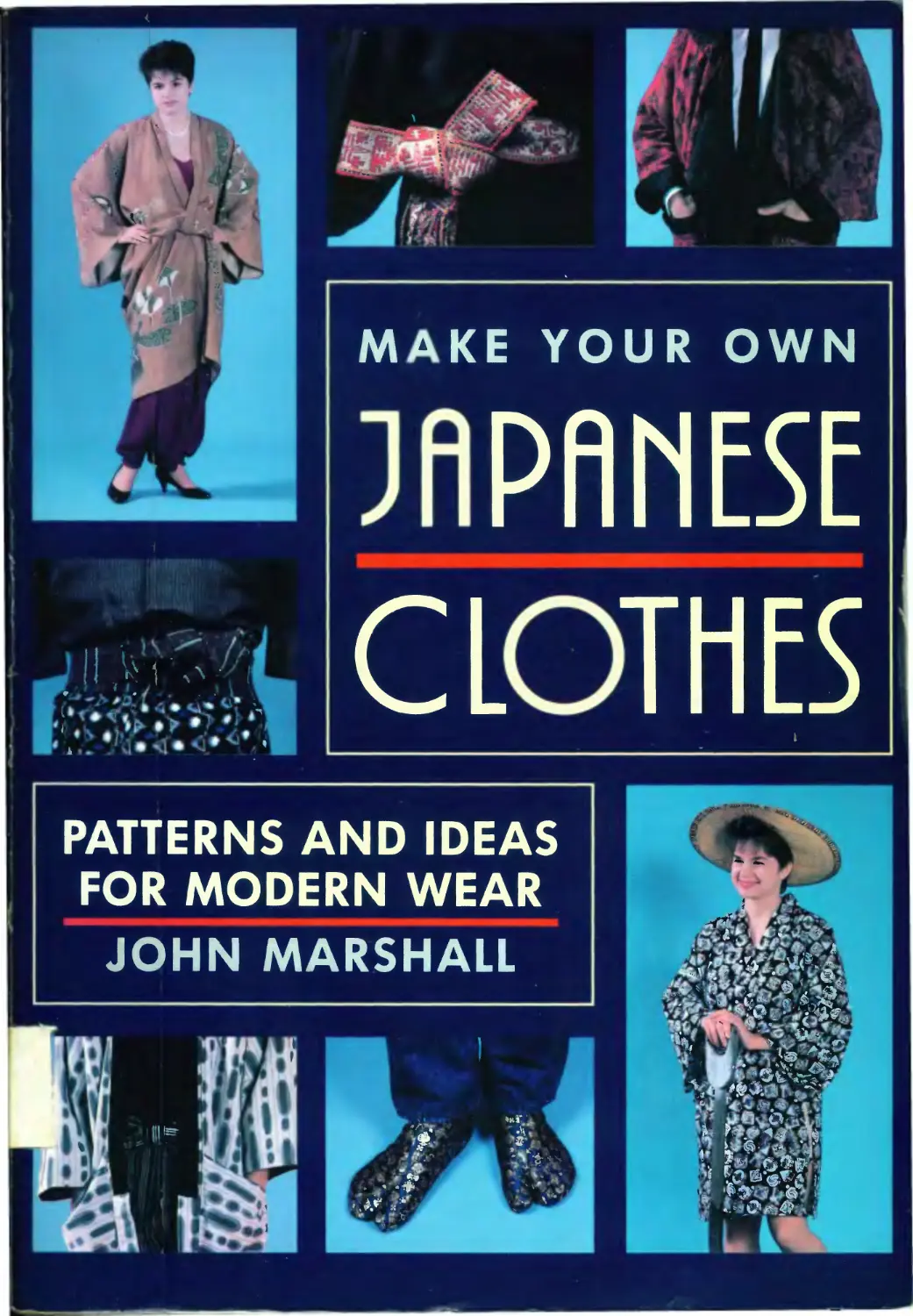


Tags: fashion magazine fashion japanese culture japanese clothes kodansha international
ISBN: 0-87011-865-X




Text
1J .
. '1 ,
.
" . t
I
. . . .
t ..
II
I 1
,
-1 -- -
-t#
A .. _.. ;::.
_ '.- ,( . J , I.
.' ' "" ; -. A
. ; . · t1.' ...._ ..,\I( .;, ...
...., '. -: . .." · " 0. .
.. . )e';A . N
.i . - WI ,
.., ......" ;". . ..
<II ,\. '-.: ... . ".
- - . :' , O L. . . ( _.O .,;'\
"' -5' . w _ ......
\., "f;.r
\) .;'" "",...
, A It
,.1..' r.\C
f."'. '
:- 0\;'---
. .... iiM --:..,." ..
'. . ,:v' . . . .._ '
(,/ I:"" ". .-
\ "'. !,.:-- ,)
Of ,
- .: . ( ,<,;.,',
. .- 6.- ".f.\ ,. ·
t \ ',1M'" 0";'; . '
;, f O 1J.@ 3 ;,'
',," "' ." " . I
\ 4. .'
...::- . tl
- -
(
II
,
c,
..
.
L ..
.
.....
"
.<;
MAKE
YOUR
i
PATTERNS AND IDEAS
FOR MODERN WEAR
JOHN MARSHALL
.
,
,1\,
. .
\
'111 e::
::;. ,
, \
.,; 1'1. .
.:
1;
J . '"
_I: .
.\\
II
, .:'
.. .t .
, , .
1
l''- .
. ..
....
· ..\ .-:r
" .. ... :iJ
'.... x.
. :0
\1
...
. ...
. " \'
\ ..
.
OWN
........... ...... '"""'\" . .....
'co
'"
"',
"'"
...
-:.
--:;..
'<:.
- -
A
.
MAKE YOUR OWN
. .
PATTERNS AND IDEAS
FOR MODERN WEAR
JOHN MARSHALL
Kodansha
International
Ltd.
I
TOKYO & NEW YORK
To Mary Tsukamoto,
with deepest respect, love,
and gratitude
The title page decoration is a collec-
tion of traditional hanten jackets dis-
playing the crests and symbols of
various merchants and artisans.
Photographs of outer robe and all
tabi socks except leather pair by
Steven Jenner. All other photographs
by Jeffrey Westman. Line drawings of
garment pattern layouts by Mari Lee.
All other drawings by the author.
Book design by
Seventeenth Street Studios,
Type composition by
Another Point, Ine.
Distributed in the United States by
Kodansha International/USA Ltd"
through Harper & Row, Publishers,
Ine., 10 East 53rd Street, New York,
New York 10022,
Published by Kodansha International
Ltd., 2-2, Otowa 1-chome,
Bunkyo-ku, Tokyo 112 and
Kodansha International/USA Ltd.,
10 East 53rd Street,
New York, New York 10022,
Copyright @ 1988 by
Kodansha International Ltd.
All rights reserved.
Printed in the
United States of America,
First edition, 1988
ljbrary of Congress Cataloging-in-Publication Data
Marshall, John, 1955-
Make your own Japanese clothes.
Bibliography: p.
Includes index.
1. Clothing and dress, 2, Costume-Japan, I. Title.
TT507.M366 1988 646' .47 87-82861
ISBN 0-87011-865-X (U..S,)
ISBN 4-7700-1365-5 (Japan)
Contents
Introduction
1
I. Before You Begin
1. Japanese Tools and Stitches
2. Making the Pattern
4
10
II. The Basic Elements
3. Padding
4. Linings
5. Sleeves
6. Hems
7. Collars
20
24
29
34
36
III. The Garments
8. Kimono
9. Outer Robe
10. Haori Jacket
11. Hanten Jacket
12. Wraparound Tops
13. Vests
14. Slacks
15. Obi Sashes
16. Tabi Socks
44
55
69
76
82
90
97
102
108
I\Z Care and Storage
17. Care
18. Storage
118
120
Appendices
1 Metric Conversion Charts
2 Sources of Supplies
3 Further Reading
Index
125
126
128
129
color photographs on pages 59-66
v
Symbols Used in This Book
fold line
sewing line
cutting line
(on pattern layouts)
blindstitched fabric edge
all seam allowances are 1/ 2 "
(unless otherwise specified)
hollow arrow indicates place-
ment behind fabric layer
.
VI
.
.
. -
.
I'
. ,
It
, .
, ,
. , II
r--------,
I
I
.....
,
-------
Introduction
One of the earliest human
expressions of self through art
came through decorating the
body. From a humble begin-
ning of simple patterns
painted in mud on bare skin,
evolved, through the centuries,
more elaborate adornments
such as jewelry and clothing.
While virtually all cultures
developed garments of some
sort, nomadic hunting cul-
tures, who relied on relatively
stiff, irregularly shaped ani-
mal hides for materials, devel-
oped complex patterns and
form-fitting garment shapes.
On the other hand, agrarian
cultures, who had access to
steady sources of plant and
animal fiber, designed simpler
patterns with straighter lines
and garment shapes depend-
ent on tucking and draping in
order to avoid cutting into
their labor-intensive fabrics.
Japan was one such agrar-
ian culture, whose strong
weaving tradition formed the
basis of kimono design. All
traditional Japanese garments
are styled for Ininimal cutting
or waste of the fabric while
achieving sophisticated and
graceful lines.
The width of fabric pro-
duced in Japan has varied
substantially over the course
of history, but modern-day
fabric for sewing traditional
clothing is a fairly standard
14 1 / 2 " wide. Double-width"
(29") and triple-width" (43")
fabric in traditional fibers and
weaves are also available in
Japan, but less commonly so.
The narrow width of Japa-
nese fabric necessitates a cen-
ter back seam in all garments
(except those for children) as
well as a front opening. That
is, two strips of narrow fabric
are joined along half of their
length to form the back of the
garment and the other ends of
the strips are brought over the
shoulders to form the front
panels.
Nearly all cuts into Japa-
nese fabric are made from sel-
vedge to selvedge along the
weft threads. Even when a
pattern piece would be too
wide, the Japanese avoid cut-
ting along the lengthwise grain
(the warp), which would
weaken the integrity of the
weave. The preference in tra-
ditional sewing is to take
larger seam allowances.
The rectangular pattern
pieces are assembled, a few
tucks and easements added,
and the garment is complete.
Children's garments have
additional tucks made at the
shoulders and waist after the
garment is sewn. The garment
can then be let out as the
wearer grows.
Because the silhouette has
remained relatively unclut-
tered, great emphasis has been
placed on surface design
throughout Japan's history of
costume. Many styles of weav-
ing, dyeing, and stitchery have
reached their peak in Japan,
1
j
Introduction
resulting in some of the most
exquisite textiles the world
has known.
Certainly it is the fabric-
its beautiful colors, exotic
motifs, and quality of weave-
that first attracted Westerners
to Japanese garments. The
most sought-after of these tex-
tiles is silk, as this was the
fiber favored by the aristocrats
and the wealthy and thus the
object of elaborate technical
artistry. Indeed, silk is recom-
mended for many of the pat-
terns in this book.
Today many Western textile
artists continue to draw inspi-
ration from Japanese fabrics,
exploring traditional as well as
innovati ve surface design tech-
niques. It is no longer unusual
to see knit kimono or leather
hanten jackets in fine art-to-
wear boutiques in major U.S.
cItIes.
Another appeal of tradi-
tional Japanese clothing is the
fit. Most garments are de-
signed to drape loosely and
are closed with ties whose
tightness is adjustable.
Although properly donned
women's kimono may seem
restricting to the novice, with
modifications in the sty Ie of
wear, they can be very com-
fortable. Suggestions for
innovative wear are made
throughout this book.
Versatility is yet another
attraction of Japanese clothes.
Japanese work clothes, such as
the hanten jacket, and kimono
overgarments, such as the
haori jacket, can easily be
worn in conjunction with
Western clothes. The simple
yet elegant lines of Japanese
garments make them a suit-
able, stylish choice for work
and play.
Over the last hundred years
kimono have fallen increas-
ingly into disuse in Japan. As
lifestyles become busier, there
2
is less time to spend on dress-
ing and caring for clothes.
Chairs, cars, and other ele-
ments introduced from the
West are simply not conducive
to kimono wear.
As a result, kimono are now
rarely worn outside of formal
occasions in Japan-wed-
dings, Coming-of-Age ceremo-
nies (at age twenty), and
funerals-or classes in tradi-
tional arts, such as tea cere-
mony, flower arranging, music,
and dance.
On the other hand, simple
cotton yukata (summer
kimono) are still the favorite
for lounging at summer resorts
and hot springs, and all of the
other informal garments pre-
sented in this book have
enthusiastic followings in
Japan, whether among gar-
deners and farmers, festival
performers and shopkeepers,
or students and housewives.
For the kimono to survive,
it must continue to evolve, as
it has over the centuries, to
meet the changing needs of
modern society. Westerners
have already played a role in
this development, by borrow-
ing from the Japanese clothing
tradition and using its simple
lines and drape as a founda-
tion for innovative expression
in fashion and art.
Take this book and use it as
a creative resource. The tradi-
tional methods and patterns
have been altered slightly in
some cases to better suit West-
ern needs and lifestyles, but
feel free to develop them fur-
ther.
In this manner kimono will
continue to evolve and thrive
in their new identity as practi-
cal, attractive, comfortable
clothing for both East and
West.
PART ONE
Before You Begin
1 Japanese Tools and Stitches
Sewing traditional cloth-
ing-kimono, in particular-
is an exacting art in Japan.
Collars, sleeves, and hems
must drape just so; the stitch-
ing must be easily removable
for washing the garment piece
by piece; the entire garment,
in fact, must be sewn by hand
to achieve the ideal results.
These results include proper
fit and protection of the fabric
(handstitching will rip before
the fabric does when a seam
undergoes stress). Accordingly,
you will not find racks of
readymade quality kimono in
department stores. Rather,
department stores, as well as
neighborhood gofukuya, or
tailor shops, sell bolts of nar-
row fabric and sew each
kimono by hand to order.
Times do change, however.
Recently, readymade one-size-
fits-all kimono of lined polyes-
ter have made their debut,
while inexpensive cotton sum-
mer kimono (yukata) have
been mass-produced for some
tIme.
For wear in the West, Japa-
nese clothes need not be con-
structed in the time-honored,
and often quite time-consum-
ing, traditional ways. A
kimono is bound to receive
heavier wear as a party dress
or dressing gown than as the
garb of choice for studying the
sedate tea ceremony. Accord-
ingly, it might make more
sense, for example, to make a
kimono from a more easily
4
washable fabric than silk and
to use a sewing machine
where possible.
Whether to use traditional
sewing techniques and tools-
like all choices made when
sewing-is a function of such
factors as the purpose of the
garment (to wear seldom or
many times, to wear to a
party or while gardening), the
end wearer (a meticulous
wardrobe caretaker or a "per-
manent-press only" dresser),
the time available to devote to
construction, and so on. Only
you can weigh the factors and
make the appropriate choices.
Described in this chapter
are basic traditional Japanese
sewing tools and handstitching
techniques, both of which may
be employed in non-Japanese
sewing projects as well. The
tools are illustrated and
described in detail to help you
in improvising substitutes. See
Appendix 2 for tool suppliers.
Many of the stitches will ap-
pear familiar and are indeed
universally used.
JAPANESE TOOLS
Thimbles
The Japanese thimble (yubi-
nuki), shaped much like a
cigar band, is designed to fit
around the first joint of the
middle finger (Fig. 1.1). Hold
it 11'
t
\1
1.1. Japanese thimble
the needle between the index
finger and thumb with the
blunt (eye) end of the needle
constantly resting against the
thimble (Fig. 1.2). Use the
thimble to push the needle
through the fabric as the fin-
gers guide the needle on its
course.
Japanese thimbles are made
of leather, metal, or plastic.
Some people even make their
own of fabric-encased card-
board. Leather is the most
comfortable and practical
material. Plastic and metal
thimbles are usually wider
and therefore don't fit as well.
In addition, their hard sur-
faces tend to cause the needle
to slip and the thread to break
as it is ground between needle
and thimble.
Cliepers
Japanese scissors (nippon-
basami) do not have blades
joined at a pivotal point as do
Western scissors. Instead the
blades are fashioned from a
single piece of metal that is
bent in the middle to give the
clippers a springlike action
(Fig. 1.3). They can be very
handy when it comes to quick
cli ps of thread and cloth. Be
sure to grip them well behind
the blades to prevent cutting
your fingers. For maximum
convenience, keep a pair tied
to your sewing machine with
a ribbon so they will always
be at the ready. In former
times, larger versions of these
clippers were used to cut out
patterns, but in modern times
Western-style scissors are the
standard tool of choice for
extensive cutting of fabric.
Iron
The Japanese iron (denki-
gote) has a long tail-like han-
dle and is a bit squatter than
Tools and Stitches
Western irons (Fig. 1.4). It is
well designed for fitting into
confined areas, such as the
lower inside corners of
kimono sleeves. Japanese irons
range in size from 3" to 1 0"
long. A small (Western) travel
iron makes an adequate sub- 1.2. Using a Japanese thimble
sUtute.
Marking Stylus
Made of ivory, horn, or
plastic, the Japanese marking
stylus (hera) is used in place of
tailor's chalk to score marks
on cloth (Fig. 1.5). Grasp the
stylus firmly by the handle
and pull it toward you while
pressing down. The rounded 1.3. Japanese clippers
drawing edge is somewhat
sharp and may damage deli-
cate fabrics. For this reason, it
is better to place fabric to be
scored on a Japanese cutting
board than to score fabric
directly on a hard surface like
a tabletop. Dull letter openers
make good substitutes or you
can fashion your own stylus
by cutting a plastic ruler to
the shape illustrated. File the
rounded scoring edge to a 1.4. Japanese iron
blunt point and sand all edges
smooth.
Cutting Board
In a Japanese home a cut-
ting board (tach i-ita) is laid
out when working on tatami
floors to protect the matting
(Fig. 1.6). The board consists
of a thick Bristol board core
covered on one side with 1.5. Marking stylus
sturdy handmade paper or
woven cotton. Sewing
reminders, standard kimono
measurements, converSIon
charts, and graph lines are
printed on the reverse side.
The board, 16" x 66" when
spread out, folds up accor-
dion-style to about the size of
a large book for easy storage.
1.6. Japanese cutting board
5
Tools and Stitches
This is the best type of
board to use with the marking
stylus. It has some give to it,
unlike most tabletops, yet not
as much give as a carpeted
floor, which would allow the
stylus to cut through the cloth
or distort the weave. Similar
cutting boards, calibrated
with both metric and inch
measurements, are available in
American sewing stores; a
typical board is made of card-
board and measures 40" x
72" .
"Third Hand"
The third hand" (kake-
hari) is a truly wonderful
device (Fig. 1.7). You will find
it quite useful when doing any
handse\ving. Currently it is
marketed in the United States
under the name Third Hand
and is made of aluminum to a
length of about 3 1 / 2 ". In earlier
times, it was referred to as an
"Elizabethan nightingale"
because of its birdlike shape.
The back end (tail) is
attached by a cord to an
immovable object, such as the
sewing box mentioned below.
The front end (beak) has two
small rubber grips that open
when the center sections
(wings) are pushed together.
When the wings are released,
the beak clamps down on the
fabric and the rubber pads
keep it from pulling loose.
Thus, with the fabric secured,
one hand is totallv freed to do
"
the stitching; in essence, you
are indeed working with a
third hand. The clamp is
moved along as the sewing
progresses. The other end of
the cord may be tied to a
safety pin, and the pin
attached to a sofa arm in lieu
of the sewing box. You may
also find it convenient to pin it
to your pant leg when wearing
jeans. That way your leg may
6
be used as well to adjust the
tension of the fabric.
Sleeve Template
A template of cardboard or
plastic may be used as a guide
when marking the curve on
the front lower corner of each
sleeve. Using a sleeve template
insures that the sleeves on a
garment will have uniform
sizes and curves. You can use
a French curve to make a tem-
plate with four corner varia-
tions (Fig. 1.8). Or, place
saucers, cups, or jars upside
down on the cardboard and
trace to make the different
curves.
Sewing Box
The Japanese sewing box
(haribako) is certainly not nec-
essary for creating beautiful
garments, but it is a practical
and attractive sewing acces-
sory (Fig. 1.9). Its ingenious
design includes a "foot" that
attaches to the bottom, upon
which one kneels to stabilize
the base when using a "third
hand." One end of the "third
hand" is tied through a small
hole in the neck. A measuring
stick-calibrated in centime-
ters or in the traditional Japa-
nese system of sun (inches)
and shaku (feet)-slips into a
slot built into the neck or
body of the box. A pincushion
is bui! t into the top of the
neck over a tiny drawer, and
the entire wooden box is
made easily portable by a
handle attached to the top.
1.7. "Third hand"
. ,
\ '4 ,
,
, .
I '
. "
1.8. Using a French curve to
make a sleeve template
1.9. Japanese sewing box
JAPANESE
HANDSTITCHING
All you really need to hand-
sew is needle and thread. J a p-
anese needles are virtually
identical to those made in the
West, so use whatever stain-
less steel needles you have on
hand, selecting one appropri-
ate to the weight of the fabric.
Silk thread is preferred for
handsewing, especially when
using silk fabric. Not only is
silk thread strong and resili-
ent, but it glides smoothly
through the weave during sew-
ing and is easy to remove
when necessary. You may sub-
stitute more readily available
thread, such as cotton-covered
polyester.
Knotting the Thread
Before beginning to hand-
sew, knot one end of the
thread by wrapping the thread
around your index finger and
rolling it off between thumb
and index finger while pulling
it tight into a tiny ball. It
helps to moisten the thread
end first.
To finish off handsewing
with a knot, lay the needle on
top of the last stitch, wrap the
remaining thread a few times
around the needle, and pull
the needle out while pinching
the knot area between thumb
and forefinger (Figs. 1.10,
1.11).
To finish off handsewing
without making an actual
knot, take a small backstitch
(Fig. 1.12), then reverse direc-
tion and sew back over the
line of stitching for an inch or
so (Fig. 1.13). Tuck under the
thread (Fig. 1.14), and trim
off the excess. This type of
finishing may be desirable to
avoid a lumpy knot when sew-
ing on fine fabrics or to enable
easy disassembly of the gar-
ment for piece-by-piece
washing.
Running Stitch
The running stitch (nami-
nui) is used primarily to join
seams. When Japanese sew a
running stitch, they hold the
needle still and move the fab-
ric onto it. (See Figure 1.2 for
a bird's-eye view of the correct
way to hold the threaded
needle.) Every few stitches the
accumulated fabric is scooted
off the needle.
Figures 1.15 and 1.16 show
the proper way to gather fab-
ric onto the needle. Hold the
needle securely between the
thumb and index finger of the
right hand, with the "third
hand" supporting the right
edge of the fabric. The other
three fingers of the right hand
are used to scoot the stitched
fabric off the needle in the
direction of the "third hand."
With the left hand, hold the
fabric along the line to be
stitched, pulling gently against
the resistance of the "third
hand." Insert the needle in the
fabric and, with the left hand,
pull the fabric up (and onto
the needle) and down (and
onto the needle) in alterna-
tion. Periodically check and, if
necessary, even out the tension
of the stitched thread. The
thread should not cause any
puckering in the fabric.
1.10
Tools and Stitches
,
1.11
1.12
---...
........--
I
1.13
1.14
\
1.15
1.1&
7
Reinforcement Stitch seam allowance. Reverse the
seam so right sides of fabric
Use a reinforcement stitch are together and sew along the
(kannuki-dome) to help relieve regular seam allowance (Fig.
strain on fabric and thread 1.21) .
where the sleeve joins the
body of the garment at the Backstitch
underarm opening. This stitch
is used on the front and back Use a backstitch (hangaeshi- 1.19
of women's kimono sleeves. nui) to join seams that will be
You might also use it to rein- subject to a lot of pull and
force the side seams of slacks stretch. This stitch helps
having a tie closing. relieve tension that may cause
First, stitch twice across the the thread to break, while
seam where the sleeve joins keeping the fabric in proper
the body (Fig. 1.17). Then alignment. The example ill us-
wrap the double-stranded loop trated (Fig. 1.22) shows l/S"
with tight half hitches (Fig. increments but any size stitch Vi"
8 <_ _ _ _ _ ,. > vt
1.18) until the loop is full. Tie that does the job may be sub- -----...
off (Fig. 1.19) and clip the stituted. Insert the needle in
thread end. For extra strength, the fabric, bringing it out 1/ 4 "
pass the needle through the beyond. Backtrack l/S" and
middle of the loop to the sew forward 3/s". Backtrack 1.20
starting point and then clip l/S" and sew forward 3/S".
the thread. Repeat this pattern for the
length of the seam.
Parallel Stitchin g
Use parallel stitching (nido-
nui)-two parallel rows of
running stitches-for the cen-
ter back seam of a garment -----....
that consists of selvedge edges
or a fold of fabric. (For raw
edges, finish with a French 1.21
seam.) This seam receives
more stress than most, so the
second line of stitching serves
as a backup in case the first
line of stitching pulls out. 1.17
Stitch the first line with a
l/S" seam allowance and the
second line with a 1/ 2 " seam
allowance or whatever seam
allowance is appropriate to -i vV'
size the garment (Fig. 1.20). " !IS"
1.22
French Seams
lvlake French seams
(fukuro-nui) when joining cut
fabric edges, such as the bot-
tom edges of the sleeves, in an
unlined garment. With wrong 1.18
sides together, sew along the
fabric edges leaving a l/S"
Tools and Stitches
8
Tools and Stitches
Holdin g Stitch wrong side
This loose stitch (osae-nui)
is a relative of staystitching. right side -
Use it to hold the side seam VI II - - - - - - -
18 <--=---=- _ _ - - -
allowance of a kimono flat to
one side of the seam (Fig.
1.23), in which case it resem-
1.27
bles a blindstitch. Or, to pre- 1.23
serve the soft fold of a collar
where it meets the garment
body (Fig. 1.24), baste large
(at least 1") stitches 1/ 8 " from
the seam line. This is also the
stitch used to keep sleeve body wrong side
edges, hems, and some collars 1\;""\ /'\ /'1 /\ I d
(wrong ... --
in place during long-term stor- side) right side
age of a garment. - overlap
(")
. 0 (wrong side)
Q)
Blindstitch
Use a blindstitch when you 1.28
desire no or minimal stitching
to show on the right side of 1.24
the garment. Blindstitches go
by different names in Japanese
depending on their function.
Use hashibuse-nui (Fig. 1.25)
to finish off a selvedge edge. """'1 /'1 F \ /"\ /1 r
Use matsuri-guke (Fig. 1.26) -----
right side
to finish off the raw edges of a ......."\.../'-\ ....., /) ...... I \_
+--/L JV
partial lining. Use yori-guke
wrong side
(Fig. 1.27) to finish off the
edges of unlined sleeve open-
ings and the fore-edge of the ,/ I
overlaps on an unlined
V2"
kimono. All types of blind- .-J 1.29
stitch are represented by the
1.25
same symbol (see p. vi) in this
book.
stitch
Use a slip stitch (hon-guke)
to stitch the back side of the
collar in place (Fig. 1.28); to
invisibly sewall edges of a
collar guard (Fig. 1.29); or to
construct tube ties (Fig. 1.30).
v
1.30
o
1.26
9
1f.tJ
:;t:
-'
tJ
2 Making the Pattern
The kimono is designed to
fit a Japanese ideal of the
human body. This ideal has
changed over time much as
Western fashion has changed
over the years to reflect chang-
ing views of the perfect figure.
Women's kimono are geared
toward a contourless body.
Many Japanese women have
hour-glass figures and so find
it necessary to pad out their
waist and the hollow of their
back to create a very uniform
(cylindrical) appearance.
Large-busted women in Japan
wear undergarments that help
to flatten the breasts and cre-
ate a more even and graceful
slope from the shoulders.
Men's kimono are geared to
the same general contourless
shape as well. Slightly squared
shoulders, a long torso, and
small shapeless hips are ideal
for wearing a man's kimono.
Having a paunch helps to
keep a man's obi in place
around the hips and enhances
the overall look.
In Japan there is less varia-
tion in body sizes and shapes
in the general population
when compared to the United
States with its diverse ethnic
components. The proportions
presented in this book are
based on traditional Japanese
proportions and the tradi-
tionallook.
Carefully take your own
body measurements (or those
of the person you're sewing
for), as outlined below. If you
10
take all the measurements,
you will be ready to make any
of the garments in the book.
Or, you can take only those
measurements necessary for
the garment you have selected.
Then, using your measure-
ments, draw the pattern as
explained below. Adjust the
pattern with a trial fitting of
the pattern pieces. Before
drafting your pattern, be sure
to read the tailoring tips, as
these are the methods for
altering the traditional fit to
one potentially more suitable
to your specific body type.
Suggestions for modifying
the basic construction or look
in more dramatic ways are
provided as variations at the
end of each garment's instruc-
tions. These variations are a
further source of ideas for
adapting kimono designs to
Western ways of life. The pos-
sibilities are endless, so feel
free to mix and match the
basic garment elements to cre-
ate your own daring new look.
TAKING YOUR BODY
MEASUREMENTS
Photocopy Figures 2.1-5.
You may want to enlarge Fig-
ures 2.1 and 2.2 to make
room for notes. Take your
measurements beginning with
A below, and fill in the figures
2.1
I
I
I
I
,
2.3
Making the Pattern
..........
c
NL
. .. .
J
. ..
lK
. . . . . .
... ....
E H Q . . . . . .
H
F
. . . ..
o
R
p
G
s
. . . ..
...... .
L
M
............. ..
T
........ .
2.2
u
v
I
,
I
I
.
. 4
w
--+,
2.4
... ......
: 4
. .
2.5
11
Making the Pattern
next to the corresponding let-
ters on the photocopied
sheets. (Letters 0 and X have
been skipped to avoid confu-
sion with mathematical sym-
bols.) The aid of a friend will
speed the process.
A. The distance from a point
halfway between a woman's
shoulder and elbow, across the
back of her neck, to the corre-
sponding point on her other
arm. Measure while arms are
hanging at sides. (This is the
traditional length of a wom-
an's kimono shoulder line.)
B. The distance from a point
one-third of the way between
a man's shoulder and elbow,
across the back of his neck, to
the corresponding point on his
other arm. Measure while
arms are hanging at sides.
(This is the traditional length
of a man's kimono shoulder
line. It is also the recom-
mended shoulder line for tra-
ditional work clothes for both
sexes. )
c. The circumference of the
base of the neck.
D. The circumference of the
chest at its fullest point.
E. The circumference of the
abdomen at the waist.
F. The circumference of the
abdomen at its fullest point
(for those people who have a
protruding belly).
G. The circumference of the
hips at their fullest point.
H. The distance from a wom-
an's shoulder seam (see A) to
her wrist when her arm is held
at the side. (This is the tradi-
tionallength of a woman's
sleeve. )
I. The distance from a man's
shoulder seam (see B) to a
point two-thirds of the way
down from his elbow to hIs
12
wrist, when his arm is held at
the side. (This is the tradi-
tionallength of a man's
sleeve. )
J. Height in stocking feet.
K. The distance from the base
of the neck (the neck bone) to
the floor.
L. The distance from the
waist to the bottom of the calf
muscle.
M. The distance from the
crotch to the bottom of the
calf muscle.
N. The distance from the top
of the shoulder at the neck to
mid-sternum.
P. The distance from the top
of the shoulder at the neck to
the base of the rib cage.
Q. The distance from the top
of the shoulder at the neck to
the navel.
R. The distance from the top
of the shoulder at the neck to
the base (cup) of the buttocks
(or to the crotch).
s. The distance from the top
of the shoulder at the neck to
the bottom of the kneecap.
T. The circumference of the
foot at the widest point meas-
uring from the heel around the
top of the foot.
u. The distance from fingertip
to fingertip when the arms are
outstretched. (Used for wom-
en's garments.)
\( The distance from wrist-
bone to wristbone when the
arms are outstretched. (Used
for men's garments.)
The distance from the tip
of the pinky finger to the tip
of the thumb when the fingers
are spread gently as wide as
they will go.
Y. The width of the hand
when closed.
'-
DRAWING
THE PATTERN
Before buying any fabric
read carefully through the
instructions for the garment
you intend to sew and study
the pattern layout. Next, using
your body measurements as a
guide, redraw the pattern lay-
out on graph paper. Plot your
pattern so that one square of
graph paper equals 1". This
will make it easier to enlarge
the pattern later. Don't be sur-
prised if the pattern pieces in
your graph drawing appear a
bit longer or wider than the
original-proportions will dif-
fer with different body sizes.
All pattern layouts in this
book have been plotted using
36" width fabric, as this is the
narrowest fabric in common
use in the United States. You
may, of course, use any width
of fabric and rearrange the
. ,
pattern pIeces to suIt your
needs.
The easiest and surest way
to determine how much fabric
you are actually going to need
is simply to cut out all your
pattern pieces from pattern
tracing cloth and lay them out
on the floor or a table, being
careful not to exceed the
width of the fabric to be used.
Measure the running length of
these pieces and you have the
yardage requirement. Be sure
to allow extra if you are going
to cut fabric with large pat-
terns or one-way patterns that
need to be matched. Always
layout the major pattern
pieces so they line up with the
straight of the grain. This will
help ensure that the finished
garment hangs properly. Very
rarely is a Japanese pattern
piece cut on the bias.
Fabric suggestions have
been made under each gar-
ment heading, but feel free to
use any fabric that strikes
your fancy. If you plan to use
a fabric that has a nap or
grain, such as corduroy or vel-
vet, you may want to add a
seam at the shoulders so the
nap runs in the same direction
on front and back.
Figure 2.6 shows a typical
pattern layout on traditional
Japanese fabric, which is nor-
m ally 13 1/2"-15" wi de. J a pa -
nese frequently use fabric
with a one-way pattern. With
a traditional narrow-width
pattern layout, this causes a
portion of the design on the
finished kimono to be upside
down (Fig. 2.7). By Japanese
standards this is fine, but fol-
low your own tastes.
One solution to this comes
in the fabric-dyeing stage. The
fabric is designed with a
repeating pattern in which
every other element is upside
down. In effect, some portion
of the pattern in the finished
kimono is always right-side up
(Fig. 2.8). The Japanese con-
sider this preferable to putting
in a seam at the shoulder to
right the pattern.
A number of readily avail-
able tools will help you draw
the patterns in this book. The
following are particularly
handy:
Graph paper: Use graph
paper for drawing a draft of
your pattern in miniature. A
paper with a large grid bro-
ken into units of twelve is eas-
iest for plotting in inches.
Grids subdivided into units of
ten work best with the metric
system.
Pattern tracing cloth: Two
materials suitable for pattern
pieces are available at well-
stocked sewing stores. One,
called "pattern tracing cloth,"
is a lightweight synthetic fab-
ric covered with a grid of dots
spaced 1" apart; it resembles
Making the Pattern
--.---
sleeve
sleeve
body front
.-. --....-.,..---
.
.
. . .
body back
body back
.
.
.
._.-. .
body front
collar overlap
overla p
2.6
13
Making the Pattern
interfacing in texture. The
other, "pattern paper," resem-
bles butcher paper in texture
and also has a 1" dot grid.
Grids greatly facilitate the
transferral of the graph paper
pattern. These materials come
in widths of 36" or 45".
Felt-tip pen: Use a broad-
tip indelible marking pen to
transfer your original graph
paper drawing to the pattern
tracing cloth. It's a good idea
to place newspaper under the
cloth when drawing. Different
colors may be used to distin-
guish different bits of infor-
mation, such as cutting lines,
fold lines, and pattern piece
labels.
Yardstick: Use a yardstick
when drawing your pattern to
help keep the lines straight.
Large envelopes: Large
manilla envelopes are ideal for
sorting and storing your pat-
tern pieces once they have
been drafted and cut out.
Calculator: Use of a pocket
calculator may speed the pat-
tern-drafting process, as many
of the dimensions are based
on proportions and formulas.
Masking tape: Straight pins
and masking tape are useful in
attaching the pattern pieces
together for a quick trial
wearing before actually cut-
ting the cloth.
Before beginning to stitch
together a garment, carefully
iron the fabric, taking care to
press out any natural stretch
in the weave. This is advisable
even if the fabric has been
preshrunk. (Preshrinking and
ironing all fabric before cut-
ting out the pattern pieces is a
good idea.) If a flat weave
stretches after the garment is
completed, the result will be
unattractive baggy areas at the
knees and seat.
14
TRIAL FITTING
Transfer the graph-paper
pattern to the pattern tracing
cloth, enlarging to life-size
proportions. Cut out the
pieces. Tape, or pin, all pieces
together as though you were
sewing the garment together.
Try the garment on. If the fit
is off, first doublecheck the
measurements and calcula-
tions. Make sure you have
taken proper seam allowances,
made all appropriate tucks,
and so on. Does it fit well?
Are the sleeves the proper
length? Is it the look you envi-
sioned? Or is it too loose or
too snug in some areas? Now
is the time to make any design
changes. (See Tailoring Tips
below for extra help.)
To alter your pattern pieces
first unpin (or untape) the
area to be altered. If the gar-
ment is too large in that area,
trim off some of the tracing
fabric until you achieve the
proper fit. If the pattern is too
small, or if you inadvertently
cut off too much while alter-
ing it, add pieces of scrap pat-
tern tracing cloth with
masking tape. When adding
pieces, keep the printed grid
lined up properly.
t
+
+
2.7
+t t t t
2.8
TAILORING TIPS
These guidelines will help
you achieve the proper fit.
Read each one and, where
appropriate, incorporate the
suggestions when drafting
your pattern.
Measuring Your Neck
Construction of a neck
opening template is necessary
to ensure proper fit of a collar
around the neck. All garments
with a neck opening require
these measurements.
1. Divide C (the circumference
of the base of your neck) by 4.
On a piece of paper draw a
perfect square using this fig-
ure for each side (Fig. 2.9).
2. Divide C by 8. Extend the
bottom side of the square by
this figure on each side (Fig.
2.10). This base line will align
with the garment's shoulder
line.
3. Draw curved lines from the
base line to the top corners of
the square (Fig. 2.11).
4. Transfer the neck-line shape
to a piece of cardboard and
mark the center of the top and
bottom edges. Cut it out and
write your name and the date
on it. Your neck opening tem-
plate is ready to trace onto the
fabric.
5. To transfer the neck open-
ing shape to the fabric, line up
the bottom of the neck open-
ing template with the garment
shoulder line and trace the
curved edge with tailor's chalk
or a marking stylus. Extend
the lines to the bottom hem
line of the garment front (Fig.
2.12). This inverted U shape
is the collar sewing line.
Tailoring Jackets
According to the Japanese
aesthetic, the shoulder-sleeve
,
seam on a woman s garment
should hit halfway between
the shoulder and elbow (Fig.
2.13). On men the ideal
shoulder line falls one-third of
the way down from the shoul-
der to the elbow (Fig. 2.14).
C-:-8
: . .
C-:-8
. . :
: .
C -:-2
. '
2.10
center back
neck
openmg
template
center front
.
shoulder line
en
(t)
+='
(C
Your
Name
Date
='
(t)
2.11
...
2.13
Making th Pattern
C -:- 4
.\.
u
2.9
back
.. center
t seam
-----:::,..
;) > neck - _ shoulder
II openmg line
( tem late ; .
- - --
I I
I I
I I collar
I I .. sewing
I I line
I I
I I
I I
I I
I
2.12
+-
+-
2.14
15
.j
Making the Pattern
One reason for these propor-
tions is to provide extra yar-
dage around the body.
If you prefer a more West-
ern fit-that is, a slimmer, less
voluminous fit around the
torso-in a hanten or haori
jacket, follow these easy steps:
1. Calculate a new shoulder
line measurement: Take the
largest of your measurements
E, F, and G. We'll use G in the
example. Add half of C and
divide this sum by 2: (G +
1/2C) 7 2. Use the result as
your shoulder measurement in
place of A (women) or B
(men).
2. Calculate a new sleeve
length: Deduct your new
shoulder measurement from U
(women) or V (men). Divide
by 2 to derive the length of
each sleeve. Thus, for women,
(U - new shoulder line mea-
surement) 7 2 == new sleeve
length. For men, (V - new
shoulder line measurement) .
2 == new sleeve length. See
Figure 2.15.
16
: .....
.
.
Tailoring
Full-Length Garments
Torso proportions vary
widely from person to person.
To achieve a more tailored fit
on a shapely figure (one with
variation among chest, waist,
and hip measurements), you
may want to taper the sides of
the kimono or outer robe
body instead of keeping the
traditional straight lines.
First, take the largest of
your measurements E, F, and
G. (We'll use G in the exam-
ple.) Add half of measurement
C. Divide the sum by 2. In
other words, calculate (G +
1/2C) 7 2. Which is larger, the
result or measurement A (B
for men)?
If A (B) is larger by 3" or
more, draw the body pattern
piece as shown in Figure 2.16.
Plot A (B) at the shoulder line.
Draw a parallel line a distance
of P from the shoulder line.
Plot and center the above cal-
culation-(G + t/ 2 C) 7 2-
on the parallel line. Connect
the shoulder line to these
points, and continue straight
down to the hem line.
If A (B) is within 2"-3" of
the result, follow Figure 2.17
(the same as the traditional
proportions presented in the
patterns) .
I
I
I
I
I
I I
G+ V2C\ -;-
r I \
P I \
l I A or B \
('; '-{ :-- 7
p \ I: :
L \ I I I
t I I t
I I I
I /
I I I
I I I
I
I I I
I I I
en
=r
a
c:
+ 0...
CD
...,
CD
2.16
I
I
I
I
I
I
I same as A or B I
r . . .. .
I I
P I I en
l. I A or B =r
.. I a
.. c:
( 1- - I': -, - , - 1 '-0:
I I CD
I 1 ...,
I
P I
L I CD
. I .
I I
, I I I
I
I I I
I
I I I I
I I I I
I I I
I I I
U or V
. 2.11
.
.
2.15
: (G + lhC) -:- 2 :
: ..... :
· (shoulder line '
measurement)
If A (B) is smaller by 3" or
more, draw the body pattern
piece as shown in Figure 2.18.
If sewn on without adjust-
ment (Fig. 2.19), the sleeves
could cause excessive bunch-
ing when the arms are held at
the sides. To prevent this, you
may wish to widen the top of
the sleeve and shorten the
shoulder line as shown in Fig-
ure 2.20. This nontraditional
alteration also causes the
shoulder seam to fall a bit
higher on the arm than nor-
mal, but the garment will fit
more comfortably.
Fitting the Bustline
If your bust at its fullest
point (D) is the largest of your
torso measurements, you may
find that the garnlent binds
under the arms. The best two
ways to prevent this from hap-
pening are to make wrapped
sleeves (I'nakisode) or to widen
the arInholes when attaching
other sleeves.
For large-breasted women,
the most comfortable garment
in this book is Hanten Jacket
Variation 3 (p. 81), This type
of sleeve is widest (.lt the point
where it hits the body; the
bottonl of the sleeve extends
to the waist or below. The
result is a great deal of full-
ness in the upper area of the
garment and elimination of
binding under the arms.
Even if you select a differ-
ent pattern, use the hanten
jacket variation as a key:
Design your garnlent to have
sleeves that hit lower than is
otherwise indicated. For han-
ten jackets, ji111bei tops, and
hippari tops, this simply
means fuller, wider sleeves.
For haori jackets, make the
gusset wider at the top as
well. For kinlono and outer
robes, attach more of the
sleeve to the bodv and extend
.
the small opening in the side
seam under the s]eeve. (In this
case, you will have to wear
your obi a bit lower than nor-
mal.) The priority in making
these alterations is comfort.
ADDING A BACK SEAM
The pattern layouts in this
book do not show a center
back seam line, although
allowance (1 ") has been made
for such a seam in the pattern
dimensions. (Exceptions are
the wraparound tops, which
have a box pleat instead, and
the vests.) The assumption is
that most readers will use
wider, Western-width fabrics,
eliminating the need for a cut
line (seam) in the body back.
While the center back seam
may be omitted without
affecting the garment struc-
ture, from the Japanese point
of view it is considered an
important design element as
well as a protection against
misfortune (see box).
To add a back seam, simply
fold the body back in half,
right sides facing, and sew
together 1/ 2 " from the folded
edge. Repeat for lining and
polyfil batting, if applicable.
Making the. Pattern
I I
I I
I I
I I
I I
I
I (G + V2C) -;- 2 I
rt . i
P \ I
l .--6t -
(( A or B I
P I I I \
L I I \
- I ·
I I
I I I I
I I I I
I I I I
I I
I I
I I, I
(nontraditional)
2.18
en
:::J
a
...
CD
...,
::J
CD
(nontraditional)
2.19
:. . . . . . . ...
U or V
'. .
..
(G + V2C) -;- 2
( nontraditional)
2.20
...
. . . . . . . . .;
. .
.
.
. "
.'
.'
17
Making the Pattern
GARMENT CHARMS
Semori (literally, "back pro-
tectors") are motifs stitched
on garments to protect the
wearers from evil influences.
These charms are placed high
on the back of the garment,
just between the shoulder
blades. Semori are most often
seen on children's garments
and on adults' garments hav-
ing no center back seam, the
belief being that a center back
seam serves the same function
as a charm.
Garment charms come in a
variety of forms, the most
common of which are stitched
or embroidered in thread that
contrasts attractively with the
colors of the garment. Some
examples of typical designs
are shown here. More elabo-
rate embroidery as well as
applique and miniature cloth
dolls may also be incorporated
into charm designs.
Stitch on the charm with
embroidery thread when the
garment is complete. When
the charm becomes worn or
faded, remove the thread and
embroider a new charm.
18
Packet of paper strips
(tabane-noshi)
.....6 .../
:::
I
Oarsman (funahiki)
Crane (tsuru)
Three arrow feathers (mitsuya)
Double fans (chigai ogi)
Pine needles (matsuba)
Pine boughs (matsu)
Paper butterfly (noshicho)
PART TWO
The Basic Elements
3 Padding
Hanten jackets, vests, and
kimono are padded for extra
warmth in winter. Presented
here are two methods for pad-
ding a garment. The first is
the traditional method
wherein there is little or no
stitching through the layers to
hold the batting in place. The
secret to this method is the
use of mawata, or an ex-
panded silk cocoon, between
the face fabric and the batting.
Mawata is available at
Japanese sewing supplies
shops but difficult to find in
the United States (old-fash-
ioned variety stores in Japa-
nese communities are one
potential source). Store-
bought mawata is pure white
and resembles a folding mili-
tary cap in shape and size
(Fig. 3.3).
The second method for pad-
ding a gar men t is not tradi-
tional, but it is better suited
for machine sewing and syn-
thetic batting materials. It is
the method recommended
throughout the book.
TRADITIONAL METHOD
For this method, you need
6-10 mawata (silk cocoons)
and sufficient wool or cotton
batting to cover the en tire gar-
ment except for the collar.
Although wool is more expen-
sive, it is lighter in weight and
20
$
A
it
-
, . ,.- I
4 .
,
.
batting . batting
,
.
,
,
'I
.
, , I
.
. : sleeve
sleeve . , fa bric
. , .
lining . p . (wrong : lining
. .
(wrong: . f side) , (wrong
.
side) . . : side)
I
. .
,
. . , . J
.
- I f {
.
. . p - . . .
f . -. . . . . p p . . p ,
. 0 .
.' . . . . ,
batting batting 4
. . . I
. . .
lining
3.1
tends not to mat together as
much as cotton when washed.
If synthetic batting is substi-
tuted, the polyfil method out-
lined below will yield more
satisfactory results.
Before you begin the pad-
ding process, the garment
should be nearly complete: All
face fabric pieces should be
sewn together, and the collar
should be sewn along one
edge to the face fabric. The
lining should be at the stage
shown in Figure 4.7.
Plan to work on a large
smooth surface, such as a din-
ing room table or hardwood
floor. Because of the fineness
of the cocoon silk, it feels
almost sticky and tends to
cling to nearly everything it
touches.
Y2"
7C-c .
( o! ';;;'
,\ #... /,/
, -,
, "
3.2
...
, / \.
- \.
-...... -.....
3.3
1. Lay the batting out on a flat
surface so that when the gar-
ment is (later) laid on top, the
batting will fold over to cover
the whole garment. Depending
on the width of the batting,
you may have to overlap in
places, as shown in Figure 3.1.
2. Feather all overlapping
edges to reduce bulk. To
feather, pull gently on cut
edges, removing about 1;2" of
batting as you go (Fig. 3.2).
3. Prepare each silk cocoon
(Fig. 3.3) by slitting one side
to the center (Fig. 3.4).
4. Grasp the two flaps formed
and carefully pull out (Fig.
3.5) into a fine gossamer web.
Lay the web on the reverse
side of the face fabric. Cover
the wrong side of aJJ fabric
pieces except the collar (Fig.
3.6).
5. Lay the garment, cocoon
side out, on top of the batting
as shown in Figure 3.1. Fold
the batting around to the front
(Figs. 3.7,3.8). Feather all
overlapping edges.
6. Use a piece of cording to
give the hem a clean line and
add a bit of weight: Twist a 5"
wide strip of batting (long
enough to go around the
hem), evening out the thick..
ness as you go (Fig. 3.9).
When finished, grasp the ends
and give it a gentle pull to
compact the batting some-
what. Lay this cording on the
batting at the hem line with
enough batting below to form
a casing when the lining is
brought up (Fig. 3.10).
Feather the edge of the batting
to prevent bulkiness from ech-
oing through the fabric. (This
cording step is optional.)
7. If mawata is difficult to
obtain or very expensive in
your region, you may opt to
cover only the wrong side of
the face fabric with the
cocoon silk and later (step 9)
lightly baste the seams of the
lining to the batting. Other-
wise, now is the time to cover
the lining body and sleeves
with a layer of silk web.
-.-' --....,
-- ----.9:...--- . \
. - -- - \
( - -
, ......."\
I " - - , -'" \.1
I -
( . \
/" ; J
---=. --. . 1 _-
..-- "'---- ... .
----
-.. --.....J
3.4
lining
(wrong
side)
3.6
lining
3.8
lining
lining
3.JD
Padding
,/"-......
---, --- \...::
- .-.....-
3.5
/j
3.1
\
21
Padding
8. Gently pull the body lining
up into position and fold the
sleeve linings over the padded
sleeves (Figs. 3.11,3.12).
9. Whether or not you laid
mawata on the lining, it is a
good idea to baste the lining
to the batting to keep the gar-
ment from ballooning. Sew
within the seam allowance
about 1/ 8 " from the seam line,
catching only the batting and
lining layers (Fig. 3.13). Baste
back seam, side seams, and
overlap seam (if there is one)
in this manner.
10. Add a small scrap of bat-
ting (about 3" square) to the
bottom front corners for extra
body (Fig. 3.13).
11. Fold the face fabric over
the batting, between the bot-
tom of the collar and the hem,
and sew it with a holding
stitch through the batting to
the front (Fig. 3.14).
12. With the raw edge of the
lining folded under, pin the
lining in place and blindstitch
up from the hem to the bot-
tom of the collar (Fig. 3.15).
13. Fold under the raw edges
of the sleeve lining and body
lining where they join, and
blindstitch the seam closed
(Fig. 3.16). Finish off the
collar.
------------
'lining
lining
batting
1
I
I
\
\
\
\
.
lining
(
3.11
(,
I'
'/
.:'..
) lining
lining
,
I
, .
lining
(right side)
. \
'-t
:1 j" ·
overlap ,
lining I
3.12
1
(
(
"', ,..('"
I
, , '
/ "
,
(
'l/ :1
,
, -
'.le .,
( "
t \..
(' ..... ,. I
,.
II t :)
.' .,.J
.-
3.13
J
I
r \
\\ - \
- \"
, '- l ' \
I ....'-
';
, , - (-
\
, " -
, . .
.'
,\
-
lining
Co. , (
f' \
( .
- \
\/--
,
\ ( "\. t
, --, \
\
t.. \
. (
lining
3.16
3.15
3.14
22
sleeve body sleeve
This method was devised
for use with a synthetic bat- )
tinge As a general rule, a very
soft batting with glazing on .' .
both sides works best. The .. ' .
- .
glazing helps keep the batting
fiber from working through
the fabric. ..
I
1. Cut out batting pieces ,
I
shown in the garment pattern
layou t. If no batting pattern is
given, use the fabric pattern as overlap
a guide in cutting batting to fit
each section to be padded
(Fig. 3.17).
2. Feather all batting edges as $I
shown in Figure 3.2. .
"
3. Lay the wrong side of each 3.17
face fabric piece on the corre-
sponding batting piece and
baste together with long run-
ning stitches within the 1/ 2 "
seam allowance (Fig. 3.18).
From this point on, treat the
fabric/batting piece as one
unit. The batting side will be
the equivalent of the "wrong
side of the fabric." The layers
will be stitched together more
securely as the garment seams
are machine-sewn together. tissue
4. If you have trouble with the 3.18
batting getting caught in the
foot of your machine, or if the
feed can't get enough traction
to advance the batting prop- tissue
erly, sandwich the fabric/bat- ..
ting piece between two pieces
of tissue paper before sewing
the garment together (Fig.
3.19). Stitch through all layers
to join seams. Tear away the
tissue after each seam is sewn.
POLYFIL METHOD
Padding
3.19
23
4 Linings
In Japan, garments are
often categorized by whether
they are lined or not. Lined
garments are called awase and
unlined garments hitoe. There
are two types of linings: full
and partial. Full linings pro-
vide extra warmth and
strength and entirely cover the
inside of the garment, elimi-
nating the need for some of
the finishing steps. Partiallin-
ings are used when full linings
would be too bulky or too
warm, such as in summer
clothing.
FULL LINING
When fully lining a gar-
ment, you need lining fabric
for the body, sleeves, and
sometimes even the collar. To
determine the amount of yard-
age required, consult the lin-
ing pattern layout under the
garment heading.
The order in which the lin-
ing pieces are assembled is not
so important. One option is
suggested here, but if a differ-
en t order works better for
you, by all means use it. The
garmen t illustrated here is a
"generic" garment designed to
represent all garments. Details
may differ (e.g., a kimono
would have an overlap show-
ing, the collar on a hanten
jacket would extend the full
24
4.1
"1J
r
N
X
L
en
--
...,(t)
-'(t)
(C<
(t)
en -
-.Q)
Cl.cr
(t)...,
--.
n
-
a
3
(t) en
::J =:r
a
c:
c:.
N (t)
X ...,
"1J ::J
_ (t)
3
(t)
::J
4.2
sleeve lining
(wrong side)
I
I
I
t-----.--
I
I
I
.
fa bric
(wrong
side)
I
body fabric
(right side)
1
':J
tj
F old to ba ck
/r
"I
-
a
...,
-
a
...,
fabric
lining
3
(t)
::::J
3
(t) , \
L :\
r ----) L-
. j
- - J l
for women
-
a
...,
o
3
(t)
::J
4.3
lining
..
fabric
-:1
I
fabric :1
3 I
L. I I
l-=-:- - - =-= --=- J
-
a
...,
a
3
(t)
::::J
4.4
length of the front opening), shown here). Sew the front ) lining
but the principles apply for opening from the bottom of
(right
all. the garment to the point side)
1. Cut out all the lining where the collar will begin fabric
(wrong
(Fig. 4.8). Skip this step if the
pIeces. side)
collar extends to the bottom
2. To line wrapped sleeves
of the hem, as in hanten jack-
(makisode), see Hanten Jacket
ets, haori jackets, and vests.
(p. 76). For all other sleeves,
Turn bottom hem edge of gar-
sew the lining to the sleeves
ment right-side out.
along the wristhole (Fig. 4.1).
9. Pull sleeves through lining
Clip at dots. Press open seam.
armholes as shown in Figures
3. Right sides together, attach
4.9 and 4.10. The garment
fabric sleeve to fabric body
(Fig. 4.2). Sew from shoulder
line to each dot in turn. See lining 4.1
Sleeves (Fig. 5.12) for position .
of dots.
4. Fold lining and fabric
sleeves in half, right sides
together (Fig. 4.3), and stitch
between large points. Then fabric
arrange so lining is against
sleeve back (Fig. 4.4). Baste
through all layers between
large points. This line will be
curved for sleeves with
rounded corners. 4.8
- --: ....-::
5. If your sleeves have a ..------
rounded corner, continue with
steps 4 (starting with third
sentence)-9 of Sleeves, treat-
ing the face and lining fabrics 4,5
as one. When finished, your lining
rounded sleeves should look ( right
like Figures 4.5 (inside out) side)
and 4.6 (right-side out).
6. Return to the garment fabric lining
instructions to assemble the (right
(right side)
body. With right sides side)
together, sew the body lining fabric
pieces together along side 4.9
seams, center back seam, and
(if applicable) overlap seams.
7. With right sides together,
sew the body lining to the
fabric along the bottom hem
(Fig. 4.7).
8. Position the body lining and
fabric so right sides are 4.6
together. Note how on some
hems the fabric curves around
to the inside of the garment
before meeting the lining (as 4.10
Linings
25
Linings
should resemble Figures 4.11
(back view) and 4.12 (front
view). With right sides
together, sew the lining sleeves
to the lining body. Do this by
reaching through the opening
between lining and fabric at
the collar line. On women's
garments, finish by sewing the
lining to the fabric around the
sleeve back opening and side
seam openIng.
10. Turn the entire garment
right-side out. Baste together
all layers at the collar line
(Fig. 4.13). Return to the gar-
ment instructions to complete.
When the garment is finished,
remove any basting that
shows.
PARTIAL LINING
lh"
A partial lining is usually
added in three areas: the
sleeve openings, the shoulders,
and the seat. The sleeve lining
is actually more of a facing
designed to add visual interest
to the sleeve opening( s) as
well as to absorb some of the
wear. The shoulder and seat
linings contribute to a grace-
ful drape and more comfort-
able wear by reducing friction
between undergarments and
the garment's outer fabric.
The seat lining also helps pre-
vent the seat fabric from
stretching out.
lh" I
I -
I'.)
I x
:E
I +
I
j
I
L.._.,-. _
-4"-
4.14
sleeve fabric
(right side)
<III
I
_ en I
CD I
CD
o <
CD 1
co_
enQ)1
-.(")
c.. -.
CD I
-co
I
<III
Sleeve Facings
(Unlined Garment)
For sleeve facings, a light-
weight, smooth fabric is
normally used, often in a con-
4.11 trasting color, although the
garment's face fabric is also a
common choice. The sleeve
facings are most easily
attached before sewing any 4.15
I other sleeve seams.
1. Cut out two wristhole fac-
ings, one for each sleeve, as
shown in Figure 4.14.
2. Fold over one long edge to
the wrong side and iron in a
4.12 crease. Fold and iron the two
short sides in the same man-
ner.
3. With right sides together,
stitch the facing to the center
of the sleeve edge (Fig. 4.15).
Clip to the seam as shown.
Fold the facing around to the
wrong side of the sleeve, press
along seam line, and blind-
4.13 stitch around folded edges of
facing (Fig. 4.16). 4.16
sleeve fabric
(wrong side)
sleeve
facing
( right
side)
26
Sleeve Facings
(Lined Garment)
Add sleeve facings (sodegu-
chi-gire) to a fully lined gar-
ment when you wish to have
the facing match the outer
fabric of the garment. Other-
wise, if a contrast is desired,
the lining alone should be suf-
ficient. In addition to a facing
at the wristhole, a facing may
also be attached to the body
side of the sleeve opening on
longer sleeves such as flutter
sleeves (furisode).
1. Cut out two facings, one for
each sleeve, to the dimensions
shown in Figure 4.14.
2. Temporarily position the
facing on the sleeve lining edge
(Fig. 4.17). Reposition the fac-
ing parallel to its temporary
position (Fig. 4.18). With
right sides together, stitch the
facing to the lining fabric.
3. Press the facing ends under
1/ 2 " to the wrong side (Fig.
4.18). Fold the facing over
along the seam line and press
along the seam (Fig. 4.19).
4. Blindstitch the facing ends
in place and baste the raw
edge to the lining (Fig. 4.20).
Continue with step 5, or go
on to the rest of the garment
from this point on, treating
the sleeve lining and attached
facing as one piece.
S. To add a facing to the body
side of the sleeve (if it opens
there, as in women's gar-
ments; Fig. 4.21), cut out four
back sleeve facings, two for
each sleeve, as shown in Fig-
ure 4.22. The facing should be
long enough to reach from the
bottom of the sleeve to 2"
above the point where the
sleeve will attach to the body.
6. Referring to Figures 4.17-
20, follow the basic method
outlined above to attach the
facings.
W' . .
-
0)
4- - £?
co
. .
lining
(right
side)
4.17
112"
-1 f
I
I
I
I
I
I
I
I
I
- f-
4.18
4.19
Shoulder Lining
The shoulder lining (kata-
suberi) is sewn in when the
garment is complete except for
the addition of the collar. Use
a lightweight, smooth fabric
of a color that won't show
through the face fabric.
1. Cut out one pattern piece
as shown in Figure 4.23. The
shoulder lining is as wide as
the shoulder seam (A or B)
and extends to about 2"-3"
above the point where the
sleeve attaches to the body
(Fig. 4.26).
Linings
4.20
4.21
2"
r
p
l
2"/--
4.22
I
I
I,
I
g I
c....
CD
4.23
I
I
I
I
I
I
,
en
r-+
:::r
o
CD
-
0)
C")
co
}
back sleeve
facing
len 0-
I ce O)
CDC")
I <""
CD
-
0)
£? I
I
.co
en I
r-+
:::r
.---.-. .f
- r
0)
I. en 0- C")
-0) I
I CDC") co
""
I CD
-
I 0)
C")
I
....
.,
en
:::r
o
c
c..
CD
m
A or B
+
+
-r
shoulder
lining
I
I
I
,r;:)
I;
-
- I
I
I
I :::
CD
I
-l--- _
27
Linings
2. Turn under the front and
back edges 1/ 2 " and blindstitch
or machine-baste (Fig. 4.24).
3 . Turn under the side edges
1/ 2 " and press (Fig. 4.25).
4. Sew the shoulder lining to
the garment along the center
back seam allowance (Fig.
4.27). Be sure to attach the
bottom center point securely
to the garment seam allow-
ance. If there is no center back
seam, allow the lining to hang
freel y.
5. Baste the side edges of the
lining to the side seam allow-
ances of the garment. Make
sure all the points marked by
dots are securely tacked (Figs.
4.26,4.27). Baste the lining to
the garment around the collar
line.
Seat Lining
The seat lining (ishiki-ate) is
silnply a rectangle of smooth
fabric positioned where fric-
tion occurs as the fabric
moves up and down at the
rear of the garment. Any
scrap of smooth fabric will
do. In fact, you often see thin
cotton tenugui (hand towels)
printed with a shop's name
and phone nUlnber recycled in
seat and shoulder linings.
1. Cut out one pattern piece
to the following ditnensions:
The length should be equal to
the distance from the small of
the back to mid-thigh when
the garment is on. The width
is two-thirds the width of the
garment (Fig. 4.28).
2. Turn under all raw edges
1/ 2 ", press, and blindstitch (Fig.
4.28) .
3. Position seat lining on body,
wrong sides together. With a
holding stitch, sew the seat
lining in place along the center
back seaOl allowance (Fig.
4.29), Add a reinforcing line
28
I
I
I
j
I
I
'- -
4.24
*
4.25
'- ,.
I I
\
I \
4.26
of stitching within the center
back seam allowance, 1/ 8 "_1/ 4 "
from the seam line. Be sure to
securely tack the top and bot-
tom of the lining in place (Fig.
4.30).
4. Open up the garment and
lay it out flat. Spread the lin-
ing out flat and pin in place.
Blindstitch the top and side
edges to the garment, leaving
the bottom edge unstitched
(Fig. 4.30).
4.27
body
side
seam
+
I
I
I
I
I
I
I
+
I 1h
4.28
4.29
4.30
I
.
I
I
I
,
I
.
.
center back seam
+
body
side
seam
+
I
I
I
I
I
I
I
-'-'"1' -.- i
I I
I seat lining I
I I
1..
I I
! I
t L -1- - t Yo f
¥3
reinforcing
stitch
holding
stitch
center
back
seam
II
,I
II
I
.
.
II
I'
II
II
5 Sleeves
Sleeves are one of the more
distinctive and important ele-
ments of Japanese clothing.
They come in a great variety
of widths and shapes; in fact,
many garments derive their
name from the type of sleeve
they sport. The three basic
types of sleeve are: squares,
rectangles, and cones. Each
type can be modified by
rounding the bottom outside
corner to varying degrees.
As a general rule, the sleeves
, ,
on women s garments aren t
attached along the entire
body-sleeve seam and are
open from the point where
they leave the body (see Figs.
5.1-5) whereas men's sleeves
are fully attached or closed
from the point where they
leave the body (see Figs. 5.6-
11). The opening on women's
sleeves helps prevent binding
when the obi is worn. Wom-
en's sleeves also tend to come
in sizes and shapes that "flut-
ter" a bit more than men's do.
Other, more important cri-
teria for selecting sleeve shape
include comfort, convenience,
and suitability to task. You
would hardly plan to put
flowing furisode sleeves (Fig.
5.3) on a work jacket,
whereas if your goal is to
catch someone's eye on a
sunny spring day, nothing
could be more effective. Simi-
larly, while the gap under the
sleeve of a woman's kimono
allows tantalizing glimpses of
a colorful lining or under-
5.1. Standard woman's sleeve
5.4. Chiseled sleeve
dJ
5.3. Flutter sleeve
5.2. Long sleeve
5.5. Wide sleeve
5.6. Standard man's sleeve 5.1. Wrapped sleeve
29
Sleeves
kimono when worn J apanese-
style, such a gap may be
impractical for most styles of
Western wear. There is no
need to follow Japanese fash-
ion conventions in the West-
in fact, altering them with cre-
ative construction and wear
can be much of the fun-
although you should be aware
that you might raise some Jap-
anese eyebrows in the process.
Figures 5 .1-11 illustrate the
basic sleeve types. Dotted lines
indicate possible variations in
shape. "Flutter sleeves" (furi-
sode; Fig. 5.3), are considered
the most decorative and,
accordingly, are worn on very
formal occasions and sewn
from beautiful Jacquard silk.
Less exaggerated in length are
"long sleeves" (nag as ode;
Fig. 5.2), and the standard
"Genroku sleeves" (genroku
sode; Fig. 5.1); both are long
enough to be dressy, yet are
more commonly worn when
paying visits or taking a stroll
on a bright sunny day. Men
tend to wear squared sleeves,
such as that in Figure 5.6, for
all occasions. This is thought
to be in keeping with a mas-
culine look.
As the garment design shifts
to work clothes, the sleeves
become narrower and more
rounded. Two examples are
"chiseled sleeves" (sogisode;
Fig. 5.4), and "boat-bottom
sleeves" (funazoko sode; Fig.
5.9). Garments worn around
the house or traditional work-
place sport these sleeves. As
the work becomes more
active, the sleeves become even
more tapered, such as evi-
denced in "wrapped sleeves"
(makisode; Figs. 5.7,5.8) and
"tube sleeves" (tsutsu-sode;
Figs. 5.10, 5.11). Women's
hippari sleeves are often
cinched at the wrist with elas-
tic to keep them from getting
caught on things.
30
The size of the wrist open-
ing may be varied to suit spe-
cific needs. The "wide sleeve"
(hirosode; Fig. 5.5) is open
along the full width of the
sleeve, allowing for freer arm
movements. This sleeve is
often found on the style of
hanten jacket worn by women
when carrying a baby piggy-
back (the jacket goes over
mother and child). The wide
wrist opening on the sleeves of
summer jimbei tops encour-
ages increased air circulation.
The most common width
for sleeves in both men's and
women's garments is one-third
the body length (Figs. 5.1,
5.6). Women's sleeves are
designed to end at the wrist
(Fig. 2.13), while men's nor-
mally extend to a point about
two-thirds the distance
between the elbow and wrist
(Fig. 2.14). In general, wider
fuller sleeves are considered
more formal and decorative,
while narrower, tubelike or
conical sleeves that taper in
toward the wrist are more
suitable for work or active life-
styles.
A subtle but important ele-
ment of sleeve design is the
question of how much of the
sleeve is actually sewn to the
body. On most work clothes,
perhaps for reasons of practi-
cality, the sleeves are attached
to the body along their entire
width. On more formal wear,
i.e. kimono and haori jackets,
the distance is determined by
sex. Women's sleeves are usu-
ally attached along a distance
equal to P, while men's are
attached along 2 (or 1 1 /2) X P
(Fig. 5.12).
Beyond this point, there is
often some sleeve left hanging.
When this occurs in a man's
garment, the extending por-
tion of sleeve is usually sewn
closed. This extension rarely
exceeds 2" in traditional men's
5.8. Wrapped sleeve variation
5.9. Boat-bottom sleeve
5.10. Tube sleeve
5.11. Tube sleeve variation
5.12
.
I
I
I
I
I
I
I'.) \J
X -
\J :E
o
3 3
CD CD
en
::J
o
C
c..
. CD
I . -,
I
I CD
---------..J
I
I
J
I
.
.
I
I
I
I
I
I
.
sleeve
template
"
(SJ "
".0. .:':..: .
'..." --
'. ....
. .:..; .
garments. In a woman's gar-
ment, however, the hanging
portion of sleeve is finished off
and allowed to remain open,
exposing a glimpse of the lin-
ing or sleeve facing. The
extension may be much longer
than that of a man's sleeve,
ranging up to as much as two
feet or more in some flutter
sleeves.
There are many styles of
sleeve and many ways of con-
structing them. Below are
basic instructions for the more
common varIetIes.
I..
I
I
4 .
,
I
I
- I
I
I
I
u .
5.13
sleeve
(right side)
/
V2" c;:::::: a.,.. '..', ." , . ,
Va" - - - - - - - - - b
5.14
BASIC SLEEVE
CONSTRUCTION
1. Transfer critical points on
pattern to the wrong side of
the fabric using straight pins,
tailor's chalk, or a marking
stylus. Use a sleeve template
to delineate smooth corner
curves (Fig. 5.12). The dis-
tance between the dots is P for
women and 2 (or 1 V2) X P for
men.
2. Stitch sleeve to garment
body between dots (Fig. 5.13).
3. With wrong sides of sleeve
together, sew along the sleeve
bottom between points a and
b (Fig. 5.14). Point b is where
the sleeve curve begins. Clip
to both points.
4. Turn sleeve inside out, so
right sides are together (Fig.
5.15). Sew between points c
and d; this completes the
French seam begun in step 3.
Next, sew between the follow-
ing points in the order listed: e
to f to g; and h to i. The
stitching will overlap between
points d and h and points i
and g.
5. With tailor's chalk or a
marking stylus, draw a
straight line (j to k) as shown
in Figure 5.16. Beginning at j,
baste to k.
6. Then double back and
baste a parallel line 1/ 8 " inside
the first line (Fig. 5.17).
7. With the front side of the
sleeve facing you, pull the
thread from both ends to
gather the material until the
gathered corner lies relatively
flat against the sleeve (Fig.
5 .18 ). Posi ti on the gathers on
the sleeve's front side, rolling
the seam along the edge of the
sleeve over to the front side.
Knot the thread ends secure I y.
Sleeves
(/)(")
CD -
CD-
<Q
3
0)+
(/)-
I
I
I
I
I
I
I
I
I
I
I
I
I
I
t
h d
. - - - - - - - - - -_.-
a b
f
, 2"
i-::=>
I e
I
I
. I
I I
.
g-
/
/'
sleeve
(wrong
side)
(/)(")
CD -::::;:;-..
CDo
<...,
o
3
0)
- \ i
5.15
I
I
I
I
I
/ k
/
/
/'"
- --'"
5.16
I
I
I
)
I
/
/<#:
/ '#
-----
'#
5.17
sleeve
front
(wrong
side)
seam
- ----
5.18
31
Sleeves
8. To position the seam prop-
erly, insert your thumb into
the curve of the sleeve and
ease the fabric into place. Do
this with your left hand while
pulling gently on the corner of
the gathered seam allowance
with your right hand (Fig.
5.19). Positioning the seam
slightly (1/16"_1/8") on the front
of the sleeve will lend a softer,
more pleasing line to the fin-
ished sleeve.
9. Position the sleeve template
under the gathers. With a
steam iron, gently flatten the
gathers (Fig. 5.20). Avoid
ironing the edge of the sleeve.
For unlined garments, see Fin-
ishing Off the Unlined Sleeve
(below).
To increase the size of the
corner curve: Follow steps 1-
9 above, except in steps 5 and
6 add another double line of
basting halfway between the
curve of the sleeve and the
first line of basting (Fig. 5.21).
The inner line somewhat fol-
lows the curve of the sleeve,
the outer line is straight.
To further increase the cor-
ner curve: Follow steps 1-9
a bove, except in steps 5 and 6
add two more double lines of
basting as shown in Figure
5.22. The innermost line fol-
lows the curve of the sleeve,
---.:
pull
5.19
32
the next line is slightly less
curved, and the outermost line
is straight.
Other Sleeves
Follow the basic principles
above, but construct the bot-
toms of the sleeves as shown
in Figures 5.23 -28. For
wrapped-sleeve instructions,
see Hanten Jacket (p. 76).
1,'7
/ / I
/ 1/
/ II
/ I; ,/")
// ,/,/
,./ ,/,/./ ,/
............./ ./
---- ....-/"/"
-- .... /
.- -- ,/
- ./
,//
... ./
,.,
5.21
Finishing Off
the Unlined Sleeve
J ,7
11/ ')
/;/1;
/ II;
//,
,./ /' '/ / '/ ,/ ,,-.
- - - --- .... ,/ / /,//
-- /" //,/ /
::.- -- .....// ,/
7 - - .... .... //
-1' --........ / ",
-
or ",
I
For man's garment: Below
the sleeve, press open and then
tack down the body seam
allowance with a blindstitch.
Press open the seam allowance
around the armhole and tack
down with a blindstitch. Roll
under the raw edge of the
wrist opening and blindstitch
in place. Figure 5.29 shows
finished sleeve.
For woman's garment: With
a blindstitch, hem unsewn
edge of sleeve below dots.
Press and tack seams and fin-
ish off wrist opening as for
man's garment above. Figure
5.30 shows finished woman's
sleeve. Add a reinforcement
stitch at three points: where
the side seam begins under the
sleeve and where the sleeve
joins the body on front and
back (Fig. 5.31).
5.22
"
"
sleeve
front
(wrong
side)
5.21
Sleeves
N
X
\J
I
I-
I:E
1 0 N
3 x
CD
I::J \J
.- /
I ,/'"
I .....--
..----
/
/
/
/
3
CD
::J
I
I
I
I
I
I
I
I
I
5.23, 5.24. Constructing a boat-
bottom sleeve
5.29
I
I
I -
l o
3 x
3 I \J ,.../
[ ////
v/
I
I
I
I
5.25, 5.26. Constructing a tube
sleeve
N
X
\J
,-
./
h
..0
r I
I
\J I -=
I 10
I 3 x ./
t..2 I CD \J ,/
- I::J ,..
i- /' ./ ,..
::J _-//'
-
I
I
I
I
I
I
5.30
/
,-/
5.27, 5.28. Constructing a tube
sleeve variation
5.31
'"
33
6 Hems
This chapter describes hems
on unlined garments. Most
lined garments, such as the
kimono, hanten jacket, and
hippari top, do not require
hemming in the usual sense.
The bottom edge of a lined
garment is usually finished off
by sewing the fabric to the lin-
ing, right sides together,
straight across the bottom.
The garment is then turned
right-side out. The chapter
"Linings" explains this
method. Exceptions, notably
the hems for lined outer robes
and haori jackets, are covered
under the specific garments.
6.1
- _0-'-' -' -' - /", J
- _0_ 0 _ 0 - ___00- Y2"
/
"
6.2
6.3
34
ON UNLINED
GARMENT
To sew the bottom hem of
any unlined garment, start
with the corners.
1. Fold and pin both bottom
corners as shown in Figures
6.1- 4.
2. Blindstitch one corner
closed (Figs. 6.5 -7).
3. Continue blindstitching the
bottom hem to the opposite
corner (Figs. 6.8 -10) and
blindstitch it closed (Figs.
6.11-13).
4. Knot the thread at the cor-
ner and take a stitch (Fig.
6.14) before trimming the
thread end. Once the bottom
edge is hemmed, blindstitch in
a like manner from each cor-
ner up to the point where the
collar will be attached.
6.4
6.5
6.6
6.7
6.8
6.9
6.10
!
<
Hems
I
I
I a .
c I I
--- ---
! I
b I
- -'--I-
I
overlap
fabric
( right
side)
3/ 4 "
--- c
/1
/
/
b / I
- - - - - -
I
6.11
t
3;4"
t
6.15
6.19
cl
- - - +-
b I
,---
/
b I
.
/ I
/
6.12
6.20
6.21
6.14
I
ON UNLINED KIMONO I
6.17
On an unlined kimono, the -T--
c
overlap corners are usually
6.22
finished off with a neat, ori-
gami -like fold as explained
below.
1. Iron in the folds shown in
Figure 6.15. 6.18
2. Open up the folds and
insert the needle as shown in
Figure 6.16. The corner should appear as
3. Bring points a and b in Figure 6.23. 6.23
together and knot the thread 7. Carefully turn the corner .--
(Figs. 6.17, 6.18). right-side out, iron, and baste I
4. Stitch from the knot at a/ b down the hem edge approxi- \
to point c (Fig. 6.19); knot the mateJy 5" jn both djrectjons
thread end. (Fig. 6.24). Hem the garment
5. Fold the corner as shown in as usual from corner to cor-
ner, and then up to the bot-
Figures 6.20 and 6.21. ......- - -.----
tom of the collar. Remove the
6. Fold the garment edges basting when the hem is com-
along the creases (Fig. 6.22). plete. 6.24
c
6.13
6.16
/
/
/
/
35
7 Collars
Four basic types of Japanese
collar are presented here,
classified by the way they lie
against the body. The first
type stands up behind the
neck and curves around to lie
flat at the front opening of the
garment (Fig. 7.1). This collar
is commonly found on gar-
ments that don't overlap at the
front, such as vests and han-
ten jackets.
The second type is also
found on open-front gar-
ments, in particular the haori
jacket, but it folds back on
itself and lies flat on the body
fabric of the garment, some-
what as a Western collar or
lapel does (Fig. 7.2). Con-
struction includes loops
through which decorative
cords are attached to close the
jacket.
7.3
36
The third type of collar is
used when the front panels of
a garment overlap, as with the
various kimono (Fig. 7.3).
This collar stands up behind
the neck and curves around to
lie flat.
The fourth type resembles
the kimono collar, except it is
wider and lined (Fig. 7.4).
This collar is found on outer
robes and, less commonly, for-
mal kimono.
Below are instructions for
making these four basic col-
lars and a replaceable collar
cover (kake-eri) designed to
protect the collar from wear
and soiling. In addition, non-
traditional collar shapes are
introduced in some of the var-
iation drawings at the end of
each garment's instructions.
. . . . . . . .
7.4
,
':)
7.1
7.2
HANTEN JACKET
OR VEST COLLAR
1. Determine your neck size
(see p. 15) and transfer your
neck shape to the fabric with
tailor's chalk or a marking
stylus (Fig. 7.5). Extend the
side lines of the template
straight down to the bottom
of the body front (Fig. 7.6).
2. Determine the size of the
collar piece as follows: Decide
how wide you would like the
finished collar to be (2" to
2 V4" is typical) and multiply
that figure by 4. The result is
the width of the collar piece
you will cut out. If you are
small or prefer narrower col-
lars, you may want a finished
collar 1 3 /4" wide. In this case,
you will need a strip of cloth
7" wide (1 3 /4" X 4 == 7"). To
determine the length of the
collar strip, measure from the
center back of the neck down
to the bottom front; multiply
by 2 and add an extra 3"-6"
to this measurement (Fig.
I
I
I
I
I
I
..,
3"
7.7
7.7). If necessary, the collar
may be pieced together with
smaller strips; try to plan
such piecing so the seams will
be hidden by the collar guard.
3. Iron the collar piece in half
lengthwise, wrong sides
together (Fig. 7.8). Open it up
and with wrong sides together
fold the long edges in to the
center line, ironing them in
place (Fig. 7.9).
4. Open the body front open-
ing and spread the front pieces
so the collar seam line forms a
straight line (Figs. 7.10,7.11).
Unfold the collar piece and
match its center point at fold
line I with the center point of
the back neck line, right sides
of fabric together (Fig. 7.12).
Pin the collar at fold line I to
the body along the sewing
line, beginning at the center
point and working toward the
bottom front on both sides.
With a running stitch sew
through all layers 1/16" _l/g"
inside the fold line, starting
from the center point and
stopping when you reach the
bottom edges of the front.
l=-. -{; g Slde)-(-' - )
7.8
Fold I
. -cOilar- . ri9ht siCFe[j \
Fold II
.
center
7.9
.-.
'"
/
/
/
/
7.10
Collars
center back seam
+
neck
opening
template
-
r;'
-.-. -. .:: .:..: :::" : .- , -
1 J
(I)
:::r
o
c:
+g-
...,
::;,
CD
7.5
,
. _. _. _I.
I
I
I
I
I
-1.-.-.
I
I
I
I
I
I
1.6
center
back seam
I ..
I I II
\'
I
I l I
v
_seam
line
7.11
[ , I I J'; body
_11_ - - - ollar_ -
.A'
- , - -= ---=-- -=-=- -----:::=- - -=- - >- lh"
/
'\..
7.12
37
Collars
5. Refold the collar piece
along the creases, sandwiching
the body fabric in between. If
the body fabric makes the col-
lar too bulky, unfold the col-
lar piece and trim off the
excess body fabric (Fig. 7.12).
Beginning at the center back,
blindstitch the folded collar
piece in place, sewing through
collar fold and one layer of
body fabric. The stitches
should be invisible when
viewed from either side of the
collar. Temporarily stop sew-
ing 3" from the bottom
hemmed front edge of the gar-
ment (Fig. 7.13).
6. Fold the extending collar
ends up as shown in Figure
7.13, then fold collar back
into place (Fig. 7.14). Resume
stitching from step 5 and sew
to bottom edge of garment.
Continue, sewing bottom edge
of collar closed with a slip-
stitch, and knot off thread
when you reach the bottom
front corner of the garment.
7. Attach collar guard (see
below) .
7.13
7.14
38
HAORI JACKET COLLAR
1. Follow steps 1-2 for Han-
ten Jacket or Vest Collar.
2. Iron the collar piece in half
lengthwise, wrong sides
together. Open it up and fold
the long edges toward the cen-
ter line as shown in Figure
7.15, ironing them in place.
3. Follow step 4 for Hanten
Jacket or Vest Collar.
4. To make the loops: Cut two
rectangles, each measuring 1"
x 3", from the same fabric as
used for the collar. To
machine-sew, fold loop in half
lengthwise and stitch together
1/ 4 " from raw edges; turn
inside out. To handsew, turn
under the long sides 1/ 4 " to the
wrong side. Then slipstitch the
folds together. See Figures
7.16-18.
5. Fold each loop as shown in
Figure 7.19, overlapping ends.
Tack together at the edges.
6. Pin the loops to the wrong
side of the body front (Fig.
7.20) so the tacks are just
inside the sewing line, loop
end away from collar, and
aligned with the bottom of P
(the base of the ribcage; see
Fig. 2.2) for men and the mid-
point of P for women. See Fig-
ure 7.22.
7. Follow steps 5 and 6 for
Hanten Jacket or Vest Collar,
except stitch 1/ 4 " to the inside
of fold II. Note that the bot-
tom edge of the garment (if
it's a haori jacket) will not be
parallel to the bottom edge of
the collar (Figs. 7.21, 7.22)
because the front body panel
is cut at an angle.
8. The collar is worn properly
by folding it back at the neck
as you would a Western shirt
collar
( right
side)
-n
o
0..
I
11.\U
/8 3/8"
-n
o
0..
7.15
3"
J
._._(C .2l'_'-1 ],
7.16
- - - - - - - - -
machine-sewn
7.17
!I4"C ['
-\vi
handsewn
7.18
7.19
I
lining I
(right I
side) I
collar
( right
side)
-n
o
a..
I
-- J
I
-n
o
a..
7.20
collar. This causes the collar
below the neck to fall open,
somewhat like the lapel on a
sports coat, all the way down
to the front hem. Since the
inner half of the collar is
wider, the loops are partially
concealed and the collar tends
to remain open and flat. Fig-
ure 7.23 shows the folded col-
lar from the inside of the
garment.
gram
collar 1 e ve
7.21
loop position
for women
I
loop position
for men
p
7.22
lining
c-
o
c..
-<.
-
..,
o
::3
.-+
lining side
r (1
(
CROSS SECTION
t t
Fold I Fold"
7.23
KIMONO COLLAR
The collar is the last part of
a kimono to be sewn in place.
Follow these instructions after
stitching all major seams, set-
ting in the sleeves, adding a
lining (optional), and hem-
ming the garment.
1. Determine the size of the
collar piece as follows: Decide
how wide you would like the
finished collar to be (2 1 /2" is
standard); multiply that figure
by 3 and add 1/ 2 ". The result is
the width of the collar piece
to be cut out. (Hand measure-
ment W is used in the patterns
since it approximates the aver-
age collar width.) To deter-
mine the length of the collar
piece, measure from the center
back of the neck around the
front down to the midpoint of
the garment front; multiply by
2 and add an extra 6"-10".
See Figure 7.24.
2. Align the center of the col-
lar with the center back seam
of the body, right sides
together. Beginning at the cen-
ter back, sew down to where
the overlap is attached to the
body, keeping the tension even
between the body fabric and
the collar, with a 1/2" collar
seam allowance.
3. From this point on you will
sew across the overlap angling
toward the center point (Fig.
7.24) along the line shown in
Figure 7.25. Ease about 3 1 /2"
of the collar into the first 3" of
the overlap. You may want to
staystitch along this angled
overlap sewing line before
attaching the collar to keep
the overlap from stretching
out. Sew the rest of the collar
to the overlap. Repeat this
step for the other half of the
collar.
Collars
7.24
l
V2
J
l
1;2
J
7.25
39
Collars
4. Fold the collar away from
the body along the seam line.
Iron in a crease on the collar
1/16" from the actual stitching
(Fig. 7.26).
5. Fold under the unsewn edge
of the collar at a line 1/ 4 " less
than one-third the width of
the collar (Fig. 7.27). Press in
the fold (Fig. 7.28).
6. Fold the collar in half
lengthwise, sandwiching the
body fabric in between. Pin,
and then blindstitch in place,
finishing off the bottom of the
collar as in Figures 7.29-32.
7. Attach a collar guard (see
below) .
7.26
\
\
\
\
Y4'\
/\)1;3
Y3
7.27
7.28
40
OUTER ROBE COLLAR
Outer robes (uchikake)
always have this kind of col-
lar-a lined collar designed
for use on a lined garment. To
wear this type of collar, fold it
in half to the inside. Outer
robes are usually made of stiff
fabric, which keeps the collar
in place once it's folded, but
you may wish to lightly tack it
down or sew in fabric-covered
snaps to help it maintain its
shape. The traditional method
is to sew a silk thread to the
body and collar edge as
shown in Figure 7.33. To hold
the collar closed, pull the
threads in opposite directions.
7.29
7.30
7.31
7.32
Tuck
inside
The collar will appear as in
Figure 7.34. Allow the threads
to dangle inside the kimono
while in use. To fold away the
robe, loosen the threads
gently until it looks like Fig-
ure 7.33 again.
1. Follow steps 2-4 for
Kimono Collar, using collar
patterns from Figures 9.3
(fabric) and 9.5 (lining).
2. With right sides together,
sew a collar of lining fabric to
the collar along the long
unsewn edge (Fig. 7.35). The
lining collar piece is 2" nar-
rower than the fabric collar
piece and 44" shorter. Stop
sewing 10" from what will be
the bottom of the collar (Fig.
7.35). Iron a crease in the col-
lar fabric 1" from this seam
5"
-
colla
linin
'. I
..J
pull
r
g
-+
pull
body back lining
I
7.33
7.34
7,35
Collars
line; this will create a border
of face fabric on the inside of
the collar (Fig. 7.36).
3. Turning under the raw edge
of the collar lining as you go,
blindstitch the collar lining to
the body lining, stopping
about 10" from what will be
the bottom of the collar (Fig.
7.36) .
4. Fold the excess face fabric
at the collar ends to the lining
side, angling in the corner as
shown in Figures 7.37 and
7.38. Tuck the angled flap 7.38
under the edge of the collar
lining (Figs. 7.38, 7.39). Turn
under the raw edge of the lin-
ing and press in the creases
(Figs. 7.39, 7.40). Blindstitch
all edges as shown in Figure
7.40.
\
.. - -
.-
, - - --
,
collar c::r
lining 0
.....
c..
CD
.....
.0
-
-
Q)
n
CD
-
Q)
c::r
.....
n
I 7.39
I
I =:0
::J<
10" I -'CD
::J.....
I to Q)
'"C
--
collar fabric
7.. (wrong side)
collar
lining
-o 7.40
bottom r' i
of colla r \
collar \
10" 10"
fabric
(right side) \
7.37
41
collar width x 2
J J
I Il ro
¥3 I =
..+ 8
1 I I g 7.45
I (I)
I c
I c..
Yo [ H' ....... center 1 c
back I Q)
I Q)
I Q)
..c
Ir- Q)
LJ r I u
c
collar r I co
+-oJ
(I)
width 1 _14 t "'C
7.41 7.42
Collars
COLLAR GUARD
On informal jackets and
vests as well as on kimono, an
additional layer of cloth is
commonly sewn over a por-
tion of the collar to protect it
from wear and soilage. This
replaceable collar guard is
called a kake-eri. You may use
the same fabric used for the
collar or something different.
Japanese often use black
plain-weave fabric or black
velveteen for the collar guard
of winter jackets. When the
collar cover becomes soiled or
torn, pull out the blindstitch-
ing to remove it. Then launder
and restitch, or replace it with
a new cover.
For Jacket or Vest
1. Determine the dimensions
of the collar guard as follows:
With pins mark the collar at a
point two-thirds of the way
down from the shoulder line
to the hemmed edge (Fig.
7.41). Spread out the collar so
it forms a straight line and
measure between the pins. To
this measurement add 1"; this
is the length of the collar
cover piece including seam
allowance (Fig. 7.42). Multi-
ply the collar width by 2 and
add 1"; this is the width of the
42
cover piece including seam
allowance. Cut out a rectangle
of fabric to these dimensions.
If using velveteen or some
other fabric with nap, piece
the collar guard from two
strips of fabric; join the pieces
at the ends with the nap going
in opposite directions, so the
nap will run down both sides
of the front in the same direc-
tIon.
2. Fold under and iron a 1/ 2 "
hem around all edges, wrong
sides together (Fig. 7.42). Fold
entire piece in half lengthwise.
3. Matching centers of collar
and collar guard, pin collar
guard in place around collar,
right side of fabric facing out.
Blindstitch the guard to the
collar (Fig. 7.43).
For Kimono
Follow the directions above,
except adjust the length of the
collar cover as follows: A
woman's collar cover should
reach to just barely above the
top of her obi (Fig. 7.44). A
man's collar cover should
reach to a point about level
with the bottom of his ribs
(Fig. 7.45). For both men and
women, the collar cover is
nearly always made of the
same fabric as the kimono
itself.
7.43
7.44
PART THREE
The Garments
8 Kimono
In English, kimono is often
used as a general term to refer
to all Japanese or Asian cloth-
ing or any flowing gown.
Indeed, in Japanese it literally
means "things that are worn"
or, simply put, "clothing." In
this book, as in Japan,
kimono refers to full-length
Japanese clothing that over-
laps in front (Figs. 8.1-4).
This includes yukata, typi-
cally of blue-and-white cotton
prints, which are the garment
of choice for attending sum-
mer festivals and firework dis-
plays, wandering through hot-
spring towns, and strolling
around a Japanese neighbor-
hood on a hot Sltlmmer's
night. The yukata and its cou-
sin the gauze-lined nemaki (a
sleeping gown) are popular in
the West as bathrobes or
nightgowns.
More formal kimono are
worn all year round, although
the colors, patterns, and
weight of the fabric vary with
the season. These are the
everyday dress of yesteryear
that now are worn primarily
on traditional, festive, or for-
mal occasions such as tea cer-
emonies, weddings, funerals,
and New Year's celebrations.
These kimono were tradition-
ally made of silk or wool,
with or without a lining.
Nowadays, like yukata, they
are sewn from synthetic fab-
rics as well.
The same general pattern is
used to make all types of
44
8.1, 8.2. Woman's kimono
-
=
{.
'J.J
{
I
I
:
I
I
I;
! I
8.3, 8.4. Man's kimono
h
i'
I ii, I
l
kimono. The pattern and con-
struction do differ, however,
depending on the sex of the
wearer. Women's kimono are
designed to be folded at the
waist under a wide obi sash,
so the garment drags on the
floor if left open or if cinched
without folding the fabric at
the waist. The ideal propor-
tions of a woman's kimono
are shown in Figure 8.5; the
kimono is as long as the
woman is tall (head to toe)
and as wide at the sleeves as
her arms stretched out (finger-
tip to fingertip). When worn
properly with an obi, a wom-
an's kimono hangs to just
slightly below the ankle. The
side seams should line up
right at the sides, the back
seam should line up with the
spine (you may choose to
eliminate the center back seam
if narrow Japanese fabric is
not used), and the midpoint of
the two front overlaps should
line up with the center front
of the body (Figs. 8.6,8.7).
-Donning traditional kimono
and all the undergarments and
accessories is so complex a
process that nowadays it is
taught in special classes and
schools set up for this pur-
pose; interested readers
should consult such schools, a
Japanese friend of the prewar
generation, or The Book of
Kimono for more details on
wearing kimono in the tradi-
tional manner.
Men's kimono hang so that
the hem just touches the floor
when the garment is worn
unbelted (Fig. 8.8). Addition
of an obi shortens the kimono
a bit, so the hem doesn't drag
or get in the way. As with
women's kimono, the back
and side seams should align
with the center back and cen-
ter sides (Figs. 8.9,8.10).
Men's unlined kimono have a
tuck sewn at the waist to
reduce stress on the fabric that
results from not being folded
at the waist. Unlike women's
kimono, men's kimono have
no opening under the arms.
Women may find a man's
kimono more practical for
nontraditional wear (or more
comfortable yet, lengthen the
hanten jacket or hippari top).
Presen ted here are: a lined
woman's kimono with long
flutter sleeves (furisode); an
unlined woman's kimono with
Genroku sleeves; a man's lined
kimono with Genroku sleeves;
and the same man's kimono
partially lined. When made of
lightweight cotton, the
unlined and partially lined
kimono become yukata.
Yukata, however, do not have
flutter sleeves, as they are con-
sidered too dressy for this
informal kimono. On a wom-
an's yukata, substitute Gen-
roku sleeves or some other
shorter and narrower sleeve,
such as boat-bottom sleeves or
chiseled sleeves.
8.5
8.6
Kimono
8.1
8.8
8.9
8.10
45
Kimono
Materials
A I igh tweigh t cotton is the
usual choice for summer
kimono (yukata). Floral pat-
terns are common for wom-
en's yukata and geometric
patterns for men's yukata. For
other seasons, a heavier cot-
ton, wool, or silk is typical. A
somewhat smooth flat weave,
such as shantung, pongee, or
habutae ( often marketed
under the name "habotae" in
the U.S.), in a somber color, is
appropriate for a man's
kimono for formal occasions.
Women's kimono tend toward
a broader range of silk weaves
incl uding crepes and J ac-
q uards that drape in softer,
gentler lines and nubby weaves
such as spun silk (tsumugi).
Traditionally, lightweight cot-
ton or silk was used for the
lining. On a lined woman's
kimono, you might wish to
use a bright-colored contrast-
ing fabric for the front and
back hems and overlap hems.
If you intend to make a
matching formal haori jacket
to wear over the kimono,
remember to buy enough
yardage for both kimono and
jacket.
Ideas
To make a kimono blouse
or dress, shorten the kimono
body and overlaps to the
desired length. Experiment
with different sleeve shapes
(see Sleeves, p. 29). To make
the flutter sleeves less of a haz-
ard, you might try these inno-
vative designs: Keep the length
but make them narrower, or
gather them along the shoul-
der line and add shoulder pad-
ding. To keep the kimono hem
out of the way, you might bor-
row a trick from Japanese
travelers and itinerant per-
formers-lift the bottom edge
46
of the back hem and tuck it
down between the obi and
kimono (Figs. 8.11-13).
When vigorous activities are
undertaken while wearing
kimono, the sleeves are often
tied out of the way with a
cord called a tasuki (see box).
Consider using a very decora-
tive cord in this manner as
part of your ensemble.
HOW TO TIE
A TASUKI CORD
1
3
2
4
8.11
8.12
8.13
INSTRUCTIONS
Woman's Lined Kimono
1. Cut out the pattern pieces
(Figs. 8.14-16), using mea-
surements derived from Mak-
ing the Pattern (p. 10). The
sleeve pattern is for knee-
length flutter sleeves. For
shorter sleeves that extend to
mid-hip, replace S with mea-
surement R. Or, select a dif-
ferent sleeve shape and alter
the pattern piece accordingly.
Back sleeve and wrist facings
are optional (see Sleeve Fac-
ings, p. 27).
2. Sew the fabric pieces
labeled "hem" to the bottoms
of the corresponding lining
pieces (Fig. 8.17). From this
point on, this fabric/lining will
be referred to as "lining."
3. Sew a center back seam in
lining and fabric by folding
the body back in half length-
wise with right sides together,
making sure the side edges
match up evenly. Sew 1/ 2 " from
fold, stitching from top to
bottom. Iron flat to either
side.
. S'Cw \\)'C i)<g,\)\ O 'Ci\ap \0 \\)'C
right front, with right sides of
fabric together; align the bot-
tom edges and sew to the top
(Fig. 8.18). Repeat for the left
overlap. Press seam allow-
ances of body front pieces to
back, wrong sides together,
along stitching line.
S. Make the sleeves and attach
to the body, following steps
1-5 of Full Lining (p. 25).
6. Sew the body front to body
back along the side seams,
right sides together, between
dots as indicated in Figure
8.19. Press seam open.
7. Follow steps 4 and 6 above
for the lining body.
Kimono
-
47
Kimono
c....
+
;:i-
n
+
---
1
I
I
z
I
;:i-
c....
::s::
'"
c....
c....
I
Z
8.14, 8.15. Fabric
W "
-- ,,-:: ..
A + 1"
..
I
I
I
1
I
!
t
I
I I ' i i
I I I I I
I I I
I I I I I
I I I
I I I : :
: I I : :
i I Ii!
I I I : :
I I I I
I --______________
: I I .------------------,
I I I : :
! I !
: I \ : I
: I I :
: I g :
: I :
I I :
I I I
: I I :
I I I '
: \ :
: I I : body
: I I : back :
: I I : :
: I I : :
: I I : :
: I I : :
I I I
\ I I I I
I I I
: I I : :
I I I I
/ I I :
I I I I
I I I I
I I I I
I I I I
I I I I
: I I ..c r-). I
: :J..- - - -/ "-V \L _ _._.1
o II I I I
I < II I I I
I : CD I I I: I
I I I I
I Q) I I I I
-c I I
I I I I I
I I I I I
I ::T I I I I
I CD I I I I
I 3 II: I
I I I I I
I I I I I
I I I
I I I bod y I I bod y I
I I I I I I
I I \ front I I front I
I I I I I I
I I I : : :
L____ I I I I
I I I I
I I I I
I I I I
I I V2C I I
I 1____ __I I
I I I
I I I I I
: I I I I
I I I I 1
o II I I I
< II I I I
CD I I I I I
II I I I
Q) I I I I I
-c I
I I I I I
I I I I I
1 I I I I
I I I I I
I I I I 1
I 1 I 1 I
I I I I I
I I I I :
I I I 1 I
I I I I ,
I I I : I
\ I \ I I
I I I I .J
1------1--- ---1------
I
I
I
I
I
1
I
I
I
I
I
I
I
\ I
\ I
\ I
II
,
is:
c....
back
hem
s:.
to)
c....
c....
0'>
!
'----,
I I
I I
I I
I I
I
I
I
I
I
I
I
I
I
1
I
I
I
c....
I
\
\
\
\
\
r-------I--- ---1-------..,
I I I I 1
I 1 I I
I I I I
I I I :
I : I I
I front I : front :
: hem: : hem :
I 1 I I
I I I I j
I I I I
I I I I
I I I I
I I I
L_______,___ ___1.__ ___J
I
\
\
\
\
\
\
\
\
\
\
\
.
- - -
""" "'............ V'V .... ...
-"\,.
'4
V3A + 1/ 6 C
48
c....
I
z
:-;::
I'V
c....
:-;::
I'V
c....
:E
+
w
I
, H ' H :
: ': .
.-
__ I _ .....
""'" .......... .----
c....
. --------, ,...-------,
II /' I I "
I j I ! I \
I I I \
I I I I
I I I
I I I I
I , I I
I I I I
I I I
I II I
I I I I
" II :
I I I I
I II I
I I I I
I I J I
" I I I I
I I sleeve II sleeve
: I I
'I II
, 0 I I
I < I II
I (t) I I I
I ::::!.., I I
I I II
I' II
I I II
': II
I I ,I
I' I'
I I I I
I 1__ __ - ._--_....:
I I II
,I II
I I I'
I I ,I
I: II
I I II
I I I I
I I II
I I I I
L_____I II I
I I' I
i----il II :
I I: I: I
I II II I
I I I I I I
I I I I I I
I 'I II I
I II I I I
I II 1\ I
, (t) I I I
I ..., II I I I
I Q) I I I I I
I -c II 'I ,
I ::T I I I I I
I (t) 1 , I I :
I 3 II I, I
1 I 1 I I
1\ J
I I \ I I /
: : ,_________...! L______./
I I
I I
I I
l ,
\ I
\ )
\ I
\_ _ _ __ J
I
Z
I
r ..., ,- I r ..., r -, r- I"" -1-'
I I L--i --i f---1I--- I J
1 I I II II II I I
I , , I I I 1 II I I
, :E I I I I I I I I I "
I ..., II I I I I
I Ci)'11 I I : I I I I
1...-+ , I 'I I I I CTI n I
I II II II ' I 0 I
- I I I I I I ' I Q) I
I I I II I I..., I
I -, I I I - I I I to I
I II II -: : Ie:
I -'I I I, I I < I Q) I
I II II I , (t): a. I
I II :::":::1 I I I
I I I I I I I Q) I I
dl 'I I I Q,:I I I
,--" I, I I :::JII I
I II II I I to,' I !
'< II I I I I II I
1< I I I
I .I' " I , II I I
I en I I I I I I I
1"'-+ I I I I I I I: I I
I II II I I \>-__J
I II I I I I I I
- - - I I I ,
I I I I I I I
I Q)'I: I I II I I
I n II 1 I II I I
, ::;': L_-1 L_.J L_-' _J .__.
ItO I
I
I
'-- J
I ' ' ' .
- -' '-' '-' '---
3" '3" t 3/1 . , 3" . . 3/1 ; :V2W
WOMAN'S KIMONO
PATTERN
.h U'I
J.
en
1
ien
- . U'I
L
x
z
+
$
("')
en
,
I
I
I
I
I
I
I
I 0
I <
I CD
I I ;;;
II "C
II
t
1\ 0
1\ <
I \ CD
I \ ;;;
I \ "C
I \
: \
I \
I \
r I \
I I \
I I \
- - ? ,- I I \
,,,,,, \L___j
_J" L _ ___
I I
I I
I
I I
I I
I I
1
I
I
I
r
body
back
c...
\
_.-.-
c...
body
front
I I
I I
I J
( I
I I I
I I I
I I I
I I
I 1 \
I ::
I I I
I I I
L_____ --- ___ ------I
,
I 11 ,
.....-----,--,,-,------,
/ : J I I \
I I I I \
I I I
I I I
l I I
I I
I I
I I
I I
sleeve :: sleeve
I I
I I
I I
I I
I I
I I I
I I I
, I I
: I I
I I I
- - 'j I I - -I
I I I I I
I I I I I
I I I I I
, 'I I I I
I I _J 1
: i I ::
I I I I I
.-.---.-l---.-'-.-
: I: I;
I II I I
I - -, ,- - 1 I I
I: 11 I : I
I I I I I I I
I I I
I , I I I
, I I I
__.J I, L__
I I
I I
I
I
I
J
I
I
I
I
I
I
I
I
I
I
I
I I I )
I I I I
I I I I
: I I I
\ I I :
\ I I ,
',_ I I ,.,/
----,--: ;--f- ---
'7
I
I
I
I
I
I
I
I
I
I
8.16. Lining
Lining same as fabric except
where otherwise indicated.
I
J
f
1_
8.17
8.18
Kimono
back hem
Hning
.- -
..,
front hem front hem
.
=:s .
::3 .
c.c
.
.
.
.
.
o
<
CD
...,
Q)
"'C
=:s-
CD
3
III
I coll r
, ...:.. . sewmg
'j
" '7 '.Iine
.
.
.
..r t
....1 I'.,
. I
1
, I
.
I I
I I
I I
I I
I
I I
t t
8.19
"
-.
. =:s
. =:s
c.c
,
.
.
...
.
.
0
<
CD
Q)
"'C
=:s-
CD
3
, ..
. . 6P
49
Kimono
8. Sew the lining to the fabric
at the hem: Align the hems,
right sides together, taking
care to match up the overlap
side, and center back seams. '
Continue to line the kimono
,
following steps 8 -10 under
Full Lining.
9. Sew on the collar, following
directions under Kimono Col-
lar (p. 39). The bottom of the
collar should hit the exact
middle of the garment (Fig.
8.20). Note, too, that if
you've followed directions
properly, the overlap and
front body panel widths will
be in a ratio of 2 to 3 (Fig.
8.20). Sew on the collar guard
(see Collar Guard, p. 42).
1/2
2 3
-- 4 .
8.20
50
KIMONO VARIATIONS
1 " R " k . A
. oman Imono. n
unlined kimono with double
casings sewn in at all seams
except the collar and sleeve
bottoms. Cords within the
casings are pulled to gather
the fabric, for a Roman cur-
tain effect. The cords may be
tied into bows, leaving the
gathers adjustable, or stitched
in position and trimmed.
2. Kimono blouse with boat-
bottom sleeves. Shorten the
regular woman's kimono (use
measurement R instead of J
for length) and add a box
pleat at the small of the back
to taper the waist. The blouse
is shown tied with a kaku obi
in a shell knot.
3. Ball gown. Cut all pieces of
the regular woman's kimono
in wedge shapes instead of
rectangles. Notice how the
back is cut longer than the
front to form a train. A pad-
ded outer robe hem has been
added for heightened drama.
The sash is passed to the
inside of the garment through
the slit below the sleeves.
Variation 3
Variation 1
"
Variation 2
Variation 2 (modeled)
Variation 3 (modeled)
Woman's Unlined Kimono
1. Cut out the pattern pieces,
taking the body, overlap, col-
lar, and collar guard from Fig-
ures 8.14 and 8.15 and the
(Genroku) sleeves from Figure
8.22. Substitute H for I in the
sleeves. Facings (Fig. 8.15) are
optionai (see Sleeve Facings, p.
26). Refer to Making the Pat-
tern (p. 10).
2. Follow steps 3 and 4 for
Woman's Lined Kimono.
3. Make the sleeves and attach
to the body following steps 1-
9 of Sleeves (p. 31).
4. Follow step 6 for Woman's
Lined Kimono.
s. Press all seams flat. If raw
edges (besides the hem and
collar line) are exposed, turn
or roll them under VB" and
blindstitch flat to the garment
bodv.
6. Hem the garment and roll
the front overlap edge as out-
lined under Hems (p. 35).
7. Attach collar, following
instructions for Kimono Col-
lar (p. 39), and collar guard
(see Collar Guard, p. 42).
Man's Lined Kimono
Fully pad this kimono with
batting (see Padding, p. 20),
and you have the perfect robe
for snuggling up in front of
the fireplace with a book on a
cold ""'inter evening.
1. Cut out the pattern pieces
(Figs. 8.21-24), using mea-
surernents derived from Mak-
ing the Pattern (p. 10). To add
a full lining, replace the K +
5" measurement with K; lined
garrnents do not have a tuck
at the waist. The sleeves in the
pattern layout will hit about
bellv-button level when the
-
arms are stretched out. You
may select a different shape,
but remember to adjust the
pattern pieces accordingly. If
you are padding the kimono,
boat-bottom or chiseled
sleeves may be more comfort-
able than the Genroku sleeves
presented.
2. Follow steps 3-9 for Wom-
an's Lined Kimono.
Man's Unlined Kimono
1. Cut out the pattern pieces
(Figs. 8.21, 8.22), using mea-
surements derived from Mak-
ing the Pattern (p. 10).
2. Follow step 3 of Woman's
Lined Kimono.
3. Sew a seat lining (see Seat
Lining, p. 28) to the wrong
side of the body back, posi-
tioning it so that the top
aligns with fold a (Fig. 8.25).
4. Fold body at lines a and b
as shown (Fig. 8.26). Sew
along line a and then line b
with a backstitch. Fold along
lines c and d in a similar man-
ner and backstitch in place
along lines c and d.
5. Follow step 4 of Woman's
Lined Kimono. Note that
there is no tuck in the overlap
pIece.
6. Follow step 3 of Woman's
Unlined Kimono.
7. Follow step 6 of Woman's
Lined Kimono. Side seams are
not always pressed open.
Often, especially in unlined
men's garments, the following
method is used to finish off
the side seams: Instead of
ironing the seam open, iron
the seam allowance toward the
garment front (toward the
overlap) from the bottom to
the point where the front and
back tucks meet (Fig. 8.27).
Rip out tuck stitching on
body back from fabric edge to
side seam. Fold the underarm
Kimono
51
Kimono
A
+
CJ
+
-
q
N
x
p
+
CJ
. .
. B I
W I ,
, VzG lltC 1" .
I , . + + , ,
: 4C .. : . ... : ,
, ... .
, I . . .
. I
I .
, I
I '
. I
I '
I I
I '
. I
I .
.
I
,
I
I
I
.
I
,
1 2
'Q)
,-,
! I
I I
. I
I I
. I
I
,
I
,
I
I
I
I
I
.
I
.
I
,
. I
I I
r- --,
I
I
I
,
I
.
I
'C"')
1 °
.0)
I
I to
I
, c..
I
.
I
I
I
.
I
.
I
.
I
.
! I
I I
,-_,_..1
body
I back
I
I
I
I
1
I
I
I
1 I
I I
-1---------------1-
I I
----...-.-------------
I I
-1---------------1-
, \
I \
I \
I \
I \
I \
I \
I \
I \
I \
I \
/ / \ \
_______--1 l_______
\ I I ,
, I I I
\ I I I
\ I I I
\ I I I
, I I I
\ 1 I I
\ I 1/ 2 C I I
\ I ... I I
\ I I I
\ I
\ I I I
\ I 1 I
\ , I I
-1-----1--- ---1-----1-
I I I I
.-----.-.-- --"'---...--
I I I I
- -----1-- -- -----1-
I '
I I
I I
I I
I I
I I
I I
I I
body I body I
front I front I
I I
I I
I I
I I
I I
I I
I I
I I
I I
1 I
I I
I
r--------ir--------
.
.
: ... :
VzW
52
.
,
. ...
I
I
,
,
.
.
: ...
I
.. :
V4G + VaC
V4G + VaC
J
1
.- - ... -- -
"'-- - -- - - ---- V'" '-Y
--------- --- -------
r---------, r--------..,
I I
I I
I I
I
I I
I
I
sleeve I sleeve
,
---------- ----------
1
1
I
I
1
I ,
I
I I
I I
, I
I I 1
I L________-.J
L..-_______--'
/1 '1\
I \
/ \
/ \
/ \
/ \
I \
/ \
/ \
I \
/ \
I \
,
overlap overlap
I
I
,
I
,
I
,
I
I
I
I
J
L____-.J L____...J
I
:
. .
. ' ,
I ,
I I
A
I
p
p
p
A
I
p
,
: 4C
.
1/6G - Y12C 1/6G - lA2C
.. :
,
8.21, 8.22. Fabric
*delete for lined garment
. .
: : ...
I .
I
.
.
.
A
A
A
I
Z
""
A
MAN'S KIMONO
PATTERN
Kimono
I
I
I
I
I
I
I
I
I
A I
I I
0 I
I
I
I
body I
I
back I
I
I
I
I
I
I
I
I
I
, \
I \
I ,
, \
I \
p I \
I \
\
I \
I \
I ,
I .... ...... \
I ", , \
I
_______1 \
\ I ,-------
\ I I ,
\ I I ,
\ / I ,
\ I I ,
,
\ I I I
\ I I ,
0 \ I I I
\ I I I
\ I I I
\ I I I
\ I I ,
\ I I I
\ I I I
\ I I ,
I I I I
I I I I
I I I I
I I I body I
I body I
I front I fro nt I
I I I
I /
I I I
I I I
I I I
A I I
I I I
I::> I I
/ I
I I
I I
I
I I
I ,
I I
I I
I I
I I
I I
I
I I
- ---- -- -- -----
----, r---------,
r II
I
I
I
sleeve sleeve
L_______ L_______
/1
/ I
/ I
/ I
/ I
/ I
/ I
/ I
/ I
( I
I I
I I
I
I
(
\
\
\
,
\
\
\
\
\
\
\
\
,
overlap
overlap
L____JL____-'
8.23, 8.24. Lining
Lining same as fabric except
where otherwise indicated.
53
Kimono
area in an origami-like fash-
ion, as shown in Figure 8.28,
and press.
8. Follow steps 5 and 6 of
Woman's Unlined Kimono.
9. Sew the shoulder lining in
place following directions for
Shoulder Lining (p. 27).
10. Follow step 9 under Wom-
an's Lined Kimono. Figure
8.29 shows the finished inside
of the kimono.
:--:f :-: ..:...-:- -:- =
(I)
=r
o
c::
- . - ....... -.. - - .. g-
...,
CD
1 --' ,- -
.. ,--
seat
lining
_b
--a
.
center back seam
8.25
center back seam
.
8.26
I .
I
, b
,
,
,
,
a
--
54
d
c........
body front
...,.. .a
'.
,
I
I
I
I
I
I side seam
body back
8.27
8.29
.' .
0". .
.. . .
I
,
'. ,
. . -..
.'... ....
,I
.
. .
-.
. .
b
I
I
I
I
I
I
I
I
8.28
9 Outer Robe
Japanese women first began
to wear this type of loose
kimono over their kosode
("small-sleeved" kimono) and
obi during the Kamakura
period (1185 -1336). Over the
following two centuries, these
loose kimono became very
popular. In the Edo period
(1603-1868) uchikake, as
they were called, were de
rigueur at formal occasions,
and wives of feudal sovereigns
wore them as part of their
daily attire. Perhaps because
they composed the outer layer,
the one with the greatest
expanse of fabric exposed to
view, outer robes came to be
woven and dyed in lavish
colors and patterns. Indeed,
outer robes are still consid-
ered the epitome of classical
beauty.
Today the outer robe is
worn by women almost exclu-
si vel y as a beautiful wedding
robe. A traditional wedding
robe is sewn from pure white,
figured silk satin. Just as
white silk is a clean slate
ready to be dyed, so, accord-
ing to tradition, does the bride
enter the groom's household
ready to take on their "pat-
terns and colors" -that is, the
ways of his household.
In keeping with modern
tastes, however, large bold col-
orful designs often decorate
outer robes (Figs. 9.1, 9.2),
with the focus of attention
usually being drawn to the
center back of the garment.
tJ
. " .
',) . - .
9.1, 9.2. Outer robe
55
Outer Robe
Elaborate dyework and in-
tricate embroidery depict
felicitous symbols such as
phoenixes, balls of fire, crane-
and-turtle combinations, pine,
bamboo, and plum motifs,
and flower carts.
In construction, the outer
robe is very similar to the
kimono, with three notable
exceptions: The collar is
always backed with lining fab-
ric, the hem line is heavily
padded, and the collar extends
only about two-fifths of the
way down the garment.
Another distinctive feature is
that the lining extends several
inches around the bottom hem
to show on the front. The
outer robe is always lined and
never belted in Japan.
Materials
As befits the most elite of
Japanese garments, tradi-
tional, narrow-width fabric is
often dyed or woven specially
for outer robes: The nonre-
peating design is planned to
match at the seams to form
one overall dramatic picture.
The fabric is always top-qual-
ity silk. The lining is com-
monly chirimen (a lightweight
silk crepe), which, because it
has more give than most fab-
rics, creates a lovely unpuck-
ered roll at the hem.
Suitable substitutes that
capture the elegance of the
original include delicately
detailed upholstery fabric and
shiny fabrics (such as satin
brocade) with large woven
patterns. If you are lucky
enough to find two matching
obi (the maru obi type) at a
flea market, you have the ideal
fabric; the outer robe pictured
on p. 60 was made from such
a pair. For lining material,
china silk works well as does
56
crepe de chine. Batting, wool
or synthetic, is necessary for
the padded hem.
Ideas
For nontraditional wear,
you might wish to shorten the
outer robe to ankle length, so
it doesn't drag on the floor.
The padding may be incorpo-
rated in the hems of other gar-
ments such as Kimono
Variation 3 (p. 50). For a baby
wrap, make a miniature,
entirely padded version of the
robe but substitute more prac-
tical sleeves, such as chiseled
or tube sleeves, for the flutter
sleeves in this pattern.
Traditionally, elaborate
embroidery and couching have
been popular surface decora-
tions on outer robes. You can
also achieve fine results using
Western techniques such as
surface quilting, trapunto, and
applique. Smocking and crew-
elwork, or even hand painting
and airbrushing, may be used
to dramatic effect.
INSTRUCTIONS
1. Follow steps 1 and 3 -7 of
Woman's Lined Kimono (p.
47), except use the patterns
shown in Figures 9.3-6.
2. Prepare the hem batting as
follows: Cut a piece of batting
about 12"-15" wide and a
Ii ttle longer than the length
of the hem (Fig. 9.7). Cut
another piece the same length
and about 8"-10" wide.
Feather all edges.
Twist a 5" wide strip of bat-
ting (long enough to go
around the hem), evening' out
the thickness as you go. When
. W + 1" , .
:..... ...: : ...
A + 1"
.. :
_.n______ r - ., I
I . 1 ----------------
1 I I '
I . I I
_ 1 ' ! . j (-'-- i i
I I I
( I
I I I
I 1
I I I
I I
I I I
I I
I ' I
I I
I I I
I I
. ! I
I I I
) I I
I I
I I I
g II
I I I
+ A Q) I,
+ I ..., II
n :1
n I I
+ I
I I
, I
I f
, I
I :
I I
o I
I :
I : ,/',
, I .------, 1------- ___eo_on
I I I '
I I I
I : : :
o I I
I I : :
I I I
I I I I I
i : I : :
. I I I
-- - I -t------ I : : I
: ! : : : lhC :
_ __ __ woo L _ _ _ _ _..J I 1-4-- ---.-1
--------.- .. I I
I'-----__J I I
: : I I
I I I I
I II body I
I I I front I
'- I I I I
I I I I
I I I I
I II I
: II J
+ I II I
I I I I
I 0 II I
I II I
I ::!.. II I
I Q) I I I '
I ,I I I
I I II I I
Z I I'» I :»
- - -- I I : I I I
\ : I : :
\ I I .f>, J I.f>,......
\ II . n . 1 I .... n . :
\ I I I I I
\ I I I I
\ 1 0 ------1--- ---1------ 1 ----
\ I I I I I
\ I --------
\ ...-------11-------......
\ I / , I ,
\ I / ' I '
\ I I I I
\ I I I I
\ I I I I
\ I r I
\ 1 I I
\ I I
\ I
\ I
\ ,
\
body
back
A
N
body
front
'-
Outer Robe
'-
-- - .--... __.J' -
- I --- -
I "V V
I 'I'
I I
I ",,------- 11-------...
/ ,
\ I / II \
\ I ' 1 I \
\ I ,
II
\ I II
\ I
\ I I I
\ 1 I I
\ I I I
\ I I I
\ I I I
\, I I
, J J
-
'I I I
, I I I
I I I I
/ I I
I I I sleeve I sleeve
I I I
I I I I
I 1 I I
I I I 1
I I I
I
I I I
I I I
I I I
I I I
I I I
I I I
I I I
I
I I I I
. I
I -.--------- 1------------
I I I
-- 1 I I I
I I I I
I I II I
I I I
I I I
I
I 0 I I
< I
I CD I
I ::!..
I Q) I
I I
I I
I I
I I
I I
1 I
J I
I I
I I
1 I I
1 I I I
I ...-____ I
1/ I I I
I I
I I
I I
I I
I I
I J
t I
\ I
, /
"- ./
------- -------
I
-
en
---- (]1
_L
+
w
i'J
en
'-
'-
I
z
'-
A
+
w
__n..!
'-
---- (]1
1_
'-
. 0 ,
:... :: ..
o Y3A _ Y6C . 0 H
H
. .
... :: -
. .
.... :
,
+
w
::s::
i'J
9.3, 9.4. Fabric
OUTER ROBE
PATTERN
57
_U_____' r -, r-- -.,
I II I
-;--------------------, I I
I II I
, II I
I II I
I II I
I II I
I II I
I II I
I I' I
I I, I
, II I
I II
I II
I "
I I,
I I I
I II
I 'I
I body I I
I back II
, I
c.... ) )
+ 1,
I I
_ I I n I
I I 0
I I Q) I
I I ..., I
I I I
I I I
I I I
I I I
I I
I I
I I
I
I
I
I
I,
I
.....- -.... I'
_u_____._.___._./ /'\..._____! :
I I II
I I II
I I
I I II
I I ,I
I I II
I I I I L___
I I I I r -....,.
I I'
' I I \ : ,------- .
I f \I
I I I II
I I I II
I I I II
I I I II
I I I ,I
I I I ,I
I I I I
c.... I I "
+ I I II
I I II
I body I body II
I front I front II
I I II
I I II
I I II
I I II
I I II
I I II
: I I I:
I I I I
I I I '
I I I '
I I I I
I I I I
I I I I
I I I I
I I I I
I I I I
I I I I
I I I I
I I I I
I I I I
- -------,-.-. ------.-- I
I i I II
u______ L-----1---f---t------- I ,
1[1 I
\
----------------. II
/ I I ,
/ I I ' \ r
, I I 1\
1.- .A. _.. III _ _ .A. __..... __ - _ -""" _
- -.... - - ---
Outer Robe
c....
+
c....
+
C')
58
W-l"
, '
: '" ..:
o
<
ro
...,
I
I
I
I
I
I
I
I
I,
I
I
I
/
/
/
/
I
/
/
I
/
I
I
I
(
I
/
Q)
"'C
A
+
$
C"'1
I
L_________ -- -------' I I
I
I I I I
,,- - - - - - -I 1- - - - - --.... I I
/ I " II
I I \ r
, , I
I I I'
I I 1\
I I \
I I I \
I I I \
I I I \
I 'I \
I I I \
I : I \
I I I \
I I I \
I , I \
I sleeve I I \
I I \
I I \
I \
"
I I \ I
I I \ t
II ,____
II
II
II
I I
II
II
II
.________ I .__________'1
I I
I I
I I
I I
I I
I :
I I
I I
I I
I I
I I
I I f I
I I --.-. -. -- ----
, ,1,,/ t
L_____, ____
I I
I I
I I
I I
I I
I I
I I
I I
I I
I :
I I
I I
I I
\ I I I
" I I ./
-.-------, r------"'"
N
A
I
:2
sleeve
N
q
o
<
ro
...,
c....
Q)
"'C
N
A
+
r
c....
$
A
+
9.5, 9.6. Lining
Lining same as fabric except
where otherwise indicated,
$
A
I
Z
length of hem .
...u. c.....A..- L _ .. ...J
batting _
c
batting
J-
\'('LJ
twisted batting
9.7
Traditional Japanese garments, while gov-
erned by strict rules of wear in Japan, are
designed with enough fullness to allow great
creativity in draping the human figure.
This silk kimono is wrapped high off the
floor with a diagonal front line for visual
interest and ease In walking. Positioning the
obi bow stylishly in front makes for more
comfort when sitting in chairs. (Instructions
on p. 47.)
."
--;.' i
.
' ,I
\j
\
a
,,:
"
I
1\ J
I t
.(
.,;
F
\
.1
\
.
\.
t
It
f
\
1
The yukata, or unlined cotton kimono, has
already attained a good measure of popular-
ity in the West. You can sleep in one, throw
it on after a bath or after work, or wear it
to lend a festive touch to outdoor summer
activities. While women traditionally wear
an obi tied in back as shown here, a nar-
rower sash is easier to tie and untie.
(InstructIons on p. 51.)
.,..
o
59
"
...
" '
....
,
,
'--.
.
.'"
'"
'"
" ,
\'
.... " .
. ,.,
'" 'ft
.:,\
\ .
.
I.,.. ,
J
, '-
"
!>-
" ..c,.
,
...
.........
60
The kimono and Its variations may well be
the ultimate in lounge wear-it is hard to
imagine any other garment that is simultane-
ously as comfortable and elegant. Here, an
outer robe constructed from two matching
silk brocade obi adds luxurious warmth
and drama to a kimono worn in the loose
style of the Helan nobility. (InstructIons on
p. 56.)
" ..
.... .
1
'"
"
While designed as a coat to wear over
kimono, the haori jacket makes an elegant
evening wrap that fits easily over almost any
Western garment. So gorgeous is the lining
fabric that peeks through the sleeve openings
that many women in the West wear these
jackets inside out. (Instructions on p. 73.)
61
,
I
"
t
.
:..
'\
.
...,
.
\Q'
.:\... <
. 4r ;
\ ""'-
..
.
.,
-' ..
.\
,J
- ,
,
"'\
1- -
J
"
j
I
.
i,
{ \\\,
'&\.,
\\
j\
t, ,
\
.oJ. .
, W ),
,. :
'
\ '\ t\ ' .
;,
" "
,"",.
,01
The straight lines and modular nature of
Japanese patterns allow for infinite variation
in garment design. The ideal candidate for
such experimentation is the hanten jacket,
shown here in the traditional length with
wide sleeves (above right), lengthened with
wider sleeves (above left), and modified
substantially (opposIte). (InstructIons on
p. 77.)
The blue jacket's design, commemorating
the 25th anniversary of the Florin Japanese
Language School in California, incorporates
the school's logo (pine trees), crest, and
colors in much the same way that traditional
hanten bear the crest or other symbols of a
merchants', firemen's, or artisans' aSSOCIa-
tion.
The red silk smoking jacket is based on the
pattern for Hanten Jacket Variation 4
(p. 81). Protective guards at the pockets and
cuffs absorb wear and serve as a design
accent.
62
\
""-
,
... y:
"
!J
-) I ,\
,
...
. ...
..
I
\. i"
"\,
\tiiiJ
"
"
""'
\
I
. , .(
'\ J
., '"
.
\ \.
,."
"
..
'\
,\
t
"
." ..
...
1._
..
63
, t..
-
t.
The wraparound hippart top is an excellent
example of the versatility and practical com-
fort afforded by Japanese workclothes. Wear
it as a blouse, jacket, or work smock. The
front paneJs overlap and are held in place
with two sets of ties. (Instructions on p. 86.)
The traditional padded vest, like a down
vest, provides freedom of movement along
with warmth. Although associated with chil-
dren in Japan, it is suitable for all ages. The
child's vest shown here is cut somewhat
large to allow for growth. (Instructions on
p. 91.)
\ i "
, J
. . t . .
\ (,
1Ir. ft, '. ,
, .( .,
. , . ".....
,
...
..... ''\.
"
Of the same basic construction as the hip-
pari top, the jimbei is Japan's answer to hot
weather. Open side seams joined only with
decorative stitching, in combination with the
loose wraparound fit, make this traditional
man's top the perfect summer garment for
both sexes. Here it is worn as a beach cov-
erup. (Instructions on p. 84.)
$
(Q.. ,
, ,'.
". i
'. "
...t "
.
Still worn by farm women and other work-
ers in Japan, these roomy slacks have been
rediscovered by modern Japanese fashion
designers as comfortable, stylish wear for
active people. Choose between a tie closing
or an elasticized waist. (Instructions on
p. 98.)
,., '
\ -.
. ,
" "'\.-" ..a.
64
"
'*\.
"
..
,
i
-
,e
\ "
, , .
,;:. )(;, , )1""
rt:( /( i.". ...,
1 ' ,
-<"\t,1' "tt
r I,', . , '
;\i ' \.. "
, .
<' ' I' , «
f ". ".'
,"
't r j' Gi
t 'l
\ l a. . {
t..'o
I,
, . f
, Q,
....
.-' ' .
l
o
"
\
, '-
\
,\
--
65
,
,\
-.
,
Jt
...-
.\.
,.
. .
.
....y
, .
"*
..
, .
Creative fabric selection ).
can lend a delightful
range of personalities to
the simple forms of Japa- "
nese clothing. Standard
white tabi-two-toed
socks worn with thonged \
footwear-dazzle the eye
when made of brocade,
become whimsical slip-
pers when sewn of leop-
ard-spotted fabric, and
turn into stylish shoes
when constructed of
wool-lined leather. The
rubber-soled, high-top
indigo jika-tabi are a
favorite among Japanese
carpenters and tree trim-
mers, who find the sensi-
tized grip unbeatable for .
..
maneuvering on ladders .
and scaffolding. (Instruc- ..
", .
.
tions on p. 109.)
..'
Any reputatIon the
kimono has for being
uncomfortable is more
properly blamed on the
wide constricting obi
worn by women in recent
centuries. This man's ...
sash, a kaku obi, is rec-
ommended for both sexes ..,
as its moderate width is ,
comfortable The classic
shell knot is easy to tie, ,; .-
.
...
,
lies flat against the body, t
\ ..
and may be readily modi- ...
tied to achieve different -
looks, as demonstrated
here with an Andean ..-
strap. (Instructions on f' I'
..
p. 104.) ./
, ..
t "
66
finished, grasp the ends and
give it a gentle pull to com-
pact the batting somewhat.
Lay this cording slightly off-
center on the narrower strip of
batting, and fold over the bat-
ting, staggering the long edges
a bit (Fig. 9.8).
3. Lay this piece so the
twisted cording lies slightly
off-center on the wider strip
of batting (Fig. 9.9) and again
fold in half, staggering the
edges (Fig. 9.10). Staggering
the edges helps reduce bulk
along the top edge, rendering
a more graceful taper. Set the
batting aside for now.
4. Layout the face fabric hem
line, right-side up, to form a
straight line. Lay the lining
hem line on top, right-side
down, matching up corre-
sponding seams (Fig. 9.11).
Position the lining 3" above
lining
!.. - - - - -- - -
I I fabric I
- -
J3"
9.11
lining
- -
9.13
the bottom edge of the fabric.
Locate the center of each over-
lap piece and insert a straight
pin at each center point. Sew
the lining to the fabric
between the pins.
5. Mark a point 3" above the
seam stitched in step 4 at both
sides of the lining (Fig. 9.12).
Bring each point down to the
corresponding bottom corner
of the face fabric. Ease the lin-
ing to form a gentle curved
line, and stitch along this line
between pin and corner dot
(Fig. 9.13).
6. Turn the garment over. Pin
together the top center back
of the lining and fabric bodies.
Pass a pole (or broomstick)
through the sleeves to allow
the layers to hang out prop-
erly (Fig. 9.14). The lining
will extend lower than the
fabric.
lining
9.12
:;=-=
"
9.14
Outer Robe
Et ::
9.8
9.9
9.10
67
Outer Robe
7. Fold the face fabric up
along the stitching line, bring-
ing the lining seam allowance
with it, and press in place
(Fig. 9.15). Make a tiny clip
at the curves if the face fabric
puckers as it is folded.
8. Follow steps 8 and 9 for
Full Lining (p. 25). Then turn
the entire garment right-side
out.
9. Lay the prepared batting
along the lower edge of the
hem, folded edge down (Fig.
9.16). Trim the ends even with
the length of the hem line and
loosely sew the batting ends
closed.
10. Carefully insert the bat-
ting between the lining and
fabric at the collar opening
and position it at the hem line
along the rounded bottom of
the lining. Using a holding
stitch, sew through the fabric,
batting, and lining to hold the
batting in place (Fig. 9.17).
11. Sew on the collar, follow-
ing the directions under Outer
Robe Collar (p. 40). Note that
9.18
68
the robe collar does not
extend as far down the front
as a regular kimono collar
does. A kimono collar extends
about halfway down the gar-
ment front, while the outer
robe collar extends only about
two-fifths of the way down
(Fig. 9.18). Accordingly, the
bottom of the outer robe col-
lar should line up with the
bottom of the collar of a
properly sashed woman's
kimono (Fig. 9.19).
12. Since the outer robe is
worn over several layers of
garments, a collar guard is
often omitted; the collar rarely
comes into contact with the
skin in the neck area, reducing
the incidence of soilage. If you
intend to wear the outer robe
in a nontraditional manner,
you might wish to incorporate
a collar guard into the design,
in which case the collar guard
is stitched only to the face
fabric of the collar and not
wrapped to the lining side.
I,
fabric
9.15
../
kC
batting
I
9.16
9.17
V2K
J
9.19
10 Haori Jacket
The formal jacket (haori) is
designed to be worn over a
kimono for additional
warmth. Some may even be
lightly padded. Unlike the
informal hanten jacket, the
haori is not worn over casual
clothes. A typical formal
jacket is of black silk, with a
family crest embroidered or
dyed at one, three, or five
points: the top center back;
that plus one on each front
panel; or all of the preceding
plus one on the back of each
sleeve. The more family crests,
the more formal the garment.
A woman's jacket is also
designed to match or comple-
ment the colors and patterns
of the kimono over which it is
worn (Fig. 10.1). A man's, on
the other hand, is traditionally
made of the same fabric as the
kimono, although in summer
a jacket of black gauze can be
worn over any kimono (Fig.
10.2). Except for the see-
through gauze style, haori for
both sexes are usually lined.
Indeed, one of the delights of
formal jackets is the lining,
which typically is a bright or
beautifully woven, dyed, or
decorated silk. The wearer is
the only one aware of the lin-
ing's beauty, except when oth-
ers catch a chance glimpse
through the sleeve opening or
when the haori is being put on
or taken off.
Another arena for subtlely
exerting your design personal-
ity is in the choice of ties to
10.1. Woman's haDri jacket
. '. .....
. .
. 6' . .
. .' ."
10.2. Man's haDri jacket
10.3. Rear view (woman's and
man's haDri)
69
Haori Jacket
attach to the front closing.
Jacket ties (haori himo) come
in a great variety of colors and
shapes-tubular braids, flat
weaves, double strands, etc.
In Japan a haori jacket is
always worn over a kimono
(except for kimono with flut-
ter sleeves, in which case a
shawl is worn) when one
leaves the house. Etiquette dic-
tates removing the jacket
before entering a house.
Before WorJd W.ar 1J, ).ap.aJJese
also removed their haori while
in the presence of a very
important person: People who
went to see the emperor off on
a trip always removed their
haori-those in Western garb
removed their coats-and
kept them off until the train
was out of sight, no matter
how inclement the weather.
(The trick was to wear long
underwear under the kimono.)
Presented here are lined and
unlined haori jackets, for
women and men. Note that
the collar is worn folded back;
it lies flat somewhat like a
Western collar. The jacket has
side gussets, and the front
body hem lines angle down
from the side seams toward
the center front opening.
The woman's jacket has the
characteristic opening where
the lower sleeve hits the body.
The woman's Genroku sleeves
reach to the base of the but-
tocks when her arms are
stretched out horizontal. The
man's jacket has slightly
shorter Genroku sleeves, the
most commonly seen shape on
men's haori, and the body side
seams taper in from the shoul-
ders to the waist. The key
point is having the haori
sleeves large enough to fit over
the kimono sleeves without
causing them to bunch.
Women who plan to wear the
jacket over slacks or a dress
should follow the sewing lines
70
MAN'S HAORI PATTERN
T
r
en
o
o
en
o
+
o
+
"f J
I
I
I
I
__ __ L
10.4. Fabric
.
: ...
8 + 3"
.
: ....
W .
.... .- :
Y2G + Y4C + 3"--.-:
I
I
._-_._ -._--_._-_._.
I
I
I
I
I
aady aack
..--
I
I
I
I
I
I
I
I
I
I
I
I
I
I
I
J
I
)
I
'n I
1 ° I
. Q) I
I"'" I
, ,
I :
! :
I :
I :
I :
,
I
,
I
,
I
I
I
I
I
,
I
I
I
I
,
I
,
I
I
, I
I
I
I
,
I
,
I
I
,
I
, J
I
\
\
\
\
\
\
\
\
\
\
\
\
-
N
X
en
+
(")
+
------.-------.-----
I I
I
I
I
I
I
I
I
I
(
I
I
I
,
I
I
I
I
I
I
I
I
I
I
I
I
I (
._...H ,'_ _.____, ___ _.__
\ I I
" body front I I
\ I I
\ I I
, I I
\ I I
\ I I
\ I I
\ I I
\ ---- --.-
\ I
\ I
\ I
, I
I I
I I
I
I
I
I
I
I
I
I
,
I
I I
I I
l .!.---.--.- - t.- -
I I I
'- 1 -- 1----- I I
---.. -----
1-' - I
r
---- r
I
I
I
I
I
body front :
I
I
I
I
I
I
I
/
I
I
,
I
I
I
I
I
I
I
I
I
I
I
I
I
-
sleeve
'"
I
,
I
I
I
I
I
I
J
,
I
I
,
I
sleeve
'I
, ,
, ,
I ,
I I
I \
, I
, ,
en
I
o
I
.
I
J
I
I
I
I
I
I
I
I
I
------ --------
,
: ..
.
I + 1"
, .
"' ;: -4
"I I ( I
I I I I I
I I I I I
I I I I I
I
! loops
....:
I + 1"
, .
: :
'Y2W'
Haori ] ack t
for the man's jacket for a bet-
ter fit. The woman's jacket is INSTRUCTIONS
voluminous and best worn by
larger body types or over a .
.4"-6"
kimono and woman's obi. Man's Haori (Unlined) ,
Materials 1. Cut out the pattern pieces
(Fig. 10.4), using measure- sleeve \
sleeve
Common choices are: for ments derived from Making \
N
summer, silk organza or a the Pattern (p. 10). Sew in the . x
. -' . - . . -c
center back seam, taking a 1/ 2 " .
sturdy gauze, unlined and usu- .
.
ally black or navy blue; for seam allowance.
.
spring and autumn, cottons or 2. With right sides together,
linens, lined or unlined; and sew the sleeve pieces to the
for winter, woolens, lined. For body between the dots (Figs. . .
t
, 4"-6" .
a take-off on the gauze style of 10.5). The dots are 4"-6" , .
I
jacket, you might try using a from the bottom of the sleeve . ,
I ,
lace tablecloth or silky rayon fabric. Continue sewing the " ,
.
.
drapery fabric. For a man's sleeves as directed under steps 10.5
jacket, if you are sewing a 3-9 of Sleeves (p. 31). The
kimono as well, use the same sleeves should angle in a bit
fabric for the haori jacket. For toward the waist as they fol-
lining, silk or synthetics are low the body side seam line.
suitable. If you elect to pad 3. Sew the side gussets in
the garment, you must also place. Notice how the gusset
line it. You need two haori sewing lines form a triangle.
ties, which may be purchased The peak of the triangle (a)
in Japan at department stores should hit just under the point
and flea markets, in Japan- where the sleeve attaches to
towns abroad, and wherever the body. Points band c, at
second-hand haori are sold. the bottom of the triangle
--
formed, should fall on the 5"
Ideas hem line, fold line II (Figs. 3" t: - - -
10.6, 10.7). Sew from a to b
The haori is frequently
and then to the bottom raw 10.6
worn in the West as an elegant edge of the garment (Fig.
party jacket over a dress or 10.6). Sew from a to c and a
..
blouse and slacks. Many peo- below, in a like manner. Press
pIe turn the haori inside out to I .
the gusset flat and blindstitch I \
I \
show off the colorful lining. \
the seam allowance edges to I \
I \
An unorthodox but attractive I \
the body (Fig. 10.7). I \
blouse can be fashioned from I \
I \
4. Fold the bottom raw edge I \
the haori as shown in Varia- I \
up 3" to the wrong side along / gusset \
tion 4.
fold line I and up another 5" I \
I \
For ties, let your imagina- +- - - -
along fold II. Press in soft ,-b c till
tion be your guide: Braids and
creases on the fold lines and
cords, colorful shoelaces, lan- blindstitch the hem in place 10.7
iards, and crocheted ribbon
(Fig. 10.8).
are but a few of the possibili-
5. Sew in a shoulder lining as
ties. Or you may decide to
omit the ties and fabric loops outlined under Shoulder Lin-
ing (p. 27).
altogether and close the front · Fold I
with, say, a frog or five-yen 6. Sew and attach the loops . Fold II
piece (it has a hole in the mid- and collar as directed under
dIe) with a loop of cord. Haori Jacket Collar (p. 38). 10.8
71
Haori Jacket
Most ties used to hold haori
closed are kumihimo, or
braided cord. You can make
your own version of kumi-
himo with very small scale
crocheting or spool knitting.
Silk thread is best as it holds a
knot well.
Women and men wear the
same shape of ties-flat and
tubular-but women's ties are
smaller than men's. Women's
ties are about 1/ 8 "_1/ 4 " wide
and 5"-7" long. Men's ties 3-6. Knotting a woman's haor;
range from flat braids 1/ 2 " ties
wide and 12" long to thick
round cords 3/ 8 " in diameter
and 15"-16" long. These mea-
surements do not include tas-
sels, pompoms, or loops at the
ends of the braids.
All ties have a small loop at
one end for attaching the tie to
the haori jacket collar as
shown in Figures 1 and 2.
Alternatively, a small Shook
(available at hardware stores)
may be used to connect the tie
loop to the jacket collar loop
(Fig. 12). Once the cords are
knotted together, you can
open and close the garment at
the hooks rather than undo an
elaborately tied knot.
Directions for knotting a
woman's and a man's set of
ties are shown, respectively, in
Figures 3 -6 and Figures 7-
12. (Figures 7-11 show the
knot from the back; Figure 12
shows a front view of the fin-
ished knot.) These are just
two examples of a wide vari-
ety of knots.
HAORI TIES
1, 2. Attaching a haor; tie to the
collar
72
(back view)
7-12. Knotting a man's haor; ties
(front view)
Haori Jacket
Woman's Haori (Lined)
1. Cut out the pattern pieces
(Figs. 10.9, 10.10), using mea-
surements derived from Mak-
ing the Pattern (p. 10). If you
intend to wear the jacket over
a kimono, be sure to style the
haori sleeves so that the
kimono sleeves will fit inside
without bunching. Sew in the
center back seam (in lining
and fabric), taking a 1/ 2 " seam
allowance.
2. Follow steps 2-5 for Full
Lining (p. 25). The garment
should appear as in Figure
10.11.
3. Fold along the tuck fold
lines (Fig. 10.11) as shown in
Figure 10.12. Stitch along the
tuck sewing lines.
w
A + 3"
... :: ...
: ....
..
lining
(right side)
.- -, I I i
I 1 I
: I ' I I I
I 1
I : I I:
w I \ \
en : hem : I I :
: : 1 I I
! ! I I :
,-- -.-.-.- -.- -.- --I 1
I I I I :
: : I I 1
I I 1
: I I :
I
: I I :
' I ! I I
body j
en : back I I \
: I I :
I I I I
: I n! :
I 0 1 1
, I I
I I I I ' I
I .<r'), I
..L -----.-/ '\v \--- _ -. I I
I I I 1
I I I I I I
I I \ I
I I I I I I
I I I I
1 I, I I I
1 b d I I b d I
I 0 Y I 1 0 Y 1 I !
I front 1 I front 1
I I I I I I
I I I 1
I I I I I
I I I
en I I V2C I I
I 1__ 1 __ 1 I I I
I I I I I I
I I I I
I I I I I I
I I 1 I
I I I I \ 1
I \ 1 1
I 1 I 1
I I I I I I
I 1 I I
I I I I I I
....' - -- J 7-__ - I I _---
' - - I _ - I
.-.- - - - -=--+--=- .;::. - - -
..1. ----\ 1---- f' r l
.).,.--- 1 I --..!.,,',
I 1 1 I,' '\
1 I 1 I I I '\
I 1 \ I I I
I 1 1 I I, I I
I I I \
I I I " \ , I 0
I I I II \ I , +
en I hem 1 I hem 1 ICO I Ic.c'
I 1 I I'C:\/C:\ _
I I \ 11(1)\,(1)\
I I 1 1 \ \
I I J 1 -- _
I 1 I 1--
_ L I I _ __ .J\;::;::: ;::;:::
r- II -,I<'I I u;
I 'I ,1<:/1 ,
I I I ,\ I \ I
I I I I
I I 1 1 I I ' I
I I I I \ I ' 1
, I I 1 I' , I
o I 'I I
I I I I: :: :
+ I I I""
I sleeve I sleeve ' : :; :
N I I I.I.-o..!......!
I I I loops
I I I
I 1 I
I I
I I
"Ii - ---- - - - i
o I I
+ I I
I I
N I I
1 I
I I
I I
I I
I :
l IL ______
10.11
N
X
en
body front
(wrong side)
+
s:
'"
(")
+
-
10.12
-, i- i -:- U 1 h en 1
,I I I
\ ' I I
I' I'
V
---- p
-
gussets +
r
w
!
body
w
en
_r-
_"--__.____-1 'L__ _____
I I
I t
I I
\ I I
I J I
) I I I
I I I I
en I I I I
I I
: I I I
I I I I
I I I I
_L_____ ____!------
r -,. -,
I I I
I I I
I I I
I II
I \ 1
I I
: I
I sleeve I
I I
I J
I
I
I
---------. ----------
I
I
I
I
I I
I I I
I I I
I I I
J I I
I J I
I I I
I I I
I I I
I
L________J L-________J
I
o
l:
sleeve
- :
....
.... : ..
H + 1"
H + 1"
10.9. Fabric
WOMAN'S HAORI
PATTERN
Lining same as fabric except
where otherwise indicated.
10.10. Lining
73
Haori Jacket
4. Sew the gusset lining piece
to the gusset fabric. The lining
piece should be long enough
to make both halves equal
(Fig. 10.13). Follow step 3 for
Man's Haori (Unlined), except
note that the woman's gusset
should be sewn to leave a gap
between a and the point
where the sleeve attaches to
the body (Fig. 10.14).
5. Stitch lining body piece to
fabric hem pieces. Fold lining
up into position, wrong side
facing wrong side of fabric.
Follow steps 9 and 10 for Full
Lining. Tuck under raw ends
of each gusset and blindstitch
closed. Finish off sides above
gussets. Figure 10.15 shows
the staggered seam line typical
of haori linings (the garment
illustrated is inside out).
6. Sew and attach the loops
and collar following steps 1- 8
for Haori Jacket Collar (p.
38).
Q)W C: .
= :::
o (I) ,.
- - -.- -
:::J3
("')
CD
, .
. .
, gusset.
fabric .
-.-.-
-
en
I
p
-
Q) W
- ::
. . ,
_ _._.. ....... gusset
. . .........Iining
. .
0(1)
:ECD
Q)Q)
:::J3
("')
CD
.'
.
10.13
"T ,_
a I la
I I
I I
I I body front
I I
I
body back
Man's Haori (Lined)
A man's lined haori is made
in basically the same manner
as a woman's, except for the
tapering at the sides and the
lack of an opening under each
sleeve.
1. Cut out the pattern pieces
for a woman's lined haori
(Figs. 10.9, 10.10), using mea-
surements derived from Mak-
ing the Pattern (p. 10). Alter
as follows: Substitute mea-
surement B (man's shoulder
line) for A (woman's shoulder
line) and redraw the side
seams to match the tapered
lines in Figure 10.4. Be sure to
transfer the tapered side
seams to the lining pattern as
well. Sew in a center back
seam.
2. Follow steps 2-6 for Wom-
an's Haori (Lined).
hem
I
.' _ -4
I b c l
I I
I
I
I
hem
.
. .
a-a
10.14
{
10.15
74
Woman's Haori (Unlined)
A woman's unlined haori is
made in basically the same
manner as a man's, except for
the straight side seams and the
gap under each sleeve.
1. Cut out the pattern pieces
for a man's unlined haori (Fig.
10.4), using measurements
derived from Making the Pat-
tern (p. 10). Alter as follows:
Substitute measurement A
(woman's shoulder line) for B
(man's shoulder line) and
replace the tapered side seam
lines with straight side seams
as shown in Figure 10.9. Sew
in a center back seam.
2. Follow steps 2-6 for Man's
Haori (Unlined). Note, how-
ever, that the sleeves do not
angle in as they do for a man's
jacket. Note also that the
woman's gusset should be
sewn to leave a gap between
point a and the point where
the sleeve attaches to the body
(Fig. 10.14).
Haori Jacket
HAORI JACKET
VARIATIONS
1. Jacket with extra width
around the bottom of the gar-
ment (created by widening the
base of each pattern piece),
modified sleeves, and a flow-
ing, triangular collar. Shown
with mompe slacks, kaku obi,
and a kimono blouse (Kimono
Variation 2).
2. Haori jacket with a dra-
matic, wide collar that dou-
bles as a hood.
3. Dress made by eliminating
the haori collar and stitching
the front closed. Has a Nehru
collar and gathered boat-bot- Variation 2
tom sleeves with cuffs.
4. Try wearing a standard
haori jacket in this unusual \ \
way to fashion a self-con-
tained blouse and jacket. The
bodice ends are pinned incon-
spicuously and belted around
the waist for added security.
Variation 3
Variation 1
Variation 1 (modeled)
Variation 4
1;
75
11 Hanten Jacket
This informal jacket (han-
ten) resembles the haori jacket
in a number of ways. Both are
worn over kimono. Since the
kimono is closed with an obi
tied into a large knot in back,
neither jacket is belted, thus
keeping the lines smooth and
straight. Both jackets are
much shorter than regular
kimono, and both are worn by
either sex.
The difference lies in the
construction and purpose of
the garments. The hanten has
no gusset (or side panel) at the
side as the haori does, and is
most often worn as a work
jacket, quite often over pants,
while the haori is considered a
formal or semi-formal coat to
be worn over kimono only.
The informal hanten comes in
a range of lengths and sleeve
shapes so it can be designed
to suit the job at hand.
Workmen's hanten, usually
unlined, have tube sleeves and
may be tied closed with a
cloth band around the hips.
Traditional craftsmen as well
as laborers, gardeners, carpen-
ters, fishermen, fi remen, and
farmers count among those
who favor these jackets. A
company or family will print
its name vertically on both
sides of the collar and embla-
zon its crest on the center
back of the jacket. The com-
pany name may also be
printed in stylized Chinese
characters around the bottom
hem. Members of the group
76
Jt
, , -- . . . . 1'1 .. . . . .
ro . . . . . . . . .
. . . . . . . : . . . , . . . . . . . . . . . . .
. . . II · . " . . . . . 10 . . .. " .. . , . . ..
. . .. . . , , . . . , .. . . . . . . . , . . . 0 .
. . , l- . . . . . . . . . . . . . . . . . . . . . .
.. . . . .. . . . . " . . . . . . . . . . . . . . . . ,
. . . . , . . . .. . . . . . . . . . . . eI . . . .
. . . , , . . . . .. . . , . ,. . . . . . . . "
. . . . . . : . . . . : . . . . . . . . . . "
"- . ,- 0 . .
. , . . . . . . . . . . . . .
. . . . . , , .. . .. , . . , . . . . . .
.
\J . . . .. . . . . . . . . : . . . . .
..
. . . . . . .. . . . . . . . . . .
. . . . . . . , . . . . .. . . .. . . ,
. . . .. . . " , . . . . . . 0 . .
. . . . . . . .. . . . . 0 . .
. . . , . . . . . . . I
0
. , . " . . . . , . . . ,
. . . . . . . . . ..
. , . . . . . .
. . . .. 0 . . .. . .. .
. . . . . . . . . .
. . . . . . .. . .
. , It , . . . . . .
" . . . . . .. . . .
. , . . . , . . .
. . . : . . . . . .
. . . . " It . .. !: . .
. . . . . . . . . .
, . , . . .. ,. . , . .
. . . : . . . . . . . . .
. . . . .. . . .. . . .
. . . .. . . . . . . .
. . . . . . . 2 . , .
. . . .. . . . . . , .
, . , . . : . . . . . .
. . . . . . .. . .
. . . . . . . .. . , .
. . . . . . . . . . .
. . , . . . .. . . .
. . . . . . - . . . .
, .. . . . . . 0 . , .
, . , .. . . . .. . ,
, . , " \ " . . . , .
- ... . .
-
11.1, 11.2. Hanten jacket
wear their jackets with pride,
the crests and names uniting
them. Hanten are used in
much the same way that West-
ern organizations use printed
T-shirts to instill a sense of
group identity.
Presented here is a padded
jacket with wrapped sleeves
(makisode; Figs. 11.1, 11.2).
This popular style of sleeve is
particularly practical for
working in and around the
house, as the cone-shaped
sleeve doesn't get in the way.
Each sleeve is formed ingen-
iously from a rectangle of
cloth. Feel free, however, to
substitute any of the sleeves
shown in Sleeves (p. 29); all
except flutter sleeves and long
sleeves are commonly used on
hanten jackets. The length of
the finished jacket made here
is standard: two-thirds of
measurement K (the distance
from the base of your neck to
the floor). The jacket is pad-
ded for extra warmth, result-
ing in a perfect housecoat for
cold climates or a light wrap
for outdoors. If you choose
not to pad the garment, you
may also eliminate the lining.
Materials
A medium-weight cotton
woven in stripes of browns or
blues is the traditional choice
for the wrapped-sleeve hanten.
A light cotton of chestnut
brown or indigo blue is used
for the lining. The padding is
normally 100% wool batting
with mawata silk. Even for
nontraditional weaves, fabrics
with stripes running length-
wise not only are slimming
but aJso show off the
wrapped-sleeve design. Guate-
malan cotton weaves and
upholstery fabric are suitable
for a dressier look, while a
denim could rnake this a
jacket to live in. Polyfil batting
may be used instead of wool.
Ideas
Make a workman's hanten
by omitting lining and batting
and substituting tube sleeves.
For a "happi" coat, shorten
the workman's hanten and
select a festive, brightly col-
ored cotton fabric. Pockets or
ties may be added to any of
the hanten.
INSTRUCTIONS
1. Cut out the pattern pieces
(Figs. 11.3 -6), using measure-
ments derived from Making
the Pattern (p. 10). Follow the
instructions under Padding (p.
20) as you sew the jacket. Sew
a center back seam in lining
and fabrlc body pleces.
2. To make the left sleeve, first
sew the lining to the fabric,
right sides together, along the
wristhole (Fig. 11.7). Clip
seam allowance at dot. Open
up the layers and iron the
seam flat (Fig. 11.8).
3. With right sides of fabric
and lining facing up, fold up
the bottom inside corners to
align with the outer fabric
edges (Fig. 11.8).
4. Fold top edge down to
overlap by I" (Fig. 11.9).
Sleeve should appear as in
Figure 11.10.
5. Turn the overlapping edges
so that right sides of fabric
(and lining) face, and sew the
edges together, being careful
not to catch wristhole seam
allowance in stitching (Fig.
11.11). Iron seam open.
6. Lay sleeve and lining flat
(Fig. 11.12) and sew along the
dotted lines. Fold up corners
Hanten] qcket
lining
(wrong side)
, i
I .
I' S
. x
I. N
J:J
11.7
fabric
(right side)
. .. .
- fabric ,. lining
,
- - . /. .
. ,
',- ./. . .
.
/ - -. . -. - ...
.
y
"
.
11.8
.i--. . -.+.-
-
. . -
11.9
I
I
. ,
11.10
11.11
11.12
2"
77
Hanten Jacket
. w .'
4- . :
. .'
-
x
en
: ! 1
: I
: I
: I
: I
I ·
I I
I .
I I
: I
I '
I I
: t :
. I
: ! I
: I :
, 1
: I I
I I
I I I
I I
I I I
I . I
: !g:
I 1 0) 1
I ..., I
I I
I I I
I I I
I I I
I . I
I ! :
: I :
I ' I
I I I
I I I
I I I
, I
I I I
I I I
I I I
: i :
I I
I I I
I I I
I I I
I I I
I I I
I . I
I I I
I . I
I I I
I ' I
I I I
I . I
I I I
. I
I I I
I I I
I I :
I . I
: I I
-
+
(""')
+
-
9
11.3. Fabric
78
B
.
I
I
,
r - -,
: I
I I
I I
I hem I W
I I en
J I
I I
! I
1-------------.-.-.- --
J I
I I
I I
I I
I I
I I
I I
I I
I I
I I
I :
I I
I I
I I
I I
: body I
1 I
I '
I :
I I
I I
I I
I I
I J
J _- _ I
I ;'...., I
---_. _ _ -l '-. L..._. _ ___...!.
I I I
I I I
I I I
I I I
I I I
I I I
I I I
I I I
I I I
I I I
I I I
: : V2C :
1 ----..-.
I I
I I
I I
I I
I I
I I
I I
: I
I I
I I
I I
I I
,
---------.- -----------
I I I
I I I
I I I
I hem I 1
I J I
I I I
I I I
I I I
L_______L____L_______J
r - ---, r - ---,
I I I I
I I , I
I , , :
---.---.--- -.--------- X
, I I I c:::::
I I I I <:
I I I I
I I I :
I sleeve I I sleeve /
}. I I /1
I '. I I / :
I" I I / J
: " I r /' I
. I I I
: "I I / I
I '" I / I
I " I I . I
, '.1 1/ I
L _ _ _ _ __ _ _ _'" __ _ __ _ _ _ _ J
r------
--------., .---
I ·
I
I
body
en
en
I
I
I
I
'- -
I ,..- .....,
.:._. ___-_f"-./ .- ____._ _u_
I I ,
I I
I I
I I
I I
I :
I I
I I
I "
I I I
I "
I I en
I I
I I
I I
I ,
I I
I I
I :
I I
I I
I I
I I
I I
I
I I J
I, I
I I I
L--_______.....__ __________.J .___
I ----- -.., r-- ------,
I I I I
I I , I
I , I
I I I
-----.----- ---------.-
I I I
I I I
I I I
I I I
I I sleeve I
I I /
, .....,
: I ,/ I
J I / I
I I . I
II / I
II / '
I I I
" J I / I
. I I / . I
" I I , I
_________ _-------J
en
sleeve
hem
W
en
,
".
"'-,
"
"'-.
11.4. Batting
.
...
I
. ,
.. : :
I I
,
...
I
HANTEN PATTERN
Hanten Jacket
--------------,
r-I-' _u_
-- -.......
._._._.-{ -_._-_.-
I
I
I
I
I
I
I
I
I
I
I
,
,
I
I
L______I____,_______
I - - -----1
I I
I I
I I
-.-.-.-.-.-.- .-.-.-----.-
I I
I I
I I
I sleeve sleeve I
r. A
I " ./ I
I .'\. ./ I
I '" / I
. / I
I" . I
I '" ./ I
I . / 1
I ". /' I
'\. . I
L ______-: £_________..J
en
en
11.5. Lining
body
-
n
° 1 X
0)1 en
...,
eel
I +
..."
a-
n
L.._I_J --__
, ,
I tIC .. I
: V2W:
11.6. Contrasting
fabric
Lining and batting same as fabric except where otherwise indicated.
79
Hanten Jacket
along stitching to front of
sleeve. To make the right
sleeve, follow steps 2-4, but
start off with lining fabric on
top in Figure 11.7.
7. Sew sleeves to body, right
sides of fabric (or lining)
together, as shown in Figure
11.13. Be sure the horizontal
seams on the sleeves are facing
the front side of the garment.
8. With right sides facing, sew
the side seams of the body
fabric together from lower
edge of sleeve to bottom edge
of body. Do the same with the
lining. Iron the seams open.
The garment should appear as
in Figure 11.14.
9. Without turning right-side
out, arrange the garment so
that the body fronts of lining
and fabric face each other
, . " "-" ..
. . ..
, . .. " .
. . .. .. .
.. - fo-
. .. ..
. . ..
. ..
.. .
. .
. .. -
- .. .. t .
.. .. ...
. ... ,
..
. . ..
. . ;
. ,
... .
...
.. - c
... . ..
., . .. ..
.. . .
. ". .- .
.. .
. -"
.. ..
.. .. ;o. ..
.. ....
. . ..
.. ;
.. .,
. . . ..'
. .. ..
- .. ,
. ; . . ..
. .- "
.. .
. - . - . - .
" .. ... .
. .. -
. ". "
. " .
.. . .
. . .
.. ... ...
.. , .
. .
. . .. .
.. .-
. ... .
.. - ..
'" .. II
fabric body
11.13
(Fig. 11.15). Pin the bottom
edge of the lining to the bot-
tom edge of the face fabric,
with right sides facing. Sew
the bottom edges together
from end to end, between
dots.
10. Turn the jacket inside out
at the neck opening so the
fabric is on the outside (Fig.
11.16). Since body lining is
shorter than body fabric, fold
fabric to lining side at bottom.
Align fabric and lining around
neck and front opening, and
baste through all layers 3/g"
from raw edge.
11. Sew on collar (see Hanten
Jacket or Vest Collar, p. 37)
and collar guard (see Collar
Guard, p. 42). Figure 11.17
shows finished jacket.
, .
..
right sleeve
lining body
L p . ,
.. .
I ..... fill
left sleeve
11.14
11.15
80
11.16
11.17
HANTEN JACKET
VARIATIONS
1. Hanten jacket with long
sleeves (nagasode), a square
neckline, and two extra front
panels closed with hidden
snaps.
2. Coat with a Western collar,
a button tab at neck, boat-
bottom sleeves, pockets, and a
front that closes flush.
3. Short jacket tapered at the
waist, with a tie closing, con-
structed from one piece of
fabric plus two front insets.
4. Same as Variation 3, but
with front panels that meet, a
front zipper closure, a West-
ern collar, and pockets.
5. Gi (garment for wear when
practicing judo) decorated
with sashiko embroidery for
added strength. Has square
sleeves and wide front panels.
Usually worn with a belt.
inset
,-.-.-.- \.-.-.-.-.-
inset
Hanten Jacket
- ,...-
-
\...
Variation 1
Variation 2
Variation 4
seam
..
/1 I " I I
/ ,./ ' / ,
_L_'k-__'V_
I ' I ./, ./' 1 /
- _'./ - 1 ,/ I 'i" I
I /'1', r -; - I' _ I
./ I .1. / ,/
- - - - - - ,,/
...., 1 I ./ )'I
, ./, l ' t /..J
1 / , I
./ ,
-....-
, 1/'"
-,-,-,-,-,-;1,-,-,-,-
"
'y
'.
,
'.
\
/
/
collar
Variation 3 (with pattern layout)
/
.X'
/
/
, .
, > \I
, I'
\1 \( ,
J\ It >
1 , 1 , 1
't '(
, I' 1 \
Y 'l
" I' ,
" ' ,
1 "
\' ,/'
< y
1 , ,
1 " 1
V "
, 1 ,
, './
" ", 1
I \ 1
" I
1\
, 1 \ ,
, \ / \
< " /'
1 , \ 1
1
:.. (
I' ' \
'x " \(
/, " I,
1 ,I
\,
, ,
" I,
\ 1 1
" , y
I" I
, \
Variation 5
81
12 Wraparound Tops
-31 '
-?
3I
tJ
No doubt SUlnmer in Japan
would be unbearable to many
Japanese men if they were
deprived of their jimbei (Figs.
12.1, 12.2). These comfort-
able, loose wraparound tops
are made of light cotton or
linen and their side seams are
open, connected only by deco-
rative feathers tit ching, so as to
take advantage of any passing
breeze. The back may bear a
pictorial decoration dyed in
the fabric before construction:
Fierce samurai, ukiyo-e repro-
ductions, and cartoon charac-
ters are popular motifs. The
jilnbei top is considered a very
casual, men s summer gar-
ment to be worn around the
house; on the way to and
from the public bath; or for a
leisurely stroll around the
neighborhood on a Sunday
afternoon. Completing the
outfit are, typically, matching
knee-length shorts and sandals
or geta (wooden clogs) . To the
Western eye, it may seem as if
Japanese men parade the
streets in their pajalnas.
There are probably as many
Japanese women who swear
by their hip pari tops (Figs.
12.3, 12.4). Of construction
similar to the jimbei, except
for tapered sleeves that stay
out of the way and sewn
(closed) side seams, the hip-
pari is an infinitely practical
as well as attractive top.
Although considered a unisex
garment, this top is worn pri-
marily by women-over infor-
.. ... ..
. . . .
. . .
., .
... .... .
. . .. . .
. . . . .
-. . .. .
-. -. -. .-.- .
. -.. . . . .
. . ... . .. . .. .
. -.. . .-. .....
. -. .. . . .. . .
. -... ....
.. . . . .
.. .. .. -. . ....... .
.... .....
.- -. .. ... .-. . .. -. .. ..
.. -. -. .- .. ... . .
.. -. . . . .
-. . . . .. .. -. .. .- e.
-.'. -.. . -. -.. . e.
-. .. .. ."...." .
. . . ....-.
...-. ..... .... . ..
.. . .
:; :::0. o:: :: ;: (J ::
. . . . ..
.. . . . .
. ... -.. - . ....
... . . .. .
. . .. .. .
-. . ..... -,. . .
.. . .- ...
. . ..... . .. :. -... ". :.:
. . .. . . . - . -.
.....-" .
-. .. . . .. . .
. .. .... .. -. .
. ..
. .
-. . .. . -.
-. -. -. ..
-. . ... .
. .. . . .
... ..
-. .. .. . -.
.. . - .. ..
. -. ... ..
. . -.. .
-... ..
. . -. -.
- .. .
.' .. -: .. ...
... .. ....
. .
.. . .
. . - -.-
.. . . .. .
- . . .-
.. . . . - -
.. - - . - .. - - -.
.. - .. -. ..
.. . . . . .. :. ..
.. .. . .. ...
.. -..
... . -. . -
-. . .. .. ...-
. . . . . -. . . .
e. _. :. _. .::.
. . ...
.: .. :. -: :.. .:
. . . -. ..
. .. .. . -. .
-. . .. ....
. ..
. .
f' .".. .,
" ...'- .
. . . ... '. , . . . 0 . . , . . . . . . 0
. 0 . . . . . . . . . - -
. . . . . . . , . . . . . . . . . . . , co
. . . . . . . . . . . . . . . . . . . . . .
. . . . . . . . . . . . . . - . .
. . . . . . . . . . . .
. . " . . ", . . . . . o. . . .
. '- . . . . , . . . .
. - . . . ., ". . . . . . " -
. . . 0 . . , . . . . . . " '. , . 0 '. 0
- . . . , . . . . , . '. . . . . -, "
. . , ". . , . . . . . . ,
. . - - o. . . . . . . . . .
. . . . , , . . " , . . - '- .
. . 0 . '. 6. . " . . . .
. . . . . . . "
- . . . 0 . . . '. . , . . " . . , . .
. . . . A. - . , . . . . I . . . . .
. . . 0 . . . '. . '. '. , I, . .
. . . 0 , . . . . '. . . .. . 0 . , .
. . . . , -, . " . . . . '. . . . . .
. 0 . , . " - e . . '. . .. '. . . . . . .
. . . 0 . 0
, . . . . . 0 . . .
. - . . . .. . . . . . -. - .
. . . . . . , , . . , " '. . . . ,
0, . . " . . .. . . . . . . . .
. . . 0 . .
. . - . . .. . 0 . . " . . . . . . . . . . . . , 0
. . . . . . . , . . . . . . - .. .
. . . '.
0 . . 0 - . . '. , .. . . - . 0 .
. , . . " . . - . . . . . . . " " . . .. .
. . . . . " . . . . , .
e. . , ... . . . . . . -. -.
. . " . . . . . 0 . -. '0 ...
-:..:. . '. '. . . JI..... . 0 . . . . . . . , ,
. . ... 0 . :- . e. -. ,
. . . . . . .
. ,
.. .' . . , , . . . 0 -. .
. . . . . , 0 .
. . . '. . , . - . .
... . . . . . . . "
e. . 0 . . . . . .- . . .
A . . . . 0 . e ,
. . . . , . . "
. . . - .
0 . . . . . . . . .
0 . . . . . . e
- . . , . . , '. . .
'. . . .
" . '. 0 . . . . . . . .'
'. . . . ,
, . . . . . . . . . . .
. . . . '. c . . . -.
" . . . .
. . '. . . 0 . ,
. . . . , . . , '. 0 :
. . . . , , . . .
, . . . . , . . . . '. o'
, . , I. . ,
. . " " . .
. . . .
): : . . '. " . , . . . . ,
. . . . . . - . . . -
. . . .
, , . . , .' . - . .
0 . , 0 . . .
. . '. . . '. , . , , .
0 . . 0 - . ,
." 0 . . . . . , .
, , - , .
, . , . , e . .. .
. , . , 0 e '. . , .
. . ., . 0 I . . . - .
. ". . . . . . . . . e .
0 . , . 0 ,
. -0 . . . ". : , c . . - . "
'" .' . . , . . . I - . . ....
. . .
12.1, 12.2. Jimbei top
82
mal kimono around the house,
over loose-fitting cotton slacks
(mompe) for working in the
fields, and over jeans for shop-
ping in the neighborhood. Any
season is appropriate, with the
weight, design, and color of
the fabric determining suita-
bility. Unlike the jimbei,
which is never lined, the hip-
pari may be lined and even
padded for additional
warmth. The hippari often
has a collar guard (especially
when worn over Western
clothes), while the jimbei does
not; the jimbei, worn directly
against the skin, is laundered
frequently instead. Both tops
overlap in front and are tied
closed at two points, one of
which is concealed.
Presented here are a knee-
length (unlined) jimbei with
the typical three-quarters-
length tu be sleeves and a lined
hip-length hippari with boat-
bottom sleeves closed at the
wrist with elastic. Both gar-
ments have pockets-the jim-
bei a patch pocket and the
hippari an inset pocket.
A box pleat has been added
to both garments to adapt
them to Western body shapes.
If your hips (measurement G)
are at least 1" less in circum-
ference than 2 x B (or A), then
it is better to omit the box
pleat from the pattern and
instructions. If 2 x B (or A) is
the same as or only slightly
larger than your hips, a small
box pleat (about 2"-3") will
make the garment more com-
forta ble. Otherwise, add a
box pleat that is at least as
wide as the difference between
hip measurement G and 2 x B
(or A). See Figure 12.5.
Materials
For jimbei, a crisp cotton or
linen is traditional, but syn-
thetics and blends may also be
Wraparound Tops
12.3, 12.4. Hippari top
used. The featherstitching
requires about two skeins
(approximately 24 feet) of 6-
ply embroidery floss or a com-
parable weight of crochet
thread. Be sure to select a
floss, thread, or cord of a
weight and ply compatible
with the fabric. You may sub-
stitute coarse lace tape for the
featherstitching, in which case
you need a length of lace
measuring (P + Q + 5") x
2, or about 2 1 /2 yards for an
average figure.
For hippari, the season
determines the fiber and
weight of the fabric. A heavy
cotton is the usual choice.
Select any lining fabric that
suits the face fabric, such as a
lightweight cotton or synthetic
83
,
I I
. I
!
I I
,
I back I
' I
G) ! I
I ! I en
! I I
I ' .
, I J
I ' I
+ . . .
: I: I
I 'I I
' I: '
:n: i In: !
--'----i-t: I
-!---------{ .---------i ___h._.__
I \ I
\ I
\ I
\ I
\ I
\ I
\ I
\ I
\ I
\ ,I
\ '
\ I I I
\ " !,'
\ , II
'\ A
.
I
,
I
.
I
1
I
.
I
I
Wraparound Tops
or china silk. You will need
about 1/ 2 yard of 1/ 2 " elastic for
the wrist openings if you
make the sleeves presented
here.
,G -(2 x B).
... : .III .. : -41
.
YSB
.
'4
I
+-----------
I
I
Ideas
Add large pockets! Even
just one will make either top
more practical. Use a con-
trasting fabric for collar and
sleeves or collar and sleeve lin-
ings. Wear the jimbei as a
bathing suit cover-up. Or,
turn the jimbei into a formal
dress: Lengthen the body,
make the garment from satin
or silk, featherstitch from the
hem to mid-thigh level (or
higher) with silk or metallic
thread, and use a silk frog or
fancy metal closing in place of
the tie that shows.
Turn the hippari into a
coat: Lengthen and line the
garment, use a heavy fabric,
and close the front overlap
with a large button or other
sturdy clasp (see variations at
end of project). The hippari,
with the addition of a roomy
pocket or two, has already
been adopted as a work
smock by some day-care
workers, teachers, and hospi-
tals in America.
body
body
fro nt
I
I
I
.
.
I
I I
L_ ______
,----.------ :
, I
I I
'"1J I
! sleeve : :
I I n
---- -.---------- I
I I Q)
, I -:'
I I I
'"1J I .
! i : I
I ' I I "
.___ ...:-________._l
f r J'
N _m r----------. I'
, 1 I . 1
I . I
'"1J I r-','
I sleeve " :
I L_J
j-.-.-----.:
I i side
i tabs
" I I
I
INSTRUCTIONS
Jimbei Toe
1. Cut out the pattern pieces
(Fig. 12.5), using measure-
ments derived from Making
the Pattern (p. 10).
2. Press all fabric edges of
body and sleeves under V4" to
wrong side except for neck
opening. Fold all edges under
another V4" except for neck
opening and bottom of
Y2B
,
.. :
en p
body
fro nt
I
I
I
,
I
. ,
I I
1_----_--..
I
n
o
m
-,
- ,.., ,.., r, ,-, -...
I I' I I I I ,
, I J I I I I I
1 1.-+..' 0')
II -. II I -
I (I I, I ,-
I I I I I I co
I I I I I J -
I I I I J I I -
I I I I I I I I
L.J LJ LJ LJ ____ P
.
: -- --- _ -1 _ - _ - _ ;
L____..!
I
..-.-..
I
I
I
I I
'--____J
---- +
J.
pockets
-r ---
J_
;'C
.
. . . .
. . ' :" ...:... '
!; W : W :
12.5 JIMBEI PATTERN
84
sleeves. Topstitch edges in
place by hand or machine
(Fig. 12.6), sewing bottom
edges of body last.
3. Lay the body and sleeves
out flat, wrong-side up, align-
ing center point of each sleeve
with center point (shoulder
line) of body. Starting at the
center point, use a measuring
tape or ruler to measure 1/ 2 "
intervals along the entire
sleeve edge and along the body
edge to a point 4"-5" below
the waistline (Fig. 12.7). Note
how intervals are staggered.
On the wrong side of the gar-
ment, mark intervals with
tailor's chalk 1/ 4 " in from the
hemmed edges.
4. Thread a sharp needle with
enough embroidery floss to
stitch the entire side seam
without stopping; three times
the length of the body piece
from back bottom to front
bottom (i.e. 6 x S) should be
enough. Featherstitch the
sleeve to the body (Fig. 12.8),
and then the body sides
together. Start stitching 3/ 4 "
from the bottom front edge of
the sleeve and stop about 3/ 4 "
from the other edge; pause to
sew the sleeve bottom seam
(turn the sleeve inside out and,
with right sides together, sew
the bottom edge together l/i'
from the folded edge); and
then continue featherstitching
the side seam. When finished,
knot thread on the wrong side
of the body back. Alterna-
tively, you can join the seams
with the Seven Treasures stitch
(see box), with readymade
coarse lace (Fig. 12.9), or
with other forms of faggoting.
Finished featherstitching
should appear as in Figure
12.10.
5. Fold each side tab piece in
half and sew 1/ 2 " from the long
raw edge. Turn each tube
inside out, tuck in the raw
edges at the ends, and slip-
stitch closed. Press flat. Top-
stitch the tabs across the side
seams at a point 4"-5" below
the waistline, covering the end
of the featherstitching (Fig.
12.10). These pieces help keep
the featherstitching from pull-
Ing out.
6. To make the box pleat,
stitch along the sewing lines of
the center of the body back,
right sides together, beginning
at the neck. Stop at a point
that corresponds to the bot-
tom of measurement N on
your size chart or a drop of
3" -8" from the collar. Iron the
short pleat flat and blindstitch
the edges down (Fig. 12.11).
7. Right sides facing, sew
together the two collar pieces
along one short end to make
one long collar strip. Attach
the collar following steps 3 - 6
of Hanten Jacket or Vest Col-
lar (p. 37). Note that the col-
lar does not extend to bottonl
front edge of garment.
8. Prepare the four tie pieces
as you did the side reinforce-
ments (sew into tubes, turn
right-side out, and blindstitch
the ends; see step 5). Attach
the ties at waist level at the
four points shown in Figure
12.12. Note that for both
, d '
men s an women s garments
in Japan, the front closes left
over right.
9. Turn each sleeve inside out
and press the bottom seam
open, preserving the 1/ 4 " fold
pressed in earlier, and blind-
stitch seam allowance to sleeve
(Fig. 12.13).
Wraparound Tops
body
(wrong
side)
I (I) ,
I CD I
I CD I
I < I
_.CD -I
I
I
I
I
I
I
,
I
I
.
t
I I
,
,
I
.
I
I
,
,
.
I
I I
I
I
I
, I
I '
.
----... ---
12.6
12.1
1"
. + +
.
w[ ·
.
12.8
JY2"
12.9
85
Wraparound Tops
10. To make patch pockets,
press under all edges of each
pocket piece 1/ 4 " to the wrong
side. Press under the top edge
of each pocket another 1/ 4 "
and top stitch to finish off.
Position each pocket, where
comfortable, on a front body
panel and topstitch in place
around the other three sides of
the pocket.
Hiepari Toe
1. Cut out the pattern pieces
(Figs. 12.14, 12.15), using
measurements derived from
Making the Pattern (p. 10). If
you are not adding a box
pleat, sew in a center back
seam, taking a 1/ 2 " seam
allowance, in both fabric and
lining.
2. Sew inset pockets in place
on front panels; follow any
standard instructions using
the pocket lining pieces and
fabric welt pieces provided
here. Alternatively, add patch
pockets following step 10 of
Jimbei Top.
12.10
U
1"
86
3. To make boat-bottom
sleeves, follow steps 2-5
under Full Lining (p. 25),
using Figures 5.23 and 5.24 as
a guide. You may wish to
attach the sleeve to the body
along its full width as shown
in Figures 12.3 and 12.4. Trim
seam allowance at wrist to
1/ "
1'4 .
4. Sew in a casing at each
wrist by topstitching 3/ 4 " from
the seam. Carefully rip out
the sleeve-bottom seam on the
lining side between wrist edge
and topstitching (Fig. 12.16).
Thread a piece of elastic-
enough for a comfortable fit-
through the casing and stitch
the ends together securely
(Fig. 12.17). Blindstitch the
casing opening closed (Fig.
12.18).
5. Sew the fabric side seams
together, with right sides fac-
ing, from the bottom of the
sleeve to a point about crotch
level, or several inches below
the waist. Iron the side seams
V2C
.. +
IN
12.11
12.12
I
I
I
I
I
I
I
,
,
12.13
, .
I !
i I
, '
I I
. '
I
,
I
,
I
,
I
I '
+ » f
I I
I I
I' I
....- I I I -
""""I I I
! i i i
: ........L______J........ .
, .
________ --------4 L_______
\ I
, I
\ /
, I
\ /
\ /
\ /
\ /
\ /
\ /
\ I I I
\ II /
\ I I I
'" II
: I
II
II
II
,I
II
,I
,I
,I
I'
I
I " I
I I I I
_________ L___________.J L___________..J
---- r
........
"
"
'\
\
,
\
\
I
I
I
,
I
I
,
I
I
I
/
/
/
",-
./'
..-- "-- - - -- .",.,.,
,
: ...
V2A
u__ r
body
:J:J
p
body
front
::c
-,:J
sleeve
-0
,
:-4
H
12.14. Fabric
G - (2 x A)
V2A
,
. '
,
I 1
: -4 :
,
l
r
back
body
i
N
'ei)
Wraparound Tops
-,
, ,
I I I I
.. I I
I I I I
i i i i
" i I
I I . I
i I ' I!
, I
. .
I I !,
! i !!
. i ! l
: I I:
I' I I
I I . I
I' I I
I I . I
_Lj--l-L_
back
---------/
\
\
\
\
\
\
\
\
\
\
\
,
\
,
, I
I
body
front
body
front
\.....-------.
I
I
I
I
I
I
/
I
I
I
I
/
/
/
body
front
-
________________________J
'S:
CJ
r
I
I
I
I
I
I
I
I
I
I
I
I
I
I
I
I
l___--/
/// -: : pocket: T
/ , I I t
\ ( sleeve i !---- .-. ! T
II I I I t
II I L____:J u_
.-..---..-- .----------
) l i ! pocket rr
/ \ II I
// \,"' : f------: -f-
// " I, I t
'......- -__J L ____J _n_
I I
I I
I I
I I
I I I
I I I
I I
: !gl
I 1 =1
I , I
I I I
I I I
I I I
I , I
I I I
I ' I
I I I
I . I
I
........
"
"
\
\
,
. I
I I
,
I I
, I
I I
, I
I (") I
'£I
10)"1
, ...., I
! I
I I
, I
I I
, I
I I
, I
I I
, I
p
+
sleeve
__e. r - ,
I ""
I '\
I '\
I \
I sleeve '--.-=-.:-_-::.::- nfw
I - - - - - - -' I ::: - - - - - ::: t :::
---.---- + w
I I --- -- --- ---- :::
I """
_.__ ________x
: :
I
I ------of r' r, r'T r'
I I I I' II I I I
I I I II I I 1
-0 I / , ,I ,I I' I ties
I I I I' I I II :
I / I I: I I I' I 6" - 8"
/ 'II I I I' I
I/,I " 11,1 ,
./' , '. II I: I
.___l___-- LJ .JL.JL..J
+
12.15. Lining
pocket
welts
,
: ..
I
w
I
I
. ,
,
:
I
HIPPARI PATTERN
Lining same as fabric except
where otherwise indicated,
87
Wraparound Tops
open. Repeat for lining. Sew
lining to body, right sides
together, along the hem as in
Figure 12.19. Turn bottom
hem edge of garment right-
side out. Continue with steps
9 and 10 of Full Lining.
6. Follow steps 6 -8 of Jimbei
Top.
%"
n
(
I
\
I
\
12.16
12.17
-
---
---
12.18
12.19
88
SEVEN TREASURES
STITCH
This attractive stitch is
sometimes seen on jimbei
tops, but it may be used to
add a decorative touch to any
garment. Be sure to finish off
the fabric edges first unless
you are joining selvedges.
These instructions are tailored
to the jimbei, but the princi-
ples apply to other uses.
1. Follow step 3 for J imbei
Top, except do not stagger the
1/ 2 " intervals-align the marks
on the opposing fabric edges.
Stitch a loose blanketstitch
along each garment edge, leav-
ing a loop between stitches 2
(Fig. 1).
2. Thread two needles and
weave them in and out of the
stitching, making square knots
as shown in Figure 2. The
needles will not penetrate the
fabric except at the beginning
and end of the stitching, when
you knot the thread. Darning
needles are recommended.
Start at each front sleeve bot-
tom and sew in the same man-
ner as for featherstitching.
Finish off by knotting the
thread on the reverse side of
the fabric.
3 . Figure 3 shows finished
Seven Treasures stitching.
1
3
WRAPAROUND TOP
VARIATIONS
1. Traditional woman's rain-
coat (uwappari). Follow the
basic hippari pattern but
lengthen the hem, substitute
Genroku sleeves, add a button
closure, and alter the neckline.
2. Ankle-length robe with side
gussets added for fullness.
Based on the hippari pattern.
3. Short top with chiseled
sleeves (sogisode) and a box
pleat added at the small of the
back for a more tailored look.
This design, based on the hip-
pari, is especially suited to
large-busted or small-waisted
women.
4. Cocktail dress based on the
jimbei pattern, but with a
sculpted collar, boat-bottom
sleeves, and a belt instead of
tIes.
Variation 2
Variation 3
Variation 3 (rear view)
Wraparound Tops
o
Variation 1
Variation 4
89
13 Vests
Traditional vests (chan-
chanko) are associated with
children in japan, but adults
also wear them for their utility
and warmth. Padded with bat-
ting, as they usually are in
japan, these vests provide
warmth while allowing free
movement of the arms. In this
respect, they compare favora-
bly to down vests.
Presented here are two
styles of vest: a traditional
pattern (Figsc 13.1, 13.2),
most easily made with narrow
j apanese fabric (about 14" 13.1, 13.2. Traditional vest
wide), and a modern adapta-
tion (Figs. 13.3, 13.4), which
is more suitable for wider
widths of fabric. Both vests
hit the body right below the
buttocks, but you can adjust
the length of the body piece to
make either vest shorter (Q)
or longer (R).
Materials
Medium-weight cotton, flat-
weave silk, and wool challis
have been the traditional
choices for the outer fabric.
Lightweight cotton or silk was
usuall y used for the lining,
and 100% wool batting in
combination with mawata silk
was the padding.
Other suggested fabrics 13.3, 13.4. Modern vest
include slub silks, textured
cottons, polyester blends, tap-
estry weaves (e.g., old Kilim
rugs), and upholstery fabrics.
Polyfil batting may be substi-
tuted for the traditional wool.
90
Iv Iv
'-
Note that if heavy outer fabric
is used, adding batting may
make the vest too bulky.
Ideas
To transform this everyday
garmen t in to part of an ele-
gant evening ensemble, hand-
dye silk for the outer fabric
and sashiko-embroider the fin-
ished padded silk vest with
silk thread. For carefree travel
or for purse-free living, add
pockets with zipper or velcro
closings on the inside for stor-
ing money, traveler's checks,
passports, and the like. Design
the pockets to suit your own
needs.
INSTRUCTIONS
Traditional Vest
1. Cut out the pattern pieces
(Figs. 13.5 -8), using mea-
surements derived from Mak-
ing the Pattern (p. 10).
Dimensions for lining and bat-
ting pattern pieces are the
same as the corresponding
outer fabric pieces. Read Pad-
ding (p. 20) before proceed-
Ing.
2. Sew in darts at the shoul-
ders as indicated by the dotted
lines on the pattern. The size
of the dart depends on the
slope of your shoulders. Gen-
erally, a 1"-2" drop is enough.
If you have narrow or sloping
shoulders, more may be
required. If you have very
broad or square shoulders,
you may need less or none at
all. Make darts in both the
outer fabric and the lining.
13.5. Fabric
\
I
I
I
I
I
I
I
I
I
I Y2C
I' .
I : .... .. :
, .
I . /' ........ ..:=...=- ....... , :
r : -:: ,I ::: -: '
I
I
I
I
I
I
I
-I
01
3.1
I
I ::IJ
I
I
I
1
1
I
I
I
..., " I
I I I I I
I I I I I
I I I I
I I I I I
I I: I I
L_.J 1 ! ! I ! L_..J
1----' \----,
I I
I I
I en I en
\ g- 1 g-
I I
I I
::IJ I I ..
I I
1 I
1 I +
I I :s::
I I N
CJ
1_ _ _ .... L _ _ ..J
-,--f"'- -r i-r-
i: i
. I I
I: .
i I I
i: I
I I I
I g : . g
' I Q)"I IQ)"I
I ' I
' I I I I
I ,I
, I I
I I' I
. I I
! : i :
I I I I
I : I :
I I I ' I
, I I
I I i I
, I: I
I I I I \
Vests
.
,
. ....
I
Y3G + Y6C
.
.... :
!
r----------,
\
I
I
I
I
I
1
1
body I
I
I
f
- r
,
I
I
I
I
I
I
1
I
1
I
I
body
", -:..=..::- ......
/ \
t-- _... I '_ _ _ ..
--;. ..;.,---
-- r I -.....
I I I
I I I
I 1 I
I I I
I I
I I
I :
I I
I I
I I
I I
I I
I I
I I
I I
1 I
I I
I :
1 I
I I
I 1
I I
I I
L_J
r-----,
I :
I I
I I
I I
I I
I
: side I
I :
I I
I I
1 I
....__ _...J
N
X
::IJ
-
o
='
+
ties
L_-,
r----,
I I
I I
I I
I I
I I
I I
I side I
I :
I I
I I
! I
L____J
13.6. Lining
Dimensions same as fabric except
where otherwise indicated.
::IJ
+
CJ
+
'i
TRADITIONAL VEST
PATTERN
: .c
.
.
.- : ...
W . W
... :
I
91
Vests
3. Right sides together, sew
lining side panels to fabric
side pieces along short ends
(Fig. 13.9). Turn right-side
out.
4. Pin fabric body to lining
body, with right sides
together. Sew together at bot-
tom front and bottom back
edges. Leave inside out. At
this point the garment should
appear as in Figure 13.10.
r 1--l
, I
I I
, I
I I
, I
I :
I
I
I
I
I
I
-
I -
"
o w
X
:x:J
I
I
I
I
I
I to
I
I
c..
I I
I ,
I I
I ,
I I
I I
: I :
I I I
I I I
I I I
I I I
I ' I
I I I
I I I
I I I
I I :
I I J
I I I
I I I
I I
L__+__..J .
Q)
+
CJ
.
: ....
.
,
'
.
V2W .
13.1. Contrasting
fabric
92
5. Insert one of the side panels
between the fabric and lining
at the bottom back of the
body piece. Position it so the
fabric of the side piece faces
the fabric (not lining) of the
body. Starting at the bottom
edge of the body back, sew
the pieces together between
the dots shown in Figure
13.11. Repeat for the other
side panel.
body
-
.
CD
en en
c.. - c..
ct) ct)
ct)
13.8. Batting
-----,
---- -
13.9
- - -----
body
lining
(wrong
side)
- r:.. -
- - --
---- - --
13.10
.- - - - - -
': .' - . .. ' "
, . '
. . I,
.
. . I:
. r:
F
.. - . . ... . ..:
I
I
I
I
I
I
I
I
I
I
I
I
I
13.11
side
panel
lining
( right
side)
c::
Q)
c..
o
Q)
>
co
Q)
6. Turn the two side panels
and the body back right-side
out by pulling them through
the neck opening (Fig. 13.12).
Do not turn the front panels
right-side out yet.
7. Insert the unsewn edge of
one side panel between the lin-
ing and fabric of the corre-
sponding side of the body
front. Again, be sure that the
fabric of the side panel faces
the fabric of the body front,
and that the lining sides are
facing. Sew the panel in posi-
tion as shown in Figure 13.13.
Repeat for the other panel.
Finish turning the garment
right-side out. Iron open all
seams.
8. Beginning at the bottom
front, hand- or machine-baste
around the front opening and
neck line through the fabric,
batting, and lining (Fig.
13.14).
9. Cut some cording or yarn
into two pieces, each twice as
long as a tie piece. Lay a piece 13.14
of cord on a scrap of batting
measuring 3" x 8" (Fig. 13.15).
Roll the batting around the
cord and tie securely with
thread about V4" from the
edge of the batting (Fig.
13.16).
10. Lay the section of exposed
cording on the center of the tie
fabric (Fig. 13.17). Fold the
tie in half lengthwise over the
cord, right sides together. Sew L I
through both fabric layers and t!:
the cord, leaving a 1/ 4 " seam 13.17
allowance (Fig. 13.18). Con-
tinue stitching around the long
side, being careful not to catch
the cord as you go.
Vests
....-.. -.-. - -
1
I
I
I'
I
I
1
I
I
I
I
I
1
I
.
lining
(r i g ht
side)
13.12
13.13
" ':::::'" \ ,.'
I ,
I ,
, ,
- ...........
I I
I I
I fabric
( right
, , side)
f
, I
16" +
0=. )
cord
f r 1 CL 'p
batting
u
+ 8" , V4"
13.15 13.16
\
\
\
)
13.18
93
Vests
11. Gently pull the end of the
cord protruding from the tie,
turning the tie right-side out
(Fig. 13.19). Cut off any
excess cording or batting
extending from either end
(Fig. 13.20). Using the other
piece of cord from step 9,
repeat steps 9 -11 to make the
other tie.
12. Pin each tie to a front
panel, aligning raw edges and
with sewn edge of tie facing
down (Fig. 13.21). The tie is
usually positioned at a point
about halfway between the
bottom of your rib cage and
your navel, but place it where
it feels comfortable to you.
Tack down the ties.
13. Follow directions for Han-
ten Jacket or Vest Collar (p.
37) to attach the collar. You
may want to sew on a dark-
color collar guard (p. 42).
Besides protecting the gar-
ment, it adds a nice accent.
Modern Vest
1. Follow steps 1 and 2 for
Traditional Vest, except cut
out the pattern pieces in Fig--
ures 13.22-25.
2. With right sides together,
sew the fabric to the lining
along the bottom front and
bottom back edges, and
around the armhole openings
(Fig. 13.26). Turn only the
back panel right-side out.
3. Sandwich each back panel
side between the lining and
fabric of the corresponding
front panel side (Fig. 13.27)
and sew the sides together
through all layers. Turn the
whole vest right-side out and
press all seams.
4. Follow steps 8 -13 for Tra-
ditional Vest.
94
13.19
13.20
.. \I-
C--Lj ]
r ,
I
tC- ,
,. T -
I
lining
(right side)
J
I
3r U
13.21
: ...
Y2G + V4C
.
.. :
---- r
---,
body
L
--T- -- -- -- -- -- -
Y2R
N
X
::IJ
+ 2: [ 1 I--
I I ' '
N I I I .
t , 1 k)
, \\)
I I , 0 e.1
I I
I I Q) Q) ::IJ
..., ...,
I I
, I +
I I
I I '"
I C"")
I ,
I I +
I \
, ,
", , -
/ .... ..
r"" "" .....,
I
I
I
I
r-, r-, I
I 'I 1 I
'.-+11.-+11
l ro ', IroO' I
I I I I I
I I I I I
..__ L_____J I I I l_____..1
.
: ..
,
.. :
V2C :
... : ..
W W
.
.... :
.
: ....
... :: ..
..
V4G
13.22. Fabric
MODERN VEST PATTERN
13.23. Lining
r-------------
body
l..
--------,
I
I
I
I
I
I
I
J
I
I
I
I
I
I
I
...'
-.-.......
-- I
I I
I I
I
I I
I I
I I
f I
I I
I I
I I
I I
I I
I I
" I
,," I
r-"''' I
I I
I I
I I
I I
I I
I I
I I
I I
I I
I I
I I
I I
I I
I I
I J
l______.J
Dimensions same as fabric except
where otherwise indicated.
lining ,
(wrong .t.....
side) :
-, .
, '
\
I
,
.
.
J
,..
....,
----
13.26
--
I
I .
I I
I I
I :
I I
I I
I I
I I
I I
I I
I I
I I
I \
I "
I '....
I "'1
I I
I I
I I
I I
I I
I I
I I
I I
I I
I I
I I
I I
I
I I
'-___ ___J
,.
"
"
,
I
,
I
I
I
I
,
I
I
I
I
I
I
I
13.21
f
\
\
I
I
/
'I
:/'"
"/
--
!
I
I
I
.
I
,
I
.
I
I
,
I
'n
1 °
,1:1)
I
'C:
Ia.
I
I
I
I
.
I
I
,
I
.
I I
. I
..... ---L--J
-- -. r
I
I
I
I
I
I
I
I
I
I
I
I
I
\
-
--0.
X
:x:J
+
$.
C"')
..,
.
;.c .. :
Y2W I
13.24. Contrasting
fabric
- ---
lining
(wrong
side)
Vests
r
I
I
I
I
I
I
I
I
I
I
I
I
I
I
L
....
,
,
\
I
I
I
I
I
I
I
I
J
J
I
I
I
,
I
-_ I
---I
I
I
I
,
I
I
I
I
,
I
I
I
I
I
I
I
I
I
J
I
I
I
I
I
I
I
I
I
I
I
I
I
I
I
I
,
I
I
I
L._____-1
13.25. Batting
en
CD
body
tie tie
1
J
...
'"
"
/
I
I
J
J
I
I
I
I
I
I
I
I
I
I
1-.......-
I I
I I
I I
I I
I I
I I
I I
I I
J I
I I
I I
I
I \
I '.....
I ........,
I
L_____..J
95
Vests
VEST VARIATIONS
To fashion a jacket from
Variations 1, 3, or 4, just add
full-length sleeves with cuffs.
1. Traditional vest with a
slightly raised side panel. This
style is especially suited to
people with broad hips. Posi-
tion the bottom of the side
panel so it hits just below
waist level.
2. Modern vest with raised
sides. The effect is the same
as for Variation 1.
3. Same as Variation 2, but
with capped sleeves added. To
make the sleeve, fold a small
square of fabric in half diago-
nally, right sides out, and sew
the two short sides of the tri-
angle to the body, matching
the corner of the triangle to
the shoulder line.
4. Modern vest with extended
and padded shoulders, raised
sides, and a shortened collar.
In place of ties, small loops
(see Haori Jacket) have been
added to support a small
chain with S hooks at either
end.
Variation 1
Variation 2
Variation 3
96
Variation 4
14 Slacks
t.
Iv
A\
These loose-fitting slacks
(mompe) are most often worn
by female agricultural workers
in modern-day Japan. During
World War II, however, it was
quite common for all women
to wear mompe: They were
part of the "uniform" worn
by civilian women's neighbor-
hood battalions. In more
recent times, designers have
brought these slacks into the
realm of high fashion.
Made of cotton, typically
with stripes or indigo-and-
white ikat (kasuri) patterns,
these roomy slacks are
designed to be pulled over a
kimono or worn with a hip-
pari top tucked into the waist.
The low crotch, three-quarters
length, and elastic waist and
cuffs make them ideal for gar-
dening, bicycling, and other
act! ve wear.
Presented here are two
styles: slacks with elasticized
waist and leg bottoms (Fig.
14.1) and the same basic
slacks with ties at the waist
and bands at the leg bottoms
(Fig. 14.2). The ties are tied in
a simple knot or bow as
shown in Variation 1. Neither
style is lined.
Mompe extend to anywhere
from just below the knee to
mid-calf. These patterns are
for three-quarters-Iength
slacks, but feel free to adjust
the length to your liking. Simi-
larly, the length and width of
the ties is a matter of prefer-
ence. At a minimum, make 14.1, 14.2. Mompe (slacks)
97
Slacks
the back tie long enough to
reach around your waist to
the front and have enough left
over to tie a simple knot (say,
E + 16"). The front tie should
be long enough to wrap
around the back and again to
the front with enough left over
to tie a knot (say, [E x 2] +
16"). Both ties are tied in
front.
Materials
Light or medium-weight
cotton ikat is the traditional
choice of fabric. For the slacks
with elasticized waist, you
need enough 1/ 2 " width elastic
to go around your waist and
each calf plus about 3" extra
for each piece.
Rough, nubby fabrics such
as tussah silk will create a
rustic, folksy look, whereas
satin or charmeuse can trans-
form the slacks into elegant
evenIng wear.
Ideas
Try wearing the slacks with
a kimono blouse (Kimono
Variation 2, p. 50) and tied
with a kaku obi, or with an
oversized shirt and a bright
red sash tied a little off-center
in front. Or make a built-in
obi by quadrupling the width
of (only) the front tie.
98
INSTRUCTIONS
Slacks with Elastic Closing
1. Cut out the pattern pieces
(Fig. 14.3), using measure-
ments derived from Making
the Pattern (p. 10).
2. Sew the two front pieces
together, right sides facing,
from waist to crotch (Fig.
14.4).
3. Sew the two back pieces
together, right sides facing,
from waist to crotch (Fig.
14.5).
4. Sew the back to the front
along the inseam, right sides
facing, beginning at the crotch
and sewing toward the bottom
of each leg (Fig. 14.6).
5. With right sides of fabric
facing, sew the side seams
(Fig. 14.7).
6. To make casings at waist
and ankles, first press the raw
fabric edge 1/ 4 " to the wrong
side and fold over another 5/ 8 "
to the wrong side. Topstitch
each casing in place, leaving
an opening through which to
thread the elastic. Thread the
elastic pieces through the cas-
ings using a safety pin to help
guide them along (Fig. 14.8).
Stitch the ends of the elastic
pieces together after checking
the comfort of the fit. Remove
safety pins and trim off any
excess elastic. Blindstitch the
casing openings closed.
Slacks with Tie Closing
1. Follow steps 1- 4 for Slacks
with Elastic Closing, using the
patterns in Figures 14c3 and
14.9.
front
14.4
back
14.5
14.6
t
14.7
14.8
I
I
I
I
I
I
,
,
I
I
,
,
I
.
I
. iC
.
'hG
1A2G I
..'4
I
t lhG
. :
I
Y3G
.
:
.
back
r-
1/2T + 2" (or more
for fuller leg) ·
I
. ,
,
14.3
SLACKS PATTERN
..
..
..
...
..
..
.....
front
Y2T + 2" (or more
Slacks
r-
14.9
. Y I Y .
.. : 4. :
I . .
-+- C"
..., Q)
0
("')
......
...... ......
_.
(t) (t)
.
-
(t)
to
C"
Q)
c..
-
(t)
to
C"
Q)
c..
m
+
-
......
o
-
co
+
-
,
,
+
-
,
/!: q,
\ -l:!
,, d'e
O
(\",1'
/ <::)
O
%,-<9 r-
r-
:1
.,
back ) front
I
,
, -
I N
X
I m
I +
I
-
I
......
0
-
99
Slacks
2. With right sides of fabric
facing, sew the side seams
together beginning at the leg
bottom and stopping about
6" -8" from the waist (Fig.
14.10).
3" Roll the unsewn top por-
tion of each side piece to the
wrong side, and finish off the
edge with a blindstitch (Fig.
14.11).
4. Gather the front at the
waist, l/g" inside the seam line,
to reduce the width to a little
less than half your waist mea-
surement (E). You may make
small pleats (Fig. 14.12) or
baste several rows of stitching
and pull the threads to gather
evenly. Do the same to the
back. Staystitch 1/g" inside the
seamline of both front and
back.
S. Fold and press the front
and back waist ties in half
lengthwise, wrong sides
together. Fold the raw edges
to the center fold line, wrong
sides together, and press.
6. Match the center points of
the ties to the center seams of
..
1/2F
front
front
I
14.12
100
the front and back, sandwich-
ing the waist edges between
the ties (Fig. 14.13). Pin in
place. Beginning at the center
front, topstitch through all
layers to one end of the front
tie. Start back at the center
front and topstitch to the
opposite end. Repeat for the
back tie. Tuck unfinished ends
of ties in and slipstitch closed.
7. Fold the ankle bands in half
lengthwise and in half again
as for ties. Press in folds.
Baste as for waist to gather
the leg bottoms so they will be
comfortably snug around your
leg, but not so tight you can't
easily slip your foot through
when putting on the slacks.
Pin the ankle bands to the leg
bottoms, sandwiching the
gathered edges between the
bands. Beginning at the out-
side seam, top stitch through
all layers around each leg bot-
tom about 1/8" from top of
band edge (Fig. 14.13). Blind-
stitch closed the opening
where band ends meet.
[I
t
14,10
6" - 8"
side 1
I
seam,
14.11
14.13
SLACKS VARIKfIONS
1. Slacks with pockets added,
shown modeled with a
kimono blouse. Snaps hold the
pockets in position when
worn.
2. Slacks with elasticized
waist and lengthened and
ungathered leg bottoms.
3. Beach shorts, shown mod-
eled with a jimbei top. To
make, shorten the slacks that
have an elastic closing.
4. Slacks with pockets and a
button closing in the short-
ened ties. Back ties button in
front, front ties button in
back.
Slacks
Variation 1
Variation 1 (modeled)
Variation 2
Variation 3
Variation 4
101
15 Obi Sashes
The obi, or sash, is the cen-
tral decorative feature of most
Japanese outfits. A wide 13-
foot-long woman's obi sewn
from a beautiful brocade may
be the most expensive part of
a kimono ensemble. Some cost
many thousands of dollars.
Obi have taken a variety of
shapes through the ages. Tra-
ditionallore has it that all obi
were originally tubular and
very short, just long enough to
allow one simple half-hitch tie
in front. This design, however,
proved inconvenient in emer-
gencies. During the Heian
period (794-1185), when
Kyoto was plagued with a
series of fires, it is said that
many women lost their expen-
sive, elaborately woven ties-
they fell off as the women fled
their homes in panic.
Perhaps that is one reason
why obi became longer, ena-
bling more elaborate and
secure knots. In their heyday,
the seventeenth to the mid-
nineteenth centuries, obi were
tied in scores of different
bows and knots bearing such
names as Nesting Sparrow and
Butterfly Spirit. The wearer's
age, social status, profession,
and even mood were reflected
in her choice of obi and knot.
While the obi once func-
tioned alone to hold a kimono
closed, today a series of
smaller cords does the actual
work of holding the kimono
layers in place. The decorative
obi is used primarily to hide
102
;f
these belts and provide a clean
line. (Strategically placed pad-
ding, pillows, and stiff card-
board under the obi also
enhance the ideal of a smooth
cylindrical body.)
Nevertheless, the obi is tied
quite tight, serving to help
keep the kimono layers in
place as well as to keep the 15.1. Kaku obi
bow or knot from coming
untied. For nontraditional
wear, tie the obi to a comfort-
able tightness, though it
shouldn't be so loose that it
will come undone.
The standard obi consists of
three parts. The do-mawari
(girth) is the central portion
that wraps twice around the
waist. This portion varies in
length from person to person,
depending on the waist mea-
surement. Waist measure-
ments should take into
account the clothing to be
worn under the obi; for
women wearing kimono Japa-
nese style, this means using
the padded waist measure-
ment.
The te (" hand") is the short
(24") end that is usually used
to finish off the knot. The
otaiko ("drum") is the long
(45") end used to form the
Obi Sashes
bow loops. The te and otaiko
don't vary in length because
the size of the bow doesn't
normally change. (Extremely
tall or heavy people, however,
may wish to increase these
two measurements by 5"-10"
in order to tie a larger, more
proportional knot.) In Japan,
because there has been so lit-
tle variation in body sizes
until modern times, obi are
often sold in a standard, one-
size-fits-alliength.
There are several distinct
types of obi. Women wear
wide obi (maru obi, fukuro
obi, and Nagoya obi) as well
as narrower sashes (hanhaba
obi and hoso obi). Men wear
the narrow kaku obi and the
casual heko obi. Both sexes
may wear a simple everyday
obi of moderate width that is
coarsely woven from cotton,
silk, or linen to the appropri-
ate length. A common variety,
the sakiori ("woven from
scraps") obi, is woven from
strips of shredded old cloth-
Ing.
The maru (" round") obi is
worn on very formal occa-
sions, such as weddings and
Coming-of-Age ceremonies. It
is usually sewn from a bro-
cade, often woven with scat-
tered strands of gold thread.
This obi is folded in half
length wise before being
wrapped around the waist.
Most Japanese maru obi are
abou t 13 feet long and are
fa';
I'.
15.2. Maru obi
constructed of a double layer
of the same high-quality fab-
rIC.
Some Japanese adapt this
principle to make their own
inexpensive obi for home
wear. They piece together an
obi from scraps, using nicer
fabric for the ends and any
remnants for the part that will
be hidden. The only caution:
You must tie a knot that will
conceal the undecorated por-
tion (for traditional wear), or
make sure the undecorated
portion will provide a pleasing
effect if it shows (for nontradi-
tional wear).
The kaku ("square") obi,
for men, is constructed in the
same manner as, but to some-
what smaller dimensions than,
the maru obi.
Presented here are instruc-
tions for making and knotting
a kaku obi (Fig. 15.1).
Although worn only by men
in Japan, it is presented here
as a practical choice for non-
traditional wear by both
sexes: The relatively narrow
width makes it comfortable
and the shell knot is both
compact and easy to tie. With
slight modifications, a maru
obi (Fig. 15.2) may be con-
structed using the directions
for kaku obi.
For more ties or instruc-
tions on wearing obi with
kimono in the traditional
manner, see The Book of
Kimono listed in Appendix 3.
103
Obi Sashes
Materials
Because a heavy interfacing
is used, a wide variety of fab-
ric weights may be used for
kaku or maru obi. Popular
choices are flat-weaves, bro-
cades, and striped or pat-
terned silks, cottons, and
synthetics. As a general rule,
silk will hold a knot better.
Do not use a fabric with
much give to the weave, as it
will tend to pucker and
stretch out with use. For inter-
facing, use heavy cotton duck
or sailcloth, or coarse horse-
hair or linen interfacing.
For tying obi on yourself,
clips come in handy. Those
used to close potato-chip bags
(one brand is "chip clip") are
especially useful, as they are
long and the rubber grippers
won't damage the fabric.
Ideas
Just as a belt can transform
an outfit, so too can an obi
transform either Western or
Japanese wear. The wider
maru obi lends itself to sur-
face decoration-dyeing,
embroidery, patchwork, appli-
que, the display of brooches,
buttons, or pins, and so on.
You might try combining an
obi with narrow cords, belts,
or scarves in novel ways.
Feel free not to follow tradi-
tional tying instructions slav-
ishly; the infinite variety of
Japanese knots is no doubt the
result of individual experi-
mentation. Some knots work
nicely with non-obi sashes,
such as the Andean strap pic-
tured on p. 66, or for other
applications, such as decora-
tive packaging.
While virtually all obi knots
are positioned in the back in
modern-day Japan, try off-
center placement in front for a
stylish nontraditional look,
104
such as that pictured on p. 59.
(In past centuries, the Japa-
nese also tied obi in front.)
INSTRUCTIONS
Kaku Obi
1. Prewash the fabric and iron
out any stretch in the weave,
going with the grain and tak-
ing care not to iron in puck-
ers. Determine your
I
: ....
I
2 x Y
.
.
I
.
-.-. r-
I
t
I
I
I
I
I
I
I
I
I
I
i
I
I
J
I
I
I
----,
I
I
I
J
.
,
.
I
.
1
fabric
,
.
1
I
.
,
.
I
.
I
.
*
....
en
co
X
I
C")
.
I
.
I
.
I
"
I
"
I
.
I
.
I
.
I
.
I
.
I
_... L-______--J
15.3
KAKU OBI PATTERN
. (2 x Y) - V2" :
: ,
I
*
....
en
co
X
I
C")
I
I
.
I
,
I
I
interfacing
,
,
I
.
I
,
,
I
I
.
I
"
J
.
* Take into account any padding,
clothing, and the obi's position
on body when measuring.
measurements and cut out the
pattern (Fig. 15.3). For the
obi's length, thin people
should opt for 4 x waist,
heavier people should choose
3 1 /2 x waist. Do not use the
selvedge of the fabric as a pat-
tern piece edge, or be sure to
cut it off before measuring.
2. Fold the fabric in half
lengthwise, right sides
together, and sew between the
dots (Figs. 15.4, 15.5).
3. Turn the obi right-side out,
and press (Fig. 15.6).
4. Fold the interfacing length-
wise so that the edges are
staggered 1/ 2 " (Fig. 15.7).
Press. Staggering the edges
keeps the total obi thickness
from getting too bulky.
5. Fashion a stiff "threader"
from cardboard and sew or
pin it to the interfacing (Fig.
15.8). This threader serves the
same function as a safety pin
used in threading elastic
through a casing. Poke a hole
in the narrow end of the card-
board and attach a cord as
long as the obi or longer.
Reach through one end of
the obi and grasp the end of
the cord. Pull the cord
through (Fig. 15.9), keeping
the obi pulled taut while
threading the interfacing into
position. This is easiest done
with the help of a friend (Fig.
15.10). Make sure the folded
edges of fabric and interfacing
are aligned. The wider half of
the interfacing should lie
behind the fabric seam allow-
ance (Fig. 15.11).
6. Fold under the raw fabric
edges and slipstitch closed
(Figs. 15.11, 15.12).
7. To wear, tie in a shell knot.
To store, see folding instruc-
tions in chapter 18.
Obi Sashes
{, fabric )
I-- ------
(right side)
15.4
4" - 5" 4" - 5"
....
.
fabric (wrong side)
15.5
r . I
fabric (right side)
15.6
V2"
I I A
interfacing
15.7
a
15,8
K1 I
15.9
15.10
15.11
15.12
105
Obi Sashes
Maru Obi
For this woman's obi, fol-
low the directions for kaku
obi (a man's obi), except alter
the dimensions of the pattern
pieces as shown in Figure
15.13.
To wear, tie in an otaiko, or
drum, knot (see The Book of
Kimono) or experiment on
your own. To store, see fold-
ing instructions in chapter 18.
106
r
.
I
fabric
I
I
I
1
1
1
I
.1
I
I
I
I
L____
- -__J ___
, I I
I . ' '
I I I
, 3xY , 3xY ,
15.13
-, ---
Lo
*
.....
en
cc
X
N
N
MARU OBI PATTERN
, 3 x Y ,(3 x Y) - V2",
: .. : :
I
I
I
interfacing
* Take into account any padding,
clothing, and the obi's position
on body when measuring.
-
Lo
*
.....
en
cc
X
N
-
N
SHELL KNOT
The shell (kai no kuchi)
knot, used by men in Japan, is
designed for the kaku obi. Tie
it in front, where you can see
what you're doing, then shift
the knot into position-
slightly off-center in back-by
rotating the entire obi around
your waist. Remember that
men usually wear the obi
slung low, somewhere between
the waist and hips.
1. Start off by folding the obi
in half lengthwise along one
end for a distance of about 5
hands (measurement W).
Mark this point with a paper
clip and position the clip at
your center front (Fig. 1).
2. Wrap the other end of the
obi twice around the body to
look like Figure 2.
3. Fold the long end back on
itself (Fig. 2). The amount
that gets folded back is deter-
1
4
mined by your girth, and by
trial and error. Start out with
2 to 3 x W. Notice how much
of the wider end protrudes
from the knot in Figure 6. If
too much protrudes when you
reach Figures 5 and 6, come
back to this step and retie
after folding more in. If not
enough protrudes, fold less in.
4. Tie a simple half hitch (Fig.
2) and remove clip. Fold the
bottom end up (Fig. 3).
5. Bring the upper end down
(Fig. 4) and tie a half hitch to
form a completed square knot
(Fig. 5).
6. Rotate the obi clockwise to
the back, positioning it
slightly off-center (Fig. 6). For
nontraditional wear, you
might prefer to position the
knot in front. A small pouch
(no deeper than the obi is
wide) may be pinned between
the layers to serve as a purse
or pocket.
2
5
Obi Sashes
3
6
107
16 Tabi Socks
Tabi are the two-toed cloth
foot coverings that are worn
in japan as we wear socks
(Figs. 16.1-3). In ancient
times, tabi-or to be more
accurate, shitauzu (the toes
weren't split)-were worn
only by the upper class. These
precursors to tabi were made
originally from leather and
later from silk. Warriors wore
shitauzu of dyed leather. Com-
moners went barefoot or sock-
less under their straw sandals
and snowboots.
During the 1500s, as cotton
became more widely used, all
social classes came to wear
the split-toed tabi. The split
enabled wear with sandals and
geta (wooden clogs). In the
Edo period (1600-1868), tabi
reached their peak of develop-
ment: A variety of styles were
created to suit a range of
occupations, and a rainbow of
colors and patterns were used
to indicate the wearer's rank
and status.
In modern times, men wear
black or navy blue cotton tabi
around the house while
women wear only white. For
formal occasions, both sexes
wear white cotton tabi. Col-
ored or patterned ones are
worn by dancers and perform-
ers. A popular alternative to
tabi for casual, daily wear is
two-toed knit socks, a thinner
version of which are frequent-
ly worn under a cousin of the
tabi, the mid-calf-length jika-
tabi.
108
The jika-tabi is worn by
carpenters, gardeners, and
other workers. These tall, rub-
ber-soled tabi of sturdy cloth
are perfect for catwalking,
"ninja feats," and other tasks
that require a lightweight,
nonbinding "shoe" with good
grip.
Construction of a tabi is
not difficult. There are three
pieces of fabric (and lining)-
the outpiece that covers the
outside of your foot, the
inpiece that covers the inside
of your foot, and the bottom,
or sole, piece. You also need
three or more kohaze, the
small aluminum tabs that
hook through thread loops to
close the tabi along the heel.
While construction is fairly
straightforward, adjusting the
fit is tricky enough to keep
professional tabi makers well
employed in japan. The
proper fit of a tabi is quite
snug (most Westerners would
call it very tight). The pattern
presented here is of traditional
j apanese proportions, but feel
free to alter the lines for a
more comfortable fit. Another
way around this problem is to
use a knit or other stretch fab-
ric and make the tabi a tiny
bit smaller than called for. It's
)l
16.1
16.2
q ] %"
kohaze (clasp)
16.3
certainly worth the effort to
make a test pair from cheap
cotton or muslin so you can
fine-tune the size first.
Materials
About 1/ 2 yard of 36" fabric
should be more than sufficient
for the inpieces and outpieces
for one pair of any size tabi.
An equal amount of lining
(any smooth, lightweight fab-
ric) is required. Solid white,
black, and navy blue are the
usual colors, and silk (pongee
or habotae) and cotton broad-
cloth are the standard outer
fabrics.
About 1/4 yard of heavy cot-
ton, such as duck, and an
equal amount of lining are
needed for the bottom piece.
White is the usual color for
the face fabric. The traditional
tabi maker would simultane-
ously preshrink and size the
heavy cotton by boiling it in
starch. It was then blocked
out flat and allowed to dry
thoroughly before cutting.
This process made the fabric
easier to work with (the edges
would resist raveling) and
longer wearing.
For the back closing, heavy
button or upholstery thread
and six kohaze clasps (three
per sock) are required. Kohaze
may be purchased in Japan or
removed from old, worn-out
tabi obtained from Japanese
friends or flea markets.
Ideas
Substitute buttons, snaps,
hooks and eyes, or even Velcro
for the kohaze. A closer fac-
simile may be found in bait-
and-tackle shops among the
supplies for making lures and
flies; ask for "blades."
Use a synthetic-cotton blend
for a longer-wearing sale if
you intend to wear the tabi
around the house without any
shoes or slippers on (as the
Japanese do). For variety on
top of the sock, try such fab-
rics as velvet, satin, corduroy,
gabardine, lace, or even glove-
weight leather. Thin flannel
makes a soft lining.
Express playfulness with
vivid colors, such as red,
aqua, and moss green, and
unexpected patterns, such as
checks, paisley, stripes, and
ikat designs. Fake animal fur
patterns are perfect for mak-
ing slippers.
Tabi are best suited for
wear as slippers or as socks
with any shoes or sandals that
have a thong between the big
toe and the other toes. Or you
can hark back to ancient
times and make the tabi with
no split and wear them with
regular shoes.
INSTRUCTIONS
1. Stand upright on a blank
piece of paper with your full
weight on your feet. Have a
friend trace around each foot
with a pencil held perpendicu-
lar to the paper at all times.
Since a person's feet are often
different sizes, be sure to trace
each foot separately. Cut out
each foot and label them
"left" and "right."
2. Enlarge Figure 16.4 on a
copy machine until it is the
same length as your left-foot
tracing. Keep track of how
much you had to enlarge it
(150%, 225%, etc.). Now
enlarge Figures 16.S and 16.6
by the same percentage. Label
these pieces "left." Do not cut
out these enlarged figures yet.
Repeat this step for the right
foot, using your right-foot
tracIng.
Tabi Socks
109
Tabi Socks
Label, cut out, and use
these corrected pattern pieces
from now on. Left-foot and
right-foot patterns should be
mirror images of each other. It
is not necessary to adjust the
other pieces at this point.
4. Before cutting into your
good fabric, test the fit of the
3. Now compare your original
left-foot tracing with the
enlarged bottom piece (Fig.
16.4). How does the width
compare? If your tracing is a
little narrower or wider, adjust
the shape of the bottom piece
accordingly (Figs. 16.7, 16.8).
You may wish to alter the toe
line as well. Repeat for the
right foot, using your right-
foot tracing.
I
,
I
I
,
I
I
I
I
I
,
,
I
,
I
,
,
I
I
I
I
I
I
I
I
I
I
.c
I
I
,
\
\
\
\
\
'- ./
.........---
bottom
b
I
, ,
\ \
\ \
I \
I \
J
16.4
110
r ----
--
I --------,
h I
I
I
I
I
I
I
,
,
,
,
,
I
I
I
I
,
,
\
\
\
\
\
\
\
\
\
\
\
\
I
,
I
I
I
/
, /
'- /
.......... /"
---
I
I
I
I
I
I
I
I
I
I
I
I
I
..9
"
"-
"-
"-
"
"
\
\
\
\
\
\
\
\
\
\
\
\
\
f
/
/
,e
\
\
\
,"piece
16.5
pattern pieces by following the
rest of the instructions using
an inexpensive fabric such as
muslin. Don't worry about
lining, finishing details, or
quality construction for these
test tabi.
--- -
/" .......,
/ "-
/ \
/ \
/ \
/ \
. e \
\ \
\ \
f \
/ I
/ I
/ I
/ I
/ I
/ I
/ I
/ I
/ /
/ /
// /
/ /
/ I
// I
// /
/ I
g I
I I
I I
I I
I I
I I
I I
I J
I I
I I
I I
I outpiece I
I I
I I
I I
I I
, I
I ,
\ i;
\ /
\ //
\ /'
\ ,..-//
I
Tabi Socks
.
cO
.
.
.
.
.
,
.
.
,
.. new pattern line
./
.
,
.
.
.
.
.
.
.
.
.
16.7. For narrow foot
.
.
()
.
"
"
.
.
.
.
.
new pattern line / e.
L________
16.6
.
e
16.8. For wide foot
111
Tabi Socks
Try them on. The bottom
piece should fit fine, but you
may find that the tabi is tight
or loose in other places. If the
tabi is too tight across the top
of your foot (a common prob-
lem with high arches), enlarge
the outpiece and inpiece as
shown in Figure 16.9. If the
.
9
mplece
tabi is too loose across the top
( typ i cal for low arches),
reduce these same pieces as
shown in Figure 16.10.
If the sock is too loose or
too tight around the ankle,
alter the tops of the same
pieces (Figs. 16.11, 16.12). Go
through this process for both
.
9
outpiece
h
.
16.9. For high arch
.
g
mplece
. ......
16.10. For low arch
.. 0
. 9
mplece
16.11. For slender ankle
o.
. . . . . . . . . . . . . . . . .
. .
. . . .
. . . . . . .
.
g
outpiece
h
. . . .
. .
.
.
... . .
. . . . . .
0....
9
outpiece
h
.
9
..... ..... .....
9
mplece
16.12. For thicker ankle
112
outpiece
h
.
.
feet to derive your final pat-
tern pIeces.
5. Cut out the inpiece and
outpiece pattern pieces for
each foot and label them. Pat-
tern pieces for right foot
should be mirror images of
those for left foot.
6. Layout all pattern pieces
as follows: On your cutting
surface, spread out the face
fabric right-side down. Lay
the lining, right-side up, on
top of the face fabric. Pin the
inpiece and outpiece patterns
to both layers as shown in
Figure 16.13. In a like man-
ner, pin the bottom piece pat-
terns to the heavier-weight
fabric and lining (Fig. 16.13).
Cut out all pieces.
7. Right sides together, sew
the outpiece to the inpiece
from e to f and then to g, tak-
ing a 1/ 4 " seam allowance.
(Note that all seam allowances
for tabi are V4" unless other-
wise indicated.) Clip the cor-
ner to point f. Press the seams
open. Do this for the face fab-
ric and the lining (Fig. 16.14).
8. Right sides together, sew
the lining to the face fabric
from point g in the directions
of the arrows (Fig. 16.15).
Trim off corners and turn
right-side out.
9. Press all seam edges flat.
With wrong sides together,
machine-baste fabric and lin-
ing together, leaving a 1/ 8 "
seam allowance, as shown in
Figure 16.16. If any lining
extends beyond the face fab-
ric, trim it off.
If you intend to use buttons
instead of kohaze, now is the
time to add buttonholes to the
outpiece. Fold the back flap to
the lining side (Fig. 16.17) and
sew the buttonholes through
all layers (Fig. 16.18).
10. With wrong sides facing,
machine-baste the bottom
piece lining and fabric
,
Tabi Socks
.
Q)
-c
(/)
- 0')
Q) c::
-co
,- "-
(/) 3:
.:c-
O') u
-
0') co
c::-
c::
L left foot ---.t L right foot --1
.
.....
o
.E-.
.t=
Q)
Q)
-c
' (/)
- C)
Q) c::
:-C o
(/) "-
.....3:
.L:: -
" u
"-.
-
C) co
c::-
"c: >-
.- >
- co
Q)
.L::
.....
o
o
::..
.L::
C)
"-
mplece
16.13. Tab; pattern layout
16.14
16.15
fabric
(right
, side)
:"\
\
\
\
\
16,16
16.17
"-
\
:-...
outpiece
(fabric)
16.18
113
Tabi Socks
together, leaving a 1/ 8 " seam
allowance all the way around.
11. Position point i on the out-
piece so it overlaps point h on
the inpiece by 1/ 2 ". Tack
securely at the bottom heel
edge, sewing in a half-moon
shape (Fig. 16.19). Turn tabi
so lining faces out.
12. Align the tacked area with
point d on the bottom piece,
right sides of face fabric
together. Sew between points
d and a, going through all lay-
ers and leaving a 1/ 4 " seam
allowance (Fig. 16.20). Sew in
a like manner from d to c.
13. On the outpiece, hand-
baste from a to e about 1/ 8 "
from the fabric edge. Pull the
thread to gather the fabric
until it fits the curve of the
bottom piece (Fig. 16.21).
Knot off the thread. Baste
around the inpiece toe, from e
to c, and ease to fit in the
same manner. With right sides
16.21
outpiece
lining
16.24
114
together, machine-stitch the
eased sections to the bottom
pIece.
14. Trim the seam allowance
all around the bottom piece to
1/ 8 ". Finish off the raw edges
with machine zigzagging (Figs.
16.22, 16.23). Turn the tabi
right-side out and press all
edges.
15. To add the clasps, first
press a fold in the outpiece
flap as shown in Figure 16.17,
lining sides together. Open the
fold and position the clasps on
the lining side of the flap (Fig.
16.24). Sew them in place
with strong thread. Fold the
flap back again and blindstitch
in place (Fig. 16.25).
16. With sturdy thread, sew
loops on the fabric side of the
inpiece as shown in Figure
16.26. Tack down the strands
in between the points where
the kohaze clasps will hook
under the two rows of thread.
16.22
')
outpiece
lining
)
16.25
outpiece mplece
h
U
1/2"
16.19
e
16.20
16,23
\
t
.
/
(
(
I
I
I
\
\
\
\
inplece fabric
TABI SOCKS VARIATIONS
1. Traditional jika-tabi. To
make, lengthen the top of the
tabi to a comfortable height
and add more kohaze at the
back. Add parallel rows of
topstitching around all seams
for extra strength. Rubber
soles in different sizes may be
purchased in Japan at spe-
cialty stores catering to work-
men. These soles are usually
glued in place and then
stitched down through pre-
punched holes around the sole
edges.
2. Tabi shoes. For durability,
thin leather has been sewn
over the inpiece and outpiece,
with windows designed to
reveal the fabric below and
enhance flexibility. The soles
are tire retreads, cut to shape
and glued with epoxy to the
bottom. Buttons are used in
place of kohaze.
Instead of leather, "plastic
dip" may be applied to fin-
ished tabi to waterproof them
for outdoor wear. Plastic dip,
normally used to coat tool
handles for a better grip, is
available at large hardware
stores. Use it with extreme
., .
care, as It IS tOXIC.
3. Tall tabi with a front
button closing.
Tabi Socks
Variation 1
Variation 2
0 ,
..
Variation 3
115
PART FOUR
Care and Storage
17 Care
In Japan, all handsewn
kimono are completely
unstitched before washing.
The pieces are arranged and
basted together so as to
reconstruct the original bolt of
fabric from which they were
cut. This yardage is thor-
oughly laundered-spots are
removed, faded areas are
retouched-and a rice or
seaweed sizing is applied to
the clean fabric.
Then the weave is straight-
ened and restretched to its
original size by smoothing the
wet fabric out on a long nar-
row boardc When dry, the fab-
ric is peeled off the board, the
basting is removed, and the
pieces are reassembled into a
kimono.
As in premodern Europe,
because of the time and labor
involved, the outer layers of
Japanese garments are washed
infrequently-about once a
year-so special care is taken
to keep them clean.
This elaborate laundering
process dramatically affects
the long-term appearance of
quality fabrics. At second-
hand shops and flea markets
you often see kimono that are
puckered at the seams and just
don't hang right. These
kimono have been washed in
their original stitched form.
Since the Japanese usually do
not preshrink the fabric and
lining before construction,
washing them together causes
them to shrink at different
118
4-
A.
t1
rates. There is nothing that
can be done to remedy this
problem short of unstitching
the entire garment, washing
and board-stretching the fab-
ric, and sewing it back up
agaIn.
In Japan, specialty houses
called shiminuki-ya spot-clean
garments. The customer sup-
plies the spot removal firm
with as much information as
possible, such as what dyes
were used in the fabric, what
was spilled, and so onc The
spot remover, drawing on
years of experience and family
formulas, selects the proper
combination of chemicals to
remove the spot without
harming the fabric. If it is nec-
essary to remove some of the
dyed color in the process,
these professionals also have
the expertise to redye the spot
with a precise match.
Many Japanese do light
spot-cleaning themselves each
time they take off a traditional
garment. This includes a light
brushing to remove street dust
and hanging the garment on a
smooth straight pole to air
before folding it away. Airing
allows body moisture a
chance to evaporate, extend-
ing the life of the fiber.
To launder a garment you
have made, follow the instruc-
tions for the fabrics you used.
If you preshrink both fabric
and lining before cutting out
the pattern, you should have
no problem with uneven
shrinking when laundering
whole, stitched garments.
When machine-laundering,
be careful about what other
garments you throw in the
washer at the same time. An
open ZIpper on one garment
may snag the delicate fabric of
another.
Dry cleaning or gentle
hand-washing (in baby sham-
poo) is recommended for
handsewn garments. Most
handsewing will not withstand
rugged treatment. Many of
the coarser silks may be
machine-laundered and all silk
may be hand-washed (except
those dyed with noncolorfast
dyes), but you should profes-
sionally dry-clean silk kimono
made in Japan.
Extending the
Garment's Life
After much wear, the cuff
edges and hems of a kimono
become worn or distressed.
When this happens in Japan,
the pieces are reassembled
(after traditional laundering)
in a different order, much like
rotating the tires on a car for
even wear. The side of the
sleeve that forms the wrist
area is resewn to the body.
The body of the kimono is cut
in half at the waist (the seam
will later be concealed by the
obi), and the fabric is turned
upside down so that the mid-
dle becomes the hem and the
(original) hem is sewn to the
upper body at the waist.
The garments you fashion
using this book may experi-
ence similar wear. If all the
seams are machine-sewn, it is
impractical to take apart the
entire garment. You should,
therefore, take preventative
measures. For example, be
sure to add the collar guard
suggested with many gar-
ments. You might also use
decorative patches similar to
....
the collar guard in areas that
wear or soil most often in
your experience, especially if
you intend to wear the gar-
ment often but wish to avoid
frequent launderingc Incorpo-
rate the guards into the gar-
ment design.
Say, for example, you are
designing a hanten jacket for a
friend who works at a desk
much of the time. Take into
account his or her habits. If
your friend uses the breast
pockets a lot, be sure to rein-
force them. Black velvet, with
the nap pointing down, will
add a luxurious touch, keep
pencil and pen marks from
showing, and prevent the
pocket from wearing through.
Desk work also tends to soil
and wear sleeve bottoms
excessively. You might want to
match the pocket lining with a
decorative guard around the
wrist opening, stitched on by
hand so it can be easily
replaced when worn out or
removed when soiled.
These protective guards
function much as leather
elbow patches on tweed jack-
ets or sweaters do. In fact, you
may wish to add guards to the
elbows of your friend's jacket.
Guards around side pocket
openings may also be called
for. Use your imagination to
devise creative solutions to
your own particular design
problems. Remember, too,
that even if preventative meas-
ures are not taken, you can
always add decorative patches
over worn areas to extend the
life of the garment at a later
date.
Figures 17.1 and 17.2 show
two jackets that incorporate
protective guards into the gar-
ment design. A sewn version
of Figure 17.2 is pictured on
page 63.
Care
17.1
I
17.2
119
18 Storage
Figures 18.1-27 show the
various methods of folding
traditionally constructed gar-
ments. Folding a garment and
storing it in a drawer, instead
of placing it on a hanger, helps
prolong the life of the gar-
ment. Since most folds are
along seams, there is no need
to iron garments stored in this
way.
However, when garments
are to be stored for an ex-
tended period, key creases are
often stitched into position.
For example, the layers of
each sleeve along the front and
bottom edges are basted
together 1/ 2 " in from the edge;
lined garnlents are basted
together through all layers 1/ 2 "
above the bottorn hem; and a
haori collar is tacked flat
against the jacket body.
The folded garment is
wrapped in a storage envelope
(tato) before being put away
in a dra\ver or chest. These
envelopes make it easier to
look through several layers of
garments \vithout each be-
coming unfolded in the pro-
cess. Directions for rnaking
your own storage envelopes
are presented in the box on
page 123.
When storing a garment
away for a eason or any
./ ./
extended period of time, you
should protect it frorn insect
damage. In the United States,
moth balls are used for this
purpose, but they have dis-
tinct disadvantages: They can
120
Line up
front
edges
-
Line up
side
seams
Fold to back side
r
J
L
18.1-6. How to fold a kimono,
yukata, or outer robe
l
u
\1
1$
18.7-12. How to fold a haori
jacket (pictured) or hanten
jacket
18.13-18. How to fold a hanten
jacket (pictured) or wraparound
top
line up
midpoints
of sid e
panels
Fold to back side
Storage
I ___ /I
121
Storage
be toxic to pets and humans
as well as leave an unpleasant
odor on garments long after
they have been taken out of
storage.
The Japanese usually pack
clothing away in camphor
chips. Each chip is about the
size of a sugar cube. To use,
break open the plastic wrap-
per around a cube and wrap
the cube in a piece of facial
tissue. Place the wrapped cube
inside the storage envelope
after a garment has been
inserted. Use one cube per
envelope. The porosity of the
tissue allows the fumes to
escape slowly.
Camphor has a pleasant
smell (to humans) that repels
insects without killing them.
This nontoxicity makes cam-
phor safe for use in house-
holds with small children or
pets. In addition, the scent
disappears from garments
soon after removing them
from storage, usually within
1 to 2 hours. Camphor chips
can be found in many Japa-
nese pharmacies and variety
stores (both in Japan and in
Japantowns abroad). Ask for
shona or shana seizai.
122
/
Begin with obi folded in thirds.
18.19-23. How to fold a kaku obi
I
I
I
.
,
I
I
.
I
,
Begin with obi folded in half. Fold in thirds.
C
1
.....
....
....
J
18.24-27. How to fold a maru obi
Pull out
single layer.
r,,-./
Storage
STORAGE ENVELOPES
High-quality handmade 5. To keep the cut corners
paper is used to make storage from ripping during handling,
envelopes for traditional cloth- paste triangular paper rein- a ,--0
ing in japan, but you may forcements at the corners as _.- --
substitute clean white butcher shown, overlapping the paper
edge by 1/ 4 ". A contrasting .........01 0
pa per. .........
1. Place the folded garment on color adds a decorative touch I
to the envelope. c 1 d
a large sheet of paper. Mea- I
sure a small margin (1"-3") Although not traditional, 1 0
.......0 1
around it to determine the size you may find it convenient to
of the bottom panel. Sketch paste a sheet of Bristol board - - --
b
flaps extending from each side to the inside bottom of the
0
of the bottom panel as shown envelope, 1/2" smaller all the
in Figure 1. Flaps a and b way around than the bottom 1
should be about one-third the itself. This lends extra body to
length of the bottom panel. the package, making it easier
Flaps c and d should be about to handle.
the same size as the bottom 6. On the outside of flap d
panel. Cut out the paper.
(the top flap when the enve- I
2. Twisted Japanese paper is lope is tied), paste a rectangu- ..:.01 D
used for the ties in japan, but lar piece of white or light- I
you may substitute soft pack- colored paper. On this label I
aging cord or ribbon if you indicate the contents of the ....0 1 0
like. Cut six pieces, each 8"- ...
envelope (for example, "blue I
10" in length. kimono") so you won't have
3. Cut tiny slits in the enve- to open it to determine what's 2
lope at the approximate posi- inside. Sometimes a square
tions indicated and insert hole is cut in the envelope and
about I" of each twisted paper a cellophane panel is pasted
or cord piece through to the over it; this window allows
inside. (If using twisted paper, instant identification of the
untwist the end to keep it envelope's contents.
from slipping back through. 7. To use, place the garment
Cord can be secured with a on the bottom panel, fold
simple knot in the end or
flaps a and b in to the center,
unraveled and splayed a bit.) and tie the cords in a loose
4. Glue each short cord end to square knot (Fig. 2). Fold 3
the paper with white glue or flaps c and d to the center and
paper paste. Cover the raw tie the cords into loose simple
end by gluing a small square bows (Fig. 3). These envelopes
of colored paper on top of it. can be stacked on top of one
Allow to dry. another in a drawer or chest.
123
APPENDIX ONE
Metric Conversion Charts
Converting Decimal
Fractions to Inches
A pocket calculator yields
decimal fractions, which is
fine if you are plotting your
. .
pattern In metrIc measure-
ments, but cumbersome when
it comes to inches. Below is a
chart of decimal equivalents
of commonly used inch frac-
tions. Select the decimal frac-
tion closest to the one you are
trying to convert, and use the
inch equivalent given.
.0625 == 1/16"
.125 == 1/ 8 "
.1875 == 3/ 16 "
.25 == 1/ 4 "
.3125 == 5/ 16 "
.375 == 3/ 8 "
.5 == 1/ 2 "
.5625 == 9/ 16 "
.625 == 5/ 8 "
.6875 == 11/16"
.75 == 3/ 4 "
.8125 == 13/ 16 "
.875 == 7/ 8 "
.9375 == 15/ 16 "
Converting Metric
Measurements to
Inches (and Vice Versa)
Readers in Japan or other
countries that use the metric
system may wish to convert
all the measurements in this
book to the metric system
(though it would be simpler to
purchase a measuring tape
calibrated in inches). Like-
wise, if you think in inches
but find yourself purchasing
fabric in Japan, the second
chart below may come in
handy.
0>
M_
N
00
o_
N
f'.
(0
1.0_
..-
1.0
Approximate Conversions from Metric Measure q- 0
-
..-
When You Multiply by To Find
Know
millimeters .04 inches
cen tlmeters .4 inches
meters 3.3 feet M
Approximate Conversions to Metric Measures
When You
Know
Multiply by
To Find
inches
inches
feet
yards
25
2.5
30
.9
millimeters
centImeters
cen tlmeters
meters
N
1.0-
..-
(/)
w
I
U
Z
(/)
a:
w
r-
w
2
r-_
z
w -
U '
o
APPENDIX TWO
Sources of Supplies
FABRIC
As any textiles addict
knows, there is no end to the
supply of fabrics. The trick is
to find the right one at the
right price for the purpose at
hand, whether it be a flea
market bonanza (a plastic-
backed brocade curtain, say,
for dyeing and transformation
into a japanese-style raincoat)
or an exquisite silk weave.
Check your local fabric stores,
upholstery shops, and, yes,
flea markets for unusual fab-
rics. Some sources of silks and
Japanese fabrics are listed
here, as well as two sources of
fabrics suitable for surface
decoration (Cerulean Blue and
Testfabrics).
CERULEAN BLUE, LTD.
P.O. Box 21168
Seattle, WA 98111
(206)443-7744
Natural-fiber fabrics (cotton,
silk, rayon) prepared for
dyeing and printing, fabric
dyes and paints, Japanese dye
brushes and tools. Mail order
only.
EXOTIC SILKS!
1959 B Leghorn
Mountain View, CA 94043
(800)845-7455
(800)345-7455 (California)
126
Wholesale outlet for Thai
Silks! (see below). Stocks a
wide range of quality silks and
other fibers at very low prices.
Mail order only. Minimum
cut: 15 yards.
HORIKOSHI NEW YORK,
INC.
55 West 39th Street
New York, NY 10018
(212)354-0133
Wide range of quality japa-
nese silks and other fabrics,
incl uding j a panese weaves in
Western widths. Reasonable
prices. Wholesale and retail.
Mail order welcome.
KASURI DYEWORKS
1959 Shattuck Avenue
Berkeley, CA 94704
(415)841-4509
Specializes in narrow width
(14" -16") fabric imported
from japan: in particular, ikat
(kasuri) and tie-dyed (shibori)
weaves and cotton prints for
yukata. Good selection. Also
carries sashiko embroidery
thread and books on Japanese
needle arts. Videos on such
subjects as j apanese tie-dying,
ikat, and stencil cutting are for
sale or may be viewed on the
premises. Mail order welcome.
KIMONO MY HOUSE
1424 62nd Street
Emeryville, CA 94608
(415)654-4627
Treasure trove of used kimono
and just about everything
wearable from Japan. Slightly
damaged pieces are ideal, eco-
nomical source of traditional
Japanese textiles for resewing
into new garments. Also avail-
able are haori ties, sewing
chests, obi and hair orna-
ments, jika-tabi, etc. Retail
and wholesale. Hours are
irregular so call for informa-
tion first.
ORIENTAL SILK CO.
8375-77 Beverly Boulevard
Los Angeles, CA 90048
(213 )651-2323
Good selection of silks, sold
both retail and wholesale.
Mail order welcome.
TESTFABRICS, INC.
P.O. Box 420
Middlesex, NJ 08846
(201 )469-6446
Untreated fabrics ideal for
printing, dyeing, and painting
(or for use by people with
allergies). Mail order wel-
come.
THAI SILKS!
252 State Street
Los Altos, CA 94022
(415)948-8611
Retail and discount outlet. No
mail order. Has wonderful
remnant selection. (See also
Exotic Silks! above.)
THOUSAND CRANES
FUTON SHOP
1803 4th Street
Berkeley, CA 94710
( 415)849-0501
Wide range of Japanese tex-
tiles and other imported fab-
rics that reflect Japanese
tastes, such as Guatemalan
ikats and Marinlekko fabrics.
UTEX TRADING
710 9th Street, Suite 5
Niagara Falls, NY 14301
(416)596-7565, ext. 38
Good range of silks at reason-
able prices. Mail order only.
SEWING TOOLS
The Japanese "third hand"
is often available through
mail-order ads placed in sew-
ing magazines. Japanese sew-
ing chests are carried by
dealers in Japanese chests
(tansu) or furniture.
CLOTILDE, INC.
1909 S.W First Avenue
Fort Lauderdale, FL 33315
(305)761-8655
Sells "third hands" and other
Japanese sewing tools. Mail
order only.
PROFESSIONAL SEWING
SUPPLIES
P.O. Box 14272
Seattle, WA 98114
(206)324-8823
Better-quality sewing supplies,
including "third hands," silk
thread, and Japanese needles.
Wholesale and retail. Mail
order only.
UWAJIMAYA, INC.
P.O. Box 3003
Seattle, WA 98114
(206)624-6248
Carries Japanese thimbles,
scissors, and marking styluses,
as well as a wide selection of
Japanese craft books. Mail
order welcome.
Apperzdix 2
127
APPENDIX THREE
Further Reading
Blakemore, Frances. Japanese
Design Through Textile
Patterns. Tokyo: John
Weatherhill, 1978.
Ekiguchi, Kunio, and Ruth S.
McCreery. A Japanese
Touch for the Seasons.
Tokyo: Kodansha Inter-
national, 1987. Includes
instructions for making a
traditional Japanese thim-
ble, as well as several
sewing projects for the
home.
Ito, Toshiko. Tsujigahana:
The Flower of Japanese
Textile Art. Tokyo:
Kodansha International,
1981.
Japan Textile Color Design
Center, compo Okinawan,
Ainu and Foreign
Designs. Vol. 3 of Textile
Designs of Japan. Tokyo:
Kodansha International,
1981.
Kolander, Cheryl. A Silk
Worker's Notebook.
Loveland, Colorado:
Interweave Press, 1985.
Koren, Leonard. New Fashion
Japan. Tokyo: Kodansha
International, 1984.
128
Minnich, Helen Benton. Japa-
nese Costume and the
Makers of Its Elegant
Tradition. Rutland, Ver-
mont: Charles E. Tuttle,
1963.
Nakano, Eisha, with Barbara
Stephan. Japanese Stencil
Dyeing. Tokyo: John
Weatherhill, 1982.
Stinchecum, Amanda Mayer.
Kosode: Sixteenth to
Nineteenth Century Tex-
tiles from the Nomura
Collection. Tokyo:
Kodansha International,
1984.
Wada, Yoshiko, Mary Kellogg
Rice, and Jane Barton.
Shibori: The Inventive
Art of Japanese Shaped
Resist-Dyeing. Tokyo:
Kodansha International,
1984. [ check date]
Yamanaka, Norio. The Book
of Kimono. Tokyo:
Kodansha International,
1982.
Yamanobe, Tomoyuki, ed.
Opulence: The Kimonos
and Robes of Itchiku
Kubota. New York:
Kodansha International,
1984.
Index
Note: Numbers in italic refer to
pages with photographs.
back protectors, 18
back seams, center, 17, 18
batting, 20
bias, cutting on the, 13
blouses: haori, 71, 75; kimono, 46,
50, 98, 101; see also wraparound
tops; specific garment variations
body measurement diagrams, 11
bustline, fitting the, 17
children's garments, 1, 56, 90
clippers, Japanese,S
collar guard, 36, 42, 68, 83, 119
collars, 36 - 42; on hanten jackets,
37-38; on haori jackets, 38-39;
on kimono, 39-40, 50; on outer
robes, 40-41, 68; on vests,
37-38
collar sewing line, 15
cutting boards, 5-6
embroidery on garment back, 18
envelopes, storage, 120, 123
fabric, 1, 13; preparing, 14; silk, 2,
119; sources of, 126-27
facings, sleeve, 26 -27
featherstitching, 83, 85
fit of Japanese clothes, 2, 10, 45;
adjusting the, 14-17
folding garments, 120-23
full linings, 24-26
garment charms, 18
gi, 81
handsewing, traditional, 4, 6, 7-9,
85, 88
hanten jackets, 62, 63, 76 -81; how
to fold, 121; pattern for, 78-79;
variations on, 81
haori jackets, 61, 69 -75; how to
fold, 121; patterns for, 70, 73;
ties for, 69-70, 71, 72; variations
on, 75
happi coat, 77
hems: angled, 70; padding out, 21,
56, 67-68; on unlined garments,
34-35
hippari tops, 30, 64, 82-84, 86 -88,
97; how to fold, 121; pattern for,
87; variations on, 89
ironing fabric before cutting, 14
irons, Japanese,S
jackets, see hanten jackets; haori
jackets; specific garment
variations
jackets, tailoring, 15 -16, 17
jika-tabi, 66, 108, 109, 115
jimbei tops, 64, 82-86, 101; how
to fold, 121; pattern for, 84;
variation on, 89
kaku obi, 103-5; how to fold, 122;
pattern for, 104
kimono, 2, 4, 10, 44-50, 59; how
to fold, 120; patterns for, 48-49,
52 - 53; tailoring, 16 -17; tucking
up back hem of, 46; wearing, in
traditional
manner, 45
laundering garments, 118 -19
laying out patterns, 13
linings, 24-28; determining
yardage for, 24; seat, 26, 28;
shoulder, 26, 27-28; sleeve
opening, 26 - 2 7
loops, haori jacket, 38, 72, 96
machine sewing, 4, 20, 23
marking stylus,S
maru obi, 103-4, 106; how to
fold, 122; pattern for, 106
mawata (cocoon silk), 20, 21,
77,90
measuring: the body, 10-12;
the neck, 12, 15
metric conversion chart, 125
narrow-width fabric, 1, 13, 56, 90
neck, measuring the, 12, 15
neck opening template, 15
needles, Japanese, 7
obi sashes, 45, 56, 59, 60, 66,
102-7; built-in, 98; how to fold,
122; outer robe made from, 60;
patterns for, 104, 106
outer robes, 55-56,60,67-68;
how to fold, 120; pattern for,
57-58
padding, 20-23; in hem line, 21,
50, 56, 67-68; in jackets, 69,
77; in kimono, 10; under obi,
102; in vests, 90-91
pattern pieces, 14
patterns: adjusting the fit of, 14;
laying out, 13; making, 10-17;
paper for, 13-14
pleats, box, 17, 83, 85
preshrinking fabric, 14, 118
raincoat, traditional, 89
scissors, Japanese, 5
seat linings, 26, 28
sel vedges, 8, 105
Seven Treasures stitch, 88
sewing chest, 6
shell knot, 50, 66, 107
shorts, 101
shoulder line, 12, 15 -17
shoulder lining, 26, 27-28
silk, 2, 119
silk cocoons, 20, 21, 77, 90
slacks, 65, 75, 83, 97-101; pattern
for, 99; variations on, 101
sleeve, types of: boat-bottom
(funazoko), 30, 83, 89; chiseled
(sogisode), 30, 89; flutter
(furisode), 30, 45, 46; Genroku,
30, 45, 70, 89; long (nagasode),
30, 81; tube (tsutsu-sode), 30,
76, 83; wide (hirosode), 30;
wrapped (makisode), 17, 30, 77
sleeve facings, 26 -27
sleeve linings, 26 - 2 7
sleeves, 29-32; adjusting corner
curve of, 32; basic construction
of, 31-32; bottom opening of,
30-31; finishing off, 32; length
of, 12; protective patches on,
119; template for corner of, 6;
tying back, 46; width of, 30
socks, tabi, 66, 108 -15; pattern
for, 110-11; variations on, 115
stitches, 7-9, 83, 85, 88
storing garments, 120-23
stylus for marking fabric, 5
129
tabi socks, 66, 108 -15; pattern for,
110-11; variations on, 115
tailoring tips, 15 -17
tapering side seams, 16
tasuki cord, how to tie a, 46
template: for sleeve corners, 6; for
neck opening, 15
thimbles, Japanese, 4-5
"third hand" 6 7
, ,
thread, 7
ties on slacks, 97-98
tools, sewing, 4 - 6; for pattern
drafting, 13-14; sources of
Japanese, 127
trial fitt ng, 14
tying: haori ties, 72; obi, 102- 4; a
shell knot, 107; sleeves back, 46
vests, 64, 90-96; patterns for, 91-92,
94-95; variations on, 96
wedding robe, 55
width of pattern layouts in this
book, 13
work clothes, 2, 12, 30, 76 -77
wraparound tops, 64, 82-88; how
to fold, 121; patterns for, 84, 87;
variations on, 89
wristhole opening: finishing off, 32;
size of, 30
yardage, determining, 13; for lining,
24
yukata (summer kimono), 2, 4, 59;
see also kimono
130
Acknowledgments
I would like to express my
appreciation for all the work
Pamela Pasti has put into this
project. It is through her
efforts as editor that this
book has developed beyond a
hodgepodge of ideas and text.
I also wish to express my
deep-felt gratitude to Katsuko
Kanematsu: In sharing her
love of Japanese clothing and
design she helped fire my
interest in textiles, while
encouraging me in my search
for a better understanding of
Japanese culture.
In addition, thanks go to
Kunio Ekiguchi for guiding
me in my studies; Machiko
Moriyasu for her research
assistance; Kimono My House
for generously loaning props
for the color photographs;
Susan Parrish for her assis-
tance with the photographs;
and Naomi Goto for her
enthusiastic support.
The models in the photo-
graphs are: Theresa Hamilton,
Adee Wada, Sierra Stevens-
McGeever, Susan Barnard-
Sasaki, Liesa Lietzke, Charles
Arenson, Lucille Arenson, and
Janice Fujii.