/
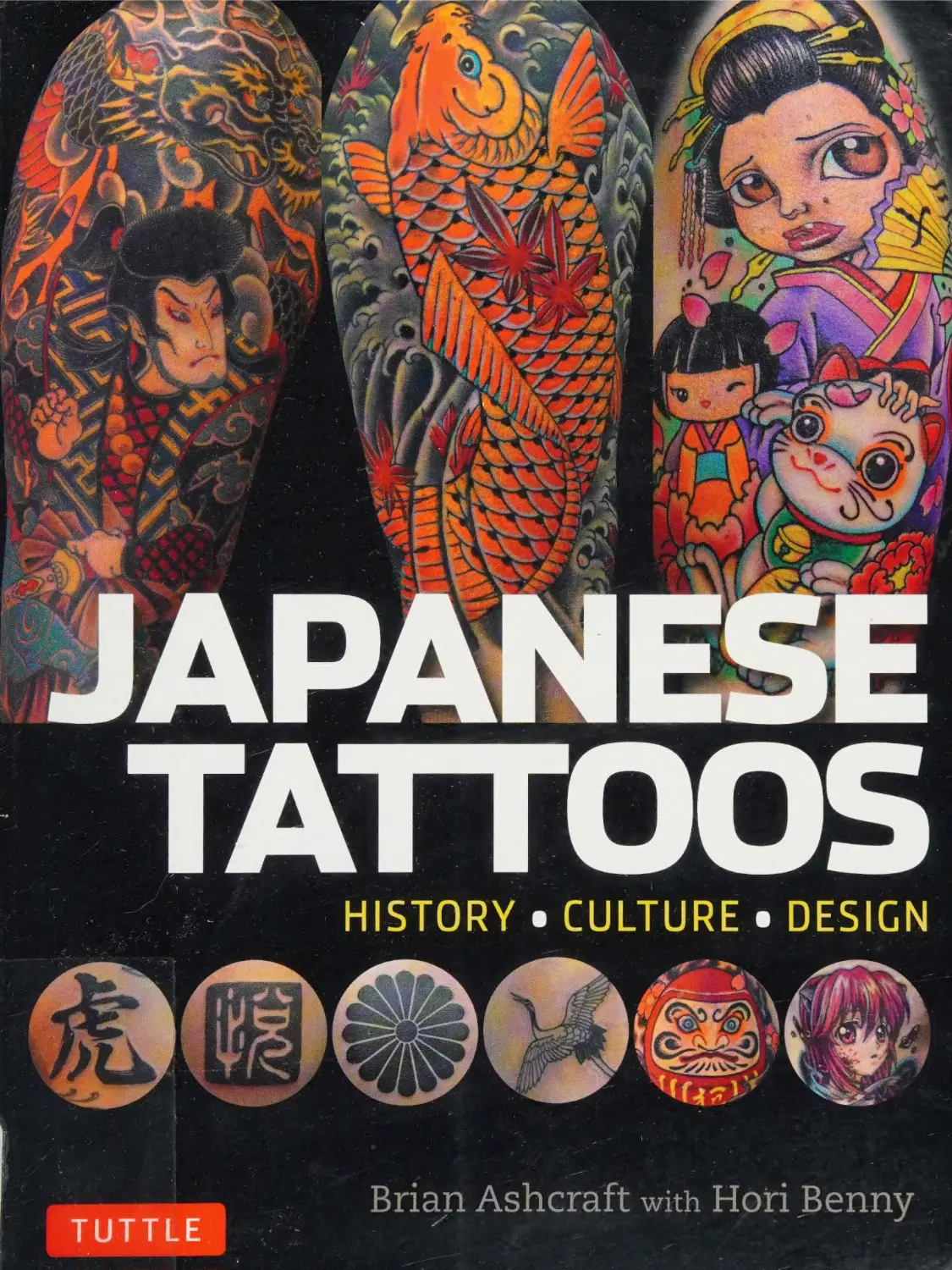


Author: Ashcraft B. Benny H.
Tags: art tattoo japanese culture fine art
ISBN: 978-4-8053-1351-0
Year: 2016


Text
                    a

|

Brian Ashcraft with Hori Benny

:

|

eee

“ Japanese Tattoos proves that sometimes

beauty really is skin deep. Even as someone
with no tattoos and no plans to get one, |

found it fascinating.”

“A rare insight into the world of tattoos in
Japan. This book is filled with visuals of this
breathtaking form of art—some of which you
would only be able to see if you were brave
enough to ask the person to strip.”

“This book gives you great insight into the
beauty, mystery, and tradition of the
Japanese tattoo. It’s a delight to read and a
worthy addition for the collection of any
Japanophile.”

If you’re thinking of getting a Japanesestyle tattoo and want to know more about
this historic art form, look no further!

This book traces the history of Japanese
ior-)vivcole]
[alepmolUieia[ale im
al-Mlele)alelela-]e)alva-]ale|
anlele)iMlamerelal
a=) qemm(elm |Bilalem oa-lelie(elar-]

oJ ole)aA Uat=lale
bdole)<10) het=1anelel-H- Tale
inspirational images of classic dragons,
tigers, and flowers, as well as anime-

inspired modern works and everything in
between. There are interviews with artists
Jel-Telf-]Ir4late Mlamel-)
f=lal-\-\-M m=]
amelel-M-lle]ale MUIa
_ profiles of tattoo clients who discuss what
their Japanese tattoos mean to them.

yiass-iruth Branch Lbs

HISTORY e CULTURE e DESIGN
Brian Ashcraft with Hori Benny >

Publishing

TUTTLE

Tokyo |Rutland, Vermont |Singapore.
oa

~—

:

Introduction

kebana and

EXPLORING JAPAN'S
FATTOOING TRADITION .

Tattooing 41
Chrysanthemums
Hanafuda Playing
Cards 43
aple Leaves 44
Kimono Motifs 45

What Does “Irezumi” Mean?
An Ancient Tradition 4
Becoming a Horishi 4

4

A Lifestyle Choice :
Underground Tattoo Culture 6
Tattoo Prohibition
Jo Tattoos Allowed s
nked Royals 8
The Rise of One-Point Tattoos 9
Why Japanese Tattoos Changed 10
About This Book

10
The Birth of the Machine

Pine Trees

4

4¢

Bamboo 4
Wind and Water 48
Rocks and Earth 49
Fire 50
The Sun 50
The Rising Sun Flag Symbol
Tattooist Profile Gakkin 5
Client Profile Jean-Marc £

20

Tattooist Profile Horiyoshi Ill 12

KANS TATTOOS ..

Ww

Tattooist Profile Horimasa

Foxes 57

Dragons 59

CHAPTER 4

GODS AND SUARDIANS,
HER@ES AND DEMONS :.
Gods and Guardians

Mottoes and Mantras 20

Three Claws or More? 6

Rens

How to Get a Good Kanji Tattoo 22

The Phoenix 63

Dainichi 92

Tattooist Profile Yutaro Sakai 28

Different Cultures, Different

Daikokuten

Ancient Bonji Characters
The Tebori Tradition 27
Client Profile Hidaddy 30
CHAPTER 2
NATURE TATTOOS
The Colors of Irezumi
Nature Motifs 33
Cherry Blossoms 34
Plum Blossoms 3¢€
Peonies 3%
The Lotus Flower

4

.
33

84

CHAPTER 3

Pledge Tattoos 17

Written Japanese 16

Butterflie
Spiders

Client Profile \Wakoto 6

CREATURES LIVING
AND MYTHICAL -.

CHAPTER 1

Snakes

The Phoenix vs. the Vermilion Bird 64
The Kirin ¢
Meanings 6¢

Benzaiten 93
Bishamonten
94

Amida

Maneki Neko: The Lucky Cat
Tigers 68
Guardian Lions and Guardian

The
Monk Daruma
Ebisu <
Fudo Myoo 96

Dogs
The Koi Fish
Fishy Puns 7!
The Octopus 76
Cranes 77
Crows 7

Fujin and Raijin 100
Hotei 102

Falcons and Hawks

96

The Nio Guardians 102
Tennyo 103
Folk Heroes

The 108 Suikoden Heroes 104
79

Suimon Yaburi 106

Tattoos within Tattoos 106
Kintaro 107

Jigoku Dayu 108
Shoki

108

Benkei 109
Oniwakamaru 110
Tamatori-Hime 111
Fearsome Demons
The Hannya Mask 112
Oni 114
Namakubi 114

Vengeful Yurei Spirits 115
Monstrous Yokai
Baku: 116
Chochin Obake 116
Kasa Obake 117
Kappa 117
Tengu 118
Nekomata Cats 119
Lucky Tanuki 119
Tattooist Profile Stace
Forand 120

Horimel

136

Nijubori 138
Kakushibori 138
Senjafuda 137

Client Profile Aki 122

CHAPTER 5

Exposed Flesh 125
Firemen as Folk Heroes

Types of Bodysuits 127
Soushinbori 127
Kame No Kou 128
Hikae 128
Munewari 128
Nagasode 128
Shichibusode 129
Gobusode 130
Senaka 130
Displaying a Bodysuit 131
Tattoo Borders 13<
Botan-Giri 132
Bukkirl 132
Jari Mikiri 132
Akebono Mikiri 132
Matsuba Mikiri 132
The Bodysuit Collector 133
Bodysuit Layouts 135
Shudal 135
Keshoubori 135
Gakubori 136
Nukibori 136

126

The Yakuza 139
Tattoo Shading 140
Akebono Bokashi 140
Usuzumi Bokashi 140
Tsubushi 140

Tattooist Profile Horiren 142
Client Profile Frederik 144

CHAPTER 6

East Meets West 147

Machines vs Tebori 148
Japan’s Changing Culture 149
The Legacy of Ozuma 149
New Takes on Old Motifs 150
Avant-Garde Ink 150
Geek Tattoos 152
Tattooist Profile Mica Cat 154
Client Profile Ayane 156
Questions to Ask 158
Photo Credits 158
Contributors / Acknowledgments

159

INTRODUCTION

It was early spring. The weather was still too cold for

term wabori (#0), which means “Japanese engraving,”

the cherry blossoms to cover Japan in hues of pink and

was coined in the 20th century to refer specifically to

white. My coauthor Hori Benny, an American-born

Japanese tattoos

Osaka-based tattooist, and | took an early morning
bullet train to Horiyoshi Ill’s Yokohama studio. Our
interview with the world-famous tattooer was supposed

AN ANCIENT TRADITION

to be only an hour, but we ended up spending the day

Tattoos go back as far as Japan’s recorded history.

with him, the first of several visits.

Japanese accounts as early as the fifth century mention

During our talks, Horiyoshi III, who was busy working on

punitive irezumi, but tattoos had other purposes

before

a succession of clients, generously shared his insights.

that. For example, a third-century Chinese account

One of them in particular stuck with me as | wrote this

mentions that Japanese people tattooed themselves to

book “In a funny way, everything in Japan is connected to

mark social class and protect themselves from harmful

irezumi,’ he said, using the Japanese word that refers to

sea creatures.

tattoos. The statement couldn’t have have been truer. In

that the patterns on the faces of the prehistoric

irezumi you'll find expressions of the seasons, the

Japanese terracotta burial figures known as haniwa are

folklore, the religions, and naany other aspects of

not painted, but tattooed

Japanese culture

If true, this would support the theory

There are other tattoo traditions in Japan with a long,
rich history, such as that of the Ainu people in Hokkaido

WHAT DOES YREZUMY MEAN?

Their facial and hand tattoos are from a different

lrezumi isn’t simply the Japanese word for “tattoos.”

cities like Osaka and Tokyo, and they fall outside the

Throughout the country’s history, different words have

purview of this book

tradition than those found on Japan’s main island in

referred to tattoos, and the word irezumi itself has
been written with different characters, each having a
separate meaning or nuance, whether that was the

irezumi (A412) that was a branding mark, meted out as
punishment to criminals, or the irezumi (i f) that was

BECOMINGA HORISHI
In Japan, horishi (tattooers) study and train for years to
master their craft. In the past, that meant a lengthy

done of free will. Other words have been used, such as

apprenticeship in which the apprentice, or deshi, would

irebokuro (A #124), which dates from the 1700s
Additional old terms include mon mon (4%), where “mon”
refers toa crest; or monshin (4X), which literally means

clean up the studio and practice drawing and tattooing

a crest on one’s body. These are not used today. The

pupil good enough to work on actual clients.

word horimono (IAs ')4#M), however, still is; it can refer to
tattoos or any other engraved thing. More recently, the

himself (or, more recently, herself). This would continue
until the day the master, or shisho, finally deemed the

Some tattooers stick close to the master’s style or

continue to work from iconic designs, while others might

introduction

Opposite, top Suikoden hero Roshi Ensei as depicted by influential Japanese

woodblock artist Utagawa Kuniyoshi. Left, above A bodysuit featuring
Emma-o, the Buddhist god of hell. Emma-o metes out sentences and rules
the underworld. His hat reads = (ou), meaning “king,” and the wheels

represent the Buddhist Wheel of Law. Left, below In this sculpture, a
Japanese tattooer is using the tebori hand-poked method to tattoo a woman's

back with a dragon.

try to add their own interpretation or go off in another

direction altogether. Once a tattooer debuts, “Hori” (JA),
which refers to engraving or carving, is added before
their name. Calling oneself “Hori” explicitly states a
mastery of craft and artisan stature.

It’s the irezumi

equivalent of “Dr.” or “Prof.”

This system has created close-knit tattoo families
called ichimon. Even after graduating and setting up
shops of their own, former apprentices continue to have

close relationships with their master and are expected

to take care of their teacher should something happen.

Not all of Japan’s best tattooists have gone through an
apprenticeship. What they all share is a Serious study of
tattoo motifs and design, whether with a mentor or not.

People in Japan get irezumi for a variety of reasons.

Some get them to protect their bodies, or for religious
reasons. Others get tattoos because they look good.
Whatever the reason, irezumi is a lifestyle

choice —and

in Japan, a brave one at that. Even today, when tattooed
people in Japan go out in pubiic, unless it’s a specific

special occasion, such as a religious festival; or a safe
environment, such as a bohemian district of a big city,
most cover up their ink. This is because of the wide-

spread belief that only Japan’s gangsters, the yakuza,
have irezumi, so if you are tattooed you are dangerous.

Covering up one’s ink is not only a courtesy to avoid
unsettling others, but is also to protect from discrimina-

tion, whether applying for a job or renting an apartment.

JAPANESE TATTOOS

My local bartender in suburban Osaka has had his biceps

shorts. Flashes of yellow or blue. |lrezumi are designed to

inked with Polynesian-style “tribal” designs. When |

be covered and worn under clothes. But because

asked him why he hadn’t gone with Japanese irezumi

tattoos aren’t out'in the open in Japan as they are in the

motifs, such as flowers or Buddhist gods, he replied,

West, when you finally do see them, they have enormous

“Because | don’t want to be confused with a gangster.”

impact and power. This is what makes irezumi unique;

There are also notions in Japan that

this is their appeal. Generally speaking, irezumi are

tattoos are dirty,

because unclean needles spread a whole array of

personal and private, unlike Western-style tattoos,

diseases, as well as a Confucian belief that it is disre-

which often seem to be for show

spectful to modify the body bestowed on you by your
parents
There is, however, a long, proud tradition of firemen,

In Japan, foreigners with tattoos are less likely to be

udged harshly than the locals who have them. The
common

assumption is that Western-style tattoos are

blue-collar workers, and artisans getting tattooed for

for fashion, while Japanese ones are for unsavory types

religious convictions, to protect their bodies from

This is why inked celebrities like Johnny Depp or athletes

hazardous work, and simply because irezum! look damn
cool

ike Brazilian soccer star Neymar Jr. can appear on
tel
elevision or in

printtad
ads

withth th
their tatt
tattoos on display
displa

eanwhile, many tattooed Japanese ce celebrities tend to

UNDERGROUND TATTOO CULTURE

cover their irezumi for fear of alienating 1G A fans or being

Although largely hidden, irezumi culture remains strong.

during daily life. The chances of you seeing someone's

IF you look closely, you'll catch glimpses. A glimpse of red

irezumi at a PTA meeting, at a convenience

under a sleeve. Some black at the edge of a pair of

McDonald's, or even on the subway are very,

s

misrepresented.

Most people in Japan don’t iB see tattoos

store or
very low

For all of that is made of
irezumi’s connection to Japanese
organized crime,

its impor tant to

remember that, during the periods
in which tattooers were

perse-

cuted and could be arrested for

practicing their craft, it was the
yakuza who kept tattooers

employed.

Regardless what you

think of yakuza or their activities,
if you like Japanese tattoos, the
fact that yakuza have kept the

tradition alive should be respected

Far left The wooden doll (called a kokeshi)

makes a striking comparison between the

courtesan and the doll itself. Kokeshi can be
tokens of friendship, but are sometimes

compared to phalluses, underscoring the lush,
sexualized themes in this tattoo. Left Hannya
masks (see page 112) are iconic and powerful.

The back is the body's biggest canvas for
irezumi—and what better way to make a

statement than with a giant Hannya?

introduction

The U.S. military might have been more accepting of the

craft due to its tradition of service members getting
inked.
lrezumi prohibition had been part of an effort to
modernize and align Japan with Western morals. During

the 19th century, officials issued various edicts against
tattooing (one 1811 edict pointed out that, horrors of
horrors, irezumi were fashionable among the country’s
youth). These went largely ignored, but in 1872, the Tokyo
government announced the Ishiki Kai ordinance, which

was soon followed by a similar national decree. The Ishiki
Kai ordinance banned major and minor social transgres-

sions, including peeing in front of stores, being naked in
public, mixed communal bathing, selling pornography, and
tattooing. Those who violated serious infractions, such
as tattooing, were fined. Those who couldn’t pay the fine

were whipped. People who already had ink could avoid
police trouble by paying for a permit.

The ban, however, applied only to Japanese people. The
government never anticipated that some foreign
visitors, including those f rom the upper echelons of

FATTO@ PROHIBITION

society, would become enamored of tattoos. There was

Today, tattooing isn’t banned in Japan, but the practice

the Japanese ruling

exists in a legal gray zone. In 2001, the Ministry of

class saw them. Lord

an obvious gap in-how foreigners saw irezumi and how

Health, Labor and Welfare classified tattooing as a

Charles Beresford, an

medical procedure, with the rationale that only a

admiral and

a member

licensed health care professional can penetrate the

of British Parliament,

skin with a needle and insert pigment. The government,

got tattooed in Japan,

however, does not issue tattoo licenses, and the

and later recalled how

industry continues to be unregulated. In some parts of

the country’s upper

the country, there are large, open tattoo shops right on

crust was astonished

*

the street with clearly marked signs. In other regions,

because they thought it

tattooers work out of unmarked studios and rented

was only for the

apartments.

“common people.”

|

From the late 19th century to the end of World War ll,

tattooing was illegal in Japan. During the U.S. Occupa-

XN

tion (1945-1952), the tattoo ban was finally lifted after
an American officer under General Douglas MacArthur
met with Horiyoshi || of Tokyo. (Note: this Horiyoshi
family is different from the Yokohama Horiyoshi line.)

Above A traditional American black panther design infused with Hannya

DoE

mask elements. Far right lrezumi have provided plenty of fodder for

La

Japanese pulp writers. Right Not all the 20th-century pulp stories were set

>

arr
*

in the modern day. This one shows a traditional horishi at work.
b?

BS
ou
B
Pe
enh
O

JAPANESE TATTOOS

No Tattoos Allowed
Check Your Ink At The Door
At hot springs, public baths,
swimming pools, and gyms across
Japan, you'll see signs that state the
same thing: folks with tattoos
cannot enter.
It wasn’t always so. In the years
after World War II, when many
middle- and lower-class families in
towns and cities still used the local
bathhouses because they didn’t

DAREAB EES
SHOUKLET.
(STRALABVSNKACY. BGWERLD
=BrEnce seunoRReROET
SROML
EVOTHOCTACKIEY

have tubs at home, establishments

couldn’t be picky about clientele.
Everyone needed to bathe.
As the Japanese economy grew in
the 1960s and 70s, and as urban
homes became more luxurious,

regular public bathing became less
common. This also meant that
tattoos were seen more rarely.

Bathhouses and hot springs
became more strict about who
they would and would not let
in.
These days, not all
establishments have tattoo
bans. There are hot springs
and bathhouses that allow

inked bathers (though they might
ask you to cover your tattoo with a
towel or even a special sticker).
Some that technically don’t allow
them might turn a blind eye,
especially for international visitors.
Don’t expect that, though: In 2013,
for example, one Hokkaido hot
springs denied entry to a New
Zealand woman with traditional
Maoni facial tattoos. The incident
made international news.
Left This warning sign was posted at a
pachinko parlor entrance. Note that it uses the

irezumi kanji (A.4128) that refers to
punishment tattoos.

Inked Royals
Blood Blue, Black Ink
During the late 19th century, tattoos
became a fad among European
royalty. For bluebloods, permanent
ink was the ultimate souvenir of an
exotic voyage.
The British king Edward VII helped
to kick off this trend after getting a
Crusaders’ cross tattooed on his
forearm in Jerusalem. As a boy,

Edward wore naval-inspired
playsuits and popularized sailor
clothes among the Europeans,

which later spread to Japan. That
Edward was quite the trendsetter!
His sons, Prince Albert Victor and

the future King George V, both got
dragon tattoos while visiting Japan
in 1881. The last Russian Tsar, the

future Nicholas II, also got a dragon
tattooed on his arm while visiting
Japan in 1891. During that trip, there
was an attempt on his life. He
survived, but didn’t make it through
the Bolshevik Revolution.

NICOLAS II
EMPENEUR DE RUSSIE

Above Regal tattoo enthusiasts like
Nicholas || were irezumi’s earliest

ambassadors.

introduction

THE RISE OF ONE-POINT
FATT@S
One-point designs are popular today
in Japan, especially among people

who want some ink but don’t want to
make the commitment that
bodysuits or large back pieces
require. In Japan, one-point designs

traditionally have been a way to
distinguish Western-style tattoos
from the irezumi house style. Many
tattooers in Japan are equally fluent

in both, and can do big pieces
surrounded by gakubori (see page
136) and isolated one-point tattoos.
This flexibility ensures steady work,
but it’s hardly

a new phenomenon.

During the 19th century, Japanese

tattooers began modifying their
designs to appeal to foreign customAbove In the West, the popular

ers. Most tattoo tourists got
isolated one-point tattoos depicting

19th-century notion of tattooing was

things like Samurai or geisha. In

based more on stereotypes than in

comparison,

reality. Left Japanese motifs such as

the full bodysuits, with

this swimming goldfish also make

their intricate designs and elaborate

wonderful stand-alone designs.

backgrounds, must have looked like
artistic marvels to foreigners. No

wonder they influenced a generation
of talented Western tattooers like
Sutherland MacDonald and George
Burchett.
Few visiting Japan, however,
completely covered themselves in ink.
The reason was convenience: Most
simply didn’t have the time and

wanted something that could be
done quickly. There were exceptions,
though. Over the course of several
months in 1872, Charles Longfellow,

son of the American poet Henry

Wadsworth Longfellow, got several
years’ worth of irezumi, including an
image of Kannon (page 89) on his

Right In traditional American tattooing, skulls and roses

chest and a koi fish (page 73)

are often paired. Here, waves and peonies replace the

ascending a waterfall on his back.

roses, underscoring the life-and-death theme and giving

Because so much work was jammed

the tattoo a decidedly Japanese feel.

10

JAPANESE TATTOOS

followed, along with a new way of

between sessions, so he got mor-

WHY JAPANESE TATTOOS
CHANGED

phine injections to make it through

Modern life influences the way

its most significant changes ever.

into a short period of time, Longfellow didn’t have the time to recoup

During 20th century, one-point

big way. A whole host of new designs
thinking. Irezumi underwent one of

tattoos are executed on physical

ABGUT THIS BOOK

tattoos were the dominant style in

and subconscious levels. There

the West, while large interwoven

are no truly traditional Japanese

designs were the most common in

tattoos because people don't live in

lrezumi are still an underground

a traditional world. Western fashion,

phenomenon

something funny was happening: a

the internet, Japanese TV shows,

part of their appeal. Because of this,

new generation of Japanese born

and Hollywood movies all create a

irezumi are enveloped in mythos

after World War II who were into

vastly different visual landscape. All

and misinformation.

American and British culture wanted

of this impacts tattoos, reflecting

Hori Benny and | have seen plenty

foreign-looking one-point tattoos.

contemporary visual culture. This is

of non-Japanese with either faux

Around that time, American tattooer

most evident in anime-infused geek
ink.

or downright awful “Japanese-

Japan, But by the early 1980s,

Don Ed Hardy inked Western-style
designs on the members of the Black

Even if the designs hark back to

style” tattoos.

in Japan; indeed, that’s

My coauthor

Over the course

of researching, interviewing, and
writing this book, we consulted

Cats, a popular Japanese rockabilly

an earlier era, modern tattooers can

band. Just like that, a clear division

put a contemporary spin on their

numerous friends, colleagues,

between the words “tattoo” and

work with eye-popping hues. Colors

experts, and total strangers with

“irezuml” was drawn. Tattoos were fun

like bright oranges, strong navy blues

the goal of introducing and decoding

and fashionable. |rezumi were scary.

and vibrant purples are not originally

the most prevalent motifs so that

This separate terminology has relaxed

part of irezumi’s color set. It wasn’t

English speakers can have a better

considerably. Some Japanese tattoo-

until the decades after the Second

understanding of their meaning and

ers now use the words interchange-

World War that a greater variety of

hopefully get Japanese tattoos that

ably. Others, however, still do not.

hues like purple and orange started

can be worn with pride—as they

being used in Japanese tattooing ina

should be.

The Birth of the

Tattooing Machine
The Electrical Revolution
Samuel O’Reilly patented the first tattoo machine
in 1891. The New York City tattooist based his
device on Thomas Edison’s motor-powered
electric pen. Twenty days later, in London,
Thomas Riley filed a patent for a single-coil tattoo
machine, which had been created from, of all

things, a modified doorbell.

8S, P. O'REILLY.
TATTOOING MACHINE,
Patented Deo, 8, 1891.

No, 464,801,

2

JAPAN§ MeST FAMGUS TATTOBST
2°

we

“Are you ready?” Horiyoshi III calls to pretty cool.” At 16, he began
the customer in the waiting area.The _tattooing himself. This was ae
2
unassuming client looks tobe inhis _ time when information abot
late 20s and seems like a typical
tattoos was still scarce and
~
button-down white-collar worker. He ©_ techniques were only ‘—
enters, greets the tattoo master with
down from master to apprena bow, and undresses, revealing an
tice.”“It was all guesswork,’ wshe
irezumi bodysuit. He lies down on his — - says. “I tattooed myleg using
stomach. On his back is a depiction of needles fastened to disposable cs
Buddhist hell—HoniyoshilIII’s
A
chopsticks. ce...
Beas
,
See
ce Re ulse
SR
eer os
pe eiwork.
eS i
~Atage 25 Nakano finally
Rhos Master tattooer spnmnae
Yay
With. international
exhibitions
of
Bets an apprenticeship with , f ~ Yolonama oF do. Petites
a igs
4
F
F
ee
yy
Bay SF
.
%
Aw
his paintings, numerous publications
Yoshitsugu Muramatsu (aka Bea
eee
ue
Wee
aN Me Jae
on his tattoos and his designs, and
shi I), a well- known tattooi
:
canesget think ihe a
a na
even a clothing line named after him, Yokohama. Nakano showed 1p
ee
use a
juit tat ing han
Horiyoshi III is perhaps Japan’s most _~ Muramatsu’ s studio unannounced
famous tattooist. He is also a dediafter. his eters had one unancated scholar of the form. The studio,
swered. “Of course ,Iwas ne2
y
a second-story walk-up in Yokohama, __ says. “There wasn'ta sign outside thees the har
is lined with books. “I have another —
studio like there are on
o my shops
:
couple thousand or so at home,"he
today.” It wasn’t a place you: could just
j
says. “This is because |’™ serious —s- pop in fora chat. “It was completely
abouticarminge
0
tS
underground,’a says, recalling t
Horiyoshi III wasn’t always a keen ~ the studio had the “strong scent of * i
student. “Growing up,” he admits, “I - the ae Unlike today, the
Jaee

&

was a hoodlum.” Born Yoshihito

majo

of the clients were yakuza.

onve

__HoriyoshiI, ae had already named “hand:
Nakano in 1946, he began workingas
a welder in a Yokohama shipyard
his own son Horiyoshi Il, gave Nakano easy to us
after finishingj
junior high school.
the “Horiyoshi” name as well. In 1979, attend:
“Lots of shipbuilders had tattoos,” he after a lengthy apprenticeship, a
we;
Horiyoshi III was born.
recalls as he pulls on a pair of latex
”
The tattoo machine fires uy 0, its
gloves. Nakano saw his first tattoo at
studio.
the
through
echoing
buzzing
a
age 11 at a public bathhouse. “It was
culture shock, but I thought it looked —_Horiyoshi III puts Vaseline on the.

be

i

BGa Sab
PBK
[9308 ROWS
2 care(Fi

“Personally,
‘ar

he

a

ae

art,
Horyosn
,
nls WOrK,
NOWeV

call it just that. “You
tThatiwn)ii1

wnat
Be

you

es

An

ar rt.

fenen

others

hiit T

dao art—bdut
acanc

from

ahAbtiny

using

fy

1

tho

the

ae 23

17AnN't

won

etanr

Tstop

tary”

term,

ha

anqdc

eee

=

he adds.

Sy

snoxunin—the craitsman.
! wouid
a qa chnbiinin
.
:
:
nat an artict ”
Ta

py

In

an entire history and catalogue of
iconography.
After the Rome convention,
realizing there were those outside
Japan who knew more about his
country than he did, Horiyoshi III
arrived back in Japan with a newfound thirst for Japanese art, history,

and culture. It wasn’t simply a matter
of pride. It was the beginning of a
lifelong pursuit of knowledge.
“Mankind has made it this far by
studying,” he says. “The tattoo
machine, for example, was the result

of someone studying.”
Horiyoshi III began spending his
days in libraries and bookstores. “I
had this small camera that I'd use to
snap photos if there was a book with
only one page I wanted,” he recalls.
“The shopkeepers would get pissed at
me.” He did buy countless books, and
filled his home and studio with them.
“When you have lots of knowledge,
you get wisdom,” he says. “When you
have lots of wisdom, you get an
endless flow of original ideas.” The
impact is clearly evident in his art.

1

the

ee

shokunin,

ENE p=

art world,

ee

you

not

an

eee

aT

are

arust,

ae

allowed

to

that artists¢ can call
art—even dog poop. “You cannot do
that in the world of the shokunin.”
Irezumi is a-language, with its own
grammar and rules. “If you don’t
know the meaning of the symbols
and the stories, you can’t tattoo as
well. Tattooing becomes superficial.
Meaningless.”
Or—just as bad—it can lead to
mistakes. “Even if you see a tattoo
that looks beautiful, if there’s

something that’s not quite right, well,
that’s a mistake,” he says. “It’s like a

Bentley with the steering wheel in the
back seat,” he adds, chuckling.

tattoist profile

Far left A young badass Horiyoshi III
poses with a tosa, a Japanese fighting

dog that’s banned in many countries.

Middle left The Yokohama Tattoo

Museum houses numerous important
artifacts, such as these Hori Sada

spring-themed sleeve designs. On the
right arm, there are peonies; cherry
blossoms are depicted on the other.

Left Horiyoshi IIl’s invention, a modern
tebori tool that can be sterilized, rests

atop the antlers. Below are traditional

tattooing tools.

Horiyoshi III pauses. “This is just
my opinion, but there isn’t traditional
tattooing in Japan anymore,” he says.
“In the old days, the needles and inks
that tattooists used were closely
guarded secrets. There was none of
this—” he gestures toward the
fluorescent lights overhead and the
carpeting on the floor. “Tattoos were
done on tatami mats by sunlight or
candlelight, using old tools.”
“Even if I were doing this tattoo by

alist style. All of this is the result of
would use. Calling it ‘traditional’ is
decades of learning—from books,
disrespectful to the tattooist of the
past who worked under the threat of | from people, and from life. “I’m still
being arrested.”
studying,” Horiyoshi III says. “And I’ve
Horiyoshi III’s work honors the past. been doing this for over forty years.”
Yet it moves the form
forward and transforms it, too, whether

through his use of
different techniques
or his creation of
brand-new designs

tebori, it wouldn’t be traditional,” he

that exist in, as he

adds. The heater keeping the room
warm on this chilly day
would need to be shut off.
Inks and colors that might
fade easily or cause harm

would say, a tradition-

would have to be used,

and there wouldn't be
latex gloves and sterilization. That, explains
Horiyoshi Ill, is how
tattoos were traditionally
done in Japan.
Pointing to the back
covered with ink before

Above The second floor of the
Yokohama Tattoo Museum is
filled with rare prints, old texts,

and countless historical artifacts.

Left A statue of Horiyoshi Ill
tattooing a phoenix ona

woman's back. In his right hand,
he holds the tattooing tool; his

him, he says, “Rather, I'd

eft holds a paintbrush in place,

call this tattoo ‘traditionalist.’ That’s the word I

which he can use to dab ink on
the tool.

CHAPTER 1

WORDS-AND PHRASES PUNISHMENT-AND PLEDGES
Japanese script has found its way into
tattoos in various forms over the centunies.
It’s easy to see the appeal: Japanese writing
itsyolct-WO
Labablemriatdelsdloyyighelomoe¥-be-telt— e-m-bele!
pictograms. It’s also easy to see why so many

iehavofotsyecwolelecsie leg! -Meolelelaaimeriieleel-t.<—
mistakes when working with Japanese script:
the language is complex, and incorporates
several different writing systems.

informed decision.

In Japan, irezumi

LLUUS

aren't done ona whim; there is

lark

criminals

and

WL

slaves,

traditionally more thought given

so it’s certainly

possible that this

In recent years, bad kanji tattoos

Japan has along history of script

how

tattoos

have become a cliche. Just look

tattoos—some of it good, some of
it bad, and all of it fascinating

Japan.

online: There’s the man who thought
he got the word “courage” tattooed

disciplinary
The

on Shoki

is

came to
|\C

Old Chinese and Japanese

on his back, but found out the

manuscripts, a mix of fact and

characters ANA (taika) actually

folklore, do mention tattooing.

history

One

text,

Emperor

recounts

Richu had a

how

rebel tattooed

meant “big mistake.” There’s the

Chinese account

woman who ended up with B® (shuu),

late third century states that in

coup,

thinking it meant “friendship,” only to

Japan, decorative markings denoted

toos were.

find out it means “ugly,” or the

rank or socia

individual sporting a tragic /\AMA
(baka gaijin, meaning “stupid foreigner’) tattoo. Then there are the

Japanese shell divers had tattoos to

tattooed face who commits theft,

protect themselves from harmful

with the obvious implication that

folks who end up with ink that either

century, tattooing had an entirely

story tells how in 467 AD Emperor

doesn’t make sense, or worse, is

different meaning:

Yuryaku had a man permanently

complete gibberish. This is enough

shame.

to put anyone off the idea of

imported to Japan via China and

an imperial bird. lrezumi weren’t

getting a kanji tattoo! It shouldn't,

were used to ostracize. In ancient

exactly winning in the ancient history

though, as long as you make an

China, which influenced early

PR department.

sea creatures

dating from the

status, and that

showing just how damning tatThe same text recounts

a

story of an old codger with a

But by the fifth

tattoos marked crooks.

punishment and

Punitive tattoos were

on the face for attempting to plot a

likely

Yet another

inked on the face after his dog killed

Left, above and below Common locations for kanji irezumi include the chest and

the spine. The tattoo 78S & op (fushakushinmyou) is sometimes translated as
“not sparing one’s life for a worthy cause,” but actually, it’s a religious expression that
refers to self-sacrificing dedication to Buddha or Buddhist law. The tattoo

$x FU

#4 (gamushara) means “daredevil,’“hothead,’ or even “lunatic.” Yikes! Below This

motif depicts Kusanagi-no-Tsurugi, the legendary Japanese sword used to slay the
Japanese dragon Yamata no Orochi. Traditionally, this dragon is said to have eight
heads, but here it has one. A bonji character alluding to the Buddhist deity Fudo
Myoo (see page 98) is emblazoned on the blade

During the seventh century,
irezumi began to fade as punishment, and save for one surviving
mention of punitive tattoos Ina

13th-century legal code, it wasn’t
until the 17th century that penal
tattoos were back with a vengeance. In the early 1600s, the
Tokugawa shogunate took over
Japan, creating a highly stratified
society and secluding the vast

majority of the country from the
outside world. By the later part of
that century, irezumi penalties

JAPANESE TATTOOS

Above The act of applying punishment tattoos is called irezumi-kei (A 2
FJ), with kei referring to penalty, sentence, or punishment.
the Japanese deities Fujin (the god of wind)

Left This shows

with Raijin (the god of lightning

and thunder). Their names are written in kanji (/2\4# and 2 4#) in the
large round mitsudomoe, a popular symbol in Shintoism and throughout

Japan. The triple tomoe mark has many meanings; in one interpretation, it
represents mankind, the material world, and the celestial world. The
comma-shaped tomoe is also said to represent curved ritualistic stones from

ancient Japan (for more, see page 101).

Opposite, top Punishment could be

permanent. Here, a punitive tattoo is inked on as a lasting reminder.

Opposite, bottom right The kanji here (Bi #2AEs 8S S m!], Namu
Daishi Henjyou Kongou) is from esoteric Japanese Buddhism,

and refers to

praying to Koubou Daishi, who founded the mystic Shingon sect. The lotus
(more on page 40) also has strong Buddhist associations. Opposite, bottom

left Jora (2) means

“tiger.” Due to the animal's position in the zodiac

calendar and its symbolic associations,

tora is a powerful kanji character that

is popular in calligraphy

returned, along with the slicing off of noses and

giant billboards that screamed,

ears—the latter a gruesome punishment that was no

irezumi could not have been more obvious: The kanji for

“Stay away!” And the

longer inflicted by 1720. Punitive tattoos, however,

evil (#8, aku) was tattooed on criminals’ heads in Edo

stuck around

(present-day

lrezumi became associated with crimes like fraud,

Tokyo}, while in one region of western Japan

(present-day Wakayama Prefecture] the character was

extortion, or selling knockoff goods, as well as theft

tattooed on the bicep. In Kyushu, there was a three-

Essentially these became a way to mark con men and to

strikes system:

eep tabs on the lowest members of society. If any-

The first was a tattooed horizontal

stroke, the next was a curved stroke, and the final

thing, tattoos were perhaps another way the Tokugawa

infraction saw the addition of another curved stroke and

shogunate could solidify the country’s feudal system

a dash, creating X (inu, the kanji for “dog”) in the middle

and keep people in their place

The idea was that tattoos could make offenders and
undesirables stand out in society with a permanent

of the forehead. In other parts of Japan, a large “Xx”
would be tattooed above the offender’s brow.
Not all the disciplinary tattoos were kanji inked smack

scarlet letter that bled right into the skin and couldn't

dab on the foreheads of the poor offenders. There was

easily be taken off. The characters selected were like

also a complex system of lines and bars tattooed on

people’s arms. As with the punitive
forehead tattoos, the style of the

abstract bars and stripes varied
from region to region. This was

because, although Japan was finally
unified under the Tokugawa regime,
feudal lords still ruled different parts
of the country and carried out the

law in slightly different ways. For
example, in Kyoto, two lines might be

tattooed on the bicep, while in Tokyo,
two stripes around the forearm

would be tattooed for the first
offense. A third line would be added
for the second offense. In the region
of Japan known today as Yamaguchi

Prefecture, the punitive tattoo was
shaped like a diamond. In another
region, it was a circle. Whatever the

tury Japan with “dog” tattooed on

form, the message was Clear: People

your noggin. Similarly, imagine

with irezumi were bad news. The

walking around modern-day Japan

Not all tattoos had negative conno-

stigma of this punishment still

with “big mistake” or “ugly” written

tations. They were also used to

remains. Even today, many tattooists

on your body. This is why horrible

express ideas, feelings, and individu-

in Japan will not tattoo the faces or

kanji tattoos inadvertently feel like

alism that it sometimes felt like the

foreheads of customers who live in

modern-day punitive tattoos, where

ruling class was keen to stamp out.

Japan, because these markings

the crime is ignorance and careless-

To maintain power, the Tokugawa

cannot be easily hidden.

ness. Those who want script tattoos

government stratified society. It

need to be savvy.

ensured that everyone knew their

Imagine walking around 17th-cen-

place by establishing dress codes—
only certain classes were able to
wear specific colors. Bound by
Confucian ideals, priests and samurai

were at the top of the heap, while

the merchant class—despite its
wealth—was below the farmers and
artisans. Samurai protected the

people, while field laborers and

artisans produced food and goods.
Merchants only made money, which

Confucian society looked down upon.
In the real world, however, cash-

strapped samurai would increasingly
need to borrow funds from the
nouveau riche merchants.

Since Confucianism stressed the
importance of filial piety, samurai
were less likely to permanently mark

18

JAPANESE TATTOOS

Left This sheet shows how

various parts of Japan used
different punitive tattoos

Right A lover's hand can be
seen inscribing characters on
a courtesan with a needle

Opposite For courtesans, their
kimono, their musical ability,

and their appearance were
essential to their livelihoods

This hand-colored woodblock
print, which dates from the
s5

1660s, shows a courtesan

playing for her lover

OTSenet
ae
ae

,
Ar

yous

Written Japanese
Hiragana, Katakana and Kanji
The written Japanese language uses
four different writing systems.
There are the two native syllabaries:
the curvy hiragana and the angular
katakana. Originally, hiragana was
referred to as onna-de, meaning
“woman’s hand,” as court ladies
used the script to wnite poetry.

Today, the script is widely used by
all Japanese, and the feminine
connotations have subsided.
Katakana was originally used by
Buddhist monks, but these days it’s
largely reserved for phonetic
renditions of foreign words and onomatopoeia. Romaji, which literally

means “Roman letters,” is typically
used for company or product names
and acronyms. Finally, there’s kanji,
the pictographic characters imported
from China in the fifth century.
Japanese uses kanji much like English
uses Latin and Greek: as root words
and linguistic building blocks.
In Japanese, each kanji character
can have several different readings,
and some kanji can sound the same,
but have totally different meanings.

Opposite The curvy hiragana and angular
katakana are Japan’s indigenious writing

systemes. Small children first learn hiragana

For example, the Japanese word 7¢

(hana) means “flower,” while =
(hana) means “nose.” Then there
are the kanji that look similar, such
as the character A, which means
“person” and A, which refers to
entering. This is where errors often

disrespectful to parents. Tattooing

was seen as defacing the body
created by one’s mother and father.
However, that doesn’t mean samurai

always refrained from irezumi,
whether it was a pledge tattoo or
perhaps even the samurai’s clan

arise in tattoos, with the incorrect

marking. It’s said tattoos were some-

characters being used.
The kanji used in modern China
and Japan look different—so
please, do not mix them! Mainland
China uses simplified, modernized
versions of kanji, while traditional
kanji continue to be used in Japan
(and also in Hong Kong and
Taiwan). Japan also has its own

times used to identify fallen warriors

begin studying basic kanji characters, such as “/chi”

homegrown kanji, called kokuji (#
=, or “native script”) that aren’t

(—, one) and“yama” (LU, mountain).

used in China.

before learning katana. After mastering both, they

themselves, as it was considered

whose bodies might have been
stripped on the battlefield by
scavengers. These irezumi served as

rudimentary dog tags.
While Confucianism might not have
been hip to tattoos, it did not equal

puritanism. There were plenty of
places for adult men to blow off

steam, including the licensed pleasure
quarters, where high-class courte-

sans would entertain clients. With
marriage more like a business

JAPANESE TATTOOS

Mottoes and Mantras
Japanese Sayings to Live By

%
INOCHI “Life.” There is a historical precedent for putting
a lover’s name in front of this kanji—for example, +

én (Ueda sama inochi, or “My life for Mr./Ms. Ueda.”)
Try to find Japanese idiomatic expressions, mottoes, or
mantras that sound cool, instead of trying to shoehorn
in some shoddy computer software translation of an
English idiom. Japan has its own sayings, and many of
them make suitable tattoos.

BABE

There are also reports of tattoos with the lover’s name
in front of the phrase “My whole heart for my whole
life” (—Dyap or “isshin inochi”) during the Edo period.

EFA
KAKKOFUBATSU Determined or steadfast. Quoted from
an ancient Chinese text.

AKUIN AKKA “Cause evil, create evil.” This essentially
means “You reap what you sow.” The phrase encompasses Buddhist ideals of karma.

a AGes

KOZ
A BRA

KISHI KAISEI To come back from a hopeless situation.
Be aware that this is actually the name of a move in
mah-jongg as well as in Pokémon.

CHISHAFUWAKU “A wise person doesn’t waver.”
Quoted from the Analects of Confucius.

+ik

CHIYO “A thousand years.” This tattoo can be seen in a
mid-19th-century woodblock print by the artist
Munehiro Hasegawa. The kanji can also be written as

tt. Another option is Ftc /\FHKIc (chiyo ni yachiyo ni)
or, loosely, “For eternity.”

We & CRB

4 Bah | F3b -FOE
NAMU-MYOUHOU-RENGE-KYOU “Hail Lotus Sutra,”

from one of Buddhism’s most important teachings, the
Lotus Sutra.

APT IRIEL
NAMU-AMIDA-BUTSU “I sincerely believe in Amida
Buddha.” Chanting this prayer can lead to rebirth in the
Pure Land.

DETATOKO SHOUBU This means “leaving things to
chance.”

+93 \#82 3

2 heae

SHICHITENHAKKI or

ICHIGO ICHI-E Literally “one time, one meeting,” this
phrase has been translated as “once-in-a-lifetime
encounter” or even “Treasure every meeting, because it
won't happen again.” Steeped in Zen Buddhist notions
of transience, the centuries-old phrase even appeared
in the Japanese title of Forrest Gump.

“pi” (O) and “ki” (©) are often omitted, leaving just these
five characters: b&r/\é2.

NANAKOROBI YAOKI Literally,

“Fall down seven times, stand up eight times.” In short,
don’t give up. Be aware that when tattooed, the endings

C$$8(8)
SHICHISHOU HOKOKU Loosely, “Seven lives of patriotism,”
indicating an undying devotion to one’s country. The

phrase continues to have strong nationalistic connotations, but originally appeared in the 14th-century Japanese
text Taiheiki in reference to the Buddhist concept of being
reborn several times, and is associated with reverence for

the emperor. In 1970, when writer Yukio Mishima tried to
stage a military coup and restore the imperial throne to
power, he wore a bandana bearing this motto. Mishima
was unsuccessful and committed ritual seppuku.

“odd,” and even “excellent,”

ERE
UNSAN MUSHOU “Scattering clouds, disappearing mist,”
or “to vanish without a trace.” Also translated, however, as
“going up in smoke.”

Cleat S

WAGAKOTO NI OITE KOUKAISEZU “No regrets,” or

literally, “As for personal matters, have no regrets.” This
was written in 1645 by swordsman Miyamoto Musashi, a
week before he died, in his collection of maxims titled
Dokkoudou (The Path of Self-Reliance). Other doozies in

the same work include B&7< BU, HE ACR (mi wo
asaku omoi, yo wo fukaku omou, “Consider yourself lightly,

6G UL (zen aku ni
think of the world deeply”); Sct
ta wo netamu kokoro nashi, “Don’tbe jealous of others’ good

or evil”); and BEC CEBAISIE CF (mi wo sutetemo meiri
sutetezu, “Even if you abandon your body, do not cast

aside your honor”).

connotations, including,

superb,’
or“skilled.” Right,

SONO HI WO TSUME Literally, “to pick up or hold the day,”
equivalent to carpe diem. The phrase WK*4€4 (ima wo
ikiru), also translated as “carpe diem,” is the Japanese title
of the film Dead Poets Society. Unless you are a huge fan of
that movie, perhaps this phrase is best avoided. Japanese
people would probably be more inclined to get the original
Latin text instead of its Japanese translation.

wa

variety of meanings and

“unusual,” “mysterious,” or

4D
A RIB

ARF (KU

Right, above The
character myou (#)) has a

below The phrase 2

Oc

<b& < (ai no kokuhaku)

literally means “confession
of love.”

JAPANESE TATTOOS

How to Get a Good Kanji Tattoo
Five Important Tips

Rea

Kanji are beautiful and can make
meaningful tattoos. The key is to
make sure not to end up with the
equivalent of modern-day punitive
ink. Here’s how to avoid that:

1. Check the Kanji
The internet is littered with characters that “look” like kanji, but are
actually utter gibberish. Or, if they are
kanji, they might be backwards. Or
upside down. Or missing a stroke.

Remember that X means “large” and
XA means “dog.” That’s one dash away
from disaster. Sometimes, bad kanji
tattoos also split up single characters
into two separate ones, rendenng
them utterly meaningless; or flip
them, turning the characters backwards. If you are trying to get an
English word into Japanese, then it

will be wnitten in the phonetic
katakana and not kanji. For example,

“Brian” is 73-7’ (“Buraian”) and

ke

See
WS
OM
$32
BY
11
SD
&
Bax
RS_Y
Sik
Bh
0 OFS

“Ben” is > (literally, “Ben”).

2. Check the Tattooist
Outside of Japan, many tattooers will
not know how to read and wntte kanji.
Each kanji character has a set stroke
order, which typically goes from top
to bottom, moving left to right. Things
like how the kanji are balanced
visually are key. The characters are
not wnitten willy-nilly! Japanese

Above Kanji calligraphy can be

calligraphy, or shodo (#18) requires

written in a variety of styles. This

years to master the written language’s emotive and beautiful

scroll was exhibited at a museum in

Kagoshima, Japan.

strokes. That being said, some kanji
characters are difficult for native
speakers to write, and even some
Japanese tattooists are not confident
enough in their own calligraphy to
work freehand, preferring to work
from templates, or fonts. A talented
tattooist, whether he or she understands Japanese or not, will be able to

render even the most complex
character if working from correct
reference material. While, in the least

smarmy way possible, it’s not a bad
idea to ask the tattooist if he or she
can write Japanese, perhaps the best
thing is to look at work that the
tattooist has done or bring in
accurate reference material for your
tattoo.

3. Remember, a Kanji Tattoo
Is Not Just a “Design”
Keep in mind that people who know
Japanese might see your tattoo. While
a tattoo of a samurai with “samurai”

(f#) written in Japanese characters
might sound cool, be aware that it is
akin to getting a skull inked with
“skull” written below it in English.

Something like bushido (Hbi&, “way
of the samurai”) might be a better
choice. When selecting a phrase, try
to think of how you would feel if saw
someone with an English tattoo that
read “Water” or “Fire.” Simple words
or adjectives might look odd to
Japanese, who tend to get either
mottoes, names, or prayers inked on

Left, above Jihi (2&2) is translated as “mercy,
“compassion, or “benevolence.” Both kanji contain
kokoro (iy, “heart”), underscoring the word's

intrinsic meaning while also making for a balanced
set of characters. Left, below Chouetsu (83x) is

their bodies (see examples on
page 15).

“transcendence.” Below /taidoushin (#2 48[B))L)) is
often translated as “same mind, different body.”

4. Don’t Use Machine
Translations
While translation software
continues to be important, and
may be handy for giving you a
vague idea of what you are
reading on a Japanese website,

it isn’t perfect. Idiomatic
expressions and nuance get
lost in translation, and you'll
end up like the guy who
wanted a tattoo of “freedom” in

Japanese, but ended up with #
#| (muryou, or “free of charge”).
And yes, he paid for that tattoo.

5. Do Your Research
You are getting a Japanese
script tattoo, so how about
hitting up your local library? Or
bookstore? Or looking online?
Or checking with someone who
knows Japanese? Sure, while
acting on impulse is fun—and
is certainly part of the Western
tradition—foreign-language
tattoos should have a tad more
preparation, understanding,
and context. For example, it
might seem cool to get a tattoo

partnership than a romantic

arrangement, the late 1500s saw the
pleasure quarters rise in Kyoto and

Osaka (and later, in Tokyo's Yoshiwara

district], creating a venue for
proclamations of love and pledges of
devotion. Sex wasn’t always the main
object; if the clients wanted that,

they could always frequent the
unlicensed prostitutes for a far
cheaper experience. High-class
courtesans had the right to refuse

johns they weren't into, so clients
would primp to look their best, buying

new kimonos and carrying new
swords just to impress the ladies.

Once the client became a regular

that says “ronin” (RA, a

patron, he forfeited his right to see

masterless samurai), but realize
that today, the word also refers
to students who didn’t pass
their university examinations.

other courtesans. Violating this

understanding could result in a
beating by the brothel’s muscle.
Against this backdrop, a declara-

tion of fidelity was important for both
the client and the courtesan—for the

JAPANESE TATTOOS

Ancient Bonji Characters
Esoteric Buddhist Calligraphic
Writing
Originally from North India, bonji are ancient calligraphic
characters that are used to write Buddhist mantras in
Sansknit; they were influential in the development of
hiragana and katakana in Japan. Bonji characters have
mystic powers and continue to appear in esoteric
Buddhism, most notably Japan’s Shingon (“True Word”)
sect. In tattooing, bonji irezumi for the zodiac animal of
the year in which one was born are common.

Right Bonji can be found throughout Mount Koya, a sacred site located outside
Osaka. Since the ninth century, the area has been the center of esoteric

Japanese Buddhism. Below Birth-year bonji are common irezumi motifs.

Ss
So

NINN

K(WDL) Goat
FA(&4) Monkey

4(S&)

(fa) Rat

Horse

X(LOLL)

Pig

FU(L8) Dog

fix(t2D)

Dragon

E(O)

Snake

Teo"
ct
YA

Hp VJ Of ie ) Rabbit
»

#8(E4)) Rooster

client, it could mean bragging rights;
for the courtesan, it could be a way to

string a customer along. A love pledge

Middle This pie

sealed in blood, or even a lock of the

woman's hair or her clipped fingernail

ancient style

were most common, but among the

in modern

lower-class courtesans, there were

stories of working girls cutting off a
finger for a lover or a client. Today,

finger-cutting to make up for
mistakes is part of yakuza lore, and
there is even a Japanese children’s

equivalent of the pledge “Cross my
heart, hope to die” that involves
O

hopping off fingers! However, the

ultimate declaration of permanent

love was a tattoo. It was a way for
)

ients to leave their mark—literally.

The decorative tattoos that

S
BK

increasingly began to appear by the

P=
:>)

fet
kos
~!

3A

late 1600s weren't yet the elaborate

hi

pictorial designs of flowers and fauna

¢

Japan has become famous for, but
vows and pledges. Moreover, the early

se

=

pleasure-quarter tattoos weren't

done by artists, but rather by the
courtesans themselves or their

PME
Se
—_

as

were abstract, and would later evolve

into written words and phrases.
First appearing in the pleasure

BS
ic
:
Je
+
os

G

prized clients. These early tattoos

quarters of Osaka and Kyoto,

4s

—

irebokuro(AMN#F. literally, “inserted moles”) were dots tattooed above
the thumb on top of the hand. When
that tattooed hand clasped another

fit
ops
SK
Ak5

tattooed hand, the matching dots
would interlock, creating a romantic

way to hold hands—a secret proof of
devotion in an age when marriages
were not always for love, and passion

was found elsewhere. And there was
one courtesan who got an array of

dots on her elbow—the same number
as her lover's age. (No word on
whether or not she updated the

tattoo on an annual basis, though!)

of kanji that is

Japa 1. Bottom Out of

Left Many Japanese families have their own coat of
arms.

1 family crest represented by a pair of oak

Here

leaves isembellished with expressive brush

were,

in a small, permanent

strokes

way, more

than hot-blooded expressions:

they

were acts of rebellion against a
domineering and stratified society
that was bent on exercising control,
even

it failed to always do so

if

Tattoos were personal and private
offering freedom

and expression

They were a perfect way to raise a
middle

finger éat the

between

lovers.

religious

pledges

mottoes.

There

Just like today,

gamblers,

early

irezum|

actors

or the roving weapon-

Then there was one courtesan who

stroke representing the strength of

wielding

figured out that perhaps letting a

the pledge

otokodate—wanted

The highest-ranking courtesans

were also

and persona

enthusiasts—artisans,

Customer write his name on your

country’s

chivalrous

live by with them

men

known

those

at all

to

times

were pro

shoulder was bad for business, and

were unlikely to get tattoos. Like

whether

supposedly had her customers’

samurai, many adhered to the

Godora a simple turn of phrase

names inked between her fingers

Confucian ideals common at the

they

as

words

The motiva tions haven't changed

instead. There were also courtesans

time—namely that an individual

Today

who tattooed moles or beauty marks

receives their body from their

mocked

on their faces, as well as replacing

parents and, out of filial piety, it

good ones are anything but, showing

their eyebrows with ink in an early

should not be desecrated with

the grace and gravitas of the script

form of permanent makeup.

permanent markings. These pledge

itself. Yet as the 1700s gave way to

and Kyoto, irebokuro were wide-

tattoos were not part of daily life for

the 1800s, Japanese tattoos would

spread enough among the courtesan

the majority of men and women at the

make a remarkable transformation

subeulture that the term itself was

time, but were part of the country’s

going from

used to refer to all tattoos

burgeoning underground subculture

designs of beauty that evoked fear

Other examples of vow tattoos (#c
sala), kishoubori) include clients

tattoos, there were bound to be

rapid success of Japanese woodblock

writing their names on the courte-

mistakes; moxibustion techniques

prints from the seventeenth to

san’s shoulder or thigh with a brush,

using dried leaves were developed to

nineteenth centuries—a golden

and then piercing the skin and rubbing

burn and blister out unwanted tattoos

epoch in mass-market art. Art was

in ink to create a permanent mark

leaving a scar to mark a love gone sour

flourishing not only on paper, but also

The kanji for inochi (47, “life’”) would

Some pleasure-quarter patrons would

on the skin. Embarrassing punitive

also be added after a lover’s name to

apparently try to get courtesans to

tattoos would be covered up and

say “My life for so-and-so.” This was

remove the names of other lovers and

embellished with decorative designs

another bold proclamation of

have theirs inserted instead.

and symbols, and Japan’s pictorial

In Osaka

affection, with the length of the last

With the increase of passion-driven

These melodramatic love tattoos

while bad kanji tattoos are
o nline as marks

of shame

“scarlet letters” to

and awe. This corresponds to the

tattoo tradition would flower.

The Tebori Tradition
Often called “hand-poked” in
English, tebori (=/8Z)) is Japan’s
traditional method of tattooing.
Today, some tattooers
in Japan, including

some of the country’s
most famous, prefer
the tattoo machine to
tebori—as do many
Japanese irezumi

enthusiasts—simply
for the amount of time
it saves. But others, like

crafting his own tools, he also
Hori Magoshi of Osaka (now known
mixes his own ink from pigment.
as Hon Shige V), carry on the tebori
“This way of working makes my
tradition.
prep time much longer,” he says,
Tebori uses a tool called a nomi
“but I feel like it brings me closer to
that is made from a slender piece of irezumi.” Even if the color and
bamboo; needles, called hariin
shading is done by tebori, Hori
Japanese, are affixed with tightly
Magoshi still does the sujibori
wound silk string at the tip. The tool (outlining) with a tattoo machine,
sometimes has a grip at the end for saying, “It’s much smoother and
the tattooer to hold while inserting
takes far less time.”
the ink. Horiyoshi III developed a
steel nomi with needle tips that can TYPES OF TEBORI
be easily removed and sterilized.
Tebori is the general catchall word
Hori Magoshi, however, makes his
for tattooing done by hand. Within
tools with bamboo, needles, silk
tebori, there are different styles
string, and glue. He must sharpen
based on the way the tools are held
the tattoo needles for each client,
or the way ink is inserted.
and spends between 20 and 30 min- HANEBORI A teboni technique often
utes making each tool.
used for shading, in which the
“For shading, I usually make
needles are inserted in the skin and
tebori tools with 27 needles, and
then slightly flicked upward while
the tool is pulled back. This widens
for coloring, I make tools with 18
needles,” says Hori Magoshi, adding the puncture wound, allowing more
that number of needles can change ink to enter the skin and, as a side
effect, causes more bleeding.
depending on the tattoo. Besides

IMOTSUKIA
style of tebori that
inserts ink in a rhythmic up-anddown motion similar to that of a
tattoo machine.
SHAMISENBORI A nearly extinct
style of tattooing that uses needles
affixed to the flat end of a handle
resembling a shamisen pick. The
tool is held like a pencil and the ink
is inserted in an upward-moving
motion. For more details, see page
143.

TSUKIBORI “Tsuki” means “jab” or
“stab”; this technique uses such a
motion to insert ink into the skin, ~

typically with a long tebori tool.
Unlike hanebori, there is no

upward-flicking moment. This is
simply puncturing the skin with a
tebori tool.

Top Hori Magoshi prepares his tools for a client.
Above left Ink is inserted into the skin one
poke at a time. Above right The tools of the
trade.

‘A JAPANESE TATTO® WARRIOR WITH SAMURAR SPIRIT ‘nat
,

t.oe

>

'
reef

>:

_

,

“I was worried about getting a dishonorable discharge,” says Yutaro Sakai. With only three
t
more:months ~
left in the Japanese Self-Defense Force (Japan’s military), Sakai got a Virgin Mary tattooed on his : hest. He
raises his hand, which is now covered in permanent ink, and clenches it.“Ttwas the size ofmy is
ay,

ae

’ HS ae
jas%

Yutaro has since left his native Japan,

and Sword and is perhaps oneofthe
best-known contemporary American
tattooers. On Yutaro’s left hand, next
to a teardrop, there are two more

.

,

shops in Japan, and lots fhe bibs ,
had American- style tattoos,”he says.
i shOnent!those were really cool,and
I was very‘much into Western culture

7

making a name for himself in
California, where he is known for his
takes on classic Japanese motifs. It’s
th
and foreign things.”
inked characters: (#38 (samurai
late now; San Francisco is covered in
‘Unlike service ‘members in Bg
night, and the big studio is empty
~ tamashii, “ samurai spirit’).Yutaro
save for the 42-year-old Yutaro,
who — n~ adds, “?’m always fightingfor myself ; forces in‘countries such as:the U.S.,a 2 x
sits in a black swivel chair next to his _ to get better and trying to push
those iin Japan are notallowed to get Fy
yon
stainless-steel desk.
“tattooing forward.” The samurai spirit tattoos. In order notto
t get caught,
yf ex
‘
On the palm of Yutaro’s right hand,
is what powers that fight.
. ietects had a cover
eae
oy

there are four characters: Bek

(irezumi senshi, or “tattoo warrior”).
Showing the tattoo, he says, “Grime
did this for me.” Grime owns Skull

ga

Growing up in Chiba, outside of
Tokyo, Yutaro didn’t come across
irezumi asa kid. “When I was. ae
“teenagerI'd Hants out at epee

Japanese to read and write,” he

explains with a smile.
Understanding a language involves
more than merely knowing the
correct stroke order or having the
right brush flow. Yutaro pauses,
running his fingers through his beard.
“English is much more direct that
Japanese, because ‘yes’ means ‘yes’
and ‘no’ means ‘no.’ But in Japanese,

‘yes’ can mean ‘no.”” There’s a
difference between simply tracing
characters or letters and having a
deeper understanding of what they
actually mean. “Whether you are
doing kanji or even English language
calligraphy, it’s important to know
how the characters or letters work.”

Above and right A dragon among waves and a
tiger among spring flowers. Yutaro’s work shows a
deep understanding of Japanese themes.

Just as Yutaro got into tattoos via

American biker culture, Westerners

apprenticed in Venice Beach. Covered
with dust and totally ripe after not
bathing for days, Yutaro walked into
that shop and said in broken English,
“Please teach me tattoo.”
That was more than two decades
ago, and he has lived in the U.S —
mostly California—ever since. The
relaxed rhythm at which Yutaro
speaks, his accent, and his general
mood all make him seem like a
native. “I say I’m half-Californian and
half-Japanese,” he quips.
While Yutaro is now known for
large classic designs, like Hannya
masks (see page 112), koi (see page
73), and tigers (see page 68), back
when he was just starting out, he cut
his teeth on kanji tattoos. He recalls,
“Tattooing kanji characters was a
great way to get experience, because

the characters generally don’t have a
background, and since they're black,
they don’t require color work.” This
helped him get used to tattooing on

human skin, a totally different
medium than merely drawing on
paper. “But some difficult kanji that
aren't often used are even hard for

often get interested in tattoos via
kanji and other Japanese motifs. “I
think the reason is that the grass is
always greener,’ Yutaro says. “This is
just my opinion, but for me, the
human brain gets stimulated when it
encounters things it doesn’t usually
come across on a regular basis.” It’s
something Yutaro knows firsthand.

JAPANESE TATTOOS

FATT@@ CLIENT PROFILE

Running down Hidaddy's spine is a line of beautiful,

flowing kanji script. It reads s8eAG#84, or Infumiaikumiai (loosely, the Rhyme Stepping Association), the name
of the hip-hop group he belongs to. Since kanji can be
read from top to bottom, tattoos running down the spine
are popular, with the column of bones symbolizing one’s
true essence. “I got it on my back because I want to keep
carrying the group until the day I die,” Hidaddy says.
Infumiaikumiai debuted in 2000 and released its seventh
album in 2014. When not cutting a new track with the
group, Hidaddy competes in freestyle rap battles, runs
his own clothing line, and releases solo albums.
Hidaddy’s tattoos show how rap music has been
absorbed by Japanese culture. On the bottom of his foot,
he has another kanji tattoo that reads #8 (in, or “rhyme”
in Japanese). Due to constantly peeling skin, the bottom
of the foot is hardly an ideal place for a tattoo. But this is
a linguistic pun, because to rock out rhymes in Japanese
is literally to step on them. “I got this because I’m always
stepping on rhymes on stage,” he says. “Part of the tattoo
has started to vanish, but man, the whole thing’s not
going to disappear!”

Over his shoulder blades, the word “Rhyme” is inked in
English, with the letter y cradled by a skull. It’s a collaborative piece: well-known Japanese graffiti artist Casper
designed the text, while Osaka-based tattooist Hori
Wataru designed the skull and did the tattooing. “The
design means that my weapon of choice isn’t my fist, but
words and rhyme.”

There's a crest on Hidaddy’s legs with the kanji for one,
two, three (—, =, =), which can be read as “ichi, ni, san” or

as “hi,fu,mi”—the name ofhis clothing line and boutique,
Hifumi Shop. “Hifumi,” points out Hidaddy, “rhymes with
infumi, the Japanese word for rhyme.”
On the inside of his arm, cursive writing in Spanish
reads “HB Familia.” This refers to Head Bangerz, a spinoff
group Hidaddy is a member of. The other members of the
group got the same tattoo together on the same day. “Even

oe

KANJI TATT
OOS

when we are not all together, when I look at the
tattoo, 1know we are still connected.” A mic with a

coiled cord is on Hidaddy’s left arm, a reminder of his
profession. Hidaddy says, “I thought adding a crown
like LL Cool Jhas on his mic tattoo would be a bit

much!” A dragon coils around his night arm for
protection and power. “I love Dragon Ball,” he confides.
Hidaddy’s other tattoos are also deeply personal,
like the symbol iH, or bu, which refers to the martial

arts as well as the military. This tattoo is actually the
logo for Master Mutaito’s Training Academy, which
appears throughout the Dragon Ball anime and
manga series. It’s also a character Hidaddy used in
both his sons’ names. His twin daughters, whose
names both contain the kanji for jasmine (iJ), got
their own tattoo references: two pictorial jasmine
tattoos on his chest, close to his heart. “I’m such a

doting dad,” he says. Directly above the flowers, in
English cursive, a tattoo reads, “Terry The Aki-06.”
Says Hidaddy, recalling the late Japanese hip-hop and
reggae artist, “Terry passed away in 2007, and this is a
way for me to remember him, may he rest in peace,”
he says. “Even now, I want lots of people to hear his
music.”
As a rapper and MC, Hidaddy uses words, rhyming
them and bending them to tell a story, create a mood,
and express himself and his feelings. This love of
language can be seen all over his body.

Left Hidaddy recording a track for an upcoming release in his private
studio, Far left Hidaddy shows off his ink in front of the turntables at
his clothing shop.

|

NS CLO ms BLOOMING FLOWERS,
“AKING W ES.THERISING AND
: SETHNGSUN
| Motifs es

a the

natural world have been

the subject ofpoems,
_ paintings,and, yes,

s

CHAPTER 2

THE COLORS OF IREZUM

endurance and, for

The first Japanese tattoos were

some, a display of

dark. But by the early 18th century,

machismo: The more

the irezumi palette had expanded to

red their irezumi had,

what is considered its traditional

the tougher they were.

color set: black and red, and all

Modern tattooers who

shades thereof.

mix their own colors,

The earliest dot and kanji tattoos
were black. As irezumi became more

however, use red

dominant color. In the hands of skilled

pigments that are much
easier on the body. As
calligraphy ink wasn’t

tattooists, the color was incredibly

ideal for irezumi, black

versatile, and could be shaded to

pigment was instead

depict waves or clouds—and

made from lantern soot, a practice

everything in between.

that continues today among tattoo-

elaborate, black continued to be the

Red, with its solar connotations,

remains one of Japan’s most

ers In Japan who mix their own ink.
The colors now used in irezumi

Above Glass jars of pigments waiting to be mixed.

leaves in irezumi should not be
surprising. The same motifs appear on

important—and oldest—colors. For

have a strong connection to nature,

example, shu iro, a shade of scarlet,

whether it’s red symbolizing the sun,

crests—as they have for more than a

was used to color clay figures from

yellow with its earthy and religious

thousand years. There’s a lasting

the Jomon period (14,000-300 BC).

connotations, or green and blue,

stereotype that Japan is one with

Red denotes the sun, as seen on the

colors that can be interchanged to

nature—heck, even Vincent Van Gogh,

country’s flag. That’s why even today,

represent water and creation. By

who had never visited the country,

Japanese children color in the sun

combining or diluting these basic

enthused to his brother Theo how the

with red, instead of orange.

hues, different shades are achieved,

Japanese “live in nature as if they
themselves were flowers.” It’s a notion
that the country seems more than
happy to perpetuate, whether

Other colors came far later. By the

Meiji era (1868-1912), blue-green
(shinbashi-iro) was popular. Even

bringing to life swirling clouds,
crashing waves, or an array of

seasonal flora.

after yellow and white were added to
irezumi, they were used sparingly.
White, for example, colored in

kimono, combs, tableware, and family

through art, poetry, or even its own

NATURE MORES

currency, which sports floral motifs.

While the stereotype is just that—a

dragons’ eyes.-There are stories of

Though sometimes used as a central

stereotype—the importance of

white lead being used to ink irezumi

motif, flowers are typically paired

nature and the seasons in Japan is

that would only be revealed when the

with other design elements in

undeniable. Aside from the densely

skin was flushed after drinking or
while in the bath. This practice, if it

irezumi, whether those are animals,

packed cities, this is a mountainous

mythical creatures, gods, or heroes

country that is largely covered in

actually existed, hasn't survived in its

from the past. There are important

forests. Its indigenous religion,

original form.
Made with methods that ranged
from boiling rags to mixing minerals

and logical rules about how nature

Shintoism, is centered around nature:

should be depicted on the skin, with

its adopted religion, Buddhism, is filled

the most common and traditional

with floral imagery. This is a country in

like iron sulfate with rice paste, the

being “Don’t mix the seasons.” Even

which flowers and trees continue to

irezumi colors of old were not as
safe as modern synthetic inks—

today, this maxim is generally still

carry the utmost importance, from

followed in Japan, and it’s a good rule

the cherry blooms that herald the

some of the colors, like the red made

of thumb. There are exceptions, but

coming of spring to the pine branches

with green vitriol, could be toxic and

adhering to the rudimentary rules of

that mark the New Year, and even to

cause fevers or rashes. Getting

irezumi grammar remains important.

the chrysanthemum signifying the

inked in red became a test of

The prevalence of flowers and

emperor himself.

JAPANESE TATTOOS

In irezumi, the most

popular seasons

are spring and autumn.

During tnese

wonderfully bright and colorful
in-between times, everything is in flux

and either coming to life or beginning

to wither. Capturing these fleeting,
ephemeral moments

makes them all

the more powerful
country’s conc
cnerry

(ap) |

blossom,

+
oO

=

oO

Q@)

or Sakura

in Japa-

nese. Cherry trees bloom for short
periods,

peaking

only

for a few

and then the blossoms

ground

or are

sudden

spring rain.

country

tradition
U

holds

that
Lildl

days

fall to the

washed away

In a

The entire

picnics

called ohana-m

stems
OLE
rs) from
U

aa

representation of this, infusing the
body with the force of nature
These days, as the TV news tracks

the blooms’ progress across the
country, sakura are closely associated with new beginnings, whether

that’s the start of the new school
year or even the commencement

of

corporate Japan's financial year, both

of which begin in April. Comparisons

between the sakura and feminine
beauty are also common.

Historically,

however, cherry blossoms, with their

brief bloom, have a decidedly mascu-

line meaning, symbolizing the short
life of a Samurai warrior. This is
perhaps why samurai clans rarely

adopted the cherry blossom as their

family crest or seal (known as a mon
or kamon in Japanese), instead

preferring flowers with longer-lasting blooms, such as the plum blossom
or the chrysanthemum, or even

vegetables like cucumber or eggplant.
The tough-guy associations

continued through the 20th century.

During World War Il, for example,
there was even a squad of kamikaze

pilots dubbed yamazakura, or
“mountain cherry blossoms.” In the

postwar years, the motif could be
found in tattoos worn by members of

Above left Cascading blossoms
accentuate the curves of the foot. Above

the country’s underworld, embracing

right Cherry blossms lend themselves to

the “live fast, die young” mentality

simple yet beautiful stand-alone designs.

What makes cherry blossoms so
beautiful is precisely that they do not

Right Non-traditional elements can puta
new spin on cherry blossom tattoos.

last forever. They fall and fade—as
tattoos also do over time. They

wither and die, just like the flesh. In

depict, irezumi are a powerful

aware (01971)

Japan, this notion of impermanence

representation of mujo. |rezumi—all

often translated as “the sadness of

is called mujo (#28). Besides being a

tattoos, for that matter—are only

things.” The cherry blossom isn’t only

key Buddhist concept, it’s a central

permanent as long as the body draws

beautiful when it’s in full bloom, but

part of how Japanese traditionally

breath. They're far from a lasting

also as its petals are swept up in the

view beauty and nature. The seasons

form of expression compared to

wind and scattered across the

change, you age, time passes, and life

painting, sculpture, or music

ends. Things, though, are born again
and again. Like the seasons they

The awareness of these transitory
phenomena in life is called mono no

in Japanese,

Country, covering the earth that we

tread with our feet.

JAPANESE TATTOOS

Japan's favorite blossom wasn’t

always the sakura.

In the eighth

century, the ume plum blossom, which

was imported from China, was all the
rage. Immortalized in verse, it was

the flower most lauded by poets of
the day. Plum-blossom season in

much of Japan is in February, when

the weather is still cold, and the tree
was praised for its fortitude and
admired for its long bloom. People
wore kimonos with plum-blossom
motifs, and plum trees were planted
in Nara, the capital, including at the

royal palace. But by the tenth

century, with Japan increasingly
defining its own national identity, the
cherry blossom usurped the plum.
Poets lauded the sakura, which
grows wild in Japan, and even the

royal palace replaced its blossoming

plum tree with blossoming cherry.
Still, the plum blossom has its

devotees even today, and continues

to evoke images of classical Japan.
In tattooing and in art, it can be

difficult to tell the difference

between a plum blossom and a cherry
blossom. Typically, the plum blossom
is shown with rounder petals, while
cherry-blossom petals are split at
the tips. Also, plum blossoms are
often—but not always—somewhat
redder than the pink sakura.

Opposite, above Typically only the blossoms of the plum are depicted
in irezumi, but here, the branches and trunk are incorporated.

Opposite, below Plum blossoms come ina variety of hues, including
white, red, and pink. Top It’s easy to confuse plum and cherry blossoms.

Here, an entire sleeve is composed of sakura. Above A closer look
shows the cherry blossom’s five notched petals. Left Though they are

similar to sakura in color, plum blossoms have round petals.

JAPANESE TATTOOS

as for their aesthetic

beauty, and the

healing associations only made the
royal flower

all the

more auspicious

In irezumi, peonies are pa

ed with

shishi {guardian lions, see

page 70)

not only because both hail
China, but

also because

story that a shishi was cu

illness by eating a peony.
can be paired with

from

t leresa
ed of

The flower

tigers, too. Like

the peony, that animal came to Japan
Each spring, the cherry blossoms

from China, and also has medicinal

return, brilliant and beautiful as ever

properties

Given their associations with rebirth

and life’s fragility, it’s no accident

Several varieties of peony are
cultivated in Japan, including winter

that Japanese Buddhists embraced

peonies that bloom in the cold, as

cherry blossoms; temples often

well as the more common

planted sakura on their grounds. The

peonies, which bloom in spring and

tree

religion itself makes much use of

early summer.

flower imagery, including the peony,

can be a standalone motif, but it’s

called botan in Japanese. The hosoge,

also sometimes

an imaginary Buddhist flower, is even

sakura, with both flowers comple-

In irezumi, the peony

paired with the

modeled after the peony. Its imagery

menting each other: Cherry blos-

is also found in designs at Shinto

soms, which represent spring in

shrines

Japan, have a short bloom period, as

In China, as in Japan, the peony is

called the King of Flowers, with
connotations of nobility, honor, and

beauty. Legend states that more
than a thousand years ago, a Chinese
empress known by an unfortunate

name that translates as “HorseFaced Lady” prayed to an enormous

statue of Kannon, the goddess of
mercy, located in faraway Japan at a

Buddhist temple in Nara called

Hasedera. Horse Face’s wish was
granted, and she became a ravishing

beauty. The now-stunning lady sent
peony trees to the temple, cement-

ing the peony’s image as one goodlooking trope. Today, Hasedera is

famous for its peonies and sakura,
and is known as the Temple of the
Flowers

Peonies were imported from China
for their medicinal purposes as well

Top left Peonies are larger than many other flowers.
Above The color of peonies varies widely both in
real life and in irezumi. Left, above A Japanese
sliding door decorated with a hand-painted peony.
Left, below In tattoo designs, the peony’s green
leaves are just as important as the flower’s petals
for flow and balance

NATURE TATTOOS

do peonies, which represent spring in

China. Moreover, peonies and cherry
blossoms are both used as imagery
in the Pure Land branch of Buddhism,
where botan is associated with
paradise and sakura has the power

to draw in believers’ spirits. Pairing
the blossoms together in a tattoo

can give the work

a religious nuance.

Buddhism is rife with floral imagery,
whether it’s the Pure Land sutras
that are full of

blossoms or the lotus

on which the Buddha sits. But keep in
mind that both flowers are also

strongly associated with gambling
because of the floral-print card

game hanafuda (see page 43).

Above Peonies can be depicted

ina variety of different ways.
Far left Monotone backgrounds
contrast sharply with the peony’s

vibrant colors. Left Here, the
peony’s petals are meticulously

balanced in a minimalist style.

or standing on the lotus flower as
This flower

is a symbol of purity.

sprouts
from muddy
shows

that

unexpected

ymbolism,
ment

typically

In

waters,

beauty

can

pla

Rich

it

also

irezumi

paired

wit!

vnetneras afloral
or

as

come
with

lotu

it

the lotus

well a 5 holding

make:

fine

it. The lotus also
stand-alone tattoo

from
divine

represents
che

Since

enlignte

Par late

Below

f

Jdani

throne

a divine
trope. Buddhas

Ider

ra

bBuadn

and

bodhisattvas
are usually depicted

Below right
sitting

_CHAPTER2 _

Ikebana and Tattooing
Transient Art Forms

Above Lotus flowers depicted in three colors and

in three stages give the illusion oftime’s passage

In English, ikebana is often
referred to as the “Japanese art of
floral arrangement,” but this
doesn’t accurately convey what it
really is. Long practiced by
women and men alike, ikebana is

written /+7E in Japanese,
literally “living” (E17, ike) “flower”

(4E, hana).
In both ikebana and tattooing,
the artist works with life—the
former with living flowers; the

latter, living flesh. There are
numerous schools of ikebana,

With its roots in Buddhism, a

religion that gives great impor-

each with slightly different
tance to flowers, ikebana, like
approaches, but the vase is key.
. tattooing, is a transient art. An
It’s not just a container for
arrangement does not need to be
holding the flowers, but part of
in full bloom to be considered
the finished work itself; its shape
beautiful. Some of the flowers in
reflects the season or the visual
arrangements are purposely
design of the arrangement. This
selected because they have yet to
is analogous to a client’s body in
bud, while others are picked
tattooing.
because they’ve already fully
blossomed. With the passage of
time, the arrangement’s shape will
change, much like tattoos change
with time, until finally the flowers
will wilt and die. Ikebana arrangements, like irezumi, are created

with the implicit understanding
that one day they will cease to
exist, making our appreciation all
the more pertinent.
Top Balance, color, and form are part of

ikebana’s beauty and simplicity. Left Like
‘irezumi, ikebana continues to evolve. Here,

Western flowers are incorporated in the
presentation.

JAPANESE TATTOOS

and had its motifs emblazoned
The chrysanthemum

(kiku in Japa-

nese}, which also appears

on his

kimono as well as his sword

in the

With its lengthy autumn

bloom

hanafuda card deck, begins blooming

season, its perennial flowers,

n September, when much of Japanis

medicinal properties,

still unbearably hot. Originally

themum symbolized long life, making

mported from China more

it a perfect

than a

flower

and its

the chrysan

for an

emperor

thousand years ago, the chrysanthe

intending a lengthy reign. In

mum, like the peony, was

first used

century, Emperor Go-Daigo used the

for medicinal purposes.

Later, the

yellow flower, with

was compared

its radiant

pedals,

to the sun and

admired during fall chrysanthemum-

chrysanthemum

the 14tt

on his banner:

© cementing the flower’s imperial

status.

The Japanese emperor, the

oldest hereditary line in the world

viewing parties where participants

today sits on the Chrysanthemum

drank wine made from the flowers

Throne, bears the Chrysanthemum

For a country whose imperial line is

Crest as the royal seal, and gives out

escended from the Shinto sun
goddess Amaterasu, the chrysanthe-

the Supreme Order of the Chrysanthemum as the country’s highest

mum was a perfect fit. In the early

royal honor. All of these associations

13th century, Emperor Go-Toba

To,

became

to the noble and nationalistic,

enamored

with the flower

rom the longevous and mythological
nave

made the chrysanthemum a popular
motifin Japanese tattoos. The

Below

flower is also used in funeral services
n Japan, which is why it isn’t typically
given as a gift. It’s also why some

who

ive their lives on the edge get

chrysanthemum irezumi, preparing
themselves for death at a moment's
notice

Above Just like people,

chrysanthemum,

flowers have faces.

located on the shoulder,

Thi:

faces up

toward the sun. Left Simple color gradations are
used to express depth and shape

al ed

The imperial
kiku

1

Bottom The

chrysanthemum

crest is

i
imperial

crest appears on Shint

NATURE TATTOOS

Right Even without color, the
chrysanthemum’s beauty is
undiminished. Left The
chrysanthemum’s signature
petals are especially
accentuated here along the

entire length of the arm.

:

Here's the Deal
Hanatuda evolved after the Portuguese brought Western playing cards
to Japan in the 16th century. Instead of being grouped in suits of
hearts and spades or members of a royal court, the suits in hanafuda
are flowers, like the peony and sakura, as well as the chrysanthemum,
maple, and others. During the Edo period (1603-1868), hanafuda
became increasingly popular, and like poker in the Wild West, it was a
way rough-and-tumble men passed the time. Gambling added to the
appeal of both the cherry blossoms and the peonies, flowers that
already had a nich history with deep, evocative meanings.
According to some, the cards even inspired the slang for Japan’s
mafia: The word yakuza is said to refer to the worst hand in the game
oichokabu, which is played with hanafuda cards. The hand “893” (or
yattsu, ku, and san), became “yakuza,” a term which was used to

disparage betting men. Gamblers embraced the floral designs that
appeared in hanafuda, often getting cherry blossoms and peonies
tattooed on their bodies for luck, courage, and even simply good looks.
Hanafuda cards themselves appear as motifs in irezumi, creating a
playful pun: a visual depiction of a visual depiction of a flower.

Above Hanafuda cards are evocatively fanned out
across a thigh.

JAPANESE TATTOOS

Far left A cluster of crimson marks fall
in Japan. Left Sometimes a shoulder

just isn’t enough. Here, a koi fights its

Like the chrysanthemum,

has come to represent

the maple

fall in Japan

This bright and colorful season, filled

with harvest bounty, hasn’t always

had connotations of death and decay
Maple leaves, or momiji, were lauded

flowers in designs that co npletely

by Japanese poets as early as the

break the “don’t mix the seasons”

eighth century, and by the tenth

rule. It’s intentional and re presents

century were second only to the

the entire year, making ah

cherry blossom in poetic importance

pairing. Still, cross-seasor val collabo-

Before Japan slips into gray, white,

rations are best avoided t nless they

and brown winter, autumn is also a

are designed by a knowled geable

armonious

last chance for a burst of color

tattooist who can understand

Although maples turn both red and

they work thematically and thus do

how

yellow, red maple leaves are the most

not clash. (Things get mor

common

cated when animals and fish are

in tattoo

Ng

Modern Japan still commemorates

the fall season by watching the maple

e COMmMpil-

inserted into the designs, which |s

covered in chapter 3.)

leaves turn—autumn’s version of
watching the cherry blossoms bloom,
with the emphasis once again on the

beauty of the passage of time and
the transient nature of life itself

Following the long tradition of
consuming seasonal plants, one city

in Osaka Prefecture even batters
and deep-fries maple leaves into
delicious, crunchy tempura snacks
Tattooing goes one step further,
inserting those brilliant red maple

Above Variation in the

designs into the flesh

maple-leaf colors shows

Pictorially, maple leaves are

incredibly flexible and can be depict-

nature's transience. Left A
more placid expression of

ed with a range of motifs, including

maple leaves adds to the

various animals, fish, heroes, and

tranquil nature of religious

deities. Fall leaves and flowers are

motifs.

also sometimes depicted with spring

Kimono Motifs
Wearing the Seasons
For centuries, kimono have let the Japanese wear

the seasons on their sleeves—literally. As the
temperature changes, so do the colors and
patterns of kimono motifs.
During the Heian period (794-1185 AD), the
upper classes wore elaborate multi-layered
kimono, with colors and patterns swapped out
month by month to correspond to whatever
flower was in bloom or whichever leaves were
changing color. In cherry-blossom season, for
example, a white outer layer was accentuated by a
pink inner layer, turning the wearer into a walking
spring flower.
Some of the wealthy elite would mix in colors
from upcoming months to show they were
looking forward to a certain season; others could
wear colors expressing
longing for a past one.
Meanwhile, the lower

classes—the folks
actually toiling away in
the fields—worried less
about whether their
clothes matched poetic
flowers and more about
whether the harvest
would be successful.
By the Edo period
(1603-1868), even though
the Tokugawa shoguns
tried to control what
people wore, rich and
poor alike had access to
seasonal kimono. People
dressed not only in
designs that alluded to
spring, summer, fall, or
winter, but also in styles

that suited the seasons.

Like today, many people had four sets of
clothing—one for each season—made
from different materials and crafted in
different styles to suit the weather.
The nature designs in irezumi are an
extension of Japan’s longstanding
preoccupation with seasonal dress. They
are another way people can express their
appreciation and love for a span of time
on the calendar. The key difference, of
course, is that tattoos are a permanent
way to reflect a particular season.

Above A woman wearing a spring-themed kimono

carries a floral parasol. In Japan, the seasons aren't just
worn—they are coordinated. Left A courtesan plucks

a shamisen beneath falling blossoms. The flowers on
her kimono echo those on the tree above her.

JAPANESE TATTOOS

The pine, a popular irezumi motif,
is an evergreen,

with fewer

seasonal associations

than other

trees. It’s often depicted repre
sentationally, with clusters of pine
needles on a branch, or used as

an abstract design element

in

rezumi backgrounds and borders
The evergreen needles symbolize

ong life,

even immortality;

-oots of pine trees were
to be endless.

the
believed

Often planted at

Buddhist temples, pine trees can
also be found at Shinto shrines
because

they are one of the

jatural elements

that can serve

ce) that is
as a yorishiro, an object
capable of attracting Shinto
spirits. Although pine needles and
pine trees in tattoo designs are
trans-seasonal,

the tree does

have strong winter connotations

imed
shape

and pruned to give t

Below

right Pine

needle

in many ways.
0
vs. Ont
represented

with simple line:

thei
in

pe

del

NATURE TATTOOS

Like pine, the bamboo can be
depicted in any season, but is

often used in winter imagery, as
it’s a symbol of the New Year in
Japan. In January, bamboo

and

pine are grouped with the plum,
starting the yearly cycle all over

again. Originally from China,
bamboo is strong, yet incredibly

flexible and elegant. It grows
faster than most other plants,
sprouting a strong intertwined

network of roots that hold the
plant firmly in place and make a
bamboo grove one of the safest
places to be during an earthquake. Irezumi designs often pair
bamboo with tigers (see more on

page 68).

Right Known for its strength, bamboo lends
power to the central tiger motif. Below
Sunlight illuminates a dense bamboo grove.

JAPANESE

TATTOOS

and water.

The term “ bokashi” is also

Tattoo motifs of wind and water like

used in traditional

those of bamboo and pine, are

is no accident:

trans-seasonal.

the 18th and 19th

They are often

employed as unifying elements

across

sponds

Connect

of woodblock

ing different tattoo

with an

often

elements

motifs

element of Japanese tattoos; this is

an important difference compared

Japan.

to

which

Irezumi’s blossoming in
centuries

corre

with a boom in the

the background of a tattoo.

overarching design is a defining

printmaking,

prints.

featured

cloud,

diluting the dark color. Tattooists can
show their bokashi skills through
these dark

popularit

entra

These print
water,

and

wind

Cloud and wind designs,

in

for

the

uml;

water

look

both

Dar-like

(

or

y In Diack

n motif

design,

they

mid-sixth century with the arrival of

various parts of the body.

Buddhism from China. Water

defines them as wind or

and water motifs make that connec

also have a long history in Japanese

the flourishes:

tion

art.

swirls as

important

irezumi technique tattoo-

ists use to depict elements

like wind

For irezumi, color isn’t necessary

in,

asall three are traditionally rendered

often

in black, with gradation achieved

oreaking fro

Left Soft color gradations and fractal
lines give Japanese waves their distinct

flow. Right Waves can be shown above
and below the main subject to give a

sense of depth. Below Curved bars and
whirly puffs. Wind, like water, may |7
depicted in a wide variety of ways

by

while

well

for depicting clouds, wind, or water

wat

Wind

What

ter

will

have

as

ids

as

with smalle
arge

and the

can be placed on

Western tattoos, which traditionally

Bokashi, or gradation, is an

Itt

ait

are isolated images on the skin. Wind

motifs

with the

very similar in

er

designs

Depending

overall

which then

contrast

tif

Wind and

that had long been popular

example, came to Japan by

backgrounds,

allow for greater

g
ef
es

are
some
worked

waves
tals

ROCKS-AND EARTH
Not every irezumi is set in abstract clouds, waves,

or flames. If the central motif is a human or a god,
they may be depicted standing on solid ground.
Rocks and earth provide a stage for large backpieces, giving a real-world setting to the work.
Many of the rocks that appear in irezumi are
based on suiseki, naturally occurring stones that

are appreciated for their shape and beauty. The
concept originally came to Japan from China, where
these interestingly shaped stones are called

“scholar’s rocks.’
Right Waves crash along rocks, while wind swirls through the sky.
This is a dramatic composition that moves the viewer's eye
throughout the work. Below While not necessarily seasonal, water
suggests a springtime feeling throughout this design.

JAPANESE TATTOOS

In irezumi, fire often serves the same design function as
wind and water. While fire is a natural element, it often
carries mystical

Buddhis

Gt wo iq) oO ct

connotations

in irezumi.

In

the Shingon

fire represents purification, and priests

b inn cedar during fire rituals to cleanse negative energy
The Buddhist deity Fudo Myoo (see page 98} is typically
e voked during these rituals. This explains why he’s usually
The flames not
S urrounded by flames in tattoo depictions.
only make him appear even more ferocious,

but also

u iderscore notions of cleansing and purity. Stylistically,

flames look similar to the fractal water designs found in
irezumi, but they aren't depicted as crashing down like
waves.

Red was one of the first colors for irezumi, and

thus was logically chosen to represent

fire because of the

strong contrast it made against darker tattoos

Far right Fire is both purifying and terrifying.
Here, Fudo Myoo (see page 98) is engulfed in

flames that are shaped like a mythical bird,

Right Flames surround this Buddhist sword,
which is used to burn away sin and cut

through ignorance.

In a country whose royal lineage is believed to descend
from the sun goddess Amaterasu, sun

imagery—be it the

rising sun or the red circle—has appeared throughout

Japan's history. It has also found its way into irezumi as a

background motif, paired either with an animal or one of
Japan’s most recognizable symbols, Mount Fuji. Although
the iconic mountain appears throughout Japanese prints
and is an important part of national identity, it is not part

of the standard irezumi canon, nor is it one of the most
popular motifs. This should not dissuade clients from
getting a tattoo of Mount Fuji; however, they should be
aware of its place within the irezumi lexicon

_ CHAPTER 2

“Japan” is “Nihon” or “Nippon” in its

which nearly resulted in the conquest

native tongue, written as AAS, with
the first character (A) meaning
“sun.” The flag, often called “the

of Japan, samurai can be seen
carrying sun banners and fans. The
sun, as well as the chrysanthemum,

circle of the sun” (H@+L) in Japa-

signified more than royal mandate; it

nese, did not become the country’s

eventually came to define the entire

official flag until 1870; however,

country.

samurai and feudal lords flew it in
previous centuries—the oldest

surviving flag dates from at least the

Opposite, bottom !n this tattoo, the sunrays tie

1500s. However, one ancient Japa-

the central design together. Left In Japan, the

nese text puts the motif’s first

rising sun design is not always used with military

recorded appearance in 701 AD at

motifs. Here, the deity Ebisu (see page 97) snags a

Emperor Monmu’s court. In late 13th-

sea bream, Japan's most auspicious fish, under the

century depictions of the failed

early morning sun. This is why fishermen view the

Mongol invasions of 1274 and 1281,

symbol as lucky.

The Rising Sun Flag Symbol
Auspicious or Outrageous?
The Rising Sun Flag first became
Japan’s military flag in 1870. Prior to
that, however, the design had
appeared in the Edo period as an art
motif. Today, the flag continues to
be flown by the country’s SelfDefense Forces, and the tradition-

ally auspicious sunray motif pops

up in a variety of designs in Japan,
from the occasional food packaging
to lucky fishing banners.
There is a history of the Rising

Sun motif appearing in Japanese
religious art, especially as a trope
for the sun goddess Amaterasu. In

one story, Amaterasu hid in a
heavenly cave, plunging the world
cness. She is depicted at the

10mrent she finally emerged with
: biinahher head. The goddess is still

worshipped in Japan and, according
to Shinto mythology, is said to be an
ancestor of the emperor, explaining
why images of the first legendary
emperor Jimmu also feature the
sunray design. Today, the imperial
chrysanthemum, which appears on
Japanese passports and as the
symbol of Japanese royalty, echoes
the sunray design. There are 16
crimson rays on the Rising Sun flag;
likewise, the imperial chrysanthemum has 16 petals.
Those who get rising-sun tattoo
designs do need to be aware that,
because of the role of the Japanese
military during its period of
colonialism and World War II, the

flag’s motif is seen as offensive by
some, especially in neighboring
China and South Korea.

Flag or not, the rising sun itself
remains incredibly important to the
Japanese. Every January 1 many
people pray and reflect as they
watch the first sunrise of the year,

which is called hatsuhi no de (#4)A
th). The event is broadcast on
many news channels in Japan,

which typically show the view from
Mount Fuji, sunlight streaming
everywhere. Thanks to the international dateline, Japan is one of the

first countries in the world to view
the sunrise. Those who see it look
forward to the promise it offers for
a new day and a new year.

ee

NOTES FROM THE TATT@O-AVANT-SARDE

“It’s easier to use fewer colors,” says

tattoos Gakkin has done. On a shelf,

it works for me.” Gakkin says he
might change the way he thinks in
the next five years. If Picasso had
his blue period, Gakkin is in his
black period.
It wasn’t until Gakkin was a
high-school exchange student in the
U.S. and Canada that he saw tattoos
up close. “Before that I had only seen

there are about ten bottles of black

them in movies,” he recalls. “I don’t

ink next to two bottles of red; Gakkin

remember the first design I saw, but it
probably wasn’t very good.”
Back in Japan, Gakkin tried giving
himself a tattoo. Not knowing exactly

Gakkin. “Well, easier for me.” Decked

out in his trademark trilby hat, the
30-something-year-old Gakkin grins.
His Kyoto studio is on a side street
near a leafy green canal. Inside, it’s
traditional Japanese chic. The walls
feature photos of flower and animal

gestures to the bottles, saying he
recently got rid of all his yellow ink,
too. A print of a lush, colorful
landscape populated with every type
of flower and bird imaginable hangs
on the opposite site.
“I threw away all my colors so I can
turn down doing colorful tattoos,”
Gakkin says. “It’s not that I don’t like
color or color-work in tattoos. I do,
and I don’t think black is the best, but

how tattoos were done, he used a

razor blade to slash his chest and
then rubbed in the ink. “It was big,
really big,” he says, gesturing. “I
tattooed the words ‘I am an antichrist, 1 am an anarchist, you know,

from the Sex Pistols song?” Gakkin’s
mom discovered her do-it-yourself

tattoo machine.
“At home, I’m not one of those

people who is always.drawing,” says"

Gakkin,
who prefers to spend his free
time with his family instead. “Ilike
drawing onskin.”Hisdesignsare
done freehand on the flesh rather
than on paper. “Working this way

x"

feels much more natural for me.”
Using his dark palette, Gakkin is still
able to tattoo anything he wants—

from avant-garde shapes and mythical beasts to flowers. IfSine his te
—
bare-bones approach is reminiscent vee
of the earliest Japanese tattoos,which4!

solely used black ink. It was Thea

x

accident that Gakkin ¢didn’ disregard

tattooed son, covered in

red. Inirezu

blood. “She was pretty

for that feet:
, thecolor: is simply too.
ee 8ie for theri
rising sun |
and forraceentson
0 traditional
Le

cool about it, and even

though she doesn’t have
any tattoos, she was
like, ‘That's not how you
tattoo.” So it was no
surprise that after art
school, Gakkin ended up
as a tattooist. Thankfully, he’s traded his
straight razor fora

and in Japan as well.

creatures suchoe
as
crane.“Tradi-

«

tional tattooed flowers liae onies 7
are bright red, and.cherry blssoms

are a diluted shade. “I dor V'tlike blue

a

flowers,” he says,Why? “|dba?tlike
:.
blue. I like red.” Gakkin also feeds red A
for the drops of blood that are Ly
A
‘
feature of his more macabre work, A M

NATURE TATTOOS

Opposite, top Off the beaten path, downa
narrow Kyoto side street. Opposite, bottom
Gakkin rarely uses red, but when he does, people
notice. Left Not content to only use gradation,
Gakkin also incorporates texture to create form.

Right Gakkin at his Kyoto studio. Below left

Negative space is. a strong feature o Gakkin’s
work. The untattooed areas are as ir Aportant as

the tattooed ones. Below right Geo metric
shapes, another of Gakkin’s hallmar

KS, contrast

with the black feathers. Bottom Bir ds and
flowers, traditional symbols of beau ty in Japan,

are often paired.

Black is the color
Gakkin likes using
best. No color is more
versatile in Japanese
tattooing. Black brings
not only spiders and crows to life, but
also nature motifs like water—which
is traditionally done in black ink—
and essentially anything else Gakkin
wants to tattoo. While contrast gives
Gakkin’s limited colorwork more
impact, he can still depict natural
shapes of certain flowers such as
cherry blossoms, or foliage like

“T figured I could do what I needed
by using various shades of black,
along with negative space, and then
add red for contrast,” says Gakkin.
“Black doesn’t fade.” The colors in
tattoos fade, just as flowers and
leaves do. Gakkin’s approach
attempts to defy nature in that
regard. “After I tattoo a client, 1 want
their body to look better,” he says.

bamboo, are so iconic that they can

And it seems that this works, for as

be easily conveyed. Fifteenth-century
ink painters didn’t need a spectrum

long as possible.

forms in dark hues, because the

of colors, and Gakkin doesn’t, either.

JAPANESE TATTOOS

wc

FATTOO CLIENT PROFILE

Visiting shrines, buying electronics,
and stuffing one’s face with raw fish
might be enough for most visitors to
Japan, but not for Jean-Marc. In spring

2014, the 49-year-old swimming
instructor traveled more than six
thousand miles from his home in Le
Mans, France to Yokohama with one

goal in mind: irezumi.
“Granted, there are exceptional
tattooists in France, but it’s always
been a dream of mine to get a tattoo in
Japan from a master like Horiyoshi III,”
says Jean-Marc. “With my 50th
birthday in June, and having some
money saved up, I thought it was now
or never.”
Jean-Marc contacted Horiyoshi III via
email, requesting whatever tattoo the
master saw fit, in keeping with the
longstanding tradition of a client
offering his or her body as a canvas.
The famed tattooist accepted him as a
client, and Jean-Marc hopped on a
plane to Japan.
Mornings were spent at Horiyoshi
III’s Yokohama studio, with afternoons

and evenings reserved for recovering
and exploring the city. This was
Jean-Marc’s first trip to Japan. “I had

NATURE TATTOOS

Opposite, top Jean-Marc mugs fo
amera

in

front

of cherry

blossoms. Opposite, bottom The
gon’s fierce Ness

is tempered

softness.

| by

Left Large

arcs require

time and commitment. Below A
backpiece must be completed one

time. Bottom Tattoos are

never seen Japanese cherry blossoms in
person before,” he says. They’re a constant
fixture for him now, because Horiyoshi III
inked them on his back, pairing the flowers
with a dragon. The whole backpiece, along
with a tiger on his bicep, took twenty hours.
“In France; cherry blossoms are not a
macho symbol,” says Jean-Marc. “But in
Japan, they symbolize beauty as well as the
fragility of life. Cherry blossoms are closely
associated with the samurai warrior’s sense
of sacrifice and awareness of destiny.”
Horiyoshi III also added peonies—which
in Japan represent masculinity, wealth, and
prosperity—to underscore the tattoo’s
themes.
“When I returned to France, my friends
and my wife were surprised at the beauty
of my new tattoos,” says Jean-Marc. “Now, |

see my dragon and my tiger in their
flowered environment, and I’m very happy.
For the rest of my life, I have a small part of
Japan permanently in my skin.”

The fox (kitsune in Japanese) is
associated with the formless Shinto
deity Inari, who is sometimes
depicted as male, other times as

female, and sometimes as genderless. Inari is not only the god of rice,
sake wine, and fertility, but also the

however, aren't simply the god's

god of metal workers and commerce.

messengers, but also guard and

Stone fox statues often appear at

protect the shrines. These foxes also

Left Mythical creatures are often accentuated

the more than ten thousand officially

carry connotations of wealth and

with flames. Right, above A nine-tailed fox

recognized Inari shrines in Japan, and

fertility, due to Inari’s rice associa-

wears a stylized fox mask. Right, below

because the fox guards these

tions.

Foxes, being shape-shifters, make logical

shrines, the animal is often confused

choices for masks.

with the god. The pure white foxes,

In Japanese folklore, foxes are also

believed to have the ability to morph

JAPANESE TATTOOS

seductresses are
referred

to

HF (|, VIII

a fc

Tnese

Above A modern
interpretation, this tattoo

e”

senscisal

: ee

re

strapped to a fox’s head. Left

igre

en

shane-shit

clo

With animal motifs, it’s not

BSS:

ene
KI90

5

, y a : :

oe

(EDM

5]

a _ nef i aed Len

shows a human skull

always necessary to depict
the entire body. Right, above

times

as

a

y

;

iz 7

Ha

=

he caiaaes
ue D

:

MOP

an

CC

m powerrul
nine-Called
apanese folcere (as

KICSUNE
S CNINESE

Crafty and cunning, the fox

ADIE

embodies the supernatural

cat

Right, below Often confused

utit

with the deity Inari, white

woman

foxes are closely associated

actually a nine-tailed

named

with that god

the 12th-century

TC
people

Tamamo-no-Mae

fox who

emperor

inally shot with an arrow,

was

made

Konoe ill

and turned

into a large

boulder that, if touched,

would cause

instant death

While the European dragon is more
lizard-like, the Japanese dragon,

like other dragons throughout Asia,
most resembles a snake. Whether
it’s the Shinto god Susano-o slaying
an eight-headed serpent dragon or
the depiction of the underwater sea
god Ryujin, in Japanese folklore the

dragon is often used interchangeably
with mythical snakes. The indigenous
legends predate the importation
of Chinese dragon motifs, which

had reached Japan by the seventh

century. This highly influential figure
is actually a combination of several
different animals: the head of a
camel, the eyes of a rabbit, the horns

of a deer, the scales of a carp, the

body of a snake, the paws of a tiger,

and the claws of an eagle. In those
claws, it holds an orb that some say

s a jewel, others claim is a pearl of
nowledge. The Naga serpent deities
n Indian Buddhism—a

religion born

n India that spread to China—are

perhaps responsible for the snake
nfluence in the Chinese conception

of the dragon

Right The nobori-ryu (“ascending dragon”) is a

prevalent dragon motif. Below Dragon fountains,
found at Shinto shrines, are places visitors can
cleanse themselves.

Above left A dragon

clutches

a

bonji-inscribed orb re

wearer's birth year. Above right Dragon tattoos do not need to be
confined to the back.
of adragon’s power.

Left Even

an entire humar

Below left A storm

k cannot contain all

rages around

a dragon

as it fl

through the sky.

Japanese dragons and Chir
resemble

each other.

Both are connected

and both have snake-inspired

bodies.

emperor of Japan is associated

to water

As in China, the

with the dragon

Jimmu, the first legendary emperor,

is said to have

b een descended from one. These dragon creat
a ren’t the same, however. The di
For example, Japanese dragons tend to b e

Ss innier than their Chinese counterparts and have
t>hree claws, not four or five like the Chinese imperial

dragons (for more, see page 62)
Dragon

imagery is common

in Buddhism, another

import from China (and, of course, India) via Korea to
Japan. As Buddhism spread through Japan from the
sixth century onwards, the dragon was also incorporated into the country’s native religion, Shintoism.

Fountains decorated with dragon imagery became a
feature of hand-washing basins in front of Shinto
shrines. Dragons, which dislike filth and protect

against disease, were a perfect fit
with Shintoism’s emphasis on purity
and cleanliness.

Typical irezumi motifs show
dragons swimming in water or flying
through the clouds, and can feature

an array of deities and heroes.
Backgrounds, however, are not

necessarily required, and standalone
images are popular. Dragons can be

shown ascending up the body ina
motif called nobori-ryu, or descend-

ing in a design known as kudari-ryu.
Likewise, these can be depicted with

a background, or individually as
standalone tattoos.

One of the most popular pairings is
that of dragon and tiger, which is
known as ryuko, ryoko in Japanese.

Literally, this means “dragon and
tiger,’ but the idiomatic meaning is

“two great rivals.” Both creatures
are incredibly powerful, with dragons
ruling the sea and air and tigers

dominating the land.

Top Design elements are tightly compacted, yet elegantly
balanced as a dragon makes its way up the arm. Above

The cloud’s softness contrasts with the dragon’s rigid
scales and spikes. Left A four-clawed dragon decorates
this Taiwanese shrine.

JAPANESE TATTOOS

Three Claws or More?
How to Tell a Japanese Dragon
from a Chinese One
What’s an easy to way to tell a Japanese dragon from a
Chinese one? Check the claws. A Chinese dragon has
either five, four, or three depending on its imperial
rank, while the Japanese dragon typically has three
claws. (Note that there are examples of four- and
five-clawed dragons appearing in Japan, but in
irezumi, the Japanese dragon generally has three
claws.) According to Chinese folklore, the five-clawed
dragon lost one toe each time it moved further away,
which explains why Korean dragons typically have
four talons and Japanese have three. In Japan,

however, it’s reversed, with the story going that
Japanese dragons gained a toe—and thus a claw—the
further they moved from Japan.
Five-clawed dragons are imperial symbols in China,
but it wasn’t always that way, because Chinese
dragons haven’t always had five claws. For example,
during the early third century of the Han Dynasty (206
BC-220 AD), dragons were depicted with three digits.
Before that, there are examples of dragons with two
claws as well as others with four. In the seventh
century, a period during which Chinese culture had a
strong influence in Japan, Chinese dragons typically
had three talons. This could explain why Japanese
dragons have three claws, as during this period the
country was incredibly influenced by Chinese designs.
It also might shed light on some of the oldest surviving dragon depictions in Japan, which are tomb
murals in Nara from the late seventh and early eighth
centuries that are based on Chinese astrology; they
depict three-clawed dragons.
It wasn’t until the 14th century that five-clawed
dragons were officially imperial symbols in China and
prohibited for lay use. By then, Japan already hada
strong artistic tradition of dragon imagery, so perhaps
Japanese artisans didn’t see the need to add more
claws. But for the Chinese, the five talons had great

Above The Japanese dragon is easily identified by its three claws.

symbolism: They represented the five elements and
made the mythical dragon more human. The direct
connection between the emperor and dragons
underscored imperial rule, because the Chinese
emperor sat on the dragon throne. The emperor of
China was a dragon, and the dragon was an emperor.
The claws were a way to consolidate power, which
increasingly became a necessity in China when new
dynasties came into power.
Unlike China, Japan hasn’t changed imperial
families. For thousands of years, the royal family of
Japan has been constant. Even when powerful
warlords were the country’s de facto leaders, the
emperor remained. The Japanese dragon is associated
with ruling and power, but it’s merely one of several
motifs associated with the Japanese imperial throne,
among them an array of flowers and local deities as
well as the sun itself.

x

CHAPTER3

a tortoise, and the head of a bird.

the dragon, a male symbol. In China,

Originally Chinese, the phoenix is a

Thankfully, the phoenix was tweaked

the pairing is often used on wedding

combination of several different birds,

and honed over time, and that

rings or wedding invitations. Some-

earning itself the nickname “King of

original design doesn’t dominate the

times the two appear in harmony, but

Birds.” Thus, the phoenix is paired

popular artistic tradition!

with the peony, which is the King of

The creature was imported to

sometimes they are butting heads.
When the phoenix’s claws are

Flowers. But this is not the phoenix

Japan, where it can be found on

outstretched, the bird is attacking a

of the Greco-Roman or Egyptian

sixth-century metalwork. Over time,

serpent or a dragon. However, pairing

tradition, which rises reborn from the

artisans altered the phoenix’s

the phoenix and dragon can also

ashes. Rather, this creature, much like

original design by swapping in

symbolize balanced rule: fairness and

the kirin (see page 65), appears when

domestic birds, such as a Japanese

strength combined with intelligence

a ruler is fair and righteous.

long-tailed chicken and a Japanese

and military might. The phoenix is

crane. Other Japanese motifs, such

often depicted with a dragon in

mixing and matching features of

as cherry blossoms, were included in

Japanese tattooing as a balanced

various feathered creatures, such as

phoenix depictions.

set.

In China, one gets a phoenix by

the head of a golden pheasant, the

Written as hou-ou (JBVE\), with the

The phoenix—often shown ina

body of a Mandarin duck, the tail of a

kanji characters representing male

paulownia tree or eating bamboo—is

peacock, and the wings of a swallow.

and female, the phoenix is a personi-

an image that rulers, both fair and

China’s oldest dictionary, which dates

fication of yin-yang, man and woman,

unfair, have appropriated over the

from the third century BC, describes

sun and moon, dark and light. The

centuries to demonstrate their

the phoenix as having the tail of a

bird, however, is seen as female,

benevolence, even if they were total

fish, the neck of a snake, the back of

which is one reason it’s paired with

jerks.

Right The normally bright plumage
of the phoenix is beautifully
expressed here in black and gray. Far

right The phoenix is one of tattoo’s

most colorful creatures. Below A
phoenix adorns a doorway ata

Buddhist temple.

Are They the Same?

Above The Vermilion Bird,

The phoenix sure looks like the Vermilion Bird, which
represents the south and summer. No wonder the Vermilion
Bird is sometimes mistaken for the phoenix, the creature it
certainly could’ve inspired. Some say they are the same
creature; others say they are different. The Vermilion Bird is
one of the Four Sacred Animals found in Chinese astrology,
which are weli over three thousand years old. The others are
the Azure Dragon, the White Tiger, and the snake-entwined
tortoise called the Black Warnor. The phoenix, King of Birds,
is one of the Four Benevolent Animals from Chinese

which originated in China, is

mythology, which also include the kirin, the dragon, and,

Left A phoenix spans across this

once again, the black tortoise.

man's body.

paired with sakura, traditionally
a Japanese symbol. The design
shows both cultures’ influences.
Known as Suzaku in Japanese,

the Vermilion Bird is connected
with fire, summer, and the

south. Far left From the top of
the hip to the bottom ofthe
ankle, the entire side of the
body is beautifully adorned.

x

CHAPTER 3

has been dubbed a “Chinese unicorn,’

when rulers are righteous. Often

In ancient China, a popular way to

which isn’t exactly accurate as the

paired with the peony, the kirin

create new creatures was to

creature can have two horns.

symbolizes high rank, longevity,

combine several together. The

The Japanese kirin and the Chinese

prosperity, justice, and wisdom—and,

dragon is one case in point. Another

qilin are different, because Japan

since the establishment of a well-

example is the kirin, a mythical

modified the mythical animal to suit

known brewery in 1885, Japanese

horned mish-mash of a creature

local tastes. The elegant kirin is

beer.

with deer antlers, a dragon face,

closer to a deer and has an ox tail,

cloven hooves, carp scales, and a

with a more slender body compared

lion's tail. Like dragons, kirin are able

to the squat, lion-tailed gilin.

to fly. And seeing a kirin, like seeing a

In the Buddhist tradition, it’s said

dragon, is auspicious. This creature is

that the kirin won't eat living things,

a sign of good things to come.

and won't even walk on grass for fear

“Kirin” is also the word for giraffe

of trampling the vegetation. That’s

in Japanese. Interestingly, in Chinese,

why the kirin prefers to take to the

the kirin is called a gilin (REIS), and

sky. Seeing these mythical creatures,

marks the kirin. Below right An

giraffes are called “long-necked

which live for a thousand years, Is a

amalgamation of animals, the kirin

deer” (<0). In English, the kirin

special occasion. Kirin only appear

is truly a mythical beast.

Below left The single horn often

JAPANESE TATTOOS

Right A kirin soaring through the

air is surrounded by clouds and

cherry blossoms. Far right Kirin
are known for their curly locks of
fur and elegant bodies. Below A
crab tattoo sporting a comical,
cute face.

Some symbolism is universal. Tigers, for example—everybody understands tigers. Or spiders, which aren’t auspicious in Japan or in the
West—they’'re bad news in both places! But other critters have totally
different meanings in the Japanese tradition.
Take bats, which generally represent vampires and general spookiness in the West. In Japan, bats are traditionally lucky, because of a pun:
Bats are komori (‘@#&) in Japanese, and the character 9% can also be read
as fuku, which sounds like the fuku (fa) that means good fortune.
In the West, crows are sinister premonitions of evil. And yes, they’re
scary pests in Japan, too. But a crow, according to Japanese legend, led
the first emperor to present-day Nara to settle; the bird is thus associated with the sun, not gloomy overcast skies.
Then there’s the crab, which in today’s English-speaking world might
be used to refer to someone with a nasty disposition (crabby) or a nasty
sexually transmitted bug (crabs). In Edo-period Japan, however, the crab
was a popular tattoo for prostitutes—it was seen to represent snatching
up customers, and in that regard, was a lucky symbol.

Known colloquially as the “lucky
cat” or “fortune cat” in English,
maneki neko actually means
“beckoning cat.” The Japanese
gesture for beckoning is made with
the palm down, not with the palm
up like in the West. The feline is
therefore often placed in shop
entrances to beckon customers.
The maneki neko typically holds a
gold coin to underscore its connection with commerce. Its appear-

evokes the pampered housecats of
the Edo period (1603-1868) and the
Meiji era (1868-1912).
In Japan, there are numerous

stories about the cat’s origins. Some
have the feline beckoning passersby
to save them from danger. Another
one recounts how a poor shop
owner who barely had enough
money to feed himself took ina
stray. The grateful cat began waving
in customers.

ance—with its collar, bell, and bib—
Right The coins can have a variety of meanings.

customers, while a raised right paw summons

The one here means “super lucky.” Below left

wealth. Two raised paws beckon both. Ka-ching!

This maneki neko is paired with several

Below right Not all maneki neko are white.

Japanese motifs, including the Rising Sun,

They come in a plethora of different colors, but

cherry blossoms, and a Daruma doll. Below

they are typically white, black, or even red.

middle Generally, a raised left paw summons

JAPANESE TATTOOS

example, became

While dragons and phoenixes are
creatures of myth,

lions might

unnaturally large,

nirezumi
and art in general,
the

as

well have been in Japan—ditto

for

iger’s traditional color

tigers, as neither is indigenous

to

lack.

that land. Around

the seventt

century, tiger images were imported
into the country along with

However,

alette

as the irezumi

vat typically

were

Tiger, etc.}. The

Chinese

West

represents

nthe

from

color

has expanded,
some modern

astrology. Since Japanese artisans
Initially working

is yellow and

attooists
use orange—the

Chinese

animal

(see Tigger, Tony the

connected to imperial rule. This is
fitting; the Chinese believed that

sty ized. The tigers’ eyes, for

striped pattern on the tiger’s

or climbing on roc ks, both of

which represent

strength.

Only a

tiger was thought able to penetrate

shelter being given to the powerful—
rope

ter

a)

commor

AMmMoan

Buddhism.

color yellow
is also

motifs and not from looking a

The tiger is often portrayed with
bamboo

a dense bamboo grove, symbolizing

color

the

actual tigers, the designs became
more

forehead naturally formed the

character for king (]

ut highly expressive

their

the

Irezumi

mouths
JUULMNS

open
OL

to both irezumi and
tigers often have
toF

we

spirits. This makes them an ideal pair
for a closed

dragon,

whose

mouth is clenc
good spirits from escaping. Ir
Chinese ast
gy, the tiger represents wind, while the dragon is water
SO depictin

Above left Stripes are a tiger's essence. In

Right, above This tiger tattoo shows the

this tattoo, they mimic the ebb and flow of

flexibility of the animal's body. Right,

the waves. Above right Much as for the

middle Tigers are often depicted on rocks

dragon, lots of space is needed to fully

to show their strength and underscore

express the tiger's scale and power.

their mastery of the land. Right, bottom
Tigers are also displays
of reserved
f

power

JAPANESE TATTOOS

At Buddhist

Dog”). The horn that often juts from

temples and Shinto

shrines, sets of

stone guardian

the komainu’s head is a clue that this

animals stand watch; peonies are

isn't a lion, but a different animal

engraved into their statues and

entirely.

reliefs. The guardian lion placed on

different creatures,

the left of the shrine or temple

Ww

entrance |s called a karayjishi, which

referred to as

iterally means “Chinese lion.” A male

the karajishi has its mouth open; its
paw is placed on the Buddhist

of wisdom.

pearl

During the Nara period

(710-94 AD), two karajishi statues
were a common

pair of protectors,

but by the Heian period (794-1185),
the guardian lion was paired with a
guardian dog. Located on the right of
the shrine or temple's entrance, this

Above The creature's round body

guardian, which has its mouth

of its head. Below A karajishi leaps forward

closed,

echoes

the

shape

s called the koma-inu, or “Korean

through the waves, paired in the classic fashion

dog’ (literally, a “Goryeo Kingdom

with peonies

Ga

Zs Shiny?
¥
SF

SE,

in Japan,

both

tatues are often colloquially

=e O

creature representing yang forces,

Even though they are

iad) D *

oO @

“koma-inu.” Some,

doth statues “karajishi”

‘en

it is €@common

way to balance

paired animals, as well as gods and
heroes, in irezumi

Both the guardian lion and the
peony originally come from China,

further explaining their traditional
pairing. In irezumi, the set is called
karajishi botan (guardian lion with

peony), and symbolizes strength,
beauty, and healing. The story is
that eating

a peony—a medicinal

flower—cured the guardian lion of
ts ills. Some also call the mythical

karajishi the King of the Beasts,
making

it a fitting companion for

the peony, which is known as the
King of Flowers. The guardian lion
and the guardian dog may also be
accompanied by cherry blossoms,
because sakura are planted at

temples and shrines.

Top The circular patterns that adorn the
karajishi’s furcan be depicted in various ways.
Above A karajishi leaps and dances among
peonies. Left, above Karajishi can also be
paired with sakura, because the trees are
planted at Buddhist temples. Left, below A

highly stylized design showing a karajishi

with an open mouth.

leaves, an irezumi motif that
back
fish ha

pond tee

with fish. Above Black koi

ically have yell

chre accents. In
ith maple

leaves in

een popular since the 19th century
Left The bla

red one

esents the male, and the

represents the female. This design is a

Sic yin-yang pattern.

CREATURES

kogoe, is the child. These colors can

Above Even a solid-colored koi has subtle

be used in tattooing to identify the

gradations. Right The leaping pattern

koi or show the relationship between

creates a sense of action as these koi move

them, or to create yin-yang designs

up the arm. Below Carp streamers are

with black and red carp swimming in

flown proudly for sons.

LIVING AND MYTHICAL

circles.
The hope isn’t just that the boys
will grow up strong. According to a

story reproduced in countless

well-known

tattoos. Few irezumi motifs are more

legend in Japan, carp

that swim up China's Yellow River and
pass through the rapids in Hunan

masculine than the koi
In reality, however, the fish are

known as the “Dragon Gate” turn into

slightly more docile. Actual koi, often

dragons.

found in placid ponds at Buddhist

In Japanese, the idiom

“ascending the dragon's gate” (Ss

temples, assemble for feeding when

P4) means “overcoming barriers to

they hear the clap of hands.

success.” Images of carp swimming

through rough waters symbolize

strength and determination.
Because of this association, koi can

be paired with dragons in irezumi
Perhaps because koi are such

strong fish and are known to jump
ten feet out of the water, there's a
story of Japan’s version of Hercules,
Kintaro, wrestling a giant carp ina

show of strength and bravery—a

JAPANESE

TATTOOS

Left In this ascending design
waves splash outward in the

koi’s wake. Above left Cherry
blossoms give a spring feeling

to this koi tattoo. Above right A
massive koi covers the arm
Right A carp is shown leaping

through the air and flipping over
on its back

CHAPTER 3

Large-Scale
Wordplay
Pronounced “koi” in Japanese,

the carp is li (#8) in Chinese,
which sounds like li (#1)), the
word for profit. Because of
this auspicious connotation
of making money, the carp is
often depicted in Japanese
tattooing with the peony, a
beneficial flower that represents high rank and was used
for medicinal purposes. Other
puns are used in tattooing to
refer to wealth, such as

“goldfish” (#8, kingyou)
making the obvious reference

to “gold” or “money” (#, kin).
The sea bream ( fl, tai)
typically shows up in tattooing as an attribute of the
lucky god Ebisu, the Japanese
god of fishermen and a
protector of small children.
Ebisu (see page 97) is depicted
with the sea bream because
the Japanese name of the fish,

“tai,” is a wordplay on the
word medetai (4 CTcL),
which means “joyous.” This is
why even today the first meal
cooked for babies consists of
a large sea bream, a fish often
used to mark happy celebrations. The sea bream’s reddish
color evokes comparisons to
cherry blossoms, a flower
paired with the fish.

Above, left and right There

are numerous carp breeds in

Japan. Here, goldfish
accompany a gold carp,

creating a visual pun. Below
left Like koi, Japanese

goldfish tattoos come ina

variety of colors. Below right
In Japanese art, goldfish are

traditionally depicted with
red. Right Even a little
goldfish can swim bravely
upstream. Far right A comical
anthropomorphic design

showing a goldfish
performing with an umbrella.

Left A modern take on the octopus motif. Below A heavily
inked tattoo of a heavily inked sea creature. Bottom In
octopus
tattoos,
|

In modern

times, octopus

imagery has strong sexual

connotations

p
C
the shape
of the tentacles can
often echo

thanks

to

the ridiculously suggestive use of tentacles in manga, anime, and video
games.

The motif is not new, however;

respected artists, Hokusai,

one of Japan’s most

pioneered it back

in 1814 with

famous

and

the woodblock

print The Dream of the Fisherman's Wife, which featured a woman getting
hot and heavy with an amorous

cephalopod

While such erotically charged associations have become
West, this underwater

Japan.

invertebrate

Often shown as either

means

more

infamous in the

than tentacle

porn in

cute or comical, the octopus was also the

personal physician for Ryujin, the underwater

why, in the past, Japanese doctors were
And in tattoos, the octopus’s ink can make

sea dragon, which might explain

fond of carrying octopus amulets
for a clever visual pun

with the tortoise, another symbol of

Able to fly between heaven and earth,

longevity. In Japanese, there is a

the crane represents peace and also

saying, “Tsuru wa sen nen, kame wa

longevity, and is said to be able to live

man nen” (#Bld--E, BISA, “A

a thousand years (in reality, the crane

crane lives a thousand years, a turtle

lives 60 years—not too shabby!).

lives ten thousand years”). Putting

According to Japanese belief, if you

both together is an auspicious way

fold a thousand origami cranes over

to represent longevity. The crane can

the course of a year, your dreams

be paired with the evergreen pine or

come true. Making origami cranes is

the bamboo, both of which also

something that most Japanese know

represent longevity and transcend

how to do, as they learn when they

the seasons. The crane is also symbol

are little. Today, the country’s space

of fidelity, since it mates for life and

program has prospective astronauts

performs elaborate “dances” when

fold cranes as part of the application

courting a mate.

process, in order to gauge their

ia, 4

precision.

While the mythical phoenix is an
imperia

symbol, and is known as the

King of Birds, it’s not Japan’s most

iconic feathered friend. That honor
goes to the Japanese red-crowned
crane, which is associated with the

mperial household and even used in
commercial imagery. Japan Airlines,
for example, uses a red crane as Its
ogo. Red, of course, is closely

associated with the sun and Japan
itself, and there’s a red “crown” on
this crane’s head, hence the name.

There really is no better bird to
sum up Japanese sensibilities and
symbols than the red-crowned crane.

Understandably, in irezumi it is often
paired with the red sun, as well as
Top Two Japanese symbols: the

red-crowned crane and cherry
blossoms. Above When paired

with the camellia flower, the
red-crowned crane can be an

expression of winter. Right A
crane playfully leaps upward, its
wings accentuating the wearer's

back. Left Because the redcrowned crane migrates between
China and Japan every year, the
bird is important to both cultures.

JAPANESE TATTOOS

While not traditionally

featured

crow

h

merge

motif

ir

ancie
Above, left and right A
two-headed crow with

The

Japanese

Yataegarasu

ary

Jimmu,

texts,

in

irezumi,

the

as a Japanese

animal

however:

does

tattoo

appear

A crow

tr

called

QL

na-

from

=

open and closed mouths

spans the neck and the

shoulders. Left Emperor

capital of Nara. In Japanese art, Yatagarasu is
shown surrounded by rays of light. The original

Jimmu arriving at the

texts made no mention of the bird having three

Yamato Plain

legs, but the three-legged design was later
incorporated.

Today, crows might be viewed as

pests or even

as frightening;

however, this

three-legged crow is a symbol of the sun, which is
why it’s often depicted with Rising Sun—style

motifs and at Shinto shrines. It’s also the symbol
of Japan’s national soccer team

Note that the Japanese language uses the same word

(taka) for both falcons and hawks. The visual difference is
that falcons have a notched beak, while hawks do not
Taka are strong, with a piercing gaze. This explains why
the bird has long been a symbol of the samurai, and the
bird is a common

design on men’s kimono.

In irezumi, the

bird of prey is paired with snakes, with the taka either
swooping down to seize the snake in its beak, or with the
reptile wrapped around its body. It’s a depiction of killing
or being killed. Thematically, the motif is much deeper: The

taka represents power, and the snake is longevity.
The bird is also auspicious. Dreaming of a taka, Mount
Fuji, and an eggplant on the first day of the new year Is
considered lucky. In the dream, the taka represents

strength, power, and the ability to fly high. Mount Fuji is
Japan’s highest mountain, and thus represents the

pinnacle; “eggplant” (AMF, nasu) is a Japanese play on
words with the term for “to succeed.” This combination of
motifs isn’t common

in irezumi, but it shows that the taka

does have connotations of good luck in Japan

Left, above A symbol of masculinity,
the taka perches on a sturdy branch.
Far left Taka are often paired with
pine trees, symbols of enduring

strength. Left A taka opens

its

wings, about to take flight. Once
again, it is paired with a pine tree

Above Taka are famous for their
formidable talons.

JAPANESE TATTOOS

This reptile’s associations are complex and varied
The snake is seen as phallic and sexual as well as

dangerous.

However,

is protective and

like the dragon,
connected

to water.

the snake was also seen as immortal
shed its skin, adding to its mythic

the
In

creature
the past

because

It

qualities

There are Shinto shrines dedicated to white
snakes, or shirohebi.

Rarely seen in Japan, white

snakes are believed to be signify

are therefore worthy
Since snakes stay

colder months,

good fortune

and

of worship
in their burrows

during the

they make a logical pair with spring

motifs, such as sakura and peonies, to mark

t

are

time when they emerge from underground

Pairings with fall motifs such as maples do exist,
but winter motifs, like pine with plum and bamboo,
would not make sense

seasonally, since the snakes

are not yet above ground

Opposite, above In this sleeve, the changing leaf colors show
how summer transitions into fall, the time period when the
snake moves underground. Opposite, below Snakes are often
paired with peonies, but here roses take their place. As in the

West, roses are rich with symbolism in modern-day Japan,

representing love, passion, and the prickly side of beauty. Left
Snaking its way around the back, this enormous serpent is

depicted with a peony, a symbol ofspring. Left, below
Sometimes snake scales are expressed with abstract patterns.

Below Snakes come out of hibernation in the spring.

JAPANESE TATTOOS

Graceful.

Elegant.

Beautiful.

modern

Japan,

popular

with woman.

feminine,

In

butterfly tattoos are
They're seen as

and

Left Butterflies are popular stand-alone

tattoos. Below left Butterfly t
not reserved for women.

are

Below right The

patterns on a butterfly’s wings represent

its life force. The Japanese way ofdepicting
butterfly wings is highly stylized.

In Japan, spiders have a variety of connotations. They’re seen as hardworking and, in the countryside, beneficial, because they catch and eat
insects. They're also seen as malevolent.

It’s not just any spider you see in Japanese tattooing, but giant ones
called tsuchigumo. The term, which has a double meaning, can refer to

Below left Not to be confused with the yokai

renegades and savages who were disloyal to the emperor as well as to

ghoul with a similar name, the Joro spider is

the mythical giant arachnids. These tsuchigumo are not only shapeshift-

found commonly throughout Japan. The yellow

ers, but also devour humans.

and black indicate that this is a female spider.

Note that the terrifying ushi-oni (ox demons) sometimes resemble

Below The skulls adorning the tsuchigumo

spiders with ox heads. These demons are supposedly found in western

underscore its fearsome nature. Bottom In

Japan, typically near the coast or lakes; they also eat people. Yikes!

Japan, spiders can be auspicious.

BRINGING CREATURES 10 LIFE
Late afternoon, and it’s humid and

rainy. The Japanese-style pub in this
sleepy, country town west of Tokyo is
practically empty. Horimasa downs a
well-deserved beer after a long day of
work.
“This is my 16th year of tattooing,”
says Horimasa, who's famous for his
highly expressive, detailed animals
and yokai. And he didn’t even start
learning how to tattoo until he was 34
years old. “I was working as a
bricklayer, and I started studying
irezumi on a lark,” he says, pausing.
“Then, I realized I could make a career

out of it.” That he has. People come
from all over Japan—and the world—
to be tattooed by him.
“Until five or six years ago, I only
did tebori,” he says, lighting a
cigarette. “But in recent years, I’ve
been using a tattoo machine, because
most of my Japanese customers have
been requesting that for practical
reasons—it’s faster. These days,
mostly my foreign customers request
tebori, because they
wish to experience it.”
Horimasa first
started getting tattoos
as a young man in the
late 1980s. “At that
time, not just in small
towns like this, but

_ anywhere in Japan,
tattoos were the mark
of a bad boy,” he says.

“I think my first tattoo might have
been a falcon. Or was it an eagle?”
He’s not even sure—the piece has
long been covered up by another
tattoo.

Horimasa is decked out in a black
T-shirt and black pants. Where the
shirt ends, his tattooed sleeves

continue, stringing together an array
of black ink designs. It’s hard to make
out what’s what, with so many old
tattoos covered up with new ones.
When he was first starting out,
Horimasa borrowed a tattoo machine
from an acquaintance and tattooed a
bonji (Sanskrit character) on his leg
to practice. “From that first expenence, I felt like I could be tattooist. I

also started drawing and sketching
art at that point, but tattooing
preceded that,” he recalls, taking

another sip from his beer. When he
wasn’t practicing on himself,
Horimasa was practicing on others.
Members of Gunma’s large Brazilian
community, in particular, comprised
his nascent clientele
as he cut his teeth,

j

tattooing simple
designs. “I wasn’t
doing Japanese-style
tattoos at that time,

because, honestly, I
didn’t want people to
say I was doing them
incorrectly.”
Horimasa threw

himself into studying, learning as
much as he could about Japanese
irezumi designs and techniques.
“Because I was a bricklayer at the
time, I didn’t have much money to
buy books to study tattooing on my
own. So what I'd do was go to the
bookstore and stand there and
memorize the books from cover to
cover.” He hasn’t stopped studying,

_

and his studio now looks like a

‘

library, with stacks of woodblockprint books containing the work of
artists like Hokusai, Kyosai, and
Kuniyoshi, as well as numerous
ay
tomes on Buddhist art. Post-it notes
are wedged between the pages,
—s_—=w™
marking artwork andpassages he
Ry
particularly likes or finds inspiring.
'
When he was still a greenhorn,
Horimasa was blown away by the
work tattooists like Horiyoshi’ Il
(page 11) were doing. As he became
increasingly interested iin Japanese
motifs, he keptpracticing hem over

and over. a

of his early efforts

were based on Horiyoshi III's designs.
“At that time, I was still getting

started,and.was criticized for

a

imitating him,’Horimasa recalls, |
being incredibly honest and open.
about those days when he wasstill
finding his own voice. “It was \
frustrating, sure, but what that
an
crticism did was forced me to move be
away from Horiyoshi’s influence and ©
develop ay own ‘style that’'s different
%

tie

ti

Opposite, bottom Though he is a master of bodysuits, Horimasa happily tattoos
single-session pieces. Above Horimasa begins the long process of laying out a

backpiece. Left A dragon and a phoenix face off in this dynamic backpiece. Note
how the feathers are contrasted with the dragon's scales and how negative space
gives the work even more movement.

symbols have which
attributes.“ Of course,

from anyone else’s. I wanted to go to
the next level and tell these stories
my way.’ Horimasa explains that honing one’s own style is really a large
part of a tattooist’s work. Mastery of
the motifs is also essential.
“T like doing yurei and yokai,” he
says (yurei are vengeful ghosts, and
yokai are monsters from Japanese

in irezumi, many of
the motifs can be traced back to other
countries and other religions. “There’s
no end to how deep you can go,” says
Horimasa. “At what point do you
stop?”
Take dragons, for example. “The
five-clawed dragon is Chinese, and the
three-clawed is Japanese,” he says.

folklore; for more information, see

“But, in many cases, the three-clawed

pages 115 and 116). “I think foreigners
are rather fond of yokai, but it doesn’t
seem like there’s a good understand-

Japanese dragon is simply a reinforcement of a stylistic choice over an
extended period of time by a series of
artists.” By that, Horimasa means the
three-clawed dragon became a set
motif that artist after artist followed.
It’s to the point where a Japanese
three-clawed dragon is drawn with
three claws simply because a Japanese dragon has three claws, and for
no other reason.
“For tattooing in Japan, most
designs draw their key distinguishing

ing of them. Heck, even for Japanese,

so much of the nuance isn’t understood, either,’ Horimasa says as he

fires up another Marlboro.
“That being said,” he continues,

exhaling, “Japanese people do grow
up hearing children’s fables. So,
whether the creatures are real or not,

people in Japan often have an innate
sense of what animals and what

features from traditional woodblock
prints,” he says, extinguishing his
cigarette. The tattooist might be
inspired by certain prints, but he or
she then needs to tailor that interpretation to fit the client’s desire as well
as the clients’ body. At the same time,
the tattooist must stay true to the
imagery and its associations and
history. “Without adhering to certain
rules or conventions that exist in
Japanese motifs, you lose that
Japaneseness. It’s still art, of course,

but it’s no longer irezumi.”
Horimasa sips the foam from
another beer. “At a certain point,
everything comes down to taste,” he
says. “It’s up to the tattooist to decide
how the elements are arranged in the
piece. But many of the tropes,
whether they’re real animals or
mythological ones, rely on an
understanding of the shared Japanese
culture.” And that is what makes
irezumi—well, irezumi.

JAPANESE TATTOOS

TATTOO CLIENT PROFILE

THE RIGHT TIME T@SET TATTO@S
“T got interested in irezumi during junior

associated with south and summer; and

the White Tiger is linked to west and
autumn. Paintings of these four animals
have been found in ancient Japanese tombs
that are well over a thousand years old.
They didn’t simply indicate directions, but
also protected the tomb from evil spirits.
“I picked all these motifs and then
consulted
with the tattooist about the
_ “When my son and daughter were
layout,” explains Makoto. Each of them
small, 1wanted to take them to the public
- pool and to hot springs,” says Makoto. “SO has a deep meaning for Makoto. A truck
until they were old enough to go with
—
driver since age 18, he is the president of a
their friends, I held off on getting tattoos.” ~ trucking company that transports indusIn Japan, many public pools and hot
trial waste. “We have 14 people on staff»
springs have strict rules regarding inked
_ working hard and 15 trucks,” he says.
patrons, typically banning them outright
“Trucking is a hazardous line of work, and
from entering.
I got these tattoos to protect myself from
Now in his late 40s, Makoto has made up
accidents and injunes.”
for lost time, with irezumi covering his
Even though Makoto sports an irezumi
chest, stomach, back, shoulders, and both
bodysuit that he reckons has cost around
legs. Among the various motifs decorating
$10,000, he’s not finished. “I'd love to get
his body there is a Vermilion Bird on his
tattoos showing a flurry of cherry blosback, an Azure Dragon on his stomach, a
soms,” he says. “That would
be pretty
White Tiger on his left shoulder, and a
great, don’t you think?”

high,” says Makoto. A family friend was
tattooed, and Makoto was able to get an
up-close look at an irezumi of Kintaro —
wrestling a giant carp. But it wasn’t until
he was in his 30s that Makoto finally got
inked. There was a reason for the delay—
actually, two.

Black Wammor (a black tortoise entangled
with a snake) on his right one. “Those are
the Four Sacred Animals,” says Makoto.
As explained on page 64, these four
animals, originally from China, represent

_ the four cardinal directions and the four
~seasons: The Azure Dragon symbolizes east

_and spring; the Black Warrior represents
- north and winter; the Vermilion Bird is

Above left A modern take on the Black Warrior. Above
middle On Makoto's chest, there is a Fujin and Raijin pair,
whilea

stylized Azure Dragon-covers his stomach. Above

tight The White Tiger. Below left A modern version of a
tennyo plays the drum. Below middle The Vermillion Bird

covers Makoto’s back. Below right A contemporary
Oniwakamaru (see page 110) design:

CREATURES

LIVING AND MYTHICAL

CHAPTER 4

Tattoos in Japan are a
space in which the
heroic and the hated, as

well as the divine and
ideVoucel=) eakeyayCenner- Ha!

congregate. Irezumi can
be spiritual; they can
offer protection; they
can be something to
aspire to; or they can be
a reminder of
Jelbbeak-vel.abelelcwe(—)iler-le—
and flawed existence.

Right Ryuotaro, the Dragon-King Boy, faces off
against his mother, who has been turned into a
dragon. In his right hand Ryuotaro holds her
mirror, which reveals her human face

e[-]ol-]eMom- Ws
ele)\anal-l(-\nomal-lv[olamis)eliainel(-jashaelal=
country’s indigenous religion, is widely practiced
Fe)(elalet=j(o(= ={0lelelall=yanmay
Vallelamers|anl-manelaellalelt= Avila

China and Korea. Shinto rituals are often used
ine)auo)|giviaWir=\ alo Ml
={0[e[e|al{-yeMe)al-\-wae)ame|-y-\nall=s\-Ter=\0T=1-)

- of this fluidity, irezumi designs mix deities and

fe]we)X=ioine]aHawelaan olelvaia-lte|[e)al-mClele-W-l are!
guardians from other religions are also part of

the irezumi lexicon and do appear in tattoos.
Note that while Buddhist tattoos are considered sacrilegious in some parts of Southeast,

Asia, they generally are not in Japan. This could

:

‘7
ry

Fes

—~

be because the inked images are not typically
displayed openly.

hea,

|
n)

gt

G

:

ses

("4

|

KANNON: THE SOD OF MERCY
Originating in India, Kannon is the Buddhist deity
of mercy and represents compassion.

In Japa-

nese, “Kannon’” (#2) combines the characters
for “observe” (#8) and “sound” (), underscoring
the idea that Kannon can see and hear all pain. If

you are having problems, then Kannon knows
The bodhisattva Kannon was originally portrayed as a male, but can be shown as female in

Japan—or,at least, can appear feminine.

In

irezumi, the feminine form is most common.

There is a scriptural basis for the gender-bending, because according to the Lotus Sutra, the
empathic Kannon can shape-shift to take pity. In

some forms she looks like a loving mother; in
another, she has a thousand arms to help as
many people as possible, with an eye in each hand

to see and help suffering.
Thousand-Armed

Kannon is a fairly common

irezumi design. As in painting and sculpture, all

Right The hands ofaThousand-Armed Kannon fan out along the
shoulders; they are balanced by the lotus petals below.

é

ae

é

=

JAPANESE TATTOOS

thousand arms are not actually
depicted,

for the obvious reason that

ralices
so would be incredibly taxing
Instead,

the number shown is 42: Two

of Kannon’s hands are pressed
together

in prayer,

with the remain

an

ing 40 fanning out and hol

t
meanings.

A lotus flower, for example,

represents enl ae ment,
Nheel

of the Law

while the

represents

Buddhist teachings.

The

number 40 is

variety, not all of them are common
irezumi motifs.

Popular ones

Kannon riding a carp,
izes the difficulty
enlightenment,

include

which symbol-

in reaching
because—as

a dragon—becoming

in

the

a Buddha

is no

easy task. Another design shows
Kannon

riding a dragon,

which evokes

ate Mother Kannon
which shows a female Kannon draped
whew

(Argon

shia (Beasdl

Necucga!

in

robes and sometimes holding an

infant, does appear in irezumi.
ie ian reworking

on-Buddhists.

There

of the motif

During the 17th

century, persecuted Japanese

Christians, known as kakure kirishitan

(“hidden Christians”), would pray to
Virgin Mary statues and paintings
created to resemble Affectionate
Mother Kannon. Called Maria Kannon,

this image often contained hidden
crosses; It, too, is found in modernday irezumi

Above left A stone Kannon statue shows the
deity’s varied expressions. Above Kannon gently
holds a lotus flower, a Buddhist symbol.
Left Dragons aren't the only creatures depicted

with Kannon. Here, she stands atop a giant carp.

Opposite Kannon is borne on the back ofa
dragon.

JAPANESE

Dainichi,

the “Great

TATTOOS

Sun” Buddha,
is the central

figure of the Esoteric Buddhist sects.

The deity

Surpasses
even the historical Buddha,

Siddha

thaof ancient
believers
present

India, in devotion

in mystic
and

Buddhism.

found

among

Dal

Japanese

iS

omni

in everything,
so it’s not

surprising
that this Buddha
also

turns
up In

Irezuml

In irezumi,

Dainichi is often depicted

sitting on

a lotus with a halo of fire in the background
Esoteric

Buddhism

yes, esoteric

uses

it also puts emphasis

called mudra.

Mikkyo,

or

ring

of

on symbolic

It’s no accident

Esoteri c Buddhism
makes

an array

complex

and,

rituals and mystical practices, and

“secret

is known in
teachings.”

is called the Mudra

hand gestures

that

mystical

Japanese as
The mudra

Dainichi

of Six Elements, refer-

to the five elements of earth,

wind, fire,

water, and the void, plus a sixth: the mind
Drawing upon arich artistic tradition dating
back

well over

a thousand years,

Dainichi is

shown in an elaborate robe, sporting jewelry and
wearing

a crown.

Like Amida {for more, see page

95), Dainichi is depicted with three chin rolls. For

helped bring this Buddha closer to the national
CONSCIOUSNESS

Right,

above

backpiece.
t}
without

It’s easier

to express

Right, below The
}
heavy

|
coloratior

Dainichi’s

ornateness

in a larae

Great Sun Buddha can be depicted

TER 4 GODS AND GUARDIANS,

HEROES AND DEMONS

often shown surrounded by waves

and playing the biwa, a Japanese
lute. This softer Benzaiten imagery
Originally an ancient Indian river

became popular

goddess, Benzaiten is worshipped

1200s. Because of her associations

Above left Benzaiten is shown

in both Japanese Buddhism and

with water, Benzaiten can be

plucking her biwa. Above right

Shintoism. Few deities are as popular

depicted with dragons or even

Even dragons are entranced by

as Benzaiten, who Is closely associated

snakes, especially auspicious white

Benzaiten’s musical virtuosity.

with water and the arts. The goddess

ones. Her flowing robe echoes the

in Japan after the

takes different forms, including an

curved body of the dragon and the

eight-armed

waves of the water. She is also one

common

Benzaiten, but her most

appearance in tattooing Is

two-armed. In irezumi, Benzaiten is

of the Seven Gods of Good Luck.

JAPANESE TATTOOS

Bishamonten,

a demigod

of war

and
a protector

well as a guardian of the Bt) ddhist
out

in armor,

ment

stupa,

in his left

sega
one

wealth,

hand and a

is said to

clippings:
is

the fierce-loo

of

these
the

faith,
was

ing Bishamonten

aff or

a trident

against

foreign

invaders

as

originally
an Indian deity. Decked
holds
a small

in his right

treasure monu

The monument,

or

the core

Seven

Gods

of

Good

essence

Luck

and can also punish wrongdoers

disease Is wrought

can

of

Buddhism.

dispense

and protect

good

Bishamonten,

against

who

:

and

fortune

illness, since

god

Shiva. But in Japan, Daikokuten

was

combined

be
{

it

(

of 1
(

ae

4

(

S

—-

th

E—

Es

+

€qg a

5

|

is a
44:

earlokt

hat

2 a1
go
for.

e

a

Shinto

eres

or

=

Cc

ee
pe
rotund

aikokuten

2nt sp

mistaken

images
Ps

in both

(eat

Dene

ees

names

n Japanese

nd

gq
ylackp

and

eeetneir

panese

ve

e
F
D

Al

Okuninushi,

because

1500s

”

AAD

=

with

reads

the
st (

F

god of farming

commerce,

A

o F the Hindu
3

to be an incarnation
=
;

a Shinto

by evil

Left

Da kokuten was

originally a fierce India n deity, said

ashes, teeth, or natr
contain rel cs such as the Buddha's

represent

Both the god of wealt Nn and the
god of the kitchen,

rice paddies
recemble

isis often
ofte

e

Like

u,

ne is one

of the Seven Gods
of Good Luct
th a sack of treasures slung
ove

eft

carries
aAKt+

A

¥y

a)

OU

i+

shoulder,

a wooden
+hat

L

5

ea

+h

lt

GO

=)

CS

Thic

S

Daikokuten

mallet

in his

cactoann

na

UovCSO
LW
VUUIIU

danictinn

GeEpiICvion

annes

appears

in tattooing,

as do close-ups

Daikokuten’s

smiling face

of

Right Daikokuten holds a moneydispensing magical mallet, which is an easy
way to identify the deity.

AMIDA: THE BUDDHA @F LISHT
than the founder of Buddhism, Siddhartha.

Amida is a

popular irezumi motif because of the infinite compassion the god offers, especially to those who have

done wrong; as well as the promise that believers will
never be abandoned.

In irezumi, Amida

is typically

dressed simply with a slightly or fully exposed chest
and depicted with three neck rolls. The deity sits atop

a lotus flower, offering welcome into the Pure Land
Prior to the 12th century, Japanese Buddhism was

more aristocratic than it is today. Complex rituals

and texts written in Chinese distanced the religion
from the common

field worker. However,

a monk

named Honen helped bring Buddhism to the masses
by stating that all one needed to do to enter the
celestial Pure Land was to say, “Namu Amida Butsu”

(“I sincerely believe in Amida Buddha”) and mean it
with all one’s heart
This doctrine was reinterpreted, and one of

Honen’s followers,

a monk named Shinran, founded

perhaps the country’s largest Buddhist sect, Shin

Buddhism. This doctrine taught that saying “Namu
Amida Butsu” didn’t guarantee entrance into the
Pure Land; it was instead a show of profound

gratitude to the Buddha of Infinite Light. Regardless
of interpretation, “Namu Amida Butsu” is a popular

kanji tattoo in Japan (for more, see page 20).

Left Amida’s hands are joined
in a gesture of intense
concentration. Buddhism has

many different symbolic hand
gestures, and Amida is

typically depicted making
this one.

JAPANESE TATTOOS

Another legend says Daruma cut

off his eyelids after falling asleep
during meditation, explaining his
wide-eyed expression.
Above A
Daruma

collection of
dolls.

Left An

intense gaze from Daruma‘

lidless eyes. Below left
Daruma’s compact

size

nakes him ideal for small

one-point tattoos. Below

right This brush-wielding

During a

nine-year meditation, it’s also said,

his arms and legs became so weak

and atrophied that they fell off(this
s why Japanese

Daruma

dolls don’t

have arms or legs). Depictions of the
monk in meditation . represent
Jncompromising

determination

In Japan, there is a belief that

Daruma has yet to paint in

painting in the eyes of a Daruma doll

his remaining

(or painting in the eyes of, for

eye

example,

a tiger or a dragon

brings it to

s started,
eyes

life.

When a new

mask)
project

one of the Daruma

IS painted

ct

in

is completed,
n. A Daruma

eye can sho

tattoo

Hailing from southern India, the monk

Daruma (aka Bodhidharma) is said to
have founded what is now called Zen
Buddhism.

Daruma

is beloved in Japan,

with a traditional game called Daruma

Otoshi (“Knock-Down Daruma”) in which
a little hammer is used to smack out

the bottom block from a stack of five
colorful blocks. Today, children in snowy
areas of Japan enjoy building yuki

daruma (“snow Daruma”), which, unlike
three-part Western snowmen, have

only a body and a head.
As there are few hard facts about
Daruma, many legends have sprung up

about him. According to one rather
suspect tale, the bushy-bearded
Daruma got the monks at China’s

Shaolin Temple into martial arts

with

hat the

with both eyes convey

completion

When

the second

as an unfinished goal,
tattoos

doll’s

with a brush.

while

Above left Since Ebisu and Daikokuten can be difficult to tell apart, they are often
mistaken for one another. Here, Daikokuten is depicted under falling coins. Above right
Ebisu can also be identified by t
prized red sea bream.

EBISU: PATRON OF FOREIGNERS
Famous as the god of business and fishing, Ebisu is typically
depicted with a fishing pole or carrying a sea bream, an auspicious

fish which is used in congratulatory celebrations. Ebisu has large
earlobes, which in Japan are a sign of a wealthy person, and is
typically shown smiling or laughing. These visual associations are,

of course, also found in irezumi depicting the god.
Ebisu is often mistaken for Daikokuten, another Lucky God. The

resemblance may be more than passing, since some legends say

Daitokuten is Ebisu’s father. Shinto shrines have been dedicated
to Ebisu since the 12th century, and unlike the rest of the Lucky
Gods, who come from India or China, Ebisu is now considered
homegrown. However, he hails from modern-day Hokkaido, Japan's
northernmost island, which was considered “foreign” by Japanese
until the 20th century. This explains why Ebisu is also the patron

of foreigners. He’s also the only Lucky God to have both a beer
and a luxury jeans line named after him. Talk about fortunate!

The toughest-looking Buddhist

deity, Fudo Myoo is a favorite of
macho tattoo enthusiasts.

This

deity represents the wrath of the

Dainichi (Great Sun) Buddha against
evil. His name means “Immovable
Wisdom King,”

and his strength is

underscored by the rock throne upon
which he sits

Fudo Myoo is one of Buddhism’s

fiercest defenders.
rd

In his right hand
{or sometimes

an

Left, above Fudo Myoo raises his sword and rope.

Bottom left Fudo Myoo is usually encircled by
flames...Left

...But not always. Opposite,

above left In this somewhat unusual depiction,

the typically seated Fudo Myoo takes a step
forward. Opposite, above right This is a classic

Fudo Myoo design. Outside Japan, the Wisdom
King is also known as Acala. Opposite, below left

Fudo Myoo’s skin is usually shown in shades of
blue or black. Opposite, below right Seated
firmly upon rocks, Fudo Myoo is immovable.

JAPANESE TATTOOS

FUJIN-AND RAVHIN
Fujin (148) literally means
“Wind God,” while Raijin (8
4#) means “Thunder God.”
Originally Indian deities that
were adapted in China and
later in Japan as Shinto gods,

the cloud-dwelling Fujin and
Raijin are typically paired in

tattooing. So, for example, if
one gets a Fujin tattoo on one
shoulder (or an arm), then it

makes sense to get Raijjin on
the opposite one for balance

The set forms an ah-un parr,
with Raijin sporting an open

“ah” mouth to expel evil spirits
and Fujin a closed “un” one to

hold in the good spirits. “Ah” is

the first letter in the Sanskrit
alphabet, while “un” is the last

These mouthed gestures,
which are common

in Japanese

art, appear throughout irezumi

to balance pairs of gods or

beasts (for more, see page 70).
Raijin is red (or sometimes
white} and surrounded by
thunder drums. Fujin is often
green and carries a bag of
wind. The two are also among

the 28 attendants of the
Thousand-Armed

Kannon

bodhisattva (see page 89)

Right Here, Raijin is paired with the
- White Tiger (see page 64).

Above left Fujin is highlighted by a whirlwind of c

soms. Above right

Below left The single-horned Fujin is depicted with a dragon-design

Mitsudomoe symbols cover the faces of Raijin’s drums. This symbol, which is

chestpiece; both Fujin and the dragon are associated with wind. Below

important in Shintoism, also appears on Japanese roof tiles because it’s believed to

middle Lightning bolts shoot out from Raijin’s circle of drums. Below

protect against fire. In

right Gales of wind billow forth from Fujin’s sack.

addition to designs like this with triple tomoe, hitotsudomoe

(single tomoe) and futatsudomoe (double tomoe) motifs also

however, is usually

shown with the mitsudomoe.

JAPANESE TATTOOS

Perhaps the most rotund of all the
Seven Gods of Good

Luck, Hotei wears

loose-fitting clothes that expose his
belly fully. In the West, he’s often called

‘Laughing Buddha” or “Fat Buddha.”
Hotel

is a wandering Buddhist

monk

from China—though according to some,
he might have been an incarnation of a
bodhisattva.

He sometimes

is depicted

carrying a satchel, which is said to hold

all mankind’s needs including fortune and

food, and a fan that grants good luck
Out of all the Lucky Gods, Hotei appears
to be the happiest

The entrance at a Buddhist temple in
Japan is typically flanked by a pair of

buff Buddhist guardians called Nio,
which literally means “benevolent ruler.”

They are also called kongorikishi (<2
{all
FIX) or, literally, “vajra wrestlers.” (The
vajra, which means “thunderbolt” or

“diamond’ in Sanskrit, is a ritual object

resembling a small club that can be
wielded as a weapon.) Like the guardian

lions (see page 70) and Fujin and Raijin
(see page 100), the Nio are a balanced
ah-un pair
The guardian known as Agyo is
located on the temple gate’s right side

With his hand raised and his mouth
open, he is suppressing evil, keeping it
out of the temple.

On the left side of

the gate is Ungyo, whose mouth is

closed, keeping and protecting the
good inside the temple
In irezumi, the location of the Nio must

correspond to their location in front of
a temple. For example, if you get an
opened-mouth Agyo tattoo, it has to be

on the right side of the body. To make a

Above Hotei looks larger than life in

balanced pair, a closed-mouth Ungyo

this tattoo. Left The fierce Agyo

tattoo must be on the body’s left side

guards
a temple entrance.

cuapter 4 GODS AND GUARDIANS, HEROES AND DEMONS

Drawing upon a long, rich tradition of
Buddhist painting and sculpture, tennyo

(KZ, heavenly women) are celestial beings
often depicted in the clouds, surrounded by
oO

herry-blossom petals or peonies. Tennyo

are decked out in five-colored robes:
blue-green, yellow, red, white, and black.

Left Tennyo can also be brought

Some tennyo, called karyobinga in Japanese,

to life with smaller designs.

have phoenix-like plumage and are known

Below left A tennyo embodies

for their musical abilities.

the phoenix’s grace and beauty.

With their phoenix connotations, tennyo

can also be paired with dragons in irezumi.
In her hand, a tennyo might hold a lotus

flower, the longstanding Buddhist symbol of
enlightenment; a drum and a drumstick, to

echo the sounds of Buddhist teaching; or a
lute representing the ephemerality of
happiness.

Below The open space in this
tennyo tattoo gives it a calm and

airy feel.

JAPANESE TATTOOS

FOLK HERGES
Appearing in folklore and literature, these men
FVale MV(e)an\=]abal=\-Mer=]0)40[a-16m el-te)e)(-k-Mlaal-lel|al~
lee]al)
for centuries. They are
inspirational, whether

for their unflinching
bravery or unwavering
loyalty.

Right Tattooed Suikoden hero

Shutsudoko-doi wrings out his
drenched clothes after a

narrow escape in this Utagawa

MSE
me

Kuniyoshi woodblock print. Far

oo &

right Heroes offer not only
dramatic tableaus, but
meta-tattoos within tattoos.

Irezumi came

into their own during

With the text written in an

tivet

the 19th century, thanks in part to a

accessible way that most Japanese

series of woodblock prints depicting

could understand and featuring

the Suikoden, one of China’s great

Hokusal's illustrations, the book was

rezumi

at tna

a smash hit, helping kick off a big Sui-

and tattoo

Margin in English. The Suikoden

koden craze in Japan.

=
Sis
eatin
arses
art
not
only
became

ala
esl
aa rulebook

follows the adventures of 108

of tattooing,

how

look,

honorable bandits and ruffians

series that artist

literary classics,

known as the Water

Hokusai completed the
trated Suikoden.

ic

however, the Suikoden

Katsushika

first illus-

Four of the heroes

impact

cee

for

but also

on irezumi

Whereas Hokusai had shown

Suikoden

heroes,

or designs of them,

creating a fascinating meta-image:

only four in the original Chinese novel),

tattoo of a tattooed hero—what’s

Kuniyoshi depicted 16 of
huge irezumi motifs.

in his

just

four tattooed heroes (there were

nthe story are described as having
these tattoos

Should

Kuniyoshi’s

Utagawa Kuniyoshi

dragon, flower, or wave tattoos
Hokusai showed

irezu

enthusiasts.

did in 1830 had an even greater

Japan had seen translated
versions since the 1/50s, and in the

early 19th century artist

For the history

them, with

Characters who

nown as nijubori or “two-layer

tattooing” (for more, see page 106)

1

didn’t have tattoos in the original

Even today, the Suikoden heroes
continue to inspire, and tattooists

mages, substituting Japanese

Chinese text were suddenly covered

motifs such as cherry blossoms or

in permanent

pine needles when appropriate

Suikoden illustrations, large decora-

ink. Prior to Kuniyoshi’s

<eep looking to Kuniyoshi’s art for
guidance.

a

cuapterR 4 GODS AND GUARDIANS,

Above Among tattoo enthusiasts, Kyumonryu Shishin (Shi Jin in Chinese) is one

of the most popular Suikoden characters. His name refers to the nine dragons he
has tattooed on his body. In this tattoo, he is shown defeating the bandit

Chokanke Chintatsu, who’s covered in a full suit of armor. Above right Here’s
another prominent Kyumonryu Shishin, with the tattooed Suikoden hero striking
a dramatic pose with his pole. While Kyumonryu Shishin is covered in ink, not all
the popular Suikoden heroes are. Right A former priest, Kokusempu Riki (Li Kui in

Chinese) is a hard-drinking gambler known for his short fuse and the two axes he
carries. In this image, he’s attacking the temple that expelled him. Note that,
unlike Kyumonryu Shishin, he’s not covered in irezumi.

HEROES AND DEMONS

JAPANESE TATTOOS

Literally “destroying the

Floodgate,” this is perhaps
irezumi’s most

famous

Suikoden tableau.

One of

the 108 heroes, Rori

hakucho Chojun {Zhang
Shun in the original
Chinese}, is shown as he
attempts to bust

Floodgate so

open the

the other

heroes can lay siege to

rebel forces.

the

He's discov-

ered as he tries to open

the gate, and enemy
archers pelt him with

arrows,

killing him.

The

Suimon Yaburi motif shows
the hero, sword

clenched

in

CAM
a
hisc tae
teeth, committing
a

Above The original Kuniyoshi composition is a
F
ukiyo-e masterpiece. Right
Even ifa tattooist is

brave, selfless act. Carp are

influenced by Kuniyoshi’s work, he or she might put

sometimes added in the

an individual spin on the composition and add
unique flourishes. Below Tattooed heroes are

tattoo’s waves, symbolizing
strength and courage.

irezumi’s two-for-one
wearing

deal: tattoos of people

tattoos

Japan’s Meta-lIrezumi
Sporting nine dragon tattoos, martial-arts master Kyumonryu
Shishin (Shi Jin in Chinese) was one of the four characters with
irezumi in the original Chinese version of the Suikoden.
Kyumonryu Shishin is an example of nijubori, or “two-layer
tattooing”: The character is not only an irezumi motif, but he
also has his own tattoos. Among enthusiasts, another popular
example of two-layer tattooing from the Suikoden is Kaosho
Rochishin (Lu Zuishen in Chinese), who's known as the “flowery
monk” for his cherry-blossom tattoos. Since these characters
tend to be large backpieces, tattooists have the space to detail
the heroes’ own irezumi. Other inked Suikoden heroes are
likewise tattoos within tattoos, creating a playful visual
expression.

Kintaro is Japan’s own folklore version of Hercules, based on a
real tenth-century samurai named

Kintoki Sakata.

Tall tales of his

childhood spent hanging out with his woodland animal friends are
the stuff of legend. In irezumi, this strong boy is often depicted
wrestling a giant carp under a waterfall, a popular print motif from
the Edo period. When he’s not tussling with tough fish, he’s fighting
(or riding) bears. However, the struggling carp story is the most
common

Kintaro design in Japanese tattooing

While the popular tradition might depict Kintaro with a slightly

ruddy complexion and a bib that reads “gold” (48) in kanji, in irezumi
he’s typically bright red, with the koi fish tattooed in black ink to

create a dynamic yin-yang image. Woodblock prints from the 18th
and 19th centuries depicting Kintaro in a similar manner are a
direct Inspiration.

=

Since carp are

viewed as powerful fish in Japan, this

choice of image shows just how
strong the Golden Boy ts.

Top Kintaro tussles with the koi, while the sakura indicate a

spring setting for this tattoo. Above Heroic tattoos don't
necessarily have to be on the back. Right, above They can
even be one-point designs. Right The maples set this Kintaro
tattoo in the fall, while flowing and crashing water gives it a

sense of depth.

Y

JAPANESE TATTOOS

Literally “Hell
in

English,

reformed

Shoki the Demon

Courtesan”

Jigoku

high-class

Slayer, a

character from Chinese folklore,

Dayu Is a

was extremely

courtesal

popular in Japan

who achieved enlightenment

during the Edo period—

thanks to

there are numerous

The back

the Zen monk
of her

Ikkyu

robe is

prints to prove

covered

and

Emma-o,

ruler

of Hell—all of which

the

as a prostitute.

ar
e

Buddhist

symbolize her debauched

it! Shoki was no

demon; he was the guy

with images of skulls, flames,

d

ie) =

woodblock

called

BP

time

The robes

front, however, depicts

Kannor

the Buddhist deity of mercy,

underscoring the understanding

Nercrnm
VECO

the Zen monk

evil

showed her. In

irezumi, Jigoku Dayu Is typically

eG

>

a

and

iny,

nrecror

anantrona
Japan
today,

symbolizing fleeting beauty

PA ee
Gols
are

or with chrysanthemums,

over

toG

OL

o

small

oma

res
placed O

8

qua

This may explain

parts

doorways,

do

nao

anAinc+r

OLECLO

iliness.

in some

paired with cherry blossoms

which symbolize the imperial

VI

Ce =!

OK

@

e

rete
ai es
ibe
OO

and in front

o

PED
OLIT
eC
SHOIrITS
Keep
out evil
spirits

throne and also have funeral
associations.

Chrysanthemums

allude to the term tayu, which

refers to a courtesan’s highest
rank, but also add a sense of
doom and death. Jigoku Dayu
a popular motif among

one’s own boa

is typically

oO

both men

demon.

shown
He

may

and women, and an ideal one for

with
a tiger, an

those who've turned a corner in

ableto cure

rezumi,

Snot

quelling
an on
also

be depicted

animal

believed

sickness

their lives—or at least aspire to

do so

Left, above Here, Jigoku Dayu
chrysanthemums.

is paired with

Note the intricate designs

on her robe and the flames that surround
Left Once

appearance.

it

again, a chrysanthemum makes an

Jigoku Dayu's robe, however, is

emblazoned with lotus flowers, and her

appearance isn’t one of beauty, but horror

Far right Benkei’s weapon juts out toward
the viewer, leading the eye up to his torso

which is riddled with arrows. Right An
intense Shoki faces off with an equally
intense demon.

vy

BENKE!: THE GREAT WARRIGR
This great 1éeth-century warrior monk was known for his strength,
enormous size, and loyalty. According to legend, Benkei spent 18 months
in his mother’s womb; when he was finally born, he was three times

larger than normal babies, with teeth and long hair. As a boy, he was
called Oniwakamaru, or Demon Child (for more, see page 110).

In one of the most famous stories, Benkei fought off more than 300
soldiers in front of a castle so that his lord, Minamoto

no Yoshitsune

(aka Ushiwakamaru], would have enough time to honorably commit
seppuku. At the end of the battle, the enemy soldiers noticed that

Benkei was pierced with arrows and had died in a standing position
This tableau, showing a determined Benkei with sword drawn, riddled

with arrows, makes for a powerful irezumi design, underscoring themes
of loyalty and determination. This is why isn’t uncommon to see Benkei,

a loyal friend and servant, paired with his master Ushiwakamaru, one of
Japan’s most famous and tragic samurai, in irezumi.

JAPANESE TATTOOS

Oniwakamaru

is sometimes confused with Kintaro (see
e both fought giant carp. In irezumi,

Benkei is often depicted in a design
Conquering the Carp”
koi taiji).

called “Oniwakamaru

(5244 4L@ 883878, Oniwakamaru no

A young Benkei

has his knife drawn,

ready to plunge

t into the giant fish that has been terrorizing a village
Benkei—unlike the ruddy carp-wrestling Kintaro,

who is

often buck naked—has

kimono

pale skin and is clad in a

Right Unlike Kintaro, Oniwakamaru

carries a blade. He sometimes has it

clenched between his teeth, as in this woodblock print by Utagawa Kuniyoshi

Left Another way to tell
Oniwakamaru from Kintaro is

their clothing. Oniwakamaru is
decked out in elaborate kimono,

while Kintaro typically is not.

Right Comparing these
Oniwakamaru tattoos reveals

fascinating differences in style
and composition.

cHapTeR 4 GODS AND GUARDIANS, HEROES AND DEMONS

(Jewel-Snatching Princess) has come
to symbolize not only the love ina
woman's heart, but a brave, selfless

As the legend goes, the Chinese

act to help the lives of others.

ik

|
es
Pets
= >)

Fry

:

emperor sent gifts to Japan after
the powerful politician Fujiwara no

Hones
ye
MALES
GIA
GPs
NY

Kamatari died in 669 AD. Fujiwara
established the dominant Fujiwara
clan, which controlled Japanese

Right In this Utagawa Kuniyoshi woodblock print,

politics until the 1éth century, and

Ama clutches the pearl in one hand and brandishes

had sent his daughter to live in China

a knife in the other. Below Ama doesn't have tattoos

with the emperor.
One of the gifts, a priceless pearl,
ended

up underwater, stolen by the

in the legend, but some horishi do incorporate them.
Seeing how there are stories of ancient Japanese
divers sporting tattoos to protect themselves

Dragon King during transit. Fujiwara’s

against dangerous sea creatures, irezumi are a

son, Fyiwara no Fuhito, pledged to

fitting addition.

retrieve the precious gift. During his
search, he met a beautiful woman

named Ama. The two fell in love, and
Ama gave birth to a son.

When Fujiwara no Fuhito finally
revealed that he was trying to get
the stolen pear! back, Ama pointed
out that she was a diver. (The word

ama means “diver”; Japan has a long
tradition of women free-diving for

seaweed, lobsters, and pearls.)
Knife in hand, Ama dove deep under

the water and snatched away the

pearl from the sleeping Dragon King,
who awoke and was soon in hot
pursuit. To escape, Ama slashed her
breast and inserted the pear|,
knowing that dragons were repulsed
by blood. When she was pulled out of
the water, Fuhito saw that she was

empty-handed. But as she lay dying,
Ama said, “My breast.” The pearl was

retrieved.
The irezumi motif tends to depict
Ama at the moment she holds the
pearl in one hand and her blade in the
other. She can also be paired with a
dragon. Ama is usually shown topless,

as these free-drivers wore little
clothing until the mid 20th century.
The legend of Tamatori-Hime

JAPANESE TATTOOS

FEARSOME DEMONS
Some of Japan's most famous demons are not pure evil. They can be
nuanced representations of powerful emotions, offer protection, or
depict the fragility of life and the brutality of all it encompasses.

allowing actors

emotions

Depicting a serpent-demon

with

to convey a range of

with a tilt of

the head. At

one angle, the Hannya mask

express the character's rage,

of Japan's most iconic artistic

at another it shows

designs.

The Hannya mask makes an

sometimes

while

they can

jealousy. It can

even show sorrow. This iconic mask

matcr

In irezumi,

can

horns, this Noh mask Is perhaps one

cannot

masks,

is

Hannya

masks

are

stand-alone

pieces.

But

also be grouped

with

other

such

as one of a tengu (see

page 118] or a white fox.

This design

appearance in several Noh plays,

the pinnacle of Noh theatrical

is called o-men chirashi (6HFT=

transforming an attractive woman

expression, able to show a range of

a scattering

into a demon to demonstrate

emotions that other masks simply

how

something beautiful can turn into

something terrifying
The origin of the name Hannya isn’t
clear. One theory says it refers to a

late 15th-century mask carver named
Hannya-bo. Another says the name
refers to Buddhist notion of hannya

(A245, wisdom)
In Noh—and

in irezumi for that

matter—horned

Hannya masks are

depicted in different colors. The white
ones are for upper-class characters,
while red variations are for lowerclass characters or true demons
In Japan, horns represent anger

Even today, the Japanese gesture for
being pissed off is putting your

pointer fingers on each side of your
head. When a woman

is married in a

traditional Shinto marriage ceremony, she wears a headdress called a
tsunokakushi, or a “horn concealer.”

Make of that what you will!
The Hannya mask is not simply
angry or scary. As with all Noh masks,

the carved expression appears to

change depending on the angle it’s
viewed from. The Hannya mask,
however, is particularly complex,

of masks

Top A Hannya mask is paired with maple leaves. Above A stern Fudo
Myoo on the arm is joined by a Hannya mask and flames on the chest.

Right The snake and peonies are both spring symbols—hence the
pairing. The Hannya mask makes the snake even more frightening.
Opposite, top In Noh theater, the Hannya mask is a masterpiece of

carving and design. Opposite, bottom An o-men chirashi is a
suitable way to unify a sleeve with different motifs.

JAPANESE TATTOOS

Translated as “ogre” or “demon,” oni are muscular and brutish.
irezumi as well as the popular
skin, and carry

clubs or spears.

tradition,
In

tattoos

with three eyes instead of just two.
(sometimes

they are

sometimes

They also have three

four) on each hand and horns

differentiate them from humans.

In

Namakubi,

oni have red, blue, or green

on their

shown

meaning “freshly severed head,”

are one of irezumi’s grimmer motifs. They
show

battered

and bloodied fac

finger:

heads

to help

They are not of our world—thank

goodness
Originally shapeless, oni took on form after
Demon
nese

Gate, which is located

cosmology.

The northeast

in the northeast

passing

through

according

is called ushitora

(Aes

to

the

wrapped

Japa

which

a

in rope

nplying that they

literally

means “ox tiger”) and is considered an unlucky direction

In irezumi,

as well as throughout

Japanese folklore, oni are

depicted

with the fangs of tigers, and are often
shown wearing a tiger-print loincloth

(sometimes, however, irezumi oni wear a
plain loincloth). In irezumi, oni can be
paired with tigers due to these associa-

tions, with a typical motif being a tiger
stepping On an oni or an oni mask—

thereby stamping out evil. The horns on
their heads, which make the oni look extra

demonic, are from bulls. The female oni,

called an onibaba (“demon hag’), is
depicted with a horned Hannya mask.

The

onibaba is not muscular or decked out in

tiger stripes

like her male counterpart

but that doesn’t mean she’s any less

frightening
While oni have been known to eat
humans in a single gulp, not all oni irezumi
should be viewed as evil personified.

Oni

can also be used to ward off evil, as

evidenced by the onigawara roof tiles
found on Buddhist temples. These tiles

with oni carvings, which are found on the

building’s corners, have a symbolism
much like that of gargoyles in medieval
Europe, and frighten away evil spirits. Oni
tattoos can function in a similar way. In
modern

times,

oni are

sometimes

shown

as rather cute, but irezumi largely adhere
to the traditional demonic depiction

Above left The oni’s red skin contrasts with the yellow
tiger skin it wears.
stand-alone tattoos

Left Oni heads also make suitable

is:

j
:

Namakubi
;

appear

GODS AND GUARDIANS,

in Buddhist imagery as well, often run
through with tridents or spears. In
that case, however, they represent the

grisly demise of Buddhism’s enemies
Namakubi designs were not created
in a vacuum. Decapitation was a part of

life in samurai Japan, being meted out
not only as punishment, but also as a

humane part of seppuku. After a

HEROES AND DEMONS

VENGEFUL YUREI SPIRITS
Yurei.are spiteful spirits, often with a grudge to bear. Maybe they were
falelae(=ln-to Mm
Vi-\ier-Mual-\metelaasalinecte Re] el(e(-MY-\Vel-mant-\alel-a-Relallle Mele
perhaps they want to commit revenge. For whatever reason, they are
unable to move into the next world. There are numerous yurei legends,
but there's one thing they all share: sheer terror!

samurai cut open his stomach, a
sword-wielding spotter called a

Left Flames and wind swirl, making this

kaishakunin would then slice off the

yurei tattoo even spookier. Left, below

suicidal samurail’s head so he could die

There are different variations of the

quickly instead of bleeding out

kosodate yurei (child-raising yurei)
legend, but they typically tell of a

Among the samurai class, there was a
tradition of collecting the severed

woman carrying a baby. When followed,

heads of enemies. The heads of lower-

the woman isfound in a freshly dug

status losers got dumped in a pile, while

grave holding a crying infant.

those of more elite rivals were purified

in sake and placed in lacquered boxes.
Severed heads were also publicly
displayed as a gruesome warning to

anyone even thinking of defying the
ruling class
While they look traditionally Japanese, namakubi tattoos are oddly
universal, showing the darkness of

those who dish out this punishment
and the bravery of those who accept it,

whether in feudal Japan, 18th-century
France, or modern-day Afghanistan
and Iraq.

Right If you look closely, you can
Above left Red looks striking when it’s
tattooed as blood, and the borderless shading

makes it look like it’s spraying everywhere.

Left In namakubi designs, the faces and heads
are often pierced with weapons.

see part of the Buddhist prayer

Namu Amida Butsu (Ba S255) 97h
BEL.) written below the yurei.
This prayer is said to be effective
against evil spirits. For more on

Namu Amida Butsu, see page 95.
Sf

MONSTROUS
YOKAI
Yokai are more than simply Japanese
monsters. They’re the creatures of
. the country’s folklore. Sometimes
they’re good, and sometimes they’re
very bad. No wonder parents have
traditionally used yokai to scare
(ola}itola=1amame)aamele)ialemraliale|-mil.<-mee)iale]
into creeks and rivers alone—or even
FYounll
ale ML

nl

reacture

tr
a

he
ertainly t

<-Wela-leomralale Malem (e/ale(-1am die[-)

have used them to scare each other.

aroufr

pop culture, and it shouldn’t be
surprising that they also appear in
irezumi.
Here are some, but definitely
not

AboveA |

all, of the most prevalent yokai in
Left

tattooing.

This is a lantern that has spent a long period of
time in the service of people. It has sprouted not

only an eye (usually only one!), but also a long
tongue. This yokai doesn’t usually cause physical
harm, but rather inspires fright

The chochin obake is a type of tsukumogami,
which are essentially haunted relics. These
animated over many years

of use. This idea is tied to the Japanese religious
belief that everything, even the objects we own,
has a soul.

Right These lantern goblins can be easily identified by their
protruding tongues.

versions. Chochin

Sot ne are one-eyed,

but thereare two-eyed

obake are even known to sprout arms. Far right

This two-eyed chochin obake has a flame
the paper-lantern ghost is sometimes
yurel Oiwa, which Hokusai famously

with two eyes and stringy hair. That
the chochin obake

for a tongue.

Note that

confused with the wrathful
depicted

Ore

in a woodblock

print

spirit, however, is different from

The

baku

sporting

ele

body

sofa

tail

eye
the
JaKuU

There are yokai throughout Japanese

objects have become

at

3 MOdgepogge of anir

o.
be

of a
of

While

oking beast
ered

cuapter 4 GODS AND GUARDIANS, HEROES AND DEMONS

This yokai is often considered a

An aquatic species of yokai,

tsukumogami. Relatively harmless,

kappa are able to live in rivers,

the kasa obake is known to sneak

lakes, and other wetlands

up On people and lick them.

thanks to the water-filled dish

on their heads. These yokai are
f

also known to grab swimmers’
ankles, pull them underwater,

and drown them. Oh, and kappa
can also remove the intestines

of the unsuspecting by sticking
a fist up the person’s, um, anus.

Above Instead of a handle, these ghouls have a

man’s leg. Kasa obake are also called karakasa

obake (D*54E 451/617, paper umbrella
ghosts). Right Here, a kappa is paired with a
spring motif of cherry blossoms and a snake.
Far right A kappa strikes a dramatic pose, with
waves crashing all around.

Le

eee

eae

be cute, as seen with this

stone sculpture.

JAPANESE TATTOOS

There are two species of tengu:
nosed hanadaka-tengu.

katana swords.

the crow-like karasu-tengu and the red-

Karasu-tengu are famous

for their

ability

Hanadaka-tengu, who are also handy with swords,

so many playing cards during

the 19th

associated with games of chance.

to wield

appeared on

century that these yokai became

Hanadaka-tengu are sometimes

closely

mistaken

for the great Shinto deity Sarutahiko Okami, who also has a long nose and a
ruddy face.

Karasu-tengu,

on the other hand, with their

black feathers, are not

Below A cheeky pairing of a karasu-tengu with a hanadaka-tengu
A pine tree is in the background.

Right, above Karasu-tengu are

usually depicted in garb resembling that of a Buddhist monk. It’s
said that these demons have the head of a dog, the beak and

feathers of a bird, and the hands of a human. Right, below Actual
tengu masks typically have gold-colored eyes, but in irezumi they

are yellow. Far right Here, Ushiwakamaru (for more, see page
109) learns divine sword-fighting from a karasu-tengu as
Sarutahiko Okami watches from above.

crow-like beaks and

These split-tailed felines can walk upright and
even dance. They’re not only able to converse
with humans, but can raise and control the

dead to bring vengeance on the living, which can
entail killing and eating them. Lovely.

A mischievous shape-shifter with enormous testicles, the

tanuki is one of Japan’s most beloved yokai. Tanuki are known
to use their scrotums for blankets, tables, and even clever

disguises. That old man in a shawl? No, that’s just a tanuki
with his nut sack wrapped around his noggin. Ceramic tanuki
are often placed in front of houses and shops for good luck.

The idea is that with nards as big as tanuki have, plenty of
good things will come your way, because the Japanese word

for testicles (kintama) literally means “gold balls.”

Top left A modern tanuki depiction showing the mischievous critter carrying a

kitsune fox mask. Top right A nekomata does a fan dance. Above A group of
ceramic tanuki spotted outside a train station in rural Kyoto. Right Nekomata can

also be accomplished shamisen players. Even with those claws, they still need to
use a pick.

Walking through the
swinging bar-style doors,

tattooed heroes came
alive and leapt off the

Stace Forand grabs a seat

page. “Each image got

at his station at the

more and more elabo-

Steveston Tattoo Company in Richmond,
British Columbia. The
inside of the studio looks likea

rate,” says Forand. “At

|

saloon where tattoos, instead of —

drinks, are served.

It’s late, and the studio is quiet
after a busy day of work. Near
Forand’s station, a green Hannya
mask hangs on the wall, next toa
cabinet he personally decorated
with three maneki neko. Perched
on top is a Daruma statue. “I have
more of my most personal stuff at
home,” says Forand. That includes
his beloved Japanese art books.
“I had ditched class and was

hanging out in the library,” recalls
Forand, who was then 19 years old
and a student at the Alberta
College of Art and Design in
Calgary. (He never saw art as a
career, though; as he says, “that

sounds pretentious.”) As he was
going through the dusty stacks, he
found a book that would change
his life forever: Kuniyoshi’s 108 Suikoden Heroes. He pulled the big,
heavy book off the shelf, sat down,
and flipped through the pages. The

that point, I realized that
this was what I had been
looking for.”
_ Now 26 years old, Forand says,

“The design and artistic fundamentals were strong, sure, but it
was a natural gut reaction. I loved
what I saw.” And what he saw, a

world away in Canada, was the
basis of irezumi grammar.
“Growing up in the West, the only
tattoos I had seen were on bikers,”

school, Forand was hanging out in ;
tattoo shops, trying to learn all he
could, gleaning as much knowledge
as possible. He got his first tattoo
-machine, which wasn’t wired

properly and “basically blew up.” It _
wasn’t until he went to Japan when >

he was 20 that he finally got a
proper machine—you know, one
that doesn’t explode.
“T felt like I had to go to Japan,”
says Forand. “I just had to.” Irezumi ©

had changed his life, and now the >
country beckoned. He spent a
ie,
month backpacking across Japan,

going to from temple to shrine,
mega-city to small town. The art,

says Forand. Biker tattoos are cool,

the architecture, and the culture

sure, but the irezumi Kuniyoshi
depicted were unlike anything
Forand had come across. “These
images had

were inspiring. “But I needed to
take something tback with me that
wasn’t ina book.”Forand rolls up
, his right sleeve,
Tey de a deauti-

soul,” he recalls.

“They took me
out of this world
-and into another

one entirely.”
Inspired, he
started thinking
about tattooing

as a career —
choice. When he
should’ve been
studying for

iat

Opposite, bottom Forand draws

inspiration from Utagawa
Kuniyoshi’s work. Far left A stylized

Fudo Myoo sweeps across the back

of this client. Left The folds of the
clothing visually move the eye

around this piece. Below left
Besides displaying tremendous skill,

Forand’s work shows playfulness.

Raijin, dragons,

flowers, fire, a
samurai warrior,
you name it,” he

in Japan, and when I learned

that this was the god of
artisans, I thought, ‘This is
why I came here.” Kokuzo is
paired with a dragon in his

tattoo because Forand was
born in the Year of the
Dragon. “I’ve always loved
dragons,” he adds, rolling
down his sleeve to cover up
the tattoo.
Forand isn’t as proud to
show off his other ink. Like many
tattooists, his body is covered in a
hodgepodge of work—some of it
good, some of it not. “When I was
just starting to get into tattoos, I
got a whole bunch ofJapanesestyle stuff on my back that wasn’t
done so well—a Fudo Myoo, a

says. “But I
haven't gotten
them covered up
with other work
because they are
a reminder to me
that I don’t want
to do the same
thing to other
people. I want
them to be proud
of their tattoos. I
want to be better
for the sake of my
clients.”
When he’s not
tattooing, he’s
drawing. When
he’s not drawing,
basically, he’s eating or sleeping.
Still young, Forand knows that so
much of tattooing is putting in the
extra work to improve one’s craft—
and that he’s most certainly doing.
While Forand takes heavy
inspiration from Kuniyoshi and the

Suikoden, he’s certainly not trying
to copy them. “I’m not a Japanese
tattooist,” he says. “But in my own
work, I try to honor Kuniyoshi’s
Suikoden. The reason is because
it’s given me a life. I owe everything to the Suikoden and Japan’s
irezumi culture. Forever, I’ll be

working in the service of that.”
Well over a hundred years after
their creation, Kuniyoshi’s ukiyo-e
prints still inspire, and still—as
Forand explains—take people out
of this reality and put them in
another one.
From the top of the cabinet next
to Forand’s chair, the one-eyed
Daruma statue looks out over the
studio. “I colored in one eye after I
got back from Japan,” he explains.
The blank second eye is colored in
when a goal is reached. What’s
his? Forand pauses, turning his
head slightly to the side as ifin
thought. “I have too many goals,”
he says. “But I think if Iever went
back to Japan, to actually work as a
tattooist and not just to travel, that
would bring me full circle, and I'd
color in that second eye.”

JAPANESE TATTOOS

TATTOO CLIENT PROFILE

AKT
“I thought the tattoo would take a
year to complete, but goodness, it’s
taken two anda half,” Aki says
with a laugh. Her backis covered
with an image of Koyasu-gami, the
deity of easy child delivery.

After getting interested in
during the course of conversation,
irezumiin her late 20s, Akidecided
and the idea for this design was
she wanted a classic Japanese
born.”
motif. “During consultations with
Aki is in the healthcare profesthe tattooist Horiren, who did this _ sion. “Since my work is connected
piece, my job naturally came up
to childbirth, I wanted the tattoo’s

apteER4

theme to depict a prayer for an
easy delivery and to show the
bond between mothers and her
children.” Her tattoo remains
covered and hidden, because in

the conservative Japanese medical
field, in which doctors and nurses
aren't allowed to have hair of any
hue other than black, the tattoo
could actually cost Aki her
job—even if she got it to protect
the mothers she serves.
Besides Koyasu-gami, the tattoo
features a dragon parent and
child, along with a white tiger
parent and child. In Chinese
mythology, the dragons rule the
east, while the white tigers rule

GODS AND GUARDIANS,

the west. Putting both together
gives the tattoo an all-encompassing scale. A pomegranate, with its
numerous seeds, is one of Koyasugami's tropes; it symbolizes
fertility, as do the grapes. A peony
is added for its medicinal associations, for its fertile spring connotations, and for its beauty.
The tattoo is nearly finished—
except for the eyes. In Shintoism
and Buddhism, the eyes are added
to sculptures and paintings last,
because they animate the creation, bringing it to life. “The plan
is to tattoo the eyes at a Shinto
shrine, but that is still being
finalized,” says Aki. “Td like to

HEROES AND DEMONS

receive a prayer for mothers and
children, birth and reincarnation.”

While this large backpiece is
Aki’s first tattoo, she is keen to

gradually get more work done.
However, that’s not her only goal:
“I want to live my life as an
upstanding person and not do
anything to bring shame to this
tattoo.”

Below The elements in this elaborate backpiece, a
masterwork of composition, underscore the

themes of fertility, birth, and protection. The color
work is particularly impressive.

_ The bodysuit is the fullest
expression of irezumi.
Everything comes
together in one cohesive
sigeve)(crtney qr
e-tanele\—va-Fadatay
bodysuit can represent a
singular vision—and the
ultimate artistic _

_ challenge, with a

|

thematic work creatediin
real, livingthreedimensional space. For
clients, it represents
hours, days, and years of
poeveen endurance, and, yes,

money.

Right Jaken aFelice Beato, this bodysuit photo
dates from

printed

the1

s.Itwas hand-colored

by Kusakabe Kimbei

and

CHAPTERS

THE FULL BODYSUIT

125

Like irezumi, bodysuits did not

locksmiths, had tattooed bodysuits.

large backpieces, leaving the rest of

develop overnight. It’s believed that

Most famous of all, perhaps, were

their skin tattoo-free. Today,

large decorative works originally

the firefighters, many of whom were

however, the distinction isn’t as

evolved as a way of covering up

covered in tattoos. Throughout the

marked, and both men and women

punitive tattoos that were applied as

19th century, people who did physical

get whatever they like. Regardless of

a penalty for breaking the law.

labor were likely to get tattoos as

gender, the backpiece typically

symbolic protection for the body. And

includes the buttocks, and can

Over time, irezumi became increas-

ingly elaborate. It would be a mistake,

it was during this period that the

encompass the back of the thighs.

however, to assume everyone with

Japanese bodysuit reached a golden

This area, which would traditionally

tattoos got them to hide their past.

age of expression that continues to

be covered by a thigh-length kimono

During the Edo period (1603-1868),

influence modern-day tattooing.

jacket, is ideal for large tattoos, and

some people with bodysuits left the

There isn’t one set type of body-

section from their armpit to near

suit—clients can choose patterns

is considered a single canvas in
irezumi.

their elbow untattooed as proof that

from an array of styles. In that

they didn’t have punitive arm mark-

respect, irezumi are similar to

some might take as little as three

ings. By then, tattoos were already

tailored clothing, customized to one’s

years, but others might take decades

trendy among the country’s youth.

liking. OF course, the difference is

or an entire lifetime—and it’s not

that this is a permanent suit.

unheard of for a client to spend the

The working class embraced
irezumi. Messengers and palanquin
bearers, as well as carpenters and

Traditionally, it was men who would

Bodysuits take years to complete—

equivalent of $30,000 or more.

get bodysuits; women would get

Exposed Flesh
Tattoos for All to See

Left Though beautiful, a tattoo

that extends all the way over the
hand can complicate daily life.

In Japan, there is a caveat for tattoing: Most
people do not get irezumi on areas of flesh
that are exposed when clothes are worn.
This means that, in order to avoid being

discriminated against for having tattoos, the
neck, the face, and the hands must be left

untouched (the top of the head, however,
can be covered by hair and thereby hidden,
so tattoos there are OK). Many tattooists
won’t tattoo people’s faces, and might be
reluctant to ink the hands of locals without
a serious discussion first. Such visible
tattoos can affect daily life in Japan, making
things like getting a regular job, a bank loan,
or even an apartment difficult. That being
said, tattooists in Japan are known to have
inked these exposed areas, although the
face is typically left unadorned.

Below Despite this, some tattoo

aficionados are undeterred.
Daruma adorns this man’s hand.

JAPANESE TATTOOS

Left Edo-period firefighters were a popular
ukiyo-e subject. Here, a heavily tattooed
brigade member bears his company’s matoi, a

banner for identification amid the chaos of a
fire.

Firemen as Folk Heroes
Japan's Early Bodysuit Enthusiasts
In early March of 1657, the city of
Edo (present-day Tokyo) was
ravaged by fire for three days. Well
over half the city was burned to
the ground, and more than a
hundred thousand people lost
their lives in the Great Meireki
Fire.
With wooden buildings packed
closely together, fires were

dousing them with buckets of
water or simple hand pumps.
Stopping the blaze from spreading
was important. Firefighters carried
hooks that they'd use to tear down
adjacent structures to prevent the
flames from engulfing the entire
block. Understandably, many of
these early firemen were manual
laborers who worked in construction and knew how to level a
building.
Edo firefighters became famous
for more than just their ability to
scale bamboo ladders and tear
down houses. They were rough
and bawdy, known for getting in
fights. That might explain why the
word gaen, the term for an Edoperiod firefighter, took on another
meaning: ruffian. They were also
known for their irezumi bodysuits,
which featured water-themed
motifs taken from the hanten
workmen's coats they wore, which
they dipped in water before
battling blazes. Hanten were
covered with the brigade’s
symbols on the outside. On the

common in Edo. The Great Meireki

inside, there were ornate water-

Fire was by far the absolute worst, but
other “great fires” throughout the
centuries that followed killed
thousands of people. To help combat
the city’s tinderbox problem, more
men were enlisted into local firefighting brigades to protect each part of
the city.
Putting out fires meant more than

themed designs like waves,
dragons, koi fish, or Kintaro

wrestling a giant carp.
By the 19th century, firefighters
were the folk heroes. Getting a
tattoo is painful, and irezumi
became a way for them to show

their bravery even before they
quelled a blaze.

NSN

S
T
I
U
S
Y
D
~— BO

Japanese bodysuits are designed to ~
fet Merelatet=y-]|=te AUTave(-\amellel
altarsnaaat=)
various styles offer different ways to,
*do so, whether that means going all
. the way to the wrist like a longsleeved shirt or having the tattoo

__ cut offat the biceps like short
sleeves. Some bodysuits stop at the
iwatle|alsmiLds shorts, Vall {omelelal=)
ps)

continue down to the ankles like a
pair of permanent pants.

- SOUSHINBORY: THE FULL
BODYSUIT
_~

Soushinbori is the full-tattoo

__-bodysuit that goes from the wrists
to the neck and then down to the
rela)dlctoma(steWalalemelallars]ele\=mielal-Mal=1e14

the hands, and the feet uninked.

_

While it is a “full suit,” the genitals

aren't always adorned, because that.
layer of skin is thin, not exactly ideal

iaolpneclasofel aleRr-latelaleiactellel acacia
aN Mi alelelllcledesigns to cover the .
a aat=)(=¥ ©)iesvu ale\i=\4=) pmlalel|Ulel= Mc)al=].<-\>e)a

long-nosed Tengu devils.

rsJel0l-1allalelela iaat=)Va-]ic1el o]-Mer-1|(-16]

donburi, after the porcelain bowls
that rice meals are typically served
in, which feature elaborate designs

~

everywhere except the unadorned
ive) e)r~]alemval-melelvice)aamalaatce During the
atole) period, another term for this
type of bodysuit was gaenbori, which

referred to tattoos worn
by the local

firefighters. The term gaen also
means “ruffian.” while bori refers to

engraving or Carving.
\

_—

Left From stem to stern, only the hands, feet, neck
and head remain untouched.

The verb hikaeru can mean

“to restrain oneself,’ and
this classic layout does

just that. Hikae cover the
shoulders and arms, making
it possible to easily hide the
tattoos with a v-neck shirt
re two common
Cy f

hikae:

“deep,” which

Ss over the breast

As the literal meaning of “kame no kou”
implies, this design covers the entire
back and thighs like a turtle’s shell.

The term nagasode
Mune means
eee

means

ke

“chest,”

i

and wari

“split.” In this style, the

arms, breasts, and back are
covered

which means

sleeves,” is also used

‘

to refer to shirts=
Nagasode
BE

in irezumi. However,

“long

irezumi
lee

a space running down the

cover the entire

middle of the chest to the

arm

crotch is left untattooed

:

in

the classic split-chest design,
which is said to be inspired
coat. Munewari

is

also called jinbeibori, after the
light, loose-fitting summer
robe called ajinbei. \t’s not
unusual for the open space to

be filled with a line of kanji—
perhaps a motto that the
wearer finds inspirational

wrist. There are two

lengths of sleeve
LAY

RU

by the traditional Japanese
workmen's

and end at the

toh)

ai ao

'

eM

ends before the
wristbone, while tobu

goes beyond the
wristbone, stopping

right before the
hand

.

This Japanese backpiece
extends beyond the buttocks to
approximately the midpoint of the
thigh.
An example of
a shallow hikae, though more
extreme examples also exist.
A deep hikae allows
for a slightly larger canvas,

expanding ‘design possibilities.
t Asolid
strip of open skin flows down the
front of the body.
A full Japanese:

sleeve extends from the-wrist all
the way to the top of the shoulder.
A classically balanced

backpiece framed by seven-tenthlength sleeves.

In irezumi, shichibusode refers

to sleeves that stop below
the elbow, as if along sleeve

is pulled up. The term is also
used in clothing.

JAPANESE TATTOOS

this is

For irezumi,
pl eviously

extend

the largest, most ideal area the body offers. As

mentioned,

down

to

a bat

the back

KpIece

Can INCIUQE

the

buttocks

and

of the thigns

GOBUSODE: FIVE- TENTH
SLEEVE BODYSUIT
Used to refer to designs that end
above the elbow, like short sleeves.

Above A full back

allows

for the depiction of large, detailed motifs. Note the untattooed

pits. Left These half-sleeves create an additional layer of decoration
around

the central

motif

cHapTeRS

THE FULL BODYSUIT

Get a Good Look
Yes, there is a proper way to display
a bodysuit: fundoshi. The typically
white loincloth offers a fitting
contrast to a full bodysuit and
doesn’t distract from the tattoos
like regular underpants might.
Worn by Japanese men for well
over a thousand years, this
traditional underwear has all but
been replaced by Western-style
boxers and briefs. Fundoshi are still
sold, however, and there are some

men who swear by them, saying
they are more comfortable,
especially during the sweaty
summer months. And although
Japanese women didn’t wear
underwear until the late 19th and
early 20th centuries, fundoshi for
women have become available in

Top Men proudly show their backpieces for this group photo. Above Everyone's back is covered,

and a variety of styles can be seen.

recent years.
Many modern Japanese have no
idea how to put fundoshi on. It has
become common to see people
displaying full bodysuits while
wearing a thong, which is a
suitable workaround for the
fundoshi-less. Just make sure the

thong is white, because darkercolored garments can blend in with
the tattoos, inadvertently changing
how the bodysuit appears.

Decked out in fundoshi, irezumi

enthusiasts display their tattoos in
more than photos. During some
Shinto matsuri (festivals), most
famously the Sanja Matsuri in
Tokyo, it isn’t uncommon to see
tattooed individuals riding atop the
portable shrines or simply walking
around in fundoshi, displaying
their tattoos—all of which underscores the religious connection
tattooing has in Japan.

LER

JAPANESE TATTOOS

TATT@O BORDERS
In irezumi, the borders are known as mikiri.

Since Japanese tattoos aren't isolated

one-off designs, but large pieces with
backgrounds that can cover much of the
body, their edges are a key design element.
lrezumi must have mikiri, and they are part
of the work's initial design conception.
There are several styles to choose from,
many of which are named after nature
motifs. The most common are botan-giri
and bukkiri.

This wavy mikiri makes

its border with a series

of shapes that evoke the round petals of a
botan {peony). Despite being inspired by the

flower, the botan-giri is typically made up of
waves and clouds

This sharply defined mikiri has a straight edge
that looks like it was sliced with a katana

Literally “gravel border.” In this design, the
series of small dots

Akebono

means “daybreak”: this somewhat

ambiguous border gradually becomes less
intense in color, just like the rays of the sun

form a botan-giri. Right An
9)findaI\

amid mist is indicative of

rarely seen in modern irezumi

jari mikiri

cHAPTERS

THE FULL BODYSUIT

LEE)

While researching dermatology, Dr. Masaichi Fukushi, a

Left The clean, straight

cutoff beneath this dragon is
an unmistakable bukkiri

style border. Below The
slow, gentle fadeouts of
akebono mikiri are often

fitting for religious tattoos.

Below right Don Ed Hardy
checks out Dr. Fukushi’s
preserved bodysuit
collection.

pathologist at the University of Tokyo, became interested
in how tattooing affected moles. By the mid 1920s, that
tumed into an interest in irezumi motifs and designs
and a sideline in collecting and preserving bodysuits.
Working at a charity hospital, Dr. Fukushi encountered
patients with bodysuits—some of which were still works
in progress. He would offer to pay the costs to have the
patients’ irezumi completed on the condition that he
could remove the tattoos from their bodies while
performing their autopsies after death.
Dr. Fukushi collected more than 3,000 photos and made
detailed, copious notes about irezumi—important work
that was lost during American bombing raids in World
War Il. The preserved skins, however, made it through the

war. Dr. Fukushi and his son amassed a collection of 105
tattooed hides, which are currently housed in the Medical
Pathology Museum of Tokyo University. Unfortunately,
the museum is not open to the general public.

courtesy
Publishing
Marks
Hardy
of
Photo

aa

GAKUBORI
Cc

Shi

en
eee a
Sad

3

PRET
a

ee

ANS

bwe -

Tattoo enthusiasts outside Japan
commonly assume that in a full bodysuit,
\WVf=16-1am[eo]Tele]
w=]0) a)vats)a(el0](oflel- Meio) avalal=le Mine)

the legs, the torso should be covered in earthly.or heroic designs, while the arms

f=}alo m0]0)01-1auofele\Vac)alel¥](ofof-M x=1-\=]aV/-10 ie)p

cloud motifs. It’s the classic earth, man, ”
and heaven configuration seen throughout Japanese art.

This isn’t the only layout, however.

Entire bodysuits can be water-themed,
with the-shudai (subject) in the backpiece _
being a dragon in the waves or Kintaro
wrestling the giant carp. It’s also possible

to set an entire bodysuit in the heavens,
with a deity like a dragon or tennyo in the
cloud design. The important thing in

irezumi is that the bodysuit’s layout .
makes sense, both thematically and as a

reflection
of reality.

SHUDAI
The tattoo’s “subject” or central motif. Usually

this is a god, an animal (mystical or real), a hero,
or even an element from nature, such as a

flower.

KESHOUBORi
Often called “trimmings” or “decoration” in
English, these are the motifs that support the
central design. Typical keshoubori include cherry
blossoms, maple leaves, peonies—anything that

helps underscore a main theme.

Left The layout of this bodysuit shows irezumi’s highly evolved
visual language. Right The tattooist’s signature, called a horime/,
can be seen on the upper shoulder. It’s also not unusual for horishi

to simply tattoo their signature next to the work, free of any
senjafuda-style trappings (for more on senjafuda, see page 137).

JAPANESE TATTOOS

Here, gaku means

“picture.”

design is used to fill in
ground

waves,

with elements

This

the back
like clouds,

wind, and fire. Think

of

gakubori
as a way tattooers
frame
the entire piece,

the stage for

In gakubori,

things like clouds and water

obviously

can

helping
to set

the tattoo.

are

not bound by don’t-mix

the-seasons

conventions,

exist year-round

as

This

refers

to

untattooed.

they

hat

the areas tnat

Skilled

the parts of flesh that

nked

are just as

arts

that are.

can

serve

yart of

st’s
where

important

as a contrast

as

it

or

also used

in relation

tattoos that do not

backgrounds.

the
Tattooists

even

a

The use of

can appear

within
a tattoo.

not

area

is limited
only by the

creativity;

lert

know

are

Untattooed

the shading.

nukibori

are

tattooists

The

any

way

to

not

norimel

on large

and full bodysuits

jn their

work.

as a

During layout

in oblong box or simply the artists
|:

to Japanese

have tattooed

The untattooed areas

naturally, are the nukibori

typically—but

put their

backpieces

tattoo

term

alway

name

Is

agged

snoulders.

filled in

However,

tne

this

Ents

!s usually

last, after the tattoo

completed,
a work

near

when

just as
it’s finished

is

ers only

sigi

cHAPTERS5

yntrast offered
ondous

nse

by nukibori

effect. In the

case

-THE FULL BODYSUIT

can be used

of this

phoenix,

of untattooed
skin allows t

nhance

the

bodys

beauty.

“Here's My Card”
The way horimei are inked
also takes inspiration from
senjafuda, which are paper
seals bearing one’s name,
much like old-school
business cards. Visitors to a
shrine or temple would
affix their senjafuda to the
rafters to mark their visit.
Today, there are mass-produced sticker versions, but

some artisans continue to
make them the traditional
way: by printing them from
carved woodblocks. Some
Japanese tattooists,

especially those who
specialize in traditional
motifs, use senjafuda as
business cards.

JAPANESE TATTOOS

Ri

some tough ty

to get bright red tengu tattoos in
their armpits.

Other kakushibori

Nijubori are tattoos on two levels. In the case of the Suikoden heroes,

spots include the genitalia and the

for example, the central subject is also tattooed. Thus, you get a metaimage, a tattoo within a tattoo. For more, see page 106 in chapter 4.

bottom of the foot. (Since the skin
peels easily, this area of the foot is
not recommended, however.)

Above As in the ukiyo-e images that this backpiece echoes, the tattoos on the shudai

Above A small, fun tattoo inked onto the open

are skillfully done, demanding that the viewer look closer to appreciate the details.

armpit adds an air of playfulness to the often
overwhelming scale of a full-body tattoo.

CHAPTER 5

THE FULL BODYSUIT

The Yakuza
Japan’s Underworld
Irezumi often elicit a Pavlovian
response in Japanese people,
making them immediately think of
organized crime. Because of this,
tattoos are seen as scary. Irezumi
aren’t only for gangsters, though—
and they never have been.
Certainly, there have been plenty
of bad eggs throughout Japan’s
tattoo history. Besides punitive
irezumi (see chapter 1), there are
stories of a roving band of Edoperiod thugs who would flash their
matching Daruma tattoos to
intimidate others. Gamblers were
also quick to take to irezumi. Like
today, though, there were also regular folks who got tattooed. During
the 1800s, irezumi became increas-

ingly common (and even fashionable) among the working class,
especially carpenters, builders,
metalworkers, messengers,
palanquin bearers, firemen and the

running horse-grooms who trotted
alongside the horses. These folks
worked with their bodies and
wanted symbolic protection for
themselves. Today, irezumi
continue to be popular among
blue-collar and bohemian types.
When tattoos were outlawed in

them employed.
In Japan and abroad, tattoos are a

yakuza stereotype—a seemingly
surefire way to i.d. members of
organized crime groups. But how
do you spot a yakuza tattoo?
Sometimes you can’t. An easy way
to tell, however, is whether or not

the design encompasses a particuby default, a criminal. Showing you
lar yakuza organization’s crest.
had tattoos was a way to say, “Hey, I These can be worked into the
broke the law.” This made tattoos
designs, appearing alongside
look threatening. Even though the
tattooed flowers, heroes, creatures,
and deities.
ban was lifted after World War II,
Tattoos are not a yakuza requirethose connotations remained—
and, for many, continue to this day. ment, and there have been reports
that some younger members are
But as one Japanese tattooist
explained, “We must be thankful to choosing not to get them to blend
in. Anecdotal or not, tattooists who
the yakuza for keeping this
specialize in inking these undercountry’s tattoo tradition alive.”
world inhabitants say they still see
That’s true: When tattoos were
outlawed and tattooists were under a steady stream of young yakuza
the real threat of being arrested for customers who are eager to get
tattooed.
their work, the underworld kept
1872, anyone who had them was,

Left South Osaka is a well-known
underworld mecca.

139

Left
Bottom

FATT@8 SHADING
Called bokashi, shading or gradation might be in the
background, but it’s one of irezumi’s most important
characteristics. It helps give the designs a unified look.

2 the akebono mikiri (page 132), this “daybreak” style of

shading doesn’t show a clear line of distinction.

Different

shades blur into each other. This general term is also used for
7
traditional
Japanese lacquerware

Literally, “diluted ink shading,’

the term usuzumi

to refer to the color gray, which best describes

usuzumi bokashi, the tattooer
gradations In a step-by-step

shading],

is also used
this hue.

dilutes and separates
process.

Mizu bokashi {water

a method in which the tattooist

directly in water, can produce similar

If bokashi is all about gradation,

dips

the needles

results

then tsubushi is all about the

Uniform application of color. The term beta-tsubushi
to thick, heavy coloration

For

ink

refers

Above

Detailed

backpieces

(

th time and

money.

can even ink a dragon’s

> has hi:

k

EVERY BODYSUIT TELLS-A STORY
to Horiren for large works. Why?
“Because without their tattoos, they
feel naked,” she says. “Their body is
vulnerable, and their skin is unprotected.”
Tattoos entered Horiren’s life by
chance—or, perhaps, by fate. After
working in the video-game industry,
she found herself in Australia. A
short vacation ended up turning into
a three-month sojourn. “In Sydney, I
came across a tattoo shop, and
without hesitation, I went in and got
my first tattoo.” And at the age of 24,
A tiny pink romper suit, bearing a
line of fancy script that reads
“Horiren the First,” hangs on the wall.
“I gave away the blue one the other

day,” says Horiren. It’s a bright
early-spring morning, and sunlight
floods into the south Osaka apartment. Throughout the studio are
photos of people’s kids.
“My clients are like a family, all
connected through irezumi,” she
explains. “I don’t take anyone |
haven’t been referred to or don’t
know personally.” Because Horiren is
tattooing people she knows, the
resulting irezumi often reflect the
customer’s life. They tell a personal
story.
In Japan, where people with tattoos
must keep them covered when
navigating society, full bodysuits
make life more difficult. Nonetheless,
more and more customers are coming

Horiren, who had never been
interested in irezumi before, fell in

love with tattoos. “I was fascinated
the moment I got a tattoo—it
couldn't be erased.” She didn’t stop at
one, and got around ten more. “I

was a tattooist and asked if she could practice on them.
While she was still learning the
ropes, Horiren wouldn’t take money
for the tattoos she did, believing that
her work wasn’t quite up to snuff; she
only asked customers to cover the
cost of the needles. One of her
customers, who was getting a full
bodysuit, told her that he was going
to prison. “He asked me to put my
name on his back,” Horiren recalls—a

nod to the tradition of a tattooist
signing a large backpieceas a painter
would a canvas. At that time she

‘became a collector, but now I want
all those early tattoos covered up,”

she says, laughing. “They’re so bad.”
It hit Horiren on the flight home:
She could draw, so why didn’t she
just draw something and show it to
the tattooer? “At that moment, at

Hoping to get more experience,
Horiren began approaching the
young, tough-looking types hanging
out in front of convenience stores.
Where most people would see
trouble, Horiren saw something else:
willing subjects. She told them she

—

30,000 feet, I decided to become a

tattooist myself.”
After returning to Japan and
working as a muralist, Horiren saved
up enough cash to quit her job and
began teaching herself how to
tattoo—an unusual approach in
Japan, where lengthy apprenticeships
are still common. “The first year, I
practiced on myself,” she reminisces.

_

didn’t have a tattooer name, but as

Hasuda was the name of her neigh- borhood, she picked the character

hasu (@), which 1means lotus flower; it
can also mhread “ven.” Thus Horiren
was born. “Then
“
he said, ‘I want you
to have this. Hee gave mea te stack

of cash.Inever sawhim again.” _
Now, after tattooing for
over 15
years, Horiren iiseager to have irezumi
get the respect they deserve iin.dae
“Tt’s still an uphill climb, because the
Japanese. government MOESTEE) Po
ef

recognize tattooing as a profession or —
grant licenses or certifications.
pz
i

CHAPTERS

Bureaucrats just see this as

However, her sense of civic

a hobby,” says Horiren. To

duty isn’t simply a way to
promote irezumi. After
2011's Great East Japan
Earthquake ravaged the
country, Horiren went to

change the way Japanese
people view tattooing,
Horiren believes it’s
necessary to travel abroad
to explain the meaning and
significance of traditional
Japanese tattoos. If irezumi

are viewed as an important
part of Japanese culture
outside of the country, then
hopefully people inside the
country will reassess their
opinion.
Tattooing alone isn’t
enough for her: Horiren
also does paintings for
Shinto shrines and
Buddhist temples during
festivals, which puts her art
in a context that’s easier for
many people to appreciate.

THE FULL BODYSUIT

143

the areas hit hardest: Iwate,

Miyagi, and Fukushima. As
she recounts her volunteer
experience of picking up
debris and salvaging
personal belongings, the
nuclear symbol on her neck
suddenly makes more
sense. It’s more than a
permanent reminder of a
tragic event. This was a
moment in her life, just like
all the other tattoos that
make up her own
bodysuit—and just like the
tattoos she does for her
customers.

Opposite, top Horiren in her Osaka studio. Above Horiren uses the
shamisen-bori technique as she works on a bodysuit. Left Various

shamisen-like picks used in the increasingly rare shamisen-bori
style of tebori.

sJok-Veehtcy-)
ot oleyeme-l <amlecwet-leel-macoveomuelcmey-leylongtl<=
idovdacasjuabelxcremue-(ethaloyet-l@f-lor-vel-cimlekjmauleel
elemMeo
tattooist affixes needles to a fan-shaped shamisen
pick—which is much larger than a guitar pick—by
sige-Vo)oyuevomaelyoemiiaidomaercar-\ou-velemc=r-linetemaelenmneme)(-(aBesides tebori, Horiren also practices shamisen-bori, a

with hot wax. “Unlike a regular tebori tool, which you

method of tattooing that is on the verge of extinction.

hold like a pool cue, the shamisen-bori nomi is held

There are only three tattooists left in Japan who still

like a pencil, giving you tremendous control,” Horiren

use it exclusively: One is the master tattooist Toshika-

pq
a)E-VETSHMMANUA oL-yomol=scelhetomael-e-.¢beMmiolumeomleu-la-vel

PAVENEY <-leelee-adel= other two are his apprentices. “I’m

upward angle, instead of a downward one, making

not an official apprentice,” says Horiren, “but Nakamu-

each prick above the next.”

ra-sensei was nice enough to show me this method.”

Under Niels Frederik Walther’s pristine chef clothes is a
bodysuit of dragons, tigers, waves, winds, and flowers. “In

Japan, this would be considered a lifestyle choice,” says
Walther. Because that’s exactly what it is.
A well-known chef in Europe, Walther is the chef for
the Danish ambassador in Tokyo. Before that, he cooked
for the queen of Denmark. “When a new ambassador
arrives, I always say that I have tattoos,” Walther says.
“But I always keep them covered at work.”
It’s not only at work—it’s nearly every public place
imaginable. “My bodysuit has certainly motivated me to
stay in shape. I don’t want a tiger to look like a hippo,”
Walther says with a smile. At the gym, however, he wears

a tracksuit, and then showers at home. Forget swimming
pools or public baths. There are strict rules about people
with tattoos entering both kinds of establishments.
Then there are also basic, unwritten manners. “I know
if 1wear shorts in summertime, and then, for example,

cross my legs on the subway, people will be able to see
part of my bodysuit.” Catching a glimpse of it, he explains,
might make some uncomfortable, or lead to discrimination against him. In Japan, you typically don’t see people
with irezumi—although they certainly do exist! Unless
you are in a trendy, youthful part of Tokyo or Osaka,
tattoos typically stay covered and are not for daily display.
“In the West, people get tattoos to show them off,” says
Walther: “But in Japan, irezumi are often more personal

and private.” Even when he goes back to Europe and visits
the beach, Walther says his tattoos can cause quite a stir.

_cHapters

THE FULL BODYSUIT

Left fhe red tiger Walther wanted can be seen on the side of his body.
Right On his back is the sorcerer Unryu-Kuro, who is able to conjure and
contral dragons. Dragons, which rule the Sky and the waters, are often

paired with tigers, which rule the land.

“I know some families probably cover their children’s
eyes,” he jokes.
Walther got his first tattoo in 1984, while still living in
Copenhagen. “It was a bat tattooed on my ass,” he says
with a laugh. “It was very outrageous at the time.” While
fun, the tattoo’s meaning was just a bit, ahem, cheeky.
Everything changed once he moved to Japan and discovered irezumi.
“It was the year 2000, and I can still remember this
vividly. There was a man standing on some steps wearing
a blue shirt.” Walther just caught a glimpse of the man’s
irezumi peeking out from underneath his shirtsleeve. “I
thought it looked so dangerous and so underground,”
says Walther, who struck up a conversation and befriended the man. “He eventually taught me so much about
tattooing, and introduced me to Japan’s best tattooists.”
After Walther had met Horiyoshi III and gone through
the customary getting-to-know-you and gift-giving
rituals, the tattoo master started work on Walther’s left

sleeve: That eventually turned into a full bodysuit. “I
wanted something with meaning,” Walther said. “You
know those people who get Chinese character tattoos
and don’t know what they mean? That’s exactly what |
didn’t want.” Continuing, he says, “I really think it’s
important, though, before you get a tattoo, to wait until
you know what it means.” Because for Walther, if you
don’t know what your own tattoos symbolize, they’re
nothing more than permanent lines and circles and
colors that fade over time.
He wanted his bodysuit in irezumi’s old color palette of
black, red, and blue-green. The result was four dragons
and two tigers. While he did want tigers, Walther didn’t
want yellow or orange ones, because the color wouldn't
be harmonious with the reds, blues, greens, and blacks in

his bodysuit. “Look, the tattoos are going on my body, and
I wasn’t interested in flashy colors,” he says. “After much
discussion with Horiyoshi, he finally agreed to do the

tigers in red.” That was one of the few times Horiyoshi III
has done red tigers.
In total, Walther reckons he’s spent four or five million
yen (around $40,000) on his bodysuit—as well as a lot of
pain. “T’ll tell you what, under the arm and near the
crotch were some of the most intense pain I’ve ever had
in my entire life,” he says. “But the pain is part of the
experience.”
The world-class chef says he feels like the dragons on
his bodysuit give him power, as does as knowing that he
was able to withstand the physical pain necessary to get
them. Yet it’s more than that—there’s a peace of mind
that irezumi offer. “There are very few things in this
world you can buy that nobody can ever take away from
you as long as you live.” A bodysuit is one of them.

From anime girls to
abstract shapes, Japanese

(e-Yacele)uatem at-towele¥ctelei-(eu
Or has it? Throughout
this book, a wide variety
ohare t-Tstslepeeleluhice-t a=
presented. Some of them
are well over a thousand
years old, while others
are much newer. Japan’s
satsut-Wanteler-lelell-laraicw eles
static. Irezumi aren't,

either. They're as alive as
the skin on which they
breathe.

ger

off-limits

is

to

otaku

RyUKO Matoi

from

EAST MEETS WEST
Call it tattoo diplomacy. Following World War ||, more
and more American tattooists started taking a keen
interest in irezumi. Sailor Jerry, one of America’s
ost influential tattooers, began corresponding

with Horihide, a tattooist from Gifu, Japan. Sailor
Jerry worked with a wide range of colors and
pigments. He even made his own purple tattooing

ink, a hue that tattooers at that time said was
impossible to create. Sailor Jerry traded that color

know-how for knowledge about Japanese motifs
and shading techniques. This correspondence is
all the more amazing considering that it happened
only decades after the war, and Sailor Jerry was
unabashedly patriotic. The desire to learn and
improve tattooing was more important.

American tattooing has traditionally used strong,
dark lines and flat colors, unlike the fine lines and
shaded hues of irezumi. Sailor Jerry began using a

more Japanese style of gradual shading. He also

added dragons, tigers, and geisha to his repertoire
of pinups, eagles, and ships, and did large Japanesestyle backpieces with cloud and wave backgrounds.
American tattoos had long been isolated “one-point”
designs. You'd get, say, a panther on your arm, and

that was it. Even early bodysuits done in the West
looked ike a series of

one-point designs
|nstead of

ae

ze
com

elaborately

Se \

shaded

\

backgrounds
with “trimmings” like

|

maple leaves
or cherry
blossoms

Ny |

to underscore the

Above Japan and American flags flown together in a modern piece show

central

how far the two countries’ relations have progressed. Left A Japanese

motif.

courtesan tattoo stencil done on acetate by Sailor Jerry. !t dates from after
World War Il.

The buzz of the tattoo machine is
heard more and more in Japanese
tattoo shops. Even tattooists who
use the hand-poked tebori
method often use a machine to
draw the sujibori (outline), as it

Top Cherry blossoms are worked into this fancy cat

seriousness toward his work and

tattoo. Above Cartoonish and playful designs are

extensive knowledge of Japanese art

achieves straighter lines.
Some, like Horiyoshi III and
Horimasa, now use a machine
more than tebori tools—often at
the request of their Japanese
clients—for a very simple reason:
Machines are faster. They also
provide a great deal ofprecise
control, producing great results.
Tattooists like Gakkin of Kyoto
have shown that machines can
produce truly stunning gradation
and shading.
The notion that Japanese
irezumi are defined by teboni is an
oversimplification that discounts
the nch pictorial motifs that
tattooists have drawn upon for
centuries. While teboni can offer

more and more prevalent in the current Japanese

even rubbed off on Horiyoshi Ill, who

incredible detail, since the

tattoo scene. Right, above Modern Japanese

began to take irezumi more seriously

tattooers freely embrace and build upon classi«

after befriending the American

number of needles can be
changed and customized depending on what’s required, modern
tattooers often employ machines
to create more precise work.

Western imagery, such as the iconic black panther
design.

The influence of Sailor Jerry and
other mid-20th century Western
tattooers like Bert Grimm can be still
felt in Japan.

While Sailor Jerry was only able to

In the West, the style is

called “Old School,” but in Japan, it’s

correspond with Japanese tattoo-

referred to as “American Traditional,”

ers, his protege, Don Ed Hardy,

even if the designs aren't all entirely

actually went to Japan in 1973 to
work at Horihide’s studio. Like Sailor

American.

Jerry, Hardy always wanted to

thers, anchors, dancers, and roses,

elevate tattooing to a higher art

are given a decidedly local spin when

form. Hardy had long been interested

combined with Japanese-language

in ukiyo-e prints and motifs, and his

slogans or irezumi designs

The style’s common

motifs,

which include pinups, hearts, pan-

JAPAN'S CHANGING CULTURE
Part of what made irezumi intimidating in years
past was that you couldn't walk off the street
right into a tattoo parlor. They were hidden in
houses, apartments, and unmarked

buildings. That

changed in the 1990s with the advent of the
“street shop” in Japan. Complete with signs and
listed phone numbers, these were walk-in tattoo

parlors like those found throughout much of the
Western world. Instead of the back-room studios
closely associated with organized crime, these
shops provided a far more inviting environment
designed to break the intimidating stereotype.

Many of the new generation of tattoo artists
eschewed the traditional apprenticeship, picking
up their craft elsewhere or even teaching them-

selves. The self-taught Japanese tattooer known
as Sabado opened Eccentric Tattoo Shop in
Nagoya in 1993, among the first—if not the
first—of Japan’s street shops. “For the year
before that, | tattooed out of an apartment, but |

wanted to make a shop like | had seen during my

travels in the United States and South America,’
Sabado explains.
lt wasn't only studios that were emerging from
the underground. Japanese pop princesses like

The Legacy of Ozuma
Irezumi’s Master Tattoo Painter

Ayumi Hamasaki and Namie Amuro also played
against type, flaunting their Western-style

tattoos in public—something that would’ve been

unthinkable for the previous generation of cute
celebs. It was an era in which people did the
unexpected,
whether that was
fashion or art, and

the nation’s youth
once again started

getting tattooed.

Left The friendly facade of
Sabado’s truly eccentric

studio in Nagoya. Right,
top Ozuma's breathtaking
work shows irezumi’s full
potential and continues to

inspire tattooers the world
over.

Not all fine artists who have influenced irezumi lived in
the 18th century. The irezumi nudes of Kaname Ozuma
(1939-2011) continue to have an impact on tattooing
today.
Whether in his portraits of Horiyoshi IIl’s female
clients or in paintings displaying irezumi designs of his
own, Ozuma showed a deep understanding of how the
body and tattoos converge into a singular expression.
Ozuma considered himself a great friend of Horiyoshi
III] as well as a rival: Both of them were constantly
trying to outdo each other creatively, taking irezumi to
higher forms of originality and expression. Ozuma also
mentored younger artists, including Horiren, teaching
them the finer points of Japanese painting.
Like the woodblock prints of Kuniyoshi Utagawa
before him, Ozuma’s paintings of deities, demons, and
dragons continue to provide endless inspiration for
tattooers and irezumi enthusiasts.

JAPANESE TATTOOS

One result of

the apprenticeship system

was that

young

many

tattooers

their master’s style, just as

had followed their

followed
that master

own master’s

The aim was consistency.

style

However, from

the 1990s on, you started

seeing more

young Japanese tattooers who chose
not

to replicate the work

made an effort

of others but

to create their

Unique, trademark

look.

Even amid the

quest for originality, these
continued

to use classic

own

tattooers

motifs and

adhered to the rules of irezumi.

Visually

however, they added their own spin

The Vanguard of Japanese Tattoos
These tattoos might look modern and edgy, but they’re
often firmly grounded in patterns found on Japanese family
crests (see page 26), fabrics, and ceramics. Some of the
tattoos are in precise geometric shapes, while others are
akin to the emotive lines seen in calligraphy. They don’t
have to be abstract or monochrome, and there is no set
style. Instead, Japanese avant-garde tattoos reflect the
country’s centuries-old visual cues and respect basic
irezumi grammar while pushing form and line forward in
new ways on the human body.

Right Nissaco fuses
Japanese textile patterns
with geometry, reminding
us of their timeless

contrast with whorls ¢
wind.
Gakkin
de
wind. Gakkin
de

that less is truly more

Right This y
yrporates contemporary

Left Modern

takes

colr

on old designs

schemes and I.

1

s. Below left
vord for this

an to experiment with nev
available in
backt

brought to life in nev

interestin

expanded range of pigments.

ors such

JAPANESE TATTOOS

GEEK FATTO@S

they loved.

In Japan, they're now called otatoo

themselves

(7

2b9—or “wotatou”), a word that

In short, geeks could be

The rise of otaku tattoos hasn't

combines “otaku,” meaning geek or

happened in a vacuum.

nerd, and “tattoos.”

passions and interests of modern

(It’s also a word

that was coined by this
coauthor, Hori

book’s

Ben vy.) These

tattoos,

It mirrors the

life. This generation’s heroes are not
from the

Suikoden, but from Neon

which feature characters and

Genesis Evangelion, One Piece, and

designs from manga, anime, and

Final

video games, are aimed at otaku and

Japanese myths that offer courage,
inspiration, and ideals. And naturally,

done by otaku
For decades, characters

like

Mickey Mouse were prime tattoo

fodder in the West.

Fantasy. These are the modern

that makes

them perfect for

tattoos

Japan, however,

had firmly established ideas of how

tattoos should look. It wasn’t until
the 1980s that American tattooist
Nike Malone, who was a colleague of

Above Tattoos have often

Don Ed Hardy and a protege of Sailor

been an expression of love,

Jerry, did an enormous

and in the modern age, that

irezumi

backpiece, but instead of a deity ora

has certainly extended to a

Suikoden hero, he inked Godzilla as

favorite character. This guy’s

the subject. This fusion inspired

torso is now home to Kurumi

other American tattooers like Dave

Tokisaki from the series Date

Waugh to do large anime-themed

A Live. Right Tattoo flash

backpieces.

from Hori Hiderow of

In Japan, the home of

anime and manga, tattooers would

later follow suit
Around the turn of the century,
Hori Hiderow, a tattooist in Hiroshima, was unabashedly incorporat-

ing Japanese otaku influences into
his work. At that time, Hori Hiderow’s
shop was unlike anything you'd see in

Japan: Gundam models, Star Wars
toys, and Ultraman figures dotted

the studio. Posters of anime girls
covered the walls. The place looked
more like otaku heaven than a tattoo
studio. His work also proudly displayed those geek motifs in a way

others in Japan weren't yet doing
Hori Hiderow, who passed away in
2009, showed a generation of
younger tattooers that it was okay

to reference (heck, even wallow in}
the manga, anime, and video games

Hiroshima, a pioneer who

proved that Japan's youth
were ready for a new type
of tattoo.

i

i ane
‘
ii
iM

=

c
Above left Geometry and gl

lines surround t

Eva Unit 0
nstrating a re

a striking Neon Gene
Above Jos

al Japanese b

"

THE-NEXT GENERATION
OF JAPANESE TATTOBERS
“I feel like some things for tattooing
are changing in Japan,” says Mica.
She’s decked out in a Neon Genesis
Evangelion shirt and a miniskirt. “But
other things are not.”
Customers come from all over
Japan—and the world—to get tattoos
from Mica and her husband En at the
studio they share in Tokyo. Detroit
Diesel Tattoo Works looks like
something out of an Edward Gorey
illustration. The plastered green walls
are covered with humorously
macabre art. There’s a medicine
cabinet filled with plastic bottles of
tattoo ink and a bookshelf packed
with Hokusai and Kuniyoshi art

not just a
youth
thing.”

Japanese
people
approaching
middle age are actually freer to get

Above Mica and En are a fun-loving couple who

tattoos, because if their children are

share a mutual passion for their craft:
\

grown, they don’t have to worry about

being refused entry into public pools
or beaches. The shop sees all kinds of
people—from young, artsy types to
middle- aged doctors.
Mica is part of the younger generation ofJapanese tattooists. Interested
in fashion, art, and pop culture, her |

work still shows a passion for

books. According to En, who is

_ traditional irezumi. “My tattoos are 7
tattooing the Bodhisattva of Wisdom — original works, but I believe it’s ¥ j
and Memory on the back of a young
necessary toadheretocertain
man, the shop’s name has its roots in irezumi conventions,” she says. “If

the Quentin Tarantino-penned film

you don’t, then you lose everything

True Romance, which is partly set in
Detroit.
Young, cool vibe aside, Mica is quick
to point out that not all their customers are hip 20-something-year-olds.
“Here we also get customers in their
40s and 50s,” Mica says. “I don’t know
about other shops, but tattooing is

that makes irezumi, well, irezumi.”

%

an influence of Japanese manga,
|
American pinups, graphic art, and,
yes, irezumi. A multitude of styles _
come together 1in Mica’s work ina

fresh new way t
that stilladheresto
Japanese tattooing conventions.

Having grown up witha.
lovefor”

drawing, Mica used to beagraphic ©
ae: €
ests
f the
Sear

a

‘

C mat had

atooiss gottodotheir

hewent
Mica points out her geisha drawing own erent!‘With a friend, st
to check outa tattoostudio “didn't :
tacked to the wall. The folds in the
have a bad image of tattoos
ae ee
geisha’s kimono, she explains,
are
adds Mica who didn’ thaveany Bats
done in a traditionalist style, as are
tattoos at ce “But goingto the ag
the peony motifs. The way the
tattoo studio was are a thanwhat
geisha’s face and body are executed,
d.a She)was surprised athow
along with the general layout, shows .

Ba

Soc Me
w

Pim

CONTEMPORARY

DESIGNS AND GEEK TATTOOS

Left One of Japan's best-known human-driven robots, Mazinger Z,
done by En and effortlessly paired with a dragon and water mikiri
background. Below Mica’s beautiful ladies may be made

in Japan,

but

they don’t shy away from Western sensibilities!

work flow for a
piece like this,”
she says. She
says she wants
to be a tattooist
because she’s
into Japanese
heavy metal. Her
fellow apprentice, Manami, has

a different
reason entirely.
“Tf you become a
tattooist, you can
work anywhere
in the world,” she

happy the customers were. “I thought
it was wonderful that customers
could always appreciate and look at
their tattoos,” says Mica. “I was
thankful a job like this existed.”
Now Mica and her husband are the
teachers. Two fashionably dressed
young women named Miyuki and
Manami stand with notepads,
watching En as he continues to work
on the Buddhist backpiece.
“We didn’t set out to attract women
apprentices, but it just worked out
that way,” says Mica. “More women
are starting to get interested in
becoming tattooers.”
One of the apprentices, Miyuki,
concentrates as she quickly scribbles
notes. “This is so I can remember the

says. “It’s truly an
international
profession.”
Manami sees
irezumi as a ticket to a jet-setting job.
“I wish tattooing was more
accepted in Japan like in North
America or Europe,” says Mica,

lighting a cigarette. “But I can’t ever
seeing this country becoming that
open to tattooing.” En isn’t optimistic,
either, adding, “Compared to 20 years
ago, more people have tattoos.
Perhaps Japan will never become
open about tattooing.”
For Japanese people, however,

things have changed, Mica explains.
“Tt’s easier to walk into an irezumi
studio now than it was in the past,”
she says. Many studios are like Mica
and En’s: welcoming and comfortable.
“Plus, tattoos aren’t seen as scary

anymore to many folks. Their image
has softened.”
Yet some things have not changed,
especially among those in power.
“There are still some stubborn people
who aren’t open to tattoos. | mean,
even doing basic things like renting
an apartment can be difficult, if not

impossible, for those who have visible
tattoos.” Then there are increasingly
vocal politicians who rail against
tattoos, and members of the country’s
media who continually equate them
with organized crime. “Still, I think
there are more talented tattooists in
Japan now than ever, doing amazing
and brilliant work,” says Mica. “Stuff
like that gives me hope.”

JAPANESE TATTOOS

g CLIENT PROFILE
<<
3

;
:

oa
SS

oN
z

Aes
“ve always loved anime, : oa ” Ayane explains. “It
ye - ae__ says 26-year-old Ayane.“I
wasn’t really decided who

(at

_ thought, if 'm going to gett: was who, but maybe Asuka
tattoos, Idlike to get anime
yn the right iis hae and Rei ‘;
~ characters.”" Ayane isa
on the left is Fujin” |
.elec
on thegos otaku
While Raijin and Fujin
*

(see page 100) are traditional os irezumi designs, Asuka and)

‘Rei are1more> contemporary

_ Tattoo eee

motifs. Tattoo enthusiasts in
Japan have always gotten
like oh: images that speak directly

-Ayane are helping to _
_ redefine what irezumi

- means andwhatitcanbe.
With allher otakucred,
it’sno ‘wonder that both of

_ Ayane ’sthighs are covered

«to them. During the Edo
period, that was the

~ Suikoden heroes or religious
_—_deities. Today, it could be a
character from anime,

manga, or a video game.

with stylized versions of the _ For Ayane, her tattoos are
? characters Asuka Langley _ more than a show of geek
andReiAyanami from the
sci-fi anime Neon Genesis
_Evangelion—the handiwork

fandom. They've offered
_ new perspective on life.“
used to be bad at cidade

of Osaka tattooist Hori
ing my fava: she says.
Benny, the coauthor of this : .
Right Ayane’s first tattoo of her
favorite character, Asuka Langley
from the landmark sci--fl anime, Neon

Genesis Evangelion. ~
ws

$2

*2

» §

CONTEMPORARY

Right The series‘other female lead, Rei
Ayanami, adorns Ayane’s opposite thigh. 7 iedust like classic Japanese iirezumi, these
“modern anime characters complement each
other, creating two parts that form a whole.
And justas in eras past, the tattoos reflect

-_ an aspect of the wearer.

ie

“And I wasn’t very proactive, but ©
I started thinking that there are
things I wanted to do and ways I
could express myself.”
Among them, she says, were
tattoos. In Japan, where they are

~ still somewhat taboo, getting
inked requires a strong sense of
commitment because of the way
tattoos can affect one’s daily life,
whether it has to do with

‘ choosing whether to go to the
beach or deciding which clothes
to wear to work.

:

With all the negativity
mainstream Japanese society
often casts upon tattoos, Ayane
is another example of how,
seemingly against all odds, they
can make people's lives better. _

These strong anime characters _
have given her more confidence._

For Ayane, getting tattooed
helped her take charge and
- change herself for the better.
She’s an anime geek and a tattc

enthusiast, and she proudly
wears both identities as

of honor—as she should. —

at

DESIGNS AND GEEK TATTOOS

JAPANESE TATTOOS

Questions to Ask

PHOTO CREDITS

IfYou’re Planning to Get Inked
Not all countries, Japan included, regulate tattooing. It’s essential
for clients to pick a studio that works in a hygienic and safe
environment. Most well-established tattoo studios do, but here
‘
;
!

Page 4,19, 78, 104, 110, 111, 119, 120 Wiki-

pedia Commons

www.wikipedia.org/

Page 27 Irwin Wong

are things to keep in mind:

www.irwinwong.com

i wear gloves? ? Are disposable
i
Does the tattooist
needles used: ?

CACKIA Herbert Hocels callestian

If the tattooist does tebori, are the needles new and was the

tebori tool made especially for you?
If you’re not sure, ask.
Are the tools taken apart, wiped down with sterilizer, and put
in an autoclave machine (aka steam and pressure sterilizer)?
If the machine itself isn’t clean, it could harbor harmful diseases.

While tattooing, is the ink that will be used dispensed into
disposable cups?
If the same container of ink is used between clients, diseases

can breed in said ink and then spread.
Is there some kind of covering between you and the tattoo chair
or bed? Or, if this is a really traditional studio, is there a
covering between you and the tatami mats?
Many studios wrap the area where the customers sit or lie in a
disposable plastic sheet or cover it in sterile paper. In Japan,
however, clients also bring their own towels. Be aware that, due

to health and safety regulations, this practice does not typically
exist in the West.
These questions are not unique to getting a tattoo in Japan; they
can be asked anywhere. In Japan, this kind of information is typically placed on tattooists’ official sites. Since the onus is ultimately on the client, though, you should not feel reluctant to ask.

Page 32

Page 36 Mrhayata
www.flickr.com/photos/mrhayata

Page 38 Tony Alter
www.flickr.com/photos/78428166@NO00
Page 40 Robert

Lyle Bolton

www.flickr.com/photos/robertlylebolton
Page 41, 95 Jean-Pierre Dalbéra

www.flickr.com/photos/dalbera
Page 41 Nullumayulife

www.flickr.com/photos/41265963
Page 44, 63, 96 Juuyoh Tanaka

www.flickr.com/photos/tanaka_juuyoh
Page 45 ThisParti
Greg
www.flickr. SES PANG Noe ee SY Peed
Page 59 Duran
www.flickr.com/photos/63930773@N06

Page 72 Coniferconifer

www.flickr.com/photos/conifer
Page 73 Sébastien Bertrand

www.flickr.com/photos/tiseb
Page 77 Ryan Poplin

www.flickr.com/photos/poplinre
Page 106
Library of Congress, Fine Prints: Japanese,
pre-1915.
Page 112 Vince4e
www.flickr.com/photos/84609865@NO00
Page 120 IAMJOHNYOO

www.iamjohnyoo.com/
Page 124 The Fostinum
www.fostinum.org

Page 126 Hori Benny
Above Modern studios in Japan value cleanliness as well as quality.

Page 144, 145 Jun Takagi
juntakagi.com

ACKNOWLED GMENTS

CONTRIBUTORS
Akatsuki www.red-bunny.com:

pp 41, 56, 64, 70, 93, 103, 133, 135

Aki www.diabloart.
jp: p 152
Bunshin Horitoshi bunshin-horitoshi.jp: pp 37, 38, 42, 44, 58, 60, 61, 67,

70, 79, 98, 118, 125, 136

Thanks to: Eric Oey for all his input.
Our editors Cathy Layne and June
Chong for shepherding this project
through, our designer Sow Yun, and

Dan Sinnes www.electricavenuetattoo.com: pp 7, 42-43, 73, 83, 101, 115
En detroitdiesel-tattooworks.com:
Gakkin www.gakkin-tattoo.com:

pp 2, 39, 58, 148, 153, 156

pp 26, 52-53, 76, 78, 83, 114, 125, 150

Hiro swallownest-design.com: pp 67, 50, 75, 96, 105, 147,
Hori Benny www.horibenny.com:

pp 8, 10, 42, 43, 77, 79, 82, 83, 89, 91, 97,

108, 116, 117, 118, 119, 151, 153, 154, 157-158

everyone else at Tuttle.

Further thanks to all contributors
and interviewees for their thoughtful
insight and enthusiasm.
A special thanks to the Yokohama
Tattoo Museum, Horiyoshi Ill, Don Ed

Hori Ei ameblo.jp/7thheavenart: pp 5, 41, 48, 57, 60, 70, 74, 112, 119

Hardy, Doug Hardy, Horiren, Hori

Hori Fuki www.red-bunny.com: pp 15, 37, 44, 130, 134

Magoshi (aka Hori Shige V), and

Hori Kyo www.horikyo.com: pp 110, 127, 128, 132

Crystal Morey for all their advice and

Hori Magoshi www.magoshibori.com: pp 6, 15, 27, 39, 48, 60, 65, 66, 81,

assistance. Fostin Cotchen, Jun Takagi

97, 98, 99, 103, 105, 107, 128, 140
Hori Taka www.radicalskintattoo.com: pp 2, 17, 47, 50, 59, 65, 69, 75, 79,
96, 113, 118, 128
Hori Taro www.horitaro.jp: p 72
Hor! Toku 8ball.tattoo.jp: pp 80, 99, 101

and Hiro Hara for their wonderful

Hori Zaru www.horizaru.com:

pp 10, 69, 76, 96, 103, 114, 150

photos.

A big thanks to the work of Merrily
- C. Baird, lan Buruma, Basil Hall
Chamberlain, Thomas W. Cutler, Margo
DeMello, John Dower, Sandi Fellman,

Horimasa www.horimasa.
jp: pp 2, 41, 49, 57, 62, 64, 69, 75, 81, 84, 85, 90,
99, 100, 106, 107, 110, 115, 128, 132, 137,140

Christine M. E. Guth, Wolfgang

Horiren wwwhoriren.com, with photos by hiro hara (hirohara@hotmail.com):

Kakoulas, Noburo Koyama, Donald

pp 3, 16, 63, 79, 88, 91, 93, 94, 99, 100, 106, 107, 109, 122-123, 129, 139,
140,141,151
Horiyoshi Ill www.ne.jp/asahi/tattoo/horiyoshi3: pp 54, 144-145

Segawa Seigle, Haruo Shirane, Tattoo

Mica detroitdiesel-tattooworks.com:

and Hiroko Yoda, as well as aisf.or.

pp 35, 46, 58, 82, 148, 153, 156

Miyazo www.miyazo.com: pp 48, 49, 50, 51, 61, 63, 66, 75, 76, 115, 116, 130,
133
Naoki www.tattooing.jp: pp 3, 6, 36, 37, 69, 86, 87,118, 151
Nissaco www.facebook.com/nissacotattoo: p 150
Owen Williams tamatattoostudio.com: p 68
Sabado www.lovesabado.com: pp 67, 74, 116, 148, 150
Shigehara yktattoo.
jp: pp 3, 45, 68, 69, 70, 72, 73, 74, 92, 101, 102, 105, 109,
113, 141
Shodai Hori Shige: pp 95, 97
Stace Forand waterstreetphantom.tumblr.com:

Yutaro theskullandsword.com: p 29

McCallum, Saburo Mizoguchi, Cecilia
Burst, D. M. Thomas, W. R. Van Gulik,

jp/~jaanus/, hanzismatter.blogspot.
jp,
onmarkproductions.com, and webjapan.org, among others.

Brian would like to thank his wife
and three kids, his parents, his in-laws,
everyone at Kotaku and Gawker Media

ae
Denton, Stephen
Totilo, and Luke Plunkett], Jerry
Martinez, and finally, Rolling Thunder

pp 38, 74,114, 121

Yasshin 8ball.tattoo.jp: pp 39, 80, 92, 98, 104, 105, 107, 117
Yebis yebisink.com: pp 60, 67, 70, 75,139

Herbert, Tadasu lizawa, Marisa

Pictures.

Hori Benny would like to thank his
family for their unconditional love. He
would also like to thank his adopted
country, Japan, whose rich irezumi
traditions continue to inspire.

| Published by Tuttle Publishing, an imprint of Periplus
pe

Editions (HK) Ltd

be

www.tuttlepublishing.com

Copyright © 2016 Periplus Editions (Hong Kong) Ltd
All rights reserved. No part of this publication may be
reproduced or utilized in any form or by any means,
F-i[=tot
ntmelaloM elem al=\evat=lal(er=) Marsal
0lel[avepelalelmelee) s\ inl f

recording, or by anyinformation storage and retrieval
system, without prior written permission from the
publisher.

ISBN: 978-4-8053-1351-0 .

ABOUT TUTTLE
“BOOKS TO SPAN THE EAST-AND WEST”

Distributed by

Our core mission at Tuttle Publishing is to create books
which bring people together one page at a time. Tuttle was:
founded in 1832 in the small‘New England town of Rutland, ,

~ North America, Latin America & Europe

Tuttle Publishing
364 Innovation Drive, North Clarendon

VT 05759-9436 U.S.A.

;

Tel: 1 (802) 773-8930; Fax: 1 (802) 773-6993

info@tuttlepublishing.com
www.tuttlepublishing.com
Japan

Tuttle Publishing

:

Yaekari Building, 3rd Floor, 5-4-12 Osaki

Shinagawa-ku, Tokyo 141-0032

=

Tel: (81) 3 5437-0171; Fax: (81) 3 5437-0755

sales@tuttle.co.jp

www.tuttle.co.jp
_

Asia Pacific

Berkeley Books Pte. Ltd.
61 Tai Seng Avenue, #02-12

Singapore 534167

- Tel: (65) 6280-1330; Fax: (65) 6280-6290
tate[OLail=1=1@) of-1alle) [Ul-Rere) gaW-ye]
www.periplus.com
=

(2019181716
Printed in Malaysia

«54321
1603TW

* TUTTLE PUBLISHING® is a registered trademark of

Tuttle Publishing, a division of Periplus Editions (HK) Ltd.

Vermont (USA). Our fundamental values remain as strong

today-as they were then—to publish best-in-class books
informing the English-speaking world about the countries —
and peoples of Asia. The world has become a smaller place
imeler=\ Flare] Asia’s economic, cultural and political influence
has expanded, yet the need for meaningful (olf) (ele l-e-lare|
information about this diverse region has never been
greater. Since 1948, Tuttle has been a leader in publishing
books on the cultures, arts, cuisines, languages and
literatures of Asia. Our authors and re)gle) mele] a-)6)
a1-1e-M el-)V/-)
won numerous awards and Tuttle has published thousands :
of books on subjects ranging from martial arts to paper
crafts. We welcome you to explore the wealth of
information available on Asia at www.tuttlepublishing.com.

4 Ge)The
‘
Seattle
Public
Library

HANNA
0 01 00 8785515 0

Brian Ashcraft is a senior contributing
editor for the video-game site Kotaku.
Ashcraft was previously a contributing
editor at Wired magazine; his work has also
appeared in Popular Science, The Guardian,
The Japan Times, and the design journal
Metropolis, as well as numerous other

publications worldwide. He is the author
of Arcade Mania! and Japanese Schoolgirl

Confidential. Originally from Texas, he has
(of=]|[=10 Ml@l=t=),<= alelanlsmnelamy{=)|Me).-) am le|=ler-e(>)

Hori Benny (/8¢4L) was born in Minneapolis
and moved to Japan in 2002. Two years
later he settled in Osaka and began a
tattoo apprenticeship at Chopstick Tattoo.
ald ONES al-Mine)m naliem allcme)
iV am-jeele|(emmlal’Z=l=jlelal

Club, near Osaka’s otaku cultural center
in Nipponbashi. He does custom work in a
variety of genres.
sini OM /Acle) al el=lalanaere)
inVA

Also available from Tuttle Publishing

BS? *)
DISCOVERING THE LAND OF MANGA,
ANIME, ZEN, AND THE TEA CEREMONY

ISBN: 978 4 8053 1129 5

ISBN: 978 4 8053 1137 0

“Japanese Tattoos not only peers deep into the nuances of Japan’s tattooing history, but also
takes a look at its current fusion with pop culture and shows us where it’s heading.”

“| can think of no better guide to take me through another element of Japanese art with far
more ancient roots: tattooing. This book brings a respect and reverence that the sacred and
timeless art of ink deserves.”
“A well-researched book offering great information about the modern world of Japanese
tattooing with a firm respect for the traditions that it comes from.”

“As informative as it is beautiful, Japanese Tattoos takes you from the very beginnings of what
was until recently an underground and taboo art form, to the modern

practitioners who have

carried on along tradition of storytelling and beauty.”

Thinking of getting a Japanese-style tattoo? Want to avoid a permanent mistake?
Pop culture expert Brian Ashcraft and Japan-based American tattooist Hori

Benny take an insider’s look at this fascinating world and explain the meaning of
iaar=[e||vi(e)at-] mor) ame lem[sat-[e|[-]aVm-1eM\(0]0mer-lem-)Ve)(omel-)me [ale Mia) @vel0mele)amemelale(-1a-)m-la
[epee
or, worse, that you'll regret. Packed with inspiring photos and interviews with
iof-)vi
mole)(-)eM] ale val-1)amed|(-1a]M-ymmlali-M elele) ANN] |Mal-1|oMVelMUlale(-la-)nt-]aleMnal-Melmlellal-w-lale,

Tfefalaler-lare-Melmel-|el-lal-s-1-mr-] mele Mitel
aie-Mele) amea-lellvielat-1-laleMilele(-]aa8
—~

—
www. tuttlepublishing. com.
Printed in ee

fii wi
ISBN 978-4-8053-1351-0