/







































































































Text
                    ERICH
FROMM
THE
Anatomy
of Human
Destructive-
ness

ERICH
FROMM
the Anatomy
of human
Destructiveness
How can we explain man's lust for cruelty?
In a world in which violence in every form
seems to be increasing, Erich Fromm—the au-
thor of numerous best-selling books—has
treated this haunting question with depth and
scope in the most original and far-reaching
work of his brilliant career.
Fromm goes beyond the present battle lines
of controversy between instinctivists like
Lorenz, who argue that man's destructiveness
has been inherited from his animal ancestors,
and behaviorists like Skinner, who maintain
that there are no innate human traits since
everything is the result of social conditioning.
Conceding that there is a kind of aggression
which man shares with animals, Fromm shows
that it is defensive in nature, designed to insure
survival. On the other hand, malignant aggres-
sion, or destructiveness, in which man kills
without biological or social purpose, is pecu-
liarly human and not instinctive; it is part of
human character, one of the passions, like love,
ambition, and greed.
From this theoretical position Fromm studies
both the conditions that elicit defensive aggres-
sion and those that cause genuine destructive-
ness. Drawing on the most significant findings
of neurophysiology, prehistory, anthropology,
and animal psychology, he presents a global
and historical study of human destructiveness
that enables readers to evaluate the data for
themselves.
Although deeply indebted to Freud, Fromm
emphasizes social and cultural factors as well.
Destructiveness is seen in terms of the dreams
and associations of many patients and of histor-
ical figures such as Stalin—an extreme example
(continued on back flap)
t J73
ALSO BY ERICH FROMM
Escape from Freedom
Man for Himself: An Inquiry into the Psychology of Ethics
Psychoanalysis and Religion
The Forgotten Language: An Introduction to the Understanding
of Dreams, Fairy Tales, and Myths
The Sane Society
The Art of Loving
Sigmund Freud’s Mission
Zen Buddhism and Psychoanalysis (with D. T. Suzuki and R. de Martino)
Marx's Concept of Man
The Dogma of Christ and Other Essays on Religion,
Psychology and Culture
The Heart of Man
Beyond the Chains of Illusion
May Man Prevail
The Nature of Man (with Ramon Xirau)
The Revolution of Hope
Humanist Socialism (ed.)
You Shall Be as Gods: A Radical Interpretation
of the Old Testament and Its Tradition
Social Character in a Mexican Village (with Michael Maccoby)
The Crisis of Psychoanalysis: Essays on Freud, Marx, and Social Psychology
The Anatomy
of Human
Destructiveness
Erich Fromm
HOLT, RINEHART AND WINSTON
New York Chicago San Francisco
Grateful acknowledgment is made to (he following for permission to quote from (he
publications listed:
Daedalus, Journal of the American Academy of Arts and Sciences, from “ The Design
of Cultures,” by B. F. Skinner, Summer 196 i, issue on “Evolution and Man’s Progress."
Copyright © 1961 by Journal of the American Academy of Arts and Sciences. Farrar,
Straus and Giroux, Inc., from Marinetti: Selected Hn/ings, edited and with an Introduction
by R. W. Flint. Copyright © 1971 by Farrar, Straus, and Giroux, Inc. Harcourt Brace
Jovanovich, Inc., from On .Aggression, by Konrad Lorenz. © 1963 by G. Borotha-Schoeler
Verlag; © 1966 by Konrad Lorenz: and Myth of the Machine, by Lewis Mumford, © 1967
by I larcourt Brace Jovanovich. f loover Institution Press, from Heinrich Himmler: .A Xazi
in the Making, 1900-1926, by Bradley F. Smith. Copyright © 1971 by the Board of
Trustees of the Leland Stanford Junior University; and .Adolf Hitler: His Family, Childhood
and Youth, by Bradley F. Smith. Copyright © 1967 by the Board of Trustees of the Leland
Stanford Junior University. I loughton Mifflin Co., from In the Shadow of Man, by J. Van
I .a wick-Goodall. Copyright © 1970 by Houghton Mifllin Co. Journal of .Abnormal Psy-
from “Behavioral Study of Obedience." LXV1K1963), pp. 371-378, by S. Mil-
gram. Copyright © 1963 by the American Psychological Association. McGraw-Hill
Book Co., Inc., from Catal Huyuk: .A Xeolithic Town tn .Anatolia, by James Mellaart. Copyright
© 1967 by Thames and Hudson, Ltd, Macmillan Publishing Co., Inc., from The
I nformed
and Inside the Third Retch, by Albert Speer. Copyright © 1970 by Macmillan Publishing Co.,
Inc.	Prent ice-Ha 11. Inc., from The Hunters, by Elman R. Service. Copyright © 1966 by
Prentice-Hall, Inc. Princeton University Press, from Myth, Religion, and the Mother Right:
Selected Writings of Johann Jakob Bachofen, ed. J. Campbell; trans. Ralph Manheim.
Bollingen Series LXXX1V. Copyright © 1967 by Bollingen Foundation. Basic Books,
Inc., from Chapter 25, “Why War?" in Collected Papers of Sigmund Freud, Vol. 5, edited by
James Strachey, published by Basic Books, Inc., by arrangement with The Hogarth Press,
Ltd., The Institute of Psycho-Analysis, and Sigmund Freud Copyrights Ltd. W. W.
Norton & Co., Inc., f rom Civilization and Ils Discontents and The Ego and the Id, in The Standard
Edition of the Complete Psychological Itorfc of Sigmund Freud, revised and edited by James
Strachey. Published by Wr. W. Norton &Co., Inc. by arrangement with The Hogarth Press
Ltd., the Institute of Psycho-Analysis, and Sigmund Freud Copyrights I.td. Liveright,
f rom Reyond the Pleasure Principle, in The Standard Edition of the Complete Psychological HorAs
of Sigmund Freud, revised and edited by James Strachey. Published by Liveright, by arrange-
ment with The Hogarth Press Ltd., The Institute of Psycho-Analysis, and Sigmund Freud
Copyrights Ltd.
Copyright © 1973 b\ Erich Fromm. All rights
reserved, including the right to reproduce this book oi
portions thereof in anv form. Published simultaneously
in Canada bv Holt, Rinehart and Winston of Canada, l imited.
Portions of the book appeared in Psycho ,gy
Today. .August. 1973.
library of Congress Cataloging in Publication Data
Fromm, Erich, 1900-
The anatomy of human destructiveness.
Bibliography: p.
1. Aggressiveness (Psychology)
2. Violence. 1. 1'itle.
BF575.A3F77	152.5	73-3698
ISBN 0-03-007596-3
Published, November, 1973
Third Printing, January, 1974
Designer: M. M. .Aheni
Printed in the United States of America
Contents
Preface
Terminology
XI
XV
Introduction: Instincts and Human Passions
part one Instinctivism, Behaviorism, Psychoanalysis
1 The Instinctivists	13
I'he Older Instinctivists	13
The Neoinstinctivists; Sigmund Ereud and Konrad
I .orenz	14
Freud 's Concept of Aggression	14
Lorenz's Theory of Aggression	16
Freud and Lorenz: Their Similarities and Differences	14
2 Environmentalists and Behaviorists	33
Enlightenment Environmentalism
Behaviorism
В. E. Skinner’s Neobehaviorism
Goals and Values
The Reasons for Skinnensm's Popularity
Behaviorism and Aggression
On Psychological Experiments
I'he Erustration-Aggression Theory
33
33
34
35
40
42
45
66
v
v t	Contents
3 Instinctivism and Behaviorism:
Their Differences and Similarities	69
A Common Ground	69
More Recent Views	71
The Political and Social Background of Both
Theories	73
4	The Psychoanalytic Approach
to the Understanding of Aggression	у у
part two The Evidence Against the Instinctivist Thesis
5	Neurophysiology	89
The Relationship of Psychology to Neurophysiology	89
The Brain as a Basis for Aggressive Behavior	93
The Defensive Function of Aggression	95
The ‘'Flight" Instinct	96
Predation and Aggression	98
6	Animal Behavior	102
Aggression in Captivity	103
Human Aggression and Crowding	107
Aggression in the Wild	109
Territorialism and Dominance	114
Aggressiveness Among Other Mammals	118
Has Man an Inhibition Against Killing?	120
7	Paleontology	124
Is Man One Species?	124
Is Man a Predatory Animal?	125
8	Anthropology	129
“Man the Hunter”—The Anthropological Adam?	129
Aggression and Primitive Hunters	136
Contents
v 11
Primitive Hunters—The Affluent Society?	144
Primitive Warfare	146
The Neolithic Revolution	151
Prehistoric Societies and “Human Nature”	160
The Urban Revolution	161
Aggressiveness in Primitive Cultures	166
Analysis of Thirty Primitive Tribes	167
System A: Life-Affirmative Societies	168
System B: Nondestructive-Aggressive Societies	168
System C: Destructive Societies	169
Examples of the Three Systems	16g
The Evidence for Destructiveness and Cruelty	177
part three The Varieties of Aggression and
Destructiveness and Their Respective Conditions
9 Benign Aggression	185
Preliminary Remarks	185
Pseudoaggression	188
Accidental Aggression	188
Playful Aggression	188
Self-Assertive Aggression	189
Defensive Aggression	195
Difference Between Animals and Man	195
Aggression and	Freedom	198
Aggression and	Narcissism	200
Aggression and	Resistance	205
Conformist Aggression	207
Instrumental Aggression	207
On the Causes of War	21 о
The Conditions for the Reduction of Defensive Aggression	2 16
10 Malignant Aggression: Premises	218
Preliminary Remarks	218
Man’s Nature	219
The Existential Needs of Man and the Various
Character-Rooted Passions	230
A Frame of Orientation and Devotion	2 30
VIII
Contents
Rootedness	232
t-m/V	233
Effectiveness	235
Excitation and Stimulation	237
Chronic Depression-Boredom	242
Character Structure	251
Conditions for the Development of Character-Rooted
Passions	253
Neurophysiological Conditions	254
Social Conditions	258
On the Rationality and Irrationality of Instincts and
Passions	263
Psychical Function of the Passions	265
11 Malignant Aggression: Cruelty and Destructiveness	268
Apparent Destructiveness	268
Spontaneous Forms	270
The Historical Record	270
Vengeful Destructiveness	271
Ecstatic Destructiveness	274
The Worship of Destructiveness	276
Kern, von Salomon: A Clinical Case of Destruction
Idolatry	276
The Destructive Character: Sadism	280
Examples of Sexual Sadism/Masochism	282
Joseph Stalin: A Clinical Case of Nonsexual Sadism	285
The Nature of Sadism	288
Conditions That Generate Sadism	296
Heinrich Himmler: A Clinical Case of Anal-Hoarding
Sadism	299
12 Malignant Aggression: Necrophilia	325
The Traditional Concept	325
The Necrophilous Character	330
Necrophilic Dreams	332
‘ 'Unintended ’ ’ Necrophilic Actions	336
The Necrophilic's Language	340
The Connection Between Necrophilia and the Worship of
Technique	342
Contents	i x
Hypothesis on Incest and the Oedipus Complex	35H
The Relation of Freud’s Life and Death Instincts to
Biophilia and Necrophilia	565
Clinical/Methodological Principles	367
13 Malignant Aggression: Adolf Hitler,
A Clinical Case of Necrophilia	36g
Preliminary Remarks	36g
Hitler’s Parentage and Early Years	371
Klara Hitler	371
Alois Hitler	373
From Infancy to Age 6 (1889-1895)	375
Childhood Ages 6 to и (1895-1900)	37g
Preadolescence and Adolescence: Ages 11 to /7
(1900-1906)	380
Vienna (1907-1913)	388
Munich	3g4
A Comment on Methodology	зд$
Hitler’s Destructiveness	3g6
Repression of Destructiveness	404
Other Aspects of Hitler’s Personality	405
Relations to Women	40g
Gifts and Talents	413
Veneer	422
Defects of Will and Realism	426
Epilogue: On the Ambiguity of Hope	435
Appendix: Freud's Theory of
Aggressiveness and Destructiveness	43g
Bibliography	47g
Index	499
This study is the first volume of a comprehensive work on psycho-
analytic theory. I started with the study of aggression and destructive-
ness because, aside from being one of the fundamental theoretical prob-
lems in psychoanalysis, the wave of destructiveness engulfing the world
makes it also one of the most practically relevant ones.
When I started this book over six years ago I greatly underesti-
mated the difficulties I would encounter. It soon became apparent that
I could not write adequately about human destructiveness if I remained
within the limits of my main field of competence, that of psychoanalysis.
While this investigation is primarily meant to be a psychoanalytic one,
I also needed a modicum of knowledge in other fields, particularly
neurophysiology, animal psychology, paleontology, and anthropology,
in order to avoid working in too narrow and, hence, a distorting frame
of reference. At least I had to be able to check my conclusions with the
main data from other fields to make certain that my hypotheses did not
contradict them and to determine whether, as was my hope, they
confirmed my hypothesis.
Since no work existed that reports and integrates the findings on
aggression in all these fields, or even summarizes them in any one
specific field, I had to make such an attempt myself. This attempt, I
thought, would also serve my readers by offering them the possibility
of sharing with me a global view of the problem of destructiveness
rather than a view taken from the standpoint of a single discipline.
There are, it is clear, many pitfalls in such an attempt. Obviously, I could
not acquire competence in all these fields—least of all, the one in which
I started out with little knowledge: the neurosciences. I was able to gain
x 1
X 1 I
Preface
a modicum of knowledge in this field not only by studying it myself but
also through the kindness of neuroscientists, a number of whom gave
me guidance and answered my many questions and some of whom read
the relevant part of the manuscript. Although specialists will realize that
I have nothing new to offer them in their particular fields, they may also
welcome the opportunity of a better acquaintance with data from other
areas on a subject of such central importance.
An insoluble problem is that of repetitions and overlapping from
my previous work. I have been working on the problems of man for
more than thirty years and, in the process, focusing on new areas while
deepening and widening my insights in older ones. I cannot possibly
write about human destructiveness without presenting ideas that I have
previously expressed, but that remain necessary for the understanding
of the new concepts with which this book deals. I have tried to hold
down repetition as much as possible—referring to the more extensive
discussion in previous publications; but repetitions were nevertheless
unavoidable. A special problem in this respect is The Heart of Man, which
contains some of my new findings on necrophilia-biophilia in a nuclear
form. My presentation of these findings is greatly expanded in the
present book, both theoretically and with regard to clinical illustration.
I did not discuss certain differences between the views expressed here
and in previous writings, since such a discussion would have taken a
great deal of space and is not of sufficient interest for most readers.
There remains only the pleasant task of expressing my thanks to
those who helped me in the writing of this book.
I want to thank Dr. Jerome Brams, to whom I am much indebted
for his helpfulness in the theoretical clarification of problems of behavi-
orism and for his never tiring assistance in the search for relevant
literature.
I am gratefully indebted to Dr. Juan de Dios Hernandez for his help
in facilitating my study of neurophysiology. He clarified many problems
through hours of discussion, oriented me in the vast literature, and
commented on those parts of the manuscript dealing with the problems
of neurophysiology.
I am thankful to the following neuroscientists who helped me by
sometimes extended personal conversations and letters: the late Dr.
Raul Hernandez Peon, Drs. Robert B. Livingston, Robert G. Heath,
Heinz von Foerster, and Theodore Melnechuk who also read the neuro-
physiological sections of the manuscript. I am also indebted to Dr.
Francis O. Schmitt for arranging a meeting for me with members of the
Neurosciences Research Program, Massachusetts Institute of Tech-
nology, at which members discussed questions that I addressed to them.
Preface
x 1 i i
I (hank Albert Speer, who in conversation and correspondence, was
most helpful in enriching my picture of Hitler. I am indebted also to
Robert M. W. Kempner for information he had collected as one of the
American prosecutors in the Nurnberg trials.
I am also thankful to Dr. David Schecter, Dr. Michael Maccoby, and
Gertrud Hunziker-Fromm for their reading of the manuscript and for
their valuable critical and constructive suggestions; to Dr. Ivan Illich
and Dr. Ramon Xirau for their helpful suggestions in philosophical
matters; to Dr. W. A. Mason for his comments in the field of animal
psychology; to Dr. Helmuth de Terra for his helpful comments on
problems of paleontology; to Max Hunziker for his helpful suggestions
in reference to surrealism, and to Heinz Brandt for his clarifying infor-
mation and suggestions on the practices of Nazi terror. I am thankful
to Dr. Kalinkowitz for the active and encouraging interest he showed in
this work. I also (hank Dr. Illich and Miss Valentina Boresman for (heir
assistance in (he use of (he bibliographic facilities of (he Center for
Intercultural Documentation in Cuernavaca, Mexico.
I want (o use (his occasion (o express my warm gratitude (o Mrs.
Beatrice H. Mayer, who over (he last twenty years has not only typed and
retyped (he many versions of each manuscript I have written, including
(he present one, but has also edited (hem with great sensitivity, under-
standing, and conscientiousness with respect (o language and by making
many valuable suggestions.
In (he months I was abroad, Mrs. Joan Hughes took care of (he
manuscript very competently and constructively, which I thankfully ac-
knowledge.
I express my (hanks, also, (o Mr. Joseph Cunneen, senior editor,
Holt, Rinehart and Winston, for his very able and conscientious
editorial work and his constructive suggestions. I want (o (hank, further-
more, Mrs. Lorraine Hill, managing editor, and Mr. Wilson R. Gathings
and Miss Cathie Fallin, production editors, Holt, Rinehart and Winston,
for (heir skill and care in coordinating (he work on (he manuscript in
its various stages of production. Finally, I (hank Marion Odomirok for
the excellence of her conscientious and penetrating editing.
This investigation was supported in part by Public Health Service
Grant No. MH 13144-01, MH 13144-02, National Institute of Mental
Health. I acknowledge a contribution by (he Albert and Mary Lasker
Foundation (hat enabled me (o obtain additional help by an assistant.
E.F.
New York
May 1973
Terminology
The equivocal use of the word “aggression” has created great con-
fusion in the rich literature on this topic. The term has been applied to
the behavior of a man defending his life against attack, to a robber
killing his victim in order to obtain money, to a sadist torturing a pris-
oner. The confusion goes even further: the term has been used for the
sexual approach of the male to the female, to the forward-driving im-
pulses of a mountain climber or a salesman, and to the peasant plough-
ing the earth. This confusion is perhaps due to the influence of behavio-
rist thinking in psychology and psychiatry. If one calls aggression all
“noxious” acts—that is, those that have the effect of damaging or de-
stroying a nonliving thing, a plant, an animal, or a man—then, of course,
the quality of the impulse behind the noxious act is entirely irrelevant.
If acts that are meant to destroy, acts that are meant to protect, and acts
that are meant to construct are all denoted by one and the same word,
then indeed there is no hope of understanding their “cause”; they have
no common cause because they are entirely different phenomena, and
one is in a theoretically hopeless position if one tries to find the cause
of “aggression.”1
Let us take Lorenz as an example; his concept of aggression is
originally that of a biologically adaptive, evolutionarily developed im-
pulse that serves the survival of the individual and the species. But, since 1
1 It should be noted, though, that Freud was not unaware of the distinctions
of aggression. (Cf. the Appendix.) Furthermore, in Freud’s case the underlying
motive is hardly a behavioristic one; more likely he just followed the customary
usage.
x v
X V I
Terminology
he applied “aggression” also to bloodlust and cruelty, the conclusion
is that these irrational passions are also innate, and since wars are under-
stood as being caused by pleasure in killing, the further conclusion is
that wars are caused by an innate destructive trend in human nature.
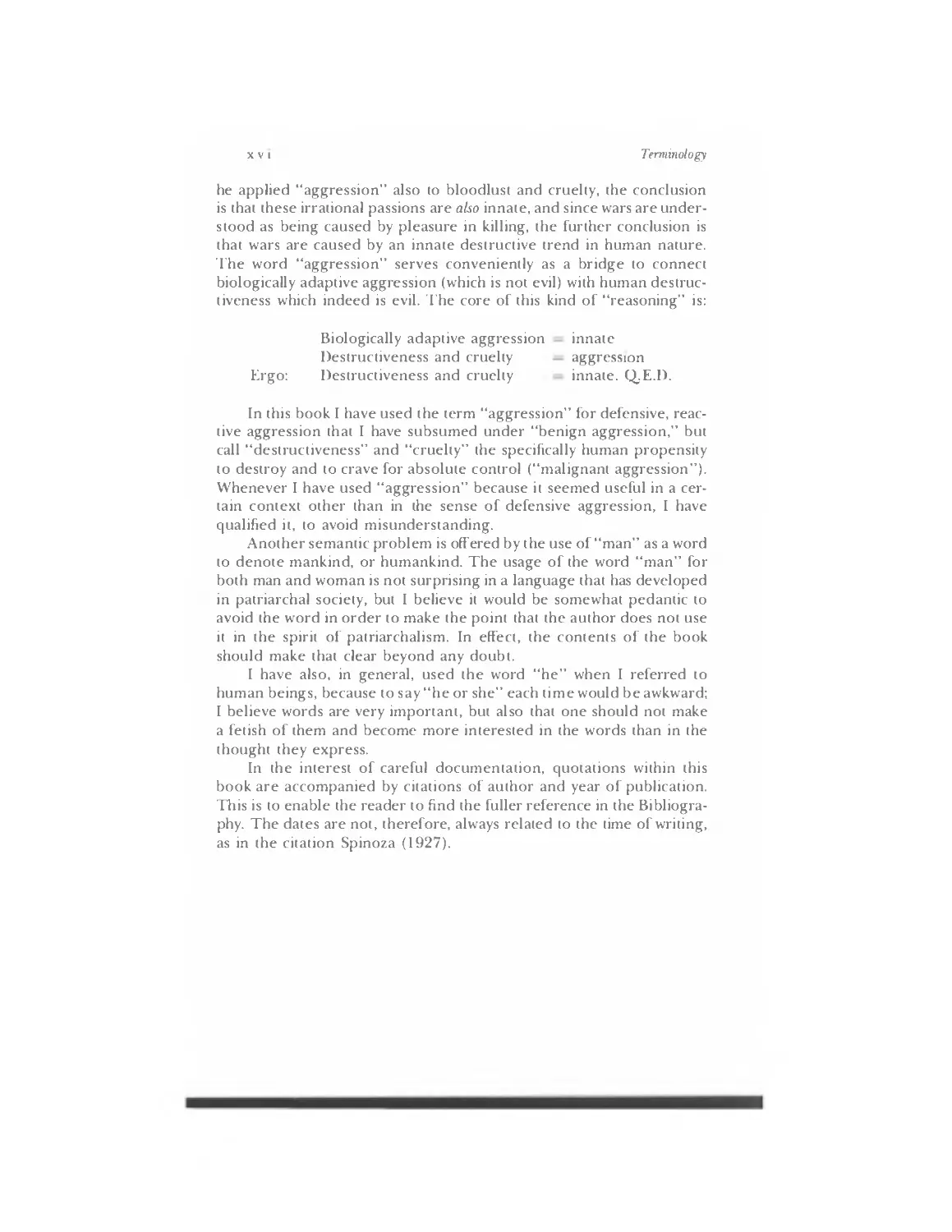
I’he word “aggression” serves conveniently as a bridge to connect
biologically adaptive aggression (which is not evil) with human destruc-
tiveness which indeed is evil. The core of this kind of “reasoning” is:
Biologically adaptive aggression innate
Destructiveness and cruelty — aggression
Ergo:	Destructiveness and cruelty innate. Q.E.D.
In this book I have used the term “aggression” for defensive, reac-
tive aggression that I have subsumed under “benign aggression,” but
call “destructiveness” and “cruelty” the specifically human propensity
to destroy and to crave for absolute control (“malignant aggression”).
Whenever I have used “aggression” because it seemed useful in a cer-
tain context other than in the sense of defensive aggression, I have
qualified it, to avoid misunderstanding.
Another semantic problem is offered by the use of “man” as a word
to denote mankind, or humankind. The usage of the word “man” for
both man and woman is not surprising in a language that has developed
in patriarchal society, but I believe it would be somewhat pedantic to
avoid the word in order to make the point that the author does not use
it in the spirit of patriarchalism. In effect, the contents of the book
should make that clear beyond any doubt.
I have also, in general, used the word “he” when I referred to
human beings, because to say “he or she” each time would be awkward;
I believe words are very important, but also that one should not make
a fetish of them and become more interested in the words than in the
thought they express.
In the interest of careful documentation, quotations within this
book are accompanied by citations of author and year of publication.
This is to enable the reader to find the fuller reference in the Bibliogra-
phy. The dates are not, therefore, always related to the time of writing,
as in the citation Spinoza (1927).
As the generations pass they grow worse. A time will
come when they have grown so wicked that they will worship
power; might will be right to them and reverence for the
good will cease to be. At last, when no man is angry any
more at wrongdoing or feels shame in the presence of the
miserable, Zeus will destroy them too. And yet even then
something might be done, if only the common people
would rise and put down rulers that oppress them.
—Greek myth on I he Iron Age
When I look at history, I am
a pessimist . . . but when I look
at prehistory, I am an optimist.
—J. C. Smuts
On the one hand, man is akin to many species of ani-
mals in that he fights his own species. But on the other hand,
he is, among the thousands of species that fight, the only
one in which fighting is disruptive. . . . Man is the only
species that is a mass murderer, the only misfit in his own
society.
—Л’ Tinbergen
The Anatomy
of Human
Destructiveness
Introduction:
Instin cts and Human Passio ns
The increase in violence and destructiveness on a national and
world scale has turned the attention of professionals and the general
public alike to the theoretical inquiry into the nature and causes of
aggression. Such a concern is not surprising; what is surprising is the
fact that this preoccupation is so recent, especially since an investigator
of the towering stature of Ereud, revising his earlier theory centered
around the sexual drive, had already in the 1920s formulated a new
theory in which the passion to destroy (“death instinct”) was considered
equal in strength to the passion to love (“life instinct,” “sexuality”). The
public, however, continued to think of Ereudianism chiefly in terms of
presenting the libido as man’s central passion, checked only by the
instinct for self-preservation.
This situation changed only in the middle of the sixties. One proba-
ble reason for this change was the fact that the level of violence and the
fear of war had passed a certain threshold throughout the world. But a
contributing factor was the publication of several books dealing with
human aggression, particularly On Aggression by Konrad Lorenz (1966).
Lorenz, a prominent scholar in the field of animal behavior1 and particu- 1
1 Lorenz gave the name “ethology" to the study of animal behavior, which
is peculiar terminology since ethology means literally “the science of behavior"
(from the Greek ethos “conduct," “norm"). To denote the study of animal
behavior Lorenz should have called it “animal ethology.” That he did not
2
Introduction
lari у that of fishes and birds, decided to venture out into a field in which
he had little experience or competence, that of human behavior. Al-
though rejected by most psychologists and neuroscientists, On Aggression
became a bestseller and made a deep impression on the minds of a vast
sector of the educated community, many of whom accepted Lorenz’s
view as the final answer to the problem.
The popular success of Lorenz’s ideas was greatly enhanced by the
earlier work of an author of a very different type, Robert Ardrey (African
Genesis, 1961, and The Territorial Imperative, 1967). Not a scientist but a
gifted playwright, Ardrey wove together many data about man’s begin-
nings into an eloquent though very biased brief that was to prove man’s
innate aggressiveness. These books were followed by those of other
students of animal behavior, such as The Naked Ape (1967) by Desmond
Morris and On Love and Hate (1972) by Lorenz’s disciple, I. Eibl-Eibes-
feldt.
All these works contain basically the same thesis: man’s aggressive
behavior as manifested in war, crime, personal quarrels, and all kinds
of destructive and sadistic behavior is due to a phylogenetically pro-
grammed, innate instinct which seeks for discharge and waits for the
proper occasion to be expressed.
Perhaps Lorenz’s neoinstinctivism was so successful not because
his arguments are so strong, but because people are so susceptible to
them. What could be more welcome to people who are frightened and
feel impotent to change the course leading to destruction than a theory
that assures us that violence stems from our animal nature, from an
ungovernable drive for aggression, and that the best we can do, as
Lorenz asserts, is to understand the law of evolution that accounts for
the power of this drive? This theory of an innate aggressiveness easily
becomes an ideology that helps to soothe the fear of what is to happen
and to rationalize the sense of impotence.
There are other reasons to prefer this simplistic answer of an in-
stinctivist theory to the serious study of the causes of destructiveness.
The latter calls for the questioning of the basic premises of current
ideology; we are led to analyze the irrationality of our social system and
to violate taboos hiding behind dignified words, such as “defense,”
choose to qualify ethology implies, of course, his idea that human behavior is
to be subsumed under animal behavior. It is an interesting fact that John Stuart
Mill, long before Lorenz, had coined the term “ethology” as denoting the
science of character. If I wanted to put the main point of this book in a nutshell
I would say that it deals with “ethology” in Mill’s and not in Lorenz’s sense.
Instincts and Human Passions
3
“honor,” and “patriotism.” Nothing short of an analysis in depth of our
social system can disclose the reasons for the increase in destructive-
ness, or suggest ways and means of reducing it. The instinctivistic the-
ory offers to relieve us of the hard task of making such an analysis. It
implies that, even if we all must perish, we can at least do so with the
conviction that our “nature” forced this fate upon us, and that we
understand why everything had to happen as it did.
Given the present alignment in psychological thought, criticism of
Lorenz’s theory of human aggression is expected to fit into the other
and dominant theory in psychology, that of behaviorism. In contrast to
instinctivism, behaviorist theory does not interest itself in the subjective
forces which drive man to behave in a certain way; it is not concerned
with what he feels, but only in the way he behaves and in the social
conditioning that shapes his behavior.
It was only in the twenties that the focus in psychology shifted
radically from feeling to behavior, with emotions and passions thereafter
removed from many psychologists’ fi eld of vision as irrelevant data, at
least from a scientific standpoint. The subject matter of the dominant
school in psychology became behavior, not the behaving man: the “science
of the psyche” was transformed into the science of the engineering of
animal and human conduct. This development has reached its peak in
Skinner’s neobehaviorism, which is today the most widely accepted
psychological theory in the universities of the United States.
The reason for this transformation of psychology is easy to find.
The student of man is, more than any other scientist, influenced by the
atmosphere of his society. This is so because not only are his ways of
thinking, his interests, the questions he raises, all partly socially deter-
mined as in the natural sciences, but in his case the subject matter itself,
man, is thus determined. Whenever a psychologist speaks of man, his
model is that of the men around him—and most of all himself. In
contemporary industrial society, men are cerebrally oriented, feel little,
and consider emotions a useless ballast—those of the psychologists as
well as those of their subjects. The behavioristic theory seems to fit them
well.
The present alternative between instinctivism and behaviorism is
not favorable to theoretical progress. Both positions are “monoex-
planatory,” depending on dogmatic preconceptions, and investigators
are required to fit data in one or the other explanation. But are we really
confronted with the alternative of accepting either the instinctivist or
the behaviorist theory? Are we forced to choose between Lorenz and
Skinner; are there no other options? This book affirms that there is
another option, and examines the question of what it is.
4
Introduction
We must distinguish in man two entirely different kinds of aggression.
The first, which he shares with all animals, is a phylogenetically pro-
grammed impulse to attack (or to flee) when vital interests are threat-
ened. This defensive, “benign” aggression is in the service of the survival
of the individual and the species, is biologically adaptive, and ceases
when the threat has ceased to exist. The other type, “malignant” aggres-
sion, i.e., destructiveness and cruelty, is specific to the human species and
virtually absent in most mammals; it is not phylogenetically pro-
grammed and not biologically adaptive; it has no purpose, and its satis-
faction is lustful. Most previous discussion of the subject has been
vitiated by the failure to distinguish between these two kinds of aggres-
sion, each of which has diff erent sources and different qualities.
Defensive aggression is, indeed, part of human nature, even though
not an “innate”2 instinct, as it used to be classified. In so far as Lorenz
speaks of aggression as defense, he is right in his assumptions about the
aggressive instinct (even though the theory regarding its spontaneity
and self-renewing quality remains unproven). But Lorenz goes further.
By a number of ingenious constructions he considers all human aggres-
sion, including the passion to kill and to torture, as being an outcome
of biologically given aggression, transformed from a beneficial to a
destructive force because of a number of factors. However, so many
empirical data speak against this hypothesis as to make it virtually unten-
able. I’he study of animals shows that mammals—and especially the
primates—although possessing a good deal of defensive aggression, are
not killers and torturers. Paleontology, anthropology, and history offer
ample evidence against the instinctivistic thesis: (1) human groups differ
so fundamentally in the respective degree of destructiveness that the
facts could hardly be explained by the assumption that destructiveness
and cruelty are innate; (2) various degrees of destructiveness can be
correlated to other psychical factors and to differences in respective
social structures, and (3) the degree of destructiveness increases with
the increased development of civilization, rather than the opposite.
Indeed, the picture of innate destructiveness fits history much better
than prehistory. If man were endowed only with the biologically adap-
tive aggression that he shares with his animal ancestors he would be a
relatively peaceful being; if chimpanzees had psychologists, the latter
would hardly consider aggression a disturbing problem about which
they should write books.
However, man differs from the animal by the fact that he is a killer;
2Recently Lorenz has qualified the concept of “innate” by acknowledging
the simultaneous presence of the factor of learning. (K. Lorenz, 1965.)
instincts and Human Passions
5
he is the only primate that kills and tortures members of his own species
without any reason, either biological or economic, and who feels satis-
faction in doing so. It is this biologically nonadaptive and non-
phylogenetically programmed, “malignant” aggression that constitutes
the real problem and the danger to man’s existence as a species, and it
is the main aim of this book to analyze the nature and the conditions
of this destructive aggression.
The distinction between benign-defensive and malignant-destruc-
tive aggression calls for a further and more fundamental distinction,
that between instinct3 and character, or more precisely, between drives
rooted in man’s physiological needs (organic drives) and those specifi-
cally human passions rooted in his character (“character-rooted, or
human passions”). With regard to the human passions whose function
it is to satisfy the existential needs, individuals differ among themselves.
But whatever these needs may be, they must be satisfied if man is to
function sanely, just as his organic drives need to be satisfied if he is to
stay alive. To give an example: man can be driven by love or by the
passion to destroy; in each case he satisfies one of his existential needs:
the need to “effect,” or to move something, to “make a dent.” Whether
man’s dominant passion is love or whether it is destructiveness depends
largely on social circumstances; these circumstances, however, operate
in reference to man’s biologically given existential situation and the
needs springing from it and not to an infinitely malleable, undifferen-
tiated psyche, as environmentalist theory assumes.
When we want to know, however, what the conditions of human
existence are, we are led to further questions: what is man’s nature?
What is it by virtue of which he is man? Needless to say, the present
climate in the social sciences is not very hospitable to the discussion of
such problems. They are generally considered the subject matter of
philosophy and religion; in terms of positivistic thinking, they are
treated as purely subjective speculations without any claim to objective
validity. Since it would be inopportune to anticipate at this point the
complex argument on the data offered later, I shall content myself now
with one remark. The point of view from which these problems will be
treated here is a sociobiological one. The basic premise is that since the
species Homo sapiens can be defined in anatomical, neurological, and
physiological terms, we should also be able to define him in psychical
terms as a being whose psychic needs correspond to his particular
psychophysical constitution. That all instincts spring from this constitu-
3The term “instinct” is used here provisionally, although it is somewhat
dated. Later on I shall use the term “organic drives."
6
Introduction
tion is generally agreed upon; what I am trying to show is that his
noninstinctual character-rooted passions, too, are the outcome of his
biological constitution.
This theoretical basis opens up the possibility for a detailed discus-
sion of the various forms of character-rooted, malignant aggression,
especially of sadism—the passion for unrestricted power over another
sentient being—and of necrophilia—the passion to destroy life and the
attraction to all that is dead, decaying, and purely mechanical. The
understanding of these character structures will, I hope, be facilitated
by the analysis of the character of a number of well-known sadists and
destroyers of the recent past: Stalin, Himmler, Hitler.
Having traced the steps this study will follow, it may be useful to
indicate, if only briefly, some of the general premises and conclusions
the reader will find in the following chapters: (1) We will not be con-
cerned with behavior separated from the behaving man; we shall deal
with the human drives, regardless of whether or not they are expressed
in immediately observable behavior. This means, with regard to the
phenomenon of aggression, we will study the origin and intensity of
aggressive impulses and not aggressive behavior independent from its
motivation. (2) These impulses can be conscious, but more often they
are unconscious. (3) They are, most of the time, integrated in a relatively
stable character structure. (4) In a more general formulation, this study
is based on the theory of psychoanalysis. From this follows that the
method we will use is the psychoanalytic method of discovering the
unconscious inner reality through interpretation of the observable and
often seemingly insignificant data. The term “psychoanalysis,” how-
ever, is not used in reference to the classic theory, but to a certain
revision of it. Key aspects of this revision will be discussed later; at this
point I should like to say only that it is not a psychoanalysis based on
the libido theory, thereby avoiding the instinctivistic concepts that are
generally assumed to be the very essence of Freud’s theory.
This identification of Freudian theory with instinctivism, however,
is very much open to doubt. Freud was actually the first modern psy-
chologist who, in contrast to the dominant trend, investigated the realm
of human passions—love, hate, ambition, greed, jealousy, envy; pas-
sions which had previously been dealt with only by dramatists and
novelists became, through Freud, the subject matter of scientific ex-
ploration.4 This may explain why his work found a much warmer and
4Most older psychologies, such as that in the Buddhist writings, the Greeks,
and the medieval and modern psychology up to Spinoza, dealt with the human
passions as their main subject matter by a method combining careful observa-
tion (although without experimentation) and critical thinking.
instincts and Human Passions
7
more understanding reception among artists than among psychiatrists
and psychologists—at least up to the time when his method became the
instrument to satisfy an increasing demand for psychotherapy. Here, the
artists felt, was the first scientist who dealt with their own subject matter,
man’s “soul,” in its most secret and subtle manifestations. Surrealism
showed this impact ofEreud on artistic thinking most clearly. In contrast
to older art forms, it dismissed “reality” as irrelevant, and was not
concerned with behavior—all that mattered was the subjective experi-
ence; it was only logical that Ereud’s interpretation of dreams should
become one of the most important influences for its development.
Ereud could not but conceive his new findings in the concepts and
terminology of his own time. Never having freed himself from the
materialism of his teachers, he had, as it were, to find a way to disguise
human passions, presenting them as outcomes of an instinct. He did this
brilliantly by a theoretical tour de force; he enlarged the concept of sexual-
ity (libido) to such an extent that all human passions (aside from self-
preservation) could be understood as the outcome of one instinct. Love,
hate, greed, vanity, ambition, avarice, jealousy, cruelty, tenderness—all
were forced into the straitjacket of this scheme and dealt with theoreti-
cally as sublimations of, or reaction formations against the various mani-
festations of narcissistic, oral, anal, and genital libido.
In the second period of his work, however, Ereud tried to break out
of this scheme by presenting a new theory, which was a decisive step
forward in the understanding of destructiveness. He recognized that life
is not ruled by two egoistic drives, one for food, the other for sex, but
by two passions—love and destruction—that do not serve physiological
survival in the same sense that hunger and sexuality do. Still bound by
his theoretical premises, however, he called them “life instinct” and
“death instinct,” and thereby gave human destructiveness its dignity as
one of two fundamental passions in man.
This study frees such passions as the strivings to love, to be free,
as well as the drive to destroy, to torture, to control, and to submit, from
their forced marriage to instincts. Instincts are a purely natural cate-
gory, while the character-rooted passions are a sociobiological, histori-
cal category.5 Although not directly serving physical survival they are as
strong—and often even stronger—than instincts. They form the basis
for man’s interest in life, his enthusiasm, his excitement; they are the
stuff from which not only his dreams are made but art, religion, myth,
drama—all that makes life worth living. Man cannot live as nothing but
an object, as dice thrown out of a cup; he suffers severely when he is
5Cf. R. B. Livingston (1967) on the question of the extent some of them are
built into the brain; discussed in chapter 10.
8
Introduction
reduced to the level of a feeding or propagating machine, even if he has
all the security he wants. Man seeks for drama and excitement; when he
cannot get satisfaction on a higher level, he creates for himself the
drama of destruction.
The contemporary climate of thought encourages the axiom that a
motive can be intense only when it serves an organic need—i.e., that
only instincts have intense motivating power. If one discards this me-
chanistic, reductionist viewpoint and starts from a holistic premise, one
begins to realize that man’s drives must be seen in terms of their func-
tion for the life process of the whole organism. Their intensity is not due
to specific physiological needs, but to the need of the whole organism
to survive—to grow both physically and mentally.
These passions do not become powerful only after the more ele-
mentary ones have been satisfied. They are at the very root of human
existence, and not a kind of luxury which we can afford after the normal,
“lower” needs have been satisfied. People have committed suicide be-
cause of their failure to realize their passions for love, power, fame,
revenge. Cases of suicide because of a lack of sexual satisfaction are
virtually nonexistent. These noninstinctual passions excite man, fire
him on, make life worth living; as von Holbach, the philosopher of the
French Enlightenment once said: "Un hommesanspassions et desires cesserait
d'etre un homme. " (“A man without passions or desires would cease to be
a man.”) (P. H. D. d’Holbach, 1822.) They are so intense precisely
because man would not be man without them.6
The human passions transform man from a mere thing into a hero,
into a being that in spite of tremendous handicaps tries to make sense
of life. He wants to be his own creator, to transform his state of being
unfinished into one with some goal and some purpose, allowing him to
6This statement by Holbach is of course to be understood in the context
of the philosophical thinking of his time. Buddhist or Spinozist philosophy have
an entirely different concept of passions; from their standpoint Holbach’s de-
scription would be empirically true for the majority of people, but Holbach’s
position is exactly the opposite of what they consider to be the goal of human
development. In order to appreciate the difference I refer to the distinction
between “irrational passions,” such as ambition and greed, and “rational pas-
sions,” such as love and care for all sentient beings (which will be discussed later
on). What is relevant in the text, however, is not this difference, but the idea
that life concerned mainly with its own maintenance is inhuman. When I speak
in the text of “passions” I refer to all energy-charged impulses as distinct from
those which have their origin in the need for the physiological maintenance of
the body. Love and no-greed are, I believe, the highest form of manifestation
of human energy.
Instincts and Human Passions
9
achieve some degree of integration. Man’s passions are not banal psy-
chological complexes that can be adequately explained as caused by
childhood traumata. They can be understood only if one goes beyond
the realm of reductionist psychology and recognizes them for what they
are: man's attempt to make sense out of life and to experience the optimum of
intensity and strength he can (or believes he can) achieve under the given circum-
stances. They are his religion, his cult, his ritual, which he has to hide
(even from himself) in so far as they are disapproved of by his group.
To be sure, by bribery and blackmail, i.e., by skillful conditioning, he
can be persuaded to relinquish his “religion” and to be converted to the
general cult of the no-self, the automaton. But this psychic cure deprives
him of the best he has, of being a man and not a thing.
The truth is that all human passions, both the “good” and the
“evil,” can be understood only as a person’s attempt to make sense of
his life. Change is possible only if he is able to “convert himself” to a
new way of making sense of life by mobilizing his life-furthering pas-
sions and thus experiencing a superior sense of vitality and integration
to the one he had before. Unless this happens he can be domesticated,
but he cannot be cured. But even though the life-furthering passions are
conducive to a greater sense of strength, joy, integration, and vitality
than destructiveness and cruelty, the latter are as much an answer to the
problem of human existence as the former. Even the most sadistic and
destructive man is human, as human as the saint. He can be called a
warped and sick man who has failed to achieve a better answer to the
challenge of having been born human, and this is true; he can also be
called a man who took the wrong way in search of his salvation.7
These considerations by no means imply, however, that destruc-
tiveness and cruelty are not vicious; they only imply that vice is human.
They are indeed destructive of life, of body and spirit, destructive not
only of the victim but of the destroyer himself. They constitute a para-
dox: they express life turning against itself in the striving to make sense of it.
They are the only true perversion. Understanding them does not mean
condoning them. But unless we understand them, we have no way to
recognize how they may be reduced, and what factors tend to increase
them.
Such understanding is of particular importance today, when sen-
7“Salvation” comes from the Latin root sal, “salt” (in Spanish salad,
“health”). The meaning stems from the fact that salt protects meat from decom-
position; “salvation” is the protection of man from decomposition (to protect
his health and well-being). In this sense each man needs “salvation” (in a
nontheological sense).
1 о
Introduction
sitivity toward destructiveness-cruelty is rapidly diminishing, and necro-
philia, the attraction to what is dead, decaying, lifeless, and purely
mechanical, is increasing throughout our cybernetic industrial society.
The spirit of necrophilia was expressed first in literary form by F. T.
Marinetti in his Futurist Manifesto of 1909. The same tendency can be
seen in much of the art and literature of the last decades that exhibits
a particular fascination with all that is decayed, unalive, destructive, and
mechanical. The Falangist motto, “Long live death,” threatens to be-
come the secret principle of a society in which the conquest of nature
by the machine constitutes the very meaning of progress, and where the
living person becomes an appendix to the machine.
This study tries to clarify the nature of this necrophilous passion
and the social conditions that tend to foster it. The conclusion will be
that help in any broad sense can come only through radical changes in
our social and political structure that would reinstate man to his su-
preme role in society. The call for “law and order” (rather than for life
and structure) and for stricter punishment of criminals, as well as the
obsession with violence and destruction among some “revolutionaries,”
areonly further instances of the powerful attraction of necrophilia in the
contemporary world. We need to create the conditions that would make
the growth of man, this unfinished and uncompleted being—unique in
nature—the supreme goal of all social arrangements. Genuine freedom
and independence and the end of all forms of exploitative control are
the conditions for mobilizing the love of life, which is the only force that
can defeat the love for the dead.
part one
Instinctivism, Behaviorism,
Psychoanalysis
1
The Instinctivists
The Older Instinctivists
I will forgo presenting here a history of instinct theory as the reader
can find it in many textbooks.1 This history began far back in philosoph-
ical thought, but as far as modern thought is concerned, it dates from
the work of Charles Darwin. All post-Darwinian research on instincts
has been based on Darwin’s theory of evolution.
William James (1890), William McDougall (1913, 1932) and others
have drawn up long lists in which each individual instinct was supposed
to motivate corresponding kinds of behavior, such as James’s instincts
of imitation, rivalry, pugnacity, sympathy, hunting, fear, acquisitiveness,
kleptomania, constructiveness, play, curiosity, sociability, secretiveness,
cleanliness, modesty, love, and jealousy—a strange mixture of universal
human qualities and specific socially conditioned character traits. (J. J.
McDermott, ed., 1967.) Although these lists of instincts appear today
somewhat naive, the work of these instinctivists is highly sophisticated,
rich in theoretical constructions, and still impressive by its level of
theoretical thought; it is by no means dated. Thus, for instance, James
was quite aware that there might be an element of learning even in the
first performance of an instinct, and McDougall was not unaware of the
molding influence of different experiences and cultural backgrounds.
The instinctivism of the latter forms a bridge to Freud’s theory. As
Fletcher has emphasized, McDougall did not identify instinct with a
4 recommend especially R. Fletcher (1968) for its penetrating history of the
instinct theory.
1 3
Instinctivism, Behaviorism, Psychoanalysis
1 4
“motor mechanism” and a rigidly fixed motor response. For him the
core of an instinct was a "propensity," a “craving,” and this affective-
connative core of each instinct “seems capable of functioning in relative
independence of both the cognitive and the motor part of the total
instinctive disposition.” (W. McDougall, 1932.)
Before discussing the two best-known modern representatives of
the instinctivistic theory, the “neoinstinctivists” Sigmund Freud and
Konrad Lorenz, let us look at a feature common to both them and the
older instinctivists: the conception of the instinctivistic model in me-
chanistic-hydraulic terms. McDougall envisaged energy held back by
“sluice gates” and “bubbling over” (W. McDougall, 1913) under certain
conditions. Later he used an analogy in which each instinct was pictured
as a “chamber in which gas is constantly liberated.” (W. McDougall,
1923.) Freud, in his concept of the libido theory, also followed a hy-
draulic scheme. The libido increases----------> tension rises------> un-
pleasure increases; the sexual act decreases tension and unpleasure
until the tension begins to rise again. Similarly, Lorenz thought of
reaction specific energy like “a gas constantly being pumped into a
container” or as a liquid in a reservoir that can discharge through a
spring-loaded valve at the bottom. (K. Lorenz, 1950.) R. A. Hinde has
pointed out that in spite of various differences, these and other instinct
models “share the idea of a substance capable of energizing behaviors,
held back in a container and subsequently released in action.” (R. A.
Hinde, 1960.)
The Neoinstinctivists:
Sigmund Freud and Konrad Lorenz
Freud's Concept of Aggression2
The great step forward made by Freud beyond the older instincti-
vists, and particularly McDougall, was that he unified all “instincts”
under two categories—the sexual instincts and the instinct for self-
preservation. Thus Freud’s theory can be considered the last step in the
development of the history of the instinct theory; as I shall show later,
this very unification of the instincts under one (with the exception of the
ego instinct) was also the first step in overcoming the whole instinctivis-
tic concept, even though Freud was not aware of this. In the following
I shall deal only with Freud’s concept of aggression, since his libido
2A detailed history and analysis of Freud’s concept of aggression will be
found in the Appendix.
The Instinctivists
1 5
theory is well known to many readers and can be read in other works,
best of all in Freud’s Introductory Lectures on Psychoanalysis (1915-1916,
1916-1917, and 1933).
Freud had paid relatively little attention to the phenomenon of
aggression as long as he considered sexuality (libido) and self-preserva-
tion the two forces dominating man. From the 1920s on, this picture
changed completely. In The Ego and the Id (1923) and in his later writ-
ings, he postulated a new dichotomy: that of life instinct(s) (Eros) and
death instinct(s). Freud described the new theoretical phase in the fol-
lowing terms: “Starting from speculations on the beginning of life and
from biological parallels I drew the conclusion that, besides the instinct
to preserve living substance, there must exist another, contrary instinct
seeking to dissolve those units and to bring them back to their primae-
val, inorganic state. That is to say, as well as Eros there was an instinct
of death.” (S. Freud, 1930.)
The death instinct is directed against the organism itself and thus
is a self-destructive drive, or it is directed outward, and in this case tends
to destroy others rather than oneself. When blended with sexuality, the
death instinct is transformed into more harmless impulses expressed in
sadism or masochism. Even though Freud suggested at various times
that the power of the death instinct can be reduced (S. Freud, 1927), the
basic assumption remained: man was under the sway of an impulse to
destroy either himself or others, and he could do little to escape this
tragic alternative. It follows that, from the position of the death instinct,
aggression was not essentially a reaction to stimuli but a constantly
flowing impulse rooted in the constitution of the human organism.
The majority of psychoanalysts, while following Freud in every
other way, refused to accept the theory of the death instinct; perhaps
this was because this theory transcended the old mechanistic frame of
reference and required biological thinking that was unacceptable to
most, for whom “biological” was identical with the physiology of the
instincts. Nevertheless, they did not altogether reject Freud’s new posi-
tion. They made a compromise by acknowledging a “destructive in-
stinct” as the other pole of the sexual instinct, and thus they could
accept Freud’s new emphasis on aggression without submitting to an
entirely new kind of thinking.
Freud had taken an important step forward, passing from a purely
physiological-mechanistic to a biological approach that considers the
organism as a whole and analyzes the biological sources of love and
hate. His theory, however, suffers from severe defects. It is based on
rather abstract speculations and offers hardly any convincing empirical
evidence. Furthermore, while Freud brilliantly tried to interpret human
1 6
Instinctivism, Behaviorism, Psychoanalysis
impulses in terms of the new theory, his hypothesis is inconsistent with
animal behavior. For him, the death instinct is a biological force in all
living organisms: this should mean that animals, too, express their death
instinct either against themselves or against others. Hence one should
find more illness or early death in less outwardly aggressive animals, and
vice versa; but, of course, there are no data supporting this idea.
That aggression and destructiveness are not biologically given and
spontaneously flowing impulses will be demonstrated in the next chap-
ter. At this point I only want to add that Freud has greatly obscured the
analysis of the phenomenon of aggression by following the custom of
using the term for the most different kinds of aggression, thus facilitat-
ing his attempt to explain them all by one instinct. Since he was certainly
not behavioristically inclined, we may assume that the reason was his
general tendency to arrive at a dualistic concept in which two basic
forces are opposed to each other. This dichotomy was at first that
between self-preservation and libido, and later that between life and
death instincts. For the elegance of these concepts, Freud had to pay the
price of subsuming every passion under one of the two poles, and hence
of putting together trends which in reality do not belong together.
Lorenz '$ Theory of Aggression
While Freud’s theory of aggression was and still is very influential,
it was complex and difficult and has never been popular in the sense that
it was read by and impressed a popular audience. On the contrary,
Konrad Lorenz’s On Aggression (K. Lorenz, 1966) became within a short
time of its publication one of the most widely read books in the field of
social psychology.
The reasons for this popularity are not difficult to discern. First of
all, On Aggression is an immensely readable book, much like Lorenz’s
earlier, charming King Solomon's Ring (1952), and quite different in this
respect from Freud’s heavy treatises on the death instinct or, for that
matter, Lorenz’s own papers and books written for the specialist. Fur-
thermore, as was pointed out earlier in the Introduction, it appeals to
the thinking of many people today who prefer to believe that our drift
toward violence and nuclear war is due to biological factors beyond our
control, rather than to open their eyes and see that it is due to social,
political, and economic circumstances of our own making.
For Lorenz,3 * as for Freud, human aggressiveness is an instinct fed
3Cf., for a detailed and by now classic review of Lorenz’s (and N. Tinber-
gen’s) concepts of instinct, and for an overall critique of Lorenz’s position, D.
The Instinctivists	i 7
by an ever-flowing fountain of energy, and not necessarily the result of
a reaction to outer stimuli. Lorenz holds that energy specific for an
instinctive act accumulates continuously in the neural centers related to
that behavior pattern, and if enough energy has been accumulated an
explosion is likely to occur even without the presence of a stimulus.
However, the animal and man usually find stimuli which release the
dammed-up energy of the drive; they do not have to wait passively until
the proper stimulus appears. They search for, and even produce stimuli.
Following W. Craig, Lorenz called this behavior “appetitive behavior.”
Man, he says, creates political parties in order to find stimuli for the
release of dammed-up energy, rather than political parties being the
cause of aggression. But in cases where no outside stimulus can be
found or produced, the energy of the dammed-up aggressive drive is so
great that it will explode, as it were, and be acted out in vacuo, i.e.,
“without demonstrable external stimulation . . . the vacuum activity
performed without an object—exhibits truly photographic similarity to
normal performance of the motor actions involved. . . . This demon-
strates that the motor coordination patterns of the instinctive behavior
pattern are hereditarily determined down to the finest detail.” (K. Lor-
enz, 1970; originally in German, 1931-42.)4
For Lorenz, then, aggression is primarily not a reaction to outside
stimuli, but a “built-in” inner excitation that seeks for release and will
find expression regardless of how adequate the outer stimulus is: "It is
the spontaneity of the instinct that makes it so dangerous. ” (K. Lorenz, 1966.
Italics added.) Lorenz’s model of aggression, like Freud’s model of the
libido, has been rightly called a hydraulic model, in analogy to the pres-
sure exercised by dammed-up water or steam in a closed container.
This hydraulic concept of aggression is, as it were, one pillar on
which Lorenz’s theory rests; it refers to the mechanism through which
aggression is produced. The other pillar is the idea that aggression is
in the service of life, that it serves the survival of the individual and of
the species. Broadly speaking, Lorenz assumes that intraspecific aggres- S.
S. Lehrman (1953). Furthermore, for a critique of On Aggression, see the review
by L. Berkowitz (1967) and К. E. Boulding’s review (1967). See also, N. Tinber-
gen’s critical evaluation of Lorenz’s theory (1968), M. F. A. Montagu’s collection
of critical essays on Lorenz’s theory (1968), and L. Eisenberg’s short and pene-
trating critique (1972).
“•Later on, under the influence of the critique by a number of American
psychologists and by N. Tinbergen, Lorenz modified this statement to allow for
the influence of learning (K. Lorenz, 1965).
। 8
Instinctivism, Behaviorism, Psychoanalysis
sion (aggression among members of the same species) has the function
of furthering the survival of the species. Lorenz proposes that aggres-
sion fulfills this function by the spacing out of individuals of one species
over the available habitat; by selection of the “better man,” relevant in
conjunction with the defense of the female, and by establishing a social
rank order. (K. Lorenz, 1964.) Aggression can have this preservative
function all the more effectively because in the process of evolution
deadly aggression has been transformed into behavior consisting of
symbolic and ritual threats which fulfill the same function without harm-
ing the species.
But, Lorenz argues, the instinct that served the animal’s survival has
become “grotesquely exaggerated,” and has “gone wild” in man. Ag-
gression has been transformed into a threat rather than a help to sur-
vival.
It seems as if Lorenz himself had not been satisfied with these
explanations of human aggression and felt a need to add another that
leads, however, outside the field of ethology. He writes:
Above all. it is more than probable that the destructive intensity of the
aggressive drive, still a hereditary evil of mankind, is the consequence
of a process of intra-specific selection which worked on our forefa-
thers for roughly forty thousand years, that is, throughout the Early
Stone Age. [Lorenz probably means the Late Stone Age.] When
man had reached the stage of having weapons, clothing, and social
organization, so overcoming the dangers of starving, freezing, and
being eaten by wild animals, and these dangers ceased to be the
essential factors influencing selection, an evil intra-specific selection
must have set in. The factor influencing selection was now the wars
waged between hostile neighboring tribes. These must have evolved
in an extreme form of all those so-called “warrior virtues” which
unfortunately many people still regard as desirable ideals. (K. Lorenz,
1966.)
This picture of the constant war among the “savage” hunters-food-
gatherers since the full emergence of “modern man” around 40,000 or
50,000 b.c. is a widely accepted cliche adopted by Lorenz without refer-
ence to the investigations which tend to show that there is no evidence
for it.5 Lorenz’s assumption of forty thousand years of organized war-
fare is nothing but the old Hobbesian cliche of war as the natural state
of man, presented as an argument to prove the innateness of human
aggressiveness. The logic of Lorenz’s assumption is that man is aggres- 5
5The question of the aggression among the food gatherers and hunters is
discussed at length in chapter 8.
The Instinctivists	i 9
sive because he was aggressive; and he was aggressive because he is
aggressive.
Even if Lorenz were right in his thesis of continuous warfare in the
Late Paleolithic, his genetic reasoning is open to question. If a certain
trait is to have a selective advantage this must be based on the increased
production offertile offspring of the carriers of the trait. But in view of
the likelihood of a higher loss of the aggressive individuals in wars, it
is doubtful whether selection could account for the maintenance of a
high incidence of this trait. In fact, if one considers such a loss as
negative selection, the gene frequency should diminish.6 Actually, the
population density in that age was extremely low, and for many of the
human tribes after the full emergence of Homo sapiens there was little
need to compete and to fight each other for food or space.
Lorenz has combined two elements in his theory. The first is that
animals as well as men are innately endowed with aggression, serving
the survival of the individual and the species. As I shall show later, the
neurophysiological findings show that this defensive aggression is a
reaction to threats to the animal’s vital interests, and does not flow
spontaneously and continually. The other element, the hydraulic char-
acter of dammed-up aggression, is used to explain the murderous and
cruel impulses of man, but little supporting evidence is presented. Both
a life-serving and a destructive aggression are subsumed under one
category, and what connects them is mainly a word: “aggression.” In
contrast to Lorenz, Tinbergen has expressed the problem in full clarity:
“On the one hand, man is akin to many species of animals in that he
fights his own species. But on the other hand, he is, among the thou-
sands of species that fight, the only one in which fighting is disruptive.
. . . Man is the only species that is a mass murderer, the only misfit in
his own society. Why should this be so?” (N. Tinbergen, 1968.)
Freud and Lorenz: Their Similarities and Differences
The relationship between Lorenz’s and Freud’s theories is a com-
plicated one. They have in common the hydraulic concept of aggres-
sion, even though they explain the origin of the drive differently. But
they seem to be diametrically opposed to each other in another aspect.
Freud hypothesized a destructive instinct, an assumption which Lorenz
declares to be untenable on biological grounds. His aggressive drive
serves life, and Freud’s death instinct is the servant of death.
But this difference loses most of its significance in the light of
61 am indebted to Professor Kurt Hirschhorn for a personal communication
in which he outlines the genetic problem involved in the above-mentioned view.
2 О
Instinctivism, Behaviorism, Psychoanalysis
Lorenz’s account of the vicissitudes of the originally defensive and life-
serving aggression. By a number of complicated and often questionable
constructions, defensive aggression is supposed to be transformed in
man into a spontaneously flowing and self-increasing drive that seeks to
create circumstances which facilitate the expression of aggression, or
that even explodes when no stimuli can be found or created. Hence even
in a society that is organized from a socioeconomic viewpoint in such
a way that major aggression could find no proper stimuli, the very
demand of the aggressive instinct would force its members to change
it or, if they would not, aggression would explode even without any
stimulus. Thus the conclusion at which Lorenz arrives, that man is
driven by an innate force to destroy, is, for all practical purposes, the
same as Freud’s. Freud, however, sees the destructive drive opposed by
the equally strong force of Eros (life, sex), while for Lorenz love itself
is a product of the aggressive instinct.
Both Freud and Lorenz agree that the failure to express aggression
in action is unhealthy. Freud had postulated in the earlier period of his
work that repression of sexuality can lead to mental illness; later on he
applied the same principle to the death instinct and taught that the
repression of outward-directed aggression is unhealthy. Lorenz states
that “present-day civilized man suffers from insufficient discharge of his
aggressive drive.” Both, by different routes, arrive at a picture of man
in which aggressive-destructive energy is continuously produced, and
very difficult, if not impossible in the long run, to control. The so-called
evil in animals becomes a real evil in man, even though according to
Lorenz its roots are not evil.
“proof" by analogy
These similarities between Freud’s and Lorenz’s respective theo-
ries about aggression must not, however, becloud their main difference.
Freud was a student of men, a keen observer of their manifest behavior
and of the various manifestations of their unconscious. His theory of the
death instinct may be wrong, or incomplete, or it may rest on insufficient
evidence, yet it was gained in the process of constant observation of
man. Lorenz, on the other hand, is an observer of animals, especially
of the lower animals, and doubtless a very competent one. But his
knowledge about man does not go beyond that of an average person;
he has not refined it either by systematic observation or by sufficient
acquaintance with the literature.7 He naively assumes that observations
7Lorenz, at least when writing On Aggression, seems not to have had any
The Instinctivists
2 i
about himself and acquaintances are applicable to all men. His main
method, however, is not even self-observation, but analogies drawn
from the behavior of certain animals to that of man. Scientifically speak-
ing, such analogies prove nothing; they are suggestive and pleasing to
the lover of animals. They go together with a high degree of anthropo-
morphizing that Lorenz indulges in. Precisely because they give the
pleasant illusion to a person that he “understands” what the animal is
“feeling” they become very popular. Who would not like to possess
King Solomon’s ring?
Lorenz bases his theories of the hydraulic nature of aggression on
experiments with animals—mainly fish and birds under conditions of
captivity. The question at issue is: Does the same aggressive drive that
leads to killingunless it is redirected—which Lorenz observed in certain
fish and birds—also operate in man?
Since there is no direct proof for this hypothesis with regard to man
and the nonhuman primates, Lorenz presents a number of arguments
to prove his point. His main approach is by way of analogy: he discovers
similarities between human behavior and the behavior of the animals
studied by him, and concludes that both kinds of behavior have the same
cause. This method has been criticized by many psychologists; already
in 1948, Lorenz’s eminent colleague, N. Tinbergen, was aware of the
dangers "inherent in the procedure of using physiological evidence from lower
evolutionary levels, lower levels of neural organizations, and simpler forms of
behavior as analogies for the support of physiological theories of behavior mech-
anisms at higher and more complex levels." (N. Tinbergen, 1948. Italics
added.)
A few examples will illustrate Lorenz’s “proof by analogy.”* 8 Speak-
ing about cichlids and Brazilian mother-of-pearl fish, Lorenz reports the
observation that if each fish can discharge its healthy anger on a neigh-
bor of the same sex it does not attack its own mate (“redirected aggres-
sion ”).9 He then comments:
firsthand knowledge of Freud’s work. There is not a single direct reference to
his writings, and what references there are refer to what psychoanalytic friends
told him about Freud’s position; regrettably they are not always right, or they
have not been accurately understood.
8The tendency to make quite illegitimate analogies from biological to social
phenomena had already been demonstrated by Lorenz in 1940 in an unfortu-
nate paper (K. Lorenz, 1940) arguing that state laws must substitute for princi-
ples of natural selection when the latter fail to properly take care of the biologi-
cal needs of the race.
9N. Tinbergen’s term.
2 2
Instinctivism, Behaviorism, Psychoanalysis
Analogous behavior can be observed in human beings. In the
good old days when there was still a Hapsburg monarchy and there
were still domestic servants, I used to observe the following, regularly
predictable behavior in my widowed aunt. She never kept a maid
longer than eight to ten months. She was always delighted with a new
servant, praised her to the skies, and swore that she had at last found
the right one. In the course of the next few months her judgment
cooled, she found small faults, then bigger ones, and toward the end
of the stated period she discovered hateful qualities in the poor girl,
who was finally discharged without a reference after a violent quarrel.
After this explosion the old lady was once more prepared to find a
perfect angel in her next employee.
It is not my intention to poke fun at my long-deceased and devo-
ted aunt. I was able, or rather obliged, to observe exactly the same
phenomenon in serious, self-controlled men, myself included, once
when I was a prisoner of war. So-called polar disease, also known as
expedition choler, attacks small groups of men who are completely
dependent on one another and are thus prevented from quarrelling
with strangers or people outside their own circle of friends. From this
it will be clear that the damming up of aggression will bemoredanger-
ous, the better the members of the group know, understand, and like
each other. In such a situation, as I know from personal experien-
cence, all aggression and intra-specific fight behavior undergo an
extreme lowering of their threshold values. Subjectively this is ex-
pressed by the fact that one reacts to small mannerisms of one’s best
friends—such as the way in which they clear their throats or sneeze
—in a way that would normally be adequate only if one had been hit
by a drunkard. (K. Lorenz, 1966.)
It does not seem to occur to Lorenz that the personal experiences
with his aunt, his fellow prisoners-of-war, and himself do not necessarily
say anything about the universality of such reactions. He also seems to
be quite unaware of a more complex psychological interpretation one
might give his aunt’s behavior, instead of the hydraulic one which claims
that her aggressive potential rose every eight to ten months to such a
degree that it had to explode.
From a psychoanalystic standpoint, one would assume that his aunt
was a very narcissistic, exploitative woman; she demanded that a servant
should be completely “devoted” to her, have no interests of her own,
and gladly accept the role of a creature who is happy to serve her. She
approaches each new servant with the phantasy that she is the one who
will fulfill her expectations. After a short “honeymoon” during which
the aunt’s phantasy is still sufficiently effective to blind her to the fact
that the servant is not “right”—and perhaps also helped by the fact that
The Instinctivists
23
the servant in the beginning makes every effort to please her new em-
ployer—the aunt wakes up to the recognition that the servant is not
willing to live up to the role for which she has been cast. Such a process
of awakening lasts, of course, some time until it is final. At this point the
aunt experiences intense disappointment and rage, as any narcissistic-
exploitative person does when frustrated. Not being aware that the
cause for this rage lies in her impossible demands, she rationalizes her
disappointment by accusing the servant. Since she cannot give up her
desires, she fires the servant and hopes that a new one will be “right.”
The same mechanism repeats itself until she dies or cannot get any more
servants. Such a development is by no means found only in the relations
of employers and servants. Often the history of marriage conflicts is
identical; however, since it is easier to fire a servant than to divorce, the
outcome is often that of a lifelong battle in which each partner tries to
punish the other for ever-accumulating wrongs. The problem that con-
fronts us here is that of a specific human character, namely the narcissis-
tic-exploitative character, and not that of an accumulated instinctive
energy.
In a chapter on “Behavioral Analogies to Morality,” Lorenz makes
the following statement: “However, nobody with a real appreciation of
the phenomena under discussion can fail to have an ever-recurring
sense of admiration for those physiological mechanisms which enforce,
in animals, selfless behavior aimed toward the good of the community,
and which work in the same way as the moral law in human beings.” (K.
Lorenz, 1966.)
How does one recognize “selfless” behavior in animals? What Lor-
enz describes is an instinctively determined action pattern. The term
“selfless” is taken from human psychology and refers to the fact that a
human being can forget his self (one should say, more correctly, his ego)
in his wish to help others. But has a goose, or a fish, or a dog a self (or
an ego) which it can forget? Is selflessness not dependent on the fact
of human self-awareness and the neurophysiological structure on which
it rests? This question arises with regard to many other words Lorenz
uses in describing animal behavior, such as “cruelty,” “sadness,” “em-
barrassment.”
One of the most important and interesting parts of Loren’s etho-
logical data is the “bond” which forms between animals (his main exam-
ple are geese) as a reaction to threats from without against the group.
But the analogies he draws to explain human behavior are sometimes
astounding: “Discriminative aggression toward strangers and the bond
between the members of a group enhance each other. The opposition
of‘we’ and ‘they’ can unite some wildly contrasting units. Confronted
2 4
Instinctivism, Behaviorism, Psychoanalysis
with present-day China, the United States and the Soviet Union occa-
sionally seem to feel as ‘we.’ The same phenomenon, which incidentally
has some of the earmarks of war, can be studied in the roll-cackle
ceremony of greylag geese.’’ (K. Lorenz, 1966.) Is the American-Soviet
attitude determined by instinctive patterns which we have inherited
from the greylag goose? Is the author trying to be more or less amusing,
or does he actually intend to tell us something about the connection
between geese and the American and Soviet political leaders?
Lorenz goes even further in making analogies between animal
behavior (or interpretations thereof) and his naive notions about human
behavior, as in his statement about human love and hate: “A personal
bond, an individual friendship, is found only in animals with highly
developed intra-specific aggression; in fact, this bond is the firmer, the
more aggressive the particular animal and species is.” (K. Lorenz,
1966.) So far, so good; let us assume the correctness of Lorenz’s obser-
vations. But at this point he jumps into the realm of human psychology;
after stating that intra-specific aggression is millions of years older than
personal friendship and love, he concludes that "there is no love without
agression. ” (K. Lorenz, 1966. Italics added.) This sweeping declaration,
unsupported by any evidence as far as human love is concerned, but
contradicted by most observable facts, is supplemented by another
statement which does not deal with intraspecific aggression but with the
“ugly little brother of love,” hate. “As opposed to ordinary aggression,
it is directed toward one individual, just as love is, and probably hate
presupposes the presence of love: one can really hate only where one has
loved and, even if one denies it, still does.” (K. Lorenz, 1966. Italics
added.) That love is sometimes transformed into hate has often been
said, even though it is more correct to say that it is not love which suffers
this transformation, but the wounded narcissism of the loving person,
that is to say, the non-love which causes hate. To claim one hates only
where one has loved, however, turns the element of truth in the state-
ment into plain absurdity. Does the oppressed hate the oppressor, does
the mother of the child hate its murderer, does the tortured hate the
torturer because they once loved him or still do?
Another analogy is drawn from the phenomenon of "militant enthusi-
asm. " This is “a specialized form of communal aggression, dearly dis-
tinct from and yet functionally related to the more primitive forms of
petty individual aggression.” (K. Lorenz, 1966.) It is a “sacred custom”
which owes its motivating force to phylogenetically evolved behavior
patterns. Lorenz asserts that there “cannot be the slightest doubt that
human militant enthusiasm evolved out of a communal defense re-
sponse of our prehuman ancestors.” (K. Lorenz, 1966.) It is the enthusi-
asm shared by the group in defense against a common enemy.
The Instinctivists
4
Every man of normally strong emotions knows, from his own
experience, the subjective phenomena that go hand in hand with the
response of militant enthusiasm. A shiver runs down the back and, as
more exact observation shows, along the outside of both arms. One
soars elated, above all the ties ofeveryday life, one is ready to abandon
all for the call of what, in the moment of this specific emotion, seems
to be a sacred duty. All obstacles in its path become unimportant; the
instinctive inhibitions against hurting or killing one’s fellows lose,
unfortunately, much of their power. Rational considerations, criti-
cism, and all reasonable arguments against the behavior dictated by
militant enthusiasm are silenced by an amazing reversal of all values,
making them appear not only untenable but base and dishonorable.
Men may enjoy the feeling of absolute righteousness even while they
commit atrocities. Conceptual thought and moral responsibility are at
their lowest ebb. As a Ukrainian proverb says: “When the banner is
unfurled, all reason is in the trumpet." (K. Lorenz, 1966.)
Lorenz expresses “a reasonable hope that our moral responsibility
may gain control over the primeval drive, but our only hope of its ever
doing so rests on the humble recognition of the fact that militant enthu-
siasm is an instinctive response with a phylogenetically determined
releasing mechanism and that the only point at which intelligent and
responsible supervision can get control is in the conditioning of the
response to an object which proves to be a genuine value under the
scrutiny of the categorical question.’’ (K. Lorenz, 1966.)
Lorenz’s description of normal human behavior is rather astound-
ing. No doubt many men do “enjoy the feeling of absolute righteous-
ness even while they commit atrocities"—or rather, to put it in more
adequate psychological terms, many enjoy committing atrocities with-
out any moral inhibitions and without experiencing a sense of guilt. But
it is an untenable scientific procedure to claim, without even trying to
muster evidence for it, that this is a universal human reaction, or that
it is “human nature” to commit atrocities during war, and to base this
claim on an alleged instinct based on the questionable analogy with
fishes and birds.
The fact is that individuals and groups differ tremendously in their
tendency to commit atrocities when hate is aroused against another
group. In the first World War British propaganda had to invent the
stories of German soldiers bayoneting Belgian babies, because there
were too few real atrocities to feed the hatred against the enemy. Simi-
larly, the Germans reported few atrocities committed by their enemies,
for the simple reason that there were so few. Even during the second
World War, in spite of the increasing brutalization of mankind, atrocit-
ies were generally restricted to special formations of the Nazis. In gen-
2 6
Inslinctivism, Behaviorism, Psychoanalysis
eral, regular troops on both sides did not commit war crimes on the
scale which would be expected to follow from Lorenz’s description.
What he describes, as far as atrocities are concerned, is the behavior of
sadistic or bloodthirsty character types; his “militant enthusiasm” is
simply a nationalistic and emotionally somewhat primitive reaction. To
assert that a readiness to commit atrocities once the flag has been
unfurled is an instinctively given part of human nature would be the
classic defense against the accusation of violating the principles of the
Geneva Convention. Although I am sure Lorenz does not mean to
defend atrocities, his argument amounts, in fact, to such a defense. His
approach blocks the understanding of the character systems in which
they are rooted, and the individual and social conditions that cause their
development.
Lorenz goes even further, arguing that without military enthusiasm
(this “true autonomous instinct”) “neither art, nor science, nor indeed
any of the great endeavors of humanity would have come into being.”
(K. Lorenz, 1966.) How can this be when the first condition for the
manifestation of this instinct is that “a social unit with which the subject
identifies must appear to be threatened by some danger from outside”?
(K. Lorenz, 1966.) Is there any evidence that art and science flower only
when there is an outside threat?
Lorenz explains the love of neighbor, expressed in the willingness
to risk one’s life for him, as “a matter of course if he is your best friend
and has saved yours a number of times: you do it without even think-
ing.” (K. Lorenz, 1966.) Instances of such “decent behavior” in tight
spots easily occur, “provided they are of a kind that occurred often
enough in the paleolithic period to produce phylogenetically adapted
social norms to deal with the situation.” (K. Lorenz, 1966.)
Such a view of love of neighbor is a mixture of instinctivism and
utilitarianism. You save your friend because he has saved your life a
number of times; what if he did it only once, or not at all? Besides, you
only do it because it happened often enough in the Paleolithic period!
CONCLUSIONS ABOUT WAR
At the conclusion of his analysis of the instinctive aggression in
man, Lorenz finds himself in a position similar to that of Freud in his
letter to Einstein about Why War? (1933). Neither man is happy to have
arrived at conclusions that would seem to indicate that war is ineradica-
ble because it is the result of an instinct. However, while Freud could
call himself, in a very broad sense, a “pacifist,” Lorenz would hardly fit
into this category, although he is quite aware that nuclear war would be
The Instinctivists	t 7
a catastrophe without precedent. He tries to find ways that would help
society avoid the tragic effects of the aggressive instinct; indeed, in the
nuclear age he is almost forced to look for possibilities for peace in
order to make his theory of the innate destructiveness of man accepta-
ble. Some of his proposals are similar to those made by Freud, but there
is a considerable difference between them. Freud’s suggestions are
made with skepticism and modesty, whereas Lorenz declares, “I do not
mind admitting that ... I think I have something to teach mankind that
may help it to change for the better. This conviction is not as presump-
tuous as it might seem. . . .” (K. Lorenz, 1966.)
Indeed, it would not be presumptuous if Lorenz had something of
importance to teach. Unfortunately, his suggestions hardly go beyond
worn-out cliches, “simple precepts” against the danger of “society’s
becoming completely disintegrated by the misfunctioning of social
behavior patterns”:
1.	“The most important precept is . . . ‘Know thyself,’ by which he
means that “we must deepen our insight into the causal concatenations
governing our own behavior” (K. Lorenz, 1966)—that is, the laws of
evolution. As one element in this knowledge to which he gives special
emphasis, Lorenz mentions “the objective, ethological investigation of
all the possibilities of discharging aggression in its primal form on
substitute objects.” (K. Lorenz, 1966.)
2.	“ I’he psychoanalytic study of so-called sublimation.”
3.	“The promotion of personal acquaintance and, if possible,
friendship between individual members of different ideologies or na-
tions.”
4.	“ I’he fourth and perhaps the most important measure to be
taken immediately is the intelligent and responsible channeling of mili-
tant enthusiasm”—that is, to help the “younger generation ... to find
genuine causes that are worth serving in the modern world.”
Let us look at this program point by point.
Lorenz makes a distorted use of the notion of the classic “know
thyself’—not only of the Greek notion, but also that of Freud, whose
whole science and therapy of psychoanalysis are built on self-knowl-
edge. For Freud self-knowledge means that man becomes conscious of
what is unconscious; this is a most difficult process, because it encoun-
ters the energy of resistance by which the unconscious is defended
against the attempt to make it conscious. Self-knowledge in Freud’s
sense is not an intellectual process alone, but simultaneously an affec-
tive process, as it was already for Spinoza. It is not only knowledge by
the brain, but also knowledge by the heart. Knowing oneself means
gaining increasing insight, intellectually and affectively, in heretofore
28
Instinctivism, Behaviorism, Psychoanalysis
secret parts of one’s psyche. It is a process which may take years for a
sick person who wants to be cured of his symptoms and a lifetime for
a person who seriously wants to be himself. Its effect is one of increased
energy because energy is freed from the task of upholding repressions;
thus the more man is in touch with his inner reality, the more he is awake
and free. On the other hand, what Lorenz means by “know thyself’ is
something quite different; it is the theoretical knowledge of the facts of
evolution, and specifically of the instinctive nature of aggression. An
analogy to Lorenz’s concept of self-knowledge would be the theoretical
knowledge of Freud’s theory of the death instinct. In fact, following the
reasoning of Lorenz, psychoanalysis as a therapy would not have to
consist of anything but reading the collected works of Freud. One is
reminded of a statement by Marx, that if somebody who knows the laws
of gravity finds himself in deep water and cannot swim, his knowledge
will not prevent him from drowning; as a Chinese sage said, “Reading
prescriptions does not make one well.”
Lorenz does not elaborate the second of his precepts, sublimation;
the third, “the promotion of personal acquaintance and, if possible,
friendship between individual members of different ideologies and na-
tions,” Lorenz himself concedes is an “obvious” plan—even air lines
advertise international travel as serving the cause of peace; unfortu-
nately this concept of the aggression-lowering function of personal
acquaintance does not happen to be true. There is ample evidence for
this. The British and the Germans were very well acquainted with each
other before 1914, yet their mutual hatred when the war broke out was
ferocious. There is even more telling proof . It is notorious that no war
between countries elicits as much hate and cruelty as civil war, in which
there is no lack of acquaintance between the two warring sides. Does the
fact of mutual intimate knowledge diminish the intensity of hate among
members of a family?
“Acquaintance” and “friendship” cannot be expected to lower ag-
gression because they represent a superficial knowledge about another
person, a knowledge of an “object” which I look at from the outside.
This is quite different from the penetrating, empathic knowledge in
which I understand the other’s experiences by mobilizing those within
myself which, if not the same, are similar to his. Knowledge of this kind
requires that most repressions within oneself are lowered in intensity to
a point where there is little resistance to becoming aware of new aspects
of one’s unconscious. The attainment of a nonjudgmental understand-
ing can lower aggressiveness or do away with it altogether; it depends
on the degree to which a person has overcome his own insecurity, greed,
The [nstmctivists
*9
and narcissism, and not on the amount of information he has about
others.10 *
The last of Lorenz’s four precepts is the “channeling of militant
enthusiasm”; one of his special recommendations is athletics. But the
fact is that competitive sports stimulate a great deal of aggression. How
intense this is was highlighted recently when the deep feeling aroused
by an international soccer match led to a small war in Latin America.
If there is no evidence that sport lowers aggression, at the same
time it should be said that there is also no evidence that sport is moti-
vated by aggression. What often produces aggression in sports is the
competitive character of the event, cultivated in a social climate of
competition and increased by an overall commercialization, in which
not pride of achievement but money and publicity have become the
most attractive goals. Many thoughtful observers of the unfortunate
Olympic games in Munich, 1972, have recognized that instead of fur-
thering goodwill and peace, they furthered competitive aggressiveness
and nationalistic pride.11
A few other statements of Lorenz on war and peace are worth
quoting because they are good examples of his ambiguity in this area.
“Supposing,” he says, “that, being a patriot of my home country (which
I am), I felt an unmitigated hostility against another country (which I
emphatically do not), I still could not wish whole-heartedly for its destruc-
tion if I realized that there were people living in it who, like myself, were
l0It is an interesting question why civil wars are in fact much fiercer and why
they elicit much more destructive impulses than international wars. It seems
plausible that the reason lies in that usually, at least as far as modern interna-
tional wars are concerned, they do not aim at the destruction or extinction of
the enemy. Their aim is a limited one: to force the opponent to accept condi-
tions for peace which are damaging, but by no means a threat to the existence
of the population of the defeated country. (Nothing could illustrate this better
than that Germany, the loser in two world wars, became more prosperous after
each defeat than before.) Exceptions to this rule are wars which aim at the
physical extinction or enslavement of the total enemy population, like some of
the wars—although by no means all—which the Romans conducted. In civil war
the two opponents have the aim, if not to destroy each other physically, to
destroy each other economically, socially, and politically. If this hypothesis is
correct, it would mean that the degree of destructiveness is by and large depend-
ent on the severity of the threat.
l,The poverty of what Lorenz has to say about channeling militant enthusi-
asm becomes particularly clear if one reads William James's classic paper “The
Moral Equivalents of War" (1911).
go	Instinctivism, Behaviorism, Psychoanalysts
enthusiastic workers in the field of inductive natural science, or revered
Charles Darwin and were enthusiastically propagating the truth of his
discoveries, or still others who shared my appreciation of Michelan-
gelo’s art, or my enthusiasm for Goethe’s Faust, or for the beauty of a
coral reef, or for wildlife preservation or a number of minor en-
thusiasms I could name. I should find it quite impossible to hate, un-
reservedly, any enemy, if he shared only one of my identifications with
cultural and ethical values.” (K. Lorenz, 1966. Italics added.)
Lorenz hedges the denial of the wish for destruction of a whole
country by the word “wholeheartedly,” and by qualifying hate by “un-
reservedly.” But what is a “half-hearted” wish for destruction, or a
“reserved” hate? More important, his condition for not wanting the
destruction of another country is that there are people who share his
particular tastes and enthusiasms (those who revere Darwin seem to
qualify only if they also enthusiastically propagate his discoveries): it is
not enough that they are human beings. In other words, the total de-
struction of an enemy is undesirable only if and because he is similar to
Lorenz’s own culture, and even more specifically, to his own interests
and values.
The character of these statements is not changed by Lorenz’s de-
mand for a “humanistic education”—i.e., an education offering an op-
timum of common ideals with which an individual can identify. This was
the kind of education current in German high schools before the first
World War, but the majority of the teachers of this humanism were
probably more war-minded than the average German. Only a very dif-
ferent and radical humanism, one in which the primary identification is
with life and with mankind, can have an influence against war.
IDOLATRY OF EVOLUTION
Lorenz’s position cannot be fully understood unless one is aware
of his quasi-religious attitude toward Darwinism. His attitude in this
respect is not rare, and deserves further study as an important sociopsy-
chological phenomenon of contemporary culture. The deep need of
man not to feel lost and lonely in the world had, of course, been previ-
ously satisfied by the concept of a God who had created this world and
was concerned with each and every creature. When the theory of evolu-
tion destroyed the picture of God as the supreme Creator, confidence
in God as the all-powerful Father of man fell with it, although many were
able to combine a belief in God with the acceptance of the Darwinian
theory. But for many of those for whom God was dethroned, the need
for a godlike figure did not disappear. Some proclaimed a new god,
The Instinctivists	3 1
Evolution, and worshiped Darwin as his prophet. For Lorenz and many
others the idea of evolution became the core of a whole system of
orientation and devotion. Darwin had revealed the ultimate truth re-
garding the origin of man; all human phenomena which might be ap-
proached and explained by economic, religious, ethical, or political
consideration were to be understood from the point of view of evolu-
tion. This quasi-religious attitude toward Darwinism becomes apparent
in Lorenz’s use of the term “the great constructors,” referring to selec-
tion and mutation. He speaks of the methods and aims of the “great
constructors” very much in the way a Christian might speak of God’s
acts. He even uses the singular, the “great constructor,” thus coming
even closer to the analogy with God. Nothing, perhaps, expresses the
idolatrous quality of Lorenz’s thinking more clearly than the concluding
paragraph of On Aggression:
We know that in the evolution of vertebrates, the bond of personal
love and friendship was the epoch-making invention created by the
great constructors when it became necessary for two or more in-
dividuals of an aggressive species to live peacefully together and to
work for a common end. We know that human society is built on the
foundation of this bond, but we have to recognize the fact that the
bond has become too limited to encompass all that it should: it pre-
vents aggression only between those who know each other and are
friends, while obviously it is all active hostility between all men of all
nations or ideologies that must be stopped. The obvious conclusion
is that love and friendship should embrace all humanity, that we
should love all our human brothers indiscriminately. This command-
ment is not new. Our reason is quite able to understand its necessity
as our feeling is able to appreciate its beauty, but nevertheless, made
as we are, we are unable to obey it. We can feel the lull, warm emotion
of friendship and love only for individuals, and the utmost exertion
of willpower cannot alter this fact. But the great constmctors can, and /
believe they will. I believe in the power of human reason, as / believe in
the power of natural selection. I believe that reason can and will exert
a selection pressure in the right direction. / believe that this, in the not
too distant future, will endow our descendants with the faculty of
fulfilling the greatest and most beautiful of all commandments. (K.
Lorenz, 1966. Italics added.)
The great constructors will win out, where God and man have
failed. The commandment of brotherly love has to remain ineffective,
but the great constructors will give it life. The last part of the statement
ends in a true confession of faith: I believe, I believe, I believe . . .
3 2	Instinctivism, Behaviorism, Psychoanalysis
The social and moral Darwinism preached by Lorenz is a romantic,
nationalistic paganism that tends to obscure the true understanding of
the biological, psychological, and social factors responsible for human
aggression. Here lies Lorenz’s fundamental difference from Freud, in
spite of the similarities in their views on aggression. Freud was one of
the last representatives of Enlightenment philosophy. He genuinely
believed in reason as the one strength man has and which alone could
save him from confusion and decay. He genuinely postulated the need
for self-knowledge by the uncovering of man’s unconscious strivings.
He overcame the loss of God by turning to reason—and felt painfully
weak. But he did not turn to new idols.
2
Environnientailsts and Behaviorists
Enlightenment Environmentalism
The diametrically opposite position to that of the instinctivists
would seem to be that held by the environmentalists. According to their
thinking, man’s behavior is exclusively molded by the influence of the
environment, i.e., by social and cultural, as opposed to “innate” factors.
This is particularly true with regard to aggression, one of the main
obstacles to human progress.
In its most radical form this view was already presented by the
philosophers of the Enlightenment. Man was supposed to be born
“good” and rational, and it was due to bad institutions, bad education,
and bad example that he developed evil strivings. Some denied that
there were any physical differences between the sexes (/’dme n'a pas de
sex) and proposed that whatever differences existed, aside from the
anatomical ones, were exclusively due to education and social arrange-
ments. In contrast to behaviorism, however, these philosophers were
not concerned with methods of human engineering and manipulation
but with social and political change. They believed that the “good
society” would create the good man, or rather, allow the natural good-
ness of man to manifest itself.
Behaviorism
Behaviorism was founded by J. B. Watson (1914); it was based on
the premise that “the subject matter of human psychology is the behavior
or activities of the human being. ” Like logical positivism, it ruled out all
33
34
Instinctivism, Behaviorism, Psychoanalysis
“subjective” concepts which could not be directly observed, such as
“sensation, perception, image, desire, and even thinking and emotion,
as they are subjectively defined.” (J. B. Watson, 1958.)
Behaviorism underwent a remarkable development from the some-
what unsophisticated formulations of Watson to the brilliant neobehavi-
orism of Skinner. But this mainly represents a refinement of the original
thesis, rather than a greater depth or originality.
B. F. Skinner’s Neobehaviorism
Skinnerian neobehaviorism1 is based on the same principle as Wat-
son’s concepts: psychology as a science need not and must not be
concerned with feelings or impulses or any other subjective events;2 it
disdains any attempt to speak of a “nature” of man or construct a model
of man, or to analyze various human passions which motivate human
behavior. To consider human behavior as impelled by intentions, pur-
poses, aims or goals, would be a prescientific and useless way oflooking
at it. Psychology has to study what reinforcements tend to shape human
behavior and how to apply the reinforcements most effectively. Skinner’s
“psychology” is the science of the engineering of behavior; its aim is to
find the right reinforcements in order to produce a desired behavior.
Instead of the simple conditioning in the Pavlovian model, Skinner
•Since a full consideration of the merits ofSkinnerian theory would lead too
far away from our main problem, I shall restrict myself in the following to the
presentation of the general principles of neobehaviorism and to the more de-
tailed discussion of some points which seem to be relevant for our discussion.
For the study of Skinner’s system one should read B. F. Skinner (1953). For a
brief version cf. B. F. Skinner (1963). In his latest book (1971) he discusses the
general principles of his system, especially their relevance for culture. Cf. also
the brief discussion between Carl R. Rogers and B. F. Skinner (1956) and B. F.
Skinner (1961). Fora critique of Skinner’s position, cf. Noam Chomsky (1959).
See also the counterargument of K. MacCorquodale (1970) and N. Chomsky
(1971). Chomsky’s reviews are thorough and far-reaching and make their points
so brilliantly that there is no need to repeat them. Nevertheless Chomsky’s and
my own psychological positions are so far apart that I have to present some of
my critique in this chapter.
2Skinner, in contrast to many behaviorists, even concedes that “private
events” need not be entirely ruled out of scientific considerations and adds that
“a behavioral theory of knowledge suggests that the private world which, if not
entirely unknowable, is at least not likely to be known well.” (B. F. Skinner,
1963.) This qualification makes Skinner’s concession little more than a polite
bow to the soul-psyche, the subject matter of psychology.
Environmentalists and Behaviorists
35
speaks of “operant” conditioning. Briefly, this means that uncondi-
tioned behavior, provided it is desirable from the experimenter’s stand-
point, is rewarded, i.e., followed by pleasure. (Skinner believes the
rewarding reinforcement to be much more effective than the punish-
ing.) As a result, the subject will eventually continue to behave in the
desired fashion. For example, Johnny does not like spinach particularly;
he eats it, mother rewards him with a praising remark, an affectionate
glance, or an extra piece of cake, whichever is most reinforcing for
Johnny as measured by what works best—i.e., she administers “positive
reinforcements.” Johnny will eventually love to eat spinach, particularly
if the reinforcements are effectively administered in terms of their
schedules. In hundreds of experiments Skinner and others have devel-
oped the techniques for this operant conditioning. Skinner has shown
that by the proper use of positive reinforcement, the behavior of animals
and humans can be altered to an amazing degree, even in opposition
to what some would loosely call “innate” tendencies.
To have shown this is undoubtedly the great merit of Skinner’s
experimental work; it also supports the views of those who believe that
the social structure (or “culture” in the parlance of most American
anthropologists) can shape man, even though not necessarily through
operant conditioning. It is important to add that Skinner does not
neglect genetic endowment. In order to render his position correctly,
one should say that apart from genetic endowment, behavior is deter-
mined entirely by reinforcement.
Reinforcement can occur in two ways: it happens in the normal
cultural process, or it can be planned, according to Skinnerian teaching,
and thus lead to a “design for culture.” (B. F. Skinner, 1961, 1971.)
Goals and Values
Skinner’s experiments are not concerned with the goals of the con-
ditioning. The animal or the human subject is conditioned to behave in
a certain way. What it (he) is conditioned to is determined by the deci-
sion of the experimenter who sets the goals for the conditioning. Usu-
ally the experimenter in these laboratory situations is not interested in
what he is conditioning an animal or human subject for, but rather in
the fact that he can condition them to the goal of his choice, and in how
he can do it best. However, serious problems arise when we turn from
the laboratory to realistic living, to individual or social life. In this case
the paramount questions are: to what are people being conditioned, and
who determines these goals?
It seems that when Skinner speaks of culture, he still has his labora-
Instinctivism, Behaviorism, Psychoanalysis
36
tory in mind, where the psychologist who proceeds without value judg-
ments can easily do so because the goal of the conditioning hardly
matters. At least, that is perhaps one explanation why Skinner does not
come to grips with the issue of goals and values. For example, he writes,
“We admire people who behave in original or exceptional ways, not
because such behavior is itself admirable, but because we do not know
how to encourage original or exceptional behavior in any other way.”
(C. R. Rogers and B. F. Skinner, 1956.) This is nothing but circuitous
reasoning: we admire originality because we can condition it only by
admiring it.
But why do we want to condition it if it is not a desirable goal in
itself?
Skinner does not face this question, although even with a modicum
of sociological analysis an answer could be given. The degree of origi-
nality and creativity that is desirable in various classes and occupational
groups in a given society varies. Scientists and top managers, for in-
stance, need to have a great deal of these qualities in a technological-
bureaucratic society like ours. For blue-collar workers to have the same
degree of creativity would be a luxury—or a threat to the smooth func-
tioning of the whole system.
I do not believe that this analysis is a sufficient answer to the prob-
lem of the value of originality and creativity. There is a great deal of
psychological evidence that striving for creativeness and originality are
deeply rooted impulses in man, and there is some neurophysiological
evidence for the assumption that the striving for creativity and original-
ity is “built in” in the system of the brain. (R. B. Livingston, 1967.) I
only want to stress that the impasse of Skinner’s position is due to the
fact that he pays no attention to such speculations or to those of psycho-
analytic sociology and hence believes that questions are not answerable
if they are not answerable by behaviorism.
Here is another example of Skinner’s fuzzy thinking on the subject
of values:
Most people would subscribe to the proposition that there is no value
judgment involved in deciding how to build an atomic bomb, but
would reject the proposition that there is none involved in deciding
to build one. The most significant difference here may be that the
scientific practices which guide the designer of the bomb are clear,
while those which guide the designer of the culture which builds the
bomb are not. We cannot predict the success or failure of a cultural
invention with the same accuracy as we do that ol a physical invention.
It is for this reason that we are said to resort to value judgments in
Environmentalists and Behaviorists
3 7
the second case. What we resort to is guessing. It is only in this sense
that value judgments take up where science leaves oft . When we can
design small social interactions and, possibly, whole cultures with the
confidence we bring to physical technology, the question of value will
not be raised. (B. F. Skinner. 1961.)
Skinner’s main point is that there is really no essential difference
between the lack of value judgment in the technical problem of design-
ing the bomb and the decision to build one. The only difference is that
the motives for building the bomb are not “clear.” Maybe they are not
clear to Professor Skinner, but they are clear to many students of his-
tory. In fact there was more than one reason for the decision to build
the atomic bomb (and similarly for the hydrogen bomb): the fear of
Hitler’s building the bomb; perhaps the wish to have a superior weapon
against the Soviet Union for possible later conflicts (this holds true
especially for the hydrogen bomb); the logic of a system that is forced
to increase its armaments to support its struggle with competing sys-
tems.
Quite aside from these military, strategic, and political reasons,
there is, I believe, another one which is equally important. I refer to the
maxim that is one of the axiomatic norms of cybernetic society: “some-
thing ought to be done because it is technically possible io do it.” If it is
possible to build nuclear weapons, they must be built even if they might
destroy us all. If it is possible to travel to the moon or to the planets,
it must be done, even if at the expense of many unfulfilled needs here
on earth. This principle means the negation of all humanistic values, but
it nevertheless represents a value, maybe the supreme norm of “techno-
tronic” society.3
Skinner does not care to examine the reasons for building the
31 have discussed this idea in The Revolution of Hope (E. Fromm, 1968).
Independently, H. Ozbekhan has formulated the same principle in his paper,
“TheTriumph ofTechnology:'Can'Implies'Ought.'” (H. Ozbekhan, 1966.)
Dr. Michael Maccoby has drawn my attention to some results of his study
of the management of highly developed industries, which indicate that the
principle “can implies ought” is more valid in industries which produce for the
military establishment than for the remaining, more competitive industry. But
even if this argument is correct, two factors must be considered: first, the size
of the industry which works directly or indirectly for the armed forces; second,
that the principle has taken hold of the minds of many people who are not
directly related to industrial production. A good example was the initial enthusi-
asm for space flights; another example is the tendency in medicine to construct
and use gadgets regardless of their real importance for a specific case.
38
Instinctivism, Behaviorism, Psychoanalysis
bomb, and he asks us to wait for further development of behaviorism
to solve the mystery. In his views on social processes he shows the same
inability to understand hidden, nonverbalized motives as he does in his
treatment of psychical processes. Since most of what people say about
their motivation in political as well as in personal life is notoriously
fictitious, the reliance on what is verbalized blocks the understanding of
social and psychical processes.
In other instances Skinner smuggles in values without, apparently,
being aware of it. In the same paper, for instance, he writes: “No one,
I am sure, wishes to develop new master-slave relationships or bend the
will of the people to despotic rulers in new ways. These are patterns of
control appropriate to a world without science.” (B. F. Skinner, 1961.)
In which decade is Professor Skinner living? Are there no systems that
do indeed want to bend the will of the people to dictators? And are these
systems only to be found in cultures “without science”? Skinner seems
still to believe in an old-fashioned ideology of “progress”: the Middle
Ages were “dark” because they had no science and science necessarily
leads to the freedom of man. The fact is that no leader or government
explicitly states his intention of bending the will of the people any more;
they are apt to use new words which sound like the opposite of the old
ones. No dictator calls himself a dictator, and every system claims that
it expresses the will of the people. In the countries of the “free world,”
on the other hand, “anonymous authority” and manipulation have re-
placed overt authority in education, work, and politics.
Skinner’s values also emerge in the following statement: “If we are
worthy of our democratic heritage we shall, of course, be ready to resist
any tyrannical use of science for immediate or selfish purposes. But if
we value the achievements and goals of democracy we must not refuse
to apply science to the design and construction of cultural patterns,
even though we may then find ourselves in some sense in the position
of controllers.” (B. F. Skinner, 1961, Italics added.) What is the basis
of this value in neobehavioristic theory?
What about the controllers?
Skinner’s answer is that “all men control and all men are con-
trolled.” (C. R. Rogers and B. F. Skinner, 1956.) This sounds reassuring
for a democratically minded person, but is a vague and rather meaning-
less formula, as soon becomes clear:
In noticing how the master controls the slave or the employer the
worker, we commonly overlook reciprocal effects and, by considering
action in one direction only, are led to regard control as exploitation,
or at least the gaining of a one-sided advantage; but the control is
Environmentalists and Behaviorists
39
actually mutual. The slave controls the master as completely as the master the
slave (italics added), in the sense that the techniques of punishment
employed by the master have been selected by the slave’s behavior in
submitting to them. This does not mean that the notion of exploita-
tion is meaningless or that we may not appropriately ask, cut bono? In
doing so, however, we go beyond the account of the social episode itself
(italics added) and consider certain long-term effects which are clearly
related to the question of value judgments. A comparable considera-
tion arises in the analysis of any behavior which alters a cultural
practice. (B. F. Skinner, 1961.)
I find this statement shocking; we are asked to believe that the
relationship between master and slave is a reciprocal one, although the
notion of exploitation is not “meaningless.” For Skinner the exploita-
tion is not part of the social episode itself; only the techniques of control
are. This is the view of a man who looks at social life as if it were an
episode in his laboratory, where all that matters to the experimenter is
his technique—and not the “episodes” themselves, since whether the
rat is peaceful or aggressive is entirely irrelevant in this artificial world.
And as if that were not enough, Skinner states that the exploitation by
the master is “clearly related” to the question of value judgments. Does
Skinner believe that exploitation or, for that matter, robbery, torture,
and murder are not “facts” because they are clearly related to value
judgments? This would indeed mean that all social and psychological
phenomena, if they can also bejudged as to their value, cease to be facts
which can be examined scientifically.4
One can explain Skinner’s saying that slave and slaveowner are in
a reciprocal relationship only by the ambiguous use he makes of the
word "control.” In the sense in which the word is used in real life, there
can be no question that the slaveowner controls the slave, and that there
is nothing “reciprocal” about the control except that the slave may have
a minimum of countercontrol—for instance, by the threat of rebellion.
But this is not what Skinner is talking about. He speaks of control in the
very abstract sense of the laboratory experiment, into which real life
does not intrude. He actually repeats in all seriousness what has often
been told as a joke, the story about a rat that tells another rat how well
it has conditioned its experimenter: whenever the rat pushes a certain
lever, the experimenter has to feed it.
Because neobehaviorism has no theory of man, it can only see
4By the same logic the relation between torturer and the tortured is “recip-
rocal,” because the tortured, by his manifestation of pain, conditions the tor-
turer to use the most effective instruments of torture.
4«
Instinctivism, Behaviorism, Psychoanalysis
behavior and not the behaving person. Whether somebody smiles at me
because he wants to hide his hostility, or a salesgirl smiles because she
has been instructed to smile (in the better stores), or whether a friend
smiles at me because he is glad to see me, all this makes no difference
to neobehaviorism, for “a smile is a smile.” That it should make no
diff erence to Professor Skinner as a person is hard to believe, unless he
were so alienated that the reality of persons no longer matters to him.
But if the difference does matter, how could a theory that ignores it be
valid?
Nor can neobehaviorism explain why quite a few persons condi-
tioned to be persecutors and torturers fall mentally sick in spite of the
continuation of “positive reinforcements.” Why does positive reinforce-
ment not prevent many others from rebelling, out of the strength of
their reason, their conscience, or their love, when all conditioning works
in the opposite direction? And why are many of the most adapted
people, who should be star witnesses to the success of conditioning,
often deeply unhappy and disturbed or suffer from neurosis? There
must be impulses inherent in man which set limits to the power of
conditioning; to study the failure of conditioning seems just as impor-
tant, scientifically, as its success. Indeed, man can be conditioned to
behave in almost every desired way; but only “almost.” He reacts to
those conditons that conflict with basic human requirements in different
and ascertainable ways. He can be conditioned to be a slave, but he will
react with aggression or decline in vitality; or he can be conditioned to
feel like part of a machine and react with boredom, aggression, and
unhappiness.
Basically, Skinner is a naive rationalist who ignores man’s passions.
In contrast to Freud, he is not impressed by the power of passions, but
believes that man always behaves as his self-interest requires. Indeed,
the whole principle of neobehaviorism is that self-interest is so powerful
that by appealing to it—mainly in the form of the environment’s reward-
ing the individual for acting in the desired sense—man’s behavior can
be completely determined. In the last analysis, neobehaviorism is based on
the quintessence of bourgeois experience: the primacy of egotism and self-interest over
all other human passions.
The Reasons for Skmnerism's Popularity
Skinner’s extraordinary popularity can be explained by the fact that
he has succeeded in blending elements of traditional, optimistic, liberal
thought with the social and mental reality of cybernetic society.
Skinner believes that man is malleable, subject to social influences,
Environmentalists and Behaviorists	4 1
and that nothing in his “nature” can be considered to be a final obstacle
to development toward a peaceful and just society. Thus his system
attracts those psychologists who are liberals and who find in Skinner’s
system an argument to defend their political optimism. He appeals to
those who believe that desirable social goals like peace and equality are
not just rootless ideals, but can be established in reality. The whole idea
that one can “design” a better society on a scientific basis appeals to
many who earlier might have been socialists. Did not Marx, too, want
to design a better society? Did he not call his brand of socialism “scien-
tific” in contrast to “Utopian” socialism? Is not Skinner’s way particu-
larly attractive at a point in history when the political solution seems to
have failed and revolutionary hopes are at their lowest?
But Skinner’s implied optimism alone would not have made his
ideas so attractive were it not for his combining of traditional liberal
views with their very negation.
In the cybernetic age, the individual becomes increasingly subject
to manipulation. His work, his consumption, and his leisure are manipu-
lated by advertising, by ideologies, by what Skinner calls “positive rein-
forcements.” I’he individual loses his active, responsible role in the
social process; he becomes completely “adjusted” and learns that any
behavior, act, thought, or feeling which does not fit into the general
scheme puts him at a severe disadvantage; in fact he is what he is supposed
to be. If he insists on being himself, he risks, in police states, his freedom
or even his life; in some democracies, he risks not being promoted, or
more rarely, he risks even his job, and perhaps most importantly, he
risks feeling isolated, without communication with anybody.
While most people are not clearly aware of their discomfort, they
dimly sense their fear of life, of the future, of the boredom caused by
the monotony and the meaninglessness of what they are doing. They
sense that the very ideals in which they want to believe have lost their
moorings in social reality. What relief it is for them to learn that condi-
tioning is the best, the most progressive, and the most effective solution.
Skinner recommends the hell of the isolated, manipulated man of the
cybernetic age as the heaven of progress. He dulls our fears of where
we are going by telling us that we need not be afraid; that the direction
our industrial system has taken is the same as that which the great
humanists had dreamt of, except that it is scientifically grounded. More-
over, Skinner’s theory rings true, because it is (almost) true for the
alienated man of the cybernetic society. In summary, Skinnerism is the
psychology of opportunism dressed up as a new scientific humanism.
I am not saying that Skinner wants to play this role of apologist for
the “technotronic” age. On the contrary, his political and social naivete
4 2
Instinctivism, Behaviorism, Psychoanalysis
can make him write sometimes more convincingly (and confusedly) than
he could if he were aware of what he is trying to condition us to.
Behaviorism and Aggression
The behavioristic method is so important for the problem of ag-
gression because most investigators of aggression in the United States
have written with a behavioristic orientation. Their reasoning is, briefly
stated: if Johnny discovers that by being aggressive his younger brother
(or mother, and so on) will give him what he wants, he will become a
person who tends to behave aggressively; the same would hold true for
submissive, courageous, or affectionate behavior. The formula is that
one does, feels, and thinks in the way that has proven to be a successful
method of obtaining what one wants. Aggression, like all other behav-
ior, is purely learned on the basis of seeking one’s optimal advantage.
I he behavioristic view on aggression has been succinctly expressed
by A. H. Buss, who defines aggression as “a response that delivers
noxious stimuli to another organism.” He writes:
There are two reasons for excluding the concept of intent from the
definition of aggression. First, it implies teleology, a purposive act
directed toward a future goal, and this view is inconsistent with the
behavioral approach adopted in this book. Second, and more impor-
tant, is the difficulty of applying this term to behavioral events. Intent
is a private event that may or may not be capable of verbalization, may
or may not be accurately reflected in a verbal statement. One might
be led to accept intent as an inference from the reinforcement history
of the organism. If an aggressive response has been systematically
reinforced by a specific consequence, such as flight of the victim, the
recurrence of the aggressive response might be said to involve an
“intent to cause flight.” However, this kind of inference is superfluous
in the analysis of behavior; it is more fruitful to examine directly the
relation between reinforcement history of an aggressive response and
the immediate situation eliciting the response.
In summary, intent is both awkward and unnecessary in the analy-
sis of aggressive behavior; rather, the crucial issue is the nature of the
reinforcing consequences that affect the occurrence and the strength
of aggressive responses. In other words, what are the classes of rein-
forcers that affect aggressive behavior? (A. H. Buss, 1961.)
By “intent” Buss understands conscious intent. But Buss is not
totally unreceptive to the psychoanalytic approach: “If anger is not the
drive for aggression, is it fruitful to regard it as a drive? I he position
Environmentalists and Behaviorists
4 3
adopted here is that it is not fruitful.” (A. H. Buss, 1961.)5
Such outstanding behaviorist psychologists as A. H. Buss and L.
Berkowitz are much more sensitive to the phenomenon of man’s feel-
ings than Skinner is, but Skinner’s basic principle that the deed, not the
doer, is an object for scientific observation, holds true for their position
too. They thereby do not give proper weight to the fundamental
findings of Ereud: that of psychical forces determining behavior, the
largely unconscious character of these forces, and “awareness” (“in-
sight”) as a factor which can bring about changes in the energy charge
and direction of these forces.
Behaviorists claim that their method is “scientific” because they
deal with what is visible, i.e., with overt behavior. But they do not
recognize that “behavior” itself, separated from the behaving person,
cannot be adequately described. A man fires a gun and kills another
person; the behavioral act in itself—firing the shot that kills the person
—if isolated from the “aggressor,” means little, psychologically. In fact,
a behavioristic statement would be adequate only about the gun; with
regard to it the motivation of the man who pulls the trigger is irrelevant.
But his behavior can be fully understood only if we know the conscious
and unconscious motivation moving him to pull the trigger. We do not
find a single cause for his behavior, but we can discover the psychical
structure inside this man—his character—and the many conscious and
unconscious factors which at a certain point led to his firing the gun. We
find that we can explain the impulse to fire the gun as being determined
by many factors in his character system, but that his act of firing the gun
is the most contingent among all factors, and the least predictable one.
It depends on many accidental elements in the situation, such as easy
access to a gun, absence of other people, the degree of stress, and the
conditions of his whole psychophysiological system at the moment.
The behaviorist maxim that observable behavior is a scientifically
reliable datum is simply not true. The fact is that the behavior itself is
different depending on the motivating impulse, even though for superfi-
cial inspection this difference may not be visible.
A simple example demonstrates this: each of two fathers, with dif-
ferent character structures, spanks his son because he believes that the
child needs this kind of punishment for the sake of his healthy develop-
ment. The fathers behave in what seems to be an identical manner. They
slap the children with their hands. Yet, if we compare the behavior of
5I.. Berkowitz has taken a stand in many ways similar to that of A. H. Buss;
he too is not unreceptive to the idea of motivatingemotions, but essentially stays
within the framework of behavioristic theory; he modifies the frustration-aggres-
sion theory but does not reject it. (L. Berkowitz, 1962 and 1969.)
4 4
instinctivism, Behaviorism, Psychoanalysis
a loving and concerned father with that of a sadistic father, we find that
the behavior is in reality not the same. Their way of holding the child
and of talking to the child before and after the punishment, their facial
expression, make the behavior of one quite different from that of the
other. Correspondingly, the children’s reactions io the respective
behaviors differ. The one child senses the destructive, or sadistic quality
of the punishment; the other has no reason to doubt his father’s love.
All the more so because this single instance of the father’s behavior is
only one among innumerable behaviors the child has experienced
before and which have formed his picture of his father and his reaction
to him. The fact that both fathers have the conviction that they are
punishing the child for his own good makes hardly any difference,
except that this moralistic conviction may obliterate such inhibitions as
the sadistic father may otherwise have. On the other hand, if the sadistic
father never beats his child, perhaps because he is afraid of his wife, or
because it is against his progressive ideas of education, his “nonviolent”
behavior will produce the same reaction because his eyes convey to the
child the same sadistic impulse that his hands would do in beating him.
Because children are generally more sensitive than adults, they respond
to the father’s impulse and not to an isolated bit of behavior.
Or let us take another example: we see a man who shouts and has
a red face. We describe his behavior as “being angry.” If we ask why he
is angry, the answer may be “because he is frightened.” “Why is he
frightened?” “Because he suffers from a deep sense of impotence.”
“Why is this so?” “Because he has never dissolved the ties to mother
and is emotionally still a little child.” (This sequence is, of course, not
the only possible one.) Each of these answers is “true.” The difference
between them lies in that they refer to ever deeper (and usually less
conscious) levels of experience. The deeper the level to which the an-
swer refers, the more relevant it is for the understanding of his behavior.
Not just for the understanding of his motivations, but for recognizing
the behavior in every detail. In a case like this, for instance, a sensitive
observer will see the expression of frightened helplessness in his face,
rather than only the rage. In another case a man’s obvious behavior may
be the same, but a sensitive awareness of his face will show hardness and
intense destructiveness. His angry behavior is only the controlled ex-
pression of destructive impulses. The two similar behaviors are in fact
quite dissimilar, and aside from intuitive sensitivity, the scientific way of
understanding the differences requires the understanding of motivation
—i.e., of the two respective character structures.
I have not given the customary answer: “he is angry because he has
been—or feels—insulted.” Such an explanation puts all the emphasis on
the triggering stimulus, but ignores that the stimulus’ power to stimu-
Environmentalists and Behaviorists
4 5
late depends also on the character structure of the stimulated person.
A group of people confronted with the same stimulus will react differ-
ently to it according to their characters. A may be attracted to the
stimulus; В repulsed; C frightened; D will ignore it.
Buss is, of course, perfectly right in stating that intent is a private
event that may or may not be capable of verbalization. But this is pre-
cisely the dilemma of behaviorism: because it has no method for exam-
ining unverbalized data, it has to restrict its investigation to those data
that it can handle, which are usually too crude to lend themselves to
subtle theoretical analysis.
On Psychological Experiments
If a psychologist sets himself the task of understanding human
behavior he must devise methods of investigation which are adequate
to the study of human beings in vivo, while practically all behavioristic
studies are done in vitro. (Not in the meaning of this word in the physio-
logical laboratory, but in the equivalent sense, namely that the subject
is observed under controlled, artifi cially arranged conditions, not in the
“real” process of living.) Psychology seems to have wanted to attain
respectability by imitating the method of the natural sciences, albeit
those of fifty years ago, and not in terms of “scientific” method current
in the most advanced natural sciences.6 Furthermore, the lack of
theoretical significance is often covered up by impressive-looking math-
ematical formulations which are not germane to the data and do not add
anything to their value.
To devise a method for the observation and analysis of human
behavior outside the laboratory is a difficult undertaking, but it is a
necessary condition for the understanding of man. There are, in princi-
ple, two fields of observation for the study of man:
1. The direct and detailed observation of another person is one
method. The most elaborate and fruitful situation of this kind is the
psychoanalytic situation, the “psychoanalytic laboratory” as Freud de-
vised it; it permits the expression of the patient’s unconscious impulses,
and the examination of their connection with his overt “normal” and
“neurotic” behavior.7 Less intensive, yet also quite fruitful is an inter-
view—or better, a series of interviews—which, if possible should also
6Cf. J. Robert Oppenheimer’s address (1955) and many similar statements
by outstanding natural scientists.
7I put the two terms in quotation marksbecausethey are often loosely used
and sometimes have become identical with socially adapted and nonadapted,
respectively.
46
Instinctivism, Behaviorism, Psychoanalysis
include the study of some dreams and certain projective tests. But one
should not underestimate the knowledge in depth which a skilled ob-
server can obtain simply by observing a person minutely for a while
(including of course his gestures, voice, posture, facial expression,
hands, etc.) Even without personal knowledge, diaries, letters, and a
detailed history of a person, this kind of observation can be an impor-
tant source for the understanding in depth of his character.
2. Another method for the study of man in vivo is to transform given
situations in life into a “natural laboratory,” rather than to bring life into
the psychological laboratory. Instead of constructing an artificial social
situation, as the experimenter does in his psychological laboratory, one
studies the experiments life itself offers; one chooses given social situations
which are comparable and transforms them into the equivalent of ex-
periments by the method of studying them. By keeping some factors
constant, others variable, this natural laboratory also permits the testing
of various hypotheses. There are many comparable situations, and one
can test whether one hypothesis stands up in all situations, and if not,
whether the exceptions can be sufficiently explained without changing
the hypothesis. One of the simplest forms of such “natural experi-
ments” are enquetes (using long and open-ended questionnaires and/or
personal interviews) with selected representatives from certain groups,
such as age or occupational groups, prisoners, hospital inmates, and so
forth. (The use of the conventional battery of psychological tests is, in
my opinion, not sufficient for the understanding of the deeper layers of
the character.)
To be sure, the use of “natural experiments” does not permit us
to arrive at the “accuracy” of laboratory experiments, because no two
social constellations are identical; but by observing not “subjects” but
people, not artifacts but life, one does not have to pay as the price of
an alleged (and often doubtful) accuracy the triviality of the ex-
periment’s results. I believe that the exploration of aggression either in
the laboratory of the psychoanalytic interview or in a socially given
“laboratory” is, from a scientific standpoint, much preferable to the
methods of the psychological laboratory, as far as analysis of behavior
is concerned; however, it requires a much higher level of complex
theoretical thinking than do even very clever laboratory experiments.8
8I have found “interpretative questionnaires” to be a valuable tool in the
study of underlying and largely unconscious motivations of groups. An inter-
pretative questionnaire analyzes the not-intended meaning of an answer (to an
open question) and interprets the answers in a characterological sense rather
than takes them at their face value. I had first applied this method in 1932 in
Environmentalists and Behaviorists
4 7
To illustrate what I have just said, let us look at a very interesting
—and one of the most highly regarded experiments in the field of
aggression, the “Behavioral Study of Obedience” by Stanley Milgram,
conducted at Yale University in its “interaction laboratory” (S. Milgram,
1963).9
The subjects were 40 males between the ages of 20 and 50, drawn
from New Haven and the surrounding communities. Subjects were
obtained by a newspaper advertisement and direct mail solicitation.
Those who responded to the appeal believed they were to participate
in a study of memory and learning at Yale University. A wide range
of occupations is represented in the sample. Typical subjects were
postal clerks, high school teachers, salesmen, engineers and laborers.
Subjects ranged in educational level from one who had not finished
elementary school, to those who had doctorate and other professional
degrees. They were paid $4.50 for their participation in the experi-
ment. However, subjects were told that payment was simply for com-
ing to the laboratory, and that the money was theirs no matter what
happened after they arrived.
One naive subject and one victim (an accomplice of the experi-
menter) performed in each experiment. A pretext had to be devised
that would justify the administration of electric shock by the naive
subject.10 This was effectively accomplished by the cover story. After
a general introduction on the presumed relation between punishment
and learning, subjects were told:
“But actually, we know very little about the effect of punishment
on learning, because almost no truly scientific studies have been made
of it in human beings.
“For instance, we don't know how much punishment is best for
learning—and we don’t know how much difference it makes as to who
a study at the Institute of Social Research, University of Frankfurt, and used it
again in the 1960s in a study of the social character of a small Mexican village.
Among the main collaborators in the first study were Ernest Schachtel, the late
Anna Hartoch-Schachtel, and Paul Lazarsfeld (as statistical consultant). This
study was finished in the mid thirties, but only the questionnaire and sample
answers were published. (M. Horkheimer, ed., 1936.) The second study has
been published. (E. Fromm and M. Maccoby, 1970.) Maccoby and I have also
devised a questionnaire to determine the factors that indicate the necrophilic
character, and Maccoby has applied this questionnaire to various groups with
satisfactory results. (M. Maccoby, 1972a.)
9A11 following quotations are from S. Milgram (1963).
l0No actual electric shocks were administered, but this was not known to
the teacher-subjects.
48
Instinctivism, Behaviorism, Psychoanalysis
is giving the punishment, whether an adult learns best from a younger
or an older person than himself—or many things of that sort.
“So in this study we are bringing together a number of adults of
different occupations and ages. And we’re asking some of them to be
teachers and some of them to be learners.
“We want to find out just what effect different people have on
each other as teachers and learners and also what effect punishment
will have on learning in this situation.
“Therefore, I’m going to ask one of you to be the teacher here
tonight and the other one to be the learner.
“Does either of you have a preference?”
Subjects then drew slips of paper from a hat to determine who
would be the teacher and who would be the learner in the experiment.
The drawing was rigged so that the naive subject was always the
teacher and the accomplice always the learner. (Both slips contained
the word “teacher.”) Immediately after the drawing, the teacher and
learner were taken to an adjacent room and the learner was strapped
into an “electric chair" apparatus.
The experimenter explained that the straps were to prevent
excessive movement while the learner was being shocked. The effect
was to make it impossible for him to escape from the situation. An
electrode was attached to the learner’s wrist, and electrode paste was
applied “to avoid blisters and burns.” Subjects were told that the
electrode was attached to the shock generator in the adjoining room.
. . . The subject is told to administer a shock to the learner each
time he gives a wrong response. Moreover—and this is the key com-
mand—the subject is instructed to “move one level higher on the
shock generator each time the learner flashes a wrong answer.” He
is also instructed to announce the voltage level before administering
a shock. This serves to continually remind subjects of the increasing
intensity of shocks administered to the learner. ... In all conditions
the learner gives a predetermined set of responses to the word pair
test based on a schedule of approximately three wrong answers to one
correct answer. In the present experimental condition no vocal re-
sponse or other sign of protest is heard from the learner until Shock
Level 300 is reached. When the 300 volt shock is administered, the
learner pounds on the wall of the room in which he is bound to the
electric chair. The pounding can be heard by the subject. From this
point on, the learner’s answers no longer appear on the four-way
panel. . . . If the subject indicated his unwillingness to go on, the
experimenter responded with a sequence of “prods,” using as many
as necessary to bring the subject into line.
Prod I: Please continue, or Please go on.
Prod 2: The experiment requires that you continue.
Prod 3: It is absolutely essential that you continue.
Environmentalists and Behaviorists
4 9
Prod 4: You have no other choice, you must go on.
The prods were always made in sequence: Only if Prod 1 had
been unsuccessful, could Prod 2 be used. If the subject refused to
obey the experimenter after Prod 4, the experiment was terminated.
The experimenter's tone of voice was at all times firm, but not impo-
lite. The sequence was begun anew on each occasion that the subject
balked or showed reluctance to follow orders.
Special prods. If the subjects asked if the learner was liable to suffer
permanent physical injury, the experimenter said:
“Although the shocks may be painful, there is no permanent
tissue damage, so please go on.” (Followed by Prods 2, 3, and 4 if
necessary.)
If the subject said that the learner did not want to go on, the
experimenter replied:
“Whether the learner likes it or not, you must go on until he has
learned all the word pairs correctly. So please go on.” (Followed by
Prods 2, 3, and 4 if necessary.)
What were the results of this experiment? “Many subjects showed
signs of nervousness in the experimental situation, and especially upon
administering the more powerful shocks. In a large number of cases the
degree of tension reached extremes that are rarely seen in socio-psychological labora-
tory studies." (Italics added.) Subjects were observed to sweat, tremble,
stutter, bite their lips, groan, and dig their fingernails into their flesh.
These were characteristic rather than exceptional responses to the ex-
periment.
Onesignof tension was the regular occurrence of nervous laugh-
ing fits. Fourteen of the 40 subjects showed definite signs of nervous
laughter and smiling. The laughter seemed entirely out of place, even
bizarre. Fullblown, uncontrollable seizures were observed for 3 sub-
jects. On one occasion we observed a seizure so violently convulsive
that it was necessary to call a halt to the experiment. The subject, a
46-year-old encyclopedia salesman, was seriously embarrassed by his
untoward and uncontrollable behavior. In the post-experimental in-
terviews subjects took pains to point out that they were not sadistic
types and that the laughter did not mean they enjoyed shocking the
victim.
Somewhat in contrast to the experimenter’s original expectation,
none of the forty subjects stopped prior to Shock Level 300 at which the
victim began kicking on the wall and no longer providing answers to the
teacher’s multiple-choice questions. Only five out of the forty subjects
refused to obey the experimenter’s commands beyond the 300-volt
50
Instinctivism, Behaviorism, Psychoanalysis
level; four more administered one further shock, two broke off at the
330-volt level and one each at 345, 360, and 375 volts. Thus a total of
fourteen subjects ( = 35 per cent) defied the experimenter. The “obedi-
ent” subjects
often did so under extreme stress . . . and displayed fears similar to
those who defied the experimenter; yet they obeyed.
After the maximum shocks had been delivered, and the experi-
menter called a halt to the proceedings, many obedient subjects
heaved sighs of relief, mopped their brows, rubbed their fingers over
their eyes, or nervously fumbled cigarettes. Some shook their heads,
apparently in regret. Some subjects had remained calm throughout
the experiment, and displayed only minimal signs of tension from
beginning to end.
In the discussion of the experiment the author states that it yielded
two findings that were surprising:
The first finding concerns the sheer strength of obedient tendencies
manifested in this situation. Subjects have learned from childhood
that it is a fundamental breach of moral conduct to hurt another
person against his will. Yet, 26 subjects abandon this tenet in follow-
ing the instructions of an authority who has no special powers to
enforce his commands. . . . The second unanticipated effect was the
extraordinary tension generated by the procedures. One might sup-
pose that a subject would simply break off or continue as his con-
science dictated. Yet, this is very far from what happened. There were
striking reactions of tension and emotional strain. One observer
related:
“I observed a mature and initially poised businessman enter the
laboratory smiling and confident. Within 20 minutes he was reduced
to a twitching, stuttering wreck, who was rapidly approaching a point
of nervous collapse. He constantly pulled on his earlobe, and twisted
his hands. At one point he pushed his fist into his forehead and
muttered: ‘Oh God, let’s stop it.’ And yet he continued to respond to
every word of the experimenter, and obeyed to the end.”
The experiment is indeed very interesting—as an examination not
only of obedience and conformity but of cruelty and destructiveness as
well. It seems almost to simulate a situation that has happened in real
life, that of the culpability of soldiers who behaved in an extremely cruel
and destructive manner under orders from their superiors (or what they
believed to be orders) which they executed without question. Is this also
the story of the German generals who were sentenced in Niirnberg as
Environmentalists and Behaviorists	5 1
war criminals; or the story of Lieutenant Calley and some of his subordi-
nates in Vietnam?
I do not think that this experiment permits any conclusion with
regard to most situations in real life. The psychologist was not only an
authority to whom one owes obedience, but a representative of Science
and of one of the most prestigious institutions of higher education in
the United States. Considering that science is widely regarded as the
highest value in contemporary industrial society, it is very difficult for
the average person to believe that what science commands could be
wrong or immoral. If the Lord had not told Abraham not to kill his son,
Abraham would have done it, like millions of parents who practiced
child sacrifice in history. For the believer neither God nor his modern
equivalent, Science, can command anything that is wrong. For this rea-
son, plus others mentioned by Milgram, the high degree of obedience
is not more surprising than that 35 per cent of the group refused at some
point to obey; in fact this disobedience of more than a third might well
be considered more surprising—and encouraging.
Another surprise seems to be equally unjustified: that there was so
much tension. The experimenter expected that “a subject would simply
break off’ or continue as his conscience dictated.” Is that really the
manner in which people solve conflicts in real life? Is it not precisely the
peculiarity of human functioning—and its tragedy—that man tries not
to face his conflicts; that is, that he does not choose consciously between
what he craves to do—out of greed or fear—and what his conscience
forbids him to do? The fact is that he removes the awareness of the
conflict by rationalization, and the conflict manifests itself only uncon-
sciously in increased stress, neurotic symptoms, or feeling guilty for the
wrong reasons. Milgram’s subjects behave very normally in this regard.
Some further interesting questions suggest themselves at this
point. Milgram assumes that his subjects are in a conflict situation be-
cause they are caught between obedience to authority and behavior
patterns learned from childhood on: not to harm other people.
But is this really so? Have we learned “not to harm other people”?
That may be what children are told in Sunday school. In the realistic
school of life, however, they learn that they must seek their own advan-
tage even if other people are harmed. It seems that on this score the
conflict is not as sharp as Milgram assumes.
I believe that the most important finding of Milgram’s study is the
strength of the reactions against the cruel behavior. To be sure, 65 per
cent of the subjects could be “conditioned” to behave cruelly, but a
reaction of indignation or horror against this sadistic behavior was
clearly present in most of them. Unfortunately the author does not give
52
Instinchvtsm, Behaviorism, Psychoanalysis
accurate data on the number of “subjects” who remained calm through-
out the experiment. For the understanding of human behavior, it would
be most interesting to know more about them. Apparently they had little
or no feeling of opposition to the cruel acts they were performing. The
next question is why this was so. One possible answer is that they
enjoyed the suffering of others and felt no remorse when their behavior
was sanctioned by authority. Another possibility is that they were such
highly alienated or narcissistic people that they were insulated against
what went on in other people; or they might be “psychopaths,” lacking
in any kind of moral reaction. As for those in whom the conflict manifes-
ted itself in various symptoms of stress and anxiety, it should be as-
sumed that they are people who do not have a sadistic or destructive
character. (If one had undertaken an interview in depth, one would have
seen the differences in character and even could have made an educated
guess as to how people would behave.)
The main result of Milgram’s study seems to be one he does not
stress: the presence of conscience in most subjects, and their pain when
obedience made them act against their conscience. Thus, while the
experiment can be interpreted as another proof of the easy dehumaniza-
tion of man, the subjects’ reactions show rather the contrary—the pres-
ence of intense forces within them that find cruel behavior intolerable.
This suggests an important approach to the study of cruelty in real life:
to consider not only cruel behavior but the—often unconscious—guilty
conscience of those who obey authority. (The Nazis had to use an
elaborate system of camouflage of atrocities in order to cope with the
conscience of the average man.) Milgram’s experiment is a good illustra-
tion of the difference between conscious and unconscious aspects of
behavior, even though no use has been made of it to explore this
difference.
Another experiment is particularly relevant here because it deals
directly with the problem of the causes of cruelty.
The first report of this experiment was published in a short paper
(P. G. Zimbardo, 1972) which is, as the author wrote me, an excerpt
from an oral report presented before a Congressional Subcommittee on
Prison Reform. Because of that paper’s brevity, Dr. Zimbardo does not
consider it a fair basis for a critique of his work; I follow his wish,
although regretfully, because there are certain discrepancies between it
and the later paper (C. Haney, C. Banks, and P. Zimbardo, in press.)11
which I would have liked to point out. I shall only briefly refer to his first
“Except as otherwise noted, the following quotations are from the joint
paper, the manuscript of which Dr. Zimbardo kindly sent me.
Environmentalists and Behaviorists
53
paper in reference to two crucial points: (a) the attitude of the guards,
and (b) the central thesis of the authors.
The purpose of the experiment was to study the behavior of normal
people under a particular situation, that of playing the roles of prisoners
and guards respectively, in a “mock prison.” The general thesis that the
authors believe is proved by the experiment is that many, perhaps the
majority of people, can be made to do almost anything by the strength
of the situation they are put in, regardless of their morals, personal
convictions, and values (P. H. G. Zimbardo, 1972); more specifically,
that in this experiment the prison situation transformed most of the
subjects who played the role of “guards” into brutal sadists and most
of those who played the role of prisoners into abject, frightened, and
submissive men, some having such severe mental symptoms that they
had to be released after a few days. In fact, the reactions of both groups
were so intense that the experiment which was to have lasted for two
weeks was broken off after six days.
I doubt that the experiment proved this behaviorist thesis and shall
set forth the reasons for my doubts. But first I must acquaint the reader
with the details of the experiment as described in the second report.
Students applied in answer to a newspaper advertisement asking for
male volunteers to participate in a psychological study on prison life in
return for payment of $15.00 per day. The students who responded
completed an extensive questionnaire concerning their family back-
ground, physical and mental health history, prior experience and
attitudinal propensities with respect to sources of psychopathology
(including their involvement in crime). Each respondent who com-
pleted the background questionnaire was interviewed by one of the
two experimenters. Finally, the 24 subjects who were judged to be
most stable (physically and mentally), most mature, and least involved
in anti-social behaviors were selected to participate in the study. On
a random basis, half the Ss were assigned the role of “guard,” half
were assigned to the role of “prisoner.”
The final sample of subjects chosen “was administered a battery of
psychological tests on the day prior to the start of the simulation, but
to avoid any selective bias on the part of the experimenter-observers,
scores were not tabulated until the study was completed.” According to
the authors, they had selected a sample of individuals who did not
deviate from the normal range of the population, and who showed no
sadistic or masochistic predisposition.
The “prison” was constructed in a 35-foot section of a basement
5 4	Instinctivism, Behaviorism, Psychoanalysis
corridor in the psychology building at Stanford University. All the sub-
jects were told that
they would be assigned either the guard or the prisoner role on a
completely random basis and all had voluntarily agreed to play either
role for $15.00 per day for up to two weeks. They signed a contract
guaranteeing a minimally adequate diet, clothing, housing and medi-
cal care as well as the financial remuneration in return for their stated
“intention” of serving in the assigned role for the duration of the
study.
It was made explicit in the contract that those assigned to be
prisoners should expect to be under surveillance (have little or no
privacy) and to have some of their basic civil rights suspended during
their imprisonment, excluding physical abuse. They were given no
other information about what to expect nor instructions about behav-
ior appropriate for a prisoner role. Those actually assigned to this
treatment were informed by phone to be available at their place of
residence on a given Sunday when we would start the experiment.
The subjects assigned to be guards attended a meeting with the
“Warden” (an undergraduate research assistant) and the “Superintend-
ent” of the prison (the principal investigator). They were told that their
task was to “maintain the reasonable degree of order in the prison
necessary for its effective functioning.”
It is important to mention what the authors understand by
“prison.” They do not use the word in its generic sense as a place of
internment for law offenders, but in a specific sense portraying the
conditions existing in certain American prisons.
Our intention was not to create a literal simulation of an American
prison, but rather a functional representation of one. For ethical,
moral and pragmatic reasons we could not detain our subjects for
extended or indefinite periods of time, we could not exercise the
threat and promise of severe physical punishment, we could not allow
homosexual or racist practices to flourish, nor could we duplicate
certain other specific aspects of prison life. Nevertheless, we believed
that we could create a situation with sufficient mundane realism to
allow the role-playing participation to go beyond the superficial de-
mands of their assignment into the deep structure of the characters
they represented. To do so, we established functional equivalents for
the activities and experiences of actual prison life which were ex-
pected to produce qualitatively similar psychological reactions in our
subjects—feelings of power and powerlessness, of control and op-
pression, of satisfaction and frustration, of arbitrary rule and resis-
Environmentalists and Behaviorists
5 5
lance to authority, of status and anonymity, of machismo and emascu-
lation.
As the reader will see presently from the description of the methods
used in the prison, this description is a considerable understatement of
the treatment employed in the experiment, which is only vaguely hinted
at in the last words. The actual methods were those of severe and
systematic humiliation and degradation, not only because of the behav-
ior of the guards, but through the prison rules arranged by the experi-
menters.
By the use of the term “prison” it is implied that at least all prisons
in the United States—and in fact in any other country—are of this type.
This implication ignores the fact that there are others, such as some
Federal prisons in the United States and their equivalent abroad, which
are not evil to the degree the authors introduced into their mock prison.
How were the “prisoners” treated? They had been told to keep
themselves ready for the beginning of the experiment.
With the cooperation of the Palo Alto City Police Department all of
the subjects assigned to the prisoner treatment were unexpectedly
“arrested" at their residences. A police officer charged them with
suspicion of burglary or armed robbery, advised them of their legal
rights, handcuffed them, thoroughly searched them (often as curious
neighbors looked on) and carried them off to the police station in the
rear of the police car. At the station they went through the standard
routines of being fingerprinted, having an identification file prepared
and then being placed in a detention cell. Each prisoner was blind-
folded and subsequently driven by one of the experimenters and a
subject-guard to our mock prison. Throughout the entire arrest
procedure, the police officers involved maintained a formal, serious
attitude, avoiding answering any questions of clarification as to the
relation of this “arrest” to the mock prison study.
Upon arrival at our experimental prison, each prisoner was
stripped, sprayed with a delousing preparation (a deodorant spray)
and made to stand alone naked fora while in the cell yard. After being
given the uniform described previously and having an I.D. picture
taken (“mug shot”), the prisoner was put in his cell and ordered to
remain silent.
Since “arrests” were carried out by the real police (one wonders
about the legality of their participation in this procedure), as far as the
subjects knew these were real charges, especially since the officers did
not answer questions about the connection between the arrest and the
56
Instinctivism, Behaviorism, Psychoanalysis
experiment. What were the subjects to think? How were they to know
that the “arrest” was no arrest; that the police had lent themselves to
making these false accusations and to use force just to give more color
to the experiment?
The uniforms of the “prisoners” were peculiar. They consisted of
loosely fitting muslin smocks with an identification number in front
and back. No underclothes were worn beneath these “dresses.” A
light chain and lock were placed around one ankle. On their feet they
wore rubber sandals and their hair was covered with a nylon stocking
made into a cap. . . . The prisoners’ uniforms were designed not only
to deindividuate the prisoners but to be humiliating and serve as
symbols of their dependence and subservience. The ankle chain was
a constant reminder (even during their sleep when it hit the other
ankle) of the oppressiveness of the environment. The stocking cap
removed any distinctiveness associated with hair length, color or style
(as does shaving of heads in some “real” prisons and the military).
The ill-fitting uniforms made the prisoners feel awkward in their
movements; since these dresses were worn without undergarments,
the uniform forced them to assume unfamiliar postures, more like
those of a woman than a man—another part of the emasculating
process of becoming a prisoner.
What were the reactions of the prisoners and the guards to this
situation during the six days of the experiment?
The most dramatic evidence of the impact of this situation upon the
participants was seen in the gross reactions of five prisoners who had
to be released because of extreme emotional depression, crying, rage
and acute anxiety. The pattern of symptoms was quite similar in four
of the subjects and began as early as the second day of imprisonment.
The fif th subject was released after being treated for a psychosomatic
rash which covered portions of his body. Of the remaining prisoners,
only two said they were not willing to forfeit the money they had
earned in return for being “paroled.” When the experiment was ter-
minated prematurely after only six days, all the remaining prisoners
were delighted by their unexpected good fortune. . . .
While the response of the prisoners is rather uniform and only
different in degree, the response of the guards offers a more complex
picture:
In contrast most of the guards seemed to be distressed by the decision
to stop the experiment and it appeared to us that they had become
Environmentalists and Behaviorists
5 7
sufficiently involved in their roles so that they now enjoyed the ex-
treme control and power which they exercised and were reluctant to
give it up.
The authors describe the attitude of the “guards”:
None of the guards ever failed to come to work on time for their shift,
and indeed, on several occasions guards remained on duty voluntarily
and uncomplaining for extra hours—without additional pay.
The extremely pathological reactions which emerged in both
groups of subjects testify to the power of the social forces operating,
but still there were individual differences seen in styles of coping with
this novel experience and in degrees of successful adaptation to it.
Half the prisoners did endure the oppressive atmosphere, and not all
the guards resorted to hostility. Some guards were tough but fair
(“played by the rules”), some went far beyond their roles to engage
in creative cruelty and harassment, while a few were passive and rarely
instigated any coercive control over the prisoners.
Regrettably we are not given any more precise information than
“some,” “some,” “a few.” This seems to be an unnecessary lack of
precision when it should have been very easy to mention the exact
numbers. This is all the more surprising since in the earlier communica-
tion in Trans-Action somewhat more precise and substantially different
statements were made. The percentage of actively sadistic guards,
“quite inventive in their techniques of breaking the spirit of the prison-
ers,” is estimated there as being about one third. The rest are divided
among the two other categories which are described, respectively, as (1)
being “tough but fair” or (2) “good guards from the prisoner’s point
ofviewsince they did them small favors and were friendly”; this is a very
different characterization from that of “being passive and rarely insti-
gating coercive control,” as expressed in the later report.
Such descriptions indicate a certain lack of precision in the formula-
tion of the data, which is all the more regrettable when it occurs in
connection with the crucial thesis of the experiment. The authors be-
lieve it proves that the situation alone can within a few days transform
normal people into abject, submissive individuals or into ruthless sa-
dists. It seems to me that the experiment proves, if anything, rather the
contrary. If in spite ofthe whole spirit of this mock prison which, accord-
ing to the concept of the experiment was meant to be degrading and
humiliating (obviously the guards must have caught on to this immedi-
ately), two thirds of the guards did not commit sadistic acts for personal
“kicks,” the experiment seems rather to prove that one can not trans-
5 8	instinchvtsm, Behaviorism, Psychoanalysis
form people so easily into sadists by providing them with the proper
situation.
The difference between behavior and character matters very much
in this context. It is one thing to behave according to sadistic rules and
another thing to want to be and to enjoy being cruel to people. The
failure to make this distinction deprives this experiment of much of its
value, as it also marred Milgram’s experiment.
This distinction is also relevant for the other side of the thesis,
namely that the battery of tests had shown that there was no predisposi-
tion among the subjects for sadistic or masochistic behavior, that is to
say, that the tests showed no sadistic or masochistic character traits. As
far as psychologists are concerned, to whom manifest behavior is the
main datum, this conclusion may be quite correct. However, on the basis
of psychoanalytic experience it is not very convincing. Character traits
are often entirely unconscious and, furthermore, cannot be discovered
by conventional psychological tests; as far as projective tests are con-
cerned, such as the T.A.T. or the Rorschach, only investigators with
considerable experience in the study of unconscious processes will dis-
cover much unconscious material.
The data on the “guards” are open to question for still another
reason. These subjects were selected precisely because they repre-
sented more or less average, normal men, and they were found to be
without sadistic predispositions. This result contradicts empirical evi-
dence which shows that the percentage of unconscious sadists in an
average population is not zero. Some studies (E. Fromm, 1936; E.
Fromm and M. Maccoby, 1970) have shown this, and a skilled observer
can detect it without the use of questionnaires or tests. But whatever the
percentage of sadistic characters in a normal population may be, the
complete absence of this category does not speak well for the aptness
of the tests used with regard to this problem.
Some of the puzzling results of the experiment are probably to be
explained by another factor. The authors state that the subjects had
difficulty in distinguishing reality from the role they were playing, and
assume this to be a result of the situation; this is indeed true, but the
experimenters built this result into the experiment. In the first place the
“prisoners” were confused by several circumstances. The conditions
they were told and under which they entered into the contract were
drastically different from those they found. They could not possibly
have expected to find themselves in a degrading and humiliating atmos-
phere. More important for the creation of the confusion is the coopera-
tion of the police. Since it is most unusual for police authorities to lend
themselves to such an experimental game, it was very difficult for the
prisoners to appreciate the difference between reality and role-playing.
Environmentalists and Behaviorists
59
The report shows that they did not even know whether their arrest had
anything to do with the experiment, and the officers refused to answer
their questions about this connection. Would not any average person be
confused and enter the experiment with a sense of puzzlement, of hav-
ing been tricked, and of helplessness?
Why did they not quit immediately, or after one or two days? The
authors fail to give us a clear picture of what the “prisoners” were told
about the conditions for being released from the mock prison. At least
I did not find any mention of their having ever been told that they had
the right to quit if they found a continued stay intolerable. In fact, when
some tried to break out the guards prevented them by force. It seems
that they were given the impression that only the parole board could
give them permission to leave. Yet the authors say:
One of the most remarkable incidents of the study occurred during
a parole board hearing when each of five prisoners eligible for parole
was asked by the senior author whether he would be willing to forfeit
all the money earned as a prisoner if he were to be paroled (released
from the study). Three of the five prisoners said, “yes," they would
be willing to do this. Notice that the original incentive for participat-
ing in the study had been the promise of money, and they were, after
only four days, prepared to give this up completely. And, more sur-
prisingly, when told that this possibility would have to be discussed
with the members of the staff before a decision could be made, each
prisoner got up quietly and was escorted by a guard back to his cell.
If they regarded themselves simply as “subjects" participating in an
experiment for money, there was no longer any incentive to remain
in the study and they could have easily escaped this situation which
had so clearly become aversive for them by quitting. Yet, so powerful
was the control which the situation had come to have over them, so
much a reality had this simulated environment become, that they were
unable to see that their original and singular motive for remaining no
longer obtained, and they returned to their cells to await a “parole"
decision by their captors.
Could they have escaped the situation so easily? Why were they not
told in this meeting: “Those of you who want to quit are free to leave
immediately, they will only forfeit the money.” If they had still stayed
on after this announcement, indeed the authors’ statement about their
docility would have been justified. But by saying the “possibility would
have to be discussed with the members of the staff before a decision
could be made” they were given the typical bureaucratic buck-passing
answer; it implied that the prisoners had no right to leave.
Did the prisoners really “know” that all this was an experiment? It
6 о
Instinctivism, Behaviorism, Psychoanalysis
depends on what “knowing” means here and what the effects are on the
prisoners’ thinking processes if they are intentionally confused from the
very beginning and do not know any longer what is what and who is who.
Aside from its lack of precision and the lack of a self-critical evalua-
tion of the results, the experiment suffers from another failure: that of
checking its results with real prison situations of the same type. Are
most prisoners in the worst type of American prison slavishly docile, and
are most guards brutal sadists? The authors cite only one ex-convict and
a prison priest as evidence for the thesis that the results of the mock
prison correspond to those found in real prisons. Since it is a crucial
question for the main thesis of the experiments, they should have gone
much further in establishing comparisons—for instance, by systematic
interviews with many ex-prisoners. Also, instead of simply speaking of
“prisons,” they should have presented more precise data on the per-
centage of prisons in the United States that correspond to the degrading
type of prison they tried to duplicate.
The failure of the authors to check their conclusions with a realistic
situation is particularly regrettable since there is ample material at hand
dealing with a prison situation far more brutal than that of the worst
American prisons—Hitler’s concentration camps.
As far as the spontaneous cruelty of SS guards is concerned, the
question has not been systematically studied. In my own limited efforts
to secure data on the incidence of spontaneous sadism of the guards—
i.e., sadistic behavior going beyond the prescribed routine and moti-
vated by individual sadistic lust—I have received estimates from former
prisoners ranging from 10 to 90 per cent, the lower estimates more
often coming from former political prisoners.12 To establish the facts it
would be necessary to undertake a thorough study of the sadism of
guards in the Nazi concentration camp system; such a study might use
several approaches. For example:
1. Systematic interviews with former concentration camp inmates
—relating their statements to their age, reason for arrest, duration of
imprisonment, and other relevant data—and similar interviews with
former concentration camp guards.13
2. “Indirect” data, such as the following: the system used, at least
l2Personal communications from H. Brandt and Professor H. Simonson—
both of whom spent many years in concentration camps as political prisoners
—and others who preferred not to be mentioned by name. CF. also H. Brandt
(1970).
I3I know from Dr. J. M. Steiner that he is preparing a study based on such
interviews for the press; this promises to be an important contribution.
Environmentalists and Behaviorists
6 t
in 1939, to “break” new prisoners during the long train trip to the
concentration camp, such as inflicting severe physical pain (beatings,
bayonet wounds), hunger, extreme humiliations. The SS guards ex-
ecuted these sadistic orders, showing no mercy whatsoever. Later, how-
ever, when the prisoners were transported by train from one camp to
another nobody touched these by now “old prisoners.” (B. Bettelheim,
1960.) If the guards had wanted to amuse themselves by sadistic behav-
ior, they certainly could have done so without fearing any punishment.14
That this did not occur frequently might lead to certain conclusions
about the individual sadism of the guards. As far as the attitude of the
prisoners is concerned, the data from concentration camps tend to
disprove Haney, Banks, and Zimbardo’s main thesis, which postulates
that individual values, ethics, convictions do not make any difference as
far as the compelling influence of the environment is concerned. On the
contrary, differences in the attitude, respectively, of apolitical, middle-
class prisoners (mostly Jews) and prisoners with a genuine political
conviction or religious conviction or both demonstrate that the values
and convictions of prisoners do make a critical difference in the reaction
to conditions of the concentration camp that are common to all of them.
Bruno Bettelheim has given a most vivid and profound analysis of
this difference:
X'on-political middle class prisoners (a minority group in the concentra-
tion camps) were those least able to withstand the initial shock. They
were utterly unable to understand what had happened to them and
why. More than ever they clung to what had given them self respect
up to that moment. Even while being abused, they would assure the
SS they had never opposed Nazism. They could not understand why
they, who had always obeyed the law without question, were being
persecuted. Even now, though unjustly imprisoned, they dared not
oppose their oppressors even in thought, though it would have given
them a self respect they were badly in need of. All they could do was
plead, and many grovelled. Since law and police had to remain beyond
reproach, they accepted as just whatever the Gestapo did. Their only
objection was that they had become objects of a persecution which in
itself must be just, since the authorities imposed it. They rationalized
their difficulty by insisting it was all a “mistake.” The SS made fun of
them, mistreated them badly, while at the same time enjoying scenes
that emphasized their position of superiority. The [prisoner] group as
a whole was especially anxious that their middle class status should be
,4At that time a guard had to submit a written report only when he had
killed a prisoner.
6 2
Instinctivism, Behaviorism, Psychoanalysis
respected in some way. What upset them most was being treated “like
ordinary criminals."
Their behavior showed how little the apolitical German middle
class was able to hold its own against National Socialism. No consis-
tent philosophy, either moral, political, or social, protected their in-
tegrity or gave them strength for an inner stand against Nazism. They
had little or no resources to fall back on when subject to the shock of
imprisonment. Their self esteem had rested on a status and respect
that came with their positions, depended on their jobs, on being head
of a family, or similar external factors. . . .
Nearly all of them lost their desirable middle class characteristics,
such as their sense of propriety and self respect. They became shift-
less, and developed to an exaggerated extent the undesirable charac-
teristics of their group: pettiness, quarrelsomeness, self pity. Many
became depressed in an agitated way and complained eternally. Oth-
ers became chiselers and stole from other prisoners. (Stealing from,
or cheating the SS was often considered as honorable as stealing from
prisoners was thought despicable.) They seemed incapable of follow-
ing a life pattern of their own any more, but copied those developed
by other groups of prisoners. Some followed the behavior pattern set
by the criminals. Only very few adopted the ways of political prison-
ers, usually the most desirable of all patterns, questionable as it was.
Others tried to do in prison what they preferred to do outside of it,
namely to submit without question to the ruling group. A few tried
to attach themselves to the upper class prisoners and emulate their
behavior. Many more tried to submit slavishly to the SS, some even
turning spy in their service (which, apart from these few, only some
criminals did). This was no help to them either, because the Gestapo
liked the betrayal but despised the traitor. (B. Bettelheim, 1960.)
Bettelheim has given here a penetrating analysis of the sense of
identity and self-esteem of the average member of the middle class: his
social position, his prestige, his power to command are the props on
which his self-esteem rests. If these props are taken away, he collapses
morally like a deflated balloon. Bettelheim shows why these people were
demoralized and why many of them became abject slaves and even spies
for the SS. One important element among the causes for this transfor-
mation must be stressed; these nonpolitical prisoners could not grasp
the situation; they could not understand why they were in the concentra-
tion camp, because they were caught in their conventional belief that
only “criminals” are punished—and they were not criminals. This lack
of understanding and the resulting confusion contributed considerably
to their collapse.
The political and religious prisoners reacted entirely differently to the
same conditions.
Environmentalists and Behaviorists	6 j
For those political prisoners who had expected persecution by the SS,
imprisonment was less of a shock because they were psychically pre-
pared for it. They resented their fate, but somehow accepted it as
something that fit their understanding of the course of events. While
understandably and correctly anxious about their future and what
might happen to their families and friends, they certainly saw no
reason to feel degraded by the fact of imprisonment, though they
suffered under camp conditions as much as other prisoners.
As conscientious objectors, all Jehova's H'ifnmcs were sent to the
camps. They were even less affected by imprisonment and kept their
integrity thanks to rigid religious beliefs. Since their only crime in the
eyes of the SS was a refusal to bear arms, they were frequently offered
freedom in return for military service. They steadfastly refused.
Members of this group were generally narrow in outlook and
experience, wanting to make converts, but on the other hand exem-
plary comrades, helpful, correct, dependable. They were argumenta-
tive, even quarrelsome only when someone questioned their religious
beliefs. Because of their conscientious work habits, they were often
selected as foremen. But once a foreman, and having accepted an
order from the SS, they insisted that prisoners do the work well and
in the time allotted. Even though they were the only group of prison-
ers who neverabused or mistreated other prisoners (on the contrary,
they were usually quite courteous to fellow prisoners), SS officers
preferred them as orderlies because of their work habits, skills, and
unassuming attitudes. Quite in contrast to the continuous internecine
warfare among the other prisoner groups, the Jehova’s Witnesses
never misused their closeness to SS officers to gain positions of privi-
lege in the camp. (B. Bettelheim, 1960.)
Even if Bettelheim’s description of the political prisoners is very
sketchy15 he makes it quite clear nevertheless that those concentration
camp inmates who had a conviction and believed in it reacted to the
same circumstances in an entirely different way from the prisoners who
had no such convictions. This fact contradicts the behaviorist thesis
Haney et al. tried to prove with their experiment.
One cannot help raising the question about the value of such “ar-
tificial” experiments, when there is so much material available for
“natural” experiments. This question suggests itself all the more be-
cause experiments of this type not only lack the alleged accuracy which
is supposed to make them preferable to natural experiments, but also
because the artificial setup tends to distort the whole experimental
situation as compared with one in “real life.”
What is meant here by “real life”?
,5For a much fuller description see H. Brandt (1970).
64
Instinctivism, Behaviorism, Psychoanalysis
It would perhaps be better to explain the term by a few examples
than by a formal definition that would raise philosophical and epistemo-
logical questions whose discussion would take us far away from the main
line of our thought.
In “war games” a certain number of soldiers are declared to have
been “killed” and guns “destroyed.” They are, according to the rules
of the game, but this has no consequences for them as persons, or as
things; the “dead” soldier enjoys his short rest, the “destroyed” cannon
will go on serving its purpose. The worst fate for the losing side would
be that its commanding general might be handicapped in his further
career. In other words, what happens in the war game does not affect
anything in the realistic situation of most of those involved.
Games played for money are another case in point. Most people
who bet on cards, roulette, or the horses are very aware of the border-
line between “game” and “reality”; they play only for amounts whose
loss does not seriously affect their economic situation, i.e., has no seri-
ous consequences.
A minority, the real “gamblers,” will risk amounts whose loss
would, indeed, affect their economic situation up to the point of ruin.
But the “gambler” does not really “play a game”; he is involved in a very
realistic, often dramatic form of living. The same “game-reality” con-
cept holds true for a sport like fencing; neither of the two persons
involved risks his life. If the situation is constructed in such a way that
he does, we speak of a duel, not of a game.16
If in psychological experiments the “subjects” were clearly aware
that the whole situation is only a game, everything would be simple. But
in many experiments, as in that of Milgram, they are misinformed and
lied to; as for the prison experiment it was set up in such a way that the
awareness that everything was only an experiment would be minimized
or lost. The very fact that many of these experiments, in order to be
undertaken at all, must operate with fakery demonstrates this peculiar
unreality; the participants’ sense of reality is confused and their critical
judgment greatly reduced.17
l6M. Maccoby’s studies on the significance of the game attitude in the social
character of Americans has sharpened my awareness of the dynamics of the
“game” attitude. (M. Maccoby, to be published soon. Cf. also M. Maccoby,
1972.)
l7They remind one of an essential feature of TV commercials, in which an
atmosphere is created that confuses the difference between phantasy and reality,
and which lends itself to the suggestive influence of the “message.” The viewer
“knows” that the use of a certain soap will not bring about a miraculous change
Environmentalists and Behaviorists	6 5
In “real life” the person knows that his behavior will have conse-
quences. A person may have a phantasy of wanting to kill somebody, but
only rarely does the phantasy lead to deeds. Many express these phanta-
sies in dreams because in the state of sleep phantasies have no conse-
quences. Experiments in which the subjects lack a complete feeling of
reality may cause reactions that represent unconscious tendencies,
rather than show how the subject would behave in reality.18 Whether an
event is real or a game is of decisive importance for still another reason.
It is well known that a real danger tends to mobilize “emergency en-
ergy” to deal with it, often to an extent that the person involved would
never have thought of himself as having the required physical strength
skill, or endurance. But this emergency energy is mobilized only when
the whole organism is confronted with a real danger, and for good
neurophysiological reasons; dangers the person daydreams about do
not stimulate the organism in this way, but only lead to fear and worry.
The same principle holds true not only for emergency reactions in face
of danger, but for the difference between phantasy and reality in many
other respects, as for instance the mobilization of moral inhibitions and
reactions of conscience which fail to be aroused when the whole situa-
tion is not felt to be real.
In addition, the role of the experimenter must be considered in
laboratory experiments of this type. He presides over a fictitious reality
constructed and controlled by him. In a certain sense he represents
reality for the subject and for this reason his influence is a hypnoid one
akin to that of a hypnotist toward his subject. The experimenter relieves
the subject, to some extent, of his responsibility and of his own will, and
hence makes him much more prone to obey the rules than the subject
would be in a nonhypnoid situation.
Finally, the difference between the mock prisoners and real prison-
ers is so great that it is virtually impossible to draw valid analyses from
observation of the former. Whether a man knows that he is to stay in
prison (even under the worst conditions) for two weeks or two months
or two years or twenty years obviously is a decisive factor that influences
in his life, yet simultaneously another part of him does believe this. Instead of
deciding what is real and what is fiction, he continues to think in the twilight
of nondifferentiation between reality and illusion.
l8For this reason an occasional murderous dream only permits the qualita-
tive statement that such impulses exist, but no quantitative statement about
their intensity. Only their frequent recurrence would permit also quantitative
analysis.
66
Instinctivism, Behaviorism, Psychoanalysis
his attitude. This factor alone is critical for his hopelessness, demorali-
zation, and sometimes (although exceptionally) for the mobilization of
new energies—with benign or malignant aims. Furthermore, a prisoner
is not “a prisoner.” Prisoners are individuals and they react individually
according to the differences in their respective character structures. But
this does not imply that their reaction is only a function of their character
and not one of their environment. It is merely naive to assume that it
must be either this or that. The complex and challenging problem in
each individual—and group—is to find out what the specific interaction
is between a given character structure and a given social structure. It is
at this point that real investigation begins, and it is only stifled by the
assumption that the situation is the one factor which explains human
behavior.
The Frustration-Aggression Theory
There are many other behavioristically oriented studies of aggres-
sion;19 none, however, develops a general theory of the origins of ag-
gression and violence, with the exception of the frustration-aggression
theory developed by J. Dollard et al. (1939), which claims to have found
the cause of all aggression. More specifically, that “the occurrence of
aggressive behavior always presupposes the existence of frustration and
contrariwise, the existence of frustration always leads to some form of
aggression.” (J. Dollard et al., 1939.) Two years later one of the authors,
N. E. Miller, dropped the second part of the hypothesis, allowing that
frustration could instigate a number of different types ofresponses, only
one of them being aggression. (N. E. Miller, 1941.)
This theory was, according to Buss, accepted by practically all psy-
chologists, with very few exceptions. Buss himself comes to the critical
conclusion that “the emphasis on frustration has led to an unfortunate
neglect of the other large class of antecedents (noxious stimuli) as well
as the neglect of aggression as an instrumental response. Frustration is
only one antecedent of aggression and it is not the most potent one.”
(A. H. Buss, 1961.)
A thorough discussion of the frustration-aggression theory
is impossible within the framework of this book because of the extent
of the literature which would have to be dealt with.20 I shall restrict
,9Cf. an excellent survey of psychological studies on violence (E. I. Megar-
gee, 1969).
20Among the most significant discussions of the frustration-aggression
Environmentalists and Behaviorists	6 -
myself in the following to a few basic points.
The simplicity of the original formulation of the theory is greatly
marred by the ambiguity of what is understood by frustration. Basically
there are two meanings in which the term has been understood: (a) The
interruption of an ongoing, goal-directed activity. (Examples would be
a boy with his hand in the cooky jar, when mother enters and makes him
stop; or a sexually aroused person, interrupted in the act of coitus.)
(b) Frustration as the negation of a desire or wish—“deprivation,” ac-
cording to Buss. (Examples, the boy who asks mother to give him a
cooky and she refuses; or a man propositions a woman and is rejected.)
One reason for the ambiguity of the term “frustration” lies in that
Dollard etal. have not expressed themselves with the necessary clarity.
Another reason lies probably in that the word “frustration” is popularly
used in the second sense, and that psychoanalytic thinking has also
contributed to this usage. (For instance, a child’s wish for love is “frus-
trated” by his mother.)
Depending on the meaning of frustration, we deal with two entirely
different theories. Frustration in the first sense would be relatively rare
because it requires that the intended activity has already begun. It would
not be frequent enough to explain all or even a considerable part of
aggression. At the same time the explanation of aggression as the result
of the interruption of an activity may be the only sound part of the
theory. To prove or disprove it, new neurophysiological data may be of
decisive value.
On the other hand, the theory which is based on the second mean-
ing of frustration does not seem to stand up against the weight of the
empirical evidence. First of all, we might consider a basic fact of life: that
nothing important is achieved without accepting frustration. The idea
that one can learn without effort, i.e., without frustration, may be good
as an advertising slogan, but is certainly not true in the acquisition of
major skills. Without the capacity to accept frustration man would
hardly have developed at all. And does not everyday observation show
that many times people suffer frustrations without having an aggressive
response? People waiting in line in order to obtain a theater ticket,
religious people who fast, people in war who have to do without ade-
quate food—in these and hundreds of other cases frustration does not
produce aggression. What can, and often does, produce aggression is
theory to be mentioned, aside from A. H. Buss’s work, is L. Berkowitz’s “Frus-
tration-Aggression Hypothesis Revisited” (1969). Berkowitz is critical, yet on
the whole, positive; and he cites a number of the more recent experiments.
68
Instinctivism, Behaviorism, Psychoanalysis
what the frustration means to the person, and the psychological meaning
of frustration differs according to the total constellation in which the
frustration occurs.
If a child, for instance, is forbidden to eat candy, this frustration,
provided the parent’s attitude is genuinely loving and free from plea-
sure in controlling, will not mobilize aggression; but if this prohibition
is only one of many manifestations of the parent’s desire for control, or
if, for instance, a sibling is permitted to eat it, considerable anger is
likely to be the result. What produces the aggression is not the frustra-
tion as such, but the injustice or rejection involved in the situation.
The most important factor in determining the occurrence and in-
tensity of frustration is the character of a person. A very greedy person,
for instance, will react angrily when he does not get all the food he
wants, and a miserly person, when his wish to buy something cheap is
frustrated; the narcissistic person feels frustrated when he does not get
the praise and recognition he expects. The character of the person
determines in the first place what frustrates him, and in the second place
the intensity of his reaction to frustration.
Valuable as many of the behavioristically oriented psychological
studies on aggression are in terms of their own goals, they have not
resulted in the formulation of a global hypothesis on the causes of
violent aggression. “Few of the studies that we examined,” concludes
Megargee in his excellent survey of the psychological literature, “at-
tempted to test theories of human violence. Those empirical studies
which did focus on violence were generally not designed to test theories. Inves-
tigations that did focus on important theoretical issues generally investi-
gated milder aggressive behavior or used infra-human subjects.” (E. I.
Megargee, 1969. Italics added.) Considering the brilliance of the inves-
tigators, the means for research at their disposal, and the number of
students eager to excel in scientific work, these meager results seem to
confirm the assumption that behavioristic psychology does not lend
itself to the development of a systematic theory concerning the sources
of violent aggression.
Instinctivism and behaviorism:
Their Differences and Similarities
A Common Ground
The man of the instinctivists lives the past of the species, as the man
of the behaviorists lives the present of his social system. The former is
a machine that can only produce inherited patterns of the past; the latter
is a machine1 that can only produce social patterns of the present.
Instinctivism and behaviorism have one basic premise in common: that
man has no psyche with its own structure and its own laws.
For instinctivism in Lorenz’s sense the same holds true; this has
been formulated most radically by one of Lorenz’s former students,
Paul Leyhausen. He criticizes those psychologists dealing with humans
(Humanpsychologen) who claim that anything psychic can only be ex-
plained psychologically, i.e., on the basis of psychological premises.
(The “only” is a slight distortion of their position for the sake ofa better
argument.) Leyhausen claims that, on the contrary, “If there is an area
where we certainly can not find the explanation for psychic events and
experiences, it is the area of the psyche itself; this is so for the same
reason that we cannot find an explanation for digestion in the digestive
processes, but in those special ecological conditions that existed about
a billion years ago. These conditions exposed a number of organisms
to selective pressures which made them assimilate not only inorganic l
lIn H. von Foerster's (1970) sense of a “trivial machine.”
69
7 о	Instinctivism, Behaviorism, Psychoanalysis
foodstuffs, but also those of an organic nature. In the same way psy-
chical processes are also achievements which have come about as a
result of selective pressures of life—and species—preserving value.
Their explanation is in every sense pre-psychological. . . .” (K. Lorenz,
P. Leyhausen, 1968. My translation.) Put in simpler language,
Leyhausen maintains that one can explain psychological data by the
evolutionary process alone. The crucial point here is what is meant by
“explain.” If, for instance, one wants to know how the effect of fear is
possible as the result of the evolution of the brain from the lowest to the
highest animals, then this is a task for those scientists who investigate
the evolution of the brain. However, if one wants to explain why a
person is frightened, the data on evolution will not contribute much to
the answer: the explanation must be essentially a psychological one.
Perhaps the person is threatened by a stronger enemy, or is coping with
his own repressed aggression, or suffers from a sense of powerlessness,
or a paranoid element in him makes him feel persecuted, or—many
other factors that alone or in combination may explain his fright. To
want to explain the fright of a particular person by an evolutionary
process is plainly futile.
Leyhausen’s premise, that the only approach to the study of human
phenomena is the evolutionary one, means that we understand the
psychical process in man exclusively by knowing how, in the process of
evolution, he became what he is. Similarly, he suggests that digestive
processes are to be explained in terms of conditions as they existed
hundreds of millions of years ago. Could a physician dealing with dis-
turbances of the digestive tract help his patient if he were concerned
with the evolution of digestion, rather than with the causes of the partic-
ular symptom in this particular patient? For Leyhausen evolution
becomes the only science, and absorbs all other sciences dealing with
man. Lorenz, as far as I know, never formulated this principle so drasti-
cally, but his theory is built on the same premise. He claims that man
understands himself only and sufficiently if he understands the evolution-
ary process which made him become what he is now.2
In spite of the great differences between instinctivistic and behavio-
ristic theory, they have a common basic orientation. They both exclude
the person, the behaving man, from their field of vision. Whether man
is the product of conditioning, or the product of animal evolution, he
is exclusively determined by conditions outside himself; he has no part
2The Lorenz-Leyhausen position has its parallel in a distorted form of
psychoanalysis which assumes that psychoanalysis is identical with the under-
standing of the patient's history without the necessity of understanding the
dynamics of the psychic process as it is at present.
Instinctivism and Behaviorism: Their Differences and Similarities	j i
in his own life, no responsibility, and not even a trace of freedom. Man
is a puppet, controlled by strings—instinct or conditioning.
More Recent Views
In spite of—or perhaps because of—the fact that instinctivists and
behaviorists share certain similarities in their respective pictures of man
and in their philosophical orientation, they have fought each other with
a remarkable fanaticism. “Nature or nurture,” “instinct or environ-
ment” became flags around which each side rallied, refusing to see any
common ground.
In recent years there has been a growing tendency to overcome the
sharp alternatives of the instinctivist-behaviorist war. One solution was
to change the terminology; some tended to reserve the term “instinct”
for the lower animals and to speak instead of “organic drives” when
discussing human motivations. In this way some developed such formu-
lations as “most of man’s behavior is learned, whereas most of a bird’s
behavior is not learned." (W. C. Alee, H. W. Nissen, M. F. Nimkoff,
1953.) This latter formulation is characteristic of the new trend to re-
place the old “either/or” by a “more-or-less” formulation, thus taking
account of gradual change in the weight of the respective factors. The
model for this view is a continuum, on the one end of which is (almost)
complete innate determination, on the other end (almost) complete
learning.
F. A. Beach, an outstanding opponent of instinctivistic theory,
writes:
Perhaps a more serious weakness in the present psychological han-
dling of instinct lies in the assumption that a two-class system is
adequate for the classification of complex behavior. The implication
that all behavior must be determined by learning or by heredity,
neither of which is more than partially understood, is entirely unjus-
tified. The final form of any response is affected by a multiplicity of
variables, only two of which are genetical and experiential factors. It
is to the identification and analysis of all these factors that psychology
should address itself . When this task is properly conceived and ex-
ecuted there will be no need nor reason for ambiguous concepts of
instinctive behavior. (F. A. Beach, 1955.)
In a similar vein, N. R. F. Maier and T. C. Schneirla write:
Because learning plays a more important role in the behavior of
higher than in the behavior of lower forms, the natively determined
behavior patterns of higher forms become much more extensively
1 *
Instinctivism, Behaviorism, Psychoanalysis
modified by experience than those of lower forms. It is through such
modification that the animal may become adjusted to different envi-
ronments and escape from the narrow bounds the optimum condition
imposes. Higher forms are therefore less dependent upon specific
external environmental conditions for survival than are lower forms.
Because of the interaction of acquired and innate factors in
behavior it is impossible to classify many behavior patterns. Each type
of behavior must be separately investigated. (N. R. F. Maier and T. C.
Schneirla, 1964.)
The position taken in this book is in some respects close to that of
the authors just mentioned and others who refuse to continue fighting
under the flags of “instincts” versus “learning.” However, as I shall
show in Part Three, the more important problem from the stand-
point of this study is the difference between “organic drives” (food,
fight, flight, sexuality—formerly called “instincts”), whose function
it is to guarantee the survival of the individual and the species, and
“nonorganic drives” (character-rooted passions),3 which are not phy-
logenetically programmed and are not common to all men: the de-
sire for love and freedom; destructiveness, narcissism, sadism, maso-
chism.
Often these nonorganic drives that form man’s second nature are
confused with organic drives. A case in point is the sexual drive. It is a
psychoanalytically well-established observation that often the intensity
of what is subjectively felt as sexual desire (including its corresponding
physiological manifestations) is due to nonsexual passions such as nar-
cissism, sadism, masochism, the wish for power, and even anxiety,
loneliness, and boredom.
For a narcissistic male, for instance, the sight of a woman may be
sexually exciting because he is excited by the possibility of proving to
himself how attractive he is. Or a sadistic person may be sexually excited
by the chance to conquer a woman (or as the case may be, a man) and
to control her or him. Many people are bound for years to each other
emotionally just by this motive, especially when the sadism of one fits
the masochism of the other. It is rather well known that fame, power,
and wealth makes its possessor sexually attractive if certain physical
conditions are present. In all these instances the physical desire is
mobilized by nonsexual passions which thus find their satisfaction. In-
deed, it is anybody’s guess how many children owe their existence to
3“Nonorganic” does not mean, of course, that they have no neurophysio-
logical substrate, but that they are not initiated by, nor do they serve organic
needs.
Instinctivism and Behaviorism: Their Differences and Similarities
7 3
vanity, sadism, and masochism, rather than to genuine physical attrac-
tion, not to speak of love. But people, especially men, prefer to think
that they are “oversexed” rather than that they are “overvain.”4
The same phenomenon has been clinically studied minutely in
cases of compulsive eating. This symptom is not motivated by “physio-
logical” but by “psychic” hunger, engendered by the feeling of being
depressed, anxious, “empty.”
My thesis—to be demonstrated in the following chapters—is that
destructiveness and cruelty are not instinctual drives, but passions
rooted in the total existence of man. They are one of the ways to make
sense of life; they are not and could not be present in the animal,
because they are by their very nature rooted in the “human condition.”
The main error of Lorenz and other instinctivists is to have confused the
two kinds of drives, those rooted in instinct, and those rooted in character.
A sadistic person who waits for the occasion, as it were, to express his
sadism, looks as if he fitted the hydraulic model of a dammed-up in-
stinct. But only people with a sadistic character wait for the opportunity
to behave sadistically, just as people with a loving character wait for the
opportunity to express their love.
The Political and Social Background
of Both Theories
It is instructive to examine in some detail the social and political
background of the war between the environmentalists and the instincti-
vists.
The environmental theory is characterized by the spirit of the politi-
cal revolution of the middle classes in the eighteenth century against
feudal privileges. Feudalism had rested on the assumption that its order
was a natural one; in the battle against this “natural” order, which the
middle classes wanted to overthrow, one was prone to arrive at the
theory that the status of a person was not at all dependent on any innate
or natural factors, but that it depended entirely on social arrangements,
the improvement of which was the task of the revolution. No vice or
stupidity was to be explained as being due to human nature as such, but
to the bad and vicious arrangements of society: hence there was no
obstacle to an absolute optimism in the future of man.
While environmentalist theory was thus closely related to the revo-
lutionary hopes of the rising middle classes in the eighteenth century,
“•This is particularly clear in the phenomenon of “machismo,” the virtue of
maleness. (A. Aramoni, 1965; cf. also, E. Fromm and M. Maccoby, 1970.)
74
Instinctivism, Behaviorism, Psychoanalysis
the instinctivist movement based on Darwin’s teaching reflects the basic
assumption of nineteenth-century capitalism. Capitalism as a system in
which harmony is created by ruthless competition between all individu-
als would appear to be a natural order if one could prove that the most
complex and remarkable phenomenon, man, is a product of the ruthless
competition among all living beings since the emergence of life. The
development of life from monocellular organisms to man would seem
to be the most splendid example of free enterprise, in which the best
win through competition and those who are not fit to survive in the
progressing economic system are eliminated.5
The reasons for the victorious anti-instinctivistitic revolution, led
by K. Dunlap, Zing Yang Kuo, and L. Bernard in the 1920s, may be seen
in the difference between the capitalism of the twentieth century and
that of the nineteenth. I shall mention only a few points of difference
which are relevant here. Nineteenth-century capitalism was one of fierce
competition among capitalists which led to the elimination of the weaker
and less efficient among them. In twentieth-century capitalism the ele-
ment of competition has to some extent given way to cooperation
among the big enterprises. Hence the proof that fierce competition
corresponded to a law of nature was no longer needed. Another impor-
tant point of difference lies in the change of the method of control. In
nineteenth-century capitalism control was largely based on the exercise
of strict patriarchal principles, morally supported by the authority of
God and king. Cybernetic capitalism, with its gigantic centralized enter-
prises and its capacity to provide the workers with amusements and
bread, is able to maintain control by psychological manipulation and
human engineering. It needs a man who is very malleable and easily
influenced, rather than one whose “instincts” are controlled by fear of
authority. Finally, contemporary industrial society has a different vision
of the aim of life than that of the last century. At that time the ideal—
at least for the middle classes—was independence, private initiative, to
be “the captain of my ship.” The contemporary vision, however, is that
of unlimited consumption and unlimited control over nature. Men are
fired by the dream that one day they will completely control nature and
thus be like God; why should there be anything in human nature that
cannot be controlled?
But if behaviorism expresses the mood of the twentieth-century
5This historical interpretation has nothing to do with the validity of Dar-
winian theory, although perhaps it has to do with the neglect of some facts like
the role of cooperation and with the popularity of the theory.
Instinctivism and Behaviorism: Their Differences and Similarities
7 5
industrialism, how can we explain the revival of instinctivism in the
writings of Lorenz and its popularity anong the broad public? As I have
pointed out, one reason for this is the sense of fear and hopelessness
that pervades many people because of the ever-increasing dangers and
that nothing is done to avert them. Many who had faith in progress and
had hoped for basic changes in man’s fate, instead of carefully analyzing
the social process which led to their disillusionment, are taking refuge
in the explanation that man’s nature must be responsible for this failure.
Finally, there are the personal and political biases of the authors who
become spokesmen for the new instinctivism.
Some writers in this field are only dimly aware of the political and
philosophical implications of their respective theories. Nor have the
connections found much attention among the commentators on these
theories. But there are exceptions. N. Pastore (1949) compared the
sociopolitical views of twenty-four psychologists, biologists, and soci-
ologists concerning the nature-nurture problem. Among the twelve
“liberals,” or radicals, eleven were environmentalists and one a
hereditarian; among the twelve “conservatives,” eleven were hereditari-
ans and one an environmentalist. Even considering the small number
of persons involved, this result is quite telling.
Other authors areaware of the emotional implications, but usually
only of those in the hypotheses of their opponents. A good example of
this one-sided awareness is a statement by one of the most distinguished
representatives of orthodox psychoanalysis, R. Waelder:
I am referring to a group of critics who either were outright Marxists
or at least belonged to that branch of Western liberal tradition
of which Marxism itself was an offshoot, i.e., the school of thought
which passionately believed that man is “good” by nature and that
whatever ills and evils there are in human affairs are due to rotten
institutions—perhaps to the institution of private property or, in a
more recent and more moderate version, to a so-called “neurotic
culture”. . . .
But whether evolutionist or revolutionary, whether moderate or
radical or of one-track mind, no believer in the fundamental goodness
of man and in the exclusive responsibility of external causes for hu-
man suffering could help being disturbed by a theory of an instinct
of destruction or a death instinct. For if this theory is true, potentiali-
ties for conflict and for suffering are inherent in human affairs, and
attempts to abolish or mitigate suff ering appear to be, if not hopeless
76
Instinctivism, Behaviorism, Psychoanalysis
undertakings, at least far more complicated ones than the social revo-
lutionaries had fancied them to be. (R. Waelder, 1956.)
Penetrating as Waelder’s remarks are, it is nevertheless noteworthy
that he only sees the bias of the anti-instinctivists and not of those who
share his own position.
The Psychoanalytic Approach
to the Understanding of
Aggression
Does the psychoanalytic approach offer a method for understanding
aggression that avoids the shortcomings both of the behavioristic and
the instinctivistic approaches? At first glance, it seems as if psychoanal-
ysis not only has avoided their shortcomings, but that it is afflicted, in
fact, by a combination of them. Psychoanalytic theory is at the same time
instinctivistic1 in its general theoretical concepts and environmentalistic
in its therapeutic orientation.
That Freud’s theory2 is instinctivistic, explaining human behavior
as the result of the struggle between the instinct for self-preservation
and the sexual instinct (and in his later theory between the life and death
instincts) is too well known to require any documentation. The environ-
mentalist framework can also be easily recognized when one considers
that analytic therapy attempts to explain the development of a person
by the specific environmental constellation of infancy, i.e., the impact of
’Freud’s use of the term Tneb, which is usually translated “instinct,” refers
to instinct in a wider sense, as a somatically rooted drive, impelling but not
strictly determining consummatory behavior.
2A detailed analysis of the development of Freud’s theory of aggression is
to be found in the Appendix.
77
78
Instinctivism, Behaviorism, Psychoanalysis
the family. This aspect, however, is reconciled with instinctivism by the
assumption that the modifying influence of the environment occurs via
the influence of the libidinous structure.
In practice, however, patients, the public, and frequently analysts
themselves pay only lip service to the specific vicissitudes of the sexual
instincts (very often these vicissitudes are reconstructed on the basis of
“evidence” which in itself is often a construction based on the system
of theoretical expectations) and take a totally environmentalistic posi-
tion. Their axiom is that every negative development in the patient is
to be understood as the result of damaging influences in early child-
hood. This has led sometimes to irrational self-accusation on the part
of parents who feel guilty for every undesirable or pathological trait that
appears in a child after birth, and to a tendency of people in analysis to
put the blame for all their troubles on their parents, and to avoid
confronting themselves with the problem of their own responsibility.
In the light of all this, it would seem legitimate for psychologists to
classify psychoanalysis as theory under the category of instinctivistic
theories, and thus their argument against Lorenz is eo ipso an argument
against psychoanalysis. But caution is necessary here; the question is:
How should one define psychoanalysis? Is it the sum total of Freud’s
theories, or can we distinguish between the original and creative and the
accidental, time-conditioned parts of the system, a distinction that can
be made in the work of all great pioneers of thought? If such a distinc-
tion is legitimate, we must ask whether the libido theory belongs to the
core of Freud’s work or whether it is simply the form in which he
organized his new insights because there was no other way to think of
and to express his basic findings, given his philosophical and scientific
environment. (E. Fromm, 1970a.)
Freud himself never claimed that the libido theory was a scientific
certainty. He called it “our mythology,” and replaced it with the theory
of the Eros and death “instincts.” It is equally significant that he defined
psychoanalysis as a theory based on resistance and transference—and
by omission, not on the libido theory.
But perhaps more important than Freud's own statements is to
keep in mind what gave his discoveries their unique historical signifi-
cance. Surely it could not have been the instinctivistic theory as such;
instinct theories had been quite popular since the nineteenth century.
That he singled out the sexual instinct as the source of all passions (aside
from the instinct for self-preservation) was, of course, new and revolu-
tionary at a time still ruled by Victorian middle-class morality. But even
this special version of the instinct theory would probably not have made
such a powerful and lasting impact. It seems to me that what gave Freud
The Psychoanalytic Approach to the Understanding of Aggression
79
his historical significance was the discovery of unconscious processes,
not philosophically or speculatively, but empirically, as he demon-
strated in some of his case histories, and most of all in his fundamental
opus, The Interpretation of Dreams(\900). If it can be shown, for instance,
that a consciously peaceful and conscientious man has powerful im-
pulses to kill, it is a secondary question whether one explains these
impulses as being derived from his “Oedipal” hate against his father,
as a manifestation of his death instinct, as a result of his wounded
narcissism, or as due to other reasons. Freud's revolution was to make
us recognize the unconscious aspect of man’s mind and the energy
which man uses to repress the awareness of undesirable desires. He
showed that good intentions mean nothing if they cover up the uncon-
scious intentions; he unmasked “honest” dishonesty by demonstrating
that it is not enough to have “meant” well consciously. He was the first
scientist to explore the depth, the underworld in man, and that is why
his ideas had such an impact on artists and writers at a time when most
psychiatrists still refused to take his theories seriously.
But Freud went further. He not only showed that forces operate in
man of which he is not aware and that rationalizations protect him from
awareness; he also explained that these unconscious forces are inte-
grated in a system to which he gave the name “character” in a new,
dynamic sense.3
Freud began to develop this concept in his first paper on the “anal
character.” (S. Freud, 1908.) Certain behavior traits, such as stubborn-
ness, orderliness, and parsimony, he pointed out, were more often than
not to be found together as a syndrome of traits. Furthermore, wherever
that syndrome existed, one could find peculiarities in the sphere of toilet
training and in the vicissitudes of sphincter control and in certain behav-
ioral traits related to bowel movements and feces. Thus Freud’s first
step was to discover a syndrome of behavioral traits and to relate them
3Freud’s theory of character can be understood more easily on the basis of
“system theory” which began to develop in the 1920s and has greatly furthered
the thinking in some natural sciences, such as biology and neurophysiology and
some aspects of sociology. The failure to comprehend systemic thinking may
very well be responsible for the lack of understanding of Freud’s characterology
as well as of Marx’s sociology which is based on viewing society as a system. P.
Weiss presented a general system theory of animal behavior (P. Weiss, 1925).
In two recent papers he has given a brief and succinct picture of his views on
the nature of the system which is the best introduction to the subject I know.
(P. Weiss, 1967, 1970.) Cf. also L. von Bertalanfty (1968) andC. W. Churchman
(1968).
8 о
Instinctivism, Behaviorism, Psychoanalysis
to the way the child acted (in part as a response to certain demands by
those who trained him) in the sphere of bowel movements. His brilliant
and creative next step was to relate these two sets of behavioral patterns
by a theoretical consideration based on a previous assumption about the
evolution of the libido. This assumption was that during an early phase
of childhood development, after the mouth has ceased to be the main
organ of lust and satisfaction, the anus becomes an important eroge-
nous zone, and most libidinal wishes are centered around the process
of the retention and evacuation of the excrements. His conclusion was
to explain the syndrome of behavioral traits as sublimation of, or reac-
tion formation against the libidinous satisfaction or frustration of anal-
ity. Stubbornness and parsimony were supposed to be the sublimation
of the original refusal to give up the pleasure of retaining the stool;
orderliness, the reaction formation against the original desire of the
infant to evacuate whenever he pleased. Freud showed that the three
original traits of the syndrome, which until then had appeared to be
quite unrelated to each other, formed part of a structure, or system,
because they were all rooted in the same source of anal libido which
manifests itself in these traits, either directly or by reaction formation
or by sublimation. In this way Freud was able to explain why these traits
are charged with energy and, in fact, very resistant to change.4
One of the most important additions was the concept of the “oral-
sadistic” character (the exploitative character, in my terms). There are
other concepts of character formation, depending on what aspects one
wants to stress: such as the authoritarian5 (sadomasochistic) character,
the rebellious and the revolutionary character, the narcissistic and the
incestuous character. These latter concepts, most of which do not form
part of classic psychoanalytic thinking, are related to each other and
overlap; by combining them one can get a still fuller description of a
certain character.
Freud’s theoretical explanation for character structure was the no-
tion that the libido (oral, anal, genital) was the source that gave energy
to the various character traits. But even if one discounts the libido
4 Traits which were added later to the original syndrome are: exaggerated
cleanliness and punctuality; they are also to be understood as reaction forma-
tions to the original anal impulses.
5I developed this concept in a study of German workers and employees (E.
Fromm, 1936), see footnote on p. 46; see also, E. Fromm (1932, 1941, 1970).
T. W. Adorno et al. (1950) followed in some respects the method of the earlier
study on the authoritarian character of workers and employees, but without its
psychoanalytic approach and the dynamic concept of character.
The Psychoanalytic Approach to the Understanding of Aggression	8 i
theory, his discovery loses none of its importance for the clinical obser-
vation of the syndromes, and the fact that a common source of energy
feeds them remains equally true. I have attempted to demonstrate that
the character syndromes are rooted and nourished in the particular
forms of relatedness of the individual to the outside world and himself;
furthermore, that inasmuch as the social group shares a common char-
acter structure (‘‘social character”) the socioeconomic conditions
shared by all members of a group mold the social character. (E. Fromm,
1932, 1936, 1941, 1947, 1970; E. Fromm and M. Maccoby, 1970.)6
The extraordinary importance of the concept of character is that it
transcends the old dichotomy: instinct-environment. I he sexual instinct
in Freud’s system was supposed to be very malleable, and to a large
extent molded by environmental influences. Thus character was under-
stood as being the outcome of the interaction between instinct and
environment. This new position was possible only because Freud had
subsumed all instincts under one, i.e., sexuality (aside from the instinct
for self-preservation). The many instincts we find in the lists of the older
instinctivists were relatively fixed, because each motive of behavior was
attributed to a special kind of innate drive. But in Freud’s scheme the
various motivating forces and the differences were explained as the
result of environmental influence on the libido. Paradoxically, then,
Freud’s enlargement of the concept of sexuality enabled him to open
the door to the acceptance of environmental influences far beyond what
was possible for the pre-Freudian instinct theory. Love, tenderness,
sadism, masochism, ambition, curiosity, anxiety, rivalry—these and
many other drives were no longer each attributed to a special instinct,
but to the influence of the environment (essentially the significant per-
sons in early childhood), via the libido. Freud consciously remained
loyal to the philosophy of his teachers, but by the assumption of a
super-instinct he transcended his own instinctivistic viewpoint. It is true
he still hobbled his thought by the predominance of the libido theory,
and it is time to leave this instinctive baggage behind altogether. What
I want to stress at this point is that Freud’s “instinctivism” was very
different from traditional instinctivism.
The description given thus far suggests that “character determines
behavior,” that the character trait, whether loving or destroying, drives
6Erik II. Erikson (1964) expressed a similar point of view in terms of
“modes” without emphasizing so clearly the difference from Freud. He demon-
strated in regard to the Yurok Indians that character is not determined by
libidinal fixations, and he rejects an essential part of the libido theory for the
sake of social factors.
8 2
Instinctivism. Behaviorism, Psychoanalysis
man to behave in a certain way, and that man in acting according to his
character feels satisfied. Indeed, the character trait tells us how a person
would like to behave. But we must add an important qualification: i f he
could.
What does this “if he could” mean?
We must return here to one of the most fundamental of Freud’s
notions, the concept of the “reality principle,” based on the instinct for
self-preservation, versus the “pleasure principle,” based on the sexual
instinct. Whether we are driven by the sexual instinct or by a nonsexual
passion in which a character trait is rooted, the conflict between what
we would like to do and the demands of self-interest remains crucial. We
cannot always behave as we are driven to by our passions, because we
have to modify our behavior to some extent in order to remain alive.
The average person tries to find a compromise between what his charac-
ter would make him want to do and what he must do in order not to
suffer more or less harmful consequences. The degree to which a person
follows the dictates of self-preservation (ego interest) varies, of course.
At the one extreme the weight of ego interests is zero; this holds true
for the martyr and a certain type of fanatical killer. At the other extreme
is the “opportunist” for whom self-interest includes everything that
could make him more successful, popular, or comfortable. Between
these two extremes all people can be arranged, characterized by a spe-
cific blend of self-interest and character-rooted passions.
How much a person represses his passionate desires depends not
only on factors within himself but on the situation; if the situation
changes, repressed desires become conscious and are acted out. This
holds true, for instance, for the person with a sadistic-masochistic char-
acter. Everybody knows the type of person who is submissive to his boss
and sadistically domineering to his wife and children. Another case in
point is the change that occurs in character when the total social situa-
tion changes. The sadistic character who may have posed as a meek or
even friendly individual may become a fiend in a terroristic society in
which sadism is valued rather than deplored. Another may suppress
sadistic behavior in all visible actions, while showing it in a subtle ex-
pression of the face or in seemingly harmless and marginal remarks.
Repression of character traits also occurs with regard to the most
noble impulses. In spite of the fact that the teachings of Jesus are still
part of our moral ideology, a man acting in accordance with them is
generally considered a fool or a “neurotic”; hence many people still
rationalize their generous impulses as being motivated by self-interest.
These considerations show that the motivating power of character
traits is influenced by self-interest in varying degrees. They imply that
The Psychoanalytic Approach to the Understanding of Aggression

character constitutes the main motivation of human behavior, but re-
stricted and modified by the demands of self-interest under varying
conditions. It is the great achievement of Freud not only to have discov-
ered the character traits which underlie behavior, but also to have de-
vised means to study them, such as the interpretation of dreams, free
association, and slips of the tongue.
Here lies the fundamental difference between behaviorism and psy-
choanalytic characterology. Conditioning works through its appeal to
self-interest, such as the desire for food, security, praise, avoidance of
pain. In animals, self-interest proves to be so strong that by repeated
and optimally spaced reinforcements the interest for self-preservation
proves to be stronger than other instincts like sex or aggression. Man
of course also behaves in accordance with his self-interest; but not
always, and not necessarily so. He often acts according to his passions,
his meanest and his noblest, and is often willing—and able—to risk his
self-interest, his fortune, his freedom, and his life in the pursuit of love,
truth, and integrity—or for hate, greed, sadism, and destructiveness. In
this very difference lies the reason conditioning cannot be a sufficient
explanation for human behavior.
TO SUM UP
What was epoch-making in Freud’s findings was that he found the
key to the understanding of the system of forces which make up man’s
character system and to the contradictions within the system. The dis-
covery of unconscious processes and of the dynamic concept of charac-
ter were radical because they went to the roots of human behavior; they
were disquieting because nobody can hide any longer behind his good
intentions; they were dangerous, because if everybody were to know
what he could know about himself and others, society would be shaken
to its very foundations.
As psychoanalysis became successful and respectable it shed its
core and emphasized that which is generally acceptable. It kept that part
of the unconscious which Freud had emphasized, the sexual strivings.
The consumer society did away with many of the Victorian taboos (not
because of the influence of psychoanalysis but for a number of reasons
inherent in its structure). To discover one’s incestuous wishes, “castra-
tion fear,” “penis envy,” was no longer upsetting. But to discover re-
pressed character traits such as narcissism, sadism, omnipotence, sub-
mission, alienation, indifference, the unconscious betrayal of one’s
integrity, the illusory nature of one’s concept of reality, to discover all
this in oneself, in the social fabric, in the leaders one follows—this
84
Instinctivism, Behaviorism, Psychoanalysis
indeed is “social dynamite.” Freud only dealt with an instinctual id; that
was quite satisfactory at a time when he did not see any other way to
explain human passion except in terms of instincts. But what was revolu-
tionary then is conventional today. The instinct theory instead of being
considered a hypothesis, needed at a certain period, became the center
and the straitjacket of orthodox psychoanalytic theory and slowed down
the further development of the understanding of man’s passions, which
had been Freud’s central interest.
It is for these reasons that I propose that the classification of psy-
choanalysis as “instinctivistic” theory, which is correct in a formal sense,
does not really refer to the substance of psychoanalysis. Psychoanalysis
is essentially a theory of unconscious strivings, of resistance, of falsifica-
tion of reality according to one’s subjective needs and expectations
(transference), of character, and of conflicts between passionate striv-
ings embodied in character traits and the demands for self-preservation.
In this revised sense (although based on the core of Freud’s discoveries)
the approach of this book to the problem of human aggression and
destructiveness is psychoanalytic—and neither instinctivistic nor
behavioristic.
An increasing number of psychoanalysts have given up Freud’s
libido theory, but frequently they have not replaced it by an equally
precise and systematic theoretical system; the “drives” they employ are
not sufficiently grounded, either in physiology or in the conditions of
human existence or in an adequate concept of society. They often use
somewhat superficial categories—for instance Karen Horney’s “compe-
tition”—which are not too different from the “cultural patterns” of
American anthropology. In contrast, a number of psychoanalysts—most
of them influenced by Adolf Meyer—have given up Freud’s libido the-
ory and have constructed what seems to me one of the most promising
and creative developments in psychoanalytic theory. Mainly on the basis
of their study of schizophrenic patients, they arrived at an ever deepen-
ing understanding of the unconscious processes going on in interper-
sonal relations. By being free from the restrictive influence of the libido
theory, and particularly the concepts of id, ego, and superego, they can
describe fully what goes on in the relationship between two people and
within each one of them in his role as a participant. Among the most
outstanding representatives of this school—aside from Adolf Meyer—
are Harry Stack Sullivan, Frieda Fromm-Reichmann, and Theodore
Lidz. In my opinion R. D. Laing has succeeded in giving the most
penetrating analyses, not only because he has probed radically into the
personal and subjective factors but because his analysis of the social
situation is equally radical and free from the uncritical acceptance of
The Psychoanalytic Approach to the tinder standing of Aggression	8 5
present-day society as being sane. Aside from those mentioned so far,
the names of Winnicot, Eairbairn, Balint, and Guntrip, among others,
represent the development of psychoanalysis from a theory and therapy
of instinctual frustration and control into a “theory and therapy that
encourages the rebirth and growth of an authentic self within an authen-
tic relationship.” (H. Guntrip, 1971.) The work of some “existential-
ists,” such as L. Binswanger, is by comparison lacking in precise descrip-
tions of the interpersonal processes, substituting somewhat vague
philosophical notions for precise clinical data.
part two
The Evidence Against
the Instinctivist Thesis
5
Neurophysiology
It is the aim of the chapters in this section to show that the relevant
data in the fields of neurophysiology, animal psychology, paleontology,
and anthropology do not support the hypothesis that man is innately
endowed with a spontaneous and self-propelling aggressive drive.
The Relationship of Psychology
to Neurophysiology
Before entering into the discussion of the neurophysiological data,
a few words need to be said about the relationship of psychology, the
science of the mind, to the neurosciences, the sciences of the brain.
Each science has its own subject matter, its own methods, and the
direction it takes is determined by the applicability of its methods to its
data. One cannot expect the neurophysiologist to proceed in the way
that would be most desirable from the standpoint of the psychologist,
or vice versa. But one can expect both sciences to remain in close
contact and to assist each other; this is possible only if both sides have
some elementary knowledge that at least permits each to understand the
language of the other and to appreciate its most basic findings. If the
students of both sciences were in such close contact, they would find
that there are certain areas in which the findings of one can be related
to those of the other; this is the case, for instance, with regard to the
problem of defensive aggression.
However, in most instances psychological and neurophysiological
investigations and their respective frames of reference are far apart, and
the neuroscientist cannot at present satisfy the psychologist’s desire for
»9
90
The Evidence Against the Instinchvist Thesis
information about problems such as the neurophysiological equivalent
of passions like destructiveness, sadism, masochism, or narcissism,1 nor
can the psychologist be of much help to the neurophysiologist. It would
seem that each science should proceed in its own way and solve its own
problems, until one day, one must assume, they both have developed
to the point where they can approach the same problems with their
different methods and can interrelate their findings. It surely would be
absurd for either science to wait until the other has brought forth posi-
tive or negative evidence for its hypotheses. As long as a psychological
theory is not contradicted by clear neurophysiological evidence, the
psychologist must have only the normal scientific distrust of his findings,
provided they are based on adequate observation and interpretation of
data.
R. B. Livingston makes these observations on the relationship be-
tween the two sciences:
A real union will be established between psychology and neurophysi-
ology when a large number of scientists are well grounded in both
disciplines. How secure and useful a junction will be achieved remains
to be seen: nonetheless, new areas for research have appeared,
wherein students of behavior can manipulate the brain in addition to
the environment and wherein students of the brain can make use of
behavioral concepts and techniques. Many of the traditional identifi-
cations of the two fields are being lost. We should actively discard any
remaining provincialism and sense of jurisdiction and rivalry between
these disciplines. Whom are we against? Only ignorance in ourselves.
Despite recent progress, there are as yet relatively few resources
around the world for basic research in psychology and neurophysi-
ology. Problems that need solution are staggering. Understanding
can be advanced only through our modification of present concepts.
These in turn are subject to change only through resourceful experi-
mental and theoretical pursuits. (R. B. Livingston, 1962.)
Many people are misled into thinking, as popular reports some-
times suggest, that neurophysiologists have found many answers to the
‘This general statement needs to be qualified by pointing to the attempts
of the late Raul Hernandez Peon to discover the neurophysiological equivalent
of dream activity; to R. G. Heath's neurophysiological studies on schizophrenia
and boredom, and to P. D. MacLean’s attempts to find neurophysiological
explanations for paranoia. Freud's own contribution to neurophysiology has
been discussed by K. Pribram (1962). Cf. P. Ammacher (1962) on the signifi-
cance of Freud's neurological background; cf. also R. R. Holt (1965).
Xeurophysiology	9 1
problem of human behavior. Most scholars in the field of the neuro-
sciences, on the contrary, have a very different attitude. T. H. Bullock,
who is an expert on the nervous systems of invertebrates, electric fish,
and marine mammals, in his paper, “Evolution of Neurophysiological
Mechanism,” begins “with a disclaimer of our ability to contribute fun-
damentally at present to the real question,” and goes on to state that
“at bottom we do not have a decent inkling of the neuronal mechanism
of learning or the physiological substratum of instinctive patterns or
virtually any complex behavioral manifestation.” (T. H. Bullock, 1961.)2
Similarly, Birger Kaada states:
Our knowledge and concepts of the central neural organization of
aggressive behavior are constricted by the fact that most of the infor-
mation has been derived from animal experiments, hence almost
nothing is known about the relation of the central nervous system to
the “feeling” or “affective" aspects of emotions. We are entirely
confined to observation and experimental analysis of the expressive
or behavioral phenomena and the objectively recorded peripheral
bodily changes. Obviously, even these procedures are not entirely
reliable, and despite extensive research efforts it is difficult to inter-
pret behavior on the basis of these clues alone. (B. Kaada, 1967.)
One of the most outstanding neuroscientists, W. Penfield, comes to
the same conclusion:
Those who hope to solve the problem of the neurophysiology of the
mind are like men at the foot of a mountain. They stand in the
clearings they have made on the foothills, looking up at the mountain
they hope to scale. But the pinnacle is hidden in eternal clouds and
many believe it can never be conquered. Surely if the day does dawn
when man has reached complete understanding of his own brain and
mind, it may be his greatest conquest, his final achievement.
There is only one method that a scientist may use in his scientific
work. This is the method of observation of the phenomena of nature
followed by comparative analysis and supplemented by experimenta-
2More recently, however, while still standing by this statement, Bullock has
qualified it by a more optimistic note: “Since 1958, neuroscience has gone a
long way toward understanding some higher functions, such as recognition, and
control of emotions, and has made significant advances toward understanding
the mechanism of association, if not yet of learning. We are well on the way to
providing relevant insights, e.g., to saying what may be the biological basis of
aggression, and whether there is a hydraulic mechanism and whether it is inher-
ent.” (Personal communication to Dr. T. Melnechuk who wrote me about it.)
92
The Evidence Against the /nstinctivist Thesis
lion in the light of reasoned hypothesis. Neurophysiologists who fol-
low the rules of'the scientific method in all honesty will hardly pretend
that their own scientific work entitles them to answer these questions.
(W. Penfield, I960.)3
More or less radical pessimism has been expressed by a number of
neuroscientists with regard to the rapprochement between neuro-
science and psychology in general, and particularly with regard to the
value of present-day neurophysiology in contributing to the explanation
of human behavior. This pessimism has been expressed by H. von
Foerster and T. Melnechuk,4 and by H. R. Maturana and F. C. Varela
(forthcoming).5 F. G. Worden, also in a critical vein, writes: “Examples
from neuroscience research are given to illustrate how, as investigators
become more directly concerned with conscious phenomena, the
inadequacies of the materialistic doctrine are increasingly troublesome,
giving rise to the search for better conceptual systems.” (F. G. Worden,
forthcoming.)6
From a number of oral and written communications from neuro-
scientists I have the impression that this sober view is shared by an
increasing number of investigators. The brain is more and more under-
stood as a whole, as one system, so that behavior cannot be explained
by referring to some of its parts. Impressive data supporting this view
have been presented by E. Valenstein (1968), who has shown that the
supposed hypothalamic “centers” for hunger, thirst, sex, etc., are not,
if they really exist, as pure as previously thought—that stimulation of a
“center” for one behavior can elicit behavior appropriate to another if
the environment provides stimuli consistent with the second. D. Ploog
(1970) has shown that the “aggression” (actually, nonverbal communi-
3Not only the neurosciences and psychology but many other fields need to
be integrated to create a science of man—fields such as paleontology, anthropol-
ogy, history, the history of religions (myths and rituals), biology, physiology,
genetics. I he subject matter of the “science of man” is man: man as a total
biologically and historically evolving being who can be understood only if we
see the interconnectedness between all his aspects, if we look at him as a process
occurring within a complex system with many subsystems. I he “behavioral
sciences” (psychology and sociology), a term made popular by the Rockefeller
Foundation’s program, are interested mainly in what man does and how he can
be made to do what he does, not why he does what he does and in who he is. They
have to a considerable extent become an obstacle to and a substitute for the
development of an integrated science of man.
^Personal communications from II. von Foerster and from T. Melnechuk.
5 6I appreciate the authors’ having allowed me to read their manuscripts
before publication.
Neurophysiology
93
cation of threat) elicited in a squirrel monkey will not be believed by
another monkey if the threat is made by the second monkey’s social
inferior. These data are consistent with the holistic view that the brain
takes account, in its reckoning of what behavior to command, of more
than one strand of incoming stimulation—that the total state of the
physical and social environment at the time modifies the meaning of a
specific stimulus.
However, the skepticism regarding the capacity of neurophysiology
to explain human behavior adequately does not mean a denial of the
relative validity of the many experimental findings, especially in the last
decades. These findings, while they might be reformulated and inte-
grated in a more global view, are valid enough to give us important clues
for the understanding of one kind of aggression, that of defensive aggres-
sion.
The Brain as a Basis for Aggressive Behavior7
The study of the relationship between brain functioning and behav-
ior was largely governed by Darwin’s proposition that the structure and
functioning of the brain are governed by the principle of the survival of
the individual and the species.
Neurophysiologists since then have concentrated their efforts on
finding the brain areas which are the substrates of the most elementary
impulses and behaviors needed for survival. There is general agreement
with MacLean’s conclusion, who called these basic brain mechanisms
the four Fs: “feeding, fighting, fleeing and . .. the performance of sexual
activities.” (P. D. MacLean, 1958.) As can easily be recognized, these
activities are vitally necessary for the physical survival of the individual
and the species. (That man has basic needs beyond physical survival
whose realization is necessary for his functioning as a total being will be
discussed later.)
As far as aggression and flight are concerned, the work of a number
of investigators— W. R. Hess, J. Olds, R. G. Heath, J. M. R. Delgado,
and others—has suggested that they are “controlled”8 by different neu-
7In this discussion I shall only present the most important and generally
accepted data. The work done in this field in the last twenty years is so enormous
that it would be beyond my competence to enter into the hundreds of detailed
problems that arise, nor would it be useful to quote the correspondingly large
literature which can be found in a number of works mentioned in the text.
According to some authors quoted above, the term “controlled” is quite
inadequate. They see the response as one to processes going on in other parts
of the brain, interacting with the specific area which is stimulated.
94
The Evidence Against the Instinctivist Thesis
ral areas in the brain. It has been shown that, for example, the affective
reaction of rage and its corresponding aggressive behavior pattern can
be activated by direct electrical stimulation of various areas, such as the
amygdala, the lateral hypothalamus, some parts of the mesencephalon,
and the central gray matter; and it can be inhibited by stimulating other
structures, such as the septum, the circumvolution of the cingulum, and
the caudal nucleus.9 With great surgical ingenuity some investigators10
were able to implant electrodes in a number of specific areas of the
brain. They established a two-way connection for observation. By low-
voltage electrical stimulation of an area they were able to study changes
of behavior in animals, and later in man. They could demonstrate, for
instance, the arousal of intensely aggressive behavior by the direct elec-
tric stimulation of certain areas, and the inhibition of aggression by
stimulating certain others. On the other hand, they could measure the
electrical activity of these various areas of the brain when emotions like
rage, fear, pleasure, etc., were aroused by environmental stimuli. They
could also observe the permanent effects produced by the destruction
of certain areas of the brain.
It is indeed quite impressive to witness how a relatively small in-
crease in the electric charge in an electrode implanted in one of the
neural substrates of aggression can produce a sudden outburst of un-
controlled, murderous rage and how the reduction of electric stimula-
tion or the stimulation of an aggression-inhibitory center can equally
suddenly stop this aggression. Delgado’s spectacular experiment of
stopping a charging bull by the stimulation of an inhibitory area (by
remote control) has aroused considerable popular interest in this proce-
dure. (J. M. R. Delgado, 1969.)
That a response is activated in some brain areas and inhibited in
others is by no means characteristic of aggression; the same duality
exists with regard to other impulses. The brain is, in fact, organized as
a dual system. Unless there are specific stimuli (external or internal),
aggression is in a state of fluid equilibrium, because activating and
9The neocortex also exerts a predominantly excitatory effect on rage behav-
ior. Cf. K. Ackert’s experiments with the ablation of the neocortex of the tempo-
ral pole. (K. Ackert, 1967.)
l0Cf. W. R. Hess (1954). J. Olds and P. Milner (1954). R.G. Heath, ed.
(1962), J. M. R. Delgado (1967, 1969 with extensive Bibiliography). Cf., further-
more, the recently published volume by V. H. Mark and F. R. Ervin (1970),
which contains a clear and concise presentation, easily understood also by the
layman in this field, of the essential data on neurophysiology as they refer to
violent behavior.
Neurophysiology
9 5
inhibiting areas keep each other in a relatively stable balance. This can
be recognized particularly clearly when either an activating or an inhib-
iting area is destroyed. Starting with the classic experiment by Heinrich
Kliiver and P. C. Bucy (1934), it has been demonstrated, for instance,
that destruction of the amygdala transformed animals (rhesus monkeys,
wolverines, wildcats, rats, and others) in such a way that they lost—at
least temporarily—their capacity for aggressive, violent reactions, even
under strong provocation.11 On the other hand, the destruction of
aggression-inhibiting areas, such as small areas of the ventromedial
nucleus of the hypothalamus, produces permanently aggressive cats and
rats.
Given the dual organization of the brain, the crucial question arises:
What are the factors that disturb the balance and produce manifest rage
and corresponding violent behavior?
We have already seen that one way in which such disturbance of the
balance can be produced is by electric stimulation or destruction of any
of these areas (aside from hormonal and metabolic changes). Mark and
Ervin emphasize that such disturbance of the equilibrium can also occur
due to various forms of brain disease that alter the normal circuitry of
the brain.
But what are the conditions that change the equilibrium and mobil-
ize aggression, aside from these two instances, one of which is experi-
mentally introduced and the other pathological? What are the causes of
“innate” aggression in animals and humans?
The Defensive Function of Aggression
In reviewing both the neurophysiological and the psychological
literature on animal and human aggression, the conclusion seems una-
voidable that aggressive behavior of animals is a response to any kind of
threat to the survival or, as I would prefer to say more generally, to the vital
interests of the animal—whether as an individual or as a member of its
species. This general definition comprises many different situations.
The most obvious are a direct threat to the life of the individual or a
threat to his requirements for sex and food; a more complex form is that
of “crowding,” which is a threat to the need for physical space and/or
to the social structure of the group. But what is common to all condi-
tions for the arousal of aggressive behavior is that they constitute a
threat to vital interests. Mobilization of aggression in the corresponding
brain areas occurs in the service of life, in response to threats to the ll
llCf. V. H. Mark and F. R. Ervin (1970).
9 6	The Evidence Against the Instmctivist Thesis
survival of the individual or of the species; that is to say, phylogenetically
programmed aggression, as it exists in animals and man, is a biologically adaptive,
defensive reaction. That this should be so is not surprising if we remember
the Darwinian principle in regard to the evolution of the brain. Since
it is the function of the brain to take care of survival, it would provide
for immediate reactions to any threat to survival.
Aggression is by no means the only form of reaction to threats. The
animal reacts to threats to his existence either with rage and attack or
with fear and flight. In fact, flight seems to be the more frequent form
of reaction, except when the animal has no chance to flee and therefore
fights—as the ultima ratio.
Hess was the first to discover that by the electrical stimulation of
certain regions of the hypothalamus of a cat, the animal would react
either by attack or by flight. As a consequence he subsumed these two
kinds of behavior under the category of "defense reaction, " indicating that
both reactions are in defense of the animal’s life.
The neuronal areas which are the substrate for attack and flight are
close together, yet distinct. A great deal of work on this question has
followed the pioneer studies by W. R. Hess, H. W. Magoun, and others,
especially by Hunsperger and his group in Hess’s laboratory and by
Romaniuk, Levinson, and Flynn.12 In spite of certain differences in the
results to which these various investigators have arrived, they have
confirmed the basic findings of Hess.
Mark and Ervin summarize the present state of knowledge in the
following paragraph:
Any animal, regardless of its species, reacts to a life-threatening attack
with one of two patterns ofbehavior: either with Hight, or with aggres-
sion and violence—that is, fight. The brain always acts as a unit in
directing any behavior; consequently, the mechanisms in the brain
that initiate and limit these two dissimilar patterns of self-preservation
are closely linked to one another, as well as to all other parts of the
brain; and their proper functioning depends on the synchronization
of many complex and delicately balanced subsystems. (V. II. Mark and
F. R. Ervin, 1970.)
The "Flight" instinct
The data on fight and flight as defense reactions makes the instinc-
tivistic theory of aggression appear in a peculiar light. I’he impulse to
,2Cf. the detailed review of these studies in B. Kaada (1967).
Neurophysiology
97
flee plays—neurophysiologically and behaviorally—(he same if not a
larger role in animal behavior (han (he impulse (o fight. Neurophysio-
logically, both impulses are integrated in the same way; there is no basis
for saying that aggression is more "natural” than flight. Why, then, do
instinctivists talk about the intensity of (he innate impulses of aggres-
sion, rather then about the innate impulse for flight?
If one were (o translate (he reasoning of the instinctivists regarding
the impulse for fight (o (hat of flight one would arrive at this kind of
statement: "Man is driven by an innate impulse (o flee; he may try (o
control (his impulse by his reason, yet this control will prove (o be
relatively inefficient, even (hough some means can be found that may
serve to curb the power of (he "flight instinct.”
Considering the emphasis that has been given (o innate human
aggression as one of (he gravest problems of social life, from religious
positions down to the scientific work of Lorenz, a theory centered
around man’s "uncontrollable flight instinct” may sound funny, but it
is neurophysiologically as sound as (hat of "uncontrollable aggression.”
In fact, from a biological standpoint it would seem (hat flight serves
self-preservation better (han fight. To political or military leaders it
may, in fact, not sound so funny, but rather sensible. They know from
experience (hat man’s nature does not seem (o incline toward heroism
and (hat many measures have (o be taken (o motivate man (o fight and
(o prevent him from running away in order (o save his life.
I’he student of history may raise (he question whether (he instinct
for flight has not proven (o be at least as powerful a factor as (hat for
fight. He may come (o (he conclusion that history has been determined
not so much by instinctive aggression as by (he attempt (o suppress
man’s "flight instinct." He may speculate (hat a large part of man’s
social arrangements and ideological efforts have been devoted (o (his
aim. Man had to be threatened with death (o instill in him a feeling of
awe for (he superior wisdom of his leaders, to make him believe in the
value of “honor. ” One tried (o terrorize him with (he fear of being called
a coward or a traitor, or one simply got him drunk with liquor or with
(he hope of booty and women. Historical analysis might show that (he
repression of the flight impulse and the apparent dominance of the fight
impulse is largely due (o cultural rather (han to biological factors.
These speculations are only intended (o point to the ethological
bias in favor of (he concept of Homo aggressivus; the fundamental fact
remains, that the brain of animals and humans has built-in neuronal
mechanisms which mobilize aggressive behavior (or flight) in response
(o threats (o (he survival of (he individual or the species, and that this
type of aggression is biologically adaptive and serves life.
98
The Evidence Against the Instinctivist Thesis
Predation and Aggression
There is still another kind of aggression that has caused a great deal
of confusion: that of predatory land animals. Zoologically they are clearly
defined; they comprise the families of cats, hyenas, wolves, and bears.’3
Experimental evidence is rapidly accumulating to indicate that the
neurological basis for predatory aggression is distinct from that of de-
fensive aggression.14 Lorenz has made the same point from the etholog-
ical standpoint:
The motivation of the hunter is basically different from that of the
fighter. The buffalo which the lion fells provokes his aggression as
little as the appetizing turkey which I have just seen hanging in the
larder provokes mine. The differences in these inner drives can clearly
be seen in the expressive movements of the animal: a dog about to
catch a hunted rabbit has the same kind of excitedly happy expression
as he has when he greets his master or awaits some longed-for treat.
From many excellent photographs it can be seen that the lion, in the
dramatic movement before he springs, is in no way angry. Growling,
laying the ears back, and other well-known expression movements of
fighting behavior are seen in predatory animals only when they are
very afraid of a wildly resisting prey, and even then the expressions
are only suggested. (K. Lorenz, 1966.)
К. E. Moyer on the basis of the available data concerning the neuro-
physiological bases of various kinds of aggression, distinguished preda-
tory from other types of aggression and comes to the conclusion that
“experimental evidence is rapidly accumulating to indicate that the
neurological basis for this (predatory) aggression is distinct from that
of other kinds.” (К. E. Moyer, 1968.)
Not only does predatory behavior have its own neurophysiological
substrate, distinct from that for defensive aggression, but the behavior
itself is different. It does not show rage and is not interchangeable with
1’Bears are difficult to categorize in this respect. Some bears are omnivor-
ous; they kill and eat the meat of smaller or wounded animals, but do not stalk
them as, for instance, lions do. On the other hand, the polar bear, living under
extreme climatic conditions, stalks seals in order to kill and eat them and thus
can be considered a true predator.
l4This point has been emphasized by Mark and Ervin (1970) and demon-
strated by the studies of Egger and Flynn who stimulated the specific area in the
lateral part of the hypothalamus and obtained behavior that reminded the
observers of an animal stalking or hunting a prey. (M. D. Egger and J. P. Flynn,
1963.)
Neurophysiology
99
fight behavior, but it is purpose-determined, accurately aimed, and the
tension ends with the accomplishment of the goal—the attainment of
food. The predatory instinct is not one of defense, common to all
animals, but of food-finding, common to certain animal species that are
morphologically equipped for this task. Of course, predatory behavior
is aggressive,15 but it must be added that this aggression is different
from the rage-connected aggression provoked by a threat. It is close to
what is sometimes called “instrumental” aggression, i.e., aggression in
the service of attaining a desired goal. Nonpredatory animals lack this
kind of aggression.
The difference between defensive and predatory aggression is im-
portant for the problem of human aggression because man is
phylogenetically a nonpredatory animal, and hence his aggression, as
far as its neurophysiological roots are concerned, is not of the predatory
type. It should be remembered that human dentition “is poorly adapted
for the flesh-eating habits of man, who still retains the tooth form of his
fruit- and vegetable-eating ancestors. It is interesting to note, too, that
man’s digestive system has all the physiological hallmarks of a
vegetarian, not a carnivore.” (J. Napier, 1970.) The diet even of primi-
tivehunters and food gatherers was at most 75 percent vegetarian and
only 25 per cent or less carnivorous.16 According to I. DeVore: “All of
the Old World primates have essentially a vegetarian diet. So do all of
the extant men with the most primitive human economic organization,
the remaining hunter-gatherers of the world, except for the arctic Es-
kimo. . . . Although future archeologists studying contemporary bush-
men might conclude that the cracking stones found with bushmen ar-
rowheads were used for pounding bones to get marrow, they were
actually used by women to crack open the nuts that happen to provide
80 per cent of the bushman economy.” (I. DeVore, 1970.)
Nevertheless, perhaps nothing has contributed more to the picture
of the intensity of the innate aggressiveness of animals, and indirectly
of man, than the image of the predatory animal. We do not have far to
go to find the reasons for this bias.
l5An important fact is that many predatory animals—wolves, for instance
—are unaggressive toward their own species. Not only in the sense that they do
not kill each other—which may be sufficiently explained, as Lorenz does, as
being due to the necessity to restrict the use of their ferocious weapons for the
sake of the survival of the species—but also in the sense that they are quite
friendly and amiable in their social contact with each other.
l6The whole question of the alleged predatory characteristics of man will
be discussed in chapter 7.
1 о о
The Evidence Against the Instmctivist Thesis
Man has surrounded himself for many thousand of years with
domesticated animals—such as the dog and the cat—which are preda-
tory. In fact, this is one of the reasons man tamed them; he uses the dog
to hunt other animals and to attack threatening humans; he uses the cat
to chase mice and rats. On the other hand, man was impressed by the
aggressiveness of the wolf, the main enemy of his herds of sheep, or of
the fox, which devoured his chickens.17 Thus the animals man has
chosen to have nearest in his field of vision have been predatory, and
he could hardly have distinguished between predatory and defensive
aggressiveness since in their effect both types of aggression result in
killing; nor was he able to observe these animals in their own habitat and
to appreciate their social and friendly attitude among themselves.
I’he conclusion which we have arrived at on the basis of the exami-
nation of the neurophysiological evidence is essentially the same as the
one which two of the most outstanding investigators of aggression, J. P.
Scott and Leonard Berkowitz, have suggested, even though their re-
spective theoretical frames of reference differ from mine. Scott writes:
“A person who is fortunate enough to exist in an environment which is
without stimulation to fight will not suffer physiological or nervous
damage because he never fights. This is a quite different situation from
the physiology of eating, where the internal processes of metabolism
lead to definite physiological changes which eventually produce hunger
and stimulation to eat, without any change in the external environ-
ment.” (J. P. Scott, 1958.) Berkowitz speaks of a “wiring diagram,” a
"readiness" to react aggressively to certain stimuli, rather than of “ag-
gressive energy” which may be transmitted genetically. (L. Berkowitz,
1967.)
I he data of the neurosciences which I have discussed have helped
to establish the concept of one kind of aggression—life-preserving,
biologically adaptive, defensive aggression. They have been useful for
the purpose of showing that man is endowed with a potential aggression
which is mobilized by threats to his vital interests. None of these neuro-
physiological data, however, deal with that form of aggression which is
characteristic of man and which he does not share with other mammals:
his propensity to kill and to torture without any “reason,” but as a goal
in itself, a goal not pursued for the sake of defending life, but desirable
and pleasureful in itself.
l7It may not be accidental that 1 iobbes, who portrayed man as a “wolf' to
his fellowmen, lived in a sheep-raising country. It would be interesting to exam-
ine the origin and popularity of fairy tales dealing with the dangerous wolf, like
Little Red Riding Hood, in this light.
Xeurophysiology
i о i
I he neurosciences have not taken up the study of these passions
(with the exception of those caused by brain damage), but it can be
safely stated that Lorenz’s instinctivistic-hydraulic interpretation does
not fit in well with the model of brain functioning as most neuroscien-
tists see it and is not supported by neurophysiological evidence.
Animal Rehavion
The second critical field in which empirical data could contribute
to establishing the validity of the instinctivistic theory of aggression is
that of animal behavior. Animal aggression needs to be separated into
three different types: (1) predatory aggression, (2) intraspecific aggres-
sion (aggression against animals of the same species), (3) interspecific
aggression (aggression against animals of different species).
As indicated before, there is agreement among students of animal
behavior (including Lorenz) that the behavioral patterns and neurologi-
cal processes in predatory aggression are not analogous to the other types
of animal aggression and hence should be treated separately.
As far as interspecific aggression is concerned, most observers agree
that animals rarely destroy members of other species, except when in
defense, i.e., when they feel threatened and cannot flee. This limits the
phenomenon of animal aggression mainly to intraspecific aggression,
i.e., aggression between animals of the same species, the phenomenon
which Lorenz deals with exclusively.
Intraspecific aggression has the following characteristics: (a) In most
mammals it is not “bloody,” it does not aim at killing, destruction or
torture, but is essentially a threatening posture which serves as a warn-
ing. On the whole we find among most mammals a great deal of bicker-
ing, quarreling, or threatening behavior, but very little bloody fighting
and destruction, as we find it in human behavior. (6) Only in certain
insects, fish, birds, and, among mammals, rats, is destructive behavior
customary, (c) The threatening behavior is a reaction to what the animal
experiences as a threat to its vital interests and hence is defensive, in the
sense of the neurophysiological concept of “defensive aggression.”
i о 2
A mm al Behavior
> 03
(cf) There is no evidence that there is a spontaneous aggressive impulse
in most mammals which is dammed up until it finds a more or less
adequate occasion to be discharged. As far as animal aggression is
defensive, it is based on certain phylogenetically patterned neuronal
structures, and there would be no quarrel with Lorenz’s position were
it not for his hydraulic model and his explanation of human destructive-
ness and cruelty as innate and rooted in defensive aggression.
Man is the only mammal who is a large-scale killer and sadist. To
answer the question why this is so is the purpose of the next chapters.
In this discussion on animal behavior I want to show in detail that many
animals fight their own species, but that they fight in a “nondisruptive,”
nondestructive way and that the data on the life of mammals in general
and the prehuman primates in particular do not suggest the presence
of an innate “destructiveness” which man is supposed to have inherited
from them. Indeed, that if the human species had approximately the
same degree of “innate” aggressiveness as that of chimpanzees living
in their natural habitat, we would live in a rather peaceful world.
Aggression in Captivity
In studying aggression among animals and especially among the
primates, it is important to begin with a distinction between their behav-
ior while living in their own habitat and their behavior in captivity, that
is, essentially, in zoos. Observations show that primates in the wild show
little aggression, while primates in the zoo can show an excessive
amount of destructiveness.
This distinction is of fundamental importance for the understand-
ing of human aggression because man thus far in his history has hardly
ever lived in his “natural habitat,” with the exception of the hunters and
food gatherers and the first agriculturalists down to the fifth millennium
b.c. “Civilized” man has always lived in the “Zoo”—i.e., in various
degrees of captivity and unfreedom—and this is still true, even in the
most advanced societies.
I shall begin with a few examples of primates in the zoo, which have
been well studied. The best known perhaps are the hamadryas baboons,
which Solly Zuckerman studied at the London Zoo in Regents Park
(“Monkey Hill”) in 1929-1930. Their area, 100 feet long and 60 feet
wide, was large by zoo standards, but extremely small compared with
the natural range of their habitat. Zuckerman observed a great deal of
tension and aggression among these animals. The stronger ones bru-
tally and ruthlessly kept the weaker ones down, and even mothers would
take food away from the hands of their babies. The principal victims
1 <м
The Ei'idence Against the hisluutivist Thesis
were females and the voting, who sometimes were injured or killed
accidentally during the battles. Zuckerman saw one male bully deliber-
ately attack a baby monkey twice, and this little monkey was (bund dead
in the evening. Eight out of sixty-one males died by violence, while nianv
others died from disease. (S. Zuckerman, 1932.)
Other observations of primate behavior in zoos were made in Zu-
rich by Hans Kummer (1951 )l and in VVhipsnade Park, England, by
Vernon Reynolds (1961).2 Kummer kept the baboons in an enclosure
15 by 27 yards in area. In Zurich, serious bites which caused nasty
wounds were commonplace. Kummer made a detailed comparison of
aggression among the animals in the Zurich Zoo and among those living
in the wild, which he studied in Ethiopia, and found that the incidence
of aggressive acts in the zoo was nine times as frequent in females and
seventeen and a half times as frequent in adult males as it was in wild
bands. Vernon Reynolds studied twenty-four rhesus monkeys in an
enclosure which was octagonal, with each side only ten yards long.
Although the space to which the animals were confined was smaller than
that of Monkey Hill, the degree of aggression was less extreme. Never-
theless, there was more violence than in the wild; many animals were
wounded and one female was hurt so badly that she had to be shot.
Of particular interest with regard to the influence of ecological
conditions on aggression are various studies on rhesus monkeys
(Maeaea mulata), especially those by С. H. Southwick (1964), also C. II.
Southwick, M. Beg, M. Siddiqi (1965). Southwick has found that envi-
ronmental and social conditions invariably exert a major influence on
the form and frequency of “agonistic” behavior (i.e., of behavior in
response to conflict) in captive rhesus monkeys. His study permits dis-
tinguishing between environmental changes, i.e., number of animals in
a given space, and social changes, i.e., the introduction of new animals
into an existing group. He comes to the conclusion that decreasing
space results in increasing aggression, but that changes in the social
structure by the introduction of new animals “produced far more dra-
matic increases in aggressive interaction than did environmental
changes.” (С. H. Southwick, 1964.)
Increased aggression by narrowing of space has resulted in more
aggressive behavior among many other mammal species. L. H. Mat-
thews, from the study of the literature and his own observations in the
London Zoo, states that he could not find any cases among mammals
of fighting to the death, except under crowded conditions. (L. H. Mat-
thews, 1963.) An outstanding investigator of animal behavior, Paul
Leyhausen, has emphasized the role of the disturbance of relative hier-
1 2Qiiotcd by C. and W. M. S. Russell (1968).
Атт al Behavior
1 ° 5
archy among cats when they were caged together in a small space. "The
more crowded the cages, the less relative hierarchy there is. Finally a
despot emerges, ‘pariahs’ appear, and they are driven to frenzy and all
sorts of unnatural behavior by continuous and brutal attacks by all the
others. I he community turns into a spiteful mob. They all seldom relax,
they never look at ease, and there is continuous hissing, growling and
even fighting.” (P. Leyhausen, 1956.)3
Even the transitory crowding by fixed feeding stations resulted in
increased aggression. In the winter of 1952, three American scientists,
C. Cabot, N. Collias, and R. C. Guttinger (quoted by C. and W. M. S.
Russell, 1968), observed deer near the Flag River, Wisconsin, and found
that the amount of quarreling depended on the number of deer in the
fixed area of the station, that is, on their density. When only from five
to seven deer were present only one quarrel was seen per deer per hour.
When from twenty-three to thirty deer were present the rate was 4.4
quarrels per deer per hour. Similar observations have been made with
wild rats by the American biologist, J. B. Calhoun (1948).
It is important to note that the evidence shows that the presence
of an ample food supply does not prevent increasing aggressiveness under
conditions of crowding. The animals in the London Zoo were well fed,
and yet crowding resulted in increased aggressiveness. It is also interest-
ing that among rhesus monkeys even a 25 per cent reduction in food
resulted in no change in agonistic interactions, according to Southwick’s
observations, and that a 50 per cent reduction actually resulted in a
significant decrease in agonistic behavior.4
From the studies of increased aggressiveness of primates in cap-
tivity—and studies of other mammals have shown the same result—it
seems to follow that crowding is the main condition for increased vio-
lence. But "crowding” is only a label, and a rather deceptive one, be-
cause it does not tell us which factors in crowding are responsible for
the increased aggression.
Is there a “natural” need for a minimum of private space?5 Does
crowding prevent the animal from exercising its innate need for ex-
ploration and free movement? Is crowding felt as a threat to the animal’s
body to which it reacts with aggression?
While these questions can be fully answered only on the basis of
3Cf., also, 1’. Levhausen's discussion on crowding (1965), particularly his
discussion of the influence of crowding on man.
4Similar phenomena can be found among humans where starvation condi-
tions decrease rather than increase aggressiveness.
5Cf. T. E. Hall's interesting studies on human spatial requirements (1963;
1966).
1 о 6
The Evidence Against the Inslincltvtsl Thesis
further studies, Southwick’s findings suggest that there are at least two
different elements in crowding which must be kept apart. One is the
reduction of space; the other is the destruction of the social structure. The
importance of the second factor is clearly borne out by Southwick’s
observation, mentioned earlier, that the introduction of a strange ani-
mal usually creates even more aggression than crowding. Of course,
often both factors are present, and it is difficult to determine which of
the two is responsible for the aggressive behavior.
Whatever the specific blend of these factors is in animal crowding,
each of them can generate aggression. The narrowing down of space
deprives the animal of important vital functions of movement, play, and
the exercise of its faculties which can develop only when it has to search
for its own food. Hence the “space-deprived” animal may feel threat-
ened by this reduction of its vital functions and react with aggression.
The breakdown of the social structure of an animal group is, according
to Southwick, even more of a threat. Every animal species lives within
a social structure characteristic for this species. Whether hierarchical or
not, it is the frame of reference to which the animal’s behavior is
adapted. A tolerable social equilibrium is a necessary condition for its
existence. Its destruction through crowding constitutes a massive threat
to the animal’s existence, and intense aggression is the result one would
expect, given the defensive role of aggression, especially when flight is
impossible.
Crowding can occur under the conditions of existence in a zoo as
was seen among Zuckerman’s baboons. But more often the animals in
a zoo are not crowded but suffer from restriction of space. Captive
animals, although they are well fed and protected have “nothing to do.”
If one believes that satisfaction of all physiological needs is enough to
provide for a feeling of well-being in an animal (and in man), their zoo
existence should make them very content. But this parasitic existence
deprives them of stimuli that would permit an active expression of their
physical and mental faculties; hence they often become bored, dull, and
apathetic. A. Kortlandt reports that “unlike zoo chimpanzees, which
generally look increasingly dull and vacant with the years, the older
chimpanzees among those living in the wild seemed to be more lively,
more interested in everything, and more human.” (A. Kortlandt,
1962.)6 S. E. (Hickman and R. W. Sroges (1966) make a similar point
6An example is a silver-haired old chimpanzee who remained the leader of
the group even though he was physically far inferior to younger apes; apparently
life in freedom, with all its many stimulations had developed a kind of wisdom
in him which qualified him as a leader.
Animal Behavior
i о 7
speaking of the constant ‘‘dull stimulus world” provided by zoo cages
and the resulting "boredom.”
Human Aggression and Crowding
If crowding is an important condition for animal aggression, the
question suggests itself whether it is also an important source of human
aggression. This idea is widely held and has been expressed by P.
Leyhausen, who argues that there is no other remedy for "rebellion,”
"violence,” and "neuroses” than "to establish the balance of numbers
in human societies and quickly to find effective means of controlling
them at the optimum level.” (P. Leyhausen, 1965.)7
This popular identification of "crowding" with population density has
created much confusion. Leyhausen, in his oversimplifying and conserv-
ative approach, ignores the fact that the problem of contemporary
crowding has two aspects: the destruction of a viable social structure
(particularly in the industrialized parts of the world), and the dispropor-
tion between the size of population and the economic and social basis
for its existence, mainly in the nonindustrialized parts of the world.
Man needs a social system in which he has his place and in which
his relations to others are relatively stable and supported by generally
accepted values and ideas. What has happened in modern industrial
society is that traditions, and common values, and genuine social per-
sonal ties with others have largely disappeared. The modern mass man
is isolated and lonely, even though he is part of a crowd; he has no
convictions which he could share with others, only slogans and ideolo-
gies he gets from the communications media. He has become an a-tom
(the Greek equivalent of "in-dividual” = indivisible), held together only
by common, though often simultaneously antagonistic interests, and by
the cash nexus. Emile Durkheim (1897) called this phenomenon "ano-
mie" and found that it was the main cause of suicide which had been
increasing with the growth of industrialization. He referred by anomie
to the destruction of all traditional social bonds, due to the fact that all
truly collective organization had become secondary to the state and that
all genuine social life had been annihilated. He believed that people
living in the modern political state are "a disorganized dust of individu-
als.”8 Another master of sociology, E. Tonnies (1926), undertook a
similar analysis of modern societies and made the distinction between
71'he same thesis has been expressed by C. and W. M. S. Russell (1968,
1968a).
8 A similar view was expressed by E. Mayo (1933).
i о 8
The Evidence Against the Instmchvist Thesis
the traditional “community” (Gemeinschaft) and modern society (Gesell-
schaft) in which all genuine social bonds have disappeared.
That not population density as such, but lack of social structure,
genuine common bonds and interest in life are the causes of human
aggression can be shown by many examples. One of the most striking are
the kibbutzim in Israel, which are very crowded, with little space for the
individual and little privacy (this was even more the case years ago when
the kibbutzim were poor). Yet there was an extraordinary lack of aggres-
siveness among their members. I he same holds true for other “inten-
tional communities” all over the world. Another example are countries
like Belgium and Holland, two of the most densely populated parts of the
world, whose population is nevertheless not characterized by special
aggressiveness. There could hardly be more crowding than there was at
the Woodstock or the Isle of Wight youth festivals, and yet both were
remarkably free from aggressiveness. To take another example, Manhat-
tan Island was one of the most densely populated places in the world
thirty years ago, but it was not then, as it is today, characterized by
excessive violence.
Anyone who has lived in a big apartment building where several
hundred families live together knows that there are few places where a
person has as much privacy and is as little intruded upon by the pres-
ence of next-door neighbors as in such a densely populated building.
By comparison there is much less privacy in a small village where the
houses are much more dispersed and population density is much
smaller. Here the people are more aware of each other, watch and
gossip about each other’s private lives, and are constantly in each
other’s field of vision; the same holds true, although to a much lesser
degree, for suburban society.
These examples tend to show that it is not crowding as such, but
the social, psychological, cultural, and economic conditions under
which it occurs that are responsible for aggression. It is obvious that
overpopulation, i.e., population density under conditions of poverty, causes
stress and aggression; the big cities of India, as well as the slums in
American cities, are an example of this. Overpopulation and the result-
ing population density are malignant, when, due to the lack of decent
housing, people lack the most elementary conditions for protection
from immediate and constant intrusion by others. Overpopulation
means that the number of people in a given society surpasses the eco-
nomic basis for providing them with adequate food, housing, and mean-
ingful leisure. There is no doubt that overpopulation has evil conse-
quences and that the numbers must be reduced to a level which is
commensurate with the economic basis. But, in a society which has the
Animal Behavior
1 «9
economic basis to support a dense population, the density itself does
not deprive the citizen of his privacy, and it does not expose him to
constant intrusion of others.
An adequate standard of living, however, takes care only of the lack
of privacy and constant exposure to others. It does not solve the prob-
lem of anomie, of the lack of Gemeinschaft, of the individual's need to live
in a world that has human proportions, whose members know each
other as persons. The anomie of industrial society can only be removed
if the whole social and spiritual structure is changed radically: if the
individual is not only adequately fed and housed, but the interests of
society become identical with the interests of each individual; when the
relationship to one’s fellowman and the expression of one’s powers,
rather than the consumption of things and antagonism to one’s fellow-
man, become the principles which govern social and individual life. T his
is possible under the condition of high population density, but it re-
quires radical rethinking of all our premises and radical social change.
It follows from these considerations that all analogies from animal
to human crowding are of limited value. The animal has an instinctive
“knowledge” of the space and the social organization it needs. It reacts
instinctively with aggression in order to remedy a disturbance of its
space and social structure. It has no other way to respond to threats to
its vital interests in these respects. But man has many other ways. He
can change the social structure, he can develop bonds of solidarity and
of common values beyond what is instinctually given. The animal’s
solution to crowding is a biological instinctive one; man’s solution is
social and political.
Aggression in the Wild
Fortunately, there are a number of recent studies of animals living
in the wild which clearly show that the aggressiveness to be observed
under conditions of captivity is not present when the same animals live
in their natural habitat.9
9Field studies of nonhuman primates were first undertaken by H. W. Nissen
(1931) with the study of the chimpanzee; by H. C. Bingham (1932), with the
study of the gorilla, and by C. R. Carpenter (1934), with the study of the howler
monkey. For almost twenty years af ter these studies, the entire subject of pri-
mate field studies lay dormant. Although a number of brief field studies were
made in the intervening years, a new series of long-term careful observations
did not begin until the middle of the fifties with the establishment of the Japan
Monkey Center of Kyoto University and S. A. Altman’s study of the rhesus
I I о
The Evidence Against the Instinctivist Thesis
Among the monkeys, baboons have the reputation of a certain
violence, and they have been carefully studied by S. L. Washburn and
I. DeVore (1971). For reasons of space, I shall only mention Washburn
and DeVore’s conclusion, namely that if the general social structure is
not disturbed, there is little aggressive behavior; whatever aggressive
behavior there is, is essentially one of gestures or threat postures. It is
worthwhile to note, considering the previous discussion on crowding,
they report observing no fighting between baboon troops that met at
the waterhole. They counted more than four hundred baboons around
a single waterhole at one time, and yet they did not observe any aggres-
sive behavior among them. They also observed the baboons to be very
unaggressive toward members of other animal species. This picture is
confirmed and complemented by the study on the Chacma baboon
(Papio ursinus) by K. R. L. Hall (1960).
The study of aggressive behavior among chimpanzees, the primates
that most resemble man, is of particular interest. Until recent years
almost nothing was known of their way of life in Equatorial Africa.
However, three separate observations of chimpanzees in their natural
habitat have by now been carried out and offer very interesting material
with regard to aggressive behavior.
V. and F. Reynolds, who studied the chimpanzees of the Bodongo
Forest, report an exceedingly low incidence of aggression. “During 300
observation hours, 17 quarrels involving actual fighting or displays of
threat or anger were seen and none of these lasted more than a few
seconds.” (V. and F. Reynolds, 1965.) Only four of these seventeen
quarrels involved two adult males. The observations of chimpanzees of
the Gombe Stream Reserve by Jane Goodall are essentially the same:
“Threatening behavior was seen on 4 occasions when a subordinate
male tried to take food before a dominant one. . . . Instances of attack
monkey colony on Cayo Santiago. Today there are well over fifty individuals
engaged in such studies. The best collection of papers on primate behavior is
to be found in I. DeVore, ed. (1965) with a very comprehensive Bibliography.
Among the papers in this volume I want to mention here are the one by K. R.
L. Hall and I. DeVore (1965); the one on “Rhesus Monkeys in North India” by
С. H. Southwick, M. Beg, and M. R. Siddiqi, (1965); “The Behavior of the
Mountain Gorilla” by G. B. Schaller (1965); “The Chimpanzees of the Bodongo
Forest” by V. and F. Reynolds (1965), and “Chimpanzees of the Gombe Stream
Reserve” by Jane Goodall (1965). Goodall continued with the same research
until 1965 and published her further findings combined with the earlier ones
under her married name, Jane van Lawick-Goodall (1968). In the following I
have also used A. Kortlandt (1962) and K. R. L. Hall (1964).
Animal Behavior
i i i
were seldom observed and mature males were seen fighting only on one
occasion.” (J. Goodall, 1965.) On the other hand, there are “a number
of activities and gestures like grooming and courting behavior,” whose
main function is apparently to establish and maintain good relations
between the individual chimpanzees of the community. Their groups
are largely temporary, and no stable relationships other than mother-
infant could be found. (J. Goodall, 1965.) A dominance hierarchy
proper was not observed among these chimpanzees, although there
were seventy-two clear-cut dominance interactions observed.
A.	Kortlandt mentions an observation concerning the uncertainty
of chimpanzees which, as we shall see later, is very important for the
understanding of the evolution of man’s “second nature,” his character.
He writes:
All the chimpanzees I observed werecautious, hesitant creatures. This
is one of the major impressions one carries away from studying chim-
panzees at close range in the wild. Behind their lively, searching eyes
one senses a doubting, contemplative personality, always trying to
make sense out of a puzzling world. It is as if the certainty of instinct
has been replaced in chimpanzees by the uncertainty of intellect—but
without the determination and decisiveness that characterize man. (A.
Kortlandt, 1962.)
Kortlandt notes that, as experiments with captive animals have shown,
the behavior patterns of chimpanzees are much less innate than those
of monkeys.10
From the van Lawick-Goodall observations I want to quote here a
specific one because it offers a good example for Kortlandt’s important
statement about the hesitancy and lack of decisiveness in the behavior
of the chimpanzee. This is the report:
One day Goliath appeared some distance up the slope with an un-
known pink female (in heat) close behind him. Hugo and I quickly put
out a pile of bananas where both chimps could see the fruit and hid
in the tent to watch. When the female saw our camp she shot up a tree
and stared down. Goliath instantly stopped also, and looked up at her.
Then he glanced at the bananas. He moved a short way down the
l0K. J. and C. Hayes of the Yerkes Laboratories of Primate Biology in
Orange Park, Florida, who raised a chimpanzee in their home and systematically
submitted it to a “forced” humanizing education, measured its I.Q. as 125 at
the age of two years and eight months. (C. Hayes, 1951; and K. J. Hayes and
C. Hayes, 1951.)
1 1 2
The Evidence Against the Instmctivist Thesis
slope, stopped, and looked back at his female. She had not moved.
Slowly Goliath continued down, and this time the female climbed
silently from the tree and we lost sight of her in the undergrowth.
When Goliath looked around and saw that she had gone, he simply
raced back. A moment later the female again climbed into a tree,
followed by Goliath, who had every hair on end. He groomed her a
while but every so often glanced toward camp. Although he could no
longer see the bananas he knew that they were there, and since he had
been away for about ten days his mouth was probably watering.
In time he climbed down and once more walked toward us, stop-
ping every few steps to stare back at the female. She sat motionless,
but Hugo and I both had the distinct impression that she wanted to
escape from Goliath’s company. When Goliath had come a bit farther
down the slope the vegetation obviously hid the female from his view
because he looked back and then quickly climbed a tree. She was still
sitting there. He climbed down, walked another few yards, and then
shot up another tree. Still there. This went on for a further five
minutes as Goliath proceeded toward the bananas.
When he reached the camp clearing Goliath faced an added prob-
lem—there were no trees to climb and he couldn’t see the female from
the ground. Three times he stepped into the open, then turned and
rushed back up the last tree. I he female did not move. Suddenly
Goliath seemed to make up his mind and. at a fast canter, raced over
to the bananas. Seizing only one he turned back and raced to climb
his tree again. Still the female sat on the same branch. Goliath finished
his banana and, as though slightly reassured, hastened back to the pile
of fruit, gathered up a whole armful, and rushed back to the tree. This
time the female had gone; while Goliath gathered the bananas she had
climbed down from her branch, repeatedly glancing toward him over
her shoulder, and vanished silently.
Goliath’s consternation was amusing to watch. Dropping his ba-
nanas he raced up to the tree where he had left her, peered all around,
and then he too vanished into the undergrowth. For the next twenty
minutes he searched for that female. Every few minutes we saw him
climbing up yet another tree, staring in every direction; but he never
found her and finally gave up, returned to camp, and, looking quite
exhausted, sat slowly eating bananas. Even so, he kept turning his
head to gaze back up the slope. (J. van Lawick-Goodall, 1971.)
I he incapacity of the male chimpanzee to come to a decision
whether first to eat the bananas or mount the female is quite striking.
If we observed this same behavior in a man, we would say that he was
suffering from obsessional doubt, because the normal human would
have no difficulty in acting according to the dominant impulse in his
character structure; the oral receptive character would first eat the ba-
Animal Behavior
1 1 3
папа and postpone the satisfaction of his sexual impulse; the “genital
character” would let the food wait until he was sexually gratified. In
either case he would act without doubt or hesitancy. Since we can hardly
assume that the male in this example is suffering from an obsessional
neurosis, the question why he behaves in this way seems to find its
answer in Kortlandt’s statement to which van Lawick-Goodall regretta-
bly makes no reference.
Kortlandt describes the chimpanzee’s remarkable tolerance toward
the young as well as their deference toward the old, even when they no
longer had physical power. Van Lawick-Goodall stresses the same char-
acteristic:
Chimpanzees normally show a good deal of tolerance in their behav-
ior toward each other. This is especially true of males, less so with
females. A typical instance of tolerance ofa dominant to a subordinate
animal occurred when an adolescent male was feeding from the only
ripe cluster of fruits in a palm tree. A mature male climbed up but did
not try to force the other away; he merely moved up beside the
younger and the two fed side by side. Under similar circumstances a
subordinate chimpanzee may move up to a dominant one, but before
attempting to feed, it normally reaches out to touch the other on the
lips, thigh, or genital area. Tolerance between males is particularly
noticeable during the mating season, as for example on the occasion
described above when seven males were observed copulating with one
female with no signs of aggression between them; one of these males
was an adolescent. (J. van Lawick-Goodall, 1971.)
On gorillas observed in the wild, G. B. Schaller reports that on the
whole “interaction” between groups was peaceful. Aggressive bluff
charges were made by one male as noted above, and “I once observed
weak aggressiveness in the form of incipient charges towards intruders
from another group by a female, a juvenile and an infant. Most inter-
group aggressiveness was confined to staring and snapping.” Serious
aggressive attacks among gorillas were not witnessed by Schaller. This
is all the more remarkable because the gorilla group home ranges not
only overlapped, but seem to have been commonly shared amongst the
gorilla population. Hence there would be ample occasion for friction.
(G. B. Schaller, 1963, 1965.)
Special attention should be paid to van Lawick-Goodall’s reports on
feeding behavior because her observations have been used by a number
of authors as an argument for the carnivorous or “predatory” character
of chimpanzees. She states that “the chimpanzees of the Gombe Stream
Reserve (and probably in most places throughout the range of the
1 1 4
The Evidence Against the Instinctivist Thesis
species as a whole) are omnivorous. . . . The chimpanzee is primarily
vegetarian; that is, by far the greatest proportion of foods constituting
his diet as a whole is vegetable.” (J. van Lawick-Goodall, 1968.) There
were certain exceptions to this rule. During the course of her field study
she or her assistant observed chimpanzees feeding on the flesh of other
mammals in twenty-eight instances. In addition, examining occasional
samples of feces during the first two and a half years and regular samples
in the last two and a half years, altogether the remnants of thirty-six
different mammals were found in dung, over and above those the chim-
panzees were observed eating. In addition she reports four instances
during these years in which in three cases a male chimpanzee caught and
killed an infant baboon, and in one the killing involved a, probably
female, red colobus monkey. Furthermore she observed sixty-eight
mammals eaten (mostly primates) within forty-five months, or roughly
one and a half per month, by a group of fifty chimpanzees. These figures
confirm the author’s previous statement that the chimpanzees’ “diet on
the whole is vegetable” and hence that meat eating is exceptional. Yet,
in her popular book In the Shadow of Man, the author states flatly that
she and her husband “saw chimpanzees eating meat fairly frequently”
(f. van Lawick-Goodall, 1971), but without quoting the qualifying data
in her previous work that show the relative infrequency of meat eating.
I stress this point because in publications after this study, comments
abound emphasizing the “predatory” character of chimpanzees, based
on van Lawick-Goodall’s 1971 version of the data. But chimpanzees are,
as many authors had stated, omnivorous; they live mainly on a vegetable
diet. That they eat meat occasionally (in fact rarely), does not make them
carnivorous and surely not predatory animals. But the use of the words
“predatory” and “carnivorous” insinuate that man is born with an in-
nate destructiveness.
Territorialism and Dominance
The popular picture of animal aggressiveness has been largely in-
fluenced by the concept of territonalism. Robert Ardrey’s Territorial Imper-
ative (1967) has left the general public with the implication that man is
dominated by an instinct for defense of his territory, inherited from his
animal ancestors. This instinct is supposed to be one of the main
sources of animal and human aggressiveness. Analogies are easily
drawn, and the facile idea appeals to many that war is caused by the
power of this same instinct.
The idea, however, is quite erroneous for a number of reasons. In
the first place there are many animal species for whom the concept of
А гита! Behavior
i 1 5
territoriality does not apply. “ Territoriality occurs only in higher animals
such as the vertebrates and arthropods and even there in a very spotty
fashion . ’’ (J. P. Scott, 1968a.) Other students of behavior, like Zing Yang
Kuo, are “rather inclined to think that the so-called “territorial defense’’
is after all, merely a fancy name for the reaction patterns to strangers,
flavored with anthropomorphism and nineteenth century Darwinism.
Further and more systematic experimental explorations are necessary to
decide this issue.’’ (Zing Yang Kuo, 1960.)
N. Tinbergen distinguishes between the territorialism of the spe-
cies and that of the individual: “It seems certain that territories are
selected mainly on the basis of properties to which the animals react
innately. This makes all animals of the same species, or at least of the
same population, select the same general type of habitat. However, the
personal binding of a male to its own territory—a particular representa-
tive of the species’ breeding habitat—is the result of a learning process.’’
(N. Tinbergen, 1953.)
In the description of primates we have seen how often there is an
overlap of territory. If the observation of apes teaches us anything, it is
that various groups of primates are quite tolerant and flexible with
regard to their territory and simply do not offer a picture that would
permit the analogy to a society, jealously guarding its frontiers and
forcibly preventing the entry of any “foreigner.’’
The assumption that territorialism is the basis for human aggres-
siveness is erroneous for still another reason. Defense of territory has
the function of avoiding the serious fighting that would become neces-
sary if the territory were invaded to such an extent as to generate
crowding. Actually the threat behavior in which territorial aggression
manifests itself is the instinctively patterned way of upholding spatial
equilibrium and peace. The instinctive equipment of the animal has
the function that legal arrangements have in man. Hence the instinct
becomes obsolete when other symbolic ways are available to mark a
territory and to warn: no trespassing. It is also worth keeping in mind
that, as we shall see later, most wars start for the purposes of gaining
advantages of various kinds and not in defense against a threat to
one’s territory—except in the ideology of the war makers.
Equally wrong impressions exist popularly about the concept of
dominance. In many species, but by no means in all, one finds that the
group is organized hierarchically. The strongest male takes precedence
in food, sex, and grooming over other males on lower orders of the
hierarchy.11 But dominance, like territorialism, by no means exists in all 1
1 ‘One has more rarely drawn a parallel from this hierarchy to the “instinc-
I 1 6
The Evidence Against the Instinctivist Thesis
animals and, again, not regularly in the vertebrates and mammals.
With regard to dominance among the nonhuman primates we find
a great diff erence between some of the monkey species like the baboons
and macaques, in whom one finds rather well-developed and strict hier-
archical systems, and the apes with whom dominance patterns are much
less strong. Of the mountain gorillas, Schaller reports:
Definite dominance inter-actions were observed 110 times. Domi-
nance was most frequently asserted along narrow trails, when one
animal claimed the right of way, or in the choice of sitting place, when
the dominant animal supplanted the subordinate one. Gorillas
showed their dominance with a minimum of actions. Usually an ani-
mal low in the rank order simply moved out of the way at the mere
approach or brief stare of a high-ranking one. The most frequently
noted gesture involving bodily contact was a light tap with the back
of the hand of a dominant individual against the body of a subordinate
one. (G. B. Schaller, 1965.)
In their report on the chimpanzees of the Bodongo Forest, V. and
F. Reynolds state:
Although there was some evidence of differences in status between
individuals, dominance interactions formed a minute fraction of the
observed chimpanzee behavior. There was no evidence of a linear
hierarchy of dominance among males or females; there were no obser-
vations of exclusive rights to receptive females: and there were no
permanent leaders of groups. (V. and F. Reynolds, 1965.)
T. E. Rowell, in his study of baboons, argues against the whole
concept of dominance and states that “circumstantial evidence suggests
that hierarchical behavior is associated with environmental stress of
various kinds and under stress it is the lower-ranking animal which first
shows physiological symptoms (lower disease resistance, for example).
If it is subordinate behavior that determines rank (rather than dominant
behavior as usually assumed), the stress factor can be seen as directly
affecting all animals to different degrees dependent on their construc-
tion, producing physiological and behavioral (submitting behavior)
live” roots for dictatorship than one has from territorialism to patriotism, al-
though the logic would be the same. The reason for this different treatment lies
probably in that it is less popular to construct an instinctive basis for dictator-
ship than for “patriotism."
Animal Behavior
1 1 7
changes at the same time, the latter in turn giving rise to a hierarchical
social organization.” (T. E. Rowell, 1966.) He comes to the conclusion
“that the hierarchy appears to be maintained chiefly by subordinates’
behavior patterns, and by the low—rather than the high-ranking ani-
mals.” (T. E. Rowell, 1966.)
W. A. Mason also expresses strong reservations based on his stud-
ies of chimpanzees:
The view taken here is that “dominance” and “subordination” are
simply conventional designations for the fact that chimpanzees often
stand in the relationship to each other of intimidator and intimidated.
Naturally, we would expect the larger, stronger, more boisterous, and
more aggressive animals in any group (being intimidating to almost
everyone else) to display a kind of generalized dominance status.
Presumably this accounts for the fact that in the wild, mature males
are generally dominant over adult females, and they, in turn, are
dominant over adolescents and juveniles. Apart from this observa-
tion, however, there is no indication that chimpanzee groups as a
whole are organized hierarchically; nor is there any convincing evi-
dence of an autonomous drive for social supremacy. Chimpanzees are
wilful, impulsive, and greedy, certainly a sufficient basis for the devel-
opment of dominance and subordination, without the participation of
specialized social motives and needs.
Dominance and subordination can thus be regarded as the natu-
ral by-product of social intercourse, and but one facet of the relation-
ship between two individuals. . . . (W. A. Mason, 1970.)
Eor dominance, as far as it exists, the same comment applies which
I have made with regard to territorialism. It functions to give peace and
coherence to the group and to prevent friction that could lead to serious
fighting. Man substitutes agreements, etiquette, and laws for the miss-
ing instinct.
Animal dominance has been widely interpreted as a fierce “bossi-
ness” of the leader who enjoys having power over the rest of the group.
It is true that among monkeys, for instance, the authority of the leader
is often based on the fear he engenders in the others. But among the
apes, as for instance the chimpanzee, it is often not fear of the retaliatory
power of the strongest animal, but his competence in leading the group
which establishes his authority. As an example of this, mentioned ear-
lier, Kortlandt (1962) reports about an old chimpanzee who retained his
leadership because of his experience and wisdom, in spite of the fact
that he was physically weak.
Whatever the role of dominance in animals is, it seems to be pretty
। । 8
The Evidence Against the Instinctivist Thesis
clear that the dominant animal must constantly merit his role—that is
to say, show his greater physical strength, wisdom, energy, or whatever
it is that makes him accepted as a leader. A very ingenious experiment
with monkeys, reported by J. M. R. Delgado (1967), suggests that if the
dominant animal loses his distinguishing qualities even momentarily,
his commanding role ends. In human history, when dominance
becomes institutionalized and no longer a function of personal compe-
tence as is still the case in many primitive societies, it is not necessary
for the leader to be in constant possession of his outstanding qualities,
in fact it is not even necessary that he has them. The social system
conditions people to see in the title, the uniform, or whatever else it may
be, the proof that the leader is competent, and as long as these symbols,
supported by the whole system, are present, the average man does not
even dare to ask himself whether the emperor wears clothes.
Aggressiveness Among Other Mammals
Not only do primates show little destructiveness but all other mam-
mals, predatory and nonpredatory, fail to exhibit aggressive behavior
such as would correspond to what it might be if Lorenz’s hydraulic
theory were correct.
Even among the most aggressive mammals, rats, the intensity of
aggressiveness is not as great as Lorenz’s examples indicate. Sally Car-
righar has called attention to the difference between an experiment with
rats which Lorenz quotes in favor of his hypothesis and another experi-
ment which clearly shows that the critical point was not an innate ag-
gressiveness of the rat but certain conditions that were responsible for
greater or lesser aggressiveness:
According to Lorenz, Steiniger put brown rats from different locali-
ties into a large enclosure which provided them with completely natu-
ral living conditions. At first the individual animals seemed afraid of
each other; they were not in an aggressive mood, but bit each other
if they met by chance, particularly if two were driven towards each
other along one side of the enclosure, so that they collided at speed.12
Steiniger’s rats soon began to attack one another and fought until
all but one pair were killed. The descendants of that pair formed a
clan, which subsequently slaughtered every strange rat introduced
into the habitat.
During the same years that this study was being conducted, John
l2Most animal psychologists, incidentally, would not call “completely natu-
ral” the conditions provided by any enclosure—especially if the enclosure were
so small that individuals collided when racing along the fence.
Animal Behavior
i 1 9
B.	Calhoun in Baltimore was also investigating the behavior of rats.
There were 15 rats in F. Steiniger’s original population; 14 in Cal-
houn’s—also strangers to one another. But Calhoun’s enclosure was
16 times larger than Steiniger’s and more favorable in other ways:
“harborages” were provided for rats pursued by hostile associates
(such refuges would probably exist in the wild), and all Calhoun’s rats
were identified by markings.
For 27 months, from a tower in the center of the large area, the
movements of all the individual rats were recorded. After a few fights
while getting acquainted, they separated into two clans, neither of
which tried to eliminate the other. There was a good deal of crossing
back and forth unchallenged—so often by some individuals that they
were dubbed messengers. (S. Carrighar, 1968.)13
In contrast to the vertebrates and lower invertebrates, as J. P. Scott,
one of the most outstanding students of animal aggression, has pointed
out, aggression is very common among the arthropods, as the fierce
fighting of lobsters indicates, and among social insects like wasps and
certain spiders, in which the female attacks the male and eats him. A
great deal of aggression can also be found among fish and reptiles. He
writes:
The comparative physiology of fighting behavior in animals yields the
extremely important conclusion that the primary stimulation for
fighting behavior is external; that is, there is no spontaneous internal
stimulation which makes it necessary to an individual to fight irrespec-
tive of the outside environment. The physiological and emotional
factors involved in the agonistic behavioral system are thus quite
different from those involved in sexual and ingestive behavior.
And further on Scott states:
Under natural conditions hostility and aggression in the sense of
destructive and maladaptive (italics added) agonistic behavior are hard to
find in animal societies.
Addressing himself to the specific problem of the spontaneous
internal stimulation which Lorenz postulates, Scott writes:
All of our present data indicate that fighting behavior among the
higher mammals, including man, originates in external stimulation
and that there is no evidence of spontaneous internal stimulation.
l3Cf. S. A. Barnett and M. M. Spencer (1951) and S. A. Barnett (1958,
1958a).
I 2 О
The Evidence Against the Instinctivist Thesis
Emotional and physiological processes prolong and magnify the
effects of stimulation, but do not originate it. (J. P. Scott, 1968a.)14
Has Man an Inhibition Against Killing?
One of the most important points in the chain of Lorenz’s explana-
tions for human aggression is the hypothesis that man, in contrast to
predatory animals, has not developed instinctive inhibitions against
killing cospecifics; he explains this point by the assumption that man,
like all nonpredatory animals, has no dangerous natural weapons like
claws, etc., and hence does not need such inhibitions; it is only because
he has weapons that his lack of instinctive inhibitions becomes so dan-
gerous.
But is it really true that man has no inhibitions against killing?
Man’s historical record is so frequently characterized by killing that
at first it would seem unlikely that he has any inhibitions. However, this
answer becomes questionable if we reformulate our question to read:
Has man any inhibitions against killing living beings, humans, and ani-
mals with whom he identifies to a greater or lesser degree, i.e., who are
not complete “strangers” to him and to whom he is related by affective
bonds?
There is some evidence that such inhibitions might exist and that
a sense of guilt may follow the act of killing.
That the element of familiarity and empathy plays a role in the
generation of inhibitions against killing animals can easily be detected
from reactions to be observed in everyday life. Many people show a
definite aversion to killing and eating an animal with which they are
familiar or one they have kept as a pet, like a rabbit or a goat. There are
a large number of people who would not kill such an animal and to
whom the idea of eating it is plainly repulsive. The same people usually
have no hesitation in eating a similar animal where this element of
empathy is lacking. But there is not only an inhibition against killing
with regard to animals that are individually known, but also inasmuch
as a sense of identity is felt with the animal as another living being. This
seems to be indicated in our language. We use different words for flesh:
if the animal is alive, we speak of its flesh; if the flesh is to be eaten, we
call it meat. Quite clearly this differentiation is meant to remove the
association between the animal one eats and the living animal. We even
give different names to some animals depending on whether they are
,4Zing Vang Kuo, in his experimental studies of animal fighting in mam-
mals, has come to similar conclusions (1960).
Animal Behavior
1 2 1
alive or to be eaten as food. When we speak of the live animal, we speak
ofcows and bulls; when we eat them, we talk about beef. Pigs to be eaten
we call pork, deer we call venison, calf we call veal. While this is not true
for all animals, these examples suffice to show the tendency to separate
in our minds the categories of living animals from those we eat.15 All
these data would indicate that there might be a conscious or uncon-
scious feeling of guilt related to the destruction of life, especially when
there is a certain empathy. This sense of closeness to the animal and
need to reconcile oneself to killing it is quite dramatically manifested in
the rituals of the bear cult of Paleolithic hunters. (J. Mahringer, 1952.)
The sense of identity with all living beings that share with man the
quality of life has been made explicit as an important moral tenet in
Indian thinking and has led to the prohibition against killing any animal
in Hinduism.
It is not unlikely that inhibitions against killing also exist with re-
gard to other humans, provided there is a sense of identity and empathy.
We have to begin with the consideration that for primitive man the
“stranger,” the person who does not belong to the same group, is often
not felt as a fellowman, but as “something” with which one does not
identify. There is generally greater reluctance to kill a member of the
same group, and the most severe punishment for misdeeds in primitive
society often was ostracism, rather than death. (This is still apparent
in the punishment of Cain in the Bible.) But we are not restricted to
these examples of primitive society. Even in a highly civilized culture
like the Greek, the slaves were experienced as not being entirely
human.
We find the same phenomenon in modern society. AU governments
try, in the case of war, to awaken among their own people the feeling
that the enemy is not human. One does not call him by his proper name,
but by a different one, as in the first World War when the Germans were
called “Huns” by the British or “Boches” by the French. This destruc-
tion of the humanness of the enemy came to its peak with enemies of
a different color. The war in Vietnam provided enough examples to
indicate that many American soldiers had little sense of empathy with
their Vietnamese opponents, calling them “gooks. ” Even the word “kill-
ing” is eliminated by using the word “wasting.” Lieutenant Calley,
,51 believe a similar reason underlies the Jewish ritual of not eating meat
with milk. Milk and its products are symbols of life; they symbolize the living
animal. The prohibition to eat meat and milk products together seems to indi-
cate the same tendency to make a sharp distinction between the live animal and
the dead animal used as food.
I 2 2
The Evidence Against the histinctivist Thesis
accused and convicted for murdering a number of Vietnamese civilians,
men, women, and children, in My Lai, used as an argument for his
defense the consideration that he was not taught to look at the soldiers
of the NLF (“V iet Cong”) as human beings but only as “the enemy.”
Whether that is sufficient defense or not is not the question here. It is
certainly a strong argument, because it is true and puts into words the
underlying attitude toward the Vietnamese peasants. Hitler did the
same by calling “political enemies” he wanted to destroy Untermenschen
(“subhumans”). It seems almost a rule, when one wants to make it easier
for one’s own side to destroy living beings of the other, to indoctrinate
one’s own soldiers with a feeling that those to be slaughtered are non-
persons. 16
Another way of making the other a “nonperson” is cutting all
affective bonds with him. This occurs as a permanent state of mind in
16Tom Wicker in reflections on the wholesale slaughter of hostages and
inmates by the forces that stormed the prison in Attica, New York, wrote a very
thoughtful column making the same point. He refers to a statement issued by
New York State Governor Nelson A. Rockefeller after the massacre at Attica
which begins with the sentence: “Our hearts go out to the families of the
hostages who died at Attica,” then Wicker writes: “Much of what went wrong
at Attica—and of what is wrong at most other American prisons and ‘corrections
facilities'—can be found in the simple fact that neither in that sentence nor in
any other did the governor or any official extend a word of sympathy to the
families of the dead prisoners.
“True, at that time, it was thought that the deaths of the hostages had been
caused by the prisoners, rather than—as is now known—by the bullets and
buckshot of those ordered by the state authorities to go over the walls shooting.
But even had the prisoners, instead of the police, been the killers of hostages,
they still would have been human beings, certainly their mothers and wives and
children still would have been human beings. But the official heart of the state
of New York and its officials did not go out to any of them.
“That is the root of the matter; prisoners, particularly black prisoners, in
all too many cases are neither considered nor treated as human beings. And
since they are not, neither are their families.”
Wicker continues: “Time and again, members of the special observers’
group that tried to negotiate a settlement at Attica heard the prisoners plead
that they, too, were human beings and wanted above all to be treated as such.
Once, in a negotiating session through a steel-barred gate that divided prisoner-
held and state-held territory, Assistant Corrections Commissioner Walter Dun-
bar told the prisoner leader, Richard Clark: Tn 30 years, I’ve never lied to an
inmate.’
“ ‘But how about to a man?’ Clark said quietly.” {The \’ew York Times,
September 18, 1971.)
Animal Behavior
1 23
certain severe pathological cases, but it can also occur transitorily in one
who is not sick. It does not make any difference whether the object of
one’s aggression is a stranger or a close relative or a friend; what hap-
pens is that the aggressor cuts the other person off’ emotionally and
“freezes” him. The other ceases to be experienced as human and
becomes a “thing—over there. ” Under these circumstances there are no
inhibitions against even the most severe forms of destructiveness. There
is good clinical evidence for the assumption that destructive aggression
occurs, at least to a large degree, in conjunction with momentary or
chronic emotional withdrawal.
Whenever another being is not experienced as human, the act of
destructiveness and cruelty assumes a different quality. A simple exam-
ple will show this. If a Hindu or a Buddhist, for instance, provided he
has a genuine and deep feeling of empathy with all living beings, were
to see the average modern person kill a fly without the slightest hesita-
tion, he might judge this act as an expression of considerable callous-
ness and destructiveness; but he would be wrong in this judgment. The
point is that for many people the fly is simply not experienced as a
sentient being and hence is treated as any disturbing “thing” would be;
it is not that such people are especially cruel, even though their experi-
ence of “living beings” is restricted.
7
Paleontology
Is Man One Species?
It should be recalled that Lorenz’s use of animal data referred to
intraspecific aggression and not to aggression between different animal
species. The question is: Can we be really sure that humans in their
relationship to other humans experience each other as cospecifics and
hence react with genetically prepared behavior patterns toward co-
specifics? Do we not see, on the contrary, that among many primitive
peoples even a man of another tribe or living in a neighboring village
some miles away is looked upon as a complete stranger or even not
human, and hence there is no empathy with him? Only in the process
of social and cultural evolution has the number of people who are
accepted as being human increased. It seems that there are good rea-
sons to assume that man does not experience his fellowman as a mem-
ber of the same species, because his recognition of another man is not
facilitated by those instinctive or reflexlike reactions by which either
smell, form, certain colors, etc., give immediate evidence of species
identity among animals. In fact, in many animal experiments, it has been
demonstrated that even the animal can be deceived or made to feel
uncertain about who are his cospecifics.
Precisely because man has less instinctive equipment than any other
animal, he does not recognize or identify cospecifics as easily as animals.
For him different language, customs, dress, and other criteria perceived
by the mind rather than by instincts determine who is a cospecific and
who is not, and any group which is slightly different is not supposed to
share in the same humanity. From this follows the paradox that man,
1 2 4
Paleontology
1 2 5
precisely because he lacks instinctive equipment, also lacks the experi-
ence of the identity of his species and experiences the stranger as if he
belonged to another species; in other words, it is man's humanity that
makes him so inhuman.
If these considerations are correct, Lorenz’s case would collapse,
because all his ingenious constructions and the conclusions he draws
are based on aggression among members of the same species. In this
case an entirely different problem would arise, namely that of the innate
aggressiveness of animals toward members of other species. As far as this
interspecific aggression is concerned, the data on animals show, if any-
thing, less evidence that such interspecific aggression is genetically pro-
grammed except in cases where the animal is threatened or among
predatory animals. Could a case be made for the hypothesis that man
is the descendent of a predatory animal? Could we assume that man,
although not another man’s wolf, is another man’s sheep?
Is Man a Predatory Animal?
Is there any evidence to suggest that man’s ancestors were preda-
tory?
I'he earliest hominid who may have been one of man’s ancestors
is the Kamapithecus who lived in India about fourteen million years ago.1
The form of his dental arcade was similar to those of other hominids
and much more manlike than that of present-day apes; even though he
may have eaten meat in addition to his mainly vegetable diet, it would
be absurd to think of him as a predatory animal.
I'he earliest hominid fossils we know after liamapithecus are those
‘Whether or not Ramapithecus was a hominid and a direct ancestor of man
is still controversial. (Cf. the detailed presentation of the argument in I). Pil-
beam, 1970.) Almost all paleontological data are based on a good deal of
speculation and, hence, are highly controversial. By following one author one
may come to a different picture than by following another. However, for our
purpose the many disputed details of human evolution are not essential, and as
far as the major points of development are concerned, I have tried to present
what seems to be the consensus of most students in this field. But even with
regard to major stages of human evolution I omit some controversy from the
context in order not to make it too burdensome. F’or the following analysis I
have used mainly these works: I). Pilbeam (1970), J. Napier (1970), J. Young
(1971), I. Schwidetzki (1971), S. l ax, ed. (I960). B. Rensch, ed. (1965), A. Roe
and G. C. Simpson (1958, 1967), A. Portmann (1965), S. L. Washburn and P.
Jay, eds. (1968), B. G. Campbell (1966), and a number of papers, some of which
are indicated in the text.
I 2 6
The Evidence Against the Instinchvist Thesis
of Australopithecus robustus and the more advanced Australopithecus
afncanus, found by Raymond Dart in South Africa in 1924 and believed
to date from almost two million years ago. Australopithecus has been the
subject of a great deal of controversy. The great majority of paleoan-
thropologists today accept the thesis that the australopithecines were
hominids, while a few investigators, such as D. R. Pilbeam and E. L.
Simons (1965), assume that A. afncanus is to be considered as the first
appearance of Homo.
In the discussion of the australopithecines, much has been made of
their use of tools, in order to prove that they were human or at least
man’s ancestors. Lewis Mumford, however, has convincingly pointed
out that the importance of tool-making as sufficient identification of
man is misleading and rooted in the bias inherent in the current concept
of technics. (L. Mumford, 1967.) Since 1924 new fossils have been
discovered, but their classification is controversial, as well as the ques-
tion whether Australopithecus was to any considerable extent a meat eater,
hunter, or tool maker.2 Nevertheless, most investigators agree that A.
afncanus was an omnivorous animal, characterized by the flexibility of
his diet. B. G. Campbell (1966) comes to the conclusion that Australopi-
thecus ate small reptiles; birds; small mammals, such as rodents; roots,
and fruit. He ate such small animals as he could capture without weap-
ons or setting traps. Hunting, on the contrary, presupposes cooperation
and an adequate technique which came into existence only much later
and coincides with the emergence of man in Asia around 500,000 b.c.
Whether A ustralopithecus was a hunter or not, it is beyond any doubt
that the hominids like their pongid ancestors were not predatory ani-
mals with the instinctual and morphological equipment which charac-
terizes carnivorous predators such as lions and wolves.
In spite of this unequivocal evidence, not only the dramatizing
Ardrey, but even a serious scholar like D. Freeman has attempted to
2S. L. Washburn and F. C. Howell (1960) write that it is very unlikely that
the early and small-bodied australopithecines, who augmented their basically
vegetable diet with meat, did much killing, “whereas the later and larger forms
which probably replaced them could cope with small and/or immature animals.
There is no evidence to suggest that such creatures were capable of preying on
the large herbivorous mammals so characteristic of the African Pleistocene.”
The same point of view was expressed by Washburn in an earlier paper (1957)
where he wrote that “it is probable that the Australopithecines were themselves
the game rather than the hunters.” Later on, however, he suggested that the
hominids, including the australopithecines “might possibly” have been hunters.
(S. L. Washburn and C. S. Lancaster, 1968.)
Paleontology
I 2 7
identify Australopithecus as the paleontological “Adam” who brought the
original sin of destructiveness into the human race. Freeman speaks of
the australopithecines as a “carnivorous adaptation,” having “preda-
tory, murderous and cannibalistic predilections. Thus paleoan-
thropology has, during the last decade revealed a phylogenetic basis for
the conclusions about human aggression which have been reached by
psychoanalytic research into man’s nature.” He summarizes: “In broad
anthropological perspective then, it may be argued that man’s nature
and skills and, ultimately, human civilization, owe their existence to the
kind of predatory adaptation first achieved by the carnivorous Australopi-
thecinae on the grasslands of southern Africa in the Lower Pleistocene.”
(D. Freeman, 1964.)
In the discussion following the presentation of his paper, Freeman
does not seem to be so convinced: “So, in the light of recent paleoan-
thropological discoveries the hypothesis has now been advanced that
certain aspects of human nature (including possibly aggressivity and cru-
elty) may well be connected with the special predatory and carnivorous
adaptations which were so basic to hominid evolution during the Pleis-
tocene period. This, in my view, is a hypothesis that deserves to be investigated
scientifically and dispassionately, for it concerns matters about which we
are at present most ignorant.” (D. Freeman, 1964. Italics added.) What,
in the paper, was the fact that paleoanthropology revealed conclusions
about human aggression has become, in the discussion, a hypothesis that
“deserves to be investigated.”
Such investigation is obscured by a confusion to be found in Free-
man—as well as the works of a number of other authors—among
“predatory,” “carnivorous,” and “hunting.” Zoologically, predatory
animals are clearly defined. They are the families of cats, hyenas, dogs,
and bears, and they are characterized as having toes with claws, and
sharp canines. The predatory animal finds his food by attacking and
killing other animals. This behavior is genetically programmed, with
only a marginal element of learning, and furthermore, as has been
mentioned before, predatory aggression has a neurologically different
basis from aggression as a defense reaction. One cannot even call the
predatory animal a particularly aggressive animal, for in its relations
with its cospecifics it is sociable and even amiable, as is shown, for
instance, by the behavior of wolves. Predatory animals (with the excep-
tion of bears that are mainly vegetable feeders and quite unfitted for the
chase) are exclusively meat eaters. But not all meat-eating animals are
predatory. The omnivorous animals that eat vegetables and meat do not
for this reason belong to the order of the Carnivora. Freeman is aware
that “the term ‘carnivorous’ when it is used to refer to the behavior of
I 2 8
The Evidence Against the Instinctivist Thesis
the hominidae has to have a meaning quite distinct from that which it has
when applied to species within the order Carnivora.” (J. D. Carthy, F.
J. Ebling, 1964. Italics added.) But why then call hominids carnivorous,
instead of omnivorous? The resulting confusion only helps to establish
the following equation in the mind of the reader: meat eater=carnivor-
ous =predatory, ergo, man’s hominid ancestor was a predatory animal
equipped with the instinct to attack other animals, including other men;
ergo, man’s destructiveness is innate, and Freud is right. Quod erat demon-
strandum!
All we may conclude about A. africantis is that he was an omnivorous
animal in whose diet meat played a more or less important role and that
he killed animals as a source of food if they were small enough. A diet
of meat does not transform the hominid into a predatory animal. Fur-
thermore, it is by now a widely accepted fact, expressed by Sir Julian
Huxley and others, that diet—vegetable or meat—has nothing to do
with generating aggressiveness.
Nothing justifies the assumption that Australopithecus had the in-
stincts of a predatory animal which, provided “he” was man’s ancestor,
could be made responsible for “predatory” genes in man.
In this chapter I shall present rather detailed data on primitive
hunters and food gatherers, the Neolithic agriculturists, and the new
urban societies. In this way the reader is put in a position to judge for
him or herself whether the data support the conventional thesis that the
more primitive the man, the more aggressive he is. In many cases they
are the findings of a younger generation of anthropologists in the last
ten years, and contrasting older views are not yet corrected in the minds
of most nonspecialists.
“Man the Hunter’’—The Anthropological Adam?
If the predatory quality of man’s hominid ancestors cannot be made
responsible for his innate aggressiveness, can there be a human ances-
tor, a prehistorical Adam who is responsible for man’s “fall”? This is what
S. L. Washburn, one of the greatest authorities in this field, and his
coauthors believe, and they identify this “Adam” as man, the hunter.
Washburn starts from the premise that in view of the fact that man
has lived during 99 per cent of his history as a hunter, we owe our
biology, psychology, and customs to the hunters of the time past:
In a very real sense our intellect, interests, emotions, and basic
social life—all are evolutionary products of the success of the hunt-
ing adaptation. When anthropologists speak of the unity of man-
kind, they are stating that the selection pressures of the hunting and
gathering way of life were so similar and the result so successful that
populations of Homo sapiens are still fundamentally the same every-
i 2 9
I 30
The Evidence Against the Instinctivist Thesis
where. (S. L. Washburn and C. S. Lancaster, 1968.)1
The crucial question, then, is: What is this “psychology of the
hunter”?
Washburn calls it a “carnivorous psychology” fully developed by
the Middle Pleistocene, around 500,000 years ago or even earlier:
The world view of the early human carnivore must have been very
different from that of his vegetarian cousins. The interests of the latter
could be satisfied in a small area, and other animals were of little
moment, except for the few which threatened attack. But the desire
for meat leads animals to know a wider range and to learn the habits
of many animals. Human territorial habitsand psychology are funda-
mentally different from those of apes and monkeys. For at least 300,-
000 years (perhaps twice that) carnivorous curiosity and aggression
have been added to the inquisitiveness and dominance striving of the
ape. This carnivorous psychology was fully formed by the middle
Pleistocene and it may have had its beginnings in the depredations of
the australopithecines. (S. L. Washburn and V. Avis, 1958.)
Washburn identifies the “carnivorous psychology” with a drive for
and pleasure in killing. He writes: “Man takes pleasure in hunting other
animals. Unless careful training has hidden the natural drives, men
enjoy the chase and the kill. In most cultures torture and suffering are made
public spectacles for the enjoyment 0/ all. " (S. L Washburn and V. Avis, 1958.
Italics added.)
Washburn insists: “Man has a carnivorous psychology. It is easy to
teach people to kill, and it is hard to develop customs which avoid
killing. Many humans beings enjoy seeing other human beings suffer or
enjoy the killing of animals . . . public beatings and torture are common
in many cultures.” (S. L. Washburn, 1959.) In the last two statements
Washburn implies that not only killing, but cruelty as well, are part of
hunting psychology.
What are Washburn’s arguments in favor of this alleged innate joy
in killing and cruelty?
One argument is “killing as a sport”; (he speaks of “killing” as a
sport, rather than of “hunting,” which would be more correct). He
writes: “Perhaps this is most easily shown by the extent of the efforts
devoted to maintain killing as a sport. In former times royalty and
nobility maintained parks where they could enjoy the sport of killing,
‘Washburn and Lancaster (1968) contains rich material on all aspects of
hunting life. Cf. also S. L. Washburn and V. Avis (1958).
Anthropology	i J i
and today the United States government spends many millions of dol-
lars to supply game for hunters.” (S. L. Washburn and C. S. Lancaster,
1968.) A related example is: “people who use the lightest fishing tackle
to prolong the fish’s futile struggle, in order to maximize the personal
sense of mastery and skill.” (S. L. Washburn and C. S. Lancaster, 1968.)
Washburn points to the popularity of war:
And until recently war was viewed in much the same way as hunting.
Other human beings were simply the most dangerous game. War has
been far too important in human history for it to be other than plea-
surable for the males involved. It is only recently with the entire
change in the nature and conditions of war, that this institution has
been challenged, that the wisdom of war as a normal part of national
policy or as an approved road to personal social glory has been ques-
tioned. (S. L. Washburn and C. S. Lancaster, 1968.)
In connection with this, Washburn states:
Theextent to which the biological bases for killinghave been incorpo-
rated into human psychology may be measured by the ease with which
boys can be interested in hunting, fishing, fighting, and games of war.
It is not that thesebehaviors are inevitable, but they are easily learned,
satisfying, and have been socially rewarded in most cultures. The
skills for killing and the pleasures of killing are normally developed
in play, and the patterns of play prepare the children for their adult
roles. (S. L. Washburn and C. S. Lancaster. 1968.)
Washburn’s claim that many people enjoy killing and cruelty is true
as far as it goes, but all it means is that there are sadistic individuals and
sadistic cultures; but there are others that are not sadistic. One will find,
for instance, that sadism is much more frequently to be found among
frustrated individuals and social classes who feel powerless and have
little pleasure in life, for example the lower class in Rome who were
compensated for their material poverty and social impotence by sadistic
spectacles, or the lower middle class in Germany from whose ranks
Hitler recruited his most fanatical following; it is also to be found in
ruling classes that feel threatened in their dominant position and their
property2 or in suppressed groups that thirst for revenge.
The idea that hunting produces pleasure in torture is an unsubstan-
tiated and most implausible statement. Hunters as a rule do not enjoy
2The mass slaughter of the French Communards, 1871, by the victorious
army of Thiers is a drastic example.
I з 2	The Evidence Against the Instinctivist Thesis
the suffering of the animal, and in fact a sadist who enjoys torture would
make a poor hunter; nor do fishermen as a rule use the procedure
mentioned by Washburn. There is also no evidence for the assumption
that primitive hunters were motivated by sadistic or destructive im-
pulses. On the contrary, there is some evidence to show that they had
an affectionate feeling for the killed animals and possibly a feeling of
guilt for the kill. Among Paleolithic hunters, the bear was often ad-
dressed as “grandfather” or was looked upon as the mythical ancestor
of man. When the bear was killed, apologies were offered; before he was
eaten, a sacred meal took place with the bear as an “honored guest,”
before whom were placed the best dishes; finally the bear was ceremoni-
ously buried. (J. Mahringer, 1952.)3
The psychology of hunting, including that of the contemporary
hunter, calls for extensive study, but a few observations can be made
even in this context. First of all, one must distinguish between hunting
as a sport of ruling elites (for instance, the nobility in a feudal system)
and all other forms of hunting, such as that of primitive hunters, farmers
protecting their crops or chickens, and individuals who love to hunt.
“Elite hunting” seems to satisfy the wish for power and control,
including a certain amount of sadism, characteristic of power elites. It
tells us more about feudal psychology than about the psychology of
hunting.
Among the motivations of the primitive professional and the mod-
ern passionate hunter, at least two kinds must be distinguished. The first
have their roots in the depth of human experience. In the act of hunting,
a man becomes, however briefly, part of nature again. He returns to the
natural state, becomes one with the animal, and is freed from the burden
of the existential split: to be part of nature and to transcend it by virtue
of his consciousness. In stalking the animal he and the animal become
equals, even though man eventually shows his superiority by the use of
his weapons. In primitive man this experience is quite conscious.
Through disguising himself as an animal, and considering an animal as
his ancestor, he makes this identification explicit. For modern man, with
his cerebral orientation, this experience of oneness with nature is diffi-
cult to verbalize and to be aware of, but it is still alive in many human
beings.
Of at least equal importance for the passionate hunter is an entirely
different motivation, that of enjoyment in his skill. It is amazing how
many modern authors neglect this element of skill in hunting, and focus
3Cf. the authors quoted by Mahringer. A similar attitude can be found
among the hunting rituals of the Navajo Indians; cf. R. Underhill (1953).
Anthropology
1 3 3
their attention on the act of killing. After all, hunting requires a combi-
nation of many skills and wide knowledge beyond that of handling a
weapon.
This point has been discussed in detail by William S. Laughlin, who
also starts out with the thesis that “hunting is the master behavior
pattern of the human species.” ( W. S. Laughlin, 1968.) Laughlin, how-
ever, does not even mention pleasure in killing or cruelty as part of the
hunting behavior pattern, but describes it in these general terms:
“Hunting has placed a premium upon inventiveness, upon problem
solving, and has imposed a real penalty for failure to solve the problem.
Therefore it has contributed as much to advancing the human species
as to holding it together within the confines of a single variable species.”
(W. S. Laughlin, 1968.)
Laughlin points out, and this is a very important point to be kept
in mind in view of the conventional overemphasis on tools and weapons:
Hunting is obviously an instrumental system in the real sense that
something gets done, several ordered behaviors are performed with
a crucial result. The technological aspects, the spears, clubs, hand-
axes, and all the other objects suitable for museum display, are essen-
tially meaningless apart from the context in which they are used. They
do not represent a suitable place to begin analysis because their posi-
tion in the sequence is remote from the several preceding complexes.
(W. S. Laughlin, 1968.)4
The efficiency of hunting is to be understood not on the basis of the
advancement of its technical bases, but by the increasing skill of the
hunter:
There is ample documentation, though surprisingly few systematic
studies, for the postulate that primitive man is sophisticated in his
knowledge of the natural world. This sophistication encompasses the
entire macroscopic zoological world of mammals, marsupials, rep-
tiles, birds, fish, insects, and plants. Knowledge of tides, meteorologi-
cal phenomena generally, astronomy, and other aspects of the natural
world are also well developed among some variations between groups
with reference to the sophistication and extent of their knowledge,
and to the areas in which they have concentrated. ... I will here only
cite the relevance of this sophistication to the hunting behavior system
and to its significance for the evolution of man . . . man, the hunter,
4Laughlin’s observation gives full support to one of Lewis Mumford’s main
theses concerning the role of tools in the evolution of man.
i 34
The Evidence Against the Instinctivist Thesis
was learning animal behavior and anatomy, including his own. He
domesticated himself first and then turned to other animals and to
plants. In this sense, hunting was the school of learning that made the
human species self-taught. (W. S. Laughlin, 1968.)
In short, the motivation of the primitive hunter was not pleasure in
killing, but the learning and optimal performance of various skills, i.e.,
the development of man himself.5
Washburn’s argument regarding the ease with which boys can be
interested in hunting, fighting, and games of war ignores the fact that
boys can be easily induced to any kind of pattern that is culturally
accepted. I o conclude that this interest of boys in popularly accepted
behavior patterns proves the innate character of the pleasure in killing
testifies to a remarkably naive attitude in matters of social behavior.
Furthermore it should be noted that there are a number of sports—from
Zen sword fighting to fencing, judo, and karate—in which it is quite
obvious that their fascination does not lie in the pleasure to kill, but in
the skill they allow to be displayed.
Equally untenable is Washburn and Lancaster’s statement that “al-
most every human society has regarded killing members of certain other
human societies as desirable.” (Washburn and Lancaster, 1968.) This
is a repetition of a popular cliche, and the only source offered for it is
the paper by D. Freeman (1964), discussed above, which is biased by the
Freudian view. T he facts are that, as we shall see further on, wars among
primitive hunters are characteristically unbloody, and mostly not aimed
at killing. To claim that the institution of war has only recently been
challenged is, of course, to ignore the history of a wide range of philoso-
phical and religious teaching, especially that of the Hebrew prophets.
If we do not follow Washburn’s reasoning, the question remains
whether there are other patterns which hunting behavior has engen-
dered. It seems, indeed, that there are two behavior patterns that might
5Today, when almost everything is made by machines, we notice little
pleasure in skill except perhaps the pleasure people experience with hobbies
like carpentry or the fascination of the average person when he can watch a
goldsmith or weaver at his work; perhaps the fascination with a performing
violinist is not only caused by the beauty of the music he produces but by the
display of his skill. In cultures where most of the production is by hand and rests
on skill, it is unmistakably clear that work is enjoyable because of the skill
involved in it, and to thedegreeto which this skill is involved. The interpretation
of the pleasure in huntingas pleasure in killing, rather than in skill, is indicative
of the person of our time for whom the only thing that counts is the result of
an effort, in this case killing, rather than the process itself.
Anthropology
1 35
have been genetically programmed through hunting behavior: coopera-
tion and sharing. Cooperation between members of the same band was
a practical necessity for most hunting societies; so was the sharing of
food. Since meat is perishable in most climates except that of the Arctic,
it could not be preserved. Luck in hunting was not equally divided
among all hunters; hence the practical outcome was that those who had
luck today would share their food with those who would be lucky tomor-
row. Assuming hunting behavior led to genetic changes, the conclusion
would be that modern man has an innate impulse for cooperation and
sharing, rather than for killing and cruelty.
Unfortunately, man’s record of cooperation and sharing is rather
spotty, as the history of civilization shows. One might explain this by the
fact that hunting life did not produce genetic changes, or that the
impulses for sharing and cooperation have become deeply repressed in
cultures whose organization discouraged these virtues and instead en-
courages ruthless egotism. Nevertheless, one might still speculate
whether the tendency to cooperate and to share which we find in many
societies today outside of the modern industrialized world do not point
to the innate character of these impulses. In fact, even in modern war-
fare, in which the soldier by and large does not feel much hate against
his enemy, and only exceptionally indulges in cruelty,6 we find a remark-
able degree of cooperation and sharing. While in civilian life most
people do not risk their lives to save another man’s life or share their
food with others, in war this is a daily occurrence. Perhaps one might
even go further and suggest that one of the factors which make war
attractive is precisely the possibility of practising deeply buried human
impulses which our society when at peace, considers—in fact, although
not ideologically—to be foolish.
Washburn’s ideas on hunting psychology is only one example of the
bias in favor of the theory of man's innate destructiveness and cruelty.
In the whole field of the social sciences one can observe a high degree
of partisanship when it comes to questions immediately related to actual
emotional and political problems. Where the ideology and interest of
a society are concerned, objectivity usually yields to bias. Modern so-
ciety, with its almost limitless readiness for destruction of human lives
for political and economic ends, can best defend itself against the ele-
mentary human question of its right to do so by the assumption that
destructiveness and cruelty are not engendered by our social system,
but are innate qualities in man.
6This is to some extent different in wars like that in Vietnam, in which the
“native” enemy is not experienced as being human. Cf. p. 121-122.
I з 6	The Evidence Against the Instmctivist Thesis
JggmitON and Primitive I lunters
Fortunately, our knowledge of hunting behavior is not restricted to
speculations; there is a considerable body of information about still
existing primitive hunters and food gatherers to demonstrate that hunt-
ing is not conducive to destructiveness and cruelty, and that primitive
hunters are relatively unaggressive when compared to their civilized
brothers.
I he question arises whether we can apply our knowledge of these
primitive hunters to prehistoric hunters, at least to those living since the
emergence of modern man, "Homo sapiens sapiens" about forty thousand
to fifty thousand years ago.
I he fact is that very little is known about man since his emergence,
and not too much even about H. sapiens sapiens in his hunting-gathering
stage. Thus a number of authors quite correctly have cautioned against
drawing conclusions from modern primitives as to their prehistorical
ancestors. (J. Deetz, 1968.)7 Nevertheless, as G. P. Murdock says, inter-
est in contemporary hunters exists “because of the light they may shed
on the behavior of Pleistocene man”; and most of the other participants
in the symposium on Man the Hunter (R. B. Lee and I. DeVore, eds.,
1968) would seem to be in accord with this formulation. Even though
we cannot expect prehistoric hunter-gatherers to have been identical to
the most primitive contemporary hunters and food gatherers, it must be
considered that (1) H. sapiens sapiens was anatomically and neurophysio-
logically not different from man today, and (2) the knowledge of still
existing primitive hunters is bound to contribute to the understanding
of at least one crucial problem in regard to prehistoric hunters: the
influence of hunting behavior on personality and on social organization.
Aside from this, the data on primitive hunters demonstrates that quali-
ties often attributed to human nature, such as destructiveness, cruelty,
asociability—in short, those of Hobbes’s “natural man,” are remarkably
missing in the least “civilized” men!
Before discussing still existing primitive hunters, a few remarks
need to be made about the Paleolithic hunter. M. D. Sahlins writes:
In selective adaptation to the perils of the Stone Age, human society
overcame or subordinated such primate propensities as selfishness,
indiscriminate sexuality, dominance and brute competition. It sub-
stituted kinship and cooperation for conflict, placed solidarity over
sex, morality over might. In its earliest days it accomplished the great-
est reform in history, the overthrow of human primate nature, and
7Cf. also, G. I’. Murdock (1968).
Anthropology
1 37
thereby secured the evolutionary future of the species. (M. I). Sahlins,
I960.)
There are certain direct data on the life of the prehistoric hunter
to be found in animal cults which point to the fact that he lacked the
alleged innate destructiveness. As Mumford has pointed out, the cave
paintings associated with the life of prehistoric hunters did not exhibit
any lighting between men.8
Despite the caution required in making analogies, however, the
most impressive data are certainly those of still existing hunters-food-
gatherers. Colin Turnbull, a specialist in this study, has reported:
In the two groups known to me, there is an almost total lack of
aggression, emotional or physical, and this is borne out by the lack of
warfare, feuding, witchcraft, and sorcery.
I am also not convinced that hunting is itself an aggressive ac-
tivity. This is something that one must see in order to realize; the act
of hunting is not carried out in an aggressive spirit at all. Due to the
consciousness of depleting natural resources, there is actually a regret
at killing life. In some cases, this killing may even bear an element of
compassion. My experience with hunters has shown them to be very
gentle people, and while it is certainly true that they lead extremely
hard lives, this is not the same thing as being aggressive. (С. M.
Turnbull, I965.)9
None of the other participants in the discussion with Turnbull con-
tradicted him.
The most comprehensive description of the anthropological
findings of primitive hunters and food gatherers is offered by E. R.
Service in The Hunters. (E. R. Service, 1966.) His monograph includes
all such societies, with the exception of those sedentary groups along
the northwest coast of North America which exist in a particularly boun-
tiful environment, and those other hunting-gathering societies that be-
came extinct so soon after contact with civilization that our knowledge
of them is too fragmentary.10
8 The same view has been expressed by the paleoanthropologist Helmuth
de Terra (personal communication).
9Cf., for a vivid description of this general statement, Turnbull's presenta-
tion on the social life of a primitive African hunter society, the Mbutu Pygmies
(CL M. Turnbull, 1965).
l0The societies with which Service deals are the following: the Eskimos, the
Algonkian and Athabascan hunters of Canada, the Shoshoneof the Great Basin,
i з 8	The Evidence Against the Instinctivist Thesis
The most obvious and probably most crucial characteristic of the
hunting-gathering societies is their nomadism, required by the foraging
economy which leads to loose integration of families into a “band”
society. As for their needs—in contrast to modern man who requires a
house, an automobile, clothing, electricity, and so on—for the primitive
hunter “food, and the few devices employed in obtaining it, is the focus
of economic life ... in a more fundamental sense than it is in more
complicated economies.” (E. R. Service, 1966.)
There is no full-time specialization of labor other than the age and
sex divisions that are found in any family. Food consists to a smaller
extent of meat (perhaps about 25 per cent), while the gathering of seeds,
roots, fruits, nuts, and berries constitute the main diet, furnished by the
work of women. As M. J. Meggitt says: “A vegetarian stress seems to be
one of the prime distinguishing features of hunting and fishing, and
gathering economies. (M. J. Meggitt, 1964.) Only the Eskimos live by
hunting and fishing alone, and Eskimo women do most of the fishing.
There is broad cooperation of men in the hunt, which is a normal
concomitant of the low state of technological development in band
society. “For several reasons having to do with the very simplicity of the
technology and the lack of control over the environment, many hunting-
gathering peoples are quite literally the most leisured peoples in the
world.” (E. R. Service, 1966.)
Economic relations are especially instructive. Service writes:
We are accustomed, because of the nature of our own economy, to
think that human beings have a “natural propensity to truck and
barter,” and that economic relations among individuals or groups are
characterized by “economizing,” by “maximizing” the result of effort,
by “selling dear and buying cheap.” Primitive peoples do none of
these things, however; in fact, most of the time it would seem that they
do the opposite. They “give things away,” they admire generosity,
they expect hospitality, they punish thrif t as selfishness.
And strangest of all, the more dire the circumstances, the more
scarce (or valuable) the goods, the less “economically” will they
behave and the more generous do they seem to be. We are consider-
ing, of course, the form of exchange among persons within a society
and these persons are. in band society, all kinsmen of some sort.
the Indians of Tierra del Fuego, the Australians, the Semang of the Malay
Peninsula, the Andaman Islanders.
Anthropology
1 3 9
contrasts directly with the principles ascribed to the formal economy.
We “give” food, do we not, to our children? We “help" our brothers
and “provide for" aged parents. Others do, or have done, or will do,
the same for us.
At the generalized pole, because close social relations prevail, the
emotions of love, the etiquette of family life, the morality of
generosity all together condition the way goods are handled, and in
such a way that the economic attitude toward the goods is diminished.
Anthropologists have sometimes attempted to characterize the actual
transaction with words like “pure gift” or“free gift” in order to point
up the fact that this is not trade, but barter, and that the sentiment
involved in the transaction is not one of a balanced exchange. But
these words are not quiteevocativeof the actual nature of the act; they
are even somewhat misleading.
Once Peter Freuchen was handed some meat by an Eskimo
hunter and responded by gratefully thanking him. The hunter was
cast down, and Freuchen was quickly corrected by an old man: “You
must not thank for your meat: it is your right to get parts. In this
country, nobody wishes to be dependent on others. Therefore, there
is nobody who gives or gets gifts, for thereby you become dependent.
With gifts you make slaves just as with whips you make dogs.”11
The word “gift” has overtones of charity, not of reciprocity. In
no hunting-gathering society is gratitude expressed, and, as a matter
of fact, it would be wrong even to praise a man as “generous" when
he shares his game with his campmates. On another occasion he could
be said to be generous, but not in response to a particular incident
of sharing, for then the statement would have the same implication as
an expression of gratitude: that the sharing was unexpected, that the
giver was not generous simply as a matter ofcourse. It would be right
to praise a man for his hunting prowess on such an occasion, but not
for his generosity. (E. R. Service, 1966.)
Of particular importance, both economically and psychologically is
the question of property. One of the most widespread cliches today is
that the love for property is an innate trait in man. Usually the confusion
is made between property in instruments one needs for one’s work and
in certain private items like ornaments, etc., and property in the sense
of owning the means of production, that is to say, things through whose
exclusive possession other people can be made to work for oneself. Such
means of production in the industrial society are essentially machines
or capital to be invested in machine production. In primitive society the
means of production are land and hunting areas. 11
11 Peter Freuchen (1961).
i 4 о
The Evidence Against the Instinctivist Thesis
In no primitive band is anyone denied access to the resources of
nature—no individual owns these resources. . . .
The natural resources on which the bands depend are collective,
or communal, property, in the sense that the territory might be de-
fended by the whole band against encroachment by strangers. Within
the band, all families have equal rights to acquire these resources.
Moreover, kinsmen in neighboring bands are allowed to hunt and
gather at will, at least on request. The most common instance of
apparent restriction in rights to resources occurs with respect to nut-
or fruit-bearing trees. In some instances, particular trees or clumps of
trees are allocated to individual families of the band. This practice is
more a division of labor, however, than a division of property, for its
purpose seems to be to prevent the waste of time and effort that would
occur if several scattered families headed for the same area. It is
simply to conventionalize the allotted use of the several groves, inas-
much as trees are much more permanently located than game or even
wild vegetables and grasses. At any rate, even if one family acquired
many nuts or fruits and another failed, the rules of sharing would
apply so that no one would go hungry.
The things that seem most like private property are those that
are made and used by individual persons. Weapons, knives and
scrapers, clothing, ornaments, amulets, and the like, are frequently
regarded as private property among hunters and gatherers. . . . But
it could be argued that in primitive society even these personal
items are not private property in the true sense. Inasmuch as the
possession of such things is dictated by their use, they are functions
of the division of labor rather than an ownership of the “means of
production.” Private ownership of such things is meaningful only if
some people possess them and others do not—when, so to speak, an
exploitative situation becomes possible. But it is hard to imagine
(and impossible to find in ethnographic accounts) a case of some
person or persons who, through some accident, owned no weapons
or clothing and could not borrow or receive such things from more
fortunate kinsmen. (E. R. Service, 1966.)
Social relations among the members of hunting-gathering society
are characterized by the absence of what is called “dominance” among
animals. Service states:
Hunting-gathering bands differ more completely from the apes in
this matter of dominance than do any other kinds of human society.
There is no peck-order based on physical dominance at all, nor is
there any superior-inferior ordering based on other sources of power
such as wealth, hereditary classes, military or political oflice.
Anthropology
1 4 1
The only consistent supremacy of any kind is that of a person of
greater age and wisdom who might lead a ceremony.
Even when individuals possess greater status or prestige than
others, the manifestation of the high status and the prerogatives are
the opposite of ape-like dominance. Generosity and modesty are re-
quired of persons of high status in primitive society, and the rewards
they receive are merely the love or attentiveness of others. A man, for
example, might be stronger, faster, braver, and more intelligent than
any other member of the band. Will he have higher status than the
others? Not necessarily. Prestige will be accorded him only if these
qualities are put to work in the service of the group—in hunting, let
us say—and if he therefore produces more game to give away, and if
he does it properly, modestly. Thus, to simplify a bit, greater strength
in ape society results in greater dominance, which results in more
food and mates and any other things desired by the dominant one; in
primitive human society greater strength must be used in the service
of the community, and the person, to earn prestige, must literally
sacrifice to do so, working harder for less food. As for the mates, he
ordinarily has but one wife just like the other men.
it seems that the most primitive human societies are at the same
time the most egalitarian. This must be related to the fact that because
of rudimentary technology this kind of society depends on coopera-
tion more fully more of the time than any other. Apes do not regularly
cooperate and share, human beings do—that is the essential differ-
ence. (E. R. Service, 1966.)
Service gives a picture of the kind of authority we find among the
hunter-gatherer peoples. In these societies there is of course a need
for administration of group action:
Administration is the role authority assumes with respect to prob-
lems of concerted group action, it is what we ordinarily mean by the
word “leadership.” The necessities for administration of group ac-
tion and close coordination are varied and numerous in hunting-
gathering societies. They would include such usual things as camp
movements, a collaborative hunting drive, and particularly any kind
of skirmishing with enemies. But despite the obvious significance of
leadership in such activities, a hunting-gathering society is, as in
other matters, distinctive in that it has no formal leadership of the
sort that we see in later stages of cultural development. There is no
permanent office of headman; leadership moves from one person to
another depending on the type of activity that is being planned. For
example, one very old man might be the favorite for planning a
ceremony because of his great ritual knowledge, but another person,
I 4 2
The Evidence Against the Instinctivist Thesis
younger and more skilled at hunting, might be the normal leader of
the hunting party.
Above all, there is no leader or headman in the sense usually
associated with the word chief.12 (E. R. Service, 1966.)
This lack of hierarchy and chiefs is all the more noteworthy because
it is a widely accepted cliche that such control institutions as are to be
found in virtually all civilized societies are based on a genetic inheri-
tance from the animal kingdom. We have seen that among chimpanzees
the dominance relationships are rather mild, but they are nevertheless
there. The social relationships of primitive people show that man is not
genetically prepared for this kind of dominance-submission psychology.
An analysis of historical society, with five or six thousand years of exploi-
tation of the majority by a ruling minority, shows very clearly that the
dominance-submission psychology is an adaptation to the social order,
and not its cause. For the apologists of a social order based on control
by an elite, it is of course very convenient to believe that the social
structure is the outcome of an innate need of man and, hence, natural
and unavoidable. The egalitarian society of the primitive shows that this
is just not so.
Thequestion mustarisehow primitive man protects himself against
asocial and dangerous members, in the absence of an authoritarian or
bureaucratic authoritarian regime. There are several answers to this
question. First of all, much of the control of behavior is achieved merely
in terms of custom and etiquette. But assuming that custom and eti-
quette did not prevent individuals from asocial behavior, what are the
sanctions against them? The usual sanction is a general withdrawal from
the culprit and a diminished degree of courtesy toward him; there is
gossip and ridicule; in extreme cases, ostracism. If a person constantly
misbehaves, and his behavior harms groups other than his own, his own
group may even decide to kill him. However, these cases are extremely
rare, and most problems are solved by the authority of the older and
wiser males in the group.
These data clearly contradict the Hobbesian picture of man’s innate
aggression which would lead to the war of every man against every man,
unless the state monopolized violence and punishment, thus satisfying
indirectly the thirst for revenge against the wrongdoers. As Service
points out,
l2M. J. Meggitt (1960; quoted by E. R. Service, 1966), has arrived at almost
identical conclusions with regard to Australian elders. Cf., also, the distinction
made in E. Fromm (1941), between rational and irrational authority.
Anthropology
1 4 3
The fact of the matter, of course, is that band societies are not riven
into pieces even though there are no formal adjudicative bodies to
hold them together. . . .
But although feuds and warfare are relatively rare in band soci-
eties, they do consistently threaten and there must be some way of
stopping them or of preven ting their spread. Often they begin as mere
quarrels between individuals, and for this reason it is important to
stop them early. Within a given community the adjudication of a
quarrel between two persons will ordinarily be handled by an elder
who is a common relative of them both. It would be ideal if this person
were in the same relationship to each one of the quarreling men, for
then it would be evident that he would not be so likely to take sides.
But of course this is not always the case, nor is it always possible that
the person in this kinship status position might want to adjudicate.
Sometimes one person is clearly enough in the right and the other in
the wrong, or one person popular and the other unpopular, that the
public becomes the adjudicator and the case is settled as soon as this
common opinion becomes well-known.
When quarrels are not settled in any of the above ways, then some
form of contest is held, preferably a game, that takes the place of an
outright battle. Wrestling or head-butting contests are typical forms
of quasi-dueling in Eskimo society. It is done in public and the winner
is considered by the public to have won his case. Particularly interest-
ing is the famous Eskimo song duel: the weapons used are words,
“little, sharp words, like the wooden splinters which I hack off with my
axe."
Song duels are used to work off grudges and disputes of all
orders, save murder. An East Greenlander, however, may seek his
satisfaction for the murder of a relative through a song contest if he
is physically too weak to gain his end, or if he is so skilled in singing
as to feel certain of victory. Inasmuch as East Greenlanders get so
engrossed in the mere artistry of singing as to forget the cause of the
grudge, this is understandable. Singing skill among these Eskimos
equals or outranks gross physical prowess.
The singing style is highly conventionalised. The successful
singer uses the traditional patterns of composition which he attempts
to deliver with such finesse as to delight the audience to enthusiastic
applause. He who is most heartily applauded is “winner." To win a
song contest brings no restitution in its train. The sole advantage is
in prestige. (E. A. Hoebel, 1954.)
On eofthe advantages ofthe song duel carried on at length is that
it gives the public time to come to a consensus about who is correct
or who should admit guilt in the dispute. Ordinarily, people have
some idea of whose side they are on, but as in most primitive com-
munities the unanimity of the community as a whole is felt to be so
>44
The Evidence Against the Instinctivist Thesis
desirable that it takes a while before the people can find out where the
majority opinion lies. Gradually more people are laughing a little
harder at one of the duelist’s verses than at the other’s, until it
becomes apparent where the sympathy of the community lies, and
then opinion quickly becomes unanimous and the loser retires in
discomfiture. (E. R. Service, 1966.)
Among other hunting societies private quarrels are not solved as
charmingly as by the Eskimos, but by a spearthrowing duel:
When a dispute is between an accuser and a defendant, which is
commonly the case, the accuser ritually hurls the spears from a pre-
scribed distance, while the defendant dodges them. The public can
applaud the speed, force, and accuracy of the accuser as he hurls his
spears, or then can applaud the adroitness with which the defendant
dodges them. After a time unanimity is achieved as the approval for
one or the other’s skill gradually becomes overwhelming. When the
defendant realizes that the community is finally considering him
guilty, he is supposed to fail to dodge a spear and allow himself to be
wounded in some fleshy part of his body. Conversely, the accuser
simply stops throwing the spears when he becomes aware that pub-
lic opinion is going against him. (C. W. M. Hart and A. R. Pilling,
I960.)
Primitive Hunters—The Affluent Society?
A very relevant point—and one even interesting for the analysis of
contemporary industrial society—is made by M. D. Sahlins with regard
to the whole question of economic scarcity among primitive hunters and
the modern attitude toward the problem of what constitutes poverty. He
argues against the premise that led to the idea of the aggressiveness of
primitive hunters, namely that life in the Paleolithic period was one of
extreme scarcity and constant confrontation with starvation. In contrast,
Sahlins emphasizes that the society of primitive hunters was the “origi-
nal affluent society.’’
By common understanding an affluent society is one in which all the
people’s wants are easily satisfied; and though we are pleased to
consider this happy condition the unique achievement of industrial
civilization, a better case can be made for hunters and gatherers, even
many of the marginal ones spared to ethnography. For wants are
“easily satisfied,” either by producing much or desiring little and
there are, accordingly, two possible roads to affluence. . . . Adopting
Anthropology
1 4 5
a Zen strategy a people can enjoy an unparalleled material plenty,
although perhaps only a low standard of living. That I think describes
the hunters. (M. D. Sahlins, 1968.)13
Sahlins makes some further very pertinent statements:
Scarcity is the peculiar obsession of a business economy, the calcula-
ble condition of ah who participate in it. The market makes freely
available a dazzling array of products—all these “good things” are
within a man’s reach—but never his grasp, for one never has enough
to buy everything. To exist in a market economy is to live out a double
tragedy, beginning in inadequacy and ending in deprivation. ... We
stand sentenced to life at hard labor. It is from this anxious vantage
that we look back on the hunter. But if modern man, with all his
technical advantages, still hasn’t got the wherewithal, what chance has
this naked savage with his puny bow and arrow? Having equipped the
hunter with bourgeois impulses and Paleolithic tools, we judge his
situation hopeless in advance.14
Scarcity is not an intrinsic property of technical means. It is a
relation between means and ends. We might entertain the empirical
possibility that hunters are in business for their health, a finite objec-
tive, and bow and arrow are adequate to that end. A fair case can be
made that hunters often work much less than we do, and rather than
a grind the food quest is intermittent, leisure is abundant, and there
is more sleep in the daytime per capita than in any other conditions
of society. . . . Rather than anxiety, it would seem, the hunters have
a confidence born of affluence, of a condition in which all the people’s
wants (such as they are) are generally easily satisfi ed. This confidence
does not desert them during hardship. [This attitude has been ex-
pressed by the philosophy of the Penan of Borneo: “If there is no food
today, there will be tomorrow.”] (M. D. Sahlins, 1968.)
I3R. B. Lee (“What Hunters Do for a Living: Or How to Make Out on Scarce
Resources”) also questions the assumption that a hunter-gatherer life is gener-
ally a precarious one of struggle for existence: “Recent data on hunter-gather-
ers, show a radically different picture.” (R. B. Lee and I. DeVore, 1968.)
l4A similar point has been made by S. Piggott who writes: “Reputable
archaeologists have sometimes failed to appreciate the fallacy inherent in rating
prehistoric communities in terms of their surviving material culture. Words such
as ‘degenerate’ are taken from their usage to denote an assumed place in a
typological series of pots, for instance, and transferred with an emotive and even
moral connotation to the makers of the vessels; people with poor and scanty
pottery become stigmatized as ‘poverty-stricken,’ though their poverty may well
have been only in their failure to provide the archaeologist with his favorite
product.” (S. Piggott, 1960.)
i 4 6
The Evidence Against the Instinctivist Thesis
Sahlins’s remarks are important because he is one of the few an-
thropologists who do not accept the frame of reference and value judg-
ments of present-day society as necessarily valid. He shows to what
degree social scientists distort the picture of societies under their obser-
vation by judging them from what seems to be the “nature” of econom-
ics, just as they come to conclusions about the nature of man from the
data, if not of modern man, at least of man as we know him through most
of his civilized history.
Primitive Warfare
Although defensive aggression, destructiveness, and cruelty are not
ordinarily the cause of war, these impulses manifest themselves in war-
fare. Hence some data on primitive warfare will help to complete the
picture of primitive aggression.
Meggitt gives a summation of the nature of warfare among the
Walbiri of Australia, which Service states may be accepted as an apt
characterization of warfare in hunting-gathering societies generally:
Walbiri society did not emphasize militarism—there was no class of
permanent or professional warriors; there was no hierarchy of military
command; and groups rarely engaged in wars of conquest. Every man
was (and is still) a potential warrior, always armed and ready to defend
his rights; but he was also an individualist, who preferred to fight
independently. In some disputes kinship ties aligned men into op-
posed camps, and such a group may occasionally have comprised all
the men of a community. But there were no military leaders, elected
or hereditary, to plan tactics and ensure that others adopted the plans.
Although some men were respected as capable and courageous
fighters and their advice was valued, other men did not necessarily
follow them. Moreover, the range of circumstances in which fights
occurred was in effect so limited that men knew and could employ the
most effective techniques without hesitation. This is still true today
even of young bachelors.
There was in any case little reason for all-out warfare between
communities. Slavery was unknown; portable goods were few; and the
territory seized in a battle was virtually an embarrassment to the
victors, whose spiritual ties were with other localities. Small-scale wars
of conquest against other tribes occurred occasionally, but I am sure
that they differed only in degree from intratribal and even intracom-
munity fights. Thus the attack on the Waringari that led to the occupa-
tion of the water holes in the Tanami area involved only Waneiga men
—a few score at most; and I have no evidence that communities ever
entered into military alliances, either to oppose other Walbiri com-
munities or other tribes. (M. J. Meggitt, 1960.)
Anthropology	i 4 7
Technically speaking, this kind of conflict among primitive hunters
can be described as war; in this sense one may conclude that “war” has
always existed within the human species, and hence, that it is the mani-
festation of an innate drive to kill. This reasoning, however, ignores the
profound differences in the warfare of lower and of higher primitive
cultures15 as well as the warfare of civilized cultures. Primitive warfare,
particularly that of the lower primitives, was neither centrally organized
nor led by permanent chieftains; it was relatively infrequent; it was not
war of conquest nor was it bloody war aimed at killing as many of the
enemy as possible. Most civilized war, in contrast, is institutionalized,
organized by permanent chieftains, and aims at conquest of territory
and/or acquisition of slaves and/or booty.
In addition, and perhaps most important of all, is the frequently
overlooked fact that there is no important economic stimulus among
primitive hunter-gatherers to full-scale war.
The birth-death ratio in hunting-gathering societies is such that
it would be rare for population pressure to cause some part of the
population to fight others for territorial acquisition. Even if such a
circumstance occurred it would not lead to much of a battle. The
stronger, more numerous, group would simply prevail, probably even
without a battle, if hunting rights or rights to some gathering spot
were demanded. In the second place there is not much to gain by
plunder in hunting-gathering society. All bands are poor in material
goods and there are no standard items of exchange that serve as
capital or as valuables. Finally, at the hunting-gathering level the
acquisition of captives to serve as slaves for economic exploitation—
a common cause of warfare in more modern times—would be useless,
given the low productivity of the economy. Captives and slaves would
have a difficult time producing more than enough food to sustain
themselves. (E. R. Service, 1966.)
The overall picture of warfare among primitive hunter-gatherers
given by Service is supported and supplemented by a number of other
investigators, some of whom are quoted in the following paragraphs.16
D. Pilbeam stresses the absence of war, in contrast to occasional feuds,
together with the role of example rather than power among the leaders
in a hunting society, and the principle of reciprocity and generosity, and
the central role of cooperation. (D. Pilbeam, 1970.)
l5Cf. Q. Wright (1965).
l6I shall not discuss such older authors as W. J. Perry (1917, 1923, 1923a)
and G. E. Smith (1924, 1924a) because they have been generally discarded by
modern investigators, and it would take too much space to defend the value of
their contributions.
148	The Evidence Against the Instinctivist Thesis
U. H. Stewart comes to the following conclusion concerning ter-
ritoriality and warfare:
There have been many contentions that primitive bands own territo-
ries or resources and fight to protect them. Although I cannot assert
that this is never the case, it is probably very uncommon. First, the
primary groups that comprise the larger maximum bands intermarry,
amalgamate if they are too small or split off if too large. Second, in
the cases reported here, there is no more than a tendency for primary
groups to utilize special areas. Third, most so-called “warfare” among
such societies is no more than revenge for alleged witchcraft or con-
tinued interfamily feuds. Fourth, collecting is the main resource in
most areas, but I know of no reported defense of seed areas. Primary
bands did not fight one another, and it is difficult to see how a max-
imum band could assemble its manpower to defend its territory
against another band or why it should do so. It is true that durian
trees, eagle nests, and a few other specific resources were sometimes
individually claimed, but how they were defended by a person miles
away has not been made clear. (U. H. Stewart, 1968.)
H.	H. Turney-High (1971) comes to similar conclusions. He
stressed that while the experiences of fear, rage, and frustration are
universal, the art of war develops only late in human evolution. Most
primitive societies were not capable of war because war requires a so-
phisticated level of conceptualization. Most primitive societies could not
imagine an organization necessary to conquer or defeat a neighbor.
Most primitive wars are nothing but armed melees, not wars at all.
According to Rapaport, Turney-High’s work did not find a very friendly
reception among anthropologists because he stressed that secondary
accounts of battles written by professional anthropologists were hope-
lessly inadequate and sometimes downright misleading; he believed
that primary sources were more reliable, even when they were by ama-
teur ethnologists generations ago.17
Quincy Wright’s monumental work (1,637 pages including an ex-
tensive Bibliography) presents a thorough analysis of warfare among
primitive people based on the statistical comparison of the main data to
be found among six hundred and fifty-three primitive peoples. The
shortcoming of his analysis lies in the fact that he is more descriptive
than analytical in the classification of primitive societies as well as of
,7D. C. Rapaport, in his Foreword to Turney-High’s book (H. H. Turney-
High, 1971), quotes the most eminent historian of war, Hans Delbriick who
found “that the only detail Herodotus got right in his reconstruction of the
battle of Marathon was the identities of the victors and vanquished."
Anthropology
» 4 9
diff erent kinds of warfare. Nevertheless, his conclusions are of consider-
able interest because they show a statistical trend that corresponds to
the results of many other authors: “The collectors, lower hunters and
lower agriculturalists are the least warlike. The higher hunters and
higher agriculturalists are more warlike, while the highest agricultural-
ists and the pastors are the most warlike of all.” (Q. Wright, 1965.) 1'his
statement confirms the idea that warlikeness is not a function of man’s
natural drives that manifest themselves in the most primitive form of
society, but of his development in civilization. Wright’s data show that
the more division of labor there is in a society, the more warlike it is,
and that societies with compulsory classes are the most warlike of all
people. Eventually his data show that the greater the equilibrium among
groups and between the group and its physical environment, the less
warlikeness one finds, while frequent disturbances of the equilibrium
result in an increase in warlikeness.
Wright differentiates among four kinds of war—defensive, social,
economic, and political. By defensive war, he refers to the practice of
people who have no war in their mores and who fight only if actually
attacked, “in which case they make spontaneous use of available tools
and hunting weapons to defend themselves, but regard this necessity as
a misfortune.” By social war he refers to people with whom war “is
usually not very destructive of life.” (This warfare corresponds to Ser-
vice’s description of war among hunters.) Economic and political wars
refer to people who make war in order to acquire women, slaves, raw
materials, and land and/or, in addition, for the maintenance of a ruling
dynasty or class.
Almost everybody reasons: if civilized man is so warlike, how much
more warlike must primitive man have been!18 But Wright’s results
l8Cf. also S. Andreski (1964), who takes a position similar to the one of this
book and the other writers mentioned in the text. He cites a very interesting
statement by a Chinese philosopher, Han Fei-tzu, c. fifth century b.c.: “The men
of old did not till the field, but the fruits of plants and trees were sufficient for
food. Nor did the women weave, for the furs of birds and animals were enough
for clothing. Without working there was enough to live, there were few people
and plenty of supplies, and therefore the people did not quarrel. So neither
large rewards nor heavy punishments were used, but the people governed
themselves. But nowadays people do not consider a family of five children as
large, and each child having again five children, before the death of the grandfa-
ther, there may be twenty-five grandchildren. The result is that there are many
people and few supplies, that one has to work hard for a meagre return. So the
people fall to quarrelling and though rewards may be doubled and punishments
heaped up, one does not get away from disorder.” (Quoted from J. J. L. Duy ven-
dak, 1928.)
1 5°
The Evidence Against the Instinctivist Thesis
confirm the thesis that the most primitive men are the least warlike and
that warlikeness grows in proportion to civilization. If destructiveness
were innate in man, the trend would have to be the opposite.
A view similar to Wright’s has also been expressed by M. Ginsberg,
who writes:
It would seem that war in this sense grows with the consolidation of
groups and economic development. Among the simplest peoples we
ought to speak rather of feuds, and these unquestionably occur on
grounds of abduction of women, or resentments of trespass or per-
sonal injury. It must be conceded that these societies are peaceful by
comparison with the more advanced of the primitive peoples. But
violence and fear of violence are there and fighting occurs, though
that is obviously and necessarily on a small scale. The facts are not
adequately known, and if they do not support the view of a primitive
idyllic peace, they are perhaps compatible with the view of those who
think that primary or unprovoked aggressiveness is not an inherent
element of human nature. (E. Glover and M. Ginsberg, 1934.)
Ruth Benedict (1959) makes the distinction between “socially le-
thal” and “non-lethal” wars. In the latter, the aim is not that of subjugat-
ing other tribes to the victor as masters and profiteers; although there
was much warfare among North American Indians,
The idea of conquest never arose in aboriginal North America, and
this made it possible for almost all these Indian tribes to do a very
extreme thing: to separate war from the state. The state was per-
sonified in the Peace Chief, who was a leader of public opinion in all
that concerned the in-group and in his council. The Peace Chief was
permanent, and though no autocratic ruler he was of ten a very impor-
tant personage. But he had nothing to do with war. He did not even
appoint the war chiefs or concern himself with the conduct of war
parties. Any man who could attract a following led a war party when
and where he would, and in some tribes he was in complete control
for the duration of the expedition. But this lasted only till the return
of the war party. The state, according to this interpretation of war, had
no conceivable interest in these ventures, which were only highly
desirable demonstrations of rugged individualism turned against an
out-group where such demonstrations did not harm the body politic.
(R. Benedict, 1959.)
Benedict’s point is important because it touches upon the connec-
tion of war, state, and private property. Socially nonlethal war is to a
large extent an expression of adventurousness and the wish to have
trophies and be admired, but it was not invoked by the impulse to
Anthropology	i 5 i
conquer people or territory, to subjugate human beings, or to destroy
the basis for their livelihood. Benedict comes to the conclusion that
“elimination of war is not so uncommon as one would think from the
writings ofpolitical theorists of the prehistory of war.... It is a complete
misunderstanding to lay this havoc [war] to any biological need of man
to go to war. The havoc is manmade.’’ (R. Benedict, 1959.) Another
outstanding anthropologist, E. A. Hoebel (1958) characterizes warfare
among early North American Indians in these terms: “They come closer
to William James’s Moral Equivalents of War. They release aggressions
harmlessly: they provide exercise, sport and amusement without de-
struction; and only mildly is there any imposition of desires by one party
on the other.” (E. A. Hoebel, 1958.) Becomes to the general conclusion
that man's propensity to war is obviously not an instinct, because it is
an elaborate cultural complex. He gives as an interesting example the
pacifistic Shoshones and the violent Comanches who in 1600 were still
culturally and racially one.
The Neolithic Revolution19
The detailed description of the life of primitive hunters and food
gatherers has shown that man—at least since he fully emerged fifty
thousand years ago—was most likely not the brutal, destructive, cruel
being and hence not the prototype of “man the killer” that we find in
more-developed stages of his evolution. However, we cannot stop here.
In order to understand the gradual development of man the exploiter
and the destroyer, it is necessary to deal with the development of man
during the period of early agriculture and, eventually, with his transfor-
mation into a builder of cities, a warrior, and a trader.
From the emergence of man, approximately half a million years ago
to about 9000 b.c., man did not change in one respect: he lived from
what he gathered or hunted, but did not produce anything new. He was
completely dependent on nature and did not himself influence or trans-
form it. This relationship to nature changed radically with the invention
of agriculture (and animal husbandry) which occurred roughly with the
beginning of the Neolithic period, more precisely, the “Protoneolithic”
period a^archeologists call it today—from 9000 to 7000 b.c.—in an area
stretching over one thousand miles from western Iran to Greece, includ-
ing parts of Iraq, Syria, Lebanon, Jordan, Israel, and the Anatolian
l9In the following analysis i follow mainly V. G. Childe (1936), G. Clarke
(1969), S. Cole (1967), J. Mellaart (1967), and the discussion of Chiide’s view-
point by G. Smolla (1967). A different hypothesis is suggested by С. O. Sauer
(1952). I have also greatly benefited from Mumford’s treatment of the topic
(1961, 1967).
' 5 2
The Evidence Against the Instinctivist Thesis
Plateau in Turkey. (It started later in Central and Northern Europe.) For
the first time man made himself, within certain limits, independent of
nature by using his inventiveness and skill to produce something
beyond that which nature had thus far yielded to him. It was now
possible to plant more seed, to till more land, and to breed more
animals, as the population increased. Surplus food could be slowly
accumulated to support craftsmen who devoted most of their time to the
manufacture of tools, pottery, and clothing.
The first great discovery made in this period was the cultivation of
wheat and barley, which had been growing wild in this area. It was
discovered that by putting seed of these grasses into the earth, new
plants would grow; that one could select the best seed for sowing, and
eventually the accidental crossing of varieties was observed, which pro-
duced grains very much larger than the seeds of the wild grasses. The
process of development from wild grasses to high-yielding modern
wheat is not yet fully known. It involved gene mutations, hybridization,
and chromosome doubling, and it has taken thousands of years to
achieve the artificial selection by man on the level of present-day
agriculture. For man in the industrial age, accustomed to looking down
on nonindustrialized agriculture as a primitive and rather obvious form
of production, the Neolithic discoveries may not seem comparable to
the great technical discoveries of our day, of which he is so proud. Yet
the fact that the expectation that seed would grow was proved correct
by results gave rise to an entirely new concept: man recognized that he
could use his will and intention to make this happen, instead of things
just “happening.” It would not be exaggerated to say that the discovery
of agriculture was the foundation for all scientific thinking and later
technological development.
The second discovery was that of animal breeding which was made
in the same period. Sheep were already domesticated in the ninth mil-
lennium in northern Iraq, and cattle and pigs around 6000 b.c. Sheep
and cattle-raising resulted in additional food supply: milk and a greater
abundance of meat. The increased and more stable food supply permit-
ted a sedentary, instead of a nomadic form of life, and led to the con-
struction of permanent villages and towns.20
In the Protoneolithic period tribes of hunters invented and devel-
oped a new settled economy based on the domestication of plants and
animals. Although the earliest remains of domesticated plants do not yet
much antedate 7000 b.c., “the standard of domestication reached and
20This does not imply that all hunters were nomadic and all agriculturists
sedentary. Childe mentions a number of exceptions to this rule.
Anthropology
i 53
the variety of crops grown presupposes a long prehistory of earlier
agriculture which may well go back to the beginning of the Protoneo-
lithic, about 9000 b.c.” (J. Mellaart, 1967.)21
It took about 2000 to 3000 years before a new discovery was made,
necessitated by the need to store foodstuff : the art of pottery (baskets
were made earlier). With the invention of pottery, the first technical
invention had been made, which led to the insight into chemical pro-
cesses. Indeed, “building a pot was a supreme instance of creation by
man.” (V. G. Childe, 1936)22 Thus one can distinguish within the Neo-
lithic period itself one “aceramic” stage, i.e., a period in which pottery
had not been invented, and the ceramic stage. Some older villages in
Anatolia, such as the older levels of Hacilar, were aceramic while Qatal
Hiiyuk was a town that had rich pottery.
Qatal Hiiyuk was one of the most highly developed Neolithic towns
in Anatolia. Although only a relatively small part has been excavated
since 1961, it has already yielded the most important data for the under-
standing of Neolithic society in its economic, social, and religious as-
pects.23
Since the beginning of the excavations, ten levels have been dug
out, the oldest dated c. 6500 b.c.
2lChilde has been criticized for not having done justice to the complexity
of the Neolithic development by speaking of “the Neolithic Revolution. ’’ While
this criticism has merit, it must on the other hand not be forgotten that the
change in man's mode of production is so fundamental that the word “revolu-
tion” seems to have its place. Cf., also, Mumford’s remarks pointing out that the
dating of the great agricultural advance between 9000 and 7000 b.c. does not
do justice to the fact that we are dealing with a gradual process that took place
over a much longer period in four, possibly five stages. (L. Mumford, 1967.) He
quotes especially O. Ames (1939) and E. Anderson (1952). I recommend Mum-
ford’s analysis of the Neolithic culture to anyone interested in a more detailed
and very penetrating picture.
22Childe elaborates on this theme in an interesting statement: “The lump
of clay was perfectly plastic; man could mould it as he would. In making a tool
of stone or bone he was always limited by the shape and size of the original
material; he could only take bits away from it. No such limitations restrict the
activity of the potter. She can form her lump as she wishes; she can go on adding
to it without any doubts as to the solidity of the joints. In thinking of ‘creating,’
the free activity of the potter in ‘making form where there was no form’ con-
stantly recurs to man’s mind; the similes in the Bible taken from the potter’s
craft illustrate the point.’’ (V. G. Childe, 1936.)
23The most detailed picture of Qatal Hiiyuk is given by the archaeologist
who directed the excavations, J. Mellaart (1967).
1 54
The Evidence Against the Instmctivist Thesis
After 5600 b.c. the old mound of Qatal Hiiyiik was abandoned, for
what reasons is not known, and a new site was founded across the
river, Qatal Hiiyiik West. This appears to have been occupied for at
least another 700 years until it also was deserted, without, however,
any obvious signs of violence or deliberate destruction. (J. Mellaart,
1967.)
One of the most surprising features of Catal Hiiyuk is the degree
of its civilization:
Qatal Hiiyuk could afford luxuries such as obsidian mirrors, ceremo-
nial daggers, and trinkets of metal beyond the reach of most of its
known contemporaries. Copper and lead were smelted and worked
into beads, tubes and possibly small tools, thus taking the beginnings
of metallurgy back into the seventh millennium. Its stone industry in
local obsidian and imported flint is the most elegant of the period; its
wooden vessels are varied and sophisticated, its woollen textile indus-
try fully developed. (J. Mellaart, 1967.)
Make-up sets for women and very attractive bracelets for men and
women were found in the burial sites. They knew the art of smelting
copper and lead. The use of a great variety of rocks and minerals shows,
according to Mellaart, that prospecting and trade formed a most impor-
tant item of the city's economy.
In spite of this developed civilization, the social structure seems to
have lacked certain elements characteristic of much later stages of evo-
lution. Apparently there was little class distinction between rich and
poor. While, according to Mellaart, social inequality is suggested by the
sizes of buildings, equipment, arid burial gifts, “this is never a glaring
one.” Indeed, looking at the plans of the excavated section of the city
one finds that the difference in size of the buildings is very small, and
negligible when compared with the difference in later urban societies.
Childe notes that there is no definitive evidence of chieftainship in early
Neolithic villages, and Mellaart does not mention any evidence of it
from Qatal Hiiyuk. There were apparently many priestesses (perhaps
also priests), but there is no evidence of a hierarchical organization.
While in Catal Hiiyiik the surplus produced by new methods of agricul-
ture must have been large enough to support the manufacture of luxu-
ries and trade, the earlier and less-developed of the Neolithic villages
produced, according to Childe, only a small surplus and hence had an
even greater degree of economic equality than that of Qatal Hiiyiik. He
points out that the Neolithic crafts must have been household industries
and that craft traditions are not individual but collective. The experi-
Anthropology
1 55
ence and wisdom of all the community’s members are constantly being
pooled; the occupation is public, its rules are the result of communal
experience. The pots from a given Neolithic village bear the stamp of
a strong collective tradition, rather than of individuality. Besides there
was as yet no shortage of land; when the population grew, young men
could go off' and start a village of their own. Under these economic
circumstances the conditions were not given for the differentiation of
society into different classes, or for the formation of a permanent lead-
ership whose function it would be to organize the whole economy and
who would exact their price for this skill. This could happen only later
when many more discoveries and inventions had been made, when the
surplus was much greater and could be transformed into “capital” and
those owning it could make profits by making others work for them.
Two observations are of special importance from the point of view
of aggression: there is no evidence of any sack or massacre during the
eight hundred years of the existence of Qatal Huyiik so far explored in
the excavations. Furthermore, and even more impressive evidence for
the absence of violence, among the many hundreds of skeletons
unearthed, not a single one has been found that showed signs of violent
death. (J. Mellaart, 1967.)
One of the most characteristic features of Neolithic villages, includ-
ing Qatal Hiiyiik, is the central role of the mother in their social structure and
their religion.
Following the older division of labor, where men hunted and
women gathered roots and fruits, agriculture was most likely the discov-
ery of women, while animal husbandry was that of men. (Considering
the fundamental role of agriculture in the development of civilization,
it is perhaps no exaggeration to state that modern civilization was
founded by women.) The earth’s and woman’s capacity to give birth—
a capacity that men lack—quite naturally gave the mother a supreme
place in the world of the early agriculturalists. (Only when men could
create material things by intellect, i.e., magically and technically—could
they claim superiority.) The mother, as goddess (often identified with
mother earth), became the supreme goddess of the religious world,
while the earthly mother became the center of family and social life.
The most impressive direct evidence for the central role of mothers
in Qatal Hiiyiik lies in the fact that children were always buried with their
mother, and never with their father. The skeletons were buried under-
neath the mother’s divan (a kind of platform in the main room), which
was larger than that of the father and always had the same location in
the house. The burial of children exclusively with their mother is a
characteristically matriarchal trait: the children’s essential relationship
1 5 6	The Evidence Against the Instinctivist Thesis
is considered to be to the mother and not to the father, as in the case
in patriarchal societies.
Although this burial system is an impressive datum in favor of the
assumption of the matriarchal structure of Neolithic society, this thesis
finds its full confirmation with the data we have on the religion of (^atal
Hiiyuk and other excavated Neolithic villages in Anatolia.24
These excavations have revolutionized our concepts of early reli-
gious development. The most outstanding feature is the fact that this
religion was centered around the figure of the mother-goddess. Mellaart
concludes: “(^atal Hiiyiik and Hacilar have established a link . . .
[whereby] a continuity in religion can be demonstrated from (^atal
Hiiyiik to Hacilar and so on till the great ‘Mother-Goddesses’ of archaic
and classical times, the shadowy figures known as Cybele, Artemis and
Aphrodite.” (J. Mellaart, 1967.)
The central role of mother-goddess can be clearly seen in the
figures, wall paintings, and reliefs in the numerous shrines that have
been excavated. In contrast to findings in other Neolithic sites, those of
Catal Hiiyiik do not entirely consist of mother-goddesses, but also show
a male deity symbolized by a bull or, more frequently, by a bull’s head
or horns. But this fact does not substantially alter the predominance of
the “great mother” as the central deity. Among forty-one sculptures
excavated, thirty-three were exclusively of goddesses. The eight sculp-
tures in which a male god is symbolized are virtually all to be understood
in reference to the goddess, partly as her sons and partly as her consorts.
(On one of the older levels figurines of the goddess were found exclu-
sively.) The central role of the mother-goddess is further demonstrated
by the fact that she is shown alone, together with a male, pregnant,
giving birth, but never subordinate to a male. There are some shrines
in which the goddess is giving birth to a bull’s or a ram’s head. (Compare
this with the typically patriarchal story of the female being given birth
by the male: Eve and Athene.)
The mother-goddess is often found accompanied by a leopard,
clothed with a leopard skin, or symbolically represented by leopards, at
the time the most ferocious and deadly animal of that region. This
would make her the mistress of wild animals, and it also indicates
her double role as the goddess of life and of death, like so many
24In the following I shall sometimes use the term “matricentric” rather than
matriarchal, because the latter implies that women ruled over men, which seems
to be true in some cases—for instance, according to Mellaart, in Hacilar—but
probably not in Qatal Hiiyuk, where the woman (mother) apparently played a
dominant role, but not one of domination.
Anthropology
1 57
other goddesses. “Mother earth,” who gives birth to her children and
receives them again after their individual life cycle has ended is not
necessarily a destroying mother. Yet she sometimes is (like the Hindu
goddess Kali); to find the reasons why this development should have
taken place requires a lengthy speculation which I must forgo.
The mother-goddess of the Neolithic religion is not only the mis-
tress of wild animals. She is also the patroness of the hunt, the patroness
of agriculture, and the mistress of plant life.
Mellaart makes these summarizing remarks on the role of women
in the Neolithic society, including Qatal Hiiyuk:
What is particularly noteworthy in the Neolithic religion of Ana-
tolia, and this applies to Qatal Hiiyuk as much as to Hacilar, is the
complete absence of sex in any of the figurines, statuettes, plastic
reliefs or wall-paintings. The reproductive organs are never shown,
representations of phallus and vulva are unknown, and this is the
more remarkable as they were frequently portrayed both in the Upper
Palaeolithic and in the Neolithic and Post-neolithic cultures outside
Anatolia.25 it seems that there is a very simple answer to this seem-
ingly puzzling question, for emphasis on sex in art is invariably con-
nected with male impulse and desire. If Neolithic woman was the
creator of Neolithic religion, its absence is easily explained and a
different symbolism was created in which breast, navel and pregnancy
stand for the female principle, horns and horned animal heads for the
male. In an early Neolithic society like that of Qatal Hiiyuk one might
biologically expect a greater proportion of women than men and this
is indeed reflected in the burials. Moreover, in the new economy a
great number of tasks were undertaken by the women, a pattern that
has not changed in Anatolian villages to this day, and this probably
accounts for her social pre-eminence. As the only source of life she
became associated with the processes of agriculture, with the taming
and nourishing of domesticated animals, with the ideas of increase,
abundance and fertility. Hence a religion which aimed at exactly the
same conservation of life in all its forms, its propagation and the
mysteries of its rites connected with life and death, birth and resurrec-
tion, were evidently part of her sphere rather than that of man. It
25Cf. L. Mumford’s (1967) stress on the importance of the sexual element
in many of the female figurines; he is certainly right in this emphasis, it seems
that it was only in the Anatolian Neolithic culture that this sexual element was
absent, it remainsan open question for further investigation whether this sexual
emphasis in other Neolithic cultures makes it necessary to qualify or revise the
idea that all Neolithic cultures were matriarchal.
i 58
The Evidence Against the Instinctivist Thesis
seems extremely likely that the cult of the goddess was administered
mainly by women, even if the presence of male priests is by no means
excluded. ... (J. Mellaart, 1967.)26
The data that speak in favor of the view that Neolithic society was
relatively egalitarian, without hierarchy, exploitation, or marked aggres-
sion, are suggestive. The fact, however, that these Neolithic villages in
Anatolia had a matriarchal (matricentric) structure, adds a great deal
more evidence to the hypothesis that Neolithic society, at least in Ana-
tolia, was an essentially unaggressive and peaceful society. The reason
for this lies in the spirit of affirmation of life and lack of destructiveness
which J. J. Bachofen believed was an essential trait of all matriarchal
societies.
Indeed, the findings brought to light by the excavation of Neolithic
villages in Anatolia offer the most complete material evidence for the
existence of matriarchal cultures and religions postulated by J. J. Ba-
chofen in his work Das Mutterrecht, fi rst published in 1861. By the analy-
sis of Greek and Roman myths, rituals, symbols, and dreams he had
achieved something that only a genius could do: with his penetrating
analytic power he reconstructed a phase of social organization and
religion for which hardly any material evidence was available to him. (An
American ethnologist, L. H. Morgan, [1870, 1877] arrived indepen-
dently at very similar conclusions on the basis of his study of North
American Indians.) Almost all anthropologists—with a few notable ex-
ceptions—declared Bachofen’s findings to be without any scientific
merit; in fact, it was not until 1967 that an English translation of a
selection of Bachofen’s writings was published. (J. J. Bachofen, 1967.)
There were probably two reasons for the rejection of Bachofen’s
theory: first, that it was almost impossible for anthropologists living in
a partriarchal society to transcend their social and mental frames of
reference and to imagine that male rule was not “natural.” (Freud, for
the same reason, arrived at his view of women as castrated men.) Sec-
ond, the anthropologists were so accustomed to believing only in
26Matriarchal societies have been studied by Soviet scholars more than by
their Western colleagues. This is due, one must assume, to the fact that Engels
(1891) was greatly impressed by Bachofen’s (1967; originally published 1861)
and Morgan’s (1870) findings. Cf. Z. A. Abramova (1967), who discusses the
mother-goddess in her double role of mistress of home and hearth and of
sovereign mistress of animals, especially game animals. See also A. P. Oklad-
nikov (1972), the Soviet anthropologist who points to the connection between
matriarchy and the cult of death. Cf., furthermore, the interesting discussion of
Paleolithic goddesses by A. Marshack (1972) who links the goddesses with the
moon and the lunar calendar.
Anthropology
1 59
material evidence like skeletons, tools, weapons, etc., that they found it
difficult to believe that myths or drama are not less real than artifacts;
this whole attitude resulted also in a lack of appreciation for the potency
and subtlety of penetrating, theoretical thinking.
The following paragraphs from Bachofen’s Mutterrecht give an idea
of his concept of the matriarchal spirit:
The relationship which stands at the origin of all culture, of every
virtue, of every nobler aspect of existence, is that between mother and
child; it operates in a world of violence as the divine principle of love,
of union, of peace. Raising her young, the woman learns earlier than
the man to extend her loving care beyond the limits of the ego to
another creature, and to direct whatever gift of invention she pos-
sesses to the preservation and improvement of the other’s existence.
Woman at this stage is the repository of all culture, of all benevolence,
of all devotion, of all concern for the living and grief for the dead. Yet
the love that arises from motherhood is not only more intense, but
also more universal. . . . Whereas the paternal principle is inherently
restrictive, the maternal principle is universal; the paternal principle
implies limitation to definite groups, but the maternal principle, like
the life of nature, knows no barriers. The idea of motherhood pro-
duces a sense of universal maternity among all men, which dies with
the development of paternity. The family based on father right is a
closed individual organism, whereas the matriarchal family bears the
typically universal character that stands at the beginning of all devel-
opment and distinguishes material life from higher spiritual life. Every
woman’s womb, the mortal image of the earth mother Demeter, will
give brothers and sisters to the children of every other woman; the
homeland will know only brothers and sisters until the day when the
development of the paternal system dissolves the undifferentiated
unity of the mass and introduces a principle of articulation.
The matriarchal cultures present many expressions and even
juridical formulations of this aspect of the maternal principle. It is the
basis of the universal freedom and equality so frequent among matri-
archal peoples, of their hospitality, and of their aversion to restriction
of all sorts. . . . And in it is rooted the admirable sense of kinship and
fellow feeling which knows no barriers or dividing lines and embraces
all members of a nation alike. Matriarchal states were particularly
famed for their freedom from internecine strife and conflict. . . . The
matriarchal peoples—and this is no less characteristic—assigned spe-
cial culpability to the physical injury of one’s fellow men or even of
animals. ... An air of tender humanity, discernible even in the facial
expression of Egyptian statuary, permeates the culture of the matriar-
chal world.” (J. J. Bachofen, 1967.)27
27Cf., also, E. Fromm (1934, 1970e).
I 6 о	The Evidence Against the Instinctivist Thesis
Prehistoric Societies and “ Human Nature”
This picture of the mode of production and social organization of
hunters and Neolithic agriculturalists is quite suggestive in regard to
certain psychical traits that are generally supposed to be an intrinsic part
of human nature. Prehistoric hunters and agriculturalists had no oppor-
tunity to develop a passionate striving for property or envy of the
“haves,” because there was no private property to hold on to and no
important economic differences to cause envy. On the contrary, their
way of life was conducive to the development of cooperation and peace-
ful living. There was no basis for the formation of the desire to exploit
other human beings. The idea of exploiting another person’s physical
or psychical energy for one’s own purposes is absurd in a society where
economically and socially there is no basis for exploitation.
The impulse to control others also had little chance to develop. The
primitive band society and probably prehistoric hunters since about fifty
thousand years ago were fundamentally different from civilized society
precisely because human relations were not governed by the principles
of control and power; their functioning depended on mutuality. An
individual endowed with the passion for control would have been a
social failure and without influence. Finally, there was little incentive for
the development of greed, since production and consumption were
stabilized at a certain level.28
Do the data on hunter-gatherers and early agriculturalists suggest
that the passion of possessiveness, exploitation, greed, envy did not yet
exist and are exclusively products of civilization? It does not seem to me
that such a sweeping statement can be made. We do not have enough
data to substantiate it, nor is it likely to be correct on theoretical
grounds, since individual factors will engender these vices in some
individuals even under the most favorable social circumstances. But
there is a great difference between cultures which foster and encourage
28It should be noted in passing that in many highly developed societies,
such as the feudal society in the Middle Ages, the members of one occupational
group—such as the guilds—did not strive for increasing material profit, but for
enough to satisfy the traditional standard of living. Even the knowledge that the
members of social classes above them had more luxuries to consume did not
generate greed for this surplus consumption. The process of living was satisfy-
ing, and hence, no greater consumption appeared desirable. The same holds
true for the peasants. Their rebellions in the sixteenth century were not because
they wanted to consume as much as the class above them, but they wanted the
basis for a dignified human existence and fulfillment of the traditional obliga-
tions the land owners had toward them.
Anthropology
i 6 i
greed, envy, and exploitativeness by their social structure, and cultures
which do the opposite. In the former, these vices will form part of the
“social character”—i.e., of a syndrome to be found in the majority of
people; in the latter, they will be individual aberrations from the norm
which have little chance to influence the whole society. This hypothesis
gains further strength if we now consider the next historical stage, urban
development, which seems to have introduced not only new kinds of
civilization but also those passions which are generally attributed to
man’s natural endowment.
The Urban Revolution29
A new kind of society developed in the fourth and third millennia,
b.c. which can best be characterized in Mumford’s brilliant formulation:
Out of the early neolithic complex a different kind of social organiza-
tion arose: no longer dispersed in small units, but unified in a large
one: no longer “democratic,” that is, based on neighborly intimacy,
customary usage, and consent, but authoritarian, centrally directed,
under the control of a dominant minority: no longer confined to a
limited territory, but deliberately “going out of bounds” to seize raw
materials and enslave helpless men, to exercise control, to exact trib-
ute. This new culture was dedicated, not just to the enhancement of
life, but to the expansion of collective power. By perfecting new in-
struments of coercion, the rulers of this society had, by the Third
Millennium, b.c., organized industrial and military power on a scale
that was never to be surpassed until our own lime. (L. Mumford,
1967.)
How had it happened?
Within a short period, historically speaking, man learned to harness
the physical energy of oxen and the energy of the winds. He invented
the plough, the wheeled cart, the sailing boat, and he discovered the
chemical processes involved in the smelting of copper ores (to some
extent known earlier), and the physical properties of metals, and he
began to work out a solar calendar. As a consequence, the way was
prepared for the art of writing and standards and measures. “In no
period of history till the days of Galileo,” writes Childe, “was progress
in knowledge so rapid or far-reaching discoveries so frequent.” (V. G.
Childe, 1936.)
29The term was coined by Childe (1936), and its use is criticized by Mum-
ford (1967).
I 6 2
The Evidence Against the Instinctivist Thesis
But social change was not less revolutionary. The small villages of
self-sufficient farmers were transformed into populous cities nourished
by secondary industries and foreign trade, and these new cities were
organized as city states. Man literally created new land. The great cities
of Babylonia rose on a sort of platform of reeds, laid crisscross upon the
alluvial mud. They dug channels to water the fields and drain the mar-
shes, they built dykes and mounds to protect men and cattle from the
waters and raise them above the flood. This creation of tillable land
required a^.great deal of labor and this “capital in the form of human
labor was being sunk in the land.” (V. G. Childe, 1936.)
Anothef result of this process was that a specialized labor force had
to be used for this kind of work, and for cultivating the land necessary
to grow food for those others who were specialized in crafts, public
works, and trade. They had to be organized by the community and
directed by an elite which did the planning, protecting, and controlling.
This means that a much greater accumulation of surplus was needed
than in the earlier Neolithic villages, and that this surplus was not just
used as food reserve for times of need or growing population, but as
capital to be used for an expanding production. Childe has pointed to
another factor inherent in these conditions of life in the river valleys—
the exceptional power of the society to coerce its members. The com-
munity could refuse a recalcitrant member access to water by closing the
channels leading it to his field. This possibility of coercion was one of
the foundations upon which the power of kings, priests, and the domi-
nant elite rested once they had succeeded in replacing or, ideologically
speaking, “representing”—the social will.
With the new forms of production, one of the most decisive changes
in the history of man took place. His product was no longer limited to
what he could produce by his own work, as had been the case in hunting
societies and early agriculture. It is true that with the beginning of
Neolithic agriculture man had already been able to produce a small
surplus, but this surplus only helped to stabilize his life. When, however,
it grew, it could be used for an entirely new purpose; it became possible
to feed people who did not directly produce food, but cleared the
marshes, built houses and cities and pyramids, or served as soldiers. Of
course, such use could only take place when technique and division of
labor had reached a degree which made it possible for human labor to
be so employed. At this point surplus grew immensely. The more fields
were ploughed, the more marshes were drained, the more surplus could
be produced. This new possibility led to one of the most fundamental
changes in human history. It was discovered that man could be used as
an economic instrument, that he could be exploited, that he could be
made a slave.
Anthropology	i б 5
Let us follow this process in more detail in its economic, social,
religious, and psychological consequences. The basic economic facts of
the new society were, as indicated above, greater specialization of work,
the transformation of surplus into capital, and the need for a centralized
mode of production. I he first consequence of this was the rise of differ-
ent classes. I he privileged classes did the directing and organizing,
claiming and obtaining for themselves a disproportionately large part
of the product, that is to say, a standard of living which the majority of
the population could not obtain. Below them were the lower classes,
peasants and artisans. Below those were the slaves, prisoners taken as
a result of wars. I he privileged classes organized their own hierarchy
headed originally by permanent chiefs—eventually by kings, as repre-
sentatives of the gods—who were the nominal heads of the whole sys-
tem.
Another consequence of the new mode of production is assumed
to have been conquest as an essential requisite to the accumulation of
communal capital needed for the accomplishment of the urban revolu-
tion. But there was a still more basic reason for the invention of war as
an institution: the contradiction between an economic system that
needed unification in order to be optimally effective, and political and
dynastic separation that conflicted with this economic need. War as an
institution was a new invention, like kingdom or bureaucracy, made
around 3000 b.c. Then as now, it was not caused by psychological
factors, such as human aggression, but, aside from the wishes for power
and glory of the kings and their bureaucracy, was the result of objective
conditions that made war useful and which, as a consequence, tended
to generate and increase human destructiveness and cruelty.30
These social and political changes were accompanied by a pro-
found change in the role of women in society and of the mother figure
in religion. No longer was the fertility of the soil the source of all life
and creativity, but the intellect which produced new inventions, tech-
niques, abstract thinking, and the state with its laws. No longer the
30Childe suggests that when the need for more land arose, older settlers
had either to be taken away, to be replaced, or to be dominated by a conquering
group, and hence that some sort of warfare must have been waged before the
urban revolution had been consummated. But he admits that this cannot be
demonstrated by archaeological evidence. He therefore takes the position that
in the prelude to the urban revolution, after 6000 b.c. “warfare has to be
admitted, though only on a small scale and of a spasmodic kind.” (V. G. Childe,
1936.) However this may be, not before the city-state with its kings and its
hierarchy had developed did bloody wars of conquest become a permanent
institution.
i 6 4	The Evidence Against the Instinctivist Thesis
womb, but the mind became the creative power, and with this, not
women, but men dominated society.
This change is poetically expressed in the Babylonian hymn of
creation, Enuma Elish. This myth tells us of a victorious rebellion of the
male gods against Tiamat, the ‘‘Great Mother” who ruled the universe.
They form an alliance against her and choose Marduk to be their leader.
After a bitter war Tiamat is slain, from her body heaven and earth are
formed, and Marduk rules as supreme God.
However, before he is chosen to be the leader, Marduk has to pass
a test, which may seem insignificant—or puzzling—to modern man, but
it is the key to the understanding of the myth:
Then they placed a garment in (heir midst;
To Marduk, their first-born, they said:
"I'enly, О lord, thy destiny is supreme among the gods,
Command 'to destroy and to create,' (and) it shall be'
By the word of thy mouth let the garment be destroyed;
Command again, and let the garment be whole.1"
He commanded with his mouth, and the garment was destroyed.
Again he commanded, and the garment was restored.
IVhen the gods, his fathers, beheld the efficiency of his word
They rejoiced (and) did homage, (saying)
"Marduk is king'"
—A. Heidel, 19-12
The meaning of this test is to show that man has overcome his inability
for natural creation—a quality which only the soil and the female had
—by a new form of creation, that by the word (thought). Marduk, who
can create in this way, has overcome the natural superiority of the
mother and hence can replace her. The biblical story begins where the
Babylonian myth ends: the male god creates the world by the word. (E.
Fromm, 1951.)
One of the most significant features of the new urban society was
that it was based on the principle of patriarchal rule, in which the
principle of control is inherent: control of nature, control of slaves,
women and children. The new patriarchal man literally “makes” the
earth. His technique is not simply modification of the natural processes,
but their domination and control by man, resulting in new products
which are not found in nature. Men themselves came under the control
of those who organized the work of the community, and hence the
leaders had to have power over those they controlled.
Anthropology
i 65
In order to achieve the aims of this new society, everything, nature
and man, had to be controlled and had to either exercise—or fear—
power. In order to become controllable, men had to learn to obey and
to submit, and in order to submit they had to believe in the superior
power—physical and/or magic—of their rulers. While in the Neolithic
village, as well as among primitive hunters, leaders guided and coun-
selled the people and did not exploit them, and while their leadership
was accepted voluntarily or, to use another term, while prehistoric au-
thority was “rational” authority resting on competence, the authority of
the new patriarchal system was one based on force and power; it was
exploitative and mediated by the psychical mechanism of fear, “awe,”
and submission. It was “irrational authority.”
Lewis Mumford has expressed the new principle governing the life
of the city very succinctly: “To exert power in every form was the
essence of civilization; the city found a score of ways of expressing
struggle, aggression, domination, conquest—and servitude.” He points
out that the new ways of the cities were “rigorous, efficient, often harsh,
even sadistic,” and that the Egyptian monarchs and their Mesopotamian
counterparts “boasted on their monuments and tablets of their personal
feats in mutilating, torturing, and killing with their own hands their chief
captives.” (L. Mumford, 1961.)
As a result of my clinical experience in psychoanalytic therapy I had
long come to the conviction (E. Fromm, 1941) that the essence of
sadism is the passion for unlimited, godlike control over men and
things.31 Mumford’s view of the sadistic character of these societies is
an important confirmation of my own.32
In addition to sadism, the passion to destroy life and the attraction
to all that is dead (necrophilia) seem to develop in the new urban
civilization. Mumford also speaks of the destructive, death-oriented
myth to be found in the new social order, and quotes Patrick Geddes
as saying that each historic civilization begins with a living, urban core,
the polis, and ends in a common graveyard of dust and bones, a Ne-
cropolis, or city of the dead: fire-scorched ruins, shattered buildings,
empty workshops, heaps of meaningless refuse, the population massa-
cred or driven into slavery. (L. Mumford, 1961.) Whether we read the
story of the Hebrews’ conquest of Canaan or the story of the Babyloni-
ans’ wars, the same spirit of unlimited and inhuman destructiveness is
3lThis view will be discussed in detail in chapter 11.
32This is more than a coincidence; it follows from our fundamental common
position, the stress on the fundamental distinction between what serves life and
what strangles it.
166
The Evidence Against the Instinctivist Thesis
shown. A good example is Sennacherib’s stone inscription on the total
annihilation of Babylon:
The city and (its) houses from its foundation to its top, I destroyed,
I devastated, I burned with fire. The wall and the outer wall, temples
and gods, temple towers of brick and earth, as many as they were, I
razed and dumped them into the Arakhtu Canal. Through the midst
of that city I dug canals, I Hooded its site with water, and the very
foundations thereof I destroyed. I made its destruction more com-
plete than that by a Hood. (Quoted by L. Mumford, 1961.)
The history of civilization, from the destruction of Carthage and Jerusa-
lem to the destruction of Dresden, Hiroshima, and the people, soil, and
trees of Vietnam, is a tragic record of sadism and destructiveness.
Aggressiveness in Primitive Cultures
Thus far we have dealt only with the aggression to be found among
prehistorical societies and among still existing primitive hunter-gather-
ers. What can we learn from other, more advanced yet still primitive
cultures?
It should be easy to examine this question by consulting a work
dealing with aggression on the basis of the vast amount of anthropologi-
cal data collected. But it is surprising—and a somewhat shocking fact—
that no such work exists; evidently the phenomenon of aggression has
not, so far, been considered of sufficient importance by anthropologists
to lead them to summarize and interpret their data from this point of
view. There is only the brief paper by Derek Freeman, in which he
attempts to give a summary of the anthropological data on aggression
in order to support the Freudian thesis. (D. Freeman, 1964.) Equally
short is a summarizing paper by another anthropologist, H. Helmuth
(1967). Helmuth presents anthropological data and emphasizes the op-
posite point of view, the relative absence of aggression among primitive
societies.
In the following pages I shall offer a number of other studies on
aggression in primitive societies, beginning with the analysis of data I
undertook from the most accessible anthropological publications. Since
the studies in these publications were not made with a selective bias for
the viewpoint for or against aggression, respectively, they can be consid-
ered a kind of “random” sample in a very loose sense of the word.
Nevertheless, I do not imply that the results of this analysis are in any
way statistically valid in terms of the distribution of aggressiveness
Anthropology	i Ъ 7
among primitive cultures in general. My main purpose was clearly not
a statistical one, but to demonstrate that nonaggressive societies are not
as rare or “puny” as Freeman and other exponents of the Freudian
theory indicate. I also wanted to show that aggressiveness is not just
one trait, but part of a syndrome; that we find aggression regularly to-
gether with other traits in the system, such as strict hierarchy, domi-
nance, class division, etc. In other words, aggression is to be understood
as part of the social character, not as an isolated behavior trait.33
Analysis of Thirty Primitive Tribes
I analyzed thirty primitive cultures from the standpoint of aggres-
siveness versus peacefulness. Three of them were described by Ruth
Benedict (1934);34 thirteen by Margaret Mead (1961);35 fifteen, by G. P.
Murdock (1934),36 and one, by С. M. Turnbull (1965).37 The analysis
of these thirty societies permits us to distinguish three different and
clearly delineated systems (А, В, C). These societies are not simply
differentiated in terms of “more or less” aggression, or “more or less”
nonaggression, but in terms of different character systems distinguished
from each other by a number of traits that form the system, some of
which do not have any obvious connection with aggression.38
331 want to express my indebtedness to the late Ralph Linton, with whom
I gave a seminar at Yale University in 1948 and 1949 on the character structure
of primitive societies, for what I learned from him in these seminars and in many
private conversations. I also want to express my appreciation for the stimulation
I received from George P. Murdock who participated in these seminars, even
though our views remained very different.
34The Zuni, Dobu, Kwakiutl.
35The Arapesh, Greenland Eskimos, Bachiga, Ifugao, Kwakiutl, Manus,
Iroquois, Ojibwa, Samoans, Zuni, Bathonga, Dakota, Maori.
36The Tasmanians, Aranda, Samoans, Semang, Todas, Kazaks, Ainus, Po-
lar Eskimos, Haidas, Crows, Iroquois, Hopi, Aztecs, Incas, Witotos, Nama Hot-
tentots, and the Ganda. (I have not, however, considered in this context his
description of the Aztecs and the Incas since they were highly developed and
complex societies and therefore not suitable for this brief analysis.)
37The Mbutu.
38The Zuni and the Kwakiutl are described both by R. Benedict and by M.
Mead; the Iroquois and the Samoans are described both by M. Mead and G. P.
Murdock; they are, of course, analyzed only once. Among the primitive hunters
described by E. R. Service (1966), the Semangs, the Eskimos, and the Austra-
lians are among this sample. The Semangs and the Eskimos fall under system
A, the Australians, under system В. I have not classified the Hopi because the
structure of their society seems to be too contradictory to permit classification.
i 68
The Evidence Against the Instinctivist Thesis
System A: Life-Affirmative Societies
In this system the main emphasis of ideals, customs and institutions
is that they serve the preservation and growth of life in all its forms.
There is a minimum of hostility, violence, or cruelty among people, no
harsh punishment, hardly any crime, and the institution of war is absent
or plays an exceedingly small role. Children are treated with kindness,
there is no severe corporal punishment; women are in general consid-
ered equal to men, or at least not exploited or humiliated; there is a
generally permissive and affirmative attitude toward sex. There is little
envy, covetousness, greed, and exploitativeness. There is also little
competition and individualism and a great deal of cooperation; personal
property is only in things that are used. There is a general attitude of
trust and confidence, not only in others but particularly in nature; a
general prevalence of good humor, and a relative absence of depressive
moods.
Among the societies falling under this life-affirmative category, I
have placed the Zuni Pueblo Indians, the Mountain Arapesh and the
Bathonga, the Aranda, the Semangs, the Todas, the Polar Eskimos, and
the Mbutus.
One finds in the system A group both hunters (for instance, the
Mbutus) and agriculturists-sheepowners (like the Zunis). In it are soci-
eties with relatively abundant food supply and others characterized by
a good deal of scarcity. This statement by no means implies, however,
that the characterological differences are not dependent on and largely
influenced by the differences of the socioeconomic structure of these
respective societies. It only indicates that the obvious economic factors,
such as poverty or wealth, hunting or agriculture, etc., are not the only
critical factors for the development ofcharacter. In order to understand
the connection between economy and social character one would have
to study the total socioeconomic structure of each society.
System B: Nondestructive-Aggressive Societies
This system shares with the first the basic element of not being
destructive,, but differs in that aggressiveness and war, although not
central, are normal occurrences, and in that competition, hierarchy, and
They have many traits which would put them in system A, but their aggressive-
ness suggests some doubt whether they do not belong in system B. (Cf. D.
Eggan, 1943.)
Anthropology
। 69
individualism are present. These societies are by no means permeated
by destructiveness or cruelty or by exaggerated suspiciousness, but they
do not have the kind of gentleness and trust which is characteristic of
the system A societies. System В could perhaps be best characterized by
stating that it is imbued with a spirit of male aggressiveness, individual-
ism, the desire to get things and to accomplish tasks. In my analysis the
following fourteen tribes fall under this category: the Greenland Es-
kimos, the Bachigas, the Ojibwas, the Ifugaos, the Manus, the Samoans,
the Dakotas, the Maoris, the Tasmanians, the Kazaks, the Ainus, the
Crows, the Incas, and the Hottentots.
System C: Destructive Societies
The structure of the system C societies is very distinct. It is charac-
terized by much interpersonal violence, destructiveness, aggression,
and cruelty, both within the tribe and against others, a pleasure in war,
maliciousness, and treachery. The whole atmosphere of life is one of
hostility, tension, and fear. Usually there is a great deal of competition,
great emphasis on private property (if not in material things then in
symbols), strict hierarchies, and a considerable amount of war-making.
Examples for this system are: the Dobus, and the Kwakiutl; the Haidas,
the Aztecs, the Witotos, and the Ganda.
I do not claim that my classification of each society under these
categories is not open to controversy. But whether one agrees or disa-
grees with the classification of a few societies does not make too much
difference, because my main point is not statistical, but qualitative. The
main contrast lies between systems A and В on the one hand, which are
both life affirming, and system C, which is basically cruel or destructive,
i.e., sadistic or necrophilous.
Examples of the Three Systems
In order to help the reader to get a better picture of the nature of
the three systems, I shall give in the following a more detailed example
of a characteristic society for each system.
THE Z U N I INDIANS (SYSTEM a)
The Zuni Indians have been thoroughly studied by Ruth Benedict,
(1934) as well as by Margaret Mead, Irving Goldman, Ruth Bunzel, and
others. They live by agriculture and sheep herding in the Southwestern
United States. Like other Pueblo Indian societies they inhabited numer-
। 7 о
The Evidence Against the Instinctivist Thesis
ous cities in the twelfth and thirteenth centuries, but their history can
be followed much further back to its simple beginnings in one-room
stone houses, to each of which was attached an underground ceremonial
chamber. Economically, they can be said to live in a state of abundance,
although their appreciation for material goods is not very high. In their
social attitude there is little competition even though there is a limita-
tion of irrigable land. They are organized along matricentric lines, al-
though priests and civil officials are men. Individuals who are aggres-
sive, competitive, and noncooperalive are regarded as aberrant types.
Work is done essentially in cooperation, with the exception of sheep
raising which is exclusively a man’s occupation. In economic activities
rivalry is excluded, again with the exception of sheep raising, where one
finds some squabbles, but no deep rivalries. On the whole, little atten-
tion is paid to individual achievement. Inasmuch as there is some quar-
reling, it is mainly caused by sexual jealousy and not in relation to
economic activities or possessions.
Hoarding is practically unknown; while there are richer and poorer
individuals, wealth remains highly fluid, and it is characteristic of the
Zuni attitude toward material goods that a man would lend his jewelry
willingly, not only to friends but to any member of the society who asks
for it. In spite of a certain amount of sexual jealousy, marriages on the
whole are lasting, although there is easy divorce. Women are, as one
would expect in a matricentric society, in no way subordinate to men.
There is a great deal of gift giving, but in contrast to a number of
competitive societies, this does not have the function of emphasizing
one’s own wealth or of humiliating the one to whom the gift is given,
and no attempt is made to maintain reciprocity. Wealth does not remain
long in one family, as it is acquired by individual work and industrious-
ness, and exploitation of others is unknown. While there is private
ownership of land, litigations are rare and quickly settled.
The Zuni system can only be understood by the fact that material
things are relatively little valued and the fact that the major interest in
life is religious. To put it in another way, the dominant value is life and
living itself, not things and their possession. Songs, prayers, rituals, and
dances are the major and most important elements in this system. They
are directed by priests who are highly respected, although they do not
exercise any censures or jurisdiction. The value of religious life as
against ownership and economic success is seen in that officials who
have the function of judges in cases of material litigation are not held
in great respect, quite in contrast to the priests.
Personal authority is perhaps the most rigorously disparaged trait
among the Zuni. The definition of a good man is one who has “a
Anthropology	i 7 i
pleasing address, a yielding disposition and a generous heart.” Men
never act violently and do not contemplate violence even when the wife
is unfaithful. During the initiation period boys are whipped and fright-
ened by kachtnas, but in contrast to many other cultures even this initia-
tion is never in any way an ordeal. Murder hardly exists; as Benedict
reports from her own observation, there is no memory of homicide.
Suicide is outlawed. Themes of terror and danger are not cultivated in
their myths or tales. There is no sense of sin, especially in connection
with sex, and sexual chastity is generally regarded with disfavor. Sex is
considered to bean incident in a happy life, but by no means, as in some
other rather aggressive societies, the only source of pleasure. There
seems to be some fear connected with sex, but insofar as there is fear,
men are afraid of women and of sexual intercourse with them. Goldman
mentions the prevalence of the theme of castration fear in a matriarchal
society. This indicates man’s fear of women rather than, as in Freud’s
concept, the fear of a punishing father.
Is this picture of a system characterized by unaggressiveness, nonvi-
olence, cooperation, and enjoyment of life changed by the fact that one
finds also jealousies and quarrels? No society could be characterized as
nonviolent and peaceful if it has to live up to an absolute ideal of
complete absence of hostility or of any quarrels. But such a point of view
is rather naive. Even basically unaggressive and nonviolent people will
occasionally react with annoyance under certain conditions, especially
those with a choleric temperament. This does not mean, however, that
their character structure is aggressive, violent, or destructive. One might
even go further and say that in a culture where expressions of anger are
as much tabooed as they are in the Zuni culture, sometimes a relatively
mild quantity of anger will pile up and be expressed in a quarrel; but
only if one is dogmatically attached to the view of man’s innate aggres-
sion will one interpret these occasional quarrels as indicating the depth
and intensity of the repressed aggression.
Such an interpretation is based on a misuse of the Freudian discov-
ery of unconscious motivation. The logic of this reasoning is: if a sus-
pected trait is manifest, its existence is obvious and undeniable; but if
it is completely absent, this very absence proves its presence; it must be
repressed, and the less it shows manifestly, the more intense it must be
in order to require such thorough repression. With this method one can
prove anything, and Freud’s discovery is transformed into a means for
empty dogmatism. Every psychoanalyst agrees, in principle, that the
assumption that a certain drive is repressed requires that we have em-
pirical evidence for the repression in dreams, phantasies, unintended
behavior, and so on. However, this theoretical principle is often ne-
I 7 2
The Evidence Against the Instinctivist Thesis
glected in the analysis of persons and of cultures. One is so convinced
of the validity of the premise required by the theory that a certain drive
exists, that one does not bother to discover its empirical manifestation.
The analyst who proceeds this way acts in good faith because he is
unaware of the fact that he expects to find what the theory claims—and
nothing else. In the weighing of the anthropological evidence, care must
be taken to avoid this error, without losing sight of the principle of
psychoanalytic dialectics that a trend can exist without being con-
sciously perceived.
In the case of the Zuni there is no evidence that the absence of
manifest hostility is due to an intense repression of aggression and
hence there is no valid reason to question the picture of an unaggres-
sive, life-loving, cooperative system.
Another method of ignoring the data offered by a nonaggressive
society is either to ignore them altogether or to maintain that they are
of no importance. Thus Ereud, for instance in the famous letter to
Einstein, dealt with the problem of peaceful primitive societies in the
following way: “We are told that in certain happy regions of the earth,
where nature provides in abundance everything that man requires,
there are races whose life is passed in tranquillity, and who know neither
coercion nor aggression. I can scarcely believe it and I should be glad
to hear more of these fortunate beings.” (S. Ereud, 1933.) I do not know
what Freud’s attitude would have been if he had known more about
these “fortunate beings.” It seems he never made a serious attempt to
inform himself about them.
THE MANUS (SYSTEM B)
The Manus (M. Mead, 1961) are an illustration for a system which
is clearly distinguished from system A because the main aim of life is not
living and enjoyment, art and ritual, but the attainment of personal
success through economic activities. On the other hand, the system of
the Manus is very different from system C, of which the Dobus will be
shown as an example. The Manus are not essentially violent, destructive
or sadistic, nor are they malicious or treacherous.
The Manus are sea-dwelling, fishing people living in villages built
on piles in the lagoons along the south coast of the Great Admiralty
Island. They trade their surplus catch with nearby agricultural land
dwellers and obtain from them manufactured articles from more distant
sections of the Archipelago. All their energy is completely dedicated to
material success, and they drive themselves so hard that many men die
in their early middle age; in fact it is rare for a man to live to see his first
Anthropology
i 73
grandchild. This obsession for relentless work is upheld not only be-
cause of the fact that success is the main value, but because of the shame
related to failure. Not to be able to pay back one’s debts is a matter
which leads to humiliation of the afflicted individual; not to have any
economic success which promotes a certain amount of capital accumula-
tion puts one in the category of a man without any social prestige. But
whatever social prestige a man has won by hard work is lost when he is
no longer economically active.
I he main emphasis in the training of the young is laid upon the
respect for property, shame, and physical efficiency. Individualism is
enhanced by the fact that relatives compete with each other for the
child’s allegiance, and the child learns to consider itself valuable. Their
marriage code is a strict one, resembling nineteenth-century middle-
class morality. I he main vices are sex offenses, scandalmongering, ob-
scenity, failure to pay debts, failure to help relatives, and failure to keep
one’s house in repair. The training for hard work and competition
seems to be contradicted by one phase in the life of the young men
before their marriage. I he young unmarried men form a kind of com-
munity, living in a common clubhouse, sharing a common mistress
(usually a war prisoner) and their tobacco and betel nut. They live a
rather merry, roistering life on the borders of society. Perhaps this
interval is necessary to produce a modicum of pleasure and content-
ment during one period of a male’s life. But this idyllic life is interrupted
for good by the act of marriage. In order to marry, the young man has
to borrow money, and for the first few years of his marriage there is only
one goal for him, to repay the debt incurred to his financial backer. He
must not even enjoy his wife too much as long as he owes part of her
to his sponsor. When this first obligation is met, those who want to avoid
failure devote their life to amassing property themselves, which makes
them backers of other marriages; this is one condition for their becom-
ing leaders in the community. Marriage itself is largely an economic
affair in which personal affection and sexual interests play a small role.
The relationship between man and wife remains, as is not surprising
under these circumstances, antagonistic, at least for approximately the
first fifteen years of marriage. Only when they begin to arrange mar-
riages for their children and their dependants does the relationship of
couples assume a certain character of cooperation. Energy is so com-
pletely devoted to the overriding aim of success that personal motives
of affection, loyalty, preference, dislike, and hatred are all barred. It is
of crucial importance for the understanding of this system that while
there is little love and affection, there is also little destructiveness or
cruelty. Even within the fierce competition which dominates the whole
i 74
The Evidence Against the Instinctivist Thesis
picture, the interest is not to humiliate others but only to maintain one’s
own position. Cruelty is relatively absent. In fact, those who do not
succeed at all, who are failures, are left alone, not made the butt of
aggression. War is not excluded, but in general it is disapproved of
except as a way of keeping young men out of mischief. While war served
sometimes for the capture of women for use as prostitutes, on the whole
it was considered disruptive of trade and was not a way for success.
Their ideal personality was not at all that of a hero but of a highly
competitive, successful, industrious and nonpassionate man.
Their religious ideas clearly reflect this system. Their religion is not
based on the attempt to attain ecstasy or oneness with nature but has
purely practical purposes: placating ghosts with slight formal offerings;
instituting methods for discovering causes of illness and misfortune and
remedying these causes.
The center of life in this system is property and success, the main
obsession is work, and the greatest fear is failure. It is almost necessary
that in such a system, a great deal of anxiety is engendered. But it is
important that in spite of this anxiety, no major degree of destructive-
ness and hostility is part of their social character.
There are a number of other societies in the system В group which
are less competitive and possessive than the Manus, but I preferred to
choose the Manus because this example permits one to delineate more
clearly the difference between an individualistic-aggressive character
structure and the cruel and sadistic character structure in system C.
THE DOBU (SYSTEM C)
The inhabitants of the Dobu Islands (R. Benedict, 1934) are a good
example for system C. While in close vicinity of the Trobriand Islanders,
so well known by the publications of Malinowski, their environment and
character are entirely different. While the Trobriands live on fertile
islands that provide easy and plentiful living, the Dobuan islands, on the
other hand, are of volcanic nature with small pockets of soil and poor
fishing opportunities.
The Dobuans are not known among their neighbors for their pov-
erty, however, but for their dangerousness. While they have no chiefs,
they are a well-organized group arranged in concentric circles, within
each of which specified traditional forms of hostility are allowed. Aside
from a matrilineal grouping, the susu (“mother’s milk”), where one finds
a certain amount of cooperation and trust, the Dobuans’ interpersonal
relations have the principle of distrusting everybody as a possible
enemy. Even marriage does not lessen the hostility between the two
Anthropology
i 7 5
families. A certain degree of peace is established by the fact that the
couple live during alternate years in the village of the husband and in
the village of the wife. The relationship between husband and wife is full
of suspiciousness and hostility. Faithfulness is not expected, and no
Dobuan will admit that a man and woman are ever together even for the
shortest period except for sexual purposes.
Two features are the main characteristics of this system; the impor-
tance of private ownership and of malignant sorcery. The exclusiveness
of ownership among them is characterized by its fierceness and ruthless-
ness, for which Benedict gives many examples. Ownership of a garden
and its privacy is respected to such a degree that by custom, man and
wife have intercourse within it. Nobody must know the amount of prop-
erty anyone has. It is as secret as if it had been stolen. The same sense
of ownership exists with regard to the ownership of incantations and
charms. The Dobus have “disease-charms” which produce and cure
illnesses and each illness has a special charm. Illness is explained exclu-
sively as a result of malevolent use of a charm. Some individuals own
a charm which completely controls the production and cure of a certain
illness. This disease-and-cure monopoly for one illness naturally gives
them considerable power. Their whole life is governed by magic since
no result in any field is possible without it, and magical formulae quite
aside from those connected with illness are among the most important
items of private property.
All existence is cutthroat competition and every advantage is
gained at the expense of the defeated rival. But competition is not as
in other systems, open and frank, but secret and treacherous. The ideal
of a good and successful man is one who has cheated another of his
place.
The most admired virtue and the greatest achievement is
“wabuwabu, " a system of sharp practices which stresses one’s own gains
at the expense of another’s loss. The art is to reap personal advantage
in a situation in which others are victims. (This is a system quite different
from that of the market which, in principle at least, is based on a fair
exchange by which both sides are supposed to profit.) Even more char-
acteristic of the spirit in this system is their treachery. In ordinary rela-
tions the Dobuan is suave and unctuously polite. As one man puts it: “If
we wish to kill a man we approach him, we eat, drink, sleep, work and
rest with him, it may be for several moons. We bide our time. We call
him friend.” (R. Benedict, 1934.) As a result, in the not infrequent case
of murder, suspicion falls on those who have tried to be friends with the
victim.
Aside from material possession, the most passionate desires are in
i 7 6
The Evidence Against the Instinctivist Thesis
the field of sex. The problem of sex is complicated, if we think of their
general joylessness. Their conventions exclude laughter, and make
dourness a virtue. As one of them says, “In the gardens we do not play,
we do not sing, we do not yodel, we do not relate legends.” (R. Bene-
dict, 1934.) In fact, Benedict reports of one man crouching on the
outskirts of a village of another tribe where the people were dancing,
and he indignantly repudiated the suggestion that he might join: “My
wife would say I had been happy.” (R. Benedict, 1934.) Happiness for
them is a paramount taboo. Nevertheless, this dourness and taboo on
happiness or pleasurable activities goes together with promiscuity and
with a high estimation of sexual passion and sexual techniques. In fact
the basic sexual teaching by which girls are prepared for marriage is that
the way to hold their husband is to keep him sexually exhausted.
It seems, in contrast to the Zuni, sexual satisfaction is almost the
only pleasureful and exhilarating experience the Dobuans permit them-
selves. Nevertheless, as we would expect, their sexual life is colored by
their character structure, and it would seem that their sexual satisfaction
carries with it only a modicum of joy and in no way is a basis for warm
and friendly relations between man and woman. Paradoxically, they are
very prudish and in this respect, as Benedict mentions, as extreme as the
Puritans. It seems that, precisely because happiness and enjoyment are
tabooed, sex must assume the quality of something bad though very
desirable. Indeed, sexual passion can serve as a compensation for joy-
lessness just as much as it can be an expression ofjoy. With the Dobuans
it clearly seems to be the former.39
Summarizing, Benedict states:
Life in Dobu fosters extreme forms of animosity and malignancy
which most societies have minimized by their institutions. Dobuan
institutions, on the other hand, exalt them to the highest degree. The
Dobuan lives out without repression man’s worst nightmares of the
ill-will of the universe, and according to his view of life virtue consists
in selecting a victim upon whom he can vent the malignancy he attrib-
utes alike to human society and to the powers of nature. All existence
"The obsessional emphasis on sex by otherwise joyless people can be
observed in present-day Western society among the “swingers” who practice
group sex and are extremely bored, unhappy, and conventional people clinging
to sexual satisfaction as the only relief from continuous boredom and loneliness.
It may not be too different from those sectors of the consumer society, including
also many members of the younger generation, for whom sexual consumption
has been freed from restrictions, and for whom sex (like drugs) is the only relief
in an otherwise bored and depressed mental state.
Anthropology
i 77
appears to him as a cut-throat struggle in which deadly antagonists are
pitted against one another in a contest for each one of the goods of
life. Suspicion and cruelty are his trusted weapons in the strife and he
gives no mercy, as he asks none. (R. Benedict, 1934.)
The Evidence for Destructiveness and Cruelty
The anthropological data have demonstrated that the instinctivistic
interpretation of human destructiveness is not tenable.40 While we find
in all cultures that men defend themselves against vital threats by
fighting (or by fleeing), destructiveness and cruelty are minimal in so
many societies that these great differences could not be explained if we
were dealing with an “innate” passion. Furthermore, the fact that the
least-civilized societies like the hunter-gatherers and early agricultural-
ists show less destructiveness than the more-developed ones speaks
against the idea that destructiveness is part of human “nature.” Finally,
the fact that destructiveness is not an isolated factor, but as we have
seen, part of a syndrome, speaks against the instinctivistic thesis.
But the fact that destructiveness and cruelty are not part of human
nature does not imply that they are not widespread and intense. This
fact does not have to be proven. It has been shown by many students
ofprimitive society,41 although it is important to keep in mind that these
data refer to more developed—or deteriorated—primitive societies and
not to the most primitive ones, the hunter-gatherers. Unfortunately, we
ourselves have been and still are witnesses of such extraordinary acts of
destruction and cruelty that we need not even look at the historical
record.
40A study that deals with aggressiveness among primitive peoples by study-
ing the rate of homicide and suicide among forty nonliterate societies was
undertaken by S. Palmer (1955). He combined homicidal and suicidal acts as
destructive acts and compared their incidence in these forty societies. Among
those he studied, there is one group with a low index of destructiveness (0-5);
in this group we find eight cultures. One group with a medium degree of
destructiveness (6-15); in this group are fourteen societies. One group with a
very high degree of destructiveness (16-42); in this group there are eighteen
cultures. If one combines low and medium aggressiveness, we find twenty-two
with low and medium aggressiveness versus eighteen with high aggressiveness.
Although this is a higher percentage of very aggressive societies than I found
in my analysis of the thirty primitive cultures, nevertheless, Palmer's analysis
doesnot confirm the thesis of the extreme aggressiveness ofprimitive peoples.
4lM. R. Davie (1929), for instance, brings ample material on primitive
destructiveness and torture. Cf. also Q. Wright (1965) on warfare in civilization.
1 78
The Evidence Against the Instinctivist Thesis
In view of this I shall not cite the ample material on human destruc-
tiveness which is familiar, while the newer findings about hunter-gather-
ers and early Neolithic agriculturalists needed to be quoted extensively
because they are relatively little known except among specialists.
I want to caution the reader in two respects. First, much confusion
arises because of the use of the word “primitive” for precivilized cul-
tures of very different kinds. What they have in common is the lack of
a written language, of an elaborate technique, of the use of money, but
with regard to their economic, social, and political structure primitive
societies differ radically from each other. In fact there is no such thing
as “primitive societies”—except as an abstraction—but only various
types of primitive societies. Lack of destructiveness is characteristic for
hunter-gatherers and is to be found in some more highly developed
primitive societies, while in many others and in civilized societies de-
structiveness dominates the picture, and not peacefulness.
Another error against which I want to caution is to ignore the
spiritual and religious meaning and motivation of factually destructive
and cruel acts. Let us consider one drastic example, the sacrifice of
children, as it was practiced in Canaan at the time of the Hebrew con-
quest and in Carthage down to its destruction by the Romans, in the
third century b.c. Were these parents motivated by the destructive and
cruel passion to kill their own children? Surely this is very unlikely. The
story of Abraham’s attempt to sacrifice Isaac, a story meant to speak
against sacrifice of children, movingly emphasizes Abraham’s love for
Isaac; nevertheless Abraham does not waver in his decision to kill his
son. Quite obviously we deal here with a religious motivation which is
stronger than even the love for the child. The man in such a culture is
completely devoted to his religious system, and he is not cruel, even
though he appears so to a person outside this system.
It may help to see this point if we think of a modern phenomenon
which can be compared with child sacrifice, that of war. Take the first
World War. A mixture of economic interests, ambition, and vanity on
the part of the leaders, and a good deal of stupid blundering on all sides
brought about the war. But once it had broken out (or even a little bit
earlier), it became a “religious” phenomenon. The state, the nation,
national honor, became the idols, and both sides voluntarily sacrificed
their children to these idols. A large percentage of the young men of
the British and of the German upper classes which were responsible for
the war were wiped out in the early days of the fighting. Surely they were
loved by their parents. Yet, especially for those who were most deeply
imbued with the traditional concepts, their love did not make them
hesitate in sending their children to death, nor did the young ones who
Anthropology
 79
were going to die have any hesitation. The fact that, in the case of child
sacrifice, the father kills the child directly while, in the case of war, both
sides have an arrangement to kill each other’s children makes little
difference. In the case of war, those who are responsible for it know what
is going to happen, yet the power of the idols is greater than the power
of love for their children.
One phenomenon that has often been quoted as a proof of man’s
innate destructiveness is that of cannibalism. Much has been made by
the defenders of the thesis of man’s innate destructiveness of findings
which seem to indicate that even the most primitive form of man, Peking
Man (around 500,000 b.c.), was a cannibal.
What are the facts?
The fragments of forty skulls were found in Choukoutien, assumed
to have belonged to the most primitive Homo known, Peking Man.
Hardly any other bones were found. The skulls were mutilated at the
base, which suggests that the brain had been extracted. The further
conclusion was made that the brain was eaten and hence that the
Choukoutien findings prove that the earliest man known of was a canni-
bal.
However, none of these conclusions have been proved. We do not
even know who killed the men whose skulls were found, for what pur-
pose, and whether this was the exception or a typical case. Mumford
(1967) has stressed the point convincingly, as has also K.J. Narr (1961),
that these conjectures are nothing but speculations. Whatever the facts
about Peking Man are, the widespread later cannibalism, as L. Mumford
states, especially in Africa and New Guinea, cannot be taken as proof for
cannibalism among man at a lower stage. (This is the same problem we
have found in the phenomenon that the most primitive men are less
destructive than the more developed and, incidentally, also have a more
advanced form of religion than the more developed primitives. [K. J.
Narr, 1961].)
Among the many speculations about the meaning of the possible
extraction of the brain in Peking Man, one deserves special attention,
i.e., the assumption that we deal here with a ritualistic act in which the
brain was not eaten for nourishment but as sacred food. A. C. Blanc in
his study of ideologies in early man has pointed out, like the previously
mentioned authors, that we know almost nothing of the religious ideas
of Peking Man, but that it is possible to think of him as the first one to
practice ritualistic cannibalism. (A. C. Blanc, 1961)42 Blanc suggests a
42Blanc points to the Dionysiac mysteries of ancient Greece and writes:
“Finally, it may not be insignificant to note that St. Paul, in his Letter to the
i 8 о
The Evidence Against the instinctivist Thesis
possible connection between the findings in Choukoutien and findings
in Monte Circeo of Neanderthal skulls that showed a mutilation of the
base of the skull in order to extract the brain. He believes that there is
enough evidence available now to permit the conclusion that we deal
here with a ritualistic act. Blanc points out that these mutilations are
identical with those produced by headhunters in Borneo and Melanesia,
where headhunting clearly has a ritualistic meaning. It is interesting that
these tribes, as Blanc states, are “not particularly bloodthirsty or aggres-
sive and have rather high morals.” (A. C. Blanc, 1961.)
All these data lead to the conclusion that our knowledge of Peking
Man’s cannibalism is nothing more than a plausible construction, and
if true, we deal most likely with a ritualistic phenomenon, entirely differ-
ent from most of the destructive and nonritualistic cannibalism in
Africa, South America, and New Guinea. (M. R. Davie, 1929.) The rarity
of prehistorical cannibalism is clearly indicated by the fact that E. Voll-
hard, in his monograph "Kannibalismus, ” had stated that no valid evi-
dence for the existence of cannibalism had yet been observed and that
he changed his mind only in 1942 when Blanc showed him the evidence
of the Monte Circeo skull. (Reported by A. C. Blanc, 1961.)
In headhunting we also find ritualistic motives, like those in ritualis-
tic cannibalism. To what extent headhunting changes from a religiously
meaningful ritual to behavior generated by sadism and destructiveness
deserves much more examination than has been devoted to this prob-
lem so far. Torture is perhaps much more rarely a ritualistic perfor-
mance than an expression of sadistic impulses, whether it occurs in a
primitive tribe or in a lynch mob today.
All these phenomena of destructiveness and cruelty require for
their understanding an appreciation of the religious motivation that
may be present, rather than a destructive or cruel one. But this distinc-
tion finds little understanding in a culture in which there is little aware-
ness of the intensity of strivings for nonpractical, nonmaterial goals, and
of the power of spiritual and moral motivation.
However, even if a better understanding of many instances of de-
structive and cruel behavior will reduce the incidence of destructiveness
and cruelty as psychical motivations, the fact remains that enough in-
Corinthians, stresses with particular strength the motive of the real presence of
Christ’s blood and flesh in the eucharistic ritual: a powerful means of promoting
the penetration and acceptance of Christianity and its major ritual in Greece,
where the tradition of the Dionysiac symbolic ritual meal was particularly strong
and deeply felt.” (A. C. Blanc, 1961.)
Anthropology
i 8 i
stances remain to suggest that man, in contrast to virtually all mammals,
is the only primate who can feel intense pleasure in killing and torturing.
I believe I have demonstrated in this chapter that this destructiveness
is neither innate, nor part of “human nature,” and that it is not common
to all men. The question of what other and specifically human condi-
tions are responsible for this potential viciousness of man will be dis-
cussed and I hope—at least to some extent—answered in the following
chapters.
part three
The Varieties of Aggression
and Destructiveness
and
Their Respective Conditions
Benign degression
Preliminary Remarks
The evidence presented in the previous chapter has led to the
conclusion that defensive aggressiveness is “built in” in the animal and
human brain and serves the function of defense against threats to vital
interests.
If human aggression were more or less at the same level as that of
other mammals—particularly that of our nearest relative, the chimpan-
zee—human society would be rather peaceful and nonviolent. But this
is not so. Man’s history is a record of extraordinary destructiveness and
cruelty, and human aggression, it seems, far surpasses that of man’s
animal ancestors, and man is, in contrast to most animals, a real “killer.”
How are we to explain this “hyperaggression” in man? Does it have
the same source as animal aggression, or is man endowed with some
other specifically human potential for destructiveness?
An argument can be made for the first assumption by pointing out
that animals, too, exhibit extreme and vicious destructiveness when the
environmental and social balance is disturbed, although this occurs only
as an exception—for instance, under conditions of crowding. It could
be concluded that man is so much more destructive because he has
created conditions like crowding or other aggression-producing con-
stellations that have become normal rather than exceptional in his his-
tory. Hence, man’s hyperaggression is not due to a greater aggressive
potential but to the fact that aggression-producing conditions are much
more frequent for humans than for animals living in their natural habi-
tat.1
This view has been expressed by C. and W. M. S. Russell (1968a).
i 85
। 86
The I'arieties of Aggression and Destructiveness
This argument is valid—as far as it goes. It is also important, be-
cause it leads to a critical analysis of man’s condition in history. It
suggests that man, during most ofhis history, has lived in a zoo and not
“in the wild”—i.e., under the condition of liberty conducive to human
growth and well-being. Indeed, most data about man’s “nature” are
basically of the same order as Zuckerman’s original data on the Monkey
Hill baboons in the London Zoo. (S. Zuckerman, 1932.)
But the fact remains that man often acts cruelly and destructively
even in situations that do not include crowding. Destructiveness and
cruelty can cause him to feel intense satisfaction; masses of men can
suddenly be seized by lust for blood. Individuals and groups may have
a character structure that makes them eagerly wait for—or create—
situations that permit the expression of destructiveness.
Animals, on the other hand, do not enjoy inflicting pain and suffer-
ing on other animals, nor do they kill “for nothing.” Sometimes an
animal seems to exhibit sadistic behavior—for instance, a cat playing
with a mouse; but it is an anthropomorphic interpretation to assume
that the cat enjoys the suffering of the mouse; any fast-moving object
can serve as a plaything, whether it is a mouse or a ball of wool. Or, to
take another example: Lorenz reports an incident of two doves caged
together in too-close confinement. The stronger one flayed the other
alive, feather by feather, until Lorenz came and separated them. But
here again, what might seem a manifestation of unrestricted cruelty is
really a reaction to the deprivation of space and falls under the category
of defensive aggression.
The wish to destroy for the sake of destruction is different. Only
man seems to take pleasure in destroying life without any reason or
purpose other than that of destroying. To put it more generally, only
man appears to be destructive beyond the aim of defense or of attaining
what he needs.
The thesis to be developed in this chapter is that man’s destructive-
ness and cruelty cannot be explained in terms of animal heredity or in
terms of a destructive instinct, but must be understood on the basis of
those factors by which man differs from his animal ancestors. The prob-
lem is to examine in what manner and to what degree the specific conditions of
human existence are responsible for the quality and intensity of man's lust for killing
and torturing.2
2L. von Bertalanffy has taken a position similar in principle to that pre-
sented here. He writes: “There is no doubt about the presence of aggressive and
destructive tendencies in the human psyche which are of the nature of biological
drives. However, the most pernicious phenomena of aggression, transcending
Benign Aggression
i «7
Even to the degree that man’s aggressiveness has the same defen-
sive character as the animal’s, it is much more frequent, for reasons that
lie in the human condition. This chapter will deal first with man’s defen-
sive aggression and then with what is unique in man.
If we agree to call “aggression” all acts that cause, and are intended
to cause, damage to another person, animal, or inanimate object, the
most fundamental distinction among all kinds of impulses subsumed
under the category of aggression is that between biologically adaptive,
life-serving, benign aggression and biologically nonadaptive, malignant aggression.
This distinction has already been mentioned in the discussion of
the neurophysiological aspects of aggression. T о sum up briefly: biolog-
ically adaptive aggression is a response to threats to vital interests; it is
phylogenetically programmed; it is common to animals and men; it is
not spontaneous or self-increasing but reactive and defensive; it aims at
the removal of the threat, either by destroying or by removing its
source.
Biologically nonadaptive, malignant aggression, i.e., destructive-
ness and cruelty, is not a defense against a threat; it is not phylogeneti-
cally programmed; it is characteristic only of man; it is biologically
harmful because it is socially disruptive; its main manifestations—killing
and cruelty—are pleasureful without needing any other purpose; it is
harmful not only to the person who is attacked but also to the attacker.
Malignant aggression, though not an instinct, is a human potential
rooted in the very conditions of human existence.
The distinction between biologically adaptive aggression and bio-
logically nonadaptive aggression ought to help to clarify a confusion in
the whole discussion of human aggression. Those who explain the fre-
quency and intensity of human aggression as being due to an innate trait
of human nature often force their opponents, who have refused to
relinquish the hope for a peaceful world, to minimize the degree of
man’s destructiveness and cruelty. Thus the defenders of hope have
often been driven into taking a defensive and overoptimistic view of
man. The distinction between defensive and malignant aggression
makes this unnecessary. It only implies that the malignant part of man’s
aggression is not innate, and hence not ineradicable, but it admits that
malignant aggression is a human potential and more than a learned
self-preservation and self-destruction, are based upon a characteristic feature of
man above the biological level, namely his capability of creating symbolic uni-
verses in thought, language and behavior.” (L. von Bertalanffy, 1956.)
t 88
The I'arteties of Aggression and Destructiveness
pattern of behavior that readily disappears when new patterns are intro-
duced.
Part Three will examine the nature of and conditions for both
benign and malignant aggression, while dealing at much greater length
with the latter. Before starting, I want to remind the reader that in
contrast to behaviorist theory, the following analysis of all types of
aggression has as its subject matter aggressive impulses, regardless of
whether or not they are expressed in aggressive behavior.
Pseudoaggression
By pseudoaggression I refer to those aggressive acts that may cause
harm, but are not intended to do so.
Accidental Aggression
The most obvious example of pseudoaggression is accidental, unin-
tended aggression, i.e., an aggressive act that hurts another person, but
was not intended to do any harm. The classical example for this type of
aggression is the firing of a gun which accidentally hurts or kills a
bystander. Psychoanalysis has somewhat reduced the simplicity of the
legal definition of accidental acts by introducing the concept of uncon-
scious motivation, so that one can raise the question of whether what
appears to be accidental was not unconsciously intended by the aggres-
sor. This consideration would decrease the number of cases that fall
under the category of unintended aggression, but it would be a purely
dogmatic oversimplification to assume that every accidental aggression
is due to unconscious motives.
Playful Aggression
Playful aggression has as its aim the exercise of skill. It does not
aim at destruction or harm, and it is not motivated by hate. While
fencing, sword fighting, and archery developed from the need to kill an
enemy in defense or attack, their original function has been almost
completely lost, and they have become an art. This art is practiced, for
instance, in Zen Buddhist sword fighting, which requires great skill,
complete control of the whole body, complete concentration—qualities
it shares with an art apparently as completely different as that of the tea
ceremony. A Zen master of sword fighting does not harbor the wish to
kill or destroy, nor has he any hate. He makes the proper movement,
and if the opponent is killed, it is because the latter “stood in the wrong
Benign Aggression	i 8 9
place.”3 A classic psychoanalyst may argue that unconsciously the sword
fighter is motivated by hate and the wish to destroy his opponent; this
is his privilege, but he would show little grasp of the spirit of Zen
Buddhism.
The bow and arrow were also once weapons of attack and defense
with an aim to destroy, but today the art of archery is a pure exercise
in skill, as is shown so instructively in E. Herrigel’s little book Zen in the
Art of Archery (1953). In Western culture we find the same phenomenon,
that fencing and sword fighting have become a sport. Though these may
not involve the spiritual aspects of Zen art, they also represent a kind
of fighting without the intention to harm. Similarly, among primitive
tribes we also frequently find fighting that seems to be largely a display
of skill and only in a minor way an expression of destructiveness.
Self-Assertive Aggression
By far the most important case of pseudoaggression is that which
is more or less equivalent to self-assertion. It is aggression in the literal
sense of its root—aggredi, from ad gradi (gradus means “step” and ad,
“toward”), which means “to move (go, step) forward”—just as regres-
sion, from regredi, means “to move backward.” Aggredi, or in the now
obsolete English form “to aggress,” is an intransitive verb. One can
aggress, i.e., move forward, but one cannot “aggress” somebody, in the
sense that one can attack somebody. The word “aggress” must early
have assumed the meaning of attack, since, in war, moving forward was
usually the beginning of an attack.
To be aggressive, in its original meaning of “aggressing” can be
defined as movingforward toward a goal without undue hesitation, doubt, or fear.
The concept of assertive aggression seems to find some confirma-
tion in observations made of the link between the male hormone and
aggression. A number of experiments have shown that male hormones
tend to generate aggressive behavior. For an answer to the question why
this should be so, we must consider that one of the most basic differ-
ences between male and female is the difference in function during the
sexual act. The anatomic and physiological conditions of male sexual
functioning require that the male be capable of piercing the hymen of
the virgin, that he should not be deterred by the fear, hesitation, or even
resistance she might manifest; in animals, the male must hold the female
in position during the act of mounting. Since the male capacity to
function sexually is a basic requirement for the survival of the species,
Personal communication from the late Dr. D. T. Suzuki.
। 9°
The Vaneties of Aggression and Destructiveness
one might expect that nature has endowed the male with some special
aggressive potential. This expectation appears to be borne out by a
number of data.
Many experiments havebeen made to study the connection between
aggression and either the castration of the male or the effects of injecting
male hormones into a castrated male. The basic studies in this field were
done in the forties.4 One of the classic experiments is that described by
Beeman. He showed that when adult male mice (twenty-five days old)
were castrated, sometime after the operation they no longer fought as
they did before castration, but instead behaved peacefully. However, if
the same animals were then administered male hormones, they began
fighting again, stopping once more when the male hormone was with-
drawn. Beeman could also demonstrate, however, that the mice did not
stop fighting if they were not given a rest after the operation, but were
conditioned to a continued daily routine of fighting. (E. A. Beeman,
1947.) This indicates that the male hormone was a stimulation for
fighting behavior, but not a condition without which it could not occur.
Similar experiments have also been done with chimpanzees by G.
Clark and H. G. Bird (1946). The result was that the male hormone
raised the level of aggressiveness (dominance) and the female hormone
lowered it. Later experiments—for instance, those reported by E. B.
Sigg—confirm the older work of Beeman and others. Sigg comes to the
conclusion: “It may be stated that the precipitation of aggressive behav-
ior in isolated mice is probably based on multihormonal imbalance
lowering the threshold to the aggression-eliciting trigger stimulus. The
male gonadal hormones are critically involved in this response whereas
other endocrine changes (adreno-cortical, adreno-medullary and thy-
roid) may be contributory and consequential.” (S. Garattini and E. B.
Sigg, ed., 1969.)
Of the other papers in the same volume dealing with the problem
of the relationship of sex hormones and aggression, I want to mention
only one more study, that by K. M.J. Lagerspetz. He reports on experi-
ments that tend to demonstrate that in mice conditioned to be highly
aggressive, both mounting and copulation were totally inhibited, while
in mice conditioned to be nonaggressive, sexual behavior was not inhib-
ited. The author concludes that “these results suggest that these two
types of behavior are alternatives which can be selectively inhibited and
reinforced [and they] do not substantiate the belief that aggressive and
sexual behavior are due to a common arousal which is further chan-
nelled by environmental stimuli.” (К. M. J. Lagerspetz, 1969.) Such a
4Cf. F. A. Beach (1945).
Benign Aggression	i 9 1
conclusion contradicts the assumption that aggressive impulses contrib-
ute to male sexual impulses. It is outside my competence to evaluate this
apparent contradiction. I shall, however, offer a hypothetical suggestion
a little further on in the text.
Another possible basis for the assumption of a connection between
maleness and aggression are the findings and speculations on the nature
of the Y chromosome. The female carries two sex chromosomes (XX);
the male pair of sex chromosomes consists of one X and one Y (XY).
However, in the process of cell division abnormal developments can
occur, the most important one from the standpoint of aggression being
a male who has one X and two Y chromosomes (XYY). (There are other
constellations having an extra sex chromosome which do not interest us
here.) XYY individuals seem to show certain physical abnormalities.
They are usually above average in height, rather dull, and with a rela-
tively high incidence of epileptic and epileptoform conditions. The fea-
ture that interests us here is that they may also show an extraordinary
amount of aggressiveness. This assumption was first made on the basis
of a study of mentally abnormal (violent and dangerous) inmates in a
special security institution in Edinburgh (P. A. Jacobs etaL, 1965) Seven
of the one hundred ninety-seven males were of a XYY constitution (3.5
per 1,000), which is probably a significantly higher percentage than that
found in the general population.5 After the publication of this work
about a dozen other studies have been made whose results tend to
confirm and enlarge upon those of the first one.6 These studies, how-
ever, do not permit any definite conclusions, and assumptions based on
them must await confirmation by research done on larger samples and
using more refined methods.7
5 These figures are debatable, however, since estimates of the percentage
of XYY among the general population vary between 0.5-3.5 per 1,000.
6Cf. M. F. A. Montagu (1968) and J. Nielsen (1968), especially the literature
quoted there.
7The latest survey on this question arrives at the conclusion that the link
between aggression and XYY chromosomes is as yet unproven. The author
writes: “ The preponderant opinion among the Conference participants was that
the behavioral aberrations implied or documented thus far do not indicate a
direct cause and effect relationship with the XYY chromosome constitution.
Thus, it would not be possible to say at the present lime lhai lhe XYY comple-
ment is definitely or invariably associated wilh behavioral abnormalities. . . .
Moreover, lhe widespread publicity notwithstanding, individuals wilh lhe XYY
anomaly have not been found 10 be more aggressive lhan matched offenders
wilh normal chromosome constitutions. In this respect, ii appears lhai prema-
ture and incautious speculations may have led 10 XYY persons being falsely
I 9 2
The I'aneties of Aggression and Destructiveness
Male aggression has usually been understood in the literature as
not different from what is generally called aggression—that is, attacking
behavior aimed at doing damage to another person. But if this were the
nature of male aggression, it would be very puzzling from a biological
standpoint. What could be the biological function of a hostile, damaging
male attitude toward the female? It would be disruptive to the elemen-
tary bond of male-female relationship, and still more importantly from
a biological standpoint, it would tend to damage the female, on whom
rests the responsibility of bearing and rearing children.8 While it is true
that under certain constellations, especially those of patriarchal domi-
nance and exploitation of women, a deep antagonism develops between
the sexes, it would be inexplicable why such antagonism should be
desirable from a biological standpoint and that it should have developed
as a result of the evolutionary process. On the other hand, as I remarked
before, it is biologically necessary for the male to have a capacity for
moving forward and of overcoming obstacles. This, however, is not in
itself a hostile or attacking behavior; it is self-assertive aggression. That
male aggression is basically different from destructiveness or cruelty is
confirmed by the fact that there is no evidence whatsoever that would
lead to the assumption that women are less destructive or cruel than
men.
This view would seem also to explain some of the difficulties im-
plied in the previously cited experiment by Lagerspetz, who found that
mice showing a high degree of fighting behavior had no interest in
copulation. (К. M. J. Lagerspetz, 1969.) If aggression in the sense in
which it is generally used were part of male sexuality, or even stimulated
it, we should expect the opposite result. The apparent contradiction
between Lagerspetz’s experiments and those of other authors seems to
find a simple solution if we differentiate between hostile aggression and
aggression in the sense of moving forward. The fighting mice, we can
assume, are in a hostile, attacking mood that excludes sexual stimula-
tion. On the other hand, the administration of male hormones in the
other experiments does not generate hostility but the tendency to move
forward and hence to reduce inhibitions of normal fighting behavior.
stigmatized as unusually aggressive and violent compared to other offenders.”
(S. A. Shah, 1970.)
Population between animals sometimes gives the impression of fierce
aggression on the part of the male; observations by trained observers indicate
that reality does not correspond to the appearances, and that at least among
mammals, the male does not cause the female any harm.
Benign Aggression
93
Lagerspetz’s thesis is borne out by observation of normal human
behavior. People in a state of anger and hostility have little sexual
appetite and sexual stimuli do not greatly affect them. I am speaking
here of hostile angry, attacking tendencies, and not of sadism, which is,
indeed, compatible and often blended with sexual impulses. In brief,
anger, i.e., basically defensive aggression, weakens sexual interest; sadis-
tic and masochistic impulses, while not generated by sexual behavior, are
compatible with it, or stimulating.
Self-assertive aggression is not restricted to sexual behavior. It is
a basic quality required in many life situations, such as in the behavior
of a surgeon and of a mountain climber and in most sports; it is also a
quality necessary for the hunter. A successful salesman also needs this
type of aggression, and this is expressed when one speaks of an “aggres-
sive salesman.” In all these situations, successful performance is possi-
ble only when the person involved is endowed with unimpeded self-
assertion—that is, if he can pursue his aim with determination and
without being deterred by obstacles. Of course, this quality is also
necessary in a person who attacks an enemy. A general lacking in aggres-
siveness in this sense will be a hesitant and poor officer; an attacking
soldier who lacks it will easily retreat. But one must differentiate be-
tween aggression with the aim to damage and the self-assertive aggres-
sion that only facilitates the pursuit of a goal, whether it is to damage
or to create.
In animal experiments where the injection of male hormones
renews or increases the fighting capacity of the animal, one has to
distinguish carefully between two possible interpretations: (1) that the
hormones generate rage and aggression, and (2) that they increase the
self-assertion of the animal in pursuing its already existing hostile aims
that were integrated by other sources. In reviewing the experiments on
the influence of male hormones on aggression, my impression is that
both interpretations are possible, but for biological reasons the second
seems more likely. Further experiments focused on this difference will
probably offer convincing evidence for the one or the other hypothesis.
The connection between self-assertion, aggression, male hor-
mones, and—possibly—Y chromosomes suggests the possibility that
men may be equipped with more self-assertive aggression than women
and make better generals, surgeons, or hunters, while women may be
more protective and caring and make better physicians and teachers. No
conclusion can be drawn, of course, from the behavior of women today,
since it is largely the result of the existing patriarchal order. Further-
more, the whole question would have a purely statistical and not an
individual significance. Many men lack self-assertive aggressiveness,
i 94
The I'arieties of Aggression and Destructiveness
and many women perform excellently those tasks that require it. Obvi-
ously, there is not a simple relationship between maleness and the
self-assertive aggressiveness, but a highly complex one about whose
details we know almost nothing. This is no surprise to the geneticist who
knows that a genetic disposition can be translated into a certain type of
behavior, but can be understood only in terms of its interconnection
with other genetic dispositions and with the total life situation into
which a person is born and has to live. It must furthermore be consid-
ered that self-assertive aggression is a necessary quality for survival and
not only for the performance of the particular activities mentioned
above; hence it is a biologically reasonable assumption that all human
beings are endowed with it, and not only men. Whether the specific male
aggression affects only sexual behavior or, on the other hand, whether
the phenomenon of the inherent bisexuality of men and women takes
sufficient care of female assertive aggression must remain idle specula-
tion until a great many more empirical data on the influence of male
hormones and chromosomes are available.
There is, however, one important fact that has been pretty well
established clinically. The person with an unimpeded self-assertive ag-
gression tends, in general, to be less hostile in a defensive sense than
the person whose self-assertion is defective. This holds true both for
defensive aggression and for malignant aggression like sadism. l he
reasons for this are easy to see. As to the first, defensive aggression is
a response to a threat. The person with unimpeded self-assertive ag-
gression feels less easily threatened and, hence, is less readily in a
position of having to react with aggression. The sadistic person is sadis-
tic because he is suffering from an impotence of the heart, from the
incapacity to move the other, to make him respond, to make oneself a
loved person. He compensates for that impotence with the passion to
have power over others. Since self-assertive aggression enhances the
person’s capacity for achieving his aims, its possession greatly dimi-
nishes the need for sadistic control.9
As a final observation on self-assertive aggression, I would indicate
that the degree to which it is developed in a given person is of great
significance for his whole character structure and for certain forms of
neurotic symptoms. The shy or inhibited person, as well as the one with
compulsive obsessional tendencies, suffers from an impediment of this
type of aggression. The therapeutic task is, first, to help the person to
become aware of this impediment, then, to understand how it devel-
oped, and most importantly, to understand by what other factors in his
9Cf. the discussion of sadism in chapter 11.
Benign Aggression
1 95
character system and in his environment it is supported and supplied
with energy.
Perhaps the most important factor that leads to the weakening of
self-assertive aggression is an authoritarian atmosphere in family and
society, where self-assertion is equated with disobedience, attack, sin.
For all irrational and exploitative forms of authority, self-assertion—the
pursuit by another of his real goals—is the arch sin because it is a threat
to the power of the authority; the person subject to it is indoctrinated
to believe that the aims of the authority are also his, and that obedience
offers the optimal chance for fulfilling oneself.
Defensive Aggression
Difference Between. Animals and Man
Defensive aggression is biologically adaptive, for reasons already
mentioned in the discussions of the neurophysiological basis of aggres-
sion. To repeat them briefly: the brain of animals is phylogenetically
programmed to mobilize attack or flight impulses when vital interests
of the animal are threatened, such as food, space, the young, access to
females. Basically, the aim is to remove the danger; this can be done,
and more often than not is done, by flight, or if flight is not possible,
by fighting or assuming effective threatening postures. The aim of de-
fensive aggression is not lust for destruction, but the preservation of
life. Once the aim has been attained, the aggression and its emotional
equivalents disappear.
Man, too, is phylogenetically programmed to react with attack or
flight if his vital interests are threatened. Even though this innate ten-
dency operates less rigidly in man than in lower mammals, there is no
lack of evidence that man tends to be motivated by his phylogenetically
prepared tendency for defensive aggression when his life, health, free-
dom, or property (in those societies where private property exists and
is highly valued) are threatened. To be sure, this reaction can be over-
come by moral or religious convictions and training, but it is in practice
the reaction of most individuals and groups. In fact, defensive aggres-
sion accounts perhaps for most of man’s aggressive impulses.
It could be said that the neural equipment for defensive aggression
is identical in animals and man; this statement is correct, however, only
in a limited sense. This is mainly because these aggression-integrating
areas are part of the whole brain, and because the human brain with its
large neocortex and its vastly greater number of neural connections is
different from the animal brain.
I 96	The I'arieties of Aggression and Destructiveness
But even though the neurophysiological basis for defensive aggres-
sion is not identical with that of the animal, it is similar enough to permit
the statement that this same neurophysiological equipment leads to an incidence
of defensive aggression many times greater in man than in the animal. The reason
for this phenomenon lies in specific conditions of human existence. They
are, mainly, the following:
1.	The animal perceives as a threat only “clear and present dan-
ger.” To be sure, its instinctive equipment and its individually acquired
and genetically inherited memories induce the awareness of dangers
and threats often more accurately than they are perceived by man.
But man, being endowed with a capacity for foresight and imagina-
tion, reacts not only to present dangers and threats or to memories of
dangers and threats but to the dangers and threats he can imagine as
possibly happening in the future. He may conclude, for instance, that
because his tribe is richer than a neighboring tribe that is well trained
in warfare, the other will attack his own sometime from now. Or he may
reason that a neighbor whom he has harmed will take revenge when the
time is favorable. In the political field the calculation of future threats
is one of the central preoccupations of politicians and generals. If an
individual or a group feels threatened, the mechanism of defensive
aggression is mobilized even though the threat is not immediate; hence
man’s capacity to foresee future threats enhances the frequency of his
aggressive reactions.
2.	Man is capable not only of foreseeing real dangers in the future;
he is also capable of being persuaded and brainwashed by his leaders
to see dangers when in reality they do not exist. Most modern wars, for
instance, have been prepared by systematic propaganda of this type; the
population was persuaded by its leaders that it was in danger of being
attacked and destroyed, and thus reactions of hate against the threaten-
ing nations have been provoked. Often no threat existed. Especially
since the French Revolution, with the appearance of large citizens’
armies rather than relatively small armies consisting of professional
soldiers, it is not easy for a nation’s leader to tell the people to kill and
be killed because industry wants cheaper raw materials, cheaper labor,
or new markets. Only a minority would be willing to participate in the
war if it were justified by declaring such aims. If, on the other hand, a
government can make the population believe that it is being threatened,
the normal biological reaction against threat is mobilized. In addition,
these predictions of threat from the outside are often self-fulfilling: the
aggressor state, by preparing for war, forces the state that is about to
be attacked to prepare also, thereby providing the “proof” of the al-
leged threat.
Benign Aggression
i 97
The arousal of defensive aggression by means of brainwashing can
occur only in humans. In order to persuade people that they are threat-
ened, one needs, above all, the medium of language; without this, most
suggestion would be impossible. In addition, one needs a social struc-
ture that provides a sufficient basis for brainwashing. It is hard to imag-
ine, for example, that this kind of suggestion would work among the
Mbutu, the African pygmy hunters living contentedly in the forest and
having no permanent authorities. In their society there is no man with
sufficient power to make the incredible credible. On the other hand, in
a society that has figures carrying great authority—such as sorcerers or
political and religious leaders—the basis for such suggestion is present.
By and large, the power of suggestion exercised by a ruling group is in
proportion to the group’s power over the ruled and/or the capacity of
the rulers to use an elaborate ideological system to reduce the faculty
of critical and independent thinking.
A third specifically human condition of existence contributes to a
further increase of human defensive aggressiveness compared with ani-
mal aggressiveness. Man, like the animal, defends himself against threat
to his vital interests. But the range of man's vital interests is much wider than
that of the animal. Man must survive not only physically but also psy-
chically. He needs to maintain a certain psychic equilibrium lest he lose
the capacity to function; for man everything necessary for the mainte-
nance of his psychic equilibrium is of the same vital interest as that
which serves his physical equilibrium. First of all, man has a vital interest
in retaining his frame of orientation. His capacity to act depends on it,
and in the last analysis, his sense of identity. If others threaten him with
ideas that question his own frame of orientation, he will react to these
ideas as to a vital threat. He may rationalize this reaction in many ways.
He will say that the new ideas are inherently “immoral,” “uncivilized,”
“crazy, ” or whatever else he can think of to express his repugnance, but
this antagonism is in fact aroused because “he” feels threatened.
Man needs not only a frame of orientation but also objects of
devotion, which become a vital necessity for his emotional equilibrium.
Whatever they are—values, ideals, ancestors, father, mother, the soil,
country, class, religion, and hundreds of other phenomena—they are
perceived as sacred. Even customs can become sacred because they
symbolize the existing values.10 The individual—or the group—reacts
l0It is characteristic for this phenomenon that the Greek word ethos—mean-
ing, literally, behavior—has assumed the meaning of the “ethical,” just as
“norm” (originally the word for a carpenter’s tool) was used in the double sense
of what is “normal” and what is “normative.”
I g 8	The Varieties of Aggression and Destructiveness
to an attack against the “sacred” with the same rage and aggressiveness
as to an attack against life.
What has been said about reactions to threats to vital interests can
be expressed also in a different and more generalized way by stating that
fright tends to mobilize either aggression or the tendency to flight. The
latter is often the case when a person still has a way out that saves a
modicum of “face,” but if he is driven into a corner and no possibility
of evasion is left, the aggressive reaction is more likely to occur. One
factor, however, must not be overlooked: the flight reaction depends on
the interaction of two factors: the first is the magnitude of the realistic
threat, the second is the degree of physical and psychical strength and
self-confidence of the threatened person. On the one end of the con-
tinuum will be events which will frighten virtually everybody; on the
other, there will be such a sense of helplessness and impotence that
almost everything will frighten the anxious person. Hence fright is as
much conditioned by real threats as it is by an inner environment that
generates it even with little outside stimulation.
Fright, like pain, is a most uncomfortable feeling, and man will do
almost anything to get rid of it. There are many ways to get rid of fright
and anxiety, such as the use of drugs, sexual arousal, sleep, and the
company of others. One of the most effective ways of getting rid of
anxiety is to become aggressive. When a person can get out of the
passive state of fright and begin to attack, the painful nature of fright
disappears.11
Aggression and Freedom
Among all the threats to man’s vital interests, the threat to his
freedom is of extraordinary importance, individually and socially. In
contrast to the widely held opinion that this desire for freedom is a
product of culture and more specifically of learning-conditioning, there
is ample evidence to suggest that the desire for freedom is a biological
reaction of the human organism.
One phenomenon that supports this view is that throughout history
nations and classes have fought their oppressors if there was any possi-
bility of victory, and often even if there was none. The history of man-
kind is, indeed, a history of the fight for freedom, a history of revolu-
tions, from the war of liberation of the Hebrews against the Egyptians,
111 am indebted to Dr. Juan de Dios Hernandez for his stimulating sugges-
tions on the neurophysiological level, which I omit here as they would require
a lengthy technical discussion.
Benign Aggression
1 99
the national uprisings against the Roman Empire, the German peasant
rebellions in the sixteenth century, to the American, French, German,
Russian, Chinese, Algerian, and Vietnamese revolutions.12 Leaders
have all too frequently used the slogan that they are leading their people
in a battle for freedom, when in reality their aim has been to enslave
them. That no promise appeals more powerfully to the heart of man is
evidenced by the phenomenon that even those leaders who want to
suppress freedom find it necessary to promise it.
Another reason for assuming there is an inherent impulse in man
to fight for freedom lies in the fact that freedom is the condition for
the full growth of a person, for his mental health and his well-being; its
absence cripples man and is unhealthy. Freedom does not imply lack of
constraint, since any growth occurs only within a structure, and any
structure requires constraint. (H. von Foerster, 1970.) What matters is
whether the constraint functions primarily for the sake of another per-
son or institution, or whether it is autonomous—i.e., that it results from
the necessities of growth inherent in the structure of the person.
As a condition for the unstunted development of the human orga-
nism, freedom is a vital biological interest of man,13 and threats to his
freedom arouse defensive aggression as do all other threats to vital
interests. Is it surprising then that aggression and violence continue to
be generated in a world in which the majority are deprived of freedom,
l2The revolutions that have occurred in history must not obscure the fact
that infants and children also make revolutions, but since they are powerless,
they have to use their own methods, those of guerrilla warfare, as it were. They
fi ght against suppression of their freedom by various individual methods, such
as stubborn negativism, refusal to eat, refusal to be toilet trained, bed-wetting,
up and on to the more drastic methods of autistic withdrawal and pseudomental
debility. The adults behave like any elite whose power is challenged. They use
physical force, often blended with bribery, to protect their position. As a result,
most children surrender and prefer submission to constant torment. No mercy
is shown in this war until victory is achieved, and our hospitals are filled with
its casualties, Nevertheless, it is a remarkable fact that all human beings—the
children of the powerful as well as those of the powerless—share the common
experience of once having been powerless and of having fought for their free-
dom. That is why one may assume that every human being—aside from his
biological equipment—has acquired in his childhood a revolutionary potential
that, though dormant for a long time, might be mobilized under special circum-
stances.
l3Not only of man. The deteriorating effect on the animal of life in the zoo
has been mentioned before and seems to outweigh the contrary views of even
as great an authority as Hediger. (H. Hediger, 1942.)
2 0 0
The Varieties of Aggression and Destructiveness
especially the people in the so-called underdeveloped countries? Those
in power—i.e., the whites—would perhaps be less surprised and indig-
nant if they were not accustomed to considering the yellows, the browns
and the blacks as nonpersons and, hence, not expected to react hu-
manly.14
But there isan additional reason for this blindness. Even the whites,
powerful as they are, have surrendered their freedom because their own
system has forced them to do so, although in a less drastic and overt
way. Perhaps they hate those who fight for it today all the more because
they are reminded of their own surrender.
The fact that genuine revolutionary aggression, like all aggression
generated by the impulse to defend one’s life, freedom or dignity, is
biologically rational and part of normal human functioning must not
deceive one into forgetting that destruction of life always remains de-
struction, even when it is biologically justified; it is a matter of one’s
religious, moral, or political principles whether one believes that it is
humanly justified or not. But whatever one’s principles in this respect
are, it is important to be aware how easily purely defensive aggression
is blended with (nondefensive) destructiveness and with the sadistic
wish to reverse the situation by controlling others instead of being
controlled. If and when this happens, revolutionary aggression is vi-
tiated and tends to renew the conditions it was seeking to abolish.
Aggression and Narcissism15
In addition to the factors already discussed, one of the most impor-
tant sources of defensive aggression is the wounding of narcissism.
The concept of narcissism was formulated by Freud in terms of his
libido theory. Since the schizophrenic patient does not seem to have any
“libidinous” relationship to objects (either in reality or in phantasy),
Freud was led to the question: “What has happened to the libido which
has been withdrawn from external objects in schizophrenia?” His an-
swer was: “The libido that has been withdrawn from the external world
has been directed to the ego and thus gives rise to an attitude which may
be called narcissism.” In addition, Freud assumed that the original state
l4Skin color has this effect only if it is combined with powerlessness. The
Japanese have become persons since they acquired power at the beginning of
this century; the image of the Chinese changed for the same reason only a few
years ago. The possession of advanced technology has become the criterion of
being human.
l5For a more detailed discussion of narcissism, see E. Fromm (1964).
Benign Aggression
2 О I
of man in early infancy was narcissism (“primary narcissism”), in which
there were not yet any relationships to the outside world; in the course
of normal development the child increased his libidinal relationships to
the outside world in scope and intensity, but under special circum-
stances (the most drastic one being insanity) the libido is withdrawn
from objects and directed back to the ego (“secondary narcissism”);
even in the case of normal development, however, a human being re-
mains to some extent narcissistic throughout his life. (S. Freud, 1914.)
In spite of this statement, the concept of narcissism has not played
the important role it deserves in the clinical investigations of psycho-
analysts. It has been mainly applied to early infancy and to psychoses,16
but its far-reaching importance lies precisely in its role for the normal,
or the so-called neurotic personality. This role can be fully understood
only if narcissism is freed from the restricting frame of reference of the
libido theory. Narcissism can then be described as a state of experience
in which only the person himself, his body, his needs, his feelings, his
thoughts, his property, everything and everybody pertaining to him are
experienced as fully real, while everybody and everything that does not
form part of the person or is not an object of his needs is not interesting,
is not fully real, is perceived only by intellectual recognition, while
affectively without weight and color. A person, to the extent to which he
is narcissistic, has a double standard of perception. Only he himself and
what pertains to him has significance, while the rest of the world is more
or less weightless or colorless, and because of this double standard the
narcissistic person shows severe defects in judgment and lacks the ca-
pacity for objectivity.17
Often the narcissistic person achieves a sense of security in his own
entirely subjective conviction of his perfection, his superiority over oth-
ers, his extraordinary qualities, and not through being related to others
or through any real work or achievement of his own. He needs to hold
l6ln recent years many analysts have questioned the concept of primary
narcissism in infancy and assume the existence of object relations at a much
earlier period than Freud did. Freud’s idea of the totally narcissistic nature of
psychoses has also been abandoned by most psychoanalysts.
l7ln the following I deal only with narcissism that manifests itself in the
sense of gradiosity. There is another form of narcissism that, although it seems
to be the opposite, is only another manifestation of the same thing; I refer to
negative narcissism, in which a person is constantly and anxiously concerned
with his health to the point of hypochondria. This manifestation is of no impor-
tance in this context. It should be noted, however, that the two manifestations
are often blended; we need only think of Himmler’s hypochondriacal preoccu-
pation with his health.
2 0 2
The Varieties of Aggression and Destructiveness
on to his narcissistic self-image, since his sense of worth as well as his
sense of identity are based on it. If his narcissism is threatened, he is
threatened in a vitally important area. When others wound his narcis-
sism by slighting him, criticizing him, showing him up when he has said
something wrong, defeating him in a game or on numerous other occa-
sions, a narcissistic person usually reacts with intense anger or rage,
whether or not he shows it or is even aware of it. The intensity of this
aggressive reaction can often be seen in the fact that such a person will
never forgive someone who has wounded his narcissism and often feels
a desire for vengeance which would be less intense if his body or his
property had been attacked.
Most persons are not aware of their own narcissism, but only of
those of its manifestations which do not overtly reveal it. Thus, for
instance, they will feel an inordinate admiration for their parents or for
their children, and they have no difficulty in expressing these feelings
because such behavior is usuallyjudged positively as filial piety, parental
affection, or loyalty; but if they were to express their feelings about their
own person, such as “I am the most wonderful person in the world,”
“I am better than anyone else,” etc., they would be suspected not only
of being extraordinarily vain, but perhaps even of not being quite sane.
On the other hand, if a person has achieved something that finds recog-
nition in the field of art, science, sports, business, or politics, his narcis-
sistic attitude appears not only to be realistic and rational, but is also
constantly fed by the admiration of others. In these cases he can give
full rein to his narcissism because it has been socially sanctioned and
confirmed.18 In present-day Western society there is a peculiar intercon-
nection between the narcissism of the celebrity and the needs of the
public. The latter wants to be in touch with famous people because the
life of the average person is empty and boring. The mass media live
from selling fame, and thus everybody is satisfied: the narcissistic per-
former, the public, and the fame merchants.
Among political leaders a high degree of narcissism is very fre-
quent; it may be considered an occupational illness—or asset—espe-
cially among those who owe their power to their influence over mass
audiences. If the leader is convinced of his extraordinary gifts and of his
mission, it will be easier to convince the large audiences who are at-
tracted by men who appear to be so absolutely certain. But the narcissis-
tic leader does not use his narcissistic charisma only as a means for
political success; he needs success and applause for the sake of his own
mental equilibrium. The idea of his greatness and infallibility is essen-
,8The problem of narcissism and creativity is a very complex one and would
need a much longer discussion than is possible here.
Benign Aggression
ao j
dally based on his narcissistic grandiosity, not on his real achievements
as a human being.19 And yet he cannot do without the narcissistic
inflation because his human core—conviction, conscience, love, and
faith—is not very developed. Extremely narcissistic persons are often
almost forced to become famous, since otherwise they might become
depressed and insane. But it takes much talent—and appropriate oppor-
tunities—to influence others to such a degree that their applause vali-
dates these narcissistic dreams. Even when such people succeed, they
are driven to seek further success, since for them failure carries the
danger of collapse. Popular success is, as it were, their self-therapy
against depression and madness. In fighting for their aims, they are
really fighting for their sanity.
When, in group narcissism, the object is not the individual but the
group to which he belongs, the individual can be fully aware of it, and
express it without any restrictions. The assertion that ‘‘my country” (or
nation, or religion) is the most wonderful, the most cultured, the most
powerful, the most peace-loving, etc., does not sound crazy at all; on the
contrary, it sounds like the expression of patriotism, faith, and loyalty.
It also appears to be a realistic and rational value judgment because it
is shared by many members of the same group. This consensus succeeds
in transforming the phantasy into reality, since for most people reality
is constituted by general consensus and not based on reason or critical
examination.20
l9That does not mean that he is nothing but bluff; this is true frequently
enough, but not always. Woodrow Wilson, Franklin D. Roosevelt, and Winston
Churchill, for instance, were very narcissistic persons, yet they did not lack in
important political achievements. But these achievements were not such as to
justify their feeling of self-assurance and unquestionable rightness often mani-
fested in arrogance; at the same time, their narcissism was limited in comparison
with that of a man like Hitler. That explains why Churchill did not suffer from
severe mental consequences when he lost the 1948 election, and I assume the
same would have been the case with Roosevelt if he had experienced defeat,
although the fact must not be ignored that even after political defeat they would
have retained a great number of admirers. Wilson’s case may be somewhat
different; it would be a subject for study whether his political defeat did not
create serious psychic problems that interacted with his physical illness. With
Hitler and Stalin the case seems to be clear. Hitler preferred to die rather than
to face defeat. Stalin showed signs of a psychic crisis during the first weeks after
the German attack in 1941, and it seems likely that he suffered from paranoid
tendencies in the last years of his life after he had created so many enemies that
he may have sensed he was no longer the beloved father of his subjects.
20Sometimes the consensus even of a small group suffices to create reality
—in the most extreme cases even the consensus of two (fohe d deux).
2 0 4
The I'arieties of Aggression and Destructiveness
Group narcissism has important functions. In the first place, it
furthers the solidarity and cohesion of the group, and makes manipula-
tion easier by appealing to narcissistic prejudices. Secondly, it is ex-
tremely important as an element giving satisfaction to the members of
the group and particularly to those who have few other reasons to feel
proud and worthwhile. Even if one is the most miserable, the poorest,
the least respected member of a group, there is compensation for one’s
miserable condition in feeling “I am a part of the most wonderful group
in the world. I, who in reality am a worm, become a giant through
belonging to the group.” Consequently, the degree of group narcissism
is commensurate with the lack of real satisfaction in life. Those social
classes which enjoy life more are less fanatical (fanaticism is a character-
istic quality of group narcissism) than those which, like the lower middle
classes, suffer from scarcity in all material and cultural areas and lead
a life of unmitigated boredom.
At the same time, fostering group narcissism is very inexpensive
from the standpoint of the social budget; in fact, it costs practically
nothing compared with the social expense required to raise the standard
of living. Society has only to pay ideologists who formulate the slogans
that generate social narcissism; indeed, many social functionaries, like
school teachers, journalists, ministers, and professors, participate even
without being paid, at least with money. They receive their reward from
feeling proud and satisfied to be serving such a worthy cause—and
through enhanced prestige and promotion.
Those whose narcissism refers to their group rather than to them-
selves as individuals are as sensitive as the individual narcissist, and they
react with rage to any wound, real or imaginary, inflicted upon their
group. If anything, they react more intensely and certainly more con-
sciously. An individual, unless he is mentally very sick, may have at least
some doubts about his personal narcissistic image. The member of the
group has none, since his narcissism is shared by the majority. In case
of conflict between groups that challenge each other’s collective narcis-
sism, this very challenge arouses intense hostility in each of them. The
narcissistic image of one’s own group is raised to its highest point, while
the devaluation of the opposing group sinks to the lowest. One’s own
group becomes a defender of human dignity, decency, morality, and
right. Devilish qualities are ascribed to the other group; it is treacher-
ous, ruthless, cruel, and basically inhuman. The violation of one of the
symbols of group narcissism—such as the flag, or the person of the
emperor, the president, or an ambassador—is reacted to with such
intense fury and aggression by the people that they are even willing to
support their leaders in a policy of war.
Benign Aggression
205
Group narcissism is one of the most important sources of human
aggression, and yet this, like all other forms of defensive aggression, is
a reaction to an attack on vital interests. It differs from other forms of
defensive aggression in that intense narcissism in itself is a semipatho-
logical phenomenon. In considering the causes and the function of
bloody and cruel mass massacres as they occurred between Hindus and
Moslems at the time of the partition of India or recently between Ben-
gali Moslems and their Pakistani rulers, group narcissism certainly plays
a considerable role; this is not surprising if we appreciate the fact that
we are dealing here with virtually the poorest and most miserable popu-
lations anywhere in the world. But certainly narcissism is not the only
cause of these phenomena, whose other aspects will be discussed later.
Aggression and Resistance
Another important source of defensive aggression is aggression as
a reaction to any attempt to bring repressed strivings and phantasies
into awareness. This type of reaction is one of the aspects of what Ereud
called “resistance,” and it has been explored systematically by the psy-
choanalytic method. Freud found that if the analyst touched on re-
pressed material the patient would “resist” his therapeutic approach.
This is not a matter of conscious unwillingness on the part of the patient
or of dishonesty or of secretiveness; he is defending himself against the
discovery of the unconscious material without being aware either of the
material or of his resistance. There are many reasons why a person may
repress certain strivings, often throughout his life. He might be afraid
of being punished, of not being loved, or of being humiliated if his
repressed impulses were known to others (or to himself, in so far as
self-respect and self-love are concerned).
Psychoanalytic therapy has shown the many different reactions re-
sistance can generate. The patient can turn away from the sensitive topic
and talk about something else; he can feel sleepy and tired; he can find
a reason not to come to the interview—or he can become very angry
against the analyst and find some reason to quit the analysis. Here is a
brief example: a writer I was analyzing, who was proud of his lack of
opportunism, told me during a session that he had changed a manu-
script because he thought by this change he would make a better case
for his message. He thought he had made the right decision and was
surprised that afterwards he felt somewhat depressed and had a head-
ache. I suggested that his real motive probably was that he expected the
changed version to be more popular and to result in more fame and
money for him than the original one; furthermore, that his depressed
2 О 6
The Vaneties of Aggression and Destructiveness
mood and his headache probably had something to do with this act of
self-betrayal. I had hardly finished saying this when hejumped up shout-
ing at me with intense rage that I was a sadist, that I enjoyed spoiling
his anticipated pleasure, an envious man begrudging his future success,
an ignorant man who knew nothing about his field of writing, and many
more invectives. (It must be noted that the patient was normally a very
courteous man who, both before and after this outburst, treated me with
respect.) He could hardly have done more to confirm my interpretation.
The mention of his unconscious motivation was to him a threat to his
self-image and to his sense of identity. He reacted to this threat with
intense aggression, as if it were a threat to his body or his property. l he
aggression in such cases has one aim: to destroy the witness who has the
evidence.
In psychoanalytic therapy one can observe with great regularity that
resistance is being built up when repressed material is touched. But we
are by no means restricted to the psychoanalytic situation in order to
observe this phenomenon. Examples from daily life abound. Who has
not seen lhe mother who reacts with fury when someone tells her that
she wants to keep her children close to her because she wants to possess
and control them—and not because she loves them so much? Or the
father who is told that his concern for his daughter’s virginity is moti-
vated by his own sexual interest in her? Or a certain type of patriot who
is reminded of the profit interest behind his political convictions? Or a
certain type of revolutionary who is reminded of the personal destruc-
tive impulses behind his ideology? In fact, questioning another’s mo-
tives violates one of the most respected taboos of courtesy—and a very
necessary one, inasmuch as courtesy has the function of minimizing the
arousal of aggression.
Historically, the same thing happens. Those who told the truth
about a particular regime have been exiled, jailed, or killed by those in
power whose fury had been aroused. To be sure, the obvious explana-
tion is that they were dangerous to their respective establishments, and
that killing them seemed the best way to protect the status quo. This is
true enough, but it does not explain the fact that the truth-sayers are
so deeply hated even when they do not constitute a real threat to the
established order. The reason lies, I believe, in that by speaking the
truth they mobilize the resistance of those who repress it. To the latter,
the truth is dangerous not only because it can threaten their power but
because it shakes their whole conscious system of orientation, deprives
them of their rationalizations, and might even force them to act differ-
ently. Only those who have experienced the process of becoming aware
of important impulses that were repressed know the earthquakelike
Benign Aggression
207
sense of bewilderment and confusion that occurs as a result. Not all
people are willing to risk this adventure, least of all those who profit,
at least for the moment, from being blind.
Conformist Aggression
Conformist aggression comprises various acts of aggression that
are performed not because the aggressor is driven by the desire to
destroy, but because he is told to do so and considers it his duty to obey
orders. In all hierarchically structured societies obedience is perhaps
the most deeply ingrained trait. Obedience is equated with virtue,
disobedience with sin. To be disobedient is the arch crime from which
all other crimes follow. Abraham was willing to kill his son out of
obedience. Antigone is killed by Creon for her disobedience to the laws
of the state. Armies, especially, cultivate obedience, since their very
essence is built on an absolute reflexlike acceptance of commands that
precludes any questioning. The soldier who kills and maims, the
bomber pilot who destroys thousands of lives in one moment, are not
necessarily driven by a destructive or cruel impulse, but by the principle
of unquestioning obedience.
Conformist aggression is sufficiently widespread to deserve serious
attention. From the behavior of boys in a juvenile gang to that of sol-
diers in an army, many destructive acts are committed in order not to
appear “yellow,” and out of obedience to orders. It is these motivations,
and not human destructiveness, that are at the root of this type of
aggressive behavior, which is often wrongly interpreted as indicating
the power of innate aggressive impulses. Conformist aggression might
as well have been classified as pseudoaggression; the reason for not
doing so is that obedience as a consequence of the need to conform will
in many cases mobilize aggressive impulses that otherwise might not
have become manifest. Furthermore, the impulse not to obey or not to
conform constitutes for many a real threat, against which they defend
themselves by performing the required aggressive act.
Instrumental Aggression
Another biologically adaptive type of aggression is instrumental
aggression, which has the aim of obtaining that which is necessary or
desirable. The aim is not destruction as such; this serves only as an instru-
ment for attaining the real aim. In this respect it is similar to defensive
aggression, but in other important aspects it is different. It does not
seem to have a phylogenetically programmed neuronal basis such as
2 о 8
The Гапе ties of Aggression and Destructiveness
that which programs defensive aggression; among mammals, only ani-
mals of prey, whose aggression is instrumental to obtaining food, are
endowed with an innate neuronal pattern that impels them to attack
their prey. I he hunting behavior of hominids and Homo is based on
learning and experience, and does not seem to be phylogenetically
programmed.
I he difficulty with instrumental aggression lies in the ambiguity of
the terms “necessary’ and “desirable.”
It is easy to define necessary in terms of an unquestionable physio-
logical need, as, for instance, warding off starvation. If a man steals or
robs because he and his family do not have even the minimal amount
of food they need, the aggression is clearly an act motivated by physio-
logical necessity. I he same would hold true for a primitive tribe on the
verge of starvation which attacks another tribe that is better off. But
these clear-cut examples of necessity are relatively rare today. Other,
more complicated cases are much more frequent. I he leaders of a
nation realize that their economic situation will be seriously endangered
in the long run unless they can conquer territory having the raw materi-
als they need, or unless they defeat a competing nation. Although fre-
quently such reasons are merely an ideological cover for the desire for
increasing power or the personal ambition of the leaders, there are wars
which do respond to a historical necessity, at least in a broad, relative
sense.
But what is desirable? In a narrow sense of the word one could
answer: The desirable is what is necessary. In this instance “desirable” is
based on the objective situation. More frequently, however, desirable is
defined as that which is desired. If we use the term in this sense, the
problem of instrumental aggression assumes another aspect, and in fact
the most important one in the motivation of aggression. I he truth is
that people desire not only what is necessary in order to survive, not
only that which provides the material basis for a good life; most people
in our culture—and in similar periods of history—are greedy: greedy for
more food, drink, sex, possessions, power, and fame. Their greed may
refer more to one than to another of these objects; what all people have
in common is that they are insatiable and hence never satisfied. Greed
is one of the strongest noninstinctive passions in man, and it is clearly
a symptom of psychical dysfunctioning, of inner emptiness and a lack
ofa center within oneself It is a pathological manifestation of the failure
to develop fully, as well as one of the fundamental sins in Buddhist,
Jewish, and Christian ethics.
A few examples will illustrate the pathological character of greed:
it is well-known that overeating, which is one form of greed, is fre-
Benign Aggression
209
quently caused by states of depression; or that compulsive buying is one
attempt to escape from a depressed mood. The act of eating or buying
is a symbolic act of filling the inner void and, thus, overcoming the
depressed feeling for the moment. Greed is a passion—that is to say, it
is charged with energy and relentlessly drives a person toward the
attainment of his goals.
In our culture greed is greatly reinforced by all those measures that
tend to transform everybody into a consumer. Of course the greedy
person does not need to be aggressive, provided he has enough money
to buy what he desires. But the greedy person who does not have the
necessary means must attack if he wants to satisfy his desires. The most
drastic example of this is the drug addict who is possessed by his greed
for the drug (although in his case increasingly reinforced by physiologi-
cal sources). The many who do not have the money to buy drugs, rob,
assault, or even kill in order to get the necessary means. Destructive as
their behavior is, their aggression is instrumental and not their goal. On
a historical scale greed is one of the most frequent causes of aggression
and is probably as strong a motive for instrumental aggression as the
desire for what is objectively necessary.
l he understanding of greed is obscured by its identification with
self-interest. The latter is a normal expression of a biologically given
drive, that for self-preservation, the aim of which is to obtain what is
necessary for the preservation of life or of a customary, traditional
standard of living. As Max Weber,Tawney, von Brentano, Sombart, and
others have shown, man in the Middle Ages was motivated by the desire
to preserve his traditional standard of living, whether as a peasant or as
an artisan. l he demands of the revolutionary peasants in the sixteenth
century were not to have what the artisans in the cities had, nor did the
artisans strive for the wealth of a feudal baron or a rich merchant. Even
as late as the eighteenth century we find laws that forbid a merchant to
try to take customers away from a competitor by making his own store
look more attractive or by praising his wares to the disadvantage of
those of another merchant. Only with the full development of capitalism
—as earlier, in comparable societies like that of the Roman Empire—
did greed become a key motive for an ever-increasing number of citi-
zens. However, greed, perhaps because of a still-lingering religious
tradition, is a motive to which hardly anyone dares to confess. The
dilemma was solved by rationalizing greed as self-interest. The logic
went: self-interest is a biologically given striving anchored in human
nature; self-interest equals greed; ergo: greed is rooted in human nature
—and not a character-conditioned human passion. Q.E.D.
2 1 О
The Varieties of Aggression and Destructiveness
On the Causes of War
The most important case of instrumental aggression is war. It has
become fashionable to consider war as caused by the power of man’s
destructive instinct. Instinctivists and psychoanalysts21 have given this
explanation of war. Thus, for instance, an important representative of
psychoanalytic orthodoxy, E. Glover, argues against M. Ginsberg that
“the riddle of war lies . . . deep in the unconscious,” and he compares
war with an “inexpedient form of instinct adaptation.” (E. Glover and
M. Ginsberg, 1934.)22
Freud himself took a much more realistic view than his followers.
In his famous letter to Albert Einstein, Why War? (S. Freud, 1933), he
did not take the position that war was caused by human destructiveness,
but saw its cause in realistic conflicts between groups which always have
been solved by violence, since there was no international enforceable
law according to which—as in civil law—the conflicts could have been
solved peacefully. He attributed only an auxiliary role to the factor of
human destructiveness, as facilitating the readiness of people to go to
war once the government has decided to wage war.
The thesis that war is caused by innate human destructiveness is
plainly absurd for anyone who has even the slightest knowledge of
2lSee A. Strachey (1957); see also E. F. M. Durbin and J. Bowlby (1939)
who, in contrast, reason with great skill that peaceful cooperation is as natural
and fundamental a tendency in human relations as fighting, yet consider war
essentially a psychological problem.
22At the time of revising this part of the manuscript reports from the 27th
Congress of the International Psychoanalytic Association, 1971, held in Vienna,
seem to indicate a change in attitude in the matter of war. Dr. A. Mitscherlich
said that “all of our theories are going to be carried away by history” unless
psychoanalysis is applied to social problems, and furthermore, “I fear that
nobody is going to take us very seriously if we continue to suggest that war
comes about because fathers hate their sons and want to kill them, that war is
filicide. We must, instead, aim at finding a theory that explains group behavior,
a theory that traces this behavior to the conflicts in society that actuate the
individual drives.” Such attempts have indeed been made by psychoanalysts
since the early thirties, but have led to their expulsion from the International
Psychoanalytic Association under one pretext or another. Official permission
for this new “endeavor” was given by Anna Freud at the end of the Congress,
adding cautiously, “We should let a formulation of a theory of aggression wail
uniil we know much more from our clinical studies about what really constitutes
aggressivity.” (Both quotations are from the Paris edition of the Herald Tnbune,
July 29, 31, 1971.)
Benign Aggression
2 i i
history. I he Babylonians, the Greeks,23 up to the statesmen of our time,
have planned war for what they thought were very realistic reasons and
weighed the pros and cons very thoroughly, even though, naturally,
their calculations were often erroneous. Their motives were manifold:
land for cultivation, riches, slaves, raw materials, markets, expansion—
and defense. Under special circumstances, a wish for revenge or in a
small tribe the passion for destruction has been among the factors that
motivated wars, but such cases are atypical. This view that war is caused
by man’s aggression is not only unrealistic but harmful. It detracts
attention from the real causes and thus weakens the opposition to them.
I he thesis about the innate tendency for war is not only repudiated
by the historical record but also, and very importantly, by the history of
primitive warfare. We have shown earlier in the context of aggression
among primitive peoples that they—particularly the hunters and food
gatherers—are the least warlike, and that their fighting is characterized
by its relative lack of destructiveness and bloodthirstiness. We have
furthermore seen that with the growth of civilization the frequency and
bloodiness of wars have increased. If war were caused by innate destruc-
tive impulses, the reverse would have to be true. The humanitarian
tendencies in the eighteenth, nineteenth, and twentieth centuries
brought about reductions of destructiveness and cruelty in war which
were codified—and respected, up to and including the first World War
—in various international treaties. From this progressive perspective it
seemed that civilized man is less aggressive than primitive man, and the
still-existing occurrence of war was explained as caused by stubbornness
of the aggressive instincts, which refuse to give in to the beneficial
influence of civilization. But, in fact, the destructiveness of civilized man
was projected into man’s nature, and thus history was confused with
biology.
It would far exceed the frame of this volume if I tried to present
even a brief analysis of the causes of war, and I have to limit myself to
giving only one example, that of the first World War.24
I he first World War was motivated by the economic interests and
23For a very telling example see Thucydides’ description of the Peloponne-
sian War.
24The literature on the military, political, and economic aspect of the 1914-
1918 war is so large that even an abbreviated bibliography would fill many
pages. I find that the two most profound and enlightening works on the causes
of World War I are those by two outstanding historians: G. W. F. Hallgarten
(1963) and F. Fischer (1967).
2 I 2
The Varieties of Aggression and Destructiveness
ambitions of the political, military, and industrial leaders on both sides,
and not by a need of the various nations involved to give vent to their
dammed-up aggression. These motivations are well known, and need
not be described here in detail. By and large, it can be said that the
German aims in the 1914-1918 war were also its main motivations:
economichegemony in Western and Central Europe and territory in the
East. (These were, in fact, also the aims of Hitler, whose foreign policy
was essentially the continuation of that of the Imperial government.)
The aims and motivations of the Western Allies were similar. France
wanted Alsace-Lorraine; Russia, the Dardanelles; England, parts of the
German colonies, and Italy, at least a small part of the booty. Had it not
been for these aims, some of which were stipulated in secret treaties,
peace would have been concluded years earlier and the lives of many
millions of people on both sides would have been spared.
Both sides in the first World War had to appeal to the sense of
self-defense and freedom. l he Germans claimed they were encircled
and threatened, and furthermore, that they were fighting for freedom
by fighting the czar; their enemies claimed that they were threatened by
the aggressive militarism of the German Junkers, and they were fighting
for freedom by fighting the Kaiser. To think that this war owed its origin
to the wish of the French, the German, the British, and the Russian
populations to discharge their aggressiveness is untrue and serves only
one function, that of detracting attention from those persons and social
conditions responsible for one of the greatest slaughters in history.
As far as enthusiasm for this war was concerned, one must distin-
guish between the initial enthusiasm and the motivations of the respec-
tive populations to continue fighting. As far as the German side is
concerned, one must differentiate two groups in the population. The
small group of nationalists—a small minority of the people as a whole
—were clamoring for a war of conquest many years before 1914. They
consisted mainly of high school teachers, a few university professors,
journalists, and politicians, supported by some leaders of the German
Navy and by some sectors of heavy industry. Their psychical motivation
might be described as a mixture of group narcissism, instrumental ag-
gression, and the wish to make a career and to gain power within and
through this nationalistic movement. The vast majority of the popula-
tion showed a good deal of enthusiasm only shortly before and after the
outbreak of the war. Here, too, one finds significant differences and
reactions among the various social classes; for instance, the intellectuals
and the students behaved with more enthusiasm than the working class.
(An interesting datum which throws some light on this question is that
the leader of the German government, the Reichschancellor von Beth-
Benign Aggression
ч i 3
man-Hollweg, as the German Foreign Office documents published after
the war show, was aware that it would be impossible to win the consent
of the Social Democratic Party, the strongest party in the Reichstag,
unless he could first declare war on Russia and therefore make the
workers feel that they were fighting against autocracy and for freedom.)
I he whole population was under the systematic suggestive influence of
the government and the press in the few days before the outbreak and
after the beginning of the war, to convince them that Germany was to
be humiliated and attacked, thus in this way impulses of defensive ag-
gression were mobilized. The population as a whole, however, was not
motivated by strong impulses of instrumental aggression, i.e., the wish
to conquer foreign territory. This is borne out by the fact that govern-
ment propaganda even at the beginning of the war either denied any
aims of conquest, or later on, when the generals were dictating foreign
policy, aims of conquest were described as necessary for the future
safety of the German Reich; however, the initial enthusiasm disappeared
after a few months, never to return.
It is most remarkable that when Hitler started his attack against
Poland and, thus, as a consequence triggered the second World War,
popular enthusiasm for the war was practically nil. The population, in
spite of years of heavy militaristic indoctrination, showed very clearly
that they were not eager to fight this war. (Hitler even had to stage a
phony attack on a Silesian radio station by alleged Polish soldiers—in
reality, disguised Nazis—in order to awaken the sense of defense against
an attack.)
But although the German population definitely did not want this
war (the generals were also reluctant), they went into the war without
resistance and fought bravely until the end.
The psychological problem lies here, not in the causation of the war
but in the question: What psychological factors make war possible even
though they do not cause it?
There are a number of relevant factors to consider in answering this
question. In the first World War (also, with some modifications, in the
second World War) once it had started, the German (or French, Rus-
sian, British) soldiers went on fighting because they felt that losing the
war would mean disaster for the whole nation. The individual soldiers
were motivated by the feeling that they were fighting for their lives, and
that it was a matter of killing or being killed. But even these feelings
would not have been sufficient to sustain the willingness to go on. They
also knew that they would be shot if they ran away, although even these
motivations did not prevent large-scale mutinies from occurring in all
armies; in Russia and Germany they led eventually to revolutions in
2 I 4
The I'arieties of Aggression and Destructiveness
1917 and 1918. In France there was almost no army corps in 1917 in
which the soldiers did not mutiny, and it was only due to the skill of the
French generals in preventing one military unit from knowing what
went on in other units that these mutinies were suppressed by a mixture
of wholesale executions and some improvements in the conditions in
the daily life of the soldiers.
Another important factor for the possibility of war is the deeply
ingrained feeling of respect for and awe of authority. I he soldier had
traditionally been made to feel that to obey his leaders was a moral and
religious obligation for the fulfillment of which he should be ready to
pay with his life. It took about three to four years of the horror of life
in the trenches and growing insight into the fact that they were being
used by their leaders for aims of war that had nothing to do with
defense, to break down this attitude of obedience, at least in a consider-
able part of the army and the populations at home.
There are other, more subtle emotional motivations that make war
possible and that have nothing to do with aggression. War is exciting,
even if it entails risks for one’s life and much physical suffering. Consid-
ering that the life of the average person is boring, routinized, and
lacking in adventure, the readiness to go to war must be understood as
a desire to put an end ot the boring routine of daily life—and to throw
oneself into an adventure, the only adventure, in fact, the average per-
son may expect to have in his life.25
War, to some extent, reverses all values. War encourages deep-
seated human impulses, such as altruism and solidarity, to be expressed
—impulses that are stunted by the principles of egotism and competi-
tion that peacetime life engenders in modern man. Class differences, if
not absent, disappear to a considerable extent. In war, man is man
again, and has a chance to distinguish himself, regardless of privileges
that his social status confers upon him as a citizen. To put it in a very
accentuated form: war is an indirect rebellion against the injustice,
inequality and boredom governing social life in peacetime, and the fact
must not be underestimated that while a soldier fights the enemy for his
life, he does not have to fight the members of his own group for food,
medical care, shelter, clothing; these are all provided in a kind of per-
versely socialized system. The fact that war has these positive features
25But one must not overestimate this factor. I he example of countries like
Switzerland, the Scandinavian nations, Belgium, and the Netherlands demon-
strates that the factor of adventurousness cannot cause a population to want war
if the country is not attacked and if there is no reason for the governments to
start war.
Benign Aggression
2 1 5
is a sad comment on our civilization. If civilian life provided the ele-
ments of adventurousness, solidarity, equality, and idealism that can be
found in war, it may be very difficult, we may conclude, to get people
to fight a war. The problem for governments in war is to make use of
this rebellion by harnessing it for the purpose of war; simultaneously it
must be prevented from becoming a threat to the government by en-
forcing strict discipline and the spirit of obedience to the leaders who
are depicted as the unselfish, wise, courageous men protecting their
people from destruction.26
To conclude, major wars in modern times and most wars between
the states of antiquity were not caused by dammed-up aggression, but
by instrumental aggression of the military and political elites. This has
been shown in the data about the difference in the incidence of war from
the most primitive to the higher developed cultures. The more primitive
a civilization, the less wars do we find. (Q. Wright, 1965.)27 The same
trend can be seen in the fact that the number and intensity of wars has
risen with the development of technical civilization; it is highest among
the powerful states with a strong government and lowest among primi-
tive man without permanent chieftainship. As shown in the following
table, the number of battles engaged in by the principal European
powers in modern times shows the same trend. The table reports the
number of battles in each century since 1480 (Q. Wright, 1965):
NUMBER
VEARS	OF BATTLES
1480-1499	9
1500-1599	87
1600-1699	239
1700-1799	781
1800-1899	651
1900-1940	892
What those authors who explain that war is caused by man’s innate
aggression have done is to consider modern war as normal, assuming
2eIt is characteristic for this dilemma that in the international treaties gov-
erning the treatment of war prisoners, all powers agreed on the stipulation that
forbids a government to propagandize “their” prisoners of war against their
respective governments. In short, one has agreed that each government has a
right to kill the soldiers of the enemy, but it must not make them disloyal.
27Cf. “Primitive Warfare” in chapter 8.
2 I 6
The Varieties of Aggression and Destruct iveness
that it must be caused by man’s “destructive” nature. They have tried
to find the confirmation for this assumption in the data on animals and
on our prehistoric ancestors, which have had to be distorted in order
to serve this purpose. This position resulted from the unshakable con-
viction of the superiority of present-day civilization over pretechnical
cultures. The logic was: if civilized man is plagued by so many wars and
so much destructiveness, how much worse must primitive man have
been, who is far behind in the development toward “progress.” Since
destructiveness must not be blamed on our civilization, it must be ex-
plained as the result of our instincts. But the facts speak otherwise.
The Conditions for the Reduction
of Defensive Aggression
Since defensive aggression is a phylogenetically prepared reaction
to threats to vital interests, it is not possible to change its biological
basis, although it can be controlled and modified like impulses rooted
in other instinctive dispositions. However, the main condition for the
reduction of defensive aggression is the decrease of those realistic fac-
tors that mobilize it. To outline a program of social changes that would
accomplish this is a task that could obviously not be undertaken within
the framework of this book.28 I will restrict myself to only a few remarks.
I he main condition is, of course, that neither individuals nor
groups are threatened by others. This depends on the existence of
material bases that can provide a dignified life for all men and make the
domination of one group by another neither possible nor attractive.
Such a condition could be realized in the foreseeable future by means
of a different system of production, ownership, and consumption than
the present one; but to say that this state could be achieved does not,
of course, mean that it will be achieved or that it would be easy to
achieve. It is, in fact, a task of such staggering difficulty that for this
reason alone many people with good intentions prefer not to do any-
thing; they hope to avert a catastrophe by ritualistically singing the
praises of progress.
The establishment of a system that guarantees the provision of
basic necessities for all means the disappearance of dominant classes.
Man will have to cease to live under “zoo” conditions—i.e., his full
freedom will have to be restored and all forms of exploitative control
will have to disappear. That man is incapable of dispensing with control-
ling leaders is a myth disproved by all those societies that function well
2Й1 have discussed some of these problems in the The Sane Society (1955)
and in The Revolution of Hope (1968a).
Benign Aggression
2 i 7
without hierarchies. Such a change would, of course, involve radical
political and social changes that would alter all human relations, includ-
ing the family structure, the structure of education, of religion, and
relations between individuals in work and leisure.
As far as defensive aggression is a reaction not to real threats but
to alleged threats produced by mass suggestion and brainwashing, the
same fundamental social changes would abolish the basis for the use of
this kind of psychic force. Since suggestibility is based on the powerless-
ness of the individual and on his awe of leaders, the social and political
changes just mentioned would lead to its disappearance and, corre-
spondingly, to the development of independent critical thinking.
Finally, in order to reduce group narcissism, the misery, monotony,
dullness, and powerlessness that exist in large sectors of the population
would have to be eliminated. This cannot be accomplished simply by
bettering material conditions. It can only be the result of drastic changes
in the social organization to convert it from a control-property-power
orientation to a life orientation; from having and hoarding to being and
sharing. It will require the highest degree of active participation and
responsibility on the part of each person in his role as a worker or
employee in any kind of enterprise, as well as in his role as a citizen.
Entirely new forms of decentralization must be devised, as well as new
social and political structures that will put an end to the society of
anomie, the mass society consisting of millions of atoms.
None of these conditions are independent from each other. They
are part of a system, and hence, reactive aggression can be reduced to
a minimum only if the whole system as it has existed during the last six
thousand years of history can be replaced by a fundamentally different
one. If this occurs, the visions that were utopian with the Buddha, the
Prophets, Jesus, and the humanist Utopians of the Rennaissance will be
recognized as rational and realistic solutions serving the basic biological
program of man: the preservation and growth of both the individual and
the human species.
10
, I laligiunit, t^ression: Premises
Preliminary Remarks
Biologically adaptive aggression serves life. This is understood in
principle, biologically and neurophysiologically, even though much
more information is still needed. It is a drive man shares with all other
animals, although with certain differences that have been discussed
above.
What is unique in man is that he can be driven by impulses to kill
and to torture, and that he feels lust in doing so; he is the only animal
that can be a killer and destroyer of his own species without any rational
gain, either biological or economic. To explore the nature of this bio-
logically nonadaptive, malignant destructiveness is the object of the
following pages.
Malignant aggression, let us remember, is specifically human and
not derived from animal instinct. It does not serve the physiological
survival of man, yet it is an important part of his mental functioning. It
is one of the passions that are dominant and powerful in some individu-
als and cultures, although not in others. I shall try to show that destruc-
tiveness is one of the possible answers to psychic needs that are rooted
in the existence of man, and that its generation results, as was stated
earlier, from (he interaction of various social conditions with man's existential
needs. This hypothesis makes it necessary to build a theoretical basis
upon which we can attempt to examine the following questions: What
are the specific conditions of human existence? What is man’s nature or
essence?
Although present-day thought, especially in psychology, is not very
2 1 8
Malignant Aggression: Premises
* 1 9
hospitable to such questions, which are usually considered as belonging
to the realm of philosophy and other purely “subjective speculations,”
I hope to demonstrate in the following discussion that there are indeed
areas for empirical examination.
Man’s Nature
For most thinkers since the Greek philosophers, it was self-evident
that there is something called human nature, something that constitutes
the essence of man. There were various views about what constitutes it,
but there was agreement that such an essence exists—that is to say, that
there is something by virtue of which man is man. Thus man was defined
as a rational being, as a social animal, an animal that can make tools
(Homo faber), or a symbol-making animal.
More recently, this traditional view has begun to be questioned.
One reason for this change was the increasing emphasis given to the
historical approach to man. An examination of the history of humanity
suggested that man in our epoch is so different from man in previous
times that it seemed unrealistic to assume that men in every age have
had in common something that can be called “human nature.” The
historical approach was reinforced, particularly in the United States, by
studies in the field of cultural anthropology. The study of primitive
peoples has discovered such a diversity of customs, values, feelings, and
thoughts that many anthropologists arrived at the concept that man is
born as a blank sheet of paper on which each culture writes its text.
Another factor contributing to the tendency to deny the assumption of
a fixed human nature was that the concept has so often been abused as
a shield behind which the most inhuman acts are committed. In the
name of human nature, for example, Aristotle and most thinkers up to
the eighteenth century defended slavery.1 Or in order to prove the
rationality and necessity of the capitalist form of society, scholars have
tried to makea case for acquisitiveness, competitiveness, and selfishness
as innate human traits. Popularly, one refers cynically to “human na-
ture” in accepting the inevitability of such undesirable human behavior
as greed, murder, cheating, and lying.
Another reason for skepticism about the concept of human nature
probably lies in the influence of evolutionary thinking. Once man came
to be seen as developing in the process of evolution, the idea of a
1 Exceptions: among the Greeks would be the Stoics, defenders of the equal-
ity of all men, and in the Renaissance, such humanists as Erasmus, Thomas
More, and Juan Luis Vives.
2 2 0
The Varieties of Aggression and Destructiveness
substance which is contained in his essence seemed untenable. Yet I
believe it is precisely from an evolutionary standpoint that we can expect
new insight into the problem of the nature of man. New contributions
have been made in this direction by such authors as Karl Marx, R. M.
Bucke,2 Teilhard de Chardin, T. Dobzhansky; a similar approach is
proposed also in this chapter.
The main argument in favor of the assumption of the existence of
a human nature is that we can define the essence of Homo sapiens in
morphological, anatomical, physiological, and neurological terms. In
fact we give an exact and generally accepted definition of the species
man by data referring to posture, formation of the brain, the teeth, diet,
and many other factors by which we clearly differentiate him from the
most developed nonhuman primates. Surely we must assume, unless we
regress to a view that considers body and mind as separate realms, that
the species man must be definable mentally as well as physically.
Darwin himself was very aware of the fact that man qua man was
characterized not only by specific physical but also by specific psychical
attributes. The most important ones he mentions in The Descent of Man
are as follows (abbreviated and paraphrased by G. G. Simpson):
In proportion with his higher intelligence, man’s behavior is
more flexible, less reflex or instinctive.
Man shares such complex factors as curiosity, imitation, atten-
tion, memory, and imagination with other relatively advanced ani-
mals, but has them in higher degree and applies them in more intri-
cate ways.
More, at least, than other animals, man reasons and improves the
adaptive nature of his behavior in rational ways.
Man regularly both uses and makes tools in great variety.
Man is self-conscious; he reflects on his past, future, life, death,
and so forth.
Man makes mental abstractions and develops a related symbol-
ism; the most essential and complexly developed outcome of these
capacities is language.
Some men have a sense of beauty.
Most men have a religious sense, taking that term broadly to
include awe, superstition, belief in the animistic, supernatural, or
spiritual.
2Richard M. Bucke was a Canadian psychiatrist, a friend of Emerson, a bold
and imaginative mind, and in his time one of the leading figures in North
American psychiatry. Although he is completely forgotten by psychiatrists, his
book Cosmic Consciousness (rev. ed. 1946) has been read for almost a hundred
years by nonprofessionals.
Malignant Aggression: Premises
2 2 i
Normal men have a moral sense; in later terms, man ethicizes.
Man is a cultural and social animal and has developed cultures and
societies unique in kind and in complexity. (G. G. Simpson, 1949.)
If one examines Darwin’s list of psychic traits, several elements
stand out. He mentions a number of disparate single items, some
uniquely human, such as self-consciousness, symbol and culture mak-
ing, an aesthetic, moral, and religious sense. This list of specific human
characteristics suffers from the fact that it is purely descriptive and
enumerative, is unsystematic, and makes no attempt to analyze their
common conditions.
Most importantly, he does not mention in his list passions and
emotions like tenderness, love, hate, cruelty, narcissism, sadism, maso-
chism, and so on. This omission is related to Darwin’s concept of in-
stinct. For him, all men and animals,
especially the primates, have some few instincts in common. All have
the same senses, intuitions, and sensations, similar passions, affec-
tions, and emotions, even the more complex ones, such as jealousy,
suspicion, emulation, gratitude, and magnanimity: they practice de-
ceit and are revengeful; they are sometimes susceptible to ridicule,
and even have a sense of humor; they feel wonder and curiosity; they
possess the same faculties of imitation, the association of ideas, and
reason though in very different degrees. (C. Darwin, 1946.)
Clearly, our attempt to consider the most important human passions as
specifically human, and not as inherited from our animal ancestors, can
find no support in Darwin’s view.
The advance of thought among students of evolution since Darwin
is manifest in the views of one of the most eminent contemporary
investigators, G. G. Simpson. He insists that man has essential attributes
other than those of animals. “It is important to realize,” he writes, “that
man is an animal but it is even more important to realize that the essence
of his unique nature lies precisely in those characteristics that are not
shared with any other animal. His place in nature and its supreme
significance are not defined by his animality but by his humanity.” (G.
G. Simpson, 1949.)
Simpson suggests as the basic definition of Homo sapiens the inter-
related factors of intelligence, flexibility, individualization, and sociali-
zation. Even if his answer is not entirely satisfactory, his attempt to
understand man’s essential traits as being interrelated and rooted in
one basic factor and his recognition of the transformation of quantita-
tive into qualitative change constitute a significant step beyond Darwin.
(G. G. Simpson, 1944; 1953.)
2 2 2
The Varieties of Aggression and Destructiveness
From the side of psychology, one of the best-known attempts to
describe man’s specific needs is that made by Abraham Maslow, who
drew up a list of man’s “basic needs”—physiological and aesthetic
needs, needs for safety, belongingness, love, esteem, self-actualization,
knowledge and understanding. (A. Maslow, 1954.) This list is a some-
what unsystematic enumeration, and regrettably, Maslow did not try to
analyze the common origin of such needs in the nature of man.
The attempt to define the nature of man in terms of the specific
conditions—biological and mental—of the species man leads us first to
some considerations concerning the birth of man.
It seems simple to know when a human individual comes into exis-
tence, but in fact it is not quite as simple as it seems. The answer might
be: at the time of conception, when the fetus has assumed definite
human form, in the act of birth, at the end of weaning; or one might even
claim that most men have not yet been fully born by the time they die.
We would best decline to fix a day or an hour for “the birth” of an
individual, and speak rather of a process in the course of which a person
comes into existence.
If we ask when man as a species was born, the answer is much more
difficult. We know much less about the evolutionary process. Here we
are dealing with millions of years; our knowledge is based on accidental
findings of skeletons and tools whose significance is still much disputed.
Yet in spite of the insufficiency of our knowledge, there are a few
data which, even though in need of modification in detail, give us a
general picture of the process we may call the birth of man. We could
date the conception of man back at the beginning of unicellular life,
about one and a half billion years ago, or to the beginning of the
existence of primitive mammals, about two hundred million years ago;
we might say that human development begins with man’s hominid
ancestors who may have lived about fourteen million years ago or possi-
bly earlier. We could date his birth from the appearance of the first man.
Homo erectus, of whom the various specimens found in Asia cover a time
from about one million to about five hundred thousand years ago (Pe-
king Man); or from only about forty thousand years ago when modern
man (Homo sapiens sapiens) emerged, who was in all essential biological
aspects identical to man today.3 Indeed, if we look at man’s individual
development in terms of historical time, we might say that man proper
was born only a few minutes ago. Or we might even think that he is still
in the process of birth, that the unbilical cord has not yet been severed,
3Cf. the discussion in I). Pilbeam (1970); also M. F. A. Montagu (1967) and
G. Smolla (1967).
Malignant Aggression: Premises
223
and that complications have arisen that make it appear doubtful whether
man will ever be born or whether he is to be stillborn.
Most students of human evolution date the birth of man to one
particular event: the making of tools, following Benjamin Franklin’s defini-
tion of man as Homo faber, man the toolmaker. This definition has been
sharply criticized by Marx who considered it “characteristic of Yankee-
dom.”4 Among modern writers, Mumford has most convincingly criti-
cized this orientation based on toolmaking. (L. Mumford, 1967.)
One must look for a concept of man’s nature in the process of
human evolution rather than in isolated aspects like toolmaking, which
bears so clearly the stamp of the contemporary obsession with produc-
tion. We have to arrive at an understanding of man's nature on the basis of
the blend of the two fundamental biological conditions that mark the emergence of
man. One was the ever-decreasing determination of behavior by instincts.5 Even
taking into account the many controversial views about the nature of
instincts, it is generally accepted that the higher an animal has risen in
the stages of evolution, the less is the weight of stereotyped behavior
patterns that are strictly determined and phylogenetically programmed
in the brain.
The process of ever-decreasing determination of behavior by in-
stincts can be plotted as a continuum, at the zero end of which we will
find the lowest forms of animal evolution with the highest degree
of instinctive determination; this decreases along with animal evolu-
tion and reaches a certain level with the mammals; it decreases further
in the development going up to the primates, and even here we find
a great gulf between monkeys and apes, as Yerkes and Yerkes have
shown in their classic investigation. (R. M. and A. V. Yerkes 1929.) In
the species Homo instinctive determination has reached its maximum
decrease.
The other trend to be found in animal evolution is the growth of the
brain, and particularly of the neocortex. Here, too, we can plot the evolution as
a continuum—at one end, the lowest animals, with the most primitive
nervous structure and a relatively small number of neurons; at the other,
man, with a larger and more complex brain structure, especially a neo-
cortex three times as large as that of even his hominid ancestors, and a
truly fantastic number of interneuronal connections.6
4Cf’,, for an understanding of Marx’s concept of human nature, E. Fromm
(1961, 1968).
5The term “instincts” is used here in a loose fashion in order to simplify
the discussion. It is not used in the dated sense of “instinct” as excluding
learning, but in the sense of “organic drives.”
6C. Judson Herrick has tried to give an approximate idea of the potentiali-
2 2 4
The Varieties of Aggression and Destructiveness
Considering these data, man can be defined as the primate that emerged at lhe
point of evolution where instinctive determination had reached a minimum and the
development of the brain a maximum. This combination of minimal instinc-
tive determination and maximal brain development had never occurred
before in animal evolution and constitutes, biologically speaking, a com-
pletely new phenomenon.
When man emerged, his behavior was little guided by his instinctive
equipment. Aside from some elementary reactions, such as those to
danger or to sexual stimuli, there is no inherited program that tells him
how to decide in most instances in which his life may depend on a
correct decision. It would thus seem that, biologically, man is the most
helpless and frail of all animals.
Does the extraordinary development of his brain make up for his
instinctive deficit?
To some extent it does. Man is guided by his intellect to make right
choices. But we know also how weak and unreliable this instrument is.
It is easily influenced by man’s desires and passions and surrenders to
their influence. Man’s brain is insufficient not only as a substitute for the
weakened instincts, but it complicates the task of living tremendously.
By this I do not refer to instrumental intelligence, the use of thought as an
instrument for the manipulation of objects in order to satisfy one’s
ties of neuronal circuits: “Every neuron of the cerebral cortex is enmeshed in
a tangle of very fine fibers of great complexity, some of which come f rom very
remote parts, it is probably safe to say that the majority of cortical neurons are
directly or indirectly connected with every cortical field. This is the anatomical
basis of cortical associational processes. The interconnections of these associa-
tional fibers form an anatomical mechanism which permits, during a train of
cortical associations, numbers of different functional combinations of cortical
neurons that far surpass any figures ever suggested by the astronomers in
measuring the distances of stars. ... It is the capacity for making this sort of
combination and recombination of the nervous elements that determines the
practical value of the system. ... If a million cortical nerve cells were connected
one with another in groups of only two neurons each in all possible combina-
tions, the number of different patterns of interneuronic connection thus pro-
vided would be expressed by 102>783>0(W.. . . On the basis of the known structure
of the cortex, . . . the number of intercellular connections that are anatomically
present and available for use in a short series of cortical neurons of the visual
area simultaneously excited by some retinal image . . . would far exceed the
lQ2,783,ooo already mentioned as the theoretically possible combinations ingroups
of two only.’’ (C. J. Herrick, 1928.) For comparative purposes Livingston adds:
“Recall that the number of atoms in the universe is estimated to be about 1066 ”
Malignant Aggression: Premises
225
needs; after all, man shares this with animals, especially with the pri-
mates. I refer to that aspect in which man’s thinking has acquired an
entirely new quality, that of self-awareness. Man is the only animal who
not only knows objects but who knows that he knows. Man is the only
animal who has not only instrumental intelligence, but reason, the ca-
pacity to use his thinking to understand objectively—i.e., to know the
nature of things as they are in themselves, and not only as means for
his satisfaction. Gifted with self-awareness and reason, man is aware of
himself as a being separate from nature and from others; he is aware of
his powerlessness, of his ignorance; he is aware of his end: death.
Self-awareness, reason, and imagination have disrupted the “har-
mony” that characterizes animal existence. Their emergence has made
man into an anomaly, the freak of the universe. He is part of nature,
subject to her physical laws and unable to change them, yet he tran-
scends nature. He is set apart while being a part; he is homeless, yet
chained to the home he shares with all creatures. Cast into this world
at an accidental place and time he is forced out of it accidentally and
against his will. Being aware of himself, he realizes his powerlessness
and the limitations of his existence. He is never free from the dichotomy
of his existence: he cannot rid himself of his mind, even if he would want
to; he cannot rid himself of his body as long as he is alive—and his body
makes him want to be alive.
Man’s life cannot be lived by repeating the pattern of his species;
he must live. Man is the only animal who does not feel at home in nature,
who can feel evicted from paradise, the only animal for whom his own
existence is a problem that he has to solve and from which he cannot
escape. He cannot go back to the prehuman state of harmony with
nature, and he does not know where he will arrive if he goes forward.
Man’s existential contradiction results in a state of constant disequilib-
rium. This disequilibrium distinguishes him from the animal, which
lives, as it were, in harmony with nature. This does not mean, of course,
that the animal necessarily lives a peaceful and happy life, but that it has
its specific ecological niche to which its physical and mental qualities
have been adapted by the process of evolution. Man’s existential, and
hence unavoidable disequilibrium can be relatively stable when he has
found, with the support of his culture, a more or less adequate way of
coping with his existential problems. But this relative stability does not
imply that the dichotomy has disappeared; it is merely dormant and
becomes manifest as soon as the conditions for this relative stability
change.
Indeed, in the process of man’s self-creation this relative stability
is upset again and again. Man, in his history, changes his environment.
2 2 6
The Varieties of Aggression and Destructiveness
and in this process he changes himself. His knowledge increases, but so
does his awareness of his ignorance; he experiences himself as an indi-
vidual, and not only as a member of his tribe, and with this his sense
of separateness and isolation grows. He creates larger and more effi-
cient social units, led by powerful leaders—and he becomes frightened
and submissive. He attains a certain amount of freedom—and becomes
afraid of this very freedom. His capacity for material production grows,
but in the process he becomes greedy and egotistical, a slave of the
things he has created.
Every new state of disequilibrium forces man to seek for new equi-
librium. Indeed, what has often been considered man’s innate drive for
progress is his attempt to find a new and if possible better equilibrium.
The new forms of equilibrium by no means constitute a straight line
of human improvement. Frequently in history new achievements have
led to regressive developments. Many times, when forced to find a new
solution, man runs into a blind alley from which he has to extricate
himself; and it is indeed remarkable that thus far in history he has been
able to do so.
These considerations suggest a hypothesis as to how to define the
essence or nature of man. I propose that man’s nature cannot be defined
in terms of a specific quality, such as love, hate, reason, good or evil,
but only in terms of fundamental contradictions that characterize human
existence and have their root in the biological dichotomy between miss-
ing instincts and self-awareness. Man’s existential conflict produces cer-
tain psychic needs common to all men. He is forced to overcome the
horror of separateness, of powerlessness, and of lostness, and find new
forms of relating himself to the world to enable him to feel at home. I
have called these psychic needs existential because they are rooted in
the very conditions of human existence. They are shared by all men, and
their fulfillment is as necessary for man’s remaining sane as the fulfill-
ment of organic drives is necessary for his remaining alive. But each of
these needs can be satisfied in different ways, which vary according to
the differences of his social condition. These different ways of satisfying
the existential needs manifest themselves in passions, such as love,
tenderness, striving for justice, independence, truth, hate, sadism,
masochism, destructiveness, narcissism. I call them character-rooted
passions—or simply human passions—because they are integrated in
man’s character.
While the concept of character will be discussed at length further
on, it will suffice here to say that character is the relatively permanent system
of all noninstmctual strivings through which man relates himself to the human and
natural world. One may understand character as the human substitute for
Malignant Aggression: Premises
227
the missing animal instincts; it is man’s second nature. What all men have
in common are their organic drives (even though highly modifiable by
experience) and their existential needs. What they do not have in com-
mon are the kinds of passions that are dominant in their respective
characters—character-rooted passions. The difference in character is
largely due to the difference in social conditions (although genetically
given dispositions also influence the formation of the character); for this
reason one can call character-rooted passions a historical category and
instincts a natural category. Yet the former are not a purely historical
category either, because they are the result of the impact the various
historical constellations have on the biologically given conditions of
human existence.7
We are now ready to discuss man's existential needs and the variety
of character-rooted passions that in turn constitute different answers to
these existential needs. Before starting this discussion let us look back
and raise a question of method. I have suggested a “reconstruction” of
man’s mind as it may have been at the beginning of prehistory. The
obvious objection to this method is that it is a theoretical reconstruction
for which there is no evidence whatsoever—or so it would appear.
However, evidence is not completely lacking for the formulation of
some tentative hypotheses that may be disproven or confirmed by fur-
ther findings.
This evidence lies essentially in those findings which indicate that
man, perhaps as early as half a million years ago (Peking Man) had cults
and rituals, manifesting that his concerns went beyond satisfying his
material needs. I he history of prehistoric religion and art (not separa-
ble in those times) is the main source for the study of primitive man’s
mind. Obviously, I cannot set forth into this vast and as yet controversial
territory within the context of this study. What I want to stress is that
the presently available data, as well as those still to be found in regard
to primitive religions and rituals, will not reveal the nature of prehistoric
man’s mind unless we have a key with which we can decipher it. This
7This distinction between the two kinds of drives corresponds essentially
to the one made by Marx. He spoke of two kinds of human drivesand appetites:
the 'constant,' or fixed ones—such as hunger and the sexual drive—which are
an integral part of human nature and can be changed only in their form and in
the direction they take in various cultures, and the "relative appetites," which
“owe their origin to certain social structures and certain conditions of produc-
tion and communication.” (K. Marx and F. Engels, MEGA, vol. 5. My transla-
tion.) He spoke of some of these appetites as “inhuman,” “depraved,” “unnatu-
ral,” and “imaginary.”
2 2 8
The I'arieties of Aggression and Destructiveness
key, I believe, is our own mind. Not our conscious thoughts, but those
categories of thought and feeling that are buried in our unconscious and
yet are an experiential core present in all men of all cultures; briefly, it
is what I would like to call man’s “primary human experience.” This
primary human experience is in itself rooted in man’s existential situa-
tion. For this reason it is common to all men and does not need to be
explained as being racially inherited.
The first question, of course, is whether we can find this key;
whether we can transcend our normal frame of mind and transpose
ourselves into the mind of the “original man.” Drama, poetry, art, myth
have done this, but not psychology, with the exception of psychoanal-
ysis. The various psychoanalytic schools have done it in different ways;
Freud’s original man was a historical construct of the member of a
patriarchally organized male band, ruled and exploited by a father-
tyrant against whom the sons rebel, and whose internalization is the
basis for the formation of the superego and a new social organization.
Freud’s aim was to help the contemporary patient to discover his own
unconscious by letting him share the experience of what Freud believed
to be his earliest ancestors.
Even though this model of original man was fictitious and the
corresponding “Oedipus complex” was not the deepest level of human
experience, Freud’s hypothesis opened up an entirely new possibility:
that all men of every period and culture had shared a basic experience
with their common ancestors. Thus Freud added another historical
argument to the humanist belief that all men share the common core of
humanity.
C. G. Jung made the same attempt in a different and in many
respects more sophisticated way than Freud’s. He was particularly inter-
ested in the variety of myths, rituals, and religions. He used myth ingeni-
ously and brilliantly as a key for the understanding of the unconscious,
and thus built a bridge between mythology and psychology more sys-
tematically and extensively than any of his predecessors.
What I am suggesting here is the use of our unconscious as a key
to the understanding of prehistory. This requires the practice of self-
knowledge in the psychoanalytic sense: the removal of a major part of
our resistance against the awareness of our unconscious, thus reducing
the difficulty of penetrating from our conscious mind to the depth of our
core.
Provided we are able to do this, we can understand our fellowmen
who live in the same culture as we do, also men of an entirely different
culture, and even a mad man. We can also sense what original man must
have experienced, what existential needs he had, and in what ways men
(including ourselves) can respond to these needs.
Malignant Aggression: Premises
229
When we see primitive art, down to the cave paintings of thirty
thousand years ago, or the art of radically different cultures like the
African or Greek or that of the Middle Ages, we take it for granted that
we understand them, in spite of the fact that these cultures were radi-
cally different from ours. We dream symbols and myths that are like
those men thousands of years ago conceived when they were awake. Are
they not a common language of all humanity, regardless of vast differ-
ences in conscious perception? (E. Fromm, 1951.)
Considering that contemporary thinking in the field of human evo-
lution is so onesidedly oriented along the lines of man’s bodily develop-
ment and his material culture, of which skeletons and tools are the main
witnesses, it is not surprising that few investigators are interested in the
mind of early man. Yet the view I have presented here is shared by a
number of outstanding scholars, whose whole philosophical outlook
differs from that of the majority; I am referring especially to the views,
particularly close to my own, of the paleontologist F. M. Bergounioux
and the zoologist and geneticist T. Dobzhansky.
Bergounioux writes:
Even though he [ man] can legitimately be considered a primate, of
which he possesses all the anatomical and physiological characteris-
tics, he alone forms a biological group whose originality none will
dispute. . . . Man felt himself brutally torn from his environment and
isolated in the middle of a world whose measure and laws he did not
know; he therefore felt obliged to learn, by constant bitter eff ort and
his own mistakes, everything he had to know to survive. The animals
surrounding him came and went, indefatigably repeating the same
actions: hunting, gathering, searching for water, doubling or fleeing
to defend themselves against innumerable enemies; for them, periods
of rest and activity succeed each other in an unchanging rhythm fixed
by the needs for food or sleep, reproduction or protection. Man
detaches himself from his surroundings; he feels alone, abandoned,
ignorant of everything except that he knows nothing .... His first
feeling thus was existential anxiety, which may even have taken him
to the limits of despair. (F. M. Bergounioux, 1964.)
A very similar view was expressed by Dobzhansky:
Self-awareness and foresight brought, however, the awesome gifts of
freedom and responsibility. Man feels free to execute some of his
plans and to leave others in abeyance. He feels the joy of being the
master, rather than a slave, of the world and of himself. But the joy
is tempered by a feeling of responsibility. Man knows that he is ac-
countable for his acts: he has acquired the knowledge of good and
2 3°
The Varieties of Aggression and Destructiveness
evil. This is a dreadfully heavy load to carry. No other animal has to
withstand anything like it. There is a tragic discord in the soul of man.
Among the flaws in human nature, this one is far more serious than
the pain of childbirth. (T. Dobzhansky 1962.)
The Existential Needs of Man
and the Various Character-Rooted Passions8
A Frame of Orientation and Devotion
Man’s capacity for self-awareness, reason, and imagination—new
qualities that go beyond the capacity for instrumental thinking of even
the cleverest animals—requires a picture of the world and of his place
in it that is structured and has inner cohesion. Man needs a map of his
natural and social world, without which he would be confused and
unable to act purposefully and consistently. He would have no way of
orienting himself and of finding for himself a fixed point that permits
him to organize all the impressions that impinge upon him. Whether he
believed in sorcery and magic as final explanations of all events, or in
the spirit of his ancestors as guiding his life and fate, or in an omnipo-
tent god who will reward or punish him, or in the power of science to
give answers to all human problems—from the standpoint of his need
for a frame of orientation, it does not make any difference. His world
makes sense to him, and he feels certain about his ideas through the
consensus with those around him. Even if the map is wrong, it fulfills
its psychological function. But the map was never entirely wrong—nor
has it ever been entirely right, either. It has always been enough of an
approximation to the explanation of phenomena to serve the purpose
of living.
The impressive fact is that we do not find any culture in which there
does not exist such a frame of orientation. Or any individual either.
Often an individual may disclaim having any such overall picture and
believe that he responds to the various phenomena and incidents of life
from case to case, as his judgment guides him. But it can be easily
demonstrated that he takes his own philosophy for granted, because to
him it is only common sense, and he is unaware that all his concepts rest
upon a commonly accepted frame of reference. When such a person is
confronted with a fundamentally different total view of life he judges it
as “crazy” or “irrational” or “childish,” while he considers himself as
8The material in the following pages is an expansion of the discussion of
the same subject in The Sane Society (E. Fromm, 1955); to avoid repetition as
much as possible, I have given only a shortened version of the older material.
Malignant Aggression: Premises
2 3 I
being only logical. The need for the formation of a frame of reference
is particularly clear in the case of children. They show, at a certain age,
a deep need for a frame of orientation and often make it up themselves
in an ingenious way, using the few data available to them.
The intensity of the need for a frame of orientation explains a fact
that has puzzled many students of man, namely the ease with which
people fall under the spell of irrational doctrines, either political or
religious or of any other nature, when to the one who is not under their
influence it seems obvious that they are worthless constructs. Part of the
answer lies in the suggestive influence of leaders and in the suggestibil-
ity of man. But this does not seem to be the whole story. Man would
probably not be so suggestive were it not that his need for a cohesive
frame of orientation is so vital. The more an ideology pretends to give
answers to all questions, the more attractive it is; here may lie the reason
why irrational or even plainly insane thought systems can so easily
attract the minds of men.
But a map is not enough as a guide for action; man also needs a goal
that tells him where to go. The animal has no such problems. Its in-
stincts provide it with a map as well as with goals. But man, lacking
instinctive determination and having a brain that permits him to think
of many directions in which he could go, needs an object of “ultimate
concern,” to use Tillich’s expression; he needs an object of devotion to
be the focal point of all his strivings and the basis for all his effective
—and not only proclaimed—values. He needs such an object of devo-
tion for a number of reasons. The object integrates his energies in one
direction. It elevates him beyond his isolated existence, with all its
doubts and insecurity, and gives meaning to life. In being devoted to a
goal beyond his isolated ego, he transcends himself and leaves the
prison of absolute egocentricity.9
The objects of man’s devotion vary. He can be devoted to an idol
9The term “transcendence” is traditionally used in a theological frame of
reference. Christian thinking takes for granted that man’s transcendence implies
transcendence beyond himself to God; thus theology tries to prove the need for
belief in God by pointing to man’s need for transcendence. This logic, however,
is faulty unless the concept of God is used in a purely symbolic sense standing
for “not-self.” There is a need to transcend one’s self-centered, narcissistic,
isolated position to one of being related to others, of openness to the world,
escaping the hell of self-centeredness and hence self-imprisonment. Religious
systems like Buddhism have postulated this kind of transcendence without any
reference to a god or superhuman power; so did Meister Eckhart, in his boldest
formulations.
23 2
The Varieties of Aggression and Destructiveness
which requires him to kill his children or to an ideal that makes him
protect children; he can be devoted to the growth of life or to its
destruction. He can be devoted to the goal of amassing a fortune, of
acquiring power, of destruction, or to that of loving and of being pro-
ductive and courageous. He can be devoted to the most diverse goals
and idols; yet while the difference in the objects of devotion are of
immense importance, the need for devotion itself is a primary, existen-
tial need demanding fulfillment regardless of how this need is fulfilled.
Rootedness
When the infant is born he leaves the security of the womb, the
situation in which he was still part of nature—where he lived through
his mother’s body. At the moment of birth he is still symbiotically
attached to mother, and even after birth he remains so longer than most
other animals. The more complete the separation is, the greater the
need to replace the original biological roots by new affective roots. Yet
there remains a deep craving not to sever the original ties or a deep
craving to find a new situation of absolute protection and security, to
return to the lost paradise.10
But the way to paradise is blocked by man's biological, and particu-
larly by his neurophysiological constitution. He has only one alternative:
either to persist in his craving to regress, and to pay for it by symbolic
dependence on mother (and on symbolic substitutes, such as soil, na-
l0It is one of Freud’s achievements to have discovered the depth of the
fixation to mother as the central problem of normal and pathological develop-
ment (the “Oedipus complex”). But he was forced by his own philosophical
premises to interpret this fixation as a sexual one, and he thus narrowed the
importance of his discovery. Only toward the end of his life did he begin to see
that there was a pre-Oedipal attachment to mother that existed independently
of the sex of the child. But he could not go beyond these more marginal remarks
and did not revise the old concept of “incest.” A few analysts, especially S.
Ferenczi and his students, and more recently J. Bowlby (1958), have seen the
real nature of the fixation to mother. Recent experiments with primates (H. R.
Harlow, J. L. McGaugh, and R. F. Thompson, 1971) and with infants (R. Spitz
and G. Cobliner, 1965) have clearly demonstrated the supreme importance of
the tie to mother. The analytic data unearthed show what role the nonsexual
incestuous strivings play in the life of both the normal and the neurotic person.
Since I have stressed this point in my work for many years, I shall quote here
only the last treatment of it in The Sane Society (1955) and in The Heart of Xian
(1964). Cf. on symbiosis E. Fromm (1941, 1955, 1964); also M. S. Mahler
(1968), based on her earlier papers since 1951.
Malignant Aggression: Premises
2 33
ture, god, the nation, a bureaucracy), or to progress and find new roots
in the world by his own efforts, by experiencing the brotherhood of
man, and by freeing himself from the power of the past.
Man, aware of his separateness, needs to find new ties with his
fellowman; his very sanity depends on it. Without strong affective ties
to the world, he would suffer from utter isolation and lostness. But he
can relate himself to others in different and ascertainable ways. He can
love others, which requires the presence of independence and produc-
tiveness, or if his sense of freedom is not developed, he can relate to
others symbiotically—i.e., by becoming part of them or by making them
part of himself. In this symbiotic relationship he strives either to control
others (sadism), or to be controlled by them (masochism). If he cannot
choose either the way of love or that of symbiosis, he can solve the
problem by relating exclusively to himself (narcissism); then he
becomes the world, and loves the world by “loving” himself. This is a
frequent form of dealing with the need for relatedness (usually blended
with sadism), but it is a dangerous one; in its extreme form it leads to
some forms of madness. A last and malignant form of solving the prob-
lem (usually blended with extreme narcissism) is the craving to destroy
all others. If no one exists outside of me, I need not fear others, nor
need 1 relate myself to them. By destroying the world I am saved from
being crushed by it.
Cutty
I he existential split in man would be unbearable could he not
establish a sense of unity within himself and with the natural and human
world outside. But there are many ways of reestablishing unity.
Man can anaesthetize his consciousness by inducing states of trance
or ecstasy, mediated by such means as drugs, sexual orgies, fasting,
dancing, and other rituals that abound in various cults. He can also try
to identify himself with the animal in order to regain the lost harmony;
this form of seeking unity is the essence of the many primitive religions
in which the ancestor of the tribe is a totem animal, or in which man
identifies with the animal by acting like one (for instance the Teutonic
berserkers who identified themselves with a bear) or by wearing an animal
mask. Unity can also be established by subordinating all energies to one
all-consuming passion, such as the passion for destruction, power, fame,
or property.
“To forget oneself,” in the sense of anaesthetizing one’s reason, is
the aim of all these attempts to restore unity within oneself. It is a tragic
attempt, in the sense that either it succeeds only momentarily (as in a
2 34
The taiieties of Aggression and Destructiveness
trance or in drunkenness) or, even if it is permanent (as in the passion
for hate or power), it cripples man, estranges him from others, twists his
judgment, and makes him as dependent on this particular passion as
another is on hard drugs.
There is only one approach to unity that can be successful without
crippling man. Such an attempt was made in the first millennium b.c.
in all parts of the world where man had developed a civilization—in
China, in India, in Egypt, in Palestine, in Greece. The great religions
springing from the soil of these cultures taught that man can achieve
unity not by a tragic effort to undo the fact of the split, but by fully
developing human reason and love. Great as are the differences be-
tween Taoism, Buddhism, prophetic Judaism, and the Christianity of
the Gospels, these religions had one common goal: to arrive at the
experience of oneness, not by regressing to animal existence but by
becoming fully human—oneness within man, oneness between man and
nature, and oneness between man and other men. In the short historical
time of twenty-five hundred years man does not seem to have made
much progress in achieving the goal that was postulated by these reli-
gions. l he inevitable slowness of man’s economic and social develop-
ment plus the fact that the religions were co-opted by those whose social
function it was to rule and manipulate men seem to account for this. Yet
the new concept of unity was as revolutionary an event in man’s psy-
chical development as the invention of agriculture and industry was for
his economic development. Nor was this concept ever totally lost; it was
brought to life in the Christian sects, among the mystics of all religions,
in the ideas of Joachim de Fiore, among the Renaissance humanists,
and in a secular form in the philosophy of Marx.
The alternative between regressive and progressive ways of achiev-
ing salvation is not only a social-historical one. Each individual is con-
fronted with the same alternative; his margin of freedom not to choose
the regressive solution in a society that has chosen it is indeed small—
yet it exists. But great effort, clear thinking, and guidance by the teach-
ings of the great humanists is necessary. (Neurosis can be understood
best as the battle between these two tendencies within an individual;
hence deep character analysis leads, if successful, to the life-affirming
solution.)
Another solution to man’s existential split problem is quite charac-
teristic of contemporary cybernetic society: to be identified with one’s
social role; to feel little, to lose oneself by reducing oneself to a thing;
the existential split is camouflaged because man becomes identified with
his social organization and forgets that he is a person; he becomes, to
use Heidegger’s term, a “one,” a nonperson. He is, we might say, in a
Malignant Aggression: Premises
2 35
“negative ecstasis”; he forgets himself by ceasing to be “he,” by ceasing
to be a person and becoming a thing.
Effectiveness
Man’s awareness of himself as being in a strange and overpowering
world, and his consequent sense of impotence could easily overwhelm
him. If he experienced himself as entirely passive, a mere object, he
would lack a sense of his own will, of his identity. To compensate for
this he must acquire a sense of being able to do something, to move
somebody, to “make a dent,” or, to use the most adequate English
word, to be “effective.” We use the word today in referring to an “effec-
tive” speaker or salesman, meaning one who succeeds in getting results.
But this is a deterioration of the original meaning of “to effect” (from
the Latin ex-facere, to do). To effect is the equivalent of: to bring to pass,
to accomplish, to realize, to carry out, to fulfill; an effective person is one
who has the capacity to do, to effect, to accomplish something. To be
able to effect something is the assertion that one is not impotent, but
that one is an alive, functioning, human being. To be able to effect
means to be active and not only to be affected; to be active and not only
passive. It is, in the last analysis, the proof that one is. The principle can
be formulated thus: I am, because I effect.
A number of investigations have stressed this point. At the begin-
ning of this century K. Groos, the classic interpreter of play, wrote that
an essential motive in the child’s play was the “joy in being a cause”;
this was his explanation of the child’s pleasure in making a clatter,
moving things around, playing in puddles, and similar activities. His
conclusion was: “We demand a knowledge of the effects and to be
ourselves the producers of these effects.” (K. Groos, 1901). A similar
idea was expressed fifty years later by J. Piaget who observed the child’s
special interest in objects that he effects by his own movements. (J.
Piaget, 1952.) R. W. White used a similar concept in describing one of
the basic motivations in man as “competence motivation,” and pro-
posed the word “effectance” for the motivational aspect of competence.
(R. W. White, 1959.)
The same need is manifested in the fact that the first real sentence
of some children from about the age of fifteen to eighteen months is
some version of “I do—I do,” repeated, and that also for the first time
“me” is often used before “mine.” (D. E. Schecter, 1968.)11 Due to his
biological situation the child is necessarily in a state of extraordinary 1
1 ‘Also, I). E. Schecter, personal communication.
2 3 6
The Varieties of Aggression and Destructiveness
helplessness up to the age of eighteen months, and even later he is
largely dependent on the favors and goodwill of others. I he degree of
the child’s natural powerlessness changes every day, while in general
adults are much slower in changing their attitude toward the child. I he
child’s tantrums, his crying, his stubbornness, the different ways in
which he tries to battle adults, are among the most visible manifesta-
tions of his attempt to have an effect, to move, to change, to express his
will. The child is usually defeated by the superior strength of the adult,
but the defeat does not remain without consequences; it would seem to
activate a tendency to overcome the defeat by doing actively what one
was forced to endure passively: to rule when one had to obey; to beat
when one was beaten; in short, to do what one was forced to suffer, or to
do what one was forbidden to do. Psychoanalytic data show amply that
neurotic tendencies and sexual peculiarities, like voyeurism, compulsive
masturbation, or a compulsive need for sexual intercourse, often are the
outcome of such early prohibitions. It seems almost as if this compulsive
transformation from the passive to the active role were an attempt, even
though an unsuccessful one, to heal still open wounds. Perhaps the
general attraction of “sin,” of doing the forbidden, also fi nds its expla-
nation here.12 Not only does that which was not permissible attract, but
also that which is not possible. It seems that man is profoundly attracted
to move to the personal, social, and natural borders of his existence, as
if driven to look beyond the narrow frame in which he is forced to exist.
This impulse maybe an important conducive factor in great discoveries,
as well as in great crimes.
The adult, too, feels the need to reassure himself that he is by being
able to effect. The ways to achieve a sense of effecting are manifold: by
eliciting an expression of satisfaction in the baby being nursed, a smile
from the loved person, sexual response from the lover, interest from the
partner in conversation; by work—material, intellectual, artistic. But the
same need can also be satisfied by having power over others, by ex-
periencing their fear, by the murderer’s watching the anguish in the face
of his victim, by conquering a country, by torturing people, by sheer
destruction of what has been constructed. The need to “effect” ex-
presses itself in interpersonal relations as well as in the relationship to
animals, to inanimate nature, and to ideas. In the relationship to others
12In order to avoid misunderstanding, I should like to emphasize that one
cannot isolate a single factor (a prohibition) from the total interpersonal situa-
tion of which it is a part. If the prohibition occurs in a nonoppressive situation,
it will not have the consequences it has in a constellation in which it serves to
break the child’s will.
Malignant Aggression: Premises
2 37
the fundamental alternative is to feel either the potency to effect love
or to effect fear and suffering. In the relationship to things, the alterna-
tive is between constructing and destroying. Opposite as these alterna-
tives are, they are responses to the same existential need: to effect.
In studying depressions and boredom one can find rich material to
show that the sense of being condemned to ineffectiveness—i.e., to
complete vital impotence (of which sexual impotence is only a small
part)—is one of the most painful and almost intolerable experiences,
and man will do almost anything to overcome it, from drug and work
addiction to cruelty and murder.
Excitation and Stimulation
The Russian neurologist Ivan Sechenov was the first to establish,
in Reflexes of the Brain, that the nervous system has the need to be
“exercised”—i.e., to experience a certain minimum of excitation. (I.
Sechenov, 1863.)
R. B. Livingston states the same principle:
The nervous system is a source for activity as well as integration. The
brain is not merely reactive to outside stimuli; it is itself spontaneously
active. . . . Brain cell activity begins in embryonic life and probably
contributes to organizational development. Brain development oc-
curs most rapidly prior to birth and for a few months thereafter.
Following this period of exuberant growth, the rate of development
decreases markedly; yet, even in the adult, there is no point beyond
which development ceases, beyond which the capacities for reorgani-
zation following disease or injury disappear.
And further on:
The brain consumes oxygen at a rate comparable to that of active
muscle. Active muscle can sustain such a rate of oxygen consumption
for only a short period, but the nervous system continues its high rate
for a lifetime, awake or asleep, from birth until death. (R. B. Living-
ston, 1967)
Even in tissue culture, nerve cells continue to be biologically and electri-
cally active.
One area in which the need for constant excitation of the brain can
be recognized is the phenomenon of dreaming. It has been well estab-
lished that a considerable proportion of our sleeping time (about 25 per
cent) is spent in dreaming (the difference between individuals is not
The Varieties of Aggression and Destructiveness
238
whether or not they dream, but whether or not they remember their
dreams), and that individuals appear to show semipathological reactions
if they are prevented from dreaming. (W. Dement, 1960.) It is a relevant
question why the brain, comprising only 2 per cent of the body weight,
is the only organ (aside from the heart and lungs) that remains active
during sleep, while the rest of the body is in a state of rest; or to put
it in neurophysiological terms, why the brain uses 20 per cent of the
body’s total intake of oxygen day and night. It would seem that this
means that the neurons “ought” to be in a state of greater activity than
the cells in other parts of the body. As to the reasons for this, one could
speculate that sufficient oxygen supply to the brain is of such vital
importance for living that the brain is provided with an extra margin
of activity and excitation.
The infant’s need for stimulation has been demonstrated by many
investigators. R. Spitz has shown the pathological effects of lack of
stimulation on infants; the Harlows and others have demonstrated that
early deprivation of contact with mother results in severe psychic dam-
age to monkeys.l3The same problem has been studied by D. E. Schecter
in pursuit of his thesis that social stimulation constitutes a basis for the
child’s development. He arrives at the conclusion that “without ade-
quate social (including perceptual) stimulation, as for instance in blind
and institutionalized infants, deficits develop in emotional and social
relationships, in language, abstract thinking, and inner control.” (D. E.
Schecter, 1973.)
Experimental studies have also demonstrated the need for stimula-
tion and excitation. E. Tauber and F. Koffler (1966) demonstrated the
optokinetic nystagmus reaction to movement in newborns. “Wolff and
White (1965) observed visual pursuit of objects with conjugate eye
movements in three- to four-day-olds; Fantz (1958) described more
prolonged visual fixation on more complex visual patterns as against
simpler ones during the early weeks of infancy.” (D. E. Schecter,
1973.)14 Schecter adds: “Of course, we cannot know the quality of the
infant’s subjective perceptual experience but only the fact of a dis-
criminating visual motor response. Only in a loose manner of speaking
may we conclude that infants ‘prefer’ complex stimulus patterns.” (D.
E. Schecter, 1973.) The experiments on sensory deprivation at McGill
I3I am indebted to Dr. R. G. Heath for having shown me some of these
“catatonic” monkeys in the Department of Psychiatry, Tulane University, New
Orleans, Louisiana.
,4I am indebted to Dr. D. E. Schecter for allowing me to read his paper
in manuscript.
Malignant Aggression: Premises
2 39
University15 have shown that the elimination of most outside stimuli,
even when accompanied by the satisfaction of all physiological needs
(with the exception of sex) and rewarded by better-than-average pay,
resulted in certain disturbances in perception; the subjects showed irri-
tability, restlessness, and emotional instability to such a degree that a
number of them stopped participating in the experiment after only a few
hours, in spite of the financial loss.16
Observations of daily life indicate that the human organism as well
as the animal organism are in need of a certain minimum of excitation
and stimulation, as they are of a certain minimum of rest. We see that
men eagerly respond to and seek excitation. The list of excitation-
generating stimuli is endless. The difference between people—and cul-
tures—lies only in the form taken by the main stimuli for excitation.
Accidents, a murder, a fire, war, sex are sources of excitation; so are love
and creative work; Greek drama was certainly as exciting for the specta-
tors as were the sadistic spectacles in the Roman Colosseum, but excit-
ing in a different way. The difference is very important, yet little atten-
tion has been given to it. Although this means making a short detour,
it seems worthwhile to discuss this difference, if only briefly.
In psychological and neurophysiological literature the term “stimu-
lus” has been used almost exclusively to denote what I call here a
“simple” stimulus. If a man is threatened with danger to his life, his
response is simple and immediate, almost reflexlike, because it is rooted
in his neurophysiological organization. The same holds true for the
other physiological needs like hunger and, to a certain extent, sex. The
responding person “reacts,” but he does not act—by which I mean to
say he does not actively integrate any response beyond the minimum
activity necessary to run away, attack, or become sexually excited. One
might also say that in this kind of response the brain and the whole
physiological apparatus act for man.
What is usually overlooked is the fact that there is a different kind
of stimulus, one that stimulates the person to be active. Such an activating
stimulus could be a novel, a poem, an idea, a landscape, music, or a
loved person. None of these stimuli produce a simple response; they
invite you, as it were, to respond by actively and sympathetically relating
yourself to them; by becoming actively interested, seeing and discovering
ever-new aspects in your “object” (which ceases to be a mere “object”),
l5Cf. the series of papers by W. H. Bexton et al. (1954), W. Heron et al.
(1956), T. H. Scott et al. (1959), and В. K. Doane et al. (1959).
l6The idea that they showed quasi-psychotic reactions rests, in my opinion,
on an erroneous interpretation of the data.
240
The Varieties of Aggression and Destructiveness
by becoming more awake and more aware. You do not remain the
passive object upon which the stimulus acts, to whose melody your body
has to dance, as it were; instead you express your own faculties by being
related to the world; you become active and productive. The simple
stimulus produces a drive—i.e., the person is driven by it; the activating
stimulus results in a striving—i.e., the person is actively striving for a
goal.
The difference between these two kinds of stimuli and responses
has very important consequences. Stimuli of the first, simple kind, if
repeated beyond a certain threshold, are no longer registered and lose
their stimulating effect. (This is due to a neurophysiological principle
of economy that eliminates the awareness of stimuli that indicate by
their repetitiveness that they are not important.) Continued stimulation
requires that the stimulus should either increase in intensity or change
in content; a certain element of novelty is required.
Activating stimuli have a different effect. They do not remain “the
same”; because of the productive response to them, they are always
new, always changing: the stimulated person (the “stimulee”) brings the
stimuli to life and changes them by always discovering new aspects in
them. Between the stimulus and the “stimulee” exists a mutual relation-
ship, not the mechanical one-way relations S---->R.
This difference is easily confirmed by anybody’s experience. One
can read a Greek drama, or a poem by Goethe, or a novel by Kafka, or
a sermon by Meister Eckhart, or a treatise by Paracelsus, or fragments
by the pre-Socratic philosophers, or the writings of Spinoza or Marx
without ever getting bored—obviously, these examples are personal,
and everyone should replace them by others closer to him; these stimuli
are always alive; they wake up the reader and increase his awareness. On
the other hand, a cheap novel is boring on a second reading, and
conducive to sleep.
The significance of activating and simple stimuli is crucial for the
problem of learning. If learning means to penetrate from the surface of
phenomena to their roots—i.e., to their causes, from deceptive ideolo-
gies to the naked facts, thus approximating the truth—it is an exhilarat-
ing, active process and a condition for human growth. (I do not refer
here only to book learning, but to the discoveries a child or an illiterate
member of a primitive tribe makes of natural or personal events.) If, on
the other hand, learning is merely the acquisition of information me-
diated by conditioning, we are dealing with a simple stimulus in which
the person is acted upon by the stimulation of his need for praise,
security, success, and so forth.
Contemporary life in industrial societies operates almost entirely
with such simple stimuli. What is stimulated are such drives as sexual
Malignant Aggression: Premises
24 1
desire, greed, sadism, destructiveness, narcissism; these stimuli are me-
diated through movies, television, radio, newspapers, magazines, and
the commodity market. On the whole, advertising rests upon the stimu-
lation of socially produced desires. The mechanism is always the same:
simple stimulation-----> immediate and passive response. Here lies the
reason why the stimuli have to be changed constantly, lest they become
ineffective. A car that is exciting today will be boring in a year or two
—so it must be changed in the search for excitation. A place one knows
well automatically becomes boring, so that excitement can be had only
by visiting different places, as many as possible in one trip. In such a
framework, sexual partners also need to be changed in order to produce
excitation.
I he description given so far needs to be qualified by stressing that
it is not only the stimulus that counts. The most stimulating poem or
person will fail completely with someone who is incapable of respond-
ing because of his own fear, inhibition, laziness, passivity. The activating
stimulus requires a “touchable” stimulee in order to have an effect—
touchable not in the sense of being educated, but of being humanly
responsive. On the other hand, the person who is fully alive does not
necessarily need any particular outside stimulus to be activated; in fact,
he creates his own stimuli. The difference can be clearly seen in chil-
dren. Up to a certain age (around five years) they are so active and
productive that they “make” their own stimuli. They create a whole
world out of scraps of paper, wood, stones, chairs, practically anything
they find available. But when after the age of six they become docile,
unspontaneous, and passive, they want to be stimulated in such a way
that they can remain passive and only “re-act.” They want elaborate toys
and get bored with them after a short while; in brief, they already behave
as their elders do with cars, clothes, places to travel, and lovers.
There is another important difference between simple and activat-
ing stimuli. The person who is driven by the simple stimulus experi-
ences a mixture of release, thrill, satisfaction; when he is “satisfied”
(from the Latin satis-facere, “to make enough”), he “has enough.” The
activating stimulation, on the contrary, has no satiation point—i.e., it
never makes the person feel he “has enough,” except, of course, when
normal physical tiredness sets in.
I believe that one can formulate a law based on neurophysiological
and psychological data in reference to the difference between the two
kinds of stimuli: the more reflexlike a stimulus is, the more frequently
it must be changed in intensity and/or in kind; the more activating it is,
the longer it retains its stimulating quality and the less necessary is
change in intensity and content.
I have dealt at such length with the organism’s need for stimulation
24 2
The Varieties of Aggression and Destructiveness
and excitation because it is one of the many factors generating destruc-
tiveness and cruelty. It is much easier to get excited by anger, rage,
cruelty, or the passion to destroy than by love and productive and active
interest; that first kind of excitation does not require the individual to
make an effort—one does not need to have patience and discipline, to
learn, to concentrate, to endure frustration, to practice critical thinking,
to overcome one’s narcissism and greed. If the person has failed to
grow, simple stimuli are always at hand or can easily be produced. Such
stimuli as accidents, fires, crimes, or wars can be read about in the
newspapers, heard about in the radio news reports, or watched on
television and in movies. People can also produce them in their own
minds by finding reasons to hate, to destroy, and to control others. (The
strength of this craving is indicated by the millions of dollars the mass
media make by selling this kind of excitation.) In fact, many married
couples stay together for this reason: the marriage gives them the op-
portunity to experience hate, quarrels, sadism, and submission. They
stay together not in spite of their fights, but because of them. Masochistic
behavior, the pleasure in suffering or submitting, has one of its roots in
this need for excitement. Masochistic persons suffer from the difficulty
of being able to initiate excitation and of reacting readily to normal
stimuli; but they can react when the stimulus overpowers them, as it
were, when they can give themselves up to the excitement forced upon
them.
Chronic Depression-Boredom
The problem of stimulation is closely linked to a phenomenon that
has no small part in generating aggression and destructiveness: boredom.
From a logical standpoint it would have been more adequate to have
discussed boredom in the previous chapter, together with other forms
of aggression, but this would have been impractical because the discus-
sion on stimulation is a necessary premise for the understanding of
boredom.
With regard to stimulation and boredom we can distinguish be-
tween three types of persons: (1) The person who is capable of respond-
ing productively to activating stimuli is not bored. (2) The person who
is in constant need of ever changing, “flat” stimuli is chronically bored,
but since he compensates for his boredom, he is not aware of it. (3) The
person who fails in the attempt to obtain excitation by any kind of
normal stimulation is a very sick individual; sometimes he is acutely
aware of his state of mind; sometimes he is not conscious of the fact that
he suffers. This type of boredom is fundamentally different from the
Malignant Aggression: Premises
243
second type in which boredom is used in a behavioral sense; i.e., the
person is bored when there is an insufficient stimulation, but he is
capable of responding when his boredom is compensated. In the third
instance it is not compensated. We speak here of boredom in a dynamic,
characterological sense, and it could be described as a state of chronic
depression. But the difference between compensated and uncompen-
sated chronic boredom is only quantitative. In both types of boredom
the person lacks in productivity; in the first type he can cure the symp-
tom—although not its cause—by proper stimuli; in the second even the
symptom is incurable.
The difference is also visible in the use of the term “bored.” If
someone says, “I am depressed,” he usually refers to a state of mind.
If somebody says, “I am bored,” he usually means to say something
about the world outside, indicating that it does not provide him with
interesting or amusing stimuli. But when we speak of a “boring person”
we refer to the person himself, to his character. We do not mean that
he is boring today because he has not told us an interesting story; when
we say he is a boring person we mean he is boring as a person. There is
something dead, unalive, uninteresting in him. Many people would
readily admit they are bored; very few would admit that they are boring.
Chronic boredom—compensated or uncompensated—constitutes
one of the major psychopathological phenomena in contemporary tech-
notronic society, although it is only recently that it has found some
recognition.17
Before entering into the discussion of depressive boredom (in the
dynamic sense), some remarks on boredom in a behavioral sense seem
to be in order. The persons who are capable of responding productively
to “activating stimuli” are virtually never bored—but they are the ex-
ception in cybernetic society. The vast majority, while not suffering from
a grave illness, can be nevertheless considered suffering from a milder
form of pathology: insufficient inner productivity. They are bored un-
less they can provide themselves with ever changing, simple—not ac-
tivating—stimuli.
There are several probable reasons that chronic, compensated
boredom is generally not considered pathological. Perhaps the main
reason is that in contemporary industrial society most people are bored,
and a shared pathology—the “pathology of normalcy”—is not ex-
,7Cf. A. Burton (1967), who calls depression the “illness of our society,”
and W. Heron (1957). I have pointed to the significance of boredom as pervad-
ing our society and to its aggression-producing function in T he Revolution of Hope
(1968a) as well as in my earlier writings.
244
The Varieties of Aggression and Destructiveness
perienced as pathology. Furthermore,-“normal” boredom is usually not
conscious. Most people succeed in compensating for it by participating
in a great number of “activities” that prevent them from consciously
feeling bored. Eight hours of the day they are busy making a living;
when the boredom would threaten to become conscious, after business
hours, they avoid this danger by the numerous means that prevent
manifest boredom: drinking, watching television, taking a ride, going to
parties, engaging in sexual activities, and, the more recent fashion,
taking drugs. Eventually their natural need for sleep takes over, and the
day is ended successfully if boredom has not been experienced con-
sciously at any point. One may state that one of the main goals of man
today is “escape from boredom.” Only if one appreciates the intensity
caused by unrelieved boredom, can one have any idea of the power of
this impulse.
Among the working class boredom is much more conscious than
among the middle and upper classes, as amply evidenced in workers’
demands in contract negotiations. They lack the genuine satisfaction
experienced by many persons on a higher social level whose work allows
them, at least to some extent, to be involved in creative planning, exer-
cising their imaginative, intellectual, and organizational faculties. That
this is so is clearly borne out by the fact, amply demonstrated in recent
years, that the growing complaint of blue-collar workers today is the
painful boredom they experience in their working hours, besides their
more traditional complaint about insufficient wages. Industry tries to
remedy this in some cases by what is often called “job enrichment,”
which consists of having the worker do more than one operation, plan-
ning and laying out his own job as he likes, and generally assuming more
responsibility. This seems to be an answer in the right direction, but it
is a very limited one considering the whole spirit of our culture. It has
also often been suggested that the problem does not lie in making the
work more interesting but in shortening it to such an extent that man
can develop his faculties and interests in his leisure time. But the propo-
nents of this idea seem to forget that leisure time itself is manipulated
by the consumption industry and is fundamentally as boring as work,
only less consciously so. Work, man’s exchange with nature, is such a
fundamental part of human existence that only when it ceases to be
alienated can leisure time become productive. This, however, is not only
a question of changing the nature of work, but of a total social and
political change in the direction of subordinating the economy to the
real needs of man.
In the picture of the two kinds of nondepressive boredom given so
far it would appear that the difference is only between the different kinds
Malignant Aggression: Premises
24 5
of stimuli; whether they are activating or not, they both relieve bore-
dom. This picture, however, is an oversimplification; the difference goes
much deeper and complicates considerably what seemed to be a neat
formulation. The boredom that is overcome by activating stimuli is
really ended, or rather it never existed, because the productive person,
ideally speaking, is never bored and has no difficulty in finding the
proper stimuli. On the other hand, the unproductive, inwardly passive
person remains bored even when his manifest, conscious boredom is
relieved for the moment.
Why should this be so? The reason seems to lie in that in the
superficial relief from boredom, the whole person, and particularly his
deeper feeling, his imagination, his reason, in short all his essential
faculties and psychic potentialities remain untouched; they are not
brought to life; they are like a bulky food without any nutritional value.
The person continues to feel “empty” and unmoved on a deeper level.
He “anesthetizes” this uncomfortable feeling by momentary excitation,
“thrill,” “fun,” liquor, or sex—but unconsciously he remains bored.
A very busy lawyer who often worked twelve hours a day or more
and said that he was absorbed by his job and never felt bored, had the
following dream:
I see myself as a member of a chain gang in Georgia where I was
extradited from my hometown in the East for some unknown crime.
Tо my surprise I can easily take off the chains, but I must go on doing
the prescribed work, which consists of carrying bags of sand from one
truck to another away in the distance and then taking the same bags
back to the first truck. I experience a sense of intense mental pain and
depression during the dream and wake up in a frightened mood as
from a nightmare, relieved that it was only a dream.
Whereas during the first weeks of analytic work he had been quite
cheerful, saying how satisfied he felt in life, he was quite shaken by this
dream and began to bring up many different ideas about his work.
Without going into details, I only want to state that he began to speak
about the fact that what he was doing really did not make sense, that it
was essentially always the same, and that it served no purpose except
that of making money, which he felt was not enough as something to
live for. He spoke about the fact that in spite of a good deal of variety
in the problems he had to solve, they were basically all the same, or
could be solved by a few, ever-repeated methods.
Two weeks later he had the following dream: “I saw myself sitting
at the desk in my office, but I felt like a zombie. I hear what goes on and
246
The Varieties of Aggression and Destructiveness
see what people do, but I feel that I am dead and that nothing concerns
me.”
The associations for this dream brought forward more material
about a sense of feeling unalive and depressed. In a third dream he
reported: “The building in which my office is located is going up in
flames, but nobody knows how it happened. I feel powerless to help.”
It hardly needs to be said that this last dream expressed his deep
hatred of the law firm of which he is the head; he had been completely
unconscious of this because it did not “make sense.”18
Another example of unconscious boredom is given by H. D. Esler.
He reports of a patient, a good-looking student who carried on with
many girl friends and was very successful in this sector of his life;
although he insisted that “life is great,” sometimes he felt somewhat
depressed. When he was hypnotized during the treatment, he saw “a
black barren place with many masks.” When asked where the black
barren place was, he said it was inside him. That everything was dull,
dull, dull; that the masks represent the different roles he takes to fool
people into thinking he is feeling well. He began to express his feelings
about life: “It is a feeling of nothingness.” When the therapist asked him
if sex was also dull, he said, “Yes, but not as dull as other things.” He
stated that “his three children by a previous marriage bored him, al-
though he felt closer to them than he did to most people; that in his nine
years of marriage he went through the motions of living and was occa-
sionally relieved by drinking.” He talked about his father as “an ambi-
tious, dull, lonely man who never had a friend in his life.” The therapist
asked him if he was lonely with his son; the answer was, “I tried very
hard to relate to him but was unable to.” When asked if he wanted to
die, the patient said, “Yes, why not?” but he also answered yes when
asked whether he wanted to live. Eventually he had a dream in which
“there was sunlight and it was warm and there was grass.” When asked
whether there were people there he said, “No, there were no people but
there was a potential for them coming.” When awakened from the
hypnotic trance, he was surprised at the things he had said.19
While the depressed and bored feeling was occasionally conscious,
it became fully conscious only in the hypnotic state. The patient suc-
ceeded by his active and ever-new sexual exploits to compensate for his
bored state, just as the lawyer did by work, but the compensation oc-
curred mainly in consciousness. It permitted the patient to repress his
l8This dream was reported to me by a student whose work I supervised
years ago.
,9Dr. H. D. Esler, personal communication.
Malignant Aggression: Premises
2 4 7
boredom, and he could go on with this repression as long as the com-
pensation worked properly. But compensations do not alter the fact that
on a deeper level of inner reality the boredom is not removed or even
lessened.
It seems that the boredom-compensating consumption offered by
the normal channels of our culture does not fulfi ll its function properly;
hence, other means of boredom reliefare sought. Alcohol consumption
is one of the means man employs to help him forget his boredom. In
the past few years a new phenomenon has demonstrated the intensity
of the boredom among members of the middle class. I am referring to
the practice of group sex among “swingers.” It is estimated that there
are in the United States one or two million people, chiefly middle class
and mostly conservative in their political and religious views, whose
main interest in life is sexual activity shared among several couples,
provided that they are not husband and wife. The main condition is that
no emotional tie is to develop and that the partners are constantly
changed. According to the description by investigators who have stud-
ied these people (G. T. Bartell, 1971), they explain that before they
started swinging they were so bored that even many hours of television
viewing did not help them. The personal relationship between husband
and wife was such that there was nothing left to communicate about.
This boredom is relieved by the constantly changing sexual stimuli, and
even their marriages have, as they say, “improved,” because they now
at least have something to talk about—i.e., the sexual experiences of
each of them with other men and women. “Swinging” is a somewhat
more complex version of what used to be simple marital promiscuity,
which is hardly a new phenomenon; what is perhaps new is the system-
atic exclusion of affects, and that it is now proposed as a means “to save
a tired marriage.”
Another and more drastic means for the relief of boredom is the
use of psychodrugs, starting in the teens and spreading to older age
groups, particularly among those who are not socially settled and have
no interesting work to do. Many users of drugs, especially among young
people who have a genuine longing for a deeper and more genuine
experience of life—indeed, many of them are distinguished by their life
affirmation, honesty, adventurousness, and independence—claim that
the use of drugs “turns them on” and widens their horizon of experi-
ence. I do not question this claim. But the taking of drugs does not
change their character and, hence, does not eliminate the permanent
roots of their boredom. It does not promote a higher state of develop-
ment; this can be achieved only by taking the path of patient, effortful
work within oneself, by acquiring insight and learning how to be con-
2 4 8	The Varieties of Aggression and Destructiveness
centrated and disciplined. Drugs are in no way conducive to “instant
enlightenment.”
Not the least dangerous result of insufficiently compensated bore-
dom is violence and destructiveness. This outcome most frequently
takes the passive form of being attracted to reports of crimes, fatal
accidents, and other scenes of bloodshed and cruelty that are the staple
diet fed to the public by press, radio, and television. People eagerly
respond to such reports because they are the quickest way to produce
excitement, and thus alleviate boredom without any inner activity. Usu-
allyoverlooked in the discussion ofthe effect of theportrayal ofviolence
is that inasmuch as portrayal of violence has an effect, boredom is a
necessary condition. Yet there is only a short step from passive enjoy-
ment of violence and cruelty to the many ways of actively producing
excitement by sadistic or destructive behavior; the difference between
the “innocent” pleasure of embarrassing or “teasing” someone and
participating in a lynch mob is only quantitative. In either instance the
bored person himself produces the source of excitation if it does not
offer itself ready-made. The bored person often is the organizer of a
“mini-Colosseum” in which he produces his small-scale equivalents of
the large-scale cruelty staged in the Colosseum. Such persons have no
interest in anything, nor do they have any contact with anybody except
ofthe most superficial kind. Everybody and everything leaves them cold.
They are affectively frozen, feel no joy—but also no sorrow or pain.
They feel nothing. The world is gray, the sky is not blue; they have no
appetite for life and often would rather be dead than alive. Sometimes
they are acutely and painfully aware of this state of mind, often they are
not.
This type of pathology offers problems of diagnosis. The most
severe cases might be diagnosed by many psychiatrists as a psychotic
endogenous depression. Yet this diagnosis seems questionable because
some characteristic features of endogenous depression are lacking.
These persons do not tend to accuse themselves, to feel guilty, to be
preoccupied with their failure, nor do they have the typical facial expres-
sion of melancholic patients.20
Aside from this most severe type of depression-boredom, there is
a much more frequent clinical picture for which the most obvious diag-
nosis would be chronic “neurotic depression.” (E. Bleuler, 1969.) In the
clinical picture so frequent today not only causes for but also the fact
20i am indebted to Dr. R. G. Heath for very stimulating personal communi-
cations concerning patients suff ering from extreme forms of boredom as well
as for giving me the opportunity to interview two of these patients. Cf. also R.
G. Heath (1964).
Malignant Aggression: Premises
2 49
of being depressed is unconscious; such persons are often not aware of
feeling depressed, yet it can be easily demonstrated that they are. The
terms more recently used, “masked depression” or “smiling depres-
sions,” seem to characterize the picture quite well. The diagnostic prob-
lem is still more complicated by the features in the clinical picture that
lend themselves to a diagnosis of a “schizoid” character.
I shall not pursue this diagnostic problem any further because it
does not seem to contribute much to a better understanding of such
persons. The difficulties of a correct diagnosis will be treated later on.
Perhaps we deal, in the persons suffering from chronic, uncompensated
boredom, with a peculiar blend of depressed and schizophrenic ele-
ments in varying degrees of malignancy. What matters for our purpose
is not the diagnostic label, but the fact that among such persons we find
extreme forms of destructiveness.They frequently do not seem to be
bored or depressed at all. They can adapt themselves to their environ-
ment and often seem to be happy; some are apparently so well adapted
that parents, teachers, ministers praise them as models. Others, but
sometimes also these “models,” come to the attention of the authorities
due to a variety of criminal acts and are considered “asocial” or “crimi-
nal,” although not bored or depressed. Usually they tend to repress the
awareness of being bored; most of all they want to appear perfectly
normal to everyone else. When they come to a psychotherapist they will
report that they find it difficult to choose a career, or to study, but
generally they tend to present as normal a picture as they can. It takes
a concerned and skilled observer to discover the sickness hidden behind
the smooth, cynical surface.
H. I). Esler has done just that and has found among many adoles-
cents in a boys’ training school the condition of what he calls “uncon-
scious depression.”21 I shall give in the following some examples that
also demonstrate that this condition is one of the sources of acts of
destructiveness that seem in many instances to be the only form of relief.
One girl, hospitalized in a state mental hospital, had slashed her
wrists and explained her act by saying that she wanted to see if she had
any blood. This was a a girl who felt nonhuman, without any response
to anyone; she did not believe she could express or, for that matter, feel,
any affect. (Schizophrenia was excluded by a thorough clinical examina-
tion.) Her lack of interest and incapacity to respond was so great that
to see her own blood was the only way in which she could convince
herself that she was alive and human.
One of the boys in the training school, for instance, threw rocks up
21 Much of the following is based on personal communications with Dr. H.
D. Esler, who will publish his material in a forthcoming book.
2 50
The I'aneties of Aggression and Destructiveness
on top of his garage and let them roll down, and would try to catch each
rock with his head. His explanation was that this was the only way in
which he could feel something. He made five suicidal attempts. He cut
himself in areas that would be painful and always made it known to the
guards that he had done so, in order that he could be saved. He reported
that feeling the pain made him feel at least something.
Another adolescent spoke of walking city streets “with a knife up
my sleeve, and I would stick it into people as they walked by.’’ He
experienced pleasure in watching the agony on the victim’s face. He also
took dogs into the alley and killed them with his knife “just for fun.’’
One time he said with emphasis, “Now I think those dogs felt it when
I stuck the knife into them.’’ The same boy confessed that while he was
chopping wood during an outing in the woods with a school teacher and
his wife, he saw the school teacher’s wife standing there alone and had
a tremendous urge to plant the axe in her head. Fortunately, she reacted
on seeing a strange look on his face and asked for the axe. This seven-
teen-year-old boy had a baby face; an intern who saw him for vocational
counselling thought he was charming and could not understand why he
was in the institution. The truth was that the charm he portrayed was
manipulative and very shallow.
Similar cases are to be found today all over the Western world and
are occasionally reported in the papers. The following UPI and AP
dispatch from Bisbee, Arizona, 1972, is a typical example:
A 16-year-old high school honor student and choir boy was in
custody at a juvenile home today after allegedly telling police he shot
his parents to death because he wanted to see how it would feel to kill
somebody.
The bodies of Joseph Roth, 60, and his wife, Gertrude, 57, were
found at their home in nearby Douglas on Thanksgiving Day by She-
riff’s deputies. Authorities said both had been shot once in the chest
with a hunting rifle Wednesday night. Roth was a high school audio-
visual instructor and Mrs. Roth was a junior high teacher.
Cochise County attorney Richard Riley said the boy, Bernard J.
Roth—“the nicest boy you want to meet”—turned himself in to police
Thursday and was composed and polite while being questioned.
“ ‘The people [his parents] are getting old,’ ” Riley quoted the
boy as saying. “ ‘I’m not mad at them. I have no hostilities.*
“The boy said he had been having thoughts about killing his
parents for a long time,” Riley said. “He wanted to know what it felt
like to kill somebody.”22
22Sudden outburst of violence may be caused by brain disease, such as
Malignant Aggression: Premises	2 5 1
The motive for these killings does not seem to be hate, but as in
the cases mentioned before, an unbearable sense of boredom and impo-
tence and the need to experience that there is someone who will react,
someone on whom one can make a dent, some deed that will make an
end of the monotony of daily experience. Killing is one way of ex-
periencing that one is and that one can produce an effect on another
being.
This discussion of depression-boredom has dealt only with the
psychological aspects of boredom. This does not imply that neurophysi-
ological abnormalities may not also be involved, but as Bleuler has
already emphasized, they could only play a secondary role, while the
decisive conditions are to be found in the overall environmental situa-
tion. I think it is highly probable that even cases of severe depression-
boredom would be less frequent and less intense, even given the same
family constellation, in a society where a mood of hope and love of life
predominated. But in recent decades the opposite is increasingly the
case, and thus a fertile soil for the development of individual depressive
states is provided.
Character Structure
There is a need of a different kind, rooted exclusively in the human
situation—the need for the development of a character structure. This
need has to do with the phenomenon that was dealt with before, the
decreasing significance of instinctive equipment in man. Effective
behavior presupposes that one can act immediately—that is, without
being delayed by too much doubt and in a relatively integrated manner.
This is precisely the dilemma of which Kortlandt has spoken (see chap-
ter 6) with regard to chimpanzees when he mentions their lack of deci-
siveness and their hesitant and somewhat ineffective behavior. (A. Kort-
landt, 1962.)
It seems plausible to speculate that man, being still less determined
by instinct than the chimpanzee, would have been a biological failure if
he had not developed a substitute for the instincts he lacked. This
substitute also had to have the function of instincts: enabling man to act
as if he were motivated by instincts. This substitute is the human charac-
ter. Character is the specific structure in which human energy is orga-
nized in the pursuit of man’s goals; it motivates behavior according to
tumors, and such cases have, of course, nothing to do with depressive-bored
states.
2 5 2
The Varieties of Aggression and Destructiveness
its dominant goals: a person acts “instinctively,” we say, in accordance
with his character. To use Heraclitus’s phrase, character is man’s fate.
The miser does not ponder whether he should save or spend; he is
driven to save and to hoard; the exploitative-sadistic character is driven
by the passion to exploit; the sadistic character, by the passion to con-
trol; the loving-productive character cannot help striving for love and
sharing. These character-conditioned drives and strivings are so strong
and unquestionable for the respective persons that they feel that theirs
is simply a “natural” reaction, and find it difficult to really believe that
there are other people whose nature is quite different. When they can-
not help becoming aware of it, they prefer to think that these others
suffer from some kind of deformation and are deviants from human
nature. Anybody who has some sensitivity in judging other people (it is
of course much more difficult with regard to oneself) senses whether a
person has a sadistic or a destructive or a loving character; he sees
enduring traits behind the overt behavior and will be capable of sensing
the insincerity of a destructive character who behaves as if he were a
loving person.23
The question is: Why was the species man, in contrast to the chim-
panzee, able to develop a character? The answer may lie in certain
biological considerations.
Human groups from the very beginning have lived under very
diverse environmental circumstances, both as regards different areas in
the world and as regards fundamental changes of climate and vegetation
within the same area. Since the emergence of Homo there has been
relatively little adaptation to differences transmitted by genetic change,
although there has been some. But the more Homo developed the less
was adaptation a result of genetic changes, and in the last forty thousand
years such changes are virtually nil. Yet these different environmental
situations made it necessary for each group to adapt its behavior to
these respective situations, not only by learning but also by developing
a “social character.” The concept of social character is based on the
consideration that each form of society (or social class) needs to use
human energy in the specific manner necessary for the functioning of
231 do not mean to imply that animals have no character. Undoubtedly thev
have their individuality, which is familiar to anyone who knows a species of
animals well. But it must be considered that this individuality is to some extent
one of temperament, a genetically given disposition, and not an acquired trait.
Furthermore, the question, Have animals character or not? is as little fruitful as
the old question, Have animals intelligence or not? It is to be assumed that the
more an animal is instinctively determined, the less can we find elements of
character and vice versa.
Malignant Aggression: Premises
2 53
that particular society. Its members must want to do what they have to
do if the society is to function properly. This process of transforming general
psychic energy into specific psychosocial energy is mediated by the social character.
(E. Fromm, 1932,1941, 1947, 1970.) The means by which social charac-
ter is formed are essentially cultural. Through the agency of the parents,
society transmits to the young its values, prescriptions, commands, etc.
But since chimpanzees have no language they cannot transmit symbols,
values, and ideas; in other words, they lack the conditions for the forma-
tion of character. In more than a rudimentary sense, character is a human
phenomenon; only man was able to create a substitute for his lost instinc-
tive adaptation.
The acquisition of character was a very important and necessary
element in the process of human survival, but it had also many disadvan-
tages and even dangers. Inasmuch as character is formed by traditions
and motivates man without appealing to his reason, it is often not
adapted to or is sometimes even in direct contradiction to new condi-
tions. For example, concepts like the absolute sovereignty of the state
are rooted in an older type of social character and are dangerous for the
survival of man in the atomic age.
The concept of character is crucial for the understanding of the
manifestations of malignant aggression. The destructive and sadistic
passions in a person are usually organized in his character system. In a
sadistic person, for instance, the sadistic drive is a dominant part of his
character structure and motivates him to behave sadistically, limited
only by his concern for self-preservation. In a person with a sadistic
character, a sadistic impulse is constantly active, waiting only for a
proper situation and a fitting rationalization to be acted out. Such a
person corresponds almost completely to Lorenz’s hydraulic model (see
chapter 1) inasmuch as character-rooted sadism is a spontaneously flow-
ing impulse, seeking for occasions to be expressed and creating such
occasions where they are not readily at hand by “appetitive behavior.”
The decisive difference is that the source of the sadistic passion lies in
the character and not in a phylogenetically programmed neural area;
hence it is not common to all men, but only to those who share the same character.
We shall see later some examples of the sadistic and the destructive
character and the conditions necessary for their formation.
Conditions for the Development of
Character-Rooted Passions
The discussion of man’s existential needs has shown that these can
be satisfied in different ways. The need for an object of devotion can be
answered by devotion to God, love, and truth—or by idolatry of destruc-
2 54
The I'ariettes of Aggression and Destructiveness
live idols. The need for relatedness can be answered by love and kind-
ness—or by dependence, sadism, masochism, destructiveness, and nar-
cissism. The need for unity and rootedness can be answered by the
passions for solidarity, brotherliness, love, and mystical experience—or
by drunkenness, drug addiction, depersonalization. The need for effec-
tiveness can be answered by love, productive work—or by sadism and
destructiveness. The need for stimulation and excitation can be an-
swered by productive interest in man, nature, art, ideas—or by a greedy
pursuit of ever-changing pleasures.
What are the conditions for the development of character-rooted
passions?
We must consider first that these passions do not appear as single
units but as syndromes. Love, solidarity, justice, reason are interrelated;
they are all manifestations ofthe same productive orientation that I shall
call the “life-furthering syndrome.” On the other hand, sadomaso-
chism, destructiveness, greed, narcissism, incestuousness also belong
together and are rooted in the same basic orientation: “life-thwarting
syndrome.” Where one element of the syndrome is to be found, the
others also exist in various degrees, but this does not mean that some-
one is ruled either by the one or by the other syndrome. In fact, people
in whom this is the case are the exceptions: the average person is a blend
of both syndromes; what matters for the behavior of the person and the
possibility of change is precisely the respective strength of each syn-
drome.
Neurophysiological Conditions
As to the neurophysiological conditions for the development ofthe
two respective kinds of passions, we must start out from the fact that
man is unfinished and “uncompleted.” (L. Eiseley, 1971.) Not only is
his brain not fully developed at birth, but the state of disequilibrium in
which he finds himself leaves him as an open-ended process to which
there is no final solution.
But is he—being deprived of the help of instincts and equipped
only with the “weak reed” of reason by which he deceives himself so
easily—left without any help from his neurophysiological equipment? It
seems that this assumption would miss an important point. His brain,
so superior to that of the primate not only in size but also in the quality
and structure of its neurons, has the capacity to recognize what kinds
of goals are conducive to man’s health and growth, physically as well as
psychically. It can set goals leading to the realization of man’s real,
rational needs, and man can organize his society in ways conducive to
Malignant Aggression: Premises
2 55
this realization. Man is not only unfinished, incomplete, burdened by
contradictions; he can also be defined as a being in active search of his
optimal development, even though this search must often fail because
external conditions are too unfavorable.
The assumption that man is a being in active search of his optimal
development is not without support from neurophysiological data. No
less an investigator than C. J. Herrick wrote:
Man’s capacity for intelligently directed self-development confers
upon him the ability to determine the pattern of his culture and so to
shape the course of human evolution in directions of his own choice.
This ability, which no other animals have, is man’s most distinctive
characteristic, and it is perhaps the most significant fact known to
science. (C. J. Herrick, 1928.)
Livingston makes some very pertinent remarks with regard to the
same problem:
It is now established beyond peradventure of doubt that various levels
of nervous system organization are interdependently interrelated with
one another. Somehow, by means that are still mysterious, purposive behavior
organized at each of these different levels of integrative function becomes expressed
by a linked sequence of over-all purposes representing some kind offinal judicious
reckoning among contending functions. The purposes of the whole
organism are clearly manifested and continuously served according to
some integrated internal point of view. (R. B. Livingston, 1967a.
Italics added.)
Discussing the problem of needs that transcend the primary physio-
logical ones Livingston states:
Some goal-seeking systems at the molecular level can be identified by
physical-chemical techniques. Other goal-seeking systems at the level
of the brain circuitry can be identified by neurophysiological tech-
niques. At each level, parts of these systems are concerned with the
appetites and satisfactions that govern behavior. All of these goal-
seeking systems originate in and are intrinsic to protoplasmic materi-
als. Many such systems are peculiarly specialized and are located in
particular nervous and endocrine systems. Evolutionarily elaborate
organisms possess appetites and satisfactions, not only to fulfill
vegetative needs; not simply for the obligate cooperations required
for sexual union, the rearing of young, and the safeguarding of food,
family and territory; not just for the adaptive behaviors essential to
meet successfully the vicissitudes of environmental change; but also
256	The Varieties of Aggression and Destructiveness
for extra energies, strivings, and outreachings—the extravagances that go
beyond mere survival. (R. B. Livingston. 1967. Italics added.)
He goes on to say:
The brain is a product of evolution, just as are teeth and claws; but
we can expect much more of the brain because of its capacities for
constructive adaptation. Neuroscientists can take as their long-range
objective the understanding of the fullest potentialities of mankind in
order to help humanity become more fully self-aware and to illumi-
nate man’s nobler options. Above all, it is the human brain, with its
capacities for memory, learning, communication, imagination,
creativity, and the powers of self-awareness, that distinguishes
humanity. (R. B. Livingston, 1967.)
Livingston holds that cooperation, faith, mutual trust, and altruism
are built into the fabric of the nervous system and propelled by internal
satisfactions attached to them.24 Internal satisfactions are by no means
restricted to the appetites. According to Livingston:
Gratifications also relate to positive satisfactions springing from buoy-
ant health, vigorous and rested; delight accompanying both geneti-
cally endowed and socially acquired values; joys, solitary and shared
feelings of pleasant excitement, engendered by exposure to novelty
and during the quest for novelty. Gratifications result from satisfac-
tion of curiosity and the pleasure of inquiry, from the acquisition of
widening degrees of individual and collective freedom. Positive fea-
tures of satisfaction enable humans to sustain unbelievable privations
and yet to cling to life and, beyond that, to attach importance to
beliefs that may surpass the values of life itself. (R. B. Livingston,
1967.)
Livingston’s crucial point, as well as that of the other authors to be
cited in the following, is in fundamental opposition to older instinctivis-
tic thinking. They do not speculate on which special area of the brain
“generates” higher strivings, such as those for solidarity, altruism,
mutual trust, and truth, but they look at the brain system as a whole from
the standpoint of its evolution in the service of survival.
One very interesting suggestion has been made by C. von Mona-
24He adds that mammals and many other forms of life could not survive a
single generation without built-in cooperative behavior, thus confirming P.
Kropotkin’s findings in his famous book Mutual Aid (1955).
Malignant Aggression: Premises
2 57
kow. He proposed the existence of a biological conscience (syneidesis),
whose function it is to secure optimal security, satisfaction, adaptation,
and strivings for perfection. Von Monakow argues that the functioning
of the organism in a direction serving its development gives Klisis (joy,
lust, happiness)—hence a desire to repeat this kind of behavior; on the
other hand, behavior harmful to the optimal development of the orga-
nism results in Ekklesis (unpleasure, bad feeling) and drives a person to
avoid the pain-producing behavior. (C. von Monakow, 1950.)
H. von Foerster has argued that empathy and love are qualities
inherent in the brain system. His starting point is the theory of cogni-
tion, and he raises the question of how it is possible for two people to
communicate, since language presupposes shared experience. Since
environment does not exist for man by itself but in its relationship to
the human observer, von Foerster reasons, communication presup-
poses that we find “the like representation of environment in the two
elements who are separated by their skins, but alike in their structure.
When they realize and utilize this insight then A knows what A* knows,
because A identifies himself with A* and we have the equality I-Thou.
. . . Clearly, identification is the strongest coalition—and its most subtle
manifestation is love.’’ (H. von Foerster, 1963.)25
All these speculations, however, seem to be contradicted by the
hard fact that man in the forty thousand years since his final birth has
failed to develop these “higher” strivings more fully but seems to have
been governed principally by his greed and destructiveness. Why did
the biologically built-in strivings not remain—or become—predomi-
nant?
Before entering into a discussion of this question, let us qualify it.
While granting that we do not have much direct knowledge of man’s
psyche before the beginning of the Neolithic period, there are, as we
have seen, good reasons to assume that the most primitive men, from
the hunter-gatherers up to the early agriculturalists, were not character-
ized by destructiveness or sadism. In fact, the negative qualities that are
commonly attributed to human nature became more powerful and wide-
spread as civilization developed. Furthermore, it should be kept in mind
that the vision of the “higher goals” was expressed early in history by
25Shared experience is specifically the basis of all psychological understand-
ing; the understanding of the unconscious of another person presupposes that
we understand the other because we have access to our own unconscious and
thus can share his experience. Cf. E. Fromm, D. T. Suzuki, and R. de Martino
(1960).
2 58
The J'arieties of Aggression and Destructiveness
great teachers who proclaimed the new goals in protest against the
principles of their respective cultures; and these aims, in both religious
and secular form, have had a profound appeal again and again to the
hearts of men who were conditioned by their society to believe in the
contrary. Indeed, man’s striving for freedom, dignity, solidarity, and
truth has been one of the strongest motivations to bring about historical
change.
Even considering all these qualifications, however, the fact remains
that built-in higher tendencies have thus far been largely defeated, and
persons living today experience this with special anxiety.
Social Conditions
What are the reasons for this defeat?
The only satisfactory answer to this question seems to lie in the
social circumstances under which man lives. Throughout most of his
history these circumstances, while furthering man’s intellectual and
technical development, have been inimical to the full development of
those built-in potentialities to which the authors cited above are refer-
ring.
The most elementary instances showing the influence of environ-
mental factors on personality are those of the direct influence of environ-
ment on the growth of the brain. It is by now a well-established fact that
malnutrition can prevent the normal growth of the infant’s brain. That
not only food, but other factors, such as freedom ofmovement and play,
can have a direct influence on the growth of the brain has also been
shown by animal experiments. Investigators separated rats into two
groups and placed them, respectively, in “enriched” and “restricted”
environments. The former were raised in a large cage where they could
move freely, play with various objects and with each other, whereas the
“restricted” animals were raised singly in small isolation cages. In other
words, the “enriched” animals had a much greater opportunity for
stimulation and motor exercise than the “restricted” animals. The in-
vestigators found that in the first group the cortical gray matter was
thicker than in the “restricted” group (although their body weight was
lower). (E. L. Bennett et al., 1964.)
In a similar study Altman “obtained histological evidence of an
increase in the area of the cortex in the enriched animals, and autoradio-
graphic evidence of an enhanced rate of cellular proliferation in the
mature enriched animals.” (J. Altman and G. D. Das, 1964). Preliminary
results from Altman’s laboratory “indicate that other behavioral vari-
ables, such as handling rats during infancy, can radically alter the devel-
Malignant Aggression: Premises
2 59
opment of the brain, in particular cell proliferation in such structures
as the cerebellar cortex, the hippocampal dentate gyrus, and the neo-
cortex.’’ (J. Altman, 1967a.)
Applying the results of these experiments to man would suggest
that the growth of the brain depends not only on such outside factors
as food, but also on the “warmth” with which a baby is handled and
held, on the degree of stimulation it receives, and on the degree of
freedom it has to move, to play, and to express itself. But brain develop-
ment does not stop in infancy, or even in puberty or adulthood. As R.
B. Livingston has pointed out: “There is no point beyond which devel-
opment ceases, beyond which the capacities for reorganization follow-
ing disease or injury disappear.” (R. B. Livingston, 1967.) It seems that
throughout life such environmental factors as stimulation, encourage-
ment, and affection may continue to have a subtle influence on brain
processes.
We know little as yet about the direct influence of the environment
on the development of the brain. Fortunately we know a great deal more
about the role of social factors on the development of character (al-
though all affective processes have, of course, a substrate in brain pro-
cesses). It would seem that at this point we have joined the main stream
of thought in the social sciences—the thesis that man’s character is
formed by the society in which he lives, or, in behavioristic terms, by the
social conditioning to which he is exposed. However, there is a funda-
mental difference between this view and the one proposed here. The
environmentalist view of the social sciences is essentially relativistic;
according to it, man is a blank sheet ofpaper on which the culture writes
its text. He is molded by his society for better or worse, “better” or
“worse” being considered value judgments from an ethical or religious
standpoint.26 The position taken here assumes that man has an imma-
nent goal, that man’s biological constitution is the source of norms for
living. He has the possibility for full development and growth, provided
the external conditions that are given are conducive to this aim.
This means that there are specific environmental conditions condu-
cive to the optimal growth of man and, if our previous assumptions are
26The outstanding exception to the conventional environmentalist view is
that of Marx, even though vulgar Marxism in its Stalinist or reformist version
has done everything to obscure this. Marx proposed a concept of “human
nature in general” as distinct from “human nature as modified in each historical
epoch.” (K. Marx, 1906.) For him certain social conditions, such as capitalism,
produce a “crippled” man. Socialism, as he conceived it, will be conducive to
the full self-realization of man.
2 6 О
The Varieties of Aggression and Destructiveness
correct, to the development of the life-furthering syndrome. On the
other hand, to the extent these conditions are lacking, he will become
a crippled, stunted man, characterized by the presence of the life-
thwarting syndrome.
It is truly astonishing that this view should be considered “idealis-
tic” or “unscientific” by so many who would not dream of questioning
the relation between constitution and norms in regard to physical devel-
opment and health. It is hardly necessary to belabor this point. There
exists a wealth of data, particularly in the field of nutrition, to demon-
strate that certain kinds of food are conducive to growth and the health
of the body, while others are responsible for organic dysfunctioning,
illness, and premature death. It is also well known that not only food
can have such influence on health, but also other factors, such as exer-
cise or stress. Man in this respect is not different from any other orga-
nism. As any farmer or horticulturalist knows, the seed, for its proper
germination and for the growth of the plant, needs a certain degree of
moisture, warmth, and type of soil. If these conditions are not met, the
seed will rot and die in the soil; the plant will be stillborn. If the condi-
tions are optimal, the fruit tree will grow to its optimal possibility and
bear fruit that is as perfect as this particular tree can produce. If the
conditions are less than optimal, the tree and its fruit will be defective
or crippled.
The question, then, that confronts us is: Which are the environ-
mental conditions that are conducive to the full development of man’s
potentialities?
Many thousands of books have been written about this question,
and hundreds of different answers have been given. Surely I shall not
attempt to give an answer within the context of this book.27 Some
general statements, however, can be made, even if briefly:
The historical record as well as the study of individuals indicate that
the presence of freedom, activating stimuli, the absence of exploitative
control, and the presence of “man-centered” modes of production are
favorable for the growth of man; and that the presence of the opposite
conditions is unfavorable. Furthermore, an increasing number of peo-
ple have become aware of the fact that it is not the presence of one or
two conditions that have an impact, but a whole system of factors. This
means that the general conditions conducive to the fullest growth of
man—and, of course, each stage of individual development has its own
specific conditions—can only be found in a social system in which vari-
ous favorable conditions are combined to secure the right soil.
27Cf. E. Fromm (1955).
Malignant Aggression: Premises
a 6 i
Ihe reasons why social scientists have not considered the question
of the optimal social conditions for man’s growth a matter of primary
concern can be easily discerned if one recognizes the sad fact that, with
a few outstanding exceptions, social scientists are essentially apologists
for and not critics of the existing social system. This can be so because,
unlike the natural sciences, their results are of little value for the func-
tioning of society. On the contrary, erroneous results and superficial
treatment have a useful function as ideological “cement,” while the
truth is, as always, a threat to the status quo.28 In addition, the task of
studying the problem adequately has been made more difficult by the
assumption that “what people desire is good for them.” One over-
looked the fact that people’s desires are often harmful for them, and that
the desires themselves can be symptoms of dysfunctioning, or of
suggestion, or of both. Everybody today knows, for instance, that drug
addiction is not desirable, even if many people desire the use of drugs.
Since our whole economic system rests on generating desires that the
commodities can profitably satisfy, it is hardly to be expected that a
critical analysis of the irrationality of desires would be popular.
But we cannot stop here. Why, we must ask, do not the majority of
men use their reason to recognize their real interests as human beings?
Is it only because they have been brainwashed and forced to obey?
Furthermore, why have not a greater number of leaders recognized that
their own best interests as human beings were not served by the system
they presided over? To explain everything in terms of their greed or
their cunning, as the philosophers of the Enlightenment were prone to
do, does not penetrate to the core of the problem. As Marx has demon-
strated in his theory of historical development, in the attempt to change
and improve social conditions man is constantly limited by the material
factors of his environment, such as ecological conditions, climate, tech-
nique, geographical situation, and cultural traditions.
As we have seen, primitive hunter-gatherers and early agricultural-
ists lived in a relatively well-balanced environment that was conducive
to generating constructive rather than destructive passions. But in the
process of growth, man changes, and he changes his environment. He
progresses intellectually and technologically; this progress, however,
creates situations that are conducive to the development of the life-
thwarting character syndrome. We have followed this development,
however sketchily, in the description of the transformation of society
from that of early hunter-gatherers to the “urban revolution.” In order
to create the necessary leisure to enable men to become philosophers
28Cf. the brilliant critique of the social sciences by S. Andreski (1972).
2 6 2
The Varieties of Aggression and Destructiveness
and scholars, to build works of art like the Egyptian pyramids—briefly,
in order to create culture, man had to have slaves, make war, and
conquer territory. It was for his very growth in some respects, particu-
larly intellectually, artistically, and scientifically, that man had to create
circumstances that crippled him and prevented his growth in other
respects, particularly affectively. This was so because the productive
forces were not sufficiently developed to permit the coexistence of both
technical and cultural progress and freedom, to permit uncrippled de-
velopment for all. The material conditions have their own laws and the
wish to change them is of itself not enough. Indeed, if the earth had
been created as a paradise where man would not be bound by the
stubbornness of material reality, his reason might have been a sufficient
condition to create the proper environment for his unimpeded growth,
with enough for all to eat and, simultaneously, the possibility of free-
dom. But to speak in terms of the biblical myth, man was expelled from
Paradise and cannot return. He was saddled with the curse of the con-
flict between himself and nature. The world was not made for man; he
is thrown into it, and only by his own activity and reason can he create
a world which is conducive to his full development, which is his human
home. His rulers themselves were executors of historical necessity, even
though they were often evil men who followed their whims and failed
to execute their historical task. Irrationality and personal evil became
decisive factors only in those periods when the external conditions were
such that they would have permitted human progress and when this
progress was impeded by the character deformation of the rulers—and
the ruled.
Nevertheless, there have always been visionaries who clearly recog-
nized the goals for man’s social and individual evolution. But their
“Utopias” were not “utopic” in the sense that they were unrealizable
daydreams; they took place not in the “nowhere,” but in the “no-time,”
or more correctly speaking, not at the historical moment in which they
were written. Marx’s concept of socialism, until now unrealized any-
where in the world (and certainly not in the Socialist countries), was not
considered a utopia by him because he believed that at this point of
historical evolution the material conditions for its realization were al-
ready present.29
29This is the crucial point in which Sartre has never truly understood or
integrated Marx’s thought, trying to combine essentially voluntaristic theory
with Marx’s theory of history. Cf. the excellent critique of Sartre by R. Dunayev-
skaya. (Forthcoming.)
Malign ant Aggression: Premises
2 6 $
On the Rationality and Irrationality of
Instincts and Passions
It is a widely accepted notion that instincts are irrational because
they defy logical thought. Is this correct? Furthermore, can the charac-
ter-rooted passions be classified as either rational or irrational?
The terms “reason” and “rational” are conventionally applied only
to thought processes; a “rational” thought is supposed to obey the laws
of logic and not to be distorted by emotional and often pathological
factors. But “rational” and “irrational” are sometimes also applied to
actions and feelings. Thus an economist may call irrational the introduc-
tion of expensive labor-saving machinery in a country that lacks skilled
and abounds in unskilled workers. Or he may call the annual world
expenditure of $180 billion for armaments (80 per cent of it by the
superpowers) irrational because it serves the production of things that
have no use value in times of peace. Or a psychiatrist may call a neurotic
symptom, such as a wash compulsion or groundless anxieties, irrational
because they are the outcome of a dysfunction of the mind and tend to
further disturb its proper functioning.
I propose to call rational any thought, feeling or act that promotes the
adequate functioning and growth of the whole of which it is a part, and irrational
that which tends to weaken or destroy the whole. It is obvious that only the
empirical analysis of a system can show what is to be considered rational
or irrational, respectively.30
Applying this concept of rationality to instincts (organic drives), the
unavoidable conclusion is that they are rational. From a Darwinian
standpoint, it is precisely the function of instincts to sustain life ade-
3oAlthough this use of rational is not customary philosophic terminology
today, it has its basis in Western tradition. For Heraclitus logos (of which the
Latin ratio is a translation) is an underlying organizational principle of the
universe, related to the common meaning in his time of logos as a “proportion.”
(W. K. Guthrie, 1962.) Also in Heraclitus, to follow the logos is “to be awake.”
Aristotle uses logos as reason in an ethical context (Ethica Nicomachea, V, 1134a)
and frequently in the combination “right reason.” Thomas Aquinas speaks of
“rational appetite” (appetitus rationalis) and distinguishes between reason con-
cerned with action and deed, and reason concerned solely with knowledge.
Spinoza speaks of rational and irrational affects, Pascal of emotional reasoning.
For Kant practical reason (Vemumft) has the function of recognizing what should
be done, while theoretical reason makes one recognize what is. Cf. also Hegel’s
use of rationality in reference to emotions. Finally, I want to mention in this
brief survey Whilehead’s statement that “the function of reason is to promote
the art of life.” (A. N. Whitehead, 1967.)
264
The Varieties of Aggression and Destructiveness
quately, to ensure the survival of the individual and the species. The
animal behaves rationally because it is almost entirely determined by
instinct, and man would behave rationally if he were mainly determined
by instinct. His search for food, his defensive aggressiveness (or flight),
and his sexual desires, as far as they are organically stimulated, are not
conducive to irrational behavior. Man’s irrationality is caused by the fact
that he lacks instincts, and not by their presence.
What about the rationality of his character-rooted passions? Fol-
lowing our criterion of rationality, they must be divided. The life-fur-
thering passions must be considered rational because they further the
growth and well-being of the organism; the life-strangling passions
must be considered irrational because they interfere with growth and
well-being. But a qualification, in a Hegelian sense, is necessary. The
destructive or cruel person has become so because he lacks the condi-
tions for further growth. Under the given circumstances he cannot, as
it were, do better. His passions are irrational in terms of the possibilities
of man, yet they have their rationality in terms of the particular historical
structure within which a person lives. The same applies to the historical
process. The “megamachines” (L. Mumford, 1967) of antiquity, mod-
ern imperialism, even Fascism and Stalinism would have to be consid-
ered rational to the degree to which they were the only historically
possible next step under the circumstances. This, of course, is what their
defenders claim. But they would have to prove that there were no other
and historically more adequate options available, as I believe there
were. My point is that to the extent to which the generation of life-
strangling passions was historically unavoidable, they were necessary
adaptations to a given social reality and might be considered rational
even though with regard to man’s possibility for growth they were
irrational.31
It needs to be repeated that life-thwarting passions are as much an
answer to man’s existential needs as life-furthering passions: they are
both profoundly human. The former necessarily develop when the real-
istic conditions for the realization of the latter are absent. Man the
destroyer may be called vicious because destructiveness is a vice; but he
is human. He has not regressed to animal existence and is not motivated
by animal instincts; he cannot change the structure of his brain. One
3lThis problem has been much obscured by the Freudian scheme of Id-
Ego-Superego. This division has forced psychoanalytic theory to consider as
belonging to the ego all that does not belong to the id or super ego, and this
simplistic (although often very sophisticated) approach has blocked the analysis
of the problem of rationality.
Malignant Aggression: Premises	265
might consider him an existential failure, a man who has failed to become
what he could be according to the possibilities of his existence. In any
case, for a man to be stunted in his growth and become vicious is as
much a real possibility as to develop fully and to be productive; the one
or the other outcome mainly depends on the presence—or absence—
of social conditions conducive to growth.
It must at the same time be added that in speaking of social circum-
stances as being responsible for man’s development, I do not imply that
he is the helpless object of circumstances. Environmental factors further
or hinder the development of certain traits and set the limits within
which man acts. Nevertheless, man’s reason and will are powerful fac-
tors in the process of his development, individually and socially. It is not
history that makes man; man creates himself in the process of history.
Only dogmatic thinking, the result of the laziness of mind and heart,
tries to construct simplistic schemes of the either-or type that block any
real understanding.32
Psychical Function of the Passions
Man must satisfy his bodily needs in order to survive, and his
instincts motivate him to act in favor of his survival. If his instincts
determined most of his behavior, he would have no special problems in
living and would be “a contented cow” provided he had ample food.33
But for man the satisfaction of his organic drives alone does not make
him happy, nor does it guarantee his sanity. Nor is his problem that of
first satisfying his physical needs and then, as a kind of luxury, develop-
32Man is never so determined that a basic change, stimulated by a number
of possible events and experiences, is not possible at some period of his life. His
potential for life affirmation is never completely dead, an done can never predict
that it will not emerge. This is the reason genuine conversion (repentance) can
occur. To prove this thesis would require a book by itself. I shall refer here only
to the ample material on profound changes that can occur in psychoanalytic
therapy and the many changes that occur “spontaneously.” The most impres-
sive proof for the fact that environment inclines, but does not determine is
offered by the historical record. Even in the most vicious societies there are
always outstanding personalities who embody the highest form of human exis-
tence. Some of them have been spokesmen for humanity, “saviors,” without
whom man might have lost the vision of his goal; others remained unknown.
They were the ones to whom the Jewish legend refers as the thirty-six just men
in each generation, whose existence guarantees the survival of mankind.
33This picture needs to be qualified even with regard to animals that have
needs beyond their physiological survival—for instance, the need to play.
2 6 6
The Varieties of Aggression and Destructiveness
ing his character-rooted passions. The latter are present from the very
beginning of his existence, and often have even greater strength than
his organic drives.
When we look at individual and mass behavior we find that the
desire to satisfy hunger and sex constitutes only a minor part of human
motivation. The major motivations of man are his rational and irrational
passions: the strivings for love,34 tenderness, solidarity, freedom, and
truth, as well as the drive to control, to submit, to destroy; narcissism,
greed, envy, ambition. These passions move him and excite him; they
are the stuff from which not only dreams, but all religions, myths,
drama, art are made—in short, all that makes life meaningful and worth
living. People motivated by these passions risk their lives. They may
commit suicide when they fail to attain the goal of their passion; but they
do not commit suicide for the lack of sexual satisfaction, and not even
because they are starving. But whether they are driven by hate or love,
the power of the human passion is the same.
That this is so can hardly be doubted. The question why it is so is
more difficult to answer. Yet some hypothetical speculations can be
offered.
The first is a suggestion which only neurophysiologists could exam-
ine. Considering that the brain is in need of constant excitation, a fact
we have already discussed, one could imagine that this need would
require the existence of passionate strivings because they alone provide
for constant excitation.
Another hypothesis lies in the realm already dealt with in this book
—the uniqueness of human experience. As we have said, the fact that
man is aware of himself, of his powerlessness and isolation, seems to
make it intolerable for him to live as nothing but an object. All this, of
course, was well-known to most thinkers, dramatists, and novelists
throughout history. Can one really imagine that the core of the Oedipus
drama is the frustration of Oedipus’s sexual desires for his mother? Or
that Shakespeare could have written a Hamlet centered around the sex-
ual frustration of the play’s principal character? Yet that is precisely
what classic psychoanalysts seem to imagine, and with them, other con-
temporary reductionists.
Man’s instinctual drives are necessary but trivial; man’s passions
that unify his energy in the search of their goal belong to the realm of
the devotional or sacred. The system of the trivial is that of “making a
34Of course animal infants need “love,” too, and its quality may differ little
from that needed by human infants. But it differs from non-narcissistic human
love which is referred to here.
Malignant Aggression: Premises	267
living”; the sphere of the sacred is that of living beyond physical survival
—it is the sphere in which man stakes his fate, often his life, the sphere
in which his deepest motivations, those that make life worth living, are
rooted.35
In his attempt to transcend the triviality of his life man is driven to
seek adventure, to look beyond and even to cross the limiting frontier
of human existence. This is what makes great virtues and great vices,
creation as well as destruction, so exciting and attractive. The hero is
the one who has the courage to go to the frontier without succumbing
to fear and doubt. The average man is a hero even in his unsuccessful
attempt to be a hero; he is motivated by the desire to make some sense
of his life and by the passion to walk as far as he can to its frontiers.
This picture needs an important qualification. Individuals live in a
society that provides them with ready-made patterns that pretend to
give meaning to their lives. In our society, for instance, they are told that
to be successful, to be a “bread winner,” to raise a family, to be a good
citizen, to consume goods and pleasures gives meaning to life. But while
for most people this suggestion works on the conscious level, they do
not acquire a genuine sense of meaningfulness, nor do they have a
center within themselves. The suggested patterns wear thin and with
increasing frequency fail. That this is happening today on a large scale
is evidenced by the increase in drug addiction, by the lack of genuine
interest in anything, in the decline of intellectual and artistic creativity,
and in the increase of violence and destructiveness.
35In order to appreciate this distinction properly one must remember that
what a person calls sacred is not necessarily so. Today for instance, the concepts
and symbols of Christianity are held to be sacred, although they no longer elicit
a passionate involvement for most church-goers; on the other hand, the striving
for the conquest of nature, for fame, power, and money, which are the real
objects of devotion, are not called sacred because they have not been integrated
into an explicit religious system. Only exceptionally, when one has spoken of
“sacred egoism” (in a national sense), or “sacred revenge” has this been differ-
ent in modern times.
11
Malignant Aggression:
Cruelty and Destr uetiveness
Apparent Destructiveness
Very different from destructiveness are certain deeply buried ar-
chaic experiences that often appear to the modern observer as proofs
for man’s innate destructiveness. Yet a closer analysis can show that
while they result in destructive acts, their motivation is not the passion
to destroy.
One example is the passion to spill blood, often called “blood lust.’’
Eor all practical purposes, to shed a person’s blood means to kill him,
and thus “killing” and “shedding blood” are synonyms. Yet the ques-
tion arises whether there may not be an archaic pleasure in shedding
blood that is different from the pleasure in killing.
At a deep, archaic level of experience, blood is a very peculiar
substance. Quite generally, it has been equated with life and the life-
force, and is one of the three sacred substances that emanate from the
body. The other two are semen and milk. Semen expresses male, while
milk expresses female and motherly creativity, and both were consid-
ered sacred in many cults and rituals. Blood transcends the difference
between male and female. In the deepest layers of experience, one
magically seizes upon the life-force itself by shedding blood.
The use of blood for religious purposes is well known. The priests
of the Hebrew temple spread blood from the slaughtered animals as
part of the service; the Aztec priests offered their gods the still-palpitat-
ing hearts of their victims. In many ritual customs brotherhood is
confirmed symbolically by mixing together the blood of the persons
involved.
268
Malignant Aggression: Cruelty and Destructiveness
269
Since blood is the “juice of life,’’ drinking blood is experienced in
many instances as enhancing one’s own life energy. In the orgies of
Bacchus as well as in the rituals related to Ceres, one part of the mystery
consisted in eating the raw flesh of the animal together with the blood.
In the Dionysian festivals in Crete they used to tear the flesh off the
living animal with their teeth. Such rituals are also to be found in
relation to many Chtonic gods and goddesses. (J. Bryant, 1775.) J. G.
Bourke mentions that the Aryans who invaded India held the native
Dasyu Indians in contempt because they ate uncooked human and ani-
mal flesh, and they expressed their natural disgust by calling them “raw
eaters.’’1 Very closely related to this drinking of blood and eating of raw
meat are customs reported from still-existing primitive tribes. At certain
religious ceremonies it is the duty of the Hamatsa Indians of Northwest
Canada to bite a piece of the arm, leg, or breast of a man.2 That the
drinking of blood is considered health-giving can even be seen in recent
times. It was a Bulgarian custom to give a man who has been badly
frightened the quivering heart of a dove slaughtered at that moment, to
aid him in recovering from his fright. (J. G. Bourke, 1913.) Even in as
highly developed a religion as Roman Catholicism we find the archaic
practice of drinking wine after it has been consecrated as Christ’s blood;
and it would be a reductionist distortion to assume that this ritual is the
expression ofdestructive impulses, rather than an affirmation oflife and
an expression of community.
To modern man the shedding of blood appears to be nothing but
destructiveness. Certainly from a “realistic’’ standpoint that is what it is,
but if one considers not only the act itself but its meaning in the deepest
and most archaic layers of experience, then one may arrive at a different
conclusion. By shedding one’s own blood or that of another, one is in
touch with the life-force; this in itself can be an intoxicating experience
on the archaic level, and when it is offered to the gods, it can be an act
ofthe most sacred devotion; the wish to destroy need not be the motive.
Similar considerations apply also to the phenomenon of cannibal-
ism. Those who argue in favor of man’s innate destructiveness have
often used cannibalism as a major argument to prove their theory. They
•How late this ritual of eating the flesh from a living animal must have
existed can be seen from a Talmudic tradition which states that among the seven
ethical norms accepted already by Noah (and through him by all mankind) was
the prohibition to eat meat from a living animal.
2Report on the North Western Indians of Canada, in Proceedings of the
British Association for the Advancement of Science meeting at Newcastle-upon-
Tyne, 1889 (quoted by J. G. Bourke, 1913).
2 7 0
The f'arieties of Aggression and Destructiveness
point to the fact that in the Choukoutien caves skulls were found from
which the brains had been extracted through the base. It was speculated
that this was done in order to eat the brain, whose taste the killers
allegedly liked. That is, of course, a possibility, although one that corre-
sponds perhaps more to the view of the modern consumer. A more
likely explanation is that the brain was used for magic-ritualistic pur-
poses. As indicated earlier, this position has been taken by A. C. Blanc
(1961), who found a strong similarity between the Peking Man skulls
and those found in Monte Circeo dating almost half a million years later.
If this interpretation is correct, the same holds true for ritualistic canni-
balism and ritualistic drinking and shedding of blood.
To be sure, nonritualistic cannibalism was a common practice
among “primitive” people in the last centuries. From all we know about
the character of the hunter-food-gatherers still living today, or can
assume about the prehistoric ones, they were not killers, and it is very
unlikely that they were cannibals. As Mumford puts it succinctly: “Just
as primitive man was incapable of our own massive exhibitions of cru-
elty, torture and extermination, so he may have been quite innocent of
manslaughter for food.” (L. Mumford, 1967.)
The foregoing remarks are meant as a warning against the hasty
interpretation of all destructive behavior as the outcome of a destructive
instinct, rather than to recognize the frequency of religious and nonde-
structive motivations behind such behavior. They were not intended to
minimize the outbursts of real cruelty and destructiveness to which we
now turn.
Spontaneous Forms
Destructiveness3 appears in two forms: spontaneous, and bound in
the character structure. By the former I refer to the outburst of dormant
(not necessarily repressed) destructive impulses that are activated by
extraordinary circumstances, in contrast to the permanent, although not
always expressed, presence of destructive traits in the character.
The Historical Record
The most ample—and horrifying—documentation for seemingly
spontanous forms of destructiveness are on the record of civilized his-
tory. Ihe history of war is a report of ruthless and indiscriminate killing
3I use the term “destructiveness” here to include both destructiveness
proper (“necrophilia") and sadism, a distinction that will be made later.
.Malignant Aggression: Cruelty and Destructiveness
2 7 i
and torture, whose victims were men, women, and children. Many of
these occurrences give the impression of orgies of destruction, in which
neither conventional nor genuinely moral factors had any inhibitory
effect. Killing was still the mildest manifestation of destructiveness. But
the orgies did not stop here: men were castrated, women were disem-
boweled, prisoners were crucified or thrown before the lions. There is
hardly a destructive act human imagination could think of that has not
been acted out again and again. We have witnessed the same frenzied
mutual killing of hundreds of thousands of Hindus and Moslems in
India during the partition, and in Indonesia in the anti-Communist
purge in 1965, where, according to varying sources, from four hundred
thousand to a million real or alleged Communists, together with many
Chinese were slaughtered. (M. Caldwell, 1968.) I need not go further
in giving a more-detailed description of the manifestations of human
destructiveness: they are well known and, besides, often quoted by those
who want to prove that destructiveness is innate, as for instance I).
Freeman (1964).
As to the causes of destructiveness, they will be dealt with when we
shall discuss sadism and necrophilia. I mentioned these outbursts here
in order to give examples for destructiveness that is not bound in the
character structure, as is the case with the sadistic and necrophilous
character. But these destructive explosions are not spontaneous in the
sense that they break out without any reason. In the first place, there are
always external conditions that stimulate (hem, such as wars, religious
or political conflicts, poverty, extreme boredom and insignificance of
the individual. Secondly, there are subjective reasons: extreme group
narcissism in national or religious terms, as in India, a certain proneness
to a state of trance, as in parts of Indonesia. It is not human nature that
makes a sudden appearance, but the destructive potential that is fos-
tered by certain permanent conditions and mobilized by sudden trau-
matic events. Without these provoking factors, the destructive energies
in these populations seem to be dormant, and not as with the destructive
character, a constantly flowing source of energy.
Vengeful Destructiveness
Vengeful destructiveness is a spontaneous reaction to intense and
unjustified suffering inflicted upon a person or the members of the
group with whom he is identified. It differs from normal defensive
aggression in two ways: (1) It occurs after the damage has been done,
and hence is not a defense against a threatening danger. (2) It is of much
greater intensity, and is often cruel, lustful, and insatiable. Language
272	The I'anettes of Aggression and Destructiveness
itself expresses this particular quality of vengeance in the term “thirst
for vengeance.’’
It hardly needs to be emphasized how widespread vengeful aggres-
sion is, both among individuals and groups. We find it in the form of
blood revenge as an institution practically all over the world: East and
Northeast Africa, the Upper Congo, West Africa, among many frontier
tribes in northeast India, Bengal, New Guinea, Polynesia, in Corsica
(until recently), and it was widespread among the North American abo-
rigines. (M. R. Davie, 1929.) Blood revenge is a sacred duty that falls
upon the member of a family, clan, or tribe who has to kill a member
of the corresponding unit if one of his people has been killed. In con-
trast to simple punishment, where the crime is expiated by the punish-
ment of the murderer or those to whom he belongs, in the case of blood
revenge the punishment of the aggressor does not end the sequence.
The punitive killing represents a new killing which in turn obliges the
members of the punished group to punish the punisher and so on ad
infinitum. Theoretically, blood revenge is an endless chain, and in fact
it sometimes leads to the extinction of families or larger groups. One
even finds blood revenge—although as an exception—among very
peaceful populations like the Greenlanders, who do not know the mean-
ing of war, although as Davie writes: “The practice is but slightly devel-
oped and the duty does not as a rule seem to weigh heavily upon the
survivors.’’ (M. R. Davie, 1929.)
Not only blood revenge but all forms of punishment—from primi-
tive to modern—are an expression of vengeance. (K. A. Menninger,
1968.) The classic example is the lex talionis of the Old Testament. The
threat to punish a misdeed up to the third and fourth generation must
also be considered an expression of revenge by a god whose commands
have been disobeyed, even though it seems that the attempt was made
to weaken the traditional concept by adding “and who will be merciful
until the thousandth generation.’’ The same idea can be found in many
primitive societies—for instance, in the law of the Yakuts which says
“The blood of a man, if spilled, requires atonement.’’ Among the Yakuts
the children of the murdered took vengeance on the children of the
murderer to the ninth generation. (M. R. Davie, 1929.)
It cannot be denied that blood vengeance and criminal law, bad as
they are, also have a certain social function in upholding social stability.
The full power of the lust for vengeance can be seen in those instances
where this function is lacking. Thus a large number of Germans were
motivated by the wish for revenge because of the loss of the war in
1914-1918, or more specifically because of the injustice of the Versailles
peace treaty in its material conditions, and particularly in its demand
Malignant Aggression: Cruelty and Destructiveness
»73
that the German government should accept sole responsibility for the
outbreak of the war. It is notorious that real or alleged atrocities can
ignite the most intense rage and vengefulness. Hitler made the alleged
mistreatment of the German minorities in Czechoslovakia the center of
his propaganda before he attacked the country; the wholesale massacre
in Indonesia in 1965 was initially inflamed by the story of the mutilation
of some generals who were opposed to Sukarno. One example of thirst
for revenge that has lasted almost two thousand years is the reaction to
the execution ofjesus allegedly by the Jews; the cry “Christ-killers,” has
traditionally been one of the major sources of violent anti-Semitism.
Why is vengeance such a deep-seated and intense passion? I can
only off er some speculations. Let us consider first the idea that ven-
geance is in some sense a magic act. By destroying the one who commit-
ted the atrocity his deed is magically undone. This is still expressed
today by saying that “the criminal has paid his debt”; at least in theory,
he is now like someone who never committed a crime. Vengeance may
be said to be a magic reparation; but even assuming that this is so, why
is this desire for reparation so intense? Perhaps man is endowed with
an elementary sense of justice; this may be because there is a deep-
rooted sense of “existential equality”: we all are born from mothers, we
were once powerless children, and we shall all die.4 Although man can
often not defend himself against the harm others inflict upon him, in his
wish for revenge he tries to wipe the sheet clean by denying, magically,
that the damage was ever done. (It seems that envy5 has the same root.
Cain could not stand the fact that he was rejected while his brother was
accepted. I he rejection was arbitrary, and it was not in his power to
change it; this fundamental injustice aroused such envy that the score
could only be evened out by killing Abel.) But there must be more to
the cause of vengeance. Man seems to take justice into his own hands
when God or secular authorities fail. It is as if in his passion for ven-
geance he elevates himself to the role of God, and of the angels of
vengeance. The act of vengeance may be his greatest hour just because
of this self-elevation.
We can entertain some further speculations. Cruelties like physical
mutilation, castration, and torture violate the minimal demands of con-
science common to all men. Is the passion for vengeance against those
who commit such inhuman acts mobilized by this elementary con-
science? Or could it be, in addition, a defense against the awareness of
“•Shylock in The Merchant of Venice, act 3, sc. I, gives a beautiful and moving
expression to this elementary sense of equality.
5Cf. G. M. Foster (1972).
2 74
The I'aneties of Aggression and Destructiveness
one's own destructiveness by the projective device: they—not I—are
destructive and cruel?
Answers to these questions require further studies of the phenome-
non of vengeance.
The considerations offered thus far, however, seem to support the
view that the passion for vengeance is so deep-seated that one must
think of it as being present in all men. Yet this assumption does not fit
the facts. While it is indeed widespread, there are great differences in
degree, up to the point that certain cultures6 and individuals seem to
have only minimal traces of it. There must be factors that explain the
difference. One such factor is that of scarcity versus abundance. The
person—or group—who has confidence in life and enjoys it, whose
material resources may not be ample but sufficient not to elicit stingi-
ness, will be less eager for the reparation of damage than an anxious,
hoarding person who is afraid that he can never make up for his losses.
This much can be stated with some degree of probability: the thirst
for revenge can be plotted on a line at one end of which are people in
whom nothing will arouse a wish for revenge; these are men who have
reached a degree of development which in Buddhist or Christian terms
is the ideal for all men. On the other end would be those who have an
anxious, hoarding, or extremely narcissistic character, for whom even
a slight damage will arouse an intense craving for revenge. This type
would be exemplified by a man from whom a thief has stolen a few
dollars and who wants him to be severely punished; or a professor who
has been slighted by a student and therefore writes a negative report on
him when he is asked to recommend the student for a good job; or a
customer who has been treated “wrongly” by a salesman and complains
to the management, wanting the man to be fired. In these cases we are
dealing with a character in which vengeance is a constantly present trait.
I he spontaneous outbreak of lust for revenge, with which we are here
mainly concerned, occurs in people who do not have a vengeful charac-
ter, but in whom extraordinary provocations can whip up intense and
sometimes almost compulsive vengefulness. Eor instance, a normally
nonrevengeful person may thirst for vengeance against a former mem-
ber of Hitler’s SS who tortured him or killed his wife and children.
Ecstatic Destructiveness
Suffering from the awareness of his powerlessness and separate-
ness, man can try to overcome his existential burden by achieving a
6For instance, the contrast between system A and system C cultures, dis-
cussed in chapter 8.
Malignant Aggression: Cruelty and Destructiveness
2 7 5
trancelike state of ecstasy (“to be beside oneself”) and thus to regain
unity within himself and with nature. There are many ways to accom-
plish this. A very transitory one is provided by nature in the sexual act.
This experience may be said to be the natural prototype of complete
concentration and momentary ecstasis; it may include the sexual partner
but too often remains a narcissistic experience for each ofthe two, who
perhaps share mutual gratitude for the pleasure they have given each
other (conventionally felt as love).
We have already referred to other symbiotic, more lasting and
intense ways to arrive at ecstasy. We find these in religious cults, such
as ecstatic dances, the use of drugs, frenzied sexual orgies, or self-
induced states of trance. An outstanding example of a self-induced state
are the trance-producing ceremonies in Bali. They are particularly inter-
esting in relation to the phenomenon of aggression because in one of
the ceremonial dances7 the participants use a kris (a special kind of
dagger) with which they stab themselves (and occasionally each other)
at the very height ofthe trance. (J. Below, 1960 and V. Monteil, 1970.)
There are other forms of ecstasis in which hate and destructiveness
are the center of the experience. One example is the “going berserk”
to be found among the Teutonic tribes (berserk means “bear shirt”).
This was an initiation rite in which the male youth was induced into a
state of identification with a bear. The initiated would attack people,
trying to bite them, not speaking but simply making noises like a bear.
To be in this trancelike state was the highest accomplishment of this
ritual, and to have participated in it was the beginning of independent
manhood. The expression furor teutomcus implies the sacred nature of
this particular state of rage. Several features in this ritual are worthy of
note. First of all, it is rage for the sake of rage, not directed against an
enemy or provoked by any damage or insult. It aimed at a trancelike
state which in this case is organized around the all-pervasive feeling of
rage. It may be that the induction of this state was helped by drugs. (H.
D. Fabing, 1956.) The unifying force of absolute hate was required as
a means to arrive at the experience of ecstasis. Secondly, it is a collective
state based on tradition, the guidance of shamans, and the eff ect of
group participation. Thirdly, it is an attempt to regress to animal exis-
tence, in this case that of the bear; the initiates behave like a predatory
animal. Ultimately, it is a transitory and not a chronic state of hate.
Another example of a ritual that has survived until today and that
shows the state of trance organized around rage and destructiveness can
be seen in a small Spanish town. Every year on a certain date the men
’These dances are of high artistic value, and their function goes far beyond
the one I have stressed here.
276
The Tarieties of Aggression and Destructiveness
get together on the main square, each with a small or large drum. At
exactly midday they begin to beat the drums and do not stop until
twenty-four hours later. After a while they get into a state offrenzy that
becomes a state of trance in the process of this continuous beating of
the drums. After exactly twenty-four hours the ritual ends. The skin of
many of the drums has been broken, the hands of the drummers are
swollen and often bleeding. The most remarkable feature of this process
is the faces of the participants: they are the faces of men in a trance and
the expression they show is that of a frenzy of hate.8 It is obvious that
the beating of the drums gives expression to powerful destructive im-
pulses. While the rhythm at the beginning of the ritual probably helped
to stimulate the trancelike state, after a while each drummer is com-
pletely possessed by the passion to beat. This passion takes over com-
pletely, and only because of the strength of its intensity are the drum-
mers capable of continuing for twenty-four hours in spite of their
hurting hands and their increasingly exhausted bodies.
The Worship of Destructiveness
In many ways similar to ecstatic destructiveness is the chronic dedi-
cation of a person’s whole life to hate and destructiveness. Not a mo-
mentary state as in ecstasis, it has nevertheless the function of taking
hold of the whole person, of unifying him in the worship of one goal:
to destroy. This state is a permanent idolatry of the god of destruction;
his devotee has, as it were, given over his life to him.
Kern, von Salomon:
A Clinical Case of Destruction Idolatry
An excellent example of this phenomenon can be found in the
autobiographical novel by E. von Salomon (1930), one of the accesso-
ries to the murder in 1922 of W. Rathenau, the liberal and gifted Ger-
man foreign minister.
Von Salomon was born in 1902, the son of a police officer, and was
a military cadet when the German revolution broke out in 1918. He was
filled with burning hate against the revolutionaries, but equally against
the bourgeois middle class, which, he felt, was satisfied with the com-
forts of material existence and had lost the spirit of sacrifice and devo-
tion to the nation. (He was at times in sympathy with the most radical
8The name of the town is Calanda. I saw a film of this ritual and have never
forgotten the extraordinary impression the orgy of hate made on me.
Malignant Aggression: Cruelty and Destructiveness
«77
wing of the left revolutionaries because they, too, wanted to destroy the
existing order.) Von Salomon made friends with a like-minded fanatical
group of ex-oflicers, among them Kern who later killed Rathenau. He
was eventually apprehended and sentenced to five years in prison.9 Like
his hero Kern, von Salomon may be considered a prototype of the Nazis,
but in contrast to most of the latter, von Salomon and his group were
men without opportunism or desire for even the comforts of life.
In his autobiographical novel, von Salomon says of himself: “I had
always my special pleasure in destruction, thus I can feel in the midst
of the daily pain an absorbing pleasure in seeing how the baggage of
ideas and values has diminished, how the arsenal of idealisms has been
ground piece by piece until nothing remained but a bundle of flesh with
raw nerves; nerves that like taut strings rendered each tune vibrantly
and doubly so in the thin air of isolation.”
Von Salomon had not always been as devoted to destruction as this
sentence would make it appear. It seems that some of his friends, espe-
cially Kern who impressed him tremendously, had influenced him with
their own more fanatical attitude. A very interesting discussion between
von Salomon and Kern shows the latter’s dedication to absolute de-
structiveness and hate.
Von Salomon begins the conversation by saying: “I want power. I
want an aim that fills my day, I want life totally with all the sweetness
of this world, I want to know that the sacrifices are worth while.”
Kern answers him fiercely: “Damn it, stop your questions. Tell me,
if you know it, a greater happiness, if it is happiness that you are greedy
for, than the one we experience only by the violence by which we perish
like dogs.”
A few pages later, Kern says: “I could not bear it if greatness could
grow again out of the rubble of this time. We do not fight so that the
nation is happy, we fight to force it into its line of fate. But if this man
[Rathenau] gives the nation a face once more, if he can mobilize it once
more to a will and to a form which died in the war, that I could not bear.”
In answering the question how he, as an Imperial officer, survived
the day of the revolution, he says: “I did not survive it; I have, as honor
commanded, put a bullet in my head on the 19th November 1918; I am
dead, what lives in me is not me. I have not known an T since that
day. ... I died for the nation. So everything lives in me only for the
9I do not know whether or what kind of changes occurred in his personality
in his later life. My analysis is strictly limited to what he says about himself and
his friends at the time about which he writes, provided the novel is strictly
autobiographical.
278
The i'arieties of Aggression and Destructiveness
nation. How could I bear it if it were different! I do what I have to do,
because I die every day. Since what I do is given only to one power
everything I do is rooted in this power. This power wants destruction and
I destroy. ... I know that I shall be ground to nothing, that I shall fall
when this power releases me.” (Italics added.)
We see in Kern’s statements the intense masochism by which he
makes himself a willing subject of a higher power, but what is most
interesting in this context is the unifying force of hate and the wish for
destruction that this man worships, and for which he is willing to give
his life without hesitation.
Whether it was the influence of Kern’s suicide before he could be
arrested or the political failure of his ideas, it seems that in von Salomon
the hope for power and its sweetness gave way to absolute hate and
bitterness. In prison he felt so lonely that he could not bear it if the
director tried to approach him “with human concern.” He could not
bear the questions of his fellow prisoners in the warmth of the first
spring days. “I crawled into my cell which was hostile to me—I hated
the guard who opened the door and the man who brought me the soup
and the dogs that played in front of the window. I was afraid of joy. ”
(Italics added). He then describes how angry the tree in the courtyard
made him when it began to flower. He reports about his response to the
third Christmas in prison when the director tried to make the day pleas-
ant for the prisoners in order to help them to forget:
But I, I do not want to forget. May I be damned if I forget. I want to
visualize always every day and every hour of the past. This creates a
potent hate. I do not want to forget any humiliation, any slighting, any
arrogant gesture, I want to think of every meanness done to me, every
word that caused me pain and was meant to cause pain. I want to
remember every face and every experience and every enemy. I want
to load my whole life with the whole disgusting dirt, w ith this piled-up mass of
disgusting memories. I do not want to forget; but the little good that happened
to me, that I want to forget. (Italics added.)
In a certain sense von Salomon, Kern, and their small circle might
be considered revolutionaries; they wanted the total destruction ofthe
existing social and political structure and its replacement by a national-
istic, militaristic order—of which they had hardly any concrete idea. But
a revolutionary in a characterological sense is not characterized only by
the wish to overthrow the old order; unless he is motivated by love of
life and freedom, he is a destructive rebel. (This holds true also for those
who participate in a genuine revolutionary movement, but are moti-
Malignant Aggression: Cmelty and Destnictiveness
2 79
vated by destructiveness.) If we analyze the psychic reality of these men,
we find that they were destroyers and not revolutionaries. They hated
not only their enemies, they hated life itself. This becomes very clear in
Kern’s statement and in von Salomon’s description of his reaction to the
men in prison, to trees, and to animals. He felt utterly unrelated and
unresponsive to anybody or anything alive.
I he peculiarity of this attitude is particularly striking if one thinks
of the attitude of many genuine revolutionaries in their private lives, and
particularly in prison. One is reminded of Rosa Luxemburg’s famous
letters from prison in which she describes with poetic tenderness the
bird she can observe from her cell, letters in which no trace of bitterness
is to be found. But one need not think only of an extraordinary person
like Rosa Luxemburg. There were, and are, thousands upon thousands
of revolutionaries in prison all over the world in whom the love of all
that is alive never diminished during their years in prison.
In order to understand why persons like Kern and von Salomon
sought fulfillment in hate and destruction we would have to know more
about their life history; such knowledge is not available, and we must be
satisfied in knowing about one condition for their worship of hate. Their
whole world had broken down, morally and socially. Their values of
nationalism, their feudal concepts of honor and obedience, these things
had lost their foundation in the defeat of the monarchy. (Although in
the last analysis it was not the military defeat by the Allies, but the
victorious march of capitalism within Germany that destroyed their
semifeudal world.) What they had learned as officers was now useless,
although fourteen years later their professional chances would have
been excellent. Their thirst for revenge, the meaninglessness of their
present existence, their social uprootedness, go far to explain their
worship of hate. But we do not know to what extent their destructive-
ness was the expression of a character structure already formed many
years before the first World War. This seems more likely to have been
the case with Kern, while I assume that von Salomon’s attitude was
perhaps more transitional and strongly induced by Kern’s impressive
personality. It seems that Kern really belongs to the later discussion of
the necrophilous character. I have included him here because he offers
a good example of the idolatrous worship of hate.
One further observation may be relevant for these as well as for
many other instances of destructiveness, especially among groups. I
refer to the “triggering” effect of destructive behavior. A person may
first react with defensive aggression against a threat; by this behavior he
has shed some of the conventional inhibitions to aggressive behavior.
This makes it easier for other kinds of aggressiveness, such as destruc-
2 8 о
The Varieties of Aggression and Destructiveness
tion and cruelty, to be unleashed. This may lead to a kind of chain
reaction in which destructiveness becomes so intense that when a “criti-
cal mass” is reached, the result is a state of ecstasis in a person, and
particularly in a group.
The Destructive Character: Sadism
I he phenomenon of spontaneous, transitory outbursts of destruc-
tiveness has so many facets that a great deal of further study is necessary
in order to arrive at a more definite understanding than is offered in the
tentative suggestions in the previous pages. On the other hand, the data
on destructiveness in its character-bound forms are richer and more
definite; this is not surprising if we consider that they were gained from
prolonged observations of individuals in psychoanalysis and daily-life
observations, and furthermore, that the conditions that generate these
forms of character are relatively stable and of long duration.
There are two conventional concepts of the nature of sadism, some-
times used separately, sometimes in combination.
One concept is expressed in the term “algolagnia” (algos, “pain”;
lagneia, “lust”) coined by von Schrenk-Notzing at the beginning of the
century. He differentiated active algolagnia (sadism) from passive al-
golagnia (masochism). In this concept the essence of sadism is seen in
the desire to inflict pain, regardless of any particular sexual involve-
ment.10
The other concept sees sadism essentially as a sexual phenomenon
—in Freud’s terms, as a partial drive of the libido (in the first stage of
his thinking)—and explains sadistic desires that have no overt connec-
tion with sexual strivings as being unconsciously motivated by them. A
great deal of psychoanalytic ingenuity has been deployed to prove that
the libido is the driving force of cruelty, even when the naked eye could
not discover such sexual motivations.
This is not to deny that sexual sadism, together with masochism,
is one of the most frequent and best-known sexual perversions. For men
afflicted with this perversion it is a condition for sexual excitation and
release. It ranges from the wish to cause physical pain to a woman—for
instance, by beating her—to humiliating her, putting her in chains, or
forcing her complete obedience in other ways. Sometimes the sadist
needs to inflict intense pain and suffering in order to be sexually
t0CL J. P. de River (1956). The book contains a collection of interesting
criminal case histories dealing with sadistic acts, but suffers from the indiscrimi-
nate use of the concept “sadism” to cover various impulses to harm others.
Malignant Aggression: Cruelty and Destructiveness
z 8 I
aroused: sometimes a small dose will have the desired effect. Many times
a sadistic phantasy is sufficient to arouse sexual excitement, and there
is no small number of men who have normal sexual intercourse with
their wives, but unknown to their partner, need a sadistic phantasy to
become sexually excited. In sexual masochism the procedure is re-
versed: the excitement lies in being beaten, abused, hurt. Both sadism
and masochism as sexual perversions are to be found frequently among
men. It would seem that sexual sadism is more frequent among men
than among women, at least in our culture; whether masochism is more
frequent among women is difficult to ascertain because of lack of relia-
ble data on the subject.
Before starting the discussion of sadism, some comments seem
appropriate on the question whether it is a perversion and, if so, in what
sense.
It has become quite fashionable among some politically radical
thinkers, such as Herbert Marcuse, to praise sadism as one of the ex-
pressions of human sexual freedom. Marquis de Sade’s writings are
reprinted by politically radical journals as manifestations of this “free-
dom.” They accept de Sade’s argument that sadism is a human desire,
and that liberty requires that men have the right to satisfy their sadistic
and masochistic desires, like all others, if this gives them pleasure.
The problem is quite complex. If one defines as perversion—as has
been done—any sexual practice that does not lead to the procreation
of children, i.e., which only serves sexual pleasure, then of course all
those who are opposed to this traditional attitude will arise—and justly
so—in the defense of “perversions .” However, this is by no means the
only definition of perversion, and in fact, it is a rather old-fashioned one.
Sexual desire, even when no love is present, is an expression of life
and of mutual giving and sharing of pleasure. Sexual acts, however, that
are characterized by the fact that one person becomes the object of the
other’s contempt, of his wish to hurt, his desire to control are the only
true sexual perversions; not because they do not serve procreation, but
because they pervert a life-serving impulse into a life-strangling one.
If one compares sadism with a form of sexual behavior that has
often been called perversion—i.e., all kinds of oral-genital contact—the
difference becomes quite apparent. The latter behavior is as little a
perversion as kissing, because it does not imply control, or humiliation
of another person.
The argument that to follow one’s desires is man’s natural right and
hence to be respected is very understandable from a rationalistic, pre-
Freudian viewpoint, which assumed that man desires only what is good
for him, and therefore that pleasure is a guide for desirable action. But
282
The Varieties of Aggression and Destructiveness
after Freud this argument sounds rather stale. We know that many of
man’s desires are irrational, precisely because they harm him (if not
others) and interfere with his development. The person who is moti-
vated by the wish to destroy and who feels pleasure in the act of destruc-
tion could hardly present the excuse that he has the right to behave
destructively because this is his desire and his source of pleasure. The
defenders of the sadistic perversion may answer that they are not argu-
ing in favor of the satisfaction of destructive, murderous wishes; that
sadism is just one of the many manifestations of sexuality, “a matter of
taste,” and no worse than any other form of sexual satisfaction.
This argument overlooks the most important point in the matter:
the person who is sexually aroused by sadistic practices has a sadistic
character—i.e., he is a sadist, a person with an intense desire to control,
hurt, humiliate another person. The intensity of his sadistic desires
affects his sexual impulses; this is not different from the fact that other
nonsexual motivations, such as attraction to power, to wealth, or narcis-
sism can arouse sexual desire. In fact, in no sphere of behavior does the
character of a person show more clearly than in the sexual act—precisely
because it is the least “learned” and patterned behavior. A person’s
love, his tenderness, his sadism or masochism, his greed, his narcissism,
his anxieties—indeed, his every character trait—is expressed in his sex-
ual behavior.
Sometimes the argument is presented that sadistic perversion is
wholesome because it provides an innocent outlet for the sadistic ten-
dencies inherent in all people. According to the logic of this argument
Hitler’s concentration camp guards would have been kind to the prison-
ers if they could have released their sadistic tendencies in their sexual
relations.
Examples of Sexual Sadism/Masochism
The following examples of sexual sadism and masochism are from
The Story of О by Pauline Reage (1965), a book that is somewhat less read
than de Sade’s classics.
She rang. Pierre chained her hands above her head, to the chain of
the bed. When she was thus bound, her lover kissed her again, stand-
ing beside her on the bed. Again he told her that he loved her, then
he got off the bed and nodded for Pierre. He watched her struggle,
so fruitlessly; he listened to her moans swell and become cries. When
her tears flowed, he sent Pierre away. She still found the strength to
Malignant Aggression: Cruelty and Destructiveness	г 4 <,
tell him again that she loved him. Then he kissed her drenched face,
her gasping mouth, undid her bonds, laid her down, and left. (P.
Reage, 1965.)
О must have no will of her own; the lover and his friends must be
in complete control of her; she finds her happiness in slavery and they
in the role of absolute masters. The following extract gives a picture of
this aspect of sadomasochistic performance. (It must be explained that
one of the conditions of her lover’s control is that she must submit to
his friends as obediently as she does to him. One of them is Sir Stephen.)
Finally she straightened up and, as though what she was going to say
was stilling her, unfastened the top hooks of her tunic, until the
cleavage of her breasts was visible. Then she stood up. Her hands and
her knees were shaking.
‘‘I'm yours,” she said at length to Rene. ‘TH be whatever you
want me to be.”
“No,” he broke in, ‘‘ours. Repeat after me: I belong to both of
you. I shall be whatever both of you want me to be.”
Sir Stephen’s piercing gray eyes were fixed firmly upon her, as
were Rene’s, and in them she was lost, slowly repeating after him the
phrases he was dictating to her, but like a lesson of grammar, she was
transposing them into the first person.
‘‘To Sir Stephen and to me you grant the right. . . .” The right
to dispose of her body however they wished, in whatever place or
manner they should choose, the right to keep her in chains, the right
to whip her like a slave or prisoner for the slightest failing or infrac-
tion, or simply for their pleasure, the right to pay no heed to her pleas
and cries, if they should make her cry out. (P. Reage, 1965.)
Sadism (and masochism) as sexual perversions constitute only a
fraction of the vast amount of sadism in which no sexual behavior is
involved. Nonsexual sadistic behavior, aiming at the infliction of physical
pain up to the extreme of death, has as its object a powerless being,
whether man or animal. Prisoners of war, slaves, defeated enemies,
children, sick people (especially the mentally sick), inmates of prisons,
nonwhites without weapons, dogs—they all have been the object of
physical sadism, often including the most cruel torture. From the cruel
spectacles in Rome to modern police units, torture has been used under
the disguise ofreligious or political purposes, and sometimes plainly for
the amusement of the impoverished masses. The Colosseum in Rome
is indeed one of the greatest monuments to human sadism.
284
The I'a tieties of Aggression and Destructiveness
One of the most widespread manifestations of nonsexual sadism is
the abuse of children. This form of sadism has become more widely
known only in the last ten years by a number of investigations starting
with the now classic work of С. H. Kempe et al. (1962). Since then a
number of other papers have been published,11 and further studies are
underway on a national scale. They show that the abuse of children
ranges from inflicting death by severe beating or intentional starvation
to inflicting swellings and other nonfatal wounds. About the real inci-
dence of such acts we really know next to nothing, since the available
data come from public sources (police, for instance, called in by neigh-
bors, and hospitals), but it is agreed that the number of reported cases
is only a fraction of the whole. It seems that the most adequate data are
those reported by Gill on the nationwide findings of a survey. I shall
mention only one of these data: The ages at which children are mis-
treated can be divided into several periods: (1) from age one to age two;
(2) the incidence doubles from age three to age nine; (3) from age nine
to age fifteen the incidence decreases again to approximately the early
level and gradually disappears after age sixteen. (D. G. Gill, 1970.) This
means that sadism is most intense when the child is still helpless, but
is beginning to have a will of its own and to react against the adult’s wish
to control him completely.
Mental cruelty, the wish to humiliate and to hurt another person’s
feelings, is probably even more widespread than physical sadism. This
type of sadistic attack is much safer for the sadist; after all, no physical
force but “only” words have been used. On the other hand, the psychic
pain can be as intense or even more so than the physical. I do not need
to give examples for this mental sadism. Parents inflict it upon their
children, professors on their students, superiors on their inferiors—in
other words, it is employed in any situation where there is someone who
cannot defend himself against the sadist. (If the teacher is helpless, the
students often turn into sadists.) Mental sadism may be disguised in
many seemingly harmless ways: a question, a smile, a confusing remark.
Who does not know an “artist” in this kind of sadism, the one who finds
just the right word or the right gesture to embarrass or humiliate an-
other in this innocent way. Naturally, this kind of sadism is often all the
more effective if the humiliation is inflicted in front of others.12
“Cf. D. G. Gill (1970); in R. Helfner and С. H. Kempe, eds. (1968) cf. S.
X. Radhill, also B. F. Steele and С. B. Pollock.
l2The Talmud states that whoever humiliates someone in front of others
is to be considered as one who has killed him.
Malignant Aggression: Cruelty and Destructiveness	4 M
Joseph Stalin:
A Clinical Case of Nonsexual Sadism
One of the outstanding historical examples of both mental and
physical sadism was Stalin. His behavior is a textbook description of
nonsexual, as de Sade’s novels are of sexual sadism. It was he who was
the first to order the torture of political prisoners since the beginning
of the revolution, a measure that up to the time of his giving this order
had been shunned by the Russian revolutionaries. (R. A. Medvedev,
1971.)13 Under Stalin the methods of torture used by the NKVD sur-
passed in refinement and cruelty anything that the czarist police had
thought of. Sometimes he personally gave orders about what kind of
torture was to be used on a prisoner. He mainly practiced mental sa-
dism, of which I want to give a few illustrations. One particular form
Stalin enjoyed was to assure people that they were safe, only to arrest
them a day or two later. Of course, the arrest hit the victim all the more
severely because he had felt especially safe; besides that, Stalin could
enjoy the sadistic pleasure of knowing the man’s real fate at the same
time that he was assuring him of his favor. What greater superiority and
control over another person is there?
Here are some specific examples reported by Medvedev:
Shortly before the arrest of the Civil War hero D. F. Serdich,
Stalin toasted him at a reception, suggesting that they drink to “Bru-
derschaft.” Just a few days before Bliukher’s destruction, Stalin spoke
of him warmly at a meeting. When an Armenian delegation came to
him, Stalin asked about the poet Charents and said he should not be
touched, but a few months later Charents was arrested and killed. The
wife of Ordzhonikidze’s Deputy Commissar, A. Serebrovskii, told
about an unexpected phone call from Stalin one evening in 1937. “I
hear you are going about on foot,” Stalin said. “That’s no good.
People might think what they shouldn't. I’ll send you a car if yours is
being repaired.” And the next morning a car from the Kremlin garage
arrived for Mrs. Serebrovskii’s use. But two days later her husband
was arrested, taken right from the hospital.
The famous historian and publicist I. Steklov, disturbed by all the
arrests, phoned Stalin an asked for an appointment. “Of course, come
on over,” Stalin said, and reassured him when they met: “What’s the
matter with you? The Party knows and trusts you; you have nothing
to worry about.” Steklov returned home to his friends and family, and
that veryevening the NKVD came for him. Naturally the first thought
of his friends and family was to appeal to Stalin, who seemed unaware
,3The quotations in this section are from the same work.
286
The I'aneties of Aggression and Destructiveness
of what was going on. It was much easier to believe in Stalin’s igno-
rance than in subtle perfidy. In 1938 I. A. Akulov, onetime Procurator
of the USSR and later Secretary of the Central Executive Committee,
fell while skating and suffered an almost fatal concussion. On Stalin's
suggestion, outstanding surgeons were brought from abroad to save
his life. After a long and difficult recovery, Akulov returned to work,
whereupon he was arrested and shot.
A particularly refined form of sadism was Stalin’s habit of arresting
the wives—and sometimes children—of some of the highest Soviet or
Party functionaries and keeping them in a labor camp, while their hus-
bands had to do their jobs and bow and scrape before Stalin without
daring even to ask for their release. Thus the wife of Kalinin, the Soviet
Union’s President, was arrested in 1937,14 Molotov’s wife, and the wife
and son of Otto Kuusinen, one of the leading Komintern functionaries,
all were in work camps. An unnamed witness states that Stalin in his
presence asked Kuusinen why he did not try to get his son freed. “Evi-
dently there were serious reasons for his arrest,’’ Kuusinen answered.
According to the witness, “Stalin grinned and ordered the release of
Kuusinen’s son.’’ Kuusinen sent his wife parcels to her work camp, but
did not even address them himself but had his housekeeper do it. Stalin
had the wife of his private secretary arrested, while her husband re-
mained in his position.
It does not require much imagination to visualize the extreme
humiliation of these high functionaries who could not quit their posi-
tions, could not ask for the release of their wives or sons, and had to
agree with Stalin that the arrest had been justifi ed. Either such men had
no feelings at all, or they were morally broken and had lost all self-
respect and sense of dignity. A drastic example is the reaction of one
of the most powerful figures in the Soviet Union, Lazar Kaganovich, to
the arrest of his brother, Mikhail Moiseevich, who was Minister of the
Aviation Industry before the war:
He was a Stalinist, responsible for the repression of many people. But
after the war he fell out of Stalin's favor. As a result, some arrested
officials, who had allegedly set up an underground “fascist center,’’
named Mikhail Kaganovich as an accomplice. They made the obvi-
ously inspired (and utterly preposterous) assertion that he (ajew) was
‘“•Medvedev reports that she was tortured by investigators until she signed
statements compromising her husband; Stalin ignored them for the time being;
he wanted them as a basis for the arrest of Kalinin and others whenever it would
please him.
Malignant Aggression: Cruelty and Destructiveness	j S ;
to be vice-president of the fascist government if the Hitlerites took
Moscow. When Stalin learned of these depositions, which he obvi-
ously expected, he phoned LazarKaganovich and said that his brother
would have to be arrested because he had connection with the fascists.
“Well, so what?” said Lazar. “If it’s necessary, arrest him!” At a
Politburo discussion of this subject, Stalin praised Lazar Kaganovich
for his “principles”: he had agreed to his brother’s arrest. But Stalin
then added that the arrest should not be made hastily. Mikhail Moisee-
vich had been in the Party many years, Stalin said, and all the deposi-
tions should be checked once more. So Mikoyan was instructed to
arrange a confrontation between M.M. and the person who had tes-
tified against him. The confrontation was held in Mikoyan’s office. A
man was brought in who repeated his testimony in Kaganovich’s pres-
ence, adding that some airplane factories were deliberately built near
the border before the war so that the Germans might capture them
more easily. When Mikhail Kaganovich had heard the testimony, he
asked permission to go to a little toilet adjoining Mikoyan's office. A
few seconds later a shot was heard there.
Still another form of Stalin’s sadism was the unpredictability of his
behavior. There are cases of people whom he ordered to be arrested,
but who after torture and severe sentences were released after a few
months or years and appointed to high offices, often without explana-
tion. A telling example is Stalin’s behavior toward his old comrade,
Sergei Ivanovich Kavtaradze,
who had once helped him hide from detectives in St. Petersburg. In
the twenties Kavtaradze joined the Trotskyite opposition, and left it
only when the Trotskyite center called on its supporters to stop oppo-
sitional activity. After Kirov’s murder, Kavtaradze, exiled to Kazan as
an ex-Trotskyite, wrote a letter to Stalin saying that he was not work-
ing against the Party. Stalin immediately brought Kavtaradze back
from exile. Soon many central newspapers carried an article by Kav-
taradze recounting an incident of his underground work with Stalin.
Stalin liked the article, but Kavtaradze did not write any more on this
subject. He did not even rejoin the Party, and lived by doing very
modest editorial work. At the end of 1936 he and his wife were
suddenly arrested and, after torture, were sentenced to be shot. He
was accused of planning, together with Budu Mdivani, to murder
Stalin. Soon af ter sentencing, Mdivani was shot. Kavtaradze, however,
was kept in the death cell for a long time. Then he was suddenly taken
to Beria’s office, where he met his wife, who had aged beyond recogni-
tion. Both were released. First he lived in a hotel; then he got two
rooms in a communal apartment and started to work. Stalin began to
show him various signs of favor, inviting him to dinner and once even
288
The Varieties of Aggression and Destructiveness
paying him a surprise visit along with Beria. (This visit caused great
excitement in the communal apartment. One of Kavtaradze’s neigh-
bors fainted when, in her words, “the portrait of Comrade Stalin”
appeared on the threshold.) When he had Kavtaradze to dinner, Stalin
himself would pour the soup, tell jokes, and reminisce. But during one
of these dinners, Stalin suddenly went up to his guest and said, “And
still you wanted to kill me.”15
Stalin’s behavior in this case shows particularly clearly one element
in his character—the wish to show people that he had absolute power
and control over them. By his word he could kill them, have them
tortured, have them rescued again, have them rewarded; he had the
power of God over life and death, the power of nature to make grow
and to destroy, to inflict pain and to heal. Life and death depended on
his whim. This may also explain why he did not destroy some people
like Litvinov (after the failure of his policy of understanding with the
West), or Ehrenburg, who stood for everything Stalin hated, or Paster-
nak, who deviated in the opposite direction from Ehrenburg. Medvedev
offers the explanation that in some cases he had to keep some old
Bolsheviks alive to support the claim that he was continuing Lenin’s
work. But surely that could not have been said in Ehrenburg’s case. I
surmise that here, too, the motive was that Stalin enjoyed the sensation
of control by whim and by mood, not restricted by any—even the most
evil—principle.
The Nature of Sadism
I have given these examples of Stalin’s sadism because they serve
very well to introduce the central issue: the nature of sadism. Thus far we
have dealt descriptively with various kinds of sadistic behavior, sexual,
physical, and mental. These different forms of sadism are not indepen-
dent from each other; the problem is to find the common element, the
essence of sadism. Orthodox psychoanalysis claimed that a particular
aspect of sexuality was common to all these forms; in the second phase
of Freud’s theory it was asserted that sadism was a blending of Eros
(sexuality) and the death instinct, directed outside oneself, while maso-
chism is a blend of eros and the death instinct, directed toward oneself.
Against this, I propose that the core of sadism, common to all its
manifestations, is the passion to have absolute and unrestricted control over a
,5Of course, Stalin knew quite well, says Medvedev, that Kavtaradze had not
wanted to kill him.
Malignant Aggression: Cruelty and Destructiveness	. H j
living being, whether an animal, a child, a man, or a woman. To force
someone to endure pain or humiliation without being able to defend
himself is one of the manifestations of absolute control, but it is by no
means the only one. The person who has complete control over another
living being makes this being into his thing, his property, while he
becomes the other being’s god. Sometimes the control can even be
helpful, and in that case we might speak of a benevolent sadism, such
as one finds in instances where one person rules another for the other’s
own good, and in fact furthers him in many ways, except that he keeps
him in bondage. But most sadism is malevolent. Complete control over
another human being means crippling him, choking him, thwarting him.
Such control can have all forms and all degrees.
Albert Camus’s play, Caligula, provides an example of an extreme
type of sadistic control which amounts to a desire for omnipotence. We
see how Caligula, brought by circumstances to a position of unlimited
power, gets ever-more deeply involved in the craving for power. He
sleeps with the wives ofthe senators and enjoys their humiliation when
they have to act like admiring and fawning friends. He kills some of
them, and those that remain still have to smile and joke. But even all
this power does not satisfy him; he wants absolute power, he wants the
impossible. As Camus has him say, “I want the moon.”
It is easy enough to say that Caligula is mad, but his madness is a
way of life; it is one solution of the problem of human existence, because
it serves the illusion of omnipotence, of transcending the frontiers of
human existence. In the process of trying to win absolute power
Caligula lost all contact with men. He became an outcast by casting them
out; he had to become mad because, when the bid for omnipotence
failed, he was left a lonely, impotent individual.
The case of Caligula is of course exceptional. F ew people ever have
the chance to attain so much power that they can seduce themselves into
the delusion that it might be absolute. But some have existed through-
out history, up to our time; if they remain victorious, they are celebrated
as great statesmen or generals; if they are defeated, they are considered
madmen or criminals.
This extreme solution to the problem of human existence is barred
to the average person. Yet in most social systems, including ours, even
those on lower social levels can have control over somebody who is
subject to their power. There are always children, wives, or dogs avail-
able; or there are helpless people, such as inmates of prisons, patients
in hospitals, if they are not well-to-do (especially the mentally sick),
pupils in schools, members of civilian bureaucracies. It depends on the
social structure to what degree the factual power of superiors in each
2 9»
The Varieties of Aggression and Destructiveness
of these instances is controlled or restricted and, hence, how much
possibility for sadistic satisfaction these situations offer. Aside from all
these situations, religious and racial minorities, as far as they are power-
less, offer a vast opportunity for sadistic satisfaction for even the poorest
member of the majority.
Sadism is one of the answers to the problem of being born human
when better ones are not attainable. The experience of absolute control
over another being, of omnipotence as far as he, she, or it is concerned,
creates the illusion of transcending the limitations of human existence,
particularly for one whose real life is deprived of productivity and joy.
Sadism has essentially no practical aim; it is not “trivial” but “devo-
tional.” It is the transformation of impotence into the experience of omnipotence1,
it is the religion of psychical cripples.
However, not every situation where a person or a group has uncon-
trolled power over another generates sadism. Many—perhaps most—
parents, prison guards, school teachers, and bureaucrats are not sadis-
tic. For any number of reasons, the character structure of many in-
dividuals is not conducive to the development of sadism even under
circumstances that offer an opportunity for it. Persons who have a domi-
nantly life-furthering character, will not easily be seduced by power. But
it would be a dangerous oversimplification if I were to classify people
into only two groups: the sadist devils and the nonsadistic saints. What
mat ters is the intensity of the sadistic passion within the character struc-
ture of a given person. There are many in whose characters sadistic
elements can be found, but balanced by such strong life-furthering
trends that they cannot be classified as sadistic characters. Not rarely in
such individuals the internal conflict between the two orientations re-
sults in an enhanced sensitivity toward sadism and in the reactive forma-
tion of allergic reactions against all its forms. (Traces of their sadistic
tendencies may still show up in unimportant, marginal behavior, slight
enough to escape awareness.) There are others with a sadistic character
in whom sadism is at least balanced by countervailing forces (not merely
repressed), and while they may feel a certain amount of enjoyment in
the control of helpless people, they would not participate in or get
pleasure from actual torture and similar atrocities (except under ex-
traordinary circumstances, such as mass frenzy). This can be demon-
strated by the attitude of the Hitler regime toward the sadistic atrocities
it ordered. It had to keep the extermination of Jews and of Polish and
Russian civilians a close secret known only to a small group of the SS
elite, but kept from the vast majority of the German population. In many
speeches by Himmler and other executors of atrocities, it was stressed
that the killings must be done in a “humane” way, without sadistic
excesses, since otherwise it would be too repugnant even to the SS men.
Malignant Aggression: Cnielty and Destnictiveness
2 9 i
In some instances orders were given that Russian and Polish civilians
who were to be killed had to be put through a short, formal trial in order
to give their executors the feeling that the shooting was “legal.” While
all this sounds absurd in its hypocrisy, it is nevertheless a proof that the
Nazi leaders believed that large-scale sadistic acts would be revolting
to most otherwise loyal adherents of the regime. A great deal of material
has come to light since 1945, but a systematic investigation of the
degree to which the majority of Germans were attracted by sadistic acts
—even though they avoided knowing about them—has not yet been
made.
Sadistic character traits can never be understood if one isolates
them from the whole character structure. They are part of a syndrome
that has to be understood as a whole. For the sadistic character every-
thing living is to be controllable; living beings become things. Or, still
more accurately, living beings are transformed into living, quivering,
pulsating objects of control. Their responses are forced by the one who
controls them. lhe sadist wants to become the master of life, and hence
the quality of life should be maintained in his victim. This is, in fact, what
distinguishes him from the destroying person. The destroyer wants to
do away with a person, to eliminate him, to destroy life itself; the sadist
wants the sensation of controlling and choking life.
Another trait of the sadist is that he is stimulated only by the
helpless, never by those who are strong. It does not cause any sadistic
pleasure, for instance, to inflict a wound on an enemy in a fight between
equals, because in this situation the infliction of the wound is not an
expression of control. For the sadistic character there is only one admi-
rable quality, and that is power. He admires, loves, and submits to those
who have power, and he despises and wants to control those who are
powerless and cannot fight back.
The sadistic character is afraid of everything that is not certain and
predictable, that offers surprises which would force him to spontaneous
and original reactions. For this reason, he is afraid of life. Life frightens
him precisely because it is by its very nature unpredictable and uncer-
tain. It is structured but it is not orderly; there is only one certainty in
life: that all men die. Love is equally uncertain. To be loved requires a
capacity to be loving oneself, to arouse love, and it implies always a risk
of rejection and failure. This is why the sadistic character can “love”
only when he controls, i.e., when he has power over the object of his
love. l he sadistic character is usually xenophobic and neophobic—one
who is strange constitutes newness, and what is new arouses fear, suspi-
cion, and dislike, because a spontaneous, alive, and not-routinized re-
sponse would be required.
Another element in the syndrome is the submissiveness and cow-
2 9 2
The Varieties of Aggression and Destructiveness
ardice of the sadist. It may sound like a contradiction that the sadist is
a submissive person, and yet not only is it not a contradiction—it is,
dynamically speaking, a necessity. He is sadistic because he feels impo-
tent, unalive, and powerless. He tries to compensate for this lack by
having power over others, by transforming the worm he feels himself
to be into a god. But even the sadist who has power suffers from his
human impotence. He may kill and torture, but he remains a loveless,
isolated, frightened person in need of a higher power to whom he can
submit. For those one step below Hitler, the Fuhrer was this highest
power; for Hitler himself, it was Fate, the laws of Evolution.
This need to submit is rooted in masochism. Sadism and maso-
chism, which are invariably linked together, are opposites in behavioris-
tic terms, but they are actually two different facets of one fundamental
situation: the sense of vital impotence. Both the sadist and the masochist
need another being to “complete” them, as it were. The sadist makes
another being an extension of himself; the masochist makes himself the
extension of another being. Both seek a symbiotic relationship because
neither has his center in himself. While it appears that the sadist is free
of his victim, he needs the victim in a perverse way.
Because of the close connection between sadism and masochism it
is more correct to speak of a sadomasochistic character, even though the
one or the other aspect will be more dominant in a particular person.
The sadomasochist has also been called the “authoritarian character,”
translating the psychological aspect of his character structure into terms
of a political attitude. This concept finds its justification in the fact that
persons whose political attitude is generally described as authoritarian
(active and passive) usually exhibit (in our society) the traits of the
sadomasochistic character: control of those below and submission to
those above.16
The sadomasochistic character cannot be fully understood without
l6The authoritarian character was first analyzed in the German study re-
ferred to in footnote 8, chapter 2. The analysis of the data showed that 78 per
cent of the respondents had neither an authoritarian nor an antiauthoritarian
character and hence would not, in the case of Hitler’s victory, become ardent
Nazis or ardent anti-Nazis. About 12 per cent had an antiauthoritarian character
and would remain convinced enemies of Nazism, while about 10 per cent had
an authoritarian character and would become ardent Nazis. These results corre-
spond very roughly to what actually happened after 1933. (E. Fromm el al.,
1936.) Later, the authoritarian character was studied by T. Adorno. However,
in this study the authoritarian character is treated behavioristically, not psycho-
analytically in terms of the sadomasochistic character. (T. Adorno et al., 1950.)
Malignant Aggression: Cruelty and Destructiveness
293
reference to Freud’s concept of the “anal character,” enlarged by his
disciples, especially by K. Abraham and Ernest Jones.
Freud (1908) believed that the anal character manifested itself in a
syndrome of character traits: stubbornness, orderliness, and parsimony,
to which punctuality and cleanliness were added later. He assumed that
this syndrome was rooted in the “anal libido” that has its source in the
anal erogenous zone. The character traits of the syndrome were ex-
plained as reaction formations or sublimations of the aims of this anal
libido.
In trying to substitute the mode of relatedness for the libido theory, I
arrived at the hypothesis that the various traits of the syndrome are
manifestations of the distance-keeping, controlling, rejecting, and
hoarding mode of relatedness (“hoarding character”). (E. Fromm,
1947.) This does not imply that Freud’s clinical observations with re-
spect to the particular role of everything pertaining to feces and bowel
movement was not correct. On the contrary, in decades of psycho-
analytic observation of individuals I have found Freud’s observations
fully confirmed. The difference lies, however, in the answer to the fol-
lowing: Is the anal libido the source of the preoccupation with feces and,
indirectly, of the anal character syndrome, or is the syndrome the mani-
festation of a special mode of relatedness? In the latter case, the anal
interest has to be understood as another, but symbolic expression of the
anal character, not as its cause. Feces are, indeed, a very fitting symbol:
they represent that which is eliminated from the human life process and
which no longer serves man’s life.17
The hoarding character is orderly with things, thoughts and feel-
ings, but his orderliness is sterile and rigid. He cannot endure things to
be out of place and has to put them in order; in this way he controls
space; by irrational punctuality he controls time; by compulsive cleanli-
ness he undoes the contact he had with the world which is considered
dirty and hostile. (Sometimes, however, when no reaction-formation or
sublimation has developed, he is not overclean but tends to be dirty.)
The hoarding character experiences himself like a beleaguered fortress;
he must prevent anything from going out and save what is inside the
fortress. His stubbornness and obstinacy is a quasi-automatic defense
against intrusion.
The hoarder tends to feel that he possesses only a fixed quantity
of strength, energy, or mental capacity, and that this stock is diminished
’Those wishing to speculate might consider that the fascination with feces
and smells constitutes a kind of neurophysiological regression to an evolution-
ary stage in which the animal was oriented more by smell than by sight.
294
The Varieties of Aggression and Destructiveness
or exhausted by use and can never be replenished. He cannot under-
stand the self-replenishing function of all living substance, and that
activity and the use of our powers increase our strength while stagnation
weakens it; to him, death and destruction have more reality than life and
growth. The act of creation is a miracle of which he hears, but in which
he does not believe. His highest values are order and security; his motto:
“There is nothing new under the sun.’’ In his relationship to others
intimacy is a threat; either remoteness or possession of a person means
security. The hoarder tends to be suspicious and to have a special sense
of justice that in essence says: “Mine is mine and yours is yours.’’
The anal-hoarding character has only one way to feel safe in his
relatedness to the world: by possessing and controlling it, since he is
incapable of relating himself by love and productivity.
That the anal-hoarding character has the close relationship to sa-
dism described by classic psychoanalysts is amply borne out by the
clinical data, and it makes little difference whether one interprets this
connection in terms of the libido theory or in terms of the relatedness
of man to the world. It is also evidenced by the fact that social groups
with an anal-hoarding character tend to exhibit a marked degree of
sadism.’8
Roughly equivalent to the sadomasochistic character, in a soc-ial
rather than a political sense, is the bureaucratic character.8 19 In the bureau-
l8Cf. E. Fromm (1941), where I showed this connection in the German
lower middle class.
l9In speaking here of bureaucrats I refer to the old-fashioned, cold, authori-
tarian bureaucrats as they are still found in many old-fashioned schools, hospi-
tals, prisons, railroads, and post offices. Big industry, which is also a highly
bureaucratic organization, has developed an entirely different character-type—
the friendly, smiling, “understanding” bureaucrat who has perhaps taken a
course in “human relations.” The reasons for this change lie in the nature of
modern industry, its need for teamwork, for avoiding friction, for better labor
relations, and a number of other factors. It is not as if the new friendly bureau-
crats were insincere, as if they were really sadists who smile instead of showing
their real faces; in fact, the old-fashioned sadist is not very suited to be a modern
bureaucrat, for the reasons just mentioned. The modern bureaucrat is not a
sadist turned friendly, but he is a thing to himself, just as other people are things
for him. He feels little, either for them or for himself, and his friendly treatment,
while not false, is so superficial and thin as to become false. But even this is not
quite fair, because nobody really expects it to be more than superficial and thin,
except perhaps for the short moment when they both smile and indulge in the
delusion that this is human contact. Two extended and thorough studies of the
character of the modern manager will confirm or correct these impressions. (M.
Maccoby; I. Millan, each forthcoming, to be published in 1974.)
Malignant Aggression: Cruelty and Destructiveness
295
cratic system every person controls the one below him and is controlled
by the one above. Both sadistic and masochistic impulses can be fulfilled
in such a system. Those below, the bureaucratic character will hold in
contempt, those above, he will admire and fear. One only has to look
at the facial expression and the voice of a certain type of bureaucrat
criticizing his subordinate, or frowning when he is a minute late, or
insisting on behavior that at least symbolically expresses that during
office hours he “belongs” to the superior. Or one might think of the
bureaucrat behind the post office window and watch his hardly notice-
able thin little smile as he shuts his window at 5:30 p.m. sharp, while the
last two people who have already been waiting for half an hour have to
leave and come back the next day. The point is not that he stops selling
stamps at 5:30 sharp: the important aspect ofhis behavioris the fact that
he enjoys frustrating people, showing them that he controls them, a
satisfaction that is expressed in his facial expression.20
Needless to say, not all old-fashioned bureaucrats are sadistic. Only
a depth psychological study could show what the incidence of sadism
among this group is as compared with nonbureaucrats or modern
bureaucrats. To mention only some outstanding examples, General
Marshall and General Eisenhower, both among the highest ranking
members of the military bureaucracy during the second World War,
were conspicuous for their lack of sadism and their genuine humane
concern for the life of their soldiers. On the other hand, a number of
both German and French generals in the first World War were conspicu-
ous for the ruthlessness and brutality with which they sacrificed the lives
of their soldiers for no adequate strategic purpose.
In many cases the sadism is camouflaged by kindness and what
looks like benevolence toward certain people in certain circumstances.
But it would be erroneous to think that the kindness is simply intended
to deceive, or even that it is only a gesture, not based on any genuine
feeling. To understand this phenomenon better, it is necessary to con-
sider that most sane people wish to preserve a self-image that makes
them out to be human in at least some respects. To be completely
inhuman means to be completely isolated, to lose any sense of being
part of humanity. Hence it is not surprising that there are many data
which make one assume that the complete absence of any kindness,
friendliness, or tenderness to any human being creates, in the long run,
intolerable anxiety. There are reports21 of cases of insanity and psychic
20This is an example of the many behavioral data that elude the wide
meshes of most psychological experiments and tests.
2lIndirectly admitted by Himmler in a speech, October 6, 1943. Koblenz:
Nazi Archiv. NS 19, H R. 10.
2 9б
The Varieties of Aggression and Destructiveness
disorders, for instance, among men who were in the Nazi special forma-
tions and who had to kill thousands of people. Under the Nazi regime
a number of the functionaries who had to carry out the orders for the
mass killings suffered nervous breakdowns that were called Funktionarsk-
rankheit (“functionaries’ disease’’).22
I have used the words “control” and “power” in reference to sa-
dism, but one must be clearly aware of their ambiguity. Power can mean
power over people, or it can mean power to do things. What the sadist
is striving for is power over people, precisely because he lacks the power
to be. Many writers, unfortunately, make use of this ambiguous meaning
of the words “power” and “control,” and in order to smuggle in the
praise of “power over” they identify it with “power to.” Moreover, lack
of control does not mean lack of any kind of organization, but only of
those kinds in which the control is exploitative and the controlled can-
not control the controllers. There are many examples from primitive
societies and contemporary intentional communities in which there is
rational authority based on real—not manipulated—consent of all, and
where relations of “power over” do not develop.
To be sure, the one who has no power to defend himself also suffers
characterologically. He may become submissive and masochistic instead
of sadistic. But his realistic powerlessness may also be conducive to the
development of virtues like solidarity and compassion, as well as to
creativity. Being powerless and hence in danger of being enslaved, or
having power and hence being in danger of becoming dehumanized, are
two evils. Which is to be shunned the most is a matter of religious and
moral or political conviction. Buddhism, the Jewish tradition starting
with the Prophets, and the Christian Gospels make a clear decision,
contrary to contemporary thinking. It is quite legitimate to make subtle
differences between power and nonpower, but one danger is to be
avoided: that of using the ambiguous meaning of certain words to
recommend serving God and Caesar simultaneously, or still worse, to
identify them.
Conditions That Generate Sadism
The problem of what factors are conducive to the development of
sadism is too complicated to find an adequate answer in this book. One
point, however, must be clear from the beginning: there is no simple
relation between environment and character. This is because the indi-
vidual character is determined by such individual factors as constitution-
22H. Brandt, personal communication.
Malignant Aggression: Cnielty and Destructiveness
297
ally given dispositions, idiosyncrasies of family life, exceptional events
in a person’s life. Not only do these individual factors play a role;
environmental factors are also much more complex than is generally
assumed. As I stressed before, a society is not a society. A society is a
highly complex system; the old and the new lower middle classes, the
new middle classes, the upper classes, decaying elites, groups with or
without religious or philosophical-moral traditions, small town and big
cities—these are only some of the factors that have to be taken into
account; no single isolated factor can account for the understanding of
character structure as well as of the structure of the society. Therefore,
if one wishes to correlate social structure and sadism, nothing short of
a thorough empirical analysis of all factors will do. But at the same time
it must be added that the power through which one group exploits and
keeps down another tends to generate sadism in the controlling group,
even though there will be many individual exceptions. Hence sadism
will disappear (except as an individual sickness) only when exploitative
control of any class, sex, or minority group has been done away with.
With the exception of a few small societies this has not yet happened
anywhere in history. Nevertheless, the establishment of an order based
on law and preventing the most arbitrary use of power has been a step
in this direction, even though this development has recently been ar-
rested in many parts of the world where it once existed and is threatened
even in the United States in the name of “law and order.’’
A society based on exploitative control also exhibits other predicta-
ble features. It tends to weaken the independence, integrity, critical
thinking, and productivity of those submitted to it. This does not mean
that it does not feed them with all sorts of amusements and stimulations,
but only those that restrict the development of personality rather than
further it. The Roman Caesars offered public spectacles, mainly of a
sadistic nature. Contemporary society offers similar spectacles in the
form of newspaper and television reports on crime, war, atrocities;
where the contents are not gruesome, they are as unnourishing as the
breakfast cereals that are promoted by the same mass media to the
detriment of children’s health. This cultural food does not offer activat-
ing stimuli, but promotes passivity and sloth. At best it offers fun and
thrills, but almost no joy; for joy requires freedom, the loosening of the
tight reins of control, which is precisely what is so difficult for the
anal-sadistic type to do.
As to sadism in the individual, it corresponds to the social average,
with individual deviations above and below. Individual factors enhanc-
ing sadism are all those conditions that tend to make the child or the
grownup feel empty and impotent (a nonsadistic child may become a
2 9 8
The Varieties of Aggression and Destructiveness
sadistic adolescent or adult if new circumstances occur). Among such
conditions are those that produce fright, such as terroristic punishment.
By this I mean the kind of punishment that is not strictly limited in
intensity, related to specific and stated misbehavior, but that is arbitrary,
fed by the punisher’s sadism, and off right-producing intensity. Depend-
ing on the temperament of the child, the fear of such punishment can
become a dominant motive in his life, his sense of integrity may be
slowly broken down, his self-respect lowered, and eventually he may
have betrayed himself so often that he has no more sense of identity,
that he is no longer “he.”
The other condition for the generation of vital powerlessness is a
situation of psychic scarcity. If there is no stimulation, nothing that
awakens the faculties of a child, if there is an atmosphere of dullness and
joylessness, the child freezes up; there is nothing upon which he can
make a dent, nobody who responds or even listens, the child is left with
a sense of powerlessness and impotence. Such a powerlessness does not
necessarily result in the formation of the sadistic character; whether or
not it does, depends on many other factors. Yet it is one of the main
sources that contribute to the development of sadism, both individually
and socially.
When the individual character deviates from the social character,
the social group tends to reinforce all those character elements that
correspond to it, while the opposite elements become dormant. If, for
instance, a sadistic person lives within a group where the majority are
nonsadistic and where sadistic behavior is considered undesirable and
unpleasant, the sadistic individual will not necessarily change his charac-
ter, but he will not act upon it; his sadism will not disappear, but will
“dry up,” as it were, for lack of being fed. Life in the kibbutzim and other
intentional communities offers many examples of this, although there
are also instances where the new atmosphere produces a real change of
character.23
A person whose character is sadistic will be essentially harmless in
an antisadistic society; he will be considered to be suffering from an
illness. He will never be popular and will have little, if any, access to
positions in which he can have any social influence. If it is asked what
makes the sadism of a person so intense, one must not think only of
constitutional, biological factors (S. Freud, 1937), but of the psychic
atmosphere that is largely responsible not only for the generation of
social sadism but also for the vicissitudes of individually generated,
idiosyncratic sadism. It is for this reason that the development of an
23Dr. Moshe Budmore, personal communication.
Malignant Aggression: Cruelty and Destructiveness
299
individual can never be fully understood on the basis of his constitution
and his family background alone. Unless we know the location of the
person and his family within the social system, and the spirit of this
system, we are barred from understanding why certain traits are so
persistent and deep-seated.
Hemrich Himmler:
J Clinical Case of Anal-Hoarding Sadism
Heinrich Himmler is an excellent example of a vicious, sadistic
character who illustrates what has been said about the connection be-
tween sadism and the extreme forms of the anal-hoarding, bureaucratic,
authoritarian character.
The “bloodhound of Europe,” as he was called by many, Himmler
was, together with Hitler, responsible for the slaughter of between
fifteen and twenty million unarmed and powerless Russians, Poles, and
Jews.
What kind of man was he?24
One may begin by considering a few descriptions of Himmler’s
character by various observers. Perhaps the most accurate, penetrating
characterization of Himmler has been given by K. J. Burckhardt, at the
time representative of the League of Nations in Danzig. Burckhardt
writes: “Himmler impressed one as of uncanny subalternity (Subal-
temitat). narrow-minded conscientiousness, inhuman methodicalness,
blended with an element of an automaton.” (K. J. Burckhardt, 1960.)
This description contains most of the essential elements of the sadistic
authoritarian character described above. It emphasizes Himmler’s sub-
missivesubaltern attitude, his inhuman bureaucratic conscientiousness
and methodicalness; it is not the description of a hater or of that of a
monster as the latter is usually conceived, but of an extremely dehuman-
ized bureaucrat.
24The analysis of Himmler follows mainly the data given by B. F. Smith
(1971) in his excellent biography. Smith used all available data on Himmler
including: Himmler’s six diaries (found in 1957) covering the years 1910-1922,
as well as a few loose diary pages from 1924; Himmler’s list of the correspon-
dence he received and sent between 1918 and 1926; Himmler’s long, annotated
list of his readings, comprising some two hundred seventy entries; numerous
family documents, and Himmler’s own collection of official papersand personal
mementos. I have also used the study by J. Ackermann (1970), which contains
a large number of excerpts from the Himmler diaries, and S. T. Angress and
B. F. Smith (1959).
Зоо
The I'arte ties of Aggression and Destructiveness
Additional elements of Himmler’s character structure are con-
tributed by other observers. A leading Nazi, Dr. Albert Krebs, who was
excluded from the party in 1932, spent six hours of conversation with
Himmler on a railroad train in 1929—that is, when Himmler had little
power—and noted his obvious insecurity and gaucheness. What made
the trip almost intolerable for Krebs was the “stupid and basically mean-
ingless chatter with which he intruded upon me all the time.” His con-
versation was a peculiar mixture of martial braggadocio, petit bourgeois
small talk (Stammtischgeschwatz) and zealous prophecy of a sectarian
preacher. (Quoted by J. Ackermann, 1970). The intrusiveness with
which Himmler forces another person to listen to his endless chatter,
thus trying to dominate him, is typical of the sadistic character.
Interesting also is the characterization of Himmler by one of the
most gifted German generals, Heinz Guderian:
The most opaque of all of Hitler’s followers was Heinrich
Himmler. This insignificant man, with all signs of racial inferiority,
behaved in a simple way. He tried to be courteous. His style of life was,
in contrast to Goering's, almost Spartanly simple. But all the more
unlimited [atisschwei/ender] were his fantasies. . . . After the 20th July
Himmler was plagued by military ambition. This drove him to get
himself appointed Commander-in-Chief of the Reserve Army and
even Commander in Chief of an army group. It was on the military
level that Himmler failed first and completely. His judgment of our
enemies must be called simply childish. I had occasion several times
to observe his lack of self-confidence and of courage in Hitler's pres-
ence. (H. Guderian, 1951.)
Another observer, a representative of the German banking elite,
Emil HelRerich, wrote that Himmler was “the type of a cruel educator
of the old school, strict against himself but stricter against others.
. . . The signs of compassion and especially friendly tone of his thank-
you letters were all a fake, as one often finds in clearly cold natures.”
(E. HelRerich, 1970.)
A less negative picture is given by Himmler’s aide-de-camp, K.
WolR': it mentions only his fanaticism and his lack of will, not his sadism:
“He could be a tender family father, a correct superior and a good
comrade. At the same, time he was an obsessed fanatic, an eccentric
dreamer and ... a will-less instrument in Hitler’s hands to whom he was
tied in an ever increasing love/hate.” (K. WolR, 1961.) WolR describes
two opposite personalities—apparently equally strong—the kind and
the fanatic, and does not question the genuineness of the former.
Himmler’s older brother, Gebhard, describes Heinrich only in positive
Malignant Aggression: Cruelty and Destructiveness
3° 1
terms, although the younger brother had hurt and humiliated him long
before he was politically powerful. Gebhard even praises the “fatherly
kindness and care with which he was concerned with the needs and
worries of his subordinates.’’25
These characterizations include Himmler’s most significant charac-
ter traits. His lifelessness, his banality, his wish to dominate, his insig-
nificance, his submission to Hitler, his fanaticism. His friendly concern
for others, mentioned by Wolff and by his older brother, was certainly
a behavior trait, but to what extent it was a character trait, i.e., genuine,
is difficult to assess; considering Himmler’s total personality, the genu-
ine element in his kindliness must have been very small.
As the whole structure of Himmler’s character becomes clearer, we
shall find that he is indeed a textbook illustration for the anal (hoarding)
sadomasochistic character, in which we have already noted overorderliness
and marked pedantry as outstanding traits. Since the age of fifteen,
Himmler kept a record of his correspondence in which he noted every
letter he received and wrote.
[His] enthusiasm for these operations and the pedantry and penchant
for precise record keeping that he displayed while engaged in them
revealed an important aspect of his personality. His book-keeper’s
mentality was most clearly shown in the way he handled the mail he
received from Lu and Kaethe [ close friends]. (The letters he received
from his family have not been preserved.) On each item he wrote not
only the date of receipt but even the precise hour and minute when
the letter reached his hands. Since many of these items were birthday
greetings and the like, his pedantry went beyond absurdity. (B. F.
Smith, 1971.)
Later on, when he was a chief of the SS, Himmler had a card index to
record every object he had ever given to a person. (B. F. Smith, 1971.)
At the suggestion of his father he also wrote a diary from the age of
fourteen to twenty-four. Almost every day one finds meaningless entries
to which rarely any deeper thought is added.
Himmler noted how long he had slept, when he went to dinner, where
he had tea, or whether he smoked, whom he had met during the day,
how long he had stayed, to which church he had gone and when he
had returned home in the evening. Furthermore he noted whom he
visited, whether his hosts were nice to him, at what time he had taken
25Gebhard Himmler, from an unpublished sketch of Heinrich Himmler’s
personality.
30 2
The Varieties of Aggression and Destructiveness
the train to return to his parents, whether the train was late or on time.
(B. F. Smith, 1971.)
Here is an example of his diary entries in the weeks from August
1 to August 16, 1915 (B. F. Smith, 1971):
August 1.	15.
2.	15.
3.
6.
7.
8.
9.
12.
13. VIII.
16. VIII.
Sunday . . . bathed (apparently in a lake, or the sea)
a third time . . . Daddy, Ernsti and I bathed after
canoeing for the fourth time. Gebhard was too
hot. . . .
Monday . . . Evening for the fifth time bathed.
Tuesday . . . for the sixth time bathed. . . .
Friday . . . bathed a seventh time. . . . Bathed an
eighth time.
Saturday. Morning bathed for the ninth time. . . .
. . . bathed for the 10th time. . . .
Morning bathed for the 1 1 th time. ... After that for
the 12th time. . . .
Played, then bathed for the 13th time. . . .
Played, then bathed for the 14th time. . . .
. . . . Then bathed for the 15th and last time. . . .
Another example is the following. On August 23 of the same year,
Himmler noted that eight thousand Russians were taken prisoner at
Gumbinnen; on August 28, that there were already thirty-thousand
Russian prisoners taken in East Prussia, and on August 29, that the
number of prisoners was not thirty-thousand but sixty-thousand, and
after a still more accurate count, seventy-thousand. On October 4 he
noted that the number of Russian prisoners had not been seventy-
thousand but ninety-thousand. He added: “They multiply like vermin.”
(B. F. Smith, 1971.)
On August 26, 1914, he made the following entry:
26 August. Played in the garden with Falk. 1,000 Russians captured
by our troops east of the Weichsel. Advance of the Austrians. In the
afternoon worked in the garden. Played piano. After coffee we visited
the Kissenbarths. We were allowed to pick plums from the tree there.
So frightfully many have fallen. We now have 42 cm. Cannons. (J.
Ackermann, 1970.)
Ackermann comments that it remains obscure whether Himmler was
concerned with the number of eatable plums or the number of killed
men.
Perhaps some of Himmler’s pedantry had been acquired from his
Malignant Aggression: Cruelty and Destructiveness

father, an extremely pedantic man, a high school teacher, later director,
whose main strength seems to have been his orderliness. He was a
conservative, basically weak man, an old-fashioned, authoritarian father
and teacher.
Another outstanding trait in Himmler’s character structure is his
submissiveness, his “subalternity” as Burckhardt has called it. Even
though he does not seem to have been excessively afraid of his father,
he was most obedient. He belonged to those people who submit not
because the authority is so frightening but because they are so frightened
—not of the authority but of life—that they seek for an authority and
want to submit to it. Their submission has, as it were, an opportunistic
quality that is very apparent in Himmler’s case. He used his father, his
teachers, later his superiors in the Army and in the Party, from Gregor
Strasser to Hitler, to further his career and to defeat his competitors.
Until the time that he found in Strasser and the Nazi leaders new and
more powerful father figures, he had never rebelled. He wrote his diar-
ies just as his father had told him to, and felt guilty when he missed a
day’s entry. He and his parents were Roman Catholics; they were regu-
lar churchgoers, three to four times a week during the war, and he
reassured his father that he need not worry about his reading immoral
books like those of Zola. But there are no signs of religious fervor in the
history of young Himmler; his and his family’s attitude was a purely
conventional one, characteristic of his class.
lhe change of allegiance from father to Strasser-Hitler, from Chris-
tianity to Aryan paganism, did not occur as a rebellion. It was smooth
and cautious. No new step was taken before it was safe to take it. And
at the end, when his idol, Hitler, was of no more use, he tried to betray
him by attempting to work under new masters, the Allies, the archene-
mies of yesterday and the victors of today. In this respect lies perhaps
the deepest character difference between Himmler and Hitler; the latter
was a rebel (although not a revolutionary); the former lacked the rebel-
lious element completely. For this reason there is also no basis for the
speculation that Himmler’s transformation into a Nazi was an act of
rebellion against his father. The real motivation for this change seems
to have been different. Himmler needed a strong, powerful guiding
figure to compensate for his own weakness. His father was a weak man
who, af ter the defeat of the Imperial system and its values, had lost much
of his former social prestige and pride. The young Nazi movement,
while still not strong when Himmler joined it, was strong in the vehe-
mence of its criticism not only of the left but also of the bourgeois
system to which his father belonged. These young people played the
role of heroes who own the future, and Himmler, the weak, submissive
3°4
The I'arte lies of Aggression and Destructiveness
adolescent, found a more suitable image to submit to than his father
was. Simultaneously, he could also look down on his father with some
condescension, if not hidden contempt, which was as far as his rebellion
went.
The most extreme example of his submission was that to Hitler,
although one must suspect that his opportunism may have induced him
to use a degree of flattery that was not entirely genuine. Hitler was for
him the god-man, to be compared to the significance of Christ in the
Christian religion or of Krishna in the Bhagavad-Gita. He writes of him:
“He is destined by the Karma of the universal Germanness [Germanen-
fam], to lead the fight against the east and to save the Germanness of
the world; one of the very great figures of light has found its incarnation
in him.’’ (J. Ackermann, 1970.) He submitted to the new Krishna-Christ-
Hitler as he had to the old Christ/God, except much more fervently. It
must be noted, however, that under the circumstances the new gods
offered greater opportunities for fame and power.
Himmler’s submission to a strong fatherly figure was accompanied
by a deep and intense dependence on his mother, who loved him and doted
on this son. Himmler certainly did not suffer from a lack of love from
his mother—a cliche to be found in a number of books and articles
written about him. One might say, however, that her love was primitive;
it lacked insight or vision into what the growing boy needed; it was the
love a mother has for an infant, and it did not change its quality as the
boy grew up. Thus her love spoiled him and blocked his growth and
made him dependent on her. Before I describe this dependency, I want
to point out that in Himmler, as in so many others, the need for a strong
father is generated by the person’s helplessness, which in turn is gene-
rated by his remaining a little boy who longs for his mother (or a mother
figure) to love him, protect him, comfort him, and not to demand
anything from him. Thus he feels not like a man but like a child: weak,
helpless, without will or initiative. Hence he will often look for a strong
leader to whom he can submit, who gives him a feeling of strength, and
who—in an imitating relationship, becomes a substitute for the qualities
he lacks.
There was a physical and mental flabbiness in Himmler that is
frequently found in such “mother’s boys” and that he tried to overcome
by “practicing his will power”—but mainly by harshness and in-
humanity. To him control and cruelty became the substitutes for
strength; yet this attempt had to fail since no weakling becomes strong
by being cruel; he only hides his weakness temporarily from himself and
others, as long as he has the power to control them.
There is abundant evidence to show that Himmler was a typical
Malignant Aggression: Cruelty and Destructiveness

“mother’s boy.” At the age of seventeen when he was in military train-
ing, away from his parents, he wrote in the first month
twenty-three letters home, and though he received ten or twelve in
reply, he continually complained that the family did not write enough.
The first sentence of his letter on January 24 is typical: “Dear Mommy,
Many thanks for your dear letter. Finally I received something from
you.” Two days later, having received another note from home, he
starts off in the same vein and adds, “I have waited a painfully long
time for it.” And two letters in three days did not stop him from
lamenting on the 29th, “again today I got nothing from you.”
His early letters combined pleas for mail with complaints about
his living conditions: his room was barren and cold, and he suffered
from the attentions of bedbugs; he found the food sparse and uninvit-
ing and pleaded for packages of food and enough money to allow him
to eat at the canteen or the beer-hall restaurants in town. Trivial
mishaps, such as the inadvertent picking up of the wrong clothes at
the bath, assumed the dimensions of minor tragedies and were re-
ported in detail to the family. In part these complaints and lamenta-
tions were appeals for help from Frau Himmler. In response, she
dispatched a succession of money orders and of parcels containing
food, extra bedding, insect powder, and clean laundry. Apparently
much advice and many expressions of worry accompanied the provi-
sions that arrived from Landshut. Under the impact of these messages
Heinrich, aware that he must maintain his stance as a brave soldier,
would sometimes try to retract the complaint that had set the whole
operation in motion. But he always waited until he received the pack-
age before changing his tune, and his reserve never lasted long. In
the matter of food he was completely unashamed and his letters are
filled with appreciative remarks about his mother’s cooking (“the
Apfelstnidel which I ate after the training session was marvelous”) and
with requests for snacks such as apples and cookies. (B. F. Smith,
1971.)
As lime wenl by, his letlers home became somewhat less frequent
—although never falling below three a week—yet his requests for mail
were as insistent as ever. Sometimes he could get quite unpleasant when
his mother did not write him as much as he expected. “Dear Mother,”
he began a letter of March 23, 1917, “Many thanks for your nice news
(which I didn’t get). It is really mean of you not to have written.”
This need to share everything with his parents, especially with his
mother, remained the same when he worked as a Praktikant (a student
of agriculture who does practical work on a farm). Then nineteen years
old, he sent home at least eight letters and cards in the first three and
The Гапе ties of Aggression and Destructiveness
306
a half weeks, although he often noted that he was too busy to write.
When he fell sick with paratyphoid fever his mother was reduced almost
to frenzy; on recovery, he spent a good deal of time in writing her all
the details about his state of health, his temperature, bowel movements,
aches, and pains. At the same time he was clever enough not to want
to give the impression that he was a crybaby, interspersing his reports
with reassurances that he was fine and chiding his mother for worrying.
He even began his letters with three or four items of general interest
and then added: “Now as to how it goes with me I can see you, dear
mother, fidgeting with impatience.” (B. F. Smith, 1971.) This may have
been true, but the sentence is one example of a method Himmler used
throughout his life—to project his desires and fears on others.
Thus far we have made the acquaintance of an obsessively orderly,
hypochondriacal, opportunistic, narcissistic young man who felt like an
infant and yearned for motherly protection while simultaneously at-
tempting to follow and imitate a father image.
Undoubtedly Himmler’s dependent attitude, partly generated by
his mother’s overindulgent attitude toward him, was increased by cer-
tain real weaknesses, both physical and mental. Physically, Himmler was
not a very strong child and suffered from ill health from the age of three.
At that time he contracted a serious respiratory infection that seems to
have settled in his lungs and from which some children had died. His
parents were frantic and brought the physician who had delivered the
child all the way from Munich to Passau to treat him. To give the child
the best care, Frau Himmler went with him to a place with a better
climate, and the father visited when he could take time from his work.
In 1904 the whole family moved back to Munich for the sake of the
child’s health. It is worth noting that the father approved of all these
measures, which were costly and inconvenient for him, apparently with-
out protesting.26
At the age of fifteen he began to have stomach trouble, which was
to plague him for the rest of his life. From the whole picture of this
illness it is likely that there was a strong psychogenic factor present.
While he resented this stomach trouble as a symptom of weakness, it
gave him the chance of being constantly occupied with himself and
having people around him who listened to his complaints and fussed
over him.27
26This is another factor that makes me assume that the father was not such
a harsh and frightening disciplinarian as he is sometimes painted.
27When he was in power he found such a figure in Dr. Kersten, who seems
to have had some influence on him, which is not surprising, considering Ker-
sten’s function as a mother figure.
Malignant Aggression: Cruelty and Destructiveness
3°7
Another illness of Himmler’s was an alleged heart trouble that was
supposed to have been the result of his work on the farm in 1919. The
same Munich physician who had treated him for paratyphoid fever now
made the diagnosis of a hypertrophied (enlarged) heart due to overex-
ertion during his military service. B. F. Smith comments that in those
years the diagnosis of enlarged heart was frequently made and at-
tributed to exertion in the war, and that today most physicians scoff at
such diagnoses. Current medical opinion suggests that there was noth-
ing wrong with Himmler’s heart, and that aside from problems of in-
sufficient nourishment and the aftermath of the paratyphoid fever, “he
was probably in reasonably good health.” (B. F. Smith, 1971.)
However this may be, the diagnosis must have increased Himmler’s
hypochondriac tendencies and his ties to his parents, who continued to
be worried and concerned.
But Himmler’s physical weakness went beyond these three groups
of illnesses—lung, stomach, and heart. He had a soft and flabby appear-
ance and was physically awkward and clumsy. For instance, when he got
a bicycle and could accompany his brother Gebhard on his outings,
“Heinrich had a penchant for falling off his machine, tearing his clothes,
and suffering other mishaps.” (B. F. Smith, 1971.) The same physical
awkwardness showed in school and was probably even more humiliat-
ing.
We have an excellent report on Himmler during his school years
by his со-student, G. W. F. Hallgarten, who later became an outstanding
historian.28 In his autobiography Hallgarten states that when he heard
of Himmler’s rise to power he could hardly imagine that this was the
same person who had been his classmate.
Hallgarten describes Himmler as an extraordinarily milk-faced,
plump boy who already wore glasses and often showed a “half-embar-
rassed, half-vicious smile.” He was very popular with all teachers and
was an exemplary pupil during all his school years, with the best qualifi-
cations in all essential subjects. In class he was considered to be overam-
bitious (a Streber). There was only one subject in which Himmler was
deficient, and that was gymnastics. Hallgarten describes in detail how
humiliated Himmler was when he was not able to do relatively simple
exercises, and was exposed not only to the ridicule of the teacher but
also to that of his classmates, who were happy to see this ambitious boy
in a position of inferiority. (G.W.F. Hallgarten, 1969.)
In spite of his orderliness, however, Himmler lacked discipline and
initiative. He was a talker, and he knew it, berated himself for it, and
tried to overcome it. Most of all, he almost completely lacked strength
2BCf. G. W. F. Hallgarten (1963).
Зо 8
The Varieties of Aggression and Destructiveness
of will; thus, not surprisingly, he praised a strong will and hardness as
ideal virtues, but never acquired them. He compensated for his lack of
willpower by his coercive power over others.
An illustration of his own awareness of his submissiveness and lack
of will is an entry in his diary on December 27, 1919: “God will bring
everything to a good end but I shall not submit without will, to fate but
steer it myself as best I can.’’ (J. Ackermann, 1970.) This sentence is
rather tortuous and contradictory. He starts out acknowledging God’s
will (at that time he was still a practicing Catholic); then he asserts that
he “will not submit,’’ but qualifies it by adding “without will’—thus
solving the conflict between his actual submissiveness and his ideal of
having a strong will by the compromise that he will submit but with his
will; then he promises himself to steer his own fate, but qualifies this
“declaration of independence’’ with the lame addition of “as best I
can.’’ Quite in contrast to Hitler, Himmler always was and remained a
weakling, and he knew it. His life was a struggle against this awareness,
an attempt to become strong. Himmler was much like an adolescent
who wants to and yet cannot stop masturbating, who feels guilty and
weak, accuses himself of his weakness, and is always trying to change
and never succeeding. But the circumstances and his cleverness permit-
ted him to gain a position of such power over others that he could live
with the illusion of having become “strong.’’
Himmler felt not only weak and clumsy physically, but he also
suffered from a sense of social inferiority. High school professors were
on the lowest level of the monarchical system and were in awe of all the
ranks above them. That was all the more acute in Himmler’s family,
since his father had been for a while the private tutor of Prince Heinrich
of Bavaria and had later on kept up enough of a personal relationship
so that he could ask the prince to be godfather to his second son, who
thus acquired the name Heinrich. With this princely favor granted, the
Himmler family had reached the height of their attainable ambitions;
the connection would probably have had more favorable consequences
had the prince not been killed in battle during the first World War (the
only German prince to suffer such a fate). For young Himmler, one
might assume, being so eager to hide his sense of worthlessness, the
nobility must have seemed like a social heaven barred to him forever.
Yet Himmler’s ambition achieved the impossible. From the timid,
socially inferior adolescent who admired and envied the members of the
nobility, he became the head of the SS, meant to be the new German
nobility. No longer was there a Prince Heinrich above him, no longer
any counts and barons and von’s. He, the Reichsfiihrer SS with his
underlings, was the new nobleman; at least this must have been his
Malignant Aggression: Cruelty and Destructiveness
3°M
phantasy. Hallgarten’s recollections of their school years points up this
connection between the old nobility and the SS. There was a group of
sons of noble families in Munich, who lived in a house of their own, but
went to the same Gymnasium for instruction. Hallgarten remembers that
they wore a uniform that was like the later SS uniform, with the excep-
tion that the color was dark blue instead of the SS black. His suggestion
that this uniform served as a model for the later SS uniform seems very
plausible.
Himmler constantly preached courage and the sacrifice of self for
the community. That this was a pretense becomes very apparent in the
somewhat complicated history of his wish to join the Army and go to
the front in 1917. Like his older brother—and many other young men
who had connections with the higher echelons of the establishment—
Heinrich tried to enter a regiment for officers’ training in order to
become a cadet (Fdhnrich, the lowest rank of commissioned officer).
This training had two advantages: the obvious one of achieving officer
rank with the hope of continuing as a professional soldier later on, and
the less obvious one that this training took a longer time than that of
young men who were drafted or volunteered as common soldiers. One
could expect that it would take eight or nine months before they could
be sent to the front. Ordinary soldiers were usually sent to the front
much faster at that period of the war.
Himmler’s older brother Gebhard had already entered officers’
training in 1916 and was eventually sent to the front. The fuss made by
the family about the older brother and the departure of more and more
young people headed for the front made Heinrich Himmler plead with
his parents to be allowed to quit school and also enter officers’ training.
Himmler’s father did everything he could to fulfill his son’s wish by
mobilizing his social connections. But in spite of a warm recommenda-
tion from the widow of Prince Heinrich, the regiment to which he was
recommended already had sufficient candidates for officers’ training
and rejected him. The father, in his methodical way, applied to twenty-
three regiments, after having jotted down the names of the top officers
of each regiment and the names of important people who might have
a connection with a regimental commander. In spite of this he got
nothing but refusals. Even then Professor Himmler was not ready to
admit defeat. Five days later he sent a twenty-fourth application to the
11th Infantry Regiment, which he had not yet approached. While his
father was still fighting the battle of the applications, Heinrich tempo-
rarily lost hope, and apparently believed that he might be taken into the
service as a common soldier. Using his father’s connections, he applied
to the city of Landshut for service in the Hilfsdienst, a kind of war work
3 ' О
The Varieties of Aggression and Destructiveness
for those who had not been called up by the Army. He left school and
entered this service, apparently with the hope that in this way he might
be deferred for a while from the draft; but when the Bavarian School
Ministry issued a special order that showed he was in no danger of being
drafted, Heinrich reentered school. Shortly afterwards, much to his and
his father’s surprise, the twenty-fourth application bore fruit, and he was
ordered to report in a few days to the 11 th Infantry Regiment in Regens-
burg.
At the end of the first week he heard a rumor that he was not going
to be kept in officers' training, but was scheduled to be shipped to the
front immediately. “This tale reduced him to greater depths of gloom
and washed away his ardor for combat.’’ (B. F. Smith, 1971.) While
explaining to his parents that he was desperate only because he would
not become an officer, he asked them to intervene with a second cousin
who was a commissioned officer in this regiment and request his help
in the matter. The parents, especially the mother, were almost as ter-
rified as was the boy himself, and a month later Lieutenant Zahle, the
cousin, was still assuring Heinrich that he was not going to be shipped
to the front, urging him to calm down and go through with the program.
As soon as his fear of being sent to the front was allayed, Heinrich
assumed a position of self-confidence. He dared to smoke, (although he
had to beg his father for tobacco), and he judged the political situation
by commenting on an erroneous report of Ludendorff’s resignation that
“it did not please him.” He spent 1918 from the beginning of the year
to early October in training and awaiting orders to go to the front. This
time he seems to have been very eager to be sent and tried to win special
favor with the officers to assure his own assignment in preference to that
of his friend Kistler, who was also eager to go to the front, in case only
one of them were to be assigned. But these efforts had no result, and
so he resumed his social calls and theater visits.
The obvious question here is why, at this point, he was eager to go
to the front when several months earlier he had been so frightened.
There are several answers to this seeming contradiction. His brother
Gebhard had been promoted in battle to full cadet, and that must have
made Heinrich very jealous and eager to show that he, too, was a hero.
It may also be that the competition with Kistler was just enough of a
stimulus to make him forget his anxieties through his wanting to beat
Kistler in this little game. But it seems to me more likely that the main
reason was something else. Just when Heinrich was making these efforts
to be sent to the front he wrote: “I see the political situation as very
black, wholly black. ... I will never lose my resolve even if there is a
revolution, which is not out of the question.” (B. F. Smith, 1971.)
Malignant Aggression: Cruelty and Destructiveness
3 1 1
Himmler was shrewd enough to know, as almost everybody else knew
in Germany in October 1918, that the war was over and lost. It was
pretty safe to want to be sent to the front at that time, when the revolu-
tionary wave was already being felt in Germany and three weeks later
the revolution was to break out in full force. In fact, the rising opposi-
tion and revolutionary mood caused the military authorities not to send
these young men to the front after all.
Another illustration for Himmler’s lack of will and his indecisive-
ness was his professional life. His decision to study agriculture came as
a complete surprise, and its motives are still not clear. With the classical
education he had received, his family must have expected him to have
a profession like his father. I he most plausible explanation seems to be
that he doubted his capacity for study in a more exacting, intellectual
field, and that the study of agriculture seemed to be a way of attaining
some academic rank. One must not forget that this choice of agriculture
was the result of his disappointment in not reaching his first goal, to
become a professional officer in the Army. His agricultural career was
interrupted by real or alleged heart disease, but this did not stop his
intention to continue with it. One thing he did was to learn Russian,
because he planned to emigrate to the East and become a farmer. He
also seemed to think that eventually the Freikorps would conquer some
territory in the East, and there would be a place for him. He wrote: “At
the moment I don’t know why I am working. I work because it is my
duty, because I find peace in work and for my German life’s companion
with whom one day in the East I’ll live and fight through my life as a
German, far from dear Germany.” (B. F. Smith, 1971.) And a month
later: “ Today, inside myself, I have cut loose from everyone and now
depend on myself alone. If I don’t find a girl whose character suits
mine and who loves me, I'll go to Russia alone.” (B. F. Smith,
1971.)
These statements are quite revealing. Himmler tries to deny his
fears and loneliness and dependency by an assertion of his strong will.
With or without a girl he will live far away from Germany, all by himself,
and with this kind of talk he tries to convince himself that he is no longer
“mother’s boy.” But actually he behaves like a boy of six who decides
to run away from mother only to hide around the next corner waiting
for her to fetch him. Considering that he was at that time a young man
of twenty, the whole plan, under the given circumstances, was one of
those unrealistic, romantic phantasies to which Himmler was prone
when he was not busy in the immediate pursuit of his interests.
When it turned out that there was no chance for settling in Russia,
he began to learn Spanish with the idea of settling as a farmer in South
3 1 2
The Varieties of Aggression and Destructiveness
America.29 At different times he considered places like Peru, Georgia
(U.S.S.R.), and Turkey, but all these ideas were pure daydreaming. At
this point of his life Himmler had nowhere to go. He could not become
an officer. He did not even have the money to become a farmer in
Germany—and much less in South America. He lacked not only the
money but the imaginativeness, endurance, and independence this
would have required. He was in the same position as many others who
became Nazis because they had nowhere to go socially or professionally,
and yet were ambitious and had an ardent desire to rise.
The hopelessness with regard to achieving an aim, and probably
the wish to be far away where nobody would know him, must have been
greatly increased by the experience he had as a student in Munich. He
became a member of a fraternity and did everything to make himself
popular. He visited sick fraternity brothers and sought out members and
alumni wherever he went. Yet he was troubled that he was not very
popular with his fellow members, some of whom expressed their lack
of confidence in him quite openly. His fixed ideas and his continuous
organizing and gossiping increased his unpopularity, and he was
rebuffed when he tried to be elected to an office in the fraternity. In his
relationship to girls he never got beyond his cautious and rigid position,
and he put “so much distance between himself and the opposite sex that
there was soon little danger that his chastity would be threatened.” (B.
F. Smith, 1971.)
The more desperate his own professional chances became, the
more was Himmler attracted by radical right-wing ideas. He read anti-
Semitic literature, and when German Foreign Minister Rathenau was
murdered in 1922 he was pleased and called him a “scoundrel.” He
became a member of a somewhat mysterious extreme right-wing organi-
zation derFreiweg, and made the acquaintance of Ernst Rohm, an activist
in the Hitler moveipent. In spite of all these new sympathies and con-
nections with the radical Right, he was still cautious enough not to throw
his lot completely in with them and remained in Munich and continued
his customary life. “For despite his politicking, and his torment about
himself and his future, many of his habits and old ways, including church
attendance, social calls, fraternity dances and shipments of dirty laundry
29His method is also characteristic of his pedantic, methodological orienta-
tion. He learns a language before having even the slightest idea of what the
practical possibilities are for attaining the goal for which he is learning the
language. But to learn a language does not do any harm; it does not require
making a decision and lets him believe that he has a great plan, while he is
actually doing nothing but drift. This is precisely his situation in the early 1920s.
Malignant Aggression: Cruelty and Destructiveness
3 1 3
to Ingolstadt [his mother], still held fast.” (B.F. Smith, 1971.) He was
saved from this professional predicament by an offer of a job, made by
the brother of one of his professors. It was that of technical assistant at
a nitrogen fertilizer company, where he was assigned to work on the
company’s research on manure. But strangely enough, it was this very
job that led him directly into the field of active politics. The plant in
which he worked was in Schleissheim, north of Munich, and it so hap-
pened that one of the new paramilitary units, Bund Blucher, had its
headquarters there. He could hardly avoid being drawn into this hub of
activity, and after much hesitation he eventually joined Hitler’s
NSDAP,30 one of the more active of competing right-wing groups. It
would take too much space to describe the events in Germany and
Bavaria at that time. Briefly, the Bavarian government toyed with the
idea of turning against the Reich government in Berlin with the help of
the right-wing groups, but finally failed to act. In the meantime Himmler
left his job in Schleissheim and joined a military unit, a replacement
company for a Reichswehr regiment. His company, however, was dis-
solved by the Reichswehr because there were too many who were willing
to participate in an action against Berlin, and thus after only seven weeks
Himmler’s new military career was ended. But in the meantime he had
made close connections with Rohm, and on the day of the Munich
Putsch it was Himmler who carried the old Imperial war flag, and
marched at Rohm’s side at the head of a column trying to seize the War
Ministry. Rohm and his men surrounded the War Ministry, but were in
turn surrounded by Bavarian police. Hitler’s attempt to relieve Rohm
had ended in his unsuccessful march against Army troops at the Feld-
hermhalle. The leaders of the Rohm group (Reichsknegsjlagge) were taken
into custody and Himmler and the rest of the men gave up their weap-
ons, identified themselves to the police, and went home.
Himmler, although still impressed with himself for bearing the flag,
was both frightened of being arrested and disappointed that the govern-
ment was not interested in him. He did not dare to do anything that
might lead to an arrest, like working with the forbidden organizations.
(It should be realized that an arrest would not have had any frightful
consequences. Most likely he would have been released, or acquitted,
or have received a short sentence to be confined to a Festung, like Hitler
—a comfortable place with all conveniences, except the right to leave.)
Instead, he satisfied himself with rationalizations: “As a friend, and
especially as a soldier and devoted member of the volkisch movement,
3oNationalsozialistische Deutsche Arbeiterpartei (“National Socialist Ger-
man Workers’ Party”).
3 1 4
The I ariettes of Aggression and Destructiveness
I will never run from danger, but we have a duty to each other and to
the movement to hold ourselves in readiness for the struggle.” (B. F.
Smith, 1971.) Accordingly, he worked in the vblkisch movement, which
was not forbidden, kept trying to get a job, and toyed with the idea of
locating an attractive position in Turkey. He even wrote to the Soviet
Embassy to inquire if there was any chance of going to the Ukraine—
a strange step for this fanatical anti-Communist. In this period his anti-
Semitism also became more vicious and was sexually tinged, probably
because of his continued preoccupation with sex. He speculated about
the morals of girls he met and seized upon erotic literature whenever
it was available. While visiting old friends in 1924, he found in their
library C. F. Schlichtegrolls’ Ein Sadist im Pnestenock [A sadist in priestly
attire], which had been banned in Germany in 1904. He raced through
it in one day. In general, he presented the picture one would expect as
an inhibited and frightened young man who suffered from his inability
to relate to women.
Eventually the problem of his future was solved. Gregor Strasser,
a leader of the Xationalsozialistische Freiheitsbewegung and its Gauleiter for
Lower Bavaria, offered him a job as his secretary and general assistant.
He accepted immediately, went to Landshut and rose with Strasser in
the party. Strasser represented quite different ideas from those of Hit-
ler. He stressed the social revolutionary features in the Nazi program
and was a leader of this more radical wing, together with his brother
Otto and Joseph Goebbels. They wanted to move Hitler away from his
upper-class orientation and believed the Party should “proclaim a mes-
sage of social revolution with only a spice of anti-Semitism.” (B. F.
Smith, 1971.) But Hitler did not change his course. Goebbels, knowing
which side was stronger, gave up his own ideas and followed Hitler.
Strasser left the party, and Rohm, the chief of the SA who also repre-
sented more radical revolutionary ideas, was murdered on Hitler’s or-
ders, in fact at the hands of Himmler’s SS men. The death of Rohm and
other leaders of the SA was the beginning and condition of Himmler’s
own rise to the top.
In 1925-26, however, the NSDAP was a small party, the Weimar
Republic seemed to have become more stable, and Himmler apparently
had some doubts. He had lost former friends, and “even his parents
made it clear that they not only disapproved of his party work but looked
on him as the proverbial lost son." (B. F. Smith, 1971.) His salary was
small, and he often had to borrow money. Thus it is not surprising that
again the old wish seized him to obtain a solid position as a farm
administrator, and that he toyed once more with the notion of emigrat-
ing to Turkey. He remained, however, in his party post because all his
Malignant Aggression: Cruelty and Destructiveness
3 1 5
attempts to find a job remained completely fruitless—not because his
loyalty to the ideas of the party was so strong and unswerving. Shortly
after, things brightened. Gregor Strasser became Reich propaganda
leader for the party in 1926 and Himmler was made his deputy.
Only three years later Himmler commanded three hundred men of
the Schutz Staffeln, which by 1933 had grown to an army of fifty thousand.
In his biography of Himmler, Smith comments: “What disturbs us
so profoundly is not the organization of the SS nor Himmler’s ultimate
position as Reich police chief, but the torture of millions of human
beings and extermination of millions more. No direct answer to these
questions is to be found in Himmler’s childhood and youth.” (B. F.
Smith, 1971.) I do not believe that he is right and shall attempt to show
that Himmler’s sadism was deeply rooted in his character structure long
before he had the occasion to practice it on the scale that made his name
enter history as a bloody monster.
We should keep in mind the broad definition of sadism, as the
passion for absolute and unrestricted power over another human being;
the infliction of physical pain is only one of the manifestations of this
wish for omnipotence. We must also not forget that masochistic submis-
siveness is not the opposite of sadism, but part of the symbiotic system
in which complete control and complete submission are manifestations
of the same basic vital impotence.
One ofthe earliest indications of Himmler’s pleasure in malignant
denunciations of other people might be an incident during the war when
Himmler was sixteen years old. Some well-to-do Saxons who spent a
vacation in Bavaria had hoarded food there and sent it home, where
such things were much more difficult to obtain. They were denounced
in the newspaper, and Smith believes that the wealth of information
Himmler had about the items they had bought “certainly suggests that
he played some part in its exposure.” (B. F. Smith, 1971.) A little poem
Himmler wrote in 1919 also expresses his cruel streak (in B. F. Smith,
1971):
Franzosen, Franzosen, О gebt nur rec hl acht
Fur euch wird kein Pardon gemacht.
I'ns're Kugeln pfeifen und sausen
Г nd verbreiten euch Sc hrecken und Grauen
IJVhh wtr da so unheimlich hausen.
(Frenchmen, Frenchmen, oh pay close attention
For there will be no pardon for you.
Our bullets will whistle and pass
Spreading fright and horror among you
As we so uncannily do as we wish.)
3 i 6	The Varieties of Aggression and Destructiveness
From the age of twenty-one when he felt somewhat more indepen-
dent because he had begun to find new friends and father figures, he
began to be slightly condescending toward his father, although he al-
ways couched his preaching in appropriate forms, while the conde-
scending preaching to his older brother Gebhard became increasingly
vicious.
It is necessary, in order to trace the development of Himmler’s
sadism, to understand the significance of his relationship to Gebhard.31
Gebhard was actually the opposite of Heinrich; he was easy-going, pop-
ular, unafraid, and attractive to girls. When the two were younger,
Heinrich seems to have admired Gebhard, but this admiration changed
to bitter envy when Gebhard succeeded in the various things in which
Heinrich failed. He went into the war, was promoted on the battlefield,
and received the Iron Cross 1st class. He fell in love with an attractive
girl and became engaged to her while his younger brother, possessing
neither glory nor love, was awkward, weak, and unpopular. Heinrich
shifted his loyalty from Gebhard to his second cousin Ludwig, who had
reasons to feel jealous of Gebhard. At first he only criticized his brother
caustically for his lack of discipline and purpose, for not being suffi-
ciently heroic, and for being careless—as usual, criticizing others for the
very vices he himself had. But the future Minister of Police appears fully
fledged in his relationship to Gebhard after the latter successfully
courted a distant and apparently attractive cousin of theirs named Paula.
The girl did not fit Heinrich’s idea of a shy, retiring, and chaste fiancee,
and unfortunately, there was some trouble between Paula and Gebhard
because of an alleged earlier ‘indiscretion’ on her side. Gebhard wrote
Heinrich imploring him to go to Paula’s home and help them to settle
the question. This unusual request shows to what extent Heinrich had
already succeeded in subduing his older brother, probably by intriguing
with his parents. Heinrich went to see Paula, but it is not known what
happened. The letter he drafted to her a few weeks later, however, after
she had apparently made four pledges of fidelity, shows us something
of his coercive character:
I will gladly believe that you will uphold these four things, espe-
cially as long as Gebhard works directly on you through his personal
presence. But that is not enough. A man must have certainty from his
bride, even if he is not present for years, and doesn’t see her and they
don’t hear anything from each other for a long time (which in the
coming terrible war years only too easily could be the case), that she
31 My source for the following discussion of Heinrich’s relationship with
Gebhard is the description in B. F. Smith (1971).
Malignant Aggression: Cruelty and Destructiveness
3 1 7
herself with no word, no glance, no kiss, no gesture and no thought
will be untrue to him. . . .You have a test which you should and must
[underlined in the original] be able to withstand, and have in a shame-
ful manner not withstood. . . .If your union is to be a happy one for
you two and for the health of das Volk—which must be built on sound,
moral families—you must control yourself with barbaric [underlined in
the original] strength. Since you do not handle yourself strongly and
firmly, and only control yourself to a small degree, and since your
future husband, as I have already said, is too good for you, and
possesses too little understanding of people and can’t learn it since
this age won't let it be learned, someone else must do it. Since you
both approached me on this affair and drew me in, I feel myself
obligated to do it.
For the next seven months Heinrich avoided outright meddling,
until in February 1924 he got some kind of information that convinced
him, rightly or wrongly, that Paula had again committed an “indiscre-
tion.” This time he did not even tell his brother, but told the story
immediately to his parents and tried to convince them that the family
honor demanded an end to the engagement. His mother capitulated
and agreed in tears, and eventually he persuaded his father as well; only
then did he confront Gebhard directly. “When Gebhard agreed to go
along and allowed the engagement to end, Heinrich was triumphant and
at the same time scornful of his brother’s lack of resistance. It was, he
said, ‘as if he [Gebhard] had absolutely no soul.’ ” This twenty-four-
year-old young man had succeeded in breaking down his father, his
mother, and his older brother, and in making himself the virtual dictator
of the family.
The termination of the engagement was especially distasteful to the
Himmlers, all the more so because Paula’s family was distantly related
to them. “Yet whenever his parents or Gebhard showed any reluctance
about going through with the break, Heinrich was ready to apply more
pressure. He visited mutual friends to explain why the engagement must
end and in the process tore the girl’s reputation to shreds. When a letter
arrived from Paula, his response was to stress the need ‘to stand firm
and not let oneself be deterred by doubts.’ ”At this point the wish to
control his brother and parents assumed features of pure sadistic vi-
ciousness. He wanted to destroy the girl’s reputation, and in order to
humiliate the parents, Gebhard, and the girl’s family even more, insisted
that all presents that had been exchanged must be returned. The fa-
ther’s wish that they end the engagement by mutual consent was turned
down by Heinrich, whose hard line triumphed and who eventually re-
jected all compromise. Himmler had won a total victory and made
everybody thoroughly unhappy.
The Varieties of Aggression and Destructiveness
3 ’ 8
In most cases, the story would have ended here, but not so for
Heinrich Himmler. He engaged a private detective to watch Paula’s
conduct and asked him to collect stories “that you have heard and
which you can prove!’’ The private detective sent him a collection of
stories that might have been compromising. Himmler used the occa-
sion to humiliate Paula’s family still more by returning some more
gifts he had received from the family which he had allegedly forgot-
ten to return before, just adding his visiting card. “His final on-
slaught came two months later in a letter to mutual friends. He asks
them to tell Paula to stop saying nasty things about the Himmlers
and adds the warning that, although he is a nice fellow, 7 will be com-
pletely different if anyone forces me to it. Then, I will not be stopped by any false
sense of pity until the opponent is socially and morally ousted from the ranks of
society.' " (Italics added.)
This was the height of vicious control that Himmler could exert
under the circumstances. When by his cunning he was able to use the
new political circumstances for his own purposes, he had the possibil-
ity to act out his sadism on a historical scale. Yet the Reichsfuhrer SS
spoke in terms that were not essentially different from those used by
the youthful Himmler in his threat to Paula. This is illustrated by
Himmler’s speech about twenty years later (1943) about the ethics of
the black order:
One principle must have absolute validity for the SS man, to be
honest, decent, loyal, and to be a good comrade to members of our
own blood and to nobody else. What happens to the Russians or to
the Czechs is a matter of complete indifference to me. What of good
blood other peoples have we will take from them by robbing them
of their children if necessary, and bringing them up among our-
selves. Whether other nations live in prosperity, or whether they
perish from hunger, that interests me only inasmuch as we need
slaves for our culture; otherwise it does not interest me. Whether in
the construction of ditches for Panzers 10,000 Russian women fall
down or not, interests me only inasmuch as the ditch is ready for
Germany. We shall never be cruel and heartless where it does not have to be.
(J. Ackermann, 1970. Italics added.)
In this statement the sadist is free to express himself fully. He will
rob other people’s children if their blood is good. He will take the older
ones as “slaves for our culture,’’ and whether they live or die is of no
interest to him. The closing of the speech is typical Himmler and Nazi
double-talk. He protests his moral kindness by assuring his listeners and
himself that he is cruel and heartless only if necessary. This is the same
Malignant Aggression: Cruelty and Destructiveness
3 i 9
rationalization he used already in his threat to Paula: I shall be pitiless
“if anyone forces me to it.”
Himmler was a frightened man and always needed rationalizations
to embellish his sadism. He may also have needed to protect himself
from being confronted with the evidence of his cruelty. Karl Wolff
reports that Himmler witnessed a mass execution in Minsk in the late
summer of 1941 and was rather shaken by it. But he said, “Nevertheless,
I think it is right that we looked at this. Who is to decide over life and
death must know what dying is like and what he asks the execution
commanders to do.” (K. Wolff, 1961.) Many of his SS men became sick
after these mass executions; some committed suicide, became psychotic,
or suffered from other severe mental damage.32
One cannot speak of Himmler’s sadistic character without discuss-
ing what has often been described as his kindness. I have already men-
tioned that he tried to make himself popular by visiting sick fraternity
brothers, but he did similar things also on other occasions. He gave an
old woman cake and rolls and recorded in his diary: “'If I could only
do more, but we are ourselves poor devils” (not true, because his
family was a well-to-do-middle-class family and far from being poor
devils). He organized a benefit with his friends and gave the proceeds
to Viennese children, and he behaved in a “fatherly” way to his SS
men, as many have commented. From the whole picture of Himmler’s
character, however, I get the impression that most of these friendly
acts were not expressions of genuine friendliness. He had a need to
compensate for his own lack of feeling and cold indifference, and to
convince himself and others that he was not what he was, or, to put it
differently, that he felt what he did not feel. He had to deny his cruelty
and coldness by a show of kindness and concern. Even his aversion to
hunting animals, which he described as cowardly, could not have been
very serious since he proposed in one of his letters that the hunting of
big animals should be facilitated for the SS men as a reward for good
conduct. He was friendly to children and animals, but even here skep-
ticism must be permitted, because there is almost nothing this man
did that did not have the purpose of furthering his own career. Of
course, even a sadist like Himmler can have some positive human
traits, like kindness to some people in some situations; one would ex-
pect him to have such traits. What makes it so difficult to believe in
32Cf, R. Hoss, commandant in Auschwitz (quoted by J. Ackermann, 1970).
See also Himmler’s October 1943 speech, to the highest SS leaders, on “ner-
vous breakdowns” as one possible consequence of his extermination campaign.
(Koblenz: Nazi Archiv. NS 19, H.R. 10.)
3 2 о	The Varieties of Aggression and Destructiveness
them in Himmler is his complete coldness and the exclusive pursuit of
his selfish goals.
There is also a benevolent type of sadism in which control over the
other person does not have the aim of harming him, but is meant to
work for his own good.33 It may be that Himmler had some of this
benevolent sadism, which often gives the impression of kindness. (In his
letters to his parents his condescending preaching has perhaps a
benevolent aspect, as has his relationship to his SS men.) An example
is Himmler’s October 16, 1938, letter to a high SS officer, Count Kot-
tulinsky: “Dear Kottulinsky, You were very sick and had much trouble
with your heart. In the interests of your health, I forbid you any smoking
for the next two years. After these two years, you will send me a medical
report on your health; after that I shall decide whether the prohibition
of smoking will be lifted or will be continued. Heil Hitler. ’’ (Quoted by
H. Heiber, 1958.) We find the same tone of the schoolmaster in a letter
(October 30, 1942) to the chief physician of the SS, Grawitz, who had
written him an unsatisfactory report on medical experiments on the
concentration camp inmates.
This letter should not be the cause of your asking yourself for hours
whether I shall fire you as Chief Physician, it has only the intention
to make you give up now after many years your main defect, your
vanity, and yet seriously and really to approach all your tasks also the
most disagreeable ones with courage and eventually to give up the
drive and the opinion that one can get things in order by much talk
and chatter. If you learn this and work on yourself, then everything
is in order and I shall then be satisfied again with you and your work.
(Quoted by H. Heiber, 1958.)
Himmler’s letter to Grawitz is interesting not only for its school-
masterish tone but also because Himmler admonishes the doctor to give
up the very defects which were so clearly his own—vanity, lack of cour-
age, and talkativeness. The collection is full of similar letters in which
he plays the role of a strict and wise father. Many of the officers to whom
they were written were members of the feudal class, and one may not
go far astray if one assumes that it gave Himmler a particular satisfaction
to show them his superiority and to treat them like schoolboys. (This
is no longer benevolent.)
Himmler’s end was as much in line with his character as his life had
been. When it was clear that Germany had lost the war, he was preparing
33Cf. the discussion of “benevolent” sadism in E. Fromm (1941).
Malignant Aggression: Cruelty and Destructiveness
3 2 >
negotiations with the Western powers, through Swedish intermediaries,
which would leave him in a leading role, and offered concessions with
regard to the fate of the Jews. In these negotiations he surrendered one
by one the political dogmas to which he had clung so tenaciously. Of
course, simply by initiating them, der treue Heinrich (loyal Heinrich), as
he was called, committed the last act of treachery to his idol, Hitler. That
he thought the Allies would accept him as the new German “Fuhrer”
was a sign of his mediocre intelligence and lack of political judgment,
as well as of his narcissistic grandiosity, which made him think that he
was the most important man even in a defeated Germany. He declined
the suggestion of General Ohlendorf to surrender to the Allies and to
take responsibility for the SS. The man who had preached loyalty and
responsibility now showed, true to character, complete disloyalty and
irresponsibility. He fled with a black patch over his eye and without his
moustache, with false papers, and in the uniform of a corporal. When
he was arrested and brought into a prisoner of war camp, his narcissism
apparently could not tolerate being treated like thousands of unknown
soldiers. He asked to see the commander of the camp and told him, “I
am Heinrich Himmler.” Sometime later he bit the cyanide capsule he
carried in a hollow tooth. Only a few years earlier, in 1938, he had said
in a speech to his officers, “I have no understanding of a person who
throws away his life like a dirty shirt because he believes in this way he
will evade difficulties. Such a person must be interred like an animal.”
(J. Ackermann, 1970.)
Thus the circle of his life closed. He had to attain absolute power
in order to overcome his own experience of weakness and vital impo-
tence. After he had achieved this aim, he tried to cling to this power by
betraying his idol. When he was in a prison camp, as an ordinary soldier,
one among hundreds of thousands, he could not bear his reduction to
complete powerlessness. He preferred to die, rather than to be thrown
back to the role of the powerless man that was for him that of the
weakling.
TO SUM UP
Himmler is an example of the typical anal-hoarding, sadistic, au-
thoritariancharacter. He was weak (and did not only feel weak); he found
a certain sense of security in his orderliness and pedantry, by submitting
to strong father images, and eventually he developed a passion for
unlimited control over others as the one way to overcome his sense of
vital impotence, shyness, uneasiness. He was extremely envious of oth-
ers whom life had endowed with more strength and self-esteem. His
32 2
The Varieties of Aggression and Destructiveness
vital impotence and the resulting envy led to the malicious wish to
humiliate and destroy them, whether it was his brother Gebhard’s fian-
cee or the Jews. He was utterly cold and without mercy, which made him
feel more isolated and more frightened.
Himmler was also an absolute opportunist. His sadistic passion was
always governed by what he thought was advantageous for him; he was
disloyal and an inveterate liar—not only toward others, but equally
toward himself. Every one of the virtues he eternally preached was
conspicuous by its absence within himself. He coined the SS motto,
“Loyalty is our Honor,’’ and betrayed Hitler. He preached strength,
firmness, and courage, yet he was weak, flabby, and cowardly. The "treue
Heinrich" was a living lie. Perhaps the only true thing he ever said about
himself was a sentence he wrote to his father while he was in military
training: “Have no fears on my account because I am sly as a fox.’’ (B.
F. Smith, 1971.)34
A behaviorist might still ask whether Himmler was not a normal
man until circumstances made it advantageous for him to act sadisti-
cally.
I believe our analysis has already answered this question. We have
seen that all the conditions for a sadistic development were given in his
earlier development. We have followed the development of his early
insecurity, unmanliness, cowardice, sense of impotence, and these at-
34Himmler is a good example of the contradiction between image and
reality among many political leaders: he is the ruthless sadist and coward who
builds up the image of a kind, loyal, courageous man. Hitler, the “savior” of
Germany, who “loved” this country beyond anything else, was a ruthless de-
stroyer not only of his enemies but of Germany herself. Stalin, the “kind father
of his country,” almost destroyed it and morally poisoned it. Another outstand-
ing example of fakery was Mussolini: he, who played the role of the aggressive,
courageous male whose motto was “to live dangerously,” was of an exceptional
personal cowardice. Angelica Balabanof who was co-editor of Avanti in Milan
when Mussolini was still a Socialist, told me that the physician who took blood
from him for a test said he had rarely seen a man who behaved as cowardly in
this situation as Mussolini. Furthermore, Mussolini waited for her every after-
noon to leave the office, so that he could walk home with her. He said “I am
afraid of every shadow and every tree.” (At that time there was no danger
whatsoever to his safety.) There are many other examples of his cowardliness;
one from his later years is when his son-in-law, Count Ciano, was condemned
to death and he, Mussolini—the only one who could have commuted the sen-
tence—could not be reached during the twenty-four hours in which a stay of
execution could have been ordered.
Malignant Aggression: Cruelty and Destructiveness
3 a 3
tributes alone would indicate the probability of sadistic compensations.
Moreover, we have seen the development of his overorderly, pedantic,
typically anal-hoarding, authoritarian character. Eventually we have
seen his overt pernicious sadism in dealing with his brother’s fiancee,
long before he had any power. We must come to the conclusion that the
Reichsfuhrer SS was a sadistic character before he was a Reichsfuhrer; his
position gave him the power to act out his sadism on the historical stage;
but the sadism was there before.
This question leads to another that has often been raised: What
would have become of Himmler had he not been born at the time of the
Nazi power, yet endowed with the same character he had at the time of
his intervention with his brother’s engagement? The answer is not too
difficult to find. Since he was of average intelligence and very orderly,
he probably would have found a place in a bureaucratic system, say as
a school teacher, postal clerk, or employee in a large business enter-
prise. Since he ruthlessly sought his advantage, by cleverly flattering his
superiors and intriguing against his colleagues he might have risen to
quite a high position; probably not to a top position because he lacked
any constructive imagination or good judgment. He would have been
thoroughly disliked by his colleagues and perhaps would have become
the favorite of a powerful superior. He would have made a good agent
for Ford, in Henry Ford’s antiunion days, but hardly a good personnel
chief in a modern corporation, because his coldness would have made
him too unpopular. At his funeral his boss and the minister would have
eulogized him as a kind father and husband, a responsible citizen whose
selfless services as a church warden would always remain an example
and an inspiration.
There are thousands of Himmlers living among us. Socially speak-
ing, they do only minor harm in normal life, although one must not
underestimate the number of people whom they damage and make
thoroughly unhappy. But when forces of destruction and hate threaten
to engulf the whole body politic, such people become extremely danger-
ous; they are the ones who yearn to serve the government as its agents
for terror, for torture and killing. Many people commit the severe error
of believing that one can easily recognize a potential Himmler from far
away. One of the purposes of characterological studies is to show that
the potential Himmler looks like anybody else, except to those who have
learned to read character and who do not have to wait until circum-
stances permit the “monster” to show his colors.
What are the factors that made Himmler a merciless sadist? A
simple answer could be found by referring to our previous discussion
3 2 4
The I'arteries of Aggression and Destructiveness
of the factors that tend to produce the hoarding character. But this
would not be a satisfactory answer because Himmler’s character pre-
sented an extreme and very malignant form of the hoarding character,
which is much less frequent than the only slightly sadistic hoarder. If we
try to look for the factors responsible for the character development of
“the bloodhound of Europe’’ we first run across his relationship to his
parents. He was bound to his mother who encouraged his dependency,
and he had an authoritarian, rather weak father. But are there not
millions who have the same antecedents and who do not become
Himmlers? Indeed, one or two isolated factors can never explain a
person’s specific character; only a whole system of interrelated factors
can more or less fully account for character development. In Himmler
we have seen some other factors: his physical weakness and awkward-
ness, perhaps generated by a number of physical illnesses and an im-
paired constitution; his sense of social inferiority based on his social-
fringe position, increased by his father’s submissive and worshipful
attitude toward the aristocracy; his timidity toward women, which may
have had its cause in his fixation to his mother that made him feel
helpless and unmanly; his extreme narcissism and jealousy of his older
brother, who had all the qualities Himmler lacked. There are numerous
other factors we have not touched upon, partly because of lack of infor-
mation, that would give us a fuller picture. We must also consider that
there may be genetically determined factors that, while not the source
of sadism, are responsible for a disposition toward it. But perhaps more
than of any other factor we must think of the pathogenic influence of
the dry, banal, pedantic, dishonest, unalive atmosphere in which the
Himmler family lived. There were no values except the insincere profes-
sion of patriotism and honesty, there was no hope except that of manag-
ing to hold on to their precarious position on the social ladder. There
was no fresh air, spiritually or mentally, that could have encouraged the
weak little boy to branch out and develop. And there was not only this
family. The Himmlers were part of a social class on the lowest fringe of
the imperial system that suffered from resentment, impotence, and joy-
lessness. This was the soil on which Himmler grew—and he became
increasingly more vicious as the revolution defeated his social status and
values, and as it became clearer to him that he had no future in profes-
sional terms.
12
MalignantAggression: Necrophilia
The Traditional Concept
The term “necrophilia,” love of the dead,1 has been applied gener-
ally only to two kinds of phenomena: (1) sexual necrophilia, a man’s
desire to have sexual intercourse or any other kind of sexual contact
with a female corpse, and (2) nonsexual necrophilia, the desire to han-
dle, to be near to, and to gaze at corpses, and particularly the desire to
dismember them: But the term has generally not been applied to a
character-rooted passion, the soil in which its more overt and cruder mani-
festation grows. A look at some examples of necrophilia in the tradi-
tional sense will make it easier to identify the less obvious necrophilous
character.
Reports on cases of necrophilia can be found in a number of works,
especially those on sexual perversions and criminology. The most com-
plete selection is given by H. von Hentig, one of the foremost German
criminologists, in a work dealing exclusively with this subject. (In Ger-
man as well as in the criminal law of other countries, necrophilia consti-
lThe Greek nekros means “corpse,” the dead, the inhabitants of the under-
world. In Latin, nex, necs means violent death, murder. Quite clearly nekros does
not refer to death but to the dead, the corpse and the murdered (whose death
was apparently distinguished from natural death). “To die,” “death,” has a
different meaning; it does not refer to the corpse but to the act of dying. In
Greek it is thanatos, in Latin mors, mart. The words “die” and “death” go back
to the Indogermanic root dheu, dhou. (I am indebted to Dr. Ivan Illich for giving
me extended material on the etymology of these concepts, from which I have
quoted only the most important data.)
S«5
3 2 6
The Vanelies of Aggression and Destructiveness
tutes a crime.) He cites as examples of necrophilia: (1) acts of sexual
contact with a female corpse (intercourse, manipulation of sexual or-
gans), (2) sexual excitement produced by the sight of a woman’s corpse,
(3) attraction to corpses and graves and to objects connected with the
grave, such as flowers or pictures,2 (4) acts of dismemberment of a
corpse, and (5) the craving to touch or to smell the odor of corpses or
anything putrid. (H. von Hentig, 1964.)
Von Hentig shares the opinion of other authors—such as T. Spoer-
ri (1959), whom he quotes—that necrophilia is much more frequent
than is generally assumed. For practical reasons, however, this perver-
sion meets with very limited possibilities for satisfaction. The only peo-
ple who have easy access to corpses and the opportunity to act out such
a perversion are gravediggers and morgue attendants. Thus it is not
surprising to find that most examples given deal with this group of
people. Of course, it is also possible that these occupations may in
themselves tend to attract necrophilous persons. Murderers, of course,
also have the opportunity to practice necrophilia, but considering that
murder used to be relatively rare, we cannot expect to find many in-
stances in this category, except in some of those cases classified as “lust
murder .’’ However, von Hentig quotes a number of examples in which
outsiders have dug up corpses, abducted them, and used them sexually
to satisfy their necrophilous craving. The conclusion is unavoidable that
since necrophilia is relatively frequent among those who have an easy
opportunity, it must also be present, at least in phantasies or acted out
in other, less obvious ways, in many others who lack this opportunity.
This is a case history of a twenty-one-year-old morgue attendant
reported by J. P. de River. At the age of eighteen he fell in love with a
girl with whom he had sexual intercourse just once, because she was in
poor health (pulmonary tuberculosis). He states: “I have never gotten
over the death of my sweetheart, and whenever I commit the act of
masturbation, I visualize having sexual intercourse with my dead sweet-
heart.’’ De River’s report continues:
Upon the death of his sweetheart, he was so emotionally upset at
seeing her laid out in a white shroud that he had a crying spell, and
he allowed himself to be removed from the side of the casket with
great reluctance. At this time he felt an urge to jump into the casket
with her, and he actually wanted to be buried alive with his sweetheart.
He created quite a scene at the burial, and at the time everyone,
2In some countries it is customary to exhibit a portrait of the deceased on
the grave.
Malignant Aggression: Xecrophilia
5*7
including his family, thought this was the result of his great grief at
seeing her laid away; but he now comes to realize that it was a fit of
passion and that he was overcome with a great sexual urge at the sight
of the deceased. At that time, he had just completed his last year in
high school, and he tried to prevail upon his mother to allow him to
enter medical school, but because of lack of funds he was unable to
do so. However, at his suggestion, she allowed him to enter a school
of undertaking and embalming, because the course was much cheaper
and shorter.
I). W. studied very hard at this school, realizing at last that he had
found a profession in which he would be most happy. He was always
intensely interested in the female bodies in the embalming room, and
on numerous occasions he had a great desire to have an act of sexual
intercourse with a female cadaver. He realized that this was wrong and
fought the desire off on numerous occasions until one day, near the
completion of his studies, when he was alone in the room with the
body of a young girl, the urge to commit an act of sexual intercourse
upon the body of the deceased victim was so great and the circum-
stances so ideal he let himself go. He took advantage of this oppor-
tunity and exposed his privates, touching his penis to her thigh, at
which time he became greatly excited. Losing control of himself, he
leaped upon the body and copulated his mouth to the private parts
of the cadaver. He states that this caused him such sexual stimulation
that he had a seminal emission. He was then seized with great remorse
and fear—the fear of being detected and found out by his fellow
students. Shortly after the commission of this act, he graduated from
the school, and secured a position as morgue attendant in a midwest-
ern city. As he was the junior member of the staff of morgue attend-
ants, he was frequently called upon to remain alone in the morgue at
night. I). W. states, “I was glad of the opportunity of being alone, as
I had come to realize that I was different from other men, in that I
longed to be alone with the dead, and this would give me ample
opportunity to attempt an act of coitus with a corpse—a feeling that
I came to realize existed ever since the death of my sweetheart. ”
He violated scores of female corpses in the two years that he
remained attached to the morgue, by practicing various perversions
on them, ranging in age from infants to elderly women. He usually
began by sucking their breasts and copulating his mouth to their
privates, after which acts he would become so excited that he would
crawl upon their bodies, and with superhuman effort he would per-
form the act of coitus. He has had as many as four or five acts a week
of this nature, depending upon the number of female corpses in the
morgue.
. . . On one occasion, he was so impressed with the corpse of a
young girl fifteen years of age that when alone with her the first night
328	The Varieties of Aggression and Destructiveness
after her death, he drank some of her blood. This made him so
sexually excited that he put a rubber tube up into the urethra, and
with his mouth sucked the urine from her bladder. On this occasion
he felt more and more of an urge to go further and felt that if he could
only devour her—eat her up—even chew part of her body, it would
give him great satisfaction. He was unable to resist this desire, and
turning the body upon its face, he bit into the flesh of the buttocks
near the rectum. He then crawled upon the cadaver and performed
an act of sodomy on the corpse. (J. P. de River, 1956.)
This case history is particularly interesting for several reasons. First
and most obviously, because it combines necrophilia with necrophagia
and anal eroticism. The other, less obvious point lies in the beginning
of the perversion. If one knew the story only up to the death of his
sweetheart, one might be prone to interpret his behavior as an expres-
sion of the intensity of his love. But the rest of the story throws a very
different light on the beginning; one could hardly explain his indiscrimi-
nate necrophilous and necrophagous desires as being caused by the love
for his sweetheart. One is forced to assume that his “mourning” behav-
ior was not the expression of love, but the first symptom of his necrophi-
lous desires. It would then also appear that the fact that he had sexual
intercourse with his sweetheart only once is poorly rationalized by her
illness. It is more likely that because of his necrophilous tendencies he
had little desire for sexual intercourse with a live woman.
De River gives another, less complex case history of a necrophilous
morgue attendant. The subject is an unmarried man, aged forty-three,
who states:
At the age of eleven, while a grave digger in Milan, Italy, I began
masturbating, and when alone would do so while touching the bodies
of the dead, young, good-looking women. Later I began inserting my
penis into the dead girls. I came to America and left the east coast after
a short stay, and came to the west coast where I secured a job washing
bodies at a mortuary. Here I resumed my practice of having inter-
course with dead girls, sometimes in the caskets or on the tables where
the bodies are washed.
The report continues:
He admits using his mouth on the private parts, and sucking the
breasts of young girl corpses. When asked how many women he has
had, he states: “Maybe hundreds, as it has been going on since I was
eleven years old.” (J. P. de River, 1956.)
Malignant Aggression: Xecrophilia
3 *9
The literature quoted by von Hentig reports many similar cases.
A greatly attenuated form of necrophilia is to be found in individu-
als who become sexually excited by the sight of corpses and sometimes
masturbate in front of them. The number of such persons can hardly be
estimated because they are rarely discovered.
The second form of necrophilia appears unalloyed with sex, in acts
of the pure passion to destroy. Often this urge to destroy is already
manifest in childhood; sometimes it shows itself only at a later age. Von
Hentig writes very sensitively that the aim of necrophilous destructive-
ness is the passion “to tear apart living structures’’ (lebendige Zusammen-
hange). This desire to tear apart what is alive finds its clearest expression
in a craving to dismember bodies. A typical case reported by Spoerri is
that of a man going to the cemetery at night with all the necessary
instruments, digging up the coffin, opening it, and taking the corpse
with him to a place where he could hide it; he would then cut off the
legs and the head and cut open the stomach. (T. Spoerri, 1959.) Some-
times the object of dismemberment is not a human being but an animal.
Von Hentig tells about a man who stabbed thirty-six cows and mares to
death and then cut off various parts of their bodies. But we hardly need
the literature; there are enough newspaper reports about murders
where the victim has been dismembered or mutilated. These cases are
usually subsumed under the classification of murder, but they are com-
mitted by necrophilous murderers who are different from most murder-
ers, whose motive is gain, jealousy, or revenge. The real aim of necro-
philous murderers is not the death of the victim—which is, of course,
a necessary condition—but the act of dismemberment. In my own clini-
cal experience I have seen sufficient evidence that the desire for dis-
memberment is highly characteristic of the necrophilous character. For
example, I have seen (directly or through supervision) several persons
who expressed the desire for dismemberment in a very attenuated form;
they would draw the figure of a nude woman, then cut out the arms, legs,
head, etc., and play with these parts of the dismembered drawing. This
“play” was in fact, however, the satisfaction of an intense craving for
dismemberment acted out in a safe and harmless way.
In many other necrophilous people I have observed that they had
many dreams in which they saw parts of dismembered bodies floating
or lying around, sometimes in blood, often in dirty water together with
feces. The desire to dismember bodies, if it appears frequently in phan-
tasies and dreams, is one of the most reliable factors for the diagnosis
of the necrophilous character; no other act is as clear as expression of
the desire “to tear apart living structures.”
There are other, less drastic forms of overt necrophilia. One of
33°
The I'aneties of Aggression and Destructiveness
them is the craving to be near corpses, cemeteries, or any object in
decomposition. H. J. Rauch tells of a girl who suff ered from an urge to
be close to corpses, in whose presence she would become rigid and
unable to tear herself away. (H. J. Rauch, 1947.)3 Steckel tells of a
woman who stated: “I often think of cemeteries and ofthe manner in
which corpses decay in the grave.” (Quoted by H. von Hentig, 1964.)
This interest in decay is frequently expressed in the craving to smell
the odor of something that is decaying. This is very apparent in the
following case of a thirty-two-year-old, highly educated man who was
almost totally blind. He was frightened of noise, “but liked to hear
women’s cries of pain and loved the smell of decaying flesh. He had a
craving for the corpses of tall, fat women and wanted to crawl into
them.” He asked his grandmother whether he could have her corpse
later. “He would like to drown in the decay of her remnants.” (T.
Spoerri, 1959.) Von Hentig speaks of “sniffers” (Schnuffler), for whom
the smell of human excrement or of anything putrid is exciting, and he
considers this trait a manifestation of necrophilia. With the addition of
cases of necrophilous fetishism—the objects of which are connected
with graves, such as grass, flowers, pictures—we can end this brief
survey of necrophilous practices reported in the literature.
The Necrophilous Character4
The term “necrophilous,” to denote a character trait rather than a
perverse act in the traditional sense, was used by the Spanish philoso-
pher Miguel de Unamuno in 19365 on the occasion of a speech by the
nationalist general Millan Astray at the University of Salamanca, where
Unamuno was rector at the beginning of the Spanish Civil War. The
general’s favorite motto was Viva la muerte! (“Long live death!”) and one
of his followers shouted it from the back ofthe hall. When the general
had finished his speech, Unamuno rose and said:
3An unauthenticated story about Hitler describes a similar scene of his not
being able to tear himself away from the sight of a decayed corpse of a soldier.
4In order to avoid misunderstandings I want to stress at the outset of this
discussion that describing here the full-grown “necrophilous character” does
not imply that people are either necrophilous—or not. I’he necrophilous char-
acter is an extreme form in which necrophilia is the dominant trait. In real-
ity. most people are a blend of necrophilous and biophilous tendencies, and
the conflict between the two is often the source of a productive develop-
ment.
5Lenin seems to have been the first to use the term “necrophilia” (trupolo-
zhestvo) in this psychological sense. (V. 1. Lenin. Sochinenua.)
Malignant Aggression: Necrophilia
33 '
Just now I heard a necrophilous and senseless cry: “Long live
death!” And I, who have spent my life shaping paradoxes which have
aroused the uncomprehending anger of others, I must tell you, as an
expert authority, that this outlandish paradox is repellent to me. Gen-
eral Millan Astray is a cripple. Let it be said without any slighting
undertone. He is a war invalid. So was Cervantes. Unfortunately there
are too many cripples in Spain just now. And soon there will be even
more of them if God does not come to our aid. It pains me to think
that General Millan Astray should dictate the pattern of mass psychol-
ogy. A cripple who lacks the spiritual greatness of a Cervantes is wont
to seek ominous relief in causing mutilation around him. (M. de Un-
amuno, 1936.)
At this Millan Astray was unable to restrain himself any longer.
"Abajo la inteligencia!" (“Down with intelligence!”) he shouted. “Long
live death!” There was a clamor of support for this remark from the
Falangists.
But Unamuno went on:
This is the temple of the intellect. And I am its high priest. It is you
who profane its sacred precincts. You will win, because you have more
than enough brute force. But you will not convince. For to convince
you need to persuade. And in order to persuade you would need what
you lack: Reason and Right in the struggle. I consider it futile to
exhort you to think of Spain. I have done. (M. de Unamuno, 1936.)6
I adopted the use of the term from Unamuno and have been study-
ing the phenomenon of character-rooted necrophilia since about 1961.7
My theoretical concepts were gained mainly by observation of persons
in analysis.8 The study of certain historical personalities—Hitler, for
example—and the observation of individuals and of the character and
behavior of social classes offered additional data for the analysis of the
necrophilic character. But as much as my clinical observations in-
fluenced me, I believe the decisive impulse came from Freud’s theory
of the life and the death instincts. I had been deeply impressed by his
concept that the striving for life and the striving for destruction were the
two most fundamental forces within man; but I could not reconcile
myself to Freud’s theoretical explanation. Yet Freud’s idea guided me
6Unamuno remained under house arrest until his death a few months later.
(H. Thomas, 1961.)
7 A preliminary report of my findings appears in E. Fromm (1964).
8On the basis of reviewing older case histories of people I had analyzed and
case histories presented by younger psychoanalysts in seminars, or by those
whose work I have supervised.
33 2
The Varieties of Aggression and Destructiveness
to see clinical data in a new light and to reformulate—and thus to
preserve—Freud’s concept on a different theoretical basis and based on
clinical data which, as I shall show later, link up with Freud’s earlier
findings on the anal character.
Necrophilia in the characterological sense can be described as the
passionate attraction to all that is dead, decayed, putrid, sickly; it is the passion
to transform that which is alive into something unalive; to destroy for the sake of
destruction; the exclusive interest in all that is purely mechanical. It is the passion
"to tear apart living structures. " (H. von Hentig, 1964.)
Necrophilic Dreams
This general description needs to be supplemented by a detailed
description of various aspects of the necrophilous character.
The attraction to what is dead and putrid can be observed most
clearly in the dreams of necrophilous persons.
Dream 1. “I find myself sitting on the toilet; I have diarrhea and
defecate with an explosive force which sounds as if a bomb had ex-
ploded and the house might collapse. I want to take a bath, but when
I try to turn on the water I discover that the tub is already filled with
dirty water; I see feces together with a cut-off leg and arm floating in
the water.”
The dreamer was an intensely necrophilous person who had had a
number of similar dreams. When the analyst asked the dreamer what his
feelings were in the dream about what was going on, he reported that
he did not feel the situation to be frightening, but that it embarrassed
him to tell the dream to the analyst.
This dream shows several elements characteristic of necrophilia,
among which the theme of dismembered parts of the body is the most
obvious. In addition, there is the close connection between necrophilia
and anality (to be discussed later) and the theme of destruction; if we
translate from symbolic to clear language, the dreamer feels that he
wants to destroy the whole building by the force of his elimination.
Dream 2. “I am going to visit a friend; I walk in the direction of his
house, which is well-known to me. Suddenly the scene shifts. I am in a
kind of dry, desertlike scenery; no plants or trees. I still seem to be trying
to find my friend’s house, but the only house in sight is a peculiar
building which does not have any windows. I enter through a small
door; when I close it I hear a peculiar noise, as if the door had been
locked, not just shut. I try the doorknob and cannot open it. With great
anxiety I walk through a very narrow corridor—in fact it is so low that
I have to crawl—and find myself in a large, oval, darkened room. It looks
Malignant Aggression: Necrophilia
333
like a big vault. When I get accustomed to the dark I see a number of
skeletons lying on the ground and I know that this is my grave. I wake
up with a feeling of panic.”
This dream hardly requires any interpretation. The “vault” is a
tomb and simultaneously symbolizes the womb. The “house of the
friend” is a symbol of life. Instead of walking toward life, to visit a friend,
the dreamer walks toward a place of the dead. The desertlike scenery
and the tomb are symbols of the dead. By itself, such a dream is not
necessarily indicative of necrophilia; it might be nothing but the sym-
bolic expression of the fear of dying. But it is different if, as was the case
with this dreamer, he has many dreams in which he sees tombs, mum-
mies, skeletons; in other words, when the imagination of his dream life
is mainly occupied with visions from the world of the dead.
Dream 3. This is a short dream of a woman suffering from a severe
depression: “I am defecating; it goes on and on, until the excrement
goes beyond the toilet seat, begins to fill the bathroom, rises higher and
higher—I am drowning in it9—at this moment I wake up with unspeaka-
ble horror.” Eor this person the whole of life has been transformed into
dirt; she can produce nothing but dirt; her world becomes dirt, and her
death is the final union with dirt. We find the same theme in the myth
of Midas; everything he touches is transformed into gold—symbolically,
as Ereud has shown, dirt or feces.10
Dream 4. The following is a dream of Albert Speer (September 12,
1962) during the years of his life in the Spandau prison.
“Hitler is to come for an inspection. I, at the time still a Minister
of State, take a broom in my hands to help sweep up the dirt in the
factory. After the inspection I find myself in his car, trying vainly to put
my arm into the sleeve of my jacket which I had taken off while sweeping.
My hand lands again and again in the pocket. Our drive ends at a large
square surrounded by government buildings. On one side is a war
memorial. Hitler approaches it and lays down a wreath. We enter the
marble vestibule of one of the government buildings. Hitler says to his
adjutant: “Where are the wreaths?” The adjutant to an officer: “As you
know, he now lays wreaths everywhere.” The officer is wearing a light-
colored, almost white uniform made of some sort of glove-leather; over
the jacket he wears, as though he were an altar-boy, a loose garment
decorated with lace and embroidery. The wreath arrives. Hitler steps
toward the right of the hall where there is another memorial with many
9Cf . the earlier example of a man’s conscious wish to drown in the decay
of his grandmother.
l0Cf. the rich material on dirt and feces in J. G. Bourke (1913).
334
The Varieties of Aggression and Destructiveness
wreaths already at its base. He kneels, and begins to intone a plaintive
melody in the style of a Gregorian chant, in which is repeated again and
again a long-drawn-out “Jesus Maria.” Numerous other memorial
plaques line the walls of this long, high-ceilinged, marble hall. Hitler,
in an ever-faster sequence, lays wreath after wreath, which are handed
to him by the busy adjutants. His plaintive tones become more and more
monotonous, the row of memorial plaques seems to be endless.”11
This dream is interesting for many reasons. It is one of those in
which the dreamer expresses his insight into another person rather than
his own feelings and desires.12 These insights are sometimes more
precise than the dreamer’s conscious impression of another person. In
this case Speer clearly expresses in a Chaplinesque style his view of
Hitler’s necrophilous character. He sees him as a man who devotes all
his time to paying homage to death, but in a very peculiar way his actions
are entirely mechanical, leaving no room for feelings. The wreath-laying
becomes an organizational ritual to the point of absurdity. In juxtaposi-
tion, the same Hitler, having returned to the religious belief of his
childhood, is completely immersed in the intonation of plaintive tones.
The dream ends by stressing the monotony and the mechanized manner
of his grief ritual.
In the beginning of the dream, the dreamer brings to life a situation
out of reality, from the time when he is still a minister of state and a very
active man who does things himself. Perhaps the dirt he is sweeping is
a symbolic expression of the dirt of the Nazi regime, his inability to put
his arm into the jacket sleeve is most likely a symbolic expression of his
feeling that he cannot participate further in this system; this forms the
transition to the main part of the dream in which he recognizes that all
that is left are the dead and the necrophilous, mechanical, boring Hitler.
Dream 5. “I have made a great invention, the ‘superdestroyer.’ It is
a machine which, if one secret button is pushed that I alone know, can
destroy all life in North America within the first hour, and within the
next hour all life on earth. I alone, knowing the formula of the chemical
substance, can protect myself. (Next scene.) I have pushed the button;
I notice no more life, I am alone, I feel exuberant.’
This dream is an expression of pure destructiveness in an extremely
narcissistic person, unrelated to others and with no need of anyone.
This was a recurrent dream with this person, together with other necro-
philous dreams. He was suffering from severe mental sickness.
Dream 6. “I am invited to a party with many young men and women.
“Albert Speer, personal communication.
l2l have quoted such dreams in The Forgotten Language (1951).
Malignant Aggression: Necrophilia
335
We are all dancing. But something strange is going on; the rhythm
becomes slower and slower, and it seems that soon nobody will move
any more. At this moment an oversized couple enter the room; it seems
they have a great deal of equipment in two big cartons. They approach
the first dancing couple; the man takes a big knife and cuts the boy in
his back; strangely no blood flows and the boy does not seem to feel any
pain; the tall man then takes something I cannot see, like a little box,
and puts it into the boy’s back; it is very small. He then puts a kind of
small key, or perhaps a button, into the little box (but in such a way that
the boy can touch it) and makes a movement as if he were winding a
watch. While the tall man was doing this with the boy, his partner
performed the same operation on the girl. When they have finished the
young couple continue dancing, but fast and energetically. The tall
couple perform the same operation on the other nine couples present,
and after they leave everybody seems to be in an excited and happy
mood.”
The meaning of the dream is rather clear when we translate it from
symbolic into plain language. The dreamer feels that life is slowly ebb-
ing, that its energy is spent. But a gadget can become a substitute.
Persons, like clocks, can be wound up, and they will then appear to be
intensely “alive,” although in fact they will have become automatons.
The dreamer is a young man of nineteen, studying engineering and
completely absorbed in all that is technical. Had he only had this one
dream, it might be thought an expression of his technical interests. He
had, however, many dreams in which the other aspects of necrophilia
are present. The dream was not essentially a reflection of his profes-
sional interests; his professional interests are, rather, a reflection of his
necrophilous orientation.
Dream 7. This dream of a successful professional is particularly
interesting because it illustrates a point concerning the necrophilous
character of modern technique that will be discussed further on.
“I am slowly approaching the entrance of a cavern and can already
see something in it that impresses me greatly; inside are two humanized
swine manipulating a small old wagon of the kind used in mines; they
place it on the rails that go into the interior of the cavern. Inside the little
wagon I see normal human beings; they seem to be dead, but I know
that they are asleep.
“I do not know whether this is another dream or the continuation
of the previous one—I believe I woke up, but am not sure. The begin-
ning is the same, I am once more approaching the entrance to a cavern;
I leave the sun and the blue sky behind. I go in deeper and see a very
intense glow at the end; when I arrive there I marvel at the sight of an
The Varieties of Aggression and Destructiveness
ЗЗб
extraordinarily modern city; everything is full of light which I now know
is artificial—by electricity. The city is made completely of steel and glass
—the future. I continue walking and suddenly realize that I have seen
no one—no animal or person. I now fi nd myself before a large machine,
a sort of enormous, very modern electric transformer connected to
numerous thick cables, like high-tension cables; they look like black
hoses. The thought comes to me that these cables are conducting blood;
I feel very excited, and find an object in my trouser pocket which I
immediately recognize: it is a small pocketknife my father gave me when
I was about twelve years old. I approach the machine and make a cut
in one of the cables with my little knife; suddenly something spurts out,
and I get soaked by it. It is blood. I awaken in great anxiety and am
sweating.”
After having related his dream, the dreamer added: “I do not un-
derstand the machine and the blood very well, but here blood substi-
tutes electricity, both being energy. I do not know why I think of it like
this; perhaps I think that the machine takes blood out of men.”
This, as in the case of Speer’s dream, is not the dream of a necrophi-
lous, but of a biophilous person who recognizes the necrophilous char-
acter of the contemporary world. The cavern, as so often, is a symbol
of the dead, like a tomb. The cavern is a mine, and the people working
there are swine, or dead. (The “knowledge” that they are not really dead
is a correction out of an awareness of reality that sometimes enters into
dream imagery.) The meaning is: this is a place of degraded and corpse-
like men. This scene of the first act of the dream plays in an older stage
of industrial development. The second act plays in the fully developed
cybernetic age of the future. The beautiful modern city is dead; there
are no animals, no persons. A powerful technique sucks the life (blood)
out of man and transforms it into electricity. When the dreamer tries to
cut the electric cables (perhaps to destroy them), he is soaked by the
blood spurting out—as if he were committing a murder. In his sleep the
dreamer has a vision of the deadness of totally technicized society with
a clarity and artistic sense that we might find in Blake or in a surrealist
painting. Yet when he is awake he knows little of what he “knows” when
he is not exposed to the noise of common nonsense.
"Unintended" Necrophilic Actions
Dreams are one of the most explicit expressions of necrophilous
strivings, but by no means the only one. Sometimes necrophilic trends
can be expressed in marginal, unintended, “insignificant” actions, the
“psychopathology of everyday life,” which Freud interpreted as an ex-
Malignant Aggression: Xecrophilia
337
pression of repressed strivings. Here is an example taken from a very
complex personality, that of Winston Churchill. The incident was the
following: Field Marshal Sir Alan F. Brooke, Chief of the Imperial Staff ,
and Churchill were having lunch together in North Africa during World
War II; it was a hot day and there were many flies. Churchill killed as
many as he could, as most people would probably have done. But then
he did something bizarre. (Sir Alan reports a feeling of being shocked.)
Toward the end of the lunch he collected all the dead flies and lined
them up in a row on the tablecloth, acting like an aristocratic hunter
whose men line up all the animals taken, for his gratification. (Viscount
Alanbrooke, 1957.)13
If one were to “explain” Churchill’s behavior as just a “habit,” the
question would remain: What does this rather unusual habit mean?
Although it seems to express a necrophilous trend, this does not neces-
sarily imply that Churchill had a necrophilous character, but he might
well have had a strong necrophilous streak. (Churchill’s character is
much too complex to be discussed in a few pages.)
I have mentioned this behavior of Churchill because it is well au-
thenticated and because his personality is well-known. Similar marginal
behavioral details can be observed in many people. One of the most
frequent is the habit of some persons to break and mutilate small things
like matches or flowers; some hurt themselves by picking at wounds.
The tendency is expressed more drastically when people injure some-
thing beautiful like a building, a piece of furniture—and in extreme
cases slash a painting in a museum, or inflict wounds on themselves.
Another illustration of necrophilous behavior can be found in peo-
ple—especially medical students and physicians—who are especially
attracted by skeletons. Such an attraction is usually explained by their
professional interests, but the following report from psychoanalytic data
shows that this is not always so. A medical student who had a skeleton
in his bedroom told the analyst after some time and with great embar-
rassment that he often took the skeleton into his bed, embraced it, and
sometimes kissed it. This same person showed a number of other necro-
philous traits.
Another manifestation of the necrophilous character is the convic-
tion that the only way to solve a problem or a conflict is by force and
violence. The question involved is not whether force should be used
under certain circumstances; what is characteristic for the necrophile is
,3The fact that Churchill’s physician, Lord Moran, mentions the same inci-
dent in his diaries (Lord Moran, 1966) makes one assume that Churchill must
have done this rather frequently.
ЗЗЗ
The Varieties of Aggression and Destructiveness
that force—as Simone Weil said, “the power to transform a man into
a corpse’’—is the first and the last solution for everything; that the
Gordian knot must always be cut and never dissolved patiently. Basi-
cally, these persons’ answer to life’s problems is destruction, never
sympathetic effort, construction, or example. Theirs is the queen’s an-
swer in Alice in Wonderland: “Off with their heads!” Motivated by this
impulse they usually fail to see other options that require no destruc-
tion, nor do they recognize how futile has force often proved to be in
the long run. We find the classic expression for this attitude in King
Solomon’s judgment in the case of the two women who both claimed
a child as her own. When the king proposes to divide the child, the true
mother prefers to allow the other woman to have it; the woman who
pretends to be the mother chooses to divide the child. Her solution is
the typical decision of a necrophilous, property-obsessed person.
A somewhat less drastic expression of necrophilia is a marked inter-
est in sickness in all its forms, as well as in death. An example is the
mother who is always interested in her child’s sicknesses, his failures,
and makes dark prognoses for the future; at the same time she is unim-
pressed by a favorable change, she does not respond to the child’s joy
or enthusiasm, and she will not notice anything new that is growing
within him. She does not harm the child in any obvious way, yet she may
slowly strangle his joy of life, his faith in growth, and eventually she will
infect him with her own necrophilous orientation.
Anyone who has occasion to listen to conversations of people of all
social classes from middle age onward will be impressed by the extent
of their talk about the sicknesses and death of other people. To be sure,
there are a number of factors responsible for this. For many people,
especially those with no outside interests, sickness and death are the
only dramatic elements in their lives; it is one of the few subjects about
which they can talk, aside from events in the family. But granting all this,
there are many persons for whom these explanations do not suffice.
They can usually be recognized by the animation and excitement that
comes over them when they talk about sickness or other sad events like
death, financial troubles, and so forth. The necrophilous person’s par-
ticular interest in the dead is often shown not only in his conversation
but in the way he reads the newspapers. He is most interested—and
hence reads first—the death notices and obituaries; he also likes to talk
about death from various aspects: what people died of, under what
conditions, who died recently, who is likely to die, and so on. He likes
to go to funeral parlors and cemeteries and usually does not miss an
occasion to do so when it is socially opportune. It is easy to see that this
affinity for burials and cemeteries is only a somewhat attenuated form
Malignant Aggression: Xecrophilia
339
of the more gross manifest interest in morgues and graves described
earlier.
A somewhat less easily identifiable trait of the necrophilous person
is the particular kind of lifelessness in his conversation. This is not a
matter of what the conversation is about. A very intelligent, erudite
necrophilous person may talk about things that would be very interest-
ing were it not for the way in which he presents his ideas. He remains
stiff, cold, aloof; his presentation of the subject is pedantic and lifeless.
On the other hand the opposite character type, the life loving-person,
may taikofan experience that in itself is not particularly interesting, but
there is life in the way he presents it; he is stimulating; that is why one
listens with interest and pleasure. The necrophilous person is a wet
blanket and a joy killer in a group; he is boring rather than animating;
he deadens everything and makes people feel tired, in contrast to the
biophilous person who makes people feel more alive.
Still another dimension of necrophilous reactions is the attitude
toward the past and property. For the necrophilous character only the
past is experienced as quite real, not the present or the future. What has
been, i.e., what is dead, rules his life: institutions, laws, property, tradi-
tions, and possessions. Briefly, things rule man; having rules being; the dead
rule the living. In the necrophile’s thinking—personal, philosophical,
and political—the past is sacred, nothing new is valuable, drastic change
is a crime against the “natural” order.14
Another aspect of necrophilia is the relation to color. The necro-
philous person generally has a predilection for dark, light-absorbing
colors, such as black or brown, and a dislike for bright, radiant colors.15
One can observe this preference in their dress or in the colors they
choose if they paint. Of course, in cases when dark clothes are worn out
of tradition, the color has no significance in relation to character.
As we have already seen in the clinical material above, the necrophi-
l4For Marx, capital and labor were not merely two economic categories.
Capital for him was the manifestation of the past, of labor transformed and
amassed into things; labor was the manifestation of life, of human energy ap-
plied to nature in the process of transforming it. The choice between capitalism
and socialism (as he understood it) amounted to this: Who (what) was to rule
over what (whom)? What is dead over what is alive, or what is alive over what
is dead? (I cannot give here the evidence that can be brought forth for this
interpretation of the affective roots of Marxian socialism. Cf. E. Fromm, 1961,
1968.)
,5This color preference is similar to the one often found in depressed
persons.
34 0
The lunettes of Aggression and Destructiveness
lous person is characterized by a special affinity to bad odors—originally
the odor of decaying or putrid flesh. This is indeed the case with many
such persons, and it manifests itself in two forms: (I) the frank enjoy-
ment of bad odors; such people are attracted by the smell of feces, urine,
or decay, and they tend to frequent smelly toilets; (2)—the more fre-
quent form—the repression of the desire to enjoy bad odors; this form
leads to the reaction formation of wanting to get rid of a bad odor that
in reality does not exist. (This is similar to the overcleanliness of the anal
character.) Whether of the one form or the other the necrophilic per-
sons are concerned with bad odors. As noted earlier, their fascination
with bad odors frequently gives such persons the appearance of being
"sniffers.” (H. von Hentig, 1964.) Not infrequently this sniffing ten-
dency even shows in their facial expression. Many necrophilous in-
dividuals give the impression of constantly smelling a bad odor. Any-
body who studies the many pictures of Hitler, for instance, can easily
discover this sniffing expression in his face. This expression is not
always present in necrophiles, but when it is, it is one of the most
reliable criteria of such a passion. Another characteristic element in the
facial expression is the necrophile’s incapacity to laugh. His laughter is
actually a kind of smirk; it is unalive and lacks the liberating and joyous
quality of normal laughter. In fact it is not only the absence of the
capacity for "free” laughter that is characteristic of the necrophile, but
the general immobility and lack of expression in his face. One can
observe that such people in reality never "laugh” but only "grin.” While
watching television one can sometimes observe a speaker whose face
remains completely unmoved while he is speaking; he grins only at the
beginning or the end of his speech when, according to American cus-
tom, he knows that he is expected to smile. Such persons cannot talk and
smile at the same time, because they can direct their attention only to
the one or the other activity; their smile is not spontaneous but planned,
like the unspontaneous gestures of a poor actor. l he skin is often
indicative of necrophiles: it gives the impression of being lifeless, "dry,”
sallow; when we sense sometimes that a person has a "dirty” face, we
are not claiming that the face is unwashed, but are responding to the
particular quality of a necrophilous expression.
The Xecrophilic's Language
The language of the necrophilous person is characterized by the
predominant use of words referring to destruction and to feces and
toilets. While the use of the word "shit” has become very widespread
today, it is nevertheless not difficult to discern people whose favorite
Malignant Aggression: X'ecrophilia
34 '
word it is, far beyond its current frequency. An example is a twenty-two-
year-old man for whom everything was “shitty”: life, people, ideas, and
nature. I he same young man said proudly of himself: “I am an artist of
destruction. ” We found many examples of necrophilous language while
analyzing the answers to the questionnaire addressed to German work-
ers and employees mentioned earlier (in chapter 2, footnote 8, and
chapter 8, footnote 16). I he answers to one question: “What is your
opinion about women’s using lipstick and makeup?”16 provides an illus-
tration. Many respondents answered: “It is bourgeois,” or “unnatural,”
or “not hygienic.” They simply answered in terms of the prevalent
ideology. But a minority gave such answers as “It is poisonous,” or “It
makes women look like whores.” The use of these realistically unwar-
ranted terms was highly indicative of their character structure; almost
invariably, the respondents who used these words showed a destructive
trend in most other answers.
In order to test the validity of the hypothesis about necrophilia,
Michael Maccoby and I designed an interpretative questionnaire basi-
cally on the lines of the one used in the Frankfurt study, but with fixed,
rather than open-ended questions, twelve in all; some referred to atti-
tudes typical of the anal-hoarding character, while others referred to the
necrophilous characteristics I have described thus far. Maccoby applied
the questionnaire to samples of people in six very different populations
(as to class, race, and education). Space does not permit going into the
details of the method or of the results obtained. Suffice it to say that
analysis established (1) the presence of a necrophilous syndrome,
confirming the theoretical model; (2) that life-loving and necrophilous
tendencies could be measured; (3) that these tendencies were, in fact,
significantly correlated with sociopolitical concerns. As to the percent-
age of individuals with clear-cut necrophilous orientations, there is “no
way to determine this exactly from the scores since they are distributed
normally in the population. However, on the basis of an interpretative
analysis of the questionnaires, we judge that about 10 to 15 per cent of
the samples interviewed would be dominantly necrophilous. . . . Inter-
viewers noted a sterility about many such people and their houses. They
live in a deadened, joyless atmosphere. . . . (M. Maccoby, 1972.)
The study asked the respondents a number of questions that per-
mitted correlating their political opinions to their character. I refer the
reader to the great many data in Maccoby’s paper; I shall mention here
16ln the early thirties this was a controversial point among this sector of the
population, since many considered the use ol makeup a bourgeois, unnatural
habit.
34 2
The laneties of Aggression and Destructiveness
only the following: “In all of the samples, we found that anti-life tenden-
cies were significantly correlated to political positions that supported
increased military power and favored repression against dissenters. The
following priorities were considered most important by individuals who
have dominant anti-life tendencies: tighter control of rioters, tighter
enforcement of anti-drug laws, winning the war in Vietnam, controlling
subversive groups, strengthening the police, and fighting Communism
throughout the world. (M. Maccoby, 1972.)
The Connection Between Xecrophilia and the Worship of Technique
Lewis Mumford has shown the connection between destructiveness
and power-centered “megamachines” as they existed in Mesopotamia
and Egypt some five thousand years ago, societies that have, as he has
pointed out, much in common with the megamachines of Europe and
North America today. He writes:
Conceptually the instruments of mechanization five thousand years
ago were already detached from other human functions and purposes
than the constant increase of order, power, predictability, and above
all, control. With this protoscientific ideology went a corresponding
regimentation and degradation of once-autonomous human activi-
ties: “mass culture” and “mass control" made their first appearance.
With mordant symbolism, the ultimate products of the megamachine
in Egypt were colossal tombs, inhabited by mumified corpses; while
later in Assyria, as repeatedly in every other expanding empire, the
chief testimony to its technical efficiency was a waste of destroyed
villages and cities, and poisoned soils: the prototype of similar “civi-
lized” atrocities today. (L. Mumford, 1967.)
Let us begin with the consideration of the simplest and most obvi-
ous characteristics of contemporary industrial man: the stifling of his
focal interest in people, nature, and living structures, together with the
increasing attraction of mechanical, nonalive artifacts. Examples
abound. All over the industrialized world there are men who feel more
tender toward, and are more interested in, their automobiles than their
wives. They are proud of their car; they cherish it; they wash it (even
many of those who could pay to have this job done), and in some
countries many give it a loving nickname; they observe it and are con-
cerned at the slightest symptom of a dysfunction. To be sure a car is not
a sexual object—but it is an object of love; life without a car seems to
some more intolerable than life without a woman. Is this attachment to
automobiles not somewhat peculiar, or even perverse?
Malignant Aggression: Necrophilia
343
Or another example, taking pictures. Anyone who has the occasion
to observe tourists—or maybe to observe himself—can discover that
taking pictures has become a substitute for seeing. Of course, you have
to look in order to direct your lens to the desired object; then you push
the button, the film is processed and taken home. But looking is not
seeing. Seeing is a human function, one of the greatest gifts with which
man is endowed; it requires activity, inner openness, interest, patience,
concentration. Taking a snapshot (the aggressive expression is signifi-
cant) means essentially to transform the act of seeing into an object—
the picture to be shown later to friends as a proof that “you have been
there.” The same is the case with those music lovers for whom listening
to music is only the pretext for experimenting with the technical quali-
ties of their record players or high-fidelity sets and the particular techni-
cal improvements they have added. Listening to music has been trans-
formed for them into studying the product of high technical
performance.
Another example is the gadgeteer, the person who is intent on
replacing every application of human effort with a “handy,” “worksav-
ing” contraption. Among such people may be numbered the sales per-
sonnel who make even the simplest addition by machine, as well as
people who refuse to walk even a block, but will automatically take the
car. And most of us probably know of home-workshop gadgetmakers
who construct mechanically operated devices that by the mere press of
a button or flick of a switch can start a fountain, or swing open a door,
or set off even more impractical, often absurd, Rube Goldberg contriv-
ances.
It should be clear that in speaking of this kind of behavior I do not
imply that using an automobile, or taking pictures, or using gadgets is
in itself a manifestation of necrophilous tendencies. But it assumes this
quality when it becomes a substitute for interest in life and for exercising
the rich functions with which the human being is endowed. I also do not
imply that the engineer who is passionately interested in the construc-
tion of machines of all kinds shows, for this reason, a necrophilous
tendency. He may be a very productive person with great love of life that
he expresses in his attitude toward people, toward nature, toward art,
and in his constructive technical ideas. I am referring, rather, to those
individuals whose interest in artifacts has replaced their interest in what
is alive and who deal with technical matters in a pedantic and unalive
way.
The necrophilous quality of these phenomena becomes more
clearly visible if we examine the more direct evidence of the fusion of
technique and destructiveness of which our epoch offers so many exam-
344
The Varieties of Aggression and Destructiveness
pies. The overt connection between destruction and the worship of
technique found its first explicit and eloquent expression in F. T. Mari-
netti, the founder and leader of Italian Futurism and a lifelong Fascist.
His first Futurist Manifesto (1909) proclaims the ideals that were to find
their full realization in National Socialism and in the methods used in
warfare beginning with the second World War.17 His remarkable sen-
sitivity as an artist enabled him to give expression to a powerful trend
that was hardly visible at the time:
I.	We intend to sing the love of danger, the habit of energy and
fearlessness.
2.	Courage, audacity, and revolt will be essential elements of our
poetry.
3.	Up to now literature has exalted a pensive immobility, ecstasy,
and sleep. We intend to exalt aggressive action, a feverish insomnia,
the racer’s stride, the mortal leap, the punch and the slap.
4.	We say that the world’s magnificence has been enriched by a
new beauty; the beauty of speed. A racing car whose hood is adorned with
great pipes, like serpents of explosive breath—a roaring car that seems to ride on
grapeshot—is more beautiful than the "Victory of Samothrace. "
5.	We shall sing a hymn to the man at the wheel, who hurls the
lance of his spirit across the Earth, along the circle of its orbit.
6.	The poet must spend himself with ardor, splendor, and
generosity, to swell the enthusiastic fervor of the primordial elements.
7.	Except in struggle, there is no more beauty. ,\'o work without an aggres-
sive character can be a masterpiece. Poetry must be conceived as a violent attack
on unknown forces, to reduce and prostrate them before man.
8.	We stand on the last promontory of the centuries!—Why
should we look back, when what we want is to break down the mysteri-
ous doors of the Impossible? Time and Space died yesterday. We
already live in the absolute, because we have created eternal, omni-
present speed.
9.	IV? will glorify war—the world's only hygiene—militarism, patriotism,
the destructive gesture of freedom-bringers, beautiful ideas worth dying for, and
scorn for woman.
10.	We will destory the museums, libraries, academies of every kind, will
fight moralism, feminism, every opportunistic or utilitarian cowardice.
11.	We will sing of great crowds excited by work, by pleasure,
and by riot; we will sing of the multicolored, polyphonic tides of
revolution in the modern capitals; we will sing of the vibrant nightly
l7R. W. Flint (1971), the editor of Marinetti’s work, tries to de-emphasize
Marinetti's Fascist allegiance, but in my opinion his arguments are not convinc-
ing.
Malignant Aggression: \r ecrop hilia
34 5
fervor of arsenals and shipyards blazing with violent electric moons;
greedy railway stations that devour smoke-plumed serpents; factories
hung on clouds by the crooked lines of their smoke; bridges that stride
the rivers like giant gymnasts, Hashing in the sun with a glitter of
knives; adventurous steamers that sniff the horizon; deep-chested
locomotives whose wheels paw the tracks like the hooves of enormous
steel horses bridled by tubing; and the sleek flight of planes whose
propellers chatter in the wind like banners and seem to cheer like an
enthusiastic crowd. (R. W. Flint. 1971. Italics added).
Here we see the essential elements of necrophilia: worship of speed
and the machine; poetry as a means of attack; glorification of war;
destruction of culture; hate against women; locomotives and airplanes
as living forces.
The second Futurist Manifesto (1916) develops the idea of the new
religion of speed:
Speed, having as its essence the intuitive synthesis of every force
in movement, is naturally pure. Slowness, having as its essence the
rational analysis of every exhaustion in repose, is naturally unclean.
After the destruction of the antique good and the antique evil, we
create a new good, speed, and a new evil, slowness.
Speed= synthesis of every courage in action. Aggressive and warlike.
Slowness=analysis of every stagnant prudence. Passive and
pacifistic. . . .
If prayer means communication with the divinity, tunning at high
speed is a prayer. Holiness of wheels and rails. One must kneel on the tracks to
pray to the divine velocity. One must kneel before the whirling speed of a gyroscope
compass: 20,000 revolutions per minute, the highest mechanical speed
reached by man.
The intoxication of great speeds in cars is nothing but the joy of feeling
oneself fused with the only divinity. Sportsmen are the first catechumens
of this religion. Forthcoming destruction of houses and cities, to make way for
great meeting places for cars and planes. (R. W. Flint, 1971. Italics added.)
It has been said that Marinetti was a revolutionary, that he broke
with the past, that he opened the doors to a vision of a new world of
Nietzschean supermen, that together with Picasso and Apollinaire, he
was one of the most important forces in modern art. Let me answer that
his revolutionary ideas place him close to Mussolini, and still closer to
Hitler. It is precisely this blending of rhetorical professions of a revolu-
tionary spirit, the worship of technique, and the aims of destruction that
characterize Nazism. Mussolini and Hitler were, perhaps, rebels (Hitler
more than Mussolini), but they were not revolutionaries. They had no
346	The Varieties of Aggression and Destructiveness
genuinely creative ideas, nor did they accomplish any significant
changes that benefited man. They lacked the essential criterion of the
revolutionary spirit: love of life, the desire to serve its unfolding and
growth, and a passion for independence.18
The fusion of technique and destructiveness was not yet visible in
the first World War. There was little destruction by planes, and the tank
was only a further evolution of traditional weapons. The second World
War brought about a decisive change: the use of the airplane for mass
killing.19 The men dropping the bombs were hardly aware that they
were killing or burning to death thousands of human beings in a few
minutes. The aircrews were a team; one man piloted the plane, another
navigated it, another dropped the bombs. They were not concerned
with killing and were hardly aware of an enemy. They were concerned
with the proper handling of their complicated machine along the lines
laid down in meticulously organized plans. That as the result of their
acts many thousands, and sometimes over a hundred thousand people,
would be killed, burnt, and maimed was of course known to them cere-
brally, but hardly comprehended affectively; it was, paradoxical as this
may sound, none of their concern. It is probably for this reason that they
—or at least most of them—did not feel guilty for acts that belong to
the most horrible a human being can perform.
In modern aerial warfare destruction has been transformed into an
act of modern technical production,20 in which both the worker and the
engineer are completely alienated from the product of their work. They
perform technical tasks in accordance with the general plan of manage-
ment, but often do not even see the finished product; even if they do,
it is none of their concern or responsibility. They are not supposed to
ask themselves whether it is a useful or a harmful product—this is a
matter for management to decide; as far as the latter is concerned,
however, “useful” simply means “profitable” and has no reference to
l8This is not the place to analyze certain phenomena in modern art and
literature in order to determine whether they exhibit necrophilous elements. In
the area of painting, it is a problem outside my competence; as far as literature
is concerned, it is too complex to be dealt with briefly; I plan to deal with this
topic in a later book.
l9The Battle of Britain at the beginning of the war was still fought in the
old-fashioned style; the British fighter pilots engaged their German adversaries;
their plane was their individual vehicle; they were motivated by the passion to
save their country from German invasion. It was their personal skill, courage,
and determination that decided the outcome; in principle, their fighting was not
different from that of the heroes of the Trojan war.
20Lewis Mumford has pointed to the two poles of civilization, “mechanically
organized work and mechanically organized destruction.” (L. Mumford, 1967.)
Malignant Aggression: Necrophilia
347
the real use of the product. In war “profitable” means all that serves the
defeat of the enemy, and often the decision as to what is profitable in
this sense is based on data as vague as those that led to the construction
of Eord’s Edsel. Eor the engineer as well as for the pilot it is enough to
know the decisions of management, and he is not supposed to question
them, nor is he interested in doing so. Whether it is a matter of killing
one hundred thousand people in Dresden or Hiroshima or of devastat-
ing the land and people of Vietnam, it is not up to him to worry about
the military or moral justification of the orders; his only task is to serve
his machine properly.
One might object to this interpretation by stressing the fact that
soldiers have always owed unquestioning obedience to orders. This is
true enough, but the objection ignores the important difference be-
tween the ground soldiers and the bomber pilot. The former is close to
the destruction caused by his weapons, and he does not, by a single act,
cause the destruction of large masses of human beings whom he has
never seen. The most one could say is that traditional army discipline
and feelings of patriotic duty will also, in the case of pilots increase the
readiness for unquestioning execution of orders; but this does not seem
to be the main point, as it undoubtedly is for the average soldier who
fights on the ground. These pilots are highly trained, technically minded
people who hardly need this additional motivation to do their job prop-
erly and without hesitation.
Even the mass murder of the Jews by the Nazis was organized like a
production process, although the mass killing in the gas chambers did
not require a high degree of technical sophistication. At one end of the
process the victims were selected in accordance with thecriterion of their
capability for doing useful work. Those who did not fall into this category
were led into the chambers and told that it was for a hygienic purpose; the
gas was let in; clothes and other useful objects such as hair, gold teeth,
were removed from the bodies, sorted out and “recycled,” and the
corpses were burned. The victims were “processed” methodically, effi-
ciently; the executioners did not have to see the agony; they participated
in the economic-political program of the Eiihrer, but were one step
removed from direct and immediate killing with their own hands.21 No
2,I should like to remind those who may say that this “one step” was too
little to matter, that millions of otherwise decent people show no reaction when
cruelties are committed many steps removed from them by their state or party.
How many steps removed were the men who profited from the atrocities com-
mitted against the blacks in Africa by the Belgian administration at the begin-
ning of this century? To be sure, one step is less than five, but it is only a
quantitative difference.
348
The Varieties of Aggression and Destructiveness
doubt, to harden one’s heart against being touched by the fate of human
beings whom one has seen and selected, and who are to be murdered
only a few hundred yards away within the hour requires a much more
thorough hardening than is the case with the aircrews who drop bombs.
But in spite of this difference the fact remains that the two situations have
a very important element in common: the technicalization ofdestruction,
and with it the removal of the full affective recognition of what one is
doing. Once this process has been fully established there is no limit to
destructiveness because nobody destroys; one only serves the machine
for programmed—hence, apparently rational—purposes.
If these considerations regarding the technical-bureaucratic nature
of modern large-scale destructiveness are correct, do they not lead to
the repudiation of my central hypothesis concerning the necrophilous
nature of the spirit of total technique? Do we not have to admit that
contemporary technical man is not motivated by a passion for destruc-
tion, but would be more properly described as a totally alienated man
whose dominant orientation is cerebral, who feels little love but also
little desire to destroy, who has become, in a characterological sense,
an automaton, but not a destroyer?
This is not an easy question to answer. To be sure, in Marinetti, in
Hitler, in thousands of members of the Nazi and Stalinist secret police,
guards in concentration camps, members of execution commandos the
passion to destroy is the dominant motivation. But were they not per-
haps “old-fashioned” types? Are we justified in interpreting the spirit
of the “technotronic” society as necrophilous?
In order to answer these questions someother problems need to be
clarified which I have left out of this presentation thus far. Ihe first is the
connection between the anal-hoarding character and necrophilia.
The clinical data and the examples of the dreams of necrophiles
have illustrated the marked presence of anal character traits. I he con-
cern with the process of elimination and with feces is as we saw, the
symbolic expression of the interest in all that is decayed or putrid, all
that is not alive. However, while the “normal” anal-hoarding character
is lacking in aliveness, he is not necrophilous. Freud and his co-workers
went a step further; they discovered that sadism was often a by-product
of the anal character. This is not always the case, but it occurs in those
people who are more hostile and more narcissistic than the average
hoarding character. But even the sadists are still with others; they want
to control, but not to destroy them. Those in whom even this perverse
kind of relatedness is lacking, who are still more narcissistic and more
hostile, are the necrophiles. Their aim is to transform all that is alive into
dead matter; they want to destroy everything and everybody, often even
themselves; their enemy is life itself.
Malignant Aggression: S'ecrophilia
349
This hypothesis suggests that the development: normal anal char-
acter-----> sadistic character-----> necrophilous character is deter-
mined by the increase of narcissism, unrelatedness, and destructiveness
(in this continuum there are innumerable shadings between the two
poles) and that necrophilia can be described as the malignant form of the
anal character.
If this notion of the close connection between the anal character
and necrophilia were as simple as I have described it in this sche-
matic presentation, it would be neat enough to be theoretically satis-
fying. But the connections are by no means so neat. The anal char-
acter that was typical of the nineteenth-century middle class is
becoming increasingly less frequent among the sector of the popula-
tion that is fully integrated into the economically most advanced
forms of production.22 While statistically speaking the phenomenon
of total alienation probably does not exist in the majority of the
American population, it is characteristic of the sector that is most in-
dicative of the direction in which the whole society is moving. In
fact, the character of the new type of man does not seem to fit into
any of the older categories, such as the oral, anal, or genital charac-
ters. I have tried to understand this new type as a “marketing char-
acter.” (E. Fromm, 1947.)
For the marketing character everything is transformed into a com-
modity—not only things, but the person himself, his physical energy, his
skills, his knowledge, his opinions, his feelings, even his smiles. This
character type is a historically new phenomenon because it is the prod-
uct of a fully developed capitalism that is centered around the market
—the commodity market, the labor market, and the personality market
—and whose principle it is to make a profit by favorable exchange.23
The anal character, like the oral or genital, belongs to a period
before total alienation has fully developed. These character types are
possible as long as there is real sensuous experience of one’s body, its
functions, and its products. Cybernetic man is so alienated that he
experiences his body only as an instrument for success. His body must
22The studies undertaken by M. Maccoby on the character of managers in
the United States (in the Harvard Project on Technology, Work, and Character:
forthcoming) and by I. Millan on Mexican managers (Cardcter Social у Desan olio
|Social character and development]. National Autonomous University of Mexico;
forthcoming) will doubtless help a great deal to confirm or question my hypoth-
esis.
23This market is by no means entirely free in contemporary capitalism. The
labor market is determined to a large extent by social and political factors, and
the commodity market is highly manipulated.
3 5о
The Varieties of Aggression and Destmctiveness
look youthful and healthy; it is experienced narcissistically as a most
precious asset on the personality market.
At this point we return to the question that led to this detour. Is
necrophilia really characteristic for man in the second half of the twen-
tieth century in the United States and in other equally highly developed
capitalist or state capitalist societies?
This new type of man, after all, is not interested in feces or corpses;
in fact, he is so phobic toward corpses that he makes them look more
alive than the person was when living. ('This does not seem to be a
reaction formation, but rather a part of the whole orientation that de-
nies natural, not man-made reality.) But he does something much more
drastic. He turns his interest away from life, persons, nature, ideas—in
short from everything that is alive; he transforms all life into things,
including himself and the manifestations of his human faculties of rea-
son, seeing, hearing, tasting, loving. Sexuality becomes a technical skill
(the “love machine”); feelings are flattened and sometimes substituted
for by sentimentality; joy, the expression of intense aliveness, is re-
placed by “fun” or excitement; and whatever love and tenderness man
has is directed toward machines and gadgets. The world becomes a sum
of lifeless artifacts; from synthetic food to synthetic organs, the whole
man becomes part of the total machinery that he controls and is simul-
taneously controlled by. He has no plan, no goal for life, except doing
what the logic of technique determines him to do. He aspires to make
robots as one of the greatest achievements of his technical mind, and
some specialists assure us that the robot will hardly be distinguished
from living men. This achievement will not seem so astonishing when
man himself is hardly distinguishable from a robot.
The world of life has become a world of “no-life”; persons have
become “nonpersons,” a world of death. Death is no longer symboli-
cally expressed by unpleasant-smelling feces or corpses. Its symbols are
now clean, shining machines; men are not attracted to smelly toilets, but
to structures of aluminum and glass.24 But the reality behind this an-
tiseptic facade becomes increasingly visible. Man, in the name of pro-
gress, is transforming the world into a stinking and poisonous place
(and this is not symbolic). He pollutes the air, the water, the soil, the
animals—and himself. He is doing this to a degree that has made it
doubtful whether the earth will still be livable within a hundred years
from now. He knows the facts, but in spite of many protesters, those in
charge go on in the pursuit of technical “progress” and are willing to
sacrifice all life in the worship of their idol. In earlier times men also
24Cf. “Dream 7,” earlier in this chapter.
Malignant Aggression: Necrophilia	3 5 1
sacrificed their children or war prisoners, but never before in history has
man been willing to sacrifice all life to the Moloch—his own and that of
all his descendents. It makes little difference whether he does it inten-
tionally or not. If he had no knowledge of the possible danger, he might
be acquitted from responsibility. But it is the necrophilous element in
his character that prevents him from making use of the knowledge he
has.
The same is true for the preparation of nuclear war. The two super-
powers are constantly increasing their capacities to destroy each other,
and at least large parts of the human race with them. Yet they have not
done anything serious to eliminate the danger—and the only serious
thing would be the destruction of all nuclear weapons. In fact, those in
charge were already close to using nuclear weapons several times—and
gambled with the danger. Strategic reasoning—for instance, Herman
Kahn’s On Thermonuclear War (1960)—calmly raises the question
whether fifty million dead would still be “acceptable.” That this is the
spirit of necrophilia can hardly be questioned.
The phenomena about which there is so much indignation—drug
addiction, crime, the cultural and spiritual decay, contempt for genuine
ethical values—are all related to the growing attraction to death and
dirt. How can one expect that the young, the poor, and those without
hope would not be attracted to decay when it is promoted by those who
direct the course of modern society?
We must conclude that the lifeless world of total technicalization is
only another form of the world of death and decay. This fact is not
conscious to most, but to use an expression of Freud’s, the repressed
often returns, and the fascination with death and decay becomes as
visible as in the malignant anal character.
Thus far we have considered the connection: mechanical—lifeless
—anal. But another connection can hardly fail to come to mind as we
consider the character of the totally alienated, cybernetic man: his schiz-
oid or schizophrenic qualities. Perhaps the most striking trait in him is the
split between thought-aRect-will. (It was this split that had prompted E.
Bleuler to choose the name “schizophrenia”—from Greek schizo, to
split; phren, psyche—for this type of illness.) In the description of the
cybernetic man we have already seen some illustrations of this split, for
instance in the bomber pilot’s absence of affect, combined with the clear
knowledge that he is killing a hundred thousand people by pushing a
button. But we do not have to go to such extremes to observe this
phenomenon. We have already described it in its more general manifes-
tations. I he cybernetic man is almost exclusively cerebrally oriented: he
is a monocerebral man. His approach to the whole world around him—and
352
The Varieties of Aggression and Desfruc liveness
to himself—is intellectual; he wants to know what things are, how they
function and how they can be constructed or manipulated. This ap-
proach was fostered by science, and it has become dominant since the
end of the Middle Ages. It is the very essence of modern progress, the
basis of the technical domination of the world and of mass consumption.
Is there anything ominous about this orientation? Indeed it might
seem that this aspect of “progress” is not ominous, were it not for some
worrisome facts. In the first place this “monocerebral” orientation is by
no means only to be found in those who are engaged in scientific work;
it is common to a vast part of the population: clerical workers, salesmen,
engineers, physicians, managers, and especially many intellectuals and
artists25—in fact, one may surmise, to most of the urban population.
They all approach the world as a conglomerate of things to be under-
stood in order to be used effectively. Second, and not less important,
this cerebral-intellectual approach goes together with the absence of an
affective response. One might say feelings have withered, rather than
that they are repressed; inasmuch as they are alive they are not cul-
tivated, and are relatively crude; they take the form of passions, such as
the passion to win, to prove superior to others, to destroy, or the
excitement in sex, speed, and noise. One further factor must be added.
The monocerebral man is characterized by another very significant fea-
ture: a special kind of narcissism that has as its object himself—his body
and his skill—in brief, himself as an instrument of success. l he mono-
cerebral man is so much part of the machinery that he has built, that his
machines are just as much the object of his narcissism as he is himself;
in fact, between the two exists a kind of symbiotic relationship: “the
union of one individual self with another self (or any other power
outside of the own self j in such a way as to make each lose the integrity
of its own self and to make them dependent on each other.” (E. Eromm,
194 I.)26 In a symbolic sense it is not nature any more that is man’s
25It is a remarkable fact that the most creative contemporary scientists, men
such as Einstein, Born, Schrodinger, have been among the least alienated and
monocerebral individuals. Their scientific concern has had none of the schizoid
quality of the majority. It is characteristic of them that their philosophical,
moral, and spiritual concerns have pervaded their whole personality. They have
demonstrated that the scientific approach as such does not have to lead to
alienation; it is rather the social climate that deforms the scientific approach into
a schizoid approach.
26Margaret S. Mahler has applied the term “symbiosis” in her outstanding
study of the symbiotic relationship between mother and child. (M. S. Mahler,
1968.)
Malignant Aggression: Xeaophilia
353
mother but the “second nature” he has built, the machines that nourish
and protect him. Another feature of the cybernetic man—his tendency
to behave in a routinized, stereotyped, and unspontaneous manner—is
to be found in a more drastic form in many schizophrenic obsessional
stereotypes.
I he similarities between schizophrenic patients and monocerebral
man are striking; perhaps still more striking is the picture offered by
“autistic children,” first described by L. Kanner (1944) and later elabo-
rated by M. S. Mahler (1968). (See also L. Bender’s discussion of schizo-
phrenic children [ 1942].) Following Mahler’s description of the autistic
syndrome, these traits are most important: (1) “a loss of that primordial
differentiation between living and lifeless matter, that von Monakow
called protodiakrisis" (M. S. Mahler, 1968); (2) an attachment to lifeless
objects, such as a chair or a toy, combined with the inability to relate
to a living person, particularly their mothers, who often report that they
“cannot reach their children”; (3) an obsessive drive for the observation
of sameness described by Kanner as a classical feature of infantile au-
tism; (4) the intense desire to be left alone (“The most striking feature
in the autistic child is his spectacular struggle against any demand of
human, of social contact.” [M. S. Mahler, 1968]); (5) The use of lan-
guage (if they speak) for manipulative purposes, but not as a means of
interpersonal communication (“These autistic children, with signals
and gestures, command the adult to serve as an executive extension of
a semianimate or inanimate mechanical kind, like a switch or a layer of
a machine.” |M. S. Mahler, 1968]); (6) Mahler mentions one further trait
that is of special interest in view of my foregoing comments on the
decreased significance of the “anal” complex in the monocerebral man:
“Most autistic children have a relatively low cathexis of their body
surface, which accounts for their grossly deficient pain sensitivity. Along
with this cathectic deficiency of the sensorium goes a lack of hierarchic
stratification, of zonal libidinization and sequence.” (M.S. Mahler
1968.)27
I he whole picture offered by the schizophrenias and autistic chil-
dren raises the question whether the monocerebral man’s psychic func-
tioning has any connection with a schizophrenic process.
In the first place we can discover certain common features, particu-
larly in autistic children. I refer especially to the lack of differentiation
271 am particularly indebted to David S. Schechter and Gertrud Hunziker-
Fromm, among others; their sharing their clinical experiences and views on
autistic children with me was especially valuable for me because I have not
worked with autistic children myself.
354
The Vaneties of Aggression and Destructiveness
between living and lifeless matter, the unrelatedness to other people,
the use of language for manipulation rather than for communication,
the preponderant interest in the mechanical rather than the living.
These features are, as has been briefly indicated, also characteristic of
the cybernetic man. But they are not as obvious and extreme, and they
manifest themselves in attenuated forms.
The answer to the question of the connection between schizophre-
nia and the character of cybernetic man is extremely difficult, for several
reasons:
1.	I he definitions of schizophrenia differ tremendously among
various psychiatric schools. They range from the traditional definition
of schizophrenia as an organically caused illness, to the various defini-
tions to some extent common to the school of Adolf Meyer (Sullivan,
Lidz), to Fromm-Reichmann, and to the more radical school of Laing,
who do not define schizophrenia as an illness, but as a psychological
process to be understood in terms of a response to the subtle and
complex interpersonal relations operating since early childhood. As
much as somatic changes can be discovered, Laing would explain them
as results, not as causes of the interpersonal processes.
2.	Schizophrenia is not one phenomenon, but the term comprises
a number of different forms of disturbances so that, from E. Bleuler on,
one speaks of schizophrenias, rather than of schizophrenia as one dis-
ease entity.
3.	The dynamic investigation of schizophrenia is of a relatively
recent date, and until more investigative work has been done our knowl-
edge of the schizophrenias will remain very inadequate.
One aspect of the problem which, I believe, is particularly in need
of further elucidation is the connection between schizophrenia and
other types of psychotic processes, especially those usually called en-
dogenous depressions. To be sure, even an investigator as enlightened
and advanced as Eugen Bleuler made a clear distinction between
psychotic depression and schizophrenia, and it seems undeniable that
the two processes by and large manifest themselves in two different
forms (even though the need for many mixed labels—combining schizo-
phrenic, depressive, and paranoid features—seems to make the distinc-
tion questionable). The question arises whether the two mental illnesses
are not different forms of the same fundamental process, and on the
other hand, whether the differences among various kinds of schizo-
phrenias are not sometimes greater than the difference between certain
manifestations of the depressive and the schizophrenic processes, re-
spectively. If that were so, we would also not have to be too much
worried about an obvious contradiction between the assumption of
Malignant Aggression: .Necrophilia
355
schizophrenic elements in modern man and the diagnosis of chronic
depression made earlier in connection with the analysis of boredom. We
might hypothesize that neither label is fully adequate—or that we may
just forget about the labels.28
It would indeed be surprising if the monocerebral cybernetic man
did not offer a picture of low-grade chronic schizophrenic—to use the
the term for simplicity’s sake—process. He lives in an atmosphere that
is only quantitatively less empty than that shown by Laing and others
in their presentation of schizogenetic (schizophrenia-producing) fami-
lies.
I believe that it is legitimate to speak of an “insane society” and of
the problem of what happens to the sane man in such a society. (E.
Fromm 1955.) If a society produced a majority of members who suffer
from severe schizophrenia, it would undermine its own existence. The
full-fledged schizophrenic person is characterized by the fact that he has
cut off all relations with the world outside; he has withdrawn into his
own private world, and the main reason he is considered severely sick
is a social one: he does not function socially; he cannot take care of
himself properly; he needs in some way or other the help of others.
(This is not entirely true, either, as experience has shown in all those
places where chronic schizophrenics worked or took care of themselves,
although with the help of certain people who arranged favorable condi-
tions and at least some material contributions from the state.) A society,
not to speakofa large and complex one, could not be run by schizophre-
nic persons. Yet it can be very well managed by persons suffering from
low-grade schizophrenia, who are perfectly capable of managing the
things to be managed if a society is to function. Such people have not
lost the capacity to look at the world “realistically,” provided we mean
by this to conceive of things intellectually as they need to be conceived
of in order to deal with them eff ectively. They may have lost entirely the
28On the basis of such considerations, the Meyerian psychiatrists and Laing
decline to use these nosological labels at all. This change has largely resulted
from the new approach to the mentally ill. As long as one could approach the
patient psychotherapeutically, the main point of interest was the diagnostic
label, useful for the decision of whether or not to put him in an institution for
the mentally ill. Since one began to help the patient by psychoanalytically
oriented therapy, the labels became unimportant, because the psychiatrist’s
interest was focused on understanding the processes going on in the patient,
experiencing him as a human being who is not basically different from the
“participant observer.” This new attitude toward the psychotic patient may be
considered an expression of a radical humanism, which is developing in our
lime in spite of the process of dehumanization that is predominant.
356
The faneties of Aggression and Destructiveness
capacity to experience things personally, i.e., subjectively, and with their
hearts. I he fully developed person can, for instance, see a rose and
experience it as warming or even fiery (if he puts this experience into
words we call him a poet), but he also knows that the rose—in the realm
of physical reality—does not warm as fire does. Modern man has lost the
capacity for subjective experience, and experiences the world only in
terms of practical ends. But his defect is not smaller than that of the
so-called sick person who cannot experience the world “objectively,”
but who has retained the other human faculty of personal, subjective,
symbolic experience.
Spinoza, in his Ethics, was, I believe, the first one to express the
concept of “normal” insanity:
Many people are seized by one and the same affect with great consist-
ency. All his senses are so strongly affected by one object that he
believes this object to be present even if it is not. If this happens while
the person is awake, the person is believed to be insane. . . . But if the
greedy person thinks only of money and possessions, the ambitious one
only of fame, one does not think of them as being insane, but only as
annoying; generally one has contempt for them. But factually greedi-
ness, ambition, and so forth are forms of insanity, although usually
one does not think of them as “illness.” (B. de Spinoza, 1927.)
The change from the seventeenth century to our time becomes appar-
ent in the fact that an attitude which Spinoza says one “generally . . .
has contempt for” is considered today not contemptuous but laudable.
We must take one more step. The “pathology of normalcy” (E.
Eromm, 1955) rarely deteriorates to graver forms of mental illness
because society produces the antidote against such deterioration. When
pathological processes become socially patterned, they lose their indi-
vidual character. On the contrary, the sick individual finds himself at
home with all other similarly sick individuals. The whole culture is
geared to this kind of pathology and arranges the means to give satisfac-
tions which fit the pathology. The result is that the average individual
does not experience the separateness and isolation the fully schizophre-
nic person feels. He feels at ease among those who suffer from the same
deformation; in fact, it is the fully sane person who feels isolated in the
insane society—and he may suff er so much from the incapacity to com-
municate that it is he who may become psychotic.
I he most difficult problem that autism and the schizophrenias off er
in relation to necrophilia is that of destructiveness rooted in the schizo-
phrenic aspect of the cybernetic man. Fifty years ago the answer would
Malignant Aggression: Necrophilia
357
have seemed to be clear. It was generally assumed that schizophrenic
patients are violent, and that for this reason they needed to be put in
institutions from which they could not escape. The experiences with
chronic schizophrenics working on farms or under their own manage-
ment (as Laing arranged it in London) have demonstrated beyond any
doubt that the schizophrenic person is rarely violent, when he is left in
peace. The picture of autistic children is somewhat different. With them,
intense destructiveness seems to be more frequent. To account for the
difference it might be helpful to consider that the schizophrenic patient
has cut off his ties with social reality, hence does not feel threatened and
in consequence prone to violence, if he is left alone. The autistic child,
on the other hand, is not left alone. The parents try to make him play
the game of normal life and intrude in his private world. In addition, by
the age factor, the child is forced to keep his ties with his family and
cannot yet afford, as it were, to withdraw completely. This situation may
produce intense hate and destructiveness and account for the relatively
greater frequency of violent tendencies among autistic children than
among adult schizophrenic individuals if left alone. These speculations
are of course very hypothetical and will need to be confirmed or rejected
by specialists in this field.
Taking an overall view, it would seem to me that the low-grade
schizophrenic process to be found as socially patterned pathology in
modern society does not lead to the generation of manifest destructive-
ness among those who are well adapted to the social systems. It results
mainly in the features that were discussed earlier: indifference to life and
the attraction to the purely mechanical. On the other hand, many peo-
ple, particularly among the young, who are not yet fully integrated into
the social process and who have not adapted the socially patterned
defense mechanism may show active destructiveness more frequently.
In particular, in the lifeless atmosphere of many modern families there
may be many children who are not sufficiently sick to be diagnosed as
autistic, but enough so for the formation of early and deepseated de-
structiveness. In order to appreciate this possibility one must not forget
the fact that autistic (or schizophrenic) and nonautistic (nonschizo-
phrenic) processes are not two separate categories, but have to be under-
stood as opposite sides of a continuum. On this continuum innumerable
shadings can be located, and the terms “autistic” or “schizophrenic” as
commonly used are artificial cutoffs at two points of the continuum
which are determined by the socially relevant consequences engendered
by the respective processes. The low-grade chronic schizophrenic so-
ciety functions because the social character of its members is adapted
to its needs and to the satisfactions it offers. But a purely cerebral
358	The Varieties of Aggression and Destructiveness
orientation is incapable of visualizing aims which further the growth of
its members and its own survival. To formulate these aims reason is
required, and reason is more than mere intelligence; it develops only
when the brain and the heart are united, when feeling and thinking are
integrated, and when both are rational (in the sense proposed earlier).
If we stopped here, the picture would be incomplete and undialecti-
cal. Simultaneously with the increasing necrophilous development, the
opposite trend, that of love of life, is also developing. It manifests itself
in many forms: in the protest against the deadening of life, a protest by
people among all social strata and age groups, but particularly by the
young. There is hope in the rising protest against pollution and war; in
the growing concern for the quality of life; in the attitude of many young
professionals who prefer meaningful and interesting work to high in-
come and prestige; in the widespread search for spiritual values—mis-
guided and naive though it often is. This protest is also to be under-
stood in the attraction to drugs among the young, despite their mistaken
attempt to attain greater aliveness by using the methods of the con-
sumer society. The antinecrophilous tendencies have also manifested
themselves in the many politico-human conversions that have taken
place in connection with the Vietnam war. Such cases show that al-
though the love for life can be deeply repressed, what is repressed is not
dead. Love of life is so much a biologically given quality in man that one
should assume that, aside from a small minority, it can always come to
the fore, although usually only under special personal and historical
circumstances. (It can happen in the psychoanalytic process, too.) In-
deed, the presence and even the increase of antinecrophilous tenden-
cies is the one hope we have that the great experiment, Homo sapiens, will
not fail. There is, I believe, no country where the chances for such
reassertion of life are greater than in the technically most developed
country, the United States, where the hope that more “progress” will
bring happiness has been proved to be an illusion for most of those who
have already had a chance to get a taste of the new “paradise. ” Whether
such a fundamental change will happen, nobody knows. The forces
working against it are formidable and there is no reason for optimism.
But I believe there is reason for hope.
Hypothesis on Incest and the Oedipus Complex
As to the conditions that contribute to the development of necro-
philia, our knowledge is still very limited and only further research will
throw more light on this problem. We may safely assume that a very
unalive, necrophilous family environment will often be a contributing
Malignant Aggression: Necrophilia
359
factor in the formation of necrophilia (as well as in the formation of
schizophrenia). Lackofenlivening stimulation, the absence of hope, and
a destructive spirit of the society as a whole are certainly of real signifi-
cance for fostering necrophilia. That genetic factors play a role in the
formation of necrophilia is, in my opinion, very likely.
In the following I want to present a hypothesis concerning what I
believe may be the earliest roots of necrophilia, a hypothesis that is
speculative even though it is based on the observation of a number of
cases and supported by ample material from the fields of myth and
religion. I believe it to be of sufficient importance to be worthy of
presentation, providing its tentative character is kept in mind.
This hypothesis leads us to a phenomenon that seems, at first
glance at least, to have little connection with necrophilia: the phenome-
non of incest that has become so familiar through Freud’s concept of the
Oedipus complex. First we must take a brief look at the Freudian con-
cept in order to lay the foundation for what follows.
According to the classic concept a little boy at the age of five or six
chooses his mother as the first object of his sexual (phallic) desires
(“phallic stage”). Given the family situation, this makes of his father a
hated rival. (Orthodox psychoanalysts have greatly overrated the little
boy’s hatred of the father. Statements like: “When father dies I will
marry mother,” attributed to little boys and often quoted as proof of
their death wishes, are not to be taken literally, because at this age death
is not yet fully experienced as a reality, but rather as an equivalent of
“being away.” Furthermore, although some rivalry with father exists,
the main source of deep antagonism lies in the rebellion of the boy
against patriarchal, oppressive authority. [E. Fromm, 1951.] The contri-
bution of “Oedipal hate” to destructiveness, is, in my opinion, relatively
small.) Since he cannot do away with his father he becomes afraid of
him—fearing, specifically, that father will castrate him, his little rival.
This “castration fear” makes the boy give up his sexual desires for
mother.
In normal development the son is capable of shifting his interest to
other women, particularly after he has reached full sexual-genital devel-
opment—about the time of puberty. He overcomes his rivalry with his
father by identifying with him and particularly with his commands and
prohibitions. The father’s norms are internalized and become the su-
perego of the son. In cases of pathological development the conflict is
not resolved in this way. The son does not give up his sexual attachment
to mother and in his later life is attracted by women who fulfill the
function mother did. As a result he is incapable of falling in love with
a woman of his own age and remains afraid of the threatening father or
3 6о
The Гапе ties of Aggression and Destructiveness
the father substitutes. He usually expects from the mother substitutes
the same qualities mother once showed him: unconditional love, protec-
tion, admiration, security.
This type of mother-fixated men are well-known; they are usually
quite affectionate and in a qualified sense “loving,” but they are also
quite narcissistic. The feeling that they are more important to mother
than father is makes them feel that they are “wonderful,” and since they
are already “father,” they are already grown up and need not do any-
thing in reality to establish their greatness; they are great because—and
as long as—mother (or her substitute) loves them exclusively and un-
conditionally. As a result they tend to be extremely jealous—they must
keep their unique position—and they are simultaneously insecure and
anxious whenever they have to perform a real task; while they might not
fail, their actual performance can never really equal their narcissistic
conviction of superiority over any man (while having at the same time
a nagging, unconscious feeling of inferiority to all). I he type I have just
described is the more extreme case. There are many mother-fixated
men whose tie to mother is less intense, and in whom the narcissistic
illusion of achievement is blended with realistic achievements.
Ereud assumed that the essence of the tie to mother was the little
boy’s sexual attraction to her, and that hate of the father was a logical
consequence. My observations, through many years, have tended to
confirm my conviction that the sexual attachment to mother is generally
not the cause of an intense affective bond. While limitation of space
does not permit a full discussion of the reasons for this conviction, the
following remarks may help to clarify at least one of its aspects.
At birth, and still for some time afterward, the infant’s attachment
to mother occurs in a mainly narcissistic frame of reference (although
soon after birth the child already begins to show some interest in and
response to objects outside himself). While physiologically the infant
has his own independent existence, psychologically he continues an
“intrauterine” life in some respects and to some degree. He still lives
through mother: she feeds him, cares for him, stimulates him, and gives
him the warmth—bodily and emotional—that is a condition for his
healthy development. In the process offurther development the infant’s
attachment to mother becomes warmer, more personal as it were; she
changes from being a quasi-intrauterine home into a person for whom
the child feels warm affection. In this process the little boy breaks
through the narcissistic shell; he loves mother, even though this love is
still characterized by lack of equality and reciprocity and colored by
inherent dependency. At a period when the little boy begins to react
Malignant Aggression: Necrophilia	i
sexually (in Freud’s “phallic phase”) the affectionate feeling for mother
results also in erotic and sexual desire for her. However, the sexual
attraction to mother is usually not exclusive. As Freud himself reports,
for instance in the case history of Little Hans (S. Freud, 1909), sexual
attraction to their mothers can be observed in little boys around the age
of five, but at the same time they are equally attracted to girls their own
age. This is not surprising; it is a well-established fact that the sexual
drive as such is not closely bound to one object, but is rather fickle; what
can make the relationship to one person so intense and lasting is its
affective function, i.e., the satisfaction of the other person’s needs. In
those cases in which the fixation to mother remains strong after puberty
and throughout life, the reason lies in the strength of the affective tie
to her. I’he affective tie to mother is so intense because it represents one
of the basic answers to man’s existential situation: the desire to return
to “paradise” where the existential dichotomies had not yet developed
—where man can live without self-awareness, without work, without
suffering, in harmony with nature, himself/herself and his/her mate.
With the new dimension of awareness (the Tree of Knowledge of Good
and Evil), conflict comes into existence and man—male and female—is
cursed. Man is driven from paradise and not permitted to return. Is it
not astonishing that he never loses his desire to return, even though he
“knows ” that he cannot do so since he is burdened with the fact of being
man? l he incestuous relationship to mother comes closest to living in
paradise—“incestuous” used here in an affective, not essentially sexual,
sense—and it is this fact that explains why the tie to mother is so
universal and so intense.
Indeed, the tie to mother is not only a developmental problem of
the individual; it is related to one of the most powerful desires in every
human being: the wish for unconditional love—which does not have to
be acquired, by being “good,” and which can never be lost, by sinning
—the wish for harmony and for union. This desire has lent its energy
to the messianism in the religious form in which the prophets expressed
it and in the secular form of Marx’s vision of socialism. The figure of
the all-loving mother is replaced—as man becomes more independent
—by the “brotherhood of man.” By interpreting this tie as being of
sexual origin, Freud narrowed down considerably the importance of his
discovery of the importance of incestuous desires.
Thesexual attraction to mother is itselfa positive sign. It shows that
mother has become a person, a woman, and that the boy is already a
little man. I’he particular intensity of the sexual attraction to be found
The larieties of Aggression and Destructiveness
362
in some instances may be considered a defense against a more infantile
passive dependency. In those situations in which the incestuous tie to
mother is not resolved around the time of puberty29 and lasts through-
out life, we deal with a neurotic development; the male will remain
dependent on mother or her substitutes, in need of unconditional love,
afraid of women, and more of a child than any adult should be for his
own good. Such a development is often caused by a mother who for any
number of reasons—such as lack of love for her husband, or narcissistic
pride in or possessiveness of her son—is overattracted to her little boy
and in many different ways (pampering, overprotectiveness, overadmi-
ration, etc.) seduces him to become overattached to her.30
This warm, erotically and often sexually tinged tie to mother is what
Freud had in mind when he described the Oedipus complex. While this
type of incestuous fixation is most frequent, there is another, much less
frequent kind of incestuous fixation that has very diff erent qualities and
may be called malignant. It is this type of incestuous fixation that, in my
hypothesis, is related to necrophilia—in fact it may be considered one
of its earliest roots.
I am speaking of children in whom no affective bonds toward
mother emerge to break through the shell of autistic self-sufficiency. We
are familiar with extreme forms of such self-sufficiency in the case of
autistic children31 These children never break out of the shell of their
narcissism: they never experience the mother as a love object; they
never form any affective attachment to others, but, rather, look through
them as if they were inanimate objects, and they often show a particular
interest in mechanical things.
Autistic children seem to form the one pole of a continuum—at the
other pole of which we can locate children whose aff ection for mother
and others is most fully developed. It seems a legitimate assumption
that we find children on this continuum who are not autistic, but close
29Initiation rites have the function of breaking this tie and marking the
transition into adult life.
"Freud, in his respect for the conventions of bourgeois life, systematically
exculpated the parents of his child patients from having done anything to harm
the child. Everything, including incestuous desires, was supposed to be part of
the infant’s unprovoked phantasy. Cf. E. Fromm (1970b). This paper is based
on a discussion held at the Mexican Institute of Psychoanalysis by a group
consisting, aside from the author, of Drs. F. Narvaez Manzano, Victor F. Saave-
dra Mancera, L. Santarelli Carmelo, J. Silva Garcia, and E. Zajur Dip.
3‘Cf. E. Bleuler (1951); H. S. Sullivan (1953); M. S. Mahler and B. J.
Gosliner (1955); L. Bender (1927); M. R. Green and D. E. Schecter (1957).
Malignant Aggression: Necrophilia	5 •’ 4
to it, and who show the traits of autistic children in a less drastic way.
The question arises: What happens to the incestuous fixation to mother
in such autistic or near autistic infants?
It would seem that such infants never develop warm, erotic, and
later, sexual feelings toward mother, or that they ever have a desire to
be near her. Nor do they later fall in love with mother substitutes. For
them mother is a symbol: a phantom rather than a real person. She is
a symbol of earth, of home, of blood, of race, of nation, of the deepest
ground from which life emerges and to which it returns. But she is also
the symbol of chaos and death; she is not the life-giving mother, but the
death-giving mother; her embrace is death, her womb is a tomb. The
attraction to the death-mother could not be affection or love; it is not
an attraction in the common psychological sense denoting something
pleasant and warm, but in the sense in which one would speak of mag-
netic attraction, or the attraction of gravity. The person tied to mother
by malignant incestuous bonds remains narcissistic, cold, unresponsive;
he is drawn to her as iron is drawn to a magnet; she is the ocean in which
he wants to drown;32 the ground in which he wants to be buried. The
reason for this development seems to be that the state of unmitigated
narcissistic aloneness is intolerable; if there is no way of being related
to mother or her substitute by warm, enjoyable bonds, the related-
ness to her and to the whole world must become one of final union in
death.
The double role of mother as goddess of creation and goddess of
destruction is well documented in many myths and in religious ideas.
The same earth from which man is made, the womb from which all trees
and grasses are born, is the place to which the body is returned; the
womb of mother earth becomes the tomb. A classic example for the
double-faced mother goddess is the Indian goddess Kali, the giver of life
and the destroyer. There are also the Neolithic Period goddesses with
the same two faces. It would take too much space to cite the many other
examples of the double role of the mother goddesses. One more datum
presenting the same double function of mother should be mentioned
however: the double face of the mother image in dreams. While mother
may often appear in dreams as the benevolent, all-loving figure, in the
dreams of many persons she is symbolized as a dangerous snake, a
quick-striking, dangerous animal, such as a lion, a tiger, or a hyena. I
have found clinically that the fear of the destructive mother is by far
more intense than of the punishing, castrating father. It seems that one
321 have seen a number of this type of incestuous patients with a longing
to be drowned in the ocean, a frequent mother symbol.
The Varieties of Aggression and Destructiveness
364
can ward off’ the danger coming from father by obedience; but there is
no defense against mother’s destructiveness; her love cannot be earned,
since it is unconditional; her hate cannot be averted, since there are no
“reasons” for it, either. Her love is grace, her hate is curse, and neither
is subject to the influence of their recipient.
In conclusion it can be stated that benign incestuoiisness is in itself a
normal, transitory stage of development, while malignant incestuoiisness is a patho-
logical phenomenon that occurs when certain conditions inhibit the development of
benign incestuous bonds. It is the latter that I consider, hypothetically, one
of the earliest roots, if not the root, of necrophilia.
It is important not to oversimplify matters. This incestuous attrac-
tion to death, where it exists, is a passion in conflict with all other
impulses fighting for the preservation of life. Hence it works in the dark
and is usually entirely unconscious. The person with this malignant
incestuousness will attempt to relate to people by less destructive
bonds, such as sadistic control of others or the satisfaction of narcissism
by gaining boundless admiration. If his life provides such relatively
satisfactory solutions as success in work, prestige, etc., the destructive-
ness may never be expressed overtly in any major ways. If, on the other
hand, he experiences failures, the malignant tendencies will come to the
fore and the craving for destruction—of himself and others—will rule
supreme.
While we know a great deal about the factors causing benign inces-
tuousness, we know little about the conditions responsible for infantile
autism and, hence, malignant incestousness. We can only speculate in
different directions. We can hardly avoid the assumption that genetic
factors must be involved; of course I do not refer to genes responsible
for this type of incestuousness, but to the child’s genetically given dispo-
sition for coldness that would in turn be responsible for his failure to
develop a warm attachment to mother. We would expect to find a
second condition in the character of the mother. If she herself is a cold,
rejecting, necrophilous person, she would make it difficult for the infant
to develop a warm, affectionate relationship to her. We must consider,
however, that we cannot look at the mother and the child except in the
process of their interaction. An infant with a strong disposition for
warmth may either effect a change in mother’s attitude or become
warmly attached to a mother substitute: a grandmother or a grandfa-
ther, an older sibling, or whoever else may be available. On the other
hand, a cold child may be influenced and changed to some degree by
a mother of more than average warmth and concern. It is sometimes
also difficult to discern the fundamental coldness of the mother toward
the child when it is overlaid by the conventional features of a sweet and
loving mother.
Malignant Aggression: Necrophilia	j <i
A third possibility is traumatic experiences in the first years of the
child’s life that created active hate and resentment to such a degree that
the child “froze up,” and thus malignant incestuousness developed.
One must always be alert to such possibilities. But in searching for
traumatic experiences it should be very clear that these must be rather
exceptional.33
This hypothesis regarding malignant incestuousness and its role as
an early root of necrophilia needs further study.34 In the following
chapter, the analysis of Hitler will offer an example of an incestuous
fixation to mother, the peculiarities of which can best be explained on
the basis of this hypothesis.
The Relation of Freud’s Life and Death Instincts
to Biophilia and Necrophilia
To conclude this discussion of necrophilia, it may be helpful to
present a brief sketch of the relation of this concept to Freud’s concept
of the death instinct and the life instinct (Eros). It is the effort of Eros
to combine organic substance into ever larger unities, whereas the death
instinct tries to separate and to disintegrate living structure. The rela-
tion of the death instinct with necrophilia hardly needs any further
explanation. In order to elucidate the relation between life instinct and
biophilia, however, a short explanation of the latter is necessary.
Biophilia is the passionate love of life and of all that is alive; it is
the wish to further growth, whether in a person, a plant, an idea, or a
social group. The biophilous person prefers to construct rather than to
retain. He is capable of wondering, and he prefers to see something new
rather than to find confirmation of the old. He loves the adventure of
living more than he does certainty. He sees the whole rather than only
the parts, structures rather than summations. He wants to mold and to
influence by love, reason, and example; not by force, by cutting things
apart, by the bureaucratic manner of administering people as if they
were things. Because he enjoys life and all its manifestations he is not
a passionate consumer of newly packaged “excitement.”
Biophilic ethics have their own principle of good and evil. Good is
"In the literature quoted above a number of very valuable hypotheses as
to the causes for the development of autism and early schizophrenia have been
presented that stress particularly the defensive function of autism against an
intrusive mother. Space does not permit discussion of these very sophisticated
hypotheses.
341 intend to publish a longer, more documented version of what has been
but briefly sketched here.
збб
The Varieties of Aggression and Destructiveness
all that serves life; evil is all that serves death. Good is reverence for
life,35 all that enhances life, growth, unfolding. Evil is all that stifles life,
narrows it down, cuts it into pieces.
The difference between Ereud’s concept and the one presented
here does not lie in their substance but in the fact that in Ereud’s
concept both tendencies have equal rank, as it were, both being biologi-
cally given. Biophilia, on the other hand, is understood to refer to a
biologically normal impulse, while necrophilia is understood as a psycho-
pathological phenomenon. The latter necessarily emerges as the result of
stunted growth, of psychical “crippledness.’’ It is the outcome of un-
lived life, of the failure to arrive at a certain stage beyond narcissism and
indifference. Destructiveness is not parallel to, but the alternative to biophilia.
Love of life or love of the dead is the fundamental alternative that confronts every
human being. Necrophilia grows as the development of biophilia is stunted. Man
is biologically endowed with the capacity for biophilia, but psychologically he has
the potential for necrophilia as an alternative solution.
The psychical necessity for the development of necrophilia as a
result of crippledness must be understood in reference to man’s existen-
tial situation, as I discussed earlier. If man cannot create anything or
move anybody, if he cannot break out of the prison of his total narcis-
sism, he can escape the unbearable sense of vital impotence and noth-
ingness only by affirming himself in the act of destruction of the life that
he is unable to create. Great effort, patience, and care are not required;
for destruction all that is necessary is strong arms, or a knife, or a gun.36
35This is the main thesis of Albert Schweitzer, one of the great representa-
tives of the love of life—both in his writings and in his person.
36As shown in great detail in my discussion of Freud’s theory of aggression
in the Appendix, in his change from the older concepts to the new polarity:
Eros-death instinct, Freud actually changed his whole concept of instinct. In the
older version, sexuality was a physiological, mechanistic concept aroused by
excitation of various erogenous zones, and its satisfaction consisted in the
reduction of the tension produced by the increasing excitation. The death and
life instincts, on the contrary, are not attached to any particular bodily zone; they
lack the rhythmic character of tension---> de-tension-----> tension; they are
conceived in biological, vitalistic terms. Freud never tried to bridge the gap
between these two concepts; their unity was preserved semantically by the
equation: life = eros = sexuality (libido). In the hypothesis proposed here, the
older and the later phase of Freud’s theory would be linked through the assump-
tion that necrophilia is the malignant form of the anal character and biophilia
is the fully developed form of the “genital” character. Of course, one must not
forget that in my use of the terms “anal” (hoarding) and “genital” (productive)
character, I have kept Freud’s clinical description, but have given up the notion
of the physiological roots of these passions.
Malignant Aggression: Xecrophilia	5^7
Clinical/Methodological Principles
I will close this discussion of necrophilia with some general clinical
and methodological remarks.
1.	I'he presence of one or two traits is insufficient for the diagnosis
of a necrophilous character. This is so for various reasons. Sometimes
a particular behavior that would seem to indicate necrophilia may not
be a character trait but be due to cultural tradition or other similar
factors.
2.	On the other hand it is not necessary to find all characteristically
necrophilous features together in order to make the diagnosis. There
are many factors, personal and cultural, that are responsible for this
unevenness; in addition, some necrophilous traits may not be discov-
ered in people who hide them successfully.
3.	It is of particular importance to understand that only a relatively
small minority are completely necrophilous; one might consider them as
severely pathological cases and look for a genetic disposition for this
illness. As is to be expected on biological grounds, the vast majority are
not entirely without some, even if weak, biophilous tendencies. Among
them will be a certain percentage of people whose necrophilia is so
predominant that we are justified in calling them necrophilous persons.
By far the larger number are those in whom necrophilous trends are to
be found together with biophilous trends strong enough to create an
internal conflict that is often very productive. I'he outcome of this
conflict for the motivation of a person depends on many variables. First
of all, on the respective intensity of each trend; second, on the presence
of social conditions that would strengthen one of the two respective
orientations; furthermore, on particular events in the life of the person
that can incline him in the one or the other direction. Then come the
people who are so predominantly biophilous that their necrophilous
impulses are easily curbed or repressed, or serve to build up a particular
sensitivity against the necrophilous tendencies in themselves and others.
Eventually there is the group of people—again only a small minority—
in whom there is no trace of necrophilia, who are pure biophiles moti-
vated by the most intense and pure love for all that is alive. Albert
Schweitzer, Albert Einstein, and Pope John XXIII are among the well-
known recent examples of this minority.
Consequently there is no fixed border between the necrophilous
and the biophilous orientation. As with most other character traits,
there are as many combinations as there are individuals. For all practical
purposes, however, it is quite possible to distinguish between predomi-
nantly necrophilous and predominantly biophilous persons.
4.	Since most of the methods that can be used for discovering the
The Varieties of Aggression and Destructiveness
368
necrophilous character have already been mentioned, I can be very brief
in summing them up. They are: (a) minute observation of a person’s
behavior, especially what is unintended, including facial expression,
choice of words, general philosophy, but also the most important deci-
sions the person has made in his life; (b) study of dreams, jokes, phanta-
sies; (c) evaluation of a person’s treatment of others, the effect on them,
and what kind of people are liked or disliked; (d) The use of projective
tests like the Rorschach inkblot test. (M. Maccoby has used the test for
the diagnosis of necrophilia with satisfactory results.)
5.	It is hardly necessary to stress that severely necrophilous persons
are very dangerous. They are the haters, the racists, those in favor of
war, bloodshed, and destruction. They are dangerous not only if they
are political leaders, but also as the potential cohorts for a dictatorial
leader. They become the executioners, terrorists, torturers; without
them no terror system could be set up. But the less intense necrophiles
are also politically important; while they may not be among its first
adherents, they are necessary for the existence of a terror regime be-
cause they form a solid basis, although not necessarily a majority, for
it to gain and hold power.
6.	Considering these facts, would it not be of great social and
political significance to know what percentage of the population can be
considered to be predominantly necrophilous or predominantly biophi-
lous? To know not only the respective incidence of each group but also
how they are related to age, sex, education, class, occupation, and geo-
graphical location? We study political opinions, value judgments, etc .,
and get satisfactory results for the whole American population by the
use of adequate sampling techniques. But the results tell us only what
opinions people have, not what their character is—in other words what the
effective convictions are that motivate them. If we were to study an
equally adequate sample, but with a different method that would permit
us to recognize the driving and largely unconscious forces behind mani-
fest behavior and opinions, we would, indeed, know a great deal more
about the intensity and direction of human energy in the United States.
We might even protect ourselves from some of the surprises that, once
they have happened, are declared to be unexplainable. Or is it that we
are interested only in the energy that is needed for production and not
in the forms of human energy that is in itself a decisive factor in the social
process?
13
J///Hgnant Aggression: AdolfHitlei:
A Clinical Case of Necrophilia
Preliminary Remarks
An analytic psychobiographical study aims at answering two ques-
tions: (1) What are the driving forces that motivate a person, the pas-
sions that impel or incline him to behave as he does? (2) What are the
conditions—internal and external—responsible for the development of
these specific passions (character traits)? The following analysis of Hit-
ler has these aims, but it differs from the classic Freudian method in
certain significant respects.
One difference that has already been discussed and hence needs to
be mentioned here only briefly lies in the notion that these passions are
not mainly of an instinctive or, more specifically, of a sexual nature.
Another difference lies in the assumption that even if we know nothing
of a person’s childhood, the analysis of dreams, unintended behavior,
gestures, language, and behavior that is rationally not fully explainable
permits one to form a picture of the essential and mostly unconscious
passions (“X-ray approach”). The interpretation of such data requires
the particular training and skill of psychoanalysis.
The most important difference is the following: classic analysts
assume that character development is finished around the age of five or
six years, and that no essential changes occur afterward other than by
the intervention of therapy. My experience has led me to the conviction
that this concept is untenable; it is mechanistic and does not take into
369
370
The Гапе ties of Aggression and Destructiveness
account the whole process of living and of character as a developing
system.
When an individual is born he is by no means faceless. Not only is
he born with genetically determined temperamental and other inherited
dispositions that have greater affinity to certain character traits rather
than to others, but prenatal events and birth itself form additional
dispositions. All this makes up, as it were, the face of the individual at
birth. Then he comes in contact with a particular kind of environment
—parents and other significant people around him—to which he re-
sponds and which tends to influence the further development of his
character. At the age of eighteen months the infant’s character is much
more definitely formed and determined than it was at birth. Yet it is not
finished, and its development could go in several directions, depending
on the influences that operate on it. By the age of six, let us say, the
character is still more determined and fixed, but not without the capac-
ity for change, provided new, significant circumstances occur that may
provoke such change. Speaking more generally, the formation and fixity
of the character has to be understood in terms of a sliding scale; the
individual begins life with certain qualities that dispose him to go in
certain directions, but his personality is still malleable enough to allow
the character to develop in many different directions within the given
framework. Every step in life narrows down the number of possible
future outcomes. The more the character is fixed, the greater must be
the impact of new factors if they are to produce fundamental changes
in the direction of the further evolution of the system. Eventually, the
freedom to change becomes so minimal that only a miracle would seem
capable of effecting a change.
This does not imply that influences of early childhood are not as
a rule more effective than later events. But although they incline more,
they do not determine a person completely. In order to make up for the
greater degree of impressionability of early age, later events have to be
more intense and more dramatic. The impression that the character
never changes is largely based on the fact that the life of most people
is so prefabricated and unspontaneous that nothing new ever really
happens, and later events only confirm the earlier ones.
The number of real possibilities for the character to develop in
different directions is in inverse proportion to the fixity the character
system has assumed. But in principle the character system is never so
completely fixed that new developments could not occur as the result
of extraordinary experiences, although such occurrences are, statisti-
cally speaking, not probable.
The practical aspect of these theoretical considerations is that one
Malignant Aggression: Adolf Hitler, A Clinical Case of Necrophilia	3 7 1
cannot expect to find the character as it is, say, at the age of twenty to
be a repetition of the character as it was at the age of five; more specifi-
cally, taking Hitler as an example, one could not expect to find a fully
developed necrophilous character system in his childhood, but one
could expect to find certain necrophilous roots that are conducive to
development of a full-fledged necrophilous character as one of several
real possibilities. But only after a great number of internal and external
events have accrued will the character system have developed in such
a way that necrophilia becomes the (almost) unchangeable outcome,
and then we can discover it in various overt and covert forms. I shall try
to show these early roots in the analysis of Hitler’s character and how
the conditions for the development of necrophilia increased at various
stages of his development, until finally, there was hardly any other
possibility left.
Hitler’s Parentage and Early Years1
Klara Hitler
The most important influence on a child is the character of its
parents, rather than this or that single event. For those who believe in
the simplistic formula that the bad development of a child is roughly
proportionate to the “badness” of the parents, the study of the charac-
ter of Hitler’s parents, as far as the known data show, offers a surprise:
both father and mother seem to have been stable, well-intentioned
people, and not destructive.
Hitler’s mother, Klara, seems to have been a well-adjusted and
sympathetic woman. She was an uneducated, simple country girl who
had worked as a maid in the house of Alois Hitler, who was her uncle
and future husband. Klara became Alois’s mistress and was pregnant by
him at the time his wife died. She married the widowed Alois on January
7, 1885; she was twenty-four years old and he was forty-seven.
She was hardworking and responsible; in spite of a marriage that
lIn the descriptions of Hitler’s parents and his infancy, childhood, and
youth I follow mainly the two most important works dealing with his early years,
the excellent books by B. F. Smith (1967) and W. Maser (1971). I have also used
A. Kubizek (1954) and A. Hitler (1943). Hitler’s book largely serves propaganda
purposes and contains many untruths; Kubizek, the friend of Hitler’s youth who
admired him in their youth as well as when Hitler was in power, is to be used
with some caution. Maser, though a historian, is often unreliable in the use of
his sources. Smith is by far the most objective and reliable source for Hitler’s
youth.
3 7 2	The Carieties of Aggression and Destructiveness
was not too happy, she never complained. She fulfilled her obligations
humanely and conscientiously.
Her life was centered on the tasks of maintaining her home and caring
for her husband and the children of the family. She was a model
housekeeper, who maintained a spotless home and performed her
duties with precision. Nothing could distract her from her round of
household toil, not even the prospect of a little gossip. Her home and
the furthering of the family interest were all-important; by careful
management she was able to increase the family possessions, much to
her joy. Even more important to her than the house were the children.
Everyone who knew her agreed that it was in her love and devotion
for the children that Klara’s life centered. The only serious charge
ever raised against her is that because of this love and devotion she
was over-indulgent and thus encouraged a sense of uniqueness in her
son—a somewhat strange charge to be brought against a mother. I he
children did not share this view. Her stepchildren and her own off-
spring who survived infancy loved and respected their mother. (В. F.
Smith, 1967.)
The accusation that she was overindulgent to her son and encouraged
a sense of uniqueness (read narcissism) in him is not as strange as Smith
thinks—and furthermore it is probably true. But this period of overin-
dulgence lasted only up to the time when Hitler ended the period of his
infancy and entered school. This change in her attitude was probably
brought about, or at least facilitated, by her giving birth to another son
at the time Hitler was five years old. But her whole attitude during the
rest of her life proves that the birth of the new child was not as traumatic
an event as some psychoanalysts like to think; she probably stopped
spoiling Adolf, but she did not suddenly ignore him. She was increas-
ingly aware of the necessity for him to grow up, adjust himself to reality,
and as we shall see, she did everything she could to further this process.
The available evidence shows no instances that would suggest doubts
about the fact that she was a kind and concerned mother to Adolf, even
though she failed in her attempt to save her son from an ever increasing
estrangement from reality.2 It is of course possible that her loving
behavior covered a deeply hidden hostility or a lack of contact, which
would have contributed to her son’s development; but such a specula-
tion is of little value since it finds no support in the evidence.
In spite of a productive character she did not have a happy life. As
2The interpretation of her as a “phallic mother,” made by the Freudian
psychoanalyst J. Brosse (1972), is without foundation.
Malignant Aggression: Adolf Hitler, J Clinical Case of Necrophilia
37 3
was usual in the German-Austrian middle class, she was expected to
bear children, take care of the household, and subordinate, herself to her
authoritarian husband. Her age, her lack of education, his elevated
social position, and his selfish—though not vicious—disposition, tended
to intensify this traditional position. Thus she became a sad, disap-
pointed woman as a result of circumstances more than of her character.
In spite of her friendly disposition, however, we must doubt whether she
created an atmosphere of happiness in the family.
Alois Hitler
Alois Hitler was a much less sympathetic figure. Born as an illegiti-
mate child, using his mother’s name, Schicklgruber (changed much later
to that of Hitler), starting with poor financial resources, he was a real
self-made man. Through hard work and discipline he succeeded in
rising from being a low official in the Austro-Hungarian customs service
to a relatively high position—“higher collector of customs”—that
clearly gave him the status of a respected member of the middle class.
He was economical and succeeded in saving enough money to own a
house, a farm, and to leave his family an estate which, together with his
pension, provided for a financially comfortable existence. He was un-
doubtedly a selfish man who showed little concern for his wife’s feelings,
but apparently he was not too different in this from the average member
of his class.
Alois Hitler was a man who loved life, particularly in the form of
women and wine. Not that he was a woman chaser, but he was not bound
by the moral restrictions of the Austrian middle class. In addition he
enjoyed his glass of wine and may sometimes have had a glass too many,
but he was by no means a drunkard as has been indicated in various
articles. The most outstanding manifestation of his life-loving nature,
however was his deep and lasting interest in bees and beekeeping. He
would with great pleasure spend most ofhis free time with his beehives,
the only serious, active interest he had outside of his work. His life’s
dream was to own a farm where he could keep bees on a larger scale.
He did eventually realize this dream; although it turned out that the
farm he first bought was too big, toward the end ofhis life he owned
just the right acreage and enjoyed it immensely.
Alois Hitler has sometimes been described as a brutal tyrant—I
assume because that would fit better into a simplistic explanation ofhis
son’s character. He was not a tyrant, but an authoritarian who believed
in duty and responsibility and thought he had to determine his son’s life
as long as the latter was not yet of age. According to the evidence we
374
The laneties of Aggression and Destructiveness
have, he never beat his son; he scolded him, argued with him, tried to
make him see what was good for him, but he was not a frightening figure
who struck terror in his son. As we shall see further on, his son’s growing
irresponsibility and avoidance of reality made it all the more imperative
for the father to try to lecture and correct him. There are many data to
show that Alois was not inconsiderate or arrogant to people, by no
means a fanatic, and, on the whole, rather tolerant. His political attitude
corresponds to this description: he was anticlerical and liberal, with
much interest in politics. His last words just before he died of a heart
attack while reading the newspaper were an angry expression against
“those blacks” as the reactionary clericals were called.
How can we explain that these two well-meaning, stable, very nor-
mal, and certainly not destructive people gave birth to the future “mon-
ster,” Adolf Hitler?3
3Therearetwo psychoanalytic attempts to account for Hitler’s evilness: (1)
the conventional orthodox analysis by W. C. Langer (1972), which was origi-
nally written in 1943 as a report for the Office of Strategic Servicesand classified
as “Secret"; (2) the study by J. Brosse (1972). lunger’s analysis, especially at
a time when the data on Hitler’s life was scarce, has some good points, although
it is greatly hampered by his theoretical frame of reference. Langer stresses that
Hitler’s early attachment to his mother led to the formation of a particularly
intense Oedipus complex (i.e., the wish to rid himself of the father), and further-
more, that Hitler must have observed his parents during sexual intercourse and
that he must have become indignant both against his father, for his “brutality,”
and against his mother for her “betrayal." Since all boys are supposed to have
an Oedipus complex and to have witnessed their parents' intercourse (particu-
larly in those classes with less living space than the middle class), it is hard to
see why a condition that is practically universal should explain a specific charac-
ter, not to speak of such an abnormal one as Hitler's.
The psychoanalytic study of Hitler by J. Brosse has more material and is
very sensitive; Brosse recognized clearly Hitler’s hatred of life and in this respect
comes to similar conclusions as those in this book. The only element that mars
Brosse’s book is his need to couch his findings in terms of the libido theory. He
goes one step beyond the conventional theory of the Oedipus complex and of
the “primal scene.” The deepest, driving, unconscious force in Hitler “con-
sisted in the murder of the phallic mother, i.e., not only of the father but also
of the mother—of father and mother united in the sexual act. .. . What he wants
to reduce to nothing is not so much his birth but his conception, that is, in other
words, the ‘primal scene,’ the original scene, the intercourse of his parents; and
not the scene the child could have witnessed, but that which took place abso-
lutely before him ... at which he was present in imagination and retrospectively,
at which he was in a certain degree even potentially present, since it had to do
with his own conception. . . . Hate against life is nothing but this: hate against
Malignant Aggression: Adolf Hitler, A Clinical Case of Necrophilia	3 7 5
From Infancy to Age 6 (1889-1895)
I he little boy, it seems, was the apple of his mother’s eye. She
pampered him, never scolded him, admired him; he could do no wrong.
All her interest and affection were concentrated on him. This very
probably built up his narcissism and his passivity. He was wonderful
without having to make any effort, since mother admired him anyway;
he did not have to make an effort because mother took care of all his
wishes. This constellation was accentuated by the fact that his father,
due to the particularities of his working conditions, did not spend much
time at home. Whatever good the balancing influence of a male author-
ity would have been, it was absent. I he little boy’s passivity and depend-
ence may have been increased by a certain sickliness that, in turn,
tended to increase the attention paid him by his mother.
This phase came to a close when Hitler was six. Several facts
marked its end.
I he most obvious, especially from the classic psychoanalytic stand-
point, was the birth of a brother when Adolf was five, which removed
Adolf from his position of mother’s chief object of devotion. Actually,
such an event often has a wholesome, rather than a traumatic influence;
it tends to decrease the reasons for dependency on mother and the
consequent passivity. Contrary to the cliche, the evidence shows that
instead of suffering pangs of jealousy, young Hitler fully enjoyed the
year after his brother’s birth.4 Largely responsible for this was the fact
that his father took up a new post in Linz, while the family, apparently
fearing to move with the baby, stayed behind in Passau for a full year.
the act by which the parents have given him life. ...” (J. Brosse, 1972. This
as well as further quotations from Brosse, are my translation.) As a symbolic,
surrealistic description of the total hate against life, this imagery has its merits.
But as a factual analysis of the cause for Hitler’s hate against life it borders on
the absurd.
I attempted a short analysis of Hitler’s character based on the concept of
the authoritarian-sadomasochistic character without, however, dealing with Hil-
ler’s childhood history. (E. Fromm, 1941.) I believe that what I wrote then is still
valid, but that Hitler’s sadism is secondary in comparison with his necrophilia,
which is dealt with in the following analysis.
4lt can be argued, of course, that the evidence does not show us his uncon-
scious disappointment and resentment. But since one cannot discover any signs
of it, such an argument is without value. Its only basis is the dogmatic assump-
tion that the birth of a sibling must have such an effect. This results in a
circuituous reasoning in which one takes as a fact what the theory requires, and
then claims that the theory is confirmed by the facts.
376
The I'arieties of Aggression and Destructiveness
For one whole year, Adolf lived in a five-year-old’s paradise, playing
games and roughhousing with the children of the neighborhood.
Miniature wars and fights between cowboys and Indians appear to
have been his favorites, and they were to continue as his major diver-
sions for many years. Since Passau was in Germany—on the German
side of the Austro-German border, where the Austrian customs in-
spection took place—war games would have pitted French against
German in the spirit of 1870, yet there was no particular importance
in the nationality of the victims. Europe was full of heroic little boys
who massacred all national and ethnic groups impartially. This year
of childhood combat was important in Hitler’s life not because it was
spent on German soil and added a Bavarian touch to his speech, but
because it was a year of escape into almost complete freedom. At
home he began to assert himself more and probably displayed the first
signs of consuming anger when he did not get his way. Outside play,
without limit to action or imagination, reigned supreme. (B. F. Smith,
1967.)
This paradisal life was abruptly ended when the father resigned
from the customs service and the family moved to Hafeld, near Lam-
bach, and his six-year-old son had to enter school. Adolf “found his life
suddenly confined in a narrow circle of activities demanding responsi-
bility and discipline. For the first time he was steadily and systematically
forced to conform.” (B. F. Smith, 1967.)
What can we say about the child’s character development by the
end of this first period of his life?
This is the period in which, according to Freudian theory, both
aspects of the Oedipus complex are fully developed: sexual attraction
to mother and hostility to father. The data seem to confirm the Freudian
assumption: young Hitler was deeply attached to mother and antagonis-
tic to his father; but he failed to solve the Oedipus complex by identify-
ing himself with father through the formation of the superego and
overcoming his attachment to mother; feeling betrayed by her by the
birth of a rival he withdrew from her.
Serious questions arise, however, concerning the Freudian inter-
pretation. If the birth of his brother when Adolf was five had been so
traumatic, leading to the breaking of the tie to mother and replacing
“love” for her by resentment and hate, why should the year after this
event have been such a happy one—in fact probably the happiest period
of his childhood? Why did the image ofhis mother continue to be so
positive that he carried her picture in a little bag on his breast during
the war and had it in his house in Obersalzberg and in Berlin? Can we
Malignant Aggression: Adolf Hitler, A Clinical Case of X'ecrophilia
377
really explain his hate of his father as a result of his Oedipal rivalry if
we consider the fact that his mother’s relationship to her husband seems
to have been one of little intensity and warmth?
These questions would seem to find an answer in the hypothesis on
malignant incestuousness discussed earlier. This hypothesis would lead
to the assumption that Hitler’s fixation to his mother was not a warm
and affectionate one up to age five; that he remained cold and did not
break through his narcissistic shell; that she did not assume the role of
a real person for him, but that of a symbol for the impersonal power of
earth, fate—and death. If this was so, one could understand why the
birth of a brother would not have been the cause for his withdrawal from
mother. In fact, one could not even say that he withdrew from her, if
it is true that affectively he had never felt close to her. Most importantly,
one could understand that the beginning of Hitler’s later manifest ne-
crophilous development is to be found in the malignant incestuousness
that characterizes his early relationship to his mother. This hypothesis
would also explain why Hitler later never fell in love with motherly
figures, why the tie to his real mother as a person was replaced by that
to blood, soil, the race, and eventually to chaos and death.
Hitler’s relationship to his mother and to mother figures was quite
different from what we find in most other “mother-fixated” men. In
these men the tie to mother is much warmer, more intense, one might
say more real; such people have a strong desire to be near mother, to
tell her everything; they are really “in love” with her (if “love” is prop-
erly qualified by its infantile nature). Later on in life they tend to fall in
love with mother figures, that is to say, they are intensely attracted to
them to the point of having love affairs with or marrying them. (Whether
the root of this attraction is sexual or whether the sexual attraction is
a secondary manifestation of the primary affective attraction is of no
consequence at this point.) But Hitler was never attracted to his mother
in this way, at least not after the age of five, and probably not even
before; as a child he took pleasure exclusively in leaving the house to
play soldiers or Indians with other boys. He had little interest in her, and
did not care.
His mother was aware of this. Kubizek reports that she told him her
son was irresponsible and wasting his small inheritance; that she had
many responsibilities for her small daughter, “but Adolf does not think
of this; he goes his way as if he were alone in the world.” This lack of
considerateness and concern for his mother characterized also his reac-
tion to her illness. In spite of the cancer diagnosed and operated on in
January 1907 and from which she died in December of the same year,
378
The Varieties of Aggression and Destructiveness
he left for Vienna that September. His mother tried, out of concern for
him, to understate how bad she felt, and he accepted this, making no
attempt to find out how she really was by visiting her in Linz—a trip that
offered no problem as far as time or money was concerned—and he
hardly wrote to her from Vienna to let her know how he was, thus
causing her a good deal of worry. According to Smith he came home
only after being notified of her death. According to Kubizek’s report,
when her illness had disabled her completely, she asked him to come
and take care of her because there was nobody else available. He came
at the end of November and took care of her for about three weeks until
her death. Kubizek remarks on how surprised he was to see his friend
cleaning the floor and cooking for his mother. Hitler even went so far
in his interest in his eleven-year-old sister’s welfare as to make her
promise her mother that she would work diligently in school. Kubizek
describes Hitler’s attitude toward his mother in very sentimental terms,
trying to show how deeply he loved her. But his testimony in this respect
is not too credible: Hitler, as always, would have tried to make the most
of this occasion to make a good impression; he could hardly have
refused his mother’s appeal, and three weeks was not a long time to
perform the role of loving son. The description of this kindness and
considerateness is in contrast to the whole of Hitler’s behavior toward
his mother, so that Kubizek’s description is not very convincing.5
It seems that Hitler’s mother never became to him a person to
whom he was lovingly or tenderly attached. She was a symbol of the
protecting and admiring goddesses, but also of the goddess of death
and chaos. At the same time she was an object for his sadistic control,
arousing a deep fury in him when she was not fully obliging.
5Since Kubizek admired Hitler when they were young as well as later, when
Hitler was in power, it is impossible to say whether the facts he reports are true,
except when they are corroborated by other sources; his own “impressions” are
highly biased in Hitler’s favor. Maser gives an even more glowing description
of Hitler’s loving kindness to his mother and of his despair at her death. Maser’s
description is based on a memorandum that thejewish physician, Dr. E. Bloch,
who treated Hitler’s mother, wrote thirty-one years later in 1938 for the Nazi
authorities. With all due respect to the memory of Dr. Bloch, a statement written
by a Jew, in Germany, in 1938, for the Nazis can hardly be considered unbiased,
but motivated rather by an attempt to curry favor; this is humanly understand-
able, but deprives the document of any value as a historical source. That the
historian Maser does not even question the validity of Bloch’s statement is one
example for many other severe defects in his method of using sources, some of
which i shall have occasion to mention further on.
Malignant Aggression: Adolf Hitler, A Clinical Case of Necrophilia
379
Childhood Ages 6 to 11 (1895-1900)
The change from early to late childhood was abrupt. Alois Hitler
had retired from the customs service and hence had all the time he
wanted to devote himself to his family and especially to the education
ofhis son. He purchased a house with nine acres in Hafeld, near Lam-
bach. Young Hitler had to enter the small country school at Eischlam
near Hafeld, where he did very well. He conformed with his father’s
demands, at least outwardly, but as Smith writes: “There were reserva-
tions. He was still able to manipulate his mother to a degree, and his
temper could explode at any time against anyone.” This kind of life
must have felt unsatisfactory to the little boy, in spite of the fact that
there were no violent clashes with his father. But Adolf found for him-
self one area in life where he could forget all the regimentation and what
he felt was a lack of freedom. This area was his continuing interest in
playing Indians and soldiers with other boys. Already at this early age,
“freedom” meant, for Hitler, irresponsibility, lack of constraint, and
most importantly, “freedom from reality”; it meant also to control
gangs. If one examines the meaning and function of these games for
Hitler, one discovers that they were the first expression of the traits that
were to develop increasingly in him as he grew older: the need to
control, and a defective realism. Descriptively, these games appear to be
very harmless and normal at this age; that they were not, we shall see
later when we see that he remained addicted to them until an age when
normal boys have outgrown this youthful pastime.
Some changes occurred in the family in the following years. Alois’s
eldest son left home at the age of fourteen, to his father’s great annoy-
ance, so that Adolf now had to assume the role of eldest son. Alois sold
the farm and moved to the town of Lambach. Adolf continued his
schooling in the relatively modern elementary school in Lambach, and
there, too, he did very well and avoided any major confrontations with
his often angry and disgruntled father.
In 1898 the family moved again, this time to a house in Leonding
on the outskirts of Linz, and Adolf entered his third elementary school,
in Linz. Alois Hitler seems to have felt more contented at the new place
than ever before. He could take care ofhis bees on the half acre of land
and talk politics in the tavern. Yet he remained a strict authoritarian and
left no doubts about who was in control. Josef Mayerhofer, his best
friend in Leonding, later said of him:
‘‘He was strict with his family, no kid gloves as far as they were
concerned; his wife had nothing to smile about.” Mayerhofer empha-
The Varieties of Aggression and Destructiveness
380
sized, though, that the rough exterior was partly bluff and that the
children were not physically abused. “He never touched him [Adolf|.
I don’t believe that [he beat him], but he often scolded and bawled
at him. ‘ That miserable urchin!' he used to say, I’ll bash him yet!’ But
his bark was worse than his bite. The boy stood in awe of him,
though.” (B. F. Smith, 1967.)
This is not the picture of a brutal tyrant, but of an authoritarian,
somewhat unapproachable father of whom the son was afraid; this fear
may have been one of the sources of Hitler’s submissiveness, of which
we shall hear more later. But one must not take this awe-inspiring
quality of the father out of context; a son who had not insisted so much
on being left alone and on being irresponsible might have arrived at a
friendlier relationship with this type of father who, after all, meant well
and who was by no means a destructive man. I he cliche about “hate
against the authoritarian father” is sometimes as much overworked as
that about the Oedipus complex.
Altogether the five years of elementary school went by much better
than one might have expected. This was due to the factors already
mentioned and to the realistic circumstances in school. He was most
likely above the average intelligence of the other boys, was well treated
by the teachers because of his superior family background, and got top
grades without having to make much of an effort. Thus school work was
really no challenge and did not seriously disturb his finely balanced
system of compromise between rebelliousness and adaptation.
At the end of this period no conspicuous deterioration is visible as
compared with its beginning, yet there were alarming features: he had
not succeeded in overcoming his early narcissism; he had not moved
closer to reality; he had not developed any active interests and instead
had built for himself a magic realm of freedom and power. The first
years in school did not help him to grow beyond where he had been
when he entered school. But still, there was little open conflict, and on
the surface he seemed to have adjusted himself well enough.
Preadolescence and Adolescence: Ages 11 to 17 (1900-1906)
Hitler’s entry into secondary school (Realschule) and the years that
followed until his father’s death brought about a decisive turn for the
worse and reinforced the conditions for his malignant development.
The decisive events in the next three years, until his father’s death
in 1903 are: (1) his failure in high school; (2) the conflict with his father
who insisted that he become a civil servant, and (3) his losing himself
increasingly more in the phantasy world of his games.
Malignant Aggression: Adolf Hitler, A Clinical Case of X'ecrophilia
38 1
Hitler himself, in Mein Kampf, offers a plausible and self-serving
picture of these events: he, the free and independent human being,
could not stand to be a bureaucrat, but wanted to become an artist; he
rebelled against school, and did poor work in order to get his father to
give him permission to become an artist.
If we examine the known data carefully, the picture that emerges
is the reverse: (1) He did poorly in school for a number of reasons to
be discussed presently. (2) His idea of becoming an artist was essentially
a rationalization for his incapacity for any kind of disciplined work and
effort. (3) His conflict with his father was not simply centered around
his refusal to become a civil servant, but was due to his rejection of all
demands of reality.
About the failure there can be no doubt, since it was rather drastic.
Already in the first year he did so poorly that he had to repeat the whole
year. In the following years he had to take extra examinations in some
subjects in order to be allowed to go to the next class, and even at the
end of the third year, he passed in Linz only under the condition that
he would leave the school. As a result he entered high school in Steyr,
but at the end of the fourth year, in Steyr, he decided not to continue
his school career for one more year until graduation from Realschule. An
incident at the end of his last school year is rather symbolic for his high
school career. After receiving his certificate he went with his classmates
to drink wine and, when he got home, discovered he had lost his certifi-
cate. He was still wondering what excuse he could make, when he was
called to see the director of the school; the certificate had been found
in a street; he had used it as toilet paper! Even granting that he was
probably more or less drunk, this behavior expresses symbolically much
of his hate and contempt for school.
Some of the reasons for Hitler’s failure in high school are more
obvious than others. The most obvious is that in elementary school he
had been in a superior position. Being above average in intelligence and
talent and a good talker, he did not have to make a great effort to be
superior to his classmates and to get excellent grades. In high school
the situation was different. There the average intelligence was higher
than in elementary school. His teachers were much better educated and
demanded more; they were also not impressed by his social background,
since it was not outstanding in the social composition of the high school
students. Briefly, in order to succeed in high school one had to really
work; the amount of work required was not backbreaking, but it was a
good deal more than young Hitler was accustomed to, was willing to do,
or was capable of doing. For this extremely narcissistic boy who in
elementary school was able to “succeed without trying,” the new situa-
tion must have been shocking. It challenged his narcissistic manner of
3 8 2
The I'anettes of Aggression and Destructiveness
behaving and demonstrated that reality could not be handled as before.
This situation of failing in high school after successful years in
elementary school is not rare; it often stimulates a child to change his
behavior, to overcome—at least to some extent—his infantile attitude
and to learn to make an effort. In Hitler’s case the situation had no such
effect. On the contrary, instead of taking a step toward reality he with-
drew more into his phantasy world and away from closer contact with
people.
Had his failure in high school been caused by the fact that most of
the subjects dealt with in school were of no interest to him, he would
have worked hard in those that did interest him; that this was not the
case is evidenced by the fact that he did not even make a sufficient effort
to get an outstanding grade in German history, a subject that roused his
enthusiasm and excited him greatly. (The only good marks he got were
in drawing—but since he had talent in art, he did not need to exert much
effort.) This hypothesis is confirmed most clearly by the fact that in later
life he was unable to make a sustained effort even in a field that was
perhaps the only one that really interested him—architecture. The
theme of Hitler’s incapacity for systematic work, except under the influ-
ence of most pressing needs or when driven by his passions, will be dealt
with later. It is mentioned here only to stress that his failure in high
school cannot be explained by his “artistic” interests.
During these years in high school Hitler withdrew increasingly from
reality. He had no real interest in anybody—his mother, father, or sib-
lings. He dealt with them as his interest in being left alone made it
opportune, but they were remote from him affectively. His only strong
and passionate interest was in his war games with other boys, in which
he was the leader and organizer. While these games had been quite
appropriate for a boy of nine, ten, or eleven, they were peculiar for a
boy in high school. Characteristic is a scene at his confirmation at the
age of fifteen. A relative had kindly arranged a little party in honor of
the confirmand, but Hitler was grouchy and unfriendly, and as soon as
he could he ran off to play war with other boys.
These games had several functions. They gave him the satisfaction
of being the leader and confirmed his conviction that by his persuasive
power he could make others follow him; they increased his narcissism,
and most importantly, they put the center ofhis life in phantasy, thus
furthering the process ofhis withdrawal from reality, from real persons,
real accomplishment, and real knowledge. Another expression of this
attraction to phantasy was his ardent interest in the novels of Karl May.
May was a German writer who wrote many fascinating stories about the
North American Indians that had the color of reality, although the
Malignant Aggression: Adolf Hitler, A Clinical Case of Necrophilia	3 8 3
author had never seen any Indians. Virtually all boys in Germany and
Austria read May’s stories; they were as popular as James Fenimore
Cooper’s were in the United States. Hitler’s enthusiasm for May’s writ-
ings was quite normal for someone in the last years of elementary
school, but, writes Smith:
It took on more serious overtones in later years. For Hitler never gave
up Karl May. He read him in adolescence and as a young man in his
twenties. Even as Reich Chancellor, he continued to be fascinated by
him, rereading the whole series on the American West. Furthermore,
he never attempted to disguise or hide his enjoyment of, and admira-
tion for May's books. In the Table Talk [II. Picker, 1963] he extolls May
and describes how he enjoyed his work. He talked about him with
nearly everyone—his press chief, his secretary, his servant and his old
party comrades. (B. F. Smith, 1967.)
My interpretation of this fact, however, differs from Smith’s. Smith
believes that since Hitler’s childhood infatuation with May’s novels was
such a happy experience it was “a satisfying and necessary carry-over
into a period when his early adjustments failed to solve the challenges
of adolescence.” While this may be true to some extent, I believe that
it does not touch the main point. May’s novels have to be connected with
Hitler’s war games and are an expression of his phantasy life. Although
adequate enough at a certain age, that they continued to fascinate him
suggests that they represent a flight from reality, a manifestation of a
narcissistic attitude centered around one theme: Hitler, the leader,
fighter, and victor. To be sure, the evidence of this is not sufficient to
be convincing. But if one connects Hitler’s behavior in these youthful
years with the data from his later life, a pattern emerges: that of a highly
narcissistic, withdrawn person for whom phantasy is more real than
reality. When we see the young Hitler at sixteen already so much given
to phantasy life, the question that arises is: How could this withdrawn
dreamer succeed in making himself the master of Europe—even though
only for a while? The answer to this question must wait until we have
progressed further in the analysis of Hitler’s subsequent development.
Whatever the reasons for his failure in the Realschule were, there can
be little doubt about its emotional consequences for young Hitler. Here
is a boy, admired by his mother, successful in elementary school, the
leader of the boys’ gangs, for whom all these unearned successes had
been a confirmation of his narcissistic conviction of having outstanding
gifts. With hardly any transition he finds himself in a situation of failure;
he had no way of hiding his failure from his father and mother; his
384
The Varieties of Aggression and Destructiveness
narcissism must have been badly wounded, his pride hurt. If he could
have recognized that his failure had been caused by his incapacity to
work hard, he might have overcome its consequences, since there is no
doubt that he was more than sufficiently gifted to be successful in high
school.6 but his untouchable narcissism made such insight impossible.
As a consequence, not being able to change reality, he had to falsify and
reject it. He falsified it by accusing his teachers and his father of being
the cause of his failure and by claiming that his failure was the expres-
sion of his passion for freedom and independence. He rejected it by
creating the symbol of the “artist”; the dream of becoming a great artist
was for him reality, and yet the fact that he did not work seriously to
achieve this aim showed the phantastic character of this idea. Failure in
school was Hitler’s first defeat and humiliation, followed by a number
of others; it is safe to assume that it must have greatly reinforced his
contempt for and resentment of anybody who was a cause or a witness
of his defeat; and this resentment could very well have constituted the
beginning of his necrophilia had we no reasons to believe that its roots
are to be found already in his malignant incestuousness.
The death of his father when Hitler was fourteen years old did not
have an appreciable effect on him. If it were true, as Hitler himself wrote
later, that his failure in school originated in the conflict with his father,
once the brutal tryant and rival had died, the hour of liberation should
have been at hand. He would now have felt free, made realistic plans
for his future, worked hard for their realization—and perhaps turned his
aff ection once more toward his mother. But nothing of the kind hap-
pened. He continued to live in the same fashion as before; he was, as
Smith puts it, “little more than a composite of pleasurable games and
dreams,” and could not find a way out of this state of mind.
We must now take another look at Adolf’s conflict with his father
since his entry into the Realschule. Alois Hitler had decided that his son
should attend high school; while Hitler showed little interest in this
plan, he accepted it. The real conflict, according to his report in Mein
Kampf, arose when his father insisted that he should become a civil
servant. This wish was in itself quite natural, since the father was im-
6His teacher, E. Huemer, said this about his former pupil when he was a
witness for Hiller after the unsuccessful putsch in Munich: “Hiller was decidedly
talented, even though one-sidely, but had little self-control; at the very least he
was also considered stubborn, willful, argumentative and short-tempered, and
it was certainly difficult for him to adapt to the framework of a school organiza-
tion. He was also not very industrious; otherwise he would have been much
more successful, considering his undeniable talents.” (W. Maser, 1971.)
Malignant Aggression: Adolf Hitler, A Clinical Case of Necrophilia	3 8 5
pressed by his own success in this field and felt that it would also be the
best career for his son. When Hitler brought forward a counterproposal,
that of wanting to become an artist, a painter, the father, according to
Hitler, said, “No, never as long as I live.” Hitler then threatened to quit
studying altogether, and when the father did not yield, “I silently trans-
formed my threat into reality.” (A. Hitler, 1943.) This is Hitler’s expla-
nation for his failure in school, but it is too convenient to be true.
it coincides exactly with Hitler’s picture of himself as a hard and
determined man who had managed to rise a long way by 1924 (when
Л/fin Kampf was written) and would go on to final victory. At the same
time, it is the basis for the picture of the frustrated artist who went into
politics with the resolve to save Germany. Most important, it explains
away his poor grades in Realschule and his slow maturation, while at
the same time it makes his adolescence appear heroic—a difficult task
for any politically conscious autobiographer, in fact, the story served
the later Fuehrer’s purpose so well that one may well ask whether or
not he invented the whole episode. (B. F. Smith, 1967.)
That the father wished his son to become a civil servant may very
well have been true; on the other hand the father took no drastic mea-
sures to force his son. Nor did Hitler do what his older brother had done
at the age of fourteen—show his independence and defy his father by
taking the drastic step of leaving home. On the contrary, he adjusted
himself to the situation and just withdrew more into himself.
In order to understand the conflict we must appreciate the father’s
position. He must have observed, as the mother did, that his son had
no sense of responsibility, did not want to work, and showed no interest.
Being an intelligent and well-intentioned man, his concern must have
been not so much for his son to become a civil servant, but for him to
become somebody. He must have sensed that the plan to become an artist
was an excuse for further drifting and lack of seriousness. If his son had
made a counterproposal—for instance, that he would like to study archi-
tecture—and proved his seriousness by getting good marks in school,
the father’s response might have been quite different. But Hitler did not
make any proposal that would have shown his father that he was serious.
He did not even ask to be allowed to take drawing lessons if he did well
in school. That it was not defiance against father which made him do so
poorly in school is clearly evidenced by his response to his mother’s
attempt to bring him back to reality. After his father’s death, and having
left the Realschule, he decided to stay at home “reading, drawing and
dreaming. Comfortably established in the flat on the Humboldtstrasse
386
The Karieties of Aggression and Destructiveness
[where his mother had now moved], he could aff ord to indulge himself.
He tolerated the presence of young Paula [his five-years-younger sister]
and his mother in his sanctuary because he could not get away from
them without making the nauseating decision to leave home and go to
work. However, they were not allowed to interfere, though his mother
paid the bills and his sister cleaned up after him.’’ (B. F. Smith, 1967.)
Klara was clearly worried about him and admonished him to be
more serious. She did not insist on a civil service career, but tried to help
him establish a serious interest in something. She sent him to an art
school in Munich. He stayed there for a few months, but that was all.
Hitler liked to dress elegantly, and his mother “paid for the clothes
which turned him into something of a dandy, perhaps in the hope that
this would serve as a bridge to wider social horizons. If this was her plan,
it failed completely. The clothes merely served as symbols of indepen-
dence and self-sufficient isolation.” (B. F. Smith, 1967.)
Klara made another attempt to revive Hitler’s interest. She gave
him the money to visit Vienna for four weeks. He sent her some post-
cards raving about “the mighty majesty,” “dignity," and “grandeur” of
the buildings. His spelling and punctuation, however, were well below
the standard one would expect of a seventeen-year-old who had com-
pleted four years in high school. His mother permitted him to take
music lessons (his father had suggested some years before that he take
singing lessons), which Hitler did—for about four months, ending them
at the beginning of 1907. He quit because he disliked practicing scales,
although the lessons might have stopped anyway because the onset of
his mother’s serious illness forced the family to reduce expenses.
His response to his mother’s by no means authoritarian—and al-
most psychotherapeutic—attempts to awaken his interest in something
real shows that his negative reaction to his father had not only been
defiance against the demand that he become a civil servant, but the
reaction of a withdrawn, drifting boy against a man who represented
reality and responsibility. This was the core of the conflict—it was not
simply dislike for the civil service, and even less was it an Oedipal rivalry.
Hitler’s tendency to loaf and to avoid hard—or even not so hard—
work, requires an explanation. It will help us if we keep in mind the
well-established observation that this kind of behavior is frequently to
be found among mother-bound children. It is their often unconscious
expectation that mother will do everything for them, just as she did
when they were infants. They feel that they do not have to make an
active effort, that they do not have to keep order: they can let their things
lie around expecting mother to clean up after them. They live in a kind
of “paradise” where nothing is expected of them and everything is
Malignant Aggression: Adolf Hitler, A Clinical Case of Necrophilia
387
provided for. I believe this explanation holds true in Hitler’s case, too.
In my judgment it does not contradict the hypothesis regarding the cold
and impersonal character of his tie to mother. She fulfills this function
qua mother, even though she is not loved or cared for in a personal way.
The description of Hitler’s laziness in school, his incapacity for
serious work, and his refusal to continue his studies will suggest a
question to quite a few readers: What is so remarkable about it? There
are a large number of high school dropouts today, many of whom
complain about the pedantic and sterile nature ofschool work, who have
plans for a free life not hobbled by fatherly and other authorities. Yet
they are not necrophilous individuals; on the contrary, many represent
a genuinely life-loving, independent, frank type of personality. Some
readers may even question whether my description of Hitler’s failure is
not written in a very conservative spirit.
To such objections I would like to answer: (I) There are, of course,
many kinds of dropouts, and no general statement can be made about
them; rather each different type of dropout can only be dealt with in
specific terms. (2) In contrast to today, dropouts were extremely rare
when Hitler was an adolescent; hence, there was no pattern to follow
that might make it easy for an individual to become a dropout. (3) Much
more decisive than the foregoing reasons is one that applies to Hitler
specifically: he was not only not interested in his school subjects; he was
also uninterested in everything. He did not work hard at anything—either
then or later. (We shall see this in his lack of effort in the study of
architecture.) That he was lazy was not because he was a person who was
satisfied with enjoying life without being specially concerned with
achieving a goal. On the contrary he was filled with a burning ambition
for power; endowed with extraordinary vital energy, he was tense and
almost incapable of any quiet enjoyment. This does not fit the picture
presented by most dropouts; and those dropouts who fit Hitler’s pic-
ture, if they simultaneously show an ardent wish for power and complete
lack of affection for anyone, constitute a very serious problem—in fact,
a serious danger.
As for possible objection that I am being “conservative” in my
attitudes when I insist that lack of capacity to work and lack of responsi-
bility are negative qualities, this brings us to consideration of a crucial
point in present-day youthful radicalism. It is one thing for a person to
be uninterested in certain subjects or to prefer certain others or to reject
school altogether. But to avoid responsibility and serious effort consti-
tutes certain failure in the process of growth, a fact that is not changed
by putting the blame on society. And anyone who thinks that loafing
qualifies one as a revolutionary is thoroughly mistaken. Effort, devotion,
388
The laneties of Aggression and Destructiveness
concentration are of the essence in a fully developed person, including
the revolutionary; young people who think differently might do well to
think about the personalities of Marx, Engels, Lenin, Rosa Luxemburg,
Mao Tse-tung—each of whom shares with the other two vital qualities:
a capacity for hard work and a sense of responsibility. Not one of the
five was known to be “conservative” as far as these qualities are con-
cerned.
I’tenna (1907-1913)
At the beginning of 1907 Hitler’s mother made it financially possi-
ble for him to move to Vienna to study painting at the Academy of Arts.
With this move Hitler was finally independent; free from the pressure
of his father, he was also now free from the gentle admonishments of
his mother; he could plan and act as he liked. He did not even have to
cope with financial problems, since the inheritance from his father and
the pension the state paid orphans of deceased officials allowed him to
live comfortably for some time.7 He stayed in Vienna from 1907 to
1913, from late adolescence to early manhood.
What did he make of himself in this decisive period?
To begin with he made the situation in Vienna easier for himself
by persuading his companion of the last years in Linz, A. Kubizek, to
join him there. Kubizek himself was most eager to go; but to win over
Kubizek’s father, who was dead set against his son’s artistic plans, was
no small feat, and it was one of the earlier demonstrations of Hitler’s
persuasive powers. Kubizek was, like Hitler, an ardent admirer of Wag-
ner’s music, and because of this shared enthusiasm they had met at the
Linz opera house and become fast friends. Kubizek worked as an ap-
prentice in his father’s upholstery shop, but he, too, had great dreams:
he also wanted to become an artist, a musician. He was more responsible
and industrious than Hitler, but a less weighty personality. Thus, he
soon came under Hitler’s dominant influence. Hitler practiced on him
his power to influence people; he received the complete admiration of
his friend and thus a constant affirmation of his narcissism. In many
respects this friendship provided Hitler with a substitute for the satisfac-
tion the games with boys’ gangs had given him: to be the leader and to
be admired.
Shortly after his arrival in Vienna Hitler went to the Academy of
Arts and registered for the yearly examination. He apparently had no
doubt that he would be accepted. However, he failed; he was rejected
7Hitler’s own statements in Mein Kampf about his poverty are essentially
untrue.
Malignant Aggression: Adolf Hitler, A Clinical Case of \'ecrophtha	3 8 9
in the second part of the examination, after having passed the first part.
(W. Maser, 1971.) As Hitler wrote in Mein Kampf: “When I received my
rejection it struck me as a bolt from the blue.” He reported that one of
the professors at the Academy of Arts told him that he seemed to be
more gifted for architecture than for painting. But even if this report is
true, Hitler did not follow it up. He could have been admitted to the
school of architecture if he had gone to Realschule for one more year;
but there is no evidence that he ever seriously thought about it. Hitler’s
own report in Mein Kampf is insincere. He wrote that since he had no
highschool diploma the fulfillment of his wish to become an architect
was “physically impossible.” Then he went on to boast: “I wanted to
become an architect but obstacles do not exist to be surrendered to but
only to be defeated. I was determined to overcome these obstacles.
. .” The facts are precisely the opposite:
His personality and way of life prevented him from acknowledging his
errors and accepting his rejection as a sign of the need for any change.
His escapism was reinforced by his social affectations and his scorn for
work which seemed dirty, degrading, or tiring. He was a confused and
snobbish young man who had indulged himself for so long that he
would neither work at an unpleasant task nor consider anyone except
himself and the manner of life he enjoyed. His solution to rejection
by the Academy was to go back to the Stumpergasse and settle down
as if nothing had happened. In this sanctuary, he resumed what he
grandly called his “studies,” doodling and reading, with excursions
around town or to the opera. (B. F. Smith, 1967.)
He pretended to everybody that he was enrolled as an art student
at the academy, and even lied about this to Kubizek after the latter
arrived in Vienna. When Kubizek eventually became suspicious because
he could not understand how his friend could sleep late in the mornings
and yet be a student, Hitler told him the truth in a violent outburst of
rage against the professors at the art academy. He promised that he
would show them, and study architecture by himself. His method of
“studying” was to walk the streets, look at the monumental buildings,
come home, and make endless sketches of the facades. The belief that
in this way he was preparing himself to become an architect was a
symptom of his lack of realism. He talked with Kubizek about his plans
for the reconstruction of all Vienna or for writing an opera; he went to
Parliament to listen to the debates of the Reichsrat; he applied a second
time for acceptance at the Academy of Arts, this time he was not even
admitted to the first test.
He had spent over a year in Vienna, doing no serious work, failing
39о
The Varieties of Aggression and Destructiveness
twice in the examination, still pretending that he was on the way to
becoming a great artist. But in spite of the pretense, he must have felt
that this year had brought him defeat. This defeat was much more
severe than that in high school which he could explain by the idea that
he intended to be an artist. When he failed as an artist no such explana-
tion was available. He had been rejected in the very field in which he
was sure that he would be great; nothing was left for him but to blame
the art professors, society, the whole world. His resentment against life
must have grown. His narcissism—even more than at the time of his first
failure—must have driven him into a still further withdrawal from reality
in order to protect it from being shattered.8
At this point a process of almost complete withdrawal from people
began that found its main expression in the fact that he drastically broke
up the only close relationship he had: that with Kubizek. He left the
room they shared, to which Kubizek was supposed to return after a visit
at home, without leaving his new address. Kubizek remained out of
touch with him until the time Hitler was already Reichschancellor.
The pleasant period of loafing, talking, walking, and sketching had
gradually come to an end. Hitler had money left for less than one year,
provided he would economize. Having no audience to talk to, he began
to read more. Austria at that time had many political and ideological
groupings centered around German nationalism, racism, “national so-
cialism” (in Bohemia), and anti-Semitism. Each of these groups pub-
lished its own pamphlets, preached its own ideology that was specific,
and offered the solution. Hitler read these pamphlets avidly and ac-
quired the raw material from which he later constructed his own brand
of racism, anti-Semitism, and “socialism.” Thus, while in this period in
Vienna he did not prepare for the career of an artist, he did lay the
foundations for his real future profession, political leader.
8In his attempt to make the most of Hitler’s seriousness in regard to study-
ing art, Maser reports that Hitler took lessons from a sculptor, the high school
professor, Panholzer. But the only evidence he offers for this statement is a
letter written by the mother of Hitler’s landlady to the professor of stage design,
Roller, asking him to see Hitler and to advise him. Maser quotes no evidence
to show what the result of this visit was—provided it took place at all. He only
mentions that thirty years later Hitler named Panholzer (according to the gram-
matical construction of Maser’s sentence it should read Roller) as his teacher.
This is one of the many instances where Maser uses a statement made by Hitler
about himself as sufficient evidence. But how Maser could know that Hitler had
to work “in a disciplined and orderly fashion” at Panholzer’s atelier remains a
mystery, as well as why the budding painter and architect should have wanted
to take instructions from a sculptor. (W. Maser, 1971.)
Malignant Aggression: Adolf Hitler, A Clinical Case of A’ecrophilia
39 »
By the fall of 1909 his money had given out and he skipped his
lodging without paying the rent heowed. The worst period began at this
point. He slept on benches, sometimes in flophouses, and in December
1909 he joined the ranks of the real tramps, spending the nights in a
place for destitute men that was sustained by a philanthropic society.
The young man who had come to Vienna two and a half years before
with the conviction that he would become a great artist had been re-
duced to the status ofa homeless tramp, eager to get a bowl of hot soup,
with no prospects of any kind and making no effort to support himself.
Indeed, as Smith writes, his entry into the home for the homeless “was
a declaration of utter defeat.”
This defeat was one not only for Hitler the artist, but also for Hitler
the proud and well-dressed bourgeois who had nothing but contempt
for the lower classes. He had now become a bum, an outcast; he be-
longed to the dregs of society. This would have been an intense humilia-
tion even for a less narcissistic member of the middle class. Since he was
stableenough not to go to pieces, this situation must have strengthened
him. The worst had happened, and he emerged toughened, his narcis-
sism unbroken; everything depended now on wiping out the humiliation
by taking revenge on all his “enemies” and devoting his life to the goal
of proving that his narcissistic self-image had not been a phantasy but
was reality.
This process can be better understood if we recall the clinical ob-
servations made earlier regarding the fate of extremely narcissistic per-
sons who are defeated. Usually they do not recover. Since their inner,
subjective, and the outer, objective reality are completely torn apart,
they may become psychotic or suffer from other severe mental disturb-
ances; if they are lucky they may find some niche in reality—a minor job
for instance, that permits them to hold on to their narcissistic phantasy
while they blame the world and muddle through their lives without a
major catastophe. But there is another outcome open only to those who
have special gifts; they can try to change reality in such a way that their
grandiose phantasies are proved to be real. This requires not only talent
but also historical circumstances that make it possible. Most frequently
this solution is open to political leaders in periods of social crisis; if they
have the talent to appeal to large masses and are shrewd enough to
know how to organize them, they can make reality conform to their
dream. Frequently the demagogue on this side of the borderline to a
psychosis saves his sanity by making ideas that seemed “crazy” before
appear to be “sane” now. In his political fight he is driven not only by
the passion for power, but also by the need to save his sanity.
We must now return to where we left Hitler at the most desperate
392
The I'aneties of Aggression and Destructiveness
and miserable point in his life. This period did not last very long—
perhaps two months—and at no time did he do any manual work, as he
claims in Mein Kampf. His circumstances shortly began to improve, when
an older tramp, Hanisch, befriended him; Hanisch was a sordid charac-
ter, with a political outlook similar to Hitler’s and an interest in paint-
ing.9 Most importantly, he had a practical idea of how they could both
avoid destitution: if Hitler would ask his family for a small sum to buy
painting materials, he could paint postcards and Hanisch would sell
them. Hitler followed his advice; with the fifty kronen he received he
bought the material and a very much needed overcoat and moved with
Hanisch to the Mannerheim, a well-run men’s hostel where he could use
the large common room to paint in. Everything went well. He painted
postcards and Hanisch peddled them; then came larger water colors and
oils, which Hanisch sold to frame makers and art dealers. There was
only one problem: Hitler did not work too diligently; as soon as he had
a little money he would stop painting and begin to spend his time talking
politics with the other inmates of the home. Nevertheless he had a
steady though small income. Eventually there was a quarrel with Ha-
nisch whom Hitler accused of having sold a painting without giving him
his share (50 per cent) of the price. He denounced Hanisch to the police
for theft, and Hanisch was arrested. Hitler then continued the business
on his own, painting and selling his own work (especially to two Jewish
art dealers). This time he seems to have worked more systematically; he
had become a small businessman; he lived economically and even saved
a little money. One can hardly say that he had become a “painter” or
an “artist” since what he did was mainly to copy from photographs and
repeat those pictures which proved to have a demand on the market. He
stayed on at the Mannerheim; his position in the “Heim,” however, had
changed. He was now a permanent lodger, and this meant that he be-
longed to the small group of “permanents” who looked down on the
“transients” as inferior to themselves, and who formed a respected elite
within the system of the home.
There were probably several reasons for his decision to stay in the
home. The least likely is that, as Maser stresses, it was cheaper. For the
fifteen kronen per month he paid in the home he could have found an
adequate private room. But a number of psychological reasons suggest
themselves. Hitler, like many unrelated persons, was afraid of being
alone. He needed to compensate for his inner aloneness by superficial
contact with others. More than this, he needed an audience that he
could impress; this was well provided by the Mannerheim, most of
9The following text is based mainly on B. F. Smith (1967).
Malignant Aggression: Adolf Hitler, A Clinical Case of Kecrophilia
393
whose tenants were marginal types, loners, who had somehow failed to
achieve a more normal life. Hitler was clearly superior to them in intelli-
gence and vitality. They had the same function as the boys’ gangs and
Kubizek had had. They permitted him to practice his capacity to impress
and influence other people and, hence, to confirm his own sense of
power. While he sat and painted he would interrupt himself and start
to make violent political speeches, very much in the style for which he
was later well known. The Mannerheim became for him a training
school for the career of political demagogue.
A crucial question arises when we consider Hitler’s existence at this
time: Had he not acquired the capacity for steady work, changing from
a lazy drifter to a somewhat prosperous small businessman? Had he not
found himself and achieved a healthy mental balance?
On the surface it may look as if this was so. Perhaps it was a case
of late maturation, but can one call it normality? If it had been, the
detailed analysis of his emotional development would have been quite
unnecessary. It would have been sufficient to state that after certain
characterological difficulties in his youth Hitler had become, at the age
of twenty-three or twenty-four a well-adjusted and mentally healthy
man.
However if one examines the situation more thoroughly this inter-
pretation is hardly tenable.
Here is a man with extraordinary vitality, a burning passion for
greatness and power, with the firm belief that he would become a great
painter or architect. What was the reality?
He had completely failed in this aim; he had become a small busi-
nessman; his power consisted in impressing a small group of loners
whom he constantly harangued, without even succeeding in finding
followers among them. Maybe if Hitler had been a smaller man with less
vitality and less grandiosity, this solution would have pleased him, and
he would have been satisfied in having achieved the permanent petty
bourgeois existence of a commercial artist. But to imagine that of Hitler
would be almost absurd. There had been only one change: the months
of intense poverty had taught him to work—mediocre as his work was.
But otherwise his character had not been changed—except, perhaps, in
the sense of becoming more deeply engraved. He remained an ex-
tremely narcissistic man without any interest in anybody or anything,
living in an atmosphere of half-phantasy and half-truth, with a burning
wish to conquer, and filled with hate and resentment; he remained a
man without any realistic goal, plan, or concept about how to realize his
ambitions.
394
The Karieties of Aggression and Destructiveness
Munich
This aimlessness became evident in his sudden decision to break up
his existence in the Mannerheim and to move to Munich and enroll
there in the Academy of Arts. He had almost no knowledge about the
situation in Munich; least of all did he inquire whether there was a
market for his paintings as there was in Vienna. He just moved there,
having a little money saved to help him over the first months. The
decision proved to be a mistake. His dream of being admitted to the art
academy in Munich failed to materialize. There was a smaller market for
his paintings and, according to Smith, he was forced to hawk his pictures
in beer halls and to sell them from door to door. According to Maser,
Hitler’s income tax declaration shows that he was earning about one
hundred marks per month, which would have been comparable to his
Viennese income. But the fact remains that in Munich he also remained
a commercial artist who mainly did copy work. Hitler’s dream of becom-
ing a great painter had definitely failed, and with his small talent and
lack of training there was no connection between even the best pros-
pects in his painting career and his great hopes.
Is it surprising that the outbreak of the first World War was a
godsend to him and that he thanked heaven for this event which at one
stroke wiped out the necessity to decide what he wanted to do with his
life? The war broke out just at the point when he could hardly avoid any
longer the full realization ofhis failure as an artist, and it replaced his
sense of humiliation with a feeling of pride in being a “hero.” Hitler was
a dutiful soldier, and though not promoted (except in a minor way), he
was decorated for bravery and respected by his superiors. He was no
longer an outcast; he was a hero fighting for Germany, for its existence
and glory, and for the values of nationalism. He could indulge in his
strivings for destruction and victory—but now the war was real, no
longer the phantasy war of little boys; and perhaps he himself was more
real during these four years than at any other time. He was responsible,
disciplined, and quite a different man from the loafer of the days in
Vienna. The war ended with what seemed to him to be his own latest
failure: defeat and revolution. The defeat might still have been bearable,
but the revolution was not. The revolutionaries attacked everything that
was sacred to Hitler’s reactionary nationalism, and they won; they were
the masters of the day, particularly in Munich, where they created a
short-lived “Rate Republik.”
The victory of the revolutionaries gave Hitler’s destructiveness its
final and ineradicable form. The revolution was an attack on him, on his
values, on his hopes, on his grandiosity in which he and Germany were
Malignant Aggression: Adolf Hitler, A Clinical Case of X'ecrophilia
395
one. His humiliation was all the greater since some of the revolutionary
leaders were Jews, whom he had considered his archenemies for many
years, and who made him be the hapless spectator of the destruction of
his nationalist, petit bourgeois ideals. This final humiliation could only
be wiped out by the destruction of all whom he held responsible for it.
His hate, his thirst for revenge were also directed against the victorious
Allied powers who forced Germany to accept the Treaty of Versailles,
but to a much lesser degree than against the revolutionaries, and par-
ticularly the Jews.
Hitler’s failures had grown by stages: as a high school student, a
dropout from the middle class in Vienna, an art academy reject. Each
failure caused a graver wound to his narcissism and a deeper humilia-
tion than the previous one; in the same degree as his failures, grew also
his indulgence in phantasy, his resentment, his wish for revenge, and his
necrophilia that probably had its earliest roots in his malignant incestu-
ousness. The start of the war had seemed to end the period of his
failures, but it ended in a new humiliation: the defeat of the German
armies and the victory of the revolutionaries. This time Hitler had the
opportunity to transform his personal defeat and humiliation into a
national and social defeat and humiliation, which thus enabled him to
forget his personal failures. This time not he had failed and been humi-
liated, but Germany; by avenging and saving Germany he would avenge
himself, and by wiping out Germany’s shame he would wipe out his own.
His aim now was to become a great demagogue, no longer a great artist;
he had found the area for which he had a real gift and, hence, a real
chance of success.
We do not have sufficiently detailed material up to this period to
demonstrate the presence of strong necrophilous trends in his behavior.
We have only seen the characterological ground that favored the growth
of such tendencies: his malignant incestuousness, narcissism, coldness,
lack of interest, self-indulgence, lack of realism, which necessarily resul-
ted in failures and humiliations. From 1918 on, since there is ample
material available about Hitler’s life, we can recognize the manifesta-
tions of his necrophilia with increasing clarity.
A Comment on Methodology
Some readers may object and ask: Do we need to prove Hitler's
necrophilia? Is his destructiveness not a fact that is beyond question-
ing?”
To be sure, we do not have to prove the reality of Hitler’s extraor-
dinarily destructive actions. But destructive actions are not necessarily
3 9^	The Varieties of Aggression and Destructiveness
manifestations of a destructive, necrophilous character. Was Napoleon
a necrophile because he never hesitated to sacrifice his soldiers’ lives for
his personal ambition and vanity? Were the many political and military
leaders throughout history who ordered large-scale destruction all nec-
rophiles? To be sure anyone who orders or condones destruction be-
trays that he has hardened his heart to some extent. Yet, depending on
the motivations and circumstances, even a not-necrophilous general or
political leader can order severe destruction. The question raised in this
book is not concerned with behavior, but with character. To be more
specific: the question is not whether Hitler behaved destructively, but
whether he was motivated by an intense passion to destroy, a passion
for destruction that was part of his character. This has to be proven, not
taken for granted. A psychological study must make every effort to be
objective, particularly so in the case of a person like Adolf Hitler. Even
if Hitler had died in 1933, at a time before he had actually committed
many overt acts of large-scale destruction, he could very probably have
been diagnosed as a necrophilous character on the basis of a detailed
analysis of his whole personality. The crescendo of destruction that
grew starting with the conquest of Poland up to his orders to destroy
most of Germany and its population would only be the final confirma-
tion of the earlier characterological diagnosis. On the other hand, even
if we knew nothing about his past up to 1933, many details of his later
behavior justify the diagnosis of severe necrophilia, rather than only
indicate that he was, in behavioristic terms, a man who caused much
destruction. From a behaviorist standpoint this distinction between
behavior and motivating forces is of course meaningless; if one wants
to understand the dynamics of the whole person, however, and particu-
larly his unconscious sector, it is essential. In Hitler’s case the use of the
psychoanalytic method is all the more important because he repressed
the awareness of his necrophilous passion to an extraordinary degree
and in many different ways.
Hitler’s Destructiveness10
Hiker’s objects of destruction were cities and people. The great
builder, the enthusiastic planner of a new Vienna, Linz, Munich, and
l0Of the voluminous literature on Hitler and his period from 1914 to 1946
I have used mainly A. Speer (1970) and W. Maser (1971), the latter, however,
with some caution, as already noted in connection with his references to Hitler’s
youth. I owe a great deal of information and insight, also, to numerous personal
communications from Albert Speer. (Speer has genuinely repented of his par-
ticipation in the Nazi regime, and I believe his statement that he has become
Malignant Aggression: Adolf Hiller, A Clinical Case of X’ecrophilia
397
Berlin, was the same man who wanted to destroy Paris, level Leningrad,
and eventually demolish all of Germany. These intentions are well au-
thenticated. Speer reports that at the height of his success, after he
visited the recently conquered Paris, Hitler remarked to him, “Wasn’t
Paris beautiful? ... In the past I often considered whether we would not
have to destroy Paris. But when we are finished in Berlin, Paris will only
be a shadow. So why should we destroy it?” (A. Speer, 1970.) In the end,
of course, Hitler ordered Paris destroyed—an order that was not ex-
ecuted by lhe German commander of Paris.
The most extreme expression ofhis mania for destroying buildings
and cities was his “scorched earth” decree for Germany in September
1944, in which he ordered that before the enemy should occupy German
territory
everything, simply everything essential to the maintenance of life
would be destroyed: the ration card records, the files of marriage and
resident registries, the records of bank accounts. In addition, food
supplies were to be destroyed, farms burned down and cattle killed.
Not even those works of art that the bombs had spared were to be
preserved. Monuments, palaces, castles and churches, theaters and
opera houses were also to be leveled. (A. Speer, 1970.)
This also meant, of course, that there would be no water, no electricity,
no sanitary facilities—i.e., there would be epidemics, illness, and death
for millions who could nol escape. For Speer, not a necrophilous de-
stroyer but a biophilous builder, this order opened up an abyss between
himself and Hitler. Seeking the cooperation of a number of generals and
party officials who were not driven by Hitler’s lust for destruction, Speer
risked his life to sabotage Hitler’s orders. Due to his efforts and those
of a number of other people as well as to a number of other circum-
stances, Hitler’s scorched earth policy was never carried out.
Hitler’s passion to destroy buildings and cities deserves particular
attention because of its connection with his passion for building. One
might even go so far as to say that his plans to rebuild cities were an
excuse for first destroying them. But I believe it would be erroneous to
an entirely different man.) Additional valuable sources are: P. E. Schramm
(1965) and II. Krausnick et al. (1968), important because both quote many
important sources, and Hitler’s Table Talks (H. Picker, 1965) with an Introduc-
tion by Schramm, an excellent source, i have also used E. Hanfstaengl (1970),
but with great caution. Hitler’s Mein Kampf (1943) served little as a historical
source. Many other books were consulted, and some of these, too, are quoted
in the text.
39 8	The I'arieties of Aggression and Destructiveness
explain his interest in architecture as nothing but a cover for his wish to
destroy. His interest in architecture was probably genuine, and as we
shall see later on, the only thing in life—apart from power, victory, and
destruction—that genuinely interested him.
Hitler’s destructiveness is also to be seen in his plans for the future
of the Poles after his victory over them. They were to be culturally
castrated; teaching was to be restricted to knowledge of traffic signals,
some German, and, as to geography, the fact that Berlin is the capital
of Germany; arithmetic was entirely superfluous. There was to be no
medical care; low living standards; all they were good for was as cheap
labor and obedient slaves. (H. Picker, 1965.)
Among the first human objects to be killed were defective people.
Hitler had already written in Mein Kampf: “Defective people [must] be
prevented from propagating equally defective offspring. . . . Tor if
necessary, the incurably sick will be pitilessly segregated—a barbaric
measure for the unfortunate who is struck by it, but a blessing for his
fellowmen and posterity.” (A. Hitler, 1943.) He translated these ideas
into action by killing defective people rather than just isolating them.
Another early manifestation of his destructiveness is the treacherous
murder of Ernst Rohm (with whom he was seen chatting amiably only
a few days before Rohm’s death) and other S.A. leaders merely for
reasons of political expediency (to reassure the industrialists and gener-
als by exterminating the leaders of the “anticapitalist” wing of the
movement).
Another expression of Hitler’s indulgence in phantasies of unlim-
ited destruction are his remarks on measures he would take if there were
a mutiny, such as the one in 1918. He would immediately kill all leaders
of opposing political currents, also those of political Catholicism, and all
inmates of concentration camps. He figured that in this way he would
kill several hundred thousand people. (H. Picker, 1965.)
The main victims of physical destruction would be the Jews, Poles,
and Russians. Let us deal only with the destruction of the Jews; the facts
are too well-known to need elaboration here. It must be noted, however,
that their systematic slaughter began only with the outbreak of the
second World War. There is no convincing evidence that Hitler contem-
plated the annihilation of Jewry until shortly before then, although he
may have kept his ideas secret; until that time it was the policy to
promote the emigration of all Jews from Germany, and the Nazi govern-
ment even made efforts to facilitate this emigration. But on January 30,
1939, he told Czechslovakian Foreign Minister Chvalkovsky quite
frankly: “We are going to destroy the Jews. They are not going to get
away with what they did on November 9, 1918. The day of reckoning
Malignant Aggression: Adolf Hiller, A Clinical Case of Necrophilia
399
has come.” (H. Krausnick el al., 1968.)1 11 He made a less explicit state-
ment before the Reichstag on the same day: “If the Jewish international
financiers inside and outside Europe succeed in involving the nations in
another war, the result will not be world bolshevism and therefore a
victory for Judaism; it will be the end of the Jews in Europe.”'2
The statement to Chvalkovsky is particularly interesting from a
psychological standpoint. Here Hitler does not give any rationalizing
explanation, such as that the Jews are a danger to Germany, but reveals
one of his real motives: revenge for the “crime” of being revolutionaries
committed by a small number of Jews twenty years earlier. The sadistic
quality of his hate against the Jews was revealed by “certain remarks that
he made about the Jews to his closest colleagues after the Party rally:
‘Out with them from all the professions and into the ghetto with them;
fence them in somewhere where they can perish as they deserve while
the German people look on, the way people stare at wild animals.' ” (H.
Krausnick et al., 1968.)
Hitler felt that the Jews were poisoning the Aryan blood and the
Aryan soul. In order to understand how this feeling is related to the
whole necrophilous complex we must deal with a seemingly completely
different concern of Hitler’s: syphilis. In Mem Kampfhe spoke of syphilis
as being among “the most important vital questions of the nation. ” He
wrote:
Running parallel to the political, ethical, and moral contamination of
the people, there had been for many years a no less terrible poisoning
of the health of the national body. Especially in the big cities, syphilis
was beginning to spread more and more, while tuberculosis steadily
reaped its harvest of death throughout nearly the whole country. (A.
Hiller, 1943.)
This was not true; neither tuberculosis nor syphilis constituted a
major threat of the proportions Hitler attributes to them. But it is a
typical phantasy for a necrophile: the fear of dirt and of poison and of
1 ‘ This, as well as other quotes from German and French sources, are my
translation.
12Handwritten notes by Hitler’s former senior officer and later adjutant,
Consul General Fritz Wiedeman (retired). Hitler’s utterances were made on
almost the same day on which Goering ordered a “Reich Central Office" for the
emigration of the Jews to be headed by Eichmann. Eichmann had already
worked out a method earlier to expel the jews. H. Krausnick etal. (1968) suggest
that Hitler may have disliked this less extreme solution, but agreed to it “be-
cause for the time it was the only practical way.”
4оо
The 1'aneties о/ Aggression and Destructiveness
the danger of being contaminated by them. It is an expression of, and
simultaneously a defense against, the necrophilous attitude that experi-
ences the outside world as dirty and poisonous. Most likely his hate
against the Jews was rooted in this complex: Jews are foreigners; for-
eigners are poisonous (like syphilis); hence foreigners have to be eradi-
cated. That the Jews were poisoning not only the blood but also the soul
is only a further extension of the original notion.
The more he sensed that victory was doubtful, the more Hitler the
destroyer came fully into his own: for every step toward defeat many
hecatombs had to die. Eventually it became time for the Germans them-
selves to be destroyed. Already on January 27, 1942, over a year before
Stalingrad, Hitler said, “If the German people are not ready to fight for
their survival (Selbstbehauptung), well, then they have to disappear (dann
soli es verschwmden)." (H. Picker, 1965.) When defeat was unavoidable,
he ordered this threatened destruction of Germany to begin—of her
soil, buildings, factories, works of art. When the Russians were about to
take Hitler’s bunker, the moment for the grand finale of destruction had
come. His dog had to die with him, and his mistress Eva Braun, who had
come to the shelter against his orders in order to die with him, would
die there, too. Hitler, so touched by Fraulein Braun’s act of loyalty,
rewarded her by contracting a legal marriage; the readiness to die for
him was apparently the only act by which a woman could prove that she
loved him. Goebbels also remained faithful to the man to whom he had
sold his soul; he ordered his wife and their six small children to die with
him. Like any normal mother, Goebbel’s wife would never have killed
her children, and least of all for the flimsy propaganda reasons her
husband gave her, but she had no choice; when Speer visited her for the
last time, Goebbels made it impossible for her to talk alone with him,
even for a minute. All she could say was that she was happy that her
eldest son (from a previous marriage) was not there also.13 Hitler’s
defeat and death had to be accompanied by the death of those near him,
by the death of the Germans, by the destruction of the world if he could
have had his way. Total destruction was to be the background for his
own destruction.
Let us return to the question whether one can explain Hitler’s acts
as justified by traditional reasons of state: whether he was humanly
different from any other statesman or general who starts a war and gives
orders by which millions of persons are killed. In some respects Hitler
was like many “normal” leaders of big powers, and it is rather hypo-
l3A. Speer, personal communication.
Malignant Aggression: Adolf Hitler, A Clinical Case of Xecrophtlta
4 о i
critical to declare his war policy unique, in the face of what leaders of
other powerful nations are on record as having done. What is special
in Hitler’s case is the disproportionality between the destruction he
ordered and the realistic reasons for it. His actions, from the killing of
many millions of Jews, Russians, and Poles to the final order for the
destruction of all Germans, cannot be explained as strategically moti-
vated, but are the product of the passion of a deeply necrophilous man.
This fact is sometimes obscured by putting the whole emphasis on
Hitler’s destruction of the Jews, an emphasis that overlooks the fact that
the Jews were only one of the many victims Hitler wanted to destroy.
To be sure, it is correct to say that Hitler was ajew-hater, but it is equally
correct to say that he was a German-hater. He was a hater of mankind,
a hater of life itself. This will become even clearer when we look at Hitler
in terms of other necrophilic manifestations that were dealt with in
general terms in the earlier discussion of necrophilia.
Let us look first at certain spontaneous expressions of his necrophi-
lous orientation. Speer reports Hitler’s reaction to the final scene of a
newsreel about the bombing of Warsaw:
Clouds of smoke darkened the sky; dive bombers tilted and hurtled
toward their goal; we could watch the flight of the released bombs, the
pull-out of the planes and the cloud from the explosions expanding
gigantically. The effect was enhanced by running the film in slow
motion. Hitler was fascinated. The film ended with a montage show-
ing a plane diving toward the outlines of the British Isles. A burst of
flames followed, and the island Hew into the air in tatters. Hitler’s
enthusiasm was unbounded. “That is what will happen to them!” he
cried out, carried away. “That is how we will annihilate them!" (A.
Speer, 1970.)
Hanfstaengl reports a conversation held in the middle of the twen-
ties in which he tried to persuade Hitler to visit England; he told Hitler
of the interesting sights there and mentioned Henry VIII. Hitler re-
sponded: “Six wives—hm, six wives—not bad, and two of them he
eliminated on the scaffold. We should really visit England and go to The
Tower to look at the place where they were executed. This would be
worth while.” (E. Hanfstaengl, 1970.) Indeed, this place of execution
interested him more than the rest of England.
Characteristic, also, is Hitler’s reaction to a film Fredencus Rex, in
1923. In this movie Frederick’s father wants to execute both his son and
his friend for an attempt to flee the country. While still in the theater
4 0 2
The I'aneties of Aggression and Destructiveness
and again on (he way home, Hitler repeated, “He 11he son| is also to be
killed—magnificent. This means: off with the head of anybody who sins
against the state, even if he is one’s own son!’’ He went on to say that
this method must be applied in the case of the French (who at the time
had occupied the valuable Ruhr area) and concluded: “What does it
matter if a dozen of our cities on the Rhine and Ruhr are consumed by
fire and if a few hundred thousand people lose their lives!” (E. Hanf-
staengl, 1970.)
Characteristic of his necrophilous orientation are certain often re-
peated jokes. While Hitler kept to a vegetarian diet, his guests were
served a regular dinner. “If there was a meat broth,” reports Speer, “I
could depend on his speaking of‘corpse tea’; in connection with crayfish
he brought out his story of a deceased grandmother whose relations had
thrown her body into the brook to lure the crustaceans; for eels, that
they were best fattened and caught by using dead cats.” (A. Speer,
1970.)
Hitler’s face also betrayed the sniffing expression mentioned in the
discussion of necrophilia, as if he were constantly smelling a bad odor;
this is quite apparent from a large number of photographs. His laugh
was never free, but was a kind of smirk, as one can also recognize from
photographs. This trait is particularly noticeable at the peak of his
career, after the surrender of France in the railroad car in Compiegne.
As depicted in a newsreel at the time, after he left the car he performed
a little “dance,” struck his thighs and belly with his hands, and made an
ugly smirk, as if he had just swallowed France.
Another of Hitler’s necrophilous traits was boredom. His conversa-
tions at table are the most drastic manifestation of this form of lifeless-
ness. At Obersalzberg, after the afternoon dinner he and his company
would walk to the teahouse where tea and coffee with cakes and other
sweets were served. “Here, at the coffee table, Hitler was particularly
fond of drifting into endless monologues. The subjects were mostly
familiar to the company, who therefore listened absently, though pre-
tending attention. Occasionally Hitler himself fell asleep over one of his
monologues. I he company then continued chatting in whispers, hoping
that he would awaken in time for the evening meal.” (A. Speer, 1970.)
Afterward they all returned to the house and two hours later supper was
served. After supper two movies were shown, and were occasionally
followed by some trivial talk about them.
From one o’clock on, some members of the company, in spite of all
their efforts to control themselves, could no longer repress their
Malignant Aggression: Adolf Hitler, A Clinical Case of Necrophilia
403
yawns. But the social occasion dragged on in monotonous, wearing
emptiness for another hour or more, until at last Eva Braun had a few
words with Hiller and was permitted to go upstairs.14 Hitler would
stand up about a quarter of an hour later, to bid his company good-
night. Those who remained, liberated, often followed those numbing
hours with a gay party over champagne and cognac. (A. Speer,
1970)15
Hitler’s destructiveness can be recognized through its main mani-
festations, some of which I have mentioned, but it was not recognized
by millions of Germans or by statesmen and politicians all over the
world. On the contrary, he was considered a great patriot, motivated by
love for his country; the savior who would liberate Germany from the
Versailles treaty and from acute economic disaster; the great construc-
tor who would build a new, prosperous Germany. How could the Ger-
mans and the world not have seen the great destroyer behind the mask
of the builder?
There are many reasons. Hitler was a consummate liar and actor.
He proclaimed his desire for peace and insisted after every new success
that this was the last demand he would make; he conveyed this convinc-
ingly both by his words and his highly controlled voice. But it was only
his future enemies that he deceived. For example, in one ofhis talks to
his generals, he proclaimed: “Man has a sense for the discovery of
beauty. How rich is the world for one who makes use of this sense.
. . . Beauty must have power over men. . . . [After the end of the war]
I want to devote myself to my thoughts for five or ten years, and to
writing them down. Wars come and go. What remains are only the
values of culture. . . He wants to create a new era of tolerance and
accuses the Jews of having introduced intolerance, through Christianity.
(H. Picker, 1965.)
,4Speer reports that the conversations during meals in Berlin were not less
trivial and boring, and that Hitler “did not even try to cover up the frequent
repetitions which were so embarrassing to his listeners.” (A. Speer, 1970.)
l5In the Table Talks with the generals at his headquarters in 194 1-42 Hitler
obviously made a greater effort and tried to impress his guests with his erudition
and knowledge. These talks consisted of endless monologues ranging over all
possible subjects. It was the same Hitler who had lectured the loners in the
Mannerheim. But now his audience consisted of the leaders of the German
army; his self-confidence had been greatly increased and his range (though not
depth) of knowledge had been broadened by years offurther reading. Yet in the
last analysis the change is only superficial.
4«4
The Varieties of Aggression and Destructiveness
Repression of Destructiveness
Hitler was probably not even consciously lying when he spoke thus;
he was simply assuming the old role of “artist” and “writer,” never
having admitted his failure in both those fields. Utterances of this kind,
however, had a much more important function, one that is related to the
core of Hitler’s character structure: the repression of the awareness of
his destructiveness. First, in rationalizations: any destruction he ordered
he rationalized as being only for the sake of the survival, growth, splen-
dor of the German nation: it was in defense against enemies who wanted
to destroy Germany (Jews, Russians, eventually England and America);
he was acting in the name of the biological law of survival (“If I am to
believe in a divine command, it can only be the one to preserve the
species.” [H. Picker, 1965.]) In other words, when Hitler gave his orders
for destruction he was only aware of his “duty” and of his noble inten-
tions; these required destructive acts, but he repessed the awareness of
his craving for destruction. Thus he avoided confronting himself with his
true motivations.
A still more efficient form of repression are reaction formations. This
is a clinically well-established form of dealing with repressed strivings;
a person denies their existence by developing traits that are exactly the
opposite. One example of these reaction formations was his vegetarian-
ism. Not that all vegetarianism has this function, but that it did in
Hitler’s case is indicated by the fact that he stopped eating meat after
the suicide of his half-niece Geli Raubal, who had been his mistress. His
whole behavior at this time shows that he felt an intense guilt for her
suicide. Even if we discard as unproven the suspicion found in the
literature that he actually killed her in a fit of rage over her infatuation
with a Jewish artist, he could be blamed for her suicide. He held her like
a prisoner, was extremely jealous, and had started a lively flirtation with
Eva Braun. After Geli’s death he fell into a state of depression, started
a kind of mourning cult (her room remained undisturbed as long as he
lived in Munich, and he visited it every Christmas). His abstinence from
meat was an atonement for his guilt and the proof of his incapacity to
kill. His antipathy for hunting probably had the same function.
The most distinct manifestations of this reaction formation can be
seen in the following facts cited by W. Maser (1971). Hitler did not get
involved in any of the fighting with political opponents in the years
before his seizure of power. Only once did he touch a political oppo-
nent. He was never present at a murder or an execution. (When Rohm
asked before he was killed that the Fuhrer himself should come and
shoot him, he knew what he was talking about.) When some of his
comrades were killed in the attempted coup in Munich (November 9,
Malignant Aggression: Adolf Hitler, A Clinical Case of Necrophilia
405
1923), he fought with ideas of suicide and began to suffer twitching of
his left arm, a condition which returned after the defeat in Stalingrad.
It was impossible for his generals to persuade him to visit the front.
“Not a few military and other persons were firmly convinced that he
evaded such visits because he could not tolerate the view of dead and
wounded soldiers.” (W. Maser, 1971.)16 The reason for this behavior
was not lack of physical courage, amply demonstrated in the first World
War, or his tender feelings for the German soldiers, for whom he felt
as little as for anybody else. (W. Maser, 1971.)17 In my opinion this
phobic reaction to seeing corpses is a defense reaction against the
awareness of his own destructiveness. As long as he only gave and
signed orders, he had only spoken and written. In other words, “he” has
not shed blood as long as he avoided seeing the corpses in reality and
protected himself from the affective awareness of his passion for de-
struction. This phobic defense reaction is basically the same mechanism
as that at the bottom of Hitler’s somewhat compulsive overcleanliness,
mentioned by Speer.18 This symptom in the mild form it had in Hitler,
as well as in thesevereform ofa full-grown washing compulsion, usually
has one function: that of washing off the dirt, the blood which symboli-
cally adheres to one’s hands (or the whole body); the awareness of the
blood and dirt is repressed; what is conscious is only the need to be
“clean.” The refusal to see corpses is similar to this compulsion; both
serve the denial of destructiveness.
Toward the end of his life, when he sensed the approach of his final
defeat, Hitler was no longer able to continue repressing his destructive-
ness. A drastic example is his reaction to the sight of the dead bodies
of the leaders of the aborted revolt of the generals in 1944. The man
who had not been able to see corpses now gave orders to be shown the
fi lm taken of the torture and execution of the generals and of the
corpses in their prison garb hanging from meat hooks. He put a photo-
graph of this scene on his desk.19 His previous threat to destroy Ger-
many in case of defeat was now to be translated into reality; it was not
due to Hitler that Germany was spared.
Other Aspects of Hitler’s Personality
We cannot understand Hitler or anyone else by seeing only one of
his passions, even if it is the most fundamental of them. To comprehend
l6Maser’s statement is also confirmed by Speer in a personal communica-
tion.
•’Maser’s statement is based on General W. Warlimont’s authority (1964).
18 l9A. Speer, personal communication.
4 о 6
The larieties of Aggression and Destructiveness
how this man, driven by destructiveness, succeeded in becoming the
most powerful man in Europe, admired by many Germans (and not a
few other people), we must try to grasp his whole character structure, his
special talents and gifts, and the social situation within which he func-
tioned.
In addition to necrophilia Hitler also presents the picture of sadism,
although this is overshadowed by the intensity of his lust for plain
destruction. Since I analyzed Hitler’s sadomasochistic, authoritarian
character in an earlier work (E. Eromm, 1941), I can be very brief here.
Both in his writing and his speeches, Hitler expressed the craving for
power over weaker people. He explained the advantage of having mass
meetings in the evening thus:
It seems that in the morning and even during the day men's will power
revolts with highest energy against an attempt at being forced under
another’s will and another’s opinion. In the evening, however, they
succumb more easily to the dominating force of a stronger will. For
truly every such meeting presents a wrestling match between two
opposed forces. The superior oratorical talent of a domineering
apostolic nature will now succeed more easily in winning for the new
will people who themselves have in turn experienced a weakening of
their force of resistance in the most natural way, than people who still
have full command of the energy of their minds and their will power.
(A. Hitler, 1943.)
Al lhe same lime his submissive allilude made him feel lhai he was
acting in lhe name of a higher power, “Providence,” or biological law.
In one sentence Hitler gave expression both to his sadistic and his
necrophilous aspects: “What they [lhe masses] want is the viclory of lhe
stronger and lhe annihilation or lhe unconditional surrender of lhe
weaker.” (A. Hiller, 1943.) The sadisl would demand surrender; only lhe
necrophile demands annihilation. The word "or” connects lhe sadistic
and lhe necrophilous sides of Hitler’s character; but we know from the
record lhai the wish for annihilation was stronger in him lhan thal for
mere surrender.
Three other character trails closely related lo each olher were his
narcissism, his withdrawn allilude, and his lack of any feeling of love,
warmlh, or compassion.
His narcissism20 is lhe mosl easily recognizable irait in lhe picture.
He shows all the typical symptoms of an extremely narcissistic person:
he is interested only in himself, his desires, his thought, his wishes; he
20Cf. the discussion on narcissism in chapter 9.
Malignant Aggression: Adolf Hitler, A Clinical Case of Xecrophtha
407
talked endlessly about his ideas, his past, his plans; the world is interest-
ing only as far as it is the object of his schemes and desires; other people
matter only as far as they serve him or can be used; he always knows
everything better than anyone else. This certainty in one’s own ideas
and schemes is a typical characteristic of intense narcissism.
Hitler came to his conclusions mainly on an emotional basis, not as
a result of examining facts. Eor him, political, economic, and social facts
were replaced by ideology. Once he believed in an ideology because it
appealed to his emotions, he believed the facts that the ideology pro-
claimed as true. This does not mean he neglected facts entirely; to some
extent he was a shrewd observer and evaluated certain facts better than
many less narcissistic people. But this capacity, which I shall discuss
further on, does not exclude his lack of realism in essential matters
concerning which his beliefs and decisions were made largely on a
narcissistic basis. Hanfstaengl reports a telling illustration of Hitler’s
narcissism: Goebbels had ordered a tape recording made of some of
Hitler’s speeches. Whenever Hitler visited him, Goebbels would play
these recordings; Hitler would “throw himself in a big overstuffed chair
and enjoy his voice in a trancelike state (in einer Art von I'ollnarkose) like
the Greek youth who was tragically in love with himself and found his
death in the water while admiring his own image on its smooth surface.”
(E. Hanfstaengl, 1970.) P. E. Schramm speaks of Hitler’s “cult of the
ego. He was dominated, according to [General] Alfred jodl by an ‘al-
most mystical conviction of his infallibility as leader of the nation and
of the war.’ ” (H. Picker, 1965.) Speer writes about Hitler’s “megalo-
mania” as shown in his building plans. His own palace in Berlin was to
be the biggest residence ever built, one hundred fifty times the size of
the chancellor’s residence at the time of Bismarck. (A. Speer, 1970.)
Related to his narcissism is Hitler’s lack of interest in anybody or any-
thing, except what was of service to him, and his cold remoteness from
everybody. In his whole history one cannot find a single person who
could be called his friend; Kubizek and Speer come closer to this de-
scription than anyone else, yet they could by no means be called
“friends.” Kubizek, being of the same age, served him as audience,
admirer, and companion; but Hitler was never frank with him. I he
relationship with Speer was different; Speer probably represented for
Hitler the image of himself as an architect; he, Hitler, would be a great
builder through the medium of Speer. He seems even to have had some
genuine aff ection for Speer—the only instance where we find this, per-
haps with the exception of Kubizek—and I surmise that one reason for
this rare phenomenon may have been that architecture was the only field
in which Hitler had a real interest in something outside of himself, the
408	The Гапе ties of Aggression and Destructiveness
only area in which he was alive. Nevertheless, Speer was not his friend;
as Speer put it succinctly at the Nuremberg trial: “If Hitler had had any
friends, I would have been his friend.’’ The fact was that Hitler had no
friends; he was always a secretive loner, whether as a painter of post-
cards in Vienna or as the Fuhrer of the Reich. Speer remarks on his
“inability to make human contacts.’’ Hitler himself was aware of his
complete loneliness. Speer reports Hitler’s telling him that after his
(Hitler’s) eventual retirement he would be soon forgotten:
People would turn to his successor quickly enough once it became
evident that power was now in those hands. . . . Everyone would
forsake him. Playing with this idea, with a good measure of self-pity,
he continued: “Perhaps one of my former associates will visit me
occasionally. But i don’t count on it. Aside from Fraulein Braun, i'll
take no one with me. Fraulein Braun and my dog. i’ll be lonely. For
why should anyone voluntarily stay with me for any length of time?
Nobody will take notice of me any more. They’ll all go running after
my successor. Perhaps once a year they’ll show up for my birthday.
(A. Speer, 1970.)
In these sentiments Hitler not only expresses the notion that nobody
has any affection for him, but also the conviction that the only reason
for attachment to him is his power; his only friends were his dog and
the woman whom he neither loved nor respected, but completely con-
trolled.
Hitler was cold and pitiless. This was noticed by such sensitive
people as H. Rauschning (1940) and Speer. The latter gives a telling
example; he as well as Goebbels tried to persuade Hitler, for propa-
ganda purposes, to visit the bombed cities. “But Hitler regularly
brushed away any such suggestion. During his drives from Stettin Sta-
tion to the Chancellery, or to his apartment in Prinzregentenstrasse in
Munich, he now ordered his chauffeur to take the shortest route,
whereas he formerly loved long detours. Since I accompanied him sev-
eral times on such drives, I saw with what absence of emotion he noted
the new areas of rubble through which his car would pass.” (A. Speer,
1970.) The only living creature “who aroused any flicker of human
feeling in Hitler” was his dog. (A. Speer, 1970.) Many other, less sensi-
tive people were deceived; what they believed to be warmth was in fact
excitation, which emerged when Hitler spoke about his favorite topics or
was in a vengeful and destructive mood. In the whole literature about
Hitler I was unable to find any instance in which he showed compassion
for anybody; of course, not for his enemies, but neither for the fighting
Malignant Aggression: Adolf Hitler, A Clinical Case of X'ecrophtlia
409
soldiers and eventually for the German civilians. Never were his tactical
decisions in the war—mainly his insistence on not retreating (for in-
stance in the battle for Stalingrad) influenced by concern about the
number of soldiers who would be sacrificed; they were only so many
“guns."
Summarizing, Speer states: “Hitler lacked all the more gentle vir-
tues of man: tenderness, love, poetry, were alien to his nature. On the
surface he showed courtesy, charm, tranquility, correctness, amiability,
self-control. This outer skin obviously had the function to cover up the
really dominant traits with a complete, although thin layer.” (Afterword
by A. Speer, in J. Brosse, 1972.)
Relations to Women
Hitler’s relations to women show the same lack of love and tender-
ness or compassion as do his relations to men. This statement would
seem to contradict that Hitler was very attached to his mother; but if we
assume that Hitler’s incestuousness was ofthe malignant type, i.e., that
he was tied to mother, but that this tie was cold and impersonal, we will
be prepared to find that his relations to women in his later life were also
cold and impersonal.
Among the women in whom Hitler was interested we can distin-
guish essentially two categories, characterized mainly by their respective
social positions: (1) the “respectable” women, distinguished by their
wealth, social status, or by being successful actresses, and (2) the women
who were socially “beneath” him, like his half-niece, Geli Raubal, and
his mistress of many years, Eva Braun. His behavior and feelings toward
the first group were quite different from those toward the second group.
Among the women in the first group were a number of elderly and
wealthy society ladies in Munich who befriended him and made consid-
erable gifts to him personally and to the party. More importantly, they
introduced him to upper-class life and manners. He accepted their gifts
and adoration graciously, but never fell in love with or was erotically
attracted to these mother figures.
With other socially superior women he was always somewhat shy
and timid. His youthful infatuation with Stephanie, a young and pretty
upper-class girl in Linz, is a prototype for this attitude; he was smitten
by her, and if we follow Kubizek’s report, he would walk by her house
and try to see her on walks, yet he never dared to address her or make
any attempt, through a third person, to be introduced. Eventually he
wrote her a letter expressing his wish to marry her later on, after he had
become somebody, but did not sign it. This whole behavior, bearing the
4 i о
The Varieties of Aggression and Destructiveness
stamp of a lack of realism may be attributed to his youth, but according
to many other reports, such as those by Hanfstaengl and Speer, he
showed the same timidity toward women in later years. It seems that his
attitude toward desirable women whom he admired remained one of
distant admiration. In Munich he liked to look at good-looking women;
when he came to power he liked to surround himself with beautiful
women, especially film actresses, but there is no evidence that he ever
fell in love with any of them. Toward these women “Hitler behaved
rather like the graduate of the dancing class at the final dance. He
displayed a shy eagerness to do nothing wrong, to offer a sufficient
number of compliments, and to welcome them and bid them goodby
with the Austrian kissing of the hand.” (A. Speer, 1970.)
There were also women he did not admire or respect, such as Geli
Raubal and Eva Braun, but who submitted to him. It was with this type
of woman that he seems mainly to have had sexual relations.
Hiller’s sexual life has been the subject of much speculation. It has
often been claimed that he was a homosexual, but there is no evidence
for it, nor does it seem likely to have been the case.21 On the other hand,
there is no evidence that his sexual relations were normal, or even that
he was sexually potent. Most of the data in regard to Hitler’s sexual life
come from Hanfstaengl, who had plenty of occasions to observe him in
Munich and Berlin in the twenties and early thirties.22
Hanfstaengl reports a statement made by Geli Raubal to a friend:
“My uncle is a monster. Nobody can imagine what he demands from
me!” This statement is somewhat corroborated by another story re-
ported by Hanfstaengl, told him by F. Schwartz, the treasurer of the
Party in the twenties. According to the latter, Hitler was blackmailed by
a man who had gotten possession of pornographic sketches Hitler had
made of Geli, showing her in positions “which any professional model
would decline to assume.” Hitler gave orders to pay off the man, but he
did not permit the sketches to be destroyed; they had to be preserved
2lCf. W. Maser (1971). J. Brosse (1972), although he admits there is no
direct evidence for it, bases his claim that Hitler had strong latent homosexual
tendencies on the tortuous argument that this is likely because Hitler had
paranoid tendencies, his reasoning being based on the Freudian assumption of
the close relationship between paranoia and unconscious homosexuality.
“Unfortunately, Hanfstaengl is not a reliable witness. His autobiography
is largely self-serving; in it he attempts to present himself as a man who tried
to exercise a good influence on Hitler, and who, after his break with Hitler,
became an “adviser” to President Roosevelt—a rather exaggerated claim. Nev-
ertheless, in the description of Hitler’s relations with women we can grant him
a basic credibility, since this topic did not serve to enhance his own political
stature.
Malignant Aggression: Adolj Hitler, A Clinical Case of Necrophilia	4 1 1
in his safe in the Brown House. Nobody knows what these sketches
portrayed, but it is safe to assume that they were not just sketches ofGeli
in the nude, since in the Munich of the twenties that could hardly have
been compromising enough to blackmail Hitler. It is probable that the
sketches portrayed some perverse pose or position, and that Hitler’s
sexual desires were somewhat abnormal; whether he was totally incapa-
ble of performing the normal sexual act, as Hanfstaengl claims, is
beyond our knowing. But it is likely that the sexual interests of a cold,
timid, sadistic, and destructive man like Hitler were mainly of a perverse
nature. Since we have no data, it is not very helpful to try to construct
a detailed picture of his sexual tastes. The most one can guess, I believe,
is that his sexual desires were largely voyeuristic, anal-sadistic with the
inferior type of women, and masochistic with admired women.
We have no evidence concerning his sexual relations with Eva
Braun, either, but we do know a great deal more about his affective
relationship to her. It is clear that he treated her with complete lack of
consideration. His birthday gifts to her are only one example; he would
tell an adjutant to buy her some cheap costume jewelry and the obliga-
tory flowers.23 “In general Hitler showed little consideration for her
feelings. In her presence he would enlarge on his attitude towards
women as though she were not present: a highly intelligent man should
take a primitive and stupid woman.’ ” (A. Speer, 1970.)
We get a further insight into Hitler’s attitude toward Eva Braun
from the latter’s diary. Her writing is difficult to decipher in part, but
probably reads as follows:
11th March, 1935. 1 wish only for one thing—to be severely ill
and not to know anything about him for at least a week. Why does
nothing happen to me? Why must I go through all this? If I had only
never met him. I am desperate. Now I am again buying sleeping
powders, then I get into a dreamlike state and do not think about it
so much any more.
Why doesn’t the devil get me? I am sure it would be more pleas-
ant with him than here.
For 3 hours I waited in front of the Carlton and had to watch
while he bought flowers . . . and took her to dinner. [Remark added
later, on March 16:] crazy imagination.
He uses me only for certain purposes, it is not possible other-
wise. [Added later:] nonsense!
When he says he is fond of me [er hat nuch lieb! he means it only
at that moment, exactly like his promises which he never keeps.
April I, 1935. Last night we were invited by him to the Vier
23A. Speer, personal communication.
4 1 2
The Гап eties of Aggression and Destructiveness
Jahreszeiten [a Munich restaurant]. I had to sit beside him for 3 hours
and could not say a single word to him. On parting he gave me, as
once before, an envelope with money. How lovely it would have been
if had written me a greeting or a kind word wilh it: it would have given
me so much pleasure. But he does not think of such things.
May 28, 1935. i have just sent him a letter that for me is decisive,
whether he . . .[indecipherable].
Well, we shall see. If I do not have an answer by tonight at 10:00,
I will simply take my 25 pills and shall softly . . . sleep.
Is that his . . . love as he has assured me so often, if he has no
kind word for me in 3 months? . . .
Good Lord, I am afraid that he will not answer me today. If only
somebody would help me, everything is so terrible and hopeless.
Perhaps my letter reached him at an inappropriate moment. Perhaps
i should not have written him at all? Whatever it may be, the uncer-
tainty is more terrible to bear than a sudden end.
I have decided on 35 pieces [sleeping pills]; this time it is really
to be a “dead sure” matter. If he would at least have somebody phone
me. (Eva Braun, 1935.)24
In the samediary she complains that on the occasion of her birthday
he did not giver her any of the things she had wanted so much (a small
dog and clothes), but only had someone bring her flowers; she bought
herself some jewelry for about twelve dollars, hoping that at least he
would like to see it on her.
As indicated before, there are some data on Hitler’s masochistic
behavior toward women whom he admired. Hanfstaengl reports about
such an incident in connection with Hitler’s attitude toward his (Hanf-
staengl’s) wife. At a visit to Hanfstaengl’s home, while the latter had left
for a few minutes, Hitler fell on his knees before Mrs. Hanfstaengl,
called himself her slave, and deplored the fate that had given him, too
late, the bittersweet experience of meeting her. The essential point of
this report, Hitler’s masochistic behavior, is corroborated by a docu-
ment W. C. Langer (1972) was able to dig out. Renee Muller, a film
actress, confided to her director, A. Ziessler, what happened during the
evening she spent at the Chancellery:
She had been sure that he was going to have intercourse with her; that
they had both undressed and were apparently getting ready for bed
when Hitler fell on the floor and begged her to kick him. She de-
murred, but he pleaded with her and condemned himself as unworthy,
heaped all kinds of accusations on his own head, and just groveled in
an agonizing manner. The scene became intolerable to her, and she
24My translation.
Malignant Aggression: Adolf Hitler, A Clinical Case of Xecrophilia
4 ' 3
finally acceded to his wishes and kicked him. This excited him greatly,
and he begged for more and more, always saying that it was even
better than he deserved and that he was not worthy to be in the same
room with her. As she continued to kick him he became more and
more excited. (A. Zeissler, 1943.)
Renee Muller committed suicide shortly afterward.
There were a number of other women of the upper class who are
said to have been in love with Hitler; but there is not enough evidence
to prove that he had sexual relations with them. It is remarkable that
quite a few women who had been close to Hitler committed—or tried
to commit—suicide: Geli Raubal, Eva Braun (twice), Renee Muller,
Unity Milford, and a few, more doubtful cases quoted by Maser. One
can hardly help speculating that Hitler’s destructiveness was not without
effect on them.
Whatever the nature of Hitler’s perversion, the details hardly mat-
ter, nor does his sexual life explain anything more about him than what
we know already. In fact, the credibility of the scarce data we have on
his sexual life rests mainly on our knowledge of his character.
Gifts and Talents
The characterological analysis of Hitler has shown us a withdrawn,
extremely narcissistic, unrelated, undisciplined, sadomasochistic, and
necrophilous person. Surely these qualities would not explain his suc-
cess, unless he was a man of considerable gifts and talents.
What were they?
The greatest of Hitler’s talents was his capacity to influence, im-
press, and persuade people. We have seen that he had this ability even
as a child. He recognized and practiced it in his role as leader of the
boys’ gangs in the war games; later in his relation to Kubizek, his first
real follower; then with the inmates of the Mannerheim in Vienna.
Shortly after the revolution, in 1919, he was sent out by his military
superiors with the mission to convert the soldiers to right-wing ideas
and to arouse their hate against the revolutionaries. He met with the
small and insignificant group of the Socialist Workers’ Party (fifty mem-
bers) and succeeded within a year in becoming the Party’s undisputed
leader, renaming it the National Socialist German Worker’s Party,
changing its constitution, and being accepted as one of the most popu-
lar speakers in Munich.
The reasons for this capacity to influence people—which is, of
course, the essential talent of all demagogues—are manifold.
One must first think of what has often been called his magnetism,
4 1 4
The Varieties of Aggression and Destructiveness
which, according to most observers, originated in his eyes. (H. Picker,
1965; W. Maser, 1971; A. Speer, 1970.) There are a number of reports
showing that even people who were biased against him suddenly be-
came converted when he looked straight at them. Professor A. von
Muller, who gave a course on history to the soldiers training for intelli-
gence work in Munich, gives the following picture of his first meeting
with Hitler:
At the end of my lecture I noticed a small group that made me stop.
They stood as if mesmerized by a man in their midst who spoke to
them in a strange guttural voice without stopping, and with increasing
excitation: I had the peculiar feeling that their own excitation was
caused by his, and simultaneously that theirs gave his voice its energy.
I saw a pallid, thin face . . . with a short clipped moustache and
conspicuously large, pale blue, fanatically cold, shining eyes. (W.
Maser, 1971.)
There are many reports mentioning the magnetic qualities of Hit-
ler’s eyes. Since I never saw him except in pictures, which give only a
most inadequate impression of this peculiar quality, I can only speculate
on what it was. Such speculation is facilitated, however, by a frequently
made observation that extremely narcissistic people—especially fanatics
—often show a particular glitter in their eyes that gives them an appear-
ance of great intensity, otherworldliness, and devotion. In fact, it is
sometimes not easy to distinguish between the expression in the eyes
of an extremely devoted, almost saintly man and those of a highly
narcissistic, sometimes even half-crazy man. I he only distinguishing
quality is the presence—or absence—of warmth, and all reports agree
that Hitler had cold eyes, that his whole facial expression was cold, that
there was an absence of any warmth or compassion. While this trait
could have a negative effect—as in fact it did on many—it often en-
hances magnetic power. Cold ruthlessness and the lack of humanity in
a face produces fear; one prefers to admire rather than be afraid. I he
word “awe” best characterizes this blend of feelings; awe means some-
thing terrible (as in “awful”) as well as something admirable (as in to
be in awe of somebody).25
Another factor in Hitler’s impressiveness was his narcissism and the
unshakable certainty that, like so many narcissists, he felt about his ideas.
25ln Hebrew the word norah has the same double meaning; it is used as an
attribute for God and represents an archaic attitude in which God is simultane-
ously horrible and sublime.
Malignant Aggression: Adolf Hitler, .1 Clinical Case of X’ecrophilia 4 1 5
In order to understand this phenomenon we most consider that, as far
as our knowledge is concerned, nothing is certain except death. But to
say that nothing is certain does not imply that everything is a matter of
guesswork. From an educated guess, to a hypothesis, to a theory, an ever
increasing approximation of certainty exists mediated by reason, realis-
tic observation, critical thought, and imagination. For the one who has
these capacities, relative uncertainty is very acceptable because it is the
result ofthe active use of his faculties, while certainty is boring because
it is dead. But for those without these faculties, especially at a time of
as much social and political uncertainty as there was in Germany in the
twenties, the fanatic who pretends to be certain becomes a most attrac-
tive figure, somebody akin to a savior.
A related factor that facilitated Hitler’s influence was his gift for
oversimplification. His speeches were not restrained by intellectual or
moral scruples. He picked out the facts that served his thesis, connected
the pieces, and made up a plausible argument, plausible at least for
uncritical minds. He was also a consummate actor, showing a remarka-
ble capacity for mimicking the speech and gestures ofthe most diverse
people.26 He had complete control over his voice, consciously playing
on it in order to achieve the desired effect. When he spoke to students,
he could be calm and reasonable. He also knew the right tone for
speaking to his tough and uneducated old Munich cronies, or to a
German prince, or to his generals. He could make an angry scene when
he wanted to break down the Czechoslovakian or Polish ministers in
order to make them surrender, and he could be the perfect and amiable
host to Neville Chamberlain.
One cannot speak about Hitler’s talent for impressing others with-
out mentioning his attacks of anger. These occasional outbursts have
largely contributed to the cliche about Hitler, especially widespread
outside of Germany, presenting him as someone constantly angry,
shouting, incapable of self-control. Such a picture is by no means cor-
rect. Hitler was generally courteous, polite, and controlled; his spells of
anger even though they were not rare, were the exception, but they
could be of the greatest intensity. These angry outbursts occurred on
two kinds of occasions. First, in his speeches, especially toward the
conclusion. This anger was quite authentic because it was fed by his very
genuine passion of hate and destruction, to which he gave full and
uninhibited expression at a certain point in his speeches. It was the very
authenticity ofhis hate that made it so impressive and infectious. Genu-
ine as these oratorical expressions of hate were, they were not, however,
26A. Speer, personal communication.
4 i 6
The f'anettes of Aggression and Destructiveness
uncontrolled. Hitler knew very well when the time had arrived to let go
and to whip up the audience’s emotions, and only then did he open the
floodgates of his hate.
His angry outbursts in conversations seem to have been of another
nature, not unlike those he had had as a child, when he felt frustrated.27
Speer has compared them with the tantrums of a six-year-old, which was
in many aspects Hitler’s “emotional age.” He used these outbursts to
intimidate people, but he could also control them when he felt it was
expedient to do so.
A good illustration is provided by a scene described by one of the
most outstanding German military leaders, General Heinz Guderian:
“With an angry red face, raised fists, the trembling man [Hitler] stood
before me, beside himself with rage and having lost all composure
(fassungslos). ... He shouted more and more loudly, his face was
distorted.” When Guderian was not impressed by this spectacle and
insisted on his original opinion that had so infuriated him, Hitler
suddenly changed, smiled very amiably and told Guderian: “Please go
on with your report; today the General Staff has won a battle.” (A.
Bullock, 1965.)
Speer’s appraisal of Hitler’s outbursts is corroborated by many
other reports in the literature:
After dramatic negotiations Hitler was apt to deride his opposites.
Once he described Schuschnigg’s visit to Obersalzberg on February
12, 1939. By a pretended fit of passion he had made the Austrian
Chancellor realize the gravity of the situation, he said, and finally
forced him to yield. Many of those hysterical scenes that have been
reported were probably carefully staged. In general, self-control was
one of Hitler’s most striking characteristics. In those early days he lost
control of himself only a very few times, at least in my presence. (A.
Speer, 1970.)
Another of Hitler’s remarkable gifts was his extraordinary memory.
P. E. Schramm gives a vivid description:
One capacity that astounded everybody again and again—including
those who were not under his spell, was his stupendous memory; a
27We must leave the question open whether Hitler’s explosions of temper
were the result of organic neurophysiologic factors or whether such factors at
least lowered his threshold for anger.
Malignant Aggression: Adolf Hitler, A Clinical Case of Necrophilia
4 1 7
memory that could exactly retain even unimportant details, like the
characters in Karl May’s novels, the authors of books he had once
read, even the make of the bicycle he had ridden in 1915. He remem-
bered exactly the dates in his political career, the inns he had been to,
the streets he had driven on. (H. Picker, 1965.)
A number of reports show Hitler’s faculty for remembering figures
and technical details—the exact caliber and range of any type of gun,
the number of submarines at sea and at home ports, and many other
details of military importance. No wonder that his generals were often
deeply impressed by the thoroughness of his knowledge, which in fact
was mainly a feat of memory.
This brings us to a very important question, that of Hitler’s erudition
and knowledge, a question that is of special importance today when there
is an increasing tendency to restore the image of Hitler, and an un-
diluted admiration of Hitler’s greatness is expressed in a number of
recent books by former Nazis.28
Maser takes a somewhat contradictory position. He cautions the
reader that many statements made by Hitler about his own erudition are
of doubtful value in the absence of objective evidence. (For instance,
Hitler claimed that he read one serious book every night, and that since
he was twenty-two he had seriously studied world history; the history of
art, of culture, of architecture, and political science.) In spite of this
initial warning Maser asserts, without citing sources, that according to
“well-authenticated” reports of witnesses, Hitler had begun in his later
school years to study advanced works in science and art, but was most
at home in those branches of history that he himself claimed to have
mastered. How uncritical such an evaluation of Hitler’s knowledge is
can be seen from one drastic example: Maser writes that Hitler’s re-
marks in the Zwiegesprache confirm only “what Hitler had convincingly
proved before, both publicly and in private conversations: his remarka-
ble knowledge of the Bible and of the Talmud.” (W. Maser, 1971.) The
Talmud is a large and difficult work and only someone who has devoted
years to its study could have a “remarkable knowledge” of it. The facts
are simple: the anti-Semitic literature with which Hitler was quite famil-
iar, cites a number of sentences from the Talmud, sometimes distorted
or taken out of context, in order to prove the sinister nature of the Jews.
28Cf. H. S. Ziegler (1965); also H. S. Ziegler, ed. (1970). According to
various reports we can expect quite a number of books and articles to appear
in Germany, England, and the United States in the near future that will try to
present a refurbished picture of Hitler, the great leader.
418	The Varieties of Aggression and Destructiveness
Hitler remembered these phrases and bluffed his listeners into believing
that he had mastered a whole literature. That he should thus bluff his
listeners is understandable; that he could still bluff a historian thirty
years later is regrettable.
Hitler could, indeed, talk glibly and with a claim to knowledge
about almost everything under the sun, as anyone who reads the Table
Talks (H. Picker, 1965) can easily convince himself. He held forth on
paleontology, anthropology, and every aspect of history, philosophy,
religion, psychology of women, and biology.
What does a critical examination of Hitler’s erudition and knowl-
edge show?
In school he was never capable of making an effort to do serious
reading, even in subjects like history that had captured his interest. In
his Viennese years he spent most of his time walking the streets, looking
at buildings, sketching, and talking. I he capacity for sustained study
and serious, painstaking reading could have emerged after the war, but
there is no evidence for it except Hitler’s own claims. (He is supposed
to have carried a volume of Schopenhauer with him during the war. How
much he read of it we do not know.) On the other hand, an examination
of the Table Talks, of his speeches, and of Mem Kampf suggests that he
must indeed have been a greedy, voracious reader with a tremendous
capacity for gleaning and retaining facts, and then using them whenever
possible to underscore his biases.
Read with some objectivity, Mein Kampf emerges as hardly the work
of a man with any solid knowledge, but as a cleverly—and dishonestly
—constructed propaganda pamphlet. As for his speeches, while tremen-
dously effective, they were those of a rabble-rousing demagogue, not of
an educated (self or otherwise) man. I he Table Talks show him at his
highest conversational level. But they also reveal him as a very gifted,
half-educated man with no sound foundation in anything, who rambled
from one field of knowledge to another, yet, helped by his prodigious
memory, managed to combine into a more or less coherent whole all the
bits of information he had picked up in the kind of informational read-
ing he did do. Sometimes he made severe blunders that showed his lack
of basic knowledge, but by and large he seems to have impressed his
listeners, although most likely not all of them.
(In trying to determine the effect of the Table Talks on Hitler’s
guests, one should remember that while the men who listened to him
were well-educated and intelligent, some of them were fascinated by
him and were therefore prone to overlook the lack of foundation in his
ramblings. They may also have been impressed by the extremely wide
range of subjects on which Hitler talked with such self-assurance;
Malignant Aggression: Adolf Hitler, A Clinical Case of Xecrophilia
4 1 9
brought up in the tradition of intellectual honesty, it would have been
difficult for them to believe that here sat a man who was largely bluffing.)
I he evidence indicates that, with rare exceptions, Hitler read noth-
ing that challenged biased fanatical premises or that required critical
and objective thought. In accordance with his character his motive for
reading was not knowledge but ammunition for his passion for persuad-
ing others—and himself. He wanted to be excited by everything he read;
he looked for an immediate emotional satisfaction through confirmation
of his biases. Just as he was not interested in music by Bach or Mozart,
but only in Wagner’s operas, he was not interested in books that re-
quired participation and patience and had the beauty of truth. He de-
voured printed pages, but in a completely receptive and greedy way.
Few serious books in any field can be read in this way; the proper
material for this kind of reading are political pamphlets and pseudo-
scientific books, such as those on race by Gobineau or Chamberlain as
well as popularized books on Darwinism, and others not too difficult to
understand from which Hitler could pick out what suited him. He may
also have read books on subjects that genuinely interested him, such as
architecture and military history, but we do not know to what extent. By
and large, it can be assumed that Hitler read popular literature (includ-
ing pamphlets), in which he found many quotations from more serious
sources; these he retained and quoted in his turn as if he had read the
originals. I he real problem is not how many books Hitler read, but
whether he had acquired the basic quality of an educated man—i.e., the
capacity for objectivity and reason in the assimilation of knowledge. It
has often been said that Hitler was an autodidact, but this term is
misleading: Hitler was not a self-taught man but a half-taught man, and
the half that was missing was the knowledge of what knowledge is.
Hitler’s basic lack of education manifests itself in still another way.
He had, of course, the possibility of inviting German scholars in any
field in order to learn from them and increase his knowledge. But
according to the reports by Schramm as well as by Speer, he almost
totally avoided doing this.29 He felt uneasy with people who were his
equals—or his superiors—in any respect, as is frequently the case with
narcissistic and authoritarian characters. He had to be in a position
where he could play the role ofthe infallible one; if this was not possible,
such a discussion threatened the wholeedifice of his inflated knowledge,
just as a serious book would have done.
29On one occasion he rationalized this unwillingness by telling Speer that
most German scholars would probably not want to see him. This was, regretta-
bly perhaps, not true, and Hitler must have known it. (A. Speer, 1970.)
4 2 0
I'he Varieties of Aggression and Destmctiveness
I'he only exception to Hitler’s avoidance of specialists is found in
his relation to architects, in particular, to Professor P. L. Troost. Troost
was not subservient to Hitler; for instance, when Hitler came to Troost’s
apartment, Troost never went to meet him at the stairs, nor did he ever
accompany Hitler downstairs when he left. Nevertheless, Hitler’s admi-
ration for Troost was unmitigated. He was never arrogant or argumen-
tative, but behaved toward Troost like a student. (A. Speer, 1970.) Even
in a photograph published in Speer’s book one can recognize Hitler’s
almost timid attitude toward the professor. I suggest that Hitler
behaved as he did toward Troost because ofhis interest in architecture,
which I have already stressed.
Hitler’s taste in music and painting, like that in history and philoso-
phy, was determined almost exclusively by his passions. Each evening
after supper in Obersalzberg he saw two films; his favorites were operet-
tas and musicals; no travelogues, films on nature, or educational films.
(A. Speer, 1970.) I have already mentioned that such films as Fredericks
Rex delighted him. In music he was interested almost exclusively in
operettas and Wagnerian music, whose emotionalism was a kind of tonic
to him. Hanfstaengl often played a few minutes of Wagner for him,
especially when he felt low or depressed, and Hitler would respond as
to an energizing drug.
There is no evidence that the one-time great painter had any seri-
ous interest in painting. He preferred to look at the outside of a mu-
seum, its architecture, rather than to go inside and look at the paintings.
Hanfstaengl gives a vivid description of a visit to the Kaiser Friedrich
Museum in Berlin in the early twenties. I'he first painting before which
Hitler stopped was Rembrandt’s Man with the Golden Helmet. “Is this not
unique?” he said to the young son of a Party member whom he had
taken on this visit. “His heroic soldierly expression. A fighter through
and through. Here one can see that Rembrandt was, after all, Aryan and
Germanic, even though he occasionally took his models from the Jewish
quarter in Amsterdam.”
Hitler, the “painter,” mostly copied postcards and old etchings; the
subjects were largely the facades of buildings (“architectural drawing”),
but also landscapes and portraits and illustrations for advertisements.
I'he principle that guided him was exclusively that of easy salability, and
he would, as we have seen, repeat certain sketches and watercolors when
they found a demand. His drawings and paintings show the quality one
would expect from a man who paints thus. They are pleasant, but
unalive and lacking in personal expression. I’he best ofhis work seems
to be his architectural sketches. But even when he did not copy, as
during the war, they had a precise, patient, and pedantic style; no per-
Malignant Aggression: Adolf Hitler, A Clinical Case of X’ecrophilia
4 2 ।
sonal impulse can be felt in them, although they were ‘‘well executed.”
(A. Speer, 1970.) Even Hitler himself admitted later that his motive for
painting was simply to make a living, and that he was only a ‘‘small
painter” (ein kleiner Mater). He said to his crony Hoffmann, the photog-
rapher, in 1944, ‘‘I did not want to become a painter. I painted only to
be able to live and to study.” (W. Maser, 1971.) One may conclude that
he was a commercial artist, a copyist with a talent for drawing; he did
not have the talent to become a great painter.30
This impression of Hitler’s lack of originality is reinforced when
one looks at the more than one hundred sketches Speer has in his
possession. Even though I am not competent as a judge of art, I believe
no psychologically sensitive person can fail to note the extremely pedan-
tic and lifeless character of these sketches. There is, for instance, one
small detail of a sketch for the interior of a theater that Hitler repeated
many times, virtually without any change; there are similar repetitions
of a sketch of an obelisk. Sometimes one can see the aggression in the
intense pencil strokes, while other pictures lack any personal expres-
sion. It is very interesting to find that interspersed with these sketches
(done between 1925 and 1940) are artless drawings of submarines,
tanks, and other military equipment.31
The fact that Hitler had little interest in painting should not make
us assume that his interest in architecture was not genuine. This is of
great importance for the understanding of Hitler’s personality, because
it would seem to be the only geniune interest in his life. By this I mean
3oMaser, in order to make the most of Hitler’s talent as a painter, explains
Hitler’s method of copying thus: “Hitler copied not because he lacked talent
. . . but because he was too lazy to go out and paint.” (W. Maser, 1971.) This
statement is an example of Maser’s tendency to elevate Hitler’s stature, espe-
cially since it is so obviously wrong—in one respect at least: the one activity
Hitler did like was to go out, albeit to walk the streets. Another example of
Maser’s bias in favor of Hitler’s painting talent is his statement that Dr. Bloch
(thejewish physician who treated Hitler’s mother), in keeping some watercolors
that Hitler had given him, “certainly did not keep [them] until after 1938
because Adolf and Klara Hitler had been his patients until 1907.” Maser thus
implies that the fact that the doctor kept the paintings indicates that the paint-
ings had artistic value. But why should the doctor not have kept them just
because the Hitlers had once been his patients? He would not have been the
first physician to keep mementos expressing the gratitude of his patients—and
after 1933 any Hitler memento was certainly a great asset for a man in Bloch’s
situation.
311 am indebted to Mr. Speer for showing me these sketches; they offer a
key to the nature of Hitler’s pedantic, lifeless character.
4 2 2
The Varieties of Aggression and Destructiveness
one that was not primarily narcissistic, that was not a manifestation of
destructiveness, that was not faked. It is, of course, not easy to judge
how authentic are the interests of a man who is so accustomed to lie
about himself. Yet I believe there are sufficient data to demonstrate the
genuineness of his architectural interests. I he most important fact in
this regard is Hitler’s unending enthusiasm for discussing architectural
plans, reported so vividly by Speer; one can see that here he was moti-
vated by a real interest in something other than himself. He was not
lecturing but asking questions and engaging in a real discussion. I
believe that in his interest in architecture the power-driven, feelingless,
destructive man for once came to life, even though, every time, the total
impact of his character left Speer exhausted. I do not mean to say that
Hitler was a changed man when he talked about architecture, but that
it was the one situation when the “monster” was closest to being human.
These considerations do not imply that Hitler was right in his claim
that external circumstances forced him to give up his plan to become
an architect. We have seen that he would have had to do relatively little
to achieve this aim, but did not make the effort because he was more
driven by his craving for omnipotence and destruction than stimulated
by his love for architecture. I he assumption of the genuineness of his
architectural interest does not negate the megalomanic quality of his
concern or his poor taste. As Speer remarks, his preference was for the
neobaroque of the eighties and nineties, and reverted to its decadent
forms made popular by Kaiser Wilhelm II. That his taste was as poor
in architecture as in other fields is not surprising. Taste cannot be
separated from character; a brutal, primitive, unfeeling person like Hit-
ler, blind to everything except what could be of use to him, can hardly
fail to have poor taste. Yet I think it is important to note that Hitler’s
interest in architecture was the one constructive element in his character
—perhaps the one bridge that linked him with life.
Veneer
I he understanding of Hitler’s personality requires the recognition
that the veneer covering the substance of this restlessly driven man was
that of an amiable, courteous, controlled, almost shy man. He was
especially courteous to women, never failing to bring or send them
flowers on the proper occasions; he offered them cookies and tea; he
would not sit until his secretaries had taken a chair. Schramm, in his
introduction to the Table Talks, gives a vivid picture of the effect Hitler
had on his environment: “ I he circle of intimates was under the impres-
sion that the ‘boss’ was much concerned with the well-being of those
Malignant Aggression: Adolf Hiller, A Clinical Case of Xecrophilia
4 23
around him, participating in their joys and woes. Thus, for instance, that
he pondered before their birthdays what gift would cause special plea-
sure. . . . ” Dr. H. Picker, the young man who until he joined the group
at Hitler’s table
had experienced Hitler only from afar as lhe “statesman,” was
strongly impressed by the humanness that Hitler radiated within his
narrow circle, the benevolence he showed to the younger ones, his
readiness to laugh. . . . Yes, in his circle Hitler, the man without family
or friends, was a good “comrade”—and he had learned what com-
radeship means in the first World War, retaining this knowledge in
later life. l he people around Hitler also knew how intensely he
reacted to beautiful and well-dressed women. They knew his fondness
for children; they observed how attached he was to his dogs and how
relaxed he became when he could study lhe behavior of these animals.
(H. Picker, 1965.)
Hitler could play this role of the friendly, amiable, kind, considerate
man very well; not only because he was an excellent actor but also
because he liked the role.It was valuable for him to deceive his closest
circle about the depth of his own destructiveness and, most of all, to
deceive himself.32
Who can know whether there was any genuine element of kindness
or goodwill in Hitler’s behavior? We should assume there was; there are
few people in whom there is an absence of all traces of kindness and
affection. But the rest of what we have seen of his character makes us
assume that most of this kindness was only a veneer. Hitler’s concern
for birthdays, for instance, contrasted with his behavior toward Eva
Braun, whom he did not intend to impress as a gentleman. As for
Hitler’s laughter—apparently Picker was not sensitive enough to notice
its particular quality. Regarding Hitler’s comradely attitude in the war,
as recorded by Picker—Hanfstaengl quotes a report written by Hitler’s
superior oflicer stating that, although Hitler was an eager and dutiful
soldier, ‘‘He has been excluded from further promotion because ofhis
arrogant attitude toward his comrades and because of his spitlicking
subservience toward his superiors.” (E. Hanfstaengl, 1970.) As for his
love for children—a trait sported by most politicians—Speer doubts
whether it was genuine.33 Concerning his affection for dogs—Schramm
32Schramm notes that Hitler made no mention during the Table Talks of any
of the horrible orders he gave during the period in which these table conversa-
tions took place.
33A. Speer, personal communication.
424
The Vaneties of Aggression and Destructiveness
reveals the nature of this affection: he writes that Hitler had ordered the
construction of an obstacle track in his headquarters, similar to those
used for the training of the infantry, in which the dogs had to prove their
courage as well as intelligence. Schramm was shown by the noncommis-
sioned officer who took care of the dogs how fast they could follow the
alternating commands of “up” and “down.” Schramm comments: “I
had the impression that I was observing a machine and not a dog, and
wondered whether Hitler, in training the dogs, was not dominated by
the intention to extinguish the will in this animal.” (H. Picker, 1965.)
Schramm writes that Hitler had two faces: the friendly one, and the
horrifying one—and that both were genuine. Often the same idea is
expressed when people speak of a Jekyll-and-Hyde personality, imply-
ing that both are genuine. But this view is psychologically untenable,
especially since Freud. The real division is between the unconscious
core of the character structure and the role a person plays, including
rationalizations, compensations, and other defenses that cover up the
underlying reality. Even apart from Freud, this view is often danger-
ously naive. Who has not met people who not only deceive with words
—which is minor—but with their whole behavior, their manner, their
tone of voice, and their gestures? Many individuals are skillful enough
to give a reasonably good performance of the character they pretend to
be; they are so skillful in playing a role that they sometimes deceive even
people who are by no means psychologically naive. Lacking any center
within himself, any genuine principles, values, or convictions, Hitler
could “play” the kindly gentleman and not be aware himself at the
moment that it was a role.
Hitler liked this role, not only in order to deceive; his liking for it
was related to his social background. I do not refer so much to the fact
that his father was an illegitimate child and that his mother was unedu-
cated, but to his family’s peculiar social situation. Partly because of his
job, partly for personal reasons, his father lived with his family at various
times in five different towns. Besides this, his role as an Imperial cus-
toms official separated him somewhat from the local middle class so-
cially, although in terms of income and social position he was their
equal. Thus the Hitler family was never fully integrated into the middle-
class society in the various places where they lived. Besides, even though
they were well off, they were culturally on the lower level of bourgeois
life. The father came from a low social background, was interested only
in politics and bees, and spent much of his free time at the tavern; his
mother was uneducated and only interested in her family. As an ambi-
tious, vain young man, Hitler must have felt socially insecure, and
wanted to be counted among the more prosperous and affluent levels
Malignant Aggression: Adolf Hitler, A Clinical Case of X'ecrophilia
4 2 5
of the middle class. Even in Linz he had a yearning for elegant clothes,
and on his walks he was meticulously clothed and carried a cane. Maser
reports that in Munich Hitler had a dress suit (white tie) and that his
suits were always neat and never frayed. Later, the uniform took care
of the problem of clothes, but his manners were meant to be those of
a member of a well-brought-up bourgeois. The flowers, his taste in the
decoration of his house, and his general demeanor revealed the some-
what forced attempt to prove that he had "arrived.” Hitler was the true
bourgeois-gentilhomme; the nouveau riche, eager to show that he is a gentle-
man.34 He hated the lower classes because he had to prove that he did
not belong to them—especially since the years in Vienna when he did
belong to them. Hitler was an uprooted man; not so much because he
was an Austrian posing as a German, but because he was not rooted in
any social class. He did not belong to the working class; neither did he
belong to the bourgeoisie. He was a loner socially, not only psychologi-
cally. I he only roots he could experience were the most archaic—those
of race and blood.
Hitler’s admiration for the upper classes was by no means a rare
phenomenon; we find the same attitude—usually deeply repressed—
among such socialist leaders of the same period as Ramsay MacDonald,
for example. Such men came from the lower middle class, and their
deep craving was to be "received” by the upper class, the industrialists,
and the generals. Hitler was less humble; he wanted to force those who
wielded real power to share it with him, and in a more formal sense
even, that they should obey him. Hitler, the rebel, the leader of a workers'
party was enamored with the rich and their style of life, in spite of his
many utterances against them before he came to power. Hitler, the kind,
considerate man, was a role; his wish to "belong” and to be a "gentle-
man” was real. Hitler was in a way a grotesque figure: a man driven by
the passion to destroy, a man without compassion, a volcano of archaic
passions—trying to appear a well-bred, considerate, even harmless gen-
tleman. No wonder that he could deceive many who for any number of
reasons did not mind being deceived.
A grotesque symbol of the blend between the correct bourgeois
and the murderer is his marriage to Eva Braun in the bunker, shortly
before their deaths. Formal marriage was the highest distinction Hitler,
the petit bourgeois, could confer upon his mistress and the highest
achievement for her, whose values were entirely the traditional, bour-
geois norms. Everything was very correct; the proper civil servant au-
34Chaplin’s Monsieur Verdoux, the kind, middie-class husband who makes
a living by murdering wealthy women, offers a certain parallel.
426	The Varieties of Aggression and Destructiveness
thorized to perform a marriage ceremony had to be found; this took
many hours, because it was difficult to locate a justice of the peace in
that small part of Berlin not yet occupied by the Soviet troops. But the
Supreme Leader did not feel he could change the rules of this bureau-
cratic procedure by appointing somebody among those present ajustice
of the peace. It was necessary to wait for hours until the proper official
arrived. I’he marriage ceremony was properly performed, champagne
was served. Hitler the “gentleman” had acted correctly—making it
clear, however, that only imminent death could move him to legitimize
his relationship to his mistress. (With a modicum of consideration, not
to speak of affection, he could have made this gesture some weeks
earlier.) Hitler the killer functioned as before. Even his marriage to Eva
did not hinder him from having her brother-in-law executed for alleged
disloyalty. Shortly before, he had his physician, Dr. Karl Brandt, loyal
to him since 1934, sentenced to death by a court martial that consisted
of Goebbels, SS General Berger, and the Youth Leader, Axmann, with
Hitler acting as both “prosecutor” and supreme authority. I'he reason
for the death sentence, on which Hitler insisted, was that Brandt had left
his family in Thuringia to be “rolled over by the Americans” rather than
bring them to Obersalzberg; the suspicion was that Brandt was using his
wife as a courier to the Americans. (Brandt’s life was saved by Himmler
who at that time was trying to ingratiate himself with the Americans.)
Regardless of the personal and social reasons for Hitler’s veneer it
was also an important asset. It helped him to deceive those industrial,
military, and nationalist political leaders of Germany, as well as many
politicans of foreign countries who might have been repelled by his
brutality and destructiveness. To be sure, many saw through his facade,
but many more did not, and thus a favorable climate was created that
permitted Hitler to follow his path of destruction.
Defects of Will and Realism
Hitler himself considered his greatest asset to be his unbending
will. Whether he was right depends on what one means by “will.”
Looking at his career, a first glance would seem to indicate that he was,
indeed, a man of extraordinary willpower. It was his aim to be great, and
despite that he started out as a nobody, within only twenty years he had
realized his aims beyond anything even he could have dreamed of. Does
it not require an extraordinary will to achieve such an aim?
This notion becomes questionable, however, if we recall how little
willpower Hitler showed as a child and as a youth. We have seen that
he was a loafer, undisciplined, and unwilling to make any effort. This
Malignant Aggression: Adolf Hitler, A Clinical Case of Necrophilia
4 27
is not what we would expect to find in a person equipped with strong
willpower. I he fact is that what Hitler called his “will” were his passions
which fired him on and relentlessly drove him to seek their realization.
11 is will was as boundless and raw as that of a six-year-old child, as Speer
said. A six-year-old who makes no compromise and throws a tantrum
when he is frustrated may be said to have a strong “will,” but it would
be more correct to say that he is driven by his impulses and is incapable
of accepting frustration. When Hitler saw no opportunity to achieve his
aim, he merelymarked time, loafed and did just enough to make a living.
In the years until the first World War he had not the slightest idea, nor
any semblance of a plan to achieve his aim. Had it not been for the
political situation after the war, he would probably have continued to
drift, maybe getting minor jobs, although it would have been very diffi-
cult for him due to his lack of discipline. His best occupational chance
might have been as a salesman of a commodity of questionable value
whose success depends mainly on forceful persuasion. But his waiting
was rewarded; his fantastic desires and his great talent for persuasion
became linked with social and political reality. The reactionary army
officers hired him not only to spy on other soldiers, but to convert them
to reactionary, militaristic ideas. From these small beginnings Hitler
became the supersalesman of a commodity for which there was much
demand on the part of disappointed and frustrated “little men” and in
whose sale first the army and then other powerful groups were vitally
interested—a nationalist, anti-Communist, militarist ideology. When he
had proven his success in this job, considerable sectors among German
bankers and industrialists supported him financially to such an extent
that he was able to seize power.
Ihe weakness of Hitler’s will shows in his hesitancy and doubt when
he had to make a decision, a fact on which many observers have com-
mented. He had the tendency, to be found among many people who lack
a strong will, to let events come to a point where he is spared the need
to make a decision because the decision is forced upon him; but it does
not do this by itself. Hitler stoked the fire, closed more and more
avenues of retreat, brought the whole situation to a boiling point where
he would have to act as he did. With his self-deceptive technique he
spared himself the difficulty of having to decide. His “decision” was
actually submission to an inescapable fait accompli, but one of his own
doing. Just to give one example: it seems doubtful that he originally
wanted to conquer Poland, for whose reactionary leader, Colonel Beck,
he had great sympathy. But when Beck rejected Hitler’s relatively mild
demands, the latter got angry and heated up the situation with Poland
to a point that left no other outcome but war.
428	The Varieties of Aggression and Destructiveness
Once Hitler had decided on a course, he pursued it with unwaver-
ing determination and with what one might call an “iron will” to win. In
order to understand this seeming contradiction we must examine, how-
ever briefly, the concept of will. First, it is useful to distinguish between
“rational will” and “irrational will.” By rational will I understand the
energetic effort to reach a rationally desirable aim; this requires realism,
discipline, patience, and the overcoming of self-indulgence. By irra-
tional will I mean a passionate striving, fed by the energy of irrational
passions that lacks the qualities needed for rational will.35 Irrational will
is like a river bursting a dam; it is powerful, but man is not the master
of this will; he is driven by it, forced by it, its slave. Hitler’s will was,
indeed, strong, if we understand it as irrational will. But his rational will
was weak.
In addition to the weakness of his will, another quality tended to
undo what Hitler’s other gifts had helped him to achieve: his defective
sense of reality. Hitler’s poor contact with reality, as we have seen, was
already evident in his absorption in boys’ war games up to the age of
sixteen. This phantasy world was much more real to him than the real
world. His plan to be an artist had little connection with reality—it was
mainly a daydream—and his activity as a commerical artist in no way
corresponded to his vision. People were not fully real to him, either;
they were all instruments; he remained without contact even though he
was often a shrewd judge.36 Yet while Hitler did not fully perceive
reality, neither did he live exclusively in a world of phantasy. His was
a world with a particular blend between reality and phantasy in which
nothing was entirely real and nothing was entirely unreal. In some
instances, particularly in his insights into the motivations of his oppo-
nents, he had a remarkable appreciation of reality. He was not im-
pressed by what people said, but by what he recognized as their real—
implicit or not even fully conscious—motivations. A good example is his
estimate of British-French political behavior. It can be said that in a
35Cf. the discussion on rational and irrational passions in chapter 10.
36Speer expresses Hitler’s lack of contact with reality in a slightly different,
very intuitive formulation: “There was actually something insubstantial about
him. But this was perhaps a permanent quality he had. In retrospect I sometimes
ask myself whether this intangibility, this insubstantiality, had not characterized
him from early youth up to the moment of his suicide. It sometimes seems to
me that his seizures of violence could come upon him all the more strongly
because there were no human emotions in him to oppose them. He simply could
not let anyone approach his inner being because that core was lifeless, empty.”
(A. Speer, 1970.)
Malignant Aggression: Adolf Hiller, A Clinical Case of Necrophilia
429
certain sense Hitler’s victory began with the unwillingness of Great
Britain to follow the decision of the League of Nations in regard to an
effective blockade of Italy after Mussolini began his attack against Ethi-
opia, 1935-36. Under all kinds of subterfuges Italy continued to receive
oil, which was vitally necessary for conducting the war, while Ethiopia
had the greatest difficulty even in obtaining arms from abroad. The next
event that emboldened Hitler was the handling of the Spanish Civil
War, 1936-39. Great Britain prevented the constitutional government
of Spain from importing arms for its defense, and the French govern-
ment, under the Socialist, Blum, did not dare to act without Great
Britain’s approval. However the committee of democratic powers that
was charged with enforcing nonintervention in Spain did nothing to
prevent Hitler or Mussolini from continuing their military intervention
in favor of Franco.37 l he next event was the failure of the French and
the British to resist Hitler’s occupation of the demilitarized Rhineland
in 1936, at a time when the German army was completely unprepared
for war. (Hitler remarked in the Table Talks [H. Picker, 1965] that if
France had had a real statesman at the time, the French would have
resisted his occupation of the Rhineland.) The last step, Chamberlain’s
visit to beg Hitler for moderation, was hardly necessary to confirm
Hitler’s conviction that Great Britain and France were unwilling to act
upon their words. In this instance H itler showed the realistic insight into
human behavior of a shrewd horse trader who recognizes when the
other party is bluffing. What Hitler did not see was the wider political and
economic reality. He failed to appreciate Great Britain’s traditional
interest in the balance of power on the Continent; he did not recognize
that Chamberlain and his circle did not represent the political interests
of all the Conservatives, much less public opinion among the entire
British population. He relied on the opinion of Joachim von Ribben-
trop, a man with a facile, but very superficial intelligence, completely
unprepared to understand the political, economic, and social intricacies
of the British system.
The same failure of realistic judgment is shown in his lack of any
real knowledge about the United States and in his failure to attempt to
inform himself. All relevant reports agree that he was content with
37Sir A. Cadogan, Permanent Undersecretary in the British Foreign Office,
a Conservative who helped to shape British policy at that lime, gives an excellent
and detailed picture of the handling of the Spanish Civil War that was largely
motivated by the Conservatives’ sympathy with Mussolini and Hitler, their incli-
nation to permit Hitler to attack the Soviet Union, and their own incapacity to
appreciate Hitler’s intentions. (Sir A. Cadogan, 1972.)
4 3°
The Taiieties of Aggression and Destructiveness
superficial ideas, such as that the Americans were too soft to be good
soldiers, that America was run by the Jews, that the American govern-
ment would not dare to enter the war because the country was so full
of conflicts that a revolution might break out.
Hitler’s strategy shows an equal lack of full appreciation of reality
and objectivity. In his richly documented and penetrating analysis, P. E.
Schramm (1965) points out this defect in Hitler’s strategic approach.
Schramm does not try to minimize Hitler’s merits as a strategist, and he
mentions three instances (according to General A. Jodi) of bold and
imaginative plans. But from 1942 onward. Hitler’s judgment in military
matters was very defective. He did the same as he had done with his
reading material; he picked out those data in military reports that fitted
in with his plans and paid no attention to those that would have made
him question them. His orders not to retreat, which led to the catas-
trophe of Stalingrad and heavy losses of soldiers at many other parts of
the front, is characterized by Schramm as “increasingly senseless.” His
plans for the last offensive attack in the Ardennes neglected to take into
account important factors in the actual tactical situation. Schramm notes
that Hitler’s strategy was a "prestige” and “propaganda” strategy. Lack
of realism made him fail to fully recognize that warfare and propaganda
are determined by different laws and principles. Hitler s estrangement
from reality becomes grotesquely manifest when, on April 24, 1945, two
days before his suicide, after he had already planned his end, he issued
an order that “fundamental decisions have to be brought to the atten-
tion of the Eiihrer 36 hours before [their execution].” (P. E. Schramm,
1965.)
The blending of Hitler s defective will with his defective sense of
reality leads to the question whether he really had the will to win or
whether unconsciously, and in spite of all apparent eff orts to the con-
trary, his course was set toward catastrophe. Several very sensitive ob-
servers have expressed the strong suspicion that the latter might have
been the case. C. Burckhardt, one of the keenest observers of Hitler,
writes: “It is not altogether far-fetched to assume that the insatiable
hater operating within him [Hitler] was connected in unconscious parts
of his being with the veiled but always present certainty that the end
would be marked by the most horrible failure and by personal extinc-
tion, as, in fact, happened in the Reichschancellery on April 30, 1945.”
(C. Burckhardt, 1965.) Speer reports that in the years before the war
when Hitler discussed his architectural plans with such enthusiasm, he
dimly sensed that Hitler did not really believe in their realization; this
was not a clear conviction, but a kind of intuitive feeling he had.38 J.
3eA. Speer, personal communication.
Malignant Aggression: Adolf Hitler, A Clinical Case of Xecrophili a
4 3 1
Brosse expresses the same idea; he raises the question whether Hitler
ever believed in final victory, or even really desired it. (J. Brosse, 1972.)
On the basis of my analysis of Hitler I have arrived at a similar conclu-
sion. I question whether a man with such intense and all-absorbing
destructiveness could in the depth of his being really have wanted the
constructive work that victory would have implied. Of course, Burck-
hardt, Speer, Brosse, and I are not describing the conscious part of
Hitler’s mind. I he assumption that he neither believed in nor wanted
to realize his artistic and political dreams refers to what one would have
to consider as being entirely unconscious; without the concept of un-
conscious motivations the statement that Hitler might not have wanted
to win sounds absurd.39
Hitler was a gambler; he gambled with the lives of all Germans as
well as with his own life. When the game was up and he had lost, there
was not even too much reason for regret. He had had what he had always
wanted: power and the satisfaction of his hate and of his lust for destruc-
tion. His defeat could not take this satisfaction from him. Ihe
megalomaniac and destroyer had not really lost. Those who lost were
the millions of human beings—Germans, members of other nations and
of racial minorities—for whom death in battle was the mildest form of
suff ering. Since I litler was entirely without compassion for anyone, their
suffering caused him no pain or remorse.
In analyzing Hitler we have found a number of severely pathologi-
cal traits: we hypothesized the presence of a semi-autistic streak in the
child; we found extreme narcissism, lack of contact with others, flaws in
his perception of reality, intense necrophilia. One can legitimately as-
sume the presence of a psychotic, perhaps schizophrenic streak in him.
But does this mean that Hitler was a “madman,” that he suffered from
a psychosis or from paranoia, as it has been sometimes said? I he an-
swer, I believe, is in the negative. In spite of the mad streak in Hitler
he was sane enough to pursue his aims purposefully and—for a while
—successfully. With all the errors in judgment he made due to his
narcissism and his destructiveness, it cannot be denied that he was a
demagogue and a politician of outstanding skill who at no point showed
frankly psychotic reactions. Even in his last days, when he was a physi-
cally and mentally broken man, he remained controlled. As to his para-
noid tendencies, his suspiciousness was realistically sufficiently well
founded—as various plots against him have demonstrated—that one
can hardly call it a manif estation of paranoia. Certainly, had Hitler been
"There is a great deal of clinical material that demonstrates that people can
strive for their own destruction, although their conscious aim is exactly the
opposite. Not only psychoanalysis but also great drama offer such material.
432
The Varieties о/ Aggression and Destructiveness
a defendant in a court of justice, even in a most impartial one, a plea
of insanity would have had no chance. Yet although in conventional
terms Hitler was not a psychotic man, in dynamic, interpersonal terms
he was a very sick man. I'he whole question whether Hitler can be
considered insane is beset by the difficulty that has been discussed
earlier about the questionable value of psychiatric labels; statements
about the difference between a psychotic streak and a full-fledged psy-
chosis may have their value in a court ofjustice or for deciding whether
a person should be institutionalized (both situations relevant to contem-
porary social practice), but in the last analysis what we are dealing with
are interpersonal processes that defy such labels. But clinical analysis
must not be used to obscure the moral problem of evil. Just as there are
evil and benign "sane” men, there are evil madmen and benign mad-
men. Evilness must be seen for what it is, and moral judgment is not
suspended by clinical diagnosis. But even the most evil man is human
and calls for our compassion.
Concluding this analysis of Hitler’s character a few words may be
useful to indicate the purpose of incorporating this lengthy material, as
well as that about Himmler, in this study. Aside from the obvious
theoretical aim of clarifying the concept of sadism and necrophilia by
presenting clinical illustrations, I had still another aim: that of pointing
to the main fallacy which prevents people from recognizing potential
Hitlers before they have shown their true faces. This fallacy lies in the
belief that a thoroughly destructive and evil man must be a devil—and
look his part; that he must be devoid of any positive quality; that he must
bear the sign of Cain so visibly that everyone can recognize his destruc-
tiveness from afar. Such devils exist, but they are rare. As I indicated
earlier, much more often the intensely destructive person will show a
front of kindliness; courtesy; love of family, of children, of animals; he
will speak ofhis ideals and good intentions. But not only this. There is
hardly a man who is utterly devoid of any kindness, of any good inten-
tion. If he were, he would be on the verge of insanity, except congenital
"moral idiots.” Hence, as long as one believes that the evil man wears horns, one
will not discover an evil man.
I'he naive assumption that an evil man is easily recognizable results
in a great danger: one fails to recognize evil men before they have begun
their work of destruction. I believe that the majority of people do not
have the intensely destructive character of a Hitler. But even if one
would estimate that such persons formed 10 percent of our population,
there are enough of them to be very dangerous if they attain influence
and power. To be sure, not every destroyer would become a Hitler,
because he would lack Hitler’s talents; he might only become an efficient
Malignant Aggression: Adolf Hitler, A Clinical Case of X'ecrop hi ha	4 3 3
member of the SS. But on the other hand, Hitler was no genius, and his
talents were not unique. What was unique was the sociopolitical situa-
tion in which he could rise; there are hundreds of Hitlers among us who
would come forth if their historical hour arrived.
To analyze a figure like Hitler with objectivity and without passion
is not only dictated by scientific conscience but also because it is the
condition of learning an important lesson for the present and the future.
Any analysis that would distort Hitler’s picture by depriving him of his
humanity would only intensify the tendency to be blind to the potential
Hitlers unless they wear horns.
On the Ambiguity of Hope
In this study I have tried to demonstrate that prehistorical man,
living in bands as hunter and food gatherer, was characterized by a
minimum of destructiveness and an optimum of cooperation and shar-
ing, and that only with the increasing productivity and division of labor,
the formation of a large surplus, and the building of states with hierar-
chies and elites, large-scale destructiveness and cruelty came into exis-
tence and grew as civilization and the role of power grew.
Has this study contributed valid arguments in favor of the thesis
that aggression and destructiveness can once again assume a minimal
role in the fabric of human motivations? I believe it has, and I hope that
many of my readers do too.
As far as aggression is biologically given in man’s genes, it is not
spontaneous, but a defense against threats to man’s vital interests, that
of his growth and his and the species’ survival. This defensive aggres-
sion was relatively small under certain primitive conditions—when no
man was much of a threat to another. Man has gone through an extraor-
dinary development since then. It is legitimate to imagine that man will
complete the full circle and construct a society in which no one is
threatened: not the child by the parent; not the parent by the superior;
no social class by another; no nation by a superpower. To achieve this
aim is tremendously difficult for economic, political, cultural, and psy-
chological reasons—and the added difficulty that the nations of the
world worship idols—and different idols—and thus do not understand
each other, even though they understand each other’s languages. To
435
Epilogue
4 3б
ignore these difficulties is folly; but the empirical study of all data shows
that a real possibility exists to build such a world in a foreseeable future
if the political and psychological roadblocks are removed.
The malignant forms of aggression, on the other hand—sadism and
necrophilia—are not innate; hence, they can be substantially reduced
when the socioeconomic conditions are replaced by conditions that are
favorable to the full development of man’s genuine needs and capaci-
ties: to the development of human self-activity and man’s creative power
as its own end. Exploitation and manipulation produce boredom and
triviality; they cripple man, and all factors that make man into a psychic
cripple turn him also into a sadist or a destroyer.
This position will be characterized by some as “overoptimistic,”
“utopian,” or “unrealistic.” In order to appreciate the merits of such
criticism a discussion of the concept of the ambiguity of hope and of the
nature of optimism and pessimism seems called for.
Assume that I am planning a weekend trip to lhe country and it is
doubtful that the weather will be fine. I may say, “I’m optimistic,” as far
as the weather is concerned. But if my child is gravely sick and his life
hangs in the balance, to say, “I’m optimistic,” would seem strange to
sensitive ears, because in this context the expression sounds detached
and distant. Yet I could not very well say, “I am convinced my child will
live,” because, under the circumstances, I have no realistic basis for
being convinced.
What, then, could I say?
The most adequate words would perhaps be: “I have faith my child
will live.” But “faith,” because of its theological implications, is not a
word for today. Yet it is the best we have, because faith implies an
extremely important element: my ardent, intense wish for my child to
live, hence my doing everything possible to bring about his recovery. I
am not just an observer, separate from my child, as I am in the case of
being “optimistic.” I am part of the situation that I observe; I am engaged;
my child about whom I, the “subject,” make a prognostic statement is
not an “object”; my faith is rooted in my relatedness to my child; it is
a blend of knowledge and of participation. This is true, of course, only
if by faith is meant “rational faith” (E. Fromm, 1947), which is based on
the clear awareness of all relevant data, and not, like “irrational faith,”
an illusion based on our desires.
Optimism is an alienated form of faith, pessimism an alienated form of
despair. If one truly responds to man and his future, i.e., concernedly and
“responsibly,” one can respond only by faith or by despair. Rational
faith as well as rational despair are based on the most thorough, critical
knowledge of all the factors that are relevant for the survival of man.
On the Ambiguity of Hope
437
The basis of rational faith in man is the presence of a real possibility for
his salvation; the basis for rational despair would be the knowledge that
no such possibility can be seen.
One point needs to be emphasized in this context. Most people are
quite ready to denounce faith in man’s improvement as unrealistic; but
they do not recognize that despair is often just as unrealistic. It is easy
to say: “Man has always been a killer.” But the statement nevertheless
is not correct, for it neglects to take into account the intricacies of the
history of destructiveness. It is equally easy to say, “The desire to
exploit others is just human nature”; but again, the statement neglects
(or distorts) the facts. In brief, the statement, “Human nature is evil,”
is not a bit more realistic than the statement, “Human nature is good.”
But the first statement is much easier to make; anyone who wants to
prove man’s evilness finds followers most readily, for he offers every-
body an alibi for his own sins—and seemingly risks nothing. Yet the
spreading of irrational despair is in itself destructive, as all untruth is;
it discourages and confuses. Preaching irrational faith or announcing
false Messiahs is hardly less destructive—it seduces and then paralyzes.
The attitude of the majority is neither that of faith nor that of
despair, but, unfortunately, that of complete indifference to the future
of man. With those who are not entirely indifferent, the attitude is that
of “optimism” or of "pessimism.” The optimists are the believers in the
dogma of the continuous march of "progress.” They are accustomed to
identifying human achievement with technical achievement, human
freedom with freedom from direct coercion and the consumer’s freedom
to choose between many allegedly different commodities. The dignity,
cooperativeness, kindness of the primitive do not impress them; techni-
cal achievement, wealth, toughness do. Centuries of rule over techni-
cally backward people of different color have left their stamp on the
optimists’ minds. How could a "savage” be human and equal, not to
speak of superior, to the men who can fly to the moon—or by pushing
a button, destroy millions of living beings?
The optimists live well enough, at least for the moment, and they
can afford to be "optimists.” Or at least that is what they think because
they are so alienated that even the threat to the future of their grand-
children does not genuinely affect them.
The "pessimists” are really not very different from the optimists.
They live just as comfortably and are just as little engaged. The fate of
humanity is as little their concern as it is the optimists’. They do not feel
despair; if they did, they would not, and could not, live as contentedly
as they do. And while their pessimism functions largely to protect the
pessimists from any inner demand to do something, by projecting the
4 3 8	Epilogue
idea that nothing can be done, the optimists defend themselves against the
same inner demand by persuading themselves that everything is moving
in the right direction anyway, so nothing needs to be done.
The position taken in this book is one of rational faith in man’s
capacity to extricate himself from what seems the fatal web of circum-
stances that he has created. It is the position of those who are neither
“optimists” nor “pessimists,” but radicals who have rational faith in
man’s capacity to avoid the ultimate catastrophe. This humanist radical-
ism goes to the roots, and thus to the causes; it seeks to liberate man
from the chains of illusions; it postulates that fundamental changes are
necessary, not only in our economic and political structure but also in
our values, in our concept of man’s aims, and in our personal conduct.
To have faith means to dare, to think the unthinkable, yet to act
within the limits of the realistically possible; it is the paradoxical hope
to expect the Messiah every day, yet not to lose heart when he has not
come at the appointed hour. This hope is not passive and it is not
patient; on the contrary, it is impatient and active, looking for every
possibility of action within the realm of real possibilities. Least of all is
it passive as far as the growth and the liberation of one’s own person
are concerned. To be sure, there are severe limitations to personal
development determined by the social structure. But those alleged radi-
cals who counsel that no personal change is possible or even desirable
within present-day society use their revolutionary ideology as an excuse
for their personal resistance to inner change.
The situation of mankind today is too serious to permit us to listen
to the demagogues—least of all demagogues who are attracted to de-
struction—or even to the leaders who use only their brains and whose
hearts have hardened. Critical and radical thought will only bear fruit
when it is blended with the most precious quality man is endowed with
—the love of life.
Appendix:
Freud's 1 lieory of Aggressiveness
and Destructiveness
1
The Evolution of Freud’s Concept of
Aggressiveness and Destructiveness
Perhaps the most remarkable element in Freud’s study of aggres-
sion is that until 1920 he paid hardly any attention to human aggressivity
and destructiveness. He himself expressed his bewilderment over this
fact many years later in Civilization and Its Discontents (1930): “But I can
no longer understand how we can have overlooked the ubiquity of
non-erotic aggressivity and destructiveness and can have failed to give
it its due place in our interpretation of life.” (S. Freud, 1930.)
In order to understand this peculiar blind spot, it will be helpful to
put ourselves into the mood of the European middle classes at the time
before the first World War. There had been no major war since 1871.
I'he bourgeoisie was progressing steadily, both politically and socially,
and the sharp antagonism between the classes was becoming smaller,
due to the steady improvements in the situation of the working class.
I'he world seemed peaceful and becoming ever more civilized, espe-
cially when one did not pay much attention to the greater part of the
human race living in Asia, Africa, and South America, under conditions
of utter poverty and degradation. Human destructiveness seemed to be
a factor that had played a role in the Dark Ages and during many earlier
centuries, but had now been replaced by reason and goodwill. I'he
439
44°
Appendix
psychological problems that were being uncovered were those arising
from the overstrict moral code of the middle class, and Ereud was so
impressed with evidence of the damaging results of sexual repression
that he simply failed to attach importance to the problem of aggressive-
ness, until it could not be overlooked any longer due to the first World
War. This war constitutes the dividing line within the development of
Ereud’s theory of aggressivity.
In the Three Essays on (he Theory of Sexuality (1905) Ereud considered
aggressiveness to be one of the “component instincts” of the sexual
instinct. He wrote: “Thus sadism would correspond to an aggressive
component of the sexual instinct which has become independent and
exaggerated and, by displacement, has usurped the leading position.”
(S. Ereud, 1905.)1
However, as so often with Ereud, quite in contrast to the main line
of his theory, he had a thought that was to remain dormant until much
later. In section 4 of the Three Essays he wrote: “It may be assumed that
the impulses of cruelty arise from sources which are in fact independent
of sexuality, but may become united with it at an early stage.” (S. Ereud,
1905. Italics added.)
But in spite of this remark, four years later Ereud stated very explic-
itly in the story of Little Hans in his Analysis of a Phobia in a Five-Year-Old
Boy: “I cannot bring myself to assume the existence of a special aggres-
sive instinct alongside of the familiar instincts of self-preservation and
of sex, and on an equal footing with them.” (S. Ereud, 1909.) One can
recognize in this formulation a certain hesitancy in Ereud’s statement.
“I cannot bring myself to assume” is not quite as strong as a simple and
complete negation would be, and the additional qualification “on an
equal footing” seems to leave the possibility that there could be an
independent aggressiveness if it were not on an equal footing.
In Instincts and Their Vicissitudes (1915) Ereud continued both lines
of thought—that of destructiveness as a component of the sexual in-
stinct, and as a force independent of sexuality:
Preliminary stages of love emerge as provisional sexual aims while the
sexual instincts are passing through their complicated development.
As the first of these aims we recognize the phase of incorporating or
devouring—a type of love which is consistent with abolishing the
object’s separate existence and which may therefore be described as
‘For the evolution of Freud’s theory of aggression cf. also J. Strachey’s
summary in the editor’s Introduction to Civilization and Its Discontents (Freud,
1930).
Freud's Theory of Aggressiveness and Destructiveness
4 4 1
ambivalent. At the higher stage of the pregenital sadistic-anal organi-
zation, the striving for the object appears in the form of an urge for
mastery, to which injury or annihilation of the object is a matter of
indifference. Love in this form and at this preliminary stage is hardly
to be distinguished from hate in its attitude towards the object. Not
until the genital organization is established does love become the
opposite of hate. (S. Freud, 1915.)
But in this same paper Freud also takes up the other position that
he had expressed in the Three Essays—although altered in 1915—
namely, that of an aggressiveness independent from the sexual instinct.
This alternative hypothesis assumes that theego instincts are the source
of aggressiveness. Freud wrote:
Hate, as a relation to objects is older than love. It derives from the
narcissistic ego's primordial repudiation of the external world2 with its out-
pouring of stimuli. As an expression of the reaction of unpleasure
evoked by objects, it always remains in an intimate relation with the self-
preservative instincts; so that sexual and ego-instincts can readily de-
velop an antithesis which repeats that of love and hate. When the
ego-instincts dominate the sexual function, as is the case at the stage
of the sadistic-anal organization, they impart the qualities of hate to
the instinctual aim as well. (S. Freud, 1915. Italics added.)
Here Freud assumes that hate is older than love and that it is rooted
in the ego instincts, or instincts of self-preservation, which first of all
repudiate the “stream of stimuli” flowing from the outside world and
are the antithesis to the sexual impulses. It should be mentioned in
passing how important this position is for Freud’s whole model of man.
The infant is seen as primarily repudiating stimuli and hating the world
for its intrusion. This position is contrary to the one supported by a
good deal of clinical evidence as it has emerged recently, showing that
man, and even an infant a few days after birth, is eager for stimuli, needs
them, does not always hate the world for its intrusion.
Freud even goes a step further in his formulation about hate in the
same paper:
The ego hates, abhors and pursues with intent to destroy all objects
which are a source of unpleasurable feeling for it, without taking into
«In this statement we find an expression of Freud’s general axiom of tension
reduction as the fundamental law of nervous functioning. Cf. the detailed dis-
cussion of this axiom at the end of this Appendix.
44 2
Appendix
account whether they mean a frustration of sexual satisfaction or of
the satisfaction of self-preservative needs. Indeed, it may be asserted
that the true prototypes of the relation of hate are derived not from sexual life,
but from the ego's struggle to preserve and maintain itself (S. Freud, 1915.
Italics added.)
With the paper on Instinctsand Their Vicissitudes (1915) the first phase
of Freud’s thinking about destructiveness ends. We saw that he followed
two concepts simultaneously: aggressiveness as a part of the sexual
drive (oral and anal sadism), and aggressiveness as being independent
from the sexual instinct, as a quality of the ego instincts which oppose
and hate the intrusion of outside stimuli and obstacles to the satisfaction
of sexual needs and those for self-preservation.
In 1920, with Beyond the Pleasure Principle Freud begins a fundamen-
tal revision ofhis whole theory of instincts. In this work Freud attributed
to the “compulsion to repeat” the characteristics of an instinct; here,
too, he postulated for the first time the new dichotomy of Eros and the
death instinct, the nature of which he discusses in greater detail in The
Ego and the Id (1923) and in his further writings. This new dichotomy
of life (Eros) and death instinct(s)3 takes the place of the original di-
chotomy between ego and sexual instincts. Though Freud attempts to
identify Eros with libido, the new polarity constitutes an entirely differ-
ent concept of drive from the old one.4
Freud himself gives a succinct description of the development ofhis
new theory in Civilization and Its Discontents (1930). He wrote:
To begin with, ego-instincts and object-instincts confronted each
other. It was to denote the energy of the latter and only the latter
instincts that I introduced the term “libido.”5 Thus the antithesis was
between the ego-instincts and the “libidinal” instincts of love (in its
widest sense) which were directed to an object 6.. . But these discrep-
3In the further development of this concept Freud tends to speak more of
a life instinct (Eros) and a death instinct.
4To go into the details of Freud’s attempt to identify Eros and sexuality
would require a whole chapter by itself and be interesting probably only to the
specialized student of Freud’s theory.
5Freud’s reference here is to Section II of his first paper on anxiety neuro-
sis. (Freud, 1895.)
6In this formulation the basic conflict in man seems to be that between
egotism and altruism. In Freud’s theory of Id and Ego (pleasure principle and
reality principle) both sides of the polarity are egotistic: satisfaction of one’s own
libidinal needs and satisfaction of one’s need for self-preservation.
Freud's Theory of Aggressiveness and Destructiveness
44 3
ancies [with regard to sadism) were got over; after all, sadism was
clearly a part of sexual life, in the activities of which affection could
be replaced by cruelty.... The decisive step forward was the introduc-
tion of the concept of narcissism—that is to say, the discovery that the
ego itself is cathected with libido, that the ego, indeed, is the libido’s
original home, and remains to some extent its headquarters? . . . My
next step was taken in Beyond the Pleasure Principle (1920), when the
compulsion to repeat and the conservative character of instinctual life
first attracted my attention. Starting from speculations on the begin-
ning of life and from biological parallels, I drew the conclusion that,
besides the instinct topreserve living substance and to join it into ever larger units,
there must exist another, contrary instinct seeking to dissolve those units and to
bring them back to their primaeval, inorganic state. That is to say, as well
as Eros there was an instinct of death. (S. Freud, 1930. Italics added.)
When Ereud wrote Beyond the Pleasure Principle he was by no means
convinced that the new hypothesis was valid. “It may be asked,” he
wrote, “whether and how far I am myself convinced of the truth of the
hypotheses that have been set out in these pages. My answer would be
that I am not convinced myself and that I do not seek to persuade other
people to believe in them. Or, more precisely, that I do not know how
far I believe in them. (S. Freud, 1920.) After having tried to construct
a new theoretical edifice, one which threatened the validity of many
former concepts, and after having done this with a tremendous intellec-
tual effort, this sincerity of Freud’s, which runs so shiningly through his
whole work, is particularly impressive. He spent the next eighteen years
working on the new theory, and acquired increasingly the sense of
conviction he did not yet have in the beginning. Not that he added
entirely new aspects to the hypothesis; what he did was, rather, an
intellectual “working through” that left him convinced, and must have
made it all the more disappointing that not many of his own adherents
really understood and shared his views.
I he new theory found its first full elaboration in The Ego and the Id
(1923). Of particular importance is the assumption about the
special physiological process (of anabolism or catabolism) [which|
would be associated with each of the two classes of instincts; both
kinds of instinct would be active in every particle of living substance,
7In fact, Freud alternated between this view and the one that the id was the
seat, or “reservoir” of the libido. J. Strachey, the editor of the Standard Edition
has given a detailed history of these vacillations throughout the whole of Freud’s
work. See Appendix В to The Ego and the Id (Freud, 1923).
444
Appendix
though in unequal proportions, so that some one substance might be
the principal representative of Eros. This hypothesis throws no light
whatsoever upon the manner in which the two classes of instincts are
fused, blended, and alloyed with each other; but that this takes place
regularly and very extensively is an assumption indispensable to our
conception. It appears that, as a result of the combination of unicellu-
lar organisms into multicellular forms of life, the death instinct of the
single cell can successfully be neutralized and the destructive impulses be
diverted on to the external world through the instrumentality of a
special organ. This special organ would seem to be the muscular
apparatus; and the death instinct would thus seem to express itself—
though probably only in part—as an instinct of destruction directed
against the external world and other organisms. (S. Freud, 1923.
Italics added.)
In these formulations Freud reveals the new direction of his think-
ing more explicitly than in Beyond the Pleasure Principle. Instead of the
mechanistic physiologic approach of the older theory, which was built
on the model of chemically produced tension and the need to reduce
this tension to its normal threshold (pleasure principle), the approach
of the new theory is a biological one in which each living cell is supposed
to be endowed with the two basic qualities of living matter, Eros, and
the striving for death; however, the principle of tension reduction is
preserved in a more radical form: the reduction of excitation to zero
(Nirvana principle).
A year later (1924), in Economic Problem of Masochism Freud takes one
further step in clarifying the relation between the two instincts. He
wrote:
The libido has the task of making the destroying instinct innocuous,
and it fulfils the task by diverting that instinct to a great extent out-
wards—soon with the help of a special organic system, the muscular
apparatus—towards objects in the external world. The instinct is then
called the destructive instinct, the instinct for mastery, or the will to
power.8 A portion of the instinct is placed directly in the service of the
sexual function, where it has an important part to play. This is sadism
proper. Another portion does not share in this transposition out-
wards; it remains inside the organism and, with the help of the accom-
8Freud combines here three very different tendencies. The instinct to de-
stroy is basically different from the will for power: in the first case I want to
destroy the object; in the second, I want to keep and control it, and both are
entirely different from the drive for mastery, whose aim it is to create and
produce, which in fact is the precise opposite of the will to destroy.
Freud's Theory of Aggressiveness and Destructiveness
4 4 5
panying sexual excitation described above, becomes li bidin ally bound
there. It is in this portion that we have to recognize the original,
erotogenic masochism. (S. Freud, 1924.)
In lhe New Introductory Lectures (1933) lhe position taken earlier is
maintained: Freud speaks of “lhe erotic instincts, which seek lo combine
more and more living substance inlo ever greater unilies, and lhe death
instincts, which oppose this effort and lead whal is living back inlo an
inorganic state.” (S. Freud, 1933.) In lhe same lectures Freud wrole
aboul lhe original destructive inslincl:
We can only perceive it under two conditions: if it is combined with
erotic instincts into masochism or if—with a greater or lesser erotic
addition—it is directed against the external world as aggressiveness.
And now we are struck by the significance of the possibility that the
aggressiveness may not be able to find satisfaction in the external
world because it comes up against real obstacles. If this happens, it
will perhaps retreat and increase the amount of self-destructiveness
holding sway in the interior. We shall hear how this is in fact what
occurs and how important a process this is. Impeded aggressiveness
seems to involve a grave injury. It really seems as though it is necessary for
us to destroy some other thing or person tn order not to destroy ourselves, in order
to guard against the impulsion to self-destruction. A sad disclosure indeed for the
moralist!" (S. Freud, 1933. Italics added.)
In his lasl iwo papers, written, respectively, one and iwo years
before his death, Freud did nol make any important alterations in lhe
concepts as he had developed lhem in lhe foregoing years. In Analysis
Terminable and Interminable (1937) he emphasizes even more lhe power
of lhe death instinct. “Bui lhe mosl powerful impeding factor of all” he
wrole, “and one totally beyond any possibility of control... is the death instinct.
(S. Freud, 1937. Italics added.) In An Outline of Psychoanalysis (written in
1938; published in 1940) Freud reaffirms in a syslemalic way his earlier
assumptions wilhoul making any relevant changes.
2
Analysis of the Vicissitudes and
a Critique of Freud’s Theories of the Death Instinct
and Eros
I'he foregoing brief description of Freud’s new theories, lhai of
Eros and of lhe death inslincl, could nol show sufficiently how radical
lhe change was from lhe old lo lhe new theory, or lhai Freud did nol
446
Appendix
see the radical nature of this change and as a consequence was stuck in
many theoretical inconsistencies and immanent contradictions. In the
following pages I shall attempt to describe the significance of the
changes and to analyze the conflict between the old and the new theory.
Freud, after the first World War, had two new visions. I he first was
that of the power and intensity ofaggressive-destructive strivings in man,
independent from sexuality. Saying that this was a new vision is not
entirely correct. As I have already shown, he had not been entirely
unaware of the existence of aggressive impulses independent from sexu-
ality. But this insight was expressed only sporadically, and it never
changed the main hypothesis about the basic polarity between sexual
instincts and ego instincts, even though this theory was later modified by
the introduction of the concept of narcissism. In the theory of the death
instinct the awareness of human destructiveness burst forth in full
strength, and destructiveness became the one pole of existence which,
fighting with the other pole, Eros, forms the very essence of life. Destruc-
tiveness becomes a primary phenomenon oflife.
I he second vision that marks Freud’s new theory is not only with-
out antecedents in his former theory, but in full contradiction to it. It
is the vision that Eros, present in every cell of living substance, has as
its aim the unification and integration of all cells, and beyond that, the
service of civilization, the integration of smaller units into the unity of
mankind. (S. Freud, 1930.) Freud discovers nonsexual love. He calls the
life instinct also “love instinct”; love is identified with life and growth,
and—fighting with the death instinct—it determines human existence.
In Freud’s older theory man was looked upon as an isolated system,
driven by two impulses: one to survive (ego instinct) and one to have
pleasure by overcoming the tensions that in turn were chemically pro-
duced within the body and localized in the “erogenous zones” of which
the genitals were one. In this picture man was primarily isolated, but
entered into relations with members of the other sex in order to satisfy
his striving for pleasure. Ihe relationship between the two sexes was
conceived in a way that resembles human relations on the marketplace.
Each is only concerned with the satisfaction of his needs, but it is pre-
cisely for the sake of this satisfaction that he has to enter into relations
with others who offer what he needs, and need what he offers.
In the Eros theory this is entirely different. Man is no longer con-
ceived as primarily isolated and egotistical, as I'homme machine, but as
being primarily related to others, impelled by the life instincts which
make him need union with others. Life, love, and growth are one and
the same, more deeply rooted and fundamental than sexuality and
“pleasure.”
Freud's Theory of Aggressiveness and Destructiveness
4 47
I he change in Ercud’s new vision shows clearly in his new evalua-
tion of the biblical commandment: Thou shall love thy neighbor as
thyself. In 1ГЛу (1933a) he wrote:
Anything that encourages the growth of emotional ties between men
must operate against war. These ties may be of two kinds. In the first
place they may be relations resembling those toward a loved object,
though without having a sexual atm. There is no need for psychoanalysis
to be ashamed to speak of love in this connection, for religion itself
uses the same words: “Thou shalt love thy neighbor as thyself.” This,
however, is more easily said than done. The second kind of emotional
tie is by means of identification. Whatever leads men to share impor-
tant interests produces this community of feeling, these identifica-
tions. And the structure of human society is to a large extent based
on them. (Freud, 1933a. Italics added.)
These lines are written by the same man who only three years
earlier had ended a comment on this same biblical commandment by
saying: “What is the point of a precept enunciated with so much solem-
nity if its fulfillment cannot be recommended as reasonable?" (S. Freud,
1930.)9
9Freud arrived at this conclusion on the basis of the following argument:
“ I he clue may be supplied by one of the ideal demands, as we have called them,
of civilized society. It runs: Thou shalt love thy neighbor as thyself.’ It is known
throughout the world and is undoubtedly older than Christianity, which puts it
forward as its proudest claim. Yet it is certainly not very old; even in historical
times it was still strange to mankind. Let us adopt a naive attitude towards it,
as though we were hearing it for the first time; we shall be unable then to
suppress a feeling of surprise and bewilderment. Why should we do it? What
good will it do us? But, above all, how shall we achieve it? How can it be
possible? My love is something valuable to me which I ought not to throw away
without reflection. It imposes duties on me for whose fulfillment I must be ready
to make sacrifices. If I love someone, he must deserve it in some way. (I leave
out of account the use he may be to me, and also his possible significance for
me as a sexual object, for neither of these two kinds of relationships comes into
question where the precept to love my neighbor is concerned.) He deserves
it if he is so like me in important ways that I can love myself in him; and he
deserves it if he is so much more perfect than myself that I can love my ideal
of my own self in him. Again, I have to love him if he is my friend’s son, since
the pain my friend would feel if any harm came to him would be my pain too
—I should have to share it. But if he is a stranger to me and if he cannot attract
me by any worth of his own or any significance that he may already have
acquired for my emotional life, it will be hard for me to love him. Indeed, I
should be wrong to do so, for my love is valued by all my own people as a sign
448
Appendix
Nothing short of a radical change of viewpoint had occurred.
Freud, the enemy of religion, which he had called an illusion preventing
man from reaching maturity and independence, now quotes one of the
most fundamental commandments to be found in all great humanistic
religions, as a support for his psychological assumption. He emphasizes
that there is “no need for psychoanalysis to be ashamed to speak of love
in this connection,” (Freud, 1933a)10 but, indeed, he needs this asser-
tion to overcome the embarrassment he must have felt in making this
drastic change with regard to the concept of brotherly love.
Was Freud aware how drastic the change in his approach was? Was
he conscious of the profound and irreconcilable contradiction between
the old and the new theories? Quite obviously he was not. In The Ego and
the Id (1923) he identified Eros (life instinct or love instinct) with the
sexual instincts (plus the instinct for self preservation):
According to this view we have to distinguish two classes of instincts,
one of which, the sexual instincts or Eros, is by far the more conspicuous
and accessible to study. It comprises not merely the uninhibited sexual
instinct proper and the instinctual impulses of an aim-inhibited or
sublimated nature derived from it, but also the self-preservative in-
stinct, which must be assigned to the ego and which at the beginning of
our analytic work we had good reason for contrasting with the sexual
object-instincts. (S. Freud, 1923. Italics added.)
of my preferring them, and it is an injustice to them if I put a stranger on a par
with them. But if I am to love him (with this universal love) merely because he,
too, is an inhabitant of this earth, like an insect, an earth-worm or a grass-snake,
then I fear that only a small modicum of my love will fall to his share—not by
any possibility as much as, by the judgment of my reason, I am entitled to retain
for myself.” (S. Freud, 1930.) It is interesting to note how Freud conceived of
love entirely in the frame of reference of bourgeois ethics, specifically the social
character of the middle class of the nineteenth century. The first question is:
“What good will it do us?”—the principle of profit. Thenext premise is that love
must be “deserved” (the patriarchal principle in contrast to the matriarchal
principle of unconditional and undeserved love and, furthermore, on the narcis-
sistic principle that the other “deserves” my love only inasmuch as he is like me
in important ways; even loving one’s friend’s son is explained in egoistic terms,
because if harm came to him and thus indirectly to my friend his pain would be
my pain. Eventually love is conceived as a certain quantitatively fixed amount,
love for all my fellow creatures could only leave a very small amount of love for
each one.
l0Cf. also S. Freud (1908a).
Freud's Theory of Aggressiveness and Destructiveness
44 9
It is precisely because of his unawareness of the contradiction that
he made the attempt to reconcile the old and the new theories in such
a way that they seemed to form a continuity without a sharp break. This
attempt had to lead to many immanent contradictions and inconsisten-
cies in the new theory which Freud again and again tried to bridge,
smoothe over, or deny, yet without ever succeeding in doing so. In the
following pages I shall attempt to describe the vicissitudes of the new
theory produced by Freud’s failure to recognize that the new wine—and
in this case, I believe, the better wine—could not be filled into the old
bottles.
Before we start this analysis still another change must be mentioned
which, also going unrecognized, complicated matters still more. Freud
had built his older theory on a scientific model that is easy to recognize:
the mechanistic-materialistic model that had been the scientific ideal of
his teacher, von Briicke, and the entire circle of mechanistic-materialists
like Helmholtz, Buchner, von Briicke, and others.1 11 They looked on
man as a machine driven by chemical processes; feelings, affects, and
emotions were explained as being caused by specific and identifiable
physiological processes. Most of hormonology and of the neurophysio-
logical findings of the last decades were unknown to these men, yet with
daring and ingenuity they insisted on the correctness of their approach.
Needs and interests for which no somatic sources could be found were
ignored, and the understanding of those processes which were not
neglected followed the principles of mechanistic thinking. The model
of von Briicke’s physiology and Freud’s model of man could be repeated
today in a properly programmed computer. “He" develops a certain
amount of tension which at a certain threshold has to be relieved and
reduced, while this realization is checked by another part, the ego, which
observes reality and inhibits relief when it conflicts with the needs for
survival. This Freudian robot would be similar to Isaac Asimov’s science
1‘The dependence of Freud’s theory formation on the thinking of his teach-
ers has been described by Peter Ammacher (1962). Robert R. Holt summarizes
approvingly the main thesis of this work in the following: “Many of the most
puzzling and seemingly arbitrary turns of psychoanalytic theory, involving
propositions that are false to the extent that they are testable at all, are either
hidden biological assumptions or result directly from such assumptions, which
Freud learned from his teachers in medical school. They became a basic part
of his intellectual equipment, as unquestioned as the assumption of universal
determinism, were probably not always recognized by him as biological, and
thus were retained as necessary ingredients when he attempted to turn away
from neurologizingtoi>he construction of an abstract, psychological model.’’ (R.
R. Holt, 1965.)
4 5°
Appendix
fiction robot, but the programming would be different. Its first law
would not be not to hurt human beings, but to avoid self-damage or
self-destruction.
I he new theory does not follow this mechanistic “physiologizing”
model. It is centered around a biological orientation in which the funda-
mental forces of life (and its opposite: death) become the primal forces
motivating man. I he nature of the cell, that is, of all living substance,
becomes the theoretical basis for a theory of motivation, not a physio-
logical process that goes on in certain organs of the body. I he new
theory was perhaps closer to a vitalistic philosophy12 than to the concept
of the German mechanistic materialists. But, as I already said, Ereud was
not clearly aware of this change; hence he tries again and again to apply
his physiologizing method to the new theory and necessarily has to fail
in this attempt to square the circle. However, in one important regard
both theories have a common premise which has been the unchanged
axiom of Ereud’s thinking: the concept that the governing law of the
psychic apparatus is the tendency to reduce tension (or excitation) to a
constant low level (the constancy principle—upon which the pleasure
principle rests), or to the zero level (the Nirvana principle, upon which
the death instinct is based).
We must now return to a more detailed analysis of Ereud’s two new
visions, that of the death instinct and of the life instinct as the primal
determining forces of human existence.13
What reasons motivated Ereud to postulate the death instinct?
One reason which I have already mentioned was probably the im-
pact of the first World War. He, like many other men of his time and
age, had shared the optimistic vision so characteristic of the European
middle class, and saw himself suddenly confronted with a fury of hate
and destruction hardly believable before August 1. 1914.
One might speculate that to this historical factor a personal factor
could be added. As we know from Ernest Jones’s biography (E. Jones,
1957), Ereud was a man preoccupied with death. He thought of dying
every day, after he was forty; he had attacks of Todesangst (“fear of
death”), and sometimes he would add to his “good-bye”: “You might
never see me again.” One might surmise that Ereud’s severe illness
l2Cf. J. Pratt (1958).
l3Freud’s terminology is not always consistent. He speaks sometimes of life
and death instincts, sometimes of a life and death instinct (singular). Ihe death
instinct(s) is also called destructive instinct(s). The word thanatos (parallel to
Eros), as equivalent to death instinct was not used by Freud, but introduced into
the discussion by P. Federn.
Freud's Theory of Aggressiveness and Destructiveness	4 5 1
would have impressed him as a confirmation of his fear of death, and
thus contributed to the formulation of the death instinct. This specula-
tion, however, is untenable in this simplified form since the first signs
ofhis illness did not appear until February 1923, several years after his
conception ofthe death instinct. (E. Jones, 1957.) But it may be not too
farfetched to assume that his earlier preoccupation with death grew in
intensity as he became sick and led him to a concept in which the conflict
between life and death was at the center of human experience, rather
than the conflict between the two life-aflirmative drives, sexual desire
and ego drives. To assume that man needs to die because death is the
hidden goal of his life might be considered a kind of comfort destined
to alleviate his fear of death.
While these historical and personal factors constitute one set of
motivations for the construction of the death instinct, there is another
set of factors which must have inclined him to conceive of the theory of
the death instinct. Ereud always thought in dualistic terms. He saw
opposite forces battling each other and the life process as the outcome
of this battle. Sex and the drive for self preservation was the original
form assumed by the dualistic theory. But with the concept of narcissism
which put the self-preservative instincts in the camp of the libido, the
old dualism seemed to be threatened. Did the theory of narcissism not
impose a monistic theory that all instincts were libidinous? And even
worse, would that not justify one of the main heresies of Jung, the
concept of libido as denoting all psychic energy? Indeed, Ereud had to
extricate himself from this intolerable dilemma, intolerable because it
would have amounted to agreeing with Jung’s concept of libido. He had
to find a new instinct, opposed to the libido, as the basis for a new
dualistic approach. I’he death instinct fulfilled this requirement. Instead
of the old dualism, a new one had been found, and existence could be
viewed again dualistically as the battlefield of opposing instincts, Eros
and the death instincts.
In the case of the new dualism Freud followed a pattern of thinking
about which more will be said later, namely he constructed two broad
concepts into which every phenomenon had to fit. He had done that
with the concept of sexuality by enlarging it, so that everything that was
not ego instinct belonged to the sexual instinct. He followed the same
method again with the death instinct. He made it so broad that as a
result every striving which was not subsumed under Eros belonged to
the death instinct, and vice versa. In this way aggressiveness, destruc-
tiveness, sadism, the drive for control and mastery were, in spite of their
qualitative diff erences, manifestations of the same force—the death in-
stinct.
452
Appendix
Still in another aspect did Freud follow the same pattern of thinking
that had had such a strong hold over him in the earlier phase of his
theoretical system. About the death instinct he says that it is originally
all inside; then part of it is sent outwards and acts as aggressiveness,
while part of it remains in the interior as primary masochism. But when
the part that was sent outwards meets with obstacles too great to over-
come, the death instinct is redirected inwards and manifests itself as
secondary masochism. This pattern of reasoning is exactly the same as
that employed by Freud in his discussion of narcissism. At first all libido
is in the ego (primary narcissism) then it is extended outwards to objects
(object libido), but it is often redirected again to the interior and then
forms the so-called secondary narcissism.
Many times ‘‘death instinct” is used synonymously with “instinct of
destruction” and “aggressive instincts.”14 But at the same time, Freud
makes fine distinctions between these different terms. By and large, as
James Strachey has pointed out in his Introduction to Civilization and Its
Discontents (S. Freud, 1930), in Freud’s later writings (for instance
Civilization and Its Discontents, 1930; The Ego and the Id, 1923; New Introduc-
tory Lectures, 1933; An Outline of Psychoanalysis, 1938) the aggressive in-
stinct is something secondary, derived from the primary self-destruc-
tion.
In the following paragraph I quote some examples of this relation
between death instinct and aggressiveness. In Civilization and Its Discon-
tents Freud speaks of the death instinct being “diverted towards the
external world and comes to light as an instinct of aggressiveness and
destructiveness.” In the New Introductory Lectures he speaks of “self de-
structiveness as an expression of a death instinct’ which cannot fail to be
present in every vital process” (italics added). In the same work Freud
makes this thought still more explicit: “We are led to the view that
masochism is older than sadism, and that sadism is the destructive
instinct directed outwards, thus acquiring the characteristic of aggres-
siveness.” (S. Freud, 1933.) I he amount of destructive instinct which
remains in the interior either combines "with erotic instincts into maso-
chism or—with a greater or lesser erotic addition—it is directed against
the external world as aggressiveness.” (S. Freud, 1933.) But, so contin-
ues Freud, if the aggressiveness directed outwards meets with too
strong obstacles, it returns and increases the amount of self-destructive-
ness holding sway in the interior. I he end of this theoretical and some-
what contradictory development is reached in Freud’s last two papers.
In the Outline he says that within the id “the organic instincts operate
which are themselves compounded of fusions of two primal forces (Eros
l4Cf., for instance, S. Freud (1930).
Freud's Theory of Aggressiveness and Destructiveness
453
and Destructiveness) in varying proportions. . . .” (S. Freud, 1938.
Italics added.) In Analysis Terminable and Interminable Freud speaks also
of death instinct and Eros as of two “primal instincts.” (S. Freud, 1937.)
It is amazing and impressive how firmly Freud stuck to his concept
of the death instinct, in spite of great theoretical difficulties that he tried
hard—and in my opinion, vainly—to resolve.
I he main difficulty perhaps lies in the assumption of the identity
of two tendencies, that of the body’s tendency to return to the original,
inorganic state (as an outcome of the principle of repetition compul-
sion) and that of the instinct to destroy, either oneself or others. For the
first tendency the term thanatos (first used by P. Federn—referring to
death, may be adequate, or even “Nirvana principle,” indicating the
tendency to the reduction of tension, energy to the point of the end of
all energetic strivings.15 But is this slow decrease of life-force the same
as destructiveness? Of course, logically it could be argued—and Freud
implicitly does so—that if a tendency toward dying is inherent in the
organism, there must be an active force that tends to destroy. (This is
really the same kind of thinking that we find among the instinctivists who
postulate a special instinct behind every kind of behavior.) But if we go
beyond such circuitous reasoning, is there any evidence or even reason
for this identity of the tendency to cessation of all excitation and the
impulse to destroy? It hardly seems so. If we assume, following Freud’s
reasoning on the basis of the repetition compulsion, that life has an
inherent tendency for slowing down and eventually to die, such a bio-
logical innate tendency would be quite different from the active impulse
to destroy. If we add that this same tendency to die is also supposed to
be the source of the passion for power and the instinct for mastery, and
—when mixed with sexuality—the source of sadism16 and masochism,
the theoretical tour de force must end in failure. The “Nirvana principle”
and the passion for destruction are two disparate entities that cannot be
brought under the same category of death instinct(s).
A further difficulty lies in the fact that the death “instinct” does not
l5The use of “Nirvana” principle is unfortunate inasmuch as it misinter-
prets the Buddhist Nirvana. Nirvana is precisely not a state of lifelessness
brought about by nature (which, according to Buddhism has the opposite ten-
dency), but by the spiritual effort of man who finds salvation and the completion
of life if he has succeeded in overcoming all greed and egoism and is filled with
compassion for all sentient beings. In the state of Nirvana the Buddha ex-
perienced supreme joy.
l6Freud does not pay attention to the fact that the destructive instinct aims
at the destruction of the object, while sadism wants to keep it in order to control,
humiliate or hurt it. Cf. the discussion of sadism in chapter 11.
4 5 4
Appendix
fit Freud’s general concept of instincts. First of all it does not have, as
do the instincts in Freud’s earlier theory, a special zone in the body from
which it originates, but it is a biological force inherent in all living
substance. I'his point has been made convincingly by Otto Eenichel:
Dissimulation in the cells . . .—that is to say an objective destruction
—cannot be the source of a destructive instinct in the same sense that
a chemically determined sensitization of the central organ through
stimulation of the erotogenetic zones is the source of the sexual in-
stinct. For according to the definition, instinct aims at eliminating the
somatic change which we designate as the source of the instinct; but
the death instinct does not aim at eliminating dissimulation. For this
reason it does not seem to me possible to set up the “death instinct”
as one species of instinct over against another species. (O. Fenichel,
1953.)
Fenichel points here to one of the theoretical difficulties Freud
created for himself, even though, as we may say, he repressed the
awareness of it. I'his difficulty is all the more serious since Freud, as I
shall show later, had to come to the result that Eros does not fulfill the
theoretical conditions of an instinct either. Certainly, had Ereud not had
strong personal motivations, he would not have used the term “instinct”
in a completely different sense from the original one without pointing
out this difference himself. (This difficulty makes itself felt even in the
terminology. Eros cannot be used together with "instinct,” and logically
Freud never talked about an “Eros instinct.” But he made a place for
the term “instinct” by using “life instinct” alternatively with Eros.)
Actually, the death instinct has no connection with Freud’s earlier
theory, except in the general axiom of drive reduction. As we have seen,
in the earlier theory aggression was either a component drive of
pregenital sexuality or an ego drive directed against stimuli from the
outside. In the theory of the death instinct no connection is made with
the former sources of aggression, except that the death instinct is now
used to explain sadism (as a mixture with sexuality). (S. Ereud, 1933.) 17
To sum up, the concept о fthe death instinct was determined by two
main requisites: first, by the need to accommodate Freud’s new convic-
tion of the power of human aggression; second, by the need to stick to
a dualistic concept of instincts. After the ego instincts had also been
considered to be libidinous, Freud had to find a new dichotomy and the
l7Later on I shall try to show that there is, indeed, a possible connection
between the libido theory and the theory of the death instinct through the link
of the theory of anal libido.
Freud's Theory of Aggressiveness and Destructiveness
455
one between Eros and the death instinct offered itself as the most
convenient one. But while convenient from the standpoint of the im-
mediate solution of a difficulty, it was very inconvenient from the stand-
point of the development of Freud’s whole theory of instinctual motiva-
tion. I he death instinct became a “catchall” concept, by the use of
which one tried without success to resolve incompatible contradictions.
Freud, perhaps due to his age and illness, did not approach the problem
frontally and thus patched up the contradictions. Most of the other
psychoanalysts who did not accept his concept of Eros and death instinct
found an easy solution; they transformed the death instinct into a “de-
structive instinct” opposite to the old sexual instinct. They thus com-
bined their loyalty to Freud with their inability to go beyond the old-
fashioned instinct theory. Even considering the difficulties of the new
theory it constituted a considerable achievement: it recognized as the
basic conflict of human existence the choice between life and death, and
it relinquished the old physiological concept of drives for a more pro-
found biological speculation. Freud did not have the satisfaction of
finding a solution, and he had to leave his instinct theory as a torso. I he
further development of Freud’s theory must face the problem and deal
squarely with the difficulties, hoping to find new solutions.
In discussing the theory of the life instinct and of Eros, we find that
the theoretical difficulties are, if anything, even more serious than those
connected with the concept of the death instinct. I he reason for the
difficulties is rather obvious. In the libido theory the excitation was due
to the chemically determined sensitization, through the stimulation of
the various erotogenic zones. In the case of the life instinct we are
dealing with a tendency, characteristic of all living substance, for which
there is no specific physiological source or specific organ. How could the
old sexual instinct and the new life instinct—how could sexuality and
Eros be the same?
Yet, although Freud wrote in the New Introductory Lectures that the
new theory had "replaced” the libido theory, he affirms in the same
lectures and elsewhere that the sexual instincts and Eros are identical.
He wrote: “Our hypothesis is that there are two essentially different
classes of instincts: the sexual instincts, understood in the widest sense
—Eros, if you prefer that name—and the aggressive instincts, whose aim
is destruction.” (S. Freud, 1933.) Or, in An Outline of Psychoanalysis: “Ihe
total available energy of Eros, . . . henceforth we shall speak of as
‘libido.’ . . . (S. Freud, 1938.) Sometimes he identifies Eros with the
sexual instinct and the instinct for self-preservation (S. Freud, 1923)
which was only logical after he had revised the original theory and
classified both the original enemies, the self-preservative and the sexual
4 56
Appendix
instincts, as being libidinous. But while Freud sometimes equates Eros
and libido, he expresses a slightly different viewpoint in his last work,
An Outline of Psychoanalysis. Here he writes: “The greater part of what we
know about Eros—that is to say, about its exponent, the libido—has
been gained from a study of the sexual function, which, indeed, on the
prevailing view, even if not according to our theory, coincides with Eros’’ (S.
Freud, 1938. Italics added.) According to this statement, and in contra-
diction to those quoted before, Eros and sexuality do not coincide. It
seems that what Freud has in mind here is that Eros is a “primal instinct”
(aside from the death instinct), of which the sexual instinct is one expo-
nent. In fact, he returns here to a view expressed already in Beyond the
Pleasure Principle where he says in a footnote that the sexual instinct “was
transformed for us into Eros, which seeks to force together and hold
together the portions of living substance. What are commonly called the
sexual instincts are looked upon by us as the part of Eros which is
directed towards objects.” (S. Freud, 1920.)
One time Freud even makes the attempt to indicate that his original
concept of sexuality “was by no means identical with the impulsion
towards a union of the two sexes or towards producing a pleasurable
sensation in the genitals; it had far more resemblance to the all-inclusive
and all preserving Eros of Plato’s Symposium.”(S. Freud, 1925.) The
truth of the first part of this statement is obvious. Freud had always
defined sexuality as broader than genital sexuality. But it is difficult to
see on what basis he maintains that his older concept of sexuality resem-
bled that of the Platonic Eros.
The older sexual theory was precisely the opposite of the Platonic
theory. The libido was, according to Freud, male, and there was no
corresponding female libido. The woman was, in line with Freud’s ex-
treme patriarchal bias, not man’s equal but a crippled, castrated male.
The very essence of the Platonic myth is that male and female were once
one and were then divided into halves, which implies, of course, that the
two halves are equals, that they form a polarity endowed with the ten-
dency to unite again.
The only reason for Freud’s attempt to interpret the old libido
theory in the light of Plato’s Eros must have been the wish to deny the
discontinuity of the two phases, even at the expense of an obvious
distortion of his older theory.
As in the case of the death instinct, Freud ran into a difficulty with
regard to the instinctual nature of the life instinct. As Fenichel has
pointed out, the death instinct cannot be called an “instinct” in terms
of Freud’s new concept of instinct, developed first in Beyond the Pleasure
Principle and continued throughout his later work, including the Outline
of Psychoanalysis. (O. Fenichel, 1953.) Freud wrote: “Though they [the
Freud's Theory of Aggressiveness and Destructiveness
4 57
instincts] are the ultimate cause of all activity, they are of a conservative
nature; the state whatever it may be, which an organism has reached,
gives rise to a tendency to re-establish that state as soon as it has been
abandoned.” (S. Ereud, 1938.)
Have Eros and the life instinct this conservative quality of all in-
stincts, and thus can they be properly called an instinct? Freud was
trying hard to find a solution that would save the conservative character
of the life instincts.
In speaking of the germ cells that “work against the death of the
living substance and succeed in winning for it what we can only regard
as potential immortality” he stated:
The instincts which watch over the destinies of these elementary
organisms that survive the whole individual, which provide them with
a safe shelter while they are defenseless against the stimuli of the
external world, which bring about their meeting with other germ-
cells, and so on—these constitute the group of the sexual instincts.
They are conservative in the same sense as the other instincts in that
they bring back earlier states of living substance; but they are conserv-
ative to a higher degree in that they are peculiarly resistant to external
infl uences; and they are conservative too in another sense in that they
preserve life itself for a comparatively long period. They are the true
life instincts. They operate against the purpose of the other instincts,
which leads, by reason of their function, to death; and this fact indi-
cates that there is an opposition between them and the other instincts,
an opposition whose importance was long ago recognized by the
theory of the neuroses. It is as though the life of the organism moved
with a vacillating rhythm. One group of instincts rushes forward so as
to reach the final aim of life as swiftly as possible; but when a particular
stage in the advance has been reached, the other group jerks back to
a certain point to make a fresh start and so prolong the journey. And
even though it is certain that sexuality and the distinction between the sexes
did not exist when life began, the possibility remains that the instincts
which were later to be described as sexual may have been in operation
from the very first, and it may not be true that it was only at a later
time that they started upon their work of opposing the activities of the
“ego instincts.” (S. Freud, 1920. Italics added.)
What is most interesting in this passage, and also the reason I quote
it at length, is how almost desperately Freud tried to save the conserva-
tive concept of all instincts and hence also of the life instinct. He had
to take refuge in a new formulation of the sexual instinct as one that
watches over the destinies of the germ cell, a definition different from
his whole concept of instinct in his previous work.
A few years later, in The Ego and the Id Freud makes the same
4 5 8	Appendix
attempt to give Eros the status of a true instinct, by ascribing to it a
conservative nature. He wrote:
On the basis of theoretical considerations, supported by biology, we
put forward the hypothesis of a death instinct, the task of which is to
lead organic life back into the inanimate state; on the other hand, we
supposed that Eros, by bringing about a more and more far-reaching
combination of the particles into which living substance is dispersed,
aims at complicating life and at the same time, of course, at preserving
it. Acting in this way, both the instincts would be conservative in the
strictest sense of the word, since both would be endeavouring to
re-establish a state of things that was disturbed by the emergence of
life. The emergence of life would thus be the cause of the continuance
of life and also at the same time oi the striving towards death; and life
itself would be a conflict and compromise between these two trends.
The problem of the origin of life would remain a cosmological one;
and the problem of the goal and purpose of life would be answered
dualistically. (S. Freud, 1923.)
Eros aims al complicating life and preserving it, and hence it is also
conservative, because with the emergence of life an instinct is born
which is to preserve it. But, we must ask, if it is the nature of the instinct
to reestablish the earliest state of existence, inorganic matter, how can
it at the same time tend to reestablish a later form of existence, namely
life?
After these futile attempts to save the conservative character of the
life instinct, Freud, in the Outline, finally arrives at a negative solution:
“In the case of Eros (and the love instinct) we cannot apply this formula
[of the conservative character of the instincts]. To do so would presup-
pose that living substance was once a unity which had later been torn
apart and was now striving towards re-union.” (S. Freud, 1938. Italics
added.) Freud adds here a significant footnote: “Certain writers have
imagined something of the sort, but nothing like it is known to us from
the actual history of living substance.” (S. Freud, 1938.) Quite obviously
Freud refers here to Plato’s Eros myth, yet he objects to it as a product
of poetic imagination. This rejection is truly puzzling. The Platonic
answer would indeed satisfy the theoretical requirement of the conserv-
ative nature of Eros. If male and female were unified in the beginning,
then separated, and were driven by the wish for reunion, what could be
more fitting to accommodate the formula that the instinct tends to
restore an earlier situation? Why did Freud not accept this way out and
thus rid himself of the theoretical embarrassment that Eros was not a
true instinct?
Freud's Theory of Aggressiveness and Destructiveness
459
Perhaps some more light is thrown on this question if we compare
this footnote in the Outline with a much more detailed and earlier state-
ment in Beyond the Pleasure Principle. Here he quoted Plato’s report in the
Symposium concerning the original unity of man who was then divided
by Zeus into two halves, and after this division, each desiring his other
half, they came together and threw their arms about one another eager
to grow into one. He wrote:
Shall we follow the hint given us by the poet-philosopher, and venture
upon the hypothesis that living substance at the time of its coming to
life was torn apart into small particles, which have ever since en-
deavoured to reunite through the sexual instincts? That these in-
stincts, in which the chemical affinity of inanimate matter persisted,
gradually succeeded, as they developed through the kingdom of the
protista, in overcoming the difficulties put in the way of that en-
deavour by an environment charged with dangerous stimuli—stimuli
which compelled them to form a protective cortical layer? That these
splintered fragments of living substance in this way attained a mul-
ticellular condition and finally transferred the instinct for reuniting,
in the most highly concentrated form, to the germ-cells?—But here,
I think, the moment has come for breaking off .” (Freud, 1920.)18
We easily see lhe difference between the two statements: in the
earlier formulation (Beyond the Pleasure Principle) Freud leaves the answer
open, while in the later statement (An Outline of Psychoanalysis) the answer
is definitely negative.
But much more important is the particular formulation that is com-
mon to both statements. Both times he speaks of “living substance”
having been torn apart. The Platonic myth, however, does nol speak of
“living substance” having been lorn apart, bul of male and female having
been lorn apart and striving lo be reunited. Why did Freud insist on
“living substance” as lhe crucial point?
I believe lhe answer may lie in a subjective factor. Freud was deeply
imbued wilh lhe patriarchal feeling lhai men were superior lo women,
and nol lheir equals. Hence lhe theory of a male-female polarity—which
like all polarity implies difference and equality—was unacceptable lo
him. I’his emotional male bias had, al a much earlier period, led him lo
lhe theory lhai women are crippled men, governed by lhe castration
complex and penis envy, inferior to men also by lhe fad lhai lheir
superego is weaker, lheir narcissism, however, stronger lhan lhai of
l8In a footnote Freud quotes a similar idea from the Brihadaramyaka Upani-
shad.
460
Appendix
men. While one can admire the brilliance of his construction, it is hard
to deny that the assumption that one half of the human race is a crippled
version of the other half is nothing short of an absurdity, only explain-
able by the depth of sex prejudice (not too different from racial preju-
dice and/or religious prejudice). Is it surprising, then, that Freud was
blocked here, too, when by following Plato’s myth he would have been
forced into an assumption of male-female equality? Indeed, Freud could
not take this step; thus he changed male-female union to union of
‘‘living substance” and rejected the logical way out of the difficulty that
Eros did not partake in the conservative nature of instincts.
I have dwelt so long on this point for several reasons. First of all,
because it helps to understand the immanent contradictions in Freud’s
theory if we know the motivations that compelled him to arrive at these
contradictory solutions. Second, because the problem discussed here is
interesting beyond the special problem of the vicissitudes of Freud’s
instinct theory. We try here to understand Freud’s conscious thought
as a compromise between the new vision and older thought habits
rooted in his “patriarchal complex,” which prevented him from express-
ing his new vision in a clear and unambiguous way. In other words,
Freud was the prisoner of the feelings and thought habits of his society,
which he was unable to transcend.19 When a new vision struck him, only
part of it—or its consequences—became conscious, while another part
remained unconscious because it was incompatible with his “complex”
and previous conscious thought. His conscious thinking had to try to
deny the contradictions and inconsistencies by making constructions
that were sufficiently plausible to satisfy conscious thought processes.20
l9As, for instance, John Stuart Mill, J. J. Bachofen, Karl Marx, Friedrich
Engels, and quite a few others had done.
20This process occurs in many great creative thinkers. Spinoza is a striking
example. The problem, for instance, whether Spinoza was a theist or not cannot
be fully understood unless one takes into account the difference between his
conscious thought habits (in theistic terms), the new vision (nontheistic), and
the resulting compromise of a definition of God that is, in fact, a denial of God.
This method of examining an author’s writings is psychoanalytic in some impor-
tant respects. One reads between the lines of the written text as a psychoanalyst
reads between the lines of a patient’s free associations or dreams. The starling
point is the fact that we find contradictions in the thought of an eminent thinker.
Since he would have noticed these contradictions himself, and probably would
have solved them were it a matter of theoretical talent, we must assume that
the immanent contradictions are caused by the conflict between two structures.
The old one, which still occupies most of the conscious territory, and a radically
new one, which does not succeed in expressing itselffully in conscious thought;
Freud's Theory of Aggressiveness and Destructiveness
i
Freud did not and—as I have tried to show—could not choose the
solution of making Eros fit his own definition of instincts, that is, their
conservative nature. Was there another theoretical option open to him?
I believe there was. He could have found another solution to accommo-
date his new vision, the dominant role of love and of destructiveness,
within his old traditional libido theory. He could have set up a polarity
between pregenital sexuality (oral and anal sadism) as the source of de-
structiveness and genital sexuality as the source of love.21 But of course
this solution was difficult for Freud to accept for a reason mentioned
before in another context. It would have come dangerously close to a
monistic view, because both destructiveness and love would have been
libidinous. Yet, Freud had already built the basis for connecting destruc-
tiveness with pregenital sexuality by arriving at the conclusion that the
destructive part of the anal-sadistic libido is the death instinct. (S. Freud,
1923, 1920.) If that is so, it seems fair to speculate that the anal libido
itself must have a deep affinity to the death instinct; in fact the further
conclusion might seem warranted that it is of the essence of the anal
libido to aim for destruction.
But Freud does not come to this conclusion, and it is interesting to
speculate why he did not.
I he first reason lies in too narrow an interpretation of the anal
libido. For Freud and his pupils the essential aspect of anality lies in the
tendency to control and possess (aside from a friendly aspect of retain-
ing). Now, controlling and possessing are certainly tendencies opposite
to loving, furthering, liberating, which form a syndrome among them-
selves. But “possession” and “control” do not contain the very essence
of destructiveness, the wish to destroy, and hostility to life. My own
experience in the study of the anal character has led me to believe that
that is to say, pan of which remains unconscious. I he immanent contradiction
can be treated like a symptom or a dream, as a compromise between an older
structure of affectively rooted conscious thought and a new structure of a
theoretical vision that cannot be expressed fully because of the strength of the
old ideas and feelings. Sometimes the new vision may be entirely rooted in the
force of reasoning; sometimes it may also have a new emotional component. But
unless the new has sufficient force it will not succeed in finding a clear expres-
sion; the result is immanent contradictions. I he author, even if he is a genius,
may be entirely unaware of the existence or nature of these contradictions, while
an outsider—not caught in the same premises—may see them very easily. Kant
was, perhaps, referring to this when he noted: “Sometimes we understand the
author better than the author understands himself.”
2,Ernst Simmel has suggested precisely such a solution. (E. Simmel, 1944.)
462
Appendix
we deal here with persons who have a deep interest in and affinity to
feces as part of their general affinity to all that is not alive. Feces are the
product finally eliminated by the body, being of no further use to it. The
anal character is attracted by feces as he is attracted by everything that
is useless for life, such as dirt, death, decay.22 The tendency to control
and possess is only one aspect of the anal character, but milder and less
malignant than hate against life. I believe that had Freud seen this direct
connection between feces and death he might have arrived at the con-
clusion that the main polarity is that between the genital and the anal
orientations, two clinically well-studied entities that are the equivalent
of Eros and of the death instinct. Had he done so, Eros and the death
instinct would not have appeared as two biologically given and equally
strong tendencies, but Eros would have been looked upon as the biolog-
ically normal aim of development, while the death instinct would have
been looked upon as based on a failure of normal development and in
this sense as a pathological, though deeply rooted striving. If one wants
to entertain a biological speculation one might relate anality to the fact
that orientation by smell is characteristic of all four-legged mammals,
and that the erect posture implies the change from orientation by smell
to orientation by sight. The change in function of the old olfactory brain
would correspond to the same transformation of orientation. In view of
this, one might consider that the anal character constitutes a regressive
phase of biological development for which there might even be a consti-
tutional-genetic basis. The anality of the infant could be considered as
representing an evolutionary repetition of a biologically earlier phase in
the process of transition to fully developed human functioning. (In
Freud’s terms, anality-destructiveness would have the conservative na-
ture of an instinct, i.e., the return from genitality-love-sight orientation
to anality-destruction-smell orientation.
The relationship between death instinct and life instinct would have
been essentially the same as that between pregenital and genital libido
in Freud’s developmental scheme. The libido fixation on the anal level
would have been a pathological phenomenon, but one with deep roots
in the psychosexual constitution, while the genital level would be char-
acteristic for the healthy individual. In this speculation, then, the anal
level would have two rather different aspects: one, the drive to control;
the other, the drive to destroy. As I have attempted to show, this would
22The affinity between anality and necrophilia is discussed in chapter 12.
I mention there that the typical necrophilic dream is full ol symbols like feces,
corpses—whole or dismembered—tombs, ruins, etc., and include examples of
such necrophilous dreams.
Freud's Theory of Aggressiveness and Destructiveness	। ti 5
be the difference between sadism and necrophilia.
But Ereud did not make this connection, and perhaps could not
make it for the reasons that have been discussed earlier in connection
with the difficulties in the theory of Eros.
3
The Power and Limitations of the Death Instinct
In the previous pages I have pointed to the immanent contra-
dictions into which Freud was forced when he changed from the libido
theory to the Eros-death-instinct theory. There is another conflict of a
different kind in the latter theory which must attract our attention: the
conflict between Freud the theoretician and Freud the humanist. The
theoretician arrives at the conclusion that man has only the alternative
between destroying himself (slowly, by illness) or destroying others; or
—putting it in other words—between causing suffering either to himself
or to others. I'he humanist rebels against the idea of this tragic alterna-
tive that would make war a rational solution of this aspect of human
existence.
Not that Freud was averse to tragic alternatives. On the contrary, in
his earlier theory he had constructed such a tragic alternative: repression
of instinctual demands (especially pregenital ones) was supposed to be
the basis of the development of civilization; the repressed instinctual
drive was “sublimated” into valuable cultural channels, but still at the
expense of full human happiness. On the other hand, repression led not
only to increasing civilization, but also to the development of neurosis
among the many in whom the repressive process did not work success-
fully. Lack of civilization combined with full happiness, or civilization
combined with neurosis (and even general diminished happiness)
seemed to be the alternative.23 24
23Cf„ for instance, Civilized Sexual Morality and Modem Nervous Illness where
Freud wrote: “We may justly hold our civilization responsible for lhe ihreai of
neurasthenia.” (S. Freud, 1908a.)
24Herben Marcuse makes lhe point lhai Freud said lhai full happiness
requires lhe full expression of all sexual instincts (which in Freud’s sense would
mean particularly lhe pregenital componenis). (H. Marcuse, 1955.) Regardless
of whether Freud is right in this opinion, Marcuse overlooks lhefaci lhai Freud’s
main point was lhai of lhe iragic aliernaiives. Hence, it is nol al all a Freudian
view lhai the goal should be the unlimited expression of all componenis of the
sexual inslincl. On lhe contrary, Freud—being on lhe side of civilization against
barbarism—prefers repression to iis opposiie. Besides, Freud always spoke of
lhe repressive influence of civilization on lhe instincts, and lhe idea that this
464
Appendix
The contradiction between the death instinct and Eros confronts
man with a real and truly tragic alternative. A real alternative because
he can decide to attack and wage war, to be aggressive, and to express
his hostility because he prefers to do this rather than to be sick. That
this alternative is a tragic one hardly needs to be proven, at least not as
far as Freud or any other humanist is concerned.
Freud makes no attempt to befog the issue by blurring the sharp-
ness of the conflict. As quoted earlier, in the New Introductory Lectures he
wrote:
And now we are struck by the significance of the possibility that the
aggressiveness may not be able to find satisfaction in the external
world because it comes up against real obstacles. If this happens, it
will perhaps retreat and increase the amount of self-destructiveness
holding sway in the interior. We shall hear how this is in fact what
occurs and how important a process this is. (S. Freud, 1933.)
In An Outline of Psychoanalysis he wrote: “Holding back aggressive-
ness is in general unhealthy and leads to illness.’’ (S. Freud, 1938.) After
having thus drawn the lines sharply, how does Freud respond to the
impulse not to leave human affairs in such a hopeless view, and to avoid
siding with those who recommend war as the best medicine for the
human race?
Indeed, Freud made several theoretical attempts to find a way out
of the dilemma between the theoretician and the humanist. One attempt
lies in the idea that the destructive instinct can be transformed into
conscience. In Civilization and Its Discontents Freud asks: “What happens
to him [the aggressor] to render his desire for aggression innocuous?”
Freud answers thus:
Something very remarkable, which we should never have guessed and
which is nevertheless quite obvious. His aggressiveness is introjected,
internalized; it is in point of fact, sent back to where it came from—
that is, it is directed towards his own ego. There it is taken over by
a portion of the ego which sets itself over against the rest of the ego
as super-ego, and which now, in the form of “conscience,” is ready
to put into action against the ego the same harsh aggressiveness that
the ego would have liked to satisfy upon other, extraneous individu-
happens only in capitalism and need not happen in socialism is completely
contrary to his thinking. Marcuse’s ideas on this subject suffer from insufficient
knowledge of the details of Freud’s theory.
Freud's Theory of Aggressiveness and Destructiveness	4^5
als. The tension between the harsh super-ego and the ego that is
subjected to it, is called by us the sense of guilt; it expresses itself as
a need for punishment. Civilization, therefore, obtains mastery over
the individual’s dangerous desire for aggression by weakening and
disarming it and by setting up an agency within him to watch over it,
like a garrison in a conquered city. (S. Freud, 1930.)25
The transformation of destructiveness into a self-punishing con-
science does not seem to be as much of an advantage as Freud implies.
According to his theory conscience would have to be as cruel as the
death instinct, since it is charged with its energies, and no reason is
given why, under the rule of this cruel “garrison” the death instinct
should be “weakened” and “disarmed.” It would rather seem that the
following analogy would express the real consequences of Freud’s
thought more logically: a city that has been ruled by a cruel enemy
defeats him with the help of a dictator who then sets up a system that
is just as cruel as that of the defeated enemy; and thus, what is gained?
However, this theory of the strict conscience as a manifestation of
the death instinct is not the only attempt Freud makes to mitigate his
concept of a tragic alternative. Another less tragic explanation is ex-
pressed in the following: “The instinct of destruction, moderated and
tamed, and, as it were, inhibited in its aim, must, when it is directed
towards objects, provide the ego with the satisfaction of its vital needs
and with control over nature.” (S. Freud, 1930.) This seems to be a good
example of “sublimation”26; the aim of the instinct is not weakened, but
it is directed toward other socially valuable aims, in this case the “domi-
nation over nature.”
This sounds, indeed, like a perfect solution. Man is freed from the
tragic choice between destroying either others or himself, because the
25Freud’s concept of conscience as essentially punishing is surely a very
narrow one, in the tradition of certain religious ideas; it is that of an “authoritar-
ian," not a “humanistic" conscience. Cf. E. Fromm (1947).
26Freud did not use the term “sublimation" in connection with the death
instinct, but it seems to me that the concept with which the following paragraph
deals is the same as that which Freud calls sublimation in relation to the libido.
The concept of “sublimation" is questionable even when Freud applied it to
sexual, and especially to pregenital instincts. In terms of the older theory, the
example was popular that a surgeon uses the sublimated energy of his sadism.
But is this really true? After all, the surgeon does not only cut: he also mends,
and it is more likely that the best surgeons are not motivated by sublimated
sadism, but by many other factors, such as having manual dexterity, the wish to
heal through immediate action, the capacity for making quick decisions, etc.
466
Appendix
energy of the destructive instinct is used for the control over nature.
But, we must ask, can this really be so? Can it be true that destructive-
ness becomes transformed into constructiveness? What can “control
over nature” mean? Taming and breeding animals, gathering and cul-
tivating plants, weaving cloth, building huts, manufacturing pottery,
and many more activities including the construction of machines, rail-
roads, airplanes, skyscrapers. All these are acts of constructing, build-
ing, unifying, synthesizing, and, indeed, if one wanted to attribute them
to one of the two basic instincts, they might be considered as being
motivated by Eros rather than by the death instinct. With the possible
exception of killing animals for their consumption and killing men in
war, both of which could be considered as rooted in destructiveness,
control and mastery over nature is not destructive but constructive.
Freud makes one other attempt to soften the harshness ofhis alter-
native in his answer to Albert Einstein’s letter on the topic Why War? Not
even on this occasion, when confronted with the question of the psycho-
logical causes of war by one of the greatest scientists and humanists of
the century, did Freud try to hide or mitigate the harshness of his
previous alternatives. With the fullest clarity he wrote:
As a result of a little speculation, we have come to suppose that
this instinct is at work in every living creature and is striving to bring
it to ruin and to reduce life to its original condition of inanimate
matter. Thus it quite seriously deserves to be called a death instinct,
while the erotic instincts represent the effort to live. The death in-
stinct turns into the destructive instinct when, with the help of special
organs, it is directed outwards, on to objects. The organism preserves
its own life, so to say, by destroying an extraneous one. Some portion
of the death instinct, however, remains operative within the organism,
and we have sought to trace quite a number of normal and pathologi-
cal phenomena to this internalization ofthe destructive instinct. We
have even been guilty of the heresy of attributing the origin of con-
science to this diversion inwards of aggressiveness. You will notice
that it is by no means a trivial matter if this process is carried too far:
it is positively unhealthy. On the other hand if these forces are turned
to destruction in the external world, the organism will be relieved and
the effect must be beneficial. This would serve as a biological justification
for all the ugly and dangerous impulses against which we are struggling. It must
be admitted that they stand nearer to Mature than does our resistance to them for
which an explanation also needs to be found. (S. Freud, 1933a. Italics
added.)
After having made this very clear and uncompromising statement
summing up his previously expressed views about the death instinct,
Freud's Theory of Aggressiveness and Destructiveness	। 6 7
and after having stated that he could hardly believe the stories about
those happy regions where there are races “who know neither coercion
nor aggression,” Freud tried toward the end of the letter to arrive at a
less pessimistic solution than the beginning seemed to foreshadow. His
hope is founded on several possibilities: “If willingness to engage in
war,” he wrote, “is an eff ect of the destructive instinct, the most obvious
plan will be to bring Eros, its antagonist, into play against it. Anything
that encourages the growth ofemotional ties between men must operate
against war.” (S. Freud, 1933a.)
It is remarkable and moving how Freud the humanist and, as he
calls himself, “pacifist,” tries here almost frantically to evade the logical
consequences of his own premises. If the death instinct is as powerful
and fundamental as Freud claims throughout, how can it be considera-
bly reduced by bringing Eros into play, considering that they are both
contained in every cell and that they constitute an irreducible quality of
living matter?
Freud’s second argument in favor ofpeace is even more fundamen-
tal. At the end of his letter to Einstein he writes:
Now war is in the crassest opposition to the psychical attitude imposed
on us by the process of civilization, and for that reason we are bound
to rebel against it; we simply cannot any longer put up with it. This
is not merely an intellectual and emotional repudiation; we pacifists
have a constitutional intolerance of war, an idiosyncrasy magnified, as
it were, to the highest degree. It seems, indeed, as though the lower-
ing of aesthetic standards in war plays a scarcely smaller part in our
rebellion than do its cruelties. And how long shall we have to wait
before the rest of mankind become pacifists too? There is no telling.
(S. Freud, 1933a.)
And at the end of this letter Freud touches upon a thought found
occasionally in his work,27 that of the process of civilization as a factor leading
to a lasting, as it were, a "constitutional, ” "organic" repression of instincts.
Freud had already expressed this view much earlier, in the Three
Essays, when he spoke of the sharp conflict between instinct and civiliza-
tion: “One gets an impression from civilized children that the construc-
tion of these dams is a product of education, and no doubt, education
has much to do with it. But in reality this development is organically deter-
mined and fixed by heredity, and it can occasionally occur without any
help at all from education.” (S. Freud, 1905. Italics added.)
In Civilization and Its Discontents Freud continued this line of thinking
27Cf. S. Freud (1930), as well as sources quoted in theeditor’s Introduction
to that paper.
468
Appendix
by speaking of an “organic repression,” for instance in the case of the
taboo related to menstruation or anal erotism, thus paving the way to
civilization. We find, even as early as 1897, Freud expressed himself in
a letter to Fliess (November 14, 1897; Letter 75) that “something or-
ganic played a part in repression.” (S. Freud, 1897.)28
The various statements quoted here show that Freud’s reliance on
a “constitutional” intolerance to war was not only an attempt to tran-
scend the tragic perspective of his death instinct concept produced ad
hoc, as it were, by his discussion with Einstein, but was in accord with
a line of thinking that, although never dominant, had been in the back-
ground of his thoughts since 1897.
If Freud’s assumptions were right, that civilization produces “con-
stitutional” and hereditary repressions, that is, that in the process of
civilization certain instinctual needs are in fact weakened, then indeed
he would have found a way out of the dilemma. Then civilized man
would not be prompted by certain instinctual demands contrary to
civilization to the same degree as primitive man. I he impulse to destroy
would not have the same intensity and power in civilized man that it
would have in primitive man. This line of thinking would also lead to
the speculation that certain inhibitions against killing might have been
built up during the process of civilization and become hereditarily fixed.
However, even if one could discover such hereditary factors in general,
it would be exceedingly difficult to assume their existence in the case
of the death instinct.
According to Freud’s concept the death instinct is a tendency inher-
ent in all living substance; it seems to be a theoretically difficult proposi-
tion to assume that this fundamental biological force could be weakened
in the course of civilization. With the same logic one could assume that
Eros could be constitutionally weakened and such assumptions would
lead to the more general assumption that the very nature of living
substance could be altered by the process of civilization, by means of an
“organic” repression.29
28I gratefully acknowledge the very helpful summary of all Freud’s views on
“organic repression” by the editor of the Standard Edition, James Strachey, in his
Introduction to Civilization and Its Discontents. (Freud, 1930.) This acknowledg-
ment is also extended to all his other introductions, which enable the reader,
even if well acquainted with Freud’s work, to locate more quickly a quotation
he is searching for, and beyond that, to recall out-of-the-way quotations he has
forgotten. Needless to say that for the student less familiar with Freud’s work,
they are also a most helpful guide.
29What speaks most against Freud’s assumption was that prehistoric man
was not more but less aggressive than civilized man.
Freud's Theory of Aggressiveness and Destructiveness
469
However this may be, today it would seem to be one of the most
important subjects for research to try to establish the facts with regard
to this point. Is there sufficient evidence to show that there has been a
constitutional, organic repression of certain instinctual demands in the
course of civilization? Is this repression one that is different from
repression in Freud’s usual sense, inasmuch as it weakens the instinctual
demand, rather than removing it from consciousness or diverting it to
other aims? And more specifically, in the course of history have man’s
destructive impulses become weaker, or have inhibitory impulses devel-
oped that are now hereditarily fixed? To answer this question would
require extended studies, especially in anthropology, sociopsychology,
and genetics.
Looking back at the various attempts Freud made to mitigate the
sharpness of his fundamental alternative—destruction of others or of
oneself—one can only admire his persistence in trying to find a way out
of the dilemma and, at the same time, his honesty in having refrained
from believing that he had found a satisfactory solution. Thus, in the
Outline he no longer makes reference to the factors limiting the power
of destructiveness (except the role of the superego) and concludes this
topic by saying: “This is one of the dangers to health by which human
beings are faced on their path to cultural development. Holding back
aggressiveness is in general unhealthy and leads to illness (to mortifica-
tion).” (S. Freud, 1938.)30
4
Critique of the Substance of the Theory
We must proceed now from the immanent critique of Freud’s the-
ory of the death and life instincts to a critique of the substance ofhis
argument. Since a great deal has been written about this I need not
enter into a discussion of all the points of such a critique. I shall mention
only those of particular interest from my own point of view, or which
have not been adequately dealt with by other writers.
Perhaps the greatest weakness of Freud’s assumption lies both here
and with regard to some other problems in the fact that the theoretician
and system builder in him ran ahead of the clinical observer. Further-
3ol want to point out once more the change in Freud’s view concerning the
relationship between instinct and civilization. In terms of the libido theory,
civilization results in the repression of sexual strivings and may cause neurosis. In
the new theory, civilization leads to the holding back of aggressiveness and results
in physical illness.
470
Appendix
more Freud was guided one-sidedly by intellectual imagination rather
than by experiential imagination; had this not been so, he would have
sensed that sadism, aggressiveness, destructiveness, mastery, and will
for power are qualitatively entirely different phenomena, even though
the borderline may not always be clearly demarcated. But Freud thought
in abstract theoretical terms which implied that all that was not love was
death instinct, since every tendency had to be subsumed under the new
duality. The result of putting different and partly contradictory psy-
chical tendencies into one category leads necessarily to the result that
one understands none of them; one is forced to speak in an alienated
language about phenomena of which one can speak meaningfully only
if one’s words refer to different, specific forms of experience.
Yet it is a testimony to Freud’s capacity to transcend at times his
commitment to a dualistic instinct theory that we find that he did see
some essential differences in quality between various forms of aggres-
siveness, even though he did not differentiate them by different terms.
Here are the three main forms he saw:
1.	Impulses of cruelty, independent of sexuality, based on the self-
preservative instincts; their aim is to realize realistic dangers and to
defend themselves against attack. (Freud, 1905.) The function of this
aggression is the attainment of what is necessary for survival, or defense
against threats to vital interests. This type would correspond roughly
with what I have called “defensive aggression.”
2.	In his concept of sadism Freud saw one form of destructiveness
for which the act of destroying, forcing, torturing, is lustful (although
he explained the particular quality of this form of destructiveness as an
alloy of sexual lust and nonsexual death instinct. This type would corre-
spond to “sadism.”
3.	Eventually, Freud recognized a third type of destructiveness
that he described as follows: “But even where it emerges without any
sexual purpose, in the blindest fury of destructiveness, we cannot fail to
recognize that the satisfaction of the instinct is accompanied by an
extraordinarily high degree of narcissistic enjoyment, owing to its pre-
senting the ego with a fulfillment of the latter’s old wishes for omnipo-
tence.”
It is not easy to say which phenomenon Freud refers to here. Pure
destructiveness of the necrophilous person, or the extreme form of the
power-drunk, sadistic member of a lynching or raping mob. Perhaps the
difficulty lies in the general problem of differentiating between extreme
forms of sadistic, omnipotent rage and pure necrophilia, a difficulty I
have commented on in the text. But whatever the answer is, the fact
remains that Freud recognized different phenomena, yet gave up this
Freud's Theory of Aggressiveness and Destructiveness
4 7 1
differentiation when he had to make the clinical facts fit the theoretical
requirements.
Where are we left after this analysis of Freud’s theory of the death
instinct? Is it essentially different from the construct of a “destructive
instinct,” that many psychoanalysts make, or from Freud’s earlier con-
struct, that of the libido? We have in the course of this discussion
pointed out subtle changes and contradictions in Freud’s development
of the theory of aggression. We have seen, in the answer to Einstein, that
Freud for a moment indulged in speculations that tended to make his
position less harsh and less apt to be used as a justification of war. But
when we look over Freud’s theoretical edifice once more, it becomes
clear that in spite of all this, the basic character of the death instinct
follows the logic of the hydraulic model that Freud had originally ap-
plied to the sexual instinct. A striving for death is constantly generated
in all living substance, leaving only one alternative: either to do the
silent work of man’s destruction from within, or to turn toward the
outside as “destructiveness” and to save man from self-destruction by
the destruction of others. As Freud put it: “Holding back aggressiveness
is in general unhealthy and leads to illness (to mortification).” (S. Freud,
1938.)
Summing up this examination of Freud’s theory of life and death
instinct, it is hard to avoid the conclusion that Freud, since 1920, got
entangled in two basically different concepts and in two distinct ap-
proaches to the problem of human motivation. The first, the conflict
between self-preservation and sexuality, was the traditional concept,
reason versus passion, duty versus natural inclination, or hunger versus
love, as the driving forces in man. The later theory, based on the conflict
between the inclination to live and the one to die, between integration
and disintegration, between love and hate, was entirely different. While
one may say that it was based on the popular concept of love and hate
as the two forces driving man, it was in fact more profound and original;
it followed the Platonic tradition of Eros and considered love as the
energy that binds all living substance together and is the guarantor of
life. More specifically even, it seems to follow Empedocles’ idea that the
world of living creatures can exist only as long as the struggle between
the contrary forces of Strife and Aphrodite, or love, the power of attrac-
tion and repulsion are active together.31
3lThe similarities between Empedocles’ and Freud’s concepts are perhaps
not as real as they appear at first glance. For Empedocles, Love is attraction
between dissimilars; Strife is attraction of like to like. A serious comparison
requires the examination of Empedocles’ whole system. (Cf. W. К. C. Guthrie,
1965.)
4 7*
Appendix
5
The Principle of Excitation Reduction:
the Basis for the Pleasure Principle and Death Instinct
The differences between Freud’s old and new theories, however,
must not make one forget that there was one axiom, deeply fixed in
Freud’s mind since he studied with von Briicke, that is common to both
theories. This axiom is the “principle of tension reduction” underlying
Freud’s thinking from 1888 to his last discussion of the death instinct.
Already at the very beginning ofhis work in 1888 Freud spoke of
a “stable amount of excitation.” (S. Freud, 1888.) He formulated the
principle more explicitly in 1892 when he wrote: "The nervous system
endeavours to keep constant something in its functional relations that we may
describe as the 'sum of excitation. ’ It puts this precondition of health into effect by
disposing associatively of every sensible accretion of excitation (Eregungszuwachs)
or by discharging it by an appropriate motor reaction. ” (S. Freud, 1892. Italics
added.)
Correspondingly Freud defined a psychical trauma, as he employed
it in his theory of hysteria, as: "Any impression which the nervous system has
difficulty in disposing of by means of associative or motor reaction becomes a
psychical trauma." (S. Freud, 1892. Italics added.)
In the Project for a Scientific Psychology (1895a) Freud spoke of the
“principle of neuronic inertia” that asserts that “neurons tend to divest
themselves of Q. On this basis the structure and development as well
as the functions (of neurons) are to be understood.” (Freud, 1895a.)
What Freud means by Qis not entirely clear. He defines it in this paper
as “what distinguishes activity from rest,” (Freud, 1895a.)32 meaning
nervous energy.33 At any rate, one is on safe ground in saying that in
32For a detailed discussion ofthe meaning of “Q” cf. J. Strachey, Standard
Edition, vol. 3, Appendix C.
33Cf. J. Strachey’s explanatory notes to vol. 3 ofthe Standard Edition. Stra-
chey stresses the fact that the concept of psychical energy is nowhere to be found
in the Project, while it is in common use in The Interpretation of Dreams. Further-
more, Strachey calls attention to the fact that traces of the old neurological
background are to be found in Freud’s writings long after he had accepted the
concept of a “psychical”—as distinguished from physical—energy; even as late
as 1915, in the paper on The Unconscious Freud speaks of “nervous” rather than
of psychical energy. Strachey states that, in fact, “many major characteristics of
Q survived in a transmogrified shape to the very end of Freud’s writings” (vol.
1, p. 345). Freud himself came to the conclusion that we did not know the
answer to what Qis. He wrote in Beyond the Pleasure Principle: “lhe indefiniteness
of all our discussions on what we describe as metapsychology is of course due
Freud's Theory of Aggressiveness and Destructiveness
473
those early years lies the beginning of what Ereud later called the princi-
ple of “constancy,” or implying the reduction of all nervous activity to
a minimal level. Twenty-five years later, in Beyond the Pleasure Principle
Freud stated the principle in psychological terms as follows: “The men-
tal apparatus endeavours to keep the quantity of excitation present in
it as low as possible or at least to keep it constant. ” (S. Freud, 1920. Italics
added.) Freud here speaks of the same principle—“constancy” or “in-
ertia”—as having two versions: one of keeping excitation constant, the
other of reducing it to the lowest possible level. Freud sometimes used
either of the two terms denoting one or the other version of the basic
principle.34
Fhe pleasure principle is based on the constancy principle. Chemi-
cally produced libidinous excitation needs to be reduced to its normal
level; this principle of keeping tension constant governs the functioning
of the nervous apparatus. Tension that has risen above its regular level
is felt as “unpleasure,” its reduction to the constant level as “pleasure.”
“The facts which have caused us to believe in the dominance of the
pleasure principle also find expression in the hypothesis that the mental
apparatus endeavours to keep the quantity of excitation present in it as
low as possible, or, at least to keep it constant. . . . The pleasure principle
follows from the principle of constancy." (S. Freud, 1920. Italics added.)
Unless one understands Freud’s axiom of tension reduction, one will
never understand his position, which was not centered around the con-
cept of a hedonistic striving for pleasure, but rather on the assumption
of the physiological necessity to reduce tension and with it—psychically
—unpleasure. The pleasure principle is based on keeping excitation at
a certain constant level. But the principle of constancy implies also the
tendency to keep excitation on a minimal level; in this version it becomes
the basis for the death instinct. As Freud stated it: “The dominating
tendency of mental life, and perhaps of nervous life in general, is the
effort to reduce, to keep constant, or to remove internal tension due to
to the fact that we know nothing of the nature of the excitatory process that takes
place in the elements of the psychical systems, and that we do not feel justified
in framing any hypothesis on the subject. We are consequently operating all the
lime with a large unknown factor, which we are obliged to carry over into every
new formula.” (S. Freud, 1920.)
34J. Bowlby, in his excellent discussion of this problem, states that originally
Freud considered the principle of inertia as primary and that of constancy as
secondary. The reading of the relevant passages leads me to a different assump-
tion that seems also to correspond toj. Strachey’s interpretation. (Cf. J. Bowlby,
1969.)
474
Appendix
stimuli (the Nirvana principle, to borrow a term from Barbara Law)—
a tendency which finds expression in the pleasure principle; and our
recognition of that fact is one of our strongest reasons for believing in
the existence of death instincts.” (S. Freud, 1920.)
Freud arrives at this point at an almost untenable position; the
principles of constancy, inertia, Nirvana, are identical; the principle of
tension reduction governs the sexual instinct (in terms of the pleasure
principle) and is at the same time the essence of the death instinct.
Considering that Freud ascribes to the death instinct not only self-
destruction but also destruction against others, he would arrive at the
paradox that the pleasure principle and the destructive instinct owe
their existence to the same principle. Freud, quite naturally, could not
be satisfied with such an idea, especially since it would correspond to
a monistic rather than the dualistic model of conflicting forces which
Freud never gave up. Four years later Freud wrote in the Economic
Problem of Masochism:
But we have unhesitatingly identified the pleasure-unpleasure princi-
ple with this Nirvana principle. . . . The Nirvana principle (and the
pleasure principle which is supposedly identical with it) would be
entirely in the service of the death instincts, whose aim is to conduct
the restlessness of life into the stability of the inorganic state, and it
would have the function of giving warnings against the demands of
the life instincts—the libido—which try to disturb the intended course
of life. But such a view cannot be correct. (S. Freud, 1924. Italics added.)
In order to prove the incorrectness of this view Freud takes a step
that ordinary expedience would have recommended from the very be-
ginning. He wrote:
It seems that in the series of feelings of tension we have a direct sense
of the increase and decrease of amounts of stimulus, and it can not
be doubted that there are pleasurable tensions and unpleasurable
relaxations of tension. The state of sexual excitation is the most strik-
ing example of a pleasurable increase of stimulus of this sort, but it
is certainly not the only one.
Pleasure and unpleasure, therefore, cannot be referred to an
increase or decrease of a quantity (which we describe as “tension due
to stimulus”), although they obviously have a great deal to do with
that factor. It appears that they depend, not on this quantitative factor,
but on some characteristic of it which we can only describe as a
qualitative one. If we were able to say what this qualitative characteris-
tic is, we should be much further advanced in psychology. Perhaps it
Freud's Theory of Aggressiveness and Destructiveness
4 75
is the rhythm, the temporal sequence of changes, rises and falls in the
quantity of stimulus. We do not know. (S. Freud, 1924.)
However, Freud did not pursue this thought any further, although
he seemed not to be satisfied with this explanation. Instead he offered
another one that is meant to overcome the danger of the identification
of pleasure with destruction. He continued:
However this may be, we must recognize that the Nirvana principle,
belonging as it does to the death instinct, has undergone a modifica-
tion in living organisms through which it has become the pleasure
principle; and we shall henceforward avoid regarding the two princi-
ples as one. . . .The Nirvana principle expresses the trend ofthe death
instinct; the pleasure principle represents the demands of the libido;
and the modification of the latter principle, the reality principle repre-
sents the influence of the external world. (S. Freud, 1924.)
It seems that this explanation is a theoretical fiat rather than an
explanation for the assertion that the pleasure principle and the death
instinct are not identical.
While Freud’s attempt to extricate himself from a paradoxical posi-
tion is, in my opinion, unsuccessful, although most brilliant, the impor-
tant problem at this point is not whether he succeeded or not. It is,
rather, that Freud’s whole psychological thinking from the very begin-
ning to the end was dominated by the axiom that the principle of
reduction of excitation was the governing principle of all psychic and
nervous life.
We know the origins of this axiom. Freud himself quoted G. T.
Fechner (1873) as the father of this idea. He wrote:
We cannot, however, remain indifferent to the discovery that an inves-
tigator of such penetration as G. T. Fechner held a view on the subject
of pleasure and unpleasure which coincides in all essentials with the
one that has been forced upon us by psycho-analytic work. Fechner’s
statement is to be found contained in a small work, Einige Ideen zur
Schijpfungs—und Entwicklungsgeschichte der Organismen, 1873 (Part XI,
Supplement, 94) and reads as follows: “In so far as conscious impulses
always have some relation to pleasure or unpleasure, pleasure and
unpleasure too can be regarded as having a psycho-physical relation
to conditions of stability and instability. This provides a basis for a
hypothesis into which I propose to enter in greater detail elsewhere.
According to this hypothesis, every psycho-physical motion rising
above the threshold of consciousness is attended by pleasure in pro-
portion as, beyond a certain limit, it approximates to complete stabil-
476
Appendix
ity, and is attended by unpleasure in proportion as, beyond a certain
limit, it deviates from complete stability; while between the two limits,
which may be described as qualitative thresholds of pleasure and
unpleasure, there is a certain margin of aesthetic indifference. . . .”35
The facts which have caused us to believe in thedominanceof the
pleasure principle in mental life also find expression in the hypothesis
that the mental apparatus endeavours to keep the quantity of excita-
tion present in it as low as possible or at least to keep it constant. This
latter hypothesis is only another way of stating the pleasure principle;
for if the work of the mental apparatus is directed towards keeping the
quantity of excitation low, then anything that is calculated to increase
that quantity is bound to be felt as adverse to the functioning of the
apparatus, that is as unpleasurable. The pleasure principle follows
from the principle of constancy: actually the latter principle was in-
ferred from the facts which forced us to adopt the pleasure principle.
Moreover, a more detailed discussion will show that the tendency
which we thus attribute to the mental apparatus is subsumed as a
special case under Fechner’s principle of the “tendency towards sta-
bility,” to which he has brought the feelings of pleasure and unpleas-
ure into relation. (S. Freud, 1920.)
But Eechner was by no means the only representative of the princi-
ple of tension reduction. Stimulated by the energy concept of physics,
the concept of energy and energy conservation became popular among
physiologists. If Freud was influenced by these physical theories, they
would have seemed to imply that the death instinct was only one particu-
lar instance of the general physical law. But the fallacy of such a conclu-
sion becomes apparent if we consider the difference between inorganic
and organic matter. Rene Dubos has expressed this point very suc-
cinctly. He wrote:
According to one of the most fundamental laws of physics, the univer-
sal tendency in the world of matter is for everything to run downhill,
to fall to the lowest possible level of tension, with constant loss of
potential energy and of organization. In contrast, life constantly cre-
ates and maintains order out of the randomness of matter. To ap-
prehend the deep significance of this fact one need only think what
happens to any living organism—the very smallest as well as the
largest and most evolved—when finally it dies. (R. Dubos, 1962.)
35Freud stated in The Ego and the Id: “If it is true that Fechner’s principle
of constancy governs life, which thus consists of a continuous descent towards
death. ...” (S. Freud, 1923.) This “descent towards death” is not to be found
in Fechner’s statement; it is Freud’s special version of an enlargement of Fech-
ner’s principle.
Freud's Theory of Aggressiveness and Destructiveness
4 7 7
Two English writers, R. Kapp (1931) and L. S. Penrose(1931) have
criticized the attempts of some authors to connect physical theory with
the death instinct so convincingly that one “must finally dispose of the
idea that there could be any relationship between entropy and the death
instinct.”36
Whether or not Freud had in mind the connection between entropy
and the death instinct does not matter too much. Even if he did not, the
whole principle of excitation and energy reduction to the lowest mini-
mal level rests upon the basic error that Dubos points to in the above
quotation; the error of ignoring the fundamental difference between life
and nonlife, between “organisms” and “things.”
In order to get away from laws valid only for organic matter, in later
years another analogy has been preferred to that of entropy, namely the
concept of “homeostasis” as developed by Walter B. Cannon (1963).
But Jones and others who see in this concept an analogy to Freud’s
Nirvana principle confuse the two principles. Freud speaks of the ten-
dency to abolish—or reduce—excitation. Cannon, on the other hand,
and many later investigators, speak of the necessity of keeping a rela-
tively stable inner environment. This stability implies that the inner
environment tends to remain stable, but not that it tends to reduce
energy to the minimal point. The confusion apparently arises because
of the ambiguity of the words “stability” and “constancy.” A simple
example can demonstrate the fallacy. If the temperature of a room is to
be kept at a stable or constant level via a thermostat, it means it should
neither go above nor below a certain level; if, however, the tendency
were that the temperature should be on a minimal level, it would be an
entirely different matter; in fact, the homeostatic principle of stability
contradicts the Nirvana principle of total or relative energy reduction.
There seems to be little doubt that Freud’s basic axiom of tension
reduction, which is father both of the pleasure principle and of the death
instinct, owes its existence to the thinking characteristic of German
mechanistic materialism, and beyond that of the orientation to look
upon man as a machine, peculiar to Western thought during the last
centuries. It was not clinical experience that suggested this concept to
Freud; Freud’s deep attachment to the physiological theories of his
teachers saddled him and later psychoanalysis with the “axiom.” It
forced clinical observation and the resulting formulation of theory into
the narrow framework of tension reduction, which could hardly be
squared with the wealth of data showing that man, at all ages, seeks
excitation, stimulation, relations of love and friendship, is eager to
36E. Jones (1957). Cf. the literature quoted byJones, especially S. Bernfield
and S. Feitelberg (1930). Cf. also К. H. Pribram (1962).
478	Appendix
increase his relatedness to the world; in short, man seems to be moti-
vated just as much by the principle of tension increase as by that of
tension reduction. But although many psychoanalysts were impressed
by the limited validity of tension reduction, they did not change their
fundamental position and tried to muddle along with a peculiar mixture
of Freud’s metapsychological concepts and the logic of their clinical
data.
Perhaps the puzzle of Freud’s self-deception about the validity of
the concept of the death instinct requires still another element for its
solution. Every careful reader of Freud’s work must also be aware how
tentatively and cautiously he treated his new theoretical constructions
when presenting them for the first time. He made no claim for their
validity and sometimes even spoke deprecatingly of their value. But the
more time passed, the more hypothetical constructs turned into theories
upon which new constructions and theories were built. Freud the theo-
rist was very well aware of the doubtful validity of many of his con-
structs. Why did he forget these original doubts? It is hard to answer
this question; one possible answer may be found in his role as the leader
of the psychoanalytic movement.37 Those of his students who dared to
criticize fundamental aspects of his theories left him or were squeezed
out in one way or another. Those who built the movement were mostly
pedestrian men, from the standpoint of their theoretical capacity, and
it would have been difficult for them to follow Freud through basic
theoretical changes. They needed a dogma in which they believed and
around which they could organize the movement.38 Thus Freud the
scientist became to some extent the prisoner of Freud the leader of the
movement; or to put it differently, Freud the teacher became the pris-
oner of his faithful, but uncreative disciples.
37Cf. E. Fromm (1959).
38This is borne out by the reaction of the majority of Freudians to the death
instinct. They could not follow this new and profound speculation and found
a way out by formulating Freud’s ideas about aggression in terms of the old
instinct theory.
Bibliography
For reasons of space this Bibliography does not list all materials consulted, but, with a few
exceptions, only those books and papers specifically noted in the text or footnotes.
Abramova, Z. A. 1967. Palaeolithic Art in the U.S.S.R., trans. Catherine Page.
Arctic Anthropology, vol. 4. Moscow-Leningrad: Akademiia Nauk SSSR.
(Quoted in A. Marschack, ed. 1972; q.v.)
Ackermann, J. 1970. Heinrich Himmler als Ideologe. Gottingen: Musterschmidt.
Ackert, K. 1967. (Quoted in B. Kaada, 1967; q.v.)
Adorno, T. W.; Frenkel-Brunswik, E.; Levinson, D. F.; and Sanford, R. N. 1950.
The Authoritarian Personality. New York: Harper & Bros.
Alanbrooke, Viscount [Alan Francis Brooke]. 1957. The Turning of the Tide.
London: Collins.
Alee, W. C.; Nissen, H. W.; and Nimkoff, M. F. 1953. “A Reexamination of the
Concept of Instinct.” Psych. Rev. 60 (5): 287-297.
Alexander, F. 1921. “Metapsychologische Betrachtungen.” intern. 7Asch.fi Psy-
choanalyse. 6: 270-285. (Quoted in E. Jones, 1957; q.v.)
Altman, J. 1967. ‘‘Effects of Early Experience on Brain Morphology.” In Malnu-
trition, Learning, and Behavior, ed. N. S. Scrimshaw and J. E. Gordon. Cam-
bridge: M.l.T. Press, 1972. (Quoted in G. C. Quarton; T. O. Melnechuk; and
F. O. Schmitt, 1967; q.v.)
1967a. “Postnatal Growth and Differentiation of the Mammalian Brain,
with Implications for a Morphological Theory of Memory.” In The Neuro-
sciences: A Study Program, ed. G. C. Quarton; T. O. Melnechuk; and F. O.
Schmitt. New York: Rockefeller Univ. Press, 1967.
, and Das, C. D. 1964. “Autodiographic Examination of the Effects of
Enriched Environment on the Rate of Glial Multiplication in the Adult Rat
Brain.” Nature. 204: 1161-1163. (Quoted by J. Altman, in G. C. Quarton; T.
O. Melnechuk; and F. O. Schmitt, 1967; q.v.)
479
480
Bibliography
Altman, S. A. 1960. “A Field Study of the Sociobiology of Rhesus Monkeys,
Macaca mulata. ” Thesis, Harvard Univ. Unpublished.
Ames, O. 1939. Economic Annuals and Human Cultures. Cambridge: Botanical
Museum of Harvard Univ.
Ammacher, P. 1962. “On the Significance of Freud’s Neurological Back-
ground.” In Psychological Issues. Seattle: Univ, of Washington Press.
Anderson, E. 1967. Plants, Man and Life. Rev. ed. Berkeley: Univ, of California
Press. (1st ed. Boston: Little, Brown, 1952.)
Andreski, S. 1964. “Origins of War.” In The Natural History of Aggression, ed. J.
D. Carthy and F. J. Ebling. New York: Academic.
-------1972 Social Science as Sorcery. London: A. Deutsch.
Angress, W. T., and Smith, B. F. 1959. “Diaries of Heinrich Himmler’s Early
Years.” Journal of Modem History. 51 (Sept.)
Aramoni, A. 1965. Psicoandlisis de la Dmdmica de un Pueblo (Mexico, Tierra de Hom-
bres) [Psychoanalysis of the dynamics of a people (Mexico, land of men)).
Mexico: B. Costa-Amic, Editorial.
Ardrey, R. 1961. African Genesis. New York: Atheneum.
-------1966. The Territorial Imperative: A Personal Inquiry into the Animal Ongins of
Property and Nations. New York: Atheneum.
Avis, V. See Washburn, S. L. 1958, jt. auth.
Bachofen, J. J. 1967. Myth, Religion and the Mother Right: Selected Bnhngs ofJohann
Jakob Bachofen, ed.J. Campbell; trans. R. Manheim. Princeton: Princeton Univ.
Press. (Original ed. Das Mutterrecht, 1861.)
Banks, C. See Haney, C. In press, jt. auth.
Barnett, S. A. 1958. “An Analysis of Social Behavior in Wild Rats.” Proc. tool.
Soc. Land. 130: 107-152.
1958a. “Experiments on ‘Neophobia’ in Wild and Laboratory Rats.”
Brit. Jour. Med. Psychol. 49: 195-201.
, and Spencer, M. M. 1951. “Feeding, Social Behaviour and Interspecific
Competition in Wild Rats.” Behaviour. 3: 229-242.
Bartell, G. T. 1971. Group Sex. New York: Peter H. Wyden.
Beach, F. A. 1945. “Bisexual Mating Behavior in the Male Rat: Effects of Castra-
tion and Hormone Administration.” Physiol, tool. 18: 390.
1955. “The Descent of Instinct.” Psych. Rev. 62 (6): 401-410.
Beeman, E. A. 1947. “The Effect of Male Hormone on Aggressive Behavior in
Mice.” Physiol, tool. 20: 373.
Beg. M. A. See Southwick, С. H. 1965, jt. auth.
Below, J. 1960. Trance tn Balt. New York: Columbia Univ. Press.
Bender, L. 1942. “Childhood Schizophrenia.” Nerv. Child. I: 138-140.
Benedict, R. 1934. Patterns of Culture. New York: New American Library, Mentor.
-------1959. “The Natural History of War.” In An American Anthropologist at
llbrfc, ed. M. Mead. Boston: Houghton Mifflin.
Benjamin, W. 1968. “The Work of Art in the Age of Mechanical Reproduction.”
In Illuminations by W. Benjamin; ed. and Introduction by H. Arendt; trans. H.
Zohn. New York: Harcourt Brace Jovanovich.
Bibliography	j 4 I
Bennett, E. L.; Diamond, M. C.; Krech, D.; and Rosenzweig, M. R. 1964.
“Chemical and Anatomical Plasticity of the Brain.” Science. 146: 610-619.
(Quoted by J. Altman in G. C. Quarton; T.O. Melnechuk; and F. O. Schmitt,
1967; q.v.)
Bergounioux, F. M. 1964. “Notes on the Mentality of Primitive Man.” In Social
Life of Early Man, ed. S. I.. Washburn. Chicago: Aldine.
Berkowitz, L. 1962. “ l he Frustration-Aggression Theory Revisited." In Aggres-
sion: A Social Psychological Analysis by L. Berkowitz. New York: McGraw-Hill.
1967. “Readiness or Necessity?” Cont. Psychol. 12: 580-583.
1969. “The Frustration-Aggression Hypothesis Revisited.” In The Roots
of Aggression: A Re-examination of the Frustration-Aggression Hypothesis, ed. I.. Ber-
kowitz. New York: Atherton.
Bernfeld, S. 1934. “Ueber die Einteilung der Triebe.” Imago. 21.
, and Fcitelberg, S. 1930. “Der Entropiesatz and der Todestrieb” [Princi-
ples of Entropy and the death instinct). Imago. 17: 137-206. (Quoted in E.
Jones, 1957; q.v. See also R. Kapp 1931.)
Bertalanffy, L. von. 1956. “Comments on Aggression.” Paper presented at the
1956 Winter Meeting of the American Psychoanalytic Association, New York
City.
1968. General System Theory. New York: G. Braziller.
Bettelheim, B. 1960. The Informed Heart: Autonomy in a Mass Age. New York:
Macmillan, Free Press.
Bexton, W. IL; Heron, W.; and Scott, T. H. 1954. “Effect of Decreased Varia-
tion in the Sensory Environment.” Can. Jour, of Psych. 8 (2): 10-76.
Bingham, H. C. 1932. Gorillas in Xative Habitat. Publication No. 426. Washing-
ton, D.C.: Carnegie Inst, of Washington.
Bird, II. G. See (Hark, G. 1946, jt. auth.
Blanc, A. C. 1961. “Some Evidence for the Ideologies of Early Man.” In Social
Life of Early Man, ed. S. I.. Washburn. Chicago: Aldine.
Bleuler, E. 1951. Autistic Thinking, Organization and Pathology of Thought. New
York: Columbia Univ. Press.
1969. Lehrbuch der Psychiatric. 11 th ed. Heidelberg: Springer-Verlag.
Bliss, E. I.., ed. 1968. Roots of Behavior. New York: Hafner.
Boulding, К. E. 1967. Review in Peace and IVar Report. (Mar ): 15-17.
Bourke, J. G. 1913. Der Unrat in Sitte, Brauch, Blauben und Gewohnheitrecht der Volker
[Scatalogical rites of all nations| with an Introduction by S. Freud. Leipzig:
Ethnologischer Verlag.
Bowlby, J. 1958. “ I'he Nature of the Child’s l ie to His Mother.” hit. Jour, of
Psychoan. 39: 350-373.
1969. Attachment and Love. International Psychoanalytic Library. Lon-
don: Hogarth.
See Durbin, E. F. M. 1939, jt. auth.
Brandt, H. 1970. The Search for a Third Bay. Garden City: Doubleday.
Braun, E. 1935. Dianes. Alexandria: Archives.
Brosse, J. 1972. Hitler avant Hitler. Paris: Fayard.
Bryant,J. 1775. Mythology. Vol. 2. London. (Quoted inj. G. Bourke, 1913; q.v.)
482	Bibliography
Виске, R. M. 1946. Cosmic Consciousness, ed. G. M. Acklom. Rev. ed. New York:
Dutton.
Bullock, A. 1965. J Study in Tyranny. (Quoted in W. Maser, 1971; q.v.)
Bullock, T. H. 1961. “The Origins of Patterned Nervous Discharge.” Behaviour.
17: 48-59.
Burckhardt, C. 1965. (Quoted in P. E. Schramm, 1965; q.v.)
Burckhardt, K. J. 1960. Meine Danziger Mission, 1937-39. (Quoted in J. Acker-
mann, 1970; q.v.)
Burton, A. 1967. “The Meaning of Psychotherapy.” Jour, of Existentialism. 29.
Buss, A. H. 1961. The Psychology of Aggression. New York: Wiley.
Cabot, C. (Quoted in C. and W. M. S. Russell, 1968; q.v.)
Cadogan, Sir A. 1972. The Diaries of Sir Alexander Cadogan 1938-19-15, ed. David
Dilks. New York: Putnam.
Caldwell, M. 1968. Indonesia. New York: Oxford Univ. Press.
Calhoun, J. B. 1948. “Mortality and Movement of Brown Rats (Rattits norvegicus)
in Artificially Supersaturated Populations.” Jour, of Wildlife Management. 12:
167-172.
Campbell, B. G. 1966. Human Evolution. Chicago: Aldine.
Cannon, W. B. 1963. Wisdom of the Body. Rev. ed. New York: Norton.
Carpenter. C. R. 1934. “A Field Study of the Behavior and Social Relations of
Howling Monkeys.” Comp. Psych. Monog. 10 (48).
Carrighar, S. 1968. “War is Not in Our Genes.” in Man and Aggression, ed. M.
F. A. Montagu. New York: Oxford Univ. Press.
Carthy, J. D., and Ebling, F. J., eds. 1964. The Natural History of Aggression. New
York: Academic.
Childe, V. G. 1936. Man Makes Himself. London: Watts.
Chomsky, N. 1959. Review of Verbal Behavior by B. F. Skinner. Language. 35:
26-58
1971. “The Case Against B. F. Skinner.” The New York Review of Books.
(30 Dec.)
Churchman, C. W. 1968. The System Approach. New York: Dell, Delta Books.
Clark, G., and Bird, H. G. 1946. “Hormonal Modification of Social Behavior.”
Psychosom. Med. Jour. 8: 320-331. (Quoted in J. P. Scott, 1958; q.v.)
Clarke, G. 1969. World Prehistory. New York: Cambridge Univ. Press.
Clausewitz, K. von. 1961. On War, ed. F. N. Maude; trans. J. J. Graham. Rev. ed.
New York: Barnes & Noble. (1st ed. Tom Kriege, 1833) Chap. 2, sec. 17.
Cobliner, G. See Spitz, R. 1965, jt. auth.
Cole, S. 1967. The Neolithic Revolution. 7th ed. London: Trustees of the British
Museum.
Collias, N. (Quoted in C. and W. M. S. Russell, 1968; q.v.)
Darwin, C. 1946. The Descent of Man. London: Waits, (isted., 1872.) The Origin
of Species and the Descent of Man. New York: Modern Library, 1936.
Das, G. D. See Altman, J. 1964, ji. auth.
Bibliography
I H3
Davie, M. R. 1929. The Evolution of War. Port Washington, N.Y.: Kennikat.
Deetz, J. 1968. Discussion remarks. In Man, the Hunter, ed. R. B. Lee and I.
DeVore. Chicago: Aldine.
Delgado, J. M. R. 1967. “Aggression and Defense Under Cerebral Radio Con-
trol." In Aggression and Defense; Neural Mechanisms and Social Patterns. Brain
Function, vol. 5, ed. C. D. Clemente and D. B. Lindsley. Berkeley: Univ, of
California Press.
1969. Physical Control of the Mind. World Perspective Series, ed. R. N.
Anshen. New York: Harper & Row.
Dement, W. 1960. “Ihe Effect of Dream Deprivation.” Science. 131: 1705-1707.
De River, J. P. 1956. The Sexual Criminal: A Psychoanalytic Study. 2nd ed. Spring-
field, III.: С. C. Thomas. (Quoted in H. von Hentig, 1964; q.v.)
DeVore, I., ed. 1965. Primate Behavior: Field Studies of Primates and Apes. New York:
Holt, Rinehart & Winston.
1970. (Quoted in D. Ploog and T. O. Melnechuk, 1970; q.v.)
See Hall, K. R. L 1965, jt. auth.
See Lee, R. B. 1968, jt. auth.
See Washburn, S. L. 1971, jt. auth.
Doane, В. K.; Mahatoo, W.; Heron, W.; and Scott, T. H. 1959. “Changes in
Perceptual Function after Isolation." Can. Jour, of Psych. 13 (3): 210-219.
Dobzhansky, T. 1962. Mankind Evolving: The Evolution of the Human Species. New
Haven: Yale Univ. Press.
Dollard, J.; Miller, N. E.; Mowrer, О. H.; Sears, G. H.; and Sears, R. R. 1939.
Frustration and Aggression. New Haven: Yale Univ. Press.
Dubos, R. 1962. The Torch of Life. Credo Series, ed. R. N. Anshen. New York:
Simon & Schuster.
Dunayevskaya, R. Forthcoming. Philosophy and Revolution. New York: Dell.
Durbin, E. F. M., and Bowlby, J. 1939. Personal Aggressiveness in War. New York:
Columbia Univ. Press.
Durkheim, E. 1897. Le Suicide. Paris: Librairie Felix Alcan.
Duyvendak, J. J. L. 1928. Introduction. In The Book of Lord Shang, trans. J. J. L.
Duyvendak. London. (Quoted in S. Andreski, 1964; q.v.)
Ebling, F. J. See Car thy, J. D. 1964, jt. auth.
Eggan, D. 1943. “The General Problem of Hopi Adjustment.” Amer. Anthropolo-
gist. 45: 357-373.
Egger, M. D., and Flynn, J. P. 1963. “Effects of Electrical Stimulation of the
Amygdala on Hypothalamically Elicited Attack Behavior in Cats.” Jour. Neuro.
Physiol. 26: 705-720. (Quoted in B. Kaada, 1967; q.v.)
Eibl-Eibesfeldt, I. 1972. On Love and Hate: The Natural History of Behavior Patterns,
trans. G. Strachan, New York: Holt, Rinehart & Winston.
Eiseley, L. 1971. “The Uncompleted Man.” In In the Name of Life, ed. B. Landis
and E. S. Tauber. New York: Holt, Rinehart & Winston.
Eisenberg, L. 1972. “ I he Human Nature of Human Nature.” Science. 179 (14
Apr.)
4 84
Bibliography
Engels, F. 1891. The Origin of Family, Private Property and the State, in the Light of
the Researches of Lewis H. Morgan. New York: Int. Univs. Press, 1942.
See Marx, K., jt. auth.
Erikson, E. H. 1964. Childhood and Society. Rev. ed. New York: Norton.
Ervin, F. R. See Mark, V. H. 1970, jt. auth.
Fabing, H. D. 1956. “On Going Berserk: A Neurochemical Enquiry.” Science
Monthly. 83: 232-237.
Fantz, R. L. 1958. “Pattern Vision in Young infants.” Psych. Rec. 8: 43-47.
(Quoted in D. E. Schecter, 1973; q.v.)
Fechner, G. T. 1873. Einige Ideen zur Schbpfungs—und Entwicklungsgeschichte der
Organismen. Pt. il, supp. 94.
Fenichel, O. 1953. “A Critique of the Death instinct.” in Collected Papers. 1st
series. New York: Norton.
Fischer, F. 1967. Germany's Aims in the First IVorld War. New York: Norton. (1st
ed. Der Griff nach der IVeltmacht. Dusseldorf: Droste Verlag, 1961.)
Flaubert, G. 1964. The legend of St. Julian the Hospitaler. New York: New American
Library.
Fletcher, R. 1968. Instinct tn Man. New York: int. Univs. Press. London: Allen
& Unwin. (1st ed. 1957.)
Flint, R. W., ed. 1971. Selected Writings of F. T. Marinetti. New York: Farrar,
Strauss & Giroux.
Flynn, J. P. See Egger, M. D. 1963, jt. auth.
Foerster, H. von. 1963. “Logical Structure of Environment and its internal
Representation." in Internal Design Conference, Aspen, 1962, ed. A. E. Ecker-
strom. Zeeland, Mich.: Miller, inc.
1970. “Molecular Ethology.” In Molecular Mechanisms in Memory and
Learning. New York: Plenum.
_______1971. “Perception ofthe Future and the Future of Perception.” Address
at the 24th Conference on World Affairs. Boulder: Univ, of Colorado. 29
Mar.
Foster, G. M. 1972. “The Anatomy of Envy.” Current Anthropology. 13 (2): 165-
202.
Freeman, D. 1964. “Human Aggression in Anthropological Perspective.” In
Natural History of Aggression, ed. J. D. Carthy and F. J. Ebling. New York:
Academic, 1964.
Freuchen, P. 1961. Book of the Eskimos. New York: World. (Quoted in E. R.
Service, 1966; q.v.)
Freud, S. 1888. Hysteria. S.E., vol. 1.*
1892. Sketches for the "Preliminary Communication of 1893. " S.E., vol. I.
•Except for Letter 75, to Fliess (1897), the source for the works ofS. Freud
noted throughout this book is the Standard Edition of the Complete Psychological
Il'or^s of Sigmund Freud (shortened in this Bibliography to “S.E."), 23 vols., ed.
J. Strachey. London: Hogarth Press, 1886-1939.
Bibliography	। M
1895. “The Clinical Symptomatology of Anxiety Neurosis.’’ In On the
Grounds for Detaching a Particular Syndrome from Neurasthenia under the Description
of "Anxiety Neurosis." S.E., vol. 3.
1895a. Project for a Scientific Psychology. S.E., vol. I.
1897.	Letter 75, to Fliess. Letters 1873-19 39. London: Hogarth, 1961.
1898.	Sexuality in the Development of Neurosis. S.E., vol. 3.
1900.	The Interpretation of Dreams. S.E., vol. 3.
1905.	Three Essays on the Theory of Sexuality. S.E., vol. 7.
 1908. Character and Anal Eroticism. S.E., vol. 9.
1908a. Civilized Sexual Morality and Modern Nervous Illness. S.E., vol. 9.
1909. Analysis of a Phobia in a Five-lt'ear-Old Boy. S.E., vol. 10.
1913.	Totem and Tabu. S.E., vol. 13.
1914.	On Narcissism. S.E., vol. 14.
1915.	instincts and Their Vicissitudes. S.E., vol. 14.
 1915a. The Unconscious. S.E., vol. 14.
1915-1916. /ntroductory Lectures о n Psychoanalysis. S.E., vol. 15.
1916-1917. Introductory Lectures on Psychoanalysis. S.E., vol. 16.
1920. Beyond the Pleasure Principle. S.E., vol. 18.
1923.	The Ego and the Id. S.E., vol. 19.
1924.	Economic Problem of Masochism. S.E., vol. 19.
1925.	The Resistance to Psychoanalysis. S.E., vol. 19.
1927.	The Future of an Illusion. S.E., vol. 21.
1930. Civilization and its Discontents. S.E., vol. 21.
1931. Female Sexuality. S.E., vol. 21.
1933. New Introductory Lectures. S.E., vol. 22.
1933a. IVfty War? S.E., vol. 22.
1937. Analysis Terminable and interminable. S.E., vol. 23.
1938 (pub. 1940). An Outline of Psychoanalysis. S.E., vol. 23.
Fromm, E. 1932. “Die psychoanalytische Charakterologie und ihre Bedeutung
fiir die Sozialforschung.” Ztsch. f Sozialforschung. I: 253-277. “Psychoanalytic
Characterology and Its Relevance for Social Psychology.” In The Crisis of
Psychoanalysis by E. Fromm. New York: Holt, Rinehart & Winston, 1970.
1934. “Die Sozialpsychologische Bedeutung der Mutterrechtstheorie.”
Ztsch. f. Sozialforschung. 3: 196-277. “The Theory of Mother Right and Its
Relevance for Social Psychology.” In The Crisis of Psychoanalysis by E. Fromm.
New York: Holt, Rinehart & Winston, 1970.
; with the collaboration ofE. Schachtel; A. Hartoch-Schachtel; P. Lazars-
feld, et al. 1936. “The Authoritarian Character Structure of German Workers
and Employees Before Hitler.” Unpublished.
1941. Escape from Freedom. New York: Holt, Rinehart & Winston.
1947-. Man for Himself: An inquiry into the Psychology of Ethics. New York:
Holt, Rinehart & Winston.
1950. Psychoanalysis and Religion. New Haven: Yale Univ. Press.
1951. The Forgotten Language: An introduction to the Understanding of Dreams,
Fairytales, and Myths. New York: Holt, Rinehart & Winston.
1955. The Sane Society. New York: Holt, Rinehart & Winston.
486
Bibliography
1959. Sigmund Freud's Mission. New York: Harper & Bros.
1961. Marx's Concept of Man. New York: Frederick Ungar.
1963. The Dogma of Christ and Other Essays on Religion, Psychology and
Culture. New York: Holt, Rinehart & Winston. (1st ed. in German, 1931.)
-------1964. The Heart of Man. New York: Harper & Row.
1968. “Marx’s Contribution to the Knowledge of Man.” Social Science
Information. 7 (3): 7-17. (Reprinted in E. Fromm 1970; q.v.)
-------1968a. The Revolution of Hope. New York: Harper & Row.
1970. The Crisis of Psychoanalysis: Essays on Freud, Marx, and Social Psychol-
ogy. New York: Holt, Rinehart & Winston.
1970a. “Freud’s Model of Man and Its Social Determinants.” In The
Crisis of Psychoanalysts by E. Fromm. New York: Holt, Rinehart & Winston.
1970b. “The Oedipus Complex: Comments on the Case of Little Hans.”
In The Crisis of Psychoanalysts by E. Fromm. New York: Holt, Rinehart & Win-
ston.
-------, and Maccoby, M. 1970. Social Character in a Mexican Tillage. Englewood
Cliffs, N.J.: Prentice-Hall.
; Suzuki, D. T.; and Martino, R. de. 1960. Zen Buddhism and Psychoanalysis.
New York: Harper & Bros.
, and Xirau, R., eds. 1968. The Nature of Man. New York: Macmillan.
Garattini, S., and Sigg, E. B. 1969. “Relationship of Aggressive Behavior to
Adrenal and Gonadal Function in Male Mice.” In Aggressive Behavior, ed. S.
Garattini and E. B. Sigg. Amsterdam: Excerpta Medica Foundation.
Gill, D. G. 1970. Violence Against Children. Cambridge: Harvard Univ. Press.
Ginsberg, M. See Glover, E. 1934, jt. auth.
Glickman, S.E., andSroges, R. W. 1966. “Curiosity in Zoo Animals.” Behaviour.
26: 151-188.
Glover, E., and Ginsberg, M. 1934. “A Symposium on the Psychology of Peace
and War.” Bnt. Jour. Med. Psych. 14: 274-293.
Goodall, J. 1965. “Chimpanzees of the Gombe Stream Reserve.” In Primate
Behavior: Field Studies of Primates and Apes, ed. 1. DeVore. New York: Holt,
Rinehart & Winston.
See also Van Lawick-Goodall, J.
Gosliner, B. J. See Mahler, H. S. 1955, jt. auth.
Gower, G. 1968. “Man Has No Killer Instinct.” In Man and Aggression, ed. M.
F. A. Montagu. New York: Oxford Univ. Press.
Green, M. R., and Schecter, D. E. 1957. “Autistic and Symbiotic Disorders in
Three Blind Children.” Psychiat. Quar. 31: 628-648.
Groos, K. 1901. The Play of Man. New York: D. L. Appleton.
Guderian, H. 1951. Ennnerungen eines Soldaten. Heidelberg. (Quoted in J. Acker-
mann, 1970; q.v.)
Guntrip, H. 1971. “The Promise of Psychoanalysis.” In In the Name of Life, ed.
B. Landis and E. S. Tauber. New York: Holt, Rinehart & Winston.
Guthrie, W. K. 1962. Earlier Presocratics and the Pythagoreans. A History of Greek
Philosophy, vol. 1. New York: Cambridge Univ. Press.
Bibliography	1^7
1965. Presocratic Traditions from Parmenides to Democritus. A History of
Greek Philosophy, vol. 2. New York: Cambridge Univ. Press.
Guttinger, R. C. (Quoted in C. and W. M. S. Russell, 1968; q.v.)
Hall, K. R. L. I960. “The Social Vigilance Behaviour of the Chacma Baboon,
Papio ursinus. " Behaviour. 16: 261-294.
1964. “Aggression in Monkey and Ape Societies.” In The Natural History
of Aggression, ed. J. D. Carthy and F. J. Ebling. New York: Academic.
, and DeVore, I. 1965. “Baboon Social Behavior.” In Primate Behavior:
Field Studies of Primates and Apes, ed. I. DeVore. New York: Holt, Rinehart &
Winston.
Hall, T. E. 1963. “Proxemics—A Study of Man’s Spatial Relationships.” In
Man's Image in Medicine and Anthropology, ed. I. Galdston. New York: Int. Univs.
Press.
1966. The Hidden Dimension. Garden City: Doubleday.
Hallgarten, G. W. F. 1963. Impenalismus vor 19N. Munich: С. H. Becksche
Verlagsbuchhandlung.
1969. Als die Schattenfielen, Memoiren 1900-1968. Ullstein Vlg.
Haney, C.; Banks, C.; and Zimbardo, P. In press. “Interpersonal Dynamics in
a Simulated Prison.” Int. Jour, of Criminology and Penology. 1.
Hanfstaengl, E. 1970. Zwischen Иеют und Braunem Haus [Between the white and
the brown house|. Munich: R. Piper.
Harlow, H. F. 1969. “William James and Instinct Theory.” In William James,
Unfinished Business, ed. B. Macleod. Washington, D.C.: Amer. Psychol. Assoc.
; McGaugh.J. L.; and Thompson, R. F. 1971. Psychology. San Francisco:
Albion.
Hart, C. W. M., and Pilling, A. R. I960. “TheTiwi of North Australia.” In Case
Histones in Cultural Anthropology. New York: Holt, Rinehart & Winston.
Hartmann, H.; Kris, E.; and Loewenstein, R. M. 1949. The Psychoanalytic Study of
the Child. Vols. 3, 4. New York: Int. Univs. Press.
Hartoch-Schachtel, A. See Fromm, E. 1936.
Hayes, C. 1951. I'he Ape in Our House. New York: Harper & Bros.
See Hayes K. J. 1951, jt. auth.
Hayes, K. J„ and Hayes, C. 1951. “The Intellectual Development of a Home-
Raised Chimpanzee.” Proc. Amer. Phil. Soc. 95: 105-109.
Heath, R. G. 1962. “Brain Centers and Control of Behavior.” In Psychosomatic
Medicine, ed. R. G. Heath. Philadelphia: Lea & Fabiger.
, ed. 1964. The Role of Pleasure in Behavior. New York: Harper & Row.
Hediger, H. 1942. Wildtiere in Gefangenschaft. Basel: Bruno Schwab.
Heiber, H., ed. 1958. Reichfiihrer: Letters to and from Himmler. Deutschverlagsan-
stalt.
Heidel, A. 1942. The Babylonian Genesis: Enuma Elish. Chicago: Univ, of Chicago
Press.
Heisenberg, W. 1958. “The Representation of Nature in Contemporary Phys-
ics.” Daedalus. 87(3): 95-108.
Helfferich, E. (Quoted in J. Ackermann, 1970; q.v.)
488	Bibliography
Helfner, R., and Kempe, С. H., eds. 1968. The Battered Child. Chicago: Univ, of
Chicago Press.
Helmuth, H. 1967. “Zum Verhalten des Menschen: die Aggression.’ Ztsch. f.
Ethnologic. 92: 265-273.
Hentig, H. von. 1964. Der Nekrotope Mensch. Stuttgart: F. Enke Verlag.
Heron, W. 1957. “The Pathology of Boredom.” Set. Amer. (Jan.)
; Doane, В. K.; and Scott, T. H. 1956. Can. Jour, of Psych. 10 (1): 13-18.
Herrick, C. J. 1928. Brains of Rats and Man. Chicago: Univ, of Chicago Press.
(Quoted by R. B. Livingston, 1967a; q.v.)
Herrigel, E. 1953. Zen in the Art of Archery. New York: Pantheon.
Hess, W. R. 1954. Diencephalon Automatic and Extrapyramid al Structures. New York:
Grune & Stratton.
Hinde, R. A. I960. “Energy Models of Motivation.” In Readings in Animal Behav-
ior, ed. T. E. McGill. New York: Holt, Rinehart & Winston.
1967. New Society. 9: 302.
Hitler, A. 1943. Mein Kampf trans. R. Manheim. Boston: Houghton Mifflin.
Hoebel, E. A. 1954. The Law of Primitive Man. Cambridge: Harvard Univ. Press.
(Quoted in E. R. Service, 1966; q.v.)
1958. Man in the Primitive World. New York: McGraw-Hill.
Holbach, P. H. D. 1822. Systeme Social. Paris. (Quoted in Die Heilige Familie by
K. Marx, 1844.)
Holt, R. R. 1965. “A Review of Some of Freud’s Biological Assumptions and
Their Influence on His Theories.” In Psychoanalysis and Current Biological
Thought, ed. N. S. Greenfield and W. C. Lewis. Madison: Univ, of Wisconsin
Press.
Horkheimer, M., ed. 1936. Autoritiit und Familie. Paris: Librairie Felix Alcan.
Howell, F. C. See Washburn, S. L. 1960, jt. auth.
Jacobs, P. A.; Brunton, M.; Melville, M. M.; Britain, R. P.; and McClemont, W.
F. 1965. “Aggressive Behavior: Mental Subnormality and the XYY Male.”
Nature. 208: 1351-1352.
James, W. 1890. Principles of Psychology. New York: Holt, Rinehart & Winston.
1911. “The Moral Equivalents of War. In Memories and Studies by W.
James. New York: Longman’s Green.
1923. Outline of Psychology. New York: Scribner’s.
Jay, M. 1973. The Dialectical Imagination. Boston: Little, Brown.
Jay, P. See Washburn, S. L., and Jay, P. 1968, jt. eds.
Jones, E. 1957. The Life and Work of Sigmund Freud. Vol. 3. New York: Basic Books.
Kaada, В. 1967. Aggression and Defense: Neural Mechanisms and Social Patterns. Brain
Function, vol. 5, ed. C. D. Clemente and D. B. Lindsley. Los Angeles: Univ,
of California Press.
Kahn, H. 1960. On Thermonuclear War. Princeton: Princeton Univ. Press.
Kanner, L. 1944. “Early infantile Autism.” Jour. Pediat. 25: 211-217.
Kapp, R. 1931. “Comments on Bernfeld and Feitelberg’s ‘Principles of Entropy
and the Death instinct.’ ” [nt. Jour. Psychoan. 12: 82-86.
Bibliography	। H <|
Kempe, С. H. et al. 1962. “ I he Battered Child Syndrome.”Jour. A.M.A. 181 (I):
17-24.
See Helfner, R. 1968, jt. auth.
Kempner, R. M. W. 1969. Das Dntte Reich am Kreuzverhcir. Munich: Bechtle
Verlag.
Kliiver, H., and Bucy, P. C. 1934. “Preliminary Analysis of Functions of the
Temporal Lobes in Monkeys.” Arch. Neurol. Psych. 42: 929
KofHer, F. See Tauber, E. W. 1966, jt. auth.
Kortlandt, A. 1962. “Chimpanzees in the Wild.” Set. Amer. 206 (5): 128-138.
Krausnick, H.; Buchheim, H.; Broszat, M.; and Jacobsen, H. A. 1968. Anatomy
of the SS State. New York: Walker.
Krebs, A. (Quoted in J. Ackermann, 1970; q.v.)
Kropotkin, P. 1955. Mutual Aid. Boston: Porter Sargent.
Kubizek, A. 1953. Adolf Hitler, Mem Jugendfreund [Adolf Hitler, the friend of my
youth|. Graz: L. Stocker Verlag.
Kummer, H. 1951. “Soziales Verhalten einer Mantelpaviangruppe.” Beiheft z.
Schweizerischen Ztsch.f Psychologic und ihre Anwendungen 33: 1-91. (Quoted in C.
and W. M. S. Russell, 1968; q.v.)
Lagerspetz, К. M. J. 1969. “Aggression and Aggressiveness in Laboratory
Mice.” In Aggressive Behavior, ed. S. Garattini and E. B. Sigg. Amsterdam:
Excerpta Medica Foundation.
Lancaster, C. S. See Washburn, S. L„ and Lancaster, C. S. 1968, jt. auths.
Langer, W. C. 1972. I he Mind of Adolf Hitler. New York: Basic Books.
Laughlin, W. S. 1968. “Hunting: An Integrating Biobehavior System and Its
Evolutionary Importance.” In Man, the Hunter, ed. R. B. Lee and I. DeVore.
Chicago: Aldine.
Lazarsfeld, P. See Fromm, E. 1936.
Lee, R. В. 1968. “What Hunters Do for a Living: Or How to Make Out on Scarce
Resources.” In Man, the Hunter, ed. R. B. Lee and i. DeVore. Chicago: Aldine.
, and DeVore, i. 1968. Man, the Hunter. Chicago: Aldine.
Lehrman, D. S. 1953. “Problems Raised by instinct Theory: A Critique of
Konrad Lorenz’s Theory of instinctive Behavior.” Quar. Rev. Biol. 28 (4):
337-364.
Lenin, V. i. Sochmenna. 4th ed. Vol. 35. (Quoted in R. A. Medvedev, 1971; q.v.)
Leyhausen, P. 1956. “Verhaltensstudien an Katzen.” Beih. z. '/Jsch.f Tierpsycholo-
gie (Quoted in C. and W. M. S. Russell, 1968; q.v.)
1965. “The Communal Organization of Solitary Mammals.” Symposia
Xool. Soc. Lond. No. 14: 249-263.
See Lorenz, K. 1968, jt. auth.
Lindsley, D. B. 1964. “The Ontogeny of Pleasure: Neural and Behavioral Devel-
opment.” In The Role of Pleasure m Behavior, ed. R. G. Heath. New York: Harper
& Row.
Livingston, R. B. 1962. “How Man Looks at His Own Brain: An Adventure
Shared by Psychology and Neurology.” In Biologically Oriented Fields. Psychol-
ogy: A Study of a Science, ed. S. Koch. New York: McGraw-Hill.
49о
Bibliography
1967. “Brain Circuitry Relating to Complex Behavior.” In The X'euro-
sciences: A Study Program, ed. G. C. Quarton; T. O. Melnechuk; and F. O.
Schmitt. New York: Rockefeller Univ. Press.
-------1967a. “Reinforcement.” In The ,\'euro sciences: A Study Program, ed. G. C.
Quarton; T. O. Melnechuk; and F. O. Schmitt. New York: Rockefeller Univ.
Press.
Lorenz, K. 1937. “Uber die Bildung des Instinktbegrilfes.” In I’ber tierisches und
menschliches i'erhalten. Munich: R. Piper, 1965.
1940. “Durch Domesiikaiion verursachte Siorungen arteigenen Ver-
haltens.” Ztsch. z. angew. Psychol. Charakterkunde. 59: 75.
1950. “The Comparative Method in Studying Innate Behavior Pat-
terns.” Symp. Soc. Exp. Biol. (Animal Behavior). 4: 221-268.
1952. King Solomon's Ring. New York: Crowell.
1955. “Uber das Toten von Artgenossen.” Jahrb. d. Max-Planck-Ges.
105-140. (Quoted by K. Lorenz, 1966; q.v.)
1964.	“Ritualized Aggression.” In The Natural History of Aggression, ed.
J. D. Carthy and F. J. Ebling. New York: Academic.
1965.	Evolution and Modification of Behavior. Chicago: Univ, of Chicago
Press.
1966.	On Aggression. New York: Harcourt Brace Jovanovich. (1st ed. Das
Sogenaunte Bose, 7-ur X'aturgeschichte der Aggression [The so-called evil, natural
history of aggression). Vienna: Borotha-Schoeler Verlag, 1963.)
1970.	“The Establishment of the Instinct Concept,” trans. R. Martin,
from the German papers pub. 1931-42. In Studies in Animal and Human Behav-
ior. Cambridge: Harvard Univ. Press.
, and Leyhausen, P. 1968. Antriebe tierischen und menschlichen Verhaltens.
Munich: R. Piper.
Maccoby, M. 1972. “Emotional Attitudes and Political Choices." Politics and
Society. (Winter): 209-239.
1972a. Technology, И'о?Л and Character. Program on Technology and
Society (a final review). Cambridge: Harvard Univ.
. Forthcoming (1974). Social Character, llor^, and Technology (working title).
See Fromm, E. 1970, jt. auth.
MacCorquodale, K. 1970. On Chomsky's Review of I'erbal Behavior by B. F.
Skinner. Jour, of the Exp. Anal, of Behavior. 13 (1): 83-99.
MacLean, P. D. 1958. “ I he Limbic System with Respect to Self-Preservation
and the Preservation of the Species.” your. Nerv. Went. Dis. 127: I- IL
Mahler, M.S. 1968. On Human Symbiosis and the Ticissttudes of Individuation. Vol.
1. New York: Ini. Uni vs. Press.
, and Gosliner, B. J. 1955. “On Symbiotic Child Psychosis.” In Psycho-
analytic Study of the Child. New York: Ini. Uni vs. Press.
Mahringer, J. 1952. Torgeschtchtliche Kultur. Benziger Verlag.
Maier, N. R. F., and Schneirla, T. C. 1964. Principles of Animal Psychology. New
York: Dover.
Marcuse, II. 1955. Eros and Civilization. Boston: Beacon.
Bibliography
49 ।
1964. One Dimensional Man. Boston: Beacon.
Marinetti, F. T. 1909. Futurist Manifesto. See Flint, R. W., ed. 1971.
-------1916. Futurist Manifesto. See Flint, R. W„ ed. 1971.
Mark, V. H., and Ervin, F. R. 1970. Violence and the Brain. New York: Harper &
Row.
Marshack, A. 1972. The Roots of Civilization. New York: McGraw-Hill.
Marx, K. 1906. Capital. Vol. 1. Chicago: Charles S. Kerr. New York: Int. Univs.
Press.
, and Engels, F. Gesamtausgabe (MEGA) [Complete works of Marx and
Engels). Vol. 5. Moscow.
Maser, W. 1971. Adolf Hitler, Legende, Mythos, Wirkltchkett. Munich: Bechtle Ver-
lag.
Maslow, A. 1954. Motivation and Personality. New York: Harper & Bros.
Mason, W. A. 1970. “Chimpanzee Social Behavior.” In The Chimpanzee, ed. G.
H. Bourne. Vol. 2. Baltimore: Univ. Park.
Matthews, L. H. 1963. Symposium on Aggression. Institute of Biology.
Maturana, H. R., and Varela, F. G. Forthcoming. Autopoietic Systems.
Mayo, E. 1933. The Human Problems of an Industrial Civilization. New York: Macmil-
lan.
McDermott, J. J., ed. 1967. The Writings of William James: A Comprehensive Edition.
New York: Random House.
McDougall, W. 1913. “The Sources and Direction of Psycho-Physical Energy.”
Amer. Jour, of Insanity. 69.
1923. An Introduction to Social Psychology. 7th ed. Boston: John W. Luce.
 1923a. An Outline of Psychology. London: Methuen.
 1932. The Energies of Men: A Study of the Fundamentals of Dynamic Psychology.
New York: Scribner’s.
 1948. The Energies of Men. 7th ed. London: Methuen.
McGaugh, J. L. See Harlow, H. F. 1971, jt. auth.
Mead, M. 1961. Cooperation and Competition Among Primitive Peoples. Rev. ed. Bos-
ton: Beacon. (1st ed. New York: McGraw-Hill, 1937.)
Medvedev. R. A. 1971. Let History Judge. New York: Knopf.
Megargee, E. I. 1969. “The Psychology of Violence: A Critical Review ofTheo-
ries of Violence.” Prepared for the U.S. National Commission on the Causes
and Prevention of Violence, Task Force III: Individual Acts of Violence.
Meggitt, M.J. 1960. Desert People. Chicago: Univ, of Chicago Press. (Quoted in
E. R. Service, 1966; q.v.)
 1964. Aboriginal Food-Gatherers of Tropical Australia. Morges, Switzerland:
Int. Union for Conservation of Nature and Natural Resources. (Quoted in E.
R. Service, 1966; q.v.)
Mellaart, J. 1967. Catal Hiiyiik: A Neolithic Town tn Anatolia. London: Thames &
Hudson. New York: McGraw-Hill.
Melnechuk, T. O. See Ploog, D. 1970, jt. auth.
Menninger, K. A. 1968. 7'he Crime of Punishment. New York: Viking.
Milgram, S. 1963. “Behavioral Study of Obedience.” Jour. Abn. & Soc. Psychol.
67: 371-378.
4 9 2	Bibliography
Millan, I. Forthcoming (1974). Caracter Social у Desarrollo [Social character and
development].
Miller, N. E. 1941. “Frustration-Aggression Hypothesis.” Psych. Rev. 48:337-
342.
Milner, P. See Olds, J. 1954, jt. auth.
Monakow, C. von. 1950. Ge hint und Gewissm [Brain and conscience!. Zurich:
Morgarten.
Montagu, M. F. A. 1967. The Human Revolution. New York: Bantam.
1968. “Chromosomes and Crime.” Psychology Today. 2 (5): 42-44, 46-
49.
1968a. “The New Litany of Innate Depravity: Or Original Sin Re-
visited.” In Man and Aggression, ed. M. F. A. Montagu. New York: Oxford Univ.
Press.
Monteil, V. 1970. Indonesie. Paris: Horizons de France.
Moran, Lord. 1966. Churchill: Taken from the Dianes of Lord Moran. Boston:
Houghton Mifflin.
Morgan, L. H. 1870. Systems of Sanguinity and Affinity of the Human Family. Publica-
tion 218. Washington, D.C.: Smithsonian Inst.
1877. Ancient Society: Or Researches in the Lines of Human Progress from
Savagery Through Barbarism to Civilization. New York: H. Holt.
Morris, D. 1967. The X'aked Ape. New York: McGraw-Hill.
Moyer, К. E. 1968. “Kinds of Aggression and Their Physiological Basis." In
Communication in Behavioral Biology. Pl. A. vol. 2. New York: Academic.
Mumford, L. 1961. The City in History. New York: Harcourt Brace Jovano-
vich.
-------1967. TheMythof the Machine: Techniques in Human Development. New York:
Harcourt Brace Jovanovich.
Murdock, G. P. 1934. Our Primitive Contemporaries. New York: Macmillan.
-------1968. Discussion remarks, in Man, the Hunter, ed. R. B. Lee and I.
DeVore. Chicago: Aldine.
Napier, J. 1970. The Roots of Mankind. Washington, D.C.: Smithsonian Inst.
Narr, K. J. 1961. L’rgeschichte der Kultur. Stuttgart: Kroner Verlag.
Nielsen, J. 1968. “Y Chromosomes in Male Psychiatric Patients above 180 cms.
Tall.” Brit. Jour. Psychiat. 114: 1589-1590.
Nissen, H. W. 1931. “A Field Study of the Chimpanzee.” Comp. Psych. Monog.
8 (36).
See Alee, W. C. 1953, jt. auth.
Nimkoff, M. F. See Alee, W. C. 1953, jt. auth.
Okladnikov, A. P. 1972. (Quoted in A. Marshack, 1972; q.v.)
Olds, J., and Milner, P. 1954. “Positive Reinforcement Produced by Electrical
Stimulation of the Septal Area and Other Regions of the Rat Brain.” Jour.
Comp. Physiol. 47: 419-428.
Oppenheimer, J. R. 1955. Address at the 63rd Annual Meeting of the American
Psych. Assoc. 4 Sept.
Bibliography
493
Ozbekhan, H. 1966. “The Triumph of Technology: ‘Can’ Implies ‘Ought.’ ” In
Planning for Diversity and Choice: Possible Futures and Their Relations to the Non-
Controlled Environment, ed. S. Anderson. Cambridge: M.I.T. Press, 1968.
Palmer, S. 1955. “Crime, Law.” Criminology and Political Science. 66: 323-324.
Pastore, N. 1949. 7'he Nature-Nurture Controversy. New York: Columbia Univ.
Press, Kings Crown.
Penfield, W. 1960. Introduction. In Neurophysiological Basts of the Higher Functions
of the Neruous System. Handbook of Physiology. 12 vol., ed. J. Field. Sec. 1, vol.
3, ed. H. W. Magoun et al. Washington, D.C.: American Physiological Soc.
Penrose, L. S. 1931. “Freud’s Theory of Instinct and Other Psycho-Biological
Theories.” Inter. Jour, of Psychoan. 12: 92.
Perry, W.J. 1917. “An Ethnological Study of Warfare.” In Manchester Memoirs.
Vol. 61. Manchester: Manchester Literary and Philosophical Society.
1923. The Children of the Sun. London.
1923a. The Growth of Civilization. New York.
Piaget, J. 1952. The Origins of Intelligence in Children. New York: Int. Univs. Press.
Picker, H. 1965. Hitlers Tischgesprache im Fiihrerhauptquartier, [Hitler's table talk
in the Fuhrer’s headquarters], ed. and with an Introduction by P. E. Schramm.
Stuttgart: Seewald Verlag.
Piggott, S. 1960. “Theory and Prehistory.” In The Evolution of Man: Mind, Culture
and Society. Evolution after Darwin, vol. 2, ed. S. Tax. Chicago: Univ, of
Chicago Press.
Pilbeam, D. 1970. I'he Evolution of Man. London: Thames & Hudson.
, and Simons, E. L. 1965. “Some Problems of Hominid Classification.”
Amer. Sa. 53: 237-259.
Pilling, A. R. See Hart, C. W. M. 1960, jt. auth.
Ploog, D. 1970. “Social Communication Among Animals.” In Neurosciences: Sec-
ond Study Program, ed. F. O. Schmitt. New York: Rockefeller Univ. Press.
, and Melnechuk, T. O. 1970. “Primate Communication.” In Neurosciences
Research Symposium Summaries. Vol. 4, ed. F. O. Schmitt; T. O. Melnechuk; G.
C. Quarton; and G. Adelman. Cambridge: M.I.T. Press.
Pollock, С. B. See Steele, B. F. 1968, jt. auth.
Portmann, A. 1965. Vom Ursprung des Menschen. Basel: F. Rein Lardt.
Pratt, J. 1958. “Epilegomena to the Study of Freudian Instinct Theory.” Int.
Jour, of Psychoan. 39: 17.
Pribram, K. 1962. “The Neurophysiology of Sigmund Freud.” In Experimental
Foundation of Clinical Psychology, ed. A. J. Bachrach. New York: Basic Books.
Quarton, G. C.; Melnechuk, T. O.; and Schmitt, F. O„ eds. 1967. The Neuro-
sciences: A Study Program. New York: Rockefeller Univ. Press.
Radhill, S. X. 1968. “A History of Child Abuse and Infanticide.” In The Battered
Child, ed. R. Helfner and С H. Kempe. Chicago: Univ, of Chicago Press.
Rapaport, D. C. 1971. Foreword. In Primitive War by H. H. Turney-High. 2nd
ed. Columbia: Univ, of South Carolina Press, 1971.
494
Bibliography
Rauch, H.J. 1947. Arch.f. Psychiatric und Nervenkrankheiten. Berlin. (Quoted in H.
von Hentig, 1964; q.v.)
Rauschning, H. 1940. The Voice of Destruction. New York: Putnam.
Reage, P. 1965. The Story of 0. New York: Grove Press.
Rensch, B., ed. 1965. Homo Sapiens. Gottingen: Vandenhoek & Ruprecht.
Reynolds, V. 1961. “The Social Life of a Colony of Rhesus Monkeys (Macaca
mulata). ” Ph.D. thesis, Univ, of London. (Quoted in C. and W. M. S. Russell,
1968; q.v.)
, and Reynolds, F. 1965. “The Chimpanzees of the Bodongo Forest.” In
Primate Behavior: Field Studies of Primates and Apes, ed. I. DeVore. New York:
Holt, Rinehart & Winston.
Roe, A., and Simpson, G. C., eds. 1967. Behavior and Evolution. Rev. ed. New
Haven: Yale Univ. Press. (1st ed. 1958.)
Rogers, C. R., and Skinner, B. F. 1956. “Some Issues Concerning the Control
of Human Behavior: A Symposium.” Science. 124: 1057-1066.
Rowell, T. E. 1966. “Hierarchy in the Organization of the Captive Baboon
Group.” Animal Behavior. 14 (4): 430-443.
Russell, C., and Russell, W. M. S. 1968. Violence, Monkeys and Man. London:
Macmillan.
_______1968a. “Violence: What Are Its Roots?” New Society. (24 Oct.): 595-
600.
Sahlins, M. D. 1960. “The Origin of Society.” Sa. Amer. 203 (3).
-------1968. “Notes on the Original Affluent Society.” In Man, the Hunter, ed.
R. B. Lee and I. DeVore. Chicago: Aldine.
Salomon, E. von. 1930. Die Geachteten. Rowohlt, Taschenbuch Ausgabe. The
Outlaws. London: Jonathan Cape, 1962.
Sauer, С. O. 1952. Agricultural Origins and Dispersals. New York: American Geo-
graphic Soc.
Schachtel, E. See Fromm, E. 1936.
Schaller, G. B. 1963. The Mountain Gorilla. Chicago: Univ, of Chicago Press.
-------1965. “The Behavior of the Mountain Gorilla.” In Primate Behavior: Field
Studies of Primates and Apes, ed. I. DeVore. New York: Holt, Rinehart & Win-
ston.
Schecter, D. E. 1968. “The Oedipus Complex: Considerations of Ego Develop-
ment and Parental Interaction.” Cont. Psychoan. 4 (2): 117.
1973. “On the Emergence of Human Relatedness.” In Interpersonal
Explorations in Psychoanalysis, ed. E. G. Witenberg. New York: Basic Books.
-------See Green, M. R. 1957, jt. auth.
Schneirla, T. C. 1966. Quar. Rev. Biol. 41: 283.
See Maier, N. R. F. 1964, jt. auth.
Schramm, P. E. 1965. Hitler als militarischer Fuhrer. 2nd ed. Frankfurt: Athenaum
Verlag.
See Picker, H. 1965.
Schwidetzki, I. 1971. Das Menschenbild der Biologic. Stuttgart: G. Fischer Verlag.
Bibliography
495
Scott, J. P. 1958. Aggression. Chicago: Univ, of Chicago Press.
1968. “Hostility and Aggression in Animals.” In Roots of Behavior, ed.
E. L. Bliss. New York: Hafner.
1968a. “That Old-Time Aggression.” In Man and Aggression, ed. M. F.
A. Montagu. New York: Oxford Univ. Press.
; Bexton, W. H.; Heron, W.; and Doane, В. K. 1959. “Cognitive Effects
of Perceptual Isolation.” Can. Jour, of Psych. 13 (3): 200-209.
Sechenov, I. M. 1863. Reflexes of the Brain. Cambridge: M.I.T. Press. (Quoted in
D. B. Lindsley, 1964; q.v.)
Service, E. R. 1966. The Hunters. Englewood Cliffs, N.J.: Prentice-Hall.
Shah, S. A. 1970. “Report on XYY Chromosomal Abnormality.” National Insti-
tute of Mental Health Conference Report. Washington, D.C.: U.S. Govt. Printing
Office.
Siddiqi, M. R. See Southwick, С. H. 1965, jt. auth.
Sigg, E. B. See Garattini, S. 1969, jt. auth.
Simmel, E. 1944. “Self-Preservation and the Death Instinct.” Psychoan. Quar. 13:
160.
Simons, E. L. See Pilbeam, D. R. 1965, jt. auth.
Simpson, G. G. 1944. Tempo and Mode in Evolution. New York: Columbia Univ.
Press.
1949. The Meaning of Evolution. New Haven: Yale Univ. Press.
1953. The Major Features of Evolution. New York: Columbia Univ. Press.
1964. Biology and Man. New York: Harcourt Brace Jovanovich.
See Roe, A. 1967, jt. eds.
Skinner, B. F. 1953. Science and Human Behavior. New York: Macmillan.
1961. “The Design of Cultures.” Daedalus. 534-546.
1963. “Behaviorism at Fifty.” Science. 134: 566-602. In Behaviorism and
Phenomenology, ed. T. W. Wann, Chicago: Univ, of Chicago Press, 1964.
1971. Beyond Freedom and Dignity. New York: Knopf.
See Roger, C. R. 1956, jt. auth.
Smith, B. F. 1967. Adolf Hitler: His Family, Childhood and Youth. Stanford: Hoover
Inst., Stanford Univ.
1971. Heinrich Himmler: A Nazi tn the Making, 1900-1926. Stanford:
Hoover Inst., Stanford Univ.
-------See Angress, S.J. 1959, jt. auth.
Smith, G. E. 1924. Essays on the Evolution of Man. London: Humphrey Milford.
1924a. The Evolution of Man. New York: Oxford Univ. Press.
Smolla, G. 1967. Studium Universale: Epochen der Menschlichen Friihzeit. Munich:
Karl Alber Freiburg.
Southwick, С. H. 1964. “An Experimental Study of Intragroup Agonistic Behav-
ior in Rhesus Monkeys (Macaca mulata)." Behavior. 28: 182-209.
; Beg, M. A.; and Siddiqi, M. R. 1965. “Rhesus Monkeys in North India.”
In Primate Behavior: Field Studies of Primates and Apes, ed. I. DeVore. New York:
Holt, Rinehart & Winston.
Speer, A. 1970. Inside the Third Reich: Memoirs of Albert Speer, trans. R. and C.
4 9 6	Bibliography
Winston; Introduction by E. Davidson. London: Weidenfeld & Nicholson.
New York: Macmillan.
1972. Afterword. In Hitler avant Hitler by J. Brosse. Paris: Fayard.
Spencer, M. M. See Barnett, S. A. 1951, jt. auth.
Spinoza, Benedictus de. 1927. Ethics. New York: Oxford Univ. Press.
Spitz, R., and Cobliner, G. 1965. The First Year of Life: A Psychoanalytic Study
of Normal and Deviant Development of Object Relations. New York: Int. Univs.
Press.
Spoerri, T. 1959. Ueber Nikrophilie. Basel. (Quoted in H. von Hentig, 1964;
q.v.)
Sroges, R. W. See Glickman, S. E. 1966, jt. auth.
Steele, B. F„ and Pollock, С. B. 1968. “A Psychiatric Study of Parents Who
Abuse Infants and Small Children.” In The Battered Child, ed. R. Helfner and
С. H. Kempe. Chicago: Univ, of Chicago Press.
Steiner, J. M. In preparation. Study based on interviews with former Nazi con-
centration camp guards.
Stewart, U. H. 1968. “Causal Factors and Processes in the Evolution of Pre-
farming Societies.” In Man, the Hunter, ed. R. B. Lee and I. DeVore. Chicago:
Aldine.
Strachey, A. 1957. The Unconscious Motives of liar. London: Allen & Unwin.
Strachey, J., ed. 1886-1939. Standard Edition of the Complete Psychological libras of
Sigmund Freud. 23 vols. London: Hogarth.
1961. Editor’s Introduction. In Civilization and Its Discontents by S. Freud.
S.E., vol. 21.
Sullivan, H. S. 1953. Interpersonal Theory of Psychiatry. New York: Norton.
Tauber, E., and Koffler, F. 1966. “Optomotor Response in Human Infants to
Apparent Motion: Evidence of Inactiveness.” Science. 152: 382-383.
Tax, S., ed. 1960. The Evolution of Man: Mind, Culture and Society. Evolution After
Darwin, vol. 2. Chicago: Univ, of Chicago Press.
Thomas, H. 1961. The Spanish Civil War. New York: Harper & Bros.
Thompson, R. F. See Harlow, H. F. 1971, jt. auth.
Thucydides. 1959. Peloponnesian War: The Thomas Hobbes Translation, ed. David
Grene. 2 vols. Ann Arbor: Univ, of Michigan Press.
Tinbergen, N. 1948. “Physiologische Instinktforschung.” Experientia. 4: 121-
133.
1953. Social Behavior in Animals. New York: Wiley.
1968. “Of War and Peace in Animals and Men.” Science. 160: 1411-
1418.
Tonnies, F. 1926. Gesellschaft und Gemeinschaft. Berlin: Curtius. Fundamental Con-
cepts of Society, trans, and with a Supplement by С. H. P. Loomis. New York:
American Book, 1940.
Turnbull, С. M. 1965. Wayward Servants, or the Two Worlds of the African Pygmies.
London: Eyre & Spottiswoode.
Turney-High, H. H. 1971. Primitive War. 2nd ed. Columbia: Univ, of South
Carolina Press. (1st ed. New York: Columbia Univ. Press, 1949.)
Bibliography
497
Unamuno, M. de. 1936. (Quoted in II. Thomas, 1961; q.v.)
Underhill, R. 1953. Here Come the X'avaho. Washington, D.C.: Bur. of Indian
Affairs, U.S. Dept, of the Interior.
Valenstein, E. 1968. “Biology of Drives.” Xeurosciences Research Program Bulletin.
6: 1. Cambridge: M. I. T. Press.
Van Lawick-Goodall, J. 1968. “ I he Behavior of F ree-Living Chimpanzees in the
Gombe Stream Reserve.” Animal Behavior Monographs, ed. J. M. Cullen and C.
G. Beer. Vol. 1, pt. 3. London: Bailliere, Tindall & Castle.
1971. in the Shadow of Man. Boston: Houghton Mifflin.
See also Goodall, J.
Varela, F. C. See Maturana, H. R. Forthcoming, jt. auth.
Vollhard, E. (Quoted in A. C. Blanc, 1961; q.v.)
Waelder, R. 1956. “Critical Discussion of the Concept of an Instinct of Destruc-
tion.” Bui. Phil. Assoc. 97-109.
Warlimont, W. 1964. im Hauptquartierder Deutschen Wehrmacht 1939—1915. Frank-
furt M.-Bonn.
Washburn, S. L. 1957. “Australopithecines, the Hunters or the Hunted?” Amer.
Anthropologist. 59.
1959. “Speculations of the Interrelations of the History of Tools and
Biological Evolution.” In The Evolution of Man's Capacity for Culture, ed. J. N.
Spuhler. Detroit: Wayne State Univ. Press.
, ed. 1961. Social Life of Early Man. Chicago: Aldine.
, and Avis, V'. 1958. “Evolution of Human Behavior.” In Behavior and
Evolution, ed. A. Roe and G. G. Simpson. Rev. ed. New Haven: Yale Univ.
Press, 1967.
, and DeVore, I. 1961. “The Social Life of Baboons.” Set. Amer. 31 (June):
353-359.
, and Howell, F. C. 1960. “Human Evolution and Culture.” In The Evolu-
tion of Man, ed. S. Tax. Chicago: Univ, of Chicago Press.
, and Jay, P„ eds. 1968. Perspectives of Human Evolution. New York: Holt,
Rinehart & Winston.
, and Lancaster, C. S. 1968. " I he Evolution of Hunting.” In Man, the
Hunter, cd. R. B. Lee and I. DeVore. Chicago: Aldine.
Watson, J. B. 1914. Behavior: An introduction to Comparative Psychology. New York:
H. Holl.
1958. Behaviorism. Chicago: Univ, of Chicago Press.
Weiss, P. 1925. “Tierisches Verhalten als ‘Systemreaktion.’ Die Orientierung
der Ruhestellungen von Schmetterlingen (Vanessa) gegen Licht und
Schwerkraft.” Biologia Generahs. 1: 168-248.
1967. “I + I 2” [When one plus one does not equal two]. In The
Xeurosciences: A Study Program, ed. G. C. Quarton; T. O. Melnechuk; and F. O.
Schmitt. New York: Rockefeller Univ. Press.
1970. “ I he Living System.” In Beyond Reductionist», ed. A. Koestler and
L. Smithies. New York: Macmillan.
4 9 8	Bibliography
White, В. L. See Wolff, P. 1965, jt. auth.
White, R. W. 1959. “Motivation Reconsidered: The Concept of Competence.”
Psych. Rev. 66: 297-323.
Whitehead, A. N. 1967. The Function of Reason. Rev. ed. Boston: Beacon.
Wicker, T. 1971. “Op-Ed” section. The New York Times. (18 Sept.)
Wiesel, E. 1972. Souls on Fire. New York: Random House.
Wolff, К. 1961. “Eichmann's Chief, Heinrich Himmler.” Newllluslrierle. 17 (16):
20.	(Quoted in J. Ackermann, 1970; q.v.)
Wolff, P., and White, B. L. 1965. “Visual Pursuit and Attention in Young
Infants.” Jour. Child Psychial. 4. (Quoted in D. E. Schecter, 1973; q.v.)
Worden, F. G. Forthcoming. Scientific Concepts and the Nature of Conscious Experi-
ence. American Handbook of Psychiatry, vol. 6. New York: Basic Books.
Wright, Q. 1965. A Study of War. 2nd ed. Chicago: Univ, of Chicago Press.
Yerkes, R. M., and Yerkes, A. V. 1929. The Great Apes: A Study of Anthropoid Life.
New Haven: Yale Univ. Press.
Young, J. 1971. An Introduction to the Study of Man. New York: Oxford Univ. Press,
Clarendon.
Zeissler, A. 1943. Interview, June 24. (Quoted in W. C. Langer, 1972; q.v.)
Ziegler, H. S. 1965. Adolf Hitler. 3rd ed. Gottingen: K. W. Schutz Verlag.
, ed. 1970. Wer War Hitler? Beitrage zur Hitlerforschung, herausgegeben
in Verbindung mit dem Institut fur Deutsch Nachkriegsgeschichte, Verlag der
Deutschen Hochschul-lehrzeitung [Who was Hitler? Contributions to the research
on Hitler undertaken in conjunction with the Institute for Postwar History,
publishing house of the German high school teachers'journal]. Gottingen:
Grabert Verlag.
Zimbardo, P. 1972. “Pathology of Imprisonment.” Trans-Action. 9 (Apr.): 4-8.
See Haney, C. In Press, jt. auth.
Zing Yang Kuo. 1960. “Studies on the Basic Factors in Animal Fighting: VII,
Inter-species Co-existence in Mammals.” Jour. Gen. Psychol. 97: 211-225.
Zuckerman S. 1932. The Social Life of Monkeys and Apes. London: K. Paul, Trench,
Tribner.
Index
Abel (biblical), 273
Abraham (biblical), 178, 207
Abraham, K., 293
Abramova, Z. A.: on mother-goddess
role, 158n
Ackermann, J.: on Himmler, 299n,
300, 302, 304, 308, 318, 319n,
321
Ackert, K., 94
Adam, anthropological: man, the
hunter, 129-144
“Adam,” paleontological, 127
Adorno, T. W., 80n, 292n
Aggression:
accidental aggression, 188
among animals in captivity, ЮЗ-
107
among animals in the wild, 109-
120
among primitive hunters, 136-
144
behaviorism and, 42-45
benign (biologically adaptive), 187,
188-217
boredom and, 243n, 248-251
conformist, 207
“crowding” and,
animal, 105-107
human, 107-109
defensive, 4, 93, 99, 102, 195-217,
435-436
biologically adaptive, 95-96, 195
conditions contributing toward,
196-198
human vs. animal, 195-198
reduction of, 216-227
in Dobu system (primitive), 174-
177
food supply vs. crowding and, 105
freedom and, 198-200
Freudian, 14-16, 439-478
vs. Lorenz, 19-32
friendship vs. empathic knowledge
and, 27, 28-29
frustration-aggression theory,
66-68
group narcissism and, 205
hydraulic concept, 17, 19,21, 101,
103, 1 18, 1 19-120, 253
innate, 2-3
instrumental, 207-209, 210-216
interspecific, 102
intraspecific, 102-103
Lorenz on, 16-32
male vs. female, 192
malignant (biologically nonadap-
tive), 4-5, 187, 436
character concept and, 253
(see also Cruelty; Destructiveness;
Hitler, Adolf; Masochism; Ne-
crophilia; Sadism; Sadomaso-
chism)
499
5оо
Index
Aggression (cant'd.)
Milgram’s “Behavioral Study of
Obedience,” 47-52, 58, 64
narcissism and, 200-205
nondestructive-aggressive society
(primitive), 172-174
original definition, 189
playful aggression, 188-189
predatory, 98-101, 102
in primitive societies, 166-177
pseudoaggression, 188-195, 207
psychoanalytic theory, 77-85
quarrels in primitive societies, 142-
144
redirected, 21
resistance and, 205-207
self-assertive, 189-195
sexuality and, 189-194
sources, 68, 185
species preservation through,
17-18
syndrome of, 167
territoriality and, 114-115
use of word, xv-xvi
and warfare
origins of war, 210-216
primitive warfare, 146-151
Agriculture/Agriculturalists, 257,
261
beginnings, 151-153
Ainu tribe, 167n, 169
Akulov, I. A., 286
Alanbrooke, see Brooke, Sir Alan F.
Alcohol consumption: boredom and,
247
Alee, Warder Clyde, 71
Algolagnia, 280
Algonkian Indians, 137n
Altman, J.: brain development, 258-
259
Ames, О., 153n
Ammacher, Peter, 90n, 449n
Anabolism, 443
Anal character, 79-80, 293, 332, 340,
366n, 461-462
Anal-hoarding character, 293-294,
366n
Himmler as example of, 299-324
necrophilia and, 348-350
Andaman Islanders, 138n
Anderson, E., 153n
Andreski, Stanislav, 149n, 261 n
Angress, W. T.: on Himmler, 299n
Animal husbandry: beginnings, 151-
153
Anomie, 107, 109,217
Anthropods: aggression in, 119
Anthropomorphism, 21, 23
Antigone, 207
Anti-Semitism, 273; see also Hitler,
Adolf
Anxiety:
aggression and, 198
of first man, 229-230
Aphrodite, 156,471
Apollinaire, Guillaume, 345
Appetitus rationahs, 263n
Aquinas, Thomas, 263n
Aramoni, A., 73n
Aranda tribe, 167n, 168
Arapesh tribe, 167n, 168
Archeology: assessment of cultures
through, 145n
Archery, 189
Ardrey, Robert, 126
African Genesis, 2
The Territorial Imperative, 2, 114
Aristotle, 219
Ethica X’icomachea, 263n
Artemis, 156
Athabascans, 137n
Athene, 156
Athletics: aggression and, 29
Atrocities:
Lorenz on, 25-26
Nazism, 52
Attica, N.Y., prison riot, 122n
Auschwitz, 319n
Australians (primitive tribe), 138n,
167n
elders, 142n
Australopithecus, 126-128
Authoritarian character/Authoritari-
anism, 80
of Hitler’s father, 373-374, 379-
380
see also Sadomasochism
Authority:
in hunting-gathering society, 141-
142
Index
5° '
Authority (cant'd.)
irrational, 165
overt vs. covert, 38
self-assertion in authoritarian at-
mosphere, 195
war and, 214
in Zuni culture, 170-171
Autism, 353-354, 356-358, 362,
365n
Automobile: necrophilia and, 342,
343
Avis, V., 130
Axmann, Artur, 426
Aztec peoples, 167n, 169, 268
Baboons: behavior studies, 103-104,
106, 110, 116, 186
Babylon, 164, 166
Bacchus, 269
Bach, Johann Sebastian, 419
Bachiga tribe, 167n, 169
Bachofen, J. J., 460n
Das Mutterrecht, 158, 159
Balabanof, Angelica, 322n
Bali: trance-producing ritual of, 275
Balint, Michael, 85
Banks, C., 52, 61
Barley cultivation, 152
Barnett, S. A., 119n
Bartell, G. T„ 247
Bathonga tribe, 167n, 168
Beach, F. A., 190n
behavior classification, 71
Bears:
Paleolithic hunters and, 132
as predators, 98n, 127
Beck, Col. Josef, 427
Beeman, E. A.: aggression/castration
experiments, 190
Begg, M., 104, 11 On
Behavior, animal:
agonistic, 104
analogies to human behavior,
20-26
animals in the wild, 109-120
captive animals, 103-107, 199n
degrees of innateness, 111
dominance role, 115-118
instinct vs. character, 252n
interspecific aggression, 102
intraspecific aggression, 102-103
predatory aggression, 98-101, 102
system theory, 79n
territoriality, 1 14-115
Behavior, human:
analogies from biological to social
behavior, 20-26
appetitive, 17
brain and, 93-95
character and, 251-253
classification patterns
Beach, Maier, Schneirla on,
71-72
conflict-resolving in, 51
control of, in primitive society,
142-144
group behavior and war, 21 On
inhibitions against killing, 120-123
methods for observing, 45-46
Milgram’s “Behavioral Study of
Obedience," 47-52, 58, 64
purposive, 254-258
value of experimental studies,
63-66
Zimbardo study on prison life,
52-61
see also kinds of behavior, e.g., Necro-
philia
Behaviorism, 3
aggression and, 42-45
vs. instinctivism, 69-76
common orientation, 69-71
terminological modifications, 71
motivation in behavior, 42-45
vs. psychoanalytic characterology,
83
unverbalized data and, 45
Watson (John B.) and, 33-34
see also Neobehaviorism, Skinner-
ism
Below, J., 275
Bender, L.. 353, 362n
Benedict, Ruth:
primitive tribes, 167, 169, 171,
174, 175, 176, 177
warfare among, 150-151
Bennett, E. L„ 258
Berger, Gottlob, 426
Bergounioux, F. M.: on mind of early
man, 229
5° 2
Index
Beria, Lavrenti, 287, 288
Berkowitz, Leonard, 17n, 43, 100
“Frustration-Aggression Hypothe-
sis Revisited,” 67n
Bernard, L„ 74
Bernfield, S., 477n
Berserk: “going berserk” rite, 275
Bertalanffy, L. von, 186n
Bethmann-Hollweg, Theobald von,
212-213
Bettelheim, Bruno: on sense of iden-
tity among Nazi prisoners,
61-63
Bexton, W. H„ 239n
Bhagavad-Gita, 304
Bingham, H. C„ 109n
Binswanger, L., 85
Biophilia, 330n, 367
defined, 365
life instinct and (Freud), 365-366
vs. necrophilia, 358
recognition of necrophilia by bio-
philous person, 333-334,335-
336
Bird, H. G., 190
Bisbee, Arizona, 250
Bismarck, Otto von, 407
Blake, William, 336
Blanc, A. C.. 179, 180, 270
Bleuler, Eugen, 248, 251, 354, 362n
Bloch, Dr. E., 378n, 42In
Blood:
blood lust, 268
blood revenge, 272
necrophilia and, 336
shedding blood vs. killing, 268
symbolism in, 268-269
Blum, Leon, 429
Boredom:
aggression and, 243n, 248-251
bored vs. boring, 243
chronic depression-boredom, 242-
251
compensated vs. uncompensated,
242-243
drugs and, 244, 247-248
group sex and, 247
leisure and, 244
and neurotic depression, 248
and psychotic endogenous depres-
sion, 248
relief of, in modern society, 244,
245, 247-248
unconscious, 245-247
war and, 214
work and, 244
Born, Max, 352n
Boulding, Kenneth E., 17n
Bourke, J. G., 269
Bowlby, J., 21 On, 232n, 473n
Brain:
activity of, 237-238
behavior and, 93-95
brain disease and violence, 250n
development of, 223-224
dual organization of, 94-95
effect of environment on, 258-262
instinctivist view of, 256
and man’s development, 254-258
neuronal circuits, 223-224n
Brainwashing, 197, 217, 261
Brandt, H., 60n, 63n, 296n
Brandt, Dr. Karl, 426
Braun, Eva, 400, 403, 404, 408, 409,
410, 411-412, 413, 423
marriage to Hitler, 425-426
Brentano, Ludwig von, 209
Brooke, Sir Alan F. (Viscount Alan-
brooke), 337
Brosse,J.: on Hitler, 372n, 374n, 409,
41 On, 430-431
Briicke, von, 449, 472
Bryant, J., 269
Buchner, Friedrich К. C. L., 449
Bucke, Richard M.: Cosmic Conscious-
ness, 220n
Bucy, P. C., 95
Buddha, the, 217
Buddhism, 6n, 8n, 23In, 234, 296,
453
Budmore, Dr. Moshe, 298n
Bullock, A.: on Hitler, 416
Bullock, T. H.: “Evolution of Neuro-
physiological Mechanism,” 91
Bunzel, Ruth, 169
Burckhardt, K. J.:
on Himmler, 299, 303
on Hitler, 430, 431
Index
5°3
Bureaucratic character, 294-296
Burton, A., 243n
Buss, A. H., 43, 45
behavioristic view of aggression,
42
on frustration-aggression theory,
66
Cabot, C., 105
Cadogan, Sir A., 429n
Cain (biblical), 121, 273, 432
Calanda, Spain, 276n
Caldwell, M., 271
Calhoun, John B., 105, 118-119
Caligula, Emperor, 289
Calley, Lt. William, 51, 122
Campbell, B. G., 125n, 126
Camus, Albert: Caligula, 289
Cannibalism, 179-180, 269-270
Cannon, Walter B., 477
Capitalism: nineteenth vs. twentieth
century, 74
Carnivora, 127-128
Carpenter, C. R., 109n
Carrighar, Sally, 118, 119
Carroll, Lewis: Alice in Wonderland,
338
Carthage, North Africa, 166, 179
Car thy, J. D., 128
Castration, 273
aggression and, 190
fear of, 171
Catabolism, 443
Catal Hiiyuk, Anatolia: Neolithic civi-
lization in, 153-158
Cats: caged in small area, 104-105
Cave paintings, prehistoric, 137, 229
Ceres, 269
Cervantes, Miguel, 331
Chamberlain, 419
Chamberlain, Neville, 429
Chaplin, Charles, 425n
Character/Character theory:
behaviorism vs. psychoanalytic
characterology, 83
character vs. instinct, 5
character-structure need in man,
251-253
defined, 226
development and formation, 80,
369-371
Freudian, 77-85
as human phenomenon, 253
importance of, 81
motivation and character traits,
82-83
sadism and, 282, 290-296
see alio character types, e.g., Marketing
character; Passions: character-
rooted; names of passions, e.g.,
Necrophilia
Charents, 285
Childe, V. G.:
on Neolithic period, 151n, 152n,
153
on urbanization beginnings, 161,
162, 163n
Children:
abuse of, 283-284
autistic, 353-354, 362-363
child sacrifice, 178-179
effectiveness in, 236
freedom of, 199n
Chimpanzees, 185, 253
aggression/castration experiments,
190
behavior studies, 106, 110-114,
116-117, 251
caution shown by, 111
Chomsky, Noam, 34n
Choukoutien, China, 179, 180, 270
Christianity: unity of man in, 234
Chtonian worship, 269
Churchill, Winston, 203n
necrophilic behavior, 337
Chvalkovsky, Fantisek, 398, 399
Ciano, Count Galeazzo, 322n
Cichlids, 21
Civilization:
constitutional and hereditary
repressions of, 467-469
instincts and, 467-468, 469n
pales of, 346n
power (control) as essence of, 165-
166
tragic alternatives (Freud), 463-
464
see also Culture
5°4
Index
Clark, G., 190
(Hark, Richard, 122n
Clarke, G., 151 n
Cobliner, G., 232n
Cole, S„ 151n
Collias, N., 105
Comanche Indians, 151
Compiegne, France, 402
Concentration camps: Nazi, 60-63
Conditioning:
operant, 34-35
in Skinnerism, 34-40, 41
Conflict: resolution of, in human
behavior, 51
Conformity: conformist aggression,
207
Conscience: self-punishing, 464-465
Constancy principle, 473-476, 477
Control:
central role of, in urban society,
164-166
sadistic, 288-296
Conversion, 265n
Cooper, James Fenimore, 383
Cooperation: and hunting behavior,
134-135
Courtesy: aggression and, 206
Craig, W., 17
Creativity, 36
conscious thought vs. the uncon-
scious, 460n
narcissism and, 202
Creon, 207
Crow tribe, 167n, 169
Crowding:
animal aggression and, 105-107,
109
human aggression and, 107-109
population density and, 107-109
Cruelty, 440
boredom and, 248
causes of, 52-63
enjoyment of. 186
and human nature, 177-181
justification for, 135
in Nazism, 60-63
reactions toward, 51-52
stimulation and excitation and,
241-242
see also Sadism
Culture:
conditions for creating, 261-262
see also Civilization
Cybele, 156
Dakota tribe, 167n, 169
Dart, Raymond A., 126
Darwin, Charles, 13, 30, 74, 93,
220
concept of instinct, 221
The Descent of Man, 220
influence on Lorenz, 30-32
on man’s psychic traits, 220-221
Das, G. D„ 258
Dasyu Indians, 269
Dates: citation of, xvi
Davie. M. R., 177n, 180, 272
Death:
symbols of, in twentieth-century
society, 350
see also Death cult; Death instinct;
Necrophilia
Death cult: matriarchy and, 158n
Death instinct, 1,7, 15, 16, 19-20, 78,
288, 331
Freudian theory summarized and
examined, 442-478
power and limitations, 463-469
Thanatos, 450n
see also Necrophilia
Deer: effects of crowding on, 105
Deetz.J, 136
Dehumanization, 121-123
Delbriick, Hans, 148n
Delgado, J. M. R., 93, 94, 118
Dement, W., 238
Depression:
endogenous, 354
“masked” vs. “smiling,” 249
neurotic, 248-249
psychotic endogenous, 248
unconscious, 249-250
Depression-boredom, chronic, 242-
252
De River, J. P„ 280n
necrophilia, 326-328
Desires:
irrationality of, 261
vs. necessities, 207-209
Despair: rational, 436-437
Index
Destructiveness, 16, 267
apparent, 268-270
biophilia and, 366
boredom and, 248-251
causes, 271
character-rooted, 280-324
ecstatic, 274-276
enjoyment of, 186
Freudian theory, 439-478
and human nature, 177-181
justification for, 135
lex I al tonis, 272
“megamachines” and, 342
necrophilia and, 329, 334, 340-
342, 395-396
in primitive societies, 169, 1 74-177
religious meaning and, 178, 180
schizophrenia and, 356-358
spontaneous, 270-280
stimulation and excitation and,
241-242
triggering effect of, 279-280
urbanization and, 165-166
vengeful, 271-274
in wars, 270-271
worship of, 276-280
worship of technique and, 344-
358
DeVore, Irven, 99, 110, 136, 145n
Devotion: need for, 231-232
Dictatorships, 38
instinctive roots for, 115n
Dionysiac mysteries, 179n, 269
Dios Hernandez, Dr. Juan de, 198n
Doane, В. K., 239n
Dobu tribe, 167n, 169
culture of, 174-177
Dobzhansky, Theodosius, 220
on mind of early man, 229-230
Dollard, John: frustration-aggression
theory, 66-68
Dominance concept:
dominance role in animals, 115-
118
hunting-gathering society, 140
Dreams, 90n, 237-238
necrophilic, 329, 332-336, 462n
Dresden, Germany, 166, 347
Drives, see Nonorganic drives; Or-
ganic drives; Passions
Dropout syndrome, 387
Drowning symbolism, 363n
Drugs/Drug users, 261, 267, 351
aggression among, 209
boredom and, 244, 247-248
Dubos, Rene, 476, 477
Dunayevskaya, R., 262n
Dunbar, Walter, 122n
Dunlap, K., 74
Durbin, E. F. M., 21 On
Durkheim, Emile, 107
Duyvendak, J. J. L., 149n
Eating, compulsive, 73, 208-209
Ebling, F.J., 128
Eckhart, Meister, 23In, 240
Economics:
basis of modern system, 261
in hunting-gathering societies,
138-140, 144-146
Neolithic, 155
Zuni system, 1 70
Ecstasy: destructiveness and, 274-
276
Edinburgh, Scotland, 191
Effect: original meaning, 235
Effectiveness: man's sense of, 235-
237
Egger, M. D., 98n
Ego: rationality and, 264n
Ehrenburg, Ilya, 288
Eibl-Eibesfeldt, irenaus: On Love and
Hale, 2
Eichmann, Adolf, 399n
Einstein, Albert, 26, 172, 210, 352n,
367, 466, 467, 468
Eiseley, Loren, 254
Eisenberg, L., 17n
Eisenhower, Dwight D., 295
Emerson, Ralph Waldo, 220n
Empedocles, 471 n
Engels, Friedrich, 158n, 227n, 388,
460n
Enlightenment, the, 261
environmentalism, 33
Freud and, 32
Enuma Elish, 164
Environment/Environmentalism:
Enlightenment, 33
man and, 225-226, 252, 258-262
5°6
Index
Environment {cont'd.)
social and political background of,
73-76
Envy, 273
Erasmus, Desiderius, 219n
Erikson, Erik H.: character theory,
81n
Eros theory, 15, 78, 288, 365, 366n,
464, 466, 467, 471
Freudian life (Eros) theory summa-
rized and examined, 442-478
Ervin, F. R., 94n, 95n, 96, 98n
Eskimos, 137, 138, 143
Greenland, 167n, 169
Polar, 167n, 168
Esler, H. D„ 246, 249
Ethiopia: Italian war against, 429
Ethology, In
Ethos: defined, 197n
Eucharist ritual, 180n, 269
Eve (biblical), 156
Evil man; fallacy preventing recogni-
tion of, 432-433
Evolution theory, 30-31
concepts of man's nature, 223-224
psychical processes and, 69-71
since Darwin, 221
Excitation:
of nervous system, 237-242, 444
reduction of, 472-478
vs. sadism, 239
Exploitative (oral-sadistic) character,
80
Fabing, H. D., 275
Fairbairn, W. Ronald D., 85
Faith: rational vs. irrational, 436-438
Fanaticism: group narcissism and,
204
Fantz, Robert L., 238
Fascism, 264
Fechner, G. T., 475-476
Federn, P„ 450n, 453
Feitelberg, S., 477n
Fencing, 189
Fenichel, Otto, 454, 456
Ferenczi, S., 232n
Fetishism: necrophilous, 330
Feudalism, 73
economic consumption in, 160n
Fischer, F., 211 n
Flag River, Wisconsin, 105
Flesh: ritual eating of, 269
Fletcher, Ronald: on instinctivism,
13n
Flight: as defense reaction, 96-97,
198
Flint, R. W , 344n, 345
Flynn, J. P„ 96, 98n
Foerster, H. von, 69n, 92
on freedom and constraint, 199
on function of brain, 257
Food: ritual associated with, 121 n
Ford, Henry, 323, 347
Franco, Francisco, 429
Frankfurt, University of, 47n
Fredericus Rex (film), 401, 420
Freedom, 226
aggression and, 198-200
Freeman, Derek, 126, 127, 134, 271
aggression in primitive societies,
166, 167
French Revolution, 196
Freuchen, Peter, 139
Freud, Anna, 21 On
Freud, Sigmund, 1,40, 43, 128, 134,
282, 348, 351, 424
aggression/destructiveness theory,
xvn, 14-16, 366n, 439-478
development of, 439-445
and life/death instincts, 442-478
vs. Lorenz, 19-32
and sexuality, 440-445
transformation of aggressive/de-
structive instincts, 463-469
An Outline of Psychoanalysis, 445,
452, 455, 456, 458, 459, 469
Analysis of a Phobia in a Five-Year-Old
Roy (Little Hans), 361, 440
Analysis Terminable and Interminable,
445, 453
Beyond the Pleasure Principle, 442,
443, 444, 456, 459, 472n
on biblical commandment to love
neighbor, 447-448
and character, 293, 332
Civilization and Its Discontents, 439,
440n, 442, 452, 464, 467
Civilized Sexual Morality and Modem
Nervous Illness, 463n
Index
«7
Freud, Sigmund (cant'd.)
cruelty, 440
dualistic thought, 451
Economic Problem of Masochism, 444,
474
The Ego and the Id, 15, 442, 443,
448, 452, 457, 476n
Enlightenment, philosophy of, 32
hatred, 441-442
human passions, 6-7
Id-Ego-Superego system, 264n
influences on Freud’s theory for-
mation, 449-450, 460
Instincts and Their Vicissitudes, 440,
442
instincts theory, 77, 442-445
The Interpretation of Dreams, 79, 472n
Introductory Lectures on Psychoanalysis,
15
narcissism, 200-201
New Introductory Lectures, 445, 452,
455, 464
Oedipus complex, 79, 228, 232n,
266, 359-362, 374n, 376
“original man,” 228
“pacifism” of, 26-27, 467
on peaceful primitive societies, 1 72
preoccupation with death, 450-451
Project for a Scientific Psychology, 472
psychoanalytic laboratory, 45
Q terminology, 472
on repressed strivings, 336-337
resistance, 205
sadism, 280, 288, 298
tension reduction, 44In, 444, 453,
472-478
Three Essays on the Theory of Sexuality,
440, 441,467
the unconscious, 79
The Unconscious, 472n
unconscious motivation, 171-172
Why War? (letter to Einstein), 26,
172, 210, 447, 466, 467
woman as castrated man, 158
see also Death instinct; Libido the-
ory; Life instinct; Sexuality
Fright: aggression and, 198
Fromm, Erich, 73n, 78, 80n, 81,
159n, 164, 165, 223n, 229,
253, 257n, 260n, 292n, 293,
294n, 33In, 339n, 352, 355,
356, 359, 362n, 375n, 406,
436, 478n
The Forgotten Language, 334n
The Heart of Man, 232n
The Revolution of Hope, 37n, 216n,
243n
The Sane Society, 216n, 230n, 232n
Fromm-Reichmann, Frieda, 84, 354
Frustration:
ambiguity of term, 67
character of person and, 68
frustration-aggression theory,
66-68
Gadgetry: necrophilia and, 343
Galileo, 161
Game-reality concept, 64
Ganda tribe, 167n, 169
Gang warfare, 207
Garattini, S., 190
Geddes, Patrick, 165
Geese, greylag, 24
Genital (productive) character, 80,
366n
Gill, D. G., 284
Ginsberg, M., 150, 210
Glickman, S. E., 106
Glover, E., 150, 210
Gobineau, Count Joseph Arthur de,
419
Goebbels, Joseph, 314, 400, 407,
408, 426
Goering, Hermann, 399n
Goethe, Johann Wolfgang, 240
Faust, 30
Goldman, Irving, 169, 171
Good: innate, 33
Goodall, see Van Lawick-Goodall
Gorillas: behavior studies, 1 Юп, 1 13,
1 16
Grandiosity: narcissistic, 201-205
Grawitz (SS physician), 320
Great Admiralty Island, 1 72
Greed, 208-209
Green, M. R., 362n
Groos, K., 235
Group narcissism, 203-205, 217
Guderian, Gen. Heinz, 416
on Himmler, 300
508
Index
Guntrip, H., 85
Guthrie, W. К. С., 263n, 471 n
Guttinger, R. C., 105
Hacilar, Anatolia, 153, 156
Haida tribe, 167n, 169
Hall, K. R. I.., 110
Hall, T. E.: human spatial require-
ments, IO5n
Hallgarten, G. W. F„ 21 In
on Himmler, 307, 309
Hamatsa tribe, 269
Han Fei-tzu, 149n
Haney, C., 52, 61, 63
Hanfstaengl, E.: on Hitler, 397n, 401,
402, 407, 410, 411, 412, 420,
423
Hanisch, Reinhold, 392
Harlow, H. F., 232n, 238
Hart, C. W. M., 144
Hartoch-Schachtel, Anna, 47n
Hatred, 24-26, 30, 441-442
of life, 374n
trance based on, 275-276
Hayes, K. J., and C., 11 In
Headhunters, 180
Heath, R. G., 90n, 93, 94n, 238n,
248
Hediger, H., 199n
Hegel, G. W. F„ 263n
Heiber, H., 320
Heidegger, Marlin, 234
Heidel, A., 164
Heinrich of Bavaria, Prince, 308,
309
Helfferich, E.: on Himmler, 300
Helfner, R., 284n
Helmholtz, Hermann Ludwig Ferdi-
nand, 449
Helmuth, H.: aggression in primitive
societies, 166
Henry VIII (England), 401
Hentig, H. von: necrophilia, 325-
326, 329, 330, 332, 340
Heraclitus, 252, 263n
Herald Tribune (Paris), 21 On
Hernandez Peon, Raul, 90n
Hero concept, 267
Herodotus, 148n
Heron, W., 239n, 243n
Herrick., C. Judson:
neuronal circuits of brain, 223n
on purposive behavior, 255
Herrigel, E.: Zen in the Art of Archery,
189
Hess, W. R., 93, 94n, 96
Himmler, Gebhard, 300, 301, 307,
309, 310, 316-317, 322
Himmler, Heinrich, 6, 201, 290,
295n, 426, 432
character traits, 301
choice of career, 311-314
dependence on mother, 304-306
development of sadism in, 315-321
health and hypochondria, 306-308
“kindness” of, 319-320
last days of, 320-321
NSDAP career, 314
opportunism of, 322
pedantry, 301-303
relations with women, 314
relationship with brother Gebhard,
316-318
submissiveness, 303-304
and World War I, 309-311
Himmler, Otto, 314
Hinde, R. A., 14
Hindu-Pakistani conflicts, 205
Hiroshima, Japan, 166, 347
Hirschhorn, Kurt, 19n
History: man’s relation to, 265
Hitler, Adolf, 6, 37, 60, 122, 131,
203n, 212, 213, 274,282, 290,
292, 299, 300, 303, 314, 321,
322, 331, 333, 345, 348, 365
ability to influence people, 413-
414
as actor, 403-404, 415
anti-Semitism, 395, 398-400
architectural and painting inter-
ests, 397-398, 407-408, 420-
422
arm-twitching condition, 405
art studies, pretense of, 388-394
boredom of, 402-403
childhood (age 6-11), 379-380
compulsive cleanliness, 405
corpses and, 404-405
destructiveness and, 394-395,
396-405
Index
509
Hitler, Adolf (cont'd.)
destructiveness and (cont'd.)
repression of awareness of crav-
ing for, 404-405
special elements in, 401
early years (to age 6), 375-378
erudition, 417-419
estimates of British and American
positions by, 429-430
failure syndrome, 380-387, 395
father's influence on, 373-374,
384-385
fear of being alone, 392-393
fear of dirt and poison, 399-400
Himmler and, 303, 304
ideology vs. facts, 407
interest in war games, 376, 377,
382-383, 428
irresponsibility of, 379, 385, 386,
387
lack of feelings and compassion,
408-409
lack of work capacity, 386-388
laughter, 402, 423
as liar, 403-404
magnetism, 413-414
masochism, 41 1, 412
megalomania, 407
Mem Kamp], 381, 384, 385, 388n,
389, 392, 397n, 399, 418
memory, 416-41 7
mother's influence on, 371-378
in Munich, 394-395
narcissism, 372, 375, 390, 391,
406-407, 414-415
necrophilia, 330n, 371-433
Oedipal rivalry, 375-377
outbursts of anger, 415-416
outward impression made by, 422-
426
people as objects for destruction,
396, 398-400
phantasy and escapism, 376, 377,
382-383, 389
reality sense, 372, 379, 381, 382,
386, 393, 428-430
relations to women, 409-413
Rhineland occupation, 429
sadism, 406
school years (age 11-17), 380-388
scorched earth policy, 397
sense of humor, 402
sexual life, 410-41 1
sniffing expression, 340, 402
social background and admiration
for upper classes, 424-426
as strategist, 430
studies of Hitler's evilness, 374n
unconscious motivations toward
defeat and self-destruction,
430-431
uniqueness of, 433
vegetarianism, 402, 404
Vienna period, 388-394
willpower, 426-428
withdrawn attitude, 390, 407-408
World War I and, 394
wreath-laying (Speer’s dream of),
333-334
Hitler, Alois, 373-374, 379
Hitler, Klara, 371-373, 386, 421
Hitler, Paula, 386
Hoarding character, 293-294
Hobbes, Thomas, 18, lOOn, 142
natural man, 136
Hoebel, E. A., 144, 151
Hoff mann, Heinrich, 421
Holbach, Baron Paul Henri Dietrich
d’, 8
Holt, Robert R., 90n, 449n
Homicide, 177n
Hominids, 126, 128
Homo erect ns, 222
Homo faber, 219, 223
Homo sapiens sapiens, 222
Hopi tribe, 167n
Horkheimer, Max, 47n
Horney, Karen, 84
Hoss, R., 319n
Hostility:
in Dobu system, 174
self-assertive aggression and,
194
in Zuni system, 171-172
Hottentots, Nama, 167n, 169
Howell, F. C., 126n
Huemer, E.: on Hitler, 384n
Human being, see Man
Humiliation: Talmud on, 284n
Hunsperger, 96
5 1 °
Index
Hunter theory of man, 129-151
aggression in primitive hunter,
136-144
carnivorous psychology, 130ff.
cooperation and, 134-135
and development of man, 133-134
“elite hunting,’’ 132
killing as sport, 130-132
man’s basic adaptation to hunting,
129-135
motivation of primitive vs. modern
hunter, 132-134
pleasure in hunting, 134n
sharing and, 135
technology (tools), 133
see also Hunting-gathering societies
Hunting-gathering societies, 136-
151, 257, 261
authority in, 141-142
destructiveness and, 178
dominance in, 140
economic relations, 138-140, 144-
146
population dynamics, 147
property control, 139-140
social relations, 140-141
warfare and quarrels, 142-144,
146-151
Hunziker-Fromm, Gertrud, 353n
Huxley, Sir Julian, 128
Hypochondria, 201 n
Ifugao tribe, 167n, 169
Illich, Dr. Ivan, 325n
Image vs. reality, 322n
Inca tribe, 167n, 169
Incest:
benign vs. malignant, 363-365,377
necrophilia and, 358-365
India: destructiveness of partition pe-
riod, 271
Individual: manipulation of, 41
Indonesia: anti-Communist purge,
271, 273
Initiation rites, 362n
Insanity, 201
“normal,” 355-356
Instinct(s):
vs. character, 5-6, 251-253
civilization and, 469n
Darwin’s concept of, 221
Freudian theory summarized, 77,
442-445, 457, 460
organic repression of, 467-469
rationality of, 263-265
use of term, 5n
see also Organic drives
Instinctivism, 3, 13-14
vs. behaviorism, 69-76
common orientation, 69-71
terminological modifications,
71
confusion of drives by, 73
Darwinian theory and, 74
destructiveness, 177
Freudian theory and, 6-7
function of brain, 256
Lorenz and, 69-70
in mechanistic-hydraulic terms,
14
renewed popularity, 75
social and political background of,
73-76
unification of instincts, 14-15
on war, 210
see also Neoinstinctivism
Institute of Social Research, Univer-
sity of Frankfurt, 47n
International Psychoanalytic Associa-
tion: 27th Congress, 21 On
Iroquois tribe, 167n
Irrationality vs. rationality, 263-265
Isaac (biblical), 178
Isle of Wight festival, 108
Jacobs, P. A., 191
James, William, 13, 151
“The Moral Equivalents of War,”
29n
Jay, P., 125n
Jehovah’s Witnesses, 63
Jerusalem, 166
Jesus, 82, 217, 273, 304
Joachim de Fiore, 234
Jodi, Alfred, 407, 430
John XXIII, Pope, 367
Jones, Ernest, 293, 450, 451,
477
Judaism, 234
Jung, Carl G., 228, 451
index
5 ' 1
Kaada, Birger, 96n
on neurophysiology of the mind,
91
Kafka, Franz, 240
Kaganovich, Lazar, 286, 287
Kaganovich, Mikhail Moisevich, 286,
287
Kahn, Herman: On Thermonuclear War,
351
Kali, 363
Kalinin, Mikhail, 286
Kanner, L., 353
Kant, Immanuel, 263n, 461 n
Kapp, R., 477
Kavtaradze, Sergei Ivanovich, 287,
288
Kazak tribe, 167n, 169
Kempe, С. H., 284
Kern, 276, 277, 278, 279
Kersten, Dr., 306n
Killing:
boredom as motive for, 251
vs. shedding blood, 268
as sport, 130-132
Kirov, Sergei, 287
Kistler, 310
Kliiver, Heinrich, 95
Koffler, F„ 238
Kortlandt, Adriaan, 106, 1 lOn, 111,
113, 117, 251
Kottulinsky, Count, 320
Krausnick, H.: on Hitler, 397n, 399
Krebs, Dr. Albert: on Himmler, 300
Krishna, 304
Kropotkin, Peter: Mutual Aid, 256n
Kubizek, A., 388, 389, 390, 393, 407
on Hitler, 371 n, 377, 378,409, 413
Kummer, Hans: primate studies, 104
Kuusinen, Otto, 286
Kwakiutl tribe, 167n, 169
Kyoto University, 109n
Lagerspetz, К. M. J.: sex hormones
and aggression, 190, 192-193
Laing, R. D„ 84, 354, 355, 357
Lancaster, C. S„ 126n, 130, 131, 134
Langer, W. C.: on Hitler, 374n, 412
Laughlin, William S.: on man the
hunter, 133-134
Lazarsfeld, Paul, 47n
League of Nations, 299, 429
Learning: activating and simple
stimuli in, 240
Lee, R. B„ 136
“What Hunters Do for a Living,”
145n
Lehrman, D. S., 16n
Lenin, V. L, 388
Sochtnentta, 330n
Levison, 96
Lex talionis, 272
Leyhausen, Paul:
cat study, 104-105
on crowding and aggression, 107
on psychical processes, 69-70
Libido theory, 1, 7, 14-15, 78-85,
280, 293, 366, 374n, 442,
443n, 444, 451, 455-456
anal libido theory, 454n
narcissism and, 200-201
see also Sexuality
Lidz, Theodore, 84, 354
Life instinct, 1, 7, 15, 331
vs. death instinct in 20th-century
society, 350-351
Freudian theory summarized and
examined, 442-478
see also Biophilia
Linton, Ralph, 167
Literature: necrophilia and, 346n
Little Red Riding Hood, lOOn
Litvinov, Maxim, 288
Livingston, R. B., 7n, 36, 224n
on nervous system, 237
on purposive behavior, 255-256,
259
relationship between psychology
and neurophysiology, 90
Logos, 263n
Lorenz, Konrad Z., 75, 78, 97, 99n,
103, 1 18, 186
aggression theory, xv, 1-4, 16-19,
vs. Freud, 19-32
analogies used by, 20-26
Darwin and, 30-32
error of, 73
hydraulic concept, 14, 17, 19, 21,
101, 103, 1 18, 1 19-120, 253
instinctivism, 69-70
King Solomon's Ring, 16
5 1 2
Index
Lorenz, Konrad Z. (cont'd.)
militant enthusiasm, 24-26, 27, 29
On Aggression, 1-2, 16, 17n, 20n, 31
predatory aggression, 98, 124, 125
war and peace, 26-30
Love instinct, 446
Ludendorff, Erich F. W„ 310
Luxemburg, Rosa, 279, 388
Maccoby, Michael, 37n, 47n, 58, 64n,
73n, 81, 294n, 341,349n, 368
MacCorquodale, K., 34n
MacDonald, Ramsay, 425
Machismo phenomenon, 73n
MacLean, P. D„ 90n, 93
Magoun, H. W„ 96
Mahler, Margaret S., 232n, 352n, 353
Mahringer, J., 132
Maier, N. R. F.: behavior classifica-
tion, 71-72
Malinowski, Bronislaw, 174
Man:
australopithecines and, 126-128
basic conflict of, 442n
basic drives and appetites, 227
basic needs (Maslow), 222
birth of mankind, 222-224
capacity for change (conversion,
repentance), 265n
character development in, 251-253
character differences, 227
character-structure need in, 251 —
253
concepts of human nature, 219-
230
cospecific relationships, 124-125
criterion for being human, 200n
cybernetic, 351, 353, 354
defining essence (nature) of man,
226-227
as economic instrument, 162-163
effect of social conditions on, 258-
262
frame of orientation, 230-232
as killer, 185-188
mental attitude of early man, 229-
230
monocerebral, 351-353
nature and, 225
as predatory animal, 125-128
primary human experience, 228
primitive man, 227 (see also Hunter
theory; Hunting-gathering so-
cieties; Neolithic period)
Protoneolithic, 151-153
psychic traits (Darwin’s list), 220-
221
rational faith in survival of, 436-
438
relation to history, 265
relation to social structures, 160-
161
restoration of unity in, 233-235
rootedness, 232-233
science of, 92n
second nature of, 227
self-awareness, 225
sense of effectiveness, 235-237
“thirty-six just men,” 265n
as toolmaker, 223
unique attributes (Simpson), 221
urbanization beginnings, 161-166
use of word, xvi
see also character types, e.g., Anal-
hoarding character; Evil man
Manipulation (authority), 38, 41
Manu tribe, 167n, 169
culture of, 172-174
Mao Tse-tung, 388
Maori tribe, 167n, 169
Marcuse, Herbert, 281
on Freudian concept of happiness,
463n
Marduk, 164
Marinetti, F. T., 348
Futurist Manifesto, first and second,
10; quoted, 344-345
Mark, V. H., 94n, 95n, 96, 98n
Marketing character, 349
Marriage:
in Manu system, 173
and simple stimuli, 242
Marshack, A., 158n
Marshall, George C„ 295
Martino, R. de, 257n
Marx, Karl, 28, 79n, 220, 223, 234,
240, 361, 388, 470n
historical development theory,
261, 262
on human drives, 227n
Index
5 1 3
Marx, Karl (cant'd.)
on human nature, 259n
scientific socialism, 41
significance of' capital and labor
for, 339n
Maser, W.: on Hitler, 37In, 378n,
384n, 389, 390n, 392, 394,
396n,404, 405, 410, 413, 414,
417, 421, 425
Maslow, Abraham: man’s basic needs,
222
Masochism, 242, 278
sadism and, 280, 292
sexual, 72-73, 281, 282-284
see also Sadomasochism
Mason, William A., 117
Master-slave relationship: in Skinner-
ism, 38-40
Mastery: drive for, 444n
Matriarchy:
death cult and, 158n
Neolithic, 155-159
Matricentric culture:
definition, 156n
Zuni, 170
Matthews, L. H„ 104
Maturana, H. R., 92
May, Karl, 382-383
Mayerhofer, Josef, 379
Mayo, Elton, 107n
Mbutu tribe, 137, 167n, 168, 197
McDermott, J. J., 13
McDougall, William, 13, 14
McGaugh, J. L„ 232n
McGill University, 238-239
Mdivani, Budu, 287
Mead, Margaret: primitive societies,
167, 169, 172
Medvedev, R. A., 285, 286n, 288n
Megargee, E. I., 66n, 68
Meggitt, M. J„ 138, 142n
warfare among Walbiri, 146
Melancholy, 248
Mellaart, J.: Neolithic period, 151n,
153, 154, 155, 156, 157, 158
Melnechuk, Dr. T., 9In, 92
Menninger, Karl A., 272
Mental cruelty, 284
Mental illness, 355n, 356
Meyer, Adolf, 84, 354, 355n
Michelangelo Buonarroti, 30
Mikoyan, A. I., 287
Milan, Italy, 328
Milgram, Stanley: “Behavioral Study
of Obedience,” 47-52, 58, 64
“Militant enthusiasm” (Lorenz), 24-
26, 27, 29
Mill, John Stuart, 2n, 460n
Millan, I., 294n, 349n
Millan Astray, Gen., 330, 331
Miller, N. E., 66
Milner, P., 94n
Milford, Unity, 413
Mitscherlich, Dr. A., 21 On
Moloch, 351
Molotov, Vyacheslav, 286
Monakow, C. von, 353
biological conscience, 256-257
Monkeys:
behavior studies, 104-105, 109,
110, 116
“catatonic,” 238n
Montagu, M. F. Ashley, 17n, 191 n,
222n
Monte Circeo, Italy, 180, 270
Monteil, \r., 275
Moran, Lord, 337n
More, Thomas, 219n
Morgan, L. H., 158
Morris, Desmond: The Naked Ape, 2
Mother-fixation, 232n, 359-364
of Hitler, 375-378
see also Oedipus complex
Mother-Goddess, 363
in Neolithic period, 156-159
Mother-of-pearl fish, 21
Motivation: unconscious, 171-172,
188
Moyer, К. E„ 98
Mozart, Wolfgang Amadeus, 419
Muller, A. von, 414
Muller, Renee, 412-413
Mumford, Lewis, 126, 133, 137, 166,
223, 264, 270
beginnings of urbanization, 161,
165
destructiveness and “megama-
chines,” 342
Neolithic period, 151n, 153n, 157n
Peking Man, 179
5 1 4
index
Mumford, Lewis (cant'd.)
poles of civilization, 346n
Munich, Germany, 384n, 386, 394,
409, 410, 413, 425
attempted coup against Hitler, 404
Murdock, George P., 136
primitive tribes, 167
Mussolini, Benito, 322n, 345, 429
Napier, John, 99, 125n
Narcissism, 451
aggression and, 200-205
of creative person, 202
defeat and, 391
group, 203-205, 217
of Hitler, 372-375, 390, 391,406-
407, 414-415
monocerebral man and, 352
negative, 20In
of political leaders, 202-203
primary and secondary, 201
sexual drive and, 72-73
Narcissistic-exploitive character,
22-23
Narr, K. J., 179
Narvaez Manzano, F„ 362n
Nationalsozialistische Deutsche Ar-
beitpartei (National Socialist
German Workers’ Party/NS-
DAP), 313, 314, 413
Nature: man and, 225
Navajo Indians, 132n
Nazism, 52, 60-63, 345
murder of Jews, 347-348
see also Himmler, Heinrich; Hitler,
Adolf
Neanderthal man, 180
Necessity vs. desire, 207-209
Necrophilia, 6, 47n, 270n, 325-368,
436
anal-hoarding character and, 348-
350
and antinecrophilous tendencies,
358
attitude toward past, 339
biophilia and, 366
blood symbolism, 336
case histories, 326-330
character-rooted, 330-358
color preferences, 339
conversational pattern of necro-
philic person, 339
death-interest and, 338, 365-366
definition, 325, 330, 332
destructiveness and, 329, 334,
395-396
diagnosis of, 367-368
dismemberment and, 329
dreams, 329, 332-336, 462n
gravediggers, morgue attendants
and, 326-328, 339
incest and, 358-365
language and, 340-341
laughter and, 340
“law and order" and, 10
mechanization of life and, 342-358
nonsexual, 325, 329-330
odors and, 332-333, 340
physicians and, 337
political positions and, 341-342
property and, 339
schizophrenia and, 353-358
sexual, 325, 326-329
sickness and, 338
“substitution" character of, 343
“unintended" necrophilic behav-
ior, 336-340
violence and, 337-338
and world of “things," 350-351
see also Death instinct; Hitler, Adolf
Neobehaviorism, Skinnerian:
basic principle, 34-35, 40
conditioning, 34-40
goals and values, 35-40
master-slave relationship, 38-40
popularity of, 40-42
see also Behaviorism
Neoinstinctivism, 2
Freud vs. Lorenz, 14-32
Neolithic period, 257, 363
economy, 155
“human nature" in societies of,
160-161
matriarchy in, 155-159
pottery making, 153
religion in, 155-159
social structure, 154-155
see also Protoneolithic period
Nervous system: excitation and
stimulation of, 237-242, 444
Index
5 1 5
Neurophysiology, 89-101
defensive aggression and, 195-
196
predatory behavior, 98-101
psychology and, 89-93
New Haven, Conn., 47
New York Times, 122n
Nielsen, J., 191 n
Nietzsche, Friedrich: superman con-
cept, 345
Nimkoff, M. F„ 71
Nirvana principle, 444, 450, 453,
474-477
use of word “Nirvana,” 453n
Nissen, H. W„ 71, 109n
Noah (biblical), 269n
Nonorganic drives:
definition, 72
vs. organic drives, 72-73
Nonperson, 121-123
“Norm”: defined, 197n
Normalcy: pathology of, 243-244,
356
NSDAP, see Nationalsozialistische
Deutsche Arbeitpartei
Nuclear war, 351
motivation for creating nuclear
weapons, 36-38
Niirnberg trials, 50-51
Nutrition, 260
Obedience:
conformist aggression through,
207
Milgram's “Behavioral Study of
Obedience,” 47-52
Oedipus complex, 79, 228, 232n,
266, 374n, 376
incest and, 359-365
Ohlendorf, Otto, 321
Ojibwa tribe, I67n, 169
Okladnikov, A. P., 158n
Olds, J., 93, 94n
Olympic games (Munich, 1972), 29
Omnivorous animals, 127-128
Oppenheimer, J. Robert, 45n
Opportunism: Skinnerism as, 41
Optimism, 436-438
Oral-sadistic (exploitative) character,
80
Organic drives:
birth of mankind and, 223-224
definition, 72
vs. nonorganic drives, 72-73
sexual drive, 72-73
see also Instinct(s)
Originality, 36
Ozbekhan, H.: “The Triumph of
Technology: ‘Can’ Implies
‘Ought,’ ” 37n
Pakistani-Hindu conflicts, 205
Paleolithic period: goddesses of,
158n
Palmer, S.: aggression among primi-
tives, 177n
Palo Alto, Calif., 55
Panholzer, Prof, 390n
Paracelsus, 240
Paranoia, 90n
Pascal, Blaise, 263n
Passions:
character-rooted, 5, 226-227
neurophysiological conditions
for development of, 253-258
psychical function of, 265-267
rationality of, 264-265
(see also Nonorganic drives)
destructiveness and cruelty as, 73
in early psychologies, 6n
greed, 209
life-furthering, 264
life-thwarting, 264-265
motivating power of, 8-9
rational vs. irrational, 8n, 263-265
Skinnerism and, 40
understanding of, 9-10
see also names of passions, e.g., Necro-
philia
Pasternak, Boris, 288
Pastore, N., 75
Patriarchy: urban society and, 164
Patriotism: instinctive roots for, 1 16n
Paul (apostle), 179n
Peace:
characteristic of matriarchal soci-
eties, 158
in primitive societies, 169-172
Peking Man, 179-180, 222, 227, 270
Peloponnesian War, 2 1 In
Index
5 1 6
Penan tribe, 145
Penfield, W.: on neurophysiology of
the mind, 91-92
Penrose, L. S., 477
Perry, W. J., 147n
Pessimism, 436-438
Photography: necrophilia and, 343
Piaget, Jean, 235
Picasso, Pablo, 345
Picker, II.: Table Talks. 383, 397n,
398, 400, 403, 404, 407, 414,
417, 418, 422, 423, 424, 429
Piggott, S., 145n
Pilbeam, D. R., 125n, 126, 147, 222n
Pilling, A. R., 144
Plato:
Eros myth, 456, 458-459, 460, 471
Symposium, 456, 459
Pleasure principle, 82, 473-476
Ploog, D., 92
Poland: Hiller’s plans for, 398
Politics: narcissism and, 202-203
Pollock, С. B„ 284n
Population density: vs. crowding,
107-109
Population dynamics: of hunting-
gathering societies, 147
Portmann, A., 125n
Pottery making: beginnings, 153
Poverty: aggression and, 108
Power:
and being human, 200n
religious conviction and, 296
types of, 296
will for, 444n
Predation:
vs. carnivorous and hunting ani-
mals, 127-128
of land animals, 98-101
man as predatory animal, 125-128
Pribram, К. II., 90n, 477n
Primates, nonhuman, 223, 232n
behavior in zoos, 103-107
field studies, 109-118
role of dominance, 115-118
territoriality, 115
Primitive: use of word, 178
Prisoners/Prison life:
political prisoners, 285
war prisoners, 215n
Zimbardo study, 52-61
see also Concentration camps
Property:
control of, in hunting-gathering so-
cieties, 139-140
in Dobu system, 175
in Manu system, 173, 174
war and, 150
Protoneolithic period, 151-153
agriculture in, 151-153
animal husbandry, 151-153
geographical area, 151-152
Psychical processes: Lorenz-Leyhaus-
en position, 69-70
Psychoanalysis:
aggression and, 77-85
distortion of, 70n
psychoanalytic studies of Hiller,
374n
resistance and, 205-206
substance of, 84-85
use of lerm, 6
on war, 210
Psychology:
carnivorous, 130 If.
factors making war possible, 213-
214
neurophysiology and, 89-93
Skinnerian, 34 (see also Neobehavi-
orism)
Psychosis, 355n
narcissism and, 201
Puritanism, 176
Pygmies, Mbutu, see Mbutu tribe
Q (Freudian terminology), 472
Questionnaire, interpretative, 46n
Radhill, X., 284n
Radicalism: humanist, 438
Rage: activation and repression of.
95
Ramapithecus, 125
Rapaport, D. C., 148n
Rathenau, W„ 276, 277, 312
Rationality vs. irrationality, 263-265
Rats: aggressiveness in, 118-119
Raubal, Geli, 404, 409, 410,411,413
Rauch, H. J., 330
Rauschning, H., 408
Index
5 1 7
Reage, Pauline: The Story of O, 282-
283
Reality, 82
basis for, 203
vs. image, 322n
vs. phantasy, 64-66
Reason, see Rationality
Religion:
destructive behavior and, 178, 180,
270
in Neolithic period, 155-159
sadism as, 290
Rembrandt van Rijn: Man with the
Golden Helmut, 420
Renaissance, 217, 219n, 234
Rensch, B., 125n
Repression techniques:
organic repression, 467-469
rationalization, 404
reaction formations, 404-405
Resistance: aggression and, 205-207
Revenge, 271-274
Revolutionaries/Revolutionary
spirit, 345-346, 387, 388
motivations of, 278-279
Reynolds, Vernon: primate studies,
104
Reynolds, V. and F„ 109n, 1 10, 116
Ribbentrop, Joachim von, 429
Robots, 350
Rockefeller, Nelson A., 122n
Rockefeller Foundation, 92n
Roe, Anne, 125n
Rogers, Carl R„ 34n, 36, 38
Rohm, Ernst, 312, 314, 404
Roller, Prof., 390n
Romaniuk, 96
Rome, 131
Colosseum, monument to sadism,
283
Roosevelt, Franklin D., 203n, 410n
Rootedness: man’s need for, 232-233
Rorschach test, 58, 368
Rowell, T. E„ 116, 117
Russell, C. and W. M. S„ 104n, 105,
107n, 185n
Saavedra Mancera, Victor F„ 362n
Sacred: concept of , 267n
Sacrifice: child sacrifice, 178-179
Sade, Marquis de, 281
Sadism, 6, 194, 242, 270n, 280-324,
3,48-349, 436, 453n, 461
algolagnia concept, 280
benevolent, 289, 320
central feature of, 288-289
character-rooted, 253
character traits, 290-296
conditions fostering, 296-298
essence of, 165
vs. excitation, 239
Himmler as anal-hoarding sadist,
299-324
of Hitler, 406
man the hunter and, 131-132
mental, 284, 285
nature of, 288-296
nonsexual, 283-284
omnipotence and, 290
as perversion, 281-282
sexual, 72-73, 280-284
of Stalin, 285-288
see also Anal character; Anal-hoard-
ing character; Bureaucratic
character; Cruelty; Hoarding
character; Sadomasochism
Sadomasochism, 80, 292
Sahlins, M. D.:
on economics of Paleolithic so-
ciety, 144-146
on Paleolithic hunter, 136-137
Salamanca, University of, 330
Salomon, E. von: autobiographical
novel, 276-280
Salvation: etymology of word, 9n
Samoans, 167n, 169
Santarelli Carmelo, L., 362n
Sartre, Jean-Paul, 262n
Satisfaction: meaning of word, 241
Sauer, С О., 151 n
Scarcity: defined, 145
Schachtel, Ernest, 47n
Schaller, George B., 1 lOn, 113, 116
Schechter, David E„ 235, 238, 353n,
362n
Schizophrenia, 90n, 200, 249, 365n
definitions, 351, 354
endogenous depressions and, 354
monocerebral man and, 352n,
353-355
Index
5 1 8
Schizophrenia (conf'd.)
necrophilia and, 353-358
violence and, 356-358
Schleissheim, Germany, 313
Schneirla, T. C.: behavior classifica-
tion, 71-72
Schopenhauer, Artur, 418
Schramm, P. E.: on Hitler, 397n, 407,
416, 419, 422, 423, 424, 430
Schrenk Von Notzing, Albert H„ 280
Schrodinger, Erwin, 352n
Schuschnigg, Kurt von, 416
Schwartz, F„ 410
Schweitzer, Albert, 366n, 367
Schwidetzki, I., 125n
Scott, John Paul, 100, 115, 119
Scott, T. H„ 239n
Sechenov, Ivan: Reflexes, of the Brain,
237
Self-awareness, 225, 266
Self-interest: greed and, 209
Self-knowledge concept: Freud vs.
Lorenz, 27-28
Self-preservation, 8-9, 15, 78
“flight” instinct, 96-97
reality principle and, 82
violence and, 95-96
Semang peoples, 138n, 167n, 168
Sennacherib, 166
Sensory deprivation experiments,
238-239
Serdich, D. F„ 285
Serebrovskii, A., 285
Service, E. R.:
The Hunters, 137
on hunting-gathering societies,
138, 140, 141, 142, 146, 147,
167n
Sexuality, 1, 7, 15, 20, 440, 446,
463n, 474
aggression and, 191-194
character traits expressed in sexual
behavior, 282
compensation for joylessness, 176
in Dobu system, 175-176
ecstasis of sexual act, 275
Eros and, 448, 455-456, 461
group sex, 247
sexual sadism, 280-284
Zuni system, 171
see also Incest; Libido theory; Ne-
crophilia: sexual; Organic
drives
Shah, S. A. 192n
Shakespeare, William:
Hamlet, 266
The Merchant of Venice, 273n
Sharing: and hunting behavior, 135
Shoshone tribe, 137n, 151
Siddiqi, M. R„ 104, 110
Sigg, E. B„ 190
Silva Garcia, J., 362n
Simmel, Ernst, 46In
Simons, E. L., 126
Simonson, H., 60n
Simpson, George G., 125n, 220
man’s unique attributes, 221
Skinner, B. F„ 3, 43
neobehaviorism, 34-42
Slavery, 219
Smith, B. F.:
on Himmler, 299n, 301, 302, 306,
307, 310, 311, 312, 313, 314,
315, 316, 322
on Hitler, 37In, 372, 376, 378,
379, 380, 383, 385, 386, 389,
391, 392, 394
Smith, G. E., 147n
Smolla, G., 151n, 222n
Smuts, Jan Christian, xvii
Social science, 261
Society/Social relations:
aggression as social character,
167
analysis of primitive societies, 167-
181
character development in man and,
252-253
destructive (primitive), 169
in hunting-gathering societies,
140-141
in industrial society, 107-109
“insane,” 355
life-affirmative (primitive), 168
and man's development, 258-
262
Neolithic period, 154-155
nondestructive-aggressive (primi-
tive), 168-169
passions fostered by, 160-161
index
5 1 9
Society/Social relations (conl'd.)
reducing defensive aggression in,
216-217
sadism and, 297
Skinnerian optimism regarding, 41
urban beginnings, 161-166
Sociology: Marxian, 79
Solomon (biblical), 338
Sombart, Werner, 209
Song duels, 143-144
Southwick, Charles H., 106, 110
rhesus monkey studies, 104
Spandau prison, 333
Spanish Civil War, 330, 429
Spearthrowing duels, 144
Speed: religion of, 345
Speer, Albert: on Hitler, 333, 334n,
336, 396n, 397, 400, 401,402,
403, 405n, 407, 408, 409, 410,
411,414,415n,416,419,420,
421,422, 423, 427, 428n, 430,
431
Spencer, M. M., 119n
Spinoza, Benedictus de, xvi, 6n, 8n,
27, 240, 263n
Ethics, 356
theism of, 460n
Spitz, R., 232n, 238
Spoerri, T., 326, 329
Sroges, R. W„ 106
Stalin, Joseph/Stalinism, 6, 203n,
259n, 264, 322n
sadism of, 285-288
Stalingrad, USSR, 400, 405, 409,
430
Stanford University, 54
State: absolute sovereignty of, 253
Steckel, Wilhelm, 330
Steele, B. F„ 284n
Steiner, J. M., 60n
Steiniger, F„ 118, 119
Steklov, I., 285
Stephanie (of Linz), 409
Stewart, U. H.: on territoriality
and warfare, 148
Stimulation:
infant's need for, 238
of nervous system, 237-242, 444
simple vs. activating stimulus, 239-
242
Stimulus: use of word, 239
Stoics, 219n
Stone Age, 18
Strachey, A., 210n
Strachey, James, 440n, 443n, 452,
468n, 472n, 473n
Strasser, Gregor, 303, 314, 315
Sublimation, 27, 28
Suicide, 107, 171, 177n
Sukarno, 273
Sullivan, Harry Stack, 84, 354
Suzuki, D. T., 189n, 257n
“Swinging,” 247
Sword fighting (Zen), 188-189
Symbiosis, 232n
Syneidesis, 257
System theory, 79n
Talmud, 269n, 284n, 417
Taoism, 234
Tasmanian peoples, 167n, 169
Tauber, E„ 238
Tawney, R. H., 209
Tax, S„ 125n
Technology:
as criterion of being human, 200n
war and, 215-216
Teilhard de Chardin, Pierre, 220
Tension reduction, 44in, 444, 453,
472-478
Terra, Helmuth de, 137n
Territoriality, 1 14-115
warfare and, 148
Thanatos: as death instinct, 450n
Thematic Apperception Test
(T.A.T.), 58
Thiers, France, 131n
Thomas, H., 331 n
Thompson, R. F., 232n
Thucydides, 21 In
Tiamat, 164
Tierra del Fuego, 138n
Tillich, Paul, 231
Tinbergen, Niko, xvii, 16n
on analogies between animal and
human behavior, 21
on fighting in man, 19
territoriality, 1 15
Todas peoples, I67n, 168
Tonnies, F., 107
5 20
Index
Tools: role of, in man’s evolution,
133
Torture: Stalin’s use of, 285-288
Trance, 275-276
Trans-Action (journal), 57
Transcendence: need for, 231
Trobriand Islanders, 174
Trojan War, 346n
Troost, P. L., 420
Truth-sayers: hatred for, 206-207
Tulane University, New Orleans,
238n
Turnbull, Colin M.: on primitive
hunters, 167
Turney-High, H. H., 148
Unamuno, Miguel de: on necrophilia,
330-331
Unconscious, the:
Freud and, 79
as key to prehistory, 228
Underhill, R., 132n
Unity: restoration of, in man, 233-
235
Urbanization: beginnings of, from
Neolithic culture, 161-166
Utilitarianism, 26
Valenstein, E., 90
Van Lawick-Goodall, Jane, 1 I On,
1 11, 112, 113, 114
In the Shadow of Man, 1 14
Varela, F. C., 90
Vengeance, 271-274
Vemumft, 263n
Vienna, Austria, 388
Hitler’s Vienna period, 388-394
Vietnam, 51, 121, 135n, 166, 342,
347
Violence, 267
boredom and, 248-251
brain disease and, 250n
necrophilia and, 337-338
see also Destructiveness
Vives, Juan Luis, 219n
Vollhard, E.: Kannibalismus, 180
Waelder, R., 75-76
Wagner, Richard, 388, 419, 420
Walbiri tribe, 146
War:
civil vs. international war, 28,
29n
civilization and, 149-150
cooperation and sharing in, 135
Freud on, 447, 466, 467, 468
fusion of technique and destruc-
tiveness, 346-348
as instrumental aggression, 2JO-
216
justification for, 196
Lorenz on war and peace, 26-30
as natural state, 18
in Neolithic/urbanizing era, 163n
nuclear war, 351
obedience (conformist aggression)
and, 207
origins of, 115, 210-216
popularity of, 131
positive features, 215
in prehistory, 137
primitive warfare, 134, 146-151
prisoners, 215n
property and, 150
psychological factors, 213-214
table of battles (1480-1940), 215
territoriality and, 148
wars of liberation, 198-199
see also names of wars, e.g., Spanish
Civil War
Warlimont, Gen. W., 405n
Warsaw, Poland, 401
Washburn, S. L., 110, 125n, 126n
on man the hunter, 129-135
Watson, John B.: behaviorism, 33-34
Weber, Max, 209
Weil, Simone, 338
Weimar Republic, 314
Weiss, P.: system theory of animal
behavior, 79n
Wheat cultivation, 152
White, B. L., 238
White, R. W., 235
Whitehead, Alfred North, 263n
Wicker, Tom, 122n
Wiedeman, Fritz, 399n
Wilhelm II, Kaiser, 422
Willpower: rational vs. irrational, 428
Wilson, Woodrow, 203n
Winnicot, D. W„ 85
Index
52 •
Witoto tribe, 167n, 169
Wolf:
fairy tales and, lOOn
as predator, 99n
Wolff, Karl:
on Himmler, 300, 319
Wolff, P., 238
Woman:
in Neolithic society, 155-159
role in urban society, 163-164
see also Matriarchy
Woodstock festival, 108
Worden, F. G.: neurophysiology and
behavior, 92
Work skills: enjoyment of, 134n
World War I, 30, 121, 178, 21 In,
279, 295, 308, 346, 394, 405,
423, 427, 439, 440, 446, 450
atrocities, 25
causes of, 211-214
World War II. 213. 295, 337,
398
atrocities, 25
Battle of Britain, 346n
fusion of technique and destruc-
tion, 346
Wright, Quincy, 177n, 215
warfare among primitive peoples,
147n,148-150
Yakut tribe, 272
Yale University, 47
Yerkes, R. M. and A. V., 223
Yerkes Laboratories of Primate Bi-
ology. Ilin
Young, J., 125n
Zajur Dip, E„ 362n
Zeisler, A., 412, 413
Zen Buddhism, 145
sword fighting, 188-189
Zeus, xvii, 459
Ziegler, H. S„ 417n
Zimbardo, P. G.: study on prison life
52-61
Zing Yang Kuo, 74, 1 15, 120n
Zola, Emile, 303
Zuckerman. Solly: study of hama-
dryas baboons, 103-104, 106,
186
Zuni tribe, 167n, 168
culture of, 169-172
(continued from front flap)
of sadism; Himmler—an example of the bu-
reaucratic-sadistic character; and Hitler. The
analysis of Hitler, following a detailed clinical
discussion of necrophilia as a form of malig-
nant aggression, offers a detailed analytical un-
derstanding of Hitler's character, in a masterful
new form of psychobiography that is one of the
high points of this brilliant book.
With the concepts of a malignant Oedipus
complex and of necrophilia, Fromm revises
Freud's “death instinct" and makes a significant
contribution to psychoanalytic theory. An ap-
pendix on the history of Freud's theories on
aggression will be welcome to all those who
wish to know the development of the master’s
thought on this subject.
Utilizing anthropological evidence, Fromm
also argues that primitive societies—the hunters
and food-gatherers—were the least aggressive,
and that exploitation and war result from the
growth of civilization and the advent of patri-
archal societies.
Certain to arouse controversy because of its
criticism of various contemporary doctrines,
this book will nevertheless be welcomed for its
solid, triumphant vindication of human dig-
nity and for its appeal to men and women to
change their lives and the social-political envi-
ronment in order to create new possibilities for
human growth.
Erich Fromm—psychoanalyst, social philoso-
pher, and author—was born in Frankfurt, Ger-
many; received his Ph.D. from the University
of Heidelberg; and was graduated from the
Berlin Psychoanalytic Institute. Since coming
to the United States in 1934, he has written
more than twenty books, among them The Art
of Loving, Escape from Freedom, The Sane
Society, Man for Himself, The Forgotten Lan-
guage, and The Crisis of Psychoanalysis.
JACKET DESIGN BY MURIEL NASSER
HOLT, RINEHART AND WINSTON, INC.
383 Madison Avenue
New York, New York 10017
IA KlLMI*