/
Tags: weapons military affairs patent mortar
Year: 2002

Text
                    Illlll Mill llllllllll llllllll
US006481354B1
(12) United States Patent
Heck et al.
(io) Patent No.: US 6,481,354 Bl
(45) Date of Patent:	Nov. 19,2002
(54) MORTAR FUSE WITH A ROTATABLE FAN
(75) Inventors: Rainer Heck, Schramberg (DE);
Reiner Hennig, Monchweiler (DE);
Frank Kienzler, Villingen (DE); Detlef
Pabst, Dunningen (DE); Jurgen Voigt,
Schramberg (DE); Wolfgang Zehnder,
Schramberg (DE)
(73) Assignee: Junghan Feinwektechnik GmbH &
Co. KG, Schramberg (DE)
( * ) Notice: Subject to any disclaimer, the term of this
patent is extended or adjusted under 35
U.S.C. 154(b) by 0 days.
(21)	Appl. No.:	09/856,619
(22)	PCT Filed:	Nov. 26, 1999
(86)	PCT No.:	PCT/EP99/09195
§ 371 (c)(1),
(2), (4) Date: May 24, 2001
(87) PCT Pub. No.: WOOO/31497
PCT Pub. Date: Jun. 2, 2000
(30)	Foreign Application Priority Data
Nov. 26, 1998 (DE) ..................... 198	54 607
(51)	Int. Cl.7.................... F42C	15/18
(52)	U.S. Cl.................. 102/225;	102/427
(58)	Field of Search ............ 102/225,	427
(56)	References Cited
U.S. PATENT DOCUMENTS
2,403,567 A 7/1946 Wales, Jr.
2,511,872	A	*	6/1950	Parker ............... 102/208
2,755,737	A	*	7/1956	Clarke ............... 102/208
2,775,941	A	*	1/1957	Plumley .............. 102/209
2,900,911	A	*	8/1959	Statham .............. 102/212
2,965,035	A	*	12/1960	Wynn ................. 102/209
2,989,921	A	*	6/1961	Leonard et al......... 102/263
3,680,482	A	*	8/1972	Hall ................. 102/209
3,757,695	A	*	9/1973	Fisher ............... 102/207
FOREIGN PATENT DOCUMENTS
EP	0 349 375	1/1990
GB	08 507	11/1913
* cited by examiner
Primary Examiner—Charles T. Jordan
Assistant Examiner—M Thomson
(74) Attorney, Agent, or Firm—Burns, Doane, Swecker &
Mathis, LLP
(57)	ABSTRACT
A mortar fuse includes a fan wheel rotated in response to
motion of the mortar fuse after the mortar has been
launched. The fan wheel rotates a helix on which an acti-
vation wheel is mounted. The activation wheel moves in a
path along the axis of the helix in response to rotation of the
helix and eventually impacts against, and pierces, an acid
container. Battery acid flows from the container and into
battery cells, to energize the battery. The activation wheel
includes a magnetic material. A coil is disposed along the
path of travel of the activation wheel so that electric energy
is generated in the coil as the magnetic activation wheel
moves therepast. The electric energy operates a counter
which controls a time function of the mortar fuse.
6 Claims, 2 Drawing Sheets
U.S. Patent
Nov. 19, 2002
Sheet 1 of 2
US 6,481,354 Bl
FIG. /
19
18
22
FIG.
12
21

U.S. Patent Nov. 19,2002 Sheet 2 of 2	US 6,481,354
w
US 6,481,354 Bl
1
MORTAR FUSE WITH A ROTATABLE FAN
BACKGROUND OF THE INVENTION
The invention relates to a mortar fuse comprising a fan
wheel, a generator for the firing energy, a safety device, a
fuse device and a double pin as a release device for the fan
wheel and the safety device.
The usual mortar fuses have a fan wheel generator which,
by means of the fan wheel which rotates in the flow of air,
serves to generate the energy for the fuse and to drive the
safety device. Fan wheel generators of that kind suffer from
the disadvantage that the energy generated is dependent on
the speed of rotation of the fan wheel generator, which can
fall to zero at the apogee of the trajectory of the mortar shell.
That can result in an energy failure or at least adverse effects
in terms of reliability of the fuse. A further problem is that
the fan wheel can ice up during the flight and come to a stop,
also with the problem of energy failure.
The object of the present invention is to propose a highly
reliable mortar fuse in which the energy supply of the fuse
does not depend on continuous rotation of the fan wheel.
SUMMARY OF THE INVENTION
To attain that object, the invention proposes that there is
provided an activatable battery which can be brought into
operation by an activation wheel driven along a path of
travel by the fan wheel. The activation wheel includes a
magnetic material, and a coil is disposed adjacent the path
of travel. Electric energy is generated in the coil as the
magnetic activation wheel passes thereby.
The invention is therefore based on the point that the use
of a per se known activatable battery during flight provides
for activation of an activation wheel driven by the fan wheel,
with a predetermined time delay between launch of the
projectile and attainment of the actuation position. Depend-
ing on the respective type of battery used, activation again
requires a certain period of time before the battery is fully
operational. It is at the latest from that moment in time that
the speed of rotation of the fan wheel is no longer an
important consideration in terms of operability of the fuse.
In accordance with a development of the invention, to
produce the time of activation of the battery, it is provided
that the activation wheel can be displaced along a spiral on
the shaft of the rotating fan wheel and can be brought into
contact with the activatable battery.
In a development of the invention, it has been found
particularly desirable that the activatable battery comprises
a battery container with the battery cells and an acid con-
tainer which is directly adjacent but separate therefrom,
which acid container can be pierced by the activation wheel
whereby acid flows into the battery container.
In accordance with a further configuration of the
invention, to increase the fail-safe nature of the fuse, it is
provided that the activation wheel has a magnet which, upon
rotation thereof, moves past a coil and generates energy.
That energy serves during the activation phase of the
battery to supply power to the fuse and in particular serves
for the supply of energy for a counter which controls the
time function of the fuse.
Finally, a further configuration of the invention provides
that there is an emergency power supply which includes one
or more capacitors and which cooperates with the activation
wheel and which ensures operation of the counter in the
event of a possible power failure in respect of the battery.
5
10
15
20
25
30
35
40
45
50
55
60
65
2
The emergency power supply can also be used when using
a fan wheel generator.
BRIEF DESCRIPTION OF THE DRAWINGS
The invention will be described in greater detail herein-
after by means of two embodiments. In the drawing:
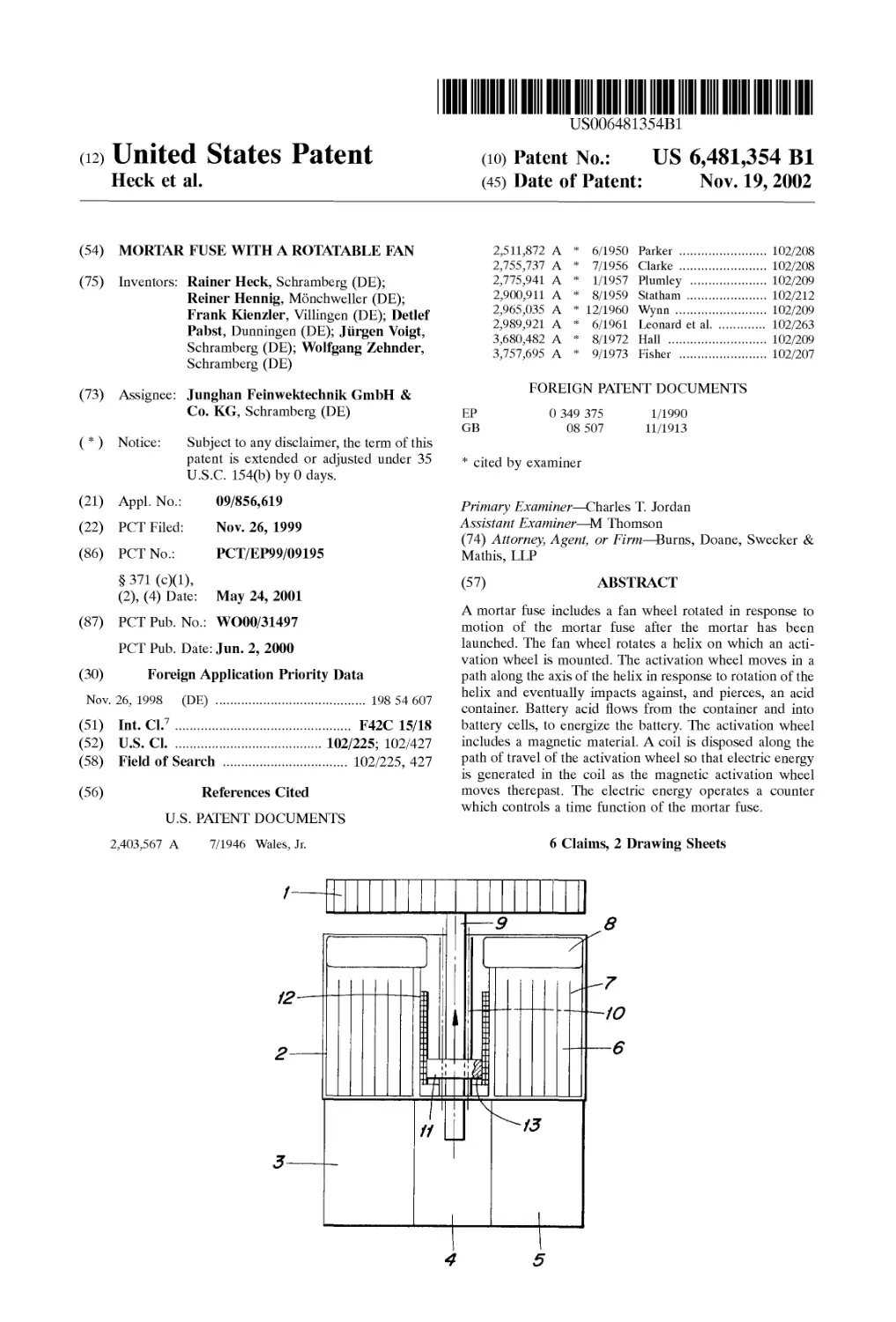
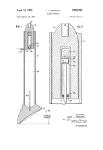
FIG. 1	shows a first embodiment of the invention,
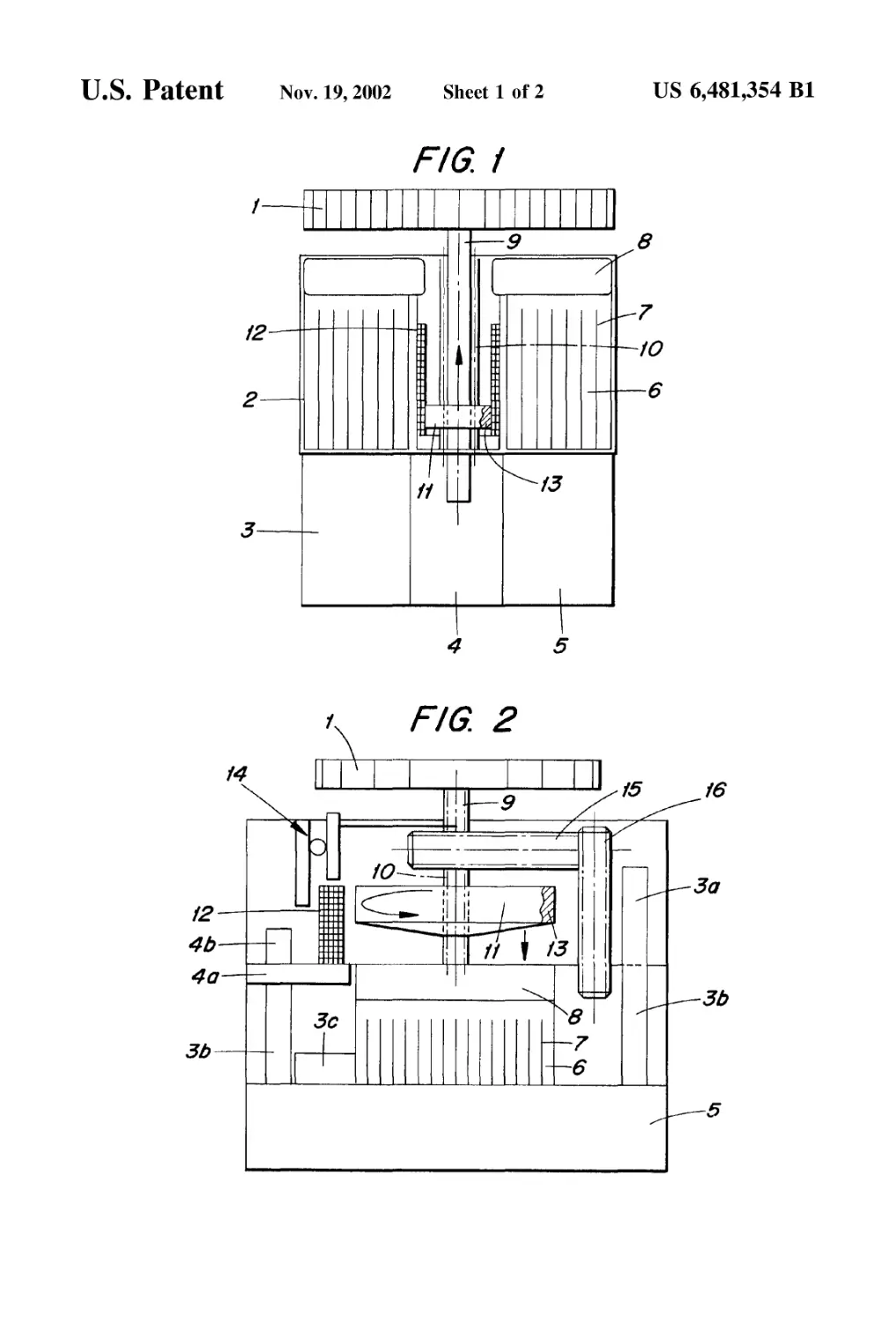
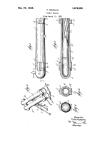
FIG. 2	shows a second embodiment of the invention, and
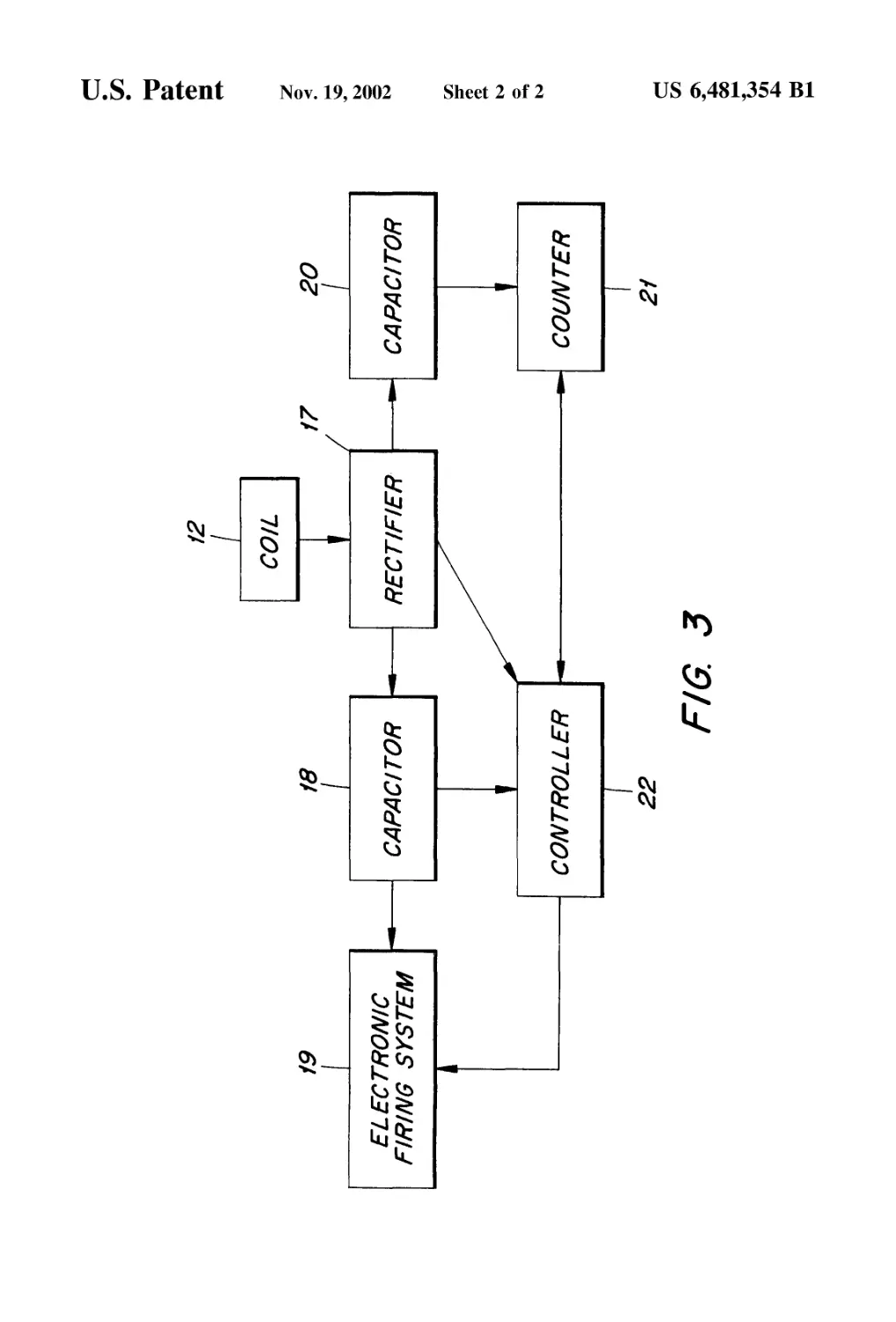
FIG. 3	shows a block circuit diagram of an emergency
power supply.
DETAILED DESCRIPTION OF PREFERRED
EMBODIMENTS OF THE INVENTION
FIG. 1 is a highly diagrammatic view of the component
units of a mortar fuse, which are essential in connection with
the invention. Reference 1 denotes a fan wheel, reference 2
a battery, reference 3 a safety device, reference 4 the
electronic system and reference 5 the fuse.
The battery 2 comprises a battery container 6 and battery
cells 7. No acid is contained in the battery container in the
rest condition of the fuse, that is to say in the condition of
not having been launched. The battery is therefore not yet
operational. Disposed above the battery container is an acid
container 8 which, in the activation situation, after launch, is
destroyed so that the acid can be emptied into the battery
container disposed therebeneath. The battery container and
the acid container are each of an annular configuration and
form a cylindrical space through which the shaft 9 of the fan
wheel passes. Provided on the shaft 9 is a spiral 10, i.e.,
helix, on which in turn a gear 11 can longitudinally slidably
move. When the fan wheel 1 rotates the gear 11 moves
upwardly along the spiral 10 and destroys the acid container
8.
Disposed in the cylindrical space of the battery container,
at the wall surfaces thereof, is an electric coil 12 which
cooperates with a magnetic coating 13 on the gear 11 and in
which, upon rotation of the gear, energy is generated for the
power supply for the fuse and an emergency power supply
if required.
The mode of operation of this arrangement is as follows.
Upon launch of the projectile carrying the mortar fuse, the
fan wheel which is disposed in the head of the fuse at the tip
of the projectile begins to rotate. At the same time the gear
11 rotates and with its magnet 13 generates in the coil 12
energy which activates the electronic firing system 4 of the
fuse and in particular the time counter thereof. The gear 11
moves upwardly along the spiral 10 and finally reaches the
inwardly projecting edge of the acid container 8. Due to the
pressure of such impingement the acid container is
destroyed and the content thereof pours into the battery
container 6. After a short time the battery is ready for
operation and from then on takes over the power supply for
the electronic fuse system 4. The gear 11 has left the region
of the coil 12 and is no longer producing any energy. For the
further power supply for the electronic fuse system, it is now
immaterial whether the speed of rotation of the fan wheel
decreases by virtue of the decreasing speed of the projectile
and the fact that the projectile has passed beyond the apogee
of its trajectory. The drive for the safety device by the fan
wheel is not the subject-matter of the invention and is not
described herein. The same applies for the arming of the fuse
by the electronic fuse system.
In FIG. 2, the same components as in the embodiment of
FIG. 1 are denoted by the same references. Reference 14
denotes a double pin which represents the primary safety
US 6,481,354 Bl
3
system of the fuse, which is released upon launch and which
thereby releases the fan wheel 1. That double pin arrange-
ment is a component which is conventional practice in fuses
and is not described in greater detail herein.
A worm gear 15 and a safety pin 16 serve for mechani-
cally releasing the safety device 3. The worm gear meshes
on the shaft 9 and cooperates with a spiral on a safety pin 16.
When the shaft 9 rotates, the safety pin 16 is unscrewed from
the safety device 3 by the worm gear 15, and the-safety
device 3 which has a mechanical detonator 3a and a firing
transmitter 3b is released into the armed position. A spring
3 serves for mechanical displacement of the safety device
into the armed position.
The electronic firing system 4 comprises a firing circuit 4a
and an electrical detonator 4b and is supplied with power by
the battery or the coil 12. The mode of operation of this
arrangement is very similar to that of the arrangement shown
in FIG. 1. After launch of the projectile the double pin 14 in
the head of the fuse is actuated and releases the fan wheel 1
for rotation. By way of the shaft 9 of the fan wheel 1, the
gear 11 with the magnet 13 is rotated and generates current
pulses in the coil 12. At the same time the gear 11 moves
longitudinally slidably downwardly by way of the spiral 10,
impinges against the acid container 8 and destroys same.
The content thereof pours into the battery container 6 and
activates the battery. The battery now takes over the power
supply for the firing circuit 4a and the electrical detonator
4b.
At the same time the worm gear 15 is rotated by the axis
9 and in turn rotates the safety pin 16 out of its rest position,
whereby the safety device 3 is released and urged into its
armed position by the spring 3c. The fuse is now fully
armed.
If the reliability of the mortar fuse is to be still further
improved, it is possible to provide an emergency power
supply as shown in FIG. 3, as a precaution against the
situation where the activatable battery or a fan wheel gen-
erator used fails. That emergency power supply is charged
up by the current pulses generated in the coil 12 by the
magnet 13 and stores the energy content thereof for the
duration of the flight of the projectile. Arranged downstream
of the coil 12 is a rectifier 17 to which are connected a first
supply capacitor 18 for the energy supply for the
downstream-connected electronic firing system 19 and a
second supply capacitor 20 with a downstream-arranged
time counter 21. A controller 22 serves to control the
electronic firing system 19 and the time counter 21. If the
speed of rotation of the fan wheel 1 and thus the output
voltage of the coil 12 fall below a predetermined threshold
value the controller 22 is switched off by way of the rectifier
17 and switches off the electronic firing system 19 and also
itself. The counter 21 which is in the form of a so-called
low-power counter manages with an extremely low level of
power consumption and is fed from the charged-up supply
capacitor 20. It is only when that time counter has reached
a predetermined count condition that it causes the controller
22 to be switched on again, which is now fed by way of the
supply capacitor 18, and likewise the electronic firing sys-
tem 19. The controller 22 is switched on again in that way
only shortly before target impact; the energy stored in the
supply capacitor 18 is sufficient for operation of the neces-
sary component units for the fuse to operate properly at the
target.
5
10
15
20
25
30
35
40
45
50
55
60
4
What is claimed is:
1.	A mortar fuse comprising:
a fan wheel adapted to be rotated in response to motion of
the mortar fuse, the fan wheel being connected to a
helix for rotating the helix about a center axis of the
helix;
an activation wheel mounted on the helix to be moved in
a path of travel along an axis of the helix from a first
position to a second position in response to rotation of
the fan wheel; the activation wheel including magnetic
material;
a deactive battery arranged to be activated in response to
the activation wheel attaining its second position; and
a coil arranged adjacent to the path of travel of the
activation wheel, wherein electric energy is generated
in the coil in response to movement of the activation
wheel therepast as the activation wheel moves along its
path of travel.
2.	The mortar fuse according to claim 1 wherein the
battery comprises a battery container having battery cells,
and an acid container arranged to be pierced in response to
the activation wheel attaining the second position, to enable
acid to flow from the acid container to the battery cells.
3.	The mortar fuse according to claim 1 further including
a safety device held in a locked state by a safety pin prior to
launching, the safety pin operably connected to the fan
wheel to be rotated thereby, and displaced out of locking
relationship with the safety device in response to being
displaced.
4.	The mortar fuse according to claim 1 further including
a counter for controlling a time function of the fuse, the time
counter being operably connected to the coil to be actuated
by the electrical energy generated in the coil by movement
of the activation wheel.
5.	The mortar fuse according to claim 4 further including
an emergency power supply, including at least one capacitor,
for actuating the time counter in the event of a failure of the
battery or the fan wheel.
6.	A mortar fuse comprising:
a fan wheel adapted to be rotated in response to motion of
the mortar fuse, the fan wheel being connected to a
helix for rotating the helix about a center axis of the
helix;
an activation wheel mounted on the helix to be moved in
a path of travel along the center axis thereof from a first
position to a second position response to rotation of the
fan wheel, the activation wheel including magnetic
material;
a deactive battery including battery cells and an acid
container arranged to transfer acid into the battery cells
to activate the battery in response to the acid container
being pierced, the acid container being positioned to be
pierced in response to the activation wheel attaining the
second position;
a coil arranged adjacent to the path of travel of the
activation wheel, wherein electrical energy is generated
in the coil in response to movement of the activation
wheel therepast as the activation wheel moves along its
path of travel; and
a counter for controlling a time function of the fuse, the
counter being operably connected to the coil to be
activated by the electrical energy generated in the coil
by movement of the activation wheel.