/


Tags: radio engineering operating instructions transceiver
Year: 1960



Text
                    INSTRUCT! О
and
OPERATING
N BOOK
MANUAL
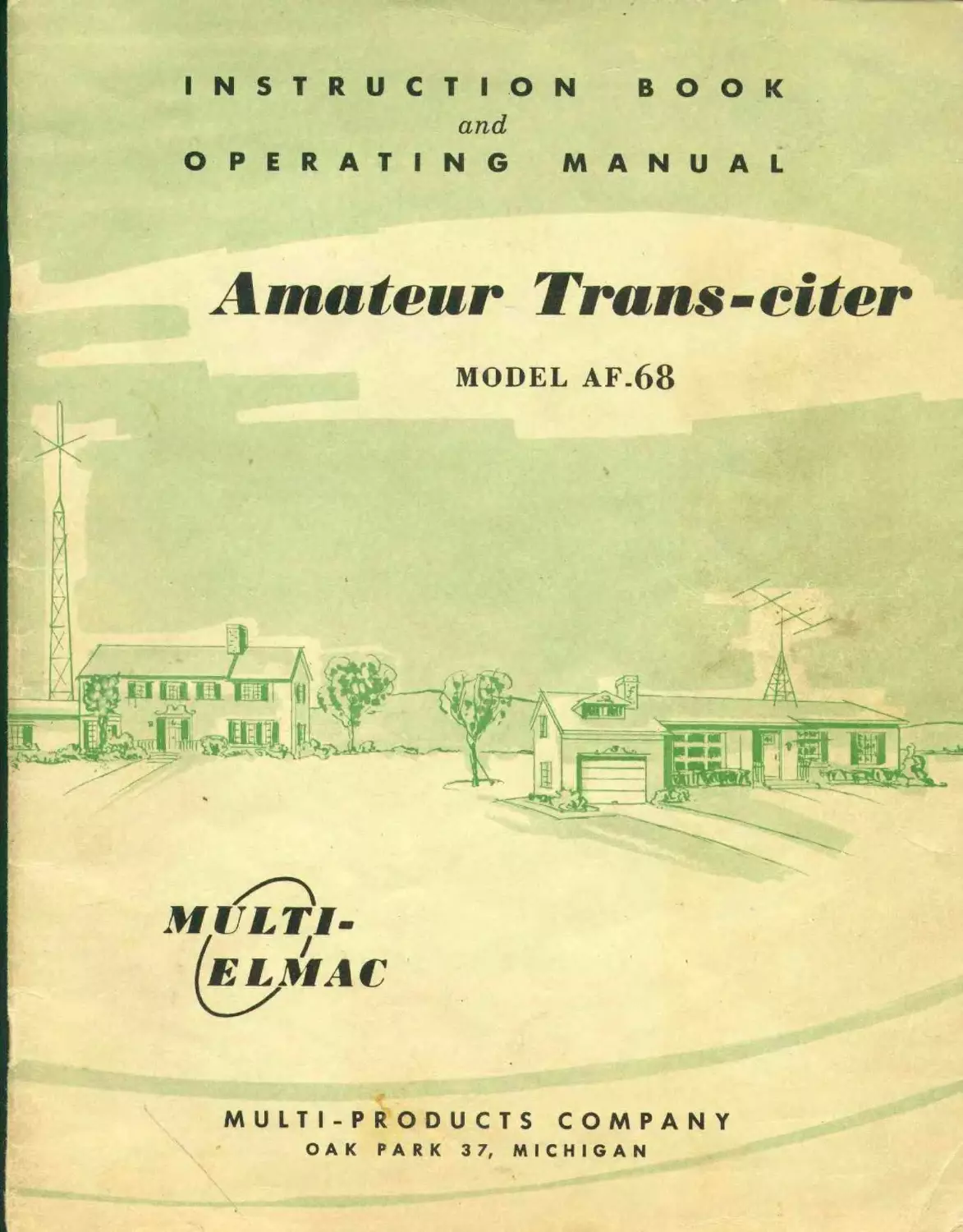
Amateur Trans-citer
MODEL AF.68
MULT I - PRОDи СTS COMPANY
OAK PARK 3 7, MICHIGAN
SAFETY NOTICE
Equipment is so designed that when all cavers are in place
there- is no shock liazard. Do not leave the equipment unattended
with any of the covers removed.
Maintenance aid operating personnel must al all limesob-
serve all safety precaut ions. Under certain conditions, dangerous
voltages may exist with the power turned off. due to capacitors
retaining a charge. To avoid casualties, always remove the power
and discharge or ground all circuits prior to touching them or
removing components.
Maintenance personnel should familiarize themselves with
the technique oi resuscitation tumid in any First Aid manual.
Amateur Trans-citer
mULTI PRODUCTS COfflPflny
MULTI-ELMA €
RADIO COMMUNICATIONS
AND CONTROL EQUIPMENT
21470 COOLIDGE HIGHWAY
OAK PARK 37, MICH.
Form No. M-l 58
instruction Hanual
FOR
MULTI-ELMAC TRANS-CITER-MODEL AF-68
SECTION 1 — Description
1.1	General.................................................. 3
1.2	Novice Class Operation................................... 3
1.3	Technician Class Operation............................... 3
1.4	Dimensions............................................... 3
1.5	Circuit Description...................................... 3
1.6	Frequency Coverage....................................... 3
1.7	Tube Complement.......................................... 4
1.8	Output .................................................. 4
1.9	Audio..................................................   4
1.10	Power Supply............................................. 4
1.11	Power Connector.......................................... 4
1.12	Accessories.............................................. 4
SECTION 2—Installation and Operation
2.1	General Considerations.................................... 5
2.2	Mounting Methods.......................................... 5
2.3	Antenna................................................... 5
2.4	T, V.l. Precautions....................................... 5
2.5	Power Supply Requirements................................. 5
2,6	Controls.................................................. 6
2.7	Power Supply Connections................................   6
2.8	Exciter................................................... 6
SECTION 3—Service and Alignment
3-1	General................................................... 7
3.2	Tubes..................................................... 7
3.3	Circuit Failures.......................................... 8
3.4	General Alignment	Instructions............................ 3
3.5	V. F.O, Alignment......................................... 8
3.G	Buffer-Driver Alignment................................... 9
3.7	Crystal Controlled	Operation.............................10
SECTION 4 — Appendix
1.1	Parts List................................................11
4.2	Resistor Graph............................................14
4.3	Operating Voltage	Chart...............................15
4.1	Control Layout...............................Drawing	No.	654
4.5	Chassis Layout...............................Drawing	No.	655
4.6	Typical Power Plug Connections...............Drawing	No.	219
4.6	a	Power Connections M1C70 Supply.............Drawing	No.	513
4.7	Schematic Wiring Diagram.....................Drawing	No.	656
Page 2
SECTION 1
description
1.1	GENERAL The MULTJ-ELMAC AF-68 Trar.R-c.lt.er Is a fl lube variable frequency or
crystal controlled six band transmitter nr exciter. All circuits are simultaneously
sw.telied to the desired band by a single bandRwttch control.
Designed ан a complete transmitter for mobile or fixed installations, or an exciter to
drive a higher power transmitter. When used ns an exciter the 500 ohm tap on modula-
tion transformer can be used to drive the higher power modulator.
1.2	NOVICE CLASS OPERATION. The AF-68 Trans-clrer is Ideally suited or novice
operation. With the two (2) crystal positions,, crystal controlled operation is afforded
and the power capabilities are within the legal limits required by novice regulations.
Provision lor CW keying is included.
1.3	TECHNICAN CLASS OPERATION. With the Inclusion ol the 6 meter band, a highly
Stable VTO and full carrier amplitude modulation, the A b-68 is ideally suited for the
Technician.
1.4	DIMENSIONS. The maximum external dimensions of rhe AF-68 Trans-citer, excluding
projections of control knobs, is 13-1/2 inches wide, 6-1/2 inches high, and 7-1/2 inches
deep behind panel. Approximate weight is 17 pounds.
1.5	CIRCUIT DESCRIPTION. 'iTie AF-68 Trans-citer employs a variable frequency oscil-
lator with output on either 3.5 to 4 Me., 7 to 7.5 Mr. or 12.5 to 13.5 Me. In addition to
the VFO feature, two crystal positions are included for operation on two spot frequencies.
Any crystal that will work straight through. double, triple or quadruple to the desired
frequency may be used. The oscillator circuit employs, a voltage regulator tube to main-
tain the plate voltage at a constant level.
The multiplier stages are broad tuned with a front panel control lor peaking the final
grid, insuring best performance on all bands. The audio Circuit is designed to use either
a carbon microphone or a low output microphone such as a crystal or dynamic. A slide
switch on the AF-68 Trans-citer sets up the circuit for use with either type ol micro-
phone. The variable frequency Oscillator dial and the meter scale is illuminated. The
variable frequency oscillator dial scale is directly calibrated in megacycles for each of
the amateur bands.
1.6 FREQUENCY COVERAGE.
80	Meter Band					3.5	lo	4	me.
40	Meter Band					7	lo	7.3	me.
20	Meter Band			14	to	14.35	me.
15	Meter Band					21	to	21.45	me.
10	Meter Band				2Я	to	29.7	me.
6	Meter Band				50	to	54	me.
American phone band segments are marked by a solid line on the VFO dial.
Pago 3
1.7	TUBE COMPLEMENT. The AF-68 Trans-citer is supplied complete with all rubes,
lusted in the individual unit. as follows:
6AK6 ....................................Oscillator
6AG5 ............................... Buffer-multiplier
6AQ5 .....................................R.F. Driver
6146	.............................Final R.F. Amplifier
6AU6 ....................................Speech amplifier
12AU7	..............................A.F. Driver
6L6GB	(2) .............................P.P. Modulators
#44	(2) .............................Pilot bulbs
#C6	.............................Meter pilot bulb
1.8	OUTPUT. The AF-68 Trans-citer Is designed fur use with a resonant antenna coupled
to its output with a transmission line of 50 to 3(10 ohms impedance. Other impedance
or balanced lines can be coupled through the use of an antCnr.a tuning device. When used
ns an exciter the coupling link o: the high powered final can be directly connected to the
AF-68 with a suitable length of coaxial cable. The MULTI-ELMAC AF-68 is designed for
a maximum plate power input of 60 (sixty) watts. Maximum ratings for this Trans-citer
are 600 volts at 100 milliamperes; or 500 volts at 120 milliamperes. Full 100% modula-
tion occurs when the modulator plate current swings to about 60% of the final plate cur-
rent with normal voice frequencies.
1.9	AUDIO. The modulation transformer is provided with a 500 ohm output tap brought to
the power plug for driving the grids of high powered modulators. The CL'SGB’s will de-
liver approximately 35 watts cf audio with a plate supply of 500 volts.
1.10	POWER SUPPLY. The AF-G8 Trans-citer was intentionally designed tu use an external
power supply in order to permit (a) use ul FMR-7 receiver power supply to supply the
low level stages, (b) use of the AF-68 Trans-citer with an AC operated power supply at
a fixed or portable location, (c) use of a dynamotor or vibrator supply in mobile installa-
tions, or (d) use of thv Trans-citer as a driver-exciter for high powered transmitters.
A suitable MULTI-ELMAC power Supply MODEL PS-2V or M1070, M1071 fur portable
or fixed station operation from 115 volt AC lines is available.
1.11	POWER CONNECTOR. A 15 prong female connector is provided with each unit.
The 1 5 prong connector allows all circuits to be arranged for maximum flexibility, mak-
ing It ixissiblo lo use the AF-68 Trans-citer in various types of installations.
1.12	ACCESSORIES. The following accessories are available for use with the AF-68
Trans-citer:
PS-2V-- A universal 115 volt AC supply. (Supplies 6 or 12 volts for filaments and
two separate high voltages.)
M107U—A universal 6 ur 12 volt DC and 115 volt AC power supply. (Supplies fila-
ment voltage, one low voltage regulated source and two separate high
voltages.)
М1071 -Same as M1070 but sold in kit form.
CfS-1 - Cable with a 15 prong female connector and fanning strip to connect the
AF-68 to the PS-2V power supply.
NOTE: Due to different requirements, for individual installations, no cable for
the M107U (or M1071) power supply is available from the factory.
Page 4
SECTION 2
installation and Operation
2.1	GENERAL CONSIDERATIONS. No two installations being similar, the individual
owner (if the AF-68 Trans-citer will vary his installation according to space and opera-
ting practices. Regardless of these variations whenever the Trans-citer is installed in
a mobile unit, there are two essentials that must be observed for proper installation:
(1) convenient location for operation, including ease of observation; (2) rigid mechan-
ical mounting. The owner desiring to use the AF-68 as an exciter for higher powered
equipment will have his own methods, etc. The usual standard practices for fixed or
portable Installations will suffice.
2.2	MOUNTING METHODS. The construction of the cabinet of the AF-68 Trans-citer
is such that it is readily adaptabletoa hanging mount from the lower edge of the car dash
beard: or a fixed bottom bracket tu the floor of the car. A brace to the fire wall will help
make a more rigid Installation. The AF-68 cabinet is equipped with felt feet for desk-cop
mounting in fixed or portable installations.
2.3	ANTENNA. The MULTI-ELMAC AF-68 Trans-citer will perform most efficiently
when coupled to an antenna resonated to the desired operating frequency. Standard
practices should he used for antenna relay control. Typical mobile circuits are shown
on drawing #219, page 21, uf this manual. The coaxial output connector serves as an
output terminal for the transmission line. Coaxial connectors allow the Installation of
low-pass filters between the Trans-citer and the antenna or antenna tuners. The type of
antenna depends upon the individual's preference. The following types of antennas can
be directly fed from the AF-68 without an antenna tuner:
Center fed half-wave dipole
Folded half-wave dipole
Parasitic beams
Vertical quarter-wave ground plane
Base or center-loaded mobile whips
Vertical half-wave dipoles, center fed
Any antenna fed with low impedance untuned line.
Refer co the various handbooks on operating other types of antennas such as long wires,
zepp fed, off center fed, lazy H, sterba curtains, phased arrays and the like.
2.4	T.V.I. PRECAUTIONS. The MULTI-ELMAC Trans-citer s circuitry is such Chat
harmonics falling in the TV channels are at a minimum. The power plug leads are by-
passed and other critical circuits designed for maximum harmonic, attenuation. Under
normal operating conditions the usual low-pass filter in the antenna transmission line,
a brute-force filter in the AC power line, and a good efficient ground to the Trans-citer
cabinet Is sufficient to maintain a harmonic attenuation of 10f) rib down. Adequate shield-
ing cf stages and a L-omplelely shielded variable frequency osctllarer makes this possible.
2.5	POWER SUPPLY REQUIREMENTS. For maximum flexibility the AF-68 Trans-citer
power input Is arranged for one or two* separate high voltage supplies. Filament input
is arranged for either 6 volts @ 5.2 amp. or 12 volts @2.6 amp. AC or DC. (Refer lo
Drawing #219, page 21, for proper connections.) Plate supply required: 599 volts max.
gl60 ma. an<| 25(1 volts max. @75 ma.
*Лпу Single high voltage supply may he used with a dropping
resistor as determined from the graph on page 14 of this
manual. Any supply delivering 350 to 500 volts @235 ma.
plus the proper filament voltage u.ill suffice.
Page 5
For mobile operation the power supply of the PMR-7 receiver may be used for the 250
volt supply and the usual dynamotor for the higher voltage supply. By using the receiver
power supply for the low level stages the drain on the dynamotor is minimized resulting
in more efficient dynamotor operation. More high voltage at a lower battery drain will
be realized. Refer to drawing U219, page 21, for typical circuits.
2.6	CONTROLS. Sufficient controls have been incorporated fcr maximum flexibility, at
the same time keeping operation simple. (See drawing #654. page 17.)
Bandswitch.................Switches all circuits to the desired amateur band
simultaneously.
Meter switch...............AG position meter function switch.
1.	Final grid current, Final off.
2.	Final grid current, Final on.
3.	Final plate voltage, Final on.
4.	Nat used. Final on.
5.	Modulator plate current. Final on.
6.	Final place current, Final on.
Load control...............Controls final load lo antenna.
Plate tuning...............Resonates final tank circuit.
Grid tuning................Tunes final grid.
Power •‘on-off" switch. . . Turns filaments on or off in a mobile installation,
also controls primary power in an AC installation.
VFO switch.................Connects VFO to receiver power supply for zero
heating a carrier.
Mike Jack . ...............Microphone and push-to-talk circuit connections.
Key jack...................Key connections for CW operation.
Crystal socket.............Will hold two crystals in FT 243 holders (located
behind the meter).
VЮ-Crystal switch .... Selects either variable frequency operation or oper-
ation from either of the two crystals inserted in the
socket above.
VFO control................Variable frequency oscillator frequency Control.
Reads directly in megacycles.
A.F. Gain control..........Controls per-centage of modulation.
AM-CW switch...............Selects either amplitude modulation or Al emission.
HI-Z or Carbon slide
switch...................(On left side of chassis below meter.) High position
for crystal or dynamic microphone, low for carbon
microphone.
2.7 POWER SUPPLY CONNECTIONS. A 15 prong plug is used for ail connections and
various possible combinations are diagramed in drawing #219.
2.8 EXCITER. Drawing below shows a method of using the AF-68 Trans-citer as an A.F.
and K.F. driver lo excite a high power amplifier and modulator. Fur power plug con-
nections see drawing Ko. 219, figure 5.
ANY FINAL REQU RINO UP TO
30 WATTS OF DRIVE
ANY MODULATOR REQUIRING UP TO
30 WATTS OF DRIVE
Page 6
SECTION 3
Service and cdliynment
3.1 GENERAL. Satisfactory operation of this Trans-citer depends on several factors.
Before removing a transmitter which is performing In an unsatisfactory manner, care-
fully inspect antenna connection, power cables and plugs, the storage battery and its
connections (if a vehicular installation), the AC power source (if operated at a fixed loca-
tion), and the microphone and relay connections. It is an aggravating waste of time and
effort to remove and attempt to service a transmitter when the trouble is ал external one.
(a) ANTENNA. If the Trans-citer is functioning properly but does not load, look
for a broken antenna lead, bad relay contacts or inoperative relay, shorted
transmission line or antenna Insulator.
(bj LOADING. If a dip in the plate current merer cannot be obtained after sev-
eral rotations of the plate tunning condenser, with the load control set near
minimum, turn the transmitter off and check for an Improper output load as
outlined under Antenna.
(c)	STORAGE BATTERY. Check periodically the terminal voltage, specific
gravity, level of electrolyte, ainl the lightness of connections. Check the
battery voltage at the Trans-citer power plug with Che Тгапв-clter operating
and drawing full load.
(d)	CADLES AND PLUGS. The initial installation should locate all cables and
plugs where they will not be exposed to physical shock or subjected to twist-
ing and bending.
(e)	TRANSMITTER TESTING. A quick method for checking the transmitter
performance is to substitute a 50 watt lamp for the antenna. After the lamp
has been connected to the transmitter, either direct or thru the relay, adjust
the loading and final controls until the lamp is two llilrds normal brilliance.
With the audio gain control sei normally the bulb s luuld double in brilliance
on modulation peaks.
If the lamp loads the transmitter, as outlined above, but the antenna will not
load the transmitter it Indicates the antenna is not resonate to the frequency
of operation or die feedline impedance Is incorrect.
NOTE: Never load the AF-68 Trans-citer beyond the point where a dip Is no longer
indicated by resonance tn the final plate current meter. When loading to maxi-
mum, adjust the loading control so dial approximately a 10% clip can be obtained
when the final tuning condenser is rotated through resonance with the
load connected.
3.2	TUBES. Even though modern methods produce more reliable tubes than ever, the first
source of trouble is likely to be a defective tube. Tube failure will produce low grid
drive, low plate current, intermittent operation, or a completely dead transmitter.
Where a tube change is made tn the R. F. portion of the Trans-citer it should be replaced
with the same make of tube. If this is not possible the circuits may have to be realigned
according to paragraphs 3.5 and 3.6 of this section.
Page 7
3.3	CIRCUIT FAILURES. Excluding tubes, the most common source of circuit failure, will
invariably bo found in the many resistors and capacitors within the Trans-citer. A
defective resistor or condenser can usually be found by a point-to-point continuity test,
although a careful visual inspection will often show the defective part, such as a charred
resistor. The operating voltage chart on page 15 permits a careful check of operating
elements. All measurements are taken with the final plate Off, hands witch in the 80
meter position, Vf’O set to 3.3 megacycles, final grid current resonated for maximum
grid current, crystal-VFO switch in VFO position, and audio gain control on minimum.
A 20.000 ohms pur volt meter is used. (DO NOT use a vacuum tube voltmeter since it
will read erroneously in an ILF. field.) These measurements were taken using a PS-2V
or the Ml070 power supply and a line voltage of 117 volts A.C. Any power Supply can
be used that will give the same high voltage.
3.4	GENERAL ALIGNMENT INSTRUCTIONS. Thoroughly lamiliarize yourself with t ie
layout of all coils and tuning adjustments as shown on drawing ’бай, page 19, before be-
ginning an alignment. Check all brass slug adjusting screws to make Sure that they are
not worn so much that they will not hold their selling. If they are too worn to be service-
able they must be replaced.
Check the pointer to sec that it is aligned properly with respect to the stops on the VFO
dial.
You will need an accurate receiver and an accurate signal generator and/or crystals to
spot the amateur band edges.
An alignment job can never be any better than the equipment with which the Trans-citer
was aligned.
3.5	VARIABLE FREQUENCY OSCILLATOR ALIGNMENT.
NOTE: Before the oscillator section is aligned the cover plate must be in position and
the retaining screws inserted and tightened.
Turn the meter switch lo the left “<j" position, final off.
Sul bandswitch to the 80 meter position.
Set VFO-crystal switch to the VFO position.
Set the VFO dial to 3.5 megacycles.
Set signal generator at 3.5 megacycles, tune receiver to 3.5 megacycles.
Apply plate power to VFO.
Adjust screw nl until a beat is obtained al 3.5 Me.
Set the VFO dial to 4.0 megacycles.
Set signal generator and receiver to 4.0 megacycles.
Adjust trimmer #2 for a beat at 4.0 megacycles.
Readjust at 3.5 megacycles, then again at 4.0 megacycles.
It may take several excursions between 3.5 and 4.0 megacycles before a good alignment
is achieved.
Sot the bandswitch to the 10 meter position.
Set the VFO dial to 29 megacycles.
Set thu signal generator and receiver tc 29 megacycles.
Adjust screw t*3 until a beat is obtained al 29 megacycles.
The remainder of the 10 meter band shuuld be correct.
Page 8
Sot the bandswitch to the 15 meter band.
Set the VFO dial to 21.45 megacycles.
Set the signal generator and receiver to 21.45 megacycles.
Adjust trimmer 44 for a beat at 21.45 megacycles.
The remainder of the 15 meter band should be correct.
The 40 and 20 meter bands will be correct after the 15 meter band is aligned.
Set the bandswitch to the 6 meter band.
Set the VFO dial to 51 megacycles.
Set the signal generator and receiver to 51 megacycles.
Adjust screw d5 for a beat at 51 megacycles.
The remainder of the 6 meter band should be correct.
3.6 BUFFER-DRIVER ALIGNMENT.
Alignment must be followed in the sequence as outlined below.
NOTE: Before aligning the buffer-driver section a bare metal plate should be inserted
under the open side of the chassis. This will give the same effective capacity
and shielding as the cabinet.
Set the bandswitch to the 10 meter position.
Set the VFO dial to 28.5 megacycles.
Set the final grid tuning condenser at about the half capacity position.
Adjust screw *6 and 47 for maximum grid drive as shown on the meter.
Set the bandswitch to the 15 meter position.
Sot tho VFO dial to 21.3 megacycles.
Set the final grid tuning condenser at about the half capacity position.
Adjust screw 48 and 40 for maximum grid drive as shown on the meter.
Set the bandswitch to the 20 meter position.
Set the VFO dial to 14.2 megacycles.
Set the final grid tuning condenser at about the half capacity position.
Adjust screw 410 for maximum grid drive as shown on the meter.
Set the bandswitch to the 40 meter position.
Set the VFO dial to 7.2 megacycles.
Set the final grid tuning condenser at about the half capacity position.
Adjust screw 411 for maximum grid drive shown on the motor.
Set the bandswitch to the 80 meter position.
Set the VFO dial to 3.75 megacycles.
Set the final grid tuning condenser at about the half capacity position.
Adjust screw 412 for maximum grid drive shown on the meter.
Set the bandswitch to the G meter position.
Set the VFO dial to 51 megacycles.
Set the final grid tuning condenser at about the half capacity position.
Adjust screw 413 and #14 for maximum grid drive on the meter (adjustments 413 and
414 should peak with the screws extending about 1/2”).
NOTE: When tuning the buffer and driver slugs it is well to use a grid dip meter or
wave meter to make sure all the coils are tuned to '.he proper bands or
harmonics.
Page 9
Alternate method of aligning the fi meter buffer-doubler.
Set the bandswitch to the 6 merer position.
Set the VFO dial lu 51 megacycles.
Rotate the final grid tuning condenser for maximum grid drive on ths meter. (Maxi-
mum drive should occur ahont mid-posit ion of the final grid tuning condenser. If not,
chuck L3€ the air form four (4) turn coil mounted under the chassis near .he band-
switch. Spacing between turns should be approximately 1/16 inch.I
Alternately rotate the final grid tuning condenser and adjust screw 413 and #14 for max-
imum nutput as indicated on the merer. (Screw #13 and #14 should peak when extend-
ing about 1/2 inch.)
3.7 CRYSTAL CONTROLLED OPERATION. When operating in lht> crystal controlled
position the doubling, tripling or quadrupling is accomplished in thu plate circuits of t.hc-
6AG5 and GAQ5 stages. The following chart gives the recommended crystal frequencies
for operation within each of rhe six (b) amateur bands covered by the AF-68 Trans-citer.
Band
80	1.7$ to 2	me.	or	3.5	to 4	me.
40	3,5 to 3.65	me.	or	7	to 7.3	me.
20	8.5 lu 3.587	me.	or	7	to 7.175	me.
15	7 lu 7.15	me.
10	/ to 7.425	me.
6	*12.5 to 13.5	me.	or	8.5	to 9	me.
NOTE: *12.5 lo 13.5 me. crystals arc recommended
fur 6 meter crystal controlled operation.
NOTE: It is a good policy not lu operate con close to the band edges. Since some crys-
tals do deviate slightly from the marked frequency il is wise to choose a crystal
Within 2 or 3 kilocycles of the band edge.
Page 10
SECTION 4
cdppendix
4.1 PARTS	LIST.
Rll	47K	uhms	1 watt	10%
R12	47K	ohms	1 watt	10%
R13	1000	duns	1 watt	10%
R14	22K	ohms	1 watt	10%
R21	33K	ohms	1 watt	10%.
R22	180	ohms	1 watt	10%
R23	47K	ohms	1 watt	10%
R24	680	ohms	1/2 watt.	10%
R25	270	ohms	1/2 watt	10%
R26	68	oiuns	1/2 watt	10%
R27	180	ohms	1 watt	10%
R31	100K	ohms	1 watt	10%
R32	180	oiuns	1 watt	10%
R41	27 К	ohms	1 watt	10%
R42	270	ohms	1/2 watt	5%
R43	25K	ohms	10 watt	ww
R44	1000	ohms	1/2 watt	5%
R45	6.8	ohms	1 watt	5%
R51	7500	ohms	10 watt	WW
JR61	47 OK	ohms	1/2 wart	10%
R62	1 meg	ohms	1/2 watt	10%
R63	47 К	oiuns	2 watt.	10%
R64	1000	duns	1 watt	10%
R65	47 OK	oiuns	1/2 watt.	10%
R66	270	duns	1/2 watt	10%
R67	2200	duns	1/2 wart	10%
R68	22K	ohms	1/2 watt	10%
R71	500K	ohms	potentiometer
R72	680	ohms	1/2 wail	10%
R69	6.8	ohms	1 watt	5%
RSO	750K	ohms	2 watt	5%
C11A 1
CUB > VFO tuning condenser. Pan 4196-3
CMC/
C12	27mmf.	N750 2-1/2% tubular ceramic
C13	75mmi.	variable. Part 4CT113075
C14	33mmf.	NPO 2-1/2% tubular ceramic
C15	35mmf.	variable, part 4CT1BO35
C16	75mmf.	NPO 2-1/2% tubular ceramic
C17	.001 mid.	500 volt mica
C18	. 005mfd.	disc ceramic
C19	. 005mfd.	disc ceramic
C20	.01 mfd.	disc ceramic
C21	120mmf.	NPO	10% tubular ceramic
C22	. 005mfd.	disc ceramic
C23	. OOSmfd.	disc ceramic
C24	. 005mfd.	disc ceramic
C25	1.5m ml'.	tubular ceramic	10%
Page 11
C31	lOOmmf.	diac ceramic
С 32 Al
C32BJ	Dual 25mmf. variable. Part *196-2
СЗЗ	. OOSmfd.	disc ceramic
С 34	. 005mfd.	disc ceramic
С35	.01 mfd.	disc ceramic
СЗб	.01 mfd.	diSC ceramic
С41	lOOmmf.	silver mica
С42	. 005mfd.	disc ceramic
С43	. 005mfd.	disc ceramic
С44	.001 mfd.	1600 volt disc ceramic
С45	. 005mfd.	disc ceramic
С46	. 0047mfd.	1500 vult diac ceramic
С47	.001 mfd.	1600 vult diac ceramic
C48AI С48В |	Dual 140mmf. variable. Part AMC912A
С49А1 С49В 1	' Dual 485m nil. variable. Pari *196 1
С51	. 1 mfd.	400 volt tubular paper
С 52	.00b mid.	disc ceramic
053	. OUbmfd.	disc ceramic
С54	. OObmfd.	disc ceramic
С55	.001 mfd.	disc ceramic
С56	. O05mfd.	disc ceramic
С 57	.01 mfd.	disc ceramic
С5Й	.01 mfd.	disc ceramic
С61	8 mfd.	450 volt electrolytic
С 52	. 005mfd.	disc ceramic
С 53	2b0mmf.	tubular ceramic
С 54	10 mfd.	50 volt electrolytic
CG5	. 002mfd.	disc ceramic
С 66	.03 mfd.	409 volt tubular
С67	. OObmfd.	disc ceramic
С71	25О1П rut.	GP tubular ceramic
С72	10 mfd.	50 volt electrolytic
LU	Oscillator coil	Part *179
L12	Oscillator coil	Part *180
L13	Oscillator coil	Part *634
LI 4	2-1/2MH. RF Choke	(125 ma.)
1.15	Oscillator plate coil	Part *B40 less iron core
L16	Oscillator plate coil	Part 4B6
L21	Buffer plate coll	Part MG80 loss iron core
L22	Buffer plate coil	Part *G40
L23	Buffer plate coll	Part VD20
L24	Buffer plate coll	Part *G6
L31	Driver plate coil	Part *G80
L32	Driver plate coil	Part YG40
L33	Driver plate coil	Part VG20
L34	Driver plate coil	Part *G15
L35	Driver plate coil	Part #G10
L36	Driver plale coil	Part #D6
1.41	2-1/2 MH. KF Choke	(125 ma.i
1.42	.47 Microhenry RF Choke
L43	2-1/2 MH. HF Choke	(125 ma.)
L44	2-1/2 MH. RF Choke	(250 ma. ,i
L45	30 meter plate coil	Part *635
L46	40 AL 20 meter plate coil	Part *184
Page 12
1.47	15 & 10 meter plate coil Part #185
1.48	6 meter plate coll	Part #638
T1	Class AB2 driver transformer	Part V121A7
T2	Modulation transformer	Part V121A8
SWUA |
SW11B I swuc i SW11D 1	VFO section of bandawitch	Pari #623
SW12A ) SW12B SW12C I	 VFO-CRYSTAL selector switch Part #176
SW211 SW31 ’	Buffer driver bandswitch	Part #624
SW41A ’ SW41B | SW41C >	 Final plate handswitch	Part #622
SW42A ' SW42B ] SW42C J	Meter switch and final on-off switch Part #178
SW81A1 SWB1B1	• AM-CW switch	Part #631
SW51 SW52 SW61	VFO spotting Switch	S. P. S. T. Toggle switch Power on-off switch	S. P.S.T, Toggle switch Carbon-crystal microphone switch	S.P.S.T. slide switch
Bl	22 -1/2 volt “BM battery. Burgess #U15
PL1) PL2f	#44 pilot bulbs (Do not use any other number)
PL3	#C6 switchboard type pilot bulb (Sylvania)
M	0 to 1 milliampere meter
VI V2 V3 V4 V5 V6 V7 V8 V9 JI J2 J3	6AK6 Oscillator tube 6AG5 Buffer-multiplier tube GAQ5 R. F. driver lube (use Tung-Sol GAQ5 tube only for best results) 6146 R. F. final amplifier tube OB2 Voltage Regulator Tube 6AU6 Speech amplifier lube 12AU7 A.F. driver tube 6L6GB Modulator tube 61.6GB Modulator tube Antenna coax connector Amphenol #831R Two conductor closed circuit jack Three conductor open circuit jack
Plastic dial escutcheon	Part	<‘643
Cabinet	Part	«‘G42-C
Front panel	Part	#642
Bevel gears	Part	#615
Pull handle (2)	Part	#158
Page 13
4.2 RESISTOR GRAPH
HIGH VOLTAGE UNDER LOAD
J*	CHART for determining the value of resistor ‘!R” on drawing
!2	4219, figure 3, when using a single high voltage supply for the AF-68.
The recommended wattage rating of this resistor is shown at the ex-
treme left above. Be sure to use the actual voltage supplied by die
power supply under load when using the chart above.
DRWG, NO. 653
4.3 OPERATING VOLTAGE CHART.
Cl 4fc<f
PIN NO. TUBE NO.	1	2	3	4	5	5	7	8	У
v9	Buffer vz	GAG5	-3»	1.5	zero (12. 8)”	6.3*»	200	145	1.5	—	--
v-	Driver Vd	GAQ5	-7*	5.7	8.3”	zero	225	230	zero	r-	—
V4	Final G14G	1	zero (12. 6)”	Note 1	1	—	1	6.3”	zero	—
v-	Hegulator VD	OB2	105	zero	--	zero	105	--	zero	--
vft	Speech V6	6AU6	zero	zero	6.3*x	zero	25	40	1.2	--	--
v- Audio Driver v 1	12AU7	220	zero	a	zero	zero (12.6)”	220	zero	8	5.3”
vft Modulator V0	eL8GB	zero	zero (12. 6)“*	Note 1	225	-22.5	--	5.3”	zero
V<J	Modulator **	GLGGB	zero	zero	Note I	225	-22.5	--	5.3’*	zero
This Chart serves only as a guide, Individual nets may
vary from these readings.
All measurements made with a 20,000 ohms per volt volt-
meter. using a PS-2V or M107U power supply or equiva-
lent. Bar.dswitch in the 80 meter position. V HO dial set
at 3.8 megacycles, audio gain control set at minimum,
VFO-CRYSTAL switch set in the VFO position, meter
switch set to the first :‘G” (plate off) position, final grid
tuning condenser resonated for maximum grid current,
and the AM-CW switch set tn the AM position.
Note 1—These readings depend upon final plate supply
voltage.
* These measurements taken with a 100,000 ohm, 1 watt
carbon resistor on the end nf the negative voltmeter
prCbe.
Either AC or DC. Numbers tn brackets are in effect
when connected for 12 volt operation.

,HI»3vyiw
hi ,u>ni:i ыпитиз.о зо лолязг-чн Ли
siivouh пи к>|1мх> =л;я измял *
d31S
SCHISOU (0) iittJ 3H1 Cl Н311ЛМ I3L3W :H.
IVlII rfl-wav.* > IINM C.*l lilOiV .«Oil* CN* SiN'MHH NO №111
SNOIXOnUlSNI ONIlVaSdO
XOVI JJD>
ютг WOtMOlXW
wnrsi xo sv -j
i.i ип/а > оли v sis-i
“VOW »0 ?z i«ul woirvw
SV HXlS SCI.’ JNCWI 1ПЗЮ 1-ИЩ V $3$n
'uiuui jtv -oi-wfiM «4.	oh*
33J.4S3N*! 31 V. СЭ«1йКЗ 0N*4 13Г38
»zi-2i ЗЛ1ЭС eno ifltoai аоз тошчОз omn-i oiao i$rrcv оьу niw.s
111* - VS3I:> n': 4J0 ld.01?? A ill к-0 sCUftl ИЫ-О1-1 if.l HU J v; I -0
NOI1VTIOO*\ -<o:i tCd 3-Т/Л r-Mf Z 31V'd 3i ЗП:Л-.- -ft-llld
ll.'AS I Ifl-JH' H IrflOWM lOlV-nOS^ •NOireVtoOA'1 О -.О* 1Г I--41.J
3Mi зэнчч» .noli 141..1 mi м a;i*.x>'i южко:; ч v-i т» ?-i
43I-.Z' aNWlrio soivincd'i Я03Н0 3N* idfliSCd O1 HZ1W.S SHiW 1=9
•Na 1У133О ‘оч‘л
< sm г пи иаз: -ota »o iv.wfo oiiisac nouvqio зо 3ixi ют-:
<u) iNooi- nu s over iscsri oixoji-:- « «i*cn сгон! .мзмзо c »s>
mv. м; л :tj.iu',:i>3 4nl i* I'ivk:’>«-i j. л-'ач vnkHInv M on '13=1
3rl 01 t3JIA"K *1. 1H1 CVO1 .-.NV NOIllSOd >Г. Cl	4:4‘‘ 1:5
1 101a 3 11 01 10- .vs OS 11G1S ‘O’3V. 3H din 1C?W 51
*i=.io о 4$1лл n:>A zoni",:>i:j ioi.v no 1»N£>IS : 11 mt.v axivlio .1
>3 OTA МП. UN* KOI15IX 331 1H QI Н>ИЛ»Л QS ICMS ,У17- UH
e'z's
d31S
ЗОШНОЗ О ГЛ
л1<Я1- 9 31.4:031 3111 <M <D.:.SM»
39 NO ЮН». "JIM dl.v/U: :IU HU .Г N.I
01 <3V51 Olid 1 О. Л Jul 4. UMUXl SM
HOlUSOl 1111 UU 01 111.HAS SIU .14
IV'l-JB V 1VJUOI3Z 'J. U.-dSIC II I ‘М4.-Л
НЭ11М5 tlMlllCMS OTA
Я1>ОИ>:«№ A»-HCaai <I-1IS«) Ol Via 'Q’t’A x3S *»»
.V.-. ЧП W ’ОЭЙНЮ sCUf.I.-.'l 30 Od.U 1ЭГ.К 'V.
INna-o nva t: iiwhv Ivmi javixi.r >1$
IHWfD 51VM IClVi'MC.'A ftJvSi IW- зли
1С35П 1ONI 11ХЯ
зоунол i-via iv.mj aizja >?: .run
ЧС1 IHMl.MV TvNH 34 __
him 1ниип> оно i*-d. !oyin ‘O' o*j
•SHCUSCd Ю.1Л« 1:13л 13310 ITT
HI 40 51 Tf№- HO tadlinv *Ns ___
-11л«. irsitro а»э 1*41 icvia <o ;мэ
______________	‘«NO U«X1 ЮЧ
MIHMS вши
2
dTIs
I N I 3-1 ЭТ15Ы ISOOS 3H1
C HI 03 Я5Н1 SIVUAIC 0/Л1 30 dlMla
30 ЧУГЛ M 11113 33. ¥*01. <»1Vi;jO
13 nv> taio iu-cd. oz-г.- Ovwu jj.
ЮИЛ\Т ИО1Э1ТК 1VKAX0 • O1A
IIIIIIMIIIIIII
>u fillo* «w o
91ZHMV.IAV 11V -o
;jai.r,v»rir«
4=1*35 155Ц1 5ХЧ
auav
llllllllllllllllllll
нои-.аЗ:С y.Z ас- w
ю «итзиз июи.-лг
ЛЛ. CAIN CONTROL
CO4TMXS =E4 CEMTAGE OF .40CU.AT CM
W-B< USING AV.
СЗДП21Х Л.Г. GAIN SsWFN USING THE
tLUAC А- «Й TVN5 CITER AS A SPEECH
AVAITI EXCITER FOI A KOHS ГС'ЛЕЙ
WNS.-ATTER.
LOAD CONTROL
КАП IUNING CONTROt
THE!.: nvo CCWTIC1S ARE A.V.ATE
4btj iGCei*t№
HW W1 н ni' lOAD ССМТЙО1 Etl AT
•RJNIWA4 JCOIIHTTR acCKWItii RisCMAir
ЧАГ: IU4NU ИМГОСЛ WETER S-VlTf.i-
14 'OST CM P' №R TUNE 'OR ЮЛИ
P.ATE CLMENTI
кеч iu<n iwc cctiTOOt acocwisi
S.6-A I- 1НП P ATE СММЕ'Л READS
tf'WWMTV IK- TC IX MUl*A»r₽«
АСАМ EE5CE4A1! RUT TUNING COeFICE.
f IHE -Uir CURENT DICRS 8E10W ТКГ
OESREC HATT О№чТ INCKASE -I
bHIINft or TIT 1040 CCN7B01.
Al WAV» IESOHAT' МА1Г t\NNG СОМПС1
АГГЕЙ EOAD CONTICX UM 0Ю' CHAN0B5.
ЛИА1 GRID TUNING
ADMT rqi »ГО₽(Й 'MAE GID CEMENT.
TUA TO П AU.I
BANDS VllTCH
S*/lTl>tS Al. CltCJJtlS IO IHt uisrh:
EaaO swjiUneojsiv
POWfR ON OFF SWITCH
004UCU пишите t»> c.e srmatw>
wrto.s TIE NA к A.C. I ME CN 115 *OlT
AC CFfpATEON.
4.4 CONTROL LAYOUT
	MULTI-PRODUCTS CO. >l.<70 Cbtf'A HHV' »lЛHA(Av ГЧ»К ГДЧК	Н1СМ1Г.4Ч
	AF-68 OPERATING INSTRUCTIONS
	AF-83	• - r»»	•r-ic	•••.
	дЪ'"	ё*т< 2 26 60
	cw c r. W.M.		654
4-5 CHASSIS LAYOUT
FINAL BOM	L45
BUFFER BOM	L2I
BUFFER I5N	L22
OSC I5-20M	CIO
osc ем	из
FINAL 20-40M	L46
OSC 6OM	LU
OSC BOM	C13
OSC 10-40M	LI2
FINAL PLATE C48
DRIVER	ЮМ	L35
DRIVER	15 M	L34
DRIVER	2OM	L33
FINAL 6146-V4
DRIVER	4OM	L32
DRIVER	BOM	L3I
FINAL I0-I5M	L47
RF OUTPUT
BUFFER	IOM	L23
BUFFER	6M	L24
AF68 COMPONENT _AYOUT
DWG 655
Lie 6M OSC. PLATE
--- LI5 4OM 03C. PLATE
-----V2-6AG5 BUFFER
V3-6AQ5 DRIVER-RF
4.6-rrfi/cM. fwse.fUt сЫХЖТ'вЮ',
NOT UJCD
т-г>г.^/Ут у*/У
э&т. У /W *
Г/HrtL 'I'Vv
MitX/l^r.VIS
fKOtmti/nf
ft** A!£<?£f>'£it4"
ЪОЮЫ&Мгш)
OvrfUVi
d&xsi-j'./e/zr
W lW '}>¥/ rc/f
OVMMVr ЛЛ-VYt.
e:'^T^r£-
Г1.ЯГГ ,/wrtr
7-£-^r7//VAi.
.eo/vws*
fc^.ve>ve ,‘*--/r
/tf-67
Ы-Ьв PLUG CO/VALPC/VOP
HQ: /
Га OX rvrru
г ОГААЛГЯ*
Г О^^Л4//СР
МГОЛШ'«*
p. C. O^AT^TYtY/
(/f'YY6- S/r •"< CiV J'ArAsAS*'*'.
-f'G-+_______________
ле.	sxa/rs^
An/> Jf Ле'АСЛ'. л^7^ /л/£ л
S/GtS"
л е ize-sed rt
etAfS 'л *
(PAi
ГМ
’ 7i car roof
' farn,'
Л ТГГ/Clft.	tHST/НЛ Artf/J UJ/M'lt- zT
Cwfr-/e.v н/w tatr/Hr jurat v rM ratvr or ышти
'/? ’fj cxrrjerfruaa r/g*M га,- carer

Q>

К
jurat г
Ci-JfS
rzw Xf/r
X-jm/
Offf'X'lU. £ХС/Г£Г aefWHG-
‘C fi'fri/eifit C*' oartn
о gxc/rra, Х>г>Г/л'^-
'rate rarrt/r/j^
Семг('>Г
ft sj/ft*s).
тъ rcc t/vr*
6 rocr
jurat f
com a и
irr/лпч')
is


MULTI-PRODUCTS CO.
г>«а> coauosc ыхгмялу
--о*- >*"*---------УЯУ'й»л«
AF-68 TRANS-CITER *656
OWNERS WARRANTY
7777777222222722^
.All equipment manufactured by the Multi-Products C<i. hasbecnthorougbly
tested and shipped Irucu the factory in proper operating condition. Tins
equipment is guaranteed to be free from any defects in workmanship and/or
material for a period of 90 (ninety} days from date of original purchase as
follows: Any part or accessory except lubes, crystals, microphones, and
other trade articles not of our manufacture, shall be replaced free of charge
providing the defect i.$ in our opinion due to faulty workmanship and/or ma-
terial, and nut caused by tampering, abuse or normal wear. Tubes, crystal;;,
microphones and other trade articles not of our manufacture are generally
guaranteed by their respective manufacturers. Thu Multi-Products Co. will
act as agent of these manufactures in replacing such parts provided Uni such
parts arc returned tc us pre-paid within a period of 90 (ninety! days fiom
date of original purchase by the owner. Thu replacement of such party will
be in accordance witn the warranty of the respective manufacturers. No
further guarantee or warranty is .mpliixl. In accepting delivery, lhe pur-
chaser assumes full responsibility for proper installation ar.d service
arrangements.
This warranty is valirt only if the Owner's [legistration Card has been
filled out by the purchaser and mailed to the Multi-Products Co. at the time
of original purchase.
This warranty is void if the equipment has been modified or if failure
is due to the application of voltages other than those specified in this manual.
Du not return any equipment or accessory direct to the factory without
first obtaining authorization from the factory. All equipment to be returned
shall he shipped pre-pafri and insured by the owner.
Any claims for damage or loss in transit must be tiled with the carrier.
The Multi-Products Co. will give any necessary assistance i-i filing such
claims.
The Multi-Products Co. reserves the right to make changes in current
production models without being obligated to incorporate such changes in
earlier production mudels.
Multi-Products Co.