/







































































































































































































Text
                    THE
PLAYBOY INTERVIEW
II

PLAYBOY
INT___E5¥IEW
edited byG. Barry Golson
A WIDEVIEW/ PERIGEE BOOK

Perigee Books
are published by
The Putnam Publishing Group
200 Madison Avenue
New York, New York 10016
Copyright © 1983 by Playboy. From PLAYBOY magazine:
Copyright © 1964, 1965, 1967, 1968, 1970, 1971, 1973,
1974, 1976, 1977, 1979, 1980, 1981, 1982 by Playboy.
All rights reserved. This book, or parts thereof,
may not be reproduced in any form without permission.
Published simultaneously in Canada by General Publishing
Co. Limited, Toronto.
Library of Congress Cataloging in Publication Data
Main entry under title:
The Playboy interview 11.
1. Biography—20th century. 2. Interviews.
3. Interviewing (Journalism) 1. Golson, G. Barry.
II. Playboy. 111. Title: Playboy interview 2.
IV. Title: Playboy interview two.
CT120.P554 1983 081 82-19071
ISBN 0-399-50768-X
ISBN 0-399-50769-8 (pbk.)
First Perigee printing, 1983.
Printed in the United States of America.
1 2 3 4 5 6 7 8 9

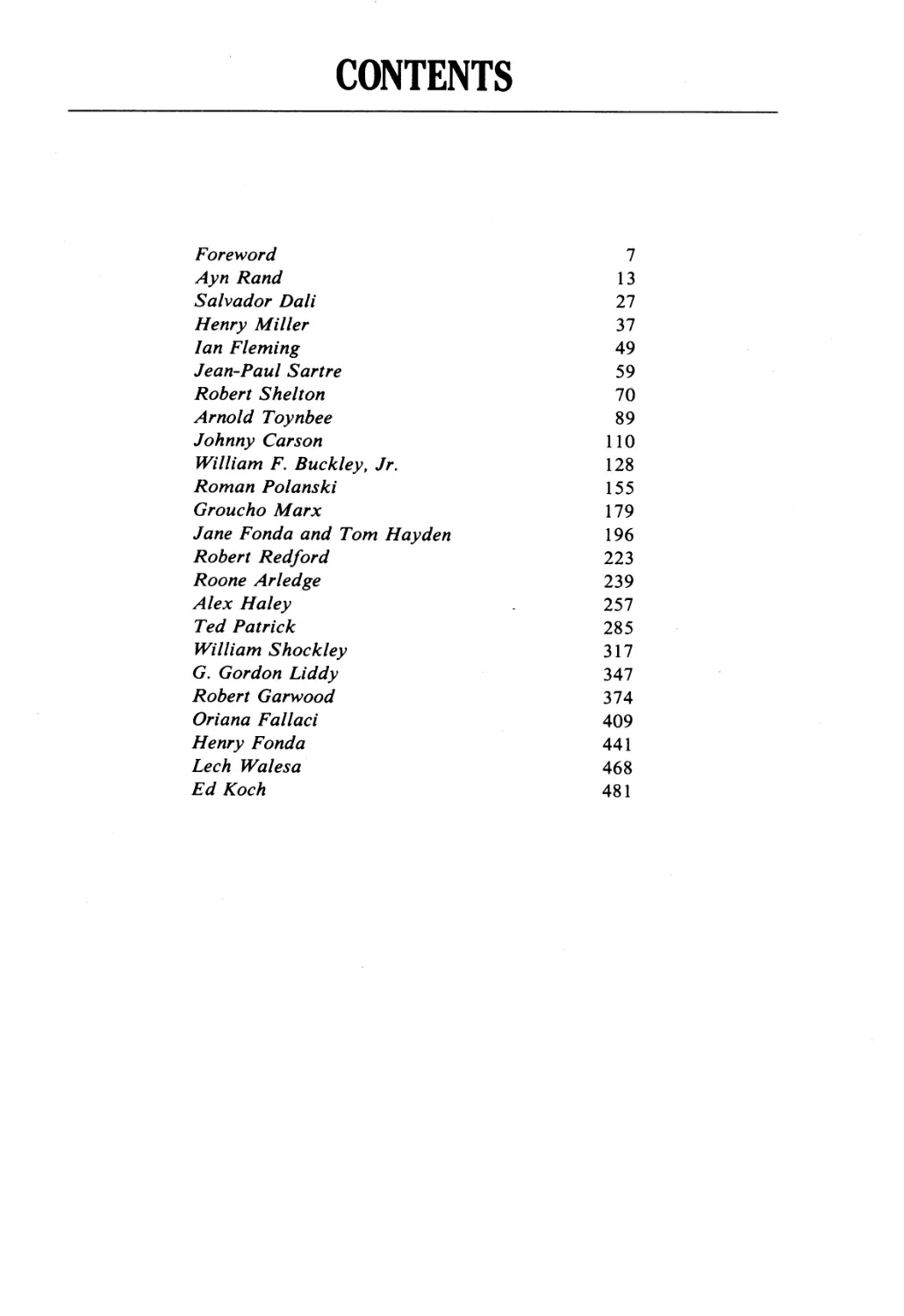
CONTENTS
Foreword 7
Ayn Rand 13
Salvador Dali 27
Henry Miller 37
Ian Fleming 49
Jean-Paul Sartre 59
Robert Shelton 70
Arnold T oynbee 89
Johnny Carson 110
William F. Buckley, Jr. 128
Roman Polanski 155
Groucho Marx 179
Jane Fonda and Tom Hayden 196
Robert Redford 223
Roone Arledge 239
Alex Haley - 257
Ted Patrick 285
William Shockley 317
G. Gordon Liddy 347
Robert Garwood 374
Oriana Fallaci _ 409
Henry Fonda 441
Lech Walesa 468
Ed Koch 481

FOREWORD
While the public and critical reception given to the first volume of The Playboy
Interview has been a source of pride to the journalists and editors involved,_ it is
particularly satisfying to issue this second volume. Now, it’s true that anyone who has
ever had to justify a sequel inevitably comes up with reasons to insist the second work
is as important as the first. But if the reader will be patient . . . ’
First, a brief recap of what this feature is and how it came to be. (For a more
detailed account, please see the Foreword in Volume I.) In 1962, at the urging of
editor-publisher Hugh M. Hefner, PLAYBOY editor Murray Fisher fashioned the mag-
azine’s first Q-and-A out of a series of conversations between writer Alex Haley and
jazz musician Miles Davis. Unlike the celebrity profiles that were a staple of maga-
zine journalism then, Fisher insisted on a breadth, a thoroughness, and a candor that
were unprecedented. In subsequent interviews, both journalist and subject would per-
sist until something close to the goal—a verbal autobiography—had been achieved.
The standards set by Fisher; the look of the feature, designed by art director Art Paul;
and the roster of subjects interviewed combined to produce one of the most widely
imitated and ultimately most widely respected journalistic forums in the world.
I began supervising the interviews in 1974, under the editorship of Arthur
Kretchmer. Together, we added a strong sense of news and topicality to the interviews
so that by the end of the decade their visibility was very high. It was at that time that
we decided to collect the most memorable pieces in an anthology issued in 1981. It
was that selection process—I chose thirty-one interviews out of over two hundred——
that produced, understandably, a bias toward the “classics”—_those giants such as
Martin Luther King, Jr., Fidel Castro, Albert Schweitzer, Jimmy Carter, which
loomed most strongly in the memory. Many fascinating interviews with people in a
variety of professions thus had to be omitted from the first volume.
In this volume we can take the time to know historian Arnold Toynbee, racist
Robert Shelton, religious deprogrammer Ted Patrick, Vietnam turncoat Robert Gar-
wood; their names may be less familiar, but their ideas and experiences, as drawn
7

8 THE PLAYBOY INTERVIEW II
from them by their interrogators, affected our lives and times. Entertainers such as
Robert Redford or Johnny Carson are not only surprisingly thoughtful and articulate
on a wide variety of subjects, but may well have had a wider impact in the world of
ideas than expected. Finally, this volume affords the opportunity to include some
people who simply were passed over for space reasons—Ayn Rand, Salvador Dali,
William Buckley—and whom it is a pleasure to introduce at last. Together, the two
collections reflect accurately a full cross section of PLAYBOY’s “candid conversa-
tions.”
Because these interviews appeared in a certain context of time and events, I have
provided brief introductions to each piece to remind the reader of what was happening
then, and why the editors made the selections they did. Where appropriate, I have
also provided some background on how the interview was conducted. (Where I played
some role, I refer to myself in the third person for consistency.)
For space reasons as well as readability I have greatly condensed the biographical
data that accompanied the interviews, and in some cases I have trimmed the inter-
views themselves. This has been done only to shorten now-familiar accounts of events
or to reduce material that is irrelevant today—plugs for upcoming books and movies,
for instance. In no case has more than 10 percent of an interview been edited.
A few words on technique (also recalling the Foreword in Volume I): As originated
by editor Fisher, the procedure, following anywhere from six to twenty-five hours of
tape-recorded conversations, was to refine the raw verbiage of a tape transcript into a
linear, continuous conversation. The refining did not mean that liberties were taken
with the spoken words, but rather that the material was distilled of repetitions and
meanderings for the sake of the printed page—which listeners can mentally edit out,
but readers cannot. That the technique is successful is supported by the fact that
many of the interviewees later said publicly that no other interview had ever repOrted
so faithfully what they said—even though no PLAYBOY interview was ever published
verbatim. And although the conversation is sometimes published as if there were no
breaks between topics, it has always been made clear to the reader that a PLAYBOY
interview is the melding of several or many conversations between subject and jour-
nalist.
Since the publication of Volume 1, another tradition has continued just as vigor-
ously: timeliness, often unexplainable in terms of PLAYBOY’s long lead time. Volume I
concluded with the tragic death of John Lennon as his interview was being read by
PLAYBOY subscribers. Since then, Robert Garwood’s interview appeared just as his
Marine court-martial wound up; Henry Fonda’s as infirmity and an Oscar caught up
with him; Lech Walesa’s on the very week that martial law was declared in Poland;
and Edward Koch’s days after his unexpected bid for the governorship of New York
State. Appearing in a magazine whose interview subjects are selected six months in
advance, these occurrences can only be explained as fitting into a certain rhythm and
tradition of newsworthiness, and not necessarily as the logical outcome of editorial
acumen, alas.
Since the interviews are the product of individual work and care, this is the place to
thank and acknowledge such veterans of Volume I as Larry Dubois, Larry Grobel,
Sam Merrill, PLAYBOY senior editor Gretchen McNeese, and Robert Scheer, and to
add to the list such continuing contributors as Flo Conway and Jim Siegelman, Win-
ston Groom, Anya and Kristina Bittenek, and Peter Manso. There are others whose
work is deeply appreciated, but goes unmentioned in this collection—no doubt await-

FOREWORD 9
ing inclusion in another volume in the years to come. Finally, thanks to Thia Golson
and Laura MacKenzie for help and advice in preparing both volumes.
G. BARRY GOLSON
Executive Editor
PLAYBOY
New York, 1982

THE
PLAYBOY INTERVIEW
II

AYN RAND
March 1964
Interviewer: Alvin Toff ler
Ayn Rand is a particularly appropriate first selection for this volume. The conversa-
tion that follows appeared just six years after the publication of Atlas Shrugged,
Rand’s romantic (and hefty) novel about the individual triumphing over collectivism.
Just a few months earlier, President John F. Kennedy had been assassinated, and in
the trauma and confusion that followed, it must have been invigorating and comfort-
ing to read opinions by someone who was so certain of her values, with every thing and
every idea in its place. In sum, Rand was an early cult figure, especially among the
young, with powerful attraction on intelligent adolescent minds.
For PLAY-BOY readers there were particular themes in Rand’s ideas that would reap-
pear in future interviews: strong feelings against censorship, puritanism, religion,
oppression. This was also an extremely early exploration of feminism—early for any
mass publication—which was a topic that PLAYBOY was to live with uneasily in the
future. (“What is proper for a man is proper for a woman,” Rand told PLAYBOY.
“There is no particular work which is specifically feminine. Women can choose their
work according to their own purpose and premises in the same manner as men do.”)
This, at a time when women’s magazines were publishing recipes and the general
magazines were reviewing Betty Friedan with alarm and condescension.
Stylistically, the Rand conversation was also a harbinger of interviews to come. For
instance, at one point the interviewer cites a quote Rand allegedly made, and the
author snaps back: “I never said that. . . . That is cheap nonsense, and please leave
this in your copy.” Magazines of the era were self-protective by tradition, “cleaning
up” their copy and publishing in an omniscient, infallible voice. It was something new
to let the reader into the process, to show the magazine being corrected by Rand, to
reveal character at the expense of institutional dignity.
The interviewer, Alvin Toffler, boned up on Rand’s philosophy for several months
before confronting the formidable lady in her Manhattan apartment for this inter-
view. Later in the decade he wrote Future Shock (though no cause and effect is
implied). Ayn Rand died early in 1982, her obituaries respectful and her books still
being widely read.
Ayn Rand is among the most outspoken—and important~—intellectual voices in
America today. She is the author of what is perhaps the most fiercely damned and
admired best-seller of the decade: Atlas Shrugged, which has become one of the
most-talked—about novels in the country. Ayn Rand discussion clubs dot college
13

14 THE PLAYBOY INTERVIEW II
campuses. Professors debate her ideas in their classrooms. And sales of her previous
best-seller, The Fountainhead, continue to climb.
That any novel should set 017 such a chain reaction is unusual; that Atlas
Shrugged has done so is astonishing. For the book, a panoramic novel about what
happens when the “men of the mind” go on strike, is 1,168 pages long. It is filled
with lengthy, sometimes complex philosophical passages; and it is brimming with as
many explosively unpopular ideas as Ayn Rand herself. Despite this success, the
literary establishment considers her an outsider. Almost to a man, critics have either
ignored or denounced the book. She is an exile among philosophers, too, although
Atlas is as much a work of philosophy as it is a novel. Liberals glower at the very
mention of her name; but conservatives, too, swallow hard when she begins to speak.
For Ayn Rand, whether anyone likes it or not, is sui generis: indubitably, irrevoca-
bly, intransigently individual.
She detests the drift of modern American society: She doesn’t like its politics, its
economics, its attitudes toward sex, women, business, art, or religion. In short, she
declares, with unblinking immodesty, “I am challenging the cultural tradition of
two-and—a-half-thousand years.” She means it.
A dark-haired woman with penetrating brown eyes and a computer-quick mind,
Ayn (rhymes with mine) Rand was born to the family ofa small businessman in St.
Petersburg, Russia, where she lived through the Soviet Revolution. She attended the
University of Leningrad, loathing communism and its philosophy. In 1926 she man-
aged to leave the USSR, stayed for a few months with distant‘relatives in Chicago,
then moved on to Hollywood. She had always wanted to be a writer. Since her
command of English was somewhat less than adequate for writing fiction, she found
a job preparing outlines for silent movies, as she went about mastering her new
language. Between bouts of unemployment, she worked as a movie extra, waitress,
newspaper subscription salesgirl, and studio wardrobe-department clerk.
Then in 1936, she completed her first novel, We the Living—an attack on totali—
tarianism, set in Soviet Russia—which drew little notice. Two years later she fin-
ished Anthem, a short novel about a society in which the word “I” has been extir-
pated in favor of the collectivist “we.” It was not until five years and twelve pub-
lishers’ rejections later that her first commercially successful book, The Fountain-
head, appeared; the story of an architect’s battle for his own individuality, it became
a national best—seller, and was later made into a movie.
For nearly a decade after that, Miss Rand struggled to write Atlas Shrugged,
which she views not merely as a novel, but as the crystallization of a philosophy
aimed at nothing less than reversing the entire direction of change in America——
turning society toward a state of pure laissez-faire capitalism, even purer than that
which existed during the nineteenth century. But her philosophy—which she calls
“Objectivism”—encompasses more than economics or politics: Primarily, it sets
forth a new kind of ethics which she defines as a morality of rational self-interest.
In a series of intellectually electric conversations with PLAYBOY’S interviewer, Alvin
Tofi‘ler, Miss Rand spoke clearly and urgently about" her work and her views.
Answering question after question with a clipped, even delivery, her deep voice edged
with a Russian accent, she paused only long enough between words to pufl on ciga—
rettes held in a blue-and—silver holder (a gift from admirers) engraved with her
initials, the names of the three heroes of Atlas Shrugged, and a number of diminutive
dollar signs. The dollar sign, in Atlas Shrugged, is the symbol of ‘free trade and,
therefore, of a free mind.”

AYN RAND 1 5
PLAYBOY: Miss Rand, your novels and essays, especially your controversial best-sell-
er, Atlas Shrugged, present a carefully engineered, internally consistent world view.
They are, in effect the expressiOn of an all-encompassing philosophical system. What
do you seek to accomplish with this new philosophy?
RAND: I seek to provide men—or those who care to think—with an integrated, con-
sistent and rational view of life.
PLAYBOY: What are the basic premises of Objectivism? Where does it begin?
RAND: It begins with the axiom that existence exists, which means that an objective
reality exists independent of any perceiver or of the perceiver’s emotions, feelings,
wishes, hopes or fears. Objectivism holds that reason is man’s only means of perceiv-
ing reality and his Only guide to action. By reason, I mean the faculty which identifies
and integrates the material provided by man’s senses.
PLAYBOY: In Atlas Shrugged your hero, John Galt, declares, “I swear—by my life
and my love of it—that I will never live for the sake of another man, nor ask another
man to live for mine.” How is this related to your basic principles?
RAND: Galt’sstatement is a dramatized summation of the Objectivist ethics. Any
system of ethics is based on and derived, implicitly or explicitly, from a metaphysics.
The ethic derived from the metaphysical base of Objectivism holds that, since reason
is man’s basic tool of survival, rationality is his highest virtue. To use his mind, to
perceive reality and to act accordingly, is man’s moral imperative. The standard of
value of the Objectivist ethics is: man’s life—man’s survival qua man—or that which
the nature of a rational being requires for his proper survival. The Objectivist ethics,
in essence, hold that man exists for his own sake, that the pursuit of his own happiness
is his highest moral purpose, that he must not sacrifice himself to others, nor sacrifice
others to himself. It is this last that Galt’s statement summarizes.
PLAYBOY: What kind of morality derives from this, in terms of the individual’s behav-
ior?
RAND: This is presented in detail in Atlas Shrugged.
PLAYBOY: The heroine of Atlas Shrugged was, in your words, “completely incapable
of experiencing a feeling of fundamental guilt.” Is any system of morality possible
without guilt?
RAND: The important word in the statement you quoted is “fundamental.” Funda-
mental guilt does not mean the ability to judge one’s own actions and regret a wrong
action, if one commits it. Fundamental guilt means that man is evil and guilty by
nature.
PLAYBOY: You mean original sin?
RAND: Exactly. It is the concept of original sin that my heroine, or I, or any Objec-
tivist, is incapable of accepting or of ever experiencing emotionally. It is the concept
of original sin that negates morality. If man is guilty by nature, he has no choice about
it. If he has no choice, the issue does not belong in the field of morality. Morality
pertains only to the sphere of man’s free will—only to those actions which are open to
his choice. To consider man guilty by nature is a contradiction in terms. My heroine
would be capable of experiencing guilt about a specific action. Only, being a woman
of high moral stature and self-esteem, she would see to it that she never earned any
guilt by her actions. She would act in a totally moral manner and, therefore, would
not accept an unearned guilt.
PLAYBOY: In Atlas Shrugged, one of your leading characters is asked, “What’s the
most depraved type of human being?” His reply is surprising: He doesn’t say a sadist
or a murderer or a sex maniac or a dictator;_he says, “The man Without a purpose.”

16 THE PLAYBOY INTERVIEW 11
Yet most people seem to go through their lives without a clearly defined purpose. Do
you regard them as depraved?
RAND: Yes, to a certain extent.
PLAYBOY: Why?
RAND: Because that aspect of their character lies at the root of and causes all the evils
which you mentioned in your question. Sadism, dictatorship, any form of evil, is the
consequence of a man’s evasion of reality. A consequence of his failure to think. The
man without a purpose is a man who drifts at the mercy of random feelings or uniden-
tified urges and is capable of any evil, because he is totally out of control of his own
life. In order to be in control of your life, you have to have a purpose—a productive
purpose.
PLAYBOY: Weren’tHitler and Stalin, to name two tyrants, in control of their own
lives, and didn’t they have a clear purpose?
RAND: Certainly not. Observe that both of them ended as literal psychotics. They were
men who lacked self-esteem and, therefore, hated all of existence. Their psychology,
in effect, is summarized in Atlas Shrugged by the character of James Taggart. The
man who has no purpose, but has to act, acts to destroy others. That is not the same
thing as a productive or creative purpose.
PLAYBOY: If a person organizes his life around a single, neatly defined purpose, isn’t
he in danger of becoming extremely narrow in his horizons?
RAND: Quite the contrary. A central purpose serves to integrate all the other concerns
of a man’s life. It establishes the hierarchy, the relative importance, of his values, it
saves him from pointless inner conflicts, it permits him to enjoy life on a wide scale
and to carry that enjoyment into any area open to his mind; whereas a man without a
purpose is lost in chaos. He does not know what his values are. He does not know how
to judge. He cannot tell what is or is not important to him, and, therefore, he drifts
helplessly at the mercy of any chance stimulus or any whim of the moment. He can
enjoy nothing. He spends his life searching for some value which he will never find.
PLAYBOY: Couldn’t the attempt to rule whim out of life, to act in a totally rational
fashion, be viewed as conducive to a juiceless, joyless kind of existence?
RAND: I truly must say that I don’t know what you are talking about. Let’s define our
terms. Reason is man’s tool of knowledge, the faculty that enables him to perceive the
facts of reality. To act rationally means to act in accordance with the facts of reality.
Emotions are not tools of cognition. What you feel tells you nothing abut the facts; it
merely tells you something about your estimate of the facts. Emotions are the result of
your value judgments; they are caused by your basic premises, which you may hold
consciously or subconsciously, which may be right or wrong. A whim is an emotion
whose cause you neither know nor care to discover. Now what does it mean, to act on
whim? It means that a man acts like a zombie, without any knowledge of what he
deals with, what he wants to accomplish, or what motivates him. It means that a man
acts in a state of temporary insanity. Is this what you call juicy or colorful? I think the
only juice that can come out of such a situation is blood. To act against the facts of
reality can result only in destruction.
PLAYBOY: Should one ignore emotions altogether, rule them out of one’s life entire—
1y?
RAND: Of course not. One should merely keep them in their place. An emotion is an
automatic response, an automatic effect of man’s value premises. An effect, not a
cause. There is no necessary clash, no dichotomy between man’s reason and his emo-

AYN RAND 17
tions—provided he observes their proper relationship. A rational man knows—or
makes it a point to discover—the source of his emotions, the basic premises from
which they come; if his premises are wrong, he corrects them. He never acts on emo-
tions for which he cannot account, the meaning of which he does not understand. In
appraising a situation, he knows why he reacts as he does and whether he is right. He
has no inner conflicts, his mind and his emotions are integrated, his consciousness is in
perfect harmony. His emotions are not his enemies, they are his means of enjoying
life. But they are not his guide; the guide is his mind. This relationship cannot be
passive effect, if he is guided by his emotions and uses his mind only to rationalize or
justify them somehow—then he is acting immorally, he is condemning himself to
misery, failure, defeat, and he will achieve nothing but destruction—his own and that
of others. ‘
PLAYBOY: According to your philosophy, work and achievement are the highest goals
of life. Do you regard as immoral those who find greater fulfillment in the warmth of
friendship and family ties?
RAND: If they place such things as friendship and family ties above their own produc—
tive work, yes, then they are immoral. Friendship, family life and human relationShips
are not primary in a man’s life. A man who places others first, above his own creative
work, is an emotional parasite; whereas, if he places his work first, there is no conflict
between his work and his enjoyment of human relationships.
PLAYBOY: Do you believe that women as well as men should organize their 'lives
around work—and if so, what kind of work?
RAND: Of course. I believe that women are human beings. What is proper for a man is
proper for a woman. The basic principles are the same." I would not attempt to pre-
scribe what kind of work a man should do, and I would not attempt it in regard to
women. There is no particular work which is specifically feminine. Women can choose
their work according to their own purpose and premises in the same manner as men
do.
PLAYBOY: In your opinion, is a woman immoral who chooses to devote herself to home
and family instead of a career?
RAND: Not immoral—I would say she is impractical, because a home cannot be a
full-time occupation, except when her children are young. However, if she wants a
family and wants to make that her career, at least for a while, it would be proper—if
she approaches it as a career, that is, if she studies the subject, if she defines the rules
and principles by which she wants to bring up her children, if she approaches her task
in an intellectual manner. It is a very responsible task and a very important one, but
only when treated as a science, not as a mere emotional indulgence.
PLAYBOY: Where, would you say, should romantic love fit into the life of a rational
person whose single driving passion is work? V
RAND: It is his greatest reward. The only man capable of experiencing a profound
romantic love is the man driven by passion for his work—because love is an expression
of self-esteem, of the deepest values in a man’s or a woman’s character. One falls in
love with the person who shares these values. If a man has no clearly defined values,
and no moral character, he is not able to appreciate another person. In this respect, I
would like to quote from The Fountainhead, in which the hero utters a line that has
often been quoted by readers: “To say ‘I love you’ one must know first how to say the
I" 9,

18 THE PLAYBOY INTERVIEW II
PLAYBOY: You hold that one’s own happiness is the highest end, and that self-sacrifice
is immoral. Does this apply to love as well as work?
RAND: To love more than to anything else. When you are in love, it means that the
person you love is of great personal, selfish importance to you and to your life. If you
were selfless, it would have to mean that you derive no personal pleasure or happiness
from the company and the existence of the person you love, and that you are moti-
vated only be self-sacrificial pity for that person’s need of you. I don’t have to point
out to you that no one would be. flattered by, nor would accept, a concept of that kind.
Love is not self-sacrifice, but the most profound assertion of your own needs and
values. It is for your own happiness that you need the person you love, and that is the
greatest compliment, the greatest tribute you can pay to that person.
PLAYBOY: You have denounced the puritan notion that physical love is ugly or evil; yet
you have written that “Indiscriminate desire and unselective indulgence are possible
only to those who regard sex and themselves as evil.” Would you say that discriminate
and selective indulgence in sex is moral?
RAND: I would say that a selective and discriminate sex life is not an indulgence. The
term indulgence implies that it is an action taken lightly and casually. I say that sex is
one of the most important aspects of man’s life and, therefore, must never be
approached lightly or casually. A sexual relationship is proper only on the ground of
the highest values one can find in a human being. Sex must nOt be anything other than
a response to values. And that is why I consider promiscuity immoral. Not because
sex is evil, but because sex is too good and too important.
PLAYBOY: Does this mean, in your view, that sex should involve only married part-
ners?
RAND: Not necessarily. What sex should involve is a very serious relationship. Wheth-
er that relationship should or should not become a marriage is a question which
depends on the circumstances and the context of the two persons’ lives. I consider
marriage a very important institution, but it is important when and iftwo people have
found the person with whOm they wish to spend the rest of their lives—a question of
which no man or woman can be automatically certain. When one is certain that one’s
choice is final, then marriage is, of course, a desirable state. But this does not mean
that any relationship based on less than total certainty is improper. I think the ques-
tion of an affair or a marriage depends on the knowledge and the position of the two
persons involved and should be left up to them. Either is moral, provided only that
both parties take the relationship seriously and that it is based on values.
PLAYBOY: As one who champions the cause of enlightened self-interest, how do you
feel about dedicating one’s life to hedonistic self-gratification?
RAND: I am profoundly opposed to the philosophy of hedonism. Hedonism is the doc-
trine which holds that the good is whatever gives you pleasure and therefore, pleasure
is the standard of morality. Objectivism holds that the good must be defined by a
rational standard of value, that pleasure is not a first cause, but only a consequence,
that only the pleasure which proceeds from a rational value judgment can be regarded
as moral, that pleasure, as such, is not a guide to action nor a standard of morality. To
say that pleasure should be the standard of morality simply means that whichever
values you happen to have chosen consciously or subconsciously, rationally or irra-
tionally, are right and moral. This means that you are to be guided by chance feelings,
emotions and whims, not by your mind. My philosophy is the opposite of hedonism. I
hold that one cannot achieve happiness by random, arbitrary or subjective means.
One can achieve happiness only on the basis of rational values. By rational values, I do

AYN RAND 1 9
not mean anything that a man may arbitrarily or blindly declare to be rational. It is
the province of morality, of the science of ethics, to define for men what is a rational
standard and what are the rational values to pursue.
PLAYBOY: You have said that the kind of man who spends his time running after
women is a man who “despises himself.” Would you elaborate?
RAND: This type of man is reversing cause and effect in regard to sex. Sex is an
expression of a man’s self-esteem, of his own self-value. But the man who does not
value himself tries to reverse this process. He tries to derive his self-esteem from his
sexual canuests, which cannot be done. He cannot acquire his own value from the
number of women who regard him as valuable. Yet that is the hopeless thing which he
attempts.
PLAYBOY: You attack the idea that sex is “impervious to reason.” But isn’t sex a
nonrational biological instinct? ,
RAND: No. To begin with, man does not possess any instincts. Physically, sex is merely
a capacity. But how a man will exercise this capacity and whom he will find attractive
depends on his standard of value. It depends on his premises, which he may hold
consciously or subconsciously, and which determine his choices. It is in this manner
that his philosophy directs his sex life.
PLAYBOY: Isn’t the individual equipped with powerful, nonrational biological
drives?
RAND: He is not. A man is equipped with a certain kind of physical mechanism and
certain needs, but without any knowledge of how to fulfill them. For instance, man
needs food. He experiences hunger. But, unless he learns first to identify this hunger,
then to know that he needs food and how to obtain it, he will starve. The need, the
hunger, will not tell him how to satisfy it. Man is born with certain physical and
psychological needs, but he can neither discover them nor satisfy them without the use
of his mind. Man has to discover what is right or wrong for him as a rational being.
His so-called urges will not tell him what to do.
PLAYBOY: In Atlas Shrugged you wrote, “There are two sides to every issue. One side
is right and the other is wrong, but the middle is always evil.” Isn’t this a rather
black-and-white set of values?
RAND: It most certainly is. I most emphatically advocate a black-and-white view of
the world. Let us define this. What is meant by the expression “black and white”? It
means good and evil. Before you can identify anything as gray, as middle of the road,
you have to know what is black and what is white, because gray is merely a mixture of
the two. And when you have established that one alternative is good and the other is
evil, there is no justification ever for choosing any part of what you know to be
evil.
PLAYBOY: Then you believe in absolutes?
RAND: I do.
PLAYBOY: Can’t Objectivism, then, be called a dogma?
RAND: No. A dogma is a set of beliefs accepted on faith; that is, without rational
justification or against rational evidence. A dogma is a matter of blind faith. Objec-
tivism is the exact opposite. Objectivism tells you that you must not accept any idea or
conviction unless you can demonstrate its truth by means of reason.
PLAYBOY: If widely accepted, couldn’t Objectivism harden into a dogma?
RAND: No. I have found that Objectivism is its own protection against people who
might attempt to use it as a dogma. Since Objectivism requires the use of one’s mind,
those who attempt to take broad principles and apply them unthinkingly and indis-

20 THE PLAYBOY INTERVIEW II
criminately to the concretes of their own existence find that it cannot be done. They
are then compelled either to reject Objectivism or to apply it. When I say apply, I
mean that they have to use their own mind, their own thinking, in order to know how
to apply Objectivist principles to the specific problems of their own lives.
PLAYBOY: You have said you are opposed to faith. Do you believe in God?
RAND: Certainly not.
PLAYBOY: You’ve been quoted as saying “The cross is the symbol of torture, of the
sacrifice of the ideal to the nonideal. I prefer the dollar sign.” Do you truly feel that
two thousand years of Christianity can be summed up with the word torture?
RAND: To begin with, I never said that. It’s not my style. Neither literarily nor intel-
lectually. I don’t say I prefer the dollar sign—that is cheap nonsense, and please leave
this in your copy. I don’t know the origin of that particular quote, but the meaning of
the dollar sign is'made clear in Atlas Shrugged. It is the symbol, clearly explained in
the story, of free trade and, therefore, of a free mind. A free mind and a free economy
are corollaries. One can’t exist without the other. The dollar sign, as the symbol of the
currency of a free country, is the symbol of the free mind. More than that, as to the
historical origin of the dollar sign, although it has never been proved, one very likely
hypothesis is that it stands for the initials of the United States. So much for the dollar
sign.
Now you want me to speak about the cross. What is correct is that I do regard the
cross as the symbol of the sacrifice of the ideal to the nonideal. Isn’t that what it does
mean? Christ, in terms of Christian philosophy, is the human ideal. He personifies
that which men should strive to emulate. Yet, according to the Christian mythology,
he died on the cross not for his own sins but for the sins of the nonideal people. In
other words, a man of perfect value was sacrificed for men who are vicious and who
are expected or supposed to accept that sacrifice. If I were a Christian, nothing could
make me more indignant than that: the notion of sacrificing the ideal to the nonideal,
or virtue to vice. And it is in the name of that symbol that men are asked to sacrifice
themselves for their inferiors. That is precisely how the symbolism is used. That is
torture.
PLAYBOY: Has no religion, in your estimation, ever offered anything of constructive
value to human life?
RAND: Qua religion, no—in the sense of blind belief, belief unsupported by, or con-
trary to, the facts of reality and the conclusions of reason. Faith, as such, is extremely
detrimental to human life: It is the negation of reason. But you must remember that
religion is an early form of philosophy, that the first attempts to explain the universe,
to give a coherent frame of reference to man’s life and a code of moral values, were
made by religion, before men graduated or developed enough to have philosophy.
And, as philosophies, some religions have very valuable moral points. They may have
a good influence or proper principles to inculcate, but in a very contradictory context
and, on a very—how should I say it?—dangerous or malevolent base: on the ground of
faith.
PLAYBOY: Then you would say that if you had to choose between the symbol of the
cross and the symbol of the dollar, you would choose the dollar?
RAND: I wouldn’t accept such a choice. Put it another way: If I had to choose between
faith and reason, I wouldn’t consider the choice even conceivable. As a human being,
one chooses reason.
PLAYBOY: Do you consider wealthy businessmen like the Fords and the Rockefellers
immoral because they use their wealth to support charity?

AYN RAND 21
RAND: No. That is their privilege, if they want to. My views on charity are very
simple. I do not consider it a major virtue and, above all, I do not consider it a moral
duty. There is nothing wrong in helping people, if and when they are worthy of: the
help and you can afford to help them. I regard charity as a marginal issue. What I am
fighting is the idea that charity is a moral duty and a primary virtue.
PLAYBOY: What is the place of compassion in your philosophical system?
RAND: I regard compassion as proper only toward those who are innocent victims, but
not toward those who are morally guilty. If one feels Compassion for the victims of a
concentration camp, one cannot feel it for the torturers. If one does feel compassion
for the torturers, it is an act of moral treason toward the victims.
PLAYBOY: Would it be against the principles of Objectivism for anyone to sacrifice
himself by stepping in front of a bullet to protect another person?
RAND: No. It depends on the circumstances. I would step in the way of a bullet if it
were aimed at my husband. It is not self—sacrifice to die protecting that which you
value: If the value is great enough, you do not care to exist without it. This applies to
any alleged sacrifice for those one loves.
PLAYBOY: Would you be willing to die for your cause, and should your followers be
willing to die for it? And for the truly nonsacrificial Objectivists, is any cause worth
dying for?
RAND: The answer to this is made plain in my book. In Atlas Shrugged I explain that
a man has to live for, and when necessary, fight for, his values—because the whole
process of living consists of the achievement of values. Man does not survive automat-
ically. He must live like a rational being and accept nothing less. He cannot survive as
a brute. Even the simplest value, Such as food, has to be produced. The same is true of
his more interesting, more important achievements. All values have to be gained and
kept by man, and if they are threatened, he has to be willing to fight and die, if
necessary, for his right to live like a rational being. You ask me, would I be willing to
die for Objectivism? I would. But what is more important, I am willing to live for
it—which is much more difficult. ‘
PLAYBOY: In your emphasis on reason, you are in philosophical conflict with contem-
porary writers, novelists and poets—many of whom are self-admitted mystics, or irra-
tionlists, as they have been called. Why is this so?
RAND: Because art has a philosophical base, and the dominant philosophical trends of
today are a form of neomysticism. Art is a projection of the artist’s fundamental view
of man and of existence. Since most artists do not develop an independent philosophy
of their own, they absorb, consciously or subconsciously, the dominant philosophical
influences of their time. Most of today’s literature is a faithful reflection of today’s
philosophy—and look at it!
PLAYBOY: But shouldn’t a writer reflect his time?
RAND: No. A writer should be an active intellectual leader of his time, not a passive
follower riding any current. A writer should shape the values of his culture, he should
project and concretize the value goals of man’s life. This is the essence of the Roman-
tic school of literature, which has all but vanished from today’s scene.
PLAYBOY: Leaving us where, literarily speaking?
RAND: At the dead end of Naturalism. Naturalism holds that a writer must be a
passive photographer or reporter who must transcribe uncritically whatever he hap-
pens to observe around him. Romanticism holds that a writer must present things, not
as they are at any given moment, but, to quote Aristotle, “as they might be and ought
to be.”

22 THE PLAYBOY INTERVIEW II
PLAYBOY: What is your appraisal of contemporary literature in general?
RAND: Philosophically, immoral. Aesthetically, it bores me to death. It is degenerating
into a sewer, devoted exclusively to studies of epravity. And there’s nothing as boring
PLAYBOY: Are there any novelists whom you admire?
RAND: Yes. Victor Hugo.
PLAYBOY: What about modern novelists?
RAND: No, there is no one that I could say I admire among the so-called serious
writers. I prefer the popular literature of today, which is today’s remnant of Roman-
ticism. My favorite is Mickey Spillane.
PLAYBOY: Why do you like him?
RAND: Because he is primarily a moralist. In a primitive form, the form of a detective
novel, he presents the conflict of good and evil, in terms of black and white. He does
not present a nasty gray mixture of indistinguishable scoundrels on both sides. He
presents an uncompromising conflict. As a writer, he is brilliantly expert at the aspect
of literature which I consider most important: plot structure.
PLAYBOY: What do you think of Faulkner?
RAND: Not very much. He is a good stylist, but practically unreadable in content—so
I’ve read very little of him.
PLAYBOY: What about Nabokov?
RAND: I have read only one book of his and a half—the half was Lolita, which I
couldn’t finish. He is a brilliant stylist, he writes beautifully, but his subjects, his sense
of life, his view of man, are so evil that no amount of artistic skill can justify
them.
PLAYBOY: As a novelist, do you regard philosophy as the primary purpose of your
writing?
RAND: No. My primary purpose is the projection of an ideal man, of man “as he might
be and ought to be.” Philosophy is the necessary means to that end.
PLAYBOY: In your early novel, Anthem, your protagonist declares, “It is my will which
chooses, and the choice of my will is the only edict I respect.” Isn’t this anarchism? Is
one’s own desire or will the only law one must respect?
RAND: Not one’s own will. This is, more less, a poetic expression made clear by the
total context of the story in Anthem. One’s own rational judgment. You see, I use the
term free will in a totally different sense from the one usually attached to it. Free will
consists of man’s ability to think or not to think. The act of thinking is man’s primary
act of choice. A rational man will never be guided by desires or whims, only by values
based on his rational judgment. That is the only authority he can recognize. This does
not mean anarchy, because, if a man wants to live in a free, civilized society, he would,
in reason, have to choose to observe the laws, when those laws are objective, rational
and valid. I have written an article on this subject for The Objectivist Newsletter—on
the need and proper function of a government. '
PLAYBOY: What, in your view, is the proper function of a government?
RAND: Basically, there is really only one proper function: the protection of individual
rights. Since rights can be violated only by physical force, and by certain derivatives
of physical force, the proper function of government is to protect men from those who
initiate the use of physical force: from those who are criminals. Force, in a free soci-

AYN RAND 23
ety, may be used only in retaliation and only against those who initiate its use. This is
the proper task of government: to serve as a policeman who protects men from the use
of force.
PLAYBOY: If force may be used only in retaliation against force, does the government
have the right to use force to collect taxes, for example, or to draft soldiers?
RAND: In principle, I believe that taxation should be voluntary, like everything else.
But how one would implement this is a very complex question. I can only suggest
certain methods, but I would not attempt to insist on them as a definitive answer. A
government lottery, for instance, used in many countries in Europe, is one good meth-
od of voluntary taxation. There are others. Taxes should be voluntary contributions
for the proper governmental services which people do need and therefore would be
and should be willing to pay for—as they pay for insurance. But, of course, this is a
problem for a distant future, for the time when men will establish a fully free social
system. It would be the last, not the first, reform to advocate. As to the draft, it is
improper and unconstitutional. It is a violation of fundamental rights, of a man’s right
to his own life. No man has the right to send another man to fight and die for his, the
sender’s, cause. A country has no right to force men into involuntary servitude.
Armies should be strictly voluntary; and, as military authorities will tell you, volun—
teer armies are the best armies.
PLAYBOY: What about other public needs? Do you consider the post office, for exam-
ple, a legitimate function of government?
RAND: Now let’s get this straight. My position is fully consistent. Not only the post
office, but' streets, roads, and above all, schools, should all be privately owned and
privately run. I advocate the separation of state and economics. The government
should be concerned only with those issues which involve the use of force. This means:
the police, the armed services, and the law courts to settle disputes among men. Noth-
ing else. Everything else should be privately run and would be much better run.
PLAYBOY: Would you create any new government departments or agencies?
RAND: No, and I truly cannot discuss things that‘way. I am not a government planner
nor do I spend my time inventing Utopias. I’m talking about principles whose prac-
tical applications are clear. If I have said that I am opposed to the initiation of force,
what else has to be discussed? ‘
PLAYBOY: What about force in foreign policy? You have said that any free nation had
theright to invade Nazi Germany during World War II . . .
RAND: Certainly.
PLAYBOY: . . . And that any free nation today has the moral right—though not the
duty—to invade Soviet Russia, Cuba, or any other “slave pen.” Correct?
RAND: Correct. A dictatorship—a country that violates the rights of its own citizens—
is an outlaw and can claim no rights.
PLAYBOY: Would you actively advocate that the United States invade Cuba or the
Soviet Union? _
RAND: Not at present. I don’t think it’s necessary. I would advocate that which the
Soviet Union fears above all else: economic boycott. I would advocate a blockade of
Cuba and an economic boycott of Soviet Russia; and you would see both those
regimes collapse without the loss of a single American life.
PLAYBOY: Would you favor U.S. withdrawal from the United Nations?
RAND: Yes. I do not sanction the grotesque pretense of an organization allegedly
devoted to world peace and human rights, which includes Soviet Russia, the worst
aggressor and bloodiest butcher in history, as one of its members. The notion of pro-

24 THE PLAYBOY INTERVIEW II
tecting rights, with Soviet Russia among the protectors, is an insult to the concept of
rights and to the intelligence of any man who is asked to endorse or sanction such an
organization. I do not believe that an individual should cooperate with criminals, and,
for all the same reasons, I do not believe that free countries should cooperate with
dictatorships. .
PLAYBOY: Would you advocate severing diplomatic relations with Russia?
RAND: Yes.
PLAYBOY: How do you feel about the test-ban treaty which was recently signed?
RAND: I agree with Barry Goldwater’s speech on this subject on the Senate floor. The
best military authorities, and above all, the best scientific authority, Dr. Teller, the
author of the hydrogen bomb, have stated that this treaty is not merely meaningless
but positively dangerous to America’s defense.
PLAYBOY: If Senator Goldwater is nominated as the Republican presidential candi-
date this July, would you vote for him?
RAND: At present, yes. When I say “at present,” I mean the date when this interview
is being recorded. I disagree with him on a great many things, but I do agree, pre-
dominantly, with his foreign policy. Of any candidates available today, I regard Barry
Goldwater as the best. I would vote for him, if he offers us a plausible, or at least
semiconsistent, platform.
PLAYBOY: How about Richard Nixon?
RAND: I’m opposed to him. I’m opposed to any compromiser or me-tooer, and Mr.
Nixon is probably the champion in this regard.
PLAYBOY: What about President Johnson?
RAND: I have no particular opinion about him.
PLAYBOY: You are a declared anticommunist, antisocialist and antiliberal. Yet you
reject the notion that you are a conservative. In fact, you have reserved some of your
angriest criticism for conservatives. Where do you stand politically?
RAND: Correction. I never describe my position in terms of negatives. I am an advo-
cate of laissez—faire capitalism, of individual rights—there are no others—of individ-
ual freedom. It is on this ground that I oppose any doctrine which proposes the sac-
rifice of the individual to the collective, such as communism, socialism, the welfare
state, fascism, Nazism and modern liberalism. I oppose the conservatives on the same
ground. The conservatives are advocates of a mixed economy and of a welfare state.
Their difference from the liberals is only one of degree, not of principle.
PLAYBOY: You have charged that America suffers from intellectual bankruptcy. Do
you include in this condemnation such right-wing publications as the National
Review? Isn’t that magazine a powerful voice against all the things you regard as
“statism”?
RAND: I consider National Review the worst and most dangerous magazine in Amer-
ica. The kind of defense that it offers to capitalism results in nothing except the
discrediting and destruction of capitalism. Do you want me to tell you why?
PLAYBOY: Yes, please.
RAND: Because it ties capitalism to religion. The ideological position of National
Review amounts, in effect, to the following: In order to accept freedom and capital-
ism, one has to believe in God or in some form of religiOn, some form of supernatural
mysticism. Which means that there are no rational grounds on which one can defend
capitalism. Which amounts to an admission that reason is on the side of capitalism’s
enemies, that a slave society or a dictatorship is a rational system, and that only on the
ground of mystic faith can one believe in freedom. Nothing more derogatory to cap-

AYN RAND 25
italism could ever be alleged, and the exact opposite is true. Capitalism is the only
system that can be defended and validated by reason.
PLAYBOY: You have attacked Governor Nelson Rockefeller for “lumping all oppo-
nents of the welfare state with actual crackpots.” It was clear from his remarks that
among others, he was aiming his criticism at the John Birch Society. Do you resent
being lumped with the John Birchers? Do you consider them “crackpots” or a force
for good?
RAND: I resent being lumped with anyone. I resent the modern method of never
defining ideas, and lumping totally different people into a collective by means of
smears and derogatory terms. I resent Governor Rockefeller’s smear tactics: his refus-
al to identify specifically whom and what he meant. As far as I’m concerned, I repeat,
I don’t want to be lumped with anyone, and certainly not with the John Birch Society.
Do I consider them crackpots? No, not necessarily. What is wrong with them is that
they don’t seem to have any specific, clearly defined political philosophy. Therefore,
some of them may be crackpots, others may be very well-meaning citizens. I consider
the Birch Society futile, because they are not for capitalism, but merely against com-
munism. I gather they believe that the disastrous state of today’s world is caused by a
communist conspiracy. This is childishly naive and superficial. No country can be
destroyed by a mere conspiracy, it can be destroyed only by ideas. The Birchers seem
to be either nonintellectual or anti-intellectual. They do not attach importance to
ideas. They do not realize that the great battle in the world today is a philosophical,
ideological conflict.
PLAYBOY: Are there any political groups in the United States today of which you
approve?
RAND: Political groups, as such—no. Isthere any political group today which is fully
consistent? Such groups today are guided by or advocate blatant contradictions.
PLAYBOY: Do you have any personal political aspirations yourself? Have you ever
considered running for office?
RAND: Certainly not. And I trust that you don’t hate me enough to wish such a thing
on me.
PLAYBOY: But you are interested in politics, or at least in political theory, aren’t
you?
RAND: Let me answer you this way: When I came here from Soviet Russia, I was
interested in politics for only one reason—to reach the day when I would not have to
be interested in politics. I wanted to secure a society in which I would be free to
pursue my own concerns and goals, knowing that the government would not interfere
to wreck them, knowing that my life, my work, my future were not at the mercy of the
state or of a dictator’s whim. This is still my attitude today. Only today I know that
such a society is an ideal not yet achieved, that I cannot expect others to achieve it for
me, and that I, like every other responsible citizen, must do everything possible to
achieve it. In other words, I an interested in politics only in order to secure and protect .
freedom.
PLAYBOY: Throughout your work you argue that the way in which the contemporary
world is organized, even in the capitalist countries, submerges the individual and
stifles initiative. In Atlas Shrugged, John Galt leads a strike of the men of the mind—
which results in the collapse of the collectivist society around them. Do you think the
time has come for the artists, intellectuals and creative businessmen of today to with-
draw their talents from society in this way?
RAND: No, not yet. But before I explain, I must correct one part of your question.

26 THE PLAYBOY INTERVIEW II
What we have today is not a capitalist society, but a mixed economy—that is, a
mixture of freedom and controls, which, by the presently dominant trend, is moving
toward dictatorship. The action in Atlas Shrugged takes place at a time when society
has reached the stage of dictatorship. When and if this happens, that will be the time
to go on strike, but not until then.
PLAYBOY: What do you mean by dictatorship? How would you define it?
RAD: A dictatorship is a country that does not recognize individual rights, whose
government holds total, unlimited power over men.
PLAYBOY: What is the diViding line, by your definition, between a mixed economy and
a dictatorship?
RAND: A dictatorship has four characteristics: one-party rule, executions without trial
for political offenses, expropriation or nationalization of private property, and censor-
ship. Above all, this last. So long as men can speak and write freely, so long as there is
no censorship, they still have a chance to reform their society or to put it on a better
road. When censorship is imposed, that is the sign that men should go on strike
intellectually, by which I mean, should not cooperate with the social system in any
way whatever.
PLAYBOY: Short of such a strike, what do you believe ought to be done to bring about
the societal changes you deem desirable?
RAND: It is ideas that determine social trends, that create or destroy social systems.
Therefore, the right ideas, the right philosophy, should be advocated and spread. The
disasters of the modern world, including the destruction of capitalism, were caused by
the altruist-collectivist philosophy. It is altruism that men should reject.
PLAYBOY: And how would you define altruism? '
RAND: It is a moral system which holds that man has no right to exist for his own sake,
that service to others is the sole justification of his existence, and that self-sacrifice is
his highest moral duty, value and virtue. This is the moral base of collectivism, of all
dictatorships. In order to seek freedom and capitalism, men need a nonmystical, non-
altruistic, rational code of ethics—a morality which holds that man is not a sacrificial
animal, that he has the right to exist for his own sake, neither sacrificing himself to
others, nor others to himself. In other words, what is desperately needed today is the
ethics of Objectivism. _
PLAYBOY: Then what you are saying is that to achieve these changes one must use
essentially educational or propagandistic methods?
RAND: Yes, of course.
PLAYBOY: What do you think of your antagonists’ contention that the moral and
political principles of Objectivism place you outside the mainstream of American
thought?
RAND: I don’t acknowledge or recognize such a concept as a “mainstream of thought.”
That might be appropriate to a dictatorship, to a collectivist society in which thought
is controlled and in which there exists a collective mainstream—of slogans, not of
thought. There is no such thing in America. There never Was. However, I have heard
that expression used for the purpose of barring from public communication any inno-
vator, any nonconformist, anyone who has anything original to offer. I am an innova-
tor. This is a term of distinction, a term of honor, rather than something to hide or
apologize for. Anyone who has new or valuable ideas to offer stands outside the intel-
lectual status quo. But the status quo is not a stream, let alone a “mainstream.” It is a
stagnant swamp. It is the innovators who carry mankind forward.

SALVADOR DALI 27
PLAYBOY: Do you believe that Objectivism as a philosophy will eventually sweep the
world?
RAND: Nobody can answer a question of that kind. Men have free will. There is no
guarantee that they will choose to be rational, at any one time or in any one genera-
tion. Nor is it necessary for a philosophy to “sweep the world.” If you ask the question
in a somewhat different form, if you say, do I think that Objectivism will be the
philosophy of the future, I would say yes, but with this qualification: If men turn to
reason, if they are not destroyed by dictatorship and precipitated into another Dark
Ages, if men remain free long enough to have time to think,'then Objectivism is the
philosophy they will accept.
PLAYBOY: Why?
RAND: In any historical period when men were free, it has always been the most
rational philosophy that won. It is from this perspective that I would say, yes, Objec-
tivism will win. But there is no guarantee, no predetermined necessity about it.
PLAYBOY: You are sharply critical of the world as you see it today, and your books
offer radical proposals for changing not merely the shape of society, but the very way
in which most men work, think and love. Are you optimistic about man’s future?
RAND: Yes, I am optimistic. Collectivism, as an intellectual power and a moral ideal,
is dead. But freedom and individualism, and their political expression, capitalism,
have not'yet been discovered. I think men will have time to discover them. It is
significant that the dying collectivist philosophy of today has produced nothing but a
cult of depravity, impotence and despair. Look at modern art and literature with their
image of man as a helpless, mindless creature doomed to failure, frustration and
destruction. This may be the collectivists’ psychological confession, but it is not an
image of man. If it were, we would never have risen from the cave. But we did. Look
around you and look at history. You will see the achievements of man’s mind. You
will see man’s unlimited potentiality for greatness, and the faculty that makes it
possible. You will see that man is not a helpless monster by nature, but he becomes
one when he discards that faculty: his mind. And if you ask me, what is greatness?—-I
will answer, it is the capacity to live by the three fundamental values of John Galt:
reason, purpose, self-esteem.
SALVADOR DALI
June 1964
Interviewer :. Sterling Mellany
If, in 1964, anyone represented in the public mind a successor to the Van Gogh
tradition of the artist living just this side of madness, it was surely Salvador Dali. His

THE PLAYBOY INTERVIEW II
mustachioed flamboyance and theatrical eccentricities (especially when there were
reporters or cameras present) had made him the most visible painter of his time. His
work was also still taken seriously by many.
Critical appreciation of artists varies with the season (and Dali’s work has been
derided for several seasons past), but no matter where his reputation eventually rests,
Dali’s conversation holds up wonderfully—sometimes as genuinely hilarious banter.
Whether he is mock-seriously linking his paintings of limp watches to the discovery of
DNA, or explaining why rhinoceroses give him cosmic gooseflesh (while regretting
that Madame Dali will not let him keep one as a New York apartment pet), he
showed himself to be a maestro of the put-on. "
As interrogated by journalist Sterling McIlany in the library of Manhattan’s St.
Regis Hotel, Dali was also refreshingly frank about having sold out for money. (“In
New York it is possible to catch a tremendous amount of money all the time”) In the
process, he also made some interesting points about the use of one’s art for popular
and commercial purposes that prefigured Warhol and others.
To art bufl and art historian alike, Salvador Felipe y Jacinto Dali is one of the most
compelling and paradoxical figures of our time. As the most famous living exponent
of surrealism, he has been hailed by one critic as “chief cartographer of the mind’s
hidden country, and perhaps its chief custodian. ” His seemingly inexhaustible flood
of netherworldly images—drawn, he says, from dreams, nightmares and paranoiac
visions—has left its mark, for good or ill, on almost every field of the contemporary
graphic arts. He has been a fountainhead of avant-garde designs for jewelry, stage
sets, automobiles, ballet costumes, restaurants, store windows, magazine covers,
prototypal pop-art sculpture and experimental films. In 1929, with fellow Spaniard
Luis Bufzuel, he filmed Le Chien Andalou, a surrealistic classic that still startles
art-film audiences with a gory sequence in which an eyeball is slit open with a
straight razor. Though his grotesque and hallucinatory subject matter—ranging
from limp watches and fur—lined bathtubs to rhinoceros horns and flaming
girafles—has been denounced as “diseased and disgusting,” his technical brilliance
as a painter has been compared by some to that of the Flemish masters, with whose
works many of his own hang in museums around the world.
Dali ’s most conspicuous claim to fame, however, is a bizarre and highly publicized
private life, played at stage center for most of his sixty years, which has annoyed his
detractors almost as much as it has amused the public. The flamboyant trademarks
of his carefully cultivated public personalty—brocade vest, silverheaded cane, scim—
itar mustaches and outrageous exhibitionism—have inspired such epithets as “sen—
sation—seeking charlatan, ” “the noisiest artist of our generation” and “a great talent
corrupted and devoured by a sickness that forces him to impersonate a clown.” Dali
remains impervious to such slings and arrows—and unswervable in his sense of
“divine destiny. ” In his autobiography, The Secret Life of Salvador Dali, he declares
that at the age of seven “I wanted to be Napoleon. And my ambition has been grow-
ing steadily ever since. ”
The son of a notary, Dali was born in F ingeras in the Spanish province of Upper
Catalonia, a land whose people have been known since medieval times for their fierce
spirit of independence. True to this heritage, he wasted no time in alienating his
elders—and presaging his future: He was expelled from elementary school for incor-
rigibility, and after five stormy years as an art student, was thrown out of college
(Madrid’s prestigious Escuela Nacional de Bellas Artes de San Fernando) for mil-

SALVADOR DALI 29
itant nonconformity. Drawn to Paris in search of artistic succor and self-determina-
tion, Dali took root and grew swiftly. His first one—man show there was a sensation—
news ofwhich preceded hisfirst visit to America in 1934. By the time ofhis return in
1940, both he and his limp watches had become fashionable fixtures in the elegant
salons and drawing rooms of Manhattan, where he has remained ever since, parlay—
ing eccentricity and egocentrism into worldwide fame and considerable fortune. Still
stylish, still surrealistic and still enormously successful, he was on hand when one of
his more recent canvases, The Discovery of America by Christopher Columbus, was
added to the permanent collection at Huntington Hartford ’s newly opened Gallery of
Modern Art, and another (jawbreakingly entitled Galacidalacideoxyribonucleicacid)
was placed on display in the Spanish Pavilion at the New York World’s Fair.
When we approached the artist late this spring with our request for an exclusive
interview, Dali was busy preparing to leave his baroque apartment in Manhattan’s
St. Regis Hotel for his home in Port-Lligat, a fishing village on the northeast coast
of Spain, where he and his wzfe spend the summer and autumn months each year.
Nevertheless, confessing an inability “to resist the opportunity to talk about
myself,” he readily consented to take time out for a few hours with PLAYBOY.
PLAYBOY: In your autobiography, The Secret Life of Salvador Dali, you begin the
account of your life by stating that your first recollections are of the womb. Would
you restate them for us?
DALI: Mostly it was like fried eggs but with no frying pan. In my prenatal vision, the
yellow part of these eggs, the yolk, is almost normal—but with plenty of viscosity and
reflections—while the whites are completely divine because they are full of iridescent
colors. Everything is soft, everything is dark; it isn’t necessary to be troubled about
reality. It is the best thing we ever know. In the moment when we are born, we lose
paradise. Suddenly there is too much light and everything becomes too dry. It is
violence—the trauma of being. Almost everyone has these prenatal influences, but
not in the way of Dali.
PLAYBOY: Speaking of prenatal influences, do you feel that there may be some con-
nection between your own intrauterine vision of fried eggs and the recurrent image of
limp watches in your paintings?
DALI: In a way, yes. The symbol of the limp watches, like all of my symbols, has many
meanings—though I never know what they mean when I first use them. Only after
years appears an explanation—sometimes three or four explanations. In the begin-
ning, when I first made the limp watches in Paris, I believed they were only an ’
illustration of the anguish of time and space. I had just finished eating a slice of
camembert cheese one evening and I became obsessed with its softness, with the
nature of softness itself; so I added the soft watches to a landscape of Port-Lligat in
Spain that I had already begun. I never believed the painting was so important. But
now I am sure that this painting is also an exact prophecy of the discovery of DNA,
deoxyribonucleic acid, the hereditary code of life found in the nucleus of the cell,
which was described by the scientists Watson and Crick in 1953—the most important
scientific event of our time, thirty years after Dali’s painting. This is really fantastic,
because this is the painting that everybody believes is the craziest, the most irrational
and the most incomprehensible of Dali.
PLAYBOY: That is fantastic. But you said that the limp watches have many meanings.
What else do they represent?
DALI: The limp watches are also a prefiguration of Christ, because they resemble the

30 THE PLAYBOY INTERVIEW II
soft cheese that obsessed me, and Dali has discovered that the body of Jesus is the
same as cheese. This is not only Dali; the first man who talked about this was Saint
Augustine, who once compared the body of Christ to mountains of cheese. So Dali has
merely reintroduced the concept of cheese back into the body of Christ. In the com-
munion, there have always been the bread and the wine for the body and blood. In the
same way, the soft watches, like soft cheese, are the presence of the body of Christ in
my painting.
PLAYBOY: Of course. Crutches are another prominent prop in many of your paintings.
Is their symbolism equally complex?
DALI: When I was very small, I discovered a pair of crutches in an attic storeroom.
They became for me the symbol of death and resurrection. But contrarily, they are
also related to an impotence complex—something to hold something up. In my early
life, you see, I believed that I was impotent. Since then, of course, I learn that this is
not true. But I continue to use the crutches in my painting, only now it is sublima-
tion.
PLAYBOY: What does the rhinoceros—another familiar subject—represent to you?
DALI: It is for me the symbol of cosmic gooseflesh. Its skin has plenty of granulations. I
like this. Already I have received as gifts two living rhinoceroses. But Madame Dali
did not accept them, because they are too much trouble to keep in my New York
apartment.
PLAYBOY: The unicorn horn is another of your favorite symbols. Isn’t it phallic?
DALI: The horn of the unicorn is at once phallic and a symbol of chastity, as in the
most paradoxical of my paintings, Young Virgin Autosodomized by Her Own Chas-
tity. I’m sorry to say that I have not yet received as gift a living unicorn. Perhaps one
of your readers would offer one as a token of esteem for Dali.
PLAYBOY: Madame Dali might raise the same objection she did to the rhinoce-
roses.
DALI: I withdraw the request.
PLAYBOY: To return to your symbolism—in another of your most famous, and to
many, most perplexing, paintings, A Girafle Aflame, is a figure of a woman bristling
with what appear to be dresser drawers emerging from her body. What did you intend
to convey with this image?
DALI: The same as in an earlier painting of the Venus de Milo, which I made the same
size as the Greek original in the Louvre, but with the improvement of many drawers.
In the Greek civilization, you see, there exists no introspection, no Freud, no Chris-
tianity. With the addition of drawers it is possible to look inside the body of the Venus
de Milo to the soul: Thus Dali creates a Freudian and Christian appearance in the
Greek civilization.
PLAYBOY: How does the inspiration for these symbolic images actually come to
you?
DALI: Dali every morning wakes at six o’clock to make pee pee, and in this pee-pee
moment I understand everything with tremendous lucidity. This is the most divine
moment for knowing everything most clearly. One morning while I make pee pee I am
absolutely sure that Dali’s machine for thinking—a rocking chair from which hang on
strings many little goblets filled with hot milk—foreshadows the invention of cyber-
netics. The next day I check and discover that Norbert Wiener’s manifesto on cyber-
netics was written fifteen years after Dali constructed his thinking machine. But my
machine is never manufactured because I am not at all concerned with electronics,
and it is only a crazy idea.

SALVADOR DALI 31
PLAYBOY: The word crazy has occasionally been used by others to describe you as well
as your ideas. Are you really as eccentric as your paintings and public personality
have led many to believe—or, as some suspect, have you merely employed eccentricity
as a calculated device of self-advertisement?
DALI: I am not actually crazy. A psychiatrist in Paris worked for seven years to deter-
mine whether Dali is crazy or not. After many conversations he decided that Dali
possesses one of the best organized brains he had ever encountered. He said that my
brain contains the characteristics of paranoiac delusion structure; but paranoiac delu-
sion, of course, is absolutely creative, the best kind of crazy. The whole difference
between a crazy man and Dali is that Dali is not pathological. But even in true
pathologic paranoiac delirium there exists some contact with reality. For instance, a
good example of pathologic delirium: A man feels that his family is against him and
that they want to poison his food. He begins to look around very closely at his family
and discovers many things about them that are absolutely true. His fundamental
assumption, of course, is wrong: Nobody wants to kill him. This is delirium and is
crazy. But from this obsessional idea comes a marvelous quantity of perceptions of
truth. He discovers many real things, thousands of insights and relationships that are
unavailable to the average person, that usual people never perceive. Because I have
this power of discernment, I discover things that other people could not possibly sus-
pect exist.
PLAYBOY: For example?
DALI: Look at the mouth of the girl in that painting on the wall, and at this lamp on the
table, and at your hand on the recording machine. Most people see no connection
between these things. But Dali, on the contrary, establishes immediately a complete
system of interpretation relating these objects. The difference between Dali’s para-
noiac delusion and the other kinds of craziness is his ability to communicate his
visions of delirium to other people. This is the ability to see clearly, which is at the
basis of every artist. The clearest such vision was that of Leonardo da Vinci, who
could create, for example, an entire battle scene just by looking at random water spots
on a damp wall—sometimes for an hour or more. This is the true paranoiac phenom-
enon, because if you can see something in this way, it is possible for you to tell other
people “This is the nose of a man,” for example—and they will see it exactly the safne =
as you. In the other kind of crazy it is the contrary: You may have a vision or a dream,
but after it passes, you cannot communicate it to other people, because it is not sys-
tematic or organized. The most important thing in my life is this ability to organize
systematically the most complex elements of my environment; to create a cosmos.
PLAYBOY: Lucid visions such as you describe—even to the creation of a private cos-
mos—have been reported by many of those who have experimented with such hallu-
cinogenic drugs as mescaline and LSD 25. Have you ever tried them?
DALI: No, no, no, because I am not courageous at all—and I don’t need drugs to make
the visions. There are many other methods to stimulate the vision. I now work with
Dr. Jayle of Marseilles on contact lenses to create the dream in Technicolor.
PLAYBOY: In Technicolor?
DALI: Exactly. The eye never experiences total darkness. There are always little pat-
terns. These patterns are the origin of the images you see before you go to sleep. You
are completely awake, but you close your eyes and you see many extraordinary vivid
images and abstract shapes, which are called hypnagogic images. They are the prod-
uct of residual retinal patterns. In the dream state they become concrete patterns. Dr.
J ayle is making contact lenses to irritate these images, to make more of these patterns

32 THE PLAYBOY INTERVIEW II
and more vivid ones. And here is my all-time crazy idea which I tell Dr. Jayle for the
quick approach to create hypnagogic images: Between two lenses you place living
flies. And on the back of every fly is one drop of phosphorus. You put on the lenses
and close your eyes and watch the flies jumping and romping in every direction: an
abstract movie inside your eyelids, much better than mescaline or LSD 25.
PLAYBOY: What was Dr. Jayle’s reaction to the idea?
DALI: Dr. Jayle says this is genius. But, of course, it is not practical to put flies in your
eyes every day.
tionism. To recall only a few: Dressed in a gold space suit, you once arrived by ship in
New York in a transparent plastic egg symbolic of your intrauterine “paradise.” In
Paris you pulled up to the Sorbonne in a white Rolls-Royce filled with a thousand
white cauliflowers—to deliver a lecture on “Vermeer and the Rhinoceros.” And just
last year in New York you held up traffic by appearing in the window of a Fifth
Avenue bookshop in a hospital bed, wearing a golden leather dressing gown while
your pulse was being recorded for public view on an electrocardiograph. . . . Why
do you do these things?
DALI: Dr. Rumaguere of Paris, whom I told you about—the one who proved Dali is not
crazy—explains this need for everybody to pay attention to Dali. He says Dali pos-
sesses a sublime complex, a Dioscuri complex: Castor and Pollux. In Greek mythology
Zeus was transformed into a swan and he made love with Leda. From this lovemaking
Leda produced two eggs, one divine and the other an ordinary egg. In the divine egg
are twins, Pollux and Helen. This doctor discovered that Pollux and Helen are Dali
and Madame Dali. In the other egg are two usual, mortal people. Clytemnestra and
Castor. Castor, the mortal brother of Pollux, is the mortal efl‘igy of Dali, actually my
brother, who died of meningitis at the age of seven, three years before Dali was
born.
His name was also Salvador, and the family called me, the next child, Salvador, too.
For me this is the trauma, the greatest tragedy of my life, but also the greatest good.
After I was born my family told me every day, every moment about the other Sal-
vador. They never talked about me, but about him. It became a tremendous obsession.
I believed that my flesh and my soul were a part of the dead brother, the mortal
Salvador. And this was the beginning of the eccentricities of my life, the source of my
exhibitionism. It is necessary for Dali constantly to prove to everybody that the real
Salvador is not the other, the dead brother. I must put bread on my head, grow a
mustache, everything to create a hyperexhibitionism, to make everybody pay atten-
tion to Dali, to prove that I am alive. From this exhibitionism I become, like Pollux,
immortal, while the other Salvador becomes dead, finished. This is why the egg is so
important as a symbol in my life. In my house in Spain there is a room in the shape of
an egg.
PLAYBOY: You say you need public attention. But do you genuinely enjoy making a
spectacle of yourself?
DALI: Very much. At this moment when you catch me with the tape reCorder I like
very much; this is very good. But the most fantastically happy day in my life was when
two photographers from Paris Match came to see me in London. They want one
complete day of Dali, every detail. The next day we begin. Even while I eat in a
restaurant they take the pictures. I lift a little piece of camembert to my mouth and

SALVADOR DALI 33
“pop” with the camera. Every single moment is absolutely extraordinary. But the
next day is a thousand times better. When I receive the contact prints I look again all
day long and I relive exactly every little moment of this day. It is like Proust writing
his autobiography. My life is like millions of people watching me on television, every
moment, every second. This is the most divine thing.
PLAYBOY: Whom do you consider the world’s greatest living artist?
DALI: In all the arts today, the only good is Dali—but for conception, not for realiza-
tion. There is no time to realize good paintings. I am afraid to create something good,
a masterpiece, because if I do the nextyear I will be dead—creatively, at least. For
everybody it is the same. Raphael after painting something marvelous and Vermeer
after painting his View of Delft found it impossible to do more. The same is true for
Mozart. For Leonardo every painting was a disaster, but he kept painting, because he
felt that perhaps the next year he would achieve something marvelous. I feel so,
too.
PLAYBOY: Most art historians regard Picasso rather than Dali as the greatest living
artist. Do you rank him second?
DALI: He is a genius, but he is destructive, anarchistic. He works in an ugly way, in
caricature. He destroys beauty. For me the most important thing is the classic beauty
of Raphael, Velazquez, Goya and Vermeer. This classical ideal, with its exacting
disciplines of technique, is the most essential thing for a painter to study; but the
painter cannot learn it today, and this is a most tragic thing. The best abstract paint-
ers today commit suicide because they do not have a classical background. Now the
figure is again returning to art, but for most artists this is impossible because they
have no knowledge of drawing. And so they involve themselves with extrapictorial
ideas such as pop art, which is concerned with the common object—the soup can, the
comic strips. The actual painting of these objects is less important than the idea of the
utilization of these objects.
PLAYBOY: Couldn’t many of your own early surrealist works, which were assembled
from the same kind of throwaway items—old shoes, bottles, pieces of furniture—be
called forerunners of contemporary pop art?
DALI: Yes, yes, I wish to tell everyone of the Dalinian antecedents of pop art. Most
important were the symbolic mechanisms which I created with Albertto Giacometti.
In 1936 I constructed a surrealistic object using an old slipper of Madame Dali’s,
which contained a glass of warm milk. Above this was suspended one lump of sugar
which disintegrates in the milk. There is also in this assemblage a little piece of
excrement and an extra lump of sugar containing several of my pubic hairs, which
float around in the milk when the sugar dissolves. At this same time I created another
fantastic object from a chair given to me by a friend. The leather place where you sit
down I replaced with one of chocolate that turns white with age. Under one leg of the
chair I placed a doorknob, and another leg I plunged into a big glass of beer. All of
which creates a very unstable equilibrium and causes the chair to lean far over and
topple easily. I call this antecedent of pop art Dali’s Atmospheric Chair.
PLAYBOY: That’s very interesting, but——
DALI: Let me tell you also about my H ypnagogic Clock. This is beautiful. It is formed
by one enormous piece of French bread set on a pedestal. I made holes in the bread
into which I put one dozen bottles Of ink, each holding a pen. On the bottom of this
bread were sixty little strings from which I suspended little cards with sixty little
watercolor pictures of the ink bottles and pens. And once I exhibited a mannequin

34 THE PLAYBOY INTERVIEW II
with a very long loaf of bread on her head; on her face were many ants. But Picasso,
destroyer of beauty, destroyed this, too—his dog jumped up and ate the bread. You
can see that I am preoccupied with the symbolism of bread.
In Paris I had the idea for a Dalinian secret society to create a new movement of
spiritual value in every nation. The idea was to bake a loaf of bread fifty feet long—it
is necessary, of course, to build a special oven long enough to bake it in—which would
be placed one night in the gardens of the Palais Royal. It would have a highly demo-
ralizing effect on its discoverers. The bread would be examined for explosives and
poisons. it would become the subject of conversation and newspapers. Who had done
it? Why? And then another loaf of bread sixty-five feet long would suddenly appear
in the courtyard at Versailles. And on the same day loaves of bread one hundred feet
long would appear in all the capitals of Europe, in America, in Shanghai, everywhere.
Everyone would think this is the work of a dangerous international conspiracy.
PLAYBOY: You’re probably right, but—
DALI: I must tell also about the truly fantastic siphon which I create for a soda-
dispenser bottle. It has a plunger twenty-five feet long. Everything else is normal. It
was exhibited in the Julien Levy Gallery in New York, one of my first exhibits in this
country. But nobody notices it at all. The people came and looked at this object and
nobody paid any attention because it creates an insuperable problem: out of reality to
create a completely irrational object. Nobody cared. But now with pop art everybody
makes a tremendous reputation with these things.
PLAYBOY: Why, in your opinion?
DALI: Because pop art is part of the healthy trend away from abstract expressionism—
which has become a caricature—back to the maximum of visual reality with no mod-
ifications, back to painting everything exactly as it appears with no changes. Such
objective copying is not new. Vermeer, in the seventeenth century, was more pop art
than the best-known modern pop artists, like Lichtenstein. Lichtenstein is subjective,
a romantic. He paints an ice-cream soda in a kind of old-fashioned glass that no
longer exists in the drugstore. He does this because he remembers an ice-cream soda
as a nostalgic memory of a happy childhood, a Proustian kind of art, a remembrance
of things past. But Vermeer, no; Vermeer is not sentimental or romantic at all. He is
completely objective, completely classical. When he painted his View of Delft, he
changed absolutely nothing. No optical instrument could give a clearer, truer picture.
The great masters of art never changed the visual appearance, they did not distort.
Even with the Greeks, such as Praxiteles, this was true. The finest art is always the
most photographic.
PLAYBOY. Do you feel that your belief in the central role of science in shaping the art
of the future 1s shared by other contemporary artists?
DALI: Some painters of today are concerned about the developments of science. But
most work in a perfectly intuitional manner, reflecting the cosmology of today with no
real scientific knowledge of it. But this is not important. Sensible people know that it
is not necessary to learn from books, but from sensitivity and intuition. In the case of
Dali, of course, painting is but one single small mode of expressing his own original
cosmology, which enables him, through his genius and his paranoia, to create a syn-
thesis of nature impossible even for the scientist, because the scientist is too much
involved in his specialization. The important thing for Dali is everything: the painting,
the pop art, the lenses, the French bread—a complete cosmology, a single Dalinian
continuity in every field—in morals, in philosophy, in religion, in science.

SALVADOR DALI 35
PLAYBOY: How does the Dalinian cosmology reconcile the traditional incompatibility
between science and religion?
DALI: Dali reached religion because of his study of science. In the beginning of my life,
I was very atheistic, because my father was a freethinker, very much influenced by
the anticlericalism, the rationalism of the French Revolution. He would not let me go
to Christian schools when I was a child. The real start of my interest in religion were
the days beginning with my interest in nuclear physics—the discoveries in quantum
physics of the nature of energy, that matter becomes energy, a state of demateriali-
,zation. I realized that science is moving toward a spiritual state. It is absolutely
astonishing the mystical approach of the most eminent scientists: the declarations of
Max Planck and the views of Pierre Teilhard de Chardin, the great Jesuit scientist:
that man in his constant evolution is coming closer and closer to a oneness with God.
And now the announcement of Watson and Crick about DNA. This is for me the real
proof of the existence of God. All of my knowledge, of both science and religion, I
incorporate into the classical tradition of my painting. ,
PLAYBOY: With all of your extrapictorial interests, how much time do you have left to
devote to your painting?
DALI: About six months a year, which is the time I spend at my home in Port-Lligat. I
awake with the sun and work until it sets.
PLAYBOY: How do you spend the six months a year in New York?
DALI: In New York I sleep mostly.
PLAYBOY: For six months?
DALI: Yes, yes, yes, I sleep all the time. When the hour came for this interview I was in
bed.
PLAYBOY: Is that why you chose New York as your second home?
DALI: That, and other reasons. Also I like New York because there are more ideas
here than anywhere else—a fantastic quantity of ideas. But more importantly, after
Madame Dali, I most love money. In New York it is possible to catch a tremendous
quantity of money all the time. The origin of this joy of money is my Spanish mysti-
cism. In the Middle Ages the alchemists wanted everything they touched to turn to
gold. This transmutation of material things is the best kind of spiritualization.
PLAYBOY: You mentioned your love for Madame Dali. In contrast to many famous
figures in the arts, you have maintained a quiet and continuous history of married life
with the same woman. .
DALI: For thirty years, or something like that. A very remarkable marriage in every
way—from the very beginning, when we were married with only a civil rite, not a
religious ceremony, because the first husband of Madame Dali is Paul Eluard, the
poet. It is not possible in Catholic countries to remarry in a church. But after Eluard
is dead, in that moment we perform a Catholic marriage in a little church with an
archbishop. And I loveso tremendously the organ, the trumpet, the bishop, all the
ceremony, that I wanted to be married again immediately. I would like all of my life
to become a ritual. But there is only one archbishop inPort-Lligat, so we can’t be
married again. But the archbishop tells me it is possible to marry the lady again in a
Coptic ceremony, the most beautiful of all. It doesn’t improve anything, but it also
doesn’t take away anything. So we had three ceremonies: civil, Catholic and Coptic. I
absolutely love this idea. Dali is the contrary of everybody because everybody makes
divorce over and over, while I marry my wife again and again. Also another curious
thing: I never make love except with Madame Dali.

36 THE PLAYBOY INTERVIEW II
PLAYBOY: Not even during your student days in Madrid?
DALI: In my whole life never before I met my wife, because I was fantastically afraid
about sex, even though there were tremendous opportunities. I was afraid that I was
impotent, because I read an erotic book in Spain which discussed in the very brutal
Spanish manner how to make love—not in the front but only in the back—and it says '
the girl produces a noise as if you had broken a watermelon. I felt that for me to cause
such a noise was impossible, and this created a complex of impotence. But later, as I
told you before, I discover that I am not impotent.
PLAYBOY: Do you plan on having any children?
DALI: I don’t like the child. I don’t like the dog, the cat, nothing small. Only the
flounder—and only in my dreams, where the flounder is living in the carpet and not in
the sea. But I am nevertheless tremendously interested in everything erotic. Every-
thing in my painting and everything in religion is very erotic. There is a religious book
proving that all the great Spanish mystics, Saint Theresa and Saint John of the Cross,
were completely chaste but they had erotic ecstasies like orgasms when they saw
angels and most beautiful things. Erotic ecstasies and religious ecstasies are very
close: One is mechanical, the other is spiritual. But my voice disappears. Madame
Dali says I use my voice too much.
PLAYBOY: One final question, then. Would you tell us about any plans you may have
for the future?
DALI: Yes, yes—but first I have thought of a tremendous idea for you, for a most
beautiful pop-art cover for PLAYBOY: photograph of Dali’s fantastic Aphrodisiac Jack-
et. It consists of one regular smoking jacket—but with plenty of little jigger glasses
fastened onto the front. All of the glasses are filled with creme de menthe, and in
every glass is a dead fly in the bottom. Very luxurious, very brilliant object. Only two
days ago Dali discovers the real mathematical significance of this creation in the
Scientific American magazine, about the smell of peppermint: It shows every kind of
smell arranged mathematically, according to the constitutional geometry of its mol-
ecules, including the molecular arrangement of the smell of peppermint. So one of my
greatest pop-art objects is now becoming completely scientific. Add to this creation
plenty of straws, each in the middle of the green creme de menthe. Then put inside the
jacket a nude model, showing the legs and the beginning of the bosoms; her sex is not
showing, but almost, almost. It is possible instead of a mat hanger to show the girl’s
face—but not the whole face, just up to the mouth. But you decide. Perhaps it is best
to use a smoking jacket of moire silk pattern. Some people tell me that in a shop for
theatrical supplies you can get a “twist” jacket, which is more fancy and extraordi-
nary than the usual ones—the kind twist boys like the Beatles would wear. Since the
sexes of the Beatles is so ambiguous—nobody knows if it is boy or girl with the hair so
long—the quintessence of ambiguity is this smoking jacket of Dalinian pop art. I
propose that this is the most beautiful, the most fantastic cover for PLAYBOY.
PALYBOY: Thanks for the suggestion. We’ll take it under advisement. Now will you
tell us about your plans for the future?
DALI: Yes. In two years, I plan a tremendous agony: to cut ofi‘ my mustache. I will do
this because my hair collapse on top, and I wish to wear a wig. But it is not possible to
have both a mustache and a wig—this is too much. So I must cut ofi‘ my mustache.
The ceremony will take place in Venice, and there will be television and everybody
will come—a completely liturgical scene. I will then have not one but two wigs
made—one gray for the daytime, one black for night; and with this gesture, the
monarchy will arrive back in Europe. General Franco will decide to reestablish the

HENRY MILLER 37
monarchy in Spain, and in this moment of the return of the monarchy, everybody will
wear wigs again, and there will be a renaissance of ornamentation and plumes and
tremendous quantities of little cakes and candles. Art and painting will flourish. And
so will Dali.
HENRY MILLER
September 1964
lnterviewer:.Bernard Wolfe
No conversation with an author was more naturally anticipated or expected by the
magazine’s readers than the one with Henry Miller. As the pioneer of confessional
literature and unexpurgated prose, the editors of PLAYBOY had an early affinity for
Miller which was reciprocated. Following this in-depth interview, his unpublished
stories were solicited and published and Miller remained, until his death in 1980, an
avuncular figure for the magazine and its readers.
Novelist Bernard Wolfe, also a frequent contributor to PLAYBOY in its early years,
conducted this interview at poolside in Miller’s Pacific Palisades home. Wolfe had
been a close friend, colleague, drinking buddy, and “brother iconoclast” of Miller’s
for nearly twenty-five years. Interestingly, PLAYBOY editor A. C. Spectorsky was then
intent on keeping the “respectability” of this feature high, so the very words that
Miller discusses as having been banned in his books are not referred to directly in the
interview. The use of genuinely explicit language, although defended by PLAYBOY,
would not appear in the magazine until a few years later.
We asked Bernard Wolfe to interview Henry Miller, the maverick of American
letters. Here is his report:
“When the first copies of the first Paris edition of Tropic of Cancer reached our
shores in 1934, appetizingly camouflaged in the dust jackets of Escofiier and Bril-
lat—Savarin cookbooks, mine were among the damp hands that reached for them. It
was our good luck that the desultory hawkshaws of US. Customs never stopped to
wonder at this surge of undergraduate passion for l’haute cuisine; for more than a
few of as cut our literary eyeteeth on that contraband book. T 0 us it was, as its
author feistily proclaimed, a badly needed ‘gob of spit in the face of Art, ’ as well as
an incendiary demonstration of the napalm still latent in the English language.
”We campus malcontents worked up a lively image of the berserker who concocted
that paper-backed bombshell—and the equally explosive volumes that fol-
lowed . . . We knew a giant when we read one; the deeper underground a book was
driven, the taller grew its author.

38 THE PLAYBOY INTERVIEW II
”Years passed. World War II drove the wild man out of Europe, and when he
showed up one day on the streets of New York, where some of us had settled with our
typewriters and our distempers, we gaped. The Rimbaud of Myrtle Avenue, the
Villon of the 14th Ward, was nowhere near as big or as loud or as rambunctious as
we’d imagined him. He was slight and bone—thin. His voice was soft, mellifluous.
The gray hair thatfringed his bold bald pate was neatly crew—cut. His jowls were as
clean-shaven as his nails were clean and manicured. He wore impeccably tailored
Bond Street tweeds and a natty plaid ulster. He was kind, courteous, considerate,
mild, modest, gentle, and all but old-worldly in his gallant manners with the wom—
enfolk—the very antithesis of the capering, carousing cutup called Henry Miller in
the books of Henry Miller. The rapacious desperado of Cancer had turned out to be
everybody’s Dutch uncle. . . .
“But with something added—something not exactly avuncular, some special clear
unblinking light in the deceptively mild blue eyes half draped by slanty mandarin
lids, some special husky vibrant sound in the misleadingly gentle voice that has
never deviated from the flat Brooklyn tones of his birth.
”Henry went West. He holed up for a time in the Santa Monica hills. Later he
settled in his aerie on the highest rise of the Big Sur mountains in northern Califor—
nia, to stay put for twenty years. Now bestsellingly U.S.-published, duly stamped
with the Supreme Court seal of approval, and socially acceptable among all but
ladies’ auxiliary literary tea societies, he’s back in the Los Angeles area, living in
Pacific Palisades to be near his two teenage children by his third wife. Our paths
cross often, and I am forever amazed at how little he’s changed. At seventy—two he’s
still lean as an ax handle, with eye undimmed and Brooklyn drawl intact.”
PLAYBOY: One critic has described your work as “toilet-wall scribbling.” Just to set
the record straight: Are you now, or have you ever been, a toilet-wall scribbler?
MILLER: No, never. But that reminds me of a story about the French pissoirs which
might apply to me. A university professor was just coming out of the pissoir while
another professor was entering. As they passed each other, the one entering noticed
that the one leaving had a pencil in his hand. “Aha,” he snickered. “So you’re one of
those who writes on toilet walls?” “Oh, no,” said the departing gentleman, “I was just
correcting grammar.”
PLAYBOY: Your books have been widely branded—and banned—as pornography.
What’s your reaction to the charge?
MILLER: Well, I can be said to have written obscene things, but I don’t think of myself
as a pornographer. There’s a big difference between obscenity and pornography. Por-
nography is a titillating thing, and the other is cleansing; it gives you a catharsis. It’s
not done just to tickle your nerve ends—though I would add parenthetically that I .
don’t go along with those judicious-minded critics and intellectuals who try to pretend
that when you write erotically, with obscene language and all that, the reader should
be impeccably immune, never have a lustful thought. Why the hell shouldn’t a reader
have lustful thoughts? They’re as legitimate as any other kind. I might also add that
apparently I’m even capable of arousing other kinds of thoughts. I get many letters
from readers who say, “We’re not at all interested in your sexual writing; it’s your
philosophy we find stimulating.”
PLAYBOY: Still, as far as stimulation is concerned wouldn’t you say that most readers
prefer your erotica to your philosophy?
MILLER: Perhaps so, but the importance of my work lies in my vision of life and of the

HENRY MILLER 39
world, not in the free use of four-letter words. These banned books of mine fit in with
the tradition of literature widely known and accepted in Europe for the last thousand
years. Unfortunately, for the last three hundred years, English-language literature
has been castrated, stifled; it’s pallid, lacking integration and totality. Preceding this
period, sex communication never had contained this shocking quality. There was a
freedom of expression. There was no emphasis put upon sex. It fitted in naturally
because it was and is a part of life. But the Anglo-Saxon people, in the past three
centuries, have been terribly deprived—starved, literally speaking, for the natural and
normal expression of sex which can counteract unnatural feelings of guilt. So now
they leap on the sensational, and because they have found in me this missing element,
they overemphasize it.
PLAYBOY: Hasn’t it been said that you are the one who overemphasizes it?
MILLER: It might just as well be said that I overemphasize the subject of the freedomof
the individual. I feel I have simply restored sex to its rightful place in literature,
rescued the basic life factor from literary oblivion, as it were. Obscenity, like sex, has
its natural, rightful place in literature as it does in life, and it will never be obliterated,
no matter what laws are passed to smother it. Let me tell you about an incident that
may give an indication of my point of view. My little son and I were walking in one of
the great forests of northern California. All alone, not a sound, not a person around
for miles. Suddenly'he started looking frantically about, holding himself, you know.
“What’s wrong?” I asked him. “I have to go to the bathroom,” he said. “Well, you
can’t,” I replied. “There’s no bathroom here. Do you mean you have to take a leak?
Come on, do it right here near this big tree. Come on, I’ll show you. You can’t ‘go to
the bathroom’ on a tree.” And so there we stood, father and son in the beautiful forest,
pissing on a tree. So you see, in life as in writing, I use common words to express
myself because it is the only way for me. I haven’t considered, chosen or selected. One
might just as well ask why I’ve written the way I have about people, countries, streets,
religion, and so on. I haven’t singled out sex for special treatment, but I’ve given it the
full treatment.
I had been writing for fifteen years and getting nowhere. Everything I had written
was derivative, influenced by others. Then finally I decided to please myself. It was a
great gamble, but finally I cut the umbilical cord, and in severing it I became an
entity. I became myself, you see? When they speak of tradition in the literary world,
they are speaking of men who are individualists, who are entities, who, in becoming
themselves, become part of tradition. As for being obsessed with sex, they are the ones
who are obsessed: they who make so much over the sexual content of what I have
written. When people have been deprived, they make up for lost ground the moment
the barriers are down. This iswhat is happening with the banned books. Other coun-
tries accepted them as a basic part of life. All over the world they think of us Amer-
icans as a people obsessed with the idea of sex but lacking a full and natural experi-
ence of sex. The English-speaking peoples are precisely the ones who understand the
least what I’ve written and why.
PLAYBOY: Would you care to enlighten them now?
MILLER: I can try. I was sick to death of the lack of substance in English literature,
with its portrayal of a truncated, partial man. I wanted a more substantial diet, the
whole being, the round view you get in the paintings of Picasso, the works of Mon-
taigne and Rabelais and others. So I rebelled, and perhaps overgenerously made up
for this lack and weakness in the literature of my time. _
PLAYBOY: One critic has alleged that your “overgenerous” depiction of sex—far from

40 THE PLAYBOY INTERVIEW II
fascinating readers—has actually rendered the subject uninteresting as a literary top-
ic. Do you think he may have a point?
MILLER: Naturally, anything done to excess becomes uninteresting. But I don’t think
we need worry about making sex uninteresting. All that was taken care of by the
Creator when He created male and female. What is important is whether we have a
healthy or a sick attitude toward sex or anything else.
PLAYBOY: Though willing to concede that you personally may not be obsessed with
sex, another detractor has accused you of “using freedom of expression as the high-
sounding cover-up for a cynically commercial effort to cash in on the sure-fire sales
appeal of sex.” Have you?
MILLER: I have never knowingly been cynical or insincere. And as for the commercial
aspect, that was farthest from my mind. I was merely determined to write as I
pleased, as I viewed life, do or die, without thought for the consequences.
PLAYBOY: Did you anticipate the worldwide storm of public protest, censorship and
suppression that followed the publication of Tropic of Cancer?
MILLER: I was not concerned with this problem. I had had fifteen years of punishment
and rejection before Cancer was published. It was something I had to do, and that was
all there was to it.
PLAYBOY: What was the initial reaction of European critics to the Tropics?
MILLER: A very broad question. Shall I say “varied”? Critics are the same all over the
world. They judge by what they are—which we won’t get into. On the whole, how-
ever, I must say that whether for or against, their approach to my work was on a
higher level than that of the Anglo-Saxon critics, who, now that these books are being
published here, are saying, after condemning them—and reading them under the
counter—for nearly thirty years, “It’s about time” or “So America is really growing
up at last.”
PLAYBOY: Do you agree with them, at least, that popular acceptance of the Tropics in
the US. means that “America is really growing up at last”?
MILLER: Times have changed—but whether in the direction of more freedom or less is
difficult to say. There is still a great gap between the accepted behavior of individuals,
as regards sex, and the freedom to express this in words. I don’t delude myself that the
world suddenly sees eye to eye with me on the subject of sex—or any other subject, for
that matter. Only the Scandinavian countries, Sweden and Denmark, seem to me to
be truly liberated in this sense.
PLAYBOY: Still, don’t you view the American publication of the Tropics, and the
Supreme Court decision upholding it, as a kind of personal vindication?
MILLER: I had my victory, if you wish to call it that, long before this American success,
if you wish to call it that. In the countries where my books circulated freely, I was, if
not a popular writer, certainly an accepted writer. I had my reward in being accepted
and acknowledged by many of the foremost writers and thinkers in Europe. One is
truly accepted or understood only by one’s peers.
PLAYBOY: In addition to literary admirers, you’ve acquired, along with a controversial
reputation, a coterie of disciples so worshipful that it has been called a cult. Are you
flattered by this sort of idolatry?
MILLER: Of course not! The most devastating thing about achieving any success as a
writer is to meet the people who rave about your work. It makes you wonder about
yourself.
PLAYBOY: Though many critics share the admiration of your fans for the vitality of
your work, others have used the following adjectives to describe you as a writer:

HENRY MILLER 41
“undisciplined,” “chaotic,” “confused,” “self-contradictory” and “overemotional.”
What’s your reply?
MILLER: Isn’t it enough to write books without being obliged to answer for them? It’s
the function of the critic to criticize. He’s like the fifth wheel on a wagon. Oh, well—-
by conventional standards, I suppose I am an undisciplined, chaotic, disorganized
writer. But some of us, fortunately, pay no heed to standards. Undoubtedly I’m as
muddled as the next man. but look at the great philosophers—are they so clean and
clear? Kant—my God, what murky, cloudy thinking that is! Or take Aristotle—I
can’t read Aristotle, it’s a jungle of nonsense to me. I like Plato much better. But I can
get lost with Plato, too. I’ll tell you, it may be because of my eclecticism that I’m
misunderstood. One time I’m talking this way, another time that way. Naturally, I
contradict myself now and then. Who doesn’t? One would have to be stagnant not to
do so. But I contend that I’m always driving at truth. One has to approach reality
from all directions—there’s no one way to go at it. The more avenues you open up, the
clearer the ultimate thing should be. I’m antisystem and antistructure, yes. But that’s
hardly confusion. ‘
PLAYBOY: It’s also been said that you suffer from “verbal diarrhea,” that your “bil-
lowing, undisciplined, rough-hewn prose urgently requires the attention of a sharp
blue pencil.” What do you have to say about this?
MILLER: I’ve never pretended to be a careful, inch-by-inch writer, like Hemingway
was—but neither am I one of those careless, sprawling writers who feel that the slag
belongs with the ore, that it’s all one, part and parcel of the same thing. I must confess
there’s a great joy, for me, in cutting a thing down, in taking the ax to my words and
destroying whatI thought was so wonderful in the heat of the first writing. You think
when you spew the words out that they’re imperishable, and a year later they seem
trivial or flat. The ax-wielding is as much a part of the creative process as the first
volcanic gush. But this editing, at least for me, is not aimed at achieving fiawlessness.
I believe that defects in a writer’s work, as in a person’s character, are no less impor-
tant than his virtues. You need flaws; that’s what I’m trying to say. Otherwise you’re
a nonentity.
PLAYBOY: Nevertheless, in recent criticism of you work, novelist Lawrence Durrell, a
longtime friend of yours, has taken you to task for these very flaws—and for excusing
them in yourself. Have his remarks affected the cordiality of your relationship?
MILLER: Not at all—as you’d know if you’d read my answer to his criticism of my later
books. You’d see that I took it all in good part. He could have said much worse than
he did, and it wouldn’t have altered my feelings toward him.
PLAYBOY: Which are?
MILLER: As a man, I still like and admire him. As a writer, I could make the same
criticism of him that’s made of me: that the big passages, the panoramic frescoes,
really grip you—his wonderfully descriptive purple passages, majestically done, mar-
velously elaborate and intricate, which exist in and of themselves—whereas the phil-
osophical sections, presenting his thoughts on art and aesthetics, seem drab by com-
parison—at least to me. Durrell, you see, is first and foremost a poet. He’s in love with
language itself. Some people find him too ornate, but I love his excesses—they reveal
the artist in him.
PLAYBOY: Which other contemporary writers do you regard as artists?
MILLER: I don’t think I really keep up, but let me think. O’Casey and Beckett and
Ionesco I admire very much. But some of our better-known American playwrights
leave me cold. I don’t get any kick, any lift out of them. I can’t read Nabokov. He’s

42 THE PLAYBOY INTERVIEW II
not for me; he’s too literary a man, too engrossed in the art of writing—all that display
of virtuosity. I do like Kerouac—I think he has a marvelous natural verbal facility,
though it could stand a bit of disciplining. Such a wealth of feeling—and when it
comes to nature, superb. Burroughs, whom I recognize as a man of talent, great
talent, can turn my stomach. It strikes me, however, that he’s faithful to the Emer-
sonian idea of autobiography, that he’s concerned with putting down only what he has
experienced and felt. He’s a literary man whose style is unliterary. As for Saul Bel-
low, I’ve read only one of his books, Henderson, the Rain King, and I must say, I was
infatuated with it. I wish I could write something in that vein. For a while I was
interested in Ray Bradbury; he seemed to have opened a new vein. But I think he’s
shot "his bolt. There are still startling ideas in his books now and then, wonderful
flashes; one senses an inventive mind at work. But it’s all in an area that doesn’t excite
me too much. Science fiction just isn’t rich enough.
PLAYBOY: As one whose writing is strongly sexual in flavor, are you as interested in,
and influenced by, Freudian psychology as some of the writers you’ve mentioned?
MILLER: When I first read Freud thirty or thirty-five years ago, I found him extremely
stimulating. He influenced everybody, myself included. But today, he doesn’t interest
me at all. I think it’s fine for a writer to roam about wherever he wants; anything
that’s of deep import to an artist must certainly nourish him. But the whole subject of
Freudianism and analysis bores me almost as much as talking to analysts, whom I
find deadly dull and single-tracked.
PLAYBOY: What’s your objection to analysis itself?
MILLER: Let’s put it this way—the analyst is sitting there as an intermediary, father-
confessor, protector; he’s there to awaken his patient and give him greater strength to
endure whatever he has to endure. Well, I say that experience itself, whatever it
be—brutal, sorrowful or whatever—is the only teacher. We don’t need priests and we
don’t need analysts; we don’t need mental crutches of any sort. More than anything,
what I criticize is their efforts to restore the maladapted person to a society whose
way of life caused him to be maladapted in the first place. They want us to accept
things as they are. But things as they are are wrong.
PLAYBOY: But you’ve often insisted that people are really self-determined, that it’s
really a dodge to blame society for our troubles. Isn’t that a contradiction of what
you’ve just said?
MILLER: It seems contradictory, but to me it isn’t. Look, when you develop the proper
strength, you can live in any society. You can achieve a certain immunity—not a total
one, certainly, but enough not to become sick, not to be paralyzed. I say if there’s
strength to be gotten, where else would you look for it than inside yourself? Now it
may be that some of us are doomed, some won’t have the strength, and will go doWn—
but that’s an inescapable fact of life. Some can rise up to meet it and others can’t. But
to say that we can catch those who are sick and sinking, and buoy them up through
analysis—I don’t believe it.
PLAYBOY: You were quoted recently as saying that the American approach to things
sexual, particularly in plays, movies and television, is becoming increasingly “cute.”
Do you regard this trend as psychologically sick—and how significant do you feel it
is?
MILLER: Of course it’s sick—and it could be significant. Cuteness has its part, like
anything else, but playing around with sex, on this teasing level, the look-but-don’t—
touch sort of thing, could make the American male perpetually dissatisfied with his
wife or girl. It’s another version of this phony misleading drive of Americans to coat

HENRY MILLER 43
everything with glamour—creating a glamorous world (of illusion and then trying to
live in .it. It doesn’t work. I think the cute approach to sex is about on a par with a cute
approach to the atom bomb. But it is nice for men to be fussed over and titillated; they
need that. It’s a part of their basic nature, regardless of the fact that they may be in
love with their own wives or girls. Take the geisha in Japan: She is an important part
of a man’s life. American women should be educated in school, taught as the Japanese
are taught how to treat a husband or lover. There wouldn’t be so many marriages that
fail. In the Western world, a couple gets married in a romantic mood, but then there’s
nothing to show them how to go on increasing and nurturing their love. Instead of
waiting until they turn out the lights, why not learn how to make a man happy at the
dinner table or just sitting about reading? Why don’t they wear something flimsy,
keep acting out the love role as they did in the beginning? It might make the differ-
ence. But it’s like ch-urchgoers who run to church on Sundays and then forget religion
the rest of the week.
PLAYBOY: Who do you feel is responsible for this situation?
MILLER: I blame most of this unhappy sexual situation on the men. They don’t behave
as men, as the boss, the dominant head of the family. They allow the women to jockey
with them for equality, to become their rivals. This does not make for the ideal sexual
climate. In Europe the man is still the boss. He even slaps his woman around a bit, but
the woman is happier in this subordinate role.
PLAYBOY: In view of what you indicate is their more feminine, less competitive role,
do you feel that European women are more exciting sexually than American wom-
en?
MILLER: Any real woman, European or otherwise, is exciting. Frankly, I know of only
one sexual type: Either she has it or she doesn’t.
PLAYBOY: Will you describe “it”?
MILLER: Everyone of any sensitivity knows when he is in the presence of a great person
or a saint. The same applies to a woman with it. She exudes it. She neither shrinks
from sex nor juts forward unnaturally when the subject arises. American women seem
to have to prove themselves. They wear sex on the surface of their beings like a patina.
But the natural ones feel it, as a part of their very being. Sophia Loren is an example.
She is living it. She is all woman. Most of your American sex symbols of the cinema,
on the other hand, are just wearing it. It’s all on the outside. They feel nothing,
really—so neither do you.
PLAYBOY: Would you be willing to tell us what kind of sexual relationship you’ve
found most gratifying—with whatever nationality of woman?
MILLER: I prefer to keep that information to myself. It’s nobody’s business but my own.
Even an author has some rights! But I will say that the atmosphere of hazard, peril or
danger of embarrassment is most exciting—the encounter with someone, even a
stranger, in an alleyway, a dark hall or doorway, maybe even a telephone booth.
PLAYBOY: Why?
MILLER: Well, I suppose it’s because it’s the opposite of our everyday experience. The
element of surprise is what makes it so intriguing you aren’t set, you have no stand
one way or the other. I must amplify: I feel that I’m a man to whom things happen. I
seldom deliberately set out to bring things about. I’m always sort of open and vulner-
able, waiting for something to come about—which actually permits things to happen
much more frequently, don’t you see? If I set out to have an experience, a sexual or
love experience, it would have a totally different tonality to it, it seems to me—
probably in a lower key.

44 ' THE PLAYBOY INTERVIEW II
PLAYBOY: You’ve said that the “hero” of Cancer is a man who initiates nothing, who
merely accepts things as they come to him. Isn’t that a Buddhist View?
MILLER: Perhaps. I make no secret of the fact that I have been much influenced by
Taoistic writing and Oriental philosophy in general. I think we all take from others. I
don’t think there’s such a thing as an original artist. We all show influences and
derivations. We can’t avoid using or being used. When it comes time to express your-
self, what you put forth should be done unconsciously, without thought of influences.
But all this is in your blood already, in the very stream of your being. I’ve come to
believe that I’m at my best, I express myself best, when I’m following the philosophy
of the East, but I wouldn’t propose it as the one way. I think each one has to find his
own unique route.
PLAYBOY: Does this imply that you incline toward the role of observer rather than
protagonist?
MILLER: No. I think the peculiar quality of an artist is that he’s both participant and
observer at the same time. He’s playing a dual role always. I mean, I don’t go through
life as a writer who’s always making notes in a mental diary, though I am aware of
making note of things for future use. I can’t help it; it’s my nature. But I don’t enter
into things in a spirit of detached research. When I participate, I do so as a human
being; I’m simply more aware than most men of what’s actually happening.
PLAYBOY: You just referred autobiographically to the role of the “artist.” Yet you’ve
called Tropic of Cancer “a gob of spit in the face of Art.” Do you see any contradic-
tion between this scorn for “Art” and your self-identification as an artist?
MILLER: No. I think that only a man who has been steeped in art, who is truly inocu-
lated, as it were, with culture, can see the defect in it. This is a double-edged thing.
One has to be an artist in order to speak against art. Coming from a layman, it has no
validity. Only someone immersed in art could renounce it. I mean that one should lop
off all that is stupid, nonsensical, unimportant—all that goes with capital letters when
one invokes the words Culture and Art. We have an analogy in what happened to the
philosophy of Zen when it was brought from India to China. What did the Chinese
do? They took Buddhism as the Hindus had known it and they lopped ofl the super-
structure; they brought it down to earth and made it viable, livable, I would say. My
purpose, when referring to art in this denigrating way, is to bring it closer to life. Art
has a tendency to detach itself from life. One has to bring it back again, like a gar-
dener taking care of a plant—cut away the overgrowth, give the roots a chance to
breathe.
PLAYBOY: Do you feel that you’ve done this in your own writing?
MILLER: I hope so, in my own small way. What I’ve strived to do is to get away from the
fictive and down to the reality about oneself, embrace every aspect of one’s being, look
at it all clearly, boldly. That’s the whole purpose of writing, isn’t it, to reveal as many
sides of yourself as possible? Though I’ve done all sorts of short-term things, books of
the moment, oflshoots without any consistent note running through them, there has
also been the long-term job, the record I want to make of my life, no matter how long
it takes or how many volumes. That is a planned work: The Rosy Crucifixion is the
master title. Though I haven’t thought about it every minute, it has always been in the
back of my head.
PLAYBOY: When did you decide to write it?
MILLER: I laid it out way back in 1927, in about thirty-five pages of telegraphic notes,
and I’m still working from them, from the very last pages. Sexus and Plexus both

HENRY MILLER 45
came out of these notes, and now the concluding volume of Nexus, which I’ve nearly
completed.
PLAYBOY: Would you read us a sample of those notes?
MILLER: Well, if you insist. Here are a couple of pages I used as raw material in writing
Plexus and Nexus. They begin like this: “L. decides to make puppets and sell them.
Also death masks. At dawn I go out and steal milk bottles and rolls that are left in
vestibules. Panhandling along Broadway outside the burlesque shows and movies.
Incident at Borough Hall when the guy throws money at me in the gutter. I begin to
paint the walls myself and hang up crazy charts. S. arrives and looks on, nodding his
approval of the disruption. Reminiscences of childhood. Relations with L. are improv-
ing. Sleeping three abed. J. now jealous. Working this to death. More gold digging on
a grand scale, only now it’s a burlesque. The two of them look like freaks. L. hiring
herself out for experiments of all kinds. I get the idea of selling my blood. Begin
visiting the hospitals. Must eat better food, drink milk, red wine, and so one. The
jujitsu expert at Hubert’s Cafeteria bringing the rent to us while we are in bed,
slipping it under the door. The German savant—a ticket chopper on the elevated
station. The two sailors listening in to scenes from the shed outside of L.’s room and
‘ freezing to death. Drunks with B., the Cherokee Indian. The night of S.’s birthday.
We go out to celebrate, I in a torn khaki shirt. The night club uptown. Drinking
everything in sight. Then the-line-up and search by thugs. S., in his crazy way, calmly
palming ofi" a bad check on them for $125. The scene in the vestibule of cloakroom
when the ex-pugilist beats the piss out of the drunken customers. Returning at dawn
to find L. sleeping in my place. Dragging her out of the bed by the scalp. Peeing over
her on the floor. Then falling asleep in the bathtub, nearly drowned. Return to Paul
and Joe’s near 14th Street. Waiting at the Bridge Plaza to see if J. is coming over the
bridge in a taxi. Finding her home in bed, paralyzed with drink. Next day vomiting
begins. Continues for three or four days, night and morning. The story of rape by
jujitsu doctor. J.’s explanation. Go in search of wrestling doctor, murder in heart.
Returning silently and listening to their conversation on the stairs. Suddenly the
explosion in Jersey City and discovery of L. standing on stairs. Last confrontation.
Dragging her along in the snow despite protestations and denials. I leave for the
West . . .”
PLAYBOY: You see to have led a rather violent life in those days.
MILLER: I was a pretty turbulent character, all right—and not a very agreeable one,
either. Though I never failed to make friends, I was always in hot water, always
arguing and disputing. I was an obnoxious sort of chap who had to get his ideas across,
who was forever buttonholing people and bludgeoning them with words. I made a pest
of myself. I was an idealist and a rebel—but an unpleasant one. As I’ve grown older,
I’ve become even more rebellious—but also more adapted, at least to myself. Maybe
I’ve become more skillful in the art of dealing with people and circumstances, so that I
don’t blow my top so easily anymore. But I’m still entirely capable of violence. In fact,
one fear I have about myself is that I may lose control one day and do something
unthinkable. But of course, we’re all incipient criminals. Most of us simply lack the
courage to act out our criminal urges. I’ve been fortunate enough to find an escape
valve in writing. I’ve been able to act out my antisocial urges, stir up trouble, deal out
my shocks and jolts on paper; and thanks to the release of all this steam, I’ve slowly
become—well, more human, let’s say.
PLAYBOY: Do you find, with your lengthening emotional distance from the early expe-

46 THE PLAYBOY INTERVIEW II
riences recorded in your notes, that it has become easier to write about them?
MILLER: Technically, yes. But with time, of course, everything tends to grow cold. One
has to blow on the embers. It’s not easy to warm a thing up again, to put yourself back
in the old positions, at the emotional pitches you once attained, to re-create the con-
versations—talk that lasted all night, ten hours, full of fight and struggle, going ,the
whole gamut from personal trivia to literature and history and every damn thing.
Today these things are easier to write about, yes, but they’re almost impossible to
recapture in their pristine fire and substance. You have to fall back on your imagi-
nation, to rely on your artistry.
PLAYBOY: But it’s been said that in Sexus and Plexus you seem to show total recall of
both emotions and events.
MILLER: I may give that illusion, but if you could compare my reconstructions with
tape recordings of the original scenes, you’d find a tremendous disparity. Lately I’ve
been inventing more freely than before, but always in conformity with the remem-
bered feel of the thing. I never invent in the sense of disguising or altering; I always
want to recapture, but not in the strictly photographic-phonographic sense. Also, of
course, I’ve left a lot out. One can’t put everything in, even if one lives to be a
hundred.
PLAYBOY: You’ve been working on The Rosy Crucifixion, on and off, for some thirty-
seven years now. Why has it taken so long?
MILLER: Well, you see, the more one writes about oneself, the less important it all
seems. One writes to forget himself, or better said, to forget the self. When I started
writing, especially the Tropics, I thought: No one has suffered as much as I. I had to
get it out—so many volumes, so many millions and millions of words. And now that
it’s almost finished, I don’t want to write like that anymore, understand? But I find
that I’m caught in my own web. Now that the Tropics are socially acceptable, I’ve
suddenly become fashionable, and people are hounding me from every direction to
translate these books into plays, films, librettos. I can’t do this! I can’t change these
books into something else. I thought once I’d finished writing them that that was the
end. I wanted to forget them. But they’re coming back to haunt me.
PLAYBOY: Don’t you take some comfort in the very fact of this social acceptability,
however belated, and in the royalties you’ve been reaping?
MILLER: It’s sort of amusing, but also it’s absurd and a bit/of a headache. You see, in a
way it’s too late. The money should have been there in the beginning. Getting it now
doesn’t alter my life in the least. I continue to live on very little for myself. My
problem now isn’t how to get money, but how not to get too much of it. It frightens
me. Millions, these movie people talk about! Can you believe it? Already I’ve given
away to my friends and family over half of what I’ve received from Cancer. It’s just
too much. Having too much of anything worries me—especially money. It makes me
uncomfortable. But I have to think of my children. They have to have their schooling
and their living. Nowadays, at least, if they want to go someplace or do something
special they dream up, I can give them a hundred dollars and it means nothing. But do
you know I’m contributing to three families? Me and my divorces. I think I’ll have an
aspirin—maybe three. Would you care to join me?
PLAYBOY: No, thanks. But tell us: With all your extracurricular commitments, how do
you find time for writing?
MILLER: Good question! The phone calls, the correspondence to answer, propositions to
consider, contracts to decide on! Do you know it takes me a good four hours a day at
least? I have hardly any time left for writing. I should have a secretary. Well, maybe

HENRY MILLER 47
not, because if I did, naturally I would fall in love with her, and then I wouldn’t get
any writing done. You see, I couldn’t possibly have an ugly old girl for a secretary,
could I? She must be beautiful, attractive. And there I’d be—again. I fall in love so
easily.
PLAYBOY: Still?
MILLER: It seems normal to me to fall in love over and over. Is it a sign of youth or of
wisdom? It seems to me that most of us grow old long before our time. Being in love is
the natural condition of the heart. I’m talking about loving someone else, of course,
not yourself. But I was talking about work. The demands are never-ending. The
moment one starts getting big money, he becomes involved with tax problems, law-
yers, people who want money from you for a thousand causes—especially themselves.
You have to suffer because of it. It’s a challenge to your normal way of life. Time that
should be spent working is taken up with all of these unvital, unpleasant things. I feel
sometimes as if I may throw in the sponge and quit writing entirely.
PLAYBOY: Are you serious?
MILLER: Probably not—but if I decided tomorrow to take up some other pursuit, I’d
certainly have no qualms about it. Sometimes I think it would be lovely to be a
gardener or a nurseryman. That way nobody would get hurt, cheated, deceived or
disillusioned; authors aren’t the loveliest people in the world, you know. But if I don’t
stop writing, at least I want to start having some fun with it. I’m tired of doing those
long, somber, serious things. Why shouldn’t I have some fun now with Writing?
PLAYBOY: Will sex be as big a factor in your future writings as it has been?
MILLER: I doubt it. Not because I have lost interest in sex, but because I have about
come to the end of my autobiographical writing. As I said earlier, it seems to me that
people have focused too strongly on this element in my work: they think it’s—how
shall I say it?—the dominant note of my writing because it has the quality of shock.
At least it had for the early readers. Especially in America, many were too taken
aback by the forthrightness of the Tropics to see in them, as I do, a quality of lyricism.
Though it may sound immodest, I’m forever amazed at the singing passages in them.
They’re not always pleasant, of course, but even when sordid and nihilistic, they are
nevertheless poetic. Critics abroad have always pointed this out. But I think there’s a
range of thought and feeling that goes far beyond either of the Tropics in some of my
later work—in The Books in My Life, for instance, and such collected works as The
Wisdom of the Heart and Sunday After the War, in which essays are mingled with
stories.
PLAYBOY: Do you consider these your finest works?
MILLER: No. The Colossus of Maroussi is my own favorite, and I find it’s coming more
and more to be accepted by the public. I’d rather be known in the future by The
Colossus than by any other effort. It shows me at my best—a man who’s enjoying
himself and appreciative of everything.
PLAYBOY: Was this change in style and attitude from the nihilism of the Tropics the
result of a change in your life?
MILLER: I would rather think so. One might say it was due to the feeling of exultation
and exaltation that came over me in Greece. I wrote Colossus just after returning to
the US. I wrote it hot, as it were.
PLAYBOY: But then you reverted to a more pessimistic tone in The Air—Conditioned
Nightmare, a grim chronicle of your disenchantment with America. Why?
MILLER: It was the disparity between the two countries. I set out on a tour of America
with hopes that I might write, maybe not an exalted report, but a book of appreciation

48 THE PLAYBOY INTERVIEW II
of my country after a long absence. But everywhere I went, I was let down. And I
would be again, I think, if I took another look today. Perhaps even more so.
PLAYBOY: Why do you take such a dim view of your homeland?
MILLER: I’ve always felt that I’m in this country and not of it. I feel little connection
with the things around me here. I’m not interested in political or social movements. I
live my own restricted life, with my friends. What I read about the American way of
life, about what goes on here, fills me with horror and dismay. It’s become even more
of an air-conditioned nightmare than it was when I wrote the book. I’m being cor-
roborated, I feel, by events.
PLAYBOY: How do you mean?
MILLER: Well, it seems to me that in the seventy-two years I’ve lived, we’ve
advanced—what, half a millimeter? Or have we gone back a few yards? This is how I
look back on what we call our “progress.” However civilized we seem to be, we’re still
just as ignorant, stupid, perverse and sadistic as savages. For seventy-two years I’ve
been waiting to see some breakdown of the artificial barriers surrounding our educa-
tional system, our national borders, our homes, our inner being—a shattering of the
wretched molds in which we’re fixed—but it never happens. We have the dynamite
but we don’t set it off. I get sick of waiting. Despite the rosy dreams of the politicians
and the so-called intellectuals of today, we’re not going to bring about a better world
peaceably and in an evolutionary manner, through piecemeal improvements; we pro-
gress, as we regress, in catastrophic jumps. And when I talk about the violent, explo—
sive alteration of things, it’s a wish as much as a prediciton of future events. To me it
means a new chance, a new birth. I’m tired of history. I want to see everything swept
away to clear the ground for something new. I want to get beyond civilization to what
has been called the posthistoric state and see the new man who will live without all the
restrictive, inhibiting barriers that hedge us in.
PLAYBOY: Do you think this is a realistic hope?
MILLER: How can we tell? If we knew what was coming—good or bad—we’d probably ,
give up struggling to achieve it. It’s true enough that the evidence of the past gives us
little reason to believe that we ever will, for in the unfolding of history, the advances
we have made have seemed to me illusory. We relapse time and time again. It can be
argued that we always will, that man will always remain basically the same—that
he’s spiritually incurable. Well, maybe that’s true about the majority of mankind, but
there have been enough emancipated individuals throughout the course of history——
prophets, religious leaders, innovators—to make me believe that we can break the old,
suffocating molds, that we can somehow end forever the vicious and futile cycle of
aspiration and disenchantment, transcend the age-old and recurring dilemmas, rid
ourselves of the appurtenances of so-called civilization—jump clear of the clockwork,
as someone put it. If we can, it’s just barely possible that someday what’s buried in us
and longs to come out will find expression. I can’t imagine what the form of that ideal
future may take—but it will mean giving egress, however, belatedly, to the human
spirit.
PLAYBOY: Do you feel that your own career has made any lasting and meaningful
contribution toward that end?
MILLER: Who could dare to hope for that much? I’d say, undoubtedly, that I have
brought about a tangible revolution which has won for English-language authors a
certain degree of freedom from censorship—at least temporarily. I wonder, however,
now that you put the question, what sort of effect I would want to have, were I capable
of having one—I mean, in an everlasting way. But of course nothing is everlasting,

IAN FLEMING 49
unless it be the endless cycle of creation and destruction on which you and I and each
of us, for good or ill, leaves his own unique but infinitesimal mark. We are just men
and women, after all. And the lowest is not so different from the highest. To be
human, truly human, that is quite enough for me.
IAN FLEMING
December 1964
Interviewer: Ken Purdy
If James Bond books were merely a Sixties trend, they were a trend that outlived
many others. That a fictional adventure hero should captivate everyone, from Presi-
dent John F. Kennedy to millions of readers worldwide (and many more millions of
moviegoers later on), seems reason enough to include this light and painless look at
James Bond’s creator.
Several other reasons give this interview resonance, however. It is also a study in a
way of life that has all but disappeared, as Ian Fleming describes a lazy afternoon at
his home in Jamaica drinking rum punches—vestiges of the privileged colonialist
before the sun set completely on their empire. It is also the only interview conducted
by Ken Purdy, who became a great favorite with PLAYBOY readers in later years writ-
ing with elegance and expertise about automobiles. Finally, the interview takes on a
poignancy when it is remembered that it appeared in December 1964, several months
after Fleming’s unexpected death at fifty-six of a heart attack, and is therefore some-
thing of a final testimony.
Since Edgar Allan Poe invented the modern detective story with The Murders in the
Rue Morgue, expert practitioners of the form have known huge audiences and heavy
material rewards. In this procession, the late Ian Fleming, creator of James Bond,
secret agent nonpareil, will long hold a prominent place. His publishers have sold
thirty million copies of his twelve books in twelve years—give or take a couple of
million. There are few literate communities in the world, from Hong Kong to Hel-
sinki, in which he is not being read today. Even those who read only Yiddish or
Siamese need not be deprived of the pleasure of his literary company—though F lem-
ing himself, at the age offifty—six, died of a heart attack late last summer, not the
first he had had. He had known for some time that he had little prospect of a long
life. Yet even in the four hours between the onset of the attack and his death in a
Canterbury hospital, he managed to maintain the image of urbanity that distin—
guished him: En route to the emergency ward, he told the ambulance attendants that
he was sorry to have had to trouble them. It was something that most Englishmen of
his class would have said, almost proforma, but it was also very James Bond. There

50 THE PLAYBOY INTERVIEW II
is no doubt that his own character, and the one he had created, were intricately
interleaved in Fleming’s mind.
Despite, or perhaps in part because of, his enormous popularity, the literary estab—
lishment took little notice of Fleming during his lifetime, and not much more at his
death. In general, their judgment of his worth may prove to have been deficient, for
he may still be read when novelists presently of some stature have been forgotten. He
had an original view; he was an innovator. His central device, the wildly improbable
story set against a meticulously detailed and somehow believable background, was
vastly entertaining; and his redoubtable, implacable, indestructible protagonist,
though some thought him strangely flat in character, may well be not so much the
child of this century as of the next.
Several months before his death, Fleming consented to our request for an extended
and exclusive interview. Our interviewer says of their meeting:
"He invited me to pick him up for lunch at his London ofiice in Mitre Court, a
byway between Fleet Street and the Inns of Court, which is to say, between the
worlds of British law and journalism. The reception room was presided over by a
pleasant and serene woman whose manner was not unlike M’s Miss Moneypenny in
the Bond books. She showed me into his inner ofiice, a sedately elegant study draped
and carpeted in wine red, neatly stacked with galley proofs and immaculately fur-
nished with a gilt-framed mirror, brass penholder, ashtray, cigarette lighter and
crimson letterboxes. A black homburg, a tightly furled umbrella and a dark-blue
Burberry raincoat hung from hooks on the back of the door.
“As I entered, Fleming rose from behind a massive leather-topped desk to usher
me to a chair—a tall man, lean, tending to be florid, wearing a navy-blue suit of
typical British cut marked by one eccentricity: cufls on the sleeves; light-blue shirt
and black-and—white polka—dot bow tie, knotted with oflhanded Churchillian loose—
ness. We exchanged pleasantries. He was suave, amused, sardonic—but one sensed
that he was kind. More than others, the Englishman reflects his station in life with
his air, attitude and speech, and one versed in these matters could place Fleming
instantly—and accurately—as Eton and Sandhurst, inherited money, government
service, world travel, social assurance. He hadn’t married until he was forty-three.
Mrs. Fleming was Anne Geraldine Charteris, former wzfe of Lord O’Neill and of
Lord Rothermere, owner of London’s Daily Mail.
“After a few minutes of amenities, we left his ofiice and repaired next door to El
Vino’s,.r/ra/I/venerable Fleet Street grog shop where one may drink from the wood
instead of the bottle. [felt like having a whiskey and water, but in deference to my
companion’s standing as a gourmet, decided instead on an amontillado. His own
choice rather shook me: brandy and ginger ale. Afterward we went for lunch to the
White Tower, a deservedly reputable London restaurant where we shared a superb
meal with excellent wine, and talked of what came into our heads, for rapport; we
were the last to leave the place, at around three o’clock. We declared our mutual
ease and made another date for ten days hence in'Mitre Court, where we concluded
the interview.”
PLAYBOY: It is the belief of some psychologists that neurosis is a necessary concomi-
tant of the creative drive. As a creative writer, do you agree?
FLEMING: I think that’s perfectly true. I think that to be a creative writer or a creative
anything else, you’ve got to be neurotic. I certainly am in many respects. I’m not

IAN FLEMING » 51
really quite certain how, but I am. I’m rather melancholic and probably slightly
maniacal as well. It’s rather an involved subject, and I’m afraid my interest in it does
not go deeper than the realization that the premise does apply to myself. Possibly it all
began with an overprivileged childhood. .
PLAYBOY: According to published biographies, your well-to-do family had high hopes
of launching you on a distinguished career in the military. After putting you through
Britain’s exclusive Sandhurst Academy they learned of your last-minute decision,
upon receiving your commission, to “pack it in.” What made you change your
mind?
FLEMING: I didn’t take up my commission after sandhurst simply because they had
suddenly decided to mechanize the army, and a lot of my pals and I decided that we
didn’t want to be glorified garage hands, and that the great days of the cavalry regi-
ments were passing, or shortly would be ended forever—no more polo, no more pig—
sticking and all that jazz. So a lot of us, having taken our commissions, just gave them
up. I was born in 1908; this would have been around 1925, and disillusionment of that
kind—and kinds more severe—was common then, as you know. My mother was infu-
riated. My father had been killed in the First War, and my mother felt responsible for
imposing discipline on me and on my three brothers, Who were all doing splendidly.
She insisted that I must do something, something respectable, and so I opted for the
Foreign Office. I went abroad to learn languages. I went to the University of Geneva
and the University of Munich. I don’t think of myself as a linguist, but I know French
and German very well, because one must if one has any serious inclination toward the
Foreign Office. You have to have French and German first-class and one other lan-
guage partially, which in my case was Russian. My languages are all that remain to
me of my original education.
PLAYBOY: Apart from enabling you to sprinkle your James Bond books with foreign
terms and bits of conversation, have they proved valuable to you?
FLEMING: They are a tremendous extension of one’s life generally, whereas all the
other stuff I’ve learned—algebra and trigonometry and all that—I’ve completely for-
gotten, and as far as I know, none of it was ever of any use to me at all, in any case.
But having languages is a tremendous help. You’ve got to live abroad for two years at
least to learn a language. When I came home, I took the Foreign Office examination,
but I passed seventh and there were only five vacancies, and that was that.
So I started looking around for work that would fit in with what talents and abilities
I possessed. All I had done up to that time, aside from a great deal of studying, had
been to begin collecting. I had decided, after concerning myself with first editions for
a time, that I would collect books that signalized a right-angle turn in the world’s
thought on any particular subject, a book of permanent value in the history of the
world.
PLAYBOY: You were saying you were looking for a job.
FLEMING: Yes—and finally I found one. Because a man called Sir Roderick Jones,
who was chairman of Reuter’s, was a friend of my mother’s, I went into Reuter’s, the
great international news agency. I stayed with them for three years and had the most
exciting time of my life, because in those days news-agency work was like a gigantic
football match, and Reuter’s and the Associated Press, of America, were a part of the
Allied Agency group, and there were freebooters such as United Press and Interna-
tional News who were trying to break into our territories all around the world. We
had some superb battles in Germany'and Russia, and so on, and it was all highly

52 THE PLAYBOY INTERVIEW II
enjoyable. It was in Reuter’s that I learned to write fast and, above all, to be accurate,
because in Reuter’s if you weren’t accurate you were fired, and that was the end of
that.
PLAYBOY: What took you from journalism into Naval Intelligence?
FLEMING: Well, when I left Reuter’s, I did a period in the City [London’s business and
financial district] as a partner in the firm of Rowe and Pitman’s, one of the great
English stockbroking firms, extremely nice fellows. It was a very pleasant sort of City
club—they’re still great friends of mine today—but I got rather fed up, and The
Times gave me a special correspondent’s job to go to Moscow on a trade mission.
When I came back from that in about March or April of 1939, suddenly I began to
hear funny little questions being asked about me; friends would tell me that so-and-so
had been asking about where had I been, what did I know, and so on. This turned out
to be a quiet casing for a job in Naval Intelligence; and the reason was that because,
of all people, the governor of the Bank of England and the head of Baring Brothers, a
very big merchant-banking firm in the City, had been asked to find a man of about
my age with good languages and some knowledge of the City, which in fact I hadn’t
got at all. In any case, it ended with a luncheon at the Carlton Hotel, with the Direc-
tor of Naval Intelligence, Admiral J. H. Godfrey, still my warm friend, and a couple
of other very quiet characters in plain clothes, and I suddenly found myself in the
Admiralty with an honorary rank of lieutenant in the Royal Naval Volunteer
Reserve, and put down as Personal Assistant to the Director of Naval Intelligence. I
stayed in that job throughout the war.
PLAYBOY: What were your duties?
FLEMING: My job got me right into the inside of everything, including all the most
secret affairs. I couldn’t possibly have had a more exciting or interesting war. Of
course, it’s my experience in Naval Intelligence, and what I learned about secret
operations of one sort or another, that finally led me to write about them—in a highly
bowdlerized way—with James Bond as the central figure.
PLAYBOY: Did you really settle on the name James Bond, as reported, because you’d
been reading a book by a man of that name, and you thought it sounded “suitably flat
and colorless”?
FLEMING: Yes, that’s absolutely so. It was James Bond’s Birds of the West Indies, a
famous ornithological work, and I wanted my hero to be entirely an anonymous
heroic Bulldog Drummond types. I mean, rather, I didn’t believe theycould any
longer exist in literature. I wanted this man more or less to follow the pattern of
Raymond Chandler’s or Dashiell Hammett’s heroes—believable people, believable
heroes.
PLAYBOY: One reviewer has written of Bond, “He is the bad guy who smoulders in
every good citizen.” Do you agree?
FLEMING: I don’t think that he is necessarily a good guy or a bad guy. Who is? He’s
got his vices and very few perceptible virtues except patriotism and courage, which
are probably not virtues anyway. He’s certainly got little in the way of politics, but I
should think what politics he has are just a little bit left of center. And he’s got little
culture. He’s a man of action, and he reads books on golf, and so on—when he reads
anything. I quite agree that he’s not a person of much social attractiveness. But then, I
didn’t intend for him to be a particularly likable person. He’s a cipher, a blunt instru-
ment in the hands of government.

IAN FLEMING 53
:LAYoBOY: You’ve been quoted as saying that you don’t like Bond personally. Is that
rue.
FLEMING: Well, I’ve lived with him for about twelve years now, and we’ve been getting
into deeper and deeper trouble together. So I’ve come to have a certain sympathy with
what is going to happen to him, whatever that may be.
PLAYBOY: Do you sometimes feel that you are Bond, and Bond is Fleming?
FLEMING: No, Bond is a highly romanticized version of anybody, but certainly not I,
and I certainly couldn’t keep up with him; I couldn’t have, even at his age, which is,
and has always been, in the middle thirties. He’s a sort of amalgam of romantic tough
guys, dressed up in twentieth century clothes, using twentieth century language. I
think he’s slightly more true to the type of modern hero, to the commandos of the last
war, and so on, and to some of the secret-service men I’ve met, than to any of the
rather cardboardy heroes of the ancient thrillers.
PLAYBOY: Do you consider his sexual prowess, and his ruthless way with women, to be
true to life—even among commandos and secret-service men? ’
FLEMING: Naturally not; but we live in a violent age. Seduction has, to a marked
extent, replaced courtship. The direct, flat approach is not the exception; it is the
standard. James Bond is a healthy, violent, noncerebral man in his middle thirties,
and a creature of his era. I wouldn’t say he’s particularly typical of our times, but he is
certainly of the times. Bond’s detached; he’s disengaged. But he’s a believable man—-
around whom I try to weave a great web of excitement and fantasy. In that, at least,
we have very little in common. Of course, there are similarities, since one writes only
of what one knows, and some of ‘ the quirks and characteristics that I give Bond are
ones that I know about. When I make him smoke certain cigarettes, for example, it’s
because I do so myself, and I know what these things taste like, and I have no shame
in giving them free advertising.
PLAYBOY: Including the gold-ringed cigarettes of Balkan and Turkish tobacco mixed
for Bond by Morland’s of Grosvenor Street?
FLEMING: Certainly. Why not?
PLAYBOY: Isn’t that a rather injudiciously conspicuous brand for a secret agent to be
smoking? .
FLEMING: Of course it is. No self-respecting agent would use such things. He’d smoke
Players or Chesterfields. But the readers enjoy such idiosyncrasies, and they accept
them—because they don’t stop to think about it. The secrecy of my secret agent is
pretty transparent, if you think about it even briefly. But the pace, the pace of the
narrative gets one by these nasty little corners. It’s a sleight-of—hand operation. It’s
overpowering the reader. You take him along at such a rate, you interest him so
deeply in the narrative that he isn’t jolted by these incongruities. I suppose I do it to
demonstrate that I can do it. 4
PLAYBOY: Why do you pay so much attention to minutiae in your books?
FLEMING: The main reason is that these things excite and interest me. I’m observant, I
think, and when I walk down the street or when I go into a room, I observe things and
remember them very accurately. It amuses me to use my powers of observation in my
books and at the same time to tell people what my favorite objects are, and my
favorite foods and liquors and scents, and so on. Exact details of individual private
lives and private tastes are extremely interesting to me. I think that even the way in
which a man shaves in the morning is well worth recording. The more we have of this
kind of detailed stuff laid down around a character, the more interested we are in him.

54 THE PLAYBOY INTERVIEW II
I make notes of such details constantly; I write down my thoughts and comments
and I note menus, and so forth. I’ve just written down something I picked up in
Istanbul the other day: “Now there is no more shade.” This is a Turkish expression,
used when a great sultan, like Mustafa Kemal, dies. The general cry of the people was
“Now there is no more shade,” which is rather an expressive way of saying now there
is nothing to protect us, now that the great man has gone. I write things like that down
and often use them later on in my books.
PLAYBOY: Of course, you have research done for you as well.
FLEMING: Yes, but generally only after I’ve written the book. After I’ve finished a
book I realize that I’ve been rather vague or thin on some topic or other, and then I go
to the right man and try to get the true gen out of him and then rewrite that particular
area.
PLAYBOY: Are you interested in the skills of individual specialists? Would you, for
example, go out of your way to meet Chic Gaylord of New York, who makes custom-
tailored revolver and pistol holsters for the New York City police and the FBI?
FLEMING: Quite honestly, the whole question of expertise in these matters bores me.
Obviously, I want to know the facts. If a Gaylord holster is better than a Berns-
Martin, I want to know about it, but there my interest rather ends. However, I’m not
a bad shot; in fact, I shot for Sandhurst against West Point at one time. And just to
see that my hand isn’t trembling too much, I like to have a shot at a tin can or
something now and again.
PLAYBOY: Speaking of firearms, does it amuse you that your imaginative device of
Bond’s permissive double-O prefix—licensing him to kill—should be taken so seri-
ously by your readers when, in fact, any intelligence agent may find it necessary to kill
in the line of duty, and to that extent might be considered to have the right to do
so?
FLEMING: Well, though this was purely a fictional device to make Bond’s particular
job more interesting, the double-O prefix is not so entirely invented as all that. I
pinched the idea from the fact that, in the Admiralty, atthe beginning of the war all
top-secret signals had the double-0 prefix. This was changed subsequently for the
usual security reasons, but it stuck in my mind and I borrowed it for Bond and he got
stuck with it.
PLAYBOY: Is there, in your opinion, any such thing as the proverbial perfect mur-
der? ’
FLEMING: Well, no technique, I should think, is more deadly and efficient than that
employed by the gunmen of what its proprietors so amusingly call the Cosa Nostra in
America, where a man may be sent all the way from Detroit to kill another man
sitting in a bar in New York and walk away with no demonstrable connection with
him. That is a near-perfect type of killing—the sort of killing that the secret services
do, particularly the Russians, who’ve been pretty keen on it in West Germany. Their
latest gimmick, the cyanide-gas pistol, which is more or less a water pistol filled with
liquid cyanide, is a particularly good stunt, because a man can be killed while, say,
climbing stairs, and when he’s found, the cyanide has dissipated and leaves no trace.
It’s natural to assume that he has had a heart failure climbing the stairs. But you’ve
got to have a lot of nerve for that sort of thing, and whatever it is that enables a good
killer to function also seems to defeat him in the end. The killer’s spirit begins to fail,
he gets the seed of death within himself. As I wrote in one of my books, From Russia
with Love, the trouble with a lot of hired assassins such as the Russians use is that

IAN FLEMING 55
they feel rather badly when they’ve killed five or six people, and ultimately get soft or
give themselves up, or they take to drugs or drink. It would be interesting to conduct
an inquiry to determine who was the greatest assassin in history—who was, or who is.
I have no particular candidate. But they all do grow a sort of bug inside them after a
bit.
PLAYBOY: You’ve been criticized for being “obsessed” with violence in your books. Do
you feel the charge is justified?
FLEMING: The simple fact is that, like all fictional heroes who find a tremendous
popular acceptance, Bond must reflect his own time. We live in a violent era, perhaps
the most violent man has known. In our last war, thirty million people were killed. Of
these, some six million were simply slaughtered, and most brutally. I hear it said that
I invent fiendish cruelties and tortures to which Bond is subjected. But no one who
knows, as I know, the things that were done to captured secret agents in the last war
says this. No one says it who knows what went on in Algeria.
PLAYBOY: You said a moment ago that professional assassins “grow a sort of bug
. inside them after a bit.” Does that include Bond?
FLEMING: Yes, it does disturb Bond to kill people, even though he continues to get
away with it—just as he continues to get away with driving conspicuous motor-
cars.
PLAYBOY: In recent books you’ve had him driving a supercharged Bentley. Why did
you pick this particular car for him?
FLEMING: I probably chose the supercharged Bentley because Amherst Villiers was
and is a great griend of mine, and I knew something about it from my friendship with
him. I put Bond into a Bentley simply because I like him to use dashing, interesting
things.
PLAYBOY: Do you share his taste for exotic cars? ,
FLEMING: Yes. I’d like to have a supercharged Bentley myself, but nowadays—I’m
fifty—six, after all—-—I like a car I can leave out in the street all night and which will
start at once in the morning and still go a hundred miles an hour when you want it to
‘ and yet give a fairly comfortable ride. I can’t be bothered with a car that needs
tuning, or one that will give me a lot of trouble and expenditure. So I’ve had a Thun-
derbird for six years, and it’s done me very well.
PLAYBOY: Unlike Bond, you say you are bored by guns, and you don’t drive an exotic
vintage car. Do you share, at least, his passion for casino gambling?
FLEMING: I do like to gamble. I play bridge for what might be called serious stakes. I
like chemin defer. I play at clubs here in London, private clubs. And I may go to Le
Touquet, places like that on the Continent. I like to think that I am reasonably com-
petent at the gaming tables—we all think so, I suppose—but still, I win as much as I
lose, or a bit more. I like that, which I suppose demonstrates that I am not a true
compulsive gambler, because the compulsive gambler doesn’t care much whether he
wins or loses. He is interested primarily in the “action.” I remember one occasion on
which I very much wanted to win. I was on my way to America with the Director of
Naval Intelligence, Admiral Godfrey. We were in Estoril in Portugal, and while we
were waiting for transport, we killed some time in the casino. While there, I recog-
nized some German agents, and I thought it would be a brilliant coup to play with
them, break them, take their money. Instead, of course, they took mine. Most embar-
rassing. This incident appears in Casino Royale, my first book—but, of course, Bond
does not lose. In fact, he totally and coldly vanquishes his opponent.

56 THE PLAYBOY INTERVIEW II
PLAYBOY: Casino Royale, and all of the other Bond books, have been written at your
home in Jamaica. How did you happen to pick the West Indies as a creative hide-
away?
FLEMING: I first went to Jamaica on a Naval Intelligence assignment around 1942 to
meet with my American opposite numbers from the Office of Naval Intelligence to
see if we could do something about the U-boat sinkings in the Caribbean. I stayed in
the good old Myrtle Bank Hotel, and it poured every day—and I loved every minute
of it. I’d never been in the tropics before and I thought they were wonderful, as I
suppose any Scotsman would. I was determined that at the end of the war I’d come
back and find a plot and build a house and live in it whenever I could. It’s worked out
like that. When I went back in 1946, I borrowed a car from a man called Sir William
Stevenson, who was chief of our intelligence service in the States during the war; he
had a house in Jamaica and I went round and finally I found this disused donkeys’
racecourse by the sea. I bought the racecourse and I built on it a square of a house
which I had designed while I was working in the Admiralty during the last two or
three years of the war, looking forward to something more pleasant than the V-1s and
V-ZS. And I go there every year during January and February and a bit of March, and
the whole thing’s been a great success. It’s by a little banana port called Oracabessa,
and the house is called Goldeneye, a name I chose.
PLAYBOY: Why?
FLEMING: I had happened to be reading Reflections in a Golden Eye by Carson
McCullers, and I’d been involved in an operation called Goldeneye during the war:
‘ the defense of Gibraltar, supposing that the Spaniards had decided to attack it; and I
was deeply involved in the planning of countermeasures which would have been taken
in that event. Anyway, I called my place Goldeneye. The alternative choice was
Shamelady, which is the Jamaican name for the sensitive plant, the one which curls
up when the leaves are touched. When I and a friend inspected the plot, we looked
over the edge of the cliff, and there was the most beautiful naked Negress bathing in
the waves, so I thought that Shamelady would be a good name for it—the whole thirty
acres were covered with the plant—but it would have been a little bit too fancy. In any
event, the house has been a great success. As you said, I have written all my books
there.
PLAYBOY: Do you spend most of your time there at the typewriter?
FLEMING: By no means. I get up with the birds, which is about half-past seven, because
they wake one up, and then I go and bathe in the ocean before breakfast. We don’t
have to wear a swimsuit there, because it’s so private; my wife and I bathe and swim a
hundred yards or so and come back and have a marvelous proper breakfast with some
splendid scrambled eggs made by my housekeeper, who’s particularly good at them,
and then I sit out in the garden to get a sunburn until about ten. Only then do I set to
work. I sit in my bedroom and type about fifteen hundred words straightaway, with-
out looking back on what I wrote the day before. I have more or less thought out what
I’m going to write, and, in any case, even if I make a lot of mistakes, I think, well, hell,
when the book’s finished I can change it all. I think the main thing is to write fast and
cursively in order to get narrative speed.
Then, about quarter-past twelve, I chuck that and go down, with a snorkel and a
spear, around the reefs looking for lobsters or whatever there may be, sometimes find
them, sometimes don’t, and then I come back, I have a couple of pink gins, and we
have a very good lunch, ordinary Jamaican food, .and I have a siesta from about
half-past two until four. Then I sit again in the garden for about an hour or so, have

IAN FLEMING 57
another swim, and then I spend from six to seven—the dusk comes very suddenly in
Jamaica; at six o’clock it suddenly gets very dark—doing another five hundred words.
I then number the pages, of which by that time there are about seven, put them away
1n a folder, and have a couple of powerful drinks, then dinner, occasionally a game of
Scrabble with my wife—at which she thinks she is very much better than I am, but I
know I’m the best—and straight oil" to bed and into a dead sleep.
PLAYBOY: And you return to England in March with a completed manuscript?
FLEMING: Except for minor revisions, yes.
PLAYBOY: How do you spend the rest of the year?
FLEMING: Commuting between London—where we have a very nice little house—and
the country, where I keep a small but comfortable flat on Pegwell Bay in Sandwich;
that’s in Kent. I work the “Fleming Two-Day Week,” which means that I try to spend
at least four days and five nights in the country and only two nights up in London,
because I don’t like big towns. Generally I come up on Monday night and I go down
again to Sandwich on Thursday morning, with any luck.
PLAYBOY: What do you do with your time in the country?
FLEMING: Well, I get up late, about half-past eight or nine, have breakfast, coffee and
a boiled egg——-three and a half minutes, not three and two thirds, like James Bond. I
read newspapers and deal with a certain amount of mail and then I go off to the golf
course; the one I play on is in Sandwich—the Royal St. George—a course known to a
great many Americans, and one that Bobby Jones and all the great men have played;
Jack Nicklaus won the Gold Vase on that course three or four years ago. And I meet
some friends there and we have a drink or two and lunch and then I go out and play a
tough game of golf for fairly high stakes, foursomes generally, not American fourball,
but each pair hitting the ball in turn. And we laugh a lot and it’s great fun. Then I go
back home in the evening and sit down and have a couple of very powerful bourbons
and waters with ice and read awhile, and then I have whatever my wife has decided to
cook for me and I go straight off to bed.
PLAYBOY: And when you’re in London?
FLEMING: In London we have, as I said, a very nice little house—but it hasn’t got any
trees around it, which I would like, and I would prefer to live higher up, somewhere
like Hampstead, on the heights above London, with birds and trees and a bit of
garden. But my wife, who likes to entertain, feels that this would be too far from the
House of Commons for our friends to come, and altogether too suburban. In any case,
I get up in the morning about the same time as in the country, have the same break-
fast, and at about half-past ten I drive to my office, where my secretary has the mail
ready for me, which I cope with and then dictate a few letters. Then I correct some
proofs or go over whatever I happen to be working on at the moment and have lunch
with a friend—always a male friend; I don’t like having lunch with women—and
perhaps I go to my club, Boodles, or the Turf, where I sit by myself and read in that
highly civilized privacy which is the great thing about some English clubs. In the
afternoon I have more or less the same routine correcting proofs. I go home and have
three large drinks and then we either stay in for dinner or have people in, or go out;
but more often we have dinner together and go to bed.
PLAYBOY: Your books were often among those at the bedside of President Kennedy,
who publicly declared himself an enthusiastic Bond fan. He was even said to have
considered Bond his favorite fictional character. Did he ever tell you why?
FLEMING: No, he didn’t. In any case, I don’t think Bond was President Kennedy’s
favorite fictional character; I think he was his favorite adventure character. But I

58 THE PLAYBOY INTERVIEW 11
think perhaps that Bond’s sort of patriotic derring-do was in keeping with the Presi-
dent’s own concept of endurance and courage and grace under pressure, and so on.
Strangely enough, many politicians seem to like my books. I think perhaps because
politicians like solutions, with everything properly tied up at the end. Politicians
always hope for neat solutions, you know, but so rarely can they find them.
PLAYBOY: Do you have other admirers among world figures of major stature?
FLEMING: I don’t know, really. For one, I don’t believe Mr. Khrushchev is one of my
readers, and we haven’t met. I do have among my memorabilia a short typewritten
note from Joseph Stalin, signed in his hand and, I think, typed by him as well, saying
that he is sorry, but he must decline to be interviewed.
PLAYBOY: It was Stalin who organized SMERSH, the Soviet counterpart of the Gestapo,
which served as Bond’s adversary in several of your earlier books. What made you
decide to abandon it in Thunderball for the ideologically unaligned gang of interna-
tional conspirators which you call SPECTRE?
FLEMING: I closed down SMERSH, although I was devoted to the good old apparat,
because, first of all, Khrushchev did in fact disband SMERSH himself, although its
operations are still carried out by a subsection of the K.G.B., the Russian secret
service. But in that book—I think it was T hunderball that I was writing at the time of
the proposed summit meeting—I thought, Well, it’s no good going on if we’re going to
make friends with the Russians. I know them, I like them personally, as anyone
would, as anyone would like the Chinese if he knew them. I thought, I don’t want to
go on ragging them like this. So I invented SPECTRE as an international crime organ-
ization which contained elements of SMERSH and the Gestapo and the Mafia—the
cozy old Cosa Nostra—which, of course, is a much more elastic fictional device than
SMERSH, which was no fictional device, but the real thing. But that was really the
reason I did it, so as not to rag the Russians too much. But if they go on squeezing off
cyanide pistols in people’s faces, I may have to make them cosa mia again.
PLAYBOY: Mystery writer Raymond Chandler has said of you, “He writes more cor—
rectly, neatly, concisely and vividly than most of our ‘serious’ novelists.” On the other
hand, New York Times critic Anthony Boucher has said that in his view you write
“monumentally badly.” Do you have any comment on these contrasting apprais-
als?
FLEMING: I daresay Ray Chandler said that because he was a friend of mine. As for
Anthony Boucher, he’s never liked my books, and it shows what a good reviewer he is
that he says so. Others, happily—such as Cyril Connolly—think otherwise. There is
no doubt, however, that I—and even Anthony Boucher—should write better. There is
no top limit to writing well. I try to write neatly and concisely and vividly because I
think that’s the way to write, but I think a large amount of that comes, as I said
earlier, from my training as a fast-writing journalist, under circumstances in which
you damned well had to be neat and correct and concise and vivid. I’m afraid I think
Reuter’s training was much more valuable to me than all the reading in English
literature I did at Eton or in Geneva or wherever.
PLAYBOY: You have said that you write unashamedly for money. Is that true?
PLAYBOY: Yes, it is. I do write for money—but also for pleasure. I’m very glad that
people say kind things about my books—because, naturally, if they didn’t say so,
I shouldn’t make any money, and consequently I shouldn’t enjoy the writing so much.
I think that communicating enjoyment is certainly a very good achievement, even in
the fairly modest seam of literature that comprises thriller writing. But it’s true that I
write below my ultimate capacity—or at least I think I probably do. If I really settled

JEAN-PAUL SARTRE _ 59
down and decided to write a War and Peace among thrillers, if I shut myself up and
decided to do this and nothing else, I daresay I might bring it off, if such a thing is
possible. There’s a great deal of violence and sex in all great novels, so I daresay if I
tried to do it in the modern vein I might conceivably succeed.
But I’m more interested in action than in cerebration, and I should think that the
amuses me to have a villain with a great bulbous head, whereas, as you know, they’re
generally little people with nothing at all extraordinary-looking about them. Then,
too, I’m afraid I shouldn’t be able to write in sufficient depth to make this hypothet-
ical thriller stand up as a classic.
PLAYBOY: Why not?
FLEMING: I’m too interested in surface things, and I’m too interested in maintaining a
fast pace, in writing at speed. I’m afraid I shouldn’t have the patience to delve into the
necessary psychological introspection and historical background. But in the end, I
must say, I’m very happy writing as I do. And I greatly enjoy knowing that other
people, quite intelligent people, find my books amusing and entertaining. But I’m not
really surprised, because they entertain and amuse me, too.
JEAN -PAUL SARTRE
May 1965
Interviewer: Maraleine Gobeil
The Sartre interview represented an early journalistic coup for PLAYBOY. During the
two years leading up to this conversation, the pendulum of popular and critical opin-
ion had swung against the author and philosopher, as his ideas came under attack and
the French public wearied of Sartre’s stubborn hammering at them with the same old
accusations: “Your life is absurd. . . . There is no God. . . . Workers of the world
should march to the barricades.” This was a modern and prosperous France, and the
new generation preferred to sit and watch the girls at the sidewalk cafés of Paris, not
to debate concepts of reality.
It was therefore prescient of PLAYBOY editor Murray Fisher to assign a full-length
interview with what appeared to be a fading cultural hero. Between the time Fisher
got Sartre’s approval to send over a journalist, and the appearance of the magazine on
the newsstands, Sartre had been awarded, and had rejected, the Nobel Prize. This
conversation with writer Maraleine Gobeil, conducted in French, was the only one
granted by Sartre to an American publication that year.
To the surprise of many, there turned out to be more than angst and absurdity as

60 THE PLAYBOY INTERVIEW II
central themes in Sartre’s thought. He also ventured that a woman’s looks were of
embarrassingly great importance to him, and that as a rule, he preferred women s
company to that of men. He found men boring, he said, because they have spec1allzed
sensibilities and talk shop.
French writers have always had a gift for inciting wars of the spirit, but probably no
French writer since Voltaire has given the civilized world a case of the jitters com-
parable to that inflicted upon it by a stocky, walleyed, fifty-nine—year—old ex-profes—
sor named Jean—Paul Sartre. As a philosopher (Being and Nothingness, What Is
Existentalism‘?) novelist (Nausea, The Age of Reason) playwright (The Flies, No
Exit, The Respectful Prostitute) essayist (Situations, Saint Genet), autobiographer
(1" he Words), pamphleteer, editor, author of political petitions and demands, even as
a writer of popular songs, he has let loose a torrent of words upon a groaning but
responsive public. In his role as 'a resister, a denier, a ferocious and uncompromising
visionary, he began by anatomizing the decay of French democracy between the two
wars. The first great dramatic challenge of his life was the conquest and occupation
of France by the Germans, which called forth both the most sordid and most heroic
qualities of the French character. Sartre took his place, along with Albert Camus
and Francois Mauriac, as one of the writer-heroes of the Resistance, at the risk of
his life and the cost of his freedom; he was imprisoned by the Nazis. Later, atheist
Sartre parted company violently with the Catholic Mauriac and the pantheist
Camus, and proceeded after the Liberation to assume the role of writer as political
leader—founder of parties, propagandist, struggler for causes, perpetual schismat—
ic. His ambiguous relationship with the Communists, with sexual anarchists, with
the oddballs and the woebegone and the nihilists, has given the Sartrean version of
existentialism a kind of public influence that none'of the milder, more university—
oriented forms have ever enjoyed. Christian existentialism could not compete with
the wild intellectual activists of the postwar chaos and reformation of Europe.
Sartre ’s personal metabolism outraced the competition—at least in the struggle for
the minds of the young.
During the immediate postwar period, many Americans came to study, write, or
discover themselves in the nervy, dangerous, angry Paris of those days. For many of
them, Sartre’s famous love aflair with Simone de Beauvoir, his discovery of Juliette
Greco and Jean Genet, his patronage of the Café de Flore and the Deux Magots and
such nightclubs as the Tabou and the Rose Rouge, all were part of the living legend
he had become. Sartre also founded a monthly magazine, Les Temps Modernes, to
expound his unconventional views on everything from China to the orgasm. Mean—
while, the existentialist vocabulary—words like anguish, abandonment, despair and
forlornness—poured out of his overflowing heart in a manner that paradoxically
suggested both a love of life and a mordant sense of pleasure. The pessimism of the
philosopher seemed to free the man for joy and action.
The bitter recriminations that followed the rupture of his friendship with Albert
Camus caused many to turn their backs on Sartre. He took an intransigent position
against France’s eflorts to keep its colonies, and probably only his world fame pre-
vented his going to prison over Algeria. He was called a traitor. His apartment was
bombed. He moved, but kept on writing. One of Paris’ young intellectual lions said of
him then, “Sartre? I remember him. Very funny man. Too serious.”
And then, as if to prove that a writer cannot be considered dead until he is lowered
into the grave, the seemingly spent bombshell burst once again. With the publication

JEAN-PAUL SARTRE ~ g 61
of the first volume of his autobiography, The Words, Sartre was once more hailed as
the high priest of French letters. Ideological opponents and personal enemies, with a
rare and un-French generosity, admitted that the sly old boy had done it again—or
perhaps had finally fulfilled his promise.
It was entirely in character that the attempt of the Nobel Prize committee, last
November, to bestow on Sartre its prestigious prize of some $53,000 was interpreted
by its intended recipient as a kind of bribe from the literary establishment. He asked
them not to ofler him the prize; but they did anyway. Boris Pasternak had refused it
in 1958 under pressure from the Soviet government, but Sartre became the first
writer in history to spurn this supreme accolade of his own accord. Perhaps a clue to
his refusal can be found in his play The Devil and the Good Lord, at the moment
when the demagogue Goetz seeks to prove his virtuousness by summoning a leper. As
a crowd watches, the leper approaches. Then he sees that Goetz intends to use him by
publicly kissing him. The leper raises his hand in disgust and says, “Not on the
mouth!”
Bespectacled and diminutive (only five feet four), he greeted us cordially in his
modest two-room bachelor apartment on the tenth floor of a nondescript apartment
building in Paris. Chainsmoking cigarettes before his open window, overlooking the
rooftops of Montparnasse, he seemed at first a bit reluctant to speak freely because
of our spinning tape recorder; but it was soon forgotten as he, and we, became
absorbed in conversation.
PLAYBOY: At the end of World War Two, while you were propounding the austere
philosophy of existentialism in essays, novels and plays, you were said to preside in
Paris over an exuberant, worldly—and some say hedonistic—movement of bohemian
singers, actors, musicians, dancers, political activists, journalists and students of every
stripe. How do you explain these paradoxical stories about you?
SARTRE: The fact is that a few kids who played in orchestras also happened to like my
books, and everyone promptly started thinking that this had something to do with my
personal philosophy. They used to say I was responsible for a whole generation of
young people wearing dirty check shirts from American PXs. What nonsense!
PLAYBOY: Wasn’t your philosophy of “anguish” and “despair” thought to be respon-
sible for many of the suicides that took place in France during these years?
SARTRE: Yes, that’s so. And a journal called Samedi Soir was full of the tallest pos-
sible tales about me. Here’s one of them: A girl said I’d invited her to my bedroom
quite in the manner of the professional seducer; that I opened a cupboard, took out an
overripe camembert cheese and held it under her nose, saying, “Smell!” According to
her, I then showed her the door and said, “Now you can go.” But do you know why
I’m really considered “scandalous”? It’s because, ever since 1945, the press has made
a point of describing me as dead and done for. Every paper has said the same thing,
and so the rumor has spread. They haven’t stopped announcing my death since I
started writing; haven’t stopped saying I was played out, in my grave. What infuriates
people is that I’m doubly a “traitor.” I’m a bourgeois and I speak harshly of the
bourgeoisie; an oldster, and my contacts are mostly with young people. I get on well
with them. They’re my basic public. Men in their forties always disapprove of me,
even if they liked me in their youth. So I’m twice a traitor—a traitor in the conflict of
the generations, and a traitor in the class war. The 1945 generation thinks I’ve
betrayed them because they got to know me through No Exit and Nausea, written at
a time when I hadn’t yet worked out the Marxist implications of my ideas. Marxism

62 THE PLAYBOY INTERVIEW 11
just didn’t interest me up to that time. I was young, of good family, and had the
impression that the world could be mine without having to undergo the compuls1ons of
want and work. And so I struggled on as best I could.
PLAYBOY: Did you know yet what you wanted to do with your life?
SARTRE: I was beginning to. At sixteen, you see, I wanted to be a novelist. But I had to
study philosophy in order to enroll in the Ecole Normale Supérieure. My ambition
was to become a professor of literature. Then I came across a book by Henri Bergson
in which he describes in a concrete way how time is experienced in one’s mind. I
recognized the truth of this in myself. A little later, I discovered “phenomenology.”
That is, I learned that one could talk in a concrete way about any subject whatsoever;
also that one could talk in a philosophical way, ranging further, and more scientifi-
cally even, than the language of philosophic textbooks. I had the idea of uniting
literature and philosophy in a technique of concrete expression—with philosophy pro—
viding the method and the discipline, and literature supplying the words. What inter-
ested me was unraveling the curious and concrete relations between things and man,
and later, between men and themselves.
PLAYBOY: In exploring these relations, you have written that you were influenced,
during World War Two, by the German philosopher Martin Heidegger.
SARTRE: True. I was a prisoner of war and some priests in prison with me asked me to
talk to them about philosophy. Heidegger was the only author the Germans allowed
us. He argues that, in the last‘analysis, objects are utensils. In my first novel, Nausea,
I looked at trees and tried to define just what they are by means of words, so as to get
down to essences; in other words, I embarked on a perpetual questioning of things, of
trying to ascertain what they are. What are objects? Why are we here and what are
we up to? As Heidegger sees it, a tree is something that’s cut down for firewood or for
building; a tree is what it’s used for—like a man. But a man is free to realize himself,
to choose for himself and others. I can’t examine the structure of a man’s life without
glimpsing, beneath it, all the other structures that bring us back to human needs—to
work, to tools. Even when I make a cup of coffee I change the world. In Existential-
ism and Humanism, I explained that a man’s every decision, in the smallest as well as
the largest sense, makes him a legislator deciding for the whole of mankind. There
must be a complete and profound responsibility.
PLAYBOY: You have written that “man is condemned to be free.” What did you mean
by that?
SARTRE: Condemned because he is thrown into the world responsible, without excuse.
Abandoned by eternal values, we must create our own values.
PLAYBOY: How?
SARTRE: Original choice is the term I use to describe what happens at the moment—a
protracted moment, covering a bertain span of time—in which one makes something
of oneself, of that self which so far has been made by others. We start by being made
by others, and then we remake ourselves, starting out from what others have made of
us. But at the moment when we remake ourselves, a dialectic comes into play: We find
ourselves very different from what we expected and what others expected of us. This
is freedom, but it is not a cheerful thing. That’s why I use the expression condemned
to be free.
PLAYBOY: In your play The Flies you wrote: “Once freedom has lit its beacon in a
man’s heart, the gods are powerless against him.” But in asserting that “the gods are
powerless,” aren’t you—who profess to be an atheist—acknowledging that God
exists?

JEAN-PAUL SARTRE 63
SARTRE: If I have this theory of freedom, it’s precisely because I do not believe in God.
On several occasions I haVe drawn attention to a very interesting aspect of Christian-
ity. According to the fathers of the Church, Augustine in particular, God had a
respect for human freedom. God created man free, so as to respect this freedom. So
God isn’t there to call the Christian to account for his decisions. He is alone. It’s too
easy to fall back on God’s commandments. Actually, then, the Christian is alone—
like me, like Genet, like anyone else. There is, of course, the theory of grace. But in
practice there are several such theories, and even when grace is operative, there still
comes a moment when you are alone, facing up to God. God had nothing to say, for
example, about the Algerian war. There were priests who behaved like decent folk
and others who behaved like swine—either with an eye to true morality or with an eye
to the interests of the established Church.
PLAYBOY: Carrying your personal theology a step further, would you explain the
statement in N0 Exit that “Hell is other people!”?
SARTRE: Other people are hell insofar as you are plunged from birth into a situation to
which you are obliged to submit. You are born the son of a rich man, or an Algerian,
or a doctor, or an American. Then you have a cut-and-dried future mapped out, a
future made for you by others. They haven’t created it directly, but they are part of a
social order that makes you what you are. If you’re a peasant’s son, the social order
obliges you to move to the city where machines await you, machines that need fellows
like you to keep them going. So it’s your fate to be a certain type of worker, a country
kid who has been driven away from the country by a certain type of capitalist pres-
sure. Now the factory is a function of your being. What exactly is your “being”? It is
the job you’re doing, a job that masters you completely because it wears you down—
along with your pay, which classifies you exactly by your standard of living. All this
has been thrust on you by other people. Hell is the proper description for that kind of
existence. Or take a child who was born in Algeria in 1930 or 1935. He was doomed to
an explosion into death and the tortures that were his destiny. That, too, is hell.
PLAYBOY: Is there no hope, “no exit” from this destiny?
SARTRE: Certainly there is. You can take action against what people have made of you
and transform yourself. That Algerian child, though predestined to torture or to
death, is living out his revolt today; it’s he who makes that revolution.
PLAYBOY: You speak of artists and revolutionaries. Do you think there are many
others in the world who are capable of changing their fate?
SARTRE: It takes a lot to change a destiny. That destiny has got to be intolerable. And
when it’s tolerable, it’s really worse. This is what I call “alienation.” In our social
order a man is always dominated by material things, and these things are themselves
produced, created and exploited by others. These others do not confront him face to
face. No. They impinge on him through the agency of objects. You, for example, have
separated yourself from me—alienated me—with this tape recorder. We put all of
modern civilization between us. Thus we ourselves become things. A crowd of other
things intervene, from the maker of this gadget of yours to the magazine that you
represent. ‘
PLAYBOY: Your critics have taken you to task for dwelling fatalistically on such
themes: on the “alienation,” “anguish” and “despair” of modern life, while at the
same time preaching freedom as an attainable goal—yet without proposing a concrete
or affirmative means of achieving it.
SARTRE: People think that one fine morning, when he’s pulling on his socks, a man can
decide: “Hmm, today I shall invent a moral code.” But a moral code can’t be “in-

64 THE PLAYBOY INTERVIEW II
vented.” It must be something that already exists in some way. We must not confuse
the moralist with the founder of a religion. Mohammed utilized existing religions; as
you know, all that’s basic to the Koran was the work of Jews. The Koran is a trans-
formation of Judaism, carried out by some Semitic tribes. Mohammed, however,
claimed to be directly inspired by Allah: “Here is what Allah says we must do.” But a
true moralist—that’s something very different. A system of morality that dictates its
own laws, without taking into account existing moral laws—though amending them,
of course—would not really be a system of morals. It would merely reflect the ideas of
the social group to which the man preaching it belonged.
’ Here’s an example: André Gide says: “Don’t search for God elsewhere than every-
where.” And he goes on to preach “fervor,” “thirst,” “surrender to sensual joys,” and
so on. Do you think Gide’s code makes sense for a factory worker, or even for an
engineer, or for a doctor who has a waiting room crowded with patients? All it means
is this: “I, Gide, belong to the upper-middle class and have the special sensitivity
cultivated in that class. That’s why I have been able to devote myself to literary work.
This literary work shows that I have a sensibility adaptable to every variety of expe-
rience.” Here we have the moral code of an upper-middle-class writer. It is acceptable
to other writers belonging to the same class. I can understand it, though I’m not a
member of that class by birth. I can wonder if it wouldn’t be rewarding to act like
Gide’s character. But advice of that sort is lost on a worker who does eight hours on an
assembly line. He’s tired out. How can one tell him to go out and ransack the universe
for sensations when he has been stupefied by a day of brain-deadening, brutalizing
labor?
PLAYBOY: But do you have a meaningful moral code, some tangible means of attain-
ing freedom, to offer this worker?
SARTRE: His problem is not to keep his freedom but to win it. And we must help him do
this. No true moral system exists today, because the Conditions of a moral code wor-
thy of the name are not present. Men are not visible to one another. Too many
machines and social structures, as I was saying, block the view. It’s impossible to
speak of any true moral system today; only of moral codes applying to certain classes
and reflecting specific habits and interests. The basic conditions enabling men to be
available for a new social order are lacking. In a society such as ours, it’s inevitable
that the mass of social structures—not to mention the personal compulsions, private
destinies—form barriers to mutual understanding. Thus you trot along with your
personal destiny and you meet a Negro, an Arab, a Cuban, each with his own destiny,
and any real relationship proves extremely difficult. Or else you must belong to a
“movement” in which you make a total break with everything outside it and associate
yourself with, say, the Cuban struggle or the Algerian struggle. Yet even then—with
the best intentions—you will not achieve complete solidarity. The man whom you
contact won’t be completely a man for you; he’ll be a “thing.” For the American, for
example, the Cuban is “sugar”-——a reminder that there is trouble over sugar.
PLAYBOY: Or communism.
SARTRE: Yes—or some kind of propaganda. Today, to establish fellowship among
men, we must struggle against the order of things. That’s the worthwhile moral
imperative. As to what people will make of their freedom, if and when they win it, it’s
not for us who are completely isolated—alienated—to predict. But to treat a man as a
man, as a human being, is a matter of principle, a principle we must never aban-
don.

JEAN-PAUL SARTRE 65
PLAYBOY: Though you are a Marxist, you have never joined the Communist Party
and, despite your many trips to the USSR, the French Communist Party doesn’t
approve of you. You are not on the side of the bourgeoisie, yet you aren’t whole-
heartedly with the Communists, either. Just where do you stand ideologically?
SARTRE: I’m an intellectual, not a politician. But as a citizen, I can join pressure
groups. That explains why I was wholeheartedly with the Algerians. These are the
duties of a citizen. Since my skills are intellectual, I can serve as a citizen by writing.
My duty as an intellectual is to think, to think without restriction, even at the risk of
blundering. I must set no limits within myself, and I must let no limits be set for me.
As for my relations with the Communist Party, Marxism can work out its full possi-
bilities only if it has “fellow travelers”——that is, friends of the Communists who do not
fetter themselves politically and try to study Marxism objectively from within.
PLAYBOY: Do the Communists permit objective study of Marxism from within?
SARTRE: Right now it’s a problem that’s being faced‘openly almost everywhere in
Eastern Europe. It’s the problem of the relation between political discipline and the
demands of intellectual life—not intellectual life practiced in isolation, but revolu-
tionary intellectual life. The liberation demanded by the intellectuals of the East is
not to reinstate a sort of bourgeois eclecticism, but the freedom to continue the revo-
lution through intellectual .means.
PLAYBOY: You speak of agitating for revolution—presumably by the proletariat
against the capitalists. But isn’t it true that the working class in Western Europe,
certainly including France, is enjoying a period of unprecedented prosperity, that the
conditions of economic oppression which breed revolution, therefore, just don’t exist
any longer? Your critics ask that you stop visiting the revolutionary countries: Cuba,
Algeria, China, the USSR, and see France as it really is.
SARTRE: The France I see today is not so beautiful that I should spend that much time
in consecration of her. It’s a France riddled with lies. When I hear talk of an “affluent
society,” I think we’re being hoodwinked. The fact is that about half the French
population lives at the bare subsistence level. The government camouflages the facts.
Just now a kind of spurious optimism prevails in France. They want to transform us
into a society of consumers. By harping on this idea of afl’luence, they try to make us
think that the demand for wage increases is no longer due to exploitation of the
workers—a monstrous traVesty of the facts! Next, starting out from that notion of
affluence, they are trying to condition us by conditioning our purchases. They want to
create the organization man—in other words, to build up a sort of twofold techno-
cratic slavery, and at the same time create the consumer-minded man; that is, a man
whose desires are molded by the desires of others. All these things are taking place
today and link up with capitalism’s attempts to hold its ground.
We, the French, are trying everywhere we can—in the French Congo, for exam-
ple—to transform capitalism into neocapitalism. We keep in power, as our accom-
plices, a black bourgeoisie, thanks to which investments can still be made. Thus we
retain an economic hold on a country we have ceased to rule by repression. In Algeria,
on the other hand, French financial aid is being given to a socialist government capa-
ble of sharing this aid with the workers.
PLAYBOY: Then you approve of De Gaulle’s economic policy in Algeria?
SARTRE: It was simply in De Gaulle’s interest that it couldn’t be said that Algeria,
ceasing to be a colony, became a land where people died of hunger. This, of course,
was in the interests of “the system.” But it’s above all in our own interest, the interest

66 THE PLAYBOY INTERVIEW II
of the French people in general, to carry on our aid to, and retain our link with,
Algeria. What’s good about this aid is that we are assisting not a class but a govern-
ment. That’s the big difference.
PLAYBOY: How do you feel in general about De Gaulle’s foreign policy?
SARTRE: De Gaulle’s foreign policy seems to me entirely bound up with nothing more
than the need to have a foreign policy of some sort. It has no real substance. But in a
way it’s good, since it tends to loosen the ties within alliances.
PLAYBOY: Such as NATO?
SARTRE: I was thinking of the consequences of his decision torecognize Communist
China. When Algeria was freed, De Gaulle decided to support an underdeveloped
country—Red China—against the USA and the USSR, thus claiming that he, as the »
leader of a developed capitalist country, was championing the cause of the underde-
veloped peoples. This, of course, was preposterous. France simply hasn’t the means to
give effective help to the underdeveloped countries. Moreover, when we compare what
the Americans could do, but do not do, with what the Russians are doing—at Aswan,
for instance—we can see that the underdeveloped countries have no special interest in
linking themselves to France, given the structure of present-day France. Thus this
policy has no real foundation. But it’s very important for the Chinese, because it gives
them one more ally at the UN. As regards France, it represents only the fanciful
efforts of a man who, in point of fact, is just attempting to dream up a foreign poli-
cy.
PLAYBOY: One of the keystones of De Gaulle’s foreign policy is his atomic force de
frappe, with which he hopes to enforce France’s claim as “a third power” between
East and West. How do you feel about it?
SARTRE: It’s a terrible risk, not because of our poor little bomb, with which we’ll never
do anything, but simply because Germany and every other country will now have a
right to make its own bomb. Two notions are suggested by this force defrappe: on the
one hand, the ideas of “grandeur” and “splendid isolation” for which De Gaulle
stands; and, on the other, the impossibility for France to have a leftist foreign policy—
that of a world in which individual nations are not crushed into a conglomerate mass.
While De Gaulle tries to work out a foreign policy in solitary grandeur, we find, alas,
that we are being invaded by American culture and American social mores. I fight
against this because I think that all forms of independence should be preserved, but in
another fashion than De Gaulle’s. Only the left can bring about this freedom. But the
Americans are wrong to worry about De Gaulle’s occasional gestures of indepen-
dence. At the least hint of real outside danger, things would resume their usual
course, and France would retreat under America’s nuclear umbrella.
PLAYBOY: Don’t you share the concern of most Americans about the dangers of
nuclear power in the hands of several nations?
SARTRE: No, because I’m French and we French seem to have a complete light-head-
edness about the bomb. I remember a cartoon showing a café in which Americans,
British and Frenchmen are sitting. The Anglo-Americans are reading papers head-
lined THE BOMB, but the French are reading papers headlined THE PRICE OF MILK HAS
GONE UP. We French display an amazing lack of interest in the bomb and even regard
our indifference as a slight superiority. The last twelve years of colonial warfare have
swamped all our powers of attention on this issue. We were too much taken up with
the Algerian war to worry about the production of atomic armament. Fascism is what
the Frenchman is afraid of. But he’s blind to what is really threatening us: as I said

JEAN-PAUL SARTRE 67
earlier, a form of technocratic organization which is weakening men’s political aware-
ness and slowly but surely reducing them to the servile state.
PLAYBOY: Do you feel that this is true of French letters as well as French society?
SARTRE: I’m afraid so. There are no great writers in France today. The practitioners of
the “New Novel” are talented, and viewed as experiments in form, their books are
PLAYBOY: Yet you wrote in your last book, The Words, that “I am disillu-
sioned. . . . I no longer know what to make of my life.”
SARTRE: When I said that, I meant that I had cured myself of my youthful illu-
sions.
PLAYBOY: What illusions?
SARTRE: The illusion that a bourgeois writer is bound to be pessimistic, that he is
condemned to solitude by the fact of his taking arms against society. In The Words, I
describe how I have come to realize that I am a member of society—a society in
motion. And because I have now broken free from the illusions of youth, I believe I’ve
become an optimist.
PLAYBOY: If that’s so, why did you write that you no longer know what to make of
your life? -
SARTRE: When I said that, I meant that with one’s liberation from illusion comes a
curious feeling of detachment, of being at loose ends—in my case, not because I can
think of nothing worth doing, but because there remain so many tasks for me to
embark on: keeping in touch with the world, with the social order, perhaps even
indulging in Camus’ “sensual raptures.” But let me illustrate further what I mean
when I say that I no longer know what to make of my life. Any man feels that way
when he’s suddenly cured of a grand passion—for a woman, say. When it’s over, one
asks oneself, “Why did I love that woman?”—and can’t even remember just who she
was. Once you had a compulsion to see this woman, to hear her voice, think about her,
spy on her. All that is ended. You are cured of a monomaniacal obsession and you feel
a relief, because this kind of passion for a woman is not an ideal state—and yet you
also feel at loose ends, detached.
PLAYBOY: You speak, obviously from experience, about emotional involvement with
women; yet you seldom write about it in your books. Why? ..
SARTRE: I simply have other things to write about. That doesn’t mean I don’t have, and V
haven’t had, my share of emotional involvements; as a matter of fact, women play a
rather large role in my life—but a small one in my books. Those raptures—I know
them well, but I feel a distaste for writing about them, because underlying them is the
idea that one can actually be a man today, when in fact it’s impossible. Camus can
say, “We must uphold man’s right to be happy.” That’s quite right, but he thinks it
can and must be upheld immediately; in other words, that the conditions of happiness
can be achieved today. It would be very agreeable, of course, if one could share one’s
sensual raptures with everybody by writing about them—but enjoying them alone
means shutting oneself off from certain relations with our fellow human beings. When
I was in Algeria, it was hard to indulge in joys of that kind when just beside me was a

68 THE PLAYBOY INTERVIEW 11
child whose eye was eaten out by flies. I’m not saying it was impossible; only that it
would have made me feel embarrassed. Then, too, as a writer, I feel I should deal with
what I’m best fitted for—what others cannot say better than I can. I often think that
someday I’ll write about my joys, but then I remind myself that this side of my life
isn’t really worth holding up as an example.
PLAYBOY: Aren’t you being modest? We’re told that in public you’re almost constant-
ly surrounded by admiring and attractive women.
SARTRE: It’s true that I have always tried to surround myself with women who are at
least agreeable to look at. Feminine ugliness is offensive to me. I admit this and I’m
ashamed of it. But the reason is simple. Even at its most formal level, even when
there’s complete indifference, the association of a man with a woman always has
sexual implications. An ugly woman evokes, like all women, that special pleasure we
get from being in a woman’s company, but she spoils it by her ugliness. Alas. When
you have the man-woman relation interfered with by ugliness—provoked and denied,
well, it’s a very awkward business. ‘
But the main reason I surround myself with women is simply that I prefer their
company to that of men. As a rule I find men boring. They have specialized sensibil-
ities and they talk shop. But there are qualities in woman that derive from the female
predicament, from the faCt that she is both a slave and an accomplice. That’s why her
sensibility ranges so much wider than a man’s. She is available. For instance, one
cannot sit in a café and talk with a man about the people passing by. He gets bored
with this and goes back to his professional worries, or else to intellectual gymnastics.
But intellectual gymnastics are something I can quite adequately indulge in all by
myself. In fact, it’s more rewarding to wrestle with one’s words and problems alone.
Discussions with men never much entertain me; the conversation always sinks. But
from a woman you get the sensibility of a different being, an intelligence perhaps
superior to a man’s, and not hampered by the same preoccupations.
Similarly, what I particularly appreciate in my Jewish friends is a gentleness and
subtlety that is certainly an outcome of anti-Semitism. That’s why we are always
race—conscious, even if we disapprove of racialism. I like the Jews as they have been
made by persecution. In my opinion, they stand for one of the values of the present-
day world, just because of the way they have been shaped by persecution. A Jew, of
course, might retort: “That’s racial prejudice. It’s up to you to like us as men, or as a
religious community, but you shouldn’t indulge in satisfactions of your sensibility or
intellect just because we have managed to win through after starting with an intoler-
able handicap imposed on us by others.” To come back to women, I think I must have
a feminine side to my mind which pleases them. And like Simone de Beauvoir, I’m in
favor of total feminine emancipation. But when the day comes, of course, the special
qualities of sensibility for which I prefer the company of women will be due purely to
chance; sometimes a woman will have them, sometimes a man. They’ll cease being a
feminine prerogative.
PLAYBOY: Let’s turn to the subject of your preferences in literature, if we may. Some
years ago you said that you regarded John Dos Passos as “the great writer of our
time.” Why did you think so? And do you still feel that way?
SARTRE: I found his books, and those of Faulkner, most interesting. He invented cer-
tain journalistic techniques, certain cinematic techniques, and simultaneity. This was
new at the time. I especially liked his Manhattan Transfer and The 42nd Parallel.
But he didn’t continue.
PLAYBOY: Have you read any other American books you’ve liked in recent years?

JEAN-PAUL SARTRE 69
SARTRE: Very few.
PLAYBOY: For instance?
SARTRE: Well, I’ve liked most The Organization Man by Whyte, The Exurbam'tes by
Spectorsky, and all the books of C. Wright Mills, my late and dear friend.
PLAYBOY: Let’s talk about your own work. Several of your plays have been adapted
for the screen; have you liked any of them?
SARTRE: The movie versions of my plays have all been very bad—except for The
Respectful Prostitute. ‘
PLAYBOY: Still, haven’t you earned a good deal in royalties from these films? Besides,
you are a continual best-seller.
SARTRE: True; I have quite large sums of money to spend, as a matter of fact. But I
also have many obligations. And the fact is that I hate to possess. It seems to me that
wide eminence you’ve attained, or rather regained, in recent years?
SARTRE: In some ways, perhaps but I don’t want to become the prisoner of my status,
whatever it may be at the moment. Always the here and now is a condition I regard as
temporary and wish to leave behind. I persist in a childish illusion: the illusion that a
man can always better himself. I warn myself that I’ve written some books, but if I
feel it my duty to defend the ideas expressed in these books, even if things change,
then I am no longer myself. I would become the victim of my own books. I don’t think
that one should make a point, as Gide did, of systematically breaking with one’s past;
but I want always to be accessible to change. I don’t feel bound by anything I’ve
written. Nevertheless, I don’t disown a word of it, either.
[The following exchange took place several months later, immediately after
Sartre’s refusal of the 1964 Nobel Prize for Literature]
PLAYBOY: One final question: Why did you reject the Nobel Prize?
SARTRE: I’d rather not talk about it.
PLAYBOY: Why not?
SARTRE: Because I don’t think that an academy or a prize has anything to do with me.
I consider that the greatest honor I can have is to be read.

ROBERT SH ELTON
August 1965
Interviewer: Bern Keating
If a swing from the philosophy of a Nobel Prize winner to the arguments of a semi-
literate “imperial wizard” of the Ku Klux Klan seems abrupt, consider what it must
have been like for PLAYBOY readers of the day. In the full flush of the civil-rights
movement, shortly after the murder of activist Viola Liuzzo and the bombing of four
little black girls, this interview had a powerful effect.
In that atmosphere, a bigot solemnly intoning, “Our research and studies have
found that there is more stirring and movement of the nigra when they have a full
moon; they show a higher increase in the rate of crime and sex,” made its own point
more dramatically than a spokesman for the black cause might have. Editor Fisher
sent Southern-born journalist Bern Keating to Alabama to speak with the most prom-
inent Klan member at the time, a former air-conditioner salesman who styled himself
the head of the United Klans. When Fisher called from Chicago to set up the appoint-
ment, Shelton replied: “You’re the magazine that published that nigger pinup last
March. Well, I talk with most anybody as part of my job, so I guess I’ll even talk to
you.” As a note preceding the interview warned, PLAYBOY’S editors decided not to
correct Shelton’s syntax or pronunciation for self-evident reasons.
Overlapping loyalties among splinter groups of the notorious Ku Klux Klan, unwrit-
ten alliances among certain Klan federations—and violent hostility among others——
have confused reporters trying to make sense of the turbulent renascence of the
hooded order of white, Anglo—Saxon, native-born Protestant superpatriots.
Out of the kaleidoscopic shifting of Klan liaisons, however, one leader has
emerged as the most notorious, and the most powerful, of the lot: Robert Shelton of
Tuscaloosa, Alabama, Imperial Wizard of the United Klans of America, whose fed-
eration, rightly or wrongly, is blamed for nearly every Klan outrage from Florida to
Texas. Because the KKK is a secret society, no one outside the Klan knows just who
and how many belong to Shelton’s group, but the best informed observers in the FBI
and the Southern press estimate his membership—mostly in the Carolinas, Georgia,
Alabama and Tennessee—at about 10,000.
Little more is known for certain about Shelton himself, or his ascendancy to Klan
leadership, for he refuses to discuss either his past or his private life. But investiga—
tors have been able to ascertain a few solid facts about his personal background:
Born thirty—six years ago in Tuscaloosa, he was educated in public schools there,
dropped out of the Univesity of Alabama after taking a few courses, then attended a
vocational trade school where he studied automobile mechanics. After serving as a
sergeant in the army from 1949 to 1951, he went to work as a factory hand for the

ROBERT SHELTON 71
tions, we obtained his unlisted Tuscaloosa ofiice phone number from a knowledge-
able Southern newspaperman (who made us promise not to reveal where we got it)
and called the Imperial Wizard with our request for an exclusive interview. E
Arriving in Tuscaloosa a week later, we drove to the address he gave us——a ram-
shackle downtown ofi'ice building—spied the United Klan ofiice door at the end of a
dingy hall, walked in and found ourself in a room overflowing with untidy piles of
newspapers, unopened mail and mimeographed press releases. A pleasant secretary
ushered us into the inner ofiice, where Shelton himself greeted us unsmilingly with a
cold handshake from behind a desk flanked by American and Confederate flags.
Ascetically thin and hawk-faced, he was totally unlike the stereotype of the hot-
eyed fanatic. His speech was curiously flat, toneless and unpunctuated, and except
for a solitary mirthless smile, when he commented that the Johnson-Humphrey tick-
et had not been on the ballot in Alabama last November, his face was inscrutably
masklike and expressionless throughout our four-hour conversation. Nattily be-
decked—not in his familiar Klan robes, but in an Ivy League houndstooth sports
jacket, black knit tie, black slacks and an enormous diamond ring on his little fin-
ger—Shelton bypassed the amenities, making no secret of his antipathy toward the
press, and instructed us to get right down to business. We did.
PLAYBOY: What are the aims of the Ku Klux Klan?
SHELTON: To protect this great country and oppose mongrelization of the races. It is
obligatory upon the nigra to recognize they are living in the land of the white race by
courtesy of the white race.
PLAYBOY: America’s twenty million native-born Negroes would undoubtedly take
issue with that statement.
SHELTON: That’s just why the Klan exists. White people cannot be expected to_ surren-
der control to any other race.
PLAYBOY: They’re not being asked to. _
SHELTON: On the contrary, they are being made to do so. The white man is being
defranchised as our forefathers were in the Reconstruction era.
PLAYBOY: By Negroes?
SHELTON: By the Civil Rights Act, which is nothing but legislation for the nigra. This
dastardly, infameous piece of legislation is designed solely to bring about turmoil.
PLAYBOY: Why can’t whites keep every right they now have and still extend rights to
Negroes?
SHELTON: The Jewish race as well as the Catholics and other religious faiths have their
rights, but this does not give them the right to destroy the faith of a settled race on this
continent. Don’t force something we don’t want in our faith.
PLAYBOY: How are Jews and Catholics forcing their beliefs on you?
SHELTON: With this liberalism, this civil rights. It’s understandable that the Jew and
the Catholic, being a minority themselves, would be sympathetic with the nigra. They

72 THE PLAYBOY INTERVIEW II
have in the past contributed financially, morally and physically to the civil-rights
struggle. But now they are changing. They are beginning to see that the nigra thinks
he is the all-power controlling factor. Many other people, too, that had been inclined
to show partiality to the nigra in his struggle are reverting to the segregationist side
because of the outside interference and because they have had an opportunity to see
the low morals and the inner workings of the civil-rights movement.
PLAYBOY: If this alleged drift from sympathy for Negroes continues among Jews and
Catholics, would they be welcomed into the Klan?
SHELTON: No. Only white, gentile, Protestant, native-born Americans can take the
Klafi oath. The Knights of the Ku Klux'Klan is a fraternal order of real men who are
lOO-percent American. But the Jew or Catholic might be welcomed into the Klan if
be qualified.
PLAYBOY: What would he have to do to qualify?
SHELTON: Give up his religion.
PLAYBOY: What is the purpose of the Klan’s concealing robes and hoods?
SHELTON: The robes are in memorandum of our forefathers and are used in ritualistic
work. We wear hoods, but this organization does not use masks. We do not hide our
identity. Our meetings are public.
PLAYBOY: What is the symbolism of the burning cross at all Klan gatherings?
SHELTON: The cross has been used by crusaders for the last nineteen centuries.
PLAYBOY: There weren’t any crusaders until the eleventh century.
SHELTON: Today we use the cross as a rallying point to meet oppression and to estab-
lish Christianity. ,
PLAYBOY: Christianity was established 1,965 years ago. But why do you burn the
cross? '
SHELTON: Lighting the cross signifies that this is to light the way of Christ and to show
light of truth to the world. We use it to rally Christians and to meet the oncoming
tide.
PLAYBOY: What tide?
SHELTON: The tide of world communism.
PLAYBOY: Are you attempting to stem that tide when you burn crosses on the lawns of
civil-rights sympathizers?
SHELTON: This organization does not participate in burning crosses of intimidation.
When we have a problem to discuss with any individual, a committee of one, two or
three Klansmen in street clothes will approach this person to discuss any grievances
we may have with him, to give him our point of view, to persuade him to see things our
way.
PLAYBOY: This technique seems to be effective. In January of this year, Klan threats
forced the cancellation of a speech in Bogalusa, Louisiana, by Brooks Hays, a South-
ern moderate political leader. How do you justify such violations of the right to free
speech and assembly?
SHELTON: This is not a one-sided sword. The FBI and the Justice Department has
harassed members of this Klan and other right-wing organizations, causing them to
lose their jobs. They have harassed Klansmen at work though the Klansmen asked
them not to come to the job but to their homes if they wanted to discuss anything. And
that’s just part of the story of economic intimidation, reprisals and harassments that
individuals receive when they become known as Klansmen—from employers who fire
Klansmen, from the FBI and the Justice Department.

ROBERT SHELTON 73
PLAYBOY: Isn’t the Klan under federal surveillance and investigation because of its
own intimidation and brutalization of civil-rights workers?
SHELTON: We do not believe in violence.
PLAYBOY: If that’s true, why do the Justice Department and many local police ofli-
cials, including secret infiltrators of the Klan, blame the KKK—in the ten years since
its revival in 1954—for thirty-two bombings in Alabama, thirty-four bombings in
Georgia, ten racial killings in Alabama, thirty Negro church burnings in Mississippi,
the ambush killing of Colonel Lemuel Penn, the castration of an elderly Negro in
Birmingham, the murders of Reverend James Reeb and Mrs. Anthony Liuzzo in
Alabama, plus many floggings of civil-rights workers and labor leaders?
SHELTON: This is a prejudice of the misinformed public and harassment by this FBI
and Justice Department that don’t know what they are talking about. I would like to
point out that no Klansman has ever been convicted of those crimes, and I think it
would be only fair to not blame the Klan for things that hasn’t been proved. Not one
conviction. As I said, we do not believe in violence—despite that certain individuals
have‘committed acts of violence under cover of darkness, shielded by masks and robes
resembling the official regalia of the Knights of the Ku Klux Klan. “Ballots, not
bullets” is our motto.
PLAYBOY: How do you reconcile that statement with the testimony of eyewitnesses
that Dr. Robert Hayling, a Negro civil-rights leader in St. Augustine, Florida, was
caught spying on a recent Klan meeting and publicly beaten?
SHELTON: We do not believe in violence.
PLAYBOY: In Pike County, Mississippi, sheriff’s records show two Negro floggings,
four Negro churches burned and one bombed, along with thirteen Negro homes, a
Negro store and a Negro barbershop—all during the summer of 1964. One of the
eleven men convicted of the bombings carried a card signed by you. Can you explain
that?
SHELTON: That was merely a card that I have given to thousands of people. It is just a
form of pocket card for advertising, with a calendar on the back side and the insignia
of the Klan on the front side, along with my name and address, in case anybody wants
to reach me.
PLAYBOY: Then how do you explain the case of Paul Dewey Wilson, who was arrested
last year in McComb, Mississippi, while wearing a deputy sheriffs badge and hauling
four rifles, a pistol, eight wooden clubs, at blackjack, brass knuckles and a hypodermic
syringe in his car—and carrying a membership card in the United Klan signed by
you?
SHELTON: We don’t have membership cards. The card he had was the card I
described—just a business card.
PLAYBOY: He also had a black leatherette apron and black hood, which are allegedly
the Klan executioner’s garb. Are they?
SHELTON: No—not in our organization. ‘
PLAYBOY: Even segregationist Governor Paul Johnson of Mississippi has said, “The
Klan claims it does not indulge in violence. Its activities, "however, indicate other--
wise.” Any comment?
SHELTON: He is entitled to his opinion. We are, against violence.
PLAYBOY: So you’ve said.
SHELTON: There is several Klans, you know. That is. the trouble of throwing every nut
in the same bag and saying it’s all the same kind of nuts.

74 THE PLAYBOY INTERVIEW II
PLAYBOY: That’s an aptly chosen metaphor. But all of those arrested for recent racial
murders—those of Lemuel Penn, Reverend Reeb and Mrs. Liuzzo—have been mem-
bers of your own United Klan.
SHELTON: There are many Klans. The FBI has arrested people without any proof
whatsoever.
PLAYBOY: Are you claiming that the men arrested for these murders are not members
of your United Klan?
SHELTON: I’m not saying they were and I’m not saying they’re not. It would be a
violation of my sacred Klan oath to identify members of the Klan. But speaking of
violating oaths, we are finding many cases where the Federal Bureau of Investigation
is purging witnesses with attempts to bribe.
PLAYBOY: Don’t you mean suborning witnesses?
SHELTON: I mean they are offering money to get them to make statements on promises
of giving them land, relocating their family, giving them money.
PLAYBOY: Can you cite a case?
SHELTON: I certainly can:'that pimp Gary Rowe, the FBI informer in this Luziano
case.
PLAYBOY: You mean Liuzzo?
SHELTON: Even the FBI admits they gave him three thousand dollars and we have
reason to think it was more.
PLAYBOY: You call Rowe a pimp. What do you mean by that?
SHELTON: There are three kinds of undercover agents. There is the spy; there is the
inside informer; and there is the pimp. By that I mean the kind of fellow who eggs
along, who urges on his cohorts to do his dastardly deeds and then reports them. And
this man is one of those—a pimp.
PLAYBOY: You mean he urged the three Klansmen to murder Mrs. Liuzzo?
SHELTON: He is a pimp and I have told you what a pimp is.
PLAYBOY: Is Collie Leroy Wilkins, who was tried for the murder of Mrs. Liuzzo, a
United Klansman?
SHELTON: That’s only speculation. I’m not saying yes or no.
PLAYBOY: If he isn’t, we find it odd that he was defended with Klan funds by a Klan
lawyer, and that you sat throughout most of the trial beside Wilkins at the defense
counsel’s table. Were there any Klansmen on the jury?
SHELTON: That is what is irksome to me. The prosecutor asked every juryman if he was
a member of a secret order. But I notice he did not ask if they were Knights of
Columbus, just Klansmen.
PLAYBOY: But it was an accused Klansman on trial, not a Knight of Columbus.
SHELTON: Well, there was no Klansman on that jury, that much I can tell you flatly.
The prosecutor made sure of that.
PLAYBOY: In any event, the case ended in a mistrial when the jurors failed to agree on
a verdict. Do you feel that justice was served?
SHELTON: No, I do not. After the President’s accusiations on television, it was impos-
sible for Wilkins to have an impartial trial. In the first place, the government had no
evidence whatsoever to submit at the pretrial hearing to show cause to hold these
individuals. They Were no witnesses presented, yet the bond was established at fifty
thousand dollars each. We immediately requested a hearing before a federal judge to
appeal for a more reasonable bond; but he had already prejudged the cases—evident-
ly he had heard the President make the accusiation on national television and he
refused to even discuss setting a lower bond for the murderers of the woman from

ROBERT SHELTON 75
Detroit. It shows the unfairness of prejudging, as the President did in this case.
PLAYBOY: Haven’t you just prejudged them yourself by calling them “the murderers
of the woman from Detroit?”
SHELTON: Oh, I meant to say “the accused murderers,” of course. But as I was saying,
it set a low presency for the highest executive of this land to go before the general
citizenry to establish himself as a megalomaniac. Meaningly, that he places himself
above God to be the judge on an individual’s guilt by judging him without any evi-
dence being submitted whatsoever. Had it not been for the President’s intrusions,
Wilkins would have been acquitted on the first ballot.
PLAYBOY: As part of his summation to the jury, the Klan’s attorney, Matt Murphy,
said: “I never thdught I’d see the day when Communists and niggers and Jews were
flying around under the banner of the United Nations, not the American flag of the
country we fought for, not the flag of the country we are in, and I am proud to be
white and I stand here as a white man and I say we are never going to mongrelize the
race with nigger blood and the Martin Luther Kings, the white niggers, the Jews, the
Zionists who run that bunch of niggers, the white people are not going to run before
them. Jim Clark says ‘Never.’ I say ‘Never’ myself. . . . I urge you as patriotic
Americans not to find this young man guilty.” Are those also your own senti-
ments?
SHELTON: Certainly. Those beatniks, tennis-shoe wearers, sex perverts at Selma were
carrying the United Nations flag for anybody to see.
PLAYBOY: Well, it’s not a crime to carry a UN flag, of course. But even if your
description of the Selma marchers were accurate, how is it relevant to the innocence
or guilt of the Klansmen accused of Mrs. Liuzzo’s murder?
SHELTON: It is further evidence of the pressure of the influx of these outsiders, of the
federal government, of the whole international conspiracy to break the back of the
Klan. They will stoop to any level. They were offering only the word of a pimp, Gary
Rowe. He is not a real informer; he is a political prostitute. I have letters from rela-
tives of his in Savannah, Georgia, saying he is the lowest scum on earth. Why, just two
days before the shooting, he pistol-whipped a man in Birmingham, beat him senseless
to the ground with the butt of his pistol.
PLAYBOY: What was the man’s name?
SHELTON: That man was a religious member of a sect that doesn’t permit violence, so
he just held his arms to his sides while this pimp pistol-whipped him.
PLAYBOY: What was the man’s name?
SHELTON: Rowe did the same thing a month previous.
PLAYBOY: Can you prove these charges?
SHELTON: It is on the police docket in Birmingham. Look it up. He said and kept
hollering while he hit that man that nobody could touch him because he was protected
by the federal government. When the FBI stoops to using people that low, we have
come a long way downhill and it is time to stop and take a look around to see what is
happening to us.
[Subsequent investigation of Shelton’s charges revealed that Rowe was tried for
assault and battery in Birmingham Court on March 15, 1965, but the case was dis-
missed on the grounds of insufl‘icient evidence. The other incident took place in Ful-
tondale, Alabama, not Birmingham; the charge was public drunkenness, not assault;
and the man charged, and tried on March 23, 1965, was not Rowe but a man named
Charles Powell. According to the town’s mayor, in fact, it was Rowe who brought the
charges against Powell.]

76 THE PLAYBOY INTERVIEW II
PLAYBOY: Let’s move on, if we may—
SHELTON: Before you change the subject, I would like to call your attention to a few
facts in connection with this Luziano case.
PLAYBOY: Liuzzo.
SHELTON: From medical records which was called into this office and to my lawyer
from one of the institutions in Detroit, we find that she has been an in-and-out patient
in a mental hospital there in Detroit. We also find at the time she was killed she was
on probation from courts in Detroit. There is even some doubt as to whether or not her
and her husband were actually living together for the last three months.
[Mr. Liuzzo’s attorney states she was never a patient in a mental hospital and that
she was indeed living with Mr. Liuzzo up to the moment of her departure for Selma.
It is true that she was on probation—as the result of having refused to send her
children to school, to call attention to the Michigan legislature’s refusal to raise the
compulsory school age from sixteen to eighteen]
PLAYBOY: Even if your charges were true, do you consider this a justification for
killing her? _
SHELTON: I am violently opposed to death by violence. But if Mrs. Liuzzo had been at
home with her family, this incident wouldn’t never have happened. She should have
stayed home and not come to Selma.
PLAYBOY: Why? Didn’t she and the other out-of—state demonstrators at Selma have
every constitutional right to go to Alabama or any other part of the United States
they chose?
SHELTON: We’re not going to Detroit to demonstrate demanding that they take nigras
ofi" registration. Let the people of Detroit clean up their own back yard and tend to
their own confounded business and leave us alone. When you bring in outside agita-
tors who are misfits in other societies, it brings resentment from all people.
PLAYBOY: Not all people. Nor do most Americans consider civil-rights workers mis-
fits. But speaking of Detroit back yards, a Klan-type cross was burned in the back
yard of Mrs. Liuzzo’s Detroit home shortly after her funeral. Does your Klan have a
klavern in Detroit? _
SHELTON: I’m not going to be specific in the location of any unit.
PLAYBOY: A reporter quoted an unidentified Klansman at a rally in Morganton,
North Carolina, as saying that Mrs. Liuzzo “got what she deserved.” Do you
agree?
SHELTON: I am not for any person’s life being taken through violence. I am saying,
however, that she was out of her rightful place at home; a married woman and a
mother, she was ofi“ involved in immoral surroundings.
PLAYBOY: Speaking of immoral surroundings, Anthony Liuzzo said after his wife’s
death, “They should put a ninety-foot fence around Alabama and let those segrega-
tionists live with themselves.” Any comment?
SHELTON: The only necessity of putting a fence around Alabama is to keep some of the
misfits and sex perverts out.
PLAYBOY: Does that include Mrs. Liuzzo and Reverend Reeb?
SHELTON: If they had stayed home, this would never have happened.
PLAYBOY: At a press conference after Mrs. Liuzzo’s death, you said that the Klan
“Bureau of Investigation” was looking into her background for “possible Communist
connections.” Do you claim to have found any?
SHELTON: No, but we are certainly checking her background.

ROBERT SHELTON ‘ 77
PLAYBOY: Mrs. Liuzzo was a Roman Catholic. Communism is atheistic. Do you think
she could be both a Catholic and a Communist?
SHELTON: Perhaps she was a Communist dupe rather than a conscious agent. Howev-
er, there was numbers of priests and nuns at Selma, and one Catholic that viewed the
march on television told me it was uncommon to see a nun in high-heeled shoes or a
priest in his regalia of the Church with suede shoes on.
PLAYBOY: Why is “it that none of the several hundred members of the press on the
march reported seeing this?
SHELTON: Well, this Catholic friend of mine saw it and he told me about it.
PLAYBOY: What is his name?
SHELTON: I can’t violate his confidence."
PLAYBOY: Then let’s change the subject. At a recent Klan rally in Hemingway, South
Carolina, you called President Johnson “a conniving, misgiving fool.” What did you
mean by that?
SHELTON: I did not say that. That is a misinterpretation. I only called him a megalo-
maniac.
PLAYBOY: We’re sorry to contradict you, but that rally was televised nationally on
ABC, and you were clearly heard by millions of viewers to say and we quote you: “If
LBJ thinks that he is going to run the Klan underground or break our backs by using
us as a fish bait to his liberal element, the demands to investigate the United Klans of
America by the House Inactivities Committee, he is a conniving, misgiving fool.” In
that same speech, you also said of the President, “If he continues with his yakking, he
will be one of the greatest organizers the Klan has ever had.” Would you elabo-
rate?
SHELTON: I may make him an honorary Klansman, he has done us so much good with
his yakking. You can see from the unopened mail deliveries on my desk, consisting of
up to thirty-three thousand letters [our estimate: about three hundred], that the ratio
is running about 99 to 1 in favor. ,
PLAYBOY: How do you know the sentiment of an unopened letter?
SHELTON: Well, the two or three I have had the time to open was certainly in favor.
The people are saying if the President is going to be on the side of Martin Luther
King, they want to be on the side of the Ku Klux Klan. '
PLAYBOY: At the time of his announcement that the FBI had arrested four Klansmen
for the murder of Mrs. Liuzzo, the President warned Klansmen to resign “before it is
too late.” What do you think he was threatening to those who did not get out?
SHELTON: The President of the United States thinks he can force a Klansman to
choose his associations and his fraternal organization for his “New Society.”
PLAYBOY: Great Society.
SHELTON: Whatever you call it, if this society he is advocating with the civil rights
struggle is composed of sex perverts, beatniks, pinkos, Communists, the lowest misfits
from all over the country that are participating in all of these sex orgies openly, in
defiance of the public eye, of indecent exposure, I want no part of it.
PLAYBOY: Are you referring to the fornication that allegedly took place—according to
segregationist “eyewitnesses”—on the march from Selma to Montgomery?
SHELTON: I am—and it did.
PLAYBOY: Hundreds of clergymen, newsmen and press photographers accompanied
the marchers; yet none of them reported the slightest breach of propriety en route.
SHELTON: Either they were blind or covering up. There has been a compiled listing of

78 THE PLAYBOY INTERVIEW 11
pictures and films showing these fornifications. I have over five thousand photo-
graphs—pictures of the charges that have been made of fornification. They will be
shown at a later date.
PLAYBOY: Pictures of the charges or pictures of the fornication?
SHELTON: Of the fornification.
PLAYBOY: Why haven’t you made them public?
SHELTON: At the proper time they will be presented.
PLAYBOY: When?
SHELTON: In due time and to the proper investigation authorities.
PLAYBOY: Did you have Klan secret agents among the marchers?
SHELTON: I’m not saying. But I don’t think we could hardlyhave gotten all the pho-
tographs but what we have sources of getting information.
PLAYBOY: In a telegram you sent to the President after his televised denunciation of
the Klan, you said you wanted to confer with him privately about “sex perverts in
government and Communist agents in the civil-rights movement.” Would you elabo-
rate?
SHELTON: When the President first went into the White House and went around turn-
ing out all the lights, I was puzzled what he was up to. Then the Jenkins case came
along and I understood.
PLAYBOY: How about Communist agents in the civil-rights movement? Would you
name some?
SHELTON: There have been definite indications in investigations in this area.
PLAYBOY: Conducted by whom?
SHELTON: By the Klan Bureau of Investigation, among others.
PLAYBOY: You’ll forgive us if we don’t accept its findings as documentary fact.
SHELION: Don’t take our word for it. Counteragents working with the federal govern—
ment have also signed notarized statements saying there are many active Communists
in the civil-rights struggle.
PLAYBOY: Can you show us these statements?
SHELTON: I have them in my files.
PLAYBOY: The FBI has reported that there are a few Communists active in some of
the more militant civil-rights groups, but Attorney General Nicholas Katzenbach has -
said that their numbers are insignificant and that the Communist Party cannot be
said to exert any influence whatever over the civil-rights movement or its leaders.
SHELTON: He is ignorant of the conspiracy. He knows better.
PLAYBOY: How can he be ignorant and yet also know better?
SHELTON: I have pictures implicating many known Communists.
PLAYBOY: Can you show us the pictures, cite specific names, tell us to whom, apart
from you, they are “known” as Communists?
SHELTON: I am not privileged to divulge that information at this time.
PLAYBOY: On several occasions you have called for a House Un-American Activities
Committee investigation of CORE, SNCC and the NAACP for possible Communist
infiltration. Would you be as willing to submit to a congressional investigation of the
Klan?
SHELTON: Certainly. Why not? What’s good for the goose is good for the gander. If the
civil-rights groups were being investigated, we would gladly open our doors to the
same scrutiny. .
PLAYBOY: The Attorney General has said that the Klan has been infiltrated by many
FBI agents. Did this come as a surprise to you?

ROBERT SHELTON 79
SHELTON: No. We know we have infiltration. However, it’s not necessary for them to
infiltrate. If they fill out an application, they can do so and we’ll welcome them into
the Klan and have fraternal unionism.
PLAYBOY: Have you spotted any of the FBI spies in your own Klan?
SHELTON: Absolutely.
' SHELTON: These so-called informers are sometimes more loyal to the Klan than the
FBI knows. '
PLAYBOY: As you' know, several Klansmen besides Gary Rowe have promised to
reveal Klan secrets to the Un-American Activities Committee. What’s your reac-
tion?
SHELTON: Any individual who would reveal secrets of the Klan would be violating his
oath to his God and to his fellow Klansmen.
PLAYBOY: If you were subpoenaed to testify before the House Un-American Activities
Committee, would you do so?
SHELTON: No. I would not. The same law that applies to the NAACP, the Communist
Party, SNCC and CORE would also have to apply to us.
PLAYBOY: You mean the Fifth Amendment, which empowers a witness to avoid self-
incrimination by refusing to testify?
SHELTON: That’s correct.
PLAYBOY: But if you have nothing to hide, why would you refuse to testify?
SHELTON: Well, if I did not have to violate my sacred oath by divulging Klan secrets, I
might testify—provided the committee was carrying Out its purpose of investigating
for infiltration of communism and of individuals and groups advocating the overthrow
of the American government. But if it is for the purpose of left-wing elements using
the Klan as the bait to destroy the committee itself because of its Southern member-
ship, then I am opposed to any type of investigation, and I wouild refuse to testify.
The FBI has already slandered the Klan by calling it a subversive organization, which
is an outrageous lie.
PLAYBOY: Four Klan groups are cited on the subversive list.
SHELTON: This Klan is not on the list. The four Klan groups cited are not the United
Klan. Of course, the Attorney General at a stroke of a pen can put any group he
wishes on the subversive list.
PLAYBOY: Any group? How about the Boy Scouts?
SHELTON: Perhaps not, but I am surprised he hasn’t already done it to us, since he is of
the liberal mind himself.
PLAYBOY: President Johnson said of the Klan, “I know their loyalty is not to the
United States but to a hooded society.” Is that true?
SHELTON: That was the remark that I called him a liar for. Better than 70 percent of
the Klan are veterans of World War One, World War Two and the Korean conflict.
The Grand Dragon of Tennesse has sent the President a telegram telling him what to
do with the two Silver Stars, the two bronze medals, the two Purple Hearts and the
left arm he left in Korea. Practically all of the leadership of the Klan are veterans that
received medals.
PLAYBOY: Victor Riesel, the labor columnist, recently wrote that the majority of

80 THE PLAYBOY INTERVIEW II
Klansmen are “the unlettered, the semiliterate, the unskilled.” Do you disagree?
SHELTON: Absolutely. I don’t know what script he is reading from. We have many
people in the Klan—doctors, lawyers, veterans. We have all phases of the everyday
life of the people.
PLAYBOY: Are there Klansmen in police and sheriff’s departments?
SHELTON: Yes. We have Klans people in all walks of life.
PLAYBOY: Calvin Craig of Georgia, your second-in-command, has said the United
Klan has members holding high-ranking federal jobs. Which jobs?
SHELTON: We have Klansmen in all walks of life, but I don’t care to be more exact. I
would be violating my Klan oath. If they want to reveal themselves as members, of
course, that is their business.
PLAYBOY: Do these federal ofliceholders report to the Klan and take Klan orders?
SHELTON: We have loyal members in all walks of life.
PLAYBOY: Does the Klan have connections with other conservative groups, such as the
John Birch Society, the Minute Men and the Christian Crusade?
SHELTON: We are not associated with any other patriot group. However, we are not
opposing. '
PLAYBOY: Do you endorse the views and objectives of the Birch Society? .
SHELTON: Which views?
PLAYBOY: What is your attitude on the fluoridation of water, a “Communist-
inspired” bugaboo of the John Birch Society?
SHELTON: It is establishing socialized medicine. I am not against any individual that
has a desire for his child to receive fluoride for preventing tooth decay, which I am
told it does, but I am opposed to forcing or for establishing socialized medicine, which
certainly injecting fluoride is—espec'ally a chemical fluoride, which they are using to
prevent tooth decay. It is not generally known that the fluoride used in water systems
is a by-product of aluminum-alloy shavings, which is a deadly poison.
PLAYBOY: Dental authorities assert that the fluoride used to prevent tooth decay does
not cause harmful side effects. Do you share the view of the Birch Society that fluo-
ridation is part of a conspiracy to poison Americans through the pretense of prevent-
ing tooth decay? '
SHELTON: Well, it can be used in a conspiracy. Very definitely the Russians used
fluoride effectively on their prisoners in the concentration camps in Russia.
PLAYBOY: For what purpose?
SHELTON: To break down their resistance to propaganda, to help brainwash them. It
has the eflect to accumulate. The body absorbs small doses and there is no method of
the body casting this out as it does other chemicals.
PLAYBOY: Laboratory researchers have found no evidence whatever of such bizarre
mental side effects from the use of sodium fluoride. But let’s move on to another Birch
Society cause célébre: the nuclear-test-ban treaty, which it violently opposes. How do
you feel about it?
SHELTON: I am against making any agreement on a disarmament program, of which
this would be a first step.
PLAYBOY: Why?
SHELTON: The United Nations disarmament program will leave the individual citizen
disarmed in his own home.
PLAYBOY: The nuclear-test-ban treaty was signed to prevent further contamination of
the atmosphere with radioactive fallout. What possible connection could this have
with the control of private firearms?

ROBERT SHELTON 81
SHELTON: It’s the opening wedge, the start of this three-stage disarmament plot. In the
event of a revolution, as is predicted by many people, America might find itself
unarmed. '
PLAYBOY: What revolution? Waged by whom and against what?
SHELTON: From the evidence we have in regards to the civil-rights struggle in Selma,
Montgomery, Marion and Birmingham, the tone of speech being used in the riots in
Harlem, New York, many of the nigra leaders are strong advocates of a bloody revo-
lution. We witnessed them on television call for a hundred volunteers to go out into
the street.
PLAYBOY: Who made this appeal? The only speeches we have heard called for peace-
ful demonstrations. '
SHELTON: We have witnessed these nigras in Selma making speeches saying: “If it’s
war the Southerner wants, we will burn Jim Crowism and any other opposition as
Sherman burned the South to the ground in the Civil War. We will march through
Dixie and leave a bloodbath. There is no other way out.”
PLAYBOY: Who made that speech?
SHELTON: Well, King was one.
PLAYBOY: That isn’t true.
SHELTON: Well, there is violence everywhere he goes.
PLAYBOY: But the violence is directed against Dr. King and his followers by white
segregationists. He does not initiate it. In the event of a Negro rebellion such as you
predict, however, don’t you think the US. Army or the National Guard would be
adequate to put down the revolt—especially since Negroes as well as white Southern—
ers would presumably be disarmed?
SHELTON: Eventual execution of the disarmament program will place us under the
protection of a One World police force from the United Nations; we could not be
under the jurisdiction of the US. Army or our own troops.
PLAYBOY: Where did you get that extraordinary idea? It’s not in the American Con-
stitution, the United Nations Charter, or in any legislative or executive program of
the American government.
SHELTON: You can see it plainly, the drift to One-Worldism. If revolution was to take
place and we had troops down here from the Congo or Leopoldville or some Asian
country, you can realize the dangers of oppression to white Americans. We would be
under a worse heel of tyranny than we are under now.
PLAYBOY: What sort of tyranny?
SHELTON: I can see you’ve been soft-soaped like most of the unsuspecting American
public. It’s all part of the One World conspiracy to internationalize this country with
its One World court, its One World race—even its One World language, which will
probably be some mumbo jumbo from the dark jungles of Africa. This international
conspiracy has as its purpose the complete undermining of the American way of
life.
PLAYBOY: By whom is this “conspiracy” being engineered?
SHELTON: The key individuals involved in this international conspiracy are those who
are speaking out against the segregationists of the South, against the John Birch
Society, against the Minute Men and the Klan.
PLAYBOY: That includes most of the American public. Are they all in on the conspir-
acy?
SHELTON: In the first place, don’t be too sure the American public is all that much
against us. It is later than you think. We’ve got to realize when we refer to Russia and

82 THE PLAYBOY INTERVIEW II
the Communist state, this is not where the financial structure was that brought about
the revolution of the Bolsheviks against the czar. The money was supplied and many
men was supplied from New York City.
PLAYBOY: By whom?
SHELTON: By the international banking concern of Kuhn and Loeb.
PLAYBOY: Do you mean the Wall Street investment banking house?
SHELTON: Yes, this international banking concern—with a network of confederate
banking interests in England, Switzerland, and so forth—is not only the moneybags
but the brain trust of the international Communist conspiracy.
PLAYBOY: Are you saying, in other words, that the secret headquarters of world com-
munism is New York rather than Moscow or Peking, and that Kosygin, Brezhnev and
Mao Tse-tung take their orders from a group of international banking firms headed
by Kuhn, Loeb and Company?
SHELTON: Absolutely right.
PLAYBOY: That will come as news not only to political scientists but also to Kosygin,
Brezhnev and Mao, not to mention Kuhn and Loeb. How did you come by this fas-
cinating bit of intelligence?
SHELTON: I have my sources. I cannot name them for fear of reprisal against them by
the conspiracy.
PLAYBOY: Can you tell us the names of those who head the conspiracy?
SHELTON: I told you—Kuhn and Loeb, and a group of other international finan-
ciers.
PLAYBOY: Are these financiers Jewish, by any chance?
SHELTON: All of them, to my knowledge. They are financial wizards, and they head an
international cartel that already owns our monetary system and controls the economy
of this country.
PLAYBOY: How, exactly? \
SHELTON: By keeping us drained through taxation and by executing their liberal
spending policies abroad.
PLAYBOY: Perhaps you didn’t know that tax laws are passed by the Congress, and that
the nation’s spending policies are determined by the President and the Bureau of the
Budget.
SHELTON: Don’t you believe it. Not only does this international cartel control the
economy, but it is financing a Bolshevik revolution right here in the United States,
just as it did in Russia in 1917. This conspiracy existed even at the time of the War
Between the States.
PLAYBOY: Kuhn, Loeb and Company, which you called the brain trust of the conspir-
acy, wasn’t founded until 1867, after the war was over. Who was in charge of it in
1861?
SHELTON: The House of Rothschild. This was their method of maneuvering the coun-
try into civil strife to divide in order to conquer.
PLAYBOY: Has this remarkable conspiracy been going on ever since then?
SHELTON: Indeed it has.
PLAYBOY: Do you believe that Jewish financiers were also responsible for, say, World
War One?
SHELTON: Absolutely. And when Hitler was gaining his power, he had the financing of
Jews. Then he more or less double-crossed them. You know, of course, that Hitler’s
grandmother was Jewish. The Police Gazette had an article showing gravestones and
saying that some of his forebears were Jewish.

ROBERT SHELTON 83
PLAYBOY: Most scholars do not consider the Police Gazette an unimpeachable source.
But tell us? Did you approve of Hitler’s actions against the Jews?
SHELTON: I don’t approve of the destruction and death of any person.
PLAYBOY: Was the Jewish conspiracy also reponsible for the Depression, in your opin-
ion?
SHELTON: Absolutely. Herbert Hoover has gotten the blame for it, but he was placed
in leadership when this country was already at its lowest ebb because of the conspir-
acy engineered by these international financiers.
PLAYBOY: Actually, the Depression didn’t begin until after Hoover had been Presi-
dent for several months. In any case, it hardly seems likely that these international
financiers would have conspired to create a monetary crisis that would result in their
own bankruptcy—which happened in many cases. What’s your opinion of Franklin D.
Roosevelt’s New Deal, which many credit with rescuing the country from the Depres-
sion?
SHELTON: Roosevelt did more than any other President to liberalize, to socialize and to
bring this country into the social revolution we are experiencing today.
PLAYBOY: Are you saying that he was a conscious agent of the conspiracy?
SHELTON: Either that or he allowed himself to be duped.
PLAYBOY: Was Harry Truman a dupe, too?
SHELTON: He was a fair President, but too many of the conspirators had already infil-
trated the government, so that he had no choice but to follow their conspiratorial
pohcy.
PLAYBOY: How about Eisenhower?
SHELTON: If he had had the initiative to take the steps his conscience told him he
should, he could have reversed this trend to communism.
PLAYBOY: But he didn’t?
SHELTON: No.
PLAYBOY: Did John F. Kennedy? _
SHELTON: President Kennedy had realized he was being guided into the deep-blue end
of the stream. He was struggling to get back on dry land, and this was the reason of
the assassination.
PLAYBOY: He was assassinated because he was resisting the international financiers’
conspiracy?
SHELTON: He was trying desperately to pull away. That was the reason of the assas-
sination.
PLAYBOY: Oswald was not an independent agent?
SHELTON: Absolutely not. He was a Marxist assassin acting on orders. The Warren
Commission was nothing but a Sunday-coating dress-up to suppress the facts.
PLAYBOY: Are you saying that the assassination, and this alleged suppression of “the
facts,” were engineered by the international Jewish financiers’ conspiracy?
SHELTON: Absolutely.
PLAYBOY: And Jack Ruby, of course, being Jewish . . .
SHELTON: Absolutely. Hired to silence Oswald.
PLAYBOY: Is President Johnson, too, in on the conspiracy?
SHELTON: Clearly. President Johnson is a power-hungry politician. In statements he
made in the Senate, he was opposed to civil rights as being unconstitutional, saying
that he hoped he would never see anything so drastic as the Civil Rights Bill being
brought forth. Now we see a complete reversal. It reminds me of LBJ vs. LBJ in a
lawsuit.

84 THE PLAYBOY INTERVIEW II
PLAYBOY: Governor Wallace has denounced the press for its “leftist bias” in reporting
about the civil-rights movement—particularly about racial incidents in Alabama. Do
you agree with him? _
SHELTON: Absolutely. The vast majority of the press is in on the conspiracy. The local
reporter is usually all right; he has to make a living for his family. It is in the editorial
head offices that you find the distortion directed by this conspiratorially controlled
press. The national news medias creates anything that is sensational, that will sell
copy. They go out of their way to grasp anything that appears sensational in racial
demonstrations to sell news.
PLAYBOY: Such as the Reeb and Liuzzo killings, and the deaths of the four Negro
girls in the Birmingham church bombing?
SHELTON: The Klan can be made a sensational issue by reaching into the past pedes-
tals of history and trying to place the Klan of today in the same category as the Klan
of the Reconstruction era. But this Klan is definitely not the Klan of our forefathers,
because this is a different time.
PLAYBOY: All the murders we mentioned have been committed during your adminis—
tration as Imperial Wizard of the United Klans. ,
SHELTON: As I said before, we had nothing to do with any of them. We do not believe
in violence.
PLAYBOY: Let’s change the subject. How do you feel about mixing the races?
SHELTON: I would say race mixture is definitely harmful.
PLAYBOY: Why?
SHELTON: There are various hereditary diseases that certainly would bring about with-
holding of advancement. For example, the nigra has a dread disease called sickle-cell
anemia that is only found in the nigra. It is not found in the white race unless there is
mixing of the blood.
PLAYBOY: A national survey conducted some years back reported that almost one in
five “white” Americans had some Negro blood. Do you accept those figures?
SHELTON: It is possible.
PLAYBOY: Would you consider someone of, say, 1/32 Negro ancestry to be white?
SHELTON: If you’re breeding animals for registration and you don’t have the full breed,
you don’t get your papers. For maintaining the heritage of the race, we’ve got to
maintain a pure race.
PLAYBOY: Why? .
SHELTON: To maintain the power to govern for future generations. Only the pure race
have to the highest degree the power to govern. You cannot show me any nation in
history that did not crumble once they allowed their races to become amalgamated
and thus lost their moral foundations.
PLAYBOY: Can you name one that did?
SHELTON: The Roman Empire, for instance, fell after their morals collapsed.
PLAYBOY: The Roman Empire was at its height during the reigns of its pagan emper-
ors and did not collapse till after its emperors and most Romans had been Christians
for more than a hundred years. Since you profess to be a Christian yourself, can you
tell us where it says in the Bible that segregation is morally right?
SHELTON: There are many verses in the Bible that verify and maintain this.
PLAYBOY: Name one.
SHELTON: Well, Acts, seventeenth chapter, twenty-sixth verse, for instance.
PLAYBOY: Let’s look it up in this Bible on your desk . . . . The opening words of that
verse are “God hath made of one blood all nations of men . . .”

ROBERT SHELTON 85
SHELTON: Many so-called students of the Bible attempt to use partial phrases of the
Scripture as you just did to justify intermingling of the races, to create a false image
of the fatherhood under God and the brotherhood of man.
PLAYBOY: There’s no such thing as the brotherhood of man?
SHELTON: Only of white, native-born, gentile, Protestant Americans. I don’t have to
accept a nigra into my home, and if I refuse him this hospitality, I am not a sinful
person.
PLAYBOY: The purpose of the civil-rights movement is not to force anyone to accept
Negroes into his home, but to win 'for Negroes the same fundamental human rights
enjoyed by whites—the vote, adequate housing and schooling anywhere they choose,
equal job opportunities, equal access to public accommodations.
SHELTON: Asking me to take a nigra into my home is the same as a minister of the
Gospel being forced to accept a criminal, or a bootlegger, or a gambler into his home
on a social basis.
PLAYBOY: Are you equating Negroes with criminals, bootleggers and gamblers?
SHELTON: Certainly not. Not in all cases. But if it is distasteful to me for nigras to be in
my house, it is my right not to have them in my house.
PLAYBOY: That is your privilege as a private citizen. Federal law clearly states, how-
ever, that it is not your privilege to refuse the use of public facilities—including
churches—to anyone on the basis of skin color, no matter how distasteful it may be to
you personally. Recognizing this fact, the national governing body of the Methodist
Church, to which you belong, has urged racial integration of its member chuches. Has
yours complied?
SHELTON: No, sir, it certainly has not.
PLAYBOY: What would you do if it did?
SHELTON: I would leave the church. Many people would leave the church. I have no
desire to meet the nigra. I don’t want him forcing himself on my society. '
PLAYBOY: Do you know any Negroes personally?
SHELTON: Certainly. How could you avoid it?
PLAYBOY: Do you have any Negro friends?
SHELTON: I do not. I don’t want the nigra forcing himself socially.
PLAYBOY: Do you have any white friends?
SHELTON: Those who feel as I do—and there are many of them. But about these
churches and integration. The Southern Baptists and also the so-called Methodists
have went to the extent of recommending such books as James Baldwin’s Another
Country and Martin Luther King’s books. In these books are nothing but the utmost
of filth. '
PLAYBOY: Filth in Dr. King’s books? Where?
SHELTON: You have to read them for yourself.
PLAYBOY: We have, and we don’t find any in them.
SHELTON: For any church that calls itself a church to recommend this type of litera-
ture for the age group of fourteen to nineteen is beyond anything I can say. The
beginning of Another Country is a sex orgy of interracial participation. Definition of
sexual feelings and desires and how they are animally carried out.
PLAYBOY: How can you place Baldwin’s erotic novel—which has received wide criti-
cal acclaim—in the same category with the writings of Martin Luther King?
SHELTON: I have just given you two examples. I could name countless others. The
newsstands are flooded with filth.
PLAYBOY: Magazines as well as books?

86 THE PLAYBOY INTERVIEW II
SHELTON: All kinds of publications are going overboard in trying to create a sexual
desire, a lust for sexual latitude in this country. When you create a lustful desire in
the younger generation, you break down the morality of the country, and once you do
that the country itself will tumble.
PLAYBOY: Can you give us the titles of a few magazines that you feel are generating
this moral decay?
SHELTON: PLAYBOY is one of them. Why, you even had a nude nigra model in the
March issue, who incidentally comes from Tuscaloosa.
PLAYBOY: You sound a strange note of civic pride. Do you think movies are obscene,
too? ‘
SHELTON: Absolutely, many of them. They should be cleaned up. There should even be
a cleaning up of television programs.
PLAYBOY: Which programs?
SHELTON: It’s not exactly what they say, but the motions that’s carried out on the
programs. [Shelton stood up and did an animated imitation of a belly dance.]
PLAYBOY: What show did you see that on?
SHELTON: I am too busy to be memorizing the names of television shows. I am too busy
combating the civil-rights phase of this international conspiracy to demora'lize our
children and adults, to weaken our moral strength and introduce debauchery so as to
make the eventual takeover easier.
PLAYBOY: Do you subscribe to the common segregationist belief that Negroes have
lower standards of sexual morality than whites?
SHELTON: I do.
PLAYBOY: Do you base that belief on firsthand knowledge?
SHELTON: Certainly not. But scientific texts I have read show this clearly.
PLAYBOY: What texts?
SHELTON: I can’t name them offhand.
PLAYBOY: You announced in a speech not long ago that Negroes are “responsive to
the phases of the moon.” Just what did you mean by that?
SHELTON: Our research and studies have found that there is more stirring and move-
ment of the nigra when they have a full moon; they show a higher increase in the rate
of crime and sex during the full moon.
PLAYBOY: Can you name the scientific sources on which this “research” was based?
SHELTON: Not right off.
PLAYBOY: Do you believe that Negro men yearn after white women in preference to
Negro women?
SHELTON: Why else do we see so many attacks being made in New York and Chicago,
where the nigra thinks he is strong with his civil-rights movement? Why do we see all
of these assaults and rapes being committed against white women? There is a psy-
chological reason why they have eliminated the practice of describing rapists in
Northern newspapers as being nigra.
PLAYBOY: A study of nationwide police records by an NBC investigating team found
that only an insignificant percentage of rape cases are interracial. The vast majority
are rapes of black by black and white by white. In Philadelphia, to name one North-
ern city, the number of whites raped by blacks is almost identical to the number of
blacks raped by whites.
SHELTON: Well, all I can say is, let the nigra have his enjoyments with his own race,
but meantime don’t interfere with the same activity of the white.

ROBERT SHELTON 87
PLAYBOY: Do you think that so-called “unconventional” sex practices are more com-
mon among Negroes than among whites?
SHELTON: From some of the whites that I witnessed participating in this civil-rights
struggle—these sex perverts and beatniks and pinkos, tennis-shoe wearers and all—-
these whites that have been involved in the civil-rights movement here in Alabama are
mistfits and in all probability are perverts just as oddball as some nigras.
PLAYBOY: You have been quoted as saying if the police cannot stop civil-rights dem-
onstrations, the Klan will. You said you will use “whatever means are necessary.”
Would those means include the use of firearms?
SHELTON: That is a misquote. I said if it reached the point the police could not stop the
nigra invasion of private property and the protection of the home, then the Klan
would take whatever steps were necessary.
PLAYBOY: Would those steps include the use of firearms?
SHELTON: An individual must maintain the power to protect his home. His home is his
castle, or it was till the advocates of civil rights, as at Selma, denied the right of 'a man
to his private property by walking up on his porch and asking to use the rest room and
when refused exposing themselves off the front porch and into the front yard.
PLAYBOY: Can you document these charges?
SHELTON: When a case such as this occurs, an individual should have the right to
protect his property and I am certainly going to protect mine.
PLAYBOY: What would you do if Martin Luther King were to launch a Negro voter-
registration drive in Tuscaloosa?
SHELTON: The Klan has never had any objections to a nigra qualifying to vote if he is
qualified. However, we are opposed to nigra or white who are not qualified to register
and vote.
PLAYBOY: Do you think the voting test in Alabama has been honestly run?
SHELTON: There might have been some discrepancies because of the nigras’ intimida-
tions and demands for massive demonstrations instead of coming up as individuals.
The Klan has never had any objections to a nigra qualifying to vote if he can qualify.
But there must be some type of aptitude test on the national level.
PLAYBOY: But the Klan has protested that they did not want the federal government
intruding in the state’s control of its own voting requirements.
SHELTON: You have to screen out the unqualified. But the majority of the nigras have
never had a desire to vote, anyway.
PLAYBOY: How do you know?
SHELTON: They have never even requested the vote on many occasions. But they have
never been denied this right to the extent that the news medias make an issue of it.
The only time that we see a collection of nigras is when an individual like Martin '
Luther King or some such professional agitators and promoters come into town and,
through the superstitional belief of religion, they whip the local nigras into a frenzy so
that they can just about guide them into the streets and do anything else they want to.
But once they leave, then you see the nigra going back to his daily routine of life. They
do not have and have not shown the initiative to have any mass voter-registration
drives in the past.
PLAYBOY: The mass march from Selma to Montgomery to demand those voting rights
was led by Nobel Prize winner Dr. Martin Luther King. Doesn’t this honor indicate
that world opinion is with the Negro rather than with the Klan?
SHELTON: It was a pathetic thing to give King the Nobel Peace Prize. He has done

88 THE PLAYBOY INTERVIEW II
more than any other individual to create turmoil and tension and to divide the races,
white and black.
PLAYBOY: Many would feel that is a curious statement coming from one of the
nation’s leading exponents of racial segregation. But speaking of dividing the races,
many of your views are shared by the Black Muslims, the segregationist Negro reli-
gious sect headed by Elijah Muhammad. What do you think of their proposal to
gather the nation’s twenty million Negroes into black enclaves from which all whites
would be excluded?
SHEL'I’ON: It would be a workable solution, whether in the United States or in north
Brazil or in South America.
PLAYBOY: Brazil or South America?
SHELTON: Or wherever. It might be Africa.
PLAYBOY: The Muslims have suggested that Negroes might take over a 'whole state.
How about Alabama.
SHELTON: Why not New York instead? I know what you are trying to get me to say.
You want me to agree with the Black Muslims.
PLAYBOY: You just did when you said that the Muslims’ segregated resettlement plan
was “a workable solution.”
SHELTON: Well, I have never associated with the Black Muslims. I have never met with
any Black Muslim and I have no desire to meet one. Jim Venable, the head of the
so-called National Klans, used to be associated with me till I heard of him defending a
Black Muslim in Shreveport. That was the last I cared to have to do with him.
PLAYBOY: Several reporters who covered a recent United Klan rally in Atlanta said
that Jeremiah X, the Atlanta Muslim leader, attended and was favorably referred to
by the speakers.
SHELTON: Not by me.
PLAYBOY: What was your reaction to Malcolm X’s statement, shortly before his
death, that he was going to present evidence in court that the Black Muslims have
received financial and moral support from the Klan?
SHELTON: This Klan does not have money to give to the Black Muslims or anybody
else.
PLAYBOY: Malcolm was murdered by Muslim assassins before he could testify. You
have said Martin Luther King will also be assassinated. By a Klansman?
SHELTON: Certainly not. No, it will be by one of his own people. There is a power
struggle within the movement. They all want to sit in the King’s seat. And that seat
they want is in the best restaurant in town.
PLAYBOY: Do you have any plans to thwart the public-accommodations section of the
Civil Rights Act? How are you going to prevent integration of schools, lunchrooms,
hotels, swimming pools, playgrounds and golf courses?
SHELTON: We shall borrow a page from the North and resort to de facto segregation.
And eventually, when the Negroes realize we will never give in or give up, both races
will go back to peaceful segregation by the natural grouping of races in different
residential neighborhoods and in their .own places of worship, schooling and recrea-
tion.
PLAYBOY: In view of the quickening pace at which integration is proceeding through-
out the South, and the determination of the administration to enforce it, your predic-
tion would seem to be wishful thinking. There is every indication that most South-
erners are beginning to realize that integration cannot be stopped. Do you seriously
believe that the Klan can hold it back forever?

ARNOLD TOYNBEE 89
SHELTON: Certainly. That is the purpose of my life. The Klan can hold back any
massive movement for right now. Then a cycle or revolution is going to come to pass
and it is going to revert back. Then one day we are going to witness a stronger, even
more segregated society than we have ever before witnessed in the past.
PLAYBOY: We hope and believe, Mr. Shelton, that you couldn’t be more wrong.
ARNOLD TOYNBEE
April 1967
Interviewer :.Norman MacKenzie
It was early 1967, the war in Vietnam was raging, the debate over US. conduct in the
war was almost as fierce, students were demanding “relevance”—and PLAYBOY, the
most widely read publication among both servicemen and students, appeared carrying
an interview with a British historian whose specialty was ancient Babylon and Rome.
Some relevance. Just how “relevant” was PLAYBOY?
Consider, then, the points that Arnold Toynbee made in this interview at a time
that most large-circulation magazines were generally supportive of the war: that the
Vietcong and North Vietnam represented the only hope of unifying Vietnam; that Ho
Chi Minh would win (and later astonish the Chinese by his ingratitude); that China,
despite its internal convulsions, was in the process of moderating its foreign policy. To '
thoughtful Americans seeking some perspective, Toynbee’s ability to link the aspira- ‘
tions of nationalism with the forces of history was an astonishing change from such
cant as “Hell, no, we won’t go” or “America, love it or leave it.” If PLAYBOY
influenced its readers politically during the Sixties, this interview was one reason.
As to its readability today, the reader may want to consider these other points that
Toynbee also makes: that nuclear weapons must be reduced; that US. support of
totalitarian states will eventually hurt it; that the Palestinian Arabs have a right to
their own state; and that the greatest disservice America has done to Western civili-
zation is its “fanatical attitude toward communism.”
Hailed by many scholars as the greatest historian of the century, Arnold Joseph
Toynbee, at seventy-seven, is one of the most brilliant, distinguished and controver-
sial of living Englishmen. Best known as the author of A Study of History—a pro-
digious attempt, which occupied him for twenty-seven years and fills a dozen weigh-
ty volumes, to chronicle and assess nothing less than the entire recorded history of
mankind—Toynbee is also an acknowledged authority on contemporary internation-
al relations and a contentious critic of American foreign policy in particular. He was
a member of British delegations to peace conferences after both world wars, and for

90 THE PLAYBOY INTERVIEW II
much of his working life has supervised the annual survey published by the Royal
Institute of International Aflairs in London.
Although Toynbee’s eminence and accomplishments are beyond dispute (he is a
Companion of Honor, a title granted by the queen for outstanding literary achieve-
ment or public service, and bears honorary degrees from Princeton, Columbia, Cam-
bridge and his own university, Oxford), other historians have assailed him for what
they consider an obsession with dead rather than living civilizations, and for his
insistence that the Western world may collapse unless it rediscovers a sense of spir-
itual purpose.
T oynbee, however, credits his classical background with giving him “a mental
standing ground outside the time and place into which I happen to have been born”
and “a lifelong conviction that human aflairs do not become intelligible until they
are seen as a whole.”
Western civilization can escape the fate of Babylon and Rome, Toynbee believes, if
the people ofthe West accept his thesis that “our choice is going to be not between a
whole world and a shredded-up world, but between one world and no world.” He
prophesies “that the human race is going to choose life and good, not death and evil.
I therefore believe in the imminence of one world, and I believe that, in the twenty—
first century, human life is going to be a unity again in all its aspects and activities.”
Among the obstacles to such a unity, Toynbee has often singled out nationalism as a
prime cause of war and social disintegration, Z ionism—which he considers a nation-
alistic perversion of Judaism, a religion he professes to admire—has been one of his
most frequent targets. “All the far-flung ghettos of the world are to be gathered into
one patch of soil in Palestine to create a single consolidated ghetto there,” he once
wrote. S.‘ 0. Liptzin, Chairman of the American Jewish Congress Commission on
Jewish Aflairs, considers Toynbee’s dubious distinction between Judaism and Zion-
ism “insulting and dishonest.” Another critic has called Toynbee “an outright, if
highly sophisticated anti—Semite." Toynbee himselfclaims he is neither an enemy of
the Jews nor an advocate for the Arabs; but while visiting the Arab countries, he has
chosen to bypass Israel—which he invariably refers to as “Palestine”; he has also
publicly denounced ”the Jewish massacre ofArabs in 1948.” His questionable atti-
tude toward the Jews, like the other controversial issues that have evolved out of his
search for a “total” view of mankind, will continue to be debated as long as his
works are read.
As he spoke in a gentle but emphatic voice, Toynbee sat passively, relying on
subtle idiosyncrasies of expression—especially a trick of squinting, and a habit of
lifting his eyebrows in mock surprise—to dramatize his statements. We began our
conversations by asking him to amplify some of his well—publicized criticisms of the
United States.
PLAYBOY: A few years ago you wrote that America is “the leader of a worldwide
counterrevolutionary movement in defense of vested interests. She now stands for
what Rome stood for. Rome consistently supported the rich against the poor.” Do you
still feel that way?
TOYNBEE: More than ever, I’m afraid. The US. government and the American people
used to sympathize with and encourage liberation movements all over the world, such
as the Spanish-American struggle against Spain, the Irish and Indian movements
against Britian, the Italian Risorgimento against Austria, and the Polish movement
against Austria, Prussia and Russia. But today, America is making it her business to

ARNOLD TOYNBEE 91
oppose and defeat so-called wars of liberation wherever they break out, and in some
cases she has actively supported reactionary and unrepresentative regimes in other
countries. She has even practiced countersubversion, as in Guatemala a few years
ago. I think this policy is immoral; it is also bound to bring its own retribution. In
resisting subversive left-wing practices to which she objects, America has in some
cases fallen into adopting the same practices herself. The occasion of this big—and, as
I see it, unfortunate—change in American attitudes and policy was the Bolshevik
revolution of 1917. The deeper cause of the change, I should say, is that America has
become immensely rich, and therefore has become defensive-minded. She suspects
other people of wanting to take her wealth from her, and this has made her militantly
antiliberal.
PLAYBOY: Is this view what led you to make such extreme statements as your remark
that “Madison Avenue is more danger to the West than communism”?
false within. Pushing sales by advertising is propagating what Plato called “the lie in
the soul.” It is substituting the “image” of things for the truth about them. It is, in
fact, a campaign of subversion against intellectual honesty and moral integrity—and
these are the indispensable foundations of decent civilized life.
PLAYBOY: You seem to be implying that America should be more concerned with its
domestic integrity than with what the government construes as a moral responsibility
to protect the free world from falling under Communist control.
TOYNBEE: If, at any time between 1914 and 1946, you had told me that one day I
should wish to see America return to isolationism, I should not have believed you. Of
course, I still do not really wish to see America go isolationist. The world has now
become a unity, and we must all, therefore, become world-minded—especially Amer-
ica, because she is at present the most powerful country in the world. I do not want to
see communism spread, but neither do I want to see the system of capitalist “free
enterprise” spread. I should like to see communism, capitalism and other ways of
life—the ways of the majority of mankind—that are neither Communist nor capital-
ist, finding means to coexist with one another. That is why I think America’s policy of
opposing communism by force is misconceived. It defeats its own object. The only
effective means of preventing the spread of communism—or any other way of life, for
that matter—is to make some different way of life more attractive on the test of its
results. In Europe, the US. is helping Europeans to do things that the Europeans
themselves believe to be good for them. In Asia, the US. is trying to impose on Asians
things that the US. feels to be good for Asians—or to be good for American interests
in Asia. The Americans and the Northwest Europeans have the same way of life;
Asians, however, have their own ways, which are neither Communist nor capitalist.
PLAYBOY: In this context, you have said: “In refusing to recognize that the Vietcong
represents a national liberation movement made by the South Vietnamese themselves,
and in attributing the war wholly to Communist intervention from the outside, the
United States is unintentionally making herself the heir of European colonialism in
Asia.” Do you stand by that statement? ‘
TOYNBEE: I certainly do. I arrived at this conclusion as a result of a number of meet-
ings and discussions with people in different parts of the United States in the fall of

92 THE PLAYBOY INTERVIEW II
1964 and the spring of 1965. To my mind, the most alarming thing about the Amer-
ican attitude toward Vietnam—and this applies to the administration as well as to the
general public—is that, as I see it, the American attitude is so unrealistic. I think
America wants to play the role of Saint George on a world scale, and therefore needs
a worldwide dragon: monolithic world communism. I happen to think it is an imagi—
nary dragon that she is hugging, that the U.S. will not look at the realities. As I see it,
the motive that makes the Vietcong and North Vietnam fight this colossus of the
United States at tremendous cost to themselves is one that is very well known. What
they want is national liberation from foreign domination, and then national reunifi-
cation. They wanted to get rid of the French, and now they want to get rid of the
Americans. They want to be reunited again. This is a perfectly understandable
motive; it is one that inspires people to fight wars of liberation. But the US. goes on
insisting that this is part of a world Communist conspiracy. Until the Americans get
down to looking at the realities, without prejudice, they won’t begin to solve their
difficulties in Vietnam.
PLAYBOY: Some commentators feel that the Chinese are willing to see the United
States drawn more and more deeply into Vietnam, because it offers them a chance to
demonstrate to the world that the US. is an imperialist power. Do you think this is
the case?
TOYNBEE: I think that some such motive is probably present. After all, the Chinese are
causing America odium and expense in lives and money. Vietnam is costly, after all.
But, of course, the Chinese might miscalculate; the risk in this policy is that the war
with the US. might in the end make Vietnam turn against China. China is not being
a very handsome partner to Vietnam. So the Chinese can’t go all the way in this
policy. I also think we should recognize that the Chinese have a strong motive for
wishing to get America farther removed from their own doorstep in Vietnam, in
Taiwan, in Korea. They would like to see her farther off. I think that is a genuine
anxiety on their part. -
PLAYBOY: Are you suggesting that the US. withdraw completely from Southeast
Asia, in order to cease causing China anxiety?
TOYNBEE: I believe the right policy for America would be to try to get a Southeast
Asia that wasn’t dominated either politically or militarily by any major power, either
by herself or by China. Americans might say: “Well, if we go out, China will come
in.” But what is the priority of Chinese motives? I think China’s paramount motive in
Southeast Asia is to get America out. As I said, America is uncomfortably close to
China’s doorstep, from China’s point of View. The safeguard, from the American
point of view, would be that, if China did then think of encroaching on Southeast
Asia, there would always be the deterrent that this might provoke the US. to return.
A really neutral Southeast Asia could well receive aid from both America and China.
Both these countries, I believe, have a common interest in ensuring that Southeast
Asia shall be politically and militarily independent. .
PLAYBOY: Yet you have suggested that the US. should “stand aside and allow self-
determination in Vietnam . . . even if this leads, as it most certainly will lead,
to . . . a Communist regime.”
TOYNBEE: I think it is desirable that there should be a regime in Vietnam that will be
genuinely independent and neutral and that will therefore form a kind of insulator
between the United States and China. I think this is desirable from the point of view
of Vietnam itself, and from the point of view of China and America, too. The only
Vietnamese regime I can think of that would be capable of doing this is a united

ARNOLD TOYNBEE 93
Vietnam under Ho Chi Minh. That is what we would get if we had self-determination
in Vietnam—and that, to my mind, is very desirable, even at the cost of this being a
Communist regime. Ho Chi Minh is a Communist, after all, only because the French
and the Americans forced him to turn to communism as a means of organizing the
movement for independence. He started as a nationalist. He is still a nationalist first.
All Communists or capitalists are nationalists first and foremost. Any other ideology
always comes second, I think, to nationalism. I believe the North Vietnamese hate
having been thrust into China’s arms by France and being firmly kept there now by
America. As I see it, America is playing China’s game, not America’s and Russia’s
game, by making war in Vietnam. If America withdrew and allowed the two forcibly
separated halves of Vietnam to reunite under Ho Chi Minh, I believe a reunited
Vietnam would be as effective a barrier to China’s expansion as Yugoslavia is to
Russia’s.
PLAYBOY: Do you see Ho playing a Tito-ist role in the Far East?
TOYNBEE: Yes, and astonishing China by his ingratitude, just as Austria astonished
Russia by her ingratitude at the time of the Crimean War.
PLAYBOY: Do you think the United States would accept a Communist regime in Viet-
nam?
TOYNBEE: They have accepted a Communist regime in Yugoslavia, haven’t they?
They have recognized that from their point of View, Tito is as good a thing as they can
get—in that part of the world, anyway. My hope would be that they would come to
see that Ho Chi Minh was as good a thing as they could get in Southeast Asia. But
there is a serious psychological obstacle. America first has to admit that she has made
a mistake—a big one.
PLAYBOY: Many of those opposed to US. withdrawal from Vietnam argue that to do
so would open the door to Communist takeovers in Laos, Cambodia and even Thai-
land. How do you feel about this “domino theory”?
TOYNBEE: The domino theory depends on the dogma that communism or anticommu-
nism is the capital question in everybody’s mind. I entirely disbelieve in this. I think
communism is a very secondary thing, and that capitalism is also a very secondary
thing at present, compared with nationalism. I think Cambodia and Laos and Thai-
land will follow their national interests—whatever they think these are. If they think
their interest is to go Communist, they will go Communist. But I don’t think the fact
of Vietnam’s going Communist will necessarily lead to the neighboring countries’
going Communist, too. As a matter of fact, they are very anxious not to fall under
Chinese control. For about two thousand years, all the people of Southeast Asia have
been afraid of falling under Chinese domination, and sometimes they have temporari-
ly fallen under it. I think that if the American presence were removed, then the whole
national effort of these countries would go back to resisting being taken over by China
instead of America. In Vietnam, in particular, there would be some hope of stabilizing
the regime on this basis of independence, because the Vietnamese people have a
stronger national consciousness; I think they are the most upstanding of all these
peoples. After all, they have resisted China for two thousand years; they resisted the
French; and now they are resisting the Americans.
PLAYBOY: You have expressed a great deal of hostility toward nationalism in many of
your writings. How do you reconcile your support of self-determination in Vietnam
with your low regard for nationalism?
'I'OYNBEE: Nationalism is the big enemy of the human race in present conditions,
because technology has made the world one, while the habit of nationalism tries to

94 THE PLAYBOY INTERVIEW II
keep it apart. Technology can be used to better mankind; but if we can’t get over
nationalism, technology will be used to smash up mankind, I think. Though I dislike
all nationalism, however, I dislike an aggressive nationalism more than I dislike a
defensive nationalism. It seems to me that before you can get over nationalism, you
have to satisfy the nationalism of people who have been subject to foreign rule—like
so many peoples in Asia and Africa, including the Vietnamese. The only desirable
long-term policy is that all nationalism should be subordinated to some kind of gen-
eral government of the human race. We are a long way off from that; but unless we
can get there, now that we are in the atomic age, our future is pretty black.
PLAYBOY: China can now make nuclear weapons, and will soon have rockets to carry
them. How do you think this will change the nuclear “balance of terror”?
TOYNBEE: For the moment, atomic weapons are making China cautious in action—as
distinct from her words—because her nuclear installations are hostages to fortune
while they are in the embryonic stage. If and when China has stockpiled nuclear
weapons and rockets on the American and Russian scale, America and Russia will
have to treat China as an equal. .
PLAYBOY: In view of the bellicosity of China’s leaders, do you believe that they might
be more ready than the Russians to risk the use of nuclear weapons against the
West?
TOYNBEE: Their words would make us think so; but the more they have to lose, the
more cautious they are likely to become. ‘
PLAYBOY: The upsurgence of the warmongering Red Guard movement, with Mao
Tse-tung’s wholehearted support, would seem to give little evidence of a trend toward
caution in Chinese foreign policy.
TOYNBEE: I think the Red Guard uprising is merely a still more violent form of the
violent. reaction in China against foreigners that began as long ago as the Boxer
rebellion at the beginning of this century—nearly half a century before the Commu-
nist takeover. This constantly increasing Chinese militancy is, I believe, a reaction to
China’s century of humiliation, from 1839 to 1945, during which the Chinese were
trampled on by Britain, France and Japan,vin turn, and were treated as “natives,”
after having been the center and source of civilization in their half of the world for
more than two thousand years. I think the Chinese have turned savage now because
they want two things that cannot be combined. They want to get rid of everything
Western and, at the same time, they want to have the material power and wealth that
can be given only by a mastery of Western science and technology. As they acquire it,
I expect China’s policy to evolve in the way Russia’s has evolved—toward coexistence
with the West; and the West, as far as China is concerned, includes Russia. For the
moment, I think the Chinese hate America and Russia equally.
PLAYBOY: Since the Soviet Union is now moving closer to what the Chinese consider
heretical capitalist ideas such as wage incentives and the mass production of consum-
er goods, do you see industrialization leading to a withering away of Communist
ideals in Russia?
IOYNBEE: No, I do not. I expect industrialization to lead, everywhere, to a mixture of
free enterprise with socialism. The technological and economic forces that are at work
on both sides of the Iron Curtain are identical, and they are going to produce uniform
results. President Johnson’s Great Society and Mr. Kosygin’s post-Stalinist commu-
nism will be very like each other. The past conflicts between Protestants and Catho-
lics, and between Moslems and Christians, throw light on what is likely to happen.
- After all, Christianity and Islam coexist in the world today, after thirteen centuries of

ARNOLD TOYNBEE 95
war and hostility; both Protestantism and Catholicism have managed to survive in the
same world, though for centuries after the Reformation each party swore that the
world would be an impossible place to live in as long as the other party was on the
map. The same thing is likely to happen to communism and capitalism. They are each
going on swearing that they cannot coexist with the other, yet they are beginning to
coexist more and more. And what is more, they are beginning to become less and less
unlike each other. They keep their labels but change their contents. Eventually, I
suspect, they will become practically indistinguishable from each other. For I think
that the same thing is happening to Russia now as began to happen to America in
1917. Russia, in her turn, is ceasing to be revolutionary and is becoming conservative.
For the moment, this makes a present to China of the prorevolutionary role in the
world that was played by America until 1917 and by Russia after that date. But
China, too, will surely become conservative in her turn, as she becomes more affluent.
Traditionally, in their politics, the Chinese have been conservative and moderate.
PLAYBOY: Do you think that, as China catches up industrially and economically with
Russia, their ideological differences will slowly disappear?
TOYNBEE: Probably so—but I think the ideological dispute between China and Russia
is a screen for a deeper and perhaps more lasting conflict of national interests, and the
heart of this conflict lies in China’s determination to regain all the territories that
were taken from her during the century 1839—1945. She has already regained Sin-
kiang, Manchuria, and Tibet. Till 1856—1860, the whole left-bank half of the Amur
Basin, as well as the territory between the Ussuri River and the sea down to the site of
Vladivostok, inclusive, was Chinese. The Chinese would like to recover these lost
territories from Russia; but China is no match for Russia yet. Before many more
years, however, she will be.
PLAYBOY: Would you say that this is one of the major anxieties underlying Russia’s
antagonism toward China today?
TOYNBEE: I should. Look at the length of the land frontier between Russia and China.
After all, if America got tired of boxing with China, she could just pull her troops
back across the Pacific and have half the world between her and China. But Russia
can’t disengage from China. Once, long ago, I traveled from Peking back to Ostend
by train. The Russians and Chinese were fighting in Manchuria then, over the rail-
way that the Russians had built on what the Chinese claimed to be their land. I can’t
forget the impression of coming out of that teeming country, China, into the empty
expanse of Siberia. There they were, side by side. It was like two levels of water.
When you have two very different levels of water, there is tremendous pressure to
combine at the same level. Now, the Russians are conscious of this. They are trying to
fill eastern Siberia and to industrialize it, but it is a race against time. I think they
have great cause for anxiety.
PLAYBOY: Do you anticipate that this territorial dispute may lead to war between
Russia and China? .
TOYNBEE: I do not expect to see armed clashes between nuclear powers. But, of course,
I may be too optimistic.
PLAYBOY: Do you think the differences beteween Moscow and Peking could be turned
to the advantage of the West?
TOYNBEE: Yes, I do. If peace were to be reestablished in Vietnam, I think that Russia
might seek insurance against Chinese nationalism by reaching an understanding with
the United States. Russia, after all, is far more genuinely threatened by Chinese
chauvinism than is the United States. But this new lineup would only continue the

96 THE PLAYBOY INTERVIEW 11
Cold War while shifting the line of division between the opposing parties. I don’t want
to see a lineup of the West and Russia against China. But I do want to see a rap-
prochement between Russia and America—not necessarily against China but for a
more positive purpose: to stabilize the world and put the world in order. Nothing can
put the world in order except the combined action of the United States and the Soviet
Union. Vietnam is the key, because while President Johnson goes on with the Vietnam
War, and US. bombers smash up the country, Russia just can’t afford to side with
America. Nationalism may be more important than communism, but take another
example. If a Moslem country were fighting a holy war against a Christian country, it
would be difficult for another Christian country to collaborate with the Moslems who
were fighting a holy war against its coreligionists. The same sort of thing applies here;
we have to allow for the outward appearance of Communist solidarity. So I think that
the Vietnam War is the key to relations between Moscow and Washington.
PLAYBOY: How do you see relations between the US. and China developing in the
next ten years? .
TOYNBEE: It very much depends upon the attitude of the US. toward China. As I see
it, America has been busy since 1949 sticking pins into the tiger and then saying,
“Look what a ferocious tiger it is—it reacts.” The French have a saying: “This crea-
ture is very wicked; it defends itself when attacked.” I think this sums up my view of
American relations with China. America has been stirring up China; she has been as
nasty to China as she can be. For instance, she has been lobbying to keep China out of
the United Nations and has been urging other countries to stop trading with China.
How can you expect China not to be nasty to America and to America’s Western
satellites? What I would try first is behaving to China as if she were an ordinary
country with ordinary human rights, to see how she reacts to that.
For the present regime of China, as for the present regime in Russia, communism is
an instrument of nationalism, not an end in itself. I always go back to the original
struggle in Russia between Stalin and Trotsky. So far as I know, Trotsky was the only
leading statesman in any Communist country who was genuinely prepared to sacrifice
the national interest of his country in order to propagate the Communist world revo-
lution. That’s what Trotsky wanted to do with Russia. But Stalin wanted to exploit
communism in Russia’s national interests, and Stalin won. This is significant. 1 think
the nationalist will always win over any other kind of ideologist. Therefore, I believe
that what China wants with communism is to use it as an instrument for restoring
China to her traditional position in the world. That may be a position of very great
power and importance, but it is something quite different from expending China’s
national resources and well-being in order to convert the whole world to communism
by force.
PLAYBOY: Can you see any way the US. could avoid supporting reactionary dictator-
ships as a bulwark against Communist takeovers?
TOYNBEE: By going back to her original tradition. If you go back 150 years, you will
find passages in Metternich’s dispatches in which he bewails the revolutionary sub—
versive action of the United States in South America and Europe, very much the way
in which Mr. Dulles bewailed the actions of the Soviet Union there. America started
with a revolutionary tradition, but about the time of the Russian Revolution, she
suddenly made this about-face and became the Metternich of the present day, trying
to organize another Holy Alliance against revolution.
PLAYBOY: Do you think that racial or religious differences are as important histori-
cally as economic or class conflicts?

ARNOLD TOYNBEE 97
TOYNBEE: It is awfully hard to measure the relative importance. I think Marx was
right to criticize the old-fashioned kind of history, which was in terms of politics and
wars entirely—a history of kings and queens and battles and political revolutions. But
Marx made no real progress by saying: “It is not politics; it is economics that counts.
That is the key thing.” I don’t think there is any key thing; or if there is, it is probably
the underlying religious feelings that people have. Religion gets down to the deepest
layers of the human soul. On the whole, I should say that no aspect or activity of
human life is the sole key to history. The old-fashioned political view of history, the
port for the whole Habsburg monarchy, but the population was mainly Italian. They
had this choice: Did they wish to see the Austrian Empire broken up and themselves
united with Italy at the cost of being ruined economically, or did they prefer to remain
prosperous economically and remain Austrian subjects? They preferred to be Italians
PLAYBOY: Do you feel that the United Nations has been effective in arbitrating such
political and military disputes on an international level?
TOYNBEE: Its history so far has. been sadly like the history of the League of Nations. Its
technical organizations, like th0se of the League of Nations, have been a great suc-
cess; they have played a very valuable role in a world where we are trying to help the
backward countries to get abreast of the more advanced countries. But that in itself
will not keep the peace of the world. There will be no advance for anybody unless we
can keep the world in order. ,
PLAYBOY: What do you think are the chances of putting the world in order?
TOYNBEE: Pretty good. I believe that the world is going to be put in order, and I also
believe that mankind will fairly soon come to a point at which we shall be willing to
buy order at a high cost in terms of liberty. We shall not like to give up our traditional
liberty to go to war, to go on strike, to spend our earnings as we choose instead of
paying them away in taxes for the public authorities to spend as they choose. But I
believe that peace and afliuence are what most people desire, and we cannot have
these without order in the age of mechanization. I therefore believe that the human
race would submit to a Russo-American—or a Russo-American-Chinese—dictator-
ship if it believed that, at this price, it could have afl’luence and peace. This was the
state of mind of the peoples of the Mediterranean world in the first century BC. That
was why they welcomed Augustus’ world dictatorship and, by welcoming it, made it
possible.
If the 125 sovereign independent states of this atomic-age world remain sovereign
and independent, they will destroy one another and the human race as well. The only
hope of survival for these states lies in voluntarily subordinating themselves to a world
government. The original thirteen North American states have survived because they
have subordinated themselves to the Union. I should like to see the rudiments, any-
way, of a world government for the crucial things, for life-and-death things like the
control of atomic energy and the production and distribution of food—to take the two
most urgent issues. I don’t think we can get through without that. Treaties between

98 THE PLAYBOY INTERVIEW 11
individual governments will not be enough to ensure that atomic energy is not used
either to blow the world up or to poison it, or to see that enough of the right kind of
food is produced and is then distributed to the right places.
PLAYBOY: Would you like to see some kind of international peace-keeping force?
TOYNBEE: Yes, I would. Of course, it can only be of avail with the smaller powers. A
peace-keeping force could deal with Rhodesia, perhaps; it might deal with India and
Pakistan. It could even deal with powers the size of France and Britain. The mere fact
that, in December 1956, Russia and America happened to have the same point of view
was enough to stop Britain, France and Israel dead in their attack on Egypt. But a
peace-keeping force couldn’t deal with rows among America, China, and Russia. You
would need the combined force of Russia and America backing some system of world
government rather than just the moral force of treaties over such crucial matters as
food and atomic weapons.
PLAYBOY: You have written that the invention of nuclear weapons has helped to keep
the peace since the end of World War Two. How?
TOYNBEE: Let’s suppose they hadn’t been invented. It is hard to imagine that, in such
circumstances, there wouldn’t have been already a final war between Russia and
America. That would have been the natural sequel, I think to the Second World War.
One of the two surviving superpowers would have knocked the other out and would
have established a world empire as the result of a third world war. But that can’t
happen in the nuclear age, because they would each knock the other out; there
couldn’t be a winner. No one would be left to organize the world as a conqueror.
I think that has been a deterrent. I also think a nuclear club is extremely important. The
proliferation of nuclear weapons is one of the great menaces in the world today. I should
really like to see nuclear weapons confined to Russia and American and, I sup-
pose, China. We cannot prevent China from having nuclear weapons now. But I
should like to see Britain and Egypt give them up and I would like to see France
somehow induced, after De Gaulle has departed, to give them up as well. Of course, if
nuclear weapons were limited to Russia and America, there wouldn’t be democratic
government of the world. A Russo-American world government would probably be
very authoritarian, but it would at least ensure the survival of the human race—and
that is the first consideration, to my mind. I have eleven grandchildren, and I want
them to survive; that comes first for me.
PLAYBOY: Are there any practical steps you think could be taken to achieve universal
nuclear disarmament?
TOYNBEE: There are 123 states in the world besides Russia and America. If Russia and
America were to have a nuclear monopoly, they would have to persuade the rest of the
world that they were not going to misuse their power but were going to use it to
preserve the human race, not to destroy it. They would also have to persuade the
world that they were genuinely proposing to scale down their own nuclear weapons
gradually to the vanishing point. If they could make people really believe those two
things, then there might be some chance of persuading the world. What is at issue is
the survival of the human race versus the self-destruction of the species; so we had
better let the Russians and the Americans have this temporary monopoly, pending the
complete abolition of nuclear weapons.
PLAYBOY: Are you suggesting that the great powers should use their nuclear stockpile
as a means of discouraging the development of nuclear capacity or missile systems by
lesser powers?

ARNOLD TOYNBEE 99
TOYNBEE: Yes—by giving a guarantee of nuclear protection to any power that is will-
ing to renounce nuclear weapons.
PLAYBOY: Is it realistic to expect any nation to relinquish its atomic weapons volun-
tarily?
TOYNBEE: Weapons do tend to be idolized, don’t they? They have a kind of ceremonial
value——like swords. They survive as focuses of emotion long after they cease to have
any practical value. It is possible that they will become a kind of status symbol, that
people will keep nuclear weapons for this reason, though they are a little more expen-
sive than even the most elaborate swords. But if war were really ruled out and if peace
were preserved for many generations, I suppose a time might come when people would
be rational enough to ask whether there was any point in keeping these nuclear weap-
ons. But here we come up against a very irrational element in human affairs, espe-
cially concentrated on things like war and weapons. Each time a new weapon was
invented in the past, people would say that it was so awful that they must not use it.
But they did use it, and though it was awful, it didn’t wipe out the human race. We
have got something now, however, that could really extinguish life on this planet.
Mankind has not been in this situation since toward the end of the Paleolithic‘Age.
Toward the end of the Paleolithic Age, we got the better of lions and tigers and
creatures like that, and from that time onward the survival of the human race was
ensured. But in 1945 our survival again became uncertain, because we became our
own lions and tigers, so to speak. The threat to the survival of the human race has
actually been much greater since 1945 than it was during the first million years of
human history, because man equipped with modern technology is much more formid-
able than any lion or tiger or microbe could be. So we are in a very dangerous situ-
ation, one that is really unique. On the other side of the balance sheet, however, is the
fact that atoms for peace could give mankind an unheard-of material prosperity and
power for constructive action. This is also something new. So the extreme possibilities
are very far apart, with a choice between certain annihilation on one side and a kind of
earthly paradise on the other.
PLAYBOY: Do you think any useful steps can be taken to restrict the extension of the
arms race into space?
TOYNBEE: I think they could be. The recent Russo-American treaty for the demilitar-
ization of outer space is a promising first step. As a start, you could get a minimum of
mutual confidence established between America and Russia. Things are bad enough
on this planet without our extending our differences to infinity. But all this concern
with space may change our attitude on some things. Take this question of nationalism
and national sovereignty. Until the other day, until a few hundred years ago anyway,
the surface of this planet was infinite, as far as man knew; he hadn’t explored all the
unknown regions on earth, so the sovereign state then seemed a more sizable and
respectable object compared with the size of the known universe than it seems now. I
mean, to cut up one planet into 125 sovereign states, when our whole world has
become just a dot among millions of galaxies—well, there is a kind of disproportion in
doing that. PeOple might realize the absurdity of this. I think it might have a quite
important psychological effect, making people see that local sovereign states are ri-
diculous when set against the scale of the universe.
PLAYBOY: You have argued that, despite its technological prowess, the West may be
in a process of decline comparable with that of Rome and Greece. Do you feel any
inclination to revise that rather pessimistic judgment?

100 THE PLAYBOY INTERVIEW II
TOYNBEE: I have never been pessimistic, since I have never, like Spengler, thought of it
as being predestined or fated that a civilization must break down after so many cen-
turies. I have always thought that the future was open for every civilization, and that
it wasn’t necessary for the Greek civilization to break down. I think the Greeks could
have taken a different line that would have enabled them to go on in perpetuity, and I
think the same holds for our own civilization. I feel that its future is open. It depends
on us—the living generation and the future generations—whether we crush it or
whether we preserve it and improve it. But I am a pessimist in the sense that, on
looking baCk over the past, I think we can see very clearly the ways in which people
did wreck a number of civilizations, and how they have repeated the same unneces-
sary mistakes quite a number of times. This suggests that it is rather easy for people
to go on making these mistakes.
PLAYBOY: Could you name some of these mistakes—particularly those you feel we are
repeating today?
TOYNBEE: Going to war, above all. Also, trying to suppress opinions that one dislikes
and trying to hold down subject peoples who are ripe for independence. In the past,
war has been the immediate cause of breakdown, but wars are probably symptoms of
something else that has gone wrong. Obviously, in our turn, we may bring the same
thing on ourselves. The first thing to try to do about this is to make war impossible. In
order to do this, we must get back behind war to social justice. I think there are two
hopeful signs. People are rather historical-minded now; they are aware of the mis-
takes made in the past. And the best safeguard against making the same mistakes
again is to know what they were and what the consequences were. We might make
other mistakes, but perhaps we shan’t make those particular mistakes. I also think we
are now much more sensitive in our consciences about social justice; privileged people
are becoming, increasingly, throughout the world, more ready to concede social jus-
tice voluntarily and that, too, is a safeguard against destruction.
PLAYBOY: Are you thinking of the efforts now being made in the United States to
solve the problems of poverty and civil rights?
TOYNBEE: Yes, and I would also note the change of heart among the wealthy people of
this country, in my lifetime. I have lived to see, in Britain, a far—reaching redistribu-
tion of wealth and a recognition by the rich and the privileged that social injustice is
hateful, even to themselves. They have shown a great deal of good humor in accepting
the change, in bearing high taxation, and so on. The American rich, being more
recently rich and much richer than the richest rich in Britain have ever been, are more
surly and sulky about this. But I think they are coming round. I think President
Johnson’s idea of the Great Society is probably going to succeed in America, if every-
thing isn’t wrecked by the Vietnam War.
PLAYBOY: Speaking as a historian rather than as a critic of current US. foreign
policy, do you feel that America has made a significant contribution to the health,
wealth and happiness of mankind?
TOYNBEE: America has made a very significant contribution. Ever since the American
colonies were founded, they have given a new opening and a new hope to people of all
kinds who have in some sense been penalized in Europe. They were people who hadn’t
been given an economic opportunity, or who had been in political or religious trouble.
They were able to make a new start in America. That planted deeply in American
minds the idea that there is no ceiling on an individual and no limit to the progress of a
family. In America a man can rise to any level. Now, this is something very good and
very stimulating. It is what human life ought to be like. That’s been a very great

ARNOLD TOYNBEE ' 101
American contribution to the welfare of mankind. I think this aspect of the American
way of life sets an example to the rest of the world. It has awakened hope in other
countries—hope that the same thing might be possible for them, too. Go to a place
like India, where the social structure has been frozen for thousands of years, and
where things are now stirring. The ordinary person in the villages of India now feels
that life can perhaps be made better. I think this is ultimately due to the American
example, although the Indian peasants may not be directly conscious of this.
PLAYBOY: Let us look at the other side of the ledger. What would you say has been
America’s greatest disservice to Western civilization? ‘
TOYNBEE: Her fanatical attitude toward communism. This is the old intolerance of the
sixteenth- and seventeenth-century wars of religion come to life again. What the
twentieth century needs is eighteenth-century tolerance. When students become polit-
ical-minded—as has begun to happen on American college-campuses—this is usually
a sign that something has gone gravely wrong with their country. I think this rising
student revolt against the Vietnam War may be the first symptom of a coming gen-
eral revolt in the US. against “the American way of life.” My impression is that this
way of life is unsatisfying and that it has made the Americans an unhappy people.
Sooner or later, I believe there will be a strong reaction against it among Americans
of all ages and all social classes.
PLAYBOY: How long do you think the United States will maintain its position as the
leading world power?
TOYNBEE: Not long, because history is moving faster and faster. In the end, the Con-
tinent—that is, Asia plus its European peninsula—will become preponderant over the
Americas, which, after all, are only a couple of large islands. Britain’s predominance
lasted for about one century; France’s previous predominance lasted for about two
centuries. Shall we give the US. fifty years?
PLAYBOY: Do you think that, judged against the perspective of history, communism is
likely to rank with the other great ideological movements, such as Mohammedanism
or Buddhism or Christianity?
TOYNBEE: I don’t expect it to have the long-term hold on people’s hearts that Bud—
dhism, Christianity and Islam have had. If you look at those other three religions, you
will see that they all offer very direct practical counsel and aid to the individual
human being in this personal life, in the problems he faces in his passage through life.
This is what gives them their hold on human hearts. Now, communism is all for the
collective welfare of mankind, not for the individual’s welfare. It assumes that the
individual is going to take a stoic line and say that his individual life is unimportant so
long as the community prospers. But human beings are egotistic. An ideology that
gives nothing to the individual ego, either in this world or in another world, isn’t, in
the end, going to be able to compete on equal terms. This is a weak point of commu-
nism in a competition for converting the world, for it fails to recognize that human
affairs are a network of relations between individuals, that all action and all choice
comes out of some individual personality. If one has ever tried to get teamwork done
in the intellectual field, one realizes that a committee can’t write a poem, and I doubt
whether they can even write a report. All real action and real thought comes out of
individual minds. So in one sense, I rate the importance of the individual very high.
But I think that a great man can’t actualize his greatness unless the environment is
favorable for him; in that sense, he is beholden to his environment. But there are also
situations in which, if a great man does not turn up, a society can’t solve the problems
that confront it. I think a good example of this is Churchill and Britain in 1940. If

102 THE PLAYBOY INTERVIEW 11
there had been no Churchill, would Britain have held out? Perhaps not. On the other
hand, if Churchill had been prime minister of France instead of Britain, would
Churchill’s personality have been able to make France stay in the war? Perhaps
so.
PLAYBOY: Do you think President Kennedy was a great man?
TOYNBEE: President Kennedy was great in truly caring for the welfare of the whole
human race. He will be remembered as the first American President who was man-
kind’s president, too.
PLAYBOY: Probably more than any other living historian, you have studied the lives of
great men. Do you see any pattern in their character or behavior?
TOYNBEE: There is one characteristic that, though far from being general, has been
common to a number of great men. That is, some of the greatest men have been
people who have had a broken career; they have started OH on some ordinary, con-
ventional line; they have come to grief in that; and then they’ve withdrawn from the
world and come back in some new capacity. Saint Paul started off as a fanatical
orthodox Pharisee. He had a religious experience, withdrew into the desert for several
years and then came back as a Christian missionary, which was obviously going to be
his true career. He wouldn’t be remembered now if he had never been anything but a
persecutor. Thucydides is another case. He started out as a minor naval commander,
and he had a reverse and he was exiled; he came back as a writer of the history of the
war in which he had not been a military success himself. This is a rather significant
and important pattern, but it is by no means universal; many great men have gone
steadily through without this great withdrawal.
PLAYBOY: Could this pattern of withdrawal and return be related to what Jung called
the “forty-year-old success”?
TOYNBEE: There does appear to be a psychological law operating here—a law that
people who somehow got on the wrong path recover themselves in the middle of life.
They are twice born; and they are different from the once-born. The twice-born often
get farther; it’s like a rocket that has a second boost.
PLAYBOY: Several fellow historians have pointed out the Similarity of your views and
those of Jung. How much influence did Jung actually have on you?
TOYNBEE: He had a latish influence. I can’t remember when I first read Jung; it must
have been about halfway through the 1930s or a bit later, I suppose. I read his book on
psychological types first. There were an awful lot of new ideas for me in that, and so
he had a very strong influence. But it came about three-quarters of the way through
the writing of my own book. What fascinated me was the way he assembled his
evidence. He would take one of his own clinical cases, a piece of Greek mythology,
some historical event, something out of astrology, and he would show you that these
were all expressions of some identical primordial image deep down in the psyche,
which was coming out in all these diflerent ways. He saw a psychological unity at the
bottom of human nature. This seemed to me to throw a lot of light on things in history
that interested me enormously.
PLAYBOY: Are you referring to Jung’s idea of a collective unconscious for the human
race?
TOYNBEE: Yes. It fits in, you see, with my notion that there is a fairly constant, fixed
human nature. Before, we knew a little about the surface world of the intellect; but
now—thanks to the insights of men like Jung—the psychological world, the vast
continent of the subconscious, has been immensely expanded. This gives a huge new
dimension to all studies of human affairs, I think.

ARNOLD TOYNBEE 103
PLAYBOY: Did Freud influence your thinking as much as Jung?
TOYNBEE: No, and I think I can see why. It was because his theories were more strait-
laced, more narrowly geared. I don’t believe in sex being at the bottom of everything,
even if one takes the word sex in the very esoteric sense in which Freud uses it—or
came to use it by the end. I don’t believe in this or any other single key to human
affairs. It is just one explanation among a number; I feel that we ought to have a
wider horizon, that’s all.
PLAYBOY: There are some religious moralists who associate the breakdown of a civi-
lization with a period of spiritual decline and sexual decadence. They feel that we’re
living in such a time today. Do you think there is any historical justification for this
view?
TOYNBEE: It is very hard to say; the sexual manners and customs of various societies
are so different. What seems horrible to some people seems quite all right to another
lot. The early Christians were, of course, in revolt against the sexual manner of the
Greek and Roman world. Under the early Roman Empire, from the Christian point of
view, sexual. morals were bad; but I don’t know that they were any worse at the time
when Rome was obviously in decline than they had been when Rome was flourishing.
I am thinking of things like homosexuality, like looseness in marriage relations, and so
on. So I am a bit skeptical about this kind of pious argument about morals. One must
not simplify too much. As I said before, I don’t believe sex or economics or politics or
even religion is the sole key explanation of anything in human life.
PLAYBOY: Yet you’ve been accused by one critic of believing that “civilization exists
for the sake of religion.” Is he wrong? '
TOYNBEE: As I said, one must not simplify too much. Though I do believe in the great
and fundamental importance of religion, I am very unorthodox from the point of view
of any religion, and I don’t think religion is the only thing in life. Go to India, and you
will find that economics are certainly no less important in that exceedingly and per-
haps excessively religious country. But I don’t mean that Hinduism is not acceptable,
while my own ancestral religion is. Certainly not. I regard Christianity as being one
among half a dozen approaches to the central mystery of the universe. I think each of
these different approaches—Christian, Jewish, Moslem, Hindu, Buddhist, and so
on—has something in it that the others don’t have. Therefore, I value them all—but I
couldn’t swallow any one of them whole.
PLAYBOY: Could you give a name to your own spiritual beliefs?
TOYNBEE: Yes. Religious-minded agnosticism.
PLAYBOY: Would you elaborate?
TOYNBEE: I believe in the reality of a spiritual presence behind the universe, but this
may not be a personality—that is, not God as conceived by Jews, Christians and
Moslems. I am an agnostic in the sense that I think we ought not to shirk facing up to
our ignorance of the answers to the questions that are of the greatest importance to
human beings.
PLAYBOY: Would you call yourself a humanist then?
TOYNBEE: Certainly not. It would be ludicrous to imagine, as humanists do, that
human beings are the highest form of spiritual life in existence. When human beings
worship themselves as gods, they always quickly come to grief.
PLAYBOY: As a student of Christianity, how do you feel about the ecumenical trend
toward unity among the churches.
TOYNBEE: I find this very surprising, very welcome and very encouraging. It seems to
have arisen in both the Protestant and the Catholic churches since the end of the

104 THE PLAYBOY INTERVIEW 11
Second World War. It is one of the good and hopeful things in the present-day world,
and it isn’t limited to the Christian churches. About ten years ago, I was in a number
of Buddhist countries—Ceylon, Burma, Thailand, Japan and also in that part of India
where Buddhism started. I noticed then a corresponding movement in that part of the
world. I saw that the northern and southern Buddhists are getting together again and
that the Hindus are welcoming the Buddhist pilgrims to the scene of the Buddha’s
enlightenment and making things agreeable for them—feeling that, after all, Hindus
and Buddhists have a common past. It seems to me to be a worldwide phenomenon,
and to be one of the positive and encouraging trends in the world today. Certain
leading figures, like Pope John, have furthered this movement very much, but there
must be some very strong answering feeling among the members of the churches to
have made this remarkable success possible.
PLAYBOY: Is it on this sort of evidence that you base your belief that the twenty-first
century will be a period of human unity?
TOYNBEE: It is one of the things, yes. There are persuasive forces like religion; and
there are compulsive forces like technology. Technology faces us with a choice
between unity and destruction, I think. Because it is a compulsive force, we may be
very unwilling to be driven by it. But religion may lead us toward the same goal in a
happier way.
PLAYBOY: You don’t seem to feel that way about Judaism. The Jewish faith, you’ve
written, has become an instrument of “Zionist nationalism”——which like all nation—
alism, you regard as a divisive and destructive force. Because of this view, one critic
has called you “an outright, if highly sophisticated, anti-Semite.” Do you feel that
your attitude toward the Jews has been misrepresented?
TOYNBEE: Yes, I do. What makes Judaism what it has been since the Romans evicted
the Jews from Palestine has been that the Jews have found a way of living without a
country of their own in which they are in the majority—éliving as a minority in the
midst of other people, taking part in other people’s life in many ways, making a living
and contributing to the economic life of other people’s countries. At the same time, '
the Jews have kept their continuity and have remained a self-conscious community,
largely thanks to their special religious organization and religious law, religious man-
ners and customs. Zionism, on the other hand, is an attempt to turn Judaism, and the
Jewish community, away from its traditional form, into just one more example of the
local nationalisms of the present-day world. As it is doing this at the expense of the
people who lived in the country before, I think this is perverse. Thus, I distinguish
entirely between my attitude toward the Jewish people and the Jewish religion on the
one hand and my attitude toward the Zionist movement on the other, just as I distin-
guish between my attitude toward English-speaking people in general and my attitude
toward Mr. Smith and his Rhodesian colleagues at the present moment. I am 110
percent against what seems to me to be colonialism—I mean the exploitation and
ill-treatment of weaker peoples. But I am not for that reason against the nation or the
race that does these things; they can always stop doing them. I am not against them in
themselves and I am not against those elements in that nation who are not guilty of
colonialism. So I distinguish very sharply between my feelings about the Jews and
about Zionism. I feel what all decent persons feel about the extermination of the
European Jews by the Nazis, but I also have a very strong feeling about the eviction of
the Arabs from their homes in Palestine. The Arabic-speaking people of Palestine
have been there since the Romans evicted the Jews in the first and second centuries of
the Christian era. The Palestinian Arabs have a right to their homes, and I feel that

ARNOLD TOYNBEE 105
Zionism, by evicting them, has become guilty of colonialism. The Zionists seem to be
obsessed with the idea that having their own country will somehow prevent the Ger-
mans or someone else from doing again what has been done to the Jews in Europe in
the past. I think that they are thereby exposing their descendants to the risk of suf-
fering the same sort of thing in the Arab world. It seems to me to be a retrogressive
step. Nationalism, anyway, is a retrogressive movement. The Jews have hitherto been
cosmopolitan, and I think it is a pity that they should fall into nationalism now. This is
what I am against. I value the Jewish religious contribution to the Western world; it is
a most desirable element in our Western civilization. But I believe that the future of
the Jews, the Jewish religion and the Jewish culture lies in the Western world, par-
ticularly in the United States. It does not lie in Israel.
PLAYBOY: Are you suggesting that the Jews should be evicted from Israel and emi-
grate to the United States?
TOYNBEE: Jews in Palestine are obviously in much greater peril than Jews in Western
countries outside Germany. On the whole, I don’t expect—and I do not want—to see
the Jews now in Palestine evicted, as the Crusaders were. I want to see the minimum
of suffering for the maximum number of people. Modern technology, applied to dis-
tillation of seawater, could provide subsistence in Palestine both for its evicted Arab
population and for the present Jewish settlers there. I want to work for a solution on
these lines, however great the psychological and political diflicultes may be.
PLAYBOY: If a substantial number of Arab refugees could return to Israel, would this
remove your objections to Zionism and to Israel?
TOYNBEE: If they could return to Israel under decent conditions, not necessarily having
just the same farms or patches of land that they had originally, and could then
become first-class citizens of the state of Israel, yes, that would remove a great many
of my objections. There are people in Israel and Jews in other parts of the world who
want this solution, but they are in a minority at present. Again nationalism is the
enemy both of the Jews and of the Arabs.
PLAYBOY: You have visited most of the Middle Eastern countries at one time or
another in your life. Why have you not been to Israel since its foundation?
TOYNBEE: You have to make a choice. I wanted to see the Arab countries, and I want
to go on visiting them. But, as a matter of fact, I have seen the whole of Israel, looking
either across the frontier or from the air. I think that if I visited Israel on the ground, I
should much admire the material economic progress that Israel has made. I think I
should admire the kibbutzim particularly. But, then, I might also have admired what
the Nazis would have done economically in Poland if they had kept possession of that
country. Yet that would not have made me think it was a good thing that they should
have conquered and annexed Poland.
PLAYBOY: Speaking of conquest and annexation, how do you feel about President
Nasser’s expansionist policy in North Africa and the Middle East—in Yemen and
other Arab states?
TOYNBEE: Insofar as the United Arab Republic’s policy is one of expanding its own
power, as distinct from serving the interests of its sister Arab countries, its policy will
arouse resistance. I hope to see the Arab countries unite with one another on a footing
of equality. Inevitably, Egypt—with its central position, big population and advanced
civilization—will be the nucleus of any Arab union.
PLAYBOY: Do you feel that Arab nationalism is less reprehensible than Zionist nation-
alism?
TOYNBEE: Well, it’s a defensive nationalism. The Arabs are only saying: “We want to

106 THE PLAYBOY INTERVIEW 11
be free in the countries we inhabit, and we don’t want our countries to be taken from
us.” But I’m not unreservedly a supporter of the Arabs. For instance, there is one case
of Arab nationalism that I deplore as strongly as I deplore Zionism—the nationalism
of the Arabs of the Northern Sudan against the non-Arab Africans of the Southern
Sudan. The Northern Sudan Arabs seem to me to be flagrant colonialists trying to
impose themselves, their rule, their religion, language and culture on a non-Arab
African people that wants to be itself and does not want to be dominated. Now, when
I find Sudanese Arabs doing that, or when I find Iraqi Arabs trying to sit on the heads
of the Kurds in Iraq, I am just as much against that as I am against the white
racialists in Rhodesia or the Zionists in Palestine. I think I am consistent in this.
PLAYBOY: Your views on Zionism are not the only ones that have stirred controversy
in the course of your career. The Dutch historian Pieter Geyl, for example, has
attacked you for “fallacious arguments and spurious demonstrations.” He has also
said that your books contain a “maddening profusion of vastly learned examples,
stated in an attractive or impressive but frequently slipshod fashion and proving
exactly nothing.” What is your reaction to this criticism?
TOYNBEE: We all suffer from built-in limitations of the working of the human mind.
We have to work by setting up hypotheses and looking for illustrations that may or
may not prove our point. Human minds cannot work in any other way. Yet even the
scientists cannot guarantee that his test cases are fair samples. The important point, I
think, is to make sure of being scrupulously honest, always ready to discard a hy-
pothesis if it is disproved by a test case. I hope I am ready to do that, but you know
that everyone falls in love with his own hypotheses and finds it hard to discard them. I
may well be a sinner and not up to the scientific standard. But I think in a sense Geyl
is unfair. He implies that he himself is not subject to these common human limita-
tions. I should like to ask him how he sets about doing his thinking work himself.
PLAYBOY: Have you enjoyed your many disagreements with other historians?
TOYNBEE: It depends with whom. I have thoroughly enjoyed Geyl’s criticism, because
he is a jolly man, though a very pugnacious man. But I think it depends on the critic’s
motive. If somebody is out to argue with you because he wants to get nearer to the
truth, then it is an exhilarating experience, however severe. It starts your mind ticking
again. But if somebody is just out to kill you personally, then it’s rather unfruitful,
melancholy, really, not much use to you or to anyone else.
PLAYBOY: How do you feel about British historian A. J. P. Taylor’s characterization
of you as “an expatriate, a rootless man . . . at home only among the ruins”?
TOYNBEE: It is a historian’s business to make himself at home in other times and places
besides his own, in order to bring those other times and places to life again for his
contemporaries.
PLAYBOY: For much of your life you have been simultaneously involved in studying
current affairs and the great events of history. How have these two careers fitted into
each other?
TOYNBEE: I don’t think I could have thought of following either of the two careers
without following the other one at the same time. I came, I suppose, to take a com-
prehensive view of history because I had one foot in current history and the other in
the past. It was an accident, really. I was educated in Greek and Roman history, and
from that I came to be interested in the present-day Near East. I had gone there on a
visit to look at things I had learned about in studying ancient Greek history. That was
in 1911. If you are studying recent history, the great difficulty is to see it in perspec-

ARNOLD TOYNBEE 107
tive; you can get that perspective only from the study of less recent history. Converse-
ly, the only way you can get into the lives and feelings and thoughts of dead people is
by an analogy with living people whom you know. The only time in which you can
catch people alive is the present time, when you are alive yourself. The English his-
torian Gibbon said that a captaincy in the Hampshire Militia was not without its
lessons for the historian of the Roman Empire. Take another example—Plato’s com-
plaint about Homer, which is really a testimonial: Homer, Plato complains, had just a
taste of a carpenter’s job or an armorer’s job or a peasant’s job, but he wrote as if he
had spent a lifetime being a carpenter, an armorer or a peasant, or whatever it might
be. Just that little taste of practical life illuminates a tremendous amount of his-
tory.
PLAYBOY: Which do you think has had the greater impact on your thinking—classical
education on your view of the modern world, or your firsthand knowledge about the
modern world in studying the patterns of past civilizations?
TOYNBEE: That is a very difficult question, because the interaction has been so great.
Many people would say that I have falsified my view of the ancient world by import-
ing modern analogies into it, and vice versa—that I have seen the modern world too
much in Greek or Roman terms. The Russian historian Rostovtzefl‘ was much criti-
accused of importing the Russian Revolution of 1917 into the history of Rome in the
third century AD. Maybe he did import it, but it is also possible that he wouldn’t have
been able to see into the inwardness of the Roman revolution except by analogy with
the experiences that he himself had gone through.
PLAYBOY: You once described a moment early in your life when you'were walking
along a street in London and suddenly found yourself “in communion not just with
this or that episode in history but with all that had been and was to come . . . aware
of the passage of history flowing through me in a mighty current, and of my own life
welling like a wave on the flow of this vast‘tide.” Would you tell us more about this
experience?
TOYNBEE: What I experienced at that moment was something that I don’t think I have
experienced before or since. At that moment it felt—how shall I put it?——as if the
walls of my ego were breaking down, as if I was solidaire, identical, at one, with the
universe as a whole. I think this is a very difficult thing for anyone who has been
brought up in our modern Western culture to understand, because our culture empha-
sizes the individual, the individual consciousness, individual freedom and liberty, indi-
vidual responsibility, individual economic interest. In the West, one is conditioned to
be separate from one’s environment, to be up against it, in opposition to and in tension
with it. But there are many cultures—the Hindu culture is one of these—in which this
experience is such a common one that nobody would notice it.
PLAYBOY: Those who take hallucinogenic drugs have reported transcendental epiph-
anies of oneness and eternity. Was your own experience anything like that?
TOYNBEE: Yes, I think it was. This is part of the makeup of religious experience. I
think that part of the essence of religious experience is to. feel the unity of the uni-
verse. A further element of religious experience is that you feel the universe to be
centered on some—what shall we call it? I mustn’t use the word God, because it won’t
do for Hinduism or Buddhism, so I will say—centered on some spiritual presence or
power. But you can’t feel that unless you feel the unity of the universe first, unless you
sense the interrelation of human events in all times and places.

108 THE PLAYBOY INTERVIEW II
PLAYBOY: You had this experience shortly before you began to write your Study of
History. Did it have anything to do with your decision to undertake this monumental
work?
TOYNBEE: Yes. The thing was turning in my head at that time and I was casting about
to find my way into the subject. In August 1914, I was teaching Greek and Roman
history as a don at Oxford, and I was very much interested in Thucydides—in his
account of the great war in which he fought and about which he wrote his famous
history. As I read his work, it seemed to me that this was, as Thucydides believed, a
turning point in Greek history, quite unlike anything that had happened before, and
that would be well worth my while to spend my life studying what happened then. But
I still thought that it was an old' story, something that could happen to the Greeks,
perhaps, but not to our modern world. Suddenly, in 1914, my point of view was
altered; a great war had now broken out in my world, too, and the things that Thu-
cydides had described were happening to me and my contemporaries. Over two thou-
sand years had passed since Thucydides had lived through those events, yet somehow
he had had much the same experiences as those that Westerners were about to face in
1914. It was a strange feeling. Measured by the calendar, Thucydides’ experience was
all old stuff; but I began to see that a simple chronological standpoint was not the only
way of looking at history—that, in a psychological sense, past and present events
might be regarded as being contemporary with each other. That gave me the idea of
"setting Greek and Roman history side by side with Western history, and seeing them
not just as ancient and modern history but as two instances of the same historical
experience, instances that could be compared with each other. Then, of course, having
found one such parallel, I wanted to go on to find as many other parallels of this kind
as I could. The result has been my Study of History.
PLAYBOY: In the memoir you published at the age of seventy-five, you described your-
self as Janus, the mythological figure who faces both backward and forward. As you
stand now, facing the past and the future, as you have done all your life, do you feel
detached from the current of history or do you feel some sense of involvement in the
present?
TOYNBEE: I have always felt a sense of involvement. My wife and I worked together for
thirty-four years on writing an annual survey of international affairs, and the assign—
ment was to write a cold-blooded, objective, impersonal narrative of what was hap-
pening. But I found that, for myself—and I think for anybody, really—this is quite
impossible. All I can do is to put my cards on the table and say: “I am a certain kind of
person with a certain background, certain feelings—right or wrong—certain preju-
dices. So you must bear this in mind and discount it in reading what I write about
controversial questions. I can’t pretend that I am wholly detached.” I couldn’t be
detached about, say, the Italian attack on Abyssinia or about the things that Hitler
did. My commitment is pretty concrete; I have grandchildren and I want my grand-
. children to have grandchildren who will have grandchildren. I want that very much. I
want the human race to survive, and I very much admire what I have been told that
Bertrand Russell said on his ninetieth birthday—that one ought to care very much
about what is going to happen after one is dead.
PLAYBOY: If your unflagging work schedule is any evidence, that’s not an imminent
prospect.
TOYNBEE: Well, I’ve been blessed with both a long life and a robust constitution. But
those are gifts of the gods, and the gods are unfair and capricious in the way they
distribute these gifts—and withdraw them. I am very conscious of this, because about

ARNOLD TOYNBEE 109
half of my generation were killed in the First World War. I escaped being killed
because I got dysentery from walking about in Greece in 1911 and 1912, so I wasn’t in
the army in 1914 to 1918. The older I grow, and the more time I have to produce, the
ever so many; but in that respect the expectation of life is much better than it used to
be. The expectation of dying from war, however, may well be greater now than ever
before. Anyway, I am conscious of this unearned gift—the length of time that I have
been given to follow my calling as a historian. Time is enormously important for
anyone studying human affairs. It’s also a help if one’s mind stays sharp. Some people
begin to lose their wits, to lose the cutting edge of their mind, in their sixties; other
people, like Bertrand Russell, seem to be as lively at ninety as when they were under-
graduates. This is very unfair, but there it is.
PLAYBOY: Do you feel as lively at seventy-seven as you were in your youth?
TOYNBEE: As you get older, you find that you have to limit your marginal activities.
Though you can still do the same things, it takes more out of you, and you take longer
to recuperate. So it is wise to concentrate on what you want to do most.
PLAYBOY: What do you want to do most?
TOYNBEE: Well, I very much enjoy reading; but I regard reading as an indulgence, and
my work is writing; so my reading must take care of itself and find its own time. If I
know I am going to try to write about something, I think a year or two ahead, and I
ask myself what I shall need to have read in order to be prepared by that time to write
on the subject. Then, at such times as I find for reading, I will concentrate on that
future point. But I give every morning, and usually after teatime, too, to writing. I
don’t wait for the mood; I write every morning, doggedly, whether I feel in the mood
or not. What you write in your off mood will not be as good as what you write when
you are in the right mood—but you can improve it afterward; you can bring it more or
less up to standard. If you wait for the mood, you may wait forever—and then you
won’t accomplish much.
PLAYBOY: What do you feel you have accomplished?
TOYNBEE: Well, I have tried to present mankind’s history as the unity that I believe it
really is. This is the traditional Jewish, Christian and Moslem view of history. The
current tendency in history, in the West generally and particularly in Britain, is to
make mincemeat of history. This, in my opinion, makes nonsense of it.
PLAYBOY: In looking back over your career, do you feel you’ve completed the task you
embarked upon So many years ago?
TOYNBEE: It’s funny that you should ask that question, for I have always had a sOrt of
agenda for my life. My first agenda, when I was a young don at Oxford, was to write a
small history of Greece and then a rather large book on the social and economic
completed my agenda. It is the same sort of disconcerting sensation as when you find
that your children have finished their education and grown up. When you have chil-
dren growing up, it feels as if their childhood were stretching away into eternity; the
various stages of their education seem interminable. Then, one day, with a bang, it is

110 THE PLAYBOY INTERVIEW II
all finished. Now, with a bang, my agenda of intellectual work has been finished. I
have discovered, though, that when one agenda is finished, another starts.
PLAYBOY: Can you say what your next agenda will be?
TOYNBEE: I have two permanent concerns. The first is to work for the unification of the
world on all levels of life and activity. The second is to work for the recovery of the
traditional unitary view of history. I have no doubt that these two concerns, which are
obviously facets of the same single concern, can be counted on to produce new agen-
das for me as long as I live and also keep my wits.
JOHNNY CARSON
December 1967
Interviewer: Alex Haley
This was Alex Haley’s last interview published by PLAYBOY (he was already research-
ing a more personal project involving his African roots), and although there may be
little more perishable than an entertainer such as Johnny Carson speaking about
yesterday’s television season, it is surprising how current much of this interview
remains. The reason lies partly in the nature of Carson himself: He may be among the
most familiar personalities in American life, but he has granted few interviews and
even fewer glimpses into his inner life. And so, despite anachronisms (the discussions
of hippies and generation gaps have nostalgic charm), the reclusive Carson responds
here to Haley’s gentle prodding and discusses his feelings, his success, his battles with
the network, and makes it sound remarkably contemporary. As for Carson on sex,
drugs, politics—it is not only contemporary; it is virtually the only time Carson shed
his television armor to address those subjects naturally. It has been said many times
that Carson sets America’s agenda: When he comments on something during his
nightly monologues, it means the topic is official and has entered the mainstream.
When he ridicules someone, that person better reassess. Here, for a change, is a
self-assessment.
Footnote: In 1977, when Haley was promoting Roots, he made an appearance on
the Carson show. The two men talked and reminisced about the interview Haley had
conducted for PLAYBOY a decade earlier. Then Haley brought out a surprise: a genea-
logical chart of the Carson family prepared by one of the firms that helped Haley
trace his own family roots. A producer of the show later said it was the only time he
had seen Carson at a loss for words—and in tears.
Carson’s mastery of his craft is the polished product of almost three decades as an
entertainer. At the age of fourteen, as “The Great Carsoni,” Johnny was earning
three dollars an engagement for entertaining the Elks and Rotarians of Norfolk,

JOHNNY CARSON I I I
Nebraska—his home town—with card tricks and other feats of magic; in high
school, he was class historian—and an imaginative practical joker. After a two-year
stint in the navy (he once entertained Secretary of the Navy James Forrestal for
several hours with his card tricks), Johnny entered the University of Nebraska,
where he earned money ojf-campus as a comedian and radio announcer; met his first
wzfe, Jody Wolcott, and wrote a thesis on" comedy. Following a year in Omaha, where
he acquired local renown as an oflbeat radio personality, he moved to Hollywood
and hosted a Sunday-afternoon television show called Carson’s Cellar. In 1954,
while writing gags for Red Skelton, he got his first major break: Called upon to
substitute for his boss after Skelton was injured in a rehearsal, he won plaudits for
his performance—and his own night-time TV show on CBS; but The Johnny Carson
Show lasted only thirty-nine feverish weeks. The producer attributed its failure to
Carson’s lack of “power”; Johnny felt that too many people had been trying to give
him advice. '
After this setback, Carson acquired a manager, Al Bruno, and was promptly hus-
tled ofl to New York. In the course of the next five years, as host of a daytime quiz
show, Who Do You Trust? he learned to improvise risque but socially acceptable
double entendres and to coax humor out of lady wrestlers, snake charmers and the
matrons who comprised the bulk of his viewers and guests. The rest of his time was
filled with a heavy schedule of personal appearances on the Ed Sullivan, Perry
Como and Dinah Shore shows, stints as a guest panelist on What’s My Line? and To
Tell the Truth and even feature acting roles on Playhouse 90 and The US. Steel
Hour. When Jack Paar decided to step down as ringmaster of the grueling Tonight
Show in 1962, he named Carson—who had successfully subbed for him on several
occasions—as the only man who could fill his shoes. NBC agreed, but many observ—
ers wondered lfthe new man was really up to Paar. He was—and then some; since he
took over Tonight, Carson has eclipsed his predecessor’s popularity; the show is the
biggest money-maker on television, with both advertisers and studio tickets SRO;
and its host has become the biggest star in television.
In the opinion of many, however, Carson’s success has made him cocky; and his
reputed high-handedness has led colleagues to refer to their boss only half-humor-
ously as “The Prince.”
Reporters, eager to capitalize on the irony that such a willing performer should be
such a reluctant celebrity, have often characterized Carson as a withdrawn, unaflec—
tionate, even hostile man. One Tonight Show guest has bluntly called him a “cold
fish.” Even his old friend announcer Ed McMahon has said that he “packs a tight
suitcase.” Though others have risen to his defense—notably, Mrs. Carson, who
explained to a writer at some length that Johnny cares very much about people but
doesn’t find it easy to verbalize his feelings—few succeed in glimpsing his private
life, let alone in reaching him on a personal level.
We decided to interview Carson early this fall, when he was riding high on the
wave of public interest that followed his dispute with the network. Always wary of
reporters, he regards the public’s curiosity about him as a tiresome irritation that
“just goes with the territory.” But during his conversations with PLAYBOY interviewer
Alex Haley—which were conducted daily, over the course of a week, both at Car-
son ’s home and in his NBC office—he overcame his reticence and provided us with
by far the most candid interview he has ever granted. “At first, ” Haley reported, “he
was evasive, but by the end of our talks, I had come to like and respect him as a man
with the guts to be stubborn about his convictions in a profession where the most

112 THE PLAYBOY INTERVIEW 11
common concern is to swing with the ‘in’ crowd, whatever the personal compromise.”
Haley opened the discussion by asking Carson about his oflscreen image as a lon-
er.
PLAYBOY: Recent newspaper and magazine articles about you have focused on the
contrast between your affable television image and what they claim is your dour,
antisocial personality in private life. Writing in TV Guide, Edith Efron even went so
far as to say that “Johnny Carson is a dual personality; pure sweetness and light on
the screen—and ofl‘screen, plunged into some Dostoievskyan murk.” How do you feel
about this kind of armchair psychoanalysis?
CARSON: I couldn’t care less what anybody says about me. I live my life, especially
my personal life, strictly for myself. I feel that is my right, and anybody who disagrees
with that, that’s his business. Whatever you do, you’re going to be criticized. I feel the
one sensible thing you can do is try to live in a way that pleases you. If you don’t hurt
anybody else, what you do is your own business.
PLAYBOY: Of course. But off the air—even to many of those who know you well—you
seem withdrawn and even hostile. According to reports, longtime associates on the
show say that you scarcely speak except as business demands, that you have almost no
friends in or out of show business, that you hardly ever go out socially, that you shrink
from your own public. Why?
CARSON: I think I owe one thing to my public—the best performance I can give.
What else do they want from me? As for being sociable, I hate the phoniness in the
showbiz world. I know this will be taken wrong, but I don’t like clubs and organiza-
tions. I was never a joiner. I think most groups are hypocritical, restrictive and
undemocratic. I don’t run with anybody’s herd. I don’t like crowds. I don’t like going
to fancy places. I don’t like the whole nightclub scene. Cocktail parties drive me mad.
So I do my job and I stay away from the rest of it. Isn’t that my right? Am I not
entitled to prefer the enjoyment of my home? Am I not entitled to a private life? I
can’t go anywhere without being bugged by somebody. I’d love to just hike out down
the street, or drop in a restaurant, or wander in the park, or take my kids somewhere
without collecting a trail of people. But I can’t. When you get successful, you just'
have to quit going out in public as often as you used to. Wherever you go, some clown
grabs you and demands an autograph; it’s a pain in the butt. I’ve had a guy in a urinal
ask me for an autograph!
PLAYBOY: Don’t all entertainers have to put up with that kind of thing?
CARSON: Of course. But it doesn’t stop there. Everybody I meet in public seems to
want to audition for me. If I ask a guy what time it is, he’ll sing it to me. Everywhere I
turn, there’s somebody’s niece who plays the kazoo or does ballet with skin—diving
flippers. I’ll never forget coming out of a restaurant one night, when this hand reaches
from an alley and literally turns me completely around. It was this woman. “I want
you to hear my son sing,” she says. And out she shoves this kid—“Sing, Albert!” And
he did—right there in the street. I’ve had cabdrivers pull over to the curb to tell me
about some relative who ought to be on the show. That’s why I’ve got cabophobia—
the fear of being talked to death in an enclosed space. But you haven’t heard the worst
of it. One night, Ed McMahon and I dropped into a nightclub; we wanted to Catch an
act there. We had barely sat down when some drunken bruiser comes over and hauls
me up by the arm. Right there, I was ready to rip into him; I didn’t care how big he
was—but I kept saying to myself: “Don’t!” I could see the headlines if I did. He all
but drags me to his table of maybe fifteen or twenty friends and he yells to the band to

JOHNNY CARSON I 13
stop so I can entertain them. I told him I was sorry, I was very busy. I had to get up
early. Now he’s insulted. “Come on—I promised my friends.” Well, I walked away:
Ed and I had to leave—and I’d made some enemies. You can’t win. So you stay away
from public situations.
PLAYBOY: Have you changed since you became a star, or have you always felt this
strongly about guarding your privacy?
CARSON: In other words, has success spoiled Johnny Carson? No, I don’t think so. I
don’t think it’s you that changes with success—it’s the people around you who
change. Because of your new status, they change in relation to you. Let me give you
an example. I loved the towns I grew up in as a boy, and after I became a celebrity, I
went back several times. I would have had the time of my life seeing the old places and
the old faces again, but the attitude of those same people was, “I guess you’re so big
we bore you now.” What was I supposed to say to that? Agree with them? They’d be
furious. But if I said I was enjoying myself, they’d say I was being condescending.
You see what I mean?
There was a “Johnny Carson Day” for me at the last Nebraska Centennial in
Columbus, Nebraska. I went, I enjoyed most of it. It was a real honor, and I sincerely
mean that. But I have since decided not to go back home again. It’s just too much of a
strain. My folks will have to come to New York to see me. I guess people will find all
kinds of things wrong with my saying that; they’ll say I’m conceited and egocentric——
but I’m just being honest.
PLAYBOY: To be honest, are you conceited and egocentric?
CARSON: Find me any performer anywhere who isn’t egocentric. You’d better believe
you’re good, or you’ve got no business being out there. People are brought up to think,
“It’s nice to be modest. It’s nice to hide your light under a bushel.” Well, bullshit! I’ve
never bought that. In my business, the only thing you’ve really got is your talent; it’s
the only thing you have to sell. If you want to call that conceit, go ahead. I don’t know
where you’ll hear that word more than in show business—but it’s often not conceit at
all. Often it’s a public compensation for shyness. That’s certainly the case with me.
From the time I was a little kid, I was always shy. Performing was when I was
outgoing. So I guess I am a loner. I get claustrophobia if a lot of people are around.
But there’s a big difference between being a loner and being lonely. I’m far from
lonely. My day is full of things I enjoy, starting with my show. Any time my work is
going well and I have a relationship with a woman that’s pretty solid, that does it for
me. .
PLAYBOY: Last April, you won a healthy pay raise by going on strike against NBC. Is
that one of the reasons you say your work is going well?
CARSON: Since when has it been wrong to ask for a pay raise? Have you seen carved
'in stone anywhere that it’s unfair to bargain f0r a better deal for yourself? It was
made to look as if I’m Jack the Ripper. Some of the columnists figured I was too
greedy for a nice, small-town Nebraska boy. Like one letter asked, “How can you do
that with people in the world starving?” What in the hell is the logic of that? I
explained, time and again, carefully, why I stayed out—but nobody wants to believe
you when you take a personal stand about something. The whole thing got written and
talked far out of proportion. Look—the reason was simple; at least to me it was.
Tonight was and is the biggest money-making show NBC has. It brings in twenty-five
million dollars a year, cold cash; but NBC treated Tonight like some bastard step-
child. We had a ridiculous budget. I hadn’t liked that setup long before the strike. But
that still wasn’t the specific issue with me. The specific issue was that NBC directly

114 THE PLAYBOY INTERVIEW II
violated our contract during the strike: They used reruns of The Tonight Show with-
out any efl'ort at all to negotiate. My contract stated clearly that any reruns would be
negotiated in advance in good faith to arrive at equitable fees. They knew why I
stayed out. They sent me a check for the reruns and I sent the check right back. But
finally, NBC and I came to terms. I’m satisfied. I think they are. The show’s doing
fine. That’s that.
PLAYBOY: Not quite—if you don’t mind our pursuing the subject a bit further. It’s
been reported that your new contract will earn you more than four million dollars in
the next three years. is that true?
CARSON: I won’t tell you—for two reasons. One is that a term in the new contract
specifies that neither NBC nor I will make public the details of the contract; I intend
to abide by that agreement. Another reason is that in Nebraska, I was raised to
consider that it’s not good manners to ask anyone, “How much money do you make?”
All I will say is that the new contract calls for an increase in the monies that I receive
for doing the show. ‘
Look—do you know that Dean Martin makes a lot more, maybe half again, at least,
than I do? But all that means nothing whatever to me. I have no use for eight houses,
eighty-eight cars and five hundred suits. I can’t eat but one steak at a time. I don’t
want but one woman. It’s silly to have as one’s sole object in life just making money,
accumulating wealth. I work because I enjoy what I’m doing, and the fact that I make
money at it—big money—is a fine-and-dandy side fact. Money gives me just one big
thing that’s really important, and that’s the freedom of not having to worry abOut
money. I’m concerned about values—moral, ethical, human values—my own, other
people’s, the country’s, the world’s values. Having money now gives me the freedom to
worry about the things that really matter.
But I wouldn’t call myself a great deal happier now than when I was earning $47.50
a week in Omaha. You could live on that in 1949 in Omaha. The guys at the station
and I used to sit around and yak about how great it would be if we could earn $150 a
week. We couldn’t have believed what I make now. We couldn’t have believed where I
live now, the job I have—none of it. But I’m still sleeping in a bed; it cost a lot more,
but I don’t sleep any better than I did then. And I still like hamburgers—but in all of
New York City, you cannot buy one as great as I used to buy at the Hamburger Hut
in Norfolk, Nebraska. You see what I mean? Believe me, it’s all relative.
PLAYBOY: During your year in Omaha, you often worked six and seven days a week
almost around the clock. Doesn’t it please you to be earning a great deal more than
you did then, for a great deal less work?
CARSON: Maybe it looks easy to a lot of people, but sitting in that chair will take more
out of you than if you were chopping down trees all day. I spend seven and a half
hours on the air every week. I think anyone who does this show ought to get an Emmy
just for showing up. I’m serious. It’s not the physical strain; it’s debilitating mentally.
In fact, I’ll tell you something: My biggest anxiety is about the day I’ll know I’ve
reached a point where I can’t bring the show anything more that’s new. I was forty-
two this October, see? Physically, I have no concerns; but mentally, it’s one of those
shows where you’re working from wake up in the morning until you go to bed, and
then even in bed. The pressure is to keep it from getting dull. I believe we give more
honest humor and entertainment in one week than most prime-time shows in a season.
But think about trying to keep that up, five nights a week, and maybe you’ll appre-
ciate the strain. And that’s just strain about the overall planning; then you add the
strain of each show when you’re on the air. When that red light goes off at the end, I

JOHNNY CARSON I 15
get up from the chair already planning the show for the next night. If it looks easy,
I’m doing my job. It both bugs me and pleases me when people tell me how relaxed I
make the show look. Great! Maybe the public figures I’m getting well paid for it, but
it’s the toughest job in television. Listen—understand that I’m not complaining. I love
the show; otherwise, I wouldn’t be there. I’m just saying it’s tough.
PLAYBOY: You said your workday begins when you wake up. Would you describe a
typical day for us?
CARSON: Well, I get out of bed at nine or ten in the morning. And I’m not one of those
who spring up yelling, “Yippee! Another day!” I’ll grumble and sulk around a couple
of hours, reading newspapers and trying to pick out an idea I might do something with
on the show. But I don’t really start functioning until noon or later; then about two I
go to the studio and the pace begins to quicken. Planning the time slots for this guest,
that guest, rehearsing the skits, trying to anticipate what could go wrong with some
physical participation I want to do—like the time I dueled with a fencing master. Or
the time I did a snake dance with Augie and Margo. Or when I try out gadgets or
toys. Or the times I’ve done exercises with Debbie Drake. She’s great fun. One of my
good lines came with that. Debbie and I had just lain down on the exercise mats, side
by side, and it popped into my head to ask her, “Would you like to leave a call?”
PLAYBOY: Are all of your ad libs spontaneous and unrehearsed?
CARSON: Very few of them are. Ad-libbing isn’t very often the instant creation of a
good line. More often it’s remembering something you’ve used before and maybe
making a quick switch to fit a fresh situation. Once I had Red Buttons on and he was
getting into an involved analysis of politics, so I told him finally, “You’re kind of a
redheaded Dr. Schweitzer tonight, aren’t you?” and Red started being his funny self
again. Now, that’s a situation bit I’ve used many times. Every comedian has a bag full
of them. I remember once a woman on Who Do You Trust? telling me at great length,
too great length, about a pregnant armadillo. She was about to bore the audience, so I
asked her, “How come you know these things if you’re not an armadillo?” They’re
usually old bits, but they work like brand-new if people laugh. Like the time we had
this Latin Quarter Showgirl on the show. She walked on in one of those poured-in
dresses, with her hair done up in some exotic style. I said, “I suppose you’re on your
way to a 4-H Club meeting,” and the audience cracked up. That’s the humor of the
ludicrous, of extreme contrast. I’ve used it many times before and I know I will many
times again.
PLAYBOY: Apart from the skits and your participation bits and, in a sense, some of the
ad libs, how much preparation is involved in each show?
CARSON: The minimum that’s safely possible. That’s part of the formula. I have little
or no advance contact with guests, for instance, unless they’re involved in some skit.
And the writers prepare my opening bit—that first ten minutes after I walk on. But I
edit what they give me until I’m entirely comfortable with it, using something topical
I’ve found in the papers, if I can. Then the necessary staff people and I plan a run—
down of the show. By the time all this is done, it’s six P.M., and we start taping the
show at 6:30. Then I’m on my own. So the objective is spontaneity within a planned
framework; but for the most part, we’re winging it. My job isn’t to hog the show.
Ideally, I’m the audience-identification figure, the catalyst. When I’ve got a guest
who’s going great on his own, I let him go. If he looks good, I look good. Sometimes, of
course, the chemistry isn’t right, or something will go wrong, and I’ll have to change
the pace or pull a switch during a commercial or a station break.
All too often, though, a guest will either clam up or be vapid and bland, and I’ll

116 THE PLAYBOY INTERVIEW II
have to cut it short and come on next with a bullwhip demOnstration, or some skit I
can do on a moment’s notice, to wake us up—or wake up the audience. Sometimes I
can get us going again by" coming up with a good gag keyed to what a guest is talking
about. Like once during the New York World’s Fair, I got off one that the Moroccan
Pavilion had a belly dancer, but the Fair’s business was so bad she had a cobweb in
her navel. Another time, Mr. Universe was on, explaining the importance of keeping
yourself fit and trim. That sort of thing can get deadly dull, of course, and I was
feeling for a good gag when he told me something like, “Remember, Mr. Carson, your
body is the only home you will ever have.” And I said, “Yeah, my home is pretty
messy. But I have a woman come in once a week.” Can you imagine the mail I got on
that one? But nearly anything you say, you can’t help offending somebody out there.
If I say “naked,” if I use the word pregnant, I’ll get probably five hundred letters
complaining that I’m hastening national immorality. A lot of them are from nuts——
you can tell that—but many are from perfectly sincere people who happen to think
that practically anything is immoral. Let me do a sketch about the President or about
a rabbi and there’ll be a storm of criticism.
PLAYBOY: Do you let this kind of reaction affect your choice of material?
CARSON: You can’t afford to. The only time I pay attention to audience mail is when
it contains something I find possible to use for the show’s benefit. You can’t let an
audience run your show for you. If you do, soon you won’t have any audience.
PLAYBOY: What’s your reaction to Newton Minow’s celebrated indictment of televi-
sion as a vast wasteland?
CARSON: Sure, there’s a lot of chafi‘ on television. No doubt of it. But let’s not forget a
fundamental fact about this medium. It starts in the morning, about six A.M., and goes
off anywhere from one to three A.M. Where are you going to find the people to write
consistently fine material nineteen to twenty-one hours a day, 365 days a‘ year? A
Broadway play that’s going to run for ninety minutes can take a year or more to get
written, by the biggest playwrights in the business; then it can spend months and
months on the road, being tested every night and changed daily; they can bring in the
best script doctors in the country—and yet that play can still open on Broadway and
bomb out the first night. How can you expect television to do any better—or even as
well when it’s showing more in a week than appears on Broadway all year? I’m not
defending the medium just because I’m in it; I’m just trying to explain that television
has an impossible task. Why should it be the job of television to educate or edify or
uplift people? This is an entertainment medium. I have never seen it chiseled in stone
tablets that TV is philanthropic. Is it television’s job to improve people’s minds—
when the libraries are full of empty seats? Are we supposed to provide instant edu-
cation?
There are lots of things I’ll knock the industry for—including the fact that there’s
too much junk on the air. But there are a lot of fine programs, too. And I think
television is steadily working to improve its programming: the competition is so hot, it
guarantees that. Another thing people so often entirely overlook when they’re criti-
cizing is that this still is a very young industry. My first TV broadcast was when I was
at the University of Nebraska. I was playing a milkman in a documentary called,
believe it or not, The Story of Undulant Fever. You know what the broadcast range of
that show was? The cameras were in the university theater’s basement and the screen
was up in the auditorium—and that was the first television at the university. And that
was in 1949; that’s how young television is. So I don’t go for this general rapping of
the television industry. How long, how much longer, have the newspapers and the

JOHNNY CARSON 1 I 7
magazines and the movies been around? Does television offer any more junk than
they do? Does television feed its viewers anything like as much rape and lurid details?
Yet television is always being knocked in newspaper and magazine editorials. I’m not
against the press, but that sort of attack is not only unfair but hypocritical.
PLAYBOY: For most TV sponsors, the fate of a show is decided by its popularity rather
than its quality, by means of rating systems that have been widely attacked not only
for their life-or-death importance to network programmers but for the inadequacy
and inaccuracy of their audience samplings. How much stock do you place in
them?
CARSON: I’m reminded of the story about this gambler in a small-town saloon who is
taken aside and told that the wheel he’s playing is crooked. He says, “I know, but it’s
the only wheel in town.” The industry seems to want a yardstick, and I guess the
ratings are the only one they can find. I don’t know how accurate they are, but I’d
hate to think that a random sampling of twelve hundred viewers gives a true national
picture. I’m certain that people aren’t watching what they tell the pollsters they
watch. People often want to project themselves as some kind of intellectuals, so they’ll
say they watched the news, or some forum, or the National Educational Network
show, When, in fact, they watched Bonanza or The Flying Nun. You know? One thing
I’m sure of: Ratings certainly don’t indicate if people are buying the sponsor’s prod-
uct. But I’m glad I have the ratings I get—accurate or not. Anybody would be. I don’t
concern myself too much about them, though, because one show will be up, another
one down. If you start worrying about a particular show, chances are you’ll do worse
the next. What really counts is how your ratings average out over, say, six months. I
never worry about an individual program after it’s over. That was yesterday; what’s
tomorrow?
PLAYBOY: The Tonight Show, under your control, has been criticized for deliberately
avoiding controversy. Is there any truth to that?
CARSON: Well, bullshit! That’s my answer. I just don’t feel that Johnny Carson
should become a social commentator. Jack Paar got into that, being an expert on
everything happening. So did Dav‘e Garroway and Steve Allen and Godfrey. Who
cares what entertainers on the air think about international affairs? Who would want
to hear me about Vietnam? They can hear all they want from people with reason to be
respected as knowledgeable. Controversy just isn’t what this show is for. My number-
one concern, and the concern of NBC, is a successful Tonight show. I’m not the host
of Meet the Press. I think it would be a fatal mistake to use my show as a platform for
controversial issues. I’m an entertainer, not a commentator. If you’re a comedian,
your job is to make people laugh. You cannot be both serious and funny. One negates
the other. Personally, I want to be a successful comedian. Audiences have proved time
and again that they don’t want a steady diet of any entertainer airing his social
views—especially if he’s a comedian. When a comic becomes enamored with his own
views and foists them off on the public in a polemic way, he loses not only his sense of
humor but his value as a humorist. When the public starts classifying you as thought-
ful, someone given to serious issues, you find yourself declassified as a humorist.
That’s what happened to Mort Sahl. He was one .of the brightest when he began; then
he began commenting humorlessly on the social scene in his shows. How many shows
has Mort loSt now? I think he realizes this now—and he’s starting to get funny again.
Like most people, of course, I have strong personal opinions. I might even be better
informed than the average person, just because it’s my business to keep up on what’s
happening. But that doesn’t mean I should use the show to impose my personal views

118 THE PLAYBOY INTERVIEW II
on millions of people. We have dealt with controvesial subjects on the show—sex,
religion, Vietnam, narcotics. They’ve all been discussed, by qualified guests, and I’ve
taken stands myself. But it’s only when the subject rises naturally. I won’t purposely
inject controversy just for the sake of controversy. It would be easy, if that’s what I
wanted. I could get in the headlines any day, by attacking a major public figure like
Bobby Kennedy or by coming out in favor of birth control or abortion. But I just don’t
see it, and I don’t play it that way. I won’t make this show a forum for my own
political views.
PLAYBOY: Isn’t it possible for you to air your social and political views without aban-
doning your role as a comedian? Can’t you comment humorously and satirically rath-
er than seriously on current issues?
CARSON: It should be—because that’s the essence of comedy at its best—but that’s
not the way it works in practice, at least not on television. Americans, too many of
them, take themselves too seriously. You’re going to get rapped—by the viewers, by
the sponsors and by the network brass—if you joke about doctors, lawyers, dentists,
scientists, bus drivers, I don’t care who. You can’t make a joke about Catholics,
Negroes, Jews, Italians, politicians, dogs or cats. In fact, politicians, dogs and cats are
the most sacred institutions in America. I remember once somebody stole the car of
Mickey Cohen, the racketeer, with Cohen’s dog inside, and I said on Steve Allen’s
show that the police had recovered the dog while it was holding up a liquor store.
Well, the next day this joker telephoned and said, “I don’t want you should joke about
Mickey Cohen,” and I told him the joke was about his dog. “That compounds the
felony,” this character said. “You just better watch your step.” Look—a comic has
got to tread on some toes to be funny, but he’s got to be careful how many toes he
steps on, and who they belong to. I think the biggest rap mail I ever got was once when
a girl said on the show that we should send Elvis Presley to Russia to improve our
Soviet Union relations, and I said, “I don’t know about Russia, but it might improve
relations here.” Presley fans tore me up. You can’t say anything about practically
anything that can be considered someone’s vested interest. Once I'planned to air a
joke about how the government ought to be run like Madison Avenue would run it.
Write ads like, “You can be sure if it’s the White House.” But I was told, “No, can’t
kid the government.” Well, why not? Another time I was intending to kid the phone
company a bit, and I couldn’t—because the Bell Telephone Hour was on the same
network. If you plan to stay in television, you just have to adjust to these taboos,
however ridiculous they are. But I must say that the "timidity of the censors really
floors me sometimes. For instance, it’s touchy, touchy if you say “damn” on TV.
Once, in 1964, somebody brought a dog on my show that actually said “Hello.” It
stunned me so that I blurted, “The damn thing talks!” Well, that word got blooped
from the soundtrack before the show was aired. I say that any adult who gets offended
at hearing “damn” or “hell” ought not to be watching television—or reading books.
These same people, interestingly enough, seem to have no similar objection to the
amount of violence on TV; otherwise, you wouldn’t see so much of it. I’ve come to the
conclusion that it’s OK to kill somebody on television as long as you don’t say
“damn!” as you strike your victim down.
PLAYBOY: In its recent cover story about you, Time magazine clucked editorially
about what it felt was your taste for bathroom humor. Do you feel that’s a justified
criticism?
CARSON: That’s one of the two things in that whole article that I resented. The other
' line I didn’t like was that I had divorced my first wife. I didn’t; she divorced me. I

JOHNNY CARSON 119
didn’t initiate it. The way they put it made it sound like I was the kind of guy who
made it big and then got rid of the one who had stuck with him all the way. Anyway,
about that bathroom-humor bit. I think the writer didn’t use the word he intended; I
think he meant double-entendre jokes—because toilet humor I don’t like at all, not
from me or from my guests.
PLAYBOY: Then you do indulge in double entendres?
CARSON: Occasionally, yes—but without striving for it and without violating what I
consider good taste.
sophisticated at midnight without being called immoral and dirty, then I think we’re
in trouble. After all, by the time we go on the air, the children are supposed to be in
bed asleep. I can’t just prattle about what I had for lunch and expect people to tune in
every night. We’d be dead soon if we got dull enough not to get letters; we have to get
in something now and then that’s provocative. Take comics. You can’t have Sam
Levinson on all the time, talking about kids and school. You have to liven things up
occasionally with somebody like Mel Brooks. Mel can get close to the line, on the line,
or he’ll edge beyond it; he may offend, but when he’s going great, really winging, he’s
near a genius. There are some guests, of course, who make a fetish of blue material.
But if I once feel that, you won’t see them on my show again. Nor will I let a guest say
something blue that I can sense in advance—especially if it’s just to be blue. But I’m
not going to worry about it if something happens to slip—and it can just as well be me
as a guest. Even when no double meaning is intended, that pious bunch out there in
the audience will make up its own and write in about it. That’s more of a commentary
about them, in my opinion, than it is about us.
PLAYBOY: Many of those same people, and their journalistic spokesmen, seem to feel
that the sexual suggestiveness—and overt erotica—they perceive on television, in
movies, magazines and books is evidence of a moral decline in society at large. What’s
your reaction?
CARSON: Well, if you’re talking about sexual morality, I wouldn’t agree that it’s
declining; but it’s certainly changing. Young and old, we are very much in the process
of taking a fresh look at the whole issue of morality. The only decline that’s taking
place—and it’s about time—is in the old puritanical concept that sex is equated with
sin. You hear the word permissiveness being thrown around; right away, in so many
people’s minds, that translates to promiscuity. But it just ain’t so. You read about
college administrators deploring the dangers of too much permissiveness on campus.
The fact is that the biggest problems in this area are being experienced at colleges
that are persisting in the old tight disciplines and trying to oversee every student
activity that might hold any potential for sexual contact. It doesn’t work, of course. At
one school I know about, in the men’s dorms, they’re permitted to have female visitors
only for one to two hours in the early evening. All that means is that if a couple wants
to go to bed, they can’t do it in the afternoon. On campuses with very little adminis-
trative supervision, there are no problems at all. Giving students latitude for personal
freedom doesn’t result in everybody jumping into the hay with everybody else.
They’re still just as selective about whom they have sex with. It’s not promiscuity; it’s
just that private behavior is left up to the individual. I’m for that. Whether you agree
or disagree with Madalyn Murray on the subject of atheism, you’ve got to admit she

120 THE PLAYBOY INTERVIEW II
has a point when she said in her PLAYBOY interview, “Nobody’s going to tell me I’ve
got to get a license to screw.” It’s ludicrous to declare that it’s wrong to have sex with
anyone you’re not married to. It’s happening millions of times every day. If the laws
against it were enforced, we’d have to build prisons to hold four-fifths of the popula-
tion.
PLAYBOY: When you talk about the ludicrousness of laws and mores forbidding sex
outside marriage, do .you mean pre- or extramarital sex?
CARSON: Premarital. Some may consider it old-fashioned, but I feel that very few
people can have sex elsewhere and still maintain a good marriage. It’s tough enough
to keep up a good, solid marital relationship even when both partners are completely
faithful.
PLAYBOY: How do you feel about such groups as the Sexual Freedom League?
CARSON: For some, they seem to work; but for me, I pass. I simply couldn’t imagine
engaging in anything like that. At the same time, I recognize there are all kinds of
sexual deviations in this world; they are real needs for a lot of people, or they wouldn’t
be doing whatever they do. As long as it’s this way, I think. we ought to come to grips
with the fact that there never can be any successful legislation against private, non-
exploitive sex. I don’t want to start sounding like some boy philosopher, but our sex
laws seem to be predicated on the puritanical assumption that all sex—especially any
variations from the marital norm—is dirty and should be suppressed. At the same
time, our national obsession with sex seems to be predicated on the belief that sex
constitutes the entire substance of the relationship between man and woman—and
that’s just as sick as feeling that it should have no part in human relationships. It’s a
damn healthy part of a good relationship, that’s for sure. But it’s just a part, and we
seem bound and determined to make it unhealthy.
PLAYBOY: How would you suggest we go about ridding society of these hang-ups?
CARSON: We need to start with the kids. We need to completely overhaul not only our
own neurotic values but the abysmal sex education in our schools. When anthro—
pologist Ashley Montagu was on my show not long ago, he said—and I couldn’t have
agreed with him more—that in any sexual relationship, adult or otherwise, married or
unmarried, the key word is responsibility. We have to teach our young people to ask
themselves, “Am I ready to assume the responsibility of a sexual relationship?” Even
the clergy are openly saying this to youth now. They’ve quit, most of them, trying to
sweep sex under the rug, as if it doesn’t happen.
Like their parents, kids flock to see James Bond and Derek Flint movies—outra-
geously antiheroic heroes who break all the taboos, making attractive the very things
the kids are told they shouldn’t do themselves. Well, they’re figuring “Why can’t I?”
and they’re not buying the adult advice anymore. Why should they? They’re seeing a
war that nobody wants, and the frightening prospect of a world war three that would
incinerate us all. If anybody is capable of doing that, it’s the adults, not the young
people. The vast majority of us don’t want to face the fact that we’re in the middle of a
sweeping social revolution. In sex. In spiritual values. In opposition to wars no one
wants. In opposition to government big-brotherhood. In civil rights. In basic human
goals. They’re all facets of a general upheaval.
PLAYBOY: One of the most conspicuous facets of that upheaval has been the exodus of
thousands of young people out of society and into hippie communities. Do you feel
they’ve chosen a viable alternative to the square society they find unlivable?
CARSON: No, I don’t. They seem to be involved in some kind of search for identity,
but I don’t think they’re going to find it——not in Haight—Ashbury, anyway. Most of

JOHNNY CARSON [2]
them, to me, seem lost and floundering. They’ve removed themselves from society, yet
we see that they continue to expect society to provide them with necessities like med-
ical help and food.
PLAYBOY: The hippie movement is linked in the public mind with usage of psychedelic
drugs. How do you feel about this trend?
should be enough to give them pause. Don’t they know about the high ratio of genetic
defects—known already, this early? These drugs are so new that research has just
barely scratched the surface of the damages they can cause. Already, we know about
chromosome debilitation. We see hospital emergency wards filling with young people,
some not yet twenty years old, completely wigged out! Nobody ever tells them the
facts. All they hear about is how they can take these chemicals and expand them-
selves, find themselves. Bullshit! Who have we yet seen emerge from the drug culture
with any great new truths? Timothy Leary? A brilliant man, obviously. But what’s
the philosophy he expounds? “Tune in, turn on, drop out.” I wouldn’t let him on my
show. I wouldn’t let him spout that nonsense. '
PLAYBOY: In condemning the use of chemical turn-ons, do you classify marijuana
along with LSD and the other psychedelics?
CARSON: No, I don’t put marijuana in the same bag with LSD or any of the hard
narcotics. People are wrong when they say marijuana isn’t addicting, though. I’ve
known people who use it, known them all my adult life, and I know they are at least
psychologically addicted. But it’s just a mild stimulant, actually. And I think that the
laws against its use are repressive out of all proportion. But that doesn’t mean I’d
want to try it myself—or any of the other hallucinogens: it’s tough enough to navigate
in this world without drugs. It may not seem like much of a world to the kids, but it’s
the only one we’ve got, and dropping out of it isn’t going to solve anything.
PLAYBOY: Many young people, of course, far from dropping out, have become activ-
ists in the student-protest movement, intent on changing society rather than abandon-
ing it. How do you feel about this kind of rebellion?
CARSON: I feel that any of us has the right to dissent from what we don’t like. But to
what extreme do we wish to carry it? I think students ought to have the right to
protest, but not to the point of anarchy—like that Berkeleysituation. I got the impres-
sion that they often didn’t know just what it was they were protesting against. Essen-
tially, there was just a small, hard-core leadership throwing around words like free-
dom! and rights! What rights are they talking about? What about other people’s
rights? When they brandish four-letter placards and shout “Fuck!” at free-speech
rallies, what the hell are they proving except how sophomoric they are? As for the
burning of draft cards, I think it’s stupid and pointless—though no more stupid and
pointless than the war itself, it’s unlike any war we were ever in. An undeclared war.
An unpopular war. And it keeps going on and on. I’m a father with a boy coming out
of high school next year, and I don’t look forward to his marching ofi‘ over there. I
don’t think anybody dissenting against this war has any business being called “un-
American,” but I still don’t see burning draft cards. I’m all for the right to dissent:
lots of things need to be changed. But I think we have to respect some boundaries,
some limits, if we don’t want to wreck the country. It can happen a lot quicker than
people think if too many dissents and rebellions get out of perspective—and out of
hand.

122 THE PLAYBOY INTERVIEW II
PLAYBOY: Do you think the Negro riots pose that kind of danger?
CARSON: They certainly do—if we don’t do something to end them once and for all:
and I don’t mean with more tanks. The big thing on television now is show after show,
special after special, about the reasons for the riots. Presidential commissions are
formed, committees of mayors and police chiefs convene, to investigate the causes and
the culprits. That’s ridiculous. The why of the black revolution is no great mystery.
What’s sparked it all, of course, is desperation; and it’s tragic that most whites can’t
seem to grasp that simple fact. Negroes saw the Civil Rights Act passed ten years
ago—yet they haven’t really seen much since then in the way of enforcement. Negro
leaders call on the government to appropriate fifty billion dollars to “erase the ghet—
tos”——but that’s not going to solve anything, either, not by itself. You could gut
Harlem today and rebuild it tomorrow—but unless we do something to uproot the
injustices that created the ghetto, all we’ll have built, at a cost of billions, is a nicer
cage. This obsessive emphasis on money, money, money—just money—simply isn’t
the answer. And neither is this pressure that’s being applied by civil-rights organiza-
tions, when a job is open for which a Negro and a white are equally qualified, to give
that job automatically to the Negro, just because he’s a Negro. Fundamentally, that’s
both condescending and subtly demeaning to that Negro. The problem isn’t going to
be solved by reverse favoritism any more than it is by giveaways. It comes down to just
one basic word: justice—the same justice for everyone—in housing, in education, in
employment and, most difficult of all, in human relations. And we’re not going to
accomplish that until all of us, black and white, begin to temper our passion with
compassion, until we stop thinking in terms of more guns and more money and start
listening to more realistic and responsible leaders—leaders who will begin, however
belatedly, to practice what they preach: equality for all.
PLAYBOY: In the three years since President Johnson’s reelection, a great deal has
been said and written about the credibility gap—particularly in regard to the dispar-
ity between his professions of peaceful intentions in Vietnam and his continued esca-
lation of the war. How do you feel about it?
CARSON: Well, I have to admit that at times I find myself with the very uncomfort-
able feeling that the public isn’t getting all the information it ought to, that we’re not
being told what’s really happening—but not just in Vietnam. I’d say it started, at
least for me, with the U-2 incident. The government denied and denied and denied—
and then the truth came out. The most recent instance, of course, was the revelation of
CIA spying on college campuses by hiring students as undercover agents to report on
so-called subversive activities. I get the feeling that George Orwell may have been
right when he predicted that Big Brother might be watching all of us someday. It’s not
very reassuring about the ideals of those we entrust with the power to promote and
protect the interests of this country.
PLAYBOY: On your show a few months ago, New York’s Governor Rockefeller sug-
gested that you consider running for Congress yourself—as a Republican candidate
for the Senate against Bobby Kennedy. What do you think of the idea?
CARSON: No, thanks! Even if Governor Rockefeller hadn’t been saying that with
tongue in cheek, I wouldn’t have the slightest interest in running for public office. I’d
rather make jokes about politicians than become one of them. Once on the show,
somebody asked me where tomorrow’s comedians were coming from, and I told him,
based upon my recent observations, from the Democratic and Republican parties.
PLAYBOY: Your own origins as a comedian could hardly be more unlike the familiar
showbiz story that begins on the Lower East Side and ends on the great White Way,

JOHNNY CARSON 123
like to fill us in on the rest?
CARSON: Well—I was born in Corning, Iowa. No cracks, please. I’m the product of a
typical middle-class upbringing. My father was then a lineman for the power district;
that means a guy who climbed up and down’ telephone poles. Later on, he became the
power district’s manager, and he has since retired. We‘moved around to different
small towns—places like Clarinda, Shenandoah, Avoca. I started school in Avoca,
Iowa. I think I was eight when we moved to Norfolk, Nebraska, a town of about ten
thousand. I will never forget looking down on Main Street from a fourth-floor hotel
window there, thinking how high up I was and marveling at so much traffic down in
the street.
I think it was that same year I first realized I could make people laugh. I played
Popeye in a school skit—you know, imitating him, with the funny voice. My sister
Catherine and my brother Dick [now Carson’s director] and I grew on up through
high school there in Norfolk. We had a big frame house in town. It was a typical
small-town Midwestern boyhood. Dick and I fished and skinny-dipped in the Elkhorn
River, and summers the family would vacation at a lake in Minnesota. I was at a
friend’s home one day when I picked up an old book I saw: Hoflman’s Book of Magic.
It described all the standard tricks and how to make some of the equipment yourself,
and there was an ad for a kit of stuff from a mail-order place in Chicago. So I sent
away for it, and the stuff came, and I cOuldn’t think about anything else but making
things and working with the magic. I ordered every catalog advertised and read them
from cover to cover, and spent every quarter I could get for more stuff. Finally, one
Christmas I got this magician’s table with a black-velvet cover. I have never since
seen anything more beautiful than that was to me. The next thing was ventriloquism.
I bought a mail-order course, also from Chicago, for fifteen dollars.
PLAYBOY: When did you first realize you wanted to be an entertainer?
CARSON: I just can’t say I ever wanted to become an entertainer; I already was one,
sort of—around our house, at school, doing my magic tricks, throwing my voice and
doing the Popeye impersonations. People thought I was funny; so I kind of took enter-
taining for granted. I was full of card tricks, too. Around the house, I was always
telling anybody I saw, “Take a card—any card.” It was inevitable that I’d start giving
little performances. My first one was for my mother’s bridge club. They thought I was
great; and I felt great, making my mother so proud, you know? And after that I went
on to give shows at Sunday-school parties, church socials, anywhere they’d have me. I
was fourteen when I earned my first fee for my act—three dollars from the Norfolk
Rotary Club. Then I began to get a fee like that at picnics, county fairs, 4-H clubs,
service clubs, chambers of commerce. I was billed as “The Great Carsoni,” wearing a
cape my mother had sewed for me.
By 1943, when I graduated from Norfolk High. I was making pretty fair pin money
with my act. Funny thing, though, I still didn’t have any intention of entertaining as a
serious career. I was still very small town in my outlook. It would be another three or
four years before I’d find out that the Catskills weren’t a dance team. I was still
playing with the idea of becoming a psychiatrist, an engineer or a journalist. And I
had decided on engineering when I entered college. But the war was on, you know,
and I was accepted for a V-12 program that would get me a naval air commission; but
they sent me to Columbia University’s midshipman school instead; there just weren’t

124 THE PLAYBOY INTERVIEW II
any flying training openings then. I got my ensign’s commission and went to the
Pacific on the battleship Pennsylvania. 1 had dragged a footlocker of gear for my act
with me and I entertained the officers and men every chance I got. In the comedy bits,
mostly, I’d knock officers; the enlisted men loved that. Later, when I was at Guam, 1
did the same thing there.
Finally, when I got out, I entered the University of Nebraska, this time trying
journalism. I thought it would help me learn to write comedy. But that who-when-
where-why-what bit couldn’t have bored me more, so I switched to radio and speech.
It was while I was at the university that I got my first radio job for ten dollars a week
at the local station, WOW, for playing in a comedy Western called Eddie Sosby and
the Radio Rangers. It came on three mornings a week and I had to get permission to
be fifteen minutes late those mornings for my Spanish class. Then, in my senior year,
I did a thesis on comedy. I analyzed the best comics then performing and taped
excerpts of their performances to illustrate things like timing and sequence, building
punch lines, recognition devices and running gags, things like that. Comedians like
Fibber McGee and Molly, Jack and Mary Benny, Rochester, Ozzie and Harriet,
Milton Berle and Bob Hope. When I got my A.B. degree in 1949, I went straight to
my first job, fifty dollars a week for doing anything and everything at WOW. I did
commercials, news, station breaks, weather reports, everything.
I guess the next thing was my first marriage—to Jody. We’d been going together
several years. Soon my first son was born, Chris. Meanwhile, I got a radio show, The
Squirrel ’s Nest I called it, and I picked up twenty-five dollars on the side for magic
acts I’d do anywhere I could.
I was getting along well enough where I was, but at the same time, I knew that I
could never go very far as long as I stayed in Nebraska. The action and the opportu-
nities were all either in New York or California. So I got a cameraman friend to shoot
a half-hour film of me doing a little bit of everything I could do. When a vacation
came up, I packed the wife and kids in our beat-up Olds, with a U-Haul trailer, and
we took off for California. When we arrived in San Francisco, I knocked at every
radio and TV door; at most of them, I couldn’t even get inside. They’d say, “No
openings, sorry.” So we went on into Los Angeles—looking like something out of
Grapes of Wrath driving down Sunset Boulevard. Same kind of hearty welcome.
But finally, a childhood family friend, Bill Brennan, who had gone into radio sales
in L.A., successfully recommended me for a staff-announcer job that had opened at
KNXT, a local station. I went there and did everything except sweep out the place.
When I could find the time, like on nights when I was disc-jockeying, while the record
was playing, I was sitting there in the booth putting together an idea for a TV show.
See, I had made an agreement with myself when I got to L.A.———that if I didn’t have
my own show after a year, I was going to move on to New York. I was never one who
believed in “waiting for the breaks.” I believe we make our own breaks. Well, the
CBS people finally looked at my idea and gave me a spot they had open locally on
Sunday afternoons. You won’t believe the budget—for each show, twenty-five dollars!
I wrote my own scripts, mimeographed them and acted in them—and got pretty fair
newspaper notices. On one show, I had a friend rush past the camera on the air and I
announced, “That was my guest today, Red Skelton.” Well, Skelton heard about it
and really did turn up for one of my shows. Then some others did, including Fred
Allen. Skelton and I really got on well, and finally he offered me a job writing for his
show. I grabbed it.
I guess you’d call it the proverbial big break when the telephone rang one day and

JOHNNY CARSON I25
somebody told me Skelton had been hurt in a rehearsal. He was supposed to walk
through one of those breakaway doors, but the door hadn’t broken and Red had been
knocked cold about ninety minutes before showtime. I had always been doing bits and
cracking gags around the office and they wanted to know if I could make it to the
station and go on for Red. I don’t know how I got there in time, but I did. And I made
cracks about Red getting hurt and said, “The way I fell out here, I think Red’s doctor
ought to be doing this show.” Well, it came off all right. I got good notices. And that
got me my next job—The Johnny Carson Show. That was my first big lesson. It ran
out its contracted thirty-nine weeks in 1955 and then folded. That’s where I learned
that if you get too many cooks involved, that if you don’t keep control, you’re going to
bomb out, and there’s nobody to blame but yourself.
PLAYBOY: Will you explain what you mean by that?
CARSON: I mean that it was primarily through my own nai'veté that the show failed. I
had built the show initially around a format of low-key skits and commentary on
topical subjects—-something rather like The Tonight Show. We got good reviews, but
the network people felt the ratings should have been higher, and I let them start
telling me what to do. “We’ve got to make the show important,” they told me. How
would they go about doing that? With chorus girls? They were going to make me into
Jackie Gleason! I’d come rushing on in a shower of balloons, with chorus girls yipping,
“Here comes the star of the show, Johnny Carson!” And the rest followed in that vein.
I let myself be a poor imitation, and that’s sure, swift death for any entertainer. But I
think if nobody ever fails, he never has success. The show flopped—but to me only in
the sense that it went off the air after thirty-nine weeks. I learned the hard way that
you have to go with your decisions.
PLAYBOY: Do you consider that show your greatest failure?
CARSON: Professionally it was. Personally, no. That was when I was divorced from my
first wife. That’s the lowest I’ve ever felt, the worst personal experience of my life.
We’d been married ten years—since college, in fact. And children were involved—
three sons. I think that’s the worst guilt hang-up you can have, when children are
involved. ~But divorce sometimes is the only answer. I think it’s almost immoral to
keep on with a marriage that’s really bad. -
PLAYBOY: After the low point you described, when The Johnny Carson Show went off
the air, did things begin to improve professionally?
CARSON: Not by a long shot. I still had a lot more to learn—this time about the people
who are supposed to give a performer so much help in this business. There I was: My
show was closed. I was out of work. That kind of news flies throughout the show-
business world with the speed of light. You’re out.
This was about the time I dropped back financially until I had to borrow from my
father. I decided I had to go to New York. I couldn’t do any worse there and I might
do better. So I borrowed more, from a bank that was good enough to let me have it.
And in New York, finally I got the chance to go on Who Do You Trust? Now, do you
want to guess what happened? When I get solid on that show, really doing all right,
here come this agency’s top guys. Big deal—old buddy—buddy, let bygones be
bygones, no hard feelings, let’s forget the past. “How about our representing you
again? We’ve got it all figured out how to shoot you straight to the top.” I listened
until they finished their spiel and then I said, “Thank you, no gentlemen. Where were
you when I needed you?” Anyway, I finally went with another agency, MCA, one of
the giants. I was doing fine now, getting the treatment they call “servicing the client.”
I remember one day I was getting ready to leave their office to do the show, and this

126 THE PLAYBOY INTERVIEW II
agency man makes moves to go with me. I asked him, “What are you doing?” He
said, “Don’t you want me to go to the show with you?” I told him I thought I could
make it alone. What I felt like telling him was, “You want to do something for me?
Iron my shirts.” I don’t even like to think about it. But now, I don’t even have an
agency. MCA dissolved, you‘ know. I’ve got a lawyer who handles most of my affairs.
I’ve learned. Agencies play the percentages. You make it, they’ll take ten percent.
When I needed ’em, nobody was there. I’ll never forget it. I’m just telling it the way it
is. If somebody wants to call that being a loner, if somebody wants to call that being
vindictive, then so be it!
PLAYBOY: How did the break come from Who Do You Trust? to, The Tonight
Show?
CARSON: In my first four years on Who Do You Trust? I’d been offered all kinds of
situation-comedy shows, but I had turned them down for one or another reason. And I
had been doing guest spots, and I had filled in for Paar on Tonight, and I had done
pretty well as his replacement. It was NBC that came up with the offer for me to
replace Paar permanently. I turned it down, cold; not many people know that. I just
wasn’t sure I could cut it. I just didn’t feel I could make that jump from a half-hour
daily quiz show to doing an hour and forty-five minutes every night. I was doing fine
in daytime TV; I was solid and secure. And I felt I’d be stupid to try to replace Jack
Paar. But I kept sitting in for him. And then, some months later, NBC made their
offer again; Jack was nearer to leaving the show. Somebody had to replace him. My
manager got on me, insisting that I owed myself the opportunity of reaching the big
night audience. And NBC said they would wait until I finished my contract on Who
Do You Trust? While all this was going on, I was gradually building more confidence
in myself—the more I thought about it. Nobody could tell me; I had to tell myself I
could do it. And finally‘I did; I accepted the offer. Everyone I knew had some advice
after that. One group told me I was nuts to try replacing Paar, but that made me all
the more determined. Others became instant producers and told me, “Here’s how to
handle that show. . . .” That bugged me; I’d been through that in California and lost
a good show because of it. I had cabdrivers, waiters, everybody giving me advice.
Two things were in the back of my head: One was that I wasn’t going to be any
imitation of Jack Paar; I was going to be Johnny Carson. The other thing was that I
wanted the show to make the most of being the last area in television that the medium
originally was supposed to be—live, immediate entertainment. I knew it wasn’t going
to be any sauntering in and sitting at a desk and that’s all. The main thing in my mind
that I had going for me was that I’d done nearly everything you cOuld in the indus-
try—but at the same time I knew that thinking that way was a danger. If I went out
there with every critic waiting, and if I did everything I knew how to do, it would look
like deliberate showing off, like trying to say, “Hey, look at me—I’m so versatile!” I
had to fight that natural temptation to go out there and make some big impression.
Finally, I decided that the best thing I could do was forget trying to do a lot of
preplanning. I didn’t want to come out with something that smacked of a month’s
preparation, because I wasn’t going to be able to keep that up every night. It all boiled
down to just going out there and being my natural self and seeing what would hap-
pen.
PLAYBOY: What happened, of course, was one of the most remarkable successes in
television history. But you mentioned going out there and being your natural self. Do
you, really?
CARSON: Are we back to that—my reputation for being cold and aloof, for being a

JOHNNY CARSON 127
loner and living in a shell and all that crap? Look, I’m an entertainer; I try to give the
public what it wants while I’m on the screen, and I’m completely sincere about it. If I
don’t happen to be a laughing boy off the screen, that doesn’t make me a hypocrite or
a phony. In any case, what I am and what I do on my own, it seems to me, is nobody’s
business but mine. As long as I don’t commit any crimes, you have no right to judge
me except by my performance as a professional. On that level, you’re welcome to
think whatever you want about me. But there’s only one critic whose opinion I really
value, in the final analysis: Johnny Carson. I have never needed any entourage stand-
ing around bolstering my ego. I’m secure. I know exactly who and what I am. I don’t
need to be told. I make no apologies for being the way I am. I’m not going to run
around crying that I’m misunderstood. I play my life straight—the way I see it. I’m
grateful to audiences for watching me and for enjoying what I do—but I’m not one of
those who believe that a successful entertainer is made by the public, as is so often
said. You become successful, the way I see it, only if you’re good enough to deliver
what the public enjoys. If you’re not, you won’t have any audience; so the performer
really has more to do with his success than the public does.
As for myself, I’ve worked ever since I was a kid with a two-bit kit of magic tricks
trying to improve my skills at entertaining whatever public I had—and to make
myself ready, whenever the breaks came, to entertain a wider and more demanding
public. Entertainment is like any other major industry; it’s cold, big business. The
business end wants to know one thing: Can you do the job? If you can, you’re in,
you’re made; if you can’t, you’re out.
I knock myself out for the public—five shows a week, ninety minutes a show; and
most of every day goes to working on that ninety minutes. It takes more out of me
than manual labor would, and I simply. won’t give any more of myself than that. I
demand my right to a private life, just as I respect that right for everybody else. The
Tonight staff knocks themselves out with me; then they go their way, I go mine, and
we get along fine. I make the major decisions. That’s my responsibility.
I’m doing the best I know how. I’ve put my whole life into whatever you see on that
screen. But whenever the day comes that I think it’s my time to go, I’ll be the first to
tell the network to get somebody else in that chair. And when I do, they’ll be saying,
“Who could follow Carson?”——just like they said, “Who could follow Paar?” Well,
believe me, somebody can—and will. The public is fickle, and you can be replaced, no
matter how good you are. Until that happens, I’m going to go on doing my best. I like
my work and I hope you do, too—but if you don’t, I really couldn’t care less. Take me
or leave me—but don’t bug me. That’s the way I am. That’s me. That’s it.

WILLIAM E BUCKLEY, JR.
May 1970
Interviewer: David Butler
Although the PLAYBOY Interview, by 1970, was widely known as a forum for liberal
thinking, it was a point of pride among the editors to give opposing—conservative—
viewpoints their day, too. At that time, William F. Buckley was considered something
of a right-wing gadfly (at a time when most of the media’s attention was focused on
the left), and this long, serious examination of his views was unusual. Of course, it is
also interesting to read today Bill Buckley predicting that Red China would never be
admitted to the United Nations, defending Spiro Agnew, and seeing a wonderful
future for the government of South Vietnam. In fairness, though, it is Buckley at his
most eloquent and silvery tongued. (Editor Fisher later said it was the only interview
in which the taped transcripts needed virtually no work before being suitable for
publication: the man speaks in perfectly parsed sentences.) Although even then it was
no journalistic coup to have landed the ubiquitous Buckley for a chat, it was the most
definitive interview of him done at the time—or so he told interviewer and PLAYBOY
staffer David Butler.
“Hello, my learned friend. How goes the empire?” Recently returned from a fact—
finding trip to Vietnam and in the midst of one of the several speaking tours he
makes each year to spread the conservative word, William F. Buckley, Jr., is on the
long-distance line with Henry Kissinger, President Nixon’s top foreign policy advis-
er. The call is chatty, but Buckley assures him—by way of preamble to a debriefing
session that will take place later in Washington—that “all the indices are good” over
in Saigon. “As usual,” he adds, “I think I ’ve found the keys to the universe.”
”As usual” is right. When he was six years old, Buckley wrote the King of England
that it was high time for that country to get serious about repaying its World War
One debt. At prep school, he crashed a faculty meeting to denounce a teacher for
refusing to allow him to express his political views in class. And within forty-eight
hours of his arrival at a San Antonio army base in 1946, he had written the com-
manding general that the post was mismanaged. An intermediary intercepted that
letter—one of the few times cooler heads have prevented Buckley from expressing
himself. “To the extent that one has confidence in one’s intuitions,” Buckley told an
interviewer some years ago, “one wants to share them. I have great confidence in
mine. ” During the past two decades, he has used every propaganda device except the
teach-in to broadcast those intuitions and, in so doing, has found himself character-
ized as “an unprincipled, egocentric intellectual exhibitionist,” “the most dangerous
undergraduate Yale has seen in years” and “an urbane front man for the most prim-
itive and vicious emotions in the land.” But Buckley has also been called “a true
liberal in the old, traditional sense of the word,” “a brilliant journalist” and—by his

WILLIAM F. BUCKLEY, JR. 129
George F. Gilder captured the prevalent Middle American attitude toward his sub-
ject: ” ‘He’s so brilliant he frightens me,’ ” an unidentified middle—aged woman
gushed. “ ‘But I love it.’ ”
Buckley got his first big chance to give real oflense at Yale, which he entered after
his army service. There he learned how to fly, was tapped for the best clubs and
accepted—while still an undergraduate—as a faculty member in the Spanish
department. But all this was peripheral to his polemics: As a debater and chairman
of the Yale Daily News, he gave notice that at least one member of the Fifties’Silent
Generation wasn’t going to be. In I 951, the year a ter his graduation, Buckley leaped
from the status of local irritant to national notoriety as the béte noire of liberal
education with God and Man at Yale—a book that anticipated, in spades, the fac-
ulty critiques that so many of today’s militant student bodies produce for them-
selves.
But the deepest and most bitter liberal animosity toward Buckley dates from the
appearance of McCarthy and his Enemies, which Buckley and his brother-in—law
L. Brent Bozell wrote in 1954. The two writers acknowledged some of the Wisconsin
Senator's excesses—Buckley would insist that they acknowledged all of them—but
was to “stand athwart history yelling ‘Stop!’ at a time when no one is inclined to do
so, or to have much patience with those who urge it.” In 1962, he began writing his
syndicated newspaper column ”0n the Right,” and in 1966, launched his television
show Firing Line.
It was in his magazine that Buckley refined his contempt for liberal Republican-
ism to the point where he felt obliged to oppose its most glamorous embodiment,
John V. Lindsay, in New York’s I965 mayoral campaign. That adventure failed to
get Buckley elected—which neither he nor anyone else ever considered a real possi-
bility—but Buckley kept his cool through the campaign: He eschewed sidewalk pol-
iticking altogether, and the closest he got to venom was the crack “which fact should
be obvious, ” in response to his Democratic opponent’s boast of having been educated
by the city of New York. But the famous Buckley sangfroid vanished in a flash three
summers later, when he exchanged insults with fellow commentator Gore Vidal on
ABC— TV during the course of the roughest night of the 1968 Democratic Convention
in Chicago. “Not since George Sanders divorced Zsa Zsa Gabor has so much talent
been wasted on such a nasty spat,” Newsweek said of the encounter, its subsequent
magazine amplifications and resultant lawsuits.
Associate editor David Butler, who conducted this interview with Buckley in
locales as far—flung as Stockton, California, and Rougemont, Switzerland—Buck—
ley’s winter retreat—writes of his subject: “He exudes a personal charm that comes
across in neither his lectures nor his writing and seldom in his television appear-
ances. In a hotel, for example, the bellboys who bring him the several pots of coflee
he drinks a day are treated to the kind ofsmiles and small talk that can issue only

130 THE PLAYBOY INTERVIEW II
from a man who genuinely likes people, and the strangers who stop him on the street
to say they watch Firing Line every week are answered with a ‘Nice to meet you’ and
a toothy smile that would shame Nelson Rockefeller.
“The second remarkable thing about the man is his energy. ‘God, I had a great day
last week,’ he told me when I arrived in Switzerland. ‘1 did a column on the train to
Geneva in the morning, gave a talk there, came back here and skied all afternoon,
went to a marvelous chamber-music concert that night and then got in a couple of
hours’painting.’ In New York, we talked one night until 2:30. Buckley thenfelt like
singing, so we took our cognac and cigars into the living roomfor a half-hour of Cole
Porter songs—Buckley is an accomplished pianist—and, finally, he insisted on driv-
ing me to my hotel on his Honda. When I arrived at his apartment later that same
day, his gracious, almost equally energetic wife, Patricia, told me he had been up,
making the day’s first phone calls, at seven. Despite the pace, when Buckley folded
himself into a chair for a taping session, it was as if no one else in the world had a
claim on his time. His voice was less onorous than it is in public, but his answers
were as erudite and intricately phrased as his writing. Myfirst meeting with Buckley
took place in mid-December, and it was with the imminent end ofthe decade that the
questioning began.”
PLAYBOY: It’s already a cliché to say that the Sixties were a remarkable decade.
Looking back, what event or development stands out in your mind as most impor-
tant?
BUCKLEY: The philosophical acceptance of coexistence by the West.
PLAYBOY: Why “philosophical”?
BUCKLEY: Because a military acceptance of coexistence is one thing; that I understand.
But since America is, for good reasons and bad, a moralistic power, the philosophical
acceptance of coexistence ends us up in hot pursuit of reasons for that acceptance. We
continue to find excuses for being cordial to the Soviet Union; our denunciations of
that country’s periodic barbarisms—as in Czechoslovakia—become purely perfunc-
tory. This is a callousing experience; it is a lesion of our moral conscience, the histor-
ical effects of which cannot be calculated, but they will be bad.
PLAYBOY: Among the reasons cited for a détente with the Soviet Union is the fact that
the money spent on continuing hot and cold wars with the Communist bloc would be
better spent for domestic programs. With the 150 billion dollars we’ve spent in Viet-
nam since 1965, according to some estimates, we could have eliminated pollution
throughout the country and rebuilt twenty-four major cities into what New York’s
Mayor Lindsay has said would be “paradises.” Do you think our priorities are out of
order?
BUCKLEY: When I find myself entertaining that possibility, I dismiss my thinking as
puerile. But first let me register my objection to your figures: It’s superficial to say
that the Vietnam War has cost us 150 billion dollars. It has cost us X dollars in excess
of what we would have spent on military or paramilitary enterprises even if there had
been no war. That sum I have seen estimated at between eighteen and twenty-two
billion dollars a year. Now, suppose I were to tell you that if Kerenski had prevailed in
Russia in 1917, we would at this point have a budget excess sufficient to create the
city of Oz in Harlem and everywhere else. The correct response to such a statement,
for grownups, is twofold. First, we are not—unfortunately—in a position to dictate
the activity of the enemy; we cannot ask him please to let down because we need

WILLIAM F. BUCKLEY, JR. 131
money for Harlem. Second, there are no grounds for assuming that the American
people would have consented to spending the kind of money we’re spending on the
Vietnam War for general-welfare projects. They might have said, “No, we’d rather
keep the money and do what we want with it.” I suspect they would have said just
that, and with justification: The bulk of the progress that has been made in America
. has been made by the private sector.
PLAYBOY: With reference to the first part of your answer: At the strategic-arms-
limitations talks, aren’t we actually asking the Russians to let down their guard if we
let ours down?
BUCKLEY: Yes, we are. And, ideally, there would be massive, universal disarmament.
But we don’t live in an ideal world. The fact is that the Soviet Union is prepared to
make remarkable sacrifices at home in order to maintain its military muscle abroad.
It is prepared to do so in a world that has seen the United States pull out from dozens
of opportunities to imperialize. We have walked out of twenty-one countries—I think
that’s the accepted figure—that we’ve occupied in the past thirty years. The Soviet
Union has walked only out of Austria, for very complicated reasons. Under the cir-
cumstances, one must assume that the arrant armament expenditures by the Soviet
Union—for instance, twenty billion dollars to develop its ABM system and its
MIRVs—have to do with the attraction of a first-strike capability. If the Soviets
intended their MIRVs only as a deterrent to an American first strike, they would aim
those missiles at American cities. But they aren’t being fashioned that way. Now, I
don’t think the collective leadership of Russia would dream of making a first strike for
so long as we are in a position to inflict insupportable damage in a second strike,
whatever the urgings of their Dr. Strangeloves, who are not without influence. But,
manifestly, America is not preparing for a first strike. If we were, we would be aiming
our weapons not at Russia’s population centers but at her military installations—and
we’re not. .
PLAYBOY: MIT professor Leo Sartori, writing in The Saturday Review, implies that
some of our ICBMs are aimed at Russia’s missiles rather than at her cities. Doesn’t
this indicate that the US. is prepared—to the point- of overkill—for a massive first
strike against the Soviet Union?
BUCKLEY: Look. The intellectual, attempting to evaluate the military situation, tends
to fasten on a frozen position. He says, “Assuming apocalypse were tomorrow, how
would the two sides stand?” But it is the responsibility of the military to understand
how military confrontations actually work—which means that you cannot prepare for
Tuesday by being absolutely prepared for Monday. In a world in which it takes
between four and eight years to develop what is actually intended as a first—strike
defensive system, you may, in the course of preparing for that system, find yourself
temporarily with a first-strike superiority. A caricature of what I’m talking about is
the sudden apprehension by Darryl Zanuck when he was filming The Longest Day—
on the Normandy invasion—that he actually found himself in command of the third
largest military force in the world. Presumably, he would not have used it even to
attack Otto Preminger. You need to ask yourself the subjective question: Do I know
people in the United States whose hands are on the trigger, who are actually conspir-

132 THE PLAYBOY INTERVIEW II
PLAYBOY: Hasn’t it been authoritatively asserted that US. superiority is overwhelm-
ingly beyond the defensive or offensive necessity of any conceivable threat from
another nuclear power?
BUCKLEY: That’s a military judgment and I don’t feel qualified to pronounce about it. I
feel confident only to make an elementary philosophical point. I tend to believe that
what the lawyers call “an excess of caution” is not something we should penalize the
military for. I want an excess of caution, because I understand a mistake in that
direction to be apocalyptic in its consequences. Now, if you say, “I can establish that
we are spending money to develop a redundant weapon,” my answer is: Go ahead and
establish it. Meanwhile, I would rather side with the cautious, the prudent people.
And here I find myself wondering how is is that Robert McNamara—who, for some
reason, tends to be rather beloved by the liberals—how come he didn’t object to the
technological-military evolution that nowadays strikes so many people as untoward.
And, again, why have we so drastically reversed our attitudes concerning what was
for so long considered the liberal thing to do? During the Fifties, the great accent was
on defense. The military-industrial complex—as you know—~used to be called the
“Arsenal of Democracy.” Now, all of a sudden, when you talk about ABMs, the same
people who encouraged us to spend fifty billion dollars—yes, fifty billion dollars—on
defense during the Fifties object to spending an extra five billion dollars on defense in
the Sixties.
PLAYBOY: You seem to delight in reminding people that liberals are capable of chang-
ing their minds in the light of changing circumstances. Why? ‘
BUCKLEY: Quite apart from the fact that delightful pursuits are delightful, it is impor-
tant for any ideological grouping to confront historical experience. For one thing, it
makes the ideologists less arrogant; or it should. That ought to be a national objective,
after we eliminate poverty. {
PLAYBOY: Ten years ago, wasn’t there more reason than there is now to believe that
the Russians wanted to bury us, militarily as well as ideologically?
BUCKLEY: That is an exercise in ideological self—indulgence. How do you account for
the anomalies? Such as the crash program the Soviet Union has developed in ABMs
and MIRVs.
PLAYBOY: One can only repeat that the US. is developing these systems as furiously
as Russia is; and many observers feel that the Soviets have, therefore, just as much
reason to suspect our intentions as we do theirs. But we’d like to return to your
observation that the United States has walked out of twenty-one countries in the past
thirty years and ask this: Doesn’t the fact that we’ve also walked into Vietnam and
Santo Domingo, tried to walk into Cuba at the‘Bay of Pigs and attempted to control
many other countries through quasi-military, CIA-type operations leave us open to
the charge of imperialism you impute to the USSR?
BUCKLEY: Of course. But we are always at the mercy of the naive. Imperialism sug-
gests the domination of a country for the commercial or glorious benefit of oneself.
The Soviet Union began its experience in imperialism not merely by jailing and exe-
cuting people who disagreed with it but by systematic despoliation. In Czechoslo-
vakia, for instance, they took one, two, three billion dollars’ worth of capital goods and
removed them physically to the Soviet Union. Far from doing anything of the sort, we
did exactly the contrary; we sent our own capital goods to places like France and
England and Spain and Latin America. I can’t think of any country that we’ve “dom-
inated” or “imperialized”——in the sense in which you use those words—that is worse

WILLIAM F. BUCKLEY, JR. 133
off as a result of its experience with America than it would have been had we not
entered into a temporary relationship with it.
PLAYBOY: One could argue that South Vietnam is such a country.
BUCKLEY: South Vietnam? My God! Above all, not South Vietnam. Not unless one is
willing to say that South Vietnam would be better off satellized by North Vietnam—-
and derivatively by Asian communism—and consigned to perpetual tyranny. Put it
this way: I will assent to the proposition that South Vietnam has been harmed by
America’s efforts during the past five years only to somebody who would say that
France was harmed by the efforts of the Allied armies to liberate it during the Second
World War.
PLAYBOY: We won’t say that, but we will agree with the increasingly popular opinion
that our adventure there has been a disaster—to us, as well as to South and North
Vietnam—from the beginning. Yet you said recently‘that “the indices in Vietnam are
good,” which is something even McNamara and Westmoreland stopped saying three
years ago. Why?
BUCKLEY: Because the indices are good, right down the line: First, there is the prestige
of Thieu and our increased identification with him. A week or so after the 1968 Tet
offensive, Professor J. Kenneth Galbraith gave it as the conventional wisdom that
. Thieu’s government would fall. within a matter of weeks. I predict that in the next
election, he will get a significantly greater vote than he got the last time. Second,
there is a lower rate of infiltration from the North. Third, the area controlled by the
good guys is now much greater than it has ever been. The fourth positive index is the
introduction in South Vietnam of a nonregular army, the equivalent of a militia,
which makes it possible for people simultaneously to till their land during the day and
yet be part of a large constabulary. Still another indication is the relative rise in South
Vietnamese casualties and decrease in American casualties, which shows that they
are beginning to shoulder even more of the human burden of the war.
PLAYBOY: How do you feel about Thieu’s suppression of dissent among his political
opposition—even moderate Buddhists and Catholics who have done nothing more
subversive than suggest consideration of a postwar coalition government?
BUCKLEY: I am not in a position to judge whether Thieu suppresses more or fewer
people than he should suppress in order to achieve his goals. I know that my own
countrymen were prepared to take tens of thousands of innocent Japanese and throw
them in jail during World War Two. And I know that moral-political revulsion over
that act didn’t come until years later—when we recognized that what we had done to
the nisei was, in fact, historically unnecessary. But it remains that a man who was
tempered by four centuries of parliamentary experience—Franklin D. Roosevelt——
thought it an altogether appropriate thing to do. I am not, under the circumstances,
confident that I can authoritatively advise Thieu what is the right kind of suppression
to engage in during a civil war.
PLAYBOY: Then it is a civil war and not a case of Communist expansionism exported
from Russia and China?

134 THE PLAYBOY INTERVIEW II
resources, it would have lasted about as long as the insurrection of the Huks in the
Philippines.
PLAYBOY: You frequently use the fact that Thieu has fired twelve hundred civil ser-
vants to demonstrate what you consider his opposition to corruption. But weren’t
many of those firings really intended to get rid of his political opponents?
BUCKLEY: I didn’t think to ask Thieu when I was over there. I assume it is because they
were corrupt—at least the ones I’m talking about. I don’t know how many he has fired
for opposing his policies. I don’t know how many officials Lyndon Johnson fired
because they opposed his policies, or exactly how many FDR did—plenty, I assume.
Incidentally, I thought John Roche made a rather good point when he said that the
critics of Thieu fail to account for the fact that he moves about without any difficulty
at all—without bodyguards or any other protection—throughout South Vietnam.
And they fail to point out that he has done something no tyrant ever does, which is to
arm the citizenry. The very first thing he did, when he became president, was to ask
Westmoreland to increase the arming of the people. In Cuba, if you’re caught with an
unlicensed rifle, you’re liable to be executed.
PLAYBOY: Your satisfaction with the relative rise in South Vietnamese casualties indi-
cates that you believe in Vietnamization. If, as Presidents Johnson and Nixon have
claimed, we have a moral and legal commitment to defend the South Vietnamese,
why are we now disengaging?
BUCKLEY: We’re not disengaging. We have a moral and legal commitment to give aid
to the South Vietnamese in resisting aggression, pursuant to the protocol that
extended the SEATO treaty to that area. We did not specify in SEATO the nature of
the aid we would give. It is Nixon’s strategy to arrive at a realistic formula: indige-
nous manpower and external material aid, precisely the way the Soviet Union and
China have been handling the situation in behalf of North Vietnam. I advocated such
a formula five years ago. Allowing for the cultural lag, it is time for its adoption.
PLAYBOY: Do you feel it was wrong, then, to send our troops in the first place?
BUCKLEY: No, we had to. The South Vietnamese were not prepared to defend them-
selves. ’
PLAYBOY: In other words, though it was right to send them in when we did, it’s right to
withdraw them now. Are you saying that everything we’ve done there has been cor-
rect?
BUCKLEY: Not at all—there are plenty of things we’ve done wrong. We shouldn’t have
stopped the bombing of the North and put the restrictions on it that we did. And,
above all, I continue to believe that Japan is the key to that part of the world and that
we may very well wish, before this decade is up, that she had the defensive nuclear
weapons the nonproliferation treaty denies her.
PLAYBOY: Do you think that if America remains steadfast in Vietnam—with or with-
out the support of our allies in Asia or Western Europe—the Communists will be less
likely to test our commitments elsewhere in the world?
BUCKLEY: It’s hard to say. In order to answer that question, you have to ask yourself:
What is the point of view of the enemy? I have always maintained that the Soviet
Union has been delighted over our experience in South Vietnam. It has cost them very
little. But, at the same time, the Soviet Union has to reckon with the psychological
realities. The psychological realities in the case of Vietnam are that America isn’t
prepared to do this sort of thing two or three times a decade. We did it in Korea and
we’re doing it in South Vietnam. If the Soviet Union decided to mount a challenge——
let’s say in the Mideast—it will probably have to reckon with the fact of a shortened

WILLIAM F. BUCKLEY, JR. 135
PLAYBOY: Do you think that bellicose attitude will develop—and can you imagine it
resulting in a nuclear strike by the U.S., say, over Berlin or in the Mideast?
BUCKLEY: Only if the Soviet Union is capable of a miscalculation on an order that is
unimaginable, on the basis of our historical experience with a society that on the one
hand is ideologically rabid but on the other appears to have a positively Rotarian
instinct for survival.
PLAYBOY: Critics of the war point to the alleged massacre at My Lai to prove our
indifference to the lives of Vietnamese civilians. How do you react to that incident, as
it has emerged in the press?
BUCKLEY: If, indeed, there were no extenuating circumstances in the case—if every-
thing that Captain Medina has said is proved wrong, for instance—then either we
' have a case of collective hysteria or we face the appalling alternative that what hap-
pened there expresses a trend within America. I find it extremely difficult to indulge
that conclusion, for the reason that if it were so, we would have had many more such
incidents.
PLAYBOY: In January 1967, ten Marines were court-martialed on charges resulting
from the murders of a farmer, his mother, his sister, his three-year-old son and five-
year-old niece and the gang rape of his wife. From the beginning of 1966 through
October 1969, twenty-seven soldiers were convicted by US. courts-martial of mur-
dering Vietnamese civilians; and since March 1965, twenty-one sailors and marines .
have been so convicted. The speculation is that most such crimes by US. military
personnel against civilians in Vietnam go unreported. So it would seem that there
have been many other such incidents, though perhaps on a smaller scale.
BUCKLEY: They are either so routine as to go unremarked—like, say, the incremental
murder in Manhattan40r so spectacular as to be unbelievable. It took the most
extraordinary coordination of ineptitudes to fail to bring the My Lai incident to light.
Here we have a Pulitzer Prize—winning story—I predict that it will get the Pulitzer
Prize—and yet the two newspaper people who had the story couldn’t interest anybody
in it for months. Editors wouldn’t buy it precisely because they couldn’t believe that
kind of thing could have been committed on such a scale. '
PLAYBOY: Do you see a moral difference between what is alleged to have happened at
My Lai and the aerial bombardment of free-fire zones where, it’s generally granted,
some civilians almost always get killed?
BUCKLEY: Of course. It’s a difference explicitly recognized in Thomistic doctrine,
where the whole definition of a just war was arrived at. If, in order to achieve a
military objective, someone gets killed, that is on one scale of morality—on the per-
missible scale in warfare. If, however, someone is killed simply for the sake of killing
him, unrelated to any military objective, that’s different. Nobody would have thought
twice about My Lai if there had been a machine-gun nest there and we had plastered
the village from the air, resulting in an identical loss of life.
PLAYBOY: But, of course, there wasn’t a machine-gun nest there. Most critics of the
war put little trust in those who decide which villages and which other targets are
legitimate military objectives. Do you?
BUCKLEY: I trust that somewhere along the line there is a constant monitoring of the

136 THE PLAYBOY INTERVIEW 11
criteria that are used by people who have that kind of authority. In the specific case of
Lyndon Johnson, I am informed that only he personally could authorize the bombing
of certain targets where considerable civilian carnage might have resulted. I believe
that he took that kind of meticulous concern not merely out of political considerations
but because he was always very sensitive to the notion that he was an indiscriminate
killer.
Let me digress at this point: A few months ago, in Hawaii, a professor informed my
audience that we had dropped one and a half times as many bombs on a very small
area of Vietnam as were dropped on Germany throughout World War Two. That
statistic, he claimed, proves that we are committing genocide in Vietnam. I read the
figures differently. It seems to me that if we have dropped that many bombs and
killed as few people as we have—there are an awful lot of live Vietnamese left, no
matter how you look at it——it must mean that an enormous effort is being made to
drop bombs where people aren’t.
PLAYBOY: According to official sources, several hundred thousand North and South
Vietnamese civilians have been killed by American bombing raids. In view of those
statistics, do you think the bombing has been justified?
BUCKLEY: It depends on whether there was an alternative, less bloody means of achiev-
ing the military objective. How many of those dead would be alive today if the North
Vietnamese had desisted from infiltration as their principal technique? And if histor-
ical contexts interest you, bear in mind that we killed about as many German civilians
in the course of a couple of raids over Dresden as we have killed Vietnamese in the five
years in Vietnam.
PLAYBOY: For all our bombing—precise or indiscriminate—we have not yet won the
war. Do you think North Vietnam could successfully have resisted the most powerful
military nation on earth for this long if it didn’t have the support of most Vietnamese,
North and South?
BUCKLEY: There are both extensive and succinct ways to answer that. The succinct
way is for me to ask you: Could Nazi Germany have triumphed over France without
the overwhelming support of the French? My answer is—obviously—yes, Germany
could, and did. The South Vietnamese situation is one in which the critical weapon
was terror. I have great admiration for my countrymen, but I haven’t the least idea
whether or not we would have the stamina to resist an enemy that had strung up an
equivalent number of our elite in the public squares. Roughly speaking, what the
South Vietnamese suffered during the high period of terror from 1959 to 1963 would
be the equivalent of, say, three million of our politicians, teachers, doctors, engineers
and civil servants being executed. How we would behave under the circumstances I
don’t know. I tend to reject the ethnocentrically arrogant assumption that we Amer-
icans are uniquely valiant. I think it’s not at all impossible that years frOm now, people
will think of the South Vietnamese resistance through this entire period as one of the
truly heroic historical efforts.
PLAYBOY: Weren’t many of the South Vietnamese elite, during this same period,
jailed or killed by the Diem regime?
BUCKLEY: What you’re saying is: Did Diem and the rest of them go to lengths they
needn’t have gone in order to effect what they wanted to effect, which was the inde-
pendence of Vietnam? My answer is———I don’t know. A very good argument may be
made that they didn’t go to great-enough lengths. In fact, such an argument could
appropriately be engraved on Diem’s tombstone.

WILLIAM F. BUCKLEY, JR. 137
World War, and it gets describedat least once every ten years in the Reader’s Digest.
You do remember, don’t you, how Walter Pidgeon almost assassinated Hitler at
Berchtesgaden? Do you remember the political prosecutions during the Second
World War, when the New Deal decided that [pro-Nazi authors] George Sylvester
Viereck and Lawrence Dennis should be put behind bars, so that we could get on with
the war? I think we overdid it. I hope the South Vietnamese aren’t as jumpy as we
were.
PLAYBOY: Is your claim that the leaders of South Vietnam have been motivated by a
desire for independence consistent with their near-total reliance on the U.S.?
BUCKLEY: Of course they’ve depended on us. They are waging war not against an
autarchic aggressor that is satisfied to use its own resources but against an aggressor
that—from the very beginning—has been armed by great powers, namely, Red China
and the Soviet Union. The South Vietnamese didn’t have a rifle factory in 1954. As
far as I know, neither do they now. And neither did the North Vietnamese.
PLAYBOY: Since you applaud the fact that we rushed to the assistance of the besieged
South Vietnamese government, do you also think we should oppose any war of nation-
al liberation that happens to have Communist support?
BUCKLEY: No, I wouldn’t be willing to make that generality. I’d want to know where it
was, what the surrounding situation was, how important it was to either Russia or
China at the moment—in short, what the consequences might be. I would like to note
that neither of those countries has ever supported a real war of national liberation—in
lower-case letters—that is, a war in which the objective really was national liberation.
When the Communist powers get involved, the point is never national liberation,
always satellization. Now, it seems to me that the United States position ought to be
to support whatever elements in a particular country are heading in the better of the
apparently available directions. John Stuart Mill says that despotism is excused as a
temporary arrangement, provided the purpose of that despotism is to maximize rather
than minimize freedom.
PLAYBOY: Isn’t the idea of despotism maximizing freedom a contradiction in terms—
at least in practice? »
BUCKLEY: No. Lincoln put it well when he argued that it could not have been the
intention of the framers of the Constitution to sacrifice all future prospects for free-
dom in order to celebrate constitutional punctilio.
PLAYBOY: Isn’t it true that most indigenous Communist movements in Southeast Asia
are motivated more by nationalism or by economic needs than by ideological commu-
nism? '
BUCKLEY: No, it isn’t. Most troops simply do what they are told. Intermediaries inter-
pret the formulation that will most inspire a particular group of soldiers to act enthu-
siastically in obedience to orders—whether that’s a matter of telling them that their
kamikaze raids will instantly elevate them into the heavenly spheres, to live forever
after in glory, or that they will become large landholders, or whatever. But the people
who are directing the drives in that part of the world are, in my opinion, genuinely
committed to a Communist vision. The general Western assumption has been that
time erodes that vision; but it is, nevertheless, true that there is a fundamentalist

138 THE PLAYBOY INTERVIEW II
Marxism-communism rampant in China today. It may be inevitable that time will
overcome that ideological pretension, but that is not the kind of thing around which
one writes a foreign policy for the here and now.
PLAYBOY: Considering your hard-line view of China, how do you feel about Nixon’s
recent diplomatic overtures to Peking? .
BUCKLEY: I don’t really see why our attitude toward Red China ought to be different
from our attitude toward the Soviet Union. The principal international leverage we
have at this particular moment has to do with the Russian—Chinese feud. It strikes me
as supremely intelligent to constantly advertise to the Soviet Union that, just as we
were prepared to side with the Soviet Union in order to effect a victory over Hitler, so
are we prepared to understand the potential desirability of a flirtation with Red China
in order to contain the Soviet Union. Or the other way around. This strikes me as
simply a return to traditional diplomacy.
PLAYBOY: Do you think that we should—and will—recognize Red China?
BUCKLEY: I think we should not recognize her—and that it is unlikely that we will. For
one thing, it becomes increasingly apparent that all of the old arguments for recog-
nition of Red China are meaningless. The old arguments were, first, “You can’t
ignore a nation of eight hundred million people.” But it has gradually become man-
ifest that we are hardly ignoring a country by failing to recognize it. As a matter of
fact, we are sort of superrecognizing it. The easy thing to do is to recognize; if you
don’t recognize, you’re giving it a very special attention. Point two: The notion that if
we recognize Red China, we would then be able to transact some differences with
her—to talk about them has been discredited by experience. We’ve had hundreds of
meetings with Red China; we are probably having one tonight. So we go ahead and
have the meetings anyway. Number three: We have discovered from the British expe-
rience that the mere fact of having an active consulate or an ambassador in Red
China has no effect at all in terms of a thaw. The English have not been able to show
that they’ve accomplished a single thing—even concerning the protection of their own
citizens—that they might not have accomplished if they hadn’t had their people there.
Number four, and finally: It was Lyndon Johnson who said that he would agree to
give passports to Americans who wanted to visit Red China—journalists and so on.
What then happened, of course, was that Red China refused to grant visas. So that we
are therefore left with no adverse practical consequences of a diplomatic nature hav-
ing to do with the recognition of Red China, but purely with symbolic consequences.
And those consequences, in my judgment, argue against recognition.
PLAYBOY: So far, you haven’t disagreed with any aspect of President Nixon’s foreign
policy. One critic has suggested that you may feel a sense of obligation to him for
appointing you to the advisory commission of the USIA.
BUCKLEY: Oh, for God’s sake. The point is that when I look around the world today
and ask myself what it is that I truly care about in international afl’airs that Nixon has
let me down on, I don’t come up with anything. On the other hand, I acknowledge that
there may be a feeling of restraint deriving not from any appointment to the commis-
sion but from the fact that I have seen him once or twice privately. I have discovered a
new sensual treat, which, appropriately, the readers of PLAYBOY should be the first to
know about. It is to have the President of the United States take notes while you are
speaking to him, even though you run the risk that he is scribbling, “Get this bore out
of here.” It’s always a little bit more difficult to be rhetorically ruthless with some-
body with whom you spend time. For example, I find it more difficult to be verbally
ruthless with Hugh Hefner after meeting him as my guest on Firing Line and seeing

WILLIAM F. BUCKLEY, JR. 139
him on a couple of other occasions. Beyond that, if I’m kind to Nixon, it’s also because
I think he needs to be protected from that part of the right whose emphasis is unbal-
anced in the direction of the paradigm.
PLAYBOY: Is Nixon conservative enough for you?
BUCKLEY: My ideal conservative President would be one who would strike out for
certain radical reforms that, in my judgment, would greatly benefit America and
augment human freedom. But such a President cannot be elected—at this time—and
couldn’t get his programs through Congress. It is also true, I think, that the para-
mount need of this highly divided society at this particular moment is for conciliation;
and Nixon—who is making gradual progress while attempting to fortify the bonds of
common affection—is a good President from the conservative point of view.
PLAYBOY: Do you think that Vice-President Agnew served the purpose of conciliation
when he referred to the leaders of last October’s moratorium as “an efiete corps of
impudent snobs”?
BUCKLEY: No, he served other purposes. There are other purposes to be served, such as
isolating the sources of discontent and the agitators and merchants of it. Some Pres-
idents do that kind of thing adroitly, some don’t. At a moment when we needed
reconciliation after Pearl Harbor, I think it was wrong for FDR to call those who were
against the war “the New Copperheads.” But history appears to have forgiven
him.
PLAYBOY: To many liberals, Agnew’s attacks on the media late last fall brought to
mind the Chinese emperors who executed messengers bringing bad news. Do you
think that the press is as objective as it professes to be?
BUCKLEY: When Mr. Nixon in November said that North Vietnam cannot defeat or
humiliate the United States, only Americans can do that, he meant that if the Amer-
ican people refuse to back an enterprise that—in the judgment of the men they elect-
ed to write their foreign policies—is essential to the good health of this country and of
this century, then one must face two alternative explanations for their failure to do so.
One is that they have run out of stamina. The other is that they have been constantly
hectored into taking an erroneous position because they are insufficiently aware of the
dimensions of the problem. He would obviously prefer the latter explanation to the
former, as would I. He tends to feel that the majority of morally alert people in
America have, for the most part, heard only a single side on the Vietnam issue—in the
universities as well as in the press. He is absolutely correct. It is almost impossible,
you know, to work your way through Yale or Harvard or Princeton and hear a pro-
Vietnam speech. This is a pure caricature of academic freedom.
PLAYBOY: Aren’t campus conservatives free to speak—and don’t they, often and at
length?
BUCKLEY: Well, you must mean students, because there are very few conservative
professors. At Princeton, for example, sixty-five percent of the faculty voted for
Humphrey in 1968, seven percent for Dick Gregory and seven percent for Nixon. And
it’s the professors I’m talking about; their capacity, at a college, is to instruct.
PLAYBOY: Then you’re suggesting that the faculty allows its political bias to creep into
every course.
BUCKLEY: Constantly. In any course in the humanities or social sciences. And not only
in their teaching but in the books they assign. It seems to me that the entire academic
community collaborated in the demonstration of academic bias when Walt Rostow
and Dean Rusk went around looking for an academic post after they left Lyndon
Johnson. What kind of a demonstration do you need beyond that? Here are two

140 THE PLAYBOY INTERVIEW 11
people whose academic credentials are absolutely first-rate. But all of a sudden, you
find MIT—that paragon of academic freedom and scientific devotion—saying that
they assumed Walt Rostow had “forgotten” what he knew about economics as the
result of his stay in government. That was one reason given by a senior faculty mem-
ber; even James Reston made fun of it. You will notice nobody at Harvard went
around saying that Galbraith “forgot” what he knew about economics as the result of
his service for John Kennedy. Though I don’t know. Maybe they hoped he had.
I think the health of any university is damaged by this monopoly of opinion. I spoke
at the University of Minnesota a few months ago. A professor—a very distinguished
historian—stood up and said that there are fifty professors of history at the university
and one Republican, himself; that is, the ratio is fifty to one. Now, how much real
political dialogue is the typical student at the University of Minnesota going to be
exposed to, under the circumstances? And if he is not subjected to a true dialogue,
then he tends to think dialogue is unnecessary, that what you need is asseveration.
Placard justice: “Hey, hey, LBJ—how many kids did you kill today?”
PLAYBOY: Don’t yOu think most students get the pro-Vietnam argument from their
fathers?
BUCKLEY: That’s unrealistic. Students are terrific snobs. I was one myself, though I
had no right to be with my own father. The fact is that unless your father is right up
with the academic vernacular—unless he’s read Douglas Pike as recently as last
week—you tend to feel that he’s not equipped to discuss serious intellectual matters
with you. In any case, I think that this hegemony of thought within the colleges is
something that—perhaps without even knowing it—Agnew is scratching up
against.
PLAYBOY: In his speech on TV news, the Vice-President’s avowals of distaste for
censorship, coupled with his allusions to the power of the FCC to withhold broadcast-
ing licenses, struck many liberals as hypocrisy. How do you feel about it?
BUCKLEY: I think they were entitled to think of it as at least potentially hypocritical. I
find absolutely mysterious the way in which the debate was ultimately joined. My
devoted friend Frank Stanton, who emerged as the spokesman for the victims of this
pogrom—or intended pogrom—didn’t, for instance, pause to remark that Congress
has already withheld total freedom from the industry. The whole equal-time provision
is an effort by the Congress of the United States to say to the networks and television
and radio stations, “Certain freedoms you don’t have.” The FCC finds as much in the
fairness doctrine every year as the Supreme Court finds in the First Amendment.
PLAYBOY: So it was really unnecessary for Agnew to refer to licensing?
BUCKLEY: It may be that Agnew’s speech will serve some sort of a maieutic function—
that it will tease out of the system a public policy concerning the tendentious limits to
which an individual station owner may go. Such a policy would be a refinement of the
fairness doctrine, which was not only accepted but applauded by liberals as recently
as four or five years ago. In any case, I would like to say: Let any radio or TV station
owner do what he wants. If he wants to put only Benjamin Spock on from midnight to
midnight, let him do it. But make it as hard as possiblefor him to achieve monopoly
status—by licensing pay-TV, which is precisely the way to wed the individual eccen-
tric with his individual network or station.
PLAYBOY: What was your reaction to the Vice-President’s blast at the liberal Wash—
ington Post and New York Times? '
BUCKLEY: If the press is so easily intimidated as to feel threatened by three speeches by
the Vice—President of the United States—if all those efiete snobs are moral pygmies

WILLIAM F. BUCKLEY, JR. 141
after all—then I ought to be even more worried about the press than I am. Mr. Agnew
is not Mussolini; for better or worse, he cannot close down The New York Times. To
a conclusion: The identical conclusion was arrived at a few weeks earlier by Theodore
White, who is a renowned liberal, on my television program. Agnew was simply
accenting the obvious: and the obvious, when it has been taboo to state it, tends to
hurt. Ce n’est que la vérité qui blesse, as Mr. Agnew would put it.
PLAYBOY: How would you feel if Agnew were to become President?
BUCKLEY: I have been persuaded for several years that the office of the President is so
staggeringly complicated that nobody can, by conventional measurement, be “a good
President.” That is to say that nobody can conceivably oversee the range of activities
that, technically, the President is responsible for overseeing. Under the circum-
stances, whereas it is widely supposed that the President needs to be a man of more
and more complicated attainments, I tend to feel that he needs to be less and less a
man of complicated attainments. A hundred years ago, a President really had to run
the Post Office, among other things. Today, what one needs most from a President is
good will, a working intelligence and sound character. The people who praise Harry
Truman were willing to point this out at the time, incidentally, but were not willing to
remember the thought when it looked as though Goldwater might be nominated by
the Republican Party. Second, I do think that when a man becomes President, a
transmogrification takes place: that which was theretofore inconceivable becomes
somehow conceivable. Nobody could really imagine Harry Truman , even himself, as
he subsequently confessed—as President. Allan Drury dwells on this in one of his
books. On Monday, the man is just that vicious, sniping, polemical, Nixonite Vice-
President: on Tuesday, he’s inaugurated and suddenly things happen not only to his
critics and to the people but also to him. In short, Agnew wouldn’t sound like Agnew
if he were President—and, in a sense, properly so.
PLAYBOY: When you list good will, a working intelligence and sound character as
what we need most from a President, do you mean regardless of ideology?
BUCKLEY:A man can’t have a working intelligence, as distinguished from an abstract
intelligence, without a reasonably sound “ideology”—a word I don’t use much.
PLAYBOY: By reasonably sound, you mean reasonably conservative.
BUCKLEY: Yes. Conservatism is the politics of reality.
PLAYBOY: Do you think the administration is using Agnew in an attempt to wrest
away some of the support for George Wallace in the South?
BUCKLEY: I hope so. Anybody who can take nine million votes that went to George
Wallace, baptise them and rededicate them to a hygienic conservatism certainly has
my best wishes. It would be as though Adlai Stevenson had addressed the Communist
Party and urged them to desert and follow the Democratic Party.
PLAYBOY: We note that in citing the West’s acceptance of coexistence as the most
significant development of the Sixties, you apparently downgrade the importance of
the black revolution, which many consider the milestone of the decade. Why?
BUCKLEY: I think that the important philosophical fight in the area of American black-
white relations was won by Abraham Lincoln, who insisted on the metaphysical fact
of human equality. This was the great achievement of the American nineteenth cen-

142 THE PLAYBOY INTERVIEW II
tury. The next milestone, as far as the Negroes are concerned, will come when whites
turn to—and seek out—Negroes as a result of their individual achievements. This has
come in some places and will come in others, but it is going to take time. It is certainly
open to speculation whether all of the activities of the past fifteen years have signif-
icantly accelerated that emancipation.
PLAYBOY: Do you think the black struggle in the past fifteen years has retarded that
emancipation?
BUCKLEY: America has, lately, given herself over to the promulgation of unrealizable
goals, which dooms her to frustration, if not to despair. Voegelin calls it the imma-
nentization of the eschaton—broadly speaking, consigning that which properly
belongs to the end of life to the temporal order. That can lead only to grave dissatis-
faction. The very idea of “Freedom now” was an invitation to frustration. Now means
something or it means nothing. When months and then years went by and the kind of
dream that Martin Luther King spoke about in 1963 in Washington didn’t come true,
a totally predictable frustration set in. It is one thing to engage in great ventures in
amelioration; it is another to engage in great ventures in utopianization.
PLAYBOY: Couldn’t it be argued that the career of Martin Luther King—even if it
didn’t create freedom—inspired a sense of dignity in the masses of black people?
BUCKLEY: It could. It could also be argued that the dignity was already there. What
Dr. King inspired was more nearly self-assertion, which sometimes is and sometimes
isn’t the same as dignity. '
PLAYBOY: Your belief that black Americans had dignity before the appearance of
King strikes us as less important than the fact that millions of blacks themselves
didn’t think so.
BUCKLEY: Look. There was anti-black discrimination pre-King, there is anti-black
discrimination post-King. If dignity is something that comes to you only after you
succeed in putting an end to discrimination, then the blacks didn’t have dignity then
and don’t have it now. If dignity is something that comes to you by transcending
discrimination, then I say they had it then even as they have it now. What some
blacks—and a lot of whites—now have, which is distinctive, is a greater tendency to
self-assertion. I am trying to insist that that isn’t the same as dignity.
PLAYBOY: In an Atlantic magazine interview on the occasion of your unsuccessful
candidacy for membership in the Yale Corporation two years ago, you made the
unluckily timed crack: “It was only a very few years ago that official Yale conferred a
doctor of laws on Martin Luther King, who more clearly qualifies as a doctor of
lawbreaking.” A few weeks later, Dr. King was assassinated. Did you regret the
publication of your quote? And do you think of Martin Luther King as a pernicious
force in American history?
BUCKLEY: I regret but am philosophical about the fact that there is a lead time in
journalism, '30 that you sometimes find yourself reading something that is inappro—
priate the day you read it, which, however, was altogether appropriate the day you
wrote it. Look magazine’s cover, after JFK’s assassination, had on it, “Kennedy
Could Lose.” As regards what I wrote, I think it was correct. I wrote it a couple of
days after Dr. King threatened massive civil disobedience if the forthcoming demands
of his poverty marchers were not met. I don’t want to answer your question about
whether he will be seen as a good or a bad force in history, because I don’t know. He
was clearly a bad force on the matter of obeying the law. His attempt to sanctify civil
disobedience is at least one of his legacies; if it emerges as his principal legacy, then he
should certainly be remembered as a bad force. If, on the other hand, his principal

WILLlAM F. BUCKLEY, JR. 143
legacy emerges—the wrinkles having been ironed out by the passage of time—as a
spiritual leader of an oppressed people whom he urged on to great endeavors, then he
will be a great historical force.
PLAYBOY: Could you yourself ever justify breaking a law?
BUCKLEY: Yes. I would justify the breaking of a law that, by more or less settled
agreement on the separation of powers since the time of Christ, is ontologically out-
side the state’s jurisdiction. For instance, when the government of Mexico, beginning
a government or two after the overthrow of Diaz, forbade Mexicans to attend church,
hundreds of thousands of them did so anyway, in underground churches. It seems to
me that this is an excellent example of justified breaking of the law, against which
there could be no reasonable recrimination.
PLAYBOY: Then it depends on the individual’s idea of the character of the government
as well as of the laws. .
BUCKLEY: No, it doesn’t. I didn’t say the individual’s idea and I didn’t say the char-
acter of the government. I said the settled idea of the separation of powers and I said
the character of the law, not of the government. Scholars, secular and religious, have
agreed for two thousand .years that the state has no business interfering in the traffic
between man and his God; any attempt to do so breaks the legal bond that the gov-
ernment has over the individual.-I assume, of course, that we are talking about free or
relatively free societies. If we’re talking about totalitarian societies, the essential rela-
tionship of the subject to the slavemaster ought to be mutinous.
PLAYBOY: Since you have referred to the religious justification for lawbreaking: Do
you think a young man has the right to use the Fifth Commandment—thou shalt not
kill—as justification for refusing induction into the Armed Forces?
another man’s life under any circumstances. Moses led a pretty robust army even
after he came down from Mt. Sinai. The rendering should have been, “Thou shalt not
murder.” I am not correcting God—He had it right. The imprecision was King
James’.
PLAYBOY: You said that the essential relationship of subject to slavemaster ought to
be mutinous in totalitarian societies. Aren’t there degrees of unfreedom—and isn’t
there a point at which the erosion of freedom must be resisted, perhaps by civil dis-
obedience?
BUCKLEY: There is a point at which an individual citizen rejects his society. He has at
that point several options. One is to leave. The society ought not to hinder his doing so.
A second is to agitate for reform. The society ought to protect his right to do so. A
third is drop out. The society ought to let him alone, to the extent it is possible to
disengage reciprocating gears. A fourth is to disobey the laws or to revolutionize. In
that event, the society ought to imprison, exile or execute him.
PLAYBOY: You’ve identified what you consider the utopianism of Martin Luther
King’s call for “Freedom now” as a negative aspect of the civil-rights revolution. Do
you see any positive aspects to that revolution?
BUCKLEY: Yes, several. I supported Dr. King in Montgomery. I very much believe in
voluntary boycotts. If Woolworth isn’t going to let you sit down and buy a Coca-Cola,
then goddamn it, don’t patronize Woolworth. I certainly believe in equal access to
public accommodations and I have always opposed the denial to anyone of any con-
stitutionally specified right, by reason of race, color or creed.
PLAYBOY: Including the right to vote?
BUCKLEY: Yes.

144 THE PLAYBOY INTERVIEW II
PLAYBOY: But you have argued, haven’t you, for limiting the franchise?
BUCKLEY: Yes. I think too many people are voting.
PLAYBOY: Whom would you exclude?
BUCKLEY: A while ago, George Gallup discovered that twenty—five percent or so of the
American people had never heard of the United Nations. I think if we could find that
twenty-five percent, they’d be reasonable candidates for temporary disfranchise-
ment.
PLAYBOY: How would you find them?
BUCKLEY: Ask the Ford Foundation where they are. Incidentally, there’s an interesting
paradox here. I think that as power is centralized, one can make less of a case for
extending the vote. In the ideal world, where power is decentralized—in my kind of a
world—one wouldn’t have to know what the United Nations was in order to assess
intelligently the local situation and express yourself on it.
PLAYBOY: You didn’t include the school-desegregation decision of the Supreme Court
in your list of the beneficent results of the civil-rights movement. Why?
BUCKLEY: When Brown vs. Board of Education was passed, we at National Review
called it “bad law and bad sociology.” I continue to think it was lousy law, historically
and analytically. There are, unfortunately, increased grounds for believing that it was
also bad sociology. Coerced massive integration is simply not working at primary- and
secondary-school levels, and I notice that, for instance in Harlem, the voters don’t list
integrated schooling as among their principal demands. What they want, and should
have, is better education. The superstition that this automatically happens by check-
erboarding the classroom is increasingly apparent to blacks as well as to whites.
Meanwhile, in the total situation, you are taking very grave risks in jeopardizing the
good nature of the white majority.
PLAYBOY: Could your concern for the good nature of the white majority be interpreted
as acquiescence to their prejudice?
BUCKLEY: The word prejudice becomes a little strained, used in that way. Look,
ninety-five percent of the white people who live in Washington are Democrats, polit-
ical liberals who give speeches in favor of integration and vote for politicians who
favor integration—and then take their children out of the public schools when
Negroes, enter those schools. If you call them prejudiced, they reply that that isn’t it,
but that they want for their children a better education than they will get at the public
schools in Washington.
PLAYBOY: If every school in the country were integrated by law in the next two years,
wouldn’t you have a generation twenty years from now that was relatively free of race
prejudice?
BUCKLEY: I fear not. There is still anti-Italian prejudice in Jewish sections of New
York and anti-Jewish prejudice in Italian sections of New York, and they’ve been
going to school together for more than twenty years. It may be, ages hence, when the
final Sociological report is stapled and submitted, that we will discover that it all had
something to do with numbers. It may be that a school that has ten percent Negroes
will be successful and a school that has thirty or forty percent Negroes won’t make it;
either the whites will pull out or racial antagonisms will disrupt the school. Mean-
while, the things to stress and restress are better education and better job opportuni-
ties for Negroes.
PLAYBOY: Beyond increasing job opportunities, what else can be done to eliminate
poverty in America? Specifically, are you in favor of President Nixon’s welfare-
reform proposals? '

WILLIAM F. BUCKLEY, JR. 145
BUCKLEY: We are eliminating poverty in this country faster than any society ever has.
There is a downward-bound graph that begins with about fifty percent of the popu-
lation poor at the turn of the century and dips to the present, where there are about
nine percent poor, using the same indices. So my first comment is that I don’t want
anything to interfere with the direction of that graph, which the overhead costs and
economic strategy of many social-welfare programs tend to do. Now, it may be that
the curve is asymptotic, that it will never quite close. The residual poor will, of course,
have to have some kind of a relief program, even as they do now. I myself would buy
the Moynihan plan, or the Nixon plan, or the New Federalism—whatever you call
it—as a substitute for all existing measures. It may well come down to a matter of
American know-how moving in on a congeries of welfare systems to make welfarism
both more manageable and an instrument that itself might break the so-called vicious
cycle that everybody agrees has discredited the existing system.
PLAYBOY: What sort of program——if any—do you favor for eliminating hunger?
BUCKLEY: I’m attracted to the notion of giving out four basic food materials, free, to
anybody who wants them. The cost, according to one economist, would come to about
a billion dollars a year. The idea is that these ingredients would be available at food
stores to anybody——you, me, Nelson «Rockefeller—because it simply wouldn’t be
worthwhile trying to catch anyone who was taking the free food and didn’t need it.
With such a plan, you could officially and confidently say that the residual hunger in
America was simply the result of people not knowing how to utilize these materi-
als.
PLAYBOY: What are they?
BUCKLEY: Powdered skim milk, bulgur wheat, soybeans and a kind of lard. You can
make very good bread out of them, for instance. This bulgur wheat, incidentally—
which is a staple in the Mideast is not much liked by Americans and yet Alice
Roosevelt Longworth loves it, considers it a delicacy. '
PLAYBOY: Do you agree with those analysts who feel that—in part because of the
black revolution and because of federal “handout” programs—the general electorate
is moving to the right?
BUCKLEY: There are all sorts of conflicting indices. The Moynihan plan that we just
talked about is left by orthodox conservative standards; if it had been proposed by
Franklin Delano Roosevelt in 1933, it might have gotten even him impeached—and
yet the people seem willing to accept it. But looking at the broad indications, I do feel
that there is a move to the right. I’ve always believed that conservatism is, as I said a
while ago, the politics of reality and that reality ultimately asserts itself, in a reason-
ably free society, in behalf of the conservative position. An excellent example was the
race riots of the mid-Sixties. Even the participants discovered that those Gadarene
experiments were futile.
PLAYBOY: Mayor Daley’s celebrated order to the Chicago police to maim looters in
the rioting that followed the assassination of Martin Luther King confirmed the feel-
ing of many young people—black and white—that American society places a higher
value on property than on human life. Do you think looters should be shot?
BUCKLEY: I reject the notion that a property right is other than a human right—that is,
it’s not an animal right or a vegetable right. The commitment of the state to the
individual is to protect the individual’s freedom and property, property being one of
the things that materialize from the exercise of freedom and, therefore, in many
senses, are the fruits of freedom. So I elect a mayor to protect me and my property
effectively, with graduated responses to various conditions. If theft is an aberration—

146 THE PLAYBOY INTERVIEW II
as it is, for instance, in the Scandinavian countries—I would consider a mayor who
orders his men to shoot thieves to be absolutely barbaric. But if theft reaches near-
epidemic conditions, a different response is indicated. I wish there were something in
between simply shouting “Hey! Come back!” and shooting somebody in the leg.
Unfortunately, I fear that when that in-between thing is discovered, liberals are going
to come up with elaborate reasons for not using it—Mace being an excellent exam-
ple.
PLAYBOY: Mayor Daley’s shoot-to-maim order, and his handling of demonstrators at
the Democratic Convention that same summer, struck many observers as proof of an
authoritarian and ugly aspect of America’s turn to the right. If you had been mayor of
Chicago, would you have handled the protesters as he did?
BUCKLEY: No. I’ve been pretty well satisfied that it was a basic mistake not to open up
Lincoln Park. You simply can’t require people to evaporate—incorporealization not
being a typical human skill. But with the exception of his ruling on the use of the park,
and the workaday tactical errors, I think Daley’s resoluteness was justified. Obvious-
ly, the excesses of his police were not justified, but a lot of Americans were glad the
demonstrators got beat up. They were glad for the commonplace reason—there’s a
little sadism in all of us—but they were also glad because they knew goddamn well
that the chances of the demonstrators’ breaking the law with impunity were over-
whelming. It was sort of a return to posse justice. If you knew absolutely that Abbie i
Hoffman and the boys were never going to spend a night in jail—which was a good
guess at the time—then people figured, “What the hell, beat ’em up. At least get that
satisfaction out of it.”
PLAYBOY: Is that the way you felt?
BUCKLEY: No. But I understand the feeling.
PLAYBOY: This decade is opening with a widespread crackdown on such militant black
groups as the Black Panthers. Do you think there is a campaign to exterminate the '
Panthers?
BUCKLEY: No, But I think there should be. I mean, obviously, to exterminate the
movement, even as I favor the extermination of Ku Klux Klanism, though not neces-
sarily Ku Kluxers.
PLAYBOY: Why?
BUCKLEY: Because I am persuaded that the Panthers have solemnly registered their
basic goals, which are to rob people, by category, of their rights to life, to liberty, to
freedom; and because they are arming themselves for that purpose. Any organization
caught—as the Panthers have been caught time and time again—with caches of
machine guns and grenades and Molotov cocktails is presumptively guilty of non-
Platonic ambitions. Every state in the Union forbids that sort of stockpiling of
arms.
PLAYBOY: Where have the Panthers indicated that their basic goal is to rob people of
their rights?
BUCKLEY: In their literature. Read it. I don’t carry it around. It is as thoroughly
impregnated with genocidal anti-white racism as ever the Nazis’ was with anti-
Semitism. And it makes no difference to the Panthers where on the left-right spec-
trum the white politician stands. On the death of Bobby Kennedy, the Black Panth-
ers’ national newspaper ran a photograph of him lying in a pool of his own blood in the
Ambassador Hotel with the head of a pig replacing the head of Mr. Kennedy. The
rhetorical totalism suggested here, combined with the doctrinal genocidal passions,

WILLIAM F. BUCKLEY, JR. 147
suggest to me that whatever was the appropriate attitude toward Goebbels in, say
1930, is appropriate, in 1970, toward the Black Panthers.
PLAYBOY: Doesn’t the publication of such a picture, however repugnant, come under
the protection of the First Amendment?
BUCKLEY: It does, formalistically; which is why I included actions——the Panthers’
stockpiling of weapons—among the reasons why I think their extermination as a
movement is desirable. But I would like to note that it is a na'1've liberal assumption to
think that the Bill of Rights protects every manner of written or spoken dissent. In the
heyday of McCarthyism, Professor Samuel Stouffer from Harvard did one of those
Travels with Charley bits around the country to discover the extent to which the Bill
of Rights was an article of practical faith held by the American people. He found out
that something like seventy-five percent of us didn’t believe that members of the
Communist Party should enjoy any rights. Needless to say, he wrote a horrified book
about his findings. Now, it is extremely easy for people with an ideologized knowledge
of American history to suppose that this is something new, let alone that it is impos-
sible to compose a theoretical defense of it. But it is apparent to me that the pro-
foundest studies of what, for instance, Thomas Jefferson or Abraham Lincoln meant
by freedom was a freedom that was severely limited, even theoretically, in the right it
absolutely granted to anyone to call for the persecution, let alone the liquidation, of
others. When Jefferson said, “Those who wish to dissolve the Union or to change the
republican form of government should stand undisturbed as monuments of the safety
with which error of opinion may be tolerated where reason is left free to combat it,” I
am convinced by such scholars as Harry J affa that he meant not that we should grant
freedom to the enemies of freedom because they are entitled to it but that we should
grant freedom to the enemies of freedom because we can afford to indulge them that
freedom. Accordingly, it becomes a practical rather than a theoretical consideration
whether, at any given moment in American history, a particular group of dissenters
whose dissent is based on the desire to rob other people of their freedom ought to be
tolerated. .
PLAYBOY: Are we at such a moment in history—when we can’t afford that freedom to
a few hundred out of two hundred million Americans?
BUCKLEY: Quite possibly. I don’t think the Panthers are in a position to take over the
country, any more than the Klan was. But the Klan deprived particular people in
particular places of their effective freedom. So have the Panthers, by the use of the
same weapons: intimidation and, it is now alleged by one or two grand juries, both
murder and conspiracy to murder. So I say: Let’s do to them what I wish we had done
to the Klan fifty years ago.
PLAYBOY: When you say that we should not tolerate a group of dissenters such as the
Panthers, what do you propose we do about them?
BUCKLEY: Society has three sanctions available for dealing with dissenters of this kind.
There is the whole family of social sanctions; if they don’t work, we then have legal
sanctions; if the legal sanctions don’t work, we are forced to use military sanctions. As
an example of the social sanctions, I give you what has happened to Gerald L. K.
Smith, the fierce anti-Semite. Would Smith be invited to join the sponsoring group of
the Lincoln Center? If he gave a thousand-dollar contribution to the President’s Club,
would he be admitted as a member? No. Gerald L. K. Smith has been effectively
isolated in America, and I’m glad that he has been. After such an experience as we
have seen in the twentieth century of what happens—or what can happen—when

148 THE PLAYBOY INTERVIEW II
people call for genocidal persecutions of other people, we have got to use whatever is
the minimal resource available to society to keep that sort of thing from growing. If
the social sanctions work, then you have the Jefl’ersonian situation, in which libertar-
ian rodomontade is onanistically satisfying—a society in which the least possible force
is the effective agent of that society’s cohesiveness. I would like to see people like
Bobby Scale and Eldridge Cleaver treated at least as badly as Gerald L. K. Smith has
been. But no: They get applauded, they get invited to college campuses, they get
listened to attentively on radio and on television—they are invited to Leonard Bern-
stein’s salons—all of which makes rather glamorous a position that, in my judgment,
ought to be execrated.
PLAYBOY: They also get jailed, exiled and even shot.
BUCKLEY: Cleaver was jailed for committing rape, which Gerald L. K. Smith hasn’t
done, so far as I know. And he was wounded after a shoot-out with Oakland police.
Huey Newton was convicted of voluntary manslaughter. A gang of them are up now
for murder and conspiracy to terrorize. Now, I’ll grant you this: I have not been
satisfied that the killing of Cleaver’s buddy in that particular battle in Oakland—the
young man who walked out of the house in his shorts and T-shirt—was justified. The
policeman who killed him may have panicked, as others of us have done, with less
tragic consequences, to be sure. But he wasn’t acting on orders from J. Edgar Hoover,
whose sins, if there are any, are explicit rather than implicit. But to return to my
point, if I may, about the attention lavished on such people: The same, to a certain
extent, was true of George Lincoln Rockwell, who got an extensive ventilation of his
views in this magazine. For as long as that kind of thing happens, you encourage
people to consider as tenable a position that in my judgment ought to be universally
rejected as untenable. The whole idea of civilization is little by little to discard certain
points of view as uncivilized; it is impossible to discover truths without discovering
that their opposites are error. In a John Stuart Mill—type society—in which any View,
for so long as it is held by so much as a single person, is considered as not yet con-
futed—you have total intellectual and social anarchy.
PLAYBOY: On the other hand, by publishing an interview with a George Lincoln Rock-
well, one might encourage him to expose the untenability of his views and thus help
discredit both himself and his philosophy, even among those who might previously
have been sympathizers.
BUCKLEY: I acknowledge the abstract appeal of the argument, but I remind you that it
can be used as an argument for evangelizing people in Nazism, racism or cannibal-
ism, in order to fortify one’s opposition to such doctrines. The trouble is that false
doctrines do appeal to people. In my judgment, it would be a better world where
nobody advocated tyranny; better than a world in which tyranny is advocated as an
academic exercise intended to fortify the heroic little antibodies to tyranny.
PLAYBOY: If the evils of a particular doctrine are so apparent, what harm is there in
allowing someone to preach that doctrine?
BUCKLEY: What is apparent to one man is not necessarily apparent to the majority.
Hitler came to power democratically. It’s a nineteenth-century myth to confide total-
ly in the notion that the people won’t be attracted to the wrong guy. George Wallace,
not Nixon or Humphrey, got the highest TV ratings. Take, once more, the Panthers.
There are, I am sure, hundreds of thousands of Americans who would like to hear a
speech by Eldridge Cleaver. One reason they would like to do so is because they like
the excitement. Another is that they like to show off. People like to show their audac-
ity, their cavalier toleration of iconoclasm—it’s the same kind of thing, in a way, as

WILLIAM F. BUCKLEY, JR. 149
shouting “F--- Mayor Daley” in a loud voice in the middle of a park in Chicago.
Moreover, the views expressed by Eldridge Cleaver, et al., have not been proscribed
by settled intellectual opinion, because, thank God, we have not experienced in Amer-
ica the kind of holocaust that Caucasians visited against the Jews in Germany. I
contend that it is a responsibility of the intellectual community to anticipate Dachau
rather than to deplore it. The primary responsibility of people who fancy themselves
morally sophisticated is to do what they can to exhibit their impatience with those
who are prepared to welcome the assassination of Bobby Kennedy because that meant
one less pig. Their failure to do that is, in my judgment, a sign of moral disintegration.
If you have moral disintegration, you don’t have left a case against Dachau. If you
don’t have that, what do you have? Make love not war? Why?
PLAYBOY: You referred to the moral disintegration of some Americans. Would you
make that a general indictment—applicable not only to those who tolerate the Panth-
ers but to most Americans?
BUCKLEY: Yes. The most conspicuous attribute of the twentieth-century American is
his self-indulgence. In a marvelous book called The Odyssey of the Self—Centered
Self, Robert Fitch traces the principal concerns of civilization through the past two or
three hundred years; our concerns were, he says, first predominantly religious, then
predominantly scientific, then humanistic—and today are essentially egocentric. I
think that ours is an egocentric society. The popular notion is that there is no recip-
rocal obligation by the individual to the society, that one can accept whatever the
patrimony gives us without any sense of obligation to replenish the common patrimo-
ny—that is, without doing what we can to advance the common good. This, I think, is
what makes not only Americans but most Western peoples weak. It comforts me that
that also was the finding of Ortega y Gasset.
PLAYBOY: How does the increasing social awareness and involvement of young people
fit into your thesis? ‘
BUCKLEY: I don’t say that somebody who spends the summer in Mississippi trying to
bring rights to black people is primarily self-centered, although such a case could be
made concerning some young people and by using less intricate psychological argu-
ments than, for instance, the liberals fling around to prove that we are all racist. I’m
talking about the general disease of anomie, which is the result of people’s, by and
large, having become deracinated, suspended from any relationship to the supernatu-
ral and prescinded from the historical situation. A lot of them retreat and think about
themselves, even exclusively about themselves—the drug people—the dropouts,
formal and informal. Certain others venture into utopianism, which, as I’ve said,
necessarily and obviously breeds frustration and despair, conditions that some of them
prefer even to drugs. But the lot of them, I think, fail to come to terms with the world,
fail to come to terms with the end of life. They have absolutely no eschatological
vision, except a rhetorical sort of secular utopianism. A related phenomenon: When I
was last on the Johnny Carson show, he announced to his mass audience, “Well, after
all, the reason the Soviet Union arms is because we arm,” the implicit axiom being
that there is obviously no difference between them and us. What makes it possible for
the man who has the largest regular audience of anybody in the United States—mot
excluding the President—to say blandly something like that is wave after wave in the
intellectual offensive against epistemological optimism, against the notion that some
things are better than others and that we can know what those thing are.
PLAYBOY: Do you think this moral relativism is at least partially a consequence of the
decline in religious belief?

150 THE PLAYBOY INTERVIEW II
BUCKLEY: Yes. In orthodox religious belief. It’s a commonplace that there is no such
thing as an irreligious society. The need for religion being a part of the nature of man,
people will continue to seek religion. You see the Beatles rushing off to listen to the
platitudinous homilies of the Indian quack, Maharishi-what’s-his-name, but they’d
rather be caught dead than reading Saint Paul. Young people who have active minds
tend to be dissatisfied with the ersatz religions they pick up, and yet so formal is the
contemporary commitment to agnosticism—or even to atheism—that they absoutely
refuse to plumb Christianity’s extraordinary reservoirs of rationality. I doubt if you
could get one of these kids, however desperately in search of religion—who will go to
any guru, who will even talk to Joan Baez and attempt to get religion from her—to
read Orthodoxy by Chesterton or any book by C. S. Lewis.
they think Christ was a great man; they might even know a good deal about Him. But
they are appalled by Saint Paul’s horror of the body and of sex.
BUCKLEY: I’m sure that among the vast majority of students, the knowledge of Christ
is superificial and that the only thing they know about Saint Paul is that he was
“anti-sex.” In fact, Saint Paul’s anti-sexuality was, I think, a mode by which he
expressed the joys of asceticism, the transcendent pleasure of the mortification of the
flesh. By no means is this distinctive to Christianity. In fact, Christianity in its formal
renunciation of Manichaeism took a position concerning the flesh that is far more
joyful than for instance, that of the Buddhists or of a number of other religions.
PLAYBOY: One of the reasons many people have difficulty accepting your religion,
Roman Catholicism, is that they have been convinced by experts that there are soon
going to be more people on the globe than the earth can support, yet the Church does
its not-inconsiderable best to prevent the spread of birth control information. Do you
also take a serious view of the population problem?
BUCKLEY: Yes. I do. I think it is the second most important problem in the world, after
ideological communism.
PLAYBOY: Then the Church’s position ,on birth control distresses you?
BUCKLEY: No. It is not established by any means that the influence of the Church is
the greatest where the Church has no influence: India, for instance, or Nigeria. It is
impossible to establish a correlation between the birth rate in Latin America and the
prevailing religion on that continent. The Catholic position on birth control is, there-
fore, something against which we agonize rather more theoretically than practical-
ly.
PLAYBOY: What do you think we can do, then, to keep the population down?
BUCKLEY: Get people to stop reading PLAYBOY.
PLAYBOY: ‘What’s the real answer?
BUCKLEY: Well, the real answer is to make sure that people who don’t want more
children and who have no religious scruples against the use of abortifacients or pro-
phylactics are aware of how they can get and use them. My own assumption is that we
are moving toward the discovery of a chemical that will prevent conception, that will
be generally dispensed—perhaps in the water supply—and can be readily neutralized
by any woman who desires to do so.
PLAYBOY: Should the US. volunteer birth control information and devices to such
overpopulated nations as India?
BUCKLEY: They don’t need any more information. They can get it from the Encyclo-
paedia Britannica. As to giving them the pill—sure, if they ask for it.

WILLIAM F. BUCKLEY, JR. 151
PLAYBOY: Do you have any other sexual opinions that might shock the bishop?
BUCKLEY: I didn’t give you a “sexual” opinion. I don’t know that giving, free pills to
India is heretical. Would American rabbis object to free pork for India? Heresy? I
don’t think so. I happen, for example, to favor the legalization of private homosexual
acts committed between consenting adults and of prostitution. The second is the more
important. Legalizing prostitution would provide a ready outlet for pubescent lust and
greatly facilitate the hygienic problem, pending the domination of the appetite and
the restoration of morality. Also, it would cut down the profits and power of the
Mafia, the existence of which enrages me.
PLAYBOY: How else would you combat the Mafia?
BUCKLEY: By making gambling—but not gambling debts—legal.
PLAYBOY: Advocating the legalization of gambling, prostitution and homosexual acts
between adults puts you in agreement with most liberals. Do you also agree with them
in the area of censorship? Would you defend the right of the state to, say, stop per-
formances by Lenny Bruce?
BUCKLEY: I’m troubled by that problem. By the way, do, please, try to remember that
the conservative opposes unnecessary legislation. I’ve written about the censorship
dilemma. Obviously, a perfectly consistent, schematic libertarianism would give you
an easy answer—let anybody do anything. Including cocaine-vending machines. But
a libertarianism written without reference to social universals isn’t terribly useful.
Here, I think, is where the science of sociology becomes useful. If sociology suggests
that societies don’t survive without the observance of certain common bonds, certain
taboos, then we can maintain that in the long run, we diminish rather than increase
freedom by protecting people who violate those taboos. Having said that, let me add
that I’m perfectly well aware that this particular argument can be abused by people
who want a narrow conformity. I don’t think Lenny Bruce wOuld be arrested today in
New York, the movement having been in the direction of permissiveness in the past
four or five years. The question really is: Do we—or do I, I guess—approve of the
trend, and I’m not so sure that I do. A society that abandons all of its taboos abandons
reverence.
PLAYBOY: Doesn’t society abandon something even more precious by attempting to
preserve that reverence by force?
BUCKLEY: Again, it depends on the situation. If you have a society that is corporately
bent on a prolonged debauch—determined to wage iconoclasm a outrance—then
you’ve got a society that you can’t effectively repress. I mean, you have a prohibitive
situation. But if you have a society—as I think we still do—in which the overwhelm-
ing majority of the people respect their own and others’ taboos, the kind of society
that, say, forbids a lawyer from referring to Judge Marshall as a nigger, or Judge
Hoffman as a kike, then it isn’t much of an exertion on the commonweal to implement
such laws as have been on the books in New York for generations. My final answer to
your entire line of questioning is ambiguous: If you ask simply: Does the individual
have the absolute right to do anything he wants in private contract with another
party? then my answer is: No, only the presumptive right. A sadist cannot contract to‘
kill a masochist. John Stuart Mill reduces the matter of sovereignty to the individual’s
rights over himself. The state hasn’t the right to protect you against yourself—which
is a good argument against my being required to wear a helmet when I ride my
Honda. , .
PLAYBOY: Doesn’t Mill’s dictum against the state’s right to protect you from yourself
also argue for the abolition of most drug laws? '

152 THE PLAYBOY INTERVIEW II
BUCKLEY: Does it? Take heroin. Except under totally contrived circumstances, there is
no such thing in America as a person inflicting purely on himself the consequences of
taking heroin. If a man goes that route, he deserts his family——if he has any; he
becomes an energumen who will ravish society to sustain the habit, and so on. Most
important—as far as I’m concerned—he becomes a Typhoid Mary of sorts. I know
that I’m using a metaphor, but I can defend the use of this particular metaphor. We
know from serious studies that heroin users desire to communicate the habit to other
people and often succeed in doing so.
PLAYBOY: Do the same arguments apply to marijuana?
BUCKLEY: Not really, or not so severely. The first and most obvious thing to say about
marijuana is that the penalties for using it are preposterous. But I don’t believe that it
ought to be legalized yet; the consequences of its use have not been sufficiently stud-
ied. It seems crazy to me that in an age when the federal government has outlawed
Tab, we are wondering whether we ought to legalize marijuana. Now, it may be that
marijuana is harmless, although at this moment, I am persuaded by those scientists
who emphatically believe the contrary. It may be that we would be much better off
persuading everybody who now drinks whiskey to turn on instead. But we don’t know.
Some scientists say that middle-aged people who take marijuana risk special dangers
because they have gradually concatenated their own quirks, latent and active, into a
moderately well-adjusted human being. Psychotropic drugs can shatter that delicate
equilibrium. Conversely, it is speculated that marijuana can keep some young people
from making the individual adjustments they need to make. Some scientists claim
that prolonged use of marijuana wages a kind of war against your psyche, the final
results of which are not easy to trace.
PLAYBOY: Your attitude toward grass typifies your agreement with middle-class
Americans on some issues. Are there any contemporary American middle-class val-
ues that you dislike?
achievement are a middle-class value, I don’t much like them, though I wouldn’t go
out of my way to evangelize against them; we all have our little vanities. I am told that
in certain big corporations, it is unseemly for the junior V.P. to own a more expensive
car than the senior V.P., and absolutely verboten for his wife to have a mink coat if the
wife of the senior V.P. doesn’t have one. But who does approve of Babbittry? Not even
Babbitt. He. merely practiced Babbittry. The middle-class values I admire are hus-
bandry, industry, loyalty, a sense of obligation to the community and a sense of obli-
gation to one’s patrimony. When Winston Churchill died, Rebecca West said that he
I said in introducing Clare Boothe Luce, when we did a TV program in Hawaii a few
months ago, that her documented achievements are evidence of the lengths to which
nature is prepared to go to demonstrate its addiction to inequality. It is a middle-class
value to defer, without animosity, to people of superior learning, achievement, char-
acter, generosity. '
PLAYBOY: To whom do you personally feel inferior?
BUCKLEY: Millions of people, living and dead.
PLAYBOY: Who among the living?
BUCKLEY: To begin with, anyone who knows more than I do, which would be millions
of people—or hundreds of thousands of people—right there. I also feel inferior to
people who regulate their lives more successfully than I do, to people who are less

WILLIAM F. BUCKLEY, JR. 153
annoyed by some of the petty distractions that sometimes annoy me, to people who are
more philosophical in their acceptance of things than I am.
PLAYBOY: Does that include Mrs. Luce?
BUCKLEY: She’s much more talented than I am.
PLAYBOY: Norman Mailer?
BUCKLEY: Much more talented than I am. Now, there are certain things in which I am
Mailer’s manifest superior. Politically, he’s an idiot. And he’s botched his life and the
lives of a lot more people than I’ve botched, I hope. On the other hand, he’s a genius
and I’m not.
PLAYBOY: Among other contemporaries, how about T. S. Eliot?
BUCKLEY: You’re talking about birds of paradise now. Like Whittaker Chambers. 1
make it a point to seek the company—intellectually, above all—of people who are
superior to me in any number of ways, and I very often succeed.
PLAYBOY: To whom do you feel superior—and why?
BUCKLEY: To those who believe that they are the very best judges of what is wrong and
what is right.
PLAYBOY: Would you please name names?
BUCKLEY: Would you please expand your printing facilities?
PLAYBOY: As long as the discussion has become personal: To what extent has your
feud with Gore Vidal developed into a publicity stunt from which you both have
benefited?
BUCKLEY: In my case, at least, to no extent at all. I don’t see how one profits a) from
being publicly libeled or b) from walking into a situation in which one pays legal
expenses several times the value of anything one earned after industrious work pre-
paring for television programs or doing an article.
PLAYBOY: Would you care to add‘anything to what you said about him on the air
during the 1968 Democratic Convention and in response to his subsequent comments
about you?
BUCKLEY: No.
PLAYBOY: Why did you agree to appear with him in the first place?
BUCKLEY: I agreed to appear in November of 1967 because I thought I could use the
forum effectively to advance the conservative viewpoint. I was informed in April that
Vidal had been selected to appear opposite me. My alternatives then were to break my
contract or to proceed. I decided not to break the contract, even though Vidal was the
single person I had named as someone I would not gladly appear against.
PLAYBOY: You have been publicly active for nineteen years. How successful do you
think you have been in advancing the conservative viewpoint?
BUCKLEY: Very successful. That success has come primarily through the instrumen-
tality of National Review, which has the second-highest circulation of any journal of
opinion in America. It repeatedly furnishes the reading public with the very best
conservative position, causing many people to abandon—however unhappily—their
resolution to dismiss the conservative alternative as anachronistic, superficial and
inhuman. I don’t say that National Review, or something like it, would not have been
created had I not been around; it most certainly would have—in fact, I only midwifed
it—but I’d say that the mere fact of having done so renders me, as midwife, very
successful.
PLAYBOY: Which failures of the conservative movement of the past ten to twenty
years most distress you? The fact that Goldwater didn’t get more votes than he did?

154 THE PLAYBOY INTERVIEW II
BUCKLEY: No, not at all. It was a forgone conclusion that he wouldn’t get many votes
from the moment Kennedy was assassinated. It’s very hard to explain to militant
pro-Goldwaterites like myself that in a strange sort of way, an inscrutable sort of way,
voting against Goldwater was explainable as a conservative thing to do. The reason I
say that is because a nation convulsed in November of 1963 as ours was reached for
balm, for conciliation, for peace, for tranquillity, for order. To have had three Presi-
dents over a period of fourteen months would have been dislocative beyond the appe-
of the great disappointment of the Sixties. That was the failure, on the whole, to
verbalize more broadly, more convincingly, the conservative View of things. The con-
servative critque has been very well made, but it hasn’t got through with sufficient
force to the opinion makers. It is still hard as hell to find a young conservative with
writing talent. That distresses me deeply. Most of the people who write the really
finished essays in the college newspapers are liberals, New Leftists. I don’t know
exactly why and I’m vexed by it, but there were only a dozen—or fewer—conserva-
tives in the Sixties who have become writers of some achievement.
PLAYBOY: Personally, what do you expect to do during the next five years? If there
were a conservative administration in this country—say, if Ronald Reagan became
President—would you be tempted to accept a high post in the Administration?
BUCKLEY: No. In the first place, I don’t like it much. In the second place——
PLAYBOY: Don’t like what much—Washington?
BUCKLEY: That’s right.
PLAYBOY: Cabinet meetings?
BUCKLEY: I don’t much like any kind of meetings. Besides, I have no reason for sup-
posing that I’m a skillful administrator; I may be or I may very well not be. But the
kind of thing that I am practiced in requires considerable freedom of expression, and
freedom of expression is obviously something you need to be very continent about
when the point of the thing is to advance the collective endeavor.
PLAYBOY: With or without your own involvement in an official capacity, are you
optimistic about the conservative movement in America?
BUCKLEY: I am, mildly. There has been some encouraging deideologization of politics
in the past twenty years. When I went to college, Henry Wallace was still able to grip
a lot of people with hopped-up visions like the nationalization of the steel industry.
We’ve watched the experience of England since then and studied nationalized indus-
tries elsewhere, and no one will go to that parade anymore, no one except the types
who squat in the fever swamps of ideology. The collapse of the poverty program as a
federal enterprise strikes me as significant. It strikes me as significant, too, that Pat-
rick Moynihan got up at an A.D.A. meeting a year or so ago and said, Let’s face it,
gang, conservatives know something intuitively that it takes us liberals years of intel-
lectualizing to come up with—namely, that the federal government can’t do every-
thing it wants to do. Peter Drucker, who is certainly not considered a conservative
fanatic, says now that the only things the government has proved it can really do
competently are wage war and inflate the currency.
PLAYBOY: Even if you don’t intend to run for ofiice again, do you plan to keep writ-
ing?
BUCKLEY: Yes. We’ve kept an alternative landing field in operation, you see. When the
liberals fly in, thirsty, out of gas, they’ll find it in full working order—radar OK, bar

ROMAN POLANSKI 155
open, Coca-Cola and coffee on the house. We know it’s necessary to assimilate the
experience of the modern age. Cardinal Newman said in a related contest—between
the logical positivists and the conservatives—that one of our great challenges is con-
stantly to incorporate new experience, so as not to leave ourselves with a piece of
brittle lace, the touching of which would cause it to crumble.
PLAYBOY: Don’t most dogmas, theological as well as ideological, crumble sooner or
later?
BUCKLEY: Most, but not all.
PLAYBOY: How can you be so sure?
BUCKLEY: I know that my Redeemer liveth.
ROMAN POLANSKI
December 1971
Interviewer: Larry Dubois
Roman Polanski’s interview is included in this anthology less because of his insights
into filmmaking—though Polanski was, and remains, a gifted director—than because
of the fact that it was here he first broke his silence on the Manson murders at his
home. A morbid topic of worldwide fascination for more than two years, the murders
of Polanski’s wife, Sharon Tate, and her friends seemed to symbolize for many the
worst aspects of a turbulent decade: sex, drugs, hippies, evil gurus, and Hollywood
excess. Polanski’s penchant for macabre themes in his movies and reportedly deca-
dent life-style did little to quiet the whispers about him, so the interview, appearing
when it did, was eagerly read.
Polanski agreed to do the interview with PLAYBOY because he and Playboy Produc-
tions were collaborating on a new movie, Macbeth, which turned out to be a critical
success but a commercial failure. He had no intention cf discussing the murders——
ever, he said. But Larry Dubois, a young free-lance writer hired by editor Fisher, was
a patient and sympathetic listener and awaited the inevitable outpouring. After sev-
eral weeks of taping on various subjects, Polanski abruptly began talking about his
wife and the tragedy—and a very different picture from the one that had been
rumored began to emerge. As he spoke about this and other things, Dubois captured
the essence of a brilliant, troubled mind—and something of the decade.
There was virtually no action, and the’plot was starkly simple: A successful middle-
aged Polish journalist, his restless wife and a young hitchhiker they have picked up
spend a weekend on a yacht, with subtle, potentially murderous psychosexual ten-
sions developing among them. But Knife in the Water, Roman Polanski’s first fea-
ture film (which he co-authored), won an Academy Award nomination for best for—

156 THE PLAYBOY INTERVIEW II
All the violence in Knife was in the characters’ minds, but Polanski ’s next two
films (which he also co—authored) revealed what some began to consider a morbid
fascination with scenes of gruesome death. In Repulsion, the frenzied insanity of a
beautiful young Belgian girl (Catherine Deneuve) drives her to murder her suitor,
and Cul-de-Sac told a black-humor tale of two criminals who take refuge in the
isolated island home of a weak transvestite and his tarty bride. Polanski kept some
of his allies among the critics who had heaped praise on Knife, but others couldn’t
stomach his taste for the macabre. Time saw Cul-de-Sac as “a jittery, tittery comedy
of terrors. . . . In frame after frame, the danger lurks just out of sight until the
onlooker feels like a man cooped up with a cobra he can’t really see.” But Judith
Crist complained that the film was entertaining only “for those who can laugh while
fighting off nausea. ”
After a mildly amusing side step in The Fearless Vampire Killers, a harmless
parody of old horror movies, Polanski pushed on to somewhere near the outer limits
of suspense with Rosemary’s Baby, his adaptation of Ira Levin’s best-selling novel
about a modern-day witchcraft cult in Manhattan. Starring Mia Farrow and John
Cassavetes, the film'was a spectacular success both with the critics and at the box
ofiice.
Polanski ’s personal brushes with suspense and brutality in life began at an early
age. When he was eight, his mother died in a Nazi concentration camp and not long
after, he escaped from the infamous Jewish ghetto in Krakow and survived the war
by shunting among variousfamilies willing to take him in. One day, he had to dash
for cover as a German soldier decided on some casual target practice and whizzed a
bullet over Polanski ’s head. Then, when he was sixteen, a thug nearly beat him to
death.
Lodz, Polanski scrabbled to make a living in Paris for a couple of years before the
Polish government finally gave him a budget for his screenplay of Knife in the
Water and sent him on his way up in the world. He quickly established a reputation
as one of the celebrity circuit’s most successful bachelors; and in 1968 he married
Sharon Tate, a beautiful young American actress. Moving at a fast pace between
film sets and their homes in London and Los Angeles, they were known as a jet-set
couple until the night of August 9, 1969, when Sharon and three friends—Voyteck
Frykowski, men’s hairstylist Jay Sebring, and coflee heiress Abigail Folger—plus
an eighteen-year—old boy who was visiting the caretaker, were sadistically murdered
at Polanski ’s rented house in Los Angeles. The press gave the case saturation pub—
licin and made it one of the most sensational mass murders in the country’s his-
tory.
For months, the popular theory was that the murders were committed by someone
from the “rich hippie” crowd in which Miss Tate and Polanski were such popular
figures. Eventually, the theory proved false, when police apprehended Charles Man-
son and his bizarre “family” of young men and runaway girls who were living at an
abandoned ranch a few miles outside L.A. After a long and widely reported trial,
Manson and two of his followers were sentenced to death for the murders and
Polanski’s name dropped out of the news and the gossip columns. Now, three years
after Rosemary’s Baby and two years after the murders, he has completed the film-
ing of Shakespeare’s Macbeth, adapted for the screen by Polanski and British

ROMAN POLANSKI I 57
author-critic (and contributing editor) Kenneth Tynan and produced by Playboy
Productions. To explore Polanski ’s vision of himself, his films and his life today,
PLAYBOY sent free—lance writer Larry DuBois to London for the first interview he’s
granted in more than two years. DuBois writes of his experiences:
“Roman Polanski inspires strong, and often conflicting, feelings in people; and
after you’ve been around his pals, women and professional associates for a while,
you get used to a frustrating ambivalence about him that is most often expressed in
remarks that go something like: ‘God, how I like that little bastard.’ I couldn’t say it
any better myself. During the extended course of this interview, there were moments
when I’d have fought for Polanski, moments when I only wanted to fight with him—
or with the editor responsible for the assignment—and moments when I passionately
wished I’d never met either one of them. During most of two and a half months
chasing Polanski to wrench from him the twenty—odd hours of taped conversation I
finally acquired, my irritation deepened.
“M y memory barely extends as far back as the beginning of this assignment, but I
recall that from his films and the press after the murders of his wife and friends, I
had the image of Polanski as a flaky, perhaps even macabre character. 0n the con—
trary. He is as cavalier about his work as an ambitious executive and about as
macabre as a California beach boy. His disposition is cheery and Optimistic. He is
straightforward to the point of discomfiting bluntness. He tends to surround himself
with intelligent, serious people and gets bored quickly with what he calls ‘the aim—
less, futile individuals’ he sometimes encounters in St. T ropez.
“His only genuine indulgence is women, which is what he does with most ofwhat—
ever free time he has in St. Trapez and elsewhere; and in that, he lives up to his
image. At least superficially, his seductive style is roughly that of a wily street
urchin (he’s five foot five) faced with rich tourists, disarming them with a kind of
youthful enthusiasm and na'iveté. It works. In his other personal habits, he is almost
depressingly disciplined. He exercises diligently. His diet includes wheat germ,
yoghurt and other health foods. He rarely drinks more than a glass of wine or beer
and he is not above lecturing his friends about the evils of cigarette smoking.
“Now that the interview is over, only one of our many diflerences still bothers me:
He is a most terrifying driver of automobiles. I find nothing endearing about having
rocketed with him in an XK-E through the French holiday traffic around St. T ropez
at 110—120 miles per hour. When I tried to explain my own concept of personal
safety, he just said, ‘You must understand: What seems like a risk to you may not
seem like a risk to me.’ The uninitiated might read all sorts of meanings into that
about his background, and some hidden fatalism. But I dropped the subject, because
I knew that, as usual, he meant exactly what he said and no more.
“Finally, [should note that there is one section ofthis interview that didn’t require
a struggle to extract. One Sunday evening, we sat on the porch of his farmhouse with
nothing around for miles but the silent French countryside, and I hesitantly brought
up the subject of Sharon and the murders. For two straight hours, without any
further coaxing, he told his story, simply and with none of his usual interruptions.
He obviously wanted to go through it all once, let it all out; and when he was fin-
ished, I think he felt better. For myself, I was unspeakably depressed. It was a
couple of days before either of us mentioned the interview again. The transition from
that subject to another was a difiicult one then, as it is now. So just one last thing:
All along, Polanski kept telling me, when the tape recorder was 017, that it would be
impossible to translate his personality onto paper, since he expresses so much of his

158 THE PLAYBOY INTERVIEW II
irresistibly high-spirited and playful nature through antics rather than words. He’s
like a movie, he said; he has to be seen to be appreciated. I think he was wrong. I
think readers will be able to develop their own aflectionate ambivalence about
him.”
PLAYBOY: Your films have earned you a reputation as a master of the macabre. How
do you explain your fascination with it?
POLANSKI: I don’t know why I like it. Why do some people like boxing, or writing? I’m
a filmmaker; I make pictures. I don’t like to talk about them and I don’t think about
why I make them. You’re asking me to psychoanalyze myself and this is not some-
thing that interests me at all.
PLAYBOY: We’re not really asking you to psychoanalyze yourself—just to tell us about
the personal vision you convey in your films.
POLANSKI: All right. I’m not preoccupied with the macabre—I’m rather more inter-
ested in the behavior of people under stress, when they are no longer in comfortable,
everyday situations where they can afford to respect the conventional rules and mor-
als of society. You can really learn something about a person when he’s put into
circumstances in which civilized values place his own identity, even his very being, in
jeopardy. In a way Knife in the Water was my minute example of this. I took three
people and put them in a situation that subjected them to stress, due to their confine-
ment on the yacht and the competition between the two males. In a way, Cul—de-Sac
was the same situation, where the people could not react the way they were accus-
tomed to. Before the death of my wife, I was working on a film about the Donner Pass
group, which got stranded in the Sierra Nevada Mountains in 1847. It’s an extremely
interesting story, because besides being symptomatic of the problems the pioneers
faced in the beginning of that country, it shows civilized people reduced to circum-
stances where they have to decide on the most drastic moral issues, like eating each
other, in order to survive. I don’t know what I would do in that situation. But I don’t
think I would eat your flesh. I think I would rather die. Not because I would think
there was something morally wrong with eating you after you were dead. I simply
don’t think I would be willing to swallow your flesh. Would you swallow mine?
PLAYBOY: Who knows? Our cultural aversion to the idea would probably make us
throw up, anyway.
POLANSKI: Only in the beginning, my friend.
PLAYBOY: Do you film characters under stress in order to find answers you’re seeking
for yourself or to force the audience to confront problems you think you already
understand? .
POLANSKI: Neither. It simply fascinates me. When something fascinates you, you talk
about it, and making films is my way of talking about it.
PLAYBOY: Why are you more fascinated by characters under stress than by those who
aren’t?
POLANSKI: I sometimes surprise myself that I don’t ask myself these questions, but I
don’t. Perhaps if I did, I would know the answers, but I don’t feel any need for that.
That’s the way I am. Perhaps it’s because as a child I had plenty of opportunities to
see how people behave under stress. I often think: How would a friend with whom
you’ve drunk a lot of vodka and had a lot of fun respond when one morning you plant
yourself on his doorstep and say, “Hide me. I’m being chased by the Nazis.” And now
he has to decide whether or not to risk his life for your friendship. But it’s difficult for

ROMAN POLANSKI I 59
me to judge how much part the war plays in what I create. I don’t think I’m obsessed
by what I lived through. I was a child during the war, and children are resilient.
Whatever you create, it’s an accumulation of millions of things in you, of what you go
through as a boy, as a young man, of what you read, of what you see in the cinema, of
the people you know. All these have affected my emotional life. I remember, for
instance, that one of the profound experiences of my youth was seeing Of Mice and
Men. That has stayed with me. I couldn’t stop thinking about this big, lovely man and
his friend, and their friendship, and I thought that if I were ever a filmmaker, I would
certainly try to do something along those lines, something against injustice and intol-
erance and prejudice and superstition. And I have. These elements are weaved
through my films. ’
PLAYBOY: Why, then, did you decide to make Rosemary’s Baby, which could be said
to have celebrated, or at least popularized, superstition?
POLANSKI: You don’t have to be superstitious to enjoy a fantasy. If you are aroundvme
for long, you will see that I have no belief at all in the supernatural of any kind. It’s
just a fashionable distraction for people seeking easy explanations to certain phenom-
ena they are otherwise incapable of understanding. Myself, I am down to earth in my
philosophy of life, very rationally and materialistically oriented, with no interest in
the occult. The only obsession that compelled me to make that film was my liking for
good cinema. When Bob Evans, the head of production for Paramount, called me and
asked me to read the galleys of the book before it was published, I found it fascinating
material for a film, with a terrifically suspenseful plot.
PLAYBOY: Suspense is another of the hallmarks of your films. What makes it so
important to you?
POLANSKI: I’m in the drama business, and suspense is the essence of drama. In my
films, I’m concerned with the unexpected and with making what is unbelievable
believable. Life is like that to me. We can never control what will happen out there. I
don’t live my life suspensefully, but in cinema I like the constant unexpected because
that’s what makes a story interesting. The essential is not to allow the audience to be
able to anticipate what is going to happen next.
I remember when I was six, some friends and I made this skull out of clay and put
these pieces of glass in it for eyes and hung it on the wall, thinking that anyone who
walked by would be scared of it. I also remember making a mask of the devil with a
red tongue made out of a candy wrapper, then putting a flashlight behind it. These are
the things that intrigued me—but not for any supernatural or bizarre reasons, only
because I already liked the show-business aspect of this mask making. My fondness
for the dramatic and the unexpected has always been so obvious to me that I never
stopped to ask why. I must have been born with it.
PLAYBOY: There’s still the question of taste and finesse. Some critics have said that
you’ve indulged in excessive violence on the screen.
POLANSKI: The way I’ve done it is with finesse. Others do it euphemistically. They are
afraid to show what is essential to the story. I will never forget a growing tension in
the churchyard scene of Zorba the Greek, which culminates with a throat cutting that
unfortunately happens just below the bottom edge of the screen. That was the end of
the movie for me, because the director had copped out. He showed his cowardice. If
you tell a joke that requires the use of four-letter words, then you have to say them.
It’s not good to say, “He grabbed her and . . . dot, dot, dot, dot.” It’s better to tell
another story. Showing the violence is an analogous situation, isn’t it?

160 THE PLAYBOY INTERVIEW II
PLAYBOY: But critics might argue that the graphic portrayal of violence is analogous
to pornography, not only with no redeeming social value but with harmful effects on
those who see it.
POLANSKI: These people delude themselves that violence can be caused by what is on
the screen. They should ask little children on the street what causes violence and they
would become more enlightened. For me, when I see something violent happening on
the screen, I react against it; I think this is most people’s reaction. If there is violence
on the screen that can make people act violently in their lives, it’s the sterilized Hol-
lywood conception of violence. It’s the Western where the bad guy aggravates you so
much for ninety minutes that finally, when the good guy gets rid of him in a tidy way,
you feel relieved and happy. So what develops in young minds is that when somebody
is bad enough, you can get rid of him—and without a mess. This is murder committed
the “clean” way, murder that can be endorsed by movie-rating authorities who miss
its real meaning. To me, this is immorality.
But if you show killing in an agonizing, realistic way, with the spurting of blood and
people dying slowly and horribly, that is reality, because very rarely does a man die
instantly, and to witness that on the screen can do nothing but repel you from engag-
9
because that’s how literature evolved, whereas cinema is something young, something
much more commercial, and boundaries were forced upon it, at least in the Anglo-
Saxon countries, so it couldn’t evolve in the proper way. Instead, the cinema has
tended to draw hypocritical, gilded pictures of life and death.
PLAYBOY: For the past two years, you’ve remained silent about the murder of your
wife and friends, despite the enormous and lurid exposure it has received in the press.
Are you wiling to tell your side of the story now?
POLANSKI: It’s not something I talk about with friends, but I would like to go through
it once from beginning to end. I have terrific difficulty in trying to reconstruct that
period, but I have some definite things to say about it. I lost something most precious
to me, and I’m sure that the people who were close to us feel the same way. But when
it happened, the press said in unison, “Yes, of course, that’s the way he lived, that’s
what he created in his films, and here is the result.” That was the first outburst. Time
magazine said, “It was a scene as grisly as anything in Polanski’s film explorations of
the dark and melancholy side of the human character.” I was baffled, to say the least,
by the cheapness and platitude of such writing, I remember their headline: “NOTHING
BUT BODIES.” It was sickening, the way the press sensationalized something that was
already sensational.
This was a subject I knew more about than anybody else, a subject very near to my
heart. I had long known that it was impossible for a journalist to convey a hundred
percent of the truth, but I didn’t realize to what extent the truth is distorted, both by
the intentions of the journalist and by neglect. I don’t mean just the interpretations of
what happened; I also mean the facts. The reporting about Sharon and the murders
was virtually criminal. Reading the papers, I could not believe my eyes. I could not
believe my eyes! They blamed the victims for their own murders. I really despise the
press. I didn’t always. The press made me despise it.
Some of those articles! From Pageant: “Those Sharon Tate Orgies: Sex, Sadism,
Celebrities.” Incredible! Particularly in View of the fact that a woman eight and a half

ROMAN POLANSKI 161
months pregnant has limited desires for orgies. It was like the press suddenly had a
new dictionary, with words like masochism, sadism, sodomy, suicide, witchcraft,
rituals, drug abuse and necrophilia. They put in everything they could imagine. One
magazine ran a photograph of Sharon with the four other victims floating around
behind her like champagne bubbles while she is dancing. God damn them! The vic-
tims were assassinated two times: once by the murderers, the second time by the
press.
PLAYBOY: Why, do you think?
POLANSKI: I don’t know. I really don’ t know. I think because of some resentment,
some bitterness, some jealousy; and let me tell you, a lot of journalists and nonjour-
nalists who Wrote “personal” accounts of what they claimed to know made a lot of
money off the case. I wonder to myself: Were the people who wrote those slanderous
articles any better than the murderers? I don’t think so. They just use different forms
of expression. Tell me, what makes the press so fucking vituperative?
PLAYBOY: There’s no question that certain elements of the press had a field day
exploiting the murders, but the legitimate press made a more serious and responsible
effort to find out if there was some connection between the victims and the murderers.
Wasn’t that both logical and understandable?
POLANSKI: Yes, I suppose. But they all groped for the “irony” in the murders, which
was nonsense, and then turned my films into a metaphor for the murders. And they all
believed there had to be a logical motive, so they slandered us with articles about “the
wild parties that led to the massacre”——which is an exact title of one newspaper
story—and the connections of Jay Sebring and Voyteck with certain anonymous drug
dealers. These articles remind me of the story about the guy who says to his friend,
“Imagine. Pate defoie gras, two-inch steak, with spinach and French fries, chocolate
pudding and coffee, all for twenty-five cents,” and his friend says, “That’s impossible.
Where?” And he answers, “I didn’t say where. I said, ‘Imagine.’ ”
There is a couple who live in Hollywood, Joe Hyams and Elke Sommer. He’s sup-
posed to be a writer and she’s supposed to be an actress,_yet they were both out there
peddling articles saying that they knew the way we lived and the people we hung
around with, and so they knew that tragedy would happen to us sooner or later.
Astonishing! I met them once in my life. Once! ’But there is something magical about
the printed word, so the average reader says, “Well, if they print it, it must be true,”
and the press was booming about this sort of thing so often and with such assurance
that even some of our friends were affected by it. They would read something and say,
“We didn’t know about that.” And I would say, “I didn’t either.”
What people read about us after the murders would make them ask one question:
When did they have the time to work, between their orgies and rituals and drug
taking? How did I have time to make four films in three and a half years? How did
Sharon have the time to make even more? {How did Jay Sebring run a business?
Abigail Folger was a social worker who got up at six in the morning to go to'Watts to
work, then to a speed-reading class after work, and she would come back at eleven at
night, utterly exhausted and hardly able to perform rituals and orgies before getting
up at six again the next morning. And Voyteck was desperately trying to get some-
thing together in films. I had promised him a job on a film about dolphins I was
preparing, and he was very excited about that and doing his own research on the
subject. Time magazine said he had “sinister connections to which even the tolerant
Polanski objected.” Where do they get this stuff? I ask you. Where do they get it?

162 THE PLAYBOY INTERVIEW II
PLAYBOY: Perhaps from the reputation you and many of your friends had around Los
Angeles for being sort of “rich hippies” whose life-style revolved around parties,
drugs, casual sex and the like.
POLANSKI: All us sinful hedonists, eh? Should that have made the tragedy seem
understandable to people? How could the press accept that as the explanation? These
were all very good people, and this was a happy, blameless period of my life. There
were lots of parties at people’s houses, on the beach or in the mountains, and often
Sharon would make dinner, and there was this magnificent group of friends who
would come to our house, and we would sit outside where it was warm, with the sky
full of stars, and listen to music or talk for hours—films, sex, politics or whatever. We
all tried to help each other, we were all happy at each other’s successes, and it was
beautiful, and so new to me. I never knew life could be a luxury. It had always been
hotel rooms and struggle, and now I loved this life, I loved the place, I loved the
people, I loved my work. I was paying my maid over two hundred dollars a week,
which is probably what a Polish worker earns in six months. I could not believe such
affluence and comfort. Sharon and I had great prospects. We wanted to settle for
good in Los Angeles. We had big plans. It seemed to be a kind of peculiar, happy
dream. But there was nothing freaked out, sinister or immoral about it.
PLAYBOY: There were stories that Sebring and Frykowski were into a drug-dealing
scene.
POLANSKI: Those stories were nonsense. The most they would ever do was buy pot
from someone for their own use.
PLAYBOY: At the time, the press stressed that F rykowski and Abigail Folger had been
living in your house for several months, even while you were away, and that Sebring
always seemed to be around. The implication was that this was evidence of bizarre
goings on.
POLANSKI: Jay was a frequent visitor, but he never stayed at the house. It seemed
reasonable to have Voyteck and Gibby stay there to watch the house while we were
gone, and when Sharon returned from London to Los Angeles before I did, we both
felt better that she would have someone there with her. So it could hardly be consid-
ered some bizarre scene. You’ve seen how people come and go from my house in St.
Tropez. You’ve also seen that it’s pretty innocent, in a college-fraternity sort of way.
PLAYBOY: What about the occult rituals that stories said were taking place—stories
that gained momentum from the fact that you had directed Rosemary’s Baby?
POLANSKI: Do you want me to be rude with you? As I said before, not only do I not
endorse the occult but it is something so foreign to my rational, materialistic philos-
ophy of life that I protest against those implications. And Sharon—it was fantastic
what they were attributing to her. In death, they made a monster out of her. A
monster out of the sweetest, most innocent, lovable human being. She was kindness
itself to everybody and everything around her—people, animals, everything. She just
didn’t have a bad bone in her body. She was a unique person. It’s difficult to describe
her character. She was just utterly good, the kindest human being I’ve ever met, with
an extreme patience. To live with me was proof of her patience, because to be near me
must be an ordeal. She never had a bad temper, she was never moody. She enjoyed
being a wife. The press and the public knew of her physical beauty, but she also had a
beautiful soul, and this is someting that only her friends knew about. Before I met
Sharon in 1966, my love life, as opposed to my sex life, had been unsuccessful and
painful and I guarded my freedom. My first marriage had been a very traumatic
experience.

ROMAN POLANSKI I63
PLAYBOY: In what way? .
POLANSKI: After I left Poland and was wandering around Paris in c1rcles, young and
full of enthusiasm, I was married briefly to a Polish actress but I really hate talking
about it for some reason. Not because it’s painful to talk about but because it’s so
futile. So let’s not talk about it. OK?
PLAYBOY: OK. You were saying you met Sharon in 1966.
POLANSKI: While filming The Fearless Vampire Killers, in which she had a role. I was
living what you would call the life of a playboy, and marriage was the last thing in my
mind. Except for the few months of my first marriage, I had lived all my life like a
nomad. I grew up sitting on suitcases in the midst of war. My mother was taken to the
concentration camp when I was eight and my father was taken a few months later. I
felt that any type of family tie, anything that means nest, ends in tragedy. But seeing
. Sharon more and more often, I knew a sentimental relationship was developing. At
the beginning, I was afraid of this. But she was so extremely understanding, tactful
and clever. Being around me, she still made me feel absolutely free, and she made it
clear that she was not going to engulf me. I remember once her words, “I am not one
of those ladies who swallow a man.” And it was true. Finally, she moved to my house
in London and we began to live together, and a new emotional adventure started.
After two years, I realized that she would like to get married. She never asked me,
never said a word about it. So finally I said, “I’m sure you would like to get married,”
and she said she would. So I said, “We’ll get married, then,” and we did. By that time,
I wasn’t nervous about itvat all.
Sharon was the first Woman in my life who really made me feel happy. I mean
literally aware of beirfg happy. That’s a very rare state. Strangely enough, about a
week or two before her'death, I remember an instant when I was thinking of it, and I
was actually thinking: “I am a happy man!” And it was a sentiment that I hadn’t
known before, because there had always been something missing from my happiness,
some little thing that always needed adjusting. I also remember, thinking—and here is
my middle-European background, probably—I remember thinking: “This cannot
possibly last. It’s impossible to last.” And I suddenly got scared. I was thinking that
you can’t maintain such a status quo. I didn’t have anything tragic in mind, but I was
afraid, being quite a realist, that such a state cannot last indefinitely. '
PLAYBOY: How did the news of the murders come to you?
POLANSKI: I was in our house in London, working on a script for The Day of the
Dolphin, with ' my friends Andy Braunsberg and Michael Brown. I was walking
around the room talking about one scene and the phone rang. It was my agent in Los
Angeles. He said, “Roman, there was a disaster in a house.” I said. “Which house?”
“Your house,” and then quickly, in one go, he said, “Sharon is dead, and Voyteck and
Jay and Abigail.”
PLAYBOY: What then?
POLANSKI: I just kept saying, “No, no, no, no.” My first reaction was that there must
. have been a hill slide, with the mountains sliding down or something. I said. “How?”
He said, “I don’t know, I don’t know.” He was crying on the other end of the line, and
I was crying, and I just kept saying it was insane, and finally he told me they had been
murdered. A little while later, another friend came to our house and we went out and
walked the streets for a while. When we came back, they called a doctor, who gave me
a shot, and I slept.
PLAYBOY: How did you happen to be in London just then, when Sharon was eight and
a half months pregnant, rather than with her?

164 THE PLAYBOY INTERVIEW II
POLANSKI: I had been working on that script for several months, while Sharon was
doing a film in London. She was quite pregnant but working until the last possible
moment. We were planning that I could finish the script and we would return to Los
Angeles together, but the script kept dragging on. By this time, Sharon couldn’t fly
so I was supposed to take a plane as soon as I finished the script, and this was to be
just days after she arrived in Los Angeles.
When she left London, I took Sharon to the boat, the QB. 11, and we had lunch.
When they asked visitors to leave the boat came the moment when we had to say
good-bye to each other—the saddest moment of my life, because we were seeing each
other for the last time and didn’t know it. I remember I called her on the ship later
that afternoon. She was telling me the news about our new dog, named Prudence. She
told me the dog was very happy on the boat because her rubber ball never stopped
rolling around the cabin. After that, we talked daily on the phone. The bill was astro-
nomical. On the last call, just ten hours before it happened—it was a Friday—she told
me that they had found a wild kitten and they were trying to feed it with an eyedrop-
per, and they were keeping him in the bathtub because he was absolutely wild, jump-
ing on people, etc. Funny how life is weaved out of these little banal moments that
make it worthwhile. At the end of that call, I said, “I’m coming Monday.” I was
annoyed that I had to say Monday, because she couldn’t wait for me to come, and I
couldn’t wait to leave, but the goddamn script kept dragging on. So I told her, “I’m
coming Monday, whether I’m through or not.” That was our last conversation.
PLAYBOY: How long did it take you to accept the fact of her death?
POLANSKI: A long time. At first the reaction is panic. Completely disjointed, you can’t
concentrate, you can’t put things together to realize what has actually happened. You
can’t believe. You can’t conceive of the fact that she and the others are no longer
alive. I could not grasp this very thin moment that separated their existence from
nothingness. After that came a period of utter grief that lasted as long as the inves-
tigation. Somehow, those two things were parallel. For months, I thought of nothing
else and then, all at once, when the crime was solved, my obsession stopped. Then
came the period of dismissal, of withdrawal. I moved to Switzerland and started
skiing myself silly with a bunch of friends, hedonists you would call them. They were
wonderful to me. Kind and gentle and tactful, but I was able to do it all only for the
dismissal.
And after the period of extensive skiing and social life, I decided to go back to work.
Right after the murders, everyone kept patting me on the shoulder and saying I must
go back to work, and work would make me forget, make my life worthwhile. But I
couldn’t even have tried to pull myself together at that point, and I remember talking
to Stanley Kubrick and’he said, “I’m sure that everybody tells you to work. You can’t
work in this state of mind, but there will come a moment when you feel suddenly, ‘I
have to go out and work.’ ” And that is exactly what happened after the period in
Switzerland. I have worked for over a year on Macbeth and now, two years after it
happened, you talk to me, ask me questions, and it seems as though it all happened
two weeks ago. So it’s a kind of trial for me.
PLAYBOY: Do you want to go through with it?
POLANSKI: Absolutely.
PLAYBOY: When your period of grief set in, how did you feel about not having been
there that night?

ROMAN POLANSKI I65
POLANSKI: I had, and still have, a tremendous feeling of guilt, a feeling that if I had
been there, it wouldn’t have happened, contrary to what our friends thought. They
thought if I had been there, I wouldn’t be here now.
PLAYBOY: Do you think you could have defended Sharon and the others from the
murderers?
POLANSKI: I think I would have been able to prevent it. I don’t think I would let myself
be intimidated or overcome by anybody. I think I could have prevented it.
PLAYBOY: During the investigation of the murders, were you questioned by the
police?
POLANSKI: Extensively. I stayed in Los Angeles because I thought my presence could
be useful to them. As a matter of fact, along with our friends, the cops were the best
people of all in this situation. Unlike the press, the police were realistic, but human
and with genuine feeling. They were devoted to their job and I had occasion to see all
sides of their personalities and their own personal problems. They were great people. I
think of them with a lot of sentiment.
PLAYBOY: How did you think you might be useful to them?
POLANSKI: I thought maybe there would be some minute clue they had overlooked.
And I thought I could think of people, people who had come to our house, for instance,
who wouldn’t occur to the police. The press was writing so much about Jay and
Voyteck being the probable motives, or essential persons, that I finally started to
believe there could be someone I didn’t know about. So I tried to establish step by step
what everybody who knew us was doing at the time. It was quite difficult without
' seeming too obvious, and I didn’t want anyone to know I was in constant touch with 4
the police. I never believed it was some drug supplier of Jay’s. I thought it was the
I work of some insane person, terribly jealous of one of us for some reason, but I
couldn’t give myself any plausible answer. I just kept listening and looking.
It’s very difficult for me talk about it. There are things I’m not sure we should even
talk about. I was under this tremendous illusion that by solving the crime, it would be
easier on me, somehow. Only after months did I understand that I was just chasing
rabbits, running around in circles, that finding the murderers wouldn’t bring her
back. And I had to explain this to Sharon’s parents, who I felt were under the same
illusion. Colonel Tate, Sharon’s father, was also seeing the police every day, for the
same reasons I was. Thank God, Sharon’s parents never allowed themselves to believe
the trash the press was printing about us.
PLAYBOY: You never felt the Tates somehow blamed you?
POLANSKI: No. They were with me all the time. They knew the people who were our
friends and they knew the press was lying about the way we lived.
PLAYBOY: As it turned out, did you do anything during the investigation that now
seems to have been helpful?
POLANSKI: How could I? No one I knew had anything to do with it. I remember, at the
very beginning, Lieutenant Bob Helder told me about this group of hippies living at
that ranch with this guy they called Jesus Christ. Bob said they were Suspected of
being involved in the killing of some musician and writing a note on his body, and
there was a possibility that these people had something to do withit. I said, “Come on,
Bob, you’re prejudiced against hippies.” And I remember his words: “You should
suspect everyone. Don’t dismiss it so easily.” But I didn’t think much about it, because
I could see no connection and I had nothing instinctively against them as hippies. The
hippies, with their “Make love, not war” philosophy, were sympathetic figures to
me.

166 THE PLAYBOY INTERVIEW II
PLAYBOY: Before you knew who was guilty, didn’t you fear for your own life?
POLANSKI: In such a state, you don’t give a damn for your own life. I was hoping that
he, or they, would show up. I was living on the beach with a dear friend of mine, Dick
Sylbert, the art director of Rosemary ’3 Baby. He was mother and father and broth-
er—I won’t say wife—to me for three months, with me being constantly preoccupied.
Poor guy. The neighbors were all up in arms about me being there. They believed
what they read in the papers and thought they might have a scandal, or a murder, in
their neighborhood. But I was prepared to defend myself if anything happened.
PLAYBOY: Were you carrying a gun?
POLANSKI: I asked the police and they said I shouldn’t, because if something happened
and I used a weapon, there would be all sorts of trouble. I didn’t really want a gun
anyway. I felt I could take care of myself; and anyway, it didn’t matter, because I was
obsessed with finding who was responsible. Then suddenly, when the police
announced to the press that they had the murderers, the press had to somehow pre-
tend they had known it was something like this all along, something totally uncon-
nected with us and with my films, and I remember the policemen laughing sarcasti-
cally about how the press had now decided that the victims were not actually the
guilty ones after all. Suddenly, it was obvious to them that it had been a bunch of
crazy hippies, and people like Mr. Elke Sommer promptly forgot that he “saw the
murder coming.” The victims were now dismissed within twenty-four hours and new
things started appearing—phony interviews with me and quotes that I was “over-
joyed” at the news. That word hardly describes my emotions. But at that moment, a
strange thing happened to me: I was relieved. I lost all interest in what was going to
happen.
PLAYBOY: Why?
POLANSKI: I finally realized that the only way to get over it was to dismiss it com-
pletely, and also I knew I couldn’t change anything. It’s like the only way to cope with
the stress was to dismiss everything, to erase that part of the tape from my memory
bank. It just disappeared in my head. I had no reason to follow what the press said
about Manson, because I had no reason to believe they would be any more accurate
about him than they were about Sharon and me, so I didn’t read at all about him. All
that I do know about Manson I knew from the police in those days before they broke
the news to the press. For my own good, I completely ignored him and that trial,
particularly because the press made a real circus out of it. The way they handled it
was as deplorable as the way they handled the reporting of the murders. Before you
ask how I know if I didn’t read about it, I’ll tell you: There are headlines you can’t
avoid, and the radio. You can’t escape knowing certain things. I can’t reconstruct the
trial period for you at all, but I suspect that the ritualistic element of the crazy sect
was grossly exaggerated by the press and that the assassins willingly capitalized on
that, being aware that this aura would give him more chance of publicity, which
would render the trial more complicated.
PLAYBOY: What makes you suspect that?
POLANSKI: One of the policemen told me about one of Manson’s friends being in
jail—this was before the murders—and Manson was trying to get the money some-
where to bail him out, and they went to Terry Melcher, who had been renting the
house before we moved in. I don’t know the details and I don’t even know if this was
ever brought up at the trial, but in any case, I think they were after money that night,
and Manson was clever enough to know that if money came to be viewed as the

ROMAN POLANSKI I67
motive, he wouldn’t seem such a mystifying figure, because materialistic motives are
always regarded as more easily understandable, and therefore dismissed, than any
kind of ideological motives. Even if the ideological motives are pure evil, people will
pay much more attention to them than to robbery by an ordinary criminal, because
then they have to contest the ideology. Manson knew if he was seen as a false god, not
only would he get more attention but he would even force the middle-class hypocrites
he hated so much to look at him more closely and compare his values with theirs. But
his ideological, ritualistic motives for the murders were tremendously exaggerated.
PLAYBOY: From what you know of him, how would you analyze a man like Charles
Manson?
POLANSKI: In any hippie area, you see sometimes an older guy, maybe even middle-
aged, maybe with a fat stomach, who without the cover of hippiedom would only be a
fat, perhaps pathetic man. But here he is with the long hair and wearing flowery
shirts, and he seems to be an entirely different individual, and he enjoys the promis-
cuity of this type of life, and he becomes an attractive person to the hippies, who may
be very naive and ignorant. Now, this guy is basically the same as he was in straight
society, with all the same impulses and motivations he had developed there, whatever
those may be, but he becomes a part of the hippies, and masquerades as one of them.
Christ, it’s so difficult to explain what I mean. I’m not a verbalist. I express myself
every way better than with words. I want to tell you a story that will perhaps explain
what I mean.
PLAYBOY: Go ahead.
POLANSKI: When I was sixteen in Poland, and tremendously interested in bicycle
racing, I met a guy in his twenties, and I hung around with him a little bit and kind of
liked him. He was what you would call now a groovy guy. He offered to sell me a
racing bicycle for a very cheap price and I got greedy. I had this appointment to meet
him in an old German bunker near the park, and I went down to meet him and he got
me alone and hit me on the head with a stone five times. I still have the scars on my
‘ scalp. I lost consciousness for a few seconds, and then I saw him standing above me
asking where the money was. He took it and my watch and ran away. I couldn’t
understand why he had done that. A few minutes later, he was caught by some truck
drivers, and a week later, the detectives came to the hospital to ask me for details. I
said, “Will he get a long sentence?” They laughed at me. “He’s going to be hanged,”
one of them said. “He killed three people before this.” V
It was the first time I was acquainted with this type of individual. People seem to
dismiss the fact that Manson had a criminal track record, too. He spent a great deal
of his life in prison. He had a record long before he tried to be a hippie. This man who
hit me with the stone was another Manson, only Manson was lucky to live in a period
when certain attributes are considered virtues: He could wear long hair and a beard
for his hippie masquerade, while preaching a philosophy that was basically criminal.
This other guy, Who was trying to murder me, he was just a murderer, and no one
would view him as anything but a criminal. No one would have mistaken him for a
Jesus.
PLAYBOY: You mentioned earlier that the hippies were sympathetic figures for you.
Are they still?
POLANSKI: Remember the first be-ins in Central Park, when they would throw flowers
at the policemen? How blameless. I think these people were sincere at that time. But
the hippies don’t really exist anymore. The hippie movement has degenerated, but the

168 THE PLAYBOY INTERVIEW II
degeneration came from the top, not frOm the bottom. When the kids began preaching
new values, the government tried to beat their ideas out of them. The reaction, from
Berkeley on, was only what you could expect: violence. .
PLAYBOY: Critics feel that drugs were an integral part of the hippie philosophy and a
principal reason for the psychological degeneration of some of them, including the
girls who carried out Manson’s orders.
POLANSKI: I don’t have a professional knowledge about drugs to say anything really
sound about it, but I do know that marijuana and the other hallucinogenic drugs are
rather a source of indolence. They are dropout drugs. They make people passive. In
this respect, you could say that these drugs make people more easily influenced; but,
on the other hand, they would not incite you to take any action, any active enterprise,
and they are certainly not murderous drugs. You know what marijuana does to
people: They want to lay about and do nothing, smile and listen to music. So you have
to decide which way you want it. You can’t blame these drugs for making people
indolent and also for inciting them to violent crime.
PLAYBOY: But weren’t hallucinogenic drugs a part of the whole pathology that turned
Manson from \a common criminal into a Jesus Christ figure in the eyes of his follow-
ers—a pathology that would require a certain passivity on the part of those being
manipulated? .
POLANSKI: I think definitely that the people who are submitted to this kind of life are
more vulnerable than regular members of society; but whatever the drugs do, they
don’t make you lose the ability to distinguish between right and wrong. Do you think
you could commit a murder under the influence of drugs?
PLAYBOY: No. But we’re talking now about those emotionally crippled young girls
who, without exposure to a cult of mind-bending drugs, slavelike promiscuity and the
rituals of a would-be Jesus Christ, would almost certainly never have been galvanized
into committing murder.
POLANSKI: Don’t forget that certain individuals have a talent to draw masses behind
them. Hitler did the same thing with normal, straight, square German society.
PLAYBOY: Even given the historical fact of Hitler, aren’t you willing to admit that
drugs, which you accept or at least defend, played some role in what happened?
POLANSKI: No. Which drugs? I think there is nothing wrong with marijuana. There
are millions of people smoking pot, but there is no parallel of Manson’s story within
any other group of people that I could speak of. I can think of more similarities
between Manson and In Cold Blood than with the pot smokers of this world. People
are just looking for an. easy excuse, an easy explanation for the murders. Personally, I
don’t think it had anything to do with smoking marijuana.
PLAYBOY: What about LSD?
POLANSKI: I have never endorsed LSD. I took about three trips on acid several years
ago, and they were all bad and I swore ofl. But that’s still an answer that’s too easy.
How about those people in West Pakistan, who maybe in their ordinary lives were just
quiet peasants or oflice clerks before they were sent off with the army on its binges of
murder? How about the German soldier committing atrocities during the war, who
might have been an ordinary man with a family and children? Were these people
under the influence of LSD? How about Charles Whitman and Richard Speck? How
about Lieutenant Calley? He seems to me a very straight person by conventional
standards. I just think that certain people need very little excuse to commit criminal
acts, and maybe the drugs were an excuse for Manson and these girls to vent their
murderous instincts.

ROMAN POLANSKI I69
PLAYBOY: How did you react to the death sentences they received?
POLANSKI: In principle, I’m against capital punishment. I think the world would be a
better place if it were abolished. I don’t think capital punishment is moral, because we
should not presume to terminate somebody’s life.
PLAYBOY: Then you oppose the sentences?
POLANSKI: You’re asking a very difficult question. A very difficult question. Because I
really don’t know. I feel very often a need for revenge. I suspect revenge may be one of
the most important motives in human progress and in seeking justice. But it remains
to be determined how the revenge should be performed. If the criminal kills eight
people and is captured and tried, is it moral or immoral to take his life? I think it’s
immoral. Capital punishment is just another brutalizing aspect of modern life.
I don’t know if I’m being clear. If you ask me should there be capital punishment, I
say no. But if you ask me about a particular case of someone who engineered a
murder—and remember, my emotional state is involved—in a jurisdiction where cap-
ital punishment exists within the system in which he was judged, then I would say to
give him anything less than the maximum that exists is immoral. Who should be given
more? I think Manson did the utmost, and within the set of rules that exists, he should
be given the utmost sentence. He committed his crime while capital punishment was
still the maximum sentence that could be handed out in Calfironia. At One point, I
was asked to make the gesture of asking for clemency for him, and I said I wouldn’t do
that. I think that would be an act of hypocrisy on my part; but I do ask for abolition of
capital punishment for everyone, not just for Manson.
PLAYBOY: Was it an act of hypocrisy for Ted Kennedy to ask clemency for Sirhan
Sirhan? -
POLANSKI: Yes, I think so. That’s precisely what I was thinking of when I said I
wouldn’t be willing to do that. I wouldn’t be against siding with Ted Kennedy, saying
that we are against capital punishment as part of the system of law. But I think it’s
phony nobility to go to bat, as it were, for your “pet” murderer, the one who caused
you so much suffering.
PLAYBOY: You said earlier that your experiences during the war had taught you that
family ties end in tragedy. After a little more than two years since the murders, do
you feel they were yet another lesson that one’s happiness will always be snatched
away?
POLANSKI: You mention the word lesson. Unfortunately, there is no lesson to be taken.
There is just nothing. It’s absolutely senseless, stupid, cruel and insane. I’m not sure
it’s even worth talking about. Sharon and the others are dead. I can’t restore what
was.
PLAYBOY: But has the experience changed your vision of life?
POLANSKI: I don’t know. I wouldn’t call myself a fatalist, because those are people
who just sit and wait for whatever will happen to them, and I’m not like that. I have
always been sentimental and not a cynic, and that hasn’t changed, but these are
wounds that don’t leave you without scars. I think I was probably a better human
being before. It’s difficult to define, but I think I was more gentle with people before.
I don’t think my emotional state now would permit me to develop serious new emo-
tional ties with anybody.
PLAYBOY: Yet you appear to have feeling for, and ties with, those around you.
POLANSKI: You don’t change your character drastically. It’s only a note that changes.
There was more youth in my feeling for people, more nai'veté. I don’t even know if the
change is visible to my friends. I think it is.

170 THE PLAYBOY INTERVIEW II
PLAYBOY: Yet you give the impression of having adjusted. You seem a happy enough
man.
POLANSKI: How could you even suspect me of such a thing? How could I be happy?
There must be something that makes you happy.
PLAYBOY: You seem to enjoy your friends, and your women, and your work.
POLANSKI: These are things that give me pleasure, even make me content. But there’s
nothing that really makes me happy. Not anymore.
PLAYBOY: Then what keeps you going?
POLANSKI: I’m asking myself that question. What is it in the human being that makes
him overcome practically everything and keep going? I don’t know. There are endless
people with tragedies more atrocious than mine, and they keep plowing away, too.
After a period of mourning, they somehow restore their way of life. But I tell you, I
know myself and I feel there’s something gone. I don’t have the same desires, the same
dreams I used to have. I don’t know why. It’s something that’s troubled me for quite
some time now. It must be connected somehow with the death of Sharon, but also I
think it’s partly the fact that I have already achieved what I always dreamed of.
PLAYBOY: You mean that having achieved major success as a filmmaker, you’re not as
driven as you once were?
POLANSKI: Precisely. Throughout the years, my basic engine was the desire to make
films. I dreamed of doing films, and somehow I don’t feel this overpowering urge
anymore. I first noticed the symptoms of my loss of enthusiasm when I went to Hol-
lywood to make Rosemary’s Baby. The first day I went onstage with seventy people
waiting for me, I remembered the day I had first gone on location to shoot Knife in the
Water. Then, I’d had butterflies in my stomach and that incredible feeling of antici-
pation that prevents you from going to sleep the whole night before. Now, here I was
in Hollywood, in the place that belonged more to my dreams than to my reality, at the
threshold of where everything would be handed to me, and I felt absolutely no thrill. I
felt I was just going to work for the day—work I loved doing, but there was no thrill
in it. Do you understand?
PLAYBOY: Yes. But how, then, did you turn in your best work? Or did you?
POLANSKI: I did a good job, but not my best work. Maybe it’s just pride in craft.
Maybe that is the way to achieve the maximum in what you do. I care about what I
make. It’s a dear thing to me and I think it remains so because it’s a part of human
nature to want to do something durable. Who was the Pharaoh who built the biggest
of the pyramids? He must have been quite persistent, making these people put one
stone on top of another for years in order to create something that would last. I’m
quite persistent myself, only lately I am asking myself sometimes: “Why bother?”
Maybe it’s just that I am more sure of myself and my abilities. Maybe that’s it. Or
maybe I’m just more relaxed. But on the other hand, a cow is relaxed. Maybe I should
ask some maharishi. Maybe he would tell me that I have become wiser. I would hate
to become wiser, but I think that, in a way, that’s what has happened.
PLAYBOY: Why do you resist wisdom?
POLANSKI: Because wise people are boring and they usually lack the enthusiasm and
spontaneity to make things come together. I’m afraid it’s inevitable that the more
experience you acquire, the more you lose your desires, your dreams, your fantasies.
It’s the same thing in sex. I just don’t enjoy it as much as I used to. It’s getting a bit
repetitious. It’s very much like making films; your wisdom and security and experi-
ence bring your craft up to a high standard, but you get less thrill out of it as an
individual.

ROMAN POLANSKI I 71
PLAYBOY: Maybe your ordained role is to serve as a craftsman, bringing pleasure to
moviegoers and women.
POLANSKI: I like that idea. I wish it were true. They say that happiness is seeking the
fulfillment of our desires, and usually people spend their lives seeking that fulfillment.
But I am at a stage where I’m seeking the desires. Have you got any ideas? Help me.
Tell me what is the problem here. If not for the sake of the interview, then at least
maybe I’ll get something out of it.
PLAYBOY: Perhaps you’re just suffering from the onset of middle age.
POLANSKI: I do start feeling that now, and I’m very surprised, because I thought it
would never happen. Being a born optimist, who never thinks he’s going to fail in
anything he undertakes, I’m caught off guard by it. But I don’t think it’s going to last
long. It’s just a passing stage that will go away as I grow younger.
PLAYBOY: In the meantime, you seem to be doing a successful, if not inspired, job of
living the life of what you would call a hedonist.
POLANSKI: I don’t know whether I’m a hedonist. It’s just my reputation. If I am, I
work harder than any other hedonist I’ve ever met. I’m quite spartan in some ways. I
get up early, 1 exercise to keep myself in shape; I rather like the boy scout, sportive
way of life. Yet I do love everything life has to offer; so I don’t reject luxury if I can
afford it, and I don’t reject any source of joy that you can acquaint yourself with in
your lifetime—particularly sex.
PLAYBOY: Would one be correct to attribute your refusal to deny yourself any of life’ s
luxuries or pleasure to your childhood during the war, when you were deprived of
them?
POLANSKI: No. What if I had had a marvelous childhood with rows of lackeys and
nannies bringing me hot chocolate and chauffeurs driving me to the cinema? Then
you would say I am this way because I had such a luxurious childhood. The truth is I
am just this way. Period. But I will tell you, I did have sexual problems as a
youth.
PLAYBOY: What kind?
POLANSKI: I had an absolute patent on masturbation when I was twelve. I thought I
invented it. But it made me feel terrifically guilty, and each time I was doing it, I was
promising myself it was the last time, definitely the last time I was touching it. Until
the next morning. I didn’t make it with a chick until I was seventeen and a half which
I think is very late.
PLAYBOY: According to the press, you’ve certainly made up for lost. time ever
since.
POLANSKI: I found out I like sex. How about that? I like fucking. You remember
Kafka’s story about the man who fasts professionally in a circus? He was breaking his
own records, fasting longer and longer, and finally he fasts so long that everybody
forgets all about him. They even forget to mark on his little blackboard the number of
days of his fast, which already was incredible. Finally, a cleaning man comes and
finds him agonizing under a pile of straw, and he leans down and asks, “Why did you
do it? Why?” And with his dry lips and his fading voice, the faster says, “I hated
food!” It’s beautiful. There was no other reason for fasting. I’m the opposite. I screw
because I like screwing. That’s all there is to it.
PLAYBOY: Do you concern yourself with the moral issues involved with sex?
POLANSKI: Of course. I don’t want to sound pompous, but in a way, I’m actually a
moralist. I cherish certain qualities of a civilized mind, qualities that are very difficult
to measure or describe, because they have quite flimsy names like nobility, loyalty,

172 THE PLAYBOY INTERVIEW 11
etc. This applies, for instance, to my friends. Friendship to me is a very Sicilian thing.
It’s a matter of life and death. I would do absolutely anything for my friends, and I
demand the same in return. Because friendship is a form of love. I separate love from
sex. For many people, fornication is immoral. Strangely enough, it seems supremely
moral to me to have sex with a girl I’ve met in the harbor at St. Tropez. Sex is
beautiful. No one gets hurt. Just the opposite. It’s simple, isn’t it? So if it’s true that
I’m a playboy, it’s only in this respect. The rest of being a playboy doesn’t have much
attraction for me.
PLAYBOY: Does it ever bother you that some people are more interested in your image
as a playboy than in your films?
POLANSKI: I think it’s great.
PLAYBOY: Wouldn’t you rather be known as a film director whose personal life is of
little curiosity?
POLANSKI: Do you mean like Walt Disney? My only disappointment is that people
created this conception of me as a decadent man of excess without my active partic-
ipation. In the beginning, I resented it, but finally I thought, so what? People never
know the truth about an individual, anyway. Among all the movies I’ve seen, I like
Citizen Kane the most, not only for the way it’s done but for what it says. It says that
you never know the real truth about anyone. So who cares? The image of a hard
worker laboring all day doesn’t go well with me. It doesn’t help me in my social life.
People would get bored with me if I told them, “Hey, listen, guys, I really work very
hard. I get up at seven in the morning and I rush from one place to another on
business and I don’t have a spare minute to take a holiday.” I only tell people I’m a
busy man when I want to get rid of them. Like a PLAYBOY interviewer, you under-
stand? Otherwise, I prefer to seem frivolous, a guy who socializes all the time. For one
thing, I realized that this reputation helps me in my relations with women. I’ve
noticed that as my reputation grows worse, my success with women increases.
PLAYBOY: How do you account for this?
POLANSKI: When I meet a new girl, she’s already prejudiced against me. She’s put off
by my image and she thinks, “I’ll never make it with him!” She wants to prove
something to herself. She doesn’t want to lower herself to the level of, let’s say, her
predecessors. But she’s intrigued and she wants to know me as an individual, and
underneath there is something difficult to describe—a kind of curiosity about me.
People are intrigued by the devil and attracted when they discover that on top of
having horns and a tail, he’s also charming. So you see, she meets me and she’s
tremendously surprised that I’m not at all the way she thought I was, and already she
begins to switch her attitude. She’s thrown off guard. I know all this talk about
women sounds pretentious and arrogant and megalomaniac. Jesus, it begins to sound
that way even to me.
PLAYBOY: Kenneth Tynan, your friend and co-writer of the screenplay for Macbeth,
implied in a recent article that your attitude toward women approaches the feudalis-
tic.
POLANSKI: Ken, who is a good friend, knows absolutely nothing about my emotional-
sexual relationships with women. He is a left-wing intellectual who feels he must
support liberation movements, including the one by women, so I very often tease him
by saying something about how reactionary I am on the subject. This causes complete
outrage on his part, so you shouldn’t treat seriously what Ken says about my feelings
toward women.
PLAYBOY: In what ways are you reactionary about them?

ROMAN POLANSKI I 73
POLANSKI: Well, you must admit that most women one meets do not have the brain of
Einstein. I have a very firm theory about male and female intelligence. It causes an
absolute outrage if you say that women on the average are less intelligent than men,
but it happens to be true. Since society is becoming more and more democratic about
these things, though, we’d better not mention that.
PLAYBOY: That’s a highly debatable allegation, but in any case, Tynan wrote that you
also dislike bright women. His exact words, as we recall, were that Polanski feels the
only two acceptable positions for a woman are sitting down and lying down.
POLANSKI: That’s a marvelous line, but it’s complete crap. First of all, my wife,
although people may not know it, was an extremely bright person. But she would
never be pushy about her intelligence in order to show people how clever she was. She
knew it’s feminine to not try to compete with men and seem dominating. But I must
admit that I rarely find an intelligent female companion with whom I can get along,
for the reason that most women who are smart try to compete with the man, and I
can’t stand the competition of a female.
PLAYBOY: Why?
POLANSKI: Because that brings our relationship onto the wrong level. It becomes like
between a man and a man, a masculine relationship. I’m too sensitive about a wom-
an’s behavior, and there are too many things that can put me off. Sometimes the most
beautiful woman can put me off completely by doing something ungraceful. I’m cer-
tain, by the way, that a sensitive woman feels the same toward men. I think even more
so. Sometimes I’m charmed by the fact that there are women with whom you can
discuss the molecular theory of light all evening and at the end, they will ask you what
is your birth sign. But there is nothing more enjoyable than a genuinely brilliant
female companion who doesn’t turn the relationship into a contest of ego.
PLAYBOY: In short, you simply prefer to dominate them.
POLANSKI: I do dominate them. And they like it! I know, I know, this is regarded
today as a Neanderthal attitude. But I know one women’s lib leader who, friends tell
me, is a great cocksucker. By the way, what exactly is the women’s lib position on
fellatio? That it’s OK, but only on an equal-time basis? And why do women some-
times use words like, “He’s a real man”? It doesn’t mean that he knits well or that he
looks after the kids well. It has always meant a man who is more creative, more
aggressive than a woman, because these are the qualities that have always been essen-
tial for the survival of our kind. '
PLAYBOY: Does it frustrate you, or offend your male ego, when you meet a woman you
want who seems to take no interest in you? Or has that ever happened?
POLANSKI: Once, I think, it happened, many years ago. No, it doesn’t bother me at all,
as long as she doesn’t try to play games with me.
PLAYBOY: For example.
POLANSKI: To give examples, for me, is more or less like the effort of writing a screen-
play. I have to sit and think, but if I were doing a screenplay, people would pay me for
it.
PLAYBOY: No deal. You were talking about games people play.
POLANSKI: Let’s say I meet a girl and she tries to give me the impression that she
desires to go to bed with me that same evening, although I can sense immediately that
it’s not her intention. That’s what I call games, and it lasts about ten minutes. Then I
simply lose interest. I don’t mind if she doesn’t want to have sexual relations with me.
Here you must believe me, because most males say that. But I really don’t mind as
long as she states it clearly by her behavior.

174 THE PLAYBOY INTERVIEW II
PLAYBOY: Why do you see yourself as different from most males in that regard?
POLANSKI: Because I can’t demand every female to want me. I’m just being realistic
about it. Or maybe it’s because enough of them do want me that I don’t feel rejected
in general.
PLAYBOY: Is there anything of the Napoleonic about you—of the short man proving
himself?
POLANSKI: My height must have some effect on me, but again, I don’t psychoanalyze
myself to discover it. I actually look smaller than I am. How tall do you thinkI am?
PLAYBOY: Five feet, six?
POLANSKI: Incredible! You are the first ever to give me extra height. I am five feet,
five, which is a good size for a female. Maybe I should have been born a girl. News-
men usually describe me as even shorter than I am. I barely reach four feet in these
articles they write. Little do they know that from my point of view, it doesn’t seem
that I’m small. In fact, it seems to me as if I’m a giant. The terrible thing is that if
people didn’t tell me I was short, I would never notice. I once had this Yorkshire
terrier, a wonderful little dog, and an Irish wolfhound—the largest dog in captivity—
and the Yorkshire absolutely terrorized the wolfhound. I’m quite sure the terrier
didn’t realize he was smaller.
PLAYBOY: You’re also someting of a physical-fitness nut, with your exercises and
karate kicks, and wheat germ and yoghurt. How did that begin?
POLANSKI: One day when I was fourteen, I looked at myself in the mirror and I said to
myself, “Jesus, what is this?” So I took a pillowcase and went down to where they
were building a road and filled it up with cobblestones and started exercising. I
wanted to make something of myself, so I wanted to be strong. At the same time, I
started bicycle racing and skiing. Any kind of individual competition. I was totally
uninterested in any kind of team effort like football. I like the drama and the glory of
racers. They are individuals, and dreamers. To me, an appealing character is Jackie
Stewart, because he has a lust for glory and he fulfills it. .
You see sometimes men in their twenties who have let their bodies deteriorate, and
they look like they’re forty, and they look extremely tired and bored. These are the
people who probably never had dreams they believed could be fulfilled. As a repre-
sentative of a capitalist society, you must forgive me for quoting Lenin, but he said
that the essential quality of a revolutionary is to be able to fantasize. To create revo-
lution, you must be able to imagine its success. The same is.true of films, and I was
always dreaming of making great films.
PLAYBOY: When you were a boy, you mean?
POLANSKI: Yes. Even as a child, I always loved cinema and was thrilled when my
parents would take me before the war. Then we were put into the ghetto in Krakow
and there was no cinema, but the Germans often showed newsreels to the people
outside the ghetto, on a screen in the marketplace. And there was one particular
corner where you could see the screen through the barbed wire. I remember watching
with fascination, although all they were showing was the German army and German
tanks, with occasional anti-Jewish slogans inserted on cards. When I escaped from the
ghetto, the first thing I looked forward to was the cinema. It was very cheap, since the
Germans wanted people to go see German films, and I made the ticket money selling
newspapers. It was regarded as something very low to go to the cinema, and the
audience was mostly youngsters who weren’t aware of their patriotic duty not to go.
You could read slogans on the Wall—ONLY PIGS GO TO MOVIES, etc. But I didn’t really
care too much about being called a pig as long as I could go.

ROMAN POLANSKI 175
PLAYBOY: How do you explain this fascination?
POLANSKI: I don’t know why, but I just loved it. Maybe the liking for cinema is no
more mysterious than my liking for suspense; the show business and drama of cinema
thrilled me as much as the purely technical aspect of lanterna magica—being able to
project a picture on the wall and make it move.
PLAYBOY: How did you set about getting started in films?
POLANSKI: Right after the war, I got a job broadcasting on the radio as a child actor
and, through that, I got a lead in a successful play in the theater. It was kind of a big
splash for a kid. Later, I tried to get into acting school, but I didn’t make it. Some of
the professors were actors who knew me, and they thought I was too cocky. Already I
was quite different from a majority of the applicants, who were scared and running
around the corridors of the drama school with diarrhea and showing all the symptoms
of submission and humility. I didn’t have any of those symptoms, so they thought I
wouldn’t be good material to mold, and, thank God, I wasn’t, because I would have
ended up in some provincial theater in Poland making two thousand zlotys a month.
At the time, I wasn’t seeing much future in films, because my father ran a small
plastics company, which the government considered “private initiative.” That meant
my political background was not the best, so the State School of Filming in Lodz
seemed an impossible dream, because there was a tremendous number of applicants,
and your political background was terribly important.
PLAYBOY: The curriculum at Lodz required five years for a diploma. Was it worth-
while to spend that much time studying instead of getting on-the-job training?
POLANSKI: When you analyze it, you see how advantageous it is to study cinema for
five years. Besides all the practical training, like editing, camera operating, etc., you
had courses in the history of art, literature, history of music, optics, theory of film
directing—if such a thing exists—and so forth. The first year was very general and
theoretical, and you got to know intimately the techniques of still photography, which
is essential, I think, for anyone who later wants to be an expert in cinematography.
The second year, the students made two one—minute films of their own. The third
year, a documentary of eight to fifteen minutes. The fourth year, a short fictional film
of the same length; and then in the fifth year, you made your diploma film, which
could go up to twenty minutes. Mine ran twenty—five minutes and was over budget;
already they were screaming at me to dance faster. It was called When Angels Fall, a
kind of fantasy about an old lady who is a public-toilet attendant. And on top of
everything else at the school, we also saw an incredible number of films—and not only
each other’s.
PLAYBOY: Including films from the West?
POLANSKI: Almost anything. The school was tightly connected with the Polish film
archives and we could see anything we wanted. An important part of our education
was a baroque wooden stairway where we would sit for hours arguing about films,
which sometimes we were screening all day and all night. Occasionally, the discus-
sions became rather heated. In fact, I have a scar under my eye from one of them.
There were schools of cinema within the school. My school was Citizen Kane, and the
school of the older students, the ones who were about to graduate when I was a cocky
beginner, was The Bicycle Thief, and the postgraduates who were still hanging
around were the Soviet Socialist Realism school—films like Potemkin. It was a fan-
tastic place and I left it with very firm aesthetic ideals about films.
PLAYBOY: Can you express them in words?
POLANSKI: I’ll try. For me, a film has to have a definite dramatic and visual shape, as

176 THE PLAYBOY INTERVIEW II
opposed to a rather flimsy shape that a lot of films were being given by the Nouvelle
Vague, for example, which happened in more or less the same period. It has to be
something finished, like a sculpture, almost something you can touch, that you can
roll on the floor. It has to be rigorous and disciplined—that’s Citizen Kane vs. The
Bicycle Thief.
PLAYBOY: When did you make Knife in the Water?
POLANSKI: In 1960. But it took a long time. After we wrote the screenplay, it was
rejected by the government film bureau, so I went to France, and when I came back
two years later, it was a better period politically, so I submitted it again and they
accepted it and gave me a very limited budget—which I went over, of course.
PLAYBOY: Knife in the Water was an original, and unusual, screenplay. Where did
you get the idea for it?
POLANSKI: It was the sum of several desires in me. I loved the lake area of Poland and
I thought it would make a great setting for a film. I was thinking of a film with a
limited number of people in it as a form of challenge. I hadn’t ever seen a film with
only three characters, where no one else even appeared in the background. The chal-
lenge was to make it in a way that the audience wouldn’t be aware of the fact that no
one else had appeared even in the background. As for the idea, all I had in mind when
I began the script was a scene where two men were on a sailboat and one fell over-
board. But that was a starting point, wouldn’t you agree?
PLAYBOY: Certainly, but a strange one. Why were you thinking about a man falling
out of a sailboat?
POLANSKI: There you go, asking me to shrink my head again. I don’t know why. I was
interested in creating a mood, an atmosphere, and after the film came out, a lot of
critics found all sorts of symbols and hidden meanings in it that I hadn’t even thought
of. It made me sick. '
PLAYBOY: You went back to Paris, and stayed on there for a couple of years—even
after Knife had its big success in America. Why?
POLANSKI: The fact that the film was a success didn’t make me in such great demand
by American producers. But it did make me think that I should seek the Anglo-Saxon
world rather than remain forever in France, where the film was a total flop. But those
were good years in Paris. I was writing with my friend Gerard Brach, and we wrote
Repulsion and Cul-de—Sac during this period, though we couldn’t find anyone to
produce them. In France, they aren’t looking so much for new talent as for established
figures. So Gerard and I were living in miserable conditions. I didn’t make any money
on Knife in the Water and we were penniless and living in little hotels and places like
that. Once we were stuffed together in a broom-closet sort of room where in the
eighteenth century, I think, they used to stash one domestic—because two wouldn’t
have fit. It was virtually a cupboard. But I think of those years with tremendous
nostalgia. Whenever we got together one hundred francs, we were as happy as kings.
The first thing was to run to the cinema to see a movie. The second thing was to have
dinner in one of the little restaurants of St. Germain des Prés. And the third thing was
to try to pull some girls. Whenever I return to those cafés and see the same characters
sitting at the same tables in the identical positions—only much older—I have a very
mixed sensation, and these are moments of fear, because I think, “Christ, I could have
been sitting here still.”
PLAYBOY: Was it more difficult for you to “pull” the girls then, before you had ce-
lebrity as well as notoriety, not to mentionmoney?
POLANSKI: It was much harder, not only because of the lack of notoriety but also

ROMAN POLANSKI I 77
because I didn’t have the necessary experience. I wasn’t so cool. I was too eager, and I
think that’s the case with every young man.
PLAYBOY: What made you decide to leave Paris and go to the U.S.?
POLANSKI: Events precipitated themselves suddenly. In late 1963, I was invited to the
New York Film Festival, where Knife in the Water was being shown. The United
States used to be a very popular country in Europe, so it was in my dreams to go
there.
PLAYBOY: What was your first impression of New York? .
POLANSKI: I had somehow imagined the streets of New York to be very wide, very
clean, with a very even surface, and surrounded by bright, shiny buildings. I found it
dense and dirty and not smooth at all. At the time, that felt familiar and stimulating.
The theaters, the restaurants all seemed exciting, and a lot of the New York intellec-
tuals, who didn’t seem so left-wing and tiresome at the time, I found very exciting—
maybe because I didn’t speak a word of English. As you may have noticed, I still
don’t. I also found the constant competition—the rat race, you call it—very exciting.
But now it’s to an extreme that is unbearable. In those days, the rats were still eating
each other; now they’re eating themselves. That makes it less exciting. Anyway, not
long after that trip, I was called by Gene Gutowski, later my business partner, and he
suggested that I go to England to try something there. So I made Repulsion in Lon-
don. It was quickly a financial and critical success. You know the rest.
PLAYBOY: You said Cul-de—Sac is your best work. Why do you think so?
POLANSKI: I think it is the most cinematic of all my films, and remember that in a
way, I see myself as a technician, so that’s very important to me. It’s the most cine-
matic because it’s a piece that’s virtually untranslatable into any other medium. Pop-
ularity and reviews mean nothing in this judgment. The films that are considered
masterpieces, like Citizen Kane or L’Avventura or A Space Odyssey, when you look
back and start going through the reviews to find out how they were received at the
time, you’re often surprised to find that it was not that well. Somehow certain films
make their reputation throughout the history of cinema despite the critics and often
despite the public, and sometimes despite both. I think Cul-de—Sac is already on the
way, from what I hear about it whenever I talk to young people or cinema buffs.
Cul—de—Sac is going to be a very durable movie.
PLAYBOY: For all those who’ve panned you, there are some writers in the film jour-
nals, especially in Europe, who rank you among the handful of the world’s great
directors. Would you agree with them?
POLANSKI: Guess! There aren’t very many great directors. I think about five or six,
like Fellini, Kubrick—No, wait a minute. I can either say that I’m one of the five or
six best directors without naming the rest or I can name my five or six favorites
without telling you that I think I’m a part of this group, because to do that would
seem too presumptous. Which do you prefer?
PLAYBOY: Both. Before we finish this interview, there’s one subject we haven’t even
touched on: politics. Though you crossed the Iron Curtain to live and work in the
capitalist West, nothing you’ve said has indicated even a passing interest in affairs of
state.
POLANSKI: I vaguely follow politics, but I don’t think a knowledge of it is essential to
lead an intellectually satisfying life. You can be involved with society without being at
all interested in politics. I used to be quite political, but I quit when I understood that
I couldn’t do much about the situation. I’ll tell you exactly my motivations, because
this one I know the answer to. You know already my character. You know that I’m

178 THE PLAYBOY INTERVIEW II
determined when I set out to do something, and when I’m determined, I do it. I set a
goal and I desperately try to achieve it. When I’m not able to achieve what I want to, I
become desperately angry and frustrated, and that’s the feeling I have for politics.
When I was in my twenties and living in Poland, I was concerned, and gradually I
understood that all my efforts were so futile that I was reduced to some kind of mental
masturbation. So I just stopped trying. I think that if I had chosen politics for a
full-time career, I would certainly not only talk about it but I would do a lot about it.
In general, though, I think that people who go into politics are a pretty stupid, unin-
spired race. I suspect that politics is quite easy, and the fact that the results are so
poor everywhere is primarily because mostly second-rate people go into it. Really
talented and ambitious people are usually interested in other fields of life.
My perceptions of this occurred about the same time I understood one other thing
that I think also kept me away from politics, and that is the essential problem of
human character, as explained so well by Oscar Hammerstein—that too many people
are too early in their lives too certain of too many things. So they are ready to die or
kill for these things. You gradually come to understand that whichever side they’re
on, it’s only by accident. The same baby who grew up as a Protestant in Ireland could
just as easily have grown up as a Catholic in Ireland, so this man is fighting against
someone he could have very easily been himself. My point is that what fucks up the
world is idealism. Idealism is usually associated with the good guys, but I’ll tell you,
whoever is the Imperial Wizard of the Ku Klux Klan is as much an idealist in his
mind as anyone else who believes deeply in his convictions and is willing to die for
them or have others killed for them. These people don’t expose their prejudices to a
healthy doubt.
PLAYBOY: You hardly seem one to criticize others for lack of self-doubt.
POLANSKI: My self-confidence has to do with creative activity, not political activity.
These political idealists I’m talking about are the do-gooders who want to do their
number for the best interests of other people, not themselves. I do it for myself, not for
some ideal of what I think is best for other people and for future generations. There is
a whole world of difference.
PLAYBOY: Before we leave the subject, can we persuade you to give us some general
idea, using at least broad conventional labels, about whether you consider yourself on
the left or the right?
POLANSKI: I definitely don’t identify with the right wing in America, but that doesn’t
mean I have any nostalgia for communism. Come to think of it, I do know one cer-
tainty about politics: Communism is a system that doesn’t work. Terrible things hap-
pen when you start going against human nature, and having lived under communism,
I can say that this is exactly what it does. It’s basically structured on the assumption
that everybody will be performing according to good will, according to the needs of
the society, which is absolutely divorced from any conception of human nature. The
result is expressed in another contemporary Polish proverb: “Czy sie stoi czy sie lezy
2000 sie nalezy” which I’ll bet is the first Polish sentence that PLAYBOY has ever
published [It is.-Ed.]——so don’t misspell it. It means: “Whether you’re standing up or
lying down, they still pay you your two thousand zlotys.” Most people are lying”
down.
I’m more sympathetic to capitalism, because it’s not an artificial system that was
invented by a group of brilliant people. It’s a stage to which people naturally evolved.
It’s not the ideal system. Far from it. Anyone with any feeling has to be outraged by
things like Vietnam, but I don’t think there is anything about it that’s peculiar to

GROUCHO MARX 179
capitalism. I always hear that this war made America lose her virginity, but the truth
is that this war buggered America. If the Soviet Union found herself in a similar
situation, I can assure you she would deal with the problem the same way—only
faster, as it happened in Hungary, Poland and Czechoslovakia. God, politics is so
vague. I don’t want to talk politics. -I really only do it when it’s thrust upon me, mostly
by intellectual friends, and I end up spending my energy in unnecessary arguments.
So let’s talk about something else—or nothing else.
PLAYBOY: One more question: What are your plans, now that you’ve finished Mac-
beth?
POLANSKI: I don’t like to make plans, I don’t know what I’ll be doing. I’ll make
another film, but I don’t know what. There’s only one thing for sure: There will be no
castles, no crowd scenes, no special effects, no horses, no costumes—preferably no
clothes at all. Just two people on the beach! And perhaps not so much dialogue as in
this interview. As I told you, I’m not a man of words, and I’ve run completely out of
them. I’m drained. Enough said, PLAYBOY. OK?
PLAYBOY: OK.
GROUCHO MARX 1
March 1974
Interviewer :.Charlotte Chandler
About a year before this interview took place, Groucho Marx did a one-night stand at
Carnegie Hall consisting of reminiscences, songs, and film clips to a capacity crowd.
,Many in the audience were teenagers wearing Groucho mustaches and glasses, ecstat-
ic at getting the chance to see their idol—whom they’d known only in old movies or
TV reruns—in the seventy-eight-year-old flesh. Groucho later said that he was
astounded at the affection in which he was held by young people. It was the beginning
of a prolonged farewell for Groucho as he entered a final phase of public appearances,
interviews, and guest spots on television before his death in 1977 .
Except for diehard Groucho buffs, who have read everything written about and by
the comedian, there is something fresh for everyone in this interview. Although the
jokes and stories and quips have probably appeared before in bits and pieces, Groucho
himself seemed determined to make this conversation with Charlotte Chandler as
all-encompassing as possible. He had a snarling fondness for PLAYBOY, often writing
letters of mock protest to the magazine; and in this interview, knowing he was speak-
ing out to his final generation, he even paused from time to time to make a serious
point. Those readers who were not surprised to find that Groucho’s mayhem in the
movies, and his lines on You Bet Your Life, were carefully rehearsed will appreciate
the admission that Groucho was given a chance to “check” his interview galleys—and

180 THE PLAYBOY INTERVIEW II
they came back considerably funnier. The Groucho student will find everything from
how he got his name to how he punched up his obituary at The New York Times in
one conversation. Incidentally, writer Chandler took this material as the basis for a
popular and equally comprehensive book on Groucho, Hello, I Must Be Going.
To get a genuine interview with the indefatigable man behind the mustache, PLAYBOY
sent writer Charlotte Chandler to interview him. She reports:
“Groucho is still readily recognizable as his alter ego, Dr. Hugo Z. Hackenbush of
A Day at the Races infamy. His distinctive voice is little changed; his serious expres-
sion is punctuated occasionally by dramatic movements of the famous eyebrows.
Still verbally nimble, always on the attack against pretentiousness or pretensions,
never at a loss for a word—or several—he remains the maestro of the illogical, of
the deflated platitude and of reductio ad absurdum.
“Groucho is a gentleman, and a gentle man, yet he is the undisputed king of the
sarcastic insult. He is a man of another time, but a man whose audience is now
larger, younger and more enthusiastic than ever. The reputed chaser, always on the
prowl for the not-so—elusive female, is in reality a staunch believer in the sanctity of
marriage. Groucho has been married a total of forty—seven years—albeit to three
women; he was divorced from all three.
“The interview took place over many weeks in varied locations, most often in
Groucho’s comfortable contemporary home in Beverly Hills—the house he built for
his third wife, Eden. There he’s surrounded by treasured possessions, including a
1915 playbill from the Orpheum Theater in Oakland; two framed Time covers, one
featuring the Marx Brothers and the other Groucho alone; a collage depicting Grou—
cho as the 'Blue Boy, ’ ‘Whistler’s Mother’ and others; an ancient hat rack festooned
with berets, bowlers, straws and caps; the lectern he used in You Bet Your Life; the
guitar that he still plays; and pictures of his parents, himself and his brothers as
children.
“Some evenings we ’d dine at Groucho’s; the face might be an elaborate roast or an
indoor picnic from Nate and Al’s Delicatessen. Other times we’d move on to Chasen’s
or the Beverly Hills Hotel, where in Groucho’s honor the management for the first
time in its history served clam chowder on a Saturday. Our meetings continued in
New York, where Zabar’s provided the herring in sour cream, smoked salmon,
cream cheese, celery tonic and pumpernickel. So important is pumpernickel to‘Grou-
cho that he measures the financial state of the nation by its current price. We talked
over soufi‘lé of fruits de mer and cote dc boeuf at Lutece. While watching the telecast
of his taped appearance on the Bill Cosby show, Groucho fortified himself with
chocolate cake from La Cote Basque. On occasion, we were joined by Erin Fleming,
Groucho’s attractive personal manager, who is also an actress specializing in Shake—
speare and Shaw, but who could easily have played the Thelma Todd roles in the
early Marx Brothers pictures. In real life, she plays Margaret Dumont to Groucho’s
Groucho. We also got together with Groucho’s friend and intellectual ideal, CBS
vice-president Goddard Lieberson, and with Marx Brothers superfan and Groucho’s
superfriend, Woody Allen.
“For formal occasions, Groucho always wore a blue blazer over a turtleneck
sweater in red, blue or white—and underneath that, a gray TELL ’EM GROUCHO SENT
YOU T—shirt. In his lapel buttonhole was the Commander of Arts and Letters medal
recently bestowed upon him by the French government at the Cannes Film Festival.
Ever present were the long cigars that have become his trademark; these he lit with

GROUCHO MARX 181
one of his most—prized souvenirs, a lighter engraved SRO to commemorate that sold-
out concert at Carnegie Hall.
“Talking to Groucho was a delight, even though from the beginning he persisted in
taking over the interview—as you will see.”
GROUCHO: I don’t know what kind of an interview you’re looking for. You want a silly
interview? I don’t know any jokes. '
PLAYBOY: We could start by asking what question most interviewers ask you.
GROUCHO: “Could Harpo talk?”
PLAYBOY: Maybe we’ll ask that later. Why don’t we begin instead by asking you the
very first thing you remember?
GROUCHO: You’ re asking me to remember almost a hundred years ago.
PLAYBOY: Well, then, what are your earliest childhood memories?
GROUCHO: I remember riding on the back of a moving van. Gummo and I were back
there; we must have been pretty young, because we didn’t have our piano yet. And I
remember playing stickball, which was a great challenge, because we played without
a ball. We couldn’t afford one. Anyway, we were surrounded by three breweries
where we lived in New York City—Ruppert’s, Ringer’s and another one; when I went
to school as a kid, I could always smell the malt. We used to go over to Park Avenue,
where old man Ruppert lived in a big house with a fruit orchard, and we’d steal his
apples and pears. There was a spiked fence about eight feet high, and dogs. We might
have been dog meat, but we were very young, and we sure liked those apples and
pears. I also remember the iceman delivering ice; you’d holler out the window to tell
him how much you wanted. We had no icebox; we were very poor. While the iceman
was delivering the ice, we’d get in his wagon and break off some ice. Ever since then,
I’ve been great at breaking the ice.
PLAYBOY: How poor were you?
GROUCHO: So poor that when somebody knocked on the door, we all hid. We were
paying twenty-seven dollars a month rent and there were ten of us. The five brothers,
my father and mother, my grandmother and grandfather and an adopted sister. There
were ten of us and one toilet.
PLAYBOY: Did you want to be an actor when you were a kid?
GROUCHO: No, I wanted to be a writer. But I became an actor because we were very
poor and there were four brothers so—
PLAYBOY: You said there were five of you. .
GROUCHO: That’s true, but what’s the difference? Anyway, I decided to be in show
business.
PLAYBOY: Why?
GROUCHO: Because I had an uncle in show business who was making two hundred
dollars a week, and I wasn’t making anything.
PLAYBOY: Did you want to be rich?
GROUCHO: I always wanted to be rich. I still want to be rich. Why, years ago, I came
to Los Angeles without a nickel in my pocket. Now I have a nickel in my pocket.
Unfortunately, the nickel today isn’t wdrth what is used to be. Do you know what this
country needs? A seven-cent nickel. We’ve been using the five-cent nickel since 1492.
So why not give the seven-cent nickel a chance? If that works out, next year we could
have a eight-cent nickel. And so on.
PLAYBOY: You should have been an economist.
GROUCHO: Then I wouldn’t have been rich.

182 THE PLAYBOY INTERVIEW II
PLAYBOY: When you were still poor, what did you think being rich meant?
GROUCHO: I used to think being rich meant having a lot of money. Now I think it
means having a lot of money.
PLAYBOY: Do you have a lot or a lot?
GROUCHO: Somewhere in between.
PLAYBOY: Does your money come just from income or have you also made some good
investments?
GROUCHO: I’ve always watched the stock market. Especially when it’s going up. Do
you know property values have increased since 1929 one thousand percent?
PLAYBOY: No, we didn’t. Were you hurt by the crash?
GROUCHO: Yeah, I was wiped out. I had two hundred thousand dollars, which I’d
saved over a period of many years playing small-time vaudeville, and I lost it in two
days when the market crashed. My old friend Max Gordon phoned me at my home in
Great Neck. His real name is Saltpeter, but he calls himself Max Gordon. And he
called me up one morning and he said, “Marx, the jig is up.” And hung up. I don’t
take his calls anymore.
PLAYBOY: You mentioned an uncle in show business.
GROUCHO: Al Shean. He was an actor in vaudeville. He had originally been a pants
presser on the East Side. I don’t think he was a very good pants presser, because as
soon as he got his job as a presser, he formed a singing quartet and the fellow who ran
the factory threw all four of ’em out. He was always forming quartets and getting
fired.
PLAYBOY: Tell us about your parents.
GROUCHO: Well, my mother came from Germany, my father came from France.
When he met my mother, neither one could understand a word the other was saying,
so they got married. They spoke German, because my mother was the stronger of the
two. My father wasn’t very well educated. Neither was my mother, but ‘she was
brighter. She lived long enough to see us successful on Broadway.
PLAYBOY: Was your mother as important as we’ve heard in influencing you to go on
the stage?
GROUCHO: Of course. And as soon as she could, she got the others to go along. That’s
how we became the Marx Brothers. She used to book us herself. She thought she
ought to look young, so she wore a corset and a blond wig when she went to see agents.
She was probably around fifty then, and everybody knew it was a wig. When she was
at somebody’s house playing cards, she’d get tired of wearing the corset, take it off
and wrap it up in a newspaper with the strings hanging out.
PLAYBOY: She was from a theatrical family, wasn’t she?
GROUCHO: My grandmother played the harp and yodeled. My grandfather was a
ventriloquist and a magician.
PLAYBOY: How about your father?
GROUCHO: He was a tailor from Strasbourg, the worst ever. All his customers were
easily recognized: One trouser leg was shorter than the other.
PLAYBOY: Did your father ever fool around on your mother?
GROUCHO: He must have. There were five boys.
PLAYBOY: We mean with other women.
GROUCHO: Not until my mother died. Then he got himself another girl.
PLAYBOY: Right away?
GROUCHO: Well, not at the funeral.
PLAYBOY: Who were your idols when you were young?

GROUCHO MARX 183
GROUCHO: I used to have a girl in Montreal.
PLAYBOY: Was she an idol?
GROUCHO: She was idle a good deal, but she made a pretty good living anyway. Does
that answer your question?
PLAYBOY: No, so let’s put it another way? Who did you like when you went to the
theater?
GROUCHO: President Roosevelt.
PLAYBOY: He wasn’t on the stage.
GROUCHO: Who said anything about the stage?
PLAYBOY: Did you have any girlfriends while you were growing up in New York?
GROUCHO: Not until later, when we started traveling in small-time vaudeville. And
even then, we really weren’t in towns long enough to meet anybody.
PLAYBOY: So how did you meet girls?
GROUCHO: We’d go to hook shops. We were a big hit in the hook shops.
PLAYBOY: How so?
GROUCHO: We were entertainment!
PLAYBOY: You mean you’d go to a whorehouse and perform?
GROUCHO: You can say that again. We also did our act. Harpo and Chico played the
piano and I sang. The girls used to come to watch us at the theater—the madam and
the girls—and if they liked us, they’d send a note backstage: “If you’re not doing
anything tonight after the show, why don’t you come over and see us?” Sometimes we
stayed all night. We were always after girls. We’d get into a town, and there was a
hotel, and they had a piano on the mezzanine floor. Chico would start playing and '
there would be twenty dames there. Chico would pick out girls for us, too.
PLAYBOY: Did you meet any “nice” girls that way?
GROUCHO: Gummo did once, in New Orleans; her father came up to him after the
show and said, “You took my daughter out tonight. If you take her out again, you’ll
go back to New York in a box.” Actors weren’t very popular in those days. Except in
hook shops.
PLAYBOY: What was your first physical relationship with a woman?
GROUCHO: Going to bed.
PLAYBOY: We’re going to have to be more careful how we phrase things: How did you
lose your virginity? ‘
GROUCHO: In a hook shop in Montreal. I was Sixteen years old and I didn’t know
anything about girls. Before I left town, I had gonorrhea.
PLAYBOY: How did Chico lose his virginity?
GROUCHO: To the first girl he met.
PLAYBOY: And Harpo?
GROUCHO: Oh, Harpo didn’t fool around much. He had a few dames. But Harpo only
had three girls in his life that he was really stuck on, and they were all named Flem-
mg.
PLAYBOY: You’re now dating a girl named Fleming. How do you explain this coinci-
dence?
GROUCHO: It’s no coincidence.
PLAYBOY: What kind of man was Harpo?
GROUCHO: He was a short man. Even shorter when he was sitting down, which he
always was, playing the goddamn harp. I hated the harp. But he was very serious
about it. He was also serious about playing cards. And also that other game that’s
popular now. . . .

184 THE PLAYBOY INTERVIEW II
PLAYBOY: Backgammon?
GROUCHO: Yes. He was very good at those games, although he wasn’t educated. He
used to make a lot of money. You know, he’d play with guys like George Kaufman
and Alexander Woollcott and Herbert Swope, who ran the New York World, and
people like that, and he usually won. He was a very smart card-player and good at all
kinds of games.
PLAYBOY: He was also a great practical joker, wasn’t he?
GROUCHO: I don’t know whether he was great. But I remember a good one he pulled
in front of Tiffany’s in New York. He went to Woolworth’s and bought five or six
dollars’ worth of fake jewelry, then walked over to Tiffany’s. He said he’d like to look
at the jewelry, and he took it out into the street to look at it in the sunlight, and he did
a phony stumble, and all the fake jewelry from his pocket flew all over the sidewalk.
The cops came running.
PLAYBOY: Didn’t you get involved with the law yourself when you “held up” the
Morgan Guarantee Trust Company?
GROUCHO: Oh, yeah. I was wearing a cap and I walked up to the . . . what to you
call her?
PLAYBOY: Teller?
GROUCHO: No, I didn’t. She was with her husband. Anyhow, I said to the broad,
“This is a stick-up!” A lot of bells started ringing and inside of three minutes there
were twenty uniformed policemen surrounding me. I pulled my cap off and said, “I’m
Groucho Marx. Don’t you know me?” Luckily, they did. Otherwise, I would’ve been
shot. .
PLAYBOY: There’s a rumor that you and Harpo once went to a party naked.
GROUCHO: It was when we were playing in I’ll Say She Is and we were invited to a
bachelor party for a friend of ours who was getting married. So Harpo and I got into
the elevator and took off all our clothes and put them in suitcases. We were stark-
naked. But we got off at the wrong floor, where the bride was" having a party for her
friends. So we ran around naked until a waiter finally came with a couple of dish
towels—or, in my case, a bath towel.
PLAYBOY: Was Harpo a practical joker in Hollywood, too?
GROUCHO: Yeah. He used to call up people and tell them the water tank was on the
burn and they were gonna cut off all the water. He did it to me once.
PLAYBOY: Didn’t you recognize his voice?
GROUCHO: No. I filled all the buckets and pans with water. Then I filled all the
bathtubs. He told me to leave everything filled, because it was going to be two or three
days before the repairs would be made.
PLAYBOY: How could he fool you, his own brother?
GROUCHO: I didn’t usually recognize his voice, unless he asked me for money.
PLAYBOY: It used to be said that no girl was safe alone with your alter egos—Captain
Jeffrey T. Spaulding, Rufus T. Firefly, Otis B. Driftwood or Hugo Z. Hackenbush. Is
that still true?
PLAYBOY: You’re too good for that crummy crowd, baby. If I were fifteen years
younger, no good-looking dame would get out of here alive.
PLAYBOY: Would a girl he in any danger today?
GROUCHO: When a guy is eighty-three, he should forget the whole thing. I know if I
do it, it’s going to be lousy, so why cheapen myself?
PLAYBOY: Doesn’t this depress you?
GROUCHO: No, it doesn’t depress me. I don’t miss sex. I know I can’t do it properly

GROUCHO MARX I85
anymore; if I could, I’d still be doing it. I’ve talked to a lot of guys who are seventy-
eight, seventy-nine, and they all say it’s hopeless. When you can’t get it up anymore,
you should quit. When a guy is eighty years old or thereabouts, he should read a
book.
PLAYBOY: How do you account for. your reputation as a lecher back when you were in
your prime—at sixty-five or seventy?
GROUCHO: I was seething with charm. When my brothers and I were young, we were
all looking for dames we could go to bed with. Nothing wrong with that. That’s what
they’re for.
PLAYBOY: Don’t you think they’re good for anything else?
GROUCHO: Yes. A lot of them can cook and a lot of them can take care of a
house.
PLAYBOY: You don’t seem to be a devout believer in women’s liberation.
GROUCHO: Well, I feel this way about it: I think if there’s a war and a husband is
enlisted, his wife should take a Service job, too, not necessarily in the front lines
shooting at the enemy, but there are so many things that a woman can do in an army.
Since the man is risking his life, why shouldn’t the woman be doing something? But I
think they should have the same salary advantages as men.
PLAYBOY: Have you met any liberated women lately?
GROUCl-IO: Erin Fleming. Erin is my idol. I told her if she ever quit me, I’d quit show
business.
PLAYBOY: In what way is she liberated?
GROUCHO: She does as she pleases. I don’t follow her around. I wouldn’t give a damn
if she met a guy and wanted to go to bed with him. I’d say, “Go.”
PLAYBOY: Would you want her to tell you about it?
GROUCHO: In my particular case, I wouldn’t care if she did. Because, like I say, I’m
not interested in sex anymore.
PLAYBOY: When you still were, did you consider yourself a user of women?
GROUCHO: God, no. I think a woman can be a wonderful companion. I like women!
After all, my mother was one. I didn’t find that out until a couple of years ago.
PLAYBOY: You said your father was faithful to your mother. Do you believe in monog-
amy yourself?
GROUCHO: I don’t think man is basically a monogamous creature. It’s natural for a
married man to be interested in other women.
PLAYBOY: Isn’t it just as natural for a married woman to be interested in other
men?
GROUCHO: Having affairs? It’s not gonna be much of a marriage.
PLAYBOY: But it’s all right for a man?
GROUCHO: The man is the chaser of the two. The woman is subconsciously a chaser,
but the man is—a man is a man. And if there’s an attractive girl, he’ll make a play for
her. I think that’s wonderful.
PLAYBOY: But not for a married woman?
GROUCHO: I don’t think it comes out even that way. I think the average woman, if
she’s married to a man she likes, won’t necessarily cheat.
PLAYBOY: But if she did?
GROUCHO: She should get a divorce and pay alimony.
PLAYBOY: Why couldn’t they both keep the relationship going and have extra-marital
affairs as well?
GROUCHO: Well, then they shouldn’t get married.

186 THE PLAYBOY INTERVIEW II
PLAYBOY: Why not, if they love each other?
GROUCHO: How can he love her if they’re both after other people? It would be better
for two people like that to live together and not get married.
PLAYBOY: Feeling as you do, why did you get married?
GROUCHO: With one of my wives, I asked myself that question for sixteen years. But
you know something? I didn’t cheat on her once.
PLAYBOY: Why not?
GROUCHO: I couldn’t stop with just one.
PLAYBOY: Did you ever date rich women?
GROUCHO: I could’ve married one and owned the biggest department store in Port-
land.
PLAYBOY: Why didn’t you?
GROUCHO: I didn’t like her behavior in bed.
PLAYBOY: Was she too cold? Or inhibited?
GROUCHO: On the contrary. She always wanted to go to bed. I think she was a
nymph.
PLAYBOY: You’re complaining?
GROUCHO: I don’t want a woman who knows more tricks than I do.
PLAYBOY: According to friends, you’ve never been romantically involved with a
Jewish girl. Are you anti-Semitic?
GROUCHO: No, it just always seemed to me that making love to a Jewish girl would be
like making love to your sister.
PLAYBOY: Have you ever been a victim of anti-Semiticism?
GROUCHO: Oh, sure. Years ago, I decided to join a beach club on Long Island and we
drove out to a place called the Sands Point Bath and Sun Club. I filled out the
application and the head cheese of the place came over and told me we couldn’t join
because I was Jewish. So I said, “My son’s only halfJewish. Would it be all right if he
went in the water up to his knees?”
PLAYBOY: Getting back to women—
GROUCHO: I’ve been trying to for years.
PLAYBOY: Have you ever had an interracial afl’air?
GROUCHO: The whole first part of my life was spent sleeping with colored girls. They
were chambermaids in the hotels we used to stay in. In those days, all hotels had black
chambermaids. You’d give her a couple of bucks and take her in your room and lay
her. That was very common.
PLAYBOY: How were they?
GROUCHO: No different than a white girl. No, that’s not true; some of ’em were even
better. We couldn’t get a white girl when we were in small-time vaudeville. They were
afraid of actors. A lot of girls had been raped by actors. So we took what we could get,
which was black chambermaids. But I remember doing a big act once with W. C.
Fields and we had twenty girls in the show. They were all white and they were all
friendly. I knew them by number rather than by name.
PLAYBOY: Who wrote your material when you started out?
GROUCHO: I did. Except for Harpo, who didn’t say anything.
PLAYBOY: Did you write for Zeppo, too?
GROUCHO: I didn’t have to. He was the funniest one of us. But he wasn’t in the act
that much. He was in more than Gummo, though, who went in the army during the
First World War.

GROUCHO MARX I87
PLAYBOY: Why didn’t he rejoin the act after the war?
GROUCHO: He didn’t want to be an actor. He went into the garment industry. I
remember Gummo had a son named Bobby, and Bobby came home from school one
day and his father said to him, “How was it in school today?” And Bobby said, “Well,
the teacher asked all of us who our fathers were, and I told her, ‘Groucho Marx.’ ”
And Gummo said, “Why did you say that?” And Bobby said, “Who knows you?”
PLAYBOY: You said you didn’t have to write lines for Harpo, since he didn’t say
anything. Did Harpo ever talk in a Marx Brothers act?
GROUCHO: He talked a lot in a school act we used to do in vaudeville; he played a boy
called Patsy Brannigan. In those days, if you did a school act, you usually had a Patsy
Brannigan in the act. Patsy Brannigan was a kid with red hair and a funny nose.
That’s where Harpo got the idea for his wig. A fella had taught him a speech with a
lot of big words in it and sometimes Harpo would. dumbfound the audience by making
this speech with all those big words. He didn’t understand most of them, but he loved
the speech.
PLAYBOY: What did Chico do in that act?
GROUCHO: He helped Harpo. Harpo used to wear a funny hat. And I would say to
Harpo, “Take dat ding off.” I was a German comedian. Harpo would take the “ding”
OH and give it to Chico and Chico would pass it to the guy who played a fag. Well, you
asked; it was a pretty lousy act.
PLAYBOY: Did you get any laughs in those days?
GROUCHO: Now and then. Especially when Zeppo came onstage and said, “Dad, the
garbage man is here,” and I said, “Tell him we don’t want any.” Another time Chico
shook hands with me and said, “I would like to say good-bye to your wife,” and I said,
“Who wouldn’t?”
PLAYBOY: How did you create the Groucho character?
GROUCHO: When we were playing small-time vaudeville, I would try a line and if it
got a laugh, I’d leave it in. If it didn’t get a laugh, I’d take it out and write another
line. Pretty soon I had a character.
PLAYBOY: How did the mustache originate?
GROUCHO: The mustache came about while we were doing a show called Home
Again at Keith’s Flushing. My wife was having a baby at the time and I used to spend
a lot of time in the hospital with her. One night I stayed too long and by the time I got
to the theater, it was too late to paste on my mustache, so I just smeared on some
grease paint. The audience didn’t seem to mind, so I stuck with it. Or got stuck with it.
Or got sticky with it.
PLAYBOY: How did you develop the Groucho walk?
GROUCHO: I was just kidding around one day and I started to walk funny. The
audience liked it, so I kept it in.
PLAYBOY: Did you always feel you were going to make the big time?
GROUCHO: No. Chico did, and he did the least work in the act. He said, “We won’t
always be playing these dumps.” And Chico got a guy who owned a coal mine and a
pretzel factory to put up the money for us to become big time. Chico was a smooth
character. He would be talking long distance on the phone to one dame and having his
hat blown by another at the same time.
PLAYBOY: What was your first big success?
GROUCHO: A play called I’ll Say She Is. The money for it was put up by the pretzel-
factory owner, who later got stuck on one of the girls in the chorus. It so happened

188 THE PLAYBOY INTERVIEW II
that Harpo was laying this same girl at the time, but fortunately, he didn’t find out.
Anyway, the play was a smash in Philadelphia. It was a real stinker, but when we took
it to New York, Alexander Woollcott gave it a good review.
PLAYBOY: What did your childhood friends think of your success on Broadway?
GROUCHO: I had a friend in New York who lived on Ninety-third Street, where we
lived. We always figured he was gonna be a Supreme Court Justice or something.
Well, he became a lawyer, and he came to see Animal Crackers one day. He came to
my dressing room afterward and he didn’t mention anything about the show. So I
said, “How’d you like it?” He said, “Don’t you think you’re kinda old to be jumping
over furniture and making a fool of yourself in front of an audience?”
PLAYBOY: What was your reply?
GROUCHO: I pointed out that I was making a thousand dollars a week to make a fool
of myself and that he was doing it for $150, and I asked him to empty the garbage on
his way out.
PLAYBOY: You were soon making a lot more than a thousand a week in Hollywood.
Did all that mOney—and your newfound fame in movies—attract a lot of women?
GROUCHO: Well, it helped my brother Chico—who didn’t need any help along those
lines. But if I wanted to go to bed with a girl, I had to marry her.
PLAYBOY: Which stars would you have liked to make it with but didn’t?
GROUCHO: I’d have liked to have gone to bed with Jean Harlow. She was a beautiful
broad. The fellow who married her was impotent and he killed himself. I would have
done the same thing.
PLAYBOY: How about Carole Lombard?
GROUCHO: She was a great dame. I loved Lombard. She was married to Gable at one
time, you know. I met her on the street one day—I did a whole series of shows with
her—and I said, “How are you and Gable getting along?” and she said, “He’s the
lousiest lay I ever had.” That’s the way she talked—the way a lot of men do. Very
sexy dame. She was also a hell of an actress. She did a picture with Jack Benny, which
Lubitsch directed. Benny was wonderful in it. It was called To Be or Not to Be.
Lubitsch was the best director, I guess, in this country. There was nobody to equal
him. He wanted to do a movie with us.
PLAYBOY: Why didn’t you do it?
GROUCHO: Well, we were tied up with Paramount making those five turkeys. I
remember Lubitsch had an opening line that he tried out on me one day. It went like
this: “You haf a girl in your betroom and she iss married. And her husband come
home unexpectedly, just as a streetcar iss going through the betroom.” And I said,
“What’s the joke?” My next line, he said, was, “Believe it or not, I was waiting for a
streetcar.” And then I was supposed to step out of a closet and onto the streetcar. He
was a genius.
PLAYBOY: Speaking of geniuses, aren’t you a friend of Orson Welles’s?
GROUCHO: Well, I’ve done a lot of shows with him. Comedy shows. He’s a great
straight man. He’s also a great round man.
PLAYBOY: Weren’t you also a friend of Humphrey Bogart’s?
GROUCHO: I was at his house all the time. He was a wonderful host. He’d have two or
three shots of booze and get on his yacht to get away from Lauren Bacall. Not that he
didn’t like her. He just wanted to be around men. When I was around, could you
blame him?
PLAYBOY: The Marx Brothers have also had a number‘of literary friends. Didn’t you
correspond with T. S. Eliot?

GROUCHO MARX I89
GROUCHO: He wrote to me first. He said he was an admirer of mine and he would like
a picture of me. So I sent him a picture. And he sent it back. He said, “I want a
picture of you smoking a cigar.” So I sent him one. Later he told me there were only
three people he cared about: William Butler Yeats, Paul Valery and Groucho Marx.
He had those three pictures in his private office. When I went to visit him, I thought
he wanted to talk about all those fancy books he had written, like Murder in the
Cathedral. But he wanted to talk about the Marx Brothers. So naturally we became
close friends and had a lot of correspondence. I spoke at his funeral.
PLAYBOY: What other writers have you known?
GROUCHO: Ring Lardner used to come to my house in Great Neck and get drunk. If I
had been him, I would have gotten drunk, too. He had fOur boys at home and couldn’t
get any writing done, so he used to go to the Pennsylvania Hotel in New York and
take a room and pull the shades down, because there might have been somebody in
another room across the alley from where his room was—and that’s the only way he
could write. He would stay there for a week or two and then he’d go back to Great
Neck, where his four sons were.
' PLAYBOY: How about F. Scott Fitzgerald?
GROUCHO: He wasn’t one of Lardner’s sons.
PLAYBOY: Thanks for the information. We were wondering how well you knew
him.
GROUCHO: I knew him very well, because he was stuck on a dame named Sheilah
Graham, who used to play a little tennis at my house.
PLAYBOY: You’re not going to make any jokes about playing a love game with her, are
you?
GROUCHO: No, her serve was too big for me.
PLAYBOY: Who was the wittiest man you ever knew?
GROUCHO: George S. Kaufman. I remember once he went to Philadelphia to see the
. tryout of a play one of the Bloomingdales was backing. They were the department-
store people. After he saw the play, he said, “Close the play and keep the store open
nights.”
PLAYBOY: Why are theater and movies more serious today—or at least less funny—
than they used to be?
GROUCHO: There are no comedians left. Chaplin doesn’t work anymore—he’s too old
and can’t. Mae West isn’t too old, but won’t. Buster Keaton is dead. W. C. Fields is
dead. Laurel and Hardy are dead. And Jerry Lewis hasn’t made me laugh since he
left Dean Martin. One of the reasons there are no comedians is that there’s no more
vaudeville. There is no place to train a comedian today. There’s no place to be funny
anymore. You’ve got just a few TV shows and nightclubs. There’s no place for a comic
to polish his act. That’s what vaudeville provided.
PLAYBOY: You and Chaplin got together while he was over here for the 1972 Acad-
emy Awards. What did you talk about?
GROUCHO: He just kept saying, “Keep warm. Keep warm.” I think he’s one year
older than I am. He was worried that I wasn’t keeping warm enough. I was saying,
“Hi ya, Charlie, how are ya?” And all he said was, “Keep warm.”
PLAYBOY: How did you and Chaplin first meet?
GROUCHO: Well, my brothers and I were playing in Canada, and so was Chaplin. He
was doing an act called A Night at the Club. It was a very funny act. I remember he
had a big dowager in the act who used to sing, and while she was singing, Chaplin was
chewing on an apple and spitting the seeds in her face. This is the kind of comedy they

190 THE PLAYBOY INTERVIEW II
had sixty years ago. Anyway, when we were in Winnipeg one day, my brothers went
off in search of a poolroom to kill three hours before leaving for the Coast. Since I
didn’t play pool, and I don’t play cards, and I don’t gamble, and I only smoke occa-
sionally—just enough to cough—I took a walk and I passed this dump theater, the
Sullivan-Considine. I heard the most tremendous roar of laughter, and I paid my ten
cents and went in and there was a little guy on the stage, and he was walking around
kinda funny. It was Chaplin. It was the greatest act I’d ever seen. All pantomime. He
had a shirt that he wore for the whole six weeks, ’cause he was only getting twenty-
five dollars a week and he didn’t want to spend any money getting a clean shirt.
I went back to the hotel and told my brothers what a real comedian was, and I
walked around funny like Chaplin, you know. Then the following week, I went back-
stage to visit him and tell him how wonderful he was, and that’s how we got
acquainted. Each week we would be in the same towns in Canada; I can’t remember
all the towns; this was a hell of a long time ago. We used to go to the whorehouses
together, because there was no place for an actor to go in those towns, except if you
were lucky, maybe you’d pick up a girl, but as a rule, you’d have to go to a hook shop.
And then Chaplin and I got very well acquainted. Not together! I mean, I wasn’t with
him! I was with him, but not with a girl, I mean—
PLAYBOY: We understand. Had he made a movie yet?
GROUCHO: No. He hadn’t made anything. He was just doing this act.
PLAYBOY: Did he ever mention wanting to make movies?
GROUCHO: No. It never occurred to him. He was a big hit in his act. Then, when we
got to Seattle, there was Mack Sennett, who saw Chaplin in A Night at the Club and
offered to sign him up. I talked to Chaplin afterward and I said, “I understand you
were offered a job with Sennett and he offered you two hundred dollars a week.” And
he says, “I turned it down.” I says, “You must be crazy! You turned down two
hundred a week for this lousy vaudeville act you’re doing?” He says, “Nobody could
be that good, so I turned‘him down.” Chaplin went back to England after that. He
was afraid.
PLAYBOY: Would you have accepted an offer from Sennett?
GROUCHO: No. I was working with my brothers and they were busy shooting pool.
PLAYBOY: Seriously, do you think you would have been funny in silent films?
GROUCHO: No. In the first place, Harpo didn’t talk at all in the act. And Chico didn’t
talk if he could find a dame. So the only one that really talked was me. Anyway, I
really wanted to be on Broadway at that time. Broadway was bigger than pictures in
those days. Audiences paid ten dollars a ticket for Cocoanuts and Animal Crackers
for the entire run. Anyway, getting back to Chaplin, six years passed, and we were
now playing the Orpheum circuit, and we got an invitation from Chaplin. He had
bought the Mary Pickford home, he was so rich by this time from making pictures. So
he invited us over for dinner. There was a butler in back of each chair, and there were
solid-gold plates, and we had the most magnificent meal. He was a bigger star then
than we were. Hell, he was the greatest thing in pictures.
PLAYBOY: How did you meet W. C. Fields?
GROUCHO: We were on the bill together in Toledo. He was a tough guy. He was doing
his juggling act, and there was a pool table on the stage, because he used to do funny
stuff with a pool table, and Ed Wynn was also on the show. So Wynn used to get
under the pool table, and while Fields was doing his stuff, Wynn would stick his head
out and make funny faces. One day Fields caught him doing this and when Wynn
stuck his head out from under the table, Fields was standing there with a pool cue and

GROUCHo MARX 191
he hit Wynn on the head and knocked him unconscious. He was a funny guy, but he
didn’t want anybody to interfere with his act. Or to upstage him.
When we were playing together in Toledo, he walked off our show. He told the
manager of the theater that he had “humpers on the carumpers.” They were just
words he was making up, but that’s the way he was: He didn’t want to follow us on the
show. We did a big act with thirtypeople, and he was standing there alone on the
stage with a cigar box, singing “Yankee-Doodle went to town,” and the audience was
walking out of the theater. So Fields quit the show and took the next train for New
York. I knew him years later, when he worked in Hollywood. He used to hide in the
bushes in front of his house and shoot at tourists with his BB gun.
PLAYBOY: Tell us about some of the other great comics you knew. How about Buster
Keaton?
GROUCHO: He used to put in gags for Harpo when we were at MGM.
PLAYBOY: In which films?
GROUCHO: A Night at the Opera, A Day at the Races, Go West. He was washed up
by then, but he was good for Harpo. Harpo was always looking for a good piece of
business. He didn’t talk, he didn’t need lines, but he did need good business, and
Keaton was a hell of a comic in silent films.
PLAYBOY: What kind of man was Keaton?
GROUCHO: He was kind of eccentric. Near the end of his life, he bought a trailer and
he would drive around Beverly Hills, stop the trailer, turn off the engine, take out a
bridge table and have dinner in front of somebody’s house. I guess everybody recog-
nized it was Keaton, because nobody minded his eating his dinner in front of their
house. It was a beautiful trailer.
PLAYBOY: It’s common knowledge that you never got along well with Louis B. Mayer
of MGM. Why? '
GROUCHO: Mayer took things too seriously. Nobody else took us seriously in Holly-
wood—just Mayer. One day he was having a conference with the censor about Lana
Turner showing too much cleavage in her last film and Mayer was trying to convince
the censor that MGM was a highly moral studio. So Harpo hired a stripper for the
afternoon and chased her around the room while Mayer was talking to the censor.
Another time we were sitting in Mayer’s waiting room and after hours of waiting, we
started a bonfire in his outer office. We’d done that to Thalberg years before. But
Mayer didn’t think it was funny.
PLAYBOY: We can’t imagine why. Was he vindictive about it?
GROUCHO: I think he wanted us to bomb. He didn’t want us to take road tours and he
refused to hire the best directors and writers; he gave us a lot of schleppers to work
with, like the two German immigrants who wrote the ending to A Day at the Races.
Mayer was cutting off his nose to spite his face. Now that I think about his nose, his
face would have been better without it.
PLAYBOY: Do you have a favorite Marx Brothers film among those you did at
MGM?
GROUCHO: I liked Duck Soup and Horse Feathers and I liked parts of Animal
Crackers. But I guess my favorite is A Night at the Opera.
PLAYBOY: Why?
GROUCHO: It just has great scenes in it—great funny scenes. Like the scene in the
stateroom where I’m meeting this lady, Mrs. Claypool, played by Margaret Dumont;
I’m having a rendezvous with her. And when she arrives at my room, fourteen people
come out. I enjoyed all my romantic scenes with Margaret Dumont. She was a won-

192 THE PLAYBOY INTERVIEW II
derful woman. She was the same off the stage as she was on it—always the stuffy,
dignified matron. And the funny thing about her was she never understood the jokes.
Seriously, she never knew what was going on. At the end of Duck Soup, we’re alone in
a small cottage and there’s a war going on outside and Margaret says to me, “What
are you doing, Rufus?” And I say, “I’m fighting for your honor, which is more than
you ever did.” Later she asked me what I meant by that.
PLAYBOY: After A Night in Casablanca, you made three pictures in a row without
your brothers. They’re not considered your best efforts, are they?
GROUCHO: No, and neither are the pictures. After Casablanca, I made Copacabana,
A Girl in Every Port and then Double Dynamite. That one was such a bomb it almost
ruined the studio.
PLAYBOY: Which studio was it?
GROUCHO: RKO. A fellow named Howard Hughes was running it then, and he’s the
one who came up with the title Double Dynamite. That was supposed to be a clever
description of Jane Russell’s breasts. With thinking like that, it’s no wonder Hughes is
a billionaire. He’d have to be a billionaire; otherwise, how could he make a living?
PLAYBOY: The last Marx Brothers film, Love Happy, was made in 1950, and that
same year you began a whole new career with the television quiz show You Bet Your
Life. Did you like doing that series?
GROUCHO: You bet your life I did. It was some of the best stuff I ever did. I really had
to think. I never worked so hard.
PLAYBOY: What was the meaning of the duck on your TV show and in your films?
GROUCHO: Well, it’s easier to crack a joke about a duck than an elephant.
PLAYBOY: Didn’t you once appear in a television production of The Mikado?
GROUCHO: Yes. I played Coco in The Mikado for NBC. That’s how I got rid of my
first wife.
PLAYBOY: By playing in The Mikado?
GROUCHO: Yeah. Well, it’s Gilbert and Sullivan, you know, and I love Gilbert and
Sullivan, so I kept playing it at home, and she didn’t quite understand it. She wasn’t
educated. Until I married her, I don’t think she’d ever heard of Gilbert and Sulli-
van.
PLAYBOY: Where did you first hear of them?
GROUCHO: When I was doing Cocoanuts, we had a fellow in the act who was what
you’d call a straight man. His name was Basil Ruysdael. He had been in Gilbert and
Sullivan operettas himself, and whenever we were backstage getting ready for a scene
or something, he would start singing, “My object all sublime, I shall
not . . . uh . . . to let the punishment fit the crime, the punishment fit the crime.
And let each prisoner repent and willingly represent, a song of innocent merriment, of
innocent merriment.” I asked him, “What’s that you’re singing all the time?” “That’s
Gilbert and Sullivan,” he told me. And I said, “Who the hell are they? A vaudeville
team?” He said, “They were the greatest writers in England.” That’s how I got
interested in them, and that’s why I accepted that part in The Mikado when NBC
offered it to me.
PLAYBOY: Are you sorry television has taken over so much of the movie industry?
GROUCHO: No, because most of the movies today are lousy. I saw Barbra Streisand in
Up the Sandbox recently. I thought it was terrible. They tell me there was some kind
of symbolism, fantasy, in it, but by that time, I was in the toilet smoking a cigar. As
people get older, they don’t want to get in their car and go to a theater and stand in
line to see it—even if it’s a good picture. The average person hasn’t got that much

GROUCHO MARX 193
taste, either, so most people just turn on the television. It’s much easier to just put on
your bathrobe and look at a couple of lousy TV shows.
PLAYBOY: What was Hollywood like when you came out here?
GROUCHO: Well, I was much younger.
PLAYBOY: We assumed that. When did you move out here?
GROUCHO: We arrived here in 1930 from New York and immediately signed up with
Paramount and did twelve pictures here.
PLAYBOY: Did you have wild times?
, GROUCHo: Not that I can remember, unfortunately.
PLAYBOY: From the newspapers of that time, it looks like the Marx Brothers tore the
town apart.
GROUCHO: We had fun. We were young. But I don’t think the town has changed too
much, except that there are fewer studios, because of television.
PLAYBOY: Would you be interested in playing in any more movies?
GROUCHO: No. Not unless it was a great part and the hours were short and they held
up cards so I wouldn’t have to memorize everything.
PLAYBOY: John Cassavetes has said that you are the greatest actor who ever lived.
GROUCHO: He was drunk. '
PLAYBOY: Well, a lot of young, established actors admire the way you’re able to play
yourself on the screen.
GROUCHO: I play with myself, too, but mostly off screen.
PLAYBOY: What would you do if you retired completely?
GROUCHO: I’d get a message occasionally and shave and take a walk. But I’m not
gonna retire. I’d like to die right onstage. But I don’t plan on dying at all.
PLAYBOY: Do you turn down many jobs?
GROUCHO: Depends on the money. If a guy is worth almost a billion dollars—I’m
talking about Bob Hope—and he offers me a thousand dollars to go on his show, I
consider it an insult. I wouldn’t unwrap a cigar for a thousand dollars. When I did a
show down here a couple of weeks ago, I got ten thousand. For that kind of money, I
not only unwrap a cigar but light it up and take a few puffs.
PLAYBOY: Would you ever do a show for free?
GROUCHO: Yes. I’d do a show with the baseball announcer Vin Sculley, because he’s
given me so much enjoyment all my life listening to him describe baseball.
PLAYBOY: Who are your closest friends?
GROUCHO: Nunnally Johnson, who was one of the top movie writers in this town; I
knew him when I lived in Great Neck, and we’ve been friends‘ever since. And a fellow
named Sheekman, who used to do a column for the Chicago Times. When I played
Chicago, I offered to write a column for him because he had to do one every day. And
when he came out here, I invited him to become one of the writers on our movies.
Mostly, my friends are all roughly my age.
PLAYBOY: Who are your younger friends? '
GROUCHO: Well, there’s Woody Allen, and Erin, and Goddard Lieberson, and Goody
Ace. There are a few others that keep in touch with me, like Dick Cavett, Jack
Nicholson and Elliott Gould. I have lunch with them occasionally, provided they pick
up the check.
PLAYBOY: A friend of yours told us you sleep with your bedroom door locked.
Why?
GROUCHO: He’s no friend of mine. But if you must know, I lock it when I’m all alone
in the house.

194 THE PLAYBOY INTERVIEW II
PLAYBOY: Could that be because of your years in vaudeville, when you stayed in cheap
hotels and locked your door so nobody would steal your money?
GROUCHO: Could be. I remember in those days how I used to put the bureau up
against the door. That was also during a phase of my life when I wanted to jump out
the window. We were doing well in vaudeville by then, living in good hotels like the
Statler in Cleveland or Detroit, but I Was always afraid of jumping out the win-
dow
PLAYBOY: Why?
GROUCHO: I don’t know. I guess it was a kind of nervous point in my life.
PLAYBOY: Were you depressed?
GROUCHO: No. I’d seen some Boris Karloff movies and I was scared. I was very young
then. I saw one Karloff picture and I took sleeping pills every night for about a month
after that. It was the only way I could get to sleep.
PLAYBOY: Did you see a psychiatrist about it?
GROUCHO: Yeah, but he said I was crazy, so I bit his leg and walked out.
PLAYBOY: What’s your opinion of psychoanalysis?
GROUCHO: It won’t get it up if you’re eighty-three years old, so what’s the point of
it?
PLAYBOY: But back then, you felt you were going a little crazy?
GROUCHO: I was working very hard and I was single. And I had a wife who
drank.
PLAYBOY: You were single and you had a wife?
GROUCHO: So I’m a liar.
PLAYBOY: You were married to your first wife during your years in vaudeville, weren’t
you?
GROUCHO: For part of them. We were married twenty-one years. She was so beau-
tiful when I married her. She weighed about 109 then. The last time I saw her, she
must have weighed 250.
PLAYBOY: This obviously wouldn’t include marriage, but what’s the most satisfying
thing you’ve ever done?
GROUCHO: I went to Germany, and while I was there, they showed me Hitler’s grave
and I danced on it. I was never that much of a dancer, but I was great that day!
PLAYBOY: How do you feel about being eighty-three?
GROUCHO: I’m still alive. That’s about it. I can tell I’m still alive because I wake up in
the morning. If I don’t wake up, that means I’m dead. But talking about not knowing
whether you’re alive or dead, I remember once when I visited the offices of The New
York Times, they showed me my obituary. It wasn’t very good. I offered to punch it
up for them, but they turned me down.
. PLAYBOY: Have you observed any special diet over the years?
GROUCHO: Well, since I turned eighty, I’ve tried to limit my eating exclusively to
food.
PLAYBOY: Do you drink? .
GROUCHO: The only drink I used to like is bourbon. Now I don’t drink at all, except
for an occasional shot of Maalox.
PLAYBOY: Have you ever tried marijuana?
GROUCHO: One cigarette that Garson Kanin gave me. I took six puffs and I couldn’t
get to the other side of the room.
PLAYBOY: Do you think it should be legalized?

GROUCHO MARX I 95
GROUCHO: No, and I don’t believe in booze, either. I didn’t even have a drink until
Prohibition. Then my father made wine in the cellar and killed all the rats.
PLAYBOY: What kind of cigars do, you smoke?
GROUCHO: This one comes from Havana. It costs four dollars. Real Havana, not from
the Canary Islands.
PLAYBOY: What’s it called?
GROUCHO: Charley. Actually, this is the only cigar I have left that’s genuine Havana.
Bill Cosby gave them to me. Very few people can afford this cigar. Cosby can. I did a
TV show for Cosby. It was all ad-libbed. We had a few cards to hold up, but they kept
mixing them up. Cosby paid me off in cigars.
PLAYBOY: You’ve also made some talk-show appearances over the past couple of
years.
GROUCHO: Yeah. You get so little for being on a talk show, you’re lucky if you can
afford a five-pack of White Owls.
PLAYBOY: We remember, on at least one Cavett show, hearing you speak out against
the amount of sex in movies today. Do you approve of film censorship?
GROUCHO: Yes, I do. There are lots of children who go to movies. Besides, I don’t like
dirty pictures. I’m glad nobody took their clothes ofl’ in our movies. Can you imagine
how ridiculous I’d have looked walking around naked with a cigar in my mouth?
PLAYBOY: There’s a lot of explicitness on the stage these days, too. Have you seen any
of the recent productions?
GROUCHO: No, I wouldn’t even go to see 0h! Calcutta! I had tickets to the opening
night from Kenneth Tynan and I said, “I don’t want to see it. I understand that what
they’re doing on the stage is what a lot of people do in bed.”
PLAYBOY: Sleeping?
GROUCHO: That’s what I would have done in my seat if I’d have gone to see it.
PLAYBOY: Did you see Hair?
GROUCHO: I saw half of it and walked out. Dick Cavett asked me if I’d seen it and I
said no, and he wanted to know why not. I told him, “Well, I was gonna go see it, and
then I Called up the theater and I said, ,‘How much are the tickets?’ They said the
tickets were eleven dollars apiece. I told them I’d call back, went in my bathroom,
took off all my clothes and looked at myself in the full-length mirror. Then I called the
theater and said, ‘Forget it.’ ”
PLAYBOY: You said you saw half of it, and then you said you didn’t see it at all. Which
version are we to believe?
GROUCHO: Both. I told you I’m a liar.
PLAYBOY: They say good liars make great storytellers. What’s your favorite story?
GROUCHO: Clean or dirty?
PLAYBOY: Just funny.
GROUCHO: Well, a hooker picks up a guy. No. A married woman picks up a guy,
takes him to her apartment and they go to bed. While they’re doing it, the man says,
“I’ve never had a woman like you. You’re the most extraordinary woman in bed that
I’ve ever heard of. You know, I’m not a religious man, but when I die, if there’s such a
thing as a hereafter, I’m going to come back and find you, no matter where you are in
the whole world.” And she says to him, “Well, if you do come back, try to come in the
afternoons.”
PLAYBOY: Do you have any more jokes?
GROUCHO: No, except for this cheap cigar that Bill Cosby gave me. I’m suffocating.

196 THE PLAYBOY INTERVIEW II
PLAYBOY: Apart from cheap cigars, what annoys you most?
GROUCHO: This interview.
PLAYBOY: Hang on, it’s just about finished. Have you any regrets?
GROUCHO: The fact that I agreed to this interview.
PLAYBOY: One last question: What would you do if you had your life to live all over
again?
GROUCHO: Try more positions.
' JANE FONDA AND
TOM HAYDEN
April 1974
Interviewer: Ron Ridenour
Considering the other antiwar activists who were interviewed by PLAYBOY in the late
Sixties and early Seventies, it was perhaps surprising the magazine didn’t get around
to Tom Hayden and Jane Fonda until 1974. By that time, events gave this Q-and-A
an unusual perspective: Nixon was embroiled in Watergate, the POWs were coming
home, and Kissinger’s peace agreement between South and North Vietnam seemed to
be holding. An interesting moment to talk with a founder of SDS and a member of the
Chicago Seven, and his actress wife, a woman reviled for traveling to North Vietnam
during the height of the war. Most of what the world had heard from them before this
had been of the fire-and-brimstone variety. But with much of their early agenda now
a political reality, the embattled couple was ready to take a breather, sit down and
reflect on the past decade.
Ron Ridenour, a writer and publicist for the American Civil Liberties Union, con-
ducted the intereview (although PLAYBOY staffer Douglas Bauer assisted with some
follow-up questions) on the understanding that Fonda be allowed to explain why she
had at first resisted doing a PLAYBOY interview. In a previous issue PLAYBOY had run a
photograph of a nude Jane Fonda from her sex-kitten days in Paris, and the actress
had taken offense. She tells her version of the incident in the interview, as well as
some further thoughts on nudity, PLAYBOY, and feminism.
Late last year, Jane Fonda called reporters to the Los Angeles Press Club and told
them she was suing the President. During the press conference, she held a bulging
FBI file, a gift from columnist Jack Anderson, filled with memos discussing her
personal finances, children, travels—all sorts of gossipy information she claimed
was gathered illegally. Furthermore, said Fonda, there was a clear line of responsi-

JANE FONDA AND TOM HAYDEN I97
bility for the file that was traceable to the man on Pennsylvania Avenue with the
faulty tape machine.
Nobody attending the press conference seemed too surprised by the announcement,
a measure of how Jane Fonda—and the nation—has changed. Less than ten years
ago, the news would have sounded like some improbable studio publicity stunt. She
was living luxuriously in France at the time and gaining simultaneous reputations as
an actress of genuine talent and a tough, bright lady who took life on unconventional
terms. But there was not yet any politics in the fabric of her life, and her style then
seemed at least understandable, considering her rare parentage and bittersweet
beginning years. Born to one of America ’s most esteemed actors and his second wzfe,
socialite Frances Seymour Brokaw, Jane spent a childhood (in New England and
Beverly Hills) marked by the trauma of her mother’s suicide and a fierce adoration
for her father that she felt was indzflerently returned.
After two listless years at Vassar, she moved to Paris, where she studied painting
and lived a free Left Bank life for a while. Back in the States at twenty-one she
agreed, at a friend’s persistent urging, to consider acting and went to one of Lee
Strasberg’s classes. He said she was good, and Fonda dived into a career, getting the
starring role—with a little help from her father’s good friend director Joshua
Logan—in a fluffy romance called Tall Story. Soon after, she showed the first real
flashes of her emerging talent as a serious actress in Walk on the Wild Side and
' Period of Adjustment, while continuing to do innocent romps such as Sunday in New
York and Barefoot in the Park. In between, she had returned to Europe, this time
with a new sense of purpose. French cinema was moving in new directions, thanks to
small budgets and the large visions of a bold, brilliant group of directors——among
them, Truflaut, Chabrol and Vadim—and Jane, weary of Hollywood, wanted to
participate. She did, becoming an international sex star and marrying Vadim. For
more than six years, she sank roots, meticulously refurbishing her sprawling French
farmhouse, giving birth to a daughter, Vanessa, and making films for her husband
and others.
It began to turn around for her, she says, while watching newsclips on French
television of American war planes dropping bombs on villages, schools and hospitals
in Indochina, and her decision to return to the US. was further solidified when she
viewed films of that brutal night in 1968 when the Chicago police decided to pound
the shit out of anything hairy that moved. “I felt a need to find out, to look for
answers to what was happening to my own country,” she has since explained. “I felt
remote and very curious about the mood that could have produced what I was watch—
ing. ” So she returned to America, got in a car and started across the country looking
for answers, stopping frequently to help local groups work against the war, poverty
and many other problems she’d never faced personally before. Instead of finding
answers, however, she saw only more to question and began to issue often shrill
statements combining her own honest outrage with the rhetoric of others. “News
people kept demanding comments from me, asking me what I thought about this or
that: the condition of Indians, the black ghettos, what I had learned from the 01s in
the cofleehouses, and I simply didn’t know what I thought. After I realized what was
happening, I decided to do some concentrated studying.”
One of the leftist writers she read most avidly was Tom Hayden, a founder of
Students for a Democratic Society, a leading radical of the Sixties and one of the
foremost heads among those Fonda saw being pounded that night at the corner of
Michigan and Balbo. It’s hard to imagine two paths less likely to cross than Fonda’s

198 THE PLAYBOY INTERVIEW II
and Hayden’s. Raised in a working-class section of Detroit, and educated in local
Catholic schools, Hayden developed his radical sensibility at the University of
Michigan and, in 1962, with a group of fellow students from across the country,
drafted the Port Huron Statement, creating SDS and prophesying much of the
decade’s social and political upheaval.
After Port Huron, Hayden immersed himself in causes, working for civil rights in
Mississippi, organizing for three years in the slums of Newark, writing several books
and helping construct a plan for demonstrations at the I 968 Democratic Convention,
which he and fellow radicals hoped would generate a protest so thunderous that the
nation, no matter how deaf, could not help but hear. It certainly heard—and
watched, recoiling from the grisly street theater—but the result of it all for Hayden
was arrest and trial, the infamous Chicago Seven Conspiracy case, one of the most
bizarre criminal proceedings ever played out in a courtroom, from which he was
finally acquitted of all charges not long ago, more than three years after the circus
had closed.
By the late Sixties, Hayden had become disillusioned with arguing radical fac-
tions and retreated from leadership to a Berkeley commune, where he continued to
write prolifically—both books and articles—and to work against the war. He trav-
eled several times to Hanoi, served as broker for the release of some POWs and
eventually—somewhere between her headline-making “drug” arrest in Cleveland
(for carrying what turned out to be vitamin pills) and her equally well-reported trip
to North Vietnam in I 97 2—met fellow radical Jane Fonda. They began to see a good
deal of each other, worked together preparing antiwar graphic exhibitions and
shows, and soon after Fonda returned from that controversial visit to Indochina,
they decided to have a baby—and got married.
They now spend most of their time lecturing and participating in the organiza-
tional eflorts of their Indochina Peace Campaign, an organization of movement
activists with offices in twenty-five states. But Jane has never gotten too involved in
politics to find time for the acting work she sees as a vehicle to advance the causes
she believes in—and uses to finance them. At the top of her craft, she was called
America’s finest actress after her Oscar-winning performance in Klute and most
recently starred in Joseph Losey’s brilliant adaptation of A Doll House. But T om
and Jane’s primary profession is Indochina (Hayden has taught Indochinese history
at two Los Angeles colleges) and they frequently leave their Santa Monica house for
extended tours to remind the world that the war, like some indestructible Franken-
stein monster, is still alive. '
Since their personal travel calendar resembles the arrival—departure schedule at
O’Hare, and because they often head out in opposite directions as their day-to-day
work demands, it seemed we would have to find an interviewer with superhuman
stamina. We decided, instead, to simply outnumber them, and assigned Leroy F.
Aarons, West Coast bureau chief of The Washington Post and Ron Ridenour, pub—
lic-relations director of the Southern California ACLU, who—with backup help
from PLAYBOY associate editor Douglas Bauer—managed to keep them seated long
enough for several taping sessions. Aarons had met Hayden while covering various
stories in which the radical leader played some part, and Ridenour, as a longtime
civil libertarian himself, was acquainted with Fonda and with her politics. They
report: “Wadsworth Avenue in Santa Monica, where Tom and Jane own an old
two-story home, looks like a street from a neighborhood in Queens or Chicago’s
West Side that has been lifted intact and relocated next to the ocean. It’s very nar-

JANE FONDA AND TOM HAYDEN 199
row, lined with old cars and battered vans, and its frame houses feature enclosed
porches and roofs sagging from age.
“Since the first floor of their house was noisy with people working and talking, we
usually proceeded upstairs, where Jane and Tom occupy five rooms painted various
pastel shades. A large mattress is sprawled across the floor of their bedroom—living
room, the most dominant piece offurniture in the place. Any lingering suspicion that
they live in secret'luxury from Jane’s wealth is quickly erased.
"One additional Hayden, their new son, Troy, was present at some time during
most of the later sessions. While we talked, about some aspect of movement politics
or a particular Indochina horror, Jane would breast-feed Troy, then hand him over
to Tom for burping. Meanwhile, their phones were constantly ringing and various
friends came upstairs for coflee or just to say hello or goodbye.
“Since they had recently returned from a cross-country tour—attempting to
arouse fresh indignation over the continuing Indochina war and to assess the poten-
tial for rebirth in the shards of the New Left——we began by asking them if they’d
found much support this time around.”
PLAYBOY: With the war in Vietnam all but over—at least as a major issue in this
country—many observers consider the protest movement moribund. In your travels
around the nation, have you found it more difficult than you used to to arouse and
recruit support?
HAYDEN: We’ve found that, just as the “generation of peace” in American foreign
policy hasn’t happened, neither has the “cooling of America.” Just as the ’72 election.
was very depressing, the Watergate hearings have been very invigorating. Partly
because of Watergate, I find political curiosity and reawakening, especially on the
campuses. People can still be moved—even around the question of the war. You could
wish that kids didn’t have to be concerned any longer with Vietnam, but it’s the
reality of Vietnam that they do. ‘
We cannot conclude that peace with honor has been achieved, that the war ”is over,
when the greatest bombing offensive in history has ended, only to be replaced by the
biggest police state in the world, funded ninety percent by American tax dollars.
American handcufi's made by Smith & Weston chain General Thieu’s political pris-
oners, confined in prisons often built by the American RMK-BRJ construction com-
bine; his system of political surveillance and control has been developed or serviced by
Computer Sciences Corporation of Los Angeles, which is teaching the Vietnamese to
develop political dossiers on eleven and a half million South Vietnamese—the entire
adult population. South Vietnam isn’t even a country or a government; it’s a war
machine, and it’s still an American responsibility.
FONDA: During our last trip around the country, the media frequently said to us, “Are
you kidding? The American people don’t care about Vietnam anymore. They care
more about the price of meat.” And yet our experience, time and time again, was that
this is simply not true. People came to our presentations in as large numbers as they
did last year. Granted that, frequently, they would come to see a celebrity. But most
everyone sat through a very long program and a majority stayed to ask questions
afterward. And the percentage of people who would then write their name down on a
piece of paper indicating that they wanted to work for peace was one out of five.
PLAYBOY: Surely the peace agreement has had some deterrent effect on the antiwar
movement.
HAYDEN: I think the peace agreement was the fruit of the antiwar movement.

200 THE PLAYBOY INTERVIEW II
PLAYBOY: Yes, but what about the situation since the peace agreement?
HAYDEN: Well, on the negative side, people in the middle who depend solely on the
media for their information are more or less convinced that the war is over. And a lot
of radicals took the peace agreement as their opportunity to go on to other things.
But the fact is that the peace agreement is not being honored. The US. government
and its client Thieu are opposed to the agreement’s political provisions, which call for
democratic liberties and a free election in the south. How can we say there’s no war in
Vietnam when more than fifty thousand South Vietnamese died in combat in 1973—
and the number is increasing? Our organization, the Indochina Peace Campaign, is
demanding that the peace agreement be honored. America has a history of broken
treaties, beginning with the ones we signed with the Indians. This one ought to be
difl‘erent.
FONDA: But I think the present climate in this country is such that popular change can
come from places that would have never been dreamed of in the Sixties. I’m thinking
specifically of the very real possibility that Nixon will be impeached by the Congress
of the United States.
PLAYBOY: That may be true, but do you think the radical left will be successful in
getting itself back together?
HAYDEN: I’m not sure how, but organizational attempts will be made. Maybe even
quite major attempts—like a political party or an electoral coalition. It’s interesting
to think about new campus movements in comparison with the way it was in the early
Sixties, when we began. Certainly there were disadvantages to starting with a pretty
blank political environment in 1960—not having a sense of history, not knowing how
to do even the simplest things, like running an oflice. But there were also advantages.
There was no political jungle; there weren’t a lot of factions as there are today.
Another advantage of the New Left of the Sixties, was, I think, that it took the
administration and the CIA by surprise. I don’t think there was any basis to antici-
pate that a radical movement would arise from the privileged campuses, and when it
did, it wasn’t immediately seen as subversive to the established order. It would be
now. If a group of people said they were going to form a successor to the Students for
a Democratic Society today and hold a convention in Port Huron, things would be
made extremely difficult for them. But it’s inevitable that new forms will arise.
PLAYBOY: Do you see any of these new groups as militant, with a philosophy that
would advocate forced overthrow of government?
HAYDEN: Ninety percent of the struggle is political and cultural, not military. It’s not
a question of our forcibly overthrowing the established order; it’s a question of people
getting organized to work within the system to a point where the majority of the
people are at least sympathetic to fundamental change. If at that point violent repres-
sion starts, as it often does, I would rather deal with it politically than resort to
counterviolence. If a policeman shoots someone, instead of shooting back, you might
put out forty thousand leaflets about the victim who was shot, and that would have a
more devastating effect.
PLAYBOY: But can you conceive of ever picking up a gun to participate in a revolu-
tion?
HAYDEN: The question seems prosecutorial. It’s so hypothetical. There are certain
circumstances where there’s a need for armed security. But that’s in self-defense
against police or vigilante attacks, and that’s different from picking up a gun as part
of a revolution. I think under conditions of severe repression, as has been the case with
the Black Panther Party, for example, blacks would be justified in defending them-

JANE FONDA AND TOM HAYDEN 201
selves. If the Watergate conspiracy had succeeded and a police state had been estab-
lished, there would be a need for self-defense for us, too.
But the general answer to your question is no, I can’t conceive of picking up a gun
except in extreme cases of self-defense, because I visualize political success. I visual-
ize the actual election‘of a progressive government in this country in the next gener-
ation. I can imagine two Kennedy terms followed by two Julian Bond terms. That
evolution would politicize the American people in the direction of peace, justice and
economic reform. It would foster a legitimate left opposition, no matter how hypo-
critical the Presidents themselves were. Then the test would be whether or not the
kind of people involved in Watergate would accept the legitimacy of such a govern-
ment or whether they’d try to overthrow it from the right. That would be the time to
consider the question of weapons. '
FONDA: I agree with Tom. I don’t think I’ll have to face such a choice in my lifetime
either. But I’m not a pacifist. I understand why the Vietnamese are fighting. I under-
stand why peole in Chile took up arms in the streets to oppose the junta, and if I can
support that kind of struggle for other people in other parts of the world, obviously I
. would support it for us, if the same situation existed here.
PLAYBOY: Tom, how much of the blueprint for radical change that you laid out in the
early Sixties has come to fruition?
HAYDEN: A lot of issues that we raised then—one man, one vote, poverty and unem- A
ployment, opposition to the war, rule by a power elite—have become mass issues, 2
popular issues, and the concepts of organizing have become widespread.
PLAYBOY: In other words, much of what was formerly radical thought has been
absorbed by the system. But doesn’t piecemeal change, while keeping the system
intact, blunt the main thrust of radicalism, which is to replace the system?
HAYDEN: The New Left was born politically suspicious of reforms, because the earlier
left seemed to run into the problem of being co-opted into the New Deal; but the
reforms of the Sixties—the eighteen-year-old vote, the poverty program, voter rights
and equal-rights amendments—haven’t co-opted people. You can’t have your faith in
the system restored by the right to vote when Watergate shows you what kind of
political system we really have. Watergate was no surprise to us. We’ve been talking
about things like that since 1962, since the Bay of Pigs and the Kennedy assassina-
tion, and people have always said, “You’re paranoid.” A lot of people who thought we
were talking hysterically will now have to reconsider. People will also have to ask:
Who were the real traitors to the Constitution and who were the truly democratic
forces? Weren’t the young people in the streets, standing for freedom, far more dem-
ocratic than the men behind the White House curtains with American-flag pins in
their lapels and thugs on call? I think the answer’s obvious.
PLAYBOY: The fact that most people abhor Watergate doesn’t mean they’ve changed
their minds about the movement.
talking not just with college audiences but with newspaper editors, and so forth, I find
a sympathy and an acknowledgment that we weren’t so wrong after all. The roots of
Watergate lie in the‘roots of the early Cold War, when people like Hunt and
McCord—and Nixon—rose either in the clandestine services of the CIA or in the
political anti-communist crusade. Most of the administration officials involved in
Watergate—Magruder, Chapin, Mitchell—are ideologically committed conserva-
tives who were involved in trying to stop protests throughout the Sixties.
Look at the characters. Tom Charles Huston, the aide who proposed the super-

202 THE PLAYBOY INTERVIEW II
intelligence group to go over the head of J. Edgar Hoover, was an early leader of
Young Americans for Freedom, the conservative counterpart to SDS. So was Douglas
Caddy, the lawyer who brought bail money for the Watergate conspirators the night
they were caught. Liddy had been an active prosecutor against the drug culture and
the youth culture and is an extreme anti-Communist. Hunt, Barker and the Cuban
exiles were violent CIA adventurers. Barker and Hunt were involved in attempting to
overthrow the Cuban government in 1961. Robert Mardian administered six thou-
sand draft-resistance cases and was an ardent wiretap advocate. Magruder and Dean
were in charge of dealing with antiwar demonstrators. These were the bureaucrats
who carried out the policies preferred by the big defense corporations that gave Mau-
rice Stans most of the sixty million dollars for Nixon’s 1972 campaign.
PLAYBOY: What made them resort to acts of repression in the pursuit of their convic-
tions?
HAYDEN: They were frustrated by the protest movements that have grown to great
magnitude in this decade, and they were even more frustrated by Vietnam. According
to the public statements of Daniel Ellsberg—and, as far as I know, also according to
Senate subcommittee hearings—after the 1968 election of Nixon, there was a secret
decision made to escalate the military pressure on North Vietnam by secretly invad-
ing Laos, bombing Cambodia and sending navy frogmen into Haiphong Harbor so the
North Vietnamese could see that the harbor was threatened. Having made that deci-
sion for escalation, there was one problem remaining: The American people, who had
been sold the idea that the Vietnam engagement was about to end. That’s what made
a policy of repression necessary, and, specifically, that’s what led to the super-safe—
guards that evolved into “the plumbers,” because we know now that in May 1969,
when The New York Times broke the story that Cambodia was being bombed, the
Nixon administration became obsessed with leaks.
FONDA: Now that we know the facts of Watergate, we can see that Nixon’s victory in
1972 was the product of his deceptions. He should be impeached—not simply because
of these criminal activities but also because his first administration was responsible
for six million people being killed, wounded or made refugees in Indochina, according
to the Senate Subcommittee on Refugees. If we are to implement the democracy we
speak of, the elections should be held over again. One of the lessons Watergate has
taught us is that free elections aren’t necessarily a reflection of reality if the public
hasn’t been given all the facts.
PLAYBOY: Were you generally pleased with the hearings and with the conduct of the
inquiry?
HAYDEN: Senator Ervin, in particular, and his staff were very courageous. I think the
hearings have given the American people a lesson about our rights against arbitrary
authority and have revealed the White House power structure in a way unlike any-
thing in American history. On the other hand, the areas of inquiry were very carefully
circumscribed. There were many questions the senators avoided. You heard Jeb
Stuart Magruder say that he worked for three years on the antiwar movement, but
not one senator asked what he did. You heard that Liddy presented plans to mug and
even kidnap demonstrators, but you didn’t hear whether or not any part of his plans
was implemented by secret police.
FONDA: The things that disturbs me most about the hearings was what wasn’t
explored in terms of a grand conspiracy that might have been responsible for the
assassinations of the Sixties and that may be traceable to people working for the
Committee to Re-Elect the President. There is evidence that should be taken seriously

JANE FONDA AND TOM HAYDEN 203
by more people that John Kennedy wasn’t shot by just some maverick. Who killed
him? Who killed Martin Luther King? Who killed Bobby Kennedy? Who killed
Malcolm X? Who tried to kill Wallace? We already know that the Committee to
Re-Elect the President was trying to stop Wallace. We also know how Nixon bene-
fited from Wallace’s being shot. And what about Mrs. Hunt carrying all that money
on the plane that crashed? These are things that aren’t being investigated at all. All
those events were used by the right to foster an atmosphere to turn the people against
the left.
hadn’t been made before.
HAYDEN: I’ve always doubted the notion that the assassinations of King and Malcolm
and the Kennedys were the work of lone assassins, and I’ve always thought that
groups of conspirators were involved, in some cases with official knowledge. But I
think it’s important for people like myself not to make assertions beyond what can be
factually proved. So all I can say is that the Watergate investigation should have led
to a reinvestigation of the assassinations of the Sixties.
What Jane’s talking about are underlying questions such as: What did Hunt and
McCord do in the CIA for twenty years before they shifted to the Nixon campaign? I
mean, how many governments dld Hunt conspire to overthrow? How many t1mes was
on the precipice of discovering.
PLAYBOY: Wasn’t the Ervin committee charged only with getting to the bottom of
1972 campaign improprieties?
HAYDEN: Well, a few of the senators made grand speeches to the contrary. Senator
Baker, for instance, and Senator Ervin spoke of the committee’s mandate not only to
get at the immediate specifics but also to deal with the general and philosophical. And
all they seemed to be asking was how these boys with neatly combed hair could have
consciously committed crimes. But at the edges of what they were pursuing were the
most amazing questions. Did any of the witnesses have personal knowledge of or
informed opinions about any of the major assassinations in the Sixties?
Doesn’t every average person believe that the answer to that question is yes? Not
that these men participated in any particular assassination, but that they may have
some direct knowledge of who did. Why was Colson involved in the creation of fal-
sified cables about the assassination of Diem in 1963? Does that shed any new doubts
on the validity of the Pentagon Papers? Who were the protest leaders who were going
to be kidnaped and taken outside the United States? What would have happened if
Watergate hadn’t been uncovered in June of 1972? What would have happened if
that night watchman hadn’t walked by. What were their next plans?
. PLAYBOY: Still, do you see the fact that the system was able to “flush out” Watergate
as an indication that it might, in some way, work?
HAYDEN: It needs a little more Drano. What has really amused me for a long time is
how every time a scandal, a bribery, an assassination is exposed and dealt with pub-
licly, even if it’s a genocidal barbarism like My Lai, the system congratulates itself for

204 THE PLAYBOY INTERVIEW 11
having had the capacity to reveal it, as if it should be a matter of pride to learn that
we’re afl‘licted with corruption, exploitation and genocide.
If you think the way I do—that Watergate was not a temporary fit of extremism by
some overzealous campaign aides in the 1972 election; if you see it as a part of devel-
opments that began in the Sixties, starting with the Bay of Pigs—then it’s definitely
the development of an antidemocratic force that has suffered failures before, suffered
humiliation before, suffered the loss of personnel before. The Bay of Pigs was as big a
catastrophe as Watergate, but the antidemocratic forces rebuilt very swiftly.
PLAYBOY: When you talk about antidemocratic forces, do you mean organized right-
wing groups such as the John Birch Society?
HAYDEN: Yes. And the Young Americans for Freedom, the Secret Army Organiza-
tion and other paramilitary groups.
PLAYBOY: Are these groups Nixon supporters?
HAYDEN: People in these groups have been divided over the last ten years about wheth—
er to work within the system or not. Many of them worked for Nixon from 1965 on,
and when he was planning his 1968 campaign. Now that his administration has led to
this Watergate debacle, I think the conclusion they can fairly draw is that it’s quite
difficult to establish an unconstitutional system under the cloak of the Constitution.
PLAYBOY: Jane, you recently sued many of these people—including the President—
for what you’ve described as police-state tactics. What’s the basis of your suit?
FONDA: About a year and a half ago, I read in Jack Anderson’s column that he had a
partial copy of my FBI dossier. He expressed shock that this kind of surveillance had
been carried out against someone who was obviously not charged with a crime, and
never violated the law, did not even have a misdemeanor on record. So when other
things began to happen, when the enemies list was made public and it became clear
that certain things that had happened over a period of time were in fact part of an
organized effort to—in the words of John Dean—“screw” me, I decided that we
should look into it further and that we should sue. So at that point, my attorney,
Leonard Weinglass, asked Anderson for the dossier.
PLAYBOY: According to the file, what has the FBI discovered about you?
FONDA: They copied my entire address book, which was taken from me at the Cleve-
land airport when I was arrested in 1970 for allegedly smuggling drugs, which were
later proved to be vitamin pills. They Xeroxed it and it appears as part of the FBI
dossier. Also, two banks, the Morgan Guaranty Trust Company of New York and the
City National Bank of Los Angeles, turned over—without subpoena—my bank
accounts. So my financial statements are part of the FBI file.
Other appalling things appear. There’s a whole section of the file, for example,
devoted to my daughter, Vanessa, who went to a nursery school in Berkeley a few
years ago that was run by people active in the movement. The file says things like,
“The fifth informant said that he once saw children marching across the street car-
rying antiwar posters.” So, according to this file, the FBI has people spying on a
kindergarten! It goes from that kind of thing to transcripts of speeches I’ve made and
the itinerary of the Free the Army troupe. There’s another portion that relates to a
time I talked to some soldiers in a coffeehouse on an army base. After I left, the FBI
went in and interviewed some of the soldiers I talked with; they also talked to a
chaplain’s assistant—who turned~ out to be an informant for the FBI. The file indi-
cates very clearly that I haven’t committed any violation of the law whatsoever. I
think most Americans would be very upset to know that their tax money is being used
for this sort of domestic spying.

JANE FONDA AND TOM HAYDEN 205
PLAYBOY: Does the file contain anything having to do with your Hanoi radio broad-
casts?
FONDA: No. Every entry I have preceded my trip to Hanoi.
PLAYBOY: There have been subsequent charges that you made those broadcasts to
undermine troop morale. What were your intentions?
FONDA: The GIs didn’t need me to undermine their morale. I was simply giving an
eyewitness; account of what I, as an American woman, was seeing. Now, I assumed
that most people in the air force—pilots who dropped bombs and didn’t see their
destruction close up—weren’t going to desert or mutiny. But there were some who
said, “I just can’t do it anymore”—-—especially during the laSt months of the bombing.
So I at least hoped, if a pilot had access to new information about the war, that as a
human being he would eventually say, “I can’t bomb anymore.”
PLAYBOY: How about the accusation that your broadcasts prolonged the killing and,
together with other protest activities, made negotiations more difficult?
FONDA: The only thing that forced the negotiations to take place, and forced an end to
the killing, besides the Vietnamese resistance, was pressure by the antiwar movement,
which got out information that the government wanted suppressed and mobilized
public opinion that affected Congress and made it impossible for Nixon to continue,
just as earlier it had forced Johnson to retire.
PLAYBOY: Would you explain your statements in Hanoi that many Vietnamese were
victims of American antipersonnel weapons?
FONDA: The US. has an arsenal of weapons that are illegal under international law.
Fragmentation grenades, spider mines, dragontooth mines and gravel mines. They are
described by the corporations that made them—Honeywell, for example—so you
know what they do to the body. When you see a woman whose body has maybe five
hundred small holes in it, you know that probably comes from a guava or a pineapple
bomb. If you see hundreds of children with their feet and hands blown off, chances are
it was caused by a gravel mine, because that’s what gravel mines are designed to do.
They have no effect against anything except flesh. A gravel mine can’t even blow a
hole in the tire of an army truck. It can blow a child’s foot off, and that’s about all it
can do. Toward that end, they are often designed to look like toys. The Pentagon
describes them as “psychological-impact weapons.”
PLAYBOY: You also charged that we were bombing cities in the North. Did you see the
bombing?
FONDA: The cities I saw—Nam Dinh, south of Hanoi, for example—were eighty
percent rubble. I saw bomb damage that had occurred the night before I arrived in a
place. You see, there are certain areas where the dikes are strategic—where, for
example, a lot of rivers converge and the dike wall holds back the water. If that
particular portion of dike were destroyed, the waters would flood huge sections of the
Red River delta, bringing the threat of death to millions of people. The bombs invari-
ably hit the most strategic points of the dike and were dropped during times when the
waters were highest. As it happened, the rains weren’t so heavy in 1972. If the flood-
ing had been what it was in 1971, we would have been responsible for one of the worst
massacres in the history of the world, and this would have happened while Nixon was
telling us the war was winding down. People are told the bombing of dikes was acci-
dental, yet the Pentagon Papers tell us that this was being considered as an option
during Johnson’s administration.
I didn’t go to Vietnam with any intention of talking on the radio, but after I was
there about two days, I had seen more destruction to the hospitals, churches, villages,

206 THE PLAYBOY INTERVIEW II
schools and cities than I care to think about. I asked the Vietnamese, my hosts and
hostesses, if I could make tape recordings for the radio. I said I would like to do it
every morning to describe what I was seeing.
PLAYBOY: How did the taping sessions proceed?
FONDA: Every morning a man would come to the hotel with a Sony tape recorder. I
would sit down in a room alone with him and talk extemporaneously. I said, “Yes-
terday I saw children with their hands and feet blown off, and this is the kind of
weapon that did it. Perhaps you’re not aware of what’s in the bombs you’re dropping.”
I would talk about what it felt like to be an American seeing what our government
was doing to these people. I read some excerpts from the Pentagon Papers over the
radio. I talked about how the United States had prevented the reunification of Viet-
nam in 1956 and how we had installed a series of dictatorships in South Vietnam. In
fact, I said essentially what I say when I speak in the United States. I said that we’d
been lied to, and that I didn’t think it was possible to continue, either as civilians ’
having the war waged in our names or as pilots pushing buttons and pulling levers,
without its destroying us as human beings. I said we really had to think about what we
were doing, that we couldn’t allow ourselves to be turned into robots.
PLAYBOY: Weren’t you implicitly encouraging soldiers to desert?
FONDA: I never asked soldiers to desert or defect. I have very strong feelings about
that. I don’t feel that any civilian has any right to ask someone in the military to do
something that could get him in trouble. I’m not the one who would have to stand
court-martial or get sent to a stockade.
PLAYBOY: You say you would never ask anyone in the military to do something that
could get him in trouble, but if soldiers had refused to fight, as you hoped they would
after listening to your broadcasts, they could have been court-martialed.
FONDA: I hoped that, as human beings and as Americans who apparently Cherish the
concepts of democracy and independence, they wouldn’t want to continue fighting if
they knew facts about the war that the Pentagon has tried to keep from us. Making
facts available, however, is different from advising someone to break a law.
PLAYBOY: What do you think your broadcasts accomplished?
FONDA: What speaking out always accomplishes. It may instill an idea, a new thought
in the minds of even a few people. As far as I was concerned, if there was one pilot
who was already having second thoughts about what he was doing and I could help
him clarify his thoughts about it, it would be useful.
The controversy that was created about my trip—my charges that the US. was
bombing dikes, the films I had showing the damage—became very important to the
administration. Don’t forget that Nixon was trying to get elected as a man who was
winding down the war. He didn’t want Vietnam to be an issue in the elections. My
trip, Ramsey Clark’s trip, everything that helped call attention to what was, in fact,
an escalating air war, was very crucial. That’s why there were all the shouts of trea-
son. It was a Nixon tactic he’s used since the Fifties to discredit his critics.
PLAYBOY: William Loeb editorialized in the Manchester Union Leader that “Miss
Fonda should either be refused readmittance to the United States or, immediately
following her return, be tried for treason. She should be shot if a verdict of guilty
comes in.” Why do you think you arouse such hatred?
FONDA: My impression is that most of the venom is from organized right-wing groups
like the Veterans of Foreign Wars, Young Americans for Freedom and others con-
nected with the Committee to Re-Elect the President.

JANE FONDA AND TOM HAYDEN 207
PLAYBOY: Is that just an informed guess on your part or do you have evidence to
substantiate it?
FONDA: We’ve seen it firsthand. I remember a time in Harrisburg, Pennsylvania, for
example, when a man disrupted a press conference we were having about the war. He
conducted a long, loud harangue against me, then admitted later that he worked for
CREEP. Young Americans for Freedom has been the organizer of several widely
publicized attacks against me in LA. It’s made to look like spontaneous Americana,
but its roots are in Watergate. V
PLAYBOY: Whoever incited it, the hostility against you is very strong. Why?
FONDA: A POW I know, a guy who was a prisoner for five years, explained it to me
this way: “A lot of guys in prison were big fans of yours. They had seen a lot of your
movies and they will never forgive you for betraying their dreams.” I think that’s the
basis for a lot of it. I’m an actress, I’m famous, I come from a position in society that,
given our culture, is enviable. I suppose some people also think I’m not acting “fem-
inine.” I’m saying that there are things wrong with our society and I’m going to speak
out about them. I’m no longer going to accept the image of a mindless Barbarella
floating through space. I’m no longer afraid to indicate that I have a mind, and I’m
going to speak out.
But times have changed. We’ve toured the country to tell people about the US.-
created police state in South Vietnam; we went to all parts of the country, including
Texas and Arizona, and I encountered almost none of the venom you’ve mentioned.
Hardly anyone even raised the issue of my statement about the North Vietnamese not
torturing their POWs. I think Watergate has played a large role in changing people’s
heads.
PLAYBOY: Have you seen any signs of a boycott of your work from those within the
film industry?
FONDA: No. I occasionally get letters from a few chapters of Veterans of Foreign
Wars telling me they’ve organized a boycott, and. some of Agnew’s cronies in the
Maryland legislature say they don’t want my films shown; but, frankly, as long as
Hollywood can make a buck ofi‘ me, I’ll get work.
HAYDEN: All this kind of activity simply points up one fact: Jane is a significant
political figure who commands enormous respect in the movement. That’s why she is
the target of the American right, including the lunatic fringe, which has weapons and
legal bases of power. In their view of the world, it’s the outside agitator, the inspira-
tional figure, who’s the cause of the problem, not the product of the problem. They
believe that if you cut ofi" a movement at its head, then it’s weakened. How else do you
explain the assassinations of the Sixties?
PLAYBOY: Jane, do you feel you could be a target for assassination?
FONDA: I just assume that anybody who is critical, and is part of an organized move-
ment, is a target for repression and possibly death. Look what we’re dealing with.
Look who the people are. '
PLAYBOY: What precautions are you taking?
HAYDEN: Well, we’re taking the problem seriously. In the Maryland legislature, one
elected official actually got some publicity by advocating that Jane’s tongue be cut
out. Another said she should be executed. But the most serious threat, I think, comes
from the right-wing groups that are so hysterical about mass leaders and outside
agitators, and what we’ve tried to do is neutralize their ability to continue their polit-
ical attacks. In the California legislature, for example, we found it relatively easy,

208 THE PLAYBOY INTERVIEW II
through the lobbying efforts of our Indochina Peace Campaign, to overturn a pro-
posed resolution of censure.
PLAYBOY: But how does all this pressure make you feel?
HAYDEN: Unless such actions are stopped—whether they be assassinations or just
underhanded attempts to discredit leaders of the movement—there’s no possibility for
peaceful, democratic politics in this country. We have a very good letter from a con-
gressman whose name I can’t mention; he clipped an article from the paper saying
how Scott Nearing, the elderly Socialist who’s a columnist for Monthly Review and
who was once pilloried and hounded and discredited for his politics, had just been
given an honorary degree at some university on something like his ninety-second
birthday. This congressman sincerely sent this to Jane as a sign of how she’ll someday
be remembered. But of what value is it to be destroyed until you’re ninety-two and
then be remembered? That’s what people typically do with reform leaders. If they’re
not dead, they get discredited; then, in later years, people say, “Well, she wasn’t so
bad.”
PLAYBOY: How do you live with your fear for Jane’s safety?
HAYDEN: I’m well prepared by what I’ve been through. She isn’t the first person I’ve
known who’s in this situation. I’ve felt close to several who died, and been to enough
funerals.
PLAYBOY: Jane, are you afraid?
FONDA: I think fear and hatred are both immobilizing emotions. I find the weight of
people’s hostility very depressing. But I’ve seen too many people change to get
depressed or cynical for long.
HAYDEN: I’ve seen the same very strong feelings—love and hate and excitement——
generated toward Jane that have been generated toward only a few other mass figures
in my lifetime. And those figures were Martin Luther King, the Kennedys and Mal-
colm X.
PLAYBOY: Do you believe Jane is as influential a figure as they were?
HAYDEN: No, I didn’t mean to compare influence. It’s just that there is a very special
role that’s played by those who have mass followings. And in the Sixties, most of these
figures were cut down by bullets.
PLAYBOY: It’s been said—even by those who basically agree with you, Jane—that
you’ve used whatever influence you have to distort and oversimplify many of the
issues you’ve raised, particularly in connection with the war in Vietnam. Wouldn’t
your message be more effective if, for example, while denouncing the iniquity of the
Saigon regime, you acknowledged that the Vietcong and the North Vietnamese
haven’t been entirely innocent of cruelty and repression?
FONDA: I’m very weary of the thinking that says there are two sides to every question.
There aren’t. Hitler, for example, was wrong. The question shouldn’t be whether or
not the North Vietnamese or the Provisional Revolutionary Government commits
atrocities in the course of the war. The real question is: Who is ultimately responsible
for the war? For those who don’t already know the answer, I suggest they read the
Pentagon Papers, which reveal that the United States has always been the aggressor
in Vietnam. The’idea that we were defending the south from a Communist invasion
from North Vietnam was and continues to be a lie, designed to justify our invasion.
The papers reveal that the forces we have been told are the enemy are the popular
forces in Vietnam, analogous to the American revolutionaries here two hundred years
ago. The Vietnamese are fighting a guerrilla war, and guerrilla warfare can be waged

JANE FONDA AND TOM HAYDEN 209
only if there is popular support. The Vietnamesehave been successfully waging a
guerrilla war against foreigners for thirty years.
I don’t want to cater to our need to feel better about our government by saying that
the other guy is bad, too. It doesn’t help. As far as Saigon is concerned, I have no good
words for the government we’re supporting. I can’t believe that Americans, if they
really knew what the Saigon government was doing, would have anything good to say
about it. It is a total betrayal of everything we cherish in this country. Democratic
rights are being denied to the people, people are being murdered, there’s no freedom
of the press, there are hundreds of thousands of people in prisons in the most terrible
conditions. And we are responsible. We pay for it with our taxes. Taxes for tor-
ture.
PLAYBOY: Do you want to give the impression that none of the conditions you just
mentioned apply to North Vietnam?
FONDA: I think that’s irrelevant. We aren’t responsible for what happens there. We
don’t front the North Vietnamese government. We front Saigon. But I am not an
apologist for North Vietnam. No way.
PLAYBOY: Wouldn’t you concede, then, that North Vietnam as well as South Vietnam
has suppressed dissent and imprisoned its political enemies?
FONDA: I don’t know. I don’t think so. But I was there only two weeks. I didn’t see
everything. I didn’t see prisons. I don’t pretend to know everything about the situation
in North Vietnam. I can only tell you what I felt. The reason I say I don’t believe they
have political prisoners is because of the atmosphere. I’ve been in a Communist coun-
try where the atmosphere is such that it could well be that there are people who are
being persecuted. It didn’t feel the same in North Vietnam
PLAYBOY: Where was that?
FONDA: Russia. I felt great unhappiness, frustration; I sensed that the people were
unfulfilled. Much the same as what I feel in this country. In North Vietnam, I didn’t
feel those things. I felt an incredible unity between the people and their govern-
ment.
PLAYBOY: Give us an example.
FONDA: I walked the streets with the foreign minister of the North Vietnamese gov-
ernment. Now, in the streets of Hanoi, a number of people had guns, automatic
weapons, because virtually everyone—men, women and children—was prepared to
try to shoot down planes that were bombing their cities. And I walked down the street
with this high government official, yet he had no bodyguards, no weapon, he wasn’t in
a bulletproof limousine and his house wasn’t surrOunded by electronic surveillance.
When I expressed surprise at all this, my guide said to me, “Our government and our
people are one.” He said, “We don’t have political assassinations here.”
Now, those could be just words, but there was also an atmosphere I felt and there
were things I saw that gave that feeling of unity. What I saw in the streets were not
unhappy people. I saw people helping each other, caring for each other, touching each
other. People who really seemed to be living to the utmost. Truly fulfilled people,
which is remarkable, because they’re so poor.
HAYDEN: I agree with the point Jane made earlier that our moral concern should be
focused on our own country, but I think it’s also necessary to know something about
the Vietnamese. America killed 600,000 or 700,000 people there, wounded twice as
many and made refugees of ten times as many. If you know nothing about them,
what’s the difference between you and a mad killer who knows not what he does?
\

210 THE PLAYBOY INTERVIEW II
When history is truthfully written, we’ll realize that we lost a half-million guys there
for nothing. When I say lost, I don’t mean just dead, but also badly wounded—
physically or psychically maimed. We invested, according to Senator Fulbright,
somewhere over two hundred billion dollars in that war. And the consequences are
going to be as severe as the cost. They’re going to be with us for a long time. So to not
know Vietnam is to not know America.
FONDA: It would help, in order to understand what we can learn from the killing, to
talk about the attitudes found in the armed forces, the people who began—within the
military—to say, “We don’t want this anymore. We don’t believe the Vietnamese are
our enemies.” Of course, official military propaganda consistently denied it, but there
was a virtual collapse of morale within the American armed forces.
PLAYBOY: You challenged another official statement when you said that the army lied
in asserting that it was North Vietnamese policy to torture POWs. How do you know
it wasn’t?
FONDA: The Pentagon carefully chose a small group of army lifers, the most biased
and conservative ofl‘icers in the military, to participate in a public-relations campaign
that would create the impression that torture was the routine experience of our 566
POWs. I think many POWs said they were tortured in order to excuse their circum-
stances of capture or their statements and actions opposing the war.
HAYDEN: Sergeant Daniel Pitzer, a Green Beret released in ’67, told me, when I was
escorting him home, that it was standard operating procedure to collaborate with the
Vietnamese as much as necessary and then repudiate the action by Claiming torture
when you got home.
FONDA: With only one exception, as far as we’ve been able to find through the
research of the Indochina Peace Campaign, no one claims to have been tortured after
’69. So right there you have the men themselves refuting the story the Pentagon was
encouraging—that ninety-five percent of the men were tortured. The one exception is
of special interest to me. David Hoffman claims that the North Vietnamese pulled his
already-broken arm out of its socket to coerce him into seeing Ramsey Clark and me.
Yet his copilot and prison roommate, Norris Charles, said he never heard of nor saw
any torture in the camp. Neither did POWs Walter Wilber and Mark Gartley, who
were in the same compound. Wilber was even quoted in his home-town newspaper as
saying, about my visit, “She could see that we were all healthy and hadn’t been
tortured.”
I think we should ask ourselves why Nixon made heroes of the POWs. Why not the
vets, the ground troops who’ve come back legless and jobless? Why not the fifty
thousand who died there? Could it be that paraplegics don’t make good spokesmen for
Nixon, that voices from the grave can’t congratulate the President on achieving peace
with honor?
HAYDEN: We have just visited about thirty-five cities around the country, and a POW
named Bob Chenoweth, who spent five and a half years in North Vietnam, traveled
with us. He lived, at different times, with a total of 108 POWs. That’s about one-fifth,
almost twenty percent of all of them, and he never heard anyone say that they were
tortured. More and more POWs are coming to terms with their feelings about the
war; but when many of them. were first released, they came home to families who were
still hawkish. So a good number of the POWs found themselves in limbo, not knowing
where to turn. It’s taken time.
PLAYBOY: That’s somewhat the same lack of direction you expressed privately a

JANE FONDA AND TOM HAYDEN 211
decade ago, Jane———long before people began calling you radical—when you left the
United States to live in Europe. Tell us why you went.
FONDA: I went because in the early Sixties, Europe seemed to be the place where
things were happening. There was the New Wave in the cinema. I was trying to get
back to what I had felt in the beginning, when I began acting. I missed the excitement
of working in the theater in New York and the real contact I felt I had lost when I
went to California. I didn’t know how to deal with the values I found here in Holly-
wood. .
PLAYBOY: You hadn’t always wanted to be an actress, had you?
FONDA: No, at first I resisted the idea of acting very much. But I was out of school
and I had no idea what to do with my life. I didn’t want to get married. I remember as
a freshman in college I had seen my girlfriends fall—engagement, bridal magazine,
wedding ring, marriage. I said to myself, if I can get past my sophomore year without
feeling that I should have a ring on my finger or there’s something wrong with me, if I
can get by that, then I’m saved. And I got by it. But I didn’t know what I did want to
do, and it’s a terrifying feeling. I mean, I understand so well what kids feel now. They
just don’t know what they want their future to be.
Anyway, when I was twenty-one I began studying at Lee Strasberg’s Actors Studio
in New York and from then on, that was it. I mean, I ate and dreamed and lived
acting twenty-four hours a day. And I think the reason I loved it so much was that it
offered me a way of getting behind a mask and revealing things that I, as an uptight
middle-class woman, had always been told I should not show.
PLAYBOY: So you found yourself in love with acting but disenchanted with Hollywood.
Did you discover what you were looking for in Europe?
FONDA: What I was very impressed with there was the existence of filmmaking as an
art, as opposed to filmmaking as big business. When you make a movie with a major
studio in Hollywood, you deal with a vast bureaucracy. The content of the film, right
down to what the actress may wear, can often be controlled by the heads of the studios
or the bankers in New York. There’s also usually. a great deal of alienation between
the workers and the final product. I’m talking about the grips, the technicians, the
rank and file of the studios, who are mostly quite old—because young people can’t get
into the unions here—and jaded.
PLAYBOY: And you found things diflerent in Europe?
FONDA: In Europe, films can be made more cheaply, more risks can be taken. Many,
many more independent productions were being made while I was there. I would say
generally that the workers were much more liberal and involved in the creation of a
film. The man I was later to marry, Roger Vadim, was the first very young, absolutely
unknown filmmaker to have made what was ‘called a New Wave film on a very low
budget. It was a huge success and, as a result, it opened the doors to all of the young
directors who came later: Godard, Truffaut and all the rest. It was the beginning of
the New Wave.
PLAYBOY: You’re talking about Vadim’s And God Created Woman?
FONDA: That’s right.
PLAYBOY: Interestingly enough, the movie was predicated on the idea of the female as
a sex object.
FONDA: One thing that was true of his films, however, was that the women were
always strong. They were always the central characters, always the winners. She may
have been portrayed as a beautiful object, but Brigitte Bardot ruled the roost. She

212 THE PLAYBOY INTERVIEW II
kicked out any man she was tired of and invited in any man she wanted. She lived like
a man in Vadim’s films. I think the reason And God Created Woman was such a
success was that it was the first time you saw a beautiful female creature behave
exactly like a man, and it was a very liberating experience for a lot of women to watch
her on the screen. Of course, there’s the other side of the coin: Sex was the determin-
ing factor; woman objectified as sex object. But I think it’s facile to dismiss that film
as simply a sexy exploitation film. I think it was much more.
PLAYBOY: What about Barbarella? It would certainly be surprising to hear you refer
to it as anything other than sexist.
FONDA: The trouble with Barbarella was that she wasn’t Superwoman. Instead of
being a great female, she was a sexy girl. Again, sex was the determining factor in
who had the power. Besides that, I don’t like making the kind of movies where you
have to wait four hours because the dry ice isn’t steaming or the birds that are sup-
posed to be eating you are dying.
PLAYBOY: Which of your more serious films has given you some satisfaction?
FONDA: I’ll always like They Shoot Horses, Don’t They? I guess because it’s one of
the few movies I’ve done that says something truthful, that isn’t just silly or proto-
typed. I don’t feel very close to my character in the movie, who is cynical and fatal-
istic, but I think the metaphor of the marathon dance fits our society: people being
manipulated by a few who reap the benefits.
PLAYBOY: For your performance in that film and several others, some critics have
called you America’s finest actress. How do you feel about that?
FONDA: I don’t like any sort of rating or comparison, because it just exacerbates a
tendency—which is exaggerated enough in my profession—for everyone to compete
with one another.
PLAYBOY: You accepted an Oscar, which is certainly a competitive award, for your
performance in Klute.
FONDA: I thought about that a whole lot, and there was one period when I had decided
I wouldn’t accept the Oscar if I won. Then I began to think I should accept it, because
it does come from the people in my industry and is a vote of confidence from the
people I work with and whose opinion I respect. I also feel that the Oscar means
something to the American people.
PLAYBOY: Do you disagree, then, with the way Marlon Brando handled his award?
FONDA: I respect very much what he did. I think his gesture of having an Indian
woman raise the issue of racism in Hollywood was fine and I applaud him for it.
PLAYBOY: Do you still have your own Oscar?
FONDA: It’s holding up books on the bookcase downstairs—and the gold is flaking.
PLAYBOY: You’ve been quoted as saying you fought a lot with Vadim about his films,
which you didn’t particularly like.
FONDA: I don’t want to talk about Vadim. He is a kind and gentle but very, very
complex human being. And attempts that people make to categorize him and write
him off as a male-chauvinist pig are inaccurate and do him injustice. Yes, he does put
too much emphasis on the way women look. That’s absolutely true. And I think that
attitude took its toll on me; I don’t mean to pretend that it didn’t. But I don’t regret
the time I spent in France.
PLAYBOY: Are you still friends?
FONDA: Yes. We’re still friends and he’s the father of my daughter. He’s a wonderful
father and I’m very glad he is her father. There is just one more thing I’d like to say

JANE FONDA AND TOM HAYDEN 213
about my filmmaking experiences with Vadim, and then I don’t want to talk about it
any further. There was something that happened during the time I was working with
Vadim that made it very hard for me to agree to be interviewed by PLAYBOY.
I was doing a movie with him called La Curée, which was based on a novel by Emile
Zola, and there was a scene in it where I’m swimming with the man who is my lover in
a sort of hothouse swimming pool, and we’re naked. In fact, in the film you didn’t see
that we were; you only sense that we were naked. But you don’t really see our bodies. I
requested, when the time came to shoot the scene, that all the crew leave the set. The
only people there, I thought, were the actor, my husband and the cameraman, who
was a very close friend of ours.
OK, several months go by and PLAYBOY comes out and I see a whole layout of
photographs of myself getting in and out of the pool naked. The shots were obviously
taken by someone who was up on the studio catwalk, on the scaffolding, with a tele-
photo lens. Well, we checked and discovered that there was a French or Italian pho-
tographer who had sneaked illegally onto the closed set and had taken those pictures
without my permission and sold them to PLAYBOY. PLAYBOY didn’t ask permission to
publish them, and I was outraged. It seemed that PLAYBOY couldn’t see the difference
between something that I had decided to do as an actress, when I knew exactly what
was going to appear on the screen and could say, “That will have to be cut out,” and
the violation of an unknown cameraman who sneaked in, took pictures of me naked
and sold them.
I tried to sue. Unfortunately, when you’re famous, you have absolutely no right to
privacy. Someone can do practically anything to you and there is no way that you can
win an invasion-of—privacy suit. So it was dropped and PLAYBOY wrote me a private
letter of apology that said they felt they had been taken advantage of by the pho-
tographer, too, and it ended there. Except that it didn’t end in terms of the embar-
rassment I felt. So it was—and still is—with some difficulty that I agreed to do this
interview. I just want to set the record straight.
PLAYBOY: What made you decide to do it?
FONDA: Well, I thought a lot about it, and at first I refused. You know, there are two
things going on in PLAYBOY. On the one hand, it has some of the most important
interviews that are being published today, since most of the other magazines that used
to do them have closed down. They also run some very important articles, and I
recognize them as such. On the other hand, I think the magazine is bought, essen-
tially, for the centerfold. It’s the purchase of naked women. I don’t like the way
PLAYBOY exploits women’s bodies. I think it only titillates men’s sexual fantasies.
PLAYBOY: It’s a debatable premise that publishing nude pictures of the human body is
exploitive; but if PLAYBOY’s appeal is based primarily on its sexual content, why don’t
the girlie magazines, which publish many more—and nuder—pictures, outsell PLAY-
BOY? Our circulation began rising most rapidly when we began to publish not nuder _
pictures but articles and interviews such as the ones you mention.
FONDA: That may be true, but the fact is that because of those naked women, PLAYBOY
has become the symbol of what is the enemy for women.
PLAYBOY: You don’t believe it really is, do you?
FONDA: You’re going to tell me how PLAYBOY has supported the women’s movement
by joining the fight for abortion reform. Well, that’s fine, but it doesn’t change certain
basic things about the magazine. Before I agreed to be interviewed, I talked to a
number of women I work with and am close to and I asked them what they felt I

214 THE PLAYBOY INTERVIEW II
should do. Generally the feeling was that it’s not often one is given room to speak, and
with the climate as it is today, I felt it was important to be able to have space to say
some things I felt were important. So that consideration overrode my reluctance.
PLAYBOY: What’s your opinion of magazines such as Viva and Playgirl, which publish
photOs of nude men? Do you think they exploit men’s bodies?
FONDA: Yes, I do, and I don’t read them.
PLAYBOY: Fair enough. Let’s change the subject. You were still in France when your
own exploitation as a sex star was at its height. What occurred during that time to
politicize you?
FONDA: What happened was that I was living there when people in this country were
beginning to change. Essentially, I was away during the civil-rights movement. I was
away during the beginning of the antiwar movement and felt the turmoil of that time
only indirectly. When a Frenchman said to me that the United States air force had
bombed a village, razed it “in order to save it,” I told him he was lying, that it wasn’t
true. I said Americans don’t do things like that. The first specific thing I can remem-
ber was watching television when there was a march of half a million people on the
Pentagon and seeing people getting bludgeoned to the ground. I watched women
leading marches. I watched women walking up to the bayonets that were surrounding
the Pentagon, and they were not afraid. The soldiers were the ones who were afraid.
I’ll never forget that experience. It completely changed me, not overnight, but it
started a process in me as I began searching for what was behind it all.
PLAYBOY: When and how did you begin that search?
FONDA: It was 1968. There were soldiers in Paris at the time, deserters from Vietnam,
young men who had enlisted in the service and had gone to Vietnam and left because
they couldn’t deal with what was happening there anymore. I met some of them in
Paris and I talked with them. Then I began to read. I read Bertrand Russell’s War
Crimes in Vietnam transcripts, a book by Jonathan Schell called The Village of Ben
Suc; I got subscriptions to Ramparts and The Village Voice. Paris was in a state of
siege. Most everyone I knew was in the streets, but my eyes were on my own country;
the occupation of Columbia University, the ’68 convention riots in Chicago.
Gradually I realized that my place was not as a married woman on a farm in
France any longer, that I wanted to come back here. I had a purpose in coming back. I
wanted to find some way that I could be part of what was going on. For the first time
in my life, I realized that people were finding a way to create change. I didn’t know
what it was; all I knew was that people were beginning to feel powerful again, and I
wanted to be part of it.
PLAYBOY: When you returned to the US. late in ’69, you immediately embarked on a
cross-country tour that created a lot of publicity because of the things you said. Why
did you make that trip?
FONDA: I realized when I came back to the United States from France that I didn’t
know this country at all. I knew New York and California, and vaguely Omaha,
because that’s where my father comes from, but I didn’t know the rest of the country
and I decided that one way to start finding out about it was to drive through it.
Because I’d spent time with soldiers in Paris, I became very interested as I traveled in
what was called the GI movement. I didn’t really understand what that was in the
beginning. I remember telling someone I was going to be driving across the country
and he said, “Oh, you should go to the cofl‘eehouses.” I didn’t even know what the
cofl’eehouses were, but I learned that there were soldiers organizing, putting out news.-
papers and opening coffeehouses where other guys from the base could go and talk

JANE FONDA AND TOM HAYDEN 215
about conditions in the military and about the war. I visited these places all across the
country and talked with guys who had just come back from Vietnam. They knew
more about the war than anybody else, in the sense that they felt the weight and
horror of it in their guts.
I saw guys who will probably never be the same. You’ve read about the post-
Vietnam syndrome. I’ve seen men suffering from it who can’t even speak. They talk in
whispers. They would whisper in my ear that they were incapable of doing anything
except kill. I don’t know whether everything they said was true or not, but I do know
what a powerful effect it had on me to hear GIs talking about the atrocities they had
committed against Vietnamese, the falsifying of reports and body counts. I partici-
pated with Vietnam Veterans Against the War in organizing the Winter Soldier In-
vestigation in 1971. Over a hundred officers and enlisted men testified at the hearing
about war crimes. Some testified to having participated in Nixon’s secret invasion of
Laos and in the 1969 raids against Cambodia. Yet the TV networks dismissed them
as “alleged veterans.”
I guess one of the most important experiences I can remember was arriving at a
coffeehouse called the Oleo Strut in Killeen, Texas, where I found a group of men and
women activists, GIs who were treating each other differently than I had ever seen
people treat each other before. The men were fighting their male chauvinism. Women
had assumed new positions of leadership. Responsibilities were shared. What I real-
ized during the week I spent with these people was that all the words I had been
hearing really meant something, that there really was an alternative way of living.
PLAYBOY: If you’d had doubts until then that all the words you’d been hearing really
meant something, why had you already committed yourself to the movement?
FONDA: Well, prior to that experience, I had this feeling that I wanted things to stop.
But I really didn’t know what I wanted to replace them with. What I saw acted out in
the lives of the people in the coffeehouses showed me the kinds of things I wanted to
start. I began to see positive alternatives to work for, not just negative things to work
against.
PLAYBOY: What do you say to the accusation that during this period when you under—
went such a radical transformation, you were being used for promotional purposes,
being manipulated by the movements that attracted you?
FONDA: It’s true to a degree. But I kept coming upon people who were living life-
and-death experiences: Their land was being taken away, or they were starving, or
they were about to be shot or had been shot. These people weren’t getting their stories
out; they weren’t being given access to the media; and groups of people would come
and ask me to try to get some attention drawn to what was happening and I found it
difficult to say no. On the other hand, I didn’t trust the words I had to use. They were
incoherent; they were unsophisticated; so I borrowed words from people who knew a
lot of big political words, and they didn’t sound good in my mouth. What I was seeing
was real; I should have just relied on that realness and talked about it that way.
I was just trying to find a way to express what I'was feeling—rage; the rage people
feel when they’ve been lied to and suddenly realize it. The rage of someone who was,
despite the cynicism and everything else, very idealistic about her country. I was very
angry about the deception. My feelings came from inexperience, from being famous
and, therefore, being asked to take an instant public position. They came from being a
woman, unfamiliar with the need to be assertive. My outrage was also influenced by
the fact that I was alone during this period. What you gain with experience and
political maturity is the ability to be calm, the ability to understand that you have to

216 THE PLAYBOY INTERVIEW II
have a great deal of patience, that you have your limitations and that you can’t do
everything. You learn that without an organization, little can be accomplished.
PLAYBOY: It was also at this time that you began to speak out for women’s rights. Tell
us a little about the internal changes that turned you from a sex star into a feminist
leader.
FONDA: I don’t think of myself as a leader. I’m a woman who’s changing. I think the
problem women face is that we don’t define our own lives, what it is we strive for, and
consequently the means we use to get there are pretty well dictated by men. Recently,
when I was having our new baby, all the workers in the hospital who did the shit
work—who washed up and cleaned the floors and stuck a thermometer up your ass—
were female and black, Chicano or Asian. All the internists—anyone who had a dig-
nified role—were white and male. It was just another reminder of the way women
have been treated in terms of job opportunities.
PLAYBOY: But you’ve always been able to work and feel economically equal to men.
What made you feel oppressed?
FONDA: For a long time, I didn’t see how the women’s movement related to me. I
didn’t even comprehend the concept of women’s oppression. We get so used to certain
things being the way they are that we consider them normal, inevitable. Three or four
years ago, I would be asked periodically by groups of women to discuss my exploita-
tion as a movie actress; I never knew what to say. It seemed to me that if you were an
actress, you were a property that was packaged and sold and I saw that as normal.
Looking back on it, I remember the first day I went to Warner Bros., when I was
doing my first film there and a bunch of makeup artists were examining my face——
checking it out to tell how they were going to make me up. I remember their looking
me over, and I wasn’t what they wanted.
When they got finished with me, I didn’t really know who I was. My eyebrows were
like eagle’s wings and my mouth was all over my face. My hair wasn’t the right color
and had to be changed, too. Then Jack Warner, the head of the studio, sent a message
down to the set that I had to wear falsies, because you couldn’t become a movie star
unless you were full-breasted. It seems silly today, given the consciousness that exists
now, that I would accept that, but I just assumed these men were experts: They know,
they’ve been doing it to women for years. So I allowed myself to be changed.
PLAYBOY: What made you begin to see things difierently?
FONDA: I met women who had a new consciousness and they helped me understand
the joy of not competing with each other, of being able to be open with and rely on
other women. I also met a few men who had another attitude toward women, who
weren’t chauvinists. That made me think a lot and I was able to see the degree to
which growth was literally stunted by concerns having to do with how we looked and
what we had to do to be liked by men. The concern among women was always how
they should relate to men.
PLAYBOY: Why?
FONDA: Because who wanted to relate to women? Women were losers. Looking back
over my life and the women I had known, I realized the extent to which thwarted
energy turns inward and eats you up like cancer. How many vital, vibrant, brilliant
women have broken like dried wood because they were denied an outlet? And I
became angry. The way I saw things a couple of years ago, men—most men, any-
way-——-were the enemy. It became very difficult for me to deal with men at that time. I
felt anger for me, for my mother and for all my sisters. I also felt a new compassion
for women and a pride to be part of all these females who are holding their heads up,

JANE FONDA AND TOM HAYDEN 217
saying, “We are strong and our strength has been denied, we are beautiful and our
beauty has been painted over.” ,
PLAYBOY: Tom, did you know Jane during the time she was feeling hostile toward
men?
HAYDEN: No. That was before I knew her.
PLAYBOY: In view of your new compassion for women, and your period of hostility
toward men, Jane, how do you feel about the upsurgence of lesbianism in the feminist
movement?
FONDA: I don’t want to get into that. I just think people shouldn’t be persecuted for
their sexual desires.
PLAYBOY: How do you feel about men now?
FONDA: I no longer think men are the enemy. They’ve been able to reap more benefits
than women have, but most men are also victims of their own institutional role. They
have the burden of being the provider, of being told that to be a man means being the
stronger, the real go-getter. What a drag. Well, the only way we’re going to make
things fundamentally better is to do things together.
PLAYBOY: Tom, as a male leader of the left, did you have any trouble adjusting to the
feminist awakening? ,
HAYDEN: I had tremendous problems. For anyone to discover a blind side isn’t easy.
My adjustment isn’t over yet. I’m still working on it. It’s a very tough problem involv-
ing almost a restructuring of your senses. You have to begin to truly listen to women
and understand where they’re coming from. You try to overcome all the subtle male
things that make them feel trivialized, like talking to women in a certain way, giving
them a kind of charming banter that you wouldn’t carry on with a man. Maybe you
should have conversations like that with men and women, but not just with women.
It’s a process that takes a long time, because the problem’s so deep. Men have been
treating women insensitively for generations. It was as difficult for me to begin chang-
ing those attitudes as it was for a lot of men who were first confronted with their
chauvinism in the late Sixties.
PLAYBOY: When did you two meet?
FONDA: I had heard about Tom and some of his articles had affected me a lot. I like
the way he writes; he’s neither pedantic nor rhetorical. At a moment when there was a
lot of confusion on the left about priorities, Tom’s articles saying Vietnam was the
strategic conflict were wonderful to read. They came at a crucial time: spring of 1972.
The Vietnamese had launched their counteroffensive to destroy Vietnamization and
Nixon was about to run as a peace candidate. Tom and I were both in Los Angeles,
both speaking a lot and working with graphics and slides to help focus the issues, so
we began to work together.
PLAYBOY: Tom, what first attracted you to Jane?
HAYDEN: It was a mutual recognition of the importance of Vietnam. I think, Jane, that
immediately after your trip, you were in the same place I was, believing that we
should dedicate ourselves to the war as the issue. I don’t know entirely why, but going
to Vietnam when you did, as the war reached a climactic point, made you come back
feeling a lot more solidly about me, and I felt the same way about you, and it will
probably take us years to understand that.
PLAYBOY: It sounds as if your relationship is based on the dedication you share about
Vietnam.
HAYDEN: It isn’t that our relationship is based entirely on Vietnam, but I think that
just as Vietnam brings out genocidal characteristics in some people, it brings out the

218 THE PLAYBOY INTERVIEW 11
better qualities in other people as well. And it magnifies feelings. That’s what hap-
pened to us.
FONDA: We fell in love. It’s a phenomenon that’s not unique. Many people fall in love
and don’t describe the process in PLAYBOY. I could sit down and explain exactly why
I’m in love with Tom, and why I’m very happy living with him, but I don’t think it’s
appropriate here.
HAYDEN: Everybody should be concerned about what love is and how to make it work,
but it isn’t our specialty and we’ve been in love before and it hasn’t worked, so we’re
not experts on the subject.
PLAYBOY: It seems surprisingly conventional and middle class for you to formalize
your relationship by getting married.
FONDA: When I first met Tom, he said, “Who’re you living with?” and I said, “God
forbid, nobody.” I was very cynical about relationships and I certainly never would
have thought I’d be married again and have another child. But being in Vietnam had
a very important effect on me. Here you are, an American in a country that’s
undergoing twenty-four-hour-a-day bombardment. Yet I have never been in a place
where the life force was so strong, where people were looking forward so much to the
future. As I met more and more people, I kept having this feeling that they were living
beyond themselves. That manifested itself in many ways. Women were not only
fighting with their hands, they were fighting with their bellies, having babies; it was a
symbol of what this struggle in Vietnam represents. There was a poem that was
written just before I got there, describing the 1972 spring offensive; it was a long
poem written by a famous Vietnamese poet, and the last line was, “Nixon, we will
fight you with all the joys of a woman in childbirth.” That says so much about their
struggle. They are giving birth to new hope for the people of the world.
PLAYBOY: What has all this got to do with deciding to marry Tom?
FONDA: Well, seeing it all made me want to have a baby. So I came back to the States
and I just said to him, “Tom, I want to have a baby.” Before I went to Vietnam, I had
begun to spend a lot of time with Tom, and I fell in love with him. The stability and
clarity that I had sensed in his writings come through also in his relationships with
people, and he’s as secure and gentle a person as I’ve ever met. It was this security
that helped me past the cynicism I was feeling about all relationships. But after I
came back from Vietnam, I felt much stronger, not only about Tom but about life.
It was due partly to the fact that Vietnam rekindled an enormous amount of hope in
me. Hope in terms of people’s individual capacity for change, recognition of the
degree to which I had changed and an enormous sense of confidence in the possibility
of people changing history. So why shouldn’t two people who are involved in a strug-
gle together and who are both confident of people’s ability to change—why shouldn’t
they have a child together to participate in that atmosphere of new hope?
PLAYBOY: But why, as radical critics of the establishment, did you decide to make
your relationship contractual?
HAYDEN: It was a step-by-step decision. I think when we both felt that we wanted to
have a baby, many questions had to be answered—questions of responsibility to our-
selves before a society. If we weren’t married and this child were coming, what do you
think the newspapers would print about Jane?
PLAYBOY: That Jane Fonda is going to have an illegitimate child. So what?
HAYDEN: Well, it’s diflicult enough to deal with the hostility directed toward radicals
in general, but particularly toward her. And I think that while it’s valid to have
relationships without marriage, and children without marriage, you have to decide

JANE FONDA AND TOM HAYDEN 219
what the priority problems are in your life and in what order you’re going to solve
them. We certainly aren’t trying to promote marriage as an institution for people for
whom it doesn’t work. On the other hand, to frivolously reject marriage and all other
institutions simultaneously means you’re coming from a very isolated position. So
when we decided to get married, we reached our conclusion in a kind of backward
process. We said, “Well, we’re going to have this kid. If we’re not married, it’ll cause
all kinds of unreasonable criticism and divert attention from what we’re trying to say.
So maybe we better get married.”
PLAYBOY: Would you still have gotten married if you hadn’t been concerned about
public opinion? .
HAYDEN: I don’t think I would have thought about it as carefully. I would have been
able to duck it. But I’m glad it came up. I think it makes me feel more responsible, not
for having gotten married, as such, but for having had to think it through more
carefully. You know, a by-product of the alternative culture is that you don’t have to
think about relationships as permanent. If you start from the assumption that all
relationships are temporary, then you can go ahead and have a series of them. And
the end of each one will seem inevitable. It may or may not be so, but once you start
from that assumption, you don’t have to think too much and it becomes self-fulfill-
mg.
PLAYBOY: Jane, how compatible do you find marriage with your feminist princi-
ples?
FONDA: Well in past relationships with men, it never occurred to me to ask the man to
share certain responsibilities with me or to allow me space to grow. Women have
always been made to feel that if you’re married and you want to stay married, it’s
usually up to .you to hold it together. So what you have to do is be “the best possible
wife,” and what that means is you have to be a great cook, be sexy, look good all the
time and be a wonderful mother your husband can brag about.
PLAYBOY: Is that the way it was for you in the past?
FONDA: Yes, but I’m not saying that in my previous marriage my husband demanded
these things from me. He didn’t need to. Our culture demands it. Nor would he have
refused to do certain things. It simply never occurred to me to ask him. With Tom’s
consciousness, because of his years working with and being criticized by women in the
movement, we just automatically share responsibilities on every level—taking care of
children, shopping, cleaning house, whatever.
PLAYBOY: Do you do all the work yourselves, with no hired help?
FONDA: The work gets done. We do it.
PLAYBOY: Since you were raised in a world of luxury, and left that life only a few
years ago, it would be interesting to know what kinds of possessions you now have.
FONDA: Well, possessions used to be very important to me. They were like a fortress; it
was a kind of security to have a lot of things. But I’ve given away or sold most
everything I had, out of a need to be unburdened, and what we have now is stuff we
need, that’s all.
PLAYBOY: Do you own your house?
FONDA: Yes.
PLAYBOY: What kind of car do you drive?
FONDA: I have a Volvo and Tom drives a borrowed Volkswagen. .
PLAYBOY: Tom, your background is much less familiar to the public than Jane’s. Tell
us something about it, about the experiences that led you to become a founder of
SDS.

220 THE PLAYBOY INTERVIEW II
HAYDEN: I was born in a working-class family and raised in Detroit, although I lived
in San Diego when I was four, while my dad was stationed there in the marines. I
lived basically in a suburban neighborhood outside Detroit. I grew up and went to
Catholic grade schools there. I was involved in sports and the high-school paper and
wanted to be either an athlete or a foreign correspondent, so I could travel. There was
no radical activity in my home town, to say the least. And I think in that environment,
most people who rebelled didn’t do so in political terms, because there were no polit-
ical terms. McCarthyism had wiped out any semblance of a labor movement, or a left,
in the late Fifties. We were attracted much more to figures like James Dean in Rebel
Without a Cause, who were described by the establishment as being troubled mal-
contents with no apparent outlet or program. It was the same generation that was
drawn to the work of J. D. Salinger, then went on to Mad magazine and, especially on
the two coasts, into following the development of the Beats. Then, when the sit-ins
began in the South, we found a way to rebel with a cause.
PLAYBOY: What made you decide to form SDS?
HAYDEN: It was formed in response, I think more than anything else, to the worldwide
idea that students were making history. There were students demonstrating in Seoul,
in Turkey, young intellectuals leading the Cuban revolution, black students sitting in
a Woolworth’s in the South. Students hadn’t been taken seriously in American history
or in past progressive movements; even in traditional Marxism, the student class has a
very secondary role. We were attracted to the idea of students as agents of social
change. SDS came out of ethnic social groups that hadn’t been involved in American
radicalism: WASPs, Catholics, the white middle class, Midwestern young people.
America had reached such a limit of what it could offer to people that, suddenly,
protest reached even those in the mainstream. Really, Nixon stole the idea of middle
America from us, because the original SDS was middle America.
PLAYBOY: Jane, do you remember being aware of the forming of SDS back in
1962?
FONDA: No. I was in Europe and I was very apolitical during this time. As I remem-
ber, I became aware of SDS in 1968, and I first heard Tom’s name while watching the
Chicago convention riots on television.
PLAYBOY: What did SDS’ first proclamation, the Port Huron Statement, say?
HAYDEN: It said, in general terms, that a society should be organized to ensure that
every individual participates in decision-making, in choosing the form of government
and representation he wants, and that he play a role in the vital issues that affect
him—in the neighborhobd, at work, and so on. It spoke the language of the whole
political generation that followed.
PLAYBOY If you were writing a Port Huron Statement for this decade, what would
you talk about?
HAYDEN: Well, for one thing, we need to make clear the deceptive and unworkable
nature of our economy, since true democracy is incompatible with capitalism. You
need only look at the headlines to see how true that is. Rule by the rich has created a
country whose economy can’t check inflation even though thousands of its citizens are
suffering from malnutrition, a country that’s unable even to provide sufficient energy
to run itself. ‘
PLAYBOY: Under what economic system would the nation flourish?
HAYDEN: You need creative jobs, a redistribution of income, workers’ control and
democratic public planning in combination. Our economic system is a global one, so
the solutions to our economic problems have to be global. If we’re using our technol-

JANE FONDA AND TOM HAYDEN 221
ogy and building factories in so many countries, then the peoples of the world are
‘ going to have something to say about decisions affecting our economy. I see the need
for an economic system where private property is no longer legalized or tolerated, at
least with respect to the massive and vital industries. But it’s not a case for socialism,
as it would have been fifty years ago, when the people of this country alone would
have controlled our economy. It’s a case for international change. This, I think, will
come about through a revolutionary process that results in either a much-reformed
United Nations or some other international system of planning and cooperation in
which the people of the United States, not just the corporations, are represented.
PLAYBOY: Can you describe the kind of government you’d. like to see in America?
FONDA: Well, participatory democracy would be revolutionary here. A society that
didn’t depend on racism would be, too. But I don’t have any blueprint for what it’s
going to look like. One of the things we would hope for is that people had what they
needed to live happily and healthily. '
PLAYBOY: What do you mean by participatory democracy?
FONDA: A society and a government in which people have a true voice and can really
determine the decisions that are made, thus forcing change that’s really in their own
interests. Rather than the situation that exists today, in which we go by the name of
democracy but, in fact, the people aren’t making the decisions and the decisions that
are made aren’t in the interests of the majority.
PLAYBOY: Would participatory democracy mean a decentralized federal govern-
ment? ‘
FONDA: No, not necessarily. As long as the federal government paid attention to the
needs of all its people, rather than just to those of that minute percentage of the
population that has most of the money.
HAYDEN: The question really is: Can a country as large as the United States be run
any longer by a centralized elite? And the‘answer is, clearly, no. The system is falling
apart. So we must ask what new institutions would reestablish order. The present
system is literally suicidal. The oceans may dry up, the sources of oxygen may dry up,
the remaining resources may disappear. I don’t think there’s a cubic foot of clean air
over America at the present time. Private control of the economy is even leading to
the ruination of the people who are making money from it.
PLAYBOY: Considering these urgent new priorities, aren’t you tempted to turn your
energies away from the diminishing issue of peace in Indochina?
HAYDEN: We think that the Indochina conflict has already been a decisive turning
point in American history. Economically, it has precipitated the erosion of the dollar
and proved that the United States cannot afford to fight long wars in other countries.
Culturally, it has awakened millions of people. Politically, it has shown that as long as
we support corrupt dictatorships in other countries, we will not be able to have an
honest or democratic government here. We will have to have a government of secrecy.
That’s one of the lessons of Vietnam that must be learned. Thelong-term objective of
our new organization, the Indochina Peace Campaign, is to make vivid these lessons
of the war—through films, for instance. We’re working on a full-length commercial
film about veterans, their lives and families and that sort of thing—having people go
to different base towns, military installations and hospitals around the country,
researching the reality and involving lots of people in the film.
We’ve also put together an Indochina peace pledge that we hope'will be adopted by
political-ofl‘ice seekers and incumbents. This pledge has three basic points: one, to
prohibit direct American reintervention in Indochina; two, to abide by the political

222 THE PLAYBOY INTERVIEW II
provisions of the peace agreement; and, three, to stop all nonhumanitarian financial
aid to Thieu and Lon Nol. By that, I’m talking about things such as their using US.
dollars to build prisons and strengthen police departments. We want to encourage all
kinds of citizens’ groups and clubs to take this pledge and work to get politicians to
endorse it. And Jane and 1, among many others, are going to be spending a lot of time
this year lobbying in Washington, at budget hearings and political caucuses, and in
Congressional districts around the country, in the hope that the peace pledge will
become a plank in the platforms of candidates running for office in 1974. You see,
this is the first war that the United States isn’t going to win, and the American people
have a lot to learn from it. We can’t afford to let them forget about it.
PLAYBOY: Still, don’t you find a tremendous desire among people to do just that?
HAYDEN: Yes. But if you succumb to that feeling yourself, then you’re only postponing
a problem that’s going to stare you in the face the next time you try to arouse anybody
about anything. If we don’t deal with painful questions, we can’t make progress on
any front. But I think a lot of people don ’t want to forget the war and are looking for
therapeutic ways to make sense of it. Guys in VA hospitals, three million veterans and
their families, intellectuals and artists. Have the German people forgotten the For-
ties? They can’t forget those years. Neither should we forget these years.
PLAYBOY: Obviously you won’t, and if you have your way, neither will the American
public. But in the face of its mood of indifference toward the war, its continuing
resistance to the basic reforms you demand and its personal hostility toward you as
personalities, what keeps you going?
HAYDEN: I don’t think it’s a matter of choice; I didn’t choose to be a radical. In fact, I
don’t even like the word radical, because when we select words to define ourselves, we
must be up front and honestly explain the fundamental changes we want, but we
shouldn’t have to use words that isolate us. Radical is such a word. It connotes an
extreme edge of society. It suggests an extreme alternative, one that causes the inev-
itable disruption of people’s lives. I believe that if you want change, you have to be
part of the mainstream, part of a kind of normalcy, if you will. Radical doesn’t imply
your goals; it identifies you with a means rather than an end. The word is entrenched,
though, and. you live with it. But it doesn’t make me believe that what I want for
myself and others is radical. I’ve felt from the beginning of my political activity that I
was really just reacting to things in this society that were interfering with my life and
the lives of millions of others. And as long as I have my life, I have to keep on fighting
against that which interferes with it. ’
FONDA: I feel a very deep certainty about the possibility of people changing, and I
have full faith in my feelings because of my own experience and because of what I see
going on around me all the time. People can change, and as long as I believe that,
everything is possible.

ROBERT REDFORD
December 1974
Interviewer: Larry Dubois
Had it been just ten years earlier, a conversation with the handsomest, most popular
actor in America would have been a collection of studio stories and Hollywood clichés.
But Robert Redford was part of a new breed who disdained the trappings of glamour
and lived an outdoor, family life in Utah. He was outspoken about the environment,
committed politically, “bankable” as few other superstars were—but he managed to
convey the sense that he was, incredibly enough, sane and happy.
Of course, one reason he had preserved his sanity was that he’d avoided the hype of
celebrity interviews and other perquisites of fame, so getting him to speak into a tape
recorder took free-lance writer Larry DuBois almost two years of meetings, conver-
sations, and outings before Redford would speak freely—and for a curious reason, as
DuBois later recalled: “The first time I met him in his ofl‘ice in Los Angeles, he asked
all the questions: Who was I, why did I want to interview him, how did I feel about
this or that? He apparently liked to save his performances for the screen, and if I
expected to find out about him, I was going to have to let him find out about me. The
questioning was sharp and precise, his manner polite but firm and, well, suspicious.
He didn’t start to relax until he found out I was a Mormon from Salt Lake and finally
he said, ‘OK, what the hell.’ ”
Because the interview was done in bits and pieces, PLAYBOY editor Gretchen
McNeese assisted both Fisher and DuBois in following through on some of the ques-
tions and in editing the piece. The sum of the parts, it might be argued with hindsight,
adds up to a man who was evidently more than a movie star—and‘foreshadows his
sensitive directing efforts of later years. As to the interview itself, it remains a para-
dox: virtually the only in-depth conversation granted by one of the most popular men
in America.
He doesn’t have the-Mediterranean sensuality of a Rudolph Valentino, the rake-
hell charm of a Clark Gable, the suave sophistication of a Cary Grant or the lady-
killer reputation of an Errol Flynn. But there’s no doubt that thirty-seven—year—old
Robert Redford is the most powerful male sex symbol on the screen today.
That’s not a label Redford particularly relishes: He dislikes all labels, in fact. An
accomplished dramatic performer (with several critically acclaimed stage appear-
ances and one Academy Award nomination, for The Sting, under his belt), Redford
is a concerned environmentalist, a fiercely independent thinker and, in the words of
one of his producers, “so smart he could be the first actor to be President.” (Today
that may not be a compliment.)
Born in Santa Monica, California, in 1937, Redford went from Van Nuys High
School to the University of Colorado,.where he found himself majoring in mountain

224 THE PLAYBOY INTERVIEW II
climbing, hunting and skiing, rather than in more conventional academic pursuits.
He dropped out in his second year to spend thirteen months studying painting in
Europe. Returning to the United States, he enrolled at the Pratt Institute in New
York. Vaguely motivated by some idea of becoming an art director for the stage, he
followed the suggestion of an instructor and enrolled in the American Academy of
Dramatic Arts. The original notion was merely to obtain theatrical background, but
once Redford tried acting, he was hooked.
While Redford was studying in New York, his heart was on the West Coast with
young Lola Van Wagenen, a Utah girl he’d met in Los Angeles. Following a court-
ship conducted partly by long-distance telephone, they were married in 1958 and
have since become the parents of three children: Shauna, fourteen; David James
(Jamie), twelve; and Amy, four.
After impressing critics and directors in a series of supporting roles on stage and
television, Redford landed the lead in the Broadway production of Sunday in New
York in 1961. His first big break came in 1963, when Mike Nichols cast him as the
young husband in Neil Simon’s comedy hit Barefoot in the Park. Six modestly suc-
cessful motion pictures, including the screen version of Barefoot, preceded Redford ’s
blockbuster breakthrough, when he was teamed with Paul Newman in 1969’s Butch
Cassidy and the Sundance Kid. That was the first time anybody stole a picture from
Paul Newman, and it should have led to an unbroken stream of film roles. What it
did provide was a chance for the unpredictable Redford to be very choosy. In the
same year, he did a skiing movie, Downhill Racer, with'his own production company,
and a motorcycle film, Little Fauss and Big Halsy, and starred in Tell Them Willie
Boy Is Here. Then he holed up in his secluded Utah home, refusing all movie com-
mitments for a two-year period. Not until 1971, when he made Jeremiah Johnson,
did he emerge from his self-imposed retirement already the fourth such extended
absence from filmwork in his career. Suddenly, there was Redford again, all over the
marquees with The Hot Rock and The Candidate in 197 2, The Way We Were and
The Sting in 1973 and The Great Gatsby in 1974. In 1975, Redford will be seen in
The Great Waldo Pepper and he’ll shoot a Western about Tom Horn, the scout who
tracked Geronimo in the Sierra Madres (the script to be done by William Goldman,
who wrote Butch Cassidy); and he’s bought the film rights to All the President’s
Men, the Carl Bernstein-Bob Woodward best-seller (first introduced in PLAYBOY)
about the uncovering of Watergate. Despite this spurt of activity, Redford keeps
talking about retreating back into his Utah mountain fastness. To find out if he
really means it, PLAYBOY assigned free-lance writer Larry DuBois to track down the
elusive Redford. DuBois’ report:
“Redford isn’t really comfortable with any of the hoopla that goes along with his
new superstar status, and so spending his time in front of a tape recorder, partici—
pating in the invasion of his own privacy, came very low on his list of preferred
pastimes—somewhere down about where most of us would place going to the dentist.
That may be why it took almost two years to acquire roughly eight hours of recorded
conversation.
”The weekend I arrived in Utah was the last of the ski season, and what he mostly
wanted to do was ski. So each morning, it was straight to the lifts, straight to the top
and straight down again as fast as possible, hooting and hollering all the way. You
don’t have to be from Utah to understand why he loves living there. His home, which
he and his Wife built themselves, brick by brick, looks over those spectacular Wa-
satch Mountains where he filmed Jeremiah Johnson and where he has developed a

ROBERT REDFORD 225
ski area called Sundance. The people in the area are pretty much unawed by cele-
brityhood, so it’s easy for him to get away from its pressures. And those mountain
roads, where there are few cars and even fewer highway patrolmen, are perfect for
Redford ’s passion for driving his Porsche, his motorcycles, even the family station
wagon, at truly immoderate speeds.
“We talked a lot that weekend—about Henry Miller and Hunter Thompson and
skiing and Lola and art and self—discipline—Hvou name it. He ’s a first—rate storyteller
with the satirical eye of an editorial cartoonist: He loves to jump on himself, poli-
ticians, movie executives, anybody he catches indulging in any sort of phoniness or
pomposity. But somehow we never got around to turning on the tape recorder, which
was just fine with him.
”The next time we arranged a meeting was on the set of The Great Gatsby in
Newport, Rhode Island. He was in a very diflerent mood, not loose and high-spirited
at all. He was feeling suflocated by that high-society world he was immersing him-
self in on the set, and the locals in that status—conscious community tended to be
impressed with, Robert Redford. He was getting a lot of fancy invitations to alot of
fancy tennis clubs,'and he gave 0}?" the feeling of a volcano that might blow at any
time. His family was with him and, whenever he wasn’t working, he wanted to be
with them. So we shot a few baskets on the court at his rented farm and hung around
the set for a while before I left early, as anxious as he was to be out of there. Later,
he laughed at how constrained he felt living in Gatsby’s world. ‘It was like being in a
straitjacket for eighteen weeks, ' he said.
“Finally, last winter, we got in some serious work, sitting on two canvas chairs in
the middle of a big field outside San Antonio, Texas, where he was filming The
Great Waldo Pepper, which was much more to his taste in life-style, and he was
enjoying himself enormously. Waldo Pepper is a slightly zany barnstorming stunt
pilot of the Twenties, and Redford felt right at home in the part. He was getting
especially high doing his own stunt work—things like walking on the wing of an old
biplane at two thousand feet. God, how he loved that. Anyway, in between those wild
scenes, we finally got his words on tape. They won’t reveal everything you’ve always
wanted to know about Robert Redford, but I think you will like, as I did, what they
do reveal: He really is a good guy.”
PLAYBOY: Why were you so reluctant to do this interview?
REDFORD: I haven’t had very good luck with interviews. I guess the press is fallible,
human like all of us, but too often I’ve found myself in a situation where I felt the
interviewer didn’t have an open mind. He came in with a prejudice, or maybe just an
angle on what I was all about, or should be all about. And when the interview comes
out, the angle overwhelms it and I’ll read about “Redford, the mountain man,” or
“Redford, the loner,” or “Redford, the success.” They make me look so perfect, so
lucky, so one-dimensional. Nobody ever gives me credit for having a nightmare, for
making people unhappy, for inconveniencing them.‘I can be terrifically irresponsible
and selfish, but I don’t see that coming through in an interview.
Besides, I think a lot of my privacy. I believe in separating my work from my
private life, and I’d like people to judge me by my work, not by what they read about
me. Especially if they get some kind of fix on me, such as that business about being a
loner. That’s not true. If I were a loner, I’d be living alone, and I’m not. But after
people read a lot of stories about you, they think they know you; they’ve made up their
minds about you before you even meet them. So whatever spontaneity their reactions

226 THE PLAYBOY INTERVIEW II
to you might have had is lost. You’ve got this image, which is never more than partly
accurate, standing like some great shield between you and other people, and that
makes it harder to get to know them. So at one point I got so angered with these
stereotypes that I just said, “All right. The hell with that. I just won’t do inter-
views.”
PLAYBOY: So why do this one? Do you think it will show you the way you really
are?
REDFORD: I don’t know if that’s possible. Maybe the problem before has been that I
haven’t been completely honest with the interviewer, or maybe it’s because I change
from the moment I give the interview to the moment it’s published. This PLAYBOY
thing, I feel, is really the best of the interviews, because it’s the straightest; it’ll be
accurate in terms of what I said. But it’s true that I’m not the same person I was six
months ago, or even twenty minutes ago. And if you can deal with that—like catching
somebody who’s riding through and grabbing a piece of that person—that’s fine. As
long as it’s a whole piece of that person, and not a lot of fabricated phony imag-
cry.
The real reason I originally agreed to do the interview, though, was that I had some
things I wanted to say and I thought this might be a good way. An actor, after all, is a
person who’s capable of the same feelings that other people are. He can be just as up
on issues, and just as passionate about world events, and about what’s going on in the
country, as anybody else.
PLAYBOY: Has it occurred to you that if you weren’t famous as an actor, few people
would be interested in reading about your opinions?
REDFORD: That’s true. Fame is a two-edged sword. It gives you good leverage to do a
lot of what you want to do, but at other times it feels like a plague. You can court
fame like a lover, or fight it like a sparring partner. Either way, it’s trouble. It’s gotten
so that when I meet people, I have this impression that they resent me—resent the
way I look, maybe, resent my success. Sometimes it’s not really justified, and that’s
even sadder. Let me give you an example. I went to a party the other night, which is
something I seldom do. And I was feeling pretty good, looking forward to meeting
some people I didn’t know. So I went in and started introducing myself: “Hello. I’m
Bob Redford. How are you?” and so forth. And this one guy gave me a real weird
look, a sort of blank stare, like I was some scum he didn’t want to be bothered dealing
with. And I thought to myself, “Fuck you, then,” and moved away. I found out later
that he was so impressed by the fact that Robert Redford had actually come over and
introduced himself that he was speechless. I misread his reaction and that’s a shame.
Maybe we could have talked together and come away with something.
Even with old friends, I sense a difference in attitude. One of the last outposts for
me was Madison Square Garden. I used to love to go there and watch the Knicks. The
Knicks are almost an art form to me, the way they operate, the moves they make.
They play basketball as it’s supposed to be played, as a team without any stars.
Anyway, I used to be able to go to the Garden and sort of dissolve into the crowd; it
was kind of like going home to me, to be able to go to the Garden and scream and yell
with everybody else, and argue and piss and moan. But the last time I went, a crowd
started gathering around me, and people were taking pictures, and the cops were
trying to keep them back. I spotted somebody I knew sitting a few rows away, and
during intermission I went over to say hello, because I hadn’t seen him in several
months. And the look on his face was incredible. Mixed with a certain pleasure in
seeing me again was this absolute panic—pain at being brought into the spotlight and

ROBERT REDFORD 227
having the cameras snapping away—and that look told me: Go away. Good to see
you, but go away. I understood that, certainly, but it was disturbing. That whole
feeling of becoming an object rather than a person bothers me a lot. I don’t mind
being an object on the screen, because that’s what a role is, something you’ve worked
at creating. Off-screen, I’m not some kind of thing; I’m a human being.
PLAYBOY: You’re also a sex symbol. How does it feel to know that so many women
would like a piece of you for themselves?
REDFORD: Eh, I just wonder where they were when I needed them. Seriously, that
sex-symbol business is a rather recent thing, and I just associate it with somebody
who’s up there on the screen, and not so much with me. So I can’t admit to having a
problem with it, really. But ’I hate being stared at, by anybody. Walking down the
street, I feel like I’m in a head-on collision, that my life is getting narrower and
narrower, and I wonder why I’m so uptight. Some of the reason, I think, is that I’ve
lost the capacity to wander around anonymously—just hanging out, being loose,
watching people and listening to them. '
PLAYBOY: When did people start staring at you?
REDFORD: I think the first time I had that feeling was when that Life magazine cover
story came out, back in 1970. I didn’t know my picture was going to be on the cover,
just that there was going to be an article inside. Well, I spent a lot of time indoors that
week. I really couldn’t wait for the week to be gone, because I couldn’t bear walking
the streets and seeing my face staring out at me from every newsstand. And sure
enough, next thing, our house in Utah got robbed, and these tourists were wandering
around all over the place. We put up a gate, then a fence, then a burglar alarm. Next
come the machine guns and the turrets.
Mingled with that, sure, were some good feelings. You believed you’d gotten some-
where when you got on the cover of sze magazine. It meant you’d gained a certain
amount of importance, a certain position in this world, so you had to be flattered. But
mix that in with the problems it caused and it was a mixed bag. And the negative won
out, I think. I don’t know that covers on magazines aren’t like Academy Awards,
which I don’t feel very good about, either. Never did, even before I was in the busi-
ness.
PLAYBOY: Why not?
REDFORD: Well, you know I grew up in Los Angeles, and the Academy Awards
seemed to me sort of like California politics. Weird. An awful lot of extravagance for
nothing, and the awards were always getting won by people who had done better work
before, or did better work later. The Oscars just reflect the opinion of Academy
members. The guy who wins an award for a footrace gets it because he was the fastest
guy on that track at that moment. That’s the only kind of award I have any real
respect for. '
PLAYBOY: What do you do with all your money?
REDFORD: I don’t have a whole lapful of it. That’s a fantasy that’s mostly been per-
petrated by the press. This past year and a half, doing four films back to back, is the
longest I’ve ever worked since I’ve been in the business. I’ve had a lot of problems in?
the past; I’ve gone in cycles, sometimes gone two years at a time without working
because I just didn’t want to act, or it took that long to develop something that I really
wanted to do. I’d certainly like to be very rich. Just because I like nature and I like'
wearing Levi’s and I have a disdain for certain material things doesn’t mean for a
second that I don’t want to be the richest guy in the valley. By God, .I think I could
enjoy that without making myself soft. I think I could resist the temptations of suc-

228 THE PLAYBOY INTERVIEW II
cess, like having an entourage of maids, butlers, things like that. But no matter how
you slice it, this business of being a Jeremiah Johnson, like that character in the
film—of going up to this place I have in the mountains, backpacking and living off a
horse—can’t be done without money. Money is the single most dominating element in
our society; you can’t live without it. We are, as a society, completely tied to econom-
ics. It’s a damning thing, a frustrating thing, but I think it’s worth the fight. I really
do. I think you’ve got to have certain fights in your life, or you just vegetable out.
PLAYBOY: You still haven’t said what you’d do with all that money you don’t have, if
you had it.
REDFORD: I’d travel, and I’d buy land and build things on it. I’d like to use the money
to create a little freedom in my life, as Howard Hughes has done. I like Hughes. He’s
doing fine. I was glad they blew that what’s-his-name, Irving, out of the saddle on his
hoax, because it meant Hughes could buy some more time before he had to appear in
public. There’s a guy who’s managed to keep his privacy.
PLAYBOY: If you’re so hooked on privacy, why continue in movies, the single art form
that’s most guaranteed to rob you of your immunity from curious stares?
REDFORD: If you know the answer to that, you’ve solved the riddle of the Sphinx. I
have only a kind of half-assed answer, which is that I suppose if the pressure gets bad
enough, I’ll just pack acting in and do something else. Right now, I like to think I act
because it’s the thing I do best; and there are things I really want to do in films that I
haven’t done yet. Things like my next film, All the President’s Men, which I feel
strongly about because of my beliefs about the whole Watergate mess.
PLAYBOY: Isn’t there a danger that the Watergate scandal will be very old news by the
time the movie comes out?
REDFORD: The Watergate scandal itself is like being in a hotel room with a Gideon
Bible. It’s just there for everybody to see and know about. You’re absolutely right that
there would be no point in making a movie about Nixon. That’s all been documented
very nicely. What interests me, though—and this is what All the President’s Men is
really about—is how the whole thing was uncovered through the persistence of inves-
tigative reporting, which seems to be a dying art in this country. I, for one, think there
ought to be more of it. As a responsible, civil-rights-minded citizen, I want to see more
investigative reporting that says, “Hey Agnew, cut the shit. We’ve got the facts here.”
“Hey, Dick, how come you said this yesterday and you’re doing this today?” That
kind of reporting is a terrifically important part of our democratic system and I want
to know why so many papers lay back on the facts, what kind of taboos existed, what a
newspaperman has to go through to get his story. Besides, I think that Bob Woodward
and Carl Bernstein of The Washington Post, whose story All the President’s Men is,
have given us one of the top suspense yarns of our generation, which nobody would
believe if it weren’t documented with facts.
I think, really, the newspaperman is our one hero figure at the moment. Following
these guys around in Washington, as I’ve done a bit lately, I learned how difficult it is
to be a newspaperman, because you’re always a moving target. You’re in the business
of grabbing history on the run, and sometimes you grab lightning on the run. You’re
gathering so much information so quickly, so constantly, that it’s very difficult to be.
accurate every time, so you run the risk of getting shot down by each person you refer
to in print. But with all their flaws—reporters tend to be lazy and sloppy sometimes—
they also tend to be honest. You can’t say that about the government.
PLAYBOY: What do you think would have happened in this country if Watergate
hadn’t been uncovered? ~

ROBERT REDFORD 229
REDFORD: I think we were heading for some kind of Orwellian nightmare, and that it
was blown apart just before it went over the line. They were getting everything so
nicely stacked: Supreme Court appointments, trying to take over the FBI, the whole
mentality that said dirty tricks could be equated with national security, the conces-
sions to big business interests. One concrete thing we should get out of 'Watergate is
campaign-spending reform. That was one of the reasons I made The Candidate: to
show how our political process, as it now stands, shapes the kind of leaders we get.
PLAYBOY: At the time you made The Candidate, some politicians said you were being
unrealistic, unduly hard on the political process.
REDFORD: That makes me laugh, because given recent developments, The Candidate
pales in comparison with reality. I mean, there’s something drastically wrong with a
system that can produce, as the country’s leader, a man who twice in his political
career had to go on national television to tell the people he is not a crook. What The
Candidate showed was that power does corrupt, and that once a guy gets power he’s
likely to insulate himself from the people in the street. Nixon, too, is the type of man
who’s been screened against humanity. I have a gut-level feeling about politicians that
goes way back, that there’s nothing to see in their eyes. They all talk as though they’re
addressing a room filled with forty thousand people; there’s no sense of one-to-one
relationship. With few exceptions—and there are some, because I do have acquain-
tances in politics whom I like—I find politicians extraordinarily shallow people.
Maybe it’s by necessity, because they’re always going to a lot of luncheons, making a
lot of speeches, shaking a lot of hands; but whatever the reason, they just lose the
ability to deal with individual people. I can see why so many of the eighteen-year-olds
didn’t vote. If I were eighteen and I picked up a newspaper and saw that this person’s
been indicted, that person’s been cheating, this guy’s undergoing a tax audit, and
everybody’s living in a state of corruption, I’d turn my back and go to something else.
We’re still being served up the same tired old hash like Rockefeller and Jackson and
Ford, and I say they’re cast in the same mold. It’s a mold that has to be gotten rid of.
I’m not saying they’re income tax cheaters, but that they’re part of the old system,
and unless the system changes, just give me a backpack and I’ll go live in the moun-
tains.
PLAYBOY: With all the films you have out now, do you‘ worry about becoming over-
exposed?
REDFORD: Sure. But it’s out of my hands. I can’t help it if Columbia Pictures decides
to release a film I’ve done for them in October and Warner Bros. decides to release a
film I’ve done for them in November, even though they may have been two years
apart in the making. If I produce the film, I try to control the timing of the release,
because I’m afraid I might become a drug on the market. The four films I’ve just
done, though, have afforded a lot of variety in the roles. That interested me. They
weren’t always the Sundance Kid in a different situation. I mean, you can really play
the Sundance Kid in a detective story; you can play the Sundance Kid in a Western;
you can play the Sundance Kid in a film about business; you can be the hired gun in
any kind of tough situation. I was comfortable being the Sundance Kid, because there
was something simpatico there, but I wouldn’t want to play that role again next
time.
PLAYBOY: Butch Cassidy and the Sundance Kid is the kind of film that looks as if the
actors had fun making it. Did you?
REDFORD: No film is a laugh a minute, because you always have problems. But for the
most part, it was the most consistent fun of any film I’ve ever done. Paul Newman is a

230 THE PLAYBOY INTERVIEW 11
very generous, giving actor who was at his happiest when the whole thing was work-
ing. Not just his part, but everything. George Roy Hill, the director, is scared to death
of horses, and he’s the tightest man on earth. That was wonderful, because it made us
charge him on our horses whenever we got a chance, try to maneuver him into paying
the tab in a restaurant.
PLAYBOY: You said you felt comfortable playing the Sundance Kid. Why?
REDFORD: I had a strange identification with him that I can’t quite put my finger on.
There was a time when I was very young that I didn’t think it would be so bad to be an
outlaw. It sounded pretty good to me. The frontier wouldn’t have been a bad place to
be in the 1880s, it seemed to me. You didn’t turn your back on too many people, but
the atmosphere was free and you carved out of it what you could make out of it. One
reason I liked Butch Cassidy was that it pointed out the fact that a lbt of those people
were just kids, doing what they did—robbing banks, holding up trains—as much for
the sheer fun of it as for anything else.
PLAYBOY: Didn’t some of the critics take Butch Cassidy apart because of that sense of
fun, saying it wasn’t realistic?
REDFORD: They were wrong about that. There are a lot of old people around, espe-
cially here in Utah where I live, who remember having met the real Butch Cassidy
and his Hole in the Wall gang. And what they say is that Butch and the boys loved life
so much they couldn’t be contained. They robbed banks, they were wild as hell, and
they had a hootin’ time, and they liked each other. I’ve met Butch’s sister, Lula, who’s
a buff on Westerns, and when she saw Butch Cassidy, she said it captured an honest-
to-God emotion that’s missing from most films on the West, that feeling of fun. Those
guys got into so much trouble because they were having too much goddamn fun.
When a guy just got too drunk and shot another guy’s head off, he didn’t necessarily
mean to. The critics may not have liked Butch Cassidy, but obviously the reviews
didn’t make any difference, because the film was very successful.
PLAYBOY: The critics generally, though, have been fairly kind to you, haven’t they?
REDFORD: Yes, I would say so. But some people have me labeled as a kind of upper-
class WASP all—American boy—winning, successful, intelligent, assured, born of
wealth and position. Typecasting is always a curse in this profession; I once played a
young Nazi and for a short period after that, to many people, I was this guy who just
came over from Munich, and I’d be fine once I learned the English language. Then I
played some psychotic killers on television, and I had to fight to land a comedy role.
“Well, he’s a great killer, but does he have a sense of humor?” So it’s always a hassle.
But this business of being overprivileged really makes me burn. “If you didn’t look as
if you had graduated from Harvard, we could believe you as a garbage collector.”
Well, I’ve got news for those people: I did collect garbage. I don’t know what the
inside of Harvard looks like; the closest I ever got to Harvard was getting the Harvard
Lampoon’s Worst Actor of the Year award. I never got through college, never got
good grades. I wasn’t a bastard son born in Hell’s Kitchen, but I did grow up in a
less-than-privileged neighborhood, and I did run with a grim crowd for a while. I had
my share of trouble, and I was exposed to a jail cell a time or two.
PLAYBOY: What for?
REDFORD: Oh, just your basic WASP juvenile delinquency. I wasn’t your fair-haired
boy. Never combed my hair; couldn’t, because I had too many cowlicks. No one ever
thought I was good-looking; I was always too messy. Someday I’d like to compare
notes with these people who think they’ve been through more in life. I had all kinds of
jobs, all kinds of stupid jobs, got tossed out of a lot of them. Now that I look back, I

ROBERT REDFORD 231
realize that a lot of my problem was simply that I was growing up in Los Angeles—a
city that was beginning to look like the front and back end of a Hollywood set, with a
great facade in front supported by stilts behind—in the Fifties, an era that somebody
has described as an age in which the bland was leading the bland. You could tell a
man by the shine of his shoes, we were advised, and I just couldn’t buy that.
PLAYBOY: Tell us about some of the jobs you got fired from.
REDFORD: Oh, had my ego been a little smaller, I probably would have gone and
jumped off a bridge, thinking there wasn’t anything in life I could do successfully,
because I got fired from everything. I got fired from Von’s supermarket in Van Nuys
because I couldn’t stuff groceries into a bag. Couldn’t stuff groceries into a bag! I
worked at the Standard Oil refinery, started as a roustabout laying pipes, and I ended
up sleeping in trenches. So they canned me from that job and put me in the barrel-
reconditioning department, and I started playing games with the barrels instead of
just taking them off the stack and walking over to the truck with them and loading
them onto the truck. I found that by spinning the barrel a certain way, I could curve
it, pretty much like a bowling ball, right into the slot by the truck. When I knocked
down a whole truckload of barrels doing that, they decided to get me out of the barrel
department and put me to work doing something with bottles. And I broke a whole
load of bottles, pushing them off the end of the dock while I was looking up at the sky.
The sky interested me; the bottles didn’t. I was lucky they didn’t put me on a boat and
ship me out to sea! Then I was fired from a couple of jobs as a carpenter’s apprentice
because I was always crawling under the foundation to grab some sleep. I was a
failure at everything I tried.
PLAYBOY: Why didn’t you finish college?
REDFORD: Thought it was a waste of time. I dropped out of the University of Colorado
during my sophomore year. But I never liked school, don’t think I really began to
learn much until I left. Most of my teachers were bureaucratic types tied to silly rules.
“You must print on this side of the paper.” “You must use this kind of line on your
paper.” “You must use this kind of pencil.” “This is your textbook.” “This is your
seat in the second row.” It was so regimented it was awful, and I didn’t like it. Didn’t
like the other guys who followed the rules, either. I remember at my high-school
graduation, the guy who was the student-body president was giving a speech. I was
reading Mad magazine through the whole ceremony. I was a slow reader. And this
guy got up and talked about ideals and started to cry, and I just had this weird kind of
premonition: This guy ain’t going to make it.
PLAYBOY: Were you really a slow reader?
REDFORD: Well, I never liked books used as a form of instruction. I liked ’em on my
own terms, just for enjoyment.
PLAYBOY: What kind of books interested you?
REDFORD: Fantasies, fiction. I responded very strongly to Henry Miller’s work; I think
because he seemed to me to be breaking all the rules of conformity. I liked his irrev-
erence. And he was carnal, and I was going through what I thought was a very carnal
period. His love was as strong as his hate, and both were full-out there for everybody
to see. And later, when I spent some time bumming around Europe, I identified with
him, because he had had a pretty grim time in Europe, too. I used to drive up to Big
Sur and go past his house a lot. One time I even walked up to the gate, but I couldn’t
bring myself to go in.
PLAYBOY: Why?
REDFORD: Because at the time I didn’t have anything to give him, and I was very

232 THE PLAYBOY INTERVIEW II
taken—and still am—with the concept of a fair exchange of ideas. I don’t feel I have
the right to go up to somebody who’s famous and say, “I like your work, so here I am:
Entertain me.” If I meet a physicist, I hope I can tell him something about movies,
because I’m interested in physics. If I sit with a Barry Commoner, I don’t feel it’s fair
to say, “OK, lay it on me, Barry, where’s technology taking us? How have we fucked
ourselves up?” unless Barry has some interest in movies and how they work and I can
tell him something. So I couldn’t go talk to Henry Miller.
PLAYBOY: Did you ever meet him?
REDFORD: In a strange sort of way, years later. I was in Santa Monica, driving along,
and I pulled up to a crosswalk just as the light changed to green. It was a bright
summer day, and all these kids had just gotten out of school and they were a little
crazy, like kids are when they’ve just gotten out of school, and they were honking their
horns and yelling at this old gent who was walking his bicycle across the street, hadn’t
made it across by the time the light changed. I pulled up next to the guy and I saw
that he was Henry Miller, wearing knickers and a tweed jacket and cap and dark
glasses. And it all came together right there in the middle of Sunset Boulevard: Henry
Miller and all these punks yelling at him, things like, “Hey, move it or milk it,” “Haul
ass, old man,” “Get off the road,” stuff like that. And I was filled with eighty million
things to say to the guy, but what I did was I hung out over the door, looked at him
and said, “Take your time, Henry,” and drove off. That was my meeting with Henry
Miller.
PLAYBOY: Driving cars is pretty much of a consuming passion with you, isn’t it?
REDFORD: Yes. I love to drive around the country; my mind opens up a lot when I’m on
the open road. When I’m driving alone, I get so high, I talk to myself.
PLAYBOY: Aloud?
REDFORD: You bet.
PLAYBOY: What do you talk about?
REDFORD: Whatever comes to mind. Driving, to me, is serious business. Not that
cruising-around stuff like I used to do in high school—with your arm out the window
and pretending to watch the road while you’re looking out for girls. I mean really
driving, and that takes a lot of concentration. There’s such a release, not unlike com-
ing off the top of a mountain on skis when you’re really loose and you know you’re
ready, that this run has really got it. It’s all going to come together, you’re going to
make all your best moves, and you really let it fly. You let all the stops out. It’s the
same thing in a car when you just take a breath and say, OK, I’m going, and you just
pile through the night or the day. It’s a great high.
Even in a city, figuring out the lights and how to play them, maneuvering through
traffic, allowing for ways to handle the guy who might run a red light—that’s exciting
to me. I once made it through all the lights on Park Avenue in New York, from
Seventy-second all the way down to that Grand Central Building overpass at Forty-
sixth Street, without stopping once. I’d always had a fantasy about doing that,
because those lights are always stopping you on Park Avenue. So one night I did it.
Must have been around two o’clock in the morning, and what I had figured out was
that you have to get going faster and faster in order to catch each light before it turns
red. I was up to over a hundred miles an hour; it’s awful to contemplate. That was ten
years ago, and my hands get sweaty when I talk about it now. I went barreling into
that overpass like some giant dragon, just belching exhaust fumes, with sparks and
rubber flying all over hell. I didn’t think I was ever going to get geared down. I did a

ROBERT REDFORD 233
big S inside and just had to pull over afterward and wait for my heart to come back
down from my mouth.
PLAYBOY: You were alone in the car?
REDFORD: Oh, yeah. It’s better to do something like that alone, because you don’t want
to make someone else nervous, or hurt anybody. I suppose some people would consider
that Park Avenue thing as reckless driving, but it was an incredible experience,
because it had always been one of my fantasies. I have a lot of fantasies about driv-
ing. '
PLAYBOY: What are some others?
REDFORD: Well, a long time ago, when I was a student in New York and stuck there
without any money, the only way I could get away was by car, and I did a lot of
driving from coast to coast. I’d start feeling good about the time I’d. leave Chicago,
along around Elgin, Illinois. And that good feeling increased when I’d get into Iowa.
And Nebraska was just terrific. Omaha was one of the best spots for me. For years,
I’ve bought Porsches from a dealer in Omaha just so that I’d have a long drive to the
Coast after I picked up the car. Anyway, I always felt good on these trips through
Colorado and Utah and Nevada. I just loved that big space. It has a real power to it,
like a Henry Moore sculpture. The air took on a form of its own. Then I’d start to get
antsy about the time I got into Arizona, and as I got to San Bernardino, just before
you dip down into all that smog and shit that is Los Angeles, I’d start to go way down,
feel real bad, and not want to go any further. I’d slow the car, stop more frequently,
anything to prolong the pleasure of being outside the gates, so to speak. And then
when I got to L.A., I’d crash for three or four days. Nothing could bring me up.
Finally, I started to develop this fantasy about driving from one end of the country to
the other, which always felt good. And when I got to New York, just before the
Lincoln Tunnel, I’d just pull a big U right there at the toll station and head right back
to the West Coast. And just before San Bernardino, it’d be another U. But in my
fantasy, L.A. kept getting bigger and New York kept getting bigger, until pretty soon
New York went all the way to Chicago and LA. came right after Utah, and eventu-
ally they cover the whole country. The only spot left was Nebraska, and I had visions
of just spending the rest of my life driving endlessly in a circle around the state of
Nebraska.
PLAYBOY: Do you really feel that uncomfortable in New York and Los Angeles?
REDFORD: With New York, I have a kind of love-hate relationship. There is something
quite tasty and honest about New York, because it’s dirty, really dirty. If things are
going to get really foul and ugly, they’re going to get foul and ugly in New York first,
and I’d rather be where the action is. The bad things that are happening in London
and Rome now happened in New York twenty years ago. Pretty soon, Ithink, the
London bobbies will start having to wear guns, and all the development going on
outside Rome will eventually engulf the beauty of the city, and it won’t be such an
Eternal City anymore. I couldn’t stay in New York forever, but after a certain period
away from the city, you begin to get restless for its grit, its edge, its unexpected
surprises. In New York, you know you’re alive.
Now, Los Angeles, well, as a young kid, I loved Los Angeles. I thought it was a
fabulous place, and I really believe it was. It was beautiful; I remember being able to
see the mountains from miles away, and smelling fragrances in the air that you can’t
smell anymore. But L.A. was being poisoned, really, from the time World War Two
ended. Los Angeles was our first victim of technology, our first warning of the envi-

234 THE PLAYBOY INTERVIEW II
ronmental crisis. After the war, L.A. was the end of the rainbow for so many people
that everybody was coming there to spend their newly gained money, to sell their new
inventions, to drive their new cars. L.A. as a receptacle just couldn’t take all this; it
cracked under the strain. All the new industry that came in—nobody bothered to
think about what effects its chemicals were having on the air. When the freeways
came, that really bothered me. I never liked the freeways. They were too smooth;
didn’t have enough wrinkles in them. By the time I was sixteen or seventeen, Los
Angeles had changed. I began to feel that there was nobody at home in LA. anymore,
and that’s one of the reasons I left. I started driving or hitching around the country
whenever I could. ‘
PLAYBOY: Where did you go? .
REDFORD: Vegas, lots of times. I used to love the smorgasbords there. I’ll never forget,
though, one of the most embarrassing experiences of my life happened in Las Vegas
when I was about seventeen. I was supposed to meet this girl there, and I wheeled into
town and went into the hotel to find out where she was, and they said she was out by
the pool. So I went out by the pool, and there I saw all these fat, middle-aged slugs
lying around. All the mOney guys promoters, advertisers, publicity people—they
were lying around the pool getting tan, to make it look as if they did a lot of swim-
ming, but what grabbed me was that they never went into the water. The first thing
that hit me was, Hey, I don’t have much money—I guess I had about twenty-five
bucks on me—but I don’t have to take a backseat to these guys. They’re all just lying
around, probably have a heart condition. But I needed some kind of entry, something
to make people pay attention to me. So I figured, Well, the thing I got to do is get up
on that high dive there and really dazzle their minds a little bit, go through a few good
moves. So I climb up and walk out to the end of the high board I figure I’ll go in dry,
you know, to make it all the more impressive—and get ready to do this one and a half.
So when I feel that all the eyes are on me, I go into my move. What I didn’t know was
that those boards in Vegas had so much spring. I knew the instant I hit that thing that
I was in trouble. The moment I sprung into the air, I thought, My God, I’m going to
the moon! Anyway, I came over and around and over again and landed flat on my
back. It hurt so much I was crying under the water. I never wanted to come up, and
when I did, there was that horrible moment when people were just looking away, you
know? And my back was beet-red. I felt as if there were a seam up my back. It was
just very clear that whatever plans I had had to establish any kind of position with
those people were just blown. I got out and walked around the pool, trying to keep my
back turned away from everybody, and just slunk away. I never did get to meet the
girl I was going to see. I was never one fOr hanging in after a great moment like
that.
PLAYBOY: Does that sort of thing happen often?
REDFORD: Often enough. Another time started out, coincidentally enough, in Las
Vegas, but it ended up in a Texas hamburger stand. That was in 1961, in the days
when I used to play golf, and I’d been at the Tournament of Champions in Vegas and
I had to go to Texas on some family business, so I just decided to put some miles on
my Porsche. I went into the Silver Slipper, loaded up on grub at the smorgasbord, got
behind the wheel and just drove fifteen hundred miles, from Vegas to Austin. Stopped
for gas and that was it; had a few beers, didn’t eat.
PLAYBOY: How long did that take?
REDFORD: Day and a night. I got into Austin about 10:30 at night and I was like a

ROBERT REDFORD ' 235
zombie, because I’d been pushing that car to full performance the whole time. I
literally had to pry my hands off the wheel when I pulled up at an outdoor hamburger
joint. I was starving, had to have something to eat, even though I knew I looked
berserk. So I went up to one window and said, “I-want-a-hamburger,” in a robot
voice. I could see the girl at the counter looking at me, and I realized that everybody
was looking at me, because I was sort‘of weaving from my legs’ being cramped up
behind the wheel so long. So I put my hands in my pockets, waiting for them to fix my
hamburger, trying to appear cool. I decided to stretch a little bit, to let them know I’d
been driving for a while, and I stretched and wahhh! banged my head against the
glass so hard it stunned me. This time everyone looked up. Well, I didn’t want any-
body to think I had done anything crazy, so I just started pounding my head against
the glass, again and again, as if to say, Yes, this is what I do, just like you scratch
your ear; it’s just my thing. That whole experience was weird.
PLAYBOY: Was it only the driving, or had the beers on the empty stomach gotten to
you?
REDFORD: No. I only had a couple. There was a time when I drank pretty heavily.
Before I went to Europe, in 1956, and after I came back.
PLAYBOY: You went to Europe to paint, didn’t you?
REDFORD: Yes. I was in Italy, in Greece, in Germany. I traveled a lot. It was a great
education in a lot of ways, but there was a big low in Italy. I guess what I was doing
was testing my self-discipline, and finding out what I could do without the benefit of
the crutch that alcohol had become. But I was living in a very, very small room in
Florence. I had only one outfit and I wore it constantly. I spent a lot of times alone—I
mean, really alone. I went long periods without eating, mostly because I didn’t have
any money, but I enjoyed the fasting. I was willfully putting myself into a bleak
situation, and I got into some wild trips. I’d sit in a chair for hours on end, not moving,
just letting my mind go. I’d pick a small part of the room and concentrate on it for
hours to see what happened. And finally, I was getting into honest-to-God self-
induced hallucinations. It was exciting, but then it got frightening because I thought I
was losing control of it. I started to conjure up physical symptoms of madness and
sickness. I was getting these odd visitations from strange creatures, and it certainly
wasn’t anything I could share with anybody. I was too young and I didn’t feel like any
of my friends could understand. ’ '
So it was a completely solitary experience. Everything was going into me, and
nothing was coming out except in the painting; and when I felt that the professor I
admired most was rejecting my painting, it was a terrific blow. So much was happen-
ing to me mentally that I couldn’t deal with it, and I began thinking very heavily
about death and darkness. I remember one particular time lying there in that little
room, puffing away on cigarettes all day, and thinking that no one anywhere knew
where I was. I was completely alone, and I started thinking about Las Vegas, and it
made me crazy. I could hear the slot machines, and I could see the Cadillacs pulling
up and the guys with the sharkskin suits stepping out with the chicks on their arms,
and I was hallucinating like mad. It was then that I realized how much you can really
do on your own, and the idea of drugs and liquor couldn’t carry much weight with me
after that. But I was just so messed up it was ridiculous, and when I left Italy to
hitchhike pretty much wherever a ride would take me, nothing seemed to matter. I
had no desire to go home. I just wanted to move. And it was very frustrating when I
came home after that experience. In about a year, I felt like I’d aged and become an

236 THE PLAYBOY INTERVIEW II
old man. No one could relate to what I’d been through at all, and so it went back
inside me, and I started drinking worse than ever because I didn’t have anyone to
share that incredible experience with.
PLAYBOY: Was that when you met your wife?
REDFORD: Yes.
PLAYBOY: What were you doing when you met her?
REDFORD: Dying. Just dying a little bit every day. Heading right downhill, and almost
enjoying it. The worse it got, the more I kind of liked it. I really didn’t have the energy
to come out of it.
PLAYBOY: What do you think would have happened if you hadn’t met Lola then?
REDFORD: I have a hunch, which probably sounds melodramatic, that I might have
gone under in some way. Walked in front of a truck, thinking about the moon, maybe.
I just don’t know. The fact is that I did meet her. I needed to talk to someone who
could understand what I’d been through, and Lola’s attitude was so fresh and respon-
sive that I started talking, all night long for a long time. She was genuinely interested
in what I had to say, at a time when I really needed to talk. There were nights when
we would walk around Hollywood Hills and start talking, like after dinner; walk down
Hollywood Boulevard to Sunset, then up Sunset to the top of the hills, then over to the
Hollywood Bowl and back and watch the dawn come up, and we’d still be talking. I
had always said I’d never get married before I was thirty-five, but my instincts told
me that this was a person I’d like to go through life with. So we got married.
PLAYBOY: When was that?
REDFORD: September 1958. We’ve been married sixteen years now, and as time goes
on, I begin to realize we’re sort of a museum piece, just by virtue of the fact we’re still
married. It’s hard to be married, to make a marriage work, but the rewards are
awfully rich if you can. There’s an exchange that gets deeper as you go on, and it’s
very fulfilling. A lot of people can have relationships that go on for four or five years
and then come apart, or they can just go their own way and have other relationships.
That’s just as acceptable, but I just happen to like the way things are going for me as
is
PLAYBOY: Has having children changed your relationship in any way?
REDFORD: What the kids did was make me realize that I could broaden my capacity to
love people. There was a time when I didn’t think I wanted kids. I used to have trouble
expressing affection. But having kids made me find out that I can love one child as
much as the next, and then a third child as much as the the other two.
PLAYBOY: What do you expect to pass on to your children as advice on how to live
their lives?
REDFORD: Don’t expect anything, and learn to enjoy the surprises, because they’re
goddamn enjoyable. I will lay on them the things I think they should know, but it’s up
to them what they do with it. I wouldn’t want them ever to feel they had to go along
with peer pressure, which is very dangerous. If they can just develop their own think-
ing, their own way of doing things, I hope I’m big enough to go along with them. One
thing I hope I can give them is a sense of roots, growing up here in Utah. I felt no roots
at all, growing up in Los Angeles. Living in Los Angeles is like living someplace on a
two-year lease. You feel no sense of permanence.
PLAYBOY: What was it that made you settle on Utah for your home?
REDFORD: I was exploring the West, tramping around a little bit, hitting the road, and
I came to this place, and I remember saying to myself, I really want to build a house
here, right here on this spot that I think is the most beautiful spot I’ve seen so far. I

ROBERT REDFORD 237
know there must be a lot of people who say the same thing when they’re passing
through some beautiful piece of territory, but they pass right on through the woods
and only keep the place as a memory. That wasn’t for me. I wanted to do it and I
didn’t care what it took, what sacrifices had to be made; and I was going to do it then.
It was wildly inconvenient, actually; my career was going badly and I didn’t have any
dough. Besides, I had my doubts about my ability to build the place myself because I
already had a record of being a klutz as a carpenter’s apprentice back in high school.
For another thing, I had signed to do a Broadway play—Barefoot in the Park—and I
had only four and a half months before rehearsals began. Starting on the house was a
monumental decision, but I made it. And it was a good move. It was the beginning of
so many meaningful things that have happened to me; helped me learn so much about
myself.
PLAYBOY: In what way?
REDFORD: I learned to care for things I never thought I cared about. For example, I
used to hunt; hunting was very important to me at one time. But while I was working
on the house, deer would come down and feed in the mornings, you know, and migra-
tory birds would come around, and .I'started looking at birds and animals from a
different viewpoint. That changed my whole attitude about killing animals. And I got
very, very deep into the experience of living outdoors, being organically connected
with the land. I guess I’d always had strong feelings about the land, but they’d been
dormant; now they were becoming explicit. And I could express them in building the
house, working with my own hands, putting up a stone wall.
Of course, not everything went according to plan. There were some great accidents
in building the house. A stairway ended three steps before it was supposed to, so we
had to improvise, do something with the space. I got so much into the experience of
building the house that I never once gave the Broadway play a thought. I didn’t want
to go to New York. I wanted to stay and finish the house, and when the winter came I
wanted to sit inside and see if the walls were going to fall off, or if the glass was going
to crack, or whether the forty-foot fireplace I built was going to crumble into the
thirty-five tons of rock that I had collected myself. I wanted to find out if it was going
to stand, to get a reaction like Frank Lloyd Wright must have felt after that earth-
quake in Japan, when he got the telegram saying his Imperial Hotel was one of the
few buildings in Tokyo still standing. So the night before I left for New York we were
still working, with lights and lanterns, putting the last of the rocks in place. Then I got
on the plane; and when I landed in New York, it was like a reentry from space, which
I didn’t handle well at all. Everything seemed speeded up. Everybody was talking too
fast and too loud. I felt as if I were about fifteen feet tall and a total idiot, as if
everything I was doing was in slow motion. And when we went into rehearsals, I just
couldn’t adjust to it; the play seemed stupid, silly, lightweight. I tried to get fired from
the play, told Mike Nichols, who was the director, to get another actor. I did every-
thing but lie down on the stage.
PLAYBOY: What did Nichols do about it?
REDFORD: He’s a very smart man, an extremely smart man, and something of a psy-
chologist as well. He didn’t know why I didn’t want to act, but he understood the fact
that I didn’t want to act—and furthermore, that I Should act. He was determined
that I was right for the part, and finally he said to me, “Look, I know what you’re
doing. And I can only say that you’re not going to be fired from this part. If you want
to go out on opening night with a script in your hand, then that’s the way it’s going to
be. So it’s kind of up to you, I don’t think you can afford not to do your best.” So from

238 THE PLAYBOY INTERVIEW II
then on, I kind of straightened out. But what I really wanted to do was to get back to
the house and our two acres of land.
PLAYBOY: How much land do you have now?
REDFORD: Eleven hundred acres at the original place, plus an interest in the Sundance
resort, which is another three thousand acres. Then we just bought a fifty-six-acre
farm in southern Utah at the mouth of a canyon. It’s an old horse palace, with an
indoor riding arena, a place for rodeos, forty-one stables and a racetrack, but the
principal thing is that it provides fifty-six acres for crops—corn, sugar beets, tomatoes
and alfalfa. I need to have land around me, to farm—because I’m really afraid we
may be heading for a famine—and just to walk through, just to sit down on, get in
touch with the elements. We’re running out of elements; we’re abusing them so badly
that people can’t relate to anything. I think being away from the land is screwing up
most people’s psyches.
PLAYBOY: How can you reconcile this concern for the environment with the building
of a resort, which most ecologists would deplore? _
REDFORD: Sundance isn’t an ordinary resort. We’re developing an area that is anti-
development. We’re trying to enhance the beauty of the place, not destroy it; empha-
sizing the ecological underpinnings of the area. There is one other owner at Sundance,
incidentally; I’m just the one who gets most of the publicity, because I’m an actor.
One time they asked me to speak to a bunch of bankers about Sundance, and I’m not
much on public speaking, but I agreed to do it. Now, Utah is quite a conservative
area; I think the bankers there have a tremendous distinction in that they think they
can somehow take their money with them. They sure are sitting on a big wad. They
don’t put it into the state and they don’t send it outside the state. God knows what
they do with it. So I was a little uptight about talking to the bankers, because I
thought the way they were doing business in this state was prehistoric. Besides, I
didn’t think they really wanted to hear me give a speech. Didn’t they really want to
see me stand up and pull a fast draw, maybe, or find out if I’m actually six feet tall or
only five feet, six, or whether I’m really pudgy and wear a hairpiece? Well, one of the
other owners, who’s a very dear friend of mine, wrote out something nice for me to
say. But the moment I got up and looked down at the paper, I knew that speech had to
go.
I started out with about the first four lines—you know, “Well, it’s a pleasure to be
here tonight”—and that’s when I put the paper down. What I said to them was,
“What are you guys sitting on your money for?” I said, “I would like to talk to you
about how tough it is to do business with the bankers in this state.” My friend was
wilting in his chair, but I went on. What I said was heartfelt and not a put-down or
anything, more of a question. Like: “I don’t understand. You explain it to me. We
come from outside the state; we want to improve the state. We want to build a devel-
opment here that we think is unique. And we get no help or encouragement from you.
You manage to treat people like they’re invaders from Mars, and you find it difficult
to give up ten bucks. And meanwhile, all the development that you people scream and
yell about wanting to bring into the state is being developed by outside money: Texas
money, Seattle money, California money, New Orleans money. Where’s the Utah
money? I mean, are you planting it, or what?” It was kind of an old-fashioned ha-
rangue, went on for about a half-hour I guess, and I finally just sat down, kind of
puffing.
PLAYBOY: What was the bankers’ reaction?

ROONE ARLEDGE 239
REDFORD: Well, they clapped, and everyone started to pile out. They came up to me
like you do at a wake, when you look at the body in the coffin, and shook my hand.
And I thought, Well, this is going to be interesting, because they’re really going to
jump on my bones. They’ll say to me, “Who in the hell do you think you are? Some
two-bit actor coming into an arena you know nothing about, telling us how to bank?”
But that’s not what happened. What did happen was that they came up and said,
“Sure was an interesting talk. Say, tell me, you know in Butch Cassidy, when you
guys jumped off the cliff, did you really make that jump yourself?”
PLAYBOY: We won’t ask if you did. But after making four movies in a little more than
a year, what are your plans? , .
REDFORD: I’m going to spend as much time as I can in Utah with my family. I guess
after all is said and done, I’m happiest in the mountains and the West. And we’ve
started designing a new house up at our new place. I’m so excited about it I can hardly
wait to get to work on it. It’s going to make even more interesting use of space than
our first one. We’ll have water coming down from a spring above, and we’re going to
try to use solar-cell heating and maybe a windmill for electricity, so the main thrust of
its energy will be from natural sources. I hope to do as much work on the house as I
can myself.
PLAYBOY: And what do you plan to do with yourself after you’ve finished the
house? '
REDFORD: I’ll think about that when the time comes.
ROONE ARLEDGE
October 1976
Interviewer: Sam Merrill
Perhaps the single most influential figure in sports for two decades was neither a
coach nor an athlete but an executive with the ABC television network. Roone
Arledge had, with little personal visibility, changed the way sports were played, the
way fans watched them, when and where sports were played, and how much athletes
earned on and off the field. It was Arledge who, for good or ill, gave the world the
instant replay, football on Monday nights, and Howard Cosell forever. Arledge’s
innovations would eventually change the face not only of sports but of television
itself.
Several years after this interview took place, Arledge, to the surprise of almost
everyone, was named to the presidency of ABC News and Sports. And it was his
promotion that brought the fledgling ABC news operation into direct rivalry with the
other networks for the first time. This makes it all the more interesting that Sam

240 THE PLAYBOY INTERVIEW II
Merrill, PLAYBOY’S interviewer, decided to pursue an unlikely line of inquiry and asked
a then-preposterous question of a sports producer: “What would a Roone Arledge
news program be like?”
This interview appeared the month before Jimmy Carter’s was published, and in
retrospect it may have been overlooked in the glare of publicity attending Carter’s
famous election-eve remarks. But it was Arledge, with his inhuman schedule of travel
and work, whom the editors and journalist remember as being one of the hardest
subjects ever to pin down—harder, even than the next month’s subject, who was a
presidential candidate during a campaign. But once found, Merrill remembers,
Arledge was easy to talk with.
Between I 960 and 1976, Roone Pinckney Arledge has spun out a dizzying succession
of top-rated sports shows, including Monday Night Football, ABC’s Wide World of
Sports, six of the past eight Olympic games, Monday Night Baseball, The American
Sportsman and The Superstars. He has also "line produced” every minute of every
Olympic telecast on ABC. In the process, he advanced to network vice-president in
1964 and to president of ABC Sports, Inc., in 1968. ABC Sports is now the most
profitable production company in television and Arledge, whose I97 5 earnings
approached the one-million—dollar mark, is reputed to be the industry’s highest-paid
executive. But names of shows and numbers of dollars do not accurately express the
impact of the man who has either invented or pioneered the use of virtually every
major technical advance in sports coverage. One of Arledge’s most famous electronic
toys, the instant replay, has profoundly altered the way sports events are viewed and
may soon change the way they are ofiiciated as well.
Arledge’s contribution to TV sports has been verbal as well as technical. His 1961
description—first written on the back of an airline ticket—of the sports experience
as “the thrill of victory, the agony of defeat” has passed into the language and when,
later that year, he refused to sign any contracts that included the traditional
announcer—approval clause, ABC became the first network to allow critical commen-
tary to accompany its play-by—play.
But of all the innovations Arledge has brought to the sporting scene, he will per-
haps be best remembered for having hired an obscure New York attorney whose
voice reminded Arledge of Eddie Bracken and who had, by 1965, done enough local
broadcasting to get himself blackballed by the national network. That Arledge
invented Howard Cosell is indisputable—but whether he is to be praised or damned
for it is a question still open to debate.
Sam Merrill followed the nomadic producer from New York to LA. and back,
discussed sports, technology, and Cosell with the former third-string college wrestler
who has been called “the creator of the electronic sports revolution.”
PLAYBOY: This year, besides your regular schedule of programs—Monday Night
Football and Baseball, Wide World of Sports and others—you’re also the producer
of both the Winter and Summer Olympics. Hasn’t it all been rather frantic?
ARLEDGE: Producing the Olympics is a lot like competing in the Olympics, except that
your event lasts twenty hours a day for two weeks. But I enjoy it. Performance under
pressure is what sports is all about: You create an artificial situation that is fraught
with incredible tension, then see how people perform. It’s exciting, exhilarating.
And, of course, when it’s the Olympics, everything is magnified by the largeness of

ROONE ARLEDGE 241
the games themselves. If Howard Cosell berates some poor coach on Wide World of
Sports, we’ll get a few letters about it. If he does it at the Olympics, it’s an interna-
tional incident.
PLAYBOY: You mean like the international incident you created at the Winter Olym-
pics in Innsbruck—something about Polish hockey jokes?
ARLEDGE: Right. I was in the studio when a hockey score came in—Russia, 16:
Poland, l—and I thought, “My God, can you imagine what that Polish goalie went
through? It must have been a nightmare.” So we set the highlights of the game to
music as a joke, pucks flying past this poor guy from every angle. It never occurred to
me that because he happened to be a Polish goalie, people would take it as some kind
of ethnic slur. But the Polish embassy and every Polish civic group in America was
suddenly clamoring for equal time. And all because everything you do in the Olym-
pics is magnified so intensely. The pressure is enormous.
PLAYBOY: During this year’s Summer Olympics, you had a hand in the making of a
new star—Nadia Comaneci, the Romanian gymnast. What did you think of her per-
fect scores?
ARLEDGE: I think Nadia’s—and Nelli Kim’s—perfect tens will ruin the sport. They
imply not only that they can never improve but also that no one will ever perform
better than they did. The sport may become stultified. It certainly has been cheap-
ened.
PLAYBOY: But Nadia herself said she hopes to improve anyway.
ARLEDGE: She’s capable of improving, but because of those scores, I don’t think she
will. Why risk failing at more diflicult maneuverslwhen she’s already been judged
perfect? She’ll never be awarded a 10.1.
PLAYBOY: You once described the Olympic experience as “communal.” What did you
mean?
ARLEDGE: There’s a desperate need for total reliance on other people during an Olym-
pic production. We take over the entire prime time of the network for two solid weeks
of live television. And the audiences are unprecedented. In Munich, forty-nine of the
fifty top-rated half-hour segments each week were the Olympics. So I just have to
know that if someone goes out to do something, he is going to get it done correctly, get
it done the way I want it and add something of his own creativity as well.
PLAYBOY: You must get to know your people pretty well in a situation like that.
ARLEDGE: That’s why the Olympics are so great for an organization. You get to watch
people in action, see how they react under pressure. And, as a communal experience,
the absolute worst thing that can happen to a producer is for him to walk into the
videotape room and be treated like a VIP—the chairman of the board making his tour
Of the studio. There’s got to be an equality of roles.
PLAYBOY: At Innsbruck, some ABC executives criticized you for demonstrating too
much equality by barricading yourself in the video room when you Should have been
out pressing the flesh with the sponsors.
ARLEDGE: The network brought a lot of guests to Innsbruck. They stayed at one of the
most beautiful hotels in the world up in Zeifel and spent their days skiing and their
nights partying. Meanwhile, the production people were working day and night, many
of them never even getting out of the video room to see what Innsbruck looked like. I
decided to stay at the Holiday Inn with the basic troops and didn’t go to a single
cocktail party. The advertising people were a little angry.
PLAYBOY: Wasn’t that as much for psychological reasons as for convenience?

242 THE PLAYBOY INTERVIEW II
ARLEDGE: I suppose so. I didn’t want the people who actually make the shows good—
which is why the sponsors buy them in the first place—to think I was living it up in
the Alps while they were sweating it out in the tape room.
PLAYBOY: Doesn’t that point up the biggest problem you’ve had in recent years, the
schizophrenia of being an executive producer? What is an executive producer, any—
way—an executive or a producer?
ARLEDGE: Both, usually both at the same time. The image that ultimately appears on
the tube is what TV is all about, so for me, the most rewarding and exciting part of my
job is making pictures and words that move people. Not selling time or buying rights
or making schedules. But the bane of this industry—the problem we face that mag-
azines and newspapers don’t, the problem that leads to so much of television’s gut-
lessness—is that we have to buy the rights to an event before we can produce any-
thing. So I end up spending more and more time on rights and scheduling each year.
Which is a shame, because during a major sporting event, the action isn’t in the
commissioner’s box, where every other TV executive sits, but in the mobile unit.
That’s the place to be.
PLAYBOY: Speaking of the technical end of the business, let’s discuss some of the
electronic wizardry for which you originally became known. The instant replay, for
example. How did that happen?
ARLEDGE: In 1960, I was doing a survey for a college football game in the Los Angeles
Coliseum with an engineer named Bob Trachinger—
PLAYBOY: Bob Trachinger? Isn’t he that bearded guy in the commercials?
ARLEDGE: That’s him. “More chief engineers choose blah-blah—blah than any other
color TV.” Trach is one of the most brilliant guys in the business, our head man on the
West Coast now; but at the time, he was just a working engineer. Anyway, after the
survey, we went over to a place called Julie’s for a few beers. I asked him if it would be
possible to replay something in slow motion so you could tell if a guy was safe or out or
stepped out of bounds and Trach immediately began sketching on the napkins. We
talked and sketched and drank beer that whole afternoon and when we were finished,
we had the plans for the first instant-replay device.
PLAYBOY: The top people at ABC must have been pretty excited when they saw those
napkins. ,
ARLEDGE: On the contrary. Trach’s superiors at ABC engineering thought he was
crazy. They were opposed to the idea and wouldn’t give him any development money.
So he literally took funds that were supposed to be used for something else and devel-
oped the system. Incidentally, Trach is also the guy who developed the underwater
camera for me. He’s just an extremely creative guy.
PLAYBOY: Do you remember the first time you used the instant replay?
ARLEDGE: The first use was during a Texas—Texas A & M football game. It was a
lousy game and the instant replays were justifiably unmemorable. But the first impor-
tant use came the following weekend, during a Boston College—Syracuse game. That
was a terrific game and, at one point, Jack Concannon, a sophomore quarterback, was
trapped in the pocket but ended up running seventy yards for a touchdown. Six or
eight people had a shot at him and we replayed the whole thing in slow motion with
Paul Christman analyzing the entire play as it unfolded. Nobody had ever seen any-
thing like that before and the impact was unbelievable. That moment changed TV
sports forever.
PLAYBOY: Back in the early Sixties, when you were producing the old AFL football
broadcasts, you used to pull all sorts of weird technical stunts.

ROONE ARLEDGE 243
ARLEDGE: I’d prefer to call them experiments, but, yes, I guess we did play around a
lot. Since nobody was watching anyway—particularly when the NFL was on opposite
us—we had the freedom to try new things. That’s how we invented the isolated cam-
era, just by fooling around during one of those early AFL broadcasts. Much of the
space-age coverage we supposedly pioneered on Monday Night Football was actually
developed on our AFL telecasts in the early Sixties. Nobody knew about them
because nobody was watching. .
PLAYBOY: You were also the first guy to put sound into TV sports.
ARLEDGE: It’s hard to believe now, but back in the “golden age” of the NFL, you
couldn’t even hear the ball being kicked. Yet sounds are very much a part of the
experience of a game: the clatter of the lines converging, the sound of the quarterback
barking signals. So when I began producing football for TV, I knew I had to get those
sounds on the air.
PLAYBOY: But not all the sounds of the game are acceptable to the FCC.
ARLEDGE: That’s true: and, at first, we used a two-second tape delay: but I never liked
that, because you’d see the huddle break and they were halfway up to the line by the
time you heard them clap and say. “Let’s go.” So finally I just said the hell with it and
went live. _
PLAYBOY: Have you ever gotten into trouble for any of those live sounds?
ARLEDGE: A couple of times. You know how a stadium will sometimes quiet down all
of a sudden until, for a brief moment, there isn’t a sound? That happened to us once in
the Cotton Bowl. Absolute dead silence. Then some guy in the stands started scream-
ing, “Get going, you motherfuckers!” It came over the air with better quality than we
were getting from our announcers. Another time, a Florida A & M running back
named Bob Paremore was taken out of the North-South Shrine game and said,
“Awwww, sheeee-it!” But when that sort of thing does happen, the complaints usually
come from league and network officials, not from the fans. Fans know what a game is
supposed to sOund like.
PLAYBOY: No one would deny that by wiring sports for sound you brought the TV
viewer a lot closer to the stadium experience. But haven’t you also gone overboard
occasionally? We’ve heard rumors that, in 1972, you put a miniature microphone in
the Olympic torch to catch the sound of the flame being lit at the opening ceremony.
Is that true?
ARLEDGE: It is true, and perhaps we did go a little overboard with that one.
PLAYBOY: Did you do it again at Montreal this year?
ARLEDGE: We tried, but this time it wasn’t possible.
PLAYBOY: As TV’s major sports producer, you’ve created a lot of media heroes—and
one very notable media villain. Exactly how did Howard Cosell happen?
ARLEDGE: Howard was a lawyer who had represented a number of athletes, including
Willie Mays. He’d done some local radio and TV sports and had tried many times to
get on national television. But, to tell you the truth, he was blackballed.
PLAYBOY: Why?
ARLEDGE: Well . . . a lot of it was anti-Semitism. But many other people just hated
his guts on general principles—personal reasons.
PLAYBOY: But you hired him despite the blackball.
ARLEDGE: I was tremendously impressed by the fact that he had developed a great
rapport with the athletes and that he’d done it on his own. When a guy is with a major
network or magazine, the athletes have to, you know—
PLAYBOY: Kiss his ass?

244 THE PLAYBOY INTERVIEW II
ARLEDGE: Sure, because he’s important. He has the power of his medium behind him.
But Howard had achieved that power on his own. So, for that reason, and because I
thought he had a funny voice, I hired him to do the pregame show on our ill-starred
baseball telecasts of the mid-Sixties.
PLAYBOY: Why do you say ill-starred?
ARLEDGE: Because the broadcasts were poor and the ratings were worse. But I
shouldn’t blame the stars. They were OK. We were lousy.
PLAYBOY: But Cosell was good?
ARLEDGE: I thought he did a hell of a job. He got players to do things they’d never do
for anyone else. Once he even got a pitcher to demonstrate his spitball. So, despite the
hate mail and the little remarks from network executives, when I began to produce
boxing, I decided to give Howard a try. And Howard had never been a fight announc-
er, but he knew Floyd Patterson and a lot of other people. And he did very well.
PLAYBOY: What do you mean by “the little remarks from network executives”?
ARLEDGE: When a guy is blackballed, you hear all kinds of things. Some people just
say, “I don’t think you ought to use him anymore, you know what I mean?” Others
are more specific, like, “The sponsor’s wife hates him and everybody at my country
club thinks he’s a loudmouth Jew.”
PLAYBOY: You mentioned anti-Semitism before. About how much of the antagonism
toward Cosell would you attribute to that?
ARLEDGE: It’s hard to say, because Howard embodies the entire anti—New York feel-
ing people have around America, and a large part of that feeling is based on anti-
Semitism. Howard did an innocuous little piece about New York on his show last fall
that Bob Lipsyte of the Times wrote with him. It said to the rest of the country that
we’re no different from you. That we’ve made our mistakes but they’re only a little
ahead of your mistakes, so don’t treat us like an enemy. The piece lasted less than a
minute, but by the time Howard had finished reading it, the switchboard was lit up
with over five hundred long-distance calls. Can you imagine how upset people have to
be to spend the money to call in from Kansas and then wait on the line maybe ten
minutes just to tell some poor operator how much they hate Howard Cosell?
PLAYBOY: But if people hate Cosell, why do you keep him on the air?
ARLEDGE: I keep him on the air because I think he’s a good honest journalist. And to
illustrate just how honest he is, even when I was the only guy in the business willing to
hire him, he still persisted in bad-mouthing me. He once said publicly that “Wide
World of Sports is important if your idea of journalism is Jim McKay yodeling on a
mountaintop.” Howard characterized us as a bunch of kids playing with cameras who
tried so hard to get more blimp shots than anyone else that we missed the journal-
1sm.
PLAYBOY: We agree that Cosell is honest, but what about his effect on the ratings?
ARLEDGE: Apparently—assuming the ratings are accurate—Howard is the man mid-
dle America loves to hate. Some people watch because they love him, while others
watch hoping to see him fall on his ass. But everybody watches. Many of Don Mer-
edith’s fans on Monday Night Football were people who enjoyed seeing the down-
home Texas cowboy insult the brash New Yorker.
PLAYBOY: So, for various reasons, you hired Cosell as your boxing announcer. And
from there he developed his famous relationship with Muhammad Ali. How did that
happen?
ARLEDGE: It happened because Howard was really the first guy in the media to pub-
licly defend Ali during his years as a draft resister and he was the only one to call him

ROONE ARLEDGE 245
Alipimmediately after he changed his name. So, naturally, Ali would talk to Howard
and not, for example, to Dick Young of the New York Daily News, who continued to
call him Cassius Clay until quite recently.
PLAYBOY: What’s it like to work with Muhammad Ali?
ARLEDGE: He’s a strange man: very childlike but also very honorable. And he has the
world’s shortest attention span. In the middle of talking to him, he will suddenly begin
playing with something or looking out the window and you’ll be absolutely certain he
didn’t hear a word you said. But six months later, when even you’ve forgotten what
you said, you’ll discover that not only did he hear and remember it but he intends to
hold you to it down to the last detail. Ali keeps his commitments and expects others to
keeptheirs. In that sense, he’s an ideal: athlete to work with—completely reliable. But
before you tell him anything, make sure you can say it in less than six seconds. Other-
wise, he’ll start fiddling with your stapler in the middle of a sentence and make you
feel like a total idiot. ‘
PLAYBOY: Ali certainly helped Cosell achieve national prominence. But Cosell also
received a great deal of notoriety during your coverage of the 1968 Olympics at
Mexico City.
ARLEDGE: Right after the Tommie Smith—John Carlos “black-fist affair,” Howard
alone got both of them into our studio for an in-depth interview. Then he attacked the
US. Olympic Committee and the International Olympic Committee for overreacting.
That was the event that brought Howard into focus as a national personality. But
Monday Night Football made him a star.
PLAYBOY: A star?
ARLEDGE: We deliberately set out to create a special role for Howard on Monday
Night Football. The analogy I always use is Dorothy Kilgallen on the old What’s My
Line? show.
PLAYBOY: In other words, you wanted him to antagonize people.
ARLEDGE: But only in the course of speaking his mind and making things happen.
PLAYBOY: Did you ever feel he antagonized people a little too much?
ARLEDGE: Sure, but that’s only natural. There are people in this country for whom
football isn’t a game but a religion. They want Ray Scott to tell them the down and
yardage and maybe Pat Summerall to say. “That was a zig-out.” But beyond that,
they don’t want their religion disturbed. They certainly don’t want Howard criticizing
everybody, or Don Meredith saying about football, as he did one night, “There must
be more to life than this.” To some people, football is life and Howard has had quite a
few death threats because of things he’s said about somebody’s favorite player. On
several occasions, we’ve broadcast the game from a control booth full of FBI
agents.
PLAYBOY: That’s pretty bad.
ARLEDGE: There’s worse. I probably shouldn’t tell you this. I’ve never even told How-
ard—
PLAYBOY: Oh, go ahead.
ARLEDGE: There’s a bar down South where, during the football season, all the regulars
put in a few bucks a week and on Monday night they buy an old TV set and a load of
buckshot. Then they draw lots and, the first time Howard’s picture comes on the
screen, the winner gets to blast the TV set to smithereens. Then they all get drunk and
watch the game on another set.
PLAYBOY: Do you, personally, like television?
ARLEDGE: Let’s say I don’t think its potential is being properly utilized. I mean, do

246 THE PLAYBOY INTERVIEW 11
Mac Davis, Tony Orlando and Laverne and Shirley really represent the ultimate use
of this medium?
PLAYBOY: But commercial TV as we know it is a mass medium. Look at your. own
career. You do the Olympics every four years. You do demolition derbies somewhat
more often.
ARLEDGE: I believe we’ve proven in our best sports coverage, and I know it’s been
proven in certain areas of the news, that you can appeal to a mass audience without
appealing to the lowest common denominator.
PLAYBOY: In general, what do you think of TV news?
ARLEDGE: I think news, like entertainment, is done better elsewhere. 'It is my under-
standably biased opinion that TV does sports better than sports is done anywhere else
but that everything else is done better in other media.
PLAYBOY: What would a Roone Arledge news program be like?
ARLEDGE: The first think I’d do as a news producer would be to hire a staff of inves-
tigative reporters. Television did nothing with Watergate, perhaps the biggest news
story in the history of our nation. That’s because Watergate was essentially an inves-
tigative story. John Mitchell didn’t hold a press conference to reveal he was one of the
co-controllers of Nixon’s secret fund, so naturally, television newsmen had to read
that in the papers. Also, I’d try for a more interesting format. Newspapers are always
wrestling with their formats in an attempt to enhance reader interest. But TV thinks
news has to be dull to be credible. Another thing I’d do as a news producer is per-
sonalize world leaders the same way I personalize sports figures.
PLAYBOY: Presumably, the networks do that on their panel shows.
ARLEDGE: Right. Three discussion programs that are carbon copies of one another. I
simply cannot believe the only format in which a world leader can be presented to the
American people is around a desk with three people asking him questions at one
o’clock on Sunday afternoon.
PLAYBOY: What would you suggest?
ARLEDGE: I’d do one-minute press-conference-type interviews on the six-o’clock news
and hour-long documentaries on prime time. That way, on a daily basis, we could get
to know who these people are. During our Olympic coverage, we routinely run docu-
mentary profiles of the athletes. The next morning, Americans know not only what
people like Olga Korbut and Dorothy Hamill look like but where they come from and,
to at least some extent, what kind of people they are. But until the Senate hearings,
ninety percent of the American public didn’t even know what Bob Haldeman looked
like, let alone what he did and thought. He was the second most powerful man in the
country and we had the most powerful medium in the country, yet somehow, a man
like that was able to remain anonymous.
PLAYBOY: The most powerful man in the country was also America’s number-one
football fan. Did you ever meet Richard Nixon?
ARLEDGE: On several occasions. The first was at a Texas-Arkansas game for the
national championship. I was supposed to meet my wife in Hawaii that weekend, but
when Nixon decided to attend the game, I felt I had to produce it personally. I would
never have forgiven myself if something had happened to the President and I wasn’t
there.
PLAYBOY: Because you felt you could have helped prevent an assassination?
ARLEDGE: No, because I wouldn’t have wanted anyone else making the decision on
how to cover one.

ROONE ARLEDGE 247
PLAYBOY: You are nothing if not professional.
ARLEDGE: Incidentally, stranding my wife in Hawaii like that proved to be the last
straw in our marriage. Soon afterward, she divorced me. But getting back to Nixon,
, Texas won the game and after congratulating the team, the President went into the
Arkansas dressing room to give the players a little talk. It started out with the usual
locker-room clichés, just another politician giving another speech. But then Nixon
began discussing defeat in the most intensely personal terms. It was extremely mov-
ing, since, as we all realized, he was actually talking about himself. But the next time
I met Nixon, just four days later, it was plain weird.
PLAYBOY: What happened?
ARLEDGE: The afternoon before a football dinner Nixon was attending, I got a call
saying the President would like to see me. I went up to his suite in the Waldorf Towers
and everyone said, “Oh, yes, the President is expecting you.” So I walked into this
huge room, figuring there would be about a hundred other people in a reception line.
But the room was empty; just an American flag, the Presidential flag and one man:
the President of the United States. It was a rather awesome experience. We spent
more than half an hour together, talking about sports. At first, I thought, This is
awfully nice of him. He wants to put me at my ease by talking about something I’m
familiar with. But after a while, I began trying to change the subject to other things
that interest me a lot more than sports: music, theater, the problems of our cities. But
Nixon kept coming back to sports. Finally, I realized that he wasn’t trying to put me
at ease, he was trying to impress me with his knowledge of sports trivia. While he was
rattling ofi’ the times of quarter-milers in the 1936 Olympics, I remember saying to
myself, I can’t believe it. The President of the United States is trying; to impress
me.
PLAYBOY: Let’s go back a moment to your development of innovations in televising
games: Did you run into much opposition from the sports establishment?
ARLEDGE: Sure. Techniques that are now considered standard, such as the instant
replay, slow motion, showing the faces of the players, even superimposing the names
of the players on the screen after a good play, were called gimmicks when we intro-
duced them.
PLAYBOY: Do any particular incidents come to mind?
ARLEDGE: The first time we put a camera in the dugout was at Yankee Stadium.
Before that, no one was doing field-level shots. But I wanted the kind of dramatic
close—up from a human perspective—not foreshortened because the camera is in the
upper deck—that has become standard now. Well, Red Barber was doing the local
telecast for the Yankees and he turned his cameras on us and did a whole editorial on
the air. He announced to his viewers, “Ladies and gentlemen, you are witnessing
something that has never happened before in the history of baseball. The sanctity of
the dugout has been violated.”
PLAYBOY: While revolutionizing the visual aspects of sports broadcasting, you were
also making some important changes in the way events were announced. You have
even been quoted as saying that sometimes sportscasters talk too much. '
ARLEDGE: That’s why Dick Button is so good. He’s an expert who knows when not to
talk. When something is truly beautiful to look at, a play-by-play becomes an irritat-
ing intrusion between you and the event. It would drive me crazy to watch Baryshni-
kov dance and have to listen to somebody babbling in my ear: “Now watch his left
foot. He’s going to jump and, as he turns, listen to the music change key.”

248 THE PLAYBOY INTERVIEW II
PLAYBOY: But because of the size and variety of the TV audience, sometimes an
announcer has to explain something that for millions of sophisticated viewers might
seem academic.
ARLEDGE: Would you believe that when we first covered Wimbledon, very few Amer—
icans knew even the basic rules of tennis? It was embarrassing, but Jim McKay had to
go on the air and explain that love means zero and the object of the game is to keep
the ball inside the white lines. Can you imagine how that must have offended veteran
tennis fans? '
PLAYBOY: Wide World of Sports, which premiered in 1961, was really the show that
made you and, as you’ve said, it’s been your proving ground for the techniques you use
in covering the Olympics. How did that show get started?
ARLEDGE: In 1960, the major-league baseball owners still clung to their old blackout
rule. They restricted the telecasts of major-league games to minor-league markets. As
a result of that great humanitarian gesture, which contributed to the destruction of
the minor leagues, the three networks were fighting over only forty percent of the
country, since sixty percent was in the big-league markets. ABC decided that was
silly and assigned me to come up with a year-round sports show that could fill the void
and not have to worry about the blackouts. That show was Wide World of Sports. The
idea was to travel to the world’s greatest events and try to capture whatever it is that
makes those events fascinating. We combined the techniques of documentary film-
making—so viewers could get to know the performers personally—with coverage
designed to make you feel as though you are there.
PLAYBOY: Wide World of Sports has covered some pretty weird events over the years.
How do you find them all?
ARLEDGE: It’s easy now, because people come to us with them. But when we were
starting out, that was one of our biggest problems. I knew NBC had a large microfilm
library with a lot of the information I needed and I gambled on two things: first, that
nobody there knew I was gone and, second, that nobody there knew what I looked like.
So I sent Chuck Howard, who was then a production assistant and is now vice-pres-
ident of ABC Sports, over to NBC to go through their files and list all the sports
events we might be interested in. I told him whenever anyone asked who he was, to say
he was me. It worked, and so I began traveling all around the world, signing up events
for Wide World of Sports.
PLAYBOY: And that’s how Wide World got started?
ARLEDGE: Not exactly. Because when I returned to New York with the rights to
everything from the Japanese All-Star Baseball Game to the British Open, to the
Twenty-four Hours of Le Mans, no sponsor wanted to buy the show. At ten minutes to
five on the afternoon of the day the show was going to be canceled, Ed Sherick, who
was then the head of sales for ABC, had the guts to use NCAA football as a sledge-
hammer to sell time on Wide World of Sports. He made R.J. Reynolds Tobacco
Company buy the new show before he’d let it have a quarter of college football. So,
Wide World of Sports, now the longest-running sports show in television history,
came within ten minutes of never getting on the air.
PLAYBOY: You were the first American producer to do a show from the Soviet Union:
the 1961 U.S.-Russia track meet. Acquiring the rights to shoot in Moscow must have
been the bureaucratic experience of a lifetime.
ARLEDGE: Rights? What rights? We were just naive and crazy enough to fly a
hundred tons of equipment into Moscow without official clearance or permits or any-
thing. We got all set up overnight and taped the meet the next day. I had never been

ROONE ARLEDGE . 249
to Russia before, couldn’t speak the language—we weren’t even sure what kind of
electricity they had. But everything went well and we ended up with Russian soldiers
in the control room—not arresting us but watching to see if Valery Brumel could
break the world’s high-jump record. That first trip was easy, but each successive time
we’ve been back there the—if you’ll excuse the expression—red tape has gotten a
little thicker.
PLAYBOY: Weren’t you also the first American to do a show from Prague after the
revolution? .
ARLEDGE: That was also without permits, and we were even shooting stuff at the
palace. We thought we’d be arrested at any moment.
PLAYBOY: But you weren’t?
ARLEDGE: Fortunately not. It would have been diflicult to explain the girl we were
smuggling across the border in our mobile unit. Especially when she turned out to be a
double agent!
PLAYBOY: Last year, when the U.S.-Russia track meet at Kiev was canceled because
of a contract you had signed with a Soviet agency, the AAU accused you of every-
thing from [selling out the American athletic team to ruining détente. What’s your
side of that story?
ARLEDGE: I paid the Soviet radio-television committee fifty thousand dollars for the
broadcast rights, but the AAU people claimed that since we were giving the money to
the Russians instead of to them, they could no longer afford to send our athletes to
Kiev. So they postponed the meet.
PLAYBOY: There must have been more to it than that. According to news reports, you
later offered to charter a plane and fly every American athlete to Russia at your own
expense, yet the AAU still insisted on canceling the meet. Why?
ARLEDGE: It turned out that what the AAU was really concerned about was getting
free junkets for its own officials. They wanted to send one oflicial for every two
athletes. And when I refused to underwrite all those junkets, they refused to let the
athletes go.
PLAYBOY: Do you find it generally more difficult to deal with amateurs than with
professionals?
ARLEDGE: Yes, with one notable exception. The former commissioner of the National
Basketball Association was the most difficult man I have ever dealt with.
PLAYBOY: We assume you’re referring to Walter Kennedy.
ARLEDGE: Yes; I feel he acted deceitfully in his negotiations with us. Actually, Pete
Rozelle is the only sports commissioner who can sit down and tell you something and
you know it’s going to stick. Bowie Kuhn, though he is not deceitful, doesn’t have
Rozelle’s authority.
PLAYBOY: Because Rozelle is a stronger man than Kuhn?
ARLEDGE: Perhaps, or perhaps the football owners are enlightened enough to realize
that they all gain strength when their league has a strong commissioner. The baseball
owners tend to be self-motivated most of the time—crotchety and either unaware of
anyone else’s problems or, if they are aware of them, they don’t give a damn. With the
exception of football, most pro sports groups cannot agree on anything among them-
selves, so we can hardly expect to agree on how to treat the outside world. The base-
ball-team owners are just a loose confederation of carny operators and robber barons,
with a small sprinkling of enlightened statesmen thrown in.
PLAYBOY: Do you think the baseball owners actually want a weak commissioner?
ARLEDGE: I’m sure of it. Several years ago, when they made their much-publicized

250 THE PLAYBOY INTERVIEW II
nationwide search for a new commissioner, the baseball owners talked about hiring
such people of real or presumed stature as Hubert Humphrey and—before Water-
gate—Richard Nixon. But who did they end up with? General William Eckert, the
unknown soldier. Don’t get me wrong. Bowie Kuhn is a good man. But the owners
never intended to give him any power when they hired him—and they didn’t. So even
if I were to sign a binding contract with Kuhn, I’d still have to wait and see if the
owners would let him live up to it.
PLAYBOY: In 1973, when you announced that you had acquired the TV rights to this
year’s Summer Olympics for twenty-five million dollars, NBC protested that you had
made the deal “through secret and noncompetitive procedures . . . contrary to the
best interests of the people of Canada, the American TV audience, and the games
themselves.” Rumors were also circulated that your price tag included some heavy
bribes.
ARLEDGE: There were all sorts of accusations of under-the-table payments, illegal
contributions to Canadian political parties and everything else. Of course, nothing
was ever proved. We’d have been pretty dumb to get involved in anything like
that.
PLAYBOY: But bribery does happen occasionally doesn’t it?
ARLEDGE: Not to me. Who do you think I am, one of Nixon’s friends? The point is,
even if I’d wanted to bribe somebody, I didn’t have to. The Olympic people wanted to
go with us all along. That’s what infuriates the other networks. It happened when we
signed Montreal and it happened again this year after we signed Lake Placid: CBS
president Bob Wood fired off telegrams to the Olympic committee, every congress-
man and senator in New York, the governor, even the President, raising the phony
issue that we did not acquire the TV rights through sealed competitive bidding.
PLAYBOY: Well, you didn’t.
ARLEDGE: Because sealed bidding is almost never done in television. I don’t see NBC
putting Bob Hope up for sealed bids every year or CBS doing it with All in the
Family. There are continuing relationships in this business.
PLAYBOY: But the Olympics are different. Since public funds were needed to build
most of the facilities in Montreal and will be needed to build at least some of them at
Lake Placid, don’t you think there is a public responsibility to have competitive bid-
ding so the municipality can raise as much money as possible?
ARLEDGE: No, because, in a sense, money itself is a phony issue. Let me give you an
example. NCAA basketball was just renewed by NBC. We’d talked to the NCAA
and had told them we were interested,‘but we never even got a chance. They just sat
down in a room with NBC, said they were happy with the job that network had done
last year, told NBC how much money they wanted, negotiated a bit and the deal was
made. There was nothing unethical about that and, although I was sorry we didn’t get
our shot at it, I certainly didn’t scream to Congress that, since many of the colleges
are supported by public funds, the NCAA has a responsibility to raise as much money
as it can through competitive bidding. The point is that the NCAA was happy with
the way NBC had treated them. That was worth more to them than the possibility of
a few extra dollars. Besides, with sealed bidding, there is also the possibility of fewer
dollars, since the seller has abdicated his right to negotiate. And, of course, with
sealed bidding, there’s an opportunity for collusion among the networks to keep prices
down. Collusion, like bribery, has been known to happen.
PLAYBOY: So, in the case of the Summer Olympics, the people of Montreal believed
that you could provide certain benefits that the two other networks could not.

ROONE ARLEDGE 251
ARLEDGE: Well, we were able to offer them our track record at producing Olympic
Games in the past.
PLAYBOY: NBC produced the 1964 and 1972 Olympics from Japan.
ARLEDGE: Very unsuccessfully, I might add. The Japanese government spent over one
billion dollars on each of those Olympics—1964 was particularly important to them,
because it was supposed to be their welcome back into the human race after World
War Two—and it was pathetic how little impact the NBC broadcasts had. They were
done in fifteen-minute increments late at night and practically nobOdy knew what was
happening. We’ve done every other Olympics: Innsbruck in 1961, Mexico City and
Grenoble in 1968, Munich in 1972, Innsbruck and Montreal this year. And, in each
case, the impact has been tremendous.
PLAYBOY: Nice of you to say so. _
ARLEDGE: The fact remains that we did thirteen and a half hours in prime time from
Innsbruck—which even I believe was more time than necessary—and the reviews and
ratings were tremendous. Our success with winter sports in prime time surprised most
people in the TV industry and even some at ABC. So, putting yourself in the place of
Mayor Jean Drapeau, who had to spend 1.3 billion dollars and whose goal was to
publicize Montreal, which network would you have picked?
PLAYBOY: You’re a persuasive salesman.
ARLEDGE: Unfortunately, selling one’s network takes up a good deal of a producer’s
time.
PLAYBOY: Getting back to the alleged scandals in acquiring TV rights to the Olympic
Games—
ARLEDGE: If you must.
PLAYBOY: If the Lake Placid deal was really on the level, why didn’t CBS and NBC
move to get the 1980 Winter games even after you proved at Innsbruck that winter
sports could capture a big viewing audience in this country? .
ARLEDGE: I don’t know, but after Innsbruck, we kept waiting for the two other guys to
contact the Lake Placid people. It was like waiting for the other shoe to drop. But they
never did. Finally, the Lake Placid committee sent telegrams to NBC and CBS saying
that, since they hadn’t heard from them in over six months, they were proceeding with
us. That’s when those two networks began screaming to Congress, the President and
God, not necessarily in that order.
PLAYBOY: What you’ve been describing is essentially behind-the-scenes work. Even
though you’ve brought about some profound changes in television, practically no one
knows what you look like and your name is hardly a household word. Does the relative
anonymity of a producer’s role ever bother you?
ARLEDGE: Sometimes. After I’ve worked twenty hours a day to produce the Olympic
Games, even my own father has said, “Gee, that was a great show Jim McKay put
on.”
PLAYBOY: You mentioned the kind of news show you might present. What other kinds
of programming would interest you?
ARLEDGE: Well, considering my addiction to ballet, I can think of ways to produce
that that would make it exciting.
PLAYBOY: How?
ARLEDGE: Well, apparently Baryshnikov and Nureyev had never met before a year
ago January, when they were in New York at the same time. I think that, if we’d been
given the opportunity to explain the rudiments of dance—as we explained gymnastics
and figure skating at the Olympics—people would have really gotten into a kind of

252 THE PLAYBOY INTERVIEW II
big-money shoot-out between two top stars. And the result would have been a piece of
videotape that people would be watching a hundred years from now.
PLAYBOY: When you say shoot-out, surely you’re not implying that you’d open with a
blimp shot of Lincoln Center, then cut to an isolated camera on Nureyev’s big toe.
ARLEDGE: Of course not. And neither am I implying that after every leap, three judges
would hold up signs saying 5.6, 6.3 and 5.8. As in sports or news or anything else,
producing ballet would simply mean getting the shot the viewer really wants to see,
not the shot that proves you are an electronic wizard.
PLAYBOY: But some of the shots you’ve gotten over the years have required a lot of
electronic wizardry. How do you determine when you are getting the shot the viewer
wants and when you have gone beyond it to become, in Cosell’s words, “a bunch of
kids playing with cameras”?
ARLEDGE: The answer is simple: You must use the camera—and the microphone—to
broadcast an image that approximates what the brain perceives, not merely what the
eye sees. Only then can you create the illusion of reality.
PLAYBOY: In other words, you distort reality in order to make it seem real.
ARLEDGE: Exactly; but you must exercise the restraint to stop before it becomes sur-
real.
PLAYBOY: This is beginning to sound a little circular. Let’s Cut to a concrete exam-
ple.
ARLEDGE: Take auto racing. When you’re at Le Mans, the entire atmosphere is
charged with the vivid sensations of speed and danger. But put a camera in the middle
of the Mulsanne Straight, where the cars are traveling well over two hundred miles
per hour, and all you see is this dot that gets a little bigger as it approaches. The
perception of speed is absent. So we put slave cameras much closer to the track than
any spectator could ever get. They give the television viewer that zip and roar, the
sensation of speed the live viewer would perceive simply by watching that little dot
grow larger. That way, we are not creating something phony. It is an illusion but an
illusion of reality. ‘
PLAYBOY: Wide World of Sports routinely compresses three-hour events into eight-
minute segments. And people seem to love it. But that doesn’t seem to be even an
illusion of reality—just a snippet.
ARLEDGE: There’s certainly some truth to that, but it depends upon the setting. People
eagerly watch the long, nonaction segments of the Olympics, heavyweight champion—
ship fights and the world series. But in sports they aren’t that familiar with, or in
events that aren’t that important, people do enjoy the knowledge that something dif-
ferent will be coming on every ten minutes.
PLAYBOY: In addition to catering to an ever-shortening attention span, do you feel you
are oversaturating the airwaves with sports?
ARLEDGE: Oversaturation is a danger faced by everyone in the media. PLAYBOY now
has to compete with all its would-be emulators and TV is glutted with forty—three cop
shows that have replaced forty-three Westerns. In every area of every medium, you
can reach a point of surfeit, when numbness sets in.
PLAYBOY: Has sports numbness ever set in on you?
ARLEDGE: I must confess that it has. On the weekend after New Year’s you generally
have at least two NFL championship games and four or five—sometimes six or
eight—bowl games. And by the end of that weekend, I have this composite image of
forty-seven tumbling catches in the end zone, twenty-six explanations of why you’ve
got to have both feet in bounds and, really, it’s all just a blur.

ROONE ARLEDGE 25 3
PLAYBOY: Would you say, then, that sports have peaked on television?
ARLEDGE: No. In fact, I’d say the TV audience for sports will continue to grow for
quite some time, but there’s going to be a lot of weeding out. Some bowl games have
already vanished. A football league and a basketball league both folded this year.
Tennis went from being wildly underexposed to being wildly overexposed. There may
never even be a TV audience for hockey.
PLAYBOY: But hockey is such a successful sport.
ARLEDGE: Not on television. NBC and CBS made big mistakes with hockey and I’m
not knocking them. I could have made the same mistake. I enjoy watching hockey and
every time I go to Madison Square Garden, there are seventeen thousand people
there. But it’s the same seventeen thousand people all the time. In the New York TV
market, you need one million viewers, not seventeen thousand. So, you see, the weed-
ing-out process is already under way.
PLAYBOY: But don’t you think television has the power to create tastes, even create an
entire sport, if it’s left on the air long enough?
ARLEDGE: No.
PLAYBOY: Many media experts have credited you with creating the sudden American
taste for gymnastics.
ARLEDGE: Gymnastics came along when Americans were just beginning to become
aware of their bodies, and the personality of Olga Korbut came along when the wom-
en’s movement was getting into athletics. TV can create a personality, but it can’t
create a taste the public isn’t ready for. Americans were ready for golf when Arnold
Palmer appeared on television. He was the swashbuckling hero who would be six
strokes down, hitch up his pants and charge. People who didn’t know a putt from a
sand blast could root forhim. But, like Bobby Fischer, Palmer would have soon faded
into obscurity if an interest in the game didn’t underlie an interest in the person-
ality.
PLAYBOY: Your Monday Night Football announcing team certainly became person-
alities—in fact, they almost became folk heroes. Did you expect them to work
together that well, or was it just a fortunate accident?
ARLEDGE: Of course I knew what each would do individually, but the magic of their
group personality developed spontaneously over a period of time. And there were
adjustments. Few people remember that our original play-by-play announcer was
Keith Jackson, not Frank Gifford, or that Don Meredith wasn’t very funny the first
year. And the public’s response to Howard that first year was unbelievable. I’d come
to work on Tuesday morning and the office would be filled with sacks of letters
demanding that we throw him off the air. And I’m not talking about letters that
began, “In my opinion . . .” I’m talking about letters that began, “We the under-
signed . . .” and ended with three hundred names. But toward the end of the first
year, letters praising Howard began to equal the ones that asked, “By what right does
that Jewish boxing loudmouth come off criticizing my team?” And, of course, How-
ard was the guy who eventually drew out Don Meredith.
PLAYBOY: When and how did that happen?
ARLEDGE: Toward the end of the first year, St. Louis beat the Cowboys 38—0 and
Meredith was moaning, crying; he was a man in anguish and with Howard to egg him
on, his human qualities really came across. Don won an Emmy largely because of that
show and it made him a star.
PLAYBOY: Sometimes your announcing “stars” overshadow the game itself.
ARLEDGE: Yes, that’s true. When Monday Night Football comes to town, some cities

254 THE PLAYBOY INTERVIEW II
build parades around our announcers and ignore their own teams. Monday Night
Football is a traveling circus.
PLAYBOY: Meredith and Cosell were a perfect match: the pompous city slicker and the
sly country fox. How would you characterize their very different senses of humor?
ARLEDGE: The difference was illustrated clearly the night we had Agnew on the show.
Howard likes the loud, pretended-to-be-overheard remark. While strolling through
the Baltimore Colts’ dressing room with the Vice-President, Howard said, “In other
words, Mr. Agnew, it is your position that black ballplayers should no longer be
allowed in the NFL?” And, to his credit, Agnew came right back with, “I didn’t say
there should be none, I said we were considering a quota.” But Meredith waited until
he was on the air—he was a little high that night, which always made him even more
irreverent than usual—and said, “Hi there, Mr. Vice-President. Nice to meetcha.
You seem like a nice fella, but I’d never vote for ya. I notice you’re wearing a Howard
Cosell wristwatch.”
PLAYBOY: Was Meredith a little high often during a show?
ARLEDGE: Well, occasionally.
PLAYBOY: Did Meredith’s irreverence ever get you in trouble?
ARLEDGE: Only when he called the President of the United States Tricky Dickey.
PLAYBOY: Was Meredith difficult to replace? V
ARLEDGE: Very. Now, Don is an entertaining guy, a hell of a guy, and over the course
of a season, he’ll come up with five or six truly memorable remarks. But, because
Monday Night Football is larger than life, people remember Don as being hysteri-
cally funny all the time. So the guy who replaces him feels compelled to reel off
twenty-eight knee-slappers in the first quarter. And if he doesn’t, everybody says,
“Hey, he’s not as good as Don Meredith.” But Alex Karras has been terrific and the
ratings have been better.
PLAYBOY: On Monday Night Baseball, aren’t you trying to do the same thing with
Bob Uecker that you did with Meredith?
ARLEDGE: In a way, except that Uecker is a much funnier person than Meredith or
Karras or Garagiola or, in my opinion, anyone who has ever injected humor into
sports.
PLAYBOY: Yet Uecker hasn’t been that funny on the air.
ARLEDGE: I know. The format may not be quite right for him or, as with Monday
Night Football, it might just take time.
PLAYBOY: You mentioned Garagiola a moment ago. What do you think of his
work?
ARLEDGE: Garagiola is funny, but he’s a very strident humorist. You get the impres-
sion Joe comes in with a list of stories he’s going to work into the game.
PLAYBOY: What’s your view on the “jock rights” movement—specifically, the labor
disputes that have afl’licted baseball this season?
ARLEDGE: I can’t tell you how repugnant the notion of owning and selling human
beings is to me. Sports is the only area of modern life wherepeople are traded or sold
for money. The word owner, when applied to a man, conjures up images of slavery.
PLAYBOY: Yet fans boo ballplayers who favor modification of the reserve clause.
ARLEDGE: It has always-astonished me that the sympathies of so many working people
instinctively go to management. The fan, who is himself a wage earner, behaves as
though he owns the franchise.
PLAYBOY: Assuming America’s pro-team owners don’t regulate themselves—which,

ROONE ARLEDGE 255
based on past performance, seems a fairly reliable assumption—what do you foresee?
Chaos?
ARLEDGE: Worse. I think the government will get involved. Nobody wants a‘ Federal
Sports Commission, but I think we’re headed for one.
PLAYBOY: Why would a Federal Sports Commission be so awful?
ARLEDGE: Chaos would be replaced by political corruption: “We’ll get this bill passed
if you put a franchise in Birmingham, Alabama.” A Federal Sports Commission
would run sports. Of course, sports aren’t apolitical now. Why do you think Congress
lifted the NFL’s blackout rule?
PLAYBOY: OK, we’ll bite. Why?
ARLEDGE: Because political leaders were sick and tired of not being able to get tickets
to the Redskins games. Complaints from the fans had little to do with it. If the same
situation had existed in Cleveland, we’d still have a blackout rule today.
PLAYBOY: Nevertheless, the government doesn’t operate the pro leagues and you seem
satisfied with that arrangement. Yet you do not seem satisfied with the way private
enterprise has handled the sports industry.
ARLEDGE: I’m troubled by what is really an ethical, not an economic, question: To
what extent does the private ownership of a public facility conflict with our traditional
American values? We condition our children to identify with their community, par-
ticularly with the sports heroes of their community. Politicians run for office while
waving the home-team banner. Local sportscasters, who are paid by the team and
whose job it is to sell tickets, imply that it’s the fans’ civic duty to support the home
team. If we allow something that important to be created in people’s minds, two
questions arise: One, is private ownership compatible with a public enterprise? And
two, should any standards of excellence—or at least competence—be required?
PLAYBOY: And how would you answer those questions?
ARLEDGE: I don’t know; but assuming private ownership is compatible with operating
a civic institution, should the owner of the Metropolitan Opera be permitted to move
to Milwaukee because he can get a better deal there? I don’t think so.
PLAYBOY: Your second question sounds rather idealistic. We’ve never heard anyone
suggest that owners meet standards of excellence in order to retain control of their
ball clubs.
ARLEDGE: A TV station is granted a regional monopoly, just like a sports franchise.
And, like a sports franchise, that monopoly is usually a very profitable thing. But in
order to keep its broadcast license, a station is reviewed every three years and has to
prove that it operates in the public interest. It also has to demonstrate a certain degree
of competence. And I approve of that practice. When a public facility is privately
owned, there has to be a way to make sure the community standards are being
met
PLAYBOY: Would you like to own a ball club yourself?
ARLEDGE: That might be an interesting experience but one I will probably live with-
out—certainly as long 'as owning a ball club means owning the employees, too.
PLAYBOY: You’re almost as well known for business acumen as for technical expertise
and your income is reputed to be awesome. Would you mind telling us where you
invest your money?
ARLEDGE: Lately, I’ve been investing rather heavily in divorce.
PLAYBOY: On second thought, perhaps we should go elsewhere for financial advice.
But we will ask you who your favorite athletes are—and why.

256 THE PLAYBOY INTERVIEW II
ARLEDGE: Bill Russell is probably number one. Not only did he exhibit total mastery
of his sport but he was also an innovator. Due solely to his presence, the game of
basketball Russell left when he retired was different from the game he found when he
began playing. And Russell is also an important person in America. I’ve been after
him for years to run for office. I think he’d make a great senator, or President, for that
matter. Another favorite is Jack Nicklaus and for similar reasons: his dominance of
the game he plays and his personal qualities.
PLAYBOY: Nicklaus is an unexpected choice. The two of you are hardly friends. He
has generally sided with the USGA in your frequent disputes with that organiza-
t1on.
ARLEDGE: Nevertheless, I admire Jack’s integrity. Golf is, in many respects, the purest
sport, because it is the only one in which the player must penalize himself. If your
caddy moves the ball in the rough, you must call it on yourself. That happened to
Byron Nelson in the US. Open and he lost the tournament by one stroke. You just
know that Nicklaus would do the same thing, even if no one on earth could possibly
have seen his ball move. It’s interesting to ask yourself what you’d do in a situation
like that.
PLAYBOY: Any other favorite athletes?
ARLEDGE: One more: OJ. Simpson. Although he is the greatest running back in foot-
ball history, his basic modesty hasn’t changed since he was a junior at USC. Inciden-
tally, O.J. could have broken the reserve system wide open when he graduated, but he
chose not to.
PLAYBOY: How?
ARLEDGE: He was the most-sought-after college player of all time. He could have
marketed his services for millions of dollars, and he wanted to play for Los Angeles,
where he lived, where he was already a hero and where he could have made a fortune
in endorsements. But, instead, he went to Buffalo and took whatever Ralph Wilson
felt like giving him, which wasn’t much. He played on a lousy team with a lousy line
for a coach who wouldn’t let him carry the ball. It was only luck that, after years of
frustration, Bufl’alo finally changed coaches and drafted some good linemen. Other-
wise, O.J.’s entire career would have been ruined—by the reserve clause. Unless both
sides get together, there’s never going to be any sanity in professional sports.
PLAYBOY: Are you sorry Simpson didn’t smash the reserve clause when he had the
chance? '
ARLEDGE: I’m not sure.
PLAYBOY: Had you been his business manager, what would you have advised him to
do?
ARLEDGE: Smash the reserve clause.
PLAYBOY: Of all the shows you’ve produced, what would you consider the greatest
moment, the single most important image you have ever beamed out to the world?
ARLEDGE: The word important may seem to require some justification in this context,
since individually, both sports and television are essentially trivial. But when the two
are combined, they can become very important. And I think my most important
moment came during the 1963 U.S.-Russia track meet in Moscow. In those days, the
meet was a titanic international struggle, with the conflict between the two systems as
the underlying motif. And in that particular year, the US. and Russia were trying to
put together the first meaningful arms agreement of the Cold War. Khrushchev and
Harriman were negotiating day and night, but at the very end of the meet, the two of
them came out to Lenin Stadium to watch Valery Brumel, the great Russian high

ALEX HALEY 257
jumper, try for the world’s record. It was getting dark and a light rain had begun
falling. Brumel was down to his last attempt. He sprinted toward the bar, leaped and
made it. There was a momentary lull as ninety thousand people waited to see if the
bar would topple. It didn’t, and the crowd exploded. I turned our cameras on the
chairman’s box and Khrushchev and Harriman were jumping up and down, scream-
ing, hugging each other. That was the single most important image I have ever broad-
cast. Two old men. Enemies who spoke different languages and couldn’t even agree on
a way to prevent the world from blowing itself up. Yet there they were, embracing like
brothers on world television at the ‘simple act of a man jumping over a bar.
ALEX HALEY
January 1977
Interviewer: Murray Fisher
This is, hands down, the magazine’s sentimental favorite. As the first PLAYBOY inter-
viewer, and the man who conducted interviews with the two most significant black
leaders of the Sixties—Martin Luther King, Jr., and Malcolm X—it was not only
fitting but ironic that Haley should be the first (and so far, the only) interviewer to
become a subject. Even more appropriate is the fact that G. Barry Golson asked
Murray Fisher to conduct the interview. The reader will recall that Fisher was the
editor who originated the Playboy Interview, and was thusHaley’s boss and Golson’s
predecessor.
One reason among several that Roots became the phenomenon that it did in 1977
was Haley’s personality and his ability as a storyteller. Beyond his writing and
research abilities, Haley could sit back and talk—in the same spirit of oral-history
tradition as his ancestors possessed—about the people from Africa who were brought
to America. It was this ability to paint word pictures aloud—in small pieces on tele-
vision, in longer versions on the lecture circuit, and at a full and definite length in this
PLAYBOY interview—that predisposed an entire nation to tune into the TV version of
Roots.
As for Fisher, he had collaborated for so longand so intimately with his old friend
that one day Golson approached him as he was transcribing his Haley tapes in a
PLAYBOY office. At one point, Fisher turned off the tape and continued typing for a
minute or two. Golson glanced over Fisher’s shoulder and saw that it was a particu-
larly moving moment in Haley’s description of his journey to Africa. Golson decided
to play fact checker: “Are those last couple of sentences of Alex’s precisely accurate?
I heard where the tape cut off and you went beyond it.” Fisher cocked an eyebrow at
Golson, switched On the tape recorder, and they listened as Haley’s unmistakable
voice pronounced the exact words Fisher had typed moments earlier.

258 THE PLAYBOY INTERVIEW II
If it weren ’t for the fact that it ’s a true story, Roots might well be the Great American
Novel. In the months since its publication, it has been compared to both Moby Dick
and War and Peace,’and at least one reviewer called it “among the most important
books of the century.” Doubleday, its publisher, ordered the largest print run ever
for a hardcover book (two hundred thousand), which sold out in a matter of weeks,
and there are indications it may become the first book in history to sell over one
million copies in hardback—even before Dell brings out the paperback version.
Its author, Alex Haley, will undoubtedly become a household name later this
month, when ABC-T V broadcasts the first episode of a twelve-hour series based on
Roots, making it the longest and most expensive (six million dollars) dramatic tele-
vision production ever aired. Now fifty-five and living modestly in Los Angeles,
Haley is in the midst ofa mammoth publicity tour of his book, but in the past
several months he found time for a series of conversations with a man who also has a
special place in both PLAYBOY’S and Haley’s history. He is Murray Fisher, former
assistant managing editor of this magazine, who assigned Haley the first Playboy
Interview and shaped the format of the feature. It was both their professional rela-
tionship and their personalfriendship that led Haley to ask Fisher to be his editor on
Roots, a task that has occupied no small amount of Fisher’s own time over the
twelve-year period it took Haley to write the book. Now a contributing editor to
PLAYBOY, Fisher conducted this interview with his old friend and colleague as “a
labor of love.” It is Haley’s story, but one that Fisher knows almost as well as his
own. His report:
”In the 12 years since Alex had asked me to help him edit Roots, we’d met to work
on it in New York, Chicago, Los Angeles, Miami, San Francisco, New Orleans, the
West Indies—just about everywhere but the place it all began: Henning, his home
town in rural Tennessee, where he’d first heard the stories as a five-year—old on his
grandmother’s front porch. Now, at last, the book was published, and he had
embarked on a promotion tour that included—among its forty-nine interviews and
public appearances in twenty-nine cities in thirty days—a half-day stop in Henning
to film a television documentary of the prodigal son’s return to his ‘roots.’ He invited
me to join him there. ‘Where will [find you?’ I asked. ‘We’ll be moving around town.
Just ask the first person you see.’
“He wasn’t hard tofind. 0n the lawn in front ofa small whiteframe house were a
crowd of people, cables, cameras and parked cars, and at the center stood Alex,
surrounded by interviewers peppering him with questions while the camera crew
prepared to shoot him walking up the path to the front door for the third time, each
from a diflerent angle. ‘Some homecoming,’ I said when we were out of earshot. ‘I
know,’ he said. ‘It’s been just Grandma’s house all my life, and now with all those
lights and those reporters, suddenly it’s a media event. But I guess I’ll have to get
used to that kind ofthing. Now that the book is out, I’m beginning to realize that the
stories I heard from Grandma—sitting in that very rocker right up there on the
porch—don’t really belong to me anymore. So I’ve decided to keep that chair; next
time you come to my house, it’ll be on my front porch.’ ,
”In 1873, soon after Alex’ ancestors had arrived in Henning by wagon train from
the plantation in North Carolina where they had lived as slaves, most of them had
become founders of the New Hope Colored Methodist Episcopal Church—where the
documentary ’s final scene was shot that night at a special service held in honor of the
town’s most celebrated citizen.
”It was recently rebuilt in the gleaming white architectural style of a suburban

ALEX HALEY 259
corporate headquarters, and waiting for him inside the new church, dressed in its
Sunday best, bathed in the brilliance of quartz movie lights, sat the entire congre—
gation, filling every pew.-
"Glad to be there, but feeling a little out of place—though perhaps less so than the
jeaned and bearded film crew from L.A.—I slipped in and found a seat in the back.
A moment later, the doors opened and Alex started walking down the aisle toward
the pulpit, followed by his younger brothers George and Julius, who had been invited
by the TV people to make it a family reunion.’
“A black boy of about. ten in the row ahead, staring at Alex with shining eyes,
asked, ‘Is that him?’ He didn’t have to wait long for an answer; later, everyone in that
church was giving him a standing ovation. The cameras, of course, were rolling.
Looking a little sheepish, Alex sat down on a bench behind the pulpit beside his
brothers, and Fred Montgomery, a deacon of the church, an alderman on the town
council and a lifelong friend of Alex’, led the purple—gowned choir and the congre-
gation in a rousing spiritual. Then a white aide to Henning’s mayor got up to say a
few words about the pride everyone in the community took in its native son.
“Then, standing nervously with one arm on the piano for support, a teenage girl,
obviously her high school’s valedictorian, recited tremulously a short speech she had
not only memorized but undoubtedly written herself. By the time she got to the end,
she was looking at the audience rather than the floor, and she said loudly and
firmly, ‘What Mr. Haley has done for us—and for the world—will remain eter-
nal.’
"The congregation was on its feet again, and it was Alex’ turn to speak. In that
deep, down-home baritone he can pour on like honey over biscuits, he told them
about his search for roots, ‘a story that began right here in Henning just two blocks
from where I stand.’ It was a shorter, but more personal version of the dramatic and
deeply moving speech that’s made him one of the most popular speakers on the
lecture circuit for the past ten years—a speech he’s made so often that passages from
' it have become almost a narrative litany of oral history. Parts of it even turned up in
his answers to my questions. But there in that Henning pulpit, he added something
new: an obviously heartfelt tribute to his home town.
“ ‘It ’s not a pretty place, ’ he said. ‘There ’s nothing very special about it. But to me
it’s a symbol of small-town America, the birthplace of those old-fashioned virtues
that are our deepest strengths as a nation—like compassion for your fellow man:
Even to this day, there isn’t a door in Henning where somebody cold or hungry would
get turned away. Values like respect for your elders—needing them, caring for them,
listening to them; they’ve got a lot to teach us all.’
‘ “There’s no question that Alex had missed his calling as a fundamentalist preach-
er; or maybe he hasn’t. Every few sentences were interrupted with outcries of ‘Say it.”
and ‘Amen.’ And when he was finished, people were weeping, cheering, applauding,
rushing up to touch him, shake his hand, gush out their thanks.
”He couldn’t aflord to be late for a speech to five thousand teachers later that
night in Memphis. But he’s constitutionally incapable of brushing people off, and it
was half an hour before he could make it to the door. Dazed with exhaustion after
two weeks in a diflerent city every night, he lapsed into silence and sat with his eyes
closed almost all the way to the Mid-South Coliseum. Arriving just in time to be
rushed onstage, somehow he managed to crank himself up into delivering another
rafter ringer; and the crowd went wild again.
“He couldn’t get back to his hotel until three A.M.,' his plane was leaving at 7:30. As

260 THE PLAYBOY INTERVIEW II
he trudged with me down the hall to his room, he was nearly out on his feet. ‘If only
they wouldn’t come at me so,’ he said. We went on to talk about that for a few
minutes more, while he sat on the edge of his bed and pulled of his shoes and socks,
and then I said good night. Though this conversation was the last in the twenty hours
of taping sessions we’d recorded, I decided to make it our first exchange in the
interview—for it seemed to foreshadow a new life for Alex that promised not only
wealth and fame but elevation, in some mysterious way, to the mythic stature of a
spiritual leader.
“The following personal opinion may compromise my credibility as a journalist,
butfrankly, I value more highly my credibility as afriend ofAlex Haley’sforfifteen
years. And the simple fact is that I consider him the finest and most decent man I ’ve
ever known. If we have to have a spiritual leader, we could do a whole lot worse.”
PLAYBOY: The reaction you’ve evoked in public appearances since the publication of
Roots has often been almost worshipful. How does that make you feel?
HALEY: It disturbs me. My most devout hope was to write a book that would move
people, and apparently I’ve succeeded. But I truly feel that I was merely a conduit for
a story that was intended to be told, and I know that it’s the story I tell, not me, that
they’re responding to. If only that response weren’t so intense. A few weeks ago, I was
talking with friends at a small party in Los Angeles, when a young black woman I’d
never seen before came rushing up to me, grabbed my hand and fell to her knees,
bubbling her gratitude. All I could think of to do was tell her to stop it and pull her to
her feet. Things like that aren’t just embarrassing: they’re unsettling. She just didn’t
understand that what Roots is saying to black people, especially—is that once you
find out who you really are, you don’t have to go down on your knees to anyone
anymore. If people are starting to look at me like I’m some kind of Gandhi, all I can
say is: I’m not qualified for the job; and even if I were, I wouldn’t want it. All I'did
was write a book, and I’m the same guy now that I was before I wrote it. V
PLAYBOY: But that book has become a runaway best-seller and on January 30, it will
debut in an unprecedented twelve-hour television adaptation for which a nightly
audience of at least fifty million is being predicted. You may be the same guy you
were before, but don’t you think all this is bound to change your life?
HALEY: It already has. Hell, I feel like I’m living somebody else’s life. After fifteen
years as a journalist, I’d gotten used to a certain life-style; hustling for a buck, waiting
for the phone to ring with an assignment, wangling my way past secretaries to inter-
view their bosses. Now, all of a sudden, I’m going to be paying someone as much to
handle my finances as I used to make in a year. The phone is ringing ofl‘ the wall with
invitations, such as to join assorted dignitaries for lunch at the State Department and
dinner at the White House, queries from writers for magazines that used to reject my
stuff, wanting to do stories on me; and now PLAYBOY is making me its first interviewer
ever to be interviewed by the magazine. And, just to wrap up the irony, I’m being
interviewed by you, the guy who used to be my editor at the magazine.
PLAYBOY: Does that bother you?
HALEY: After all those years at the mercy of your blue pencil, I’m looking forward to
it. The only trouble is, by this time we know each other so well that Ilknow what
you’re going to ask before you open your mouth, and you know what I’m going to say
before I open mine. So why don’t we save ourselves the trouble of talking? I’ll write
your questions, you write my answers and we’ll just mail it in.

ALEX HALEY 261
PLAYBOY: Good idea. But just for the sake of appearances, why don’t we go through
the motions of taping an actual conversation?
HALEY: Just as long as you promise not to ask leading questions. I’ve heard about you
PLAYBOY interviewers.
PLAYBOY: We’ll give you the same consideration you always offered people when you
were doing interviews.
HALEY: In that case, forget the whole thing.
PLAYBOY: Fine, just as soon as we finish the interview. You were talking about what
success has done to your life.
HALEY: Well, I’m being inundated with requests to appear on television shows hosted
by stars whose publicists never used to return my calls, with letters from universities
asking me to accept honorary degrees and address their graduating classes. I find
myself being eased into plush leather armchairs and offered cigars in executive sanc-
tum sanctorums that I couldn’t have broken into with TNT a few years ago. My daily
calendar, where I used to scrawl my grocery lists, is blocked out from breakfast to
bedtime for meetings with people who want my name, my permission, my support, my
endorsement, my commitment, my involvement and especially money—to underwrite
everything from stuff like Roots T-shirts and Afro-American tour groups to worth-
while social causes and promising television and movie projects, some of which I plan
to pursue as head of my own production company later this year.
PLAYBOY: You’re not complaining, are you?
HALEY: I’m having the time of my life. I’ve never felt happier, younger, stronger, more
energetic and alive than I do today—because I set for myself a task that seemed
impossible, and yet somehow I completed it. It took twelve years, but I feel it was
worth every moment of it, because Roots tells a story that’s needed to be told for two
hundred years. That was reward enough for undertaking it, but I’m happy to say that
Roots is going to earn me something far more tangible, as well as precious: financial
independence.
After being harassed by debt for more years than I care to remember, I now feel
beyond a reasonable doubt that I will never have to waste another moment worrying
about rent, taxes, alimony, the lot of it. I mean, it’s funny that at this very moment,
while I’m here talking to you, I’m sitting and folding my own laundry. But by the time
this interview appears, I’ll finally be in a position to buy what I’ve always longed
for—the time to spend on things I care about that I used to have to spend on things I
didn’t care about.
PLAYBOY: Do you think success may spoil—or stifle—Alex Haley?
HALEY: I pray not. Not as long as I remember who I am and where I came from. Every
time I catch myself getting annoyed when I have to wait outside some studio for a
while because the limousine is late, every time I pick up the phone in some fancy hotel
to order a steak from room service rather than run down to the coffee shop for a
hamburger, which I’d actually enjoy just as much, I think about Miss Scrap Green
and Fred Montgomery and all the other good people I grew up with back in Henning,
Tennessee, and I wonder what they’d say if they could see me now. And I’m glad they
can’t. Because their values are still my values, and they always will be. No matter
where I go or what I do with my life, no matter how many books I write or movies I
produce, I’ll always be “Miz Haley’s boy” to them, and that’s the way it ought to
be.
A while ago, just after I had been interviewed by a television host who introduced

262 THE PLAYBOY INTERVIEW II
me as “the author of one of the great literary works of our time,” I went home to visit
the family and as I was walking down the street one morning, I met this old man—the
ageless kind every small town has—going the other way. “ ’Mornin’, sir,” I said. You
just don’t pass anyone in a small town without saying hello. “How do,” he replied,
stopping and squinting at me. “Ain’t youMiz Haley’s boy?” “Yes, sir,” I said. “Ain’t
seen you aroun’ for a while,” he said. “What you doin’ with yourself nowadays?” “I’m
a writer.” “What you write?” “Books.” “How you do that?” “Well, it’s kind of hard
to explain.” “Write somethin’ for me, then.” “I’m afraid it doesn’t work quite that
way.” He considered that for a while, and then he said, “Well, if you was to tell me
you was a lightnin’ bug, I’d ’spect you to light up.”
Ever since then, whenever I’ve been tempted to feel important—and there’ve been a
few times—I just remember that old man. Henning is what keeps me honest. It’s my
roots, and those roots run deep—from my Grandma Cynthia’s porch all the way back
to Africa.
PLAYBOY: Wasn’t that the porch where your grandmother told you the stories about
your family that led to the writing of your book? '
HALEY: Yes, it was. Whenever I go home to visit Henning, I always go over to the old
house and sit on that porch for a while. The new owners don’t seem to mind. Grand-
ma’s long gone, of course, but while I’m sitting there—in the same white wicker chair
she used to rock on while she talked—I remember all the stories she told as if it were
yesterday. V
PLAYBOY: How long ago was it?
HALEY: About half a century now. The earliest I can remember hearing them was a
year or so after my grandfather Will Palmer died, when I was around five. Grandma
had lived for that man ever since the day they’d met thirty-eight years before, and
when he died, something inside her went along with him. She’d always been a lively
woman, but from then on, she took to sitting out on the front porch and just rocking
for hours at a time. Since my mother was off teaching school and my father had taken
over Grandpa’s lumber mill, I spent most of my time alone at home with Grand-
ma.
But after a few months, she began inviting various sisters, nieces and cousins
around her age—Aunt Plus, Aunt Viney, Aunt Liz, Aunt Till, Cousin Georgia and a
few others—to come and keep her company. They’d arrive from exotic places like
Dyersburg, which was all of twenty-five miles away; Inkster, Michigan; St. Louis;
even Kansas City; and they’d stay for a few weeks, sometimes the whole summer,
often five or six of them at a time, cooking, knitting, talking and puttering their way
through the day. Every night, after the supper dishes had been washed, just around
dusk, as the lightning bugs were beginning to flick on and off above the honeysuckle
vines, they’d all drift out to the porch and settle down in their favorite rockers—with
me scrunched up on the floor behind Grandma’s—and they’d pick up where they left
off the night before, with her taking the lead, telling stories about the family.
PLAYBOY: Tell us a few.
HALEY: They were just bits and pieces, weaving back and forth through the years.
Some were from Grandma’s own life and Grandpa Will’s—how the leading white
businessmen of Henning, in a historic decision, had turned ownership of the town’s
only lumber company over to him when its drunken white owner had brought it to the
brink of bankruptcy, and how he had gone on to become one of the town’s most
respected citizens. Only a generation before, they recalled, the same town’s white
business community had forbidden Grandma’s father, Tom Murray, to open a black-

ALEX HALEY 263
smith shop, so he’d built up a thriving trade with a rolling shop—an anvil and a forge
on a wagon—which he drove from farm to farm.
After emancipation, it had been Tom who led the family—his half-Cherokee wife,
Irene, and their eight children, his seven brothers and sisters and their children—
across the Appalachians in a wagon train from “the Murray plantation” in Alamance
County, North Carolina, all the way to Henning. They’d been lured to this backwoods
settlement in western Tennessee, Tom had said, by his father, George, who’d returned
from his travels as a freedman with tales of a “promised land” with soil so rich that “if
you plant a pig’s tail, a hog’ll grow.” Proud of his ancestry, George had kept alive the
stories of the family he’d heard from his mother, Kizzy, by repeating them as a ritual
at the birth of each new, child by his wife, Matilda. But he was hardly a dutiful father
and he earned a justified reputation as a ladies’ man—and as a high-rolling gambler
on the fighting cocks he had trained since boyhood for his massa, Tom Lea.
PLAYBOY: Hence his nickname, “Chicken George”?
HALEY: Which he carried with him proudly to his death, along with a derby hat and a
rakish green scarf, which he wore like a trademark. Time and again there on the
porch, I heard how Massa Lea had finally lost almost everything he owned in a wager
to an English nobleman, who took Chicken George off to England as his gamecock
trainer for three years. When he left, it seems that Massa Lea lost more than a
cockfighter. When George was a boy, Kizzy had told him that he’d been sired by
Massa Lea, who had raped her on the night of her arrival at the Lea plantation. At
sixteen, she’d been sold away from her parents for helping a boy escape from the
plantation of Dr. William‘Waller in Spotsylvania County, Virginia, where she had
been born and raised. Her mother, Kizzy told young George, was the big-house cook,
Bell. And her father—the furthest-back person anyone in the family ever spoke of—
was a man they called the African.
PLAYBOY: Did they know any more than that about him?
HALEY: They said he had been brought across the ocean to a place they called Naplis,
that he had tried four times to escape from the plantation of his first owner, Massa
John Waller, and that after his fourth attempt, he was offered the choice of castration
or having a foot cut off. Because he chose the foot, said Grandma, “I’m here to tell
about it.” The African told Kizzy that the massa’s brother, Dr. William Waller, had
bought him, nursed him back to health, put him to work in his garden and later had
him serve as his buggy driver. Though John Waller had named him Toby, the woman
said the African hadalways angrily insisted that the other slaves call him by his real
name, which they pronounced “Kin-tay.”
As Kizzy grew up, according to the old ladies on the porch, Kin-tay taught her
words from his own language. He called a guitar a k0, for example, and as they rode
in the buggy past the Mattaponi River near the plantation, he’d point and. say some-
thing that sounded like Kamby Bolongo. The thing Kizzy remembered most vividly—
and passed on to Chicken George, who later told his children, and so on down to
me—was that when Kin-tay was a boy of about seventeen “rains”—his word for
years—he had been out in the forest, not far from his village in Africa, chopping wood
to make a drum, when four men had set upon him, beaten him senseless and marched
him in chains to the ship in which he was taken to America and sold into slavery.
PLAYBOY: Did those stories make much of an impression on you at the time?
HALEY: I loved them, but I didn’t live them, as Grandma did. With Grandpa gone,
those stories were the most important thing in her life and she told and retold them
to the point where she and my mother actually had words about it. “I’m sick of all

264 THE PLAYBOY INTERVIEW II
that old-timy stuff!” Momma would exclaim. “Why don’t you quit talking about it all
the time?” And Grandma would say, “Well, if you don’t care where you come from, I
do!” And they might not speak for two or three days.
PLAYBOY: Why didn’t your mother want to hear the stories?
HALEY: She was the first person in our family who ever went to college. You see it in
every poor immigrant group that’s come to this country; the first thing its members
want to do as they begin to make it is to forget their homeland—its traditions and its
culture—and to fit in with the new one. Momma wanted nothin’ to do with no Afri-
cans, and even less with slaves; she was embarrassed by all that. But to a little boy like
me, it was just a bunch of stories, like the biblical parables I heard every week in
Sunday school at the New Hope Methodist Church. They were more exciting, of
course, because some of the people in them were sitting right there on the porch. But
most of the family they talked about—Tom Murray, Chicken George, Kizzy, the
African—were just characters to me, like Jonah, Pharaoh, David and Goliath, Adam
and Eve.
PLAYBOY: When did the stories begin to mean something more to you?
HALEY: It took about thirty years. I had grown up and gone to college for two years
and then joined the coast guard as a mess boy not long before World War Two broke
out. During the long months at sea, I passed the time by writing letters to everyone I
knew—maybe forty a week—and after a while, I caught the bug, and started writing
for publication; or tried to. I spent eight years writing some part of every single day
before making my first sale to a magazine. When I finally retired—chief journalist-—
after twenty years, at thirty-seven, I moved to Greenwhich Village, where I planned
to make it as a free-lance journalist; I guess I thought I’d pick it up by osmosis, simply
by living in that writers’ colony. But it didn’t come quite that easy. One day, I was
down to exactly eighteen cents and two cans of sardines when a friend called me with
the offer of a modest but steady job in the civil service. I took a deep breath and
turned him down. The very next day, a small check arrived in the mail from some
magazine, and I managed to hang on long enough to begin selling regularly. Those
two sardine cans and that eighteen cents, by the way, are framed and hanging on my
wall even to this day, as a reminder of how close I came to the end of the line.
Anyway, it was around that time that you assigned me to conduct an interview for
PLAYBOY.
PLAYBOY: That was the very first interview we published, in September of 1962.
HALEY: With Miles Davis. Which taught me a little bit about jazz as well as journal—
ism. But my association with Malcolm X, the second interview you assigned to me, led
to my collaboration with him on my first book, The Autobiography of Malcolm X. I
remember his telling me very calmly, as he read the finished manuscript two years
later, that he’d never live to see it published—and he was right.
In a way, I have PLAYBOY to thank for setting my second book, Roots, into motion,
too. It was soon after the Malcolm book came out, and you asked me to interview Julie
Christie, who was making a movie in London. While I was there, waiting for an
appointment—which never came about, as you know—-I kept myself busy taking
guided tours of the city. One of them stopped at the British Museum, where I found
something I’d heard about only vaguely but which now entranced me: the Rosetta
Stone. I immediately read up on it and learned that it had been found in the Nile delta
in 1799, inscribed with three texts: one in Greek, the second in a then-unknown set of
characters, the third in ancient Egyptian hieroglyphics, which it had been assumed no
one would ever be able to decipher. But in a superhuman feat of scholarship, a

ALEX HALEY 265
Frenchman named Jean Champollion had matched the two unknown texts, character
for character, with the Greek text and proved that all three were the same, thus
cracking the code and opening up to the world much of mankind’s earliest history,
which had been recorded in—and hidden behind———the mystery of those hiero-
glyphics.
PLAYBOY: Why did all that fascinate you so?
HALEY: I wasn’t sure. I felt that key which had unlocked a door to the past had some
special significance for me, but I didn’t realize what it was until I was on. the plane
returning to the US. In the stories Grandma and the others had told me, there were
' fragments of words from an unknown tongue spoken by the African who said his
name was Kin-tay, called a guitar a kc and a river Kamby Bolongo. They were mostly
sharp, angular sounds with K predominating. Undoubtedly, they had undergone some
changes in pronunciation as they had been passed down across the generations, but it
seemed to me that they had to be phonetic snatches of the actual language spoken by
my ancestor and that if I could find out what that language was, I might be able to
unlock the door to my own past.
When I got home, I knew there was somebody I had to see. Of all the old ladies
from the porch in Henning, only one was still alive: Cousin Georgia, who had been
twenty-odd years younger than the others. She was in her eighties now and living with
her son, Floyd, and daughter, Bea, in Kansas City, Kansas. I hadn’t seen her in
several years and she was ailing and bedridden, but the moment I mentioned my
interest in the family stories, she jerked upright and started prattling away: “Yeah,
boy, dat African say a guitar a k0 and he call a river de Kamby Bolongo an’ he was
out choppin’ wood, intendin’ to make hisself a drum when dey cotched ’im.” It was
like echoes of the stories I’d heard during my boyhood.
When I told her that I wanted to see if I could find out where Kin-tay came from,
which might reveal the identity of our ancestral tribe, she became so excited that
Floyd, Bea and I had trouble calming her down. And as I left, she told me something
that galvanized me—something that has driven and sustained me ever since: “Boy,
yo’ sweet granma and all of ’em—dey up dere, watchin’. So you go do what you got to
do.”
PLAYBOY: What did you do?
HALEY: I soon discovered what I already feared: that because there was little tradition
of family continuity among blacks, there were very sparse genealogical records of
black families—certainly none of the kind that can enable some white families to
trace their ancestors as far back as the Mayflower and across the Atlantic to wherever
they came from. In the first place, newly arrived Africans were divested of their born
names and given slave names———as Kin-tay had been renamed Toby. Thus were they
robbed of their past, beginning a process of psychic .dehumanization that was com-
pounded with the frequent breeding of slaves like livestock and the sale of their off—
spring—often before birth. It was not uncommon for a slave to grow up without
knowing his own father. Not many got to know their grandparents. For family stories
togo back, as ours did, to great-great-great-great-grandparents was almost unheard
of. But because there were no established avenues for corroborating those stories, I
had to kind of start from scratch.
PLAYBOY: Which was where?
HALEY: Well, one day, while I was in Washington, DC, on a magazine assignment, I
went to the National Archives. Remembering that Grandma had said she was born on
the Murray plantation in Alamance County, North Carolina, and figuring that the

266 THE PLAYBOY INTERVIEW 11
family had to have lived there around the time of the Civil War, I asked a black
attendant for the census records of that county for the year 1870. They were on
microfilm, and I threaded the first roll through the machine and began to turn the
handle. There before me were columns of names in old-fashioned script, where the Ss
look like Fs, and those people—head of household, wife, children, grandparents——
began to parade past. The lists seemed endless, and by the end of the second roll, my
curiosity was rapidly diminishing. The thought that I’d ever run across a familiar
name among so many countless thousands seemed hopeless and I got up to leave. I
gives me the quivers to think how, if I had left, none of this would ever have hap—
pened.
But as I was walking out, I passed through the genealogical-search room and I
happened to notice that, unlike the reading rooms of most libraries, where people are
sitting back relaxed and comfortable, everyone there was bent intently over old doc-
uments, some with magnifying glasses. And the thought came into my head: These
people are all here trying to find out who they are. I turned around and went back to
the microfilm room and picked up where I had left off. Some rolls later, as I was
slowly turning the crank, I suddenly found myself looking down at the name “Mur-
ray, Tom, Blacksmith, Black,” and beneath that the name “Murray, Irene, House-
wife, Black,” and beneath them the names of their children, Maria Jane, Ellen,
Viney, Matilda and Elizabeth. Matilda was Aunt Till from Dyersburg. Elizabeth was
Aunt Liz; I’d eaten her biscuits for years. They were Grandma’s older sisters; she
hadn’t been born yet. I was staggered. To see those names right there in an official
document in the same building that houses the US. Constitution somehow made it
very real—and made it matter in a way it never had before. That thought gripped
me—and still does. I had stumbled upon incontrovertible evidence that I, my family,
we black people, indeed, did have a past, a heritage; it just wasn’t very well docu-
mented.
PLAYBOY: So that challenged you to keep going?
HALEY: It surely did. Between magazine assignments, I spent the next few months
commuting to Washington from New York, searching in the National Archives and
the Library of Congress for further confirmation of the family story, and slowly I
found it. In bits and pieces. In time, I discovered that those old ladies on the porch had
been incredibly accurate; they hadn’t known it, but they were oral historians of the
highest order. Piece by piece, I began to fit it all together about everyone in the
family—except for the African. There was simply nothing to be found anywhere
about a slave named Kin-tay, and even if I could find some record of him under the
name Toby, that wouldn’t help me find out where he came from. Slave traders were
interested in the value of their property, not in its origin. I knew that those shreds of
African words passed down by the African would have to be the key. If I had known
then what I know now—that maybe one thousand tribal tongues are spoken in Afri-
ca—I would have given up on the spot. But since I didn’t know the odds against me, I
forged blindly on.
PLAYBOY: In what direction?
HALEY: Well, it seemed logical to seek help from as wide a range of Africans as I could
find, so I began to hang around the lobby of the UN Building in New York around
quitting time. It wasn’t hard to spot the Africans. In the course of two weeks, I
managed to buttonhole maybe two dozen of them. Everyone listened to me for a
moment—and then took off. I couldn’t blame them much; what kind of impression

ALEX HALEY 267
could I make trying to blurt out some alleged African sounds in a Tennessee
accent—sounds that very possibly might have been distorted beyond recognition
across the two hundred years they had taken to reach me?
Finally, I told my problem to a lifelong friend from Henning, George Sims, who
happens to be a master researcher. He promptly went into the Library of Congress
and shortly brought to me a list of people recognized for their knowledge of African
linguistics. The credentials of one of them, a Belgian Ph.D. named Jan Vansina,
impressed me so much that I called him for an appointment at the University of
Wisconsin, where he was teaching. He had written a book, La Tradition Orale, based
on research conducted while he was living in African villages. I thought he might be
just the man to help me, if anyone could. And he gave me an appointment to meet
with him in Madison.
Dr. Vansina listened intently as I told him my story—every syllable of the sounds,
everything else I could remember, buttressed by what Cousin Georgia had recently
‘ told me. He was particularly interested in how the sounds were passed along from one
generation to the next. I told him there had always been one person in each generation
who was keeper of the story: First it was Kin-tay, then Kizzy, then George, then Tom,
then my grandma Cynthia and, finally, me. When I was through talking, he said he
wanted to sleep on it and invited me to spend the night.
PLAYBOY: Did you get any sleep?
HALEY: Not much. I didn’t think he would have asked me to stay unless he felt some
good reason for it. The next morning at the breakfast table, he said to me, with a very
serious expression on his face: “The ramifications of the phonetic sounds preserved
down across your family’s generations could be immense.” My heart all but stopped.
He said he had consulted by telephone with one of his colleagues, an eminent Afri-
canist, Dr. Philip Curtin, who concurred with him that the sounds I’d conveyed were
in the tongue spoken by the Mandinka. or Mandingo, people. The word k0, for exam-
ple, he said, probably referred to the kora, one of the Mandinkas’ oldest stringed
instruments. But the phrase Kamby Bolongo was what clinched it. Without question,
he said, in Mandinka, the word bolongo meant a large, moving stream, such as a
river, and preceded by Kamby, it probably referred to the Gambia River. Almost
certainly, my African ancestor had been from the Gambia. I’d never heard of it.
PLAYBOY: Did you say so?
HALEY: I was too excited to hide my ignorance; so I asked and he showed it to me on a
map—a small, narrow country about midway on the west coast of Africa, bordered on
three sides by Senegal and bisected by the Gambia RiverfI was determined to go
there, preferably on the next plane; but I couldn’t just pop up in Africa! I wouldn’t
know where to go, whom to talk to or how to ask. I knew I had to find someone who
knew moregthan I did about the Gambia, which was almost literally nothing.
PLAYBOY: Another research job for Sims?
HALEY: I didn’t have to ask him. As fate would have it, only a week or so later, I was
asked to speak about my Malcolm X book at Utica College in upstate New York; it
was my first paid lecture. I got one hundred dollars for it, which would be about
one-tenth of my round-trip air fare to the Gambia. Afterward, talking with the pro-
fessor who’d invited me to speak, I told him about my quest—and my plight—and he
said he’d heard there was an outstanding student over at Hamilton College, about
half an hour’s drive away, who came from the Gambia. I drove up there and fairly
snatched him from a class in economics. His name was Ebou Manga and he was the

268 THE PLAYBOY INTERVIEW II
blackest human being I had ever seen. He seemed reservedly amused as I poured out
my story in a rush of words, but when I asked him to accompany me to the Gambia—
at my expense—his fact lit up and he said yes on the spot.
PLAYBOY: How did you intend to finance that expedition?
HALEY: I had no idea where I’d get the money for my own ticket, let alone his. But it
fell into my lap like manna from heaven two weeks later, when you paid me for an
interview. I’d already obtained a visa and the very next day, Ebou and I were off to
Dakar, where we changed to a lighter plane and flew on to a small airfield in the
Gambia. From there, we drove in a van the rest of the way along a rutted two-lane
highway to the capital city of Banjul, which was then called Bathurst.
Ebou’s father, Alhaji Malik Manga—they are a Moslem family—soon arranged
for me to meet with a group of men who were knowledgeable about their country’s
history. So once again, I told my story. When I had finished, they seemed most
interested in the name Kin-tay. “Our country’s oldest villages,” they told me, “tend to
be named for the families that settled them centuries ago.” And on a map, they
pointed out a village called Kinte-Kundah and, nearby, another called Kinte-Kundah
J anneh-Ya. The Kinte clan—of which my ancestor was undoubtedly a member, they
said—was an old and well-known family in the Gambia, and they promised to do
what they could to find a griot to help me with my search.
PLAYBOY: A griot?
HALEY: I cocked my ear at that one, too. They said griots were oral historians, almost
living archives, men trained from boyhood to memorize, preserve and recite—on cer-
emonial occasions—the centuries-old histories of villages, of clans, of families, of
great kings, holy men and heroes. Some, they said, were the keepers of certain family
stories so long that they could talk for three days without ever repeating themselves.
When I expressed astonishment, they reminded me that every living person goes back
ancestrally to some time when there was no writing, when the only way that human
knowledge got passed from one generation to the next had been from the mouths of
the elders to the ears of the young. We in the West, they said, had become so depen-
dent on “the crutch of print” that we had forgotten what the memory of man was
capable of.
PLAYBOY: Did they find a griot for you?
HALEY: Yes, but it took months. I returned home to await developments—and to
devour everything I could find to read about Africa. It embarrasses me to think how
ignorant I was about the people and the culture of the earth’s second-largest conti-
nent. Like most of us, black and white, I formed my impressions of Africa and of
Africans mostly from Tarzan movies, Jungle Jim comics and occasional leafings
through old copies of National Geographic. So from morning till evening, I pored over
book after book about African history and culture, and every night, before I turned
out the light, I studied a map of Africa I’d put beside my bed, memorizing the loca-
tion of each country, its rivers and major cities. Finally, a letter arrived from the
Gambia, which I almost tore open. My contacts there had found a griot who might be
able to help me, and they’d put me in touch with him if I would return at my earliest
convenience. Man, I went nearly wild with excitement—and then frustration. Where
would I find the money? I was ready to work my way across as a cook on a freighter—
that had been my job for several years on US. coast guard cutters—when a last resort
occurred to me. I wrote to Mrs. DeWitt Wallace, cofounder with her husband of
Reader’s Digest. I had met her at a party several years before and she had said very

ALEX HALEY 269
kind things about an article I’d written for them. Told me to get in touch with her if I
ever needed help. I figured she was just being polite, but I had nothing to lose, so I
wrote her a letter. To my astonishment, Mrs. Wallace arranged for me to meet with a
group of Digest editors to see what they felt about my project. I talked passionately
and nonstop for about three hours, as if my life depended on it, and in some strange
way, I felt it did. They came through—with a three- hundred- dollar monthly stipened
and‘ ‘reasonable necessary travel expenses”
PLAYBOY: Sounds like a dangerously ambiguous phrase. They didn’t know you very
well, did they?
HALEY: I guess not. But they do now—and I think they’ve forgiven me. Anyway, two
days later, I was back in Banjul, tape recorder and notebook in hand, chafing to get to
the griot they’d found for me. “His name,” they said, “is Kebba Kanji Fofana, and he
is a griot of the Kinte clan.” I was ready to have a fit. “Where is he?” I asked, I
suppose expecting to find him waiting somewhere nearby, flanked by a PR man and
an interpreter. They looked at me quizzically. “He’s in Jufi'ure, his village in the back
country upriver,” they replied. If I intended to see him, it soon became clear, I’d have
to do something I’d never dreamed I’d be doing: organize a kind of modified
safari!
PLAYBOY: The great black hunter?
HALEY: You go Straight to hell. This was totally serious business! It took me three days .
of bargaining and endless African palaver to assemble everything and everyone I was
assured I couldn’t do without for the journey. By the time I’d hired a launch for the
trip upriver, a lorry and a Land Rover to make the journey overland with provisions
and a total of fourteen companions, including three interpreters and four musicians—
PLAYBOY: Musicians?
HALEY: I was told the old griots didn’t like to talk without musicians playing in the
background. Anyway, by the time I got all that together, I felt like Stanley setting out
in search of Livingstone. I tried to imagine the reaction back at the Digest accounting
department in Pleasantville when they saw this item on my expense account.
PLAYBOY: What did you find when you reached your destination?
HALEY: You’ve heard of the expression peak experience? That’s what I had in J ufTure.
We put ashore at a little village called Albreda and set out across hot, lush Savanna
country, and finally-we were approaching Juffure’s bamboo fence, beyond a grove of
trees. Little children playing outside ran in to announce our arrival, and by the time
we entered the gate, everyone in the village—about seventy people, plus maybe half as
many goats—had converged on us from mud huts. Among them was a small, wizened
man in an off-white robe and a pillbox hat; somehow he looked important and I knew
he was the griot we had come to see and hear.
The interpreters left our group to talk with him and the other villagers swarmed
around me, three and four deep all around, and began to stare. For the first time in
my life, every face I saw was jet-black. And the eyes of every one were raking me
from head to toe. As my own eyes dropped in embarrassment, my glance happened to
fall on my hands. I felt ashamed.
PLAYBOY: Why?
HALEY: It was the color of my skin—because I wasn’t black. I was brown, the product
of forced interbreeding under slavery; I felt impure among the pure. Finally, one of
the interpreters came over and whispered in my car, “They stare at you because they
have never here seen a black American.” They had been looking at me not as me,

270 THE PLAYBOY INTERVIEW II
Alex Haley, an individual, but as a symbol for them of a people—twenty-five million
of us black people—whom they had never seen, a people who lived in a land beyond
the ocean, as unknown to them as they were to us.
Just then, the old griot turned from the other interpreters, strode through the crowd
and stopped in frOnt of me, his eyes piercing into mine. Seeming to feel that I would
understand his Mandinka, he looked straight at me as he spoke, then fell silent while
the translation came: “We have been told by the forefathers that there are many of us
from this place who are in exile in that place called America. . . .” With that, he sat
down on a stool across from me, the people gathered round, and he began to recite the
ancestral history of the Kinte clan. This was a state occasion, an extremely formal and
stylized ritual that dated back unchanged far into antiquity. As he spoke, he leaned
forward, his body rigid, and the words would issue from deep within him, like a solid
thing, as if carved in stone. After two or three sentences, he would stop, sit back—his
eyes seeming opaque, his expression unreadable—and wait for the translation. Then,
as if summoning all his strength, he’d lean forward and begin again.
PLAYBOY: Were you tape-recording all this?
HALEY: Indeed, I was, along with the background chatter of monkeys, parrots, goats,
chickens, children, and the like. But you could hear him droning through it all. Even
in translation, it sounded much like Biblical recitation: So-and-so took unto himself
the wife So-and-so and by her he begat . . . and begat. . . . He was talking about
people and events 150 or 200 years ago—who married whom, their children in their
order of birth, then whom those children married and their children, and so on.
PLAYBOY: How long did that go on?
HALEY: For about two hours, there under a broiling sun, bathed in sweat, buzzing with
flies. I’ll just sum his story up as briefly as I can. The Kinte clan, the griot said, began
back in the 15008 in a land called Old Mali. After many years, a branch of the clan
moved to Mauretania and, from there, one son, Kairaba Kunte Kinte, a Marabout—'
or holy man of the Moslem faith—traveled south to the Gambia, where he eventually
settled in the village of Juffure. There he took his first wife, a Mandinka maiden
named Sireng, by whom he. begat two sons, Janneh and Saloum. He then took a
second wife, Yaisa, by whom he begat a third son, Omoro. When Omoro had thirty
rains, he took a wife named Binta Kebba, by whom he begat four sons, named Kunta,
Lamin, Suwadu and Madi. Here the griot added one of the many time-fixing refer-
ences in the narrative that is how they identify the date of events: “It was about the
time the king’s soldiers came. . . .” Then, as he had done perhaps fifty times earlier
in the course of his monologue, he added a salient biographical detail about one of the
people he was discussing: “The eldest of these four sons, Kunta, went away from this
village to chop wood—and he was never seen again.”
Well, I sat there feeling as if I were carved of rock. What that old man in back-
country Africa had just uttered dovetailed with the very words my grandmother had
always spoken during my boyhood on a porch in Tennessee, telling a story she had
heard from her father, George, who had heard it from his mother, Kizzy, who had
been told by her father, the man who called himself Kin-tay: that he had been out, not
far from his village, chopping wood, intending to make himself a drum, when he had
been set upon by four men and kidnapped into slavery.
PLAYBOY: How did you respond?
HALEY: I must have looked as if lighnting had struck me, because the gri0_t stopped
midsentence and leaned toward me with concern and bewilderment. Somehow, from
my duffel bag, I managed to pull out the notebook in which I had recorded that very

ALEX HALEY 271
passage of the family story, as Cousin Georgia had retold it to me at her bedside in
Kansas City. When the interpreter read what was written there, it was all he could do
to control himself sufficiently to translate it. The griot’s eyes shot wide and he leaped
up, exclaiming loudly to the others while jabbing at my notebook with his forefinger.
A shock wave seemed to go through the crowd, and without an order being given,
every one of those seventy people—man, woman and child—formed a giant human
ring around me and began chanting rhythmically, moving counterclockwise, lifting
their knees high, stamping up reddish puffs of dust. Then a woman holding a baby to
her breast burst from the circle and came charging toward me, scowling fiercely, and
thrust her child toward me almost roughly in a gesture that said, “Take it!” No sooner
had I clasped it to my chest than she snatched it away and another woman was
pushing her baby into my arms, followed by another and another—until, in a couple
of minutes, I’d say I had embraced a dozen babies.
PLAYBOY: What did all that mean?
HALEY: I had no idea. I was too dazed to do anything but stand there. It wasn’t until a
year later that I was told by Dr. Jerome Bruner at Harvard, ironically enough, that I
had-been participating in one of the oldest ceremonies of humankind, the laying on of
hands. They were telling me in their way, he said, “Through this flesh, which is us, we
are you and you are us.”
I don’t remember much of what happened after that—except for a photo that was
taken of me standing with several of my sixth cousins, direct lineal descendants of
Kunta Kinte’s younger brothers. And when we-left a few hours later by Land Rover,
my mind was still numb. As we careened down the pitted back-country road toward
Banjul—dust pluming up behind us—I saw nothing, heard nothing, felt nothing
around me. But in my mind’s eye, from the journals I had been reading, I began to
envision, almost as if it were a film, how my great-great-great-great-grandfather—
and the ancestors of every single black alive—had been enslaved. I could hear their
screams in the night, see the flames from torches licking at their thatch-roofed huts,
hear their screams as they dashed outside into a rain of clubs and cutlasses wielded
not only by white slave traders but also by traitorous fellow Africans who were in the
hire of the whites. I could smell the blood and sweat as the survivors were linked neck
to neck by thongs into processions—called cofl’les—which often were a mile in length
before they reached the beach areas near where the slave ships waited.
I seemed to feel their horror as they were branded, greased, shaved, then lashed and
dragged, screaming, clawing at the beach, biting up mouthfuls of sand, in their des-
peration for one last hold on the land that had been their home. I saw them thrown
like firewood into longboats and rowed out to the waiting slave ships, shoved and
beaten down into stinking holds and chained onto rough wooden shelves. I heard their
moans as the ships weighed anchor and they began to move down the river toward the
sea.
My mind was still reeling with this nightmare vision when we came in sight of a
village up ahead. The driver slowed down as we drew closer, for there were hundreds
of people waiting, and every one of them waving and shouting.
PtAYBOY: What was going on?
HALEY: Somehow, word had reached them of what had happened back in Jufl’ure. As
the Land Rover crept through the throng, their cacophony of shouting engulfed us.
And the face of everyone—from robed elders to naked little boys to wrinkled old
crones with toothless gums and breasts like belt straps—was wreathed in a smile. I
found myself standing up and smiling and waving back: but it wasn’t until we were

272 THE PLAYBOY INTERVIEW 11
about halfway through the village that I understood what it was they were all chant-
ing: “Meester Kinte! Meester Kinte!”
Let me tell you something: I’ve never been considered overly emotional, but when I
heard what those people were shouting, I threw my hands in front of my face and
started to sob like I hadn’t done since I was a baby.
I was weeping in grief—not only for the anguish of the ancestor I embodied for
those cheering Africans but also for the suffering of his descendants down through the
generations. But I was also weeping in joy, for I felt that through me, his great-
great-great-great—grandson, Kunta Kinte had finally come home. And because of
him—his courage, his pride, and the tenacity of his determination to keep alive the
memory and the meaning of his roots as a free man in his own land—all of us who had
come after him had finally rediscovered who we were.
PLAYBOY: Seems like a good subject for a book.
HALEY: That’s right, wise guy. When I arrived in New York, I went to Doubleday and
told them that every black American goes back ancestrally to someone who was tak-
en, as Kunta was, from some village, chained in the hold of some stinking ship, sold
onto some plantation to live out his years in slavery—and had children whose chil-
dren’s children’s children are still struggling for freedom. So the story of any one of us
is really the saga of us all. I told them I wanted to write that story in a book called
Roots. They told me to go ahead.
PLAYBOY: Did you visit Cousin Georgia to tell her the news?
HALEY: Listen, let me tell you one of the major reasons why I feel that this book Roots
was simply meant to be. Just before leaving on that second trip to Africa, I had visited
old Cousin Georgia, who was in the hospital, recovering from a stroke, and in her
dramatic, deeply religious way, she’d exclaimed to me as I prepared to leave: “Boy,
I’m jes’ a soldier on God’s battlefield, an’ I been hit! But you go on!” But now, when I
came off the plane and telephoned my brother George, he interrupted my greeting to
tell me that while I was gone, Cousin Georgia had died—at the age of eighty-three.
Later, after making time-zone calculations, I realized that she had passed away lit-
erally within the very hour of my arrival in Julfure. I truly believe that as the last
survivor of those ladies who had told the family story on that porch in Henning, it had
been Cousin Georgia’s job to oversee me into our ancestral village—and then she’d
joined the others up there watchin’.
PLAYBOY: Did that inspire you to go on?
HALEY: That, combined with the mystical nature of my entire experience in the Gam-
bia, filled me with a sense of mission and fired me with an obsessive passion I have felt
ever since.
PLAYBOY: Where did that passion drive you next?
HALEY: Before I knew where to go next, I had to piece together what I’d learned so far,
like clues in a detective story. From what the old ladies on the porch had told me, the
ship that brought the African across the ocean had landed at Naplis, which had to be
Annapolis, Maryland. And now I knew that the ship had to have sailed from the
Gambia River. What I didn’t know were the only things that really mattered. What
ship? And what voyage?
PLAYBOY: How did you manage to track them down?
HALEY: The griot had told me that Kunta had disappeared “about the time the king’s
soldiers came.” Projecting backward six generations to Kunta, that must have been
somewhere in the mid-eighteenth century. And since slavery was first and foremost a
maritime industry conducted predominantly by England and her American colony, I

ALEX HALEY 273
figured there might be a record somewhere in London of a military expedition to the
Gambia around that time. I was right. After weeks of digging among British parlia-
mentary records, I discovered that a group called Colonel O’Hare’s forces had been
dispatched to protect Fort James on the Gambia River from attack by the French in
the spring of 1767. ‘
So now I knew approximately when Kunta’s ship left. Somewhere among the many
thousands of voyages logged in shipping records during the two centuries that the
slave trade flourished, there must be the record of a voyage by some ship from the
Gambia River to Annapolis in the spring of 1767.
PLAYBOY: Where did you look?
HALEY: I soon discovered that various repositories here or there in London held a maze
of old shipping records, some dating back to the sixteenth century; and included were
countless records of slave ships. Hardly pausing to eat or sleep, I breathed dust and
squinted over yellowing records for nine hours a day every day for the next seven
weeks. Finally, in the British Public Records Office one afternoon, I was about half-
way down a list of thirty-odd sailings in my 1,023rd set of records when my finger
traced a line that read: “Lord Ligonier, registered in London, Captain Davies, sailed
from the Gambia River July 5, 1767, destination Annapolis”——with a cargo that
included 140 Africans.
PLAYBOY: What was your reaction?
HALEY: For some reason, it didn’t seem to register right away. I jotted down the
information, stuck it in my pocket and went next door for a cup of tea. I was just sort
of sitting there, sipping away, when it hit me. I still owe the lady for the tea. Without
even stopping off at my hotel to pick up my bag, I grabbed a taxi, told the driver,
“Heathrow!” and got the last seat on that day’s last flight to New York. All the way
across the Atlantic, I could see it in my mind’s eye—a book I’d come across several
months before in the Library of Congress: Shipping in the Port of Annapolis, 1748-—
I 775. Before I slept, I was going to have my hands on that book. And I did. Turning to
ship arrivals starting in September 1767—allowing at least two months for the cross-
ing—I found it in ten minutes: The Lord Ligonier had docked in the Port of Anna-
polis on September 29, 1767. In the Maryland Hall of Records, I looked up ship
arrivals for that date, and there was the cargo manifest for the Lord Ligonier. On it
were listed “3,265 elephant’s teeth, 3,700 pounds of beeswax, 800 pounds of raw
cotton, 32 ounces of gold and 98 Negro slaves.” Forty-two had died en route.
PLAYBOY: Almost a third. Wasn’t that an incredibly high fatality rate?
HALEY: It was about average. The slaves on the Lord Ligonier were stowed “loose
pack,” as they called it, on their backs, shoulder to shoulder, on shelves. When they
were shipped “tight pack”—on their sides, up against one another like spoons in a
drawer—the death rate was even higher.
PLAYBOY: Then why would they be shipped that way?
HALEY: The reasoning was that since more slaves could be fitted on board tight pack,
the ship still might arrive with more salable merchandise alive.
PLAYBOY: What was the cause of most of the deaths?
HALEY: Disease and debilitation, from being forced to lie in their own excrement and
vomit, chained together at the wrists and ankles on shelves four or five deep for an
average of two and a half months. After a few weeks—bitten by rats, infested with
lice, often bloated with tapeworms ingested in tainted slop, rolling back and forth on
the rough planks beneath them—they were a mass of ulcerated and often gangrenous
wounds so deep, in some cases, that muscle and bone showed through. Some died of

274 THE PLAYBOY INTERVIEW II
beatings; others were killed in insurrections; and a few threw themselves overboard to
the sharks rather than wait to get eaten in Toubabo-Koomi, the land of white canni-
bals to which many thought they were being taken. What’s surprising is not that so
many died but that so many survived the nightmare.
It’s ironic that, percentagewise, more whites than blacks died on the slave ships.
The Lord Ligonier left Gravesend, England, with a full crew of thirty-six and arrived
in Annapolis with eighteen. Whites were less resistant than blacks to many diseases,
but most fell victim to the same afflictions that killed their captives: every week or so,
the crew members had to scrub off the slaves and muck out the holds.
PLAYBOY: Were they well paid for that kind of work?
HALEY: On the contrary, the crewmen earned around two or three shillings a day—if
they lived to earn anything. The fewer of the crew to survive the journey, the fewer of
them had to be paid. More crew members than slaves died from floggings by brutal
captains and mates: they were recruited—in some cases, shanghaied—human dregs
of the waterfront and were regarded as far less valuable than their black cargo.
Shipowners and the great insurance companies that bankrolled the trade found it
enormously profitable, however. Nor did the slave-ship captains do badly, either. In
fact, they earned far more doing that sort of dirty work than they ever could have
done at the helm of a warship or a tea clipper. Most of them were castoffs from
military service or trading lines, competent sailors who had been disgraced or dishon-
orably discharged for drunkenness, insubordination, and so on. They had to earn a
living at the only thing they knew—the sea—and it was a lucrative one. But many of
them seemed to be ashamed of it. I learned in my research that some of our favorite
hymns were written by retired slave-ship oflicers. “Amazing Grace,” for example,
was written by an ex-first mate named John Newton. The familiar line “I once was
lost but now am found” takes on a poignant new significance in that light.
PLAYBOY: How did you find out about all this?
HALEY: By reading scores of slave journals, captain’s memoirs and especially the
records of the antislavery society. One of the most revealing tidbits I unearthed in this
way was the fact that the surest mark of veteran slave-ship captains and mates was
the number of human teethmark scars they carried on their lower legs—sustained
while doing their job, which was to keep as many slaves as possible from dying, and to
patch them up well enough to command a decent price on delivery.
PLAYBOY: What sort of price would an average slave command?
HALEY: That would depend on the state of the market at the time, but the principal
determining factors were obviously age, strength and health. The tribe a slave came
from also sometimes made a difference to knowledgeable buyers. The Wolofs, who
were quick, intelligent, natural leaders but proud and defiant, tended to sell for less
than members of other tribes that were regarded as more tractable and hardworking.
In 1767, an average fieldhand in prime shape was worth anywhere from five hundred
to eight hundred dollars. Though they weren’t capable of the same kind of hard work,
female slaves often commanded more than a thousand dollars, especially if they were
young and attractive, because they could both provide pleasant diversion for their
masters and increase their inventory of human livestock by breeding children.
PLAYBOY: Were you able to discover Kunta Kinte’s sale price?
HALEY: About $850 is my best guess, based upon then prevailing prices in the Mary-
land and Virginia area. But I found a specific record of when and where he was sold.
In the microfilm records of the Maryland Gazette for October 1, 1767—two days
after the Lord Ligonier docked—I found an advertisement in the far-left-hand col-

ALEX HALEY 27 5
umn on page two, announcing its arrival and inviting interested parties to an auction
in Annapolis three days thence of its cargo: “98 choice, healthy slaves.”
PLAYBOY: Was there any written record of those sold at the auction?
HALEY: Not that I could find. But I already knew who had bought Kunta, if the family
story continued to prove as accurate as it had so far. Grandma had said Kunta had
been sold to a “Massa John Waller,” who named him Toby, and later, after his foot
had been cut off, he had been sold to John’s brother, Dr. William Waller, who put him
to work in the garden at his plantation in Spotsylvania County, Virginia.
Since slaves were considered property, just like a horse or a plot of real estate, I
reasoned that there might possibly be a record of Kunta’s sale from one brother to the
other somewhere among the state legal deeds on file in Richmond. So I began search-
ing through those documents, starting a few months after his original purchase, to
allow time for his four unsuccessful escape attempts. Finally I found a deed—dated
September 5, 1768—transferring 217 acres of land from John to William Waller. On
the second page, like an afterthought, were the words, “And also one Negro slave
named Toby.” I sat staring at the document, unable to believe my eyes. It was impos-
sible, but I’d done it: traced a man who had been dead for almost two centuries all the
way from his home village in western Africa to a plantation in Spotsylvania County,
Virginia. I felt like leaping up and shouting back across the years to Grandma and the
rest of the ladies on that porch: “It’s true! It’s all true! Every word of it. It really
happened just the way you said! We’ve found him!” One less detail in the family story,
one missing document in my search to confirm it, and the trail could have petered out
anywhere along the way. Somehow, just enough fragments had survived from what
the African had told Kizzy, and what she and the others had passed on down through
the generations, to lead me finally, there in that Virginia library, all the way back to
my great-great-great-great-grandfather.
PLAYBOY: Were you ready to begin writing the book?
HALEY: Hardly. I had traced my own ancestor all the way from freedom in the Gam-
bia to slavery in Virginia, and I knew the outlines of the family story pretty well from
that point on. But if Roots was going to stand a chance of transcending the story of
one family and becoming the saga of an entire people, I knew I’d have to find out what
it had been like not only for Kunta Kinte and his descendants but for millions like
them on both continents from that time to this. I felt my job now was to immerse
myself in research in two vast areas: tribal life in Africa and slave life in America.
Since Africa’s where the story began, I decided to study it first.
Most of what I’d read so far had been written by outsiders, predominantly white
missionaries and anthropologists, and even among the most knowledgeable and well-
intentioned of them, the tone was somewhat paternal and condescending. Their
insights and observations were inevitably limited by the cultural chasm separating
them from their subjects. So I began going back to Africa, maybe fifteen or twenty
trips. Setting out with my interpreters into the back country, I’d arrive in a village
with a gift of kola nuts or something and ask to speak with the most-honored elders.
And I’d sit for hours with three or four of those old men, asking them about their
boyhoods—and about whatever they could recall their fathers telling them about
their boyhoods. I was digging not only for firsthand cultural history but also for
personal anecdotes that would illuminate the life-style and the character of these
people: sensory impressions of taste, touch, smell and sight that would help me bring
the story to life in a way that the reader could not only appreciate but at least vicar-
iously experience.

276 THE PLAYBOY INTERVIEW II
PLAYBOY: How much of what you learned conflicted with your preconceptions about
Africa?
HALEY: Most of it. The worst misconception I had—in commbn with most Ameri-
cans—was conditioned by the cartoon image of Africans as semisimians with bones
through their noses, swinging from trees and dancing around fires over which mis-
sionaires were cooking in big pots. What I found out about my own ancestors, the
Mandinkas—a fairly representative tribe among the thousands in Africa—was that
they were a poor people, most of them simple farmers at the mercy of the harsh
elements of western Africa, which range from flood to famine. They live in what we
would consider primitive conditions, and during the hungry season they sometimes eat
rodents and even insects to stay alive. But they are a highly civilized and sophisticated
people who are brought up to be aware of, and proud of, a rich cultural heritage, and
they have a deep respect for the value of all life. Most are devout Moslems, the men
are literate in Arabic and not only conversant in their own language but schooled
from childhood in Koranic recitation.
Conditioned as I was to think of Africans as savages, I was deeply moved when I
learned about the age-old Mandinka ritual of child naming, which is still practiced in
the back country. On the eighth day of his life, a newborn child is brought out before
the people of his village in his mother’s arms and held up before his father, who
whispers three times into the infant’s ear the name he has chosen: it’s the first time
that child’s name has ever been spoken aloud, because the Mandinka people believe
that each human being should be the first to know who he is. That night, the naming
ritual is completed when the father takes his child out beyond the village gates and
holds the infant above him with his little face turned toward the heavens. “Behold,”
says the father, “the only thing greater than yourself.” As a black American, brought
up to regard myself as second-class at best, my knowledge now of that simple ances-
tral declaration has profoundly changed the way I feel about my value as a human
being.
PLAYBOY: How long did it take you to collect that kind of firsthand research?
HALEY: Perhaps four years; then another six months organizing it into dozens of note-
books, including one for each year of Kunta’s life in Africa, distributing every shred of
information I’d been able to find on everything from weapons to kitchen utensils, from
morning prayers to evening campfires, from birth to death, into what I feel is as
comprehensive and authentic a profile of African cultural life as has ever been assem-
bled.
PLAYBOY: Were you as meticulous in researching the slave life in America?
HALEY: Maybe more so. It certainly took longer. There was hardly anybody to talk
with who had direct experience of the period I was interested in, and the culture itself,
unlike that of back-country Africa, had changed beyond recognition. So I had to rely
almost entirely on reading. Digging long and deep in sources that had the ring of
validity, finally I unearthed solid material—out of antebellum memoirs, diaries, per-
sonal correspondence, and the like, by slavemasters and -mistresses; out of the Li-
brary of Congress, the Library of the DAR, the Widener Library at Harvard, the
New York City Library’s Schomberg Collection in Harlem, the Moreland Collection
at Howard University, the Fisk University and Morehouse College libraries, and a
good twoscore other specialized source places—my quest, my mission, being to get at
the truth of slavery. I read the works of prominent ex-slaves such as Frederick Doug-
lass, Sojourner Truth, Harriet Tubman and Phillis Wheatley, an African girl who

ALEX HALEY , 277
grew up to become a celebrated poet. But the most invaluable—and heartbreaking——
research I used in the book was gleaned from the transcripts of several unknown
interviews with completely unknown ex-slaves that had been conducted by unem-
ployed writers as a WPA project during the Thirties. Many of them are in a book
titled Lay My Burden Down, which I recommend to anyone interested in the true and
terrible story of slavery as told by its last survivors.
From all this reading, I finally amassed a staggering mound of research, which I
then began to condense and classify into a second set of dawn-to-dusk, life-to-death,
A-to-Z notebooks that constitutes, I think, a portrait of plantation America at least as
exhaustive—and fully as authentic—as my research on tribal Africa.
PLAYBOY: Did what you found out about slave life in the South force you to revise any
more preconceptions?
HALEY: Many—but most of them, I’m happy to say, weren’t my own. The worst of
them, of course, was the popular white stereotype of slaves as ignorant wooly-heads
who grinned and shufl’led around the plantation with nothing on their minds but sex
and watermelon: a lot of whites still think that way about us. But the fact is that most
slaves were innately as smart as their masters, and not a few who got the chance at
freedom and an education went on to excel in those fields they were allowed to
enter. ,
But there wasn’t a single slave who wasn’t smart enough to lull white folks into
thinking he was ignorant. As long as they were thought to be dumb, they’d pretty
much be left alone. What whites seldom realized was that through a highly effective
grapevine, nearly every slave out in the cotton fields learned in minutes just about
everything that went on in the “big house,” even behind closed doors. House slaves
eavesdropped on most words their masters and mistresses spoke; they suckled babies,
changed the bed sheets, fed their owners and then emptied their slop jars. Yet their
masters knew next to nothing about them. ‘
PLAYBOY: What about the old stereotype that slaves were lazy and shiftless? Did your
research shed any light on that?
HALEY: The facts are that they were worked very hard six days a week, usually from
dawn till long after dark. House slaves, of course, didn’t have the same kind of back-
breaking responsibilities as those who worked in the fields; some of them, in fact, grew
close to their white owners and enjoyed special privileges, rather like house pets. But
field slaves were worked sometimes until they literally dropped dead. It’s not surpris-
ing that they took every chance they could get to lighten up whenever they thought
the overseer’s back was turned: or that after emancipation, they tilled the same land
with more dedication as sharecroppers than they had as slaves.
PLAYBOY: Didn’t the special treatment accorded to house slaves alienate them from
field slaves?
HALEY: It didn’t exactly create a bond between them, but more important than the
fact that one group sweated in the fields while the other wore starched uniforms,
fanned the “missy” with ostrich feathers and ate leftovers from the master’s dinner
table was the fact that they all recognized they were enslaved together. If any of them
showed the slightest disrespect toward any white—or was even suspected of it—
they’d all suffer the same consequences.
PLAYBOY: What kind of consequences?
HALEY: Beatings were administered regularly by overseers, and often by white lay-
abouts who happened onto slaves out alone on the road or in town. But all kinds of

278 THE PLAYBOY INTERVIEW II
unimaginable cruelties were commonplace, for the most capricious pretexts. Ears
were cut off for eavesdropping and hands for stealing, genitals for real or imagined
evidence of any untoward interest in a white woman.
A particularly sadistic case among the hundreds I documented in my research was
about an attractive young slave girl who had been raped by her master. When he died,
his wife, who had been forced—like so many plantation wives—to endure in silence
the humiliation of his infidelity, took a poker and beat the girl nearly to death: broke
her jaw in several places, put out an eye, disfigured her for life.
But the atrocity I remember most vividly was the chopping off of Kunta Kinte’s
foot by those poor-white “pate—rollers” who caught him after his fourth attempt to
escape. I found myself morbidly obsessed with it. Over and over in my mind’s eye, I
watched as Kunta, bound by his waist to a tree, struggled vainly to escape as his right
foot was tied firmly across a stump. I saw the ax flash up, then down. I heard the thud,
the horrible scream, saw his hands flail downward, as if to retrieve the front half of his
foot as it fell forward, gouts of blood jetting from the stump. It was like a recurrent
nightmare: I could see it, hear it. But I couldn’t feel it. Finally, after studying the
physiology of the foot, I began to internalize the agony he must have felt as the ax
sliced through skin, tendons, muscles, blood vessels and bone and thudded finally onto
the stump. Only then did I feel that I could write about it. And only when I did was I
able to purge myself of the obsession.
PLAYBOY: In Roots, you describe another attempt to emphathize with the sufferings
of your ancestor, when, boarding a freighter bound, as the Lord Ligom'er had been,
from western Africa to America, you spent every night of the crossing stripped to your
shorts, lying on the rough planking of the dark hold. Did that help you lose yourself in
the character—and his ordeal?
HALEY: I don’t know. My discomfort, of course, was sheer luxury compared with what
he went through. I felt I had to do something to make it more real for me, but lying
there night after night seemed to drive me deep inside myself, instead of him. I
‘ couldn’t seem to get inside his skin so that he could cry out, through me, the agony he
had endured. And that agonized me. But even beyond that, I felt myself sinkinginto
despair over my inadequacy to the task I had undertaken, at my effrontery in taking it
upon myself to tell the saga of an entire people. I had been working on the book for
years. I was beginning to think I’d never finish. Finally, one night, I found myself
standing at the aft rail of the ship, looking back at the waves behind us, and very
slowly, not with despair but with a sense of exhilaration, it began to dawn on me that
the solution to all my problems lay just one step before me. All I had to do was slip
between the rails and drop into the sea that had been my home for twenty years; it
would only be fitting that the birthplace of my career as a writer would be my burying
place as well. It would all be over and I could join the others up there—Jesus!—
watching me at that rail about to bury forever the past they had sent me out to find.
So help me, God, I began to hear their voices talking to me—Grandma, Tom, Chick-
en George, Kizzy and Kunta Kinteéand they were all saying quietly, “Don’t do it,
son. Go on. Have faith. You’re gonna make it.” With all my strength, I pushed myself
back from that rail and crawled on my hands and knees back across the deck to the
companionway. And that night, in my cabin, I sobbed my guts out. After that, when I
sat down at my typewriter and began to write, it flowed, it poured out of me like lava,
the whole story of the slave-ship cruise, and I hope it hurts to read it as much as it did.
to write it.

ALEX HALEY 279
PLAYBOY: In your zeal to relive the story so totally, did it occur to you that you might
be getting carried away by it?
HALEY: I knew I was getting carried away. I was lost in it, hopelessly in love with it. In
the single-mindedness of my determination to track down every lead that might take
me to something I thought I had to know or feel, I went days at a time without food,
nights without sleep, months without touching a woman. Carrying every scrap of
research I’d collected along with me in a pair of very heavy satchels that never left my
side, I traveled maybe half a million miles, interviewed hundreds of people, read
hundreds of books, pored over thousands of documents in more than seventy archives
on three continents. I could have gone on that way forever, never satisfied that I’d
learned quite enough, always hoping that tomorrow I’d stumble across one more piece
of evidence that I couldn’t do without.
PLAYBOY: What stopped you?
HALEY: I simply ran out of two basic commodities: time and money. I was exactly four
years behind my deadline for delivery of the manuscript, and though no one knew it,
except you, I’d actually written only the African section and the slave-ship crossing.
The eternal optimist, I would always convince myself that I’d be able to sit down and
grind out the rest in six monthsof eighteen-hour days at the typewriter. But then I’d
run out of money—I’d lost all of my credit cards and friends to borrow from—~and I’d
have to stop work on the book entirely for weeks at a time to go on the lecture circuit,
talking about the book, to earn enough money to get back to it for a few more months.
I must have spoken before more than a million people about “My Search for Roots”
over a period of several years, and people were beginning to say that the book was just
a shuck to get me lecture bookings. Even friends like you, who knew better, began to
lose patience with me.
PLAYBOY: But not faith. .
HALEY: Well, yours lasted longer than mine. Finally, in exasperation, my attorney,
Lou Blau, told me, in so many words, to just stop runnin’ my mouth about it, take the
research I had—which was enough for ten books by then—get off on some desert
island somewhere and write the goddamn thing. I swore I would and promisedwfor
the last time—to deliver it in six months; Doubleday gave me some money to live on
until then. Squirreling myself away in a remote hilltop cottage in Jamaica, West
Indies—beyond the reach of telephones—I sat down to do just that.
But as the months passed, I found that mail and telegrams were managing to find
me—and nearly every one seemed to be an announcement from some collection agen-
cy that I’d better pay up or else; or a command from the IRS. It was hard to find a
single creditor who was willing to accept my honest explanation that all those debts
had accumulated—and couldn’t be paid off yet—because of my desperate efforts to
research and then write an important but seemingly interminable book. What with
one thing or another, when I sat down and figured out what I owed various people and
institutions, it was a total of around a hundred thousand dollars, including late
charges, and just realizing that had what you might charitably call a deterrent effect
on my creative output. If I didn’t find a few bones to throw to the biggest and hun-
griest of those wolves howling at my door, I knew I wouldn’t have a typewriter to
finish the book on or a roof to do it under.
PLAYBOY: Since you did finish, you must have found a few bones. Where?
HALEY: I did something I’m not proud of, but if it hadn’t worked, I’d be even less proud
of it. With just a few days left before my six months were up—knowing that I’d need

280 THE PLAYBOY INTERVIEW II
at least another six months to finish—I wrote the first twenty pages of the next
section of the book, polishing each and every word until it gleamed, and also the last
few pages of the book, where I tell everybody what it all means. I didn’t really have
any idea what it all meant at that point, but I made up something that sounded good,
and then I typed up about 750 pages of my research to the same margins, stuck them
between the first twenty and the last few pages, numbered them all in sequence, put a
big rubber band around the whole thing, stuck it in a satchel and took the next plane
to New York, arriving in the office of my editor, Lisa Drew, exactly on deadline
day.
Sitting at Lisa’s desk, chitchatting for the first five or ten minutes, I could see her
glance fastened hypnotically on that satchel at my side, so at the appropriate moment,
I opened it up. I pulled out this massive manuscript and set it before her on the desk.
Her eyes narrowed warily as I explained that it was still just a rough draft but that I’d
brought it along to reassure her that I was making progress. Then she began to read
the first page, then the second and the third, and she began to smile, wider and wider.
But when she kept on turning pages, I started talking and kept talking, faster and
faster, asking so many questions that she finally began just skimming and then rif-
fiing around page fifteen. Then, as I knew she would from long acquaintance, she
turned to the last page and read it carefully. I’d really poured it on at the end, and
when she looked up, it was with moist eyes and a tremulous smile.
While she was still in a tender mood, I apologized abjectly for letting her down once
again, after crying wolf so many times. All the more so because I would have to ask
her one last time for another six-month extension—and another modest advance on
my royalties, just enough to buy groceries, pay the electric bill and keep me in typing
paper until I’d put the final polish on the manuscript. Flinching, sighing, but obvious-
ly impressed by the apparent existence of a rough draft for a book she had just about
decided she’d never see, she authorized a check—for considerably less than I’d asked
for, of course—and sincerely wished me good luck and Godspeed. And a warning that
this was the last penny I’d see until the final draft was in her hands exactly six months
from that day.
PLAYBOY: Was it?
HALEY: Delivered on time or the last penny I saw?
PLAYBOY: Either.
HALEY: Neither. One way or another, I managed to eke out enough of both time and
money to finally finish the book—about a year later—but not without pulling one last
shameless ruse. The last hundred pages of the manuscript, which I turned in to Dou-
bleday as finished copy only five days after the final, final deadline—when I was told
bricks would begin to tumble from the roof of the Doubleday building—were actually
a kind of novelized synopsis of the actual copy I intended to write while the manu-
script was being typeset. When I received the galleys for correction about a month
later, I simply substituted my two hundred new pages for the last hundred pages they
had set in type. They fumed, of course, but it was incomparably better than the
original version. I offered to pay for the cost of resetting—hoping they’d have the
kindness to turn me down, which they did, since they knew I’d have to ask them for
another advance to do it. But as things are turning out, it looks as if neither Double-
day nor I will have to hassle over the printing bills.
PLAYBOY: Or any other bills, it would appear, since Roots seems destined to become
the best-seller of the season and perhaps, when the twelve-hour television adapta-
tion debuts'at the end of this month, one of the best-sellers of all time. After all those

ALEX HALEY 281
years of dodging creditors, how do you feel about the prospect of becoming a million-
aire?
HALEY: Well, I still owe enough money that it’ll be a while before I see a dollar without
somebody else’s fingers attached to it. But when it starts rolling in, I’m pretty sure I’ll
prefer it to poverty. The main thing I look forward to is being able to go to the mailbox
and find a few checks in it instead of a pile of window envelopes with notes inside that
begin: “Final notice: If you fail to call this number within twenty-four hours. . . .”
Apart from that, and the creative independence it’ll buy for me, the only reason I’m
really excited about making some money is so I can fix up my backyard and maybe
get me a nice stereo system for the living room. That’s about it.
PLAYBOY: Will you laugh all the way to the bank over some of the criticisms that have
faulted Roots for having a “pulpy style that smacks of conventional romance” ;for
your reliance on the use of a slave dialect that becomes “wearing and ludicrous”; for
devoting too much of the book to Kunta’s “boring” life in Africa, which one reviewer
found, “for all its troubles, a primal Eden”; and for glossing over the more recent
generations of your family in “a hasty, sketchy, unsatisfactory way”?
HALEY: When almost all of the reviews received by a book are as admiring, and in
some cases adulatory, as those written about Roots, you’ve got to expect your share of
potshots from some quarters. They roll off. But if you want me to comment on the
specific criticisms you mentioned, I’ll be glad to. As for my pulpy style, I’d rather
describe it as I intended it to be: simple, direct, descriptive, dramatic—a style well
suited to the story it tells, I think; and many other reviewers seem to feel as I do. The
use of slave dialect, too, is not only intentional but authentic; some critics may find it
ludicrous, but the fact is that that’s the way those people talked. Should I have made
them speak the king’s English like their white owners? Differences in language were
both symbolic and symptomatic of the vast gulf between slave and master. The reason
I devoted the first 126 pages of the book to Kunta’s life in Africa, which some Critics
found both long and boring, was that so little has been known up to now in the West,
by white or black, about the depth and richness of African culture, which I happen to
think we can all learn something from. I also wanted to plant Kunta’s roots so deep, as
I told the story of his life from birth to capture, that the wrench of his being torn from
the soil of his homeland would be as heartbreaking for the reader as it was for me. As
for depicting Juffure as a primal Eden, maybe it was, and still is, compared with
America’s urban jungles; but I certainly made no attempt to romanticize the harsh
realities of tribal life in western Africa.
PLAYBOY: How about the criticism that the book glosses over the more recent gener-
ations of your family?
HALEY: I’d be inclined to agree with that one. I wish I’d had another year or even two
to flesh out the lives and characters of Tom Murray and his family and all the others
who came after them, all the way down to me, as I had been able to do with the rest of
the book—from Kunta and Kizzy through Chicken George. The latter part of the
story is just as rich as all that went before, and maybe someday I’ll have the chance to
go back and do it the justice it deserves. But the reason I didn’t do it is that time, as I
said earlier, simply ran out. Multimillion-dollar book publication and TV production
plans had been set irreversibly into motion, and there was finally no way to resist them
any longer. But the whole story is still there; I don’t think the impact or the impor-
tance of the book has been diminished in any significant way.
PLAYBOY: The final—and most frequent—charge is that, despite all your attempts to
document the history of your family, Roots can’t really be called nonfiction, because

282 THE PLAYBOY INTERVIEW II
so few specific details could be corroborated that much of the book is a work of
imagination.
HALEY: That’s the one thing it’s not. All the names and dates are real. All the major
incidents are true, and the details are as accurate a depiction of what happened to my
family, or to thousands of families like us, as years of research can achieve. When it
comes to dialogue, thoughts and emotions, of course, I had to make things up; but
even those inventions are based as much as humanly possible on corroborated fact.
Call it “faction,” if you like, or heightened history, or fiction based on the lives of real
people.
PLAYBOY: However they choose to classify it, most reviewers have been ecstatic, hail-
ing Roots as everything from “the epic of the black man in America” to “a book of
such colossal scope that it arouses not only admiration but awe.” Are you embar-
rassed by all that approbation?
HALEY: If I were, you couldn’t tell whether I was blushing anyway. But what can I say
when I see words like colossal and epic applied to a book I spent twelve years of my
life working on? That’s the kind of thing any author would dream of having said
about his book, and now that such a dream actually is coming true for me, it’s a little
hard to believe. But because Roots is more than just a book I happened to write,
because it has come to represent far more than just the story of my family, I find
myself able to step back and see it—above and beyond any personal considerations
and whatever literary merit it may have—as something that really is an epic: the
colossal epic of a people.
PLAYBOY: Some readers feel the book isn’t the story of the black man but of man. Was
that your intention—and is that your hope?
HALEY: It was and is. On its most literal level, it is the story of both my family and my
people, for the ancestors of all of us were brought over here in the same way. But as I
wrote it, another dimension began to emerge. Besides feeling that Roots might help
restore to black people some sense of their identity and pride, I felt it might also help
the descendants of their owners, and all peoples everywhere Russian and Chinese,
Catholic and Protestant, Arab and Jew—face the facts about the atrocities commit-
ted time and again, throughout history, in the name of everything from King Cotton
to Almighty God. All of us, at one time or another, are both victim and oppressor, and
fate seems to be rather capricious about who plays which role at any given time.
Black or white, for those of us here in America, this is our home. Except for the
Indians, who already lived here when we arrived, the ancestors of all of us came across
that same ocean on some ship. We must learn not only to live together but—by
learning to see one another as people rather than as stereotypes—to love one another.
That will happen when we face what we are and what we’ve done and then forgive one
another—and ourselves—unconditionally, for everything.
PLAYBOY: That’s a beautiful speech. But do you really think that will ever happen?
HALEY: The truth? In the fifty-five years I’ve been around, I haven’t run across any
great signs of a new awakening; On an individual basis, yes; now and then, a sponta-
neous act of kindness and understanding, here and there heartwarming cases of gen-
uine brotherhood—like our own fifteen-year friendship, if you’ll allow me to get per-
sonal. But I can’t say that I feel too optimistic about the perfectibility of mankind. On
the other hand, I’m encouraged by the tremendous upswelling of emotion that Roots
seems to have set in motion, an emotion that—to judge from the outpourings of some—
times even tearful gratitude I’m encountering wherever I go these days—seems to be
not Only cathartic but, in some way, healing. If people hadn’t wanted and needed that,

ALEX HALEY 283
hadn’t been ready for it, in some deep way, I don’t think the book would be nearly as
important as it seems to have become. '
PLAYBOY: Aren’t people also responding to some pretty old-fashioned virtues in
Roots? Whatever else it may be, isn’t the book a kind of tribute to the family unit as a
force of continuity in human society and the repository of its values?
’ HALEY: Say that again slow and let me write it down; I didn’t know how profound I
was. But, yes, to me the family has always been the source and heart of every culture.
.I didn’t set out with that thought in mind as one of the messages of the book, but I
guess it is. In the forty or so yearssince I grew up in Henning, the family has been
shrinking and drifting apart as America has moved from the country to the city, from
huge, messy old homes echoing with the noise of three generations to closet-sized,
four-hundred-dollars-a-month apartments for swinging singles eating TV dinners
alone in six-hundred-unit high-rises; from sitting on front porches, listening to grand-
mothers tell family stories like the ones I heard, to sitting in suburban rec rooms with
baby-sitters while Mom and Dad go out; from screen doors left unlocked to steel doors
triple-locked; from walking home after school by way of the fishing hole, the sandlot
and Miss Scrap Green’s house, where she’d always have a plateful of hot cookies
waiting on Thursday afternoons, to riding home through cursing mobs behind the
barred windows of school buses with armed drivers.
I don’t mean to run down urban America; I live in Los Angeles and I drive a
Mercedes. And I don’t want to romanticize our past; when I was a boy, we did without
a lot of conveniences—like electricity—that have made life easier for everyone, and I
grew up in a segregated town. But there’s no question that somewhere along the way
between then and now, we’ve lost something very precious: a sense of community,
which is nothing more than a congregation of families. Everybody in town knew
everybody else in town; there wasn’t much privacy and there weren’t many secrets,
but there was no such thing as loneliness, anonymity, psychiatry. People didn’t think
about “role models” or worry about losing their identities. They weren’t so anxious to
leave home and go “looking for themselves” in the big city when I was growing up.
They usually wound up doing more or less what their fathers and mothers had done
and spent their whole lives within a mile of where they were born. And felt good about
it.
It was small-town America, and it was pretty much the same in Henning, Tennes-
see, as it was in Plains, Georgia, or Emporia, Kansas. I say was because the binding
hardships that created them and the simple pleasures that held them together are
slipping away, dying off even in the back country, along with all those square values
like trust, decency, neighborliness, patriotism. Even those of us who never grew up
there, as I was fortunate enough to do, feel a sense of loss and longing, as the media
and the supermarkets and the exurban industrial complexes slowly homogenize the
land from coast to coast.
PLAYBOY: Do you think that process is inevitable—and irreversible?
HALEY: Probably, but I don’t think it’s inevitable that the moral and spiritual values
that give meaning to our lives—that we most cherish in ourselves—have to disappear
along with the rural America that nurtured them. This sense of self-worth can be
revived and sustained—but only by restoring pride in who we are and what we mean
to one another. We need, among other things, to start holding more family reunions;
however sophisticated we become, that’s where we all come from, and we can’t afford
to forget it. But my fondest hope is that Roots may start a ground swell of longing by
black, white, brown, red, yellow people everywhere to go digging back for their own

284 THE PLAYBOY INTERVIEW II
roots, to rediscover in their past a heritage to make them proud. Man, that would
make me feel ninety feet tall—to think I was the impetus for that!
PLAYBOY: You don’t expect people to go through the kind of ordeal you did, do
you?
HALEY: No, just go rummaging through those old trunks up in the attic, in those old
boxes under the bed; and don’t throw anything old away if it has to do with the family.
But the first thing they ought to do is simply open their ears. The richest source of
family history you could find anywhere in the world is the memories of your parents
and your grandparents—memories that will tell you things you never knew or have
long since forgotten about yourself; but perhaps even more importantly, they will
reveal to you, perhaps for the first time, the true identities of those who gave you
life—and shared theirs with you for so many years. This will make them feel needed,
relevant, alive—and that will bring out the same response in you. And almost cer-
tainly, this exchange of caring will deepen the blood bonds that can make a close-knit
family the strongest social unit in the World. And in ways that will be understood best
by those who belong to such families—the kind that eat together, stand up for one
another, share births and deaths—it may leave you profoundly changed. The giving
and getting, the sense of belonging and contributing to something larger than your-
self, to something that began before you were born and will go on after you die, can
make it possible for you to accept life in a way that makes you wish the whole world
could realize how easy it is to feel as you do, and wonder why they don’t. That’s what
having roots—and writing Roots—has done for me. I pray that reading it—and then
reaching out for their families to join in a search for their own—will do the same for
everyone.
PLAYBOY: One last question: What do you think your ancestors would think about all
the acclaim over Roots?
HALEY: I hope they would approve. I often think of the Mandinka belief that Kunta’s
father expresses in the book: that there are three kinds of people living in every vil-
lage: those you can see, walking around; those who are waiting to be born; and those
who have gone on to join the ancestors. That idea was brought alive for me recently
while I was on the set, watching them shoot the TV series based on Roots. I found
myself wishing Grandma and the others could be there, too. I could almost see Grand-
ma, wearing that hat she reserved for state occasions such as a revival meeting—the
one with the feather like an apostrophe on it—and I could just hear her making her
own private commentary on the film: Her father wasn’t that fat, her grandfather
wasn’t that bald. And then I suddenly realized that she really is watching, along with
Tom, Chicken George, Kizzy, Kunta and all the rest.- All of them are up there
watchin’—and not just over me now, but over all of us.

TED PATRICK
March 1979
Interviewers :‘Jim Siegelman & Flo Conway
The name may not be familiar to many people, but Ted Patrick turned out to be an
important and timely interview._During the late 1970s, the magazine’s editors had
wanted to explore the growth of religious cults in America. The Hare Krishna, Scien-
tologists, “Moonies,” Synanon, and other groups had been receiving mounting press
attention both for the abuses they were accused of—“brainwashing,” and in some
cases, violence—and for the tactics employed against them—chiefly the unlawful
practice known as “deprogramming.” ‘
After considering, and rejecting, the idea of interviewing one of the cult leaders
(editorial control was always demanded), PLAYBOY’S editors decided to go in the other
direction. The interview subject would be Ted Patrick, a zealous and driven tenth-
grade dropout who had become the cults’ chief enemy in his crusade to kidnap cult
members and snap them back to independent thinking. It was a touchy issue, not only
because Patrick had aroused the wrath of civil-rights groups and religious leaders, but
at the time, some of the more militant cults had threatened and harassed publishers
and network executives who had been responsible for negative reporting about the
cults.
PLAYBOY editor Golson asked Jim Siegelman and Flo Conway, authors of a recent
book on religious brainwashing and cults, to conduct this interview. The lengthy intro-
duction to the subject and the interviewers’ remarks are reprinted here in full to
explain a complicated subject.
What was uncanny is that both the interviewers and the editors were skeptical of
Patrick’s often-sweeping claims about the harm caused by all the cults, and his con-
tention that many were armed and had the potential for violence. On November 6,
1977, Patrick said to the interviewers: “You take some of these cults. . . . These
people will do anything they are told to, including killing themselves, their parents,
police, political leaders, anybody they feel is necessary.” Less than two weeks later,
with the interview still unfinished, Jim Jones and his followers killed an investigative
party including a congressman and reporters, and then perpetrated the most grue-
some mass-murder—suicide ritual in American history.
Despite the tragic vindication of Patrick’s warnings, the editors felt Patrick had not
been grilled sufficiently on the civil-liberties aspect of his actions, so Golson joined the
interviewers in a hotel room (after the Guyana massacre) to ask some final questions
of Patrick. The interview was finished as the television set in the room showed the
images of the corpses being returned to the United States.
As this book goes to press, Ted Patrick has been in and out of prison on kidnapping
charges and doubtless will continue to spend as much time in courtrooms defending
his technique as he does practicing them.

286 THE PLAYBOY INTERVIEW 11
Few social movements in American history have been quite so bafi‘ling as the rise of
the religious cults of the Seventies. Who would have predicted a decade ago, when
America’s campuses were in upheaval, that within two or three years, those same
young college students who had been organizing, marching, and even fighting in the
streets for peace abroad and civil rights at home would now be selling flowers on
street corners, hawking books in airport lobbies and selling life insurance and vac-
uum cleaners from door to door in the name of such unlikely “causes” as the Holy
Spirit Association for the Unification of World Christianity, the International Socie—
ty for Krishna Consciousness, the Children of God, the Divine Light Mission, and the
Church of Scientology? ..
And who, in his wildest imagination, could have made up a more horrifying story
than the murders of a US. congressman and three newsmen, to be followed by the
mass suicide and murder of over nine hundred followers of Jim Jones’s People’s
Temple in the jungle of Guyana three months ago? But even before that, it wasn’t
just the names of those new religious groups or even their divergent philosophies and
beliefs that were beginning to perplex people. There was something about the mem-
bers that was surprising and disconcerting. Many of the parents of those individuals,
alarmed by the changes they said they had witnessed in their children, began to
claim that they had been "brainwashed” by one cult or another. They told of their
children’s shaving their heads, changing their names, signing over their money and
possessions to their group leader and denouncing their families and society as a
whole as agents of “Satan’s world.” For their part, however, the young cult members
denied all allegations of insincerity or skulduggery. They claimed that they had
found peace, love, and happiness in their new religious groups, and that their freely
chosen forms of Worship, however unusual, were, entitled to full protection under
their First Amendment right to freedom of religion. In response, desperate parents
began kidnapping their children from the cults in an eflort to divert them from their
new beliefs. Cult members started suing their parents and having them arrested for
violating their constitutional rights. Law-enforcement ofiicials, attorneys and judges
were stumped by the legal predicament, and the news media reported the proceed-
ings with a mixture of skepticism, confusion and mild amusement.
Ted Patrick seems to be one of the few persons who have steered an unwavering
course through the various controversies. Right or wrong, the notorious figure who
prides himself on the nickname Black Lightning has been waging a no—holds-barred,
one-man crusade against the cults since 1971, helping parents abduct their children
from .them and practicing his controversial “deprogramming” technique on unwill-
ing subjects. His goal was to free them from what he termed cult programing or
mind control and return them to their families, their schools and the world they had
abandoned. From the beginning, Patrick’s deprogramming techniques have met with
furious opposition from almost every camp. The various cults have opposed his
every action as a flagrant violation of their members’ personal freedom. The major-
i ty of clergymen and leaders of larger organized religions have also decried Patrick’s
activities as dangerous transgressions of religious freedom that may lay the ground-
work for still broader inquisitions. And both the legal community and the media
have condemned deprogramming.
For Patrick, hoWever—and maybe for Patrick alone—the distinction is an easy
one: freedom of religion versus what he calls freedom of thought. His claim is that
cult rituals and techniques destroy the cult member’s ability to think and make
choices for himself. When that happens, he says, the individual is no longer entitled

TED PATRICK 287
to his constitutional right to freedom of religion. It then becomes his parent or guar-
dian’s right, even duty, to remove him from the cult.
Patrick’s argument is unprecedented in American legal history: Our society does
not acknowledge as he so readily does that an individual can be stripped of his free
will or that he can be induced to say or do anything in the absence of actual physical
coercion. Since I 971, Patrick has been arrested and convicted on numerous charges,
including kidnapping and unlawful detention; and he has served time in New York,
Pennsylvania, California and Colorado.
In several important trials, however, Patrick has won. In one celebrated case in
Seattle in 1974, the court ruled that the kidnapping of a cult member by Patrick
acting as her parents’ agent—was a justifiable act committed to prevent a greater
harm. In a more recent case in Rhode Island in 1978, where a lawsuit for unlawful
detention was dismissed, the court ruled that deprogramming itself was not an ille-
gal act.
At forty-eight, Ted Patrick is a most unlikely person to be setting court precedents
and attracting the attention of leading psychiatrists and psychologists. He has had
no formal legal training nor background in medicine or mental health. 0n the con-
trary he is, by his own admission, “a tenth-grade dropout with a Ph.D. in common
sense.”
Following his first highly publicized abductions and his initial, almost incompre-
hensible deprogrammings, Patrick achieved instant notoriety and nearly universal
condemnation. Nobody, it seemed, accepted his claim that the cults were dangerous
and damaging to the minds of their members. And nobody believed that his depro-
gramming technique was diflerent from the brainwashing methods he attributed to
the cults.
Within the past year, however, many people have begun to reassess the things
Patrick has been saying since the early Seventies. Last August, eleven members of
the Church of Scientology were indicted for infiltration, bugging and burglarizing
the ofiices of the Justice Department and the Internal Revenue Service in Washing-
ton. In October, after an eighteen-month probe, the House Subcommittee on Inter-
national Organizations recommended that a federal task force be established to
investigate Korean evangelist Sun M yung Moon ’s Unification Church for violations
of US. currency, immigration, banking, tax, arms-export-control, and other laws.
And since last fall, representatives of Synanon, the once-respected drug and alcohol
rehabilitation center, have been suspected of committing a number of terrorist acts,
including attempting to commit murder by placing a four—and—a—half-foot rattle—
snake in the mailbox of a Los Angeles attorney who had won a three—hundred-
thousand-dollar judgment against the group. Then, of course, there was Guyana,
with its incomprehensible ritual of faith and carnage.
Patrick has deprogrammed members of almost all those groups and hundreds
more from the estimated three thousand religious and pseudo-religious cults that
have been active in the United States in this decade. Since 1971, he claims to have
deprogrammed nearly sixteen hundred people from the “big five” international
cults—Krishna, Moon, Scientology, the Children of God, and the Divine Light Mis—
sion—and from religious groups, fringe therapies and extremist political groups as
varied as their names: the New Testament Missionary Fellowship, the Worldwide
Church of God, Dianetics, Transcendental Meditation, the US. Labor Party, and the
Move.
As psychologists, sociologists and the press have latched onto the convenient new

288 THE PLAYBOY INTERVIEW II
buzzword cult and have applied it to encompass everything from radical socialists to
charismatic Christians, so, naturally, has public confusion ascended to dizzying
heights. How does one distinguish between a cult and a. legitimate religious move-
ment? What constitutes freedom of thought and how does one determine ifa person
is under some form of mind control? What medical and psychiatric criteria should
be established for the regulation of deprogramming? And what legal safeguards
must be instituted to protect the individual from personal abuse and the society as a
whole from anarchy, on the one hand, and inquisition on the other? To broach some
of these questions, and with the hope of unraveling the enigmatic personality and
activities of Patrick, PLAYBOY executive editor G. Barry Golson (who was himself in
on some of the questioning) called on free-lance writer and veteran interviewer Jim
Siegelman and on Flo Conway, a communication researcher with eight years of
doctoral study in group dynamics and interpersonal relations. Together, Siegelman
and Conway have been studying various cult movements for more than five years.
Last year, they co-authored Snapping: America’s Epidemic of Sudden Personality
Change, an exploration of the impact of cult religious rituals and therapeutic tech-
niques on the workings of the brain. Siegelman and Conway report:
“This was not our first encounter with the infamous Ted Patrick. We had inter-
viewed him twice before in connection with our research: once, in early I 97 7, while he
was serving a one-year sentence in Orange County Jail in California, and again,
briefly, several months later, in the Denver jail, where he had gone voluntarily to
serve out his remaining time on an earlier kidnapping conviction. On both these
occasions, however, and in those surroundings, we were unable to get a complete
picture of the man and his technique.
“The hardest part of the Playboy interview turned out to be just tracking him
down, but we managed to intercept him between deprogrammings. He was en route
from Miami, where he’d just deprogrammed a seventy—three-year-old woman from a
nameless Christian cult, to New Jersey, where he was scheduled to confront a young
Hare Krishna member who had been lured home by his anxious parents. When we
got to Patrick, we locked him in a hotel room in midtown Manhattan and over the
next thirty-six intense hours proceeded to conduct our own deprogramming of
sorts.
“We found Patrick to be a much less forbidding figure when not in prison garb and
under harsh lights. In fact, his physical appearance didn’t seem at all like the thing
to strike terror into the heart of a Moonie. He takes his work seriously, but not life in
general; and we found him to be a most pleasant person to spend two days with.
“We had no premonition, of course, that twelve days after our last session with him.
events in Guyana would make Patrick’s seemingly melodramatic prophecies come
true in a terrible way. We were able to talk further with him after the Guyana
murders and suicides, but we’ll start with what he had told us earlier.”
(The following portion of the interview was conducted on November 4, 5, and 6,
twelve days before the massacre and mass suicide by People’s Temple cultists in
Guyana.)
PLAYBOY: You’ve been convicted and imprisoned for kidnapping and unlawful deten-
tion. Yet you continue to engage in your deprogramming activities, holding young
people against their will and attempting to change their religious beliefs. How do you

TED PATRICK 289
justify kidnapping and violating people’s First Amendment right to freedom of reli- -
gion?
PATRICK: What I do is not kidnapping. What I do is rescuing. When I deprogram a
person, he has already been unlawfully imprisoned. His mind has been unlawfully
imprisoned by the cult. But the cult members don’t know a psychological prison from
a physical prison. They don’t know right from wrong, because their minds have been
destroyed.
PLAYBOY: You may call it rescuing. Most people would call it kidnapping—and a
felony.
PATRICK: What most people don’t know is that I only go in with the approval of the
person’s parents; and the courts have recognized that a parent cannot kidnap his own
child. The charge that is usually brought against me is unlawful detention, or holding
a person against his will, which is not a felony but a misdemeanor; and I have been
acquitted on that charge many more timesthan I have been convicted. And what most
people aren’t aware of is that most states have a law of justification that permits a
person to do something that would ordinarily be considered illegal if he was commit-
ting that act to prevent a greater harm, the greater harm being what is happening to
the mental and physical health of the person in the cult. In the common law, this
doctrine is centuries old. It’s called the lesser of two evils, and judges in New York
and Washington have acknowledged this with regard to deprogramming. In Seattle,
the only time I was ever tried on felony charges, I was acquitted hands down. In fact,
the federal judge there said that if the parents had not tried to get their daughter out
of the cult, they would have been “less than responsible, loving parents.”
PLAYBOY: So then you’re claiming that you haven’t broken the law, is that right?
PATRICK: That’s right. The courts have recognized that what I’m doing is legal under
the law of justification.
PLAYBOY: But you don’t deny that you have taken the law into your own hands?
PATRICK: I have taken the law into my own hands, but I haven’t broken it.
PLAYBOY: That’s a fine semantic line. What about the two times you have been con-
victed and imprisoned for your deprogramming activities? Why aren’t those legal
rulings as valid as the two you just cited?
PATRICK: Because I never should have been convicted. In the biggest case, against a
Hare Krishna girl in California, I didn’t even take part in that deprogramming. The
girl had gone home of her own free will, and I was just asked to go in for a few minutes
to see if I could help. When I arrived, I didn’t say a thing to her—only asked her her
name, and I never touched her. Then she threw a glass of water in my face and
jumped up and ran out of the house. She wasn’t even going to press charges until her
leaders told her to. Then I was tried in Orange County, one of the most racially
prejudiced areas in the country; and the jury didn’t even try the case. The judge called
all the shots and I wound up with the maximum sentence.
In the other case, in Denver, I had been placed on probation, but when I was
convicted in California, the judge revoked my probation and sent me to jail.
PLAYBOY: What makes you so certain that the people you deprogram aren’t there of
their own free will? How can you claim that they haven’t sincerely dedicated their
lives to these new religious movements?
PATRICK: Because I have proof. The people themselves are my proof. I’ve deprogram-
med hundreds of people from these groups, and when I deprogram them, they come
out of it and tell the truth about what has happened to them. They say that they have

290 THE PLAYBOY INTERVIEW 11
been duped, brainwashed, hypnotized and mesmerized by the cult. That’s the proof,
the people themselves.
PLAYBOY: Don’t the people in these groups say that they are there of their own
choice?
PATRICK: Yes, but that’s because they have been programmed to respond that way.
PLAYBOY: That’s an easy out. How do you know that they have been programmed?
Isn’t it just your word against theirs?
PATRICK: No, and I can prove it with a simple discussion. I don’t even need to depro-
gram a person to present proof that he has been programmed. All you have to do is
put us in a room—a living room, a courtroom—and allow me to talk to that person,
and I can show that he is under mind control. In almost every case, you’ll see that he
can’t think for himself, that he can’t make decisions. You’ll see that he can’t even
answer a simple question that requires a yes or no answer, that it is psychologically
impossible for that person to hold a normal conversation.
PLAYBOY: Aren’t most of the people who get involved with these groups psychologi-
cally disturbed to begin with?
PATRICK: No; on the contrary, they are some of the brightest, most intelligent kids in
the country. Of course, you find some kids in any group who are naive and idealistic,
and others who have been approached at particularly vulnerable times of their lives
they’ve just lost their girlfriend or they’re down on their luck. But the vast majority of
the people I have deprogrammed are intelligent, outgoing, popular kids. Many of
them are sensitive, artistic; others are handsome and athletic. A large proportion of
them come from Catholic and Jewish backgrounds where religion was a strong part of
their family upbringing. But all of them are searching for something, searching for
better ways to make the most out of life, searching for the same things most of us are
searching for.
PLAYBOY: So, for a lot of people, cults must provide some sort of answer in terms of
that search. I
PATRICK: They’ll tell you they’ve found God, or the truth. They’ll tell you they find
friendship and love in a group. Lots of “God bless you” and “We love you, brother,”
and putting their arms around you and hugging you. But that is after they’ve been
psychologically kidnapped. It’s not the so-called love and friendship that hooks them.
They’re already mesmerized at that stage. No one can claim he’s found an answer to
anything when he’s a willing slave, when he’s given up everything he owns to unseen
masters he doesn’t even know, when he’s spending eighteen and twenty hours a day
lying and cheating and raising money. When they come out, when they get depro-
grammed, they all say that it wasn’t an answer, that they were miserable and filled
with guilt and hate—not love.
PLAYBOY: You’re throwing out a lot at once. Let’s take things one at a time. First, you
talk about “cults” as if it were a brand name everyone were supposed to recognize.
Just whom do you mean when you use the term cults?
PATRICK: I mean the Moonies, the Hare Krishna, Scientology, the Divine Light Mis-
sion, the Children of God, the Tony and Susan Alamo Christian Foundation, the New
Testament Missionary Fellowship, the Way International, and hundreds of other
groups in the United States that use techniques of mind control that destroy their
members’ free will. NBC estimated that there were ten million cult members. My
figure is closer to twenty million.
PLAYBOY: You claim that cults damage a person’s mind. What kind of evidence do
you have to back up that charge? '

TED PATRICK 291
PATRICK: Many of the kids who were in the Children of God when I started investi-
gating it are being kicked out now, because they’ve reached a point where they are no
longer able to serve the purpose of the cult. After years in the cult, the members’
minds cease to be, and they develop a mental condition, become a vegetable or
become suicidal. Only recently have the cults begun to kick people out. Then they go
back to their families and sit around the house like vegetables. Recently, I had three
who were gone to the point of no return. They had to send them to a mental hospital,
because there was nothing I could do with them. Their minds had been completely
destroyed.
PLAYBOY: What do you mean destroyed? Physically?
PATRICK: Mentally and physically. In one case, the parents knew before they called
me that they were looking for some miracle. There was one boy who had a long beard -
and hadn’t left his room for weeks. He had a jug in there and he urinated in it. He
hadn’t eaten in fifteen days when I got there. I made him eat, but I couldn’t help him.
They had to put him in a mental hospital.
PLAYBOY: Have you heard of any kids who have died as a result of being in
cults?
PATRICK: Oh, yes. Plenty of them die and plenty of them commit suicide. There’s just
so much a human mind can take. A lot of Moonies have died. Two fell down an
elevator shaft at the New Yorker Hotel. Another committed suicide. There have been
others who have been so fatigued that they have gotten in car wrecks. Then there are
some cases where cult members have gone insane and killed each other. They have the
capability of destroying themselves or someone else.
PLAYBOY: Presbyterians fall down elevator shafts, get into car wrecks and commit
suicide. What does that prove?
PATRICK: Presbyterians aren’t programmed to use violence to further their aims the '
way cult members are. Two members of Synanon were recently accused of putting
that snake in an attorney’s mailbox—I deprogrammed the first people he got out of
that group. Other cults have started training their members to use guns. Every one of
these cults has the capability of turning into another Manson family, and, in fact,
they’re more dangerous than Manson, because Manson wasn’t organized. You take
some of the cults with tens of thousands of members. Those people will do anything
they are told to do, including killing themselves, their parents, police, political leaders,
anybody they feel is necessary.
PLAYBOY: That seems very exaggerated. Since you referred to the Manson murders,
which occurred nine years ago, don’t you really think the cult movement has died
down somewhat?
PATRICK: No, it’s getting bigger every day; it’s getting stronger and stronger.
PLAYBOY: Why does one read so little about it?
PATRICK: Because people are afraid. Those in the anticult organizations are afraid of
being sued. They’re afraid of bad publicity. And the cults are going after them now,
threatening them, arming themselves.
PLAYBOY: How bad do you think it is going to get?
PATRICK: I don’t know. It’s getting pretty bad now. I think it has already gotten way
out of hand, but nobody is going to do anything until something bad happens to great
numbers of people. I’m convinced of that.
(The next portion of the interview took place several days after the Guyana
events.)

292 THE PLAYBOY INTERVIEW II
PLAYBOY: How did the murders and suicides in Guyana affect you?
PATRICK: I feel very sad. I’ve said it would take something like this to wake people up,
but it makes me very, very, very sad to see what happened.
But I also feel strongly that those people shouldn’t be blamed for what they did.
Congress, the government oflicials who refused to investigate those cults years ago
are responsible. Important members of the ACLU, the National Council of Churches,
and everybody who has supported those cults are responsible. They’re the ones who
killed those people. The blood is on their hands.
PLAYBOY: Were you aware of the People’s Temple before the tragedy in Guyana?
PATRICK: Yes. For years, I had tried to get people in Washington to do something
about the People’s Temple. Jim Jones had been on my list for a long time. I had had
numerous reports and requests for help, but nobody could move on them, because
nobody could locate the individuals. I came close to deprogramming one sixteen-
year-old girl, but before I could get up there, she disappeared. She vanished. Then,
when we found out that she was over in Guyana, it was too late to do anything.
PLAYBOY: Did you hear any reports of violence prior to last November?
PATRICK: Yes, as far back as ’74. Many people knew about it, especially in San Fran-
cisco. It was known that they had beaten people up and killed people. They killed
people long before they left for Guyana. It was a report of one such killing that started
Congressman Ryan on his investigation.
PLAYBOY: Do you think the potential for Guyana-type violence exists in other
cults?
PATRICK: Unquestionably. The potential exists in the Moonies, in Krishna, in Scien-
tology—and they are much larger and much better organized than the People’s Tem-
ple. Each talks about eliminating its enemies. The Reverend Moon has said that those
who oppose him will die—that’s a quote: “Many people will die.” I deprogrammed a
Krishna who told me that he had been taught to flee anyone who was “being blas-
phemous,” to kill that person or, if all else failed, to kill himself. At one time, Scien-
tology’s so—called code of honor stated, “Never fear to harm another in a just cause.”
They also had a fair-game policy that stated, “Enemies of Scientology may be
tricked, sued, lied to or destroyed.” Interestingly enough, the People’s Temple is
reported to have had its own fair-game doctrines. When you confront them with those
policies, all the cults deny that they are meant to be taken literally, but there is plenty
of evidence to the contrary.
PLAYBOY: What about suicide pacts in the other cults?
PATRICK: I already told you what Krishna teaches its members to do if they should feel
threatened. I’ve also heard about Moonies who were instructed to slash their wrists
rather than face deprogramming. I know of one instance where that did, in fact,
occur.
PLAYBOY: Do you think we could have a tragedy here in this country on the scale of
what happened in Guyana?
PATRICK: I think they’re going to start happening like wildfire.
PLAYBOY: Murders and mass suicides?
PATRICK: Yes. Those organizations are multimillion-dollar rackets, and if Congress is
forced by the public to do something, the cults are not just going to give up their
paradise without a fight.
PLAYBOY: You’re not claiming that anyone who is in a cult is potentially a killer, are
you?
PATRICK: Potentially. And I don’t mean the way you and I could potentially kill. I

TED PATRICK 293
mean real potential. Cult members can only do as they’re told. They can’t question
anything. So if their leaders tell them to kill someone else or kill themselves, they’ll do
it.
PLAYBOY: That’s quite a dogmatic statement. You don’t see any gray areas, any pos-
sibility that some cult members may be more heavily indoctrinated than Others?
PATRICK: Of course, there are degrees of mind control. But I do believe those major
cults have the potential of doing what Jim Jones did or what Charles Manson did. The
Jonestown suicides and murders weren’t anything compared with what’s going to
happen. There’s going to come a time when thousands of people are going to get killed
right here in the United States.
PLAYBOY: Sounds like a paranoid’s fantasy.
PATRICK: Paranoid or not, I warned of things that sounded much more fantastic eight
years ago. This means violence could take place without firing a shot. Water supplies
could be poisoned. They could make blackouts happen. They could stage underground
operations that would involve killing many people.
PLAYBOY: They could; anybody could. Saying so doesn’t constitute proof. Let’s stick
to what you know about firsthand. For instance, you’ve deprogrammed about a
hundred Krishnas, by your count. And you’ve told us they’ve used violence against
you when you’ve had them locked up in a room with you. Well, so might most people.
But what evidence do you have that a peaceful cult like the Krishnas actually pro-
grams its members to be capable of violence, especially when there have been reports
that the Krishnas have dropped some of their Eastern trappings and have moved
toward the mainstream of respected religious sects? ‘
PATRICK: The temple leaders teach them that when argument fails, violence may be
necessary. Hell, they feel they have a divine sanction to kill.
PLAYBOY: Facts, Mr. Patrick, facts. Do you have that 1n writing? Is there a Krishna
manual that orders the members to do as you claim?
PATRICK: The facts are that every Krishna member I’ve deprogrammed, from temples
across the country, has told me the same thing. The one question I always ask—it’ s
part of my standard list—is, “Would you kill for your faith?” or “Would you kill for
your leader?” They say yes.
PLAYBOY: How many of them have said yes unequivocally?
PATRICK: Almost every last one of them.
PLAYBOY: Every last one of them has said he’d kill for his leader?
PATRICK: Yes, and I can go further. I make it a point to ask them, “Would you kill
your parents?” And they say yes.
PLAYBOY: That reminds us of the test of Abraham in the Bible. Any deeply religious
person might tell you that at a hypothetical level.
PATRICK: Perhaps, but Virtually all cult members say the same thing. I’ve videotaped
most of the more recent deprogrammings, so anyone can see for himself. Just the
other day—to change cults for a moment—I deprogrammed a girl from the Divine
Light Mission. I asked her, “Would you kill yourself if the Guru Maharaj Ji told you
to?” She hoo-hahed around for a while, and I asked her again: “If the Guru walked
into this very room right now and told you to kill yourself, would you do it?” She said
yes. That’s on tape, too.
PLAYBOY: That’s only what they’re telling you. It doesn’t constitute proof that they’re
capable of violence.
PATRICK: But that’s the point. If they were thinking for themselves, admitting some-
thing like that would be the last thing they’d tell Black Lightning. That’s ammunition

294 THE PLAYBOY INTERVIEW II
for me. The fact is that they respond to that question that way because they’ve been
programmed to say that. They can’t say anything else. As to whether or not they’d
carry it out, there’s only one way to prove that. . . . Here’s another example: A
wealthy psychologist I deprogrammed from a tiny Christian cult on the West Coast
had two beautiful children, a daughter seven and a son nine. I asked him, “If someone
came into this room and put a knife to your children’s throats and told you that if you
didn’t stop going to these cult meetings, if you didn’t give up your faith, he’d slice
their throats, yes or no, would you let them die?” Without frowning or anything else,
he told me, “Yes. Anything that would interfere with my serving the Lord . . . ” He
meant that. He meant that.
PLAYBOY: If what you’re saying is true, if these cults really do put people under mind
' control, how is it possible that they have been able to attract so many willing partic-
ipants in recent years?
PATRICK: They do it with deception and with love. These people have the ability to
walk up to you on the street and talk to you about anything they feel you’re interested
in; Anything-—sports, politics, religion. But they rarely tell you who they really are or
what group they’re with. Their technique is to get your attention and your trust, and
the split second they get your trust, they can create a kind of on-the-spot hypnosis.
PLAYBOY: Come on. People can’t be hypnotized that easily. Give us an example of
what you mean.
PATRICK: OK, take Krishna, for example. Many times I have watched them at the
airport. They come up to you, stand inches away and talk to you or they touch you on
the shoulder. Then they stare you straight in the eye. If they can make eye contact
and get the person’s trust, then they can put him in a brief hypnotic trance and get.
twenty dollars from him, just like that.
PLAYBOY: That’s going against what many experts on hypnosis say. How can you
claim a person can really be hypnotized as easily as that?
PATRICK: We have a natural ability to slip into this unconscious state. We use it every
day. I’m sure anybody who has ever driven a car has driven up to a traffic light in an
unconscious state of mind. You stop on red and as soon as the light turns green, you
pull off. Then, once you’re through the light, you snap back to consciousness and look
back to see whether or not you’ve run a light. When you went through it, you were
acting in an unconscious state of mind. Everybody does the same thing when he gets
up in the morning and goes through his daily routine. But cult recruiters take advan-
tage of this to place suggestions in your mind. You may walk away from them and say
they’re stupid or crazy, totally unaware that they’ve already started working on you.
Days later, you may feel a strong urge drawing you to look into the cult. Your mind.
has already been opened to suggestion.
PLAYBOY: Once a person is drawn to a cult, what techniques are used to keep him
there?
PATRICK: They use a combination of fear, guilt, hatred, deception, poor diet and
fatigue. First they isolate you from your family, then they isolate you from the world.
They give you a very poor diet and very little sleep, and that’s where the brainwashing
begins. They sit up there twenty-four hours a day, saying over and over that every-
thing outside the cult is evil, that it’s Satan’s world. They program you with repetition
until you have no desires and no emotions left. You feel no pain, no joy, no nothing.
They destroy everything about you. Then, in order to keep a person in that frame of
mind, they make it impossible for him to ever think or act on his own, and they do that
with self-hypnosis, autosuggestion. That kind of self-hypnosis comes in a million dif—

TED PATRICK 295
ferent forms, and every cult uses it. It can be induced by repeating a chant, a word, a
group of words, by meditation, yoga, tapes, records, the Bible, the cult’s books, any
card in the deck.
PLAYBOY: Are you saying that the chanting and meditation cult members do are
really done under hypnosis?
PATRICK: That’s right. The reason most people don’t believe that, though, is that when
you talk about hypnosis, they relate it to its clinical form, in which somebody sits you
down and tells you that he is going to hypnotize you. But in the cults, nobody tells you
that you’re being hypnotized, and every time you begin to think or have doubts or any
emotions at all, the cult teaches you to hypnotize yourself. It tells you that your mind
is evil, that thinking is the machinery of the devil and “If you think, you stink!” Then
it tells you that you are supposed to use your mind only to serve God—and God is
always the leader—or that you are supposed to use your mind only to read the Bible
or to do whatever they want you to do.
PLAYBOY: But still, Moonies, Krishnas, Scientologists . . . you’re certainly tarring
every one of those groups with the same broad brush.
PATRICK: They all use the same set of techniques to turn their members into zom-
bies.
PLAYBOY: But couldn’t many of those same claims be made about the Catholic
Church or any other strict religious order that makesdemands on its members’ time
and energy? How do you distinguish between a cult, as you use the term, and a
legitimate religion? .
PATRICK: You look at the facts. Organized religions—Catholicism, Protestantism,
J udaism—don’t totally cut people off from the world. They don’t teach people to hate
their parents, their government, and everything and everyone but them. They don’t
teach people to lie, cheat, steal and beg in the streets. They teach you to honor your
father and mother, to love your neighbor as yourself and to do unto others as you
would have them do unto you. You can’t compare having a child in a cult with having
a child in the priesthood. When you enter the Catholic Church to become a priest,
first you’ve got to qualify. Then they tell you exactly what you’re getting into. You
know what you can do and what you can’t do. If you go to become a priest or a nun,
you know you aren’t going to be able to get married. You know you’ve got to study for
so many years. You know exactly what you’re going to do before you go in there. But
these kids don’t know what they are getting into. They find out after the mind control
begins, after they have been hypnotized.
(The rest of the interview, with the exception of the final section, was conducted
before the Guyana tragedy.) V
PLAYBOY: You’ve been skipping around, using examples from various cults. Which
cults are the ones you find dangerous?
PATRICK: Every one of them. Every cult uses the techniques in some form.
PLAYBOY: Then let’s get down to specifics. Take the Moonies, for starters. What do
they believe, what techniques do they use and what do you feel is wrong with
them?
PATRICK: In my opinion, the Unification Church is public enemy number one as far as
the cults are concerned. Moon calls himself a Christian, but his movement has been
denounced by Christians the world over. In truth, he is a wealthy Korean industrialist
who wants to rule the world. He’s said that over and over again. In 1973, he said, “I

296 THE PLAYBOY INTERVIEW II
will conquer and subjugate the world.” In another speech, he said, “The present
United Nations must be annihilated by our power.” And in 1974, he said, “Every
people and organization that goes against the Unification Church will gradually come
down or drastically come down and die. Many people will die—those who go against
our movement.”
That man is a multimillionaire with factories in Korea that make munitions, air
rifles, pharmaceuticals and titanium products. He owns vast amounts of real estate in
the United States, hotels, mansions, a daily newspaper in New York, two big yachts;
and he has bought up huge fishing operations in Massachusetts, Maryland and Ala-
bama. He has between seven thousand and fifteen thousand full-time members in this
country who work for nothing or next to nothing; and all of them believe he is the
Messiah, the Lord of the Second Advent who will come from the East. That’s how he
controls them. He makes the whole world out to be Satan, then he proclaims himself
to be God and the world of his cult to be the only path to salvation. The Moonies come
up to you on the street and they start working on you with what they call love bomb-
ing. They smother you with love, warmth, friendship and total acceptance. But
they’re so deceptive. They don’t tell you who they really are, they say they’re with the
New Age Fellowship or the Creative Community Project. They have a doctrine called
heavenly deception that instructs them to say anything they have to to further Moon’s
mission. Then, once they get you into the group, they start indoctrinating you with the
Divine Principle, Moon’s version of the Holy Scriptures, which claims that both
Adam and Jesus Christ failed in their missions on earth and that Moon has been sent
to earth by God to breed a new ideal race of men who are free from sin.
PLAYBOY: What about the Hare Krishnas?
PATRICK: Krishna is one of the most dangerous cults in this country—as well as one of
the richest. It preaches a life of strict asceticism and self-denial, forbidding sex.
Krishna’s form of mind control is through chanting, plain and simple. They get up at
three or four in the morning and start chanting, over and over, Hare Krishna, Hare
Krishna, Hare Hare, fingering their prayer beads to keep count. They chant two to
five hours a day, then go out on the street to recruit members. They sell books,
pamphlets, incense, orange juice. They hire advertising agencies and travel around
the country training their members in high-pressure sellingtechniques.
PLAYBOY: So far, you haven’t mentioned anything that either nuns in a convent or a
typical businessman might not endorse. What about the Church of Scientology? The
press has reported that eleven of its leaders were recently indicted on charges of
infiltrating the Justice Department, stealing documents from government offices, and
bugging IRS meetings. But there has been relatively little reported about their beliefs
and practices. What do you know about them?
PATRICK: Scientology is probably the biggest cult in the country, perhaps the world.
It’s estimated that there are sixty thousand members in the US. and more than three
and a half million worldwide. It was founded in the Fifties by a former science-fiction
writer named L. Ron Hubbard, who created a new vocabulary to describe and cure
people’s mental and emotional problems. He talks about “clearing” people of trau-
matic experiences and “aberrational behavior,” and of universal spirits called The-
tans that are reincarnated in every person on earth. Top-ranking Scientologists I have
deprogrammed told me that they believe they could leave their bodies at will and
travel through space and that they had all been friends trillions of years ago on other
planets.
They have filed multimillion-dollar lawsuits against people who have criticized the

TED PATRICK 297
cult. And, like the rest of the cults, they bring in millions and millions of dollars each
year. They have a huge estate in England, more than two dozen centers in the United
States, including a big celebrity center in Hollywood, where they have recruited
movie stars and rock stars, football players and jazz musicians; and they use their
names and pictures to recruit more members. They don’t tell you that Charles Man-
son studied their techniques when he was in prison in the early Sixties and that he
probably used a lot of what he learned to get women to join his family.
When the FBI raided Scientology’s ofl‘ices a couple of years ago, it found black-
jacks, pistols, eavesdropping and lock-picking equipment, knockout drops, and files on
federal judges, government officials, lawyers, journalists and parents of kids in other
cults. They had a file on me marked OPERATION BLACKOUT and a memo about stopping
publication of my book. They had one on Paulette Cooper, who wrote a book called
The Scandal of Scientology. It was marked OPERATION. FREAK-OUT and its purpose was
to “get PC [Cooper] committed to a mental hospital or a prison”—which they almost
succeeded in doing. They had one on the American Medical Association marked
A.M.A. DOOM PROGRAM.
PLAYBOY: We haven’t discussed any of the Christian cults you named. Do those
groups use mind control, too, and if so, how is what they do any different from the
practices of other evangelical Christian sects?
PATRICK: The Children of God, the New Testament Missionary Fellowship, the Tony
and Susan Alamo Christian Foundation, the Way International, and every other
Christian cult use the Bible as a form of self-hypnosis. The Bible is the most misused
book in the world. They take verses out of context, they twist them around and they
make you keep your head in the Bible until you get so engrossed that you become
mesmerized. Most of those groups use the charismatic practice of speaking in tongues
as their primary technique of mind control. They teach you how to speak in tongues—-
there’s nothing magical about it—and they tell you to do it all the time. Even when
you’re talking to someone, you’re supposed to be thinking in tongues. Plenty of other
Christians speak in tongues, but they do it only once a week or so and the effect lasts
for only a little while.
PLAYBOY: What do you consider a tolerable degree of speaking in tongues?
PATRICKz'These cults do it all the time, until people can’t’get it out of their minds.
Then, as usual, they send the kids out on the street to raise money. In the Children of
God, some of their prettiest women have been turned into “Happy Hookers for
Jesus.” Some of the other groups have farms and communes where the members work
around the clock and sleep on wooden floors and turn over everything they have to
their leader—their money, cars, personal possessions.
PLAYBOY: How are those Christian cult practices different from other evangelical
rituals? Take Billy Graham, for instance. Would you call him a cult leader?
PATRICK: No, Billy Graham is not a cult leader. He doesn’t teach hate, he doesn’t
isolate his followers from the world and he doesn’t turn them away from education or
their families. However, Billy Graham does use many of the same techniques as the
cults to get a lot of money from people. Billy Graham’s whole thing is making money,
and he is a genius at it. But I’ve never seen Billy Graham do anything to help any-
body. I never heard of Billy Graham going to the site of a flood or a city that had been
wiped out by a tornado and holding out a helping hand. The only thing I have ever
seen Billy Graham hold out is a begging hand.
PLAYBOY: Would you say that his followers are under the influence of mind con-
trol?

298 THE PLAYBOY INTERVIEW II
PATRICK: A lot of them are. They don’t think he can do anything wrong. They don’t
worship God, they worship Billy Graham. Whatever he says is the Gospel. That is the
same kind of adoration you find in the cults. I disagree with Billy Graham on a lot of
things, especially when he says you’ve got to have the Word. Well, you don’t have to
have the Word—and that means the Bible. The Bible will drive you crazy if you take
it literally.
PLAYBOY: Do you consider some of the political and therapeutic groups that don’t call
themselves religions to be as objectionable as the cults? Have you ever deprogrammed
anyone from, say, est. ’
PATRICK: Oh, yes, I’ve done them all. I don’t care which ones you’re talking about,
they all use the same techniques. Est uses a lot of Scientology. Synanon uses fear,
guilt and physical intimidation. TM uses a very damaging form of meditation——
PLAYBOY: Wait a minute. You think TM is dangerous?
PATRICK: TM is one of the most damaging forms of meditation. It’s also one of the
biggest cults in the nation.
PLAYBOY: But don’t millions of Americans—housewives, executives, artists—practice
TM every day without any adverse side effects?
PATRICK: If they do it just twenty minutes twice a day, they usually don’t have any
problems. Three-quarters of the people I deprogram tell me that their first experience
with cults was with TM and that it opened their minds to all types of suggestion. TM
doesn’t care what people do, it doesn’t want to start a lot of communes, but it prepares
people to be taken into other cults.
PLAYBOY: That sounds like the old argument that marijuana leads to heroin.
PATRICK: Well, I happen to think there may be a lot more to TM’s chief guru, the
Maharishi, than just opening people up. My personal belief is that he is one of the top
people involved in a conspiracy to meddle seriously in world politics.
PLAYBOY: You better explain that.
PATRICK: All right. I’ve had a number of calls to deprogram TM instructors who have
been in the organization for many years. I got a call last week from a woman who said
her son, who is a TM instructor, was part of a team of fifty that the Maharishi is
sending around the world to bring calm to areas of political turmoil. He wrote her a
letter from Guatemala, where they had been sent at the request of a group of wealthy
Central American businessmen; and they were convinced that their going down there
and meditating was bringing peace! They claimed responsibility for stopping the
strikes and riots and getting the newspapers publishing again. They had been to the
Middle East and they claimed they were responsible for the peace talks there. When
the woman called me, her son was on his way to another secret mission to Rhodesia.
He told her they were instructed to keep those operations very quiet.
PLAYBOY: Let’s go back to Synanon for a minute. What happened when you depro-
grammed the first kids who were brought out of Synanon?
PATRICK: Synanon is one of the worst cults I have ever been involved with. They made
everyone cut his hair so you couldn’t tell the men from the women. They trained
people to use guns. A fifteen-year-old boy told me that they talked about killing and
about suicide. They said never give in or give up.
I deprogrammed three members of Synanon at one time. Their parents were in the
cult, the mother had died there, and they were taken to their grandmother. When I
got to the scene, I couldn’t tell the girl from the two boys. Their heads were shaved
and all three were wearing men’s clothes. They had already done a lot of damage.
They had torn up furniture. They made almost five hundred dollars’ worth of tele-

TED PATRICK ' . 299
phone calls on their grandmother’s bill. The grandmother had left the house, because
she was afraid one of them was going to kill her.
PLAYBOY: How did you handle them?
PATRICK: Well, I don’t care who they are, how large they are. They can be black belts
in karate, weigh 250 pounds—I always let them know who’s the boss. When I step in
there, I get that straight from the very beginning, especially with the guys. I work on
the theory that a human being is just as good as you make him and as bad as you let
him be. So I went in there and I told them, “Look, now I want all of you to sit right
down and don’t move an inch. Keep your damn mouths closed, and I don’t want no
bullshit from you.” I said, “Now I’m not your grandmother. If any of you jump up,
I’m going to put you out of action real quick.” Then they became just like three little
babies with me. I don’t care how big they are, once I show them I’m boss, they always
become like babies.
PLAYBOY: What did you do then?
PATRICK: The next thing I did was to separate them. I realized that the strongest one
was the girl, and I always try to take the toughest one first, so I put each of them in a
separate room and started with the girl. She was a brilliant girl and she spoke, very
well, and she made fun of the way I talked. But if they want to get nasty, I can get
nasty, too. I was prepared to use whatever method was necessary. I’ve got better
techniques now, but sometimes I have to revert to my old techniques, where I get real
nasty with them. It’s the only way to gain their respect. So I just told her, “Girl,
you’re a bitch. You’ve got the gall to talk to me that way and you don’t even know me.
You’re sitting there looking more like a man than your two brothers. You’re in a cult
that took a beautiful girl and made a lesbian out of her”—I really got down with
her—“you hate your own grandmother. You would kill your own grandmother for
this leader. You take orders from that no-good son of a bitch, you will eat his shit.”
When I started talking about her leader, she really got steaming mad. That’s what
brought her out of it, though.
PLAYBOY: Did you ever lay a finger on her?
PATRICK: No, but if it had been necessary, I would have put her out of action. I told the
two boys, “If you so much as move, I’m going to put you on your ass so quick it will
make your head swim.”
PLAYBOY: From the description of the threats you use, some of your techniques don’t
seem very different from those you claim the cults use. How is cult deprogramming
diflerent?
PATRICK: Deprogramming is opening up a person’s mind so that something other than
the programming of the cult can go in for the first time in so many days, weeks, ,
months or years. The cults’ type of programming consists of putting suggestion into a
person’s mind, constantly, until they’ve destroyed his ability to think. They take a
person’s mind away from him and make it impossible for him to act on his own, and
they teach him self-hypnosis to keep him in that trance. I restore the individual’s free
will and his ability to think. That’s the difference. I bring him out of the trance. I
force the mind to start working again.
PLAYBOY: How do you do it?
PATRICK: I force them to think. When I deprogram people, all I do is shoot them
challenging questions. I hit them with things they haven’t been programmed to
respond to. I know what the cults have told them, so I shoot them the right questions
and they get frustrated when they can’t answer. They think they have the answers,
they have been given answers to everything, but I throw them off balance and that

300 THE PLAYBOY INTERVIEW II
forces them to begin questioning. I get them to start comparing and evaluating, and
that is the key, because that makes them start thinking. Then once they start think-
ing, they deprogram themselves. They come out of it and their minds start working
again.
PLAYBOY: How do you choose your subjects?
PATRICK: I don’t solicit any work. I never go to anyone’s parents. They always come to
me.
PLAYBOY: How can you tell if a parent’s claim is legitimate?
PATRICK: When they come to me, it’s always with a legitimate claim, because when a
parent comes to me, I know he’s reached bottom. First they go to their religious
leader, their spiritual leaders, the minister, and they don’t get anything there. Then
they go to their legal adviser, their attorney, and they don’t get anything from him,
because he doesn’t know. Then their psychiatrist, the family doctor, the police, the
FBI, their congressman, senator, the President, the US. Attorney-General. When
they finally come to me, I’m the bottom of the barrel. They have struck out every-
where.
PLAYBOY: Yet many people claim that what you do is not deprogramming but repro-
gramming, forcing an individual to change his religious beliefs to those of his parents
or to those that society deems more acceptable.
PATRICK: They don’t know the facts. I don’t tell anyone what to believe in. I don’t tell
him anything one way or another. As I said, I get the mind working again. They can
live their own lives. , '
PLAYBOY: How can a person be sure someone isn’t going to have him kidnapped and
deprogrammed by you simply because he doesn’t think the way someone wants him
to?
PATRICK: I don’t go out and take a person just because he doesn’t think the way
somebody wants him to. Before I agree to deprogram somebody, I conduct a thorough
investigation. I look into his entire history and I ask a lot of questions that enable me
to evaluate the situation.
PLAYBOY: How does deprogramming work? Give us a typical example.
PATRICK: OK. When I start a deprogramming, I don’t need to know anything about
the cult. If I didn’t know the name of the cult, it wouldn’t matter at all. You can bring
someone to me and I can read his mind, to a point where I know not what he is
thinking but how he is thinking, how his mind is working. I watch the mind.
PLAYBOY: What do you mean? The mind isn’t visible.
PATRICK: No, but I can see the mind in a person’s face. Whatever you are—a genius, a
wino—is going to show up in your face. If you can read a person’s face, you can
practically tell his entire personality. Their eyes are not always glazed, either. They’ve
gotten beyond that point to where their pupils are no longer dilated. Those are the
ones who have been in the cult for a long time. Then you have to watch how they
answer even the simplest questions.
For example, a person may say to me that he has been in a cult for six years and
that everything he did was for God and that everything he gave, he gave to God. And
I’ll say, “You gave all your money to God? You gave fifty thousand dollars to God?
How did you give it to Him? Did He come down to pick it up, did you send it special
delivery? Or did you send Him a letter? How did you give all that money to God?”
And if he tells the truth, he’s got no answer, because he’s done nothing for God.
Everything he did was for the leader.
PLAYBOY: Can you get the person you’re deprogramming to admit that?

TED PATRICK 301
PATRICK: No, because everyone in the cult looks upon the leader as God. Even if they
admit he’s not God Almighty or the Messiah, they say he alone is appointed by God or
God speaks through him only. Then I say, “Well, how did God appoint him?” Or I
refer them to the Bible and I say, “Well, if what you’re telling me is true, then what
about the fourteenth chapter of John,‘where it says, ‘I am the way, the truth and the
_ light: No man cometh unto the Father but by me’?” And I say, “Your leader claims
he’s the way, the truth and the light. Which one is telling the truth?” And every time,
I don’t care what cult they are from, they say neither one is telling a lie.
PLAYBOY: What do you do then?
PATRICK: I don’t let it stop there. I go into detail on everything the cult has pro-
grammed them to say. I keep hitting them with challenging questions that show them
they don’t know right from wrong, that they don’t know it’s wrong for a person to
destroy somebody’s free will and program him to beg and lie and cheat, that they
don’t know it’s wrong to hate your parents and wrong to isolate yourself from every-
thing and everybody. When they see that they don’t have any answers, they start
searching for something to say. That forces the mind to start thinking again and they
come out of it.
PLAYBOY: Is that it?
PATRICK: Yes, it’s just talk. You push the mind with questions until you break
through.
PLAYBOY: How do you know when you’ve broken through?
PATRICK: From the first time I lay eyes on a person, I’m watching his face. Then I start
moving his mind, pushing it with questions, and I keep pushing and pushing. I don’t
let him ‘get away with the lies he’s been told. Then there’ll be a minute, a second, when
the mind snaps back and he comes out of it. The only way I can describe it is that it’s
like turning on the light in a dark room or bringing a person back from the dead. It’s a
beautiful thing, the whole personality changes, it’s like seeing a person change from a
werewolf into a man. Where they showed no emotion, you can see feeling again. One
minute it’s like talking to a stone wall; the next you are able to reason with them.
They’re able to relax and respond with intelligent answers.
PLAYBOY: You mentioned that you often threaten to put someone “out of action.” The
cults have accused you of actually using force and brutality in your deprogrammings. ,
How do you reply to those charges?
PATRICK: A lot of cult members get very violent, especially at the beginning of a
deprogramming session. Krishna members have spat in my face and called me a
demon. One girl came at me with a kitchen knife, someone else came at me with a
broken bottle. The Moonies, as I said, tell their people to slash their wrists rather than
talk to me. But the only thing we do is restrain them, to keep them from hurting me or
hurting themselves.
The cults tell their people that if I ever show up, I’m going to rape them, beat them,
drug them, lock them in their closets, put ice down their backs, stufl" chicken bones
down their throats, deprive them of food and sleep. Those are the stories circulating
about Black Lightning. They don’t realize that they’re making my job easier. They
come in scared to death of me, find out that I don’t do what I’m accused of, and
suddenly they’re wondering, Why? So their minds start to work again. They’ll say,
“Don’t touch me! Don’t touch me!” and I’ll just sit back and deprogram them just like
that.
PLAYBOY: It can’t be as simple as that. Would you give us a more detailed example of
a deprogramming?

302 THE PLAYBOY INTERVIEW II
PATRICK: All right. Let’s take a Moonie deprogramming. I remember one in particu-
lar; the fellow had been on the dean’s list at a good Eastern college before he dropped
out to join the Moonies. His parents got him to go home by telling him that his cousin
was getting married and his grandfather from Israel was going to be there, but he
figured he would go home for a few days, play it cool, and take a thousand dollars out
of his bank account to give to the cult. When we surprised him at the airport and got
him into the car, he didn’t struggle at all. He withdrew into himself, stared straight
ahead and started praying to the Reverend Moon for protection. Another deprogram-
mer talked to him for six hours before I went in, but nothing would go in. He didn’t
say a word. He sat on the edge of the bed with a smile on his face, but he didn’t speak,
he didn’t move a finger.
Finally, I went into the room and said, “Hello, I’m Ted Patrick.” I sat down on a
chair across from him and got close enough so that our knees were almost touching.
Then I stared him in the eye and got right down to it. I said, “You think you are a
Christian. You think you are doing the Lord’s work. But you don’t worship the Lord.
You worship Moon. Did the Lord ever tell you to hate your father and mother?
Where does it say in the Bible that you should hate your father and mother? Where
does it say that? And where does it say in the Bible that you‘should spend all your life,
twenty hours a day, out on the street cheating little old ladies, lying to them and
robbing them of their money? Christ told the rich man to give away everything he
owned. But he didn’t say, ‘Give it to me.’ And he didn’t say, ‘Give it to Moon.’ ”
Then I reached down into my briefcase and took out a picture of Moon and a
felt-tip pen. I drew a pair of horns on his head, then a mustache, pointed ears, and as I
was doing that, I kept talking. I said, “Why would you give up your mind? God gave
you that mind, a good mind, a brilliant mind. You are a brilliant boy and you have
everything going for you. Why would you give up that mind to worship Moon? You’re
not doing the Lord’s work. You worship this son of a bitch. See him? There’s your
god. Satan the snake!” Then I ripped the picture into pieces and tossed them into the
boy’s lap.
I kept going. I said, “You think God can’t speak English. Why’s that? Think about
it, Why?” I said, “You’re not going to talk. That’s OK. You want to smile at me.
Well, I’ll smile right back at you. We’ll smile together. I’ve got nothing else to do. I
can stay here three, four months. Even longer. Nobody’s going anywhere.” That’s
very powerful when I say that. Even though it rarely takes more than three days, once
I convince them that they’re going to be there forever, they begin to weaken.
I kept throwing questions at him. I said, “How can Moon be the Messiah if he was
born of woman? The Bible says Christ was born of a virgin. We know Moon wasn’t
born of a virgin.” It wasn’t until the next day that he even started to talk. Then he
kept repeating, “You don’t understand. You’re distorting the truth. The answer to
that is in Divine Principle.” But I knew Moon’s Divine Principle better than he did. I
tore him apart on Divine Principle. Then I played tapes for him of other Moonies I
had deprogrammed in which they talked about how they had been duped. And I
showed him newspaper stories about the mansion Moon lives in while his followers
sleep on the floor and eat peanut butter. I kept asking him, “Where does the money
go? Where does the money go?” But he couldn’t answer. Finally, his parents went
into the room with the other deprogrammer who was there. His father said, “I don’t
know what they’ve done to you, but I’ll stay here for six months to get you out. If it
means my job, my career, my life, I’m prepared to do it.” Then they asked him, “Who

TED PATRICK 303
do you love more? That pimp—or your father?” And he said, “My father. I love my
father,” and he got up out of his chair and hugged his father, and both of them started
to cry. The cap was unscrewed. He was out of it.
PLAYBOY: What about the charges that have been made on television that you have
been known to drug or sexually abuse your deprogramming subjects?
PATRICK: There’s no truth to them. You know, we’re dealing with kids from some of
the best families, and their parents are responsible people, not skid-row bums. We’re
dealing with some of the most brilliant minds in the world, and the parents are not
going to bring in anyone who is going to harm their child. There’s no way we would
hurt them. We don’t drug anybody—their minds are already messed up. We try to
give them the best food and we encourage them to sleep as much as possible in order
to rebuild the mind. The parents are present throughout the deprogramming, and if
you want more proof, you can see for yourself. I’ve videotaped hundreds of depro-
grammings I’ve done in the past few years.
PLAYBOY: What happens to someone after he is deprogrammed? Does he go back to
the life he led before he joined the cult?
PATRICK: When we deprogram a person, we restore his ability to think and make
decisions, but he is still going to have problems for a long time to come. There’s a lot
more to deprogramming than just talking to the individual. In most cases, you’ve got
to deal with every problem the whole family has ever had. It could be a small problem
they had in the past that has become magnified. Sometimes the parents need to be
deprogrammed more than the kids.
PLAYBOY: Do you find that many young people go into those groups because their
parents have been too narrow-minded or too strict?
PATRICK: Not as a rule, no. But I find a lot of cases where parents will try to raise a
child to be what they want him to be, not what the child wants to be. They want the
child to live for their happiness, not for his own happiness. Then, after the deprogram-
ming, they tell him who to marry, what school to go to. They don’t realize that his
mind has been damaged. It has deteriorated, and the mind doesn’t heal like a regular
sore or a cut or an operation. I deprogrammed a very brilliant girl in Canada who
called me after three and a half years to say that only then, for the first time since she
had been out of the Divine Light Mission, did she feel completely normal again. That
is why every person I deprogram goes through a period of rehabilitation.
PLAYBOY: What happens during rehabilitation?
PATRICK: Rehabilitation is like if you don’t run your car for six months or a year and
the battery runs down, you jump it to start it, but then you don’t turn the key ofi‘ right
away or it will go dead. You let the motor run long enough to build up its own power
and recharge itself. Well, the mind is the same way. If you have been incapable of
thinking and making decisions for so many days, weeks, months or years, once you get
the mind working again, you’ve got to keep it working until the person gets in the
habit of thinking and making his own decisions. After deprogramming, a person tends
to float. He’ll slip into a trance state without even knowing it. I don’t care how strong
they come out of it, they’ll still float. That’s why I say we’re dealing with a person
with a damaged mind. During rehab, we keep a team with the person at all times.
When they slip into that trance state, you can always tell by the hypnotic stare and
you bring them out of it by getting them to do things, by talking to them and keeping
them busy, and by getting them to go places and keep actively using the mind. When
we go out to dinner, they have to decide what they want to eat; if we go to the movies,

304 THE PLAYBOY INTERVIEW II
they have to choose what we are going to see. In the morning, we ask them, “What are
you going to do today, go to the beach, go swimming, play records, go for a walk?”
They have to make the decisions.
PLAYBOY: How long after the deprogramming will a person “float” like that?
PATRICK: It varies. Some float for two or three days; others float for two or three
months. Some never recover completely.
PLAYBOY: You’ve made some pretty harsh charges. In view of your lack of formal
education and the serious nature of the work you are engaged in, don’t you think
people have a right to ask what qualifies you to speak as an expert on the human
mind? .
PATRICK: I think my experience and the proof I have presented speaks for itself. I’ve
deprogrammed almost sixteen hundred people. I have a success record. Each and
every person I’ve dealt with qualifies me to do what I’m doing.
PLAYBOY: What about your highly publicized failures? Haven’t there been numerous
reports of cult members’ going back to their cults after they were deprogrammed?
PATRICK: Well, I’d say of the sixteen hundred I’ve deprogrammed, fewer than thirty
have returned to the cults, and most of them escaped before we had a chance to take
them through the full process of deprogramming and rehabilitation. Only about five
people that I know of went back after going through the full process, and even they
wouldn’t have gone back if their parents had done what we told them to do.
PLAYBOY: How do people escape?
PATRICK: Somebody lets his guard down and they break out. They jump out the win-
dow or slip out the door. When I deprogram someone, I work with a security team.
We have somebody accompany the person to the bathroom. Then at night, one person
sleeps across from him and another sleeps in front of the door.
PLAYBOY: You seem to have quite a system. When did you first get involved with the
cults?
PATRICK: At the time I was working in San Diego as special representative for com-
munity relations for Governor Reagan. I didn’t have any time for my family. We
couldn’t be together and do things like we used to, so starting in ’68, I used to rent a
hotel suite at the Bahia Hotel on Mission Beach. Every Fourth of July, we would
entertain our family and friends for three days. We had a ball every year. But then, in
1971, they had a big fireworks display at the amusement park across from the hotel.
My kids and their guests wanted to go to the amusement park, and I said, OK, but be
back in the hotel after the fireworks. Afterward, everybody was present and
accounted for except my oldest son, Michael, who was fourteen at the time.
After about an hour and a half we got worried. We organized teams and went all
over the beach looking for him. Finally, after about four hours, we went back to the
hotel and started calling the police and local hospitals, when Michael walked in the
door. The first thing I noticed was his eyes. The pupils were dilated, and the first thing
I thought about was drugs. I went to take hold of him and he told me, “Dad, we were
on our way back to the hotel when some people stopped us on the street and asked if
we believed in God and if we had Christ in our hearts and if we knew that Christ died
on the cross for our sins and if we were happy at home. Then they said they had a
family and they called it the'Children of God and that the world was going to end
within seven years and that they were the chosen family and if we weren’t in their
family, we were going to burn in hell- But if we joined the Children of God, we
wouldn’t ever have any more problems. We wouldn’t ever be sick or have to go to
school, because it was of the devil, and we wouldn’t ever have to be bothered with our

TED PATRICK 305
parents anymore, because they are of the devil. The only thing we would have to do is
live in peace with God.”
I told. him he was stupid for standing up there talking to them for four hours. And
he said, “Every time we’d go to walk away, they grabbed us by both arms and started
repeating Bible verses and trying to get us to stare them back in the eye.” He said,
“You know, they had very strange eyes. I’ve never seen anyone’s eyes like that before.
And every time I went to look in their eyes, I got dizzy, like the sky was turning
around and around.” He said, “I thought they were something from outer space.” At
that point, I got very angry and said, “Look, Michael, don’t you say another word.
You come home four hours late telling this fantastic lie.”
PLAYBOY: You didn’t believe him?
PATRICK: No one believed him. We read some of the material they had given him, but
it didn’t make any sense to me. I was going to send it up to Sacramento the next day to
be checked out, but by then I had forgotten about it. When we got home from the
beach, Michael went to his room and stayed there. He stayed up there with his head in
the Bible, and his eyes looked like he had had a dose of LSD. After about a week of
that, my wife called me at the office and said I should go home and talk with Michael.
I said OK. This was a boy who had never read the Bible before. If someone had told
me that could happen in my family I would have called him a liar. And Michael was
the last one it would happen to. He was an outdoor boy. He holds two titles in karate,
a track scholarship, plays football, basketball. Nothing could keep him in the
house. _
So I went home and asked him, “Michael, are you sick?” He said, “No.” “Do you
feel bad?” “No.” “Are you angry with somebody?” “No.” “Well,” I said, “Michael,
this is not you.” Then he started telling me about how the world was going to end and
we were going to burn in hell and all material things were of the devil and my wife and
I were of the devil. And I said, “Mike, I don’t want to hear that. I know I’ve been
working hard and haven’t been home. Are you on drugs?” And he really blew his
stack. He said, “I just want to be alone and read the Bible!” I said I didn’t see
anything wrong with that.
Then, about a week later, a woman came into my office in San Diego to turn in a
complaint. Her son had disappeared. He was last seen on the Fourth of July on Ocean
Beach. Then, five days later, she got a call from him saying, “Mom, I found God. I’m
not coming home anymore. You are all of the devil.” It was the same thing my son
was saying, but it didn’t hit me right away. She had found out where her son was and
went up there to see him, and when they brought him down, five people were with
him. Every time she would ask him a question, the leader would answer. And she said,
“Mr. Patrick, you know, all those people are nothing but zombies. They have very
strange eyes, and every time I looked in their eyes, I got dizzy, like the ceiling was
turning around and around.”
That’s when it struck me. Everything hit home. It upset me so bad I called my wife,
and it upset her so bad she told my daughter to bring all the children inside and lock
the doors. When I got home, I said to Michael, “I want you to take your time and tell
me everything you can remember about that night.” We stayed up all night, talking
about every detail. And he came out of it. He changed completely and went back to
being a normal human being.
PLAYBOY: Was that your first deprogramming?
PATRICK: Yes, but I didn’t know it at the time. The next day, I dug in and started
calling everybody, trying to get information. In two weeks, I had talked to fifty-two

306 THE PLAYBOY INTERVIEW II
people who had lost kids or relatives to the Children of God. Then I started reading
everything I. could find on brainwashing, mind control, black magic and psychic pow-
er. I talked to everyone from witches to professors, trying to find out what they were
doing, how they were putting people under and whether or not what people were
telling me was true. It was unbelievable. I wrote up a report to give to the governor’s
office, but I had to see for myself. So I called my boss and said, “I’ve got my report
ready, but there’s one thing missing: Before you make me an appointment with the
governor, I want to go in and infiltrate this group.” My boss said, “Are you crazy?”
And he said, “Ted, I know you when your mind is made up, but remember, if some-
thing happens to you in there, I don’t know anything about it.” I said fine.
Well, I went in with the intention of staying a week. I stayed four nights and three
days and I was hooked. I started thinking, these people can’t be wrong. I must be the
one who’s wrong.
PLAYBOY: How did you infiltrate them?
PATRICK: I went out to Mission Beach, where they had their bus. They served coffee,
tea, cookies, sandwiches and cake. But I didn’t eat or drink anything, because I had
reason to believe they had put something in the food. Several years later, authorities
in Bellevue, Washington, did find amphetamines in the cookies the Children of God
were serving at their public meetings. But when they started talking, I started saying,
“Praise the Lord!” and “Thank you, Jesus!” So they thought I was really hooked.
Then they drove the bus up to their place at Santee, where there must have been two
or three hundred people. Everyone came running out of the house, hugging us and
blessing us and saying, “We love you, brother.” You’d think that was the greatest
thing in the world. Then we went inside and sat on the floor and they started preach-
ing, talking for hours, reading verses from the Bible out of context. They’d never give
direct commands, always indirect suggestions. For example, they wouldn’t come out
and say you should hate your parents. They would quote a Bible verse out of context
to make it read, “He that hates not his father, mother, brother and sister cannot be a
disciple of Christ.”
It was a pitiful scene. Everyone there was so spaced out. If someone fell asleep,
another person would punch him in the ribs. When one guy would get through talking,
somebody else would go up and talk for hours and hours. You couldn’t go to the
bathroom without having somebody next to you. You were never alone. And every-
thing was Bible verses. You had to memorize six Bible verses before you could eat in
the morning. Even while people were sleeping, they had tape recorders going, Bible
verses over and over. They had records playing in the kitchen for the people who were
washing dishes. After three days, I began to feel myself weakening. I didn’t want to
eat too much of their food, and with so little sleep, there’s just so much a human mind
can take. I began to think, There’s no way these people can be wrong. The world is
going to end in seven years. All material things are of the devil. I began hallucinating,
seeing angels and Christ and all the things they were talking about.
PLAYBOY: How did you finally get away?
PATRICK: After three days, they thought we were all hooked to the point of no return
and they gave us a little free time. I got to thinking, I better get the hell out of here. I
told them that I had fifteen thousand dollars in the bank—which I didn’t—and that I
wanted to go home to get my bank book and my car and my things and bring them all
back. So they sent two guys with me in a van and as we were going by the bus station,
I said, “Look, let me go in here and call home to make sure nobody’s there.” When I
got away from them, I called a taxi and went out another door. I made it out OK, but

TED PATRICK ’ 307
I was so confused for six days. I would leave home at 7:30 in the morning and find
myself sixty, seventy miles away. I had to stop and figure out where I was and how I
had gotten there. It took me four months before I was back to normal. All the Bible
verses were constantly ringing in my mind. That’s the power of suggestion.
PLAYBOY: Did you submit your report to the governor? .
PATRICK: I not only gave him my report, I took an entire delegation with me to Sacra-
mento: mothers, fathers and people who had been in the group and gotten out.
PLAYBOY: What did Reagan say when he read your report?
PATRICK: The only thing he could do was refer me to the state attorney-general’s
office, the top law-enforcement agency in California. I went up there and spent many
hours with the attorney-general’s representatives. But they didn’t believe anything I
said. They kept asking, “Can you prove this?” They refused to investigate. On the
plane back to San Diego, I remember thinking to myself that the only way we were
going to get anything done was to do it ourselves.
PLAYBOY: Who? You and the parents?
PATRICK. Yes. I called a meeting the very next night. The place was packed with more
than fifty people, and I told them, “OK, I’m not going to lie to you and tell you that
my meeting with the attorney—general’s office was fruitful. To be frank with you,
they’re not going to do a damned thing.” I had sent a copy of the report to Nixon and
Mitchell. We’d been to the police and the FBI. I said, “You’re going to have to make
up your minds tonight whether you want to fight this thing or just go home and pray
about it and hope that everything works out all right. I’m doing all I can do legally.
Now, if you want to fight it, I want to make it crystal clear, you’ve got to be willing to
do what is necessary and the hell with what is legal. They’re operating illegally in a
legal world. We’ve got to do the same thing. And the first thing we’ve got to do is get
somebody out of there and see what makes them tick. But you’re not going to get them
out by persuading them to go home. You’re going to have to go in there and bodily
rescue yOur child.” '
PLAYBOY: As a government employee at that time, did you have any misgivings about
breaking the law?
PATRICK: Oh, yeah, but I knew we had to and I was prepared to. I didn’t know what I
was getting into, really. I kept thinking once we got somebody out, I would report to
the governor and it would be all over. I kept waiting for it to end, but it just kept
getting bigger and bigger.
The following Sunday, I got a call from a lady inMiami. Her daughter, a straight-
A student at USC, had dropped out of school and joined the Children of God. The
mother had spent over two thousand dollars hiring private detectives. .1 told her, “The
only way you are going to get her out is to go in there and bring her Out bodily.” And
she said, “Will you help?” And I said yes. We went up there one night and they
happened to be having a meeting and the girl was sitting on the floor. When the door
opened, she saw her mother and came to the door and we grabbed her, locked her
arms down at her sides, got her in the car and took off. The whole thing happened so
fast she didn’t know what hit her. But when her mother went to kiss her, the girl
slapped her almost unconscious. She said, “You bitch, you’re not my mother!” She
yakked and yakked all the way back to San Diego, saying, “You’re all going to burn
in hell,” and repeating Bible verses. We checked into a hotel and just started talking
to her, telling her everything we knew about the cult. After two days, she came out of
it. Her eyes and everything changed. It was like seeing a person return from the dead.
She started crying and she embraced her mother for about five minutes. Then she told

308 THE PLAYBOY INTERVIEW 11
her mother she was sorry. They just stood there crying and everyone was hugging and
kissing. It was a very emotional thing. I said, “Now, you see, she is depro-
grammed.”
PLAYBOY: Was that the first time you used the word?
PATRICK: Yeah, and the word got around. We held a press conference and I started
getting calls from all over the country. Reagan had to hire an extra secretary just to
handle the inquiries.
PLAYBOY: Do you mean you were abducting kids and deprogramming them while you
were still working for the governor?
PATRICK: Yeah. I started deprogramming in ’71 and I didn’t resign until November of
’72.
PLAYBOY: Were you getting paid to do that at the time?
PATRICK: No. I wouldn’t even accept donations, because I was afraid of a conflict of
interests. I told people to put in a prepaid airplane ticket for me, but in each case, I
would spend fifty or a hundred dollars out of my own pocket. I’d be in Texas one day
and New York the next and maybe Ohio the day after that. That is where I got the
name Black Lightning, because the cults never knew where I was going to strike
next.
Eventually, the work load got so heavy it began to take up my time. I had to make a
decision whether or not I would quit my job and spend my full time deprogramming
or remain with the governor’s office and give up deprogramming completely. Finally,
it got so hot and heavy I knew that even if I stayed with the governor’s office, I would
probably be asked to resign. So I left my job. I lost my business, my house; I almost
starved to death in 1973. I had a wife and six children and I knew that I could lose
everything. I could be arrested. I could serve time in prison.
PLAYBOY: Why did you risk all that?
PATRICK: I was getting calls from all over and there was no way I could leave those
parents with no place to go and nothing to do. There was no way I could turn my back
on them, and already I had begun to get threats and letters written in blood and
telephone calls from people claiming to be Satan. Then people began calling with kids
in other cults. They were coming in like flies Krishna, Scientology, the Moonies, the
Tony and Susan Alamo Foundation. I didn’t know at the time I was taking on the
world alone. I figured if I resigned from the governor’s office, 1 onId get all kinds of
support from the parents and the churches and the law-enforcement agencies. I was
never so mistaken in my life. I found that I was left out in the cold with no support.
Nobody would touch me with a ten-foot pole. I had received help with every kind of
movement I had been in in the past. I’d had community support, police support,
NAACP support. You can kill a judge or a policeman, rape forty women, do every-
thing under the sun, and you are still going to get support from the ACLU, the
churches, the left or the right or somebody. But in this nobody gave me any help.
Nothing.
PLAYBOY: Why not?
PATRICK: Because of freedom of religion. Everybody is afraid of it. It’s one of the
biggest rackets the world has ever known, this religious bit. I had taken on a giant. It
was not just a San Diego deal anymore; many of the cults had become worldwide
operations.
PLAYBOY: Did you ever try to bring any of this to the attention of anyone in Wash-
ington?
PATRICK: In 1973, I took a petition to Congress. I explained the whole movement and

TED PATRICK 309
what I was doing and I asked Congress to form a committee under the House Judi-
ciary Committee, like it did during Watergate, and conduct a full-scale investigation.
People who had been in and gotten out or anybody who could contribute anything to
this investigation could come before the committee. Then we could prove everything.
But they refused to investigate the cults, so I asked them to investigate me. But they
still refused. Since I was in Washington, I figured I would visit the FBI and give them
a copy of my petition. They were very nice. They suggested I go to the attorney-
general’s office, but when I went down there, I found a Scientologist working in the
front office. That is just what they were indicted for last year—infiltration of the
Justice Department. Then I went to serve my petition to Carl Albert, who was not
only Speaker of the House at that time but Acting Vice-President of the United
States. Agnew had just resigned. I went into his office to tell him about Scientology’s
infiltration of the Justice Department, and who did I find in his front office—three
Moonies!
PLAYBOY: How do you know they were Moonies?
PATRICK: I recognized all three girls from previous encounters.
PLAYBOY: What were they doing there?
PATRICK: They were operating right out of his office. At the time, I couldn’t believe it,
but it was in the papers a couple of years later. Now nobody talks about it any-
more.
PLAYBOY: Did you ever get a meeting with Carl Albert?
PATRICK: No. He was in there, but he wouldn’t speak with me. He referred my petition
to the Rules Committee, which was just like throwing it in the trash basket. I never
heard from them. I never heard anything.
PLAYBOY: Did you find Moonies working in many congressmen’s offices?
PATRICK: Yes. If they did the Korean investigation right, they’d probably find that the
entire Korean operation was a lot more serious than Watergate will ever be. At least
one hundred senators and congressmen were paid off.
PLAYBOY: Now, wait a minute; what’s that got to do with the Moonies?
PATRICK: A Moonie I deprogrammed was a top person on the Unification Church’s
public-relations team. She told me she saw a cardboard box filled with envelopes
containing anything from ten to a thousand dollars as contributions for congressmen.
Another Moonie I deprogrammed corroborated that and said he saw at least one
congressman being handed one of the envelopes at a Washington party. You see, the
Moonies started ofl’ with a hotel suite in Washington, and it was their PR team’s job
to approach every congressman and senator and lure him there. That was all they did.
They didn’t care how they got them there. Once they did, they were served good food,
and there was dancing and anything else that followed. It was a fabulous hotel suite,
and in it were beautiful American, Korean and Japanese girls, and once those girls got
them into the hotel suite, it was their job to get them into bed. Whenever they had sex
with those girls, it was taped, and then, a few days later, they would call them up.
PLAYBOY: Do you know for a fact that those kinds of things went on?
PATRICK: Yes, I deprogrammed some of the top people from the Moonies’ PR team.
Moon himself had those girls line up and strip so he could inspect them. They had to
perform and parade nude.
PLAYBOY: Who told you that?
PATRICK: Several girls I deprogrammed.
PLAYBOY: Have you deprogrammed any of the girls who claim to have had sex with
congressmen while they were members of the Unification Church?

310 ' THE PLAYBOY INTERVIEW II
PATRICK: Yes.
PLAYBOY: How many?
PATRICK: One who admitted it. I deprogrammed others who could probably tell you
more about it, but I don’t know if they would want to. I think many of them feel
ashamed to admit that they were involved. A lot of them were Korean and Japanese
girls.
PLAYBOY: How many members of Congress do you think had sexual relations or other
illicit dealings with Moonies?
PATRICK: If they investigated this thing right, at least a hundred senators and con-
gressmen would go to jail.
PLAYBOY: What do you think Moon was trying to accomplish in Washington?
PATRICK: That I don’t know. I do know that Moon is not a South Korean. He was born
and raised in North Korea, and he spent time in prison in North Korea and possibly in
China. It is my opinion that Moon is a wolf in sheep’s clothing, with all his talk about
anticommunism. I think he knows that if he came here as a Communist, he couldn’t
get anyone to join him. But if he came as an anti-Communist, he could get a lot of
people. Now he’s buying up all these fishing companies. Can you imagine what he
could do to people just through food, canned food, if he chose to?
PLAYBOY: Let’s stay away from some of your more farfetched conspiracy theories, if
you don’t mind. Now that the House International Organization Subcommittee has
reported that it suspects Moon of a number of illegal activities, don’t you think the
government will agree to investigate the Unification Church?
PATRICK: No, I think it’s going to be quashed just like the Korean payoff scandal was.
I think the Moonies concentrated on paying off the DemOcrats because they were the
majority party in Congress. They controlled the Korean investigation and they are
going to be the same ones to control any cult investigation. I was the one who exposed
Moon in the first place, back in ’73, when he was holding those rallies in support of
Nixon. Nobody believed me then; he had letters from politicians, policemen, judges
endorsing his world crusade. .
PLAYBOY: If the Moonies really have done the things that you claim and that the
House subcommittee has charged, what should the government do about Moon and
his organization?
PATRICK: The government should completely disband the Moon organization, and the
money and property should be given back to the people Moon got it from. A lot of
people went in there and gave millions of dollars, everything they owned in the world,
and most of them worked without pay. ’
PLAYBOY: And what about all the Moonies who are now in this country? What would
happen to them then? ’
PATRICK: They should be deprogrammed. But it won’t happen. Congress is not going
to touch Moon. It’s not going to touch any of the cults.
PLAYBOY: What about the executive branch of the government? Have you tried to
contact President Carter?
PATRICK: Carter? Yeah, I’ve tried every President. Not only President but every US.
attorney-general. They’re not going to do anything.
PLAYBOY: What did they say to you?
PATRICK: Nothing. They didn’t even answer my letters. But they answer Sun Myung
Moon. They answer Krishna. Jimmy Carter sent a signed letter to Krishna congrat-
ulating them on their book and the work they are doing. Krishna put it up on every
wall. Go to their Detroit temple. You’ll see it.

TED PATRICK . 311
PLAYBOY: Why do you think the government refuses to challenge the cults?
PATRICK: Because they’ve got the money. These cults are very powerful. They can buy
anything or anybody.
PLAYBOY. You’ve told us what you think the government should do with the Reverend
Moon. What do you think the government should do about the cults in general?
PATRICK: The first thing it should do is have an independent investigation and it
should be conducted in public hearings like Watergate was. It should let everybody
who has been in a cult or who knows anything come before it and testify. Then it
should pass laws to protect people from being psychologically kidnapped. We also
need some laws governing fraudulent business practices in the name of religion. I’d
like to see a law passed that removed the tax exemptions from all churches. Let’s say a
law that taxes all religious organizations, just one percent of their income. There isn’t
a legitimate church in the country that can’t afford one percent, and it would allow us
to see what’s going on inside. Many of them flourish partly because they are not
accountable for their money; they are immune to all governmental checks and bal—
ances. Then they should pass laws to protect the First Amendment from abuse, to
prevent people from using the First Amendment as a license to kill, steal, lie, cheat,
push drugs and rip off the public. The cults are using the First Amendment to over-
throw the country. They’re using it to destroy human beings. '
PLAYBOY: But, again, aren’t you the one who is abusing people’s freedom? Aren’t you
the one who is depriving them of their First Amendment rights?
PATRICK: I will fight and die to protect the First Amendment. That is what I am
fighting for. I believe a person should have the right to worship the way he pleases, but
when someone destroys your free will and your ability to think and takes your mind,
you don’t have any more rights. They have destroyed your human rights and your
constitutional rights. And I haven’t broken the law. These people have been rescued,
not kidnapped, and we have a law of justification that states that a person is justified
in committing an apparently illegal act in an emergency to prevent a greater harm, if
it is the lesser of two evils. We now have conservatorship laws to give parents custody
of their children when they are in that state of mind. Those laws didn’t exist before I
started what I am doing.
PLAYBOY: There are a lot of people who won’t grant you that premise. They say it is
impossible to take away a person’s mind.
PATRICK: Well, have they heard about Hitler and Mao Tse-tung? Do they know what
happened to Korean prisoners of war, or what’s going on today in Russia and Chi-
na?
PLAYBOY: What do you tell people who say that it can’t happen here?
PATRICK: Well, it is happening here, and the techniques they are using are more
sophisticated than ever. But don’t take my word for it. Find out yourself. Where facts
are involved, there’s no excuse for ignorance.
PLAYBOY: Let’s talk about the cults’ reaction to your campaign against them. What
was their response when you started?
PATRICK: They came back fighting. They disagreed that they programmed anyone.
Every cult agreed that all the rest of the cults were bad, but they denied that they did
those things. Each one said it was the good one. Krishna said Moon and Scientology
were bad. Scientology agreed that the Moonies and the Children of God were bad.
Brother Love down in Florida said, “I agree with Ted Patrick that the Moonies and
Krishna and all of those cults are bad. But we don’t deal in brainwashing. We deal in
washing the soul.”

312 THE PLAYBOY INTERVIEW II
PLAYBOY: We’ve mentioned the criminal charges the cults have filed against you,
what about lawsuits?
PATRICK: I’ve been sued so many times I’ve lost count. Right now, I’m fighting a
fifteen-million-dollar suit from Sun Myung Moon, a few million dollars more from
the New Testament Missionary Fellowship, two and a half million dollars from Krish-
na, and I don’t know how many million Scientology is suing me for. I’ve got over sixty
million dollars in lawsuits pending at the moment, and I’ve already spent, over two
hundred thousand dollars in legal fees. But more and more people are beginning to
understand what is going on.
PLAYBOY: You mentioned money. There have been a lot of rumors about the exorbi-
tant fees that deprogrammers charge. Just how much do you get for your services?
PATRICK: Well, no matter what you start, somebody’s always going to come in and
make a racket out of it. There are some people out there now making a racket out of
deprogramming. I know of cases where people have paid thirty or forty thousand
dollars to have their child deprogrammed, and in two of those cases, I was called in to
do the deprogramming and they paid me less than two thousand dollars.
PLAYBOY: What are your expenses for a typical deprogramming?
PATRICK: It costs me a good three to four thousand dollars every time. That figure is
made up of transportation and hotel costs, car rental, food, telephone calls, out-of-
pocket expenses, and what I pay people on my security team.
PLAYBOY: How much profit do you make on deprogramming?
PATRICK: I’ve never charged more than ten thousand dollars for a deprogramming-—
and I may come out three thousand ahead or I may come out six thousand behind. All
of this is very expensive, especially the transportation, and I pay my people very well.
I get my money up front and I tell the parents that we can’t guarantee anything, any
more than a doctor can guarantee anything. But I never leave a person hanging. If he
needs some kind of follow-up, I don’t charge.
PLAYBOY: What about the mental-health community? What has its response been to
your work?
PATRICK: Most of them are totally unaware of the situation. They’re still hanging on to
their old beliefs that no one can be hypnotized against his will and that there’s no way
you can get a person to do things other than what he wants to do in the first place.
They don’t know anything about mind control or the type of hypnosis we are talking
about. If you ask most psychologists or psychiatrists, they would disagree with what
I’m doing, but some of them know I am right. I’ve got them coming to me by the
dozens to learn my technique.
PLAYBOY: Psychiatrists are studying your methods?
PATRICK: Yeah, now. Psychiatrists and psychologists, doctors, attorneys. Everyone is
coming to me. They admire my work, but they won’t take a stand. They’re worried
about their credibility. They’re worried about ruining their reputations. They’re
afraid of being labeled, of being sued, of losing their licenses. They’re afraid of a lot of
things. Everybody is afraid of the word deprogramming. Again, it’s fear of appearing
to meddle with freedom of religion.
PLAYBOY: What about people who have studied brainwashing in China and Russia?
Won’t they lend you their support?
PATRICK: You know, I have met all the so-called experts on brainwashing. They make
me glad I didn’t go to school or to college. Those people don’t realize that you don’t
have to use torture to brainwash people today. There’s no torture anymore. It’s all
done with love and kindness—and deception.

TED PATRICK 313
PLAYBOY: What about the ACLU and other civil-liberties organizations? Have any of
them come to your defense?
PATRICK: The ACLU stands behind every cult in the nation. It defends all of them, but
it won’t defend me.
PLAYBOY: Why should they? Isn’t it reasonable to assume that the ACLU sincerely
believes you are abridging cult member’s First Amendment rights?
PATRICK: It would be reasonable to assume that, if it was being reasonable itself. But
the ACLU is not interested in listening to reason. It has never really investigated the
claims the cults make against me. I have invited it many times to travel with me and
observe me in action, but it has refused. I feel that, at the national level, the ACLU
has been heavily influenced by the cults. It has practically become part of the whole
movement. The ACLU defends every cult as if it were a legitimate religion.
PLAYBOY: As perhaps it should, at least until a particular cult is proved not to be a
religion. Look, doesn’t every form of religion use some kind of conditioning, or even
hypnosis, no matter how subtle?
PATRICK: Everybody uses those techniques. Every parent, every teacher is a hypnotist,
but it’s their obligation to program you to know right from wrong. Every preacher,
every salesman, the news media are all hypnotists, because they, too, have a certain
amount of control over people. But the same techniques can be used for good purposes
or for evil, and there are too many irresponsible people today using them for evil
purposes.
PLAYBOY: Yet it remains true that most of the people who oppose deprogramming are
not in religious cults but in major organized religions. What do you say to someone
who says, “My God, if they’re deprogramming kids from cults, I may be next!”?
PATRICK: They can think what they want. If they think what I’m doing is bad, I would
fight and die for their right to hate me. They can think I’m a no-good son of a bitch, as
long as they’ve come to that opinion of their own free will.
PLAYBOY: That doesn’t answer the question we asked. How do you know if someone’s
using his own free will? What criteria do you use to determine if someone needs to be
deprogrammed?
PATRICK: Being programmed is the only criterion. If you haven’t been programmed,
you can’t be deprogrammed, and you can tell if someone’s been programmed, because
that person has undergone a complete personality change. All of his old values have
been changed.
Look, we can be engaged in a conversation on religion or politics, and you can have
your opinion and I can have mine. We may sit up here all day and all night and
discuss it, but you’re going to leave with-your opinion and I’m going to leave with
mine. You may be able to persuade me one way or the other, and I may be able to
sway you, but you won’t have any fear whatsoever of discussing something with me.
You would stand up and fight for what you believe in. If you’ve been programmed,
there is no way you would be willing to discuss anything with me other than what
you’d been programmed to discuss. It would be psychologically impossible.
You know, people talk about natural resources and the energy crisis and all that,
but this cult movement is destroying one of our country’s most important natural
resources: our young people, our future leaders. If the cults continue for the next five
or ten years, instead of producing some of the most brilliant minds and leaders the
world has ever known, we are going to have nothing but a bunch of idiots.
PLAYBOY: Would you say that it is primarily young people who are vulnerable to these
techniques?

314 THE PLAYBOY INTERVIEW II
PATRICK: Everybody’s vulnerable to them. Hell, we live in a controlled society, to a
certain extent. When we go into a store, someone else has already decided what we
should buy or what style we should wear. But at least with a free will and a free mind,
you are able to reject. A person in a cult can’t reject anything. He doesn’t have that
power. He can only accept.
PLAYBOY: How can people protect themselves?
PATRICK: Knowledge is your only protection. People should become knowledgeable
about brainwashing and on-the-spot hypnosis. They should participate in educating
other people; they should stand up for what they believe is right. If their representa-
tives don’t do anything, they should vote them out of office; they should get out there
and campaign against them. We’ve got to get these old rotten, gutless politicians out
of office, because if you’ve got weak leaders, you’re going to have a weak country.
PLAYBOY: Do you think history is going to regard you as a hero or as a villain?
PATRICK: Well, it’s like Mark Twain said, anyone who comes up with a new idea is
always called a crank. A lot of people have invented or contributed things and never
received any credit, especially the blacks. If I had been white and developed a tech-
nique like this, I don’t think I’d have had the same problems. I would have had more
support. Being black has made it much harder.
(The final portion of this interview was conducted after the events in Guyana.)
PLAYBOY: Earlier, you predicted the outbreak of violence affecting large numbers of
people. What happened in Guyana appears to have borne you out. In view of that, do
you have any final thoughts on what steps the government should take with regard to
some of the other cults you’ve talked about?
PATRICK: I think the goverment should disarm those cults before they take over the
country. They should arrest every cult leader I can think of—because that says a
lesser evil is forgiven if it was intended to erase a greater evil, or I get prosecuted. But,
look: I don’t just go and kidnap a person on a hunch or on the parent’s word. There are
a lot of things we research before we move. We grill the parent and go over the whole
history of the child—what he was like before, why the parent thinks it is a cult, what
kind of personality changes occurred, when he dropped out of school, whether the
parent tried to visit him, whether the parent visited the leader and what the leader
said, what the neighbors observed and so forth. We do our homework so we don’t
make mistakes.
PLAYBOY: But no matter how scrupulous you say you are, what’s to prevent depro-
grammers, or police, or anybody, for that matter, from moving against people who
behave oddly? How can you have laws that will protect the rights of eccentrics?
PATRICK: Well, first, there should be a national justification law that spells out very
clearly what steps can be taken for what purpose to prevent a greater evil. Next, if a
parent or a spouse notices someone’s personality undergo a sudden change, and sees
all his property being handed over, and the other criteria I’ve mentioned, he should be
able to obtain—cheaply—a conservatorship. That just means that the parent has the
right to have the child under observation by a psychiatrist or proper authority for, say
fifteen days, to determine whether the person is acting free of mind control. That
would protect both sides of the First Amendment.
PLAYBOY: We’re not so sure it protects the First Amendment, but let us put it to you
another way: If you happen to be wrong, what’s to protect people from someone like
you? ‘

TED PATRICK » 315
PATRICK: Nothing. Under the justification law, as I said, a mistake is a mistake if it’s
well intentioned. And, considering the alternatives, having the opportunity to prod
someone into thinking for himself can’t be too bad a mistake. We have a lot more laws
right now protecting the guilty than laws that allow us to protect the innocent.
PLAYBOY: On the subject of legal remedies, what about another appeal to President
Carter?
PATRICK: He isn’t going to do anything. I’m more pessimistic than ever on that score.
Hell, Jimmy Carter’s sister is one of the biggest cult leaders in the nation. Ruth
Stapleton usesall the same techniques they do. She’s nothing but a cult leader.
PLAYBOY: Why is she a cult leader if Billy Graham isn’t?
PATRICK: Because she programs people. I’ve seen her do it in meetings, and she’s got a
mailing list like you wouldn’t believe. I also have reason to think she’s using the same
technique on members of the goverment. I saw one Cabinet member on TV talking
about he was born again through Ruth Carter Stapleton. He looked just like a Moon-
ie, glazed eyes, the works.
PLAYBOY: Which Cabinet member? \
PATRICK: I honestly don’t recall. It was a news show, on CBS.
PLAYBOY: That seems like an irresponsible accusation, especially since you’ve repeat-
edly admitted that many people and institutions may use techniques of persuasion
similar to those used by the cults. Almost no one would doubt that Ruth Stapleton is
using her techniques for benevolent purposes.
PATRICK: All right, I’ll grant you that she may be a good cult leader, but that’s what
she is, nonetheless. She uses hypnotic techniques in her faith healing and many of her
followers endow her with godlike powers. More so than the followers of Oral Roberts
or Billy Graham.
PLAYBOY: What have you proved, though? You haven’t said anything that would
suggest Ruth Carter Stapleton—or any of the other religious figures you men-
tioned—has used those techniques for anything but benevolent purposes.
PATRICK: But that’s my point. All the cult leaders who have gone bad started with
benevolent purposes. Jim Jones was a highly respected political and social activist,
and who knows when he started using his techniques to enslave his followers? Cer—
tainly not his followers, who were in no state to be able to judge for themselves.
Jim Jones wasn’t a behind-the-scenes cult leader like the Krishnas or Scientologists
have. He was more the TV type of cult leader, visible and wise to the media. He
started out as a public figure in San Francisco before he took his people to Guyana.
He was like Oral Roberts in terms of his style, which is why he was able to get those
endorsements from everyone from Rosalynn Carter on down. Although I don’t believe
Oral Roberts could ever become as warped as Jim Jones, I’m just saying we should
know about those techniques and crack down on them when there is evidence that
they are being misused.
PLAYBOY: Are you still pessimistic about the government’s doing anything about the
situation as you see it?
PATRICK: I think it will do a little something—and then let it ride. There are too many
congressmen and elected officials involved in it all—directly or indirectly—for any-
thing more than that to be done.
PLAYBOY: One impression we can’t help having is that you’re as much a zealot about
your beliefs as those you say you’re combating. Looking back at the past eight years,
have you ever had any qualms about what you’ve been doing?
PATRICK: There was one real moment when I had to look at the price I’d pay. Here I

316 THE PLAYBOY INTERVIEW II
was, a tenth-grade dropout, making three times more money than I’d ever expected.
When I had to decide whether or not to stay with this movement, I had to face the fact
that I could get killed, my house could be bombed, my family could be harmed, I
could lose everything I had, I could be arrested and thrown into jail, I could be hated
and crucified in the press. That was the price, and I’ve paid most of it. And the fact
that I accepted the challenge means I’ve accepted the price.
PLAYBOY: But what about the issue of the ends justifying the means? Haven’t you
ever felt any doubt as to whether or not it was right to break the law, no matter how
good your intentions?
PATRICK: Maybe to some people I have broken the law, but I prefer to think that I am
performing a service, a public service, which no one else is willing to perform. It’s hard
to find other areas of the law where. there aren’t perfectly feasible alternatives to
taking the law into your own hands, and anyone who thinks I enjoy' all those legal
battles, the convictions, the jail sentences, must be crazy. But I know that the only
way to develop blueprints for legislation to govern the cults is to produce evidence
about what is happening inside them. No law-enforcement agencies will launch an
investigation becauSe of the First Amendment. A dog won’t run from the smell of a
skunk the way a politician will put his tail between his legs and take off at even a hint
of controversy in the religious area. Believe me, before I started taking kids out bodi-
ly, I tried everything. I went to the governors, the Congress, the attorneys-general, the
Speaker of the House, the President. All I ever got were sympathy cards.
But it’s not just the cowardice of Congress and so-called experts that protects the
cults. The churches of America have to shoulder the blame. A lot of clergymen of
various faiths have sat in on my deprogrammings. They’ve seen firsthand what is ~
going on, yet they refuse to take a stand. There is a moral vacuum in some churches of
this country, and I think it’s this vacuum that the cults are rushing to fill.
PLAYBOY: Does it matter to you that a lot of people who read this, and may sincerely
be concerned about the dangers of some cults, will nevertheless dislike what you’ve
been saying and quarrel with the generalizations you’ve made?
PATRICK: Most people aren’t going to believe me, anyway. Until it happens to them,
they aren’t going to pay much attention. I don’t really care if people refuse to believe a
lot of what I’ve said in this interview. If they’ve read it, at least then someday when
they’re confronted with the cult phenomenon in their own lives, a lot of what I’ve said
will flash through their minds. And it may help protect them.

WILLIAM SHOCKLEY
August 1980
Interviewer: Syl Jones
There have been a number of Nobel Prize winners interviewed by PLAYBOY, but none
so adversarially as physicist William Shockley. One of the most controversial scien-
tists of the twentieth century, Shockley was awarded the Nobel for his work in creat—
ing the transistor, but spent most of the 19603 and 19705 in a field in which he was not
educated—genetics—advancing theories that in effect stipulate that blacks are infer-
ior to whites. Even during the progressive Sixties, when radicals of every stripe were
welcome to speak at American campuses, Shockley was one of the few whose very
name could cause bannings and boycotts.
Shockley’s notoriety would seem to have made him a perfect subject for a forum of
last resort such as the Playboy Interview. But Shockley was in fact a problem to the
magazine’s editors. It wasn’t just that the feature had a strong tradition in favor of .
civil rights (the first Playboy Interview was with a black man, Miles Davis, conducted
by a black man, Alex Haley); it was that Shockley, unlike a cretin like Klan leader
Shelton, made racist points that were not obviously refutable by laymen. Ordinary
journalists were unprepared to interrogate Shockley with enough expertise to put the
complexities of race and genetics into perspective.
When a writer, journalist, and young playwright from Minneapolis named Syl
Jones contacted Golson at PLAYBOY with the news that he not only wrote about science
but had made Shockley’s theories a personal field of study, Golson felt a good oppor-
tunity had arrived. When it also turned out that Jones was black, it was clear that the
opportunity was ideal. What followed was a dramatic and memorable encounter.
Fifteen years ago, William Bradford Shockley went public with his theory that “re-
trogressive evolution, ” or dysgenics, was occurring among American blacks—mean-
ing that less intelligent blacks were having more children than those of significantly
greater intelligence. His pronouncement, which amounted to a claim of black genetic
inferiority, touched perhaps the most painful nerve that still exists in American
society. After all, this was not a member of the Ku Klux Klan or the Nazi Party
mouthing racial Obscenities but an eminent scientist, a Nobel Prize winner at that,
who was reviving an argument most Americans hoped had been forever discred-
ited.
At first, in the wake of the nation’s urban riots, and in the midst of legislative
eflorts to rectify past racial injustices, Shockley’s theories were discussed seri-
ously—if scathingly—mainly in the scientific community. The public at large t00k
little heed. For one thing, it was pointed out in popular accounts, Shockley’s 1956
Nobel Prize was for physics—he helped discover the principles that made possible

318 THE PLAYBOY INTERVIEW II
the transistor—so why should his dabbling in the field of genetics be taken seri-
ously?
In addition, when scientists responded, they did so in such uncharacteristically
abrasive terms—as they continue to do today—that Shockley’s reputation as some
sort of ”mad scientist” prevented any dispassionate public discussion of his ideas.
Three professors at Stanford, where he sought to teach a course in dysgenics, wrote:
“The essentially genocidal policies [Shockley] has seemed to propose are not only
painful for black people to hear but are abhorrent to all decent people whatever their
skin color.” The National Academy of Sciences wrote, “Dr. Shockley’s proposals
are based on such simplistic notions of race, intelligence and ‘human quality’ as to be
unworthy of serious consideration by a board of scientists. . . . It is basically
vicious to evaluate individuals on the basis of the group to which they belong.”
But in 1969, Dr. Arthur R. Jensen weighed in with scholarly and statistical sup-
port for Shockley ’s dysgenic thesis. By then, Dr. Martin Luther King,\Jr., and Robert
Kennedy had both been felled by assassins. Lyndon Johnson, the leader of what now
seems a naive Great Society program, had been replaced by Richard Nixon. If
Shockley wasn’t quite respectable, the climate of the nation was such that at least
people would listen to him—in some cases.
The man whose mind could range from the intricacies of electrical conduction to
the problems of genetic reproduction was born in London in 1910. He graduated
from Cal Tech in 1932 and got his Ph.D. at MIT. He worked at Bell Laboratories
from 1936 to 1954 and it was in that year that he and fellow scientists John Bardeen
and Walter Brattain discovered the principles of the transistor. The importance of
the transistor was not publicly recognized until two years later, with the designation
of the Nobel Prize. Shockley acted as president of Shockley Transistor Corporation
from I 958 to 1960 and slowly shifted his attention to a new—and inestimably more
controversial—field. ,
Bolstered by Jensen ’s highly publicized article in the Harvard Educational Review
and subsequent studies, in which he asserted that black children were less capable
than white children of “level 11 [abstract] reasoning,” and that blacks as a group
scored fifteen points below whites in IQ tests, Shockley toured the country, speaking
at colleges on both coasts, spreading his dysgenic notions wherever he could find an
ear—and in some cases even where he couldn’t. He was often shouted down by mil-
itant black and white students at campuses such as Brooklyn Polytech, Sacramento
State, and Stanford, his home campus. In 1972, he was denied a request to teach a
course on dysgenics at Stanford on the grounds that he was not a qualified geneticist,
a charge he has never sufficiently refuted.
Shockley’s lifework has been in electronics and electrical engineering. He is so
highly thought of in those fields that the Institute of Electrical and Electronics
Engineers awarded him its Medal of Honor and the ten-thousand—dollar prize that
accompanies it. In so doing, the IEEE made it clear it was not endorsing Shockley’s
dysgenic views. Writing in the institute’s newsletter, past president Jerome Suran
said, “If there ’s one person who’s had the most impact on electronics in this century,
it is Dr. Shockley. However, we are in no way endorsing or even sympathizing with
his eflorts in other areas.”
To take on the difficult assignment of interviewing this contentious, brilliant
scientist, PLAYBOY tapped Syl Jones, a M inneapolis—based science and medical writer
who has long had an interest in the man and the subject. He also happens to be black.

WILLIAM SHOCKLEY 319
We made the assignment before Shockley delivered yet another public shock—this
one involving sperm banks. Here is Jones ’s report: .
“I first met Bill Shockley in 1974 as part of an assignment for Modern Medicine
magazine. I tracked him down by telephone and tried to arrange an interview, but he
was extremely difficult. He’d had bad experiences with reporters in the past quoting
him out of context or misquoting him altogether. Shockley tape—records his tele-
phone conversations and once told me that he and his wife, Emmy, often analyze the
recordings over dinner. He had turned down many reporters on the grounds that they
were not competent to understand his theories. By the time I reached him with my
request, I was fully prepared. I had read almost everything that had been written by
and about Shockley and his theories.
“He was pleased that I knew something about him but demanded that I study his
theories and submit to a series of telephone quizzes before he would agree to an
interview. These quizzes almost always involved fairly complicated mathematical
analyses of statistics designed by Shockley in support of his theories. After a few
weeks of this grilling, he agreed that I was competent to interview him.
“But there was still more. He wanted personal information on my background.
Where had I been born? Where had I gone to school? How many brothers and sisters
did I have? Long before this point in the process, most others reporters had written
Shockley off as a kook and had given up. I was tempted to do the same. But some-
thing intrigued me: Never once did he ask my race or make any kind of racist
remark, and he had no idea I was black. I didn’t tell him, because I was hoping for a
confrontation. In October 1974, I got my wish.
“When a white photographer and I showed up at Stanford for the interview,
Shockley instinctively reached to shake the photographer’s hand with the greeting,
‘Hello, Mr. Jones.’ It was a wrong guess that seemed almost to stagger him.
Obviously stunned by my blackness, he insisted that I submit to one final test, con-
cocted on the spur of the moment concerning the application of the Pythagorean
theorem to some now—long—forgotten part of his dysgenic thesis. Somehow, I came up
with a satisfactory explanation, and Shockley had no choice but to grant me the
interview. Since that day, he has consistently viewed me as ‘the exception that proves
the rule’ of black inferiority, a designation that he, in all innocence, believes is true.
“For the Playboy Interview, Shockley and I met three times, twice at his home and
ofiice on the Stanford campus in Palo Alto and once in Minneapolis. Shortly before
the second session, Shockley called my home and left a message that he wanted to
speak with me. I tried calling back, but no one answered. A day later, Shockley was
ofl on another adventure: In I 977, he had responded positively to a request from Dr.
Robert Graham, eyeglass entrepreneur and student of eugenics, to donate sperm to
the newly formed Hermann Muller repository, named in honor of the Marxist genet—
icist. In February 1980, he made that donation public in a story first published in the
Los Angeles Times. Shockley had called me the night before his revelation to ask if]
thought he should tell the world. Manchester Union Leader publisher William Loeb,
a close personal associate of Shockley’s, advised him to release the information; his
lawyer advised against it, and even Graham thought it a bad idea to mention any of
the Nobelists by name. But now Shockley himself seemed eager to be before the
public eye.
“The media’s reactions to Shockley’s revelation have been resoundingly negative.
But he insists that hasn’t bothered him one bit. His purpose in telling the world

320 THE PLAYBOY INTERVIEW 11
about this incident was to get another forum for discussing ‘human quality’ prob-
lems.
“The main points to keep in mind while reading this interview are:
"I . Historically, blacks as a group have scored fifteen points lower than whites on
IQ tests. But Shockley ’s evidence to the contrary, there is still no general agreement
that IQ tests measure raw intelligence.
”2. Shockley believes that the fifteen-point diflerence is primarily reflective of a
basic genetic inferiority on the part of all blacks, whether American or not.
“3. Critics of Shockley say he is perverting science for his own racist, political
reasons and that he is only the most recent link in a long chain of scientific
racists.
“4. Shockley claims that low-IQ individuals are responsible for lowering the aver-
age IQ of society, a phenomenon he has dubbed the ‘dysgenic threat.’ To combat that
threat, he has proposed the provocative Voluntary Sterilization Bonus Plan as a
‘thinking exercise,’ the details of which are revealed here.
"And, finally, anthropologist Claude Levi—Strauss, writing in Society magazine,
expressed some thoughts that may help place this interview in its proper context.
Speaking of the futility embodied in the search for truth in the social sciences, where
the data are often soft, he said: ‘But if we are able to make even some limited
progress toward wisdom, then we may be . . . more ready to resign ourselves to the
general truth that science will remain forever incomplete.’ ”
PLAYBOY: In February of this year, Dr. Shockley, you revealed to the world your
participation in Dr. Robert Graham’s Nobel-laureate sperm bank. You have donated
your sperm to Dr. Graham’s repository and have admitted your participation public-
ly. The news media reacted to your admission with both shock and ridicule, so let’s
start by discussing that.
SHOCKLEY: Shall I give you the standard questions?
PLAYBOY: If you like.
SHOCKLEY: The standard questions are, “Where are these sperm banks going to go?”
and “What’s the objective in trying to produce a superrace?” and “Isn’t this what
Hitler tried?” and “Who are you to be donating your sperm?” and other questions of
that sort.
PLAYBOY: Let’s double back to those questions and start with our own. How did you
get involved in this Super Baby experiment?
SHOCKLEY: I don’t call it a Super Baby experiment and I object to your doing so.
PLAYBOY: That’s not our term; every newspaper in the country has called it that.
SHOCKLEY: Well, that is clearly a misrepresentation of my purpose in participating in
Graham’s program.
PLAYBOY: Fine. What was your purpose in offering your sperm to Graham’s reposi-
tory?
SHOCKLEY: Let’s get this straight. I didn’t offer. I responded to Graham’s request. In
1965, I was in the news after expressing worries that the genetic quality of our pop-
ulation might be declining. My first contacts with Graham occurred shortly after-
ward, in 1966. Graham had started even then to canvass some of the Nobel laureates
about the prospects of contributing sperm to a proposed repository. The actual oppor-
tunity to contribute came my way some twelve years later. Also, in 1965, I had met a
man who had already made the decision, with his wife, to seek a highly qualified
sperm donor in order to improve the probable quality of his children. His wife shared

WILLIAM SHOCKLEY 32]
his views on the matter. To my way of thinking, they are a very rare case in having
come independently to this decision to seek out a sperm donor.
PLAYBOY: Wasn’t that an unnatural step to take?
SHOCKLEY: I agree that the idea seemed unnatural, but this man’s arguments stood up
very well. He was an unassuming fellow and not particularly impressive, but the more
“ you listened to him, the more sense he seemed to be making. He said, “I don’t expect
to do everything for my child. I propose to teach him social values and to love him and
to care for him. And I want him, or her, to have the greatest possible opportunity in
life. If somebody can furnish sperm that gives a greater likelihood of success to my
child than I would be able to give, then I’d have no qualms about arranging for a
donor.” What he said all hung together.
PLAYBOY: Maybe so, but you’ll have to admit it’s a minority opinion.
SHOCKLEY: I don’t see that a minority opinion should be regarded as an adverse thing.
I’m sure that as a black writer, you carry a certain number of these yourself. And
Einstein carried some for quite a while, too.
PLAYBOY: Let’s get back to how this whole thing began. We’re trying to understand
how you bring up a subject like donating your sperm to a repository. Did you and
Graham sit down and hash it out Over drinks, or what?
SHOCKLEY: This wasn’t exactly a new idea. Graham had been in contact with Her-
mann Muller, the Marxist geneticist, and this was actually Muller’s idea, which he
proposed long ago. I really don’t know the history. Graham knows such things much
better than I do.
- PLAYBOY: What was the general reaction when Muller proposed it?
SHOCKLEY: Muller came in for a great deal of castigation. He made the tactical error
of trying to draw up a list of people he considered optimum donors, which included
some people who later ended up looking pretty unattractive.
PLAYBOY: Such as? ,
SHOCKLEY: I’ve forgotten who they were. Whether he had Karl Marx or Lenin or
somebody else in there, I’m not sure.
PLAYBOY: Graham got involved because he knew Muller? What was his interest in
something like this, which is outside his field? '
SHOCKLEY: Graham’s interest in the declining quality of people goes back at least to
the Sixties, when he wrote a book called The Future of Man. He did studies of what
went on during the French Revolution and the elimination of the elite class, which
probably removed some of the brilliant people of France. I don’t know that one can
say France has significantly less intellectual potential now than it did before the
Revolution, but this is what some of Graham’s studies were concerned with. Anyway,
Graham had for some time been urging more intelligent people to have more children.
We had talked about these things and my concern about possible downbreeding, or
dysgenics, struck a responsive chord in him. I knew about his plans for a sperm bank
and when it was set up, I had no particular problem in making a decision. This all
happened about 1977, I believe.
PLAYBOY: How many other Nobel laureates have donated their sperm to that reposi—
tory?
SHOCKLEY: To the best of my knowledge, there have been two others. The repository
contains sperm from five individuals, two of whom I don’t know anything about—but
they are there for some reason of Graham’s, which I have not explored.
PLAYBOY: Three women have already been inseminated, according to press reports.
How were those women chosen?

322 THE PLAYBOY INTERVIEW II
SHOCKLEY: Graham has been advertising for women in a publication sponsored by the
Mensa Society. Mensa is a group of individuals who all have IQs in the top two
percent. But neither Graham nor I regard the Mensa population as being an ideal
group. We both have the notion that, by and large, Mensa members have nothing
going for them to speak of aside from a high performance on IQ tests.
PLAYBOY: But isn’t that what you’re looking for? High IQ as an indication of intelli-
gence?
SHOCKLEY: Graham is looking for creative people.
PLAYBOY: Creative people? Why Nobel-laureate donors, then? Why not artists, writ-
ers or actors? »
SHOCKLEY: The Nobel laureates can be said to be more distinguished in terms of
creativity than in terms of IQ. Certainly, they are distinguished in both categories but
far more so in the creativity area.
PLAYBOY: Aren’t there other positive traits society is in need of? Such as intuition,
physical strength, honesty? And how are those related to high IQ?
SHOCKLEY: There is definite positive correlation between practically any high-quality
human trait and IQ. A number of these things, including honesty, resistance to temp-
tation to cheat on tests and physical capacity, in high-IQ children, compared in a
positive way with their contemporaries. Now, this doesn’t mean that IQ necessarily is
the best trait to breed for, but I don’t know of any other trait that has such a highly
positive correlation. There are other sperm banks where you can specify things like
hair color, eye color and height. I’m not sure if you get information about the donor’s
educational attainment or IQ. But I have nothing against these other traits you men—
tioned. It’s just that in selecting for high IQ, you are likely to get these other things
anyway.
PLAYBOY: Your bias is definitely toward the intelligentsia, isn’t it?
SHOCKLEY: It takes many good traits to make a good society, and if we were able to
isolate these traits and prove that they were heritable, then it would be good to select
for these values. It might be very attractive to set up specialized sperm banks for that
purpose, but obviously, you couldn’t get too specialized. One could not set up a sperm
bank that would be intended to select people with a high inclination to become celi-
bate priests, for example. This characteristic would have eliminated itself from the
gene pool, assuming it could be shown to be heritable.
PLAYBOY: How do you define creativity?
SHOCKLEY: The Nobel committee is essentially looking for discoveries and inventions
“of greatest benefit to mankind,” that occurred in the recent past. So if you examine
that, you find that one definition of creativity might be the creation and delivery of
something new and valuable. Nobel laureates in science certainly meet those stan-
dards.
PLAYBOY: As to the three women who already have been inseminated——
SHOCKLEY: When I last spoke with Graham, it was not known if any of these women
had yet become-pregnant.
PLAYBOY: Newspapers reported that the women were due to deliver this year.
SHOCKLEY: I’ve seen such news stories, too. I am not aware that they have any basis in
fact.
PLAYBOY: Odds are that at least one will get pregnant. Let’s assume you’re the father.
Are you going to know who the mother is?
SHOCKLEY: The arrangement is that Graham knows everything’on both sides and
neither side knows anything about the other side.

WILLIAM SHOCKLEY 323
PLAYBOY: Might this situation create some psychological problems for the child?
SHOCKLEY: It might. But I wouldn’t think any more than adoption would. I also think
the child would be better able to have an objective view of the situation than an
ordinary child would. Furthermore, there is the other side of this, which speaks to the
fact that we are not trying to produce a superrace. I might point out here that before I
even allowed my name to be linked with this experiment, I insisted on stating that we
were not endeavoring to produce a superrace, but I was entirely in accord with
Graham’s objective of producing more intelligent, productive, creative people. I also
went on to say that my emphasis is on reducing the human misery that may be
developing at the bottom end of the IQ distribution. And I tried then to emphasize the
difference in the distinction between these two positive influences on human quality;
namely, the positive eugenics that Graham is talking about and the antidysgenics that
I have been emphasizing.
PLAYBOY: If the genetic theory behind this idea really worked, wouldn’t we be able to
judge the success of it by looking at the children Nobel laureates have already pro-
duced, for example?
SHOCKLEY: Yes, and there was a famous study done on this back in the Twenties by
Lewis M. Terman. He picked a thousand children from the California schools who
were in the top one percent of the IQ distribution. Then this so-called gifted group
was followed for about thirty-five years. At the end of that time, they had about
twenty-six hundred children. Terman’s project was able to measure IQs of fifteen
hundred of these. The median IQ of those children was about 135. I made drawings
showing how well these IQs fit the pattern of normal distribution for the general
population. And not one of these fifteen hundred children fell into what is known as
familial mental retardation—that’s retardation that results from the tail of the nor-
mal distribution. Actually, there were thirteen retarded children in this group of fif-
teen hundred, but these included Mongoloids and other children with physiological
problems.
PLAYBOY: What about your own children? How did they turn out?
SHOCKLEY: In terms of my own capacities, my children represent a very significant
regression. My first wife—their mother—had not as high an academic-achievement
standing as I had. Two of my three children have graduated from college—my daugh-
ter from Radcliffe and my younger son from Stanford. He graduated not with the
highest order of academic distinction but in the second order as a physics major, and
has obtained a Ph.D. in physics.'In some ways, I think the choice of physics may be
unfortunate for him, because he has a name that he will probably be unlikely to live
up to. The elder son is a college dropout.
PLAYBOY: Do you see your children very often?
SHOCKLEY: Not very often. No.
PLAYBOY: Do they know about your activities?
SHOCKLEY: My daughter perhaps knows more than the others of my activities in these
areas. But as far as my sons are concerned, it’s mainly the things they see in the
papers.
PLAYBOY: Incidentally, what’s your IQ?
SHOCKLEY: I don’t know.
PLAYBOY: You’ve never known your IQ?
SHOCKLEY: I had IQ tests made by Terman in connection with the gifted-children
study when I was about ten. Then my IQ was about 130. ‘
PLAYBOY: So you were actually part of the Terman gifted-children study.

324 THE PLAYBOY INTERVIEW II
SHOCKLEY: I was not accepted for the Terman study, because my IQ was not high
enough. Terman missed two Nobel laureates; I was one, Luis Alvarez of Berkeley was
another. We were both tested for this program.
PLAYBOY: What was Terman looking for in terms of IQ?
SHOCKLEY: I think 135 or over. I suspect my IQ is higher than that by now, but I have
not done a test on it.
PLAYBOY: Do IQs improve with age?
SHOCKLEY: There have been cases in which there has been marked improvement of IQ
over the years. I have heard that Einstein was not a very bright student in his early
years. I’m not sure what his IQ was in his adult life, but I would be rather surprised if
it weren’t quite high.
PLAYBOY: What are your children’s IQs? Do you have any idea?
SHOCKLEY: No, I don’t.
PLAYBOY: What about your parents’?
SHOCKLEY: Terman measured my mother and, as I recall, it was above 150.
PLAYBOY: To come back to Graham’s experiment in breeding, what’s the value of it if
not to add more knowledge about the effects of this kind of eugenics?
SHOCKLEY: I consider the real experiment to be sociological, and that experiment has
been accelerated by the publicity surrounding the Nobelist sperm bank.
PLAYBOY: Now that the reactions have come in, are you sorry it was tried?
SHOCKLEY: Not at all. There has been a clear demonstration of an important truth
about our nation’s intellectual community. This truth is that a Dark Ages dogmatism
blocks objectivity about human-quality problems.
PLAYBOY: Dark Ages dogmatism? That’s strong language.
SHOCKLEY: The evidence for Dark Ages dogmatism is found in press reports of inter-
views with scientists about the sperm bank. These suggest emotional judgments rath-
er than reason. Most eminent scientists, including Nobelists, have ' condemned
Graham’s program with the words weird, pretty silly biological nonsense, ridiculous,
ethically and morally repulsive.
PLAYBOY: So much for the inherent intelligence of Nobelists, right?
SHOCKLEY: I think these reports suggest that sperm recipients may be hoodwinked
into thinking that genius babies are guaranteed. Dogmatism won a KO decision over
science in one report suggesting that a child’s mental endowment would be complete—
ly uninfluenced by the father’s own mental powers. The Dark Ages dogmatism sug-
gested by these reports would, if transferred from man to horses, amount to saying
that breeders of race horses have all been hoodwinked when paying the stud fees
demanded for Kentucky Derby winners. ,
PLAYBOY: Yes, the general reaction of the press to the whole idea of “intelligent
sperm” has been devastatingly negative. Columnist Ellen Goodman accused you of
conceit and we’re wondering: Is it possible you’re on an ego trip, trying to play super-
stud, just to get the resulting publicity?
SHOCKLEY: That comment raises two issues. I’ll dispose of the ego-trip aspect first.
After Phil Donahue introduced me to his audience a few moths ago, I thanked him for
not bringing up the superman issue. To put it in perspective, I rose to my full five-
feet-six-inches height, removed my jacket, turned a full circle and explained that a
superman description would need to be expressed as “superman plus twenty
pounds.”
PLAYBOY: That’s a nice PR gimmick, but it doesn’t answer the question. The fact is,

WILLIAM SHOCKLEY 325
this revelation of your participation in the sperm bank has brought you a great deal of
publicity. It seems to us you may have planned it that way.
STOCKLEY: No, I acted on the spur of the moment in making the donation. But I
deliberated and consulted, as you know, before deciding to identify myself as a sperm-
bank donor. Furthermore, I insisted that the original sperm-bank story in the LA.
Times quote me as saying that I didn’t think of myself as the perfect human being or
the ideal donor, and also that, although I supported Graham’s positive eugenics aim of
more people at the top of the population, my own focus is on reducing the misery at
the bottom. By these statements, I laid a foundation for emphasizing the dysgenic
I threat when subsequently interviewed about the sperm bank. The results have been
rewarding to me.
PLAYBOY: Why is it so important to you to talk about the so-called bottom of the
population? And what people are at the bottom, in your opinion?
SHOCKLEY: It’s important to me because of the tragedy at the bottom end of the
population, which is particularly severe for the blacks, but also probably occurs for
the Chicano population—maybe to a comparable degree—though I am not as conver-
sant with the Chicano case. The same thing probably occurs for some Appalachian
whites. What I’m talking about here is poverty, crime, unemployment and a host of
other human miseries that impose heavy burdens on society and bear most heavily on
the babies who are born into suffering as a result of this misery.
PLAYBOY: What about these so-called human-quality problems? You have repeatedly
said that the quality of the human race is declining in this country because “society is
not doing enough research into the genetic factors that make people what they are.”
What caused you to make that observation?
SHOCKLEY: One key incident in 1963 stands out. It involved a San Francisco delica-
tessen proprietor who was blinded, or nearly blinded, by an acid-throwing teenager
with an IQ of 65. This teenager was one of seventeenchildren born to a woman whose
IQ was 55. I asked myself what people I knew who had families that large. I could
think of none. Apparently, these large families were those of people who were not
making it in our society, so that those with the least intelligence were having the most
children. The more I talked to people about this, the more alarmed I became. No one
was willing to look at this subject objeCtively, dispassionately. This is what drew me
into the whole question of dysgenics, or retrogressive evolution.
PLAYBOY: Why focus on some acid-throwing teenager who happens to be black? The
majority of mass murderers in this country have been white and not all have been
low-IQ morons. Hitler apparently had a high IQ. What does that suggest to you?
SHOCKLEY: It suggests that any trait, either extremely good or extremely bad, would
be highly enhanced by a high IQ, because the individual having that high IQ would
possess general abilities to get things done.
PLAYBOY: But it seems to us you emphasize that anecdote about the black teenager
more than any other. Why?
SHOCKLEY: He was in California at the time when I was involved in considering the
question of whether the abortion laws should have been liberalized. He came from a
rather large family of relatively ineffective people. His crime made the news, of
course, and my attention was drawn toward him as an example of problem makers’
multiplying faster than problem solvers. It was simply an accidental circumstance
that brought this into focus for me.
PLAYBOY: All right, let’s define dysgenics.

326 THE PLAYBOY INTERVIEW II
SHOCKLEY: It’s an important word to get into the vocabulary of the public. Dysgenics
is evolution without progress, retrogressive evolution, which decreases the quality of
the species. It is caused by the excessive reproduction of the genetically disadvan-
taged. In 1967, in Sex Versus Civilization, demographer Elmer Pendell proposed that
civilizations decline because problem makers multiply in greater percentage than
problem solvers. This is what I fear is happening to intelligence in our society.
PLAYBOY: Is that just your opinion or do you have facts to support it?
SHOCKLEY: The seventeen children of the low-IQ mother are one example. The fact
that she was black warns that the dysgenic threat is most severe for blacks, and
statistics from the 1970 census back up this conclusion. When socioeconomic classes
are listed, college graduates come near the top and rural farm families near the bot-
tom. Black rural farm women average 5.4- children, early three times as many as the
1.9 for black women college graduates. Now, on the average, the woman who grad-
uates from college has a better brain, for hereditary and genetic reasons—one more
suited to education—than does the rural farm woman. And 1.9 children per woman is
not enough to maintain that part of the population. It looks as if the numbers of
problem solvers of the black minority may be decreasing. As for the problem makers,
I have heard at least two anecdotal stories from responsible observers about women
who have said they would have babies to increase their relief income. But I have found
no good published evaluation of this matter. One sociologist has written that the
percent of Aid to Families with Dependent Children (AFDC) that goes to parents
whose parents in their turn were AFDC recipients has doubled twice from five to ten
to twenty percent in the past twenty years. If something doubles every ten years for a
century, it will become a thousand times larger—an alarming prospect.
PLAYBOY: But the comparatively rapid social advancement of blacks during the twen-
ty-five years since the Brown desegregation decision, when some of the artificial envi-
ronmental barriers that impeded progress were removed, proves the falsity of your
dysgenic analysis.
SHOCKLEY: Blacks have caught up with whites to a substantial degree during that
time. But, as Dr. Arthur R. Jensen’s new book documents, the incidence of mental
retardation for black children in school has not decreased as it should if theories about
better education due to integration were: working out. The socioeconomic gains of
blacks compared with whites eliminated about one-third of the deficit in family
incomes.
PLAYBOY: That’s not true. The gap in incomes between blacks and whites has actually
grown because of inflation’s effect on the dollar.
SHOCKLEY: My analysis used what I have called an offset method based on percent-
ages of black and white families in matched income ranges. The dollar values are not
used. What I find is that the gains all occurred between 1955 and 1969 and after that,
progress stopped. Is dysgenics involved? It’s something to worry about.
PLAYBOY: Isn’t the answer to this to spend more for remedial education and job train-
ing, instead of conjuring up the “dysgenic threat”?
SHOCKLEY: If environmental efforts now being put forth are not at an optimum level,
they should be increased. But that emphasis should not continue to prevent research
on genetic factors. If genetic factors affecting the IQ or motivation are involved, then
future taxpayers will suffer from this dysgenic trend. But those who will suffer most
are the babies born to these families—babies who may be so genetically disadvan-
taged that they can’t escape from these bad environments. In effect, they are geneti-
cally enslaved to a life of frustration. A question that might well be asked is, for

WILLIAM SHOCKLEY 327
example, Are fertility rates, like the 5.4 children for rural black farm women, even
higher in city slums? I have not found a penetrating study on what may be the root
cause of urban decay. Nobly motivated humanitarianism that prevents objective stud-
ies’ being done on these tragic matters, which affect whites as well as blacks, is
humanitarianism that has gone berserk. One question that I’ve mentioned is whether
welfare mothers have babies to increase their income. Berserk humanitarianism may
put taboos on such research. I once asked an investigative reporter to do some
research on this subject through the Welfare Department. He was unable to complete
his report due to the Welfare Department’s uncooperative efforts. They evidently felt
this was a taboo subject.
PLAYBOY: But the bulk of evidence you and others bring to bear on this subject of
black intellectual inferiority comes from IQ testing, does it not? And isn’t it a known
fact that the black minority in this country has sulfered from years of social neglect,
abuse and poverity? All of which is reason enough to expect low performances on IQ
tests. A ‘
SHOCKLEY: But these environmental deficits don’t explain the details of the tragedy.
One of the standard erroneous representations about my position is: “Dr. Shockley
says Negroes have lower scores on IQ tests and therefore are racially inferior.” That
is an entirely inaccurate statement, setting up a straw man that can easily be knocked
down. My opinion is best represented in this statement: My research leads me ines-
capably to the opinion that the major cause for the American Negroes’ intellectual
and social deficits is hereditary and racially genetic in origin and thus not remediable
to a major degree by practical improvements in environment. That statement is based
upon research that puts together a whole pattern of things.
One example concerns components of the IQ test and not simply the total scores. A
significant example is supplied by studies done under the direction of Gerald Lesser at
Harvard. He went into the New York school system and tested students who were
white, black, Chinese, Puerto Rican, and Jewish. His IQ test was divided into four
components. The most striking findings, from the point of view of my interests, con-
cern the component of the test on which almost all sociologists would say that blacks
would perform worst because of cultural disadvantages; namely, the verbal part.
Actually, the verbal component turns out to be the part on which black children score
highest. On the other hand, the components that involve analytical reasoning—even
things that involve day-to-day reasoning, like how many pennies are in a nickel—on
those things the blacks are more retarded than whites of their age group. In other
tests, this same pattern of retardation has been borne out. In other words, black
children don’t have much comparative trouble with questions like, Who discovered
America? and Who wrote Romeo and Juliet? But they do have problems with things
like, Which way is west? and How many days are in a week?
PLAYBOY: In other words, things that require noegenetic reasoning are more trouble-
some for blacks. Is that what you’re saying?
SHOCKLEY: What does noegenetic mean?
PLAYBOY: It’s a term developed by Charles Spearman that refers to the application of
educative or" inductive reasoning.
SHOCKLEY: You mean something that involves the use of cognitive skills?
PLAYBOY: Right.
SHOCKLEY: Yes, these tend to be more troublesome. Another kind of test stands out in
my mind, and this one has been documented by Jensen in one of his books. It’s a test
of memorization ability done on white and black children in the California schools.

328 . THE PLAYBOY INTERVIEW II
The child is shown a set of twenty familiar objects, such as a ball, a book, a brush, a
toy car—one at a time. Then the child tries to recall as many as possible. This is called
a free-recall test. At this stage of the test, there is no difference between the black and
white children on performance. By the fifth time the children went through this test,
it became obvious that the white children were remembering better. The reason for
their better performance was this: The white children, as the test series progressed,
were mentally classifying the items into a group of balls, a group of books, and so on,
as an aid to memorization. Black children weren’t nearly as apt to do this or to do as
good a job at it as were whites.
PLAYBOY: You said these items were common to the children’s environments. Were
they two separate groups of items, one for black children and one for white chil-
dren‘?
SHOCKLEY: In Jensen’s California experiment, they were objects that are common
both to Richmond, California, and to Berkeley.
PLAYBOY: But that assumes that the white children and the black children in that part
of California live in the same environment.
SHOCKLEY: Still, the point is that on the first few rounds of the test, the two racial
groups showed negligible differences in the performance. Hence, one concludes that
the items were equally familiar to both groups. Otherwise, why should the perform-
ance have been so nearly equal?
PLAYBOY: You conclude, then, that—
SHOCKLEY: That the difference in performance is in the processing of the information,
which requires cognitive skill, rather than in the familiarity of the items.
PLAYBOY: The subject of the relevancy of IQ testing has been debated endlessly and
may never be resolved. But getting back to this dysgenic-threat thesis of yours, it’s
fair to point out that your theories have been aimed for the most part at black Amer-
icans, whom you have labeled genetically inferior as a group. In fact, you called this
“The National Negro Tragedy.” What is your motive in using such inflammatory
terms?
SHOCKLEY: I don’t know where you got that National Negro Tragedy phrase. It’s not
mine and doesn’t convey my position. The phrase that I now use is the The Tragedy
for American Negroes. My emphasis is on the tragedy for the Negroes themselves
arising from their greater per-capita representation in statistics for poverty, welfare,
educational failure and crimes. The relief burden related to these statistics could be
called a National Negro Tragedy if the intent is to focus upon the concerns of tax-
paying citizens. But that is an unfair focus. I believe society has a moral obligation to
diagnose the tragedy for American Negroes of their statistical IQ deficit. Further-
more, this is a worldwide tragedy, and in my opinion, the evidence is unmistakable
that there is a basic, across-the-board genetic disadvantage in terms of capacity to
develop intelligence and build societies on the part of the Negro races throughout the
world.
PLAYBOY: Wait a minute. Let’s boil that down a bit. At the nub of what you’re saying
is the belief that blacks are inferior, right?
SHOCKLEY: If you, personally, were representative of the Negro population as a whole,
rather than belonging to Lord knows how high a top-level fraction of it, then we
wouldn’t have these troubles. There are many individual exceptions, of course, as I
have said many times. What disturbs me most about this situation is that black people
are going to suffer most because of their disadvantages. The real losers are going to be
the genetically disadvantaged babies. Their disadvantages result from what I’ve tried

WILLIAM SHOCKLEY 329
to emphasize by calling it an unfair shake from a badly loaded parental genetic dice
cup.
PLAYBOY: That’s colorful, but what does it mean?
SHOCKLEY: Actually, it’s more as if the baby got a genetic five-card poker hand that
was drawn not from a full deck but from a ten-card deck made up of the two hands
holding the genetic cards of the parents. If both parents had high hands, for example,
the chance of the baby’s getting two pairs or, even better, a full house, would be pretty
good and the worst possible draw would be one pair. This oversimplified genetic
explanation suggests how high-IQ parents will tend to produce not—quite-so-high-IQ
children, while sometimes producing a dumb one. Sometimes parents blame them-
selves when one child falls far below his sibling in making grades. Actually, genetic
models predict that in about ten percent of all two-child families, the IQs of the
children will differ by 20 IQ points or more. Knowledge of this fact might keep some
parents from trying to push the slower child beyond his capacity, which may do the
child far more harm than good. At the other extreme, if the parental ten-card deck is
composed of two worthless four-card flushes, both in the same suit, one child in twen-
ty would have a good chance of being a high-value flush. This suggests how a single,
highly gifted child may show up in a large family even though all the other children
are below average.
PLAYBOY: If such a tragedy exists—and you yourself have pointed out that only fifty
percent of the people you’ve talked with will admit that there is a tragedy for Amer-
ican blacks—doesn’t it have as much to do with the white power structure in this
country as anything else? The “tragedy” could not exist in a vacuum. ’
SHOCKLEY: Let me put my thoughts in perspective. A similar sort of tragedy certainly
exists in Africa in terms of famine areas where planning has been inadequate. One
aspect of the tragedy in America, which seems to me to be hard to blame on the white
power structure, is the tragedy of the black spouse-killing-spouse homicide rate. If
this is caused by frustration due to the belief that blacks have been treated unfairly—
as the general prevailing sociological position would inculcate anyone who listens to
it—then, certainly, widespread resentment could exist and more instability could lead
to marital quarrels. My research on statistics shows that the spouse-killing-spouse
mortality rate is about thirteen times higher per capita for the blacks than for whites.
I don’t believe the same thing occurred with the American Orientals at the time the
power structure was saying that they couldn’t buy houses in the same area as other
people in California, back during World War Two. '
PLAYBOY: Certainly, you’re not comparing the history of Oriental Americans with
that of black Americans. Blacks have been exploited in America for generations.
SHOCKLEY: I’m not convinced that it takes even one generation to adapt to changes
from situations that have lasted for many generations. I know a man—an Aztec
Indian—whose family had been out of touch with white civilization for, I think, a
hundred or two hundred years. This fellow had never had any experience with things
that dealt with modern technology and his father had been enslaved. He came from a
culture of blowgun and Stone Age level, isolated from modern civilization. He didn’t
enter school until the age of ten, yet at twenty-one he had acquired an electrical-
engineering BS. and a physics M.S. His brother is a successful journalist in Mexico
City. This example supports my conviction that fantastic cultural deficits can be
overcome in a fraction of one generation by individuals with outstanding inherent
determination and intelligence.
PLAYBOY: You’re comparing an anecdotal story of an Aztec Indian with a whole race

330 THE PLAYBOY INTERVIEW II
of people and saying the Aztec case proves a genetic disability on the part of blacks.
Would you agree that there are similar individuals in the black community who have
overcome environmental handicaps? Many, in fact?
SHOCKLEY: Absolutely. And these people have certainly existed in our society for at
least a century.
PLAYBOY: If you agree, how does that fit with your view of blacks as a genetically
enslaved race? .
SHOCKLEY: My point is, the environment and the discrimination have not stopped
some blacks who have the ability from progressing, so I don’t see why it is necessarily
stopping all the rest.
PLAYBOY: Very interesting. But what does that have to do with the relationship
between the badly loaded genetic dice cup and what you call the American Negro _
Tragedy?
SHOCKLEY: Tragedy for American Negroes, if you please. The relationship is that in
some cases the cards are stacked or the dice are loaded, so to speak, so that the
likelihood of drawing really good genes for intelligence and other behavioral traits is
much smaller for some groups of people than for others. This is patently unfair. These
people end up at the bottom rungs of the socioeconomic ladder through no fault of
their own. This is the fate that is now befalling a disproportionately large fraction of
the black minority. This fate will become worse if dysgenic effects result from the
5.4-to-1.9 ratio found in the 1970 census.
PLAYBOY: In what way is this a tragedy for all blacks, if these dysgenic conditions
affect only the low-income end of the black population?
SHOCKLEY: The tragic disadvantages of those at the low end probably act as a disad-
vantage to those at the high end because the color-coding effect comes in. People may
then react to all blacks unfavorably as a result of some experience with those at the
low end of the scale.
PLAYBOY: But that has nothing to do with objective science.
SHOCKLEY: That’s right. One might respond subjectively to all blacks in just the same
way that some people believe that all redheaded people are emotionally volatile.
PLAYBOY: That’s called prejudice, isn’t it?
SHOCKLEY: Well, it may or may not be. Perhaps one has intuitively picked up some-
thing about redheaded people that is perfectly sound. In the case of the black situa-
tion, carrying the reactions one might have to black street-gang types over to black
academic-faculty types would be a prejudice.
PLAYBOY: How do you feel about prejudice?
SHOCKLEY: Prejudice that is not supported by strong facts is both illogical and not in
accordance with truth. The general principle that truth is a good thing applies here.
Some things that are called prejudice, which are based on sound statistics, really
shouldn’t be called prejudice.
PLAYBOY: Give us an example of that in the context of our discussion.
SHOCKLEY: It might be easier to think in terms of breeds of dogs. There are some
breeds that are temperamental, unreliable, and so on. One might then regard such a
breed in a somewhat less favorable light than other dogs. Now, some of the business
prejudices against blacks, the pragmatic man-in-the-street prejudices, are not incor-
rect. The man in the street has had experience and knows what to expect from blacks
in business. If one were to randomly pick ten blacks and ten whites and try to employ
them in the same kinds of things, the whites would consistently perform better than
the blacks.

WILLIAM SHOCKLEY 331
PLAYBOY: Of course. The majority of whites have better access to education,
influence, money and other environmental elements that help ensure success in our
s0ciety.
SHOCKLEY: Well, I’ve already said that I’ve been led inescapably to the conclusion
that these problems are more related to genetics than to environment.
PLAYBOY: Earlier, you mentioned Africa and said this dysgenic threat was a world-
wide problem. You believe it affects all Negroids, regardless of their environment?
SHOCKLEY: I put my chief emphasis on the tragedy for American Negroes. The book .
Race and Modern Science contains the best study I’ve seen on blacks outside this
country. In his chapter, Stanley Porteus, a Hawaiian psychologist, describes how he
and his colleagues used a maze test on tribes in Africa and Australia. They found the
natives to be intrigued and challenged by the test. They tested various tribes and
found very big differences among them in performance. Some Rhodesian tribes—
Ndau, and Wakaranga—were more advanced, while some of the Bushmen were at the
low end. From the data, which are given in mental-age equivalents for these tribes, I
conclude that the Bushmen were down around an IQ of 50 and the others are up to
somewhere around 80. None came closer than ten IQ points of my estimate of about
90 IQ for California Negroes. ,
PLAYBOY: Few scientists working in the fields of genetics, anthropology or psychology
agree with you. Many of them have said that your theories are blatantly
racist.
SHOCKLEY: Let me point out that this attitude did not exist at the turn of the century.
Many eminent and thoughtful scholars expressed the same ideas that I am attacked
for. Alexander Graham Bell wrote a pamphlet on improving the human race. Stan—
ford’s revered president David Starr Jordan stressed the same theme in a book, The
Blood of the Nation. The situation had changed by 1962, when eminent anthropol—
ogist Carleton Coon proposed in a book that Negroes were substantially behind
whites on an evolutionary scale and said that he. would discuss brain differences in his
next book. In the next book, he retracted his offer because of pressure on him. Coon
has told me that these attacks undermined his health and led to early retirement from
Harvard. This suppression of inquiry on matters related to dysgenics shows up in book
publishing. Under the subject “eugenics,” the Stanford library card file has many
acquisitions from 1900 to 1930 and practically none from1930 to now.
PLAYBOY: You’ll have to admit that eugenics is widely held in disrepute and is barely
a legitimate science. You won your Nobel Prize for your work that led to development
of the transistor. Why should anyone listen to a person who’s a Nobel Prize winner in
physics on the subject of genetics?
SHOCKLEY: There is an old saying: Wisdom from the mouths of babes.
PLAYBOY: Babe? At seventy?
SHOCKLEY: Wisdom from the mouths of babes means that occasionally, truths can
come from an unlikely source. This is like the Encyclopaedia Britannica or some
other profound mathematics book being produced by monkeys typing in the British
Museum. If there seems to be merit in the things that are expressed, one had better
look at them.
PLAYBOY: The likelihood of a monkey typing the Encyclopaedia Britannica—espe-
cially when he knows more about bananas than about encyclopedias—is infinitesi-
mally small.
SHOCKLEY: If you ask, Why should anybody listen to someone? well, why should
anyone have listened to Einstein when there were no relativists at the time?

332 THE PLAYBOY INTERVIEW II
PLAYBOY: That’s not the first time you’ve mentioned Einstein in comparison to your-
self. Einstein is considered a genius. Are you a genius, in your opinion?
SHOCKLEY: Insofar as genius may be sweat and effort, perhaps. I would not like to try
to define exactly what a genius is or to say that I necessarily belong to that class.
Certainly, there have been very great technological developments that have followed
from very simple observations that anyone might have made if he had been there at
the time. My track record is definitely somewhat better than that. But in terms of
people such as Einstein, Newton and Maxwell, I would say they belong to a higher
level of genius. The contributions I have made are more technological.
PLAYBOY: And now your contributions to this new field of eugenics have brought you
notoriety and censure from some of your academic colleagues. How have you had to
deal with suppression of your ideas?
SHOCKLEY: I was put on notice very early that few would take kindly to my raising
questions that are usually swept under the rug. My interview “Is Quality of US.
Population Declining?” was published back in 1965. It was reprinted in the Stanford
Medical School alumni journal. Stanford’s “faculty, the department of genetics”
objected with a letter to the editor brandishing the words malice, mischief and myo-
pic against me. An eminent friend of mine in the National Academy of Sciences
explained to me that the mere fact that I had memtioned both Negroes and IQ in one
and the same paragraph led my critics to label me a racist. The geneticists’ beauti-
fully and forcefully written letter pained me greatly when I first read it. Since then, I
have enjoyed reading it aloud to friends, with rhetorical flourishes, preferably over
cocktails, so as to dramatize its Madison Avenue merits. My presentations have been
suppressed many times by disruptions or cancellations, sometimes only a day or so
before I would have left home to keep the engagement.
PLAYBOY: Didn’t common sense tell you that linking an entire race—black, white or
green, for that matter—to intellectual inferiority would be opposed as racist by many
people? And that it would invite censorship?
SHOCKLEY: The genetics-faculty letter did more than any other thing to make me face
up to dealing with the racial issue. A related incident occurred earlier, when I was
preparing a paper that didn’t deal with racial questions at all but simply with mental
retardation. While preparing my lecture, I questioned one of my fellow Nobel laure-
ates about the possibility of the worldwide dysgenic threat. I proposed to him that
human genetic quality—almost certainly definable to some meaningful degree—was
declining. His responses were vague, unclear. I finally said, “I think what you’re
saying is that this question is so bad you will not try to answer it.” He agreed with that
interpretation. I thought that was a deplorable attitude to take.
PLAYBOY: In your own mind, how do you explain the fact that so many people dis-
agree with your theories about black genetic inferiority?
SHOCKLEY: I think that two basic premises underly the rejection of the concept of
genetic inferiority of humans, no matter whether the concept is applied to individuals
or to races. One is the American ideal that stems from the “created equal” phrase in
the Declaration of Independence. That phrase was intended to apply to social rights
but is popularly misinterpreted as equality in genetic endowment. This is biologically
ridiculous. It asserts that man alone, of all species of mammals, is made up of indi-
viduals all genetically equal—equal at least in potential for socioeconomic success in
our society. The second premise is what I have labeled the Apple-of—God’s-Eye Obses-
sion. AGEO for short. In Galileo’s day, this obsession held that God must have put the
Garden of Eden at the center of the universe. Galileo’s conclusion that the earth

WILLIAM SHOCKLEY 333
moved around the sun was an intolerate heresy. Darwin’s evolutionary theory that
man was a descendant of primates was a comparable heresy. The version of AGEO
that blocks objectivity about racial or dysgenic questions combines these two prem-
ises. AGEO adherents hold that God created all mankind with equal dignity and
equal potential, and that God could not have done anything else. These views are so
widely held and accepted that they have set up taboos that prevent research. This is
an example of berserk humanitarianism. As a result, there are many scientists who
agree with me but dare not speak out—dare not “come out of the closet,” as one
psychometrician has told me.
PLAYBOY: Let’s assume that the dysgenics threat is real and the quality of the human
race is declining. What would you propose as a solution?
SHOCKLEY: I proposed a thinking exercise about ten years ago called the Voluntary
Sterilization Bonus Plan. What it does is to offer people who may be carrying genes
that are defective, including those for intelligence, a bonus for voluntarily agreeing to
be sterilized.
PLAYBOY: That sounds vaguely familiar to us. Does it remind you of any particular
mass movement within the past forty years?
SHOCKLEY: Forty years takes us back to Hitler’s concentration camps and gas cham-
bers. Your question has often come to me from lecture audiences in the form, “You’re
talking about eugenics. That’s what Hitler tried, isn’t it?” Incidentally, during the
war against the Nazis, I did operations research and was awarded the Medal for
Merit with a citation signed by President Truman. The real lesson from Nazi history
is that the First Amendment, which permitted uncovering Watergate, is the best
guard against totalitarian abuses. The Hitler reference is one standard question often
used to shut off discussion of eugenics or antidysgenics. A second, similar question is:
“What’s the definition of the perfect man?” And a third question is: “When the
committee to define the perfect man is set up, how can I make sure to be appointed to
it?” If one accepts that any conceivable remedy for dysgenics would be worse than the
illness, then there would be little purpose in diagnosing the tragedy we’ve been dis-
cussing, except as an intellectual parlor game.
PLAYBOY: OK, that’s fair. How would your Voluntary Sterilization Bonus Plan
work?
SHOCKLEY: Every time I have discussed the Voluntary Sterilization Bonus Plan, I
have described it carefully as a thinking exercise rather than as a legislative proposal.
It shows that we don’t have to define what the perfect man is and that no authority is
deciding who can have children. It’s a voluntary choice by the people themselves. It
does not require Hitler’s concentration camps. There is an inducement, but neverthe-
less, its acceptance is voluntary. The amount of the cash bonus would vary. In some
cases, it would be zero. For example, income-tax payers, who tend to be somewhat
successful already in society, would get no bonus. All others, regardless of sex, race or
welfare status, would be offered a bonus that would depend upon best scientific esti-
mates of any genetically carried disabilities that they might have. Those would
include diabetes, epilepsy, hemophilia, Huntington’s chorea and other genetically
transmitted illnesses. A dysgenic increase of these afflictions is probably now occur-
ring, owing to advances in medicine that overcome evolution’s pruning actions. There
would also be bonuses for lower-than-average IQs. ‘
PLAYBOY: A lot of people are affected by those so-called undesirable genetic traits
that might be passed on from one generation to another. Do you have any of those
traits that you might pass on yourself?

334 THE PLAYBOY INTERVIEW II
SHOCKLEY: I am not aware of any. No hemophilia, no epilepsy, no Huntington’s chor-
ea, no diabetes.
PLAYBOY: So nothing that you are aware of that would be passed on to a child through
the sperm-bank program?
SHOCKLEY: I was short one tooth on the lower jaw, and I think maybe one wisdom
tooth. I’m not sure those are real disadvantages.
PLAYBOY: How much money would those people receive for agreeing to sacrifice their
right to have children?
SHOCKLEY: My thinking exercise proposes a figure of a thousand dollars for every IQ
point below 100. That may sound high, but thirty thousand dollars put into a trust for
a 70-IQ moron, who might otherwise produce twenty children, might make the plan
very profitable to the taxpayer. If three of these hypothetical children ended up in
institutions for the mentally retarded for life, it might cost the taxpayers nearly three
hundred thousand dollars to take care of them. Furthermore, if we offered ten percent
of the bonus in spot cash, it might stimulate our native American genius for entre-
preneurship. '
PLAYBOY: Several states in the South have sterilization programs for those who are
mentally retarded or otherwise judged unfit by society. Many of those programs call
for forced sterilization. What do you think about them?
SHOCKLEY: I think that they have been very unjustly derogated. Objections to these
programs are based on the same berserk humanitarian beliefs and Dark Ages dogma
that refuse to accept the fact that people may obey breeding laws that are similar to
those of animals. I remember one man asking me if I favored sterilization of the
retarded and then proceeded to say that he had a loving, compassionate retarded
daughter and he didn’t see why she shouldn’t have children. To my way of thinking,
this is a clear case of humanitarianism gone berserk. Why should a child be brought
into the world under those adverse genetic conditions just to fulfill the compassionate
and warm feelings of the retarded mother, in this case?
PLAYBOY: What bothers many people is the fact that your thinking exercise seems
aimed at blacks in particular. That’s why the Nazi parallel has been raised by those
who are normally dispassionate and detached in these matters. Your theories amount
to scientific genocide of the black race.
SHOCKLEY: What I am intending to do is reduce human misery for the people
involved. And this proposal cuts across all racial and ethnic-group lines. Certainly, in
terms of numbers, more whites than blacks would be involved, though the percentages
for black retardation are higher. As to the Nazi reference, I think everyone agrees
that their methods were profoundly inhumane. I believe that true humanitarianism
extends further than the Christian version of the golden rule of “Do unto others as you
would have them do unto you.” I feel that true humanitarianism is best expressed by
Jainism: “In happiness and suffering, in joy and grief, we should regard all creatures
as we regard our own self.” In other words, true humanitarianism is concerned with
even nonhuman forms of life.
Nobel laureate Albert Schweitzer carried this to the extreme in acting on his prin-
ciple of reverence for life by trying to avoid stepping on insects and transplanting
weeds and things of that nature. But I believe he drew the line at withholding anti-
biotics from a sick patient because of his reverence for the life of bacteria. Inciden-
tally, Schweitzer spent the last part of his life running a hospital for blacks in Africa. .
He wrote, “With regard to the Negroes, then, I have coined the formula: ‘I am your
brother, it is true, but your elder brother.’ ” For this, Schweitzer has been called

WILLIAM SHOCKLEY 335
racist. I think that a logical, true humanitarianism replaces Schweitzer’s reverence
for life with concern for the memories of emotions stored in the neurological systems
of one’s fellow creatures. The Nazis had no regard for concerns like these.
PLAYBOY: And you, unlike the Nazis, are concerned with the feelings of your fellow
creatures?
SHOCKLEY: Yes.
PLAYBOY: Are you familiar with Kipling’s philosophy about the white man’s bur-
den?
SHOCKLEY: In a general way. Kipling applied this to India, did he not?
PLAYBOY: No, to the Philippines, but it has been more widely applied to white pater-
nalism toward all Third World people.
SHOCKLEY: It would be interesting to know how the general welfare in India actually
fared before and after the British occupation there.
PLAYBOY: We’re asking because your Jainist attitudes seem like warmed-over pater-
nalism toward blacks. That quote from Schweitzer, in particular, reflects a rather
odious view. Do you share Schweitzer’s view of blacks? How does this reflect your
humanitarianism?
SHOCKLEY: You’ve asked that question before. We do take seemingly brutal measures
that we regard as humanitarian with certain animals. If we eliminate all predators of
deer, they might become too numerous and run out of food and starve to death. I think
a situation not too different from that might exist in some of the most primitive tribes,
possibly the Bushmen tribes. If one were to build up a civilization around those people
and try to fit them in, it’s quite possible that it might lead to a very miserable situation
for children of that society, who might then lead very tragic lives. I think society has a
moral obligation to diagnose these conditions and take corrective measures.
PLAYBOY: Your use of animal imagery is clearly inappropriate. The fact is, it’s incred-
ibly conceited for one group of human beings to make life-and-death judgements like
that over another group of human beings.
SHOCKLEY: But there’s nothing novel about that. That’s what we do on all sorts of
food-and-drug laws. To protect people from their poor judgement in buying drugs.
The extreme case is the law on cancer drugs. Even though the cancer cases may be
relieved of some symptoms, the laws say certain drugs cannot be used to treat cancer.
In California, the law even prescribes what kinds of treatments are legal for cancer.
So there is no great novelty about government’s taking this view. Only when it comes
to something like human quality and the possibility of doing research into it are there
taboos and thought blocks erected.
PLAYBOY: Let’s be clear on this: You are trying to balance your concern for human
feelings on the one hand with your strongly held belief that something must be done to
stop this genetic backsliding. Correct?
SHOCKLEY: Thanks. That’s a good summary. But one aspect deserves special empha-
sis. Human intelligence is one of the finest, most admirable products of evolution.
Intelligence is necessary to ensure that humanitarian and compassionate endeavors do
not go astray. We should respect intelligence and do all we can to prevent a dysgenic
deterioration of it.
PLAYBOY: Let’s discuss Arthur Jensen, the Berkeley psychologist you mentioned ear-
lier. You’ve been referred to in the press occasionally as a disciple of Jensen, who
advanced the theory that black children are less capable of level-two or abstract
reasoning. He’s been in the news recently as a result of a new book defending IQ
testing. What’s your relationship with him?

336 THE PLAYBOY INTERVIEW II
SHOCKLEY: We first met in 1966, when I spoke at the Center for Advanced Study in
the Behavioral Sciences at Stanford. Jensen was a member of the audience. I
regarded him as a resource person, because he had been reading and writing in the
field for decades and had a very scholarly approach. In his Harvard Educational
Review article in 1969, he used words from parts of a paragraph I had written a year
or so earlier having to do with the “dysgenic threat” and “genetic enslavement.” But
as far as I know, that’s the only time that he has emphasized that particular point.
Whereas I have put my emphasis on the area of social obligations and psychometric
research, Jensen’s focus has been much more on the tools for analysis and the scien-
tific validity of the results.
PLAYBOY: But you basically share the same beliefs about blacks, don’t you?
SHOCKLEY: I’m not aware of whether Jensen would agree with my main conclusions or
not.
PLAYBOY: His book takes a rather hard line in favor of IQ tests. Jensen says IQ tests
are not biased against any group of Americans for whom English is the first language.
Is that an opinion you share?
SHOCKLEY: I would not want to give blanket endorsement to that point of view without
studying it more. I believe it might be possible to make an intelligent estimate of the
degree to which environmental deprivation might actually be producing a bias in the
intelligence scale for children. There may be a few general-information questions that
show a specific cultural bias toward whites, such as, “What color is a ruby?” But I
would postulate, without having looked into this in much detail, that questions like
this one would make a differenceof only two or three IQ points, at most.
PLAYBOY: Some IQ test questions are obvious cultural setups. One, in particular, that
strikes us as invalid is, “If you see smoke coming from a neighbor’s house, what
should you do?” The answer to that question depends on how you were socialized,
what your parents have told you to do, not on your general intelligence.
SHOCKLEY: There was one example of this kind of question brought up in CBS’s
program The I. Q. Myth. The question was, “If a child smaller than you hits you, what
should you do about it?” This was supposed to be an example of a culturally biased
question. As it turned out, this was one of the easier questions for blacks and certainly
did not give evidence of being culturally biased. .
PLAYBOY: The so-called correct answer to the question is, “Don’t hit the child back,
because he’s smaller than you.”
SHOCKLEY: I’m pretty sure that was not the only correct answer. There may have been
several.
PLAYBOY: In any case, isn’t the point that these answers reflect a value system based
on white society and have nothing to do with intelligence?
SHOCKLEY: That doesn’t stand up. The fact is that the blacks have acquired these
values from their environments just as well as the white children have. Furthermore,
they gave more correct answers on that question than they had on the average for all
of the other questions.
PLAYBOY: What we’re really talking about is the assimilation of values as reflected by
an IQ test. Not necessarily the use of any cognitive skills. A child isn’t stupid just
because he answers that question another way.
SHOCKLEY: The question is whether the elements involved in developing cognitive
skills are entirely cultural or whether there is a basic genetic predisposition. Many
cases have been cited of gifted children who start learning how to read with very little

WILLIAM SHOCKLEY 337
stimulation whatever. This is obviously due to genetics. I don’t see why the same sort
of thing shouldn’t apply to cognitive skills. It’s the consistent pattern of observations
like these that lead me to what I call my “inescapable opinion” about the black IQ
deficit.
PLAYBOY: In the past, you have indicted the scientific community for not researching
ideas about black genetic inferiority. We’re not saying there is a problem as you’ve
described it; but if there were, who would be responsible for investigating a geneti-
cally disadvantaged race?
SHOCKLEY: I would say the responsibility to do this kind of thinking rests primarily
with those who are most intellectually capable of it. In terms of race, a disproportion-
ate fraction of the white population can do this compared with the black population.
So the white population is most responsible. But one particularly distressing circum—
stance is implied by news stories about intelligent blacks’ moving into the suburbs to
avoid ghetto or slum areas. Some reports indicate that they seem withdrawn rather
completely from a concern for their less fortunate brethren. I have often said that the
people who would be most important for me to try to reach are the black intellectuals
of this country.
PLAYBOY: How can you expect to reach black intellectuals when your rhetoric smacks
of racism?
SHOCKLEY: The smack of racism attributed to “my rhetoric” lies in the ears of the
listeners. It is not present in my written or spoken words. The word racism carries
with it a connotation of belief in the superiority of one’s own race, plus fear and hatred
of other races, and lacks any hint of humanitarian concern. What I am intending to do
is to promote raceology, the study of racial problems and trends from a scientific point
of view, and this approach is quite different from racism. One black student told me
after we talked that he no longer thought of me as a Klansman or Hitler and that I
had’guts for facing up to a problem no one else would face.
PLAYBOY: That’s nice, but you are still making qualitative judgments about an entire
race, are you not? You believe quite simply that whites as a race are superior in
intellect to blacks. .
SHOCKLEY: Statistically, yes. But not in individual cases. Let me repeat that I always
try to qualify statements about black racial IQ inferiority by saying that there are
many blacks who are intellectually superior to many whites, and that the Caucasians
are not necessarily the world’s most superior race. In terms of the percentage of the
population who can achieve eminence and make great contributions in science, Amer-
ican Jewish scientists are an outstanding fraction of the scientific community and on a
per-capita basis are represented, I think, at least ten times higher than is the popu-
lation as a whole. American Orientals also are overrepresented.
PLAYBOY: Of course, Jews aren’t a race. But doesn’t the tightly knit social structure of
Oriental and Jewish families have more to do with their success than genetics?
SHOCKLEY: What makes their social structure tightly knit?
PLAYBOY: Tradition, customs, learned experiences—their environment, in other
words. But we’re asking you.
SHOCKLEY: Why shouldn’t it be genetics? It certainly is in the animal kingdom. Take,
for example, the cuckoo bird, which has this very unusual habit of never hatching its
own eggs. That’s certainly not an environmental factor. The weaverbird, which hangs
its nest on a limb with a piece of horsehair that is tied in a knot. They have raised
weaverbirds with robin foster parents and never let them see a horsehair for several

338 THE PLAYBOY INTERVIEW 11
generations. Then, if you give them a horsehair, they know exactly what to do with it.
That’s undoubtedly a built-in genetic trait. I see no reason to think that family pat—
terns don’t stem from genetics.
PLAYBOY: What about Orientals: Is it possible they are the “superior race,” assuming
there is such a thing?
SHOCKLEY: They are certainly not inferior. Furthermore, even when discriminated
against in the Twenties, Japanese schoolchildren in California on two verbally
weighted tests showed very small IQ deficits and actually outperformed whites on a
less verbal one. The massive 1966 Coleman report on 645,000 students showed Orien-
tals about five verbal IQ points below whites and on nonverbal IQ, a share above in
grades nine and twelve.
PLAYBOY: All right, here we are back to square one again. Dr. Shockely, aren’t you
essentially a white supremacist?
SHOCKLEY: No, I am not a white supremacist.
PLAYBOY: If that’s the case, why have you allowed yourself to be used by right-wing-
extremist groups who promote white supremacy? For example——
SHOCKLEY: I have appeared a few times prominently in such right-wing publications
as Thunderbolt, a newspaper supported by the States Rights Party, or closely tied
into it. It’s not a Ku Klux Klan publication, but it is definitely anti—Negro and anti-
Semitic and very much white supremacist. I find these views in conflict with my
version of the golden rule. But on two points I put Thunderbolt ahead of much of the
American press. First, I believe it is not hypocritical, though it does express erroneous
views. Second, it sometimes publishes valid news that I don’t find elsewhere. I also
believe that the net result of getting the truth out will be good and that misinterpre-
tations will be corrected.
PLAYBOY: But if these people are misusing your theories, why haven’t you put a stop
to it?
SHOCKLEY: If someone has stolen your car and is driving it recklessly, why haven’t you
put a stop to it? I have not given priority to a study of extremist groups, but I have this
view about them: Those groups View black problems from the perspective of racism,
not from that of scientific raceology. Their focus on black crime would be on its
brutality rather than its contribution to the Tragedy for American Negroes.
PLAYBOY: You’ve mentioned black crime before, as if its existence supports your
claim of black genetic inferiority. Does it?
SHOCKLEY: The important issue is the role of crime in the Tragedy for American
Negroes. The people who suffer most from black crime are blacks themselves. I men-
tioned earlier the high spouse-killing-spouse ratio. A young black male in Harlem is
more than a hundred times more likely to be a homicide statistic than a male in
Denmark. These are aspects of the tragedy that raceology reveals.
PLAYBOY: As to crime and race: Aren’t there tribes in Africa in which crime is almost
unheard of? Anthropologists who have studied those tribes point out that their envi-
ronment tends to discourage crime. On the other hand, there are studies in this coun-
try showing that our cities tend to breed crime. Obviously, there’s a strong environ-
mental relationship here. How does that fit in with yOur racial thesis?
SHOCKLEY: I don’t know of any studies showing such a lack of crime. I do know of some
showing that certain tribes tend toward intertribal warfare. Some researchers postu-
lated that this bellicosity was caused by a lack of protein, but that didn’t seem to be
true once they actually looked into it. With respect to urban slums’ breeding crime,
the question of a cause-and-effect relationship needs to be researched much more

WILLIAM SHOCKLEY 339
carefully. Do people remain in the slums because they have a low IQ, which is highly
correlated with a high crime rate? I tried looking into this myself once. I asked a
law-enforcement agency if it would search its files and give me a reference to any-
thing that had been written on the correlation between IQ and crime. They claimed
there was nothing available. I went to the Stanford Library in one afternoon and
produced two studies in which hundreds of prisoners had their IQs tested in two
separate studies. As I recall, the median prisoner IQ was about 85, or one standard
deviation below normal. Of course, someone could argue that high-IQ people who
commit crimes don’t get caught. That might be one explanation, but I doubt it.
PLAYBOY: To return to the central point: There is no question that the KKK and even
the Nazis have used your data for goals that are political, destructive and have noth-
ing to do with humanitarian idealism. Given your goal of reaching the so-called black
intellectual community with your theories, how can you allow yourself to be misrep-
resented by those white-supremacist groups?
SHOCKLEY: Your emphasis that we must “return to the central point” is a new expe-
rience for me. I do not recall anyone making the point before, and certainly not as
persistently as you have just now, that I will be irresponsible if, in your words, I allow
myself to be misrepresented by white-supremacist groups. Let me assure you that I
make no efforts to allow myself to be misrepresented. My efforts instead have been to
communicate the concerns and findings that we are discussing as accurately as I can.
That, as far as I am concerned, is the central point of this interview. I would then hope
that this accuracy would suffice to reach the intellectuals, black or white, who should
think responsibly about the dysgenic threat in general and its relationship to the
Tragedy for American Negroes in particular.
PLAYBOY: What attempts have you made to reach black intellectuals, and with what
results?
SHOCKLEY: If I think that one over, I will end up with a pretty long list. Near the
beginning are Dr. Alvin Poussaint and Donald Warden, a San Francisco attorney and
radio host. James Farmer, Roy Innis and Frances Cress Welsing have appeared with
me on TV programs and I have tried to be as precise as I have been here. My corre-
spondence with Roy Wilkins in 1973 was, perhaps, my most diligent effort to open a
line of communication. Mr. Wilkins regarded me as a threat to Negro prOgress
greater than the KKK, according to press reports of a speech. In that case, I respond-
ed with both a press release and a letter to Mr. Wilkins. I asked him to choose one
hundred to two hundred black intellectuals for blood tests and I pointed out if this
showed they were no more Caucasian than the national average, then, and I quote
from a news story: “This new scientific fact could correct unfair discrimination that
now prevails on the opinion that Negroes obtain their intelligence from white ances-
tors.”
PLAYBOY: Some anthropologists say that race is such a fuzzy concept that it would be
pointless to try to find out how much Caucasian blood American blacks have. What
about that?
SHOCKLEY: One proof that I don’t have to be a geneticist to work on these problems is
my 1973 paper in the Proceedings of the National Academy of Sciences on the deter-
mination of the percentage of genes in Oakland blacks that come from white ances-
tors. I refined the best prior estimate of twenty-two percent obtained using a partic-
ular blood type called Duffy’s gene. I reconciled that with an estimate of twenty-seven
percent for another blood type and obtained a new best value of twenty-three percent.
As far as I have heard, my 1973 paper is still the most advanced on this subject.

340 THE PLAYBOY INTERVIEW II
PLAYBOY: What was Wilkins’ reaction?
SHOCKLEY: Mr. Wilkins rejected my proposal but made no reference to your central
point about white-supremacist groups. Biology professor Richard Goldsby and I are
on first-name terms after a number of public debates but no closer to agreement on
the main issues. Carl Rowan and others were also approached. This interview with
you is the latest of my serious attempts;
PLAYBOY: Reaching the black intellectual community is nearly an impossibility for
you. Harvard psychiatrist Poussaint, one of the best-known, most-respected black
professionals in the nation, says that your theories have hurt the black self-image and
that blacks tend to take them to heart and feel that they are personally inferior, not as
a group but as individuals. Would you comment on that?
SHOCKLEY: Yes. I think that there may be some truth to what Poussaint says, and this
is a very sad state of affairs. If a very substantial fraction of the black race is made up
of people who have limitations in objectivity of character so that it is impossible for
them to accept reality, then disclosure of this dysgenic threat could be a very devas-
tating thing for them, and that would be tragic. But one alternative can be even more
tragic. That would be to set up an artificial milieu in which blacks are protected, as
some people might be in mental institutions. If such a lack of objectivity exists and if
the blacks most susceptible to it are increasing most rapidly because our society is
afraid to do the needed research to diagnose the problem, then it’s a pretty deplorable
state of affairs. It indicates fear and a lack of faith in the power of reason and the
existence of humanitarianism—attitudes that I do not share. Where there is a serious
illness that needs to be diagnosed before treatment can be wisely made, I see no
excuse for withholding the contributions that reason may provide.
PLAYBOY: Your faith in humanitarianism seems unrealistic to us. For example, what
logical reason would blacks have for showing faith in humanitarianism when, as a
group, they have suffered from severely inhumane acts for generations? And why
would most whites who know the history of blacks, and whom you blame for “not
doing the needed research to diagnose the problem”——why would they put faith in
humanitarianism’s winning out over racial hatred and injustice? It never has before,
so why would it now?
SHOCKLEY: Well, I have faith that if one brings facts out and presents them properly,
sound answers will be found. I may be wrong about this, but not only is this a faith
that I have, but it is probably an element of faith that any religious person should
have. If he believes that God is involved in this situation, then he is compelled to have
the same faith I have.
PLAYBOY: Really? Why?
SHOCKLEY: Because the Apple-of—God’s-Eye Obsession says that God has set up the
world to be fair to man and to be good to him.
PLAYBOY: But you don’t believe that, do you? You apparently don’t believe in
God.
SHOCKLEY: I think that some of these philosophical views are broader than the belief
or nonbelief in God. I think these things came about through evolution. In terms of
my humanitarianism, you wouldn’t say that the blacks in the United States are worse
off than they are in almost any African country, would you?
PLAYBOY: Worse off in what way?
SHOCKLEY: Healthwise.
PLAYBOY: No, not for the most part. But blacks in America have been exploited and
deprived of their basic human rights.

WILLIAM SHOCKLEY 341
SHOCKLEY: How about Idi Amin?
PLAYBOY: An isolated instance.
SHOCKLEY: Or how about the civil war in Nigeria?
PLAYBOY: Civil war is one thing, slavery is another. So is genocide.
SHOCKLEY: Is there no black slavery of blacks in Africa now?
PLAYBOY: Perhaps, but how do these digressions help us understand your faith in
humanitarianism? Your faith seems somehow unconnected to historical and present-
day reality.
SHOCKLEY: You could have some faith in terms of the elimination of slavery, the
enactment of affirmative-action programs, the wiping out of Jim Crow laws and
things of this sort. But blacks can also conclude that these things will turn around and
get worse if dysgenics are at the root of the problem. And, on that basis, it may be
very difficult for blacks to share my faith in humanitarianism. Nonetheless, I’m
reminded of the dictum of Herbert Spencer: “The profoundest of all infidelities is the
fear that the truth will be bad.”
PLAYBOY: Do you believe that?
SHOCKLEY: I think I concur with that, yes. It expresses rejection of a lack of faith in
reality. To have such a profound lack of faith in the world is being unfaithful to the
very nature of one’s existence. That is what it means to fear that the truth will be bad.
The truth about Watergate, for example, was a very bad thing. But getting the truth
may have been a very good thing.
If one can perceive some kind of a tragedy potentially developing—then one should
seek some way of dealing with it that minimizes human misery. For the worries that I
express about dysgenics, this aim may very well be best achieved by limiting the
number of babies that come into the world under adverse circumstances. The same
solution has often been recognized, but not implemented, in underdeveloped, and
perhaps undevelopable nations.
PLAYBOY: That kind of humanitarian social Darwinism may be well and good, but it
doesn’t deal with real-life situations. Take, for example, the white woman who was
thinking of marrying a black man. This is a documented case. Somewhere on the East
Coast, she heard you speak about black genetic inferiority and she became afraid that
her children by this black man might be born inferior. She threatened to break off an
otherWise good relationship. She went to a therapist and asked for advice. This kind of
reaction seems to be the real potential tragedy, Dr. Shockley—that white people
could actually come to believe that black people as individuals are inferior to them-
selves and will inevitably produce inferior offspring.
SHOCKLEY: Do you know what answer the therapist gave her?
PLAYBOY: The answer was that she shouldn’t be concerned about'your theories, that
they were irrelevant. And that the question itself was inherently racist.
SHOCKLEY: Well, if she had been asking about races farther apart than blacks and
whites, and if more facts were known, the therapist might very well have said that the
chance of having a mentally retarded child as a result of this vast divergence between
the races might be very substantial. I doubt if it is for black-white matings, because if
it were, the result would be known. The probabilities might be much larger for very
different groups.
PLAYBOY: But we’re describing an emotional crisis in a woman who reacted to your
theories. Obviously, asking a question about mental retardation in blackoffspring in
the context of your theories is tantamount to questioning the very humanity of a
people. Certainly the humanity of the black individual she wanted to marry.

342 THE PLAYBOY INTERVIEW II
SHOCKLEY: Well, it is quite true that these are very painful thoughts. They are things
that strike centrally on one’s whole viewpoint toward life and the universe. Objective
thinking on this subject is blocked by the Apple-of—God’s-Eye Obsession, as I men-
tioned earlier. '
PLAYBOY: But you still haven’t answered our question about this white woman.
Wouldn’t it be a tragedy for whites to believe that black people as individuals were
inferior to themselves and would inevitably produce inferior offspring? And isn’t this
an example of that kind of racist thinking?
SHOCKLEY: I’m not saying that this is not a tragic situation, you understand. But what
are the facts? If you pick two black people at random in the black population and
mate them and produce children, and you take two white people at random in the
population and mate them and produce children, the existing statistics fit into this
pattern that I call an inescapable opinion that the black children will be, as far as the
IQ tests are concerned, inferior to the white children. Now, then, you say, suppose
people come actually to believe this. It seems to me you are saying, “Suppose white
people actually came to believe what you, Shockley, believe.”
PLAYBOY: But you keep saying your purpose is to limit human misery. The example of
the woman is one in which you may have caused human misery.
SHOCKLEY: I would say even greater misery will result, and is now taking place,
because of society’s refusal to investigate the dy'sgenic threat.
PLAYBOY: Are you for or against interracial marriage? Not as a scientific experiment
but as a social reality?
SHOCKLEY: I’m going to say I certainly would not oppose an interracial marriage in
any particular case that might come up. But I wouldn’t advocate it as a policy. One
would have to know more about these facts.
PLAYBOY: Do you think there ought to be efforts made to increase marriages between
black men and women of high IQs?
SHOCKLEY: I don’t see why not. It would be applying positive eugenics to encourage
more births in that part of the population.
PLAYBOY: Do you believe in equal opportunity for all people, black or otherwise?
SHOCKLEY: Yes. I believe in the created-equal assertion of the Declaration of Inde-
pendence, when it is interpreted in terms of equal political rights, but I would qualify
it some: I don’t think the right should be given equally to everyone to have children, if
those people having children are clearly destined to produce retarded or defective
children. This puts an unfair burden upon society. But when I talk about that burden,
my standard language emphasizes the fact that the ones who suffer most are the
children themselves.
PLAYBOY: But we’re asking about equal opportunity, not the right to have children.
SHOCKLEY: Can you have equal opportunity if you don’t have the same capacity as
someone else to utilize it?
PLAYBOY: The fact that you can’t go through a door doesn’t mean that it shouldn’t be
open. Don’t you agree with that? ‘
SHOCKLEY: That’s right. But you may also be led to demand that there should be a
wider door. If the door is too narrow for you to go through, you can certainly assert
then that, although the door is open for you, you are not given equal opportunity. Is
the trouble really with the door or with the width of the man? -
PLAYBOY: Suppose we are talking about a handicapped individual. Handicapped by
society or by himself. And the doorway to success is not designed to accommodate his
wheelchair. Should the door be redesigned to accommodate the man?

WILLIAM SHOCKLEY 343
SHOCKLEY: This does not lend itself to an absolute and general answer, because if one
follows the open-door approach, then one would say that a man should have equal
opportunity to visit anyone he wants, and every house should be built with a ramp for
his wheelchair.
PLAYBOY: No, we’re talking about equal opportunity in institutions such as colleges,
corporations, etc., that have a responsibility for administering equal rights.
SHOCKLEY: An individual may be limited in his capacity to exploit his opportunity for
equal rights. Black students who get into college certainly have equal rights to learn.
They are exposed to equal lectures. They may be brought in by quota systems and are
underqualified both by training and in their basic ability to grasp the material. Then,
although they are given the equal opportunities and, indeed, the extra advantages of
remedial courses, they won’t be able to make the most of them. They can reasonably
conclude that something phony in the system is frustrating them. When society
endeavors to enforce equality of achievement by methods like these, then the result
may be a sort of induced paranoia on the part of blacks. I see this as possibly related to
the high spouse-killing-spouse rate we have discussed.
PLAYBOY: Wouldn’t it be better for society if you shifted your focus and your energies
from the dysgenics question to the goal of equal opportunity for all? Then we might
have an equal basis for making qualitative judgments.
SHOCKLEY: To my way of thinking, that is basically not a very astute observation at
all. I could at most add only a minuscule contribution to the efforts already under
way. I’m perfectly certain I am unique among the Nobel laureates in saying that I feel
an obligation to face this problem, the dysgenic aspect or threat. Nothing that has
occurred in the past several years has made me feel that my approach is unsound.
This situation places me in a position like the one I occupied when my team was
probably almost alone in trying to create the transistor. And the dysgenic problem is
of greater importance than that was. It has been around since the days of the Greeks.
It has been discussed many times and no satisfactory solutions have been found. The
transistor will, in due course, probably be replaced by something else, just as the
vacuum tube has been replaced by the transistor. But the human-quality problems
I’m talking about are going to be with us until some new stage arrives. Possibly, it
may be genetic engineering on the DNA code or cloning or things like that. But I
think these are so distantly foreseeable that they amOunt to distractions in discussions
like this one. Anyway, if we can prevent dysgenic deterioration of intellectual capac-
ity, future generations will be that much better able to think about genetic engineer-
mg.
PLAYBOY: It might be helpful for us to know something about the tenor of your per-
sonal relationships with blacks. It could give us some insight into your motives.
SHOCKLEY: I basically haven’t had much personal contact with blacks, but I can
remember some.
PLAYBOY: What were your impressions?
SHOCKLEY: The earliest recollection I have of any close association with blacks was in
my teens. We had a black maid—I think her name was Genoa, as I recall—and my
mother and I were both very fond of her. Also, when I attended Hollywood High,
there were black students there.
PLAYBOY: How did you get along with them?
SHOCKLEY: I didn’t have much contact with them. All I remember about them is that
they were active in sports. Later on, when I moved to New York—actually, Madison,
New J ersey—we had a maid or housekeeper who was black. She wasn’t very efficient,

344 THE PLAYBOY INTERVIEW 11
that’s what I remember most about her. I also recall that while my children were
going to school, I happened to find out that the president of the high-school student
body was black. I thought that was a constructive social development.
PLAYBOY: That’s interesting. Anything else?
SHOCKLEY: Well, there’s something I hadn’t thought about until you asked me just
now. One night while I was living in Madison, we found a black boy, about eight years
old, sleeping in our garage. I tried to drive him home, but he couldn’t or wouldn’t find
the way. The police finally took him off our hands. They seemed to feel he’d been a
victim of some kind of child abuse.
PLAYBOY: What about more recent contacts, outside of your well-publicized encoun-
ters with Roy Innis and other professional blacks in a business setting?
SHOCKLEY: Well, in 1961, my wife and I were in a hospital for months in casts after a
head-on collision. Most of the nurses who took care of us were black, and the quality
of their care stood in marked contrast to that of the white nurses. My wife and I were
most impressed.
PLAYBOY: What was it that impressed you so highly?
SHOCKLEY: They gave us the best care and were the most natural and comforting that
I had. In fact, while my cast prevented me from doing so, they were the ones who
cleaned my rear end properly.
PLAYBOY: One of the more troubling parts of your theory has to do with the degree of
white blood you claim effects the genetic intelligence of blacks. Do you really believe
there are intelligence differences between light-skinned blacks and dark-skinned
blacks?
SHOCKLEY: Industrialists who have operated in Africa have told of the greater value of
mulattoes over pure blacks as employees. But where race mixing has gone on for
generations, only a statistical correlation would be expected between skin color and
performance. Judgments about individuals would be dubious. Actually, skin color
alone does not provide the best measure of white ancestry. J. R. Baker in Race con-
siders morphological features, in addition to skin- color, and concludes that many
eminent American Negroes have substantial fractions of Caucasian ancestry. The
conclusion seems to me to be borne out by blacks seen on TV—for example, by many
black newscasters.
PLAYBOY: That’s interesting, but how is it pragmatic for the man in the street, who
doesn’t understand statistics?
SHOCKLEYz‘The pragmatism comes in when a businessman says, “I know I have had
bad luck hiring three blacks, and so I am going to avoid hiring blacks if I can.” Here
again, science may offset unfairness by developing valid aptitude tests that see deeper
than skin color.
PLAYBOY: Is your opinion based on personal experience you have had with blacks?
SHOCKLEY: It is based mostly on conversations with successful businessmen. Two of
these described specific aspects of their problems. I have also obtained a similar
impression from general reading. A third item is my own research, which proposes a
mathematical model to explain why an increase in IQ raises earnings less for blacks
than it does for whites. Its name, the cooperative-correlation model, is much shorter
than its explanation.
PLAYBOY: Do you feel that certain scientific groups that should be dealing with this
issue are simply ignoring it?
SHOCKLEY: Yes. My primary target for this criticism is the National Academy of

WILLIAM SHOCKLEY 345
Sciences. Another group I would single out specifically consists of the tenured mem-
bers of faculties and departments of anthropology in the country. Most of these
anthropologists tend to maintain that race is a myth and there can’t possibly be any
differences in intelligence or anything else deeper than skin color. They will go fur-
ther, of course, and say that even if there were differences, there wouldn’t be anything
one could do about it. Both of these statements are irresponsible.
PLAYBOY: Most of your critics assume that there is some ulterior motive for your
highly inflammatory views, such as racism or some political intent. Is there? And how
do we know that you don’t have any secret political ax to grind? That you aren’t a
racist wolf in humanitarian sheep’s clothing?
SHOCKLEY: I guess I really don’t know how you can convince people of that. Eminent
political figures have tried with great eloquence and expressiveness to convey such
impressions, sometimes quite successfully, sometimes even when untrue. I wouldn’t
pretend to have the expertise that politicians have. One characteristic that would
make me an unlikely candidate for a covert racist ideology is my not entirely unre-
cognized lack of tactfulness in some areas. The outspokenness that I have is, I think,
by and large, not in keeping with a man who has any skills in being deceptive in
political matters. That would be about the best argument I could give.
PLAYBOY: Even so, you are undoubtedly aware that some people would sooner see you
in prison than allow you to express these opinions, though the First Amendment
protects your right to say what you have said. Do you have any thoughts on freedom
of speech?
SHOCKLEY: The words that define the First Amendment seem to me to be some of the
most important words put on paper by man. I compare their significance in the polit-
ical arena with statements in science like Newton’s third law of motion: “For every
action there is equal and opposite reaction.” I have stressed the point that the First
Amendment was a lesson that the German people didn’t learn during Hitler’s time. I
don’t believe he would have lasted if the First Amendment had been in place in
Germany.
PLAYBOY: Do you worry about reprisals?
SHOCKLEY: Not really. As my wife has often said, to do what I do, you must have three
things: honesty, a secure professional reputation and financial security. I have those
three things and thus have no excuse not to try to communicate what I believe will
benefit mankind.
PLAYBOY: How are you hoping readers will respond to the concerns you have raised in
this interview?
SHOCKLEY: I am hoping that it will trigger someone who is sitting on the edge of
making a decision, saying, “I should take a stand on this.” He might then take action.
Get a proposition on a ballot or organize a demonstration. I don’t know who it would
be. My main theme in this interview has been that the diagnosis of racial problems
can be done and that good things might happen as a result of open-minded
research. '
PLAYBOY: What if, in the final analysis, you are proved wrong about all of this?
SHOCKLEY: I’ve got my answer for that one: My chagrin over a scientific setback
would be more than offset by the fact that these new scientific results would go far
toward eliminating what would have to regarded, then, as an unwarranted prejudice
against blacks.
PLAYBOY: That’s very interesting. Perhaps more than any public figure in the history

346 THE PLAYBOY INTERVIEW II
of this nation, you have been booed off speaking platforms at college campuses, hung
in effigy and generally greeted as bad news. How did you feel when that began to
happen to you?
SHOCKLEY: I think the first time was at Sacramento State in 1969 or so. There were
people dressed in Ku Klux Klan uniforms and I remember a man coming up to the
platform and offering me a Nazi salute. Then there was the situation at Brooklyn
Polytechnic Institute, where there was a twentieth-anniversary meeting of the scien-
fitic honorary research society Sigma Xi. They had asked me to speak and I accepted
and told them the title of my talk, which had the words race and dysgem'cs in it. A
week before I was to give the talk, they called and asked me to speak on physics. I
refused. The net result of this was that they canceled the whole meeting and sent out
about five hundred telegrams one day before the scheduled meeting.
PLAYBOY: You were involved in a rather famous dispute at Leeds University in Eng-
land, weren’t you?
SHOCKLEY: Yes. Someone thought the transistor deserved to be recognized, and so I
was invited to accept an honorary doctor of science degree from Leeds in May of
1973. I was in London in February of that year to lecture to electrical engineers to
commemorate the twenty-fifth anniversary of the transistor. I can remember well
that it was February, because the most dramatic incident occurred on my sixty-third
birthday, the thirteenth of the month. Lord Boyle, the vice-chancellor of the univer-
sity, invited me to have cocktails at the Carlton Club, the noted conservative club in
England. He and I had a pleasant conversation for a few moments, and then he said:
“Dr. Shockley, when we decided to award this degree, we were not aware of your
other interests.” I at once began to wonder about this and said, “Lord Boyle, are you
leading up to saying that when I come to Leeds University you would like me to
behave in some way other than I would normally behave, or are you saying you’d like
me to forget the whole thing?” He replied, “A frank question deserves a frank answer.
We’d like you to forget the whole thing.” After I broke that story to the press, the
news coverage in England was comparable to that of Graham’s sperm bank here.
David Frost interviewed me as the first of a new series.
PLAYBOY: Did it ever occur to you that you might actually get hurt at some of those
disruptions?
SHOCKLEY: Yes. There was one occasion when I saw a man in the audience with
something that looked very like a sword cane. I’ve been a little concerned in other
situations but not very much. Incidentally, I’ve acquired great confidence in the com-
petence of the police and security forces.
PLAYBOY: After fifteen years of this and at the age of seventy, Dr. Shockley, one
would think you’d be rather tired of this crusade. Any rewards you have received must
be intensely personal in nature, since the world has not exactly welcomed your theo-
ries with open arms. What we’re wondering, finally, is how you feel about the work
you have done and how you would characterize the risks involved in being a “raceo-
logist,” as you have described yourself elsewhere.
SHOCKLEY: As I have said before, I don’t feel myself that the risks are very large.
Young scientists would jeopardize their careers by doing research or expressing views
like mine. Such risks have been much smaller for me. I have felt that this fact places
an obligation on me to continue. One fellow scientist, whom I meet every year or so,
usually greets me with, “Well, here you are again. I didn’t know whether you would
be here another year.” Actually, I have had very few threats. Although sometimes in
the press I may not come across accurately, I find that most people, or at least most

G. GORDON LIDDY 347
who talk with me, accept the fact that my intentions are good. I believe this goes a
long way toward eliminating the type of hostility that might otherwise exist. As for
my personal motivations to continue pressing this subject despite my advanced age, I
once used a letter-to-the-editor opportunity, while responding to a column in Presby-
terian Life identifying me as a disciple of Hitler, to discuss it in these words: “During
the last five minutes of my life, should I have my intellectual powers intact, I hope to
consider that since engaging in this campaign, I have used my capacities close to their
maximum potential in keeping with the objective of Nobel’s will of conferring
greatest benefit on mankind.”
G. GORDON LIDDY
October 1980
Interviewer: Eric Norden
At the time PLAYBOY published this interview, Gordon Liddy was still known as the
“sphinx” of Watergate. He had just broken his silence with the publication of Will,
his autobiography and Watergate memoir, and although it enjoyed a short stay on the
best-seller list (and would later be turned into a television movie), Liddy had not yet
found out what was marketable about himself. What does a disbarred lawyer and
former White House plumber do when most of the country thinks he’s a lunatic?
One answer may be suggested by the aftermath of this interview. Eric Norden,
veteran of the exhaustive and definitive PLAYBOY interview with Nazi Albert Speer in
1970 (see Volume I), spent two weeks with Liddy, taping while Liddy made appear-
ances to promote his book. Most interviewers he met, both on television and for print,
asked Liddy the standard Watergate questions, and Liddy became an expert at the
short, clipped, provocative answer. With Norden, hoWever, he was given a chance to
develop his thoughts and was asked to probe a little deeper into himself. What
emerged was a rounder, fuller self-portrait of the man. He also found out, from the
enormous PLAYBOY reader reaction to him (especially among college-age readers),
what a colorful pose he had struck.
Every generation has its Tallulah Bankhead—a self-consciously outrageous char-
acter people love to be shocked and dismayed by. Liddy may have learned this around
the time Norden was interviewing him, for shortly after the piece appeared, Liddy
became a huge draw on the college speaking circuit. Standing before audiences who
were ten years Old at the time Of Watergate, he would recycle much of the material he
tried out with PLAYBOY—to the gasps and hisses and applause of his college listeners—
and he found he had a new career.
As this book goes to press, Liddy, who is also a security consultant, had taken the
process a step further by teaming up with another bright and unemployed gentleman:

348 THE PLAYBOY INTERVIEW II
Timothy Leary. In a series of lucrative and highly publicized debates, the two old
ideological foes (Liddy had arrested the drug guru back in his FBI days) relive their
differences in an endless rerun. What often makes Liddy the victor in these encoun-
ters is a gritty kind of integrity that is evident in this interview.
The press had been gathering since three A.M., and by eight A.M., there were over a
hundred reporters, photographers and television cameramen camped on the steps of
Connecticut’s Danbury Federal Prison. When the door finally opened and a slim,
wiry man with thinning black hair and a bristling mustache slipped out, he was
almost swallowed up in the swirling, shouting crowd. As newsmen jostled one anoth-
er for position, the newly released inmate embraced his attractive auburn-haired
wife and stowed his prison gear in the trunk of their son’s 1971 Ford Pinto. “How
does it feel to be out of jail?” one TV newsman called over the din. The object of
their attention snapped, “Was mich nicht umbringt, macht mich starker.” There
were blank stares from the crowd until a reporter who knew German translated:
“ ‘What doesn’t destroy me, makes me stronger.’ It’s from Nietzsche.” The Pinto
pulled out of the prison driveway, hotly pursued by five Ford Granada press cars,
and a screeching seventy-mile—an-hour chase ensued until the driver of the lead car
finally shook 0)?" his pursuers after a series of nerve-shattering maneuvers that left
his wife collapsed in tears in the front seat. ”God,” she snuflled finally. “After all
these years, you haven’t changed at all.” She sighed, “I don’t suppose you ever
will.”
Her husband smiled fondly at her. “Bet your ass, kid! ”
It was September 7, 1977, and G. Gordon Liddy had just been released on parole
after serving fifty-two months of a twenty-year prison sentence for having master-
minded the break-in at the headquarters of the Democratic National Committee in
Washington’s Watergate complex on June 17, 1972.
George Gordon Battle Liddy was born on November 30, 1930, in Hoboken, New
Jersey. It was the Depression, but the Liddy family was well-ofl, and there was
always a maid in attendance. His father was an internationally respected lawyer.
Gordon attended parochial and prep schools (where his IQ was measured at 137 to
142, in the genius range) and graduated from Fordham University, subsequently
taking an ROTC commission during the Korean War. Much to his regret, he was not
sent overseas with his fellow artillery ofiicers, due to a ruptured appendix, and
instead served out his time at an antiaircraft installation in Brooklyn. After the
army, Liddy graduated from Fordham Law School, winning election to the presti-
gious Law Review, and in November 195 7, he married Frances Purcell. (They have
five children, three boys and two girls.) Liddy joined the FBI in 1957, serving as a
field agent and bureau supervisor until September 1962, when he resigned for finan-
cial reasons. He then worked at his father’s prosperous Wall Street law firm until
1966, when he accepted a post as assistant district attorney in Poughkeepsie, New
York (in Dutchess County, which Liddy describes as “somewhere to the right of
Barry Goldwater”). -
Liddy quickly won considerable local attention for his unorthodox trial tech-
niques, including discharging a gun into the ceiling of the courtroom during a dra-
matic plea to the jury. He became a local celebrity when he led a raid on the Mill-
brook, New York, headquarters of Dr. Timothy Leary, the psychedelic guru and
LSD proselytizer.
In 1968, Liddy contested the Republican Congressional nomination in the 28th

G. GORDON LIDDY 349
District, running on the campaign slogan, “Gordon Liddy doesn’t bail them out; he
puts them in.” He lost narrowly (fifty-one to forty-nine percent) to a moderate, Ham-
ilton Fish, but won the admiration of local GOP leaders. With the support of his
sponsors, close friends of the new Attorney-General, John Mitchell, Liddy was
rewarded after the elections with a job as special assistant to the Secretary of the
Treasury with special responsibility for narcotic and firearms control. He was forced
out of the Treasury Department in I 971 after a speech against gun control before the
National Rifle Association. But he was subsequently attached to the White House,
where he organized a special counterintelligence squad that ultimately gained noto-
riety as the White House Plumbers’ Unit. In December 1971, he moved from the
White House to the Committee to Re-Elect the President, which he served as counsel
until the aftermath of the Watergate break—in, where five of his operatives were
arrested, including CREEP’s security director, James McCord. Liddy was subse-
quently charged with one count of conspiracy, two counts of burglary, two of inter-
cepting wire communications and one of intercepting oral communications. He
refused to testify against his associates and Judge John Sirica imposed the stiflest
sentence on him of any of the Watergate coconspirators: twenty years in prison and a
forty-thousand-dollar fine. President Carter commuted the sentence in mid-1 977
and Liddy was freed on parole shortly afterward.
In 1979, Liddy published a novel, Out of Control, a spy thriller that received
decidedly mixed reviews. But when his autobiography, Will, was published under
conditions of strict secrecy and quickly climbed best-seller lists across the country,
the reviews seemed to polarize even more sharply. Clarus Backes, book editor of The
Sunday Denver Post, wrote with evident surprise, “Fully prepared to hate it, I car—
ried the book home with me one evening and found myself completely
enthralled. . . . It is one of the most engrossing and thoroughly honest self-revela-
tions that I have ever read.” Bob Woodward wrote in The Washington Post, “There
is almost an embarrassment of riches in the book. . . . A hundred little facts and
inferences convince me that he has been as honest as he could be.” But literary
hatchets were also being sharpened for Liddy. In the New Republic, Alan M. Dersh-
owitz, while conceding that “Liddy is an excellent writer and a fascinating charac—
ter,” nevertheless condemned the book as “the Mein Kampf of a failed Ffihrer,”
while Christopher Osborne, writing in New Hampshire’s Leisure, waxed practically
apoplectic: “Liddy is a very sick man. His autobiography . . . makes no attempt to
vindicate his sordid and despicable life. On the contrary, it seems to revel in calm
disclosure of his insanity. . . . His time was in Germany during the Thirties and
Forties.”
To determine what had ignited this latest storm of national controversy over G.
Gordon Liddy, PLAYBOY sent novelist Eric Norden to interview him. Norden, who had
spent considerable time with other Watergate figures such as James McCord (and
whose previous interview credits include director Stanley Kubrick in September
1968 and former Nazi Albert Speer in June 1971), reports:
“The first thing that struck me about Liddy was his sense of humor. It was a
discordant note in the image I had built of him as a steely-eyed fanatic, and it was to
permeate a great deal of the interview. It’s hard to believe that someone who jokes
with you over the pomponettes de trufl’e surprise at New York’s fashionable La Cote
Basque, where we met for an initial exploratory lunch, could calmly blow you away
over the soufi‘lé and cognac. Liddy also was smaller than I’d expected, though
obviously in excellent physical shape, as befits someone who does one hundred

' 350 THE PLAYBOY INTERVIEW II
pushups every morning. We had a pleasant lunch, and as we parted, I had difiiculty
remembering I was in the presence of someone who had been described by Theodore
White as ‘a thoroughly dangerous man’—and dubbed by the press as ‘the Darth
Vader of the Nixon administration’ and, appropriately enough, ‘The Sphinx.’ But
Liddy was talking now, and volubly.
PLAYBOY: Throughout your trial and nearly five years’ imprisonment, you main-
tained a stoical, name-rank-and-serial-number silence, and on your rare interviews
after release, expressed contempt for your Watergate coconspirators who published
books on the subject, vowing never to follow in their footsteps. Why did you change
your mind?
LIDDY: There were a number of reasons, both personal and legal. As early as July
1973, the late columnist Stewart Alsop wrote me a letter arguing very persuasively
that I should tell my story because, in his words, “I had a debt to history.” Alsop was
a fine writer whom I regarded highly both for his war record—he was an outstanding
veteran of the OSS—and because he had terminal cancer and was confronting his
pain and imminent death with great bravery. I took the position then that he was
probably right about my debt to history, but it wasn’t a demand note due today.
You’ve got to remember that at that time, our containment strategy, what the press
dubbed “stonewalling,” was unraveling pretty rapidly but still hadn’t totally col-
lapsed, and I continued to nourish the hope that the President could be insulated from
the scandal. If that had happened, of course, I never would have written the book.
PLAYBOY: But Nixon was forced out of office in 1974. Why did you wait until 1980 to
publish your book?
LIDDY: Well, that pertains to the legal aspects. I had to wait until the statutes of
limitations had expired before I could tell the full story without endangering the
liberty of any of my former colleagues.
PLAYBOY: And your own?
LIDDY: Yes, and my own as well.
PLAYBOY: Some of your critics have speculated that, despite Will’s disarming candor,
you have not revealed some matters of grave import because the statutes of limitation
on those particular illegal acts have not yet expired—or, as in the case of murder,
never will.
LIDDY: Well, obviously, if I were concealing a homicide, I’d hardly reveal it to PLAYBOY
or anybody else. Of course, I am not.
PLAYBOY: According to Magruder, your former White House superior, you are.
Magruder wrote in his autobiography that you had confided to him that you once
murdered a man while in the employ of the FBI.
LIDDY: That’s absolute nonsense. And let me point out that J eb Magruder, apart from
being a thoroughly spineless wretch who always seemed on the verge of crying for his
mommy, is a liar, a perjurer. No, I’m sorry to disappoint the romantic expectations of
your readers, but I do not come to you red of tooth and claw, with a double row of
notches on my six-gun. I would be prepared to kill—not murder—either in the armed
forces of my country or in defense of her national security, but I have never been
called upon to do so.
PLAYBOY: And yet your book abounds with plots to murder opponents of and defectors
from the Nixon administration, ranging from Jack Anderson to E. Howard Hunt——
LIDDY: None of which came to fruition.

G. GORDON LIDDY 351
PLAYBOY: Do we detect an unspoken “alas” at the end of that statement?
LIDDY: If you’re a mind reader, you tell me. '
PLAYBOY: Why in God’s name did you want to murder Jack Anderson in the first
place? '
LIDDY: I’d prefer to term it justifiable homicide, since murder is a legal term for a
specific type of homicide that by its very definition is unjustifiable. But, in any case,
let me stress that it had nothing to do with his political opinions or his policy differ-
ences with the Nixon administration. I recognize that reasonable men can differ on
such matters, and I have no trouble with the concept of a loyal opposition, in press or
parliament. I will say, though,that I have very little respect for the type of advocacy
journalism we’ve seen in the United States since the late Sixties which in my View is
an ideologically motivated corruption of traditional objective journalism, one that
pretends to be reporting the news while it is subtly manipulating and slanting it.
Anderson is one of those mutant strains of columnist who are half legitimate,
because he occasionally labels his own opinions as such, and half deceptive, because
he also passes ofi’ biased interpretations and selective information as straight repor-
tage. At one point, Anderson’s systematic leaking of top-secret information rendered
the effective conduct of American foreign policy virtually impossible: He blew one of
our finest technical sources of information abroad by disclosing that we had found a
way to intercept car-to-car conversations between Brezhnev and Kosygin and other
top Soviet officials as they drove through Moscow in their Zil limousines. But no
move was taken against him until E. Howard Hunt informed me that one of his
columns had fatally—quite literally—compromised a vital U.S. human intelligence
asset in the Middle East, a man who as a result of his disclosures was being tortured,
or was poSsibly already dead, even as we spoke. Anderson had finally gone too far and
he had to be stopped. Not for what he wrote but for what he did, and could be
expected to continue to do.
PLAYBOY: Casting Anderson as a villain who caused the death of a US. agent is an
effective rationale for silencing him, but the fact remains that his removal would have
spared Nixon considerable political embarrassment. Wasn’t that the real motive?
LIDDY: No, it certainly was not, even though I recall George Bernard Shaw’s observing
that assassination is the extreme form of censorship. But, Jesus, man, if we’d tried to
whack out every Washington reporter and columnist who had it in for Nixon, then the
National Press Club would’ve held nothing but wall-to-wall memorial plaques. No,
we moved against Anderson for no other reason than that he had exposed and
destroyed a man who had put his life on the line for the United States, and there was
no other way to stop him from continuing that kind of conduct.
PLAYBOY: Anderson strenuously denies having done any such thing.
LIDDY: No, he doesn’t. What he does do is say over and over—and I’ve been on two or
three television and radio shows with him recently where he repeated the same line—
that he never “revealed or identified a CIA ofificer.” Now, the man in question was
not a CIA oflicer, he was a CIA agent, an agent in place, as it’s called, a foreign
national in the agency’s employ overseas. Anderson desperately sticks to that tortured
formulation, because it’s not a technical lie. Just like that other secular saint of the
American liberal establishment, old Maximum John Sirica, he’s scared of getting his
halo tarnished. ’
PLAYBOY: How did you two get along when you met on a television show?
LIDDY: Anderson appeared a bit nervous, but I shook his hand and told him, “La

352 THE PLAYBOY INTERVIEW II
guerre est finie.” It was something like those postwar reunions when Luftwafle and
RAF pilots get together over a stein of beer and swap stories of dogfights during the
Battle of Britain. At least, in my mind it was.
PLAYBOY: Nice of you not to carry a grudge, since you only tried to murder the
man.
LIDDY: No, never actually tried. It never got to that.
PLAYBOY: Why not?
LIDDY: We worked out a plan, but it was ultimately never approved by our principals.
Hunt and I started the ball rolling by meeting a physician from the CIA, who was
introduced euphemistically as a specialist in “the unorthodox application of chemical
and medical knowledge.”
PLAYBOY: Meaning an expert in killing people.
LIDDY: Crude, but not inexact. Anyway, we had lunch over at the Hay-Adams across
from the White House and discussed various methods of killing Anderson, including
coating the steering wheel of his car with an LSD solution sufficiently potent to cause
a crash, which we rejected as too chancy, and “aspirin roulette,” which we also turned
down.
PLAYBOY: Dare we ask?
LIDDY: Aspirin roulette is intelligence jargon for a rather common assassination tech-
nique, which entails the substitution of an ordinary aspirin or other headache-remedy
tablet in the target’s medicine cabinet with a look-alike that is actually a deadly
poison.
PLAYBOY: Sounds lovely. Why was it rejected?
LIDDY: Too iffy again. It would be only one out of fifty or maybe even a hundred
tablets, and months could go by before the target swallowed it. But most important
was the danger that an innocent member of his family might take the pill.
PLAYBOY: Very scrupulous of you. What did you finally decide on?
LIDDY: A simple if un—James Bondish method, which I’d learned in the FBI. Let’s say
an FBI agent was penetrating a foreign embassy to crack a safe and steal a onetime
cipher or some such for the National Security Agency, and suddenly an employee
returned earlier than he was supposed to and was about to endanger the mission.
Well, other agents would have been following everyone assigned to that embassy and
they would have intercepted him before he reached the building and staged a common
street mugging to divert him. In Anderson’s case, we merely decided to make it a
lethal mugging.
PLAYBOY: Who would have done the job?
LIDDY: It was initially decided to assign it to some of our Cuban-exile assets, but then
Hunt began to worry that our principals would deem it too sensitive a matter to be
entrusted to them. So I volunteered to do it myself.
PLAYBOY: Just like that?
LIDDY: No, not just like that. But I thought about the matter, considered the damage
that Anderson was doing, for whatever motives, to the security of this country, and
decided that, if the Cubans were ruled out, I was the best man for the job, considering
my own FBI and martial-arts training. We didn’t want to make it look like anything
more than another Washington street-crime statistic, remember, so no sophisticated
weaponry could be employed.
PLAYBOY: How would you have killed him?
LIDDY: Oh, I would have knifed him or broken his neck, probably. One of us would
have died, no doubt about it. But, as I say, we never received the final green light.

G. GORDON LlDDY 353
PLAYBOY: Were you relieved or disappointed?
LIDDY: I was neither. I was acting on the instructions of my principals, and I was
prepared to follow those instructions either way they went.
PLAYBOY: You really see nothing anomalous, much less frightening, about two aides
to the President of the United States cold-bloodedly plotting to assassinate one of the
country’s leading reporters?
LIDDY: I know it violates the sensibilities of the innocent and tender-minded, but in the
real world, you sometimes have to employ extreme and extralegal methods to preserve
the very system whose laws you’re violating.
PLAYBOY: Including murder?
LIDDY: Drastic problems sometimes demand drastic solutions. Look, let me give you
an example. Philip Agee, the CIA defector, has effectively exposed and compromised
dozens of our intelligence agents around the world, and one of his revelations led
directly to the assassination of the CIA station chief in Athens, Richard Welch. This
one man has done untold damage to the worldwide security interests of the United
States. And what have we done about it? Nothing. Fifty years ago, Henry Stimson
scuttled an effective American intelligence effort on the grounds that gentlemen don’t
read other gentlemen’s mail. The pendulum seems to have swung all the way back to
that position, and the Russians couldn’t be happier. They’ve tried to destroy the
American intelligence capability for thirty-five years, and in five years we’ve done the
job for them, with the help of a few posturing demagogues like Frank Church. I just
wish someone would point out to the good senator that the world is not run by the
League of Women Voters.
PLAYBOY: Returning to Philip Agee for a moment, how would you deal with him?
Would you, in CIA parlance, “terminate him with extreme prejudice”?
LIDDY: You’re damn right I would. If I were back serving in some capacity in the
American intelligence community and I found Agee living comfortably abroad, out-
side the reach of our law and continuing his revelations, I would strongly recommend
that he be assassinated. And were I given the task, I would undertake it, and feel
completely justified in so doing. But let me stress that his killing would not be retrib-
utive but preventive, to forestall further disclosures that would damage the security of
this country and endanger the lives of its intelligence agents. The same’rationale I
employed in the case of Mr. Anderson.
PLAYBOY: You’d be willing to kill a man you’ve never met solely because he was on the
opposite side of the political and ideological fence?
LIDDY: No, my friend, because he’s on the opposite side of the trench, in a political-
military war between the United States and the Soviet Union that is crucial to our
survival as a free nation, and no less vicious because it’s undeclared. I hope we don’t
have to wait until the skies over New York are black with missiles to understand that
fact and act on it. And if we continue our current posture of head-in—the-sand
appeasement, I’m afraid that may very well be the case.
PLAYBOY: And you’d feel no qualms, much less remorse, about liquidating someone
like Agee?
LIDDY: No more than swatting a fly. Of course, our government has been so weakened
we no longer have the will for such action, even though we retain the human and
technological capability. And the Russians, who are thoroughly ruthless and realistic
about the pursuit of their own‘national interests, know it. But there would be nothing
intrinsically evil or immoral about such an act. Just the opposite. The French have a
saying, ”Cet animal est trés méchant; quand 0n l’attaque, 1'] se défend.” Roughly

354 THE PLAYBOY INTERVIEW II
translated, it means, “This animal is very wicked; when attacked, it defends itself.”
When the CIA and other intelligence agencies tried to defend us effectively against
our external enemies, they were mercilessly pilloried by the press and Congressional
committees, and their most seasoned agents prematurely forced into retirement. Now,
after Ethiopia, Angola and Afghanistan, a few alarm bells are dimly ringing in Wash-
ington and there’s even a halfhearted effort to refurbish the kennel. But it’s too late.
The animal is no longer wicked. It’s just toothless.
PLAYBOY: You also planned to murder one of your old buddies and fellow Waterbug-
ger, E. Howard Hunt. Surely, Hunt was no enemy of this country.
L|DDY: At the risk of belaboring this point once again, I would personally never char-
acterize it as murder, because murder by its very definition is unjustifiable homicide,
and I never would have considered the act in the first place if I had not deemed it
eminently justifiable. Hunt had become an informer, a betrayer of his friends and
associates, and to me there is nothing lower on this earth. As Nietzsche put it, there is
but one sin—cowardice. Hunt deserved to die.
PLAYBOY: Here was a man who had once been your good friend, who was now broken
in mind and body, grief-stricken over his wife’s death and ground down by the rigors
of prison life. And so he violated your code and turned state’s witness. Couldn’t you
have forgiven him that and summoned up sufficient compassion to forget, if not for-
give?
LIDDY: Forgiveness, as Mark Twain once said, is the fragrance a rose leaves on the
boot that has crushed it. But I’m afraid you’re being nai’ve as well as sentimental. It
wasn’t a question of my personal feelings about Hunt, though God knows if he’d
stayed a man, I’d have done everything in my power to help him. It wasn’t even a
question of my detestation of informers, even though I’d point out that we all went
into Watergate with our eyes open, were willing to benefit from success and should
have been equally willing to face failure with fortitude. No, the stakes were much
higher than that, my friend. Hunt knew too much, not only about Watergate but
about other matters of state, including CIA secrets. It seemed perfectly plausible to
me that my superiors might wish his elimination, and I was prepared to execute those
orders without a moment’s doubt or soul-searching.
PLAYBOY: Perhaps it is sentimental, at least in your book, but the question of friend-
ship does seem an important consideration here, since none of your other “targets”
were close to you personally, as Hunt had once been. E. M. Forster wrote, “If I had a
choice between betraying my country or my friend, I hope I would have the courage to
betray my country.” Is such a concept totally alien to you?
L|DDY: Yes, but only because I do value friendship, like personal honor, so highly. I
would find betraying a friend as unthinkable as betraying my country, and the conun-
drum would never arise, because the only time I would turn against a friend would be
when he had forfeited that friendship by betraying our country. And that, of course, is
precisely at the root of my feelings about Hunt.
PLAYBOY: Nixon and the political fortunes of his administration are not exactly syno-
nymous with the national interests of the United States, are they? '
L|DDY: Well, under the circumstances, and in the light of what’s happened to this
nation since and because—Nixon was forced from office, I think you could make a
very good case that the twowere so inextricably linked that Hunt’s betrayal consti-
tuted an act at least of regicide, if not of outright treason.
’ PLAYBOY: Do you feel the same way about Dean?
L|DDY: Yes, but even more strongly. For all of Hunt’s weaknesses and failings, it would

G. GORDON LIDDY 355
still be manifestly unfair to place him in the same category as Dean or Magruder.
Next to them, Hunt is a giant. I wouldn’t even talk of him in the same breath, much as
I condemn his betrayal. The difference between Hunt and Dean is the difference
between a POW who breaks under torture and aids the enemy and Judas Iscariot.
PLAYBOY: You’ve been alone with Dean only once since he testified against the White
House, and yOu’ve said that you contemplated killing him then. How close did you
actually come?
LIDDY: Oh, it was just a fleeting thought, now one of those sweet memories that one
loves to treasure. God knows, he would have been no loss. What happened, actually,
was that in October of 1974, federal marshals escorted me to the offices of Watergate
special prosecutor James Neal for an interview and told me to wait in Neal’s oflice, as
he was expected shortly. I went in and shut the door behind me and, lo and behold,
there was Dean sitting behind the desk. He looked up and I could have sworn he was
about to wet himself. His eyes darted all around the room, but I was between him and
the door and I could see that he was absolutely terror-stricken. My first thought was
that here was the ideal opportunity to kill the bastard. I saw a pencil on the desk and
all it would take was a quick thrust through the underside of his jaw, up through the
soft palate and deep inside the brain. And simultaneously, I wondered if this were a
setup,,if someone had arranged for me to be alone with Dean, anticipating exactly
such a denouement. But then, on more somber reflection, I ruled that out. Nixon had
been out of office for tWo months, I had received no instructions from my old superiors
and, in any case, his killing could only damage the chances of Mitchell, Mardian and
others in their forthcoming trials. No, revenge might be a dish best supped cold, but
this was positively stale. The whole thing had just been a weird, stupid error. So I
exchanged a few inconsequential remarks with Dean, he stammered a reply and I
stepped aside so he could gather his papers and scurry out the door. I think he aged
considerably in those three or four minutes. . .
PLAYBOY: Let’s put Dean aside for a moment and consider the method you considered
using to kill him—
LIDDY: Good idea. A pencil’s always a more interesting topic of conversation than John
Dean.
PLAYBOY: If there weren’t several pencils on the table between us right now, we might
ask you not to interrupt. But seriously, you’re a student of unarmed combat, and in
your novel, Out of Control, you describe an attack by an Oriental master of the
martial arts as follows: “Such was the power ot T’ang Li’s thrust that his fingers kept
7 right on going through the wet pulp of the man’s eyeballs and the shell-thin bone at
the rear of the sockets to penetrate into the warm, moist, unresistant softness of the
brain itself.” Was that just poetic license, or could you kill a man with such a single
blow? And we stress that it’s a purely theoretical question; there’s no need to demon-
strate.
LIDDY: You cringe very nicely. No, it’s true that I’ve trained in the martial arts for
many years, initially at the FBI, where I first learned to kill a man with a pencil,
incidentally, and was taught to blind and maim and in general employ my body’s
“personal weapons,” as my instructors called it, against an opponent’s “vulnerable
areas.” Later on, I studied under a red-belt master of the high T’ai Chi who could rip
out your throat or disembowel you with a backhand slash. A fascinating character. So
that scene was "based on fact, though I’ve never duplicated it in real life.
PLAYBOY: What are the most effective ways to kill a man without employing a con-
ventional weapon?

356 THE PLAYBOY INTERVIEW II
LIDDY: Well, they are innumerable, depending, of course, on the skill of the practi-
tioner. For someone with no special training, our old-faithful pencil is very efficient,
just your common garden-variety standard wooden pencil with a good sharp point and
a strong, substantial eraser. The eraser’s quite important, actually. With those pre-
requisites, and if you can reach your opponent, any novice could kill his enemy in one
second or less. But I don’t want to go any further into the details, lest we have a
sudden rash of pencil killings in junior high schools across the country. Assuming, of
course, that adolescent males concentrate on PLAYBOY’S interviews.
PLAYBOY: In Will, you describe an encounter in a California prison with a Mongolian
master of the martial arts who instructed you only reluctantly, after warning that
“You are a very violent man, I can see it in your eyes.” Was he right?
LIDDY: Oh, yes. But I’ve learned to suppress my violence, and control it. And remem—
ber, as any true master of the martial arts will tell you, the most powerful weapon I
have is this. [Taps temple with index finger] The physical body is the vessel of the
intellect, and the strongest muscles are useless without the guidance, the supercharger
effect, of a trained and disciplined mind.
PLAYBOY: As long as we’re on such a murderous topic, is there any such thing as an
untraceable poison?
LIDDY: Yes, there are a few, in the colloidal family, and they’re known—and used
by—the intelligence services of the superpowers. But they may not be untraceable for
long, since there’s recently been a considerable forensic breakthrough in that area.
But generally, you kn0w, even traceable poisons are not traced, unless there’s reason
to suspect foul play. Most autopsies are proforma, unless the forensic pathologist is
on his toes and already suspicious; so if you use a poison that simulates the symptoms
of heart failure, say, you’re generally home safe and dry.
There’s a wide range of poisons that can be manufactured simply at home, without
complex laboratory technology. Give me several cigars, for example, and in a short
while I’ll have extracted enough pure nicotine to kill a man with a few drops in his
food or coffee. That was how I was going to handle Hunt, in fact, if the signal had
come down from on high. But, once again, I don’t want to spell out the process in any
detail, lest I put ideas into the heads of any impressionable adolescents in your
audience.
PLAYBOY: You have one hell of an opinion of the young people across this country.
LIDDY: Realism, my friend, realism. If people know how to do something, no matter
how nasty, sooner or later somebody’s going to do it. It’s the nature of the beast.
PLAYBOY: Moving from the martial arts and exotic poisons to more prosaic means of
mayhem, you are not only proficient in the use of firearms but also an avid gun
collector and outspoken opponent of all gun-control legislation. In fact, Peter Prescott
of Newsweek went so far as to call you a “gun fanatic.” Is that a fair description?
LIDDY: About as fair, I’d say, as my describing a writer like Peter Prescott as a
“typewriter fanatic.” As far as I’m concerned, to enjoy hunting or target-firing weap-
ons, or to collect them, is no more unusual or unhealthy than admiring and enjoying
the use of any beautiful piece of machinery, like a Daimler-Benz engine or a fine
Leica camera. If that makes me a fanatic, then all I can tell you is that the gentle-
man’s definition of fanaticism differs from the standard dictionary definition and is a
reflection of his bias rather than his intellect. And there certainly is a bias against gun
users and their rights on the part of the urban liberal intelligentsia, which is always
lobbying to deny guns to law-abiding citizens, even though they would always remain

G. GORDON LIDDY 357
available to the criminal on the flourishing black market or through theft. The pro-
ponents of such nostrums should contemplate the failure of Prohibition in the‘Twen-
ties.
PLAYBOY: You say you’re not a gun nut, but didn’t you wear a pistol to your own
wedding? ' .
LIDDY: Yes, a small, concealed .38 snub-nosed revolver. But I was an FBI agent at the
time, and wearing a gun was secOnd nature to me. In fact, shortly after our wedding,
my wife gave me a beautifully gift-wrapped magnum revolver as a present.
PLAYBOY: Are you carrying a gun right now?
LIDDY: Another admirable cringe. No, obviously I am not, as that would constitute a
violation of my parole and jeopardize my freedm needlessly. I do have an air gun that
I still practice with, a Walther LP 2 Olympic grade air pistol, which is highly accurate
and practically recoilless. Using target sights, and employing a pointed projectile
preferably coated with pure nicotine, I could shoot you dead at a range of ten meters,
or approximately thirty-three feet. It’s as silent and lethal as a fine throwing knife.
PLAYBOY: Sorry we asked. But speaking of knives, you wrote in Will that you carried
a switchblade with you on the night your men broke into the offices of Daniel Ells-
berg’s psychiatrist in Beverly Hills. If the burglary had been interrupted by police or
passersby, would you have used [that knife?
LIDDY: First of all, it was not a switchblade, melodramatic as that sounds, but a
Browning clasp knife. But I would have used it only as a last resort. I was in radio
A cOmmunication with our men inside the building, and if I’d seen a third party
approaching, I would have instantly alerted them and then attempted to divert the
intruder’s attention.
PLAYBOY: How?
LIDDY: Nonviolently, if at all possible. Say we had some bad luck and a cop appeared
on the scene. There was no outward evidence of the break-in to tip him off, but if for
some reason he’d heard the breaking of glass and decided to check the building, I’d
‘ have made my presence known and diverted his attention from the men inside once I’d
tipped them off. I’m a good runner, and I could have led him a merry chase.
PLAYBOY: But let’s say you had the bad luck to encounter the only cop on the Beverly
Hills police force ever to qualify for the Olympic decathlon and he outran you. Would
you have surrendered?
LIDDY: No, that would have placed the mission and my principals in jeopardy, not just
me. I would have attempted to incapacitate him nonlethally, if at all possible.
Remember, there’s an awful lot of ways of taking somebody out without using deadly
force. The knife was an absolute last resort, to be employed only after I’d exhausted
all other options.
PLAYBOY: And if you had?
LIDDY: I’ve already told you that I was prepared to take all necessary measures to
protect my men and our mission. I‘did not arm my self gratuitously, but neither would
I have used my weapon unless absolutely necessary to protect myself.
PLAYBOY: But you were prepared to kill if absolutely necessary?
LIDDY: Yes, I’ve told you I Was.
PLAYBOY: It’s precisely this kind of ruthlessness, which casually encompasses homi-
cide as just another option, that has so alarmed your critics. For example, Herb Klein,
who served as White House director of communications during the Nixon adminis-
tration and who hardly fits the stereotype of a bleeding-heart liberal, reviewed your

358 THE PLAYBOY INTERVIEW 11
book recently 1n the Los Angeles Times and charged that you had adopted “a Mafia-
like attitude placing Liddy above the law. . .The book reads like gang- war fic-
tion. ” How would you answer him?
LIDDY: Well, we were fighting a war, a civic war, in those days, a far more serious one
than the typical gangland squabble over who controls numbers and drugs in this or
that section of town, or who had intruded on somebody else’s turf. The stakes, as we
saw it, were the security and very survival of this nation, and we were ready to take
strong measures in its defense. If that’s Mafialike, so be it.
PLAYBOY: You reveal in your autobiography that while in prison, you got on well with
a number of actual Mafia leaders, including the unnamed one to whom you entrusted
the contract on Hunt. Did they consider you a kindred spirit?
LIDDY: First of all, I’m not going to characterize anyone as Mafia. That’s a label
pinned by federal and local prosecutors on people who may or may not be involved in
organized crime, and I know from my own experiences that it’s not always accurate.
But it is true that I arrived in prison after defying all three branches of the United
States government, executive, judicial and legislative, and my refusal to become a rat
had preceded me. Nothing is despised more in prison than an informer, remember,
and, conversely, nothing is admired more than the so-called stand-up guy, in jailhouse
parlance, who refuses to turn in his associates. So I did find that a number of people
who had been accused of involvement in organized crime approached me and
expressed a certain degree of respect for my behavior. And, as it turned out, we did
get on very well, because we had some values in common.
PLAYBOY: Considering the Mafia’s obsession with omerta, the traditional Sicilian
code of silence, their penchant for liquidating enemies, their ruthless pursuit of ven—
detta and their fanatic code of personal honor, wouldn’t you have made a good
mafioso, perhaps even a godfather? And is it still too late?
LIDDY: It’s nice of you to search out avenues of employment for me, since they tend to
be somewhat limited to someone who has been in prison on a felony conviction. I’ll be
sure to refer your suggestion to my parole officer. Actually, there was one amusing
incident in that vein that took place in prison in California, where I’d come to know
Bill Bonanno, who’d been the protagonist of Gay Talese’s best-selling book Honor
Thy Father. One Christmas Eve, two of Bill’s hulking friends showed up to escort me
to midnight Mass in the prisOn chapel, even though I was no longer a practicing
Catholic and had not planned to attend. I sang the hymns lustily, and at a small party
Bill threw afterward, he gave me a hearty abbraccio and said, “I knew anyone whose
mother’s name was Abbaticchio hadda be OK: right, boys?” Everybody laughed and
he went on: “What I like about this guy, it’s the only kinda- singing he knows!” So, yes,
we certainly did have a bond on that level.
PLAYBOY: Your critics would contend that you had far more in common with the
Mafia than a mutual scorn for stool pigeons—i.e., a dedication to the principle that
the ends justify the means.
LIDDY: Well, I’ve never denied that. When the issues are significant enough, the ends
do justify the means. And, in fact, most people in this society operate on just that
assumption, though a lot of them gloss it over with a shimmering veil of hypocrisy,
like John Sirica. Didn’t The New York Times believe that the end justified the means
in the Pentagon Papers case, when it published purloined top-secret government doc-
uments? And didn’t the civil-rights and antiwar demonstrators believe that the ends
justified the means when they broke the law by sit-ins at lunch counters or burning
their draft cards? Sure they did, and at least in the civil-rights movement, they were

G. GORDON LIDDY ' 359
prepared to go to jail for their convictions. It was only when we countered the illegal
actions of the antiwar movement with some of our own that they tore their hair and
rent their raiments and screamed, “Police state!” and the whole thing turned into a
morality play. All a question of whose political ox-is getting gored, of course. When
I’m in a war, I can respect my opponent, no matter how strongly I detest his convic-
tions. What I cannot stand is hypocrisy.
PLAYBOY: That’s the second analogy you’ve made between your conduct and that of a
soldier in wartime, and throughout your trial and imprisonment, you certainly con-
ducted yourself as a POW trapped in enemy territory. If you were a soldier, weren’t
your only enemies fellow Americans of differing political views? '
LIDDY: That’s easy enough to believe if you conveniently distort the facts of recent
history. Everybody today knows that in the late Sixties and early Seventies, we were
involved in an exterior war in Vietnam, but they tend to forget that we were also
embroiled in an undeclared civil war at home. And unless you can understand the
nature Of that struggle and the issues it posed for the administration in Washington,
you’ll never be able to understand my motives or the motives Of my associates in
undertaking the actions and running the risks we did. We were up against a formid-
able constellation Of forces in those days, an alliance of influential elements Of the
media with a so-called counterculture that represented a Weltanschauung and life-
style that were utterly repugnant to me. It was as unthinkable to me to let the country
succumb to those values as it would have been for a Japanese Officer reared on the
code of Bushido to contemplate surrender in 1945. _
PLAYBOY: And so you became a kamikaze, and ultimately self-destructed Over
Watergate?
LIDDY: No, I joined people who believed as I did in a well-justified counteroffensive
against the forces of civil disorder that were sweeping the country in those days. And I
have absolutely no regrets about my decision to do so. Ultimately, our side won out
and crushed the revolutionaries, which is one salient reason why what’s left of the left
has never forgotten or forgiven Richard Nixon. But our very victory has to some
extent obscured the gravity of the situation as it was seen in Washington in those
days. '
PLAYBOY: Aren’t you drastically exaggerating the true dimensions of civil unrest in
order to justify your own violations of the law? Sure, there were antiwar demonstra-
tions and civil disobedience and some incidents of terrorism by crazies like the Weath-
ermen; but can you seriously argue that the country was teetering on the brink of a
revolutionary upheaval?
LIDDY: In my opinion, you’re seriously underestimating the threat. We didn’t have a
crystal ball at our disposal in those days that would inform us that mass student
Opposition to the war would peter out after the end of the draft, or that the racial
cauldron in the big cities would eventually simmer down. We had to act on our best
intelligence assessment of the forces arrayed against us, and that assessment was far
from encouraging, particularly when you consider the revolutionaries. Remember, we
knew that those same forces had caused Lyndon Johnson to abdicate his oflice, and
we were not prepared to see a similar scenario in the case of Richard Nixon. We drew
the line and chose to fight back.
PLAYBOY: You never had any doubts that the antiwar movement posed a serious
threat to this country and its institutions?
LIDDY: Never for a moment. They were the shock troops of a movement and value
system I despised, and as far as I was concerned, if they were going to succeed, they

360 THE PLAYBOY INTERVIEW 11
would have had to march over my dead body. And I always felt justified in taking any
action necessary to thwart them. I remembered Cicero’s dictum that laws are inoper-
ative in war. And I knew we were at war.
PLAYBOY: In the course of your crusade to save the Republic, was there any ethical
line you would have drawn? And, as a “good soldier” in Nixon’s army, what do you
think of the so-called Nuremberg precept that the execution of an illegal and immoral
order constitutes a crime under international law?
LIDDY: I do not believe in “blind obedience” to authority. On the contrary, I believe
that the individual has a responsibility to pursue the dictates of his own conscience
and own reason, even when they counter the interests of the state. Man, after all, has
free will. A concentration-camp guard at Auschwitz or in the Gulag cannot absolve
himself of responsibility for his acts simply on the grounds that he was “obeying
orders.” I’ve explained why I’d be willing to break the law under extraordinary cir-
cumstances, but there is a point beyond which I would not go.
PLAYBOY: What is that point?
LIDDY: Well, anything that is malum in se, evil in itself, as opposed to something that
is malum prohibitum, or wrong only because there is a law against it on the statute
books.
PLAYBOY: That appears to be a rather Jesuitical distinction.
LIDDY: Well, the Jesuits have had hundreds of years to ponder such questions, so I
wouldn’t dismiss them too lightly, but the distinction between malum in se and
malum prohibitum is a very real and vital one when considering the role of man’s
conscience in relationship to the law.
PLAYBOY: Would you give us an example?
LIDDY: OK. A classic example of malum in se, something that’s evil in and of itself,
would be the sexual abuse of a child. I don’t need to refer to the statute books to know
that is wrong, nor would the public at large. Now, to take another extreme for pur-
poses of illustration, let’s say I: was driving through the Nevada desert one day, where
I could see a hundred miles in either direction, and suddenly I approach a red octag-
onal STOP sign. If I drove through it, as I would, I would clearly be committing an
illegal act, I would be violating the law. But absent an Eleventh Commandment
enjoining, “Thou shalt not go through an octagonal red sign with the word STOP on it,”
my action would be morally irrelevant. Of course, there’s a wide range of gradations
involved between such a harmless infraction and an ultimately heinous crime such as
raping a child, but there are vital distinctions between the two kinds of violation that
should and must be made.
PLAYBOY: But wouldn’t murder—which you’ve admitted plotting, if not executing—
clearly fall under the category 'of malum in se?
LIDDY: Only if you refuse to accept the distinction I made earlier in our conversation
between justifiable and unjustifiable homicide. And even if you resort to Judaeo-
Christianity for ethical guidance, a similar distinction would have to be made. We’re
taught that the commandment reads, “Thou shalt not kill,” but, in fact, the literal
translation from the Hebrew reads, “Thou shalt not do murder.” To illustrate the
point, let’s carry this concept of malum in se over to the political area we’ve been
discussing. I’ve said I would have been willing to kill Jack Anderson or Philip Agee.
Now, let’s say in 1972, before the New Hampshire primary, somebody had
approached me and said, “Liddy, we want you to whack out Ed Muskie, he’s gaining
in the polls and he’s a real threat to this administration in November.” Well, I
wouldn’t have touched that one with a ten-foot pole—no pun intended. I disagreed

G. GORDON LIDDY 361
totally with Senator Muskie’s domestic and foreign—policy positions at the time, and if
he’d been nominated, I would have fought him politically every inch of the way. But
he was and is a decent, patriotic American who was not out in any way to damage the
interests of this country, and it would have been a pure case of malum in se for me to
move against him. On the other hand, if he had won the nomination and somebody
said, “Liddy, infiltrate an agent in Muskie’s headquarters and find out what he’s up
to,” I certainly would have considered it. That would have been traditional in Amer-
ican politics. It would, in fact, have been another case of malum prohibz'tum. So the
difference between the two is very important to me, and I would always draw the line
at malum in se.
PLAYBOY: The problem is that you, G. Gordon Liddy, are arrogating to yourself the
right to decide what laws should or should not be broken. Isn’t that in a very profound
sense subversive of the constitutional principle'that this is a government of laws and
not of men, and no one, from the chief executive on down to the humblest citizen, is
above the law?
LIDDY: No. Ultimately, each of us must be accountable to his own conscience. One
must consider the facts and make a prudent judgment. Remember that the Constitu-
tion is just what the Supreme Court—a group of men—says it is. And that court gave
us, among other decisions, Dred Scott [a landmark pro—slavery decision]. I’ll take my
own conscience, thank you. . ‘
PLAYBOY: You’re a student of history, with particular interest in ancient Rome and
Greece. Do you recall Juvenal’s maxim, “Who is to guard the guards against them-
selves?” And doesn’t that apply to G. Gordon Liddy?
LIDDY: Well, I’m no longer a guardian. But, in the final analysis, the people have to do
that themselves, by participating in the political process and keeping a sharp eye on
the men they elect to govern them. If the majority of the people feel their leaders are
abusing that power, they have the option of turning that particular bunch of guard-
ians out of oflice. They had the chance with us in 1972, and you remember the
results.
PLAYBOY: You mentioned Muskie as the kind of man you would never have consid-
ered harming, for which dispensation he’s doubtless grateful. But another picture of
your relationship with Muskie is painted by former high-ranking CIA official Miles
Copeland, who claims your agents spiked Muskie’s punch with a particularly virulent
dose of LSD shortly before he broke down and wept outside the ofl‘ices of William
Loeb’s Manchester Union Leader during the critical 1972 New Hampshire primary,
an event that effectively ended his candidacy.
LIDDY: I’m afraid you’re exploring the farther shores of political paranoia on that one.
There’s no truth to it whatsoever.
PLAYBOY: And yet you’ve been quoted as having said shortly before campaigning
began in New Hampshire that your agents were prepared to pull some “rough stuff”
in that contest. A
LIDDY: I wasn’t referring to that kind of rough stuff. I ended up with responsibility for
Donald Segretti, you know, though I never recruited him, and he was up in New
Hampshire with his bag of so-called dirty tricks, operating against the various candi-
dates. But his stock-in-trade was nothing more serious than glorified fraternity-house
pranks—disrupting campaign scheduling, canceling motel reservations, that kind of
thing. Nobody connected with us would even have thought for a second of slipping
LSD to the senator. Of course, with all the post-Watergate paranoia that’s still float-
ing about, I’m surprised we haven’t yet been blamed for the sinking of the Lusitania.

362 THE PLAYBOY INTERVIEW II
PLAYBOY: Maybe it’s “post-Watergate paranoia” and maybe it’s not, but in the
course of a CBS radio commentary at the height of the Watergate scandal titled
Thinking the Unthinkable, newscaster Dan Rather commented that it was time to ask
“some of the tough questions about such characters as Hunt and Liddy and their
Cuban contacts and whether they had at any time any connection with Lee Harvey
Oswald. . . .” How do you feel about being accused of a possible role in the assas-
sination of President Kennedy?
LIDDY: I initially would have assumed it was just one more example of the hysteria
surrounding Watergate, but I subsequently learned why Rather asked that question.
When I first appeared on 60 Minutes in 1975, Mike Wallace told me off camera that
CBS News possessed a photograph of the crowd in Dealey Plaza taken contempora-
neously with President Kennedy’s assassination, and that one individual bore a strik-
ing resemblance to me when his features were magnified. Prior to my appearance on
60 Minutes, CBS had the photo and negative checked by the top experts in the coun-
try in an attempt to verify my presence at the time, presumably by comparing pho-
tographs of me with the shot from Dallas, and they couldn’t do so. But apparently the
story had been floating around the higher echelons of CBS News for some time, and
that’s where Rather picked it up. Why he threw in Hunt’s name as well, I can’t tell
you.
PLAYBOY: Where were you on November 22, 1963?
LIDDY: In my law oflices in Manhattan, though I’d been in Dallas a number of times
prior to that. I know you’re disappointed, but I’m afraid I can’t place myself in the
sixth-floor window of the Texas School Book Depository, zeroing in on the motorcade
through the sights of a Mannlicher-Carcano.
PLAYBOY: In 1977, your sentence was commuted by Carter. What do you think of
him, both as a man and as President?
LIDDY: As a man, I think the popular conception of him as good and decent and sincere
is probably correct, and personally, I’m grateful that he commuted my sentence. He’d
certainly get my vote—for parson. But as a President he’s been an absolute, unmiti—
gated disaster. You see, a moralizer like Jimmy Carter is fine at delivering orotund
sermons, but he doesn’t understand the way the world works and, just as bad, he
doesn’t understand the way the United States works. If you view the US. government
as one vast complex diesel engine, which I think is a pretty fair analogy, then Ted
Kennedy at least knows how to operate the machinery, even though he might drive it,
in the wrong directions. But 01’ Jimmy doesn’t even know the ignition key from the
exhaust pipe. Hell, he wasn’t even that effective governing a state like Georgia, and
he’s totally lost trying to run Washington. Oh, he’s great at spouting pious platitudes,
but to be a President, you’ve first and foremost got to be a good mechanic. You’ve got
to operate that goddamn machine or the whole thing’s going to come apart. Now, to
take a leaf from Jimmy’s book, you could call in the Pope from Rome, the chief rabbi
from Jerusalem, the archbishop of the Anglican Church from Canterbury, the pres-
ident of the Baptist World Alliance and the Ayatollah Ruhollah Khomeini from Qum
or wherever he’s presently holed up, and they could all keep circling that huge diesel
engine day after day, chanting their prayers over it, and the mother’s still not going to
turn over. Faith is fine, but it’s no substitute for expertise and leadership. And Car-
ter’s got neither.
PLAYBOY: That seems a rather harsh caricature. And why emphasize the President’s
private religious beliefs?
LIDDY: Because they aren’t private anymore, damn it; they’re at the root of his whole

G. GORDON LIDDY 363
Easter Bunny approach to running this country. Jimmy Carter just doesn’t under-
stand the world as it is; he still believes you can look the other way and the problem
will disappear. He’s not prepared to face the harsh problems, whether inflation or
recession at home or Soviet aggression and American military weakness abroad. I
mean, if he were on a yacht for a summit conference with Maggie Thatcher of En-
gland, Giscard d’Estaing of France and Helmut Schmidt of Germany and that yacht
capsized and they were all in the drink together, I can just picture what would happen
when a dark fin started cutting through the water toward them. Thatcher, D’Estaing
and Schmidt would all shout, “Jaws!” and do everything in their power to scramble up
for safety on the inverted hull of the ship, while Jimmy would just continue paddling
around, saying, “Gee guys, it’s Charlie the Tuna!” No, I’m sorry, but the requisites
for leadership of a great power are brains, brawn and balls, and I’m afraid Carter is
singularly lacking in all three departments.
PLAYBOY: Some of your critics would contend that Carter’s brand of morality is infi-
nitely preferable to the kind of ruthless Realpolitik you preach and practice.
LIDDY: I’m sure they would, and I’d say they were deluding themselves. Look, let’s
face reality. Politics, and in this context I’d include the conduct of a superpower’s
foreign policy, has by its very nature to be amoral. Not immoral, amoral. It cannot be
conducted by a man who wears his sainthood on his sleeve and who is superbly equip-
ped to deal with the hereafter but emotionally totally unprepared to deal with the
harsh realities of the present-day world. And I’m particularly alarmed when a man
like Carter bases his foreign policy on the way he wishes other nations to be, rather
than on the basis of how they actually behave in the world as it is. I don’t mind Carter
talking to God. It’s when God answers back, and tells him something different each
day, that I get really worried.
PLAYBOY: You don’t believe in the brotherhood of man, we take it.
LIDDY: Sure, I do. Cain and Abel! Abel and Cain! No, come on, you know precisely
what I mean. All of Jimmy’s lovely idealistic pipe dreams are fine emanating from a
pulpit, but they don’t cut any ice in the serious international arena. The Russians
would just contemptuously echo Stalin’s derisive question in World War Two: “How
many divisions has the Pope?” The Carter policy from the inception of his Presidency
has been one of weakness—economic weakness, political weakness, military weak-
ness. And he has been as much a disaster for this country as Neville Chamberlain and
his appeasers were for England in the Thirties. The only difference with Carter is that
he doesn’t even know how much he’s surrendered. He’s a classic case of noble inten-
tions gone berserk and reminds me of Emerson’s description of the pious humanitar-
ian liberal of his own day: “We mean well and do ill, and then justify our ill-doing by
our well-meaning.” And, you know, it’s interesting to reflect, in a historic context,
that Great Britain began to decline as a world power and ultimately lost her empire
when her own people fell victim to a very similar blend of romantic humanitarianism
and evangelical religion. But at least Britain held on to her empire for almost two
hundred years on the momentum of her former dynamism, like a red-giant star before
it collapses into a white dwarf, and it was only the debilitating and bankrupting
aftermath of World War Two that finally forced her to relinquish the last of her
greatness. It’s taken us less than twenty years of mismanagement and self-delusion to
reach a comparable nadir of power.
Whether we like it or not, we are already in a state of strategic and conventional
inferiority, and there’s little likelihood the situation will improve appreciably in the
near future. It’s not just Carter’s fault, either, though he has a lot to answer for. The

364 THE PLAYBOY INTERVIEW II
fact is that a great many Americans, including significant opinion-molding elements
of the media, have been living in Cloud-Cuckoo-Land as far as national defense goes.
It’s the Charlie the Tuna syndrome all over again—if we just ignore the bad news, it’ll
go away. As in Afghanistan, reality has an unpleasant habit of waking us up with a
rifle butt hammering at the door in the middle of the night. The only question is if
we’ll learn our lesson in time, and if our national will is sufficient to face the chal-
lenges ahead. In the long run, you know, a nation’s psychology is far more crucial
than its military hardware. My Oriental instructor in the martial arts taught me that
the outcome of a battle is decided in the minds of the opponents well before the first
blow is struck. We certainly saw that in the France of 1940. The French had more
troops, more tanks, more guns than the Germans, more of almost everything except
the fanatic and disciplined esprit de corps of the German fighting man. Hitler’s secret
weapon wasn’t the brilliant and imaginative coupling of Panzer and Stuka in con-
certed ground-air attack; it was the courage of the individual Wehrmacht soldier,
each of whom carried blitzkrieg in his breast. Can you imagine what Rommel’s Afri-
ka Korps would do with today’s volunteer army, the army that “wants to join you,” as
the recruiting posters said? Jesus, they’d chew us up and spit us out in no time flat.
We couldn’t fight our way out of a wet paper bag today.
PLAYBOY: The admiration for the German fighting spirit you’ve just expressed, and
your general fascination with all things German, is an underlying leitmotiv of Will,
and has assumed sinister overtones in the eyes of some critics, who accuse you of being
a closet Nazi sympathizer. Could they be right?
LIDDY: They couldn’t be more wrong. It’s true that I do admire the mentality of the
northern Teutonic races, not only their fighting spirit but also,.and equally important,
their work ethic and sense of discipline. I find all those values admirable, and have
always identified with them. But I have absolutely no sympathy for Adolf Hitler and
Nazism. Remember, German history spans thousands of years, and the twelve years
of the Third Reich was no more than a historical aberration. One of the many tragic
aspects of the holocaust is that the very German virtues I have enumerated—disci-
pline, efficiency, the ability to subordinate emotion to duty—were perverted into the
organized annihilation of millions of innocent civilians, not only Jews but gypsies and
Slavs as well. To me, that is the antithesis of all the things I admire about the German
martial spirit, and it is a stain on German honor from which the country will take
many years to recover. But in fairness, I can also admire the sheer courage and
military genius of German soldiers like Rommel who took no part in such atrocities,
and maintained their and their country’s honor intact. But for Adolf Hitler and the
psychopathic scum in the concentration camps who butchered babies on an assembly
line because they were born into the wrong race, I have nothing but contempt.
PLAYBOY: Many of your critics have speculated, nonetheless, that if you had been
born in Germany, you would have made one hell of a Nazi. '
LIDDY: What can you really say to something like that? I mean, shit, I’m just as
interested in the extraordinarily deep and rich culture of Japan, and equally fasci-
nated by the traditional Bushido code of the samurai warrior. What’re they going to
say about that? “Oh, Liddy would have flown a Zero at Pearl Harbor”? Come on.
PLAYBOY: If you had been born in Germany and been of fighting age in World War
Two, would you have served in Hitler’s armies? _
LIDDY: Well, that’s all extremely hypothetical, of course. Here you are slapping me
down in another culture and another time and asking how I’d behave. Would I have
been conditioned by my society into accepting Hitler as a savior, as our German maid

G. GORDON LIDDY 365
did in the Thirties? I certainly hope not, and, in fact, I suspect just the opposite. I can
accept and serve authority I respect, but against authority that I despise, I quickly
turn to rebellion, as I did in the Slammer whenI fought the prison administration
tooth and nail. In the case of Germany, you must remember that I’m a political
conservative, and I respect tradition and the values of Western culture, and so I think
it far more likely I would have joined those conservatives and Catholics who tried to
overthrow Hitler. Like Carl Goerdeler, or Count von Stauffenberg, the heroic Ger-
man officer who had lost an arm, hand and eye on the Eastern front but returned to
almost blow Hitler to smithereens at Rastenburg during the July twentieth plot! in
1944. And who, needless to say, was executed by the Gestapo shortly afterward. But
yes, like Staufienberg as well, I’m sure I would have fought for my country, probably
in the Luftwaffe or a Panzer division. But it’s all sheer speculation, of course. Next
you’ll be asking where I keep my Iron Cross!
PLAYBOY: If Hitler had abjured anti-Semitism and genocide, could you have sup-
ported him? ’
LIDDY: No. It would have made his regime less loathsome, of course, but he’d still have
been a dictator, and Nazi Germany would still have been a totalitarian state. Again,
as a conservative, I support the concept of a society that, whenever possible, is volun-
tary and noncoercive. As I explained when discussing the upheavals of the Sixties,
there are times when the state, to preserve that very humane society, must intrude
into the privacy and freedom of the individual, but it should be done as sparingly as
possible, and only in response to a clear and present danger to the very stability and
security of the society. A totalitarian state, by its very nature, permanently imposes
itself as the master of the individual, and thus is inherently abhorrent to me. Some,
like Nazi Germany and Stalin’s Russia, are bloodier than others, but all are ultimate-
ly destructive of the human spirit.
PLAYBOY: Your abhorrence of Hitler’s genocide certainly sounds sincere, but it only
makes your own fascination with the Nazi era more perplexing. For example, if you
really loathed everything Hitler stood for, why did you go out of your way to arrange a
special screening of Leni Riefenstahl’s classic Nazi propaganda film, Triumph of the
Will, for a group of top White House aides?
LIDDY: Well, you’ve got to understand the background to that. John Ehrlichman and
others who had run Nixon’s 1968 campaign were always regaling people about what
great advance men they’d been, and what giant rallies they’d organized, with balloons
going up in the air by the hundreds, and on and on ad nauseam. I got so bored hearing
about those “mammoth rallies” of theirs that finally I said, “Hey, you guys, you want
to see a real rally?” They took the bait and I set up a private screening of Triumph of
the Will at the National Archives for the entire White House stafl‘. It really is an
impressive film you know, there’s no doubt that Riefenstahl’s a cinematic genius.
Well, about fifteen people attended, and they sat there watching hundreds of thou-
sands of storm troopers marching in mass formations under Albert Speer’s spectacu-
lar stage management, a vast field of people standing to sing the Horst Wessel Lied at
night as giant antiaircraft spotlights beam pillars of light through the clouds over-
head, creating a luminous, cathedral-of-stars effect. In shOrt, a really overwhelming
display. And finally, when the lights came on, there was a moment of awed silence,
and then from the back of the room a voice breathed reverently, “Jesus! What an
advance job!” My point, it seems, was taken.
PLAYBOY: Forgetting for a moment the obvious negative connotations of the word
fascism, and keeping in mind your professed detestation of Hitler’s genocide, don’t

366 THE PLAYBOY INTERVIEW II
you, in fact, embody most of the traditional values of Italian and Spanish fascism, if
not of Nazism—i.e., duty, honor, love of fatherland, military élan and semimystical
exaltation of personal and national will and destiny, strong anticommunism, genetic
determinism, contempt for the herd, etc.? And, thus, couldn’t you fairly and objec-
tively be termed a fascist in that sense?
LIDDY: No, because if you’re going to be at all precise and objective in your evaluation
of comparative political systems, then fascism refers to a specific political movement
that evolved in Italy in the Twenties and was subsequently emulated in various coun-
tries in Europe and Latin America. It embodies the concept of blind obedience, the
corporate state, dictatorial, centralized one-man rule, and a host of other totalitarian
mechanisms and concepts that are all anathema to me. And I certainly don’t think
that some of the qualities you enumerate, such as duty, honor, love of country and
military strength, are exclusive attributes of fascism. Indeed, when I was growing up,
they were much praised and universally aspired-to virtues in this country. I hope they
will be again. But that certainly does not make me a fascist of any stripe.
PLAYBOY: Why did you sing the Horst Wessel song at the top of your lungs to a black
audience in prison?
LIDDY: Because I had become the subject of racial prejudice myself while in the Wash-
ington jail, shortly after my initial conviction. I ran a daily gauntlet of racial slurs
from the predominantly black prisoners, and even though I told myself it shouldn’t get
under my skin, it finally did. I was in deadlock, so I couldn’t even challenge to a fight
the prisoners who hurled their taunts through the bars. I had my opportunity to strike
back one morning when a guard escorted me to the showers. As I walked down the
catwalk, a chorus of jeers greeted me: “OK, baby, if you want racist, here’s racist!” I
knew the words to the Horst Wessel song by heart from childhood, when I’d first
heard it from Germany on our family shortwave radio, and I have a fairly strong
voice. So when I reached the showers, I burst into full and rousing song, my voice
booming through the cell block: “Die Fahne hoch!” I sang. “Raise the flag!” As I
went on, screaming out my frustration through the echoing tiers of the ‘prison, the
jeers and catcalls began to fall off. “Die Reihen dicht geschlossen! . . . ” The din
gradually silenced, and by the time I reached the second verse of the Horst Wessel
song, my voice was the only one that could be heard in the cell block. It was almost
eerie, because I’m sure there was not one other man in that prison who understood one
word of what I was singing. But they all got the message.
PLAYBOY: That initial hostility you encountered from blacks changed pretty rapidly
as you began doing free legal work for black and white prisoners alike, and Challeng-
ing prison administrators in the courts on questions of prisoners’ rights. In fact, you
ended up becoming something of a hero to inmates of both races. Did your experience
in prison change any of your own racial attitudes?
LIDDY: Not really, because I had always abhorred racial prejudice and bigotry, even
though I’m perfectly willing to answer back in kind when I’m on the receiving end, as
the incident I just related indicates. But I think racism is one of the most stupid and
ultimately wasteful of all human vices, because it denies a man’s potential and worth
for something as superficial and frivolous as the color of his skin. Throughout my life,
I’ve had good and productive relationships with blacks. I also tend to particularly
admire the virtues of the northern races, perhaps out of frustration with my own
genetic composition. I have more Irish and Italian genes than German, and my hot
Southern blood has always caused me serious problems with my temper, which it took
me a long, hard struggle to govern. And I also happen to prefer the Nordic type of

G. GORDON LIDDY 367
woman, as an aesthetic preference. I hardly think that Gentlemen Prefer Blondes can
be condemned as a racist pronunciamento! But I also think blacks should take pride in
their African ancestry. My God, if I could demonstrate I had some Zulu blood, I sure
as hell would be proud of it, because the Zulu warriors were some of the finest
fighting men on the face of this earth.
PLAYBOY: Leaving black-white issues aside, throughout your book you express a fas-
cination with genetics and eugenics, even to the point of cold-bloodedly selecting your
prospective bride according to the contribution she would make to your “family gene
pool.” How did she feel about that?
LIDDY: Well, it was not exactly an element I played up in our courtship. But even
though it wasn’t the most romantic of all considerations, I think it’s a valid one,
nonetheless. There’s a good deal of truth to eugenics as long as you don’t carry it to
extremes, as we’ve done in the past with involuntary-sterilization plans and that kind
of dangerous scheme, with all its potential for abuse. It had taken me a long time to
build myself up from a puny, sickly child, so I wanted my own children to have a
running start. That’s why I determined that my smartest course was to marry a tall
girl of Celtic-Teutonic ancestry who also had a terrific mind. And, as a result, I have
five strong, athletic and bright children. Of course, all those considerations have to be
coupled with a mutual emotional compatibility, but they were definite factors in
selecting my mate.
PLAYBOY: Didn’t you also run a security check on your wife’s background through the
FBI’s central computer before you married?
LIDDY: Purely a routine precationary measure.
PLAYBOY: Did your wife know of your security check on her, as well as your evalua-
tion of her as potentially good breeding stock?
LIDDY: Oh, yes, we discussed it. But it never upset her. After all, it’s probably the least
of the problems she’s had in our marriage. Next to being sent away for twenty years,
what the hell is a little security check, right?
PLAYBOY: Did your four and a half years in prison have any negative effects on your
marriage?
LIDDY: Well, it certainly wasn’t an easy period, but you’ll remember I had selected my
wife very carefully, and she came through the whole ordeal with flying colors. She
was really tremendous, the way she brought up the kids and kept the family together.
She went back to teaching, in the Washington, DC, school system, and her salary
managed to keep our leaky financial boat afloat. The kids all worked and chipped in
their share, too.
PLAYBOY: How badly were you hit by the legal fees for your several trials?
LIDDY: Oh, I was wiped out. When I got out of prison, I owed three hundred thousand
dollars in legal costs, plus the forty-thousand-dollar fine our old pal John Sirica had
imposed, which President Carter didn’t waive when he commuted my sentence and
made me eligible for parole. I had to swear out a pauper’s oath and I lost my license to
practice law, of course. ~
Fortunately, due to the two books I’ve written, I’ve managed to cut the debt down to
two hundred thousand dollars and royalties from the sale of Will should reduce it
further. I’ll be happy just to wake up one morning and say to Frances, “Eureka,
honey, we’re plain flat broke at last!” ’
PLAYBOY: How did you handle prolonged sexual abstinences during your imprison-
ment?
LIDDY: With some variations, I took the old tried-and-tested ice-cold-shower route, I

368 THE PLAYBOY INTERVIEW II
exercised a great deal, and I also severely restricted my caloric intake, which 1 dis-
covered also reduced my sexual appetite. Again, it’s a question of willpower.
PLAYBOY: What was the impact of your imprisonment on your relationship with your
children?
LIDDY: Well, the single most important thing was that I was out of their lives during
their formative period of adolescence, which, naturally, I regret. But there again, my
wife did a marvelous job of bringing up the kids, even while she had to hold down her
schoolteaching job. And without sounding like an indulgent father, all the kids have
turned out great; they’re all uniformly high achievers.
PLAYBOY: Your children seem remarkably well adjusted, considering the pain and
anxiety they must have experienced during your trial and imprisonment. Were they
also spared the misery and insecurity you experienced as a child, and describe at
length in Will?
LIDDY: Oh, yes, they had normal, healthy and happy childhoods. Nothing like the hell
I went through. But then, they’re all strong kids, mentally and physically.
PLAYBOY: In the book, you dramatically recount that unhappy and terror-ridden
childhood, and take apparent pride in your grueling campaign to conquer your “weak-
nesses” and overcome your morbid fears by turning yourself into a fearless machine
trained to kill without emotions. But couldn’t your critics equally well depict that
entire process as profoundly neurotic, as well as an extirpation of those very values
and emotions that produce a well-integrated and mature adult?
LIDDY: My critics are quite obviously free to do as they choose and to make what
interpretations they wish. But I pay so much attention to this area in Will precisely
because it’s at the root of who I am, and how I became what I am. I am, in a very
literal and noneconomic sense, a self-made man. And therefore, if you wish to under-
stand me, you must first try to understand the struggle I waged with myself as a child.
It was a kind of psychic guerrilla war between the person I was, and despised, and the
person I wanted to become. And it was a terrifically difficult period in my life, which I
remember with no more nostalgia than I would a car crash. Fortunately, it was a
battle that I ultimately won.
PLAYBOY: What was at the root of that inner struggle?
LIDDY: Well, let me fill you in on the background. I was a sickly, puny and miserable
little child. I suffered from a serious bronchial condition, which necessitated spending
long hours under a tent breathing medicated steam, and I consistently fiunked my
tuberculosis patch test. I didn’t have asthma, but there was something badly wrong
with my lungs, and to this day X rays show scar tissue. For a while, I was so ill that
my father, who was a very successful international lawyer, was afraid he might have
to transplant the entire family to Arizona, which would have been disastrous for his
practice. Now on top of all this, I was born into a family of very high achievers, as my
mother used to make clear to me when discussing our relatives and our family history.
But she never made invidious comparisons between them and the pathetic little inva-
lid to whom she was spooning broth. She didn’t have to. I made them myself. And to
add further to my self-loathing, I was absolutely riddled with fear, obsessed and
consumed with it. I literally lived in terror.
PLAYBOY: What kind of fears?
LIDDY: You name it, I was afraid of it. I was paralyzed by thunder and lightning; I
feared fire and electricity; the dirigibles that passed over our house on the way to
Lakehurst made me shake and gibber; I was afraid of moths, ever since one cast a
terrifying giant shadow on the wall of my room as I lay wheezing in my steam tent; I

G. GORDON LIDDY 369
ingly into right-handedness; and most of all, I feared God, the God of my good nuns at
parochial school, Whom I was taught was omnipotent and terrible in His punishment
of sinners, and Whom I knew was sitting up there with a thunderbolt just waiting for
the right minute to whack out this contemptible little crying coward of a kid named
Gordon Liddy. I was, in short, afraid of my own shadow, and I knew that I couldn’t go
on living like that. so at the age of six or seven, I decided to do something about
it.
PLAYBOY: What?
LIDDY: The thing I most dreaded: stand and confront my fears, and vanquish them.
The problem was, I had so many goddamned fears that I knew there was no hope of
taking them on all at once. So I realized that I’d have to face them one at a time. And
to do this, I realized I’d need something called willpower. I’d learned the importance
of that from the priests at Sunday Mass, and also from listening to Adolf Hitler with
our pro-Nazi German maid Teresa over the Emerson shortwave radio.
PLAYBOY: Some critics contend that childhood flirtation with Hitler was the begin—
ning of a lifelong infatuation.
LIDDY: No, not at all, it had nothing to do with Hitler’s political message, which I was
hardly competent to comprehend at the age of six or seven, though I’d picked up
enough Deutsch from classmates in our predominantly German New Jersey neigh-
borhood to get the gist. It was the combination of the stirring German martial music
and the incredible self-confidence and power Hitler’s voice radiated that had such an
overwhelming effect on me. I mean, he is generally regarded as being the most effec-
tive orator of the twentieth century, and just as his words mesmerized the masses in
Germany, so they influenced me. Here was the very antithesis of fear and cowardice,
a towering figure of sheer primitive force and determination, quite literally an exem-
plar of the “triumph of the will.” And after the broadcasts, Teresa explained to me
that Adolf Hitler had resurrected his nation on earth and delivered it from fear! Those
last words truly galvanized me and gave me hope for the first time. If Adolf Hitler
could free Germany from fear, then I could free myself. What a great nation had
accomplished, one seven-year-old boy could emulate. It would require pain, and suf-
fering, but I now accepted the breathtaking idea that I could become anything I
wanted to be.
PLAYBOY: So you became the nicest storm trooper on the block.
LIDDY: Oh, come on, I didn’t give a hoot for Hitler’s politics. I didn’t know what
politics was. And I derived a similar psychic shot in the arm from the fireside chats of
FDR, particularly his message that “the only thing we have to fear is fear itself.”
That really struck home. But those broadcasts were certainly catalysts in my decision
to conquer my own terror, to metamorphose myself.
PLAYBOY: How did you go about it?
LlDDY: Like a war, one campaign at a time. For example, to conquer my fear of
thunder, I waited for a big storm and then sneaked out of the house and climbed up a
seventy-five-foot oak tree and lashed myself to the trunk with my belt. As the storm
hit and chaos roared around me and the sky was rent with thunder and lightning, I
shook my fist at the rolling black clouds and screamed, “Kill me! Go ahead and try! I
don’t care! I don’t care!” As the storm subsided, I heard my father ordering me to
come down. As I lowered myself to the ground, he shook his head and said, “I just
don’t understand you.” “I know,” I said.

370 THE PLAYBOY INTERVIEW II
I repeated this kind of confrontation over a period of years, mastering one fear after
another. I was afraid of electricity, so I scraped off an electrical wire and let ten volts
course through me; I feared heights, so I scaled high buildings with one of my friends;
I overcame my fear of the dirigibles by visiting the palisades, where the great Hin—
denburg would have to pass just a few hundred feet above me, so close that the ground
shook under my feet from the roar of its four huge eleven-hundred-horsepower Mer-
cedes-Benz diesel engines. And I went on down the line of my fears, testing myself
against them over and over again until finally they were vanquished. And all this time
I was also building myself up physically, exercising, bicycling, running, and finally,
by my teens, I ended up being on the state championship cross-country team. By the
time I graduated from prep school at the age of seventeen, I was physically in excel—
lent shape and psychologically self-assured to the point of cockiness. It hadn’t been
easy, but I had won. Like a plastic surgeon operating on himself. I had grafted on
successive layers of strength and courage until I was at last able to face the world.
PLAYBOY: Probably the most dramatic, and certainly the most celebrated, example of
the lengths to which you were willing to go to overcome your fears was the incident in
which you ate a rat. Would you describe that for us?
LIDDY: Well, I didn’t eat the entire rat, just the hindquarters. Of course, the genesis of
that repast was my inordinate terror of rats, which abounded on the Jersey wharves
along the Hudson River near my home in West Caldwell, some of them as big as cats.
Then one day when I was eleven years old, our pet cat caught and killed a rat and
deposited it proudly on our back doorstep as a trophy. Well, I’d been reading about
how some American Indian tribes ate the hearts of the bravest of their enemies in
order to ingest their valor, and suddenly the idea came to me, why not do something
similar with my old rodent nemesis? I assembled a makeshift barbecue out of some
bricks, cooked the dead rat for about an hour, then skinned and ate the roasted
haunches. After I buried the remains, I saw our cat and smiled to myself, thinking
that henceforth rats would have to fear me as much as cats.
PLAYBOY: Now to the most profound and far-reaching question of this interview,
What does rat meat taste like?
LIDDY: Stringy and rather tasteless, as I recall. I certainly never acquired the taste,
though the Washington Star polled the top French chefs in Washington after my
book came out and the consensus of culinary opinion was that while I might be com-
petent in other areas, I was a distinct flop at preparing rat. I really felt very cha-
grined. One chef, as I recall, was quite indignant that I had broiled the beast, con-
tending that the only proper way to serve rat is roasted. Everyone had his own recipe,
but they were all down on mine. Ah well, I’ve never pretended to be Julia Child.
Chacun 21 son goat.
PLAYBOY: Over the years, you’ve not only broiled rat to test your willpower, you’ve
broiled yourself, toasting your hand and forearm over an open flame to prove your
powers of endurance and immunity to pain. Isn’t that carrying the whole business
pretty far?
'LIDDY: Well, that began as an effort to overcome my fear of fire as well as pain, so I
started burning myself with cigarettes and candles to see if I could stand it, initially
just searing myself and then enduring more serious burns. Actually, this is a form of
self-testing well known and understood in the East but largely unknown to Western
civilization. As I built my will, I subjected my body to doses of pain much as a weight
lifter builds his muscles by lifting progressively heavier weights. After severely burn-
ing the tendon in my left hand, however, almost to the point of incapacitating myself,

G. GORDON LIDDY 371
I realized I would have to be more careful. And, of course, I would never burn my gun
hand.
PLAYBOY: Of course. But incidents such as your mortification of the flesh by fire have
led to some of your more psychiatrically oriented critics to suggest that you feel a
compulsion to demonstrate a “supermacho” image in order to overcome deep-rooted
sources of personal insecurity, perhaps even lingering subconscious doubts about your
own masculinity. How would you respond to them?
LIDDY: Well, those anonymous critics of yours might do well to ponder Adlai Steven-
son’s observation that he who throws mud generally loses ground. No, this was a
means of testing and perfecting my will, and in my case, it proved eminently success-
ful. And I stress, in my case. I’m not advocating anyone else emulate me, and I
certainly wouldn’t suggest that everybody go out and toast his hand over open flame
like a marshmallow. I’m'only saying that for me it was a useful tool. As for this whole
business of being macho or supermacho, of which I’ve been accused frequently, it’s
just not true. Of course, macho was originally a perfectly respectable Spanish term
for a manly man, a designation I’d feel perfectly comfortable with, but in recent years
it’s been expropriated as a code word by the women’s liberation movement and
twisted into a pejorative Archie Bunkerish caricature of the loutish, leering male who
believes that the only natural position for women in this world is horizontal. A kind of
Kinder, Kirche, Kilche attitude, which I certainly have never subscribed to. In fact,
the type of woman I appreciate and respect is not only physically attractive but
strong-willed and intelligent, certainly not the submissive dumb-blonde type, or “air—
heads,” as my kids would call them. I believe that such women are every bit as
capable of intelligence, strength, discipline and perception as a man.
PLAYBOY: For better or worse, your public image is still that of a nut case, and it’s
doubtful that the success of your autobiography will alter it appreciably. Does it
bother you that millions of people think you’re rowing with one oar?
LIDDY: Not in the least. As I said earlier, I’ve never been concerned with image or
reputation, only character. I’ve tried to be ruthlessly honest about my life and my
values and my motivations in Will, and that’s all I can do. From there on, it’s up to the
reader to make his own judgments, and if he concludes that I’m loosely wrapped, so be
it. I would not be displeased, of course, if after reading the book and this interview,
people will understand me a bit better, even if they disagree totally with my politics
and my actions.
PLAYBOY: Nonetheless, a number of critics have made a Freudian analysis of your
book and concluded that not only your hand burning but also your willingness to be a
human sacrifice on the alter of the disintegrating Nixon administration is evidence of
a strong streak of masochism in your character. How would you respond?
LlDDY: I’d respond with the words Joseph Stalin addressed to Leon Trotsky at a Com-
munist Party Congress in Moscow at the height of their struggle for power in the
Twenties: Everybody has a right to be stupid, but some people abuse the privilege.
And just let me add a serious note here. For any of your readers who think that my
childhood struggles with myself or my later attempts to build my will and endurance
were just eccentricities, harmless or otherwise, I’d suggest that they put themselves in
my place in a filthy and sweltering prison cell, stripped naked under solitary confine-
ment and at the mercy of dumb and often brutal captors. I did not succumb to that
pressure-cooker atmosphere, because I had spent my youth, however unwittingly,
preparing for just such an eventuality, as if I had been in training for a battle I never
knew would be fought. Prison held no terrors for me, because I had already conquered

372 THE PLAYBOY INTERVIEW 11
my own weaknesses. Watergate and its aftermath only tempered steel that had been
forged in the furnace of my inner struggle forty years before.
PLAYBOY: We’ve deliberately avoided recapitulating the minutiae of Watergate,
because you’ve covered it in such depth in your book and in radio and television .
interviews around the country. But there are a few areas of interest that you have not
touched on, including H. R. Haldeman’s contention that “the overwhelming evidence
leads to the conclusion that the break-in was deliberately sabotaged.” Could Water-
gate have been a setup?
LIDDY: No, I don’t believe so. I don’t think there was anything more sinister involved
than bad luck and bad timing. Of course, the conspiracy buffs will maintain that the
break-in was deliberately bungled as part of some massive conspiracy of agents and
double agents and quadruple agents to topple Nixon, but I just don’t believe it.
PLAYBOY: Not only conspiracy buffs maintain there was more involved at Watergate
than meets the eye. Again, H. R. Haldeman suspects that “the CIA was an agency
hostile to Nixon, who returned the hostility with fervor,” and adds that throughout
the Watergate investigation, “the multiple levels of deception by the CIA are
astounding.” Haldeman tends to support the thesis that Watergate was, in fact, a
, highly sophisticated CIA plot to destroy Nixon—in effect, the CIA’s first domestic
coup d’état. Could he be right?
LIDDY: It’s very, very unlikely. First of all, there was friction between Helms and
Nixon, but it wasn’t the deadly, bitter type of feud that this CIA-conspiracy scenario
presupposes. It was more of a question of bad chemistry between Helms and Nixon,
and, in fact, general bad chemistry between the CIA and the administration. Tradi-
tionally, you know, the CIA has been a very WASPish, Ivy League, old-school-tie-
type organization, and Richard Nixon’s entire background was very different. He
didn’t feel comfortable with them, and vice versa. But to extrapolate from that to a
full-fledged conspiracy theory verges on paranoia.
PLAYBOY: Proponents of the theory that the CIA manipulated the Watergate break-in
and cover-up for its own ends suggest that Jim McCord, a former CIA security chief
who was intensely loyal to the agency, deliberately sabotaged the Watergate break-in
in order to cripple the Nixon White House and frustrate its attempts to centralize
control of the intelligence community.
LIDDY: Yes, and I think they’re dead wrong. McCord may have bungled the taping of
the internal doors, all right, but remember Hanlon’s Razor, which is a maxim that
states: “Never blame on malice that which can be fully explained by stupidity.” It’s
true McCord was very loyal to the CIA, but I just can’t accept the concept that he
deliberately set out to be caught, and I don’t believe he was a double agent who
cold-bloodedly betrayed his colleagues. I do condemn his decision to break ranks with
the containment strategy. But I think he was at the point of cracking from the strain
of imprisonment, and his actions were those of a desperate and obsessed man. He even
felt that the CIA had abandoned him, and as a deeply religious man, he wanted to get
back on the side of the angels. But I don’t believe for one moment that he deliberately
sold us out.
PLAYBOY: Haldeman implies that Hunt was a serving CIA agent throughout the peri-
od he was involved in Watergate. Is he correct?
LIDDY: Hunt might have been, yes.
PLAYBOY: And Charles Colson was equally convinced that Hunt was spying on the
White House for the CIA.
LIDDY: Spying is a somewhat loaded word. He might have relayed information back to

G. GORDON LIDDY 373
Langley if he was still on the CIA payroll, which I do not know to be a fact, but I
doubt there was anything sinister or conspiratorial about it.
PLAYBOY: Isn’t that exactly what you would be saying if you were, in fact, a secret
CIA agent?
LIDDY: Yes, I suppose it is. It just happens to be the truth.
PLAYBOY: Haldeman wrote in his book The Ends of Power that you and Hunt were
“getting directions . . . on behalf of the CIA and the CIA’s silent partner, Howard
Hughes.” He adds that “we didn’t know that a CIA employee was, in effect, running
a White House team.” Were you and Hunt, as Haldeman implies, serving as stalking-
horses for the CIA? Or, even more seriously, and as some Watergate investigators
suspected, were you really a secret CIA agent yourself, a kind of agency Trojan Horse
within the White-House, rather than the Nixon loyalist you professed to be? And isn’t
it conceivable that you “stonewalled” your way through court and into prison not to
protect Nixon but your actual superiors in the covert-operations arm of the CIA?
LIDDY: That’s absolute nonsense. I’ve never been a CIA officer of any sort, and I resent
the accusation that I was operating against the interests of my President. I believed
then and I believe now that he was a splendid leader of this country, and I think the
extraordinarily disastrous last three and a half years under Jimmy Carter has only
served to demonstrate by contrast how superb was the Presidency of Richard Nixon. I
think I’m more of a Nixon loyalist than Haldeman not only is but ever was.
PLAYBOY: Throughout the course of this interview, you’ve been relaxed and coopera-
tive, even under occasionally harsh questioning, and you seem genuinely pleased by
the success of your best-selling autobiography. In fact, all the time we’ve been
together, you haven’t issued a single assassination threat or gouged out one eyeball. Is
it possible that the Gordon Liddy so many liberals love to hate is finally mellow-
ing?
LIDDY: [Chuckling] If you really think that, then why did you hide all the pencils?
Anyway, the Liddy family crest is, or at least should be, Nil illegitimis carborun—
dum—“Don’t let the bastards get you down.” But no, seriously, this has been a most
pleasant and enjoyable discussion, and you have offered me no offense and I, of
course, have responded in kind. I am no danger whatsoever to anyone who does not
wish me ill. Had you behaved differently, of course, I might have responded in kind,
and more in keeping with the somewhat sensational image you suggest I have. But I
don’t think I’m mellowing. I’ve lived on the razor’s edge all my life and don’t intend to
jettison my beliefs or values now. I’ve paid too heavy a price for them. In any case, I
find life a tremendously exciting, perpetually renewing adventure. I’m never bored,
thank God, and I’m always searching for one big dragon to slay. Of course, the lesson
you learn is that dragons are Hydra-headed,” and as soon as you kill one, another
springs up. Which, of course, is what makes the game worth the playing. God,
wouldn’t it be a drag if all that came along was a pussycat?
PLAYBOY: Nietzsche, whom you admire, wrote that “he who fights the dragon
becomes the dragon.”
LIDDY: Tell that to Saint George. All I can do is pledge to make it a fair and honorable
fight. That’s all anyone can do in life.
PLAYBOY: Gordon Liddy, were you born in the wrong century? Are you an anachron-
ism?
LIDDY: No, I don’t think so. I’m not saying I wouldn’t have enjoyed living in ancient
Sparta, and I would certainly be right at home as a condottz'ere in Renaissance Italy,
hopefully in the day of Machiavelli, whom I consider the greatest political philosopher

374 THE PLAYBOY INTERVIEW II
of all time. But I’m quite content in this century, not that I have much choice in the
matter. I know a great many people do consider me a throwback and an anachronism,
but if the virtues and values that I respect and to which I adhere are outdated, then I
suspect that there are millions of anachronisms in America who share the same value
system and, if put to the test, will demonstrate it. I really have a tremendous amount
of faith in the people of this country, and I think that once they shed the scales of
illusion that currently afflict them and see the world as it really is, we will once again
be capable of a remarkable national cohesion and dynamism, such as we saw in the
course of the Second World War. And I’m glad we have that potential, because I
believe another war is imminent.
PLAYBOY: Will you be in the front ranks?
LIDDY: Well, let’s put it this way. Shortly after the disaster at Pearl Harbor, a new
chief of naval operations was appointed, Admiral King, who up to that time had
enjoyed a reputation as the meanest son of a bitch in the service, and for that reason
had been sent out recruiting in Iowa, as the saying goes. Now, all of a sudden, he was
the new chief of naval operations, and the Washington press corps rushed to his office
and asked, “Admiral, how do you explain this phenomenon of your sudden ascendan-
cy, passing over so many senior officers?” And King said, “When the bullets start to
fly, they come looking for the sons of bitches.” And perhaps, when the bullets start to
fly again, they’ll come looking for me. When and if they do, I’ll be there. A
PLAYBOY: When the French Foreign Legion, which you admire, was marched out of
their headquarters at Sidi bel Abbes in Algeria under guard for their role in an
abortive military coup against De Gaulle, the men defiantly sang one of Edith Piaf’s
famous songs, “Non, Je Ne Regrette Rien”——“I Regret Nothing.” Would you agree
with their sentiments?
LIDDY: Agree? It’s my goddamn theme song!
ROBE RT GA RWO OD
July 1981
lnterviewer:.Winston Groom
His name may be among the less familiar in this anthology, but Robert Garwood lived
through an experience that puts into relief an entire era. Garwood was the US.
marine once called the White Vietcong, accused of being a traitor by his fellow sol-
diers and of having fought against them. He was released under mysterious circum-
stances by the North Vietnamese only in 1979, and through the myriad legal pro-
ceedings and court-martial that awaited him, was generally unavailable to the
press.
Writer Winston Groom was put into contact with PLAYBOY after he had secured an

ROBERT GARwooo. 375
informal agreement with Garwood to write a book or movie script about his collabo-
ration and fourteen years of captivity. Groom agreed that a full- -length Playboy Inter-
view would be a useful way of eliciting Garwood’s story, but neither he nor editor
Golson expected that the result would be as moving and dramatic as it was.
Garwood is a shy and tentative man, but under Groom’s sympathetic but firm
questioning, he emerges as oddly articulate. His is the story of a young, raw, unedu-
cated boy from Indiana who enlisted without knowing what he was doing, ended up
driving a jeep in a country he’d never heard of, was captured a few days befOre his
Vietnam tour of duty was up, and spent fourteen years in the hands of the Vietcong
trying to justify a war he never understood. It is the strength of this interview that the
reader comes away not necessarily knowing whether Garwood was a weak and pathet-
ic turncoat, or, given the circumstances so reluctantly and painfully described, he was
the entire American experience in Vietnam writ small.
In early I 97 9, six years after the North Vietnamese ofiicially released the remaining
American prisoners of war, the State Department received word from a Scandina-
vian economist who had recently visited Hanoi that he had seen and spoken with a
man who had told him, ”I am an American. Are you interested?” The economist, a
Finnish banker, also produced a note nervously scribbled by a tall, dark-haired man
who had given his name, rank and a marine-corps serial number.
The man was Private First Class Robert Garwood, missing from his unit since
I 965 and, by most accounts, presumed dead. The note sparked an international
diplomatic furor that resulted in the return toAmerican hands of a man the marine
corps felt was perhaps its most notorious turncoat of the Vietnam War.
The accusations against Robert Garwood included leading Vietcong troops in
combat against American soldiers, propagandizing them with a bullhorn, verbally
and physically abusing U. S. prisoners held by the enemy, desertion, writing antiwar
leaflets and various other charges that, had he been convicted of the most serious of
them, might have put him before the firing squad.
The man who two months later stepped of the plane and into the waiting hands of
the marine corps was hardly everyone ’s idea of a typical traitor—ifsuch a character
exists. Gaunt and confused, Garwood, then‘ turning thirty-three and slightly balding,
faced microphones, television lights and flashing cameras and said with a noticeable
Vietnamese accent, “I’m glad to be home.”
Garwood was something of an enigma then, as he remains today—not only to
those who have followed his internationally reported trial but to himself as well.
One of the oldest in a family of nine children, Garwood grew up on what might be
described as the wrong side of the tracks in a small Indiana town. As a youngster, he
lived a fairly ordinary life, playing the usual pranks but occasionally getting into
trouble for them. He did not do well in school, except to show an aptitude for foreign
languages; but by the time he was seventeen, he was considered a problem child by
his father, a printer, and was turned over to authorities. While he was living in a
juvenile detention center, he encountered a marine-corps recruiter who persuaded
him to enlist. That was in 1963, before the war in Vietnam had assumed major
proportions for the United States.
Garwood ’s tour in the marine corps wasn’t exactly exemplary, but it wasn’t that
bad, either. He was busted once for being absent without leave and wound up as a
jeep driver with an outfit stationed on Okinawa. Shortly before his tour of duty was
up, he was shipped out to Da Nang, Vietnam, to join his division headquarters’

376 THE PLAYBOY INTERVIEW II
motor—pool section. It was there that Garwood disappeared one day, only a few days
before he was due to be shipped back to the States and released from active duty. He
says he was captured by Vietcong troops while on assignment to pick up an ofiicer in
the field. The marine corps alleged that he had been absent without leave and sug-
gested he had been visiting a whorehouse when he was taken prisoner. In any case, a
few weeks after he was reported missing, Vietcong propaganda leaflets signed by
Garwood began turning up. Themarine corps still carried him on its books as miss-
ing, and although several times over the years, as more information came in about
him, it tried to have his status changed to that of deserter, he was not oficially
charged with that crime until he was released by the North Vietnamese in 1979.
The marine-corps case against Garwood was a touchy and disagreeable matter
from the beginning. Years after a war everyone would have preferred to forget, the
corps was faced with the prospect of court—martialing a man for events that had
occurred a decade earlier. Furthermore, the general feeling among civilians who
responded to news stories of Garwood ’5 release seemed to be that he had “suflered
enough” and should be left alone.
On the other hand, there had been a lot of publicity about the case; and some of the
allegations against Garwood—especially that he had carried arms for the enemy in
a time of war—were so serious that the corps was afraid of the precedent that might
be set ifhe were simply let go. A board of inquiry was appointed by the commandant
of the huge marine base at Camp Lejeune, North Carolina, where Garwood had been
assigned after his return. The witnesses who could be found were interviewed, and
gradually a case was built against him. Many of the original accusations, however,
were never substantiated—particularly the ones pertaining to Garwood ’s having led
Vietcong troops against American forces; and the charge of desertion was subse-
quently dismissed by the militaryjudge at the trial. However, the marine corpsfelt it
had enough evidence to warrant a court—martial, based on testimony by former
American POWs that Garwood had, over an eighteen-month period ending in late
1969, collaborated with the enemy while he was in a POW camp deep in the jungles
of Vietnam. , ‘
The specific allegations were that Garwood had lived outside the compound where
the other POWs were held, fraternized with the North Vietnamese guards, propa-
gandized the POWs, interpreted for the North Vietnamese, worn a North Vietnam—
ese uniform, carried a weapon and guarded American POWs. At one point, he is
supposed to have struck an American POW with his hand and told another, “I spit
on you!” .
Garwood was eventually represented by John Lowe, an established trial attorney
in Charlottesville, Virginia, and Vaughan Taylor, a former military lawyer. They
decided not to attack the government’s prima-facie case against Garwood but to rely
solely on the psychiatric defense of insanity brought on by the “coercive persuasion”
(once called brainwashing) of his North Vietnamese captors.
To prove their case at the court-martial, Lowe and Taylor put several well—known
psychiatrists on the stand, each of Whom testified that Garwood, because of his
traumatizing experience, lacked the capacity to realize that his collaboration with
the Communists was wrong. But the marine-corps prosecutors put on psychiatrists ‘
of their own to counter that testimony and Garwood was convicted on February 5,
1981, by a court offive officers of collaborating with the enemy and of assaulting a
POW by hitting him with his hand. The other charges were dismissed. The sentence
Garwood received was relatively light: a dishonorable discharge from the marine

ROBERT GARWOOD 377
corps and forfeiture of his pay and allowances from the time of conviction. In dispute
presently is the matter of more than $120,000 in back pay covering the fourteen
years Garwood spent in Vietnam, and a special military board has been set up to
adjudicate that matter.
Because he never took the witness stand at his trial, Garwood’s version of his
experience has never been told. To get this exclusive story of Garwood ’s fourteen—
year odyssey, PLAYBOY asked novelist Winston Groom (Better Times Than These, As
Summers Die), who served as an army ofiicer in Vietnam, to conduct the interview.
Groom files these impressions:
“I first met Bobby Garwood in the summer of 1979, a few months after he had
been returned to America. It was an odd place for a meeting arranged by his lawyer
at the Larchmont Yacht Club, a fancy establishment in a small community half an
hour from New York City. The incongruity of the setting still strikes me: Here was a
man who had spent almost all of his adult life under primal conditions in Southeast
Asia, and he was walking around with me past the tennis courts and ritzy suburban
trappings in one of New York ’s fashionable playgrounds. We had lunch on a terrace
under the trees and ordered from a menu that included elaborate salads and veal
piccata. Bobby ordered a cheeseburger.
“He spoke then with a heavy Oriental accent, with a glottal diction in which the
. tongue is pressed against the roof of the mouth to form the variations of Vietnamese
syllables. In our subsequent meetings, I have noticed that his speech patterns have
become much more Americanized—except when he is under stress, and then he
returns to the Asian style.
“We talked for several hours and then we walked under some trees because it was
a hot day. He squatted down, Oriental style, and explained, ‘This position is very
restful if you can get used to it.’
“I next met with him at Camp Lejeune, a sprawling marine—corps training center
and, I might add, one of the most unattractive military bases I have ever seen. It was
in the spring of 1980 and we had some long sessions with the tape recorder. Bobby
was still waiting for the court—martial to begin, and it was obvious the strain was
taking its toll. In the intervening time since we had last met, he had been befriended
by a local family—the Longs—and was heavily involved with them. A few months
before, Dale Long had been killed by a drunken driver; and Bobby was spending a lot
of time with Donna and her children. He had also purchased an automobile—a red
1957 Chevrolet—in which he had installed a tape deck, With music straight out of
the Fifties and early Sixties.
“I interviewed Bobby again not long ago: The court-martial was over and he
seemed more relaxed and relieved. He is currently undergoing psychiatric care at a
Virginia institution and trying to figure out what to do with the rest of his life.”
PLAYBOY: What was your reaction to the verdict in your court-martial?
GARWOOD: Well, basically, I guess I was relieved that it was over. Sixteen years of
fighting for your life, you know?
PLAYBOY: At the trial, you had to listen to the testimony of the witnesses against you.
Didn’t you have an urge to get on the stand yourself to tell your side of the story?
GARWOOD: Yes, I did. I had the urge, but at the same time, I just wasn’t sure I could
come across right.
PLAYBOY: Were you following the advice of your lawyers in not testifying?
GARWOOD: No, not entirely. It was mostly my decision; those were times that are not

378 THE PLAYBOY INTERVIEW 11
easy to talk about. I just wasn’t sure I could hold up. I didn’t want to make a spectacle
of myself, you know, or breakdown emotionally, or physically, or whatever, on the
stand. Trying to recall those years, the questions that could be fired at me—it was just
too many bad memories for me.
PLAYBOY: You hadn’t seen the witnesses—your fellow prisoners—in thirteen or four-
teen years, since you had been in Vietnam together. What was your reaction to seeing
them again?
GARWOOD: Actually, a lot of compassion. I was very happy to see them, because one
of the things that ran through my mind all those years was, How many of us made it
out? I was very saddened that a lot of my good friends didn’t make it out. I felt a lot of
compassion toward those who did survive like me, they were just forced to relive the
whole thing all over again. And that’s very hard, very hard to do.
PLAYBOY: Do you think they understood your situation when you were over there?
GARWOOD: No, not entirely. I don’t think they even understood their own situa-
tlon.
PLAYBOY: What about the court? Do you think the officers were fair in their judg-
ment?
GARWOOD: I asked myself that many times. I try to put myself in their place, though
it’s difficult, because of, well, their intelligence, their background, their schooling—
but just as a layman or, you know, a marine, I think they had to weigh their sympathy
and compassion against their professional responsibility. I think it was a very tough
decision for them to make. But because they were career officers and marines, even
though they had sympathy and compassion for me, there was just no way that they
could neglect the professional responsibilities. And knowing that, it was much easier
for me to accept.
PLAYBOY: Now that the court-martial is over, you’re undergoing psychiatric care for a
while. Do you feel that you need' it?
GARWOOD: Definitely so. Yes.
PLAYBOY: Why?
GARWOOD: I find it very hard to adapt and communicate with the world now. That’s
been true in the last couple of years. I tend to lock myself out from the world. There
are times when I’ve been places or I’ve said things or done things that I don’t remem-
ber. It just makes me realize more and more that I’m just not as well as I thought I
was. I don’t have a life now, really. That’s one of the biggest bridges I have to cross—
getting psychiatric help to find out who I am and just what I can do with my life.
PLAYBOY: As an accused collaborator, did you encounter a lot of hostility during these
past two years?
GARWOOD: You say “a lot”—no.
PLAYBOY: Some?
GARWOOD: The mail, for example—I’d say close to ninety percent of the mail I
received was not only favorable but very, very sympathetic and supportive. It came
from doctors, lawyers, preachers, Vietnam vets, ex-POWs—I mean, every walk of life
in the United States. The only ones I got that you’d call bad mail were from people
who didn’t really condemn me, but they said they felt I could have been stronger than
I was.
PLAYBOY: When you returned, it must have been something like Rip Van Winkle.
What was your reaction? How had America changed in fourteen years?
GARWOOD: It shocked me. It shocked the shit out of me.
PLAYBOY: What in particular?

ROBERT GARWOOD 379
GARWOOD: Everything, almost. Everything seemed so alien to me: the dress, the
speech—the frankness of speech, really. Back fifteen, twenty years ago, a person
speaking to another guarded his speech so no four-letter words came out. It was more
like an etiquette kind of thing, you were more careful about that then. And the atti-
tude about what you’d show, it was limited, so to speak. And now it’s—I don’t know
how to say it, but I noticed that there is a lack of caution. In things like dressing——
dressing and speech, and in attitude. Especially the little things, I don’t think you’d
notice them as much as I have.
PLAYBOY: Such as?
GARWOOD: Well, one of the first things that freaked me out, the first thing I focused
on, was the girls. Their hair, you know, it wasn’t taken care of like it was way back
then. I mean, it looks like somebody stuck their finger in a light socket. And all the
girls are in pants. There aren’t dresses.
At first, it was a real hassle. You really had to look very close to distinguish between
a man and a woman. And usually the only way you could tell that was by the . . . bust.
Or the way they walked. And sometimes even by the way they walked you couldn’t
tell. Yeah. That was really weird to me.
PLAYBOY: Who was the first female, aside from family, whom you talked with when
you came back? Even a casual encounter.
GARWOOD: Casual encounter? When I went to the hospital. Yeah, that was the hos-
pital at Great Lakes Naval Station.
PLAYBOY: Nurses?
GARWOOD: Yeah, nurses. Actually, later I dated one of the nurses that took care of
me. She came to my home town and dated me. She was the first American girl I
dated.
PLAYBOY: How long had it been since you’d seen a Caucasian woman?
GARWOOD: Since North Vietnam.
PLAYBOY: We’re asking about this because about a year ago, while you were waiting
for your court-martial to begin, you were charged by the state of North Carolina with
molesting a seven-year-old girl. The incident took place, according to reports, when
you were driving the girl home from church. We realize that the case has not yet been
resolved, but what can you tell us about it?
GARWOOD: I can’t say much, because my lawyers don’t want me to comment before
it’s settled. But I can say this. There was never any misconduct by me toward the girl.
I had known her family for four or five months before the charges were made. And
right up until they made those charges against me, her father was scheduled to be a
character witness for me in my court-martial trial. I’m one of the oldest in a family of
nine myself, and I’ve always been very protective of young children. I don’t have any
idea why she would make those untrue allegations against me.
PLAYBOY: And that’s all you can say?
GARWOOD: At this time.
PLAYBOY: Your life has obviously been chaotic since you returned; did you know you
were going to be accused of collaboration when you came back to the U.S.?
' GARWOOD: You talking about before I left Vietnam Before I left Vietnam, no, I had
no awareness at all.
PLAYBOY: When did you realize you were in trouble with the US. military?
GARWOOD: When they read me Article Thirty-one. In Bangkok. Instead of receiving
a handshake or a “Welcome home,” immediately it was Article Thirty-one, and I
“had the right to remain silent” and all that. And I said, “Wait a minute, what the

380 THE PLAYBOY INTERVIEW II
hell’s going on?” I had arrived in Bangkok on the Air France plane. It was funny, you
see, because when the Air France plane picked me up in Saigon, the French people,
they really welcomed me—God, I mean, it was something. They really welcomed me,
with champagne and the whole bit.
PLAYBOY: This was the crew of the Air France plane?
GARWOOD: Yeah, the French crew. And I really felt free. I’d fought for so long and
the day had actually come, and still I couldn’t believe it. Believe me, it was a great
sharing. Then we landed in Bangkok and the US. ambassador came on the plane, and
introduced himself, and told me that I had to come with him, and there was the guys
with military security and the reporters and everything. I more or less expected the
reporters to make a big thing out of it—that I spent fourteen years in Vietnam and got
back, that I was probably unique and all that.
PLAYBOY: What was your reaction when they read you your rights the first time?
GARWOOD: At that time, I had no lawyer, or at least I didn’t know I had one. Actual-
ly, there was a marine lawyer there, but I didn’t understand that. But the charges—it
shocked hell out of me. Goddamn. It was kind of a deep emotional thing. I was
shocked and then I figured, Oh, well, maybe it’s just like a security precaution. Hell,
they don’t know. . . . Maybe they think I was brainwashed or some shit and they’re
just being careful. And then I was just so goddamned happy to be out of that country.
I guess the overwhelming happiness of my own situation just overruled the disappoint—
ment. I thought, What the hell, I’ve been in a foreign land, there’s been a war, four-
teen damn years, and I’m still alive.
PLAYBOY: Let’s talk about those fourteen years and go back to the beginning, to the
day you were captured. What happened that day?
GARWOOD: It was September 28, 1965. Tuesday. I’ll never forget it for the rest of my
life. That’s when my heartaches began. It was like the world exploded in front of
me.
PLAYBOY: How old were you then?
GARWOOD: Nineteen.
PLAYBOY: Where were you? What time of day was it?
GARWOOD: It was in late afternoon. That morning, I went on my usual jeep run for
G-Two (the battalion intelligence section). I was at Third Marine Division Headquar-
ters on the direct perimeter of the Da Nang area. It was near a village they called
Dogpatch. That’s what we called it, anyway. My company went there as an advance
unit. '
PLAYBOY: How many marines were there at that point?
GARWOOD: In the Da Nang area, not that many, maybe twenty thousand, I’m not
sure. They’d only been there a few months.
PLAYBOY: Where did you drive the jeep that day? And what did you do?
GARWOOD: Well, the dispatcher called on the squawk box and said G-Two wanted a
driver. So I reported to G-Two, and I didn’t even get a chance to get out of my vehicle.
An officer came right down to me. He said, “Report to recon at Marble Mountain
and pick up an ofiicer. He’s gotta go home on emergency leave; plan to take off very
shortly. He’ll be waiting for you at Marble Mountain.”
PLAYBOY: What was Marble Mountain?
GARWOOD: There was fighting over there. Sort of like we ruled it by day, they ruled it
by night. It was about five miles away.
PLAYBOY: How were you to identify the officer?
GARWOOD: He’d be waiting for me. This recon unit had just arrived there.

ROBERT GARWOOD 381
PLAYBOY: So you set off for Marble Mountain about what time?
GARWOOD: If I remember, it was probably about four o’clock.
PLAYBOY: Go on.
GARWOOD: All right. Marble Mountain had a kind of reputation, especially with
recon units, which usually went where the action was. I was kind of worried. I
thought, Damn, I’m a short-timer, you know? Getting ready to go home—that’s all I
was thinking on my way there. All I needed was to get wiped out now, get blown up by
a mine or some 'shit, and it’s going to be my damned luck. I only had a few days to go.
I was kind of scared . . . probably a whole lot scared, a lot more than I would admit,
really. When you’re getting short, you don’t want to do nothing, go nowhere. When
you first get there, you’re gung ho, but when you get down to them last days, man, I
mean, you count every day and every hour. You hear a firecracker go off, man, you
hit the first foxhole you see. You just get so close to the ground, man, you’re smaller
than the grass is. It’s paranoid. So I started going out, and I asked for directions on
the way.
PLAYBOY: Whom did you ask?
GARWOOD: Marines along the route. I’d stop and yell, “Hey, where’s the recon at?”
And they’d say, “What recon? We’ve got all kinds of recon units out here. Which one
do you want?” And I said, “Oh, shit. That’s all I need.”
I stopped another guy and asked, “Where’re they at?” He just pointed toward
Marble Mountain. “Just go that direction, you’ll find them. And if you don’t find
them, they’ll find you.” So I kept going and going, and got to a bridge right there on
Route One. And there was a marine and an ARVN (a South Vietnamese soldier)
posted as sentries on the bridge. They told me there were a couple of recon units in the
area, including one across the bridge.
Well, I still had a couple of hours of daylight, so I figured I’d go ahead and check ,
the one across the bridge. There was no way I was going over there, on the other side,
when it started nightfall, you know? Windshields make mighty big targets.
Time was very precious. About the time I hit the bridge, it was 4:30. And I said,
“Well, what the hell.” So I shot across the bridge, and I remember the guard told me,
he said, “Hey, man, don’t be caught over there. In about another hour or two, it’s
going to be dark.”
So after I crossed the bridge, I didn’t see nothing. I didn’t see no goddamned recon
units or nothing.
PLAYBOY: What was the terrain like?
GARWOOD: Palm trees and a village. Fishing village was what it was. I went down the
road and then the road started breaking up and it became like—sand. I was going
pretty slow, pretty cautious, and I see no friendly military, but there was villages and
everything. Then I came to a stretch where, hell, there was nothing, no people. I
mean, there were signs of life—you could see the smoke coming out of the little
hootches and everything—but you couldn’t see a damn thing. So I took the road that
veered off toward the beach, because under the palm trees, banana trees and the
coconut trees and all that, it was getting kind of dark, and it was kind of scaring me,
so I wanted to go out toward the beach, where it was light. I figured I’d be safe there.
But then the road just played out entirely, just stopped in a little clearing.
It got kind of 'scary. You know, the sun was going down, there was no people. I was
getting scared shitless, so I turned the jeep around and was going to head back toward
our lines. I’d seen there was a lot of gunnery placements on the beach. And, uh, just as
I turned the jeep around, this old man came out.

382 THE PLAYBOY INTERVIEW II
PLAYBOY: A Vietnamese?
GARWOOD: Yeah, a Vietnamese. He was an old man, with a beard, and he was
waving to me, saying something in French and Vietnamese. I just stopped and looked
at him. He just smiled. Then he came over to the jeep and he pointed to my weapon,
like he was asking for my damn .45, you know. I said to myself, This guy must be
nuts. He’s crazy. I told him to go away.
PLAYBOY: Who did you think he was? Vietcong?
GARWOOD: At that point, I wasn’t even sure what a VC was. I’d had no contact with
the VC before. I wasn’t in combat status. I was a driver. Then the ARVN and the VC
look sort of alike, you know. And all of a sudden, they, like, came out of nowhere.
They had camouflage, and they wore shorts, black shorts, and, uh, well, at first, you ,
know, when I first saw them, man, it was like a sigh of relief, I thought it was an
ARVN patrol.
Most of them had their weapons pointed down at a forty-five-degree angle, but this
one kid had his weapon pointed directly at me. Then I started looking at the weapons.
Man, those weapons were not American weapons. And the ARVNs, usually they
were outfitted with M1 carbines or Thompsons or M14s, but these weapons, man,
these were real weird weapons. Some were long, some were short. I never seen them
before.
I just kept looking and they didn’t say nothing. I looked around and I was com-
pletely encircled. .
Something just clicked in my mind, just instant fear. I thought to myself, Oh, shit.
Something’s wrong. It ain’t what’s supposed to be. They weren’t smiling. They were
very, very serious.
PLAYBOY: What’d you do then?
GARWOOD: I dropped my hand down and released the holster. I wasn’t really that
familiar with .45s, other than that I knew how to fire it, how to load it. When I put my
hand down, that one kid saw me—I swear to God, the rifle he had was longer than he
was. He looked as if he was going to fire it, so I dove.
PLAYBOY: You dived out of the jeep?
GARWOOD: Well, it was like a dive and a crawl, because I had to go across the seat.
And when I did that, man, all hell broke loose. I mean, shit, automatic weapons and
everything. I hit that sand and I tried to bury my head, and then it kind of ceased. I
remember one guy came charging up with a bayonet or something, with a blood-
curdling scream.
I think I closed my eyes and I just shot the damned .45 at him with both hands. I
figured if I missed him, hell, it wasvover anyway. But I didn’t, I hit him, and there
were two loud screams. I fired again, and then immediately after I fired the second
shot, there was a burst of automatic fire. At first, I didn’t feel any pain, I felt just like
going to the dentist and you know how they shoot you with this stuff and your whole
mouth is numbed up. That’s how my arm felt. Then I saw the blood and I rolled under
the jeep—
PLAYBOY: Where were you hit?
GARWOOD: It was right here. Twice, right here. [Indicates right arm above the wrist]
And I just commenced saying the Lord’s Prayer. But they grabbed me by the boots,
pulled me out. I think they wanted to kill me right there, but one of them—he looked
like he was a little older—said something, and so they laid off. They told me to take
my clothes 0H.
When I started .taking my uniform ofi’, way off in the distance, in the ocean, there

ROBERT GARWOOD ' 383
were one or two helicopters, they were coming in toward land. The Vietnamese saw
this, and they started talking jibber-jabber and motioned me to stop taking ofi" the
clothes, and they took me—half dragged me and I half ran. I was scared shitless. I
couldn’t see in front of me. I stumbled and fell—there was all kinds of commotion.
PLAYBOY: Where did they take you?
GARWOOD: Into the village. I vaguely remember hearing the engine of the jeep.
Somebody was driving it away or something. And I remained there when the helicop-
ters went over. They made me lie facedown, pointed a gun to my head. About five, ten
minutes later, they took off my uniform and my boots and tied my hands in the back.
The old people came up and were shaking their fists and pointing at the guns, and
they pointed at the planes—I mean, they were really angry. Damn—I thought I
would get a public execution or something. I was in my white skivvy shorts and
shirt.
They took me away maybe about an hour from there. Everywhere we went, the
people were waving at me and spitting on me and throwing rocks.
PLAYBOY: Where were they taking you?
GARWOOD: West, toward the mountains. I remember when we crossed Route One, at
night, because there was a cross fire. We were caught right in the middle of it.
PLAYBOY: Cross fire? Between whom? ‘
GARWOOD: Evidently, the ARVNs or Americans had some VC, because we got right
in the middle of this rice paddy and just all hell broke loose. Tracers and all. Well, I
plopped down, and the VC just laughed their asses off, because I was scared. It was
worse than the obstacle training back in the States. Scarier than hell.
PLAYBOY: Did you keep going all night?
GARWOOD: Yeah, we went all night. It rained; I was very cold. I was hungry, I was
tired, and everywhere'I went, especially that night, everytime we come to a village or
somewhere, there was a group of people, they’d bring lanterns and they pinched me,
they’d feel my hair and feel my body—it was real weird.
PLAYBOY: Did you have anything to eat?
GARWOOD: At that point, no, they didn’t give me nothing. They didn’t give me noth-
ing to eat till the next morning. The next morning, they brought me a small bag of , .
cookies and a soda. They was like Vietnamese cookies and they tasted like shit. They
kept me in a little boarded hootch-type thing. And that’s when the guards brought me
the soda and cookies.
PLAYBOY: You were staying put during the day and moving at night?
GARWOOD: That’s pretty much the way it worked. They tried to interrogate me and
everything, but no one spoke English—they speak French and some phonetic English.
But I couldn’t make heads or tails of it.
PLAYBOY: Did you speak any Vietnamese at that point?
GARWOOD: A little. Very little. I didn’t let them know that I did.
PLAYBOY: Go on.
GARWOOD: They took me in boats, down rivers, across rice paddies, sometimes where
there was fire or artillery, and I was going right in front of it. I mean, I was scared out
of my wits.
PLAYBOY: How many days were you on the move before you reached the first prison
camp?
GARWOOD: About a week or ten days. ,
PLAYBOY: How far do you suppose that was from where you were captured?
GARWOOD: Maybe ten, fifteen miles.

384 . THE PLAYBOY INTERVIEW II
PLAYBOY: Were you in the mountains at that point?
GARWOOD: We just kept going up and up. Finally got to a compound, sort of. There
was a little bamboo cage with metal bolted into it, a large chicken coop, I’d say. Or
something like you’d keep a wild animal in. So they put me in this. There wasn’t no
roof on it, so they got some leaves and they put them over it like a cover.
PLAYBOY: What did they do then? Did they try to interrogate you or did they just
leave you alone?
GARWOOD: No, not at this time. I was very worn out and I had leech bites all over me.
I was very tired, and I was weak, because I didn’t eat much. I lost a lot of blood. They
took care of my wounds. I mean, they bandaged them, wrapped them up the second
day. They didn’t really take care of them until the third day, when they cleaned them
out with alcohol. Raw alcohol. When they did that, the wounds started bleeding ,
again, but a guy who spoke half English said if it starts bleeding again, that’s good,
because the infection will come out. They wrapped it in a dirty bandage. Later, it got
infected. That’s why it’s such a big scar [Holds up arm].
PLAYBOY: What did they give you to eat?
GARWOOD: Cookies and soda pop. They thought all Americans ate was junk food.
Finally, I got across what I really wanted, I guess. They tried to feed me rice, but
when they give me that other damn stufi"
PLAYBOY: Nuoc mam [a potent sauce made from fermented fish]?
GARWOOD: Yeah, nuoc mam; I’m going to throw up. Well, I thought it was some
kind of poison; I’ll be damned if I was going to eat this shit.
PLAYBOY: How long were you in that cage?
GARWOOD: Until we left the camp. They never really built a hootch for me. I slept on
strips of bamboo. Nobody ever spoke to me. I was there maybe five, six weeks. ‘
PLAYBOY: Did you still think that they were going to execute you?
GARWOOD: Yeah, I really did, because they always made a point to show me their
weapons. It was constantly like they was just going to blow me away, but they just
weren’t ready to do it yet. I felt strongly I was going to die. I mean, I was completely
convinced of that.
PLAYBOY: You say nobody made any attempt to communicate with you, but wasn’t it
at that first camp that they tried to get you to sign some leaflets for propaganda?
GARWOOD: About the second or third week I was there, there was a dude—-—just
appeared out of nowhere—whose name was Mr. Ho. He showed up with a couple of
bodyguards and proclaimed himself to be a professor of English, which I believe,
because he spoke English better than I could.
PLAYBOY: Was Ho a political officer?
GARWOOD: Well, all he told me was that he was a radical socialist. He said he wasn’t
a Communist and he wasn’t a capitalist but that he was against what the US. was
doing to Vietnam. He was very sophisticated. Very clean.
PLAYBOY: Was he a North Vietnamese?
GARWOOD: No. He had South Vietnamese looks. Wore black pajamas.
PLAYBOY: What did he say to you?
GARWOOD: He introduced himself and said that we’d be talking later, and he went
out. The next day, he asked me how I had been treated since I had been captured.
Actually, I was afraid to tell him that I was treated badly, so I said that, uh, under the
circumstances, all right. And he didn’t press the situation, torture me or anything like
that.
PLAYBOY: What did he want to know?

ROBERT GARWOOD 385
GARWOOD: I think he was just trying to get to know me.
PLAYBOY: He wasn’t interested in anything military?
GARWOOD: Nope, just to get to know me. He was feeling me out. Yeah. And, uh, he
asked me how long I had been in Vietnam. I can’t remember it at all. I mean, I was
trying to answer him, but I wasn’t. And he sensed it right away. And he told me, “All
the questions I’m asking you, I know the answers already, so it won’t do you any good
to avoid it.” He said, “You either talk to me or you can talk to someone else. And the
someone else who comes to talk to you may not be so nice as I am.” So he got his point
across. I was trying to make him understand that I’m a marine, and I’m an American
military man, that I was sworn to do certain things and that I can’t say anything that
I’m not supposed to.
He said, “Yes, I know all about your code of honor, but it doesn’t do you any good
here in Vietnam. You invaded our country, so, therefore, we consider you a criminal.
If you do your best to be a friend to the Vietnamese people, then we’ll treat you as a
friend; but if you do your best to be an enemy, then we’ll treat you as such.”
PLAYBOY: Was he interrogating you in your cage?
GARWOOD: Yeah.
PLAYBOY: What else did he want?
GARWOOD: Well, actually, not much. He said, “I’m not going to press you too much
today, give you time to think about it, to remember you’re in the jungle, we have
captured you, you’re our prisoner and we can do with you what we want.” He was
there for about a week and I talked to him every day. He kept persisting, persisting, so
I figured, in the end, I’m going to have to tell him some kind of story, or he’s going to
start turning the screws. So I made up a bullshit story that I was a general’s aide, told
him my family was very rich back in the States. I tried to build up that I was very
important, so they’d maybe try to get some ransom or they wouldn’t kill me.
PLAYBOY: How did he react to that? ,
GARWOOD: He was very crude about the whole thing. He said, “Because of people
like you, your capitalist family, thousands upon thousands of Vietnamese are being
killed every day.” I mean, man, he cut me down bad.
PLAYBOY: When did he urge you to sign leaflets?
GARWOOD: Just before I left. He told me that he’d just got a report back from the
guerrilla unit that captured me. First he asked, “What religion are you?” I said, “I’m
Baptist.” He said, “All right, if you’re Baptist, then you know your Bible says, ‘an eye
for an eye,’ right?” I said yeah. He said, “Well, I’m told you have killed two Viet-
namese. What do you think about that?”
I said, “They were shooting me, and I shot back in self-defense.” He said, “You
cannot claim self-defense, you invaded our country. You killed our people. Now, if
you had killed someone in the United States, what would have been your punish-
ment?” I said, “Well, you go to jail and, possibly, execution.” He said, “What makes
you think that we shouldn’t do the same?”
PLAYBOY: He was trying to scare you.
GARWOOD: He didn’t try; shit, he succeeded.
PLAYBOY: To what purpose? Why do you think he was trying to scare you?
GARWOOD: At that point, I don’t know. I was very, very confused. I was scared ’cause
I thought they was trying to prepare me for what eventually was going to happen.
Later on, I felt that I really screwed up. I thought, Oh, shit, I throwed up to them that
my parents and my family was really important. Man, they’re going to make it out,
and make a damned public execution and broadcast it all over the world. Got rid of

386 THE PLAYBOY INTERVIEW II
one more big capitalist and all that shit. By that time, I was thinking, Why didn’t I
just come out and tell them that my father was a worker?
PLAYBOY: What did your father do?
GARWOOD: He was a printer. My whole family was workers. I’m poor as hell.
PLAYBOY: But you did, finally, sign some propaganda leaflets, didn’t you?
GARWOOD: Yes.
PLAYBOY: Why?
GARWOOD: Well, first, Ho didn’t tell me anything about any leaflets; he wanted me
to write what they called my autobiography. I told him that I couldn’t do that, that I
was sworn by a code of conduct not to give him anything more than my name, rank
and serial number. He said, “I’m going to flat out tell you now: We do not recognize
the Geneva agreements. The United States has not declared war on Vietnam, so the
Geneva Accords—and your code of conduct—do not apply.” He got very angry when
he said that. And he told me, “If you don’t write it now, then you’ll write it later.”
PLAYBOY: So you wrote the autobiography?
GARWOOD: I stuck to a bullshit story and wrote the autobiography. Actually, I told
him I was a chaplain’s aide.
PLAYBOY: Chaplain’s aide?
GARWOOD: Oh, he got me for that, too. Because he came back and said, “Do you
know what a chaplain’s aide is? A chaplain is actually the biggest CIA agent that
your government has. His job is to counsel troops when their morale is very low, to get
them to fight.”
PLAYBOY: What about the leaflets?
GARWOOD: He had made out this document that said “Fellow Soldiers Appeal.” He
wrote it and then asked me what I thought about it. I said, “I’m sorry, I can’t sign it.”
He said, “Well, do you think the military’s going to come in here and save you? Do
you think the marine corps’ s going to remember you, after you’re dead and buried?”
He kept playing on it like that. “Nobody gives a shit about you. As far as the marine
corps goes, you’ re just cannon fodder, and you’ re going to be buried 1n the sand with
thousands of other cannon fodder, and nobody’ s going to know your name, or remem-
ber you.” He kept playing this spiel, his spiel. I said, “I’m sorry, whether it’s true or
not, I’ve got my own conscience I’ve got to live with.” So he didn’t force his hand then.
He said, “I’ll give you time to think about it and I’ll be back here very shortly.”
But then I developed dysentery real bad. And they wouldn’t give me any medicine.
They said they didn’t have any. It was hard for me to converse with them, anyway,
and I got real sick. I was going to the latrine up to maybe fifteen, twenty times a day.
Blood was coming out and I couldn’t eat. I was very weak. Ho came back about a
week later and he pulled this sympathy act, you know. But I got even worse, until I
really thought I was going crazy. I started going to the state where—I don’t know—I
accepted the fact I was going to die.
PLAYBOY: Go on.
GARWOOD: Well, Ho came down and gave this big spiel, and showed me a leaflet
where he said two army dudes had been captured, and been released, and they had
signed, and they had written these leaflets. He said, “See, these people now are back
in the States with their families, and nothing has happened to them.” He said, “You
have nothing but your own survival.” He said, “You’re not going to be hurting any-
bodyf’
PLAYBOY: Then you signed your leaflet?
GARWOOD: Eventually, I signed it. It, was just so much propaganda. I knew, as an

ROBERT GARWOOD 387
American, nobody would pick it up, except as a damn souvenir or something, nothing
serious, anyway.
PLAYBOY: You mean they’d think it was a joke or w0uldn’t be persuaded by it?
GARWOOD: Well, yeah, because nobody knows an American like the Americans do. It
‘was a bunch of bullshit. You don’t think somebody’s going to cross over for their
damned leaflet.
PLAYBOY: So you thought it would be obvious that you had signed it under duress.
GARWOOD: Right, because right on the leaflet it said, POW, prisoner of war, and my
name. So, automatically, when Americans saw that “prisoner of war,” they assumed
you had to sign it, you know, you were forced to. Meantime, I figured, There’s still
some chance; if I get some of my health back, I’ll be able to escape.
PLAYBOY: Did you really think that by signing that leaflet they might release you and
send you back to the States?
GARWOOD: No. It was just like a stay of prosecution.
PLAYBOY: You mean a stay of execution.
GARWOOD: Execution, prosecution. . . .
PLAYBOY: So you signed one leaflet?
GARWOOD: Yeah. That’s right.
PLAYBOY: How long was that after you were captured?
GARWOOD: Pretty close to two months, I guess.
PLAYBOY: And you were still living in the cage?
GARWOOD: Immediately upon signing this, they got the medicine and give it to me,
because my health was just about to the point where I could barely walk around. Then
I was moved to the second camp.
PLAYBOY: During those first couple of months, did you try to escape?
GARWOOD: Yeah, about a week after I was captured. We were traveling along the
riverbank, toward the mountains. And the guards that were on me—
PLAYBOY: How many were there?
GARWOOD: At times there was as many as ten, and at other times there was only two
or three, including one small guy.
PLAYBOY: Were you tied up?
GARWOOD: My hands were tied behind my back and there was a rope around my
neck, which one of the guards had in his hands. We traveled all day and half the night.
Well, one day, we got to this pagoda with steps that led down to the river.
We were resting on these steps and it was about midnight. It was cold and they told
me to lie down on the steps to get some rest, but I didn’t sleep. The small guard, who
was maybe fourteen or fifteen years old, was six or seven steps above me. The other
guard went away and I didn’t have the rope around my neck, all I had was my hands
tied. The little guy eventually dozed off to sleep. So I rolled down one step and waited
for his reaction, because, usually, if I even moved, he said something. He didn’t say
nothing, so I rolled down another step. I was right near the water’s edge and he was
still in the same position. I just rolled from step to step and rolled into the water, and
went downstream, along the bank.
I kept listening, but I never heard anything from the guards. I don’t know when
they found out I was gone. I moved pretty fast. My hand hurt bad, my arm was
swollen. I was gone quite a distance. It was hard for me to keep track of the time, but I
speculate it was maybe four or five in the morning, because I remember the roosters
were crowing, but it wasn’t light yet. And I was feeling my way along the bank and
trying to find somewhere to hide during the day. I thought the river would go back in

388 THE PLAYBOY INTERVIEW II
the direction we came from, to Da Nang, or, if nothing else, out to the ocean. You
know, there was American river patrols, all kinds of stuff like that. I figured I’d run
into somebody.
Well, I was feeling my way around the bank and I bumped into something, a
goddamned sampan, or a boat, and it’s got all these Vietnamese in there, and it woke
them up, and they shined a flashlight and saw me and started yelling and screaming. I
was recaptured instantly.
PLAYBOY: Were they VC or just villagers?
GARWOOD: I think they were guerrillas, because they had weapons. The guys in the
sampan, I don’t think they knew where I came from. A lot of jibber-jabbering going
on—like they thought they’d been the ones who captured me, that maybe I’d para-
chuted or something. I don’t think they knew that I was actually captured and had
escaped.
Anyway, I was a prize possession, just sitting around, and, God, then there was
people coming out of nowhere. And then I saw this little guard, he showed up again.
And he was jumping up and down, wanting to kill me. He said he was going to blow
my brains away or something. The other guerrillas, they were laughing about it. And
then four or five other guys clothed in black—strong, muscular, looked like weight
builders, you know—they escorted me. They pushed and shoved and pointed rifles,
like I should be shot for what I tried to do, and shit like that.
PLAYBOY: All right, let’s move forward again to Ho and the autobiography.
GARWOOD: Wait, there’s something else. Before I got dysentery, and before Ho left,
they took me back down the mountain to the plains. There was a village surrounded
by rice paddies. There must have been a hundred people, if not more. Regular villag-
ers, people working in rice paddies. They were carrying rice up the mountain. And
they’d point at me, and they’d laugh at me and say, “000 Ess”—Ooo Ess was US.—
and stuff like that. I found out they had brought me to make a movie.
PLAYBOY: A movie?
GARWOOD: Yeah. A reenactment of the capture. At the camp with Ho, this girl came
in who could speak English fairly well. She told me that she was going to make a
movie. She said they wanted a reenactment of the capture. First, I kind of laughed at
her, and she got really pissed and she screamed, “You laugh at the people?” I said no.
So they took me out in the middle of the damned rice paddy, put me in the middle of
it, surrounded by VC guerrillas, and they shot up in the air and all kinds of bullshit,
and then the VC came in the middle of the rice paddy, got me by the arms and
dragged me out of the rice paddy. And that was the end of the movie.
PLAYBOY: Then what happened?
GARWOOD: They gave me something to eat and took me back to the mountain again.
The next day or the day after that was when I started to develop the dysentery.
PLAYBOY: And then Ho came back?
GARWOOD: That’s when he got me to sign the leaflet. As soon as I signed it, he left.
And then they gave me medicine.
PLAYBOY: Did the medicine clear up the dysentery?
GARWOOD: It did after about a week. It didn’t stop altogether. It was down to where I
was going about twice a day, maybe three times a day, but I could eat. I was able to
eat rice, you know, and they gave me some brown sugar and I was getting a little of
my strength back. It was up to the point where I was able to walk, but I didn’t let
them know. That’s when I decided to try to escape again. See, dysentery is a very, very
fatal disease. They’re scared shitless of it. I noticed that every time I had to go to the

ROBERT GARWOOD 389
latrine, they’d always stay a distance from me. They’d never get close to me. And
there were certain guards that wouldn’t even follow me, except just to the edge of the
path, that was maybe forty feet to the latrine well. '
When I started getting better, I didn’t let the Vietnamese know I was getting better.
Every time I went to the latrine, I tried to stay as long as I could, to see how long it
took before they called me. Sometimes, with certain guards, they would call me peri-
odically about every five or ten minutes. Then there was this one guard who didn’t call
me at all. And I was getting my strength back.
PLAYBOY: What were they calling you, by the way?
GARWOOD: Bo. Bo.
PLAYBOY: For Bob?
GARWOOD: Yeah, and a lot of them called me Me—“Hey, Me, Me, Me.” For Amer-
ican.
PLAYBOY: So, at some point, you decided you were going to use that as a way to
escape.
GARWOOD: Right. The longest I stayed there was about a half-hour, and the guard
never even called me. And so I was hoping a half-hour would give me enough time to
get down the damn mountain. I was getting scared that they were going to use me,
and when they weren’t going to use me no more, they was just going to get rid of me.
So I figured, Man, my time’s getting shorter and shorter, and what the hell if I’m shot
now or later? And there was still a chance. Some kind of a slim chance.
There was a creek behind the latrine and I thought the creek must’ve led down to
the plains where they took me and filmed this movie thing. So maybe, just maybe I
could work my way, because at night there was artillery from Da Nang. And if I just
followed that direction, just maybe I could come upon one of the patrols or something.
Maybe I’d just luck out, you know. My damn luck had been so rotten so long and,
goddamn, it couldn’t be that way all the way. It was a big chance, but I was really
desperate. _ ,
Well, it was in the evening, it had started to get dark and I went to the latrine, and I
lucked out with that guard. Actually, I hadn’t planned it just then, not until I saw who
the guard was, and it was like a split-second decision right there. I’ll try it now or
might never get the chance again. So I went to the latrine like I usually do. The
stream was right behind me, so I just started following it. I tried to run, and I stum-
bled, and it was daylight but getting dark, so you could just barely see your way. And
I stumbled and fell on the rocks and I was gone maybe for better than a half-hour.
PLAYBOY: Down the mountain?
GARWOOD: I mean, it seemed like forever to me. And I heard shots ring out——
bangl—bang! I heard voices and shouts—it looks like they found out I’m gone. So I
tried to go faster. Anyway, this damn stream went around down the mountain—it was
nothing but rocks and slippery—I fell several times and busted my ass. I had no shoes,
I was barefoot. Cut my feet. I went all night like this, and it was getting on to the
morning, and I knew I was going down, because I could look up and I couldn’t see the
top of the mountain. I found a big rock, a big overhang, and got under it. I wasn’t even
at the base of the damned mountain yet and I was going all fucking night!
It was just light enough so you could see where you were going, and then they found
me. They started raising hell and everything else. I didn’t say nothing, I just curled up
under that rock like a porcupine or something and figured I’d get beat to death. They
was yelling and screaming. They’d been waiting for me at the base of the damned
mountain. Because they went down the path and I went down the stream. Down the

390 THE PLAYBOY INTERVIEW II
path was probably a very short distance, and down the stream, you zigzag. I was
weak, anyway, and then they hit me and all that shit. I had bumps and bruises and
there was some blood, and I felt real sure that I was going to be executed. But they put
me back in the cage and didn’t give me nothing to eat the next day.
Then it wasn’t long after, about five, six days, they moved me.
PLAYBOY: What direction did they move you in? Did you have any idea?
GARWOOD: North. It was at night. I could see the lights were flashing against the
skyline. I guess it was Da Nang Air Base. A couple of weeks, moving north.
PLAYBOY: That would have been when—in December 1965?
GARWOOD: Or late November.
PLAYBOY: When was it that you saw your first fellow American?
GARWOOD: I’d arrived at the second camp about two, maybe three weeks before I
saw my first American. That’s when they brought Ike [Eisenbraun] in.
PLAYBOY: How had he been captured?
GARWOOD: He was a special-forces captain in the Pleiku region. His outpost was
overrun by the VC. The guy was in bad shape. He’d been captured about five, six
months. Yeah, Ike came in and he was pitiful. I was so damn happy—he was a
godsend. I mean, I wanted to talk to somebody, just to have somebody to confide in,
somebody I could turn to, because I never had been in a, situation like this before. And
I was really ‘lost.
PLAYBOY: You said “he was in bad shape; how bad?
GARWOOD: He was sick; his feet were swollen. He had—what do you call it?—
nutrition edema; and he had diarrhea.
PLAYBOY: Did they put you in the same hootch?
GARWOOD: Yeah. And he was always sick. I had to care for him, wash him, like
that.
PLAYBOY: Did the two of you get along?
GARWOOD: He was the best. But he was just on the verge of death then. We remained
together until he died about a year and a half later.
PLAYBOY: What went on in that second camp?
GARWOOD: Not much. The guards made us go and get wood for their kitchen, but Ike
couldn’t go, so I carried the wood for both of us. There were also some ARVN pris-
oners there, and they released about twenty of them.
PLAYBOY: Why did they release them?
GARWOOD: Because they had become “liberated.” They would say the progressive
stuff or whatever, that they were going back to fight for the “people’s cause” and shit.
I remember giving one of the ARVN prisoners my dog tag before he left.
PLAYBOY: Hoping the dog tag would make its way back to American lines?
GARWOOD: Yeah.
PLAYBOY: Did it?
GARWOOD: Yeah. I read it in one of the newspaper articles when I got back to the
US.
PLAYBOY: So then they moved you to a third camp, right? Were you still going
north?
GARWOOD: I don’t know. It was triple-canopy jungle and deep in the mountains. You
couldn’t tell which direction.
PLAYBOY: How did they move Ike? By litter?
GARWOOD: No, he was able to walk, because I cared for him. I washed for him and

ROBERT GARWOOD ‘ 391
bathed him and—I give him almost half my ration and his strength was able to build
him up.
PLAYBOY: What was your ration at that point?
GARWOOD: Twice a day, one big bowl of rice, with some kind of jungle vegetables.
Something they called vegetables; we called it weeds.
PLAYBOY: What was the next camp like?
GARWOOD: It wasn’t very big. It looked like it had just been built. There were some
ARVN prisoners. This camp was high in the mountains and under the canopy of the
trees. They put us in a hootch.
PLAYBOY: For the record, would you describe what you mean by a hootch?
GARWOOD: It’s a kind of a shed. There are bamboo walls and a bamboo roof. About
fifteen feet wide and maybe forty feet long.
PLAYBOY: And how many guards were there?
GARWOOD: About fifteen, twenty, maybe.
PLAYBOY: How long did you stay there?
GARWOOD: Pretty close to a year, I guess.
PLAYBOY: Was Ike with you?
GARWOOD: Yes. And then, in July or August, Russ come. Russ Grissett. He was a
corporal in the marines. He was in recon, too.
PLAYBOY: During that time, did they do anything to you? Did they try to get you to
sign leaflets or propagandize you?
GARWOOD: They propagandized—yeah. They had an English interpreter there, too.
He came from North Vietnam.
PLAYBOY: What was his name?
GARWOOD: His name was Hum. He spoke English, so you could understand him if
you listened real careful.
PLAYBOY: What did he do?
GARWOOD: He brought a radio down and we listened to the Hanoi broadcasts. And
he brought different leaflets and books and pamphlets that were printed by the VC
and the North Vietnamese. Propaganda books.
PLAYBOY: Did they make you read them or did they just leave them with you?
GARWOOD: They were the only thing to read, really.
PLAYBOY: Did you consider escaping again? .
GARWOOD: Yes, we both did. But we talked to the ARVN. Ike talked Vietnamese.
We tried to size our chances and we felt that we had about maybe a twenty-five-
percent chance of escaping. I’d tried it twice—Ike had already tried it twice, too. And
we both failed. But Ike kept persisting that he wanted to do it again. But it got down
to his health—we just couldn’t make no time. I mean, first he was almost blind. He
had lost his glasses. But what really bothered me was his health. He could hardly
breathe at all and I could walk faster than he could run. I told him, “Ike, it’s suicide.
We don’t know where the hell we are, and as far as surviving, that’s not good odds.”
And I’ll tell you, in my own mind at that time, I was just so afraid of being alone . . . I
was afraid that he was going to escape and that he would die on the way or he’d be
killed. Because Ike, goddamn it, he fought, he went down fighting. He never gave up.
That’s what I would say about him. I had a lot of respect for him.
PLAYBOY: It sounds as if you were discouraging him from escaping.
GARWOOD: At that point, I was young, I was real young, and when I was first cap-
tured, I was alone all the time. I was so afraid of losing Ike, so afraid of being alone

392 THE PLAYBOY INTERVIEW II
again. Plus they told us that if we tried to escape one more time, that it would be
automatic execution when they captured us. So I discouraged Ike almost every way I
could about the possibility of trying to escape.
PLAYBOY: So you languished in that camp for almost a year, reading the enemy pro-
paganda. Then what happened?
GARWOOD: They moved us again, because we were bombed. It was a B-52 strike.
They had just showed us a propaganda film from North Vietnam. Right after the
film, the damn camp was bombed.
PLAYBOY: It was just you, Ike and Russ?
GARWOOD: And the ARVN. The ARVN prisoners left before us. The next camp was
a long way away. .
PLAYBOY: And it was at that camp, the fourth one, that you left the American com-
pound and began living with the Vietcong.
GARWOOD: Well, not . . . I guess you could put it that way, but I’d like to say what
happened.
PLAYBOY: Go ahead.
GARWOOD: After we’d been in this camp a little while, Ho arrived.
PLAYBOY: The same Ho you had dealt with before?
GARWOOD: Right. And he proposed a deal. He came over with this big propaganda
bullshit about the solidarity of progressive peoples, that there were such people in the
United States and that they were considering releasing some of our POWs and, uh,
thanks to the solidarity, they were considering me.
PLAYBOY: By the “solidarity,” do you mean the antiwar movement back in the United
States?
GARWOOD: Right; And, actually, I was kind of thrilled, but I was kind of disturbed,
too. Just the thought of returning to America—returning to American control, Amer-
ican armies, was something beyond my grasp. It was something that everybody hun-
gered for. Just the thought of it, being able to be free—under any circumstances. So
Ho proposed the deal that, uh, he called a liberation. He said they would release me.
All that would be required of me in return for my liberation was that they would
announce that I had now become a “friend of the Vietnamese,” and I would be taken
to some villages where they would hold meetings, and I would tell these villagers that
the American working class were actually in solidarity with the Vietnamese working
class, that we weren’t enemies and that it was only the capitalists that were waging
war, and all that propaganda bullshit.
Well, I didn’t agree right away. I told him that I would think about it, and I went
back to Ike and I told him what happened. Russ, he didn’t like it at all. Russ said more
or less that it was against the code of conduct. So we discussed it and Ike said, “Hell,
we’ve already signed statements and everything and, hell, nobody knows we’re alive.
And if just one of us can get out, then, if nothing else, they’ll know we’re still alive,
that we’re here, and they’ll come looking for us.” He said if it had been him, he would
do it. And if it had been Russ, he would have ordered him to go. He said, “Since it’s
you, go. Do whatever you have to do to get out of here. Just get word out somehow
that we’re still alive.”
I don’t know, it kind of disturbed me. I had a small argument with Ike at that point.
I said I’d rather that we all got out of there together, and maybe we could make some
deal with them, where they’d release us all—you know, we’d cooperate with them in
some way. Ike said no, they were not going to accept that. He said, “They’ve focused

ROBERT GARWOOD 393
their attention on you. Just use it to the best advantage.” I thought about it, and I
thought about it, so I finally agreed. K
It was like a mark, liberation, but it wasn’t really liberation. I got up and gave a
speech on friendship and said we’re all together. Ho wrote it for me.
PLAYBOY: Was that in the camp itself?
GARWOOD: Yes.
PLAYBOY: Who was the audience? _
GARWOOD: Ike and Russ and the ARVN POWs. Ho was there. They made a tape
recording of it. It was like a preliminary. Actually, then I was not really liberated. But '
there was an announcement that I was now being considered a friend, and not the
enemy anymore, as long as I cooperated. And so I was taken out of the compound,
away from Ike and Russ. They built a small hootch for me. And I lived there.
PLAYBOY: Doing what?
GARWOOD: They used me. They used me like a pawn or a propaganda tool. Every
time a new POW would come in, they’d point to me and say, you know, that I’d been
progressive, and we’ll let him go, he’ll be released soon. They’d say, “Bob is a pro-
gressive American, and if you want to be like him, you have to abide by the camp
rules, be a hard worker and probe your solidarity with the working class of America.”
PLAYBOY: Did you continue your contacts with Ike?
GARWOOD: Yes, I did, several times.
PLAYBOY: Only several times?
GARWOOD: That was right after I was separated from Ike and Russ. But then Ike was
separated from Russ. They put Ike in a hammock, right outside the compound.
PLAYBOY: Did they think he was too weak to escape?
GARWOOD: Possibly, but also, they told me that they were considering releasing Ike,
too, because Ike by then was being much more cooperative. And I talked to Ike about
it. He told me, “I don’t think they’re going to release me. But a little help, a little help,
and they’d eventually maybe release one of us.” So I told him, “They’re using me as a
damn tool, a propaganda tool.” I asked him how far he thought they was going to go.
He said, “Well, I don’t know, but since we’ve stepped out a little, we’ll have to step out
all the way.” Either they were going to release me or they were going to put me back
in the damned POW compound. But Ike felt they wouldn’t put me back in the POW
compound, because this would only show the other POWs they were lying, that it was
a bunch of bullshit. He said, “If anything, they will take you out of the camp and tell
us that you’ve been liberated. But right now, whatever they tell you to do, do it.
Because if you don’t, then it’s going to be worse on the other POWs.”
PLAYBOY: Did you see Ike whenever you wanted to?
GARWOOD: No, I had to ask permission.
PLAYBOY: All right, so you were living in the hootch by yourself. How far was that
from the compound where the other Americans were kept?
GARWOOD: About fifty or seventy-five feet. I was wedged between the guard hootch
and the camp commander’s hootch.
PLAYBOY: But you weren’t in a cage or restrained in any way?
GARWOOD: Ah, no. Directly in a cage, no. To leave this hootch and go anywhere, I
had to ask permission. '
PLAYBOY: How did you eat?
GARWOOD: They brought my meals to me. My only duties at that point were to go get
firewood for the guard kitchen.

394 THE PLAYBOY INTERVIEW II
PLAYBOY: Were you guarded when you gathered wood?
GARWOOD: I was guarded, yes.
PLAYBOY: When did Ike die?
GARWOOD: He didn’t die until September [1967]. Actually, right after Ike died,
that’s when they took me away. They told me that he’d fallen out of his hammock and
broke a couple of his rib-cage bones and punctured his lung.
PLAYBOY: Do you think that was true? ‘
GARWOOD: No.
PLAYBOY: What do you think happened?
GARWOOD: See, I was going down to see Ike a lot. And they watched every move I
made, because the only time I could see him was during the daylight. But toward
August, I was getting frustrated and I was more persistent.
PLAYBOY: Persistent to see Ike?
GARWOOD: No, not to see Ike, persistent as to why I wasn’t being released. I was
more or less on hold right there. Wasn’t allowed to go anywhere or do anything,
except to gather firewood and manioc [a yamlike vegetable]. And I was really frus-
trated. They’d first told me I’d be released in about a month. And it had been four
months already. I’d ask the interpreter, and he’d tell me, “Well, I don’t really know,
but I think that the front is waiting for an opportune time so that you may be turned
over to an American peace Committee. They’ll probably come over to Vietnam and
they’ll turn you back over then, rather than turn you over to the CIA or the mili-
tary.”
Anyway, the day I heard about Ike dying, I asked to go down to the POW com-
pound, and they let me. I talked to Russ. He just said that Ike fell out of his hammock
and ruptured his lung.
PLAYBOY: What did they do with his body?
GARWOOD: The ARVN POWs went out and cut some bamboo and wrapped it
around his body like a makeshift cofi‘in and carried it to the clearing. There was
myself and Russ and two other American prisoners, Luis Ortiz-Rivera and a marine
named Bob Sherman. We insisted on digging the grave. But the guards got kind of
angry when I started digging the grave; they told me I wasn’t—you know—-
PLAYBOY: You weren’t supposed to dig a grave?
GARWOOD: No. They got kind of pissed about it. So Russ and Ortiz more or less dug
it. Ortiz was the strongest, he was built like an ox. And Ortiz dug most of the grave. It
was shallow, it wasn’t real deep.
PLAYBOY: What was your relationship with Russ at that point?
GARWOOD: Russ Grissett. I wasn’t overwhelmed with what a great guy he was.
PLAYBOY: You mean he didn’t like the idea of your going off to be liberated?
GARWOOD: No. He thought if there was going to be a release, we all should be
released together.
PLAYBOY: When you went down to the compound, did you talk to him?
GARWOOD: Yeah, I talked to him.
PLAYBOY: How did he react?
GARWOOD: I don’t think he liked it too much.
PLAYBOY: So after Ike died, they moved you to a fifth camp?
GARWOOD: Right. It was just another prisoner camp. I thought they was going to
release me then, but they didn’t. They put me in a hootch right next to the kitchen—
not in the POW compound. And very shortly afterward, they brought Weatherman
1n.

ROBERT GARWOOD 395
PLAYBOY: Who was Weatherman? An American?
GARWOOD: Yes; the VC told me he was a crossover, supposedly. I don’t know. They
introduced me to him as a member of the Solidarity Committee of the American
People. Said he was drafted and immediately upon arriving in Vietnam, he came over
to the people. So they said.
PLAYBOY: What was his rank?
GARWOOD: Private—Pfc., maybe.
PLAYBOY: What happened to Weatherman? .
GARWOOD: They took him away. Right after Christmas. They treated Weatherman
much better than they treated me; I mean, they give him new clothes and food,
cigarettes—he was free to move about the camp.
PLAYBOY: Is he still alive?
GARWOOD: He’s dead.
PLAYBOY: How long was it before the next American POWs arrived?
GARWOOD: Well, after about a month, there was Burns and then Corporal Zaltachy
and Lance Corporal Hammond.
PLAYBOY: Where were they imprisoned?
GARWOOD: In the compound.
PLAYBOY: And you were living outside the compound, right?
GARWOOD: Right. But the week after Zaltachy and Hammond arrived, we all started
out for the new camp.
PLAYBOY: How long did it take you to get there?
GARWOOD: A little better than a week. On the way to the camp, we met with two
black American POWs.
PLAYBOY: Who were they?
GARWOOD: Willie Watkins, I believe was one, and Tom Davis. I’m not really sure.
That was when I had my first contact with a weapon. We were going alone, and I was
carrying all the gear, rice and cooking utenSils. There were four or five guards and one
of them had one of these little machine-gun-type things—I think it was Chinese—and
he stripped it down, took the ammo and the firing pin out and told me to carry it.
It about freaked me out. At first, I wasn’t going to carry it, because I thought that if
we met some VC along the way, they’d think I was an American on patrol and blow
me away. But the guards just laughed and said no, no way. I was scared shitless. But
they thought it was hilarious.
PLAYBOY: So you met Watkins and Davis. Did they see you carrying a weapon?
GARWOOD: Yeah. They saw the weapon. The guards took the weapon from me, but I
think it freaked the Americans out when they saw it. They asked me about it. I told
them the guard told me to carry it, and I carried it. But they didn’t like the idea, they
thought I shouldn’t have carried it. So I said, “What the fuck am I going to do, you
know? I mean, hell, they’re going to tell me what to do and I’m going to do it. I have
no choice.”
PLAYBOY: When did you arrive at the next camp?
GARWOOD: About the middle of February ’68.
PLAYBOY: Who was in the camp when you got there?
GARWOOD: There was a lot of POWs—
PLAYBOY: All American POWs?
GARWOOD: Right.
PLAYBOY: Was that the camp in which most of the court-martial charges against you
arose?

396 THE PLAYBOY INTERVIEW II
GARWOOD: Yes.
PLAYBOY: What was the physical condition of the other Americans? Were they in
good shape?
GARWOOD: This was right after the Tet offensive. A couple of them had been shot up,
but overall, their condition was pretty good.
PLAYBOY: What were you doing then?
GARWOOD: Nothing, really. When I arrived there, they showed me which hootch to
live in, told me to stay there, let the camp commander come down and talk to me.
After the evening meal—which they brought to me—the camp commander came
down and told me that the situation was much different than it was before and that
any time I wanted to talk to any of the Americans, I would have to let him know
personally.
PLAYBOY: What kind of fellow was he?
GARWOOD: The camp commander? He was hard- line, but he never got what you’d
call ferocious. Just strict. Reasonable. I mean, he’d listen to you, but you’d better not
get smart with him.
PLAYBOY: When were you able to talk freely with the other Americans in the com-
pound?
GARWOOD: After about a month, I was actually allowed to go down there by myself.
All the time I was there with the prisoners, there was always a guard, he’d come
popping in and out, or he was standing right there.
PLAYBOY: Were you helping to conduct interogations?
GARWOOD: Well, there was a first interrogation of a prisoner by the interpreter. Then
there was a second interrogation, which included the interpreter and the camp com-
mander, and sometimes I was ordered to be there.
PLAYBOY: What were they trying to find out?
GARWOOD: Mainly, besides name, rank, serial number, they would ask if the prisoner
had a family, what state he lived in, when he joined the service, when he came to
Vietnam, what unit he was with.
PLAYBOY: What was the purpose of that interrogation? What did they really want to
know? .
GARWOOD: Actually, nothing the POWs could have told them would have been of
any value, as far as battlefield situations, because most of them had been prisoners for
two months or more. And anything that had to do with the battlefield situation would
have changed drastically in a month—I mean, it changed from day to day. So, really,
the only purpose of the interrogation itself was to find out who the hard-core people
were, who were the easy ones, so they could segregate them and break them down.
PLAYBOY: What was the attitude of the other American prisoners toward you? At
least one soldier, named Port, had called you a traitor by then, isn’t that right?
GARWOOD: He did. He called me that. But Port was delirious.
PLAYBOY: Did you consider yourself a traitor?
GARWOOD: At that point, no. It disturbed me, yeah. And even when he said it, I
looked toward the other Americans and nobody said anything. But then we all just
continued talking.
PLAYBOY: During that period, did you still have the feeling that they might release
you?
GARWOOD: There was a slight hope—it was the only hope that I had. At that point,
there was nobody I could turn to anymore. Ike wasn’t there anymore—I used to be
able to turn to Ike, but I couldn’t turn to him no more.

ROBERT GARWOOD 397
PLAYBOY: How about Grissett?
GARWOOD: Grissett—Russ, he was getting really uptight. His mental stability was
bad. He came to me several times to see if I had any influence at all, to~try to get him
out of the compound; he was going crazy.
PLAYBOY: One of the charges you were convicted of is that you physically abused a
fellow prisoner. When did that occur?
GARWOOD: Well, it wasn’t really physical abuse. David Harker himself acknowl-
edged that.
PLAYBOY: Harker was the prisoner?
GARWOOD: Yes. He testified at my court-martial that he didn’t consider it anything
other than an insult or something.
PLAYBOY: What were the events leading up to the incident?
GARWOOD: Well, Russ was taking the brunt of a beating by the Communists for
killing a cat, the camp cat.
PLAYBOY: Did they kill it to eat it?
GARWOOD: Yes. And Russ had been singled out to take the brunt of the. punishment
in which—well, two weeks later, he died from it. But, anyway, when I saw this—and
I’m trying to picture in my mind what happened; I can’t really remember exactly, you
know—but I just went crazy when I saw Russ getting beaten, and I rushed into the
compound and there was nothing I could do. Harker was standing in the doorway of
one of the hootches. I brushed him aside with the back of my hand, which he said
amounted to a slap, to his rib cage or his stomach. I went inside and said, “How the
hell can you guys call yourselves Americans? Russ is out there getting beat. If you
guys had stuck together, nothing would have happened.” And we just stared at each
other, and there was silence, and I left. And two weeks later, Russ died.
PLAYBOY: What about the charge that you verbally abused a Sergeant Buck Williams
during one of the propaganda sessions?
GARWOOD: Williams was a career man. He’d served in the Korean War. He was
tough. I guess the propaganda session you’re talking about was when he referred to
the South Vietnamese soldiers as ARVN. You weren’t supposed to call them ARVN.
You were supposed to call them puppets.
So Ho decided to make an example out of Williams. Ho told me that for the good of
the class, everybody was going to have to criticize Williams. Otherwise, they would
discontinue the class and everybody would be in the doghouse. So they reconvened the
class and everybody started criticizing Williams. Then Ho said something like that
Williams had been completely brainwashed by the capitalistic system and that he was
hoping someday to retire on the blood of the Vietnamese people and stuff like that.
Then Ho asked me, “Bobby, do you agree with that?” I said, “Yeah.” Then he made
me repeat it to Williams, too. But I apologized to him for it later. When Ho asked if
you agreed with him, you’d better the hell agree. '
PLAYBOY: Despite your explanations, you’ve been convicted of collaborating. Why do
you think the other prisoners didn’t collaborate—or do you think they did? Was your
case special somehow?
GARWOOD: Yes, I think my case was kind of special, because the Communists didn’t
release me in 1973. If they’d released me with all the other POWs, there would never
have been a court-martial, I’m sure of that.
PLAYBOY: Why? Do you think other prisoners collaborated but weren’t singled out as
you were for political—or other—reasons?
GARWOOD: I don’t know the real reason behind that, other than what I’ve heard and

398 THE PLAYBOY INTERVIEW 11
I’ve read. But I do know for a fact that there was a lieutenant colonel in the marine
corps who came back in 1973—I’m not going to give his name; it’s on record—but he
had charges brought against him for mutiny, and several other very serious charges,
more serious than mine. But his charges were dropped, and since, then, he retired
from the marine corps and he’s living a very respectable life, somewhere out in the
West. There were numerous incidents like that.
PLAYBOY: One of the witnesses against you at your court-martial described you as the
“white Vietnamese,” referring to your personal habits while you were in the prison
camp—the way you walked, laughed, squatted down in Oriental style. Is that
true?
GARWOOD: It’s probably pretty accurate. The psychiatrists who testified for me said
it was part of my mental illness; that I unconsciously identified with the enemy,
although I didn’t realize it at the time.
PLAYBOY: When stories began appearing a couple of years ago that you were still
alive, but before you were released from Vietnam, several men claimed you had led
Vietcong troops in combat against American forces. What about that?
GARWOOD: It’s totally untrue. And none of those accusations was ever made against
me formally—at the court-martial—or even brought up in charges. One guy, for
instance, stated he had seen me leading a band of Vietcong or something—but the
man he described had blond hair and blue eyes. As you can see, I’m certainly not
blond and my eyes are brown. Besides, in all of those alleged “sightings,” I couldn’t
have been where they said I was, because I was in the prison camp.
PLAYBOY: To what do you attribute those allegations?
GARWOOD: The frustrations of war, I guess. I suppose they wanted to see somebody
and I was a likely culprit. I don’t think there was ever any American who led Viet-
cong. If there had been, I probably would have heard about it through the jungle
grapevine.
PLAYBOY: There was another charge made against you at the court-martial that you
had gone out with the Vietcong and used a bullhorn to urge American troops to lay
down their arms.
GARWOOD: That was totally untrue, too. Those charges were made, but only because
somebody allegedly said they overheard me saying it to somebody else, or something
like that. The only time I came into contact with a bullhorn was when they [the
Vietcong] had one of them and it didn’t work and they told me to repair it. I looked at
it and it was corroded and I told them to clean it up and it would probably work. All
those charges were thrown out, but, damn, to hear some people tell it, I might have
been running a bullhorn factory over there.
PLAYBOY: Going back to the charge that you carried a weapon, you said earlier you’d
carried a dismantled, unarmed weapon once; but how many times, exactly, did you
carry a weapon?
GARWOOD: I don’t remember exactly—maybe five times.
PLAYBOY: Why? ’
GARWOOD: They told me to. At that point, I did pretty much whatever they told me
to. If I’d refused, they’d have starved me to death or worse. That was the way it
was.
PLAYBOY: What about the charge that you used a weapon to guard American prison-
ers?
GARWOOD: That was the times they gave me the weapon and told me to carry it. It
was a different weapon each time and it was never loaded. I didn’t realize what they

ROBERT GARWOOD 399
were doing then, but they would give me the weapon and take me out on a trail and all
of a sudden, we’d meet up with some new prisoners and the VC would say something
like, “This is Bobby Garwood—see, if you’ll be like him, you can get privileges,” stuff
. like that. They always took the weapon away afterward. They were using me, but I
didn’t realize how much at the time. They were just using me.
PLAYBOY: Didn’t you ever consider that it was wrong, or treasonous, to carry a weap-
on belonging to the enemy?
GARWOOD: No. I was trying to live. Besides, it wasn’t hurting anybody. It wasn’t even
loaded.
PLAYBOY: What about the charge that you served as an interrogator for the Vietcong
against your fellow Americans?
GARWOOD: That wasn’t true, either. I did some interpreting, which means that I was
a translator. I never interrogated anybody. Whenever the regular interpreter wasn’t
there, they’d get me to translate for them. Most of the time, it was just simple stuff——
somebody would go to the prison compound and want to ask a question and I’d trans-
late it. I think I actually helped the guys in the compound, because I would translate
the questions and answers fairly—Vietnamese isn’t an easy language, you know, and
if somebody does it wrong, somebody could get in a lot of trouble. I always tried to
make it sound the best it could—translating American to Vietnamese.
PLAYBOY: Were the other POWs aware of that?
GARWOOD: Not all the time. I don’t know. Some people blame me because I learned
the language. Hell, Ike taught it to me, and a couple of times I tried to teach it to the
other POWs. You had to know the damned language to survive, I figured. Why is that
such a crime?
PLAYBOY: Another of the allegations against you was that you wore a Vietcong uni-
form. What about that?
GARWOOD: I didn’t wear any Vietcong uniform. I wore what they gave me to wear,
because when I was captured, they stripped me to my skivvies. I had to wear some-
thing. So did everybody else. There was one accusation that I wore a badge, a “Ho
Chi Minh pin,” which they gave out to commemorate something—Liberation Day or
something like that—but they gave them to everyone. Sure, I kept it, and wore it on
my clothes, because I used the pin part, the sharp part, to take stickers out of my
fingers and stuff like that. It was like a tool, a needle—there was a lot of bamboo
around there and I kept getting slivers in my fingers.
PLAYBOY: You say you kept cooperating with the Vietcong because they were going to
release you. When they didn’t, why didn’t you rejoin the other American prisoners in
the compound? Did you even consider that?
GARWOOD: Yes, I did. I got very frustrated and very lonely. Especially the way they
used me—kept making promises and kept evading my questions—the Communists
did. Every time I’d bring up the prospect of being released, they gave me excuses:
“We’ll report to our superiors,” “I’m sure it won’t be long,” “It may be in progress,”
even—stufi‘ like that. And I was getting very depressed and very lonely, especially by
what I saw down the camp—the life and the environmental conditions of the other
Americans. It was getting really bad. The POWs were at each other’s throats and——
PLAYBOY: There were approximately fifteen prisoners, correct? Of the fifteen prison-
ers in that camp, how many died?
GARWOOD: Approximately two-thirds of them.
PLAYBOY: How?
GARWOOD: The Vietnamese let them die. Of malnutrition and disease.

400 THE PLAYBOY INTERVIEW II
PLAYBOY: Do you think the Vietnamese could have prevented that if they had given
them better food and better medicine?
GARWOOD: I feel that they could’ve, yes.
PLAYBOY: Do you think the Vietnamese saw that those people were ill and that they
were dying?
GARWOOD: Definitely. You just didn’t die overnight from that kind of thing. A week,
two weeks or more—months. The Vietnamese always had excuses, you know. Saying
it’s so easy to die if a man wants to die, so let him die.
PLAYBOY: It’s the weak who die?
GARWOOD: Yes, they said it’s just so easy to die, here in the jungle.
PLAYBOY: So they didn’t seem concerned about the health of the prisoners?
GARWOOD: Not to any extent. And this got to me. Because I visualized myself back
in that compound and, damn, I could have gotten some illness and, like the other
POWS, the same damn thing would happen to me. A lot of POWs were being put in
the ground. It could have been me.
PLAYBOY: Were you getting better food, living where you were?
GARWOOD: No, I was getting about the same ration as the other Americans. But at
certain times, I did—not from the guards or from the camp but because of my ability
with the language; I was able to ask the montagnards when they came by. I could
plead with them, beg them, trade them for anything like sugarcane or a banana or
something like that, and sometimes they’d give it to me.
PLAYBOY: And were you able to steal from the guards?
GARWOOD: Many times.
PLAYBOY: Such as?
GARWOOD: Eggs, a chicken, anything. I would have stolen anything.
PLAYBOY: Were you allowed to leave the camp?
GARWOOD: Well, there was on instance when they took me into a village. They gath-
ered the Village people and gave a big speech—it was on a Vietnamese holiday. And
they had me read a slogan saying the American people are in solidarity with prole-
tariat Vietnamese people. Something like that. Then they ho’d three times and that
was it.
PLAYBOY: They did what three times?
GARWOOD: They ho’d three times. Ho, ho, ho. For Ho Chi Minh, you know; it sounds
like when we go hooray, hooray, hooray.
PLAYBOY: What other times did you leave the camp?
GARWOOD: I was on rice runs.
PLAYBOY: When did you leave that camp for the final time?
GARWOOD: I was gone for about two weeks on a rice run and then was ordered back
to the camp, and the camp commander called me up and told me I would be relocated.
I asked him why and he said that he didn’t know but that I had made a lot of mistakes
and I should think a lot and have some answers.
PLAYBOY: What were the mistakes, did he say?
GARWOOD: No.
PLAYBOY: Did you know?
GARWOOD: Well, I’d been stealing from the Vietnamese medics and guards. I’d steal
from one guard’s pack, put it in another guard’s pack to create a disturbance among
themselves. So when I’d steal something from the kitchen, the guards would suspect
themselves.
PLAYBOY: So they considered you a troublemaker.

ROBERT GARWOOD 401
GARWOOD: Yeah, but they said it in harsher terms than just a troublemaker. Then
this guy from the MCR-S—what they call the propaganda office—come down. His
name, I believe, was Mic, and he started throwing a bunch of questions at me, asking-
if I didn’t think I’d really pulled the wool over their eyes, shit like that. Then he said,
“We know everything you’ve tried to do, but it didn’t work.” He said, “I don’ t know if
you know it or not, but the other Americans distrust you very much, they really hate
your guts—you don’ t think you’ve really accomplished anything, do you?” I tried to
act innocent. But he told me to think about making a self-criticism. Then they moved
me again. Uphill, very close to the propaganda headquarters.
PLAYBOY: Were there any other Americans there?
GARWOOD: Not that I could see. That day was the last time I saw Americans. It was
late in 1969, September or October.
PLAYBOY: How long did you stay in that camp?
GARWOOD: Until 1970. ,
PLAYBOY: What was your function?
GARWOOD: Nothing, really. I didn’t do a damn thing. Different people would come in
' and ask me questions about the American POWs, who was their leader, who put me
1' up to it—
PLAYBOY: Put you up to what?
GARWOOD: To stealing. And, also, what kind of information had I relayed to the
other Americans? They wanted to know what kind of structure the American POWs
had. They thought that there would have been a structure built and that I was aiding
in the structure—by stealing and giving information.
PLAYBOY: What did you tell them? 4
GARWOOD: I told them that if there was any structure at all, I didn’t know about it.
Then Ho came and told me in straight out English that since the day I was captured,
they suspected I was working for the CIA. So he says, “You think we’re very stupid,
don’t you? You were captured driving a brand-new jeep, brand-new clothes, with a
.45 and you’re trying to say you’re a Pfc. in the marine corps! We have your trip
ticket. We know what a trip ticket is and we know what G-Two is.”
And I just laughed and said, “I’m sorry, I think you’re mistaken.” And he says,
“You slipped up the first time you talked to me—you said you were a chaplain’s aide,
and a chaplain is nothing more than a cover- up, a front, for the CIA.”
PLAYBOY: What did they do with you then?
GARWOOD: Nothin’, really. I was there until the middle of 1970, when the whole
damn area was bombed by B- 523. I was wounded. I think practically all the damned
camp was killed or wounded. I was unconscious—when I woke up, I was in, like, the
dispensary. I had no clothes on at all and I was lying on the table, and they were
bandaging my head and my back. The bomb fragments were in my back and in my
head. I didn’t even know the bomb hit, just like a big blam! I didn’t see nothing else. I
was deaf and I was almost blind. My sight was real blurry, but if you got close to me, I
could make out, like, a face.
After three weeks to a month, my vision started coming back. They gave me injec-
tions to strengthen my eyes. But my hearing was bad and there was pus coming out of
my ears. My wounds were starting to heal a little, but my body still hurt a lot. There
were North Vietnamese troops in the dispensary, and when they saw me there, they
started getting disgruntled and making complaints, saying they felt that it was wrong
that they should have to receive the same medical aid and other things as an Amer-
ican—that’s who they were fighting against.

402 THE PLAYBOY INTERVIEW 11
So they moved me about five hundred feet from the dispensary to a really small
hootch. I couldn’t move. That was about the smallest thing they ever put me in. Then
one day, they came to get me. It had been decided that I would be moved to North
Vietnam, where there would be better medical care. I didn’t say nothing, really.
Whatever they said, I did.
PLAYBOY: What was your feeling at that point about the possibility of your
release?
GARWOOD: Zilch.
PLAYBOY: So you went to North Vietnam in 1970. Did you travel on the Ho Chi Minh
Trail?
GARWOOD: I don’t know what the damn trail was. We called it the Ho Chi Minh
Trail, they didn’t. They called it the Strategic Trail or some shit.
PLAYBOY: How long did it take you to get there?
GARWOOD: Three months. Three months walking.
PLAYBOY: What happened on the way?
GARWOOD: My back was still banged up pretty bad, it had started getting infected
and stuff, and they gave me some vitamin B-twelve injections along the way. One
thing I noticed was they never let me rest at any of what they called the way stations.
They always made me rest at either a montagnard village or a CP compound. Three
months, walking all the way. My eyesight got a little bit better, but my ears, my
hearing—you almost had to shout to me—I had a ringing sound like an ocean rushing
and my ears were clogged up. ‘
PLAYBOY: When you got to North Vietnam, what happened?
GARWOOD: They put me in a bus and moved me to a camp where I rested one day,
and they put me in a military truck and took me to an army hospital. I remember the
hospital was number five. They cleared out what looked like a damn storeroom—I’m
sure that’s what it was. They wouldn’t put me on a ward, they put me in a storeroom.
And put a bed in there. And they started treating my wounds. Eyes, ears, dysentery,
back—I had a gut infection, all kinds of shit wrong with me.
PLAYBOY: How long were you there?
GARWOOD: About three or four months. Then they transferred me to the army hos-
pital in Hanoi. Army hospital 108. Again, I was put in a small room—it looked like a
damn prison section, but it’s the ward where they keep all the people who have dan-
gerous diseases—liver problems and chronic malaria, cholera, hepatitis—real dis-
eases, I mean, killer diseases. They told me not to leave the room and not to talk to any
of the patients. Every now and then, you’d wake up during the night, somebody was
screaming—“Aaagh!”——they were going to die. It scared the hell out of me.
I was there till March 1971. When I got out, they came and picked me up in a
Chinese type jeep and took me to a house—like one of those old houses way back that
the Vietnamese landlords used to own. It had a brick wall built all the way around it.
They put me on the upstairs floor and I remained there for about five or six
months.
PLAYBOY: Doing what?
GARWOOD: Nothing. They just fed me.
PLAYBOY: Did you go out and walk around?
GARWOOD: Only in the backyard—it was really small.
PLAYBOY: Was anyone else there?
GARWOOD: There was an interpreter and a nurse and two security guards and one
oflicer.

ROBERT GARWOOD 403
PLAYBOY: What did they interpret? Did anybody try to interrogate you?
GARWOOD: No, there were some officers who came down periodically and just
checked on my health. I told them I was getting along fine. They brought a doctor
about twice a month. He checked my ears and my eyes and my nose. I was in solitary
there for about five or six months, and then a truck came up and they moved me to
another location.
PLAYBOY: Who was there?
GARWOOD: Myself and the same people that was in the first house, the guards and
the nurse. It was a house converted into a prison and ”all I did, I just sat around and
listened to Hanoi radio. Just sat around on my ass.
Then my health came back pretty good. This was after almost a year in North
Vietnam, and one day a jeep with two officers came up and I was moved to a camp at
Sontay.
PLAYBOY: Sontay was where the US. military launched a raid to free POWs, wasn’t
it? The Sontay raid? '
GARWOOD: Yeah. It was close by where I was. It was pointed out to me by the
Vietnamese. They told me it was a very stupid American act.
PLAYBOY: Did they put you in prison in Sontay?
GARWOOD: No, they didn’t—not actually in the prison. They put me about a mile
away in the back of a mountain. They took me right through the city and, you know,
as far as I was concerned, I didn’t care if it was North Vietnam or not. It was the first
civilization I’d seen in about six years and it flipped me out. I stayed in Sontay for a
little more than three years.
PLAYBOY: Doing what? .
GARWOOD: We had to grow our own vegetables.
PLAYBOY: You say we—who are we?
GARWOOD: Myself and the guards. We planted our own garden. That’s what we did
every day, just worked in the garden.
PLAYBOY: That brings you up to about 1974, right?
GARWOOD: Right.
PLAYBOY: By that time, there had already been the prisoner exchange. Did you know
anything about that?
GARWOOD: Yes, a little bit.
PLAYBOY: How did you find out?
GARWOOD: Radio—Radio Hanoi.
PLAYBOY: What was your reaction? Didn’t you think you were supposed to be
released, too?
GARWOOD: I discussed it with the officer in charge when it first came up. This was
before it actually happened. And they kept saying to me, “Nothing’s been signed——
wait until after the signing,” always until after the signing. It was made known that
there Would be three groups—all prisoners would be released in three different time
periods—A, B and C. And I finally came out and asked, “What group am I in?” and
the officer, he just smiled and said, “You’re not in any of them.”
PLAYBOY: Did you ask why?
GARWOOD: He said, “I don’t know. You ought to ask somebody else.” He said, “You
ought to ask my superiors.”
PLAYBOY: Did you ever have a chance to ask his superiors?
GARWOOD: Yes, I did. It was just before the last release of POWs. They came to see
me and the camp commander came over from the big camp. He asked what my

404 THE PLAYBOY INTERVIEW II
opinion was about the release and then told me, “This is a big cover-up by the US.
government. You don’t think we’re going to fall for any of the US. government 5
tricks? We’re not that stupid.” He kind of had me baffled there for a minute. I
couldn’t figure it out. I’d heard it on the radio, there was going to be the exchange of
prisoners. But now this guy is saying there wasn’t. They would give names over the
radio of the people, the POWs, so I asked him again, “When am I gomg to be
released?” Well, he says, “You’re in a different category.” I asked what kind of
category. He said, “We do not consider you a POW that has been captured.” So I was
a prisoner, a prisoner who was really not a prisoner—but I was.
PLAYBOY: Did you say what they considered you?
GARWOOD: He said they were still considering me some kind of spy, and they had not
determined my status.
PLAYBOY: That was in 1973? And you stayed there in that little camp for—what?—
another two years? After all the other American POWs had been released?
GARWOOD: Yes. And then, when they began closing in on Saigon, about midnight
one night, a jeep came again and took me away, and I—wound up in Yenbay Prov—
ince. .
PLAYBOY: Where is that?
GARWOOD: That is way up north, near the Chinese border. It was very different. I
was put into a very, very big POW camp.
PLAYBOY: Who were the other POWs?
GARWOOD: ARVN, Thais and Laotians.
PLAYBOY: Did they set you to work doing anything?
GARWOOD: Not at that point. After the fall of Saigon, the prisoners really started
pouring in, thousands a day—every day. And then, right across the street, they
started building this new camp and it was unique. They brought in bricks. They were
building a damned house—like a house where the king would live. They built a wall
around it and everything else and they built a watchtower like a miniature Alcatraz.
And then they brought in dogs and I asked them, “Goddamn, what’s going on over
there?” They said, “Some very special prisoners are coming.” A couple of weeks later,
I was sitting there, just sunning myself, when three trucks pulled up and people
started getting out and they all wore civilian clothes.
PLAYBOY: Vietnamese people?
GARWOOD: Yes. And they had suitcases and duffel bags and all kinds of shit. Some
even had radios. I thought it was as weird as hell. I kept looking and then a couple of
guards got friendly and we were talking and they pointed out that one over there is
General Thi and that one is General Lam, and so on. I asked them “General of
what?” They said, “The puppet army. We captured them in Saigon when we overtook
the palace and we’re bringing them here for reeducation.” Then they took everything
away from them. They confiscated everything, the radios, suitcases and all, and they
issued their clothing like the clothing that they issued me.
PLAYBOY: Did you stay there in that camp?
GARWOOD: Yeah. It was getting close to 1976 now. I was beginning to think, you
know, What the fuck am I going to do with the rest of my life? I might end up in
Vietnam forever. What the hell am I going to do with myself, stay in this damned
prison camp the rest of my life here in Vietnam or what? I had been there at the camp
going on two years and it got to the point where they got a little relaxed. Once, I
started talking to some of the villagers. and I found out that this was the French prison
camp from Dien Bien Phu and that the last French prisoners were not released until

ROBERT GARWOOD 405
1970—two hundred of them from that very camp. They were Moroccans, from the
French Foreign Legion. Some of them even had families in the prison. They had
married prostitutes. They were finally released in 1970.
PLAYBOY: So because of that, you didn’t think your prospects at that point were so
good.
OARWOOD: Exactly. I started thinking, you know, Jesus Christ, they’d been there
Since 1954 and not released until l970——shit, that’s almost twenty years. I figured if
I’ve got to live this way, I might as well try to make my life easier. I’m just making my
life harder this way. There was no way out.
PLAYBOY: You’d been captured for eleven years at that point?
GARWOOD: Right. Eleven years. I told myself, Jesus Christ, there is a possibility I’d
be there twenty years or more, maybe the rest of my life. So I just thought to myself,
Fuck it. The Americans have pulled out of here. I haven’t seen no damned negotia-
tions going on to find out if anybody is here or not, me included, and nobody has come
to ask me, and I just felt completely deserted. I mean, wholehearted, totally, com-
pletely deserted. And my morale was low. So that is when I decided I would do
anything I could to try to make my life easier in the camp, try to make it more
comfortable.
PLAYBOY: What was your life like? Were you still guarded?
GARWOOD: Well, there were only two gates going in and out, but inside the camp
itself, I was allowed to move freely as long as I didn’t go within any of the small
camps. I could move from my hootch to anywhere in the camp as long asI didn’t go
into any building without permission.
PLAYBOY: How did you eat at that point?
GARWOOD: I ate exactly what the guards ate.
PLAYBOY: Was there a mess hall?
GARWOOD: They issued me a mess kit and what I did was go down to the kitchen and
I would give them my mess kit and they would fill it full of food and I went back to my
hootch and I ate it.
PLAYBOY: How did you spend the evenings?
GARWOOD: The evenings? I’d sing to myself or play cards with the guards. They
played, like, a Vietnamese poker—and solitaire.
PLAYBOY: Did they give you anything to read?
GARWOOD: They gave me some Cuban, Russian newspapers.
PLAYBOY: How about women?
GARWOOD: Taboo.
PLAYBOY: Did you ever manage to get around the taboo?
GARWOOD: I tried to and I got in a lot of trouble. It was back in ’74, at the Sontay
prison camp. The officer in charge of me had a wife. She was coming to visit her
husband. She was in the army. Hell, all I did back then was masturbate. She came
there quite often and she seemed to have a lot of sympathy for me. I could tell the way
she talked to me and everything. She used to bring me candy. Her husband got on her
case for it a couple of times. He was a lieutenant.
She was young, about twenty-four. Well, I immediately focused my attention on
her. You see, at night, there was a couple of times I was left in that camp by myself
with her, because her husband would go to meetings almost every night. I don’t know
what the hell the meetings were about. And the guards, a lot of times at night, they
would take flashlights and they would go along the creek bank and catch fish and
frogs and what have you, to cook in the soup, like a goulash.

406 THE PLAYBOY INTERVIEW II
The first night that we were left alone, I was scared. I wanted to, but I was scared. I
knew all she had to do was just go up and tell somebody and they would blow my ass
away or something. Then she made the first advance, she started talking, asked me
about American women, you know, how American women kiss and how they make
love, a bunch of stuff like that.
So I kind of got the idea what she was getting on to, but that first time I did not even
attempt anything. But the second time, she was lying in the hammock and she took off
her blouse, andthen one thing led to another. I mean, hell, even if they blew me away,
there was no way I could control myself. It was the first time in nine years I’d had a
woman.
PLAYBOY: It must have been a strange feeling.
GARWOOD: Yeah. I went instantly. It was almost like a blink of an eye, really.
PLAYBOY: Did you see her again?
GARWOOD: Yes. When her husband came back, I was scared, because if he found
out, he would blow me away in a second. Through all them years up until 1979, I was
always scared, somehow he was going to find out and he was going to come back for
me. But in 1975, I was transferred to the Yenbay camp and I never saw him
again.
PLAYBOY: How else did you spend your time? Any sports?
GARWOOD: No, no sports at all. Basically, I just amused myself by trying to learn the
Vietnamese language and culture so I could understand them better, so I could under-
stand just what was coming down on me. It was one of those things that kept me from
going really crazy.
PLAYBOY: Just how Vietnamized do you think you finally became?
GARWOOD: I always slept on a mat on the floor, I ate off the floor, squatted down like
they did, drank out of old tin cups or bamboo shoots. When I started sitting in chairs
again in the last couple of years, I’d get a backache. ‘
PLAYBOY: At this point in the narrative, you were up north in that camp. How did you
get back down to Hanoi?
GARWOOD: OK, it started in 1977. It had been two years since I’d seen any kind of
civilization, so I just kept demanding, demanding, saying I would really like to go to
Hanoi for just any holiday, so I could see some people, see some kind of civilization,
you know. And they kept telling me that the security wasn’t good enough, that it was
very dangerous, that if anybody found out I was American—because the Vietnamese
hate the Americans very much—my life would be in great danger.
This was always the excuse they gave me. Then, in ’77, I got a real bad stomach
ailment. They took me to the hospital in Hanoi, but I couldn’t get in, they wouldn’t
check me in the hospital, and I had to stay in a house. It was about twenty kilometers
from the hospital. I don’t know how they found the house. I never inquired about
it.
PLAYBOY: Who got the house? Whom were you with?
GARWOOD: Guards and an officer. Then they finally admitted me to the hospital in a
special room that was away from the other people and I was treated. But I became
very acquainted with these guards. They had never been in any kind of battle or
anything and they came from pretty well-to-do families in North Vietnam. Just out of
curiosity, they asked me, they said, “It would probably be pretty easy for you to walk
into a hotel and nobody would ask you anything. You look like a Russian or a Cuban.”
Anyway, close to Christmas, they brought me to Hanoi and the oflicers, one lieuten-
ant colonel, his name was Han, took me to a tourist hotel in downtown Hanoi for

ROBERT GARWOOD 407
Christmas dinner—which about flipped me out. And I found out, because I looked at
the slip they had on the table, that it was a hotel just for foreign guests. I mean, they
didn’t have my nationality, nothing down there. Just foreign guest and the waitress
joked with me like I was a damned Russian or Cuban or something. They explained
that, you know, it was appreciation of the work I did and that I kept the machine
running and all of that. They said, “Due to your progress, we have decided to treat
you to a Christmas dinner.” That was the first Christmas, anything close to Christ-
mas, I had known in thirteen years.
and nobody noticed me or anything and I just kind of wandered around and I stayed
out maybe five minutes and then came back in. That’s how easy it was. And I started
getting a little brave. And so I got back with my guards and told them I was walking
around all over the damned place and nobody said anything.
So we started talking and that’s when the deal come up. One of the guards was a
jeep driver. He was not actually a guard, he was a jeep driver and he says, “When you
have the chance, do you like to drink beer?”
God, I hadn’t had a beer in thirteen fucking years. “Do you like to drink beer?” I
flipped out! I said yeah. He says, “Well, it’s very dangerous, but we can do it if you
cooperate.” And, immediately, they were getting real friendly, buddy-buddy, so I just
played along. The goddamned black-market racket was all it was.
The deal was they would take me to Hanoi, give me the money, I would go in the
hotel and buy liquor, cigarettes and candy. On the black market, those were the most
called for, and very, very high-priced. In return they would give me enough money to
buy a pack of cigarettes and drink one or two beers.
So I played sick a lot and they’d take me to Hanoi and there were always the same
guards when I played sick. They wouldn’t admit me to the hospital, they would just
give me medicine and I stayed in the same place about twenty-four hours and then I’d
hop in the vehicle with the guards and go to the hotel and start buying shit. This went
on until the time I got out of Vietnam. That is how I was able to pass the note.
PLAYBOY: The note that got you released. What happened that particular day?
GARWOOD: It had got to the point they were pretty relaxed. I think they thought that
I wasn’t so stupid as to try anything. Well, we went to the Victoria Hotel to buy the
same commodities. As I walked in, there were four people sitting there eating their
evening meal and I heard one man saying, “I’ll be returning to Washington. . . .” It
distinctly caught my attention, so I sat down at the first table. I listened to him talk.
They had given me the money in an envelope and I took it out and on the back of it I
wrote down, “I am an American. Are you interested?” And I wadded it up and I
asked the guy for a cigarette and I dropped it in his lap.
PLAYBOY: You didn’t say that you were a prisoner?
GARWOOD: At that point, I only said, “I’m an American. Are~ you interested?” And
he got up and started to come over to my table and I got up the same time and
motioned him over to the corner and he asked me some questions: “Are you afraid to
return to the United States?” And I looked at him like he’s some kind of a dumb shit
or something. I said, “Are you crazy? Why should I be afraid to return to my own
country?” So he didn’t pursue that any further. He said, “What exactly do you want
me to do?” I said, “I would like you to contact any American embassy or our US.
military establishment and give them this note.” At that point, he gave me back the
note and I wrote down my name, rank and serial number and USMC. I said, “Just
give them this and they’ll know what to do.” He says, “Where are you staying now?

408 THE PLAYBOY INTERVIEW II
Are you staying here in Hanoi?” I said, “No, I’m not. I’m in a forced-labor camp a
hundred miles from here.”
PLAYBOY: Who was he? Do you know? . . .
GARWOOD: I know now. His name is Ossi Rahkonen. He 18 a Finmsh banker or
something, working for the World Bank.
PLAYBOY: How long was it after that episode that you heard you might be
released?
GARWOOD: Approximately six weeks to two months. But almost as soon as I went
back to camp, things started to change. Security got real tight, they wouldn’t let me
leave or anything. I figured, Oh, I screwed up. They found out. I’m in real trouble.
My rations had been cut and conditions started really to become like they was in the
mountains.
PLAYBOY: What was going through your mind about what might happen if they found
out about the note you had passed? What were the worst possibilities?
GARWOOD: Well, I figured it would probably be a long, dragged-out interrogation—I
don’t know. It wouldn’t be good, I was sure of that.
PLAYBOY: But, ultimately, the risk paid off. They let you go. How did that come
about?
GARWOOD: They just come in one night and said to me, “You’re going to Hanoi.”
They took me to Hanoi and put me in this little apartment, with four beds and a tiny
table, and said, “You’ll be meeting our commander soon.” And the next day, they
outfitted me with some new clothes—a damned tailor-made suit. I couldn’t believe it.
There seemed to be a lot of chickenshit stuff going on for the next few days, but the
next thing I know, I’m getting on the Air France plane.
PLAYBOY: Stepping back from it all, how do you remember those fourteen years in
Vietnam?
GARWOOD: They ripped my guts out. Actually, if you talk about human existence,
there’s not much of that left in me right now. They did that to me. They took fourteen
years of my life away from me, and I’ve got no compensation for that. Even that I’m
back in the United States, it seems like everyone’s trying to put the brunt of the whole
Vietnam War on my shoulders—not on Ho Chi Minh and all the Communists, or
whoever the hell was responsible for it. All I know is I spent fourteen years in Com-
munist prisons, and I would have gladly exchanged triple that time for any American
prison, I’ll tell you. And what did I do wrong besides putting on that uniform and
going to ’Nam and trying to uphold what this government told me to do? My life has
been destroyed, my family’s life has been torn apart. It’s just going to be nightmares
until the day I die.
PLAYBOY: How do you feel about the Vietnamese people themselves now? What is
your gut reaction?
GARWOOD: I’ll tell you something. My heart, my soul burns, it aches. I’m more
mature now, but still I cannot look at an Oriental without picturing myself trying to
strangle or kill him or torture him in some way.
PLAYBOY: How do you feel about the marine corps at this point?
GARWOOD: I have no animosity toward them.
PLAYBOY: And you really feel you did nothing wrong?
GARWOOD: The only thing I really regret is that I might have thought about the other
person more. I was young and there was a lot of confusion, but I wasn’t ready to lay
myself on the line—not to the extent where I thought I would be killed. To this day, it

ORIANA F ALLACI 409
bothers me. Maybe I could have helped more, even if it had meant putting my ass on
the llne. I was in a better position than the other POWs, so I might have helped.
PLAYBOY: Aside from legalities, just looking at it morally, do you feel you’ve done
anything that you should be ashamed of?
GARWOOD: No, I don’t. But that’s something that I’ll probably be asking myself the
rest of my life: Could I have done more? I saw eleven Americans die over there and it
disturbed me, because I always felt that I could have been one of them. When I think
back on it, this business about me deserting, or crossing over—it was a mixture of
fear, revenge, survival, complete frustration. I had no one to turn to, no one to seek
advice from. It was a situation that I never thought I could be in, and suddenly I was
in very deeply and I didn’t know to get out. I was just trying to survive.
PLAYBOY: How will you survive for the rest of your life, now that the court-martial is
over and you’ve been disho-norably discharged?
GARWOOD: I went through so much shit in the past sixteen years that sometimes I
want to give up and say the hell with it, you know. Just out of total frustration,
isolation. When I was there, there was nobody to turn to, nobody I could talk to,
nobody to give me advice, tell me what to do. I was completely cut off from the outside
world and the years were just going by, and it seemed like there was no end. I was like
some damned vegetable or a tree. They didn’t give a shit. Every now and then, they’d
water me and that was about it.
So, right now, I actually feel very fortunate, because I am still alive to this day,
when I could very well have been dead. I’m thirty-five years old. You know, how
many more years have I got in my life? I have no foundation. I have no wife or
children. No job experience, career to look forward to. I guess there’s still a few years
left in my life before I reach forty. Maybe I can get some schooling, try to get some
kind of a profession. You know, the first thing I did when I returned to the States was
to get a haircut and put on a marine uniform. I didn’t carry no placards, no antiwar
demonstrations. I was very proud that I was accepted‘by the marine corps. And I have
no animosity whatsoever toward the corps. Whatever happened during the past six-
teen years was just a sequence of circumstances that were unavoidable. I thank God
that I’m still alive to tell about it.
ORIANA FALLACI
November 1981
Interviewer: Robert Scheer
Oriana Fallaci’s reputation had preceded her. Yes, she was perhaps the most
famous—and feared—interviewer in the world, in addition to being a novelist and a

410 THE PLAYBOY INTERVIEW 11
political activist of great acclaim in Europe. But she was also supposed to be hell as an
interview subject: vain, fiery, and domineering. It was therefore somethmg of a sur-
prise to Golson that the Italian-accented. voice on the telephone was so friendly and
personable. .
Fallaci was quick to agree to a PLAYBOY interview, saying that she was an admlrer of
the form and that Golson’s choice of Robert Scheer as interviewer was acceptable to
her. Hadn’t he been the one who had interviewed Jimmy Carter and Jerry Brown for
PLAYBOY? That would make for an interesting combination. Ciao.
This was Fallaci’s only understatement. Golson was looking for sparks when he
introduced the two journalists, but later Scheer described the encounter as more like
“throwing two Bronx alley cats into a gunnysack and letting them have it.” Within an
hour of Scheer’s first meeting with Fallaci in a New York hotel room, Scheer was in
Golson’s office, exhausted, and Fallaci was on the phone to him, complaining that it
would never work out.
The stalker of Kissinger, Khomeni, and Qaddafi was herself being stalked by a
journalist who refused to be bullied. Scheer collected the requisite war stories, but
then began to press hard on Fallaci’s romantic defense of terrorism and anarchy, and
then asked her to justify some of her more extreme examples of journalistic license.
Conversations turned into screaming matches, and Fallaci threatened to halt the pro—
ceedings repeatedly. One time Fallaci said she was through, basta, but agreed to get
together for a farewell luncheon with Scheer that Golson would host. After a bottle of
wine, Fallaci'was somehow convinced that she should attempt to finish the interview,
and the two drove off together, muttering.
So much for process. The result, in the opinion of many journalists who volunteered
opinions, is a classic encounter. It is an examination of what happens when the tables
are turned on a skilled interrogator, and what was published has a great deal to say
about news and literature and life. At the convention of managing editors sponsored
by the Associated Press late in 1981, one speaker called this the best interview ever
published. That is probably too much praise, but it is certainly one of the most mem-
orable in PLAYBOY’s history.
The Playboy Interview this month is with a woman who has done much to advance
the interview form as a powerful journalistic tool—and, some might add, weapon.
Oriana Fallaci is unquestionably one of the world’s most provocative journalists,
known for having exposed some of its most powerful and intransigent political lead—
ers. She has a considerable following as a writer of both nonfiction and fiction, with
her latest work being the international best-seller A Man, a moving and deeply felt
novel based on her lover, who was a hero of the Greek Resistance during the Sixties.
But it is her interviews with the world’s leaders, including the Ayatollah Khomeini,
Henry Kissinger, Teng Hsiao p’ing, Yasir Arafat, the shah of Iran, and Muammar
el-Qaddafi, that have made her famous.
Fallaci often has been described as outrageous, brave and committed, and in
almost every instance, her interviews become memorable bits of theater. She refers to
her interview subjects as “those bastards who decide our lives.” Elizabeth Peer of
Newsweek described her technique as follows: ”She bullies, baits, charms and har-
vests disclosures of stupefying indiscretions from statesmen who ought to know bet-
ter. ” One of those statesmen was our own Kissinger, who confessed to F allaci that he
pictured himself as a “lone cowboy entering a village . . . alone on his horse.” This

ORIANA F ALLACI 41 1
was widely interpreted as the definitive indication of Kissinger’s massive ego, and he
later described his hour with F allaci as “the most disastrous conversation I ever had
with any member of the press.”
Fallaci’s political commitment—-—which she describes variously as “individualis-
tic” and “anarchistic”—dates back to her childhood in the Italian Resistance during
World War Two. Born in 1930, as fascism began to sweep across Europe, Fallaci
developed an intense political consciousness that now is always with her. Here is not
the objective or neutral reporting typical of American journalism but, rather, a
series of encounters between an intensely opinionated interrogator and powerful men
and women.
Her formative years were spent in a circle of anarchists-socialists-idealists in her
native Tuscany, in which her father was a leader. After the war, she pursued a
classical education, which included Some years in medical school, but she dropped
out to make her family some money as a journalist. To Fallaci, journalism always is
a battle, if not a war—and she feels that way about life itself This formidable
woman has, in the course of her battles, produced three novels, five works of non-
fiction and numerous articles and interviews, which she sells herself to Life, The
Washington Post, The New York Times, and newspapers all over the world. In the
process, she has made news almost as often as she has reported it, rendering her an
important participant as well as a pioneering journalist, which is precisely why PLAY-
BOY wanted to know more about her.
Getting to know Fallaci and exploring her political and personal views turned out
to represent a task as formidable as the woman herself. In the past, she‘has been
known to lecture and intimidate reporters who attempted to ask her the sort of
questions that she presumes to ask others. On one occasion, she had asked a New
York Times reporter to place ojf the record a personal detail of her life, but when it
was published on the basis that it had already appeared elsewhere, Fallaci was
outraged. When the Yale Daily News ran an unflattering picture of her, she refused
an interview the next day with that paper, which prompted the college reporter to
observe, “It’s sad to see a person who writes about the use of power abuse it so
blatantly. ”
Obviously, a certain fortitude would be required in a reporter sent to put Fallaci
through the long hours of give and take that go into a Playboy Interview. Our choice
of Robert Scheer, a writer for the Los Angeles Times was natural. Scheer is known to
our readers as the man who conducted the famous Playboy Interview with Jimmy
Carter, as well as those with Jerry Brown and John Anderson. Conservative journal-
ist William F. Buckley, Jr., wrote a column last year likening Scheer to Fallaci,
saying, “He can catapult an exchange into the shouting stage quicker than anybody
since Huey Long.” Just the sort to take on one of the irresistible forces in modern
journalism. Scheer’s report:
"Our interview sessions were always on edge. Of course, in Fallaci’s eyes, it was I
who interrupted, while she just tried to inject a note of reasonable enlightenment, as
befits a cosmopolitan Northern Italian. But if you ask me, it was the other side of
her Italian temperament that emerged more frequently. There were frequent temper
tantrums and just plain scenes. They began at the door to my room at the Drake
Hotel in New York, when I first greeted Miss Fallaci with what she felt was insuf-
ficient goodcheer and soon included the bellhop who took too long to bring her
cigarettes. In fairness, her outbursts also embraced political topics about which she

412 THE PLAYBOY INTERVIEW II
feels passionate. Because her feelings were so often aimed at me in particular, rather
than at the PLAYBOY interviewer in general, I’ve retained the first-person flavor of
those exchanges.
“The interview sessions weren’t all antagonistic. Fallaci is intelligent, well trav—
eled and informed, and there was much in the way of profound and even occasionally
brilliant commentary. But the mood was often hostile, and for the first time in my
life, I found myself feeling sorry for the likes of Khomeini, Qaddafi, the shah of Iran
and Kissinger—all of whom had been the objects of her wrath—the people she
described as interviewing ‘with a thousand feelings of rage.’ I found myself feeling
sorry not only for the subjects of her interviews but for mine as well, because the
brute fact of the matter is that we do dish it out better than we take it.
“An interviewer must do many things to force a valid question that requires an
answer. And Fallaci has her own well—practiced methods. She once said she stalks
interviews as 'pieces of theater with a story inside.’ Time quoted her as saying, ‘I
make scenes, I yell and scream.’ That’s fine as a technique for breaking through the
obtuse answers of a hack politician. An interviewer can defend bad manners as an
eflort to get at a larger truth, but when the tables are turned and one becomes the
subject of the exercise—and’I have been there myself and made a mess of it—then
screaming can be nothing more than an eflort to avoid the point of a question rather
than answer it. As Peer observed of F allaci, ‘5 he can also bristle at any suspicion of
criticism—a touchiness that is downright hilarious in someone so quick to
attack.’
“All of the above is by way of an explanation for the combativeness one will find in
this interview. But enough ofsuch carping. While it is true, as Fallaci admits, that
she lives life at a shout, and while that may make for brittle dinner companionship,
she is rarely boring and always on. This last quality, along with huge globs of con—
viction about almost any topic—from the correct path to revolution to the correct
path to the perfect pesto sauce—has made her one of the world’s most important
journalists and a fascinating interview subject. But I’m not going to say I loved it.
This was the first assignment I’ve done for PLAYBOY over a ten-year period for which
I feel I was underpaid.”
PLAYBOY: You’re best known for the tough interviews you’ve published with some of
the world’s most powerful men and women. Let’s start with possibly your most
famous interview, the one with Henry Kissinger, in which he compared himself to a
lone cowboy riding into a village by himself.
FALLACI: Don’t let me speak about Kissinger again. It was in 1972, and they still
persecute both of us because of it. I mean, even if we got married, we would be
persecuted today over this point!
But as to the interview, it’s a pity. He lost an opportunity to become my friend. He
should have had the courage to stand by what he said. Instead, he said he regretted
doing it.
It was only fifty minutes, and I thought it was a very bad interview. My worst
interview! I almost did not publish it. In fact, everybody was surprised at the indul-
gence and tolerance I demonstrated toward him during the interview. But I do these
interviews to understand the person, to study how power takes place. And I had not
the time with Kissinger. I think, though, if he had not been so concerned with imme-
diate success during his four years with Nixon, he would have gone down in history as

ORIANA FALLACI ' 413
one of the greatest American secretaries of state. I mean, the opening to China was
real, historic, and it was him, not Nixon, who did it.
PLAYBOY: And his morality in the conduct of the Vietnam War?
FALLACI: Kissinger is beyond morality. The word would make him laugh. Men like
him are amoral.
PLAYBOY: Who are other people like that?
- FALLACI: Stalin. Nixon was immoral, a difl’erent thing.
PLAYBOY: What about your impressions of the Ayatollah Khomeini?
FALLACI: It may be a banal word, but the simple truth about Khomeini is that he is a
fanatic. If you read my interview, you see that Khomeini is intelligent, unlike Arafat
or Qaddafi. To me, a fanatic is necessarily an unintelligent person, but I must admit
he is the one example that breaks the rule. I had thought to find an idiot, but I found a
smart man. I began a question about fascism, comparing the people of Iran to the
Italians under Mussolini, and the more I said, the more I thought, Oh, damn, he’s not
even going to know what I’m talking about, this complicated concept of fascism. But
he knew. He answered me very well, he quoted Aristotle, he interpreted fascism in the
Western sense. But then, of course, when I interrogated him about executing women
for prostitution, he got very, very angry.
PLAYBOY: Your most famous moment with him came when you threw off the Moslem
veil, the chador, and offended him. ;Why did you do it?
FALLACI: Because I was angry! You know what he said to me? God! I was wearing the
thing, all seven meters of it, pins everywhere, perspiring, and I began to ask him about
the chador as a symbol of women’s roles in Iran. By the way, Bani-Sadr was trans-
lating from Farsi to French for us. So Khomeini says, “If you don’t like the chador
don’t wear it, because the chador is for young, proper women.” Bani-Sadr, the bas-
tard, was laughing as he translated. I said, “Eeeeh! Will you repeat that?” I was
reacting very strongly and Bani-Sadr was caught by surprise. “Ask him again!” I
said. So Bani-Sadr whispers something to Khomeini, and he turns back to me and
repeats the same thing. So I rip the veil off and I say, “This is what I do with your
stupid medieval rag!” Khomeini had seemed so old and dignified, but when I did that,
he jumped up like—have you seen those kung-fu movies, how quick they move?—like
a cat, and disappeared. I remained sitting and called after him, “Where do you go?
Do you go to make pee-pee?” Bani-Sadr was very frightened and said, “No, no, no,
you must go. He has left.”
I remained sitting there and said, “I don’t go. I only have half an interview, I will
not go.” So I sat there for two or three hours—that was my strategy. I knew they
couldn’t touch me. When Bani-Sadr came to plead with me to go, I said, “You cannot
touch me. You are Iranian, your religion says you cannot touch me. I’m going to stay
until he comes back.” Later, Ahmad, Khomeini’s son, came in and said, “Please
madam, you must go.” He came back four times, four times, and finally he was
desperate. He said, “If he sees you again tomorrow, will you go now?” By then, I
needed to go pee-pee myself. “Ahmad,” I said, “if you get him to swear on the Koran,
I’ll get up.” So Ahmad went away for the fifth time, then came back and said, “Re-
turn tomorrow.” I said, “He swore on the Koran?” “Yes, yes! Tomorrow at five.”
Well, the next day, Khomeini did come in. I look straight at him and say, “Now,
Imam, let’s start where we left off yesterday. We were talking about my being an
indecent woman. . . .” And Khomeini did something very interesting. You know, he
never looks you in the face; he always looks at the floor, eh? Well, he looked straight

414 THE PLAYBOY INTERVIEW 11
back in my face with an amused smile! It was cute, because he couldn’t laugh. So'I
continued, “Would you say that a woman like me, who had to sleep next to soldiers 1n
combat in Vietnam, is an indecent woman?” And he says, “I don’t know. You know
what you did with the soldiers.” It was so funny! Of course, I got angry again with
him.
PLAYBOY: Of course. You also interviewed the shah before he was overthrown. How
would you compare the two men? '
FALLACI: The shah was not stupid, but he was less intelligent than Khomeini. Less
politically shrewd. But in the matter of religious fanaticism, they were alike. I don’t
know why none of his other interviewers extracted this side of the Shah’s character—
except for me. His religious obsession.
PLAYBOY: Religious obsession?
FALLACI: Yes; the shah entertained me for at least a half-hour out of the five or six
hours we spoke in telling me about his visions. He said he actually saw the saints and
prophets, that he spoke with them. When I wanted to make fun of him and said, “You
mean you could shake hands with them?” he said, “Of course.” I said, “If I am there
with you, can I see them?” He said, “Of course you cannot. I can, because I am the
elected one”—and blah-blah-blah. Well, this ‘kind of stuff was also in Khomeini. I
remember thinking the two or three times that Khomeini raised his eyes to me—they
were also the eyes of the shah! They were opposite faces of the same coin.
PLAYBOY: After Khomeini, you were going to interview Bani-Sadr during the hostage
crisis while he was still president of Iran, right?
FALLACI: Yes, he had interpreted for me and Khomeini and knew me well. I got a visa
again, in spite of the fact that I was warned not to go. After the Khomeini interview,
an Iranian newspaper had written something violent against me and published a pho-
to of me that was torn in half. So, in a country where fifty percent are illiterate, all
you have to know is that your photo has been published torn in half to be an enemy of
the people. They know what it means. The people at The New York Times, who were
sending me, were very nervous.
Well, I flew there and immediately was detained on the airstrip in Tehran. “You
have no visa,” they said. “What is that?” I said, point to my name. “That is my
fucking name!” “So what?” they said, and started pushing me into a police room. So I
started shouting, “You bastards!”—the kind of play I always do when I find myself in
that situation. Usually, I count on the fact that my shouting will get them so tired they
finally say, “Go away, go away.”
Anyway, a man from the Italian embassy finally got me to my hotel. I keep myself
hidden, because I don’t want other journalists to know I’m in Tehran; otherwise, it
happens, the same old story—Fallaci'is here, etc. I finally get an official at the foreign
ministry who ignores the fact that Bani-Sadr has promised me, in writing, an inter-
view and calls me and the Italian government a nest of liars.
Then, a day later, I get a call warning that my life is in danger. It turns out that
Bani-Sadr has given in to the militant students and is a total coward about seeing me.
So I try to call Italy, to call the president of Italy, in fact, and they cut off all the lines.
“Until when?” I ask. “Indefinitely,” they say. So I went to another telephone and
called London—which wasn’t cut off. I dialed the first number in my telephone book,
Ingrid Bergman’s. I woke her up with the call and I said, “Ingrid. I call you from
Tehran. Call Pertini [president of Italy at the time] and tell him I’m in trouble.
Ciao.”
Ingrid was very smart. She got to the right people and they finally got me out and

ORIANA FALLACI 415
into London. Two days after I’m back, Bani-Sadr is in London for an economic meet-
ing and he sends a message to me through my ambassador. “Psst. Tell Miss Fallaci
that I ask to be forgiven, I really couldn’t do it. There will be a next time.” I just said,
“.Fuck Bani-Sadr. There will not be a next time. I will never grant. him an inter-
v1ew.”
PLAYBOY: Before that, there was your interview with Qaddafi, which you’ve already
mentioned.
FALLACI: That one was truly scary. Qaddafi is clinically sick, mentally ill, a certifiable
idiot. You cannot deal with him. He made me wait three and a half hours outside his
offices in Libya. He sits in the center office of his palace, surrounded by four or five
circles of protective barricades, like German checkpoints. It’s like entering a spiral.
There are dozens of people standing around with machine guns. After the first hour, I
wanted to go make the pee-pee, and I was stranded alone with my photographer in
this huge library, but they didn’t come to escort me to the bathroom. So I got infu-
riated—
PLAYBOY: Of course.
FALLACI: And I picked up this 1964 copy of Who’s Who—the library was filled with
books Qaddafi never read—and threw it against the wall to express my rage. Finally,
Qaddafi came. _
PLAYBOY: When did you become convinced he was insane?
FALLACI: You should listen to my tape. For ten minutes, ten full minutes, he is yelling,
like a broken record, “I am the gospel, I am the gospel, I am the gospel.” It’s terrible,
because he never stops, never stops. His face—his face is so out of this world while this
is going on that I nudge my photographer to take the picture then. But the photogra-
pher was so scared he couldn’t move his hands, and the interpreter was trembling, too.
Finally, I interrupt him, which I almost never do and I said, “Stop! Stop! Do you
believe in God?” That was the most surprising question I could put to him and he
looked at me and said, “Of course; why do you ask that question?” I said, “Because I
thought that you were God!”
He raised himself up and I thought, Mamma mia, good-bye, it’s over. Whoever
finds us again? Because he could do it. You know what happened to the manager of
Alitalia in Libya? He just disappeared. Well, Qaddafi looked lost and confused for a
moment, and then the interview went on and I knew I would not be arrested. But he is
insane. He is obsessed with the color green, you know.
PLAYBOY: Green?
FALLACI: Everything around him is green. His handkerchief, everything is green. As
we were sitting there, I picked up something—I forget what it was—that happened to
be green, and something must have happened in his consciousness. He looked like he
was going to strangle me. So I said, “Would you like it? Do you want this?” I gave it
to him, and he took it. Immediately. He wanted it so much. He should be under the
care of a psychiatric doctor. Dangerous, dangerous, dangerous.
PLAYBOY: Qaddafi is a good-looking man, isn’t he?
FALLACI: No. They had told me that he was a good-looking man. I don’t know, in the
photos he looks better. But when you see him, he has this very stupid face. No matter
what are the features, when the person is stupid, stupidity shows. He has very little,
little eyes. In the photos, they are bigger. Then he has this enormous chin, enormous!
His head is very narrow, because he has very little cerebral inside, very little. He is
repellent. I have a physical hate for Qaddafi.
PLAYBOY: The reason I asked about his looks is that when you interviewed Arafat, you

416 THE PLAYBOY INTERVIEW 11
made a lot of his being short and ugly and having an obese stomach. And I wonder
whether that is fair. ' .
FALLACI: I don’t care if it was fair or not. I didn’t like Arafat. I think that Arafat 1s a
phony!
PLAYBOY: Because he has an obese stomach?
FALLACI: No, no, no. That contributed to make his physical portrait.
PLAYBOY: You wrote about Golda Meir as if she were beautiful, yet by some stan-
dards she was ugly. .
FALLACI: She was ugly, but I didn’t see her ugly. Intelligence makes people beautl-
ful.
PLAYBOY: But what is interesting is that when you talk about “ugly” Arafat, you say
you are sympathetic to his cause. But Golda Meir, whom you describe sympatheti-
cally, is someone whose politics you reject.
FALLACI: Her Zionism, yes.
PLAYBOY: Why do you reject Zionism?
FALLACI: For the same reason that I reject the Catholic ideology and other ideologies.
That is our fight in Italy against the Christian Democrats and the intervention of the
Church. The theocratic state.
PLAYBOY: Why, when you interviewed Meir in your lengthy, friendly interview, did
you not ask her one challenging question about Zionism?
FALLACI: You protest because I made my interview and not yours. I did not ask her the
question you wanted, all right.
PLAYBOY: You wrote about the “fundamental justice” of Arafat’s cause in the intro-
duction to your interview with him. Are you sympathetic to his cause?
FALLACI: I understand his cause. Is it an answer? I understand his cause. And let’s put
it like this: I understand the cause of the Irish and I sympathize with the Irish. I
understand the cause of the Palestinians. And I stop here because of several reasons
that involve me, that mitigate the firmness of that judgment, for personal reasons and
for political reasons. As everybody of my generation who is European, and particu-
larly Italian, I cannot accept the blind hate and the contempt toward Jews. In the
Resistance, we hid many of them. But it does not make me a crazy anti—Jewish person
to say I am angry at the Jewish people for many things.
PLAYBOY: What are you angry at the Jews for?
FALLACI: For many things. If you want to take the example of America, how they hold
the power, the economical power in so many ways, and the press and the other kind of
stufi". . . .
PLAYBOY: You say that Jews control the media in America?
FALLACI: Well, you see Jewish names as directors of TV and newspapers. The owners,
the directors, I never realized how it happened and how they came to control the
media to that point. Why?
PLAYBOY: That’s not true. Jews by no means own the media.
FALLACI: But listen, at The New York Times, they are all Jewish.
PLAYBOY: The New York Times is owned by an old German Jewish family that was
even anti-Zionist at one point. Sure there are some Jews who are prominent in some
papers. But you can go to most newspapers or the networks and find that that doesn’t
hold up. That’s a European perception and it’s just not true.
FALLACI: It is not true?
PLAYBOY: No.
FALLACI: OK.

ORIANA FALLACI 417
ELAYBOY: Getting back to the subject of Arafat, what else didn’t you like about
1m.
FALLACI: Arafat meets me with his automatic rifle, as if to say, “You know, with this
rifle, I fight the enemy! I have just come from the combat.” He didn’t come frbm the
combat! Others had been in the combat! And they were dead! . . . You know, I was
told that he got married. I don’t believe it.
PLAYBOY: In the preface to your interview with Arafat, you implied that he is a
and he was looking at him.
PLAYBOY: This- smacks a little bit of character assassination. You admit that you
couldn’t come up with anything in the interview. You really couldn’t get Arafat. So,
in your introduction you get into personal attacks. You wrote: “His teeth are the teeth
of a wolf.” ’
FALLACI: What do you want to do? What do you want to do with me because I don’t
like Arafat? I don’t like Arafat!
PLAYBOY: What if the introduction to this interview said Oriana has crooked
teeth?
FALLACI: Let me see what I have written. [Reads from her collection] It is funny. It is
amusing. It is amusing. -
PLAYBOY: You wrote, “His fat legs and his massive trunk with his huge lips and
swollen stomach.” That’s pretty tough stuff.
FALLACI: What do you care? Is he your friend?
PLAYBOY: I’m suggesting you didn’t nail him in the interview, so yOu went a cheaper
route. You wrote that it was an “unsatisfactory” interview because you couldn’t get
anything out of him.
FALLACI: Yeah, because he had nothing to say.
PLAYBOY: Not necessarily. For instance, he made contradictory statements. He said
at one point, “We have to liquidate Israel!” Then, in another part of the interview, he
said he has nothing against the Jews and he is for a democratic state.
FALLACI: Yeah.
PLAYBOY: Why didn’t you ask him how he could be for both?
FALLACI: Because I had little time. You know how much it lasted? One hour. It was
very short. When you have little time, you let them talk and you think you catch them
later. But I never caught him later. I couldn’t—he went away. He left with his beau-
tiful, handsome German blond.
PLAYBOY: You sound as if you have a contempt for Arafat because he is a homosex-
ual. Is there something about homosexuals you don’t like?
FALLACI: They don’t like me.
PLAYBOY: Why?
FALLACI: Maybe because I’m more manly than they are. I irritate them—I don’t
know.
PLAYBOY: You’re more manly?
FALLACI: I’m—if we get lost into that subject, I am going to say something which
makes me very unpopular. I don’t know if I should look for other enemies; I have so

418 THE PLAYBOY INTERVIEW II
many already. But I’m not crazy about them, the homosexuals. You see them here 1n
New York, for instance, moving like this [makes a mincrng gesture], exhibiting their
homosexuality. It disturbs me. It’s . . . ' 9 .
have the high heels and put powder on and go to Bloomingdale s hand in hand, and
they squeak?
PLAYBOY: It makes you nervous?
FALLACI: No, it doesn’t make me nervous; I just can’t stand them.
PLAYBOY: Heterosexuals can also be exhibitionists. They don’t offend you in the same
way?
FALLACI: Heterosexual means men that go with women?
PLAYBOY: Yes, or women with men.
FALLACI: Listen, here we get into the word sex. It’s so boring. Anybody who makes an
exhibition of sex, who makes exploitation of it, disturbs me. With PLAYBOY, I cut out
the interview and sometimes other articles and I put them in the guest rooms of my
country house because people are very happy to find them when they come in sum-
mer. It disturbs me to see all the nudity. It’s like going to buy three pounds of steak. It
is not puritanism, it’s just a matter of aesthetics. Honestly, I mean, you at PLAYBOY are
so liberal on certain things and you are so illiberal in the use of the naked women.
Sometimes, to clear your conscience, you include also some naked men, but that
disturbs me just as much.
PLAYBOY: To find sex boring says something about you; most people find it exciting—
and most men seem to like the pictures in PLAYBOY.
FALLACI: It’s boring for me. Listen, have you a PLAYBOY magazine here? Please, give it
to me. I show you how boring it is. [Begins thumbing through a recent issue] It’s
always the same thing. I find Vogue much more interesting, because I like dresses.
But this [points to a picture of a Bunny] is even aesthetically ugly. I shall never
understand this uniform. I detest uniforms. Whether it is the military uniform, the
uniform of the priest or the uniform of the Playboy Rabbit-Bunny, OK? And it makes
this woman ridiculous.
PLAYBOY: The way you find homosexuals at Bloomingdale’s ridiculous?
FALLACI: Listen, I don’t want to be unfair to my homosexual friends, because I have a
couple who are friends, whom I like very much, as they are very pleasant people,
they’re intelligent persons. But there is a form of fanaticism in them, of dogmatism, of
exhibitionism, of Mafia sense, all what I despise. I mean, why should I reject it in
political parties and accept it in the homosexual party? They are a party.
PLAYBOY: How are homosexuals a party? Or a Mafia, as you put it?
FALLACI: Listen, I should say this in Italian. When I’m tired, my English becomes
lousy. This sense of comradeship which exists among, for instance, certain sporting
people, or certain followers of an ideology, like the Communists. The Communists
among themselves, whatever language they speak, they feel brothers. It’s the sense of
the parties, the strength, the real sense of the party. The homosexuals are the same.
But theirs goes beyond the comradeship. It’s kind of Mafia, and when they get
together, for instance, in the artistic field, they are terrible, much worse than the
members of a political party. Terrible, they use it, they’re very strong. And I do not
want to be obliged to love them. It’s enough to let them live. I live my way, they live
their way, to hell with it. But don’t oblige me to love them.
PLAYBOY: The obligation is not to love homosexuals. But since you advance a conspir-
acy theory of homosexual life, and you liken them to the Mafia or to the Communist
Party, you should be obliged to defend that.

ORlANA FALLACI 419
FALLACI: It’s a form of Mafia.
PLAYBOY: So defend that.
FALLACI: Tomorrow.
PLAYBOY: It’s not to make you love them; it’s
accurate.
FALLACI: Tomorrow I’ll tell you.
PLAYBOY: You don’t like being worn down in an interview?
FALLACI: I’m tired, I’m tired. TomOrrow I promise I’ll do it. I’ll elaborate tomor—
row.
PLAYBOY: Have any of the people you’ve interviewed said to you, “Oriana, I’m tired of
talking to you, I don’t want to talk anymore”? Would you accept that?
FALLACI: I have never talked so long with the people. I never make an interview so
long. Never!
PLAYBOY: Why is your journalism so consumed with politics?
FALLACI: I was always very political. You must understand that I made my first
political rally when I was fourteen. I remember in Florence in the square outside the
Palazzo Vecchio where the Medici lived, it was full of people and there was some
rally, I don’t know why, and they wanted to exploit me because I had been the key to
the Resistance, etc. I remember very well how I was dressed. I had a dress in squares,
red and white, and I remember this microphone and I remember the first words,
because after, I was caught by terrible panic and I said, “People of Florence, it’s a
young girl who speaks to you! Listen to us young people!” And then I don’t remember
anything, nothing, nothing. I don’t remember anything because I must have been
talking or reading in the state of shock. I don’t remember anything but “People of
Florence”——and I loved it!
PLAYBOY: Who was exploiting you?
FALLACI: I was participating in the assembly of the Action Party, a kind of socialist
party—an anarchist party that my father and brother belonged to. It was a very tiny
party, where they were all generals, no soldiers. I guess I was the only soldier, I was so
cute, and I wanted to stay with these people because they were all men and women of
great culture, intelligent people, clean people, selected people who had been able to
stand against fascism in prison. So I was drinking their words.
PLAYBOY: How politically active was your father?
FALLACI: My father was a craftsman, and during the Resistance he had been the
military chief of the Action Party for Tuscany. And he belonged to the Central Com-
mittee, he was one of the leaders. Then my father disappeared. He had been arrested
and was under torture for many days.
PLAYBOY: Where was your mother?
FALLACI: My mother had the guts to face the head of the Italian SS, who was a very
famous torturer. He received her and said, “Signora, you can dress yourself in black.
He will be executed tomorrow morning at the parterre.” And my mother raised her
arm and said, “All right, I shall dress myself in black, but if you are born out of the
womb of a woman, you’ll tell your mother to dress herself in black.” And he said,
“Signora, get out of here, I will arrest you, too.” And she got out, very dignified. She
was pregnant and she took her bicycle and she started on the bicycle and she lost the
child in the street. That was a very fantastic story of my mother; she was a very tough
woman, very sweet, though. If you saw her, you would say, “Oriana, you call this
woman a tough woman?” My God, she was the symbol of what you call femininity,
yet she was so tough.
making you be fair, making you be

420 THE PLAYBOY INTERVIEW II
PLAYBOY: How old were you then? . . . .
FALLACI: Twelve or thirteen. I was already working in the Resrstance, everybody gave
me orders, you know, all these big people. I was like a messenger, you know,”those
' e coffee, and they yell, “You do this, go buy a Coca-Cola. The
problem is they didn’t ask me for a Coca-Cola or for a coffee. They gave me, for
instance, a hand grenade. “Take this hand grenade, go and take 1t to the group so and
so.” And I had to decide how to do it. For instance, for the hand grenade I had smart
ideas; I was an intelligent kid. I hid the grenades in heads of lettuce.
PLAYBOY: How long was your father in jail before they let him out?
FALLACI: It was a few months.
PLAYBOY: They didn’t kill him? .
FALLACI: No, the Allies were coming up. It was clear the Fascrsts had lost, and they
wanted to show some magnanimity; a certain lieutenant said to him, “I let you go, I
know who you are; when the moment will come, remember that I let you go.” I have
seen so many things at that time. You know, when I speak in this country and they ask
me, “What is the mark of your life?” and I say, “Resistance,” 1 say it and I feel that
they don’t understand what I mean. But I really was a child of the Resistance.
PLAYBOY: The Resistance was a male environment; how did that affect your relation-
FALLACI: My mother was the only woman 1n my life. The influence that my father
exercised on me was political in the full sense of the word, but also my mother,
because she was a very good anti-Fascist, too. But in life itself, she influenced me
much more. The talks with my father were political talks—democracy, socialism,
fascism, Nazism, liberalism, Christian Democrats, the Republicans—all that. The
facts of life I discussed more with my mother, even indirectly. For instance, it was my
mother who put it in my mind that I should go to work. All mothers said, “When will
you get married?” My mother never cared about that. She said, “When will you go to
work?” I remember my mother, and I’m standing up in this bed, and she’s crying and
she says, “Don’t do like me. Don’t ever, ever, ever be a wife. Don’t ever, ever, ever be a
slave to a husband and children. Don’t do it. I want you to go to work and I want you
to travel the world and I want you to be independent. Go far away. Fly! Fly! Fly!”
And she cried. That day was fatal to me, fatal, because I must have paid very much
attention, maybe because she cried and her face was over mine; I have never forgotten
those words. See? And she always pushed me in that sense. About marriage. When
people ask me, “Why did you never get married?” I don’t know how to answer,
because it never occurred to me to marry anybody.
PLAYBOY: So you are a loner.
FALLACI: Oh, yeah, no doubt about that.
PLAYBOY: And you’re also not happy if you’re not on the edge.
FALLACI: You’re right, you’re right.
PLAYBOY: You seem to impose this context of a world undergoing perpetual resistance
on everything you do. Is your vision the only way to look at life? Must it always be
within a resistance?
FALLACI: You are telling me——or are you accusing me—that I make a war out of
peace in any circumstances of my life, including work? Well, there might be much
truth in it. The fact is that I regard life as a war. If you read [my book] Letter to a
Child Never Born, the very first page, it portrays me very well. I say to this embryo
within me, “Life is war, dead child.” I describe life to this embryo to make him decide
if he wants to be born or not, and I do it in such a way that the poor kids says, “To hell

ORIANA FALLACI
war, I grew up in the war, it was my school and here I am; it’s a great limitation. I
know at thlS point of my life to change is too late. I should have tried at least twenty
PLAYBOY: This insistence that life be lived on the edge runs through your latest book,
A Man. Let’s discuss the book’s hero, Alekos. As an opponent of the Greek colonels’
dictatorship in the Sixties, he resisted torture bravely but died some years later. He
‘was clearly a man of courage, but he seemed to care for nothing but his revolution. By
your admiration for him, you seem to imply that anything other than the great drama
of life is inconsequential—
FALLACI: Number one, the man in this book and who really lived is contrary to what
you say. If you had that impression, you are one of a tiny minority. I don’t take you
seriously for one moment when you say that. Number two, since I respect even the
opinions I don’t agree with, then if I gave you—or two or three other people—that
impression, then I’m ashamed. Because Alekos was the contrary. What he was—he
could not be blackmailed. He could not be blackmailed! Now, I can be.
PLAYBOY: Because you care about someone.
FALLACI: He did, too, for Christ’s sake. You are unfair to this man!
PLAYBOY: In the book, there’s not a single moment in which he feels responsible for
another human being not even you. He seemed to say he had a nobler goal than
most people and any means could be sacrificed to it.
FALLACI: Can I answer now?
PLAYBOY: All the answers you want. The magazine can’t publish every word we say,
of course. ,
FALLACI: One second. If you don’t publish my answers, then it’s not an interview.
PLAYBOY: No publication can print every word of every interview. They’re edited, of
course. Don’t you edit your interviews?
FALLACI: I published everything they tell me. Of course.
PLAYBOY: Every word?
FALLACI: That’s why they’re so long.
PLAYBOY: Then we’ll have to direct this interview very tightly; we’ll have to cut you
off to stay on track.
FALLACI: You don’t let me talk!
PLAYBOY: Go ahead.
FALLACI: I started to talk about repetitions in an interview. Obviously, sometimes you
make people repeat something to be sure they meant it. For instance, when I inter-
viewed [Polish Solidarity leader] Lech Walesa, he said if the government of Poland
fell, Solidarity would go into the government. I was so shocked I asked him to repeat
it. I said, Lech, I don’t want to harm you, because what you said was dangerous, the
Soviets will be reading this. By the way, he said more than that: He said not only

422 THE PLAYBOY INTERVIEW 11
would Solidarity go into government but he should become president. Since he is such)
a simple man, it was his way of expressing it. I said, Excuse me, Lech, I m not gomg
write that you said you should become president, because you would be killed in a
week. I’m not going to do that. And he said, OK, don’t write it. So I asked him twice
again if he meant that Solidarity should govern, and he said yes. Now, ,
didn’t include my three interventions in the published 1nterv1ew.
PLAYBOY: Why not? . . .
FALLACI: [Angrily] I’m not capable of doing it! Listen, you are—you are too tyranm-
cal. I’m tyrannical, too. We cannot go on. We can’t go on like this! . ” ,
PLAYBOY: As you said in your interview with Walesa, “I ask the questions. You re
not conducting this interview.
FALLACI: This is not an interview, this is a fight. . . . ,
PLAYBOY: Let’s establish that if we go off on a tangent, if it adds noth1ng, if it s
boring, we’ll edit it out. I certainly don’t have the authority to say that anything that
comes out of your mouth will automatically will be published.
FALLACI: No, not all of it is good—not what I say and even less what I write.
PLAYBOY: Now, to get back to the theme of your book—
FALLACI: Yes, but you’re hurting this man and it makes me very angry! You make me
feel as if I give the wrong portrait of him. If I did, then I be damned.
PLAYBOY: What you say throughout this book is that his life defines the way a man
should live. He resisted the dictatorship, he revealed nothing under torture. But, at
the same time, he considered bombing the Acropolis to dramatize his point, he talked
about taking American tourists as hostages. And you seem to endorse that.
FALLACI: It is obvious that I admire that man, or, if you prefer, that kind of man. If I
didn’t, I wouldn’t have spent three years of my life with him or the three additional
years it took to write the book about him. I admired that kind of man before knowing
Alekos—for me, it came during the resistance to the Fascists in Italy. I like him, I like
all men who resist. My father did it. Two others who were arrested with my father——
one did, one didn’t. When the one who didn’t resist told me, ten years later, oh, I
wanted to spit in his face. Oh, I do admire that kind of man. I do, I do, I do, I do! It is
because of people like that that the world moves. I’m not a Marxist, you see. Marxism
says it is movements, not individuals, who make the world move.
PLAYBOY: But to try to stay on the subject, what about the problem of means and
ends? To consider kidnapping innocent American tourists in order to resist, that’s a
form of terrorism, and it’s an important subject in the world today. . . ,
FALLACI: OK. See, when talking like this with Americans, I feel a tremendous gap,
something that divides us. I say this in sincerity and friendship, because I stay in the
United States, nobody obliges me to; if I stay, it means I like it. But there is this void
between us. We have different cultural perspectives. My concept of politics and every-
thing is the experience I had as a human being, and the main experience I had in my
life was the Resistance. 1 always go back to that. But you Americans don’t know what
that was, the Resistance. You see it in movies and in books, bad books, usually. So you
will not understand when I say, “Yes, yes, under a dictatorship, you can take hos-
tages, yes, you can!” For you it is monstrous. For me it is not. The French would agree
with me; a German, a Russian, a Belgian, a Dane; not a Swede, maybe. But you will
not! So the dialogue becomes impossible. You could also ask me, Why kill an eigh-
teen-year—old German in 1945? Why? Was he responsible? I say to you, No, he
wasn’t responsible. So you kill him? I answer to you: Yes, I kill him—crying, but I kill
him. And this is monstrous to you.
i

ORIANA FALLACI 423
Elisabetta. And it makes me recall what Willy Brandt told me during our interview.
He had the same problem with his children. They didn’t care because they had not
experienced what he had. So, in the same way, you are like the children of Willy
Brandt and like my sister. You did not experience it, you do not have it in your
consciousness. It is not an accusation. It is a fact.
You use the adjective frivolous, .and it is gratuitously offensive. There were not
frivolous episodes, I tell you. For Alekos was concerned about those people. I am
talking about one part of him, you about another. When I asked him, “What does it
mean to be a man?” he gives me an answer and asks me, “And for you, what does it
mean to be a man?” I say, “Well, something like you, Alekos.” His answer, what he
means, is he’s just a man; a man is a man when he is human, with all his frailties and
limits and guilt and mistakes—and also beauties.
PLAYBOY: But you don’t present him as just a man; this was your lover, the man you
admire, you hold up to the world—
FALLACI: My brother! I prefer the word brother more than lover. Lover makes you
think something like PLAYBOY, making jumps in the bed. No, he was my brother—
PLAYBOY: But he wasn’t your brother.
FALLACI: Oh, yes, he was.
PLAYBOY: With all due respect, he was a man you gave in to, you were used by—
FALLACI: No, I was his accomplice.
PLAYBOY: Because of him, you took risks you didn’t believe in. You went along with
things you thought were crazy; you wrote that you thought maybe he was mad. You
went along like some teeny-bopper, some sorority girl. You did what lovesick groupies
have always done: You went along with his plans, no matter what you thought for
yourself.
FALLACI: Look, if tomorrow you have a plan to kill Qaddafi, I come with you and
follow you in the same way. Following Alekos’ plans to resist the dictatorship is the
same thing I did when I was a little girl with pigtails. I entered the Resistance as a kid
and was discharged as a soldier. Let me tell you this episode; it will explain to you why
I was not the slave of Alekos.
My work during the war, as you will find in any book about the Italian Resistance
mentioning my name—and my nom de guerre was Amelia—was to accompany
American and English prisoners who had escaped from concentration camps in Italy.
I guided them to the Allied lines because it was a bargain we made with the Amer-
icans. The Americans would supply us with ammunition and other things we needed,
but they wanted their prisoners back. You know . . . it seems that has been the
problem of the Americans for the past fifty years of history—they wanted the Amer-

424 THE PLAYBOY INTERVIEW II
icans back from Italy, they wanted the Americans back from Vietnam, they wanted
because anyone found in contact with an escaped prisoner would be executed imrlne-
diately. And my mother was always frightened by this. My father, who d1d not we
with us, because he was hiding, didn’t tell her after the first couple of tlmes I went. It
was crazy at the time—to go past German roadblocks with men who spoke only
English. I’m used to participating in something that might be crazy or not! I didn’t
feel used by-Alekos!
PLAYBOY: But the point you make in your book——
FALLACI: I was like a sergeant following the lieutenant.
PLAYBOY: The point you make in your book is that Alekos was an example of other
men around the world who resist authoritarian power. It’s like a prism for everything
you believe about courage and politics and life itself. It seems as if you’re saying that
the real test of a man is the courage to resist torture, to resist institutional power. The
test of a man is never being a reformer, making the world marginally better. It’s never
being a parent, diapering a baby. You seem contemptuous of anyone who takes small
steps. That comes out in your interviews: The people you are interested in are big
political figures, they make history. Anything else in human experience doesn’t seem
to interest you.
FALLACI: OK, one thing at a time. About whether the test is diapering a baby—no, it
is not the test, because that would be another book. I wrote this book, not another one.
If you want that test, read my Letter to a Child Never Born, where the heroine is a
woman and the test she has to face is of another kind.
PLAYBOY: Is that a test a man could face?
FALLACI: I let you talk when you put your very long question-accusation. Now you let
me talk! I cannot do like this, because if you interrupt me, you do not want my answer! ‘
Why did you become a journalist and not a prosecutor-general?
Of course this book doesn’t deal with the problem of diapers! I don’t give a damn
about the diapers of a child, because it was not the work of the character of the book.
He had no children to wash anything for! The accusation, which was the real point
you wanted to get to, is that I only deal—let’s see if I understand it right—with
exceptional people, I only care about people who do not belong to the crowd. Well, it is
true and it is not true. It is objectively true, since all I offer to you is interviews with
these people, and in this particular case, a book about such a man. It is not true if I
recall to you that I do not make these interviews, or write this book, for those men—
but for people who wash the diapers. To wake them up. To tell them, in the case of the
interviews, who are the people who decide our life and death. Not necessarily bad
people. Some are OK. Some are not. To tell them, in the case of this book, how much
they are manipulated and how they are crushed in the preciousness of their individ-
uality. How they must refind that individuality, because, as I say over and over,
everybody is somebody. I don’t know if it is good English.
In any case, I offer the extreme example of this man—extreme because I am not
like him. I only write for the others as a moral commitment. I suffer when I write. It
doesn’t amuse me. I expose myself. I already told you I admire that kind of man; so
what? Am I to be condemned? Yes, yes, I might be a little obsessed with courage.
Something happened to me in my life—a trauma—when I was a little girl. The trau-

ORIANA FALLACI 425
would like you to recall that he never killed anybody, and the only violent act he did in
his life was to put a couple of bombs that did not explode. What he did in Greece was
to kill the tyrant, so to speak, which he did very well. And if I were courageous, I
would do also. If I were courageous as he was, I would have killed Qaddafi when I
interviewed him. I would have had the guts to die killing Qaddafi—but I didn’t.
PLAYBOY: Who else among your interview subjects would you have killed?
FALLACI: Many others.
PLAYBOY: Which others?
FALLACI: I shall not mention anyone I have not yet been able to interview. I am not
that stupid. 7
PLAYBOY: But which of. the ones you have interviewed would you kill?
FALLACI: Let me think. Qaddafi for sure. I think it’s a shame Qaddafi dies in his bed.
Oh, God, if I had had the guts to do it! I should die with him, of course. Let me
see. . . . You asked me for names; I’m a serious person, I’m not going to shout
names like that. You probably expect me to say Khomeini, but I shall not. . . . Idi
Amin, for sure, but I have not interviewed him.
PLAYBOY: That attitude may make good copy, but it also puts all journalists into
question. Any time we interview someone, does that person have to fear he’s going to
be killed? Do you think we have the right to intrude this way?
FALLACI: To intrude in what sense?
PLAYBOY: To make history. You’ll make history by killing Qaddafi.
FALLACI: No. I’ll be protecting my life. He is a murderer. He is the man who helps the
Red Brigades in Italy, who helps terrorists around the world, who wants a nuclear
bomb for Libya. There are not many cases of absolute, personal dictatorships in our
times like Qaddafi. I would say that was the case with Hitler. And I would think it
was a tragedy for humanity that the attempt to assassinate Hilter failed.
PLAYBOY: But that doesn’t really answer the question.
FALLACI: I didn’t get a chance to finish answering! I never have the time to answer.
Listen, you would make a very good dictator.
PLAYBOY: Calling me a dictator, what is that supposed to do? Make me say, “Sorry,
I’ll. stop”? Is that to intimidate an interviewer so you won’t get pinned down?
FALLACI: No, it’s because I don’t get a chance to answer. It’s impossible! Let’s just go
have lunch instead of doing this interview.
PLAYBOY: Look, from the very start, you’ve taken offense that anyone should chal-
lenge this vision in your book of what courageous political action is all about. When
I’ve raised questions about that, you’ve said it was because I’m an American, or I

426 THE PLAYBOY INTERVIEW II
' a1 interviewer. The fact is, many
people have profound questions about this topic, would agree with my challenges, and
’ ' ' tions head—on.
you re Just refusmg to meet the ques ' . ’
FALLACI: You’re not attacking me. You’re attacking him, Alekos. And 1
Oh, God, Alekos is dead, he cannot answer— .
PLAYBOY: But it’s not he, it’s the idea we are talking about— , ' .
FALLACI: Please! Please! Please! [Screaming] You see? He doesn t let me talk. D10
mio, he doesn’t let me talk!
[The interview was broken off at this point and resumed the next day in a more
subdued atmosphere]
PLAYBOY: It seems as if some people need perpetual revolution. . . . They need cri-
sis, they need to think the world is falling apart; they’re not happy if they don’t think
that fascism is coming or we’re on the barricades.
FALLACI: I don’t belong to them. I am more moderate than you think. I do not think
that everything must be destroyed. On the contrary, I think there is much to preserve,
to renew, to remake, to try to make better, to change, but not to destroy, in any field.
I’m not Attila. When I see that in New York, you destroy those old buildings—for
instance, an old hotel—I suffer. If you translate it into politics,’it tells you some-
thing.
PLAYBOY: Still, you seem always to live your life as a shout, as if you were still at a
rally, crying, “People of Florence!” whether you’re getting a taxi or demanding to
change a table or complaining about the wine. . . .
FALLACI: You’re right—so what? You’re right, I have nothing to answer. It’s true. I’ve
never been serene in my life. If you put me on a shore, of Acapulco or the Caribbean,
beautiful shores, with this blue sea and the sky and the palm tree, and you say, “OK,
Oriana, now you rest, take a rest for a week, come on, stay there in the sun,” I might
stay half an hour and then I begin to think, What a bore, nothing happens here. You
say, “What do you mean, nothing happens? You have the beautiful sea, the beautiful
sky, and what else do you want, pineapple juice with the rum inside?” And you give
me the pineapple juice and when it is finished, I say, “What do we do now?” And you
say, “Be quiet.” I need things to happen. ‘
PLAYBOY: Yes, you do. And it’s obvious you love theatrics. You always make a scene
at an airport or in a restaurant. You made a scene with Khomeini. But you know what
you’re doing and why, don’t you?
FALLACI: I have a professional example which will please you a lot and which goes
against me. When I was interviewing [Chinese leader] Teng Hsiao p’ing in Peking
and he said something about Stalin, I let him talk a lot of time. But when it was over, I
didn’t take it. I felt the need to counterattack him. I said, “But Stalin”—and we got
involved in a discussion so long about Stalin and it was such a waste of time, and Teng
said at a certain moment, “Listen, let’s do one thing.” He was so cute; he said, “You
remain of your opinion about Stalin and I remain about mine and we’ll go on with this
interview.” And I said, “Yes, but that huge portrait of Stalin that you have in Tien
An Men Square—why do you still have it up there?” That was around the end of our
first encounter, which took place on a certain Thursday. I saw him again on Saturday
and that morning, on our way to the Great Hall of the People, we passed through the
square and I look up and there’s no more Stalin! I couldn’t believe my eyes.
When I entered again the Great Hall of the People, in this large room full of

ORIANA F ALLACI 427
I’m a small woman. The point is that Teng, too, is very small; he’s even shorter than I
am
PLAYBOY: You say it probably helped with Teng that you were a woman. What if a
woman were interviewing you?
FALLACI: [Refers to an unflattering article written about her by an American jOur-
nalist] When that fat woman reporter—do you want to know what is my problem
p when women interview me? If they are fat, be sure they will be nasty.
PLAYBOY: Why? ~
FALLACI: I don’t know—maybe because I’m not fat. When they tell me how slim I am,
I think, Oh, mamma mia, oh Dio, Dio, now I know she’s going to write something
against me. It’s the story of my life in every country. '
PLAYBOY: You really have a problem with women, don’t you?
FALLACI: You see, it’s the fact that I grew up among men. The only women I was
familiar with were my mother and sisters. But outside the family, in the intellectual
world, it was all men. So in school, in the Resistance, as a reporter, there were no
women at all, just men. I never learned the art of dealing with women.
PLAYBOY: How do you get along with feminists?
FALLACI: I’m sick and tired of them. I used to say in the past that the biggest revo-
lution of our time was the feminist revolution. I said it for a couple of years. Until they
started breaking my balls and became really unbearable. It is their victimization that
disturbs me. I think it’s like a dictatorship: If you accept it, you deserve it. A dictator
never becomes one if the people are not scared, silent cowards.
PLAYBOY: How did they start breaking your balls?
FALLACI: They don’t treat with me anymore, they ignore me, they punish me. When
Ms. magazine received the manuscript of A Man, they said, “We are not interested.”
So now I’m exiled, which is good, because I don’t want anything to do with that
fanaticism. It’s fanaticism once again. What feminists really wanted me to do was
stand up and say, “Look what I have accomplished in spite of all the men who were so
nasty to me. . . .” I mean, I am living proof of .the contrary. When you choose a few
examples of women who did it in our time, you have to choose me, too. I’m not Joan of
Arc and I’m not Catherine of Russia and I’m not Golda Meir. But I am one of those
who succeeded. And they wanted me to say I had done it through my own heroism, in
’ spite of men. But I said, “No, it is not so. It helped me to be a woman. It helped a
lot!”
Two things have helped me—to be born a woman and to be born poor. They were
the things that pushed me, pushed me. I have said that if my name were Oriana, if I
were a man and had been born the son of the Duke of Marlborough, I would probably
be a fucking idiot, because I’d have nothing to fight for. Plus having the temperament
I do, it has made more news that I was a woman. If I had been Oriano writing the
same things, maybe I would have been more slowly or less known. So the fact is that
being a woman has helped and the feminists got angry. I said that I was sick of their

428 THE PLAYBOY INTERVIEW II
victimization, always crying, “This happened because I’m a woman.” I say, No, it
happened because you are no good, not because you are a woman);
PLAYBOY: So you’ve never been held back by “male-chauv1n1st pigs ?
FALLACI: I have always been uncomfortable about that—there 1s much truth to the
issue of male-chauvinist pigs, but I have not been experiencing it. I must saythat I
have received in my life, from any point of view—including those who write about
me—much more nastiness by the women than the men. If you find a nasty article
about me, be ninety-eight percent sure it was written by a woman. Well . . . or by a
homosexual. . .
PLAYBOY: That certainly brings up a familiar topic. What is it about you and homo-
sexuals?
FALLACI: I remember once when I took my mother to London for the first time in her
life. We were in front of Westminster Abbey and we saw these two workers, laborers,
kiss each other on the lips. She almost fainted. She said, “Ccchhh. Is that what you
always speak about, Oriana?” I said yes, so what? But no, I couldn’t imagine two
laborers kissing each other on the lips, making love. Those Bloomingdale’s types that I
cannot stand, or the homosexuals in Arab countries—it makes me sick. I can’t imag-
ine a homosexual in any position. When they swagger and strut and wag their tails, I
can’t bear them.
PLAYBOY: You, who claim to detest power and to root for the underdog, obviously
associate homosexuality with weakness. You mentioned earlier that they don’t like
you because you’re more manly than they are, so the implication is that they’re weak
and frivolous people.
FALLACI: No, I told you there are a few exceptions. I have very few friends among
them, but, as the Latins say, it is the exceptions that prove the rule. When they love
me, they love me madly, but most don’t at all. And I never understood why, but
lesbians hate me much more. The only lesbian who is nice to me is Kate Millet. She
always sends me unbelievable artworks—from pornographic or lesbian exhibits, all
that kind of stuff. I said, “Kate, why do you send me those things?” She said, “It’s
good.” “It’s ugly,” I said. Anyway, she’s the only one who likes me. Yeah, they don’t
like me, thanks God. V
I’m very happy that lesbians don’t like me. I’m not so happy that [male] homosex-
uals don’t like me, because, after all, they are men, and I like men better than women.
See? Eh. I live well with men, that’s the problem. Of course, in the field of love, you
can be hurt by men, but you hurt them also, for Christ’s sake!
PLAYBOY: But why do homosexuals make you cringe? You were physically recoiling a
moment ago.
FALLACI: No, don’t exaggerate. I don’t care. They can do what they want. It’s their
exhibitionism that disturbs me. There is a very nice homosexual here in New York
and I see him rather often and he is cute. Polite, intelligent and delightful. I would
like to travel with him. 00000, I could go on holidays with him. How beautiful! You
want to know why? So I have a man next to me and he doesn’t bother me at night. He
doesn’t ask me anything. How cute. Cute.
PLAYBOY: Why don’t you want to be bothered at night?
FALLACI: Because if you travel with a normal man, there is always a moment in which
7 he may be attracted a little, make a gesture, and I say, “Oh, leave me alone.” That
will never happen with-a homosexual.
PLAYBOY: You still haven’t answered the question: Why are you so repelled by homo-
sexuals, or by their exhibitionism, if you will?

' ORIANA F ALLACI 429
FALLACI: I don’t know. It’s like seeing the beauty of the male body—and you will
admit that the male body is much more beautiful than the female body‘—
PLAYBOY: No, I won’t.
FALLACI: Oh, come on. There is no comparison! The Greeks understood that very well,
for Christ’s sake! And when homosexuals swagger—
PLAYBOY: You’ve never seen a female, a heterosexual female, swivel her hips?
FALLACI: I was trying to tell you, but you didn’t let me say it! The male body has a
different dignity than the female body. When the male swaggers it breaks the har-
mony, it hurts the dignity. It disturbs me. . . . You want me to think like you! You
are doing to me what I did to Teng Hsiao p’ing, when he upset me and said I should
remain of my opinion and he of his—and get on with the interview.
PLAYBOY: As long as you admit I’m not doing anything to you that you haven’t done
yourself as an interviewer.
FALLACI: But I was speaking of serious things when I fought with Teng. He liked
Stalin! But you, you cannot bear that I am not in love with homosexuals.
PLAYBOY: Just rounding out the portrait, Oriana. You have a certain idea of maleness,
and that connects to courage, to strength, to power—your field of study. Besides, you
have a fascinating View of sex. What was it you said about it? That you found it
boring?
FALLACI: Yes, it’s boring. I have a friend, a very handsome and intelligent man who
has many women. And he says, “Sex is an activity for porters.”
PLAYBOY: For porters?
FALLACI: Yes, because all the blood goes down toward the legs, and the intellectuals,
we need it in the head. It is not for us.
PLAYBOY: So assuming that even intellectuals occasionally have sex, what sort of man
attracts you?
FALLACI: To love a man, it must be a courageous man. Once I was on NBC, doing the
Today show to promote my book, and we got into a discussion of love, because Amer-
icans saw in the book a love story. So after a lot of talking, I became impatient and
said, “Damn it! Don’t you understand what I say? I’m saying I cannot love a fascist!”
It had a great success, this thing. They loved it very much.
PLAYBOY: What about sex with a man who is not a fascist but whom you don’t love,
either?
FALLACI: That is my business. You will not come into my bedroom, I tell you.
PLAYBOY: You used the word fascist in this regard. It strikes me, in thinking about
the Moral Majority, that it was the F ascists—and today the Communists——who were
the most puritanical, who suppressed “sinful” behavior and homosexuals—
FALLACI: Yeah, the Nazi leaders, the hypocrites—how often they were homosexual!
My God, damn it, what hypocrisy!
PLAYBOY: But one of the reasons PLAYBOY and others oppose the Moral Majority in
this country is that those people equate their version of moral behavior with the good
of the state—and that has elements of, if not fascism, authoritarianism.
FALLACI: Ah, you are putting up PLAYBOY as an opposition paper, eh?
PLAYBOY: Well, what do you think of the trend toward mixing puritanical religion and
politics?
FALLACI: Maybe in America, not in Europe, thanks God. Churches are empty. Don’t
pay attention to those who go to St. Peter’s Square—they are tourists.
PLAYBOY: But if America is where social movements start, Europe will catch up soon-
er or later and you’ll find a similar revival of religion in state affairs.

430 THE PLAYBOY INTERVIEW II
FALLACI: That’s not possible. History never goes back. No, no, no, no!
PLAYBOY: History is going back in America today.
FALLACI: Well, we make fun of you. I mean, in a country where the President of the
United States, whoever he is, every time he opens his mouth, he has to mention
God—well, my God! I mean, not even the Pope does that. It will never happen in
Europe. '
You know, Italy, in particular, is a pagan country. They are not religious. Maybe
about half believe in God, but our Popes never believed in God. They forgot about it.
You want to know how this new Pope, Wojtyla, was elected? When the other one
died, all the Italian cardinals, they got together and said, “Hey! Any of us around
here believe in God? Eh, Guido, you believe in God? No! Luigi, you believe in God?
No! You over there? No! Well, we still got two countries where they believe in God——
Ireland and Poland. Try Ireland first. Telephone lines all busy? Ho-kay, try Poland.
Hallo, Wojtyla—you believe in God? You do? Benissimo, you come down to Rome,
be our new Pope.” This is a true story, Fallaci tells it to you.
PLAYBOY: Good story. When did you stop believing in God?
FALLACI: When I was twelve. I had very mixed feelings. What I said was, “I don’t
believe in God. Oh, my God! What will God do to me if He finds out I don’t believe in
Him?” That was my approach. But over the years, I find out it was sincere. I have the
test that I don’t believe in God. When I was covering the student riots in Mexico in
1968, I was badly wounded and had those three bullets in me—one here, one here and
one here—
PLAYBOY: In your back, your side and your shoulder.
FALLACI: Yes, and I was losing blood, and I was fainting, not knowing if the fainting
was death coming. I remember two things very clearly. I remember seeing my country
house in Tuscany, which is very beautiful, like a Leonardo da Vinci panorama, and
from my house you see these hills and mountains and the cypress . . . I saw all that.
And I remember that I never thought of God. The concept didn’t come to me, I didn’t
ask for help from God.
PLAYBOY: Did you come to these thoughts on your own?
FALLACI: I told you that half of Italy is pagan. In our house, our anticlericalism was so
profound that our dog, each time the town church bells did dingdong, he got angry
and was barking. Once, the priest came to our house to reproach us. He says, “No one
is coming to church.” My mother was ironing. She put the iron down hard on the
board and she said, “Priore, don’t come here to teach me life. Teach it to others. My
family will always sow the good seed, because it is what it is. Good morning,
Priore.” .
PLAYBOY: When you mentioned nearly dying, you seemed almost resigned, fatalis-
tic.
FALLACI: I love life. I mean, life is all, the only point of reference. So I am in love with
life . . . but I’m very tired. I am tired inside. And when you see me do these things,
you say, “That woman, hOw full of life she is!” But it is a kind of show I do with
myself to fight the fatigue I have inside.
It started in 1976 and 1977, when they both died—Alekos and my mother. It was
traumatizing. Something happened in my soul. You know, when you break a leg, the
doctor comes, he puts the plaster on the leg, people come to visit and put the signature '
on the cast and say, “Poor Oriana, does it hurt?” Or you have a toothache: “Poor
Oriana, did you go to the dentist?” But if you say, “God, I’m sad, I’m so depressed,”
people go, “Ahh!” They do. They do not take you seriously. So I always try to hide

ORIANA FALLACI 431
this broken leg of my soul, this broken teeth of my soul.
B ,
understand. ecause people WOUIdn 1:
calculate how many years, how many days remain to live for me. Twenty? Twenty-
,
I sometimes say, “Let death happen.” But not suicide. It would be necessary for me to
die in a decent way, with dignity—for something.
PLAYBOY: It’s interesting that you admit to vulnerability, because the thing most
. people would associate with you is arrogance—as you’ve said, you sometimes use that
professionally.
FALLACI: Yes, people think that I’m arrogant in a certain way. It is not arrogance. It’s
being uneasy—and not shy. It’s a matter of uneasiness and a kind of . . . fear. Pro-
fessionally speaking, it is, yes, yes, yes: fear, fear, fear. And this comes from being
alone. My mother used to describe me as a very severe child—severe and isolated. I
never played with the others.
PLAYBOY: It’s hard to imagine you as a carefree child.
FALLACI: I wonder if I ever was. There is a story about my doll which will tell you. The
Fascists in Italy would sometimes give out dolls to the kids, etc. I brought my doll
home and my mother said, “Ahhh! What’s that? A Fascist doll?” And she threw it
out the window. Years later, when I was sixteen, I became a reporter. With my first
paycheck, I gave most of the money to my mother, because there was need, but I
reserved a small amount for myself. And with this money, I went to buy a very large
doll. When I got it home, I gave it to my mother, because it was too late for me. She
remembered my first doll and cried, and kept it for a long time. Today it is in my
country house, dressed in red velvet.
PLAYBOY: Every time you mention your background as a sixteen-year-old girl, com-
peting equally with men both in your profession and in the Resistance, you seem to be
emphasizing how hard you had to fight to prove yourself. Is it too trite to suggest that
is a battle you’re still waging?
FALLACI: Well, with the Resistance, in particular, yes, it was my first great adventure.
It was accompanied by fear, but it was a noble adventure. So I have been brain-
washed, conditioned to love adventure, which explains so many things—including my
encounter with Alekos, because he was the symbol itself of adventure. Today I make
an adventure out of everything. And my interviews, which were Once great adven-.
tures, are no longer a professional challenge. Let’s admit it once and forever: I am
more dedicated to my writing than to the interviews, because they are so easy for me.
I know already what makes the interview—I don’t know if I should say, because
someone will try, stupidly. I cannot really explain it, except to say that they go beyond
the tape recorder—its the way I conduct them. They are pieces of theater. I prepare
the questions, but I follow the ideas that come. I build the suspense, and then I have
coups de scéne, do you understand? But they are very fatiguing. Do you believe that
in some two-hour interviews I have lost weight? And, as I say today, they are no
longer the adventure, the challenge.
PLAYBOY: You say your book writing is more important than your journalism. Do you
still consider yourself a journalist?
FALLACI: This book [A Man] took me away from journalism. It’s been a psychological

432 THE PLAYBOY INTERVIEW II
withdrawal from journalism. When Alekos died, I had to decide whether to be a
candidate for the Italian senate or get this book out of me. I chose to write this book.
But for all that I’ve said, I don’t consider myself out of journalism. I very proudly stlll
consider myself a journalist. I love it; it’s the greatest work in.the world. .
But what began to disturb me was that the journalism I fell 1n love With at Sixteen
was no more around me. I used to practice journalism as I had been told 1t should be
done, as my uncle did. Like the doctors, you know, in the movies, old country doctors
with the horse and buggy who deliver the children and the calves and the young horses
and fix broken arms—do you remember? They still existed, those doctors, and they
worked all day and night. And that was journalism, as I recalled it. Dedication! But
around me, I saw instead the journalist becoming more and more pompous, with
hours of work like people in the bank, you know—not on weekends, please. They don’t
give a damn, because they must go to ski. The more they become lazy, the more
pompous they become, the more arrogant they become toward the world. They grew
up with TV. I’ll get into that later.
PLAYBOY: What do you mean by arrogance?
FALLACI: It is their lack of political commitment, and here I mean especially in Amer-
ica. I’m going to be hated, but it’s what I really believe. The lack of political com-
mitment is compensated by a kind of arrogance, which is the arrogance of the police-
man. Journalists, especially the TV ones, address people as executioners: “Here I
come, and I’m going to show you what I do to you, who you are,” because they have
the power, they have this tremendous pull in their hands, and they cannot be con-
trolled. The press should control the politician, yes, but who controls the press? The
old question, see? \
There is this form of arrogance, which was particularly born in this country, which
I remember because I experienced it the first time as a little girl working with a
reporter at the daily paper in Florence. One day Anita Ekberg stops at the Grand
Hotel with her new husband. She had got married that very morning. She still had the
white dress of the marriage with one sleeve and the other arm bared, very beautiful,
all this blond hair, very sexy, this tremendous bosom, etc. Immediately, they were
surrounded by journalists, and there is one, a half-American, working for Time mag-
azine in Florence—so imagine what a little correspondent he was—and he says,
“When do you plan to get divorced?” She was married that morning! I froze. I felt
like crying for her. I said to the correspondent, “Why did you dare? Why did you do
it?” He said, “Because I am a journalist. I can put any question I want!”
That kind of arrogance extends to politics. I mean, it is extraordinary how, lacking
ideas, journalists serve ideologies without questioning them or being aware of them.
Ideally, a journalist, more than an astronaut, more than a judge, should be the perfect
man or‘the perfect woman. We are more or less in the position of the judges and the
policemen. So what detached me more and more was this disappointment with what
the journalist has become today—a form of power; therefore, an abuse of power. We
write so much about the abuse of power, and we are among those who commit most
abuse of power. You understand what I mean?
PLAYBOY: I think you’re exaggerating the power of the journalist, at least in this
country. Because in certain situations—not necessarily the most important—if there’s
a sex scandal or some document comes out, yes, journalists can make life miserable
for someone. But as far as power to raise serious questions that citizens have a right to
examine, I don’t see any great power of the press. Politicians can play off members of
the press against each other—I’ll give you the interview, I won’t give it to you—and

ORIANA FALLACI 433
FALLACI: Listen, I do not know if you suffered as much as I did, on the night of the
debate between Carter and Reagan. I would have given a finger of my hand to be one
of the persons who put the questions. I would have done so much! I was in Los Angeles
for the promotion of the books. I prepared myself to watch TV as you prepare for the
theater: I ordered the drinks, and I put them next to me, and I had my cigarettes, my '
lighter, everyting was—like a child, very excited. I couldn’t believe! I shouted, “Ask
him that—no, no, look what he answered! Why don’t you ask? Why don’t you do it?”
The only one who said something, believe it or not, was Barbara Walters, because she
tried, she said something. But the others—nothing, nothing. That day, if I were a
citizen, I would have grabbed them and screamed, “You traitors! You were there for
me, to represent me, and you betrayed me, as a citizen, you bastards! You parasite of
powers, you are worse than them! At least they risk—you risk nothing!” Journalists
don’t risk. At least the leaders risk! Not only their life, because once in a while they
get shot, but their reputation, all the shit that is thrown on them, the accusations,
nothing is forgiven to them. For Christ’s sake! And the journalists—who do what?
Nothing!
But I have something to say more about the journalists and politics in your country,
if you permit me. I followed very closely this last election. It was the first time that I
spent all the time in this country. Before, either I was in Vietnam or somewhere, I
could never follow. And I looked very well what happened this time. It seemed to me
that the campaign was not really done by the politicians; it was done by the American
TV. The most important guy in America in those days was not Reagan or Carter—it
was Cronkite. My God! The night of the results, I saw something that was so repellent
to my democratic sense I couldn’t believe it: They started calling the elections when
people were still voting! I shall never understand it. I told it to everybody in Italy. I
told it to my father, he said, “Come on, it’s not true. It’s one of yOur American
paradees.” He still does not believe me. But besides that, do you remember the
deference that Ford, Reagan, all of them, had toward Cronkite? “Yes, Walter, thank
you, Walter, Walter, Walter.” I like Cronkite as a person. I like Cronkite, I know
him. I’ve interviewed him, he’s cute, very nice, he’s a very decent person. But I’d die to
tell him today, “Listen, Walter, it was unbearable to see you that night, because you
were the real President of the United States!” He stayed solemnly there on the throne
of TV—because it’s true, you have a monarchy in America. You have TV. An abso-
lute, tyrant monarch. And I remember, poor Regean, he was so modest. He had not
understood very well what had happened to him, that he had been really elected, until
Walter Cronkite called him. So it seems to me that you have a system where jour-
nalists, who should be the bridge between the citizens and the power, become more
powerful than the powers.
PLAYBOY: As someone who hasinterviewed some of the world’s most powerful men,
who do you think has more power——the President of the United States or the head of
the Soviet Union?
FALLACI: The President of the US. In foreign affairs, he can make the decision all
alone. In the Soviet Union, decisions are made by a group, a collective. I know that
Brezhnev did not decide on the invasion of Afghanistan all alone. The president of
France probably has more power than the President of the United States, among
nonautocratic regimes. He has more power on paper; he can take any decision. He is

434 > THE PLAYBOY INTERVIEW II -,
king of France for seven years. But he is questioned more in France on foreign things
than the American President is.
PLAYBOY: And how do you' see Reagan wielding that power? .
FALLACI: It is too early to tell about Reagan. He is determined, he has a few Simple
ideas. In Europe, we do not know how much knowledge he really has. But I think
maybe he will be a parenthesis in our life, a stasis. He is determined, whereas Carter
was intelligent, but I agree with Kissinger that determination is a better quallty of
leadership than intelligence that is undetermined. .
PLAYBOY: And you’re not worried in Europe about someone with a cowboy mentality
having his finger on the nuclear trigger?
FALLACI: Well, I don’t believe the Third World War will happen in the next three or
four years. I think it is inevitable—Teng Hsiao p’ing said that to me and he is right.
The Third World War will take place. But we can skip it now and go in peace for a
few years more. .
PLAYBOY: You say it matter—of-factly, almost cheerfully.
FALLACI: I’m infuriated! We are all infuriated in Europe, beause we will be the first
ones to die! Because when you do your fucking Third World War, I doubt very much
you will do it at home. You or the Soviets. You probably will not have to throw the
nuclear bomb. Do you know why? Because you don’t need it. You are going to make
the war on our heads with conventional arms. The war will take place in Europe. You
are preparing the genocide of Europe! Nixon’s book, The Third World War, that’s
what’s going to happen. You are already making the war—by proxy! China and the
Soviets are already fighting by proxy in Southeast Asia, and aren’t your puppets
fighting your war elsewhere—in the Middle East, in El Salvador? It’s already there,
the proxy wars, and the big war will burst in Europe. Darn right. Of course I’m angry.
You ask if I’m cheerful. For Christ’s sake!
PLAYBOY: Let’s return to your critique of the American press. What do you know
about the American media, anyway?
FALLACI: American journalism was one of my first loves, because it was an aspect of
my falling in love with America. America was to me what Paris was to my parents.
But I mistook the quality of the paper for the substance of American journalism—
really. We came out of the war and didn’t have this heavy, shiny paper and those
marvelous photos—Life magazi‘ne,‘etc. But as for substance, mamma mia!
Today, domestically, perhaps, journalism in America is good. But on the interna-
tional scene, it’s more complicated, and American journalists don’t have a very deep
political culture. My impression is that American corrrespondents reporting from
foreign countries know very little and understand even less. Usually, they don’t know
the language. Why? Because of the imperialism, the arrogance, of the English lan-
guage: You go everywhere and everybody speaks English; why learn other languages?
Well, I can at least say the US. journalist is not lazy. The Italian journalist abroad is
very lazy. He usually copies the major daily papers, makes a summary and that’s it.
Yes, he speaks the language because he has to read the newspapers and steal from
them. The same goes for other European journalists.
PLAYBOY: What about journalism in Europe?
FALLACI: In France, with the exception of Le Monde—in spite of its pompousness and
hypocrisy; it’s easy to play the progressive abroad—the newspapers are the worst. As
to English journalism, it would be stupid to ignore what the London Times has meant
in the history of journalism. But the majority of English papers are shit. The most
provincial of the whole world. You open the Daily Express, the Daily Mail and you

ORIANA FALLACI 435
see what there is. Nothing but stupidities about the royal family and that ridiculous
wedding of Charles.
PLAYBOY: You’re not much on royal weddings, is that it? .
FALLACI: The horse who marries the blond girl? Who gives a damn if he gets married
or not? Let me say I am not very sympathetic toward that family. I have nothing to
say about the mother of the young horse, poor woman, but I have something to say of
the father. When I was wounded in Mexico and I was in the hospital with three
bullets in my body, Prince Philip was there, too, visiting. He was asked by a reporter
what he thought about Fallaci being wounded in the riots. His answer was, “What
was she doing there?” So a reporter came to me in the hospital for an answer to Prince
Philip’s question, What was I doing in Mexico? I said to the reporter, “Tell Prince
Philip that I was doing what he has never done in his life—working!”
PLAYBOY: Getting back to European journalism as compared with American journal-
ism—
FALLACI: Yes, I was getting there. You must admit that in spite of this, the London
Times, Der Spiegel, Le Monde and several Italian papers are very well done. And in
general, I would say the European press is better prepared to tell you the things of the
world; the American press will give you abundance of information, of particulars, but
never the full interpretation. At least in Europe, where newspapers have acknow-
ledged political views, you know what you’re reading.
PLAYBOY: Why should grinding an ideological ax be superior to trying to present the
news factually?
FALLACI: If you insist on facts, then I insist that the choosing of facts is an opinion. I
cannot imagine anything more arrogant than The New York T imes’s motto, “All the
news that’s fit to print.” Who decides what’s fit to print? Who? There is much hypoc-
risy in this motto of the Times, and I don’t buy it. I also say, if The New York Times
is so proud of its objective stories and interviews, then why do they publish me and
want me so much? For instance, they publish my interviews, which are the most
opinionated on earth. Someday they will have to explain it to me.
PLAYBOY: You touched briefly on television journalism, which is, after all, where most
people in this country get their news. Many people compare you to CBS correspon-
dent Mike Wallace, since you’re both known as tough interviewers. What’s your
response?
FALLACI: Ridiculous. I’m a writer who does journalism. In no case can you compare
me to a person who performs journalism for TV. Oh, he might write the Divine
Comedy tomorrow, but—
PLAYBOY: You’re talking about Mike Wallace, right?
FALLACI: I’m not going to pronounCe his name, not if you torture me, not even if you
kill me!
PLAYBOY: Yes, well, why not?
FALLACI: He did an ugly thing and I’ll tell you what it was. After Kissinger devoted
two pages of his memoirs to my interview, admitting he had done it out of vanity but
saying that he was quoted out of context, since I had never played the tape for any—
body, I got infuriated. Time magazine published the Kissinger excerpts, so I erte
them a letter saying that someone had heard the tape—meaning Mike Wallace. Time
then got an answer from Mike Wallace, in which he admitted he’d heard the tape but
the tape was “fuzzy.” What fuzzy? If he wanted to get Kissinger on 60 Minutes and
be the servant of Kissinger, he’s going to say a lie like this? The tape was far from
fuzzy. He heard it when he was interviewing me for 60 Minutes. They showed a photo

436 THE PLAYBOY INTERVIEW II
of me—it looked like a 123-year-old woman; I don’t know where they got that ugly
photo! For that show, Mike Wallace asked to hear the Kissinger tape, then tried to
fool me by putting a microphone on after promising not to use it. I interrupted every-
thing and said, “Out! Out!”——it was terrible. But, in any case, when he did hear it,
Mike Wallace was very excited and danced around the room, saying, “Oh, oh! If I
didn’t hear that, I would never believe it!” Fuzzy tape! ‘
PLAYBOY: Getting back to television journalism in general . . .
FALLACI: A TV journalist, first of all, he has to be a showman. Because TV is made of
images—you watch more than you listen, and even when you listen, you are distracted
by the image, which isn’t even static, it is in movement, and the more movement the
better. So TV can give the headlines. If I want to know if the Pope has been shot, I
open the TV. But if I want to know how it happened, who did it and why, I’ve got to
read the written page, damn it!
I would also say, though, if I wanted to work for television as a journalist, which I
love for its images and its immediacy, I would be a cameraman. On TV, the real
journalist is the cameraman, who writes through images, who chooses who and what
to point the camera at.
PLAYBOY: A familiar complaint from TV journalists is that they can’t cover a story
after a while because they’re too well known. What about your own fame?
FALLACI: Yes, it is a problem. In my interview with Walesa, I arrived in Poland a week
before the meeting and a girl at the airport recognized me—then the TV got the news
and there were photographers at my next stop. I was desperate because a photo would
appear so far ahead of my first meeting with Walesa—the secrecy was gone.
PLAYBOY: But you say that with a lot of pride in your voice, even vanity.
FALLACI: Pride, yes, vanity no. Very proud I am. I complain because to do this work
you should be a transparent fly, and I am not that fly. I make news when I arrive. You
have to admit it, sometimes it’s the encounter of two celebrities, these interviews. But
much as it disturbs me, I would be a hypocrite to say that I cry from despair. It is the
result of a life of work.
PLAYBOY: But is it hurting your journalism?
FALLACI: It is hurting my journalism. Sooner or later, people recognize me, and not
just in Italy or France or England or America, but in other countries, from Poland to
Iran, from South America to Asia.
PLAYBOY: And it’s not as if you haven’t courted the fame. You speak at colleges, give
interviews, you go on TV talk shows. . . . ,
FALLACI: Yes, but don’t forget the TV and the university offers come because I was
already a celebrity. . . . All right, I buy what you say for TV, but not for universi-
ties; that’s not right. When I went to Yale—and now you can claim that I say it with
satisfaction; OK, sure, damn it, yes! Ask anybody in Yale—I had crowds five or ten '
times as big as other people. The students didn’t see me on TV; they had read my
books, yes sir! I’m very proud of it, yes, yes, yes! The only degree that I have, I got
here in America, and I never even finished the university.
PLAYBOY: Pride aside, how has fame—and success—settled on you?
FALLACI: I am totally incapable of dealing with success. It has been agonizing for me.
I have never identified with stories of poor people from small villages who made it to
New York or Paris—because I never said I wanted it. I was not even aware of the
fame or success for a long time. I was traveling around the world, working. And then
people began to stop me and say, “Are you a relative of the Fallaci?” And lately,
mamma mia! In any city, I never make less than seven hundred, eight hundred people

ORIANA F ALLACI 437
for a speech; it’s unbelievable. In Yugoslavia, they had to close the doors to the the-
ater—and the screaming outside! The same in Helsinki. I remember a doctor from
Fort Lauderdale coming to me to say, “Do you know why we love you?” And these
were his words: “You are possibly the most famous Italian we have now in Ameri-
ca”—which is doubtful, because Sophia Loren is that~“because we don’t believe in
anybody anymore. You have such credibility!” Now, you must admit that is the most
beautiful compliment you can receive. Another time, an old concierge in France said
“Oriana, do you know why we love you? Because you have been teaching us courage.”
Oh, mamma mia! If I thlnk of all the times in my life when I was scared to death—
reporter and was traveling around the world and began to earn a little money, I began
to feel like the queen of England. It detached me from my political roots. I had been in
individual responsibility. It’s the only answer. Ignore what the crowds say; if every-
body is saying yes, you must say no. You are alone, OK. Tomorrow you will be two,
then four and five and six. The one political message I have is the fight against
indifference. '
PLAYBOY: That message may be clear enough when there’s a dictatorship, as there
was in Greece, or a totalitarian state, as there is in Russia—
FALLACI: What I say about Russia is that for all we hear about solitary dissidents,
they are such a tiny minority. There has been a dictatorship there for so long, with so
little real resistance, you must ask yourself how much sympathy you can have for the
Russian masses. Maybe they deserve what they have.
You know, I am reminded of the one interview I thought I won—but I was knocked
out at the very last moment. I had interrogated [former CIA director] William Colby,
putting to him some very hard questions. Just before we left the ring, I went down,
because he said one very simple thing to me; Go speak with the head of the KGB and
treat him as you have treated me. And he was right. No one resists because there is no
one there to confront.
PLAYBOY: This message of yours, about individual responsibility and the struggle
against indifference, is obvious enough in dictatorships, but how does it apply to a
, democracy?
FALLACI: As Alekos said, we are four billion people on this planet. If all those billions
but one are oppressing one person, then we are all fascists. In America, you are
obsessive about individualism—thanks God. All your epics—the epic of the cowboy,
of the pioneers—all have to do with individuals, and it is charming. But when it comes
to politics, to the participation of the citizen in politics, the individual is crushed. He
can talk, he can write, he can even vote—but he does not participate in basic deci-

438 THE PLAYBOY INTERVIEW II
to defeat or elect people? That’s a pretty broad brush you’re using to dismiss—
FALLACI: I was not dismissing. I was only speaking of the dramatic imperfections of
democracy and I agree with Churchill, who said democracy was lousy but we having
nothing better. Remember in my book that it is Alekos who cries in front of the
Acropolis, “Give me a bad democracy, a sick democracy, but democracy!” The only
thing I would like is a democracy which is not bad or sick.
PLAYBOY: That takes us back to the problem we had earlier. When you admit that
your hero, Alekos, in resisting dictatorship as an ind1v1dual, considered taking hos-
tages and blowing up the Acropolis, I have to ask you again: Is that moral? Is it
correct?
FALLACI: OK, you go back to that. OK, I accept it, I let you go back. You are obsessed
by it.
PLAYBOY: Because it goes to the heart of your beliefs, because it touches on courage
and responsibility and terrorism——
FALLACI: OK, OK, I am not the one who wanted to take hostages. I tried to dissuade
Alekos until I gave up and said, OK, let’s try. But I knew he wouldn’t do it! I have to
admit that since this interview began, I have found other American readers who have
asked about the same point. And if you have not understood, it is my fault. It is the
fault of the author—the author of a novel, I remind you. I exaggerated a minor thing,
perhaps, and it was much more in his imagination than I tell in the book. It was crazy,
it could not happen. .
PLAYBOY: He was trying a bluff, in other words?
FALLACI: Yes, a bluff. I mean, he did have this quality, which is a very dangerous
quality, of being a leader who can lead by the force of charisma, who can make other
people follow him——
PLAYBOY: All right, so for three weeks since we started this interview, that was the
statement you didn’t want to make.
FALLACI: Because you didn’t let me talk.
PLAYBOY: Come on, Oriana, it’s a hard thing to admit. You tried to give moral and
political reasons why men like Alekos should be admired and followed, and it all
comes down to the fact that certain people can have a dangerous seduction over the
rest of us—yourself included—and sweep us up in actions that may, in fact, be crazy
or immoral.
FALLACI: But I don’t buy your word immoral. Whether history recognizes them or not,
yes, there are certain people who deserve to be followed. In Alekos’ case, it never led
to crazy things—that was just a fantasy—but there are occasions when violence is
justified. Tyrants must be killed. But why must you persecute me for this? I remem-
ber when I did a story about the astronauts, I took a battery of intelligence tests and
they were exhausting, they give me headaches. This is what you are doing to me. This
is what you do with your fucking interview.
PLAYBOY: Poor Oriana, you never did this to anyone, right? What are your interviews
if not a test of intelligence?
FALLACI: They’re a test of force.
PLAYBOY: Now we’re back on the topic of force, of power. It’s interesting how much
that term obsesses you. You dedicated your collection of interviews to your mother
and to “all those who do not like power.” In that collection, published in 1974, you
wrote, “I see power as an inhuman and hateful phenomenon.” Do you still?
FALLACI: That was written in 1973 and we are in 1981. Thanks God, an intelligent
person does not remain attached to something without thinking about it. A person

ORIANA FALLACI 439
moves, changes, that’s life. Only the dogmatic—the Communists, the Catholics—-
would repeat the same thing eight years later. While I was waiting for this last inter-
view session to begin, I was looking at your collection of interviews [The Playboy
Interview] and I read what Bertrand Russell had to say: “Contrary to the customary
pattern, I have gradually become more and more of a rebel as I have grown older.”
Well, for once in my life, I belong to the major1ty, to the “customary pattern.” In
aging, I became wiser rather than more radical. By wiser, I mean seeing things more
nize and say, “You go get water, you tend the fire, you make the shoes, and you, over
there, you make children. . . .” I don’t like very much that one has to make children,
but one has to, right? Because once she makes the children, she has to give milk. And
when she gives milk, she cannot do other things. So I will be the one who makes the
shoes.
Anyway, so the cave must have a coordinator. That means the coordinator is the
power, and once you admit that, you admit that power is a necessary curse. When the
use of power is not only legitimate but reasonable, then you have to accept that power.
But you also realize that the moment he rules the other nineteen people, without
wanting to oppress them, he oppresses them all the same. Why? Because if he says
i that the rule is no one leaves the cave after five P.M., because otherwise the dinosaur
eats you, he’s right, because he protects my life. '
But wait! I am Oriana. I am hysterical, I am an anarchist, I want to go out and see
the stars! So when they stop me on my way out of the cave, I suffer and feel oppressed.
I curse the coordinator. I say, “If the dinosaur eats me, that’s my problem!” Then he
says the terrible thing: “Oriana, you are not master of your life. You belong to this
community, you make our shoes, we need your fucking shoes and can’t afford the
luxury of having you eaten by the dinosaur!” So I am admitting that freedom doesn’t
exist to begin with and that, to a certain extent, oppression is a necessity for the
community. Someone has to be oppressed.
PLAYBOY: That’s quite a change from the angry, shouting, anarchistic Oriana Fallaci
of ten years ago. It makes one think you would be more tolerant of Kissinger today—
FALLACI: Yes, I am much more tolerate in 1981 of all the Kissingers—plural—than I
was ten years ago.
PLAYBOY: Having admitted that, would it tend to make you less of an adversarial
journalist if you had to inteview those same people again?
FALLACI: No, it would make a more relaxed journalist.
PLAYBOY: And would it rob you of some of the passion and drama with which you
confront people?

440 THE PLAYBOY INTERVIEW II
saying you’ve lost some of your fire—at least as far as journalism goes. That new
tolerance of yours for power—
FALLACI: Eh, wait! All I said was, “I understand you, Mr. Power. But I’m going out of
the cave anyway, to look at the stars. To hell with you!”
PLAYBOY: That seems a good place to finish. Anything you want to add?
FALLACI: Yes, I would like to cancel what I said earlier about homosexuals. I’m sorry I
touched that subject. When you talk hours and hours like this, you always make
mistakes. Wipe it out, please.
PLAYBOY: Hold it. Here we have Oriana Fallaci, who has published comments from
the high and the powerful they wish they could retract, asking us to erase something
she said.
FALLACI: Because it makes me sound illiberal, and God knows I’m not.
PLAYBOY: We can’t tailor the questions or the answers to what makes you sound
liberal. The fact is, it’s an issue in your life—you mentioned it prominently in your
Arafat interview—
FALLACI: Because I just mentioned it! I touched on it! If you insist on publishing it, you
are making a tyrannical, fascist act!
PLAYBOY: It wouldn’t be tyrannical; it would just be poor journalism not to publish it,
something you’d never allow yourself. Besides, you didn’t just touch on it—you
expressed a series of opinions about male and female homosexuals.
FALLACI: Do you want this interview to educate people to intolerance, to lack of liber—
alism? In your magazine, you teach people to be more free, toward themselves and
toward others. Why do you want to make propaganda for the other side?
PLAYBOY: Propaganda? Why? Because it turns out that Oriana Fallaci may be less
than a perfect, one hundred percent liberal?
FALLACI: I think of my homosexual friends. I’m ashamed of having said it. I think you
shouldn’t publish what I said, because if you publish one of my mistakes, you encour-
age the oppressors. Oriana is not perfect, no! She is the less perfect being on this
earth. But I am a political animal. Oriana is a character, a personage, and she should
not encourage intolerance. It is not I who will suffer, it is they, the homosexuals. And
they are innocent.
PLAYBOY: Don’t overreact. Confessing' to a personal distaste, a chink in your armor,
won’t necessarily unleash the oppression you fear. You, of all people, shouldn’t be
involved in retracting statements.
FALLACI: So you will not erase it?
PLAYBOY: No.
FALLACI: M amma mia, I tried. [Shrugs] Maybe it will be my Kissinger-cowboy state-
ment. You got it from me, you got it! [Laughter] Well, it took you twenty hours to do
it with me. It took me only an hour with Kissinger. So I still win, OK?
Now let’s go out and have a good Italian meal.

HENRY FONDA
December 1981
Interviewer: Larry Grobel
appeared at a time when the actor’s family and friends feared the worst. He had been
in and out of hospitals for the past several years, and had finished shooting 0n Golden
Pond with every indication that it-was his last film. At the same time, not only was the
but his biography by Howard Teichman was being published. So his granting of this,
the only in-depth interview of his life, came at a time when he was taking a few
In the months that followed the publicatin of the interview, Grobel stayed in touch
with the Fonda family, visiting him the day after he received his long-overdue Oscar
and, in general, becoming closer to the man he had helped to bring out in his twilight
days. Fonda died on August 12, 1982.
The symbols in his Bel-Air home signify illness, recuperation, activity and creativity.
There is a full-time male nurse with him as he slowly moves with the aid of a walker
from one room to another. A hospital bed has been installed in a small room ofl the
shoes, a Levi jacket on a pole.
And then there is this: a drawing of a book opened to page 312. Resting on the top
half of this page is a magnifying glass that highlights the last paragraph of Chapter
21. The final words, carefully printed in a hand that knows something of calligra-
phy, are these:
“0n the highways the pe0ple moved like ants and searched for work, for food. And
the anger began to ferment.”

442 THE PLAYBOY INTERVIEW 11
Below. the magnifying glass, the words, much smaller, more difiicult to draw, all
still remarkably readable, continue: “It was late when Tom Joad drove along a
country road lookingfor the Weedpatch cam . . . It is a pagefrom John Stein-
beck’s The Grapes of Wrath, and the artist is the man who brought Tom Joad to life
in the 1940 film.
It was the twenty-first motion picture of Henry Fonda’s career, a career that has
spanned six decades, including more than eighty films, dozens of plays, two TV
series—and two children who have followed his path to acting, fame and fortune. Of
all the plays and films he has made, it is Grapes of Wrath for which he is most
remembered. Tom Joad is a good, kind, decent young man who believes in a better
life and who drives hisfamily out West tofind it. In his portrayal ofJoad, Fonda left
his stamp upon a character and a time.
PLAYBOY sent contributing editor Lawrence Grobel (whose interview with James A.
M ichener appeared in September) to talk with the legendary actor. Grobel’s
report:
“Katharine Hepburn told Fonda upon their first meeting, ‘It’s about time.’ [felt
the same way about this interview. Henry Fonda’s been with us so long it’s almost as
if we know the man—when infact, we do not. As he is thefirst to let you know, he is
not Abe Lincoln or Clarence Darrow or Tom Joad. He’s had more than his share of
personal tragedies, he’s suflered through certain roles that he’s ashamed of, and
there are plenty of people who have angered him along the way of whom he remains
unforgiving.
“But the man is a true professional, even in very ill health. Acknowledging that he
hadn’t wanted to do this interview and that his wzfe, Shirlee, had practically forced
him into it—almost as therapy, it seemed to me—he was gracious and considerate
and patient throughout, giving up six consecutive days to answer questions that were
at times uncomfortable for him.
“Before I arrived, he spent fifteen or twenty minutes walking slowly around the
house, so that the few hours we spent talking each day wouldn’t be too much ofa
strain. His voice was hoarsefrom little use, but his memory was strong. While basi—
cally still a quiet and shy man who keeps things to himself, it was obvious that he
had enough of being sick. Life, for Fonda, is when the lights are on him, when the
camera is rolling, when there’s a script to memorize; and he is eager to get out of his
pajamas and robe and back into action. For him, it’s worth while only when the show
must go on.” ‘
FONDA: I’m deaf, so talk loud enough for me to hear your questions.
PLAYBOY: How loud?
FONDA: Well, I’ve lost forty percent of my hearing in both ears.
PLAYBOY: Do you wear hearing aids?
FONDA: What? [Laughter] I got them, but they’re not working right. I’ve got to get to
the doctor, but, shit, his office is in Hollywood and I can’t get there now.
PLAYBOY: You’re not very fond of doing interviews, are you?
FONDA: I don’t look forward to it. I’m doing it because it’s important and I’ve been
persuaded. I said no for a long time.
PLAYBOY: Do you find it exhausting?
FONDA: No. Boring. I don’t like to talk about myself, but that’s the subject. Of course,
I can also talk about the movie—0n Golden Pond. It’s something special. It’s

HENRY FONDA 443
unusual, moving, touching, funny. It was a brilliant script, a wonderful story. Katie
Hepburn was magic. Jane playing my daughter was special.
PLAYBOY: Is it true that it was the first time you and Katharine Hepburn met?
FONDA: Yeah. I’d never met her. I knew Spence—not well, but I knew him—but I’d
never met Katie. I met her at a meeting a month before we went into production. She
came around to me and said, “Well, it’s about time.” From the first, it was as though
we’d been working all our lives together.
PLAYBOY: How often does that happen with someone you haven’t met before?
FONDA: Rarely.
PLAYBOY: Didn’t Hepburn injure her shoulder and almost back off from the pic-
ture?
FONDA: She wouldn’t have missed this chance, no way. We gave her three days off
while we did other scenes, but beyond that, you’d never guess she had a problem.
» PLAYBOY: Was Jane afraid of Hepburn when they met?
FONDA: I think maybe. She did well and conducted herself all right. They’re very
close today.
PLAYBOY: There’s a scene in the film in which Jane meets you on the pond and
attempts a reconciliation. Considering some of the differences you’ve had in the past,
which we’ll be getting into, was it a very emotional scene for both of you? ,
FONDA: Oh, yeah. It was working almost on two levels: with your own daughter and
with an actress playing your daughter. Because of the context and the emotion of the
scene, it could become very personal. .
PLAYBOY: Since turning seventy, you’ve had an abundance of good parts, haven’t
you? ’
FONDA: There’s nothing to say that when you get this age, you’re not going to have
some of the best things in your whole career. Normally, you’re beginning to slow down
and take either smaller parts or pictures that you wouldn’t do otherwise; but for me
it’s just been four, five or six of the best things that I’ve had in my whole fifty-six
years in the theater. There aren’t that many parts for an old man, but when there are,
I’ve got ’em and I couldn’t be happier. And On Golden Pond is going to knock them
right through the roof.
PLAYBOY: Didn’t you make that film during the actors’ strike last year?
FONDA: We didn’t work for about three days, and then the producer got waivers for
us. I’m not quite sure how, but we went back to work.
PLAYBOY: Did any of you consider not working because of the strike?
FONDA: If we didn’t do On Golden Pond then, it was never going to get done.
PLAYBOY: Because of your schedules?
FONDA: It could only be done in the summer. If it weren’t done then, we would have
had to wait until the next summer, and who’s to know whether Katharine Hepburn
and I are still alive by then? You just couldn’t afford to wait.
PLAYBOY: There hasn’t been too much written about your illness, but what there has
been has been somewhat sensational. Have you been irritated by what some of the
media have written about you lately?
FONDA: Only the National Enquirer kind of shit, where you’ve got to talk to lawyers
to decide whether you’re gonna sue the shit out of ’em or forget it. The most recent
one about me claimed I not only had a heart problem, I was riddled with cancer, and
that’s a crock, but it’s bad publicity.
PLAYBOY: Why?

444 THE PLAYBOY INTERVIEW II
FONDA: Because the word gets out and the producers think you’re not well and you
can lose work on account of it. ,
PLAYBOY: You mean getting work is still a worry for you?
FONDA: It’s the operative problem with actors. I’m not the only one. If you know what
you’re going to do next, even if it’s a year away, you’re OK. If you have no idea what
your next job is, you think, Well, that’s it! I won’t work again!
PLAYBOY: Gossip and scandal sheets aside, what is the exact nature of your ill-
ness?
FONDA: Last year I began to have problems again with shortness of breath and
unsteady on my feet. They put me in the hospital again, for three weeks. Nothing but
tests. Every kind of test you could think of, trying to determine why my heart was
reacting the way it was. They finally put me on a bunch of pills—I needed a phar-
macy beside my bed almost with the number of pills I was taking.
PLAYBOY: Were you resisting?
FONDA: No. During all those examinations, there was a general feeling that my whole
problem was that the outer coating that my heart is encased in had calcium on it, and
they had to find out for sure if it was so. Eventually, they operated, found I didn’t
have a calcium problem, and while they had me open, they put a new pacemaker in. I
came home and that’s what I’m recovering from today.
PLAYBOY: Didn’t you also have an operation to remove a tumor on your diaphragm a
few years ago?
FONDA: Yeah. That was five or six years ago. It was growing out of my diaphragm
and the doctor cut me between the ribs and took it out. Said it was as big as a
grapefruit, benign but big.
PLAYBOY: Having gone through such an experience, do you fear death?
FONDA: Fear death? No.
PLAYBOY: Do you think much about it?
FONDA: No.
PLAYBOY: Do you feel you’re making good progress toward full recovery now?
FONDA: Yeah. Everybody else does, too. The doctors all do.
PLAYBOY: Do you hate your diet?
FONDA: I sure do. I miss chewing on a kosher pickle. I dream about it.
PLAYBOY: What else do you dream‘about?
FONDA: I dream I can dance like Fred Astaire or Gene Kelly.
PLAYBOY: When you started acting, weren’t you once offered a year’s contract at a
hundred dollars a week to be a dancing comic actor in an attempt to create another
Astaire?
FONDA: In a way. Or Ray Bolger. Leland Hayward, who was the top agent and who
could sell anything, was not excited about me as an actor and never indicated he
wanted to handle me until the 1934 Broadway revue New Faces. That’s when he
made a deal with Dwight Wiman, who was a producer of musicals, who had an idea
that he’d send me to Chorus Equity to dance and make a dance comedy. It was
fifty-two weeks to a year, salaried, at a hundred dollars a week. That was unheard of,
but I turned it down. My dream was not to be a dancer or a comic.
PLAYBOY: It was, obviously, to be an actor. In pursuit of that dream, didn’t Joshua
Logan call you the best-known unknown actor in New York?
FONDA: He did. In those days, I was religious in going from office to office. I never
missed a day that I didn’t go into a producer’s or an agent’s oflice. I never slowed
down. All the casting gals and the secretaries got to know me so well, they’d just look

HENRY FONDA 445
up and say, “Nothing, Hank.” It was during that time that Josh said I was the
best-known unknown actor in New York.
PLAYBOY: How discouraging was that?
FONDA: I never really was discouraged. There were others with me who were in the
same position.
PLAYBOY: That was during the Depression. How did it affect you?
FONDA: I was barely aware of it. We were in a depression as actors all the time. It
wasn’t any different. We had no money. We existed on rice. No sugar, no salt. Noth-
ing. You just boiled rice.
PLAYBOY: Yet you had a lot of confidence. After working in summer stock on Cape
Cod, you’ve been quoted as saying you went to New York “damn sure” you were a
good actor. What made you so certain?
.FONDA: It doesn’t sound like me to say that. I’ll assume that I did, because I’d been
playing the best parts written at that time for young actors and had been accepted by
the local community and the reviews were always raves. I suppose that’s what made
me think of saying it.
PLAYBOY: When did you first get a feeling for words, which, after all, are what actors
fall in love with?
FONDA: I don’t think it happened until I was pushed on the stage of a little theater by
Do Brando [a family friend and mother of actor Marlon Brando]. Up to that time, I
was a painfully self-conscious, shy young man and had very little to say. I didn’t think
about words at all. Part of the whole attraction of acting was that it was therapy. I
was wearing a mask. It was like hiding behind a character. I wasn’t self-conscious at
all in the theater playing a part. '
PLAYBOY: When did it become something more?
FONDA: It was very gradual that the acting thing became a pull. What I was doing
was acting with all of these fun people. I began to realize that acting was a game of
make-believe: let’s pretend. Like a young kid playing cops and robbers, cowboys and
Indians. That’s when I began not to think about becoming an actor but understanding
what it was that is so exciting about acting. And it’s still the fun that it Was fifty-six
years ago. It’s still make-believe.
PLAYBOY: You never actually studied acting, did you?
FONDA: We were all learning by experience, by doing it. It never occurred to me or to
anybody I knew to study. I wish I had. I wish I’d studied voice, particularly. I’ve never
had a good voice. It doesn’t always work. Right now, I lose my voice easily and with
this recuperating and being an invalid, it gets weak and I have to force it. I don’t think
you learn to act in a school, but you get the opportunity to work.
PLAYBOY: Your acting often seems so natural and effortless, almost as if you’re not
acting at all. When did you become aware of the effect the theater can have on an
audience? _
FONDA: My first visit to New York was the most unusual week I’d ever had in my life.
I saw nine plays in six days. They were the plays of the season and, as it turns out, the
plays of any season. They were all special. It was one of those seasons in which
everything was good: Front Page, Coquette, Saturday’s Children, The Constant
Wife, Tommy. One play I’ll never forget was Gods of the Lightning, about Sacco and
Vanzetti. Charlie Bickford was in it. It was so real that I walked out of the theater and
actors. I very quickly realized there was a difference between watching an actor you
knew was acting and watching somebody who made you forget he was an actor. I

446 THE PLAYBOY INTERVIEW II
began thinking, That’s the way I want to be. Please, God, don’t let them see the
wheels go around, don’t let the machinery show. Whatever I do in preparation is to
make it as natural and real as possible.
PLAYBOY: Were your parents opposed to or supportive of your acting ambitions?
FONDA: Only supportive. I was very lucky in my parents. You couldn’t ask for a better
father and mother. I remember being shocked to go East in 1928 and beginning to
hear of contemporaries who hated their parents. I couldn’t believe it.
PLAYBOY: Was your father the biggest influence in your life?
FONDA: I expect so.
PLAYBOY: Wasn’t there a time, when you were fourteen, when he took you to witness a
lynching?
FONDA: It was an experience I will never forget. This young black had been arrested
on suspicion of rape and a mob started to collect. My dad’s office looked down on the
courthouse square and we went up and watched from the window. The mayor, the
sheriff and his two assistants rode into the middle of this mob on horseback, trying to
calm them. They damn near lynched the mayor. You couldn’t believe that they would
o.verpower the law, force their way in, get this guy out of a cell, drag him through the
streets, hang him from a lamppost, riddle him with bullets and then drag him from
the back of an automobile. It was so horrifying. When it was all over, we went home.
My dad never talked about it, never lectured. He just knew the impression it would
have on me. '
PLAYBOY: Do you ever see your father in yourself?
FONDA: I’ve sometimes come on a shop window at a certain angle where you see a
reflection and I’ve sort of instantaneously said, “My God, it’s my father.”
PLAYBOY: Did either of your parents live to see you in the movies?
FONDA: My mother never did. My dad was an invalid when I came out here. Fox
Studio screened The Farmer Takes a Wife for him, so he did see one.
PLAYBOY: What did he think? 4
FONDA: By the time I got back to visit, it was not on the tips of our tongues to talk
about. He’d talk about when he got well, he wanted to buy some property north of
Omaha and raise chickens. I said, “Dad, that’s what’ll happen. I’ll set it up for you.”
He died three or four weeks after my visit. [Pause] When I think today that my
mother died at the age of fifty-four and my dad at fifty-five, that’s babies. To think
that I’ve outlived my parents by more than twenty years. It’s amazing.
PLAYBOY: How did they die?
FONDA: Mother had a blood clot and it killed her. I never was sure what the cause of
Dad’s death was. I just sort of have a vague idea that it had to do with his kidneys. I
adored my father and mother.
PLAYBOY: Were you brought up in a religious household?
FONDA: I was brought up as a Christian Scientist. My grandmother was the first
reader and a practitioner. If we got a cold, we’d call Grammy for help. We wouldn’t
go to a doctor. That’s all I knew until I was out of college. Since then, I haven’t been
inside a church.
PLAYBOY: Do you believe in God?
FONDA: I’m an agnostic, which turns out to be a very hard thing to understand. I said
it on a Donahue show once when somebody asked the question. Everybody thought it
meant atheist. An agnostic means I don’t know the answers. That’s all.
PLAYBOY: When a seventeen-year-old Bette Davis wrote you a note proposing mar-
riage, you'didn’t have an answer then, either, did you?

HENRY FONDA 447
FONDA: When I was first in New York, I drove my friend Hunter Scott home from
Princeton. He didn’t want to stay at Princeton, so I met him in New York and we
drove down to Princeton before starting our trip back. He had two girls and their
mother with him, a Mrs. Davis and her daughters, Bobbi and Bette. Neither of them
was particularly attractive, but Hunter was pinned to Bobbi. It turns out that Hunter
was pinned to a girl in every city in the United States, almost. It was a thick, foggy
night, but we got to Princeton and put them up at the Nassau Inn. The next day, we
took the girls to look at the new Princeton stadium by moonlight. Now, I forgot to
preface this by saying that Hunter had this great idea that we’d have this contest
during our trip. Every time you would kiss a girl, you would get a score; the one who
had the higher score won something. This was typical Hunter Scott. He was very
juvenile and I’d just go along with it. Now, we’ve got the girls at the stadium and I’m
in the back seat with Bette. I just met this girl and she doesn’t really attract me. She
wasn’t a very pretty girl. But when Hunter got out of the car and walked into the
stadium with Bobbi, I knew that he was going' to be scoring. I have always been this
very shy guy with girls. I went with the same girl for two years when I went to the
University of Minnesota and I never kissed her. I’d get her to the door and was always
too scared to kiss her. Anyway, now I’m in the back seat with this Bette Davis and
some way or other, I just leaned over and gave her a peck, so that I was at least even
with Hunter. That’s all it was. The next day, we took them to the train, and before we
left Princeton to start our trip, I got a letter that was written on the train, from Bette.
In essence, it said, “I’ve told Mother and she will announce our engagement when we
get home.” I thought, Is that the way it happens? It scared the shit out of me. Never
answered it. Never paid any more attention. Never heard anything more.
PLAYBOY: Soon after that, you got involved with a character named George Billings,
who had made a silent film as Abe Lincoln and then hired you at a hundred a week to
tour with him, doing sketches from Lincoln’s life. Was that a lot of money for you
then?
FONDA: The most I’d ever made. The most I’d ever dreamed of, and I didn’t make that
kind of money in the theater again for years.
FONDA: No. When they sent me the script of Young Mr. Lincoln, I turned it down. I
even let them test me as Lincoln. I went to the rushes with the producer and the writer
the next day and this thing came on the screen and, shit, it was Lincoln! He started to
talk and my voice came out of this character and I said, “No way, fellows.” And they
dropped it.
PLAYBOY: Until John Ford entered the scene and intimidated you into doing it.
FONDA: Months later, Ford was assigned the film and he sent for me. I didn’t know
Ford. I knew his work and I used to hang around the set, watching him shoot Stage—
coach. I stood there at his desk like a guard with his white hat in his hand and he was
the admiral. His first words were something like, “What’s all this shit that you don’t
want to play Lincoln? You think he’s the fuckin’ President? He’s a young, jackleg
lawyer from Springfield, for Christ’s sake.” And that’s how he intimidated and per-
suaded me.
PLAYBOY: Was Ford as great a director as people say he was?
FONDA: There will never be another Ford. He had instinctively a beautiful eye for the
camera. He was so egomaniacal. He never would rehearse, didn’t want to talk about a
part. If an actor started to ask questions, he’d either take those pages and tear them

448 THE PLAYBOY INTERVIEW 11
out of the script or insult him in an awful way. He loved getting his shot on the first
take, which for him meant it was fresh. He would print the first take even if it wasn’t
any good.
PLAYBOY: That’s how he shot that famous last scene in The Grapes of Wrath, in
which you say good-bye to your mother and leave the work camp, isn’t it? He didn’t
let you and Jane Darwell rehearse until he was ready to shoot.
FONDA: He would stop the rehearsal the moment Ma and I got into a position where
the dialogue started. We never did rehearse the dialogue until we shot. Jane Darwell
and I both knew that it was a hell of a scene. When he finally said, “OK, roll ’em, this
is a take,” we both sort of let the emotion take hold, and then we realized that that
was all wrong. Don’t let that emotion spill all over and become embarrassing. Holdlit
back. We played the scene like holding a horse that was trying to get away. The
emotion was there in the back and it colored our faces, our looks, the tone of our
voices, and that’s all there was to it. We just finished the scene, cut it and walked
away.
PLAYBOY: And Ford never said a word?
FONDA: He didn’t have to. You knew how he felt.
PLAYBOY: Is that the film you’re most identified with?
FONDA: I guess so. Yeah.
PLAYBOY: Do you feel there’s a part of Tom Joad in you?
FONDA: No.
PLAYBOY: Steinbeck’s wife has said that you became the personification of what her
husband stood for. How would you interpret that? '
FONDA: I don’t know what John meant.
PLAYBOY: He apparently thought of you when he was writing certain of his charac-
ters.
FONDA: I can ’t believe that.
PLAYBOY: When did you get to know Steinbeck?
FONDA: After I’d done the film. I was in a restaurant and we just said hello, shook
hands. We didn’t fall all over each other. There were four or five others and we went
on a tour of bars and got drunk and wound up at his apartment over on the East River
and we were drunk at dawn. That’s how I met him. He turned out to be a neighbor,
only two blocks from my house in New York. We were never intimate or close. I think
we had admiration for each other.
PLAYBOY: What did you think of him as a writer?
FONDA: I loved his work. I’ve read everything he’s written. When he died, his widow
asked me if I’d come back and read two of John’s favorite poems. At the end of the
services, I went into the little chapel and was with the widow. She handed me a tin
cigar box that Steinbeck had lined with felt and it was his jewel case he had made for
himself. In it were the gold studs and cuff links that he wore when he accepted the
Nobel Prize. I have that upstairs; it’s one of my prized possessions.
PLAYBOY: Wasn’t it The Grapes of Wrath that forced you to sign a seven- year con-
tract with Darryl Zanuck at 20th Century- F—ox?
FONDA: Yep. I’d worked with Zanuck before, several times. I did Young Mr. Lincoln,
Drums Along the Mohawk and Jesse James and he was always after a contract, but I
wasn’t interested. Until Grapes of Wrath. That was the bait.
PLAYBOY: He knew he had you?
FONDA: He said, “I’m not going to let you ,play Tom Joad if I can’t control you.” Well,

HENRY FONDA 449
‘ bullshit. I did Grapes of Wrath and I followed it with some of the worst shit that I’ve
had to do in films, so I’ll never forgive Zanuck.
PLAYBOY: What kind of man was he to work for?
FONDA: The only times I saw Zanuck was when they’d cast me in some crock and I’d
ask if I could see him. I’d go in there and object to it and say, “Why do I have to do
this?” A couple of times, I was lucky enough to get off the lot and be lent over to
Paramount or RKO or Warner Bros. to do The Lady Eve, The Big Street with Lucille
Ball and The Male Animal. Except for those films, I didn’t do anything else at Fox
that I could be proud of until The Ox—Bow Incident, and that was made in spite of
Zanuck. He hated it. Didn’t want to do it. But by the time I got back from the war, he
was taking bows for Ox—Bow. It had become a prestige picture.
PLAYBOY: Didn’t Zanuck force Fritz Lang on you after you protested that you didn’t
want to work with him again?
FONDA: Because Jesse James was so successful, Zanuck said he’d do‘ The Return of
Frank James. He came to me and said he’d get Fritz Lang to direct it and I almost
flipped out. He didn’t seem the right man to direct an American Western at all. Not
only that, I’d had such a bad experience with Lang on You Only Live Once I wasn’t
looking forward to it. I told Zanuck all those things and he said, “Well, he’s learned
his lesson.” He wound up directing the film. He killed three or four horses because he
didn’t know when to stop running them. Ran them up hills at nine-thousand-feet
altitude till their hearts would burst.
PLAYBOY: Despite not liking Lang, how did you feel about You Only Live Once?
FONDA: It was one of my best films. I recognized that he was one of the giants of our
business and his films were incredibly good, but his attitude with actors was so wrong.
He treated them like puppets. He wanted to pull the strings. He was very frustrated
' by sound, because he couldn’t talk to them during the scene. He was off to the side of
the camera, gesticulating.
PLAYBOY: You did The Wrong Man for Hitchcock; wasn’t he like that as well? Didn’t
he feel that actors were cattle?
FONDA: Not Hitch, no. He was funny all the time. Hitch would come in and tell a
funny story just before he’d say “Roll ’em” into a serious scene. I loved working with
Hitch. He blueprinted every scene he did carefully with the production man and the
assistant director and the script supervisor, so that any one of the four of them could
have lined up the shot and shot it.
PLAYBOY: Which was totally unlike Ford. Which director did you prefer working
for?
FONDA: I’d take Ford. He’d be at the top of the list. With Ford, you were never really
sure. He kept things secret from his own script supervisor. He’d dream up little pieces
of business in the car driving to location and never say a word to anybody. As soon as
he got to the scene, he’d say, “Why don’t you do this and do that? Put your feet up on
the post. Change position.” And they would always turn out to be the things that
people would remember.
FONDA: No, I can’t. I’ve got to have every word that’s coming out of my mouth
written and laid out.
PLAYBOY: Marlon Brando says if you can’t improvise, you don’t belong on a set.
Would you say most actors can or cannot improvise?

450 \ THE PLAYBOY INTERVIEW II
FONDA: I don’t really know. Jane’s one who loves to improvise. I’m told that most of
A1 Pacino’s pictures are improvisations. I dOn’t know whether that’s true or not.
PLAYBOY: Did you see Brando in A Streetcar Named Desire on Broadway?
FONDA: Oh, yeah. Memorable, memorable. I remember going backstage to see Bud
and I was so moved I couldn’t talk to him. I couldn’t open my mouth. I was so
emotional.
PLAYBOY: Since you knew his family and it was his mother who gave you your start,
did you know he had it in him?
FONDA: I’d heard about this young kid who came from Illinois who was stirring
Broadway. And I saw Truckline Café, in which he had a small part in one scene, but
he had pure magic in that. But Streetcar knocked me fiat.
PLAYBOY: Did you know him when he was a boy?
FONDA: He was just a baby when I worked with his mother. When he was six, they
moved to Libertyville, Illinois. We kept in touch rarely. I’d only hear about Bud. He
was only about’fourteen, but it didn’t seem like another day before I began to hear
about this crazy son of a bitch in New York who was setting the town on its ear.
PLAYBOY: How good an actor is Brando? .
FONDA: I don’t think there’s anybody better when he wants to be good. If he cares, I
think he’s absolutely the best.
PLAYBOY: Some critics say that about you.
FONDA: I don’t think so. I actually feel quite limited. My Middle West accent is too
pronounced. I can’t lose it enough to play Restoration comedy or Shakespeare at all. I
don’t have a great ear. I can get away with cast Tennessee or west Texas. I’ve even
played a New Englander and got away with it and was proud.
PLAYBOY: Were you happy with your first film?
FONDA: I wasn’t happy with the first three films I did. The first time I was pleased
was with The Trail of the Lonesome Pine. [Director] Henry Hathaway and I did a lot
of shit from then on for [producer] Walter Wanger.
PLAYBOY: How did you initially get involved with Wanger?
FONDA: I was under contract to Leland Hayward after I did the play The Farmer
Takes a Wife, and he dragged me off to Hollywood for a few days and he sold me to
Walter Wanger, who had no idea who I was, to make movies for a thousand dollars a
week. Two movies a year in the winter and I could go back to New York in the
summer. It was like everything on my terms and I was just dumbfounded. I found
myself shaking hands with this stranger, agreeing on a deal. I remember walking
away from the hotel with Leland and saying, “Now, am I bound by that? Can I get
out of it?” Leland never let me forget that.
PLAYBOY: Did the movies interest you then?
FONDA: No. I had no ambition to be a movie actor. I thought, They’re crazy. I’ll take
their money and go back to New York.
PLAYBOY: Is the stage still your first love?
FONDA: Oh, yeah. The theater.
PLAYBOY: Anyway, your move to New York was a few years after your marriage to
Margaret Sullavan ended. How long had that marriage lasted?
FONDA: We were married the end of December [1931] and took an apartment in
Greenwich Village. We must have been there three or four months before I moved out
at her request. It was several months after that when she stopped off in Chicago on
the way to California and got a divorce.

HENRY FONDA 451
PLAYBOY: What was it—temperaments?
FONDA: I never was temperamental. She was very.
PLAYBOY: Were you close with her when she died in 1960?
FONDA: No.
PLAYBOY: Your second marriage was to Frances Seymour Brokaw, mother of Jane
and Peter. How did you meet her?
FONDA: She was visiting Europe. I was doing a film with Annabella [Wings of the
‘M orning] and Frances knew the producer, who brought her out to the Set. I remember
being photographed with her sitting in camp chairs. We had a chance to talk a lot.
She was on her way to the Olympics in Berlin and the film was within a week or two of _
finishing. She said, “Why don’t you join me in Berlin and we’ll go to the Olympics?” I
thought, Why not? We had a beautiful time. She was not only pretty but a fun person
to be with. She enjoyed life. We enjoyed being together. She had had her Buick
touring car shipped over on the boat and she said, “Let’s drive around Europe.” I said
OK. From Berlin, we drove down to Munich, then to Vienna, Budapest, back to
Munich, eventually to Paris, when I proposed. When we got back to New York, I met
her family. We were married that first week in New York.
PLAYBOY: So you married within three months of meeting. Do you consider that a
risky thing to do?
FONDA: Today I do. I obviously didn’t then. We were very happy for twelve, thirteen,
fourteen years, with a very successful marriage.
PLAYBOY: Soon after you were married, Jane was born. Did you feel close to her as a
baby?
FONDA: I didn’t get as close to Jane and Peter when they were babies as I did with
[my adopted child] Amy years later. I used to go home from work and it would be
Amy on my lap, get up in the morning and change her diaper. But there wasn’t really
that closeness with Jane and Peter.
PLAYBOY: Because you were working a lot?
FONDA: I never was not working, and a lot of it was far away. Many times I would be
twelve weeks away from home and I’m sure Jane and Peter were getting to. be an age
when they wondered where Dad was and why he wasn’t home like other dads. I’ve
always regretted it a little bit. There were so many years when they were very young
that I couldn’t be with them—either because I was in the navy for three years or
because I was on location. But I tried to make up for it. I took Peter fishing for a week
the first vacation I had from Mister Roberts. That’s when Peter became a fisherman,
and he’s a damn good one today.
PLAYBOY: When did they first get to see you in the movies?
FONDA: I don’t remember with Jane. With Peter, their mother gave a birthday party
and screened Drums Along the Mohawk. I wasn’t there, but their mother told me
afterward when the Indians were chasing Dad, it scared Peter so that he left the room
and played out in the hall the rest of the afternoon and didn’t go to the movies again
for years. It was traumatic for him.
PLAYBOY: Does he remember it today?
FONDA: He remembers it and talks about it. During the war, I was in the Pacific and
their mother had a party like that and showed Chad Hannah. It involved a circus and
how I became a ringmaster. Peter sneaked up the side of the projector until he got to
the screen and he put his hand up to touch my character. A couple of years later,
when the war was over, I got home in the afternoon and the kids were still in school.

452 THE PLAYBOY INTERVIEW 11
So I drove the station wagon to the school and parked it at the foot of the driveway.
When Peter came down, he saw the car, then he saw me and he became very shy and
walked slowly until he got up to the car and said, “Hello, Chad.”
PLAYBOY: How old was he?
FONDA: Six.
PLAYBOY: Before you enlisted in the navy, you made a lot of, well, lousy pictures,
didn’t you?
FONDA: Just before the war, when it got closer and closer to the time that I knew I was
going to be leaving and the studio knew it, they just crowded me into films and made
as many as they could before I got away. Some of them were very forgettable. But
you’re under contract; you do what they tell you to do.
PLAYBOY: Didn’t you also have to date actresses they told you to, to help keep the star
system in the public eye?
FONDA: I only once dated somebody I was told to. Marlene Dietrich. It was very
strange. I didn’t know her and it was just like an assignment. She needed an escort to
an opening, and I drove down to her house in my little Ford and waited for her to
come down. When she did, it was the star’s entrance down the staircase. We didn’t go
in my Ford, we went in her chaufi’eured limousine. I just sat there like a bump on a
log. It was a typical opening night, lined with photographers. I remember this long
walk beside Marlene Dietrich, being photographed a lot. We didn’t have a great deal
of conversation. She was a glamorous star. I don’t remember her movies too much.
PLAYBOY: Getting back to your time in the navy, were you gung ho about the war?
FONDA: Yes. I was a typical eager beaver who wanted to shoot at Japanese. I wanted
to go where the action was.
FONDA: How significant were those years?
FONDA: I didn’t like one minute of them. A lot of it was going to school, learning
navigation, signaling. I was on a destroyer for a year as a quartermaster; that’s assis-
tant to the navigator. That I enjoyed. I sailed through this boot camp for officers and
came out at the head of the class. That impressed the shit out of people.
PLAYBOY: And you received a Bronze Star for helping sink a Japanese submarine.
FONDA: One of the things that I learned in my various schooling was antisub warfare:
how to find submarines, where to look for them and what to do when you know there
is going to be one in the area. Through our secret code, we were given the news that a
submarine was taking off from Tokyo. I organized a marine squadron that searched a
certain pattern. It was prearranged. Search planes flew another pattern and they
found the submarine and sank it.
PLAYBOY: Do you still have the medal?
FONDA: Peter lost it. I’d given it to him.
PLAYBOY: Were you upset with him?
FONDA: No; it meant nothing to me.
PLAYBOY: How did you come to know about the dropping of the atomic bomb before it
was dropped?
FONDA: We briefed the pilot about where he was going and what to look for. The next
thing I remember was hearing about Hiroshima, which sort of took me back, I must
say. I had no idea what kind of devastation it would create.
PLAYBOY: In retrospect, do you think it was the right thing to do?
FONDA: I can only wish that they had never thought of making it in the first place and
that there was no problem today about nuclear fission or power stationsor anything

HENRY FONDA 453
else. I’m against all of it. I’m sorry that anybody who learned that it was possible said,
“Let’s go ahead.” I wish they’d just said, “That’s dangerous, let’s don’t touch it.”
PLAYBOY: Do you think it will eventually destroy us?
FONDA: I wouldn’t be surprised. Not necessarily as a weapon of war; but what are
they going to do with the waste? They keep looking and trying to figure out what to do
with it. In the meantime, we’re getting more and more of it. That’s where the danger
is. Take the Love Canal, for instance. Jane and Tom were there and gave me details.
That’s so terrifying, and yet it’s going on today. There are still companies that are
illegally dumping poisonous waste in yards and don’t say anything about it.
PLAYBOY: Do you think there’s any way to stop it?
FONDA: I don’t think it’s possible. Too many people think it’s progress.
PLAYBOY: Soon after you returned from the navy, you began a very successful run
playing Mister Roberts on Broadway. Frances, however, was not well by then, was
she?
FONDA: She was sick off and on for three or four years.
PLAYBOY: Did you find yourself losing your temper often with your children?
FONDA: I lost my temper a lot. I think they would say that.
PLAYBOY: Jane recalls your rages as being “terrifying—not Mediterranean rages but
rages of frustration, tension and repression.” She said they were as much against
yourself as anyone else.
FONDA: I would guess. Uh, yeah.
PLAYBOY: Were you aware of how strong your rage was? Did it have to do with your
personal or your professional life?
FONDA: I’m not sure I understand what Jane means, but I surely had nothing to be
upset about in my professional life. My personal life was disintegrating, but very
slowly. I wasn’t even aware of it for a long time.
PLAYBOY: When did you become aware of it?
FONDA: After we moved East and I was doing Mister Roberts. That’s when Frances
first had to go to a home for disturbed people. It was not a place where you’re com-
mitted, but she was in and out of there two or three times over a period of a year.
PLAYBOY: Did you ever know what caused her disturbance?
FONDA: No.
PLAYBOY: Was it difficult to live with her then?
FONDA: Well, it wasn’t easy. A lot of that I’ve put out of my mind, so there’s almost a
blank. I never dreamed that it would be anything permanent. It was just a bore to
have a wife who wasn’t always well.
PLAYBOY: Is this difficult to talk about?
FONDA: It ain’t easy. Frances’ suicide is just never easy to talk about. I don’t like to be
reminded of what happened. It was a tragedy.
PLAYBOY: Were you at all prepared for that kind of tragedy?
FONDA: I don’t know anybody in the family who was prepared for that.
PLAYBOY: How did Jane and Peter find out?
FONDA: They were ten and twelve—too young to be told the truth, so we just simply
said that Mother had died in the hospital. They’ve both got their own stories about
how they found out, hearing other children talk about it or reading it. I’ve been
criticized for not telling them the truth and letting them find out that way. I still think
I was right. Anyway, it was a tragedy and that’s the way things happened.
PLAYBOY: When they found out, did they blame you? Were they angry with you?

454 THE PLAYBOY INTERVIEW II
FONDA: No. Oh, no. There was never dialogue about it at all. I never learned from
them when they found out.
PLAYBOY: How much of Frances do you see in Jane and Peter?
FONDA: Very little.
PLAYBOY: You see more of yourself in them? .
FONDA: Yeah. Frances’ oldest daughter, Pam, lives in Rome, married to an Italian
ambassador. She’s very much like her mother.
PLAYBOY: In what ways?
FONDA: Looks. Nervousness, which Frances didn’t show right away. But Pam is so
jumpy that it makes you nervous to be with her.
PLAYBOY: On the day Frances took her life, you went to the theater that night to do
Mister Roberts. Was that the most diflicult performance of your career?
FONDA: Probably. Leland and Josh persuaded me that I should go on, that it would be
the best thing for me. I was just too numb to argue or even think about it. I just went
out and played the show. I would eventually have had to go back and pick it up. If I’d
waited two days or a week, the first performance after that would have been tougher
than the one I played.
PLAYBOY: Mister Roberts ran for almost four years. Isn’t it unusual for an actor,
especially a movie star, to stay in a play for that long?
FONDA: I am unusual. I don’t know anybody else who likes long runs. Most actors say,
“Shit, how could you do it night after night after night?” I enjoyed it. I wouldn’t have
missed a performance and didn’t—seventeen hundred performances. And the last, at
the Biltmore here in Los Angeles, was a better performance than the one on opening
night—and opening night was as exciting as you could ask a theater to be. The
audience went absolutely out of their minds, standing on their seats, hollering, whis-
tling. It was the only time I ever had to make a curtain speech. They wouldn’t stop
applauding.
«PLAYBOY: What did you say?
FONDA: Something like, “That’s all they wrote. If you want us to start again at the
beginning, we’d love to.” And they went into convulsions all over again.
PLAYBOY: How could the last night be better than that?
FONDA: You’ve grown. If you don’t grow in a part, you should get in another business.
It should never become mechanical. I can tell right away when I’m in the audience if
the actors are bored and they’re listening and their eyes are on you if you are talking,
but they’re thinking, Where will I have supper tonight? You can’t do that. It’s a great
concentration. It’s a great discipline. It’s a challenge in the theater that I enjoy.
PLAYBOY: Are you ever nervous before going on?
FONDA: Never. On the contrary. I’m called a neurotic son of a bitch by my peers
because I don’t go and throw up in a corner on opening nights. I can’t wait! I’m gonna
get out there and I’m not going to be myself and people aren’t going to be looking at
me! I’m going to be smart, like Clarence Darrow. A character, like Mister Rob-
erts. '
PLAYBOY: Logan, who co-wrote and directed Mister Roberts, has written that you
were difficult to work with and that you dominated him. Did you feel that?
FONDA: No, I never felt that. I know Josh does. Josh was and is an awfully sensitive
man. You can’t criticize him at all. I did several times and it used to drive him right
up the wall.
PLAYBOY: How different was the movie from the play?
FONDA: I was not happy with the film. Mainly with Ford, who I felt was the one man

HENRY FONDA 455
in the world to direct it. Turned out not to be the one man. He was such an egomaniac.
He didn’t like to duplicate anything that Josh had done in the theater. He kept chang-
ing scenes. You can’t play it for almost four years like I did and not become a purist.
You don’t fuck arOund with something that works as well as it did. We’re lucky that
he had his kidney attack and operation and he had to be replaced when the picture
was half finished.
PLAYBOY: Didn’t Ford actually hit you when you began to criticize his direction?
FONDA: Yeah. Leland said, “Pappy wants to see you.” I went in and Ford knew that I
was unhappy with the way he’d handled the scene that afternoon, and so he said, “All
right, what’s the matter? Let’s have it.” So I told him in the nicest way I could that
when Leland asked me who should direct this film, I said, “There’s only one—John
Ford. He’s queer for the navy, he’s an outdoor man, an outdoor-location director, a
man’s director, everything you could think of. But Pappy,” I said, “you’re playing
around with things that worked beautifuly in the theater and you’re changing them.”
I don’t know how far I got before he stood up and pushed me back over a table. It was
more like a shove than a hit. Shit, I wasn’t gonna fight the old man, so I just got up
and left the room. A few minutes later, he came to my room to apologize, and from
then on, it was almost embarrassing. He’d ask me before every scene, almost sarcas-
tically, “Do you approve? Is this all right with you?” He stuck closer to the script
from then on. ‘
PLAYBOY: Logan wrote that James Cagney was like a Disney character in the film. Do
you agree?
FONDA: No. But all the subtleties in the play were lost in the film and I blame Ford for
that. It’s hard to say these things about a film that everybody universally loved and
saw twenty times. You can’t tell them that you don’t know what you’ve missed when
you didn’t see the play.
PLAYBOY: You’ve made a lot of pictures you weren’t proud of, right?
FONDA: I did some awful, awful things and I’m ashamed of them.
PLAYBOY: What film was the most awful of them all?
FONDA: Sex and the Single Girl. I turned it down when it was offered to me. My
agents talked me into it, because they said, “You son of a bitch, you’re not going to
make a living out of Ox-Bow Incidents and 12 Angry Mens. They can win awards, but
they don’t make any money. In order to indulge yourself to do films like that, every so
often you’ve got to be in box-office pictures.” They were right. It was a terrible
picture, but it was box office. ,
PLAYBOY: What was your role?
FONDA: I was married to Betty Bacall. I don’t remember, really. I hated the director
[Richard Quine], who never did anything else that I’ve heard of.
PLAYBOY: Earlier you said that You Only Live Once was one of your best films. What
are some of the others you’ve liked?
FONDA: The Grapes of Wrath has got to be right up on the list. And I 2 Angry Men is
one of the best; it’s become a minor classic, known around the world. My Darling
Clementine was a very special Western. The Ox-Bow Incident was a special film. The
Lady Eve. A picture called Slim, a B picture but a very good film that was over-
looked.
PLAYBOY: You’ve left out On Golden Pond.
FONDA: Oh, yeah. I think it may turn out to be the best thing I’ve done.
PLAYBOY: There’s a lot of talk in Hollywood about this being your Oscar-winning
performance. '

456 THE PLAYBOY INTERVIEW II
FONDA: I never think about an Oscar. .
PLAYBOY: Have you felt cheated that you’ve never won one for a partlcular film?
FONDA: Shit, no, it would embarrass me. The only time I was ever nominated, I got
out of the country just to avoid having to be there. Getting the special Oscar was
difficult, because everybody knows how I feel about the Oscar. Yet getting it the way
I did was all right, because it was for a body of work, and that was an honor.
PLAYBOY: Was it also a moving experience for you?
FONDA: Yeah, because the audience was so sensational. They wouldn’t stop applaud-
ing; it was a standing ovation. I kept standing there with Bob Redford for what
seemed like five minutes before I could say a few words.
PLAYBOY: So if you’re nominated this year you won’t attend?
FONDA: No.
PLAYBOY: Not even if your wife insists?
FONDA: She can’t. She says she’s going to, but there’s no way.
PLAYBOY: What if Shirlee and Jane and Peter all insist you go?
FONDA: I will not be there and put up with that shit! I watch it on TV and five
contenders for Best Actor are all out there and at various times the camera will go to
them for close-ups. . . . The idea of the camera coming to me while they’re naming
the other actors, then whoever wins kisses their wife or girl or husband and runs up
there and takes it and makes a speech. . . . No way!
PLAYBOY: But if you did win it this year, you wouldn’t turn it down, would you?
FONDA: No. I’ll let Jane accept it or the producer . . . and I won’t be as proud of it
as I am of the special Oscar, but I won’t do a George Scott, no.
PLAYBOY: You attended the ceremonies for the life-achievement awards presented to
you by the American Film Institute and the Kennedy Center. Were they meaningful
for you?
FONDA: The Kennedy Center was, particularly at the end, when they had a navy
choral group onstage and they started singing “Anchors Aweigh” and then sang “The
Red River Valley,” which is Grapes of Wrath. I cried like a baby [Fonda’s voice
chokes], tears just streaming out of my eyes. I just couldn’t stop crying. The navy
group came up both aisles in line and they saluted, “Good night, Mr. Fonda.” It just
broke me up.
[At this emotional point, friend and fellow actor George Peppard enters the room.
It is one of his regular visits. He puts a large tomato on the coffee table in front of
Fonda. “That’s my biggest,” he says. “It’s a beauty,” Fonda says. “You always come
at a time when I can’t talk to you, George.” George leaves, promising to call.]
PLAYBOY: Do you see many of your friends while you’re recuperating?
FONDA: Jim [Stewart] comes out here about every three days to sit with me here. He’s
my closest friend. And Barbara Stanwyck always comes to visit when I’m not well.
Sends the goddamnedest things to eat. She came the other day with five different
boxes from a Beverly Hills dessert store. God, there were pecan pies and chocolate
pies and lemon cake. I was madly in love with Barbara Stanwyck.
PLAYBOY: Was it a Platonic love?
FONDA: Well, we were both married, so it was Platonic. She was my favorite person.
A damn good actress, too. I loved her then and I still do and Shirlee’s learned to live
with it.

HENRY FONDA 457
PLAYBOY: While you’re recovering, what occupies your thoughts?
FONDA: I think about’my garden a lot, frustrated that I can’t get out there. I was a
naughty boy yesterday, because I took my walker out to the front of the greenhouse.
I’d planted tomatoes and bell peppers and melons before I went in the hospital and
they’re all of them dried up. There’s so much that has to be done and I’m just not
ready. Shirlee caught me out there and just blew her stack. I asked her to put the
walker in the back of the car and take me to the Westwood Garden Center, ’cause
there’re so many things that I can Still get to plant. It isn’t too late: lettuce, peppers,
several other things. She wouldn’t listen to it. Said, “You’re not ready.”
PLAYBOY: Shirlee’s taking very good care of you. Would you say she’s changed you
any?
FONDA: In many, many ways. She is so outgoing, so extroverted. And I’m so intro-
verted that she’s been a great help to me.
PLAYBOY: Does she give you more confidence?
FONDA: I think so. She’s a perfect companion for me.
PLAYBOY: How did you meet her?
FONDA: A mutual friend was working for Rogers and Cowan. They handled me at the
time. He had to have a meeting with me and he didn’t want to do it alone. He asked
Shirlee if she’d come along. We went to La Scala. At the end of the dinner, I went off
with Shirlee. She was a stewardess for American Airlines at the time and wasn’t
always in town. I used to drive out to the airport and pick her up when I knew she was
coming in on a certain flight. We saw each other all the time and eventually she went
with me when I had a location in Spain. We were together about three years. I didn’t
think I’d ever get married again. Then I thought, Well, shit, this is a very successful
relationship, let’s make it permanent and legal. I asked her and she went into
shock.
PLAYBOY: Your reputation is that you never married your wives; they all married
you.
FONDA: I’d say so. Except Shirlee.
PLAYBOY: So with women, you were more often the pursued than the pursuer.
FONDA: That’s true. .
PLAYBOY: Do you remember the first time you ever slept with a girl?
FONDA: The first couple of times was a prostitute and it was very unsuccessful.
Turned me off.
PLAYBOY: In retrospect, are you surprised that you’ve been married five times?
FONDA: It not 'only surprises me, I’m ashamed. I’m really ashamed to have to admit to
anybody that I’ve been married that many times. It just doesn’t go with anybody else
in the Fonda family. ,
PLAYBOY: After you married Shirlee, Jane thought you should go into psychoanalysis,
because any man who married five times must be unhappy. Did you know she said
that?
FONDA: No, but it doesn’t surprise me. She’d be the first to say she was sorry she said
it if she was reminded today.
PLAYBOY: How did your different marriages affect your children? Especially the
third, to Oscar Hammerstein’s stepdaughter, Susan, whom you were seeing while
Frances was still alive?
FONDA: They liked her very much, got along well with her. She was wonderful with
them and when we married, they moved in with us in our apartment in New York.

458 THE PLAYBOY INTERVIEW 11
Susan was a very good mother for them. They were ten and twelve years old and she
was a great help. They still adore Susan today. Didn’t like Afdera at all. Who am I
forgetting?
PLAYBOY: Just Shirlee.
FONDA: They adore Shirlee. . .
PLAYBOY: You once described your fourth wife, Afdera, as being one of the cra21est
persons you’ve ever known. In what ways?
FONDA: I don’t like to criticize anybody 'in print and I’m just going to bow out and not
answer. She’s a character. I was going to say social butterfly, but it’s more than that,
because she had a compulsion for entertaining, which I never did a lot of, still don’t;
but we had dinner parties almost every night at the house in New York and when we
lived in the south of France. There was a lunch every day for twenty to thirty
people.
PLAYBOY: Did you know them all?
FONDA: No. If I did, I knew them casually as friends of hers, Italians, mostly.
PLAYBOY: How long were you married to her?
FONDA: About three years.
PLAYBOY: Didn’t she introduce you to Hemingway?
FONDA: That was in Pamplona or Madrid. Afdera knew him and she took me. He was
pathetic and it was sad to meet him. Ava Gardner was there. He was sort of half
drunk, his beard was scaly, you could see scale on his skin. He just looked unclean.
PLAYBOY: Was he writing anything then?
FONDA: I don’t believe so.
PLAYBOY: How long was that before he took his life?
FONDA: Several years.
PLAYBOY: Getting back to Susan for a moment, what was she like?
FONDA: She was a beautiful girl, like Alice in Wonderland. Long blond hair and she
was gay, she was fun. I’m no good at this. You asked what she was like and I don’t
know how to answer.
PLAYBOY: Just what comes to mind when you think of her?
FONDA: We had a lot of good times until we went to Rome and she got bored. I was
working and she was left alone a lot and by the end of the summer, she decided she
was going home and she did and took Amy. By that time, we’d adopted Amy. And
Jane and Peter had to go back to school, so she flew back with all of them and got
them started in school and wrote me that it was all over.
PLAYBOY: How did you respond?
FONDA: I was heartbroken. I couldn’t believe it. I begged her on the telephone not to
give up, but it never worked again. I must say for years after that, we were very
unfriendly. At least I was. I couldn’t be friendly with her.
PLAYBOY: Can you see now that she might have had cause to leave?
FONDA: I don’t blame any wife for having got fed up with me, because I was impos-
sible. Shirlee’s lasted nineteen years because I’ve mellowed and I’m easier to live with,
obviously.
PLAYBOY: After you married Susan and went to the Virgin Islands on your honey-
moon, didn’t you have to rush back when you heard that Peter had shot himself with a
Civil War pistol?
FONDA: We were getting ready to go to bed when one of the local natives who worked
for the hotel came running in, saying he’d heard on the radio that my son had been in
a shooting incident and that I should come home. Well, that’s hard to understand:

HENRY FONDA 459
shooting incident. What does that mean? He shot somebody? Somebody shot him?
Not knowing anything more than that, Susan and I packed up, took a sailboat to
where a main boat came from San Juan. In the morning, we flew to Puerto Rico on a
flight that I chartered, where we caught a Pan American flight, still not having heard
anything more. In Bermuda, I had a chance to call New York. I got Grandma Sey-
mour on the phone and she gave me the details. Peter had shot himself accidentally.
He was in grave condition but was not going to die. It was well after midnight when I
got to the hospital and went into Peter’s room. He was lying there with tubes in him. I
stayed with him a couple of days until it was obvious that he was going to be all
right.
PLAYBOY: Coming soon after his mother’s tragedy and your remarriage, did you ever
think he was depressed and that it might not have been an accident?
FONDA: No, because the story of what happened goes against all that. Peter had
wanted a gun for a long time and I wouldn’t get him one. I eventually bought him a
.22 that he was to use only when we were together. We would go off into the woods
and shoot at tin cans. Otherwise, it was kept locked in the closet. Now, Grandma
Seymour was living with the children and one day Peter was going to the home of a
friend’s uncle and he wanted to take his gun. He said he didn’t want to take any
bullets, so his grandmother couldn’t think of any reason why that wouldn’t be all
right, so she let him take the gun. They get there and the chauffeur drives them to a
certain spot and waits in the car, with these three kids fifty feet away. One kid had an
old relic pistol, the other kid had a shotgun. The three of them played with these guns,
throwing things in the air and shooting at ’em. It’s a wonder they didn’t kill each
other. The old relic was the only one that wouldn’t shoot and Peter said, “Let me try.”
He took a .22 bullet from the other character and was trying to force it into the relic
and it wouldn’t go in. He had the barrel right in his gut and it went off. The chaufleur
put him in the car and drove him to the hospital, which saved his life. So I just don’t
believe that it was anything but an accident.
PLAYBOY: Peter has been quoted as saying that a few years later, he was attacked by
three hoods, who hung him on a fence in New York and drove nails through his hands.
What do you remember about it?
FONDA: [Angry] Fucking’ lie!
PLAYBOY: Peter tells that story.
FONDA: He’s got the goddamnedest imagination and he’s a compulsive liar. Now, I
shouldn’t say that about my son, but it’s not a true story! It’s not possible. He was
living at home and that I would see this boy every day and not know he’d been
crucified with nails through his hands? There’s no way!
PLAYBOY: Why would he tell that story publicly? Was it to get at you?
FONDA: I don’t know. He likes to fantasize, I guess. I remember his telling me that
story and I believed it as he was telling it, late at night. It was a long, nightmarish
story and I didn’t begin to doubt it until later. Never talked to him again about it, but
his wife told me that he had told her the story and then admitted it was not true.
PLAYBOY: Do you think he felt he had to come up with something like that to grab
your attention?
FONDA: Who knows? I don’t know.
PLAYBOY: Would you say that Peter’s early use of drugs and Jane’s early sexual
activities were acts of rebellion against you?
FONDA: I think so, yeah.
PLAYBOY: Did you ever discuss it with them?

460 THE PLAYBOY INTERVIEW II
FONDA: No.
PLAYBOY: How long did their rebellion last?
FONDA: Not long. A year. They were both successful right away and it wasn’t neces-
sary to rebel after that.
PLAYBOY: Still, Peter was quoted as saying that while you depicted great American
honesty, you had no way of telling them about your life; they weren’t part of it.
FONDA: I don’t know what he meant. I don’t talk about myself a lot. That’s all.
PLAYBOY: How did it affect you, though, to hear what your children said about you in
public? V
FONDA: It was all happening at a time when they made the decision to go into acting.
It was a classic rebellion. I like to think I was smart enough to recognize it as such and
not let it touch me. A lot of it did. I was hurt. But it didn’t take long and they came to
meand apologized for the things they said that were hurtful.
PLAYBOY: Have either of them ever come to you for professional advice?
FONDA: No, they don’t come to me. We talk, but not in the sense of advice.
PLAYBOY: Do you feel closer to either of them?
FONDA: Not really. Jane is away so much. She calls all the time from China or
London or Africa or South Africa. She’ll come home and call to say, “I was coming
this afternoon, but I can’t, I’ve got to go to San Francisco to make a speech.” So I
don’t see Jane as much as you would think I would. I don’t see Peter that much,
either, but he’s more often in and out. But I always enjoy seeing them and being with
them.
PLAYBOY: Have you 'seen all of your children’s films?
FONDA: Yeah.
PLAYBOY: But you haven’t seen all of yours, have you?
FONDA: No. That doesn’t seem to me unusual.
PLAYBOY: Can you be objective when you watch them or are you a proud father?
FONDA: A little of both. Jane’s films, particularly, I get totally taken in. They’re so
good. I think she gets better every time she goes to bat. There’s nobody like her; she’s
unique. Peter’s mostly are B pictures that not even he is proud of . Most of the time he
says, “Don’t bother, Dad, I did it for the bucks so that I can do this on my own,” and
then he’ll do The Hired Hand, which is a little classic; a beautiful, beautiful film.
PLAYBOY: Jane’s early films weren’t very good. When did you start thinking she was
good?
FONDA: Maybe Klute. The scene in Klute that I feel won her the Oscar was where she
is talking to her analyst and the camera is on Jane. I remember thinking, Shit, what a
writer to find those words, they are so real, so right. I asked her about it and she said it
was an improvisation.
PLAYBOY: Not being a believer in the Oscars, what do you think of Jane’s two?
FONDA: Proud, of course. I know it meant a lot to her, not only as an award but
because it could mean money. Success for the films that she’d produced herself. They
could make another million or so. That was important.
PLAYBOY: How important is money?
FONDA: It’s very important. More important for Jane than for me, because she uses it
in so many ways. Almost all the good money she makes goes to the Campaign for
Economic Democracy. I just need money to be able to live this way and I’ve got to
continue to make it. I can’t start living on savings.
PLAYBOY: Has your salary risen dramatically over the years?

HENRY FONDA 461
FONDA: I’ve pretty much gotten the same salary. Well, no, it increased. It’s not the
same as it was when I made my first films, when I got a thousand dollars a week. Then
I got five thousand a film. Eventually, I got a hundred and then two hundred thou-
sand. I can’t think of one that made me more than another one.
PLAYBOY: Was it your need for money that led you to do those GAF commercials?
FONDA: I resisted it for many years. Like a TV series, it’s a problem to find something
that doesn’t make you sick to your stomach. I sweated through seven years with GAF
and was not unhappy when we quit. The one I did for Life-Saver was fun because we
did it in Omaha on the block where I lived when I was eight, talking about those days.
Two girls are lOoking at me and say, “Aren’t you Jane Fonda’s father?”
PLAYBOY: How would you describe Jane and Peter to the seven people in America
who may not have heard of them? .
FONDA: You ask questions that take such a long time for me to find answers. Jane is
so smart that I’m in total awe of her—brilliant, talented . . . scary. She’s got so
many things going that I don’t see how she keeps them all juggled in the air.
Peter is also scarily smart. He seems to know something about any question you ask
him. He is also a writer-producer-director-actor. Spends most of his time on his ranch
in Montana.
PLAYBOY: When the USO invited you to tour in Vietnam, how did your children
react?
FONDA: Peter had very little to say about it. Jane didn’t understand it at all. I had a lot
of explaining to do to Jane, but I think she eventually understOod. When the USO
asked me if I would go on a handshake tour, I said I was opposed to the war. They
persuaded me it didn’t make any difference, we had thousands of troops over there
and it would mean a lot to see somebody from home. We rarely were in an area in
which there was gunfire. I don’t know that I saw anything that shocked me or
reminded me what a crock the whole thing was.
PLAYBOY: How did you react when Jane went to Hanoi and was called a traitor?
FONDA: I was very sorry. I thought she made a lot of mistakes. Told her so when she
got back. She knew it and was learning every day. She was making mistakes and was
trying hard to learn. ,
PLAYBOY: Were you upset that she went or about what happened once she was there
and spoke on Hanoi radio?
FONDA: It was what she did when she was there that was upsetting.
PLAYBOY: Antagonized a lot of people.
FONDA: Oh, my God, I’ll say.
PLAYBOY: How did you deal with that?
FONDA: I didn’t have to deal with it.
PLAYBOY: Didn’t you once say that she won’t be satisfied until they burn her like Joan
of Arc?
FONDA: I never said it. I think Vadim said it.
PLAYBOY: What was your opinion of Roger Vadim when Jane married him?
FONDA: I always liked Roger. He was a very civilized man, very smart. He’s got a bad
reputation with the ladies, and that may be so, but I visited them when they lived
together in the country outside Paris and they were a very happy couple.
PLAYBOY: When Jane married Tom, did you like him?
FONDA: It took time.
PLAYBOY: Were you supportive of his politics?

462 THE PLAYBOY INTERVIEW II
FONDA: Oh, yeah. ' . . .
PLAYBOY: Did you think he had a chance to win the Democratic senatorial nomination
when he ran against John Tunney?
FONDA: He damn near made it. It scared the shit out of Tunney.
PLAYBOY: Could you see Tom as a future Presidential candidate?
FONDA: Tom Hayden? Tom could do anything he wanted to. He’s so smart he scares
you. I don’t think he’ll ever try it and I don’t think he could make it, but if he did, he’d
be good.
PLAYBOY: How about Jane for President?
FONDA: For President? Why not? Why not? She’d be good at anything she tried.
PLAYBOY: Would you be surprised if she entered politics?
FONDA: I would be. I don’t think she has any ambition to and has said as much.
PLAYBOY: You didn’t think she had any ambition to be more than a model, either.
How do you think the media have treated Jane?
FONDA: She very gradually became the character the media have helped to build, and
I don’t know if I ever felt surprised about it.
PLAYBOY: Did you always support her?
FONDA: Oh, yeah.
PLAYBOY: We haven’t really touched on your adopted daughter, Amy. What does she
do?
FONDA: She’s getting her doctorate in clinical psychology.
PLAYBOY: In a magazine article about her, she was quoted as saying, “In our family’s
careers, it’s usually ‘me, me, me’——and that drives me up the wall.”
FONDA: I never thought of Amy reacting or realizing or thinking about that. I don’t
think it’s true, except that probably to Amy, when she’s with us, there’s more talk
about what Peter and Jane are up to than about what Amy’s up to and that’s why it
seems like “me, me, me.”
PLAYBOY: Are you close to her?
FONDA: Very, very close. I talk to her two or three times a week.
PLAYBOY: Are you also close to your grandchildren?
FONDA: Very. They come over all the time when they’re in town.
PLAYBOY: Will there be a third generation of Fondas in the theater?
FONDA: Justin and Bridget [Peter’s children] can’t wait to be actors. They’re fourteen
and seventeen.
PLAYBOY: Brando said he doesn’t believe movie stars can be artists. What do you
think?
FONDA: I think De Niro is an artist; Duvall is an artist. It’s such a special talent that
they’ve got, what else can you call it?
PLAYBOY: How about yourself?
FONDA: I don’t think about myself like that.
PLAYBOY: John Houseman, who directed you in Darrow, said that you always reach a
point in a production when you become insecure and lose faith in the project.
True?
FONDA: It’s often true. Certainly with Darrow. I thought it wasn’t going to work at
all. It was awkward, being alone onstage and pretending you’re talking to somebody
else. I was very insecure about the play. I couldn’t have been more wrong.
PLAYBOY: So once something’s in rehearsal, you’re no longer the best judge of what’s
right for you?
FONDA: Yeah.

HENRY FONDA 463
PLAYBOY: Didn’t Edward Albee write Who’s Afraid of Virginia Woolf? with you in
mind, only to have your agents reject it without showing it to you?
FONDA: I was told afterward that it was submitted to my agents for me and they never
gave it to me. When I saw the play, I flipped out. It was the only fan letter I’ve ever
written, to Arthur Hill, who played the part. Later, when they were getting ready to
do the movie, there was talk for months about the casting: Bette Davis and I were
often mentioned. Then Mike Nichols was assigned to direct it and he chose Elizabeth
[Taylor] and Richard [Burton].
PLAYBOY: Did you like the film?
FONDA: Yes, I did. I frankly didn’t think Richard was right for the part. I’m an
admirer of Richard’s, but it’s very difficult for him to be vulnerable. That character is
a very vulnerable man.
PLAYBOY: Vulnerable is one of the adjectives often used to describe you. What would
you say your image was?
FONDA: I know people think of me as the typical American: trustworthy, loyal, friend-
ly, full of integrity, and so on. And I know several directors who cast me against type
for that reason. Joe Mankiewicz, who put me in There Was a Crooked Man. Quite an
interesting part. I played a prison warden in the desert in 1880. There’s a jail break
and Kirk Douglas and this bunch shoot their way out and Kirk goes to where he hid
the gold he’d stolen. It was in a hole and when he goes to reach for it, it’s full of
rattlesnakes and he gets bit and dies. I find him, throw his dead body over the back of
the horse and the bags of gold over the saddle and start back. You assume I’m head-
ing to the prison, but I ride across the Rio Grande into Mexico, which was an 0.
Henry kind of twist at the end. Joe cast me because I’d be the last person in the world
you’d expect to do that.
PLAYBOY: Sergio Leone also cast you against type in Once Upon a Time . . . in the
West, in which a rancher, his daughter and two sons are killed at the beginning and
the camera slowly comes to the killer—and it’s you.
FONDA: That’s when I understood why Sergio would cast me in this son-of—a-bitch
part—the worst son of a bitch that’s ever been. Sergio could hear the audience say,
“Jesus Christ, that’s Henry Fonda,” in shock, and that turned out to be absolutely
true. It didn’t do well in this country, but it played in Europe and South America for
five years.
PLAYBOY: With all the cowboys you’ve played, how do you relate to horses?
FONDA: I’m scared to death on a horse. You can’t be sure that it isn’t going to step into
a gopher hole or something and throw you on your ass and break your neck. Never
happened to me, but I always felt it was going to.
PLAYBOY: Although you’ve been laid up for some months, are you still planning
ahead? Looking at scripts?
FONDA: Oh, yeah. I don’t look for anything; I read what’s submitted to me. So few
things are any good at all. I read a lot of shit. Script after script after script, it’s just
nothing. You don’t even want to waste the time reading them.
PLAYBOY: At least you can always paint. Didn’t one of your paintings go for twenty-
three thousand dollars at an auction not too long ago?
FONDA: That just staggered me. Shirlee was on the committee for the Neighbors of
Watts and she said she’d get me to do a painting. I took these two tomatoes from my
garden that weren’t quite ripe and put them on the windowsill and painted them.
Called it Ripening. At the auction, everybody in the world was there. Frank Sinatra
donated a gold cigarette box, an antique shop donated a Louis XV settee; somebody

464 THE PLAYBOY INTERVIEW 11
else gave a thoroughbred colt worth maybe six thousand dollars. My painting was
third from the last. There were about fifty objects. When the auction started, shit, the
people weren’t bidding at all, things were going for nothing. The Louis XV that ought
to bring several thousand got a few hundred; the colt got a few hundred. I got madder
and madder. When it got to my painting, I was ready to bid and get it back. I thought
it might go for five hundred dollars. The first bid was eleven thousand! That’s when I
started to slide under my chair. Shirlee was jumping up and saying, “We’re going to
get a new schoolhouse!” The bids jumped to about fourteen thousand very fast. It
narrowed down to two people bidding against each other and was knocked down to
Norton Simon for twenty-three thousand dollars. The next day, he called and talked
to Shirlee, just to say how happy they were to own it—and to tell me that you don’t
ripen tomatoes in the sun. He’s the guy who should know—he made his first buck at
tomatoes.
PLAYBOY: You also recently sold a series of four prints that you did. How did you feel
about that?
FONDA: I’m still ambivalent. I thought the dealer was out of his mind, he wanted two
thousand dollars for the set of four. Insanity! They’re not worth it. I can’t believe anybody
would want one enough to pay that kind of money.
PLAYBOY: What painters do you most admire?
FONDA: Andrew Wyeth, his dad, his son. I own several Thomas Hart Bentons—an oil
in the front hall, a lot of his lithographs and an original sketch from the Grapes of
Wrath era.
PLAYBOY: What about music? Do you listen to much?
FONDA: I used to, but I hate the music that’s being written today. I don’t listen to rock
’n’ roll. I was a jazz nut in the Thirties and Forties. To me, Benny Goodman and those
groups—that was music.
PLAYBOY: Would you say you’re guided more by passion or by intellect?
FONDA: By intellect. I don’t . . . I don’t really know. I wanted to say passion, but I
think so much about decisions that it’s got to be intellect, too.
PLAYBOY: We haven’t touched much on politics. Since you and Jimmy Stewart are
best friends, how do you maintain friendship, being on opposite ends of the political
tracks? ‘
FONDA: We learned a long time ago that if we were going to remain friends, we didn’t
talk politics. I first became aware of Jim’s reactionary Republicanism when we were
at the Stork Club and he started talking about what Roosevelt had done to the rail-
roads—destroyed them. I said Roosevelt wasn’t destroying anything, times were
changing, we weren’t still in an age when railroads were the whole answer; there were
airplanes now. It began to be an argument. I realized then that we’re not going to
understand each other at all and I just stopped and haven’t talked politics with him
since.
PLAYBOY: How outspoken were you during the McCarthy era?
FONDA: The McCarthy era was just unbelievable to me. That’s when I started to
become less friendly with Duke Wayne and Ward Bond, who, I felt, hadn’t known
how to spell politics until then. They’d never indicated any political leanings, and
suddenly these two'characters are naming names of Communists in the business,
putting them on black lists. I called them both on it, but it made no difference, of
course.
PLAYBOY: Were you ever friendly with them after that?
FONDA: Never with Ward; I never spoke to him again. With Duke, a little warmer. He

HENRY FONDA 465
was a very nice guy and had a sense of humor. He’d always kid me about Jane.
PLAYBOY: As a man who has played the role of President a few times, how many real
ones did you know?
FONDA: I’ve met Roosevelt, Truman, and I knew John Kennedy intimately. He used
to live at the Hotel Carlyle when he was in New York, about two blocks from my
house. Afdera met him before I did and had a dinner party and he came. After that,
he was at the house quite a lot at parties or just to come over and sit with a drink.
PLAYBOY: Was that when he was senator?
FONDA: No, President. We didn’t talk politics. We were very social. He was an awful
nice guy, easy to know. Funny. I enjoyed being with him.
PLAYBOY: Did you support Ted when he. ran for President?
FONDA: Oh, yeah. But I don’t think he’ll ever make it. I don’t think he should try.
PLAYBOY: Chappaquiddick?
FONDA: No question. A damn shame, because he’s a good man.
PLAYBOY: What about some of the Republican Presidents?
FONDA: Couldn’t stand Eisenhower. Nixon, of course, was just poison to me. I’ve
hated Nixon for forty years. Started hating him when he whipped Helen Gahagan
Douglas, saying she was a Red and a pinko. Such fuckin’ lies. I knew her and I’ve just
had nothing but hatred for Nixon ever since and will never understand how the son of
a bitch was ever elected.
PLAYBOY: You think he belongs in jail?
FONDA: Sure.
PLAYBOY: Were you surprised he was pardoned?
FONDA: Not only surprised, I was shocked. I’ve never forgiven Ford for that. To think
that Nixon was our President! He was such a crook.
PLAYBOY: Were you even more outraged when you found out the FBI under Nixon
was tapping Jane’s phone and opening her mail?
FONDA: I couldn’t be more outraged. The name Nixon is enough to outrage me.
PLAYBOY: Briefly, we’d like to ask your opinions on some current issues, such as
abortion and ERA.
FONDA: It’s ridiculous that it’s even a problem. ERA should be taken for granted.
Abortion, that’s up to the individual.
PLAYBOY: Gun control?
FONDA: I never will understand why people are against it. It’s insanity to me that we
don’t have gun control.
PLAYBOY: Pornography?
FONDA: I’m not curious about pornography. I’ve never gone to a pornographic film. If
people want it, give it to them. But I’m ashamed that there is a problem of pornogra-
phy.
PLAYBOY: Gay rights?
FONDA: I don’t think they ought to be put back in the closet, but there’s a certain
limit. You can’t be a boy scout if you’re known to be homosexual, and I agree with
that. I’m not sure how I feel about the army and the navy. Homosexuals can make
damn good teachers.
PLAYBOY: How concerned are you about Reagan?
FONDA: Reagan is a major concern. I think we’ re headed for disaster. I’m surprised
there isn’t more opposition. He upsets me so it’s hard to talk about. He’s got us on a
path now that we’re gonna be on for a long time.
PLAYBOY: Do you know him?

466 THE PLAYBOY INTERVIEW II
FONDA: Yeah.
PLAYBOY: Friend?
FONDA: Acquaintance.
PLAYBOY: Did you think much of him as an actor?
FONDA: No.
PLAYBOY: Is he much of an actor now?
FONDA: No.
PLAYBOY: How did he get elected?
FONDA: He’s a hell of a speechmaker. He says the things people want to hear. He says
them very convincingly and with what sounds like sincerity and he’s talking a lan-
guage that people haven’t heard for a long time and it impresses them. I listen to a
Reagan speech and want to throw up!
PLAYBOY: Let’s, then, go from bad actors to good. Are there any actors you would
have liked to work with?
FONDA: A lot. Brando, Pacino, De Niro.
PLAYBOY: What is it about them you like?
FONDA: That’s asking me to analyze acting, in a way, and I can’t do that. They’re just
exciting to watch. ~
PLAYBOY: You can’t or you won’t?
FONDA: I’m not good at it.
PLAYBOY: What about actresses? Are there any you regret not having worked ,
with?
FONDA: No, I was very lucky, I worked with most of the exciting actresses around.
Bette Davis, Joan Crawford, Barbara Stanwyck, Olivia de Havilland, Lucille Ball.
All of ’em. '
PLAYBOY: Among male actors, you never worked with Laurence Olivier. What do you
think of his work?
FONDA: I’m a good friend of Olivier’s and I think he’s brilliant in his Shakespeare. But
he’s a mechanical actor. He admits he is. That’s the way he works. He says he doesn’t
work from his heart, he works from his head. But he’s awful damn good. He can be
just as bad, and so can Brando. I mean, some of the things he’s done recently are
embarrassing. He wants to make enough money to put his kids through college.
PLAYBOY: Any other constructive criticism for members of your profession?
FONDA: I’ve become disappointed in Jack Nicholson recently. He started out to be one
of the most exciting young actors we could have. Now, I don’t like to hear myself say
these things, because they’re going to be printed. But I’m not close enough to him to
tell him to straighten up.
PLAYBOY: Do you think he’s destroying his career?
FONDA: If he continues like this, he will.
PLAYBOY: One of the most unpleasant Hollywood stories is about Joan Crawford,
whom you knew. Her daughter’s book, Mommie Dearest, has been made into a movie.
How do you feel about that?
FONDA: I resent the book. I resent the daughter and the publisher and everything
about it. I knew Joan during those days. Worked with her and was often at parties at
her home, pool parties in the afternoon, when the children were there, and I never saw
or heard anything that would give me a clue that the stories were true that the daugh-
ter wrote. I think whatever is truth about them has been exaggerated so that it makes
her more of a monster than she was.
PLAYBOY: Do you dislike Hollywood books in general?

HENRY F ONDA 467
FONDA: I hate them. I didn’t read it, but I hate Shelley Winters’ book from what I’ve
heard. Susan Strasberg’s book; I didn’t read it, but I’m told about it. I resent the shit
out of Garson Kanin and his wife [Ruth Gordon]. They’re making capital today and a
good living on writing about people they knew and worked with, including Katharine
and Spencer. Now, that was awell-known relationship; there wasn’t anybody who
didn’t know about it. But the Kanins wrote about it in detail and they’re supposed to
have been good friends of Katie’s. She’ll never forgive them.
PLAYBOY: What about your own book, which Howard Teichmann wrote under your
authorization?
FONDA: They’ve been asking me for years to write my story and I just was not inter-
ested. I couldn’t believe anybody cared or would want to read it. I can’t believe there’s
enough in my life that is interesting enough to make a biography. The only reason it i
was done is that Teichmann said, “It’s gonna be written anyway, so you might as well
cooperate,” and that’s why I agreed. I’m going to be curious to read it to find out why
the publishers are excited. I’m curious about what I said and what friends said. He’d
interview somebody and then call me to corroborate something and there wouldn’t be
a word of truth in it. It was their memory. It’s the old Rashomon.
PLAYBOY: Didn’t the book sell for $1,800,000, the highest price yet paid for an actor’s
book?
FONDA: And more than that by the time they add London’s order and Canada’s order,
magazine serialization, paperback and everything else.
PLAYBOY: Well, for a man who’s opposed in principle to that sort of thing, you’re not
doing bad. Do you think you like yourself?
FONDA: If I’ve made any sense at all in the days I’ve talked to you, you should under-
stand that I don’t like myself. I wish I were somebody better, smarter.
PLAYBOY: Yet you’ve played such likable characters.
FONDA: Look at the chances I’ve had to play and pretend that I’m Clarence Darrow,
Mister Roberts, Tom J oad, all those wonderful people. For somebody who doesn’t like
himself, that’s great therapy.
PLAYBOY: Do you like yourself more now than in the past?
FONDA: N0.
PLAYBOY: What don’t you like?
FONDA: I’m not able to be articulate with you and make a lot of good answers to your
questions; that’s one thing. I’m a lousy interviewee.
PLAYBOY: Not as bad as you think.
FONDA: Well, I feel I am. I don’ t feel I have good answers to anything.
PLAYBOY: Maybe you’ll be surprised when you read this.
FONDA: Well, it will be you.
PLAYBOY: Let’s say “us,” with the emphasis on you. Brando also didn’t think he was
as articulate as his interview proved him to be.
FONDA: Well, I’ll sure appreciate it if you can do that for me.
PLAYBOY: George C. Scott has said that the curse of an actor is that he continues to
question how important he really 1s outside his narrow scope——
FONDA: See, that kind of answer is what I mean. I haven’ t got those good words.
PLAYBOY: Then let’s ask you what worries you most as an actor other than not getting
a part—what curse can you think of?
FONDA: I can’t think of anything. I’m very proud. I guess because I’ve done well. I
know I have respect and a good reputation. I’m proud of that.
PLAYBOY: And you’d like to be remembered as . . .

468 THE PLAYBOY INTERVIEW II
FONDA: [Pause] As a good actor. .
PLAYBOY: Would you consider yours a happy life, in sp1te of what you say you feel
about yourself? .
FONDA: Not counting the tragedies that have happened, most of my 11fe has been
happy, yeah. I’ve been very lucky.
LECH WALESA
February 1982
. Interviewers: Ania & Kristina Bittenek
The two women who walked into Golson’s New York office in the summer of 1981
were unlikely candidates to pull off what would become a major journalistic coup. As
it happened, the editor had been casting about for someone who would attempt to
conduct an interview with Lech Walesa, the charismatic and elusive leader of
Poland’s Solidarity movement. Ania and Kristina Bittenek, sisters and fledgling jour-
nalists, proposed that they do just that—fly to Poland and return with an in-depth
interview. Golson was skeptical, but decided to hear them out.
The two women described their background: They were experts on the history of
Poland’s labor movement, which began in the shipyards of Gdansk a year earlier; they
were themselves of Polish extraction and spoke the language fluently; they had
already met and interviewed Walesa’s wife; they knew the people around Walesa, his
aides and fellow Solidarity leaders. Golson was impressed, but said the only way he
would risk sending them to Poland was if they could show him written proof that
Walesa would sit for a Playboy Interview when they arrived.
To his surprise, the women turned up in his office several weeks later with a telex
sent by Solidarity’s press spokesman. It said that he would do his utmost to see that
Walesa spent some time speaking with them for publication in PLAYBOY—and by the
way, would they bring him one of those new Japanese tape recorders so he could make
a record of his own meetings with the Polish authorities?
It wasn’t ironclad, but Golson decided to send them over. For a week the two sisters
pored over topics and questions in the PLAYBOY offices, then took off one afternoon in
July for Warsaw via Kennedy Airport. And were not heard from for three months.
When Golson finally received a long telex from Kristina Bittenek, it was to explain
that Walesa had been constantly on the move, had met with the Pope, then ‘with the
new head of the Warsaw government, and had been giving eight speeches a day all
over the country. All that they had managed to get was a couple of hours on tape with
him, and they knew that wasn’t enough for an in-depth interview in PLAYBOY. . . .
Golson quickly telexed a reply to the sisters: After telling them of the magazine’s

LECH WALESA 469
concern for their whereabouts, he instructed them to translate and transmit the con-
versations they had recorded thus far with Walesa. As the telex clattered over the
next several days, Golson was puzzled to see the machine go dead for several minutes
in the middle of transmitting a Walesa answer on police actions in Poland. Since at
that time there was relatively little censorship in Poland, it seemed odd that anything
should interrupt the flow of copy; Golson made a note of it but did not dwell on it once
the telex came to life again.
As it turned out, the dialogue was far more interesting, far more revealing than the
Bitteneks themselves realized. Though the material was not as probing or far-reach-
ing as the usual Playboy Interview, Golson decided it had an immediacy and a spon-
taneity that made it unique. The media in general had been presenting Walesa as a
legend, a symbol issuing pronouncements about Poland and Russia. In the conversa-
tion with the, Bitteneks, he was seen more clearly as the rough, untutored electrician
that he was—with a wonderful gift for parable and humor and canniness.
Golson advised the sisters he intended to publish the material as the next available
interview—in the February 1982 issue—and asked them to return home.
The February issue would be off the presses in late December. In one of those
astonishing coincidences of timing that often seem to be a part of the Playboy Inter-
view tradition, martial law was declared by the Polish authorities, censorship was
reinstated in mid-December, and Lech Walesa was the object of the most intense
speculation everywhere in the world. PLAYBOY had, in effect, Walesa’s last interview
as a free man, and it was chilling for readers to see him declaring, as almost his final
words, “Poland was always a rather free country. . . . All of a sudden, we were
ordered to love something else. We have freedom . . . in our blood and no one can
hold us captive!”
By now his story has taken on the trappings of a legend. An unemployed Polish
electrician named Lech Walesa scaled a fence at the Lenin Shipyard in Gdansk,
Poland, to join striking workers who were occupying the plant. Within days, he had
become the leader of the strike and was demanding that the Polish government give
workers the right to form free trade unions, unprecedented in an Eastern European
Communist country. Six months later, Walesa had become one of the most powerful
men in Poland, leader of the ten—million-member Solidarity union. By December, he
was on the cover of Time and spotlighted in its Man of the Year coverage for 1980.
Time called him “one of the Communist world’s most charismatic figures,” and
noted that “from his first appearance in the striking shipyard last August, Walesa
showed an instinctive ability to inspire crowds and win their trust . . . [mesmeriz-
ing] audiences with a mixture of folksy quips and deadly serious admonitions.”
In the months since Walesa’s rise to international fame and unprecedented power
in Poland, the world has watched him lead his Solidarity union into a series of tough
confrontations with Polish leaders. It has also watched the Soviet Union mass thou-
sands of troops and artillery along the Polish border in a not-so—subtle reminder of
what happens to Russian satellites when they stray too far from the socialist
orbit.
Throughout it all, Walesa (his name is pronounced Lek Vah-when-sah) has main—
tained a careful balance in his public image of international media celebrity inter—
viewed by Walter Cronkite and humble, deeply religious Polish workingman. When
he appears in public in Poland, he is the object of adulation, signing autographs and

470 THE PLAYBOY INTERVIEW II
traveling with a squad of bodyguards. Yet his favorite response to admirers is often
“I am not your master, I am your servant.” To factory workers he has been known to
say that “anyone who turns his head as I walk by isn’t doing his job.”
Walesa has also managed to become adept at both public speaking and political
infighting. In front of mass audiences who sometimes chant “Long live Walesa,” he
is calm, understated and given to parables and simple anecdotes that enhance his
image as an average Polish worker with little formal education. Yet he has been able
to motivate an entire country to stand up to Soviet domination and has become a
symbol of Poland reborn. Within a few weeks after his rise to power in Gdansk, he
engineered a major strike that brought Poland to a standstill for exactly one hour.
In public, he seems to draw out of all Poles latent feelings of both patriotism and
Catholicism. He rarely misses daily Mass. He wears a medallion ofthe Virgin Mary
in his lapel. When he appears in public to speak, a large crucifix is installed on the
wall near him.
Recently, however, Walesa has become considerably more moderate and concilia-
tory and has taken a softer line on strikes. “Let us stick to what we have already
achieved for the time being. Otherwise, we might lose everything, ” he told a group of
workers who threatened another strike. “There is a danger that they might reply
with tanks and rockets,” he added, with no need to state who “they” were.
In negotiations with Polish ofiicials, Walesa is known as a bargainer who speaks
softly but carries enormous clout. In addition to fighting for free trade unions, he
has managed to get government concessions for incrased wages, less media censor-
ship and even radio broadcasts of Sunday Mass. He is always careful to deny that he
is “antisocialist, ” insisting that he is a union man out to better the lot of the worker.
Bringing down the government is not his aim, he maintains.
At the age of thirty-nine, Walesa seems an unlikely figure to be articulating a
country’s unhappiness with its rulers. Although he has been active in union activity
in Poland since I 970, he seems to have come out of nowhere. The son of a carpenter,
Walesa is an electrician by trade, who happened to be working at the Gdansk ship-
yard in 1970 when bloody riots over the high price of food erupted and at least
forty-five people were killed. Six years later, he was fired from his job at the ship-
yard for protesting too vigorously that the government hadn’t made good on conces-
sions granted to workers after the rioting. It was not the last job he was to lose for
his labor activities.
However, by I 978, a Polish Pope had been installed in the Vatican and the climate
seemed better for Walesa’s ideas. He was instrumental in the formation of a small
free trade union on the Baltic coast, and by 1980, another government decision that
raised food prices led to another protest at the same Gdansk shipyard and Walesa’s
climb to fame.
In private, Walesa strikes yet another balance between simple living and the
accoutrements of power that have fallen to him. Critics say he has become a dema—
gogue, interrupting others to voice his opinions and expecting them to be followed.
The trapping of celebrity have piled up. He often travels by government-supplied
helicopter, and a pipe or a cigarette, symbol of hard—to—get tobacco in Poland, is ever
present in his hand. He and his wzfe of twelve years, Miroslawa, and their six chil-
dren have moved to a six-room apartment from their former two-room flat, and '
Walesa’s wardrobe now includes four suits in addition to the wrinkled one he invari-
ably wore only a year ago. His salary is now $333 per month, about average for a

LECH WALESA 471
shipyard worker in Poland, and it is drawn from the Solidarity union he has been
instrumental in founding.
_ If his own personal life seems relatively sound, he is deliberately vague about
where he intends to lead his country. He once told an interviewer that he had a vision
for what he wanted Poland to become; but when asked to describe it, he replied, “Not
in an interview.” Even though he is a, man of very little formal education, he has
surrounded himself with some of the ablest advisers in Poland. With food shortages
seeming to bring Poland to the very brink of catastrophe in recent weeks, Walesa is
being put to perhaps his severest test yet. So far, he has managed to strike a balance
between the hard—line radicals who want more reforms faster and the Russians who
may be becoming increasingly restless.
To obtain an interview with one of the most significant figures in postwar Europe,
PLAYBOY sent Ania and Kristina Bittenek to Warsaw in October. The sisters are
American journalists of Polish extraction (both speak fluent Polish) who have had
extensive contact with Solidarity ofiicials in the past tumultuous year.
PLAYBOY: We’ve been waiting nearly three weeks to speak with you. Obviously,
you’ve had many important things to do, but other journalists have been in and out.
Do you have a problem with PLAYBOY?
WALESA: I’m not prejudiced against the magazine. I just don’t have time. For now,
I’m giving you ten minutes because you have been persistent. I am so tired, both
physically and psychologically, that I want you to finally give me some peace. I’m
giving you your ten minutes, so take advantage of them. You’ve already spent two
minutes. Such is life. I can’t satisfy everyone. .
PLAYBOY: Then it wasn’t a bias against—
WALESA: Who told you that?
PLAYBOY: One of the men in your press office.
WALESA: Jezus, the man is crazy. You can tell him I said so. I have never had a bias
against anyone. You’ve now spent almost three minutes.
PLAYBOY: Seven more minutes is certainly not what we came to Poland for, nor what
your people promised us, but we’ll do what we can.
WALESA: Look, please understand, today I have a more important goal. I respect you.
After all, the press made a star out of me. That makes me happy. I owe you a lot.
Without you, I would be nothing, it’s true. But I have my main priority. Now you’ve
used up four minutes.
PLAYBOY: Here’s our first question. Do you—
WALESA: All right, 'I take it all back! You can start over with ten full minutes. Let’s
see what will happen.
PLAYBOY: Fine. You’re an interesting breed of political leader. You are at the head of
a democratic process, which is new for Poland, but some of your tactics are those of a
dictator. Do you consider yourself sOmething of a benign dictator?
WALESA: No, I’m a democratic dictator.
PLAYBOY: What does that mean?
WALESA: Well, I know that I ascertain our goals in a democratic way: We agree on a
framework together. But the realization of this framework, of these goals, is my
business. I handle them in a dictatorial way. Do we understand each other?
PLAYBOY: Do you establish any restraints for yourself? Do you just bludgeon those in
your way?

472 THE PLAYBOY INTERVIEW II
WALESA: No, I do not wage war, I do not conduct some great battle. For the time
being, I do not shoot to get things done. I select my advisers, I rely on them. I use
tricks, devices in order to accomplish the tasks I am given.
PLAYBOY: Given the fact that you established this framework of Solidarity a year ago,
why has it taken so long to realize your goals?
WALESA: Come on. This is a movement that is ten million strong. You must realize
what our geographical and political position is. You realize where we are.
PLAYBOY: All right, but that’s true only as far as tactics go. We’ll keep it general and
ask you simply: What is your goal?
WALESA: My goal: for Poland to be Poland.
PLAYBOY: Meaning what? ' _
WALESA: Meaning that Poland will be Poland when we shall speak what we think. We
shall be richer than the Yanks, for instance. Because we can be. We are no stupider
than you. Certainly not. We just live in a country that brought us up with different
social models to follow. So we had to assume different attitudes. We learned despite
our models, so that is why we are actually stronger, better off than you are. Still, one
has to make the most out of what one is given. Whether we will or will not is a
question. But I think we will.
PLAYBOY: How can you hope for that kind of prosperity, and especially that kind of
freedom, as long as Poland is part of the Soviet bloc?
WALESA: We have attained one tremendous accomplishment: In the past year, we
have survived. This is the greatest accomplishment of all. We survived for a year. This
year we also showed them our hand, our aims, our goals. We signaled to them what
we wanted. Next year, after this [Solidarity workers’] congress, we should begin to
realize those aims. Then we shall be able to pursue the dream of this Poland that we
have imagined.
I see two Polands: I see the one we dream of and, at the same time, I see the'present
Poland, beset with difficulties. I see the games each side plays, I see the variants of
those games. But I am—we are—capable of winning every single variant of every
game! I know, it sounds like phenomenal conceit [laughs] but there you are.
PLAYBOY: Given the pressures on you, how, specifically, do you intend to accomplish
even a few of those goals?
WALESA: If I were to tell you that——
[An aide interrupts]
AIDE: Don’t reveal your tactics.
WALESA: I would help those who don’t wish us well. So I won’t do it.
PLAYBOY: All right, we’ll go back to more general themes. You say you have a dream
of what your ideal Poland would be. Can you describe it? What would your Poland be
like?
WALESA: Independent, self-governing.
[An aide again interrupts]
AIDE: Self-financing!
WALESA: A Poland in which one can speak, one can write, which one can leave, to
which one can come.
PLAYBOY: In which military or trade agreements are made by free choice?

LECH WALESA 473
WALESA: No, no! The military does not concern us at all! We want to fight with the
same weapons we are using now. With those weapons we can smash tanks, cannons,
neutron bombs. And smash them we will!
PLAYBOY: For all your rhetoric, Poland is a shambles as we speak. What are your
spec1fic ideas for rebuilding the country economically?
WALESA: You must realize one thing: I lead this movement and my main task is to
keep the movement together. We may quarrel and fight, but we must stand together.
It IS my job to keep it tight and strong. But I am not the alpha and the omega, the
be-all and end-all. Specific problems will be solved by those I lean on, people who are
wise, advisers, experts, people who have something to say. I must choose the best ideas
after discussing them in a democratic manner. Specific problems will be solved by
people in specific fields; for example, education, commerce, foreign trade. I would be
some sort of peasant philosopher if I were to take all that on myself. I know nothing of
such things. All I know is that Poland must be different from what it is today, based
on sound laws and principles of profit. It is this I will squeeze out of the groups whose
task it is to think about these things. «
PLAYBOY: Are you afraid that despite your pOpular support, people will get tired of
this struggle? After all, it’s been more than a year and from a practical standpoint,
things have gotten worse in Poland.
WALESA: One can get tired of many things. Even making love can tire you. So you
should make an effort to concentrate on things that are both pleasure-giving and
useful. Work can also be love, you know.
PLAYBOY: As it should be——
WALESA: And vice versa. Love can be nothing but work. [Laughs heartily]
PLAYBOY: We were in Poland last year and one of the things that have struck us most
during this visit is that people on the street have stopped being afraid. Do you agree
with that?
WALESA: Let me reflect on that. . . . I once heard about some kind of sea animal
that commits suicide by swimming right up on the beach. I have this dread that it
might be that we are doing a similar thing. You cannot just disregard realities and
become happy and euphoric without wondering if it all might be wrong, this euphoria. ’
And it would be tragic if it turned out that way.
But, at the same time, yes, we are not afraid. Because we have a soul. It is not a soul
so much in the religious sense as in the spiritual sense. We have a goal. We know that
man does not live by bread alone, that he’s not automatically content when he’s well
fed and he has a lot of dollars. We know, somehow, that inner satisfaction is worth
more, that there is nothing to be afraid of. We shall all go one day, anyway. You
know, we have something that you people have less of. You have some of it, but not
much.
PLAYBOY: And so you are afraid of no one?
WALESA: No, of no one, of nothing. Of God alone. I believe that.
PLAYBOY: Then, is it fair to say that since the formation of Solidarity, the threat is
larger but the intimidation smaller?
WALESA: Let me put it differently. Someone could say that because Christ was cru-
cified, it means he lost. He lost because he was crucified. But he’s been winning for
two thousand years. The fact that I lose today because someone breaks my jaw, or
hangs me, does not mean I lost. It only means I lost physically, as a man. But the idea,
whatever happens later, may prove to be a greater victory.
I can say that our victory is certain. Certain! I do not know how long it will take or

474 THE PLAYBOY INTERVIEW II
how high the price will be, but we shall smash a few things over in your country.
Because this is nearly the twenty-first century, and we can no longer think in the same
old terms. Even you still think in such terms—threats, tanks, one worker killing
another worker. If small things go my way, in fifty years I am convinced that someone
could order us: Fight with this woman soldier. But we will kiss. '
PLAYBOY: How would you like to be remembered? What would you like schoolchil-
dren to read about in history books?
WALESA: It would be best if they left me alone, if they did not bring flowers to my
grave. For it would all be artificial. Someone would have ordered the schoolchildren
to be there, someone would have proclaimed'it Walesa Day or something. The person
brings flowers because he was told to, because someone praised me, when, in reality,
the person never really knows whether I deserved the praise. No one ever got to know
a man to his very depths and no one ever will.
PLAYBOY: You seem to have an ambivalent opinion of yourself. How do you see your-
self as a leader? Are you a prophet? An accident?
WALESA: I see myself as a very unhappy man. A very unhappy man whom fate—with
some help from me—has thrown into this position of leadership. I fell into it and only
then looked around. Leadership seemed interesting, stimulating—until I saw what
goes on behind the scenes. Once I learned all of that, I didn’t like it at all. But, at the
same time, I cannot get out of it. It would look bad and be wrong. If someone were to
throw me out, I would thank him personally. When I am absolved of responsibility, I
shall be a happy man. I would live differently.
PLAYBOY: What would you do?
WALESA: Fish, write books. I’d write books and earn money. Earn a lot of money. See
other countries, travel all over the world in a big bus with a bathroom and everything.
I’d like to have a lot of money, because now I can’t -——no, I’m not interested in money!
I’d write, fish, travel, sight—see, make love, and so forth.
PLAYBOY: You say you’d write books, but you don’t read much, do you?
WALESA: I’d like to, but I don’t have the the time.
PLAYBOY: It’s been rumored that you’ve never read a book; is that true?
WALESA: No, it’s not true. For instance, I did read my primer in kindergarten. [His
aides 1augh.]
PLAYBOY: We’d better get back to our political questions.
WALESA: We are way over your ten minutes, but you are so nice I shall talk to you
some more.
PLAYBOY: You’re pretty charming yourself.
WALESA: Of course I'am. [Laughs]
PLAYBOY: Putting aside the daily headlines, do you think you could put your revolt
into a historical context?
WALESA: Well, some say that the history of the world turns in circles. I find that to be
a bit so, a bit not so. People and conditions are different. If someone wanted to speak
generally, he would insist that history turns in circles, but we are different because
our grandmothers were different.
PLAYBOY: In what way?
WALESA: Oh, come on. They were different from us because we have travel and com-
munications that let us get anywhere, hear anything, in a flash. But we still don’t
communicate or get there on time. Our grandmother could climb into a horse and
buggy, make her trip and still find time for fun. We take a plane and are
late. -

LECI—I WALESA 475
PLAYBOY: We meant what differences were there with regard to your being Polish? Is
there something about the Polish experience specifically that affects this period of
history?
WALESA: As Poles? I answered that indirectly already. From bad examples we learned
good things. Therefore, we are wiser than you, because you learned good things from
good examples. We had a bad school in which to learn, but from ideology alien to us,
we learned a new and splendid ideology.
Poles are best at everything! Although I don’t know history, for I didn’t study—as
you may have noticed. I don’t know my dates, and so on—I do know one thing: The
system that was put into place here is as if you took someone to a place where it was
very hot and dressed him in a heavy sheepskin. Poland was always a rather free
country. To a large extent, we are democratic. We hobnobbed with France, England,
America and others. All of a sudden, we were ordered to love something else. We have
freedom, justice, and so forth, in our blood and no one can hold us captive! Many a
time we paid an awful lot. After all those payments that have been made, now we have
figured out something so as not to pay this time.
PLAYBOY: We read somewhere that you had the worst marks in school in history; now,
here you are, creating history yourself. Doesn’t it frighten you to be playing at these
high stakes with your limited background?
WALESA: No. You have to look at: me from a different standpoint. I was very gifted
until the seventh grade—damn gifted! I just glanced at the material and learned it.
But as more and more material piled up, I felt less and less like opening the books.,I
was always interested in something else: not in what was assigned to me, but whatever
I wanted to learn. I always reached the same goals in a different way. But later I felt
too proud to return—I had driven myself into a corner. So it isn’t good to betoo
gifted, because you lose certain normal opportunities to get ahead. But I would still
say it is better to be a bee that knows it has the ability to collect honey but does not
rush immediately for the big beehive, where it can fall in and get stuck.
PLAYBOY: That’s interesting, but it doesn’t answer our question: How much do you
trust yourself and your abilities as you make these historical decisions?
WALESA: I don’t trust myself at all, that is the truth. I’m never convinced completely
that what I’m doing is right. Everything can be turned around. What we imagine
today to be exactly right, in fifty years people might say: What fools they were! Why
did they do such and such? They could have done it differently! They didn’t realize
that the situation was favorable toward them. We punch someone in the jaw today
and later on someone will say: Damn it, they were irresponsible! They could have
gotten their way quietly. They could have made gains more slowly, less violently. You
cannot say that this is the way or this isn’t the way. You cannot! What seems right
today, tomorrow may prove wrong. It’s like with some writers: Some book is dismissed
today, and later they dig it up. Jezus and Maria, how wise it is now! Why was that
book ever banned or burned?
PLAYBOY: Do you think one of your books might meet that fate?
WALESA: Me? I don’t know how to write.
PLAYBOY: What about all those books-you’re going to write when you retire?
WALESA: Who? Me? I’ll talk the way I’m talking now. I’ll say to someone, “Listen,
write this down.” And out of it should come a book. But not a boring one. It has to be
interesting. It has to overturn the old theories. And, at the same time, describe them,
restore them in order to overturn them. Ha! Such exactly is life—strange and para-
doxical.

476 THE PLAYBOY INTERVIEW II
[An aide again interrupts]
AIDE: You people asking about education and such cannot go beyond a certain view-
point——
WALESA: No, no. They cannot leave their circle.
PLAYBOY: Our editor wanted us to ask about your personal background—
AIDE: People from the West, in general, think this way. .
WALESA: Exactly—and, again, even this editor, who has more learning, more letters 1n
his head than I do, who should know more, even he knows nothing. Practically noth-
ing. Let your people finally understand that we Poles really have a damned good
education—historical and otherwise. We are all doctors! At least, I’m already a doc-
tor many times over [honorary university degrees].
AIDE: He has six doctorates!
WALESA: Exactly. And I make mistakes. [Laughs]
ANOTHER AIDE: Seven! Already seven!
PLAYBOY: For a man with a lot of weight on his shoulders, you obviously stay relaxed.
How do you do it?
WALESA: I collapsed an hour ago, slept for an hour and now I am relaxed. But in
another hour, I’ll collapse again. I’ll talk with you a while longer, but then I’ll be
finished. I put everything into these efforts.
PLAYBOY: Have you studied the labor movement in the US. and in the West gener-
ally? And, if so, what are the major structural differences with Solidarity?
WALESA: I am a spy of life. I spy on everything. I study all. Whenever I have time for
it, of course. Now, I don’t deliberate on American trade unions, because I can more or
less deduce what they are like. Since America is a capitalist state, its interests are
different; therefore, the unions are different. Some adhere to one party, others to
another, still others say everyone else is doing things the wrong way. So I can imagine
how and what things are over there. And I shall probably be right, provided I think
logically: Take the conditions that they have, see the limits they have, who is in
charge, what’s at his disposal, etc. So I can imagine it all, provided that I concede it is
a country with a different system of government.
PLAYBOY: Of course, but does that knowledge about unions in the West help you in
any way work out the Polish model?
WALESA: It helps me avoid the mistakes that Western unions—~in my opinion— make.
PLAYBOY: What are some of those mistakes?
, WALESA: The American model cannot be directly compared with ours. Here we have
one party, a monopoly in government, in administration, in money, in everything. In
the United States, it is somewhat different, as it is in all other capitalist countries, so
their models do not apply to us.
PLAYBOY: You don’t see any possibility of securing a multiparty system in Poland, do
you?
WALESA: Perhaps differently, if we do not limit ourselves to names. A number of
political parties? No. But it could be accomplished differently. There can be a strong
and vigorous organization of canary breeders, for example, who would be so strong, so
beautifully efficient that it could rally people, close down stores. But it would not be
political by name.
PLAYBOY: It would be a political force, in other words—
WALESA: Yes. That canary breeders’ union would publicize its views that its elections

LECH WALESA 477
are wrong—because the canaries aren’t participating in the elections, for example
[the aides laugh]—and they will say, “Now, hold it, what sort of elections are these?
Is this supposed to be democracy?” Yes, indeed. So the point is not in the words
political party. For as soon as it is a political party, it immediately wants to take over
the government—or so they claim here. But our canary breeders, by forcing new
elections through publicity, do the same job.
PLAYBOY: And you wouldn’t want to have the job done in a more formal, more
obviously political way?
WALESA: No, no. Why bang your head against the wall when you can take a hammer
and smash it against the wall?
PLAYBOY: We know this question may be loaded, but who or what is your bigger
enemy in Poland—the party or the Russians?
WALESA: Neither. The enemy, our most vicious enemies, are ourselves. That’s the
answer. We must understand one another better. We must stop being so suspicious of
one another. To trust one another and, at the same time, trust nobody—this is a
complex problem. So we are our own greatest threat. We threaten ourselves when we
fight among one another for executive position, tripping over one another as we run
for the most important chairs.
PLAYBOY: To rebuild economically, what do you see as your greatest roadblock: the
internal Polish system or—
WALESA: I find no roadblocks. There is no obstacle that cannot be removed. Every-
thing can be surmounted, everything can be conquered—everything! It only depends
on your choice of weapons, your choice of means, on the degree to which you are
blinded by rage. I used to make such damn blunders! That is, I used to act this way
[looks pugnacious and stubborn]: “What? No? Oh no!” And I would get it straight on
the jaw. Finally, I came to the conclusion that that wasn’t the way. Since I lost, it
means I wasn’t right. So now I turn it around and I think: Aha! I cannot defeat you
today. OK, bye. Let’s try it from another angle. And another. Then another still. And
if I do not succeed, it means that I am not clever enough or am incapable of choosing
the correct weapons.
To recapitulate: There are no obstacles that we cannot surmount. Of course, I don’t
mean such theoretical obstacles as reaching Jupiter in one jump or bringing the sun
down with a rake, no. Only the realistic obstacles, the ones that you meet in everyday
life, under normal conditions.
PLAYBOY: These are certainly not normal conditions. Why do you think the Russians
still allow you to carry on? After all, for thirty-six years, things were done their way,
and this is a very different situation for them.
WALESA: Because we outsmarted everyone. We learned from their models, we are
their students, and no teacher can outsmart a good student.
PLAYBOY: You mean their tactics ricocheted? [Walesa and his aides laugh.]
WALESA: That’s right.
PLAYBOY: As in the case of the farmers, perhaps? In Geneva, the Russians voted in
favor of a farmers’ trade union but later, in Poland, claimed that there was no legal
basis for forming a union of individual farmers. Is that one example? '
WALESA: I’m very tired now. I
[There is an interruption and the question is not answered. The interview resumes
later.]

478 THE PLAYBOY INTERVIEW II
PLAYBOY: There are other reasons, to be sure, but isn’t the labor unrest at least par-
tially responsible for all the shortages and for inflation?
WALESA: Of course it is. How could it be different? If I don’t bake any bread and later
say, “Give me bread!”——that is illogical. A baker cannot logically go on strike and
then make a fuss because there is no bread. So, certainly; yes. But, at the same time, it
is necessary to get to the root of why this bread disappeared, or why it was badly
managed or badly distributed. This problem needs to be examined from several
angles. We always hold that our Work is wasted, destroyed, badly sold, etc. And in
this, we see the main cause for the losses or shortages. We do not think it is because of
how we work. We do not because, indeed, our work has been destroyed for many
years—by building plants in the wrong places, by doing what was not needed, etc.
This went on for such a long time that today we want to take care of these matters
first. That way, we can get different results. Am I saying it right? Yes, I think so.
PLAYBOY: This question could only come from a country with food surpluses, such as
America, but if consumers in cities go on strike or won’t pay higher meat prices,
doesn’t that hurt the farmers who raise the livestock?
WALESA: No. You have to move in a real world, the one that we live in. But let’s put it
differently—in ten or twenty years, when we establish international contacts, when
factories establish contacts with other factories, and so forth, I don’t rule out the
possibility that we would eat American meat instead of Polish. Because this or that
manufacturer or processor will decide, No, they won’t buy from Polish farmers, for
they don’t do it as cleanly or as well as the Americans. So the theoretical problem you
raise is possible, but for the time being, there’s no such danger.
PLAYBOY: This is a commonly heard criticism in the West: Walesa can get people to
go on strike, but he can’t get them to work. Why not?
WALESA: No, no, no! As I’ve told you, everything can be done, I can do almost every-
thing! However, in order to play the game, one needs cards. Take the “free Satur-
days” issue, for example. [The government required Poles to work on Saturdays.
Solidarity successfully fought for revocation of the edict.] If during talks with the
government I had been given the cards I wanted—and I did ask for them—the game
could have been much more interesting and strong. But I wasn’t given them. I did say
officially: “Give me a card; I want to play.”
PLAYBOY: We don’t understand—you mean if the union—
WALESA: No, not the union, the government in this case. I cannot be more explicit. I
needed cards, some cards that in the end we got anyway. But once again, the govern-
ment party’s pride wouldn’t let them give us the cards just like that: “Here you are.
You’ve got the better of the government—once again.” The idea was not to give it to
us.
PLAYBOY: “It” meaning more freedom for the union?
WALESA: No . . . we’ll enslave ourselves on our own. [Laughs] No, at that moment,
we needed the following: to supervise the storehouses that the government claimed
were empty. We wanted to check them and say, “Yes, indeed. The storehouses are
empty.” What other card did I want? I wanted something else, I can’t remember right
now. . . . Anyway, had I got them, oh, that would have been beautiful, but they
didn’t give me any. Or, rather, they did, but not by dealing over the table, on the table,
but under the table. Do you understand now?
PLAYBOY: Somewhat. Let’s suppose the party discredits itself further at some point—
WALESA: I don’t want that. I’ll help the party once it starts to discredit itself or col-
lapse. There are no other realities here. We cannot overthrow the party. We cannot

LECH WALESA 479
take the power away from it. We have to preserve it. At the same time, tame it, and let
it eat with us, so that it will relish what we create.
PLAYBOY: What then, if the party is still just as weak?
WALESA: I’ll join the party.
PLAYBOY: You’ll join the party? [Nervous laughter among Walesa’s aides]
WALESA: We cannot let the party become very weak. We know that with control, with
constant prompting of our wishes and with help, this party will do a good job and
people will be happy about it. But we have to create the proper conditions for this
party. The conditions it had up until now were no conditions. And that’s why we have
to educate the party. Under no circumstances can we overthrow it, for that would be a
disaster for all of us. Therefore, we want it to subsist and, at the same time, we want
to control its activities. We want to live. We want the party to serve us—and it will
serve us. We’ll teach it to.
PLAYBOY: By disaster, do you mean the Russians would not stand by any longer?
WALESA: No, no, no. Not the Russians. We would shoot each other down!
PLAYBOY: Without any party, you think Poles would shoot each other down?
WALESA: Yes! do you think that without the party I would not push myself for pres-
ident? Or that my friend Jacek Kuron wouldn’t also? Or [Leszek] Moczulski? Oh,
come on! [Laughter around‘the room] We would all shoot each other down! We have
no programs, we have no programs!
PLAYBOY: You can see no alternative to the party? The parliament? The
courts?
WALESA: The parliament would fall apart too. Everything would fall apart. No,
ma’am. Right now, the arrangement is such that the party watches everything. But
later, if there were no party, everything would just scatter. It’s as if you brought us a
basket of ants. In the basket, the ants stay together; but try to empty the basket, and,
Jezus, we’d never hold them! '
PLAYBOY: What about Prime Minister Wojciech J aruzelski? Would he be an obvious
candidate to become president?
WALESA: I don’t think so. Although it’s hard to say. Hardly anyone who has tasted ‘
some power as I have tasted it, who understands it and who wants to be honest about
it, when faced with the possibility of giving it up, will give up power that easily. He
will not want to. I don’t want power anymore. Although I’m not saying that I would
not accept something . . . but I really don’t like it. If you knew how much I dislike
it . . . but, poor me, what can I do? What other choice do I have? None.
PLAYBOY: Do you agree that a workers’ revolt is the one thing that genuinely chal-
lenges the Soviet system of control, since the Soviet system is supposedly based on the
consent of the working class?
WALESA: I don’t agree with that at all. The workers’ movement does not challenge
anyone. We ourselves challenge one another with this revolt. Who is responsible that
things in Poland got to where they are? We are! Like a flock of sheep, we went to the
polls, we applauded and shouted our support for each new policy. I shouted, too.
When someone announced a meeting with a deputy or a councilor, we were the ones
who didn’t go. We went out for a beer instead. We elected decent people. At some
point, I was even elected somewhere, and spat upon two days later. So this revolt is not
a challenge to the Soviets but to ourselves. We are responsible for this mess. When
some director did something wrong, all these people who looked on—where were
they? So let’s examine this revolt and we will find that we were the guilty ones. I was,
tOO.

480 THE PLAYBOY INTERVIEW II
PLAYBOY: How serious is the split between the moderates and the radicals in the
union? Have you become too much of a moderate for your hardliners?
WALESA: No, no. This is a great misunderstanding that I will try to straighten out. I
am damned radical, but not suicidal. I am a man who has to win, for he does not know
how to lose. At the same time, if I know that I cannot win today because I don’t have a
good enough hand, I ask for a reshufliing and then check whether I have gotten a
better hand. I never give up. I’m damned radical, I repeat. But I don’t walk into a
stone wall with my eyes shut—I’d be a fool. There are some such fools, but not me. If
I see that I cannot win today, I ask myself: Damn it, why is he stronger than me? Is
there any other way I can get at him? And I try the other way.
In Bydgoszcz, some of our supporters were beaten up, and that made a lot of people
think. Some party members, who are also people, thought, This is a bad affair—
someday I could be beaten up as well. And so they end up supporting us. There was
also a police— [Here the transmission of this interview from Warsaw to New York by
telex was halted, from the Warsaw end. After a pause of several minutes, transmis-
sion resumed] precinct that hadn’t known about the beatings, and they supported us,
too. So there is much evidence that in the end, we’ll win, and here is my radicalism, a
sensible one. I don’t want to pay. I don’t like to pay. I like to satisfy my appetite, but I
don’t like to pay.
PLAYBOY: How does your religion and the reality of a Polish Pope influence your
decisions and actions?
WALESA: I believe in God. As a matter of fact, if not for my faith, I would not be here.
I would have walked away a long time ago. What do I need this for? As things were, I
lived like a human being. Now what do I live like? It is all so hard, so thankless, that
it’s beyond my strength. But I am religious, and thus I endure. And there’s beauty in
everything. Even in pain. One can enjoy everything. One only has to know how to
enjoy.
PLAYBOY: Even if you cannot always be home for supper?
WALESA: Of course. So I am enjoying the fact that I didn’t eat today.
PLAYBOY: We talked to your wife and she worries—
WALESA: She understands me less and less. My wife does not understand me; I don’t
know whether anyone at all understands me. . . . It’s late now. I’ve given you so
much time. I must go.
PLAYBOY: Just one thing more. Would you ever like to live in the United States?
WALESA: [Mockingly imitates a Polish-American accent] No, no. I like Poland and I
am here. I will go, of course, because there are interesting things in America, pretty
things, many snobs. [Laughs and returns to his normal pronunciations] I want to get
to know all people, I want to go to the States, for we owe them a lot in gener-
al. . . . I’ll check it out a bit, see how things are there, though I almost know. I know
quite a lot.

ED KOCH
April 1982
Interviewer: Peter Manse
If anyone wanted to know what it was like to govern the capital of the world in 1982,
one only had to talk to Ed Koch, the irrepressible mayor of New York City. Since his
election in 1977, when New York’s financial and psychological state was widely seen
as moribund, the voluble, outspoken mayor had presided over a restoration that had
balanced the municipal budget, made the city seem livable again, and in the process,
transformed him into a national symbol of upbeat, feisty cheeriness in the face of
urban blight. .
Pinning Ed Koch down for a conversation wasn’t considered a diflicult journalistic
feat. He was easily available, whether shaking hands on Manhattan streets, asking
“How’m I doing?” or sitting back with reporters and charming them with blunt opin-
ions and funny one-liners. But the Playboy Interview promised to be something dif-
ferent: Here was a chance to talk definitively about the state of the city and its mayor
for a national audience, at great length, free of the caution and constraints that afflict
politicians during a political campaign. Koch had, after all, just been reelected (in
November 1981) by a seventy-six percent majority. And, as he never tired of saying,
being the mayor of the most exciting city in the world was the only job he ever
wanted. .
Peter Manso, a former New Yorker who now lived on Cape Cod, was tapped to
conduct the interviews and he and editor Golson agreed that Koch’s relentless boost-
erism of the Big Apple was a topic worth probing in depth. There were many other
subjects Koch would end up discussing with PLAYBOY—being Jewish in America, race
relations, Reaganomics—but it was in his role as defender of New York City that the
journalists felt Koch needed to be pushed. Surely, they speculated, Koch cannot be as
much of a Pollyanna about the city’s problems as he seemed; surely, the dirt and
crime got to him, too, if only occasionally. . . . The fact that both Manso and Gol-
son (Who joined briefly in the questioning) had recently moved their families out of
New York City gave the conversations a personal flavor.
At one point during an early interview session Koch rebutted a point Manso was
making about suburban life with the retort, “Have you ever lived in the sub-
urbs? . . . It’s sterile . . . it’s wasting your life.” Manso returned to the theme
later in the interview, suggesting that for many people who had tried living in the city,
there existed an option of living more tranquilly in rural America. “Rural America?”
Koch snorted. It was a joke, he said, to argue that people could escape urban problems
by fleeing. Not only did the nostalgic vision of pastoral, rural America not exist, but
the city’s problems had moved to the suburbs as well. There was some further ban-
tering back and forth over time wasted in subways versus time wasted in pickup
trucks, and neither the journalists nor the mayor appeared to think anything unusual

482 THE PLAYBOY INTERVIEW II
had been said. It came as no surprise that the mayor, who loved nothing better than a
good argument, would defend his beloved city against the suburban hordes. Would La
Guardia have done less?
The problem, of course, was that La Guardia never decided to run for governor of a
highly rural and suburban state. About a month before the Playboy Interview with
Koch was due on the newsstands, Governor Hugh Carey of New York State unex-
pectedly announced he would not run for reelection. Despite his wide popularity,
Koch had repeatedly said he would never run for any office higher than mayor. (In
fact, in the forthcoming PLAYBOY he had said he disdained the governorship because it
required living in Albany, which was “small-town life at its worst.”)
But during those several weeks Koch obviously saw something in Albany he liked.
Seeing that there were no other candidates statewide who were remotely as popular as
he, and spurred on by a friendly newspaper campaign, Koch decided to run. He
announced three days before the first issues of the magazine became available.
There followed a firestorm of press coverage and political reaction unlike anything
since the Carter interview in PLAYBOY six years earlier. In some respects, even though
the interest was more regional, it was a more intensively covered issue than Carter’s
adultery-in-my-heart remarks. Rather than being seen as an uncharacteristic gaffe,
as Carter’s was, Koch’s remarks seemed not only in character but enormously rele-
vant to the central issue of the campaign: What does a fast-talking, smart-aleck, city.
slicker really feel about the state’s nonurban voters?
Unfortunately for Koch, at least a partial answer was delivered at the polls later
that year. Edged out by Lieutenant Governor Mario Cuomo, Koch’s race for the
governorship was over. Although the fact that he also lost New York City, which he
loudly defended in the interview, is proof that his PLAYBOY remarks did not cause his
defeat generally, it was nevertheless accepted that Koch’s most telling interview, con-
ducted in the world’s media capital, was brought off by an out-of—town journalist
working for an out-of-town publication.
Some time before New York City’s mayoral election last fall, New Yorkers were
treated to a widely publicized press photo. Hizzoner Ed Koch was seen loping across
the Egyptian desert astride a camel, his famous smile framed by a burnoose flutter-
ing in the wind—indeed, looking for all the world like Koch of Arabia. Shortly
. thereafter, while campaigning for reelection, Koch made an appearance at the Cen—
tral Park Zoo and reporters wanted to know about his by—now famous ride. A TV
reporter asked if hizz‘oner would now consider repeating the stunt, only this time
with a nearby caged Bengal tiger. Koch paused, looked for an instant at the animal
and then turned back, his smile still in place. “The mayor is not a coward,” he
intoned. “But neither is the mayor a schmuck!”
Another time, Koch was dedicating a new shopping center. Adept at working an
audience, he seemed to have the crowd with him. Suddenly, a black member of the
racially mixed group shouted, “We want John Lindsay! ” Again Koch paused, to ~
reflect on the reference to the former mayor, whose “liberal” administration Koch
blames for many of the city’s present troubles. Then he peered at the audience:
“Everybody who wants Lindsay back, raise your hands,” he commanded. A few
hands went up. Koch leaned forward and bellowed: “Dummies!” The audience
cheered.
Such stories characterize New York City ’s Edward Irving Koch. Recently reelect—
ed by an overwhelming majority, Koch has been credited with saving the nation’s

ED KOCH 483
most celebrated city from bankruptcy when only four of America ’s larger cities have
managed to remain solvent. A major accomplishment, certainly; but his flamboyant
and uniquely outspoken style attracts as much attention nationally as his fiscal
policies. For Roger Rosenblatt of Time, he is New York’s “nut uncle,”'his entire
being “fused with the life of his lunatic city. . . . Koch can be brave, hilarious,
generous, protective, occasionally gracious and more rarely, touching.” He is the
consummate showman, the master of well-timed one-liners, who, for The New York
Times, has “defied enough conventional wisdom to fill a textbook.” With his read-
iness to excoriate the “wackos,” “richies” and “schmucks,” Koch does not sufler
fools gladly. But at the same time, he prides himself on being a man of the people,
ready to listen to his constituents in movie lines, on street corners and at subway
stops. He refuses to mince his words, even referring to himself as Mayor Mouth. He
has provoked unions and management, blacks and whites, Jews and gentiles, while
still retaining enough support to have run for reelection last fall with the endorse-
ment of both the Democratic and the Republican parties. That he won with the
largest margin in the city’s history is the stufl of political legend.
' But not everyone loves Ed Koch. Among New York’s traditionally liberal movers
and shakers, there are those who claim that the improvements Koch boasts of having
accomplished were at the expense of the poor, specifically at the expense of minor-
ities. Koch, with characteristic bluntness, has indeed opposed racial quotas and bus—
ing; he has denounced “poverticians” and “poverty pimps” in the course of revamp-
ing the city’s poverty agencies; and he has also opposed, in favor of slum rehabili—
tation, low-cost public housing in middle-class neighborhoods. Openly, unabashedly,
he boasts of being the champion for the middle class, which has led more than a few
observers to charge that he has forsaken his “liberal” roots.
When PLAYBOY decided to plumb the Koch personality, we asked free-lance writer
Peter Manso to conduct the interview. Manso was one of the principal brain trusters
of the highly unorthodox Norman Mailer—Jimmy Breslin mayoral campaign in
1968, which he subsequently chronicled in his book, Running Against the
Machine.
PLAYBOY: As mayor of New York City, you’ve made national headlines and are prob-
ably best known for your blunt candor and outspokenness. Why, then, as we begin our
first interview session, do you have two advisers at your side and your own tape
recorder running?
KOCH: Simple. I don’t want there to be any question as to what was said. We always
have a member of our press stafl” at interviews, although we don’t always use a tape
recorder. On several occasions, reporters have made major errors on matters affecting
the city, which they then had to correct when we produced the tape. It’s never secret,
however, and just as you’re using one, I prefer it that way.
PLAYBOY: You represent New York and you don’t want the city misquoted, is that
it? '
KOCH: Yeah, I think so. I don’t want it to sound smug, but I’ve become identified with
New York, and I think people like me and I think they like New York. A mayor can
be a downer or an upper. I think I’m an upper. But I won’t dissemble or deceive. I may
remain mute on a subject. I don’t have to offer myself to the caldron. But if I say
something, I believe it.
When I first became mayor, it used to upset people; it drove my advisers crazy.
They would have preferred more ambiguity, so I wouldn’t ruffle so many feathers, but

484 THE PLAYBOY INTERVIEW 11
now they see it as a strength, not a liability. The important factor—what voters see in
me—is intellectual honesty, meaning that I say exactly what I believe, even when it’s
not popular. I say it privately and publicly.
PLAYBOY: Which you claim accounts for your popularity among the voters, your
recent landslide reelection. All that would suggest a decidedly high opinion of the
electorate. _
KOCH: What do you think I’m saying? I got more than seventy-five percent of the
vote. A major part was my honesty, of course. In the past, I’ve admitted that maybe I
ought to take tact lessons, which is a flip way of saying I don’t have a bedside manner.
I talk to all people exactly the same. Most politicians don’t believe in this. They
assume voters want pie-in-the-sky promises, but I’ve always worked on the premise
that there’s this extraordinary common sense out there. That was the slogan of my
campaign: “Common sense.” My opponents said to the voters, “Ask yourself the
question that Reagan asked when he ran against Carter: ‘Are you better off today
than you were four years ago?’ ” But the voters in New York knew that wasn’t the
proper question. It was me who found the proper questions: “Did Koch get the biggest
bang for the buck? Did he do the best possible with the reduced dollars available or
was there someone who could have done it better?”
PLAYBOY: How much of the attention is paid to you and how much to the city
itself?
KOCH: People are interested in New York and they’re interested in me for whatever it
is I add to it. But if it weren’t me, there’d be attention paid because it’s New York
City. The place has a mystique. It’s the largest city in the country, the city the news—
papers report on. Things happen here that get attention; elsewhere, they’re ignored.
There’s a sense of mystery, danger, all the things that go into this special city, with its
seven and a half million people. It’s so varied, so different. In 1964, Barry Goldwater
made a remark that I think he now regrets, namely, that if it were possible, he would
saw off the Eastern Seaboard—meaning, basically, New York City—and ship it back
to Europe. Obviously, he was referring to the foreign influences here, the fact that
we’re made up of so many different groups. And it’s that very diversity, those differ-
ences, that so intrigue people.
PLAYBOY: But you’re aware that many people regard New York as a cesspool, even
though they may be fascinated by it?
KOCH: It’s a love-hate relationship, and depending upon the moment in time, it shifts.
From 1975 to 1978, there was a lot more hate than love. Nowadays, I think it’s turned
around, starting with the Democratic Convention of 1976, when the Texas delegation
held up its WE LOVE NEW YORK sign. The Bicentennial, with its tall ships, helped as well.
I think I’ve contributed to the positive energy, too, and it’s a sense that the city isn’t
standing still. This is what people tell me and I accept it. 7
PLAYBOY: Even though according to the census, almost one million people left the city
between 1970 and 1980?
KOCH: Uh-huh, and they’re coming back. How do I know? My sister came back two
years ago. The middle class left because they had the wherewithal to leave and the
services were deteriorating. Now that the services are improving, they’re coming
back. They found that they had traded deterioration for a sterile environment in the
suburbs.
PLAYBOY: And they’re prepared to put up with the dirt, the crime and the incon-
vience?
KOCH: Sure. Have you ever lived in the suburbs? I haven’t,lbut I’ve talked to people

ED KOCH 485
who have, and it’s sterile. It’s nothing, it’s wasting your life. And people do not wish to
waste their lives once they’ve seen New York! I think we’ve gone through enormous
changes, especially a change in outlook. Remember, under Lindsay particularly, the
city’s raison d ’étre was to be Fun City, Welfare City, anything but a business city. By
creating a climate for jobs and profits in the private sector, we’ve brought about a big
change. When I first suggested “Common sense” as my campaign slogan, my media
adviser, David Garth, didn’t like it; but now, he has no hesitation at all. It says
everything, because in addition to describing me, it characterizes the city—what I
take to be this new sense that we’re not standing still.
PLAYBOY: By that, we take it that you ‘mean things are getting better. But despite the
city’s solvency, there are many who feel things are getting worse, that city services are
deteriorating.
KOCH: People compare New York City with the perfect city, with nirvana, with El
Dorado. What you have to compare it with is other cities. We have estimated that
we’ll be spending thirty billion dollars over the next ten years to repair our infrastruc-
ture—far more, proportionately, than cities like Chicago, Boston, Detroit and a host
of others. Does Detroit get the same kindvof publicity?
PLAYBOY: What are you saying? That people have been misled, brainwashed by a
negative press?
KOCH: No, I haven’t said that about the press. In fact, I think it’s terrific that people
are so interested in us, that they want to come here, either to visit or live. But if you’re
gonna talk about New York City, you have to talk about it in the context of other
cities, which raises a small difficulty. Namely, that there is no other city like New
York City and its seven and a half million people. You can take several of our larger
cities in the country—say, Boston and Chicago and San Francisco, plus the others—
and fit all their population into New York. So while our problems are proportionately
comparable to and in some cases even less than others’, the dimensions here are so
large that they become sui generis. From 1969 to 1977, we lost six hundred thousand
jobs. That’s one and a half times the size of Buffalo, the second largest city in the state
of New York. In Detroit, they have twenty-four-percent unemployment! Do we ever
hear about that?
PLAYBOY: But you’re dodging our question: despite the statistics, doesn’t the fact that
many people see New York City life as a series of assaults——
KOCH: That’s ridiculous.
PLAYBOY: Well, do women feel comfortable walking in the streets at night? Can
anyone safely stroll through Central Park at night?
KOCH: How many women feel comfortable walking at night in Boston, or in Birming-
ham or San Francisco? When I lived in Washington, DC, in 1969, it was scary, and
if you walked the streets alone at night, you worried about it. But I have never-—
never—worried about walking the streets of the city of New York. Obviously, there
are places you don’t walk; I’m talking about my own residential area.
PLAYBOY: Your own residential area? Only recently, the daughter of [former] New
Jersey governor Brendan Byrne was attacked down the street from Gracie Man-
sion.
KOCH: What are you saying? We’re twentieth down on the FBI list of rapes. That
means nineteen other cities are more dangerous.
PLAYBOY: Again, let’s not keep talking statistics. Let’s focus on impressions and per-
ceptions, the years of negative publicity—
KOCH: We brought that on ourselves by our arrogance prior to 1975. We got our

486 THE PLAYBOY INTERVIEW II
comeuppance when we suddenly found ourselves on the edge of bankruptcy. But New
York is very appreciative that the rest of the country helped us when we were on our
ass. We were chastened, and since the country helped us, there’s a civility today that
wasn’t here before, an appreciation that we’re living in a terrific city. It’s obvious.
Don’t you agree with that?
PLAYBOY: A lot of people wouldn’t, no. And probably, some New Yorkers would be a
lot less polite about it.
KOCH: They’d think that I’m talking cant, is that what you’re saying?
PLAYBOY: Cant, yes. But beyond that, they’d claim that the place often feels unliv-
able. Hostile, cynical and brutal.
KOCH: People who live in the city? Go talk to cabdrivers and cops. Theyvhave the
best— -
PLAYBOY: We did just that, coming over here to Gracie Mansion this morning. Talked
to the cabbie—
KOCH: Yeah, what’d he say?
PLAYBOY: He said, “I’m carrying a gun.” And it brought to mind Howard Beale in
Network, the lunatic news commentator shouting, “I’m mad as hell and I’m not
gonna take it anymore.”
KOCH: Yeah, and not too long ago, some guy committed a robbery on Fifth Avenue
and passersby beat him to within an inch of his life. The cops had to rescue him.
[Laughs]
PLAYBOY: You’re laughing now as you recall this. Why? Just how is it funny?
KOCH: I see humor in a lot of things. But my answer is akin to what I said to the cops
after I was assaulted——
PLAYBOY: The incident at the doctors’ convention, at the time you proposed closing
Sydenham Hospital?
KOCH: Yes. I was addressing three thousand paramedics and doctors in the Hilton
Hotel, and just as I began, some people got up to demonstrate. Suddenly, I felt a hand
around my throat. It came from the rear. Then a fist socked me in the eye. There was
something in the fist, and it was coming down my check. It turned out later that it was
an egg, but at that moment, I believed I was the subject of an assassination. My
adrenaline’s working, obviously; I don’t know what’s happening and for all I know,
I’m fighting for my life. So I grabbed the guy’s hand and wrestled him to the ground.
Turns out he was a doctor from San Diego, part of the demonstration, throwing eggs
at me. I have this guy down on the floor and I want to kill him, I’m so angry. Then my
security man comes to help me and he’s holding the guy down and he sees that I’m set
to kick him in the balls or in the head. Some vital place! I want to kill him! And my
guard looked up pleadingly. Without uttering a word, he was saying, “Don’t.” And I
didn’t. But later, I described this feeling to a class of rookie cops, that I’d wanted to
kill him because I thought he had tried to kill me. Instead, I eventually filed a crim-
inal complaint and testified, and eighteen months later, the guy was given thirty days
in jail and a thousand-dollar penalty. The judge told me that very few people in public
life ever pursue such cases. But I had to do it. Otherwise, they’ll do it again to some-
body else.
PLAYBOY: Do you worry about assassination?
KOCH: When George Moscone, the mayor of San Francisco, was killed, I was asked
for my reaction. It shook me because Moscone wasn’t killed by a stranger; he was
killed by somebody he knew, who had access to his ofiice. The point is that you can
have all the security in the world but you still can’t protect yourself. I also happen to

ED KOCH 487
believe in the doctrine of beshert, which means “God ordains”—your life is laid out,
predestined. Obviously, you’re not supposed to make it easy for those who want to
dispose of you—you don’t throw yourself in front of a train—but nevertheless, when
it’s all said and done, I’m a child of God, as we all are, and whatever He wants to do
with me, He will do with me.
PLAYBOY: Why be so fatalistic, even passive? Why not fight back?
KOCH: I understand the feeling—that’s what I told those cops. Just like I understand
the feelings of those people who beat up the robber on Fifth Avenue. That’s why I
laughed. I have the same feeling—me, the mayor.
PLAYBOY: Aren’t there a lot of middle-class people who more and more approve of
that kind of behavior?
KOCH: Yes, but we will not tolerate it. If someone engages in vigilantism, we’re gonna
put his ass in jail.
PLAYBOY: How did you feel about the film Death Wish?
KOCH: [Laughs] Oh, I thought it was terrific, but at the same time, I deplore what the
guy did; it was vigilantism and, as such, unacceptable, intolerable.
PLAYBOY: But you also understood?
KOCH: Sure. You could identify with the guy’s need for revenge, even though it’s not
permissible in a society of law. Still, I thought it was a terrific action movie.
PLAYBOY: Isn’t it also deplorable—symbolic of everything we’re talking about?
KOCH: Oh, please. Look, I like movies. The Warriors—very stylized, almost a ballet
about gangs in the subways. It was wonderful. The fact that I would like Death Wish,
though, doesn’t mean I have to approve of its message.
PLAYBOY. What about the argument that self-defense should be permissible if the
police or our laws can’t protect people in the first place? '
KOCH: It’s unacceptable, just as unacceptable as a totalitarian society, wherevyou
have very little crime but also very few civil rights to begin with. I’m sure you’d be
safer walking the streets in Moscow than in any major city in the United States. I also
know that the Soviets have their gulags.
PLAYBOY: Your answers are consistent with the theme, so common in newspapers and
magazines, that to be a New Yorker, you have to have a heartier, walk-through-
the-troubles, grin-and-bear it attitude.
KOCH: Well, there is a feistiness and an ability to roll with the punches. But you can
talk about the city of New York in a vacuum and come to any conclusions you want.
Now, I think we’re getting a hold on crime here and throughout the country. Every-
body’s concerned about it. You know my anecdote about senior citizens? When I was
a congressman in 1973,.I spoke to a group of senior citizens who wanted to know what
I was going to do about crime. I said, “You’re right, crime’s the number-one issue.
But, ladies and gentlemen, I know a judge who was just mugged, and guess what he
did? He called a press conference and told reporters, ‘This mugging will in no way
affect my decisions in matters of this kind.’ ” An elderly lady stood up in the back of
the room and called out, “Then mug him again!” [Laughs] It’s a marvelous story; it
always gets a response from people.
PLAYBOY: It is a good story. But your critics claim that your constant references to the
middle class, to a reliance on what you call common sense, is j1'1st a buzzword, an
appeal to white-middle-class fears and resentments.
KOCH: Bullshit! In prior administrations, it was taboo to talk about the middle class.
It was part of the Sixties and Seventies syndrome that somehow, the middle class
wasn’t the group that you ought to court. “Who wants their lifestyle?” the rhetoric

488 THE PLAYBOY INTERVIEW 11
went. “Why should the middle class be elevated?” asked many of the radicals. So it
startled a lot of people to have a mayor come in and say, “I think the middle-class
life-style is terrific. I believe we oughta kiss the feet of the middle class for saving this
town, since they’re the ones who pay the taxes and create the jobs for the poor.” And
since I’m not able to do very much for them in terms of increasing services, at least
they should know they have a friend in City Hall who wants them to prosper, who
wants them to stay here and who doesn’t take them for granted. Prior to my coming to
office, it was always “What can we do for the poor, how do we expand welfare?”
Recently, I testified before a legislative committee on homeles men and women, the
sick people out there who sleep in the streets. One of the legislators complained about
welfare centers that supposedly weren’t giving out the necessary information, and
then he demanded to know, “Well, are you going out there, Koch, to get people to
apply for welfare and for Medicaid and telling them about all these programs?” I
said, “No.” Under Lindsay, they brought us to bankruptcy by going out and telling
people to come in—“C’mon, get on the welfare rolls, you don’t even have to file an
affidavit.” “No, I don’t do that,” said I to this legislator, who then accused me of
violating my constitutional oath. I replied, “No, I don’t think so, and seventy-six
percent of the people recently indicated that they don’t think so, either.”
PLAYBOY: But popular or not, by emphasizing the middle class, aren’t you practicing a
kind of benign neglect of the poor?
KOCH: Look, it’s the middle class, which pays the taxes, that allows me to spend
fifty-six percent of our budget on twenty-six percent of the people, the poor. I know
that jobs are the key, since lots of jobs have left this town, but we have 120,000 new
jobs over and above those we had on December 31, 1977, and I know it’s the middle
class that has created those jobs. I mean, who do you think owns the factories, the
stores and the places where jobs are created? It ain’t the rich and it certainly ain’t the
poor! So I wish I could do more for the middle class. Why do you think they went
down to Florida during the Lindsay Presidential campaign and put up this blimp with
the slogan LINDSAY SPELLS TSOORIS [trouble]? Who do you think did that? The middle
class, and not just the Jewish middle class. So now I’m saying to them, I’m not doing
that to you, I understand your problems, plus the fact that when I upgrade the cops
and the firemen and the educational system, I’m affecting the city as a whole.
PLAYBOY: By the same token, however, there is no blimp over Harlem saying, KOCH IS
COOL.
KOCH: No, but there is a blimp over Harlem that says, WE’RE FOR KOCH; 60 PERCENT OF
us ARE, because that’s the way the black community voted in the last election.
PLAYBOY: We’ll come back to that. But the so-called Sixties syndrome you refer
to—you sound as if it offended you, as if the counterculture was a repudiation of
everything you personally cherished.
KOCH: Yes, I think it was a license to do anything. What happened in the Sixties was
that the values of integrity and hard work and industriousness no longer counted,
were no longer perceived as worthy of reward. This even extended to government,
where the attitude was, to hell with the middle class. It was a loss of balance. I don’t
know of any period when there wasn’t something good and something bad, when we
didn’t move away from the center and then come back agan. In the Sixties, however,
it went too far.
PLAYBOY: Does your appreciation of middle-class values, of hard work and responsi-
bility, reflect your own upbringing?

ED KOCH 489
KOCH: Sure. We were poor, and we all worked very hard. We lived in the Bronx, an
all-Jewish neighborhood, low income, very safe. The rich one in the family was my
uncle Max, who I think was a bottlegger in addition to being involVed in the clothing
business in Manhattan. Then the family moved to Newark, New Jersey, where anoth-
er uncle ran the largest catering hall and dance palace in the city. Since my father’s
fur business had gone bankrupt during the Depression, he was given the hat-check
concession, which became our major source of livelihood. I didn’t get paid; I got an
allowance. My mother and brother worked there, too.
PLAYBOY: Was money always a problem for you?
KOCH: Yes. I think our income was sixty dollars a week for five people. We never went
hungry, though. Sometimes my father had to go out and borrow five dollars from
somebody to make sure that Friday night was a good Shabbath dinner. We weren’t
religious, but Friday night was always terrific. There were times when he didn’t have
‘ enough money, but even so, everything was stable and nice. My father was a much
more accepting person. My mother was the stronger of the two.
PLAYBOY: Aside from the Bronx and Newark, were you exposed to other parts of the
New York area when when you were growing up? ,
KOCH: When I was growing up, Manhattan was another planet! I didn’t formulate it
in my head at the age of seven, but what were you going to do in Manhattan? What
was my mother going to do, go to the theater? Ridiculous! If she went to the theater, it
was the Yiddish theater, on the Lower East Side. That’s not the Manhattan most
people talk about. Forty-second Street was Manhattan, and nobody lived there. I
never heard of Park Avenue or Greenwich Village until I was in college.
PLAYBOY: You first left home when you went into the army?
KOCH: That’s when I grew up, yeah. I became more self-aware because it was my first
real exposure to different kinds of people and ideas, to non—New Yorkers, say. I
enjoyed the cosmopolitan aspect of it.
PLAYBOY: Coming from this relatively insulated background, didn’t you find the army
a bit threatening? The great World War 11 novels From Here to Eternity and The
Naked and the Dead both dwell on the anti-Semitism of the period.
KOCH: I never felt threatened as a Jew. I had only one anti-Semitic incident in the
army, in basic training at Camp Croft, South Carolina. My platoon was about fifteen
or twenty percent Jewish, a lot of them from New York, refugees from Europe, and
what triggered it was that the Jews were not terribly athletic and found the obstacle
courses difficult. The situation was made worse by this one smartass Jewish kid who
would always have the answer when the sergeant asked a question. It irritated a lot of
people. One guy in particular was constantly making anti-Semitic remarks, and I
began thinking, I’m not strong enough to beat him up but I’m going to build my
strength.
So I practice, getting stronger, until about the fifteenth or sixteenth week of basic
training, when he makes another of these brutalizing comments. I walk over, grab
him by the neck and say, “OK, when we get back to the barracks, you and I are gonna
have it out.” He says, “What are you talking about?”—’cause he didn’t consider me
Jewish, I could do the obstacle course, right? When we got back to the barracks, the
Jewish kid who has created the problem now offers to help, and I say, “Get the fuck
away, you prick! It’s because of you I have this problem!” So we go out, me and the
other guy, and we fight. There was a big crowd, fifty people or more. He knocks me
down, I get up. I don’t want this to sound like a movie, but he knocks me down again

490 THE PLAYBOY INTERVIEW II
and again I get up. And I hit him. Finally we finish. He’s won, of course, but for the
next several weeks, there’s not one anti-Semitic comment in the whole company. Not
one. I felt terrific.
PLAYBOY: It really was a scene out of From Here to Eternity. Later on during the war,
you supposedly became a de-Nazification specialist in Bavaria.
KOCH: That’s an overstatement. After the war, I was in Bavaria, in a small military
detachment near Wiirzburg. My job consisted of replacing public officials who were
Nazis with non-Nazis. And believe me, if there was anything I could do to engage in
retribution, I was going to do it.vReplacing people in public office, confiscating prop-
erty for the military government, taking over houses. There were always Germans
coming in to tell you who the Nazis were, but they all claimed they had Jewish
grandmothers.
PLAYBOY: Did you ever visit one of the concentration camps?
KOCH: Not during the war. I went to Munich in 1961 specifically to see Dachau. I
don’t know that I can even describe the experience. At Dachau, they have a little
museum. . . . I was crying. I remember the camp itself was very hard to find—they
sort of conceal it from you—but once I’d seen the furnaces, the crematoria, I didn’t
stay very long. Afterward, I was outraged, outraged that the world should have let
this happen. And it did, no question about it. Every country participated. France,
England, the U.S., all of them. It’s an enormous blot on the record of every Western
country that they didn’t do something.
PLAYBOY: The abiding feeling of Jewish life is the specter of the Holocaust——
KOCH: It certainly is. Never again.
PLAYBOY: And you believe it could happen again?
KOCH: Absolutely. That’s why I speak out when there’s an atrocity in Paris or Austria
or Vienna, or in Northern Ireland or Uganda, for that matter. Every country is capa-
ble of the vilest of excesses and almost every country has been. The Turks destroyed
the Armenians in what is really known as the first Holocaust. The Spanish Inquisition
expelled the Jews. In Ethiopia, they have destroyed blacks. Every country is capable
of genocide.
PLAYBOY: As one of the country’s most prominent Jewish politicians, you seem to feel
the need or responsibility to speak out for Israel. How much of this is personal and
how much is a factor of your being mayor of a city—
KOCH: That has more Jews than Tel Aviv?
PLAYBOY: Well, isn’t it true that New York City is perceived nationally, perhaps with
a taint of anti-Semitism to it, as a Jewish town?
KOCH: Do you really think so? Look at all our black Jews, all our Puerto Rican Jews,
all our [laughs] . . . Irish Jews!
PLAYBOY: But seriously, you have come out very strongly in support of Menachem
Begin’s policies in Israel. You could be considered a hard-liner when it comes to
Israel. ’
KOCH: Begin’s an extraordinary man, even though he’s occasionally perceived as a
little too inflexible. I don’t agree with everything he’s done and I’ve said so. But when
a nation like Israel has been under constant attack and you see its so-called allies
running away out of fear of losing the petrodollar—I’m talking about the English, the
Austrians and the French in particular—then what you’re talking about are govern-
ments that have engaged in anti-Semitic actions. The best illustration is Lord Car-
rington, the British foreign minister, who’s a schmuck. He claims that the PLO isn’t
engaged in terrorism. I say, thank God there’s a Menachem Begin who has the

ED KOCH 491
strength to stand up for his people. Nobody’s perfect, mind you, but if Israel had a
more malleable prime minister, there’d be no hope; they’d just give way on every-
thing.
PLAYBOY: How important to you is Israel’s security?
KOCH: As a Jew who happens to be an American, I place American security first. I
want to say it only once: These are my loyalties—the country, the city, then Israel. In
that order.
PLAYBOY: As we said before, you’re the best-known Jewish politician in America
today—
KOCH: Isn’t that nice! [Laughs]
PLAYBOY: You don’t think the description fits?
KOCH: If I’m not, I’m one of them. OK.
PLAYBOY: Do you see anti-Semitism growing in this country?
KOCH: Yes. I certainly saw it in the attempt to smear the opponents of the AWACS
sale to Saudi Arabia. But more broadly, there’s a kind of ground-swell feeling that
Israel no longer has the right to express itself. But what do you think Saudi Arabia
was doing in the case of the AWACS? Prince Fahd or the royal family was suppos-
edly given a room in the Senate Building while the AWACS vote was going on. So it’s
become a double standard. If the Jewish nation of Israel stands up and talks about its
security, then it’s attacked as being too Jewish, engaging in something that nobody
else is doing, when in fact everybody else is doing it with impunity. Even more egre-
gious is the line that the American Jewish community is part of some Israeli lobby.
Well, so what? Why shouldn’t we defend Israel? What should we do, go to the gas
chambers silently? ,
PLAYBOY: What about the kind of remark that seems to be chic among some Euro-
peans—Oriana Fallaci, for instance, said in her Playboy Interview that she believed
the American media are controlled by the Jews.
KOCH: That’s self-evidently false. Obviously, there are some Jews in the media, but
here in New York, the most media-oriented city in the world, only one of the three
newspapers has Jewish ownership. Anyone who says that the media are controlled by
Jews is meshuga [crazy]. But I’ve heard that before. It’s a left-wing point of view,
part of the current anti-Semitism that comes from radicals. For example, I believe
that Jesse Jackson has engaged in anti-Semitic remarks, and besides, he went to
Lebanon and kissed Arafat on the cheek, gave his blessing to terrorism. I’ve never
been supportive of Jesse Jackson; I always thought he was bad news on this issue.
Obviously, he’s done a lot of good things motivating black kids. But now we’re talking
about anti-Semitism. The key phrase today is anti-Zionism, which is used to conceal
anti-Semitism. In fact, though, in this case, the two are one and the same.
PLAYBOY: Do you see anti-Semitism growing in Europe?
KOCH: Obviously, the bombings of synagogues in France were terrorist acts directed
at Israel. True, they may very well have been terrorist acts directed at Jews, too. I’m
not going to argue that. But no, I don’t see it escalating in Europe in the sense that
we’ve been talking about.
PLAYBOY: But you just said that anti-Zionism is the same as anti-Semitism.
KOCH: But in Europe, it isn’t specifically related to the Jews. We’re past that. They
don’t give a fuck about Jews! For most European countries, it’s cravenness. What they
care about is Arab money!
PLAYBOY: How do you feel about Arabs’ buying up property in New York City?
KOCH: I don’t have any problem with that so long as they’re not able to buy up the

492 THE PLAYBOY INTERVIEW II
media. I’m not someone who says Arabs can’t come in. In fact, I’d welcome them to
come and buy the World Trade Center. They have the money; let them put it back on
the tax rolls. I do very well with the Arabs who live in New York. Why? Because I’ve
spoken out for the poor Lebanese, and even when I was in Congress, I condemned the
slaughter of Lebanese Christians. I mean, it’s criminal what’s happened there.
PLAYBOY: Since you’ve publicly criticized Reagan’s stance on Israel, what do you
think, in general, of recent Presidents’ attitudes toward Jews?
KOCH: Actually, I happen to believe that Ronald Reagan is very sympathetic to Jews.
When he came to see me in 1977, he said, “I’m so pleased that you’ve spoken out
against what Carter is doing on Israel.” At the time, Carter people were participating
in the UN resolutions denouncing Israel, and I think Reagan’s statement to me was
genuine, more than campaign politics. Fundamentally, he’s a decent guy, though the
people around him are terrible—Weinberger and Haig—though Haig himself is a
mixed bag. Under Carter, there was Brzezinski, who was a very bad guy, as we
subsequently found out when he revealed himself after leaving Washington.
PLAYBOY: What about Nixon? You are on record as saying he’s an out-and-out anti-
KOCH: Oh, I believe that, just based on conversations in the Watergate tapes where he
referred to Jews in a pejorative way. His comments were filled with anti-Semitic
slurs.
PLAYBOY: And Ford?
KOCH: Ford was always very good on Israel, so I was shocked at what he did on
AWACS. Carter, though, was never any good on Israel, but I cannot say he’s anti-
Semitic.
PLAYBOY: That seems tough on the man who engineered the Camp David accords.
KOCH: The Jewish community felt the same way I did. I’ll give you an example.
Hamilton Jordan and Pat Caddell and a number of others wanted me to speak on
behalf of Carter to the Jewish community because they knew he was in trouble with
the Jews. I said, “No, I won’t do it.” One of them said, “If you think we’re bad on
Israel, anti-Semitic, wait’ll you see the Reagan people.” And I said, “No, I don’t
believe it. I don’t believe Reagan’s anti-Semitic.” They mentioned Senator Jesse
Helms, and I said, “No, you’re all wrong. Jesse Helms may hate Jews, but he loves
Israel.”
PLAYBOY: What about Jimmy’s brother, Billy Carter?
KOCH: Oh, his brother was clearly anti-Semitic, sure. What do you want from a
wacko?
PLAYBOY: You’re quoted as having said, “If Carter had listened to my advice, he
might still be President.” How did you mean that?
KOCH: Remember, I was one of the first people to be for him early on in his first
campaign. But even though I said I was going to vote for him, I was not going out to
support him actively unless he spoke out for two issues in 1980. One was to take more
of a pro-Israel stand; the other was to support the Moynihan Medicaid Bill, which
would have provided greater federal sharing for New York City’s Medicaid costs,
which are breaking our back.
PLAYBOY: And you got no response?
KOCH: That’s correCt. I asked them to do it, and they wouldn’t. They started to come
around in the last ten days in terms of Israel, but by then, they’d already lost the
Jewish vote. ‘
PLAYBOY: Still, during the course of the Presidential campaign, you appeared sufii-

ED KOCH 493
ciently sympathetic to Reagan to prompt a number of editorial writers to speculate on
your real commitments. Would it be fair to say that while you supported Carter, in
your heart of hearts, you were secretly pulling for the Republicans?
KOCH: No, that’s not true. It’s also unfair. What people don’t understand is why I was
hospitable to Reagan. Granted, there was a lot of criticism by my fellow Democrats,
. but I don’t understand why people found it so unusual. I’d have been a horse’s ass to
refuse a Presidential candidate’s request to be filled in on the problems of New York.
I think it was helpful to the city; it was another instance of plain common sense.
Courtesy never really hurt anybody, so far as I know.
PLAYBOY: Yet, in your Baltimore speech in late 1981, you called for the toppling of
Reagan. Would you clarify your position?
KOCH: What’s unclear? [Grins] I’m a Democrat, remember? I believe that we ought
to have a Democratic government, a Democratic President. What’s wrong with that?
It’s not inconsistent.
PLAYBOY: There have been national press stories that describe you and Reagan as the
odd couple. Obviously, many people now feel that your policies are more in tune with
the Republicans than with the Democrats.
KOCH: Look, Reagan is going to be the President for another three years. I have to
work with him and I will, getting the most I can out of Washington for the city on an
equitable, just basis. You cannot expect that someone whom you’ve been uncivil to is
going to be helpful. I doubt that Governor Hugh Carey, for example, can get very
much from Reagan, since it was thought that the governor was uncivil to him. But I
wasn’t rude, so now I have access to the White House; they respond to my telephone
calls.
PLAYBOY: They may not, now that you’ve called for Reagan’s defeat in 1984. Take
Republican congressman Jack Kemp, for example. He supported you for mayor and
reportedly arranged your initial meeting with Reagan. Now he’s accused you of
betrayal, hasn’t he?
KOCH: Well, they can’t figure me out. [Laughs]
PLAYBOY: You’re laughing. Why?
KOCH: I always laugh at these things because people have such a hard time figuring
me out. If they just exercised some common sense they wouldn’t have any trouble at
all. It’s simple. I’m a Democrat. My loyalties are to the Democratic Party; everybody
knows that. I’ve never concealed it.
PLAYBOY: But beyond being polite to Reagan, your friendliness to the Republicans
certainly helped win their endorsement in the last election. Wasn’t this a way of
sticking it to liberal Democrats, those in your own party who are critical of you?
KOCH: I told you: It was common sense, it was political—
PLAYBOY: No, no, what we’re getting at is what we’ve'heard as your motto: “Forgive
your enemies but never forget their names.”
KOCH: That’s not my quote. Mine is, “I’ll never forget and I rarely forgive.”
PLAYBOY: How much of this is real? How much of it is politics?
KOCH: It’s both.
PLAYBOY: The part that’s real would make you a very vindictive person.
KOCH: You call it vindictiveness, I call it justice. I believe in reward and punishment.
I believe if someone kicks you, it should not be with impunity. I also have a high
regard for loyalty and can’t recall ever having been betrayed by someone I considered
a friend.
PLAYBOY: What about former mayor John Lindsay? When he first ran, didn’t he

494 . THE PLAYBOY INTERVIEW II
promise to back you for City Council if you backed his mayoral race? And once he
was in office, didn’t he refuse to endorse you?
KOCH: He wasn’t a friend. And don’t you think he’s paid for that? [Laughs] My sister
said I should lay off him, that she began to feel sorry for him, so I quit and made
peace with him.
PLAYBOY: There’s a kind of glee in your voice. You like the debates, the arguments,
even the heckling, don’t you?
KOCH: I’ve always enjoyed debates—in high school and after law school, when I
supported Adlai Stevenson and his campaign committee needed street speakers. You
could go to any corner in the city and speak if you had an American flag, so I strarted
doing that during my lunch hours. And I loved those street-corner debates. I found
that I’m very good at it. Any time you get a heckler, it enhances your ability to move a
crowd, and I delighted in those exchanges, just loved ’em.
PLAYBOY: What, the improvisational aspect of it? The theater?
KOCH: Yes, being able to turn things around and change the expected outcome. Even
then, I rarely spoke from a script. I’m not a good reader. I’m much better now, but
when I first read speeches, it was without emotion, without the electricity that comes
from eye contact. If you’re a good speaker, you’re watching the crowd; you know what
they’re reacting to and you build on it.
PLAYBOY: Do you agree with those who have called you an actor?
KOCH: Let’s define what you mean by actor. For me, the term means that the per-
formance—performance here meaning the delivery—is polished. It has a beginning, a
middle and an end. In that sense, yes, I’m onstage. Some people denigrate me by
saying, “Gee, he engages in too much humor.” I think that’s ridiculous. Humor is
terrific in public life-—
PLAYBOY: Why are you defensive about it?
KOCH: Because of the silly deprecations of what I do, the cracks about Koch’s “prac-
ticing government by one-liners.” It isn’t government by one-liners at all. I can demol-
ish an opponent in one line, but that isn’t the same thing as winning over the state
legislature on Medicaid or pulling New York City out of bankruptcy. If I’m an actor,
so be it; but don’t think it hasn’t been good and useful for the city.
PLAYBOY: Let’s expand this a bit; maybe itvwill bring us closer to what’s unquestion-
ably your special style. Wasn’t Richard Nixon a consummate actor?
KOCH: Nixon? He’s a phony, I’m not. I’m me. My performance is not dishonest. His
always was. Let me tell you, when I first met Nixon in 1969, he’d just been elected
and had come around to address the House of Representatives. We suspended busi-
ness and everybody stood in line to shake his hand. F ishbait Miller, who was then the
doorkeeper of the House, says to Nixon as I’m stepping up, “Mr. President, this is one
of our boys who took one of your seats away. Ed Koch, from the 17th in New York.”
I’ll never forget it. Nixon put out his hand and said, “Lotta money in that district,
Ed. . . . Lotta money.” It was incredible. Here I am, the freshman congressman
meeting the new President, who’s grinning ear to ear, and this is all he has to say!
PLAYBOY: And his partner, Spiro Agnew?
KOCH: Look, Nixon was a bad man who violated the law; he was bad for the country.
Agnew, though, I can describe only as spittle. I mean, Agnew is so far beneath con-
tempt, he isn’t a fit subject for discussion.
PLAYBOY: Well, if the electorate is as smart as you always claim, how could the
country have put a couple of bad guys in the White House?
KOCH: We didn’t know it then.

ED KOCH 495
PLAYBOY: But you believe that the electorate has common sense, that folks have an
instinct for making the right decision—
KOCH: Well, they’re not always right. I said they’re mostly right.
PLAYBOY: Do you see yourself as a kind of populist figure, the Everyman of Gracie
Mansion? .
KOCH: I don’t like “populist” because it has an anti-Semitic aspect to it. But yes, I do
see myself as a kind of Everyman. I don’t want to get involved in critiquing my
predecessors, but I don’t believe any of them perceived himself as an ordinary human
being.
PLAYBOY: What do you mean?
KOCH: Take John Lindsay, whose slogan was something like, “He’s fresh when the
rest of us are tired.” Or, when he ran for Congress, “Pride of the district, hope of the
nation.” I say to myself, “This is meshuga!” Before that, there was Robert Wagner,
who was the son of one of our greatest senators, the scion of a political family, quite
well off, social and all the rest of it. He saw himself as the average joe? Come on!
.I’ll give you an even better example: When I first ran for Congress, in a Republican
district, nobody believed I could win against the poshest, most social, wealthiest guy
they could run—Whitney North Seymour, Jr. A guy with four names! 0y, and me, I
only had two! But I won with fifty-one percent of the vote, I got seventy—five percent
of the vote by the time I ran for a fifth term. After I left Congress, the area reverted to
Republican. The same thing is true as mayor. I ran the first time, I’m six in a field of
seven; I don’t have a chance. The second time, they said, “Who’s running against
you?” Even though there were some vile attacks form some of my opponents during
that campaign.
PLAYBOY: The most vile smear on you personally came during your first mayoral
campaign, in 1977. Namely, the opposition slogan VOTE FOR CUOMO, NOT THE HOMO.
KOCH: Oh, sure. They were hand-lettered, nonprofessional posters. I never saw any-
body carrying one, but I saw some on walls in Grand Central Station and on lamp-
posts.
PLAYBOY: How did you respond?
KOCH: First, shock. Then anger that someone should stoop so low.
PLAYBOY: Had the question of your “homosexuality” ever come up before?
KOCH: In every campaign I’ve ever been involved in. There are always rumors when
candidates happen to be single, male or female, and sometimes even when they’re
married. So that part of it wasn’t a shock to me, it’s typical Of New York. What was a
shock was having a poster put up so openly. VOTE FOR CUOMO, NOT THE HOMO! That had
never happened before.
PLAYBOY: Were you asked to make a statement to the press?
KOCH: Only once, for TV. I responded by saying, “No, I’m not homosexual, but if I
were, I hope I’d have the courage to say so, because I happen to believe that there’s
nothing wrong with people who are homosexual.” Ten percent of the population is
made up of homosexuals. What’s cruel is that you’re forced to say, “No, I’m not a
homosexual,” which in effect means you’re putting homosexuals down, which I don’t
want to do.
PLAYBOY: Is the term confirmed bachelor a characterization that can be applied to
you?
PLAYBOY: Well, I am a bachelor at fifty-seven. I’ve never thought of the term con—
firmed, but the probability is that——
PLAYBOY: No, no. The analogy would be to the priest, who remains celibate to devote

496 THE PLAYBOY INTERVIEW 11
his life to his calling. Could being a confirmed bachelor be a way of putting all your
energy into running the city?
KOCH: No, that’s not the way I look at it at all. Whether or not I get married, I have
not in any way taken a political vow that in order to do my duties, I foreclose mar-
riage. That’s ridiculous. What I have said on the subject is that marriage would be a
plus, not for political purposes but because it would be nice to have the support that
comes from a happy marriage. On the other hand, many marriages in the political
sector are altogether unhappy. What the public gets as a result of my being single is
obvious—it gets more hours of work out of me because I don’t have to run home to the
family.
PLAYBOY: How do you deal with speculation that exercising this kind of power can be
a sublimation for sex and marriage?
KOCH: I assume that’s a Freudian analysis and it may very well be correct, but it’s of
no concern to me. I remain convinced, without knowing the actual figures, that a
substantial number of people voted for me thinking I was homosexual. Equally, a
substantial number voted for me thinking I’m not homosexual.
PLAYBOY: Are you homosexual?
KOCH: No, I’m not.
PLAYBOY: Have you ever had a homosexual experience?
KOCH: I’m not going to discuss my private life with you. But you asked me that
point-blank question and I’ve given you my response. A substantial number of
people—again, I don’t know the percentages—don’t give a shit. It’s not a factor one
way or the other. They don’t weigh it, they don’t ask it, they don’t think about it. So
it’s not something that distresses me anymore.
PLAYBOY: But at any point, has any of your advisers said, “You know, Ed, it would
look better if you had a lady at your side to be your hostess”? Have you had any of
that pressure in the past four or five years?
KOCH: No. Most people in my administration are friends and think I’m pretty good at
running my own life as well as running the city’s. Very few of them, if any—no, none
of them—believe that in these areas, they’re smarter than me.
[Koch’s press'aide comes in and interrupts]
AIDE: Can I interrupt for one second? Carol Bellamy [New York City Council Pres-
ident] was on Newsmakers—
KOCH: Did she attack me?
AIDE: No, she didn’t attack you, but she thinks maybe it would be a good idea for the
city to take over the bus and subway system from the MTA. She’s not sure, but she’s
leaning in that direction. You want to give the press a statement?
KOCH: All right: “I’m always interested in her advice because she’s done such a good
job on the MTA to date.” [Laughs] No, no, let’s put this in: “If this is one of her
solutions, I’ll certainly look at it.”
PLAYBOY: OK, let’s return to the public response to you—
[Further interruption]
AIDE: Can I just. . . . Let me read a version back to you, Ed: “I’m always interested
in her advice. She’s done a good job on the MTA.” OK?
KOCH: No, no! ’Cause I know she hasn’t done a good job. “I’m always interested in

ED KOCH 497
her advice. She’s been on the MTA board for four years, and I’d be interested in
knowing how it’s improved in that time.”
AIDE: Oh, Jesus.
KOCH: You like that? What do you want to do? [Loud1y, looking at the interviewer]
She’s a pain in the ass!
AIDE: How about, “She’s been on the board of the MTA for four years. If she wants to
suggest that as a solution, I’ll certainly be happy to study it.”
KOCH: Good. “She’s been on the board for four years, she must have some insights.
And I’m always interested.” Work it out. Look, she gets a free ride on a whole host of
things. That’s what’s upsetting to me, that she hasn’t been subject to the criticism she
should be. She’s on that goddamn board; what’s she done in the four years?*
PLAYBOY: Can we continue? Here we have the mayor of the most important city in
the world, one of the best-known politicians in America——
KOCH: Isn’t that nice to hear? [Laughs]
PLAYBOY: This august individual who-—
KOCH: I’m not august——
PLAYBOY: Who uses a style and words that could well be considered undignified or
unsuited to his office. The question is—
KOCH: By whom? Four percent? Those who don’t like me? On that issue, the numbers
are real small—
PLAYBOY: You’ve taken a poll on the public’s response to your style?
KOCH: No, it’s my own personal gut poll. Without any false humility, I’ve got a good
intellect, not a superintellect. I’m no genius, just a good intellect—
PLAYBOY: What is your IQ?
KOCH: The last time I was tested, 123.
PLAYBOY: Not in the 1603?
KOCH: No. But I use people who are in the 1605. I have very good administrative
skills. I’m able to use the talents of other people who are smarter than me in particular
fields. If they were the mayor, though, they would destroy the city. Now, the talent
that I have is reinforced by the fact that my reactions are those of ordinary people,
common-sense reactions, as I’ve already told you. If I call Billy Carter a wacko, it’s
because everybody knows he’s a wacko and it’s probably what they’ve been calling
him in private all along. The only person I upset with that remark was Jimmy Carter.
I’m not going to get into the whole conversation between us, but he said, “Here I am,
I’m under attack, and you call my brother awacko!” The public, though, appreciated it.
PLAYBOY: Your lack of decorum lets people identify with you, is that what you’re
saying?
KOCH: Maybe. I see it as their realizing that I’m no different from them. They think,
Koch is saying exactly what I’d say if it were me in City Hall. I don’t want it to appear
that I’m smart and clever because I’m not so smart and clever, but the people do feel a
vicarious participation in government with me. They say to themselves, “Finally,
there’s someone who says what has to be said, exactly the way I’d say it if I were
there.”
PLAYBOY: Presumably, you’re talking about New Yorkers now, a group hardly known
*This exchange took place a week before Koch told some New York City daily
reporters in early December 1981 that he considered Bellamy a “horror show.” In the
ensuing local furor, he apologized and the two political rivals apparently made their
peace.

498 ‘ THE PLAYBOY INTERVIEW II
for their decorum. What about the others? You’re a national figure; and someone in
the Midwest, say, might well be put off by the mayor of New York’s using words like
wacko and schmuck. You’re confident that it’s not you—or the city—who is going to
be seen as wacko?
KOCH: Stop it! Midwesterners are just like anybody from the Lower East Side on the
issue of my colorful language. What’s wrong with the word schmuck anyway?
PLAYBOY: Well, what does schmuck mean?
KOCH: Schmuck means penis, but it’s been accepted in American parlance today as
another word for jerk. Nobody sees it as an obscenity or vulgarism.
PLAYBOY: But there are people who, nonetheless, accuse you of an intemperate style.
Didn’t you earlier say that the electorate wants its politicians to be better than
itself?
KOCH: That accusation is made by people who don’t like what I’m doing politically. If
you’ve got guys like Arthur Schlesinger, who’s worked for the Kennedys, or here in
New York, Dick Wade, who’s been aligned with Lieutenant Governor Mario Cuomo,
then it’s obvious, isn’t it? Neither can get to City Hall, since I don’t let them partic-
ipate in anything I do. I wasn’t for Kennedy and I defeated Cuomo in 1977, so of
course they don’t like my style. On the other hand, if I were pushing things they
supported, I have no doubt they’d say I have a grand style.
PLAYBOY: What kinds of things? It’s no secret that you’ve provoked a good deal of
criticism on the issues. You’ve been called a “secret Republican” by The Village"
Voice—
KOCH: The Village Voice is a porno rag!
PLAYBOY: You say that because the Voice was one of your bitterest editorial oppo-
nents this past election. But even in a friendly cover story, Time magazine also used
the phrase “crypto-Republican.” If you don’t like that term, do you agree that you fit
the definition of neoconservative? ‘
KOCH: I regard both those terms as a writer’s conceit to sum up the idea that I’m
outside the traditional Democratic mold. I’m neither neoconservative nor crypto-
Republican. Reporters use clip files, and labels have a way of being repeated.
PLAYBOY: But you won’t deny that you’re a fiscal conservative?
KOCH: No, of course not. But I don’t happen to consider that to be Conservative with a
capital C or Republican with a capital R. If seventy-five percent of the country is for
the death penalty, does that make it conservative? The most vocal spokesmen for the
liberal point of view may oppose capital punishment, but they don’t speak for the
majority of liberals. Besides, what’s liberalism? It’s no longer what McGovern and
Kennedy stood for. I doubt it ever was. The two of them just dominated the Demo-
cratic Party.
My priorities remain the same. The difference is that I won’t borrow money for
education, say, from our capital budget because that’s fiscally stupid. In the Sixties,
people spent money they didn’t have. The result was that New York City nearly went
bankrupt. Now we recognize that we have to prioritize. If there’s mOre money, you
spend more on cops and education and sanitation and so forth. If you don’t have the
money, you don’t spend it, but that doesn’t mean you look at cops, education or
sanitation any differently than before. Anybody who’s a mayor today must be a fiscal
conservative. The problems facing our cities don’t exist in a vacuum. If it were pos-
sible, I’d sentence every member of the Congress to one year as mayor, if only to make
them understand the damage that we did. I include myself here; at the time, I had a

ED KOCH 499
one-hundred-percent ADA [Americans for Democratic Action] rating. You name it,
and if it cost money, I was for it, so long as it was “good” for us. That is why I refer to
myself as Mayor Culpa. We did a lot of damage, not intentionally—nobody intends
detriment, right?——but there was damn little understanding.
PLAYBOY: This common fiscal dilemma—did it hit individual cities at the same time?
How much of the problem was due to local mismanagement?
KOCH: Take New York. We began overspending in the last two years of the Wagner
third term—namely, 1963 and 1964—then Lindsay came in. By overspending, I
mean we spent more than we had in terms of providing services. You cannot provide
services to an extent greater than taxes or other incoming revenues, and Wagner had
already begun to use the capital budget for operating expenses, which then mush-
roomed. Under Lindsay, they took monies meant for street repair, for the bridges,
sewers and school buildings and used it to hire cops and teachers and sanitation men.
Then, big surprise! In 1975, suddenly, the banks that had been buying the city’s paper
closed the window. We were on the edge of bankruptcy. We’d become overextended.
Part of it was the national economy, inflation, the cost of energy, OPEC and so forth.
But the cities themselves became overextended. Like New York, they provided ser-
vices they couldn’t afiord. It was almost epidemic, with everybody expecting more
and more every year.
PLAYBOY: A case can be made that your fiscal conservatism really works in favor of
big business, that it’s a way of getting the banks and real-estate interests behind you.
It’s even been charged that you’ve sold out to them. .
KOCH: Any mayor will be supported for re-election by the people with money in this
town. If they think the race is going to be close, they’ll even give money to both
candidates! I’m talking about campaign contributions, not personal money. Now, it’s
no secret that the city’s real-estate and financial institutions think I’ve done a good
job and would like to see me remain mayor for another term. They didn’t, however,
support me four years ago.
PLAYBOY: Why do they like you now?
KOCH: Why? Because when I came into office in 1978, there were only two major
construction jobs in the entire city. Today, there are 329. That comes as a result of
businesses’ saying, “We want to build in New York City; they’re competitive, and
they match incentives available anywhere.” The best illustration is the American
Telephone & Telegraph Company, which was considering moving its major offices to
New Jersey. It asked for an abatement for a new two-hundred-million-dollar build-
ing, since with an abatement, its taxes over a ten-year period would be reduced from
seventy-six million to fifty-six million dollars. The board that handles such matters
therefore had to make a decision, weighing the fact that if American Telephone built
in the city, there would be an additional fifteen hundred new jobs. The answer? Grant
it the twenty-million-dollar reduction over a ten-year period, during which we will
receive fifty-six million dollars in new taxes as well as benefit from the new job oppor-
tunities.
PLAYBOY: That’s one side of it. But what about the charge that it is the real-estate
interests that are making New York unlivable? Rents go up, the middle class is forced
to leave.
KOCH: As I said before, the middle class is coming back. That’s not to deny, though,
that rents are unconscionable. The fact is that they would be even wOrse if we didn’t
have rent control and rent stabilization.

500 THE PLAYBOY INTERVIEW II
PLAYBOY: Where does it end, though? By reputation, New York now accommodates
only the rich and the poor.
KOCH: Where does it end in the rest of the country? It’s not just a local problem.
There isn’t new housing around today because of the high interest rates, and there’s
very little local government can do. We fight to keep rent stabilization and rent con-
trol. With one million fewer people than we had in 1970, according to the census, we
have twenty—two thousand more apartments but not in all parts of the city. When you
talk about the unconscionable rents, you’re basically talking about the poshest
areas—the Upper East Side, Upper West Side, the Village, Brooklyn Heights and
Riverdale. If you want to live in other boroughs—in Queens, say—there are lovely
apartments. They’re not cheap, but they’re nothing like how you’re ripped off else-
where.
PLAYBOY: So the middle class is returning but only to live in Queens?
KOCH: Partially, yes. Because it’s no longer possible for middle-class people to live
outside of rent-stabilized apartments. In suburbia, you used to pay forty thousand
dollars for a home; now the average price is seventy thousand. What’s the difference?
They can live in New York City, only it means setting up new enclaves.
PLAYBOY: But won’t some people be forced to move every time their area becomes
“posh”—“gentrified,” if you will?
KOCH: You have to understand, a city is constantly in flux. What we’re talking about
is the regeneration of certain areas. You don’t use the term gentrification, because
that implies you’re driving people out. But if there are reasonable laws to protect the
poorest of the poor and the elderly, then there’s nothing wrong with this. The mayor’s
not a miracle man; he can only work with what he has. At this moment, my priority is
to keep the city financially stable.
PLAYBOY: Of course, but you’re on record as opposing low-cost housing projects for
the poor as well.
KOCH: It’s not that simple, and I’ve also been vindicated. You’re obviously referring to
the episode of the low-income project in Forest Hills, Queens. Fine. In 1971, when I
was on the Congressional Banking and Currency Committee, which had jurisdiction
over housing dollars, I went out there and said to myself, “This is crazy. You’re gonna
build three twenty-four-story buildings for some forty-five hundred tenants on wel-
fare in a residential area!” Not to mention that it’s in a two-fare subway zone, so it
will be hard to go and look for work. So I spoke out and said, “No, I’m opposed to
this.”
When I got back to the office, I’m inundated by telephone calls from friends who
were mad as hell. I’m called by Stanley Geller, one of my oldest supporters who’s been
involved in all my campaigns. He’s a good lawyer, a super lawyer, who defended me
when Carmine DeSapio tried to get me off the ballot in 1963, and he calls and says,
“Ed, I just heard you say on the radio that you’re against low-income housing.” “I
didn’t say that,” I reply. “I said I’m against the Forest HIlls low-income housing
project.” He said, “You can’t be against any low-income housing project.” I said,
“Stanley, if that project goes up, it will destroy the neighborhood. The people there
will move out.” “I don’t care if they move out,” he said, “the Jews in Forest Hills have
to pay their dues.” So I replied, “Stanley, you’re an old friend, you’re a very rich man,
and you’ve helped me throughout the years. I’m very appreciative of your support.
And you have this wonderful brownstone on Twelfth Street; I really wish I owned one
like that. And you also have this marvelous home in the Hamptons, this near-Olym-
pic-size pool, and you’ve been kind and invited me there, and I wish I owned that, too.

ED KOCH 501
And the day your kids were born, Stanley, you registered them in private schools.
You’re telling me that the Jews in Forest Hills have to pay their dues? I’m telling you
they are willing to pay their dues, only they’re not willing to pay yours!” And my good
friend Stanley Geller hung up on me. We didn’t speak for a year.
PLAYBOY: So you feel you’ve been given a bum rap on the racial question? It’s as
simple as that?
KOCH: No, it’s not as simple as that. But the black and Hispanic communities, not the
middle class, have been the ones given favored treatment by my administration, and
quite correctly so. My defense, if it requires a defense, is that you should put the
money where the need is, so fifty-six percent of our total operating budget over the
past four years has gone to serve the twenty-six percent of the city’s population that
falls below the poverty line. How has their actual day-to-day lot been improved? The
single most important thing, I think, is education. Kids are reading above norms for
the first time. There’s also been greater black representation in government. I’ve been
accused of not doing enough, but compared with previous administrations, I think I’ve
been terrific. '
PLAYBOY: Yet the charge of insensitivity to minorities persists.
KOCH: Of course it persists! But it isn’t borne out by the recent election. If I’d been
guilty of this charge of discrimination, wouldn’t it have been reflected in the vote? It
wasn’t. I’m more strongly supported in the black and Hispanic communities than
either the media or, worse still, some of the black leadership will acknowledge. I got
sixty percent of the black vote and there have been figures as high as seventy percent
for the Hispanics.
PLAYBOY: But doesn’t this overlook——
KOCH: It’s a lot of baloney. I mean, people just repeat this crap.
PLAYBOY: So, once and for all, if you’ve been as evenhanded toward minorities as you
claim, why does the perception that you’re racially insensitive persist?
KOCH: I think it’s intentional, frankly.
PLAYBOY: You think there’s a conspiracy to get Ed Koch?
KOCH: No, not a conspiracy. I don’t believe in conspiracy theories; I really believe that
Oswald killed Kennedy. What I’m saying is that I believe there are opinion—makers
and that the opinion-makers are largely on the left.
PLAYBOY: You don’t get criticized as much as most politicians. You get along great
with the press, don’t you?
KOCH: I happen to have very good relationships with the editors of the three major
papers, correct. I see them regularly, and three or four times a year, I will ask for an
editorial luncheon.
PLAYBOY: Reportedly, you speak quite often with Rupert Murdoch, the conservative
press baron who recently bought The New York Post and was an ardent supporter of
Reagan.
KOCH: I know how that rumor got started, and it’s nonsense. The journalist who
started it is a schmuck. As for Murdoch himself, I’ve found The New York Post’s
editorial positions to be extraordinarily supportive of what’s good for the city or, if you
will, of my vision of the city.
PLAYBOY: Even though the Post is seen by its detractors as the most sensational and
vulgar tabloid in the city?
KOCH: What? Its headlines? “KILLER BEES COMING TO NEW YORK CITY”? I believe bees
are coming, ultimately. They’re working their way up an inch at a time from the
Yucatan. But why should people call The New York Post vulgar unless they want to

502 THE PLAYBOY INTERVIEW II
call one million readers vulgar? The real rag that Murdoch owns is The Village
Voice.
PLAYBOY: Ah, yes, your favorite. How do you feel about New York’s major black
newspaper, The Amsterdam News?
KOCH: An anti-Semitic rag. They constantly refer to [Manhattan borough president]
Andy Stein as “Finkel”—not Finkelstein but Finkel. What are they trying to convey?
Obviously, that he’s a Jew. He changed his name from Finkelstein to Stein—he didn’t
change it from Stein to Brown—so there’s no question it’s a slur. If you look at The
Amsterdam News, you’ll find that not only are they anti-Semitic, they’ve become
radical as well. They’ve come out against every black and Hispanic council mem-
ber.
PLAYBOY: Thus their attacks on you can’t be construed as reflecting the views of the
black community?
KOCH: Oh, God, you’re starting this again? No, they can’t. How can The Amsterdam
News represent the black community if the black community doesn’t even read it?
Their circulation has fallen to nothing.
PLAYBOY: You are on record speaking of black anti-Semitism in general, not just at
that newspaper. We quote from some tapes you made for an oral-history project, but
which were recently published in a profile of you by journalist Ken Auletta: “I find
the black community very anti-Semitic. I don’t care what the American Jewish Con-
gress or B’nai B’rith will issue by way of polls showing that the black community is
not. . . . My experience with blacks is that they’re'basically anti-Semitic. Now, I
want to be fair about it. I think whites are basically antiblack. . . . But the differ-
ence is: It is recognized as morally reprehensible. . . .”
KOCH: You got the quote a little screwed up.
PLAYBOY: It appeared verbatim in The New Yorker.
KOCH: It’s not exactly that way. When I said, “Let’s be fair about it, whites are . . .”
I meant that the same kind of discriminatory practices exist on both sides. The quote
was from a tape made in 1974 or 1975. It was uneditd, and it didn’t express my
complete thought. Had I been given the opportunity, I would have expanded upon
it
PLAYBOY: Fine. Why not take the opportunity now?
KOCH: There are two thoughts there that need clarification. One is, it wasn’t a sym-
metrical statement. I said that blacks are basically anti-Semitic. If I were to define it,
I was talking principally about black leaders, those I know. Obviously, I don’t know
the whole black community. Substantively, I still believe that there are lots of blacks
in leadership positions who are anti-Semitic. I don’t withdraw the comment at all.
But I also want it understood why I think the leaders are anti-Semitic. They’re
frustrated with their own unsuccessful efforts to alleviate the conditions of poverty
and black suffering. It’s nice to have a scapegoat. And traditionally, Jews have always
been the scapegoats of Western society. It may also be simple envy. They say, “Well, ’
the Jews came up through the system; why is it that they’ve been able to escape
poverty in such large numbers?”
PLAYBOY: Do you think, then, that Jews ought to feel a special obligation toward
blacks? That because of their own experience of oppression, they ought to be better,
more sacrificing, than gentiles?
KOCH: I have no guilt complex. My father didn’t own slaves. He came here from
Poland when he was fifteen, so I am not guilty of that, nor do I believe I have to pay
reparations for it. I spent time in 1964 defending blacks against the KKK in Missis-

ED KOCH 503
sippi. I may still have an obligation today, yes, but no more than I do to the Chinese
or to any other group being discriminated against.
PLAYBOY: That’s what’s intriguing about you—all that time spent on liberal causes
during the Sixties, a period you now denounce as excessive. Besides civil rights, you
also opposed the Vietnam War, didn’t you?
KOCH: Yes, by voting against military-appropriation bills in Congress. And by dem-
onstrating. I marched, both in Washington and here in the city. But it wasn’t as
simple as it may seem. On one occasion, there was a Communist-operated anti-Viet-
nam War creation, the Fifth Avenue Parade Committee——
PLAYBOY: “Communist?”
KOCH: I don’t want to say they were all Communists; I don’t want this to sound like
Koch’s fear of the Communists. [Laughs] But in my judgment, the major movement
at that time was Communist-dominated—
PLAYBOY: You’re talking about leadership? Funding from Moscow?
KOCH: No, I’m not talking about spies and I have no idea how they were funded. I’m
talking about ideological alliances with Moscow, about people who perceived North
Vietnam as an idealistic country and South Vietnam as fascist. Myself, I believed that
North and South Vietnam were both dictatorships, one by the left, the other by the
right, and that they deserved each other. At the time, though, there were lots of people
who idealized North Vietnam.
PLAYBOY: Jane Fonda, for example?
KOCH: I don’t want to call J an-e Fonda a Communist because I don’t know that she is.
But she was certainly far left and idealized North Vietnam. Cora Weiss, too. With
their recordings from Hanoi—despicable! My feelings came to a head at a meeting at
Hunter College. Bella Abzug had called in all of the seventeen members of the New
York City Congressional delegation. There was a huge crowd, a lot of red flags and
Hanoi partisans, and she asked us to lend our names to sponsor this Fifth Avenue
Parade Committee. Almost everybody said, yes, they were going to sign up [laughs],
but I refused. They began to yell and scream at me. I said, “Listen, I will walk with
Communists and Black Panthers, but I will never let them lead me.” Then you know
what happened? The crowd began yelling, screaming that I was another Joe McCar-
thy.
PLAYBOY: Where was Abzug in relation to all of this?
KOCH: I don’t remember precisely what she said when I refused, but she certainly
concurred with the majority.
PLAYBOY: Is that when you called her “a savage”?
KOCH: I don’t remember saying that, but I wouldn’t retract it if I did. It’s not a word
I’d normally apply to her, but it’s OK.
‘ PLAYBOY: How would you describe her today?
KOCH: Bigmouth. [Laughs] I found her to be very pushy, counterproductive in a
whole list of areas. I hold her responsible for ERA’s defeat in New York state. People
forget that the Equal Rights Amendment lost in New York. I was for ERA—I still
am—but Bella was perceived as the ERA spokeswoman and was so strident and
aggressive that her attitudes frightened people.
PLAYBOY: A further irony that’s tied into your feelings about the excesses and license
of the Sixties is the often-repeated comment that many of the radicals came from
spoiled, upper-middle-class families.
KOCH: Sure, I know some of them; the kids went to the best schools and ultimately
decided that what they wanted to do was destroy society. I don’t know what happened

504 THE PLAYBOY INTERVIEW II
to the kids’ brains, whether it’s a screw loose or a question of education. In a way, it’s
like what my mother used to tell my brother: “You should have a kid like you. God
will punish you!” [Laughs] What can I say? As children, they heard all about the
injustices and the need for revolution, how wonderful the Soviet Union is, how US.
society is fascist, and—unknowingly in many cases, I’m sure—the children become so
enraged that they did things that today horrify their parents.
PLAYBOY. What’s come across surprisingly strongly in this interview is an abiding
suspicion of the Soviets and of Communism. Just how deep does this run? Are the
Russians out to bury us, as the saying goes?
KOCH: Ultimately, yes, if by bury you mean take over. I think their goal is to make the
Soviet Union the center around which all other countries orbit as satellites, including
the United States and the countries of Western Europe. There are people in the
United States who could be called their counterparts, of course, but fortunately, they
don’t represent the vast majority of the leadership or of the voting public.
PLAYBOY: You don’t see elements of this analogous attitude—call it a Cold War
mentality—in the present Republican push for a big defense budget?
KOCH: I’ve always believed we should be ahead of the Soviet Union in our ability to
defend ourselves. I was one of the few “liberals” in Congress who voted for defense-
spending bills when others from New York City did not. That distinguished me. But
I’m disturbed by Reagan’s defense budget as well. The administration’s current anal-
ysis assumes that only the social programs are filled with fraud and waste, while
military spending has been honest and necessary. I’m not so sure about that. The
same acid test has to be applied to both, because both have been filled with sloth,
waste and inefficiency.
PLAYBOY: It’s been said that the mayor of New York City has to have a fully formu-
lated foreign policy. Do you ever envy any of your fellow mayors who don’t have to
articulate such positions?
KOCH: No, I enjoy it, frankly. New York is special that way. We have more Puerto
Ricans than in San Juan, more blacks than in Nairobi, more Italians than in Naples
and, as we said before, more Jews than in Tel Aviv. . . . Shall we stop for lunch?
[Over lunch, at Koch’s suggestion, a network TV show featuring an extremely
friendly interview with Koch was turned on.]
PLAYBOY: We’re suspending one interview to watch another. Why are we watching it
now? Why not tape it and replay the program for yourself later?
KOCH: First of all, I won’t get home till late. And second, we’re having lunch.
[The TV commentator makes some favorable remarks about Koch’s policies]
This is tremendous! [Referring to the show]
PLAYBOY: [As the program ends] OK? We’re back on. Would you test the mike?
KOCH: This is Ed Koch with his lox and bagels!
PLAYBOY: Fine. It was unusual, watching you watch yourself on television. The fre-
quent comment that Ed Koch is a little narcissistic-—
KOCH: Sure I am, a little bit. Not overmuch. I was thinking about that when we put
the set on—I was sure you were thinking, Gee, he wanted to watch himself while we
were here. The answer to that is, it’s not true. Yesterday, when we taped over lunch,

ED KOCH 505
you ate; I didn’t. I decided that wasn’t going to happen again. Second, time is a very
precious commodity to me and I wanted to see'that show. But, yes, I do watch inter-
views of myself. I think it’s helpful to learn how I’m coming across, especially since
you can rarely fool the tube. What you see is generally more accurate than when
you’re with the person face to face.
PLAYBOY: We’ve talked to some people aetive in New York politics, and one of the
more common theories of Ed Koch is that the mayoralty has transformed him from a
shy, wallflowerish politician—
KOCH: Shy, absolutely. A totally retiring personality! [Laughs] ~
PLAYBOY: With all the media attention, isn’t there a part of you that says, “Me? How
did I do it, how did I get here?”
KOCH: I am a retiring person. But at the same time, I’m able to do quite well in public,
and this isn’t phony. What you see is what you get.
PLAYBOY: One of your oldest political associates claims that if power corrupts, your
only corruption is that as mayor, you’ve become vastly animated as a personality.
Really, aren’t you getting off on the show business of all of this?
KOCH: Oh, sure, I enjoy the attention. Sometimes what I do will be faulted, but I
know I present New York City’s case in the best light and, yes, I enjoy it. As for my
personality’s changing, that’s inaccurate. I’m no different from when I was a con-
gressman, just more proficient.
PLAYBOY: The same Chutzpah? You’re claiming you were always “Eddie the Lip,” as
one of the New York dailies recently put it?
KOCH: Yes, sir. The difference is that before, you weren’t listening. It’s all in the eye
of the beholder.
PLAYBOY: Do you think you’ve changed the way you look?
KOCH: No. I dress the same way, although it’s strange that people think I dress better.
I buy the same Brooks Brothers suits—on sale—as I did in 1952.
PLAYBOY: That far back? Why Brooks Brothers?
KOCH: Oh, it was part of my feeling that three-button suits were the thing to wear.
[Laughs] I’m a very conservative person in my likes and dislikes. I don’t go to fancy
restaurants, either. '
PLAYBOY: No? Supposedly, your great passion in life, aside from politics, is food.
KOCH: Vastly overstated.
PLAYBOY: We’ve heard otherwise. What is this, your fourth cook this year? How is he
working out? _
KOCH: Fine. Altogether, there were five cooks in four years. [Arches his eyebrows]
Doesn’t everybody have five cooks in four years?
PLAYBOY: Don’t you go out to New York’s great restaurants? Lutéce, for instance?
KOCH: Are you kidding? Once, I went to Lutece and I was very upset. I almost always
pay for my own meals, but that time I was invited. I had a wonderful-sounding dish
and it turned out to be Swedish meatballs. I said to myself, “Jesus Christ, I come to
Lutece, I end up with Swedish meatballs?” It’s a very good restaurant, but it’s too
expensive for me. I can give you six restaurants where for fifteen dollars or less, you
can get what I consider an excellent meal.
PLAYBOY: In keeping with the same motif—you as everyman—you’ve also ridden the
subway, so you know what the problems are, right?
KOCH: Of course, any number of times.
PLAYBOY: And your mission is to present New York City’s case in the best light. Now,

506 THE PLAYBOY INTERVIEW 11
how can you possibly find a positive way of talking about the subway when it’s so
symbolic of the city’s problems—its dirt, inefficiency and crime? Be creative, con-
vince us it really isn’t the nightmare everyone thinks it is.
KOCH: You tell me whether or not we have a problem. On that TV show we just
watched, I gave the figure of 350 felonies a week committed on the subway system, a
subway system that carries three and a half million people daily. It’s fractional, but
people are afraid, granted. So you have to deal with that and put on more cops ten
percent of our total police force is assigned to the subway system, while only two
percent of the city’s crimes are committed there.
PLAYBOY: That’s going to make the subway better?
KOCH: Look, it’s improving on a week-to-week basis now, but the truly large differ-
ence will occur when the new subway cars come on the line. The major complaint
about the subway is the long delays due to mechanical breakdowns. Better-mainte-
nance is one answer—getting the Municipal Transit Authority people to work more
than the three or four hours a day they do in some shops now. [Laughs] So either we’ll
get them to work the full day—which is only six and three-quarters hours to begin
with—or we’ll contract out our maintenance. Up to now, I’ve been getting plenty of
courtesy but little action.
PLAYBOY: And graffiti? Wasn’t it fashionable some time back to talk about subway
graflfiti as an indigenous art form?
KOCH: Bullshit. Bullshit twice! Part of the problem started in 1966 with The New
York Times piece, but they now recognize how much they were in error. One of the
things I’m proudest of, though, was getting the transit authority to put up a fence
around one of the subway yards to do something about graffiti. Initially, I urged the
MTA to build a fence around the subway yard and put a dog in the yard to keep these
vandals out. The response was, “No, the dog would step on the third rail.” I said.
“That’s ridiculous; dogs don’t step on the third rail. Why is it that vandals don’t step
on the third rail? But if you’re so upset about a dog’s stepping on the third rail, then
build two fences and have the dog run between them.” The head of the MTA replied,
“But somebody might fall between the two fences and the dog might bite them.” “I
thought that’s what dogs were for,” I said, “but if you’re worried, why not put a wolf
in?” Because, I explained, there is no recorded incident of a wolf’s ever having
attacked a human being, except if the wolf was rabid. Wolves have had a bad rep
through history, see. Then a New York Times reporter told me I was only partially
right. He’d gone to the zoological library—something that the city of New York
undoubtedly pays for—and found that while no wild wolf has ever bitten a human
unless it was rabid, there are cases of domesticated wolves’ having attacked people. So
right away, I said that of course I’d meant wild wolves—you put a wild wolf between
those two fences, and if the wolf becomes tame, you replace him. Now, I told that
ridiculous story all around town in order to shame the MTA into getting something
done. They were livid. It so happens that the head of the MTA has a lot of friends in
high places, on editorial boards and the like, and naturally, it got back to him. It was
the only way I could get them to do anything. So now they’ve built fences around the
yard and put in a dog, and it works.
PLAYBOY: But the subways are still covered with graffiti.
KOCH: They’ve done it with only one yard out of the twenty-one yards in the city! At
the end of each month, they used to pick up three thousand empty spray cans out
there. After they put up the fence, there were only five! That’s gotta tell you some-
thing.

ED KOCH 507
PLAYBOY: What? That you can bring some pressure publicly? Using the press or
anything else that comes to hand?
KOCH: Yeah, like ridicule. The wolf story. But what I really want is the power to hire
and fire the president of the transit authority, John Simpson. Not that I would fire
him right off, but it would change the relationship so that he would relate to me as a
commissioner, not as an independent authority.
PLAYBOY: Is it possible that you’re not talking about this at a great-enough remove?
That you really don’t see what we’re driving at? For most people who don’t live in
New York, the whole transit problem is a staple for Johnny Carson jokes, jokes that
hit home, but only your home, not Atlanta or any other city. Why? Why is New
York’s transit system such a shambles of inefliciency?
KOCH: How would these people like to live in Boston, where the subway closed down
from lack of funding? We’ve never closed our subway. But people publicize our prob-
lems more because New York is the place of major interest. I’m not saying we don’t
have problems; only that compared with the delivery of services elsewhere, we don’t
do too badly.
PLAYBOY: The other form of urban blight we touched on earlier was crime. What
changes do you think we need to make a dent in that problem?
KOCH: What we need is to make the protection of society itself more paramount in
those areas where protection has traditionally been for the defendant.
PLAYBOY: Like what, specifically?
KOCH: Restoring the death penalty, as I’ve said. I’ve always been in favor of it because
I think it works as a deterrent. Even if it did not, however, society should express its
moral outrage at horrendous crimes. Also, with crimes of violence, we should impose
mandatory sentences. The best illustration is New York’s new gun-control law. Prior
to this, very few people who were apprehended and convicted for illegal possession of
guns ever went to jail. As a result of the campaign that I initiated and that had
enormous support in the newspapers, more than seventy percent of the people con-
victed of gun violations now go to jail for a mandatory minimum sentence of one
year.
PLAYBOY: Mandatory is mandatory, right? Why do thirty percent get off? There are
still two million illegal handguns in New York.
KOCH: Notwithstanding my opposition, the law has a loophole. If a judge finds exten-
uating circumstances, he or she can, at his or her discretion, dismiss the charge or, in
the interest of justice, reduce the sentence.
PLAYBOY: Capital punishment, mandatory sentencing, what else?
KOCH: I want to release the names of juvenile or adolescent felons. The law prohibits
it now, but I think society should have a sense of public disdain. People should have to
live with their criminal past. Records of juvenile offenders that are sealed should be
made available to the courts so if someone’s on trial as an adult, his earlier record
should bear upon sentencing.
Look, crime is getting worse in New York City as well as in the rest of the country,
and unless we deal with it far more strictly, the trend is going to continue—no ques-
tion. The solutions are age-old: speedy trials, pretrial detention, more cops and stricter
sentencing. There’s also another route, and I hope this won’t be characterized as
“Koch’s concentration camps”: There’s no reason to build massive prison complexes
costing a hundred thousand dollars per cell. You can set up compounds in our state
forest or national parks, prisons with tents and barbed wire and dogs, if necessary.
Whatever it takes—

508 THE PLAYBOY INTERVIEW II
PLAYBOY: Wolves?
KOCH: Wolves, sure. Not to torture people but to separate them from society to keep
them from committing more crimes. I’m all for that; I’m for it on a large scale. The
greatest impact on a person who snatches a necklace or who writes graffiti on a
subway car or on public buildings is to be put away and be put away abruptly, even if
the sentence itself is minor or brief.
PLAYBOY: Speaking of criminals who don’t get put away, do you find any irony in the
fact that Little Italy, New York’s traditional Mafia neighborhood—
KOCH: Is safe? [Laughs]
PLAYBOY: Yes.
KOCH: I don’t think it has so much to do with the Mafia as with the fact that people
will run out into the street to help if there’s trouble. The same thing can be found in
the Hasidic areas, like Williamsburg and Borough Park. It’s like they’re small-town;
everyone knows their neighbors.
PLAYBOY: And the Mafia in New York City?
KOCH: Yes, Virginia, there is a Mafia. And it is engaged, so I understand, in drugs,
gambling, prostitution, extortion as it relates to linens and also, I guess, pickles.
[Laughs] . ‘
PLAYBOY: You mentioned prostitution. You’re also famous for “the john hour”: airing
on local radio the names of those arrested for soliciting prostitutes. Why not just make
prostitution legal and let cops do more important work elsewhere?
KOCH: I don’t think the public wants a city like Amsterdam, where you have women
with whips in shopwindows. [Laughs] Moreover, it doesn’t work. They tried it in
France and dropped it. In Boston, the so—called Combat Zone, it didn’t work, either.
It’s the same response I have to legalizing heroin. The public doesn’t want it, I don’t
want it.
PLAYBOY: What’s the answer, then? Just hiring more cops?
KOCH: Frankly, I don’t think that would necessarily solve our problem, because
[laughs] thirty-two thousand people were arrested for felonies in 1980 just in the
borough of Manhattan. Out of this thirty-two thousand only six thousand were
indicted! There’s more than just simple apprehension of the criminal. The system is
made up of the cops, the DA’s office, the courts, the probation service, and the pris-
ons. They all have problems. We could use more cops and we’ve added to the number
of cops, but it’s quite expensive.
PLAYBOY: One of the most common pressures applied to a politician is the lure of easy
money. But a theme you’ve underscored in this interview is the honesty of this admin-
istration. Is it possible—is it conceivable—that some scandal could erupt?
KOCH: It’s simply not possible that five years from now, someone is going to find that
this administration was crooked. It isn’t. I can’t say there aren’t any crooks in the city
government, since with 250,000 people working for us, both in city and in state jobs,
there’ve gotta be some crooks. But I do not tolerate it. If I find out you’re a crook, I
won’t move you out without anybody knowing about it because it might be an embar-
rassment. No, I’ll call the DA personally and say, “Get this guy!”
PLAYBOY: That sounds like a real hard-ass style. On the other hand, you’re quoted as
saying, “I run the city like a large Jewish family.” What does that mean, that you’re
everybody’s mother?
KOCH: I didn’t say it, Bob Wagner said it. I suppose he means that I delegate author-
ity and listen to their opinions. Few other administrations have allowed commission-
ers to do what they want to do within the boundaries of policy as set by the mayor.

ED KOCH 509
Wherever possible, I like to come to a decision on a consensus basis. But I don’t wait
for a consensus. I discuss the matter with all the people involved. I hear them out. I
see if there’s a common thread. When the positions have been unanimous or near-
unanimous, I can’t recall ever saying, “Well, I’m opposed.” More likely than not,
however, there isn’t consensus, and then I’ll say, “This is what we’re going to do. This
is the policy.” The Jewish-family aspect of it is that during meetings, you can say
anything you want, be as tough or as critical as you feel you have to be. You can take
different positions, as though it were a family sitting down at dinner.
PLAYBOY: Once again, the hell with decorum?
KOCH: Of course. Only, when I’ve made a decision, then you gotta go and carry it out.
In private with me, you can continue to try to persuade me that I’ve made a mistake,
but you cannot shoot my policies down in public.
PLAYBOY: For many politicians, it would be a liability to grant an interview, especially
an interview as extensive as this one, unless the risks were worth it. If you’re not
campaigning for reelection, why are you doing this? Why bother?
KOCH: I don’t want to be ridiCulously modest, but when people talk about New York
City, they talk about me. Ergo, I believe I help the city by being up front and visible.
But there are other aspects of it. I enjoy the jousting. I like the battle of wits.
PLAYBOY: The confrontation?
KOCH: The intellectual discussion. You call it confrontation. But it has nothing to do
with furthering my political ambitions. I know, I’ve heard the rumors about myself:
that I might run for New York state governor; that or as the Democratic Vice-
Presidential nominee in 1984. But anyone who suggests I run for governor is no friend
of mine. [Laughs] It’s a terrible position, and besides, it requires living in Albany,
which is small-town life at its worst. I wouldn’t even consider it. As for the Vice—
Presidency, well, everybody says that next to the President, I have the most exciting
job in the country. Not to denigrate senators or anyone else, I think they’re right. My
job might even be better than the President’s. ‘
PLAYBOY: You’re grinning again.
KOCH: [Laughs] I know. My job is better than the President’s. I don’t want to say that
New York’s mayor is as powerful as the President, but in terms of direct involvement
in the daily lives of people, I may have more impact. I have lots of authority and I
think I use it.
PLAYBOY: While you’re still grinning, are you entirely ruling out, say, a Mondale-
Koch draft in 1984?
KOCH: It will not happen. There are no drafts in this country. Take my word for it,
you’re a candidate or you’re not. I’m not a candidate.
PLAYBOY: Not even if people whose judgment you respect were to say, “Ed, think
beyond yourself. It’s important for the country?” So?
KOCH: The answer is, I’m not a candidate, so. It has nothing to do with shyness,
coyness or reticence. Either I will run for reelection for a third term or I will go into
the private sector. I used to say that at the age of sixty-five I’d ask for a position on the
editorial board of The New York Times. [Laughs] I happen to have a great sense of
inner security about my abilities, so I don’t have to be jollied up or stroked about how
effective I am. I know it. I also know that there are a myriad of people out there just
as able and effective as I am. But right now, I’m not worried about reelection.
PLAYBOY: All right. As we wind up, we’d like to try, one last time, to challenge this
cheery assessment of life in the city, to get you to admit that dirt and crime can take
their toll—

510 THE PLAYBOY INTERVIEW II
KOCH: Look, I’ve said that crime is escalating everywhere, and we’re getting our share
of the escalation in New York. But if you live here and are affected by crime, what
are your options? Escape? Escape to where? You can’t escape. Crime follows you to
the suburbs, because, unquestionably, suburban crime is rising faster than our own.
It’s ridiculous to talk about fleeing to the suburbs as a refuge.
PLAYBOY: America is more than big cities and overcrowded suburbs. For many,
there’s still a more pastoral existence—life in the country.
KOCH: The country? Rural America? This is a joke! [Laughs]
PLAYBOY: Come on, Ed. Of course it exists, and there are lots of people who’ve
become fed up with city life—college-educated people who have taken pay cuts to live
better lives out in the country.
KOCH: It may be that there are hordes of people who’ve moved to rural America, but
I’m not aware of them. Also, this is an elitist approach, and I don’t include too many
elitists among my friends.
PLAYBOY: Then at least respond to the urge many people have to get away from urban
life—
KOCH: What do you want me to say?
PLAYBOY: Just that you can’t keep applying this relentless logic of yours to the reality
that many people are scared shitless of living in New York City.
KOCH: You’re raising a red herring.
PLAYBOY: A red herring? By trying to get you ofl‘ your hobbyhorse?
KOCH: By showing the infirmities of New York City.
PLAYBOY: Not the infirmities. By acknowledging that New York City has enormous
problems—real ones, not illusions. If you admit to the problems, then it becomes more
credible when you speak of New York’s advantages.
KOCH: Correct. But let’s leave out rural America, with the cows.
PLAYBOY: Cows? God, Ed Koch really is a snob! .
KOCH: Well, choosing between living with people and living with ani-
mals. . . . [Laughs] But look, there’s no question: Living in New York City means
paying a price, obviously. There’s a lack of privacy. The crowds; the hugeness of the
city. There’s also the anonymity, because nobody gives a damn but this can be nice
in a way, since it means you can lead your own life; nobody interferes. You also pay a
price in the environment: air pollution. The cost of living is generally higher—but so
are the salaries, and there are always sales where you can shop cheaply if you take the
time.
PLAYBOY: What about the loss of time because of lousy city services, late subways?
KOCH: As opposed to wasting time in a car? Or out in the country, wasting time in a
pickup truck? [Laughs] When you have to drive twenty miles to buy a gingham dress
or [laughs louder] a Sears Roebuck suit? [Cracks up] This rural-America thing—I’m
telling you, it’s a joke.
PLAYBOY: But the fact that people are moving to the Sun Belt is no joke.
KOCH: I don’t deny the phenomenon of the Sun Belt, but that operates on fantasy, too.
People are told that there’s no unemployment in Houston, and there probably isn’t—
but that’s because the federal government has discriminated against the Northeast
and the older cities. But moving to the Sun Belt isn’t the answer. It’s a fad. Ultimate-
ly, a lot of people will be coming back. Despite our transportation problem, despite
our crime, they are coming back. Obviously, many people prefer New York’s more
hurried pace. And nothing prevents you from slowing down by relaxing in a theater or

ED KOCH 511
strolling in the park. We happen to have great parks, and the truth of the matter is
that the safest police precinct in New York City happens to be Central Park.
PLAYBOY: Because people don’t go to Central Park! At least not at night.
KOCH: That’s not entirely true—
PLAYBOY: No? Then shall we take a stroll together this evening? Let’s cross Central
Park, from east to west, just after dusk, OK?
KOCH: Not me! [Laughs] That’s just tempting fate. Nothing would happen, but that’s
just tempting fate!
PLAYBOY: OK, one last question—and it’s the one you always ask: How’re you doin’,
Ed?
KOCH: During the last campaign, I used to say to voters, “It may be that as a result of
everything I’ve done, a lot of you will get together and throw me out. That’s OK. I’ll
get a better job, but you won’t get a better mayor.” Now, what I was honestly trying
to convey was that I’d like to be recalled as one of the great mayors of the city of New
York, and I’m going to do everything to accomplish that. Not the greatest mayor,
mind you, but as one of the great mayors. I know that life is ephemeral, particularly in
politics. Nothing you do will last forever; it just doesn’t work that way. But what I
want to do is put things into place that will last for a long time before they go back the
old way. And that, I think I’ve done.